/




































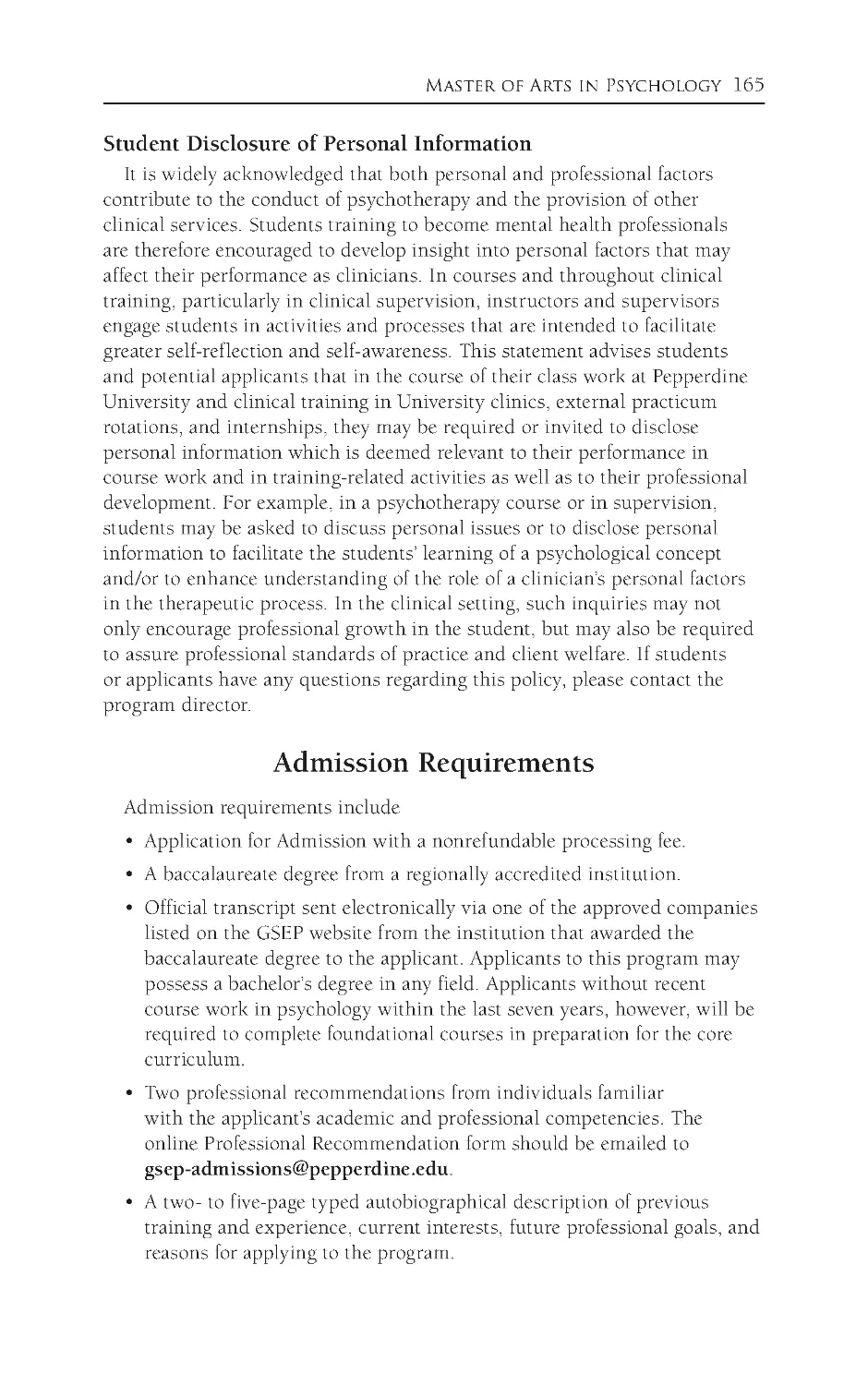
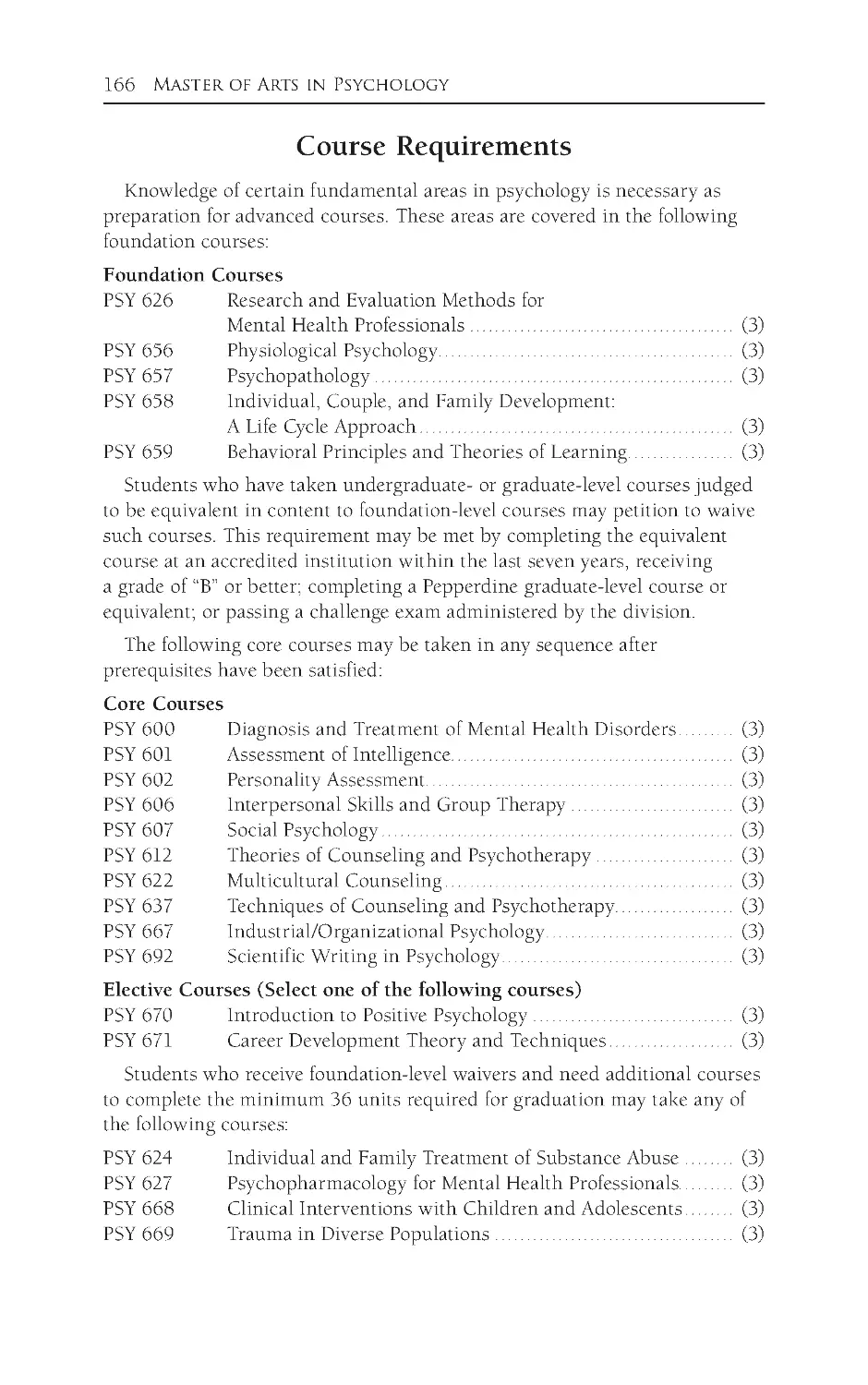
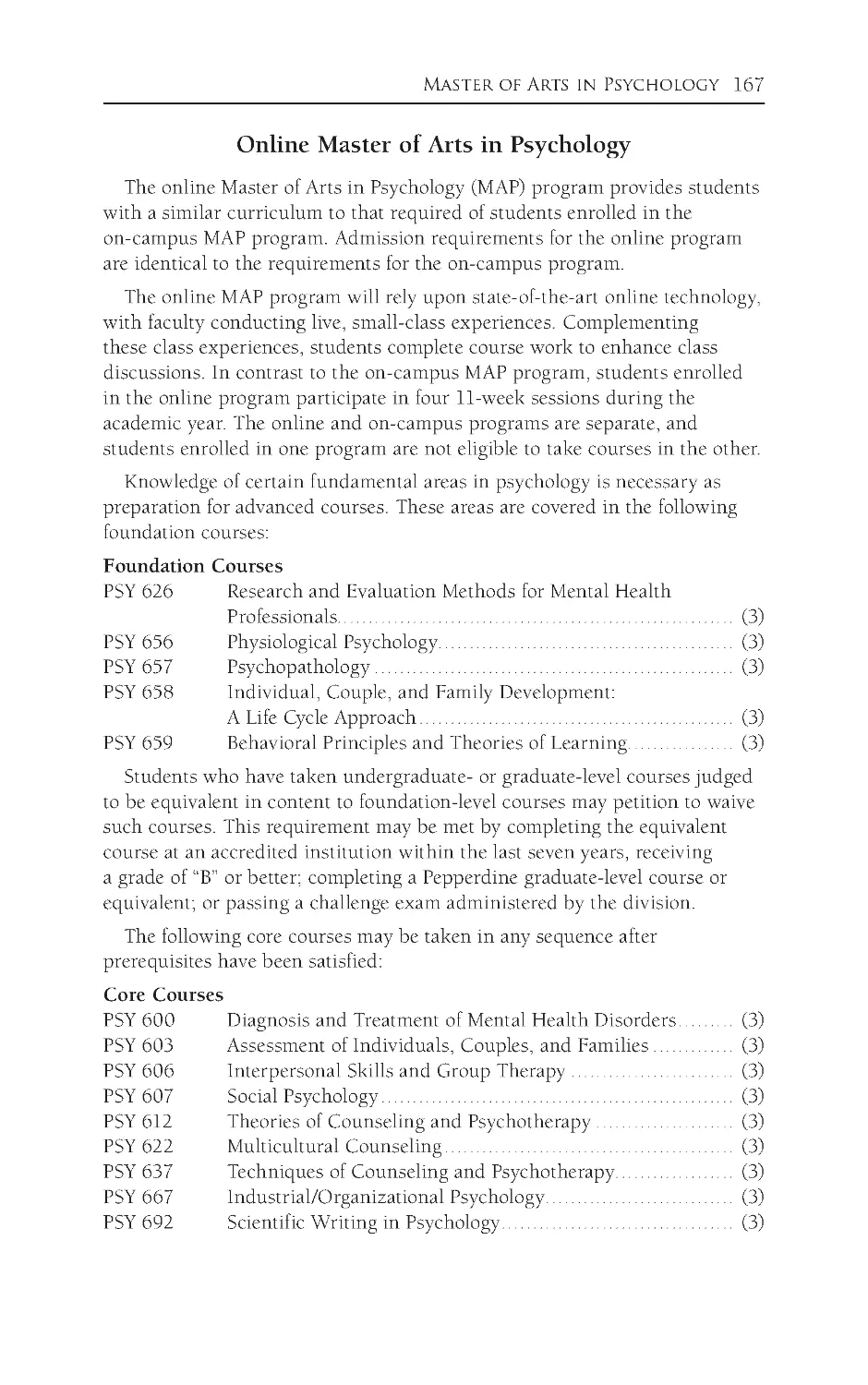

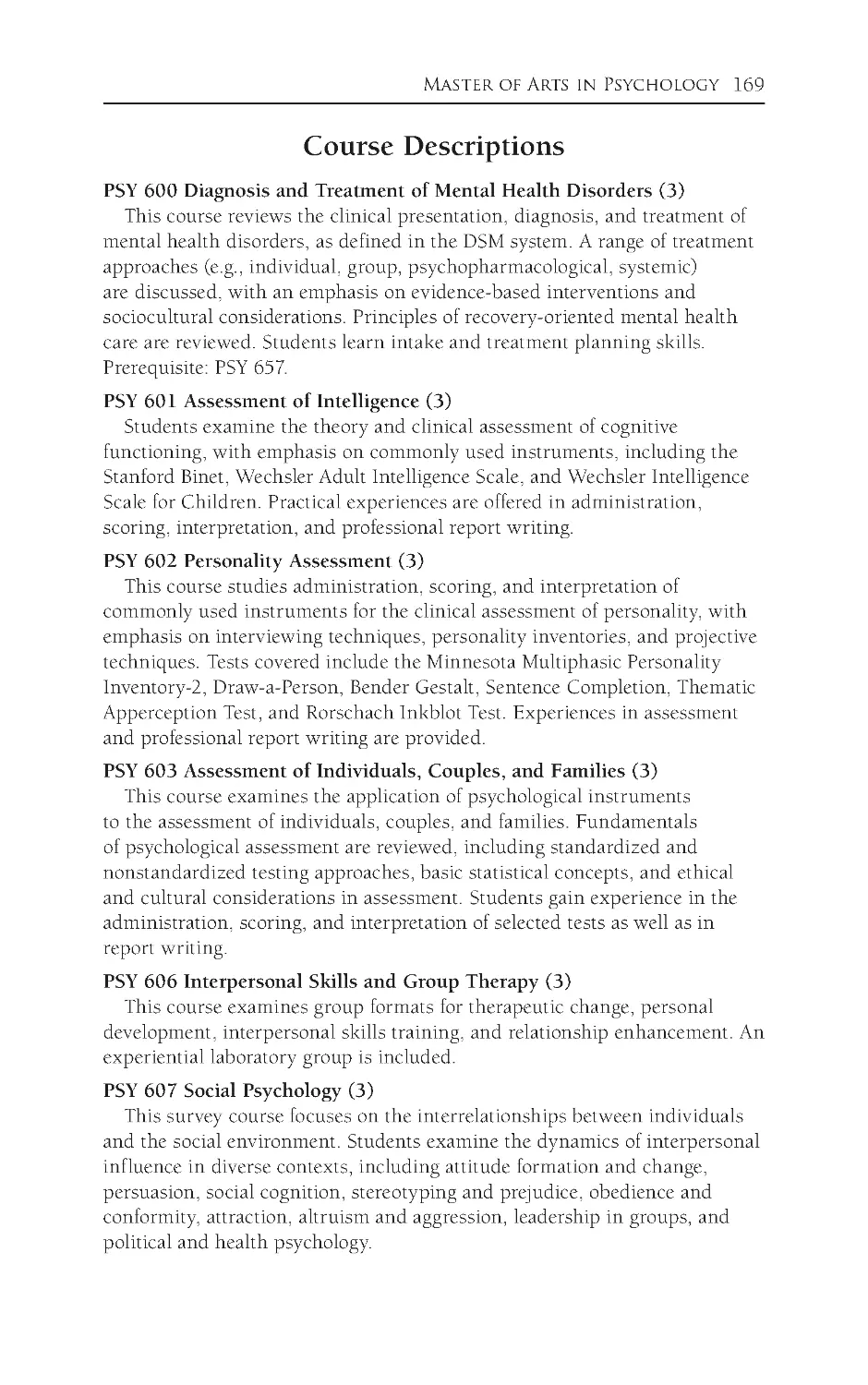




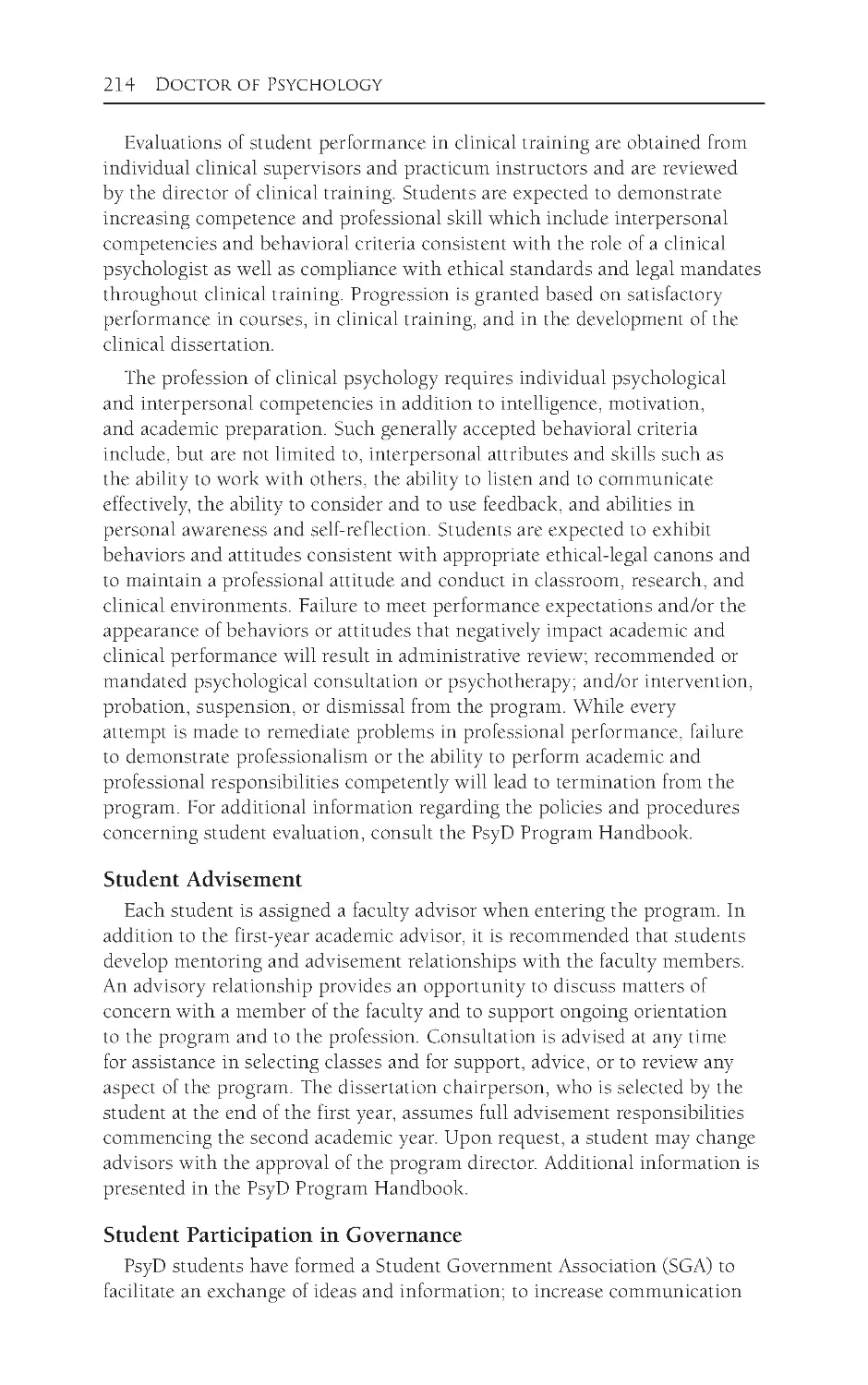
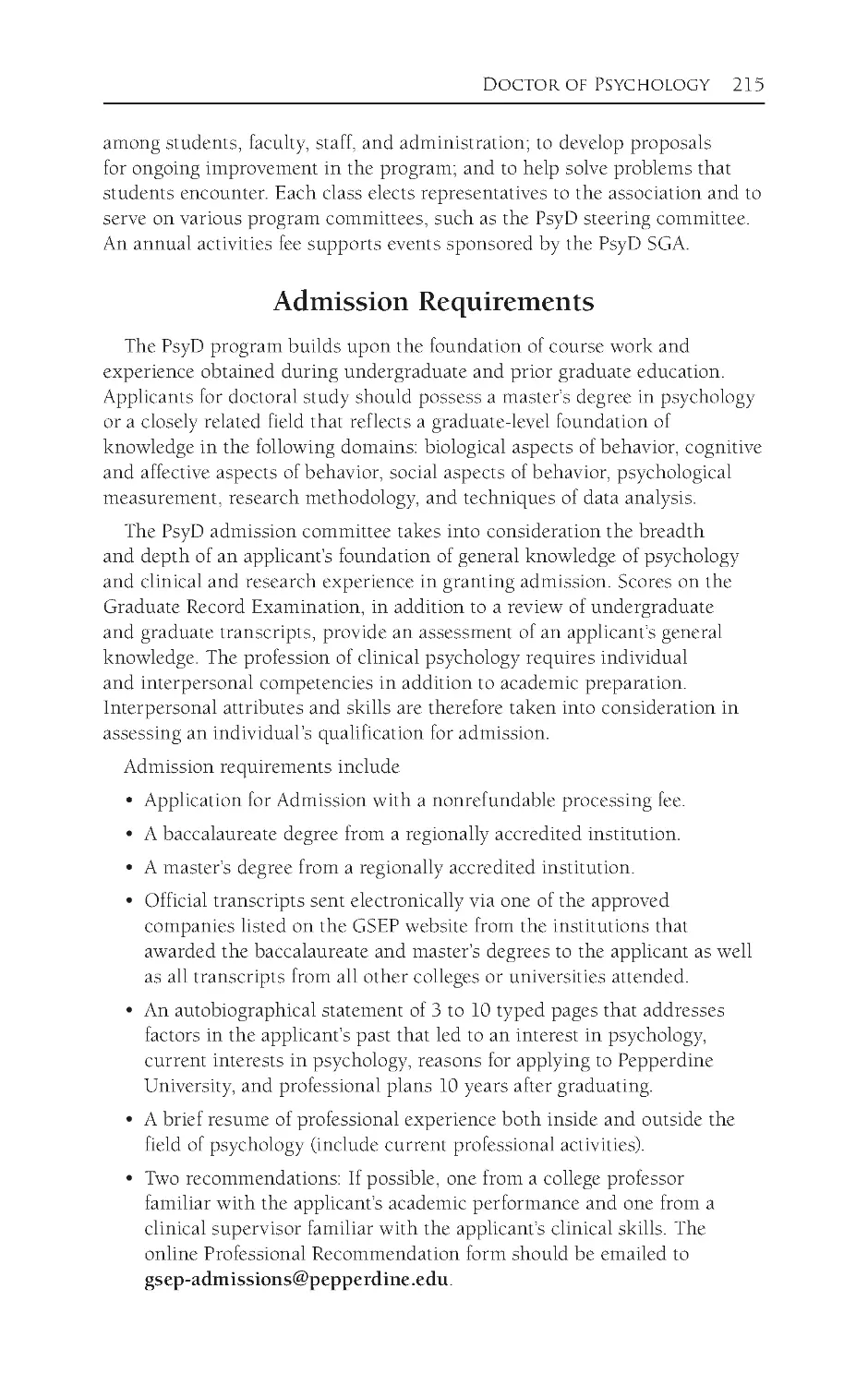
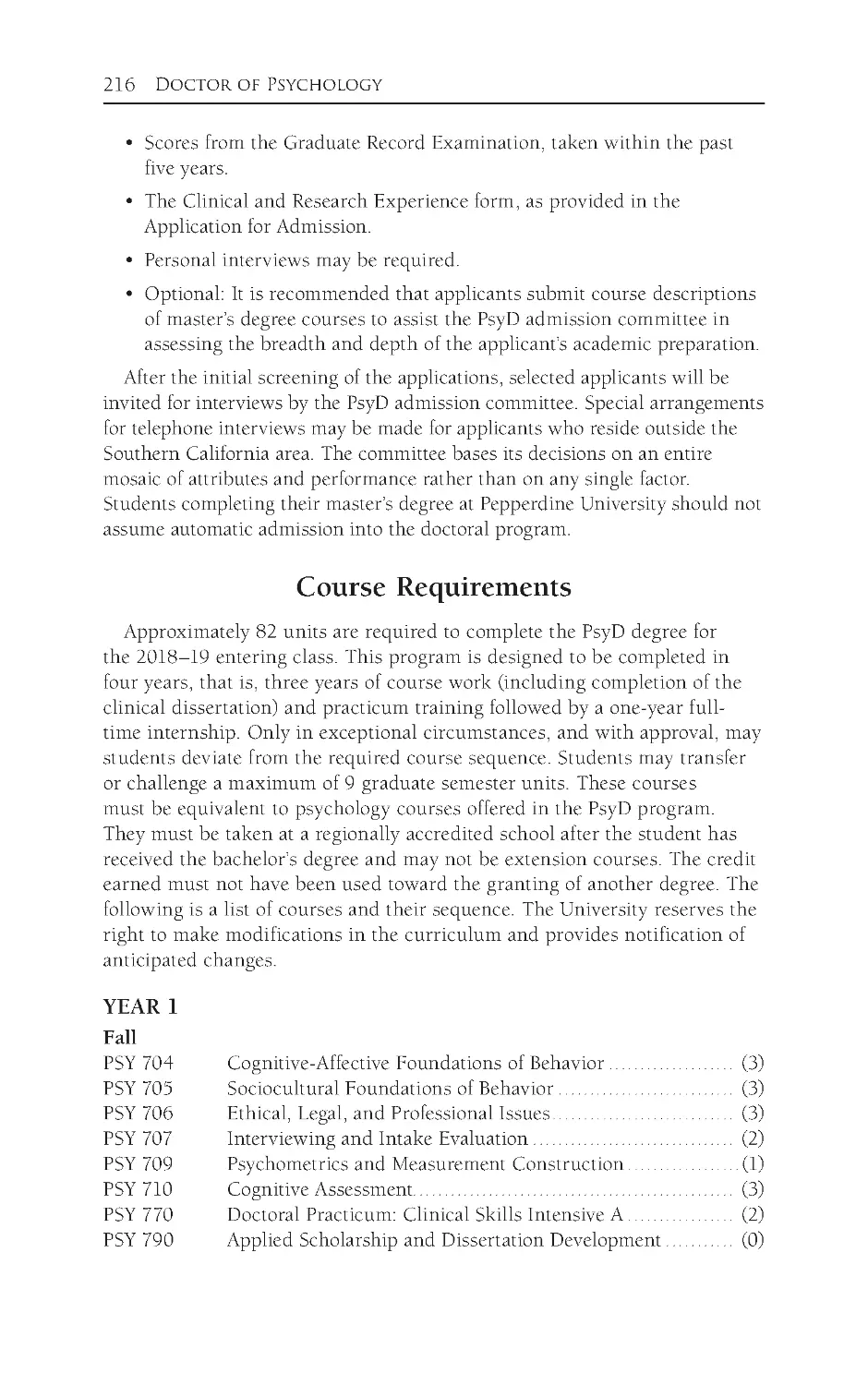
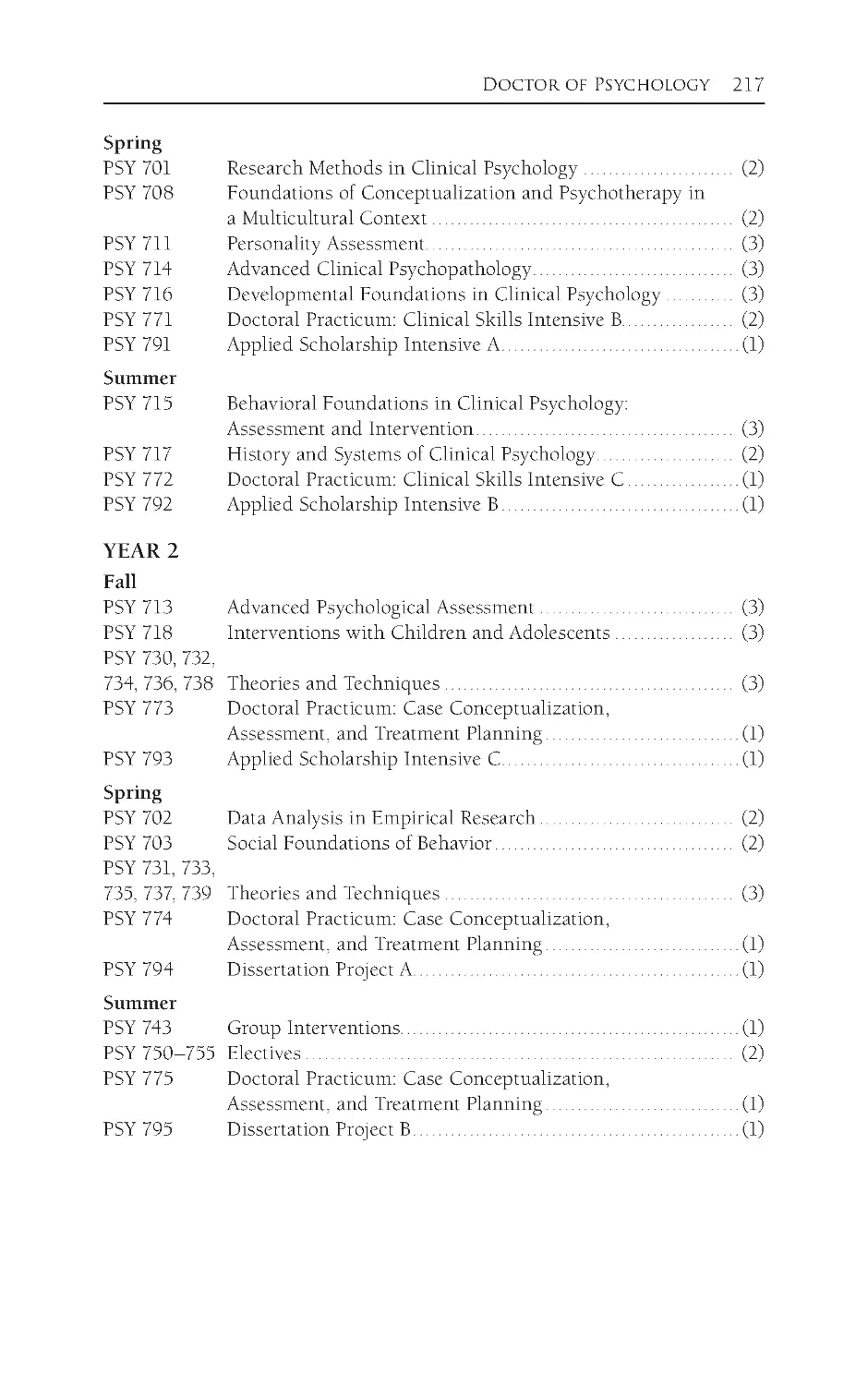


















Tags: religion education advertising
Year: 2018




Text
                    For More Information
Requests for further information should be addressed to
Pepperdine University
Graduate School of Education and Psychology
6100 Center Drive, 5th Floor
Los Angeles, California 90045
Telephone: (310) 568-5600
gsep.pepperdine.edu
2018 –2019
Academic Catalog

Pepperdine is a Christian university
committed to the highest standards
of academic excellence and Christian
values, where students are strengthened
for lives of purpose, service, and leadership.
As a Christian university, Pepperdine affirms:
That God is
That God is revealed uniquely in Christ
That the educational process may not, with
impunity, be divorced from the divine process
That the student, as a person of infinite dignity,
is the heart of the educational enterprise
That the quality of student life
is a valid concern of the University
That truth, having nothing to fear from
investigation, should be pursued relentlessly
in every discipline
That spiritual commitment, tolerating no excuse
for mediocrity, demands the highest standards of
academic excellence
That freedom, whether spiritual, intellectual,
or economic, is indivisible
That knowledge calls, ultimately, for a life of service

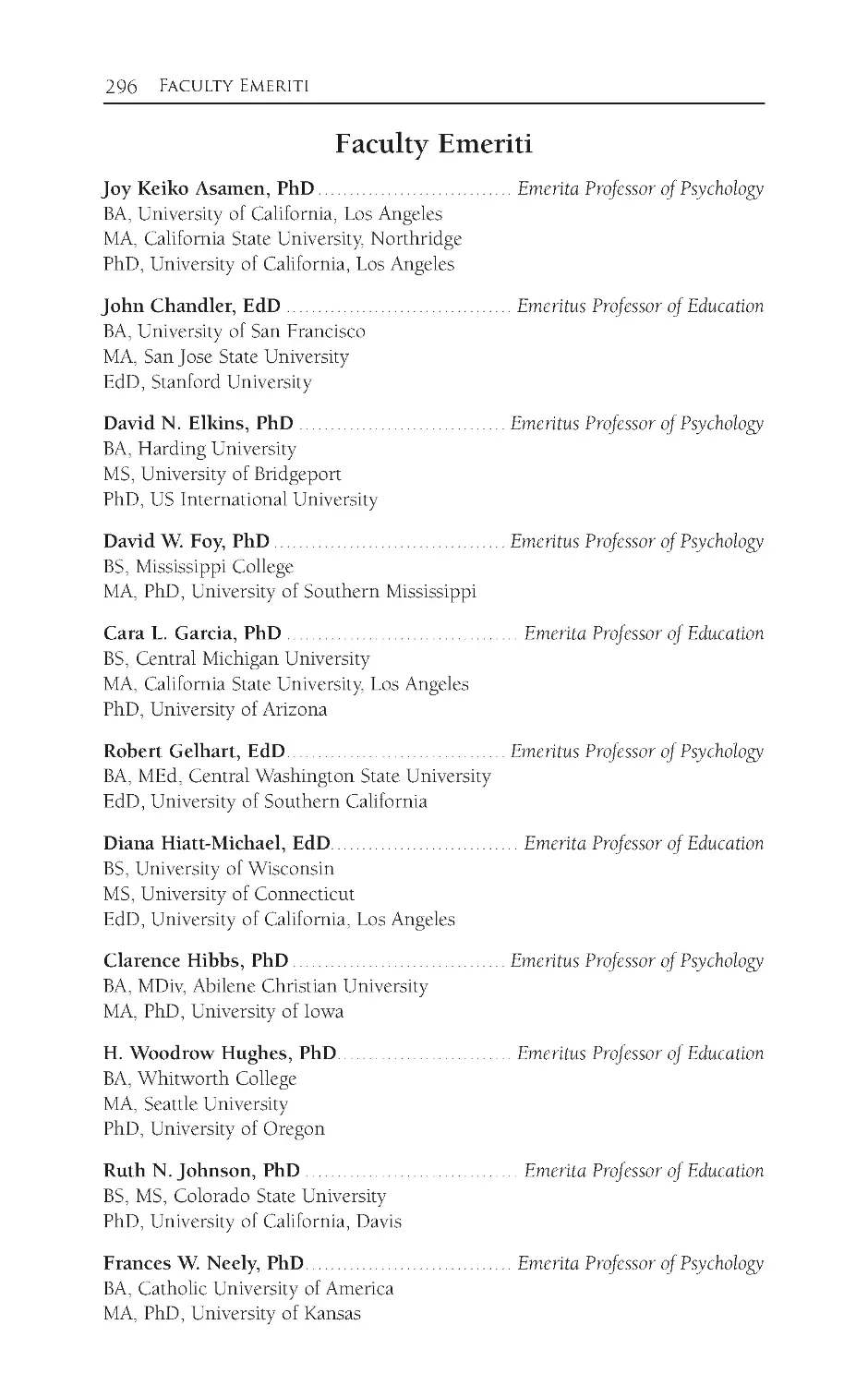
Contents
Academic Calendar.................................................. 4
President’s Message .................................................. 8
Dean’s Message ..................................................... 9
General Information ................................................ 11
Graduate School of Education and Psychology
General Information ................................................ 14
Admission Information ............................................. 23
Financial Information .............................................. 31
Student Services ................................................... 49
Academic Policies .................................................. 65
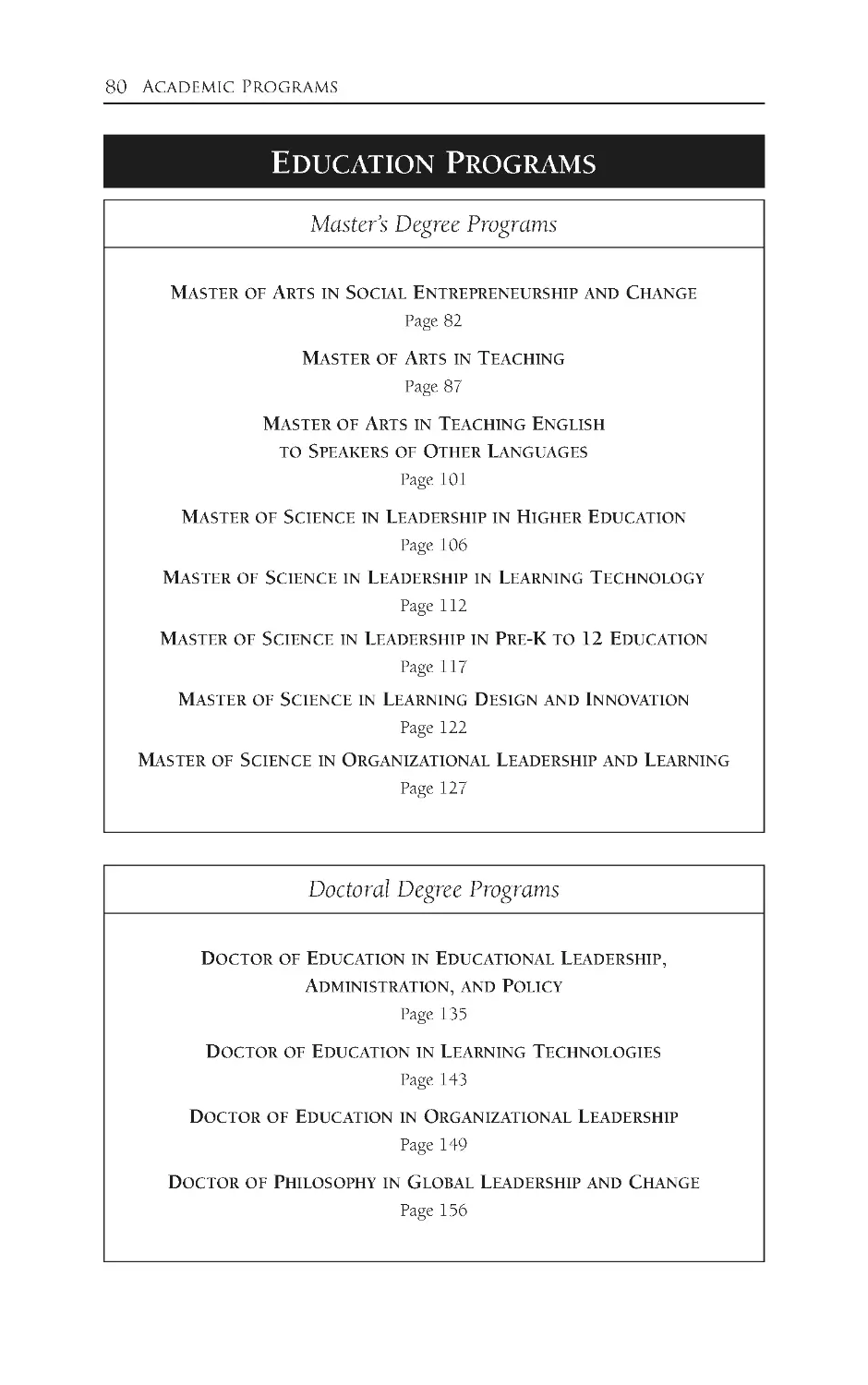
Academic Programs ................................................ 79
Master of Arts in Social Entrepreneurship and Change ................ 82
Master of Arts in Teaching ........................................ 87
Master of Arts in Teaching English to Speakers of Other Languages .... 101
Master of Science in Leadership in Higher Education ................ 106
Master of Science in Leadership in Learning Technology ............. 112
Master of Science in Leadership in Pre-K to 12 Education ............ 117
Master of Science in Learning Design and Innovation ................ 122
Master of Science in Organizational Leadership and Learning ......... 127
Doctor of Education............................................. 132
Doctor of Education in Educational Leadership,
Administration, and Policy ....................................... 135
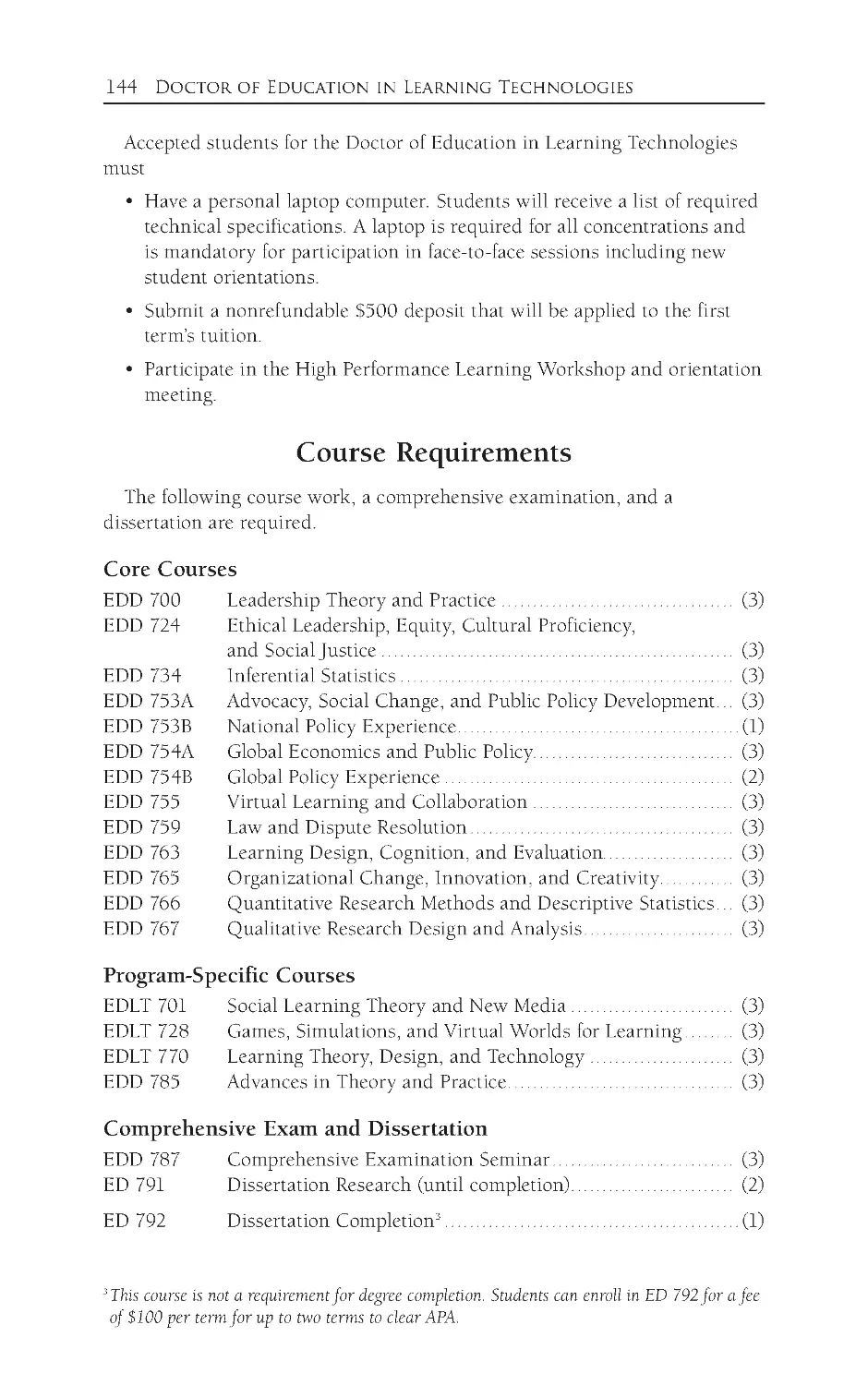
Doctor of Education in Learning Technologies ...................... 143
Doctor of Education in Organizational Leadership................... 149
Doctor of Philosophy in Global Leadership and Change.............. 156
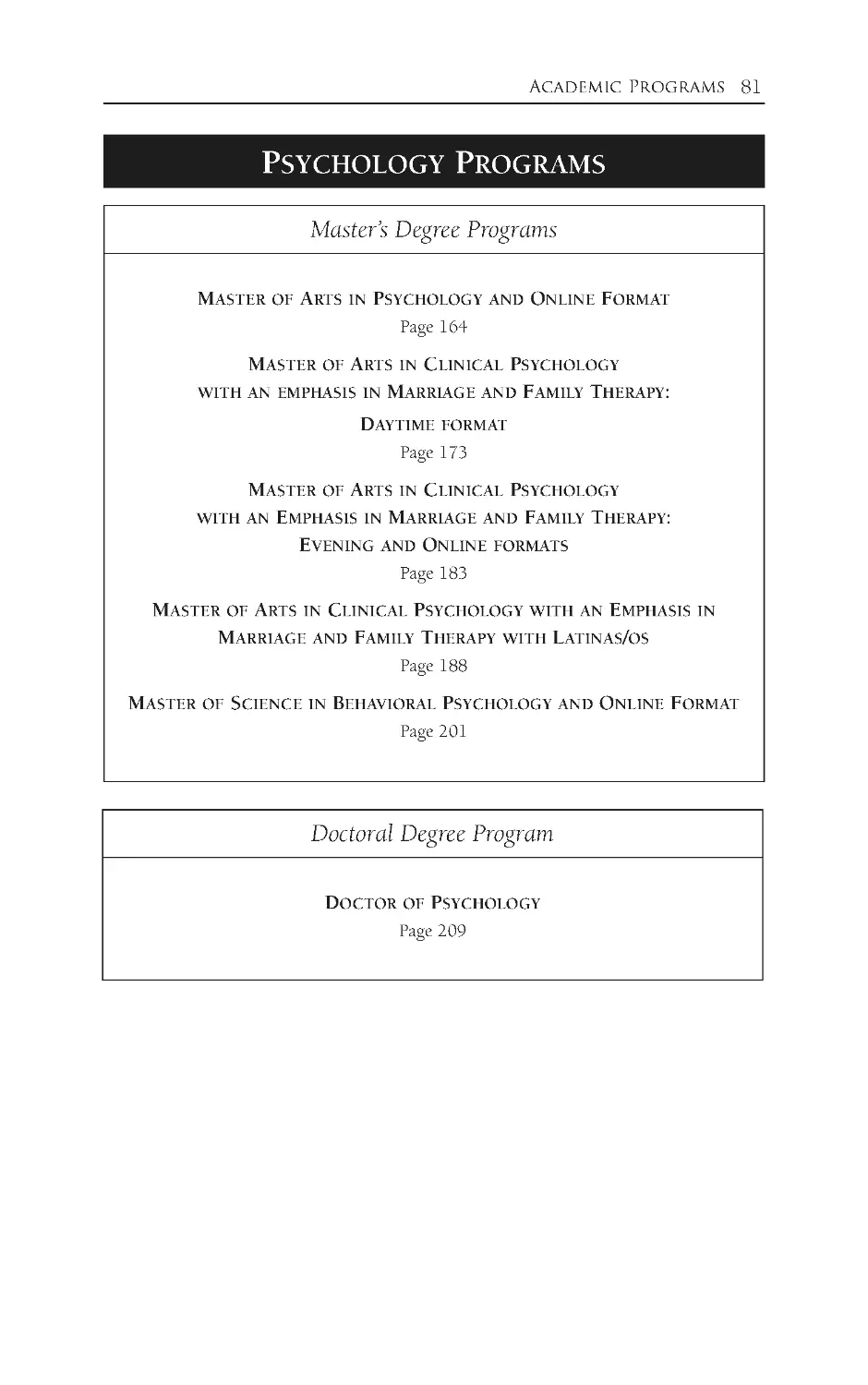
Master of Arts in Psychology and Online Format .................... 164
Master of Arts in Clinical Psychology with an Emphasis
in Marriage and Family Therapy: Daytime Format................... 173
Master of Arts in Clinical Psychology with an Emphasis
in Marriage and Family Therapy: Evening and Online Formats ....... 183
Master of Arts in Clinical Psychology with an Emphasis
in Marriage and Family Therapy with Latinas/os .................... 188
Master of Science in Behavioral Psychology and Online Format ....... 201
Doctor of Psychology............................................ 209
Regulations and Legal Notices ...................................... 229
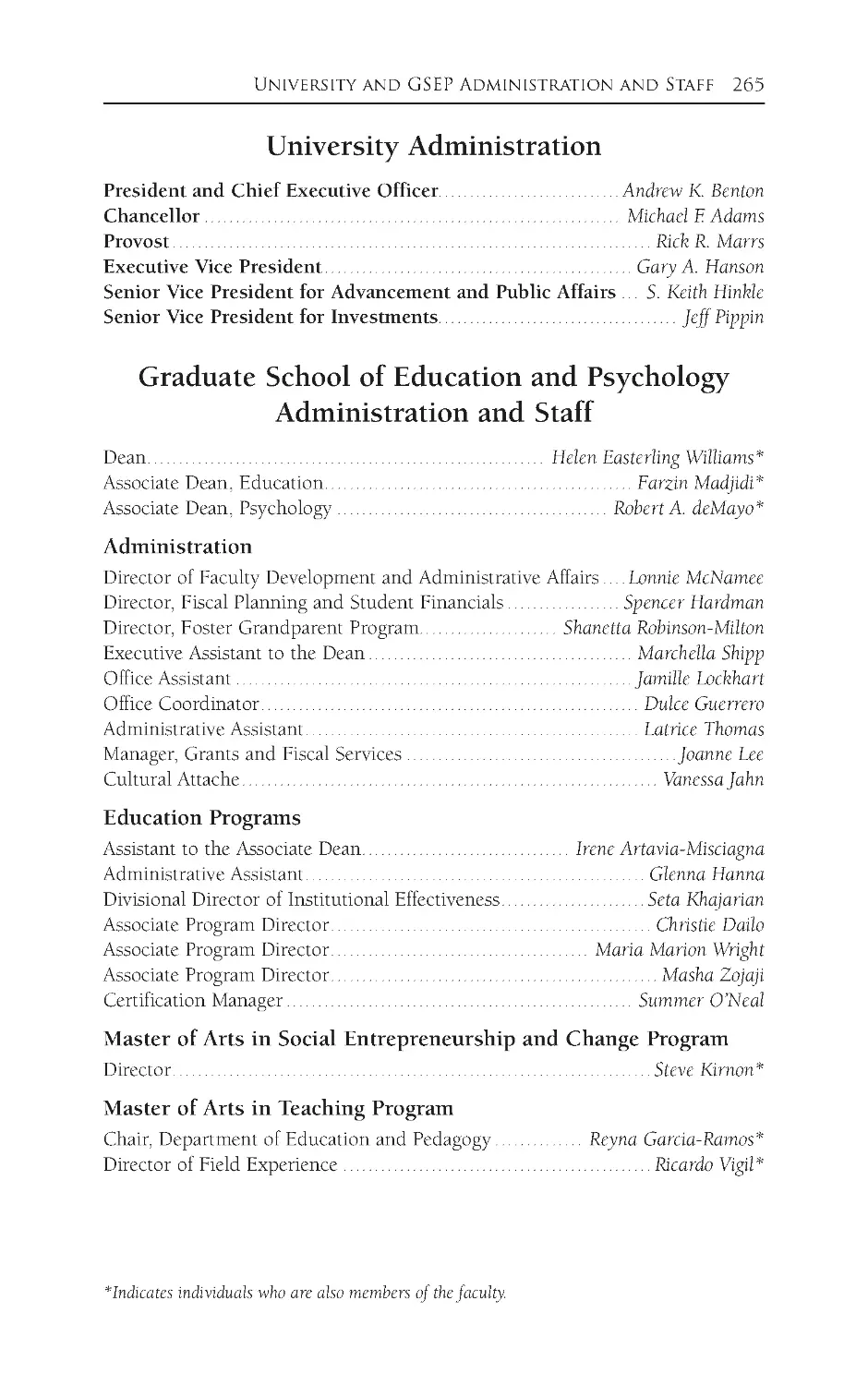
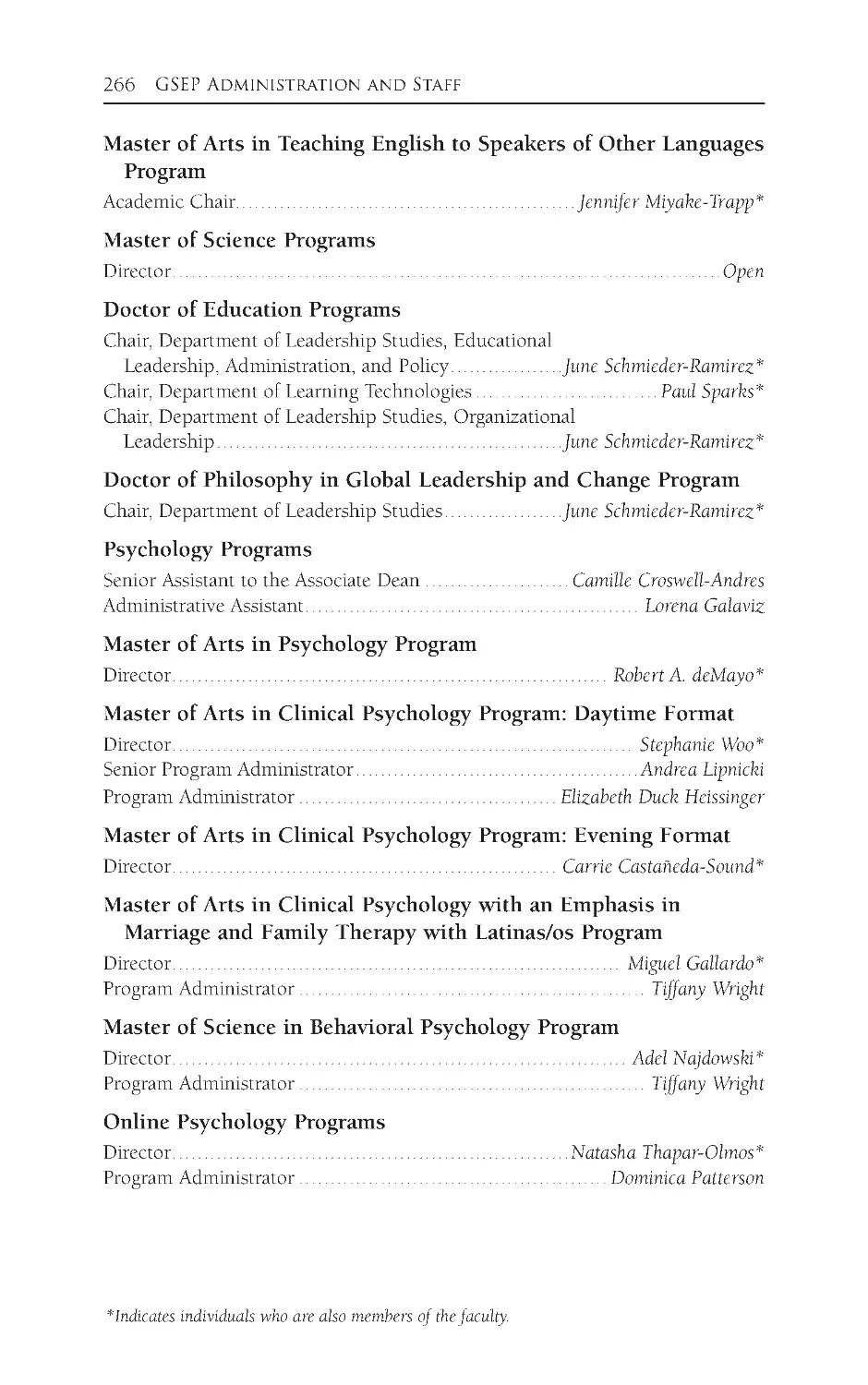
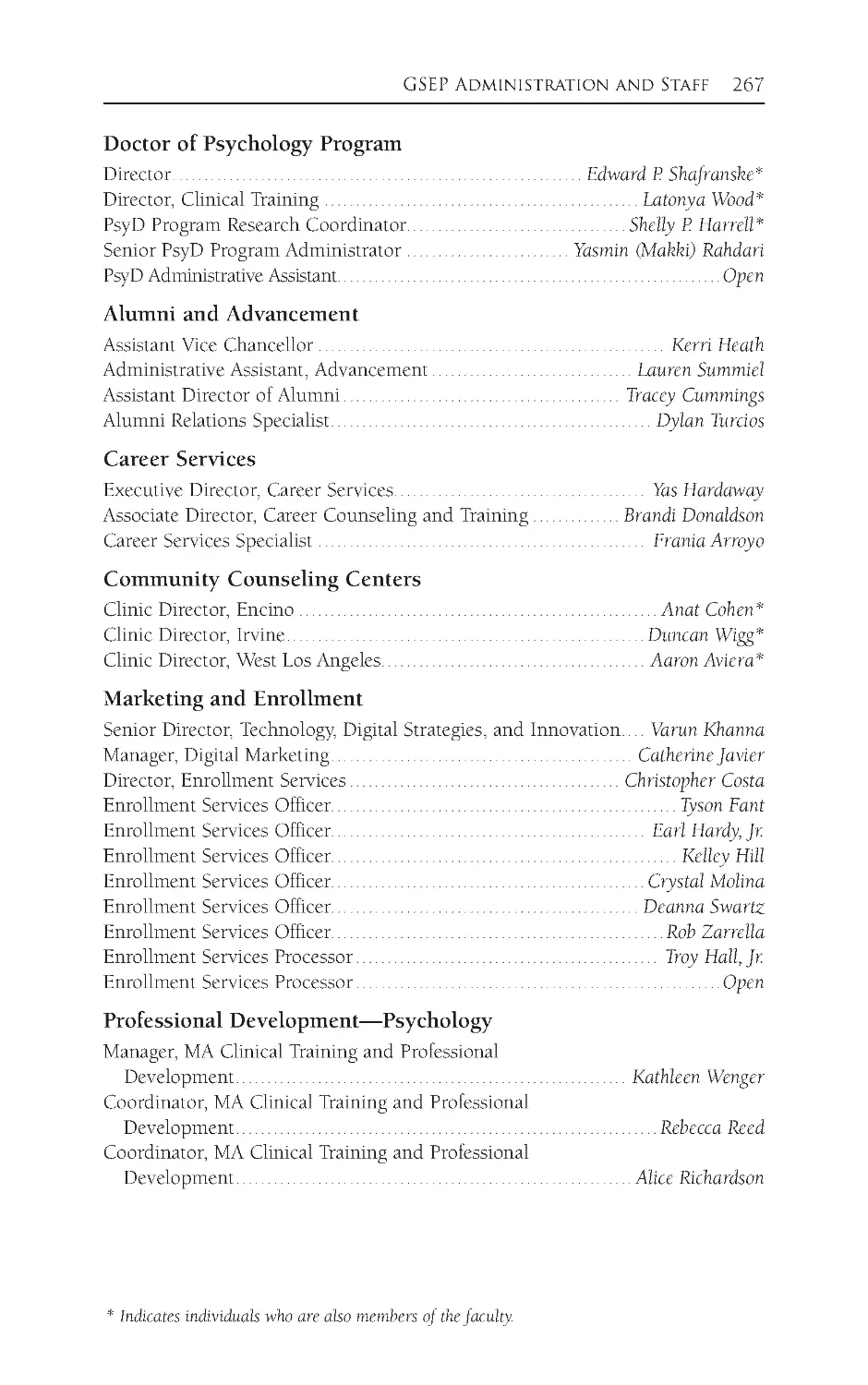
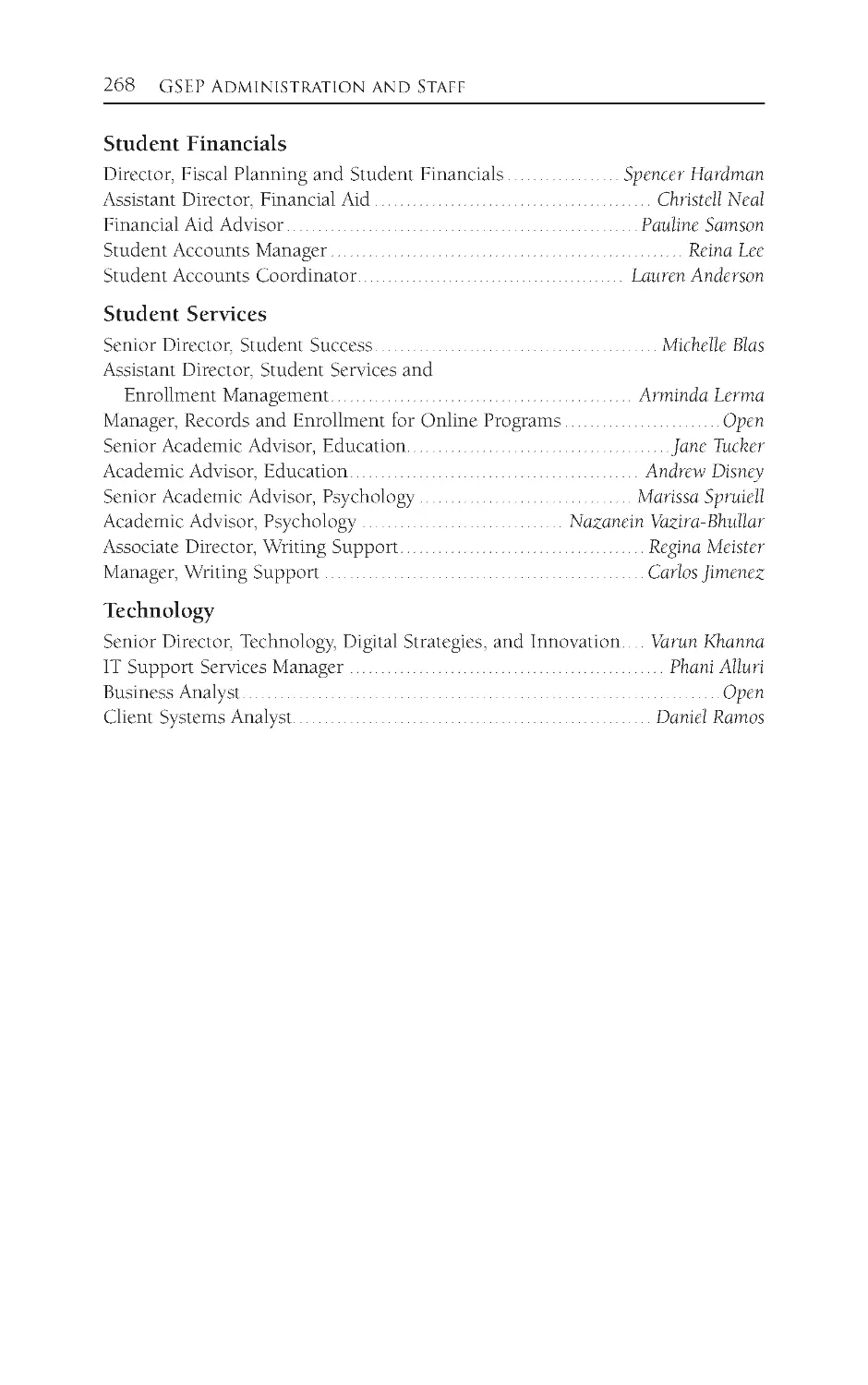
Administration and Faculty ........................................ 259
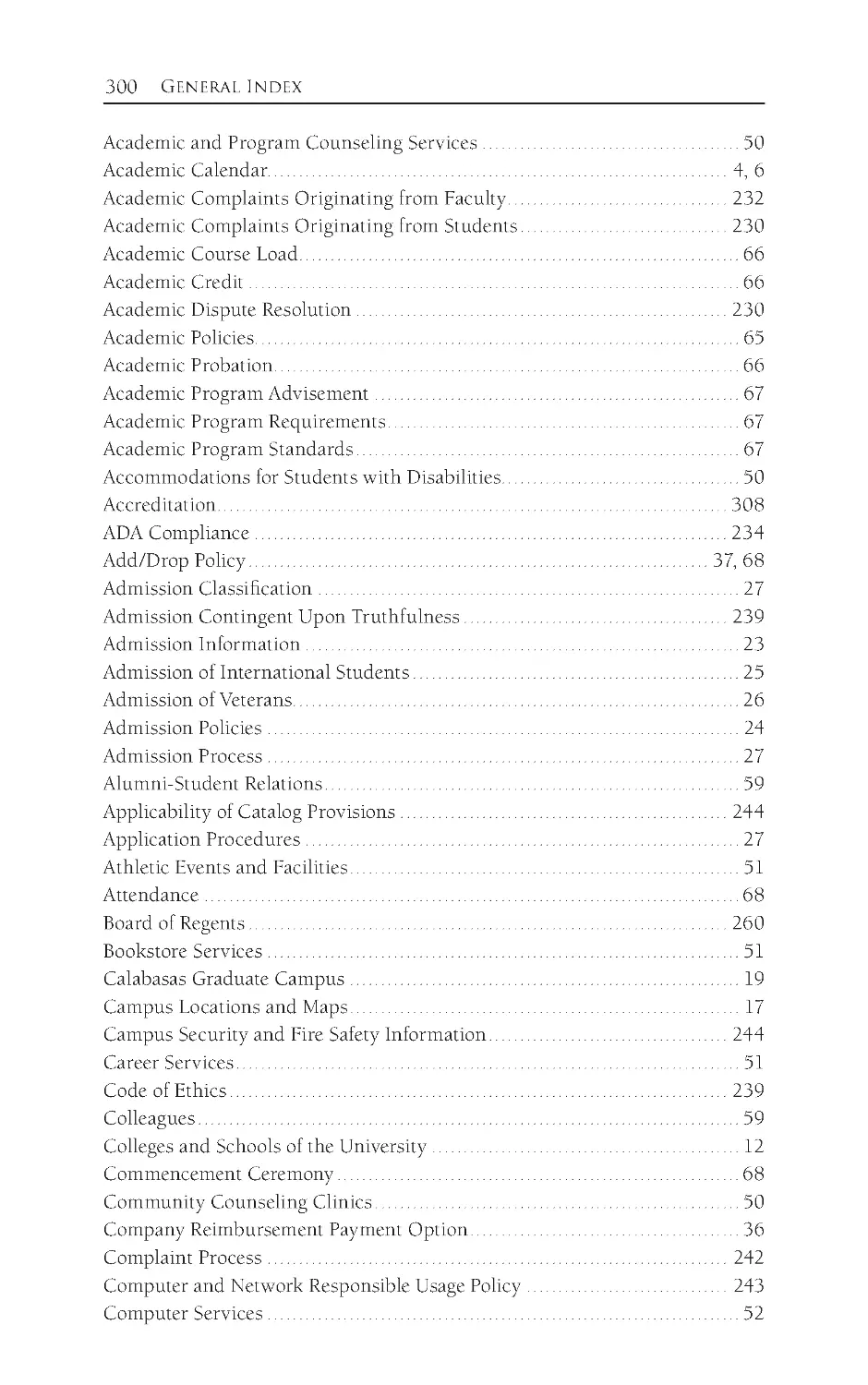
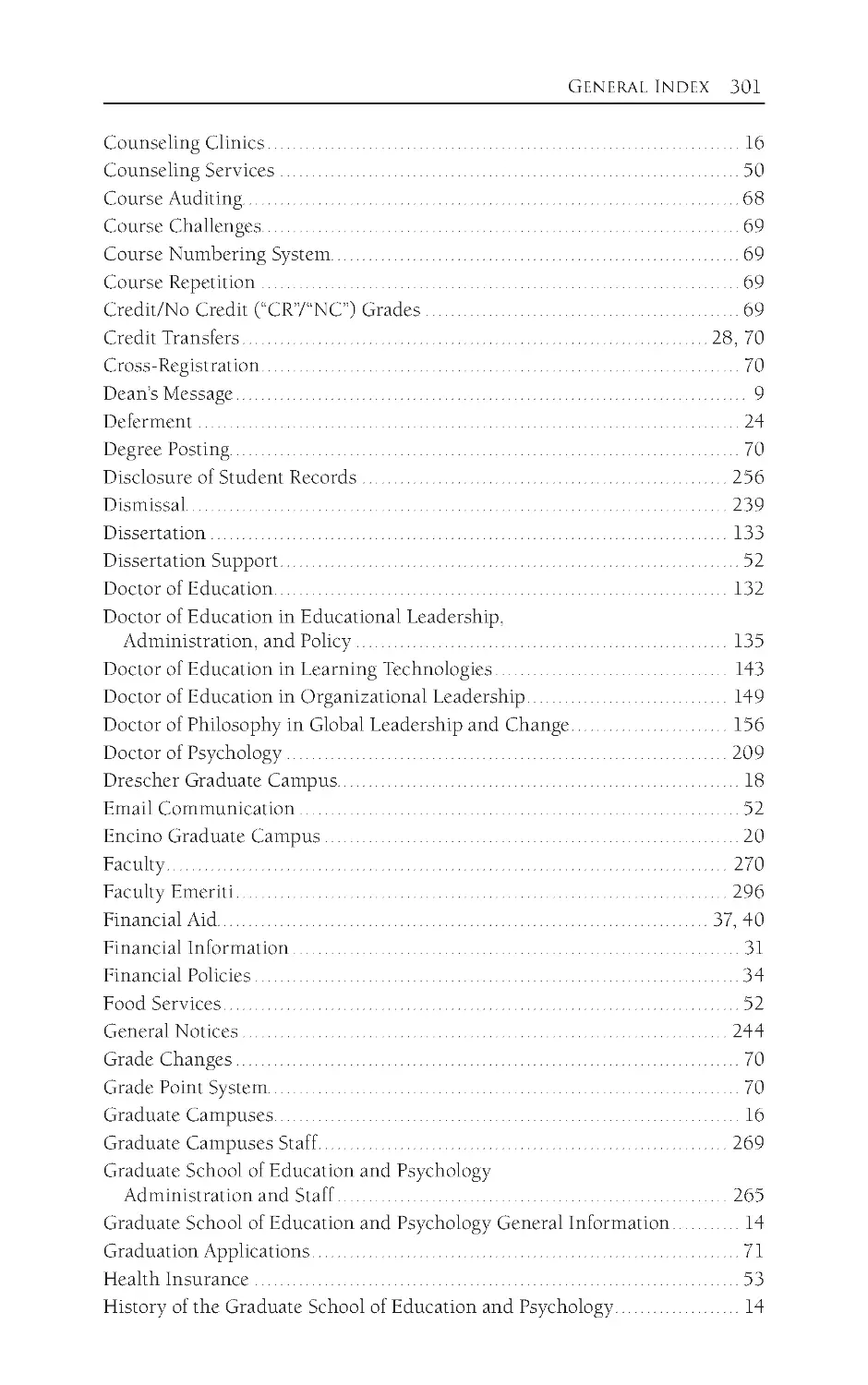
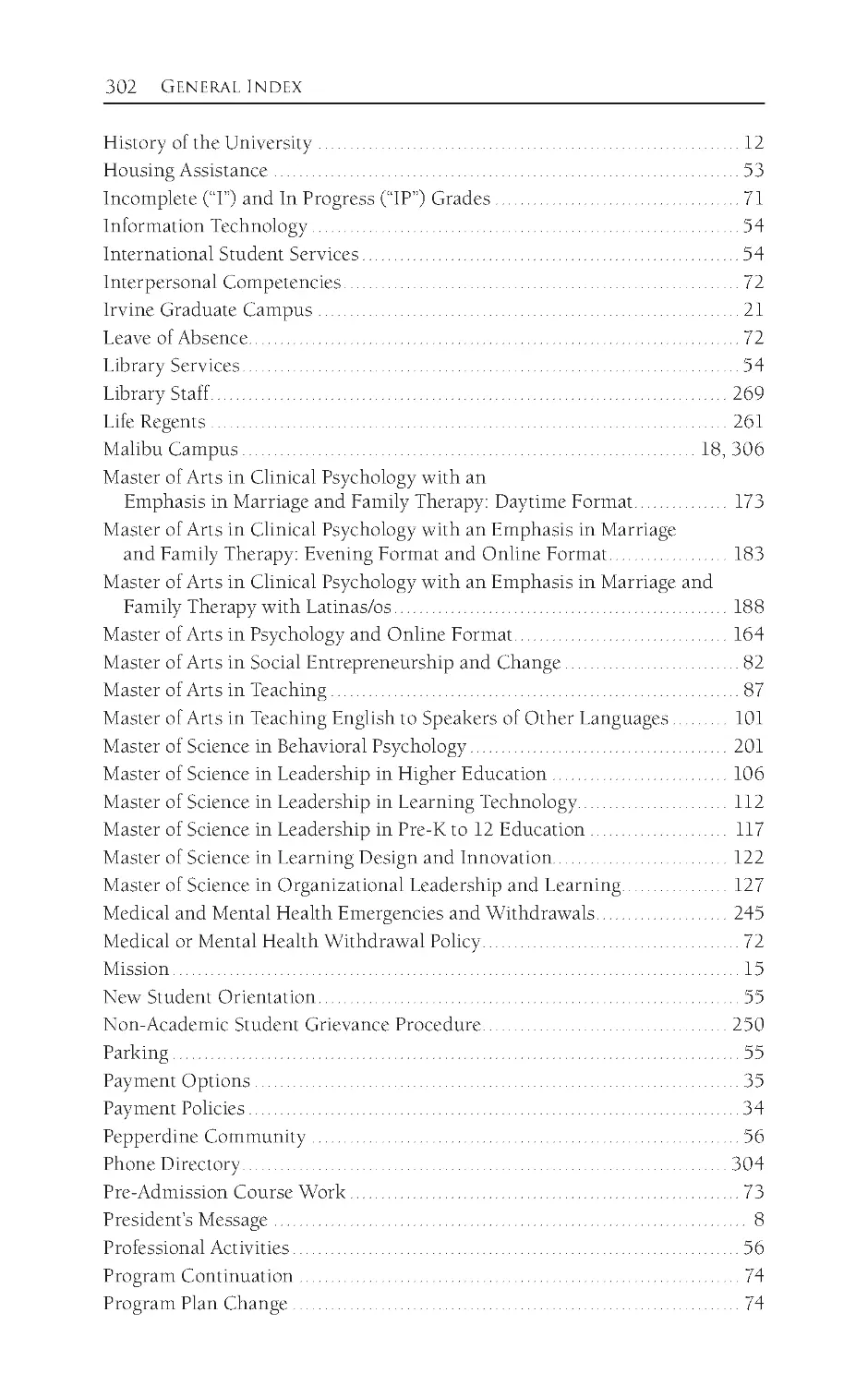
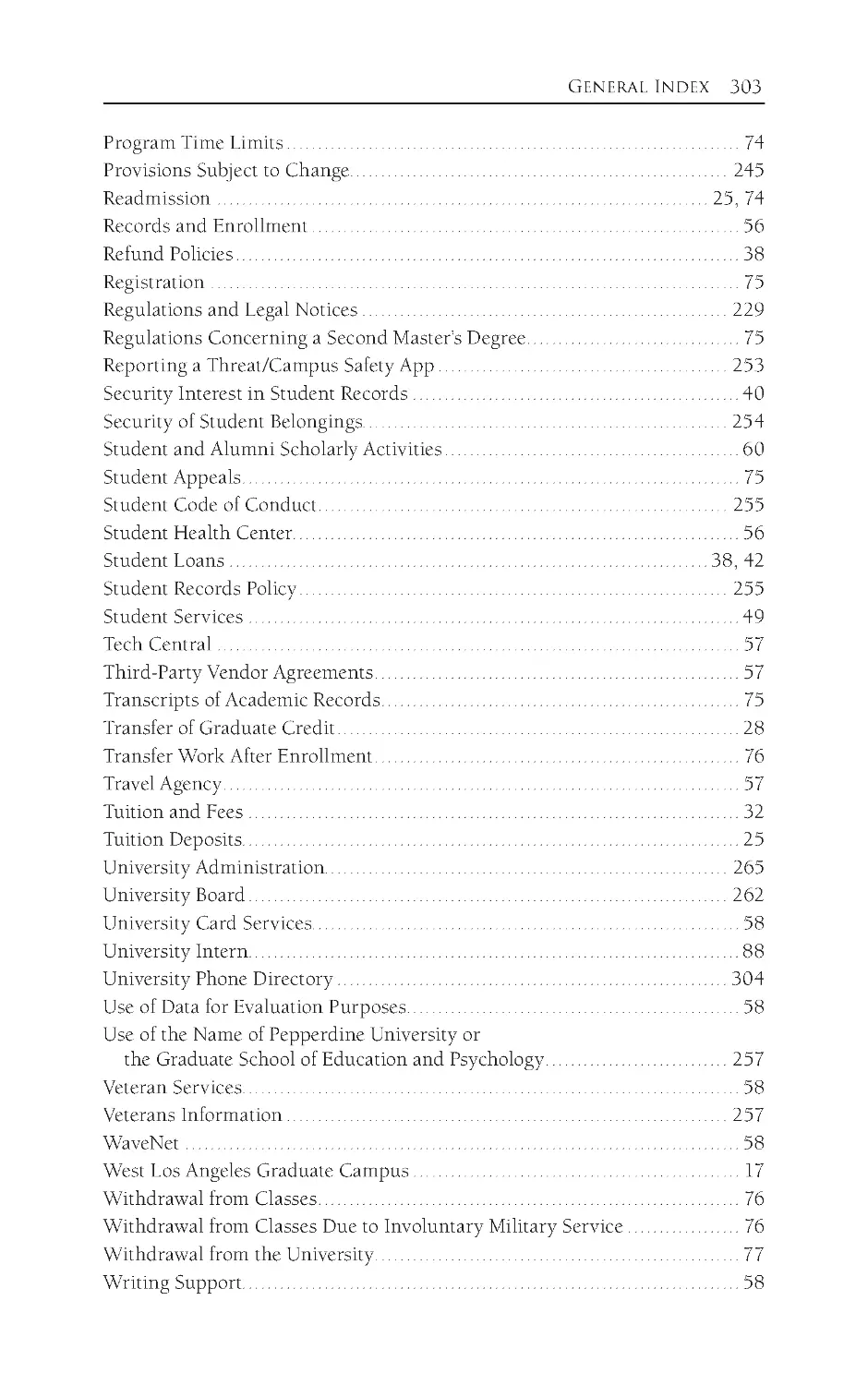
Index............................................................ 299
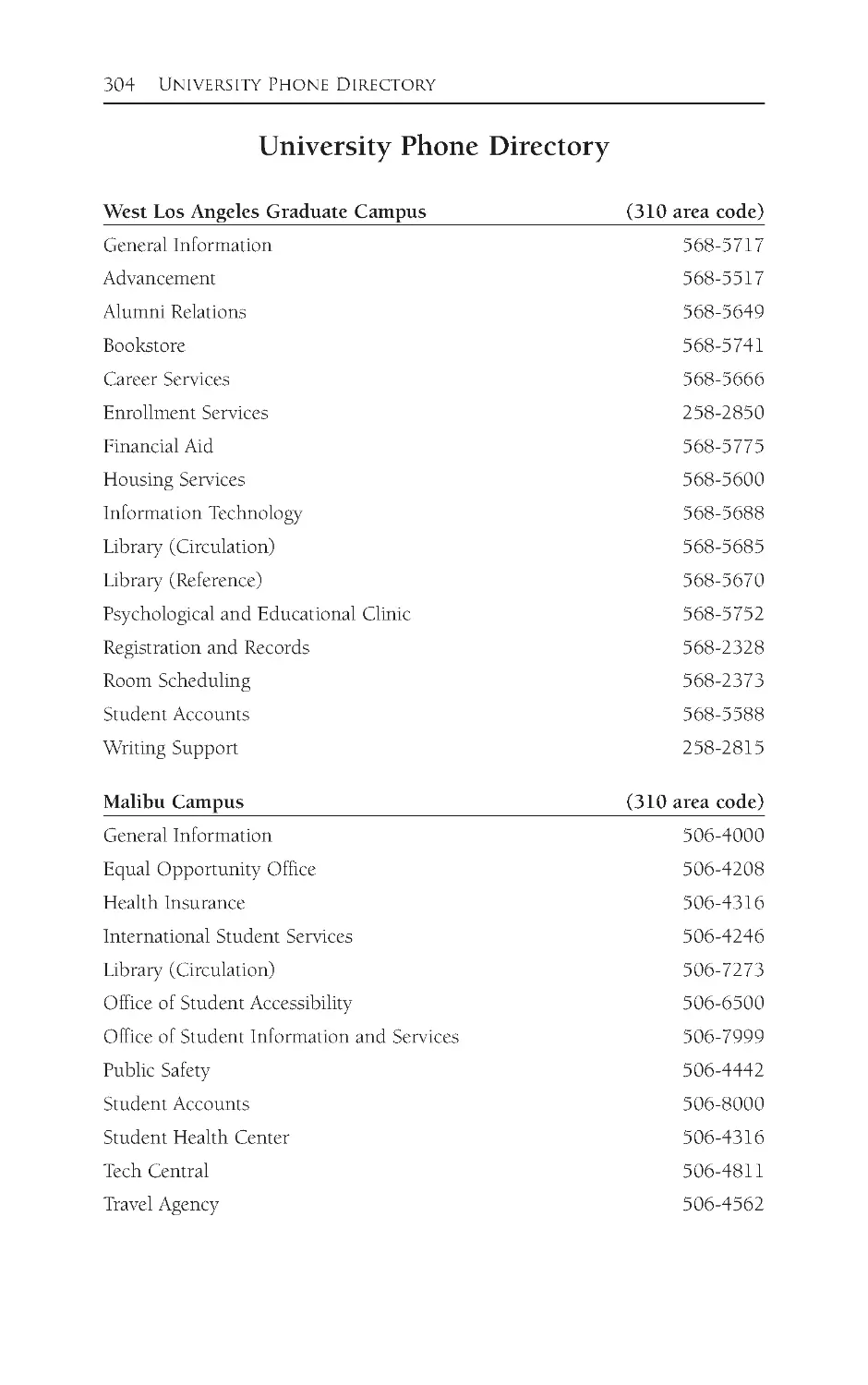
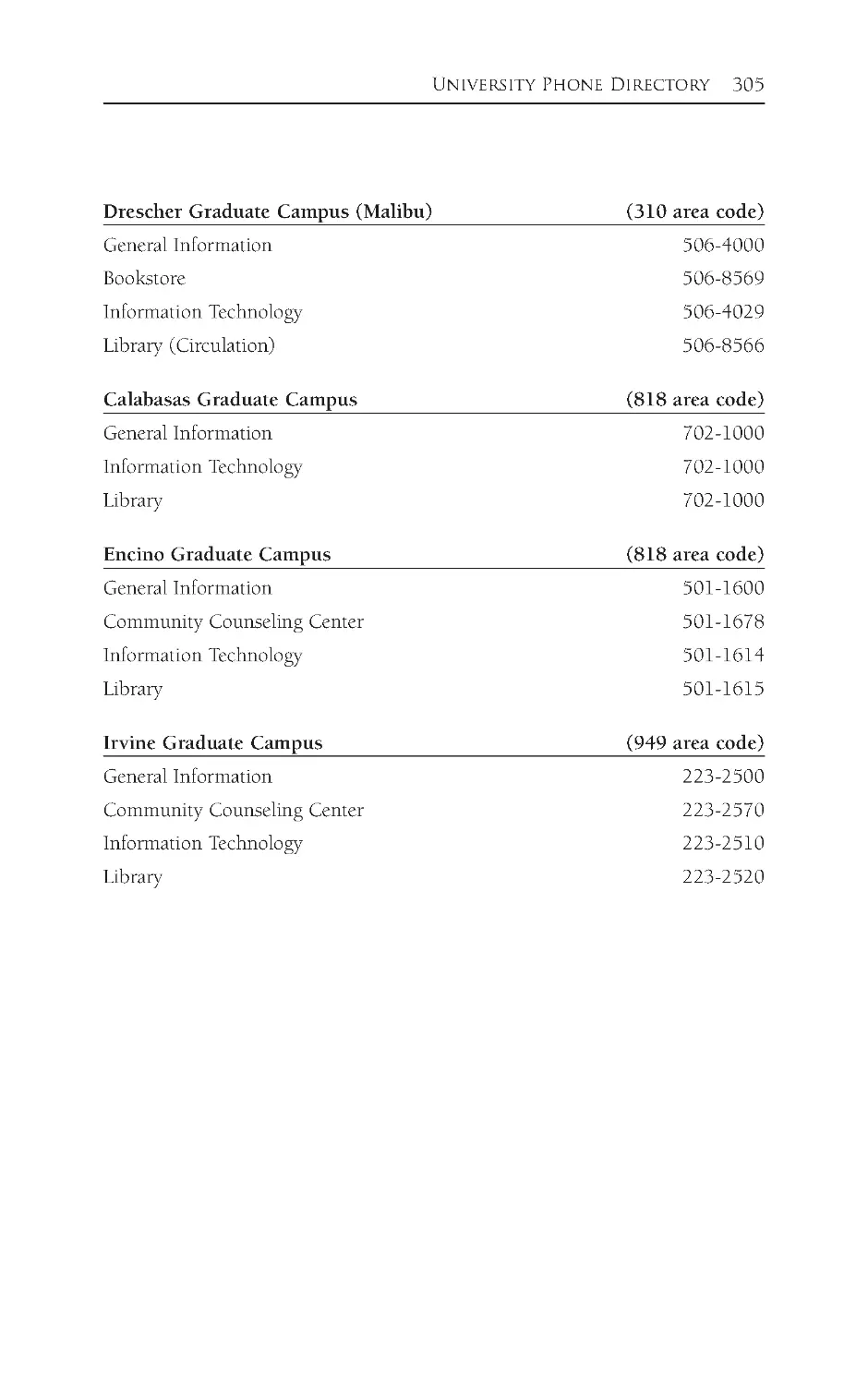
University Phone Directory ......................................... 304
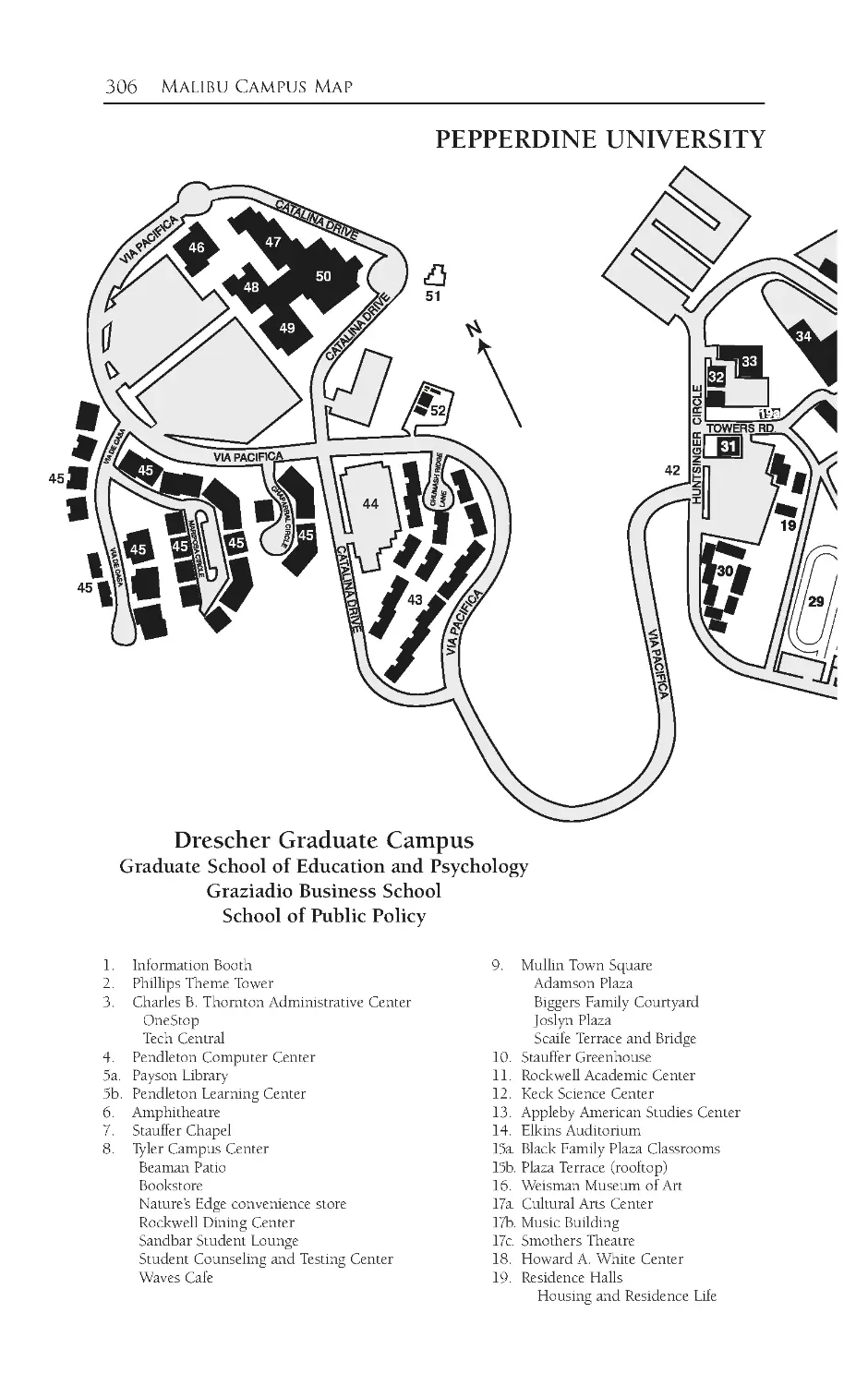
Malibu Campus Map .............................................. 306
Accreditation .................................................... 308
3

4 Academic Calendar
GRADUATE SCHOOL OF
EDUCATION AND PSYCHOLOGY
2018–2019 ACADEMIC CALENDAR
Fall 2018
Monday Sept. 3
Labor Day holiday
Tuesday Sept. 4
Fall term classes begin
Tuesday Sept. 4 – Add/drop period; withdrawal fee applies
Monday Sept. 10
Tuesday Sept. 11 Tuition due; refund schedule applies;
late registration fee applies
Sunday Sept. 30 MA students: Graduation Application due for
December 2018 graduates
Monday Oct. 15 Degree posting for doctoral students only
Friday
Oct. 26 Last day to withdraw with grade of “W”
Thursday Nov. 22 – Thanksgiving holiday
Friday
Nov. 23
Friday
Dec. 14 Last day of Fall term; degree posting date
Saturday Dec. 15– Term break
Sunday Jan. 6
Spring 2019
Monday Jan. 7
Spring term classes begin
Monday Jan. 7–
Add/drop period; withdrawal fee applies
Friday
Jan. 11
Saturday Jan. 12
Tuition due; refund schedule applies;
late registration fee applies
Monday Jan. 21
Rev. Dr. Martin Luther King, Jr. , Day holiday
Thursday Jan. 31
MA students: Graduation Application due for
Spring 2019 graduates
Friday
March 1 Last day to withdraw with grade of “W”
Friday
April 19 Last day of Spring term; degree posting date
Saturday April 20– Term break
Sunday April 28

5
Academic Calendar
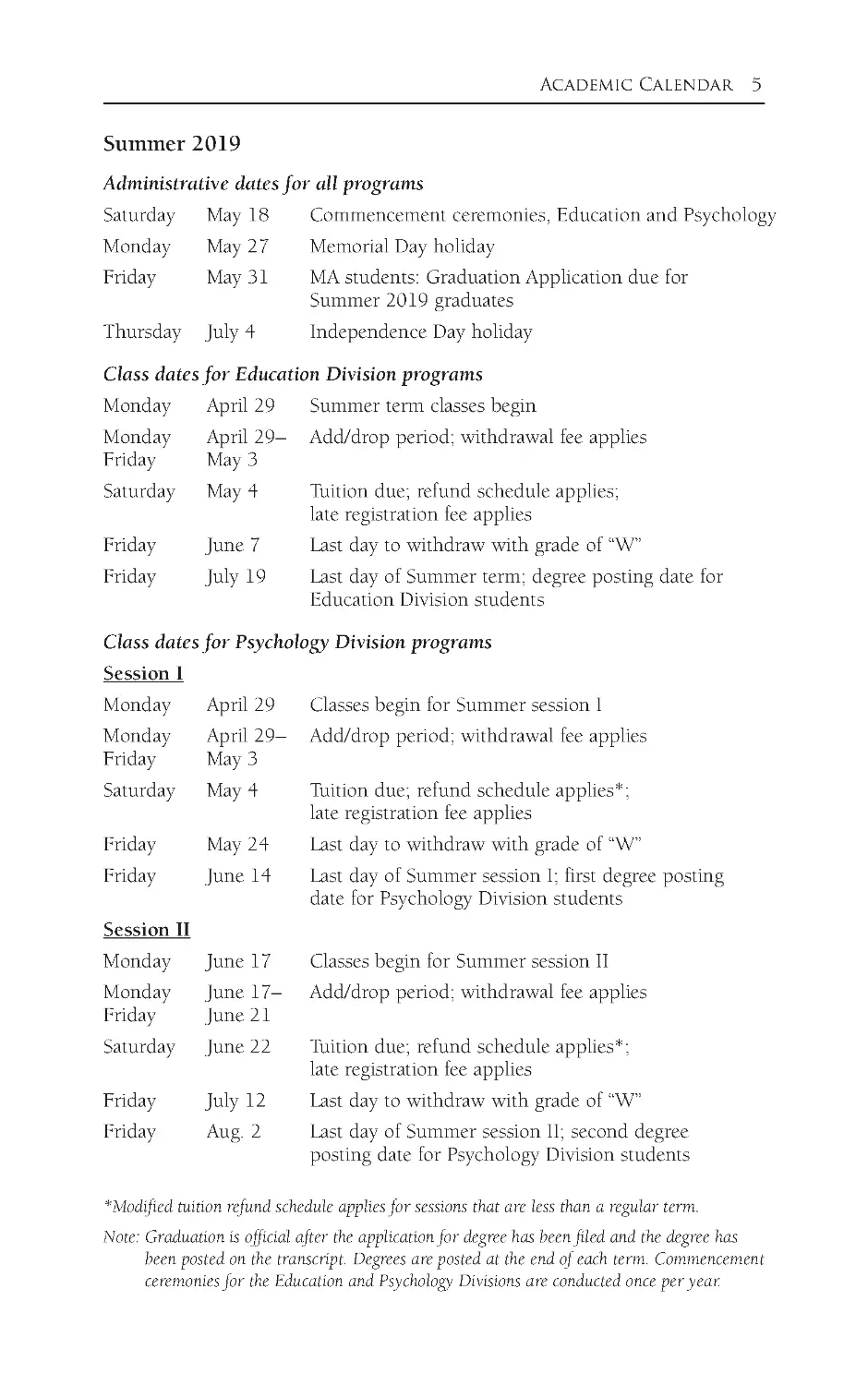
Summer 2019
Administrative dates for all programs
Saturday May 18 Commencement ceremonies, Education and Psychology
Monday May 27 Memorial Day holiday
Friday
May 31 MA students: Graduation Application due for
Summer 2019 graduates
Thursday July 4
Independence Day holiday
Class dates for Education Division programs
Monday April 29 Summer term classes begin
Monday April 29– Add/drop period; withdrawal fee applies
Friday
May 3
Saturday May 4
Tuition due; refund schedule applies;
late registration fee applies
Friday
June 7
Last day to withdraw with grade of “W”
Friday
July 19
Last day of Summer term; degree posting date for
Education Division students
Class dates for Psychology Division programs
Session I
Monday April 29 Classes begin for Summer session I
Monday April 29– Add/drop period; withdrawal fee applies
Friday
May 3
Saturday May 4
Tuition due; refund schedule applies*;
late registration fee applies
Friday
May 24 Last day to withdraw with grade of “W”
Friday
June 14 Last day of Summer session I; first degree posting
date for Psychology Division students
Session II
Monday June 17 Classes begin for Summer session II
Monday June 17– Add/drop period; withdrawal fee applies
Friday
June 21
Saturday June 22 Tuition due; refund schedule applies*;
late registration fee applies
Friday
July 12
Last day to withdraw with grade of “W”
Friday
Aug. 2
Last day of Summer session II; second degree
posting date for Psychology Division students
*Modified tuition refund schedule applies for sessions that are less than a regular term.
Note: Graduation is official after the application for degree has been filed and the degree has
been posted on the transcript. Degrees are posted at the end of each term. Commencement
ceremonies for the Education and Psychology Divisions are conducted once per year.

6 Academic Calendar
GRADUATE SCHOOL OF
EDUCATION AND PSYCHOLOGY
ONLINE PSYCHOLOGY PROGRAMS
2018–2019 ACADEMIC CALENDAR
Fall 2018
Monday Oct. 1
Fall session begins
Monday Oct. 1– Add/drop period; withdrawal fee applies
Sunday Oct. 7
Monday Oct. 8
Tuition due; refund schedule applies*;
late registration fee applies
Friday
Nov. 9
Last day to withdraw with grade of “W”
Thursday Nov. 22 – Thanksgiving holiday
Friday
Nov. 23
Sunday
Dec. 16 Last day of Fall session; degree posting date
Monday Dec. 17– Fall session break
Sunday Jan. 6
Winter 2019
Monday Jan. 7
Winter session begins
Monday Jan. 7–
Add/drop period; withdrawal fee applies
Sunday Jan. 13
Monday Jan. 14
Tuition due; refund schedule applies*;
late registration fee applies
Monday Jan. 21
Rev. Dr. Martin Luther King, Jr. , Day holiday
Friday
Feb. 15 Last day to withdraw with grade of “W”
Sunday
March 24 Last day of Winter session; degree posting date
Monday March 25– Winter session break
Sunday
March 31
Spring 2019
Monday April 1
Spring session begins
Monday April 1– Add/drop period; withdrawal fee applies
Sunday April 7
Monday April 8
Tuition due; refund schedule applies*;
late registration fee applies
Friday
May 10 Last day to withdraw with grade of “W”
Monday May 27 Memorial Day holiday
Sunday June 16 Last day of Spring session; degree posting date
Monday June 17– Spring session break
Sunday June 30
*Modified refund schedule for online psychology sessions.

7
Academic Calendar
Summer 2019
Monday July 1
Summer session begins
Monday July 1–
Add/drop period; withdrawal fee applies
Sunday July 7
Thursday July 4
Independence Day holiday
Monday July 8
Tuition due; refund schedule applies*;
late registration fee applies
Friday
Aug. 9
Last day to withdraw with grade of “W”
Monday Sept. 2
Labor Day holiday
Sunday Sept. 15 Last day of Summer session; degree posting date
Monday Sept. 16– Summer session break
Sunday Sept. 29
*Modified refund schedule for online psychology sessions.
Note: Graduation is official after the application for degree has been filed and the degree
has been posted on the transcript. Degrees are posted at the end of each session.
Commencement ceremonies for the Education and Psychology Divisions are conducted
once per year.

8 President’s Message
President’s Message
I would venture that the benefits of an
excellent education are among the few
constants in this century of change and
challenge. A nd at Pepperdine Unive rsity, I
feel confident in asserting that the benefit of
a faith-inspired education, one which affirms
the importance of quality, student-ce ntered
teaching, and the value of your ow n spiritual
journey, w ill prepare you abundantly for the
career and life to which you aspire.
Pepperdine has a glorious history and a
founder who believed not just in the young
people who arrived and enrolled in 1937 in
South Los Angeles, but in you. Beyond our 7,700 students in five colleges,
our community embraces our many alumni around the globe, international
campuses that will transform your life and worldview in the course of a
semester or academic year, national-championship athletics, and a heart
for service that beats devotedly on six continents through selfless acts and
helping hands.
As you consider the part you will play in society and the career you
hope to pursue, weigh carefully your college choice and the investment
a university like Pepperdine is determined to make in you. It is our
responsibility to afford you every opportunity to master the skills of critical
thinking and discover your calling, with access to faculty—distinguished in
their disciplines and professions—in an environment that is equipped for
learning; indeed, one that is enabling, nurturing, and safe.
Welcome to Pepperdine, a distinctively differe nt university. We pledge
to prepare you well for a life of purpose, service, and leadership, if you will
let us.
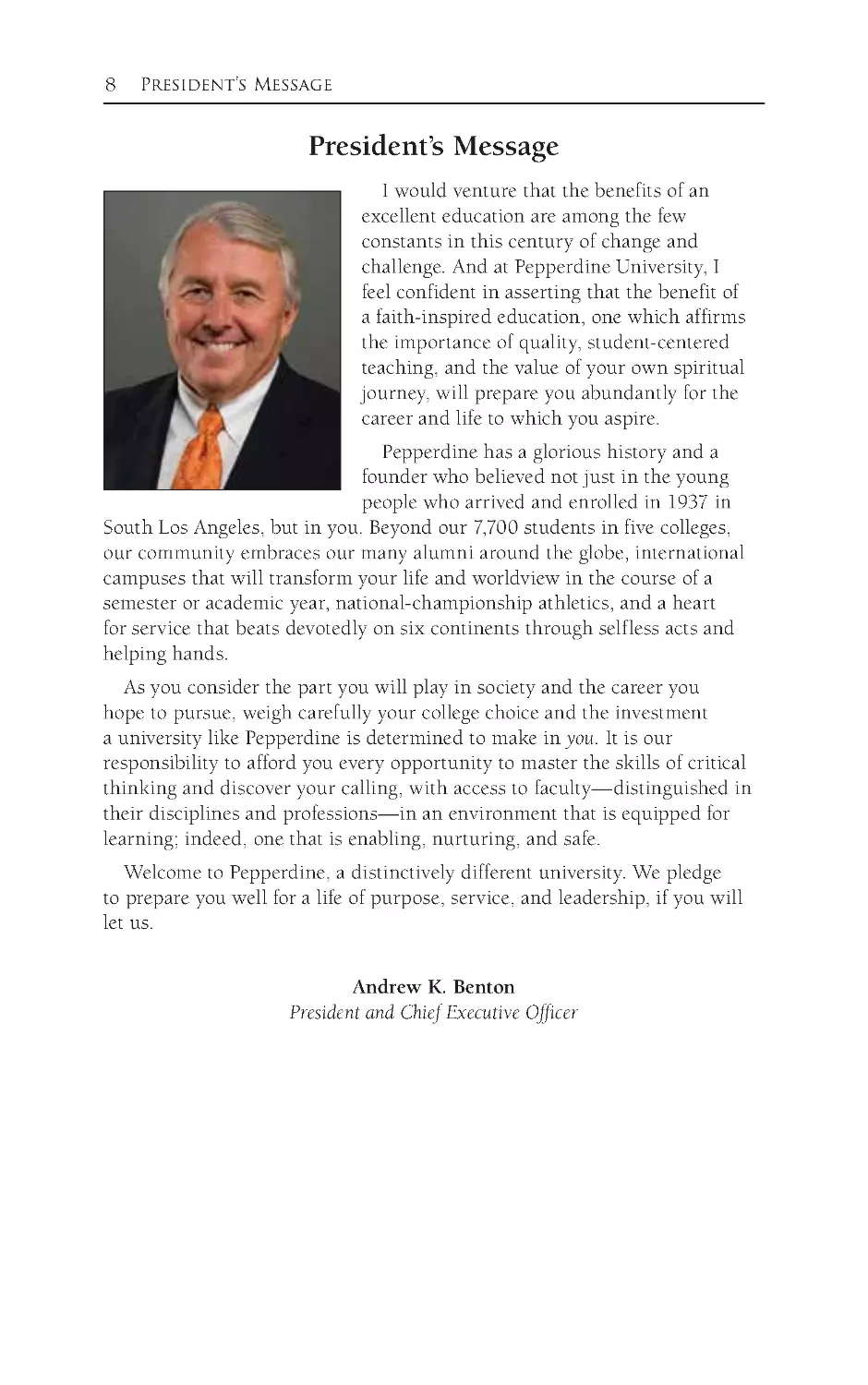
Andrew K. Benton
President and Chief Executive Officer

9
Dean’s Message
Dean’s Message
The Graduate School of Education a nd
Psychology affirms its reputation of quality
and excellence and enhances its standing
as a premier institution of higher education
through the utilization of four distinctives:
technology, leadership, psychology, a nd
globalization. Infused with Christian
values, these distinctives stand as the
pillars to which all our academic pursuits
are a nchored. Consequently, our students
and graduates go out into the world fully
prepared to serve in a spirit of excellence.
Technology is the single most disruptive
innovator of our time. The establishment of the Davidson eLearning Center
and the Pat Lucas Teaching Project are ways in which our K–12 and higher
education progra ms a re keeping in step with technological adva ncements
in education and mental health programming. The leadership distinctive
runs through all our programs. It is clearly evidenced in our Organizational
Leadership (EdD), Learning Technologies (EdD), Educational Leadership,
Administration, and Policy (EdD), Global Leadership and Change (PhD), and
Doctor of Clinical Psychology (PsyD) programs.
Graduates of our master’s degree programs in marriage and family therapy,
clinical psychology, and behavioral psychology, as well as our PsyD program,
provide excellent mental health services to our external community. Our
PsyD progra m has the APA’s highest rating, w ith a 10-year approval. Data
from our counseling sessions are made HIPAA compliant through cloud-
based services, and our new fully online psychology programs offer a digital
educational experience.
Globalization recognizes that leadership decisions can have a far-reaching
impact. Our g raduates are uniquely prepared to make culturally sensitive
and politically savvy decisions with an eye toward global interdependence,
mutual respect, and appreciation.
Quality and excellence at GSEP are evident in our students and alumni
in whatever setting you find them. Our faculty and staff are representative
of the most dedicated, personable, and academically gifted professionals in
all of higher education. We are fully committed to strengthening lives for
purpose, ser vice, a nd leadership through our four distinctives.
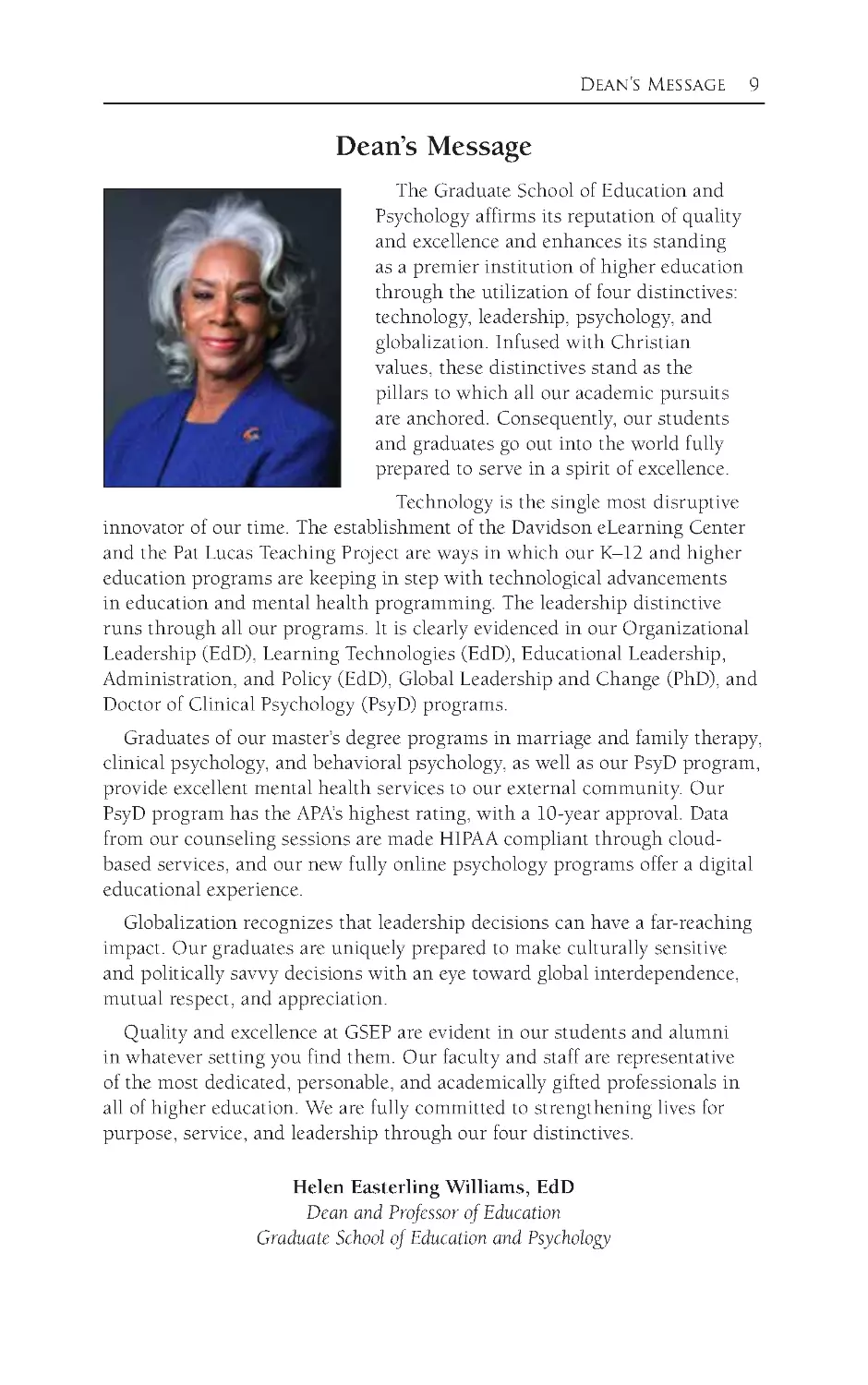
Helen Easterling Williams, EdD
Dean and Professor of Education
Graduate School of Education and Psychology

General
Information

History of the University
Pepperdine University is an i ndependent, medium-sized university
enrolling approximately 7,700 students in five colleges and schools.
Seave r College, the School of Law, the Graduate School of Education
and Psychology, the Graziadio Business School, and the School of Public
Policy are located on the University’s 830-acre ca mpus overlooking the
Pacific Ocean in Malibu. Courses are taught in Malibu, at five graduate
campuses throughout California, at the campus in Washington, DC, and at
international campuses in Germany, England, Italy, Argentina, Switzerland,
and China.
The Unive rsity was founded in 1937 by Mr. George Pepperdine, a
Christian businessman who started the Western Auto Supply Company. For
the first 30 years of its life, the institution was a small, mostly undergraduate
college. University status was achieved in 1970 as the institution added
graduate and professional schools. In 1972 the University opened its new
campus at Malibu.
Pepperdine University is religiously affiliated with Churches of Christ, of
which Mr. Pepperdine was a lifelong member. Faculty, administrators, a nd
members of the Board of Regents represent ma ny religious backgrounds,
and students of all races and faiths are welcomed. It is the purpose of
Pepperdine University to pursue the very highest academic standards within
a context that celebrates and extends the spiritual and ethical ideals of the
Christian faith.
Colleges and Schools of the University
The Graduate School of Education and Psychology (GSEP) enrolls
approximately 1,600 students. With its main headquarters located at the
West Los A ngeles Graduate Campus, the Graduate School also offers select
programs at graduate campuses in Calabasas, Encino, Irvine, and Malibu,
as well as online. The Graduate School of Education a nd Psychology offers
master’s and doctoral programs in education and psychology, which are
founded on the scholar-practitioner model. The education programs prepare
teachers who are leaders in technological innovation and collaborative
learning environments, as well as those who create vision and manage
change in business, health, and other social-service professions. Students
in the psychology programs are educated in current and emerging human-
service fields, including clinical and behavioral psychology and marriage
and family therapy. The focus is placed on the scholar-practitioner model
of learning, with emphasis on discovery, scholarship, research, and clinical
application. I n conjunction with an e xcellent professional education, students
are provided with personal attention in a Christian, values-centered context.
12 General Information

13
General Information
Seaver College is the University’s residential college of letters, arts, a nd
sciences, enrolling approxi mately 3,400 underg raduate and graduate students
who are expected to maintain the highest standards of academic excellence
and personal conduct. A n i nterdisciplinary curriculum requires each student
to develop as a broadly educated person. Seaver College offers 45 bachelor’s
degrees, five master’s degrees, and one post-baccalaureate certificate program
in diverse fields of study.
The Graziadio Business School is accredited by the Association to
Advance Collegiate Schools of Business (AACSB International) and enrolls
approximately 2,000 students in its full- a nd part-time progra ms. Founded
in 1969, the school is named for its benefactor, the late cofounder, chair,
and chief executive officer of Imperial Bancorp, George L. Graziadio.
Degrees granted by the Gra ziadio School include the doctor of business
administration; the master of business administration (MBA) for full-time
students, working professionals, and high-level executives; master of science
(MS) degrees across a variety of business disciplines; and the undergraduate
bachelor of science in management (BSM). Special programs include joint
degrees with the Pepperdine University School of Law, School of Public
Policy, and Seaver College, as well as certificate executive education programs
that can be customized to meet an organization’s specific learning needs.
Degree programs are offered at the Graziadio School’s headquarters located
at the West Los Angeles Graduate Campus; the Drescher Graduate Campus
in Malibu; and additional graduate campuses located throughout Southern
California including Calabasas, Encino, and Irvine. The Executive MBA
program is also available at the Silicon Valley campus.
The School of Law provides an excellent legal education within a values-
centered context. It has an enrollment of approximately 600 juris doctor
students. Special progra ms include the acclaimed Straus Institute for Dispute
Resolution, the Parris Institute for P rofessional Formation, the Palmer Center
for E ntrepre neurship and the Law, the Nootbaar Institute on Law, Religion,
and Ethics, a nd numerous clinical education offeri ngs. The Sudreau Global
Justice Progra m a nd unique Preceptor P rogra m contribute to the law school’s
distinctive approach to legal education. Approved by the American Bar
Association and holding membership in the Association of American Law
Schools and the Order of the Coif, the School of Law attracts students from
around the nation.
The School of Public Policy enrolls approxi mately 60 students and offers
its master of public policy (MPP) degree built on a distinctive philosophy
of nurturing leaders to use the tools of analysis and policy design to effect
successful implementation and real change. This requires critical insights
balanced with personal moral certainties that only a broad exposure to
great ideas, courageous thinkers, and extraordinary leaders can encourage.
It prepares graduates for careers as leaders and seeks also to strengthen the
institutions that lie betwee n the federal gover nme nt and the individual,

including the family, religious organi zations, volunteer associations, local
and regional gove rnment, a nd nonprofit organi zations. Joint degree programs
include the MPP/JD degree and the MPP/MDR degree in conjunction
with the School of Law and the MPP/MBA degree in conjunction with the
Gra ziadio Business School. The Davenport Institute for Public Engageme nt
and Civic Leadership educates, researches, and promotes to current and
future public leaders the engagement of the greater public in making crucial
local policy decisions. Along with current students, the institute works
outside the classroom , traini ng current municipal and civic leaders through
regional seminars in skills development on issues ranging from participatory
budgeting to planning.
THE GRADUATE SCHOOL OF
EDUCATION AND PSYCHOLOGY
GENERAL INFORMATION
History of the Graduate School of
Education and Psychology
From the University’s beginning, the discipline of education has played a
prominent role in the academic program of the institution. With the growi ng
emphasis on improvi ng educational techniques in the public and private
school systems statewide, Pepperdine University met increasing demands
for leadership and transformed its existing Department of Education into a
professional School of Education. The school was formally established on
January 1, 1971.
In 1951 a master’s degree in psychology was offered for the first time,
marking the genesis of what eventually evolved into the Division of
Psychology in the School of Professional Studies. In January 1981 after
the decision to phase out the School of Professional Studies was made, the
Division of Psychology became part of the Graduate School of Education. In
March 1982, the Graduate School of Education officially changed its na me to
the Graduate School of Education a nd Psychology.
14 General Information

15
General Information
Mission
The Graduate School of Education a nd Psychology (GSEP) is an i nnovative
learni ng community where faculty, staff, a nd students of diverse cultures
and perspectives work collaboratively to foster academic excellence, social
purpose, meaningful service, and personal fulfillment.
As a graduate school within a Christian university, GSEP endeavors to
educate and motivate students to assume leadership roles in professions that
improve and enrich the lives of individuals, families, and communities.
GSEP embraces huma n diversity—which we believe to be the natural
expression of God’s creation—in our work to advance learning and service.
GSEP adva nces, sustains, a nd advocates for multicultural proficiency.
The strategies for accomplishing this mission are
• Promoting discourse that values each member’s background,
experiences, and perspective;
• Recruiting, retaining, a nd adva ncing diverse students, staff, a nd faculty;
• Developing curricular models for practice in educational and
psychological environments; and
• Reaching out to broader com munities to promote understanding and
facilitate solutions to dive rsity challenges.
Our spirit, energy, and actions will be an inspiration to all in the fields of
education and psychology.
Our Expressed Values
• Student-centered learni ng.
• A scholar-practitioner model of teaching.
• Communities of practice that foster lifelong learning.
• Academic freedom and shared governance.
• Quality educational programs that anticipate changes in the
marketplace.
• Innovation as a continuous part of the educational process.
• Balance between personal and professional lives.
• Integration of faith and learning.
• Social responsibility and justice.
• Integrity and ethical standards of conduct.
• A diverse culture that is compassionate, caring, and respectful of the
dignity of all in the community.

16 General Information
Counseling Clinics
The Graduate School of Education and Psychology maintains three
on- c ampus counseling centers, which offer support to Pepperdine personnel
as well as the surrounding communities. In addition, psychology students
also offer community counseling services at the Los Angeles Union Rescue
Mission as a part of the school ’s prestigious Conrad N. Hilton Foundation
gra nt. The Pepperdine University Community Counseling Clinic is located
at the Irvine Graduate Campus and at the Encino Graduate Campus. The
Pepperdine University Psychological and Educational Clinic is located at the
West Los A ngeles Graduate Campus. The clinics are staffed by Pepperdine
m a ster’s - or doctoral-level psychology graduate student therapists who are
trained and supervised by licensed psychologists and licensed mental health
professionals. Each clinic offers a wide ra nge of high-quality and affordable
psychological services to individuals of all ages and backgrounds as well
as couples and families. Evaluations and therapy plans are tailored for each
individual client. Please see the “University Phone Directory” section of this
academic catalog for information on how to contact the clinic staff at the
Encino, Irvine, or West Los Angeles locations.
Graduate Campuses
The Graduate School of Education a nd Psychology is headquartered at
the West Los Angeles Graduate Campus. The West Los Angeles Graduate
Campus offers classrooms, faculty and admi nistrative offices, a library,
academic computing facilities, a bookstore, a nd the Psychological and
Educational Clinic.
Additional facilities are available at the University’s graduate campuses
in Calabasas, Encino, Irvine, and Malibu. These locations offer classrooms,
faculty offices, academic computing facilities, and libraries.
West Los Angeles Graduate Campus
6100 Center Drive
Los Angeles, CA 90045
(310) 568-5717
Calabasas Graduate Campus
26750 Agoura Road
Calabasas, CA 91302
(818) 702-1000
Encino Graduate Campus
16830 Ventura Boulevard, Suite 200
Encino, CA 91436
(818) 501-1600
Irvine Graduate Campus
18111 Von Karman Avenue
Irvine, CA 92612
(949) 223-2500
Pepperdine University Malibu Campus
and Drescher Graduate Campus
24255 Pacific Coast Highway
Malibu, CA 90263
(310) 506-4608

17
General Information
Campus Locations and Maps
The Graduate School of Education a nd Psychology is headquartered at the
West Los A ngeles Graduate Campus.
West Los Angeles
Graduate Campus
6100 Center Drive
Los Angeles, CA 90045
(310) 568-5717
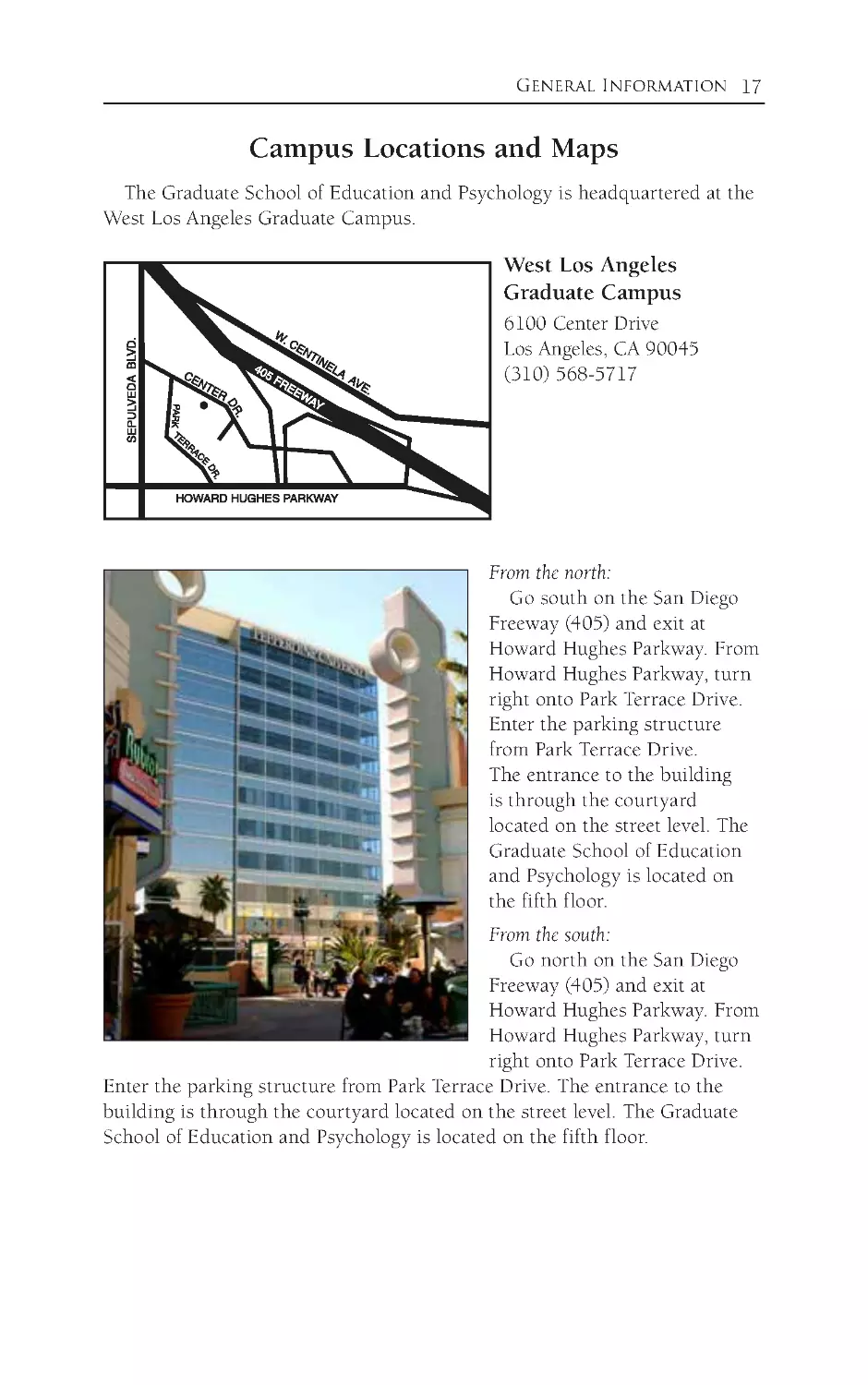
From the north:
Go south on the San Diego
Freeway (405) and exit at
Howard Hughes Parkway. From
Howard Hughes Parkway, turn
right onto Park Terrace Drive.
Enter the parking structure
from Park Terrace Drive.
The entrance to the building
is through the courtyard
located on the street level. The
Graduate School of Education
and Psychology is located on
the fifth floor.
From the south:
Go north on the San Diego
Freeway (405) and exit at
Howard Hughes Parkway. From
Howard Hughes Parkway, turn
right onto Park Terrace Drive.
Enter the parking structure from Park Terrace Drive. The entrance to the
building is through the courtyard located on the street level. The Graduate
School of Education and Psychology is located on the fifth floor.

18 General Information
Pepperdine University
Malibu Campus and
Drescher Graduate Campus
24255 Pacific Coast Highway
Malibu, CA 90263
(310) 506-4608
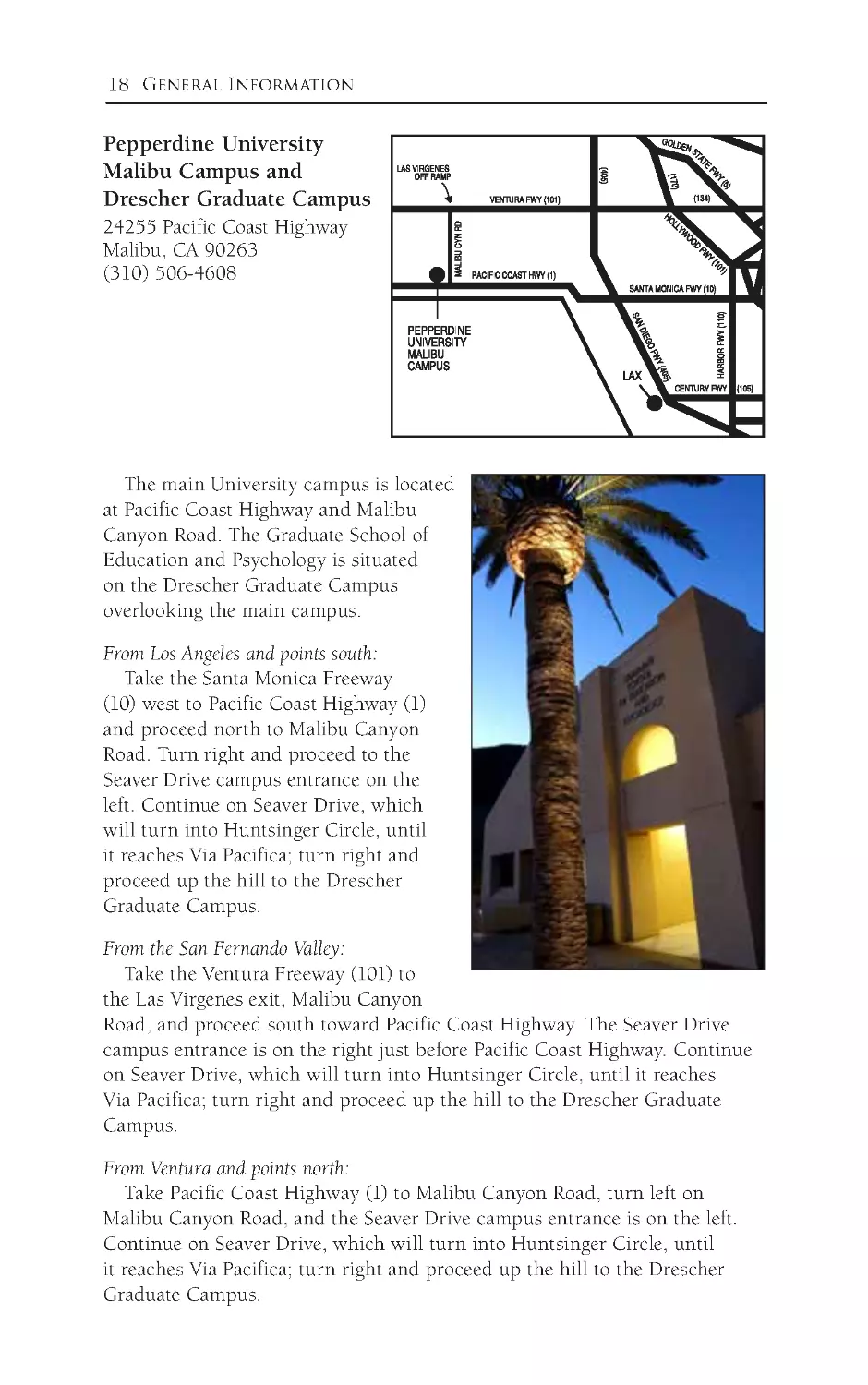
The main University campus is located
at Pacific Coast Highway and Malibu
Canyon Road. The Graduate School of
Education and Psychology is situated
on the Drescher Graduate Campus
overlooking the main campus.
From Los Angeles and points south:
Take the Santa Monica Freeway
(10) west to Pacific Coast Highway (1)
and proceed north to Malibu Canyon
Road. Turn right and proceed to the
Seaver Drive campus entrance on the
left. Continue on Seaver Drive, which
w ill turn into Huntsinger Circle, until
it reaches Via Pacifica; turn right and
proceed up the hill to the Drescher
Graduate Campus.
From the San Fernando Valley:
Take the Ventura Freeway (101) to
the Las Virgenes exit, Malibu Canyon
Road, a nd proceed south toward Pacific Coast Highway. The Seaver Drive
campus entra nce is on the right just before Pacific Coast Highway. Continue
on Seaver Drive, which will turn into Huntsinger Circle, until it reaches
Via Pacifica; turn right and proceed up the hill to the Drescher Graduate
Campus.
From Ventura and points north:
Take Pacific Coast Highway (1) to Malibu Canyon Road, turn left on
Malibu Canyon Road, and the Seaver Drive campus entrance is on the left.
Continue on Seaver Drive, which will turn into Huntsinger Circle, until
it reaches Via Pacifica; turn right and proceed up the hill to the Drescher
Graduate Campus.

19
General Information
Calabasas Graduate Campus
26750 Agoura Road
Calabasas, CA 91302
(818) 702-1000
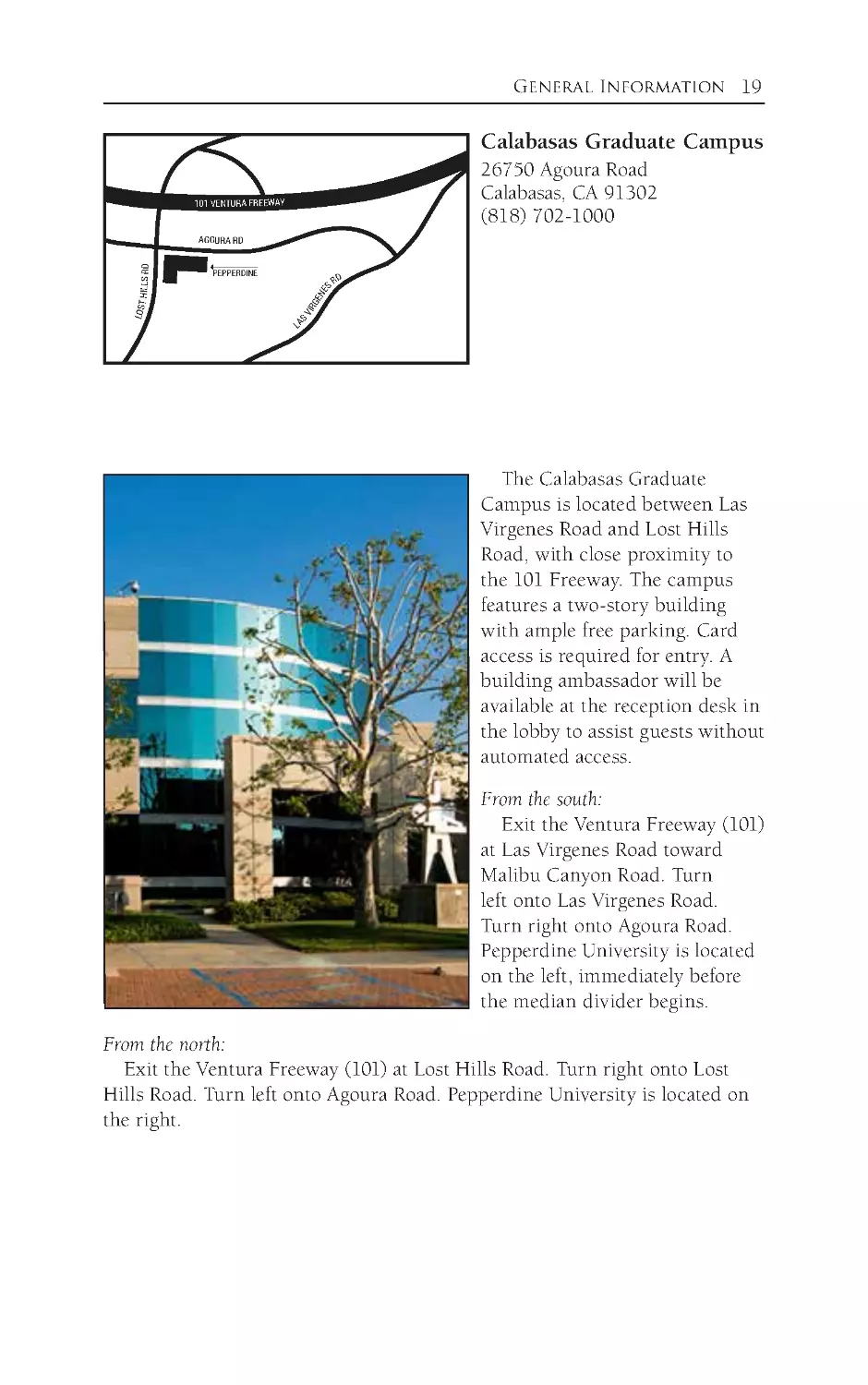
The Calabasas Graduate
Campus is located between Las
Virgenes Road and Lost Hills
Road, with close proximity to
the 101 Free way. The campus
features a two-story building
w ith ample free parking. Card
access is required for entry. A
building ambassador will be
available at the reception desk in
the lobby to assist guests without
automated access.
From the south:
Exit the Ventura Freeway (101)
at Las Virgenes Road toward
Malibu Canyon Road. Turn
left onto Las Virgenes Road.
Turn right onto Agoura Road.
Pepperdine University is located
on the left, im mediately before
the median divider begins.
From the north:
Exit the Ventura Freeway (101) at Lost Hills Road. Turn right onto Lost
Hills Road. Turn left onto Agoura Road. Pepperdine University is located on
the right.
L
O
S
T
H
I
L
L
S
R
D
AGOURA RD
L
A
S
V
I
R
G
E
N
E
S
R
D
101 VENTURA FREEWAY
PEPPERDINE

20
Encino Graduate
Campus
16830 Ventura
Boulevard, Suite 200
Encino, CA 91436
(818) 501-1600
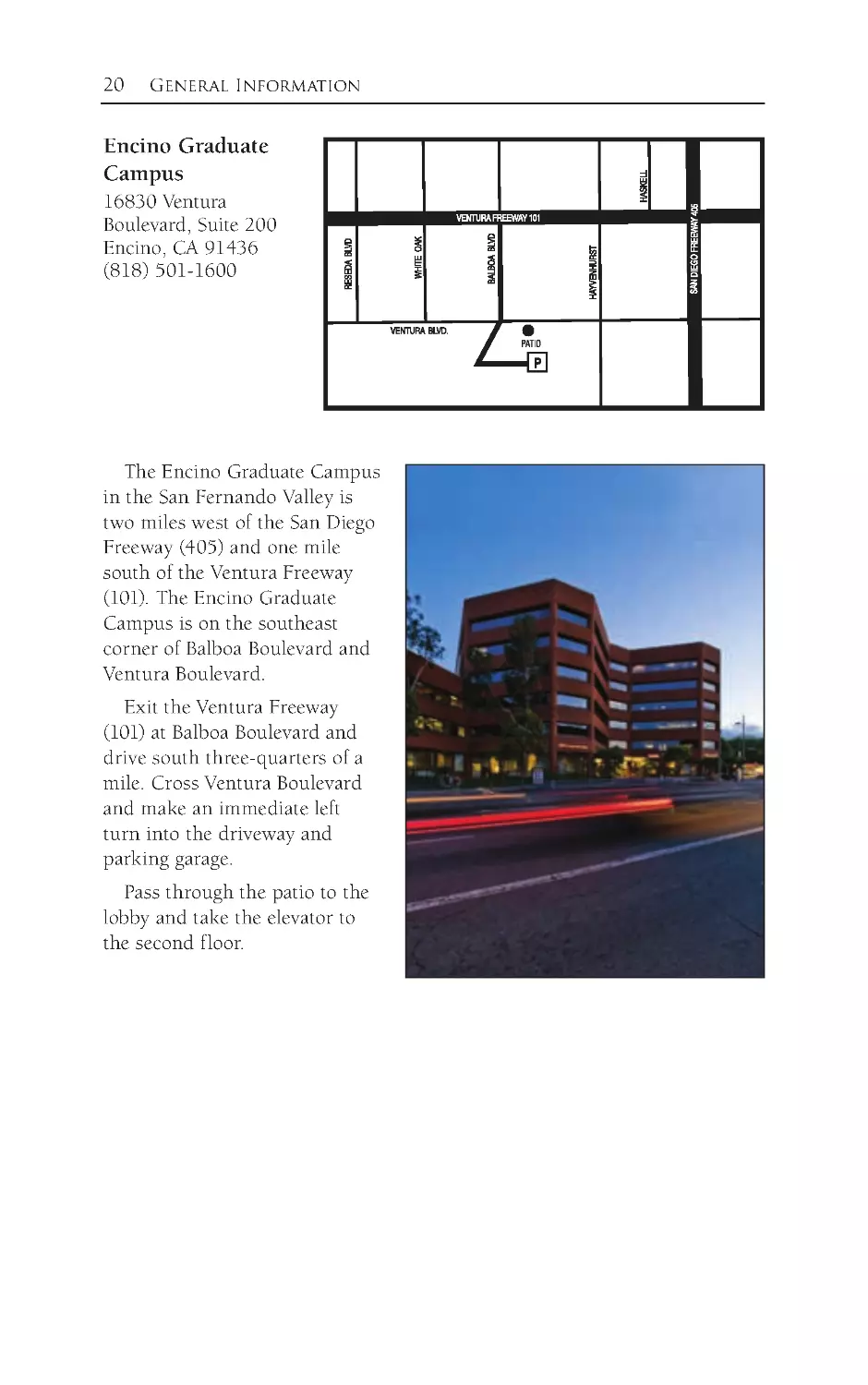
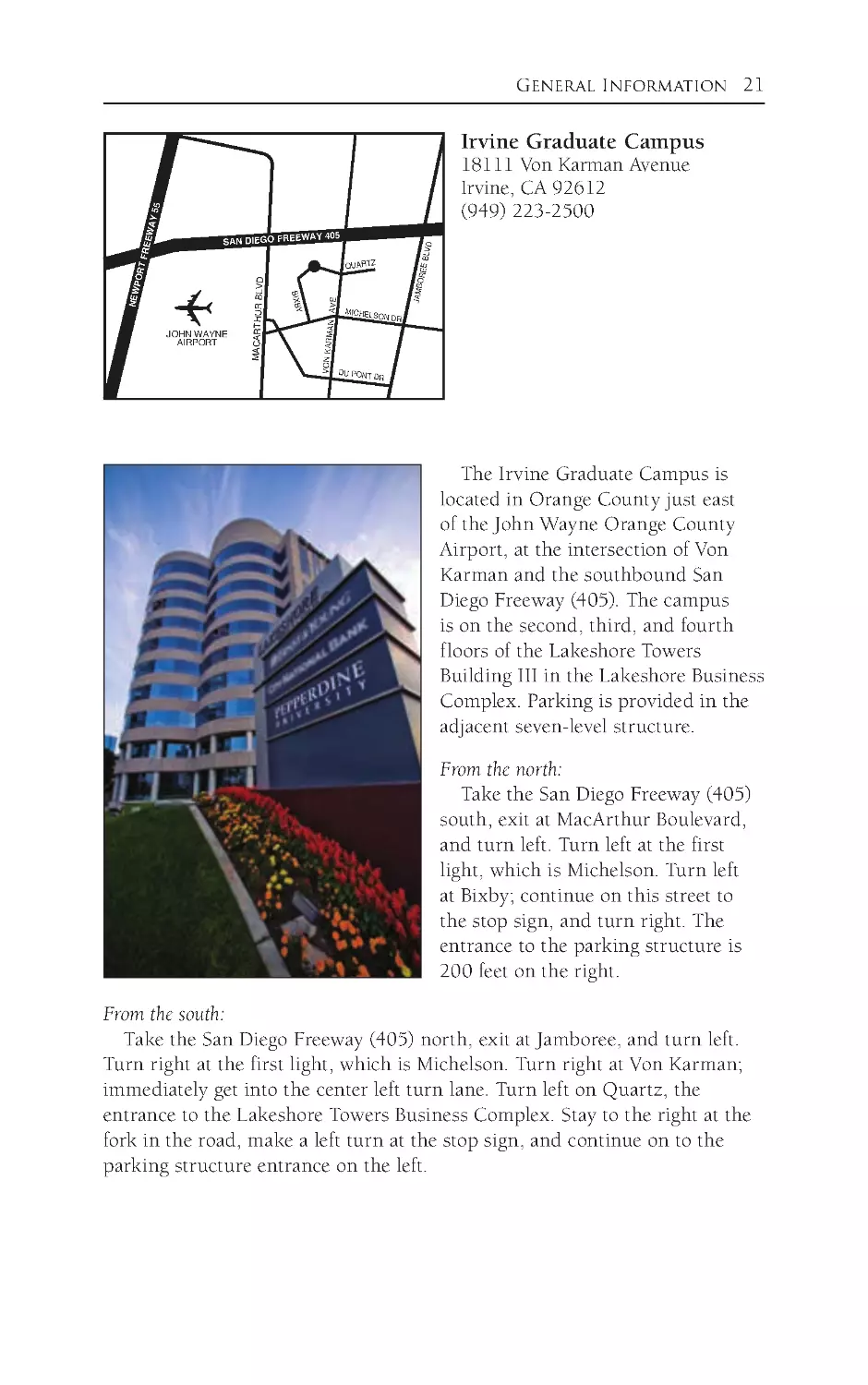
The Encino Graduate Campus
in the San Fernando Valley is
two miles west of the San Diego
Freeway (405) and one mile
south of the Ventura Freeway
(101). The Encino Graduate
Campus is on the southeast
corner of Balboa Bouleva rd and
Ventura Boulevard.
Exit the Ventura Freeway
(101) at Balboa Bouleva rd and
drive south three-quarters of a
m ile. Cross Ventura Boulevard
and make an immediate left
turn i nto the driveway and
parking garage.
Pass through the patio to the
lobby and take the elevator to
the second floor.
General Information

21
General Information
Irvine Graduate Campus
18111 Von Karman Avenue
Irvine, CA 92612
(949) 223-2500
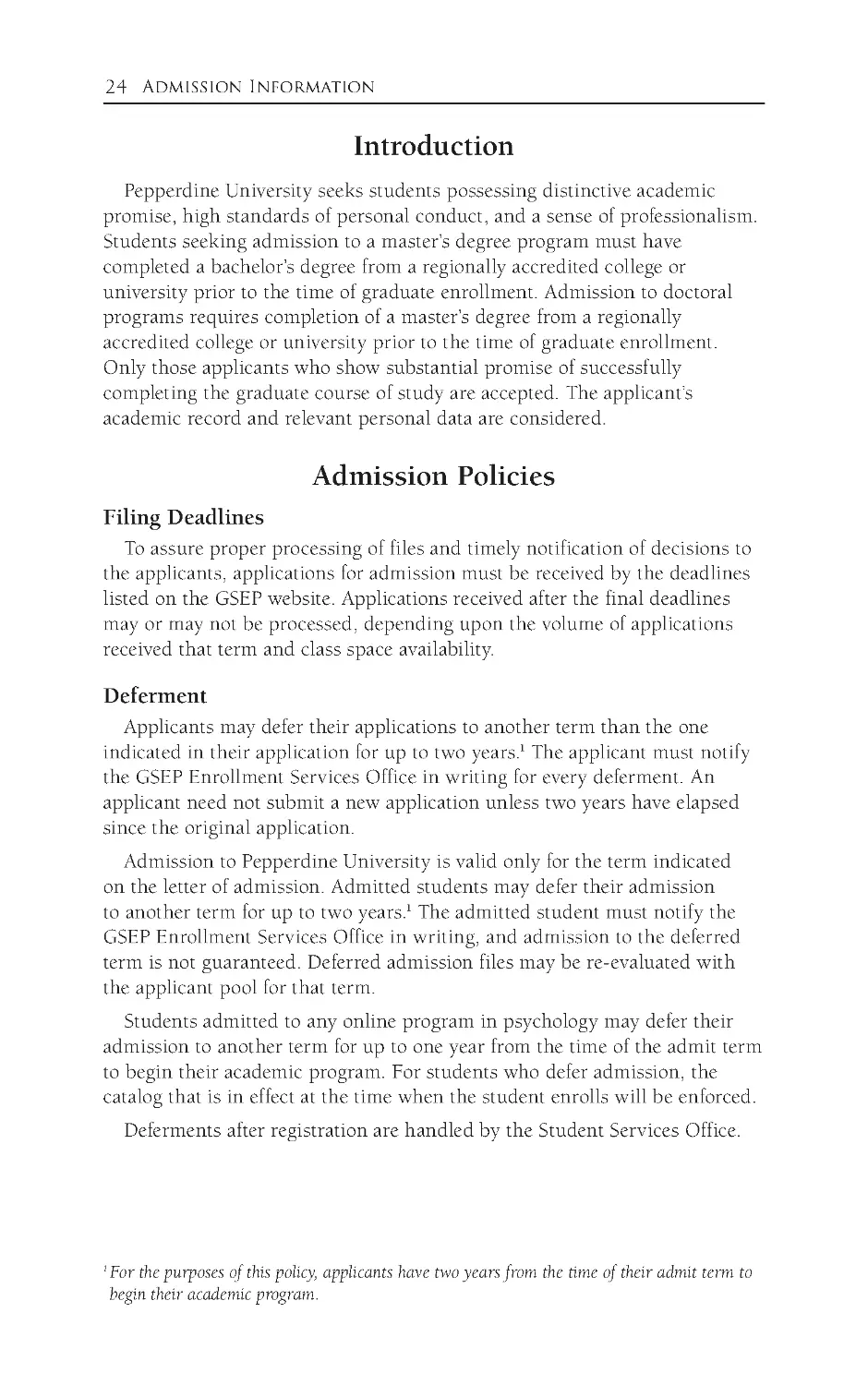
The Irvine Graduate Campus is
located in Orange County just east
of the John Wayne Orange County
Airport, at the intersection of Von
Karman and the southbound San
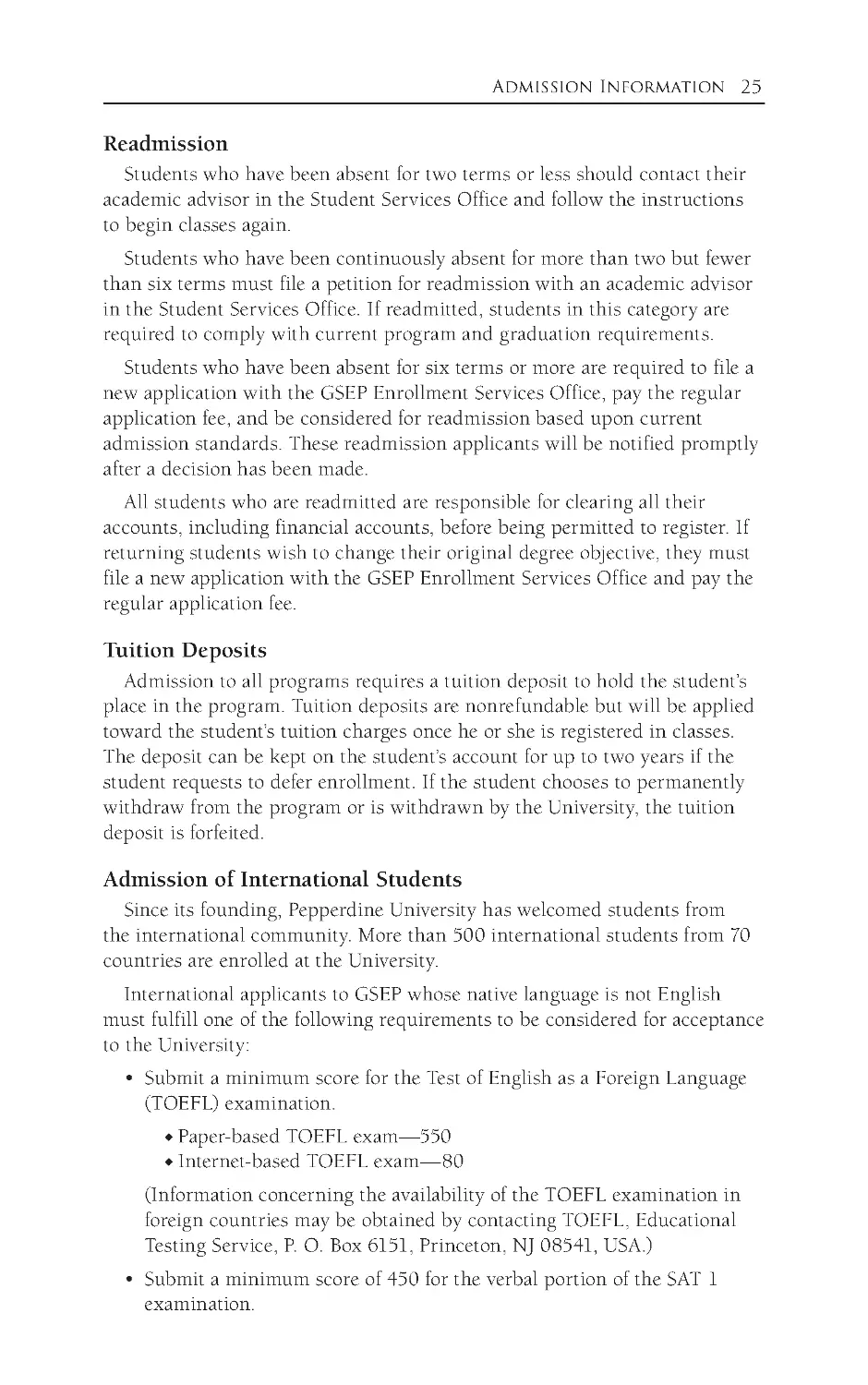
Diego Freeway (405). The campus
is on the second, third, and fourth
floors of the Lakeshore Towers
Building III in the Lakeshore Business
Complex. Parking is provided in the
adjacent seven-level structure.
From the north:
Take the San Diego Freeway (405)
south, exit at MacArthur Boulevard,
and turn left. Turn left at the first
light, which is Michelson. Turn left
at Bixby; continue on this street to
the stop sign, and turn right. The
entrance to the parking structure is
200 feet on the right.
From the south:
Take the San Diego Freeway (405) north, exit at Jamboree, and turn left.
Turn right at the first light, which is Michelson. Turn right at Von Karman;
immediately get into the center left turn lane. Turn left on Quartz, the
entrance to the L akeshore Towers Business Complex. Stay to the right at the
fork in the road, make a left turn at the stop sign, and continue on to the
parking structure e ntra nce on the left.
N
E
W
P
O
R
T
F
R
E
E
W
A
Y
5
5
SAN DIEGO FREEWAY 405
JOHN WAYNE
AIRPORT
M
A
C
A
R
T
H
U
R
B
L
V
D
V
O
N
K
A
R
M
A
N
A
V
E
MICH
E
L
S
ON DR
DU
P
ON
T
DR
J
A
M
B
O
R
E
E
B
L
V
D
QU
A
R
T
Z
B
I
X
B
Y

Admission
Information

24 Admission Information
Introduction
Pepperdine University seeks students possessing distinctive academic
promise, high standards of personal conduct, and a sense of professionalism.
Students seeking admission to a master’s degree program must have
completed a bachelor’s degree from a regionally accredited college or
university prior to the time of graduate enrollment. Admission to doctoral
programs requires completion of a master’s degree from a regionally
accredited college or university prior to the time of graduate enrollment.
Only those applicants who show substantial promise of successfully
completing the graduate course of study are accepted. The applicant’s
academic record and relevant personal data are considered.
Admission Policies
Filing Deadlines
To assure proper processing of files and timely notification of decisions to
the applicants, applications for admission must be received by the deadlines
listed on the GSEP website. Applications received after the final deadlines
m ay or may not be processed, depending upon the volume of applications
received that term and class space availability.
Deferment
Applicants may defer their applications to another term than the one
indicated in their application for up to two years.
1
The applicant must notify
the GSEP Enrollment Services Office in writing for every deferment. An
applicant need not submit a new application unless two years have elapsed
since the original application.
Admission to Pepperdine University is valid only for the term i ndicated
on the letter of admission. Admitted students may defer their admission
to another term for up to two years.
1
The admitted student must notify the
GSEP Enrollment Services Office in writing, and admission to the deferred
term is not guaranteed. Deferred admission files may be re-evaluated with
the applicant pool for that term.
Students admitted to any online progra m in psychology may defer their
admission to another term for up to one year from the time of the admit term
to begin their academic progra m. For students who defer admission, the
catalog that is in effect at the time when the student enrolls will be enforced.
Deferme nts after registration a re handled by the Student Services Office.
1
For the purposes of this policy, applicants have two years from the time of their admit term to
begin their academic program.

25
Admission Information
Readmission
Students who have been absent for two terms or less should contact their
academic advisor in the Student Services Office and follow the instructions
to begin classes again.
Students who have been continuously absent for more than two but fewer
than six terms must file a petition for readmission with an academic advisor
in the Student Services Office. If readmitted, students in this category are
required to comply with current program and graduation requirements.
Students who have been absent for six terms or more are required to file a
new application with the GSEP Enrollment Services Office, pay the regular
application fee, and be considered for readmission based upon current
admission standards. These readmission applicants will be notified promptly
after a decision has been made.
All students who are readmitted are responsible for clearing all their
accounts, including financial accounts, before being permitted to register. If
returning students wish to change their original degree objective, they must
file a new application with the GSEP Enrollment Services Office and pay the
regular application fee.
Tuition Deposits
Admission to all programs requires a tuition deposit to hold the student’s
place in the progra m. Tuition deposits are nonrefundable but will be applied
toward the student’s tuition charges once he or she is registered in classes.
The deposit can be kept on the student’s account for up to two years if the
student requests to defer enrollme nt. If the student chooses to perma nently
w ithdraw from the program or is withdra w n by the University, the tuition
deposit is forfeited.
Admission of International Students
Since its founding, Pepperdine University has welcomed students from
the international community. More than 500 international students from 70
countries are enrolled at the University.
International applicants to GSEP whose native language is not English
must fulfill one of the followi ng requirements to be considered for acceptance
to the University:
• Submit a minimum score for the Test of English as a Foreign Language
(TOEFL) examination.
Paper-based TOEFL exam—550
Internet-based TOEFL exam— 80
(Information concerning the availability of the TOEFL examination in
foreign countries may be obtained by contacting TOEFL, Educational
Testing Service, P. O. Box 6151, Princeton, NJ 08541, USA.)
• Submit a minimum score of 450 for the verbal portion of the SAT 1
examination.

26 Admission Information
• Submit a minimum score of 6.5 on the International English Language
Testing System (IELTS) exa mi nation, sponsored by Cambridge
Examinations.
• Complete a regular (not ESL) college-level English composition course
at a regionally accredited US college or university and submit an official
transcript showing that a grade of “C” or better was attained in the
course.
• Submit a score of “C” or better for the A-Level English Examination
(UK system).
• Submit a score of “C” or better for the HKALE English Examination
(Hong Kong system).
• Complete the English Language School (ELS) Language Centers’ Master
Level 112 class and submit an official transcript showing that a grade of
“ B” or better was attained in the course.
The Enrollment Services Office may require the TOEFL exam of any
applicant whose native language is not English as it deems necessary.
In addition to other listed requirements, all international applicants are
required to submit a detailed foreign transcript evaluation report from any
National Association of Credential Evaluation Services (NACES) partner
foreign transcript evaluation service, such as the International Education
Research Foundation at ierf.org or the World Education Services, I nc., at
wes.org. Please note: In addition to the evaluation report, official transcripts must
be submitted.
A detailed foreign transcript evaluation report will contain the following:
• Foreign transc ripts tra nslated into English.
• Grade point average calculated on a 4.0 scale.
• A determination of US degree equivalency.
To obtain further i nformation for i nternational students, applicants
may write to the Office of International Student Services, Pepperdine
University, 24255 Pacific Coast Highway, Malibu, CA 90263-4246, USA; call
(310) 506-4246; or visit pepperdine.edu/admission /international-students.
Admission of Veterans
Veterans who seek admission should follow the regular admission policies
and should also contact the Office of Student Information and Services in
Malibu. This should be done as early as possible to expedite handling of
applicant forms and admission counseling. Applicants must be fully admitted
before receiving benefits.

27
Admission Information
Application Procedures
The Application for Admission contains complete instructions and all
appropriate forms for properly completing the application for admission
process. In an effort to process applications in a timely manner, the
Enrollme nt Services Office accepts only electronic applications a nd
application materials. The electronic application ca n be identified on the
Graduate School of Education a nd Psychology website as “Application for
Admission.” The Enrollment Services Office will inform the applicant on the
status of the application, but it is the applicant’s responsibility to be certain
that all necessary documents are on file.
Please refer to the “Academic Programs” section of this academic catalog
for the specific admission requirements for each program.
Admission Process
Applications are evaluated only after all the necessary information and
materials have been received by the Enrollment Services Office. Completed
files are processed and evaluated by the enrollment services committee.
Applicants to most programs are notified of the admission decision by
email, usually within four weeks of receipt of transcripts and completion
of the file. Full consideration cannot be assured to applicants who fail to
me et application deadlines. I n addition to the required documentation
for completion of the application file, the master’s programs may utilize
interviews for admission decisions. The doctoral programs may utilize
interviews and writing samples for admission decisions. Admission decisions
are not subject to appeal. The Graduate School of Education and Psychology
does not provide specific feedback regarding individual admission
decisions. Applicants must send all application materials electronically to
gsep-admissions@pepperdine.edu. The testing codes are as follows: GRE—
4326 and GMAT—37B-ICT-28.
Admission Classification
Admission with other than regular status is not synonymous with
admission to a degree program, and permission to enroll does not imply that
the student is, or will be, automatically guaranteed the right to continue in
a degree program. Students are classified into groups on the basis of their
academic preparation and degree objectives.
Regular Status—For admission with regular status, applicants must fulfill
all admission requirements and be fully admitted into a specific program.
Provisional Status—At the University’s discretion, a limited number
of students whose academic backgrounds do not meet the academic
standards required for eligibility for regular status but who give evidence of
ability to pursue graduate work in a particular field may be admitted with
provisional status. Over a period of no more than two terms, students who

28
are admitted on provisional status must enroll in a minimum of 6 semester
units that require a letter grade. A grade of “B” (3.0) or higher must be
earned in all classes taken and approval granted by the program committee
before the student may be admitted w ith regular status. Students on
provisional status who do not earn a grade of “B” or higher in all classes
taken are subject to dismissal from the program.
Nondegree Status—Students may be admitted, with permission, to
nondegree status if they do not wish to pursue a degree or credential but
intend to have credits received from the University tra nsferred elsewhere
or desire to take courses for personal enrichment only. Course work taken
as a nondegree student is not applied to degree programs at the University.
No amount of course work taken while in nondegree status will assure a
student of admission to a degree program at GSEP. Enrollment in nondegree
course work does not count towa rd mi nimum eligibility requireme nts for
financial aid.
Unclassified Status —I n selected progra ms, students who, for valid
rea s ons, ca nnot complete the application file before registration may be
granted permission to enroll as unclassified. In all cases, the applicant must
furnish documentary evidence of satisfactory academic standing at the last
institution attended. Students gra nted permission may enroll unclassified
for only one term. Unclassified students are not eligible for financial aid if
an official transcript with a posted degree is not on file with the Enrollment
Services Office. It is the applicant’s responsibility to make certain that the
application file is completed within 60 days from the beginning of the
first term. No amount of credit taken with unclassified status assures a
student of regular or provisional admission. It is imperative, therefore, that
unclassified students complete their files to be admitted to regular status by
the published deadline.
Transfer of Graduate Credit
Upon approval, students at the master’s level may transfer as many
as 6 semester units of previous graduate-level course work to meet the
requirements for the program, provided the transfer credit meets all
equivalency requireme nts. Education and psychology doctoral students may
transfer up to 9 semester units of doctoral-level courses. These units may
be earned at Pepperdine University as well as at other regionally accredited
colleges and universities. Continuing education units are not acceptable for
transfer credit. Courses to be transferred for master’s, doctoral, or credential
programs must have been taken within the last seven years, and the student
must have earned a grade of “B” (3.0) or better in each course.
Students who are in enrolled status in the EdD program or alumni of the
program who graduated within the last seven years may transfer up to 39
units of courses taken i n the EdD program to the PhD in Global Leadership
and Change program. The final decision of transfer is recommended in
conjunction with a committee appointed by the program director of the
Admission Information

29
EdD/PhD program which includes committee members and the senior
director of student success or designee. The EdD/ PhD committee will make
the final recommendation to the Enrollment Serv ices Office based upon
analysis of official tra nscripts, syllabi, and other releva nt material submitted
by the candidate.
To tra nsfer courses, the applicant must complete a Tra nsfer Credit
Petition form i ndicating courses the applicant w ishes to tra nsfer as part of
the admission process. Applicants will be notified in writing concerning
the decision on the transfer courses. Students are expected to complete all
course work at Pepperdine University. In order for special circumstances
and exceptions of tra nsfer courses to be considered, the student must receive
approval in advance from the associate dean by division.
Admission Information

Financial
Information

32 Financial Information
Introduction
Tuition and fees cover only a portion of the total cost of educating a
student. Since Pepperdine University is a private, independent institution
that does not receive operating support from public funds, it relies upon
gifts from conce rned friends and income from endowme nts to provide both
operational and capital funds not paid by student charges.
Current Charges
The following charges are for periods beginning in August 2018.
Pepperdine University reserves the right to adjust the charges at any time
before the charges are incur red by the student. Due to economic conditions,
it is expected that charges will increase in future academic years.
Tuition and Nonrefundable Fees
Application for Admission fee ........................................................... $55
Education Programs
Tuition, per unit
Master’s -level courses ............................................................... $1,225
Doctor of Education courses ...................................................... $1,550
Doctor of Philosophy in Global Leadership and Change1
................. $1,840
Program Fees
Academic-related travel fee2:
EDD 754B and EGLC 754B ......................................... $1,500–$5,000
Academic travel cancellation fee3
............................................... variable
Psychology Programs
Tuition, per unit
Master’s -level courses at graduate campuses .................................. $1,225
Master’s -level courses at Malibu campus ....................................... $1,530
Master’s -level online courses ...................................................... $1,530
Doctoral-level courses .............................................................. $1,550
1
The PhD in Global Leadership and Change program includes courses charged $1,550 per unit
at the EdD level and $1,840 per unit at the PhD level.
2
Academic-related travel fees: EDD 754B, EGLC 754B, and PSY 673A are courses that include
an international trip as part of the course requirements. Students will incur travel costs. Exact
amount varies year to year based on the destination, airline, hotel, class size, etc. Past trips
have cost anywhere from $1,500 to $5,000 per person.
3
Academic travel cancellation fee: A variable cancellation fee may be assessed when a student
cancels a course-related trip after the stated applicable deadline. This cancellation fee may
range between $250 to $800, the exact amount to be determined by the program office upon
taking into consideration any administrative fees, processing fees, and/or cancellation penalty
imposed by the travel agency.

33
Financial Information
Program Fees
Academic-related travel fee2: PSY 673A ............................. $1,500–$5,000
Academic travel cancellation fee3
............................................... variable
PsyD Student Government Association activity fee, annually ................ $40
General Fees
Encino Graduate Campus facilities fee, per term ................................ $65
Irvine Graduate Campus facilities fee, per term ................................. $65
Late registration fee ................................................................... $150
Withdrawal fee4
........................................................................
$150
Dissertation completion registration fee, per course5
.........................
$100
Challenge examination fee, per course ........................................... $300
Auditing fee, per course (not required of enrolled students) ............... $100
Transcripts, per copy...................................................................... $5
Late company reimbursement payment fee6 (nonrefundable) ................ $50
Finance charge7 (per day) ........................................................... . 027%
Two-payment option service charge8 (per payment plan) ..................... $25
Three-payment option service charge9 (per term) ............................... $50
Returned check charge ................................................................. $25
4
The withdrawal fee is applicable only toward full-term withdrawals prior to the end of the add/
drop period. For terms with multiple sessions, the withdrawal fee will not be applied if students
withdraw from one session and remain enrolled in another session beyond the add/drop period
within the same term.
5
For students enrolled in ED 792 or PSY 801: Education and psychology doctoral students who
have completed the final oral defense of their dissertation and the manuscript modifications
required by the dissertation committee and have submitted all the necessary forms and
dissertation manuscript for APA review by the add/drop deadline are enrolled in ED 792 or
PSY 801 and pay this fee in lieu of the tuition for ED 791, EDEL 791, EDOL 791, PGLC 791,
PSY 798, PSY 799, or PSY 800. These courses constitute less than half-time enrollment status,
which will impact financial aid eligibility and loan deferment. For more information, please see
the course descriptions for ED 792 and PSY 801 in this academic catalog.
6
Liquidated damages pursuant to Cal. Civ. Code §167-b , charged when the company
reimbursement payment deadline is missed.
7
A .027 percent per day delinquency charge (liquidated damages under Cal. Civ. Code §167-b)
is applicable to all delinquent balances. The imposition of such a delinquency charge does not
constitute an agreement to forebear collection of the delinquent payment.
8
Students who are eligible for and choose to use the two-payment option will be assessed a $25
service charge per payment plan, due with the first payment.
9
Students who are eligible for and choose to use the three-payment option will be assessed a $50
service charge per term, due with the first payment.

34 Financial Information
Financial Policies
Payment Policies
The student is responsible for the payment of any outstanding balance on
his or her student account. All tuition, fees, and room and board charges
(when applicable) are due by the first day after the add/drop period of the
term or session unless the student is eligible for and has chosen one of the
installment payment options listed in the following section. Students who
register after the due date are required to pay at the time of registration.
Registration and confirmation of class assignments are not complete
until financial clearance is received, indicating full or partial payment in
accordance with the payment policies described in this section.
The online student account serves as the official student “bill.” The
account will be updated automatically with every charge or credit posted
to the student account. The amount due will be available by viewing the
student account online through WaveNet and will reflect the charges, credits,
amounts due, a nd specific due dates for each. Students are responsible for
viewing their student account online, for noting their account balance due,
and for making the appropriate arrangements for payment to be received by
the Student Accounts Office by the due date.
In compliance with the Family Educational Rights and Privacy Act
(FERPA), students who wish to grant parents, spouses, and/or third parties
access to their student account information or to allow the parent, spouse,
or third party the ability to make an online payment must grant the person
access to this information and payment link by completing the Guest Access
link on the student’s WaveNet account.
The University will accept the following forms of payment in addition
to financial aid and loans toward a student account balance: cash, checks
(must be drawn on a US bank in US dollars), and wire payments (contact
the Student Accounts Office for information about where to send payme nt).
Online payments by check may be made by accessing the student’s account
through WaveNet and using the “Make a Payment” link.
Paper checks should be made payable to Pepperdine University and must
include the student’s na me and university-issued identification number.
These checks can be dropped off at the Student Accounts Office at the West
Los A ngeles Graduate Campus or at OneStop (located in TAC, second floor)
at the Malibu campus. Checks may also be mailed directly to the University:
Pepperdine University
GSEP Student Accounts
6100 Center Drive, 5th Floor
Los Angeles, CA 90045
A fee will be assessed for each returned check or eCheck that does not go
through. Repeated occurrences of returned checks will necessitate that the
student’s future payments be made in cash or by cashier’s check.

35
Financial Information
In the event that the student fails to attend or leaves the University for any
reason, the student must formally withdraw through the academic advisor in
the Student Services Office. Failure to complete this withdrawal process will
re sult in continued obligation for tuition a nd other charges.
Payment Options
The Unive rsity offers se veral payme nt options for students to pay their
tuition, room, a nd board charges.
Simple Payment Option
The balance of the student’s account is due in full by the first day after the
add/drop period of the term or session. Finance charges will accrue daily on
each payment that is late.
Installment Payment Options (Two-Payment Option or Three-Payment Option)
If the student’s account has not previously been i n default and the student
is enrolled in an eligible program, that student will be permitted to pay
the charges for tuition, room, and board (when applicable) remaining after
deduction of any financial aid in installments as described below. Programs,
sessions, or courses that do not follow the full-term schedule may not be
eligible for payment plan options. For questions regarding eligibility, please
contact the Student Accounts Office.
Finance charges will be applicable to each installment payment that is not
received by the University by the due date and will accrue daily until the
past due balance is paid in full. The privilege of using one of the installment
payment options will be revoked upon any installment payment becoming
delinquent.
Students who do not comply with payment policies or who have
previously been in collections will be required to pay all charges prior to
future registrations and advance registrations.
If an installment payment option has been requested but the student would
like to change or cancel the option, a written request from the student’s
Pepperdine email account must be received by the Student Accounts Office by
the last day of the add/drop period. No changes to the installment payment
options will be made after the last day of the add/drop period.
Two-Payment Option
Tuition, room, and board charges remaining after deduction of any
financial aid are divided into two equal installments to be paid according to
the following schedule. All other charges are due on or before the due date
listed on the student’s WaveNet online account. A nonrefundable service
charge per payment plan will be added to the student account and is due
with the first payment.
Two-Payment Option Payment Due Dates
Fall Term
First installment due: on first day after the add/drop period.
Second installment due: 30 days from first installment payment due date.

36 Financial Information
Spring Term
First installment due: on first day after the add/drop period.
Second installment due: 30 days from first installment payment due date.
Summer Term
First installment due: on first day after the add/drop period.
Second installment due: 30 days from first installment payment due date.
Three-Payment Option
Tuition, room, and board charges remaining after deduction of any
financial aid are divided into three equal installments to be paid according
to the following schedule. All other charges are due on or before the due date
listed on the student’s WaveNet online account. A nonrefundable service
charge per term will be added to the student account and due with the first
payment. The three-payme nt option is not available for the online psychology
master’s programs.
Three-Payment Option Payment Due Dates
Fall Term
First installment due: on first day after the add/drop period.
Second installment due: 30 days from first installment payment due date.
Third installment due: 30 days from second installment payment due date.
Spring Term
First installment due: on first day after the add/drop period.
Second installment due: 30 days from first installment payment due date.
Third installment due: 30 days from second installment payment due date.
Summer Term
First installment due: on first day after the add/drop period.
Second installment due: 30 days from first installment payment due date.
Third installment due: 30 days from second installment payment due date.
Company Reimbursement Payment Option
For students reimbursed for tuition by their employers, the University will
allow a deferral of payment after deduction of any financial assistance. All
financial aid funds are applied to tuition charges and fees first. Deferment
of tuition charges and fees due to company reimbursement does not create
excess funds. Funds cannot be released until all institutional charges are
paid. If financial aid funds do not cover full tuition, the remaining balance
can be deferred under the company reimbursement plan. The student is
re sponsible for payment to the University of the deferred amount by the due
date. Payment must be received by the Student Accounts Office on or before
the due date to avoid a $50 late payment fee and finance charges at .027
percent per day on any delinquent balance.
Missing a deadline may revoke the privilege of using the company
reimburse ment payment option at future registrations. To qualify for
this payme nt option, the student must fill out and return the Company
Reimburseme nt Agreeme nt form to the Student Accounts Office by the first
day of the term. The Company Reimbursement Agreement form may be

37
Financial Information
obtained by contacting the Student Accounts Office or downloading it from
the internet at community.pepperdine.edu /gsep/student-accounts.
If the company reimbursement payment option has been used in the past
and a form is on file, this form will remain active through the completion
of the degree unless the student changes his or her place of employment;
experiences a change in company policy; withdraws from a term; or the form
only covers a specific year, term, or class.
Students may not use the company reimburse ment payment option if they
are the owners of or majority stockholders in the companies from which they
seek reimbursement.
If the company reimburses less than 100 percent of the total tuition,
the student must pay the remaining balance, or the portion not eligible for
deferment, by the registration payment due date.
Regardless of the company agree ment, the student is ultimately responsible
for payment of all charges incurred. All fees, including, but not limited to,
tuition, late fees, finance charges, etc., must be paid by the assigned due
dates. Accordingly, the student should make arra ngements each term that
assure ultimate payment of all charges.
Company Reimbursement Payment Option Payment Due Dates
Fall
Spring
Summer
January 15
May 15
September 15
Penalties on Delinquent Balances
The online student account serves as the official student “bill.” The
account will be updated automatically with every charge or credit posted
to the student account. The amount due will be available by viewing the
student account online through WaveNet and will ref lect the charges, c redits,
amounts due, and specific due dates for each. Students are responsible for
v iewing their student account online, for noting their account balance due,
and for making appropriate arrangements for payment to be received by the
due date. Finance charges accrue daily at a rate of 0.027 percent per day on
past due balances. To avoid finance charges, the Student Accounts Office
must receive the payme nt by the due date.
Add/Drop Policy
Students may change courses during the add/drop period each term or
session. If units are added that result in additional charges, the charges
must be paid at the time of the change or in accordance with the University
payment policies. Students who withdraw from all courses in the term
between the initial registration and the last day of the add/drop period will
be charged a $150 withdrawal fee.
Financial Aid
It is the student’s responsibility to apply for a nd confirm the availability
of financial aid 10 days before the date of registration. Students may contact

38 Financial Information
the Fina ncial Aid Office at the Graduate School of Education a nd Psychology
by calling (310) 568-5775. Students should consult with the Financial Aid
Office concerning the effect that withdrawal or change in course load may
have on financial aid eligibility. If the student’s financial aid is adjusted and
the student account has a balance owed, the student is responsible for the
remaining balance. For more information regarding financial aid adjustments
due to a withdrawal or leave of absence, please refer to “Changes in Financial
Aid Due to a Leave of Absence or Withdrawal” in this section of the academic
catalog or visit the website at gsep.pepperdine.edu/admission/financial-aid.
Federal Student Loans
If a student plans to use a federal student loan, a Master Promissory
Note (loan application) and loan e ntra nce counseling must be completed
before the registration date. A pending application is inadequate grounds
for deferring tuition payment. Since loan applications require several weeks
for processing, an application should be made well in advance. The student,
not the Financial Aid Office, is responsible for making these arrangements.
Students who are permitted to defer payment due to a pending loan will be
assessed any applicable finance charges.
Regardless of financial aid status, the student is ultimately responsible
for payme nt of all charges incurred. Accordingly, the student should make
arrangements each term that assure payment of all charges.
Refund Policies
Tuition Refund Policy
University operating expenses and student charges are planned on an
annual basis. The refund schedule has been established in recognition of
both the University’s adva nce com mitme nt to operating expenses a nd a
spirit of fairness for students who find it necessary to discontinue use of
University services. The tuition refund policies for dismissal and suspension
are the same as those for voluntary withdrawal. Consideration for a refund
of tuition requires written notice from the student to the GSEP Student
Services Office or the Office of Student Information and Services in Malibu
of the student’s intention to drop a course or withdraw from the University.
The date this notice is received by the GSEP Student Services Office or the
Office of Student Information and Services in Malibu is the effective date for
determi ni ng the refund amount according to the schedule below. Students
m ay drop classes without tuition penalty duri ng the add/drop period only;
however, once students have registered for a term or session, if all classes
are dropped after the initial registration through the last day of the add/
drop period for the term or session, a charge of $150 is assessed. Students
withdrawing from courses after the add/drop period are subject to the partial
refund policies listed below.

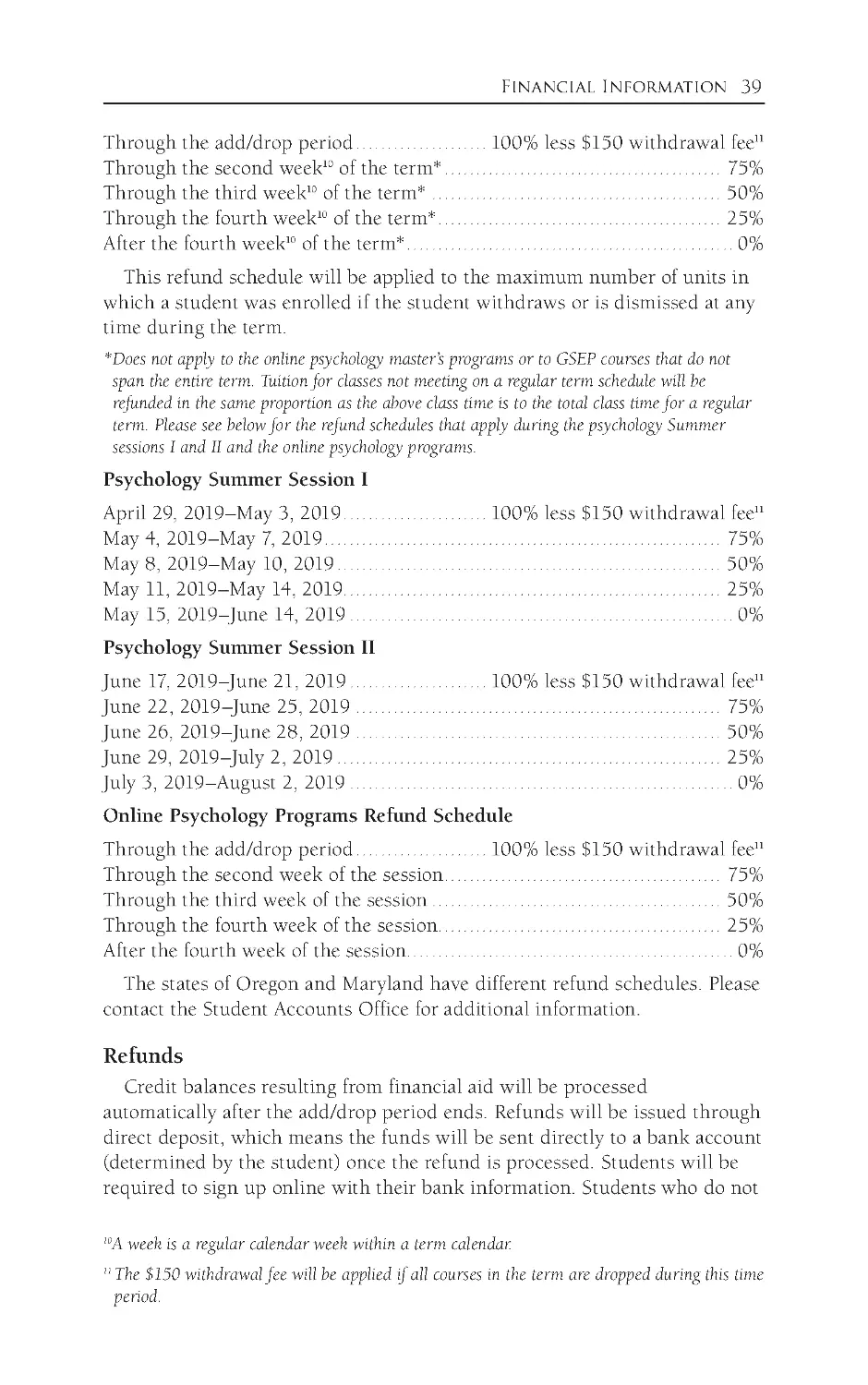
39
Financial Information
Through the add/drop period ..................... 100% less $150 withdrawal fee11
Through the second week10 of the term* ............................................ 75%
Through the third week10 of the term* .............................................. 50%
Through the fourth week10 of the term* ............................................. 25%
After the fourth week10 of the term* .................................................... 0%
This refund schedule will be applied to the maximum number of units in
which a student was enrolled if the student withdraws or is dismissed at any
time during the term.
*Does not apply to the online psychology master’s programs or to GSEP courses that do not
span the entire term. Tuition for classes not meeting on a regular term schedule will be
refunded in the same proportion as the above class time is to the total class time for a regular
term. Please see below for the refund schedules that apply during the psychology Summer
sessions I and II and the online psychology programs.
Psychology Summer Session I
April 29, 2019–May 3, 2019 ....................... 100% less $150 withdrawal fee11
May 4, 2019–May 7, 2019 ............................................................... 75%
May 8, 2019–May 10, 2019 ............................................................. 50%
May 11, 2019–May 14, 2019............................................................ 25%
May 15, 2019–June 14, 2019 ............................................................. 0%
Psychology Summer Session II
June 17, 2019–June 21, 2019 ...................... 100% less $150 withdrawal fee11
June 22, 2019 –June 25, 2019 .......................................................... 75%
June 26, 2019–June 28, 2019 .......................................................... 50%
June 29, 2019–July 2, 2019 ............................................................. 25%
July 3, 2019–August 2, 2019 ............................................................. 0%
Online Psychology Programs Refund Schedule
Through the add/drop period ..................... 100% less $150 withdrawal fee11
Through the second week of the session ............................................ 75%
Through the third week of the session .............................................. 50%
Through the fourth week of the session............................................. 2 5%
After the fourth week of the session.................................................... 0%
The states of Oregon and Maryland have different refund schedules. Please
contact the Student Accounts Office for additional information.
Refunds
Credit balances resulting from financial aid will be processed
automatically after the add/drop period ends. Refunds will be issued through
direct deposit, which means the funds will be sent directly to a bank account
(determined by the student) once the refund is processed. Students will be
required to sign up online with their bank information. Students who do not
10
A week is a regular calendar week within a term calendar.
11
The $150 withdrawal fee will be applied if all courses in the term are dropped during this time
period.

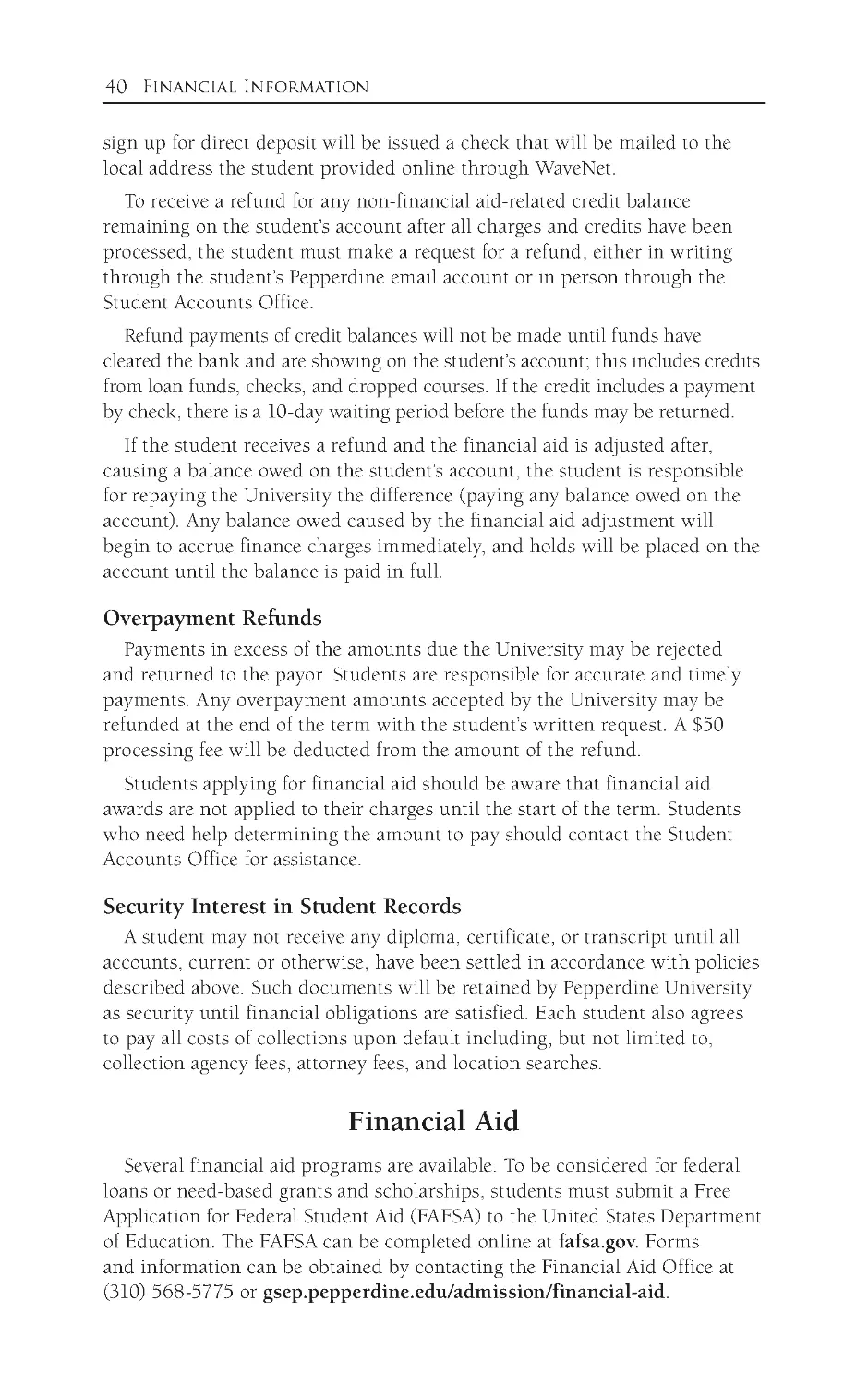
40 Financial Information
sign up for direct deposit will be issued a check that will be mailed to the
local address the student provided online through WaveNet.
To receive a refund for any non-financial aid-related credit balance
remaining on the student’s account after all charges and credits have been
processed, the student must make a request for a refund, either in writing
through the student’s Pepperdine email account or in person through the
Student Accounts Office.
Refund payments of credit balances will not be made until funds have
cleared the bank and are showing on the student’s account; this includes credits
from loan funds, checks, and d ropped courses. If the credit includes a payment
by check, there is a 10-day waiting period before the funds may be returned.
If the student receives a refund and the financial aid is adjusted after,
causing a balance owed on the student’s account, the student is responsible
for repaying the University the difference (paying any balance owed on the
account). Any balance owed caused by the financial aid adjustment will
begin to accrue finance charges immediately, and holds will be placed on the
account until the balance is paid in full.
Overpayment Refunds
Payments in excess of the amounts due the University may be rejected
and returned to the payor. Students are responsible for accurate and timely
payments. A ny overpayment amounts accepted by the University may be
refunded at the end of the term with the student’s written request. A $50
processing fee will be deducted from the amount of the refund.
Students applying for financial aid should be aware that financial aid
awards are not applied to their charges until the start of the term. Students
who need help determi ning the amount to pay should contact the Student
Accounts Office for assistance.
Security Interest in Student Records
A student may not receive any diploma, certificate, or transcript until all
accounts, current or otherwise, have been settled in accordance with policies
described above. Such documents will be retained by Pepperdine University
as security until financial obligations are satisfied. Each student also agrees
to pay all costs of collections upon default including, but not limited to,
collection agency fees, attorney fees, and location searches.
Financial Aid
Several financial aid programs are available. To be considered for federal
loans or need-based grants and scholarships, students must submit a Free
Application for Federal Student Aid (FA FSA) to the United States Departme nt
of Education. The FAFSA can be completed online at fafsa.gov. Forms
and information can be obtained by contacting the Financial Aid Office at
(310) 568-5775 or gsep.pepperdine.edu/admission/financial-aid.

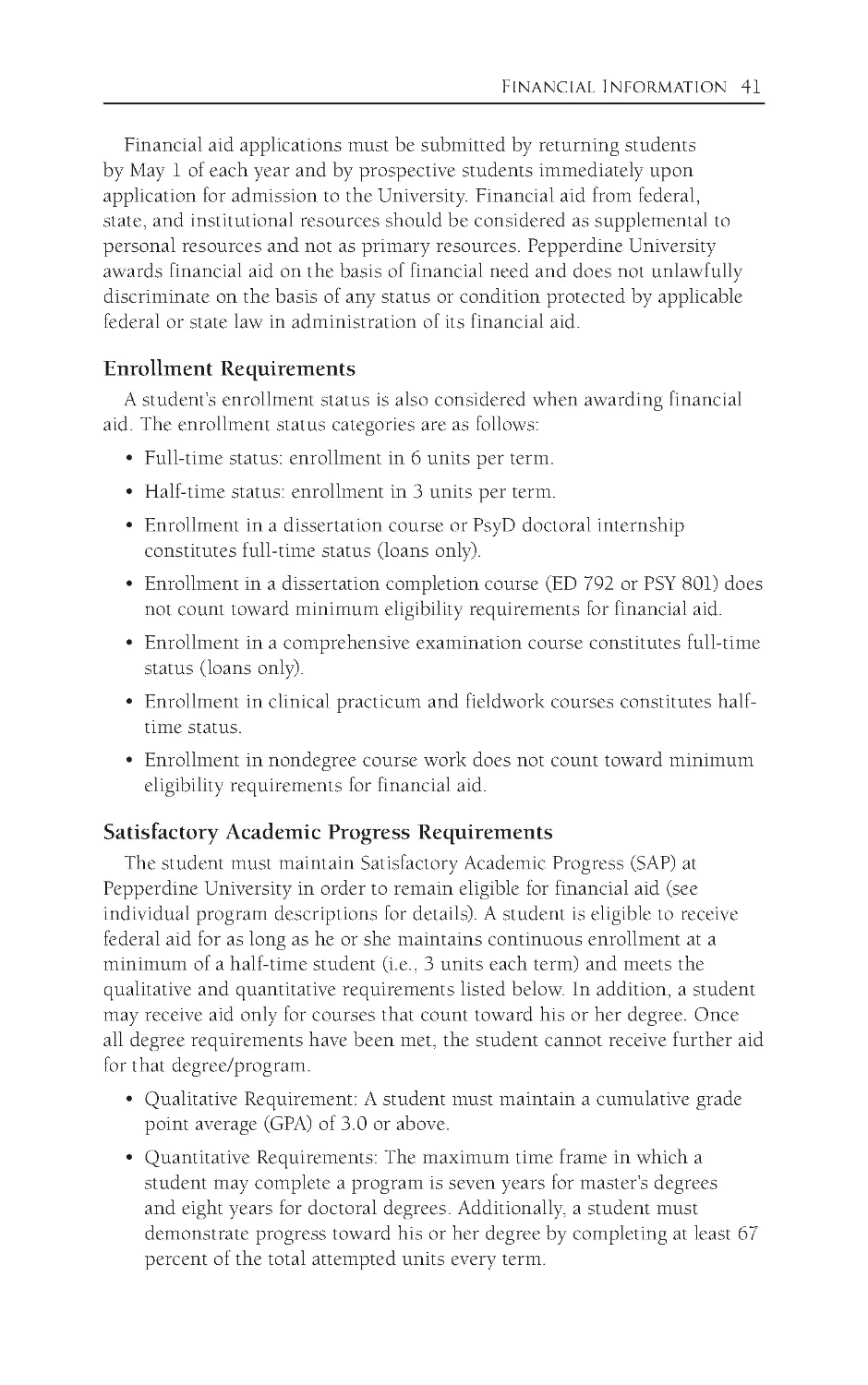
41
Financial Information
Fina ncial aid applications must be submitted by returning students
by May 1 of each year and by prospective students immediately upon
application for admission to the University. Fina ncial aid from federal,
state, a nd institutional resources should be considered as supplemental to
personal resources and not as primary resources. Pepperdine University
awards financial aid on the basis of financial need and does not unlawfully
discri minate on the basis of any status or condition protected by applicable
federal or state law in administration of its financial aid.
Enrollment Requirements
A student’s enrollment status is also considered when awarding financial
aid. The enrollment status categories are as follows:
• Full-time status: enrollme nt in 6 units per term.
• Half-time status: enrollme nt in 3 units per term.
• Enrollment in a dissertation course or PsyD doctoral internship
constitutes full-time status (loans only).
• Enrollment in a dissertation completion course (ED 792 or PSY 801) does
not count toward minimum eligibility requirements for financial aid.
• Enrollme nt in a comprehensive e xa mination course constitutes full-time
status (loans only).
• Enrollme nt in clinical practicum a nd fieldwork courses constitutes half-
time status.
• Enrollme nt in nondegree course work does not count towa rd mi nimum
eligibility requirements for fina ncial aid.
Satisfactory Academic Progress Requirements
The student must maintain Satisfactory Academic Progress (SAP) at
Pepperdine University in order to remain eligible for financial aid (see
individual program descriptions for details). A student is eligible to receive
federal aid for as long as he or she maintains continuous enrollment at a
minimum of a half-time student (i.e ., 3 units each term) and meets the
qualitative a nd quantitative require ments listed below. I n addition, a student
may receive aid only for courses that count toward his or her degree. Once
all degree requirements have been met, the student cannot receive further aid
for that degree/program .
• Qualitative Requireme nt: A student must maintain a cumulative grade
point average (GPA) of 3.0 or above.
• Quantitative Requirements: The maximum time frame in which a
student may complete a program is seven years for master’s degrees
and eight years for doctoral degrees. Additionally, a student must
demonstrate progress toward his or her degree by completing at least 67
percent of the total attempted units every term.

42
Note: Units for the followi ng grades are not counted towa rd a student’s
grade point average (GPA) calculation but are counted as attempted credits
when calculating pace:
• “I” (Incomplete)
• “F ” (Failure)
• “W ” (Withdrawal)
• “R” (Repeated classes)
• “U W” (Unofficial Withdrawal, including start-overs)
A student who does not meet Satisfactory Academic Progress require ments
will be placed on a warning status for the subsequent term during which
he or she is still eligible for aid. If after the subsequent term the student
continues to not meet all SAP requirements, he or she will be considered
ineligible for financial aid. All aid due after the term in which eligibility is
lost will be cancelled.
If a student has been disqualified from receiving financial aid, he or she
has the right to appeal by filing a petition. Petitions can be approved only
if poor progress was caused by illness, a death in the immediate family, or
serious hardship. The petition must be submitted in writing, w ith supporting
documentation, and will be reviewed by the Financial Aid Office. Filing a
petition does not ensure approval of that petition. Petitions may be gra nted
on condition or denied. The student is required to seek academic advisement
as part of the petition process. The Financial Aid Office will notify the
student of the decision in writing. A student whose SAP petition has been
approved is placed on SA P probationa ry status. The student must comply
w ith the terms and conditions that are set forth in the approved petition.
When a cumulative GPA of 3.0 has been achieved and the required
number of units has been completed, the student may reapply for financial
aid for the subsequent award period. Reinstatement of financial aid eligibility
is not retroactive.
Student Loans
Those who qualify for federally based aid may borrow money for school
through the Federal Direct Loan progra m. Graduate students may borrow
up to $20,500 each academic year in Federal Direct Unsubsidized Stafford
Loan funding (students in the PsyD program may borrow up to $33,000
each academic year). Students must be enrolled at least half-time in order
to be eligible to receive federal loan funding. The total amount of loan
funding that a student is awarded and accepts will be divided evenly among
the number of terms of enrollment throughout the academic year. Direct
loan funds, minus the origination fee, are disbursed through the school at
the beginning of each term. Interest accrues while the student is enrolled
in school.
12
If enrolled in an eligible program at least half-time, borrowers
may defer payment of the principal and pay the interest only or they may
defer payment and have the interest charges added to the principal balance
Financial Information

43
Financial Information
(capitalized). Loan repayment begins six months after the student ceases to
be enrolled at least half-time.
Students in need of additional funding for tuition and/or living expenses
m ay apply for a Federal Direct Graduate PLUS Loan or a private educational
loan. The Federal Direct Graduate PLUS Loan, minus the loan fee, is
disbursed through the school at the beginning of each term. Interest accrues
while the student is enrolled in school.
12
This loan requires credit approval
from the Department of Education a nd is generally available to students who
do not have adverse credit. Private educational loans offered by fina ncial
institutions are available to students with good credit or with a creditworthy
cosigner. Many private lenders offer loans with both va riable and fixed
interest rates.
All loans must be coordinated with other aid and may not exceed the
student’s total cost of attendance. For additional information regarding
Unsubsidized Stafford Loans, Graduate PLUS Loans, a nd private educational
loans, please visit the website at gsep.pepperdine.edu/financial-aid/
assistance.
Graduate School of Education and Psychology Colleagues Grants
The Graduate School of Education and Psychology offers annual assistance
to students in the Doctor of Psychology and Master of Arts in Clinical
Psychology with an Emphasis in Marriage and Family Therapy: Daytime
Format programs. Qualified students are generally awarded funds not to
exceed 25 percent of tuition costs. All grants are awarded on the basis
of financial need. For additional information, please visit the website at
gsep.pepperdine.edu/admission/financial-aid/assistance/grants.
Pepperdine Scholarships
The Graduate School of Education and Psychology offers an extensive list
of scholarships provided by the University and through the generosity of
donors. Awards are made based on a variety of criteria, including academic
merit, financial need, specific academic programs, and the promotion
of cultural diversity at the school. The scholarship amounts, criteria,
requirements, and application deadlines are posted on the GSEP scholarship
web page at gsep.pepperdine.edu/admission/financial-aid/scholarships.
Pepperdine Scholarship Policies
• 100 percent online (Psychology@Pepperdine) students are not eligible.
• Full-time Status: The student must be enrolled full-time (6 units or
more) in order to receive the scholarship. If the student does not enroll
at full-time status (fewer than 6 units), he or she forfeits eligibility. The
scholarship is not put on hold for any additional term. Please note: Any
adjustments to awa rded amounts will be at the University’s discretion.
12
Federal interest rates and loan origination fees are subject to change. Please see
gsep.pepperdine.edu/financial-aid/assistance/loans for the most current rates.

44
• Tuition-Specific and Non-Renewable: These scholarships are tuition-
specific and are awarded only once. These scholarships cannot be
refunded for cash value.
Exception: The Endowed GSEP Fellows Fund, GSEP Endowed Faith/
Missions Fellowship, GSEP Diversity Scholarship, Evelyn B. Blake
Scholarship, and City Year University Partnerships Progra m are eligible
for renewal.
• Satisfactory Academic Progress (SAP) Requirement: A student
must maintain a cumulative grade point average (GPA) of 3.0 or above
and cannot exceed the maximum time frame in which a student may
complete a program . Additionally, the student must demonstrate
progress toward his or her degree by completing at least 67 percent
of the total attempted units every term . A student who does not meet
Satisfactory Academic Progress requirements will be placed on a
warning status for the subsequent term, during which he or she is still
eligible for the scholarship. If after the subsequent term the student
continues to not meet all SAP requirements, he or she will be considered
ineligible for the scholarship.
• Withdrawals and Leaves of Absence: If a student withdraws from the
program or the term, the scholarship will be revoked. If a student takes
a leave of absence, the scholarship will be revoked.
• Applicable Terms: The scholarship will be divided equally between the
student’s terms of enrollment for the applicable academic year.
Exception: If a student is admitted in the Summer term and receives a
scholarship, the scholarship will be divided into four terms beginning in
the Summer term and ending in the next academic year’s Summer term.
These scholarships can be combined with other scholarships except
for federal and institutional military scholarships/benefits and athletic
scholarships. Students receivi ng third-party scholarships will require
further approvals.
• The Financial Aid Office awards the scholarship in coordination with
all other financial aid. If the awarding of the scholarship produces
an over-award, federal student loans will be reduced first; and the
scholarship is disbursed to the student’s account at the start of the term .
• Acceptance: Students are required to acknowledge the Offer of
Financial Aid on the student portal, indicating their acceptance of the
scholarship.
Pepperdine Scholarships for New Students
A new student, for GSEP Pepperdine scholarship purposes, is defined as a
student in a new program i n his or her first term at Pepperdine University’s
Graduate School of Education and Psychology. Note: Tra nsfers from a GSEP
Doctor of Education (EdD) program to the GSEP Doctor of Philosophy in Global
Leadership and Change (PhD) program are not considered new students.
Financial Information

45
Financial Information
The following scholarships are for new students:
• City Year University Partnerships Program
• Education for Life Scholarship
• Give-a -Gift-of-Education Scholarship
• GSEP Diversity Scholarship
• Kick Start Scholarship
In addition to the above policies, the followi ng policies apply to
Pepperdine scholarships for new students:
• Students who request a deferral will be allowed to defer these
scholarships only once, for the next available term within the deferral
limit, after which this scholarship will be revoked. City Year University
Partnerships Progra m recipients are eligible for a one-year deferral
should they decide to serve with City Year before starting their program.
• These scholarships can be combined with other scholarships except for
the Colleagues Gra nt; however, the GSEP Diversity Scholarship cannot
be combined with the other scholarships listed above.
Pepperdine Scholarships for Continuing Students
For GSEP Pepperdine scholarship purposes, continuing students are
defined as students prese ntly enrolled at Pepperdine University’s Graduate
School of Education and Psychology in their second term or more in the
same academic program . E xceptions apply to students tra nsferring from a
GSEP Doctor of Education (EdD) program to the Doctor of Philosophy in
Global Leadership and Change (PhD) progra m.
The following scholarships are for continuing students:
• Benjamin M. Bendat Endowed Scholarship
• Chester H. McCall Endowed Scholarship
• Chiang Kai-Shek Scholarship
• Danhakl Family Foundation Fellowship
• Diana Hiatt-Michael Endowed Scholarship
• E. V. Pullias Endowed Scholarship
• Glen and Gloria Holden Scholarship
• Harry and Izelle Shafer Scholarship
• J. McDonald and Judy Williams GSEP Scholarship
• John and Rebecca Barton Scholarship
• Linda M. Gage AWP Endowed Scholarship
• Marco Garcia Memorial Fellowship
• Mattie Chissell Memorial Scholarship
• Michael Y. F. Chau Scholarship
• Olaf H. Tegner Endowed Scholarship

46
• Pepperdine Black Alumni Council Scholarship
• Randy Clark Endowed Scholarship
• Sally Edwa rds Endowed Scholarship
• Urban Fellows Grant
Pepperdine Scholarships for New and Continuing Students
The following scholarships are for new a nd continuing students:
• Evelyn B. Blake Scholarship
• GSEP Endowed Board of Visitors Scholarship
• L. A . Sheriff’s Department University Partnership
• The Endowed GSEP Fellows Fund
• The GSEP Endowed Faith/Missions Fellowship
Assistantships13
Full-time students (enrolled in at least 6 units) may gain valuable work
experience through three types of assistantships. While a student may hold
more than one assistantship, the maximum number of hours a student may
work is 19 3⁄4 per week. The positions start at $12.50 per hour.
Graduate Assistantship—Students are trained to assist staff with
clerical, telephone, and administrative duties related to financial aid, human
re sources, ma rketing, professional development, special events, technology,
and other areas. Interested students may obtain an application through
the web at community.pepperdine.edu/gsep/student-ser vices/student-
employment or may call GSEP Student Employme nt at (310) 568-2373.
Research Assistantship—Students assist faculty members by accessing
and summarizing articles; participating in the preparation of presentations;
and/or collecting, scoring, and analyzing data. Interested students should
contact faculty members directly.
14
Teaching Assistantship—Students assist faculty members with tutoring
students, arranging for guest speakers, and other instructional activities.
Interested students should contact faculty members directly.
14
Changes in Financial Aid Due to a Leave of Absence or Withdrawal
Federal Funds
Financial aid programs created by the federal government are called Title
IV funds and include the Stafford Loan and Graduate PLUS Loan.
Title IV funds are awarded with the understanding that the student will
attend school for the entire period for which the assistance was offered.
Howe ver, should students need to take a leave of absence or withdraw, they
13
See community.pepperdine.edu/gsep/student-services/student-employment for more
information.
14
See the “GSEP Administration and Faculty” section of this academic catalog for faculty
research and teaching interests.
Financial Information

47
Financial Information
may no longer be eligible for the full amount of Title IV funds awarded
to them. Federal law requires that the Financial Aid Office determine at
what point Title IV funds will cease to be made available once the students’
enrollment has ended, and any unearned funds will be returned to the
federal financial aid program. There is no relationship between this process
and how GSEP determines what students will be charged when they take a
leave of absence or withdra w.
Pepperdine Grants and Scholarships
Eligibility for Pepperdine funding is dependent on full-time enrollment in
regular course work. If students withdraw or take a leave of absence prior
to completing 60 percent of the term, their Pepperdine funding will be
cancelled.
What to Do Should Students Decide to Take a Leave of Absence or
Withdraw
A student who decides to withdraw from all classes for the term or
w ithdraw perma nently from the University must notify the education or
psychology academic advisor in writing using the Pepperdine email account.
The withdrawal date will be determined as the earliest date that GSEP is
aware the student stopped attending all classes.
How Students’ Financial Aid is Adjusted
The federal government provides financial aid offices with a schedule that
is used to determine how much of the Title IV funds students have earned if
they take a leave of absence or withdraw.
Based on the student’s last date of attendance, the Financial Aid Office will
determine what amount will be returned to the federal program. If students
have completed 60 percent or less of a given term, the Financial Aid Office
uses the schedule provided by the federal government to determine the
refund. If students have completed more than 60 percent of a term, they are
considered to have earned 100 percent of their Title IV funds for that term.
For example, if students take a leave of absence after completing 40 percent
of a term, they are then eligible to keep 40 percent of their federal funds, and
the remaining 60 percent of the federal funds will be returned. The federal
government requires that refunds be returned in the following order:
Unsubsidized Federal Stafford Loans
Federal Graduate PLUS Loans
TEACH Grant
For more information, please contact the Financial Aid Office at
(310) 568-5775 or gsepfaid@pepperdine.edu.

Student
Services

50 Student Services
Counseling Services
Academic and Program Counseling Services
In keeping with Pepperdine’s long-standing tradition of concern for
students, every effort is made to provide the kind of personalized guidance
desirable at the graduate level but often unavailable at larger institutions.
For this reason, faculty members, program directors, and academic advisors
make a concerted effort to be available at times convenient to students
and to assist in resolving issues related to their course of study. Enrolled
students are provided academic and career counseling through both
the faculty and staff. Students are encouraged to request an advisement
appointme nt whenever they have questions regarding their academic
program . I n addition, students may also obtain valuable information from
program handbooks and resources on the GSEP website.
Alcohol and Drug Counseling Services
Confidential counseling and treatment are available to students who have
problems related to alcohol or drugs. Details about the Substance Abuse
Policy can be found at pepperdine.edu/studentcodeofconduct.
Community Counseling Clinics
Pepperdine University’s Graduate School of Education a nd Psychology
maintains three on-campus counseling centers at the West Los Angeles,
Encino, and Irvine Graduate Campuses. Each clinic provides comprehensive
psychological services to the general community. Psychological services
offered include individual, couples, and family psychotherapy; psychological
assessment for clinic therapy clients; and assistance and support in
examining vocational issues. Services are provided by Pepperdine doctoral-
and master’s-level student therapists under the supervision of licensed
psychologists and licensed mental health professionals. The clinic staff is
committed to providing high-quality, individualized counseling within a
supportive a nd accepting environme nt.
General Services
Accommodations for Students with Disabilities
Pepperdine University is committed to complying with all mandates
set forth in Section 504 of the Rehabilitation Act and the Americans with
Disabilities Act. Students with disabilities requesting accommodations
should contact the Office of Student Accessibility before their academic
program begins. Upon verification of the student’s disability, the Office of
Student Accessibility will work with each student on a case-by-case basis
to determine appropriate accommodations while maintaini ng academic
integrity of the courses.
Students should expect a two-we ek time frame in which the
documentation a nd accommodation request will be reviewed. If the

51
documentation is incomplete and/or does not meet the guidelines, students
w ill be required to submit complete documentation before accom modations
may be granted.
Students who are registered with the Office of Student Accessibility will
receive accom modation letters that they may provide to faculty to verify their
accommodations. Registered students must request accommodations each
term through the submission of a completed Service Request form. Students
are expected to be in close communication with professors and the Office of
Student Accessibility regarding the impleme ntation of accommodations.
Inquiries should be addressed to the Office of Student Accessibility at (310)
506-6500. Please visit the website at pepperdine.edu/student-accessibility
for further i nformation regarding documentation guidelines, office forms,
and resources for students.
Athletic Events and Facilities
Individuals possessing valid Pepperdine identification cards will have
free admission to all home athletic events. Pepperdine’s National Collegiate
Athletic Association (NCAA) Division I athletic programs boast a rich
history with 9 NCAA national championships, 290 All-Americans, 48
Olympians, and almost 200 conference titles. Students with valid Pepperdine
identification cards are eligible to receive entry and exit giveaways, subject to
availability.
Additionally, individuals possessing valid Pepperdine identification ca rds
have access to use athletic facilities during specified times. Facilities include
tennis courts, a basketball court, a swimming pool, and a running track. For
more information, c all (310) 506-4150.
Bookstore Services
Bookstores are located at the West Los Angeles Graduate Campus and both
the Drescher Graduate Campus and the undergraduate campus in Malibu.
Students at other locations may order their textbooks to be delivered to them
by mail.
West Los Angeles Bookstore
(310) 568-5741
Drescher/Malibu Bookstore
(310) 506-8569
Career Services
The GSEP Career Services team operates from an innovative model of
career education and holistic career counseling for today’s rapidly changing
job market. The department provides services and resources to education
and psychology students and alumni, both face-to-face and virtually.
Services include helping individuals clarify their purpose and build lifelong
employability skills in order to stre ngthen their personal bra nd and prepare
for career advancement. Students and alumni have access to clinical career
counseling, re sume /CV and cover letter customi zation assistance, interview
preparation a nd practice, a nd industry-specific employme nt search strategies.
Student Services

52 Student Services
Career Services hosts relevant career development programs, providing
career exploration a nd networking opportunities with alumni and industry
leaders as well as prospective employers. Grounded in a postmodern
theory called career construction, Career Services helps students and
alumni construct their career narratives through life design counseling as
well as provides them with the tools and strategies to become competitive
in today’s society. For more information, contact Career Services at
gsep.careerser vices@pepperdine.edu or (310) 568 -5666.
Computer Services
The Graduate School of Education a nd Psychology provides computing
services and assistance to students at all five graduate campuses. Student
computer ser vices are available at the following locations:
Calabasas
(818) 702-1000
Encino
(818) 501-1614
Irvine
(949) 223-2510
Malibu (Drescher Graduate Campus) (310) 506-4029
West Los Angeles
(310) 568-5688
Dissertation Support
Dissertation support is provided to students to assist with the dissertation
process and the Graduate and Professional Schools Institutional Review
Board (IRB). The Graduate School of Education a nd Psychology requires
the use of American Psychological Association (APA) format for dissertation
manuscripts. All dissertations must go through the APA format clearance
process prior to publication and degree posting. For more information, please
v isit community.pepperdine.edu/gsep/dissertation.
Email Communication
Every Pepperdine University student is provided with a Pepperdine
email account upon e nrollment, e nding with “@pepperdine.edu.” The
University and school admi nistration depend upon these email accounts
to disperse critical announcements and important news. Students will be
held responsible for all information sent to this account by the faculty or
administration, and sending an email to this account will at all times serve
as official notification regardless of whether the student reads a specific email
or otherwise maintains the account. Not having read a specific email or
not reporting technical problems with an account will not be considered a
justifiable reason for nullifying this notice provision. Students are required to
check their accounts regularly and to report any problems.
Food Services
The West Los Angeles Graduate Campus is situated adjacent to a number
of restaurants and cafés all within walking distance. The Malibu campus

53
Student Services
has a full-ser vice cafeteria and a snack bar, which offer a w ide range of
items. The Irvi ne Graduate Campus features soups, salads, and sandwiches,
Monday through Thursday, approxi mately 5:30 pm to 8:30 pm. I n addition,
each graduate campus has a student lounge equipped with vending
machines for dri nks, sandw iches, and snacks. The lounges are open duri ng
regular building hours.
Health Insurance
The University requires health care coverage with the purpose of limiting
undue financial and academic stress related to illnesses or injuries during the
academic year. Health care coverage assists in meeting the financial burden
of not only common illnesses treated at the Student Health Center or at a
private physician’s office, but also illnesses and accidents involving care that
is more e xtensive.
The Student Health Insurance Plan (SHIP) is intended to provide the
lowest pre mium for the student while providing the greatest benefit;
however, students may purchase any US-based policy that has comparable
coverage to SHIP. For more information and to view the SHIP brochure, visit
commu nity.pepperdine.edu/ healthcenter/insura nce.
Each academic year all GSEP students registered on the Malibu campus,
both domestic and international, are required to either provide proof of
US-based health insura nce coverage through the online waiver system or
enroll in the Student Health Insurance Plan (SHIP). If these students choose
not to enroll in SHIP, providing proof of US-based health insurance coverage
through the online waiver system is mandatory. It is highly recommended
that all students purchase health insurance coverage that includes local care
close to Malibu.
Nondegree a nd exchange students are not required to provide proof of
health insurance coverage and are not eligible to purchase SHIP.
Students registered on other campuses are required to carry health
insura nce but are not required to provide proof of health insura nce coverage.
These students are not eligible for SHIP and may find information on state
exchanges at healthcare.gov if seeking coverage.
F-1 international students on other campuses are eligible to purchase SHIP
by calling USI at (800) 853-5899 and paying for enrollment by credit card
over the telephone.
Students graduating in December 2018 who are enrolled in SHIP for
the Fall 2018 term will have the option to enroll in the Spring/Summer
SHIP with a credit card by calling USI directly at (800) 853-5899 by the
enrollment deadline.
Housing Assistance
Pepperdine provides online resources to students seeking housing near the
graduate campus where they are enrolled. Although there is no on-campus
housing at the graduate campuses and only limited housing at the Malibu

54 Student Services
campus for graduate students, res ources are available to students on the
GSEP website at gsep.pepperdine.edu /student-resou rces/services/housing.
Information Technology
The Information Technology department provides a full range of
technology services for Pepperdine University students. Each of the
University’s campuses features modern classrooms with digital projection
and wireless internet access as well as general-use computer labs that provide
w ireless internet connectivity, fee-based black-and-white and color pri nting,
and photocopying.
Information Technology staff members are available to provide technology
assistance. Students may visit pepperdine.edu/it and select “Student” for
self-help guides and support information. In addition, students may contact
the Pepperdine IT Service Desk for support at (310) 506-HELP (4357) or
(866) 767-8623 (toll free in the USA), 24 hours a day, 365 days a year.
Students are required to abide by the “Computer a nd Network Responsible
Usage Policy.” Details are included in the “Regulations and Legal Notices”
section of this academic catalog and are published on the Information
Technology website at commu nity.pepperdine.edu/it /security/policies/
usagepolicy.htm. Information about all Information Technology services is
available at pepperdine.edu/it.
International Student Services
The Office of International Student Services (OISS) is located on the
Malibu campus. The Form I-20, Certificate of Eligibility for Nonimmigrant
Student Status, is issued by the OISS to admitted students who intend to
maintain F-1 student visa status in the United States or apply for the F-1
student visa abroad before enteri ng the United States. F-1 students must
report to the OISS upon their a r rival on the campus and throughout their
enrollme nt. International students who intend to enroll at Pepperdine
University while maintaining a nonimmigrant visa status other than the F-1
visa status must provide documentary evidence of their visa status. The OISS
hosts and partners with resources across the University to offer programs and
activities to assist students in achieving success in their academic and social
tra nsitions. The OISS also provides information a nd advising on gover nment
regulations, employment, tax requirements, and other matters necessary
for compliance and maintenance of lawful visa status in the United States.
Health and accident insurance coverage is mandatory for all international
students. For more information, c all (310) 506-4246.
Library Services
Students, faculty, staff, a nd alumni of the Graduate School of Education
and Psychology are served by five libraries: Encino, Irvine, West Los Angeles,
and two on the Malibu campus. In addition to the pri nt collection, the
library system also provides access to an extensive number of government

55
Student Services
documents, electronic books and databases, online materials, and specialized
print and nonprint materials.
The West Los Angeles library collection, largest of the graduate campus
libraries, includes the ERIC Microfiche Collection. Payson Library, located
on the Malibu campus, is the largest physical library facility. It houses the
Gover nment Information Center a nd the Special Collections Department.
Payson Library is a US gover nme nt depository libra ry. Students, faculty, staff,
and alumni may use the library facilities at all Pepperdine locations.
Library services, available to current students and faculty, support
both academic and research pursuits. Services include the Pepperdine
Campus Loan Service, which allows library books, journals, and videos to
be tra nsferred between a ny two Pepperdine libra ries, a nd the Interlibra ry
Loan Service, which allows books, dissertations, and journal articles to be
obtained from other libraries around the world. Specialized lending services
are available to accommodate students enrolled in distance programs. In
addition, Pepperdine librarians provide virtual and in-class instruction,
workshops, and individual consultation in information-seeking skills and
the use of library resources. Instruction may cover strategy and selection
of library resources from both print and electronic resources. Reference
assistance is additionally available via chat, email, and texting. These
services and more are described on the Pepperdine Libraries’ website at
library.pepperdine.edu.
Library resources are described and may be accessed through the
Pepperdine Libraries’ website or WaveNet at wavenet.pepperdine.edu.
Access to the electronic databases and interlibrary loan requires
authentication as a current faculty or staff member or student.
New Student Orientation
Orientation sessions are held at the beginning of each term for new
students and are designed to familiarize them with campus facilities, policies
and procedures, financial aid, and other school-related issues.
Parking
West Los Angeles Graduate Campus students may purchase a cardkey
parking pass per term, which allows unlimited parking from 8 am to 11 pm,
Monday through Friday, a nd 7:30 am to 6 pm, Saturday.
Encino Graduate Campus students are charged a facilities fee that includes
unlimited parking from 2:30 pm to 11 pm, Monday through Friday, a nd all
day Saturday.
Irvine Graduate Campus students are charged a facilities fee that includes
unlimited parking from 3 pm to closing, Monday through Friday, a nd all day
Saturday and Sunday.
The Calabasas Graduate Campus and Drescher Graduate Campus in
Malibu offer free parking.

56 Student Services
Pepperdine Community
Commu nity.pepperdine.edu is an i nternal site designated to provide
information to current students, staff, faculty, and alumni. It includes
instructions to guide students through WaveNet and important information
to keep users updated at the Graduate School of Education a nd Psychology.
Professional Activities
The Graduate School of Education a nd Psychology’s com mitment to
professional interaction within the community provides students with an
excellent opportunity to test theory through practical application. Various
seminars, workshops, a nd special eve nts are offered throughout the year that
enable students to actively participate in the professional community.
Records and Enrollment
Records and Enrollment maintains accurate student records and assists
students with registration for classes. Students are highly encouraged to
meet with an academic advisor or program administrator upon entering
their program and meet regularly to discuss class scheduling each term or
session. Registration information is emailed to students each term or session,
informing them of their assigned “enrollme nt appointment” for the upcoming
term or session and reminding them to clear all registration holds before
registration begins.
Student Health Center
The Student Health Center (SHC) is committed to providing high-quality,
low-cost health care to the diverse community of students. Its primary
focus is to keep the students healthy by providing pre ventative ca re,
providing timely treatment of disease, and making appropriate referrals
when necessary. It emphasizes health education and aims to provide care in
a confidential, re spectful, a nd safe envi ronment. The SHC staff encourages
honest, open communication a nd dedicates themselves to perpetuating the
wellness of the whole being—mind, body, and spirit.
The SHC functions similarly to a family practice office and provides a wide
variety of services, which include care for respiratory problems, women’s and
men’s health, dermatology, im muni zations, labs, i n-house testing, nutrition,
and massage therapy. In addition, the SHC offers specialized clinics such
as flu vaccination, travel medicine, allergy, and STI testing. All information
reported at the health center is confidential and protected by the Health
Insura nce Portability and Accountability Act of 1996 (HIPA A), which
protects the disclosure of health information.
The SHC strives to keep costs at a minimum, and insurance companies
often reimburse a portion of these costs. Students may make payments at
the SHC with cash, personal check, or charge their student account. At the
conclusion of their appointment, they receive a super bill to submit to their
insurance company for reimbursement.

57
Student Services
Students seeking a referral to an off-campus medical provider are
encouraged to contact their i nsura nce company for referral information to
receive the most benefit from their coverage. Students enrolled in the Student
Health Insurance Plan (SHIP) must first be seen at the SHC to be referred to
an outside specialist.
All registered students have access to the off-site Pep-RN Nurse Advice
Line 24 hours a day, seven days a week by calling (800) 413-0848 . Staffed
w ith registered nurses, the nurse line can help students determi ne if
they need to seek medical care, understand their medications or medical
procedures, or learn ways to stay healthy.
Students can make appointments by calling (310) 506-4316, option 3 or
booking online at pepperdine.medicatconnect.com. The SHC encourages
appointme nts and works walk-i ns into the schedule whenever possible, w ith
priority given to scheduled appointments and emergencies.
The SHC is located at the northwest corner of Rho parking lot at Towers
Road. Hours of operation a re Monday through Friday, 8 am to 5 pm. For more
information , v isit community.pepperdine.edu/ healthcenter.
Tech Central
Tech Central is Pepperdine University’s student support center, offeri ng
hands-on technology support for all students. Tech Central is located on the
Malibu campus. Students may contact Tech Central at (310) 506-4811 or by
email at TechCent ral@pepperdine.edu. For more details about services,
hours of operation, a nd self-help information, please visit pepperdine.edu/it
and select “Student.”
Third-Party Vendor Agreements
In order to best serve its students, the University engages va rious third-
party ve ndors to provide, for e xa mple, janitorial, food, beve rage, bookstore,
and other services for the University community. Depending upon the terms
of the vendor agreements, some of these relationships may also in certain
circumstances provide an opportunity for the University to receive return
payments from a vendor. As a good steward of its limited resources, the
University periodically re views these relationships to ensure that students’
interests continue to be well served and that appropriate quality levels
are maintained.
Travel Agency
The University has a full-service travel agency located at the Malibu
campus. Any registered student may use the service and make travel
arra ngements in person or by telephone. For more information, c all
(310) 506-4562 or email corniche@pepperdine.edu.

58
University Card Services
Students are able to use their student identification cards for the purchase
of photocopies and printing on ca mpus or for food and beverages from dining
locations on the Malibu campus. There is no charge for a student’s first
identification ca rd. The fee to replace lost or stolen identification cards is $15.
One Card Web Deposit at Pepperdine University is an online service
designed to provide students with the convenience of adding money to their
campus identification cards anywhere and anytime. Students or guests can
add money to campus card accounts online with a credit or check card.
Deposits made online are secure and accounts are updated immediately.
The website allows card holders to view their account balance or transaction
history and report a lost or stolen card. Students may log on to the One Card
Web Deposit site at webdeposit.pepperdine.edu.
Use of Data for Evaluation Purposes
The Graduate School of Education a nd Psychology evaluates its programs
on an ongoing basis. The data from such evaluations provide information
to help improve the quality of the educational experience provided to
students. They are also required by accrediting bodies, such as the Western
Association of Schools and Colleges (WASC), to make decisions as to whether
GSEP can maintain its accredited status. The data in the archive may include
(1) information provided on the Application for Admission; (2) surveys that
are administered at differe nt stages of matriculation; (3) course work such
as papers, examinations, and exercises; and (4) other relevant academic
data and records such as grade point averages. The data entered into the
archive are de-identified, which mea ns students’ na mes or other personally
identifying information are removed so that the data cannot be associated
w ith a student’s identity.
Veteran Services
Veterans are advised to read “Veterans Information” in the “Regulations
and Legal Notices” section of this academic catalog.
WaveNet
Wavenet.pepperdine.edu is the link to Pepperdine’s student system
portal. Through the use of WaveNet, students can access email, enroll
in classes, view their grades, email their academic advisor or program
administrator, request enrollment verification and transcripts, access the
courses site, and much more.
Writing Support
This service is available to all students seeking guidance and tutoring on
class projects, papers, a nd dissertations. Support is provided through face-
to-face and virtual consultations, webinars, in-class presentations, written
feedback, and a variety of resources. For more information, visit the Writing
Support web page at community.pepperdine.edu/gsep/writing-support.
Student Services

59
Student Services
Alumni-Student Relations
The Pepperdine Alumni Association membership is over 120,000,
connecting alumni, students, pare nts, faculty, a nd staff from all the
Pepperdine schools: George Pepperdine College /Seaver College, Graduate
School of Education a nd Psychology, Pepperdine Gra ziadio Business School,
School of Law, and School of Public Policy. The association helps Pepperdine
provide valuable benefits and engagement programs to its alumni.
Membership is free. For more information about the benefits and progra ms,
v isit the alumni website at pepperdine.edu/alumni or call (310) 506-6190.
Alumni are e ncouraged to become active me mbers in the association.
There are many ways to help one’s alma mater and school: volunteer, mentor,
refer potential students, we ar Waves gear, attend social /professional events,
and make a small annual gift. Every gift counts—alumni giving is an
important metric in national rankings.
In addition to the Pepperdine Alumni Association, the Graduate School
of Education and Psychology Office of Alumni Relations focuses on the
specialized needs and professional interests of its 23,000 alumni working
in the fields of education and psychology. The mission of GSEP’s Office of
Alumni Relations is to add to the value of a Pepperdine professional degree
and to stre ngthen the Unive rsity by connecting, supporting, a nd celebrating
GSEP’s alumni, students, faculty, and staff. A current list of all alumni
benefits can be viewed online at gsep.pepperdine.edu /alumni .
GSEP Alumni Relations communicates monthly with alumni via an
electronic newsletter, shari ng details of events and opportunities to network
and socialize. Most importantly, the GSEP Alumni Relations Office serves as
a resource so that alumni remain connected to the communities of practice
they joined while completing their g raduate-level academic progra ms.
Throughout the year, GSEP sponsors eve nts to foster connections between
alumni, faculty, a nd students. For current information about GSEP eve nts,
v isit gsep.pepperdine.edu /events/calendar.
The success of GSEP’s alumni is a source of pride that GSEP shares by
publishing class notes via the website, social media, annual reports, or
other University publications . The GSEP Alumni Office encourages alumni
to inform the office of important developme nts such as career promotions,
publication of books or a rticles, educational achievements, changes of
address, or name changes. Professional updates from graduates and current
students help GSEP identify prospective panelists, mentors, and candidates
for leadership roles. After graduation, alumni may update their personal
information online at pepperdine.edu/alumni /benefits-ser vices/profile-
update or by contacting GSEP A lumni Relations at (310) 568-5649 or
gsepalum@pepperdine.edu.
The Colleagues
The Colleagues is a vital support group benefiting the Graduate School of
Education and Psychology. The Colleagues’ mission is to provide financial

60 Student Services
support to students in the form of scholarships and grants, make available
networking and professional growth opportunities for alumni and students
of GSEP, and enhance the value of all degree programs through strategic
developme nt projects. Colleagues me mbers include alumni, students, f riends,
and Pepperdine faculty and staff. For more information about the Colleagues,
call (310) 568-5649.
Student and Alumni Scholarly Activities
GSEP offers a rich variety of scholarly organizations to support students’
professional development.
Education
Africana Students of Psychology and Education Association
The Africana Students of Psychology and Education A ssociation
(ASPE A) of Pepperdine University is an academic and professional
organization of African American psychology and education students
dedicated to improving opportunities in the areas of mental health and
education. The purpose of the association is to support, guide, and direct
African American students in academic, professional, and social endeavors.
California Association for Bilingual Education
The California A ssociation for Bilingual Education (CABE) is the
premier organi zation for professional development on the education of
English learners in California for educators, pare nts, a nd other community
members. Pepperdine GSEP plays an active role in CABE conferences and
has a local chapter for alumni, students, and others committed to bilingual
education .
Psychology
Africana Students of Psychology and Education Association
The Africana Students of Psychology and Education A ssociation
(ASPE A) of Pepperdine University is an academic and professional
organization of African American psychology and education students
dedicated to improving opportunities in the areas of mental health and
education. The purpose of the association is to support, guide, and direct
African American students in academic, professional, and social endeavors.
Christian Association for Psychological Studies
The Pepperdine chapter of the Christian Association for Psychological
Studies meets for fellowship, ser vice, a nd learning about the integration
of faith and the practice of clinical psychology and marriage and family
therapy. It bri ngs together current GSEP master’s a nd doctoral students
and alumni as well as faculty and staff members from all of the campuses
(Encino, Irvine, Malibu, and West Los Angeles) to help build community
and support the mission of Pepperdine University.
Latino Student Psychological Association
The Latino Student Psychological Association is a student affiliate
group of the California Latino Psychological Association. It is committed

61
to expanding multicultural awareness within the student psychological
community through education, collaboration, and service.
Master of Arts in Psychology Outreach
The Master of Arts in Psychology (MAP) Outreach is a student
organization at the Irvine Graduate Campus dedicated to fostering identity
development among Master of Arts students at Pepperdine University.
MAP Outreach was developed to create a unique culture for Master of
Arts students by facilitating events for students to utilize one another as
resources and support systems while in school. Workshops are focused
on specific topics relating to master’s students and include personal,
professional, and educational development. MAP Outreach is a student-
driven club that was created by master’s students for master’s students.
Multicultural Research and Training Lab
The Multicultural Research and Training Lab was organized by a cohort
of psychology faculty members at Pepperdine University’s Graduate School
of Education a nd Psychology to provide Doctor of Psychology (PsyD)
students engaged in multicultural research a space to discuss and receive
feedback on their clinical dissertation topics. In addition to offering
dissertation support, the lab provides an opportunity for students to
engage in discourse on their views of how effectively the PsyD program
is contributing to their multicultural competence as well as ways the
institution might offer a more welcomi ng experience for students from
diverse backgrounds.
Pepperdine Student Association for Behavior Analysis
The mission of the Pepperdine Student A ssociation for Behavior A nalysis
(PSABA) is to produce awareness of the growing field of applied behavior
analysis (ABA) within the collegiate and surrounding communities. It aims
to increase knowledge of the field of ABA by advising students interested
in pursuing careers in ABA and participating in social networking and
charitable causes within the community.
Psi Chi
Pepperdine has had an active chapter of the Psi Chi national honor
society in psychology for 50 years. Members have the opportunity to
participate in social and professional activities while being recognized
for academic achieveme nt. Membership is open to graduate psychology
students who have earned a minimum of 9 units with a cumulative grade
point average of 3.7 or higher.
PsyD Student Government Association
The PsyD Student Gover nment Association facilitates the ongoing
collaborative effort of students, faculty, a nd staff to continually improve the
Graduate School of Education and Psychology PsyD program and keep it
on the forefront of the evolving field of psychology. An annual activities fee
supports eve nts sponsored by the PsyD Student Gover nment A ssociation.
Student Services

62
Research and Practice Team
The Research and Practice Team at Pepperdine University’s Graduate
School of Education and Psychology is a student-led research group
which serves to provide a forum for discussion about research and related
activities as well as provide students with information about possible
research opportunities
Social Justice Collaborative
The Social Justice Collaborative at GSEP’s Irvine Graduate Campus
was developed to provide a space for students to engage in critical
dialogue around sociopolitical and cultural issues impacting families and
communities. The Social Justice Collaborative supports graduate-level
psychology and marriage and family therapy students and trainees in
fostering sociopolitical and cultural awareness and responding to issues of
oppression and inequity. The Social Justice Collaborative aims to initiate
student involvement in activities that promote social responsibility;
encourage students to interact in a stimulating forum; and foster the
sharing of experiences, curiosities, and critiques related to multicultural
issues, social inequalities, and working in diverse, underserved
communities.
Spanish Language Enhancement Association for Therapists
The Spanish Language Enhancement Association for Therapists is a
student-led language enhancement group.
Student Services

63

Academic
Policies

66 Academic Policies
Introduction
It is the responsibility of the student to be familiar with and complete the
require ments for the degree being sought. The staff of Pepperdine University
will assist each student, but it is the student who must ensure that all
degree requirements have been completed in the manner outlined in this
academic catalog.
Academic Course Load
Students enrolled in two courses for a total of 6 or more units are considered
full-time. Education doctoral students at the comprehensive examination and
dissertation level and psychology doctoral students enrolled in the clinical
dissertation or doctoral internship are considered full-time (with the exception
of ED 792 and PSY 801, the dissertation completion courses). Students enrolled
only in clinical practicum and fieldwork courses are considered half-time.
The recommended course load is 9 to 12 units per term, although students
employed full-time are urged to enroll in 6 to 9 units per term.
Academic Credit
For all Pepperdine progra ms, i ncluding, but not limited to, the
undergraduate, master’s, juris doctorate, and doctoral levels, for each credit
hour (unit) granted, students must have successfully met the academic
requirements with an amount of work represented in intended learning
outcomes a nd verified by evidence of student achievement that reasonably
approximates not less than
1. One hour of classroom or direct faculty instruction and a minimum of
two hours of out-of-class student work each week for approximately 15
weeks for one semester or trimester or the equivalent amount of work
over a different amount of time; or
2. At least an equivalent amount of work as required in Paragraph 1 of this
definition for other academic activities as established by the institution
including laboratory work, i nternships, practica, studio work, a nd other
academic work leading to the award of credit hours.
The above policy is applicable to all courses offered, regardless of the
mode of delivery and/or session length (e.g., full-term length, we ekend mode,
abbreviated term, face-to-face, hybrid, online, etc.).
Academic Probation
A student who is unable to maintain a cumulative grade point average of
3.0 or greater will be placed on academic probation and will have one term
in which to raise his or her cumulative grade point average. If a student is
unable to raise the cumulative grade point average in the subsequent term,
he or she will be recommended for dismissal. In addition, any student
earning a grade of “D” or “F” in a course must retake the course, earning a
grade of “C” or better before being allowed to graduate. Failure to maintain a
cumulative grade point average of 3.0 or greater may result in the suspension

67
Academic Policies
of financial aid eligibility. A student may be placed on academic probation
only once duri ng his or her progra m studies.
Academic Program Advisement
Academic advisors and the faculty will advise students concerning
their academic progra ms. Only those courses completed according to the
requirements listed in this academic catalog may count toward the degree.
All requirements set forth in this academic catalog for each program must be
completed in order to earn the degree.
Academic Program Requirements
Students may not enroll in course work not required for the degree
program which they applied to without prior departmental approval.
Course work is reser ved only for students admitted to the degree progra m.
Additionally, students may not receive federal fina ncial aid for course work
not required for the degree program they are currently admitted to and
enrolled in.
Academic Program Standards
Master’s and Doctoral Programs
Admitted students may continue in their program as long as their
academic performance and personal conduct meet the standards set by the
University and individual progra m. In order for a student to successfully
complete his or her degree, he or she must meet the academic program
standards. Students must earn a cumulative grade point ave rage of 3.0 or
greater i n all work completed in their program to graduate. A student who
is unable to maintain a cumulative grade point average of 3.0 or greater will
be placed on academic probation and will have one term in which to raise
his or her cumulative grade point average. If a student is unable to raise the
cumulative grade point average in the subsequent term, he or she will be
recom mended for dismissal. Successful completion of degree-required course
work requires a grade of “C” or better. Any student earning a grade of “D”
or “F” in a course must retake the course, earning a grade of “C” or better
in order to have his or her degree awarded. Additionally, any student who
receives a grade of “B -” or below requires an academic review by the program
director and/or associate dean and will receive an academic warning letter.
Doctoral Programs
A grade below “B -” in any doctoral course requires an immediate faculty
review of the student’s suitability for continuing doctoral study. The
outcome of a faculty review may include, but is not limited to, options
such as requiri ng the student to participate in a preapproved remedial
program, limiting the number of courses in which the student may enroll, or
recommending dismissal of the student to the associate dean if the student’s
cumulative grade point average is less than 3.0.
While students may receive a grade below “B” in a doctoral course, they
must at the same time maintain an overall 3.0 cumulative grade point

68 Academic Policies
average. Some courses a re offered on a Credit/ No Credit basis. To receive
credit, a student must demonstrate doctoral-level performa nce as determined
by division faculty. A student may be placed on academic probation only
once duri ng his or her doctoral studies.
EdD or PhD students who receive two grades lower than a “B -” or two No
Credit (“NC”) grades, regardless of grade point average, will be dismissed
from the program and will not be able to take additional courses to increase
the grade point average.
Each dissertation student and dissertation chair is expected to develop a
formal statement of expectations each term for which the student is registered
for dissertation credit and to agree to the statement in writing within the first
two weeks of each term. Students are expected to make satisfactory progress
each term in order to receive credit.
Add/Drop Policy
Students may add or drop courses during the add/drop period. Consult
the “Academic Calendar” section of this academic catalog for exact dates.
(There is no add/drop option available to students in the cohort progra ms.)
Attendance
Attendance at every class and laboratory meeting is expected of each
student. Exceptions to this policy are made by the instructor only, who is
re sponsible for maintaining attendance records.
Commencement Ceremony
The Graduate School of Education a nd Psychology conducts one a nnual
commenceme nt ceremony in mid-May at the University’s Malibu campus.
Parents, spouses, relatives, and friends of graduating students are welcome
to attend. Students who complete all degree requireme nts by the end of
the Summer term may participate in the ceremony. Attendance at the
commenceme nt ceremony is expected of all graduating students.
Course Auditing
Students may audit certain courses with the consent of the instructor,
space permitting. A n audited course appears on the student’s academic
transcript, but no grade is assigned. Degree requirements cannot be met
through auditing. Students are not permitted to challenge any course for
credit if they have pre viously audited the course. Course audits are subject
to a $100 fee per course (students who are enrolled in one course or more
are not required to pay the audit fee). In some instances, courses may not
be audited due to class size or to prevent disruption to the cohesiveness
within a group of students. Persons who only audit courses for a term are
considered visitors during that particular term. Graduates of the University
or non-Pepperdine students seeking to audit courses at GSEP must apply
for admission as a nondegree-seeking student. For more information about

69
applying as a nondegree student, please refer to the “Admission Information”
section in this academic catalog.
Course Challenges
Students may receive approval to challenge courses if they demonstrate
exposure to the course content through prior course work or professional
experience. To receive approval, students must submit the request to the
academic advisor, who will solicit input from appropriate faculty before
presenting the request to the program director or associate dean for a final
decision. Upon approval, students requesting to challenge courses will pay
the challenge exam fee and follow the procedure outlined in a document
available in the Student Services Office. Students cannot challenge for credit
any course pre viously audited.
Master’s -level students who wish to challenge a course and have not
already transferred the maximum number of semester units (6) may
challenge as many as 6 semester units. Students in the education doctoral
programs may transfer as many as 8 semester units of doctoral-level courses
and may petition to do so only during the admission process. Transfer
petitions will not be reviewed after a student has begun the doctoral
program. No challenge petitions will be accepted for any course in the
education doctoral programs. Students who are pursuing a doctorate in
psychology may challenge and/or transfer as many as 9 semester units.
Course Numbering System
Courses numbered 600–699 are available to all GSEP students. Courses
numbered 700– 899 are rese r ved for doctoral students.
Course Repetition
If a student repeats a course, the grade first received in the course as
well as the grade received when the course is repeated are averaged into
the student’s cumulative grade point average. Both grades are shown on
the student’s tra nscript; however, the units are counted only once towa rd
graduation. For additional information, students are directed to the academic
policies and program descriptions of their respective divisions in this
academic catalog.
Credit/No Credit (“CR”/“NC”) Grades
A limited number of courses provide the grade of “CR” (Credit) in the
event of acceptable work or “NC” (No Credit) in the event of unacceptable
work. In such courses where a grade of “CR” is given, no grade point value
is assigned and the grade is not averaged into the cumulative grade point
average. A grade of “CR” is assigned to indicate work equivalent to “B” (3.0)
or higher and “NC” to indicate less than “B” (3.0). Credit/No Credit grades
are not computed in the overall term grade point average, except when
academic probation or academic dismissal is a question, in which case each
“ NC” is computed as equivalent to zero grade points in figuri ng the student’s

70 Academic Policies
grade point average. In such cases, units for which a grade of “CR” was
assigned are not computed in the student’s grade point average.
Credit Transfers
Policies for tra nsfer of graduate work are detailed in “Tra nsfer of Graduate
Credit” in the “Admission Information” section of this academic catalog.
Cross-Registration
Students who are not admitted to an established Pepperdine joint degree
program may still enroll for a limited number of courses in the University’s
other four schools. Permission must be given by both the appropriate
associate dean or designated administrator of the other school and the
instructor of the course. Students should also have the permission of their
academic advisor to ensure that the course taken will apply to their degree
program . Students must complete the Cross -Registration Enrollme nt
form and may enroll only if space is available in the course. For complete
information regarding how tuition will be charged for students enrolled in
cross-registered courses, please contact the Student Accounts Office.
Degree Posting
Degrees are posted on the student’s transcript at the end of the term in
which all requireme nts for the degree have been satisfied. Students will
receive their diplomas approximately 12 weeks after the official termi nation
date of each term.
Grade Changes
A student’s final grade for a course may be changed by the instructor only
under the following circumstances:
• A grade of “I” (Incomplete) has been assigned to the student for the
previous term, a nd the student completes the required course work by
the end of the subsequent term, at which time the instructor will change
the “I” to an earned grade; or
• An error in the original grade requires correction.
Grade Point System
The quality of achievement in a course is typically measured as follows
(individual instructors determi ne whether or not to grant plus and minus
grades):
A
(4.0) indicates outstanding achievement
A- (3.7)
B+ (3 .3)
B
(3.0) indicates ave rage or satisfactory achieveme nt
B-
(2.7)
C+ (2.3)
C
(2.0) indicates below-average performance
C- (1.7)

71
Academic Policies
D+ (1.3)
D
(1.0) indicates serious deficiency
D- (0.7)
F
(0.0) indicates failure
Graduation Applications
Students will be notified when to complete the Graduation Application
form online. Submission of the application is required for degree posting.
Deadline dates to file for graduation are listed in the “Academic Calendar” in
this academic catalog.
Incomplete (“I”) and In Progress (“IP”) Grades
A grade of “I” (Incomplete), indicating incomplete work, may be assigned
by the instructor to a student who has attended class and is currently
receiving a passing grade but who, due to an emergency late in the term,
fails to complete the final examination or project. The final examination
or project must be completed by the end of the subsequent term, at which
time the instructor will change the “I” to a final earned grade. A time period
of less than one term to complete the course work may be assigned at the
instructor’s request. It is the student’s responsibility to discuss with the
instructor stipulations for receiving a grade of “I” and ensuring a final earned
grade is recorded on the transcript. An Incomplete grade not changed by an
instructor after one term will be defaulted to a failing grade of “F” or “NC”
depending on the grade basis for the course. If a student cannot complete the
course work by the end of the subsequent term because of illness or other
extenuating circumstances, the student may request in writing an extension
of one additional term to complete the course work. This request must be
signed by the instructor and the associate dean and be filed before the end of
the term in which the grade is due to default to a failing grade of “F” or “NC”
depending on the grade basis for the course.
Students who experience extenuating circumstances during a term
resulting in excessive absence from class sessions should request to withdraw
from the course rather than receive an “I.” Students who receive a “W ”
(Withdraw) from a course due to extenuating circumstances may submit
a Letter of Credit request to repeat the course. Students with grades of “I ”
are not eligible to repeat the course. A student may not continue with his
or her program while five or more grades of “I ” currently exist on his or her
transcript. The student’s progress toward completing the “I” grades will be
reviewed by the program director and/or the associate dean.
A grade of “IP ” (In Progress) is assigned at the end of the term only in
courses that, by academic catalog definition, are allowed more than one term
for completion (e.g., student teaching, clinical practicum, a nd internship).
In order for a student to receive a passing grade, all course work must be
completed as discussed with the instructor. The instructor will then change
the “IP ” grade to a final earned grade. It is the student’s responsibility to
discuss with the instructor stipulations for receiving a grade of “IP ” and
ensuring a final earned grade is recorded on the transcript.

72 Academic Policies
Interpersonal Competencies
Graduate study in education and psychology requires individual
behavioral and interpersonal competencies in addition to intelligence,
motivation, a nd academic preparation. Such generally accepted behavioral
criteria include, but are not limited to, interpersonal attributes and skills
such as the ability to work with others, the ability to listen and communicate
effectively, the ability to consider a nd use feedback, sensitivity to features
of multicultural diversity and respect for others, a nd abilities in personal
awareness and self-reflection. Students are expected to exhibit behaviors and
attitudes consistent with appropriate ethical-legal canons of the respective
professions of education and psychology and to maintain a professional
attitude and conduct in classroom, research, and experiential and training
envi ronments as well as in interactions with faculty, staff, a nd students. The
appeara nce of interpersonal-emotional behaviors or attitudes that could
significantly affect academic performance and professional competence may
result in administrative review; recommended or mandated psychological
consultation; and/or i nterve ntion, probation, s uspension, or dismissal from
the program. While every attempt is made to remediate difficulties, serious
unresolved problems could lead to termi nation from the progra m.
Leave of Absence
A student may officially request a leave of absence for a term prior to
registration through written notification to the academic advisor in the
Student Services Office. Leave of absence requests will be considered
only before a student registers for the term; otherwise, it is considered a
withdrawal. International students in F-1 visa status must obtain clearance
from the Office of International Student Services before taking a leave of
absence or withdrawing from classes.
Doctoral students who need to take a leave of absence must submit a
formal petition to their doctoral concentration com mittee. Readmission
after a leave of absence is subject to approval by the doctoral concentration
committee.
Medical or Mental Health Withdrawal Policy
Students are encouraged to request a voluntary medical or mental health
w ithdrawal when they believe their physical or mental health problems a re
preve nting successful engagement in a nd completion of academic course
work, when safety is in question, or when the demands of university life are
interfering with the ability to recover from or adjust to a significant physical
or mental health challenge.
Students interested in pursuing a voluntary medical or me ntal health
withdrawal may wish to discuss this option with their academic advisor.
After the voluntary medical or mental health withdrawal is approved,
the person is no longer considered a student for that term. The process is
as follows:

73
Academic Policies
1. The student requests the medical or mental health withdrawal in person
from his or her academic advisor or by official email from his or her
Pepperdine email account.
2. The student must provide documentation from a licensed professional in
support of the need for the withdrawal.
3. The senior director of student success (or designee) will verify the
integrity of the documentation.
4. The associate dean by division or dean will review and approve or deny
the request.
5. O nce approved, if withdrawal takes place after the add/drop period or
is retroactive, all courses from the term of withdrawal will be assigned
a grade of “W.” If the withdrawal occurs during the add/drop period,
courses a re dropped and the student receives a 100 perce nt refund.
6. The academic advisor will send out a notice of the w ithdrawal to
instructors and also email the Student Accounts Office and Financial Aid
Office asking them to review the student’s account for a possible credit.
A student with an approved medical or mental health leave who has
withdrawn from the entire term (all classes) and has a student account
with no balance owed may be eligible for a tuition credit to be applied in
a future term using the following criteria:
A. The credit is valid only for that student and may be used only for
enrollment at the Graduate School of Education a nd Psychology.
B. The credit will be calculated (total tuition paid by student less grants,
scholarships, a nd a prior GSEP Letter of Credit applied) for the term
in which the student withdrew, after all tuition and financial aid
adjustme nts have been completed. Adjustme nts are made based on
the date of withdra wal.
C. The credit is valid for one year beginning the term the student
re-enrolls. If it is not used within that time frame, the credit expires
and is no longer valid.
D. The credit will be applied to the next term the student is enrolled
in the courses from which he or she withdrew. Should the original
withdrawn courses no longer be offered, the credit may be applied to
equivalent courses upon approval from the associate dean by division
or the dean of GSEP.
Pre-Admission Course Work
Applicants who have completed graduate courses at Pepperdine University
before admission are advised that such courses are acceptable for credit toward
the master’s degree only upon the recommendation of the associate dean. At
the time of admission, the number of units already completed and accepted as
credit toward the master’s deg ree will become a part of the student’s record.

74 Academic Policies
Program Continuation
Pepperdine University reserves the right to modify or discontinue any
academic offerings or degree programs when demand falls below reasonable
levels. In such cases, the University will make reasonable efforts to allow
current students to complete the program or will assist in their transfer to
other acceptable progra ms or i nstitutions .
Program Plan Change
A student can request to change his or her program plan through written
notification to the academic advisor. A program plan change will require
approval from the program director or associate dean. A change in a program
plan stipulates that the student will be required to comply with the current
academic catalog requirements at the time of change. Program plan change
requests must be submitted and approved by the end of the add/drop period
to be effective for the current term; otherwise, the program plan change is
applicable to the subsequent term of request.
Students enrolled in any of the on-ground master’s programs in
psychology are eligible to request a program plan change to transfer into
the corresponding online program in psychology only if the student has
completed no more than one academic term at the time of the request. All
program plan change requests should be submitted to the director of the
Psychology@Pepperdine progra ms for consideration.
Program Time Limits
All requirements for the master’s degree must be completed within seven
calendar years from the date on which the student begins graduate work at
Pepperdine University. Doctoral students are allowed a ma ximum of eight
calendar years from the time they begin the program until the time all degree
requirements are complete.
Readmission
Students who have been absent for two terms or less should contact their
academic advisor in the Student Services Office and follow the instructions
to begin classes again.
1
Students who have been continuously absent for more than two but fewer
than six terms must file a petition for readmission with an academic advisor
in the Student Services Office. If readmitted, students in this category are
required to comply with current program and graduation requirements.
Students who have been absent for six terms or more are required to file a
new application with the GSEP Enrollment Services Office, pay the regular
application fee, and be considered for readmission based upon current
admission standards. These readmission applicants will be notified promptly
after a decision has been made.
1
For the purpose of this policy, GSEP has three terms per year: Fall, Spring, and Summer.

75
Academic Policies
All students who are readmitted are responsible for clearing all their
accounts, including financial accounts, before being permitted to register. If
returning students wish to change their original degree objective, they must
file a new application with the GSEP Enrollment Services Office and pay the
regular application fee.
Registration
An official registration period is scheduled before the beginning of each
term. Each student in the non-cohort programs is expected to register for
classes through the online student system, WaveNet. Eligible cohort students
w ill be automatically enrolled during the official registration period each term.
During the official registration period, courses may be added and/or dropped
without penalty. If a student does not register dur ing the official registration
period, the student may register late dur ing the designated add /drop period. A
late fee for registration after the add /drop period will apply. Students who do
not complete reg istration properly or who fail to secure final approval from the
Student Accounts Office and the Office of Student Infor mation a nd Serv ices
are not considered officially enrolled and will be denied all credit for the term.
A student may not attend class without being officially enrolled. Violation of
this policy is subject to academic review and may result in academic dismissal.
Regulations Concerning a Second Master’s Degree
A student who already holds a master’s degree from Pepperdine University
and desires to study for a second master’s degree must meet all the admission
requirements of the prospective program and also complete the minimum
number of units of graduate work as outlined by the progra m for the second
m a ster’s degree. Students who have completed a Pepperdine Master of Arts in
Psychology degree are eligible to apply 15 units of that degree, if completed
within the last seven years, toward Pepperdine’s Master of Arts in Clinical
Psychology degree. Students are required to submit an application form a nd
pay the application fee.
Student Appeals
The Graduate School of Education a nd Psychology strives to apply its
academic standards and policies in a consistent, fair, and equitable manner
to all students. Students alleging the school’s failure to do so have the right
to file a complaint. The student complaint procedure is described in detail in
the “Regulations and Legal Notices” section of this academic catalog.
Transcripts of Academic Records
Transcripts are furnished upon pay ment of a fee for each transcript issued.
Normally, official transcripts are delivered by mail. Official transcripts can be
given to the student only in a sealed envelope. If the seal is broken, the transcript
ceases to be official. Alumni and current students may request official transcripts
online through a serv ice provided by the National Student Clearinghouse
accessible through WaveNet. Orderi ng tra nscripts online provides alumni and
students the convenience of 24-hour access and the ability to track orders online.

76
In addition to the online tra nsc ript-ordering service, Pepperdine alumni
and students can request official transcripts by mail or in person at OneStop
on the Malibu campus. For more information, visit the transcript-ordering
website at pepperdine.edu/registrar/tra nsc ripts.
At the end of each term, two to three weeks may be needed to process
transcript requests affected by degree audits and postings. No transcript
w ill be supplied for work completed at other institutions. Requests for
partial transcripts will not be honored. Refer to the policy on withholding
of transc ripts, diplomas, and certificates under “Security Interest in Student
Records” in the “Fina ncial Information” s ection of this academic catalog.
Transfer Work After Enrollment
Students wishing to take courses outside the University after enrollment
must receive prior approval from the progra m director before tra nsfer credit
will be accepted.
Withdrawal from Classes
A student may officially withdraw from any class without the permission
of the instructor from the end of the add/drop period through the end of
the eighth week of the term.
2
A fter the eighth week of the term, a student
may officially withdraw from a class with the grade of “W ” only if the
instructor verifies that the student is earning a passing grade in the course.
A request for withdrawal will not be considered during or after the final
week of the term . Students who stop attending but do not officially withdraw
from their courses will be automatically assigned a grade of “F” by the
instructor. Withdrawals are official only upon timely written notification to
the academic advisor. Information on registration changes of any students
rec eivi ng vetera ns’ benefits will be forwa rded to the Vetera ns Benefits
Admi nistration whenever such changes occur.
A student who withdraws from classes will be subject to the tuition refund
policies (see “Refund Policies” and “Changes in Financial Aid Due to a Leave
of Absence or Withdrawal” in the “Financial Information” section of this
academic catalog), and financial aid may be adjusted.
Withdrawal from Classes Due to Involuntary Military Service
Students who are involuntarily called to active military duty may withdraw
from courses and the University at any time during the term. Transcripts
will be coded as “WM” (withdrawal due to military service) for withdrawals
that occur after the add/drop period. The student will receive a 100 percent
tuition refund. No withdrawal fees will be charged.
If the involuntary withdrawal occurs during the period of a term where
the grade of “I ,” i ndicating incomplete work, could be gra nted, students
2
For sessions shorter than a regular term, the withdrawal period is noted in the “Academic
Calendar” section.
Academic Policies

77
m ay request a grade of Incomplete from the professor. A ll appropriate rules
for i ncomplete courses apply, w ith one e xception: If the student is still on
active duty when the expiration date to complete the course a nd re move the
Incomplete occurs, the grade will default to “WM” (rather than “F”) and a
full refund will be made to the student.
Furthermore, once students complete their involuntary tours of duty, upon
request, Pepperdine will readmit them within the first 12 months following
completion of their tours of duty without requiring them to reapply to the
University. The students’ tours of duty time will not count as part of the time
limit set for degree completion. Pepperdine will readmit service members with
the same academic status they had when they last attended the school or were
accepted for admission to the school. This requirement applies to any student
who cannot attend school due to military service. Students must notify the
school of their military service and intention to return to school as follows:
• Notification of military service: The student (or a n appropriate officer
of the armed forces or official of the Department of Defense) must give
oral or written notice of such service to the school as far in advance as is
rea s onable under the circumstances.
• Notification of intent to return to school: Students must also give oral or
written notice of their intent to return to the school within three years
after the completion of the period of service.
Along with a letter of intent of withdrawal, students must submit a copy
of their military orders. For readmission, students must submit a copy of
their discharge papers along with a request for readmission. A student’s
readmission rights terminate in the case of a dishonorable or bad conduct
discharge, general court-martial, federal or state prison sentence, or other
reasons as described in 34 CFR 668.18(h) federal regulations.
Please contact the Veterans Office for additional information at
(310) 506-7999.
Withdrawal from the University
A student who fails to attend classes or leaves the University for any
reason must officially withdraw from all classes through written notification
to the academic advisor or the Office of Student Information and Services.
The student must also check out from appropriate campus offices, as
designated by the Office of Student Information and Services. Students
who stop attending but do not officially withdraw from their classes will be
automatically assigned a grade of “F” by the instructor.
A student who withdraws from classes will be subject to the tuition refund
policies (see “Refund Policies” and “Changes in Financial Aid Due to a Leave
of Absence or Withdrawal” in the “Financial Information” section of this
academic catalog); and if the student withdraws after initial registration
and up until the add/drop period, a $150 withdrawal fee will be assessed.
Financial aid may be adjusted.
Academic Policies

Academic
Programs

80 Academic Programs
Education Programs
Master’s Degree Programs
mastEr of arts in social EntrEPrEnEurshiP and changE
Page 82
mastEr of arts in tEaching
Page 87
mastEr of arts in tEaching English
to sPEakErs of othEr languagEs
Page 101
mastEr of sciEncE in lEadErshiP in highEr Education
Page 106
mastEr of sciEncE in lEadErshiP in lEarning tEchnology
Page 112
mastEr of sciEncE in lEadErshiP in PrE-k to 12 Education
Page 117
mastEr of sciEncE in lEarning dEsign and innovation
Page 122
mastEr of sciEncE in organizational lEadErshiP and lEarning
Page 127
Doctoral Degree Programs
doctor of Education in Educational lEadErshiP,
administration, and Policy
Page 135
doctor of Education in lEarning tEchnologiEs
Page 143
doctor of Education in organizational lEadErshiP
Page 149
doctor of PhilosoPhy in global lEadErshiP and changE
Page 156

81
Academic Programs
Psychology Programs
Master’s Degree Programs
mastEr of arts in Psychology and onlinE format
Page 164
mastEr of arts in clinical Psychology
with an EmPhasis in marriagE and family thEraPy:
daytimE format
Page 173
mastEr of arts in clinical Psychology
with an EmPhasis in marriagE and family thEraPy:
EvEning and onlinE formats
Page 183
mastEr of arts in clinical Psychology with an EmPhasis in
marriagE and family thEraPy with latinas/os
Page 188
mastEr of sciEncE in bEhavioral Psychology and onlinE format
Page 201
Doctoral Degree Program
doctor of Psychology
Page 209

82
Master of Arts in
Social Entrepreneurship and Change
The Graduate School of Education a nd Psychology offers a Master of Arts
in Social Entrepreneurship and Change degree for professionals who wish
to address major social problems such as inadequate education and health
systems, entre nched poverty, envi ronmental threats, a nd high crime rates
through innovative, m a rket-based ideas that adva nce solutions . The progra m
emphasizes transformative innovation to tackle tough problems in a systemic
way through analysis of strategies and organizational characteristics. This
40-unit program is for people with new ideas who want to address major
problems that change the performance capacity of society (locally, regionally,
and globally).
Information availability and technology allows people to have a wider and
more detailed understanding of the world. The availability of technology
allows for quick responses and has increased the citizenry response to social
issues. This program builds on this broader view of citizenry response to
social problems faced by individuals, com munities, a nd nations throughout
the globe.
The program has been designed in a blended format with 60 percent of the
content offered in a face-to-face traditional classroom mode and 40 percent
of the program offered through a virtual environment that emphasizes a
collaborative learning design.
1
The progra m will have two intensive e xtended
weekend mode face-to-face meetings per term.
Students will participate in a global internship experience in a developing
country shadowi ng entrepreneurs who are leading groundbreaking change
solutions. These citizenry responses that are improving the state of the world
will also serve as the global classroom laboratory.
Students will participate in a capstone course over the last two terms of
the program. Each student begins with a social enterprise concept that stirs
his or her passion for a social issue, then assembles the building blocks for a
convincing business plan and a formal presentation to a panel of judges.
Technology Requirements
All students enteri ng the Master of Arts in Social Entrepre neurship and
Change progra m a re required to have a personal laptop computer that meets
specifications. (Technology specifications a re a vailable upon admission to the
program .) Students must also have home access to the internet. Students are
required to participate in all face-to-face sessions and online sessions.
1
Cohorts meeting in Santa Barbara will be 51 percent online and 49 percent face-to-face.
Master of Arts in Social Entrepreneurship and Change

83
Admission Requirements
Admission requirements include
• Application for Admission with a nonrefundable processing fee.
• A baccalaureate degree from a regionally accredited institution.
• Official transcript sent electronically via one of the approved companies
listed on the GSEP website from the institution that awarded the
baccalaureate degree to the applicant as well as all transcripts from all
other colleges or universities attended.
• Two professional recom mendations attesting to the applicant’s
competencies, character, a nd support in ser ving others. The
online Professional Recommendation form should be emailed to
gsep-admissions@pepperdine.edu.
• A one- to two-page statement of educational purpose. This stateme nt
should address the followi ng:
Previous involvement in or interest in social change issues.
Professional goals and objectives.
A social issue of importance to the applicant, including reasons why
there is interest in this particular issue.
Course Requirements
YEAR 1
Fall
ESEC 600 Leadership and Service ..................................................(4)
ESEC 620 Social Entrepre neurship.................................................(4)
Spring
ESEC 610 Faith, Ethics, Diversity, and Philanthropy .........................(4)
ESEC 630 Creating a Compelling Vision for Change .........................(4)
Summer
ESEC 640 Globalization and Social Change .....................................(4)
ESEC 650 Mobilizing the Diverse Citize n Sector...............................(4)
YEAR 2
Fall
ESEC 660 Marketing and Public Relations for the Social Change ........ (3)
ESEC 670 Global Change Experience ............................................ (3)
ESEC 691A SEC Capstone Part 1 .................................................. (1.5)
Spring
ESEC 680 Progra m E valuation a nd Information Manageme nt ............ (3)
ESEC 690 Managing the Philanthropic Enterprise ............................(4)
ESEC 691B SEC Capstone Part 2 .................................................. (1.5)
Master of Arts in Social Entrepreneurship and Change

84
Course Descriptions
ESEC 600 Leadership and Service (4)
Classical and contemporary theories of leadership and management will
be discussed. The course will then focus on the theory and application of
servant leadership as it relates to philanthropic endeavors. While exploring
their own life’s purpose and passion, students will learn to create a shared
vision that inspires many into action to positively impact the world. Issues
such as culture, gender, and race will be examined in the context of
leadership.
ESEC 610 Faith, Ethics, Diversity, and Philanthropy (4)
The central focus of this course is on an examination of personal values
that guide those engaged in change in their ethical decision making and their
motivation to participate in providing essential services to their communities.
This examination will be guided in part by a review of historically important
and still significant theoretical approaches to ethics. Students will critically
examine the role their individual faith and belief system plays that may guide
them toward purpose, service, and leadership in change and philanthropy.
At the heart of this examination is the role a commitment to diversity and
promoting social justice plays in one’s approach to philanthropy. Finally, the
knowledge acquired in the course will be used to examine contemporary
societal issues such as poverty, social justice, famine relief, and crime and
punishment.
ESEC 620 Social Entrepreneurship (4)
Social entrepreneurship is a process that applies innovative solutions to the
world’s most pressing social problems. Students will discover ways to create
and sustain social value; understand how to design processes to support
innovation, adaptation, a nd learning; and build leadership for creating
change with a clear focus on the needs of those being served.
ESEC 630 Creating a Compelling Vision for Change (4)
This course advances knowledge in visioning through designing learning
settings that incorporate emergent social concerns and issues utilizing
cutting-edge technology. Students explore strategic planni ng, i nstitutional
change processes, and policy issues that influence organizations in a rapidly
changing global climate. This course enhances an appreciation for diversity
within local and global communities.
ESEC 640 Globalization and Social Change (4)
Globalization has by most accounts led to increased production and wealth
across the world; howe ver, the question remains: “Has globalization e nriched
or impoverished the quality of life on earth?” This course will examine
globalization a nd its impact on production, creation of wealth, a nd quality of
life. Furthermore, global philanthropic solutions to social problems will be
examined. Students will be required to select and investigate globally based
philanthropic projects which they will visit in person as part of ESEC 670.
Master of Arts in Social Entrepreneurship and Change

85
ESEC 650 Mobilizing the Diverse Citizen Sector (4)
This course provides a conceptual framework for organizing diverse
communities and advocacy work and an opportunity for developing
skills useful for persistence in these endeavors. The course focuses on the
community organi zing and advocacy efforts of people working together
to improve their global communities. The course will also introduce
advanced social advocacy skills, with an emphasis on lobbying and direct
action as tools for social change. There will be special attention given to
organizing and advocacy with economically disadvantaged and historically
disempowered communities.
ESEC 660 Marketing and Public Relations for the Social Change (3)
This course prepares students interested in social entrepreneurship and
change to understand e-commerce, web design, and database analysis with
a broad perspective of advertising, m arketing resea rch, a nd promotional
skills and abilities. These methods will prepare leaders for operating on
a global scale in support of public service and philanthropy that focuses
on fundamental and permanent changes to the ways in which problems
are addressed.
ESEC 670 Global Change Experience (3)
This course encourages students to work alongside and learn from
globally recogni zed international and domestic social entrepreneurs who
are addressing some of the world’s most pressing social and environmental
problems. The global change experience will involve a n i nternational
trip that focuses on making a difference in communities where bonds are
created between people and nations that deepen students’ understanding
of the world. This experiential learning might include projects such as
huma n trafficking, HIV-AIDS, educational opportunities, empower me nt of
marginalized women, and environmental conservation that are committed to
engaging in building a more just and sustainable world.
ESEC 680 Program Evaluation and Information Management (3)
The purpose of this course is to prepare professionals to understand
“ impact thinking” and discern the what and how of effectively measuring
impact. Through formulation of learni ng questions a nd evaluation
hypotheses, students will be able to determine an approach to conducting
external research. Students will understand how impact assessment links
with performance management. The students will be exposed to real-life
social impact evaluation through practitioners and case studies.
ESEC 690 Managing the Philanthropic Enterprise (4)
The course will identify and examine the key organizational competencies
which are essential to the success of a philanthropic organization. Topics
such as governance structures, the role of the board of directors, financial
management and accountability, budgeting, building strategic coalitions, and
advancing the missions of the philanthropic organizations will be discussed.
Finally, understanding how to mobilize philanthropists for investing in social
change will be explored.
Master of Arts in Social Entrepreneurship and Change

86
ESEC 691A SEC Capstone Part 1 (1.5)
During ESEC 691A, each student conducts a feasibility study; designs a
strategic framework (driving forces, v ision, m ission, core values, long-term
goals); analyzes the size of the market and the existing competition; identifies
the critical success factors for the industry; studies the uncontrollable
external forces that could have a positive or negative impact (demographic,
economic, technological, political, regulatory, and sociological); and creates a
detailed operations plan.
ESEC 691B SEC Capstone Part 2 (1.5)
During ESEC 691B, each student develops strategic and tactical marketing
plans (including a bra nding strategy that differentiates the enterprise from
its competitors), prepares a budget and cash f low projections, chooses the
most promising financing strategies, prepares a complete business plan, and
delivers an oral presentation to a panel of judges and a larger audience.
Master of Arts in Social Entrepreneurship and Change

87
Master of Arts in Teaching
Master of Arts in Teaching
The Master of Arts in Teaching program enables candidates to pursue
course work for a master’s degree in conjunction with a teaching credential.
The program is 34 units and is offered at the Calabasas, Encino, Irvine,
and West Los Angeles Graduate Campuses. Not all courses will be offered
at every campus each term . Pepperdine Unive rsity’s progra m ref lects State
Senate Bill 2042 that grants a California SB 2042 multiple subject or single
subject prelimi nary credential. Further information is available at ctc.ca .gov
(California Commission on Teacher Credentialing). Candidates enrolled in
the SB 2042 teacher preparation program (admitted Fall 2003 or after) must
complete all course work in residence. No waiver or transfer credits will
be allowed.
Multiple Subject Credential
The multiple subject teaching credential is generally considered to be an
elementary school credential, most applicable to kindergarten and grades
1 through 6, where traditionally one classroom teacher is responsible for
multiple subjects in the curriculum. This credential entitles the holder to
teach a self-contained program, individually or as part of a teaching team,
from preschool through grade 12. Candidates must establish subject matter
competence in the broad range of school curricula and teaching topics by
passing the California Subject Examinations for Teachers (CSET), which is
offered regularly throughout the region by Evaluation Systems, Pearson. The
Master of Arts in Teaching program at Pepperdine University requires that
students must have established subject matter competence before they are
admitted into the teacher preparation progra m. Passing the CSET to meet
subject matter competence is a state requirement and cannot be waived.
Other qualifications may need to be met through course work and/or tests.
Candidates may discuss additional requirements with an enrollment services
officer or academic advisor. The Basic Skills Requirement must be completed
prior to enrollment in clinical experience.
There a re eight options for satisfying the Basic Skills Requirement:
• CBEST.
• MS CSET + CSET Writing Skills.
• CTC approved out-of-state basic skills exa m.
• CSU Early Assessment (English Score Requirement = “College Ready” or
“ E xempt”) (Math Score Require ment = “College Ready” or “E xe mpt”).
• CSU Early Placement (English Score Requirement = Score of 151 or
above) (Math Score Require ment = Score of 50 or above).
• College Board SAT (English Score Require ment = Score of 500 or above)
(Math Score Requireme nt = Score of 550 or above).
• College ACT (English Score Requireme nt = Score of 22 or above) (Math
Score Requireme nt = Score of 23 or above).

88
• College Board (Score of 3 or above on AP English Language and
Composition or AP English Literature a nd Composition) (Score of 3 or
above on AP Calculus AB or AP Calculus BC or AP Statistics).
Single Subject Credential
Single subject credential candidates may teach a single subject, specified
on the credential, from preschool through grade 12. This credential is
generally recognized as most appropriate for the middle and secondary
schools, grades 6 through 12. Prior to admission, candidates must establish
competence in their chosen field by passing the CSET or providing a subject
m atter waiver from a state-approved program . Candidates must submit
passing scores from the California Subject Examinations for Teachers (CSET)
as appropriate to the content area. Candidates must have passed the CSET
as appropriate to the content area before they are admitted to the progra m.
Alternatively, ca ndidates may obtain a subject matter waiver from the
approved California underg raduate progra m from which they obtained their
bachelor’s degree in lieu of the CSET. Candidates may discuss additional
requirements with an enrollment services officer or academic advisor. The
Basic Skills Requirement must be completed prior to enrollme nt in clinical
experience.
There a re eight options for satisfying the Basic Skills Requirement:
• CBEST.
• MS CSET + CSET Writing Skills.
• CTC approved out-of-state basic skills exa m.
• CSU Early Assessment (English Score Requirement = “College Ready” or
“ E xempt”) (Math Score Require ment = “College Ready” or “E xe mpt”).
• CSU Early Placement (English Score Requirement = Score of 151 or
above) (Math Score Require ment = Score of 50 or above).
• College Board SAT (English Score Require ment = Score of 500 or above)
(Math Score Requireme nt = Score of 550 or above).
• College ACT (English Score Requireme nt = Score of 22 or above) (Math
Score Requireme nt = Score of 23 or above).
• College Board (Score of 3 or above on AP English Language and
Composition or AP English Literature a nd Composition) (Score of 3 or
above on AP Calculus AB or AP Calculus BC or AP Statistics).
University Intern
The Pepperdine University Intern P rogra m e nables candidates to work
as full-time, salaried teachers while pursuing an SB 2042 Preliminary
Credential. The program is ideal for those candidates with prior teaching
experience, although this is not a requirement. Prior to admission, applicants
must be employed by, or have an offer of full-time employment from, a
participating school district. Candidates must have met the Basic Skills
Requirement, passed the California Subject Examinations for Teachers
Master of Arts in Teaching

89
Master of Arts in Teaching
(CSET), a nd completed a US Constitution e xa m or course. Additional
require ments include a bachelor’s degree, acceptance into the MAT progra m,
current TB test, and completion of 145 hours of service in a public school
classroom (the 145 hours must be completed prior to working or being
recom mended as an i ntern). Students registered in the University Intern
Program must take MATP 603, University Intern Pre-Service Session. The
University Intern Program was effective as of Fall 2016.
Mission
A Learning Community Committed to the Education of the Whole
Individual
We believe that all course work must address the holistic needs of our
students and explore the intellectual, spiritual, a nd emotional dime nsions
of becoming a teacher. We believe that becoming a teacher involves
the challenging work of discovering mea ning, developing identity, a nd
discerning a pedagogical approach.
Committed to Praxis, Linking Theory to Practice
We believe that teacher candidates learn best when they are engaged with
teachers in real classrooms, confronting the daily issues of teaching. Course
work is linked to classroom experiences through rigorous explorations of
theoretical foundations, solid research-based methodologies, a nd the art of
ref lective practice.
Engaged in the Improvement of Educational Opportunities for the
Underserved
We believe in sustained involvement with urban schools to meet the
needs of all learners, and we work closely with underserved schools in the
communities surrounding our g raduate campuses.
Working in Partnership with Schools and Communities with Guidance
from an Advisory Board
We believe in the necessity of authentic collaboration a nd in the generative
power of multiple perspectives. Our advisory board, comprised of educators,
community me mbers, a nd stakeholders, is committed to providing the
program with external support, accountability, a nd guidance.
Admission Requirements
Admission requirements include
• Application for Admission with a nonrefundable processing fee.
• A baccalaureate degree from a regionally accredited institution.
A candidate with a degree in education, early childhood education,
education studies, or any other degree in education will only be allowed
to earn a multiple subject teaching credential per AB 170. All bachelor’s
degrees must be earned at a regionally accredited institution of higher

90 Master of Arts in Teaching
education, and the institution’s regional accreditation status must have
been in place at the time the degree was earned.
The amendment of A B 170 allowi ng candidates for multiple subject
teaching credentials to hold a bachelor’s degree in education does not
extend to single subject credential candidates who must still hold a
bachelor’s degree in a subject other than education.
• Official transcript sent electronically via one of the approved companies
listed on the GSEP website from the institution that awarded the
baccalaureate degree to the applicant as well as all transcripts from all
other colleges or universities attended.
• Two professional recom mendations attesting to the applicant’s
competencies, character, and potential and/or ability as an educator.
The online Professional Recommendation form should be emailed to
gsep-admissions@pepperdine.edu.
• A two -page personal stateme nt that ref lects the applicant’s educational
purpose and goals and incorporates an understanding of the Master of
Arts in Teaching program mission (see the Mission Statement in this
academic catalog, page 89).
• Certificate of Clearance (COC) and tuberculosis (TB) test results.
Candidates pursuing the teaching credential will also be required to
submit the following:
• A photocopy of any currently held teaching, instructional, or services
credentials.
• Statement of Responsibility.
• Official proof of passing the Basic Skills Requirement.
• Current TB test results.
• Passing score report for the California Subject Examinations for Teachers
(CSET). The passing score report is required even if the applicant has
asked Evaluations Systems, Pearson to send Pepperdine University the
re sults. Applicants who have successfully completed a commission-
approved Subject Matter Equivalency progra m must obtain a n original
Subject Matter Equivalency letter from the college or university. The
original Subject Matter Equivalency letter will be accepted in lieu of the
CSET.

91
Master of Arts in Teaching
In order to receive a recom mendation for the SB 2042 teaching credential
(multiple subject or single subject), ca ndidates must complete the following
state requirements:
• A baccalaureate degree from a regionally accredited institution.
A candidate with a degree in education, early childhood education,
education studies, or any other degree in education will only be allowed
to earn a multiple subject teaching credential per AB 170. All bachelor’s
degrees must be earned at a regionally accredited institution of higher
education, and the institution’s regional accreditation status must have
been in place at the time the degree was earned.
The amendment of A B 170 allowi ng candidates for multiple subject
teaching credentials to hold a bachelor’s degree in education does not
extend to single subject credential candidates who must still hold a
bachelor’s degree in a subject other than education.
• Certificate of Clearance (required by the first day of the term).
• T B test (required by the first day of the term).
• Subject matter competency test (CSET) (required for e nrolling in the
program).
• Basic Skills Requirement (required to enroll in the program).
• Teacher Performance Assessment for Teachers (edTPA) completed
during Clinical Experience 2 or 3. All candidates are required to
exemplify effective teaching and ref lection through edTPA which was
developed through Stanford University at the Stanford Center for
Assessment, Learning, and Equity (SCALE). edTPA is a performance-
based, subject-specific assessment and support system used by teacher
preparation progra ms throughout the United States to emphasize,
measure, and support the skills and knowledge that all teachers need
from Day 1 in the classroom. edTPA is a subject-specific assessment
that includes versions for 27 teaching fields. The assessment features a
common architecture focused on three tasks: planning, instruction, and
assessment.
• US Constitution course (required by the end of the progra m).
• CPR—Infant, child, and adult certificate (required by the end of the
program).
• Reading instruction competency assessment (RICA) (required by the
end of the progra m for multiple subject candidates only).

92 Master of Arts in Teaching
Course Requirements
Core Courses
M ATP 601 Human Development in Teaching ................................... (3)
M ATP 610 Instructional Design for Teaching ................................... (3)
M ATP 620 Literacy Theory and Methods .........................................(4)
M ATP 624 Educational Foundations, Equity, a nd Social Justice........... (3)
M ATP 630 Teaching English Learners ............................................ (3)
M ATP 661 Teaching Special Populations ......................................... (3)
M ATP 681 Clinical Experience 1 ................................................... (2)
M ATP 682 Clinical Experience 2 ................................................... (2)
M ATP 683 Clinical Experience 3 ................................................... (2)
M ATP 699 Contemporary Issues in Education ................................. (3)
Multiple Subject Methods
M ATP 671 Multiple Subject: Developing Teaching Methods ................ (3)
M ATP 675 Multiple Subject: Adva nced Teaching Methods.................. (3)
Single Subject Methods
M ATP 673 Single Subject: Developing Teaching Methods ................... (3)
M ATP 677 Single Subject: Adva nced Teaching Methods ..................... (3)
Electives
ED 699
Independent Study and Selected Topics ........................ (1–5)
Added authorizations may be taken, though they are not degree
requirements for the Master of Arts in Teaching program. Candidates for
the added authorizations will be required to submit passing scores in the
relevant California Subject Examinations for Teachers (CSET) for registration
in one of these courses.
M ATP 678A Adva nced Methods in A rt (Added Authori zation) .............. (3)
MATP 678B Advanced Methods in English (Added Authorization) ........ (3)
M ATP 678C Adva nced Methods in Math (Added Authori zation) ........... (3)
M ATP 678D Adva nced Methods in Music (Added Authori zation) .......... (3)
MATP 678E Advanced Methods in Physical Education
(Added Authori zation) .................................................. (3)
M ATP 678F Adva nced Methods in Science (Added Authori zation) ........ (3)
M ATP 678G Adva nced Methods in Social Science
(Added Authori zation) .................................................. (3)
MATP 678H Advanced Methods in World Languages
(Added Authori zation) .................................................. (3)

93
Master of Arts in Teaching
Course Descriptions
MATP 601 Human Development in Teaching (3)
The purpose of this course is to introduce teaching candidates to the
study of huma n growth and developme nt, to explore historical perspectives
in education, and to build a philosophy of teaching and learning. The
course will emphasize physical, cognitive, and psychosocial development.
Each developmental area will focus on the socialization in diverse familial,
linguistic, a nd cultural settings. Specific issues regarding physical education,
health, play, attachment, gender, culture, self-concept, specific learning
needs, along with other current issues will be discussed. Using practical
and theoretical objectives, the class will explore the relevance of the
developmental process as it applies in academic and social settings and
provide theory-based research approaches for working with critical areas of
developme nt for students in K–12 educational settings.
MATP 603 University Intern Pre-Service Session (0)
This course is designed to help candidates in the Intern Program receive
an introduction to classroom instruction and classroom management that
are essential skills for teachers in public school classrooms. Additionally,
the course frames the content that candidates will have to master as they
simultaneously enroll in the credential program as fully employed teachers in
the field.
MATP 610 Instructional Design for Teaching (3)
Instructional design and the psychological foundations of teaching and
learning are important components for teacher candidates pursuing a
complex understanding of instructional practices. Significant attention is
given to connecting theory and practice, providing depth and understanding
to the process of K–12 learning and lesson design. The theoretical
foundations of learning involve the study of major learning theories,
learner preferences, learner outcomes, the instructional process, identifying
individual differences, optimal learning environments, and assessing the
learner to drive instruction. Aspects of planning, instructional strategies,
assessment, management, and creating a positive learning environment will
be presented so that candidates can create comprehensive and meaningful
instructional sequences to meet the diverse needs of students. Finally,
understanding data (district, school, a nd teacher generated) to create
meaningful instruction will be a central core topic in this course.
MATP 620 Literacy Theory and Methods (4)
In this course emphasis is placed on the Common Core State Standards
designed to support literacy instruction through higher order skills for
diverse learners in a global society. Literacy demands continue to change,
challenging educators to address the ongoing diverse needs of students to
become proficient and lifelong readers and writers. This course explores the
developmental continuum for literacy in an effort to scaffold all students
into a successful learning experience. Historical and theoretical foundations
of literacy and the understanding of the sequence and delivery of literacy

94 Master of Arts in Teaching
instruction are covered. The course delivery will support candidates in their
understanding and abilities to address the goals of “learning to read” as the
basis of printed language as well as “reading to learn.” The range of needs in
this diverse society is considered in striving to connect theory to practice in
meeting the needs of today’s classroom learners. The course will encompass
the role of assessment, planning, and implementation of developmentally
appropriate literacy lessons.
MATP 624 Educational Foundations, Equity, and Social Justice (3)
This course offers an issues-based study of social, cultural, philosophical,
historical, and ethical perspectives on the role of education and schools in
society. It emphasizes the socialization function of schools, the increasing
culturally and linguistically diverse students, intercultural relations,
educational equity in the classroom, equity-mi nded reform, a nd leadership.
These issues include demographics, economic factors, cultural diversity,
gender, e xceptionalities, equity, policy and law, im migration, reform
and standards-based movements, the profession of teaching, family and
community involvement and influence, and the variety of educational
structures a nd purposes. I n addition, students will exa mine multiple
perspectives of equity-based education to foster growth as an ethical leader
who is committed to social justice. Focus is placed on helping education
candidates use this foundational knowledge towa rd effective teaching and
learning in classroom settings and learning environments.
MATP 630 Teaching English Learners (3)
Candidates will explore a nd apply practical strategies for promoting
literacy with English learners within the bilingual and general education
classroom. Candidates will study contemporary language acquisition theory
as it relates to instruction as well as research-based techniques to ensure
the inclusion and academic success of all students. The need to distinguish
between assessment of linguistic ability and the identification of special
accommodations, including giftedness, will be addressed. Sessions will focus
on historical perspectives, current legislation, language learning theories,
classroom organization, teaching strategies, differentiated instruction, and
assessment procedures for English learners. The clinical experience will
provide authentic opportunities for the impleme ntation of standards-based
instruction.
MATP 661 Teaching Special Populations (3)
The purpose of this course is to introduce candidates to a study of
special populations in school settings and workplace environments:
children, adolescents, and adults with disabilities as well as gifted and
talented learners. Candidates will continue their developme nt toward the
design of instruction that provides accommodations a nd modifications
that make instruction accessible to all learners. Candidates will examine
statutory provisions of pertinent legislation a nd develop skills to create an
inclusive climate, specialized instruction, and assessment of students with
diverse learning needs. Sessions will focus on strategies for establishing
cooperative a nd collaborative classroom environments needed to impleme nt

95
Master of Arts in Teaching
differentiated delivery for students with disabilities, students who are gifted,
and students who are at risk. Students will focus on the importance of
working with educators, families, and other professionals engaged in the
support of challenged learners. The course will address issues related to
the lifelong learning process; and candidates will discuss their professional
lives in terms of purpose (meeting the unique needs of all students), service
(servi ng these individuals through appropriate instructional strategies), a nd
leadership (advocating for the lifelong learners).
MATP 671 Multiple Subject: Developing Teaching Methods (3)
This elementary methodology course addresses the planning and
developing of integrated content-specific instruction consistent with
state-adopted content fra meworks: Common Core State Standards (CCSS)
and Next Generation Science Standards (NGSS). Emphasis is placed on
differentiating instruction for all students in each of the content areas—
mathematics, science, history and social science, and visual and performing
arts. Teacher candidates learn instructional strategies for teaching content
areas, including direct instruction, inquiry, modeling, collaborative learning,
guided and independent practice, project-based learni ng, research, and
creative or personal expression. Candidates practice teaching strategies that
emphasize the integration of multiple literacies, E nglish language arts, a nd
the use of educational technology. The study of content-specific instruction
is considered in the context of classroom management and organization,
classroom procedures, differe ntiation, diversity, lesson planning, and
assessment.
MATP 673 Single Subject: Developing Teaching Methods (3)
Candidates working toward the single subject credential will explore the
unique aspects of secondary education a nd the developmental stage of the
students in middle and high schools, and they will learn to be reflective
teachers who prepare lessons that specifically address the diverse needs of
these students. Using research-based instructional strategies that enhance
learning for secondary students, candidates begin to connect the specific
content learni ng with adolescent and young adult diverse learning styles.
Sessions will focus on current trends, student awareness, curriculum
organi zation, a nd content expectations in the candidates’ respective subject
areas. Through connections between theory and practice, candidates will be
able to implement pedagogically sound practices in concert with the clinical
experience. This course will explore learning theory, content area literacy,
new literacies, and the provision of support for students in linguistically
and culturally diverse classrooms. Candidates will set goals, plan learning
activities, organize instruction, and select evaluation methods, as well as
reflect on secondary classroom practices. In addition, candidates will explore
the unique aspects of their subject matter. Specific focus is given to the
differences inherent in teaching and learning in the content area: content-
specific vocabulary and language, planni ng techniques that promote active
learning, informal writing to learn, and assessments, as well as unique
challenges associated with subject matter. Candidates will learn how to use

96 Master of Arts in Teaching
information in their content area to promote learning beyond middle and
high school, giving students skills to scaffold successful lifelong learning.
MATP 675 Multiple Subject: Advanced Teaching Methods (3)
This methodology course addresses the adva nced study of integrated
content-specific instruction consistent with state-adopted content
fra meworks: Common Core State Standards (CCSS) and Next Generation
Science Standards (NGSS). It addresses the differentiation of instructional
needs of all learners for mathematics, science, history and social science,
and visual and performing arts in K–8 classrooms. Teacher candidates
w ill apply instructional strategies for teaching content areas, including
direct instruction, i nquiry, modeling, collaborative learni ng, guided and
independent practice, project-based learning, research, and creative or
personal expression. Candidates will apply and practice teaching strategies
that emphasize the integration of multiple literacies, English language
arts, a nd the use of educational technology. The study of content-specific
instruction is considered in the context of classroom management and
organi zation, classroom procedures, differentiation, diversity, lesson
planning, and assessment.
MATP 677 Single Subject: Advanced Teaching Methods (3)
Candidates working toward the single subject credential will continue
to explore the aspects of secondary education and learn to be reflective
teachers who prepare lessons that specifically address the diverse needs of
these students. Candidates will continue to use research-based instructional
strategies that enhance learning for secondary students; candidates begin
to connect the specific content learning with adolescent and young adult
diverse learning styles. Through connections betwee n theory and practice,
the emphasis will be on candidates to focus on specific pedagogy to be
able to implement pedagogically sound practices in concert with clinical
experience. Sessions will continue to focus on current trends, student
awareness, curriculum organization, and content expectation in the
candidates’ respective subject areas. Importance will be placed on candidates
setting goals, planning learning activities, organizing instruction, and
selecting evaluation methods that reflect advanced secondary classroom
practices. Continuing to use general secondary methods as a springboard,
candidates reflect on their content area to apply and differentiate these
strategies. Continued focus will remain on the differences inherent in
teaching and learning in the content area: content-specific vocabulary and
language, management techniques that promote active learning, informal
writing to learn, and assessments, as well as unique challenges associated
with subject matter. Candidates will learn how to use information in their
content area to promote learning beyond middle and high school, givi ng
students skills to scaffold successful lifelong learning.
MATP 678A Advanced Methods in Art (Added Authorization) (3)
This methodology course addresses the planning of content-specific
instruction and delivery of art content. The semester will be spent in a
combination of research-based methods course work and clinical experience.

97
Master of Arts in Teaching
This course includes instruction in how to model concepts and teach
learners using multiple strategies and to anticipate, recognize, and clarify
m isunderstandings that are common a mong learners; intentional practice
of classroom manageme nt; active a nd equitable participation for culturally,
ethnically, linguistically, and academically diverse students; lesson planning;
and formative assessment to differentiate instruction for all learners.
Technology for teaching and learning is integrated in the course.
MATP 678B Advanced Methods in English (Added Authorization) (3)
This methodology course addresses the planning of content-specific
instruction and delivery of English content. The semester will be spent in a
combination of research-based methods course work and clinical experience.
This course includes instruction in how to model concepts and teach
learners using multiple strategies and to anticipate, recognize, and clarify
m isunderstandings that are common a mong learners; intentional practice
of classroom manageme nt; active a nd equitable participation for culturally,
ethnically, linguistically, and academically diverse students; lesson planning;
and formative assessment to differentiate instruction for all learners.
Technology for teaching and learning is integrated in the course.
MATP 678C Advanced Methods in Math (Added Authorization) (3)
This methodology course addresses the planning of content-specific
instruction and delivery of the content with California Common Core
Standards for Mathematics. The semester will be spent in a combination
of research-based methods course work and clinical experience. This
course includes instruction in how to model concepts and teach learners
using multiple strategies and to anticipate, recognize, and clarify
m isunderstandings that are common a mong learners; intentional practice
of classroom manageme nt; active a nd equitable participation for culturally,
ethnically, linguistically, and academically diverse students; lesson planning;
and formative assessment to differentiate instruction for all learners.
Technology for teaching and learning is integrated in the course.
MATP 678D Advanced Methods in Music (Added Authorization) (3)
This methodology course addresses the planning of content-specific
instruction and delivery of music content. The semester will be spent in a
combination of research-based methods course work and clinical experience.
This course includes instruction in how to model concepts and teach
learners using multiple strategies and to anticipate, recognize, and clarify
m isunderstandings that are common a mong learners; intentional practice
of classroom manageme nt; active a nd equitable participation for culturally,
ethnically, linguistically, and academically diverse students; lesson planning;
and formative assessment to differentiate instruction for all learners.
Technology for teaching and learning is integrated in the course.
MATP 678E Advanced Methods in Physical Education (Added
Authorization) (3)
This methodology course addresses the planning of content-specific
instruction and delivery of physical education content. The semester will be

98 Master of Arts in Teaching
spent in a combination of research-based methods course work and clinical
experience. This course includes instruction in how to model concepts and
teach learners using multiple strategies and to anticipate, recognize, and
clarify misunderstandings that are com mon a mong learners; intentional
practice of classroom ma nagement; active a nd equitable participation for
culturally, ethnically, linguistically, and academically diverse students;
lesson planning; and formative assessment to differentiate instruction for all
learners. Technology for teaching and learning is integrated in the course.
MATP 678F Advanced Methods in Science (Added Authorization) (3)
This methodology course addresses the planning of content-specific
instruction and delivery of science content. The semester will be spent in a
combination of research-based methods course work and clinical experience.
This course includes instruction in how to model concepts and teach
learners using multiple strategies and to anticipate, recognize, and clarify
m isunderstandings that are common a mong learners; intentional practice
of classroom manageme nt; active a nd equitable participation for culturally,
ethnically, linguistically, and academically diverse students; lesson planning;
and formative assessment to differentiate instruction for all learners.
Technology for teaching and learning is integrated in the course.
MATP 678G Advanced Methods in Social Science (Added Authorization) (3)
This methodology course addresses the planning of content-specific
instruction and delivery of social science content. The semester will be
spent in a combination of research-based methods course work and clinical
experience. This course includes instruction in how to model concepts and
teach learners using multiple strategies and to anticipate, recognize, and
clarify misunderstandings that are com mon a mong learners; intentional
practice of classroom ma nagement; active a nd equitable participation for
culturally, ethnically, linguistically, and academically diverse students;
lesson planning; and formative assessment to differentiate instruction for all
learners. Technology for teaching and learning is integrated in the course.
MATP 678H Advanced Methods in World Languages (Added
Authorization) (3)
This methodology course addresses the planning of content-specific
instruction and delivery of world languages content. The semester will be
spent in a combination of research-based methods course work and clinical
experience. This course includes instruction in how to model concepts and
teach learners using multiple strategies and to anticipate, recognize, and
clarify misunderstandings that are com mon a mong learners; intentional
practice of classroom ma nagement; active a nd equitable participation for
culturally, ethnically, linguistically, and academically diverse students;
lesson planning; and formative assessment to differentiate instruction for all
learners. Technology for teaching and learning is integrated in the course.
MATP 681 Clinical Experience 1 (2)
The purpose of this course is to help teacher ca ndidates move toward
mastery in order to perform all of the teaching responsibilities in California
school classrooms. This course is the first in a developmental sequence in

99
Master of Arts in Teaching
which candidates are introduced to the teaching profession by exposing them
to the unique attributes of public, charter, a nd private school classrooms.
This course is the first in a developmental sequence of clinical experiences in
which candidates observe, assist, tutor, and facilitate small group instruction
under supervision from a certified me ntor teacher. I ntroduction i nto edTPA
will facilitate preparation for MATP 682 and MATP 683. A Certificate of
Clearance (COC) and tuberculosis test (PPD skin test) are both required
for e nrollment in this course. The successful completion of this course a nd
the submission of CBEST and CSET scores to the office of the certificate
manager are prerequisites for promotion and enrollment into MATP 682 and
MATP 683.
MATP 682 Clinical Experience 2 (2)
The purpose of this course is to help candidates develop as teachers
by prepari ng them to gradually take over the teaching responsibilities
and classroom activities of K–12 teachers. This course is the second in
a developmental sequence of clinical experiences in which candidates
participate in their assigned classroom by observing, assisting, tutoring,
teaching small groups, and offering whole-class instruction under
supervision from mentor teachers in the field. Candidates will have an
assigned Pepperdine University field supervisor to support their clinical
practice. The successful completion of MATP 681 and the submission
of CBEST and CSET scores to the office of the certificate manager are
prerequisites for enrollment in this course. Enrollment in this course may
require a course fee to prepare for the successful submission of edTPA.
MATP 683 Clinical Experience 3 (2)
The purpose of this course is to help teacher ca ndidates move toward
mastery in order to perform all of the teaching responsibilities in California
K–12 school classrooms. This course is the third in a developmental
sequence in which candidates participate full-time in their assigned
classroom a nd perform whole-class instruction under supervision f rom
certified practitioners in the field. Candidates will have an assigned
Pepperdine University field supervisor to support their clinical practice. The
successful completion of MATP 682 and successful evaluations from the
mentor teacher and the assigned Pepperdine University field supervisor a re
prerequisites for enrollment in this course. Enrollment in this course may
require a course fee to prepare for the successful submission of edTPA.
MATP 699 Contemporary Issues in Education (3)
The purpose of this course is to engage and think critically about
contemporary research in education and evaluate credibility and bias within
published research. Specific attention will be devoted to the examination of
how contemporary issues in education affect students, teachers, parents, and
community me mbers in K–12 settings. Candidates will have the opportunity
to participate in a research practicum with a faculty member and apply
educational theory in real-world learning settings. Candidates will examine
all aspects of educational research that include research design, funding of
research, human subject guidelines, and publication of research. This course

100 Master of Arts in Teaching
facilitates the mentorship model of educators to be active participants in the
field immersed in educational research in K–12 settings.
ED 699 Independent Study and Selected Topics (1–5)
Individual study is conducted involving an examination and analysis of
a specific subject area of the student’s choosing under the supervision of an
approved instructor. Occasionally, special courses are offered for enrollme nt.

101
Master of Arts in TESOL
Master of Arts in Teaching English
to Speakers of Other Languages
The Master of Arts in Teaching English to Speakers of Other Languages
(TESOL) program enables candidates to pursue a study of the teaching
of English as an additional language from preschool through university,
both in the United States and beyond. All courses are aligned with the
TESOL Professional Teaching Standards developed by TESOL/CAEP and
focus on building expertise around the English language system, second
language acquisition, language pedagogy and assessment, and the complex
relationship between language and culture. Additionally, ca ndidates will
extend and deepen their professional knowledge, skills, and dispositions
as reflective scholar-practitioners collaborating in a multicultural and
multilingual environment. Distinctive program features include integration
of technology, clinical practicum placeme nts, a nd opportunities for
participation i n professional organi zations and conferences. This full-time,
technology-infused residency program comprises 32 units addressing the
needs of (1) local candidates intending to specialize in teaching English
learners and (2) international candidates wishing to study the teaching of
English. The program is offered at the Malibu campus as a cohort model for
completion within one academic or calendar year (three terms).
Doctoral Pathway
Students who successfully complete this degree, if accepted to an EdD
or PhD program offered at the Education Division, may transfer MSED 602
Virtual Learning, Collaboration, and Transmedia; EDTE 607 Ethics, Values,
and Inclusion; and EDTE 604 Program Design and Evaluation to the doctoral
programs.
Admission Requirements
Admission requirements include
• Application for Admission with a nonrefundable processing fee.
• A baccalaureate degree from a regionally accredited institution.
• Official transcript sent electronically via one of the approved companies
listed on the GSEP website from the institution that awarded the
baccalaureate degree to the applicant as well as all transcripts from all
other colleges or universities attended.
• Two professional recom mendations attesting to the applicant’s
competencies, character, and potential and/or ability as an educator.
The online Professional Recommendation form should be emailed to
gsep-admissions@pepperdine.edu.
• A one- to two-page statement of educational purpose for the Master of
Arts in TESOL program as it applies to the applicant’s goals.

102 Master of Arts in TESOL
• Test of English as a Foreign Language (TOEFL) scores meeting
established mi nimum requirements for i nternational students.
• Certificate of Clearance (COC) and tuberculosis (TB) test results. Late
applicants will receive a conditional acceptance pending the receipt of
the COC and TB test results.
Course Requirements
Core Courses
EDTE 601 Applied Linguistics for Language Educators ..................... (3)
EDTE 602 Second Language Acquisition Educators .......................... (3)
EDTE 603 Sociolinguistics: Language, Literacy, a nd Culture .............. (3)
EDTE 604 Progra m Design a nd Evaluation ..................................... (3)
EDTE 605 Language Curriculum a nd Course Design ........................ (3)
EDTE 606 Theory to Practice: Language Pedagogy ........................... (3)
EDTE 607 Ethics, Values, a nd Inclusion ......................................... (3)
EDTE 608 Issues in Language A ssessme nt ...................................... (3)
EDTE 610 Clinical Practicum ....................................................... (3)
EDTE 611 Capstone Integration E xperience .................................... (2)
MSED 602 Virtual Learni ng, Collaboration, a nd Tra ns media .............. (3)

103
Master of Arts in TESOL
Course Descriptions
EDTE 601 Applied Linguistics for Language Educators (3)
In this course, students will study major concepts, theories, and
research related to language analysis. Students will demonstrate their
understanding of the English language as a system by comparing its
linguistic components to those of other language systems. Candidates will
have multiple opportunities to practice and apply their linguistic knowledge
by participating in collaborative in-class activities and developing effective
English language instruction for a variety of ESL/ EFL contexts.
EDTE 602 Second Language Acquisition Educators (3)
Candidates will know, understand, and use major concepts, theories,
and research related to the nature and acquisition of language to construct
learning environments that support students’ language and literacy
development and content area achievement. Throughout the course,
students will reflect on their own language acquisition experiences and
relate them to current theories of language acquisition. Candidates will also
develop an awareness of the personal and affective variables involved in
language learning and use this knowledge to create supportive classroom
envi ronments. Understanding the complex relationship betwee n L1 and L2
acquisition is a central focus of this course.
EDTE 603 Sociolinguistics: Language, Literacy, and Culture (3)
In this course, students will examine the complex relationship between
language and society. Major topics explored include language communities,
language variation, multilingualism, and language policy and social justice.
Candidates will know, understand, and use major concepts, theories, and
research related to the nature and role of culture to construct learning
envi ronments that support students’ cultural identities, language and literacy
development, and content area achievement.
EDTE 604 Program Design and Evaluation (3)
With an emphasis on language acquisition, the course focuses on analysis,
design, development, implementation, and assessment of learning-based
solutions to organizational challenges in a variety of learning organization
envi ronments including K–12, higher education, and private and public
sectors. Students will examine various learning theories and assessment
models used in the design and implementation and learning programs to
remedy gaps in intended organi zational results.
EDTE 605 Language Curriculum and Course Design (3)
Students will engage in the curriculum design process by first examining
a variety of English language teaching contexts and the needs of diverse
learners that arise therein. Students will be introduced to the processes of
curriculum design and will apply their knowledge to develop and present a
language course syllabus. Throughout the course, students will critique case
studies of language course designs to deepen their understanding of effective
standards-based practices to plan instruction in a supportive learning

104 Master of Arts in TESOL
envi ronment. Additionally, students will learn to serve as effective English
language models in multilevel classrooms with diverse learners and will
explore a range of resources and technologies.
EDTE 606 Theory to Practice: Language Pedagogy (3)
Students will explore, critique, a nd implement a va riety of standards-
based instructional strategies and techniques for developing and integrating
English listeni ng, speaking, re ading, and writing skills in a supportive
learning environment. Candidates will build relevancy and meaning into
language learning activities by considering the learning context, English
learners’ interests, as well as their academic and language development
goals. Candidates will support students in accessing the core curriculum
by focusing on the developme nt of academic vocabulary and thoughtful
integration of technology. Students will begin to develop their identity as a
reflection language practitioner and use reflection as a vehicle for pedagogical
improvement and refinement of instructional practices.
EDTE 607 Ethics, Values, and Inclusion (3)
This course examines a wide array of moral and ethical claims that affect
leadership in inclusive organi zations a nd communities. The objective is to
understand well the range of competing moral and ethical claims across
many cultures, to clarify the students’ thinking about the students’ own
moral commitments and how these apply to their organizations, and to
understand well the values and moral approaches of people with whom they
disagree. The course will, a mong other things, stress cultural proficiency
and examine the competing claims about social justice, the use and abuse
of power, a nd the complex patterns of equity and privilege. The student
should be able to articulate and defend an ethical framework that reflects
one’s deepest moral commitments as well as apply a more cosmopolitan
understanding of beliefs and practices to his or her academic and
professional interests.
EDTE 608 Issues in Language Assessment (3)
In this course, students will review a variety of language assessments,
analyze their historical contexts, and evaluate their validity. Students will
develop and apply the fundamental principles of language assessment.
Implications for language learners and instructors will be explored as well as
the relationship between language assessment and language policy. Students
will design standards-based classroom language assessments to track student
progress and inform instruction.
EDTE 610 Clinical Practicum (3)
Candidates will have the opportunity to observe, plan, implement, and
assess English language instruction in authentic learning environments.
Candidates will examine the classroom, school, and community contexts
in which they observe and teach and seek opportunities for professional
collaboration with teachers a nd school personnel. Candidates will also use
assessment information to reflect upon and improve their instructional
practices and develop plans for continued professional growth.

105
Master of Arts in TESOL
EDTE 611 Capstone Integration Experience (2)
Students will engage in a culminating undertaking to demonstrate their
ability to integrate their learning consistent with their program’s learning
outcomes. This project will be a signature assignment for the program.
Students will develop an ePortfolio of their work throughout the progra m
to demonstrate mastery of the Master of Arts in TESOL program’s learning
outcomes (PLOs). All ePortfolio artifacts will include na rrative ref lections
justifying inclusion in the portfolio. Students will present their ePortfolio
using transmedia. In addition, students will evaluate the extent to which this
signature assignment demonstrates mastery of the PLOs using an established
program rubric.
MSED 602 Virtual Learning, Collaboration, and Transmedia (3)
This course explores virtual and integrated learning technologies and
their applications to learning organizations, learning communities, and
educational settings. Future-ready technologies and techniques are applied
for e xperiential, collaborative, social, a nd distributed learni ng. Students
investigate virtual communication tools, integration of social media, v i rtual
collaboration tools, digital storytelling, a nd their application to their
professional and scholarly interests.

106 Master of Science in Leadership in Higher Education
Master of Science in Leadership
in Higher Education
The Master of Science in Leadership in Higher Education is a 32-unit
program intended for ca ndidates who seek leadership or administrative
positions such as department chairs, directors, deans, or higher positions
at public or private universities, voc ational schools, a nd community
colleges. The progra m e mphasizes value-centered and inclusive leadership,
collaboration, and advanced learning theory and technology as well as
change, student services, gover na nce, policy, a nd innovation i n institutions
of higher education. E nrollment in MSHE 631, 632, a nd 633 is limited to
students enrolled in the Master of Science in Leadership in Higher Education
program . The course work for the program is offered in a hybrid 25 percent
face-to-face and 75 percent online format. Online delivery will use both
synchronous a nd asynchronous modalities.
Doctoral Pathway
Students who successfully complete this degree, if accepted to an EdD
or PhD progra m offered by the Education Division, m ay tra nsfer MSED
602 Virtual Learni ng, Collaboration, and Transmedia; MSED 603 Ethics,
Values, and Inclusion; and MSED 604 Program Design and Evaluation to the
doctoral progra ms.
Admission Requirements
Admission requireme nts include
• Application for Admission with a nonrefundable processing fee.
• A baccalaureate degree from a regionally accredited institution.
• Official transcript sent electronically via one of the approved companies
listed on the GSEP website from the institution that awarded the
baccalaureate degree to the applicant as well as all transcripts from all
other colleges or universities attended.
• Two professional recom mendations attesting to the applicant’s
competencies, character, a nd potential to complete rigorous graduate
studies. The online Professional Recomme ndation form should be
emailed to gsep-admissions@pepperdine.edu.
• A one- to two-page statement of educational purpose in which the
applicant discusses his or her personal and professional goals and how
completing this degree will enable those goals.
• A personal interview may be required.

Master of Science in Leadership in Higher Education 107
Accepted students for the Master of Science in Leadership in Higher
Education must
• Attend a one-day Community-Building Workshop. Attendance is required.
Course Requirements
MS Core Courses
MSED 601 Critical Thinking and Communication ............................ (3)
MSED 602 Virtual Learni ng, Collaboration, a nd Tra ns media .............. (3)
MSED 603 Ethics, Values, a nd Inclusion ......................................... (3)
MSED 604 Progra m Design a nd Evaluation ..................................... (3)
MSED 605 Applied Analytics and Data Visualization......................... (3)
MSED 606 Entrepreneurial Leadership for Innovation a nd Change ...... (3)
MSED 680 Contemporary Topics in Leadership.................................(1)
MSED 681 Contemporary Topics in Learni ng ...................................(1)
MSED 699A Capstone Integration E xperience .....................................(1)
MSED 699B Capstone Integration E xperience .................................... (2)
Program-Specific Content
MSHE 631 Higher Education Politics, Governa nce, a nd Society........... (3)
MSHE 632 Student Support and Services in Higher Education ............ (3)
MSHE 633 Economics, Fina nce, a nd Policy in Higher Education ......... (3)

108 Master of Science in Leadership in Higher Education
Course Descriptions
MSED 601 Critical Thinking and Communication (3)
This course focuses on critical thinking and communication strategies to
adva nce students’ rea s oning skills to develop well-thought-out, re a soned,
clear, and concise oral and written communications and present them using
tra nsmedia. Students learn effective, engaging, a nd strategic use of interactive
media; emerging and distributed technologies for storytelling; and how to
convey well-a rticulated and powerful nar ratives.
MSED 602 Virtual Learning, Collaboration, and Transmedia (3)
The course explores virtual and integrated learning technologies and
their applications to learning organizations, learning communities, and
educational settings. Future-ready technologies and techniques are applied
for e xperiential, collaborative, social, a nd distributed learni ng. Students
investigate virtual communication tools, integration of social media, v i rtual
collaboration tools, digital storytelling, a nd their application to their
professional and scholarly interests.
MSED 603 Ethics, Values, and Inclusion (3)
This course introduces the student to the study of ethics as a basis for
value clarification, decision making, and responsible leadership in inclusive
organi zations a nd communities. Elements of ethical leadership such as
cultural proficiency, social justice, power, equity, a nd privilege are e xa mi ned.
Students investigate applications a nd practices releva nt to their academic and
professional interests.
MSED 604 Program Design and Evaluation (3)
The course focuses on a nalysis, design, developme nt, impleme ntation,
and assessment of learning-based solutions to organizational challenges
in a variety of learning organization environments including K–12, higher
education, a nd private and public sectors. It introduces models and methods
of learning theory and cognition and learning assessments as a response to
identified needs and gaps in i ntended organi zational results. Students will
investigate applications and practices of learning design, cognition, and
evaluation releva nt to their academic and professional interests.
MSED 605 Applied Analytics and Data Visualization (3)
This course introduces students to va rious methods of applied data
analysis with an emphasis on the analysis of quantitative data. Students
will learn about modern forms of data gathering including the mining and
extraction of big data. Students will also learn to report data using powerful
statistical packages and the latest web-based visualization platforms. Last,
students will learn the fundamentals of inferential statistical analysis.
While basic statistical theory will be covered, the emphasis of the course
will be on the development of empirical inquiries and the understanding,
prese ntation, a nd communication of data in organi zational, workplace, a nd
educational contexts.

Master of Science in Leadership in Higher Education 109
MSED 606 Entrepreneurial Leadership for Innovation and Change (3)
This course examines the role of the entrepreneurial leader in developing
innovative solutions that align with personal and organizational mission,
vision, and values. Focus is placed on how a leader shepherds sustainable
change from ideation, to fruition, a nd to evolution without positional
power. Students will explore methods and engage in processes to support
innovation, adaptation, a nd learning and promote the endeavor by building
coalitions a nd persuasive broad-based organi zational support.
MSED 680 Contemporary Topics in Leadership (1)
Students are introduced, f rom a leadership fra me work, to recent
developments in theory and practices in a variety of areas supporting
their professional interests. Topics may include advances in learning and
technology, gover na nce, school safety, nonprofit organi zations, policy, law,
financial management of public institutions, public relations and marketing,
social innovation a nd entrepreneurship, i nstitutional adva ncement, pre-
K–12 administration, private and charter school admi nistration, so cietal
factors affecting education a nd equity, nonprofit ma nagement and leadership,
research methods and data analysis, and other similar topics.
MSED 681 Contemporary Topics in Learning (1)
Students are introduced, f rom a learni ng perspective, to recent
developments in theory and practices in a variety of areas supporting
their professional interests. Topics may include advances in learning and
technology, gover na nce, school safety, nonprofit organi zations, policy, law,
financial management of public institutions, public relations and marketing,
social innovation a nd entrepreneurship, i nstitutional adva ncement, pre-
K–12 administration, private and charter school admi nistration, so cietal
factors affecting education a nd equity, nonprofit ma nagement and leadership,
research methods and data analysis, and other similar topics.
MSED 699A Capstone Integration Experience (1)
Student will engage in a culminating undertaking to demonstrate their
ability to integrate their learning consistent with their program’s learning
outcomes. This project may be a thesis, a product design, an internship
in a related field, or a scholarly presentation presented at a career-related
professional or research conference. In a two-semester format, students
design a plan for this project, accumulate supporting data through completed
course work, and develop an ePortfolio as a way of demonstrating and
displaying their learning. Under the guidance of faculty, students will
prepare a report demonstrating the relationship betwee n their va rious
learning experiences in the program and the program’s learning outcomes
(PLOs). Students will report their findings using nar rative developed with
tra nsmedia. I n particular, students will develop an understanding of learning
assessment models, investigate various approaches to developing learni ng
portfolios, a nd apply va rious tools of technology for developme nt and
presentation of their integrated analysis of their learning.

110 Master of Science in Leadership in Higher Education
MSED 699B Capstone Integration Experience (2)
Students will engage in a culminating undertaking to demonstrate their
ability to integrate their learning consistent with their program’s learning
outcomes. This project may be a thesis, a product design, an internship
in a related field, or a scholarly presentation presented at a career-related
professional or research conference. In a two-semester format, students
design a plan for this project, accumulate supporting data through completed
course work, and develop an ePortfolio as a way of demonstrating and
displaying their learning. Under the guidance of faculty, students will
prepare a report demonstrating the relationship betwee n their va rious
learning experiences in the program and the program’s learning outcomes
(PLOs). Students will report their findings using nar rative developed with
transmedia. In particular, students will update their assessment methodology
including tools (rubrics) developed initially in MSED 699A. Students will
then measure learning, utilizing their updated rubrics to establish the extent
to which outcomes from their program signature assignment have met
the PLOs for their program. Students will use transmedia to present their
findings. Prerequisite: MSED 699A.
MSHE 631 Higher Education Politics, Gover nance, and Society (3)
This course focuses on the central mission(s) and governance structures
of higher education institutions in American society. The course exposes
students to all sectors and levels of the diverse postsecondary landscape in
the country, including public and private, profit and nonprofit, four- a nd
two-year schools. Students will learn about the different forms of governance
that characterize each sector as well as the historical and current challenges
and opportunities associated with each governance structure. Governance
will be framed and discussed within the various and often competing
political ideologies that prevail in the nation. Broadly speaking, the
overarching goal for this course is to increase knowledge about the structures
and methods of gover na nce in higher education institutions a nd how these
issues are perceived and shaped by dominant political actors.
MSHE 632 Student Support and Services in Higher Education (3)
This course is intended to familiarize students with student support
services, particularly within the context of higher education institutions. The
course focuses on the nature and purpose of student services, their functions,
and how they can be effectively coordinated and integrated as part of the
broad educational purposes of higher education institutions. It also exa mi nes
institutional strategies for organizing, staffing, and funding a wide range
of programs and services and how to design the learning and development
of students. By actively participating in and successfully completing this
course, students will become conversant with some of the literature and
best practices associated with effective delivery of student services. This
course takes a broad look at the essential work of student services and
administration, examining the work through historical, theoretical, research,
resource, ethical, legal, and best practice perspectives.

Master of Science in Leadership in Higher Education 111
MSHE 633 Economics, Finance, and Policy in Higher Education (3)
The course exposes students to historical and contemporary issues found
at the intersection of higher education finance and policy. In more detail,
this course will teach students about the financial and policy structures
supporting four- a nd two-year public and private postsecondary institutions
and how these structures change in relation to economic fluctuations at
the national, state, and institutional levels. Students will also learn about
policy creation and implementation i n higher education through the lens
of economics. For instance, students will learn about various economic
ideologies and how these ideologies influence higher education policy in
the nation.

112 Master of Science in Leadership in Learning Technology
Master of Science in Leadership
in Learning Technology
The Master of Science in Leadership in Learning Technology is a 32-unit
program intended for individuals seeking to serve as heads or managers
of education or learning development teams or chief learning and/or
information officers who lead the learning technology arms of private and
public organi zations, private education, a nd other learni ng organi zations .
The curriculum emphasizes value-ce ntered leadership and collaboration
and learning theory and technology. It focuses on examining emerging
technologies and rethinking and managing learning ecosystems and their
unique challenges. Enrollment in MSLT 661, 662, and 663 is limited
to students enrolled in the Master of Science in Leadership in Learning
Technology program. The course work for the program is offered in a hybrid
25 percent face-to-face and 75 percent online format. Online delivery will
use both synchronous and asynchronous modalities.
Doctoral Pathway
Students who successfully complete this degree, if accepted to an EdD
or PhD progra m offered by the Education Division, m ay tra nsfer MSED
602 Virtual Learni ng, Collaboration, and Transmedia; MSED 603 Ethics,
Values, and Inclusion; and MSED 604 Program Design and Evaluation to the
doctoral progra ms.
Admission Requirements
Admission requireme nts include
• Application for Admission with a nonrefundable processing fee.
• A baccalaureate degree from a regionally accredited institution.
• Official transcript sent electronically via one of the approved companies
listed on the GSEP website from the institution that awarded the
baccalaureate degree to the applicant as well as all transcripts from all
other colleges or universities attended.
• Two professional recom mendations attesting to the applicant’s
competencies, character, a nd potential to complete rigorous graduate
studies. The online Professional Recomme ndation form should be
emailed to gsep-admissions@pepperdine.edu.
• A one- to two-page statement of educational purpose in which the
applicant discusses his or her personal and professional goals and how
completing this degree will enable those goals.
• A personal interview may be required.

Master of Science in Leadership in Learning Technology 113
Accepted students for the Master of Science in Leadership in Learning
Tech nology must
• Attend a one-day Community-Building Workshop. Attendance is required.
Course Requirements
MS Core Courses
MSED 601 Critical Thinking and Communication ............................ (3)
MSED 602 Virtual Learni ng, Collaboration, a nd Tra ns media .............. (3)
MSED 603 Ethics, Values, a nd Inclusion ......................................... (3)
MSED 604 Progra m Design a nd Evaluation ..................................... (3)
MSED 605 Applied Analytics and Data Visualization......................... (3)
MSED 606 Entrepreneurial Leadership for Innovation a nd Change ...... (3)
MSED 680 Contemporary Topics in Leadership.................................(1)
MSED 681 Contemporary Topics in Learni ng ...................................(1)
MSED 699A Capstone Integration E xperience .....................................(1)
MSED 699B Capstone Integration E xperience .................................... (2)
Program-Specific Courses
MSLT 661 Eme rging Technologies in Learning ................................ (3)
MSLT 662 Managing the Learning Ecosystem ................................. (3)
MSLT 663 Rethinking Learning Ecosystem Designs ......................... (3)

114 Master of Science in Leadership in Learning Technology
Course Descriptions
MSED 601 Critical Thinking and Communication (3)
This course focuses on critical thinking and communication strategies to
adva nce students’ rea s oning skills to develop well-thought-out, re a soned,
clear, and concise oral and written communications and present them using
tra nsmedia. Students learn effective, engaging, a nd strategic use of interactive
media; emerging and distributed technologies for storytelling; and how to
convey well-a rticulated and powerful nar ratives.
MSED 602 Virtual Learning, Collaboration, and Transmedia (3)
The course explores virtual and integrated learning technologies and
their applications to learning organizations, learning communities, and
educational settings. Future-ready technologies and techniques are applied
for e xperiential, collaborative, social, a nd distributed learni ng. Students
investigate virtual communication tools, integration of social media, v i rtual
collaboration tools, digital storytelling, a nd their application to their
professional and scholarly interests.
MSED 603 Ethics, Values, and Inclusion (3)
This course introduces the student to the study of ethics as a basis for
value clarification, decision making, and responsible leadership in inclusive
organi zations a nd communities. Elements of ethical leadership such as
cultural proficiency, social justice, power, equity, a nd privilege are e xa mi ned.
Students investigate applications a nd practices releva nt to their academic and
professional interests.
MSED 604 Program Design and Evaluation (3)
The course focuses on a nalysis, design, developme nt, impleme ntation,
and assessment of learning-based solutions to organizational challenges
in a variety of learning organization environments including K–12, higher
education, a nd private and public sectors. It introduces models and methods
of learning theory and cognition and learning assessments as a response to
identified needs and gaps in i ntended organi zational results. Students will
investigate applications and practices of learning design, cognition, and
evaluation releva nt to their academic and professional interests.
MSED 605 Applied Analytics and Data Visualization (3)
This course introduces students to va rious methods of applied data
analysis with an emphasis on the analysis of quantitative data. Students
will learn about modern forms of data gathering including the mining and
extraction of big data. Students will also learn to report data using powerful
statistical packages and the latest web-based visualization platforms. Last,
students will learn the fundamentals of inferential statistical analysis. While
basic statistical theory will be covered, the emphasis of the course will be on
the development of empirical inquiries and the understanding, prese ntation,
and communication of data in organizational, workplace, and educational
contexts.

Master of Science in Leadership in Learning Technology 115
MSED 606 Entrepreneurial Leadership for Innovation and Change (3)
This course examines the role of the entrepreneurial leader in developing
innovative solutions that align with personal and organizational mission,
vision, and values. Focus is placed on how a leader shepherds sustainable
change from ideation, to fruition, a nd to evolution without positional
power. Students will explore methods and engage in processes to support
innovation, adaptation, a nd learning and promote the endeavor by building
coalitions a nd persuasive broad-based organi zational support.
MSED 680 Contemporary Topics in Leadership (1)
Students are introduced, f rom a leadership fra me work, to recent
developments in theory and practices in a variety of areas supporting
their professional interests. Topics may include advances in learning and
technology, gover na nce, school safety, nonprofit organi zations, policy, law,
financial management of public institutions, public relations and marketing,
social innovation a nd entrepreneurship, i nstitutional adva ncement, pre-
K–12 administration, private and charter school admi nistration, so cietal
factors affecting education a nd equity, nonprofit ma nagement and leadership,
research methods and data analysis, and other similar topics.
MSED 681 Contemporary Topics in Learning (1)
Students are introduced, f rom a learni ng perspective, to recent
developments in theory and practices in a variety of areas supporting
their professional interests. Topics may include advances in learning and
technology, gover na nce, school safety, nonprofit organi zations, policy, law,
financial management of public institutions, public relations and marketing,
social innovation a nd entrepreneurship, i nstitutional adva ncement, pre-
K–12 administration, private and charter school admi nistration, so cietal
factors affecting education a nd equity, nonprofit ma nagement and leadership,
research methods and data analysis, and other similar topics.
MSED 699A Capstone Integration Experience (1)
Students will engage in a culminating undertaking to demonstrate their
ability to integrate their learning consistent with their program’s learning
outcomes. This project may be a thesis, a product design, an internship
in a related field, or a scholarly presentation presented at a career-related
professional or research conference. In a two-semester format, students
design a plan for this project, accumulate supporting data through completed
course work, and develop an ePortfolio as a way of demonstrating and
displaying their learning. Under the guidance of faculty, students will
prepare a report demonstrating the relationship betwee n their va rious
learning experiences in the program and the program’s learning outcomes
(PLOs). Students will report their findings using nar rative developed with
tra nsmedia. I n particular, students will develop an understanding of learning
assessment models, investigate various approaches to developing learni ng
portfolios, a nd apply va rious tools of technology for developme nt and
presentation of their integrated analysis of their learning.

116 Master of Science in Leadership in Learning Technology
MSED 699B Capstone Integration Experience (2)
Students will engage in a culminating undertaking to demonstrate their
ability to integrate their learning consistent with their program’s learning
outcomes. This project may be a thesis, a product design, an internship
in a related field, or a scholarly presentation presented at a career-related
professional or research conference. In a two-semester format, students
design a plan for this project, accumulate supporting data through completed
course work, and develop an ePortfolio as a way of demonstrating and
displaying their learning. Under the guidance of faculty, students will
prepare a report demonstrating the relationship betwee n their va rious
learning experiences in the program and the program’s learning outcomes
(PLOs). Students will report their findings using nar rative developed with
transmedia. In particular, students will update their assessment methodology
including tools (rubrics) developed initially in MSED 699A. Students will
then measure learning, utilizing their updated rubrics to establish the extent
to which outcomes from their program signature assignment have met
the PLOs for their program. Students will use transmedia to present their
findings. Prerequisite: MSED 699A.
MSLT 661 Emerging Technologies in Learning (3)
This course immerses and engages students in collaborative project-based
activities for hands-on exploration of disruptive technologies and serious
games which can include augmented reality, virtual reality, social media,
robotics, 3D printers and makerbots, and/or artificial intelligence. It explores
technologies for adva ncing creativity, collaboration, a nd problem solvi ng in
workplace learning designs.
MSLT 662 Managing the Learning Ecosystem (3)
The course accelerates student capabilities for ma naging technology-
integrated learning landscapes and future-ready learning ecosystems. It
explores ecosystem planni ng, learni ng management systems including
build-or-buy decisions, fintech integrations, cloud/hybrid infrastructures,
productization tools, open content, collaborative platforms, a nd talent
management solutions. The curriculum discusses ecosystem risk assessment
and management which includes cyber security and forensics, CSIRT
planning, physical safety technologies, and decision-making structures.
MSLT 663 Rethinking Learning Ecosystem Designs (3)
The course introduces strategies for designing learning experiences,
content and contexts for various audiences, and learning needs. It explores
design thinking, systems thinking, and/or computational thinking for
workplace learning design and universally applicable tools for assessing
immersive, engaging, and collaborative experiences.

Master of Science in Leadership in Pre-K to 12 Education 117
Master of Science in Leadership
in Pre-K to 12 Education
The Master of Science in Leadership in Pre-K to 12 Education is a 32-unit
program intended for educators with leadership responsibilities such as
K–12, adult classroom teachers, teachers on special assignment, counselors,
district and /or county coordinators, principals, assistant pri ncipals,
and deans. The curriculum emphasizes value-centered, inclusive, and
community leadership, collaboration, learning theory, a nd technology as
well as instruction leadership, policy, a nd change ma nageme nt. Enrollme nt
in MSKA 641, 642, and 643 is limited to students enrolled in the Master of
Science in Leadership in Pre-K to 12 Education program. The course work
for the program is offered in a hybrid 25 percent face-to-face and 75 percent
online format. Online delivery will use both synchronous and asynchronous
modalities.
Doctoral Pathway
Students who successfully complete this degree, if accepted to an EdD
or PhD progra m offered by the Education Division, m ay tra nsfer MSED
602 Virtual Learni ng, Collaboration, and Transmedia; MSED 603 Ethics,
Values, and Inclusion; and MSED 604 Program Design and Evaluation to the
doctoral progra ms.
Admission Requirements
Admission requirements include
• Application for Admission with a nonrefundable processing fee.
• A baccalaureate degree from a regionally accredited institution.
• Official transcript sent electronically via one of the approved companies
listed on the GSEP website from the institution that awarded the
baccalaureate degree to the applicant as well as all transcripts from all
other colleges or universities attended.
• Two professional recom mendations attesting to the applicant’s
competencies, character, a nd potential to complete rigorous graduate
studies. The online Professional Recomme ndation form should be
emailed to gsep-admissions@pepperdine.edu.
• A one- to two-page statement of educational purpose in which the
applicant discusses his or her personal and professional goals and how
completing this degree will enable those goals.
• A personal interview may be required.

118 Master of Science in Leadership in Pre-K to 12 Education
Accepted students for the Master of Science in Leadership in Pre-K to 12
Education must
• Attend a one-day Community-Building Workshop. Attendance is
required.
Course Requirements
MS Core Courses
MSED 601 Critical Thinking and Communication ............................ (3)
MSED 602 Virtual Learni ng, Collaboration, a nd Tra ns media .............. (3)
MSED 603 Ethics, Values, a nd Inclusion ......................................... (3)
MSED 604 Progra m Design a nd Evaluation ..................................... (3)
MSED 605 Applied Analytics and Data Visualization......................... (3)
MSED 606 Entrepreneurial Leadership for Innovation a nd Change ...... (3)
MSED 680 Contemporary Topics in Leadership.................................(1)
MSED 681 Contemporary Topics in Learni ng ...................................(1)
MSED 699A Capstone Integration E xperience .....................................(1)
MSED 699B Capstone Integration E xperience .................................... (2)
Program-Specific Courses
MSKA 641 Professional Learning Culture and Instructional Coaching.... (3)
MSK A 642 Family and Community Engageme nt............................... (3)
MSK A 643 Policy Management and Learning Envi ronment ................ (3)

Master of Science in Leadership in Pre-K to 12 Education 119
Course Descriptions
MSED 601 Critical Thinking and Communication (3)
This course focuses on critical thinking and communication strategies to
adva nce students’ rea s oning skills to develop well-thought-out, re a soned,
clear, and concise oral and written communications and present them using
tra nsmedia. Students learn effective, engaging, a nd strategic use of interactive
media; emerging and distributed technologies for storytelling; and how to
convey well-a rticulated and powerful nar ratives.
MSED 602 Virtual Learning, Collaboration, and Transmedia (3)
The course explores virtual and integrated learning technologies and
their applications to learning organizations, learning communities, and
educational settings. Future-ready technologies and techniques are applied
for e xperiential, collaborative, social, a nd distributed learni ng. Students
investigate virtual communication tools, integration of social media, v i rtual
collaboration tools, digital storytelling, a nd their application to their
professional and scholarly interests.
MSED 603 Ethics, Values, and Inclusion (3)
This course introduces the student to the study of ethics as a basis for
value clarification, decision making, and responsible leadership in inclusive
organi zations a nd communities. Elements of ethical leadership such as
cultural proficiency, social justice, power, equity, a nd privilege are e xa mi ned.
Students investigate applications a nd practices releva nt to their academic and
professional interests.
MSED 604 Program Design and Evaluation (3)
The course focuses on a nalysis, design, developme nt, impleme ntation,
and assessment of learning-based solutions to organizational challenges
in a variety of learning organization environments including K–12, higher
education, a nd private and public sectors. It introduces models and methods
of learning theory and cognition and learning assessments as a response to
identified needs and gaps in i ntended organi zational results. Students will
investigate applications and practices of learning design, cognition, and
evaluation releva nt to their academic and professional interests.
MSED 605 Applied Analytics and Data Visualization (3)
This course introduces students to va rious methods of applied data
analysis with an emphasis on the analysis of quantitative data. Students
will learn about modern forms of data gathering including the mining and
extraction of big data. Students will also learn to report data using powerful
statistical packages and the latest web-based visualization platforms. Last,
students will learn the fundamentals of inferential statistical analysis.
While basic statistical theory will be covered, the emphasis of the course
will be on the development of empirical inquiries and the understanding,
prese ntation, a nd communication of data in organi zational, workplace, a nd
educational contexts.

120 Master of Science in Leadership in Pre-K to 12 Education
MSED 606 Entrepreneurial Leadership for Innovation and Change (3)
This course examines the role of the entrepreneurial leader in developing
innovative solutions that align with personal and organizational mission,
vision, and values. Focus is placed on how a leader shepherds sustainable
change from ideation, to fruition, a nd to evolution without positional
power. Students will explore methods and engage in processes to support
innovation, adaptation, a nd learning and promote the endeavor by building
coalitions a nd persuasive broad-based organi zational support.
MSED 680 Contemporary Topics in Leadership (1)
Students are introduced, f rom a leadership fra me work, to recent
developments in theory and practices in a variety of areas supporting
their professional interests. Topics may include advances in learning and
technology, gover na nce, school safety, nonprofit organi zations, policy, law,
financial management of public institutions, public relations and marketing,
social innovation a nd entrepreneurship, i nstitutional adva ncement, pre-K–12
admi nistration, private and charter school admi nistration, s ocietal factors
affecting education a nd equity, nonprofit ma nageme nt and leadership,
research methods and data analysis, and other similar topics.
MSED 681 Contemporary Topics in Learning (1)
Students are introduced, f rom a learni ng perspective, to recent
developments in theory and practices in a variety of areas supporting
their professional interests. Topics may include advances in learning and
technology, gover na nce, school safety, nonprofit organi zations, policy, law,
financial management of public institutions, public relations and marketing,
social innovation a nd entrepreneurship, i nstitutional adva ncement, pre-
K–12 administration, private and charter school admi nistration, so cietal
factors affecting education a nd equity, nonprofit ma nagement and leadership,
research methods and data analysis, and other similar topics.
MSED 699A Capstone Integration Experience (1)
Students will engage in a culminating undertaking to demonstrate their
ability to integrate their learning consistent with their program’s learning
outcomes. This project may be a thesis, a product design, an internship
in a related field, or a scholarly presentation presented at a career-related
professional or research conference. In a two-semester format, students
design a plan for this project, accumulate supporting data through completed
course work, and develop an ePortfolio as a way of demonstrating and
displaying their learning. Under the guidance of faculty, students will
prepare a report demonstrating the relationship betwee n their va rious
learning experiences in the program and the program’s learning outcomes
(PLOs). Students will report their findings using nar rative developed with
tra nsmedia. I n particular, students will develop an understanding of learning
assessment models, investigate various approaches to developing learni ng
portfolios, a nd apply va rious tools of technology for developme nt and
presentation of their integrated analysis of their learning.

Master of Science in Leadership in Pre-K to 12 Education 121
MSED 699B Capstone Integration Experience (2)
Students will engage in a culminating undertaking to demonstrate their
ability to integrate their learning consistent with their program’s learning
outcomes. This project may be a thesis, a product design, an internship
in a related field, or a scholarly presentation presented at a career-related
professional or research conference. In a two-semester format, students
design a plan for this project, accumulate supporting data through completed
course work, and develop an ePortfolio as a way of demonstrating and
displaying their learning. Under the guidance of faculty, students will
prepare a report demonstrating the relationship betwee n their va rious
learning experiences in the program and the program’s learning outcomes
(PLOs). Students will report their findings using nar rative developed with
transmedia. In particular, students will update their assessment methodology
including tools (rubrics) developed initially in MSED 699A. Students will
then measure learning, utilizing their updated rubric to establish the extent
to which outcomes from their program signature assignment have met
the PLOs for their program. Students will use transmedia to present their
findings. Prerequisite: MSED 699A.
MSKA 641 Professional Learning Culture and Instructional Coaching (3)
This course focuses on the role of instructional leaders in shaping
a collaborative culture of teaching and learning in which staff engage
in individual and collective professional development that results in
their continuous improvement and high performance. Students will
exa mine theoretical fra meworks and conceptual models for instructional
leadership and professional development as tra nsformative learning. They
will analyze the needs of the organization and design a comprehensive
professional development plan that addresses these needs. Students will
engage in culturally proficient, cognitive coaching to support individuals
and organizations in becoming more self-directed, self-managing, self-
monitoring, a nd self-modifying.
MSKA 642 Family and Community Engagement (3)
This course examines strategic approaches for (1) meaningfully involving
all parents and families, including underrepresented communities, in student
learni ng and support progra ms; (2) establishing community part nerships that
promote and support students to meet performa nce a nd content expectations
and graduate ready for college and career; and (3) leveraging and integrating
community resources and services to meet the varied needs of all students.
Based on organizational analysis, students will design a school, family, and
community partnership plan to address an identified academic goal.
MSKA 643 Policy Management and Learning Environment (3)
The course focuses on understanding, assessing, and influencing political,
social, legal, intercultural, a nd technological contexts affecting education to
improve policies and practices and managing the organization to cultivate a
safe and productive learning and working environme nt.

122 Master of Science in Learning Design and Innovation
Master of Science in Learning Design and Innovation
The Master of Science in Learning Design and Innovation is a 32-unit
program intended for ca ndidates from K–12 , higher education, a nd
private and public learning organizations who are interested in careers in
instructional and program design in technology-rich environments and seek
state-of-the-art knowledge and skills in learning design and integration of
technology. The program emphasizes value-centered and inclusive leadership,
collaboration, advanced learning theory, and technology integration in formal
and informal learning settings as well as explores innovative and emerging
technologies and their influence on learning. Enrollment in MSLD 621, 622,
and 623 is limited to students enrolled in the Master of Science in Learning
Design a nd Innovation progra m. The course work for the program is offered
in a hybrid 25 percent face-to-face and 75 percent online format. Online
delivery will use both synchronous and asynchronous modalities.
Doctoral Pathway
Students who successfully complete this degree, if accepted to an EdD
or PhD progra m offered by the Education Division, m ay tra nsfer MSED
602 Virtual Learni ng, Collaboration, and Transmedia; MSED 603 Ethics,
Values, and Inclusion; and MSED 604 Program Design and Evaluation to the
doctoral progra ms.
Admission Requirements
Admission requirements include
• Application for Admission with a nonrefundable processing fee.
• A baccalaureate degree from a regionally accredited institution.
• Official transcript sent electronically via one of the approved companies
listed on the GSEP website from the institution that awarded the
baccalaureate degree to the applicant as well as all transcripts from all
other colleges or universities attended.
• Two professional recom mendations attesting to the applicant’s
competencies, character, a nd potential to complete rigorous graduate
studies. The online Professional Recomme ndation form should be
emailed to gsep-admissions@pepperdine.edu.
• A one- to two-page statement of educational purpose in which the
applicant discusses his or her personal and professional goals and how
completing this degree will enable those goals.
• A personal interview may be required.

Master of Science in Learning Design and Innovation 123
Accepted students for the Master of Science in Learning Design and
Innovation must
• Attend a one-day Community-Building Workshop. Attendance is required.
Course Requirements
MS Core Courses
MSED 601 Critical Thinking and Communication ............................ (3)
MSED 602 Virtual Learni ng, Collaboration, a nd Tra ns media .............. (3)
MSED 603 Ethics, Values, a nd Inclusion ......................................... (3)
MSED 604 Progra m Design a nd Evaluation ..................................... (3)
MSED 605 Applied Analytics and Data Visualization......................... (3)
MSED 606 Entrepreneurial Leadership for Innovation a nd Change ...... (3)
MSED 680 Contemporary Topics in Leadership.................................(1)
MSED 681 Contemporary Topics in Learni ng ...................................(1)
MSED 699A Capstone Integration E xperience .....................................(1)
MSED 699B Capstone Integration E xperience .................................... (2)
Program-Specific Courses
MSLD 621 New Learning and Emerging Technologies ....................... (3)
MSLD 622 Formal Learning: Rethinking Instruction......................... (3)
MSLD 623 Informal Learning: Expanding Learning Spaces ................ (3)

124 Master of Science in Learning Design and Innovation
Course Descriptions
MSED 601 Critical Thinking and Communication (3)
This course focuses on critical thinking and communication strategies to
adva nce students’ rea s oning skills to develop well-thought-out, re a soned,
clear, and concise oral and written communications and present them using
tra nsmedia. Students learn effective, engaging, a nd strategic use of interactive
media; emerging and distributed technologies for storytelling; and how to
convey well-a rticulated and powerful nar ratives.
MSED 602 Virtual Learning, Collaboration, and Transmedia (3)
The course explores virtual and integrated learning technologies and
their applications to learning organizations, learning communities, and
educational settings. Future-ready technologies and techniques are applied
for e xperiential, collaborative, social, a nd distributed learni ng. Students
investigate virtual communication tools, integration of social media, v i rtual
collaboration tools, digital storytelling, a nd their application to their
professional and scholarly interests.
MSED 603 Ethics, Values, and Inclusion (3)
This course introduces the student to the study of ethics as a basis for
value clarification, decision making, and responsible leadership in inclusive
organi zations a nd communities. Elements of ethical leadership such as
cultural proficiency, social justice, power, equity, a nd privilege are e xa mi ned.
Students investigate applications a nd practices releva nt to their academic and
professional interests.
MSED 604 Program Design and Evaluation (3)
The course focuses on a nalysis, design, developme nt, impleme ntation,
and assessment of learning-based solutions to organizational challenges
in a variety of learning organization environments including K–12, higher
education, a nd private and public sectors. It introduces models and methods
of learning theory and cognition and learning assessments as a response to
identified needs and gaps in i ntended organi zational results. Students will
investigate applications and practices of learning design, cognition, and
evaluation releva nt to their academic and professional interests.
MSED 605 Applied Analytics and Data Visualization (3)
This course introduces students to va rious methods of applied data
analysis with an emphasis on the analysis of quantitative data. Students
will learn about modern forms of data gathering including the mining and
extraction of big data. Students will also learn to report data using powerful
statistical packages and the latest web-based visualization platforms. Last,
students will learn the fundamentals of inferential statistical analysis. While
basic statistical theory will be covered, the emphasis of the course will be on
the development of empirical inquiries and the understanding, prese ntation,
and communication of data in organizational, workplace, and educational
contexts.

Master of Science in Learning Design and Innovation 125
MSED 606 Entrepreneurial Leadership for Innovation and Change (3)
This course examines the role of the entrepreneurial leader in developing
innovative solutions that align with personal and organizational mission,
vision, and values. Focus is placed on how a leader shepherds sustainable
change from ideation, to fruition, a nd to evolution without positional
power. Students will explore methods and engage in processes to support
innovation, adaptation, a nd learning and promote the endeavor by building
coalitions a nd persuasive broad-based organi zational support.
MSED 680 Contemporary Topics in Leadership (1)
Students are introduced, f rom a leadership fra me work, to recent
developments in theory and practices in a variety of areas supporting
their professional interests. Topics may include advances in learning and
technology, gover na nce, school safety, nonprofit organi zations, policy, law,
financial management of public institutions, public relations and marketing,
social innovation a nd entrepreneurship, i nstitutional adva ncement, pre-
K–12 administration, private and charter school admi nistration, so cietal
factors affecting education a nd equity, nonprofit ma nagement and leadership,
research methods and data analysis, and other similar topics.
MSED 681 Contemporary Topics in Learning (1)
Students are introduced, f rom a learni ng perspective, to recent
developments in theory and practices in a variety of areas supporting
their professional interests. Topics may include advances in learning and
technology, gover na nce, school safety, nonprofit organi zations, policy, law,
financial management of public institutions, public relations and marketing,
social innovation a nd entrepreneurship, i nstitutional adva ncement, pre-
K–12 administration, private and charter school admi nistration, so cietal
factors affecting education a nd equity, nonprofit ma nagement and leadership,
research methods and data analysis, and other similar topics.
MSED 699A Capstone Integration Experience (1)
Students will engage in a culminating undertaking to demonstrate their
ability to integrate their learning consistent with their program’s learning
outcomes. This project may be a thesis, a product design, an internship
in a related field, or a scholarly presentation presented at a career-related
professional or research conference. In a two-semester format, students
design a plan for this project, accumulate supporting data through completed
course work, and develop an ePortfolio as a way of demonstrating and
displaying their learning. Under the guidance of faculty, students will
prepare a report demonstrating the relationship betwee n their va rious
learning experiences in the program and the program’s learning outcomes
(PLOs). Students will report their findings using nar rative developed with
tra nsmedia. I n particular, students will develop an understanding of learning
assessment models, investigate various approaches to developing learni ng
portfolios, a nd apply va rious tools of technology for developme nt and
presentation of their integrated analysis of their learning.

126 Master of Science in Learning Design and Innovation
MSED 699B Capstone Integration Experience (2)
Students will engage in a culminating undertaking to demonstrate their
ability to integrate their learning consistent with their program’s learning
outcomes. This project may be a thesis, a product design, an internship
in a related field, or a scholarly presentation presented at a career-related
professional or research conference. In a two-semester format, students
design a plan for this project, accumulate supporting data through completed
course work, and develop an ePortfolio as a way of demonstrating and
displaying their learning. Under the guidance of faculty, students will
prepare a report demonstrating the relationship betwee n their va rious
learning experiences in the program and the program’s learning outcomes
(PLOs). Students will report their findings using nar rative developed with
transmedia. In particular, students will update their assessment methodology
including tools (rubrics) developed initially in MSED 699A. Students will
then measure learning, utilizing their updated rubrics to establish the extent
to which outcomes from their program signature assignment have met
the PLOs for their program. Students will use transmedia to present their
findings. Prerequisite: MSED 699A.
MSLD 621 New Learning and Emerging Technologies (3)
The course e xplores integration of learni ng theory and emerging
technologies to create impactful and innovative learning. Students will
individually master new technologies and collaboratively tra nsfer skills
to others. Students will collectively develop strategies for applying new
technologies in practice and evaluate the effectiveness of new learning
technologies in the workplace.
MSLD 622 Formal Learning: Rethinking Instruction (3)
This course focuses on rethinking instruction in the context of innovation
and change in formal organizations, especially in response to new
technologies and the capabilities and disruptions they bring to learning
and work. Studies will consider theories for creating sustainable design and
innovation efforts and issues associated with the diffusion of innovation
throughout organi zations or systems . Concepts explored include f lipped
classrooms, student-centered models, learni ng analytics, real-time embedded
assessment, gamefulness, engagement through virtual learning, mobile
learning, and location-based learning.
MSLD 623 Informal Learning: Expanding Learning Spaces (3)
This course focuses on the relationship between production, learning
spaces, collaboration, a nd distribution of knowledge. Students are immersed
in the technologies that support these activities in informal settings such
as libraries, museums, after school, AR, VR, online collaborations and
communities, and professional development, but also for students and
families, lifelong learning and mobile learning in distributed environments.

Master of Science in MSOL 127
Master of Science in
Organizational Leadership and Learning
The Master of Science in Organizational Leadership and Learning (MSOL) is
a 32-unit program intended for indiv iduals seeking to lead learning and talent
development in pri vate and public organi zations, pri vate education, not-for-
profits, non-gover nmental organi zations (NGOs), health care organizations,
faith-based organizations, occupational education, and consulting. The
curriculum emphasizes value-centered leadership and stewardship,
collaboration, learning theor y and technolog y as well as ma naging organizations
and their cultures and leading teams. En rollment in MSOL 651, 652, and
653 is limited to students enrolled in the Master of Science in Organizational
Leadership and Learning program. The course work for the program is offered
in a hybrid 25 percent face-to-face and 75 percent online format. Online
delivery w ill use both sy nchronous and asy nchronous modalities.
Doctoral Pathway
Students who successfully complete this degree, if accepted to an EdD or
PhD program offered by the Education Division, may transfer MSED 602
Virtual Learning, Collaboration, and Transmedia; MSED 603 Ethics, Values,
and Inclusion; and MSED 604 Program Design and Evaluation to the doctoral
programs.
Admission Requirements
Admission requirements include
• Application for Admission with a nonrefundable processing fee.
• A baccalaureate degree from a regionally accredited institution.
• Official transcript sent electronically via one of the approved companies
listed on the GSEP website from the institution that awarded the
baccalaureate degree to the applicant as well as all transcripts from all
other colleges or universities attended.
• Two professional recom mendations attesting to the applicant’s
competencies, character, a nd potential to complete rigorous graduate
studies. The online Professional Recomme ndation form should be
emailed to gsep-admissions@pepperdine.edu.
• A one- to two-page statement of educational purpose in which the
applicant discusses his or her personal and professional goals and how
completing this degree will enable those goals.
• A personal interview may be required.

128 Master of Science in MSOL
Accepted students for the Master of Science in Organizational Leadership
and Learning must
• Attend a one-day Community-Building Workshop. Attendance is required.
Course Requirements
MS Core Courses
MSED 601 Critical Thinking and Communication ............................ (3)
MSED 602 Virtual Learni ng, Collaboration, a nd Tra ns media .............. (3)
MSED 603 Ethics, Values, a nd Inclusion ......................................... (3)
MSED 604 Progra m Design a nd Evaluation ..................................... (3)
MSED 605 Applied Analytics and Data Visualization......................... (3)
MSED 606 Entrepreneurial Leadership for Innovation a nd Change ...... (3)
MSED 680 Contemporary Topics in Leadership.................................(1)
MSED 681 Contemporary Topics in Learni ng ...................................(1)
MSED 699A Capstone Integration E xperience .....................................(1)
MSED 699B Capstone Integration E xperience .................................... (2)
Program-Specific Courses
MSOL 651 Managing Teams a nd Collaboration ................................ (3)
MSOL 652 Organi zation Design a nd Culture ................................... (3)
MSOL 653 Organi zational Management and Stewardship................... (3)

Master of Science in MSOL 129
Course Descriptions
MSED 601 Critical Thinking and Communication (3)
This course focuses on critical thinking and communication strategies to
adva nce students’ rea s oning skills to develop well-thought-out, re a soned,
clear, and concise oral and written communications and present them using
tra nsmedia. Students learn effective, engaging, a nd strategic use of interactive
media; emerging and distributed technologies for storytelling; and how to
convey well-a rticulated and powerful nar ratives.
MSED 602 Virtual Learning, Collaboration, and Transmedia (3)
The course explores virtual and integrated learning technologies and
their applications to learning organizations, learning communities, and
educational settings. Future-ready technologies and techniques are applied
for e xperiential, collaborative, social, a nd distributed learni ng. Students
investigate virtual communication tools, integration of social media, v i rtual
collaboration tools, digital storytelling, a nd their application to their
professional and scholarly interests.
MSED 603 Ethics, Values, and Inclusion (3)
This course introduces the student to the study of ethics as a basis for
value clarification, decision making, and responsible leadership in inclusive
organi zations a nd communities. Elements of ethical leadership such as
cultural proficiency, social justice, power, equity, a nd privilege are e xa mi ned.
Students investigate applications a nd practices releva nt to their academic and
professional interests.
MSED 604 Program Design and Evaluation (3)
The course focuses on a nalysis, design, developme nt, impleme ntation,
and assessment of learning-based solutions to organizational challenges
in a variety of learning organization environments including K–12, higher
education, a nd private and public sectors. It introduces models and methods
of learning theory and cognition and learning assessments as a response to
identified needs and gaps in i ntended organi zational results. Students will
investigate applications and practices of learning design, cognition, and
evaluation releva nt to their academic and professional interests.
MSED 605 Applied Analytics and Data Visualization (3)
This course introduces students to va rious methods of applied data
analysis with an emphasis on the analysis of quantitative data. Students
will learn about modern forms of data gathering including the mining and
extraction of big data. Students will also learn to report data using powerful
statistical packages and the latest web-based visualization platforms. Last,
students will learn the fundamentals of inferential statistical analysis. While
basic statistical theory will be covered, the emphasis of the course will be on
the development of empirical inquiries and the understanding, prese ntation,
and communication of data in organizational, workplace, and educational
contexts.

130 Master of Science in MSOL
MSED 606 Entrepreneurial Leadership for Innovation and Change (3)
This course examines the role of the entrepreneurial leader in developing
innovative solutions that align with personal and organizational mission,
vision, and values. Focus is placed on how a leader shepherds sustainable
change from ideation, to fruition, a nd to evolution without positional
power. Students will explore methods and engage in processes to support
innovation, adaptation, a nd learning and promote the endeavor by building
coalitions a nd persuasive broad-based organi zational support.
MSED 680 Contemporary Topics in Leadership (1)
Students are introduced, f rom a leadership fra me work, to recent
developments in theory and practices in a variety of areas supporting
their professional interests. Topics may include advances in learning and
technology, gover na nce, school safety, nonprofit organi zations, policy, law,
financial management of public institutions, public relations and marketing,
social innovation a nd entrepreneurship, i nstitutional adva ncement, pre-
K–12 administration, private and charter school admi nistration, so cietal
factors affecting education a nd equity, nonprofit ma nagement and leadership,
research methods and data analysis, and other similar topics.
MSED 681 Contemporary Topics in Learning (1)
Students are introduced, f rom a learni ng perspective, to recent
developments in theory and practices in a variety of areas supporting
their professional interests. Topics may include advances in learning and
technology, gover na nce, school safety, nonprofit organi zations, policy, law,
financial management of public institutions, public relations and marketing,
social innovation a nd entrepreneurship, i nstitutional adva ncement, pre-
K–12 administration, private and charter school admi nistration, so cietal
factors affecting education a nd equity, nonprofit ma nagement and leadership,
research methods and data analysis, and other similar topics.
MSED 699A Capstone Integration Experience (1)
Students will engage in a culminating undertaking to demonstrate their
ability to integrate their learning consistent with their program’s learning
outcomes. This project may be a thesis, a product design, an internship
in a related field, or a scholarly presentation presented at a career-related
professional or research conference. In a two-semester format, students
design a plan for this project, accumulate supporting data through completed
course work, and develop an ePortfolio as a way of demonstrating and
displaying their learning. Under the guidance of faculty, students will
prepare a report demonstrating the relationship betwee n their va rious
learning experiences in the program and the program’s learning outcomes
(PLOs). Students will report their findings using nar rative developed with
tra nsmedia. I n particular, students will develop an understanding of learning
assessment models, investigate various approaches to developing learni ng
portfolios, a nd apply va rious tools of technology for developme nt and
presentation of their integrated analysis of their learning.

Master of Science in MSOL 131
MSED 699B Capstone Integration Experience (2)
Students will engage in a culminating undertaking to demonstrate their
ability to integrate their learning consistent with their program’s learning
outcomes. This project may be a thesis, a product design, an internship
in a related field, or a scholarly presentation presented at a career-related
professional or research conference. In a two-semester format, students
design a plan for this project, accumulate supporting data through completed
course work, and develop an ePortfolio as a way of demonstrating and
displaying their learning. Under the guidance of faculty, students will
prepare a report demonstrating the relationship betwee n their va rious
learning experiences in the program and the program’s learning outcomes
(PLOs). Students will report their findings using nar rative developed with
transmedia. In particular, students will update their assessment methodology
including tools (rubrics) developed initially in MSED 699A. Students will
then measure learning, utilizing their updated rubrics to establish the extent
to which outcomes from their program signature assignment have met
the PLOs for their program. Students will use transmedia to present their
findings. Prerequisite: MSED 699A.
MSOL 651 Managing Teams and Collaboration (3)
This course focuses on the dynamics of teams in diverse organizations as
well as best practices for and obstacles to their success. Essential theories,
concepts, and practices in group dynamics in multicultural and global
settings will be examined. This examination will include composition
and functions of groups, trust and cohesion, decision making, cultural
dimensions of groups, creativity and innovation, as well as virtual teams and
networks.
MSOL 652 Organization Design and Culture (3)
This course provides an introduction to the variety of theories and
diverse models of organization design while applying impacts of culture on
decision making and organizational effectiveness. Emphasis will be placed
on applying organi zation developme nt strategies to the culture in which one
is working and the influences of shared values and group norms on how
that organi zation “gets things done.” Students will explore, adapt, a nd apply
concepts from organization theory and culture while making linkages with
national cultural contexts.
MSOL 653 Organizational Management and Stewardship (3)
This course examines various elements and roles involved in managing
and leading a learni ng organi zation i n the context of stewardship.
Management functions such as planning, organizing, developing talent,
communication, motivation, local and global cultures, social responsibility,
and tracking and maintaining quality will be discussed. The context of these
examinations emphasizes valuing the collective progress of the organization
over self-i nterest.

132 Doctor of Education
Doctor of Education
The Education Division offers four distinct doctoral programs. Doctor of
Education (EdD) degrees a re offered to scholar-practitioners in Educational
Leadership, Administration, and Policy (ELAP); Learning Technologies
(EDLT); and Organi zational Leadership (EDOL). The three progra ms share
a core of 36 units of course work built around topics of leadership, learning
theory, technology, and policy. Each program offers 12 units of program-
specific course work in its respective field of study. Offering students
flexibility in their academic choices, students admitted to a specific EdD
program, under certain circumstances, may apply to change their program at
the end of their first year of study. Students who complete their EdD degrees
will also receive at least 36 units of credit toward advancing their studies
by pursuing the PhD program in Global Leadership and Change. The EdD
programs can be completed in as little as 33 months.
Educational Leadership, Administration, and Policy
Knowledge about learning and leading continues to evolve as society
tra nsitions from the information age to the conceptual age. Systems
approaches to learning are more dive rse, multifaceted, a nd innovative than
ever before; and it has become a moral imperative to ensure that all students
have equal access and opportunity to learn and perform at high levels. The
Educational Leadership, Administration, a nd Policy (EL AP) doctoral progra m
prepares education leaders from California, across the United States, a nd
from international locations to serve in dynamic leadership roles at school
sites as well as district and county offices of education. The ELAP program
is offered in the Global Access Format with a hybrid delivery approach that
consists of 60 percent face-to-face and 40 percent online instruction. Face-
to-face meetings are held in four-day intense sessions five times over each
academic year; online learning engages students in innovative and dynamic
learning in between the face-to-face sessions.
Learning Technologies
The Doctor of Education in Learning Technologies (EDLT) program
enters its 24th year. The focus remains on learning and development in the
workplace and school and ways in which new and emerging technologies can
and do shape instructional experiences.
The program is ideal for people with a solid level of comfort using
various forms of technology and social media. The program is intended for
professionals who seek to lead learning technologies arms of K–12 education,
postsecondary education, museums, libraries, corporations, government
institutions, non-gover nme ntal organi zations (NGOs), a nd media enterprises.
The EDLT progra m is offered in the Global Access Format (60 perce nt face-
to-face and 40 percent online), mainly at the West Los Angeles Graduate
Campus. The program considers both formal and informal settings for
learni ng with networked technology and social media.

133
Doctor of Education
Organizational Leadership
The Doctor of Education in Organizational Leadership (EDOL) program
is designed to develop individuals who have thriving careers in their
specialized fields who seek advanced knowledge in the theory and practice
of leadership to take on leadership roles in a variety of settings. As scholar-
practitioners with a global perspective, EDOL students will conduct resea rch
in advancing the practice of leadership, learning, and policy and to apply
theory to organizational challenges. While interested in teaching and
consulting, EDOL students aspire to be entrepre neurs or lead change and
tra nsformation efforts in higher education; gover nme ntal organi zations; not-
for-profits; non-gove rnme ntal organi zations (NGOs) and faith-based service
organizations; businesses; and other organizations engaged in training
and development, life-span learning, health care, and adult occupational
education. The program is offered in the traditional face-to-face format and
the Global Access Format (60 percent face-to-face and 40 percent online).
Comprehensive Examination Seminar
EdD students are required to register for EDD 787, Comprehensive
Exa mination Semi nar, upon completion of the core portion of their doctoral
course work. The purpose of the semi nar is for students to demonstrate their
ability to integrate theory and practice in the context of real-life leadership
and change challenges. Students failing the comprehensive seminar are
allowed to retake it once. Failure to pass the seminar successfully on the
second attempt will be grounds for dismissal from the program.
Dissertation
The doctoral dissertation is envisioned as an opportunity for students to
demonstrate their ability to bridge theory and practice through research.
Students are encouraged throughout their course work to identify salient
issues and relevant educational concerns upon which to base their
dissertations.
Each dissertation student and dissertation chair is expected to develop
a formal statement of expectations each term for which the student is
registered for dissertation credit and to agree to the statement in writing
within the first two weeks of each term. Students are expected to make
satisfactory progress each term in order to receive credit. A student who
receives a grade of “NC” for two terms may be subject to dismissal from
the program . Students who concurrently register for the comprehensive
examination and dissertation in the same term may file to schedule a
preliminary oral defense only after official notification of passing the
comprehensive e xa mination without any modifications .
Doctoral students who are unable to identify a dissertation chair may
enroll in general dissertation study for two terms (maximum). Students will
complete a stateme nt of expectations for each term of enrollment in general
dissertation study. I nstructors assigned to the gene ral dissertation section
will assess student performance and award a grade of Credit (“CR”) or No
Credit (“NC”). Students are expected to earn a “CR” grade each term.

134 Doctor of Education
Upon selection of a faculty chairperson, students are required to register
in the Dissertation Research course for 2 units (ED 791, EDEL 791,
EDOL 791, or PGLC 791). Dissertation proposal preparation is completed
under the direction of a faculty chairperson together with the assistance
of a doctoral dissertation committee that consists of at least two additional
individuals: O ne must be from Pepperdine University; the other must have
an earned doctorate from an accredited institution. Committee members
must be approved by the progra m director. The dissertation proposal must
be presented, approved, and signed by the faculty chairperson a nd all
members of the doctoral dissertation committee before a student is adva nced
to Candidate Status.
Upon completion of the dissertation, a final oral exa mi nation by the
dissertation committee must be scheduled through the associate program
director. Dissertation students who have successfully completed the final oral
defense of their dissertation and the manuscript modifications required by
the dissertation committee may enroll in ED 792, Dissertation Completion,
for a fee of $100. A completed Form F4 must be submitted to the associate
program director to enroll in this course. Students are eligible to enroll in
ED 792 for up to two consecutive terms. If the dissertation has not been
APA-cleared and submitted after two terms, students will need to re-enroll in
the appropriate Dissertation Research course (ED 791, EDEL 791, EDOL 791,
or PGLC 791) at the current tuition rate by progra m.
Continued registration in either Dissertation Research or Dissertation
Completion is required until the student has successfully completed all
requirements for the dissertation, including final approval on Forms F4 and
F5 by the committee chairperson and the dissertation reviewer. Use of the
doctoral title is appropriate only after degree posting.
All dissertations will be submitted to Turnitin prior to preliminary oral
and final defense. The chairperson, with the student, will review the report
and evaluate areas of the dissertation that require modifications or changes.
Students who fail to register continuously in Dissertation Research must
file a formal petition for readmission to the program. Readmission is subject
to approval by the program director or associate dean.

135
Doctor of Education in ELAP
Doctor of Education in Educational Leadership,
Administration, and Policy
Knowledge about learning and leading continues to evolve as society
tra nsitions from the information age to the conceptual age. Systems
approaches to learning are more dive rse, multifaceted, a nd innovative than
ever before; and it has become a moral imperative to ensure that all students
have equal access and opportunity to learn and perform at high levels. The
Educational Leadership, Administration, a nd Policy (EL AP) doctoral progra m
prepares education leaders from California, across the United States, a nd
from international locations to serve in dynamic leadership roles at school
sites as well as district and county offices of education. The ELAP program
is offered in the Global Access Format with a hybrid delivery approach that
consists of 60 percent face-to-face and 40 percent online instruction. Face-
to-face meetings are held in four-day intense sessions five times over each
academic year; online learning engages students in innovative and dynamic
learning in between the face-to-face sessions.
Admission Requirements
Admission requirements include
• Application for Admission with a nonrefundable processing fee.
• A baccalaureate degree from a regionally accredited institution.
• A postgraduate degree from a regionally accredited institution.
• Official transcripts sent electronically via one of the approved
companies listed on the GSEP website from the institutions that
awarded the baccalaureate and master’s degrees to the applicant as well
as all transcripts from all other colleges or universities attended.
• Three professional recommendations that attest to the applicant’s
academic abilities, character, and professional ability, at least two of
which attest to the applicant’s leadership experience a nd/or potential.
The online Professional Recommendation form should be emailed to
gsep-admissions@pepperdine.edu.
• A two-page proctored essay on a selected topic. Applicants who do not
perform satisfactorily on this essay may be required to attend a writing
workshop course at GSEP such as ED 692. Alternatively, applicants may
submit scores from the Graduate Record Examination (GRE—verbal and
quantitative sections) taken within the past five years.
• A 1,000- to 2,000 -word statement of educational purpose addressing
such topics as issues, questions, interests, matters of concern regarding
educational and professional development, strengths and weaknesses
w ith respect to engaging in doctoral study, a nd/or future ca reer
objectives.

136 Doctor of Education in ELAP
• Personal interviews are required for all qualified applicants who apply to
the program .
• Resume or curriculum vitae (CV) is optional but recommended.
Accepted students for the Doctor of Education in Educational Leadership,
Administration, and Policy must
• Have a personal laptop computer. Students will receive a list of required
technical specifications. A laptop is required for all concentrations and
is mandatory for participation in face-to-face sessions including new
student orientations.
• Submit a nonrefundable $500 deposit that will be applied to the first
term’s tuition.
• Participate in the High Performance Learning Workshop and orientation
meeting.

137
Doctor of Education in ELAP
Course Requirements
The following course work, a comprehensive e xami nation, a nd a
dissertation are required.
Core Courses
EDD 700
Leadership Theory and Practice ..................................... (3)
EDD 724
Ethical Leadership, Equity, Cultural Proficiency,
and Social Justice ........................................................ (3)
EDD 734
Inferential Statistics ..................................................... (3)
EDD 753A Advocacy, Social Change, and Public Policy Development... (3)
EDD 753B National Policy Experience .............................................(1)
EDD 754A Global Economics and Public Policy................................ (3)
EDD 754B Global Policy Experience .............................................. (2)
EDD 755
Virtual Learni ng and Collaboration ................................ (3)
EDD 759
Law a nd Dispute Resolution .......................................... (3)
EDD 763
Learni ng Design, Cognition, a nd Evaluation..................... (3)
EDD 765
Organi zational Change, I nnovation, a nd Creativity............ (3)
EDD 766
Quantitative Research Methods and Descriptive Statistics ... (3)
EDD 767
Qualitative Research Design a nd A nalysis ........................ (3)
Program-Specific Courses
EDEL 701 Engaging in Participatory Action Research: Leading
Learni ng in a Culture of Continuous Improve ment ............ (3)
EDEL 702 Participatory Action Research Outcomes:
Leading Community and Policy Engagement .................... (3)
EDEL 740 Participatory Action Research Foundations: Leading a
Shared Vision of Learning and Growth for All Learners ...... (3)
EDD 785
Adva nces in Theory and Practice .................................... (3)
Comprehensive Exam and Dissertation
EDD 787
Comprehensive Exa mination Seminar ............................. (3)
EDEL 791 Dissertation Research (until completion) .......................... (2)
ED 792
Dissertation Completion2
...............................................(1)
2
This course is not a requirement for degree completion. Students can enroll in ED 792 for a fee
of $100 per term for up to two terms to clear APA.

138 Doctor of Education in ELAP
Course Descriptions
EDD 700 Leadership Theory and Practice (3)
This course examines classical and contemporary theories and styles
of leadership and their application to a variety of professional and global
settings. The role of vision, persuasion, mobilizing constituencies, a nd other
dimensions of effective leadership are examined from a theoretical and
practitioner perspective. Students conduct resea rch on leadership theories
and practices relevant to their particular academic and professional interests.
EDD 724 Ethical Leadership, Equity, Cultural Proficiency, and Social
Justice (3)
This course introduces students to the study of ethical leadership and
provides the foundation for value clarification, ethical decision making, and
re sponsible leadership in diverse organi zations a nd communities. Elements
of ethical leadership such as cultural proficiency, social justice, equity, and
privilege are examined. Students will investigate applications and practices
relevant to their academic and professional interests.
EDD 734 Inferential Statistics (3)
Students learn statistic distributions, confidence intervals, estimation,
effect size, and hypothesis testing. Topics include proper application
of statistical methods, analysis of data utilizing statistical software,
interpretation of para metric and nonpara metric techniques, a nd presentation
of findings in a variety of organizational issues and scholarly pursuits.
Students will examine application of statistical analysis and practices relevant
to their academic and professional interests.
EDD 753A Advocacy, Social Change, and Public Policy Development (3)
This course introduces major theories and approaches to research,
assessment, and development of public policy. Students develop a policy
paper on a topic of their choice at the local, state, regional, or national
level. Students will investigate applications and practices of advocacy and
social change through policy development relevant to their academic and
professional interests.
EDD 753B National Policy Experience (1)
This course offers students practical experience in policy development
at the national level. Students will travel to Washington, DC, or a similar
venue; will experience policy development at the federal, state, or local level;
and will meet with policy makers, lobbyists, and leaders in government
and national associations. Students are required to participate in a trip to
Washington, DC, or a similar location. Students will incur travel costs (which
va ry in relation to airline, hotel, food, venue, a nd materials). Prerequisite:
EDD 753A.
EDD 754A Global Economics and Public Policy (3)
This course examines global issues and policy alternatives at the
intersection of technology, i nnovation, a nd social change. It applies
principles of micro- and macroeconomics to investigate alternative economic

139
Doctor of Education in ELAP
distribution systems, taxation, educational challenges, planet sustainability,
intellectual property and trade, poverty eradication, social justice, health
care, and economic and workforce development. Students will investigate
applications and practices of global economics and policy relevant to their
academic and professional interests.
EDD 754B Global Policy Experience (2)
This course discusses and examines economic distribution and policy
systems with local, national, and global leaders in private and government
sectors, public education and learning institutions, social enterprises, health
care, and commercial and manufacturing in contrast to the United States.
It immerses students in an international destination to gain experiential
perspective on alternative economic and policy approaches releva nt to their
academic and professional interests. Students are required to participate in a
trip to an international location. Students will incur travel costs, which vary
in relation to venue, airline, hotel, food, and learning material.
EDD 755 Virtual Learning and Collaboration (3)
This course immerses students, as future global learners, in a dynamic
exploration of technology-integrated learning tools and solutions available
to global organizations, learning communities, and educational settings.
It explores current and future-re ady technologies and their i ntentional
application for experiential, collaborative, social, and blended learning
across organically or formally developed learning organizations and online
communities in K–12, higher education, and private and public sectors.
Students will investigate applications a nd practices in vi rtual learni ng
releva nt to their academic and professional interests.
EDD 759 Law and Dispute Resolution (3)
This course examines legal, political, and regulatory processes and issues
confronting organi zations. Topics in the course include intellectual property
law, educational law, torts, crimi nal and contract liability, the laws regarding
electronic communication, enc ryption, i nternet security, a nd ethics in
cyberspace. Dispute resolution a nd negotiation techniques are also included.
Students conduct research on legal principles and practices relevant to their
particular academic and professional interests.
EDD 763 Learning Design, Cognition, and Evaluation (3)
This course focuses on analysis, design, developme nt, implementation,
and assessment of learning-based solutions to organizational challenges
in a va riety of learning organi zation e nvironme nts including K–12 , higher
education, a nd private and public sectors. It introduces models and methods
of learning theory and cognition and learning assessments as a response to
identified needs and gaps in intended organi zational results. Students will
investigate applications and practices of learning design, cognition, and
evaluation relevant to their academic and professional interests.
EDD 765 Organizational Change, Innovation, and Creativity (3)
This course focuses on innovation and change in organizations in
response to environmental and technological induced disruptions they

140 Doctor of Education in ELAP
bring to organizations or systems. Organizational change theories and
models, futurist literature, a nd major world trends in i nnovation that impact
sustainable change efforts in education, health care, social enterprises, for-
profit and not-for-profit organi zations, a nd related disciplines are exami ned.
Topics include models and strategies in anticipating, creating, and managing
change; collaboration; overcoming resistance to change; and creativity
and innovations. Students will investigate applications a nd practices of
organizational change relevant to their academic and professional interests.
EDD 766 Quantitative Research Methods and Descriptive Statistics (3)
This course e xplores the theory and practice of designi ng, conducting,
and applying statistical softwa re for a nalyzi ng and interpreting data
and presenting findings in experimental, quasi-experimental, and non-
experimental procedures for organizational research and evaluation. Sample
size planning and methods of assessing the credibility of published research
are discussed. Students focus on quantitative measures and the statistical
description of variables. Students will investigate applications and practices
in quantitative research relevant to their academic and professional interests.
EDD 767 Qualitative Research Design and Analysis (3)
This course introduces students to research designs within the qualitative
tradition. Topics include the collection a nd interpretation of qualitative data
and methods of minimizing threats to the trustworthiness and authenticity
of qualitative studies. Students learn specific techniques for the analysis
and interpretation of qualitative data. Students will be expected to utilize
appropriate software to conduct content, semantic, and sentiment analysis
relevant to their academic and professional interests.
EDD 785 Advances in Theory and Practice (3)
Students examine a broad range of advancements in theory and practice
in their respective areas of interest. Examples of possible areas may
include social innovation a nd entrepreneurship; school safety; institutional
advancement; innovations and future of learning technologies, such as AI,
3D learning and virtual worlds, aerial, cloud, and mobile technologies;
fina ncial ma nageme nt of public institutions; open- source electronic
platforms; interactive gadgets or media mashups; managing in technological
envi ronments; pre -K –12 administration; private and charter school
admi nistration; societal factors affecting education a nd equity; nonprofit
m a nagement and leadership; mi xed-methodology resea rch methods; and
other similar topics.
EDD 787 Comprehensive Examination Seminar (3)
The purpose of the comprehensive examination seminar is to assess the
doctoral student’s ability to integrate the doctoral course work by prepari ng
a paper which will address a real-world problem, dilemma, or issue
synthesizing the leadership, learning, and change course work. The paper
will be evaluated and defended orally before a committee of faculty members.
Students are required to complete EDD 700, 724, 754A / B, 755, 759, 763, 765,
and 767 prior to qualifying for this exam.

141
Doctor of Education in ELAP
EDEL 701 Engaging in Participatory Action Research: Leading Learning in
a Culture of Continuous Improvement (3)
Students will implement a participatory action research (PAR) study
within their school/organization and engage in iterative cycles of diagnosis,
action, me a sure ment, a nd ref lection. Students participate in learni ng
circles through which they have the opportunity to provide critical friend
feedback and support for one a nother’s PAR work. Students regularly
document, reflect upon, and share their PAR work and related learning.
Through this impleme ntation phase of PAR study, students will continue to
review literature and continue to add event and learni ng circle conversation
ref lection e ntries to their journals. Students will develop logic models to
frame each PAR cycle, and they will represent cycle outcomes and learning
through Forward Planner tables and supporting narrative. Students will learn
about study trustworthiness and how to ensure that their PAR studies are
trustworthy in overall design and implementation. Also, students learn about
systems-oriented, research-based, and results-oriented practices for leading
and sustaining principled and learner-centered community cultures that
focus on continuous learni ng and improve ment. Students explore strategies
for shaping culture a nd guiding the instructional progra m to promote high
expectations, rigorous academic work, equity, fairness, and respect among all
members of the community. Students also explore strategies for guiding and
supporting long-term professional developme nt and creating and utilizing a
sound accountability system.
EDEL 702 Participatory Action Research Outcomes: Leading Community
and Policy Engagement (3)
Students report and analyze the summative findings of their participatory
action research (PA R) study. They develop conclusions, propose ideas for
policy and practice, and make recommendations for further study. Students
reflect upon and share what they have learned about PAR, about educational
leadership, and about their personal leadership as a result of the PAR work
and their overall participation in the ELAP program. Students share their
PAR outcomes and learning in a conference format during which they
present their PAR portfolio and final report. Students will also learn how to
build strong partnerships with students, families, a nd community members
and organizations in support of student and adult learning. Students explore
strategies that promote collaboration a nd incorporate diverse perspectives,
establish and manage linkages between the site and larger community
context, and mobilize and leverage community support services.
EDEL 740 Participatory Action Research Foundations: Leading a Shared
Vision of Learning and Growth for All Learners (3)
Students investigate the historical context and multiple traditions of
participatory action research (PAR) and learn the foundational tenets:
ethics, purpose, and logic. Students explore possible areas of focus for PAR
study within their schools or organizations, propose a PAR study purpose,
and engage in PAR study planning. Students also explore their individual

142
and collective leadership talents, strengths, beliefs, values, assumptions,
and practices. Learning experiences engage students in imagining a better
future, developing g reater intentionality, becomi ng more proactive, a nd
maximizing talents and strengths in order to build individual and learning
community capacity. Learning experiences are designed to support
students in constructing a principle-based platform for applying effective
leadership theories and practices and to promote personal and professional
transformation.
EDEL 791 Dissertation Research (2)
Upon completion of course work and the comprehensive e xa m,
students enroll formally in dissertation study under the supervision of a
dissertation chair. In dissertation study, students engage in a preliminary
oral examination with their chair and committee. Upon successfully passing
the preliminary oral examination, students officially become doctoral
candidates. Students then continue their dissertation study through final
defense, manuscript review, and finally to the publication stage. Students
must be enrolled continuously in dissertation study for 2 units per term until
completion.
ED 792 Dissertation Completion (1)
Dissertation students who have successfully completed the final oral
defense of their dissertation and the manuscript modifications required by
the dissertation committee may enroll in this course for a fee of $100. A
completed Form F4 must be submitted to the associate program director
to enroll in this course. Students are eligible to enroll in this course for up
to two consecutive semesters. If the dissertation has not been APA-cleared
and submitted after two semesters, students will need to re-enroll in the
appropriate doctoral dissertation research course.
Doctor of Education in ELAP

143
Doctor of Education in Learning Technologies
The Doctor of Education in Learning Technologies (EDLT) program
enters its 24th year. The focus remains on learning and development in the
workplace and school and ways in which new and emerging technologies can
and do shape instructional experiences.
The program is ideal for people with a solid level of comfort using
various forms of technology and social media. The program is intended for
professionals who seek to lead learning technologies arms of K–12 education,
postsecondary education, museums, libraries, corporations, government
institutions, non-gover nme ntal organi zations (NGOs), a nd media enterprises.
The EDLT progra m is offered in the Global Access Format (60 perce nt face-
to-face and 40 percent online), mainly at the West Los Angeles Graduate
Campus. The program considers both formal and informal settings for
learni ng with networked technology and social media.
Admission Requirements
Admission requirements include
• Application for Admission with a nonrefundable processing fee.
• A baccalaureate degree from a regionally accredited institution.
• A postgraduate degree from a regionally accredited institution.
• Official transcripts sent electronically via one of the approved
companies listed on the GSEP website from the institutions that
awarded the baccalaureate and master’s degrees to the applicant as well
as all transcripts from all other colleges or universities attended.
• Two recommendations: one from the applicant’s e mployer a nd one
from a workplace colleague that attest to the applicant’s technology use.
The online Professional Recommendation form should be emailed to
gsep-admissions@pepperdine.edu.
• A two-page proctored essay on a selected topic. Applicants who do not
perform satisfactorily on this essay may be required to attend a writing
workshop course at GSEP such as ED 692. Alternatively, applicants may
submit scores from the Graduate Record Examination (GRE—verbal and
quantitative sections) taken within the past five years.
• A three-part statement, at least 2,000 words in length, describing
(1) vision for technology, (2) experience or background in technology,
and (3) personal goals related to the pursuit of this degree.
• A personal interview is required for all qualified applicants who apply to
the program .
• Resume or curriculum vitae (CV) is optional but recommended.
Doctor of Education in Learning Technologies

144 Doctor of Education in Learning Technologies
Accepted students for the Doctor of Education in Learni ng Technologies
mu st
• Have a personal laptop computer. Students will receive a list of required
technical specifications. A laptop is required for all concentrations and
is mandatory for participation in face-to-face sessions including new
student orientations.
• Submit a nonrefundable $500 deposit that will be applied to the first
term’s tuition.
• Participate in the High Performance Learning Workshop and orientation
meeting.
Course Requirements
The following course work, a comprehensive e xami nation, a nd a
dissertation are required.
Core Courses
EDD 700
Leadership Theory and Practice ..................................... (3)
EDD 724
Ethical Leadership, Equity, Cultural Proficiency,
and Social Justice ........................................................ (3)
EDD 734
Inferential Statistics ..................................................... (3)
EDD 753A Advocacy, Social Change, and Public Policy Development... (3)
EDD 753B National Policy Experience .............................................(1)
EDD 754A Global Economics and Public Policy................................ (3)
EDD 754B Global Policy Experience .............................................. (2)
EDD 755
Virtual Learni ng and Collaboration ................................ (3)
EDD 759
Law a nd Dispute Resolution .......................................... (3)
EDD 763
Learni ng Design, Cognition, a nd Evaluation..................... (3)
EDD 765
Organi zational Change, I nnovation, a nd Creativity............ (3)
EDD 766
Quantitative Research Methods and Descriptive Statistics ... (3)
EDD 767
Qualitative Research Design a nd A nalysis ........................ (3)
Program-Specific Courses
EDLT 701 Social Learning Theory and New Media .......................... (3)
EDLT 728 Games, Simulations, and Virtual Worlds for Learning ........ (3)
EDLT 770 Learni ng Theory, Design, a nd Technology ....................... (3)
EDD 785
Adva nces in Theory and Practice .................................... (3)
Comprehensive Exam and Dissertation
EDD 787
Comprehensive Exa mination Seminar ............................. (3)
ED 791
Dissertation Research (until completion) .......................... (2)
ED 792
Dissertation Completion3
...............................................(1)
3
This course is not a requirement for degree completion. Students can enroll in ED 792 for a fee
of $100 per term for up to two terms to clear APA.

145
Doctor of Education in Learning Technologies
Course Descriptions
EDD 700 Leadership Theory and Practice (3)
This course examines classical and contemporary theories and styles
of leadership and their application to a variety of professional and global
settings. The role of vision, persuasion, mobilizing constituencies, a nd other
dimensions of effective leadership are examined from a theoretical and
practitioner perspective. Students conduct resea rch on leadership theories
and practices relevant to their particular academic and professional interests.
EDD 724 Ethical Leadership, Equity, Cultural Proficiency, and Social
Justice (3)
This course introduces students to the study of ethical leadership and
provides the foundation for value clarification, ethical decision making, and
re sponsible leadership in diverse organi zations a nd communities. Elements
of ethical leadership such as cultural proficiency, social justice, equity, and
privilege are examined. Students will investigate applications and practices
relevant to their academic and professional interests.
EDD 734 Inferential Statistics (3)
Students learn statistic distributions, confidence intervals, estimation,
effect size, and hypothesis testing. Topics include proper application
of statistical methods, analysis of data utilizing statistical software,
interpretation of para metric and nonpara metric techniques, a nd presentation
of findings in a variety of organizational issues and scholarly pursuits.
Students will examine applications of statistical analysis and practices
relevant to their academic and professional interests.
EDD 753A Advocacy, Social Change, and Public Policy Development (3)
This course introduces major theories and approaches to research,
assessment, and development of public policy. Students develop a policy
paper on a topic of their choice at the local, state, regional, or national
level. Students will investigate applications and practices of advocacy and
social change through policy development relevant to their academic and
professional interests.
EDD 753B National Policy Experience (1)
This course offers students practical experience in policy development
at the national level. Students will travel to Washington, DC, or a similar
venue; will experience policy development at the federal, state, or local level;
and will meet with policy makers, lobbyists, and leaders in government
and national associations. Students are required to participate in a trip to
Washington, DC, or a similar location. Students will incur travel costs (which
va ry in relation to airline, hotel, food, venue, a nd materials). Prerequisite:
EDD 753A.
EDD 754A Global Economics and Public Policy (3)
This course examines global issues and policy alternatives at the
intersection of technology, i nnovation, a nd social change. It applies
principles of micro- and macroeconomics to investigate alternative economic

146 Doctor of Education in Learning Technologies
distribution systems, taxation, educational challenges, planet sustainability,
intellectual property and trade, poverty eradication, s ocial justice, health
care, a nd economic and workforce development. Students will investigate
applications and practices of global economics and policy relevant to their
academic and professional interests.
EDD 754B Global Policy Experience (2)
This course discusses and examines economic distribution and policy
systems with local, national, and global leaders in private and government
sectors, public education a nd learni ng institutions, social enterprises, health
care, and commercial and manufacturing in contrast to the United States.
It immerses students in an international destination to gain experiential
perspective on alternative economic and policy approaches releva nt to their
academic and professional interests. Students are required to participate in a
trip to an international location. Students will incur travel costs, which vary
in relation to venue, airline, hotel, food, and learning material.
EDD 755 Virtual Learning and Collaboration (3)
This course immerses students, as future global learners, in a dynamic
exploration of technology-integrated learning tools and solutions available
to global organi zations, learni ng communities, and educational settings.
It explores current and future-ready technologies and their intentional
application for experiential, collaborative, social, a nd blended learni ng
across organically or formally developed learning organizations and online
communities in K–12 , higher education, a nd private and public sectors.
Students will investigate applications and practices in virtual learning
relevant to their academic and professional interests.
EDD 759 Law and Dispute Resolution (3)
This course examines legal, political, and regulatory processes and issues
confronting organi zations. Topics in the course include intellectual property
law, educational law, torts, criminal and contract liability, the laws regarding
electronic communication, encryption, internet security, and ethics in
cyberspace. Dispute resolution a nd negotiation techniques are also included.
Students conduct research on legal principles and practices relevant to their
particular academic and professional interests.
EDD 763 Learning Design, Cognition, and Evaluation (3)
This course focuses on analysis, design, development, implementation,
and assessment of learning-based solutions to organizational challenges
in a variety of learning organization environments including K–12, higher
education, a nd private and public sectors. It introduces models and methods
of learning theory and cognition and learning assessments as a response to
identified needs and gaps in i ntended organi zational results. Students will
investigate applications and practices of learning design, cognition, and
evaluation releva nt to their academic and professional interests.
EDD 765 Organizational Change, Innovation, and Creativity (3)
This course focuses on innovation and change in organizations in
response to environmental and technological induced disruptions they

147
Doctor of Education in Learning Technologies
bring to organizations or systems. Organizational change theories and
models, futurist literature, a nd major world trends in i nnovation that impact
sustainable change efforts in education, health care, social enterprises, for-
profit and not-for-profit organi zations, a nd related disciplines are exami ned.
Topics include models and strategies in anticipating, creating, and managing
change; collaboration; overcoming resistance to change; and creativity
and innovations. Students will investigate applications a nd practices of
organizational change relevant to their academic and professional interests.
EDD 766 Quantitative Research Methods and Descriptive Statistics (3)
This course e xplores the theory and practice of designi ng, conducting,
and applying statistical softwa re for a nalyzi ng and interpreting data
and presenting findings in experimental, quasi-experimental, and non-
experimental procedures for organizational research and evaluation. Sample
size planning and methods of assessing the credibility of published research
are discussed. Students focus on quantitative measures and the statistical
description of variables. Students will investigate applications and practices
in quantitative research relevant to their academic and professional interests.
EDD 767 Qualitative Research Design and Analysis (3)
This course introduces students to research designs within the qualitative
tradition. Topics include the collection a nd interpretation of qualitative data
and methods of minimizing threats to the trustworthiness and authenticity
of qualitative studies. Students learn specific techniques for the analysis
and interpretation of qualitative data. Students will be expected to utilize
appropriate software to conduct content, semantic, and sentiment analysis
relevant to their academic and professional interests.
EDD 785 Advances in Theory and Practice (3)
Students examine a broad range of advancements in theory and practice
in their respective areas of interest. Examples of possible areas may
include social innovation a nd entrepreneurship; school safety; institutional
advancement; innovations and future of learning technologies, such as AI,
3D learning and virtual worlds, aerial, cloud, and mobile technologies;
fina ncial ma nageme nt of public institutions; open- source electronic
platforms; interactive gadgets or media mashups; managing in technological
envi ronments; pre -K –12 administration; private and charter school
admi nistration; societal factors affecting education a nd equity; nonprofit
m a nagement and leadership; mi xed-methodology resea rch methods; and
other similar topics.
EDD 787 Comprehensive Examination Seminar (3)
The purpose of the comprehensive examination seminar is to assess the
doctoral student’s ability to integrate the doctoral course work by prepari ng
a paper which will address a real-world problem, dilemma, or issue
synthesizing the leadership, learning, and change course work. The paper
will be evaluated and defended orally before a committee of faculty members.
Students are required to complete EDD 700, 724, 754A / B, 755, 759, 763, 765,
and 767 prior to qualifying for this exam.

148
EDLT 701 Social Learning Theory and New Media (3)
This course examines social learning theories, including situated
learni ng, com munity of practice, sociocultural theory, activity theory, a nd
related contempora ry topics as foundations for the developme nt of tools,
platforms, and spaces to advance learning. It explores new media trends and
contempora ry research with special attention to the role of participative,
collaborative, productive dimensions of new a nd emerging technologies
in designing for learning to inform, interact, or inspire civic engagement,
intellectual property and remix, virtual economics, or social networking.
EDLT 728 Games, Simulations, and Virtual Worlds for Learning (3)
The course examines the affordances and dynamics of games and related
simulations, 3D, artificial intelligence, and virtual worlds as places where
learning occurs. It explores games from different perspectives such as serious
games built to teach, “game mechanics” adapted to educational settings
to improve engagement, and the potential of popular games as sources of
curricular content. These experiential and playful structures allow students
to embed activities in more fully realized contexts for learning and provide
opportunities for learner-players to think about choices, take action, and see
the impact of their decisions.
EDLT 770 Learning Theory, Design, and Technology (3)
The course focuses on cognitive, constructionist theories of learning as
applied to formal and informal settings for learning and development of
expertise. It reviews learning theories and introduces design thinking, big
data, a nd data-driven learning systems to adva nce traditional instructional
and learning design practices with technology.
ED 791 Dissertation Research (2)
Under the direction of a dissertation chairperson, dissertation research is
individualized and tailored to aid the student in completing the dissertation
requirement.
ED 792 Dissertation Completion (1)
Dissertation students who have successfully completed the final oral
defense of their dissertation and the manuscript modifications required by
the dissertation committee may enroll in this course for a fee of $100. A
completed Form F4 must be submitted to the associate program director
to enroll in this course. Students are eligible to enroll in this course for up
to two consecutive semesters. If the dissertation has not been APA-cleared
and submitted after two semesters, students will need to re-enroll in the
appropriate doctoral dissertation research course.
Doctor of Education in Learning Technologies

149
Doctor of Education in Organizational Leadership
The Doctor of Education in Organizational Leadership (EDOL) program
is designed to develop individuals who have thriving careers in their
specialized fields who seek advanced knowledge in the theory and practice
of leadership to take on leadership roles in a variety of settings. As scholar-
practitioners with a global perspective, EDOL students will conduct resea rch
in advancing the practice of leadership, learning, and policy and to apply
theory to organizational challenges. While interested in teaching and
consulting, EDOL students aspire to be entrepre neurs or lead change and
tra nsformation efforts in higher education; gover nme ntal organi zations; not-
for-profits; non-gove rnme ntal organi zations (NGOs) and faith-based service
organizations; businesses; and other organizations engaged in training
and development, life-span learning, health care, and adult occupational
education. The program is offered in the traditional face-to-face format and
the Global Access Format (60 percent face-to-face and 40 percent online).
Admission Requirements
Admission requirements include
• Application for Admission with a nonrefundable processing fee.
• A baccalaureate degree from a regionally accredited institution.
• A postgraduate degree from a regionally accredited institution.
• Official transcripts sent electronically via one of the approved
companies listed on the GSEP website from the institutions that
awarded the baccalaureate and master’s degrees to the applicant as well
as all transcripts from all other colleges or universities attended.
• Three recommendations that attest to the applicant’s academic and/
or professional character a nd leadership experience a nd /or potential.
The online Professional Recommendation form should be emailed to
gsep-admissions@pepperdine.edu.
• A two-page proctored essay on a selected topic. Applicants who do not
perform satisfactorily on this essay may be required to attend a writing
workshop course at GSEP such as ED 692. Alternatively, applicants may
submit scores from the Graduate Record Examination (GRE—verbal and
quantitative sections) taken within the past five years.
• A 1,000- to 2,000 -word statement of interest in the Organizational
Leadership program addressing such topics as the candidate’s view
of leadership, ability to create followers, propensity to take risks,
persevera nce a nd demonstrated achieveme nts, future caree r a nd life
objectives, and reasons for pursuing a doctoral program.
• Resume or curriculum vitae (CV) is optional but recommended.
• A personal interview may be required for qualified applicants who apply
to the progra m.
Doctor of Education in Organizational Leadership

150
Accepted students for the Doctor of Education in O rgani zational
Leadership must
• Have a personal laptop computer. Students will receive a list of required
technical specifications. A laptop is required for all concentrations and
is mandatory for participation in face-to-face sessions including new
student orientations.
• Submit a nonrefundable $500 deposit that will be applied to the first
term’s tuition.
• Participate in the High Performance Learning Workshop and orientation
meeting.
Course Requirements
The following course work, a comprehensive e xami nation, a nd a
dissertation are required.
Core Courses
EDD 700
Leadership Theory and Practice ..................................... (3)
EDD 724
Ethical Leadership, Equity, Cultural Proficiency, a nd
Social Justice .............................................................. (3)
EDD 734
Inferential Statistics ..................................................... (3)
EDD 753A Advocacy, Social Change, and Public Policy Development... (3)
EDD 753B National Policy Experience .............................................(1)
EDD 754A Global Economics and Public Policy................................ (3)
EDD 754B Global Policy Experience .............................................. (2)
EDD 755
Virtual Learni ng and Collaboration ................................ (3)
EDD 759
Law a nd Dispute Resolution .......................................... (3)
EDD 763
Learni ng Design, Cognition, a nd Evaluation..................... (3)
EDD 765
Organi zational Change, I nnovation, a nd Creativity............ (3)
EDD 766
Quantitative Research Methods and Descriptive Statistics ... (3)
EDD 767
Qualitative Research Design a nd A nalysis ........................ (3)
Program-Specific Courses
EDOL 714 Organi zational Behavior, Theory, a nd Design ................... (3)
EDOL 757 Entrepreneurship ........................................................ (2)
EDOL 764A Consultancy Project ......................................................(1)
EDOL 764B Consultancy Project ..................................................... (3)
EDD 785
Adva nces in Theory and Practice .................................... (3)
Comprehensive Exam and Dissertation
EDD 787
Comprehensive Exa mination Seminar ............................. (3)
EDOL 791 Dissertation Research (until completion) .......................... (2)
ED 792
Dissertation Completion4
...............................................(1)
4
This course is not a requirement for degree completion. Students can enroll in ED 792 for a fee
of $100 per term for up to two terms to clear APA.
Doctor of Education in Organizational Leadership

151
Doctor of Education in Organizational Leadership
Course Descriptions
EDD 700 Leadership Theory and Practice (3)
This course examines classical and contemporary theories and styles
of leadership and their application to a variety of professional and global
settings. The role of vision, persuasion, mobilizing constituencies, a nd other
dimensions of effective leadership are examined from a theoretical and
practitioner perspective. Students conduct resea rch on leadership theories
and practices relevant to their particular academic and professional interests.
EDD 724 Ethical Leadership, Equity, Cultural Proficiency, and Social
Justice (3)
This course introduces students to the study of ethical leadership and
provides the foundation for value clarification, ethical decision making, and
re sponsible leadership in diverse organi zations a nd communities. Elements
of ethical leadership such as cultural proficiency, social justice, equity, and
privilege are examined. Students will investigate applications and practices
relevant to their academic and professional interests.
EDD 734 Inferential Statistics (3)
Students learn statistic distributions, confidence intervals, estimation,
effect size, and hypothesis testing. Topics include proper application
of statistical methods, analysis of data utilizing statistical software,
interpretation of para metric and nonpara metric techniques, a nd presentation
of findings in a variety of organizational issues and scholarly pursuits.
Students will examine application of statistical analysis and practices relevant
to their academic and professional interests.
EDD 753A Advocacy, Social Change, and Public Policy Development (3)
This course introduces major theories and approaches to research,
assessment, and development of public policy. Students develop a policy
paper on a topic of their choice at the local, state, regional, or national
level. Students will investigate applications and practices of advocacy and
social change through policy development relevant to their academic and
professional interests.
EDD 753B National Policy Experience (1)
This course offers students practical experience in policy development
at the national level. Students will travel to Washington, DC, or a similar
venue; will experience policy development at the federal, state, or local level;
and will meet with policy makers, lobbyists, and leaders in government
and national associations. Students are required to participate in a trip to
Washington, DC, or a similar location. Students will incur travel costs (which
va ry in relation to airline, hotel, food, venue, a nd materials). Prerequisite:
EDD 753A.
EDD 754A Global Economics and Public Policy (3)
This course examines global issues and policy alternatives at the
intersection of technology, i nnovation, a nd social change. It applies
principles of micro- and macroeconomics to investigate alternative economic

152
distribution systems, taxation, educational challenges, planet sustainability,
intellectual property and trade, poverty eradication, s ocial justice, health
care, a nd economic and workforce development. Students will investigate
applications and practices of global economics and policy relevant to their
academic and professional interests.
EDD 754B Global Policy Experience (2)
This course discusses and examines economic distribution and policy
systems with local, national, and global leaders in private and government
sectors, public education a nd learni ng institutions, social enterprises, health
care, and commercial and manufacturing in contrast to the United States.
It immerses students in an international destination to gain experiential
perspective on alternative economic and policy approaches releva nt to their
academic and professional interests. Students are required to participate in a
trip to an international location. Students will incur travel costs, which vary
in relation to venue, airline, hotel, food, and learning material.
EDD 755 Virtual Learning and Collaboration (3)
This course immerses students, as future global learners, in a dynamic
exploration of technology-integrated learning tools and solutions available
to global organi zations, learni ng communities, and educational settings.
It explores current and future-ready technologies and their intentional
application for experiential, collaborative, social, a nd blended learni ng
across organically or formally developed learning organizations and online
communities in K–12 , higher education, a nd private and public sectors.
Students will investigate applications and practices in virtual learning
relevant to their academic and professional interests.
EDD 759 Law and Dispute Resolution (3)
This course examines legal, political, and regulatory processes and issues
confronting organi zations. Topics in the course include intellectual property
law, educational law, torts, criminal and contract liability, the laws regarding
electronic communication, encryption, internet security, and ethics in
cyberspace. Dispute resolution a nd negotiation techniques are also included.
Students conduct research on legal principles and practices relevant to their
particular academic and professional interests.
EDD 763 Learning Design, Cognition, and Evaluation (3)
This course focuses on analysis, design, development, implementation,
and assessment of learning-based solutions to organizational challenges
in a variety of learning organization environments including K–12, higher
education, a nd private and public sectors. It introduces models and methods
of learning theory and cognition and learning assessments as a response to
identified needs and gaps in i ntended organi zational results. Students will
investigate applications and practices of learning design, cognition, and
evaluation releva nt to their academic and professional interests.
EDD 765 Organizational Change, Innovation, and Creativity (3)
This course focuses on innovation and change in organizations in
response to environmental and technological induced disruptions they
Doctor of Education in Organizational Leadership

153
bring to organizations or systems. Organizational change theories and
models, futurist literature, a nd major world trends in i nnovation that impact
sustainable change efforts in education, health care, social enterprises, for-
profit and not-for-profit organi zations, a nd related disciplines are exami ned.
Topics include models and strategies in anticipating, creating, and managing
change; collaboration; overcoming resistance to change; and creativity
and innovations. Students will investigate applications a nd practices of
organizational change relevant to their academic and professional interests.
EDD 766 Quantitative Research Methods and Descriptive Statistics (3)
This course e xplores the theory and practice of designi ng, conducting,
and applying statistical softwa re for a nalyzi ng and interpreting data
and presenting findings in experimental, quasi-experimental, and non-
experimental procedures for organizational research and evaluation. Sample
size planning and methods of assessing the credibility of published research
are discussed. Students focus on quantitative measures and the statistical
description of variables. Students will investigate applications and practices
in quantitative research relevant to their academic and professional interests.
EDD 767 Qualitative Research Design and Analysis (3)
This course introduces students to research designs within the qualitative
tradition. Topics include the collection a nd interpretation of qualitative data
and methods of minimizing threats to the trustworthiness and authenticity
of qualitative studies. Students learn specific techniques for the analysis
and interpretation of qualitative data. Students will be expected to utilize
appropriate software to conduct content, semantic, and sentiment analysis
relevant to their academic and professional interests.
EDD 785 Advances in Theory and Practice (3)
Students examine a broad range of advancements in theory and practice
in their respective areas of interest. Examples of possible areas may
include social innovation a nd entrepreneurship; school safety; institutional
advancement; innovations and future of learning technologies, such as AI,
3D learning and virtual worlds, aerial, cloud, and mobile technologies;
fina ncial ma nageme nt of public institutions; open- source electronic
platforms; interactive gadgets or media mashups; managing in technological
envi ronments; pre -K –12 administration; private and charter school
admi nistration; societal factors affecting education a nd equity; nonprofit
m a nagement and leadership; mi xed-methodology resea rch methods; and
other similar topics.
EDD 787 Comprehensive Examination Seminar (3)
The purpose of the comprehensive examination seminar is to assess the
doctoral student’s ability to integrate the doctoral course work by prepari ng
a paper which will address a real-world problem, dilemma, or issue
synthesizing the leadership, learning, and change course work. The paper
will be evaluated and defended orally before a committee of faculty members.
Students are required to complete EDD 700, 724, 754A / B, 755, 759, 763, 765,
and 767 prior to qualifying for this exam.
Doctor of Education in Organizational Leadership

154
EDOL 714 Organizational Behavior, Theory, and Design (3)
The course addresses organizations; alignment of organizational structures
and intended outcomes; and how they deal with culture, employee behavior,
and values. Students will examine strategies designed to create and evaluate
knowledge, i ncluding the psychological basis for huma n action, individual
and organizational learning, communicating across cultures, and intellectual
capital. Students will research and examine organizational theories and
practices releva nt to their particular academic and professional fields.
EDOL 757 Entrepreneurship (2)
New venture c reation, theory, strategy, a nd practice for organi zational
leaders are explored. Students will conduct a comprehensive study of the
process of shepherding an entrepreneurial idea from formulation to fruition
by forming new ventures in for-profit, not-for-profit, a nd philanthropic
organizations.
EDOL 764A Consultancy Project (1)
Students apply their k nowledge, skills, a nd values to a real-world problem.
Students will work with an external company as their client and identify
a project-based issue, concern, or problem; identify a set of strategies to
meet the projected goals; seek the assistance of a mentor in achieving the
goals; and begin to implement strategies to achieve a solution to the issue or
problem. The consultancy course spans more than one semester and includes
plan preparation and approval, implementation of the plan, presentation
of results to clients, and an evaluation of the projects. Full completion of
the Consultancy Project sequence requires completion of each sub-course:
EDOL 764A and 764B.
EDOL 764B Consultancy Project (3)
Students apply their k nowledge, skills, a nd values to a real-world problem.
Students will work with an external company as their client and identify
a project-based issue, concern, or problem; identify a set of strategies to
meet the projected goals; seek the assistance of a mentor in achieving the
goals; and begin to implement strategies to achieve a solution to the issue or
problem. The consultancy course spans more than one semester and includes
plan preparation and approval, implementation of the plan, presentation
of results to clients, and an evaluation of the projects. Full completion of
the Consultancy Project sequence requires completion of each sub-course:
EDOL 764A and 764B.
EDOL 791 Dissertation Research (2)
Under the direction of a dissertation chairperson, dissertation research is
individualized and tailored to aid the student in completing the dissertation
requirement.
Doctor of Education in Organizational Leadership

155
ED 792 Dissertation Completion (1)
Dissertation students who have successfully completed the final oral
defense of their dissertation and the manuscript modifications required by
the dissertation committee may enroll in this course for a fee of $100. A
completed Form F4 must be submitted to the associate program director
to enroll in this course. Students are eligible to enroll in this course for up
to two consecutive semesters. If the dissertation has not been APA-cleared
and submitted after two semesters, students will need to re-enroll in the
appropriate doctoral dissertation research course.
Doctor of Education in Organizational Leadership

156
Doctor of Philosophy in
Global Leadership and Change
The Doctor of Philosophy in Global Leadership and Change is a PhD
program with emphasis on leadership theory within local and global
organi zations. The progra m prepares students to shape innovative directions
in research and practice and prepares them for careers in nonprofit,
gove rnment, for-profit, a nd academic institutions. Candidates will acquire
skills to lead important research studies and teach the next generation of
practitioners, re s ea rchers, a nd educators. The broader academic discipline is
education, a nd the progra m has been designed, developed, and implemented
by the Organizational Leadership doctoral program within the Education
Division of GSEP. The program is delivered in accordance with the present
Global Access Program (GAP) format. The GAP format delivers a learning
infrastructure in which 40 percent of the classes are online and 60 percent
take place in face-to-face sessions at the West Los Angeles Graduate Campus.
The main theme of the program is “global leadership,” and it is intertwined
w ith the institutional mission of Pepperdine Unive rsity.
The conceptual framework prepares mid-career professionals with the
knowledge, skills, and values to be able to complete deep research that
will inform their decisions as leaders. Katz’s model of research, positing
conceptual, interpersonal, and technical skills as being necessary for the
leader-re se a rcher model, i nforms this approach. Student course work ref lects
this approach by combini ng core requirements in theory, organi zational
studies and practice, governance and policy, and organizational learning
with research and evaluation methods (advanced data analysis, qualitative
research, and multivariate analysis).
This degree program shares core doctoral courses with the current EdD
program. There are eight new PhD program-specific courses for the doctorate
in philosophy. This program is designed to support and produce the cutting-
edge leader-researcher who possesses a global mindset and understands the
importance of education as the currency that enables organizations to thrive
throughout the world, supported by purpose, ser vice, a nd leadership.
Admission Requirements
Admission requirements include
• Application for Admission with a nonrefundable processing fee.
• A baccalaureate degree from a regionally accredited institution.
• A postgraduate degree from a regionally accredited institution.
• Official transcripts sent electronically via one of the approved
companies listed on the GSEP website from the institutions that
awarded the baccalaureate and master’s degrees to the applicant as well
as all transcripts from all other colleges or universities attended.
Doctor of Philosophy in Global Leadership and Change

157
• Three recommendations that attest to the applicant’s academic and/
or professional character a nd leadership experience a nd /or potential.
The online Professional Recommendation form should be emailed to
gsep-admissions@pepperdine.edu.
• Scores from the Graduate Record Examination (GRE—General Test,
verbal and quantitative and analytical writing sections).
• A 1,000- to 2,000 -word statement of interest in the Global Leadership
and Change program addressing such topics as the candidate’s view of
leadership, ability to create followers, propensity to take risks, evidence
of a purposeful resea rch agenda, persevera nce a nd demonstrated
achievements, future career and life objectives, and reasons for pursuing
a PhD progra m.
• Resume or curriculum vitae (CV).
• A personal interview with a program director or designee for qualified
applicants who apply to the progra m.
• A writing sample and/or critical thinking assessment may be assigned to
a candidate before potential admission at the discretion of the program
director.
• A verified record of academic written and presented research: PhD
Research Experience form.
Students who are in enrolled status in the EdD progra m or alumni of the
program who graduated within the last seven years may transfer up to 39
units of courses taken in the EdD program to the PhD in Global Leadership
and Change program. The final decision of transfer is recommended in
conjunction with a committee appointed by the progra m director of the
EDOL/PhD program which includes committee members and the senior
director of student success or designee. The EDOL/PhD committee will make
the final recommendation to the Enrollment Services Office based upon
analysis of official transcripts, syllabi, and other relevant material submitted
by the candidate.
Accepted students for the Doctor of Philosophy in Global Leadership and
Change must
• Have a personal laptop computer. Students will receive a list of required
technical specifications. A laptop is required for all concentrations and
is mandatory for participation in face-to-face sessions including new
student orientations.
• Submit a nonrefundable $500 deposit that will be applied to the first
term’s tuition.
• Participate in the High Performance Learning Workshop and orientation
meeting.
Doctor of Philosophy in Global Leadership and Change

158
Course Requirements
The following courses, the Comprehensive Exa mination Seminar, and a
dissertation are required of students in the Doctor of Philosophy in Global
Leadership and Change program.
EGLC 700 Leadership Theory and Practice ..................................... (3)
EGLC 714 Organi zational Behavior, Theory, a nd Design ................... (3)
EGLC 724 Ethics and Personal Leadership ...................................... (3)
EGLC 734 Adva nced Data A nalysis and Interpretation ...................... (3)
EGLC 753 Leadership, Advocacy, a nd Policy Development..................(4)
EGLC 754A Economic and Policy Systems ........................................ (3)
EGLC 754B International Policy Experience ...................................... (2)
EGLC 755 E-Learni ng: Theory and Practice .................................... (3)
EGLC 759 Law a nd Dispute Resolution .......................................... (3)
EGLC 763 Progra m Learning Design a nd Evaluation ........................ (3)
EGLC 765 Strategic Leadership and Manageme nt of Global Change .... (3)
EGLC 766 Research Design and A nalysis........................................ (3)
EGLC 767 Qualitative Research and A nalysis .................................. (3)
PGLC 700 Adva nced Leadership Theory and Research ...................... (3)
PGLC 734 Advanced Multivariate Analysis ..................................... (3)
PGLC 753 Adva nced Policy Developme nt and Research .................... (3)
PGLC 754 Advanced Global Leadership Studies and Research ............ (3)
PGLC 767 Adva nced Qualitative Research and A nalysis .................... (3)
PGLC 800 Gra nt Writing and Alternative Funding .......................... (3)
PGLC 801A Disseminating Knowledge and Publishing.........................(1)
PGLC 801B Disseminating Knowledge and Publishing.........................(1)
PGLC 801C Disseminating Knowledge and Publishing.........................(1)
PGLC 802 Adva nced Learni ng Theory and Design ........................... (3)
The following course work is taken after all core and PhD courses listed
above a re completed.
PGLC 787 Comprehensive Exa mination Seminar ............................. (3)
PGLC 791 Dissertation Research (until completion) .......................... (2)
ED 792
Dissertation Completion5
...............................................(1)
5
This course is not a requirement for degree completion. Students can enroll in ED 792 for a fee
of $100 for two terms to clear APA.
Doctor of Philosophy in Global Leadership and Change

159
Doctor of Philosophy in Global Leadership and Change
Course Descriptions
EGLC 700 Leadership Theory and Practice (3)
This course examines classical and contemporary theories and styles
of leadership and their application to a variety of professional and global
settings. Students will examine principal underpinnings of leadership,
such as one’s values, philosophy of life, and beliefs about the nature of
humankind.
EGLC 714 Organizational Behavior, Theory, and Design (3)
This course addresses organizations; their structures; intended outcomes;
and how they deal with culture, employee behavior, and values. Students
will examine strategies designed to create and evaluate knowledge, including
the psychological basis for human action, individual and organizational
learning, communicating across cultures, and intellectual capital. This
course also examines such topics as communication, motivation, work teams,
organizational change, stress, power, influence, and trust.
EGLC 724 Ethics and Personal Leadership (3)
This course introduces the student to the study of ethical leadership and
provides the foundation for value clarification, ethical decision making,
and responsible leadership in diverse organizations and communities. In
addition, the course introduces students to the concepts, skills, a nd strategies
of personal and professional tra nsformation that are the foundation of
leading organi zations in diverse com munities. Topics include personal vision,
establishing a proactive stance, ser vice, self-esteem , emotional intelligence,
creating a context for innovation, and maintaining happiness a nd personal
well-being.
EGLC 734 Advanced Data Analysis and Interpretation (3)
Students will learn the basic distributions, such as binomial and normal,
and are introduced to hypothesis methodology. They will learn to apply such
inferential techniques as chi-square, the analysis of variance and covariance,
and multivariate analysis to a variety of organizational issues and scholarly
pursuits. Students will be expected to utilize appropriate statistical softwa re.
EGLC 753 Leadership, Advocacy, and Policy Development (4)
This course introduces major theories and approaches to leading the
effort and developing policy in local, national, and global settings. While
consideri ng the inf luence of technology and systems thinking, students
explore complex issues in management and leadership. Students will have
an opportunity to understand and practice policy development at local and
national levels. Students are required to participate in a trip to Washington,
DC, or a similar location. Students will incur travel costs (which vary in
relation to airline, hotel, food, venue, a nd materials).
EGLC 754A Economic and Policy Systems (3)
Students learn to apply theories and principles of micro- and
macroeconomics to analyze, design, and evaluate policies which address
business, political, and educational challenges at the national level.

160
Additional topics exa mi ned include alternative economic distribution systems
and how they address pollution, poverty, unemployment, i nternational trade,
and geopolitical issues.
EGLC 754B International Policy Experience (2)
To gain a n international perspective on policy developme nt, students will
visit an international location, meet local and national leaders, and observe
and examine industries and organizations such as health care, schools,
universities, and manufacturing and contrast them with those of the United
States. Students are required to participate in a trip to an international
location. Students will incur travel costs (which vary in relation to airline,
hotel, food, venue, a nd materials).
EGLC 755 E-Learning: Theory and Practice (3)
This course focuses on the fundamentals of leading the design and
impleme ntation of learni ng technology within the organi zation. Students
are exposed to an integrated approach to educational program design
and evaluation at the organi zational level. Topics may include computer-
supported collaborative learning, synchronous and asynchronous technology,
technically mediated communities, k nowledge management, learning
organi zations, a nd designing computer-s upported progra ms that support
organizational infrastructure.
EGLC 759 Law and Dispute Resolution (3)
This course examines environmental forces that impact the organization
with an emphasis on applicable legal issues. The course emphasizes
developing an understanding of law as a basis for critical examination
of legal, political, and regulatory processes and issues confronting
organi zations. Topics in the course include intellectual property law, torts,
criminal and contract liability, the laws regarding electronic communication,
encryption, i nternet security, a nd ethics in cyberspace. Dispute resolution
and negotiation techniques are also included.
EGLC 763 Program Learning Design and Evaluation (3)
The course will help students analyze, design, develop, implement, and
evaluate instruction for a variety of content areas and audiences, using
va rious media or delivery systems. Students will have the opportunity to
learn and practice basic principles and techniques of instructional design.
In the process, they will design and develop a module of instruction. During
the course, various instructional design procedures and models will be
considered, and the significance of instruction within the larger realm of
human performance will be discussed.
EGLC 765 Strategic Leadership and Management of Global Change (3)
This course focuses on current change theory, futurist literature, and major
world trends in education and related disciplines. Topics include models
of collaboration, innovation, design, implementation, and organizational
change.
Doctor of Philosophy in Global Leadership and Change

161
EGLC 766 Research Design and Analysis (3)
In this course, students will learn in theory and practice how to design,
conduct, analyze, a nd interpret experi mental, quasi-e xperi mental, a nd
survey procedures for organizational research and evaluation. Methods of
assessing credibility of published research will also be discussed. Students
will focus on measurement and statistical description of variables. Students
will be expected to utilize appropriate statistical software.
EGLC 767 Qualitative Research and Analysis (3)
This course introduces students to qualitative research designs and such
topics as the collection a nd interpretation of qualitative data and the methods
of minimizing threats to the trustworthiness and authenticity of qualitative
studies. Students learn specific techniques for the analysis and interpretation
of qualitative data. Students will be expected to utilize appropriate content
analysis software.
PGLC 700 Advanced Leadership Theory and Research (3)
This course, conceptual and theoretical in nature, is designed to guide
doctoral students in a n in- depth inquiry into traditions, i nterpretations,
methodologies, a nd the developme nt of central resea rch questions in
leadership and their application. Students will learn tools of research and
analysis commonly used in leadership research and develop mastery in their
area of specialization. While a broad engagement of research literature in
leadership will be undertaken, focal themes such as service, faith, purpose,
diversity, inclusiveness, and justice will be emphasized.
PGLC 734 Advanced Multivariate Analysis (3)
In this course, in addition to a review of scales and measures and topics
in inferential statistics, advanced multivariate techniques will be covered
with an emphasis on application of statistics in conducting research. Topics
covered in the course include properties of ra ndom vectors, multidimensional
scaling, multiple regression, multivariate analysis of variance (MANOVAs),
discriminant analysis, principal component analysis, confirmatory and
exploratory factor a nalysis, structural equations modeling, a nd path analysis.
Computer software will be used extensively to assist in mathematical
calculation while comprehension and interpreting statistical analysis will
be stressed.
PGLC 753 Advanced Policy Development and Research (3)
This course, theoretical and conceptual in nature, is designed to guide
doctoral students in a n in- depth inquiry into traditions, i nterpretations,
methodologies, a nd the developme nt of central resea rch questions in policy
analysis and their application. Students will learn tools of research and
analysis commonly used in policy research and develop mastery in their area
of specialization. While a broad engagement of research literature in policy
will be undertaken, major themes such as exploring national policy issues
and mastering competing policy initiatives will be emphasized.
Doctor of Philosophy in Global Leadership and Change

162 Doctor of Philosophy in Global Leadership and Change
PGLC 754 Advanced Global Leadership Studies and Research (3)
This theoretical course is designed to guide doctoral students in an
in-depth inquiry into traditions, interpretations, m ethodologies, a nd the
development of central research questions in the global policy arena and
their application. Students will learn tools of research analyses commonly
used in global leadership research and develop mastery in their area of
specialization. While a broad and deep review of research literature in the
global literature will be undertaken, major themes such as exploring global
policy issues and mastering competing global policy initiatives will be
emphasized.
PGLC 767 Advanced Qualitative Research and Analysis (3)
In this course, qualitative research methods at an advanced level will
be studied. An in-depth emphasis will be placed on the philosophical
underpinnings and assumptions of qualitative research, merits and
v ulnerabilities of va rious methodologies, validity and gene ralization of the
results, as well as ethical and cultural considerations. Also, formation of
research questions as a foundation of determining and applying various
methodologies will be examined. The course will examine participatory
action research, g rounded theory, phenomenology, a nd the nar rative
approach, a mong others. A detailed and comprehensive understanding and
application of techniques in content analysis will also be undertaken, which
will include an application of computer software. With self as an instrument
of research perspective, attention will be paid to central issues such as
diversity and inclusion.
PGLC 787 Comprehensive Examination Seminar (3)
The purpose of the Comprehensive Examination Seminar is to assess the
doctoral student’s ability to integrate the doctoral course work by prepari ng
a paper which will address a real-world problem, dilemma, or issue
synthesizing the course work. The paper will be evaluated and defended
orally before a com mittee of faculty me mbers.
PGLC 791 Dissertation Research (2)
Under the direction of a dissertation chairperson, dissertation research is
individualized and tailored to aid the student in completing the dissertation
requirement.
PGLC 800 Grant Writing and Alternative Funding (3)
This guided seminar will instruct students in the process of applying
for grants and alternative sources of funding in support of their scholarly
activities. The students will develop a grant or similar proposal and will
submit it to at least three organizations that provide funding for research in
the student’s area of specialization.
PGLC 801A, B, C Disseminating Knowledge and Publishing (1)
In this seminar, the student works closely with a faculty mentor to
develop, i nvestigate, and disseminate to a larger audience a sustainable
stream of research that the student will maintain beyond graduation. The
student will use his or her previously developed own area of expertise and

163
Doctor of Philosophy in Global Leadership and Change
research to develop a paper that is submitted to a peer-reviewed journal that
is well respected in the student’s area of expertise. This seminar takes place
over three terms, designated by parts A, B, and C.
PGLC 802 Advanced Learning Theory and Design (3)
The course will help learners analyze, design, develop, implement, and
evaluate instruction for a variety of content areas and audiences, using
various media or delivery systems. The course will cover general principles
of curriculum development, issues related to teaching and learning, and the
evaluation of educational progra ms.
ED 792 Dissertation Completion (1)
Dissertation students who have successfully completed the final oral
defense of their dissertation and the manuscript modifications required by
the dissertation committee may enroll in this course for a fee of $100. A
completed Form F4 must be submitted to the associate program director
to enroll in this course. Students are eligible to enroll in this course for up
to two consecutive semesters. If the dissertation has not been APA-cleared
and submitted after two semesters, students will need to re-enroll in the
appropriate doctoral dissertation research course.

164
Master of Arts in Psychology
The Master of Arts in Psychology program is designed to provide students
with a theoretical and practical understanding of the principles of psychology
within the framework of a strong clinical emphasis. Courses present
various aspects of the art and science of psychology as it is applied to the
understanding of human behavior and to the prevention, diagnosis, and
treatment of mental and emotional problems. The progra m meets prerequisite
require ments for application to the University’s doctoral progra m, a s s umi ng
that the student has taken a graduate course in developmental psychology
(e.g., PSY 658). Completion of the MA in Psychology does not guarantee
admission to the doctoral program. Classes are offered afternoons and on
weeknights at the Encino, Irvine, and West Los Angeles Graduate Campuses.
Psychology master’s students who wish to transfer from one program to
another are required to file a Program Plan Change form, which will be
forwa rded to the progra m director for evaluation.
The MA in Psychology program requires 36–48 units, depending upon
previous course work. The student who has taken graduate courses judged
to be equivalent to required courses may transfer in a maximum of 6 units.
Depending on the student’s academic background, the course work will
consist of the courses listed under Foundation Courses a nd Core Courses
supplemented with elective courses in lieu of waived foundation courses, if
ne eded to complete the total unit requirement. The recom me nded course
load is 9 to 12 units per term, although students who are employed full-
time are urged to enroll in only 6 to 9 units per term. With the exception
of courses that specify prerequisites, courses may be taken in any sequence
w ithin levels.
It is recognized that diverse disciplines contribute to the understanding
of psychology and that psychology permeates many academic fields.
Therefore, a major in psychology as an underg raduate is not a prerequisite for
admission; however, knowledge of certain fundamental areas in psychology
is necessary as preparation for advanced courses. The student who has
taken undergraduate- or g raduate-level courses judged to be equivalent
in content to foundation-level courses may petition to waive such courses
and, if successful, may earn the required 36 units through elective courses.
Previously taken courses will qualify for waiver consideration if they were
taken no earlier than seven years prior to admission and a grade of “B” or
better was ea r ned.
Master of Arts in Psychology

165
Student Disclosure of Personal Information
It is widely acknowledged that both personal and professional factors
contribute to the conduct of psychotherapy and the provision of other
clinical services. Students training to become mental health professionals
are therefore e ncouraged to develop insight into personal factors that may
affect their performance as clinicians. In courses and throughout clinical
training, particularly in clinical supervision, instructors and supervisors
engage students in activities and processes that are intended to facilitate
greater self-reflection and self-awareness. This statement advises students
and potential applicants that in the course of their class work at Pepperdine
University and clinical training in University clinics, external practicum
rotations, a nd internships, they may be required or i nvited to disclose
personal information which is deemed relevant to their performance in
course work and in training-related activities as well as to their professional
developme nt. For e xa mple, i n a psychotherapy course or i n supervision,
students may be asked to discuss personal issues or to disclose personal
information to facilitate the students’ learning of a psychological concept
and/or to enhance understanding of the role of a clinician’s personal factors
in the therapeutic process. In the clinical setting, such inquiries may not
only encourage professional growth in the student, but may also be required
to assure professional standards of practice and client welfare. If students
or applicants have a ny questions regarding this policy, please contact the
program director.
Admission Requirements
Admission requirements include
• Application for Admission with a nonrefundable processing fee.
• A baccalaureate degree from a regionally accredited institution.
• Official transcript sent electronically via one of the approved companies
listed on the GSEP website from the institution that awarded the
baccalaureate degree to the applicant. Applicants to this program may
possess a bachelor’s degree in any field. Applicants without recent
course work in psychology within the last seven years, however, will be
required to complete foundational courses in preparation for the core
curriculum.
• Two professional recommendations from individuals familiar
w ith the applicant’s academic and professional competencies. The
online Professional Recommendation form should be emailed to
gsep-admissions@pepperdine.edu.
• A two - to five-page typed autobiographical description of previous
training and experience, current interests, future professional goals, and
rea s ons for applying to the progra m.
Master of Arts in Psychology

166
Course Requirements
Knowledge of certain fundamental areas in psychology is necessary as
preparation for advanced courses. These areas are covered in the followi ng
foundation courses:
Foundation Courses
PSY 626
Research and Evaluation Methods for
Mental Health Professionals .......................................... (3)
PSY 656
Physiological Psychology............................................... (3)
PSY 657
Psychopathology ......................................................... (3)
PSY 658
Individual, Couple, and Family Development:
A Life Cycle Approach .................................................. (3)
PSY 659
Behavioral Principles and Theories of Learning................. (3)
Students who have taken undergraduate- or g raduate-level courses judged
to be equivalent in content to foundation-level courses may petition to waive
such courses. This requireme nt may be met by completing the equivalent
course at an accredited institution within the last seven years, receiving
a grade of “B” or better; completing a Pepperdine graduate-level course or
equivalent; or passing a challenge exam administered by the division.
The following core courses may be taken in any sequence after
prerequisites have been satisfied:
Core Courses
PSY 600
Diagnosis and Treatment of Mental Health Disorders ......... (3)
PSY 601
Assessment of Intelligence............................................. (3)
PSY 602
Personality Assessme nt................................................. (3)
PSY 606
Interpersonal Skills and Group Therapy .......................... (3)
PSY 607
Social Psychology ........................................................ (3)
PSY 612
Theories of Counseling and Psychotherapy ...................... (3)
PSY 622
Multicultural Counseling .............................................. (3)
PSY 637
Techniques of Counseling and Psychotherapy................... (3)
PSY 667
Industrial /Organi zational Psychology.............................. (3)
PSY 692
Scientific Writing in Psychology ..................................... (3)
Elective Courses (Select one of the following courses)
PSY 670
Introduction to Positive Psychology ................................ (3)
PSY 671
Career Development Theory and Techniques .................... (3)
Students who receive foundation-level waivers a nd need additional courses
to complete the mi nimum 36 units required for g raduation may take any of
the following courses:
PSY 624
Individual and Family Treatment of Substance Abuse ........ (3)
PSY 627
Psychopharmacology for Mental Health Professionals......... (3)
PSY 668
Clinical Interventions with Childre n a nd Adolescents ........ (3)
PSY 669
Trauma in Diverse Populations ...................................... (3)
Master of Arts in Psychology

167
Online Master of Arts in Psychology
The online Master of Arts in Psychology (MAP) program provides students
with a similar curriculum to that required of students enrolled in the
on-campus MAP program. Admission requirements for the online program
are identical to the require ments for the on-c a mpus progra m.
The online M AP program will rely upon state-of-the-a rt online technology,
w ith faculty conducting live, s mall-class experiences. Complementing
these class experiences, students complete course work to enhance class
discussions. In contrast to the on-campus MAP program, students enrolled
in the online program participate in four 11-week sessions during the
academic year. The online and on-campus programs are separate, and
students enrolled in one program are not eligible to take courses in the other.
Knowledge of certain fundamental areas in psychology is necessary as
preparation for advanced courses. These areas are covered in the followi ng
foundation courses:
Foundation Courses
PSY 626
Research and Evaluation Methods for Mental Health
Professionals............................................................... (3)
PSY 656
Physiological Psychology............................................... (3)
PSY 657
Psychopathology ......................................................... (3)
PSY 658
Individual, Couple, a nd Family Development:
A Life Cycle Approach .................................................. (3)
PSY 659
Behavioral Principles and Theories of Learning................. (3)
Students who have taken undergraduate- or g raduate-level courses judged
to be equivalent in content to foundation-level courses may petition to waive
such courses. This requireme nt may be met by completing the equivalent
course at an accredited institution within the last seven years, receiving
a grade of “B” or better; completing a Pepperdine graduate-level course or
equivalent; or passing a challenge exam administered by the division.
The following core courses may be taken in any sequence after
prerequisites have been satisfied:
Core Courses
PSY 600
Diagnosis and Treatment of Mental Health Disorders ......... (3)
PSY 603
Assessment of Individuals, Couples, and Families ............. (3)
PSY 606
Interpersonal Skills and Group Therapy .......................... (3)
PSY 607
Social Psychology ........................................................ (3)
PSY 612
Theories of Counseling and Psychotherapy ...................... (3)
PSY 622
Multicultural Counseling .............................................. (3)
PSY 637
Techniques of Counseling and Psychotherapy................... (3)
PSY 667
Industrial /Organi zational Psychology.............................. (3)
PSY 692
Scientific Writing in Psychology ..................................... (3)
Master of Arts in Psychology

168
Elective Courses (Select one of the following courses)
PSY 670
Introduction to Positive Psychology ................................ (3)
PSY 671
Career Development Theory and Techniques .................... (3)
One additional course must be taken from the followi ng:
PSY 624
Individual and Family Treatment of Substance Abuse ........ (3)
PSY 627
Psychopharmacology for Mental Health Professionals......... (3)
PSY 668
Clinical Interventions with Childre n a nd Adolescents ........ (3)
PSY 669
Trauma in Diverse Populations ...................................... (3)
Students who receive foundation-level waivers a nd need additional courses
to complete the minimum 36 units for graduation may take any of the
following courses:
PSY 624
Individual and Family Treatment of Substance Abuse ........ (3)
PSY 627
Psychopharmacology for Mental Health Professionals......... (3)
PSY 668
Clinical Interventions with Childre n a nd Adolescents ........ (3)
PSY 669
Trauma in Diverse Populations ...................................... (3)
Master of Arts in Psychology

169
Course Descriptions
PSY 600 Diagnosis and Treatment of Mental Health Disorders (3)
This course reviews the clinical presentation, diagnosis, and treatment of
mental health disorders, as defined in the DSM system. A range of treatment
approaches (e.g., i ndividual, g roup, psychopharmacological, systemic)
are discussed, with an emphasis on evidence-based interventions and
sociocultural considerations. Principles of recovery-oriented mental health
care are reviewed. Students learn intake and treatment planning skills.
Prerequisite: PSY 657.
PSY 601 Assessment of Intelligence (3)
Students examine the theory and clinical assessment of cognitive
functioni ng, w ith emphasis on commonly used instrume nts, including the
Stanford Binet, Wechsler Adult Intelligence Scale, and Wechsler Intelligence
Scale for Children. Practical experiences are offered in administration,
scoring, interpretation, and professional report writing.
PSY 602 Personality Assessment (3)
This course studies administration, s cori ng, a nd interpretation of
commonly used instruments for the clinical assessment of personality, with
emphasis on interviewing techniques, personality inventories, and projective
techniques. Tests covered include the Minnesota Multiphasic Personality
Inve ntory-2, D raw-a -Person, Bender Gestalt, Sentence Completion, Thematic
Apperception Test, and Rorschach Inkblot Test. Experiences in assessment
and professional report writing are provided.
PSY 603 Assessment of Individuals, Couples, and Families (3)
This course examines the application of psychological instruments
to the assessment of individuals, couples, and families. Fundamentals
of psychological assessment are reviewed, including standardized and
nonstandardized testing approaches, basic statistical concepts, a nd ethical
and cultural considerations in assessment. Students gain experience in the
administration, scoring, and interpretation of selected tests as well as in
report writing.
PSY 606 Interpersonal Skills and Group Therapy (3)
This course examines group formats for therapeutic change, personal
development, i nterpersonal skills training, and relationship enhancement. A n
experiential laboratory group is included.
PSY 607 Social Psychology (3)
This survey course focuses on the interrelationships between individuals
and the social environment. Students examine the dynamics of interpersonal
influence in diverse contexts, including attitude formation and change,
persuasion, so cial cognition, stereotyping and prejudice, obedience a nd
conformity, attraction, altruism a nd aggression, leadership in groups, a nd
political and health psychology.
Master of Arts in Psychology

170 Master of Arts in Psychology
PSY 612 Theories of Counseling and Psychotherapy (3)
Major theoretical approaches to the practice of counseling and
psychotherapy are examined. The course places special emphasis on the
key assumptions of va rious applied theories, the role and basic methods
of clinical assessment, the stages of therapy, the role of the therapeutic
relationship, and the goals and strategies to effect change. Each theory will
also be examined for its cross-cultural application.
PSY 622 Multicultural Counseling (3)
Multicultural factors, i ncluding those related to race, ethnicity,
socioeconomic status, spirituality, se xual orientation, gender, a nd ableness,
are reviewed as they relate to individual, couple, and family treatment
procedures. Issues of poverty, financial, and social stressors with individuals,
couples, families, and communities are addressed.
PSY 624 Individual and Family Treatment of Substance Abuse (3)
This course investigates major approaches used in the identification,
evaluation, and treatment of substance use disorders and co-occurring
disorders. Individual, group, family, a nd recovery-oriented approaches are
addressed. Prerequisites: PSY 600, 606, and 612.
PSY 626 Research and Evaluation Methods for Mental Health
Professionals (3)
This course covers basic concepts in statistics, research design, and
program evaluation for mental health professionals, including experimental
and correlational design methods, levels of measurement, central tendency,
dispersion, cor relation, a nd the use of inferential statistics for hypothesis
testing. Students are also introduced to methods of evaluating programs and
clinical outcomes while considering systemic and sociocultural influences.
Emphasis is given to helping students become knowledgeable consumers of
research, including the use of research to inform evidence-based practice.
PSY 627 Psychopharmacology for Mental Health Professionals (3)
This course examines a wide range of brain-behavior relationships
w ith specific emphasis on aspects of psychological development and
clinical practice. The effects of childhood trauma; the effects of head
injury; and the neurological aspects of disorders such as autism,
schizophrenia, and depression are also discussed. Additionally, this
course uses a biopsychosocial model to examine the history and use of
psychopharmacology for treatment of mental disorders a nd includes the
study of neurobiology and mechanisms of action of the major psychotropic
drugs. The role of gender, c ulture, age, and other variables on the indication
and use of medications is examined. Prerequisite: PSY 600.
PSY 637 Techniques of Counseling and Psychotherapy (3)
Through an exa mi nation of the application of major techniques of
counseling and psychotherapy, students learn how to interview, formulate
clinical cases, develop treatment plans, and facilitate therapeutic processes
consistent with each major theoretical approach. Students gain practical

171
skills by means of clinical case material and supervised laboratory exercises
that supplement classroom lectures. Prerequisites: PSY 600, 606, and 612.
PSY 656 Physiological Psychology (3)
This course examines a wide range of brain-behavior relationships
w ith specific emphasis on aspects of psychological development and
clinical practice. The long-term effects of childhood trauma; the effects
of head injury; and the neurological aspects of disorders, such as autism,
schizophrenia, and depression, are also discussed.
PSY 657 Psychopathology (3)
This survey course examines the historical and conceptual perspectives on
psychopathology and the man ner i n which these perspectives interface with
therapeutic strategies.
PSY 658 Individual, Couple, and Family Development: A Life Cycle
Approach (3)
Students study the biological, psychological, a nd socio-emotional
developme nt of individuals and families throughout the life span. The
impacts of experiences such as having children and parenting, adolescence,
marriage, divorce, grief and loss, and aging and long-term care on
individuals and families are explored. Cultural understandings and
contextual considerations (e.g ., SES, social position, s ocial stress, educational
level, housing, poverty, etc.) of huma n development are addressed.
PSY 659 Behavioral Principles and Theories of Learning (3)
This course provides a survey of the field of behavioral principles
and theories of learning and change. The relevance of historical and
contempora ry behavior approaches for the practice of counseling and
psychotherapy with diverse populations is highlighted.
PSY 667 Industrial/Organizational Psychology (3)
This course provides students with the theoretical foundation of industrial
and organi zational psychology. It introduces students to organi zational
inquiry leading to a deeper understanding of theories and practices
impacting the individual, groups, a nd organi zations in a variety of work
settings. Students research, analyze, apply, and explore such topics as team
dynamics, the role of emotional intelligence at work, personnel selection,
assessment, training, performance management, multiculturalism, and
organi zational leadership theories.
PSY 668 Clinical Interventions with Children and Adolescents (3)
This course provides an overview of issues and therapeutic methods
relevant to the treatment of children and adolescents. Issues distinguishing
working with youth as opposed to adults are examined, along with
relevant legal and ethical concerns, assessment strategies, major theoretical
approaches to treating children a nd adolescents, a nd treatme nt strategies for
common forms of childhood psychopathology. Emphasis is placed on using
therapeutic methods with established efficacy and on incorporating pare nts,
family, a nd other contextual factors into treatme nt. Prerequisite: PSY 658.
Master of Arts in Psychology

172
PSY 669 Trauma in Diverse Populations (3)
Students are introduced to foundational and science-i nformed pri nciples
in trauma psychology as they are contextualized by culture. Attention
is directed to an examination of multicultural competence, trauma risk
reduction, a nd trauma intervention. The course will survey interpersonal
trauma (including child abuse and partner and spousal abuse) as well
as natural disasters and medical trauma. This course satisfies the BBS
requirement for course work in spousal or partner abuse assessment,
detection, a nd intervention. Prerequisite: PSY 600.
PSY 670 Introduction to Positive Psychology (3)
The mission of this course is to provide an up-to-date understanding
of clinical and empirical advances in positive psychology. In addition to
understanding the aim and scope of the scientific study of human strengths
and flourishing, students will also be taught to evaluate the societal myths
within this genre, experience various inventions themselves, and examine
how these principles play out in the real world on a global scale. There will
be a strong focus on research that supports positive psychology principles
and interventions . Multicultural considerations in the subfield of positive
psychology will also be addressed.
PSY 671 Career Development Theory and Techniques (3)
This course will prepare students to address the intersections of career,
values, and life roles in the context of career counseling and responding
to career- and work-related issues for majority and marginalized groups.
Students will gain core knowledge of major career development theories;
exa mine the implications of sociocultural factors on ca reer development,
work transitions, and the career counseling process; gain experience with
career counseling assessments and resources; and become familiar with
current career development literature.
PSY 692 Scientific Writing in Psychology (3)
This course provides students with an opportunity to integrate knowledge
gained from foundation courses in the progra m with the application of skills
in scholarly research and writing. Students will write a literature review and
use it as the foundation for the creation of a culturally competent resource
tailored to either a lay audience or clinicians. The literature review will be
written according to American Psychological Association guidelines. This
course allows theory to be demonstrated through a scholarly project and
helps prepare the student for doctoral study or additional research activity
in psychology. It provides the opportunity for students to critically evaluate
research studies, conceptualize an independent research project, and
conduct scientific writing. Prerequisites: PSY 600, 626, 657, a nd 658.
Master of Arts in Psychology

173
Master of Arts in Clinical Psychology with an
Emphasis in Marriage and Family Therapy:
Daytime Format
The Master of Arts in Clinical Psychology with an Emphasis in Marriage
and Family Therapy: Daytime Format program provides a strong master’s -
level foundation in the areas of clinical psychology, clinical counseling, and
marriage and family therapy. The program is designed for those who wish
to gain k nowledge and develop skills related to providing psychotherapeutic
services in a variety of settings. In addition, this program provides an
academic and practicum foundation which may be helpful for students
who plan to enter doctoral programs in family therapy, clinical counseling,
community me ntal health, or developmental psychology.
The curriculum is designed to meet the academic requirements for a
Licensed Marriage and Family Therapist (LMFT) in California, as specified
in sections 4980.36 and 4980.42 of the California Business and Professions
Code. For students who enroll in the Master of Arts in Clinical Psychology
(M ACLP) progra m after August 1, 2012, the curriculum simultaneously
satisfies the academic requirements for the Licensed Professional Clinical
Counselor (LPCC) in California as specified in sections 4999.33, 4999.34,
and 4999.36 of the California Business and Professions Code.
As part of the MACLP curriculum, students are required to gain
supervised fieldwork experience in approved clinical settings. For students
entering the M ACLP progra m after August 1, 2012, those who ultimately
want to become licensed as an LMFT in California will be required to
complete a mi nimum of 225 hours of direct client contact in a n approved
clinical setting. These hours satisfy LMFT curriculum requirements and a
portion of the 3,000 hours of clinical experience required for licensure as
an LMFT. Students ultimately seeking to become licensed as an LPCC in
California will be required to complete a minimum of 280 hours of direct
client contact in an approved clinical setting. These hours satisfy curriculum
require ments for the LPCC license but cannot be counted toward the 3,000
hours of post-degree internship hours required for the LPCC license.
Students Enrolled or Graduated Prior to August 1, 2012
According to the California Board of Behavioral Sciences (BBS) and as
specified in section 4999.32 in the California Business and Professions Code,
students enrolled in or graduated from the Pepperdine MACLP program prior
to August 1, 2012, who wish to seek licensure as an LPCC will be required
to additionally and minimally complete (1) a 3-unit semester course in
career development theories and techniques, (2) a 15-hour course in crisis
or trauma counseling, and (3) a 7-hour course in child abuse assessment
and reporting. These three specific courses can be completed while enrolled
in the MACLP program or completed after graduation. Course work can
be completed when offered by Pepperdine or from a nother BBS-approved
educational entity.
Master of Arts in Clinical Psychology: Daytime Format

174
This program is designed for full-time students only. It is open to new
students in September of each year and is offered at the Drescher Graduate
Campus in Malibu. Students are required to begin working in field
placement settings during their second term in the program, for a total of
four successive terms.
For further clarification of MACLP academic requirements or clinical
training issues, please contact the program administrator at (310) 506-4608 .
Student Disclosure of Personal Information
It is widely acknowledged that both personal and professional factors
contribute to the conduct of psychotherapy and the provision of other
clinical services. Students training to become mental health professionals are
therefore e ncouraged to develop insight into personal factors that may affect
their performance as clinicians. In courses and throughout clinical training,
particularly in clinical supervision, instructors and supervisors engage
students in activities and processes that are intended to facilitate greater self-
reflection and self-awareness. This statement advises students and potential
applicants that in the course of their class work at Pepperdine University and
clinical training in University clinics and external practicum rotations, they
may be required or invited to disclose personal information which is deemed
relevant to their performance in course work and in training-related activities
as well as to their professional development. For example, in a psychotherapy
course or in supervision, students may be asked to discuss personal issues
or to disclose personal information to facilitate the students’ learning of
a psychological concept and/or to enhance understanding of the role of a
clinician’s personal factors in the therapeutic process. In a clinically oriented
training program, such inquiries may not only encourage professional growth
in the student, but may also be required to assure professional standards
of practice and client welfare. If students or applicants have a ny questions
regarding this policy, please contact the program director.
Admission Requirements
For the Daytime Format, a bachelor’s degree in psychology is preferred.
However, qualified applicants who possess a bachelor’s degree in a related
academic field (e.g ., so ciology, social work, child and family development)
may also be considered.
Admission requirements include
• Application for Admission with a nonrefundable processing fee.
• A baccalaureate degree from a regionally accredited institution.
• Official transcript sent electronically via one of the approved companies
listed on the GSEP website from the institution that awarded the
baccalaureate degree to the applicant as well as all transcripts from all
other colleges or universities attended.
Master of Arts in Clinical Psychology: Daytime Format

175
• Scores from the Graduate Record Examination (GRE—General Test),
taken within the past five years.
• Two professional recom mendations from individuals familiar
w ith the applicant’s academic and professional competencies. The
online Professional Recommendation form should be emailed to
gsep-admissions@pepperdine.edu.
• A two - to five-page typed autobiographical description of previous
traini ng and experience, current interests, future professional goals, and
re a sons for applying to the progra m.
Course Requirements
The Daytime Format is two academic years in length. Students enroll
in courses during the Fall, Spring, and first Summer session of each of the
two years of the program. Students take courses in a pre-specified sequence
and enroll in between 11 and 14 units in the Fall and Spring terms of the
program and between 6 and 8 units in the Summer terms, depending upon
the specific term.
Core Courses
The following 62 units of course work are required and are completed in a
specific sequence:
PSY 600 Diagnosis and Treatment of Mental Health Disorders ........... (3)
PSY 603 Assessment of Individuals, Couples, and Families................ (3)
PSY 606 Interpersonal Skills and Group Therapy............................. (3)
PS Y 612 Theories of Counseling and Psychotherapy......................... (3)
PSY 622 Multicultural Counseling ................................................ (3)
PSY 623 Professional Ethics and the Law for Mental Health
Professionals................................................................. (3)
PSY 624 Individual and Family Treatment of Substance Abuse ........... (3)
PSY 626 Research and Evaluation Methods for Mental Health
Professionals................................................................. (3)
PSY 627 Psychopharmacology for Mental Health Professionals ........... (3)
PSY 628 Huma n Sexuality and Intimacy ........................................ (1)
PSY 637 Techniques of Counseling and Psychotherapy ..................... (3)
PSY 639 Couple and Family Therapy I ........................................... (3)
PSY 640 Couple and Family Therapy II .......................................... (3)
PS Y 6 42 Mental Health System s, Practice, a nd Advocacy................... (3)
PSY 658 Individual, Couple, and Family Development:
A Life Cycle Approach .................................................... (3)
PS Y 661 Preparation for Practicum................................................ (2)
PSY 662 Clinical Practicum ............................................... (2, 2, 2 , 2)
PSY 668 Clinical Interventions with Children a nd Adolescents .......... (3)
PSY 669 Trauma in Diverse Populations ......................................... (3)
PSY 671 Career Development Theory and Techniques ...................... (3)
Master of Arts in Clinical Psychology: Daytime Format

176
Continuation in Program
In addition to meeting academic standards for graduation, students are
expected to meet generally accepted behavioral criteria for mental health
professionals. Relevant areas include, but are not limited to, following
appropriate ethical-legal standards, demonstrating reasonable maturity
in professional interpersonal contacts, and remaining relatively free of
interpersonal-emotional behaviors that could constitute a potential threat to
the welfare of the public to be served.
The Daytime Format MACLP program director, in concert with faculty
and/or clinical training and professional development staff members,
may require discussions with a student who has presented significant
behavioral or academic concer ns to University faculty or staff or practicum
site personnel. These discussions may result in requirements of student
rehabilitation to include efforts such as faculty or peer mentoring, delayed
entry into or temporary suspension of clinical work, and specific evidence of
rehabilitation i n order for the student to continue in the program . There may
also be a requirement for ongoing monitoring of the student’s rehabilitation
to ensure the successful resolution of the problem.
If these efforts are unsuccessful in resolving the concerns or the concerns
are initially of a nature or of a degree that suggests a student is unable to
provide clinical services to the public or meaningfully participate in and
complete course work, the student may then be required to participate in a
more formal assessment of the problems with an MACLP faculty panel.
A faculty panel will review feedback from faculty, staff, and/or
practicum site personnel concer ning individual students and make their
recommendations to the associate dean of psychology, who will make the
final determination in the matter. Whereas every attempt will be made to
resolve problems, it is possible that these procedures could lead to dismissal
from the program .
Personal Psychotherapy for Training Clinicians
The psychology faculty and administration recom me nd personal therapy
for all students training to be psychotherapists since it is believed that
personal therapy is a vital component of the training and growth of the
psychotherapist and that it is the professional responsibility of every
therapist to identify, address, a nd work through personal and relational
issues that may have an impact on clinical interactions with future clients.
Supervised Clinical Practicum
The clinical training and professional development staff provide resources
to MACLP students to secure supervised clinical training sites. The staff
regularly visit, evaluate, and approve established and potential sites.
Students in the MALCP Daytime Format program can utilize designated
staff to assist them in locating potential practicum sites via directories
located at the Malibu campus or through PepPro (an online directory
Master of Arts in Clinical Psychology: Daytime Format

177
maintained by Career Services which specifies employment opportunities
and approved clinical sites). To satisfy graduation require ments, students
must accrue sufficient client-contact hours to meet requireme nts qualifying
them for registration as an LMFT and/or LPCC intern.
Licensed Marriage and Family Therapist (LMFT)
A Licensed Marriage and Family Therapist (LMFT) in California is able
to offer psychotherapeutic services to “. . . individuals, couples, or groups
wherein interpersonal relationships are examined for the purpose of
achieving more adequate, satisfying, and productive marriage and family
adjustments” (4980.02, Business a nd Professions Code). The California
Board of Behavioral Sciences (BBS) governs the licensing process.
The current general requireme nts for the license include the followi ng:
• A state-approved master’s degree that includes a minimum of 60
semester units of course work in the content areas specified by law.
• A minimum of 3,000 hours of supervised clinical experience deemed
appropriate by the BBS.
• The passing of standardized exam(s) administered by the BBS.
Licensed Professional Clinical Counselor (LPCC)
California Business and Professions Code 4999.20 defines professional
clinical counseling as “the application of counseling interventions and
psychotherapeutic techniques to identify and re mediate cognitive, mental,
and emotional issues, i ncluding personal growth, adjustment to disability,
crisis intervention, and psychosocial and environmental problems.”
Professional clinical counseling does not include the assessment or treatment
of couples or families unless the professional clinical counselor has
completed additional traini ng and education as required under BPC section
4999.20(a)(3)(A). The California Board of Behavioral Sciences (BBS) gover ns
the licensing process.
Note: The Pepperdine University MACLP program curriculum provides the required training
such that LPCCs can provide assessment and treatment of couples and families.
Specific licensing requirements depend on the date when a student
first enrolls in the MACLP program. Pepperdine’s primary role is to assist
students in completing academic requireme nts for the license. Pepperdine is
also responsible for coordinating and approving all LMFT and LPCC hours
gained before the degree is gra nted. Since licensing requireme nts change
periodically, students are advised that it may be necessary to modify the
curriculum of the MACLP program so that it may continue to conform to
the current BBS requirements. A lso, students should maintain contact with
the BBS to stay informed of any changes that may affect their efforts to
obtain a license. A copy of the current LMFT and LPCC regulations may be
obtained by writing to the Board of Behavioral Sciences, 1625 North Market
Bouleva rd, Suite S-200, Sacrame nto, CA 95834. Students are encouraged
to visit the BBS website at bbs.ca .gov for addition al information about
Master of Arts in Clinical Psychology: Daytime Format

178
licensing. Students should also contact the clinical training staff to obtain a
copy of the LMFT and LPCC Handbook (or view online) that lists essential
information on BBS and Pepperdine LMFT and LPCC requirements.
Mandated Reporter of Child Abuse
In line with long-standing legal and ethical standards for mental health
professionals and trainees, California law identifies several categories of
individuals who are considered “mandated reporters” of child abuse and
neglect, including MACLP trainees in clinical practicum. Such individuals
are required to sign a Mandated Reporter Acknowledgement form, which
discusses the individual’s legal obligations. Failure to comply with this law
may result in disciplinary action up to and including dismissal from the
University.
The M. Norvel and Helen M. Young Endowed Chair in Family Life
This chair in the Graduate School of Education and Psychology was
endowed by friends of M. Norvel and Helen M. Young in recognition of their
many years of dedicated service to Pepperdine University. Dr. M . Norvel
Young served Pepperdine University as a professor, president, chancellor,
chairman of the Board of Regents, and chancellor emeritus. Helen M. Young
founded the A ssociated Women for Pepperdine a nd has taught in the fields
of religion and family studies. Dr. Dennis Lowe, professor of psychology and
former director of the Center for the Family, has held this chair since 1993.
Master of Arts in Clinical Psychology: Daytime Format

179
Course Descriptions
PSY 600 Diagnosis and Treatment of Mental Health Disorders (3)
This course reviews the clinical presentation, diagnosis, and treatment of
mental health disorders, as defined in the DSM system. A range of treatment
approaches (e.g., i ndividual, g roup, psychopharmacological, systemic)
are discussed, with an emphasis on evidence-based interventions and
sociocultural considerations. Principles of recovery-oriented mental health
care are reviewed. Students learn intake and treatment planning skills.
PSY 603 Assessment of Individuals, Couples, and Families (3)
This course examines the application of psychological instruments to
the assessment of individuals, couples, and families. Fundamentals of
psychological assessment are reviewed, including standardized and non-
standardized testing approaches, basic statistical concepts, and ethical
and cultural considerations in assessment. Students gain experience in the
administration, scoring, and interpretation of selected tests as well as in
report writing.
PSY 606 Interpersonal Skills and Group Therapy (3)
This course examines group formats for therapeutic change, personal
development, i nterpersonal skills training, and relationship enhancement. A n
experiential laboratory group is included.
PSY 612 Theories of Counseling and Psychotherapy (3)
Major theoretical approaches to the practice of counseling and
psychotherapy are examined. The course places special emphasis on the
key assumptions of va rious applied theories, the role and basic methods
of clinical assessment, the stages of therapy, the role of the therapeutic
relationship, and the goals and strategies to effect change. Each theory will
also be examined for its cross-cultural application.
PSY 622 Multicultural Counseling (3)
Multicultural factors, i ncluding those related to race, ethnicity,
socioeconomic status, spirituality, se xual orientation, gender, a nd ableness,
are reviewed as they relate to individual, couple, and family treatment
procedures. Issues of poverty, financial, and social stressors with individuals,
couples, families, and communities are addressed.
PSY 623 Professional Ethics and the Law for Mental Health Professionals (3)
This course considers ethical standards for therapists and reviews legal
issues that influence the professional practice of individual, couple, and
family therapy. Application of legal and ethical principles to recovery-
oriented mental health care will be addressed.
PSY 624 Individual and Family Treatment of Substance Abuse (3)
This course investigates major approaches used in the identification,
evaluation, and treatment of substance use disorders and co-occurring
disorders. Individual, group, family, a nd recovery-oriented approaches are
addressed.
Master of Arts in Clinical Psychology: Daytime Format

180
PSY 626 Research and Evaluation Methods for Mental Health
Professionals (3)
This course covers basic concepts in statistics, research design, and
program evaluation for mental health professionals, including experimental
and correlational design methods, levels of measurement, central tendency,
dispersion, cor relation, a nd the use of inferential statistics for hypothesis
testing. Students are also introduced to methods of evaluating programs and
clinical outcomes while considering systemic and sociocultural influences.
Emphasis is given to helping students become knowledgeable consumers of
research, including the use of research to inform evidence-based practice.
PSY 627 Psychopharmacology for Mental Health Professionals (3)
This course uses a bio-psycho-social and systemic model to examine
the history and use of psychopharmacology for the treatment of mental
disorders a nd includes the study of neurobiology and mechanisms of action
of the major psychotropic drugs. The role of gender, c ulture, age, a nd other
contextual variables on the indications, recovery principles, and use of
medications and medication adherence is examined.
PSY 628 Human Sexuality and Intimacy (1)
This course includes the study of physiological-psychological and social-
cultural, systemic variables associated with sexual identity, sexual behavior,
and sexual disorders. Issues related to sexuality and intimacy in couple and
family relationships are reviewed.
PSY 637 Techniques of Counseling and Psychotherapy (3)
Through an exa mi nation of the application of major techniques of
counseling and psychotherapy, students learn how to interview, formulate
clinical cases, develop treatment plans, and facilitate therapeutic processes
consistent with each major theoretical approach. Students gain practical
skills by means of clinical case material and supervised laboratory exercises
that supplement classroom lectures.
PSY 639 Couple and Family Therapy I (3)
This course covers assessment, diagnosis, and intervention strategies for
individuals, couples, and families according to the systemic application of
psychodyna mic, huma nistic, com munication, e xperiential, a nd integrative
models. Sociocultural issues are addressed as they relate to the development
of the field as well as assessment and intervention.
PSY 640 Couple and Family Therapy II (3)
This course continues the study of the assessment, diagnosis, and
treatment of individuals, couples, a nd families using interactional and brief
models. Major theoretical approaches covered include strategic, structural,
and cognitive-behavioral models as well as postmodern a nd recovery-
oriented approaches such as nar rative a nd solution-focused therapy.
PSY 642 Mental Health Systems, Practice, and Advocacy (3)
This course is designed to explore the evolving professional and economic
climate for mental health professionals. Opportunities for practice are
Master of Arts in Clinical Psychology: Daytime Format

181
exa mined, including private and group practice, the workplace, medical
settings, mediation, managed care and community mental health, together
with preferred treatment modalities. Exercises designed to help students
prepare for the licensing process are included. This course also addresses
community involvement, engaging consumers of mental health services,
and advocacy.
PSY 658 Individual, Couple, and Family Development: A Life Cycle
Approach (3)
Students study the biological, psychological, a nd socio-emotional
developme nt of individuals and families throughout the life span. The
impacts of experiences such as having children and parenting, adolescence,
marriage, divorce, grief and loss, and aging and long-term care on
individuals and families are explored. Cultural understandings and
contextual considerations (e.g ., SES, social position, s ocial stress, educational
level, housing, poverty, etc.) of huma n development are addressed.
PSY 661 Preparation for Practicum (2)
This course addresses common questions and concerns students have prior
to beginning clinical work at their practicum sites. Students are taught how to
prepare for beginning stages of therapy, how to effectively utilize consultation
and supervision, how to deal with clients in crisis, advocacy practices,
and other practical skills such as completing case notes and other forms of
treatment documentation. Special attention is given to recovery-oriented
practices and intervention with diverse individuals, couples, families and
communities, and those who experience severe mental illness. Students must
register for PSY 661 one term before beginning Clinical Practicum (PSY 662).
PSY 662 Clinical Practicum (2)
This course focuses on professional development, self-as -the-therapist
issues, consultation, and clinical case presentation skills. Students receive
consultation from the instructor and feedback from other students on
clinical cases from their field placement settings. Students formulate and
present cases using a variety of psychotherapeutic models with attention
to sociocultural and contextual issues and recovery-oriented principles.
Students must register for PSY 662 for 2 units each term, over a period of
four consecutive terms (8 units). Students must obtain a placement in an
approved clinical setting, w ith a signed, w ritten agreeme nt, prior to the
first class meeting. Clinical hours gained while enrolled in practicum count
toward MFT and LPCC requireme nts.
PSY 668 Clinical Interventions with Children and Adolescents (3)
This course provides an overview of issues and therapeutic methods
relevant to the treatment of children and adolescents. Issues distinguishing
working with youth as opposed to adults are examined, along with
relevant legal and ethical concerns, assessment strategies, major theoretical
approaches to treating children a nd adolescents, a nd treatme nt strategies for
common forms of childhood psychopathology. Emphasis is placed on using
therapeutic methods with established efficacy and on incorporating pare nts,
family, a nd other contextual factors into treatme nt.
Master of Arts in Clinical Psychology: Daytime Format

182
PSY 669 Trauma in Diverse Populations (3)
Students are introduced to foundational and science-i nformed pri nciples
in trauma psychology as they are contextualized by culture. Attention
is directed to an examination of multicultural competence, trauma risk
reduction, a nd trauma intervention. The course will survey interpersonal
trauma (including child abuse and partner and spousal abuse) as well
as natural disasters and medical trauma. This course satisfies the BBS
requirement for course work in spousal or partner abuse assessment,
detection, and intervention.
PSY 671 Career Development Theory and Techniques (3)
This course prepares students to address the intersections of career, values,
and life roles in the context of career counseling and responding to career-
and work-related issues for majority and marginalized groups. Students will
gain core knowledge of major career development theories; examine the
implications of sociocultural factors on career development, work tra nsitions,
and the career counseling process; gain experience with career counseling
assessments and resources; and become familiar with current career
development literature.
Master of Arts in Clinical Psychology: Daytime Format

183
Master of Arts in Clinical Psychology with
an Emphasis in Marriage and Family Therapy:
Evening Format
The Master of Arts in Clinical Psychology with an Emphasis in Marriage
and Family Therapy: Evening Format program provides a strong master’s -
level foundation in the areas of clinical psychology, clinical counseling, and
marriage and family therapy. The program is designed for those who wish
to gain k nowledge and develop skills related to providing psychotherapeutic
services in a variety of settings. In addition, this program provides an
academic and practicum foundation which may be helpful for students
who plan to enter doctoral programs in family therapy, clinical counseling,
community me ntal health, or developmental psychology.
The curriculum is designed to meet the academic requirements for a
Licensed Marriage and Family Therapist (LMFT) in California, as specified
in sections 4980.36 and 4980.42 of the California Business and Professions
Code. For students who enroll in the Master of Arts in Clinical Psychology
(M ACLP) progra m after August 1, 2012, the curriculum simultaneously
satisfies the academic requirements for the Licensed Professional Clinical
Counselor (LPCC) in California as specified in sections 4999.33, 4999.34,
and 4999.36 of the California Business and Professions Code.
As part of the MACLP curriculum, students are required to gain
supervised fieldwork experience in approved clinical settings. For students
entering the M ACLP progra m after August 1, 2012, those who ultimately
want to become licensed as an LMFT in California will be required to
complete a mi nimum of 225 hours of direct client contact in a n approved
clinical setting. These hours satisfy LMFT curriculum requirements and a
portion of the 3,000 hours of clinical experience required for licensure as
an LMFT. Students ultimately seeking to become licensed as an LPCC in
California will be required to complete a minimum of 280 hours of direct
client contact in an approved clinical setting. These hours satisfy curriculum
require ments for the LPCC license but cannot be counted toward the 3,000
hours of post-degree internship hours required for the LPCC license.
Students Enrolled or Graduated Prior to August 1, 2012
According to the California Board of Behavioral Sciences (BBS) and as
specified in section 4999.32 in the California Business and Professions Code,
students enrolled in or graduated from the Pepperdine MACLP program prior
to August 1, 2012, who wish to seek licensure as an LPCC will be required
to additionally and minimally complete (1) a 3-unit semester course in
career development theories and techniques, (2) a 15-hour course in crisis
or trauma counseling, and (3) a 7-hour course in child abuse assessment
and reporting. These three specific courses can be completed while enrolled
in the MACLP program or completed after graduation. Course work can
be completed when offered by Pepperdine or from a nother BBS-approved
educational entity.
Master of Arts in Clinical Psychology: Evening Format

184
The Master of Arts in Clinical Psychology with an Emphasis in Marriage
and Family Therapy: Evening Format program is offered on weeknights and
afternoons at the Encino, Irvine, and West Los Angeles Graduate Campuses.
This format, which admits new students three times a year, permits students
to create a flexible schedule and to enroll on a part-time or full-time basis.
Student Disclosure of Personal Information
It is widely acknowledged that both personal and professional factors
contribute to the conduct of psychotherapy and the provision of other
clinical services. Students training to become mental health professionals are
therefore e ncouraged to develop insight into personal factors that may affect
their performance as clinicians. In courses and throughout clinical training,
particularly in clinical supervision, instructors and supervisors engage
students in activities and processes that are intended to facilitate greater self-
reflection and self-awareness. This statement advises students and potential
applicants that in the course of their class work at Pepperdine University and
clinical training in University clinics and external practicum rotations, they
may be required or invited to disclose personal information which is deemed
relevant to their performance in course work and in training-related activities
as well as to their professional development. For example, in a psychotherapy
course or in supervision, students may be asked to discuss personal issues
or to disclose personal information to facilitate the students’ learning of
a psychological concept and/or to enhance understanding of the role of a
clinician’s personal factors in the therapeutic process. In a clinically oriented
training program, such inquiries may not only encourage professional growth
in the student, but may also be required to assure professional standards
of practice and client welfare. If students or applicants have a ny questions
regarding this policy, please contact the program director.
Admission Requirements
Applicants to the Evening Format program may possess a bachelor’s degree
in any field. Applicants without recent course work (within the last seven
years) in psychology, however, w ill be required to complete foundational
courses in preparation for the core cur riculum.
Admission requirements include
• Application for Admission with a nonrefundable processing fee.
• A baccalaureate degree from a regionally accredited institution.
• Official transcript sent electronically via one of the approved companies
listed on the GSEP website from the institution that awarded the
baccalaureate degree to the applicant.
• Two professional recommendations from individuals familiar
w ith the applicant’s academic and professional competencies. The
Master of Arts in Clinical Psychology: Evening Format

185
online Professional Recommendation form should be emailed to
gsep-admissions@pepperdine.edu.
• A two - to five-page typed autobiographical description of previous
training and experience, current interests, future professional goals,
and reasons for applying to the program. (If applying for the MACLP
w ith Latinas/os, applicants should include in their autobiographical
description how their experiences, interests, and goals relate to working
with Latina/o communities. Interviews will be conducted with all
final candidates.)
Course Requirements
Students whose bachelor’s degrees a re in fields other than psychology
may be considered for admission to this format. The program requires
60 – 66 units for students enrolled in or after the start of the Fall 2018 term,
depending upon previous course work. The total number of units students
complete towa rd the degree will depend upon the number of foundation
courses waived and current LMFT and LPCC licensing requirements. If
a student has completed the foundation courses elsewhere and has them
waived and if a maximum of 6 graduate units are transferred in, as few as
54 units must be taken. If a student must complete all foundation and core
require ments, a total of 66 units must be completed. The units will consist of
the courses listed below f rom the foundation a nd core requireme nts.
Students who have graduated from GSEP’s Master of Arts in Psychology
program or the Master of Science in Behavioral Psychology program may
count the following courses, up to a maximum of 30 units, toward the
M ACLP progra m, provided that the courses were completed within the last
seven years. The following courses may apply: PSY 600, 606, 612, 622, 626,
637, 657, 658, 659, or 671.
Foundation Courses
The courses listed below a re considered foundational to the progra m
and should be completed prior to enrolling in core courses. Students who
have completed any of these courses at the underg raduate level may seek
permission to waive such courses, provided they were completed at a
regionally accredited institution, w ithin the last seven years, at a grade of
“ B” or better. Courses taken online a re eligible for waive r consideration.
Foundation courses taken at the graduate level may be waived or tra nsferred
(maximum of 6 semester units for transfers). Permission to waive or transfer
credits should be requested at the time of admission.
6
PSY 657
Psychopathology ......................................................... (3)
PSY 659
Behavioral Principles and Theories of Learning................. (3)
6
Students who have an undergraduate degree in psychology (or a closely related field of study)
from a regionally accredited institution are eligible to waive the foundation courses.
Master of Arts in Clinical Psychology: Evening Format

186
Core Courses
The core courses listed below may be completed in any sequence after the
necessary prerequisites have been met. The core courses may not be waived
and are eligible for transfer only.
PSY 600
Diagnosis and Treatment of Mental Health Disorders ......... (3)
PSY 603
Assessment of Individuals, Couples, and Families ............. (3)
PSY 606
Interpersonal Skills and Group Therapy .......................... (3)
PSY 612
Theories of Counseling and Psychotherapy ...................... (3)
PSY 622
Multicultural Counseling .............................................. (3)
PSY 623
Ethics and Law for Mental Health Professionals ................ (3)
PSY 624
Individual and Family Treatment of Substance Abuse ........ (3)
PSY 626
Research and Evaluation Methods for
Mental Health Professionals .......................................... (3)
PSY 627
Psychopharmacology for Mental Health Professionals......... (3)
PSY 628
Human Sexuality and Intimacy.......................................(1)
PSY 637
Techniques of Counseling and Psychotherapy................... (3)
PSY 639
Couple and Family Therapy I......................................... (3)
PSY 640
Couple and Family Therapy II ....................................... (3)
PSY 642
Mental Health Systems, P ractice, and Advocacy ................ (3)
PSY 658
Individual, Couple, and Family Development:
A Life Cycle Approach .................................................. (3)
PSY 661
Preparation for Practicum ............................................. (2)
PSY 662
Clinical Practicum .................................................(2, 2, 2)
PSY 668
Clinical Interventions with Childre n a nd Adolescents ........ (3)
PSY 669
Trauma in Diverse Populations ...................................... (3)
PSY 671
Career Development Theory and Techniques .................... (3)
Master of Arts in Clinical Psychology: Evening Format

187
Online Master of Arts in Clinical Psychology with an
Emphasis in Marriage and Family Therapy
The online Master of Arts in Clinical Psychology with an Emphasis in
Marriage and Family Therapy (MACLP) progra m provides students with the
same curriculum required of students enrolled in the on-campus MACLP
Evening Format program. The online MACLP degree will qualify students
for registration as marriage and family therapy interns and professional
clinical counselor interns in California. Admission requirements for the
online program are identical to the requirements for the on-campus MACLP
Evening Format program. The program is designed for those who wish to
gain k nowledge and develop skills related to providing psychotherapeutic
services in a variety of settings. In addition, this program provides an
academic and practicum foundation which may be helpful for students
who plan to enter doctoral programs in family therapy, clinical counseling,
community me ntal health, or developmental psychology.
The online program uses state-of-the-art online technology, w ith faculty
conducting live, small-class experiences. Complementing these class
experiences, students complete course work to enhance class discussions.
In contrast to the on-campus MACLP Evening Format program, students
enrolled in the online program participate in four 11-week sessions during
the academic year. The online and on-campus MACLP programs are separate,
and students enrolled in one program are not eligible to take courses in the
other program.
As part of the MACLP curriculum, students are required to gain
supervised fieldwork experience in approved clinical settings. Students
ultimately seeking to become licensed as an LMFT outside of California
will be required to complete a minimum of 700 total clock hours with
225 hours of direct client contact in a n approved clinical setting. Students
ultimately seeking to become licensed as an LPCC outside of California will
be required to complete a minimum of 700 total clock hours with 280 hours
of direct client contact in an approved clinical setting. As part of the MACLP
curriculum, students are required to gain supervised fieldwork experience
in approved clinical settings and to collect and maintain documentation of
traini ng hours.
Master of Arts in Clinical Psychology: Evening Format

188
Master of Arts in Clinical Psychology with an Emphasis in
Marriage and Family Therapy with Latinas/os
The Master of Arts in Clinical Psychology with an Emphasis in Marriage
and Family Therapy program with a Latina/o mental health emphasis trains
students to work with Latina/o communities within a Latina/o mental health
context. The traini ng progra m is committed to developing strong foundations
in cultural and linguistic responsiveness. The Latina/o mental health
emphasis is dedicated to preparing students to integrate a community-based,
systemic perspective in their conceptualization a nd therapeutic approaches
in working with underserved and unserved Latina/o communities. While
the program has a particular emphasis in training students to work with
Latina /o communities, students enrolled in the program learn how to work
with all communities and take general core foundational courses from the
Master of Arts in Clinical Psychology with an Emphasis in Marriage and
Family Therapy program in conjunction with specific Latina/o courses and
experiential language development. A fundamental tenet of the Latina/o
mental health emphasis is to assist students in developing their Spanish
language skills as future therapists.
The Latina/o mental health emphasis is provided at the Irvine Graduate
Campus. In order to make the program accessible to students across all
campuses, students are permitted to enroll in the Latina/o mental health
emphasis from any of the three graduate campuses in Encino, Irvine, or
West Los Angeles. However, all Latina/o-specific courses needed to graduate
from the emphasis area are offered only at the Irvine Graduate Campus. The
program is designed to be a cohort model to ensure a cohort of students
will take classes on the same days each week, reducing the travel time for
students who may be commuting from other graduate campuses to Irvine
and in hopes of building strong peer relationships with one another. In order
to meet the requirements for the Licensed Marriage and Family Therapist
(LMFT) and Licensed Professional Clinical Counselor (LPCC) designations,
the Latina/o mental health emphasis provides students with an opportunity
to obtain either licensure upon graduation.
As part of the Latina/o emphasis curriculum, students are required to gain
supervised fieldwork experience in approved clinical settings with Latina/o
communities. Additionally, part of the academic requirements for the
Latina/o program requires students to conduct community service projects to
assist local communities. The Latina/o program partners with local agencies,
church communities, and culture-specific associations each year to provide
support in the community through the delivery of service projects.
Master of Arts in Clinical Psychology: Evening Format

189
Course Requirements
Foundation Courses
The courses listed below a re considered foundational to the progra m
and should be completed prior to enrolling in core courses. Students who
have completed any of these courses at the underg raduate level may seek
permission to waive such courses, provided they were completed at a
regionally accredited institution, w ithin the last seven years, at a grade of
“ B” or better. Courses taken online a re eligible for waive r consideration.
Foundation courses taken at the graduate level may be waived or tra nsferred
(maximum of 6 semester units for transfers). Permission to waive or transfer
credits should be requested at the time of admission.
PSY 657
Psychopathology ......................................................... (3)
PSY 659
Behavioral Principles and Theories of Learning................. (3)
Core Courses
The core courses listed below may be completed in any sequence after the
necessary prerequisites have been met. The core courses may not be waived
and are eligible for transfer only.
PSY 606
Interpersonal Skills and Group Therapy .......................... (3)
PSY 623
Ethics and Law for Mental Health Professionals ................ (3)
PSY 624
Individual and Family Treatment of Substance Abuse ........ (3)
PSY 626
Research and Evaluation Methods for
Mental Health Professionals .......................................... (3)
PSY 627
Psychopharmacology for Mental Health Professionals......... (3)
PSY 628
Huma n Sexuality and Intimacy.......................................(1)
PSY 639
Couple and Family Therapy I......................................... (3)
PSY 640
Couple and Family Therapy II ....................................... (3)
PSY 642
Mental Health Systems, P ractice, and Advocacy ................ (3)
PSY 661
Preparation for P racticum ............................................. (2)
PSY 662
Clinical Practicum .................................................(2, 2, 2)
or
PSY 663
Bilingual Clinical Practicum: Latina /o Emphasis .........(2, 2, 2)
PSY 668
Clinical Interventions with Childre n a nd Adolescents ........ (3)
PSY 669
Trauma in Diverse Populations ...................................... (3)
PSY 671
Career Development Theory and Techniques .................... (3)
PSY 672, 672A Spanish Language and Culture: Beginni ng Conve rsations
and Understanding Linguistic Context ......................... (3, 3)
or
PSY 673, 673A Spanish Language and Culture in Counseling Latinas/os:
Intermediate/Advanced.............................................. (3, 3)
PSY 674
Diagnosis and Treatment of Mental Health Disorders:
Latina /o Emphasis ....................................................... (3)
PSY 675
Assessment of Individuals, Couples, and Families:
Latina /o Emphasis ....................................................... (3)
Master of Arts in Clinical Psychology: Evening Format

190
PSY 676
Theories of Counseling and Psychotherapy:
Latina /o Emphasis ....................................................... (3)
PSY 677
Multicultural Counseling: Latina /o Emphasis ................... (3)
PSY 678
Techniques of Counseling and Psychotherapy:
Latina /o Emphasis ....................................................... (3)
PSY 679
Individual, Couple, a nd Family Development:
A Life Cycle Approach—Latina /o Emphasis...................... (3)
Continuation in Program
In addition to meeting academic standards for graduation, students are
expected to meet generally accepted behavioral criteria for mental health
professionals. Relevant areas include, but are not limited to, following
appropriate ethical-legal standards, demonstrating reasonable maturity
in professional interpersonal contacts, and remaining relatively free of
interpersonal-emotional behaviors that could constitute a potential threat to
the welfare of the public to be served.
The Evening Format MACLP program director, in concert with faculty
and/or clinical traini ng and professional development staff members,
may require discussions with a student who has presented significant
behavioral or academic concerns to University faculty or staff or practicum
site person nel. These discussions may result in requirements of student
rehabilitation to include efforts such as faculty or peer me ntori ng, delayed
entry into or temporary suspension of clinical work, and specific evidence of
rehabilitation in order for the student to continue in the program . There may
also be a require ment for ongoing monitoring of the student’s rehabilitation
to ensure the successful resolution of the problem.
If these efforts are unsuccessful in resolving the concerns or the concerns
are initially of a nature or of a degree that suggest a student is unable to
provide clinical services to the public or substantially participate in course
work, the student may then be required to participate in a more formal
assessment of the problems with a MACLP faculty panel.
A faculty panel will review feedback from faculty, staff, and/or
practicum site personnel conce rni ng individual students and make their
recommendations to the associate dean of psychology, who will make the
final determination in the matter. Whereas every attempt will be made to
resolve problems, it is possible that these procedures could lead to dismissal
from the progra m.
Personal Psychotherapy for Training Clinicians
The psychology faculty and administration strongly recom mend personal
therapy for all students training to be psychotherapists since it is believed
that personal therapy is a vital component of the training and growth of the
psychotherapist and that it is the professional responsibility of every therapist
to identify, address, and work through personal and relational issues that
may have an impact on clinical interactions with future clients.
Master of Arts in Clinical Psychology: Evening Format

191
Supervised Clinical Practicum
The clinical training and professional development (CTPD) staff provide
resources to MACLP students to secure supervised clinical training sites. The
CTPD staff regularly visit, evaluate, and approve established and potential
sites, while assisting potential practicum students in locating a variety of
supervised clinical placements through the GSEP Career Services Office.
The CTPD staff, available at all of the GSEP graduate campuses, can assist
students in accessing PepPro, an online directory maintained by Career
Services which specifies employment opportunities and approved clinical
sites. To satisfy graduation requireme nts, students must accrue sufficient
client-contact hours to meet requirements qualifying them for registration as
an LMFT and/or LPCC intern.
Licensed Marriage and Family Therapist (LMFT)
A Licensed Marriage and Family Therapist (LMFT) in California is
able to offer psychotherapeutic services to “. . . individuals, couples, and
groups wherein interpersonal relationships are examined for the purpose
of achieving more adequate, satisfying, and productive marriage and family
adjustments” (4980.02, Business a nd Professions Code). The California Board
of Behavioral Sciences (BBS) gover ns the licensing process .
The current general requireme nts for the license include the followi ng:
• A state-approved master’s degree that includes a minimum of 60
semester units of course work in the content areas specified by law.
• A minimum of 3,000 hours of supervised clinical experience deemed
appropriate by the BBS.
• The passing of standardized exam(s) administered by the BBS.
Licensed Professional Clinical Counselor (LPCC)
“Professional clinical counseling is defined as the application of
counseling interve ntions a nd psychotherapeutic techniques to identify
and remediate cognitive, mental, and emotional issues, including personal
growth, adjustment to disability, crisis intervention, and psychosocial and
environmental problems.” Professional clinical counseling does not include
the assessment or treatment of couples or families unless the professional
clinical counselor has completed additional training and education as
required under BPC section 4999.20(a)(3)(A). The California Board of
Behavioral Sciences (BBS) governs the licensing process.
Note: The Pepperdine University MACLP program curriculum provides the required training
such that LPCCs can provide assessment and treatment of couples and families.
Specific licensing requirements depend on the date when a student
first enrolls in the MACLP program. Pepperdine’s primary role is to assist
students in completing academic requireme nts for the license. Pepperdine
is also responsible for coordinating and approving all LMFT or LPCC hours
gained before the degree is gra nted. Since licensing requireme nts change
Master of Arts in Clinical Psychology: Evening Format

192
periodically, students are advised that it may be necessary to modify the
curriculum of the MACLP program so that it may continue to conform to
the current BBS requirements. Also, students should maintain contact with
the BBS to stay informed of any changes which may affect their efforts to
obtain a license. A copy of the current LMFT and LPCC regulations may be
obtained by writing to the Board of Behavioral Sciences, 1625 North Market
Bouleva rd, Suite S-200, Sacra me nto, CA 95834. Students are encouraged to
v isit the BBS website at bbs.ca.gov for additional information about licensing.
Students should also contact the clinical training staff to obtain a copy of the
LMFT and LPCC Handbook (or view online) that lists essential information
on BBS and Pepperdine LMFT and LPCC requirements.
Mandated Reporter of Child Abuse
In line with long-standing legal and ethical standards for mental health
professionals and trainees, California law identifies several categories of
individuals who are considered “m a ndated reporters” of child abuse and
neglect, including MACLP trainees in clinical practicum. Such individuals
are required to sign a Mandated Reporter Acknowledgement form, which
discusses the individual’s legal obligations. Failure to comply with this law
may result in disciplinary action up to and including dismissal from the
University.
The M. Norvel and Helen M. Young Endowed Chair in Family Life
This chair in the Graduate School of Education and Psychology was
endowed by friends of M. Norvel and Helen M. Young in recognition of their
many years of dedicated service to Pepperdine University. Dr. M . Norvel
Young served Pepperdine University as a professor, president, chancellor,
chairman of the Board of Regents, and chancellor emeritus. Helen M. Young
founded the A ssociated Women for Pepperdine a nd has taught in the fields
of religion and family studies. Dr. Dennis Lowe, professor of psychology and
former director of the Center for the Family, has held this chair since 1993.
Master of Arts in Clinical Psychology: Evening Format

193
Course Descriptions
PSY 600 Diagnosis and Treatment of Mental Health Disorders (3)
This course reviews the clinical presentation, diagnosis, and treatment of
mental health disorders, as defined in the DSM system. A range of treatment
approaches (e.g., i ndividual, g roup, psychopharmacological, systemic)
are discussed, with an emphasis on evidence-based interventions and
sociocultural considerations. Principles of recovery-oriented mental health
care are reviewed. Students learn intake and treatment planning skills.
Prerequisite: Eveni ng Format Progra m: PSY 657.
PSY 603 Assessment of Individuals, Couples, and Families (3)
This course examines the application of psychological instruments to
the assessment of individuals, couples, and families. Fundamentals of
psychological assessment are reviewed, including standardized and non-
standardized testing approaches, basic statistical concepts, and ethical
and cultural considerations in assessment. Students gain experience in the
administration, scoring, and interpretation of selected tests as well as in
report w riting. P rerequisite: Eveni ng Format Progra m: PSY 626.
PSY 606 Interpersonal Skills and Group Therapy (3)
This course examines group formats for therapeutic change, personal
development, i nterpersonal skills training, and relationship enhancement. A n
experiential laboratory group is included.
PSY 612 Theories of Counseling and Psychotherapy (3)
Major theoretical approaches to the practice of counseling and
psychotherapy are examined. The course places special emphasis on the
key assumptions of va rious applied theories, the role and basic methods
of clinical assessment, the stages of therapy, the role of the therapeutic
relationship, and the goals and strategies to effect change. Each theory will
also be examined for its cross-cultural application.
PSY 622 Multicultural Counseling (3)
Multicultural factors, i ncluding those related to race, ethnicity,
socioeconomic status, spirituality, se xual orientation, gender, a nd ableness,
are reviewed as they relate to individual, couple, and family treatment
procedures. Issues of poverty, financial, and social stressors with individuals,
couples, families, and communities are addressed.
PSY 623 Ethics and Law for Mental Health Professionals (3)
This course considers ethical standards for therapists and reviews legal
issues that influence the professional practice of individual, couple, and
family therapy. Application of legal and ethical principles to recovery-
oriented mental health care will be addressed. Prerequisites: Evening Format
Program: PSY 606 and 612; Latina/o Emphasis Program: PSY 606 and 676.
PSY 624 Individual and Family Treatment of Substance Abuse (3)
This course investigates major approaches used in the identification,
evaluation, and treatment of substance use disorders and co-occurring
disorders. Individual, group, family, a nd recovery-oriented approaches are
Master of Arts in Clinical Psychology: Evening Format

194
addressed. Prerequisites: Evening Format Program: PSY 600, 606, and 612;
Latina/o Emphasis Program: PSY 606, 674, and 676.
PSY 626 Research and Evaluation Methods for Mental Health
Professionals (3)
This course covers basic concepts in statistics, research design, and
program evaluation for mental health professionals, including experimental
and correlational design methods, levels of measurement, central tendency,
dispersion, cor relation, a nd the use of inferential statistics for hypothesis
testing. Students are also introduced to methods of evaluating programs and
clinical outcomes while considering systemic and sociocultural influences.
Emphasis is given to helping students become knowledgeable consumers of
research, including the use of research to inform evidence-based practice.
PSY 627 Psychopharmacology for Mental Health Professionals (3)
This course examines a wide range of brain-behavior relationships
w ith specific emphasis on aspects of psychological development and
clinical practice. The effects of childhood trauma; the effects of head
injury; and the neurological aspects of disorders such as autism,
schizophrenia, and depression are also discussed. Additionally, this
course uses a biopsychosocial model to examine the history and use of
psychopharmacology for treatment of mental disorders a nd includes the
study of neurobiology and mechanisms of action of the major psychotropic
drugs. The role of gender, c ulture, age, and other variables on the indication
and use of medications is examined. Prerequisite: Evening Format Program:
PSY 600; Latina/o Emphasis Program: PSY 674.
PSY 628 Human Sexuality and Intimacy (1)
This course includes the study of physiological-psychological and social-
cultural, systemic variables associated with sexual identity, sexual behavior,
and sexual disorders. Issues related to sexuality and intimacy in couple and
family relationships are reviewed.
PSY 637 Techniques of Counseling and Psychotherapy (3)
Through an exa mi nation of the application of major techniques of
counseling and psychotherapy, students learn how to interview, formulate
clinical cases, develop treatment plans, and facilitate therapeutic processes
consistent with each major theoretical approach. Students gain practical
skills by means of clinical case material and supervised laboratory exercises
that supplement classroom lectures. P rerequisites: Eveni ng Format Progra m:
PSY 600, 606, and 612.
PSY 639 Couple and Family Therapy I (3)
This course covers assessment, diagnosis, and intervention strategies for
individuals, couples, and families according to the systemic application of
psychodyna mic, huma nistic, com munication, e xperiential, a nd integrative
models. Sociocultural issues are addressed as they relate to the development
of the field as well as assessment and intervention. Prerequisites: Evening
Format Program: PSY 600, 606, and 612; Latina/o Emphasis Program:
PSY 606, 674, a nd 676.
Master of Arts in Clinical Psychology: Evening Format

195
PSY 640 Couple and Family Therapy II (3)
This course continues the study of the assessment, diagnosis, and
treatment of individuals, couples, a nd families using interactional and brief
models. Major theoretical approaches covered include strategic, structural,
and cognitive-behavioral models as well as postmodern a nd recovery-
oriented approaches such as nar rative a nd solution-focused therapy.
Prerequisite: Eveni ng Format Progra m: PSY 639.
PSY 642 Mental Health Systems, Practice, and Advocacy (3)
This course is designed to explore the evolving professional and economic
climate for mental health professionals. Opportunities for practice are
exa mined, including private and group practice, the workplace, medical
settings, mediation, m a naged care, a nd community mental health, together
with preferred treatment modalities. Exercises designed to help students
prepare for the licensing process are included. This course also addresses
community involvement, engaging consumers of mental health services, and
advocacy. Prerequisites: Evening Format Program: PSY 622, 639, 640, and
one semester 662; Latina/o Emphasis Program: PSY 639, 640, 677, and one
semester of 663.
PSY 657 Psychopathology (3)
This survey course examines the historical and conceptual perspectives on
psychopathology and the man ner i n which these perspectives interface with
therapeutic strategies.
PSY 658 Individual, Couple, and Family Development: A Life Cycle
Approach (3)
Students study the biological, psychological, a nd socio-emotional
developme nt of individuals and families throughout the life span. The
impacts of experiences such as having children and parenting, adolescence,
marriage, divorce, grief and loss, and aging and long-term care on
individuals and families are explored. Cultural understandings and
contextual considerations (e.g ., SES, social position, s ocial stress, educational
level, housing, poverty, etc.) of huma n development are addressed.
PSY 659 Behavioral Principles and Theories of Learning (3)
This course provides a survey of the field of learning and highlights the
relevance of learning for the practice of counseling and psychotherapy.
PSY 661 Preparation for Practicum (2)
This course addresses common questions and concerns students have
prior to beginning clinical work at their practicum sites. Students are taught
how to prepare for beginning stages of therapy, how to effectively utilize
consultation and supervision, how to deal with clients in crisis, advocacy
practices, and other practical skills such as completing case notes and other
forms of treatment docume ntation. Special attention is give n to recovery-
oriented practices and intervention with diverse individuals, couples, families
and communities, and those who experience severe mental illness. Students
must register for PSY 661 one term before beginning Clinical Practicum
Master of Arts in Clinical Psychology: Evening Format

196
(PSY 662). Prerequisites: Evening Format Program: PSY 600, 606, 612, and
623; Latina/o Emphasis Program: PSY 606, 623, 674, and 676.
PSY 662 Clinical Practicum (2)
This course focuses on professional development, self-as -the-therapist
issues, consultation, and clinical case presentation skills. Students receive
consultation from the instructor and feedback from other students on
clinical cases from their field placement settings. Students formulate and
present cases using a variety of psychotherapeutic models with attention
to sociocultural and contextual issues and recovery-oriented principles.
Students must register for PSY 662 for 2 units each term, over a period of at
least three terms. Students must obtain a placement in an approved clinical
setting, with a signed, written agreement, prior to the first class meeting.
Clinical hours gained while enrolled in practicum count toward LMFT and
LPCC license requireme nts. Prerequisites: Eve ning Format Progra m: PSY
600, 606 , 612, 623, 637, 639, a nd 661.
PSY 663 Bilingual Clinical Practicum: Latina/o Emphasis (2)*
The purpose of this course is to provide students with an opportunity
to integrate their knowledge of family systems theory gained in academic
courses with its application i n clinical practice. A prerequisite for this
course is fluency in Spanish. Case presentations and case consultations
will be conducted bilingually, with an emphasis on Spanish. Students are
introduced to ethnically and linguistically responsive practices with Spanish-
speaking Latina/os. This course will address issues related to language
and psychosocial variables in interviews and assessment of individual and
social well-being. The course will provide opportunities to practice oral and
written Spanish language needed for psychotherapy service delivery. This
course also focuses on professional development, self-as -the-therapist issues,
consultation, a nd clinical prese ntation skills. Students receive consultation
from the instructor and feedback from other students on clinical cases from
their field placeme nt settings. Students must register for PSY 663 for 2 units
each term, over a period of at least three terms. Students must obtain a
placement in an approved clinical setting, with a signed, written agreement,
prior to the first class meeting. Clinical hours gained while enrolled in
practicum count toward LMFT and LPCC requirements. This course is
limited to students enrolled in the MACLP Latina /o Emphasis (Evening
Format) only. Prerequisites: Latina /o Emphasis Program: PSY 606, 623, 639,
661, 674, 676, and 678.
PSY 668 Clinical Interventions with Children and Adolescents (3)
This course provides an overview of issues and therapeutic methods
relevant to the treatment of children and adolescents. Issues distinguishing
working with youth as opposed to adults are examined, along with
relevant legal and ethical concerns, assessment strategies, major theoretical
approaches to treating children a nd adolescents, a nd treatme nt strategies for
common forms of childhood psychopathology. Emphasis is placed on using
*Courses related specifically to the MA in Clinical Psychology with an Emphasis in Marriage
and Family Therapy with Latinas/os.
Master of Arts in Clinical Psychology: Evening Format

197
therapeutic methods with established efficacy and on incorporating pare nts,
family, a nd other contextual factors into treatme nt. Prerequisite: Eveni ng
Format Program: PSY 658; Latina/o Emphasis Program: PSY 679.
PSY 669 Trauma in Diverse Populations (3)
Students are introduced to foundational and science-i nformed pri nciples
in trauma psychology as they are contextualized by culture. Attention
is directed to an examination of multicultural competence, trauma risk
reduction, a nd trauma intervention. The course will survey interpersonal
trauma (including child abuse and partner and spousal abuse) as well
as natural disasters and medical trauma. This course satisfies the BBS
requirement for course work in spousal or partner abuse assessment,
detection, and interve ntion. P rerequisite: Eve ning Format Progra m: PSY 600;
Latina/o Emphasis Program: PSY 674.
PSY 671 Career Development Theory and Techniques (3)
This course prepares students to address the intersections of career, values,
and life roles in the context of career counseling and responding to career-
and work-related issues for majority and marginalized groups. Students will
gain core knowledge of major career development theories; examine the
implications of sociocultural factors on career development, work tra nsitions,
and the career counseling process; gain experience with career counseling
assessments and resources; and become familiar with current career
development literature.
PSY 672 Spanish Language and Culture: Beginning Conversations and
Understanding Linguistic Context (3)*
Students will learn Spanish vocabulary and conversational skills needed
for working in mental health settings and to be involved in the communities
where they live and work. The focus is on the proficiency required for
reducing language and cultural barriers for Spanish-dominant populations.
The course will be taught in English and Spanish. No fluency in Spanish is
required. This course is limited to students enrolled in the MACLP Latina/o
Emphasis (Evening Format) only.
PSY 672A Spanish Language and Culture: Beginning Conversations and
Understanding Linguistic Context (3)*
This is a continuation course for PSY 672. Students will continue to learn
Spanish vocabulary and conversational skills needed for working in mental
health settings and continue to be involved in the communities where they
live and work, building on what they started in PSY 672. The focus is on the
proficiency required for reducing language and cultural barriers for Spanish-
dominant populations. The course will be taught in English and Spanish. No
fluency in Spanish is required. This course is limited to students enrolled
in the MACLP Latina/o Emphasis (Evening Format) only. Students must
take PSY 672 and 672A over a period of two terms. Students also have the
option to enroll in this course internationally during the summer immersion
*Courses related specifically to the MA in Clinical Psychology with an Emphasis in Marriage
and Family Therapy with Latinas/os.
Master of Arts in Clinical Psychology: Evening Format

198
program in a Latin American country. Prerequisite: Latina/o Emphasis
Progra m: PSY 672.
PSY 673 Spanish Language and Culture in Counseling Latinas/os:
Intermediate/Advanced (3)*
Students will learn Spanish vocabulary and conversational skills needed
for working in mental health settings. The focus is on the proficiency
required for conducting psychotherapy and psychological assessments with
a variety of Spanish-dominant populations and providing professional and
community-based presentations in Spanish. The course will be taught in
Spanish, a nd all assignments must be completed in Spanish. Conversational
fluency in Spanish is required. This course is limited to students enrolled in
the MACLP Latina/o Emphasis (Evening Format) only.
PSY 673A Spanish Language and Culture in Counseling Latinas/os:
Intermediate/Advanced (3)*
This is a continuation course for PSY 673. Students will continue to learn
Spanish vocabulary and Spanish therapeutic skills needed for working
in mental health settings. The focus is on the proficiency required for
conducting psychotherapy and psychological assessments with a variety of
Spanish-dominant populations and providing professional and community-
based presentations in Spanish. The course will be taught in Spanish, and
all assignments must be completed in Spanish. Conversational f luency in
Spanish is required. This course is limited to students enrolled in the MACLP
Latina/o Emphasis (Evening Format) only. Students must take PSY 673 and
673A over a period of two terms. Students also have the option to enroll in
this course internationally during the summer immersion program in a Latin
American country. Prerequisite: Latina/o Emphasis Program: PSY 673.
PSY 674 Diagnosis and Treatment of Mental Health Disorders: Latina/o
Emphasis (3)*
This course is designed to build practical clinical skills in diagnosis,
problem formulation, a nd crisis intervention in a culturally responsive
manner with Latina/o individuals and families. In addition to the DSM,
the course e xa mines psychopathology from psychodyna mic, behavioral,
huma nistic, multicultural, a nd psychosocial perspectives. Particular
emphasis is placed on the examination of Latina/o communities within
contextually cong ruent and strength-based perspectives. Students are
also taught standard intake skills with Latina/o individuals and families
and are introduced to psychopharmacology. This course is limited to
students enrolled in the MACLP Latina /o Emphasis (Evening Format) only.
Prerequisite: Latina/o Emphasis Program: PSY 657.
PSY 675 Assessment of Individuals, Couples, and Families: Latina/o
Emphasis (3)*
This course covers the fundamentals of psychological testing and
examines the application of psychological instruments in the assessment of
Master of Arts in Clinical Psychology: Evening Format
*Courses related specifically to the MA in Clinical Psychology with an Emphasis in Marriage
and Family Therapy with Latinas/os.

199
Latina/o individuals, couples, and families within the practice of marriage
and family therapy. Particular attention is give n to the interpretation of
measures that have been developed for both non-Latina/o and Latina/o
communities. Language and psychosocial issues will be discussed in the
context of conducting culturally responsive interviews and assessments
with Latina/o communities. The course will be conducted in both Spanish
and English in order to provide students with opportunities to further
develop their language skills. Students will integrate their Spanish language
skills by practicing oral and written assessments, reports, and professional
prese ntations. Students gain e xperience in the administration, s coring, a nd
interpretation of selected tests. This course is limited to students enrolled in
the MACLP Latina/o Emphasis (Evening Format) only. Prerequisite: Latina/o
Emphasis Program: PSY 626.
PSY 676 Theories of Counseling and Psychotherapy: Latina/o Emphasis (3)*
Major theoretical approaches to personality are sur veyed from a historical
perspective a nd critiqued for their applicability with Latina /o individuals.
Emphasis is placed upon contemporary clinical/counseling expressions
of these approaches with Latinas/os and the operation of theoretical
assumptions in clinical practice. A major focus of this course attends to the
critical ways in which Latina/o cultures expand the understanding of how
personality functioni ng may shift from one cultural context to another. This
course is limited to students enrolled in the MACLP Latina/o Emphasis
(Eveni ng Format) only.
PSY 677 Multicultural Counseling: Latina/o Emphasis (3)*
This course is designed to provide an understanding of Latina/o mental
health. Areas addressed include culture, immigration and acculturation,
ethnic self-identification, gender role socialization, influence of family and
other systems, educational achievement, religion and spirituality, traditional
healing practices, therapy and assessment, research considerations, and
diversity within the Latina/o population. This course is limited to students
enrolled in the MACLP Latina/o Emphasis (Evening Format) only.
PSY 678 Techniques of Counseling and Psychotherapy: Latina/o Emphasis (3)*
Through an exa mi nation of the application of major techniques of
counseling and psychotherapy, students learn how to interview, formulate
clinical cases, develop treatment plans, and facilitate therapeutic processes
consistent with each major theoretical approach and within the context
of working with Latina/o individuals and families. Particular attention is
given to the developme nt of culturally congrue nt applied techniques that
consider issues of class, ethnicity, ethnic identification, and environmental
context. Students gain practical skills by means of clinical case material and
supervised laboratory exercises that supplement classroom lectures. This
course is limited to students enrolled in the MACLP Latina/o Emphasis
(Evening Format) only. Prerequisites: Latina/o Emphasis Program: PSY 674
and 676.
Master of Arts in Clinical Psychology: Evening Format
*Courses related specifically to the MA in Clinical Psychology with an Emphasis in Marriage
and Family Therapy with Latinas/os.

200
PSY 679 Individual, Couple, and Family Development: A Life Cycle
Approach—Latina/o Emphasis (3)*
This course will serve as a continuation of the biological, social, spiritual,
and psychological development of individuals and families throughout
the life span. The impacts of experiences such as childbirth, adolescence,
marriage, divorce, and aging on individuals and families are explored. The
focus will be on the experiences of Latina/o individuals and families and
will include topics such as bilingual language development, the impact of
immigration a nd acculturation, a nd racial /ethnic identity developme nt.
Additionally, focus on theory, re se a rch, a nd the application of individual
and family developmental psychology within the context of culture will be
discussed. This course is limited to students enrolled in the MACLP Latina/o
Emphasis (Evening Format) only.
*Courses related specifically to the MA in Clinical Psychology with an Emphasis in Marriage
and Family Therapy with Latinas/os.
Master of Arts in Clinical Psychology: Evening Format

201
Master of Science in Behavioral Psychology
The Master of Science in Behavioral Psychology is a 38-unit program
designed to prepare students for careers in applied behavior analysis (ABA).
The program provides the academic preparation that is a requirement
for becoming a board-certified behavior a nalyst (BCBA) through the
Behavior Analyst Certification Board.
®
Upon completion of the Master of
Science degree, students will be well qualified for the next stage in their
career development: completing required supervised hours a nd taking the
certification exam of the Behavior Analyst Certification Board.
A career as a behavior analyst offers many opportunities and rewards.
Through the application of scientifically validated principles and techniques
of learning, BCBAs help children and adults with disabilities develop the
adaptive skills needed for optimal functioning in educational, family, social,
and occupational settings. People diagnosed with autism spectrum disorder
ne ed the evidence-based treatments that allow them to live more successful
and satisfying lives. Graduates of the program will be well prepared to
become competent, re s ourceful, a nd compassionate practitioners in this
growing field.
The program goes beyond meeting the requirements of the Behavior
Analyst Certification Board. Graduates of the program will have the
opportunity to study human development throughout the life span,
attain knowledge of psychopathology and the processes of diagnosis and
treatment planning, achieve understanding of a wide ra nge of me ntal health
interventions for childre n a nd adolescents, a nd develop cultural competence.
In addition, GSEP’s dedicated faculty will instill a deep contextual
understanding of diversity factors and their impact on the assessment and
treatment of individuals with autism spectrum disorder.
Incorporated into the program a re three se mesters of intensive practicum
in ABA, providing the opportunity to begin accruing the hours of fieldwork
necessary for certification. Students who have experience working in
ABA will be allowed to begin fieldwork their first term and will have the
opportunity to meet fieldwork requirements at the site of their current
employment. Other students will spend their first term receiving the
foundation needed to begin fieldwork their second term and will receive
assistance in finding fieldwork placements.
Student Disclosure of Personal Information
It is widely acknowledged that both personal and professional factors
contribute to the conduct of psychotherapy and the provision of other
clinical services. Students training to become mental health professionals
are therefore e ncouraged to develop insight into personal factors that may
affect their performance as clinicians. In courses and throughout clinical
training, particularly in clinical supervision, instructors and supervisors
engage students in activities and processes that are intended to facilitate
greater self-reflection and self-awareness. This statement advises students
Master of Science in Behavioral Psychology

202
and potential applicants that in the course of their class work at Pepperdine
University and clinical training in University clinics, external practicum
rotations, a nd internships, they may be required or i nvited to disclose
personal information which is deemed relevant to their performance in
course work and in training-related activities as well as to their professional
developme nt. For e xa mple, i n a psychotherapy course or i n supervision,
students may be asked to discuss personal issues or to disclose personal
information to facilitate the students’ learning of a psychological concept
and/or to enhance understanding of the role of a clinician’s personal factors
in the therapeutic process. In the clinical setting, such inquiries may not
only encourage professional growth in the student, but may also be required
to assure professional standards of practice and client welfare. If students
or applicants have a ny questions regarding this policy, please contact the
program director.
Admission Requirements
Admission requirements include
• Application for Admission with a nonrefundable processing fee.
• A baccalaureate degree from a regionally accredited institution.
• Official transcript sent electronically via one of the approved companies
listed on the GSEP website from the institution that awarded the
baccalaureate degree to the applicant. Applicants to this program may
possess a bachelor’s degree in any field. Applicants without recent
course work in psychology within the last seven years, however, will be
required to complete foundational courses in preparation for the core
curriculum.
• Two professional recommendations from individuals familiar
w ith the applicant’s academic and professional competencies. The
online Professional Recommendation form should be emailed to
gsep-admissions@pepperdine.edu.
• A two - to five-page typed autobiographical description of previous
training and experience, current interests, future professional goals, and
rea s ons for applying to the progra m.
Master of Science in Behavioral Psychology

203
Course Requirements
This 38-unit course of study includes the following courses:
PSY 613
Concepts and Principles of Applied Behavior Analysis........ (3)
PSY 614
Ethical and Professional Conduct for Applied
Behavior Analysis ........................................................ (3)
PSY 615
Measurements, Data Analysis, and Experimental
Design for Applied Behavior A n alysis .............................. (3)
PSY 616
Applications of Applied Behavior A nalysis for
Behavior Change ......................................................... (2)
PSY 617
Assessment Procedures for Applied Behavior A nalysis ........ (3)
PSY 618
Supervision and Management for Applied Behavior
Analysis ..................................................................... (2)
PSY 619
Autism Spectrum Disorders ........................................... (2)
PSY 620
Practicum in Applied Behavior A nalysis ....................(2, 2, 2)
PSY 625
Selecting and Implementing Interventions ....................... (2)
PSY 629
Behaviorism ............................................................... (3)
Select three electives from the following:
PSY 622
Multicultural Counseling .............................................. (3)
PSY 657
Psychopathology ......................................................... (3)
PSY 658
Individual, Couple, a nd Family Development:
A Life Cycle Approach .................................................. (3)
PSY 668
Clinical Interventions with Childre n a nd Adolescents ........ (3)
Students who have completed the course work below at the undergraduate
level may seek permission to waive such courses, provided they were
completed at a regionally accredited institution, within the last seven years,
at a grade of “B ” or better. The following courses taken at the underg raduate
or graduate level may be waived or transferred (a maximum of 6 semester
units of tra nsfer credit and/or waivers will be considered). Permission to
waive or tra nsfer credits should be requested at the time of admission and is
subject to final approval.
PSY 622
Multicultural Counseling .............................................. (3)
PSY 657
Psychopathology ......................................................... (3)
PSY 658
Individual, Couple, a nd Family Development:
A Life Cycle Approach .................................................. (3)
PSY 668
Clinical Interventions with Childre n a nd Adolescents ........ (3)
A mi nimum of 32 units will be required for students to graduate from the
Master of Science in Behavioral Psychology program.
Master of Science in Behavioral Psychology

204
Online Master of Science in Behavioral Psychology
In the Fall of 2018, the Graduate School of Education a nd Psychology will
launch a fully online Master of Science in Behavioral Psychology (MSBP).
The program will provide students with the same curriculum required of
students enrolled in the on-campus MSBP program. Students in the online
program will be required to accrue all of their experience hours during three
terms of practicum. The online MSBP degree will qualify students to sit for
the exam to become a board-certified behavior analyst (BCBA). Admission
require ments for the online progra m are identical to the requireme nts for the
on- c ampus progra m.
The online program will rely upon state-of-the-a rt online technology,
w ith faculty conducting live, s mall-class experiences. Complementing these
class experiences, students will complete course work to enhance class
discussions. I n contrast to the on-c a mpus MSBP progra m, students enrolled
in the online program participate in four sessions during the academic year.
The online and on-campus programs are separate, and students enrolled in
one program are not eligible to take courses in the other.
Continuation in Program
In addition to meeting academic standards for graduation, students are
expected to meet generally accepted behavioral criteria for mental health
professionals. Relevant areas include, but are not limited to, following
appropriate ethical-legal standards, demonstrating reasonable maturity
in professional interpersonal contacts, and remaining relatively free of
interpersonal-emotional behaviors that could constitute a potential threat to
the welfare of the public to be served.
The Master of Science in Behavioral Psychology program director, in
concert with faculty and/or clinical training and professional development
staff members, may require discussions with a student who has presented
significant behavioral or academic concerns to University faculty or staff or
practicum site personnel. These discussions may result in requirements of
student rehabilitation to include efforts such as faculty or peer me ntori ng,
delayed entry into or temporary suspension of clinical work, and specific
evidence of rehabilitation i n order for the student to continue in the progra m.
There may also be a requirement for ongoing monitoring of the student’s
rehabilitation to ensure the successful resolution of the problem.
If these efforts are unsuccessful in resolving the concerns or the concerns
are initially of a nature or of a degree that suggests a student is unable to
provide ongoing clinical services to the public or meaningfully participate in
and complete course work, the student may then be required to participate
in a more formal assessment of the problems with a Master of Science in
Behavioral Psychology faculty panel.
Master of Science in Behavioral Psychology

205
A faculty panel will review feedback from faculty, staff, a nd /or practicum
site person nel concer ni ng individual students and recom me nd re medial
interventions when deemed necessary. Whereas every attempt will be
made to resolve problems, it is possible that these procedures could lead to
dismissal from the program.
Personal Psychotherapy for Training Clinicians
The psychology faculty and administration recom me nd personal therapy
for all students training to be psychotherapists since it is believed that
personal therapy is a vital component of the training and growth of the
psychotherapist and that it is the professional responsibility of every therapist
to identify, address, and work through personal and relational issues that
may have an impact on clinical interactions with future clients.
Supervised Clinical Practicum
The Master of Science in Behavioral Psychology program administrator
provides resources to students to secure supervised clinical training sites.
The progra m admi nistrator approves established and potential sites, while
assisting potential practicum students in locating a variety of supervised
clinical placements through the GSEP Career Services Office. The program
administrator can assist students in accessing an online directory maintained
by Career Services which specifies employment opportunities and approved
sites. To satisfy graduation requireme nts, students must accrue sufficient
experience hours to meet requirements qualifying them for the BCBA
certification exam.
Mandated Reporter of Child Abuse
In line with long-standing legal and ethical standards for mental health
professionals and trainees, California law identifies several categories of
individuals who are considered “m a ndated reporters” of child abuse and
neglect, including psychology trainees and interns. Such individuals are
required to sign a Mandated Reporter Acknowledgement form, which
discusses the individual’s legal obligations. Failure to comply with this law
may result in disciplinary action up to and including dismissal from the
University.
Master of Science in Behavioral Psychology

206
Course Descriptions
PSY 613 Concepts and Principles of Applied Behavior Analysis (3)
This course teaches foundational concepts and principles of applied
behavior analysis. Students will learn a range of principles such as
mechanisms of learning, re spondent conditioni ng, a nd opera nt conditioni ng.
This course will also explore how basic principles of learning are applied to
issues of social significance.
PSY 614 Ethical and Professional Conduct for Applied Behavior Analysis (3)
This course teaches ethical principles and standards of responsible
professional conduct that apply to the implementation of applied behavior
analysis, as specified by the Behavior Analyst Certification Board. This
course also addresses legal and social policy issues affecting service delivery
to people with disabilities.
PSY 615 Measurements, Data Analysis, and Experimental Design for
Applied Behavior Analysis (3)
This course teaches methods of measuring behavior and developing
measurement procedures. Students learn to create and interpret visual data
displays. Students develop knowledge and skills of experimental design
to evaluate the effectiveness of interventions a nd interpret articles from
the behavior-a nalytic literature. P rerequisite: PSY 613 (or may be taken
concurrently with PSY 613).
PSY 616 Applications of Applied Behavior Analysis for Behavior Change (2)
Building on foundational knowledge of the concepts and pri nciples
of applied behavior analysis, this course teaches fundamental elements
of behavior change, specific behavior-change procedures, and skills of
developing intervention plans based on assessment results and the best
available scientific evidence. P rerequisites: PSY 613 and 615. Co-requisite:
PSY 617.
PSY 617 Assessment Procedures for Applied Behavior Analysis (3)
This course covers the knowledge and skills for identifying client
problems, communicating behavioral concepts in nontechnical language,
and collaborating with others who support and/or provide services to one’s
clients. Students learn to design and implement individualized behavioral
assessment procedures and organize, analyze, and interpret observed data.
Prerequisites: PSY 613 and 615. Co-requisite: PSY 616.
PSY 618 Supervision and Management for Applied Behavior Analysis (2)
This course develops understanding of using applied behavior analytic
strategies to provide effective training to caregivers and staff, as well
as to provide supervision and management both at the individual and
organizational levels and when providing mentorship to future behavior
analysts. Prerequisites: PSY 613 and 615.
PSY 619 Autism Spectrum Disorders (2)
This course examines the assessment, diagnosis, and treatment of autism
spectrum disorders (A SDs) using a developmental approach that emphasizes
Master of Science in Behavioral Psychology

207
how clinical presentation changes with age. Students will review a range
of evidence-based therapeutic interventions including intensive ea rly
interventions, social skills building, a nd interventions for older adults.
Diversity factors, barriers and challenges to accessing and implementing
treatment, and the role of advocacy will also be incorporated.
PSY 620 Practicum in Applied Behavior Analysis (2, 2, 2)
This course focuses on professional development, discussion of ABA field
placement cases, and case presentation skills. Students must register for
PSY 620 for 2 units each term, over a period of three consecutive terms,
for a total of 6 units. Students must obtain a placement in an approved
ABA setting, with a signed, written agreement, prior to the first class
me eting. Supervised hours gained while enrolled in practicum count towa rd
certification requireme nts of the Behavior A nalyst Certification Board.
Prerequisite: PSY 613 and 615.
PSY 622 Multicultural Counseling (3)
Multicultural factors, i ncluding those related to race, ethnicity,
socioeconomic status, spirituality, se xual orientation, gender, a nd ableness,
are reviewed as they relate to individual, couple, and family treatment
procedures. Issues of poverty, financial, and social stressors with individuals,
couples, families, and communities are addressed.
PSY 625 Selecting and Implementing Interventions (2)
Building on foundational knowledge of the concepts and pri nciples of
applied behavior analysis, this course teaches how to design individualized
behavior change protocols to address challenging behavior and skill
acquisition needs. The course further explores specialized areas such as
treatments for social skills, feeding disorders, a nd attention disorders.
Prerequisites: PSY 613, 614, 615, 616, and 617.
PSY 629 Behaviorism (3)
This course aims to increase the understanding of radical behaviorism, the
philosophy that provides the basis for the tenets of the experimental analysis
of behavior a nd applied behavior a nalysis. Prerequisites: PSY 613 and 615.
PSY 657 Psychopathology (3)
This survey course examines the historical and conceptual perspectives on
psychopathology and the man ner i n which these perspectives interface with
therapeutic strategies.
PSY 658 Individual, Couple, and Family Development: A Life Cycle
Approach (3)
Students study the biological, psychological, a nd socio-emotional
developme nt of individuals and families throughout the life span. The
impacts of experiences such as having children and parenting, adolescence,
marriage, divorce, grief and loss, and aging and long-term care on
individuals and families are explored. Cultural understandings and
contextual considerations (e.g ., SES, social position, s ocial stress, educational
level, housing, poverty, etc.) of huma n development are addressed.
Master of Science in Behavioral Psychology

208
PSY 668 Clinical Interventions with Children and Adolescents (3)
This course provides an overview of issues and therapeutic methods
relevant to the treatment of children and adolescents. Issues distinguishing
working with youth as opposed to adults are examined, along with
relevant legal and ethical concerns, assessment strategies, major theoretical
approaches to treating children a nd adolescents, a nd treatme nt strategies for
common forms of childhood psychopathology. Emphasis is placed on using
therapeutic methods with established efficacy and on incorporating pare nts,
family, a nd other contextual factors into treatme nt. Prerequisite: PSY 658.
Master of Science in Behavioral Psychology

209
Doctor of Psychology
The doctoral program in clinical psychology is accredited by the
American Psychological Association7 and awards the Doctor of Psychology
(PsyD) degree. The progra m e xe mplifies the practitioner-s cholar model
of professional training and prepares students to become health service
psychologists, ser ving the community through applied clinical practice. This
model of training is recognized by the American Psychological Association as
appropriate for the preparation of clinical psychology practitioners. Through
clinically releva nt courses, clinical traini ng, a nd applied scholarship, students
develop a foundation of knowledge, skills, and values, leading to meaningful
careers as psychologists.
Graduates, followi ng completion of postdoctoral clinical traini ng, a re
eligible to be exa mined for licensure as psychologists throughout the country
and in Canada.
8
Psychologists trained within the practitioner-s cholar model
usually establish careers in clinical practice within private and public
settings, including clinics, hospitals, Veterans Affairs Healthcare Centers,
university counseling centers, and community agencies, as well as serve as
instructors (often as adjunct faculty) in university psychology departme nts.
Psychologists also serve as consultants to corporate, public, educational,
and religious institutions a nd conduct progra m evaluations a nd design
community and specialized intervention programs.
The PsyD program is a post-master’s program that consists of three years
of course work and supervised clinical training, one year of internship,
and completion of the clinical dissertation. The philosophy of the progra m
is informed by the observation that clinical psychology is an evolving
discipline a nd that new k nowledge and practices emerge from ma ny different
theoretical orientations a nd epistemological traditions. I n keeping with
this perspective, the program ref lects a generalist orientation as well as
offers opportunities to study with experts in their respective specialties.
Attention is placed throughout the curriculum on pri nciples derived from
psychology as a science. Thus, students are expected to master the theoretical
and research literature that supports culturally sensitive, evidence-based
professional practice, i ncluding empirically supported treatments. Further,
students are required to uphold legal, ethical, a nd professional standards
throughout their academic, clinical, and research training.
7
Pepperdine’s PsyD program is accredited through 2027. For further information about the
accreditation status of this or any other psychology doctoral program, please contact the APA
Office of Consultation and Accreditation, American Psychological Association, 750 First Street
NE, Washington, DC 20002-4242, Phone: (202) 336-5979.
8
Applicants should contact state and provincial psychology licensing boards to obtain
information about their licensing requirements.
Doctor of Psychology

210
Curriculum
The curriculum is built upon the foundation of psychology as a science
and offers comprehensive e xposure to evidence-based, empirically supported
assessment and treatment as well as research with an emphasis on
clinical application and sensitivity to multicultural context and individual
differences. The curriculum i ncorporates the APA Standards of Accreditation
and offers course work in discipline-specific knowledge and in profession-
wide competencies. These courses emphasize foundational principles and
knowledge, clinical competencies in assessment and intervention, research
and scholarship, and professional development and supervision as well
as courses that support the development and completion of the clinical
dissertation.
Clinical Training
Clinical training complements academic course work and provides
supervised experience upon which professional competence is developed.
Clinical training during the first year is conducted within one of four
University clinics and may include collaborative traini ng rotations within
school and community mental health settings. The second and third year
practica are completed at external rotations in the community including
placement in major medical centers, community mental health agencies,
psychiatric hospitals, and inpatient facilities. Training is comprehensive
and includes rotations in providing psychological assessment (cognitive,
personality, and neuropsychological testing) and treatment under supervision
to adults, adolescents, children, a nd families. Internship affords a capstone
experience in clinical training during the fourth year. Consistent with
American Psychological Association (APA) standards, students must complete
one year of full-time internship (or with the permission of the PsyD executive
committee, a two-year half-time internship), ordinarily at APA-accredited,
Association of Psychology Postdoctoral and Internship Centers (APPIC) or
California Psychology Internship Council (CAPIC) training sites. Permission
to apply for internship must be obtained by the director of clinical training
prior to application. Since students will normally not have any other course
require ments during the internship, they are free to complete internships in
approved sites anywhere in the United States or Canada.
Under the direction of the director of clinical traini ng, the progra m
provides support and resources (including orientation meetings,
presentations, and consultation) to assist students in their professional
development and to support the application process in practicum and
internship placement. Clinical training programs commonly request letters
of recommendation and verification of academic status and performance
from progra m faculty, supervisors, a nd administration. Students (and
alumni) should make requests for disclosure of such information in writing
(see the “Students Records Policy” in the “Regulations and Legal Notices”
section of this academic catalog). In addition, students are asked to verify
their understanding of this policy and to give permission to the University
Doctor of Psychology

211
to disclose information associated with applications for clinical training or
membership in professional societies and organizations on an annual basis.
Permission to apply for and to matriculate to internship requires
demonstration of readiness to assume the responsibilities of internship.
The director of clinical training in consultation with the PsyD executive
committee verifies readiness to apply for internship. Factors that are taken
into consideration in this review include academic and clinical training
performance; a passing grade on the Clinical Competence Examination;
progress on the clinical dissertation, including required completion of
the preliminary oral defense by November 1st of the year of application
to internship; adherence to all clinical training office procedures and
deadlines associated with the application process (see the Clinical Training
Handbook); and demonstration of adherence to legal and ethical standards,
professionalism, and readiness to assume the clinical responsibilities of pre-
doctoral internship training. Please note that the director of clinical training
is required to disclose on the AAPIC verification form the student’s standing
in the PsyD program and current and/or past complaints that were made
against a student in the context of clinical training. This includes, but is not
limited to, complaints related to unprofessional, unethical, and /or illegal
behavior. The program has an ethical responsibility and will disclose any such
complaints that were made against a student that were found to have merit.
Ethics, Law, and Professional Responsibilities Disclosure
Enrollment in Pepperdine University’s PsyD progra m in clinical
psychology involves a number of commitments and responsibilities. I n
addition to fulfilling academic requirements and observing the academic
policies and Student Code of Conduct as set forth by the Unive rsity (conduct
policies can be found at pepperdine.edu /studentcodeofconduct), students
must perform their academic and professional activities in accordance with
the legal, ethical, and professional standards and requirements set forth by
the American Psychological Association and the State of California. It is each
student’s responsibility to become fully knowledgeable of these requirements
and to perform in accordance with them. Failure to comply with these
requirements will result in disciplinary action.
Mandated Reporter of Child Abuse
In line with long-standing legal and ethical standards for mental health
professionals and trainees, California law identifies several categories of
individuals who are considered “m a ndated reporters” of child abuse and
neglect, including psychology trainees and interns. Such individuals are
required to sign a Mandated Reporter Acknowledgement form, which
discusses the individual’s legal obligations. Failure to comply with this
law may result in disciplinary action up to and including dismissal from
the University.
Doctor of Psychology

212
Student Disclosure of Personal Information
It is widely acknowledged that both personal and professional factors
contribute to the conduct of psychotherapy and the provision of other
clinical services. Students training to become clinical psychologists are
therefore e ncouraged to develop insight into personal factors that may
affect their performance as clinicians. In courses and throughout clinical
training, particularly in clinical supervision, instructors and supervisors
engage students in activities and processes that are intended to facilitate
greater self-reflection and self-awareness. This statement advises students
and potential applicants (in accordance with the American Psychological
Association 2002 ethics code 7.04 [Student Disclosure of Personal
Information]) in courses and clinical training in University clinics,
external practicum rotations, a nd internship, students may be required or
invited to disclose personal information which is deemed relevant to their
performance in course work and training-related activities as well as to their
professional development. In the clinical setting, such inquiries not only
encourage professional growth in the student, but may be required to assure
professional standards of practice and client welfare. Please contact the
director of the PsyD progra m for further information.
Personal Psychotherapy for Clinical Training
While not explicitly required by the program, the psychology faculty
and administration recommend personal therapy for all students training
to be health service psychologists since it is believed that personal therapy
can assist in the growth of the student as a clinician, given the ethical
responsibility to become aware of personal issues that may interfere with their
performing work-related activities in a competent man ner.
Clinical Dissertation
An essential feature of a university-based doctoral program is the
commitment to scholarship. Students complete a clinical dissertation, which
provides an opportunity to investigate a clinically releva nt topic and to
me a ni ngfully contribute to the profession.
Students work with a faculty adviser, who serves as their dissertation
chairperson. Ordina rily, students conduct scholarship within their advisor’s
area of scholarship and may work with other students within the faculty
member’s resea rch group. A number of approaches may be employed,
including quantitative and qualitative empirical research, critical analysis
of the literature, program evaluation, meta-a nalysis, theoretical scholarship,
community-based action resea rch projects, clinical application a nd analysis,
and progra m or model development. Consistent with other professional
activities, students are required to comply with ethical and professional
standards for the conduct of research and scholarship. Students who
wish to conduct research outside of the faculty’s areas of research require
permission of the PsyD executive committee; such permission is granted
in exceptional situations. Work on the dissertation commences in the first
Doctor of Psychology

213
year, a nd students are given e xtensive support throughout the dissertation
development process. Completion of the preliminary defense of the clinical
dissertation is required for permission to apply for i nternship. Additional
information about the clinical dissertation is presented in the Clinical
Dissertation Handbook.
All dissertations must be submitted to Turnitin. The chairperson, w ith
the student, will review the report and evaluate areas of the dissertation that
require modifications or changes.
Clinical Competence Examination
The Clinical Competence Examination is one of the components used to
assess the clinical competence of students preparing to apply for internship.
Preparing for and taking the examination encourages the integration of all
facets of doctoral education and clinical training completed during the first
two years of the program. The results of the examination are one factor in
the evaluation of a student’s readiness to take on the increased professional
re sponsibilities of the pre-doctoral internship. Accordingly, a grade of
“Pass” is required to apply for internship, to participate in the APPIC match
process, and to accept an internship offer. The examination is offered during
the Summer term of the second year and the Fall term of the third year for
students retaking the examination or with special permission of the PsyD
executive committee. Students who fail the examination three times will be
dismissed from the program.
Program Completion and Matriculation
The program i ntends for students to complete the PsyD degree
require ments by the end of the fourth year. Continuation i n the progra m
is subject to review by the PsyD executive committee. Matriculation is
determi ned based on meeting program e xpectations as demonstrated in
a review of academic performance which includes evaluations of course
work, supervised clinical experience in practicum and internship rotations,
compliance with ethical standards and legal requirements, professionalism,
and interpersonal competencies and behavioral criteria consistent with the
professional role of a clinical psychologist.
Students are e xpected to dedicate themselves fully to achieve academic
excellence and to comport themselves in an ethical and professional
manner. At minimum, students are expected to earn grades of “B” or
higher or “Credit /Successful Completion” in all of their courses, practica,
and internships. Although students may earn a grade below “B” in one of
their courses, they must maintain an overall 3.0 grade point average. Any
student who receives a grade lower than “B-” will automatically be placed
on “observation status.” A ny student who receives two grades lower than
“B-” will be recommended for dismissal from the program. In addition, an
overall grade point average (GPA) of 3.0 must be maintained. Some courses
are offered on a Credit/No Credit basis. To receive c redit, a student must
demonstrate doctoral-level performa nce as determi ned by the instructor.
Doctor of Psychology

214
Evaluations of student performance in clinical training are obtained from
individual clinical supervisors and practicum instructors and are reviewed
by the director of clinical training. Students are e xpected to demonstrate
increasing competence and professional skill which include interpersonal
competencies and behavioral criteria consistent with the role of a clinical
psychologist as well as compliance with ethical standards and legal mandates
throughout clinical training. Progression is granted based on satisfactory
performance in courses, in clinical training, and in the development of the
clinical dissertation.
The profession of clinical psychology requires individual psychological
and interpersonal competencies in addition to intelligence, motivation,
and academic preparation. Such generally accepted behavioral criteria
include, but are not limited to, interpersonal attributes and skills such as
the ability to work with others, the ability to listen and to communicate
effectively, the ability to consider and to use feedback, and abilities in
personal awareness a nd self-ref lection. Students are e xpected to exhibit
behaviors and attitudes consistent with appropriate ethical-legal canons and
to maintain a professional attitude and conduct in classroom, research, and
clinical environments. Failure to meet performance expectations and/or the
appeara nce of behaviors or attitudes that negatively impact academic and
clinical performance will result in administrative review; recommended or
m a ndated psychological consultation or psychotherapy; and/or i ntervention,
probation, s uspension, or dismissal from the progra m. While every
attempt is made to remediate problems in professional performance, failure
to demonstrate professionalism or the ability to perform academic and
professional responsibilities competently will lead to termination from the
program . For additional information regarding the policies and procedures
concer ning student evaluation, c onsult the PsyD Progra m Handbook.
Student Advisement
Each student is assigned a faculty advisor when entering the program. In
addition to the first-year academic advisor, it is recom mended that students
develop me ntori ng and adviseme nt relationships with the faculty members.
An advisory relationship provides an opportunity to discuss matters of
concern with a member of the faculty and to support ongoing orientation
to the program and to the profession. Consultation is advised at any time
for assistance in selecting classes and for support, advice, or to review any
aspect of the program. The dissertation chairperson, who is selected by the
student at the end of the first year, assumes full advisement responsibilities
commencing the second academic year. Upon request, a student may change
advisors with the approval of the progra m director. Additional information is
presented in the PsyD Program Handbook.
Student Participation in Governance
PsyD students have formed a Student Government Association (SGA) to
facilitate an exchange of ideas and information; to increase communication
Doctor of Psychology

215
among students, faculty, staff, a nd admi nistration; to develop proposals
for ongoing improvement in the program; and to help solve problems that
students encounter. Each class elects representatives to the association and to
serve on various program committees, such as the PsyD steering committee.
An annual activities fee supports events sponsored by the PsyD SGA.
Admission Requirements
The PsyD progra m builds upon the foundation of course work and
experience obtained during undergraduate and prior graduate education.
Applicants for doctoral study should possess a master’s degree in psychology
or a closely related field that ref lects a graduate-level foundation of
knowledge in the following domains: biological aspects of behavior, cognitive
and affective aspects of behavior, social aspects of behavior, psychological
me a surement, re s e arch methodology, a nd techniques of data analysis.
The PsyD admission committee takes into consideration the breadth
and depth of an applicant’s foundation of general knowledge of psychology
and clinical and research experience in granting admission. Scores on the
Graduate Record Exa mination, in addition to a review of undergraduate
and graduate transcripts, provide an assessment of an applicant’s general
knowledge. The profession of clinical psychology requires individual
and interpersonal competencies in addition to academic preparation.
Interpersonal attributes and skills are therefore taken into consideration i n
assessing an individual’s qualification for admission.
Admission requirements include
• Application for Admission with a nonrefundable processing fee.
• A baccalaureate degree from a regionally accredited institution.
• A master’s degree from a regionally accredited institution.
• Official transcripts sent electronically via one of the approved
companies listed on the GSEP website from the institutions that
awarded the baccalaureate and master’s degrees to the applicant as well
as all transcripts from all other colleges or universities attended.
• An autobiographical statement of 3 to 10 typed pages that addresses
factors in the applicant’s past that led to an interest in psychology,
current interests in psychology, rea s ons for applying to Pepperdine
University, and professional plans 10 years after graduating.
• A brief resume of professional experience both inside and outside the
field of psychology (include curre nt professional activities).
• Two recommendations: If possible, one from a college professor
familiar with the applicant’s academic performance and one from a
clinical supervisor familiar with the applicant’s clinical skills. The
online Professional Recommendation form should be emailed to
gsep-admissions@pepperdine.edu.
Doctor of Psychology

216
• Scores from the Graduate Record Examination, taken within the past
five years.
• The Clinical and Research Experience form, as provided in the
Application for Admission.
• Personal interviews may be required.
• Optional: It is recommended that applicants submit course descriptions
of master’s degree courses to assist the PsyD admission committee in
assessing the breadth and depth of the applicant’s academic preparation.
After the initial screening of the applications, selected applicants will be
invited for interviews by the PsyD admission committee. Special arrangements
for telephone interviews may be made for applicants who reside outside the
Southern California area. The committee bases its decisions on an entire
mosaic of attributes and performance rather than on any single factor.
Students completing their master’s degree at Pepperdine University should not
assume automatic admission into the doctoral program.
Course Requirements
Approxi mately 82 units are required to complete the PsyD degree for
the 2018 –19 entering class. This program is designed to be completed in
four years, that is, three years of course work (including completion of the
clinical dissertation) and practicum traini ng followed by a one-year full-
time internship. Only in exceptional circumstances, and with approval, may
students dev iate from the required course sequence. Students may transfer
or challenge a maximum of 9 graduate semester units. These courses
must be equivalent to psychology courses offered in the PsyD program.
They must be taken at a regionally accredited school after the student has
received the bachelor’s degree a nd may not be extension courses. The credit
earned must not have been used toward the granting of another degree. The
follow ing is a list of courses and their sequence. The University reser ves the
r ight to make modifications in the curriculum and provides notification of
anticipated changes.
YEAR 1
Fall
PSY 704
Cognitive-Affective Foundations of Behavior .................... (3)
PSY 705
Sociocultural Foundations of Behavior ............................ (3)
PSY 706
Ethical, Legal, and Professional Issues ............................. (3)
PSY 707
Interviewi ng and Intake Evaluation ................................ (2)
PSY 709
Psychometrics and Measure ment Construction ..................(1)
PSY 710
Cognitive A ssessment................................................... (3)
PSY 770
Doctoral Practicum: Clinical Skills Intensive A ................. (2)
PSY 790
Applied Scholarship and Dissertation Developme nt ........... (0)
Doctor of Psychology

217
Spring
PSY 701
Research Methods in Clinical Psychology ........................ (2)
PSY 708
Foundations of Conceptualization and Psychotherapy in
a Multicultural Context ................................................ (2)
PSY 711
Personality Assessme nt................................................. (3)
PSY 714
Adva nced Clinical Psychopathology ................................ (3)
PSY 716
Developmental Foundations in Clinical Psychology ........... (3)
PSY 771
Doctoral Practicum: Clinical Skills Intensive B.................. (2)
PSY 791
Applied Scholarship Intensive A ......................................(1)
Summer
PSY 715
Behavioral Foundations in Clinical Psychology:
Assessment and Intervention ......................................... (3)
PSY 717
History and Systems of Clinical Psychology...................... (2)
PSY 772
Doctoral Practicum: Clinical Skills Intensive C ..................(1)
PSY 792
Applied Scholarship Intensive B ......................................(1)
YEAR 2
Fall
PSY 713
Adva nced Psychological Assessment ............................... (3)
PSY 718
Interventions with Childre n and Adolescents ................... (3)
PSY 730, 732,
734, 736, 738 Theor ie s a nd Te ch n ique s .............................................. (3)
PSY 773
Doctoral Practicum: Case Conceptualization,
Assessment, and Treatment Planning ...............................(1)
PSY 793
Applied Scholarship Intensive C......................................(1)
Spring
PSY 702
Data A nalysis in E mpirical Research ............................... (2)
PSY 703
Social Foundations of Behavior ...................................... (2)
PSY 731, 733,
735, 737, 739 Theories and Techniques .............................................. (3)
PSY 774
Doctoral Practicum: Case Conceptualization,
Assessment, and Treatment Planning ...............................(1)
PSY 794
Dissertation Project A....................................................(1)
Summer
PSY 743
Group Interventions......................................................(1)
PSY 750 –755 Electives .................................................................... (2)
PSY 775
Doctoral Practicum: Case Conceptualization,
Assessment, and Treatment Planning ...............................(1)
PSY 795
Dissertation Project B ....................................................(1)
Doctor of Psychology

218 Doctor of Psychology
YEAR 3
Fall
PSY 712
Biological Foundations of Behavior ................................. (3)
PSY 730, 732,
734, 736 , 738 Theor ies and Techniques .............................................. (3)
PSY 776
Doctoral Practicum: Clinical Supervision and
Consultation............................................................. (1.5)
PSY 796
Dissertation Project C ...................................................(1)
Spring
PSY 731, 733,
735, 737, 739 Theories and Techniques .............................................. (3)
PSY 756
Proseminar i n Professional Development ....................... (1.5)
PSY 777
Doctoral Practicum: Clinical Super vision and Consultation .....(1)
PSY 797
Dissertation Writing A ..................................................(1)
Summer
PSY 798
Dissertation Writing B9
..................................................(1)
YEAR 4
Fall
PSY 780
Doctoral Internship ................................................... (0.5)
PSY 799
Applied Scholarship Dissertation Completion (if needed) .... (2)
Spring
PSY 780
Doctoral Internship ................................................... (0.5)
PSY 799
Applied Scholarship Dissertation Completion (if needed) .... (2)
Summer
PSY 780
Doctoral Internship10
....................................................
(0)
PSY 799
Applied Scholarship Dissertation Completion (if needed) .... (2)
9
Students enrolled prior to Fall 2014 and those petitioning and approved for Individual
Scholarship will enroll in PSY 801 Dissertation Completion.
10
Enrollment in PSY 780 Doctoral Internship (0 units) does not constitute full-time status for
financial aid eligibility; however, it does allow for deferral of student loan repayment.

219
Doctor of Psychology
Course Descriptions
PSY 700 Special Topics in Psychology (1–3)
As a study of specific topics in psychology, this course provides an
individualized progra m to allow doctoral students to remediate deficiencies
in prerequisites.
PSY 701 Research Methods in Clinical Psychology (2)
The purpose of this survey course is to expose students to the variety of
quantitative a nd qualitative resea rch methods and designs most frequently
used in research relevant to the practice of clinical psychology. These include
randomized clinical trials, quasi-experimental research, case control studies,
descriptive survey research, psychometric studies, meta-analytic studies,
case study research, phenomenological research, and evaluation research.
Attention will be given to issues of cultural diversity in research, research
validity and bias, the connection between resea rch questions a nd appropriate
methodologies, and the link between science and practice.
PSY 702 Data Analysis in Empirical Research (2)
The primary goal of this course is for students to gain familiarity with
common data analytic strategies relevant to empirical research in psychology.
The emphasis is on reading and understanding the analyses as they are
presented in academic journals so that students are informed consumers
of the literature. The relationship between research questions, hypotheses,
methodology, levels of measurement, and choice of appropriate analyses is
emphasized. A nalyses to be covered include ANOVA models, nonparametric
statistics, measures of association, multiple regression, logistic regression,
factor a nalysis, path analysis, a nd va rious qualitative a nalytic strategies.
PSY 703 Social Foundations of Behavior (2)
This course presents a foundation of classic and contemporary approaches
to social bases of behavior. This includes review of research methods and
major studies involving the social construction of self and identity, social
cognition, attitudes, interpersonal attraction, pro -social behavior, aggression,
social influence, and group dynamics.
PSY 704 Cognitive-Affective Foundations of Behavior (3)
This course presents a survey of classical and contemporary approaches
to the study of cognition and affect leading to an understanding of the
cognitive-affective bases of behavior. It will explore the methods and findings
of research focused on affect/emotion, s ensation, perception, attention,
memory, and learning. Later in the semester, it will explore theories of
higher level processing in areas such as problem solving, abstract thinking,
the impact of emotion on information processing, the cognitive effects on
executive functioning, free will, and questions of consciousness and self-
awareness. From an examination of these foundational topics, the course
will move to a focus on the relationships between information processing
and emotion, special topics of social cognition, and an in-depth examination
of systems of implicit and explicit memory. Each area of study will include
releva nt anatomical, biological, a nd neuroscientific information to ground

220 Doctor of Psychology
the study of emotional experience and cognitive functioning in the brain
and body through a focus on current findings in the cognitive and affective
neurosciences .
PSY 705 Sociocultural Foundations of Behavior (3)
This course examines the social and cultural bases of human behavior,
including ethnicity, gender, s e xual orientation, a nd religion, w ith specific
interest in the application of ethnic and cultural issues for the professional
practice of clinical psychology. Topics include the foundation, acquisition,
and context of cultural thought; the manner in which professional
psychologists utilize and/or integrate sociocultural factors in diagnostic
assessment; and theoretical, methodological, and empirical studies which
focus on specific interventions with individuals from various sociocultural
groups.
PSY 706 Ethical, Legal, and Professional Issues (3)
This course covers ethical principles, laws, and professional practices
of psychologists. Topic s include relevant court decisions, involuntary
hospitalization, suicide assessment, APA standards, and policies of the
California Board of Psychology.
PSY 707 Interviewing and Intake Evaluation (2)
This course is designed to assist students in developing the knowledge
and skills needed to conduct clinical interviews. Emphasis will be placed on
the skills needed to conduct intake evaluations with diverse clients and to
organi ze a nd record the information gathered.
PSY 708 Foundations of Conceptualization and Psychotherapy in a
Multicultural Context (2)
This course introduces students to clinical theory and technique and
provides a foundation to conduct psychotherapy that is conceptually
grounded and responsive to client culture, context, characteristics, and
preferences. E mphasis is placed on the development of clinical applied
skills, which will be employed in concurrent clinical training. Particular
focus is placed on the developme nt of skills required to establish therapeutic
alliances and to initiate and sustain therapeutic processes. Students will
gain e xposure a nd practice within two general approaches to psychotherapy:
(1) a relational, supportive-e xpressive, a nd insight-oriented approach
(drawing primarily from a psychodynamic psychotherapy model) and (2) a
collaborative, active, a nd goal-oriented approach (drawi ng prima rily from
cognitive a nd behavioral theories). Lecture, demonstration, v ideo, role-
play, and other strategies will be used to contribute to the development of
culturally responsive conceptualization a nd psychotherapy competencies
at a level of readiness for participation in practicum. This course provides
didactic support in coordination with the clinical skills intensive course
sequence and clinical and peer supervision.
PSY 709 Psychometrics and Measurement Construction (1)
This course considers issues in psychometrics and measurement
construction including scale development, nor ms a nd standardization,

221
reliability, validity, a nd ethical considerations. Special attention is given to
cultural equivalence of psychological tests for use in dive rse populations.
PSY 710 Cognitive Assessment (3)
This course studies the administration, s coring, i nterpretation, and
reporting of the most commonly used clinical instrume nts for psychological
evaluation of cognitive functioni ng. Development of rapport, i nterviewi ng
skills, and structured history-taking are also included.
PSY 711 Personality Assessment (3)
The admi nistration, sc ori ng, interpretation, a nd reporting of the most
commonly used objective a nd projective personality instrume nts are studied.
An emphasis is placed on learning to administer, score, and interpret the
Rorschach Inkblot Test using Ex ner’s Comprehensive System. P rerequisite:
PSY 710.
PSY 712 Biological Foundations of Behavior (3)
This course presents the biological underpinnings of behavior based on
contributions from neuroscience. This introduction to the study of brain-
behavior relationships will consider the role of genetics; describe the basic
structure of the ner vous system , neuroa natomy, a nd neuropathology; discuss
the major hypotheses concer ning the neurobiology of major depression,
bipolar spectrum disorder, a nd schizophrenia; and introduce contributions
from neuropsychology.
PSY 713 Advanced Psychological Assessment (3)
This course focuses on battery in clinical practice, where interview
and observational data are integrated with findings from measures of
cognitive a nd personality functioning to yield appropriate diagnoses a nd
recommendations in professional psychological reports.
PSY 714 Advanced Clinical Psychopathology (3)
This course reviews the major categories of psychopathology as described
in the DSM-5. Lectures and assignments focus on issues of symptomatology,
etiology, prognosis, and psychosocial and psychopharmacological treatment.
Research data are integrated with practical issues of multidisciplinary case
management.
PSY 715 Behavioral Foundations in Clinical Psychology: Assessment and
Intervention (3)
This course examines the use of assessment instruments and techniques
that are consistent with theoretical orientations in cognitive, behavioral, a nd
short-term therapy models. These overall procedures provide the assessment
structure for diagnosis, treatme nt, a nd the empirical validation of therapeutic
interventions.
PSY 716 Developmental Foundations in Clinical Psychology (3)
This course is a survey of psychoanalytic developmental theory including
historical and theoretical over views of psychoanalytic metapsychology
and a review of observational and experimental research. Freudian theory,
ego psychology, object relations, self psychology, as well as more recent
contributions from psychoanalytic developmental resea rch and neuroscience
Doctor of Psychology

222 Doctor of Psychology
will be presented. The course will include clinical applications to the
diagnosis and treatment of borderline, na rcissistic, a nd neurotic conditions.
PSY 717 History and Systems of Clinical Psychology (2)
This course presents an overview of the philosophical foundations of
psychology as a science and the history of the development of clinical
psychology as a field and profession. Particular emphasis is placed on
the epistemological roots and assumptions that influence the science of
contempora ry clinical psychology.
PSY 718 Interventions with Children and Adolescents (3)
This course provides an overview of issues involved in the treatment
of children and adolescents. Students will become familiar with some of
the major theoretical approaches to treating youth, multi-factorial models
of child me ntal health problems, the compone nts of a comprehensive
child/adolescent clinical assessment, legal and ethical issues specific to
this population, a nd treatment strategies for some of the most commonly
presenting problems among children and adolescents. Emphasis is placed
on the importance of incorporating contextual factors in treatment and on
therapeutic interventions with some empirically established efficacy.
PSY 730 Theories and Techniques of Psychodynamic Psychotherapy: A (3)
This course prepares students to conduct psychodyna mic psychotherapy
drawing upon psychoanalytic clinical theory. A systematic review and
critical analysis of clinical theory will be presented as well as application to
psychotherapy practice. Contempora ry challenges and revisions of clinical
theory will be considered, with particular emphasis on epistemology,
intersubjectivity, findings from neuroscience, and the empirical status of
psychoanalytic treatment.
PSY 731 Theories and Techniques of Psychodynamic Psychotherapy: B (3)
The first half of the course builds upon psychoanalytic clinical theory
and presents a survey of approaches to time-limited psychodynamic
psychotherapy. Modifications in technique and clinical orientation a re
examined, with particular emphasis on brief intensive psychodynamic
psychotherapy. The second half of the course concer ns the treatment of
patients within the borderline spectrum and introduces the theoretical
contributions of Hein z Kohut and Otto Kernberg.
PSY 732 Theories and Techniques of Existential and Humanistic
Psychotherapy: A (3)
This course prepares students to conduct individual psychotherapy
from an existential, humanistic perspective. Emphasis is on philosophical
foundations a nd contrasts between European a nd A merican approaches.
PSY 733 Theories and Techniques of Existential and Humanistic
Psychotherapy: B (3)
This course introduces more active a nd directive therapist roles and
techniques (e.g., reality therapy, Gestalt therapy).

223
Doctor of Psychology
PSY 734 Theories and Techniques of Cognitive-Behavioral Therapy: A (3)
This course prepares students to conduct individual psychotherapy from a
cognitive-behavioral perspective. It covers the theoretical underpinni ngs of
cognitive-behavioral therapy prior to focusing on the case conceptualization
and intervention techniques employed by practitioners of the model.
Students will become familiar with a variety of behavioral and cognitive
interventions designed to change affective states, thought patterns, a nd
problematic behaviors. P rerequisite: PS Y 715.
PSY 735 Theories and Techniques of Cognitive-Behavioral Therapy: B (3)
This course emphasizes the application of the theory and therapeutic
strategies covered in PSY 734 to a variety of specific disorders and clinical
populations .
PSY 736 Theories and Techniques of Couple and Family Therapy: A (3)
This course prepares students to conduct psychotherapy with individuals,
couples, and families from a variety of systemic approaches that utilize
a depth or awareness model to change behavior. Students explore
general principles of family functioning and learn specific applications of
psychodynamic/object-relations, humanistic/experiential, and integrative
models of couple and family therapy through the analysis of case material,
case reports, and oral presentations.
PSY 737 Theories and Techniques of Couple and Family Therapy: B (3)
Students continue the study of couple and family therapy using approaches
that change through action, perception, a nd cognitions, including strategic,
structural, a nd cognitive-behavioral models. Collaborative therapies based
on postmodern pri nciples, such as na rrative a nd solution-focused therapy,
are also examined. Students analyze case material and make written and oral
case presentations.
PSY 738 Theories and Techniques of Multicultural and Community
Interventions: A (3)
This course prepares students to conceptualize, plan, and implement
psychological interve ntions from a cultural-ecological perspective. It covers
core theoretical models within multicultural psychology and community-
clinical psychology that are foundational to professional practice within the
cultural-ecological paradigm. Students will become familiar with culture-
specific interventions, culturally responsive modifications of existing
psychotherapy and assessment approaches, integrative psychotherapy
approaches for culturally responsive practice, as well as religious and
spiritual considerations in culturally responsive community clinical practice.
Prerequisite: PSY 705.
PSY 739 Theories and Techniques of Multicultural and Community
Interventions: B (3)
This course focuses on additional intervention approaches within a
cultural-ecological paradigm. These include community consultation skills,
prevention program development, culturally competent supervision, and
social justice applications . P rerequisite: PSY 738.

224
PSY 743 Group Interventions (1)
This course provides an i ntroduction to the theory and practice of group
interventions. Various forms of group intervention will be presented,
including psychoeducational, psychotherapy/counseling, skills development,
self-help, and process groups. Features of group process and roles of
facilitators will be discussed as well as consideration of multicultural factors
and ethical issues in the conduct of group interventions.
PSY 750 Special Topics in Psychopathology (1–3)
Electives a re offered according to current student and faculty interest.
Probable offeri ngs include affective disorders, a n xiety and stress disorders,
substance abuse, eating disorders, developmental disabilities, a nd personality
disorders.
PSY 751 Special Topics in Clinical Problems (1–3)
Probable offerings include sexual dysfunction; loss and bereaveme nt;
physical illness, disability, and pain management; gerontology for the
clinician; and problems of abuse and violence.
PSY 752 Special Topics in Clinical Assessment (1–3)
Probable offerings include advanced projective testing, advanced
neuropsychological assessment, a nd comprehensive forensic evaluations.
PSY 753 Special Topics in Therapeutic Interventions (1–3)
Probable offerings include psychodra ma, hypnotherapy, a nd adva nced
techniques of family therapy.
PSY 754 Special Topics in Professional Roles and Issues (1–3)
Probable offerings include fore nsic psychology, the religiously committed
client, and supervision and training.
PSY 755 Special Topics in Mental Health Service Delivery (1–3)
Probable offerings include inpatient treatment, afterca re a nd day treatme nt,
mental health administration, and private practice and consultation.
PSY 756 Proseminar in Professional Development (1.5)
This course presents issues relevant to contemporary clinical practice.
The course content is developed in response to innovations in internship
training and the changing nature of health service delivery. Special topics
such as psychopharmacology, consultation, supervision, and management
are offered.
PSY 770 Doctoral Practicum: Clinical Skills Intensive A (2)
Students are introduced to foundational and science-i nformed pri nciples
in applied clinical psychology. Attention is directed to an examination of
the therapeutic processes encountered in clinical practicum; and emphasis
is placed on the integration of theory to practice, the role of personal factors
in psychotherapy, a nd multicultural competence. Clinical Skills Intensive A
focuses on factors associated with the establishment of the therapeutic
alliance, diagnosis, and case conceptualization. Students are engaged in a
minimum of 10 hours per week of clinical activity in field placements.
Doctor of Psychology

225
PSY 771 Doctoral Practicum: Clinical Skills Intensive B (2)
Students are introduced to foundational and science-i nformed pri nciples
in applied clinical psychology. Attention is directed to an examination of
the therapeutic processes encountered in clinical practicum. Clinical Skills
Intensive B focuses on implementing treatment plans, assessing the effects
of therapeutic interve ntions, a nd addressing strains within the therapeutic
alliance. Students are engaged in a minimum of 10 hours per week of clinical
activity in field placements.
PSY 772 Doctoral Practicum: Clinical Skills Intensive C (1)
Students are introduced to foundational and science-i nformed pri nciples
in applied clinical psychology. Attention is directed to an examination of
the therapeutic processes encountered in clinical practicum. Clinical Skills
Intensive C focuses on evaluating therapeutic processes and outcomes, self-
assessment of clinical competence, and evidence-based practice. Large-group
sharing and didactic presentations will supplement the small-group process.
Students are engaged in a minimum of 10 hours per week of clinical activity
in field placements.
PSY 773–775 Doctoral Practicum: Case Conceptualization, Assessment,
and Treatment Planning (1, 1, 1)
Students are introduced to foundational and science-i nformed pri nciples
in case conceptualization, assessment, and treatment planning for applied
clinical psychology. Attention is directed to (1) an examination of theoretical
perspectives most appropriate for current clinical work; (2) developing
premises, supporting materials, and conclusions for conceptualizations;
and (3) developing treatment plans consistent with the underlying
conceptualization addressing both short-term and longer term goals and
diagnostic impressions. One course objective is to examine the congruence
between assessment, diagnosis, case conceptualization, and the development
of treatment goals. Students are engaged in a minimum of 15 hours per week
of clinical activity in field placements.
PSY 776–777 Doctoral Practicum: Clinical Supervision and Consultation
(1.5, 1)
The course provides an introduction to the theory and practice of clinical
supervision and ongoing skill development in clinical case presentation
and consultation, including discussion of diagnosis, treatme nt planning,
conduct of treatment, a nd process a nd evaluation of psychotherapy outcome
or assessment consultation. Experiences encountered in clinical training
are addressed to support the practicum experience as well as to examine
contemporary supervision and consultation practice.
PSY 780 Doctoral Internship (0, 0.5)
Students enrolled in this course are participating in a pre-doctoral
clinical internship. As part of internship, students provide an array of
clinical activities including assessment, consultation, treatment planning,
clinical intervention, and program evaluation. When possible, students also
participate in additional professional development activities such as applied
research, clinical supervision, program development, and clinical teaching.
Doctor of Psychology

226
Students enroll in 0.5 units in the Fall term, 0.5 units in the Spring term,
and 0 units in the Summer term.
PSY 787, 788, 789 Directed Study (1, 2, 3)
Students research specialized areas in psychology.
PSY 790 Applied Scholarship and Dissertation Development (0)
This course prepares students for successful completion of the doctoral
dissertation a nd participation i n a n Applied Scholarship Community (“lab”).
Topics include gra nt w riting, the structure of the dissertation proposal,
strategies for reviewing the literature, w r iting a concise yet comprehensive
dissertation literature re view, procedures for submitting proposals for
conference presentations, opportunities for involvement in professional
organizations, and expectations for the final dissertation in a journal
manuscript format.
PSY 791 Applied Scholarship Intensive A (1)
Students work with a research team within an Applied Scholarship
Community (“lab”) to develop a focused topic for the doctoral dissertation.
Active participation i n their Applied Scholarship Community and effective
collaboration with their research team members must be demonstrated.
PSY 792 Applied Scholarship Intensive B (1)
Students develop the methodology and make substantial progress on
the literature re view for the dissertation proposal. Active participation in
their Applied Scholarship Community and effective collaboration with their
re se a rch team members must be demonstrated.
PSY 793 Applied Scholarship Intensive C (1)
Students finalize the dissertation proposal and sit for the preliminary oral
exa mination. Active participation in their Applied Scholarship Community
and effective collaboration with their research team members must be
demonstrated.
PSY 794 Dissertation Project A (1)
Students prepare for the impleme ntation of the dissertation methodology
including, if required, submission to the Graduate and Professional Schools
Institutional Review Board (IRB) for approval. Students are expected to
make continuous progress in carrying out the dissertation project. Active
participation i n their Applied Scholarship Community and effective
collaboration with their research team members must be demonstrated.
PSY 795 Dissertation Project B (1)
Students continue to make adequate progress in the implementation
of their dissertation methodology. Active participation in their Applied
Scholarship Community and effective collaboration with their research team
members must be demonstrated.
PSY 796 Dissertation Project C (1)
Students complete impleme ntation of the dissertation project and analyze
data as appropriate. Active participation i n their Applied Scholarship
Doctor of Psychology

227
Community and effective collaboration with their research team members
must be demonstrated.
PSY 797 Dissertation Writing A (1)
Students finish dissertation analysis and begin writing the final
dissertation ma nusc ript. Active participation i n their Applied Scholarship
Community and effective collaboration with their research team members
must be demonstrated.
PSY 798 Dissertation Writing B (1)
Students complete writing the final dissertation ma nusc ript, sit for
the final oral examination, and participate in the Applied Scholarship
Community prese ntation e vent. Active participation in their Applied
Scholarship Community and effective collaboration with their research team
members must be demonstrated.
PSY 799 Applied Scholarship Dissertation Completion (2)
Students enroll in PSY 799 if the dissertation is not complete by the end
of PSY 798. Students may enroll in PSY 799 a maximum of three semesters
and are expected to complete the dissertation within that time. Further
enrollme nt in PSY 799 is approved by petition only.
PSY 800 Clinical Dissertation Supervision (1, 1.5, 2.0)
Under the direction of a chairperson, dissertation research is
individualized and tailored to aid the student in completing the dissertation
requirement; permission must be obtained from the PsyD executive
committee to enroll in this course. Note: While on internship or until
completion of the dissertation, students enroll in 2 units of dissertation
supervision in each academic term, including the Summer session, until the
dissertation is completed.
PSY 801 Dissertation Completion (1)
Dissertation students who have successfully completed the final oral
defense of their dissertation and the manuscript modifications required
by the dissertation committee may enroll in this course for a fee of $100.
Students are eligible to enroll in this course for up to two consecutive
semesters. If the dissertation has not been cleared and forwarded for binding
after two semesters, students will need to re-enroll in the appropriate PSY
dissertation research course. Enrollment in PSY 801 constitutes less than
half-time enrollme nt status (unless concurrently enrolled in PSY 780,
Doctoral Internship), which will impact financial aid eligibility and loan
deferment.
Doctor of Psychology

Regulations
and
Legal Notices

230 Regulations and Legal Notices
Students and prospective students should read this catalog carefully.
This catalog, along with other published policies, describes student
rights and duties with respect to the University. Other published policies,
including the University’s Student Code of Conduct, m ay be found online
at pepperdine.edu/studentcodeofconduct. E nrollme nt constitutes an
agreement by the student to abide by the rules, regulations, and policies of
Pepperdine University.
Academic Dispute Resolution
Academic Complaints Originating from Students
The procedure for the resolution of student academic complaints
comprises a four-step process. The first two steps comprise an informal
attempt at resolution by a discussion between the disagreeing parties and an
attempt to resolve the dispute through meeting with the program director.
The student is encouraged to consult with the division ombudsperson
throughout this process for advisement on approaching the complaint with
the faculty member a nd clarification of the resolution process. If resolution
is not achieved informally, the formal resolution process entails the student
submitting a letter of complaint and a form that verifies attempts were made
at an informal resolution to the associate dean by division; the associate
dean reviewing and perhaps requesting additional information about the
complaint, meeting with the student to discuss the complaint and hearing
process, and requesting information from and meeting with other relevant
parties; and a hearing by an impartial panel comprised of members of the
GSEP appeals committee. Attempts at informal resolution are required prior
to entering the formal resolution process. It is expected that most conflicts
will be resolved by the disagreeing parties in the relevant academic program.
Only rare cases should require the involvement of the GSEP appeals
committee acting as an impartial hearing panel.
The four-step procedure is described in more detail below and applies
to all GSEP academic programs and to all types of academic complaints
originating from students. Academic complaints include issues impacting
student grades and status in the program.
Students seeking an exception to academic policy, contesting the
application of academic policy, or seeking readmittance to a progra m should
make their request directly to the program director, assistant program
director, or program administrator.
Step 1: Discussion Between Disagreeing Parties
Academic disputes should be respectfully discussed with the involved
faculty member or disagreeing parties within 30 business days of the
complaint arising (excluding University holidays and semester breaks).
Students are also encouraged to consult with the division ombudsperson
regarding attempts to resolve the matter with the faculty me mber. It is
expected that most conflicts will be resolved between the disagreeing parties

231
once their respective viewpoints have been carefully considered and the
factual information has been reviewed. If the disagreeing parties cannot
reach a resolution, the student may proceed to Step 2 and meet with the
program director. Students are e ncouraged to keep written notes, ref lections,
and records about the complaint and meetings with the faculty member and
division ombudsperson.
Step 2: Follow Complaint Resolution Procedures Established by the
Relevant GSEP Academic Program
These complaint resolution procedures assume that attempts to resolve
the dispute through a discussion between the disagreeing parties have
been unsuccessful. In most cases, these procedures will involve the student
meeting with the program director in order to describe the nature of the
complaint and to discuss possible resolutions. The student should request
a date for a meeting with the program director within 30 business days
(excluding University holidays and semester breaks) of an unsuccessful
attempt to resolve the issue between disagreeing parties. Students are
encouraged to consult with the division ombudsperson as they follow the
program’s complaint resolution procedures. If the issue is not resolved to
the student’s satisfaction after the progra m-specific complaint resolution
procedures have been followed, then the student may elect to proceed
to the subsequent step. Students are encouraged to keep written notes,
ref lections, a nd records about their attempt to resolve their complaint
using the progra m-specific procedures and consultations with the division
ombudsperson.
Step 3: Involvement of the Associate Dean
If discussions with the relevant faculty member do not result in a
re solution to the dispute that is acceptable to the student, the student may
submit a formal letter of complaint and a completed Verification of Informal
Resolution form to the associate dean by division within 20 business days
(excluding University holidays and semester breaks) of unsuccessfully
attempting to resolve the complaint through the progra m-specific
procedures. The associate dean may also elect to meet with and/or obtain
a written response within 14 business days (excluding University holidays
and semester breaks) after the request is made from faculty members,
administrative staff, or other persons who may provide information deemed
releva nt to resolving the dispute (e.g., ombudsperson). The associate dean
will review the documentation and meet with the student to discuss the
nature of the complaint, the reasons why prior attempts to resolve the
dispute (Steps 1 and 2) were unsuccessful, and possible resolutions. The
associate dean will also describe the hearing process and verify whether
the student desires to proceed with the hearing. If the student confirms
his or her desire to proceed with the hearing, the associate dean refers the
complaint and related documentation to the GSEP appeals committee.
Regulations And Legal Notices

232 Regulations and Legal Notices
Step 4: Referral to the GSEP Appeals Committee/Hearing by an Impartial
Panel
As noted above, if the student communicates to the associate dean that
he or she wishes to initiate a hearing by the GSEP appeals committee, the
associate dean makes this referral through the chair of the GSEP appeals
committee and communicates the fact that the referral has occurred to
the dean of GSEP within 10 business days of meeting with the student
(excluding University holidays and semester breaks). The associate dean
is also responsible for providing the GSEP appeals committee thorough
written and verbal information for its review, including documentation
generated from prior steps in the student appeals process. The chair of the
GSEP appeals committee is responsible for calling the panel together and for
scheduling the hearing as soon as it is reasonable and practical (excluding
University holidays and semester breaks) upon receiving the information/
documentation from the associate dean. The parties involved will be notified
of the time and place of the hearing at least 10 business days prior to its
occurrence. The purpose of the hearing is twofold: (1) to determine if the
academic complaint procedures we re followed appropriately and (2) to render
a judgment as to whether the initial decision made by the faculty member is
upheld or opposed. Within 10 business days of the conclusion of the review
process (excluding University holidays and semester breaks), the GSEP
appeals committee will communicate in writing to the dean its decision as
to whether the complaint process was adhered to in an appropriate manner
and whether the initial decision made by the faculty member is upheld
or opposed by the hearing panel. The final authority for determining the
disposition of the complaint rests with the dean.
The disagreeing parties may return to Step 1 at any time during the
process. Furthermore, the decision to move forward with a hearing can be
retracted by the student at any point prior to the hearing date.
Academic Complaints Originating from Faculty
The following four-step process applies to allegations of inappropriate
academic conduct by students originating from faculty members.
Step 1: Discussion Between Student and Faculty Member
Faculty members alleging plagiarism, cheating, or other inappropriate
academic conduct are expected to present the evidence directly to the
student, along with the anticipated consequences, as soon as it is reasonable
and practical. Plagiarism is commonly understood in the academic
community to involve taking the ideas or words of another and passing them
off as one’s own. When paraphrasing or quoting an author directly, one must
credit the source appropriately. Plagiarism is not tolerated at the Graduate
School of Education a nd Psychology.
Faculty members may assign a grade of “F” on the assignment for
plagiarism or cheating, which may result in a grade of “F” for the course
and dismissal from the program. If the student agrees that he or she has
engaged in the alleged behavior a nd accepts the consequence assigned by the

233
faculty member, the matter is resolved. If, howe ver, the student disputes the
occurre nce of the behavior or does not accept the consequence, the matter
proceeds to Step 2. Faculty members may wish to consult with the division
ombudsperson as they attempt to work towa rd resolution with students.
Faculty members should document all communications with students
regarding matters of academic conduct.
Step 2: Referral to Student’s Academic Program Director
If the student either disputes the occurrence of the behavior or does not
accept the consequence, the matter is referred in writing by the faculty
member to the student’s academic program director, assistant program
director, program administrator, or academic advisor within 20 business
days (excluding University holidays and semester breaks) of the unsuccessful
attempt to resolve the issue directly with the student. If this step does not
result in a resolution, then the matter proceeds to Step 3.
Step 3: Referral to Associate Dean
In the event a resolution is not reached at the program level, the faculty
member will prepare a referral letter to the appropriate divisional associate
dean within 14 business days (excluding University holidays and semester
breaks), including all releva nt documentation. O nce the matter has been
thus referred, the divisional associate dean will determine the nature of any
subsequent involvement of the faculty member involved in the dispute, as
determined by the circumstances of the specific case. The associate dean will
meet with the student regarding the dispute. If this step does not result in a
re solution, then the matter proceeds to Step 4.
Step 4: Referral to the GSEP Appeals Committee/Hearing by an Impartial
Panel
If the associate dean is unable to mediate the disagreement between the
student and faculty member, the associate dean i nitiates a heari ng by the
GSEP appeals committee by making a referral to the chair of the GSEP
appeals committee and communicates the fact that the referral has occurred
to the dean of GSEP as soon as it is reasonable and practical (excluding
University holidays and semester breaks). The associate dean is also
responsible for providing the GSEP appeals committee thorough written and
verbal information for its review, i ncluding documentation generated from
prior steps in the appeals process. The chair of the GSEP appeals committee
is responsible for calling the panel together and for scheduling the heari ng
as soon as it is reasonable and practical (excluding University holidays and
semester breaks) upon receivi ng the information/documentation from the
associate dean. The parties involved will be notified of the time and place
of the heari ng at least 10 business days prior to its occurrence. The purpose
of the heari ng is twofold: (1) to determi ne if the academic complaint
procedures were followed appropriately and (2) to render a judgment as
to whether the initial decision made by the faculty member is upheld or
opposed. Within 10 business days of the conclusion of the review process
(excluding University holidays and semester breaks), the GSEP appeals
committee will communicate in writing to the dean its decision as to
Regulations and Legal Notices

234 Regulations and Legal Notices
whether the complaint process for responding to faculty-generated academic
complaints was adhered to in an appropriate manner and whether the initial
decision made by the faculty member is upheld or opposed by the heari ng
panel. The final authority for determi ni ng the disposition of the complaint
rests with the dean.
ADA Compliance
Pepperdine University complies with the Americans with Disabilities
Act, Section 504 of the Rehabilitation Act, and state and local regulations
regarding students and applicants with disabilities. Pursuant to these
laws, no qualified individual with a disability, or those regarded as having
a disability, shall unlawfully be denied access to or participation in any
services, programs, or activities of Pepperdine University.
In carrying out this policy, the University recognizes that disabilities
include mobility, sensory, health, psychological, and learning disabilities. It
is the University’s intent to provide reasonable accommodations to qualified
individuals with disabilities. The University is unable, howe ver, to make
accommodations that are unduly burdensome or that fundamentally alter the
nature of the service, program, or activity.
Disability Defined
A disability is a physical or mental impairment that substantially limits
one or more of the major life activities of the individual.
• Major life activities: normal functions such as caring for one’s self,
performing manual tasks, walking, seeing, hearing, speaking,
breathing, eating, standing, bending, reading, concentrating, thinking,
communicating, learning, and working. It also includes operation of
major bodily functions, such as the immune system; normal cell growth;
and digestive, bowel, bladder, brain, re spiratory, circulatory, e ndocri ne,
and reproductive functions.
• Physical impairment: a ny physiological disorder or condition, cosmetic
disfigurement, or anatomical loss affecting one or more of the following
body systems: neurological, mus culoskeletal, special sense organs,
re spiratory and speech organs, cardiovascular, reproductive, digestive,
genitourinary, hemic and lymphatic, skin, and endocrine.
• Mental impairment: any mental or psychological disorder such as
mental retardation, organic brain syndrome, emotional or mental illness,
and specific learning disabilities.
• Learning disabilities: a generic term that refers to a heterogeneous group
of disorders manifested by significant difficulties in the acquisition and
use of listening, speaking, reading, writing, reasoning, or mathematical
abilities.
These disorders occur in persons of average to very superior intelligence
and are presumed to be due to central nervous system dysfunction.

235
Admission of Students with Disabilities
The University will make admission decisions using criteria that do
not consider an individual’s disability, but rather the student’s individual
qualifications to meet the essential elements of the program, service, or
activity being offered, assuming incorporation or use of the proper academic
adjustment and/or auxiliary aids, if necessary. The University believes that
this carries out the intent of the Americans with Disabilities Act and Section
504 of the Rehabilitation Act.
Students with disabilities desiring to enroll in any program, service, or
activity of Pepperdine University must be able to meet the minimal standards
of both the University and the particular school, progra m, ser vice, or activity
to which admission is sought.
The University does not engage in any affirmative action programs for
students with disabilities, nor does it consider a student’s disability in
evaluating admission criteria. It is, of course, within the student’s discretion
to inform the respective school’s admissions committee of a disability if the
student wishes. If this choice is made, the University will not discriminate
against the student on the basis of the disability and will make reasonable
accommodations, when necessary.
Students Requesting Accommodations
Students with disabilities may request accommodations at any time.
Howe ver, the University must have time to review a nd approve the request
before making accommodations. I n addition, some accom modations take
more time to provide than others. Therefore, students are e ncouraged to
contact the Office of Student Accessibility (OSA) as soon as possible after
they have filed their intent to enroll with the University. A staff member
will assist the student in understanding the process for putting together
a disability-related documentation packet for re view (see Guidelines for
Documentation of a Disability at pepperdine.edu/student-accessibility/new-
students/ how-to-register/documentation.htm) and will set up an intake
interview for the student with the director (or his or her designee) in order
to assess the student’s needs. The documentation should be sent to the OSA
either by fax or regular mail as soon as possible before the student’s first
semester of enrollment at Pepperdine. The student should not assume that
the University knows any information about his or her disability because it
was included in the student’s Application for Admission. If the student does
not have docume ntation or if the docume ntation is insufficient, a n OSA staff
member ca n refer the student to an appropriate professional for e valuation.
Students requesting accommodations must provide docume ntation
from a qualified professional verifying their disability. The opinions and
recom mendations of a qualified professional will be considered in developing
a suitable accommodation plan. A tempora ry impairme nt (e.g., a broken
bone) is a disability only if its severity is such that it results in a substantial
limitation of one or more major life activities for an extended period of time.
Whether a temporary impairment is substantial enough to be a disability
Regulations and Legal Notices

236 Regulations and Legal Notices
must be determined on a case-by-case basis, taking into consideration the
duration (or e xpected duration) of the impairme nt, the extent to which
it actually limits a major life activity, and the assessment of a qualified
professional.
Physical and Mental Disabilities
A student with a physical disability must provide verification certified
by a licensed physician, audiologist, speech pathologist, physical therapist,
rehabilitation counselor, or other professional health care provider who is
qualified in the diagnosis of the disability. The verification must reflect the
student’s present level of functioning of the major life activity affected by
the impairment. The cost of obtaining the professional verification shall be
incurred by the student.
If the initial verification is incomplete or i nadequate to determi ne
the present extent of the disability and necessary accommodations, the
University shall have the discretion to require a supplemental assessment
of the disability. If the University requires an additional assessment for
purposes of obtaining a second opinion, then the University shall bear any
costs not covered by any third-party payor.
Learning Disabilities
A student with a learning disability must provide professional testing and
evaluation results which reflect the individual’s present level of processing
information and present achievement level. Documentation verifying the
learning disability must be prepared by a professional qualified to diagnose
a learning disability including, but not limited to, a licensed physician or
learning disability specialist. This documentation should be no more than
three years old.
Implementation of Approved Accommodations
The OSA director has the responsibility to review each student’s
documentation conscientiously and diligently in carefully consideri ng the
student’s request for accommodation. When a director has completed the
evaluation and has determined that the student’s disability has a current
functional impact on his or her academic work or ability to participate in
Pepperdine’s progra ms, the director will work with the student to determi ne
what accommodations a re reasonable and appropriate. The OSA staff will
also assist the student with the necessary paperwork required to request
services.
In situations where a faculty member objects to providing a University-
approved accommodation, s uch accommodation will be provided to the
student until a final decision has been reached by the OSA director on the
faculty member’s objection. The OSA will consider the student’s disability-
related needs, the nature of the approved accommodation, the basis for the
faculty member’s objection, whether the accommodation would alter or waive
essential academic requirements or constitute a fundamental alteration,
and whether a n effective alternative accom modation is available. No faculty
member may unilaterally usurp the duties and obligations of the OSA

237
including, but not limited to, m aking determi nations as to whether a student
has a disability, the extent of a student’s disability, or the appropriateness of
an approved accommodation.
Disability Accommodation Complaint and Appeal Procedure
In the event that there is a disagreement between the student and the
University regarding the outcome of the OSA director’s evaluation of the
student’s request for disability accommodations (including whether the
student is a qualified individual with a disability; the adequacy of the
student’s documentation regarding the student’s disability; and decisions
regarding the student’s academic adjustment or auxiliary aid, including
denial of requested and/or approved services) and the student is not able to
successfully resolve the disagreement informally with the OSA director, the
student may submit a written complaint to the Office of the Provost. This
written complaint should be submitted as soon as possible after the student
knows of the subject problem. The complaint should specify the University
policy, procedure, or norm violated and specifically set forth all relevant
factual details (including releva nt supporting documentation). A student may
elect to withdraw a complaint at any time; however, the University rese rves
the right to investigate all complaints where necessary to protect the interests
of the University community.
The associate provost (or his or her designee) shall serve as the grievance
officer concer ning student complaints regarding the OSA director’s evaluation
of requests for disability accommodations. The provost (or his or her
designee) will serve as the reviewing officer if the student wishes to request
an appeal of the grievance officer’s decision. The grievance officer will have
the necessary training and expertise concerning (1) the student’s disability,
(2) the applicable University policies and procedures, (3) the applicable
legal standards, a nd (4) the appropriate methods for resolution, i ncluding
the scope of remedies available to the student, or shall seek consultation
as necessary and appropriate (which information can be obtained through
consultation with the OSA).
The grievance officer shall read the complaint, all relevant records or
other factual information, a nd all University policies and procedures as
may be necessary to determine whether the student’s complaint warrants
impleme nting the remainder of the procedures outlined below. If, for
exa mple, the allegations in the complaint, e ven if true, would not constitute
a violation of a University policy, procedure, or nor m, then the grievance
officer should inform the student in writing that the student’s complaint
is not subject to the Disability Accommodation Complaint and Appeal
Procedure.
If the grievance officer determines that the complaint does warrant further
investigation a nd consideration, then the grieva nce officer will initiate a
rea s onable investigation i nto the matter. The scope of any investigation
shall be in the sole discretion of the grievance officer. The investigation
may include, but is not limited to, meeting with the parties, talking with
Regulations and Legal Notices

238 Regulations and Legal Notices
witnesses, and reviewing any supporting documents. If the grievance
officer desires, he or she may appoint an ad hoc committee to assist in the
investigation of the complaint and/or for advice concerning the handling
of this matter. In such instances, the ad hoc committee should have the
necessary training or expertise to investigate the complaint and offer advice
on the handling of the matter.
Within 10 business days of receipt of the written complaint, the grievance
officer shall make a decision by a preponderance of the evidence based
on the written complaint and any other i nformation the grieva nce officer
determines is relevant. The decision shall be in writing and consist of factual
findings, conclusions, and a remedy if one is appropriate. The grievance
officer will provide a copy of the decision to the student and the OSA
director.
The student may submit a written request for appeal to the provost
(“reviewing officer”) within three business days from the date of the
grievance officer’s decision. The request for appeal must specifically set forth
all grounds for appeal. The reviewing officer shall be limited to addressing
only the followi ng questions:
• Did the grievance officer consider all the important and appropriate
facts in the investigation of this matter?
• Did the student prove by a “prepondera nce of the evidence” (that is,
more likely than not) that the OSA director’s evaluation of the student’s
request for disability accommodations violated a University policy,
procedure, or norm or otherwise engaged in any unlawful or illegal
activity?
• Was the process carried out in a fair manner?
• Was the decision one that a reasonable person might have made?
• Was the grievance officer biased?
Within six business days from the date of receipt of the written appeal, the
reviewing officer shall make a final decision based on the written complaint,
the grievance officer’s written decision, and the written request for appeal.
The decision of the reviewing officer shall be final. The reviewing officer will
provide a copy of the final decision to the student, the grievance officer, and
the OSA director.
All written decisions made and materials produced in connection with a
grievance conducted under this procedure shall be retained by the Office of
the Provost for se ven years after g raduation.
Students Desiring Additional Information
Students and applicants who desire information beyond what is written
in University publications may contact the Office of Student Accessibility. If
after contacting this office there remains a desire for additional information,
students may contact the University’s equal opportunity officer at
community.pepperdine.edu/hr/policies.

239
Authority
This policy was adopted from Title III of the Americans with Disabilities
Act, 42 USC § 12181 et seq. (1990), 28 CFR § 36.101 et seq.; The National
Joint Committee on Learning Disabilities, Journal of Learning Disabilities,
Volume 22, Number 2, Februa ry 1987, pages 109 –112; and The University
of Houston Law Center Handbook for Students and Applicants with Disabilities,
August, 1993.
Notice of Updated Privacy Practices
Pepperdine University respects the privacy of students’ personal health
information. Therefore, effective August 1, 2014, the University has updated
its Notice of Privacy Practices. This Notice of Privacy Practices describes the
collection, m aintena nce, and use of students’ personal health information in
the course of University business operations.
View the updated Notices of Privacy Practices at pepperdine.edu/about /
admi nistration /provost/content/policies/ hipaa-ma nual.pdf. Students may
also obtain a copy by contacting the Pepperdine Unive rsity department
where they last received care.
Admission Contingent Upon Truthfulness
Applicants are advised that the University’s decision to admit them
is contingent upon the truthfulness of the information contained in the
application files submitted by the applicant and/or persons on the applicant’s
behalf, including letters of recomme ndation. Discovery of false information
subsequent to admission is, at the University’s discretion, grounds for
withdrawal of the offer of admission or for immediate dismissal at any point
in the student’s course of study. Such dismissal shall result in forfeiture of all
charges paid and academic credits earned.
Code of Ethics
Introduction
Pepperdine University is a Christian university committed to the highest
standards of academic excellence and Christian values. Members of the
Pepperdine University community—faculty, staff, students, administrators,
members of the Board of Regents, members of the University’s advisory
boards, and volunteers—are responsible for maintaining the standards of
the institution and of the various communities in which they live. We value
integrity, honesty, and fairness and strive to integrate these values into our
daily practices.
Our ethical expectations are found in Holy Scripture, the University
Mission Statement, the founding vision of George Pepperdine, and the
University Affirmation Statement. Holy Scripture provides the ultimate source
for our ethical standards, including the two great commands taught by Jesus:
the duty to love God and love one’s neighbor as one’s self (Matthew 22:37– 40).
Regulations and Legal Notices

240 Regulations and Legal Notices
In this spirit, we commit ourselves to the highest standards of ethical
conduct. We act with integrity, we treat others with respect and dignity, we
carefully steward the University’s resources, we avoid conf licts of interest
or commitment, we maintain confidentiality, and we comply with legal and
professional obligations. We are individually accountable for our ow n actions,
and we a re collectively accountable for upholding these standards of behavior
and complying with all applicable laws, policies, standards, and regulations.
While human a nd therefore fallible, we constantly strive to meet our ethical
expectations . Moreover, because the Pepperdine community is composed of
m a ny distinct constituencies, we understand that, beyond the general ethical
principles outlined in this document, we may be subject to additional rules
of conduct specific to our respective roles within the community.
Acting with Integrity
We seek to be people who are honorable, forthright, and upright at all
times. Our commitment to integrity demands more than mere satisfaction of
legal and ethical obligations, although we comply with the law a nd conform
to the highest standards of ethical conduct. Our commitment to integrity
means that we actively discern what is right from what is wrong, that
what we do flows directly from who we are, and that we seek consistency
betwee n our inner self and our outwa rd conduct. We value people, we
speak the truth, we have the courage of our convictions, a nd we keep our
commitments. We do not condone any form of dishonesty—such as fraud,
theft, cheating, or plagiarism—as described more specifically in student,
faculty, and staff handbooks and policies.
Treating Others with Respect and Dignity
Members of the community are committed to pri nciples of equality
and fairness. We follow the profound truth found in the Golden Rule, “In
everything do to others as you would have them do to you” (Matthew 7:12).
We do not unlawfully discriminate on the basis of any status or condition
protected by applicable federal or state law. Consistent with our affiliation with
the Churches of Christ and our faith heritage, we do seek to hire and promote
persons who support the goals and mission of the University including , but not
limited to, those who are members of the Churches of Christ.
We respect the inherent worth of each member of the community. We
do not engage in any forms of harassment of others. Those in positions
of authority, including admi nistrators, supervisors, faculty members, a nd
student leaders, e xe rcise their authority fairly and appropriately.
Other expectations about how we treat others with respect and dignity
can be found in University policies and in each school’s faculty and student
handbooks or respective academic catalogs.
Stewarding the University’s Resources
We are good stewards of the University resources entrusted to us, and
we prepare accurate and clear reports about those resources. University

241
Regulations and Legal Notices
resources are reserved for business purposes on behalf of the University. We
exercise reasonable judgment in the use of University resources, acting with
care and prudence. We do not use University resources for personal gain.
We prepare correct and clear financial records and research reports. All
entries in University books and accounts accurately ref lect each tra nsaction.
In reporting on the University’s resources, we do not hide, conceal, or
m islead; and we promptly report such misconduct when it is discovered.
Avoiding Conflicts of Interest and Commitment
We do not have direct or indirect interests or commitments, financial
or otherwise, which conflict with the proper discharge of our duties to the
University. The primary professional allegiance of all full-time employees lies
with Pepperdine University and the advancement of its mission. We do not
solicit or accept any gift, service, or favor that might reasonably influence
the discharge of our duties or that we know or should know is being offered
with the intent to influence our official conduct. We do not accept other
employment or engage in business or professional activities outside of the
University when such work might reasonably cause real or apparent conflicts
of interest or conflicts of commitment. We do not transact business in our
official capacity with any business entity of which we are an officer, agent,
or member, or in which we own a substantial interest without the explicit
prior k nowledge and approval of the appropriate senior University officer. We
disclose potential conflicts of interest to the appropriate supervisor or officer
as soon as possible after we realize that a conflict may have arisen. Additional
information is located in the University Conflicts of Interest Policy.
Maintaining Confidentiality
We observe and respect the confidentiality rights of all other members of
the community, and this duty continues even after we are no longer affiliated
w ith the University. This right of confidentiality applies to all academic,
fina ncial, health-related, personnel, or other nonpublic information protected
either by law or by University policy. Howe ver, the right does not preclude
the consensual release of information or the disclosure of information within
the University when there is a legitimate need for its disclosure. Email
or other uses of the University’s computers or computer network are for
business purposes and are not presumed confidential. Additional information
is located in the Unive rsity’s “Computer a nd Network Responsible Usage
Policy” in this section of the academic catalog.
Complying with Legal and Professional Obligations
We comply with all state and federal laws and conform to the highest
standards of professional conduct. We transact University business in
compliance with all applicable laws, regulations, and University policies and
procedures. We do not misrepresent our status or authority in our dealings
w ith others. To the extent that we belong to professions that are governed
by standards specific to the profession (such as attorneys, psychologists, or

242 Regulations and Legal Notices
certified public accountants), we adhere to such professional standards. We
conduct ourselves in accordance with professional principles for scholarly
work, including upholding academic codes of conduct and professional
standards for research.
Reporting Violations of the Code
In order to maintain the integrity of the community, we report observed
or suspected violations of this code of ethics with a spirit of fairness,
honesty, and respect for the rights of others. Those who report alleged
m isconduct and those against whom allegations a re reported are afforded
all rights provided by University policies as well as all applicable state
and federal laws. Those who are found to have violated this code will be
subject to appropriate disciplinary action, up to and including expulsion,
termination of employment, or termination of relationship. Information
about reporting violations of this code may be found in the University
policy “How to Report a Violation of the Code of Ethics” located at
commu nity.pepperdine.edu/ hr/policies/ethics.htm.
Conclusion
We are governed by an ethos of care and respect, virtues that transcend
the provisions of this code. We are called to something greater and nobler
than mere compliance with the law or a written code of ethics. We are called
“to live a life worthy of the calling [we] have received . . . , bearing with
one another in love” (Ephesians 4:1–2). We are called to “dedicate ourselves
anew to the great cause of beautiful Christian living” (George Pepperdine’s
Dedicatory Address). We are called, ultimately, to lives of service (University
Affirmation Statement). As the University motto instructs us: “Freely ye
received, freely give.”
Complaint Process
Pepperdine University takes very seriously complaints and concerns
regarding the institution.
If a student has a complaint regarding the Graduate School of Education
and Psychology, the student may present a complaint or grieva nce according
to the applicable policies and procedures found in this academic catalog.
If the student believes that the complaint or grievance warrants further
attention after exhausting the procedures set forth in this academic catalog,
he or she may contact The Western Association of Schools and Colleges
(WASC) at wascsenior.org /comments if the complaint is about the
institution’s compliance with academic program quality and accrediting
standards. WASC is the academic accrediting body for Pepperdine University.
If the student believes that the complaint or grieva nce continues to
warrant further consideration after exhausting the processes of either WASC
or Pepperdine, the student may submit a complaint to the attorney general
of the State of California by filing a complaint form with the Public Inquiry

243
Regulations and Legal Notices
Unit of the California State Department of Justice at Public Inquiry Unit:
(800) 952-5225 (phone) or (916) 323-5341 (fa x) or online at ag.ca .gov/
contact/complaint_form.php?cmplt=PL.
The Attorney General’s Office will review the process through which
Pepperdine attempted to resolve the complaint. If the process complies with
the University’s written policies and procedures, the Attorney General’s
Office will, for the purposes of state oversight, consider the matter closed.
If the attorney general determines that the process through which the
University attempted to resolve the complaint did not comply with the
University’s written policies and procedures, the attorney general may
request reconsideration by the Graduate School of Education a nd Psychology.
Nothing in this disclosure limits any right that the student may have to
seek civil or criminal legal action to resolve his or her complaints.
Pepperdine University has provided this disclosure in compliance with the
requirements of the Higher Education Act of 1965, as amended, as regulated
in CFR 34 §§ 600.9 and 668.43(b).
Computer and Network Responsible Usage Policy
Purpose
Pepperdine University provides access to computing and network
resources in order to support its instruction, research, and service missions;
administrative functions; and student and campus life activities. All such use
shall be ethical and consistent with the University’s mission. Any other uses,
including uses that jeopardize the integrity of the Pepperdine network, the
privacy or safety of other users, or that are otherwise illegal, are prohibited.
Applicability
This policy applies to all users of University computing and network
resources, whether affiliated with Pepperdine or not, and to all uses of those
re sources, whether on campus or f rom remote locations.
Conditions for Use
Users of Pepperdine University computer a nd network resources must
• Follow all applicable federal, state, or local laws.
• Follow all relevant University rules, regulations, policies, and
procedures, including the Information Technology (IT) use policies and
procedures published for specific systems.
• Actively maintain the security of personally owned and University-
assigned computers.
• Report privacy, security, or policy violations to the Information Security
Office.

244 Regulations and Legal Notices
Prohibitions
Users of Pepperdine University computer a nd network resources must not
• Utilize any identity or account not specifically assigned to the user.
• Hinder, monitor, or i ntercept another user’s network traffic.
• Disclose, destroy, or capture personal, confidential, or restricted data.
• Use resources for commercial purposes or personal financial gain.
• Use resources for unauthorized access of any system or network.
Peer-to-Peer and File Sharing Notice
Users must not engage in the unauthori zed copying, distributing, altering,
maintaining, or transmitting of copyrighted materials, information, software,
music, or other media.
Security and Privacy
Users’ Unive rsity computer a nd network passwords must conform to IT’s
published complexity and length requirements and must not be shared with
any other person, us ed in non-University accounts, or otherwise disclosed.
Passwords must be changed immediately if disclosed or compromised.
The Unive rsity employs various measures to protect the security of its
information resources. Users should be aware that their uses of University
computer a nd network resources are not private. While the University
does not routinely monitor individual usage, the nor mal operation and
m aintena nce of the University’s computing resources require backup, logging
of activity, the monitori ng of general and individual usage patterns, a nd other
such activities that are necessary for information security and the rendition
of service. In addition, the University rese rves the right to re view, monitor,
and/or capture any content residing on, or transmitted over, its computers or
network at its sole discretion. The University reserves the right to limit access
to its computers or network and to remove or limit access to material residing
on its computers or network.
The most current version of the Computer a nd Network Responsible Usage
Policy and any technical requirements and guidelines related to this policy
are published at commu nity.pepperdine.edu/it /security/policies.
General Notices
Applicability of Academic Catalog Provisions
The academic offerings and policies in this academic catalog are applicable
only to students who enroll prior to the Fall 2019 term and who attend
Pepperdine University starting Fall 2018.
Campus Security and Fire Safety Information
A copy of Pepperdine University’s a nnual Campus Security and
Fire Safety Report is available on the Pepperdine University website:

245
Regulations and Legal Notices
pepperdine.edu/publicsafety/depart ment/safety. A hard copy of this report
is available upon request by contacting the Department of Public Safety at
(310) 506-4700 .
Provisions Subject to Change
The provisions of this academic catalog, including rules of conduct,
academic offerings, policies, procedures, and all charges, are subject to
change by Pepperdine University at any time. It is anticipated that costs
will increase in future years due to inflation, strengthened academic
and extracur ricular offerings, or other factors. Continuous scrutiny and
developme nt of the progra m may result in adjustments to the content,
sequencing, and number of courses offered in the current or future
academic years.
Medical and Mental Health Emergencies
and Withdrawals
Introduction
Pepperdine University cares deeply about the physical and mental health
of its students. Therefore, health and counseling services are available on
campus. At times, however, a student may experience such extreme medical
or psychological conditions that the ability to function successfully or safely
in the role of a student is significantly impaired. Students are encouraged
to prioritize their health and safety and take steps toward recovery, even if
academic progress must be delayed. The Unive rsity will support student-
initiated self-care plans a nd/or i nitiate actions that consider the welfare of the
individual student and the University community.
Student Care Team
The vice president for student life has appointed a Student Care Team
(SCT) to meet regularly to address student needs. One of the goals of
the team is to provide a safety net for students to ensure their academic
and interpersonal success. Anyone in the Pepperdine community may
identify students to this team who may be experiencing problems or
encountering obstacles, setbacks, or challenges to their success a nd retention
at Pepperdine. Sometimes there is a crisis or a situation discovered by
concer ned others a nd brought to the attention of the University. I n such
circumstances, the vice president, in consultation with the SCT, will
determine what, if any, role the University may need to take to assure the
health and safety of a student or the University community.
The SCT is chaired by the associate vice president for student life and
deputy Title IX coordinator. Members include representatives from O neStop,
housing and residence life, com muter students, a nd the Counseling Center.
Depending on the emergency or concer n, the chair may include other
members on the team (e.g ., director of the Student Health Center, director

246
of student accessibility, associate dean of student affairs for community
standards).
Student situations that might be considered by the SCT include, but are
not limited to, the following:
• Acute decline in physical health.
• Suicidal threat, i ntent, a nd /or behavior; self-injurious behavior.
• Destructive, threatening, or other disruptive behavior.
• Drug and alcohol abuse, including overdose or misuse of over-the-
counter or prescription medications.
• Eating disorders which are not responding to treatment and/or are
posing safety concerns.
• Any physical or mental health problem that points to possible imminent
or foreseeable danger to oneself or another member of the University
community or requires intensive monitori ng to prevent such danger.
In responding to these situations, the SCT reserves the right to determine
the appropriate response including, but not limited to, the followi ng options:
1. Allow the student to remain in school but require a specific mental health
or physical health evaluation within a certain period of time (typically
10 days). The student may be referred to the Student Health Center,
Counseling Center, a nd /or off-ca mpus options (e.g., licensed mental
health or physical health care providers, eating disorder or substance
abuse programs, or hospitals). The student will be responsible for any
cost incurred by the evaluation and/or treatme nt. I n the interest of
gaini ng a better understanding of the student’s ability to function in the
University community, the University may require the student to sign
appropriate release forms allowing designated Pepperdine staff to consult
with the evaluating and/or treating clinicians serving the student. Based
on the evaluation results, the SCT will determine appropriate next steps,
including the possibility of allowing the student to remain on campus if a
commitment is made to the recommended treatment plan.
2. I nvoke a medical interim restriction, encourage a voluntary medical
w ithdrawal, or invoke an i nvoluntary medical withdrawal (see below).
3. Notify the student’s parents and appropriate University officials (e.g.,
the student’s professors, Office of Student Information a nd Services)
about a mental or physical health or safety emergency. Note: University
notifications will respect confidentiality and will share limited
information on a need-to-know basis only.
All requireme nts and conditions determi ned by the SCT will be outlined
in writing in a letter from the chair, delivered or mailed to the student.
Regulations and Legal Notices

247
Procedures
Medical Interim Restriction
The SCT may invoke a medical interim restriction upon a student’s
medical or psychological hospitalization, an emergency, or during a medical
evaluation period. Students who are medically restricted for a ny health
rea s on are tempora rily not allowed to participate in a ny University activities,
attend classes, reside in or visit on-campus student housing, and may not be
on campus except to attend a meeting or hearing related to their case. This
interim period allows time for a student to receive the needed medical and/
or psychological care and for all parties to consider an evaluation of readiness
to return to the University. The student must follow the cleara nce procedures
listed below before returni ng. Students who are medically restricted will be
notified in writing and will have the opportunity to address the basis for the
decision by contacting the vice president for student life.
Voluntary Medical Withdrawal
Students are encouraged to request a voluntary medical withdrawal
when they believe their physical or mental health problems are preventing
successful engagement in, a nd completion of, academic course work; when
safety is in question; or when the demands of university life are interfering
with the ability to recover from, or adjust to, a significant physical or mental
health challenge.
Students interested in pursuing a voluntary medical withdrawal may wish
to discuss this option with providers at the Student Health Center or the
Counseling Center, or they may independently initiate the process through
OneStop. After the voluntary withdrawal is approved, the person is no longer
considered a student and must immediately leave campus and, if applicable,
officially check out of on- c ampus housing.
Involuntary Medical Withdrawal
In rare circumstances, the SCT may determine that a student must be
involuntarily medically withdrawn. Those who are medically withdrawn for
any health reason are not allowed to participate in any University activities,
attend classes, reside in or visit on-campus student housing, and may
not be on campus except to attend a meeting or hearing related to their
case. Examples of situations that might result in an involuntary medical
w ithdrawal include the followi ng:
• Professional evaluations following a medical interim restriction do not
support a student’s readiness to return.
• A student fails to complete the required assessment during a medical
interim restriction.
• A know n condition has deteriorated (e.g., a student with an eating
disorder), rendering the student to be in possible imminent danger and/
or incapable of functioning as a student.
In most cases, these situations can be handled through voluntary medical
w ithdrawals; however, if the student is unwilling to pursue a voluntary
Regulations and Legal Notices

248
w ithdrawal, the SCT may invoke its right to involuntarily withdraw a
student. The SCT will recommend assessment and/or treatment conditions
ne eded to return to Pepperdine. The student must follow the cleara nce
procedures listed below.
If a student believes that a decision for an involuntary medical withdrawal
made by the SCT is unreasonable or that the procedures used were unfair,
the student may appeal. The appeal must be made in writing to the vice
president for student life. Appeals should clarify what facts the student
believes were not considered or explain what procedures were unreasonable
or unfair. Once notified of the involuntary medical withdrawal, the student
has three business days to submit his or her appeal. The vice president
(or designee) will respond in writing to the student’s appeal within three
days. The response will clarify whether the vice president concludes that all
releva nt facts were considered and led to fair a nd reasonable conclusions.
The vice president’s (or designee’s) decision is final.
Clearance Procedures
Any student who has been placed on a medical interim restriction or
an involuntary medical withdrawal will need to complete the following
cleara nce procedures before being allowed to return to the University. The
SCT may also require a student who takes a voluntary medical withdrawal
to complete the clearance procedures. The following steps are designed
to ensure that a health emergency no longer exists and a treatment plan
for continuing good health and safety is in place. Note: Depending on the
situation, students may complete these procedures on different timelines.
Some students may complete these steps within days of the medical interim
restriction notice or medical withdrawal, while others may wait several
months before pursuing a return to the University.
1. The student must be assessed by an appropriate outside professional,
whose opinions will be advisory to the University. The professional, who
is selected by the student, must be a licensed psychologist or psychiatrist
if evaluating mental health concerns and must be a licensed physician if
the evaluation is regarding other medical concer ns. Further, all providers
must be unrelated to the student and must have specialties/credentials
appropriate for the condition of conce rn (e.g., an eating disorder or
substance abuse specialist). To make an accurate assessment, before
conducting the evaluation, the provider must be give n i nformation
related to the precipitating events that led to the leave. This typically
would involve the student signing a release allowing the University (e.g.,
the Student Health Center, Counseling Center, or vice president for
student life) to share information regarding relevant incidents or concerns
and, if applicable, recent hospital records. The student will be responsible
for any cost incurred by the evaluation. The student shall sign a release
permitting two -way communication between the provider a nd the
University SCT representatives a nd allowi ng all releva nt information to
be provided to the University SCT represe ntatives who are involved in the
decision-making and review process.
Regulations and Legal Notices

249
2. The outside mental health or medical professional must provide an
assessment of current functioning of the student and provide written
rec om mendations regarding (a) given the precipitating events, the
student’s readiness to return to the academic and co-curricular demands
of university life; (b) the student’s readiness to live in the on-campus
re sidential community; (c) ongoing treatme nt or testing needs; (d) any
conditions or restrictions that the University should impose; and (e) the
student’s readiness to return to competitive sports, if the student is a
collegiate athlete. Note: The University team physician, i n consultation
w ith the Pepperdine director of the Student Health Center a nd /or
Counseling Center, will ultimately make the decision regarding athletic
involveme nt but will consider this outside evaluation i n making such a
determi nation. Documentation of the assessment (conducted within 30 days of
application for re-entry) and documentation of required treatme nt completion
must be provided to the Office of the Vice President for Student Life no later
than December 1 for the Spring semester and July 1 for the Fall semester. Those
planning to return to a Summer session must provide documentation no later
than 30 days before the Summer session begins.
3. After the evaluation results and treatment documentation have been
provided, the student must meet with a SCT represe ntative (typically
the director of the Counseling Center or Student Health Center). The
evaluation a nd the student’s ow n perception regarding readiness to
return, needs, and plans for treatment will be discussed. Additionally, the
representative will consider how the outside evaluator’s recommendations
fit with the realities of student life at Pepperdine and services that are
available on campus or i n the community.
4. The SCT will meet and consider the outside evaluator’s recom mendation
and the results of the student’s meeting with the SCT representative to
inform its re-entry decision. Students will receive written notification of
the SCT’s decision.
Notes:
• There may be occasions in which the SCT requires, and may pay for, an
additional evaluation.
• The SCT reserves the right to require the student to comply with a
treatment plan recom me nded by the outside and/or Pepperdine health
care or mental health professional as a condition of returning to, or
remaining in, the campus community. Review and monitoring of the
student’s required treatment plan may be assigned to a University
designee assigned by the SCT. Failure to comply with requirements may
result in the University issuing an involuntary medical withdrawal.
• If a student was living on ca mpus prior to the emergency, approval for
return to the University usually includes approval to return to housing.
Howe ver, a student’s on- c ampus housing status may be restricted if the
student’s behavior poses a health or safety threat to himself or herself or
others.
Regulations and Legal Notices

250
• If a student was required to complete specific treatment (e.g, eating
disorder or substance abuse treatme nt), the student must provide
documentation regarding the completion of this requirement.
Additional Considerations
Academic Credit, Tuition, and Housing
For all approved medical or mental health withdrawals, the student
receives a grade of “W ” on the academic transcript (or, if the withdrawal
occurs during the add /drop period, is completely dropped from classes,
without any notation on the transcript of having left for medical reasons).
Thus, a medical or mental health withdrawal will not affect the student’s
grade point average. University room a nd board charges are prorated from
the date of checkout for residential students. A ll tuition actually paid by
the student (total tuition less any grants, scholarships, and a prior GSEP
Letter of Credit applied) for courses not completed duri ng the term i n
which the approved withdrawal occurs may be credited as a scholarship for
the next term in which a student re-enrolls based on the criteria listed on
page 73. Please see the “Medical or Mental Health Withdrawal Policy” in the
“Academic Policies” section of this academic catalog for more details.
Financial Hardship
Every effort will be made to consider a student’s financial situation and
insurance coverage in making referrals for treatment or evaluation. Students
who may need additional financial assistance or other consideration in
me eting the requireme nts should contact the vice president for student life.
Non-Academic Student Grievance Procedure
Purpose and Applicability
The purpose of this Non-Academic Student Grievance Procedure is
to provide for the resolution of student grieva nces, including allegations
of discri mi nation a nd harass ment pursua nt to the University’s Non-
Discri mi nation a nd A nti-Harass ment Policy. This procedure is applicable
to non-ac ademic student grieva nces filed by a student against faculty, staff,
or any nonstudent third party. This policy is not applicable to grievances
filed against another student. To file a grievance against another student,
please see the “Reporting Misconduct” section of the Student Code of
Conduct at pepperdine.edu /studentcodeofconduct. Additionally, this
procedure does not apply to complaints made by a student regarding sexual
misconduct and/or sexual harassment. Such complaints shall be governed
according to the University’s Sexual Misconduct Policy at pepperdine.edu/
studentcodeofconduct.
This procedure is designed to allow students to address complaints in
a prompt, fair, consistent, and objective manner. Any act of reprisal by a
University employee or by one acting on behalf of the University, i ncluding
the intimidation of a grieva nt, respondent, or witness during the pendency
Regulations and Legal Notices

251
of an investigation, will result in prompt disciplinary action. (This procedure
shall not be used to bring frivolous or malicious complaints. If a complaint
has been made in bad faith, appropriate disciplinary action may be taken
against the person bringing the complaint.)
Informal Resolution
Before initiating a formal grievance, a student has the option to—but
is not required to—discuss the matter in dispute with the person against
whom the student has a grievance and seek a mutual resolution of concerns.
The student may be encouraged to return to this informal level of resolution
at any time during this procedure. It is the University’s belief that most
grievances can and will be resolved at this level.
Initiation of Complaint
If an informal resolution does not result, the student must submit a
complaint to the grievance officer to initiate a formal grievance. Initially the
student’s concerns may be communicated orally; however, they must be in
writing before any review or other action takes place. (Assistance will be
provided to students with disabilities who are unable to write a complaint.)
This written complaint should be submitted as soon as possible after the
student knows of the subject problem. The complaint should specify the
University policy, procedure, or norm violated and specifically set forth all
releva nt factual details (including any supporting documentation). A student
may elect to withdraw a complaint at any time; however, the University
reserves the right to investigate all complaints where necessary to protect the
interests of the University community.
Review by Grievance Officer
The associate dean by division (or his or her designee) shall serve as the
grieva nce officer concer ni ng complaints against faculty, staff, or nonstudent
third parties. The dean of the Graduate School of Education a nd Psychology
shall serve as the grievance officer concerning complaints about the associate
dean, and in this instance, the provost will serve as the reviewing officer if
the case involves a request to appeal the grievance officer’s decision.
The grievance officer shall read the complaint, all relevant records or
other factual information, and all University policies and procedures as may
be necessary to determine whether the complainant’s allegations warrant
impleme nting the remainder of the procedures outlined below. If, for
exa mple, the allegations in the complaint, e ven if true, would not constitute
a violation of a University policy, procedure, or nor m, then the grievance
officer should inform the student in writing that the student’s allegations are
not subject to the grievance process.
If the grievance officer determines that the allegations in the complaint do
wa rra nt further i nvestigation a nd consideration, then the grieva nce officer
shall forwa rd, v ia university email (@pepperdine.edu or other releva nt
Regulations and Legal Notices

252
email addresses for third-party respondents), notice of the complaint and its
substantive allegations to the person against whom the complaint is made
(“respondent”) and, if discrimination or harassment is alleged, the University
equal employment officer. This shall be done as soon as possible, but in
no event later than 21 business days after the grievance officer receives the
student’s w ritten complaint.
The respondent shall be given 14 calendar days from receipt of the
complaint to return a written response to the grievance officer. Necessary
extensions may be granted at the discretion of the grievance officer.
The grievance officer will initiate a reasonable investigation into the
m atter. The scope of any investigation shall be in the sole discretion of
the grieva nce officer. The investigation may include, but is not limited
to, meeting with the parties, talking with witnesses, and reviewing any
supporting documents.
If the grievance officer desires, he or she may appoint an ad hoc committee
to assist in the investigation of the complaint and/or for advice concerning
the handling of this matter. In such instances, the ad hoc committee should
have the necessary training or expertise to investigate the complaint and
offer advice on the handling of the matter.
Within 21 business days of receipt of the respondent’s written response,
the grievance officer shall make a decision by a preponderance of the
evidence based on the written complaint, the response (if any), and any other
information the grievance officer determines is relevant. The decision shall
be in writing and consist of factual findings, conclusions, and a remedy if
one is appropriate. The grievance officer will provide a copy of the decision
to all parties. In instances where discrimination or harassment is alleged,
the grievance officer will provide a copy of the decision to the complainant
and/or target of the alleged discrimination or harassment and the University
equal employment officer. The decision will explain the investigative process
and contain a summary of the facts gathered, a determination as to whether
discrimination or harassment occurred, the reasons for the decision, and
any appeal procedures. If discrimination or harassment is found to have
occurred, the decision will also include any remedial or corrective actions
that have been, or will be, taken to prevent any retaliation or recurrence (1)
institutionally and (2) directly relating to the complainant, including notice
of all sanctions against the respondent in order for the sanctions to be fully
enforced.
Request for Appeal of Grievance Officer’s Decision
Any party may submit a written request for appeal to the dean of the
Graduate School of Education a nd Psychology (“reviewi ng officer”) within
14 calendar days from the date of the decision. The request for appeal must
specifically set forth all grounds for appeal. The nonappealing party must be
given the opportunity to respond in writing to the request for appeal. The
reviewing officer shall be limited to addressing only the following questions:
Regulations and Legal Notices

253
• Did the grievance officer consider all the important and appropriate
facts in the investigation of this matter?
• Did the student prove by a “prepondera nce of the evidence” (that is,
more likely than not) that the person against whom the student has a
grievance in fact violated a University policy, procedure, or norm or
otherwise engaged in any unlawful or illegal activity?
• Was the process carried out in a fair manner?
• Was the decision one that a reasonable person might have made?
• Was the grievance officer biased?
Within 15 business days from the date of receipt of the written appeal, the
reviewing officer shall make a final decision based on the written complaint,
the written response, the grievance officer’s written decision, the written
request for appeal, and any written response to the request for appeal. The
decision of the reviewing officer shall be final. The reviewing officer will
provide a copy of the decision to all parties and to the University equal
employment officer.
All written decisions made and materials produced in connection with a
grievance conducted under this procedure shall be retained by the grievance
officer for se ven years after g raduation.
Reporting a Threat/Campus Safety App
While shootings in schools are rare episodes, when they occur, they are
often devastating. As an institution of higher learning, it is important for
Pepperdine University to view these types of incidents with the appropriate
perspective. Since 1966, there have been about 100 shooting deaths at US
universities and college campuses; Virginia Tech was the largest. Compare
that to the approximately 1,100 who commit suicide on college and
university campuses every year or the 1,400 to 1,700 alcohol-related deaths
on college and university campuses each year.
Despite shootings on campuses being rare, we as a community must be
vigilant and prepared. It is important to note a few facts about these types
of shootings. The Secret Service has studied the 30 major shooting incidents
that have taken place at schools (elementary through college) since 1974.
They found remarkable similarity in them. First, almost all of the individuals
who committed these crimes have been male and were known for being
isolated socially. Almost all of them planned out their actions in advance,
and over three-quarters of them actually shared their plans with others
before putting them i nto effect. Unfortunately, i n only two cases did anyone
report the plan to authorities before the attack. With these facts in mind, it
is critically important that members of our community report threats and
potential threats in a timely manner.
Regulations and Legal Notices

254
People who believe an individual poses an imminent threat to a member
or members of the University community should contact the Department
of Public Safety immediately. If they do not believe that harm is imminent,
but an individual’s behavior seems threatening or seems like it could lead to
harm to the individual or to the community, they should report the concer n.
Students or faculty members should contact Public Safety or their dean’s
office. Staff members or other members of the community should contact
Public Safety or the Center for Human Resources. In the event someone
would like to submit a report during non-business hours, the Department of
Public Safety is open every day, 24 hours a day. It is better to err on the side
of notifying the appropriate individuals than to remain silent; the institution
has resources with which to assess these situations and the individual of
concern. For any questions, please contact the Department of Public Safety.
For conve nience, contact information appears below:
Department of Public Safety
(310) 506-4442
Seaver College Dean of Student Affairs
(310) 506-4472
School of Law Dean’s Office
(310) 506-4621
PGBS Dean’s Office
(310) 568-5689
GSEP Dean’s Office
(310) 568-5615
SPP Dean’s Office
(310) 506-7490
Center for Human Resources
(310) 506-4397
LiveSafe is a campus safety smartphone application that makes it easier
than ever for the Pepperdine community to connect with Public Safety and
look out for each other. When submitting a tip, it is possible to attach a
photo, v ideo clip, or audio clip, w ith the option to report anony mously. In
emergency or non-emergency situations, users can chat with Public Safety
in real time within the app. If users are in an unfamiliar location, SafeMap
will help them get their bearings and learn more about the resources near
their location. It is possible to use the SafeRide feature to request a medical
or security escort on the Malibu campus or a ride back to the Malibu campus
from any location in the Los Angeles metro area. The SafeWalk feature allows
users to provide a virtual security escort for friends and loved ones to make
sure they reach their destination safely. Users also can immediately access
critical information resources and emergency procedures anytime, anywhere.
Plus, all of these features function internationally, allowing the app to match
the Unive rsity’s global footpri nt. The app is free a nd available to all members
of the Pepperdine com munity: students, faculty, staff, parents, v isitors, family
members, and friends. For more information and details regarding how to
sign up, please visit emergency.pepperdine.edu /livesafe.
Security of Student Belongings
The University is not responsible for loss of, theft of, or damage to
students’ personal possessions. Theft and security concerns should be
reported immediately to the Departme nt of Public Safety. Students are
re sponsible for their possessions while on Unive rsity property and are
Regulations and Legal Notices

255
encouraged to lock their rooms when they leave and to utilize laptop
locks and other devices to safeguard their property while using University
facilities. Residence hall lobby and suite doors must remain closed and
locked at all times. Additionally, students are encouraged not to leave
valuables unattended and unsecured. The University encourages students to
obtain their own theft and casualty insurance. Such coverage may exist as
part of homeowner insurance policies or may be added for an additional fee.
It is also recom mended that students record the serial numbers of electronic
devices such as laptop computers and digital cameras. Residents are
encouraged to take valuables home with them during University breaks.
Student Code of Conduct
Each student is responsible for knowing and adhering to the University’s
Student Code of Conduct. This code will help clarify the expectations and
standards for life in the University community. Students will also find
information regarding related student policies (e.g., Alcohol and Other
Drugs, Good Samaritan, Sexual Misconduct); reporting misconduct; and
disciplinary procedures. While the code and related policies provide students
an effective set of guidelines for personal conduct, the University retains
the right to instate additional policies and regulations or to modify existing
ones as needs may dictate. The most updated Student Code of Conduct and
related policies and regulations can be found online at pepperdine.edu/
studentcodeofconduct.
Student Records Policy
The Family Educational Rights and Privacy Act of 1974, also known as the
Buckley A mendme nt or FERPA, provides, generally, that (1) students shall
have the right of access to their educational records, and (2) educational
institutions shall not release educational records to non-s chool employees
w ithout consent of the student, subject to the exceptions provided by law.
“Students” as used in this notice include former students but do not include
applicants who have not attended Pepperdine University.
Right of Access
With a few exceptions provided by law, students at Pepperdine University
may see any of their educational records upon request. Access must be
gra nted no later than 45 days after the request. Students further have the
r ight, under established procedures, to challenge the factual accuracy of the
records and, in some instances, to enter their viewpoints in the records.
Students may waive their right of access to recom mendations a nd evaluations
in the cases of admission, applications for employment, and nominations for
awa rds. Pepperdine University may not require students to sign a waiver of
their right of access to their records, but students and prospective students
should be awa re that users of recom mendations a nd evaluations made
without a signed waiver may discount their helpfulness and validity.
Regulations and Legal Notices

256
Disclosure of Student Records
With several exceptions provided by law, Pepperdine University
cannot release information conce rni ng students to prospective e mployers,
gove rnment agencies, credit bureaus, etc., w ithout the written consent of
the student. Students and alumni applying for jobs, c redit, graduate school,
etc., c a n e xpedite their applications by providing the University with written
permission to release their records, specifying which records and to whom
the release should be made. The student’s written consent is not required for
the disclosure of grades, disciplina ry action, or other i nformation to parents
of students who are dependents for federal income ta x purposes. Pare nts
requesting information may generally be granted access upon submission
to the University of a signed stateme nt or other evidence of federal income
tax dependency.
The University has designated the following categories of information
as “directory information,” which may be released to the public without
notice or conse nt of the student: student’s name, address, telephone number,
major field of study, participation in officially recognized activities and
sports, weight and height of members of athletic teams, dates of attendance,
degrees, honors a nd awa rds received, enrollme nt status, thesis titles/topics,
photograph, email address, a nd the most rece nt pre vious public or private
school attended by the student.
The student may request that certain categories of directory information
not be released to the public without the student’s written consent. Such
requests shall be submitted in accordance with the Student Records Policy of
the University.
Student Theses, Dissertations, and Group Projects
Certain student academic works, i ncluding student theses, dissertations,
and group projects, may be made accessible to the public in hard or
electronic copy. Such works may be available in the Unive rsity’s libra ries, in
public online databases and repositories maintained by the University, and
by professors in their classes and off-campus presentations.
Further Information
This notice is not intended to be fully explanatory of student rights under
FERPA or California law. Students may obtain copies of the official Student
Records Policy, which contains detailed information and procedures, upon
request to the Office of Student Information and Services, Pepperdine
University, 24255 Pacific Coast Highway, Malibu, California 90263. Copies
m ay also be obtained online at pepperdine.edu/registrar/policies.
Right to File a Complaint
Any student alleging failure of the University to comply with FERPA
may file a complaint with the Family Educational Rights and Privacy Act
Office (FERPA), Department of Education, 330 Independence Avenue, SW,
Washington, DC 20201. Students are encouraged to utilize the internal
Regulations and Legal Notices

257
University grievance procedures to resolve complaints prior to contacting
outside agencies.
Use of the Name of Pepperdine University or
the Graduate School of Education and Psychology
Students in the Pepperdine University Graduate School of Education a nd
Psychology, either i ndividually or collectively, shall not, w ithout the written
consent of the proper authorities, use the na me of Pepperdine University or
the Graduate School of Education a nd Psychology in connection with any
activity of any kind outside of the regular work of the school. Violation of
this rule may result in disciplinary sanctions.
Veterans Information
Veterans, armed services personnel, and qualified dependents who desire
counseling regarding Vetera ns Benefits Administration (VA) benefits should
contact the Office of Student Information and Services in Malibu. All VA
forms a nd VA counseling are handled by the Office of Student Information
and Services. Students intending to use VA benefits should be aware of the
followi ng policies:
• It is the students’ re sponsibility to notify the Office of Student
Information and Services immediately when they increase or decrease
their unit load, withdraw, or take a leave of absence. It is also the
students’ responsibility to inform this office every term as to the number
of units in which they are enrolled.
• All students using VA benefits must make satisfactory progress toward
their educational objectives. In general, unsatisfactory progress
for veteran’s benefits is considered attainment of less than a “B” or
3.0 cumulative grade point average for g raduate students for two
consecutive terms. Students who withdraw from the University lose
their benefits at the beginning of the term of withdrawal. If a student
is dismissed for academic reasons, benefits are terminated at the date
of dismissal. Students who have had their benefits terminated in this
manner must be counseled by the Veterans Benefits Administration
before their benefits will be restored. Benefits are adjusted for students
who fail to complete all courses attempted in a term.
• Benefits of students who drop a course (or courses) in the middle of
the term are adjusted accordingly, effective as of the date of the drop
or withdrawal, except in extenuating circumstances. In cases where
students do not return for the next term, benefits are terminated on the
ending date of the previous term.
Regulations and Legal Notices

Administration
and
Faculty

260 Board of Regents
Board of Regents
Edwin L. Biggers, Chair
President (Retired)
Hughes Missile Group
James R. Porter, Vice Chair
Principal
Porter Capital Partners
Susan F. Rice (EdD ’86), Secretary
Senior Consulting Associate
Brakeley Briscoe, Inc.
Frederick L. Ricker, Asst. Secretary
Vice President and General
Manager (Retired)
Northrop Grumman Aerospace Systems
Andrew K. Benton
President and CEO
Pepperdine University
Brett Biggs
Executive Vice President and
Chief Financial Officer
Walmart, Inc.
Sheila K. Bost
Marriage and Family Therapist
Private Practice
Charles L. Branch, Jr.
Professor of Neurosurgery
Wake Forest University
Health Center
Dale A. Brow n (’64)
Principal, Moriah Group
Petroleum Strategies
Janice R. Brow n
Circuit Judge (Retired)
United States Court of
Appeals for the DC Circuit
Jose A. Collazo (MBA ’77)
Vice Chair and President (Retired)
Form I-9 Compliance, LLC
Nancy M. De Liban
Executive Vice President
Athene Asset Management, LP
Shelle Ensio
Engineer (Retired)
Terry M. Giles (JD ’74)
President and Owner
Giles Enterprises
Seth A. Haye (’02)
Executive Director and Portfolio
Management Director
Morgan Stanley
Michelle R. Hiepler ( JD ’89)
Partner
Law Offices of Hiepler & Hiepler
Glen A. Holden
United States Ambassador (Retired)
Managing Partner
The Holden Company
Gail E. Hopkins (’66, MA ’74)
Orthopaedic Surgeon
Peter James Johnson, Jr.
President
Leahey & Johnson, P.C.
John D. Katch (’60)
District Manager (Retired)
Southern California Edison Company
Dennis S. Lewis (’65)
President and Owner
Chesapeake Holding Company, LLC
John T. Lewis (’83)
President
Eugene Lewis & Associates
Kimberly J. Lindley
Community Leader

261
Board of Regents and Life Regents
Faye W. McClure (’78)
President and CEO
Urban Advantage Insurance Services
Michael T. Okabayashi
Partner
Ernst & Young, LLP
Danny Phillips
Investments/Ranching
Timothy C. Phillips (’87)
Chief Executive Officer
Phillips and Company
John L. Plueger
Chief Executive Officer and President
Air Lease Corporation
Carol Richards
Community Leader
B. Joseph Rokus (’76)
Manager
SPP, LLC
P. Bui Simon (’96)
President
Angels Wings Foundation
International
Harold R. Smethills
Chair
Sterling Ranch Development
Company, LLC
Dee Anna Smith (’86)
Chief Executive Officer
Sarah Cannon
Rosa Mercado Spivey
Physician, Medical Director
Employee Health Services, LAUSD
William W. Stevens
Chair of the Board (Retired)
Triad Systems Corporation
Stephen M. Stewart
Partner
Stewart Brothers Properties, LLC
Augustus Tagliaferri (MBA ’74)
Chair and President
Financial Structures, Inc.
Marta B. Tooma
Philanthropic Dentist
Robert L. Walker (MA ’66)
Senior Partner
The Walker Consulting Group
Jay S. Welker
President
The Private Bank & Wealth
Management
Wells Fargo
Life Regents (Nonvoting Regents)
William S. Banowsky (MA ’94)
Joe R. Barnett
Lodwrick M. Cook
Jerry S. Cox
Jerry E. Hudson
Eff W. Martin
Russell L. Ray, Jr.
Travis E. Reed
Thomas J. Trimble
J. McDonald Williams

262 University Board
University Board
Pat Boone, Chair
President
Pat Boone Enterprises, Inc.
Michael F. Adams
Chancellor
Pepperdine University
Robert Barbera
Financial Officer
Barbera Management, Inc.
Nabil Barsoum
Certified Public Accountant
William Beazley (MBA ’81)
Orthodontist (Retired)
Enterprise Management-Principal
Paul Bennett
Chair and Chief Executive Officer
Utility Trailer Manufacturing Co.
Andrew K. Benton
President and CEO
Pepperdine University
A. Ronald Berry man (’62, MBA ’67)
President and Chief Executive Officer
Berryman and Company
Viggo Butler (MBA ’80)
Chair
United Airports Limited
Junmei Cai (MBA ’17)
Rod Campbell
Founder
Campbell Marketing Consultancy
James A. Cardwell, Jr.
President
C&R Distributing, Inc.
Nachhattar Singh Chandi
President
Chandi Group USA
Frank Cornell (MBA ’78, EdD ’04)
Joseph Czyzyk
CEO
Mercury Air Group
Robert E. Dudley (’75)
Founder, President, and
Chief Executive Officer
Clarus Therapeutics, Inc.
Maureen Duffy-Lewis
Judge
Los Angeles Superior Court
Mark W. Dundee (EdD ’00)
Managing Director
Restaurant Management, Inc.
Gregory J. Ellena
President
Exemplify
David G. Elmore
Chair
Elmore Sports Group, Ltd.
Jordan Fish ( JD ’17)
Hank Frazee
President
H.W
.
Frazee and Company
John Gong
President
Athena Technologies, Inc.
G. Louis Graziadio III
Managing Partner
Ginarra Partners, LLC
Bart M. Hackley, Jr. (MBA ’76)
Certified Public Accountant (Retired)
Leisure Travel Specialist
Michael A. Hammer
Chair and Chief Executive Officer
The Armand Hammer Foundation

263
University Board
Jami Heidegger
Bruce Herschensohn
Robert W. P. Holstrom
Retired
Katherine Keck
Anne Keshen
Private Investor and Attorney
RealtyMedTech Holdings, LLC
Carl J. Lambert (’78)
President
Lambert Investments, Inc.
Dina Leeds
Vice President
Fred Leeds Properties
Wes W. Lucas
Partner
Gryphon Investors
Seiji Masuda
Founder
Masuda Educational Foundation
Takuji Masuda (’93, MFA ’17)
OSBI gmbh
Gregory R. McClintock
Partner
Glaser Weil Fink Howard
Avchen & Shapiro, LLP
Warren R. Merrill
President
The Merrill Group
John F. Monroe (’79)
C h a ir, President, and CEO
SullivanCurtisMonroe
William S. Mortensen
Chair Emeritus (Retired)
First Federal Bank of California
Kenneth Mosbey, CFP, CLU
Financial Consultant
National Planning Corp.
Aaron Norris
President
Norris Brothers Entertainment, Inc.
Gary Oakland
President and CEO
The Oakland Companies
Joshua K. Oder (’98)
Founder and Principal
Oder Investment Management, LLC
Stephen E. Olson (MBA ’73)
Executive Chair
The Olson Company
Joseph O. Oltmans II
Chair of the Board and CEO
Oltmans Construction Company
Greg Outcalt (’84)
Doug Pak
Chief Executive Officer
BLD Brands, LLC
Michael C. Palmer
Managing Director
California Real Estate Regional Center
John Ratzenberger
Kelly Roberts
Vice Chair of the Board,
Chief Operating Officer, and Owner
The Historic Mission Inn Corporation
Twan na Rogers (MBA ’77)
Christopher A. Ruud (’93)
Chief Executive Officer
DeltaHawk Engines, Inc.
Joseph Schirripa
Managing Director
UBS Financial Services, Inc.

264 University Board
Margaret Sheppard
Eric Small
Director
Stress Control Systems Trust
Trustee
Flora L. Thornton Foundation
Gerard Smith
President
Global Risk Management Solutions,
LLC
Richard L. Stack
Trustee
Hugh & Hazel Darling Foundation
William “Steve” Stephens
Dentist
Dorothy Straus
George Thomas
Chair and Chief Executive Officer
Thomas Partners Investments, LLC
Robert A. Virtue
Chair and CEO
Virco Manufacturing Corporation
Edwa rd W. Wedbush
President
Wedbush Securities, Inc.
Ellen Weitman
Chief Financial Officer
Weitman Family Properties
Lisa Smith Wengler
President
Malibu West Development Company
Larry Westfall
President and Chief Executive Officer
Westfall International
Products & Consulting
Jeremy N. White (MA ’94)
Gary L. Wilcox
Vice Chair and Interim CEO
Cocrystal Pharma, Inc.
Chairman and Co-founder
ADRx Pharma, Inc.
Griffith Williams
President
Terratech Applied Systems, LLC
Superior Storage Tank
Judy Zierick

265
University and GSEP Administration and Staff
University Administration
President and Chief Executive Officer............................. Andrew K. Benton
Chancellor .................................................................. Michael F. Adams
Provost ............................................................................ Rick R. Marrs
Executive Vice President ................................................. Gary A. Hanson
Senior Vice President for Advancement and Public Affairs ... S . Keith Hinkle
Senior Vice President for Investments...................................... Jeff Pippin
Graduate School of Education and Psychology
Administration and Staff
Dean ............................................................... Helen Easterling Williams*
Associate Dean, Education ................................................. Farzin Madjidi*
Associate Dean, Psychology ........................................... Robert A. deMayo*
Administration
Director of Faculty Development and Administrative Affairs ....Lonnie McNamee
Director, Fiscal Planning and Student Financials .................. Spencer Hardman
Director, Foster Grandparent Program...................... Shanetta Robinson-Milton
Executive Assistant to the Dean .......................................... Marchella Shipp
Office Assistant ............................................................... Jamille Lockhart
Office Coordinator ............................................................ Dulce Guerrero
Administrative Assistant ..................................................... Latrice Thomas
Manager, Grants and Fiscal Services ........................................... Joanne Lee
Cultural Attache .................................................................. Vanessa Jahn
Education Programs
Assistant to the Associate Dean ................................. Irene Artavia-Misciagna
Administrative Assistant ...................................................... Glenna Hanna
Divisional Director of Institutional Effectiveness .......................Seta Khajarian
Associate Program Director ................................................... Christie Dailo
Associate Program Director ......................................... Maria Marion Wright
Associate Program Director .................................................... Masha Zojaji
Certification Manager ....................................................... Summer O’Neal
Master of Arts in Social Entrepreneurship and Change Program
Director ............................................................................ Steve Kirnon*
Master of Arts in Teaching Program
Chair, Department of Education and Pedagogy .............. Reyna Garcia-Ramos*
Director of Field Experience ................................................. Ricardo Vigil*
*Indicates individuals who are also members of the faculty.

*Indicates individuals who are also members of the faculty.
266 GSEP Administration and Staff
Master of Arts in Teaching English to Speakers of Other Languages
Program
Academic Chair...................................................... Jennifer Miyake-Trapp*
Master of Science Programs
Director .......................................................................................Open
Doctor of Education Programs
Chair, Department of Leadership Studies, Educational
Leadership, Administration, and Policy ..................June Schmieder-Ramirez*
Chair, Department of Learning Technologies ............................. Paul Sparks*
Chair, Department of Leadership Studies, Organizational
Leadership .......................................................June Schmieder-Ramirez*
Doctor of Philosophy in Global Leadership and Change Program
Chair, Department of Leadership Studies ...................June Schmieder-Ramirez*
Psychology Programs
Senior Assistant to the Associate Dean ....................... Camille Croswell-Andres
Administrative Assistant ..................................................... Lorena Galaviz
Master of Arts in Psychology Program
Director ..................................................................... Robert A. deMayo*
Master of Arts in Clinical Psychology Program: Daytime Format
Director ......................................................................... Stephanie Woo*
Senior Program Administrator .............................................Andrea Lipnicki
Program Administrator ......................................... Elizabeth Duck Heissinger
Master of Arts in Clinical Psychology Program: Evening Format
Director ............................................................. Carrie Castañeda-Sound*
Master of Arts in Clinical Psychology with an Emphasis in
Marriage and Family Therapy with Latinas/os Program
Director ....................................................................... Miguel Gallardo*
Program Administrator ....................................................... Tiffany Wright
Master of Science in Behavioral Psychology Program
Director ........................................................................ Adel Najdowski*
Program Administrator ....................................................... Tiffany Wright
Online Psychology Programs
Director ...............................................................Natasha Thapar-Olmos*
Program Administrator ................................................. Dominica Patterson

267
GSEP Administration and Staff
Doctor of Psychology Program
Director ................................................................. Edward P. Shafranske*
Director, Clinical Training .................................................. Latonya Wood*
PsyD Program Research Coordinator................................... Shelly P. Harrell*
Senior PsyD Program Administrator .......................... Yasmin (Makki) Rahdari
PsyD Administrative Assistant.............................................................Open
Alumni and Advancement
Assistant Vice Chancellor ....................................................... Kerri Heath
Administrative Assistant, Advancement ................................ Lauren Summiel
Assistant Director of Alumni ............................................ Tracey Cummings
Alumni Relations Specialist................................................... Dylan Turcios
Career Services
Executive Director, Career Services........................................ Yas Hardaway
Associate Director, Career Counseling and Training .............. Brandi Donaldson
Career Services Specialist .................................................... Frania Arroyo
Community Counseling Centers
Clinic Director, Encino ......................................................... Anat Cohen*
Clinic Director, Irvine .........................................................Duncan Wigg*
Clinic Director, West Los Angeles.......................................... Aaron Aviera*
Marketing and Enrollment
Senior Director, Technology, Digital Strategies, and Innovation .... Varun Khanna
Manager, Digital Marketing ................................................ Catherine Javier
Director, Enrollment Services ........................................... Christopher Costa
Enrollment Services Officer....................................................... Tyson Fant
Enrollment Services Officer.................................................. Earl Hardy, Jr.
Enrollment Services Officer....................................................... Kelley Hill
Enrollment Services Officer.................................................. Crystal Molina
Enrollment Services Officer................................................. Deanna Swartz
Enrollment Services Officer.....................................................Rob Zarrella
Enrollment Services Processor ................................................ Troy Hall, Jr.
Enrollment Services Processor ..........................................................Open
Professional Development—Psychology
Manager, MA Clinical Training and Professional
Development .............................................................. Kathleen Wenger
Coordinator, MA Clinical Training and Professional
Development ...................................................................Rebecca Reed
Coordinator, MA Clinical Training and Professional
Development ............................................................... Alice Richardson
* Indicates individuals who are also members of the faculty.

268 GSEP Administration and Staff
Student Financials
Director, Fiscal Planning and Student Financials .................. Spencer Hardman
Assistant Director, Financial Aid ............................................ Christell Neal
Financial Aid Advisor ........................................................Pauline Samson
Student Accounts Manager ........................................................ Reina Lee
Student Accounts Coordinator ............................................ Lauren Anderson
Student Services
Senior Director, Student Success ............................................. Michelle Blas
Assistant Director, Student Services and
Enrollment Management ................................................ Arminda Lerma
Manager, Records and Enrollment for Online Programs .........................Open
Senior Academic Advisor, Education.......................................... Jane Tucker
Academic Advisor, Education .............................................. Andrew Disney
Senior Academic Advisor, Psychology .................................. Marissa Spruiell
Academic Advisor, Psychology ................................ Nazanein Vazira-Bhullar
Associate Director, Writing Support ....................................... Regina Meister
Manager, Writing Support ...................................................Carlos Jimenez
Technology
Senior Director, Technology, Digital Strategies, and Innovation .... Varun Khanna
IT Support Services Manager .................................................. Phani Alluri
Business Analyst ............................................................................Open
Client Systems Analyst......................................................... Daniel Ramos

269
Graduate Campuses and Library Staff
Graduate Campuses Staff
Graduate Campuses
Senior Director................................................................... Harold Taylor
Director, Calabasas............................................................. Leslie Haggard
Lead Campus Coordinator, Calabasas .........................................Jeanne Fell
Campus Coordinator, Calabasas.............................................. Maya Nutley
Director, Encino ................................................................. Leslie Skinner
Lead Campus Coordinator, Encino ........................................ Destiny Porter
Campus Coordinator, Encino ............................................ Tessa Williamson
Saturday Coordinator, Encino ............................................. Manon Gosting
Director, Irvine .................................................................Pamela Ortega
Lead Campus Coordinator, Irvine ...................................... Myra Hernandez
Campus Coordinator, Irvine..................................................... Elvia Perez
Campus Coordinator, Irvine................................................. Saray Vazquez
Lead Campus Coordinator, West Los Angeles ......................................Open
Campus Coordinator, West Los Angeles ..................................Marco Huerta
Campus Coordinator, West Los Angeles .............................. Chaundra Pierce
Saturday Coordinator, West Los Angeles .................................... John Ortega
Sunday Coordinator, West Los Angeles .................................... Mark Walker
Libraries
Head Librarian, Drescher .................................................. Colleen Mullally
Public Services Evening Supervisor, Drescher ....................... Kendal Copeland
Public Services Supervisor, Drescher ...............................Katharine McDowell
Library Supervisor, Encino ................................................. Dana Robinson
Library Assistant, Encino ................................................... Kathryn Stewart
Librarian, Irvine .................................................................. Hector Lujan
Library Clerk, Irvine .......................................................... Dillon Condon
Head Librarian, West Los Angeles ......................................... Maria Brahme
Library Assistant, West Los Angeles .................................... Hermito San Jose

270 Administration and Faculty
Helen Easterling Williams, EdD
Dean
BS, Jersey City State College
MS, Towson State University
EdD, University of Delaware
Dr. Williams is the dean of Pepperdine University’s
Graduate School of Education and Psychology
(GSEP). She is a lifelong educator and has served
two decades in higher education leadership. Prior
to assuming her role at GSEP in August 2014, Dr.
Williams was the president of Health Education
and Welfare International, a firm that provides
consultative services designed to improve the health,
education, and welfare of individuals, faith-based
organizations, higher education institutions, and
elementary and secondary educational organizations.
Dr. Williams previously held the deanship at the
School of Education at Azusa Pacific University,
where she successfully led school reaccreditation
efforts and initial accreditation for the School
Psychology Program, established the Emerging
Technology Center, and developed an international
visiting scholar program. Her dissertation focused
on the topic of internationalizing the community
college. Her present scholarship focuses on
education leadership, particularly as it relates to both
technology and women.
Graduate School of Education and Psychology
Administration and Faculty

271
Faculty
Robert A. deMayo, PhD, ABPP
Associate Dean, Psychology
and Professor of Psychology
BA, University of California, Santa Cruz
MA, PhD, University of California, Los Angeles
Dr. deMayo is past president of the California
Psychological Association. He is a past president
of the Los Angeles Society of Clinical Psychologists
and is past chair of the Division of Education and
Training of the California Psychological Association.
He was honored in 2012 with the Distinguished
Service Award, Division II, Education and Training,
California Psychological Association and in
2006 with the Distinguished Contribution to the
Profession of Psychology Award by the California
Psychological Association. Prior to coming to
Pepperdine, Dr. deMayo was awarded the Shepherd
Ivory Franz Distinguished Teaching Award from the
UCLA Psychology Department. He is a Diplomate
in Clinical Psychology with the American Board of
Professional Psychology, a licensed psychologist, and
remains active in clinical practice.
Farzin Madjidi, EdD
Associate Dean, Education
and Professor of Education
BS, MS, California State University, Northridge
MBA, EdD, Pepperdine University
Dr. Madjidi teaches in the Doctor of Education
in Organizational Leadership program. His areas of
expertise include building leadership capacity in
medium- and large-size companies, governance of
not-for-profit organizations, personal leadership,
and training emerging leaders. He has served as a
leadership consultant and trainer to major companies
such as AT&T, British Petroleum, Federal Express,
Universal Music Group, Kaiser-Permanente, Hyundai
Motors, and the City of Los Angeles. Dr. Madjidi
received Pepperdine University’s Howard A. White
Award for Teaching Excellence in 2005. In 2009, Dr.
Madjidi received the California Diversity Council’s
prestigious DiversityFirst award, one of the highest
honors that can be obtained in the field, for his
pioneering work cultivating diversity in the classroom
and leading student groups on international trips.

272 Faculty
Aaron Aviera, PhD
Senior Clinical Faculty and Clinic Director,
Pepperdine Psychological and Educational Clinic,
West Los Angeles
Clinical Director, Union Rescue Mission—
Pepperdine Psychology Clinic
BA, MA, PhD, University of California, Los Angeles
Dr. Aviera is a clinical psychologist who has been
with Pepperdine University since 1997. Prior to
coming to Pepperdine University, Dr. Aviera worked
at Metropolitan State Hospital with hospitalized
persistently mentally ill Latino clients. Areas of
interest and study include clinical supervision,
developing culturally sensitive interventions for
Latino clients, working with disenfranchised
individuals, the substance-abusing mentally ill,
crisis intervention, and the use of mindfulness and
meditation for personal growth. Dr. Aviera conducts
psychotherapy with a wide range of clients in both
English and Spanish and provides crisis intervention
and critical incident stress debriefing to injured and
traumatized workers.
Thema Bryant-Davis, PhD
Associate Professor of Psychology
BA, MA, PhD, Duke University
Dr. Bryant-Davis is an associate professor of
psychology and director of the Culture and Trauma
Research Lab. She is a past president of the Society
for the Psychology of Women. Dr. Bryant-Davis
was awarded the Emerging Leader of Women in
Psychology Award and served on the American
Psychological Association Committee on Women
in Psychology and the Committee on International
Relations in Psychology. Dr. Bryant-Davis is also
a former American Psychological Association
representative to the United Nations. She is author
of multiple peer-reviewed articles and chapters as
well as the author of the book Thriving in the Wake
of Trauma : A Multicultural Guide and editor of the
book Surviving Sexual Violence: A Guide to Recovery
and Empowerment.

273
Faculty
Vance Caesar, PhD
Visiting Faculty of Education
BS, The Citadel
MBA, Florida Atlantic University
PhD, Walden University
Dr. Caesar is owner of The Vance Caesar Group,
which is known as one of the nation’s premiere
leadership coaching and training firms. He has
also served as the operating head of publicly
owned daily newspapers and his own media
group. Dr. Caesar has led groups of executives in
developmental situations, been an individual and
organizational consultant, and taught leadership
and entrepreneurship to industry groups and
MBA candidates. He is published in magazines,
newspapers, and websites. He has also been elected
to many for-profit and not-for-profit boards and is
the founder of the Professional Coaches and Mentors
Association.
Ebony Cain, PhD
Assistant Professor of Education
BA, Mills College
PhD, University of California, Los Angeles
Prior to coming to Pepperdine University, Dr.
Cain served as a nonprofit leader building programs
that focus attention and services on the educational
inequity and academic advancement of at-risk
and low-income students and communities. She
previously taught at the University of Southern
California. Additionally, Dr. Cain worked within
urban schools as they implemented and created
instructional and structural programs promoting
greater equity, access , and choice for students of
modest means. Her interest in critical research
studies was sparked when, as a high school student,
she was selected to work with the University
of California, Los Angeles (UCLA) Institute for
Democracy, Education, and Access. Dr. Cain’s
research explores educational equity, research
methodology, and urban school reform. Overall, her
work captures her passionate interest in extending
engagement for urban K–12 youth while nurturing
educators in state-of-the-art research methodologies.

274 Faculty
Carrie Castañeda-Sound, PhD
Assistant Professor of Psychology
BA, University of California, Santa Barbara
MS, PhD, University of Utah
Dr. Castañeda-Sound received her doctorate in
counseling psychology, with an emphasis in therapy
with children and families. Her teaching and
research interests include multicultural counseling,
Latinx psychology, and qualitative research methods.
She directs the Language, Culture, and Gender Lab,
which involves students in research in the broad
areas of language, culture, and gender within the
field of psychology and specifically psychotherapy.
Her current projects include program evaluation
of Aliento, The Center for Latina/o Communities;
the training needs of Spanish-speaking therapists;
and the impact of immigration on individuals and
families. Dr. Castañeda-Sound focuses on areas
of strength and resiliency; the intersections of
identity (gender, ethnic, racial, and sexual); and
constructivist approaches to research. She also is a
licensed psychologist in California.
Anat Cohen, PhD
Senior Clinical Faculty and Clinic Director,
Encino Community Counseling Center
BA, Bar-Ilan University, Israel
MA, PhD, California School of Professional Psychology
Dr. Cohen serves as the director for the
Pepperdine Community Counseling Center at the
Encino Graduate Campus. She is a senior clinical
faculty member and provides supervision and
training to MFT and PsyD students. She is also
focused on program development and community
outreach in conjunction with clinic administration.
Prior to joining the faculty at Pepperdine, Dr.
Cohen served in supervisory and administrative
positions in community mental health. She also
served as clinical faculty for the California School of
Professional Psychology. Her teaching interests are
in the areas of interventions and treatment planning,
including crisis intervention. As the director for
the Pepperdine Community Counseling Center, Dr.
Cohen is concerned with issues related to enhancing
supervision and training of psychology graduate
students.

275
Faculty
Anthony M. Collatos, PhD
Associate Professor of Education
BA, Loyola Marymount University
PhD, University of California, Los Angeles
Dr. Collatos’ research interests include college
access pathways, urban education, critical sociology,
learning communities, and urban family/teacher
education partnerships. He is a research associate
with UCL A’s Institute for Democracy, Education, and
Access and the University of California All Campus
Consortium on Racial Diversity (UC/ACCORD).
His research involves the Futures Project, an eight-
year longitudinal study that examined alternative
pathways for first-generation urban youth to more
effectively navigate the K–16 educational pipeline.
Dr. Collatos is also the director of the Urban Parent/
Teacher Education Collaborative and the Youth
and Empowerment Research Seminar Program. He
has published several articles and book chapters
and regularly presents his research to educators, to
community groups, and at national and international
conferences.
Louis John Cozolino, PhD
Professor of Psychology
BA, State University of New York, Stony Brook
MTS, Harvard University
PhD, University of California, Los Angeles
Dr. Cozolino holds degrees in philosophy,
theology, and clinical psychology. He has diverse
clinical and research interests with a current focus
on the social brain, especially in the synthesis
of neuroscience, psychotherapy, education,
m a nagement, a nd leadership. He is the author of six
books: The Neuroscience of Psychotherapy, The Social
Neuroscience of Education, The Making of a Therapist,
The Neuroscience of Human Relationships, The Healthy
Aging Brain, and Attachment-Based Teaching. He has
also authored and coauthored research articles
and book chapters on child abuse, schizophrenia,
language, and cognition. Dr. Cozolino lectures
around the world on brain development, evolution,
and psychotherapy and maintains a clinical and
consulting practice in Los A ngeles.

276 Faculty
Kay Davis, EdD
Senior Lecturer of Education
BSN, California State University, Long Beach
MSN, University of California, Los Angeles
EdD, Pepperdine University
Dr. Davis has been a faculty member with
Pepperdine University for more than 25 years. Her
expertise is as an applied research methodologist with
an emphasis on supporting doctoral students through
their dissertation process. Her doctoral degree is from
Pepperdine University in institutional management,
and she holds a master’s degree in nursing from
UCLA with a minor in research methodology. Dr.
Davis has an active consulting practice focused on
organizational effectiveness and works with executive
teams to redesign practices to build human capital
and talent within their organizations. She works
with the medical device industry by developing and
monitoring clinical trials for safety and efficacy. Dr.
Davis also provides consultative services to health
care organizations and universities that prepare
clinicians and leaders for the industry.
Kathleen A. Eldridge, PhD
Professor of Psychology
BA, University of California, Santa Barbara
MA, PhD, University of California, Los Angeles
Dr. Eldridge is a licensed clinical psychologist
specializing in psychotherapy research, couple/
marital and family therapy, cognitive-behavioral
therapy, and mindfulness and acceptance-based
practices. She teaches courses in couple and
family therapy, techniques of counseling and
psychotherapy, and clinical practicum. Dr. Eldridge
has published research on couple therapy and
relationship communication and presented the
results of this research at national and international
conferences. She collaborates with investigators
in the Pepperdine Boone Center for the Family
studying the Relationship IQ (rIQ) program and
helped develop the Pepperdine Applied Research
Center within the Community Counseling Centers at
Pepperdine University. She has worked in multiple
clinical settings with diverse populations comprised
of children, adolescents, college students, adults,
couples, and families.

277
Faculty
Drew Erhardt, PhD
Professor of Psychology
BA, University of Virginia
MA, PhD, University of California, Los Angeles
Prior to coming to Pepperdine, Dr. Erhardt
completed a postdoctoral fellowship at the UCLA
Neuropsychiatric Institute and served on the faculty
at Duke University. His teaching interests include
cognitive-behavioral therapy, adult and child
psychopathology, and clinical interventions with
children and adolescents. Dr. Erhardt is a licensed
psychologist providing clinical services to youth and
adults. His research interests include attention deficit
hyperactivity disorder in children and adults and the
use of mobile technology to disseminate cognitive-
behavioral therapy and enhance its efficacy. He is the
coauthor of Essentials of ADHD Assessment in Children
and Adolescents as well as the Conners’ Adult ADHD
Rating Scales. He is also the co-developer of the CBT-
based mobile apps MoodKit—Mood Improvement
Tools and Moodnotes.
Lani Fraizer, EdD
Associate Professor of Learning Technologies
BA, California State University, Sacramento
MS, California State University, East Bay
MS, Carnegie Mellon University
EdD, Pepperdine University
Dr. Fraizer’s work focuses on examining the
underpinnings of human capacity building.
She teaches courses in the cross-sector areas of
leadership, social innovation, and technology and
serves as director of international learning for
China and Cuba delegations. Dr. Fraizer served
as scholar-in-residence at the Yunus Center in
Pathumthani, Thailand—a collaboration between
Nobel Laureate Muhammad Yunus and the Asian
Institute of Technology, with a vision to harness the
power of social business to create a poverty-free
world. In the private sector, she served Microsoft’s
Worldwide Public Sector for more than 15 years
exploring country education policies and cross-
sector partnerships to advance future-ready talent.
She serves as co-chair of Grace Hopper Women in
Computing for the Anita Borg Institute.

278 Faculty
Miguel E. Gallardo, PsyD
Associate Professor of Psychology
BS, Texas Christian University
PsyD, California School of Professional Psychology
Dr. Gallardo is an associate professor of psychology
and director of Aliento, The Center for Latina/o
Communities. He teaches courses on multicultural
and social justice, intimate partner violence, and
professional practice issues. His areas of scholarship
and research interests include understanding the
psychotherapy process when working with ethno-
cultural communities, particularly with Latina/o
communities, and understanding the processes by
which individuals develop cultural awareness and
responsiveness. Dr. Gallardo has published refereed
journal articles, books, and book chapters in the areas
of multicultural psychology, Latina/o psychology, and
ethics and evidence-based practices. He is a fellow
of the American Psychological Association and is
currently serving a governor-reappointed position on
the California Board of Psychology.
Reyna García Ramos, PhD
Professor of Education
BA, University of California, Los Angeles
PhD, University of California, Santa Barbara
Dr. Garcia Ramos’ work has focused on addressing
the widening academic gap of English learners in
California’s public school system. She has worked to
establish university-school partnerships that allow
future teachers extensive learning experiences with
English learners. Dr. Garcia Ramos teaches courses
in language and second language development,
cultural diversity, and educational psychology and
previously worked in bilingual classrooms in the Los
Angeles and Goleta Unified School Districts. She was
a community educator and organizer and helped
design culturally relevant curricula for Spanish-
speaking immigrants in the Inland Empire. Dr.
Garcia Ramos was the director of legislative affairs
for the California Association for Bilingual Education
from 2006 to 2008 and is currently the faculty
liaison to the California Association for Bilingual
Education (CABE) chapter at Pepperdine.

279
Faculty
Susan R. Hall, JD, PhD
Associate Professor of Psychology
BA, Georgetown University
MA, JD, PhD, University of Arizona
Dr. Hall’s scholarship seeks to collaboratively
build connections between research and clinical/
counseling practice and traini ng, spirituality/
religion, and psychology and law. She co-directs
the Pepperdine Applied Research Center i n
the GSEP Community Counseling Centers as
well as a mindfulness /contemplative practice
study with therapists in training. Dr. Hall has
published and presented nationally on topics
related to positive psychology and psychotherapy,
m indfulness traini ng, psychology, public policy,
and law. She recently served as treasurer for the
American Psychological Association’s Section on
Child Maltreatment (Division 37). A recipient of
Pepperdine’s Howard A. White Awa rd for Teaching
Excellence in 2006, she teaches theories and
techniques of psychotherapy, individual and family
development, behavioral principles and theories of
learning, and clinical practicum.
Eric Hamilton, PhD
Professor of Education
BA, MAT, University of Chicago
PhD, Northwestern University
Dr. Hamilton currently serves as the leader of the
international Distributed Learning and Collaboration
series of research symposia in Asia, Europe, and
Africa, supported by the National Science Foundation
(NSF), Microsoft Research, and numerous overseas
government agencies and universities. Dr. Hamilton
came to Pepperdine from the US Air Force Academy,
where he was a research professor and on the
mathematics faculty; he also served as the director of
the Academy’s Center for Research on Learning and
Teaching. He was a member of the Senior Executive
Service of the US government as a division director
for research, evaluation, and communication at NSF.
He also served as a program officer overseeing urban
and statewide systemic reform efforts in mathematics
and science education.

280 Faculty
Pamela H. Harmell, PhD
Senior Lecturer of Psychology
BA, University of California, Los Angeles
MA, PhD, California School of Professional Psychology
Dr. Harmell has been in private practice as a
clinical psychologist since 1989. She has completed
one year of law school and was the 2004–05 chair
of the California Psychological Association Ethics
Committee. Dr. Harmell regularly publishes columns
in the Los Angeles Psychologist and lectures and
consults statewide on legal and ethical considerations
in clinical practice. In 1999, the California governor
appointed Dr. Harmell to the California Board
of Psychology, where she served as a member
until 2003.
Shelly Prillerman Harrell, PhD
Professor of Psychology
BA, Harvard University
MA, PhD, University of California, Los Angeles
Dr. Harrell is a licensed clinical psychologist
with areas of specialization in multicultural and
community psychology. Her areas of scholarship
include cultural dimensions of psychological
well-being, stress management interventions,
contemplative practices in cultural context,
interg roup relations, racism-related stress, a nd
African American mental health. Her current
research focuses on the development of wellness
and stre ngths-based interventions with diverse
populations in com munity and clinical settings.
She currently serves as research coordinator for the
PsyD program where she chairs dissertations, does
clinical supervision, and teaches in the areas of
psychotherapy skills and cultural competence. D r.
Harrell maintains a small psychotherapy practice
where she specializes in work with couples and
people of color.

281
Faculty
Susan Himelstein, PhD
Senior Lecturer of Psychology
BS, Miami University
MA, PhD, University of California, Los Angeles
Dr. Himelstein is a licensed psychologist who has
taught psychological assessment courses at Pepperdine
since 1989. She also supervises doctoral students
conducting psycho-diagnostic evaluations in the
Psychology Division’s training clinic. She maintains
an active private practice specializing in psycho-
educational assessment and psychotherapy of children,
adolescents, and adults. She has worked in a variety of
clinical settings including the community-based Reiss-
Davis Child Study Center, the multidisciplinary UCLA
Pediatric Psychology Clinic, and the adult psychiatric
inpatient unit at UCLA Neuropsychiatric Institute.
Dr. Himelstein’s research interests include learning
disabilities, attention deficit hyperactivity disorder, the
impact of anxiety and mood on the learning process,
creativity, and resiliency.
Judy Ho, PhD, ABPP, CFMHE
Assistant Professor of Psychology
BA, BS, University of California, Berkeley
MS, PhD, University of California, San Diego/San Diego
State University Joint Doctoral Program in Clinical
Psychology
Dr. Ho is a licensed clinical psychologist, a two-
time recipient of the National Institute of Mental
Health’s National Research Services Award, and a
two-time board diplomate of the American Board
of Professional Psychology and the National Board
of Forensic Evaluators. Her clinical experiences
include working in inpatient psychiatric settings,
outpatient hospitals and clinics, forensic settings
as a testing psychologist and expert witness, and
public school classrooms. She currently serves as
consulting neuropsychologist at Bridges to Recovery
and consulting forensic psychologist at Promises
Treatment Center and Center for Professional
Recovery. She conducts trainings for mental health
providers for the Los Angeles Department of Mental
Health and contributes peer-reviewed research
regarding mental health assessment and treatment
for high-need populations.

282 Faculty
Robert Hohenstein, PhD
Clinical Faculty of Psychology
BA, MS, California State University, Fullerton
PhD, American Commonwealth University
Dr. Hohenstein has been affiliated with Pepperdine
since 1993. He has taught theories of personality,
theories of counseling and psychotherapy, family
systems, group therapy, clinical management of
psychopathology, and clinical practicum. In addition,
as director of student counseling programs in
more than 20 schools in Los Angeles and Orange
Counties, Dr. Hohenstein supervises interns in
Pepperdine’s graduate programs in psychology. He
holds licenses as a psychologist and marriage and
family therapist and a credential in Pupil Personnel
Services K–12. He maintains a private practice
specializing in clinical psychology. Dr. Hohenstein
has more than 25 years of experience in clinical,
educational, and organizational settings.
Barbara Ingram, PhD
Professor of Psychology
AB, Cornell University
MEd, Boston College
MA, PhD, University of Southern California
Dr. Ingram, a licensed clinical psychologist, has
been on the psychology faculty since 1978. Prior to
receiving her PhD in clinical psychology from USC,
she served in the National Teacher Corps, earning
her MEd in urban education. She is the author of
Clinical Case Formulations: Matching the Integrative
Treatment Plan to the Client as well as the chapter on
“Case Formulation and Treatment Planning” in the
APA Handbook of Clinical Psychology. She is a member
of the Society for the Exploration of Psychotherapy
Integration (SEPI) and a founding member of the
Unified Psychotherapy Movement—clinicians,
researchers, and theoreticians who seek to enhance
practitioners’ capacity to draw from the diversity
of approaches, processes, techniques, and research
findings. She has published articles and presented
research on client satisfaction with mental health
care, self-management of chronic illnesses, HIV
prevention for adolescents, and women’s midlife
career transitions.

283
Faculty
Martine A. Jago, PhD
Professor of Education
BA, MA, University of Oxford
PGCE, University of Cambridge
PhD, University of Kent
Dr. Jago was awarded a three-year scholarship
for her doctoral study to explore the impact of
policy on practice regarding social change and
curriculum innovation and a two-year grant from
the European Union for teacher education. As a
research fellow, she participated in a study of early
literacy in England, France, Australia, and Singapore
and developed language awareness projects with
colleagues from the University of Cambridge and
educators in the Netherlands. She has taught in
England, Germany, California, and Alaska. At
Pepperdine, she designed the TESOL program and
has served as director of TESOL, chair of teacher
education, and associate dean. In 2001, she was
appointed a fellow of the Royal Society for Arts,
Manufactures, and Commerce in London for her
contribution to language education.
Carolyn Keatinge, PhD
Senior Lecturer of Psychology
BA, Mod., MA, Trinity College, Dublin
MA, PhD, University of Illinois at Chicago
Dr. Keatinge is a licensed psychologist whose
primary interests are in teaching and psychological
assessment. She has worked extensively in the field
of forensic psychology and has collaborated for
many years with nonprofits providing services for
the chronically ill. She has served on the Orange
County panel of expert witnesses and been a
psychology examiner for the California Board of
Psychology. Dr. Keatinge has published papers on
schizophrenia and community mental health as
well as a psychological assessment textbook. She is
currently completing an integrated psychopathology
textbook. Her research interests are in psychological
assessment, forensic psychology, and programs
providing access to educational opportunities for
underserved adolescents.

284 Faculty
Steve Kirnon, EdD
Visiting Faculty
BA, Harvard University
MBA, EdD, Pepperdine University
Dr. Kirnon is a scholar-practitioner with proven
leadership, team-building, entrepreneurial, and
teaching skills. His areas of expertise include
organizational behavior and management,
governance, transformational leadership
and change, and business development and
marketing. His experience also includes capital
planning management, strategy development and
implementation, as well as visioning in both industry
and academia. Dr. Kirnon has more than 20 years of
operational experience in biomedical organizations.
He also served as life science practice lead at a top 5
executive search recruiting firm. Dr. Kirnon currently
serves as the co-founder and executive director
of a company which commercializes technology
developed in university laboratories.
Doug Leigh, PhD
Professor of Education
BA, MA, Florida State University
MDR, Pepperdine University
PhD, Florida State University
Dr. Leigh earned his PhD in instructional systems
from Florida State University, where he served as
a technical director for projects with various local,
state, and federal agencies. His current research,
publication, and lecture interests concern cause
analysis, organizational trust, leadership visions,
and dispute resolution. He is coeditor of The
Handbook of Selecting and Implementing Performance
Interventions (Wiley, 2010) and coauthor of The
Assessment Book (HRD Press, 2008), Strategic
Planning for Success (Jossey-Bass, 2003), and Useful
Educational Results (Proactive Publishing, 2001).
Dr. Leigh served on a two-year special assignment
to the National Science Foundation, is two-time
chair of the American Evaluation Association’s Needs
Assessment Topic Interest Group, and past editor-
in-chief of the International Society for Performance
Improvement’s (ISPI) monthly professional journal,
Performance Improvement.

285
Faculty
David A. Levy, PhD
Professor of Psychology
BA, University of California, Los Angeles
MA, Pepperdine University
MA, PhD, University of California, Los Angeles
Dr. Levy has extensive experience as a teacher,
therapist, researcher, and author. He earned his
doctorate in social psychology and has served as a
visiting professor of psychology at Leningrad State
University. He was honored as a recipient of the
Howard A. White Award for Teaching Excellence
and as a Harriet and Charles Luckman Distinguished
Teaching Fellow at Pepperdine. He holds licenses in
both psychology and in marriage and family therapy
and is actively involved in clinical practice. Dr. Levy’s
numerous theoretical and empirical research studies
have been published in scientific journals and
presented at professional conferences. His books
Tools of Critical Thinking and Cross-Cultural Psychology
have gained international recognition.
Dennis W. Lowe, PhD
Professor of Psychology and
Young Family Life Chair
BA, MA, Pepperdine University
PhD, Florida State University
Dr. Lowe’s teaching areas include the diagnosis
and treatment of mental health disorders, couple and
family therapy, and social psychology. Of particular
interest are projects that promote recovery for those
with mental health conditions and their family
members. Dr. Lowe was the founding director of
Pepperdine’s Center for the Family and currently
holds the M. Norvel and Helen M. Young Endowed
Chair in Family Life. He is a recipient of the
Howard A. White Award for Teaching Excellence and
the Distinguished Alumnus Award from Pepperdine.

286 Faculty
Tomás Martinez, PhD
Professor of Psychology, Seaver College
BA, California State University, Long Beach
MA, PhD, University of Michigan
Dr. Martinez is a full-time faculty member of
Seaver College who has a joint appointment at the
Graduate School of Education and Psychology. He
is a community/clinical psychologist who specializes
in mental health systems research, cross-cultural
psychology, and family violence. At Pepperdine,
he teaches cross-cultural psychology and clinical
practicum. Dr. Martinez’s research interests include
the fields of child and spousal abuse, cross-cultural
mental health treatment, and high-risk youth and
family intervention, specializing in the Latino
community. He is a consulting psychologist to a
mental health agency in the San Fernando Valley.
Cary L. Mitchell, PhD
Professor of Psychology
BA, Pepperdine University
MA, PhD, University of Kentucky
Dr. Mitchell’s graduate degrees are in clinical
psychology. He has served as associate dean of the
Psychology Division, director of clinical training
of the PsyD Program, and program director
of the Master of Arts in Clinical Psychology
(Daytime Format). He currently teaches courses
in psychological assessment, chairs doctoral
dissertations, and co-directs the Pepperdine
University mental health clinic at the Union Rescue
Mission in Los Angeles. He has authored multiple
grants used to support the Psychology Division’s
clinical training/service partnerships with the Union
Rescue Mission. Dr. Mitchell is coeditor of Police
Psychology and Its Growing Influence on Modern Law
Enforcement. A licensed psychologist, he conducts
assessment-related consultation to law enforcement
agencies throughout California.

287
Faculty
Jennifer Miyake-Trapp
Assistant Professor of Education
BA, Claremont McKenna College
MAT, University of Southern California
MA, California State University, Los Angeles
EdD, University of Southern California
Dr. Miyake-Trapp has more than a decade of
experience in K–12 public schools. She taught
middle school and continuation high school in
both urban and suburban settings, coached new
teachers, and designed professional development
workshops focused on meeting the needs of
linguistically and ethnically diverse learners. Her
primary interests center on teacher preparation for
urban contexts, culturally relevant and responsive
pedagogy, elementary and secondary curriculum
and instruction, project-based learning, and teacher
reflection. Other areas of interest include second
language acquisition and online learning.
Kfir Mordechay, PhD
Assistant Professor of Education
BA, San Francisco State University
MEd, PhD, University of California, Los Angeles
Dr. Mordechay’s research focuses on social
and educational inequality within the context
of metropolitan areas, along with policy options
that promote an economy and society that works
for all. His current research includes a large-scale
quantitative study of the impact of the Great
Recession on communities and schools across
Southern California. Dr. Mordechay works with
the UCLA Civil Rights Project as a research affiliate
where he is collaborating on a bi-national study
examining the educational and social challenges
faced by immigrant youth across the Southern
California/Tijuana mega region. His work has
been published in The Urban Review and The
Educational Forum.

288 Faculty
Adel Najdowski, PhD, BCBA-D
Associate Professor of Psychology
BA, MA, PhD, University of Nevada, Reno
Dr. Najdowski is an associate professor and
director of the Master of Science in Behavioral
Psychology program at Pepperdine University.
She has more than 40 publications to her credit,
including her book Flexible and Focused! Teaching
Executive Function Skills to Individuals with Autism and
Attention Disorders. Dr. Najdowski has served on the
editorial boards of the Journal of Applied Behavior
Analysis and Behavior Analysis in Practice and as a
guest editor for a special issue of Research in Autism
Spectrum Disorders. Her research interests include
teaching higher order skills to children with autism.
She is a frequent speaker at conferences and on radio
and web-based shows.
Kent Rhodes, EdD
Lecturer of Education
BA, Lubbock Christian University
MA, Texas Tech University
EdD, Pepperdine University
Dr. Rhodes serves as lecturer with Pepperdine’s
doctoral program in organizational leadership. An
expert in the field of conflict management and
organizational development, he also serves as a
consultant with the Family Business Consulting
Group, advising privately held and family-owned
enterprises. He was the founder and chief executive
officer for OnCourse Network, Inc. , an internet
education company, until 2001 when he accepted a
full-time appointment with executive and doctoral
programs with Pepperdine. Dr. Rhodes is the
author of Managing Conflict in the Family Business:
Understanding Challenges at the Intersection of Family
and Business. He is a member of the Academy of
Management and the Family Firm Institute.

289
Faculty
June Schmieder-Ramirez, PhD
Professor of Education
BA, San Jose State University
MBA, St. Mary’s College
MA, PhD, Stanford University
Dr. Schmieder-Ramirez chairs the Leadership
Studies Department at Pepperdine University, leading
the PhD in Global Leadership and Change as well
as several EdD programs. Her current research
is focused on possessing and acquiring a global
mindset—especially starting at the elementary
and junior high levels. She works closely with the
GlobalSmart Intercultural Assessment Test team on
the Kendall Hunt Publishing website. This test is
essential for self-awareness of globally competent
educational leaders. Dr. Schmieder-Ramirez was
superintendent of a large unified school district and
also serves as a consultant in higher education. She
has participated on numerous WSCUC visits and
as an external evaluator. She also leads the annual
Intercultural Conference on Global Leadership.
Edward P. Shafranske, PhD, ABPP
Professor of Psychology and Muriel Lipsey Endowed
Chair for Counseling and Clinical Psychology
BA, Immaculate Heart College
MA, PhD, United States International University
PhD, Southern California Psychoanalytic Institute
Dr. Shafranske is a psychologist/psychoanalyst
experienced in private practice, community
mental health, and educational settings. His
primary interests are in clinical and applied
psychoanalysis, clinical supervision and training,
and the psychology of religion. He is a fellow of
the American Psychological Association, board
certified in psychoanalytic psychology, a member
of the American and International Psychoanalytic
Associations, and chair of the California
Psychological Association (CPA) Division of
Education a nd Traini ng. His coauthored or coedited
books include Religion and the Clinical Practice of
Psychology, Spiritually Oriented Psychotherapy, Clinical
Supervision: A Competency-Based Approach, and
Casebook for Clinical Supervision. He was a wa rded
Pepperdine’s Howard A. White Awa rd for Teaching
Excellence in 2006.

290 Faculty
Paul R. Sparks, PhD
Associate Professor of Education
BS, Brigham Young University
MS, California State University, Los Angeles
PhD, University of Southern California
Dr. Sparks is the chair of the Department of
Learning Technologies. He leads courses in human-
computer interaction, consulting, constructivist
leadership, mentoring, and action research.
Previously, Dr. Sparks was chief learning officer at a
national internet company, where he developed the
corporate university, and he led national learning
technology efforts for Rockwell International. Dr.
Sparks is interested in the role of relationships in
learning and currently researches virtual learning
environments including serious games, virtual
worlds, and online communities.
Ronald D. Stephens, EdD
Professor of Education and School Safety Professor
BS, MBA, Pepperdine University
EdD, University of Southern California
Dr. Stephens serves as school safety chair for the
Graduate School of Education and Psychology. His
experience includes serving as the executive director
for the National School Safety Center, working in
the areas of school crime prevention and safe school
planning. He is a consultant, author, and frequent
speaker to education organizations and school
districts worldwide. His past experience includes
service as a teacher, school administrator, and school
board member. Dr. Stephens has taught courses
in business management and organization and
educational leadership.

291
Faculty
Cameron Sublett, PhD
Associate Professor of Education
BA, Westmont College
MA, San Diego State University
MA, PhD, University of California, Santa Barbara
Dr. Sublett earned his doctorate in education
policy, leadership, and research methods from
the University of California, Santa Barbara. His
research examines policy, finance, and economics
in higher education with a particular focus on
community colleges. Dr. Sublett also researches and
writes on career and technical education policy,
workforce development, and alternative pathways
to school completion. He is an active member of
the Association for Education Finance and Policy,
the Association for the Study of Higher Education,
and the American Educational Research Association.
Dr. Sublett was selected as an Emerging Education
Policy Scholar by the Thomas B. Fordham Institute
and American Enterprise Institute in 2016 and as
an Emerging Policy Scholar by the UC Center in
Sacramento in 2015.
Natasha Thapar-Olmos, PhD
Assistant Professor of Psychology
BA, University of Southern California
MA, PhD, University of California, Los Angeles
Dr. Thapar-Olmos is the director of the
Psychology@Pepperdine online programs in
psychology. She also teaches courses in research
methods, psychometrics, behavior modification, and
social psychology in the master’s and PsyD programs.
In 2017, she received the Howard A. White Award
for Teaching Excellence. Dr. Thapar-Olmos directs
the Recovery and Evidence-Based Practice Lab at
GSEP. Her projects focus on the effectiveness of
peer support for individuals in recovery, and she
also supervises projects related to South Asian
mental health. Dr. Thapar-Olmos is the 2018–19
president of APA Division 12 Section VI, and she
previously has held leadership positions in the
Asian American Psychological Association and the
Council of National Psychology Associations for the
Advancement of Ethnic Minority Interests.

292 Faculty
Amy R. Tuttle, PhD
Associate Professor of Psychology
BA, MS, California State University, Fresno
PhD, Loma Linda University
Dr. Tuttle is a licensed couple and family therapist
and an American Association for Marriage and
Family Therapy (AAMFT)-approved supervisor. She
has served in various leadership roles in professional
organizations and is the founder and faculty sponsor
for the Social Justice Collaborative at GSEP’s Irvine
Graduate Campus. Her clinical, research, and
teaching/training interests include multicultural
and diversity issues; relational and dialogical family
therapy theories; family and relational processes;
intergenerational experiences of trauma and
resilience; playful therapy with children and families;
and working with disadvantaged, multi-stressed
families and communities. Dr. Tuttle maintains
a clinical practice serving disadvantaged youth
and their families. She coauthored Theory-Based
Treatment Planning for Marriage and Family Therapists
(2003) and published research in Family Process on
parenting and collaborative, relational therapies.
Ricardo J. Vigil, EdD
Director of Field Experience
BS, Santa Clara University
MA, Pepperdine University
EdD, University of Southern California
Dr. Vigil serves as the director of field experience
for the teacher preparation program at GSEP.
Previously, he taught as a secondary social studies
instructor and was a K–12 administrator and
adjunct professor. Dr. Vigil uses his background
knowledge of K–12 education to maintain and
develop partnerships with schools in the greater Los
Angeles area. He currently teaches clinical courses,
secondary methods, and instructional design and
enjoys guiding and developing new educators as
they journey through their programs and into their
careers. In 2011, Dr. Vigil was a finalist nominee for
dissertation of the year at the University of Southern
California, and other research interests include
technology and teacher feedback and instruction.
Dr. Vigil is a passionate supporter of STEM, urban
education, and innovative schools.

293
Faculty
Duncan Wigg, PhD
Senior Clinical Faculty and Clinic Director,
Irvine Community Counseling Center
BA, California State University, Sonoma
MA, PhD, California School of Professional Psychology
Dr. Wigg has been affiliated with the Graduate
School of Education and Psychology since 1987 and
is the director of the Community Counseling Center
at the Irvine Graduate Campus. As a licensed clinical
psychologist, licensed marriage and family therapist,
and licensed professional clinical counselor, Dr.
Wigg’s professional interests focus on the training
and supervision of students in preparation for
careers as clinical practitioners. He is particularly
interested in contemporary clinical and theoretical
issues in family therapy to include solution-focused
and narrative therapies.
Stephanie M. Woo, PhD
Professor of Psychology
BA, MA, PhD, University of California, Los Angeles
Dr. Woo completed a postdoctoral fellowship
at the UCL A Neuropsychiatric Institute in
psychological assessment. She teaches courses on
psychopathology, psychological assessment, and
behavioral interventions. Her resea rch interests
include cognitive-behavioral interventions
(CBT), training paraprofessionals, psychological
assessment, and family environmental factors that
can affect the course of schizophrenia and bipolar
disorder. Dr. Woo is a coauthor of a graduate-
level textbook on the diagnosis and treatme nt
of mental disorders across the life span. She has
served as a consultant to the RAND Corporation
on studies exa mini ng CBT treatment for depression
in individuals who have co-occurring substance
use disorders. D r. Woo is curre ntly the director
of the Master of Arts in Clinical Psychology with
an Emphasis in Marriage and Family Therapy:
Daytime Format program at the Malibu campus.

294 Faculty
Latonya Wood, PhD
Clinical Faculty
BS, EdS, University of Georgia
PhD, University of Virginia
Dr. Wood completed her PhD in clinical
psychology at the University of Virginia in 2000.
She then completed a postdoctoral fellowship in
child psychology at the Harbor UCLA Medical
Center Department of Psychiatry. She has provided
clinical supervision in a variety of public mental
health and community settings and has taught
courses in the areas of child development, clinical
interventions, and psychological testing. Dr. Wood
also has made numerous public presentations
on va rious subjects including cultural diversity,
clinical supervision, psychological assessment, and
personal self-care skills. She is currently a board
member on Division I: Clinical and Professional
Practice and Division II: Education and Training of
the California Psychological Association. Dr. Wood
has a small private practice in the Los Angeles area,
w ith emphasis on relationships, women’s health,
and infertility.

295
Faculty

296 Faculty Emeriti
Faculty Emeriti
Joy Keiko Asamen, PhD ............................... Emerita Professor of Psychology
BA, University of California, Los Angeles
MA, California State University, Northridge
PhD, University of California, Los Angeles
John Chandler, EdD .................................... Emeritus Professor of Education
BA, University of San Francisco
MA, San Jose State University
EdD, Stanford University
David N. Elkins, PhD ................................. Emeritus Professor of Psychology
BA, Harding University
MS, University of Bridgeport
PhD, US International University
David W. Foy, PhD ..................................... Emeritus Professor of Psychology
BS, Mississippi College
MA, PhD, University of Southern Mississippi
Cara L. Garcia, PhD ..................................... Emerita Professor of Education
BS, Central Michigan University
MA, California State University, Los Angeles
PhD, University of Arizona
Robert Gelhart, EdD................................... Emeritus Professor of Psychology
BA, MEd, Central Washington State University
EdD, University of Southern California
Diana Hiatt-Michael, EdD.............................. Emerita Professor of Education
BS, University of Wisconsin
MS, University of Connecticut
EdD, University of California, Los Angeles
Clarence Hibbs, PhD .................................. Emeritus Professor of Psychology
BA, MDiv, Abilene Christian University
MA, PhD, University of Iowa
H. Woodrow Hughes, PhD............................ Emeritus Professor of Education
BA, Whitworth College
MA, Seattle University
PhD, University of Oregon
Ruth N. Johnson, PhD .................................. Emerita Professor of Education
BS, MS, Colorado State University
PhD, University of California, Davis
Frances W. Neely, PhD................................. Emerita Professor of Psychology
BA, Catholic University of America
MA, PhD, University of Kansas

297
Faculty Emeriti
Robert C. Paull, PhD ................................... Emeritus Professor of Education
BA, Dickinson College
MAT, Duke University
PhD, University of Southern California
Michele Stimac, EdD .................................... Emerita Professor of Education
BA, Webster College
MA, St. Louis University
EdD, Boston University
Margaret Weber, PhD ...................... Emerita Dean and Professor of Education
BS, MS, Eastern Illinois University
PhD, University of Missouri

Index

300 General Index
Academic and Progra m Counseling Services ......................................... 50
Academic Calendar......................................................................... 4, 6
Academic Complaints Originating from Faculty................................... 232
Academic Complaints Originating from Students ................................. 230
Academic Course Load...................................................................... 66
Academic Credit .............................................................................. 66
Academic Dispute Resolution ........................................................... 230
Academic Policies............................................................................. 65
Academic Probation .......................................................................... 66
Academic Program Advisement .......................................................... 67
Academic Program Requirements ........................................................ 67
Academic Progra m Standards ............................................................. 67
Accommodations for Students with Disabilities...................................... 50
Accreditation ................................................................................. 30 8
ADA Compliance ........................................................................... 234
Add /Drop Policy ......................................................................... 37, 68
Admission Classification ................................................................... 27
Admission Contingent Upon Truthfulness .......................................... 239
Admission I nformation ..................................................................... 23
Admission of International Students .................................................... 25
Admission of Vetera ns ....................................................................... 26
Admission Policies ........................................................................... 24
Admission Process ........................................................................... 27
Alumni-Student Relations .................................................................. 59
Applicability of Catalog Provisions .................................................... 24 4
Application Procedures ..................................................................... 27
Athletic Eve nts and Facilities .............................................................. 51
Attendance .....................................................................................68
Board of Regents ............................................................................ 260
Bookstore Services ........................................................................... 51
Calabasas Graduate Campus .............................................................. 19
Campus Locations a nd Maps .............................................................. 17
Campus Security and Fire Safety Information ...................................... 24 4
Career Services ................................................................................ 51
Code of Ethics ............................................................................... 239
Colleagues ...................................................................................... 59
Colleges and Schools of the University ................................................. 12
Commencement Ceremony ................................................................68
Community Counseling Clinics .......................................................... 50
Company Reimbursement Payment Option ........................................... 36
Complaint Process ......................................................................... 242
Computer a nd Network Responsible Usage Policy ................................ 243
Computer Services ........................................................................... 52

301
General Index
Counseling Clinics ........................................................................... 16
Counseling Services ......................................................................... 50
Course Auditing...............................................................................68
Course Challenges............................................................................ 69
Course Numberi ng System................................................................. 69
Course Repetition ............................................................................ 69
Credit/No Credit (“CR”/ “NC”) Grades .................................................. 69
Credit Transfers .......................................................................... 28, 70
Cross-Registration ............................................................................ 70
Dean’s Message ................................................................................. 9
Deferment ...................................................................................... 24
Degree Posting................................................................................. 70
Disclosure of Student Records .......................................................... 256
Dismissal...................................................................................... 239
Dissertation .................................................................................. 133
Dissertation Support ......................................................................... 52
Doctor of Education ........................................................................ 132
Doctor of Education in Educational Leadership,
Administration, and Policy ........................................................... 135
Doctor of Education in Learni ng Technologies ..................................... 143
Doctor of Education in O rgani zational Leadership ................................ 14 9
Doctor of Philosophy in Global Leadership and Change ......................... 156
Doctor of Psychology ...................................................................... 209
Drescher Graduate Campus................................................................ 18
Email Commu nication ...................................................................... 52
Encino Graduate Campus .................................................................. 20
Faculty ......................................................................................... 270
Faculty Emeriti .............................................................................. 296
Financial Aid.............................................................................. 37, 40
Financial Information ....................................................................... 31
Financial Policies .............................................................................34
Food Services .................................................................................. 52
General Notices ............................................................................. 24 4
Grade Changes ................................................................................ 70
Grade Point System........................................................................... 70
Graduate Campuses.......................................................................... 16
Graduate Campuses Staff ................................................................. 269
Graduate School of Education a nd Psychology
Administration and Staff .............................................................. 265
Graduate School of Education a nd Psychology General Information ........... 14
Graduation Applications .................................................................... 71
Health Insurance ............................................................................. 53
History of the Graduate School of Education and Psychology .................... 14

302 General Index
History of the University ................................................................... 12
Housing Assistance .......................................................................... 53
Incomplete (“I ”) and In P rogress (“IP ”) Grades ....................................... 71
Information Tech nology ....................................................................54
International Student Services ............................................................54
Interpersonal Competencies ............................................................... 72
Irvi ne Graduate Campus ................................................................... 21
Leave of Absence .............................................................................. 72
Library Services ...............................................................................54
Library Staff .................................................................................. 269
Life Regents .................................................................................. 261
Malibu Campus ........................................................................ 18, 306
Master of Arts in Clinical Psychology with an
Emphasis in Marriage and Family Therapy: Daytime Format ............... 17 3
Master of Arts in Clinical Psychology with an Emphasis in Marriage
and Family Therapy: Eveni ng Format and Online Format ................... 183
Master of Arts in Clinical Psychology with an Emphasis in Marriage and
Family Therapy with Latinas/os ..................................................... 18 8
Master of Arts in Psychology and Online Format .................................. 16 4
Master of Arts in Social Entrepreneurship and Change ............................ 82
Master of Arts in Teaching ................................................................. 87
Master of Arts in Teaching English to Speakers of Other Languages ......... 101
Master of Science in Behavioral Psychology ......................................... 201
Master of Science in Leadership in Higher Education ............................ 10 6
Master of Science in Leadership in Learni ng Technology........................ 11 2
Master of Science in Leadership in P re-K to 12 Education ...................... 117
Master of Science in Learni ng Design a nd Innovation............................ 122
Master of Science in O rgani zational Leadership and Learni ng ................. 127
Medical and Mental Health Emergencies and Withdrawals ..................... 245
Medical or Mental Health Withdrawal Policy ......................................... 72
Mission .......................................................................................... 15
New Student Orientation ................................................................... 55
Non-Academic Student Grievance Procedure ....................................... 250
Parking .......................................................................................... 55
Payment Options ............................................................................. 35
Payment Policies ..............................................................................34
Pepperdine Community .................................................................... 56
Phone Directory ............................................................................. 304
Pre-Admission Course Work .............................................................. 73
President’s Message ........................................................................... 8
Professional Activities ....................................................................... 56
Program Continuation ...................................................................... 74
Progra m Plan Change ....................................................................... 74

303
General Index
Progra m Time Limits ........................................................................ 74
Provisions Subject to Change............................................................ 245
Readmission .............................................................................. 25, 74
Records and Enrollment .................................................................... 56
Refund Policies ................................................................................ 38
Registration .................................................................................... 75
Regulations and Legal Notices .......................................................... 229
Regulations Concer ni ng a Second Master’s Degree .................................. 75
Reporting a Threat/Campus Safety App .............................................. 253
Security Interest in Student Records ....................................................40
Security of Student Belongings.......................................................... 254
Student and Alumni Scholarly Activities ...............................................60
Student Appeals............................................................................... 75
Student Code of Conduct................................................................. 255
Student Health Center....................................................................... 56
Student Loans ............................................................................38 , 42
Student Records Policy .................................................................... 255
Student Services ..............................................................................49
Te c h C e nt r a l ................................................................................... 57
Third-Party Vendor Agreeme nts .......................................................... 57
Tra nscripts of Academic Records ......................................................... 75
Tra nsfer of Graduate Credit ................................................................ 28
Tra nsfer Work After E nrollment .......................................................... 76
Tr a v el A ge nc y .................................................................................. 57
Tuition a nd Fees .............................................................................. 32
Tuition Deposits............................................................................... 25
University Administration................................................................ 265
University Board ............................................................................ 262
University Card Services.................................................................... 58
University Intern.............................................................................. 88
University Phone Directory .............................................................. 304
Use of Data for Evaluation Purposes..................................................... 58
Use of the Name of Pepperdine University or
the Graduate School of Education a nd Psychology ............................. 257
Veteran Services............................................................................... 58
Vetera ns Information ...................................................................... 257
WaveNet ........................................................................................ 58
West Los Angeles Graduate Campus .................................................... 17
Withdrawal from Classes ................................................................... 76
Withdrawal from Classes Due to Involuntary Military Service .................. 76
Withdrawal from the Unive rsity.......................................................... 77
Writing Support............................................................................... 58

304 University Phone Directory
University Phone Directory
West Los Angeles Graduate Campus
(310 area code)
General Information
568-5717
Advancement
568-5517
Alumni Relations
568-5649
Bookstore
568-5741
Career Services
568-5666
Enrollment Services
258-2850
Financial Aid
568-5775
Housing Services
568-5600
Information Technology
568-5688
Library (Circulation)
568-5685
Library (Reference)
568-5670
Psychological and Educational Clinic
568-5752
Registration and Records
568-2328
Room Scheduling
568-2373
Student Accounts
568-5588
Writing Support
258-2815
Malibu Campus
(310 area code)
General Information
506-4000
Equal Opportunity Office
506-4208
Health Insurance
506-4316
International Student Services
506-4246
Library (Circulation)
506-7273
Office of Student Accessibility
506-6500
Office of Student Information and Services
506-7999
Public Safety
506-4442
Student Accounts
506-8000
Student Health Center
506-4316
Tech Central
506-4811
Travel Agency
506-4562

305
University Phone Directory
Drescher Graduate Campus (Malibu)
(310 area code)
General Information
506-4000
Bookstore
506-8569
Information Technology
506-4029
Library (Circulation)
506-8566
Calabasas Graduate Campus
(818 area code)
General Information
702-1000
Information Technology
702-1000
Library
702-1000
Encino Graduate Campus
(818 area code)
General Information
501-1600
Community Counseling Center
501-1678
Information Technology
501-1614
Library
501-1615
Irvine Graduate Campus
(949 area code)
General Information
223-2500
Community Counseling Center
223-2570
Information Technology
223-2510
Library
223-2520

15a/b 5a/b
17b
17c
17a
32
33
34
35
37
41
36
42
38
39
40
43
44
51
45
45
45
45
46
49
50
47
48
45
45
45
52
1. Information Booth
2. Phillips Theme Tower
3. Charles B. Thornton Administrative Center
OneStop
Tech Central
4. Pendleton Computer Center
5a. Payson Library
5b. Pendleton Learning Center
6. Amphitheatre
7. Stauffer Chapel
8. Tyler Campus Center
Beaman Patio
Bookstore
Nature’s Edge convenience store
Rockwell Dining Center
Sandbar Student Lounge
Student Counseling and Testing Center
Waves Cafe
9. Mullin Town Square
Adamson Plaza
Biggers Family Courtyard
Joslyn Plaza
Scaife Terrace and Bridge
10. Stauffer Greenhouse
11. Rockwell Academic Center
12. Keck Science Center
13. Appleby American Studies Center
14. Elkins Auditorium
15a. Black Family Plaza Classrooms
15b. Plaza Terrace (rooftop)
16. Weisman Museum of Art
17a. Cultural Arts Center
17b. Music Building
17c. Smothers Theatre
18. Howard A. White Center
19. Residence Halls
Housing and Residence Life
Drescher Graduate Campus
Graduate School of Education and Psychology
Graziadio Business School
School of Public Policy
306 Malibu Campus Map
PEPPERDINE UNIVERSITY
MALIBU CAMPUS

PEPPERDINE UNIVERSITY
MALIBU CAMPUS
15a/b
5a/b
17b
17c
17a
32
33
34
35
37
41
36
42
38
39
40
43
44
51
45
45
45
45
46
49
50
47
48
45 45
45
52
20. Rockwell Towers Residence Hall
21. Alumni Park
22. Crest Tennis Courts
23. Helen Field Heritage Hall
24. Firestone Fieldhouse
25. Raleigh Runnels Memorial Pool
26. Ralphs-Straus Tennis Center
27. Harilela International Tennis Stadium
28. Eddy D. Field Baseball Stadium
29. Stotsenberg Track
Tari Frahm Rokus Field
30. Lovernich Residential Complex
31. Student Health Center
32. Mail Services
33. Facilities Management and Planning
34. Odell McConnell Law Center
35. George C. Page Residential Complex
36. Faculty/Staff Homes
37. Seaver Academic Complex
38. Faculty/Staff Homes
39. Mallmann House
40. Brock House
41. Center for Communication and Business
Public Safety
42. Entrance to Drescher Graduate Campus
43. Student Residential Complex
44. Parking Structure
45. Faculty/Staff Homes
46. Young Center for the Graduate School of
Education and Psychology
47. Beckman Management Center, Pepperdine Graziadio
Business School
48. Braun Center for the School of Public Policy
49. Center for Learning and Technology
50. Villa Graziadio Executive Center
51. Thomas E. Burnett Jr. Heroes Garden
52. Design and Construction
Lower Campus
School of Law
Seaver College
307
Malibu Campus Map

308 Accreditation
S
E
1
7
1
2
6
8
0
Accreditation
Pepperdine University is accredited by
WASC Senior College and University Commission (WSCUC)
985 Atlantic Avenue, Suite 100
Alameda, CA 94501
(510) 748-9001
wsc uc.org
Specific Graduate School of Education a nd Psychology programs a re
accredited by
The California Commission on Teacher Credentialing (CCTC)
1900 Capitol Ave nue
Sacra mento, CA 95811
(916) 445-0184
ctc.ca .gov
The American Psychological Association (APA)
750 First Street NE
Washington, DC 20002-4242
(202) 336-5979
apa.org