/


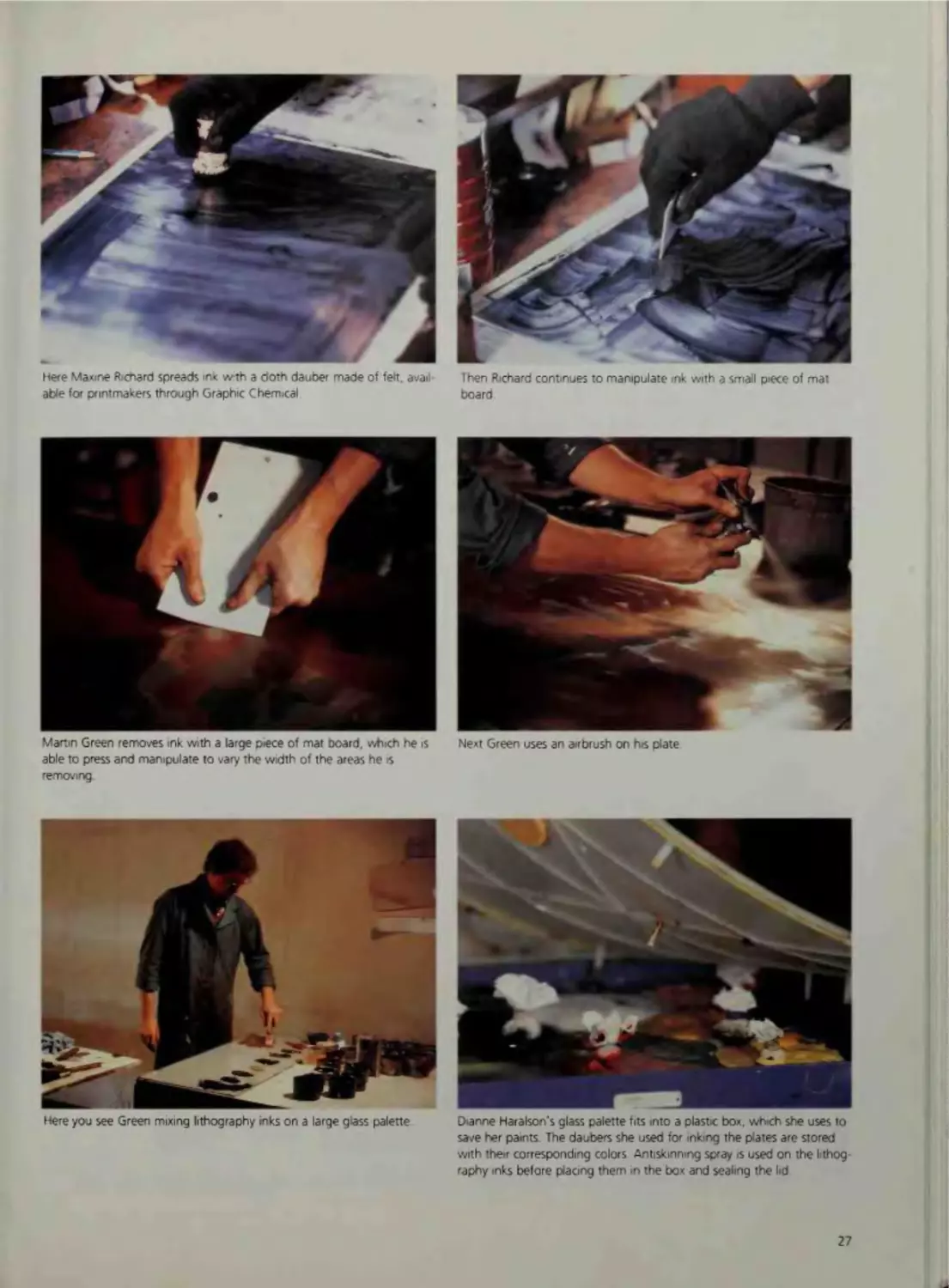
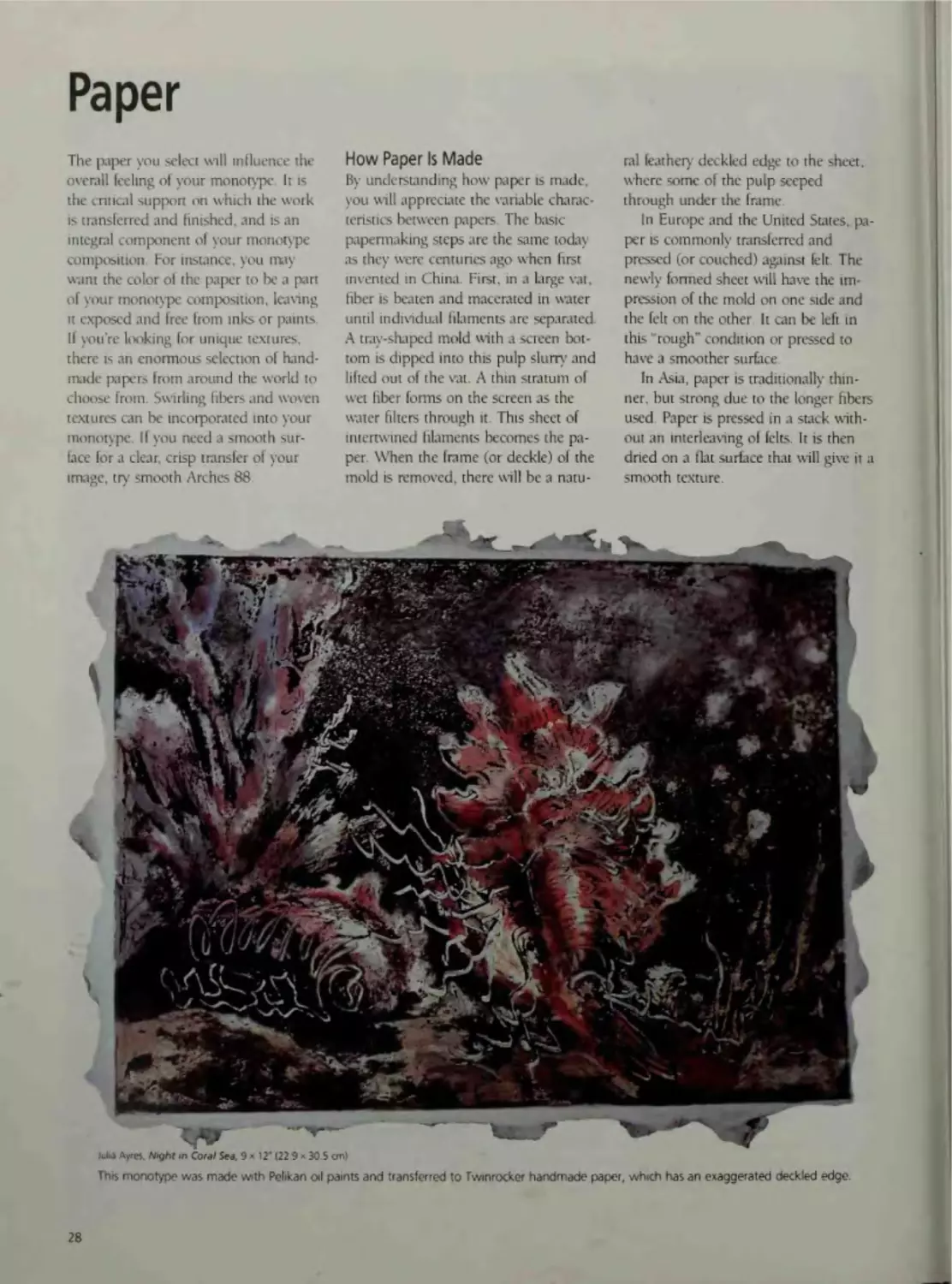
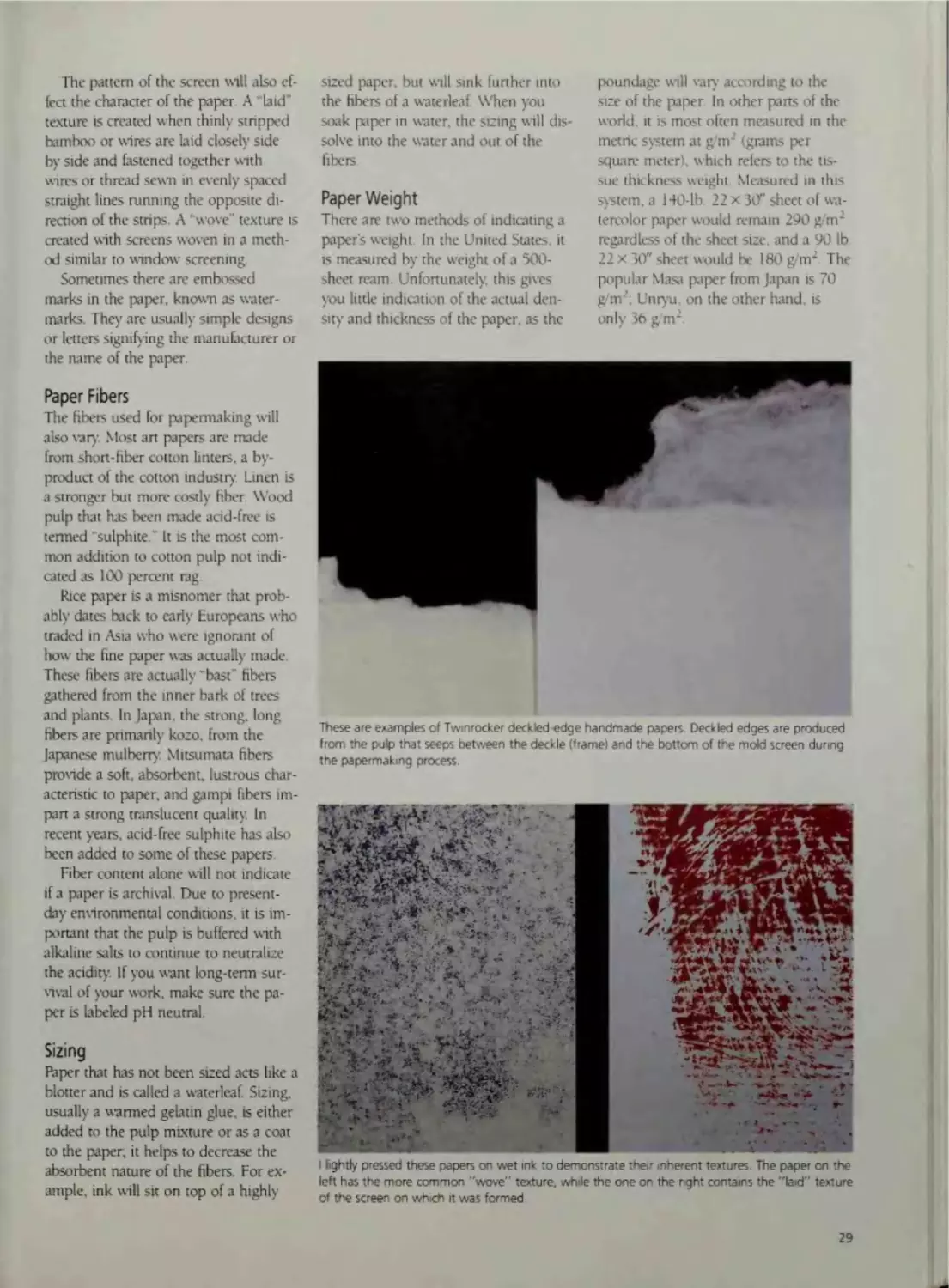
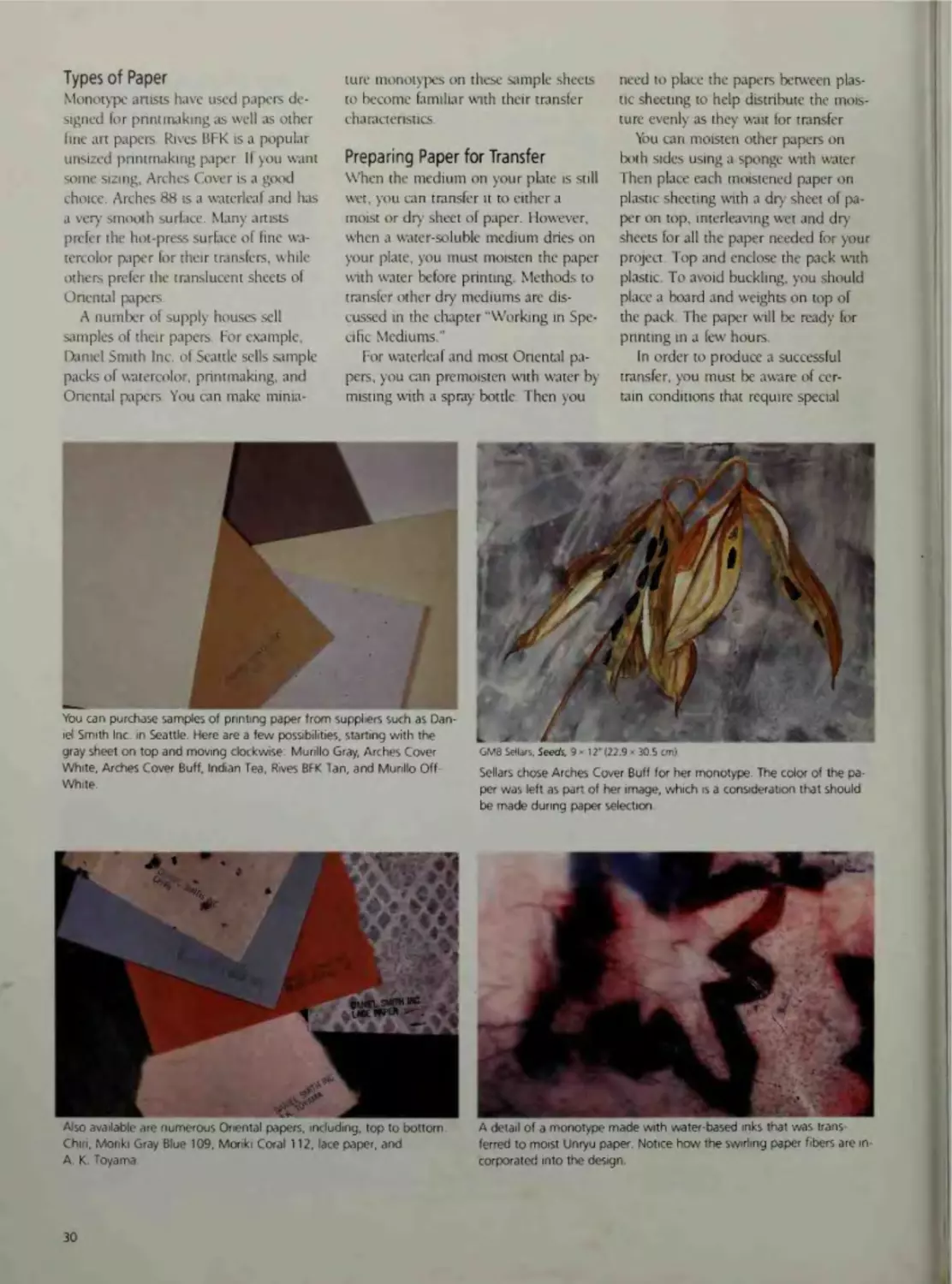

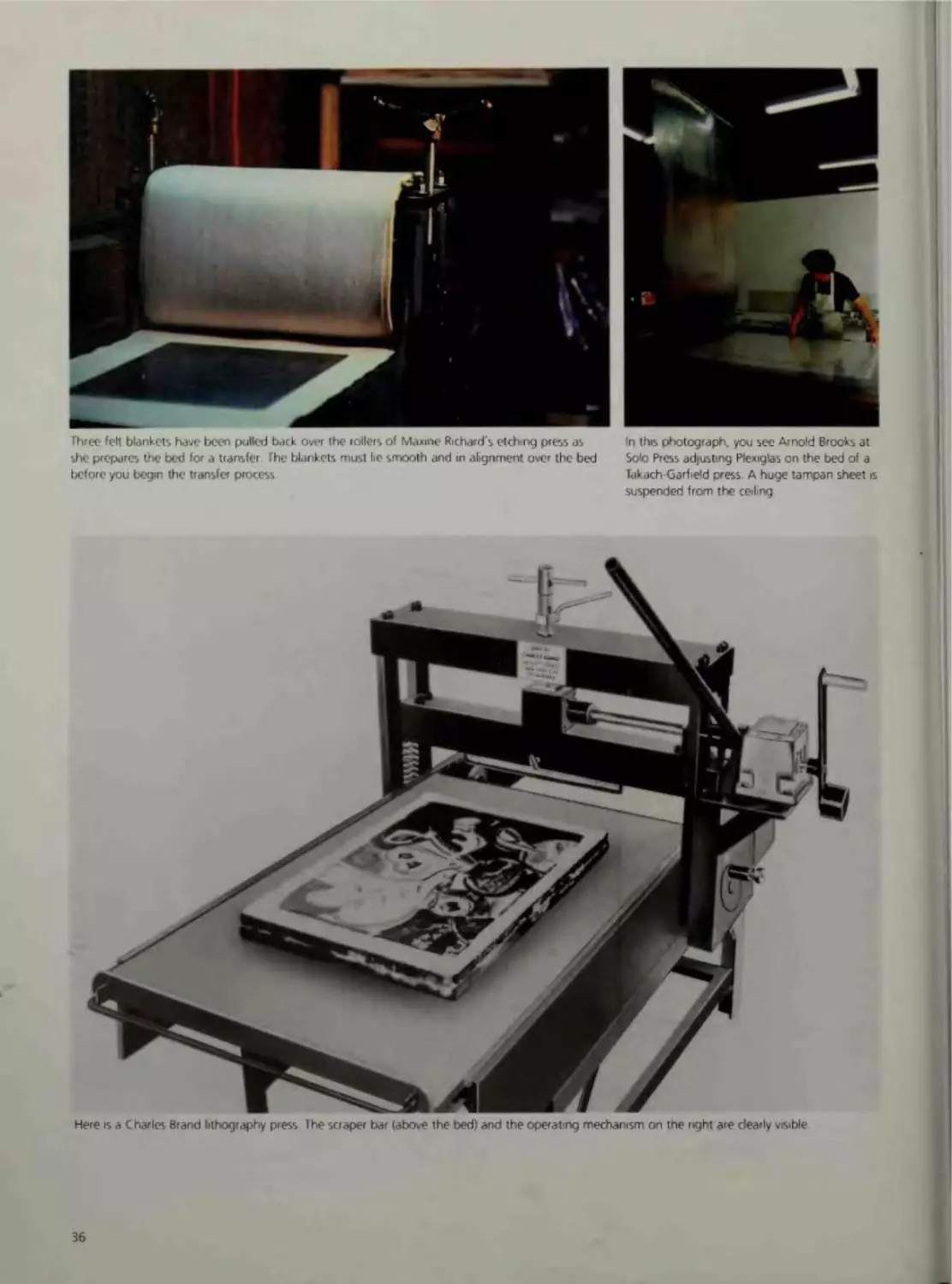


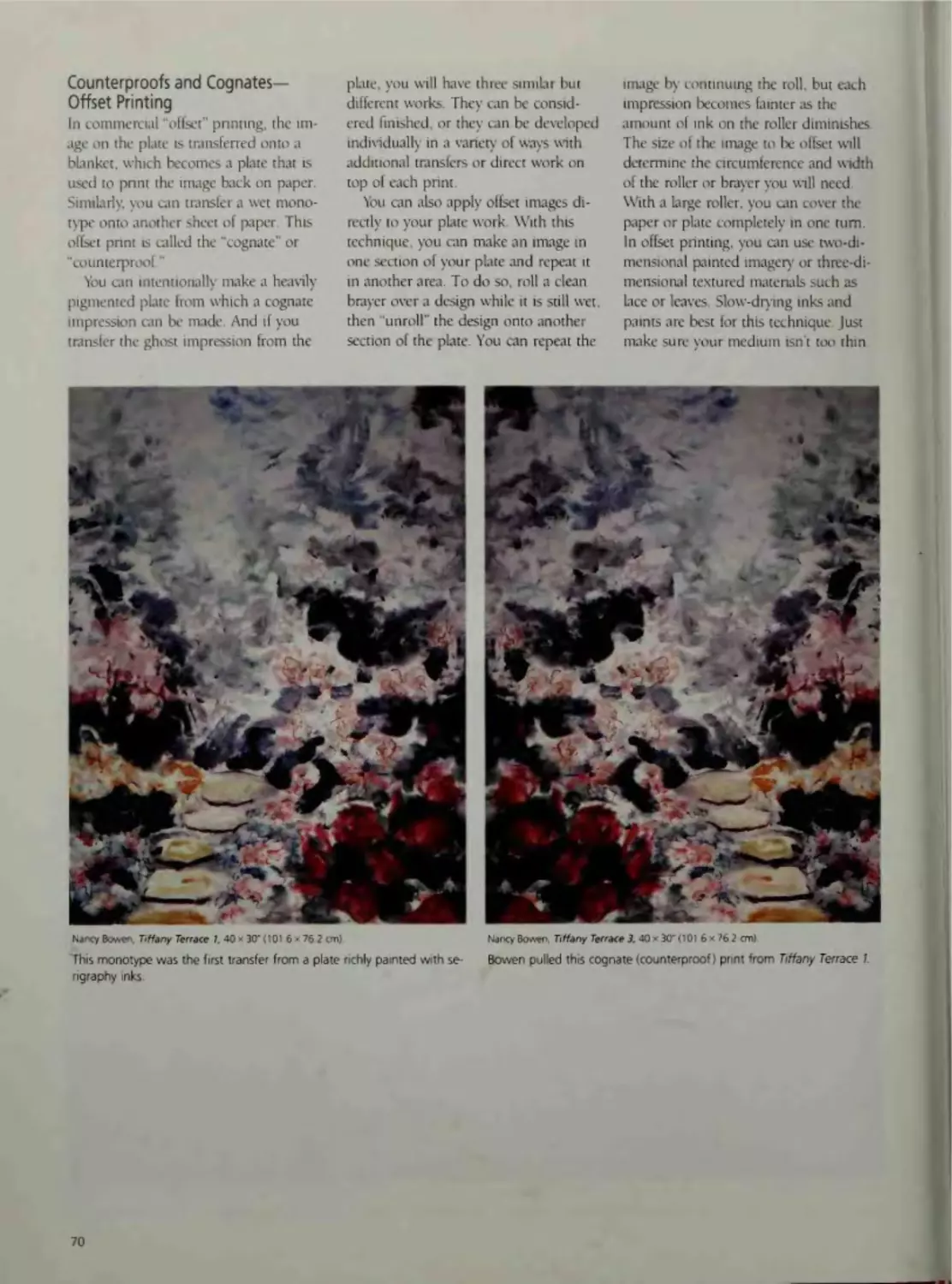












Text
#m04bH
Medrafhs and Ml|hbqs
«>»
*#k* *
for Painterly Prlntmaking
Julia
'IB.
<4
Ayres
$29.95
USA
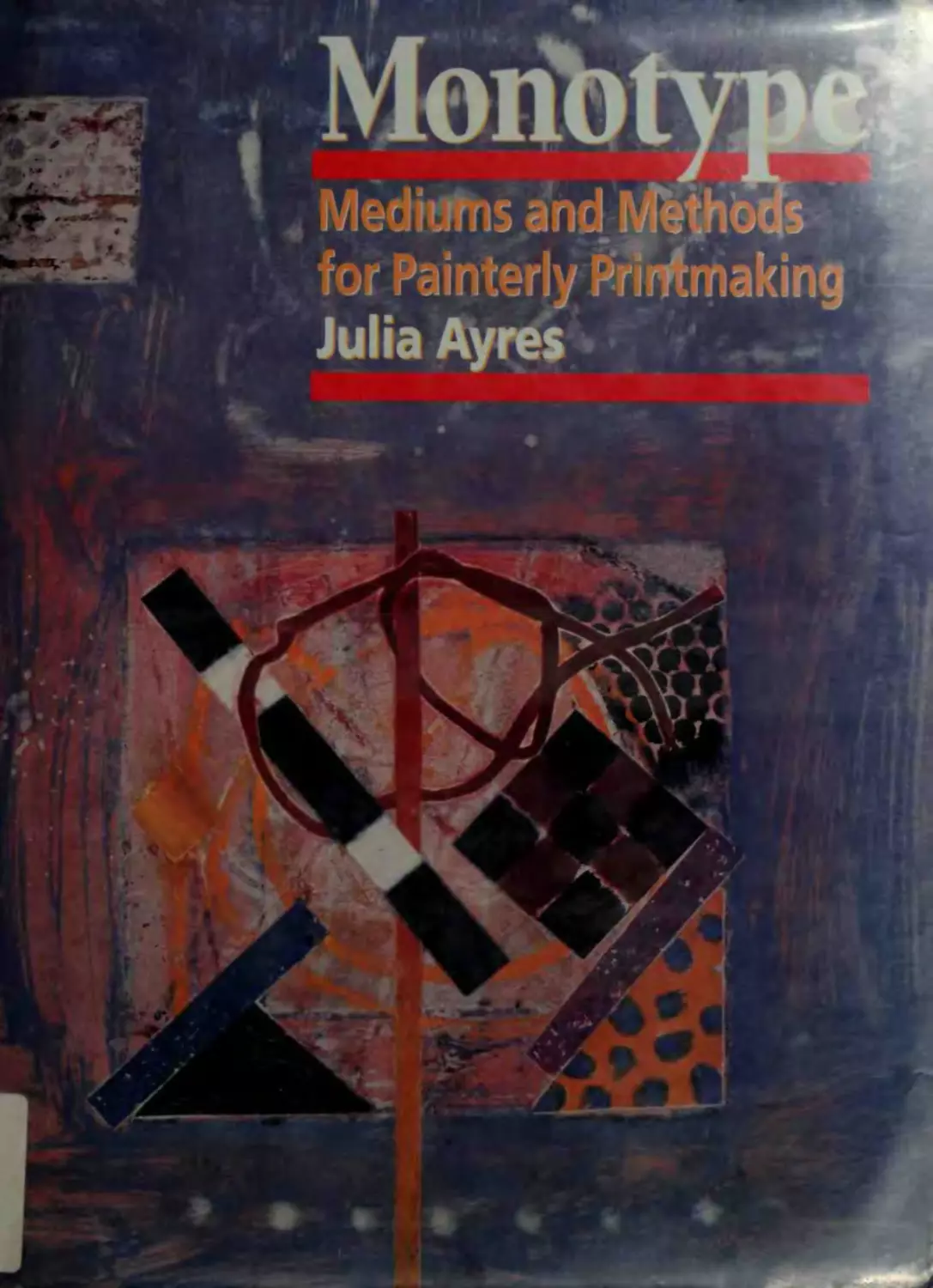
Monc ype
'
Mediums and Methods
for Painterly Printmaking
Ayres
Julia
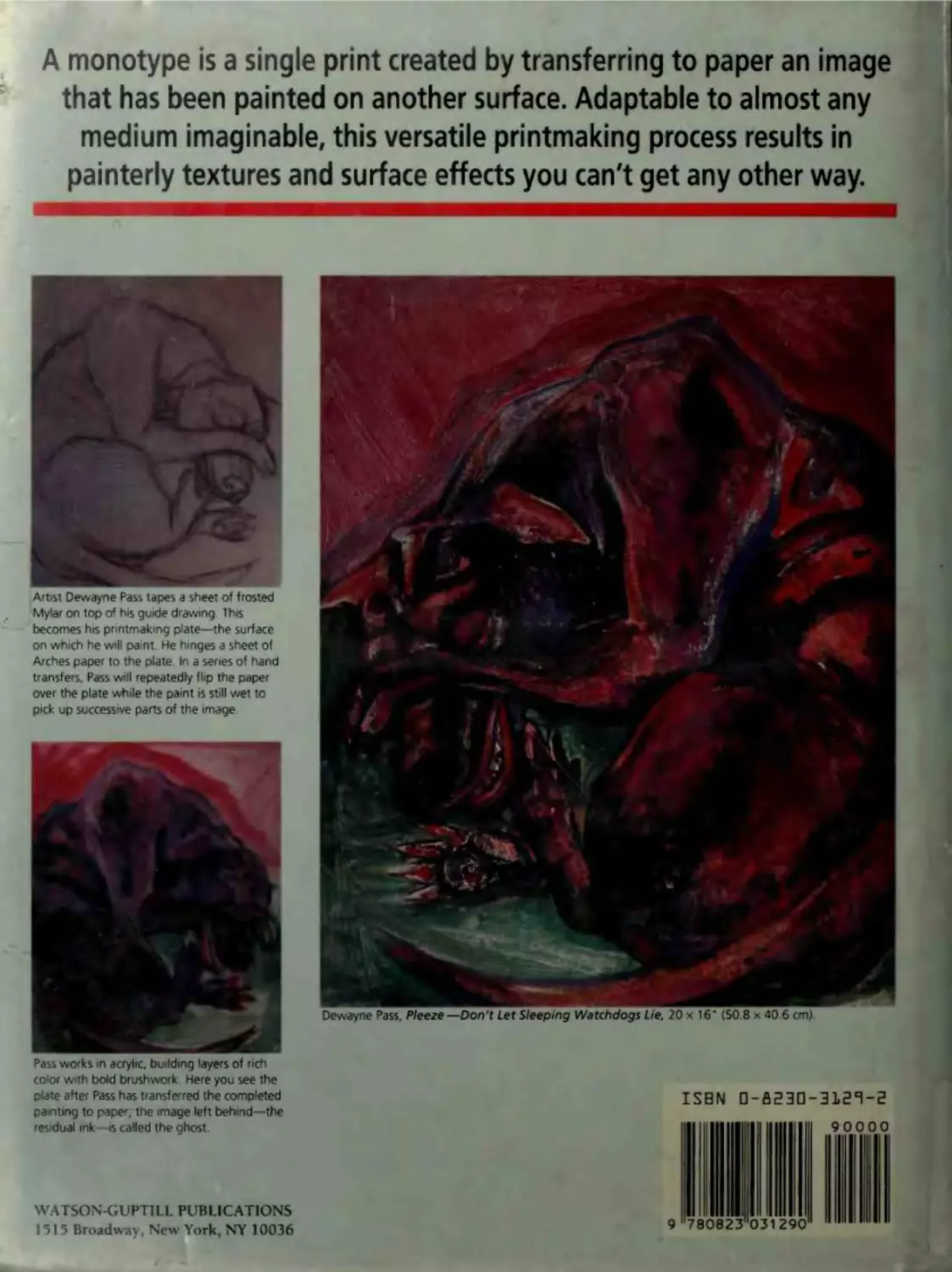
monotype has enjoyed a surge of
popularity in recent years, and many artists who
work in mediums other than printmaking have
The
art of
been actively exploring
Seizing
upon
creative potential.
its
growing
this
interest, Julia
Ayres
has written a much-needed book that both
teaches
how
to
make monotypes and documents
the varied approaches of a wide range of
In brief, a
monotype
by transferring
is
artists.
a single print created
paper an image that has been
to
painted on a plate
made
of metal, glass, or
another material. Transfer
is
accomplished either
by hand rubbing or on an etching or lithography
press, resulting in painterly textures
directlv
A
on paper.
brief history of
illustrated
artists as
is
and surface
cannot be obtained by working
effects that
monotype opens
the book,
with examples by such revered
Rembrandt, Gauguin, and Degas. This
followed by a comprehensive chapter on
materials
—
plates, oil-
and water-based mediums,
paper, painting and transfer tools, and presses.
Ayres then gives step-b> step demonstrations
ot the basic additive
techniques.
diverse
and subtractive imaging
The methods
mediums
working
for
and watercolor
hand and press trar
acrylics,
for
in
such
as printing inks, oil paints,
.
re
and techniques
n,
explained
with the aid of in-process photographs. Special
techniques are also cox red, including
masking, embossing, a
experimentation, and
made with
llaging,
mixed-media
—monotypes
monopnnts
intaglio, relief, or
another printmaking
process as a matrix.
In addition to providing a thorough survey
of this most painterly of printmaking processes,
Monotype boasts some of the
finest
examples of
such work being done today.
1-
2
-Ax
11"
(21x28
cm).
4
ll-color illustrations. In^ ^.
BOSTON
PUBLIC
LIBRARY
I
11m.
to*.o*A>nU
ft*^
1
'
*-£-£.
:?^'&±c&
M
>
'fo.
Monotype
Mediums and Methods
for Painterly Printmaking
Julia
Ayres
Watson-Guptill Publications /New York
BRIGHTON
Art on
first
For their efforts
page:
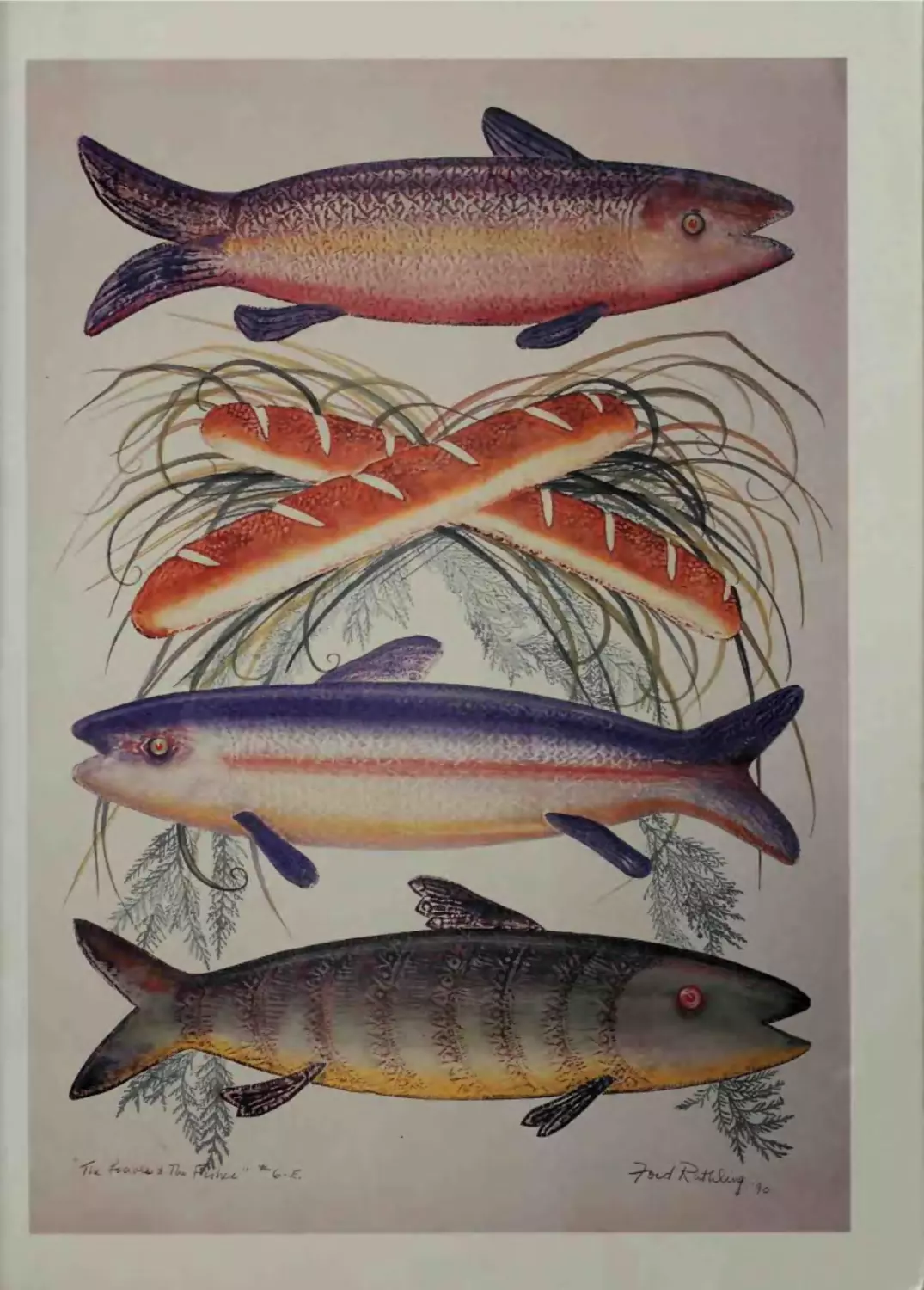
ford Ruthling,
The Loaves and the
prepare
Fishes,
embossed monotype. 29Vi x 42" (75 x 106.7 cm).
on
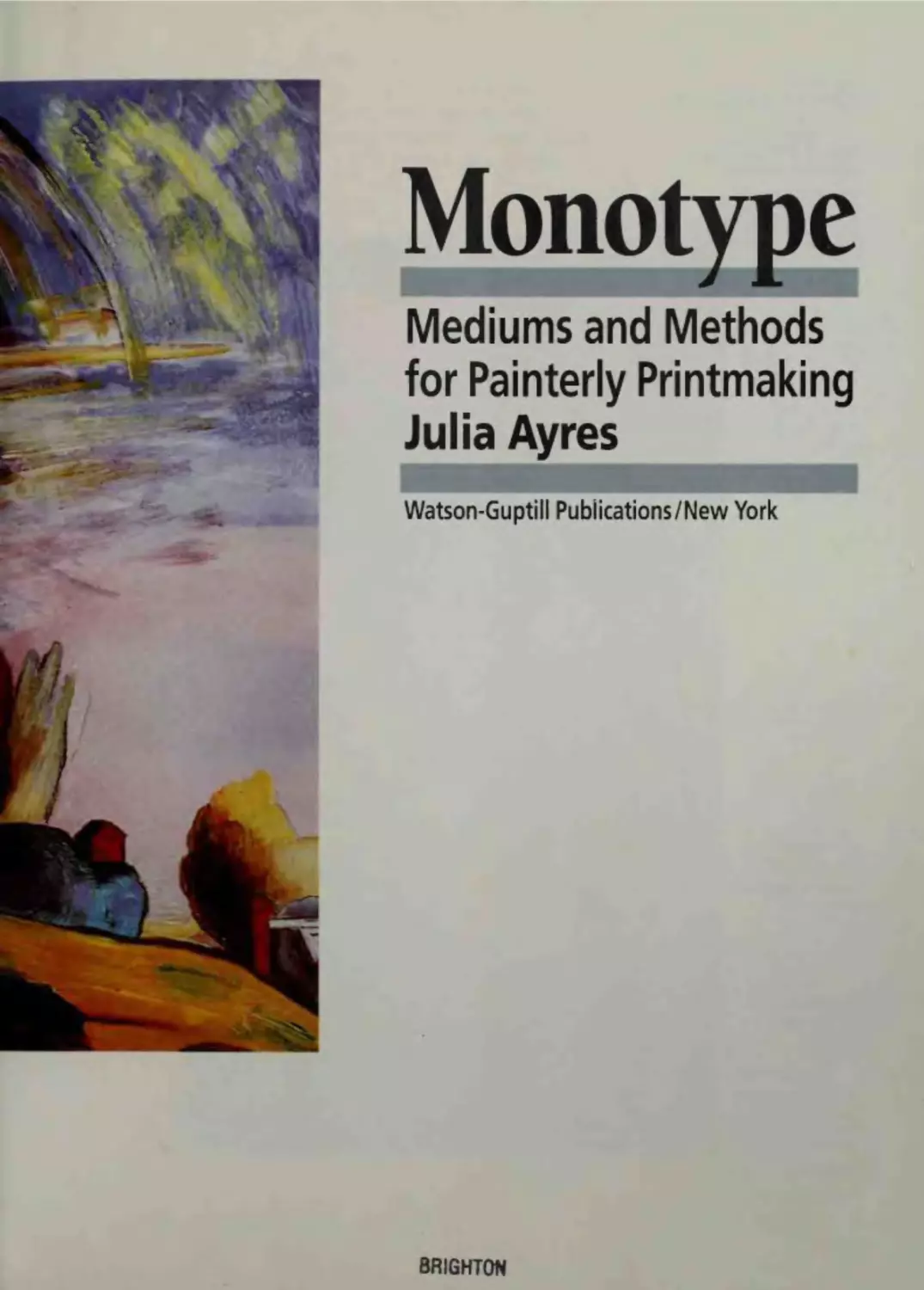
Nancy
Art
title
to
Johnson's Fence,
18x24" (45.7x61 Ocm) Courtesy of
in
book,
helping
I
am
me
grateful
of the contributing artists
and to these
page.
special consultants:
Patricia Alice
Fnese,
Giannetta
all
this
William Ayres
Gallery, Philadelphia
Vern Clark
Art
Richard Fleming
on dedication page:
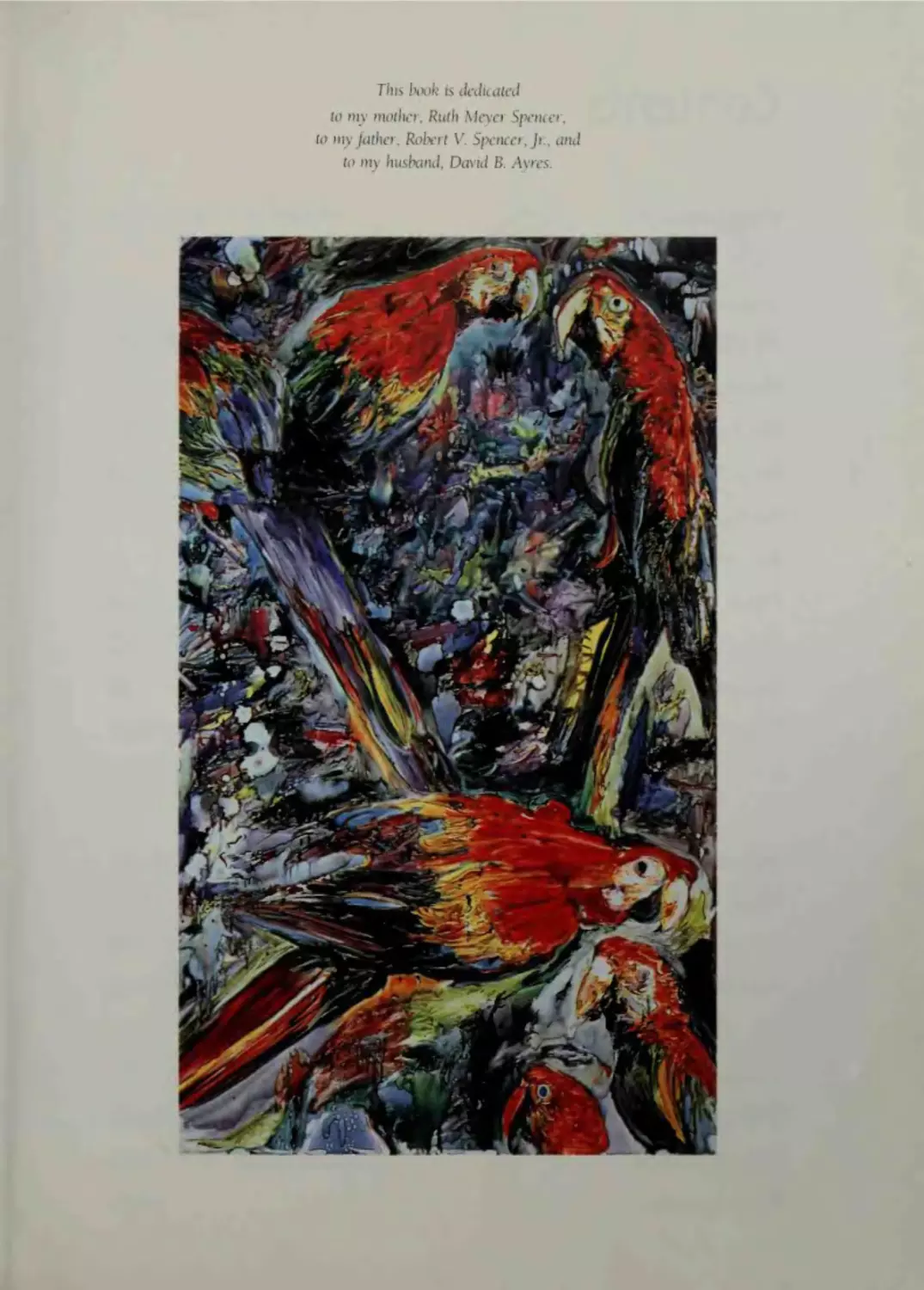
Joseph Raffael. San Diego Parrots,
62x38" (157.5x96
Martin Green
5 cm)
Chris Hicks
Courtesy of Experimental
Dorothy Hoyal
Workshop, San Francisco, and
Nancy Hoffman Gallery, New York
Mildred Karl
City.
Vmce Kennedy
Ann McLaughlin
Anne Morand
Ron Pokrasso
Kathryn Reddy
Daniel Smith
ft
Joseph Solman
Judith Solodkin
Mary Turnbull
Anthony Zepeda
I
would
also like to thank
editor, Lanie Lee,
Watson-Guptill
my
and the
staff, especially:
Candace Raney, Senior
Editor
Marian Appellof, Senior Editor
Ellen
Text set
in
10
ITC Berkeley Oldstyle Book
pt.
Edited by Lanie Lee
Graphic production by Ellen Greene
Copyright
First
©
1991 Julia Ayres
published
in
1991
in
the United States by
Watson-Guptill Publications, a division of
BPI Communications,
Library of
Inc.,
1515 Broadway,
New
York,
NY 10036
Congress Cataloging-in-Publication Data
Ayres, Julia S
Monotype
/
Julia S. Ayres.
cm.
p.
Includes index.
ISBN 0-8230-3129-2
1. Monotype (Engraving)
NE2242.A95 1991
— Technique.
I.
Title.
90-23570
CIP
760— dc20
Distributed
In
Europe, the Far East. Southeast and Central Asia, and
South America by RotoVision
All
rights reserved.
used
No
S.A.,
part of this publication
any form or by apy means
in
9 Route Suisse, CH-1295 Mies, Switzerland
— graphic,
may be reproduced
including photocopying, recording, taping, or information storage
retrieval
systems
Manufactured
First printing,
12
3
4
in
—without
written permission of the publisher.
Singapore
1991
5/95
94
93
92
91
or
electronic, or mechanical,
and
Greene, Production Manager
This book
dedicated
my mother, Ruth Meyer Spencer,
my father, Robert V. Spencer, Jr., and
to my husband, David B. Ayres.
to
to
is
Contents
8
Introduction
Chapter
1
Materials
13
Plates
14
Mediums
19
Solvents
24
Safety
in
24
the Studio
Painting Tools
and Palettes
25
Paper
28
Hand-Transfer Tools
32
Equipment for Press Transfer
34
Printmaking Workshop
37
Facilities
Chapter 2
Basic Imaging Techniques
39
Working
40
into a Light Field
Working from a Dark
Field
46
52
Additional Techniques
Chapter 3
Printing the Plate
Work
55
Hand Transfers
56
Press Transfers
64
Other Types of Transfers
67
Chapter 4
Working
in Specific
Mediums
73
Watercolors
74
Other Water-Based Mediums
82
Oil Paints
90
Oil-Based Printing Inks
98
Chapter 5
Special Techniques
1
Masks and
108
Stencils
07
Embossments
113
Collage
118
Chapter 6
Monoprints and Mixed-Media Monotypes
123
An Overview
of Intaglio Techniques
124
An Overview
of Other Techniques
130
Experimenting with Mixed Media
136
Biographical Notes
140
Mail-Order Supply Sources
142
Index
143
Introduction
My
tirst
types was,
"Why
paint on
a plate
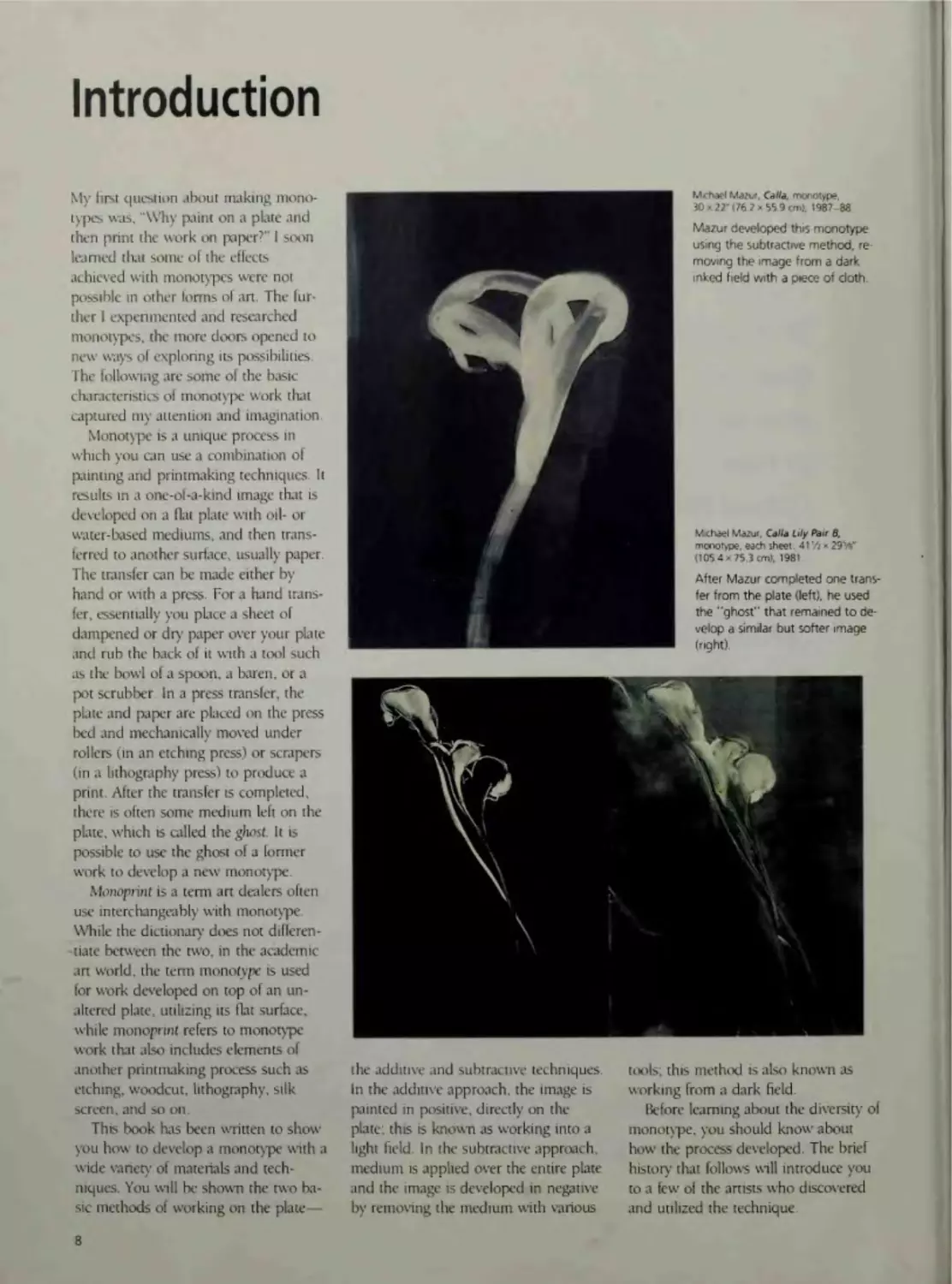
Mazur developed
work on paper?"
some of the effects
then print the
learned that
Michael Mazur, Calla, monotype,
30 x 22" (76 2 x 55 9 cm), 1987-88
monoand
question about making
soon
I
ther
The
art.
inked
with a piece of cloth.
field
fur-
experimented and researched
1
monotypes,, the more doors opened
new ways
of exploring
The following
my
captured
to
possibilities.
its
some of the basic
monotype work that
are
characteristics of
attention
and imagination.
Monotype is a unique process in
which you can use a combination of
painting and pnntmaking techniques.
results in a one-of-a-kind
developed on a
image
that
It
is
plate with oil- or
flat
water-based mediums, and then trans-
Michael Mazur, Calla Lily Pair B,
ferred to another surface, usually paper.
(105 4
x753
After
Mazur completed one
monotype, each sheet: 41
The
made
transfer can be
hand or with
fer,
re-
moving the image from a dark
achieved with monotypes were not
possible in other forms of
monotype
this
using the subtractive method,
by
either
hand
a press. For a
trans-
fer
fr
x
29W
from the plate
(left),
trans-
he used
the "ghost" that remained to de-
you place a sheet of
essentially
y
cm), 1981.
velop a similar but softer image
dampened or dry paper over your plate
(right).
and rub the back of
as the
it
with a tool such
bowl of a spoon, a baren, or a
pot scrubber. In a press transfer, the
and paper
plate
on
are placed
the press
bed and mechanically moved under
rollers (in
an etching press) or scrapers
produce a
(in a lithography press) to
print. After the transfer
often
there
is
plate,
which
is
completed,
some medium
is
left
called the ghost.
on the
It is
possible to use the ghost of a former
work
to
develop a
Monoprint
is
new monotype.
a term art dealers often
use interchangeably with monotype.
While the dictionary does not
tiate
between the two,
in the
art
world, the term monotype
for
work developed on top
altered plate, utilizing
differen-
academic
is
used
of an un-
its flat
surface,
while monoprint refers to monotype
work
that also includes elements of
another pnntmaking process such as
etching, woodcut, lithography, silk
screen,
and so on.
wide
sic
to develop a
show
monotype with a
variety of materials
niques.
You
will
be
and subtractive techniques.
In the additive
approach, the image
is
painted in positive, directly on the
This book has been written to
you how
the additive
and
shown
methods of working on
tech-
the
two ba-
the plate
plate; this
is
known
as
working
light field. In the subtractive
medium
is
into a
approach,
applied over the entire plate
and the image
is
by removing the
developed
in negative
medium with
various
tools; this
method
working from
a
is
dark
also
known
as
field.
Before learning about the diversity of
monotype, you should know about
how
the process developed.
The
brief
history that follows will introduce
who
to a
few of the
and
utilized the technique.
artists
you
discovered
History
The
earliest
known monotypes were
other tools, such as brushes, to pro-
and printmaker. was expenmenting
duce an image.
with his intaglio plates. After inking a
It is
believed that he
used a pointed wooden tool to inscribe
plate,
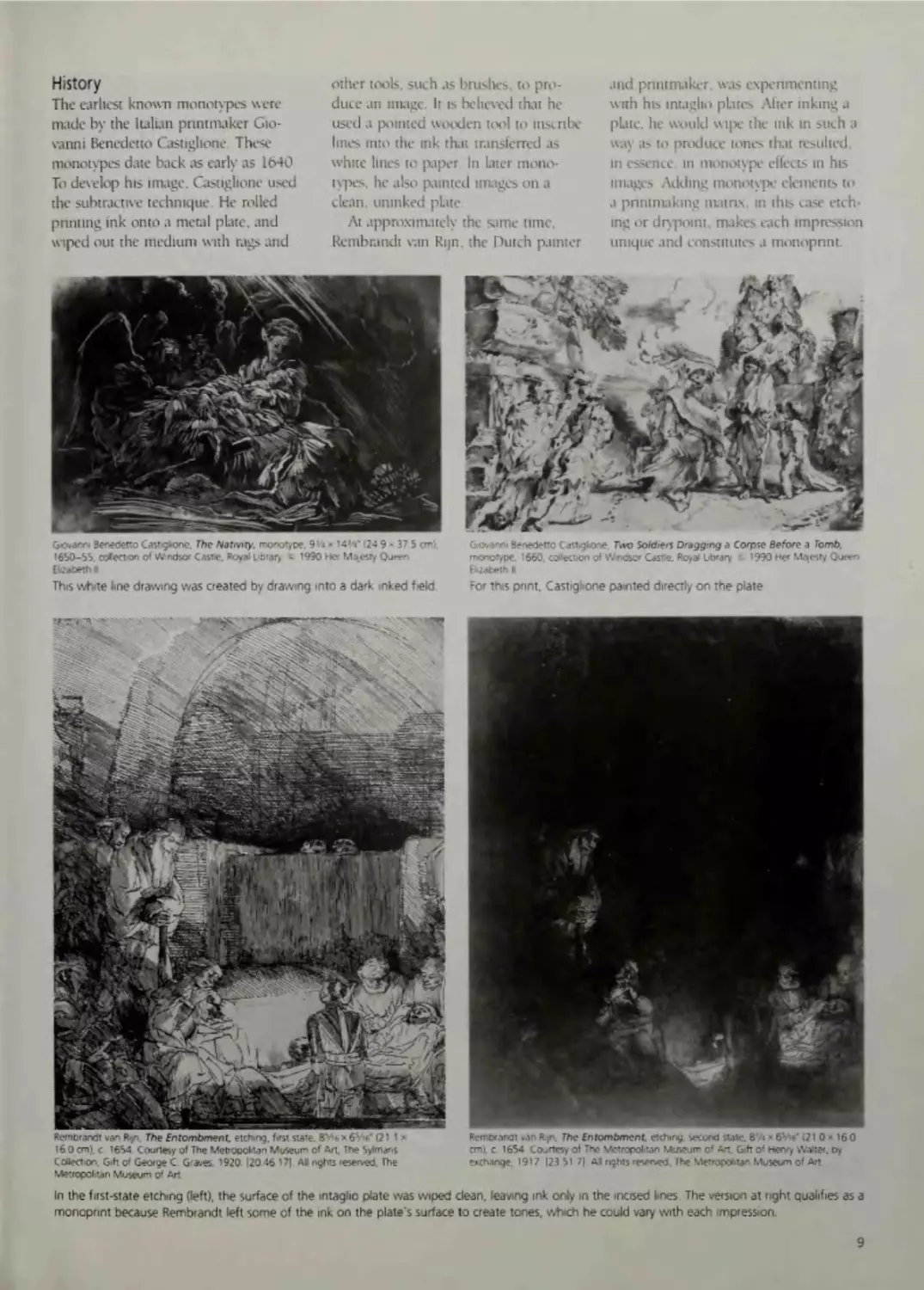
vanni Benedetto Castiglione. These
lines into the ink that transferred as
way
monotypes date back as
white lines to paper. In
made by
the Italian printmaker Gio-
early as 1640.
To develop his image, Castiglione used
the subtractive technique.
He
rolled
printing ink onto a metal plate,
types,
he also painted images on a
uninked
Rembrandt van
Elizabeth
Windsor
9%x 1 3/»" (24.9x37.5
£ 1990 Her Majesty Queen
cm),
c.
Rijn,
the
The Entombment,
etching,
1654. Courtesy of The Metropolitan
Collection, Gift of
Metropolitan
was created by drawing
first state,
Museum
George C. Graves. 1920 (2046.17].
Museum
first-state
into a dark inked field.
8Vi6x6 5/i6" (211 x
of Art, The Sylmans
All rights
reserved.
The
ing or drypoint,
Giovanni Benedetto Castiglione,
monotype, 1660,
collection of
Two
Soldiers
Windsor
Dragging a Corpse Before a Tomb,
e 1990 Her Majesty Queen
Castle, Royal Library,
II.
For this print, Castiglione painted directly
Rembrandt van
cm), c
makes each impression
unique and constitutes a monoprint.
Dutch painter
Elizabeth
Rembrandt van
In
cm),
II.
This white line drawing
160
Castle, Royal Library.
that resulted,
monotype effects in his
images. Adding monotype elements to
a pnntmaking matrix, in this case etch-
plate.
Rijn, the
produce tones
in essence, in
At approximately the same time,
Giovanni Benedetto Castiglione, The Nativity, monotype,
collection of
mono-
clean,
and
wiped out the medium with rags and
1650-55,
later
he would wipe the ink in such a
as to
Rijn,
The Entombment,
plate.
etching, second state, 8'/4x6Vi6" (21.0
1654. Courtesy of The Metropolitan
exchange, 1917 [23.51.7).
on the
Museum
All rights reserved.
x 16.0
of Art, Gift of Henry Walter, by
The Metropolitan Museum of
Art.
of Art.
etching
(left),
the surface of the intaglio plate
monoprint because Rembrandt
left
some
was wiped
clean, leaving ink only in the incised lines.
The version
at right qualifies as a
of the ink on the plate's surface to create tones, which he could vary with each impression.
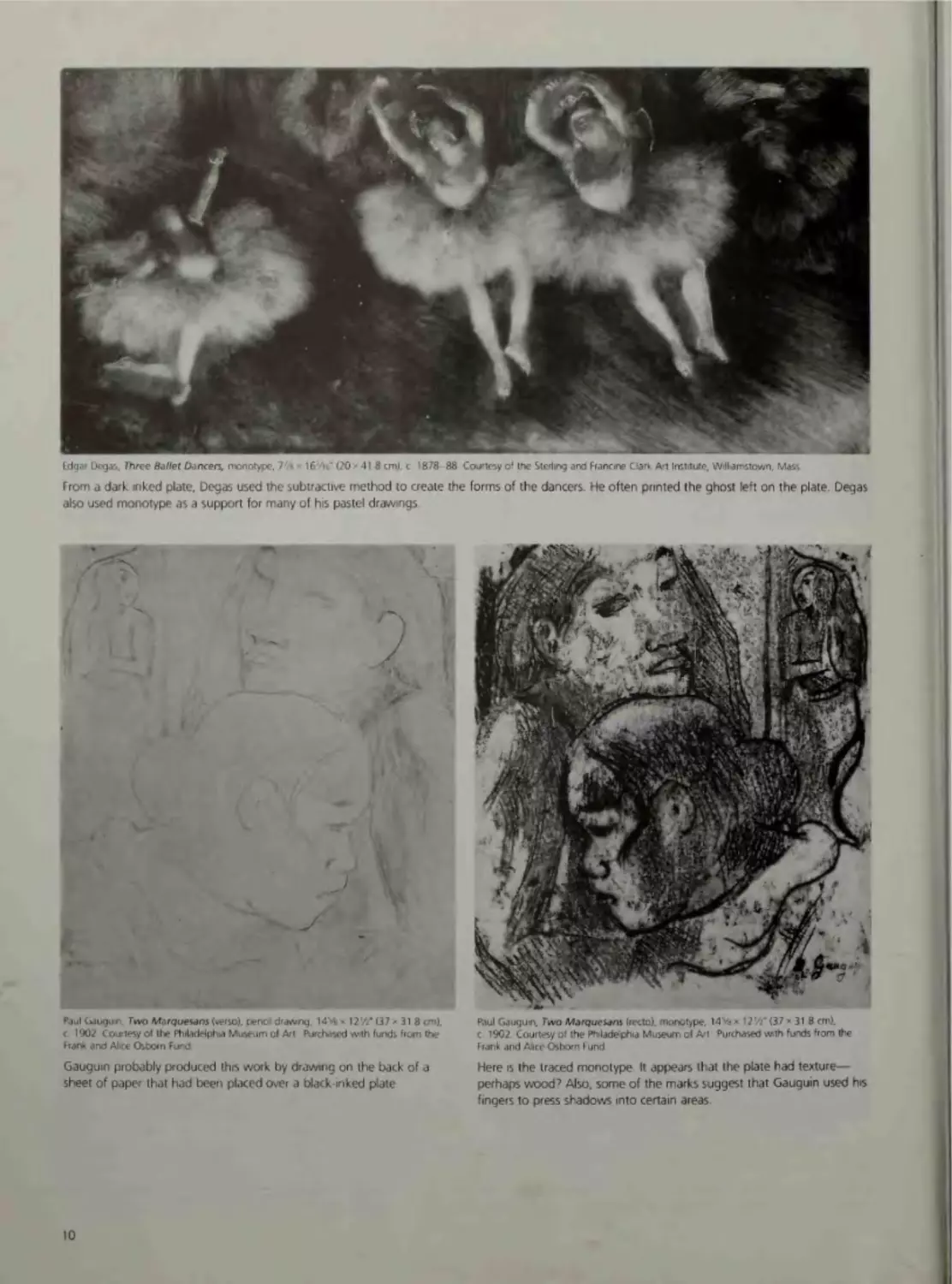
Edgar Degas, Three Ballet Dancers, monotype, V/z x
From a dark inked
also used
plate,
monotype
1
7
/i6"
(20 x 41
.8
cm),
c.
1
878-88 Courtesy
of the Sterling
and Francme Clark Art
Institute,
Williamstown, Mass
Degas used the subtractive method to create the forms of the dancers. He often printed the ghost
as a support for
many
«?\
left
on the
plate.
Degas
of his pastel drawings
I%
mu
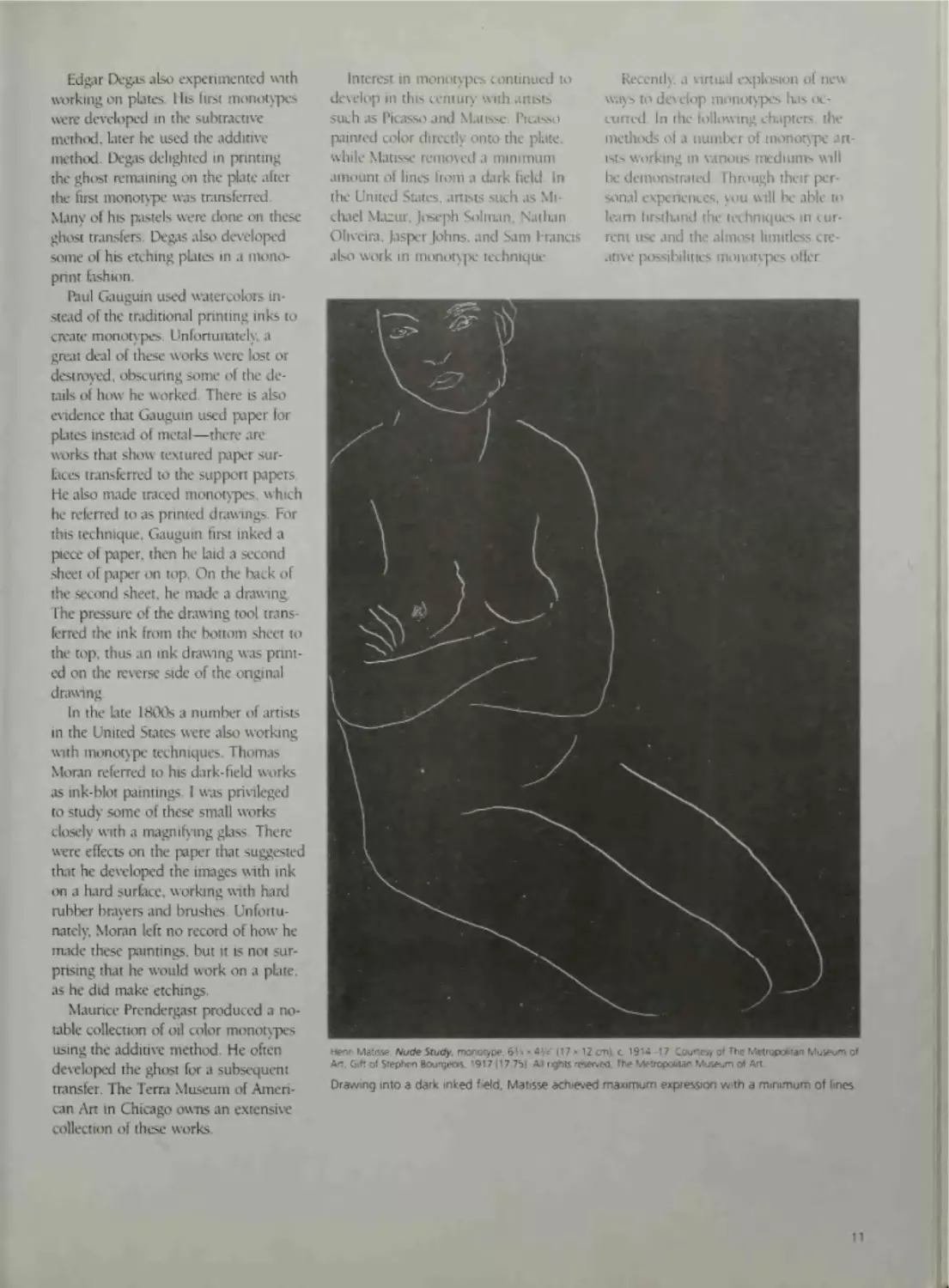
Paul Gauguin,
Two Marquesans
(verso), pencil
1902 Courtesy of the Philadelphia
Frank and Alice Osborn Fund
c.
Gauguin probably produced
Museum
this
drawing, 14V8 x 12'/?" (37 x 31.8 cm),
of Art: Purchased with funds from the
work by drawing on the back
sheet of paper that had been placed over a black-inked plate.
of a
Paul Gauguin,
Two Marquesans
Here
is
the traced monotype.
perhaps
wood?
fingers to press
10
(recto),
1902 Courtesy of the Philadelphia
Frank and Alice Osborn Fund.
c.
Also,
some
shadows
monotype, 14 5/bx 12
Museum
It
W (37x31.8
cm),
of Art: Purchased with funds from the
appears that the plate had texture
of the marks suggest that
into certain areas.
Gauguin used
his
Edgar Degas also experimented with
working on
were developed
method;
His
plates.
first
monotype was
first
Many
of his pastels
century with
while Matisse removed a
to
amount
plate after
minimum
of lines from a dark
field.
Recently, a virtual explosion of
ways
artists
In
to
new
develop monotypes has oc-
curred. In the following chapters, the
methods
ists
ol a
working
number
in
of
various
monotype
mediums
art-
will
be demonstrated. Through their per-
transferred.
the United States, artists such as Mi-
sonal experiences, you will be able to
were done on these
chael Mazur, Joseph Solman, Nathan
learn firsthand the techniques in cur-
ghost transfers. Degas also developed
some
monotypes continued
in this
painted color directly onto the plate,
in printing
on the
the ghost remaining
Interest in
develop
such as Picasso and Matisse. Picasso
in the subtractive
he used the additive
later
method. Degas delighted
the
monorypes
of his etching plates in a
Oliveira, Jasper Johns,
mono-
also
work
in
and Sam Francis
monotype technique.
rent use
and the almost
ative possibilities
limitless cre-
monotypes
offer.
print fashion.
Gauguin used watercolors
Paul
in-
stead of the traditional printing inks to
monotypes. Unfortunately, a
create
great deal of these
works were
some
destroyed, obscuring
tails
how
of
lost
or
of the de-
he worked. There
also
is
evidence that Gauguin used paper for
plates instead of metal
works
that
show
—
faces transferred to the
He
made
also
there are
textured paper sur-
support papers.
which
traced monotypes,
he referred to as printed drawings. For
Gauguin
this technique,
first
inked a
piece of paper, then he laid a second
on
sheet of paper
On
top.
the back of
made
the second sheet, he
a drawing.
The pressure of the drawing
ferred the ink
tool trans-
from the bottom sheet
the top; thus an ink
to
drawing was print-
ed on the reverse side of the original
drawing.
In the late
1800s a number of
with monotype techniques.
Moran
Thomas
referred to his dark- field
as ink-blot paintings.
to
artists
United States were also working
in the
I
was
works
privileged
study some of these small works
closely with a magnifying glass.
were
that
effects
on
There
the paper that suggested
he developed the images with ink
on a hard
surface,
working with hard
rubber brayers and brushes. Unfortunately,
made
Moran
left
prising that he
as
no record of how he
these paintings, but
it is
not sur-
would work on a
plate,
he did make etchings.
Maurice Prendergast produced a no-
table collection of oil color
monotypes
using the additive method.
He
developed the ghost
transfer.
for a
often
subsequent
The Terra Museum
of Ameri-
Art, Gift of
Nude Study, monotype, 6 3A x4 3A" (17 x 12 cm), c. 1914-17. Courtesy of The Metropolitan
Stephen Bourgeois, 1917 [17.75], All rights reserved. The Metropolitan Museum of Art.
Drawing
into a dark inked field, Matisse achieved
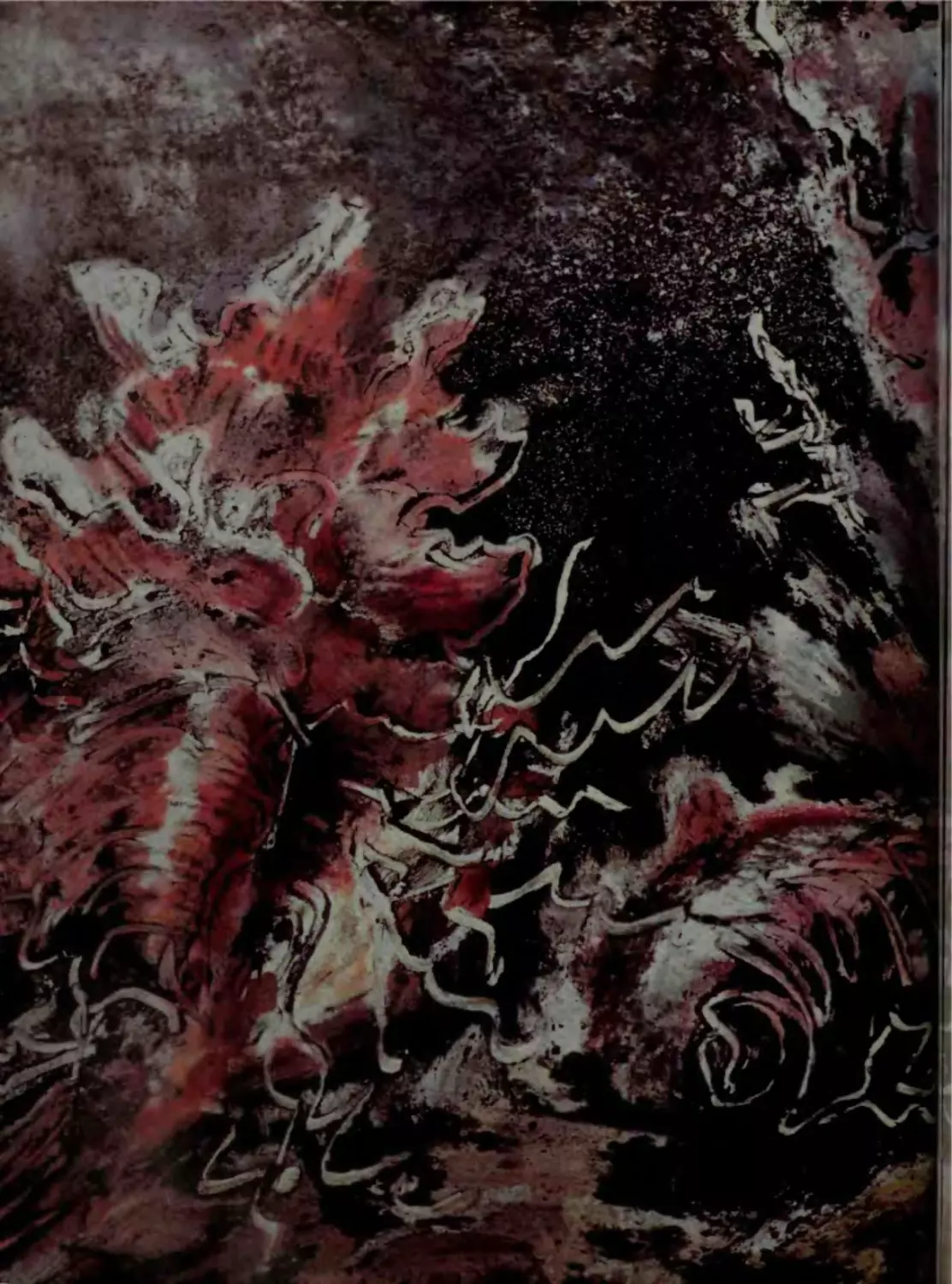
Henri Matisse,
maximum
expression with a
Museum
minimum
of
of
lines.
can Art in Chicago owns an extensive
collection of these works.
11
%
m
s<*
c>
•
'<$'-
Chapter
1
Materials
Monotype
dom
to
is
a spontaneous technique that gives
work with
a
wide selection of
and oil-based inks and paints
and
pastels,
your choice
materials.
you the
From
free-
water-
to water-soluble crayons, pencils,
may be based on
personal preference,
material availability, or the spirit of experimentation.
The variety of mediums, plates, papers, tools, and transfer
methods that you have to choose from will encourage you to
collage
and combine
different materials
Through experience, you
will discover
and techniques.
your personal prefer-
ences and style for developing a monotype.
'
:*r
;
Because there
is
such a large range of materials,
deals with the most available ones on the market.
familiarize
you with the basic terms and
this chapter
It
will help
characteristics of var-
ious plates, mediums, solvents, painting tools, palettes, papers,
transfer tools,
the specific
and presses, so
that
methods described
you
will be able to follow
in later chapters.
St*
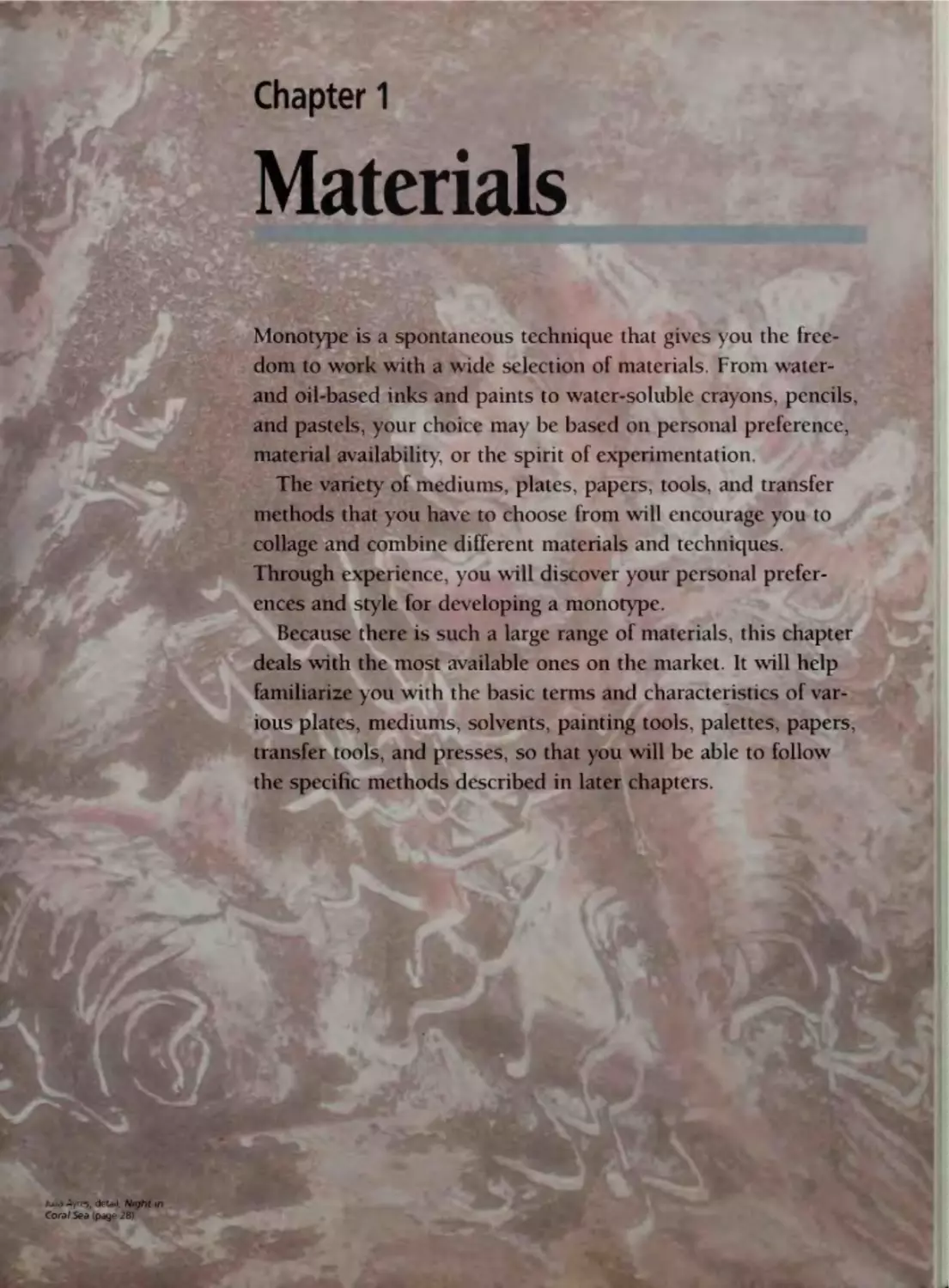
Julia Ayres. detail.
Night
in
Coral Sea (page 28)
IL
Plates
The
surface
monotype
on which you paint
is
metal, glass, sealed paper,
ly,
and
wood have been used
nished
a
a
var-
tor this
purpose. With the advent of plastics,
there
to
is
a larger
work from,
list
of materials lor
and shape of
are
on
number
may be more
per, or Plexiglas
When
22 x
working small,
you
30",
plate
is
desirable
num, or
a
let's
you
It
and
a
work,
number
suitable.
say under
affordable.
plastic,
How-
of paper materials
which can be
and 18 gauge. The smaller number
spoon over them. The
bowl of
a
used
both hand and press transfers
in
transter
may damage
method.
press
by-
One
the paper.
exception
when
work
is
is
needed. Materials should
budget.
surface
when
transferred.
On
Metal Plates
Copper and
zinc plates are
most often
placing
used by etchers, while aluminum plates
are primarily used
duced when your paper
monotypes, the
size or larger than
your
plate.
same
white borders are produced by placing
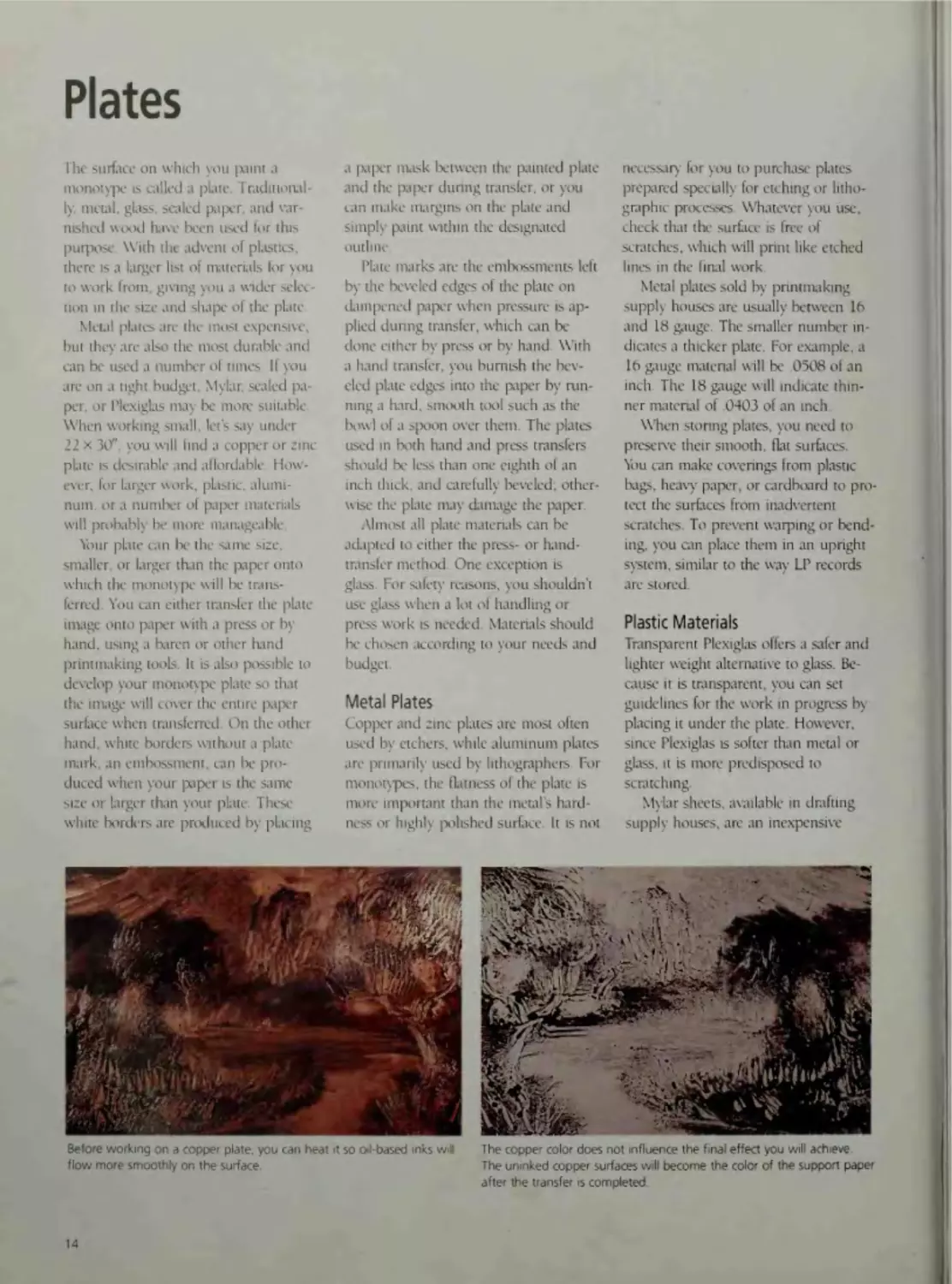
Before working on a copper plate, you can heat
flow more smoothly on the surface.
by lithographers. For
flatness of the plate
more important than
These
so oil-based inks wi
It is
it
it
is
set
by
in progress
plate.
However,
softer than metal or
more predisposed
to
scratching.
is
not
Mylar sheets, available
in drafting
supply houses, are an inexpensive
The uninked copper surfaces
is
is
glass. Be-
you can
work
under the
The copper color does not influence the
after the transfer
14
transparent,
since Plexiglas
glass,
the metal's hard-
ness or highly polished surface.
it
weight alternative to
it is
guidelines for the
mark, an embossment, can be prothe
Plastic Materials
Transparent Plexiglas offers a safer and
lighter
hand, white borders without a plate
is
are stored.
cause
the other
from inadvertent
a lot ot handling or
develop your monotype plate so that
the image will cover the entire paper
plastic
To prevent warping or bending, you can place them in an upright
system, similar to the way LP records
printmaking
also possible to
to
surfaces.
bags, heavy paper, or cardboard to protect the surfaces
be chosen according to your needs and
It is
flat
scratches.
hand, using a baren or other hand
tools.
you need
plates,
You can make coverings from
plate materials can be
all
stonng
will indicate thin-
preserve their smooth,
For safety reasons, you shouldn't
use glass
either transfer the plate
The 18 gauge
When
plates
than one eighth of an
less
in-
dicates a thicker plate. For example, a
16 gauge material will be .0508 of an
adapted to either the press- or hand-
glass.
image onto paper with a press or
Metal plates sold by printmaking
ner material of .0403 of an inch.
which the monotype
You can
etched
like
work.
ning a hard, smooth tool such as the
smaller, or larger than the paper onto
ferred.
free of
inch.
Almost
be trans-
is
pnnt
eled plate edges into the paper by run-
wise the plate
size,
will
supply houses are usually between 16
ap-
you burnish the bev-
transfer,
which
lines in the final
on
is
by press or by hand. With
either
hand
plate
pressure
left
inch thick, and carefully beveled; other-
probably be more manageable.
will
marks are the embossments
should be
alumi-
Your plate can be the same
scratches,
done
copper or zinc
will find a
ever, tor larger
will
ot times.
check that the surface
plied during transfer,
a tight budget. Mylar, sealed pa-
etching or litho-
for
outline.
dampened paper when
Metal plates are the most expensive,
necessary for you to purchase plates
prepared specially
simply paint within the designated
by the beveled edges of the
the plate.
you
graphic processes. Whatever you use,
Plate
but they are also the most durable and
can be used a
transfer, or
can make margins on the plate and
you
giving you a wider selec-
tion in the size
paper mask between the painted plate
and the paper during
called a plate. Traditional-
will
completed.
final effect
become the
you
will
achieve.
color of the support paper
When
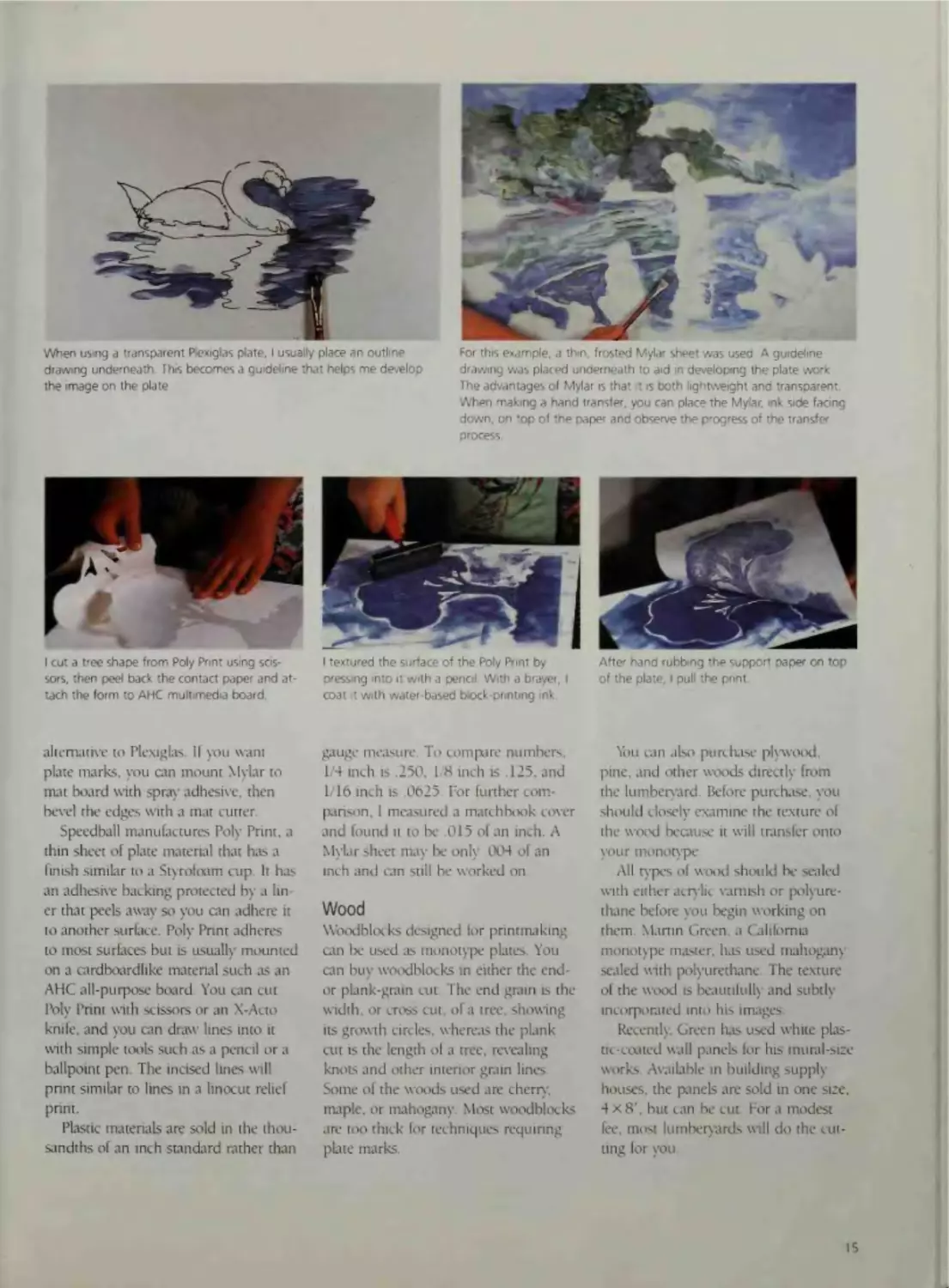
using a transparent Plexiglas plate,
usually place
I
an outline
drawing underneath. This becomes a guideline that helps
me
was
For this example, a thin, frosted Mylar sheet
drawing was placed underneath to aid
develop
The advantages of Mylar
the image on the plate.
When making
hand
a
is
that
it
is
in
used.
A
both lightweight and transparent.
you can place the Mylar,
transfer,
guideline
developing the plate work.
down, on top of the paper and observe the progress
ink side facing
of the transfer
process.
I
cut a tree shape from Poly Print using
sors,
scis-
then peel back the contact paper and
tach the form to
AHC
multimedia board.
alternative to Plexiglas.
plate marks,
I
at-
If
coat
cutter.
Speedball manufactures Poly Print, a
Styrofoam cup.
er that peels
has
It
an adhesive backing protected by a
away so you can adhere
another surface. Poly Print adheres
to
most surfaces but
on
usually
all-purpose board.
it
mounted
a cardboardlike material such as
AHC
You can
an
cut
Poly Print with scissors or an X-Acto
knife,
and you can draw
lines into
it
with simple tools such as a pencil or a
ballpoint pen.
The
.250, 1/8 inch
is
parison,
measured
and found
.125,
.0625. For further
1/16 inch
I
is
it
to
a
and
com-
inch and can
matchbook cover
be .015 of an inch.
still
incised lines will
I
pull
the
You can
pine,
also purchase
and other woods
A
the
wood
because
be worked on.
you
it
will transfer
onto
All types of
wood should be
sealed
with either acrylic varnish or polyure-
Wood
thane before you begin working on
Woodblocks designed
for
printmaking
them. Martin Green, a California
can be used as monotype plates. You
monotype master, has used mahogany-
can buy woodblocks in either the end-
sealed with polyurethane.
or plank-grain cut.
The end
width, or cross cut, of a
its
growth
cut
is
circles,
grain
tree,
is
the
showing
whereas the plank
the length of a tree, revealing
knots and other interior grain
lines.
of the
wood
is
beautifully
Recently,
Green has used white
are too thick for techniques requiring
fee,
plate marks.
ting for you.
are cherry,
plas-
works. Available in building supply
4x8', but can be
woods used
texture
tic-coated wall panels for his mural-size
maple, or mahogany. Most woodblocks
of the
The
and subtly
incorporated into his images.
print.
sandths of an inch standard rather than
from
your monotype.
Some
thou-
plywood,
directly
should closely examine the texture of
print similar to lines in a linocut relief
Plastic materials are sold in the
print.
the lumberyard. Before purchase,
lin-
to
is
is
of the plate,
ink.
Mylar sheet may be only .004 of an
thin sheet of plate material that has a
finish similar to a
with water-based block-printing
1/4 inch
to
mat board with spray adhesive, then
mat
it
hand rubbing the support paper on top
After
with a pencil. With a brayer,
it
gauge measure. To compare numbers,
you want
you can mount Mylar
bevel the edges with a
textured the surface of the Poly Print by
pressing into
houses, the panels are sold in one size,
cut.
most lumberyards
For a modest
will
do
the cut-
15
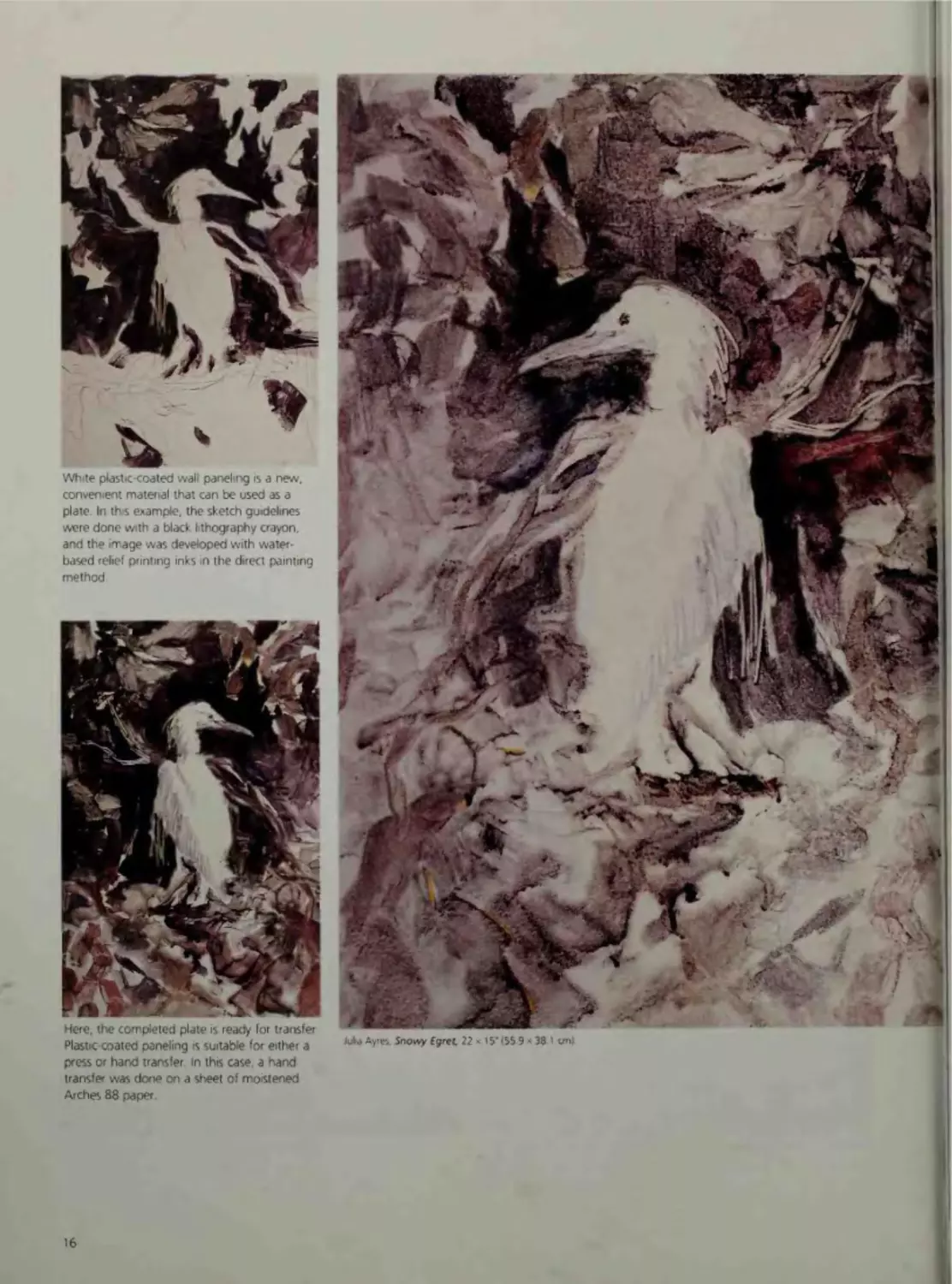
White plastic-coated wall paneling
is
a
new,
convenient material that can be used as a
plate. In this
example, the sketch guidelines
were done with
a black lithography crayon,
and the image was developed with waterbased
relief
printing inks in the direct painting
method.
Here, the completed plate
Plastic-coated paneling
press or
hand
16
is
ready for transfer.
suitable for either a
transfer. In this case, a
was done on
Arches 88 paper.
transfer
is
hand
a sheet of moistened
composed
Masonite, a board
wood fibers, can be
number of ways and used
of
pressed
finished in
a
as a plate.
You can coat
You can
can.
with white or clear
it
using either a brush or spray
acrylic,
also texture Masonite with
modeling paste or gesso
embossed
produce
to
textures.
Paper, Cardboard, Canvas
The
variety of textures
found
in
heavy
and canvas make
papers, cardboard,
for
unique plate surfaces (corrugated
board, sandpaper, loose-weave canvas,
and so
With paper and cardboard,
on).
you can draw on the
and use
it
surface, seal
it,
as your plate. In the past,
varnishes were used to seal paper sur-
but today, fast-drying acrylic
faces,
mediums
sprays and liquid
A
an end- or
Lady Slipper
is
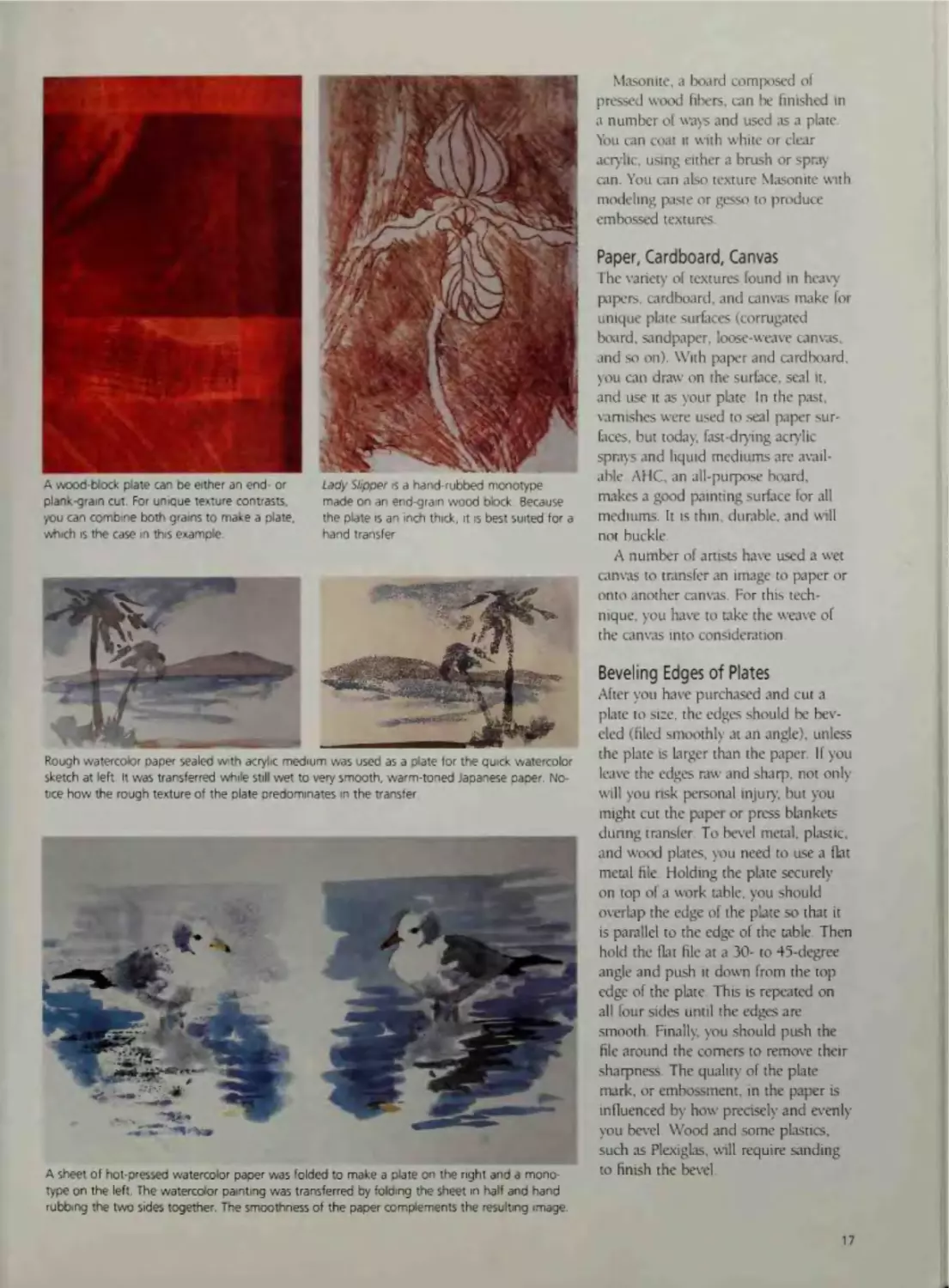
plank-grain cut. For unique texture contrasts,
made on an
end-grain
you can combine both grains to make a
the plate
wood-block plate can be
which
is
the case
in this
either
example.
plate,
hand
is
a
hand-rubbed monotype
an inch
wood
thick,
it
is
block.
Because
best suited for a
transfer.
AHC, an
able.
makes
are avail-
all-purpose board,
good painting surface
a
mediums.
for all
and
thin, durable,
It is
will
not buckle.
A number
of artists have used a wet
canvas to transfer an image to paper or
'
v
^M^
onto another canvas. For
this tech-
nique, you have to take the
weave of
the canvas into consideration.
^?
-ffiSHB
^
Beveling Edges of Plates
After
you have purchased and cut a
plate to size, the edges
should be bev-
eled (filed smoothly at an angle), unless
Rough watercolor paper sealed with acrylic medium was used as a plate for the quick watercolor
sketch at left. It was transferred while still wet to very smooth, warm-toned Japanese paper. Notice
how
the rough texture of the plate predominates
in
the transfer.
the plate
larger than the paper.
is
leave the edges raw
will
you
If
you
and sharp, not only
but you
risk personal injury,
might cut the paper or press blankets
dunng transfer. To bevel metal, plastic,
and wood plates, you need to use a flat
metal
file.
Holding the plate securely
on top of a work
table,
you should
overlap the edge of the plate so that
is
parallel to the
hold the
flat file at
angle and push
edge of the
all
edge of the
it
plate.
file
a 30- to 45-degree
down from
This
Finally,
The
you
bevel.
such as
was folded
to
make
a plate on the right
The watercolor painting was transferred by folding the sheet in
rubbing the two sides together. The smoothness of the paper complements the
left.
and a monoand hand
the top
repeated on
to
remove
their
quality of the plate
mark, or embossment,
influenced by
sheet of hot-pressed watercolor paper
is
you should push the
around the corners
sharpness.
type on the
it
Then
four sides until the edges are
smooth.
A
table.
how
Wood
in the
precisely
and some
paper
is
and evenly
plastics,
Plexiglas, will require
sanding
to finish the bevel.
half
resulting image.
17
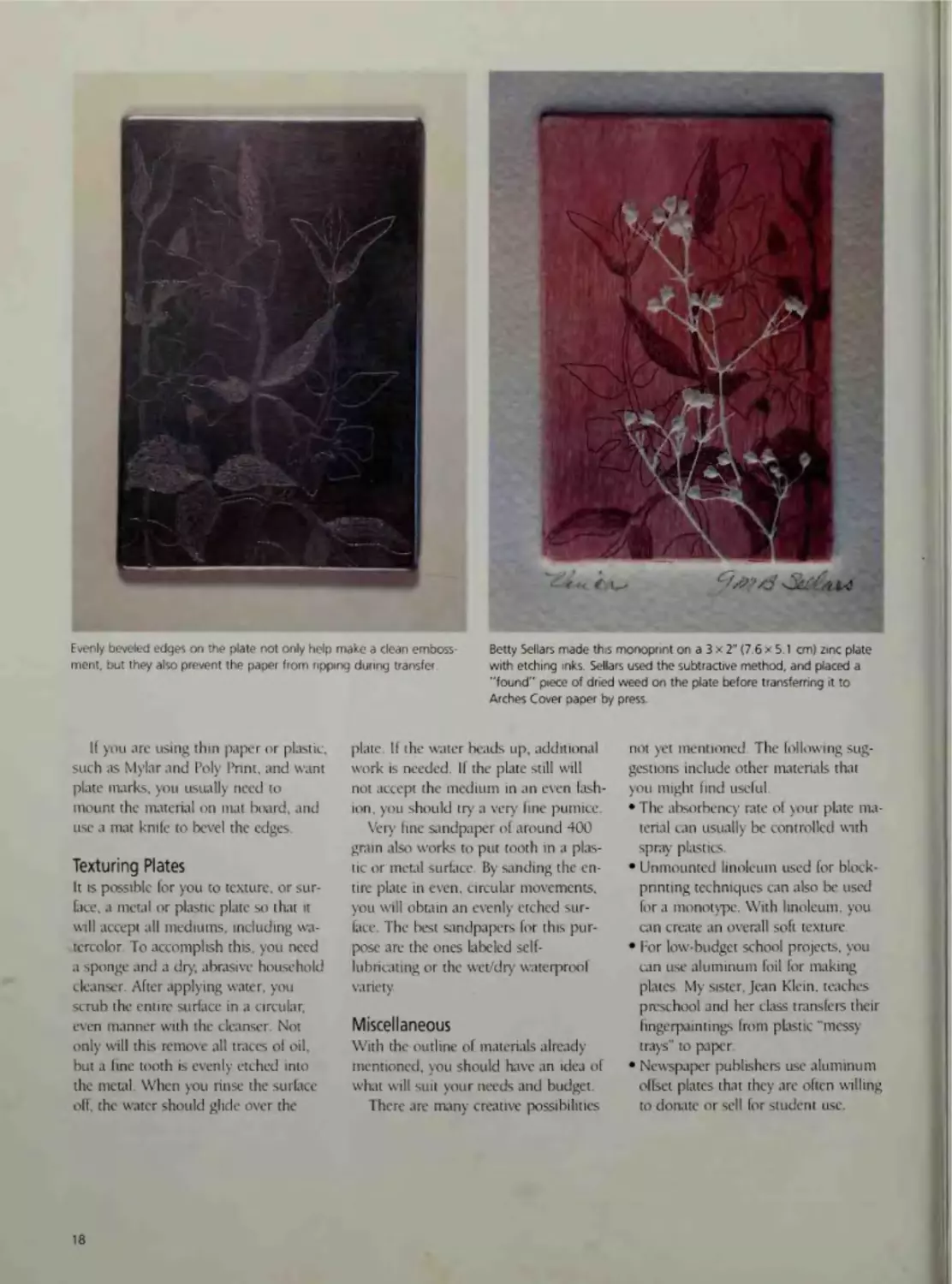
Evenly beveled edges on the plate not only help
make
a clean emboss-
Betty Sellars
ment, but they also prevent the paper from ripping during transfer.
with etching
made
this
monoprint on a 3 x 2" (7.6 x
Inks. Sellars
5.
1
cm)
zinc plate
used the subtractive method, and placed a
"found" piece of dried weed on the plate before transferring
it
to
Arches Cover paper by press.
If
you
are using thin paper or plastic,
such as Mylar and Poly
plate marks,
mount
and want
Print,
you usually need
the material
plate. If the
work
is
you should
ion,
Very
fine
grain also
Texturing Plates
possible for
face, a
will accept all
tercolor.
a
you
to texture, or surit
mediums, including wa-
To accomplish
sponge and a
this,
dry, abrasive
still
will
an even
in
try a very fine
fash-
pumice.
tire
works
wall obtain
face.
The
you might find
•
sandpaper of around 400
The following sug-
useful.
The absorbency
terial
rate of
•
movements,
Unmounted linoleum used
for a
monotype. With linoleum, you
can create an overall
best sandpapers for this pur-
soft texture.
• For low-budget school projects,
pose are the ones labeled
household
lubricating or the wet/dry waterproof
can use aluminum
variety.
plates.
you
for block-
printing techniques can also be used
an evenly etched sur-
self-
your plate ma-
can usually be controlled with
spray plastics.
to put tooth in a plas-
plate in even, circular
you
not yet mentioned.
gestions include other matenals that
you need
cleanser. After applying water,
scrub the entire surface
the plate
or metal surface. By sanding the en-
tic
metal or plastic plate so that
It
medium
not accept the
to
on mat board, and
use a mat knife to bevel the edges.
It is
water beads up, additional
needed.
My
sister,
foil for
you
making
Jean Klein, teaches
preschool and her class transfers their
in a circular,
even manner with the cleanser. Not
Miscellaneous
fingerpaintings from plastic "messy
only will this remove
With
trays" to paper.
but a fine tooth
the metal.
off,
18
is
all
traces of oil,
evenly etched into
When you
rinse the surface
the water should glide over the
the outline of materials already
mentioned, you should have an idea of
what
will suit
your needs and budget.
There are many creative
possibilities
•
Newspaper publishers use aluminum
offset plates that they are often willing
to
donate or
sell for
student use.
Mediums
For monotypes, you can use practically
mediums used
the
all
painting and
in
carbonate or cornstarch to
requirements for
you should not
when
printing inks, as well as
watercolor,
oil,
acrylic paints are all possible
will
plate
thinning and cleaning, whereas with
just use water.
into consideration
what medium your
since
working with solvents and
may
require a ventilation system.
The following
down
to you.
is
More
the chapter
oils
per
up or
when
thick, high-
it
is
Here
is
a display of
removed from the
If
plate.
decrease
oil to
only the tack
be modified, you can
is
add Vaseline
to soften the ink.
to
a can of ink has been opened,
tend to dry on the surface, leav-
will
ing a skin.
on
You can avoid
by using
this
onstrates
Oil-Based Printing Inks
number
of
used
pnntmaking techniques such
as etch-
thin yellow ink
and engraving.
In these
lines into
techniques, lines are cut into the plate.
oils
and
var-
remain
van
in the
face of the plate to
you
that
are applied,
test
it
important
is
them before
when
first
removed from
If
stitf
the can
on
this.
You can use
left
it
looser
and smoother.
standing, inks will stiffen
This
trait is
The
again.
called "thixotropy.
its
(low characteristics. For example, a
high-viscosity ink will be too
transfer,
ing
it
They
thin, low-viscosity ink will
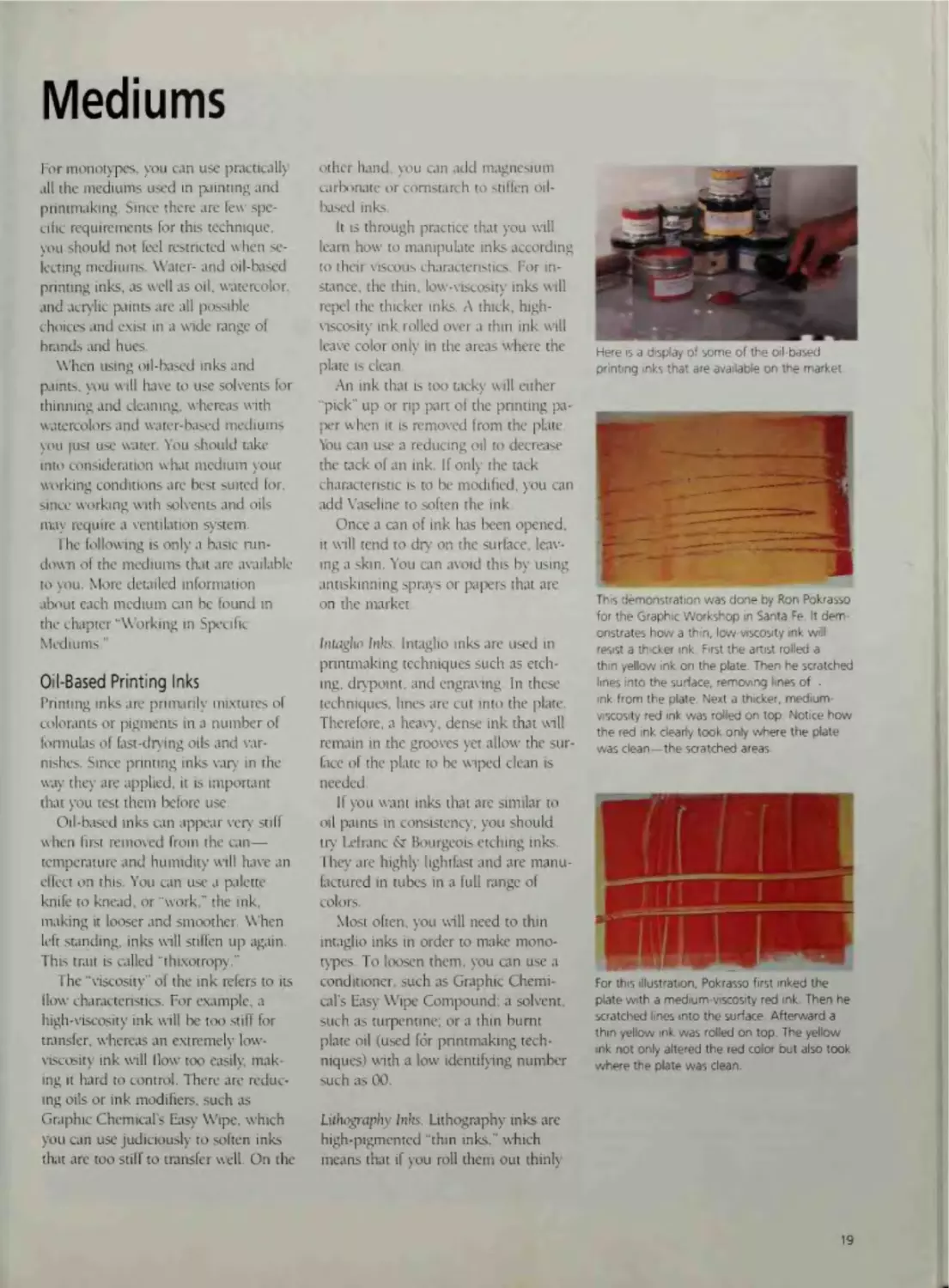
First
on the
the
artist rolled a
plate.
Then he scratched
the surface, removing
from the
plate.
viscosity red ink
lines of
.
Next a thicker, medium-
was
rolled
on
how
top. Notice
the red ink clearly took only where the plate
was
clean
— the scratched
areas.
is
that are similar to
you should
& Bourgeois etching inks.
are highly lightfast
and
full
Most
often,
you
will
are
manu-
range of
need
intaglio inks in order to
to thin
make mono-
To loosen them, you can use
conditioner, such as Graphic
cal's
Easy
Wipe Compound;
a
Chemia solvent,
such as turpentine; or a thin burnt
stiff for
whereas an extremely low-
viscosity ink will flow too easily,
you want inks
paints in consistency,
types.
viscosity" of the ink refers to
be wiped clean
ink
a
a thicker ink.
colors.
When
up
grooves yet allow the sur-
factured in tubes in a
a palette
knife to knead, or "work," the ink,
making
oil
try Letranc
temperature and humidity will have an
effect
in the
resist
needed.
use.
Oil-based inks can appear very
in
Therefore, a heavy, dense ink that will
nishes. Since printing inks
-
how
Intaglio Inks. Intaglio inks are
ing, drypoint,
Printing inks are primanly mixtures of
way they
was done by Ron Pokrasso
Workshop in Santa Fe. It dem-
This demonstration
the market.
in Specific
Mediums."
lormulas of fast-drying
on the market.
antiskinning sprays or papers that are
be found in
colorants or pigments in a
of the oil-based
rip part of the printing pais
for the Graphic
"Working
some
too tacky will either
the tack of an ink.
it
detailed information
where the
characteristic
Once
that are available
medium can
about each
lor,
only a basic run-
mediums
of the
A
You can use a reducing
take
working conditions are best suited
in-
printing inks that are available
ink that
"pick"
mediums
You should
For
clean.
is
An
have to use solvents for
watercolors and water-based
you
to their \iscous characteristics.
stance, the thin, low-viscosity inks will
leave color only in the areas
using oil-based inks and
you
will
manipulate inks according
to
viscosity ink rolled over a thin ink will
brands and hues.
paints,
leam how
repel the thicker inks.
choices and exist in a wide range of
When
through practice that you
is
It
se-
mediums. Water- and oil-based
lecting
and
technique,
this
feel restricted
stiffen oil-
based inks.
prmtmaking. Since there are few specific
magnesium
other hand, you can add
plate oil (used for printmaking tech-
mak-
hard to control. There are reduc-
niques) with a low identifying
number
For this illustration, Pokrasso
first
inked the
plate with a medium-viscosity red ink.
Then he
scratched lines into the surface. Afterward a
thin yellow ink
was
rolled
on
top.
The yellow
ink not only altered the red color but also
where the
plate
was
took
clean.
such as 00.
ing oils or ink modifiers, such as
Graphic Chemical's Easy Wipe, which
Lithography Inks. Lithography inks are
you can use judiciously
high-pigmented "thin inks," which
to soften inks
that are too stiff to transfer well.
On
the
means
that
if
you
roll
them out
thinly
19
on the
plate they will maintain their
need
be thinned or extended for
to
monotype work.
Many
lithography inks are
made for
commer-
the offset printing trade. Since
cial printers
art ink
Smith
you should seek out
fine
manufacturers such as Daniel
Inc.,
Hunt Mfg.
and
Sinclair
ufactures water-based pnnting inks,
designed for silk-screening.
There are both water- and oil-based
which are made
serigraphy inks on the market. They
raphy and block-pnnting techniques.
you can
are especially fast drying, but
alter the
drying time with retardants.
avail-
and
inks.
Many
artists
use serigraphy inks
because of their matte
and can be
Valentine.
Thinning
is
especially for seng-
done with
either water or
an extender made especially
for the
medium.
able for various types of sengraphy
They
finish.
are
strongly pigmented, usually opaque,
Graphic Chemical, the
Co.,
cifically
There are extenders and retarders
are not as concerned
with the lightfastness of colors as fine
art printers,
The Hunt Speedball Company man-
Serigraphy Inks. Serigraphy inks are spe-
do not
color saturation. Usually they
rolled or painted
on
the
plate.
made
Relief Inks. Relief inks are
for
printmaking techniques such as
lino-
leum and wood-block pnnting. There
are both water-based
and oil-based inks
on the market. They
are designed to be
on
rolled
a
flat
Most
surface.
do not require thinning
techniques.
inks,
If
you need
often, they
monotype
for
to thin these
you can purchase transparent
tenders
made
available
ex-
by the
manufacturers.
Oil Paints
Oil paints are a popular
on
the plate.
You can
medium
them
thin
to use
to a
watercolorlike consistency or apply
them
also
in
an opaque manner. You can
add
pnnting inks
oils to oil-based
to create a
wider range of
colors. Oil
produced by mixing pigment
paints are
into a binder, usually a mixture of lin-
seed, safflower,
When
you
and poppy seed
oils.
transfer oil to paper,
desirable to speed
up
it is
the drying time
of the oils to protect the paper as well
work
as to continue with other transfer
needed on the same paper. You can use
solvents such as mineral spirits or
refined turpentine to thin
their drying time. If
oil
and shorten
you want
to
add
extenders to paints from the tube,
you should use printmaking mediums
such as stand
These
oil
and burnt
oils are actually
that have
been heated
plate
oil.
raw linseed
to
change
oils
their
molecular structure. These polymerized
oils will
protect the paper fibers once
they have dried.
On
the other hand,
linseed oil used for oil painting
soed canvas has a
which can
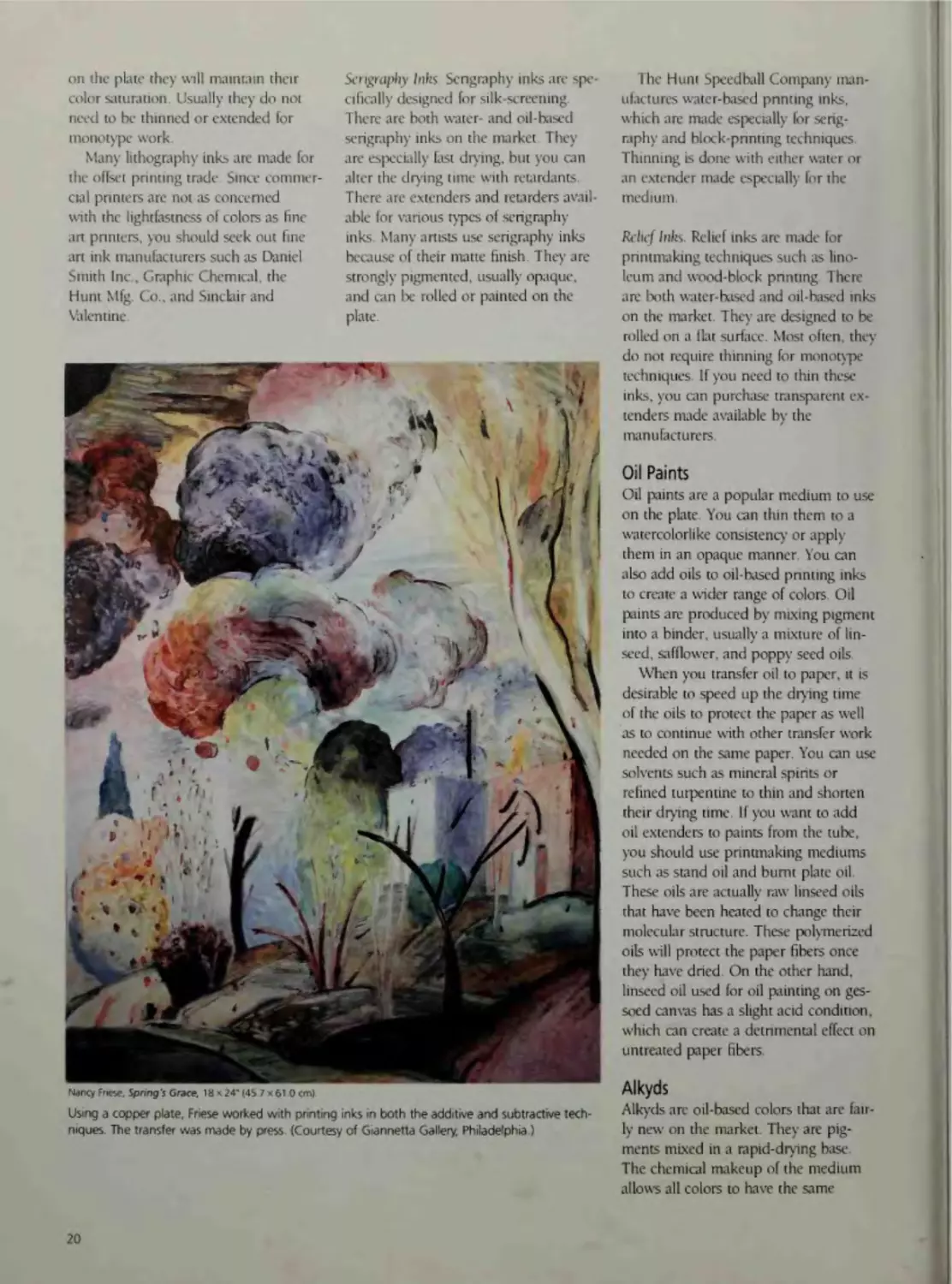
Friese,
Spring's Grace, 18 x 24" (45.7 x 61
The
transfer
was made by
press. (Courtesy of
in
both the additive and subtractive tech-
Giannetta
Gallery, Philadelphia.)
fibers.
Alkyds are oil-based colors
ly
new on
the market.
ments mixed
all
that are fair-
They
are pig-
in a rapid-drying base.
The chemical makeup
allows
20
on
Alkyds
cm)
Using a copper plate, Friese worked with printing inks
niques.
ges-
create a detnmental effect
untreated paper
Nancy
on
slight acid condition,
of the
colors to have the
medium
same
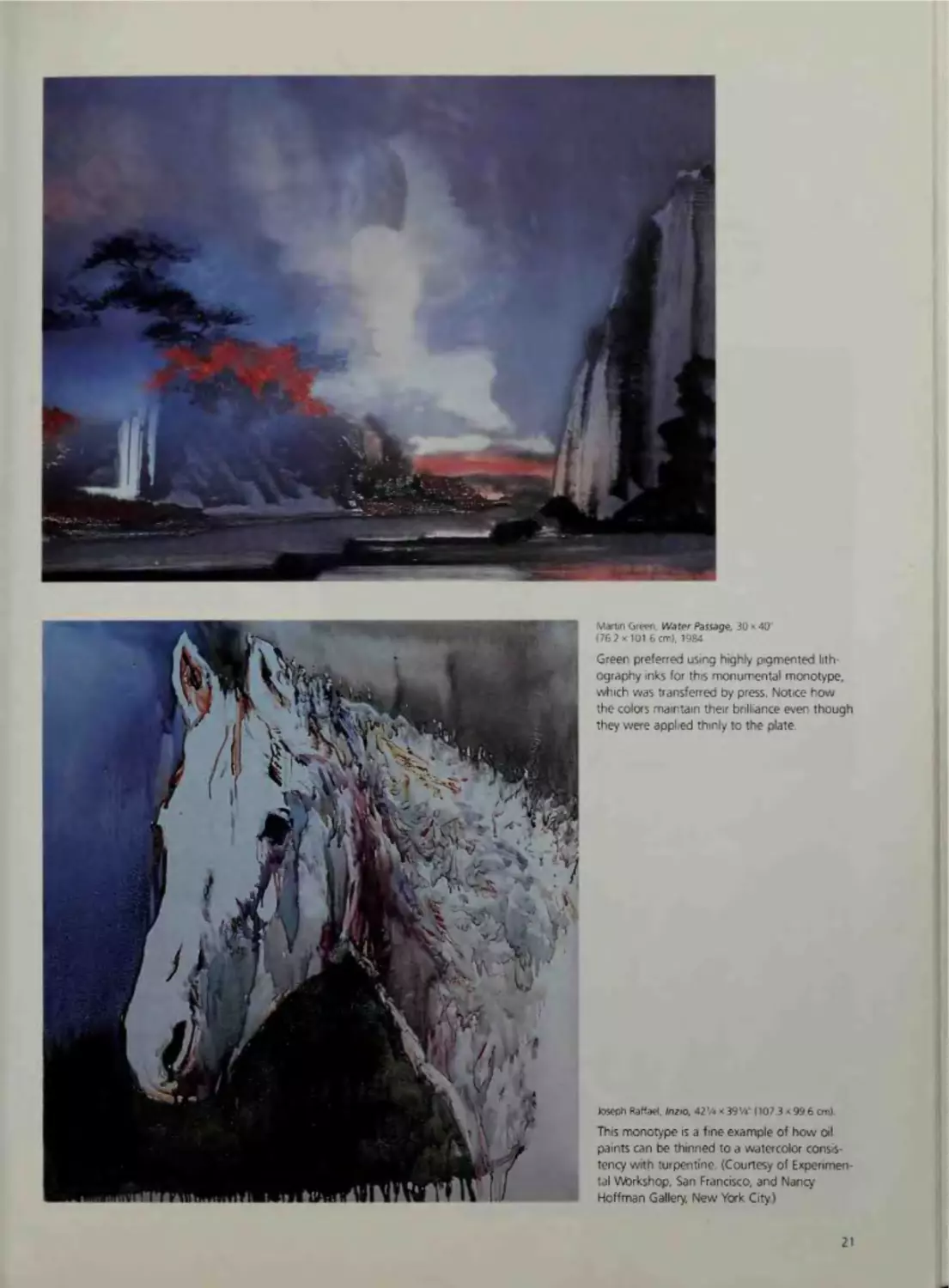
Martin Green,
Water Passage, 30 x 40"
(76.2x101.6 cm), 1984.
Green preferred using highly pigmented
ography
inks for this
lith-
monumental monotype,
which was transferred by
press. Notice
how
the colors maintain their brilliance even though
they were applied thinly to the plate.
Joseph Raffael, Inzio, 42'/ix39'/4" (107.3 x 99.6 cm).
This
monotype
is
a fine example of
how
oil
paints can be thinned to a watercolor consis-
tency with turpentine. (Courtesy of Experimen-
Workshop, San Francisco, and Nancy
Hoffman Gallery, New York City.)
tal
21
drying time
— unlike
different drying
ment on
oils,
which have
speeds for each pig-
the palette.
You can use solWinsor &
vents to thin alkyds or
Newton Liquin medium
extend
to
vents.
The notable advantage
paints
is
and cleaned up with water and do not
contain
some
sonable substitute
Water-Miscible Oil Paints
A new medium,
ol oil
Pelikan Mastercolor
paints, has recently
been added
oil
to the
if
you
They
hues
—
oil
nontoxic, permanent, and
to use
harsh
sol-
They come with
paints
come
advertised to be
in eighteen
these paints can be mixed with water,
do not need
which you can use
squeeze
to
plate.
Acrylics
Because acrylics are
lightfast.
long, thin dispensing
fast
must be worked and
your paper
solvents.
Pelikan Mastercolor
market. Although they are oil-based,
so you
are a rea-
like the effects
paint but have health problems
working with
tops,
controlled lines of paint across the
of the health hazards re-
lated to other oil paints.
it.
to these
simply thinned
that they are
by adding an
Drying time
directly related to the
area.
do
I
paper
humidity
If
make
be
the acrylics dry,
spritz isopropyl alcohol
to
will
in the
sheets to discover
test
varying situations.
you can
the drying time
acrylic retardant, available
at art-supply stores.
work
spontaneous
in a rapid,
You can slow
fashion.
drying, they
transferred to
on
the
the transfer.
Watercolors
Watercolors are pigments mixed
gum
arabic base.
You need
in a
wa-
to paint
tercolors in a bolder technique than
what you
want
actually
in the final
monotype because they
dry lighter
will
than they appear on the plate. Water•
colors will also be less saturated be-
cause of the "ghost," which
residue ink
on
left
the
is
the plate after the
transfer.
Gouache
Gouache
paints are
pigments
in the
colors,
gum
to give
artist
ANW
developed
this acrylic
monotype with
is
multiple layers of
wet
paint
hand transferred onto
more
grinding
as water-
inert material,
added
to the
quality.
medium,
mixture
As design-
there are
fugitive colors available since per-
manence
paper.
An
an opaque
ers often use this
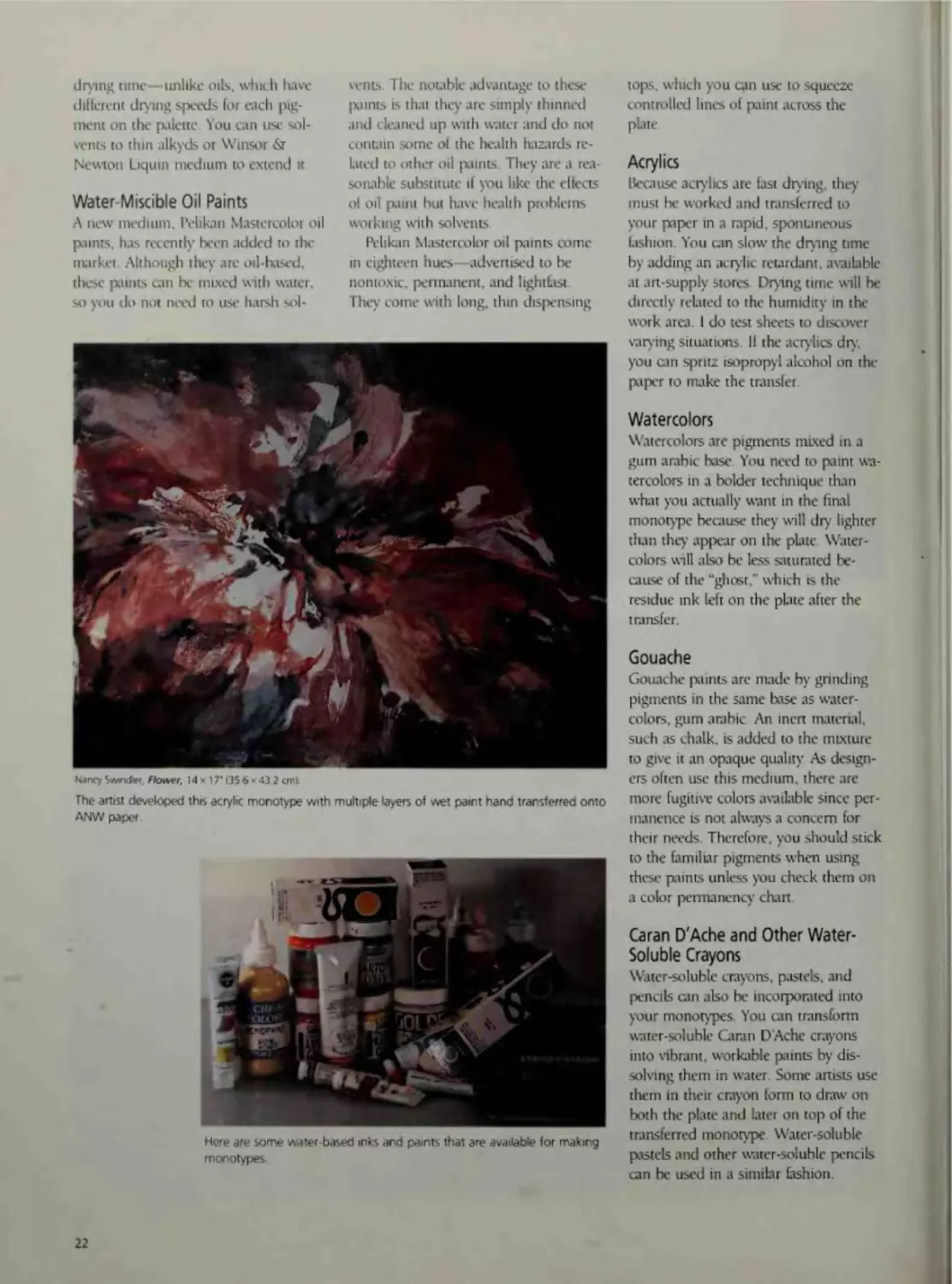
Nancy Swindler, Flower, 14x17" (35 6 x 43 2 cm).
The
it
same base
arabic.
such as chalk,
made by
is
not always a concern for
their needs. Therefore,
to the familiar
these paints unless
a color
you should
stick
pigments when using
you check them on
permanency
chart.
Caran D'Ache and Other WaterSoluble Crayons
Water-soluble crayons, pastels, and
pencils can also be incorporated into
your monotypes. You can transform
water-soluble Caran
solving
them
them
in their
in water.
monotypes.
Some
dis-
artists
use
later
on top of the
transferred monotype. Water-soluble
pastels
and other water-soluble pencils
can be used
22
crayons
crayon form to draw on
both the plate and
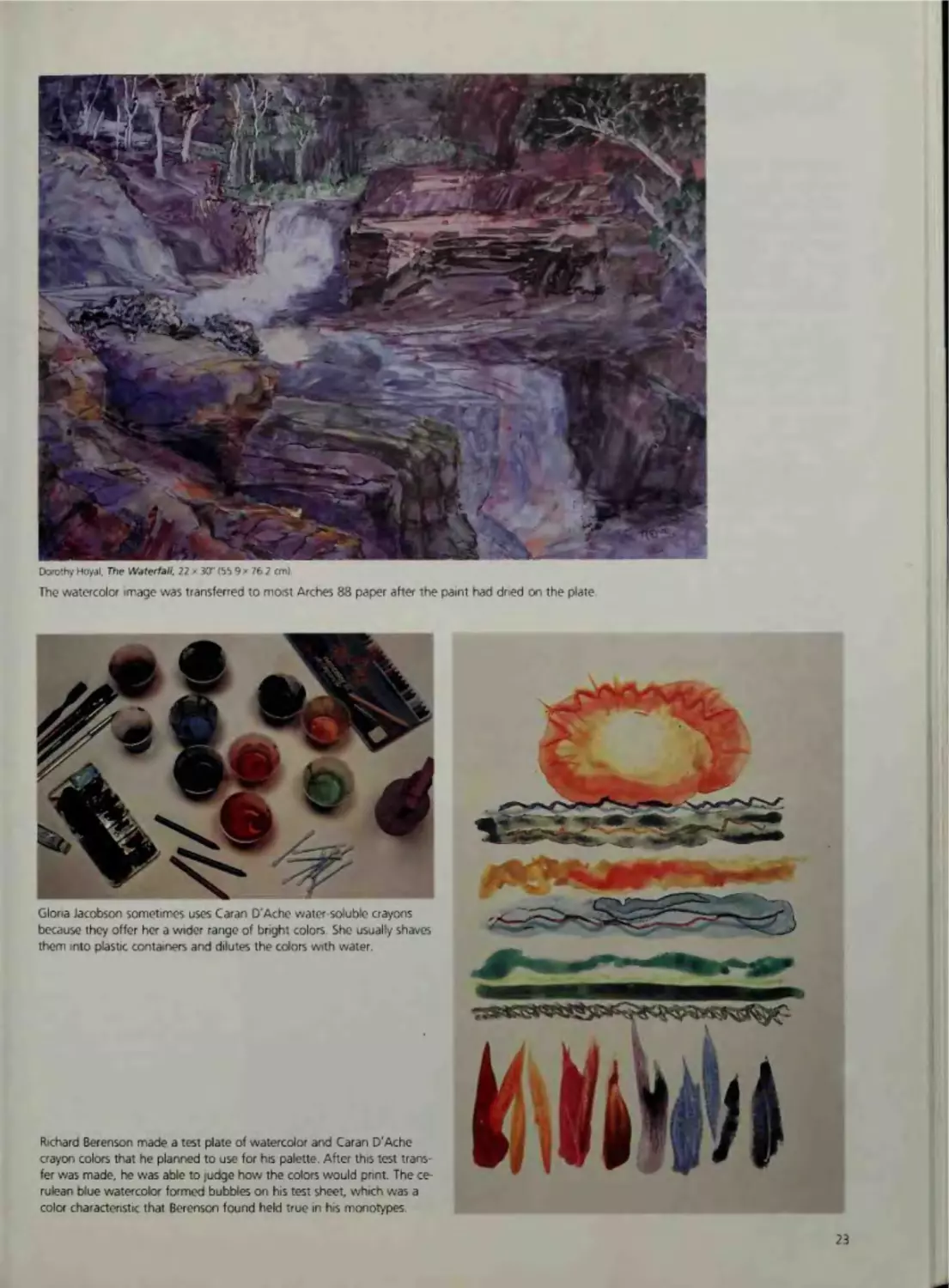
Here are some water-based inks and paints that are available for making
DAche
workable paints by
into vibrant,
in a similar fashion.
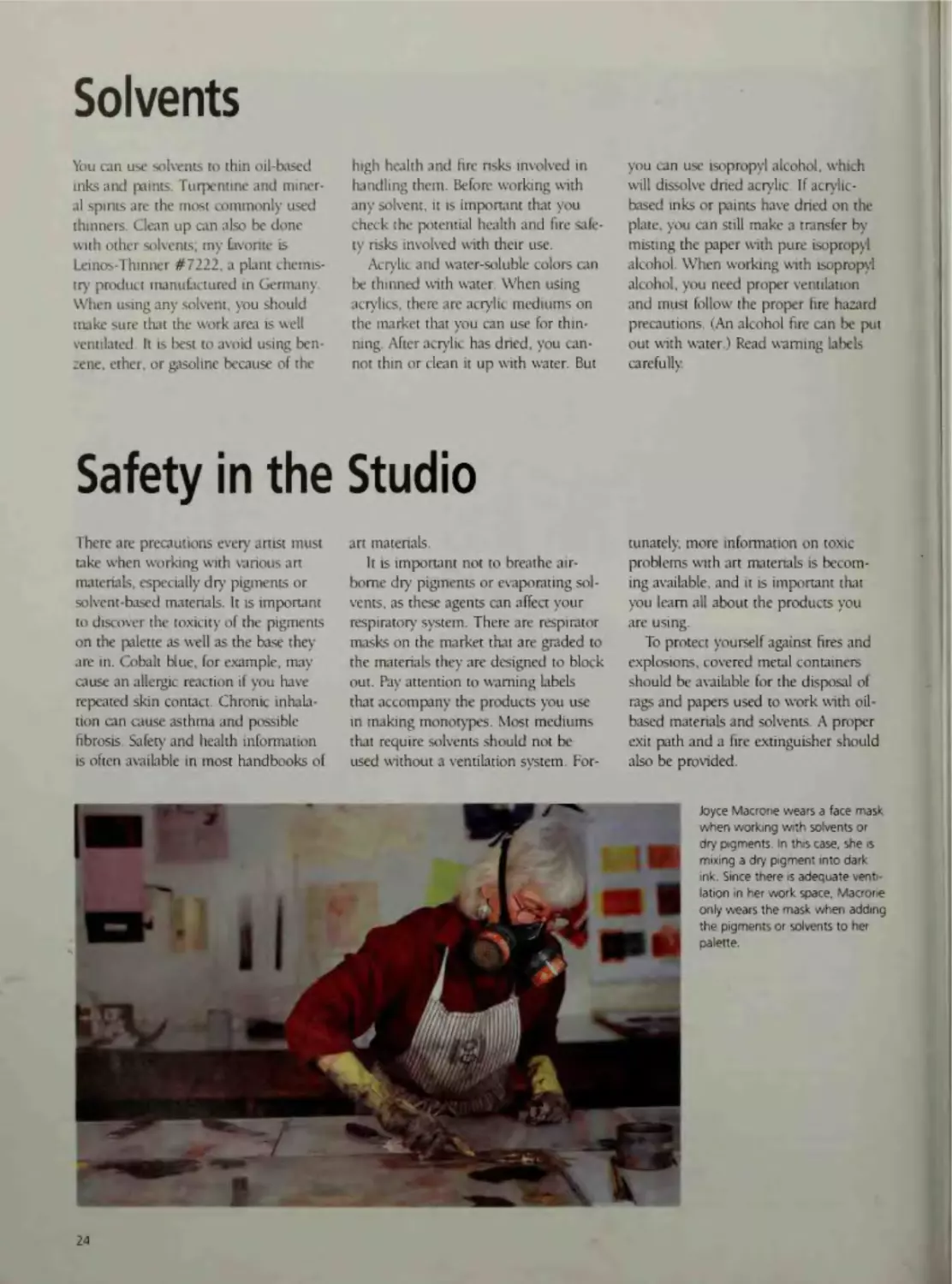
Dorothy Hoyal. The Waterfall, 22 x 30" (55.9 x 76.2 cm).
The watercolor image was transferred to moist Arches 88 paper
Gloria Jacobson
had dried on the
plate.
sometimes uses Caran D'Ache water-soluble crayons
because they offer her a wider range of bright
them
after the paint
into plastic containers
Richard Berenson
made
and
colors.
She usually shaves
dilutes the colors with water.
a test plate of watercolor and Caran D'Ache
crayon colors that he planned to use for his palette. After this test transfer
was made, he was able
rulean blue watercolor
to judge
how
the colors would
formed bubbles on
color characteristic that Berenson
his test sheet,
found held true
in his
print.
The
ce-
which was a
monotypes.
23
Solvents
You can use solvents
and
paints.
al spirits
are the
inks
thinners. Clean
to thin oil-based
high health and
Turpentine and miner-
most commonly used
any solvent,
up can
also be
my
done
favorite
ty risks involved
is
When
make
Germany.
in
using any solvent, you should
sure that the
ventilated.
It is
work
area
is
well
best to avoid using ben-
zene, ether, or gasoline because of the
Safety
when working with
Acrylic
artist
must
materials, especially dry
pigments or
It is
important
to discover the toxicity of the
pigments
on the
palette as well as the base they
are
Cobalt blue, for example,
cause an allergic reaction
if
and water-soluble
acrylics, there are acrylic
the market that
ning. After acrylic has dried,
not thin or clean
it
may
you have
repeated skin contact. Chronic inhala-
up with
It is
make
still
by
a transfer
alcohol.
When
alcohol,
you need proper
working with isopropyl
ventilation
and must follow the proper
fire
hazard
precautions. (An alcohol
you can-
out with water.) Read warning labels
water. But
fire
can be put
carefully.
sol-
that are
graded
to
the materials they are designed to block
out. Pay attention to
warning
labels
accompany the products you use
making monotypes. Most mediums
art materials is
ing available, and
you
your
respiratory system. There are respirator
masks on the market
more information on
problems with
air-
borne dry pigments or evaporating
vents, as these agents can affect
learn
all
important that
it is
are using.
To protect yourself against
should be available
that require solvents
should not be
used without a ventilation system. For-
and
for the disposal of
and papers used
work with
based materials and solvents.
and health information
fires
explosions, covered metal containers
rags
fibrosis. Safety
toxic
becom-
about the products you
that
in
most handbooks of
tunately,
important not to breathe
asthma and possible
often available in
you can
for thin-
art materials.
tion can cause
is
using
mediums on
you can use
plate,
misting the paper with pure isopropyl
colors can
When
acrylic-
If
based inks or paints have dried on the
fire safe-
with their use.
be thinned with water.
various art
solvent-based materials.
in.
important that you
which
alcohol,
will dissolve dried acrylic.
the Studio
in
There are precautions every
take
is
check the potential health and
Leinos-Thinner #7222, a plant chemis-
product manufactured
it
you can use isopropyl
involved in
handling them. Before working with
with other solvents;
try
fire risks
exit
path and a
fire
to
A
oil-
proper
extinguisher should
also be provided.
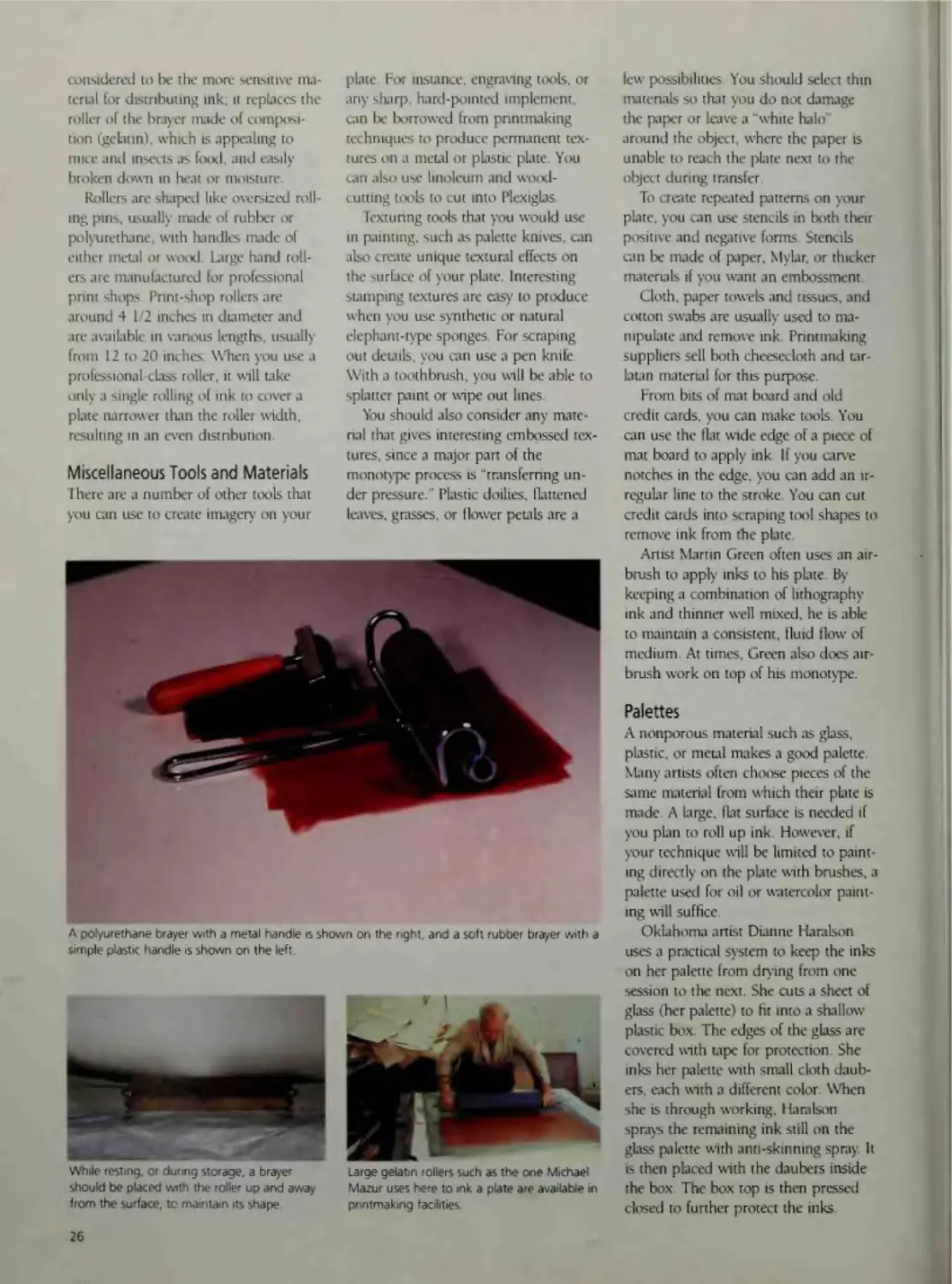
Joyce Macrone wears a face mask
when working
dry pigments.
with solvents or
In this
case, she
is
mixing a dry pigment into dark
ink.
Since there
is
adequate
venti-
work space, Macrorie
only wears the mask when adding
lation in her
the pigments or solvents to her
palette.
24
Painting Tools
Depending on the type of
want
and
you can
brayers,
set in
brush
to
choose from. For instance, with
rollers
create smooth,
Palettes
Round watercolor brushes
you
effects
to achieve, there are a variety of
printmaking and painting tools
and
belly,
paint,
round metal
will
widen from the
which
will
A
ferrules.
are also
good
ferrule to a
hold a reservoir of
and then taper
to a perfect point.
even surfaces with gradating tones. For
Before purchasing a round watercolor
a painterly quality, brushes can be used
brush, you should
to
develop textured strokes.
most
For the
find yourself using a
to use
You
your
combination of
ter
spring and
by dipping the brush
and painting with
brush should return
to
in
wa-
on paper. The
it
its
original
even
— but
need a
palette
—
the
on the
directly
water and
in
it
brushes are probably the most
You can make
thick to thin
strokes by slowly rotating the brush
from
wide side
its
to
narrow
its
side.
For scratchy textures with long, thin
you can splay your brush
strokes,
in
varying degrees.
To maintain brushes,
important
it is
you keep them clean
brushes
all
You shouldn't
way
the
let
and
congre-
force the
hairs out of shape.
Aside from turpentine and mineral
will dis-
cover the methods that give you the
spirits,
best results.
cleaning products sold in art-supply
you can purchase
remove
stores to
Brushes
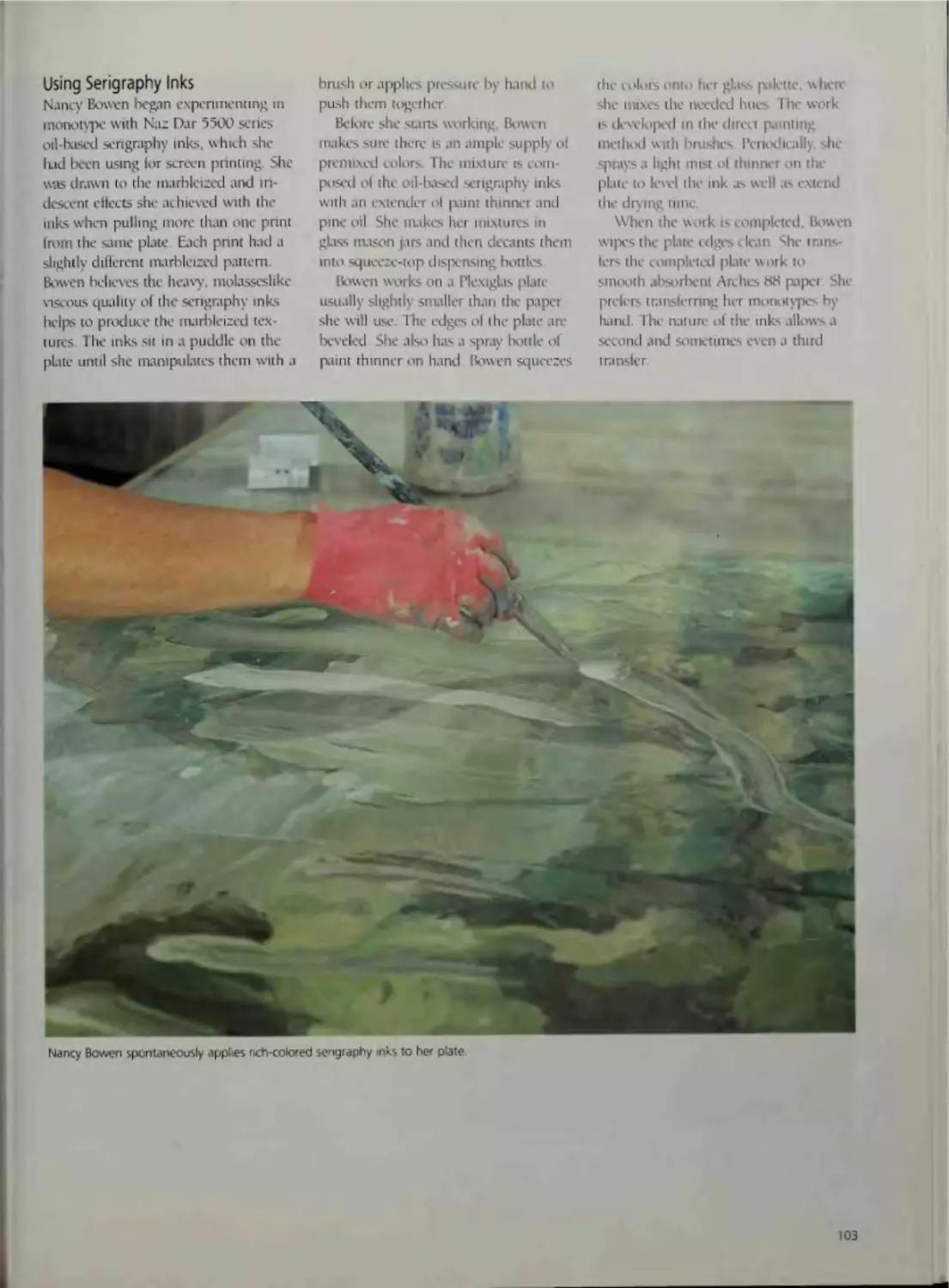
Here Nancy Bowen uses a wide,
Brushes are manufactured in a
of shapes
and
of brush will
hair types.
number
Your choice
depend on the
brush designed for
oil
stiff bristle
painting to apply seng-
raphy inks freely on her Plexiglas plate.
special brush-
mediums. You can
oil
maintain your watercolor brushes by
warm
nnsing them with
mild soap occasionally.
water, using
If
natural-hair
brushes are to be stored for a length of
texture,
you should use moth
shape, and length of the stroke that
time,
you want
prevent insect damage.
to
to
your wet
with the hairs upright, even
sit
gate at the metal edge
plate without one.
As you gain experience, you
swirl
after cleaning, as residues will
also possible to
it is
Flat
versatile.
the ferrules.
where you work and mix inks
or paints
you
after
then shake out the excess moisture.
that
fingers.
will usually
surface
work
flexibility
probably
will
and sometimes you may
tools,
want
you
part,
test its
shape
produce.
crystals to
Various hairs with different charac-
used
teristics are
for
making brushes.
Brayers
made
For instance, a watercolor brush
Brayers
form color
more
when
made with synthetic hairs, whereas brushes made
with synthetic filaments will take more
compared with
stiffer
hog-bristle
me-
and badger-hair brushes
for stiffer
diums such
and oil-based
as oil paints
you use
soft-hair brushes,
as sable or synthetic blends,
mediums, they
texture
brush
on
will
will leave less
the plate.
maintain
A
its
natural-hair brush to apply watercolors to her
With
this brush,
wide strokes with the
she
with the narrow edge, as
just
is
able to
flat side
in
make
or thin lines
the stroke she has
completed.
such
brush
brayer
is
wooden
and
its
made with
surface
a single, cen-
or metal handle attached
You
made with hard
start with.
made brush
will
prob-
or soft rubber
the most affordable tools to
When
surface brayers,
using
some hard-
you often need more
than one application to produce an
end of
end of an Aquarelle-
brush handle makes a convenient
scraping instrument.
A
tered
shape under
the handle as a painting stick. For in-
style
related to the hard-
smoothness.
brayers,
even ink cover, but the randompatterned texture you get with the un-
even
tached to metal ferrules that hold the
stance, the bevel
ness of the material
rollers, are
the pointed
in different
characteristic of the
is
to the sides of a roller.
out from the edges.
You can use
made
are
ably find that small one-inch-diameter
stiff
With few exceptions, brushes are
made with wood or plastic handles athairs.
used in a number of
sizes that give varying ef-
brayer and roller
good hog-hair
painting pressure; a poorly
will splay
on
photograph, Shirley Ward uses a wide
and
The primary
fects.
In this
They
plate.
materials
plate.
You should use the
inks. If
your
a brush
use and abuse.
rollers
can be used to apply paints and inks to
uni-
for the longest stroke
and
Rollers
printmaking and painting techniques
from the natural hairs of the expensive
kolinsky sable will spread
and
first
A
roll-up of ink
soft
Dorothy Hoyal scrapes out white accents on
sirable.
the plate with the beveled end of an Aquarelle
more even
brush.
may prove
de-
rubber brayer affords a
distribution of ink.
You can also purchase professionalclass brayers that are
made
of either
polyurethane or rubber. Polyurethane
is
25
considered to be the more sensitive madistributing ink;
ternal for
made
roller of the brayer
which
tion (gelatin),
it
replaces the
of composi-
appealing to
is
mice and insects as food, and
down
broken
Rollers are
ing pins, usually
either metal or
ers are
made
wood. Large hand
manufactured
are available in
from 12
to
20
vanous
professional-class roller,
it
narrower than the
when you
resulting in
on
out
details,
you can use a pen
a toothbrush,
splatter paint or
you
will
wipe out
knife.
be able to
an even distribution.
nal that gives interesting
tures, since a
embossed
you can use
plate,
made
can be
materials
both their
stencils in
and negative forms.
positive
Stencils
of paper, Mylar, or thicker
you want an embossment.
if
Cloth, paper towels
nipulate
and remove
suppliers
latan
and
and
tissues,
tex-
major part of the
mat board
Pnntmaking
mat board and old
you can make
You
tools.
wide edge of a piece of
flat
to
tar-
purpose.
for this
bits of
credit cards,
can use the
ink.
both cheesecloth and
sell
matenal
From
lines.
You should also consider any mate-
width,
is
cotton swabs are usually used to ma-
use synthetic or natural
elephant-type sponges. For scraping
With
will take
roller
effects
where the paper
object during transfer.
stamping textures are easy to produce
only a single rolling of ink to cover a
plate
unique textural
object,
To create repeated patterns on your
the surface of your plate. Interesting
use a
You should select thin
you do not damage
unable to reach the plate next to the
cutting tools to cut into Plexiglas.
also create
lengths, usually
When you
inches.
plastic plate.
roll-
and
1/2 inches in diameter
You
use linoleum and wood-
on a metal or
of
print shops. Print-shop rollers are
around 4
possibilities.
materials so that
the paper or leave a "white halo"
in painting, such as palette knives, can
for professional
few
around the
Texturing tools that you would use
of rubber or
polyurethane, with handles
or
tools,
techniques to produce permanent tex-
can also
like oversized roll-
made
For instance, engraving
can be borrowed from pnntmaking
tures
easily
in heat or moisture.
shaped
plate.
any sharp, hard-pointed implement,
apply ink.
If
you carve
Miscellaneous Tools and Materials
monotype process
There are a number of other tools that
der pressure." Plastic doilies, flattened
regular line to the stroke.
leaves, grasses, or flower petals are a
credit cards into scraping tool shapes to
you can use
to create
imagery on your
is
"transferring un-
notches in the edge, you can add an
remove ink from
Artist
You can
ir-
cut
the plate.
Martin Green often uses an
brush to apply inks
air-
By
to his plate.
keeping a combination of lithography
ink and thinner well mixed, he
is
able
to maintain a consistent, fluid flow of
medium. At times, Green also does airbrush work on top of his monotype.
Palettes
A nonporous
plastic,
Many
material such as glass,
or metal makes a good palette.
artists often
choose pieces of the
same matenal from which
A
made.
you plan
to roll
your technique
ing directly
palette
their plate is
large, flat surface is
used
on
up
ink.
needed
However,
if
if
be limited to paint-
will
the plate with brushes, a
for oil or watercolor paint-
ing will suffice.
A
polyurethane brayer with a metal handle
simple plastic handle
is
shown on the
is
shown on the
right,
and
Oklahoma
a soft rubber brayer with a
anist
Dianne Haralson
uses a practical system to keep the inks
left.
on her
palette
from drying from one
session to the next. She cuts a sheet of
glass (her palette) to
plastic box.
The
fit
into a shallow
edges of the glass are
covered with tape for protection. She
inks her palette with small cloth daubers,
each with a different color.
she
is
When
through working, Haralson
sprays the remaining ink
still
on
the
glass palette with anti-skinning spray.
While
resting, or
during storage, a brayer
should be placed with the
from the
26
roller
surface, tc maintain
its
Large gelatin
rollers
up and away
Mazur uses here
shape.
printmakmg
such as the one Michael
to ink a plate are available in
facilities.
is
It
then placed with the daubers inside
the box.
The box top
is
then pressed
closed to funher protect the inks.
Here
Maxme
Richard spreads ink with a cloth dauber
made
of
felt, avail
able for prmtmakers through Graphic Chemical.
Martin Green removes ink with a large piece of
able to press
mat board, which he
and manipulate to vary the width of the areas he is
Then Richard continues to manipulate
ink with a small piece of
mat
board.
is
Next Green uses an airbrush on
his plate.
removing.
Here you see Green mixing lithography inks on a large glass palette
Dianne Haralson's glass palette
fits
into a plastic box,
which she uses to
save her paints. The daubers she used for inking the plates are stored
with their corresponding colors. Antiskinning spray
raphy inks before placing them
in
is
used on the lithog-
the box and sealing the
lid.
27
Paper
The paper you
select will influence the
overall feeling of
your monotype.
the critical support
and
transferred
is
component
integral
on which
is
an
want the color of the paper
to
may
monotype composition,
II
you're looking for unique textures,
there
is
free
from inks or
paints.
an enormous selection of hand-
made papers from around
choose from. Swirling
the world to
fibers
and woven
textures can be incorporated into your
monotype.
If
you need
a
smooth
face for a clear, crisp transfer of
you
Made
paper
is
made,
between papers. The basic
were centuries ago when
invented in China.
fiber
First, in
first
a large vat,
beaten and macerated in water
is
your
through under the frame.
Europe and the United
In
per
commonly
States, pa-
transferred
and
pressed (or couched) against
felt.
is
newly formed sheet
The
have the im-
mold on one
pression of the
on the
will
side
and
the
felt
A
this
"rough" condition or pressed to
tray-shaped
tom
is
lifted
wet
mold with
dipped into
out of the
fiber
water
per.
pulp slurry and
this
vat.
A
a screen bot-
thin stratum of
forms on the screen as the
filters
When
mold
image, try smooth Arches 88.
where some of the pulp seeped
until individual filaments are separated.
through
it.
This sheet of
intertwined filaments becomes the pa-
sur-
feathery deckled edge to the sheet,
ral
how
will appreciate the variable charac-
as they
leaving
exposed and
Is
papermaking steps are the same today
be a part
it
Paper
teristics
monotype
of your
composition. For instance, you
of your
work
the
and
finished,
How
By understanding
It is
is
the frame (or deckle) of the
removed, there
will
be a natu-
other.
It
can be
left
in
have a smoother surface.
In Asia,
ner,
paper
is
traditionally thin-
but strong due to the longer fibers
used. Paper
is
pressed in a stack with-
out an interleaving of
dried
on
smooth
a
flat
felts.
It is
then
surface that will give
texture.
\
Julia Ayres,
This
28
Night
in
Coral Sea,
9x12"
monotype was made with
(22.9 x 30 5 cm).
Pelikan
oil
paints
and transferred to Twinrocker handmade paper, which has an exaggerated deckled edge.
it
a
The pattern
of the screen will also
A
the character of the paper.
fect
texture
created
is
bamboo
when
the fibers of a waterleaf.
soak paper
thinly stripped
by side and fastened together with
sewn
in evenly
When
you
will vary
according to the
size of the paper. In other parts of the
in water, the sizing will dis-
solve into the water
or wires are laid closely side
wires or thread
poundage
sized paper, but will sink further into
ef-
"laid"
and out of the
world,
it
is
most often measured
metric system at
square meter), which refers to the
fibers.
x
Paper Weight
system, a 140-lb. 22
tercolor paper
created with screens
paper's weight. In the United States,
regardless of the sheet size,
od
is
running the opposite
A
rection of the strips.
similar to
di-
"wove" texture
is
woven in a methwindow screening.
Sometimes there are embossed
marks
known
in the paper,
as water-
marks. They are usually simple designs
or
letters signifying the
the
name
tis-
sue thickness weight. Measured in this
spaced
There are two methods of indicating a
straight lines
in the
g/m 2 (grams per
it
30" sheet of wa-
would remain 290 g/m 2
and a 90
lb.
2
22 x 30" sheet would be 180 g/m The
measured by the weight of a 500-
.
sheet ream. Unfortunately, this gives
popular Masa paper from Japan
you
little
g/m 2 Unryu, on
sity
and thickness of the paper,
indication of the actual den-
;
only 36 g/m
as the
is
the other hand,
70
is
2
.
manufacturer or
of the paper.
Paper Fibers
The
used
fibers
also vary.
for
papermaking
Most an papers
from shon-fiber cotton
will
made
are
by-
linters, a
product of the cotton industry. Linen
is
more costly fiber. Wood
pulp that has been made acid- free is
termed "sulphite." It is the most coma stronger but
mon
addition to cotton pulp not indi-
cated as 100 percent rag.
Rice paper
is
a
misnomer
that prob-
ably dates back to early Europeans
who were
traded in Asia
how
the fine paper
These
was
who
ignorant of
actually
made.
fibers are actually "bast" fibers
gathered from the inner bark of trees
and
plants. In Japan, the strong, long
fibers are primarily
These are examples of Twinrocker deckled-edge handmade papers. Deckled edges are produced
kozo, from the
from the pulp that seeps between the deckle (frame) and the bottom of the mold screen during
the papermaking process.
Japanese mulberry. Mitsumata fibers
provide a
soft,
absorbent, lustrous char-
acteristic to paper,
and gampi
fibers
im-
part a strong translucent quality In
recent years, acid-free sulphite has also
been added
some
to
of these papers.
Fiber content alone will not indicate
if
a paper
is
archival.
Due
to present-
day environmental conditions,
portant that the pulp
is
it is
alkaline salts to continue to neutralize
the acidity.
vival of
per
is
If
&**
,..-#
im-
buffered with
you want long-term
*&'£
••'
;'•
sur-
~
r
-
-
your work, make sure the pa-
labeled
pH
•
neutral.
Sizing
Paper that has not been sized acts like a
blotter
and
usually a
added
'-• *******
is
called a waterleaf. Sizing,
warmed
to the
to the paper;
gelatin glue,
is
-.
-
•
<*-
either
pulp mixture or as a coat
it
helps to decrease the
absorbent nature of the
fibers.
For ex-
I
lightly
left
ample, ink will
sit
on top of
a highly
pressed these papers on wet Ink to demonstrate their inherent textures. The paper on the
has the more
common "wove"
of the screen on which
it
texture, while the
one on the
right contains the "laid" texture
was formed.
29
Types of Paper
Monotype
artists
have used papers de-
signed for pnntmaking as well as other
fine
an
papers. Rives
BFK
some
sizing,
Arches Cover
choice. Arches
88
is
need
to
tic
If
is
a
you want
a waterleaf
Many
and has
papers between plas-
ture evenly as they wait for transfer.
Preparing Paper for Transfer
both sides using a sponge with water.
You can moisten other papers on
When
good
to place the
sheeting to help distribute the mois-
charactenstics.
a popular
is
unsized pnntmaking paper.
monotypes on these sample sheets
become familiar with their transfer
ture
wet,
the
medium on your
you can
transfer
plate
is still
place each moistened paper
plastic sheeting
to either a
it
Then
on
with a dry sheet of pa-
moist or dry sheet of paper. However,
per on top, interleaving wet and dry
prefer the hot-press surface of fine wa-
when
sheets for
tercolor paper for their transfers, while
your
others prefer the translucent sheets of
with water before printing. Methods to
a very
smooth
surface.
artists
samples of
plate,
of supply houses
Daniel Smith Inc. of Seattle
sells
mediums
cific
sample
Mediums."
Onental papers. You can make minia-
misting with a spray bottle.
Smith
Inc. in Seattle.
gray sheet on top
printing paper
Here are a few
you can premoisten with water by
all
the paper needed for your
Top and
To avoid
place a board
the pack.
enclose the pack with
buckling, you should
and weights on top of
The paper
will
be ready for
Then you
In order to
transfer,
produce a successful
you must be aware of
with the
Murillo Gray, Arches Cover
White, Arches Cover Buff, Indian Tea, Rives BFK Tan, and Murillo OffWhite.
GMB
Sellars.
Sellars
per
Seeds.
9x12"
(22 9 x 30 5 cm)
chose Arches Cover Buff for her monotype. The color of the pa
was
left
as part of her image, which
is
a consideration that should
_
be made during paper selection
Also available are numerous Oriental papers, including, top to bottom:
Chin, Moriki Gray Blue 109,
A. K. Toyama.
30
Monki Coral
1
cer-
tain conditions that require special
from suppliers such as Dan-
possibilities, starting
and moving clockwise:
plastic.
For waterleaf and most Onental papers,
iel
project.
printing in a few hours.
packs of watercolor, pnntmaking, and
You can purchase samples of
are dis-
cussed in the chapter "Working in Spe-
sell
For example,
their papers.
medium dnes on
you must moisten the paper
transfer other dry
Oriental papers.
A number
a water-soluble
12, lace paper,
and
A
detail of a
monotype made with water-based
ferred to moist
Unryu paper. Notice
corporated into the design.
how
inks that
was
trans-
the swirling paper fibers are
in-
I
Nancy Swindler Pomsettias, 22 x 30" (55.9 x 76.2 cm).
This watercolor
attention.
monotype on Japanese mulberry paper has a unique
For instance,
showing so much tack
if
the ink
that
it
is
translucent quality that suits the subject matter well.
while picking up an insignificant
is
pluck-
amount
of ink). After each transfer,
ing fibers from the paper surface dur-
continue stacking.
ing transfer, you can correct the
you should place
problem by moistening the paper.
to
If
your paper has too
much
medium will sit on the surface and
make a poor transfer. A prolonged
the
least
hour, will correct this condition.
To
move
the excess water,
an
re-
you can press
the paper between sheets of blotter until
a board with weights
complete the needed pressure
ten the papers as they
sizing,
soaking in a tub of water, for at
On
ing process
is
to flat-
dry This stack-
usually taken apart
and
repeated with fresh blotters at least two
more rimes.
The Graphic Workshop
in Santa
Fe
has devised a simple system of color
coding blotters that permits the longest
use from each sheet.
the wet sheen disappears.
you
top of the stack,
To
get the
most
use out of blotters, you should place
Monotypes After Transfer
made of unsized paper fibers,
used extensively when working
Blotting
them
Blotters,
instance,
are
dunng
the final drying stage, as
easiest
on
with wet transfer work.
fer is
When
a trans-
completed, you need to place the
work
in the
is
order of their usage. For
you should use new
blotters. After
blotters
it is
the
your transfer
completed, you can hang wet
Here Dianne Haralson
moist monotype between blotters, with
blotters to
newsprint paper covering the image
on a wire across your studio
the Graphic Workshop.
side (the newsprint protects the blotter
dry with clothespins strung
as
done
at
is
removing Rives BFK
paper from a water bath, where she had
soak for twenty minutes. Next she
will
let
it
place
the moist paper between the blotters on her
left
to
remove excess water.
3
1
Hand-Transfer Tools
back of a spoon bowl
Traditionally, the
has been used to carefully rub-press the
paper and plate together. You can also
use household items such as a pad of
folded cloth or paper toweling as trans-
For instance, a plastic mesh
fer tools.
pad, such as a pot scrubber, has a nat-
be beneficial
ural drag that will
in
some
transfers.
With
and brayers used
rollers
for
inking plates, you can also roll-press
the plate
fer.
and paper together
The baren,
for trans-
a thin disc-shaped block
designed for block-printing transfers,
another possibility
is
The Hunt Company
manufactures a teflon-coated metal
baren
reasonable pnce.
at a
good
Florida artist Janet Siamis gets
results
when
she uses a marble rolling
when
pin for transfer. However,
I
pur-
The bowl of a spoon
is
an
ideal tool for
hand
transfers.
chased such a treasure from a used
was
My
item store,
it
rolling pin
had an uneven shape, allow-
a different story.
ing only the ends of the roller to touch
the paper.
To check the contour of a
should place
ly flat surface.
the surface
Slowly
and you
where contact
is
Hard rubber
also create the
fore,
The
are laid
to
roll
will
the pin over
be able to see
made.
rollers
you should
with each
you
and brayers can
same problem. There-
similar manner.
are the best
roller,
eye level on a perfect-
at
it
also
check them
However,
method
trial
in a
transfers
you
to acquaint
tool's characteristics.
table that the
paper and plate
on should be smooth
produce an even
cracks, scratches, or
bumps
in the final transfer.
If
you
in
order
otherwise
transfer;
will
appear
are using
water-based materials, the surface
should be waterproof.
When
you
are
using solvents, a plastic acrylic protection
from
all
mediums, such
plastic-coated Masonite,
32
is
as
smooth
desirable.
A
Japanese "teacher baren"
transfer the
is
used here to hand rub and press a thin Mylar plate (on top) to
image onto paper (on bottom).
Joanna Duck uses a brayer to press highly absorbent mulberry paper
onto a zinc plate with black
Janet Siamis
rolls
Here you see Duck pulling the monot
ink.
a marble rolling pin over the back of her Mylar plate.
Janet Neal Siamis, Victor/an House, watercolor monotype. 30 x 22" (76.2 x 55.9 cm)
33
Equipment for Press Transfer
Presses
come
wide
in a
variety of sizes
and mechanical designs, and
are prob-
ably the most expensive equipment in a
studio. Since a press
vestment,
if
is
you plan
you should become
such a major
to
purchase one,
familiar with the
characteristics of different presses.
ideal
way
to
do
in-
shops and use a number of
different
rollers.
You
You move
gauges.
the bed
Many
artists
work
use presses in conjunction
with hand-transfer methods to produce
diversity in their
how many
you need
handle to operate
to turn the
rollers
press,
is
readily available
per,
probably the most
equipment.
and blankets
are laid
Plate, pa-
on
a
flat
bed
and then pressed between upper and
This Charles Brand etching press
34
would
an operating gear
is
built
com-
require two
one revolution.
A
you place
such as the one just mentioned,
transfer.
to
with a sturdy
same
It
the largest plate
stand.
on each
placed in the
The bed should be made
Iree,
of warp-
rustproof material. There are
plastic materials
on
new
the market that
fit
You should have
the bed comfortably positioned, so that
the
working height
is
somewhere
be-
waistline.
You can control the height with the
leg
support under the
press.
are placed during
accommodate
is
center of the bed.
The frame of
the
should be spacious enough
nonwarpmg
which
size of the metal
press size refers to the size of
and paper
material
tween your hips and your
roller.
on which
The
set at equal distance
these requirements.
low-gear ratio
the press "bed" or surface
plate
and
plate
rollers.
side of the plate,
one complete revolution. For
harder to turn than a press with a
The
is
times
plete turns of the handle to turn the
Etching Press
etching press
The
Today's presses are gear driven.
gear ratio determines
diameter
An
if
should be the same thickness as the
10-to-l high-gear ratio, with the
monotypes.
in the rollers
width of the
ratio of 2-to-i
to paper.
and balance
wheel." Motor-driven presses are also
instance, a press with
sure to transfer plate
you use small
available.
preferences.
When
rollers
When
you can get greater longevity
strips of material to cover the entire
the rollers
press provides uniform, consistent pres-
and
plates,
with either a crank handle or a "star
presses to learn your personal
properly used, a pnnting
plan to use.
control the roller
pressure with adjustable knoblike
An
work-
this is to join
lower
you
the press should be
strong enough so that
or Ilex on the floor.
to
have the press
it
It is
level
will
not twist
also important
with the
floor.
This Ettan etching press with a star
wheel
Most often you can accomplish
with shims placed under the
is
a tabletop model;
it
is
firmly positioned
on
a sturdy bench.
this
legs.
Presses usually carry special leveling
instructions with them.
Proper Pressure for Printing
Most presses also have a system
just pressure.
You need
to ad-
to preset the
you begin work
correct pressure before
on the monotype. As you turn the handle or wheel, pressure
until the plate, paper,
is
slowly applied
and blankets
cannot manually be pulled out from
under the
rollers. It is
important that
you have the pressure
on both
to ensure
Keep
dials set evenly
sides to protect the rollers
an even
in
mind
that a
doesn't necessarily
and
poor
mean
that
transfer
you did
not apply enough pressure; there are
too
many
7
transfer.
Dianne Haralson adj
ie
pressure gauges of her star wheel-driven etching press, making sure
they are set equally
other factors involved in a
successful transfer, such as
how
paints
or inks are applied.
35
Three
felt
blankets have been pulled back over the
rollers of
she prepares the bed for a transfer. The blankets must
lie
Maxme
Richard's etching press as
smooth and
in
In this
alignment over the bed
before you begin the transfer process.
photograph, you see Arnold Brooks at
Solo Press adjusting Plexiglas on the bed of a
Takach-Garfield press.
suspended from the
Here
36
is
a Charles Brand lithography press. The scraper bar (above the bed) and the operating
mechanism on the
A huge tampan
ceiling.
right are clearly visible.
sheet
is
print hrst to a rubber blanket
Blankets
Three
one on
top of the other, to cover the
during
plate
that
blankets are usually used,
felt
transfer.
The
you place on top of the
paper
the sizing catcher.
is
plate
It is
made
and
extra moisture
On
top of
blanket,
which
catcher;
it
per.
plate.
it
is
you place the forming
cushions the paper over the
it
is
the pusher
takes the abuse of the rollers
Miscellaneous Presses
transfers.
Instead of rollers
on top of the press
There
is
some inexpensive equip-
also
ment you can use
raph}' press has a blade-shaped scraper
washer with
hard fine wood, such
bar. Traditional!};
and
was used
to
make
the bar,
was stretched on
a strip of leather
the thin sharp edge to act as the press-
ing edge. Today, this bar
is
often
made
transfer small
that
1
plate
often
borrow
my
husband's sheet
press. This
steel rollers
on top and
ethylene, with a replaceable polyethyl-
bottom, with just over a
ene
strap.
entry
Lithographic Presses
ink
on your paper
Some
mechanically under
and workshops prefer
making monotypes on
a lithography
press. This t\pe of press
commercial printing
when
was replaced
it
was used
for
until the 1930s,
for that
purpose
with the offset press. (Offset presses
as the
it.
A
impress the
it
is
known
you can gain access
to
as the "tampan"
moved
by
either
Listed
tion of
below
some
Write them
electrical
mechanism. Local college
facilities
are
probably the most available resource
classes.
press time can
be rented by the day. The Graphic
Workshop in Santa Fe provides work
space and press use with or without a
pressman. Sometimes established
Francisco,
work with a shop, such
Workshop in San
where proceeds from the
arrangement.
the
the rollers for transfer.
Facilities
an abbreviated
selec-
of the better-known work-
facilities in
the United States.
for further information.
Graphic Workshop
632 Aqua
Santa Fe,
Fria
NM
87501
works enter
Brick Bottom Artist Bldg.
1
Fitchberg
Somerville,
Tel: (617)
St.
MA 02143
666-0007
artists
as the Experimental
sale of finished
a simple
move
Rugg Road
some workshops,
are invited to
is
motor
work through
I
Ron Pokrasso
the correct operation of the press
such
With
you should have an ex-
perienced instructor guide you through
At
place the paper in registration
the entire Masonite bed.
shop
for
1
with the plate, and lay a blotter over
gear-driven handle crank,
through printmaking classes and workInitially,
plate.
etching presses, the lithograph}' presses
such equipment as well as instruction
shops.
which becomes
scraper bar for protection. Similar to
are
4-inch thick
the bed of the press as well as the
between the paper and the
not possible to have a press
in the studio,
1
can use a 1/4-inch sheet of
plastic-coated Masonite,
Printmaking Workshop
When
I
bed moves
plastic sheet,
laid
machine has
thin, flexible
sheet,
is
and paper be-
my
metal roller to use as
underneath.
will
wringer
blotters for protection.
of a high-density plastic, usually poly-
This scraper
A
can be used to
monotypes. Make sure
you place the
tween
as a press.
rollers
and protects the two blankets
artists
is
are excellent for
bed, as in the etching press, the lithog-
as maple,
thicker than the
The top blanket
blanket;
from the pa-
sizing
The
also adjustable.
of
absorbent material that will catch the
turning.
presses remain in wide use in fine-art
monotype
and
power or manual hand
pressure enforced by the scraper bar
pnntmaking and
hrst blanket
and from
the blanket to the paper.) Lithograph}
into the
Solo Press and Gallery
Judith Solodkin
578 Broad way, 6th Floor
New York, NY 10012
Tel: (212)
925-3599
37
cxv>»
-
•
mi
***"
**»'
-::
*
Chapter 2
Basic Imaging
%
t*
ues
\
\
4-
There are numerous techniques you can use
types, but the
<f
for
making mono-
two basic ones are the additive and subtractive
methods. In the additive approach, the image
positive directly
on the plate with an
oil-
is
painted in
or water-based me-
dium, working the way you might on canvas or paper. In the
subtractive approach, paints or inks are applied over the entire
plate
and the image
medium with
is
developed in negative by removing the
various tools. For both methods, you develop the
image on one surface, the
surface,
plate,
most often paper.
(
Because there are
tractive techniques,
tion with
many
it
will use
them
in
final effect is influenced
you choose but
mediums, and
to another
m
most often you
the painting technique
transfer
variations of the additive
one another. The
tools, the
and then
also
by the
the type of transfer
and subcombinanot only by
plate surface,
made.
Working
The
additive approach
"working into a
painting
lightly
pigmented
example,
this
A
plate.
because the
transparent
helpful
their
composi-
For example, you can use brush-
strokes to create contours that suggest
dimension. At other times, with quick,
when you work
method because
use brushes to
artists
enhance the design of
tion.
of Plexiglas or Mylar, for
is
many
therelore,
often called
light held"
developed on a clean or
is
made
plate
is
into a Light Field
in
energetic strokes,
you
will
made
placed underneath to guide you in the
ticeable brushstroke textures are
work on
when you use stiff bristle brushes with
thick mediums such as oil-based inks
monotype, as
the plate. (In
in
most forms of pnntmaking, the completed print
is
a reverse
image of your
original drawing. Therefore,
to avoid confusion,
and
you want
if
you can use
tracing
and
paints,
When
paper to redraw the image and place
made by brushes
the reverse side of the tracing under a
ever, here too, the
Plexiglas plate.)
the
you have painted on paper or can-
If
vas,
on
you
will
plates.
have no trouble painting
Even a beginning
feel
confident, because
rect
work on
do
is
a plate
—
it
all
artist
can
easy to cor-
is
you need
to
overworking a piece, and
for the fresh
You
the
one reason
look of monotypes.
use,
whether
it
the plate contributes to
you
drop a
area, the
fluid color into a
wet
random pator you can control them with
a
pressing the
transfer process,
medium between
how
tionship to
thickly
effective
if
you paint
The
you
are
the plate
in rela-
you have apit
in a thin,
more
is
how
medi-
ums
For instance, colors of the same viscos-
ways
in
that aren't possible in other
techniques.
When
that brushstroke textures will
more exaggerated
example,
bristle
brush.
40
will also influence
appear
in the hnal transfer;
acrylic paint
was
a
they print.
new
color
in the
will act as a "glaze"
fer,
whereas opaque pigments
cover up any colors underneath
Once
applied to the plate with a synthetic
will usu-
the transfer
wall
be
lost
al-
or di-
To make sure
Note
how prominent
to paper.
completed, you
is
will notice that the plate retains
pression of the image. This
"the ghost."
To
an im-
known
is
color saturation in the hnal work,
left
for the
as
achieve the desired
amount
for the
ghost on the
what you
originally
you
of color
plate.
planned
Some-
maining on the plate
ing to the
will create
The pigment
satisfying results.
re-
will vary accord-
medium and
transfer
method
used. Oil-based painting inks, for ex-
ample, usually leave the most ghost,
while watercolors tend to leave the
possible for
ther an
nique
oils
you
to
work
opaque or transparent
in
and
least
of ghost ink.
in ei-
tech-
most mediums. You can thin
acrylics to watercolor consis-
tercolors with white to
luted during transfer.
second transfer
ally
the exposed paper, or
it
col-
over the hrst trans-
on top of another color
ready on the plate,
di-
will involve repeat-
when you press them
most cases, when you add
tend to mix
together. In
using a brush, you will notice
In this
ity
pigments applied
It is
relative viscosities of the
you
manipulate inks or paints
your monotype
amount
even
a nonabsorbent plate surface, enabling
to
apply the color
ed transfer steps, you can layer wet
more
brush.
on
If
to
the plate surface.
times using a richer color hue than
colors will spread into
terns,
on
should allow
manner.
is
water- or oil-based, will glide freely
How-
way you manipulate
plied them. For this reason,
will also quickly discover that
medium you
are less evident.
and paper. Wet colors spread
to avoid
is
inks, the textures
if
During the
with cloth, tissues, or cotton swabs and
you
medium on
medium
fluid
the hnal effect. For instance,
clean the area to be reworked
solvent. This will help
more
such as water-based
you need
rectly
them.
acrylics.
you use a
print,
ors for special effects. Transparent
The most no-
express action or mood.
a sketch can be
be able to
you have the desired color on the hnal
tency, creating lights with the white of
you can mix wa-
make them
opaque. Experimentation will
what
tell
you
feels best.
the brushstrokes appear after transfer from plate
In
my
little
watercolor monotype Coral Sea, you can see
A
^^JBni
A
how
a fluid
medium
is
used to blend and stain
colors.
There
is
very
brushwork evident.
tree painted in a thin,
.
"
..-^HuE
^m'
^^Bl^^^^B^
even manner using Pelikan Mastercolor
oils.
The same
tree transferred to paper. Notice
how
the brushstrokes were
translated.
A
tree painted with heavy strokes using Pelikan Mastercolor
oils.
The transferred image
is
an unrecognizable blob.
41
Joseph Raffael,
Woman,
(157
Kimono
62 x 48"
5x121.9cm)
Raffael executed this
monotype
in
rect painting
the
di-
method.
The image was devel-
oped on an alumi-
num
plate with
oil
paint thinned to a
transparent consistency.
Then he
ferred the
Rives
trans-
image to
BFK paper,
us-
ing a Takach-Garfield
etching press. (Courtesy of Experimental
Workshop, San Francisco,
and Nancy
Hoffman
New
42
Gallery,
York City)
The Additive Approach,
Step by Step
This demonstration typifies the process
of
making a monotype
ing a positive image
Here
I
in the direct
method
painting, or additive,
on
—
render-
a light field.
have used acrylic paints as
medium, working on
a plate
frosted Mylar. Transfer
my
made
from plate
of
to
paper was accomplished by hand,
using a baren. In this case,
the final
When
multiple transfers.
way,
I
built
up
image section by section with
you must ensure
paper remain
you work
that plate
in registration
—
this
and
that
is,
aligned so that each layer prints exactly
on top of the one below. To accomhinged
plish this here, I've
my
plate to
the paper with low-tack drafting tape.
(Vanous
plained
registration systems are ex-
With a guideline drawing under a frosted Mylar sheet, which am using as my painting plate,
apply acrylic paints with a brush. The plate is hinged to the support paper with low-tack
drafting
tape to keep it in registration for additional transfer steps.
I
I
later.)
Before the paint dries,
I
flip
the Mylar plate, paint side down, onto the sheet of Ai
)aper.
I
rub the back of the plate with a baren to transfer
the paint to the paper.
43
I
return the plate to
its
original position
for additional
In this
44
stage,
I
work.
painted the
irises
and transferred them to the paper.
Here
is
the completed monotype, measuring 9 x 5V2" (22.9 x 14 cm).
45
Working from a Dark
The subtractive method is known as
working from a dark held." For this
Field
work and
rolling printing ink evenly over the
to
after they
technique, a plate covered with medi-
Then you develop the image by
removing the ink in a number of ways.
um
For instance, scratching or drawing into
is
worked
that the paints or inks are
manipulated
method
for
is
meaning
in the negative,
removed or
This
to create images.
probably a natural
first
plate.
the ink
or
step
is
stick.
cards,
possible with a pointed tool
Sometimes
I
cut
mat board scraps, or use the
ground. Giovanni Benedetto Castiglione
create calligraphic effects.
used the subtractive technique
time
ol the
how
detailed a
first
in the
when he made
the
known monotype.
When
duce.
preparing a dark
field,
you
usually coat the plate evenly with pig-
ment. Traditionally,
this
is
credit
pointed handle of a paintbrush to
those with a printmaking back-
seventeenth century
up
done by
An
The drying
ink you use will determine
drawing you can pro-
oil-based etching ink, for ex-
46
artist rolled
is
the paper before printing.
also possible for
you
an image by removing or
to
develop
"lifting"
inked
areas with brushes, cloth, tissues, paper
towels, tarlatan, or cotton swabs. Sol-
vents will also help you remove or ex-
tend oil-based mediums.
spirits to thin oil-based
order to
nipulate.
1
use mineral
mediums
make them simpler
Sometimes
1
to
in
ma-
remove the
ample, will have a longer working time
medium from
the plate surface so that
than a quicker drying acrylic medium.
the paper will
show through
On
transfer.
the other hand,
you can continue
Martin Green. Sea Shells, 10'/4 x 16'/>" (26 x 42 cm)
The
dampening
It
transfer water-soluble inks
have dned on the plate by
lithography inks evenly onto his plate, then
removed
it
in
areas to create shell forms.
after the
The Traditional Subtractive
Approach, Step by Step
For
this
tools to
tractive,
demonstration,
show how
to
or negative,
I
utilize
work
method
ing an image on a dark
various
in the sub-
—
render-
field.
Here, using a soft rubber brayer,
I
rolled water-based block-printing ink
evenly onto a frosted Mylar plate.
I
began manipulating the
Then
medium
moving and removing the ink on the
With a piece of cloth, rubbed
plate.
I
areas to
produce blurred edges. Using a
brush,
lifted
I
color as well as created
varying textures.
To draw
in details,
1
used the end of an Aquarelle brush.
For
transfer,
I
hand rubbed
the back
of the Mylar plate onto paper using a
For this demonstration,
baren.
I
used a
soft rubber brayer to evenly
roll
water-based brown block-printing
ink
Then
I
Using a moist brush,
lift
I
plate.
wipe some areas with
piece of cloth to
and
onto the
remove the
a
ink.
manipulate
the ink further.
47
With the pointed end of an Aquature
brush, scrape in more texand emphasize the details
The
transfer has
relle
am
At
this stage,
fer
the image by hand rubbing
I
I
ready to trans-
the back of the frosted Mylar to a
sheet of moistened Arches 88
paper.
Notice
how
darker and
than
48
it
did
been completed.
the ink appears
less red in
on the
the print
plate.
Using Color
green inks. Then
the Subtractive
in
In this demonstration,
dark
yellow, green,
and
ing any color,
I
down on
sist
and
needed
I
built
up
the
blue. Before apply-
the Mylar plate to act as a re-
sharp edges
to suggest tree trunks.
1
rolled
with blue. After
working
placed masking tape
to create the
a brayer,
First
I
using water-based inks
field
removed the mask-
I
Using
on the yellow and
which
I
wanted to represent
this point,
in the subtractive
I
began
method,
manipulating and removing the ink
with a piece of cloth, a brush, and a
pointed
tip.
The transfer was accomplished by
hand rubbing the back of the Mylar
plate with a baren.
adhered masking tape to a few areas on the Mylar plate
cal pattern,
I
ing tape and painted those blank areas
Approach
tree trunks. Here
I
in
a verti-
In
the
same random manner,
I
apply dark
inks.
apply a wa-
ter-based yellow ink with a brayer.
Next
I
remove the masking tape, and paint blue
ink in those blank
Using a tissue,
I
drag the darks and
lights across
the blue
verticals.
areas.
49
With a brush,
I
create lights by
lifting ink.
Then, using a
tip,
I
wooden
pointed
scraped out additional
shapes
At
this stage,
I
turned the thin
Mylar plate over onto moistened
Arches 88 paper and began rubbing the back of the plate with a
Japanese teacher baren.
50
Julia
This
Ayres. Fall
is
Aspen,
1
5 x 22" (38.
1
x 55 9 cm).
the ghost that remained on the plate after
I
transferred the image.
51
Additional Techniques
The
basic
monotype techniques involve
meth-
either the additive or subtractive
ods, but
to
you should not
working
in
feel restricted
one manner. Most
artists
there are a
that
do not
method.
tage,
number
clearly
One such
where
fall
of approaches
under
either
technique
is frot-
a textured surface
is
created
ing
and removal techniques. Next
the plate in specific areas. This
ideal
way
tural
elements against an even
to create expressive
Then Additive
using this method,
1
first
apply a
52
tone and prevents uninked paper space
from appearing
I
be-
is
and
on
in the final
work.
an
Additive Then Subtractive
Frequently,
when
on the
tex-
work
method,
1
directly
will also include
tractive ink techniques.
work on
a light-colored
plate to serve as
1
on a
clean plate in the additive painting
out, scrape, or
artists roll
entire image. This creates a
an
uniform
to
some sub-
might wipe
color to develop the
lift
the plate. These removal steps
are used to
ating
1
enhance forms, such as
shadows
to
add
produce varying
perspective,
cre-
and
textures.
Night Bloomers, 12 x 13" (30.5 x 33.0 cm). 1988.
monotype was developed by
from the
in
underpainting or background for the
Gloria Jacobson.
This
de-
background.
printing ink
When
1
designated areas with subtractive wip-
Some
during the transfer process.
Subtractive
Then
gin adding color by painting directly
use a combination of techniques. In
fact,
thin coat of ink to the plate.
velop the image by clearing the plate
plate.
Then colored
Inks
first rolling thin,
dark inks onto the plate. Next the saguaro cactus shapes were wiped
were painted
to complete the image.
in
Frottage
Frottage
a hand-transfer technique
is
which you
by
unique images by
create
placing paper over a textured surface
and rubbing the paper with wax crayon
or pencil.
You can
also roll a lightly
inked brayer gently over the paper.
To
utilize this
process in a
mono-
Mylar plate
type, place a thin, inked
(with the ink side facing up) over a tex-
Then
tured surface.
place a sheet of pa-
per on the plate and begin hand
rubbing
sheet of
fer
— you may want
paper
ject
final
to place a
newspnnt on top of the
to protect
under the
trans-
The textured ob-
it.
plate will
appear
in
your
image on paper. For multiple
transfers,
you can use
different textured
surfaces for each transfer step to devel-
op your image.
You can
face
also place the textured sur-
on top of the inked Mylar sheet
and monotype paper. Then you can
make
the transfer by rolling the stack
with a braver. Whether you place the
on the top or on
textured matenal
bottom
is
the
working preference since
a
the results will be similar.
Joyce Macrone, Blue Skies Smiling, 25 x 18"
(63.5x45.7 cm).
Macrone used
printing inks with a roller
brushes to develop
this
and
image. The cloud
shapes were created by removing and blending inks with paper towels
was
After the print
dry,
and
road were emphasized with
For this frottage
later place
monotype,
on top of my
I
chose
plate
this
crocheted butterfly, which
and mulberry paper
for transfer.
I
will
Using a plate that was randomly inked,
I
is
little
solvent.
oil
pastel.
placed a sheet of mulberry pa-
per and then the crocheted butterfly on top.
the crocheted butterfly. This picture
a
cloud details and the
I
used a brayer to
roll
over
the transferred frottage image.
53
Chapter 3
Printing the
Work
Plate
Transferring the image you've created
printing
Hand
erly
— can be accomplished
either
on the
plate to paper
by hand or on
transfer is especially well suited for
working
a press.
in a paint-
manner, while printing on a press ensures the most uni-
form transfer of ink or paint
to paper.
You can render a finished image on the plate with water- or
mediums and
oil-based
transfer
the work, layering colors
fers
from plate
method
to paper. Plates
field
it
—
A multiple-transfer
mediums such
wait long for
step, or develop
trans-
developed in the subtractive
what more complex imagery, and
fast-drying
one
and shapes, through multiple
—worked from a dark
single transfer.
in just
it
are usually printed in a
approach allows for some-
is
especially appropriate for
as acrylic because
to dry to continue
you don't have
with the next
to
transfer.
Both single and multiple transfers involve registration
on the
aligning the image
plate with the paper so that
clearly. Registration for a single transfer is a relatively
it
prints
simple
matter of making guide marks for the plate and paper on your
working surface
press bed
if
—
you
a table
if
you are
are transferring
by
transferring
by hand, or the
press. Multiple transfers re-
quire that you keep your paper in registration with successive
stages of
actly
work on
on top of the
the plate so that each
last.
later in greater detail.)
Ron Pokrasso,
detail,
Panoramic Grove #4
(page 69)
new
layer will print ex-
(Registration systems will be discussed
Hand
Hand-rubbed
Transfers
transfers lend a special
When
painterly quality to monotypes.
you manipulate
transfer tools
by hand,
you can also influence the way your
work
will develop.
For instance, you
control the transfer.
If
your plate
metal, glass, or Plexiglas,
In
most
such a
is
transfer. You can use your fingers
when you want shading in certain
your
is
necessary
under the paper
to place the plate
the
it
areas, or a variety of sharper tools to
for
effective transfer of pressure.
trace
more defined
The end
back of your paper
case, the
details for transfer.
of a palette knife handle or
and pointed wooden
can create a variety of textures by using
should be covered with a protective
pencil
different tools such as a spoon, a pot
sheet of either Mylar or newsprint pa-
work
per to keep the back of the monotype
three tines from a fork to
scrubber, or a baren.
may be your
you don't have
transfer
cause
it
may
also
Though
a
hand
only option be-
your
to the material
plate,
you
you
select
will either place the
paper under or on top of the plate during transfer.
als
When
you use thin materi-
such as frosted Mylar
you can place
it
for a plate,
on top and observe the
progression of the transfer.
With
tool
way you manipulate
creative
in
According
abrasions from the rubbing.
The rubbing
access to a press,
become your
preference.
for
free of
the
your
print.
If
will
you use
be reflected
example, you can obtain rough,
textures,
whereas a wooden
produce smooth, even
linear textures
—
you may want
your paper and
use a combination of tools to complete
you can
easily
Ray Ciarrochi, Cherry Valley, 24 x 34" (61
This
monotype was developed with
paper with a
56
wooden spoon
Hand Transfer
that
you plan
is
to
larger than
make
your
develop your
print with multiple transfers,
it
will
be
a registration system
so that the image on the plate will print
crosshatching, circles,
In fact,
if
necessary to
and so on.
in
you use paper
plate, or
make
proper alignment, or registration, of
plate,
If
blunt-ended points, or even dull-
pointed pencils can be used to
shading impressions or hard hand
Registration
areas.
Small, hard implements such as tracing
tools,
make my
especially like the shape
rubbings.
uneven
will
I
sticks also
son Clark removed
of the long edge of the remaining tine
for
a pot scrub-
ber, for
spoon
My
tracing tool.
you choose and the
it
well.
to
neatly
and
paper.
One way
in correct
alignment on the
to achieve this
is
to
4 cm)
multiple hand-pressed transfers. Ciarrochi transferred
repeatedly. (Photo courtesy of Associated
American
Artists,
many
New
layers of thin oil paint
York
City.)
washes by hand rubbing the
."''.""•
f
~"'.""'r"'.""'."'>."'».""'
."'->-."•.."•."•.."•."•.
."'•."'•
1a.
~"'.~V'«.~"»."W'.~''.~' : .~'0
"'.
"
_'-.~•.." , -." , ." ! •."'..~•."•
."'
A
thin
mat
is
edge of the
b.The plate
is
hinged to the
left
plate
painted with
little
regard to margins.
c.The paper
hinged to the
is
right edge.
2.
The mat
placed over the
is
plate.
3.
The paper
then placed on
is
top and rubbed with a transfer
tool.
4.
The
transfer
is
completed.
1
"•
'
*
-
•;*
t;..;
1*
-;
3E&1&
*'^li
trd
-
j [iJTi*r
•
i
^*r^r2L±.*rv*i
S^^g^
139
a orer b
«*\:*>
^
"Vfgf?**
tape a sheet of paper to your
ble that
is
larger than the
•
work
ta-
paper you
plan to print on. This sheet will be-
come your
draw
guideline. Next,
in the
the margin widths
doing a single
you want.
If
you
transfer, place the
are
mat
in
alignment between the inked plate and
the paper.
You
are ready to proceed
outer dimensions, or outline, of your
with the transfer, which will block the
support paper onto the paper guide-
transfer of ink
line.
Then,
your support paper
if
your
larger than
plate,
draw
is
that
you center the
Make
guideline
now
is
place your plate
complete.
If
size
is
—
to
The
You can
and support paper on
top of the paper guideline
lined areas
sure
plate properly.
—
you
in the out-
begin your transfer.
your paper and plate are the same
more than one
you begin, you can
transfer step, before
in the
outer dimensions of the plate within
the support paper outline.
gins. If
on the monotype mar-
are doing
ensure proper registration by hinging
your monotype paper
the plate edge
the
left
plate
is
to the right of
and hinging your mat on
edge of the
plate. After
your
developed, place the mat over
first to block out unwanted
Then bring your paper over the
top of the mat for the transfer.
the plate
ink.
and you want clean borders, here
a simple
way
to
keep a clean margin
Hand-Pressed Plate Marks
Plate
same
feature to a
your plate and paper with
ic
is
an aesthet-
choice rather than a requirement.
you want
transfer,
plate
marks
you must
on the work
table,
which must be
in a
first
If
hand-rubbed
place the plate
and then the paper,
larger than the plate,
is
placed on top.
For hand
transfers,
metal plates with
carefully beveled edges
most
work
best.
suitable tool for beveling
al file.
You should
is
The
a met-
bevel the edges of
your plate before you begin work on
When
you are ready
to transfer,
it.
your
paper must be moist. You can use the
back of a spoon bowl or a similar-
shaped metal
tool to
rub over the back
of the paper. Pay special attention to
around the pnnt. Cut a paper mat the
size as
decide to use plate marks
marks add a three-dimensional
monotype. Whether you
the plate edges
when you
ing the paper, since this
plate
marks
is
are burnish-
where the
are produced.
57
Single Transfer by Hand:
Oklahoma
artist
A Demo
Betty Sellars
randomly
rolls oil colors
on her
make
monotype. She has
a traced
Plexiglas plate to
placed a drawing under the plate to
guide her. Next she lays a sheet of mulberry paper
Removing
plate,
she
on top of
the inked plate.
the drawing from under the
now
places
it
on top of
the
mulberry paper. With the pointed end
of her palette knife handle, Sellars
traces over the drawing.
She rubs parts
of the drawing with her fingers, press-
ing the paper against the inked plate to
pick up shading.
With a drawing under the
Plexi-
glas plate to guide her, Betty Sellars rolls oil
paints randomly over
the plate.
After gently laying a piece of
parchment paper on top of the
inked plate, Sellars removes the
drawing from under the plate and
places
it
on top of the
plate
and
support paper. She then begins to
trace the lines of the drawing
with the pointed
her palette knife.
In
the areas where she wants
shading, Sellars presses the paper
with her fingers.
58
wooden end
of
Here she
GM8
pulls
Sellars,
the transfer from the plate.
Wisteria,
20 x 24" (50.8 x 61
.0
cm).
59
x 68.6 cm) image size with a
(3.8 cm) border. Ciarrochi uses
will
be
top.
He
these papers because they are strong
and
fluid consistency. Ciarrochi usually
enough
to
begins his monotype by applying a
ings his
work
Multiple Transfers by Hand:
(48.3
A Demo
1 '/>"
A more complex image
when
a
monotype
is
possible
made with one
is
on top of another. Ray
transfer step
Ciarrochi takes
advantage of multi-
full
them
withstand the multiple print-
ple transfers. His overlays of transpar-
which vary Irom open
ent pigment create greater color
and lend
variation,
producing strong
depths and atmospheric
He
requires.
also likes
to
dense grain
effects for his
For his largest monotypes, Ciarrochi
uses two kinds of Fabriano paper, Ro-
saspina (220
lb.)
and Tiepolo (223
lb.)
on
a glass plate.
multiple transfers, he places two
en right angles
plate,
ground color
that
To
at the
onto which he
wood-
top comers of his
will tack his pa-
he usually makes up
area At
all
brought from
edge with strips of masking tape where
color densities
(61
smaller sheets, 22
x
x 86.4 cm)
im-
cm) border. The
(3.8
30" (55.9
cm), are chosen for a 19
x 76.2
x 27"
covers
it
Wooden
his
work
table
and
with a glass plate.
used on
right angles are
the top corners of the plate to secure the paper and ensure correct
registration.
(Photographs by Ruth
Klein.)
Ciarrochi reinforces the back of
the bottom of the support paper
with masking tape.
(It is
reinforce-
ment for tacking the sheet to the
wall away from the plate, which
you see in the next step.) Then he
attaches the paper to the
wooden
angles at the top of the plate with
push
is
60
pins. Ciarrochi's transfer tool
a well-worn
push pins are used.
Next the
artist
places a drawing
guideline under the glass plate, which
Ray Ciarrochi tapes a guideline
drawing to
the
wooden spoon.
layers
work by hand
well-worn wooden spoon he
Ciarrochi transfers his
sures
to fifty
show
through as he builds pigment
rochi reinforces the back of the paper
x 34"
is
in indi-
and allows
successive layers of color to
impressions to complete a work, Ciar-
Vi
ground color
times, he strives to maintain
per. Since
1
highly diluted with
the grain of the paper
white. For his smaller works, he uses
uses for a 24
is
he tends to work
transferred,
Arches Johannot. The larger papers are
27 Vi x 39" (70 x 99 cm), which he
age with a
paints in both a thick
them, before proceeding to another
Ciarrochi works
ensure accurate registration during
landscapes.
oil
vidual areas, sometimes completing
interesting effects to his
prints.
spatial
uses
turpentine. After the
for their distinctive textures,
with the paper on
in registration
with a
on
image.
If
his
Italy.
Using varied pres-
spoon, he manipulates the
and the
the paint
is
details of the
vers' liquid,
he
simply rubs the back of the paper with
his hand.
Ciarrochi's palette of
plate; his
paper
is
oil
paints can be seen
on an enameled tabletop to the
right.
Here, he begins to paint the
first
of
many
layers of
pigment on
his
tacked to the wall behind the worktable
Here Ciarrochi has flipped the paper over the painted plate to
transfer the
first
layer of
pigment.
He rubs the back of the paper
with the bowl of the spoon to
ef-
fect the transfer.
Once
again, Ciarrochi pulls the
paper away from the plate and
applies additional color.
61
After a second transfer, he repeats the paint and transfer steps.
Ray Ciarrochi,
62
Manhattan June,
19 x 27" (48 3 x 68 6 cm).
Ray Garrochi.
Manhattan Spring Morning,
At
i
Ray Ciarrochi,
Manhattan Afternoon,
isi
19 x 27" (48.3 x
68 6 cm).
u
JV
19 x 27" (48.3 x 68.6 cm).
Here are examples of completed monotypes that were produced
Associated American
Artists,
New
York
in
the same manner as described
in
the demonstration. (Courtesy of
City.)
63
Press Transfers
A
take a class to familiarize yourself with
printing press will provide uniform,
the equipment. Etching
consistent pressure to transfer plate
work
to paper.
amount
You can change
shop
of pressure applied with the
controls or by adding
With
raphy presses are used
the
a press,
you can
more
also
and
in
lithog-
most work-
Registration in Press Transfer
combine
necessary that you keep the plate and
When
paper
using a press, you place the
press bed
the
(in
on
the
and then mechanically move
bed so
that
it
travels
under
may want
VI.
30 x 40" (76 2 x 1 01
64
to paper with
to
is
posi-
make
registration.
it is
Many
If
your print
der, the
is
to
have a white bor-
paper can be kept engaged un-
der the roller to hold the paper in the
tration guidelines that cover the entire
while you change plates, which you
If
it
no
a
it fits
same position
there are
you have
under the
a drawing,
Plexiglas
guidelines,
you
it.
If
you can make
for
subsequent transfers
should already have marked
and be-
tration
paper
on
the press bed.
may need
should have
simple marks with masking tape on the
all
to
for regis-
Sometimes the
be misted, but you
plates ready before
you
begin the transfer work.
.6 cm).
Brady worked with printmaker Maurice Payne
made
proper
transfer,
gin painting directly on top of
to rent
time at a professional print shop or
Carolyn Brady.
in
can place
(in a
lithography press). Because presses are
so expensive, you
possibility
presses have Plexiglas plates with regis-
press bed.
rollers
an etching press) or a scraper
Another
exactly.
techniques with your monotype work.
in registration
tioned.
where the comers
and paper should be
the size of your plate so that
blankets.
To achieve a successful
and paper
of your plate
template from mat board, cutting out
facilities.
embossing, lithographic, and intaglio
plate
press bed to indicate
one run through the
in
New
York City to
press. (Printed
make
this
monotype. She used
oils
to paint onto a copper plate.
by Maurice Payne; courtesy of Nancy Hoffman
Gallery,
New
York
City.)
The
transfer
was
When more
With a large sheet of paper covering the press bed, Maxine Richard
places her plate
on top of
it
and makes simple
registration
marks with a
than one transfer
plate to the press
is
bed to ensure
needed, Dianne Haralson tapes a temregistration.
Here you see her placing
her plate into the template.
pencil.
At the Graphics Workshop,
tration
is
graph paper under the
Plexiglas-
covered bed. The most
common
plate
and paper
sizes are desig-
nated with colored-ink
For multiple transfers,
Ron Pokrasso keeps
his
work
in
registration by en-
gaging the edge of the paper from the previous transfer under the
ers
Then he simply removes the
plate,
plate
and replaces
it
with another
roll-
regis-
a simple matter with
lines.
Pokrasso has these simple lightweight metal paper holders handy to
keep the paper
pristine while handling. Folded
paper squares work well
for this, too.
which he has already prepared.
65
Multiple Press Transfers
When
Franchise Gilot works at Solo
Press in
New
makes
York, she usually
multiple-press transfers to develop her
monotypes. Here she used thinned
lithography inks to layer opaque and
transparent colors to achieve three-di-
mensional
effects. In certain
areas she
placed opaque colors next to transparent ones to create crisp edges.
fects
hand
to
would be harder
transfer since
it
Such
to achieve
would be
ef-
with a
difficult
apply enough pressure in the areas
where the ink must go deep
into the
tooth of the paper.
The
entire press
bed
is
covered with
a Plexiglas sheet that acts as the plate.
A
drawing of the image was placed un-
der the Plexiglas plate to guide Gilot in
developing her monotype;
it
also
Francoise Gilot develops her
raphy press at Solo Press
in
monotype on the
New
York
Plexiglas-covered
bed of a Takach-Garfield
lithog-
City.
helped to ensure proper registration.
m ' mini!
1
jr
i
'M.
»
^^j _
*v~
*~*~\
Master pnntmaker Arnold Brooks, assigned to
of paper with
work
in
After completing a
number of
work
transfers, Gilot studies the
to decide
66
assist Gilot, places a
progress over the inked plate.
its
future development.
sheet
^^i
^ jt
Brooks runs the plate and paper through the lithography press, sometimes enlisting the aid of another pressDerson.
Other Types of Transfers
There are a number of ways you can
your image
transfer
effects.
is
produce varying
to
For instance, the "ghost," which
the ink or paint
left
on the
can be transferred as another
work.
will
appear
than the original.
freshly printed
this is
known
terproof." In
appear as
it
and
fainter
You can
monotype
softer
also use a
as a plate;
as a "cognate" or "coun-
such a
case, the
did in the
first
image
plate
will
and
not be in reverse. The counterproof
could also be called an "offset" pnnt
because the image was
first
another surface (the print) that was
transferred
for
example, used ghost prints as the
number
then pnnted on a second surface (the
base for a
counterproof).
paintings.
Ghost Transfers
The transfers made from ghost plates
are softer and perhaps more lyrical than
work with ghost ink
Ron Pokrasso
plate after
transfer,
It
to
Some
the
first transfer.
the
initial transfer
ond impression
Many
artists
and consider the
tones
textures of the ghost print.
You can leave a ghost print as
develop
it
sec-
the completed work.
artists prefer the lighter
and blurred
discard
is
or
with work on top. Degas,
the plate, as he
prefers developing his
is
er contrasts in his
some
of his pastel
that
remains on
able to achieve great-
work by
leaving
parts of his plate with the ghost
ink and adding fresh inks in other
areas.
Because he usually continues
reworking
his ghost plates after impres-
sions are made, his plates are devel-
oped
as a senes or "states" of similar
monotypes.
Suzanne Hodes, Blue
Harbor, 12x10'/>"
(30.5x26.6 cm).
Hodes developed this
monotype by adding
ink to a
ghost plate
after a traced
type
can
was
still
monoYou
pulled.
see the
ghostlike lines in the
final
image.
67
Ron Pokrasso, Panoramic Grove
This
monotype was the
#
first
7,
23 x 36" (58 4 x 91 4 cm), 1987
print pulled
from the plate
in this series.
It
was done with
a single transfer.
.
Ron Pokrasso, Panoramic Grove #2, 23 x 36"
(58 4 x 91
For the second
68
image
in
the
series,
.4
cm), 1987.
Pokrasso worked with the ghost ink
left
on the
plate
from the
first
transfer.
Ron Pokrasso, Panoramic Grove #3, 23 x 36" (58 4 x 91 4 cm),
Note
how
Ron Pokrasso, Panoramic Grove #4, 23 x 36" (58.4 x 91
Here
is
1
987.
the plate continues to change and develop.
the
last
monotype
in
the
series.
.4
cm), 1987.
Notice the underlying whispers of
work
left
on the
plate
from the previous
transfers.
69
Counterproofs and Cognates-
plate,
Offset Printing
different works.
commercial
In
blanket,
im-
"offset" printing, the
age on the plate
is
transferred onto a
which becomes
a plate that
you can
transfer a
is
pnnt
is
called the "cognate" or
"counterproof."
You can intentionally make a heavily
pigmented plate from which a cognate
impression
can be made. And
transfer the ghost impression
Nancy Bowen, Tiffany Terrace
This
monotype was the
rigraphy inks.
70
1,
first
if
you
from the
40 x 30" (101
transfer
.6
have three similar but
work on
rectly to
of the roller or brayer
images
offset
your plate work. With
technique, you can
make an image
plate
another area. To do so,
roll a
it
You can
repeat the
painted with se-
Bowen
pulled this
offset will
you
will need.
you can cover
in
one
the
turn.
you can use two-di-
mensional painted imager)' or three-di-
lace or leaves.
Slow-drying inks and
paints are best for this technique. Just
Nancy Bowen, Tiffany Terrace
richly
be
mensional textured matenals such as
wet,
then "unroll" the design onto another
section of the plate.
a large roller,
In offset pnnting,
in
clean
it is still
roller diminishes.
to
paper or plate completely
and repeat
brayer over a design while
With
di-
this
one section of your
in
amount of ink on the
The size of the image
determine the circumference and width
top of each pnnt.
You can also apply
but each
roll,
impression becomes fainter as the
ways with
additional transfers or direct
x 76.2 cm)
from a plate
image by continuing the
They can be consid-
ered finished, or they can be developed
wet mono-
type onto another sheet of paper. This
offset
will
individually in a variety of
used to pnnt the image back on paper.
Similarly,
you
make
3,
sure your
40 x 30" (101 6 x 76
cognate (counterproof)
medium
isn't
too thin.
2 cm).
print
from Tiffany Terrace
I
Using a brayer with dark
rolled
it
ink,
I
over a piece of lace (on
left side).
As a
result,
the lace cre-
ated a pattern on the brayer,
leaving the negative pattern of
the lace (as seen on right
side).
The circumference and length of
my
brayer are of a size that will
let
me
its
entirety.
pick
up
this
wet image
in
When
I
roll
my
brayer carefully
over the picture, the
roller picks
up the image. Now can
brayer on a clean surface
duce an offset print.
I
roll
the
to pro-
71
H
*«-.«*
Chapter 4
Working in
Mediums
Specific
Most water- and oil-based mediums
monotypes, and can be applied
brayer, brush, or
by hand. In
— such
brushwork — can be used
niques
are suitable for
to the plate
many
fact,
with a
of the
in all
to adjust the consistency of the
ther water or solvents
—water
make
medium by
and detailed
for
thinning with
water-based colors and
some mediums have
unique textures and
for
tech-
mediums. You may only need
vents for oil-based ones. However,
characteristics that
roller,
same
as splattering, developing washes,
making
ei-
sol-
special
effects.
Watercolors, for example, can be diluted to such a thin consistency that you can pour them onto your plate. Printing inks are
ideal for
monotypes because they are
specially designed to
be
used on a plate and printed on paper. For instance, lithography
inks can be rolled thinly onto a plate and
still
maintain their
color saturation; and serigraphy inks can be used to create
marbleized and iridescent textures.
If
you want the pigments
coat your plate with
fore
Pass, detail,
Pleeze— Don't Let Sleeping
Watchdogs Lie (page 83)
medium
you can
arabic or dishwashing detergent be-
you begin working on
will find little
Dewayne
gum
to transfer completely,
left
it.
After transferring the image,
on the
plate,
jgi
you
Watercolors
Because of the transparent quality of
watercolors,
ors,
you can
blend col-
easily
develop washes, and create
blurred edges and textures.
dium
soft,
a
It is
me-
encourages you to work
that
spontaneously.
There are a number of texturing
techniques that lend themselves to this
medium. For
you can apply
instance,
droplets of clean water into wet paint
and use
to create blotches,
a brush to
produce splattering textures on your
You can
plate.
also manipulate fluid
watercolors on your plate by blowing
on them or turning the
directions.
It is
plate in various
possible to develop
strong contrasts in an image by com-
bining multiple layers of transparent
washes with
thick,
opaque
brushstrokes.
You can
transfer watercolor
while the paints are
plate,
fer
still
work
wet on your
or wait until they dry and trans-
damp
the image to
paper. Coating
gum
common
your plate with such materials as
arabic, starch formulas, or
dishwashing detergent, helps make a
more complete
Keep
transfer.
in
than
when
fore,
you should apply
they are
vivid colors than
your
final
first
applied. There-
thicker,
for
work.
Wet
With watercolor, you
and
Paint
usually paint
is still
on
paper
transfer to dry
while the paint
wet. Because wa-
tercolors are fast drying, they
when you
more
what you plan
Transferring with
the plate
mind
hue
that watercolors dry in a lighter
are developing a
work
well
monotype
with multiple hand transfers. Waterleaf
papers, such as Arches
88 or an unwork best
sized Oriental paper, usually
for transferring
will readily blot
wet watercolors, as they
up
To ensure proper
the pigment.
registration for
multiple transfers, you can hinge the
back of the paper
to the
back of the
plate with low-tack drafting tape.
74
Julia Ayres,
Angeles
Crest, watercolor
monotype. 22 x 30" (55.9 x 76.2 cm),
collection
of Mr. and Mrs. R. K. Rawlins, Sedona, Anzona.
developed this monotype with multiple hand rubbings, transferring the
wet image on the plate to a dry sheet of Arches Cover paper. By thinning the watercolors to a fluid consistency, was able to produce soft,
I
I
transparent colors and textures.
75
Transferring Dry Paint
cation. Later, with the aid of a press,
to Moist Paper
transfers the
You can also allow watercolors
on
the plate
and
transfer the
moistened paper.
to dry
image
method is that it allows you
more time to work on the image
of this
before
it
is
to a
he aligns the
distributed for a successful transfer.
You can accomplish
your paper
plate.
result, the
where the colors mingle often dry
monotypes. While the paints are
drying,
portant to have the moisture evenly
same
size before
it is
run through the
With
become an
in a relatively
by soaking
this
tub of water for about
ward. You can also use a
dry
this
ural
method, the direction
and the brush
sponge
test,
surface;
plate.
the paint has dried,
you can
lift
wet
nat-
moisten both sides of
it
lies flat.
Your paper
press your wrist
if it
feels
on
damp
the wet paper
but does not
transfer moisture to the skin,
out
read)'. If the
paper
is
it
is
too wet, you can
areas of color. Using a brush moistened
blot the surface with paper towels or
Reader's Digest magazine, has created a
with water, you will be able to rewet an
place the paper between blotters
number
area
Richard Berenson,
art director for
of watercolor
monotypes by
and
easily blot
away
paint. Splat-
roll
drops of paint or water can be
and
out the excess moisture. Waterleaf
papers need to be misted and
transferring dry paint to moist paper.
ters or
Working on
applied at various times during the dry-
a few minutes under a plastic sheet
ing period.
before transfer.
tracing vellum, Berenson
paints his watercolor landscapes
Richard Berenson, Tree
by Gate,
on
lo-
watercolor monotype.
14x11"
(35.6 x 27.9 cm).
Using vellum
oped
this
—a lightweight material —
landscape on
site
and
let
it
dry. Later
to moist paper using an etching press.
76
for his plate,
Berenson devel-
he transferred the image
left for
Richard Berenson, Tree in Field, watercolor monotype, 14 x 11" (35 6 x 27 9 cm)
(© Richard Berenson 1987
(© Richard Berenson 1987.)
)
For this monotype, Berenson painted
cleaned with a
tooth
in
is
sheen disappears. For an additional wet
used to stamp color on the
Once
after-
it
large,
ready for transfer just after the wet
integral part of the image.
use subtractive techniques to
to
the paper until
textures
Other tools such as sponges can be
you can manipulate these areas
with a brush.
in a
twenty minutes and blotting
of your strokes
im-
It is
he wants a
manner, brushing paint thickly on the
apply watercolor washes
into interesting patterns that are ideal
for
in the paper,
you should pre-
plate dries,
pare your paper for transfer.
press.
nonabsorbent plate surface, they
areas
When
You can also work
tend to run and puddle. As a
As the
he
the vellum to
vellum on a beveled metal plate of the
transferred.
When you
mark
plate
lat-
moistened paper. The advantage
er to
work from
common
on a
zinc plate that
had been
abrasive household cleaner, which
the metal surface for the watercolors to adhere
to.
made
a
Yolanda Fredenkse paints her watercolor directly
on an aluminum
lithography plate. At times, she
lows the paint to run at a
angle as
it
dries.
She also
or with a moist brush.
is
al-
slight
lifts
When
col-
she
ready to print the image, she
places the thin plate over a sec-
ond
plate of the
same
material to
achieve the proper pressure for
the etching press. She then places
a sheet of moist paper on top of
her plate. Fredenkse checks the
transfer carefully before pulling
the paper from the plate.
Yolanda Fredenkse, Sculling
Under Key Bridge,
watercolor
25" (44
5x63.5
cm).
77
Coating the Plate
When you
coat your plate before ap-
plying paints, your transfer will be
more complete because the coating
lows very
medium
little
Sometimes
the plate after the transfer.
may
there
not even be a ghost on
you can use
the plate. For the coating,
liquid
al-
remain on
to
gum
arabic,
Winsor
& Newton
Aquapasto thinned with water, starch
common
formulas, or
dishwashing
detergent.
When
teaching workshops and for
personal use,
with
gum
I've
arabic.
had the best
The
results
liquid form
is
available in large bottles for the print
trade.
gum
dispense the
I
arabic into
smaller squirt-top bottles that are con-
venient to
lines of
work
gum
with.
arabic
1
on
squeeze small
and
the plate,
then, with the help of a moist brush or
a
damp
paper towel,
I
evenly spread
to coat the entire surface.
may be done on
it
While work
a wet-coated surface,
I
prefer to let the solution dry before
on top with
painting
watercolors.
Janet Siamis discovered that liquid
dishwashing detergent
will also act as a
coating agent. She brushes the deter-
gent on a thin, frosted Mylar plate and
allows
Her images
to dry.
it
oped with her
are devel-
regular watercolor
palette,
but she uses the colors
thicker,
more
vibrant manner.
in a
While
working, she keeps her colors fresh and
liquid
from the tube.
Siamis allows her paints to dry completely before they are transferred.
She
soaks Arches hot- or cold-pressed
watercolor paper for at least an hour to
remove the
sizing.
blotted by placing
blotters until the
peared.
is
The dry
The paper
it
She
then
large
wet sheen has disapplate, paint side
effects the transfer
down,
damp
then placed on top of the
per.
is
between two
pa-
by hand
rubbing the back of the plate with a
number
a brayer,
78
of tools, such as a rolling pin,
and
a
wad
of cloth.
Janet Neal Siamis, Waterlily, watercolor monotype. 18
x 26" (45.7 x 66.0 cm).
monotype was made on a Mylar plate coated with a common dishwashing detergent that was allowed to dry. The image was developed
with watercolors and allowed to dry before being hand transferred to
This
Arches hot-pressed watercolor paper.
79
Pouring Technique
California artist
cessfully
developed watercolor mono-
types using a
first
manipulates the "pours" by
Dorothy Hoyal has suc-
pounng
technique. She
coats a Mylar plate with a thin lay-
er of diluted
This
is
dishwashing detergent.
allowed to
dry.
Then,
in dispos-
able cups, she thins watercolor paints
with water. She pours her pigments on
the plate in a
random
fashion.
As im-
ages begin to suggest themselves, she
plate
to dry.
Dorothy Hoyal,
80
Summer
Day, 22 x 30" (55 9 x 76.;
the
brushes.
The detergent coating
also
adds a
spotty texture as the paints begin to
dry.
Hoyal continues
to
develop the
work by both removing and adding paints even after the initial work
has dried. When the image is complate
pleted, she transfers
it
dampened Arches 88
Dorothy Hoyal poured watercolors on a frosted Mylar plate and allowed
them
lifting
and moving the wet paint with
by press
to
paper.
Details
were then added using
a small
round brush,
More Texturing Techniques
There are a variety of materials that you
can use to create diverse textures.
Crumpled
facial tissues
example,
for
make
and sponges,
ideal
stamps
for im-
pressing their textures onto your plate.
Using a toothbrush, you can splatter
water or paint onto the plate. With a
palette knife,
you can scrape paint and
produce expressive
for
an abstract
linear textures.
effect,
you can use
braver to press crumpled plastic
onto specific areas of your wet
And
a dry
wrap
plate.
Joanna Duck
plastic
V
wet watercolor.
>
r^wgt^k
-.
.
'>,"*,.
/~'?iv>S
JjsiE^'
F$$-
?
Wart
[i*.j£k Sr
*y&£
-
£?*£'
V
'"
#£
-
**
I
j
^ 'T^B-'
;!
;
?*r*H--
i
-v
^^>
,
5*
i
1
.
h*i±
jr
f
L
i
~r-
^^^
'»
S^^^H^I
<»
-^ ^B
^
vtS^^BHJ
^hJJSp
:<
a brayer over
placed over a specific area of the
^^^^H
*
tfiBr
rolls
wrap, which has been
1
ML.'^
!
t
^L
Detail of the transfer
«
showing the
plastic-wrap texture.
Joanna Duck, Fish Frolic, watercolor
monotype, 22 x 3a' (55.9 x 76.2 cm).
For this experimental watercolor.
Duck used numerous texturing
techniques as well as water-soluble crayons to develop the
before printing
image
it.
81
Other Water-Based Mediums
A number
of
mediums
Transferring with
other than wa-
tercolor are either soluble or compatible with water.
One
is
Paint
Acrylics generally dry quickly,
desirable feature of
working wath these paints
Wet
that they
ing
on how much moisture
air.
You have
to be able to
is
paint.
depend-
length of time the paint will remain
chemical solvents.
moist on the plate so that
Perhaps the most popular
medium
when
properly
fer
it
you should never use more retarder
you're ready to print.
you can
In especially dry air situations,
use a vaporizer to .increase the ambient
using acrylics, you can obtain
you
will
be able to manipulate non-
diluted acrylics
much
like oils.
You can
use diverse brushstrokes and draw in
linear textures with a palette knife.
the other hand,
you can
On
acrylics to a watercolor consistency
—
splattering,
acrylics while they are
still
wet or
Dewayne
Pass tapes a sheet of frosted Mylar
same
size as
own
plate
it
by
first
convenient
to evenly
is still
is
moist,
drawing.
A
hinged with
spread the
plate.
ing worked.
and paper
image
is
If
more
be made,
A
as
is
be-
light misting of the plate
you are working
is
will also
a tech-
nique that gets perfected with experire-
you can apply the
His
to
retard the drying time. This
re-
While the
is
a piece of plastic while the plate
espe-
purpose.)
for this
tarder
his
is
than one transfer step
your paper should be kept moist under
pouring a
a water-moistened brush or
and coat the
on top of
re-
across the plate. (A
tarder
the drawing
should be soaked and blotted.)
retarder.
spread a thin layer of
on your
paper towel
after
they have dried.
sheet of Arches 88 paper the
easily
their
squeeze-top dispensing bottle
cially
washes, and so on. You can transfer
a
should be misted, while sized papers
produce
facturers
Then use
developing
make
time with drying retarders. Most manu-
tarder
use the same techniques used for
watercolors
each
in retarder to
brush load of paint you use.
successful transfer. (Waterleaf papers
small stream of
and
your palette or add
You can also lengthen the working
You can
also dilute
can premix the retarder and paint on
Moist paper will help you
humidity.
colors. In fact,
You
than one-third the paint volume.
will trans-
in this category is acrylic paints, avail-
When
your
to
paint in a sparing manner. However,
able in tubes or jars.
opaque and transparent
important to keep checking
You can also add a retarder
in the
judge the
don't require the use of hazardous
It is
the painted areas for signs of drying.
ence as too
much
moisture will
make
the color run.
composed
of rich colors and bold brushwork. This
ghost remaining on the plate
when
the monotype
is
is
completed.
the
It is
masking tape to the edge of the Mylar plate so that the paper can be
dence of the many
brought over the plate for multiple hand
The dried ghost image could be transferred to paper moistened with
made
82
with wet
acrylics.
transfers.
Each transfer
will
be
isopropyl alcohol.
rich layers of paint Pass
used to develop
his
evi-
image.
Dewayne
Pass.
Pleeze
— Don't Let Sleeping Watchdogs
Lie,
20 x 16" (50.8 x 40.6 cm)
83
Transferring Dry Paint
to Moist Paper
You can
plate
first
dry on the
acrylic paint
let
and
transfer
still
paper
to
it
if
you
99 percent
mist the paper with
pure isopropyl alcohol. This strength
available
the isopropyl alcohol
drugstores
is
a
commonly
weaker solution
also work, but not as effectively.
mind
in
is
from chemical supply houses;
that too
much
alcohol
sold in
that will
(Keep
may
while too
sult in a blurred image,
re-
little
alcohol will not dissolve the dried
acrylic for transfer.)
leaf papers,
will
When
be sufficient. For papers that
quire soaking in water
is
using water-
misting with the alcohol
done
after the
first,
water has been blotted
from the blank paper's surface.
portant to
re-
the misting
work quickly once
It is
im-
the mist-
ing has been done.
Warning:
hol,
When
using isopropyl alco-
be sure your working area has
proper ventilation. The vapors should
be evacuated immediately to avoid excess inhalation. Alcohol
mable. Most alcohol
is
fires
highly flam-
can be put
out by dousing with water.
Julia
Ayres,
Four
Pelicans, acrylic
monotype, 12 x 9" (30 5 x 22 9 cm)
was made from a
This transfer
and
Magnani Inci-
plate with dry acrylic paint
hand
transferred to
which was misted
sioni paper,
with isopropyl alcohol.
Nancy Swindler,
Triplets,
9x12"
(22 9 x 30.5 cm).
Swindler waits for the acrylic paint
to dry
ferring
on her
it
plate before trans-
to Arches
88 paper,
which
is
cohol.
The advantage of
misted with isopropyl
of transfer
is
that she
is
this
able to
take her time developing the
image.
84
al-
type
Water-Soluble Crayons,
Pastels,
and
can develop
Pencils
and a variYou must always
grain)' textures
ety of line strokes.
Caran D'Ache water-soluble crayons,
transfer water-soluble crayons to moist
made in Switzerland, are popular as a
monotype medium. Caran D'Ache uses
nontoxic pigments recommended by
the American Society for Testing and
paper. After the transfer,
Materials.
fastness.
draw
to
They
rate very well for light-
You can use them wet or dry
directly
on
the plate,
combination with another
and
in
medium
such as watercolor. With crayons, you
I
drew
this
fawn, temporarily
left
by
its
to
stance,
lines,
if
for
monotypes. For
you want
you can
finer,
more
detailed
also use water-soluble
transferred the
You may want
paper.
experiment with different textures
with this unique medium. You will find
drawing techniques as well
as certain forms of blending
work
well.
Crosshatching can be used to develop
Once again, you can
combine different mediums to achieve
I
pastels transfer
damp
that linear
in-
color pencils.
The water-soluble
readily to
to
There are other similar products that
you can use
your monotype.
The Holbein Company has recently
put water-soluble pastels on the market.
develop
or enhance your monotype.
mother by my door, with Caran
D'Ache crayons on a frosted Mylar sheet.
you can use
them on top of your paper
a variety of textures for
color areas
on your
plate.
You can
also
use tube watercolors with the pastels.
image to a sheet of water-misted Magnani
Incisioni
paper.
85
Southern California
artist
Gloria Ja-
cobson dissolves water-soluble Caran
DAche
crayon shavings
water
in
in dis-
posable plastic cups to develop a pastel-like
medium
that she can use as
or thinned with water as needed.
she uses the pigments
in
is
Then
both direct
When
using water-soluble crayons,
lightly
eliminate
its
an hour. Jacobson
and newsprint paper
to blot the paper.
The newsprint
before
is
it
on her
covered with the blankets
press. Before she pulls the
from the
Jacobson slowly
plate,
to
make
sure the transfer
She prefers
Because Caran
a
is
DAche pigments
very intense, Jacobson
can place a sketch under
make
to
paper
lifts
complete and does not need more pres-
using a transparent plate so that she
it
also
is
placed on top of the plate and paper
sure or runs through the press.
sands her plate to
slick surface.
at least
uses large blotters
comer
and subtractive techniques.
Jacobson
she soaks for
guide her
while she paints. Sometimes she incor-
are
often able to
is
a print from the ghost plate with
little
additional work. After the trans-
porates tube watercolors in her image
fers,
the
Jacobson also uses the crayons
tween sheets of newsprint and blotters
in their
on the
Rives
work
plate belore transfernng
BFK
to
it
dry
to
or Arches print paper, which
Washes were developed from
is
placed be-
and weighted down under a heavy
unaltered form lor linear work.
Usually, she allows her
damp monotype
dissolved Caran
board.
The newspnnt
or three times
dunng
is
changed two
iglas plate
sanded
over her sketch.
the drying
process.
D'Ache crayons.
Linear details
the plate.
86
Gloria Jacobson placed a slightly
were added by drawing with the crayons
directly
on
Plex-
nbson. Ocotillo
7,
14 3Ax 18" (37.5x45 7 cm).
87
Monoprint Paints
Colorcraft Company
The
line of
monoprint
distributes a
fers
more commonly known
monoprint
paints. Advertised to
lightfast,
as
liquid
them
pigments
later to
You can
be
they can be purchased in pre-
mixed colors or with
You can make
them dry on your
water-based paints called Crea-
tex Colors,
base.
while the paints are
to
plate
damp
easily
wet, or
and
transfer
let
paper.
mix the premixed
ors by squeezing the colors
er tray
trans-
still
and adding them
on
col-
a butch-
to separate
be mixed in their monoprint base,
mixtures as they are needed. This way
which
the pigments stay clean.
is
a white liquid that dries clear.
Both the premixed colors and the ones
be mixed can be thinned with the
to
monoprint
well
base.
They do not
when thinned with
You
you see
more
in watercolors.
ments are purchased
and then added by
Toby Willner,
The
the
drop into the
May Wonders Never
Willner produced this
liquid pig-
in small bottles
ing the entire
work and
88
it
to
to
letting
it
monoprint
dry, the
ly
transfer
coating the plate with the Col-
first
orcraft
dry
moist paper.
You can get a more complete
by
base. After the coat
premixed colors can be
is
direct-
painted or rolled on the dry base.
Cease, 18 x 24" (45 .7 x 61 cm), 1990
monotype by
rolling Colorcraft
monoprint paints on the plate and then de-
veloping the image with watercolors using a moist brush. The circular
tually
was able
paint to dry paper as well as complet-
monopnnt
vibrant colors than
1
multiple hand transfers of wet
before transferring
water.
will find that these
paints offer
transfer
make
the ghost from a previous transfer.
window
in
the center
is
ac-
Julia Ayres, Tulips,
This
22 x 30" (55.9 x 76 2 cm).
monotype was developed with
background
hand
texture,
transferring
it
I
used
my
Colorcraft monoprint paints
finger to produce fingerprints.
to moist Arches
I
on
a frosted Mylar sheet. For the
allowed the painting to dry before
88 paper.
89
Oil Paints
If
you have painted with
you
them
on canvas,
developing a monotype. You
for
most techniques can be
will find that
used on the
will
oils
comfortable with using
will feel
plate.
For instance, you
be able to use brushes and
knives to lay
textures
down
— from
work. Scraping away
lines into the paint
done with your
you add
palette knife.
solvents,
mineral
colors in varying
expressive brushstrokes
to detailed linear
and drawing
spirits,
When
splatter paint
to create
you would
Unlike watercolors,
medium
can be
such as turpentine or
you can
and blend colors
effects as
palette
blooming
oils are a thicker
should be a
major consideration when you
select
developing a monotype.
have more
will
work on your monotype. But if
you wish to speed up the drying time,
you can thin oils with turpentine or
time to
either
spirits.
Oils can be transferred
by hand or by
How about
oil
molecular structure, elimi-
their
nating the acidity. These polymerized
oils act as a coat that will protect the
paper
fibers
have a
oils
raw linseed
slight acid condition, creat-
on untreated
ing a detrimental effect
fibers.
On
once they have dried.
the other hand, nonheated
Therefore, the
would use
to paint
oil
on
mediums you
a protected can-
making
vas are not as suitable for
monotypes
mediums made
as the oil
specifically for
Hand
pnntmaking.
of American Artist magazine, translated
an afternoon of sketching
plate,
His
oil
which he
initial
on
colors
to
hand
later
monotypes
a Plexiglas
transferred.
drawings were made
at the
Century Club, "an association of
and
women
of arts
and
This pen-and-ink drawing
men
letters" that oc-
building in
New
on paper?
matter for his drawings and monotype
ferring oil paints to paper. After ques-
some
believe
and using common
it
is
consistency of the paints and
how
they
are applied. (You should use archival
It is
pH
neutral category.)
also important that the oil vehi-
cle in the paints
dry before the colors
blooms of
stroke
oil
oil stains. If
appear outside a brush-
on the paper,
cause too
much
oil
it
usually be-
is
He
has also been inspired by
of the building's outstanding ar-
He
chitectural features.
particularly ad-
"a dramatic piece of architecture,"
made
was added during
a pen-and-ink sketch of
cause he wanted his
read the
same
final
it.
and
Be-
monotypes
line
drawings of
the original sketches.
A
reverse drawing
was used
as a
guideline and placed under the
glas plate.
Doherty used
oil
Plexi-
paints from
tubes diluted with turpentine to devel-
op
the image
on
his plate, then trans-
mixing on the palette or the paint did
ferred
not dry
paper. Since oils take a while to dry,
that
fast
many
enough.
artists
for this reason
It is
use turpentine and
mineral spirits to thin their
oils for
monotype work.
to
as his original sketches,
Doherty made reverse
spread and "bloom" outside the intend-
ed brushstroke, leaving
it
by hand
most hand
paint
is still
absorbent Oriental
to
transfers are
wet.
With
Doherty was able
to
a
done while the
hand
transfer,
apply different
Doherty placed
this reverse line
making mediums used
90
oils are print-
to
extend
oil-
pressures to various areas of his plate to
achieve contrasting
effects.
drawing of the
sketch under his transparent plate to act as a
guideline for the
Stand and burnt plate
City.
mires the staircase, which he considers
a matter of the
quality of paper used as well as the
papers in the
York
wonderful painting collection as subject
work.
I
New
York City
regarding the archival stability of trans-
tioning, reading,
in
Doherty has used some of the club's
There has been a great deal of anxiety
sense,
was rendered by
Doherty at the Century Club
cupies a Stanford White-designed
press.
paints
Transfers
painted in
Since oils take longer to dry than
mineral
change
M. Stephen Doherty, the editor-in-chief
so your brushstrokes will
most mediums, you
linseed oils that have been heated to
in watercolors.
transfer well. This factor
oils for
based inks and paints. They are raw
on
top.
oil
paint
work
to be
done
M Stephen Doherty, The Century, oil
monotype, 8'^ x 5" (2 1 5 x 1 2 7 cm).
1986
With a hand
transfer,
was able to apply
sures
in
Doherty
varying pres-
different areas, thereby
producing diverse textures. He
also
added
oil
monowas made.
pastel to the
type after the transfer
91
and textures. For instance, with
numerous brushstrokes, he makes tex-
Press Transfers
fects
The monotypes by Joseph Raffael
shown here were done at the Experimental Workshop
They show
oils
manipu-
lines.
various techniques. By
with turpentine, Raffael
able to create a
number
Joseph Raffael, Winter Pond,
oil
of different
—
short, curvilinear
( 1
08 x 2 1 9 cm),
1
monotype, you can see a sharp contrast between the
1
plates
tercolorlike
92
manner
in
which the
fish
can
oil colors.
and printed on Rives
really
transfer.
lost
Because the press
push the paints
into the
tooth of the paper, the color contrasts
are even
and
precise.
985
wawere painted and the solid, dark
handling of the background. Here is how the monotype was developed:
First the background was inked with dark oil-based printing inks. Then
In this
was
brushwork, which might have been
with a hand
Both monotypes were developed on
aluminum
ef-
monotype. 42 '/? x 48"
Sometimes, he uses a staining
technique to blend fluid
is
a Takach-Garheld etch-
able to translate the complexity of his
strokes surrounded by expressive long
San Francisco
Raffaels ability to
late oils to suit
thinning
in
tural contrasts
BFK paper on
ing press. Using a press, Raffael
liquid,
ink
was
lifted
painted with
tal
to create the shapes of the fish. Finally the fish
oil
Workshop, San Francisco, and Nancy Hoffman
City.)
were
paints thinned with turpentine. (Courtesy of ExperimenGallery,
New
York
Joseph Raffael. Rabbit,
oil
monotype,
48x42W (121.9x
108 cm), 1986
monotype was transferred with one pass through an etching press. By using a press, Raffael
was able to pick up all the intricate brushwork as well as the rich, vivid oil colors of his composition. (Courtesy of Experimental Workshop, San Francisco, and Nancy Hoffman Gallery, New
This
York
City.)
93
Carolyn Brady also works in collaboration with a
Winsor
pnntmaker. She uses
& Newton
oils,
usually thinned
with turpentine, and sometimes she
adds stand
oil to
be achieved with
esting play
oils.
There
brushstrokes and the
soft, less
Once
extend the drying
again, with
with Oriental papers.
intricacies of the detailed
monotype
is
a fine ex-
painterly qualities that can
Carolyn Brady. Pyramid
IX, oil
through the
94
press. (Courtesy of
Nancy Hoffman
textured
and the
subtleties of the
to pick
up
the
brushwork
smoother
textures.
monotype, 30 x 40" (76.2 x 101 6 cm), 1986 Printed by Maurice Payne
Brady prefers fresh, spontaneous images. Notice
inter-
an even press
Brady was able
transfer,
Brady's floral
an
areas.
time. Recently, she has experimented
ample of the
is
between the strong, vivid
how
in
Baltimore, Md., at Pyramid Press.
her loose brushwork suggests form and details. The plate
Gallery,
New
York
City.)
was
transferred with
one pass
Experimenting with Solvents
When
Shirley
Ward met
with
me
immediately placed a sheet of highly
absorbent Arches 88 paper on top of
to
The paint
Solvents, such as turpentine
it.
mineral
spirits,
dropped
expenment with making hand- rubbed
oil monotypes, she worked on a
a unique pointillism effect.
9 x 12" (22.9 x 30.5 cm) zinc
nature of the paper, even the white un-
ness of the paint and
inked areas received the same raised
vent
droplet texture.
brush a solvent into
the plate
lightly
was beginning
spntzed
it
plate.
to dry,
As
Ward
with turpentine and
transferred in droplets, giving
Due
on your
and
into oil paints
plate will also give
you vaned
texture patterns, according to the thick-
to the
is
used.
You can
how much
sol-
mist, splatter, or
oils
on
a plate.
w
-?;'-
Detail of
k
<
Shirley
created
oil
monotype,
pointillistic effects
Margaret Enright, Cafe,
In this
Sunday Afternoon, showing the textural
on waterleaf paper.
ef
fects of turpentine misted
%'
Ward. Sunday Afternoon,
Ward
»-
1
5 x 22" (38.1
9x12"
(22 9 x 30.5 cm).
by spntzing turpentine on her plate
x 55.9 cm).
monotype, you can see what happens when turpentine or any other solvent
will disperse, in this
is
dropped
into the
image on the
plate.
The paint
case leaving white-circled patterns on the blue wall.
95
Alkyds
ter
The same pigments used
paints are
added
to
to
make
oil
an alkyd vehicle.
Alkyds are considered
to
be archivally
sound. The advantage alkyds have over
oils is that
they dry
faster. All
same
colors dry at the
the alkyd
time, so
without a need for solvents or
You can use them
in
They
transfer readily
While some
the plate to paper.
different, the paints
ing drying times for transfer.
lated the
alkyd paints with a solvent, such as
turpentine and mineral
tend them with Winsor
spirits,
Li-
quin medium. You work with alkyds
the
same way
as
you would with
feel
the
same way
as oils,
oils.
and the
ors are brighter), they are a
is
oil
paints
col-
the ghost. Just
a drawing the
the drawing.
You
of the painted plate to created spotted
that are especially helpful for squeezing
textures.
a controlled line of paint across your
moistened brushes and rags
You can then
You can
and subtract
is
use brushes to develop your image.
easily cleaned
West Germany mix with wa-
roll
out the paint
late
finished,
also use water-
paint.
96
monotype was
transferred by press
from a painted canvas board.
All
the painterly qualities of
oils
to
When
maniputhe
work
your plate and tools are
with soap and water.
Marilyn Crocker, Day's End, alkyd monotype, 12 x 16" (30.5x40.6 cm)
This
a multi-
tubes with convenient dispensing tops
with a brayer to cover the surface or
Pelikan in
be picking up
with water, you can spritz water on top
The Mastercolor
produced by
will
and creating
Since you thin water-miscible paints
in
plate.
paints
size as the plate.
colored line drawing on paper.
Water-Miscible Oil Paints
oil
same
a
of the paper. Use a pencil to trace over
arbitrary colors
have
come
you can make
monotype with
ghost plate with your drawing on top
problems working with solvents.
Water- miscible
you can
Then, place a sheet of paper on the
good
who
do
paints,
good as one from
oil transfer. In fact,
traced
cannot be manipu-
substitute for those of us
or ex-
& Newton
an
from
qualities of traditional oil paints are
don't have to wait or worry about vary-
For making monotypes, you can thin
get a ghost image as
both the additive and subtractive
techniques.
missing (for example, the consistency
you
With water-miscible
oils.
make monotypes
to
can be achieved with alkyds.
Julia
Ayres. Roses,
22 x
1
5" (55
9 x 38
Pelikan water-miscible oils
the colors are as
1
cm)
were used
rich as regular oils.
I
in this
placed
monotype.
my
I
used some tracing technique to add calligraphy to the image. You can see that
Mylar plate on top of a sheet of moist Arches Cover and rubbed the back of the Mylar
with a teacher baren.
97
Oil-Based Printing Inks
For every printing technique
—
lithog-
raphy, intaglio, silk screen, block printing,
and so on
manufactured
—
there are inks
dures involved.
When making
photographic pnnting process made on
roll
thinly
on
a plate
and maintain
been heated
monotype, you can use any of these
to a metal plate that has
mediums
produce unique blends of
to suit
your purpose.
In this section,
1
—
that
for
makes
marbleized
oil-based lithog-
possible for
it
to
color. Seri-
you
to create
manipulate.
Martin Green,
will find
You can
them easy
incorporate
Stormy Landscape, 34 x 48"
Martin Green
to
some
(86.4 x
1
2
1
master; he
is
is
cliche-verre
Sinclair
make
and Valentine
his
the years, his
images have become quite
it
is
monomonotype
large.
Today,
not unusual for him to create
monotype panels
that cover
an
entire
wall.
oil,
Green extends
his inks with
most often building
his im-
ages in thin layers through multiple
not only a monotype
also experienced in other
printmaking techniques, such as
inta-
runs with the press. Sometimes he manipulates press pressures to accomplish
the effects he desires, such as crisp
9 cm).
Using lithography inks thinned with solvents, Green developed
this
monotype with
layers of soft colors
takes several runs through the press to produce this type of layered color effect. (Courtesy of Louis
98
Through
Usually,
Using Lithography Inks
be used on a plate and print-
Green uses
lithography inks to
stand
Since pnnting inks are designed specifically to
glass.
effects.
raphy, intaglio, and serigraphy inks.
ed on paper, you
lithography,
types.
graphy inks have a heavy consistency
will discuss the
most commonly used printing inks
making monotypes
their
stiffer
but can be thinned easily and applied
a
—
glio,
work. Lithography inks are made to
color saturation; intaglio inks are
to suit the specific proce-
and
of their unique characteristics into your
and edges that blend harmoniously.
Newman
Galleries, Beverly Hills, Calif.)
It
usually
Martin Green, Light
on the Land, 30 x 40"
hard edges against
fields.
soft,
For instance, the
through the press
mask
.6
cm)
thin layers of soft
edges and colors that Green creates using lithography
blurred color
Green paints
run
Sometimes he uses
first
may be
on
paper.
the
desired light areas before
a second run with a heavier pressure
directly
on the
stencils to
plate.
block the
ink on the plate from pnnting on the
light pres-
sured. Stencils are then placed
plate to
(76 2 x 101
monotype, you can see the
triptych
In this
is
he
is
The
stencils are also
used
when
applying ink with his airbrush.
He
litho inks
printing.
keeps the mixture well mixed while
To Green, the purest form of monotype
is
when
removing
does
this
it
the image
is
developed by
from an inked
field.
He
move and
the plate
is
to
there
is
paints
on
plastic-covered butter dishes.
tion system covers his
transferred
A
ventila-
work space
to
evacuate the toxic fumes from solvents.
artist
works on a Laguna etching
42 x 84" (106.7 x
213.4 cm) bed. His plates are cut from
48 x 96" (121.9 x 243.8 cm) panels of
white plastic-coated Masonite, which
he purchases from the lumberyard.
ample room
his large images.
scraped from the glass and stored in
press that has a
used both on
and on top of the
workshop,
In his well-organized
subtract color, creating irreg-
ular textures.
working. The airbrush
spirits.
monotype.
by manipulating a 4-inch-
wide piece of mat board on the plate
with mineral
through working, the mixed inks are
The
For airbrush work, Green thins his
applied to produce a consequent darker
inks thinned with solvents.
to
Since he doesn't require plate marks,
accommodate
He premixes
a large palette.
When
he
the plates are the
than his paper
his
is
buys
in
wide
—
same
size or larger
Rives BFK, which he
rolls.
99
Using Etching Inks
warm, she places
Dianne Haralson
face.
Her
inks
is
is
experienced in
making multiplate color etchings
well as monotypes.
as
She uses Graphic
Chemical intaglio inks mixed with
small
control.
If
easier to
the etching inks were used
unaltered, they
would be too
stiff for
inking and painting on top of the plate.
For this demonstration, Haralson
works with two copper
same
size to
plate has
ready
plates of the
make her monotypes. One
an aquatinted surface, which
on her work
—
wad
sur-
mixed
there are cloth daubers
made
each hue. The daubers were
by tying a
amounts of Easy Wipe Com-
pound, which makes the inks
for
it
glass palette with the
of cotton in the center
the edges of the plate are cleaned. This,
too,
is
set aside while
She dips Rives BFK paper
water several times until
Then she
of a cloth circle or square; the ends of
soaked.
the material were then made into han-
blotters to
dles.
pee
Haralson uses the term
— French
for "little doll,"
daubers resemble
—
The press
pou-
la
which the
way
to describe her
She inks the plate with various
ors in a
random
finished, the
fashion.
warm
plate
col-
When
down on newspnnt.
pan of
well
is
it
between
remove the excess water.
is
with the blankets
set
A
template the same size
as the paper
is
taped on the press bed.
plates will
tered
fit
exactly in the cen-
opening cut into the template.
Haralson places the
placed paint
is
places
in a
it
pulled back.
The
of inking the plate.
Haralson pre-
pares the press and paper.
plate in the
first
template, aligns the paper
on
top, pulls
has a grainy texture produced in an
side
etching process. (Haralson often reuses
son pushes the plate to smooth the ink
the transfer by turning the large star
and takes advantage of the various
wheel of her Sturgess etching press,
plates
from her etchings
to
make
monotypes.) The second plate
smooth enameled back
is
the
side of a used
etching plate. She prefers copper be-
cause
is
it
eficial to
First
an even heat conductor, ben-
her way of working.
time on top of an electric
move on
vis-
the blankets over the work,
which has
Sometimes the
x 48"
a 18
(45.7
and begins
x 121.9
top or underneath
cm) bed. The edges
another color. This
movement
template are kept engaged under the
the paper produces
newly blended
paint will
ors
she heats the aquatinted plate
for a short
cosities of the colors.
Slowly Haral-
on
The edges
the plate.
are then
wiped and
across
col-
of the plate
the plate set aside.
Next she warms the second plate
for
roller as
of the paper
Haralson replaces the
plate with the
and
first
second plate containing
the painted image. Haralson lowers the
paper and blankets over the plate and
makes a second
Then she
hot plate, which has a metal disk stove-
a short time
burner cover. By heating the
on using the same palette. This time
tapes the moist
she uses darker colors and
with white-gummed paper so that
will
be able to
smoothly on
it.
move
the ink
When
plate,
more
the plate
is
she
brushes.
and an image
When
the
work
is
is
brushed
oil
painting
completed.
will
dry
transfer.
monotype
to a
board
it
flat.
down on
Dianne Haralson prefers using two copper plates and etching inks to
The
make
pushes the plate down, forcing the inks to move and merge together.
first
100
her monotypes. Here she
plate.
is
using a dauber to apply color to her
first
plate
is
then placed face
newsprint paper. Haralson
After the plate has
been
lifted
to be transferred to paper.
an image that she
will
and
its
edges wiped, the image
The pattern of the
paint
on the second
is
ready
inks suggests to Haralson
plate.
The
first
plate
is
printed
and the paper and blankets are held engaged
the press. The second plate
and readied
is
placed
for the next transfer,
in
which
in
the template on the press bed
will
complete the monotype.
Dianne Haralson, Rain-Birdsong Lake, two-plate monotype, 11x14" (27.9 x 35.6 cm).
101
Mixing Oil-Based Printing Inks
Katherine Liu, well
known
wonderful watercolors,
lished
monotype
artist.
is
niques; for instance, solvents
for her
also
an estab-
To develop her
metal plates, she freely uses both
based lithograph}' and etching inks as
well as
large
oil
paints
and crayons. She uses
and adds more
the plate,
Katherine
Liu,
The white
Beverly
102
Street Music #5,
lines in
1
7
x
1
x 43.2 cm).
the
mixing pnnting inks with
color selection.
or draw lines into the ink, which
lines in the final pnnt.
transfers are
made from
a
wet plate
dry paper, and she prefers not to use
the ghost that remains.
1
medium from
crayons not for their color but to sub-
is
that ex-
oils, for
ex-
able to produce a larger
Liu avoids adding slow-drying oils to
the mixtures. She thins her inks with
solvents such as turpentine or mineral
spirits,
burnt plate
Chemical's Easy
oils,
or Graphic
Wipe Compound.
989.
the monotype were created using
Hills, Calif.)
lifts
ample, she
to
tech-
7" (43.2
Using the subtractive
the plate with a brush. She uses oil
Her
detailed notes
vanous
emplify the monotype process. By
textures.
become white
with smaller brushes. Her abstractions
are a combination of
random
tract
brushes to apply the colors onto
By combining techniques and medi-
ums, Liu creates abstractions
technique, she
oil-
and inks
are splattered onto the plate to achieve
oil
crayons to push the inks and paints on the plate. (Courtesy of Louis
Newman
Galleries,
Using Serigraphy Inks
brush or applies pressure by hand
Nancy Bowen began experimenting in
monotype with Naz Dar 5500 series
push them
which she
makes sure
had been using
pnnting. She
premixed
for screen
marbleized and
there
colors.
is
the colors onto her glass palette,
where
she mixes the needed hues. The work
Before she starts working,
oil-based serigraphy inks,
to
together.
Bowen
an ample supply of
The mixture
is
com-
is
developed
in the direct painting
method with brushes.
Periodically, she
sprays a light mist of thinner on the
iri-
posed of the oil-based serigraphy inks
plate to level the ink as well as extend
descent effects she achieved with the
with an extender of paint thinner and
the drying time
was drawn
inks
more than one pnnt
same plate. Each print had a
when
from the
to the
pulling
slightly different
Bowen
marbleized pattern.
believes the heavy, molasseslike
pine
glass
oil.
She makes her mixtures
mason
jars
in
and then decants them
into squeeze-top dispensing bottles.
Bowen works on
a Plexiglas plate
When
the
work
is
completed, Bowen
wipes the plate edges clean. She transfers the
completed plate work
to
smooth absorbent Arches 88 paper. She
monotypes by
viscous quality of the serigraphy inks
usually slightly smaller than the paper
helps to produce the marbleized tex-
she will use. The edges of the plate are
hand. The nature of the inks allows a
beveled. She also has a spray bottle of
second and sometimes even a third
tures.
The inks
plate until she
sit
in a
puddle on the
manipulates them with a
paint thinner
Nancy Bowen spontaneously applies rich-colored serigraphy
on hand. Bowen squeezes
prefers transferring her
transfer.
inks to her plate.
103
ftttfltjli
At various
Since she
intervals,
is
making
Nancy Bowen sprays solvent retarder to even the
a diptych, she places paper over the
first
plate
strokes.
and then another
sheet over the second plate.
After the
work
further light
104
is
printed by hand,
development with
Bowen
pastel
on
tacks the
top.
monotypes
wall for
Nancy Bowen, Cerise Koi #2,
This
is
1
6 x 24" (40.6 x 61
a fine example of the iridescent
cm).
and marbling
effects that
Bowen
achieves by using serigraphy inks. (Courtesy of South Coast Fine Art
Editions Limited.)
105
&*.
Chapter 5
Special
Techniques
There are a number of techniques that you can use
to
enhance
your monotypes. Masks, used widely in watercolor painting,
can be applied before or during transfer to block out ink from
specific areas of
your monotype. Stencils can be used
in special designs
on your
plate.
other printmaking processes
cess that enables
damp
paper.
you
You can
is
A
technique that
embossment.
It is
is
to paint
popular in
a relief pro-
to transfer three-dimensional effects onto
also collage thin papers onto your
mono-
type paper before or after transfer to create a composition of
overlapping materials, shapes, and colors.
These techniques impart unique elements
that can enrich the
development of your work, creating stronger contrasts in
ture, color,
Howard
Hersh, detail.
Will (page 109
Is,
Was,
and form.
tex-
Masks and
Stencils
on an inked
Masks, or blockouts as they are some-
place
times called, are materials used to block
or you can use the negative image and
the ink from reaching specific areas of
paint the shape in
it
plate for transfer,
on
plate.
masking material
the plate.
the paper during transfer. There are
vanous organic and man-made masking materials available
masking
tape,
—
masking
frisket film,
fluid, leaves
or you can cut out the shapes you want
to
block out from heavy paper or thin
Using Masks Before Inking a Plate
of the paper to show,
mask from
the shape
you can cut out
or cardboard
—
—
thin metals,
that are placed
proceed
When you
are finished painting or ink-
applied through them; only the ex-
surface that
posed sections of the design receive
There
A
shape, ink
it
separately,
and then
shape cut from a thin Mylar sheet
masking tape.
is
Then you can
ing your plate, remove the mask.
now
tive
to the
develop the monotype.
to
over the image area and ink or paint
pigment. You can either cut out a posi-
it
(Make sure you adhere tape on
the back of the mask.)
plastics,
You
have a clean design on the plate
is
is
a low-tack frisket film avail-
work
that
you can cut
any desired shape and attach
attached to a copper plate with
left
is
removed from
the
When
to the
is
working with watercolors or
ing fluids to brush in areas of the clean
plate that are to
remain white (or the
color of the paper).
The
material
is
re-
moved from the plate after the paint
has dried. You can protect your
brushes from damage when using these
materials by lathering the hairs with
mild soap before and after using the
fluid. After the plate is dry,
you can peel away
the hardened mask-
ing material with a plastic pickup
square, available in stationery stores.
After the plate, Mylar shape, and masking tape
ing materials
can
or developed.
water-soluble inks, you can use mask-
were removed,
were
inked, the
leaving a clean plate area.
ready for further development.
108
as
masking
ready for transfer.
able for airbrush
to
a
thin cardboard or Mylar in
you need, and tape
only be used once.)
ble, reusable materials
be
To save areas where you want the color
plate.
from dura-
de-
plate, the clean surface of the plate
cardboard. (Most masking materials can
Stencils are patterns cut
Then you can proceed with
veloping the plate work. After the
The
mask-
plate
is
now
Using Organic Objects as Masks
Leaves, flowers,
terials
natural
lglas plates.
ma-
lend their special patterns and
textures to
and flowers before using
them on the
plate so that they
using a press,
a plastic sheet
on
it is
four.
wise to place
top of your paper to
and
arranges foliage on the
plant matenals carry residual inks that
over them with a
will transfer
prints the plates in sets of
Then he
ferns,
lie flat.
He
plates, rolls ink
brayer,
monotype work. You should
press leaves
When
and other
rearranges the leaves and
He makes
press transfers that take advantage of
Howard Hersh arrived at the
Graphic Workshop with a collection
of the transparent plates to see
plant matenals, an assortment of fine
Howard Hersh checks the
his
splatters
Hersh,
Is,
Was,
Will, encaustic painting with collage.
For this painting, Hersh collages a
how
he
how
Some
40 x 60"
(101 .6 x
monotype on paper with
such as
Hersh prints
terials,
1
paint
his
the
Though
to
the panels were de-
in sets of four related images,
feels free to
ments
change the arrange-
produce new compositions.
of the sets are collaged
on sup-
port paper, while others are used for
and blurred edges. The used
reverse side of his Plexiglas plate to see
with.
veloped
Solvents are also dropped in the ink
plant-form patterns are developing.
Howard
work
they will print.
to create additional textures
on
later.
has a large selection of transfers to
Frequently he checks the work in
the press blanket.
is
After several days of working, Hersh
the ghost ink from the previous transfer.
Japanese papers to transfer his work to,
and four 5 x 26" (12.7 x 66.0 cm) Plex-
can also be printed
roller
progress by examining the reverse side
of
the offset pattern that develops
multiple
keep organic .materials from staining
the plate, adding fur-
rolled past the plant material, so that
developing layers of rich-colored,
organic shapes.
on
ther vanety. At times, the brayer
panels
his encaustic paintings.
in
sets of four.
You can see overlapped
which were repositioned during each
plant
ma-
transfer.
52.4 cm), 1990.
on canvas.
109
Masks Between Plate and Paper
You can place thin
materials,
such as
cut or torn fabrics, Mylar, or paper,
specific areas of
on
an inked or painted
plate to block out the transfer of paint
to paper. After
your mask
on the
should adhere
plate
(it
to the
medium), you can place
plate via the
on top
the paper
positioned
is
for transfer.
Susan Milliken, Roses in
a Vase, watercolor
monotype, 30 x 22"
(76 2 x 55.9 cm).
The mask
This
monotype was
developed on a
frosted acetate plate.
Milliken applied the
background color
with an airbrush.
Then she arranged
embroidery
floss
on
elements will block the ink from trans-
her plate to create
ferring to the paper.
the
For
face,
masks of an inked
partial
you can use
thin tissue paper
The pressure of
shapes.
sur-
lively
raphy
white
—the
callig-
floss
blocked color from
reaching the paper
the press will
during the transfer.
amount
force a small
through the tissue
The
fibers to the paper.
tissue will often
adhere to the pa-
you can peel
per, but
paper
of ink to pass
is still
You can
it
away while the
moist.
also place Japanese lace pa-
per on an inked surface for
The
lace
transfer.
paper acts as a patterned mask
that will transfer
its
image onto paper.
After the transfer, the lace paper will be
inked on one
side.
You can use
this
inked lace surface for another transfer
by placing the inked side up on a plate
for a
subsequent
Joanna Duck, White
8x10" (20.3x25.4
Duck used
transfer.
Sails,
cm).
tissue pa-
per to block out the
her boat
sails for
shapes
in this
mono-
type. Because the
sue was
thin,
allowed
some
tis-
it
faint
color to bleed
through to the support paper.
110
Shirley
Ward, Grandmother's Lanterns, 18 x 14" (45.7 x 35.6 cm).
Ward made
this
monotype with two
transfer to paper using a press.
On
plates.
She inked her
first
plate
and placed
the second plate, she painted the image
lace
details,
paper shapes on
it,
subsequently making the
which she transferred to the same paper.
111
you can place
Stencils
Stencils are usually
ble materials than
lar,
thin
made
masks
of
more dura-
— such
My-
as
aluminum, and lightweight
cardboard
— and
are reusable.
clean plate
in the
on
cially that
stencils
made commer-
you can purchase
You can
in art-sup-
make
you have cut out your shape, you can
ply stores.
use both the positive and the negative
from plastic tops of food containers.
images.
most
paint
The
positive
shape
is
used
as a relief in the sense that
it
and then assemble
it
They
al-
inked plate for transfer. Alternatively,
Martin Green places a moon-shaped
monotype
in
progress
is
held
in
stencil
monotype
is
on a blue-inked
part of an
series depicting the
transformation of the landscape
according to the time changes
New
day. The
aluminum
stencils, inked and then laid on a
plate that has been covered with
during a
Mexico
land shapes are thin
a color gradation.
112
and can be used
plate.
The
landscape monotypes using stencils
made from aluminum
The
size of the
tially
a Santa Fe
soft-drink cans.
monotypes were
determined by the
par-
size of the
flat-
tened cans she used. The plate was
inked
The
first
with a gradation of color.
stenciled land shapes
were then
inked separately and assembled on the
inked plate for
times.
AnaMana Samaniego,
registration by the rollers of his press.
(18.4x18.4 cm).
extended
stencils
printmaker, developed a series of small
AnaMana Samaniego, Las Tierras de
Nuevo Mexico #94, 7'A x 7Va"
This
also
are easy to clean
numerous
you
onto your
a
cutout area,
then develop the surrounding areas
There are
Once
the negative shape
and paint
transfer.
The
result
is
a
landscape that has a three-dimensional
effect.
Here you can see the successful transfer of the
moon shape
Embossments
You can create wonderful raised de-
and
signs
textures in
pressing any
rials
Hand
of different mate-
transfers can
be done,
but they aren't as effective as press
Embossing
transfers.
is
usually
if
you want a
opened up and
done
A prominent wood
grain will also
more
definite relief.
Dampening
ble to impress patterns into dry paper.
wood
is
polyurethane to protect
numerous
materials that
you can
use.
To create bold embossed shapes, you
can cut stencils from a sturdy material
such as an
AHC
multimedia board, and
signs
on top of
the cutouts; these trac-
ings will appear in relief
on
the paper.
Fabncs and other pliable or absorbent
materials can be used untreated, or
can
stiffen
or acrylic
easily or
selves.
and
seal
medium
you
them with varnish
so they can be inked
even used as plates them-
Handmade
lace
is
an
dry, coat
it
the
When
ideal fabric
well for
from ink ap-
it
minute) ep-
(five
hammering, or puncturing the
metal's surface with hard tools.
Whatever embossing element you
with varnish or
For textural contrast, you
plications.
such as a fast-acting
ing,
the
choose,
is
it
must be
thin; a material that
too thick won't allow ink to transfer
can collage smooth materials on top of
to the paper, resulting in a white halo
the wood's surface.
around the image. You can apply more
Gesso and modeling paste are excellent for building textures
on
a plate.
You manipulate the wet medium with
then use a hot-glue gun to trace de-
work
glue pieces to-
oxy glue and add patterns by scratch-
There are a number of ways
porate embossing in monotypes, and
You can
soft-drink cans
flat
stronger pattern of the hard grain in
facilitates this process.
to incor-
purpose.
—
gether with dots of a strong adhesive
brush
it is
this
rolled
emboss onto paper. Use a wire brush
to remove the softer areas, leaving the
possi-
with moist paper, although
an old pair of scissors
lovely, delicate
pattern.
your paper, using a press
into
transfer.
number
to use
monotypes by
various tools such as palette knives;
then
when
dried,
it's
the
modeling paste has
wise to sand away any sharp
edges that might cut the paper. You
can then paint or
roll
ink on top of the
textured plate for transfer.
Thin aluminum plates can be cut
into desired shapes for
embossing with
pressure by placing extra cushioning
over the embossment during transfer.
If
you
are using an etching press for
on the press
transfer, first lay a blanket
bed, place your plate with the embossing elements
sition the
by two
on top of
blankets. Using
manner
embossment and is
kets in this
and then po-
it,
paper over the
plate, followed
all
will
three blan-
cushion the
essential
if
you use
dry rather than moist paper.
Juanita Niemeyer demonstrates
how
modeling paste can be used
to texture a plate.
A
palette knife
was used to spread the compound on her mat-board plate.
Here lines are drawn into the
compound with the point of a
brush handle. Texturing tools such
as
sponges or coarse
fabric
can
also be pressed into the surface.
After the
compound
entire plate
is
is
dry,
the
sealed with acrylic
varnish.
113
I
cut floral shapes out of an
drink can, then assembled
to
my
plate with an
epoxy
aluminum
soft-
and attached them
glue. Next
I
painted
the aluminum forms with watercolor. (This
ture
shows the ghost
from the
paint
on the surface
picleft
transfers.)
12x9"
Julia Ayres,
Rose,
The halo
effect
(30.5 x 22.9 cm).
was lessened when
pressure during transfer.
This
first
transfer
had too much white halo
around the elements, where the paper did not
reach the paint.
114
I
placed toweling over the plate and paper to add more
Embossing with Tin
Santa Fe
artist
Detail of a piece of
tinwork that Ford
Ford Ruthling constructs
thin tinwork plates
by cutting and
Ruthling has cut
sol-
dering them to specific designs. First he
draws the design; then the metal
to
fit
is
and
soldered.
cut
the design shapes. Simple tools
are used to
stamp and further develop
the shapes.
He
solders pieces together
where needed.
When
is
it
time to print, Ruthling
places his onginal full-size design
paper on the press bed.
He
on
then places
the inked tin shapes
and organic
ments
The background
in the design.
ele-
of the print will be untouched paper.
Then he
places moist paper in align-
ment over
the paper
and tinwork, and
he runs them through an etching press.
The shapes
are
embossed and
leave
color according to the design. Later,
Ruthling uses a brush to develop the
embossed monotype on top with
oil
paints.
Ford Ruthling.
Ruthling's
Hidden Faces— Masked Thoughts #21.
embossed image was
printed from
29'/>
x 42" (75 x 106.7 cm).
many tinwork
plates that
were
individually painted
and then arranged on the
press.
115
When
Embossing with Found Materials
then placed on top of the plate and pa-
Robert Lee Mejer, a professor of an and
per to help protect the blankets and ab-
layer colors, he uses a registration sys-
sorb the excess water and sizing.
tem. After the
first
color has been
printed and
dry,
he mists the back of
Quincy College
gallery curator at
began working
nois,
in
monotype
in
Illi-
Mejer works on either a Charles
in
1974. During this time his images have
changed from abstract expressionism
to
Brand or Takach-Garfield etching
He
uses
more pressure
representational figurative to abstract U-
transfer
and
lusionism to the present use of "found"
there
too
He
materials.
work
monotype assem-
which he pioneered
blegraphs,
in 1979.
Sometimes Mejer's embossing materials
print
num
sheet, string that has
Mylar
been formed and
shaped, pieces of paper that
may
ments
ghost
will
If
pressure, any paper
will
of Mejer's
works
he
feels a
work needs
low
finally
blage,
sandpaper, torn tracing or newsprint
the press.
not possible
is
on top
color
assem-
light to dark,
for the
dark blue
final print.
If
of the
in se-
such as
yel-
second printing, and
in
chosen areas
for the
(To check the overlay of
and the
a light box.)
he makes a second run through
parts of an old watercolor, burlap,
effect
light for the first press run, red
medium
are
further develop-
to vary the first
painting one color
quence from
ele-
created with one pull from the press.
This layering
when
Mejer prints multiple plates
slowly.
not usually stick to paper.)
The majority
plate.
other on the same plate. At times,
adhere to the
and aluminum embossing
ment or wants
be
for a
is
to
the paper before printing the second
press.
embossment.
and must be removed
(Plastic
are shapes cut from a thin alumi-
lithography plate or a thin
much
embossing elements
describes his current
as watercolor
is
a deeper
Mejer uses a second plate
registration,
He
you can use
has also printed an
oil-
based plate over a watercolor monotype
to
produce a richer range of tones.
paper, masking tape, corrugated card-
board, pipe cleaner, or metallic ribbon
He
with circular cutouts.
considers
these objects to be the "vocabulary" of
work. At times, the objects become
his
embossed image or carry
the painted
drawn image or
the
act as a stencil.
Usually, Mejer uses several water-
based mediums. His primary tube
watercolor palette emphasizes the staining colors such as phthalo green,
phthalo blue, and alizarin crimson because of their ability to transfer well.
Cadmium and
earth colors are also
used to round out the
palette.
He
also
has experimented with the Colorcraft
monopnnt
Neocolor
paints
and Caran D'Ache
crayons,
II
and uses them
in-
terchangeably with tube watercolors.
Mejer uses
ing paints
rags,
oil bristle
brushes for apply-
and wooden
sticks,
damp
paper towels, sponges, a spritzer
bottle,
and
his fingers for
removing the
medium.
Mejer uses grained Plexiglas
plates,
which often carry the ghost colors from
previous sessions; this provides the color variations and spatial depth he
wants. His relief components are paint-
ed
separately.
relief
Both the plate and the
shapes are
left to
dry before
assembling.
For a textured
field,
he adds freshly
printed newspaper to the plate by
spraying
satisfied
work
He
it
on with
water.
When
he
is
with the image, he carries the
Robert Lee Mejer, Impulse, mixed-media assemblegraph,
to the press bed.
places a
damp
sheet of Rives
BFK
paper on top of the dry assemblage on
the press bed.
116
A
piece of newsprint
3
/4
x 1 4" (45 x 35.6 cm).
Robert Lee Mejer's unique assemblegraph process yielded
image
in
nature
—
illusionistic
As he says, "It reflects my
and so on, and how my vision is
this print.
clouds, land, moisture, atmosphere, shapes,
framed by windows and doorways, creating
is
1
passages of space."
Robert Lee Mejer, Twilight mixed-media assemblegraph,
In this
1
8 x 1 4" (45.7 x 35.6 cm).
experimental monotype, Mejer used an airbrush with water to
on the plate, such as in the spiral and dots. He also
create white spaces
sprayed a red-pink color on top of dried blue paint that
was on the
plate.
plates,
The found embossing elements consisted of string, aluminum
and triangular paper. Caran D'Ache crayons were stippled into
the blue on the plate.
117
Collage
K you want to include some three-
to
dimensional elements into your mono-
(It is
type,
you can
— during
The
ious stages ol development.
var-
collag-
ing can be
done dunng
can add
to the top of the printed
it
monotype. Chine
transfer, or
colle is a
press.
hand
for transfer
You need to moisten the collage papers, powder them with dry
wheat or rice paste, and then lay them
on the plate, adhesive side up. The
rubbing.)
collage thin materials
such as paper and fabnc
on the
also possible to transfer by
your plate
you
French term
moistened paper
for the
monotype
then lowered over the collage elements
used to describe the popular collage
and run through the press
method by which
the
thin papers are ad-
hered to the monotype during transfer.
Once you begin experimenting with
collage,
ties in
you
will find endless possibili-
overlapping unique textures with
components together
In the
chine colle process, you collage
round cardboard container
with mesh cloth tied on the
open end
is
used to sprinkle
fine-powdered wheat paste.
Framing wire
is
strung
inch widths across the
in
one-
open
top of the box and anchored
in slots
that are cut along the
sides.
A
large corrugated cardboard
box.
Moist papers, back side up,
on the wire
118
all
ple
if
is
sim-
you use a dusting box. You can
make one from
screen.
lie
You
Through
now
papers to
kle dry
a corrugated box, cut-
the slots,
on the long
weave
pliable
have a screen for the moist
lie
on. Moisten your papers,
wheat paste over them. For the
dry-paste sprinkling container, you can
use a simple round jar or box with an
opening covered with cloth mesh, similar to several layers
excess dry paste
the
box
of cheesecloth.
falls
to the
The
bottom
ol
for recycling.
After moist papers have been glued
together, they tend to dry at different
rates
Applying powdered adhesive
picture framing wire across the top.
thin papers, such as Japanese papers,
A
bind
pattern.
sides.
Chine Colle
to
in the desired
ting slots into the top edge
color.
is
spread them on the screen, and spnn-
and often begin buckling. The pa-
pers can be flattened
between
a board
if
blotters while
you place them
still
damp, with
and weights placed on
top.
If
the papers continue to buckle, mist the
back of the monotype paper and repeat
the
same
flattening
papers relax and
procedure
lie flat.
until the
Thinner papers
have fewer buckling problems.
Here,
Ron Pokrasso
selects various
paper elements that he
will
chine
First,
he moistens the collage papers and the support paper. Next he
dusts the backs of the chine colle papers with
colle to his inked plate.
them back
side
up on the
plate.
Here he
is
wheat paste and
lays
placing the paper onto the
plate for transfer.
Ron Pokrasso, Studies for Conditioning with Nature #2,
This
monotype contains
several chine colle elements.
The etching you see on the right was cut
is a piece of a road map.
into arched shapes, while the center
drawing main-
tains a rectangular shape. Above the nude drawing, there
119
Other Collaging Methods
There are a number of other collage
techniques that monotype artists have
in her
adapted to
She usually begins by collaging various
dry, as
papers to the support paper that will
her plate.
suit their personal artistic
needs. For instance,
ten collages his
Howard Hersh
of-
monotype work on
support paper with an acrylic gel medi-
um, which
also acts as a glue.
pers are dry
when
chine colle work, which
moist papers.
He
finds
papers from buckling
it
done with
is
easier to
when
Daydreams, 32 x 27"
x 68 6 cm), 1 987, collection of
David and Julia Ayres
Franchise Gilot,
(81 .3
monotype,
Gilot incorpor-
ates patterned papers, collaging
them with the
lithography inks
she has painted her plate with.
120
keep
they are
collaged in this manner.
In this
The pa-
glued in contrast to
One
of the best-known contempo-
rary artists incorporating collage
monotypes
is
work
Francoise Gilot.
eventually receive the
monotype
She then runs them through the
press. Next, the papers are
weighted
she develops the ink work on
The work
works with both natural and
tinted Japanese papers, stenciled Mingei
papers, lacy
foil,
per.
is
developed
in a free,
spontaneous fashion with multiple
transfer.
Gilot
then positions them on the support pa-
and translucent papers,
and on occasion,
money. She brushes
exotic old paper
rice paste
or
PVA
adhesive on the collage papers, and
transfers
Gilot
through a lithography press.
sometimes includes additional
chine colle work during the subsequent
transfer steps. After the final transfer,
the print
is
slightly
through the press
dampened and run
for flattening.
Making Your
Own
Collage Papers
blocks used in hand
Since commercially manufactured col-
You can
ored papers tend not to be
face of the blocks,
is
often desirable to
collage papers.
— through
make your own
to
make
collage
direct painting or
with the monotype process. For
stance, a
to thin
monotype can be
in-
transferred
Harder
but wonderful to use, are
to
wood
ghost of a watercolor monotype by Shirley
washes painted by
Shirley
the sur-
you choose.
also directly paint or roll
and inks on the papers. Textures
filled
with water, add oil-based paints
or inks.
You
will see the
into marble patterns
pigments
on the
float
surface. Us-
ing thin papers, you can pick
up
the
marbleized patterns by gently laying
the papers
on
top. Recently, there has
can be created by rolling ink over pa-
been experimentation with floating
per that
acrylic paints
is
placed over a textured
might want
cess. In a
9V2 x
Ward
on
a thick fluid
such as
undiluted liquid starch or water thick-
surface.
to try the floatagraph pro-
flat,
13" [24
shallow pan
x
(I
use a
33.0 cm] baking pan)
transferred to mul-
ened with tragacanth or carrageenan.
Commercial products
for thickening
water are becoming available in
supply
art-
stores.
Assorted papers stamped with commercial rubber stamps and painted
with acrylic paints.
berry paper for collage work.
Acrylic
on
and then stamp
the papers as
You can
paints
textile printing.
paints or inks
To create marbleized paper, you
are wonderful for
creating patterned papers.
A
them on
paper and torn for collage.
Rubber stamps
find,
it
There are a number of
methods you can use
papers
lightfast.
roll
Ward on mulberry
paper.
Thin papers with marbled patterns were produced using the floatagraph
process.
121
Chapter 6
Monoprints and
Mixed-Media
Monotypes
When
monotype includes the matrix of another printmaking
a
process
—
print. In
type
intaglio, relief, or lithography
it is
called a
mono-
producing a monoprint, you can combine the mono-
work and
processes,
on one
the other printmaking process
you can use separate
such as
—
you can
fine line
By combining
plates for each process.
create a limitless
number
plate, or
of unique effects,
drawings with intricate shaded areas and dra-
matic textural contrasts.
Once you begin merging various
processes,
you
yourself mixing mediums. Distinctions between
will also find
medium and
technique blur, leaving you a wide range of choices. For instance,
you can combine watercolors or
oils
with pastels or
crayons to develop your plate and work directly on top of the
transferred print. If
you are working
in multiple transfers,
you
can add different mediums in between transfers.
There are few boundaries
for
where or when mediums can
be used. Part of the monoprint process
rials
Joyce
T.
Macrorie, detail.
Hidden Canyon (page
1
39)
and techniques
to
fit
the image
is to
explore
you want
new mate-
to print.
An Overview
This
is
only a glimpse of basic intaglio
techniques, as
give
you
is
it
impossible for
the information
all
depth study
is
necessary
if
to
you need
space provided here. More
in the
me
pnntmaking
you want
to
is
incised into a plate.
textures are
metal tools
which imagery
The
and
lines
prepare the plate for printing, ink
plied to the plate
and
is
and then wiped
ap-
off
dampness of
image
textures of the
an etching
blankets used are
mine
press.
The
the paper, the degree of
pressure applied, and the
number
all factors
that deter-
is
done
on
not require grounds or acid baths.
sired areas
incised into the
The
tool.
bath,
plate
is
where the
ground with
incised,
—
a flange of metal
—
on
is
the plate,
when
the plate
by the
In lift-ground techniques,
water-lift
is
then cleaned from the
the plate
is
gum
and alcohol and
ready to be inked and
medium such
made with
50
soft.
it
warm
per-
um
With
water.
lift
in the areas that
the hard
on
a
metal or plastic plate with a hard steel
drawing
pencil.
When
you
it
with
rate
finish the tracing,
Dorothy Hoyal, Ghost
surface,
which
be etched in an acid bath.
This technique allows you to incorpo-
a plate covered with soft
ground, and make a tracing of
ground only
were drawn or painted
on top of
directly
Once
The water-soluble medi-
will then
help hold ink.
done
to harden.
hardened, you place the plate under
ground, you can impress imagery
also place a
and
the plate with a thin layer of hard
ground, and allow
for printing.
it
as a sugar
mixture. Next you need to cover
will later
also
you draw
The ground
and expose the metal
is
pits
or paint an image on the plate with a
You can
Engraving
The small
acid, thus creating the intaglio design.
soft
is
it.
placed in an
create a grainy texture.
fabric textures into the plate
edge
is
metal around the rosin, creating small
pits to catch the ink.
surface.
at the
and then the
heated to bind the rosin to
such as
up
rosin as a
applied to the de-
created along the incised line that will
or plastic turned
in
instead of
acid bath, the acid will eat into the
a sharp
exposed metal
areas are etched, or "bitten,"
is
Later,
placed in an acid
cent tallow, which keeps
burr
plate
an acid-resistant ground, then imagery
a regular etching ground, plus
slight
powdered
ground. The rosin
covered with
in strength
hard-ground
an etching method
lines using
the surface of a metal or plastic plate
A
is
ing or stippling. Unlike etching, both
with a scribe, needle, or Dremel
tool.
Aquatint
drypoint and engraving techniques do
is first
in this tech-
etching.
of pencil-
Soft-ground etchings are
electric
lines in a
which you produce tones
wiped
directly
produced
drawing techniques such as crosshatch-
plate with kerosene
of
the quality of the print.
Drypoint work
number
lines
and width than
and engraving, you
can create diverse textures by using the
is
hold ink. All intaglio plates need to be
transferred with
nique have more variation
cally a metal plate
the surface with tarlatan until only the
incised lines
crisper line than the drypoint scribe.
Etching involves more steps. Basi-
made with hard-pointed
directly on the plate. To
then soaked in an acid
is
The
bath.
incising tools in a
processes,
the plate
tool that will incise a
In both drypoint
which include etching, drypoint, and
engraving, are those in
bunn or lozenge
groove into the surface and produce a
in-
use any of these processes.
Intaglio
of Intaglio Techniques
brushstrokes as well as fine line
details.
City,
monoprint, 25 3/4 x
ing plate (the inset)
1
7VS" (65.4 x 44.5 cm), 1987.
was
to cut the shape of the etchfrom a mat board of equal thickness. Then she
Hoyal's procedure for this monoprint
The etching plate was then
monotype was being developed with watercolors. When Hoyal was finished with the monotype
plate, she removed the metal plate and wiped it with etching ink. Then
she dropped the etching plate back within the mat board plate, which
was placed on the press bed. Hoyal's work was transferred to moist
Arches Cover print paper with one run through the press.
sealed the
mat board with
acrylic varnish.
placed within the mat board plate as the
124
125
Intaglio
two techniques. One way of working
Monoprints
Ron Pokrasso works in several techniques to make intaglio monoprints.
made with
His intaglio plates are often
combinations of hard-ground etching,
The
drypoint, and aquatint.
for the
on
Egyptian Eve series
Plexiglas.
The
lines
print plate
drypoint
is
were incised
with a Dremel tool and scribes.
First
Pokrasso inked the drypoint work with
black ink.
Then he wiped
face of the plate clean
monotype
plate,
the
and used
The
it
transfer
second method, the
In the
print
as a
is
monotype
on top of the
intaglio.
intaglio
tom and becomes chine
colle
elements that are transferred with
monotype work on
plate.
a
smooth
Plexiglas
work in
are made
Guidelines to keep the
registration while painting
the back of the Plexiglas plate.
and
The
plates
finished in basically
intaglio
This
life
drawing by Ron Pokrasso inspired
his
Egyptian Eve series. Here a clear Plexiglas plate
zinc plates to incorporate almost ex-
Ron Pokrasso, Egyptian Eve #4,
126
worked
as a
was then made
clusively in his monoprints.
and
is
transferred
with a lithograph}' crayon directly on
Pokrasso also develops intaglio work
are printed
and
is
and the
sur-
with one run through the press.
on
second plate
first,
applying colored
printing inks with a brayer
brushes.
flat
to print the intaglio plate
was
positioned over the drawing. Pokrasso
then used a Dremel tool to drypoint the image
One plate was used to develop
Some of the monoprints printed
into the plate.
this series.
from
this plate are
monoprmt, 33 x 24" (83.8 x 61 cm), 1986.
shown on
this
page.
Ron Pokrasso, Egyptian Eve 010,
intaglio
monopnnt, 33x24" (83.8x61 cm), 1986
Ron Pokrasso, Egyptian Eve #22,
intaglio
monoprint, 33 x 24" (83.8 x 61 cm), 1986.
127
Working with Two
When
Plates
Maxine Richard makes
In Peyton's Corner,
intaglio
monoprints, she often uses two
The
plate
first
is
for the etching,
iglas for the
First,
either zinc or
plates.
copper
and the second
is
Plex-
monotype work.
Richard makes a print on pa-
face
the
is still
down on
same
wet, she lays the
pnnt
a Plexiglas plate that
size as the print.
on
is
She then
the Plexiglas plate. After
on
Richard covers
with clear contact pa-
per; this will be her
Using the
she can
the Plexiglas plate,
monotype
as a
A
plate.
sec-
ond, smaller plate was used for the
age into
first
To insert the etched imher monotype plate, Haralson
develop the monotype
inks the etching plate
plate for registration.)
is still
and
transfers
Then while
the
wet, she takes a blank cop-
per plate, places
the etching
on
it
in the template, lays
top,
and passes
through the press. The image
on her monotype
ele-
monotype
plate
and blue inks
to
surface.
Then she
down on news-
monoprint
print at a slight angle to exploit the
both
them and each one
run separately
is
through the press.
Dianne Haralson, Peyton's Corner of the
World, 1 1 x 14" (27 9 x 35.6 an).
This monoprint
was produced
mono-
with a large plate for the
type and a small plate for the
etching.
A
partial
mask of
per blocked out ink
where the
printed.
128
in
small plate
inks' different viscosities, allowing
to
blend
to create the greens that
see in the reproduction.
rice
pa-
the area
was
to be
When
the
plate.
monotype
pleted, she drops
rice
paper
is
plate
into a
it
A
on the press board.
is
com-
mat template
small piece of
used as a mask and
pressed into the wet ink area where the
portrait plate will later
work
BFK
is
be printed. The
then printed on
paper.
The
damp
paper
rice
Rives
partially
masks ink from reaching the support
paper.
ground etching with
manner
by applying yellow
pushes the plate face
will look like. After
on the
aquatint,
is
inked
with black and wiped in the usual
ments and see what the completed
plates are completed, Richard inks
flowers
Next, the small portrait plate, a soft-
now
plate.
its
and yellow
paints small dots of red
it
is
Haralson begins work on her
plate.
intaglio lines as a guideline,
now
for a series of etchings
monotype
ink
the ink has dried
it
used previously
was reused
the image to paper. (She uses a tem-
runs them through the press to print
the image
had been
portrait inset.
per from the metal intaglio plate. While
the ink
by Dianne Haral-
son, a large copper plate that
Next she
them
you
for
preparing an etching
Haralson then places
on
the press
the area
bed so
it
plate.
in registration
that
it
will print in
on her support paper where
the rice paper
had masked out
ink.
She
then runs the small plate and her paper
through the press
monoprint.
to
complete the
Shown
here
Plexiglas
is
Maxine Richard's
monotype
plate printed
by offset with the image from an
etching plate. She uses the offset
image as a guide
for applying col-
or to her monoprint.
I
T
\
/fc-
Y-
'€$
Maxine Richard,
Two Women
with Cat
1
2
x
1
5" (30.5
x
38. 1 cm).
Colored inks were rolled and wiped on the monotype
plate.
Then Richard ran the etching
plate through the press, followed by the
monotype
plate.
129
An Overview
Once
again, this overview only gives
basic information.
any of the
relief
you want
If
tech-
niques mentioned below, you should
do
a
more in-depth
When you
is
known
nique.
study.
prepare a plate so that
the raised surface
is
to
be printed,
this
The most common
linocuts.
of these are
the surface with metal tools.
away from
face of the plate
The
sur-
— wood or linoleum
usually inked with a thin layer of ink
is
by
treated with
drawn areas
work. She cut
are fixed
and the undrawn,
with a brayer. Then you
color of the paper.
sponged on the stone before
is
applied.
is
The moisture
is re-
pelled by the greasy lines but accepted
undrawn
in the blank,
areas.
Ink
then rolled onto the stone, adhering
of the surface
ink.
is
damp and
(The procedure
is
rest
slightly different
each printing of
Next
tracted,
These techniques can be developed as
transfer
monoprints by including monotype
lithograph by hand.)
is
and then the
intaglio
and
relief
and water. Instead of
pnntmaking
as
lines bitten or
etched into the plate, in lithography the
image
plate. In general,
lie
you
on top of
the
create lithogra-
Linocut Monoprints
peated for
When
time for the
Texas
artist
Ro Reinthal made
began with a monotype. Using
the stone
is
your draw-
completed, the en-
AnaMaria Samaniego helps Ro
away the next area
to
be subtracted from her linoleum
plate.
They are comparing the
plate to the reverse
the paper to the
130
image of
right.
it
on
the colors.
last
were
When
it
re-
was
and darkest inking of
she
wanted
Therefore, she cut away
oil-
all
to
add
the areas
based inks, she developed an image on
from the monotype shape that were not
a piece of linoleum, then transferred
to receive
She repeated
maining on the linoleum
When
steps
black lines to the monotype image.
in Santa Fe,
and tusche on a lithographic stone or
plate.
all
The
Graphic Workshop
several sheets of paper.
an aluminum
again positioned
black, Reinthal also
with materials such as grease crayons
Reinthal cut
mask
her reductive linocut series at the
by
on
the
between the plate and monotype, and
phic images by drawing or painting
ing
color were cut away, or sub-
from the linoleum. The surface
the transfer made.
depends on the antipathy of grease
lines of the
first
the papers.
all
areas that were to remain
all
was inked,
made. (You cannot print a
techniques.
it
was
reinked and the stencil repositioned for
when you use an aluminum plate.)
Dampened paper is placed on the
top,
light to dark.
aluminum mask was positioned
on the monotype area to keep ink from
transferring on top of the image. After
thin
the transfer, the linoleum plate
repels the
plate
color, yellow
first
she will be working from
A
is
The linoleum
was inked with the
the
Lithographic printmaking differs
away from
Water
inked plate with a clean sheet of paper
from
the areas
the linoleum that were to remain the
and fiberboard on
it
began the linocut
all
blank areas become grease-repellent.
can transfer either by hand or press.
rolling
monotype work was com-
After the
pleted, Reinthal
only to the greasy drawn areas. The
The negative
areas not to be inked are cut
must be
chemical solutions so that the greasy
the ink
as a relief printmaking tech-
woodcuts and
surface
tire
to use
and lithography
of Other Techniques
press.
transfer
was used
this
it
process on
The ghost
after
re-
each
as a guideline for the
next monotype painting.
any black
rolled black ink
ink.
of the linoleum surface
the transfer.
dure
for
Then she
on the remaining
lines
and completed
She repeated the proce-
each of the monoprints in
the series.
Ro Remthal, Comfort
One
plate
Me
was used
with Apples, monopnnt, 24 x 18"
for the
monotype and
(61
x45.7 cm).
linocut. After the
monotype was developed and
transferred, Reinthal
began her subtractive
linocut.
131
Nancy
that have
Friese
pnnLs linocut plates
monotype work on them
with one pass through the press. She
paints colored inks in the recessed
areas that have been cut from the
flat
linoleum surface. Then she
rolls
paints in the remaining
surfaces
with inks. The
flat
flat
or
surfaces print simul-
taneously with the recessed areas, pro-
ducing a
slight
embossment
typical of linocuts printed
that
on the
is
press.
Nancy
Never
Still
becomes a monopnnt when monotype work
Gallery, Philadelphia.)
132
is
Friese.
Never
Still,
linocut print. 18 x 29" (45 .7 x 73.7
added by painting
directly
on the
cm)
plate. (Both
images
this
page courtesy of Giannetta
Lithographic Monoprints
Robert Kushner.
Robert Kushner arrived
monoprmt, 23 x 30" (S8 4 / 76 2 cm)
1986
handmade
with unique
Solo Press
at
Maple
XIII.
lithographic
papers, that he
had made with Bernie Toale
at
For this series, Kushner
Rugg
litho plates in
produced
the usual manner,
Road, a papermaking and printmaking
but altered the prints to
workshop and
each one unique. For instance, he
gallery in Somerville,
make
Massachusetts, close to Boston
changed the
Kushner drew on 32 x 52"
(81.3 x 132.1 cm) aluminum
and manipulated the sequence in
which the plates were transferred.
lithog-
tusche, using
The
to
plates
one
were
He
and
raph}' plates with litho crayon
also used various
monotype
techniques, such as additive and
plate for each color.
subtractive
methods and applying
inked with black
masks and
stencils.
first
examine the image.
When
this
Kushner
Inc.,
was
colors of the inks
satisfied, the plates
page courtesy
New
(Both images
of Solo Press
York City)
were cleaned
with lithotine. The plates were then
reinked with colored inks.
Each print was executed differently
to create
monoprints instead of running
an edition. Kushner produced
ations by eliminating
some
vari-
of the
colored plates, changing the original
color plan, alternating the sequence of
the plates during printing, and, at
times, applying additional colors directly
on the
brushes.
plate using his
He
also
plate using the
hands and
wiped ink from the
monotype
subtractive
technique. Other times, he used
to prevent color
masks
from transferring from
the plate to the paper. By recombining
and otherwise manipulating the imagery
on
his various plates this way,
Kushner was able
that
work both
to create
individually
monoprints
and as
a
series.
shner,
Maple
XIV, lithographic monoprmt, 23 x 30" (58.4
76 2
133
Collagraphic Monoprints
made by
Collagraphs are
collaging a
plate with textured materials
such as
cardboard shapes, modeling paste,
organic lound objects.
Once
the mate-
are glued onto a board, the entire
rials
needs to be sealed with an acrylic
plate
medium
by
in-
and both manmade and
cised surfaces,
or varnish.
filling in its
The
plate
is
inked
recessed areas, and then
by painting or rolling ink onto the
surfaces.
on a
but
The
press.
it
is
For a
transfer
You can
not as
is
usually
transfer
flat
done
by hand,
effective.
monopnnt
series,
Dorothy
Hoyal glues fresh camellia blossoms
and
leaves
on
After the glue
a piece of
is set,
mat board.
Hoyal coats the
flowers and board with several layers of
acrylic matte
medium. She then
a combination of watercolor
applies
and
For this plate, Hoyal glued camellias with their leaves to
sealed with acrylic varnish. (Notice that there
is
mat board. The flower
ghost paint on the plate for
surface
was then
this picture.)
gouache, and prints the collagraph.
Monotype work
is
then applied directly
onto each collagraph
print.
Dorothy Hoyal. Camellias, watercolor and gouache collagraph. 22 x 30" (55 9 x 76.2 cm).
Hoyal developed a series of monoprints from the same plate by finishing each image
and
134
after transfers
were made.
differently.
Varying colors and techniques were used before
Monotype "Remarks" with Prints
A "remark" is a small drawing or written comment that is usually placed
near the
artist's
signature within the
white border of a monotype.
When Nancy Bowen s
galleries
asked
make remarks on the white borders of some of her serigraphy prints,
she was reluctant to make small drawings as some artists have done. Instead,
her to
she solved the problem by making
miniature monotypes.
Bowen designed
a small Plexiglas plate attached to a
wooden
handle.
transferred
The monotypes
much
like
stamp. Often the ghost image
transferred.
are
one would use a
is
also
At times, the miniature
works are developed with
calligraphic
notes in pastel.
Small Plexiglas
square serves
as a plate
Notice that
in
the remark there
is
also a
little
pastel calligraphy
on top of the
print.
\Afooden handle
Bowen's Remark Stamp
Nancy Bowen, Roses at
Butchart, sengraph,
30x40" (76.2x101.6
cm).
Bowen
has a special
monotype "remark"
that she uses.
small
It is
a
stamp made of
Plexiglas.
135
Experimenting with Mixed Media
Since
making monotypes
neous way of working,
it
is
There are various materials that you
a sponta-
readily lends
can transfer a monotype onto rather
many
it is
important to dilute them with a
fast-drying thinner such as mineral
than the usual paper support.
When
spirits.
combine various methods and medi-
Michael Mazur worked
Expen-
both dry brush and wash techniques.
ums
mental Workshop in San Francisco, he
to experimentation;
itself
develop their work. For
to
artists
in-
stance,
your plate surface can vary
from a
slick, thin
aluminum
plate to a
thicker textured surface such as
wood.
You can also expenment with the
and shape of
plates
—
size
circles, triangles,
Tools will also help you to broaden
you want
developing your
to achieve
plate.
you may begin by
plate,
when
on
move
cm), 1988.
For this seven-part
silk
wooden
monotype,
firmly stretched
frames.
A
rectangu-
lar
plywood template was
fill
in
and
level
built to
the back of the
screen during transfers.
A wood-
en registration frame was
at-
tached to the press bed. Mazur
worked on aluminum plates cut
the same size as the image, using
a mixture of etching and lithography inks. The fabric remained
dry during transfers.
136
tration
during
rived, the
and hold
it
in regis-
transfers. Before
wooden support
he
ar-
to
lift
aluminum, wood,
glass,
or
tire
work on
you can use
you have
top,
can be
it
by misting the back of the en-
sheet with water, laying
newsprint papers or
it
blotters,
plying weights on top until
transfer
Will Foo and John Stemmer.
it
between
and apdries
flat.
Water-soluble crayons, pastels, and
You can
fab-
and
pencils are very effective
transfer
them from
when you
damp
the plate to
paper and then use them again to work
directly
on top of the monotype. Litho
You can also use the same medium
crayons will also transfer well to moist
develop the plate and to complete
on top of the
mono-
You can use them, too, to do
additional work on the image after
you are using oil-based
colors,
printing.
the
work
type.
Michael Mazur. Wisteria Door,
monotype on silk, 82 x 66" (208.3 x 167.6
over
stretch the fabric
medium
and crayons can help you
ink.
Mazur had
flattened
to
plastic.
with a brush. Cloth, sharp metal
the paper buckles after
needed
rics,
a
If
watercolors,
finished your
experiment transferring onto other
For instance,
rolling ink
and then manipulate the
points,
work onto silk. He
have wooden supports to
With
transferred his
system was built by master printers
or organic forms.
the effects
at the
If
directly
paper.
Joseph Raffael. Blue Pond, mixed-media monotype, 42
V x 78V" (108 x 199.4 cm),
1985.
For these monotypes, Raffael used
oil-based colors to develop the
plate.
paint
Then he used
on top of the
acrylics to
oils
on paper.
(Both images this page courtesy
of Experimental Workshop, San
Francisco,
Gallery,
Joseph Raffael, Passage
Moth on
and Nancy Hoffman
New
York City)
Flower, mixed-media monotype, 41 '/ix47V" (104.8x 120.7 cm), 1985
137
to
There are times when you may want
using brushes. Her images are devel-
ing
work on
oped with multiple runs through the
mixes to a desired medium viscosity
the support paper before
and
printing the monotype. Watercolor
acrylic
washes can be added
your paper
printing.
is
just after
soaked and ready
You can
also
make
and
done, the reverse im-
Detail
work
on top of the paper with
Howard Hersh
collages his
work, kept
colors that she
at a
minimum,
done with simple strokes applied
col-
ored pencils and gouache.
crayon images or lines before the trans-
When
At times, between layers
of transferred ink, Friese will
directly
for
pencil
press.
and lithography
freely,
using the edge of the brayer. Then she
transfers
mono-
is
by press.
Macrorie
In the studio,
will
monotypes by working
complete
type panels into his encaustic paintings.
the
age of your plate must be taken into
You can collage monotype papers onto
top of them with pastels. At times,
consideration in order to have this
various types of works on paper as
Macrorie will also use acrylic color,
work appear
well.
fer.
this
in
is
the correct placement
with the plate transfer.
When
Nancy
it
comes
Friese
to
moves
mixing mediums,
freely
between
ing inks, usually light blue
the colors
dle.
and yellow
on one end
at the
merge and blend
Then she wipes
other
in the
mid-
the ink from the
areas that she will paint with oil colors
Wind and
transferred, for
luted with
medium, which
effect
on top of
stage,
she usually works with photo
um work
erences to finish her images.
or watercolor
is
before,
developed.
Monotype
her monotype plates in a print
ative, expressive
shop, and then develops them further
in
the monotype. At this
Joyce Macrorie develops and transfers
rolls
ums
printing inks onto a
Plexiglas plate with rubber brayers.
work with few
perhaps the most
means
for
The
inks are usually a mixture of both etch-
to
an
ref-
cre-
artist to
written restrictive rules.
Since you can easily mix
her studio. At the print shop,
Macrorie
is
di-
gives a glaze
produce
a
many medi-
monotype, you
will
soon discover through expenmentation
that the possibilities are endless.
Light, mixed-media monotype, 18 x 24" (45.7 x 61 cm)
Nancy
Friese,
First,
Friese rolled her
copper plate with yellow and blue
inks,
allowing
the colors to merge in the middle. Then she wiped areas of the plate
where she wanted to do direct painting with oil colors. Her image was
138
work
exam-
on
during, or after the preliminary medi-
initially
her plate with a light coat of print-
of the roller
may be
ple, to oil
techniques. For example, Friese
rolls
It
directly
developed with multiple runs through the
ly
on top of the paper between
press.
She
also
worked directand
transfers with colored pencils
gouache. (Courtesy of Giannetta
Gallery, Philadelphia.)
Joyce
T.
Macrorie,
Japanese Sunset, mixed-media monotype,
Joyce
T.
Macrorie,
Hidden Canyon, mixed-media monotype,
After transferring an
image from
1
1
5 x 22" (38.1 x 55.9 cm), 1990.
5 x 22" (38
1
x 55.9 cm),
1
990.
plate to paper, Macrorie uses pastels and, at times, acrylics to further develop her work.
139
Biographical Notes
Included
in this
group
a special
list is
Sellars's
Whitbread Press
met with
to
me on
and
artists
number of occasions
monotype tech-
a
numerous
written
who
in Tulsa
"Young Printmakers." He has
bition
of artists and pnntmakers from Betty
explore working in
Haralson, Dianne
and books on
articles
bachelor's
arts,
Haralson often lectures on the relation
their techniques.
Enright, Margaret
With
degrees in both science and fine
of the two.
Murphy
Her work
is
included
nu-
in
Enright,
merous
private
and corporate
collec-
a Tulsa artist, has exhibited regionally,
niques with various mediums.
tions.
award recognition. Her
often receiving
Berenson, Richard
Art director for
J.
Reader's Digest magazine.
Bowen, Nancy
cluded
and
rate,
the
Bowen's work
of America,
in a
number
of private
Oklahoma.
Museum
Hersh,
Frederikse, Yolanda
in-
is
Frederikse
is
a
Maryland watercolorist whose work has
been included
private collections including
Laguna Beach
is
of Art, Bank
in
is
Arts,
and Rockwell
International.
numerous
exhibitions
sponsored by such organizations as the
Museum and
National Watercolor Society, the
Artists of
Calif.
Brady, Carolyn
American Watercolor
Brady's
work
Club
in
in
is
is
Md.
Friese,
Nancy
exhibitions
Nature Center; College of
Monotype Monothon; Art
London, England; and LA
Art,
Los Angeles. Public collections include
repre-
Corp., IBM, McDonnell Douglas, and
Gallery in Be-
col-
thesda,
numerous
the Cincinnati Airport, the Walt Disney
She
City.
Town Center
sented by
numerous museum and corporate
York
work has
Hersh's
Society, Allied
America, and the Salmagundi
New
in
including the Stamford (Connecticut)
Santa Fe
represented by South Coast Fine
Anaheim,
Howard
been shown
Fairs,
She
Residence
Artist in
collections.
numerous museum, corpo-
in
work
She holds an
status with the State Arts Council of
Home
Federal Savings.
lections including the Metropolitan
Museum
of Art,
Springfield Art
New
York City;
Museum,
Missouri;
the
New
York
City.
She
is
sented by the Nancy Hoffman Gallery
in
New
um
The
Ciarrochi, Ray
eral prestigious
Grant.
among them
lege
New
York
peared
in
artist
Ciarrochi
Italy,
eling exhibitions, including
monotypes
liam Benton
trav-
and the Wil-
Museum
of Art. She
is
author of The Poetic Etchings of Mary
Hoyal, Dorothy
Nimmo Moran and
cluded
coauthor, with
is
the Fischbach Gallery in
Crocker, Marilyn
works
Morand, of The
at the
represented by
New
Crocker
York
lives
in the California desert.
work has been shown
Museum
Anne
Thomas Moran.
Prints of
City.
and
Gilot, Francoise
Gilot
is
Her
Picasso: Creator
and Destroyer by
exhibition sponsored by
in the
annual
Women
of the American West. She
is
Huffington. In 1990, a
S.
on her monotypes was published
book
in
French and English by Berggruen
in
represent-
ed by Kathleen Warner Fine Arts
She
is
represented by Riggs Gal-
in
leries in
La
shows, Duck
is
Green, Martin
frequent exhibitor
in juried regional
also a
member
Oklahoma Art Workshops. Her work
in a number of private collections.
Doherty, M. Stephen
also
an accomplished
was included
140
in the
artist.
work
Museum, Cambridge,
Los Angeles County
Mass.,
is
Smithsonian exhi-
NASA
at
Edwards
clude Bank of America, T.R.W., Sperry
Univac, Toyota, and the Marriott Corp.
Her monotypes were included
in the
Andy Warhol" at the LanMuseum, California. She is represented by Kathleen Warner Fine Arts,
and
Ives to
Museum
traveling exhibition.
Hills.
Newman
He
is
Jacobson's works
are in corporate collections such as
Fairbanks Country Club, Fluor Corp.,
Bank of America,
Hitachi,
and North
American Rockwell. She
is
by Art Angles Gallery
Orange, Calif
represented
of Art.
"New
American Monotypes," a Smithsonian
by Louis
Los Angeles.
repre-
and the
His monotypes were included in
His work
and
Jacobson, Gloria
is
sented extensively in corporate and
is
Editor-in-chief
of American Artist magazine, Doherty
Green's
public collections including the Fogg
of the
Lancaster,
Air Force Base. Corporate collectors in-
Jolla, Calif.
Los Angeles.
A
collections of
the State of California Interpretive Cen-
caster
Artists
Paris.
Duck, Joanna S.
and award winner
permanent
in-
is
exhibition "Printmaking from Currier
at the Lancaster
and
in the
work
Royal's
an interna-
tionally known artist whose life and
work have been described in numerous
publications, including the recent book
Arianna
Art Gallery
Austria.
the
ter,
He
Fogg Museum, Cambridge, Mass.;
and the City of Salzburg,
"American
Watercolors 1800 to Present"
Brooklyn Museum.
and
prints
are in the collections of the
Boston Public Library Print Collection;
the
whose work has ap-
numerous museum and
Landscape" and "Boston Pnntmakers,"
De Cordova Museum. Her
of Art, Yale University Art
a
a
is
Muse-
Newport Art Museum; and "Figure and
Colby Col-
in the collections of
Museum
Gallery, Tulsa University,
Fulbnght grant to
in the
and may be
in Norfolk, Virginia,
found
recipient of sev-
awards,
Her work was shown
and group
solo
exhibitions including "Interior Spaces,"
types" exhibition at the Chrysler
York City
numerous
in
1990 Giverny Reader's Digest
1985 "Contemporary American Mono-
repre-
Hodes's work has
a recipient of
is
appeared
AT&T, New Jersey; and Chase Manhattan Bank,
Hodes, Suzanne
Friese
represented
Galleries in Beverly
Kushner, Robert
in
Kushner
nationally recognized artist
is
is
an
inter-
whose work
included in the collections of the
Australian National Gallery;
Paul
J.
number
success in a
Getty Trust, Malibu; Los Angeles Coun-
lery
shows. She
Museum of An; Museum of Modem
New York City; San Francisco Mu-
5th
Avenue
ty
Art,
seum
Pass,
Modem
of
American
Dewayne
Calif.
Arizona State
York City
Chang
Past president
Oklahoma
include
of the National Watercolor Society, Liu
and 6th Annuals;
has received numerous national and
ciation, 1988;
Her work
gional awards.
re-
work
Workshop 5th
public collections as the Palm Springs
M. A. Doran
Museum; Utah State Harrison
Museum; royal collection of Saudi AraDesert
IBM; ITT; and GTE. She
bia;
sented by Louis
Newman
Artist
Bartlesville Art
is
Illinois,
in
number
work
in a
of prestigious national exhibi-
New York,
New Mexico.
in
and
show
solo
1989 was the subject of a
in
work
in California. Collectors of his
Exxon; Hughes
which her
An Museum
at the Riverside
clude the Arizona
notably in
Michigan, and
Institution,
DC.
Samaniego, AnaMaria Samanicgo's
work has gained rapid recognition in
New
the
shows
Mexico
at the
area, with several solo
Dolona Roberts Gallery
at the "Juried
Print Exhibition" at La Luz, 1987;
co—On
Santa Fe,
Pokrasso has had work included
Galleries in
Macrorie's
Permanent collections
Washington,
Lodge
An Center,
New Mexi-
the Road," 1990.
repre-
is
has been in exhibitions throughout the
States,
Research, Santa Fe;
1988; and "Platemaking in
Director of the
Graphic Workshop
tions,
United
Amencan
"Prints" at the Fuller
Beverly Hills.
Macrorie, Joyce T.
School of
of Fine Arts; the
She was also represented
represented by
Gallery, Tulsa.
Ron
Pokrasso,
Asso-
and Oklahoma Works
on Paper, 1985. He
such
in
is
Museum
of
University. Recent exhibits of his
Liu. Katherine
also represented in
is
the Dallas
is
included in several private and public
Museum
He
Center, Texas.
and the Smithsonian
work
Pass's
collections, including
New
Art,
Upland,
Gallery.
Lon-
Art; Tate Gallery,
don; and the Whitney
of one-person gal-
represented by the
is
in-
Scholder;
artist Fritz
and Walt
Aircraft;
Disney Corp.
(GMB)
Sellars, Betty
Sellars has a
small press in her studio, which
known
locally in Tulsa as the
is
Wh
it-
bread Press. She has been a frequent
and award winner in regional
mid-Amencan shows. Her work is
included in a number of pnvate collections in the United States and abroad.
exhibitor
monotypes may be seen include the Art
Raffael,
Institute of
ist
Michigan, Detroit Institute of Arts, IBM,
and Kalamazoo College. She
sented by
Munson
Mazur, Michael
list
of
This well-known
Joseph
Chicago, University of
is
repre-
The
and works
art-
in France.
Siamis, Janet Neal
Home
traveling exhibition "Joseph
Security Pacific Bank,
originated from the San Francisco
and the Marriott
of
Modem
An. Public
tors include
The Art
Institute of Chica-
"New American
go; Cleveland
of
"The Painterly Pnnt"
Museum
Boston
of Fine Arts
Museum
York's Metropolitan
Institution;
New
An; National
folk, Virginia.
Barbara
He
Krakow
Museum
in
represented by the
a
been exhibited
in
over
fifty
Richard
is
work has
one-person
in
of solo exhibits, including
Canton Art
Institute,
Ohio; College
of Wooster, Ohio; University of Tulsa;
and
Conn.
Trinity College, Hanford,
color Society Invitational;
in
numerous
university galleries
Reinthal,
and
in the Illinois State
Museum. His
monotypes were included
in
winning
"New
merous
Ro
The work
artist
of this award-
has been included in nu-
regional juried
and
invitational
American Monotypes," a Smithsonian
traveling exhibition in
an honor
member
and
over
fifty
national
Oklahoma, Kansas Watercolor, and
Southwestern Watercolor
1978-80. He
is
of Watercolor U.S.A.
Ward
Ward, Shirley
clude
and
Oklahoma
Louisiana
als;
exhibits both
An
An
Workshops annu-
Guild; Dallas '89
Artfest; Bartlesville
Spring Art Show,
the Harlin
Museum,
Missouri. She attends Whitbread Press
Ruthling. Ford
Museum
societies.
nationally. Exhibits in-
Oklahoma; and
exhibitions.
and shows
sponsored by the National Watercolor
regionally
shows
won
in juried regional
Watercolor Exhibit; National Water-
the
Her work has been shown
number
the
Mejer's
She has
in Tulsa.
awards
City.
founder and operator of Mimosa Press
Nor-
Gallery in Boston.
Mejer, Robert Lee
is
competitions. Exhibits include San
New York
Richard, Maxine
in Tulsa.
is
Nancy Swindler
An Work-
Diego International; Telluride National
of Art;
and "Contemporary American Monotypes" at the Chrysler
and the Whitney Museum
of American Art,
Suites,
co-founder of Oklahoma
Collection of Fine Arts; Smithsonian
at the
and
Embassy
Hotels.
Nancy
Swindler,
Museum
is
collec-
shops
Monotypes," a Smithsonian traveling
work
Savings of America, Fluor Corp.,
Raffael— The California Years 1969-78"
Museum
exhibitions include
such major shows as
exhibition;
Siamis's
included in the corporate collections of
Gallery in Santa Fe.
Mazur's impressive
monotype
currently lives
Ruthling
is
a designer
sessions.
Corporate and public collectors include
for the
Kemper Insurance
Art in Santa Fe. In 1977, four of his In-
Willner,
dian potterv' paintings were selected to
with the Los Angeles Printmaking Soci-
ica;
and
Co.;
Bank of Amer-
Skidmore College; Hallmark Cards;
HBO
in Chicago.
illustrate
of International Folk
United States Postage Stamps.
Collections exhibiting his
Milliken, Susan
Milliken s airbrush
paintings have appeared in a
number
the
Museum
of
New
work include
Mexico, Santa Fe;
of
the Philbrook Art Center, Tulsa; Ros-
trade publications.
Most recently she
well
has devoted her time to making watercolors
and monotypes and
is
Museum and
Art Center,
Mexico; and the Wichita Falls
New
An
ety
and
Toby
Women
Closely associated
Painters West, Wilner
has juned and curated a
hibitions.
number
of ex-
Corporate collectors include
Disney Foundation; IBM; Dean Witter;
and
MGM.
enjoying
141
Mail-Order Supply Sources
Charles Brand Machinery Inc.
Graphic Chemical
45 York
P.
Street
Brooklyn,
NY 11201-1420
& Ink Company
O. Box 27
Sinclair
and Valentine, LP.
R O. Box 3525
728 North Yale Avenue
Santa Fe Springs,
60181
(custom-built etching and lithography
Villa Park, 1L
presses)
(catalog,
Colorcraft Ltd.
J-Ben
14 Airport Park Road
4573 West 13
CA 90670
(lithography inks)
printmaking papers and inks)
Takach-Garheld Press Co.
East Granby,
CT 06026
Company
Quartz
Hill,
Inc.
3207 Momingside N.E.
Albuquerque,
CA 93536
NM 87110
(etching and lithography presses)
compound)
(Createx Colors monoprint paints)
(Sculpture-eze modeling
Daniel Smith
Livos Plant Chemistry
100 East 3rd
4130
Rudolph
Brookston, IN 47923
Twin rocker Handmade Paper
First Ave. So.
Seattle,
WA 98134-2302
(catalog,
printmaking and
Reitz
1365 Ruffina Circle
art supplies)
Santa Fe,
NM
(specialty
87501
(nontoxic solvent)
Dick Blick
P.
O. Box 1267
Galesburg, 1L 61401
(catalog,
printmaking and an supplies)
Multimedia Artboard
P.
Redmond,
WA 98073-0372
(AHC multimedia
142
Company
O. Box 372
board)
Street
printmaking papers)
Index
Acrylics, 22, 24,
82-84
Additive technique, 11,
Etching, 9, 124
39, 40-45, 52
Aquatint, 124
inks, 18, 19,
Isopropyl alcohol, 22, 24, 84
100-101
34-35
press,
Jacobson, Glona, 23, 52, 86, 87
Airbrush, 26, 99
Johns, Jasper, 11
Found materials, embossing
116-17
Alkyds, 20, 22, 96
Aluminum
18
plates,
Arches paper, 30
Francis,
Ayres, Julia, 16, 28, 45, 51, 75, 84, 89,
97, 114
with,
Frederikse, Yolanda, 77
Friese,
Kushner, Robert, 133
Sam, 11
Leinos thinner, 24
Nancy, 20, 132, 138
53
Frottage,
Lift-ground technique, 124
Light
Berenson, Richard, 23, 76
field,
working from, 40-45
Linocut monoprints, 130-32
Beveled edges, 17, 18
Gauguin, Paul, 10, 11
Linoleum, 18
Blankets, 37, 113
Ghost, 8, 11, 22,40,45, 51
Linseed
Blotters,
31
67-69
transfers,
Bowen, Nancy, 25, 70, 103-5, 135
Brady, Carolyn, 64,
Gilot, Francoise, 66,
94
120
inks,
60
Glass plate,
90
20,
oil,
Lithography
19-20, 21, 73, 98-99
monoprints, 133
Gouache, 22
press,
Brushes, 25
Green, Martin, 15, 21, 26, 27, 98-99,
printmaking technique, 130
Canvas plates, 17
Gum arabic,
Brayers,
25-26, 32, 33
112
Caran
DAche
17
plates,
colle
46
method, 118
multiple,
57
tools,
56-57
58-59
plates,
Materials
and
17
13-37
tools,
32-33, 56
transfer,
mail-order sources, 142
mediums, 19-23
32-33, 56
25-26
painting,
Haralson, Dianne, 26, 27, 31, 35, 100-
88-89
Masonite
hand
registration,
single,
Marbleized paper, 121
Masks, 108-11
60-63
90-91
plate marks,
Collagraphic monoprints, 134
paints,
55
53
oil paints,
60-63
Coating agents, 78, 79-80
Cognate, 67, 70-71
Collage, 118-21
monoprint
transfers, 8, 14, 16,
frottage,
Ciarrochi, Ray, 56,
Colorcraft
102
Macrorie, Joyce, 24, 53, 138, 139
Hand
Castiglione, Giovanni Benedetto, 9,
Chine
Liu, Katherine,
as coating agent, 78
crayons, 22, 23, 85,
86-87
Cardboard
37
101, 128
palettes,
paper,
26
28-31
14-18
Hersh, Howard, 109, 120, 138
plates,
Counterproof, 67, 70-71
Hodes, Suzanne, 67
press transfer,
34-37
Crayons, water-soluble, 22, 23, 85, 86-
Hoyal, Dorothy, 23, 25, 80, 125, 134
for safety
and
health,
solvents,
24
Copper
plate,
14
87, 136
Createx Colors, 88
Inks, printing, 40,
Crocker, Marilyn, 96
Dark
field,
working from, 46-51
Degas, Edgar, 10, 11, 67
Detergent, as coating agent, 78, 79,
Doherty, M. Stephen,
90-91
80
73
Matisse, Henri, 11
Mazur, Michael,
drying time, 46
Medrums, 19-23, 75-105
100-101
19-20, 73, 98-99
acrylics, 22, 24,
lithography,
alkyds, 20, 22,
relief,
storage
26,
103-5
27
Intaglio
95
96
87, 136
20
of,
82-84
crayons/pastels/pencils, 22, 23, 85-
mixing, 102
Duck, Joanna, 33, 81, 110
Enright, Margaret,
8, 11,
intaglio, 19, 98,
serigraphy, 20, 98,
Engraving, 124
136
characteristics of, 19
Drypoint, 9, 124
Embossment, 26, 113-17
24
monoprint
paints,
Watercolors
100-101
monoprints, 126-29
Mejer, Robert Lee,
printmaking techniques, 124
Milliken, Susan,
inks, 19, 98,
88-89
See also Inks, printing; Oil paints;
116-17
Metal plates, 14
110
Mixed media, 136-39
Pencils, water-soluble, 22, 85,
Monopnnt(s),
Picasso, Pablo, 11
123
9,
134
collagraphic,
intaglio,
linocut,
126-29
130-32
133
paints,
17-18
14-17
materials,
88-89
Plate
transfer,
history of,
9- 1
and
Mediums; Techniques;
Transfers
Moran, Thomas, 11
55
Pouring technique, 80
multiple,
90-91
extenders, 20,
press transfer,
hand
92-94
thinning, 20, 21, 90,
water-miscible, 22,
92
96-97
Paper
121
ghost,
67-69
multiple approach, 56, 60-63, 66
70-71
registration, 43, 55,
20
onto
Rijn,
9
56-57, 64-65
136
silk,
single approach, 56,
watercolors,
58-59
74-77
Rice paper, 29
with wet paint, 31, 74, 82
Richard, Maxine, 27, 65, 128, 129
See also
Hand
transfer; Press transfer
25-26, 32
Ward,
Shirley, 25, 95, 111,
121
Watercolors, 22, 23, 40, 136
17
Safety precautions,
Dewayne, 72, 82, 83
Pastels, water-soluble, 22,
144
with dry paint, 30, 76, 84
56-57
64-65
Ruthling, Ford, 115
30-31
selection criteria, 28-30
Papermaking, 28-29
97
55
90
Pelikan Mastercolor
55-71
82-84
acrylics,
Relief
Rollers,
preparing for transfer,
Pass,
embossing with, 115
offset printing, 67,
Rembrandt van
26
plates,
Tin,
Joseph, 21, 42, 92-93, 137
transfer,
113
Reinthal, Ro, 130, 131
inks,
Oriental papers, 30
paints on,
37
printmaking technique, 130
Oliveira, Nathan, 11
oil
tools, 26, 81,
watercolor, 74, 81
facilities,
press transfer,
with solvents, 95
collage,
92-94
64-65
Registration, 43,
90
113
with solvents, 95, 109
Transfers,
Raffael,
53
frottage,
plates, 18,
70-71
Oil paints
transfer,
embossment, 26, 113-17
registration,
workshop
Offset printing, 67,
112
46-51
Texturing
1
66
oil paints,
Niemeyer, Juanita, 113
mixed media, 136-139
subtrachve, 9, 39,
equipment, 34-37
14-15,40,43
53
frottage,
stencils, 26, 99, 108,
Press transfer, 8, 14
by hand, 60-63
85, 136
oil paints,
22, 96,
52
masks, 108-111
Prendergast, Maurice,
Multiple-transfer approach,
plate,
40
95
Poly Print, 15
tools;
additive/subtractive,
embossment, 26, 113-17
119, 126, 127
See also Materials
Palette,
combined
57
Pokrasso, Ron, 19, 55, 65, 67, 68-69,
"remark," 135
118-21
collage,
Plexiglas plates, 14, 15, 17,
Pointillism effect,
39,40-45
additive, 11,
marks, 14, 15, 17
hand
defined,
hand
Techniques, 39-53, 107-21
113
texturing, 18,
Monotypes
oil
Swindler, Nancy, 22, 84
beveling edges,
with monotype "remark," 135
Mylar
46-51,
9, 39,
Plate(s)
lithographic,
Monoprint
Subtrachve technique,
52
14-15, 16
Plastic plates,
defined,
136
24
coating agents,
Samaniego, AnaMaria, 112, 130
59
Sellars, Betty, 18, 30, 58,
Serigraphy inks, 20, 73, 98, 103-5
texturing technique, 74, 81
transfers,
74-77
Siamis, Janet, 32, 33, 78, 79
Watermarks, 29
Solman, Joseph, 11
Wilner, Toby, 88
Solvents, 24, 90, 95,
Stencils, 26, 99, 108,
78-79
pouring technique, 80
109
Woodblocks,
112
Wood
15, 17
plates, 15,
17
BOSTON PUBLIC LIBRARY
3 9999 01469 227 9
•
"
Sateoftfttenvu.^.^
I
(acrf.
\I\J\
atf
%
oston Public Library
NE2242
BRIGHK
BRANCH LIE
%l.
91030058
BR
The Date Due Card
mc
yv^vci ...dicates the date on or before which
this book should be returned to the
in
Library.
Please do not remove cards from this
pocket.
-7-
Julia Ayres
makes nature and
wildlife the
subjects of her free-flowing watercolors and
monotypes. Her work has been shown nationally
in exhibitions
sponsored by such prestigious
organizations as National Watercolor Oklahoma,
the National Watercolor Society, the National
Arts Club, the American Artists Professional
ubon
League, and the Los Angeles
Ayres received her
art train
;
at
schools
Museum
d the
of the Art Institute of Chicago
of Fine Arts, Boston, and
Society
at the
the Massachusetts
College of Art. She also studied privately with a
number
of well-known
artists,
including William
Maynard, Ralph Love, and Frederic Taubes. Her
prints
and paintings
and corporate
are in
collections,
many private, public,
among them Home
Savings of America, First Intel
te
Bank, Hilton
Hotels, Marriott International Hotels, Unocal
Corporation, and Toyota Cor:
In addition to producing
a
ation.
.
-d -winning
artwork, Julia Ayres has contributed a
number
of articles to American Artist magazine. She
and
her engineer-inventor husband, David,
on
live
a
small ranch in Chouteau, Oklahoma, a town east
of Tulsa in the foothills of the Ozarks
Art on jacket front:
Robert Lee Mejer, Twilight, mixed-media assemblegraph,
18 x 14" (45.7x35.6 cm).
WATSON-GUPTILL PUBLICATIO*
A monotype
a single print created by transferring to paper an image
is
that has been painted on another surface. Adaptable to almost any
medium
imaginable, this versatile printmaking process results
painterly textures
Artist
Dewayne
Mylar on top of
and surface
effects
you
can't get
in
any other way.
Pass tapes a sheet of frosted
his
guide drawing. This
—
becomes his printmaking plate the surface
on which he will paint. He hinges a sheet of
Arches paper to the plate. In a series of hand
transfers. Pass will repeatedly flip the
over the plate while the paint
pick
up successive
is still
paper
wet to
parts of the image.
Dewayne
Pass works
in acrylic,
Pass,
Pleeze
— Don't Let Sleeping Watchdogs
Lie,
20 x 16" (50.8 x 40 6 cm)
building layers of rich
color with bold brush work. Here
you see the
completed
ISBN D-fla3D-31ET-2
plate after Pass has transferred the
painting to paper; the image
residual ink
—
is
left
behind
—the
90000
called the ghost.
WATSON-GUPTILL PUBLICATIONS
1515 Broadway, New York, NY 10036
9
'780823"03129O