/


Author: Perlick V.
Tags: physics optics theory of relativity ray optics
ISBN: 3-540-66898-5
Year: 1956


Text
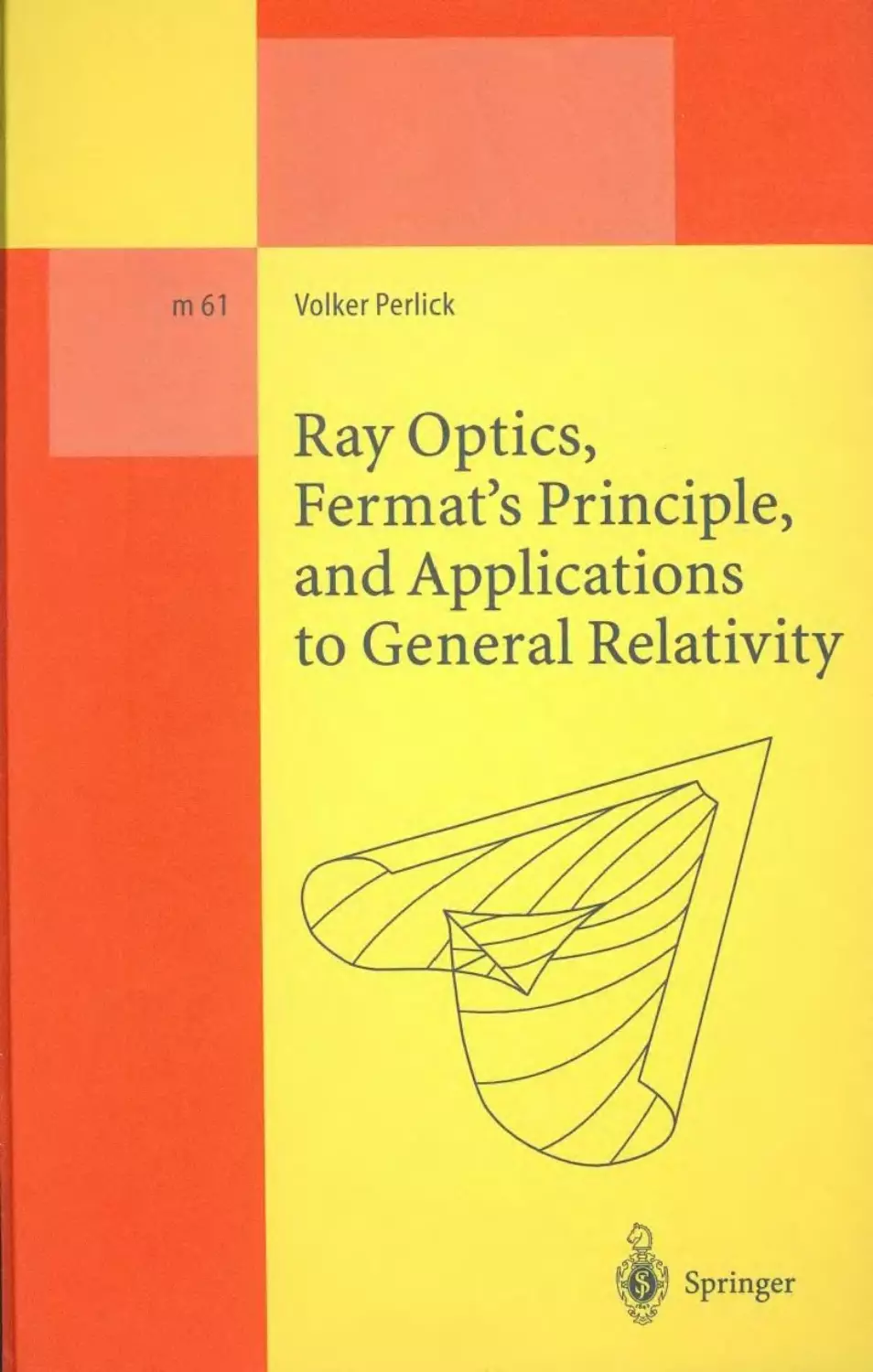
                    Volker Perlick
Ray Optics,
Fermat's Principle,
and Applications
to General Relativity

Lecture Notes in Physics
Monographs
Editorial Board
R. Beig, Wien, Austria
J. Ehlers, Potsdam, Germany
U. Frisch, Nice, France
K. Hepp, Zurich, Switzerland
W. Hillebrandt, Garching, Germany
D. Imboden, Zurich, Switzerland
R. L. Jaffe, Cambridge, MA, USA
R. Kippenhahn, Gottingen, Germany
R. Lipowsky, Golm, Germany
H. v. Lohneysen, Karlsruhe, Germany
I. Ojima, Kyoto, Japan
H. A. Weidenmiiller, Heidelberg, Germany
J. Wess, Miinchen, Germany
J. Zittartz, Koln, Germany
Managing Editor
W. Beiglbock
c/o Springer-Verlag, Physics Editorial Department II
Tiergartenstrasse 17, D-69121 Heidelberg, Germany
Springer
Berlin
Heidelberg
New York
Barcelona
Hong Kong
London
Milan
Paris
Singapore
Tokyo httpy/www.springer.de/phys/
Physics and Astronomy
ONLINE LIBRARY

The Editorial Policy for Monographs
The series Lecture Notes in Physics reports new developments in physical research and
teaching - quickly, informally, and at a high level. The type of material considered for
publication in the monograph Series includes monographs presenting original research
or new angles in a classical field. The timeliness of a manuscript is more important than
its form, which may be preliminary or tentative. Manuscripts should be reasonably self-
contained. They will often present not only results of the author(s) but also related work
by other people and will provide sufficient motivation, examples, and applications.
The manuscripts or a detailed description thereof should be submitted either to one of
the series editors or to the managing editor. The proposal is then carefully refereed. A
final decision concerning publication can often only be made on the basis of the complete
manuscript, but otherwise the editors will try to make a preliminary decision as definite
as they can on the basis of the available information.
Manuscripts should be no less than 100 and preferably no more than 400 pages in length.
Final manuscripts should be in English. They should include a table of contents and an
informative introduction accessible also to readers not particularly familiar with the topic
treated. Authors are free to use the material in other publications. However, if extensive
use is made elsewhere, the publisher should be informed. Authors receive jointly 30
complimentary copies of their book. They are entitled to purchase further copies of their book
at a reduced rate. No reprints of individual contributions can be supplied. No royalty is
paid on Lecture Notes in Physics volumes. Commitment to publish is made by letter of
interest rather than by signing a formal contract. Springer-Verlag secures the copyright
for each volume.
The Production Process
The books are hardbound, and quality paper appropriate to the needs of the author(s) is
used. Publication time is about ten weeks. More than twenty years of experience guarantee
authors the best possible service. To reach the goal of rapid publication at a low price the
technique of photographic reproduction from a camera-ready manuscript was chosen.
This process shifts the main responsibility for the technical quality considerably from the
publisher to the author. We therefore urge all authors to observe very carefully our
guidelines for the preparation of camera-ready manuscripts, which we will supply on request.
This applies especially to the quality of figures and halftones submitted for publication.
Figures should be submitted as originals or glossy prints, as very often Xerox copies are not
suitable for reproduction. For the same reason, any writing within figures should not be
smaller than 2.5 mm. It might be useful to look at some of the volumes already published or,
especially if some atypical text is planned, to write to the Physics Editorial Department of
Springer-Verlag direct. This avoids mistakes and time-consuming correspondence during
the production period.
As a special service, we offer free of charge ETeX and T^X macro packages to format the
text according to Springer-Verlag's quality requirements. We strongly recommend authors
to make use of this offer, as the result will be a book of considerably improved technical
quality.
For further information please contact Springer-Verlag, Physics Editorial Department II,
Tiergartenstrasse 17, D-69121 Heidelberg, Germany.
Series homepage - http://www.springer.de/phys/books/lnpm

Vblker Perlick
Ray Optics,
Fermat's Principle,
and Applications
to General Relativity
•$9 Springer

Author
Volker Perlick
Technische Universitat Berlin
Sekr. PN 7-1
Hardenbergstrasse 36
10623 Berlin, Germany
Library of Congress Cataloging-in-Publication Data
Perlick, Volker, 1956-
Ray optics, Fermat's principle, and applications to general relativity / c Volker Perlick.
p. cm. - (Lecture notes in physics. Monographs, ISSN 0940-7677 ; v. m61)
Includes bibliographical references and index.
ISBN 3540668985 (alk. paper)
1. Light—Transmission—Mathematical models. 2. Maxwell equations. 3. General
relativity (Physics) I. Title. II. Lecture notes in physics. New series m, Monographs ;
m61.
QC389 .P37 2000
523.01'53-dc21
99-089303
ISSN 0940-7677 (Lecture Notes in Physics. Monographs)
ISBN 3-540-66898-5 Springer-Verlag Berlin Heidelberg New York
This work is subject to copyright. All rights are reserved, whether the whole or part
of the material is concerned, specifically the rights of translation, reprinting, reuse of
illustrations, recitation, broadcasting, reproduction on microfilm or in any other way, and
storage in data banks. Duplication of this publication or parts thereof is permitted only
under the provisions of the German Copyright Law of September 9,1965, in its current
version, and permission for use must always be obtained from Springer-Verlag. Violations
are liable for prosecution under the German Copyright Law.
© Springer-Verlag Berlin Heidelberg 2000
Printed in Germany
The use of general descriptive names, registered names, trademarks, etc. in this publication
does not imply, even in the absence of a specific statement, that such names are exempt
from the relevant protective laws and regulations and therefore free for general use.
Typesetting: Camera-ready by the author
Cover design: design & production, Heidelberg
Printed on acid-free paper
SPIN: 10644482 55/3144/du - 5 43210

Preface
All kind of information from distant celestial bodies comes to us in the form
of electromagnetic radiation. In most cases the propagation of this radiation
can be described, as a reasonable approximation, in terms of rays. This is
true not only in the optical range but also in the radio range of the
electromagnetic spectrum. For this reason the laws of ray optics are of fundamental
importance for astronomy, astrophysics, and cosmology.
According to general relativity, light rays are the light-like geodesies of a
Lorentzian metric by which the spacetime geometry is described. This,
however, is true only as long as the light rays are freely propagating under the
only influence of the gravitational field which is coded in the spacetime
geometry. If a light ray is influenced, in addition, by an optical medium (e.g.,
by a plasma), then it will not follow a light-like geodesic of the spacetime
metric. It is true that for electromagnetic radiation traveling through the
universe usually the influence of a medium on the path of the ray and on
the frequency is small. However, there are several cases in which this
influence is very well measurable, in particular in the radio range. For example,
the deflection of radio rays in the gravitational field of the Sun is
considerably influenced by the Solar corona. Moreover, current and planned Doppler
experiments with microwaves in the Solar system reach an accuracy in the
frequency of Aw/w = 10"15 which makes it necessary to take the influence
of the interplanetary medium into account. Finally, even in cases where the
quantitative influence of the medium is negligibly small it is interesting to
ask in which way the qualitative aspects of the theory are influenced by the
medium. The latter remark applies, in particular, to the intriguing theory of
gravitational lensing.
Unfortunately, general-relativistic light propagation in media is not
usually treated in standard textbooks, and the more specialized literature is
concentrated on particular types of media and on particular applications
rather than on general methodology. In this sense a comprehensive review of
general-relativistic ray optics in media would fill a gap in the literature. It is
the purpose of this monograph to provide such a review.
Actually, this monograph grew out of a more special idea. It was my
original plan to write a review on variational principles for light rays in general
relativistic media, and to give some applications to astronomy and astro-

VI Preface
physics, in particular to the theory of gravitational lensing. However, I soon
realized the necessity of precisely formulating the mathematical theory of
light rays in general before I could tackle the question of whether these light
rays are characterized by a variational principle. The sections on variational
principles and on applications are now at the end of Part II, in which a
general mathematical framework for ray optics is set up. This is written in the
language of symplectic geometry, thereby elucidating the well-known analogy
between ray optics and the phase-space formulation of classical mechanics.
Moreover, I found it desirable to also treat the question of how to derive
ray optics as an approximation scheme from Maxwell's equations. This is
the topic of Part I which serves the purpose of physically motivating the
fundamental definitions of Part II. In vacuo, the passage from Maxwell's
equations to ray optics is, of course, an elementary textbook matter and the
generalization to isotropic and non-dispersive media is quite straightforward.
However, for anisotropic and/or dispersive media this passage is more subtle.
In Part I two types of media are discussed in detail, viz., an anisotropic one
and a dispersive one, and the emphasis is on general methodology.
I have organized the material in such a way that it should be possible to
read Part II without having read Part I. This is not recommended, of course,
but the reader might wish to do so. Both parts begin with an introductory
section containing a brief guide to the literature and a statement of
assumptions and notations used throughout. Whenever the reader feels that a symbol
needs explanation or that the underlying assumptions are not clearly stated,
he or she should consult the introductory section of the respective part. Also,
the index might be of help if problems of that kind occur.
Large parts of this monograph present material which, in essence, is not
new. However, I hope that the formulation chosen here might give some new
insight. As to Part I, our discussion of the passage from Maxwell's equations
to ray optics includes several mathematical details which are difficult to find
in the literature, although the general features are certainly known to experts.
To mention just one example, it is certainly known to experts that in a linear
but anisotropic medium on a general-relativistic spacetime the light rays are
determined by two "optical Finsler metrics"; to the best of my knowledge,
however, a full proof of this fact is given here for the first time. As to Part II,
the basic formalism is just the 170-year-old Hamiltonian optics, rewritten in
modern mathematical terminology and adapted to the framework of general
relativity. However, the presentation is based on some general mathematical
definitions which have not been used before. This remark applies, in
particular, to Definition 5.1.1, which is the definition of what I call "ray-optical
structures". This definition formalizes the widely accepted idea that all of
ray optics can be derived from a "dispersion relation". (The term "ray
system" is sometimes used by Vladimir Arnold and his collaborators in a similar
though not quite identical sense.) It also applies, e.g., to Definition 5.4.1, on

Preface VII
"dilation-invariant" ray optical structures, which characterizes dispersion-free
media in a geometric way.
On the other hand, I want to direct the reader's attention to the fact that
this monograph contains some particular results which, as far as I know, have
not been known before. These include, e.g.:
• the general redshift formula for light rays in media on a general-relativistic
spacetime in Sect. 6.2;
• the results on light bundles in isotropic non-dispersive media on a general-
relativistic spacetime in Sect. 6.4, in particular the generalized "reciprocity
theorem" (Theorem 6.4.3);
• Theorem 7.3.1, which can be viewed as a version of Fermat's principle
for light rays in (possibly anisotropic and dispersive) media on general-
relativistic spacetimes;
• Theorem 7.5.4, which generalizes the "Morse index theorem" of Rieman-
nian geometry to the case of light rays in stationary media on stationary
general-relativistic spacetimes.
Some of the questions raised in this monograph remain unanswered, i.e., to
some extent this is an interim report on work in progress. In particular, this
remark applies to the following two special issues, (a) In Part I we are able to
prove that for the linear medium treated in Chap. 2 ray optics is associated
with approximate solutions of Maxwell's equations, i.e., that ray optics gives
a viable approximation scheme for electromagnetic radiation. Unfortunately,
we are not able to prove a similar result for the plasma model of Chap. 3.
This is a gap which should be filled in the future, (b) In Part II we are
able to establish a Morse index theorem for light rays in stationary media.
However, it is still an open question whether these results can be generalized
to the non-stationary case in which, up to now, a Morse theory exists only
for vacuum rays. With Fermat's principle in the form of Theorem 7.3.1 we
have a starting point for setting up a Morse theory for light rays in arbitrary
(non-stationary) media. This is an interesting problem to be tackled in future
work.
This monograph in its present form is a slightly revised version of my
Habituation thesis. I would like to use this opportunity to thank the members of
the Habilitation Committee, Karl-Eberhard Hellwig, Erwin Sedlmayr, Bernd
Wegner, John Beem, Friedrich Wilhelm Hehl, and Gemot Neugebauer, for
their interest in this work and for several useful comments. In particular, I
would like to thank Bernd Wegner for paving the way to having this text
published with Springer Verlag.
While working at this monograph I have profited from many discussions,
in particular with my academic teacher Karl-Eberhard Hellwig and his
collaborators at the Technical University in Berlin, but also with other colleagues.
Special thanks are due to Wolfgang Hasse and Marcus Kriele for
collaboration on various aspects of light propagation in general relativity; to Wolfgang

VIII Preface
Rindler for hospitality at the University of Texas at Dallas and for
discussions on the fundamentals of general relativity; to John Beem for hospitality
at the University of Missouri at Columbia and for discussions on Lorentzian
geometry; to Gemot Neugebauer and his collaborators for hospitality at the
University of Jena and for discussions on various aspects of general relativity;
to Paolo Piccione, Fabio Giannoni, and Antonio Masiello for hospitality
during several visits to Italy and to Brazil and for collaboration on Morse theory;
and to Jiirgen Ehlers and Arlie Petters for fruitful discussions on Fermat's
principle and gravitational lensing. Also, I have enjoyed discussions on this
subject with students during seminars and classes in Berlin, Osnabriick, and
Sao Paulo.
Finally, I am grateful to the Deutsche Forschungsgemeinschaft for
sponsoring this work with a Habilitation stipend, and to the Wigner Foundation,
to the Deutscher Akademischer Austauschdienst, and to the Fundagao de
Amparo a Pesquisa do Estado de Sao Paulo for financially supporting my
visits to Dallas, Columbia, and Sao Paulo.
Berlin, August 1999
Volker Perlick

Contents
Part I. From Maxwell's equations to ray optics
1. Introduction to Part I 3
1.1 A brief guide to the literature 3
1.2 Assumptions and notations 5
2. Light propagation in linear dielectric and permeable media 7
2.1 Maxwell's equations in linear dielectric and permeable media. 7
2.2 Approximate-plane-wave families 14
2.3 Asymptotic solutions of Maxwell's equations 17
2.4 Derivation of the eikonal equation and transport equations .. 19
2.5 Discussion of the eikonal equation 24
2.6 Discussion of transport equations and the introduction of rays 31
2.7 Ray optics as an approximation scheme 36
3. Light propagation in other kinds of media 43
3.1 Methodological remarks on dispersive media 44
3.2 Light propagation in a non-magnetized plasma 46
Part II. A mathematical framework for ray optics
4. Introduction to Part II 61
4.1 A brief guide to the literature 61
4.2 Assumptions and notations 63
5. Ray-optical structures on arbitrary manifolds 67
5.1 Definition and basic properties of ray-optical structures 67
5.2 Regularity notions for ray-optical structures 76
5.3 Symmetries of ray-optical structures 82
5.4 Dilation-invariant ray-optical structures 87
5.5 Eikonal equation 92
5.6 Caustics 100

X Contents
6. Ray-optical structures on Lorentzian manifolds Ill
6.1 The vacuum ray-optical structure Ill
6.2 Observer fields, frequency, and redshift 113
6.3 Isotropic ray-optical structures 120
6.4 Light bundles in isotropic media 123
6.5 Stationary ray-optical structures 131
6.6 Stationary ray optics in vacuum and in simple media 141
7. Variational principles for rays 149
7.1 The principle of stationary action: The general case 149
7.2 The principle of stationary action: The strongly regular case . 154
7.3 Fermat's principle 156
7.4 A Hilbert manifold setting for variational problems 165
7.5 A Morse theory
for strongly hyperregular ray-optical structures 168
8. Applications 183
8.1 Doppler effect, aberration, and drag effect in isotropic media . 183
8.2 Light rays in a uniformly accelerated medium
on Minkowski space 190
8.3 Light propagation in a plasma on Kerr spacetime 193
8.4 Gravitational lensing 199
References 211

1. Introduction to Part I
In Part I we recapitulate the general ideas of how to derive the laws of
ray optics from Maxwell's equations. We presuppose a general-relativistic
spacetime as background, and we consider media which are general enough
to elucidate all relevant features of the method. Chapter 2 treats the case of
a linear (not necessarily isotropic) dielectric and permeable medium in full
detail. Chapter 3 discusses dispersive media in general and a simple plasma
model in particular. In this way the material presented in Part I serves two
purposes. First, it motivates our mathematical frame-work for ray optics, to
be set up in Part II below. Second, it provides us with physically important
examples of ray optical structures to which we shall recur frequently.
1.1 A brief guide to the literature
In Part I we have to assume some familiarity on the reader's side with
Maxwell's equations in matter on a general-relativistic spacetime. Whereas
vacuum Maxwell's equations are detailed in any textbook on general
relativity, the matter case is not usually treated in extenso. For general aspects of
the phenomenology of electromagnetic media in general relativity we refer
to Bressan [17] who gives many earlier references. The case of a linear (not
necessarily isotropic) dielectric
and permeable medium which is at the basis of Chap. 2 is briefly treated
by Schmutzer [127], Chap. IV, following an original article by Marx [91].
The general-relativistic plasma model which is at the basis of Chap. 3 is
systematically treated in two articles by Breuer and Ehlers [18] [19]; for earlier
work on the same subject we refer to Madore [90], to Bicak and Hadrava [14],
and to Anile and Pantano [5] [6].
As an aside it should be mentioned that the phenomenological theory
of electromagnetic media can be derived from electron theory by
statistical methods, i.e., that the macroscopic (phenomenological) Maxwell
equations can be derived from a sort of microscopic Maxwell equations. For linear
isotropic media in inertial motion on flat spacetime this is a standard
textbook matter; the generalization te accelerated media is due to Kaufmann [67].
For a general-relativistic plasma, the derivation of phenomenological proper-
V. Perlick: LNPm 61, pp. 3 - 6, 2000
© Springer-Verlag Berlin Heidelberg 2000

4 1. Introduction to Part I
ties from the kinetic theory of photons is discussed in the above-mentioned
article by Bicak and Hadrava [14].
The main topic of Part I is the derivation of the laws of ray optics from
Maxwell's equations. The basic idea is to make an approximate-plane-wave
ansatz for the electromagnetic field and to assume that this ansatz
satisfies Maxwell's equations in an asymptotic sense for high frequencies. This
results in a dynamical law for wave surfaces which can be rewritten equiv-
alently as a dynamical law for rays. In optics the dynamical law for wave
surfaces is usually called the eikonal equation. It is formally analogous to the
Hamilton- Jacobi equation of classical mechanics, whereas the dynamical law
for rays is formally analogous to Hamilton's equations. Mathematically, this
so-called ray method is, of course, not restricted to Maxwell's equations but
applies equally well to other partial differential equations with or without
relevance to physics. In this sense, the ray method has applications not only
to optics but also to acoustics and to wave mechanics. In the latter context,
the ray method is known as JWKB method, refering to the pioneering work
of Jeffreys, Wentzel, Kramers and Brioullin, and is detailed in virtually any
textbook on quantum mechanics.
In this brief guide to the literature we shall concentrate on the ray method
in optics. As to other applications we refer to the comprehensive list of
references given in monographs such as Keller, Lewis and Seckler [70] or Jeffrey
and Kawahara [66]. Purely mathematical aspects of the ray method can be
found in textbooks on partial differential equations. Particularly useful for
our purposes are, e.g., the books by Chazarain and Piriou [26] and by Egorov
and Shubin [36].
Whereas rudiments of the ray method can be traced back to work of Li-
ouville and Green around 1830, it was first carried through in the context
of optics by Sommerfeld and Runge [132] in the year 1911, following a
suggestion by Debye. The work of Sommerfeld and Runge was restricted to the
vacuum Maxwell equations in an inertial system, and the only goal was to
derive the corresponding eikonal equation. Their treatment was generalized
and systematized by Luneburg [88] who considered infinite asymptotic series
solutions rather than just asymptotic solutions of lowest order as
Sommerfeld and Runge did. Later, the method was extended from the vacuum case
to the case of light propagation in matter. This was a very active field of
reasearch in the 1960s, see, e.g., Lewis [84], Chen [27] and Kravtsov [75]. All
these papers are restricted to special relativity in the sense that they are
presupposing a flat spacetime. Nonetheless, the techniques used are of
interest also in view of general relativity. The reason is that vacuum Maxwell's
equations on a general-relativistic spacetime are very similar to Maxwell's
equations in an inhomogeneous medium on flat spacetime, at least locally.
This was first observed by Plebanski [120]. Note, however, that global
aspects which do not carry over to general relativity are brought into play
whenever temporal Fourier expansions (as e.g. by Lewis [84]) and/or spatial

1.2 Assumptions and notations 5
Fourier expansions (as e.g. by Chen [27]) are used. A global treatment of the
ray method that does carry over to general relativity is possible in terms of
the Lagrangian manifold techniques introduced in the 1960s by Maslov and
Arnold, see Arnold [7], Maslov [94], Duistermaat [31] or Guillemin and
Sternberg [55]. In Part I we are concerned with local questions only. However, we
shall touch upon Lagrangian manifold techniques and their relevance for the
investigation of caustics in Part II below.
In general relativity, the passage from Maxwell's equations to ray optics
was carried through for the first time by Laue [77] in the year 1920. In this
paper, which is the written version of a talk given by Laue at the 86. Natur-
forscherversammlung, the author demonstrated how to derive from vacuum
Maxwell's equations on a curved spacetime the light-like geodesic equation for
the rays. Laue's treatment followed closely the seminal paper by Sommerfeld
and Runge [132]. A more systematic general-relativistic treatment of the ray
method in optics, including asymptotic solutions of arbitrarily high order, was
brought forward much later by Ehlers [38]. He considered linear isotropic non-
dispersive media on an arbitrary general-relativistic spacetime and derived
not only the eikonal equation for the rays but also transport equations of
arbitrary order for the polarization plane along the rays. In particular, his results
put earlier findings about light propagation in such media by Gordon [50]
and Pham Mau Quan [117] on a mathematically firm basis. At least for the
vacuum case, the main results can now be found in many textbooks on
general relativity, see, e.g., Misner, Thorne and Wheeler [98], Straumann [136],
or Stephani [133]. The general-relativistic relevance of higher order terms in
the asymptotic series expansion was discussed by Dwivedi and Kantowski
[32] and by Anile [4]. A general-relativistic treatment of the ray method for
dispersive media, exemplified with a special plasma model, is due to Breuer
and Ehlers [18] [19] who modified and enhanced earlier work by Madore [90],
by Bicak and Hadrava [14], and by Anile and Pantano [5] [6].
1.2 Assumptions and notations
We assume a general-relativistic spacetime, i.e., a four-dimensional C°°
manifold with a metric of Lorentzian signature (+,+,+,—). On this spacetime
background we consider Maxwell's equations, using units making the dielec-
tricity and permeability constants of vacuum equal to one, e0 = fi0 = 1.
Thereby, in particular, the vacuum velocity of light is set equal to one. We
restrict ourselves to the C°° category in the sense that throughout Part I all
maps and tensor fields are tacitly assumed to be infinitely often differentiable.
We work in local coordinates using standard index notation. Throughout,
Einstein's summation convention is in force with latin indices running from 1
to 4 and with greek indices running from 1 to 3.The (covariant) components
of the spacetime metric will be denoted by gab- As usual, we define gbc by
gaigbc = 5£, where 5° denotes the Kronecker delta, and we use gab (and gbc,

6 1. Introduction to Part I
respectively) to lower (and raise, respectively) indices. With respect to a
coordinate system x — (x1 4), partial derivatives -^ will be denoted
by da for short, whereas Va means covariant derivative with respect to the
Levi-Civita connection of our metric. For the sake of brevity, we shall speak
of "a tensor field Qabc" if we mean "a tensor field whose contravariant
components in a coordinate system are Qabc " etc. Our treatment will be purely
local throughout Part I. Therefore, the use of local coordinates and index
notation is no restriction whatsoever.

2. Light propagation in linear dielectric
and permeable media
On our spacetime manifold we consider Maxwell's equations in a linear but
not necessarily isotropic medium, i. e., in a medium phenomenologically
characterized by a dielectricity tensor field and a permeability tensor field. It is
our goal to derive and to discuss the laws of ray optics in such a medium.
The standard textbook problem of light propagation in vacuo is, of course,
included as a special case.
The results of this chapter cover a wide range of applications including
light propagation in gases (isotropic case) and crystals (anisotropic case)
as long as dispersion is ignored. For dispersive media we refer to Chap. 3
below. In view of applications to astrophysics, the isotropic case is more
interesting than the (much more complicated) anisotropic case. On the other
hand, a thorough treatment of the anisotropic case is highly instructive from
a methodological point of view. In particular, it gives us the opportunity to
discuss the phenomenon of birefringence.
2.1 Maxwell's equations in linear dielectric
and permeable media
On our spacetime manifold, the source-free Maxwell equations for
(macroscopic) electromagnetic fields in matter can be written in local coordinates
as
rjabcdVbFcd = 0 and VbGbc = 0 , (2.1)
or, using partial rather than covariant derivatives, as
VabcddbFcd=0 and rfbcd db(^ Gef) = 0 . (2.2)
In (2.1) and (2.2),
Vahcd denotes the totally antisymmetric Levi-Civita tensor
field (volume form) of our metric which is defined by the equation
T?i234 = ±V|detG?cd)|. (2-3)
Here the plus sign is valid if the coordinate system is right-handed and the
minus sign is valid if it is left-handed. In other words, we have to choose an
V. Perlick: LNPm 61, pp. 7 - 41, 2000
© Springer-Verlag Berlin Heidelberg 2000

8 2. Light propagation in linear dielectric and permeable media
orientation on the domain of our coordinate system to fix the sign ambiguity
of the Levi-Civita tensor field. However, this is irrelevant since Maxwell's
equations are invariant under r}abcd i—> —rjabcd, and so are all the relevant
results in Part I. If the reader is not familiar with volume elements he or she
may consult, e.g., Wald [146], p. 432.
Fat, and Gab denote the electromagnetic field strength and the
electromagnetic excitation, respectively, both of which are antisymmetric second rank
tensor fields. With respect to a reference system, given in terms of a time-like
vector field Ua with Ua Ua = — 1, we can introduce the electric field strength
Ea = FabUb (2.4)
and the magnetic field strength
Ba = -\r]ahcdUhFcd (2.5)
such that
Fab = -V^abBcUd + EbUa- EaUb . (2.6)
Here we have used the familiar property
Vabcd Vaefk = ~K S{ Sk - 51 Sfd 5* - 8% S[ Skc +
SedSfcSkb+StS[Skd + StSfdSkc (2.7)
of the Levi-Civita tensor field, cf., e.g., Wald [146], equation (B.2.12).
Similarly, we introduce the electric excitation
Da = GabUb (2.8)
and the magnetic excitation
Ha = -lr]abcdUbGcd (2.9)
such that
Gab = -V^abHcUd + DbUa- DaUb . (2.10)
With respect to the reference system used for their definitions, the electric
and magnetic field strengths are purely spatial one-forms, and so are the
electric and magnetic excitations,
EaUa = BaUa = 0 and DaUa = HaUa = 0 . (2.11)
Our terminology of calling Ea and Ba the "field strengths" (in german:
Feldstarken) and Da and Ha the "excitations" (in german: Erregungen)
follows Gustav Mie and Arnold Sommerfeld. This terminology is reasonable

2.1 Maxwell's equations in linear dielectric and permeable media 9
since Ea and Ba determine the Lorentz force exerted on a charged test
particle whereas, in the presence of field-producing charges and currents, Da and
Ha are the fields "excited" by those sources via Maxwell's equations. The
traditional terminology of calling Ha the "magnetic field strength" is
misleading. Moreover, it is highly inconvenient from a relativistic point of view
where Ea and Ba, rather than Ea and Ha, are united into an antisymmetric
second rank tensor field on spacetime.
In what follows we consider Maxwell's equations in the form (2.2). As
long as only the metric is known, (2.2) gives us eight component equations for
twelve unknown functions. (The unknown functions are the six independent
components of the electromagnetic field strength plus the six independent
components of the electromagnetic excitation.) Hence, (2.2) is an underde-
termined system of partial differential equations. It must be supplemented
by constitutive equations relating the electromagnetic field strength with the
electromagnetic excitation. Thereby the medium is characterized in a phe-
nomenological way. In this chapter we consider linear dielectric and permeable
media according to the following definition.
Definition 2.1.1. A linear dielectric and permeable medium is, by
definition, a medium characterized by constitutive equations that take the form
Da = eabEb and Ba = fj,ab Hb , (2.12)
in some reference system Ub, with second rank tensor fields eab and fiab
satisfying the following conditions:
(a) Uaeab = 0 and Ua ^ab = 0 .
(b) eab = eba and fiab = ^iba .
(c) eab ZaZb>0 and fj,ab ZaZb>0 for all (Zu Z2,Z3, Z4) ^ (0,0,0,0) with
Ua Za = 0.
We refer to the distinguished reference system Ub as to the rest system, to
eab as to the dielectricity tensor field and to fiab as to the permeability tensor
field of the medium.
Condition (a) of Definition 2.1.1 guarantees that the constitutive
equations (2.12) are in agreement with Da Ua = 0 and Ba Ua = 0. Conditions (b)
and (c) imply that in the rest system of the medium the energy density
w = \{DaEa + BaHa), (2.13)
of the electromagnetic field is positive definite. Altogether, conditions (a),
(b) and (c) guarantee that the dielectricity and permeability tensor fields are
"spatially invertible". We can, thus, define (/u_1)a6 by the properties
t/a(^V = o>
(M-1)a6 = Or1)6* , (2-14)

10 2. Light propagation in linear dielectric and permeable media
The constitutive equations (2.12) can then be united in a single equation,
Gab = (J V^ab {^V VerPq Ur Ud + Eh* U* Ua - 8aP U* Ub) Fpq . (2.15)
The following special case deserves particular interest.
Definition 2.1.2. A linear dielectric and permeable medium is called
isotropic if the dielectricity and permeability tensor fields are of the special form
eab = e(5ba + UaUb) and fiab = » (5ba + UaUb) , (2.16)
with some scalar functions e and \i. (Condition (c) of Definition 2.1.1 then
requires e and fi to be strictly positive.)
In the isotropic case, (2.15) reduces to
Gab = - (Fab + (1 - eji) (Fad Ub - Fbd Ua) Ud) . (2.17)
In particular, vacuum can be characterized as a linear isotropic medium with
e — fi = 1. In this case (and, more generally, in any isotropic medium with
E\i = 1) Ua drops out from (2.17) and the constitutive equations take the
form (2.12) in any reference system. This is in agreement with the obvious
fact that for vacuum any reference system can be viewed as the rest system
of the medium.
We emphasize that our phenomenological constitutive equations are
physically reasonable in the rotational as well as in the irrotational case, i.e., Ua
need not be hypersurface-orthogonal. Although this should be clear from the
general rules of relativity, there is still a debate on this issue, even in the case
of an isotropic medium on flat spacetime, see, e.g., Pellegrini and Swift [106].
We are now going to analyze the dynamics of electromagnetic fields in
a linear dielectric and permeable medium. We have already mentioned that
Maxwell's equations (2.2) alone give us eight equations for twelve unknown
functions. With (2.12) at hand, and assuming that I7a, eab and /j,ab are known,
we can eliminate six of the unknown functions. Now (2.2) gives us eight
equations for six functions, i.e., the system looks overdetermined. However, only
six of those eight equations are evolution equations, governing the dynamics of
electromagnetic fields, whereas the other two equations are constraints.This
is most easily verified in a local coordinate system (x 4) in which
the hypersurfaces x4 = const, are space-like such that x4 can be viewed as
a local time function. Owing to the antisymmetry of the Levi-Civita tensor,
the a = 4 components of equations (2.2) do not involve any 84 derivative.
Hence, these two equations are to be viewed as constraints whereas the
remaining six equations, i.e., the a = 1,2,3 components of equations (2.2),
are the evolution equations governing the dynamics. Again owing to the
antisymmetry of the Levi-Civita tensor field, the evolution equations preserve the
constraints in the following sense. If the constraints are written in the form

2.1 Maxwell's equations in linear dielectric and permeable media 11
C\ = 0 and C2 = 0, then the evolution equations imply that d^Ci = /i C\
and 94C2 = /2C2 with some spacetime functions f\ and f2. Hence, if a
solution of the evolution equations satisfies the constraints on some initial
hypersurface x4 = const., then it satisfies the constraints everywhere (on
some neighborhood of any point of the initial hypersurface, that is). In other
words, locally around any one point all solutions of Maxwell's equations can
be found in the following way.
Step 1. Choose a space-like hypersurface through that point.
Step 2. Choose a local coordinate system such that the chosen
hypersurface is given by the equation x4 = const.
Step 3. Solve the evolution equations with all initial data that satisfy
the constraints.
In the rest of this section we shall prove that the initial value problem
considered in Step 3 is well-posed in the sense that it is characterized by a local
existence and uniqueness theorem, provided that the initial hypersurface has
been chosen appropriately. Conditions (a), (b) and (c) of Definition 2.1.1 will
prove essential for this result.
First we introduce special coordinates according to the following
definition.
Definition 2.1.3. Let Ua denote the rest system of a linear dielectric and
permeable medium and fix a spacetime point xo- Then a local coordinate
system (x1 4); defined on a neighborhood ofx0) is called adapted to Ua
near xo if
(a) Ua is given by the equation Ua — J-— 5f ,
(b) #4M = 0 for fi = 1,2,3 at the point x0 .
For any linear dielectric and permeable medium, it is obvious that adapted
coordinates are characterized by the following existence and uniqueness
property. If we choose a spacetime point xo and a hypersurface <S that is orthogonal
to Ua at xo, then there is a coordinate system adapted to Ua near xo such
that S is represented by the equation x4 = const. Another coordinate system
(xn,x'2,x'3,x,4:) is, again, adapted to Ua near xo if and only if it is related
to (x1 4) by a coordinate transformation of the special form
x".—-^'"(xSx2^3)
(2.18)
with§£L=0-
Condition (b) of Definition 2.1.3 makes sure that at the point xo the
hypersurface x4 = const, intersects the respective integral curve of Ua
orthogonally. This implies that, on a sufficiently small neighborhood of xo, all
hypersurfaces x4 = const, are space-like. Of course, they cannot be
orthogonal to Ua on a whole neighborhood unless the medium is non-rotating. Hence,

12 2. Light propagation in linear dielectric and permeable media
in an adapted coordinate system the mixed components g^ and <j^4 of the
metric need not vanish except at the central point xq. The spatial components
give positive definite 3x3 matrices (g^) and (g^) on some neighborhood
of xo; at the point xq these matrices are inverse to each other. The temporal
components gu and gu are strictly negative functions on some neighborhood
of xo ; at the point xq they are inverse to each other.
Now we consider a linear dielectric and permeable medium in a coordinate
system adapted to its rest system Ua near some point xq. Then (2.11) reduces
to
E4 = B4 = 0 and D4 = F4 = 0 (2.19)
owing to condition (a) of Definition 2.1.3. Hence, (2.12) simplifies to
D(T=eCTpEp and Ba = ^pHp. (2.20)
Conditions (b) and (c) of Definition 2.1.1 guarantee that eap and \iap are
positive definite and symmetric with respect to gpT. We can, thus, define vap
and W(tp, which are again positive definite and symmetric with respect to
<T, by
\iva V vTp = 5P and eva waT wTp = 5P . (2.21)
For the following it will be convenient to introduce the quantities
Zp=vpeTB(T and Yp = wpaDa , (2.22)
and to use Zi,Z2,2/3, Yi,Y2,Yz for the six independent components of the
electromagnetic field. That is to say, we start from Maxwell's equations (2.2)
with (2.6) and (2.10); we use part (a) of Definition 2.1.3 and equation (2.19);
we eliminate ET and HT with the help of (2.20); finally, we express Da and
Ba in terms of Zp and Yp by means of (2.22). After a little bit of algebra,
the a = 1,2,3 components of Maxwell's equations (2.2) give us evolution
equations of the form
(2.23)
for the dynamical variables
(2.24)
Here L1, L2, L3 and L4 are re-dependent 6x6 matrices of the form

2.1 Maxwell's equations in linear dielectric and permeable media 13
where Q is a 3 x 3 matrix with components
QxT = wxu 77,447 V = wx" nJ"* V 9l3A ; (2.26)
Ap is a 3 x 3 matrix with components
AV^a'WV; (2-27)
(• )T means transposition with respect to g^ such that, e.g.,
(QT)xT9pX = Qxp9TX; (2.28)
Af is a 6 x 6 matrix whose components involve the spacetime metric along
with v\a and wpT.
For the investigation of the evolution equations (2.23) the following two
observations are crucial.
(a) At the central point xo of our adapted coordinate system we have g@4 = 0
and, thus, Q = 0. By continuity, JL4 is invertible on some neighborhood
of xo to which we can restrict our considerations. Hence, (2.23) can be
solved for the 84 derivative.
(b) L1, L2, L3 and L4 are symmetric ( = self-adjoint) with respect to the
positive definite scalar product
©•($H(Zi'Z2+ri'K2) (2-29)
Here the dots on the right-hand side refer to the scalar product defined
by
a-b^g^a^bp (2.30)
for any two C3-valued functions a and 6 on the neighborhood considered,
with the overbar denoting complex conjugation. (To be sure, in (2.23)
all quantities are real. For later purposes, however, we need the complex
version of this scalar product.)
These two observations imply that (2.23) satisfies the defining properties of a
symmetric hyperbolic system of partial differential equations. By a well-known
theorem (see, e.g., Theorem 4.5 in Chazarain and Piriou [26] or Sect. 4.12
in Egorov and Shubin [36]) this guarantees local existence and uniqueness
of a solution Z, Y for any initial data Zq, Y"0 given on our hypersurface
x4 = const. (Please recall our stipulation of tacitly working in the C°°
category throughout Part I. Had we restricted ourselves to the analytic category
instead, property (a) alone would guarantee local existence and uniqueness
of a solution to any initial data, owing to the well-known Cauchy-Kovalevsky
theorem.) Moreover, the fact that (2.23) is symmetric hyperbolic implies that
solutions Z, Y are bounded in terms of so-called energy inequalities, see, e.g.,

14 2. Light propagation in linear dielectric and permeable media
Theorem 4.3 in Chazarain and Piriou [26] or Theorem 2.63 in Egorov and
Shubin [36]. We are going to employ these facts later.
The explicit form of the matrix M in (2.23) will be of no interest for
us in the following. What really matters is the structure of the La, i.e., the
information contained in the 6x6 matrix
L(x,p)=paLa(x). (2.31)
Here the first argument x = (xl,x2,x3,x*) ranges over the coordinate
neighborhood considered and the second argument p = (pi,P2,P3,P4) ranges over
E4. The matrix L(x,p) defined by (2.31) is called the principal matrix or the
characteristic matrix of the system of differential equations (2.23). Its
determinant, which gives a homogeneous polynomial of degree six in the pa, is
called the principal determinant or the characteristic determinant of (2.23).
We shall see later that the laws of ray optics in our medium are coded in the
characteristic determinant.
The notions of characteristic matrix and characteristic determinant can
be introduced for any system of kth order partial differential equations, linear
in the highest order derivatives, that gives n equations for n dynamical
variables. The characteristic matrix is then formed in a fashion similar to (2.31)
from the coefficients of the highest order derivatives. If these coefficients are
independent of the unknown functions, i.e., if the system of differential
equations is semi-linear, the characteristic matrix is of the form
L(x,p)=pai---pakLa^ak(x). (2.32)
Hence, its determinant gives a homogeneous polynomial of degree nk with
respect to the pa.
2.2 Approximate-plane-wave families
In the preceding section we have discussed Maxwell's equations in a linear
dielectric and permeable medium. The laws of light propagation in such a
medium are determined by the dynamics of wavelike solutions of those
equations. In this section we clarify what is meant by the attribute "wavelike".
The following definition is basic.
Definition 2.2.1. An approximate-plane-wave family is a one-parameter
family of antisymmetric second rank tensor fields of the form
Fab(a, x) = Re{eiS^/a /o6(a, *)} (2.33)
with the following properties.
(a) The coordinates x = (a;1, a;2, a;3, a;4) range over some open subset of the
spacetime manifold and the parameter a ranges over the strictly positive
real numbers, a € R+.

2.2 Approximate-plane-wave families 15
(b) S is a real-valued function whose gradient has no zeros, i.e.,
dS(x) = (d1S(x),d2S(x),d3S(x),d4S(x)} ^ (0,0,0,0) (2.34)
for all x in the neighborhood considered. We refer to S as to the eikonal
function of the approximate-plane-wave family.
(c) For each a € R+, fab(ai ') is a complex-valued antisymmetric second
rank tensor field. Moreover, fab admits a Taylor expansion of the form
No+l
fab(a,x)=Y, aNfab^) + 0(aN°+2) (2.35)
N=0
for all integers Nq > —1, where
fS,(x) = N\ Urn <gr/06(a,*) • (2.36)
We refer to f^b as to the JVth order amplitude of the approximate-plane-
wave family.
(d) For all x in the neighborhood considered,
(/&(*)) 7*0. (2.37)
In (2.33), i denotes, of course, the imaginary unit, i2 = —1, and Re denotes
the real part of a complex number.
We call S the "eikonal function" because an approximate-plane-wave
family satisfies Maxwell's equations in an asymptotic sense to be discussed later
only if S satisfies a partial differential equation which is known as the eikonal
equation. The term "eikonal", which was introduced in 1895 by Bruns [23]
in a more special context, is derived from the greek word eikon which means
"image". This terminology is, indeed, justified since the eikonal equation is
the fundamental equation of ray optics; so it governs, in particular, the ray
optical laws of image formation.
According to our general stipulation that all maps and tensor fields are
tacitly assumed to be infinitely often differentiable it goes without saying
that fab(a>x) is a C°° function of a € R+. A Taylor expansion of the form
(2.35) is valid if and only if this function admits a C°° extension into the
point a = 0. Note that we do not assume that the 0(aN+1) term in (2.35)
goes to zero for N —» oo, i.e., we do not assume analyticity with respect to
a.
It is important to realize that an approximate-plane-wave family cannot
converge for a —» 0. This is an immediate consequence of the following lemma
which will often be used in the following.
Lemma 2.2.1. Let S be the eikonal function of an approximate-plane-wave
family, according to Definition 2.2.1 (b). Let u be a complex valued function
defined on the same open subset of spacetime as the approximate-plane-wave
family. (As always in Part I, we tacitly assume that u is of class C°° and,
thus, continuous). Then lim Bj&{eq,sf°lu\ exists pointwise only ifu = 0.

16 2. Light propagation in linear dielectric and permeable media
Proof. If u is different from zero at some point, it is different from zero, by-
continuity, on a whole neighborhood. For almost all points x of this
neighborhood, (2.34) implies that S(x) ^ 0 and the limit does not exist. □
We are now going to justify the name "approximate-plane-wave family".
(More fully, (2.33) should be called a "locally-approximate-plane-and-mono-
chromatic-wave family". This terminology, however, seems a little bit too
cumbersome.) The physical idea behind Definition 2.2.1 becomes clear if we
consider the special case that the tensor fields daS and fab(&, •) are covari-
antly constant (and non-zero, as assured by (2.34) and (2.37)), i.e., that the
equations VbdaS = 0 and Vc/a6(Q;j ■) = 0 are satisfied. Then (2.33) gives
a one-parameter family of monochromatic plane waves. With respect to an
inertial system (i.e., a covariantly constant time-like vector field Va with
9ab Va Vb — — 1), the frequency of such a wave is given by uj = ^Va daS and
the spatial wave covector is given by ka = -^daS — u)gab Vb. Hence, the limit
a —*■ 0 corresponds to infinitely high frequency with respect to all inertial
systems Va with Va daS ^ 0.
Now this is a very special case since on a spacetime without
symmetry there are no non-zero covariantly constant vector fields. Therefore, as we
want to work with ansatz (2.33) on an arbitrary spacetime, we cannot assume
that daS and fab(<*, ■) are covariantly constant. However, if we restrict our
consideration to a sufficiently small neighborhood, daS and fab(<*, •) deviate
arbitrarily little from being covariantly constant. Similarly, on a sufficiently
small neighborhood, any time-like vector field Va with gab VaVb = —1
deviates arbitrarily little from an inertial system. However small this
neighborhood may be, by choosing a sufficiently small we can have arbitrarily many
wave periods in this small spacetime region.
This reasoning justifies the terminology introduced in Definition 2.2.1.
Please note that (2.34) and (2.37) are essential to guarantee that (2.33) gives
an approximately plane and monochromatic wave near each point for a
sufficiently close to zero.
In correspondence with this interpretation we shall refer to the hyper-
surfaces S = const, as to the wave surfaces of our approximate-plane-wave
family. The alternative terms eikonal surfaces and phase surfaces are also
common. Moreover, we call
w(a, x) = -i daS(x) Va(x) (2.38)
its frequency function and we call
ka(a, x) = ±daS(x) - w(o, x) gab(x) Vb(x) (2.39)
its spatial wave covector field with respect to the observer field Va; here all
those time-like vector fields with gabVaVb = -l are admitted for which
Va daS has no zeros.

2.3 Asymptotic solutions of Maxwell's equations 17
It is worthwile to note that from an approximate-plane-wave family (2.33)
we can produce non-monochromatic waves by integrating over a with an
appropriate density function w,
Fab(x) = / Fab{a, x) w{a) da . (2.40)
Jati
This can be viewed as a generalized Fourier synthesis. Here we have to assume
that oci < ai2> with #2 sufficiently small to justify the approximate-plane-
wave interpretation. Moreover, it is also possible to form superpositions of
approximate-plane-wave families with different eikonal functions S.
2.3 Asymptotic solutions of Maxwell's equations
To study the dynamics of wavelike electromagnetic fields in our medium
we have to plug our approximate-plane-wave ansatz (2.33) into Maxwell's
equations, i.e., into (2.2) supplemented with our constitutive equations.
Unfortunately, only in very special cases is it possible to determine the eikonal
function S and the amplitudes f^b in such a way that the resulting equations
are exactly satisfied for some a G K+. It is the characteristic feature of the
ray method to determine S and f^b in such a way that Maxwell's equations
are satisfied, rather than for some finite value of a, asymptotically for a —* 0.
In this way the ray method gives us the dynamics of wave surfaces and wave
amplitudes in the high frequency limit. To put this rigorously we introduce
the following notation.
Definition 2.3.1. For N e Z, an approximate-plane-wave family Fab(a, •)
in the sense of Definition 2.2.1 is called an Nth order asymptotic solution of
Maxwell's equations if
\im(^nabcddbFcd{a, -))=0,
r x (2-41)
Km(^^rf^ede/Ge/(a,.)))=0.
Here Gef(a, •) is related to Fab(a, •) by the constitutive equations of the
medium.
In (2.41), the limits are meant to be performed pointwise with respect
to the spacetime coordinates; we shall restrict ourselves to neighborhoods on
which the convergence is uniform. For the evaluation of (2.41), the following
two observations are crucial.
(a) The metric is independent of a and so are the other tensor fields that
enter into the constitutive equations, i.e., I7a, eab and /j,ab. Hence, the
special form in which a enters into the approximate-plane-wave ansatz
(2.33) together with the linearity of the constitutive equations implies
that (2.41) is trivially satisfied for N < —1.

18 2. Light propagation in linear dielectric and permeable media
(b) If (2.41) holds for N = N0, then it holds all the more for N < N0.
These two observations together suggest that Nq1 order asymptotic solutions
can be found for arbitrarily large iV0 > 0 by first evaluating (2.41) for N = — 1
and then proceeding step by step up to N = N0. We shall see in the following
that this inductive procedure gives us dynamical laws for the eikonal function
S and, step by step, for the amplitudes f^b up to arbitrarily large order
N = N0.
If we want to get dynamical laws for f^b for all N G N, we have to assume
that our approximate-plane-wave family (2.33) satisfies (2.41) for all N G N
or, what is the same, for all N € Z. In this case Fab(a, •) is called an infinite
asymptotic series solution of Maxwell's equations.
exact solutions
L
Fig. 2.1. For N > 0, an iVth order asymptotic solution Fab(a, •) of Maxwell's
equations approaches the space of exact solutions of Maxwell's equations asymptotically
for a —► 0, as will be proven in Sect. 2.7.
(2.41) does, of course, not imply that the one-parameter family Fab(a, •)
converges pointwise (or in any other sense) towards an exact solution of
Maxwell's equations for a -* 0. We have already emphasized that for an
approximate-plane-wave family the limit lim Fab(a, •) cannot exist. This
a—v0
raises the question of whether asymptotic solutions can be viewed as
approximate solutions. This question will be answered in Sect. 2.7 below by proving
the following result. Let Fab(a, •) be an approximate-plane-wave family that
is an Nth order asymptotic solution of Maxwell's equations in a linear
dielectric and permeable medium for some N > 0. Then there exists, locally
around any one point, a one-parameter family F*b(a, •) of exact solutions
of Maxwell's equations such that F*b(a, •) - Fab(ot, •) goes to zero in the
pointwise sense (and even with respect to some finer norms involving
arbitrarily high derivatives) as aN+1 for a -* 0. In other words, for a sufficiently
small the members of our approximate-plane-wave family can be viewed as
arbitrarily good approximations to exact solutions of Maxwell's equations.
Figure 2.1 illustrates this situation in the infinite-dimensional space of (C°°)

2.4 Derivation of the eikonal equation and transport equations 19
antisymmetric second-rank tensor fields defined on some open spacetime
domain.
2.4 Derivation of the eikonal equation
and transport equations
In this section we derive, in a linear dielectric and permeable medium, the
dynamical equations for wave surfaces and for wave amplitudes in the high
frequency limit. We do that locally around any spacetime point xo- As a
preparation, we prove the following fact.
Proposition 2.4.1. Consider an approximate-plane-wave family Fab(a, •)
that is an Nth order asymptotic solution of Maxwell's equations in a
linear dielectric and permeable medium for some JV > —1. Then the frequency
function (2.38) of Fab(a, •) with respect to the rest system of the medium
(Va = Ua) has no zeros.
Proof We introduce, around any spacetime point x0, a coordinate system
adapted to Ua in the sense of Definition 2.1.3. We are done if we can show
that d^S is different from zero at x0. By assumption, our approximate-plane-
wave family satisfies (2.41) for N = —1, i.e.
r?a6cdd6S/c°d = 0, (2-42)
VabcddbSrjJf g°ef=0, (2.43)
where g^ is related to /°d by the constitutive equations. (Here we made use
of Lemma 2.2.1.) Now let us assume that d^S = 0 at x0. At this point, the
a = 4 component of (2.42) implies
<fTdMS&;=0 (2.44)
for the magnetic part &° of /°6, whereas the a = p components of (2.42) imply
fl„5c°-flM5cJ = 0 (2.45)
for the electric part e° of f®b. Similarly, (2.43) results in
g^d^SdP^O, (2.46)
and
dvS hi-8^111 = 0 (2.47)
for the electric part d® and for the magnetic part h® of g£6. Note that S is
real whereas the amplitudes are complex. (2.45) and (2.46) imply
g»TeldOT duS = Q.
(2.48)

20 2. Light propagation in linear dielectric and permeable media
Similarly, (2.44) and (2.47) imply
gliThmduS = 0. (2.49)
Recall that we are at a point where d^S = 0. Thus, condition (2.34)
requires (8x8,828,838) ^ (0,0,0). Hence, by condition (c) of Definition 2.1.1,
(2.48) implies that (e?, e§, eg) = (0,0,0) and (2.49) implies that (6J, 6g, 6g) =
(0,0,0). This shows that our hypothesis of d^S having a zero gives a
contradiction to (2.37). □
To analyze the dynamics of wave surfaces and amplitudes in the high
frequency limit near an arbitrary spacetime point x0, we introduce near xo a
coordinate system which is adapted to the rest system Ua of the medium in
the sense of Definition 2.1.3. We can then express electromagnetic fields in
terms of the dynamical variables Z\,Z2,Z^Y\,Y2,Yz introduced in (2.22).
Then any approximate-plane-wave family takes the form
(r!rx))=MeiSW/"w2laN(?S)+°(«Wo+2)}' (2'50>
for any integer N0 > — 1. Here the complex amplitudes f^b from (2.35) are
expressed in terms of C3-valued functions zN and yN. The following proposition
gives necessary and sufficient conditions on the eikonal function S and on the
amplitudes zN, yN such that (2.50) is an asymptotic solution of Maxwell's
equations.
Proposition 2.4.2. Consider, locally around any spacetime point x0, a
coordinate system (x 4) adapted to the rest system Ua of a linear
dielectric and permeable medium. Then an approximate-plane-wave family,
represented in this coordinate system in the form (2.50), is an asymptotic
solution of Maxwell's equations in lowest non-trivial order N = —1 if and
only if 8&S has no zeros and
fz°\ /0\
8aSL«(^Qy[^ . (2.51)
For N0 > 0, such an approximate-plane-wave family is an Nq1 order
asymptotic solution of Maxwell's equations if and only if in addition,
(LB 8a + M) (^Pj = -i 8aS La (j^l) (2.52)
for 0 < N < N0. Here La and M denote the same matrices as in the
evolution equation (2.23).
Proof In our adapted coordinate system, we decompose the asymptotic
Maxwell's equations (2.41) into constraint part (a = 4) and evolution part

2.4 Derivation of the eikonal equation and transport equations 21
(a = p). If these equations are satisfied by an approximate-plane-wave family
for some N > —1, Proposition 2.4.1 implies that d±S has no zeros. Under
this condition the evolution part of (2.41) alone already implies the
constraint part of (2.41). This is easy to verify using the fact that, as outlined in
Sect. 2.1, the evolution equations preserve the constraints. In other words, we
can forget about the constraints and concentrate on evaluating the evolution
part of (2.41). According to (2.23), this takes the form
lhno(^(i«9a + M)gg;;j)) = Q (2.53)
in terms of the variables Zi, Zi, Z%, Yi, Y2, Y3. Hence, our approximate-plane-
wave family is an asymptotic solution of Maxwell's equations to lowest non-
trivial order N = — 1 if and only if d±S has no zeros and (2.53) is satisfied
for N = -1. By feeding (2.50) into (2.53) for N = -1 we see that the latter
condition is equivalent to (2.51), owing to Lemma 2.2.1.
For N0 > 0, our approximate-plane-wave family is an Nq1 order solution
if and only if in addition (2.53) is satisfied for all 0 < N < No. Upon feeding
(2.50) into (2.53), it is easy to prove by induction over N that this is true if
and only if (2.52) is satisfied for 0 < N < N0. □
Condition (d) of Definition 2.2.1 requires that, if (2.50) represents an
approximate-plane-wave family, z° and y° do not vanish simultaneously.
Clearly, such a solution z°,y° of (2.51) exists if and only if
det(daSLa) = 0 . (2.54)
This is a first order partial differential equation for 5, homogeneous of degree
six with respect to the components of the gradient of S. If S satisfies (2.54)
and if d^S has no zeros, S is called a solution of the eikonal equation of the
linear dielectric and permeable medium considered. By Proposition 2.4.2, this
is a necessary and sufficient condition for S to be the eikonal function of an
approximate-plane-wave family that satisfies Maxwell's equations
asymptotically to order N = — 1 at least. In the theory of partial differential equations
(2.54) is called the characteristic equation of the system of evolution
equations (2.23).
In the next section we discuss the eikonal equation in our medium in more
detail. In particular, we free ourselves from the special coordinates used so
far.
If we have a solution S of the eikonal equation, Proposition 2.4.2 can be
used to construct an asymptotic solution of arbitrarily high order. To that end
the amplitudes zN and yN have to be determined inductively with the help
of (2.51) and (2.52). Clearly, zN+1 and yN+1 are not uniquely determined
through zN and yN since, for a solution of the eikonal equation, daS La
has a non-trivial kernel. Let Pg(x) denote the 6x6 matrix that projects
orthogonally onto the kernel of daS(x) La(x), where "orthogonally" refers to

22 2. Light propagation in linear dielectric and permeable media
the scalar product (2.29). For any solution S of (2.54) the rank of Ps(x) is
bigger than or equal to one. We shall prove later that, owing to the special
form of the matrices La(x), the rank of Ps(x) cannot be bigger than two. In
general, the rank depends, of course, on x.
Let us write
and wivrW' (2-55)
This decomposition of the amplitudes zN and yN implies, via (2.50), a
decomposition of Z and Y and thus, via (2.22), a decomposition of the electric
and of the magnetic component of our approximate-plane-wave family.
In terms of the decomposition (2.55), the inductive scheme for the
amplitudes is given by the following proposition.
Proposition 2.4.3. Let S be a solution of the eikonal equation and fix an
integer N0 > 0. Then the one-parameter family (2.50) is an Nq1 order
asymptotic solution of Maxwell's equations if and only if the amplitudes zN and
yN satisfy
/«9\ /n\
(2.56)
and
'*f+1.
(1 - Pa) (L« da + M) \^Nj =-idaS L" ^,+1 j (2.57)
Ps L° s° ©+PsM (2)=_Ps {l" da+M) (J) (2'58)
forO<N<N0. (2.56) is called the 0th order polarization condition, (2.57)
is called the (N + l)th order polarization condition and (2.58) is called the
Nth order transport equation.
Proof. (2.56) is obviously equivalent to (2.51). To prove that (2.57) and (2.58)
together are equivalent to (2.52), we decompose (2.52) into two equations by
applying Ps and 1 - Ps respectively. The first equation gives (2.57), the
second equation gives (2.58). This is readily verified with the help of the
equations daS La Ps — 0 and daSPsLa - 0. (The first equation is trivial
and the second follows from the fact that daS La is symmetric with respect
to the scalar product (2.29).) □
Since (2.57) can be solved for z^+1 and y^+1, by this equation the ||-
components of zN+1 and yN+1 are algebraically determined through the

2.4 Derivation of the eikonal equation and transport equations 23
lower order amplitudes zN and yN. This gives a restriction on the allowed
directions of the electric and magnetic field vectors which justifies the name
"polarization condition".
If zF and yF are known, (2.58) gives a system of first order differential
equations for z± and y±. Later we shall associate solutions of the eikonal
equation with congruences of rays. The name "transport equation" refers to
the fact that (2.58) gives us ordinary differential equations (i.e., "transport
laws") for the components of z*[ and y*[ along each ray, as will be shown in
Sect. 2.4 below.
In spacetime regions where Ps has constant rank, (2.58) admits a well-
posed initial value problem in the following sense. If
1 < rank Ps = k = const. (2.59)
we can choose k basis vector fields ai,...,a,k (complex six-tuples depending
on x), orthonormal with respect to the scalar product (2.29), such that
A-l
where <g> denotes the standard tensor product on C6. Hence, z± and y^_ are
of the form
(S-S^ {2M)
with some C-valued functions £4. Then the Nth order transport equation
(2.58) gives a system of k differential equations for the k coefficients £4 which
is symmetric hyperbolic. (This follows from the facts that each matrix La is
symmetric with respect to the scalar product (2.29) and that L is close to
1.) Hence, local existence and uniqueness of solutions ^,..., £j}? is guaranteed
for arbitrary initial values given on a hypersurface x4 = const. By solving
the transport equations in this way at each level N, we determine that part
of the polarization direction which is not fixed already by the polarization
condition, and we determine the intensity of our approximate plane wave.
Now it is clear how, for a solution S of the eikonal function that
satisfies the rank condition (2.59), the amplitudes zN and yN can be determined
inductively to construct an iVoh order asymptotic solution of Maxwell's
equations.
1. The induction starts with setting z?» = y?» = 0.
2. The Nth step of the induction, 0 < N < N0, is given by the following
prescription. With zF and yF known, determine z± and y± by solving
(2.58) with arbitrary initial values. (The only restriction on the initial
values is that z\ and y\ must not vanish simultaneously.) Then,
determine z^+1 and yft+1 with the help of (2.57).

24 2. Light propagation in linear dielectric and permeable media
The other amplitudes (i.e, z?, y%, z^+\ y^+1 for iV > N0 + 1) and the
0(aNo+2) term can be chosen arbitrarily. (E.g., they could be set equal
to zero.) Then (2.50) gives an approximate-plane-wave family that satisfies
Maxwell's equations asymptotically to order No.
This construction can be carried through for arbitrarily large JV0, i.e., it
can be used to construct (non-convergent) infinite asymptotic series solutions
of Maxwell's equations. In the very special case that the induction yields
z\\ ~ Vif = ° ^or some ^ — *we can set zM an(*yM e(iuaito zer° f°r
M > IS to get an approximate-plane-wave family that satisfies Maxwell's
equations exactly for all a e R+.
The results of this section show how to construct, locally around any
spacetime point, an approximate-plane-wave family that satisfies Maxwell's
equations in a linear dielectric and permeable medium asymptotically to some
order N > 0. The physical relevance of those one-parameter families is in
the fact that they can be interpreted as approximate solutions of Maxwell's
equations as well. This will be proven in Sect. 2.7 below. Already now we
emphasize that this is not true for asymptotic solutions of lowest non-trivial
order N = — 1. In other words, if it is our goal to set up a viable approximation
scheme for exact Maxwell fields we have to consider approximate-plane-wave
families that satisfy Maxwell's equations asymptotically to order N = 0 at
least. In this order we get polarization conditions that fix zj?, yjj, z\i V\\: and
we get transport equations for z± and y\. This N = 0 theory is often called
the geometric optics approximation of Maxwell fields.
2.5 Discussion of the eikonal equation
In the preceding section we have derived the eikonal equation of our medium,
locally around an arbitrarily chosen point, in a special coordinate system. It
is now our goal to analyze the structure of this equation and, in particular,
to rewrite the eikonal equation in covariant form.
In a coordinate system adapted to the rest system of the medium, the
eikonal equation was given by (2.54) supplemented with the condition that
d±S has no zeros. Clearly, the characteristic matrix L(x,p) = paLa(x) is a
real 6x6 matrix, symmetric with respect to the scalar product (2.29). Hence,
it has six real eigenvalues and the characteristic determinant det(paLa(x))
is the product of these eigenvalues. If we want to bring the eikonal equation
in a more explicit form we have to determine these six eigenvalues.
First we reduce this six-dimensional eigenvalue problem to a three-
dimensional eigenvalue problem. To that end we introduce, for all x in the
spacetime neighborhood considered and for all p = (pi,P2?P3jP4) € M4, the
real 3x3 matrix
W(x, p) = -J==f=r (P4 Q(*) + Pp Ap{x)) (2.62)
y/~9u(x)

2.5 Discussion of the eikonal equation 25
which, by (2.25), enters into the characteristic matrix according to
PaL'(X)=Pi(ll)+V^F)(w°Xip)W^P)T) ■ (2.63)
The (strictly positive) factor y/—gu(x) was introduced in (2.62) for later
convenience. Then the 3x3 matrix W(x,p)TW(x,p) is obviously positive
semidefinite and symmetric with respect to the scalar product (2.29). Hence,
it has three real eigenvectors Wi(x,p), v,2(x,p), uz(x,p) which are orthonormal
with respect to the scalar product (2.29), and the pertaining eigenvalues are
real and non-negative. We denote these eigenvalues by hi(x,p)2, fi2(x,p)2,
h>3(x,p)2 with hA(x,p) > 0 for A = 1,2,3. Similarly, the 3x3 matrix
W(x,p) W(x,p)T has three real eigenvectors v\(x,p), V2(x,p), v^(x,p) which
are orthonormal with respect to the scalar product (2.29), and the pertaining
eigenvalues are the same as loxW(x,p)TW(x,p), i.e.,
W(x,p)TW(x,p)uA(x,p) = hA(x,p)2uA(x,p) ,
W(x,p)W(x,p)T vA(x,p) = hA(x,p)2vA(x,p) ,
for A = 1,2,3. The bases of eigenvectors can be chosen in such a way that
W(x,p) uA(x,p) = hA(x,p)vA{x,p) ,
t (2.65)
W(x,py vA(x,p) = hA(x,p)uA(x,p) ,
for A = 1,2,3. (In the non-degenerate case, i.e., if the eigenvalues hi(x,p)2,
^2(^5p)2? h$(x,p)2 are mutually different, the eigenvectors uA(x,p) and
vA(x,p) are unique up to sign and the equations (2.65) are automatically
true up to sign.) These equations imply that the characteristic matrix (2.63)
satisfies
(2.66)
for A — 1,2,3. This equation gives us six (real) eigenvalues of the 6x6
matrix paLa and pertaining eigenvectors in terms of the eigenvalues and
eigenvectors of the 3x3 matrices W(x,p)T W(x,p) and W(x,p) W(x,p)T.
As the characteristic determinant is the product of these six eigenvalues, the
eikonal equation (2.54) takes the form
f[ ((945)2 + 044 M •, 9S)2"j = 0 (2.67)
supplemented with the condition that d^S has no zeros. To get a more explicit
form of the eikonal equation, we have to calculate the eigenvalues hA{x,p)2 of

26 2. Light propagation in linear dielectric and permeable media
the matrix W(x,p)T W(x,p). If we insert the general expressions (2.26) and
(2.27) for the components of the matrices Q(x) and Ap(x) into the definition
(2.62) of W(x,p), we find that the components of the matrix R(x,p) =
W(x,p)T W(x,p) are
V(*.P) = ffV(z)PaP& (2-68)
with
R*S{x) = -±- v/(x) %:\x) wf(x) wx»{x) Vvt(x) vj(x) . (2.69)
£/44
The three eigenvalues /ii(x,p)2, h2(x,p)2 and h3(x,p)2 of the matrix R(x,p)
are then given by
h1/2{x,p)2 = \Rab/{x)papb±
yj(\ RaY{x) Rcd/(x) - J »**(*) R*t{xJ) PaPbPcPd , (2.70)
/i3(x,p)2=0.
The appearance of the square root in (2.5) has the unpleasant consequence
that hi and h2 might fail to be differentiable at some points even if all input
functions are C°° as tacitly assumed throughout Part I. In the following we
assume that hi and h2 are C°° functions at all points with (pi,P2,Pz,P±) ^
(0,0,0,0).
The whole calculation was done around an arbitrarily chosen spacetime
point xo, in a coordinate system adapted to the rest system Ua of the medium.
Prom Sect. 2.1 we know that such a coordinate system is unique, locally near
xo, to within coordinate transformations of the special form (2.18). If we
perform such a coordinate change, viewing p = {pi,P2,Pz,P4) as canonical
momentum coordinates conjugate to x = (x1 4) which transform as
dxb
Pa*->p'a = -^Pb, (2.71)
the components of the matrix H(x,p) = W(x,p)T W(x,p) transform
according to
as can be read from (2.68) and (2.69). (That is the reason why we
introduced the factor ^—gu in (2.62).) The eigenvalues of the matrix H(x,p)
are, thus, invariant under coordinate transformations of the form (2.18), i.e.,
h'A(x',p')2 = hA(x,p)2- In other words, hi and h2 are uniquely determined
(global and invariant) functions on the cotangent bundle over spacetime.
Hence, for A — 1 and A = 2, the function

2.5 Discussion of the eikonal equation 27
HA(xtp) = \{hA{x,p)2 - Ua(x) U\x)paPb) (2.73)
is a uniquely determined (global and invariant) function on the cotangent
bundle over spacetime. We refer to H\ and Hi as to the partial Hamiltonians
of our linear dielectric and permeable medium. The eikonal equation can then
be formulated in the following way.
Proposition 2.5.1. A real-valued function S, defined on some open space-
time region U, is a solution of the eikonal equation if and only if
Hx (x, dS(x)) H2 (x, dS{xj) = 0 (2.74)
and dS(x) ^ (0,0,0,0) for all x £ U. Here H\ and H2 denote the partial
Hamiltonians introduced in (2.73).
Proof S is a solution of the eikonal equation near any spacetime point if and
only if, in adapted coordinates near this point, (2.67) holds and d±S has no
zeros. Since, by (2.5), h$ vanishes, this is true if and only if
(M •. M)2 + ±(94S)2) (h2( •, dS)2 + ±(d,S)2) = 0 (2.75)
holds and d&S has no zeros. Prom (2.5) we read that h\(x,p) and h2(x,p)
are non-zero at points (x,p) with p* = 0 but (pi,jP2>jP3) 7^ (0>0>0)- (This
follows from the fact that (^(x)) and {wf{x)) are invertible 3x3 matrices
and that the kernel of the matrix {T)<Tsitlp{x)plj) is exactly one-dimensional if
(pi,P2>P3) 7^ (0,0,0).) Hence, for a solution of (2.75) the condition d±S ^ 0
is equivalent to dS ^ (0,0,0,0). With the help of (2.73) we can rewrite (2.75)
in the coordinate invariant form (2.74). □
We shall refer to the equations
HA(x,dS(x)) =0 (2.76)
for A = 1 and A = 2 as to the partial eikonal equations. A solution of the
eikonal equation has to satisfy at each point at least one of the two partial
eikonal equations. In the terminology of classical mechanics, (2.76) is called
the Hamilton-Jacobi equation of the Hamiltonian Ha-
The set of all (x,p) with p ^ (0,0,0,0) and
HA{x,p)=0 (2.77)
is called the A-branch of the characteristic variety and the equation (2.77)
is called the A-dispersion relation of our medium. The following proposition
gives some information on the geometry of the A-branch of the characteristic
variety.
Proposition 2.5.2. For A = 1 and A = 2, the partial Hamiltonian Ha
introduced in (2.73) has the following properties.

28 2. Light propagation in linear dielectric and permeable media
(a) Ha is homogeneous of degree two with respect to the momentum
coordinates,
HA(x,tp)=t2HA(x,p) (2.78)
for all real numbers t.
(b) Ha satisfies the differential equation
Ua(x)SH^^_ub(x)ph (279)
(c) At all points (x, p) with p ^ (0,0,0,0) but Ub(x) pb = 0 the partial Hamil-
tonian is strictly positive,
HA(x,p)>0. (2.80)
In (b) and (c), Ua denotes the rest system of the medium.
Proof, (a) is obviously true in the special coordinates where 1ia(x,p)2 is
given by (2.5). As a consequence, it is true in any coordinates since the
conjugate momenta transform homogeneously according to (2.71). To prove
(b), we read from (2.5) that, in the special coordinates used there, the
momentum coordinates enter into hA(x,p)2 only in terms of the combination
544(x)Va — 94(t(x)P4:' Thus, the coordinate invariant differential equation
^aaf~(^4(x>P)2) ~ 0 holds true. To prove (c) it suffices to verify from
(2.5) that hA(x,p)2 is non-zero if, in the coordinates used there, p± — 0 but
(pi,P2,P3) ^ (0,0,0). This follows from the fact that (v/{x)) and (w/(x))
are invertible 3x3 matrices and that the kernel of the matrix (V(rtP(x)Pfj.)
is exactly one-dimensional if (pi,P2,P3) 7^ (0,0,0). D
By differentiating (2.78) with respect to t and setting t = 1 afterwards,
part (a) of this proposition implies that Ha satisfies the equations
dHA(x,p)
Pa q- L = 2HA(x1p), (2.81)
ifc»^Sr=^(Ii,,)- (2-82)
Thus, the Hamiltonian Ha is similar to the quadratic form of metric tensor,
H(x,p) = ^gab(x)PaPb> but with a metric tensor that depends not only on
x but also homogeneously on p. Such generalized metrics are usually called
Finsler metrics; we may thus say that each partial Hamiltonian Ha defines a
Finsler metric on the cotangent bundle over spacetime. Note, however, that
some authors include the assumption of positive-definiteness into the
definition of the term "Finsler metric", whereas our metric (d2HA(x,p)/dpadb)
cannot be positive definite. This follows from differentiating (2.79) with
respect to pb which demonstrates that UaUbd2HA(x,p)/dpadb < 0. For
literature on Finsler structures we refer to Rund [124] and to Asanov [10].

2.5 Discussion of the eikonal equation 29
From part (b) and (c) of Proposition 2.5.2 we read that
on the -4-branch of the characteristic variety. Hence, this branch is a codi-
mension-one submanifold of the cotangent bundle which is transverse to the
fibers. By part (a) of Proposition 2.5.2, the intersection of this manifold with
each fiber has a "conic" structure.
In general, the union of the 1-branch and of the 2-branch of the
characteristic variety need not be a manifold. The two branches might intersect or
coalesce. It is, of course, also possible that the two branches coincide
completely. (This is necessarily true if the medium is isotropic, as we shall verify
soon.) Whenever the two branches do not coincide, the medium is called
birefringent or double-refractive.
The fact that the two branches can intersect or coalesce is related to the
following unpleasant feature. Whereas (2.83) guarantees that either partial
eikonal equation (2.76) can be solved, locally around any one point, for one
of the partial derivatives diS, c^S, d^S, d^S, this is not necessarily true
for the full eikonal equation (2.74). Hence it is not guaranteed that we can
find a hypersurface through each point such that initial data for S on that
hypersurface determine a solution of (2.74) uniquely.
The term "birefringence" refers to the fact that a light wave that enters
into such a medium from vacuum will split up, in general, into two waves. In
the appproximate-plane-wave setting considered here, one of the two waves
has an eikonal function that solves (2.76) with A = 1, the other one with
A = 2. In general, a solution of the full eikonal equation (2.74) can satisfy
(2.76) with A = 1 at some points and with A = 2 at other points. Moreover,
there might be solutions of the full eikonal equation which solve (2.74) with
A = 1 and with A = 2 simultaneously. If the two branches of the characteristic
variety coincide, this is true for all solutions of the full eikonal equation.
It is worthwile to note that the partial Hamiltonians can be changed
according to
HA(x,p) h-> HA(x,p) = FA(x,p) HA(x,p) (2.84)
for A = 1,2, where FA is any real-valued function that has no zeros on the
A-branch of the characteristic variety. Clearly, such a transformation does
not affect the solutions of the partial eikonal equations. In this sense, the
dynamics of wave surfaces in our medium determines two equivalence classes
of Hamiltonians. A transformation of the form (2.84) does, of course, not
preserve the degree-two homogeneity of Ha with respect to the momentum
coordinates. Thus, it will lead to a representation in which the Finsler
structure is "hidden".
Finally, we illustrate the results of this section by considering two more
special kinds of media.

30 2. Light propagation in linear dielectric and permeable media
vJ
a
= -*-«:
Vm "
and
wJ
a
= -W
V? '
Example 2.5.1. The Isotropic Case
If our linear dielectric and permeable medium is isotropic in the sense of
Definition 2.1.2, the two branches of the characteristic variety coincide and
are given by the null cone bundle of a Lorentzian metric. In particular, there
is no birefringence in an isotropic medium. To verify these well-known facts
with the help of our general results, we first observe that, in the isotropic
case, (2.21) simplifies to
(2.85)
Upon inserting this into (2.69) and using the identity (2.7) of the Levi-Civita
tensor field, the non-zero eigenvalues in (2.5) take the form
l / N2 l , ^2 gab(x) + Ua(x)Ub(x)
hx(x,p)2 = h2(x,p)2 = * v > K> —PaVb • (2.86)
Thus, the partial Hamiltonians (2.73) coincide and are given by
H{x,p) = ffifop) = H2(x,p) = \gt{x)paph, (2.87)
where
gf = — (gah + ua Ub) - Ua Ub (2.88)
are the contravariant components of a Lorentzian metric which is called the
optical metric of the isotropic medium. Please note that g*h UaUb = —1
and that g%b UaXb = 0 implies gf Xa Xb = ^ gab Xa Xb. Both observations
together imply that the optical metric is, indeed, of Lorentzian signature
(+,+,+,-)•
The strictly positive function
n = y/eji (2.89)
is called the index of refraction of the isotropic medium. If n = 1 (and, in
particular, in the vacuum case e = ft = 1) the optical metric and the space-
time metric coincide, g%b — gab. Hence, the eikonal equation in an isotropic
medium has exactly the same structure as in vacuum; we just have to replace
the spacetime metric with the optical metric. This is a well-known result. It
was derived, with increasing mathematical rigor, by Gordon [50], Pham Mau
Quan [117] and Ehlers [38].
Example 2.5.2. The Uniaxial Case
Now we specialize from a general linear dielectric and permeable medium to
the case that the permeability tensor field has the same form as for vacuum,
fj,ab = gab + UaUb. Moreover, we assume that the dielectricity tensor field,
which can be written in the form eab = ex Xf X\ + e2 Xf Xj + £3 X$ X\ with

2.6 Discussion of transport equations and the introduction of rays 31
gabXpXl = SP<T, gabX^Ub = 0 and ea > 0 for a — 1,2,3, has a double
eigenvalue, say £i = £2. In this case the functions hi(x,p)2 and h2{x,p)2 of
(2.5) are bilinear with respect to the momentum coordinates. An example for
such a medium is a uniaxial crystal. For the partial Hamiltonians (2.73) we
find in this special case after a quick calculation
Ha{x,p) = \9ohA{x)PaPb
for A = 1 and A — 2, where
9oi = — {gab + Ua Ub) -UaUb,
9o2 = ~ (*? *i + X$ Xb2) + - X$ Xb -UaUb.
Hence, either branch of the characteristic variety is the null cone bundle of
a Lorentzian metric. Generalizing the terminology from the isotropic case,
the two metrics (2.91) can be called the optical metrics of the medium. The
first optical metric does not distinguish a spatial direction, i.e., it is of the
same kind as the optical metric in an isotropic medium. The second optical
metric, however, reflects the fact that the .^-direction is distinguished in the
medium considered. In a situation like this the 1-branch of the characteristic
variety is usually called the ordinary branch whereas the 2-branch is called
the extraordinary branch. In this terminology solutions of the partial eikonal
equation (2.76) with A = 1 are associated with ordinary waves and solutions
with A = 2 are associated with extraordinary waves.
If the eigenvalues £1, £2? £3 of the dielectricity tensor field are mutually
different, the two characteristic varieties are no longer the null cone bundles of
Lorentzian metrics. An example for such a medium is a biaxial crystal. If we
want to speak of "optical metrics" in such a medium, we have to understand
the term "metric" in the Finslerian sense. Both these optical Finsler metrics
display the anisotropy of the medium in a symmetrical way, i.e., it is not
justified to distinguish one of them by the attribute "ordinary". For this
reason, we prefer to speak of 1-waves and 2-waves (rather than of ordinary
waves and extraordinary waves) in general anisotropic media.
2.6 Discussion of transport equations and the
introduction of rays
In this section we associate solutions of the eikonal equation in a linear
dielectric and permeable medium with congruences of rays. The guiding idea
is to introduce the notion of rays in such a way that the transport equations
(2.58) can be reinterpreted as ordinary differential equations along rays.
(2.90)
(2.91)

32 2. Light propagation in linear dielectric and permeable media
According to Proposition 2.5.1 the left-hand side of the eikonal equation
has a product structure. This suggests to introduce, for solutions S of the
eikonal equation, the following terminology. S is called a solution of
multiplicity two iff it satisfies both partial eikonal equations (2.76), and it is called a
solution of multiplicity one iff it satisfies exactly one of the two partial eikonal
equations. The multiplicity can, of course, change from point to point.
In the following we consider solutions of the eikonal equation on
neighborhoods where the multiplicity is constant. Note that, for any given solution,
there exists such a neighborhood near almost all spacetime points. We begin
our discussion with solutions of multiplicity one, later we consider the
somewhat more complicated case of solutions of multiplicity two. We introduce
the following definition.
Definition 2.6.1. Let S be a solution of the eikonal equation according to
Proposition 2.5.1. Assume that, on some open spacetime region U, S is of
multiplicity one, i.e., that the partial eikonal equation (2.76) is satisfied for
A — l, say, but not for A = 2 at all points ofU. Then the vector field
K°(x) = ^-(x,dS(x)) (2.92)
onU is called the transport vector field and its integral curves are called the
rays associated with S.
In the theory of partial differential equations the rays are also known as
(bir)characteristic curves.
Owing to (2.83) the transport vector field has no zeros, i.e., the rays
are immersed curves. Changing the partial Hamiltonian according to (2.84)
corresponds to reparametrizing the rays. Please note that
daS{x)Ka{x) = 0. (2.93)
This follows from the fact that Hi satisfies equation (2.81) which was a
consequence of the homogeneity property established in Proposition 2.5.2 (a).
Thus, the transport vector field is tangent to the hypersurfaces S = const.
We want to show now that the transport equations can be viewed as
ordinary differential equations along rays. We do that locally around any
point xo of the neighborhood U mentioned in Definition 2.6.1. To that end we
introduce a coordinate system adapted to the rest system Ua of the medium
near xo- (Please recall Definition 2.1.3.) In such a coordinate system, the
partial Hamiltonians (2.73) take the form
Ha(x,P) = \ (hA{x,p) + -F==j (hA{x,p) - -f===) , (2-94)
i.e., the partial eikonal equations (2.76) are equivalent to

2.6 Discussion of transport equations and the introduction of rays 33
hA(x,dS(x)) ± . 9*S' x = 0 (2.95)
V -9te(x)
for A = 1,2. Here and in the following, the upper sign corresponds to negative
frequency solutions, 8&S < 0, and the lower sign corresponds to positive
frequency solutions, d^S > 0. With (2.95) the partial derivative of Ha takes
the form
ggj(s,flg(s))= ,9'S (*p^(x,dS(x))~ /4° ) . (2.96)
With these informations at hand, we take a closer look at the Nth order
transport equation, i.e., at equation (2.58) viewed as a differential equation
for z± and y± with ^j^ and yF assumed known. In the situation of
Definition 2.6.1, the projection operator Ps(x) onto the kernel of daS(x) La(x) is
given, in terms of the eigenvectors ua and va of (2.66), by
/ ui(x,dS(x)) \ ( Ui(x,dS(x)) \
\±Vi{x,dS(x))J \±vi(x,dS(x))J
and z± and y± are necessarily of the form
fz±(x)\ v ( uAx,dS(x)) \
\V±(b)J \±vi{x,dS(x))J
with a C-valued function £N. After multiplication with the non-vanishing
factor d^S(x)/g4:4:(x), the iVth order transport equation (2.58) reduces to a
differential equation for the function £N of the form
Ka(x) daf(x) + /(*) £N(x) + kN(x) = 0 . (2.99)
Here jK"a is an abbreviation for
K {x) ^W V± ., (x, as(x))J •L {x) \± Vl (*, as(»» J (2-100)
and /(x) and kN(x) are known C-valued functions. Clearly, (2.99) gives an
ordinary differential equation for £N along each integral curve of the vector
field Ka. We now show that Ka is, indeed, the transport vector field defined
through (2.92). We first observe that (2.66) implies
±vA(x,p)) PaL W \±VB(XlP)) ~
(p4 ± V~9u(x) hA(x,p)J 5Ab

34 2. Light propagation in linear dielectric and permeable media
for A, B = 1,2. Upon differentiation with respect to pb, (2.101) yields
/«A(»,rtV , /uB(x,p)\±
\±vA(x,p)J v ' \±vB{x,p)J
(<5j ± a/3^) -^(x,p))^B • (2-102)
dpi
If we evaluate this equation with A = B = 1 along p = dS(x), we see that
the right-hand side of (2.100) coincides with the right-hand side of (2.96) for
A = 1. This proves that the vector field Ka in (2.99) is, indeed, the transport
vector field associated with S.
Now let us investigate to what extent these results carry over to the case
of solutions of multiplicity two. In analogy to Definition 2.6.1, we introduce
the following notions.
Definition 2.6.2. Let S be a solution of the eikonal equation according to
Proposition 2.5.1. Assume that, on some open spacetime region U, S is of
multiplicity two, i.e., that the partial eikonal equation (2.76) is satisfied for
A = 1 and A = 2 at all points ofU. Then for A — 1 and A = 2 the vector
field
K%(x) = ^(x,dS(x)) (2.103)
on U is called the i4-transport vector field and its integral curves are called
the A-rays associated with S. We shall also refer to Kf(x) and K% (x) as to
the partial transport vector fields associated with S.
For a solution of multiplicity two, Kf and JFsTf may or may not coincide.
(If they are collinear, they can be made equal by a transformation of the
form (2.84).) If the two branches of the characteristic variety coincide, all
solutions are of multiplicity two with Kf = iff • This is the case for an
isotropic medium where, by (2.87),
Kf{x) = K%(x) = g?(x) dbS(x) . (2.104)
Hence, there is only one congruence of rays associated with each solution of
the eikonal equation in an isotropic medium.
In the anisotropic case we have to live with the situation that solutions
of the eikonal equation might be associated with two different congruences
of rays. Clearly, this makes it more complicated to interpret the transport
equations as ordinary differential equations along rays. We are now going to
work out the details.
In the situation of Definition 2.6.2, (2.97) is to be replaced with

2.6 Discussion of transport equations and the introduction of rays 35
and z± and y^ are of the form
with two C-valued functions ^f and $ to be determined. Upon
multiplication with the non-vanishing factor d4S(x)/gu(x), the transport equation
(2.58) gives a system of two coupled differential equations for £f and £% °f
the form
2
KaA(x)da$(x) + Y,fAB(x)$(x) + k%(x)=0, A = 1,2 . (2.107)
Here JFsT^ is an abbreviation for
544(x) ^^(x.flSCx))^ W V±vA(x,95(x)) ; V '
for A = 1,2 and /ab, &a are known C-valued functions. To put the transport
equation into the form (2.107), we made use of the fact that, by (2.6), our
multiplicity-two solution satisfies
/ ui(x,dS{x)) \ Taf. ( u2(x,dS(x)) \ _
^v^dSix)))'^ W \±v2{x,dS(x))J ~
(2.109)
/ u2(x,dS{x)) \ a(. ( ui(x, dS{xj) \ n
\±v2(x,dS(x))J ' L W V±«1(x,fl5(x))J ~ '
To verify that the K^ given by (2.108) are, indeed, the partial transport
vector fields defined in (2.103), we consider (2.6) with A = B. This shows
that the right-hand side of (2.108) coincides with the right-hand side of (2.96).
If the two partial transport vector fields coincide, (2.107) gives an ordinary
differential equation for the tuple (£i ,£2) along the integral curves of Kf =
K%. In the general case, the situation is more complicated. (2.107) with A — 1
gives an ordinary differential equation for £f along the integral curves of
Kf that involves $, and (2.107) with A = 2 gives an ordinary differential
equation for £2 along the integral curves of JFsTf that involves £i .
We summarize our discussion in the following way. For a solution of the
eikonal equation in a linear dielectric and permeable medium, Definition 2.6.1
gives a transport vector field and, thus, a congruence of rays on open
subsets on which the multiplicity is one, and Definition 2.6.2 gives two partial
transport vector fields and, thus, two congruences of rays on open subsets on

36 2. Light propagation in linear dielectric and permeable media
which the multiplicity is two. What is left out is the set of all points where
the multiplicity changes. By continuous extension into such point we might
get pathologies such as bifurcating rays.
Any ray is an integral curve of a vector field KaA given by (2.103) with
A = 1 and/or A = 2. For any such integral curve s i—> x(s) we can define a
map s i—> p(s) by p(s) = dS(x(s)), thereby getting a solution of Hamilton's
equations
HA(x(s),p(sfj = 0,
xa(s) = ^(x(s),p(s)), (2.110)
Ms) = ~^(x(s),p(s))-
We call any immersed curve s i—> x(s) for which (2.6) is satisfied, with some
s i—► p(s), an A-ray for short, A — 1,2.
If the partial Hamiltonian Ha is changed into Ha by a transformation
of the form (2.84), the A-rays undergo a reparametrization but they are
unchanged otherwise. In other words, the A-rays are determined, up to their
parametrization, by the A-branch of the characteristic variety.
In the uniaxial case discussed in Example 2.5.2, the 1-rays are called
ordinary rays and the 2-rays are called extraordinary rays. If we solve Hamilton's
equations (2.6) with the partial Hamiltonians given by (2.90), we find that
the ordinary and extraordinary rays are the light-like geodesies of the first
and the second optical metric (2.91), respectively.
In the isotropic case there is only one optical metric and the notions of 1-
rays and 2-rays coincide. By solving Hamilton's equations (2.6) with Hi = Hi
given by (2.87), we find that the rays are exactly the light-like geodesies of
the optical metric. This implies, of course, in particular the familiar textbook
result that in vacuum the rays are exactly the light-like geodesies of the
spacetime metric.
2.7 Ray optics as an approximation scheme
Prom the preceding sections we know that rays are associated with asymptotic
solutions of Maxwell's equations. We are now going to show that they are
associated, moreover, with approximate solutions of Maxwell's equations. For
the physical interpretation of ray optics this is a crucial point.
Let us start with a solution S of the eikonal equation which, in a medium
of the kind under consideration, is given by (2.74) with partial Hamiltonians
(2.73). As always, we assume that S is given on some open neighborhood of
spacetime and that its gradient has no zeros. Moreover, we have to assume in

2.7 Ray optics as an approximation scheme 37
the following that S is associated with a unique congruence of rays. In other
words, we have to assume that either S is a solution of multiplicity one or
that S is a solution of multiplicity two for which the two partial transport
vector fields coincide.
It is our goal to associate such an eikonal function S with an approximate
solution of Maxwell's equations. To that end, we fix a spacetime point and,
on a neighborhood of that point, a coordinate system adapted to the rest
system of the medium in the sense of Definition 2.1.3. We use the inductive
method of Sect. 2.5 to construct an Nth order asymptotic solution
(yfcS) - HeiSM,a "ff (?S) + °(«w+2>} <2-m>
of the evolution equations (2.23), where N can be chosen as large as we want.
This leaves the 0(aN+2) term arbitrary. For any choice of this term, (2.111)
is automatically an Nth order asymptotic solution of the constraints as well.
It is not difficult to check that the 0(aN+2) term can be chosen in such
a way that the constraints are exactly satisfied on the initial hypersurface
x4 = const. These initial values determine a unique exact solution of the
evolution equations (2.23) for each a, thereby giving us a one-parameter
family of exact solutions that will be denoted by Z*(a, •), Y*(a, •). Now the
difference
AZ(a,-) = Z(a,-)-Z*(a,-),
(2.112)
AY(a,.) = Y(a,-)-Y*(a,-),
satisfies
(£• da + M) (**<* ; j) = 0(a»+l) (2.113)
and vanishes on the initial hypersurface. We have already stressed in Sect. 2.1
that the differential operator on the left-hand side of (2.113) is symmetric
hyperbolic with respect to the scalar product (2.29). Hence, we have the
so-called energy inequalities at our disposal (see, e.g., Theorem 4.3 in Chaz-
arain and Piriou [26] or Theorem 2.63 in Egorov and Shubin [36]). As a
consequence, (2.113) implies the existence of a constant C such that the
inequality
(AZ(a, • )\ (AZ(a, • )\ C2a2(N+i) (2 1U)
holds on an appropriately chosen (relatively compact) neighborhood. The
constant C can be written as an integral over this spacetime neighborhood
where the integrand involves the (known) tensor fields #a&, I7C, sde, and /J,fk.
Actually, the energy inequalities allow to estimate AZ and AY not only in

38 2. Light propagation in linear dielectric and permeable media
the pointwise sense as in (2.114) but even in terms of Sobolev norms involving
arbitrarily high derivatives. For our purpose, however, (2.114) will do.
(2.114) can be rewritten in terms of the field strengths
(Bl\ (El\
B = \B2\ and E = \E2\ (2.115)
\B3J \E3J
rather than in terms of our dynamical variables Z and Y. Since the
constitutive equations are linear, and since the dielectricity and permeability tensor
fields can be uniformly estimated on compact subsets of spacetime, we get
an inequality of the form
®;:!)-ffi::.'0^v(N+1)- ^
where C is another constant. This shows that for a sufficiently small B(a, •)
and E(a, •) are arbitrarily close to the exact solution B*(a, •) and E*(a, •),
i.e., that our Nth order asymptotic solution is indeed an approximate solution,
recall Figure 2.1. The higher N, the faster AB(a, ■) and AE(a, •) converge
to zero for a —» 0.
In physical terms, the possibility to measure electric and magnetic field
strengths is limited by some measuring accuracy S. If a is so small that the
right-hand side of (2.116) is smaller than S2, (2.116) implies that an observer
moving along an aj4-line cannot distinguish, by way of measurement, the
approximate solution from the exact solution. It is important to realize that this
is true only for observers moving along an aj4-line (or at a small velocity with
respect to the aj4-lines). If we exclude the case that approximate solution and
exact solution coincide, we can always find observers, moving at a high
velocity with respect to the aj4-lines, who measure an arbitrarily large difference
between them. This follows immediately from the transformation behavior of
electric and magnetic field strength under a Lorentz transformation, given in
any textbook on special relativity. In other words, the question of whether
or not our Nth order asymptotic solution, for some finite value of a, can be
viewed as a valid approximation for some specific exact solution depends on
the observer field with respect to which electric and magnetic field strengths
are to be measured.
A similar observation, based on a different argument, was brought forward
by Mashhoon [92]) who only considered light propagation in vacuum. He
came to the conclusion that the equations of general relativistic ray optics
have a meaning only in the limit of infinite frequency but not in the sense of
a physically reasonable approximation for any finite frequency value. We do
not share this radical point of view. Our results show that the ray method
does give a viable approximation scheme for light propagation in a medium
of the kind under consideration in the following sense. Any solution S of
the eikonal equation which is associated with a unique congruence of rays

2.7 Ray optics as an approximation scheme 39
can be viewed locally as the eikonal function of an approximate-plane-wave
family that satisfies Maxwell's equations asymptotically to order N. This
was shown in Sect. 2.4 for arbitrary N > 0. Moreover, we can find a one-
parameter family of exact solutions of Maxwell's equations such that the
difference between asymptotic solution and exact solution goes to zero for
a —» 0 like aN+1. This follows from (2.114) or from the equivalent result
(2.116). We just have to keep in mind that the constant C in (2.114) and the
constant C in (2.116) depend on the observer field Ua\ it is impossible to find
error bounds that are valid with respect to all observer fields simultaneously.
Having thus associated a congruence of rays with a one-parameter family
of exact solutions of Maxwell's equations F*b(a, •), it is natural to ask if
the rays are related, at least in the sense of an approximation, to the energy
flux of F*b(a, •). After all, the intuitive idea behind ray optics is to view
light propagation as a sort of energy transfer along rays. We need some more
calculations to prove that this idea is, indeed, correct for media of the kind
under consideration.
We start again with a solution S of the eikonal equation and assume
that it is associated with a unique congruence of rays. We construct,
locally around any point as outlined above, an approximate-plane-wave family
Fab{&, •) with eikonal function S and a one-parameter family of exact
solutions F*b(a, •) such that (2.114) holds for JV = 0 at least. Then the energy
flux of F*b(a, •) in the rest system Ua of the medium is given by
S*a{a, •) = Ub{x)T\a{a,x) (2.117)
where T*ba{ct, •) is the Minkowski energy-momentum tensor of F^a, ■),
T\a(a, •) = Fb*c(a, •) G*ac(a, •) - \ 8% F^a, •) G*cd(a, •) . (2.118)
The component of the energy flux four-vector (2.117) orthogonal to Ua gives
the familiar Poynting vector, whereas the component parallel to Ua gives the
energy density of the electromagnetic field.
In a coordinate system adapted to Ua, in the sense of Definition 2.1.3,
F*b and C?*d can be expressed in terms of our dynamical variables Z* and Y*
as in (2.22). Then (2.117) takes the form
>/=0^MS*a(a, 0 = gai/(x)rj\J>(x)v(Tx(x)w/(x)Zl(a, -)Y;(a, •) -
\ Stg^(x) faa, •) Zttot, •) + Y^a, ■) Y?(a, ■)) . (2.119)
Since (2.114) holds with JV = 0, (2.119) can be rewritten in terms of our
approximate-plane-wave family Zp(a, •), Yp(a, •) in the form
V^jJdxjS^ia, •) = gau(x)r}(T4f(x)v(Tx(x)w/(x)Zx(a, .)Yp(a, •) -
| 5J^(s)(£,(<*, -)Zr{at ■)+YCT(a, .)Yr{a, •)) +0(a) . (2.120)

40 2. Light propagation in linear dielectric and permeable media
Since Zp(a, •) and Yp(a, •) are given by (2.50) with N0 = 0, we have
Zx{a, •) yM(a, •) = J Re{e2iSW" z°x(x) y°(s) + *£(*) y»} + 0(a) .
(2.121)
Let us denote by < / > (x) the average of a spacetime function / taken
over a neighborhood of x on which the gradient of S and the amplitudes zx,
y^ can be viewed as approximately constant. (Please recall our discussion of
approximate-plane-wave families in Sect. 2.2.) For a sufficiently small, the
first term on the right-hand side of (2.121) gives an average arbitrarily close
to zero. We may thus write
< Zx(a, .)yM(a, ■) > « jRe{*A»ji} > t2-*22)
where x « y means that the difference between x and y can be made
arbitrarily small by choosing a sufficiently small. Similar expressions hold for the
averaged products < Z\(a, -)Zfj,(a, •) > and < Y\(a, -)Yfj,(a, •) >. With
these equations at hand, we can calculate the averaged energy flux from
(2.119). If we assume that the background fields (i.e., the spacetime metric
and the tensor fields that characterize the medium) do not vary significantly
over the neighborhood used for the averaging procedure, we find
-2 yf=gZ < S*>, ■)>««; R*{2° • A»y0} +
5tRe{z°-Qy0} + 5i(z0-z0 + y°.y0) l' >
where the 3x3 matrices Q and A9 from (2.26) and (2.27) are used.
We shall now show that the right-hand side of (2.123) is, indeed,
proportional to the transport vector field of our eikonal function. To that end, we
recall that Z(a, •), Y(a, •) is an Nth order asymptotic solution of Maxwell's
equations for N — 0 at least. Thus, z° and y° have to satisfy the 0th order
polarization condition (2.56). This implies
W^wW^!)) (2-i24)
with a C-valued function £° if S is of multiplicity one, and
;8)-t«wW5S3!)) ^
with C-valued functions £j and £j if S is of multiplicity two. In the first case
the transport vector field is given by (2.100), and (2.124) implies

2.7 Ray optics as an approximation scheme 41
with some R-valued function u. In the second case the partial transport vector
fields are given by (2.108). Since we assume that our eikonal equation is
associated with a unique congruence of rays, the two partial transport vector
fields coincide, Kf = K% = Ka, and (2.126) holds in this case as well. With
La given by (2.25), (2.126) takes the form
2Ka = u(5apRe{z° ■ AV} + flRe{*° -Qy°} + 5f (z° • z° + y° -y0)) .
(2.127)
Comparison of (2.123) and (2.127) shows that
<S*a(a, -)>nvKa (2.128)
with some R-valued function v. In other words, the averaged energy flux of the
exact Maxwell field follows the rays up to terms that can be made arbitrarily
small by choosing a sufficiently small. Please note that we have considered
the energy flux only in the rest system of the medium. This is important
unless in the vacuum case where there is no distinguished rest system of the
medium and (2.128) holds for the energy flux with respect to any observer
field.
With these findings we have completed our discussion of light propagation
in a linear dielectric and permeable medium. In particular, we have now
established the missing link between asymptotic solutions and approximate
solutions. Let us emphasize the main point again. For the mathematical
derivation of eikonal equation and transport equations through a mathematically
well-defined limit procedure it is necessary to consider approximate-plane-
wave families that satisfy Maxwell's equations asymptotically for a —» 0.
Prom a physical point of view, however, this limit a -» 0 is a purely formal
device. The physical meaning of the method is in the fact that the
resulting approximate-plane-wave families give approximate solutions of Maxwell's
equations for (sufficiently small but) finite values of a.

3. Light propagation in other kinds of media
In Chap. 2 we considered the homogeneous Maxwell equations (2.1)
supplemented by linear constitutive equations (2.12). This ansatz does, of course,
not cover all sorts of media with relevance to physics. Modifications of the
following kind are possible. First, we could replace ansatz (2.12) with more
complicated relations between field strengths and excitations. Second, we
could introduce a current, i.e., a source term in the second Maxwell equation
(and, similarly, in the first Maxwell equation if the hypothetical existence
of magnetic monopoles is to be taken into account). In the latter case, the
current must be specified by additional equations. E.g., we could assume,
in analogy to (2.12), a linear relation between 3-current and electric field
strength in the rest system of the medium, thereby generalizing Ohm's law.
For any such specification of the medium we can investigate if the resulting
system of equations determines reasonable dynamics for the electromagnetic
field. Here, a dynamical law is to be viewed as "reasonable" if it is governed by
a set of evolution equations characterized by a local existence and uniqueness
theorem. This set of evolution equations might be supplemented by a set
of constraints that are preserved by the evolution equations. If the medium
under consideration gives rise to a dynamical law of this kind, it is reasonable
to proceed along the lines of Chap. 2, i.e., to consider approximate-plane-wave
families (2.33) that satisfy evolution equations and constraints asymptotically
for a —> 0 to some order N. The passage to ray optics has been achieved if
it is possible to derive, on this assumption, an eikonal equation of the form
H(x,dS(x)) = 0, where H can be chosen as a product, H — H\- ... • Hfc with
each partial Hamiltonian Ha, A = 1,..., A;, satisfying condition (2.83) on its
characteristic variety. This guarantees that each solution S of a partial eikonal
equation Ha(x, dS(x)) = 0 is associated with a nowhere vanishing transport
vector field (2.103) whose integral curves give a congruence of -4-rays, i.e., of
solutions to Hamilton's equations (2.6) projected to spacetime.
Even if all this works out nicely, it is of course not guaranteed that ray
optics in the medium under consideration can be viewed as a valid
approximation scheme for exact Maxwell fields. This has to be checked, along the
lines of Sect. 2.7, in each case individually.
V. Perlick: LNPm 61, pp. 43 - 58, 2000
© Springer-Verlag Berlin Heidelberg 2000

44 3. Light propagation in other kinds of media
We are now going to discuss the question of if and how such a
treatment of media more general than considered in Chap. 2 is able to cover the
phenomenon of dispersion.
3.1 Methodological remarks on dispersive media
The most important motivation to go beyond the kind of media considered in
Chap. 2 is the following. We have found that the media considered in Chap. 2
are characterized by an eikonal equation of the form H(x, dS(x)) = 0 where
the Hamiltonian H can be chosen homogeneous with respect to the momenta.
In other words, if a 4-momentum p = (pi,...,f>4) satisfies the dispersion
relation at some spacetime point x, then any multiple tp — (tpi,... ,tp4)
also satisfies the dispersion relation at this spacetime point. Whenever this
homogeneity property is satisfied the medium is called dispersion-free or non-
dispersive; otherwise, it is called dispersive. In a non-dispersive medium, a ray
is fixed by giving an initial event and an initial direction for the spatial wave
covector (with respect to any normalized time-like vector field); in a dispersive
medium, one has to give the length of the spatial covector in addition. This
definition can be rephrased in terms of phase velocities and group velocities to
yield the familiar physics textbook definition of dispersive and non-dispersive
media, see Sect. 6.2 in Part II below.
Hence, we have to ask ourselves what sort of modified ansatz for the
medium could be able to cover the phenomenon of dispersion. This is an
important question not only from a theoretical point of view but also in view
of applications to astropyhsics. Dispersion plays a role for light propagation
in planetary and stellar atmospheres and in interstellar plasma clouds.
A closer look at the treatment of Chap. 2 shows that the following features
are causative for the homogeneity of the eikonal equation.
(a) Evolution equations and constraints give a system of linear differential
equations for the electromagnetic field strength.
(b) The limit a —> 0 is taken on a fixed background, i.e., neither evolution
equations nor constraints involve the parameter a.
As a matter of fact, it is easy to check that, whenever (a) and (b) are
satisfied, the eikonal equation arises in the form H(x, dS(x)) = 0 where the
Hamiltonian H is a homogeneous polynomial with respect to the momenta.
(Afterwards, we are free to change the Hamiltonian according to
transformations of the form given in (2.84) for H = Ha- This leaves, of course, the
homogeneity of the eikonal equation unchanged.) If we want to treat
dispersive media we have, thus, to modify the method of Chap. 2 by violating at
least one of the two properties (a) and (b).
The most obvious idea to violate property (a) is to modify the linear
constitutive equations (2.12) by adding terms quadratic in the field strengths.

3.1 Methodological remarks on dispersive media 45
This is common practice in ordinary optics where it gives rise to
interesting effects with relevance to strong electromagnetic wave fields. However, it
is quite evident that such non-linear terms are not typically the origin of
dispersion in crystals, gases, or plasmas. As a matter of fact, dispersion is
frequently observed in situations where the field strengths are far too weak to
make non-linear modifications of the constitutive equations necessary.
Moreover, there are several technical problems associated with the ray method if
evolution equations and/or constraints are non-linear. Contrary to the linear
case, our assumption that the approximate-plane-wave family (2.33) satisfies
the differential equations asymptotically cannot be evaluated inductively in
general. The reason is that even in lowest non-trivial order amplitudes f£[
with arbitrarily large N may show up, i.e., we do not get an eikonal equation
for S alone. In other words, in a non-linear medium the propagation of wave
surfaces in the high frequency limit and, thus, the corresponding
propagation of rays depends on the amplitudes of the wave fields. In this sense, there
is no self-contained theory of ray optics for such media. To be sure, there
are some non-linear equations that do give an eikonal equation for S alone.
This is true, in particular, of semi-linear equations, i.e., of equations which
are linear in the highest order derivatives of the dynamical variables (field
strengths) with coefficients independent of these variables. However, for the
inductive method of determining the amplitudes f^b to carry over we need
nothing less than linearity. For this reason, only in the linear case is it
possible to check, along the lines of Sect. 2.7, whether or not ray optics gives a
viable approximation scheme.
It is worthwile to mention another problem with non-linear equations.
Suppose we know that some approximate-plane-wave family (2.33) stays close
to exact solutions, for 0 < a < ao, within some given error bounds. Then it
is still possible that a generalized Fourier integral (2.40), formed with this
family over a real interval [ai, 0:2] Q [0, ao], deviates from all exact solutions
by an arbitrarily large amount. In this sense, studying approximate-plane-
wave families of the form (2.33) is of limited usefulness in a non-linear medium
since it gives no information on non-monochromatic waves.
These arguments show that it is somewhat problematic to apply the ray
method to non-linear differential equations. As a matter of fact, the existing
literature on this topic is much more "heuristic" than in the linear case.
A typical reference is the book by Jeffrey and Kawahara [66] where many
applications to physics are mentioned. Those applications refer mainly to
fluid mechanics where nonlinear effects are more important than in optics. In
our context, the following strategy is advisable. When dealing with a medium
for electromagnetic fields that gives non-linear evolution equations and/or
non-linear constraints, it is reasonable to linearize these equations around
a ("background") solution and to apply the ray method to the linearized
equations. The resulting theory is valid for all wave fields which are sufficiently
weak such that their self-interactions, caused by the non-linearities of the

46 3. Light propagation in other kinds of media
full equations, can be ignored. Interactions with the background field are, of
course, taken into account.
Following this line of thought, the only possibility to treat dispersive
media is by violating the above-mentioned property (b). At first sight, the idea
to smuggle the parameter a into the differential equations seems alien to
optics. (This is a major difference to the JWKB method in wave mechanics. In
the latter case, the role of a is played by Planck's constant h which, evidently,
appears in Schrodinger's equation.) Nonetheless, there is a sound method of
achieving this goal. Strictly speaking, this method comes in various different
variants. The common feature is that one considers asymptotic behavior of
approximate-plane-wave families on a one-parameter family of background
geometries, rather than on a fixed background geometry. Circumstances
permitted, this gives an eikonal equation (and transport equations) in close
analogy to the treatment of Chap. 2. The crucial point is that even in the case of
linear differential equations the eikonal equation need not be homogeneous
with respect to dS, i.e., dispersion is not excluded. The physical meaning of
an eikonal equation derived that way depends, of course, on the way in which
the background geometries depend on the parameter. In the following section
we demonstrate the method by way of a special example.
3.2 Light propagation in a non-magnetized plasma
In this section we consider a simple plasma model as a medium for
electromagnetic waves and we perform the passage to ray optics in such a way that
dispersion is taken into account. Apart from some modifications, our
treatment follows Breuer and Ehlers [18] [19]. For earlier references on the same
subject we refer to Madore [90], to Bicak and Hadrava [14] and to Anile and
Pantano [5] [6].
We restrict ourselves to the most simple plasma model, viz., to a two-fluid
model with vanishing pressure. Then the dynamical system to be considered
is governed by the equations
d[aFbc] = 0 , (3.1)
VbFab = Ja + enUa , (3.2)
mUbVbUa = eFabUb , (3.3)
Va(nt/a)=0, (3.4)
gabUaUb = -l. (3.5)
(3.1) and (3.2) are the Maxwell equations for the electromagnetic field
strength tensor Fab, where square brackets around indices mean antisym-
metrization. In (3.2), the ionic current is denoted by Ja, whereas the
electronic current is written as the product of electron charge e, electron particle

3.2 Light propagation in a non-magnetized plasma 47
density n, and electron 4-velocity Ua. In mathematical terms, e is a
negative constant, n is a nonnegative scalar function, and Ua is a vector field
normalized by (3.5).
(3.3) is the equation of motion for the electron fluid (Euler equation plus
Lorentz force), where m is a positive constant with the meaning of the electron
mass. Here we assume, as already mentioned, that the pressure of the electron
fluid vanishes. This is a legitimate approximation as long as the plasma is
sufficiently cold.
(3.4) is the equation of charge conservation of the electron component.
Please note that (3.2) already implies conservation of the total charge,
Va(Ja + enUa) = 0, but not of the electron component alone.
We want to view (3.1)-(3.5) as a system of non-linear first order
differential equations for Fab, n and Ua with the metric gab and the ionic current Ja
assumed known. Viewed in this sense, (3.1)-(3.5) give us 4+4+4+1 + 1 = 14
component equations for6 + l+4 = ll unknown functions. In a local
coordinate system with time-like aj4-lines and space-like hypersurfaces xA = const,
our 14 equations split up into 11 evolution equations and 3 constraints. It is
easy to verify that the evolution equations preserve the constraints.
Moreover, Breuer and Ehlers [18] were able to show that the system of evolution
equations admits a locally well-posed initial value problem, and that the
equations (3.1)-(3.5) are linearization stable. The latter property guarantees
that solutions of the linearized equations are close to solutions of the full
equations, i.e., that linearization gives a meaningful approximation.
This is of particular relevance for us since, following the strategy
outlined in Sect. 3.1, we are now going to linearize (3.1)-(3.5) around some
("background") solution. For simplicity we restrict ourselves to the case of
a background solution with vanishing electromagnetic field. In other words,
our background solution is given by a nonnegative scalar function n and a
o
vector field Ua that satisfy the following set of equations.
0 = Ja + enUa, (3.6)
UbVhUa = Q, (3.7)
Va(nfra)=0, (3.8)
gabUaUb = -l. (3.9)
Now we linearize the equations (3.1)-(3.5) around this background solution,
i.e., we consider these equations for perturbed fields
Fab =0 +Fab, (3-10)
n = n + fi , (3.11)
Ua = Ua + Ua, (3.12)

48 3. Light propagation in other kinds of media
and we drop all terms of second and higher order with respect to the
perturbations Fab, n,Ua. The resulting equations govern the dynamics of sufficiently
weak electromagnetic waves Fab in our plasma which, according to Fab = 0,
is assumed non-magnetized. We shall presuppose that the metric gab and the
ionic current Ja are unperturbed. The first assumption is in agreement with
our general stipulation to work on a fixed metric background, i.e., to
disregard the back-reaction, governed by Einstein's field equations, of matter and
electromagnetic fields on the metric. The second assumption means that the
effect of the electromagnetic wave on the ions is ignored. This is a reasonable
approximation since the inertia of the ions is much bigger than that of the
electrons. On these assumptions, the linearized system of equations for the
perturbations takes the following form.
d[aFbc] = 0 , (3.13)
V6Fa6 = enUa + ehUa, (3.14)
mUhVbUa + mUhVbUa = eFahUh , (3.15)
Va(nUa+nUa)=0, (3.16)
gabUaUb = 0. (3.17)
With gab, n and Ua known, (3.13)-(3.17) is a system of first order linear
differential equations for Fab, n and Ua. It is our goal to find dynamical
equations for Fab alone, i.e., to eliminate n and Ua. This is indeed possible
provided that the background density n has no zeros,
n > 0 , (3.18)
in the spacetime region considered. If this condition is satisfied, we can
proceed in the following way.
From (3.14) we find, with the help of (3.9) and (3.17),
en = -UaVbFab , (3.19)
enUa = V6Fc6(6$ + UaUc) . (3.20)
Since we can divide by n, (3.20) can be used to eliminate Ua from (3.15).
This results in the following linear second order differential equation for Fa6:
Uh(8ac + Ua UjVbVdF0* + (V6 Uh(8ac + Ua Uc) + Vc&a) VdFcd -
£nUbFab=0.
(3.21)

3.2 Light propagation in a non-magnetized plasma 49
If we have a solution Fab of (3.13) and (3.21), we can define h and Ua by
(3.19) and (3.20), respectively. It is easy to check that then the full system
of equations (3.13)-(3.17) is satisfied. In other words, we have reduced this
system (3.13)-(3.17) to dynamical equations for Fab alone, given by (3.13)
and (3.21).
To rewrite (3.13) and (3.21) in a more convenient form, we express Fab
in terms of a potential Aa,
Kb = d[aAb] = V[oi6] , (3.22)
and we assume that Aa satisfies the Landau gauge condition in the rest system
of the background electron fluid,
AaUa = 0. (3.23)
It is a standard exercise in Maxwell theory to verify that any antisymmetric
tensor field Fab that satisfies (3.13) can be locally represented in this way, and
that Aa is (locally) uniquely determined by Fab up to gauge transformations
Aa I—■+ Aa + dah (3.24)
o
where h is any spacetime function that is constant along the flow lines of Ua.
In other words, h can be freely prescribed on a hypersurface transverse to
those flow lines.
With (3.22), (3.13) is automatically satisfied and (3.21) takes the form
VafAf = 0 (3.25)
where the differential operator Va^ is defined by
VafAf = Uh(5ac + Ua &c) V6(V'VC - gfcVdVd)Af +
{vhUh{5ac + Ua Uc) + Vc&a) (V'VC - gfcVdVd)Af -
£ ° (f//Va - gafubVh)Af . (3.26)
(3.25) determines the dynamics of electromagnetic waves in our plasma.
(3.25) consists of four component equations, but only three of them are
independent since the equation
UaVafAf = 0 (3.27)
is identically satisfied for any Af. By the Landau gauge condition (3.23), Af
has three independent components. Hence, we have as many equations as
unknown functions. In this sense, (3.25) gives a determined system of linear
third order differential equations for the electromagnetic potential. To make

50 3. Light propagation in other kinds of media
this explicit, one can choose, on an appropriate open subset of spacetime, an
orthonormal tetrad field Eu E2, E3, #4 with E% = Ua. By (3.23), Af is of the
form Af = gfk Af1 E* with some scalar functions A1, A2, A3 on that domain.
Multiplication of (3.25) with fitac-E^ gives us three equations (numbered by
/u = 1,2,3) for the three functions A1, A2, A3. It is shown in Breuer and
Ehlers [18] [19] that this system of linear differential equations admits a local
A ° A 0 ° A
existence and uniqueness theorem for any data AM, Ua daAM, Ua Ub dadbA^
prescribed on a space-like hypersurface.
Viewed in this sense, (3.25) is the system of evolution equations for
electromagnetic waves in our plasma. Those evolution equations are of second
order in the field strengths, and they are not supplemented by constraints.
They are, thus, quite different from the evolution equations (2.23) in a linear
dielectric and permeable medium. Unfortunately, (3.25) is not of the kind for
which standard theorems guarantee the validity of energy inequalities.
With the dynamical law (3.25) at hand, we can now perform the passage
to ray optics. Since it is our goal to take dispersion into account, we proceed
in a way different from Chap. 2. As outlined in Sect. 3.1, it will be crucial to
consider one-parameter families of background fields rather than fixed
background fields. The background fields that enter into the differential operator
Daf are the metric gab, the electron number density n and the electron 4-
o
velocity Ua. Let us fix such a set of background fields which have to satisfy
(3.6)-(3.9) and (3.18). Further, let us fix a spacetime point and a coordinate
system around this point. We assume that the chosen point is represented
by the coordinates x0 = (xo,Xo,Xo,X(j) anC* ^^ ^e considered coordinate
domain is star-shaped with respect to xo in R4. The latter condition means
that for any point x in this domain the straight line between x and xo is
completely contained in this domain. Refering to this fixed coordinate system,
we define new background fields, depending on a real parameter /?, by
9ab(P, x) = 9ab (x0 + P{x - x0)) , (3.28)
n(/3, x) = n(x0 + p(x - x0)) , (3.29)
&a(/3,x) =Ua(x0+p{x-x0)) . (3.30)
For 0 < /3 < 1, the new background fields gab{P, '), ™(A ■)» and Ua{/3, ■) are
well defined on the star-shaped domain considered, and they satisfy again
equations (3.6)-(3.9) and condition (3.18). (This observation does not carry
o
over if an electromagnetic background field Fab ^ 0 is to be taken into
account. For a magnetized plasma, one cannot assume the same /^-dependence
o ° °
for all background fields gab, ni Ua, and Fab.)
For P —* 0, the components of the background fields become constant in
the coordinate system under consideration. In this sense, gab(Q, •)» n(0> ')

3.2 Light propagation in a non-magnetized plasma 51
o
and I7a(0, •) are homogeneous fields. In particular, gab(Q, •) is a flat metric
o
and I7a(0, •) is covariantly constant, i.e., an inertial system, with respect
to this metric. For this reason, we shall refer to the limit /? —» 0 as to the
homogeneous background limit.
o °
If we replace in (3.2) the original background fields gab, n and Ua by
o °
gab(P, •), n(P, •) and Ua(P, •), respectively, we get a one-parameter family
of differential operators Vaf{f3, •). It is our plan to enter into the differential
equation Vaf(fi, -)Af(P, •) = 0 with an approximate-plane-wave ansatz for
the potential A/(/3, •). Hence, we consider two-parameter families of the form
Af(a,p,x)= (3.31)
f Reje* S(xQ+(3(x-xo))/a &f ^ Xq + p^x _ XQ)) |
which satisfy the Landau gauge condition
Uf(p,x)Af(a,/3,x) = 0. (3.32)
We assume that the complex amplitudes are of the form
No+l
AT=0
for all integers iV0 > — 1 and that
Fab(a, /?, x) = d[aAb] (a, /?, x) = (3.34)
Re|e^(xo+^(x-x0))/a i (d[aSa°b]) (so + P(x - xo)) + 0(a)}
is an approximate-plane-wave family, in the sense of Sect. 2.2, for any fixed /?
with 0 < P < 1. For an approximate plane wave in this family, the frequency
function with respect to the background electron rest system (3.30) is then
given by
u{a,p,x)= (3.35)
| Ua(x0 + 0(x - xo)) daS(x0 + /?(» - x0)) .
To perform the passage to ray optics, we have to assume that our approximate-
plane-wave family satisfies the dynamical equations asymptotically. Since we
have two parameters a and /? at our disposal, we can consider asymptotic
behavior with respect to different kinds of limits.
The first possibility is to keep (3 fixed and to consider the condition
Urn (^2>a/(/?, • )i/(a,/3, ■))=<> (3-36)

52 3. Light propagation in other kinds of media
for N eZ. This is essentially the same kind of limit as considered in Chap. 2.
It can be characterized as the high frequency limit on a fixed background. In
the case at hand, the lowest non-trivial order is N = —3. We leave it to the
reader to compute from (3.36) with N = — 3 that the resulting eikonal
equation equals the vacuum eikonal equation in the background metric gab(/3, •),
i.e., that the corresponding rays are exactly the light-like geodesies of this
background metric. In other words, if the high-frequency limit is taken on
a fixed background, the plasma has no influence on the rays. In particular,
there is no dispersion. (If this kind of limit is to be considered, one can, of
course, stick to the case (3 = 1 throughout, i.e., there is no need to introduce
the parameter /? at all.)
Now we want to consider a different kind of limit, namely to let /? and a
• go to zero simultaneously with the quotient % kept fixed. We can then simply
put a = P and consider the condition
Urn {^Vaf{ct, -)Af(a,a, •)) = 0 (3.37)
for N eZ. Keeping % fixed implies that the frequency function (3.35) is kept
fixed at the point xq. Therefore, this kind of limit can be characterized as
the homogeneous background limit with fixed frequency at xq. We shall now
prove that this limit gives, indeed, a different eikonal equation. To that end,
we have to assume that (3.37) holds in lowest non-trivial order which is now
given by N = 0. This is true if and only if the equation
Qja°f = 0
holds at x0, where Qj is an abbreviation for
Qj = (3.39)
Ubdbs(-daSdfS-UaUcdcSdfS±5lddSddS + 5f£n) .
Here we have used the equation
Uf(x0)a0f(x0)=0 (3.40)
which follows from the Landau gauge condition (3.32). Since (3.34) is
supposed to be an approximate-plane-wave family, a® must be non-zero and
linearly independent of dfS. The condition that (3.38) admits a solution a®
of this kind at x0 gives the desired eikonal equation at xq for S. We have, thus,
to solve the eigenvalue problem of Qj restricted to the orthocomplement of
o
Uf. We find that there are three real eigenvalues, viz.
Ai = irbdbs(- {ucdcs)2 + £&), (3.4i)
A2 = A3 = Uh dbS (ddS ddS + £ n) . (3.42)
(3.38)

3.2 Light propagation in a non-magnetized plasma 53
o , / 2 0 °
If either U°dbS = 0 or daS = ±y^nUa, all three eigenvalues coincide
and (3.38) is satisfied by any a®. Otherwise, we find Ai ^ A2 = A3. In the
latter case, the eigenspace pertaining to Ai is one-dimensional and spanned
o o
by dfS+ Uf Ub dbS whereas the eigenspace pertaining to A2 = A3 is two-
o
dimensional and consists of all Xf with U^ Xf = d?S Xf — 0.
Equation (3.38) admits a non-trivial solution a0* which is perpendicular
o
to Uf if and only if one of the eigenvalues Ai, A2, A3 is zero. FVom the form
of the eigenspaces we see that in any such case a°f can be chosen linearly
independent of dfS. Hence, the eikonal equation takes the form Ai A2 A3 = 0
which is equivalent to
Ubdbs(- (UcdcS)2 + ^nj (ddSddS+£n) = 0 . (3.43)
Let us be precise about this result. Our assumption that the asymptotic
condition (3.37) holds in lowest non-trivial order requires that S satisfies
(3.43) at the point x0 around which the construction was done.
Although we have used a fixed coordinate system around the chosen space-
time point to perform the homogeneous background limit, the eikonal
equation is a covariant equation (i.e., independent of this coordinate system). If
S satisfies this covariant equation (3.43) on an open spacetime domain U,
it is associated with an asymptotic solution of lowest non-trivial order, in
the homogeneous-background sense, around any point of U. That is to say,
to any such S we can find a non-trivial amplitude d/ (a, •) on U such that
the following holds. If we choose any coordinate system around any point of
U, thereby defining the one-parameter family of operators Z>a^(/?, •) and the
two-parameter family (3.31) of electromagnetic fields, the asymptotic
condition (3.37) is satisfied for N = 0. As a matter of fact, a similar statement is
true for any N. However, this more general result does not follow from our
reasoning so far.
Owing to the terms proportional to n, the eikonal equation (3.43) is not
homogeneous with respect to dS. This indicates dispersion.
The product structure of the eikonal equation (3.43) suggests to introduce
three partial Hamiltonians
H1(x,p) = Ub(x)Pb, (3.44)
H2(x,p) = \ ( - Ua(x) Ub(x)PaPb + £ n(x)) , (3.45)
Ha(x,p) = \ (ga\x)PaPb + £h(xj) . (3.46)
Our assumptions guarantee that each partial Hamiltonian satisfies condition
(2.83) on its characteristic variety. We are, of course, free to change each
partial Hamiltonian by a transformation of the form (2.84).

54 3. Light propagation in other kinds of media
The three partial Hamiltonians determine three branches of the dispersion
relation. The branches denned by i?2 and H3 have an intersection given by
r~2~o °
the equation pa = ± y ^ n(x) Ua(x). At all points of phase space where this
equation does not hold, at most one of the three partial dispersion relations
can be satisfied. (This is true as long as our assumption (3.18) is valid.)
In analogy to Chap. 2 we assign to each solution S of the partial eikonal
equation
HA (x, dS(x)) = 0 , A = 1,2,3, (3.47)
a (partial) transport vector field Ka denned by
Ka(x) = ^(x,dS(x)). (3.48)
The integral curves of Ka are, again, called the (A-)rays associated with S.
The totality of all A-rays, associated with any solution of (3.47), is found by
solving Hamilton's equations (2.6) for A — 1,2,3, respectively.
It is worthwile to mention that this definition associates a unique
congruence of rays to each solution S of the full eikonal equation (3.43). This
can be verified in the following way. In almost all cases, a solution of the
full eikonal equation satisfies exactly one of the three partial eikonal
equations (3.47). The only exception occurs if, at some point x, the equation
daS{x) = ±\j~n{x) Ua{x) holds such that (3.47) is satisfied for A = 2
and for A = 3 simultaneously. At such points we have two partial transport
vectors, given by (3.48) with A = 2 and with A = 3, respectively.
Luckily enough, we find from (3.45) and (3.46) that these two partial transport
vectors coincide.
Let us consider the three partial Hamiltonians one by one. Solutions of
the partial eikonal equation (3.47) with A = 1 are pathological insofar as they
have vanishing frequency in the background rest system of the electron fluid,
o o
Ua(x)daS(x) = 0. Hence, Ua is not an "admissible reference system" for
the approximate-plane-wave interpretation. The transport vector field (3.48)
associated with such a solution is given by
Ka{x) = Ua{x) , (3.49)
o
i.e, the rays are the integral curves of Ua. Note that H\ (•, dS( •)) = 0 implies
that the eigenvalues (3.41) and (3.42) coincide, Ai = A2 = A3 = 0, and that
equation (3.38) is identically satisfied for all &£. In other words, the amplitude
F^b = ia?adbiS is not restricted by any polarization condition.
For a solution of the second partial eikonal equation H2(x,dS(x)) — 0
the frequency function with respect to the background rest system of the
electron fluid is determined by the equation

3.2 Light propagation in a non-magnetized plasma 55
Ua(x) daS(x) = ± ujp(x) , (3.50)
where ujp denotes the plasma frequency defined by
e2 o
For the transport vector field (3.48) associated with such a solution S we find
Ka(x) = ±up(x)Ua(x) (3.52)
o
such that the rays coincide, again, with the integral curves of Ua. (Please
o
recall that the parametrization of rays is arbitrary.) The case daS = ±copUa
plays a special role since in this case S satisfies the partial eikonal
equation (3.47) not only for A = 2 but also for A = 3. For this special solution
we have again Ai = A2 = A3 and, thus, no polarization condition of 0th
order. For all other solutions of H2(x,dS(x)) = 0, (3.38) requires that a0*
is in the eigenspace pertaining to the eigenvalue Ai given by (3.41), i.e.,
o o
that a°f is a multiple of dfS + Uf UcdcS. This condition implies that the
^ o
electric component of f®b — ia9db,S with respect to Ub is a linear com-
o
bination of Ua and daS and that the corresponding magnetic component
vanishes. This is tantamount to a longitudinal polarization condition in the
sense that the electric field strength is parallel to the spatial wave covector,
A o o o
i.e., f°abUb = u(daS+ UbdbSUa) with some real-valued function u. Those
longitudinal modes described by the partial Hamiltonian H2 are known as
plasma oscillations.
Now let us turn to the third partial Hamiltonian H3. For A = 3, formula
(3.48) yields the same expression for the transport vector field as in vacuum,
viz.
Ka(x) = gab(x) dbS(x) . (3.53)
Using our assumption that n has no zeros, we find that the 3-rays (i.e., the
rays determined by the partial Hamiltonian H3) are exactly the time-like
geodesies of the metric ujp gab which is conformally equivalent to gab• The
easiest way to verify this result is by changing H3 according to
Hs&p) = \(ga\x)PaPb + wp(x)2) h-» (3.54)
#3(x,p) = s^rH8(x,p) = \ (z^9a\x)PaPb + l) •
Since this transformation is of the form (2.84), it leaves the rays unchanged up
to reparametrization, i.e., we can use H3 instead of H3 for the determination

56 3. Light propagation in other kinds of media
of the 3-rays. Solving Hamilton's equations (2.6) with this transformed Hamil-
tonian gives, of course, the time-like geodesies of the conformally rescaled
metric gab = d* gab parametrized by ^-proper time.
To further analyze the third partial Hamiltonian we consider a solution S
o
of H3( •, dS{ •)) = 0 but exclude the case daS = ±ojvUa which was already
considered above. Then (3.38) requires that a^ is in the eigenspace pertaining
to the eigenvalue A2 = A3 given by (3.42), i.e., that a° satisfies the condition
&° dfS = 0 (3.55)
in addition to the Landau gauge condition d^ Uf = 0. This is tantamount to a
transverse polarization condition for the 0th order amplitude /°6 = ia9 d^S
in the following sense. (3.55) and the Landau gauge condition imply that the
A o
electric and magnetic components of f^b with respect to Ua are perpendicular
to the gradient of S, i.e., that f°ab Ub daS = 0 and r}abod Ub f°cd daS = 0. By
(3.53), this implies that the electric and magnetic components of the 0th order
amplitude are perpendicular to the rays.
Prom this analysis of the three partial Hamiltonians we see that, for
transverse modes with non-zero frequency, the eikonal equation reduces to the form
p2 „
daS{x) daS{x) + — n(x) = 0 . (3.56)
i.e., to the partial eikonal equation determined by H3. On a flat spacetime,
the eikonal equation (3.56) is discussed in any textbook on plasma physics,
see, e.g., Stix [134]. On a curved spacetime, it was derived, with increasing
rigor, by Madore [90], Bicak and Hadrava [14], Anile and Pantano [5] [6] and
Breuer and Ehlers [18] [19].
If we consider the limit n —* 0 we reobtain the familiar eikonal equation
for light propagation in vacuum from (3.56). (Note that this is not the case
for the partial eikonal equation (3.47) with A = 1 or A = 2.) It is, thus,
admissible to consider (3.56) for any spacetime function n which is non-
negative (but not necessarily strictly positive). Spacetime regions on which
n > 0 are to be interpreted as occupied by a plasma whereas spacetime regions
on which n = 0 are to be interpreted as vacuum. To stick with our general
stipulations, we assume that n is a C°° function everywhere. We can then
find (C°°) solutions S of (3.56) which give us wave surfaces traveling partly
through vacuum and partly through plasma clouds. An analogous treatment
based on Hi or #2 rather than on H3 is impossible. This indicates that Hi
and H2 have nothing to do with electromagnetic waves passing through our
plasma. (A full discussion of this topic requires replacing our C°° condition
with a piecewise C°° condition and deriving junction conditions for daS and
for the amplitudes a^ from the asymptotic condition (3.37). We shall not
embark upon such an investigation here.)

3.2 Light propagation in a non-magnetized plasma 57
It is, therefore, justified to concentrate the discussion of light propagation
in our plasma on the partial Hamiltonian H3. Using the eikonal equation
(3.56) and the 0th order polarization condition (3.55) as the starting point,
we could now go on to evaluate (3.37) inductively for N — 1,2,3 etc. This
would result in transport equations and polarization conditions for the
amplitudes a?l of arbitrarily high order. We leave it to the reader to verify that,
proceeding along the lines of Sect. 2.4, this hierarchy of equations can be
solved inductively to construct solutions of the asymptotic condition (3.37)
for arbitrarily large N. Unfortunately, it is a difficult problem, apparently
unsolved so far, to prove that those asymptotic solutions are approximate
solutions as well. The method of Sect. 2.7 does not carry over since the
differential equation (3.25) is not of the kind for which energy inequalities are
known to hold true. Therefore, it is hard to see how the difference between
our asymptotic solutions and appropriate exact solutions could be estimated.
If such error estimates do exist, they are, of course, quite different depending
on which sort of limit is considered. For the homogeneous background limit
with fixed frequency considered here, the error bounds must go to zero if
o °
the background fields gab, n and Ua become homogeneous. In other words,
our asymptotic solutions yield good approximations if the background fields
are sufficiently homogeneous. Clearly, this is not necessarily the case if the
high-frequency limit on a fixed background is considered. Either limit yields
a reasonable eikonal equation, reasonable transport equations and
reasonable polarization conditions. The difference is in the range of validity as an
approximation scheme for exact electromagnetic wave fields (providing this
validity can be established, in terms of error estimates, at all).
From the results of this section we can draw the following lesson. The
eikonal equation for light propagation in a plasma does not only depend on
the plasma model (two-fluid model, infinite inertia of the ion component,
vanishing pressure of the electron component, linearization around background
with vanishing electromagnetic field, etc.); it also depends on the kind of
asymptotic limit considered. For the high frequency limit on a fixed
background, the eikonal equation is exactly the same as for light propagation in
vacuum, i.e., there is no effect of the plasma on the rays. For the homogeneous
background limit with fixed frequency, on the other hand, the eikonal
equation is given by (3.43), i.e., there is an effect of the plasma on the rays which
causes, in particular, dispersion. Although the eikonal equation (3.43) has
a product structure associated with three partial Hamiltonians, one should
not speak of "multiple refraction" in this case. The reason is that only the
transverse modes described by H3 can be linked to solutions of the vacuum
eikonal equation in the way indicated above. In other words, rays that enter
into our plasma from an adjacent vacuum region have to proceed as 3-rays,
i.e., they are not multiply refracted. In a magnetized plasma, however, the
background electromagnetic field causes the branch of the dispersion relation
associated with i/3 to split into two branches. Then the medium becomes

58 3. Light propagation in other kinds of media
double-refractive. On a special-relativistic background this is a standard
result of plasma physics. For a general-relativistic treatment of this case we
refer to 3reuer and Ehlers [18] [19].
In addition to the high frequency limit on a fixed background and the
homogeneous background limit with fixed frequency there are many other
possibilities. To mention just one further example, we could modify ansatz
(3.28)-(3.30) by assuming a different scaling behavior for the one-parameter
family of background fields. In this way it is possible to derive, e.g., an eikonal
equation such that the rays are directly affected by the rotation of the back-
o
ground rest system Ua. An eikonal equation of this kind was brought forward
by Heintzmann and Schriifer [61], based on earlier work by Heintzmann,
Kundt and Lasota [60] in the context of special relativity. For each eikonal
equation derived that way, the range of validity as an approximation scheme
(if any) must be checked individually.

4. Introduction to Part II
In Part II we treat ray optics as a theory in its own right. In Chap. 5 we
presuppose an arbitrary finite-dimensional manifold M and set up a Hamil-
tonian formalism for ray optics in the cotangent bundle over M. In Chap. 6
we assume that, in addition, a Lorentzian metric is given on M. Specialized
to the case dim(.M) = 4, (M,g) can then be interpreted as a spacetime in
the sense of general relativity and our formalism covers ray optics in
arbitrary media on such a spacetime. This procedure has the advantage that the
results of Chap. 5 apply equally well to spacetime theories other than general
relativity and to the case that M. is to be interpreted as space, rather than as
spacetime, in any kind of theory where such a notion makes sense. Chapter 7
will then be devoted to variational principles for rays and Chap. 8 presents
applications of the general formalism to astrophysics and astronomy.
The results of Part I will often be used for the sake of motivation, and
they will provide us with illustrative examples. However, the mathematical
formalism developed in Part II is completely self-contained.
4.1 A brief guide to the literature
In the following we make extensive use of Hamiltonian formalism. For the
most part we use coordinate free notation since it is our goal to also treat
some global questions. We assume that the reader is familiar with differential
calculus and with symplectic geometry as it is used in the modern treatment
of classical mechanics. Our standard reference for background material is the
textbook by Abraham and Marsden [1]. In addition, we also refer to Arnold
[8] and to Woodhouse [150]. More particularly in view of optics, it might
be helpful to consult the textbook by Guillemin and Sternberg [55] where
applications of the Hamiltonian formalism and of symplectic geometry to
optics are given in modern mathematical terminology. In traditional notation,
applications of the Hamiltonian formalism to optics can be found, e.g., in
the classical work of Carath^odory [25] and of Luneburg [88] [89]. Readers
interested in the historical roots of "Hamiltonian optics" should go back
to the original work of Sir William Rowan Hamilton who established this
formalism in the 1820s, see vol. 1 of the collected papers of Hamilton edited by
Conway and Synge [29]. Next to the work of Hamilton, the most fundamental
V. Perlick: LNPm 61, pp. 61 - 65, 2000
© Springer-Verlag Berlin Heidelberg 2000

62 4. Introduction to Part II
contribution to the mathematical theory of ray optics is due to Bruns [23]
who introduced the socalled eikonal function. The relation of Bruns's eikonal
function to Hamilton's characteristic function is controversially discussed in
articles by Herzberger [63] and Synge [139].
Textbooks on general relativity do not usually treat ray optics in detail.
Most of them are restricted to light propagation in vacuo where the light rays
are just the light-like geodesies of the spacetime metric. An important
exception to this rule is the book by Synge [142] where a Hamiltonian formalism
for ray optics in isotropic media is discussed in some detail. It is worthwile
to compare this to earlier work on ray optics by the same author, see Synge
[138] [140] [141]. More recent work by Miron and Kawaguchi [97], also see
Kawaguchi and Miron [68] [69], is strongly influenced by ideas of Synge but
uses a more modern mathematical terminology. It is the main purpose of
their work to develop a differential geometric formalism for light propagation
in isotropic dispersive media. Miron and Kawaguchi repeatedly claim that
standard symplectic geometry does not provide an appropriate framework
for the treatment of such media. We do not share this point of view .
Having set up a Hamiltonian formalism for general-relativistic ray optics,
the way is paved for characterizing rays by a variational principle. Some of
these variational principles can be interpreted as general-relativistic versions
of Fermat's principle. The oldest versions, which hold for vacuum rays in
static or stationary spacetimes, date back to Weyl [149] and Levi-Civita [81].
Related material can be found in Levi-Civita [80] [82] [83] and Synge [137].
(The reader is cautioned that the latter paper does not meet the standard of
Synge's later work.) These versions of Fermat's principle are also discussed in
several modern textbooks and review articles, see, e.g., Prankel [43] or Strau-
mann [136] for the static case and Landau and Lifshitz [76] or Brill [21] for
the stationary case. For a discussion from a mathematical point of view we
refer to Masiello [93]. Generalizations from vacuum to an isotropic medium,
but still assuming stationarity, were first considered by Pham Mau Quan
[116] [117] [118] [119]. On the other hand, Uhlenbeck [144] found the first
variational principle for (vacuum) light rays in general-relativistic spacetimes
without symmetries. Whereas for the work of Uhlenbeck it was crucial that
the spacetime be globally hyperbolic, Kovner [74] was able to formulate a
Fermat principle for vacuum light rays in an arbitrary Lorentzian manifold.
A rigorous proof that the solution curves of Kovner's variational principle
are, indeed, the light-like geodesies was given in Perlick [108]. Kovner's
variational principle was further discussed, both from a physical and from a
mathematical point of view, e.g., by Faraoni [42], Nityananda and Samuel
[101], Schneider, Ehlers and Falco [128], Bel and Martin [12], Perlick [110]
and in several articles by Giannoni, Masiello and Piccione, see, e.g., Giannoni
and Masiello [46] or Giannoni, Masiello and Piccione [47] [48].

4.2 Assumptions and notations 63
4.2 Assumptions and notations
Throughout Part II we presuppose a finite-dimensional real C°° manifold M
whose topology satisfies HausdorfT's axiom and the second axiom of countabil-
ity. This implies that M is paracompact. The terms "manifold" and "sub-
manifold" always mean manifold and submanifold without boundary. The
physical interpretation we have in mind refers to M as to a spacetime model
in the sense of general relativity. However, for the basic concepts of ray optics,
to be introduced and discussed in Chap. 5, we need no additional structure
on M and n = dim(.M) need not be specified. In Chap. 6 we shall assume
that there is a C°° Lorentzian metric g given on M, whereas n = dim(.M)
will still be an unspecified positive integer except for the restriction that, in
Chap. 6, we assume n > 2 to exclude some pathologies. In all applications to
relativity we use units making the vacuum velocity c of light equal to one.
At a point q € M, we denote the tangent space by TqM and its dual,
the cotangent space, by T*M. The tangent bundle will be denoted by
tm '• TM —> M and the cotangent bundle by rj^: T*M —> M. It will
often be necessary to remove the zero section from TM and from T*M;
o o
what is left will be denoted by TM and T*M, respectively.
By a "Lorentzian metric" we always mean a covariant symmetric second
rank tensor field with signature (+, ...,+,—)• With respect to a Lorentzian
metric g, a linear subspace of the tangent space TqM is called space-like if
on this subspace the metric g is positive definite, light-like if it is positive
semidefinite but not positive definite, and time-like otherwise. A vector X G
TqM is called space-like, light-like, or time-like whenever the linear subspace
spanned by this vector has the respective property. As a consequence, X is
space-like if X = 0 or g(X, X) > 0, light-like if X ^ 0 and g(X, X) = 0, and
time-like if g(X,X) < 0. If X is space-like, light-like, or time-like, the same
property is assigned to the covector g(X, •). Finally, a submanifold of M is
called space-like, light-like, or time-like whenever its tangent space has the
respective property at all points.
With a Lorentzian metric (or, more generally, a pseudo-Riemannian
metric of any signature) on M there is associated its Levi-Civita connection V.
This defines the notions of parallel transport and of geodesies. By a geodesic
we always mean a map A: I —> M from a real interval into M such that
V^A is parallel to A. Such a curve is called an affinely parametrized geodesic
if, more specifically, the equation V^A = 0 is satisfied.
We assume that the reader is familiar with exterior calculus. As to the
definition of antisymmetric tensor product, exterior derivative, etc., our sign
and factor conventions follow Abraham and Marsden [1]. Whenever refering
to a local chart (x1,..., xn) on M, we use Einstein's summation convention
with latin indices running from 1 ton and greek indices running from 1 to
n — 1. With respect to such a local chart, elements of TM can be represented
in the form vad/dxa, and elements of T*M can be represented in the form

64 4. Introduction to Part II
padxa. In this way we get a local chart (x1,..., xn, v1,..., va) on TM, and a
local chart (x1,..., xn,pi,... ,pn) on T*M. Following Abraham and Marsden
[1] we refer to charts constructed in this way as natural charts induced by
(x1,... ,xn). It is also usual to refer to the va as to velocity coordinates and
to the pa as to momentum coordinates conjugate to the xa. Occasionally we
also refer to elements of TM as to velocity vectors and to elements of T*M
as to momentum covectors.
It is well known and easily verified that there is a (unique and globally
well-defined) one-form 6 on T*M such that 9 = padxa in any natural chart.
6 is known as the canonical one-form on T*M. It can be characterized in a
coordinate-free manner as the unique one-form on T*M such that fi*0 = /?
for all C°° sections /?: M —► T*M, see Abraham and Marsden [1], p. 179.
(Here, (3*6 denotes the pull-back of 6 with /?.) The two-form ft — —dd, which
is known as the canonical two-form on T*M, takes the form ft = dxa f\dpa in
any natural chart. More generally, any chart on T*M in which ft takes this
special form is called a canonical chart. It is obvious that ft is closed (i.e.,
dft = 0) and non-degenerate (i.e., the equation ft(X, •) = 0 implies X = 0).
Hence, ft makes T*M into a symplectic manifold. The restrictions of 9 and
o
ft to T*M will again be denoted by 6 and ft for the sake of simplicity.
ft can be used to assign to each C°° function H: T*M —► R a Hamil-
tonian vector field Xh on T*M. by the formula
ft(XH,-)=dH. (4.1)
The non-degeneracy of ft guarantees that the assignment H \—> Xh is,
indeed, well defined. In a natural chart, the Hamiltonian vector field Xh
takes the form
XH=™±--™±-. (4.2)
dpa dxa dxa dpa
A C°° curve £: I —> T*M, defined on a real interval J, is called a solution
of Hamilton's equations iff it is an integral curve of the Hamiltonian vector
field XH, i-e., iff
%.)(«*).■)=(<*#)«.) (4-3)
for all s € J. If £ is represented in a natural chart as a map s i—> (x(s),p(s)),
(4.3) takes the familiar canonical form of Hamilton's equations
±a(s) = ^-{x(s),p(s)), (4.4)
Pa(s) = -~(x(s^p(s)). (4.5)
Equation (4.4), which gives the velocity coordinates as functions of the
position and momentum coordinates, is properly called the vertical part of

4.2 Assumptions and notations 65
Hamilton's equations since it corresponds to equation (4.3) applied to
vectors tangent to the fibers of T*M. If (4.4) can be solved for the momentum
coordinates pa, the result can be inserted into (4.5). This leaves us with a
set of second order equations for the position coordinates xa. Locally around
some point u e T*M, (4.4) can be solved for the momentum coordinates pa
if and only if the condition
det(#a6) ^ 0 (4.6)
holds at u. Here and in the following, we use the abbreviations
fl»-H, i^ = /f-, etc. (4.7)
dpa opadpb
A Hamiltonian H that satisfies (4.6) at u is called regular or non-degenerate
at u. (It is easy to check that (4.6) holds in any natural chart if it holds in
just one natural chart.) Hence, locally Hamilton's equations can be viewed
as a system of second order differential equations on M if and only if H is
everywhere regular.
To express regularity in invariant notation, without refering to a natural
chart, one introduces the fiber derivative of a function H: T*M —■+ K in
the following way. For q € M, we denote the restriction of H to T*M by
Hq\ then, for each u G T*M, the differential (dHq)u: T*M —> K being a
linear map can be viewed as an element of (T*M)* = TqM. The fiber
derivative WH: T*M —► TM of H is denned by the equation (¥H)(u) = (dHq)u
where q = r^(u). Using natural charts on T*M and TM, induced by one
and the same chart x = (x1,..., xn) on M., the fiber derivative takes the form
(x,p) i—>• (x, v = dH/dp). With the help of the map WH the vertical part of
Hamilton's equations (4.3) can be written in the form (r^ o £)' = WH o £,
where the ring denotes composition of maps and the dot stands for derivative
with respect to the curve parameter. Hence the desired invariant
characterization of regularity can be given in the following way. A Hamiltonian is regular
at a point u G T*M if and only if its fiber derivative WH maps a neighborhood
of u diffeomorphically onto an open subset of TM. HWH: T*M —► TM is
even a global diffeomorphism, H is called hyperregular.

5. Ray-optical structures
on arbitrary manifolds
In Part I we have seen that the fundamental object on which all of ray-
optics can be based is a dispersion relation, i.e., a characteristic variety in
a cotangent bundle. We make this into the general definition of ray optical
structures on our arbitrary n-dimensional manifold.
5.1 Definition and basic properties
of ray-optical structures
When we performed the passage from Maxwell's equations to ray optics in
Part I, the characteristic variety came about as the zero-level surface of a
Hamiltonian function H, where H was a smooth function on the punctured
cotangent bundle whose derivative with respect to the momentum
coordinates had no zeros. It is therefore natural to define a ray-optical structure
on our arbitrary n-dimensional manifold M as a closed codimension-one sub-
o
manifold J\fofT*M which is everywhere transverse to the fibers. If we add
the condition that N covers all points of M, we are led to the following
definition which is fundamental for all of Part II.
Definition 5.1.1. A ray-optical structure on M is a (2n — 1)-dimensional
o
closed embedded C°° submanifold J\f ofT*M such that r^W'- M —* M is
a surjective submersion.
Here rj^ \j/ denotes the restriction of the bundle projection rj^: T* M —>
M to A/\ The condition of rj^ \j/ being a submersion guarantees that J\f is
o
transverse to the fibers of T*M, whereas the condition of r^\j^ being
surjective guarantees that N covers all of M. Both conditions together imply that
o
the set Mq = M fi T* M is a codimension-one submanifold of the punctured
o o
cotangent space T*M for all q € M. As M is closed in T*M, so is J\fq in
o
T*M. Note that, for two different points q and q', the manifolds J\fq and Nq>
are not necessarily diffeomorphic. In particular, M need not be a fiber bundle
over M. This will be exemplified below.
V. Perlick: LNPm 61, pp. 67 - 109, 2000
© Springer-Verlag Berlin Heidelberg 2000

68 5. Ray-optical structures on arbitrary manifolds
According to Definition 5.1.1, M need not be closed in T*M and its
closure in T*M might fail to be a smooth manifold at the zero section.
In view of the examples we have in mind, it is indeed necessary to keep
Definition 5.1.1 as general as that. In particular, we do not want to exclude
the case that M is the null cone bundle of a Lorentzian metric.
If A/i and A/2 are two ray-optical structures on M with A/i D A/2 = 0,
then A/* = A/i U A/2 is again a ray-optical structure on M. Conversely, each
connected component of a ray-optical structure is a ray-optical structure in
its own right.
Ray-optical structures that come about as level surfaces of Hamiltonian
functions are characterized by the following proposition.
o
Proposition 5.1.1. Fix a C°° function H: T*M —► R and let M be the
o
zero-level surface of H, i.e., M = {u G T*M \ H{u) = 0}. ThenM is a ray-
optical structure on M, provided that H satisfies the following two properties.
o
(a) For all q G M, the set Mq = {u e T*M \ H(u) = 0} is non-empty.
(b) For all tiGJV, the fiber derivative of H satisfies (]S?H)(u) ^ 0.
Proof. Condition (a) guarantees that the map rj^l// is surjective. Condition
(b), which is the coordinate-free way of saying that the derivative of H with
respect to the momentum coordinates has no zeros, guarantees that M is a
o
closed embedded codimension-one submanifold of T*M and that r*M \j/ is a
submersion. □
Fig. 5.1. For the ray-optical structure of Example 5.1.1, A/"q is the null cone of the
metric gQ at each point q G M.

5.1 Definition and basic properties of ray-optical structures 69
A ray-optical structure need not be generated globally by a function H in
this way. In general, such a function H exists only locally. (Later in this
section we shall investigate this question in more detail.) Insofar, Definition 5.1.1
applies to situations more general than those encountered in Part I. Such a
generalization seems to be reasonable since the treatment of Part I was local
throughout.
Next we mention some examples of ray-optical structures. They will serve
as our standard examples for the discussion of all properties of ray-optical
structures. Therefore the reader is requested to commit them to his or her
memory.
Example 5.1.1. Let g0 be a C°° Lorentzian metric on M and denote the
induced fiber metric on T*M by gf. (In other words, if the components
of g0 are denoted by {g0)ab, the components of gf are given by g%b with
{9o)acgf = Si.) Define H: T*M —► R by H{u) = \gf{u,u), i.e.,
H(x,p) = ±gZb(x)paPb (5.1)
o
in terms of natural coordinates. Then JV = {«G T* M \ H(u) = 0 } is a
ray-optical structure on M.
For the case dim(.M) = 4 this example admits several different
interpretations on the basis of general relativity. The first possibility is to interpret g0
as the spacetime metric such that N gives light propagation in vacuum. The
second possibility is to interpret g0 as the optical metric (2.88) in a linear
dielectric and permeable medium which is isotropic. The third possibility is
to interpret g0 as one of the two optical metrics (2.91) in a linear dielectric
and permeable medium which is anisotropic with the special features
typical of a uniaxial crystal. In the latter case it is important to realize that,
in general, the two optical metrics must be treated separately; the union of
the two "light cone bundles" is not a ray-optical structure in the sense of
Definition 5.1.1 unless they are disjoint.
We should keep in mind that Example 5.1.1 is not general enough to cover
light propagation in arbitrary linear dielectric and permeable media.
According to Sect. 2.5 this would require a generalization to Finslerian metrics.
Here is another example of a ray-optical structure.
Example 5.1.2. Let g0 and gf be as in Example 5.1.1 and define a function
H: T*M —> R by H(u) = \(gf{u,u) + l), i.e.,
H(x,p) = l(g%b(x)papb + 1) (5.2)
o
in terms of natural coordinates. Then M = {u G T*M \ H(u) = 0 } is a
ray-optical structure onM.

70 5. Ray-optical structures on arbitrary manifolds
Fig. 5.2. For the ray-optical structure of Example 5.1.2, Mq is a two-shell hyper-
boloid at each point q E M.
According to Chap. 3, light propagation in a non-magnetized plasma is
given by a ray-optical structure of this sort, generated by the (partial) Hamil-
tonian (3.46). Here we have to put g0 = w% g, where g is the spacetime metric
and ujp is the plasma frequency (3.51), and we have to restrict ourselves to
regions where up has no zeros.
Example 5.1.1 and Example 5.1.2 are special cases of the following more
general construction. Let g be a C°° Lorentzian metric on M and denote
the induced fiber metric on T*M by g&. Fix a C°° function h: M —> R
and define H: T*M —+ R by H(u) = \ {g*(u,u) + Ji(Tm («)))■ Then
o
M — {u € T*M | H(u) = 0} is a ray-optical structure on M. In regions
where h vanishes this leads us back to Example 5.1.1 with g0 = g. In
regions where h is strictly positive this leads us back to Example 5.1.2 with
g0 = hg. This generalized example has relevance for light propagation in
a non-magnetized plasma which occupies only part of the spacetime region
considered. Mathematically it exemplifies our earlier remark that, for an
arbitrary ray-optical structure M on M, the manifolds Mq and Nq> need not
be diffeomorphic for two points q and q' in M. If h(q) — 0 and h(q') > 0, J\fq
is a double cone whereas Nq> is a two-shell hyperboloid, i.e., J\fq and Nq' are
not even homeomorphic, let alone diffeomorphic .
We now turn to a different kind of examples for ray-optical structures.
Example 5.1.3. Fix a C°° vector field U on M that has no zeros and define
a function H: T*M —> R by H{u) = u{Uq) for all q e M and u e T*M,
i.e.,
H(x,p) = Ua(x)pa (5.3)

5.1 Definition and basic properties of ray-optical structures 71
in terms of natural coordinates. Then the set N = { u e T*M \ H(u) = 0 }
is a ray-optical structure on M.
In our discussion of light propagation in a non-magnetized plasma we
encountered the (partial) Hamiltonian (3.44) which generates a ray-optical
structure of this sort. This example will be useful in the following to
demonstrate some possible pathologies.
Example 5.1.3 admits the following generalization which is
mathematically interesting although somewhat contrived in view of physical
applications. Instead of a C°° vector field U without zeros, it suffices to have a C°°
line field L, i.e., a map that assigns to each point q £ M a one-dimensional
subspace Lq of the tangent space TqM. Then we define Mq as the set of all
o
covectors in T*M that annihilate all vectors in Lq. It is easy to check that
M = {u e Nq | q € M} is indeed a ray-optical structure on M. If L is not
globally spanned by a C°° vector field without zeros, this ray-optical
structure J\f is not globally generated by a Hamiltonian function, i.e., it is not of
the kind considered in Proposition 5.1.1.
/ 7
T*qM o
/ 7
(b)
Fig. 5.3. For the ray-optical structure of Example 5.1.3, Mq is a punctured hyper-
plane (a), whereas for Example 5.1.4 it is a pair of hyperplanes (b).
The following example is related to Example 5.1.3 in a similar way as
Example 5.1.2 is related to Example 5.1.1.
Example 5.1.4- Let U be a C°° vector field on M that has no zeros and
define a function H: T*M —► R by H{u) = \(u{Uq)2 - l) for all points
o
q G M and for all covectors u e T*M, i.e.,
H(x,p) = \{Ua{x)U\x)paPh - 1) (5.4)
o
in terms of natural coordinates. Then the set M = { u e T*M | H(u) = 0 }
is a ray-optical structure on M.
T*M
Na
(a)

72 5. Ray-optical structures on arbitrary manifolds
The partial Hamiltonian (3.45), which determines the plasma oscillations
in a non-magnetized plasma, generates a ray-optical structure of this kind.
o
Here we have to divide the vector field U of (3.45) by the plasma frequency
u)p, given by (3.51), to get the vector field £/, and we have to restrict to
regions where the plasma frequency has no zeros.
Fig. 5.4. For the ray-optical structure of Example 5.1.5, jVq is a sphere.
Finally, we mention an example that has no physical relevance if M is
interpreted as a spacetime manifold. However, it is the most important
example of a ray-optical structure if M. is interpreted as space, e.g., in ordinary
optics or in a static general-relativistic spacetime. In the latter context, we
shall examine this example in more detail in Sect. 6.5 below.
Example 5.1.5. Let g+ be a C°° (positive definite) Riemannian metric on M
and denote the induced fiber metric on T*M by g+. Define a Hamiltonian
H: T*M —♦ R by H(u) = \(g*(u,u) - l), i.e.,
H(x,p) = ±(gfpaPb-l) (5.5)
o
in terms of natural coordinates. Then N = {u G T*M \ H(u) = 0 } is a
ray-optical structure on M.
This ends our list of examples to which we shall come back frequently.
It is now our goal to justify the term "ray-optical structure" by showing
that, indeed, any such structure gives rise to the notions of rays. If A/* is a
o
ray-optical structure on M, we can use the inclusion map i: M —> T*M to
pull back the canonical one-form 6 and the canonical two-form Q to N. The
resulting forms will be denoted by
0// — i*Q and fij/ = i*Q .
(5.6)

5.1 Definition and basic properties of ray-optical structures 73
Since the exterior derivative d commutes with the pull-back operation «*,
these two forms are related by the equation fttf = d9tf. In particular, this
implies that Qm is a closed two-form, dQtf = 0. Moreover, at each point
u G J\f the kernel of iTyv is one-dimensional since Q is non-degenerate and
M has codimension one. This shows that (A/", i?jv) is a contact manifold, see
Abraham and Marsden [1], Definition 5.1.4 .
A vector field X on M is called a characteristic vector field iff it satisfies
the equation Qj^(X, •) = 0. As the kernel of Qtf is one-dimensional, any two
characteristic vector fields are linearly dependent. Integral curves of
characteristic vector fields (or their projections to M) are often called characteristic
curves. They give us the rays of JV, according to the following definition.
Definition 5.1.2. LetN be a ray-optical structure on M and let Qtf be the
contact two-form on M defined by (5.6). A C°° immersion £: I —> M from
a real interval I into M is called a lifted ray iff
CMeu (£(*). -)=° (5-7)
for all s e I. Then the projected curve Tj^ o £: I —> M is called a ray.
Clearly, lifted rays satisfy the following existence and (non-) uniqueness
properties.
(a) A lifted ray remains a lifted ray under an arbitrary reparametrization
(which need not be orientation-preserving).
(b) Through each point u € M there is a lifted ray, and it is unique up to
reparametrization and extension.
Moreover, it is important to realize that a lifted ray is nowhere tangent to a
fiber of T*M. (This follows from the fact that M is everywhere transverse
to the fibers.) Hence, every ray is an immersed curve in M. In other words,
"rays do not stand still in M".
In the case of Example 5.1.1 the rays are the light-like geodesies of the
metric g0 whereas in the case of Example 5.1.2 they are the time-like geodesies
of the metric g0. In the case of Example 5.1.3 and 5.1.4 an immersed curve
in M. is a ray iff it is an integral curve of the vector field U. In the case of
Example 5.1.5 the rays are the immersed geodesies of the metric g+.
It follows immediately from the definitions that two ray-optical structures
on M are equal if and only if they determine the same set of lifted rays.
However, it is very well possible for two different ray-optical structures to have
the same rays. As an example we may consider a ray-optical structure
constructed from a (positive definite) Riemannian metric g+ as in Example 5.1.5
such that the rays are the geodesies of the metric g+. If we change g+ by
multiplication with a positive constant c^ 1 we get a different ray-optical
structure but the set of rays remains unchanged. This is obvious since g+ and
cg+ have the same Levi-Civita connection.

74 5. Ray-optical structures on arbitrary manifolds
So far our notion of rays made no use of Hamiltonian functions. To cast the
ray equation (5.7) into Hamiltonian form we need the following proposition
which can be viewed as the converse of Proposition 5.1.1.
Proposition 5.1.2. Let M be a ray-optical structure on M. and fix a point
o
u e M. Then there is an open neighborhood W of u in T*M and a C°°
function H: W —> M. with the following properties.
(a) UnW = {weW\H{w) = 0} ;
(b) dH has no zeros onS/nW.
Any such function H is called a local Hamiltonian forM. H is called a global
Hamiltonian forN if all of'M is covered byW, i.e., if M C W.
Proof. This is an immediate consequence of the fact that, by Definition 5.1.1,
J\f is an embedded codimension-one C°° submanifold of T*M. □
Later we shall give criteria for the existence of global Hamiltonians, see
Proposition 5.1.4 below.
We shall now rewrite the ray equation (5.7) in Hamiltonian form. To begin
with, let us consider the special case of a ray-optical structure M on M. that
admits a global Hamiltonian H: W —► R and let us denote the Hamiltonian
vector field of H by Xh. Then, at all points u e M, the vector (Xh)u is
non-zero and tangent to J\f. Hence, Xh W gives a nowhere vanishing vector
field on A/\ If the denning equation (4.1) of Xh is pulled back to M, we find
^{XhW, •) = 0, i.e., Xh\m is a characteristic vector field. Thus, any other
characteristic vector field on M must be a multiple of Xh \at- This implies
that an immersion £: I —> M is a lifted ray if and only if its tangent field
is everywhere a multiple of Xh- Thus, lifted rays £ are characterized by the
equations
H{tW) = 0 , (5.8)
fy(s){i(s),-) = Hs)(dH)s{8), (5.9)
where k is a nowhere vanishing but otherwise arbitrary function. The freedom
to choose this function at will corresponds to the fact that lifted rays can be
arbitrarily reparametrized.
If H is a local rather than a global Hamiltonian, this result remains true
on that part of M which is covered by W. This implies that, with respect to
a natural chart and a local Hamiltonian, lifted rays are characterized by the
equations

5.1 Definition and basic properties of ray-optical structures 75
H(x(s),p(s)")=0, (5.10)
xa(s) = k(s)^(x(s),p(s)), (5-H)
P.(«) = -*(*) ||(*(*),*(«)). (5.12)
These considerations can be summarized in the following way. If we are lucky-
enough to have a global Hamiltonian H for A/", the lifted rays of M can be
found by (i) solving Hamilton's equations with this function H; (ii) singling
out those solutions that lie in A/"; (iii) allowing for arbitrary reparametriza-
tions. If there is no global Hamiltonian, the same procedure can be carried
through on the domain of each local Hamiltonian. On the mutual overlaps of
those domains the lifted rays have to be patched up.
Prom a geometrical point of view it is quite satisfactory to work with the
contact manifold (Af, !7/v) without refering to Hamiltonians. On the other
hand, the use of (local) Hamiltonians leads to a formalism that looks more
familiar to physicists. For that reason we will often refer to Hamiltonians.
We end this section with two propositions that are helpful when working
with local Hamiltonians. The first proposition clarifies the relation between
two local Hamiltonians for one and the same ray-optical structure, the second
proposition gives criteria for the existence of a global Hamiltonian.
Proposition 5.1.3. LetM be a ray-optical structure on M and assume that
the C°° function H: W —> R is a local Hamiltonian for A/*, defined on
o
some open subset W ofT*M with M D W ^ 0. Then another C°° function
„ o
H: W —> R, defined on the same open subset W ofT*M, is again a local
Hamiltonian for A/* if and only if there is a C°° function F: W —> R \ {0}
such that the equation H — FH holds on VV. {By continuity, the function F
must be either everywhere positive or everywhere negative.)
Proof Since the "if part is trivial, we just have to prove the "only if part.
So let us assume that both H and H are local Hamiltonians for A/\ Then
F0(u) = H(u)JH(u) defines a C°° function F0: W \ A/^ —► R \ {0} since
both H and H are non-zero on W \ A/\ As dH and dH have no zeros on
M fl W, the Bernoulli-l'Hopital rule guarantees that F0 has a continuous
extension F: W —> R \ {0}. At a point u € A/" n W, the value of F is given
by F(u) = (dH)u(X)/(dH)u(X), where X is any vector in TU(T*M) which
is non-tangential to A/\ What remains to be shown is that at all points of
jVn}V the function F is, indeed, of class Cr for all r e N. This can be
verified by induction over r where again the Bernoulli-l'Hopital rule has to
be applied. C
Proposition 5.1.4. Let N be a ray-optical structure on M. Then the
following properties are mutually equivalent.

76 5. Ray-optical structures on arbitrary manifolds
(a) J\f admits a global Hamiltonian H.
(b) There is a nowhere vanishing characteristic C°° vector field X on Af.
(c) There is a nowhere vanishing C°° one-form ft on M such that the
characteristic direction on M is transverse to the kernel of ft at all points of
M.
(d) M is orientable, i.e., there is a nowhere vanishing C°° (2n— l)-form e
onM.
Proof. The implication "(a)=>(b)" is trivial since we can choose X = Xh\m-
To prove the implication "(b)=^(c)" we put a C°° (positive definite) Rieman-
nian metric g+ on M. Such a metric exists since N is a finite-dimensional
paracompact manifold; for a proof of this well-known fact see
Proposition 2.5.13 in Abraham and Marsden [1]. Then (5 = g+(X, •) will do the
job. To prove the implication "(c)=^(d)" we can put e = (5 A {Qj^r)^~l\
where (i?jv)(n-1) = iTyv A • • • A fix with (n — 1) factors on the right-hand
side. Finally, we prove the implication "(d)=^(a)". By assumption, M is an
o
orientable codimension-one submanifold of T*M. We choose an orientation
o
for M and put a (positive definite) C°° Riemannian metric G+ on T*M. (The
existence of such a metric is guaranteed by the same argument as above.) This
defines an outward unit normal vector at each point u € M. Let 11—>■ </»(u, t)
denote the affinely parametrized G?+-geodesic tangent to this unit vector at
t = 0. Then a global Hamiltonian H: W —> R for M is well-defined on some
neighborhood W of M by setting H{w) = t if and only if there is a u e N
such that w = </>(u,t). D
Prom this proposition we should keep in mind, in particular, that ori-
entability of M is equivalent to the existence of a global Hamiltonian. We
are thus in agreement with usual terminology if we define the choice of an
orientation for N in the following way.
Definition 5.1.3. An orientation for a ray-optical structure M is an
equivalence class [H] of global Hamiltonians for M'. Here two global Hamiltonians
forM are called equivalent if they are related, according to Proposition 5.1.3,
by a positive function F. After an orientation [H] for M has been chosen,
the parametrization of a lifted ray is called positively oriented if (5.9) holds
with a positive function k for any H € [H].
5.2 Regularity notions for ray-optical structures
In Proposition 5.1.3 we have seen that two local Hamiltonians H and H for
one and the same ray-optical structure are related, on their common domain
of definition, by an equation of the form H = F H where F is a nowhere
vanishing function. As a consequence, their derivatives with respect to the
momentum coordinates in any natural chart have to satisfy the equations

5.2 Regularity notions for ray-optical structures 77
Ha = FHa and Hab = F Hab + Fa Hb + Fb Ha (5.13)
on Af, where the abbreviations (4.7) have been used for the functions H,
H, and F. This implies, in particular, that the usual regularity condition
(4.6) cannot be satisfied at a point u G J\f by all Hamiltonians for M. If this
regularity condition is satisfied by one Hamiltonian for M it can always be
spoiled by switching to another Hamiltonian with the help of an appropriate
function F, according to (5.13). Therefore we define regularity of ray-optical
structures in the following way.
Definition 5.2.1. A ray-optical structure M on M is called regular at a
point u£ M if there is a local Hamiltonian H for J\f, defined on some
neighborhood W of u, such that the fiber derivative WH of H maps jVfDV dif-
o
feomorphically onto its image in TM. This is true if and only if H satisfies
condition (4.6) at u in any natural chart. A ray-optical structure M on M
is called hyperregular if there is a global Hamiltonian H forM such that the
o
fiber derivative WH of H maps M diffeomorphically onto its image in TM.
If we take a look at our five examples of ray-optical structures mentioned
above, we find that Example 5.1.1, Example 5.1.2 and Example 5.1.5 give
hyperregular ray-optical structures. In each of these cases the fiber derivative
o o
of the given Hamiltonian is a global diffeomorphism WH: T*M —> TM.
The ray-optical structures of Example 5.1.3 and Example 5.1.4, on the other
hand, are nowhere regular, provided that dim(.M) > 2. It is easy to check
that on a two-dimensional manifold all ray-optical structures are everywhere
regular.
The best strategy to verify results of this kind is the following. To find out
whether a ray-optical structure M is regular at some point u € M, we choose
a local Hamiltonian H and a natural chart around u. As before, we use the
abbreviations (4.7). If det(ifa6(u)) ^ 0, it is obvious that M is regular at u.
If det(ifa6(u)) = 0, we consider the second-order polynomial
PU(X\ ...,Xn) = det(Hab(u) + Ha(u) Xb + Xa Hb(u)) . (5.14)
If this is the zero polynomial, i.e., if the equation PU(XX,... ,Xn) = 0 is
satisfied by all (X1,..., Xn) € Rn, we know that M cannot be regular at u.
This follows immediately from the fact that any other local Hamiltonian H for
N must be related to H by the transformation formulae (5.13). If, on the other
hand, there is an (X1,..., Xa) e Rn with P«(X1,..., Xn) ^ 0, A/"_must be
regular at u. In order to prove this we switch to a new Hamiltonian H = FH,
choosing the function F in such a way that F(u) = 1 and Fa(u) = Xa. Then
we can read from (5.14) that det(Hab(u)) is equal to PuiX1,.. .,Xa) which,
by assumption, is different from zero.
If N is regular at u, an appropriate choice of a Hamiltonian near u gives us
a local one-to-one correspondence between momentum covectors and velocity

78 5. Ray-optical structures on arbitrary manifolds
vectors. It is clear that a ray-optical structure alone, without choosing a
particular Hamiltonian, cannot give such a correspondence since lifted rays can
be arbitrarily reparametrized. Under such a reparametrization the
momentum covectors remain unchanged whereas the velocity vectors are multiplied
by a scalar factor. This observation suggests a different regularity notion
for ray-optical structures. We want to call a ray-optical structure "strongly
regular" if it gives a local one-to-one correspondence between momentum
covectors and directions of velocity vectors. To make this precise we consider
the vertical part of the ray equation together with the dispersion relation in
a natural chart, i.e., the equations (5.10) and (5.11). The desired local one-
to-one correspondence holds if and only if this system of equations can be
solved for the momentum coordinates pi(s),... ,pa(s) and for the stretching
factor k(s). This solvability condition can be written in the form
f(Hab) (Ha)\
detU>) o r°' (5-i5)
where a is an index numbering rows and 6 is an index numbering columns
such that we get an (n + 1) x (n + 1) matrix on the left-hand side of (5.15).
With the help of (5.13) it is easy to check that (5.15) is, indeed, independent
of the Hamiltonian chosen. Switching back to coordinate-free notation, this
leads to the following definition.
Definition 5.2.2. A ray-optical structure M on M is called strongly regular
at a point u ejV if for one and hence for any Hamiltonian H: W —> R,
o
defined on a sufficiently small neighborhood W of u in T*M, the map
aH:MnW x R+ —► TM defined by
aH{w,c) = c¥H{w) (5.16)
is a diffeomorphism onto its image. This is the case if and only if in any
natural chart condition (5.15) holds at u. A ray-optical structure M on M is
called strongly hyperregular if there is a global Hamiltonian H for J\f such
that the map o~n: H x R+ —► TM defined by (5.16) is a diffeomorphism
onto its image. Here WH denotes the fiber derivative of H and R+ denotes
the set of strictly positive real numbers.
Strong regularity is easier to check than regularity; we just have to
calculate the left-hand side of (5.15) with any Hamiltonian for jV.
If we look at our standard examples, we find that Example 5.1.2 and
Example 5.1.5 give strongly hyperregular ray-optical structures. On the other
hand, Example 5.1.1 gives ray-optical structures which are nowhere strongly
regular. The same is true of Example 5.1.3 and Example 5.1.4 if we exclude
the trivial case dim(.M) = 1. This shows that strong regularity is violated
for several physically interesting ray-optical structures on spacetimes. (In the
next section we shall see that a ray-optical structure that describes light

5.2 Regularity notions for ray-optical structures 79
propagation in a non-dispersive medium on a spacetime cannot be strongly
regular.) Nonetheless strong regularity is a physically useful notion, in
particular in the case that M is to be interpreted as space rather than as spacetime.
We have not yet justified our terminology by showing that, indeed, strong
regularity implies regularity. This follows from the next proposition.
Proposition 5.2.1. A ray-optical structure J\f on M. is strongly regular at
a point u € M if and only if there exists a local Hamiltonian H for M on
some neighborhood of u such that in any natural chart
(a) det (Hab) ^ 0 and
(b) HabHaHb^0
at u. Here we use again the abbreviations (4.7) and Hab is defined through
HabHbc = Sca.
Proof The "if part is a trivial exercise in linear algebra. To prove the "only
if part, we assume that J\f is strongly regular at u and fix a local Hamiltonian
H for A/* on a neighborhood W of u. If H satisfies (a) we are done since in this
case, by (5.15), (b) is also satisfied. So let us assume that H does not satisfy
(a). It is our goal to find another Hamiltonian H = FH for M such that (a)
and, thus, (b) are satisfied if H is replaced with H. As, by assumption, the
kernel of the matrix (Hab) is non-trivial, our strong regularity assumption
(5.15) guarantees existence and uniqueness of a vertical vector nbd/dpb at
u which satisfies Habnb ~ 0 and Hb n\> = 1. If W is sufficiently small, the
function H — H(H + 1): W —> M is, again, a local Hamiltonian for A/\ It
is our goal to prove that the kernel of the matrix (Hab) = (Hab + 2Ha Hb)
is trivial. So let us assume that Hab Yb = 0. We want to demonstrate that
this implies Yb = 0. As Ha na = 1, Yb can be decomposed in the form Yb =
Zb + cnb where Hb Zb = 0. Then our assumption takes the form HabYb =
Hab Zb + 2cHa = 0. Owing to our strong regularity assumption this implies
that the column vector with components Z1,..., Zn, 2 c is in the kernel of a
matrix with non-zero determinant; hence, all these components are zero. □
This proposition shows that, at the level of local Hamiltonians, our strong
regularity notion is equivalent to the so-called Condition N introduced by
Guckenheimer [53].
For further illustrating strong regularity we introduce the following
notation.
Definition 5.2.3. Let N be a ray-optical structure on M. For any q G M,
the set
Cq = { A(0) | A is a ray with A(0) = q } (5.17)
is called the infinitesimal light cone of M at q. The set
C = {X eCq\qeM} (5.18)
is called the bundle of infinitesimal light cones of M.

80 5. Ray-optical structures on arbitrary manifolds
Here we allow ourselves a slight abuse of language insofar as C is not
necessarily a fiber bundle over M. As rays can be arbitrarily reparametrized,
X eCq implies that cX G Cq for all c G R \ {0}. This justifies calling Cq a
o
"cone". Clearly, a vector X G Tq M is in Cq if and only if it is of the form
X — ¥H(u) where u G Mq and H is a local Hamiltonian for M which is
defined around u. Moreover, for any local Hamiltonian H, the image of the
map an defined through (5.16) is a subset of C. Note, however, that even for
a global Hamiltonian the image of an does not necessarily cover all of C; the
reason is that the image of an need not be invariant under multiplication
with negative numbers.
In the case of Example 5.1.1, Cq = {X G TqM \ g0(X,X) = 0},
i.e., Cq equals the null cone of the Lorentzian metric g0 at q. In partic-
o
ular, Cq is a closed codimension-one submanifold of TqM in this case.
The situation is completely different in the case of Example 5.1.2. Here
o
Cq = { X € TqM | g0(X, X) < 0 } equals the interior of the null cone of the
o
Lorentzian metric g0 and is, thus, an open subset of TqM. For the ray-optical
structures of Example 5.1.3 and Example 5.1.4, Cq = {cUq\c eR\ {0} } is
o
a one-dimensional submanifold of TqM whereas in the case of Example 5.1.5
Cq is all of TqM.
These examples show that C has very different features for different ray-
optical structures. Moreover, they demonstrate that there is no obvious
relation between the geometry of M and the geometry of C. In the case of
Example 5.1.1, which dominates our intuitive ideas of general relativistic ray
optics, M and C are diffeomorphic. In the other cases, however, C looks
completely different from N.
The following proposition implies that in the strongly regular case C
cannot be diffeomorphic to M.
Proposition 5.2.2. Let M be a ray-optical structure on M and q G M. If
M is strongly regular at all points u G Mq> the infinitesimal light cone Cq is
o
an open subset ofTqM.
Proof By Definition 5.2.2, strong regularity implies that the differential of
the map an has maximal rank. □
This observation is exemplified by Example 5.1.2 and Example 5.1.5.
Please recall that strong regularity guarantees that the system of
equations (5.10) and (5.11) can be solved for the momentum coordinates pa(s) and
for the stretching factor k(s). It is worthwile to become clear about the
information contained in this system of equations. If a curve s i—► (x(s),p(s))
satisfies (5.10) and (5.11) with some k(s) but not necessarily (5.12), it
determines at each of its points the same velocity vector as a lifted ray passing

5.2 Regularity notions for ray-optical structures 81
through this point. Hence this curve, although not necessarily a lifted ray,
describes an object moving at the velocity of light (in the medium for which
Af gives the dispersion relation). We now introduce a special name for such
curves.
Definition 5.2.4. LetAf be an arbitrary ray-optical structure on M. A C°°
immersion £: / —► Af from a real interval I into Af is called a lifted virtual
ray iff
%s)(£(s),%s))=0 (5.19)
for alls e I and all Z^B) G T^s)Af with (TtJ^X^^)) = 0. Then the projected
curve r*M o £: / —► M is called a virtual ray.
This notion of "virtual rays" should not be confused with the notion of
"virtual images" which is used in elementary optics.
It follows immediately from the definitions that lifted virtual rays and
virtual rays can be characterized in the following way.
Proposition 5.2.3. Let Af be any ray-optical structure Af on M. Then a
C°° immersion £: I —► Af is a lifted virtual ray if and only if
(rfcofl'^AsFffoe (5.20)
with some function k: I —► K \ {0}. Here H is any (local) Hamiltonian for
the ray-optical structure Af.
A C°° immersion A: I —> M is a virtual ray if and only if X(s) e C\(3)
for all s £ I. Here C\(s) denotes the infinitesimal light cone introduced in
Definition 5.2.3.
Clearly, a ray is all the more a virtual ray whereas the converse is in
general not true. In the case of Example 5.1.1 all 0o-light-like curves in M
are virtual rays but only the gr0-light-like geodesies are rays. In the case of
Example 5.1.2 the rays are the <70-time-like geodesies whereas all 0o-time-like
curves are virtual rays. In the case of Example 5.1.3 and 5.1.4 an immersed
curve in M is a ray iff it is a virtual ray iff it is an arbitrarily parametrized
integral curve of the vector field U. In the case of Example 5.1.5 all immersed
curves in M are virtual rays whereas only the #+-geodesics are rays.
If Af is orientable, we can generalize Definition 5.1.3 in the following way.
Definition 5.2.5. Let Af be a ray-optical structure on M and [H] be an
orientation forAf. Then a lifted virtual ray £ of Af is called positively oriented
if (5.20) holds with a positive function k for any He [H], Similarly, a virtual
ray is called positively oriented if it is the projection of a positively oriented
lifted virtual ray.
In the next proposition we prove that in the strongly hyperregular case
there is a global one-to-one correspondence between positively oriented lifted

82 5. Ray-optical structures on arbitrary manifolds
virtual rays and positively oriented virtual rays, i.e., that at each point of
a positively oriented virtual ray the momentum covector is uniquely
determined.
Proposition 5.2.4. LetJ\f be a ray-optical structure on M and assume that
J\f is strongly hyperregular. By Definition 5.2.2 this guarantees the existence
of a global Hamiltonian H for J\f such that the map o~h •" -A/* x R+ —> TM
defined through (5.16) is a global diffeomorphism onto its image. Choose such
a Hamiltonian, thereby defining an orientation [H] for A/\ Then for every
positively oriented virtual ray X: I —> M there is a unique positively oriented
lifted virtual ray £: I —>• M that projects onto \, rj^ o £ = A.
Proof The nontrivial claim is the uniqueness of £. So let us assume that
£i and £2 do the job. Since lifted virtual rays have to satisfy (5.20), this
implies that kiWHo£i = A^F-ff o£2- Since both £1 and £2 are supposed to be
positively oriented, k\ and &2 have to be positive such that the last equation
can be written in the form an (£i(5)> &i(5)) — °~h (^2(*)> ^{s)) for all s G I.
Since &h is a diffeomorphism, this implies £1 = £2- D
Example 5.1.5 demonstrates that the restriction to positively oriented
lifted virtual rays is, indeed, necessary to get uniqueness.
5.3 Symmetries of ray-optical structures
As the symmetries of a ray-optical structure M on M. we can view all dif-
o
feomorphisms on T*M that leave M invariant. For our purposes it will be
o
reasonable to restrict to those diffeomorphisms on T*M that are induced
from diffeomorphisms on the base manifold M. (Such diffeomorphisms are
called "point transformations" in Hamiltonian mechanics.) To work this out,
we have to recall that each diffeomorphism ip: M —> M. induces a
cotangent map T*ip: T*M —> T*M which is again a diffeomorphism, defined
by the equation ((T*if>)(u))(X) = u(Tif>{X)) for all q e M, X e TqM and
u G Tl, .M. It is well known and easily verified that T*i/> leaves the canonical
one-form 6 and, thus, the canonical two-form Q invariant, i.e.,
(T*il>)*9 = 6 and (T*ip)*0 = 0. (5.21)
For an invariant proof we refer to Abraham and Marsden [1], Theorem 3.2.12.
As an alternative, the proof can be accomplished easily in a natural chart. If
if) is represented, in a local chart, by a map x 1—>• x', (T*'0)-1 is represented
in the pertaining natural chart by the map (x,p) 1—► (x',p') with p' given
by (2.71).
After these preparations we are now ready to introduce the following
definition.

5.3 Symmetries of ray-optical structures 83
Definition 5.3.1. Let M be a ray-optical structure on M. The symmetry
group Gtf ofM is, by definition, the set of all diffeomorphism ip: M —> M
such ihatT*ip leavesN invariant, i.e., such that (T*i/>)(u) € A/* for allu G A/\
Clearly, GV is a group with respect to composition of maps.
For the sake of illustration we take a look at the symmetry groups of our
standard examples. In the case of Example 5.1.1, where N is the set of all
light-like covectors of a Lorentzian metric g0, the symmetry group GV
consists of all diffeomorphisms ip: M —► M for which the pulled back metric
ip*g0 has the same cone bundle as g0. This is the case if and only if ip*g0 is
conformally equivalent to g0, i.e., if and only if i/)*g0 = e2^g0 with some C°°
function /: M —> R. For a proof of this well-known fact we refer, e.g., to
Wald [146], p. 445. Hence, in the case of Example 5.1.1 the symmetry group
GV equals the set of all conformal symmetries of the Lorentzian manifold
(M,g0)- In particular, this implies that GV is a finite-dimensional Lie group.
Similarly, in the case of Example 5.1.2 we find that the symmetry group is
the group of all isometries of the metric g0. Again, this is a finite-dimensional
Lie group. In the case of Example 5.1.3, on the other hand, the symmetry
group Gtf consists of all diffeomorphisms ip: M —► M that map
arbitrarily parametrized integral curves of U onto arbitrarily parametrized integral
curves of U. In general, this is an infinite-dimensional subgroup of the
diffeomorphism group DiS(M). The same result is found for Example 5.1.4,
with the only difference that the diffeomorphisms ip have to respect the
parametrization adapted to U in addition. Finally, in the case of
Example 5.1.5, the symmetry group is the group of isometries of the Riemannian
metric g+.
Next we want to show that for any ip G G^ the induced cotangent map
T*ip maps lifted rays onto lifted rays. For later convenience we prove the
following more general proposition.
o
Proposition 5.3.1. LetM be a ray-optical structure onM andH/\ T*M —>
o
T*M be a C°° diffeomorphism. Assume that $f leaves the canonical two
form ft invariant up to a factor, i.e., \P*ft = f ft with some function
o
/: T*M —► R, and ihat& is fiber preserving, i.e., ^(^(wi)) = ^Xt^^))
whenever r^ui) = Tj^{u2). Then the following properties are mutually
equivalent.
(a) # leaves M invariant, i.e., \P(u) G N for all «€JV.
(b) # maps each lifted ray ofN onto a lifted ray.
(c) # maps each lifted virtual ray of M onto a lifted virtual ray.
Proof. First we assume that (a) is satisfied. To prove that then (b) and (c)
hold true, we pull back the equation #*!? = / ft to A/\ As the diffeomorphism
o
^ leaves J\f invariant and M is a closed submanifold of T*M, & maps M
diffeomorphically onto itself. Hence, «% ftj*/ = /|jv ftj^f where iPy: N —► N

84 5. Ray-optical structures on arbitrary manifolds
denotes the restriction of LP" to M. This implies that, for any C°° immersion
nj*«P°t)\-) = fot nj*(L{T*)-\-)). (5.22)
Now let us assume that £ is a lifted ray of M. Then, by (5.19), the right-
hand side of (5.22) vanishes, so the left-hand side has to vanish as well, i.e.,
iP" o £ has to be a lifted ray as well. This proves the implication "(a)=>(b)".
To prove the implication "(a)=>(c)", let us assume that £ is a lifted virtual
ray. Then, by Definition 5.2.4, the right-hand side of (5.22) vanishes on all
vectors X such that (T^r)~1(X) is vertical. Since LP" is fiber-preserving, the
latter condition is equivalent to X being vertical. Thus, the left-hand side
of (5.22) has to vanish on all vertical vectors, i.e., LP" o £ has to be a lifted
virtual ray. The proof of the converse implications "(b)=>(a)" and "(c)=>(a)"
o
is trivial since a point u G T*M is in M if and only if there is a lifted ray
through u if and only if there is a lifted virtual ray through u. D
If we apply this proposition to the map LP" = T*ip\o we see that a
diffeomorphism ip: M —► M is in G// if and only if its cotangent map
T*ip maps lifted rays onto lifted rays if and only if T*ip maps lifted virtual
rays onto lifted virtual rays. This implies, in particular, that any ip € G/j-
maps rays onto rays. Please note, however, that the converse is not true. A
diffeomorphism ip: M —> M that maps rays onto rays need not be in Gtf.
This is in correspondence with our earlier observation that two different ray-
optical structures on M may have the same rays. As an example we may
consider a ray-optical structure constructed from a (positive definite) Rie-
mannian metric g+ as in Example 5.1.5. Then a diffeomorphism ip: M —> M
such that if)*g+ — cg+ with a positive constant c ^ 1 maps rays onto rays
but it is not in the symmetry group Gtf.
As an alternative, symmetries can be treated in terms of infinitesimal
generators. This gives a symmetry algebra rather than a symmetry group.
To make this definition precise we need the well-known fact that each vector
field K on M defines a vector field K on T*M which is called the canonical
lift of K. Let
$:VCRxAi^JW, (t, q) h—* $t{q) , (5-23)
denote the flow of JFsT, i.e., let 11—> &t(o) denote the integral curve of K that
passes at t = 0 through the point q. Then the vector field K is defined by the
condition that its flow 3 is given by the equation §t = T*$..f In a natural
chart the canonical lift of the vector field K = Ka(x) -^ takes the form
Comparison with (4.2) shows that K is the Hamiltonian vector field of the
function H = 6(K) : T*M —► R, i.e., K — XH. In terms of a natural chart
this function takes the form H(x,p) — pa Ka{x).

5.3 Symmetries of ray-optical structures 85
Now the symmetry algebra of a ray-optical structure can be defined in
the following way.
Definition 5.3.2. Let M be a ray-optical structure on M. The symmetry
algebra Qx of J\f is, by definition, the set of all C°° vector fields K on M
such that at all points of M the canonical lift K of K is tangent to M.
It is easy to check that Gm is a Lie algebra with respect to the usual Lie
bracket of vector fields. Clearly, the one-parameter subgroups of Gjy are in
one-to-one correspondence with the complete vector fields in Qj*/.
In analogy to (5.21) the canonical lift K of a vector field K satisfies
LK6 = 0 and LKf2 = 0 (5.25)
where L denotes the Lie derivative. Hence, by applying (a local version of)
Proposition 5.3.1 to the (local) flow of K we get the following result.
Proposition 5.3.2. LetM be a ray-optical structure on M. Then for a C°°
vector field K on M. the following properties are equivalent.
(a) K is in Q^.
(b) The flow of the canonical lift K of K maps lifted rays onto lifted rays.
(c) The flow of the canonical lift K of K maps lifted virtual rays onto lifted
virtual rays.
In Hamiltonian mechanics it is well-known that symmetries give rise to
constants of motion. Similarly, every element of Qx is associated with a
function on T*M which is constant along each lifted ray. This is shown in the
following proposition.
Proposition 5.3.3. Let N be a ray-optical structure on M and K G Gtf-
Then the function 6(K): T*M —► R is constant along each lifted ray. Here
9 denotes the canonical one-form on T*M and K denotes the canonical lift
ofK.
Proof We fix a point «6jV and a local Hamiltonian H for N around u.
Then the definition of the exterior derivative d implies that (d6)(XH, K) =
XH(0{K)) - K(0(XH)) -0([Xh, K]) where [•, • ] denotes the Lie bracket of
vector fields. On the left-hand side we use the definition (4.1) of the
Hamiltonian vector field Xh, on the right-hand side we use (5.25). This results in
—dH{K) = Xh(0{K)). On M, the left-hand side vanishes since K is tangent
to N. Hence, the right-hand side has to vanish on M as well. This implies
that the function 9{K) is constant along each integral curve of Xh which is
contained in H, i.e., along each lifted ray. Q
If K € Qm is represented in a local chart as K = d/dxn, which is possible
locally around any point of M where K does not vanish, the constant of
motion 6(K) is exactly the corresponding momentum coordinate, 0(K) = pn.

86 5. Ray-optical structures on arbitrary manifolds
For this reason 9{K) is called the momentum of the infinitesimal symmetry
KeQj*.
The fact that symmetries imply constants of motion is of particular
relevance in view of dimensional reductions. Given a ray optical structure M
on M, any subgroup G of the symmetry group GV can be used to define an
equivalence relation on M by
qi ~ ?2 <=> there is a ip e G such that q\ = -0(92)•
If the action of G on M satisfies some regularity conditions, the quotient space
jCi = M.f„ can be furnished with a manifold structure such that the natural
projection pr: M —> M becomes a submersion. If G is an r-dimensional
Lie group, Proposition 5.3.3 gives rise to r constants of motion. Fixing a
value for each of them singles out a certain subclass of lifted rays of M.
Circumstances permitted, this subclass of lifted rays projects onto a reduced
ray-optical structure Sf on M. We shall discuss this reduction formalism in
full detail for stationary ray-optical structures on Lorentzian manifolds in
Sect. 6.5 below. Relevant background material on the general features of the
reduction formalism can be found in Chap. 4 of the book by Abraham and
Marsden [1].
The possibility to use symmetries for dimensional reduction is an
important motivation for considering ray-optical structures on bare manifolds of
unspecified dimension.
We end this section with some remarks on the isotropy subgroup Gfr of
Gtf. This is defined, for each q € M, by
G£ = {V>GGV I </>(<?) ==<?}• (5-26)
For any ip € Gjfj-, the cotangent map T*if> restricted to T*M gives us a
linear automorphism T*ip: T*M —> T*M that leaves the manifold Mq —
NnT*M invariant. We introduce the following definition.
Definition 5.3.3. Let M be a ray-optical structure on M and fix a point
q G M. By definition, the structure group of M at q is the set of all linear
automorphisms T*M —> T*M that leave the manifold Mq — M DT*M
invariant.
In the case of Example 5.1.2, the structure group at q consists of all
Lorentz transformations of the metric g0\q, whereas in the case of
Example 5.1.1 it contains the multiplications with nonzero numbers in addition.
In the case of Example 5.1.4, the structure group at q is represented by all
invertible matrices of the form
-i
/ A\ ... yir1 A\ \
K) =
ll /ia-1
\ o ••• o ai )
(5.27)

5.4 Dilation-invariant ray-optical structures 87
in a basis such that Ua(q) = 5%, whereas in the case of Example 5.1.3 the
equation A% = 1 must be satisfied in addition. Finally, in the case of
Example 5.1.5, the structure group at q consists of all linear automorphisms that
are orthogonal with respect to the metric g+\q.
As long as M is a bare manifold, the only distinguished linear
automorphisms on T*M are dilations and inversions, i.e., multiplications with
positive or negative numbers. The question of whether or not a ray-optical
structure is invariant under dilations and inversions is of particular relevance.
Therefore we devote the next subsection to this question.
5.4 Dilation-invariant ray-optical structures
The notion of dilation-invariance for ray-optical structures will give us a
mathematically elegant characterization of media which are dispersion-free.
For this reason the following definition is of paramount importance in ray
optics.
Definition 5.4.1. A ray-optical structure J\f on M is called
dilation-invariant at a point q e M if etu € Nq for all u G J\fq and t G R. M is called
reversible at a point q e M if —ueJ\fq for allueJ\fq. N is called dilation-
invariant (or reversible, resp.) if it is dilation-invariant (or reversible, resp.)
at all points q£ M.
If M is to be interpreted as a general-relativistic spacetime, a
dilation-invariant ray-optical structure on M is called dispersion-free or non-dispersive,
otherwise it is called dispersive. In Chap. 6 below we shall link up this
terminology with the physics textbook definition of non-dispersive media, i.e.,
we shall use the notions of phase velocity and group velocity for
characterizing dilation-invariant ray-optical structures. These notions refer to a time-like
vector field; hence, they can only be introduced if there is a Lorentzian metric
on M since otherwise we do not know what is meant by "time-like".
A brief look at our standard examples shows the following. Whereas
Examples 5.1.1 and 5.1.3 are dilation-invariant and reversible, Examples 5.1.2,
5.1.4, and 5.1.5 are only reversible but not dilation-invariant.
For each tGR, the dilation
<2>t: T*M —•> T*M , u h—► e* u (5.28)
is represented in a natural chart by the map (x,p) i—► (x,etp). With the
help of this representation it is readily verified that $t leaves the canonical
one-form 9 = pa dxa invariant up to a factor,
$$6 = 6*6. (5.29)
Application of the exterior derivative d yields

88 5. Ray-optical structures on arbitrary manifolds
$XQ = e* O . (5.30)
Applying Proposition 5.3.1 to the map W = <f>t proves the following.
Proposition 5.4.1. For a ray-optical structure N on M, the following
properties are mutually equivalent.
(a) M is dilation-invariant.
(b) Each lifted ray £: I —> M remains a lifted ray if it is multiplied pointwise
with a positive number, £( •) i—>■ e* £( ■).
(c) Each lifted virtual ray £: I —> M remains a lifted virtual ray if it is
multiplied pointwise with a positive number, £( •) i—> e* £( •).
o o
Similarly, the inversion x • T*M —> T*M is represented in each natural
chart by the map (x,p) i—> (x, —p). This implies that x*@ — —@ and X*^ =
—Q. Hence, Proposition 5.3.1 can be applied to the map iP" = % as well,
resulting in the following proposition.
Proposition 5.4.2. For a ray-optical structure M on M, the following
properties are mutually equivalent.
(a) M is reversible.
(b) Each lifted ray £: I —> M remains a lifted ray if it is pointwise inverted,
*(•)---*(•)■
(c) Each lifted virtual ray £: / —> M remains a lifted virtual ray if it is
pointwise inverted, £( •) i—>■ —£( •).
The dilation-invariant case can also be characterized in terms of the vector
field that generates the one-parameter group of dilations. Since (5.28) satisfies
o
all properties of a global C°° flow on T*M, we can define a C°° vector field
E on T*M by
^ifc'tOLo (5-31)
o
for all u e T*M. The integral curves of E are the radial lines in the fibers of
the cotangent bundle. This vector field E is known as the Euler vector field
o
or Liouville vector field on T*M- In a natural chart E takes the form
E=Pa^~. (5.32)
(5.29) and (5.30) imply that the Lie derivatives of the canonical one-form
and of the canonical two-form with respect to the Euler vector field satisfy
LE6 = 8 and LEQ = Q . (5.33)
Moreover , the identities

5.4 Dilation-invariant ray-optical structures 89
9(E) = 0 and - 2Q(E, -) = 9 (5.34)
are easily verified in a natural chart. In terms of the Euler vector field E
dilation-invariant ray-optical structures are characterized by the following
proposition.
Proposition 5.4.3. A ray-optical structure M on M is dilation-invariant
if and only if the Euler vector field E is tangent to M at all points of M.
Proof The "only if" part follows directly from Definition 5.4.1. For the "if
o
part one has to use the fact that M is closed in T*M in addition. D
In terms of (local) Hamiltonians dilation-invariance can be characterized
in the following way.
Proposition 5.4.4. A ray-optical structure N on M is dilation-invariant if
and only if any local Hamiltonian H for J\f satisfies the equation dH(E) = 0
onN.
The proof follows, immediately from the definitions. By (5.32), the
equation dH(E) = 0 takes the form
*£H-° (5-35)
in a natural chart. (5.35) is certainly satisfied on J\f if H is a homogeneous
function (of any degree) with respect to the momentum coordinates pa.
If TV is a dilation-invariant ray-optical structure and u G M, then the
whole radial line { e* u\t G R } must be in M. This implies that Nq — Mf\T*M
necessarily has a non-void intersection with each neighborhood of the origin
in T*M. Hence, Nq cannot be closed in T*M. Typically, the closureMqU{0}
of Nq in T*M fails to be a smooth manifold at the origin but forms something
like a tip or a vertex there like in our Example 5.1.1, see Figure 5.1. For a
dilation-invariant ray-optical structure, Mq U {0} is a smooth manifold at the
origin if and only if it is a hyperplane. This situation is encountered in our
pathological Example 5.1.3, see Figure 5.3 (a).
Proposition 5.4.4 can be used to further characterize dilation-invariant
ray-optical structures in the following way.
Proposition 5.4.5. Let N be a dilation-invariant ray-optical structure on
o
M. Fix a point u G M and, on some open neighborhood W of u inT*M, a
natural chart (x,p) and a local Hamiltonian H for N. Then there is a c G R
such that
(IRT)W-ffl
at u. Here we use the abbreviations (4.7) and the same matrix notation as
in (5.15).

90 5. Ray-optical structures on arbitrary manifolds
Proof. By assumption, H has to satisfy equation (5.35) at all points of A/TlW.
This gives the last row of the matrix equation (5.36). Now consider the set
of all vertical vectors Za ^ at the point u. Such a vector is tangent to N if
and only if it satisfies Za J^ = 0. In this case it can be applied to equation
(5.35) as a derivation resulting in pt, Za ^^ = 0 at u. This shows that the
equation pb QP^Vb = —c fjj- holds at u with some real number c. As the last
row of (5.36) was already verified, this completes the proof. □
Recalling Definition 5.2.2 of strong regularity, this proposition has the
following important consequence.
Corollary 5.4.1. A dilation-invariant ray-optical structure M on M cannot
be strongly regular at any point u e A/\
Proof. Since at least one of the momentum coordinates must be non-zero at
u, (5.36) implies that the (n + 1) x (n + 1) matrix on the left-hand side has
zero determinant. On the other hand, non-vanishing ofthis determinant was
the defining property of strong regularity according to Definition 5.2.2. □
This corollary says that, if M is a spacetime and J\f describes light
propagation in a medium on this spacetime, strong regularity can hold only if the
medium is dispersive.
Moreover, with the help of Proposition 5.4.5 it is easy to verify that the
fiber derivative of a (local) Hamiltonian of a dilation-invariant ray-optical
structure maps radial lines { e* u j t € R } to radial lines { e* ¥H(u) \ t e R }
for uejV, This implies that, for a dilation invariant ray-optical structure,
o
the infinitesimal light cone Cq is a closed subset of TqM and that it has
codimension > 1 if it is a submanifold. (Please recall Definition 5.2.3 and the
subsequent discussion.) This general result is exemplified by Example 5.1.1
and Example 5.1.3. On the other hand, transversality of M to the flow of the
Euler vector field is not sufficient for the infinitesimal light cones to be open.
This is demonstrated by Example 5.1.4.
The following proposition gives a pointwise characterization of dilation-
invariant ray-optical structures that will be of relevance later.
Proposition 5.4.6. Let N be a ray-optical structure on M. Then, for any
point u €f\f, the following properties are mutually equivalent
(a) The Euler vector field E is tangent to M at the point u.
(b) Every characteristic vector field X onAf satisfies Otf(X) =0 at u.
(c) 0jsf A Q^1 = 0 at u.
Here Oj^f-1 means the antisymmetrized tensor product Qtf A • • ■ A iTyv with
(n — 1) factors.

5.4 Dilation-invariant ray-optical structures 91
Proof. To prove the equivalence of (a) and (b) we recall that locally every
characteristic vector field on M is the Hamiltonian vector field of a local
Hamiltonian for A/\ Thus, (b) holds true if and only if 9{Xh) = 0 at u
for any local Hamiltonian H. Owing to the second identity given in (5.34)
and the definition (4.1) of the Hamiltonian vector field, this is equivalent to
dH(E) = 0 at u for any local Hamiltonian H, i.e., it is equivalent to (a).
Now we prove the equivalence of (a) and (c). It is obvious that, at each
o
point of T*M, 6 A J2n-1 is a non-zero (2n — l)-form and has, thus, a one-
dimensional kernel. Prom (5.34) we read that this kernel is spanned by the
Euler vector field E. Hence the pull-back of 6 A J2n-1 to M vanishes exactly
at those points where E is tangent to M. □
According to this proposition, 0yv A O^f1 has no zeros if M is
everywhere transverse to the flow of the Euler vector field. In this case (A/*, 0/v)
is an exact contact manifold in the terminology of Abraham and Marsden
[1], Definition 5.1.4. In other words, transversality of M to the flow of the
Euler vector field guarantees that N is orientable and that there is even a
canonical volume form, viz. 0yv A ^f1, on N. By Proposition 5.1.4, this
implies in particular the existence of a global Hamiltonian for such a ray-optical
structure.
Proposition 5.4.6 has the following important consequence for lifted
virtual rays. (Please recall Definition 5.2.4.)
Proposition 5.4.7. Let M be a ray-optical structure on M. A lifted virtual
ray £: / —>■ M satisfies the equation
*€(■)(&)) =° (5-37)
at the parameter value s e I if and only if the Euler vector field E is tangent
to M at the point £(s).
Proof By Proposition 5.2.3, the tangent vector of a lifted virtual ray is the
sum of a characteristic vector tangent to M and a vertical vector. Since all
vertical vectors are in the kernel of the canonical one-form, now the statement
follows from the equivalence of (a) and (b) in Proposition 5.4.6. □
In Hamiltonian mechanics, integration over the canonical one-form gives
the socalled action functional. In this terminology, Proposition 5.4.7 says that
for a dilation-invariant ray-optical structure the action functional vanishes on
all lifted virtual rays. This observation will be of great importance for our
discussion of variational principles in Chap. 7 below.
If, on the other hand, the Euler vector field is everywhere transverse
to A/", Proposition 5.4.7 guarantees that every lifted virtual ray admits a
reparametrization £ such that
*«.)(&)) =1-
(5.38)

92 5. Ray-optical structures on arbitrary manifolds
This gives a canonical parametrization for each lifted virtual ray £ which
is unique up to an additive constant, £(s) i—> £(s -f s0). In the case of
Example 5.1.5 this distinguished parametrization gives flr+-arc length along
each virtual ray A = t*m o £, i.e., #+(A,A) = 1. Similarly, in the case of
Example 5.1.2 the distinguished parametrization gives ^-proper time along
each virtual ray (= <70-time-like curve). Finally, in the case of Example 5.1.4
the distinguished parametrization is adapted to U or adapted to — U along
each virtual ray (= integral curve of U) A = rj^ o £, i.e., A = ± U o A.
No such distinguished parametrization exists if N is dilation-invariant
since then every lifted virtual ray satisfies equation (5.37).
5.5 Eikonal equation
Prom the examples studied in Part I we know that families of rays are
associated with families of wave surfaces. In this chapter we want to study the
relation of rays and wave surfaces in our general geometrical setting. In
particular we want to introduce, for arbitrary ray-optical structures in the sense
of Definition 5.1.1, an eikonal equation by which the dynamics of wave
surfaces is determined. It is largely a matter of taste whether one considers rays
as more fundamental than wave surfaces or vice versa. Our intuitive ideas of
light propagation are normally based on the notion of rays, rather than on
the notion of wave surfaces. On the other hand, the derivation of ray optics
from Maxwell's equations leads to the eikonal equation first and to the ray
equation at a later stage, as we have seen in Part I.
Formally the eikonal equation of a ray-optical structure M on M can
be introduced as the Hamilton-Jacobi equation determined by any (local)
Hamiltonian for M. More precisely, we say that a C°° function S: U —> K,
defined on some open subset U of M,, is a classical solution of the eikonal
equation of N iff it satisfies the equation
H(dS(q)) =0 for all q G U . (5.39)
Here the differential of the function S is to be viewed as a local section in the
cotangent bundle, i.e., as a map dS: U —► T*U C T*M, and H denotes any
o
local Hamiltonian for M whose domain of definition W C T*M covers the
point dS(q). In a natural chart the eikonal equation (5.39) takes the more
familiar form
H(x,dS(x)) =0. (5.40)
(5.39) can be rewritten without any reference to local Hamiltonians as
dS(U) C M (5.41)

5.5 Eikonal equation 93
where dS(U) denotes the image of the section dS: U —> T*U C T*M.
o
Since A/* is a subset of T*M, (5.41) automatically guarantees that dS has
no zeros. Hence, the function S determines a foliation (or "slicing") of the
open subset U of M into smooth hypersurfaces S = const, which are called
wave surfaces (or eikonal surfaces, or phase surfaces). The motivation for
this terminology comes, of course, from the approximate-plane-wave method
outlined in Sect. 2.2.
In the case of Example 5.1.1 a wave surface is a g0-light-like hypersurface
whereas it is a 0o-space-like hypersurface in the case of Example 5.1.2. In
the case of Example 5.1.3 a wave surface is foliated into integral curves of
the vector field U whereas it is transverse to U in the case of Example 5.1.4.
Finally, in the case of Example 5.1.5 a wave surface is a completely arbitrary
hypersurface.
The eikonal equation can be viewed analytically as a partial
differential equation for a function S. As an alternative, suggested by (5.41), the
eikonal equation can be viewed geometrically as the problem of finding an
n-dimensional manifold (with certain properties) that is contained in a given
(2n — l)-dimensional manifold. Henceforth we take the geometrical point of
view which is of great advantage for global questions. In other words, we turn
our attention away from the function S and concentrate upon the manifold
dS{U).
For any C°° function S: U —> K, dS{U) is an n-dimensional C°° sub-
manifold of T*M and it is transverse to the fibers. Moreover, dS(U) is a
socalled "Lagrangian submanifold" of the symplectic manifold (T*M, Q).
This notion, which will be at the center of this section, is defined in the
following way.
Definition 5.5.1. Let C C T*M be an embedded C°° submanifold ofT*M
and denote the inclusion map by j: C —> T*M.
(a) C is called isotropic iff the pull-back with j of the canonical two-form Q
vanishes, j*0 = 0.
(b) C is called Lagrangian iff C is isotropic and dim(£) = dim(.M).
Definition 5.5.1 admits an obvious generalization for immersed, rather
than embedded, submanifolds of T*M.
The non-degeneracy of Q immediately implies that an isotropic
submanifold of T*M must have dimension < dim(.M). Thus, Lagrangian sub-
manifolds are isotropic submanifolds of maximal dimension. The name
"Lagrangian submanifold" was introduced by Maslov and Arnold in the 1960s.
It refers to the following characterization of such submanifolds in terms of
the classical Lagrange brackets. Consider a A;-dimensional embedded
submanifold C of T*M\ let (ui, • • • jWfc) be any local chart on the manifold C and
let (aj1,..., ajn,pi,... ,pn) be a natural chart (or, more generally, a canonical
chart) on T*M. Then the classical Lagrange brackets are defined as

94 5. Ray-optical structures on arbitrary manifolds
for A, B = 1,..., k. Clearly, the same expression can be written without any
reference to a natural (or canonical) chart as
for A, B = 1,..., k where j*ft denotes the pull-back of Q with the inclusion
map j: C —> T*M. Prom (5.43) it is obvious that the Lagrange brackets
vanish for all A, B — 1,..., k if and only if the submanifold C is isotropic. In
other words, Lagrangian submanifolds are submanifolds of maximal
dimension for which the Lagrange brackets vanish identically.
Properties of Lagrangian submanifolds are detailed in many articles and
textbooks, e.g., in Weinstein [148], Guillemin and Sternberg [55]), Abraham
and Marsden [1], and Woodhouse [150]. In the following two propositions
we recall some well-known facts which are of particular relevance for us, cf.
Figure 5.5.
Proposition 5.5.1. Let S: U —> R be a C°° function defined on an open
subset U of M. Then C — dS(U) is an embedded Lagrangian submanifold of
T*M. which is everywhere transverse to the fibers.
Proof The only non-trivial claim is that C is isotropic. To prove this, we
recall that the canonical one-form 6 on T*M satisfies /3*9 = /3 where /3 is
any local section in T*M. Hence, (dS)*6 = dS. Now we apply the exterior
derivative d to this equation. Upon using the identity dd = 0 and the fact
that d commutes with the pull-back operation, this results in (dS)*f2 = 0.
As the inclusion map j: C —> T*M can be written in the form j = dS o rj^,
this implies j* Q = (t%, ) * {dS) *Q = 0. O
Proposition 5.5.2. Let C be an n-dimensional embedded Lagrangian C°°
submanifold of T*M which is everywhere transverse to the fibers. Then C
can be represented, locally around each of its points, in the form C — dS(U)
where S: U —> R is a C°° function defined on an open subset U of M.
Moreover, if C is simply connected, C can be globally represented in this way.
S is then called a generating function for C.
Proof. Since C is an n-dimensional C°° submanifold of T*M transverse to the
fibers, it is the image of a local section in T*M. Thus, there is a (necessarily
open) subset U of M and a one-form /?: U —> T*U C T*M such that
C = P(U). Since C is Lagrangian, (3*f2 = 0. On the other hand, the defining
property of the canonical one-form 6 on T*M guarantees that (3*6 = (3
and, thus, /?*!? = — d/3. Comparison of these two results gives dp — 0. If U
is simply connected, this implies that /3 is of the form /3 — dS with some
function S: U —> R which is unique up to an additive constant. (S can be

5.5 Eikonal equation 95
£ = dS(U)
Fig. 5.5. A Lagrangian submanifold £ of T*M which is everywhere transverse to
the fibers is locally generated by a function S on M, i.e., £ = dS(U).
defined by fixing a point q' in U and setting S(q) = f^j, (3 where the integral
is to be performed along any path from q' to q. If U is simply connected,
the equation d(3 = 0 guarantees that the result is independent of the path
chosen. This follows from the well known Stokes theorem, see, e.g., Abraham
and Marsden [1], p. 138). Since U is simply connected if and only if C is
simply connected, this proves the second claim. The first claim follows from
the fact that each point in U has a simply connected neighborhood. D
These two propositions have the following consequences, which are
illustrated in Figure 5.5. Any classical solution S: U —► R of the eikonal equation
determines a Lagrangian submanifold C = dS(U) olT*M which is transverse
to the fibers and completely contained in M. Conversely, to any Lagrangian
submanifold C of T*M which is transverse to the fibers and completely
contained in M we can find, on each simply connected subset U of T/^(£), a
classical solution S of the eikonal equation such that £n(r^)-1(W) = dS(U); this
solution S is unique up to an additive constant. These observations suggest
the following definition.
Definition 5.5.2. Let M be a ray-optical structure on M. A generalized
solution of the eikonal equation of M is a Lagrangian C°° submanifold C of
T*M which is completely contained in Af.
The following proposition guaranteees that any generalized solution of the
eikonal equation determines an (n — l)-parameter family of lifted rays.
Proposition 5.5.3. Let M be a ray-optical structure on M and let C be an
embedded Lagrangian C°° submanifold of T*M which is completely contained
in M. Then C is foliated into lifted rays.

96 5. Ray-optical structures on arbitrary manifolds
Proof. Fix a point u € C and let Xu € TJV C TU(T*M) be a characteristic
vector for J\f, i.e., (Otf)u(Xu, •) = 0. This implies that QU(XU,ZU) = 0 for
all vectors Zu € TUC c TuAf. Since C is Lagrangian, i.e., maximally isotropic,
this can be true only if Xu £ TUC. In other words, at all points u € C the
characteristic direction of M must be tangent to C. Hence, £ must be foliated
into integral curves of characteristic vector fields. □
V C
T*M
TM
M
Fig. 5.6. A generalized solution C to the eikonal equation can be constructed,
according to Proposition 5.5.4, by applying the characteristic flow to an appropriately
chosen isotropic submanifold V.
If we combine this observation with Proposition 5.5.1, we find that each
classical solution S: U —*■ K of the eikonal equation is associated with a
congruence of rays on U. Those rays are the projections to M of the lifted
rays into which C = dS(U) is foliated. (In terms of a local Hamiltonian and a
natural chart this construction is already known to us from Sect. 2.4.) In other
words, a classical solution S: U —> R of the eikonal equation determines,
on its domain of definition U C M, not only a "slicing" into wave surfaces
S = const, but also a "threading" into rays. Later in this section we shall
inquire whether rays and wave surfaces are transverse to each other.
The following proposition gives a construction method for generalized
solutions of the eikonal equation, please cf. Figure 5.6.
Proposition 5.5.4. Let M be a ray-optical structure on M. Fix an (n— 1)-
dimensional embedded C°° submanifold V of T*M such that V is completely
contained in Af, isotropic, and non-characteristic. By the latter condition we
mean that, at all points u € V C Af, the characteristic direction of Af is non-
tangent to V'. Let C be the set of all points in T*M. that can be connected to
a point of V by a lifted ray. Then C is a generalized solution of the eikonal
equation of A/\ (In general, C is only an immersed but not an embedded
submanifold of T*M. However, if we restrict to an appropriate neighborhood
of V this construction always gives an embedded submanifold.)
/7^^

5.5 Eikonal equation 97
Proof. C is defined as the image of V under the flow of a characteristic vector
field. Since V is (n— l)-dimensional and non-characteristic, C must be an n-
dimensional immersed submanifold of TV*. What remains to be shown is that C
is isotropic, i.e., that the pull-back of i? to C vanishes. If <t>: (s,u) i—► 0a(u)
denotes the flow of a characteristic vector field on TV, the image of V under
$s is an isotropic submanifold (for each s € R for which this image is
nonempty). This follows from the fact that the Lie derivative of Q with respect
to a Hamiltonian vector field on T*M vanishes. Hence, at each point of C
the tangent space to C is spanned by the characteristic direction and by
the tangent space to an isotropic submanifold. This proves that C must be
isotropic. □
At the level of (local) Hamiltonians this is a standard result, cf., e.g.,
Abraham and Marsden [1], Lemma 5.3.29.
The construction of Proposition 5.5.4 can be carried through, in
particular, for the special choice V = Mq — M n T*M where q is any point in
M. Since Afq is completely contained in the fiber T*M., it is, indeed, non-
characteristic and isotropic. Hence the image of V under the characteristic
flow gives a generalized solution C of the eikonal equation. Clearly, this C
cannot be transverse to the fibers at q. The projection of C to M gives the
set of all points in M. that can be joined to q by a ray.
On the other hand, it is also possible to choose the initial surface V in
such a way that the projection rji^ maps V diffeomorphically onto an (n— 1)-
dimensional submanifold r^{V) of M. In this case the resulting generalized
solution C of the eikonal equation is transverse to the fibers, and thus of the
form dS(U), near V. It is foliated into lifted rays which, if projected to M,
give a congruence of rays that intersect r^V) transversely. Farther away
from V, however, C need not be transverse to the fibers and neighboring
rays may intersect each other, see Figure 5.6. This shows that it is necessary
to consider generalized solutions, rather than just classical solutions, of the
eikonal equation if one wants to treat global questions.
Proposition 5.5.4 has the following interesting consequence.
Proposition 5.5.5. Let £: / —» N be a lifted ray of a ray-optical
structure M on M. and s £ I. Then there is an e > 0 and a classical solution
S: U —> R of the eikonal equation for J\f such that £(s') € dS(U) for all
s' £ ]s — e,s + e[.
Proof. Construct a generalized solution C of the eikonal equation according
to Proposition 5.5.4, with an initial manifold V that passes through the point
£(s) and is transverse to the fibers at that point. Then C must be transverse
to the fibers on some neighborhood of A(s), i.e., it can be written as the image
of a differential dS on that neighborhood. As, by construction, £ is contained
in C, this concludes the proof. □
Quite generally, Proposition 5.5.4 gives a generalized solution of the
eikonal equation in the form of an (n — l)-parameter family of lifted rays,

98 5. Ray-optical structures on arbitrary manifolds
parametrized by the points of V. It is crucial to realize that only very special
(n — l)-parameter families of lifted rays give rise to a generalized solution
of the eikonal equation. This special property is in the condition of V
being isotropic which guarantees that C is Lagrangian. This condition on the
(n — l)-parameter family of lifted rays can be viewed as an integrability
condition. The following proposition is helpful to clarity the geometric meaning
of this integrability condition.
Proposition 5.5.6. Let C be an embedded C°° submanifold of T*M,
denote the inclusion map by j: C —► T*M and let 6c = 3*6 and Ql = j*0.
Then the following two statements are equivalent.
(a) j?£ = 0, i.e., C is an isotropic submanifold of T*M.
(b) On every simply connected open subset U of C there is a C°° function
S: U —> R, unique up to an additive constant, such that dS = 9c\q-
Proof. Since Q = —d6 and the exterior derivate d commutes with the pull-
back operation, Qc — 0 is equivalent to d6c = 0. On a simply connected
subset this equation is satisfied if and only if 6c is the differential of a function,
please cf. the proof of Proposition 5.5.2. □
As a consequence, an n-dimensional submanifold £ of AT is a generalized
solution of the eikonal equation if and only if the kernel distribution of the
one-form 6c is locally integrable.
If we supplement the hypotheses of Proposition 5.5.6 with the
assumption that 6c has no zeros, the isotropy condition Qc = 0 guarantees that
C is locally foliated into hypersurfaces S = const. If we specialize from the
isotropic to the Lagrangian case, the situation that 6c has no zeros can be
characterized with the help of the Euler vector field (5.31) in the following
way.
Proposition 5.5.7. Let C be an embedded Lagrangian submanifold of T*M
and u € C. Then the pull-back to C of the canonical one-form 9 has a zero
at u if and only if the Euler vector field E is tangent to C at u.
Proof. Let us assume that 6U(XU) = 0 for all Xu € TUC C TU{T*M). By
(5.34) this is equivalent to f2u(Eu,Xu) = 0 for all Xu £ TUC C TU{T*M). As
C is Lagrangian (i.e., maximally isotropic), this is equivalent to Eu € TUC C
TU{T*M). U
If a Lagrangian submanifold of T*M is invariant under the flow of the
Euler vector field, it is called conic (cf. Guckenheimer [52]) or homogeneous
(cf. Guillemin and Sternberg [55]). Conic Lagrangian submanifolds are of
relevance as generalized solutions of the eikonal equation for dilation-invariant
ray-optical structures. They are necessarily non-transverse to the fibers, i.e.,
they cannot be associated with classical solutions of the eikonal equation.
By Proposition 5.5.7, the pull-back of the canonical one-form 6 to a conic

5.5 Eikonal equation 99
Lagrangian submanifold vanishes identically, i.e., its kernel distribution does
not give a foliation into smooth hypersurfaces.
Let us consider, on the other hand, a Lagrangian submanifold C of T*M
such that the Euler vector field is nowhere tangent to C. In this case
Proposition 5.5.7 guarantees that the pull-back of 6 to C has no zeros. As a
consequence of Proposition 5.5.6, the kernel distribution of this one-form defines a
foliation of C into smooth hypersurfaces. We introduce the following
terminology.
Definition 5.5.3. Let C be a generalized solution of the eikonal equation
of a ray-optical structure M on M. Assume that the Euler vector field is
nowhere tangent to C such that the pull-back 6c to JV of the canonical one-
form 6 has no zeros. Then an integral manifold of the kernel distribution of
6c is called a lifted wave surface of C.
On each simply connected open subset of £, a lifted wave surface of C
can be represented as a surface S = const, where S satisfies dS = 6c- If, in
the situation of Definition 5.5.3, C is transverse to the fibers of T*M, the
projection r^ maps each lifted wave surface onto a smooth hypersurface in
M. which, in agreement with our earlier terminology, is called a wave surface
associated with C. If C is not transverse to the fibers, the image of a lifted
wave surface under the projection r%^ need not be a smooth submanifold of
M. and could be called a generalized wave surface.
We have, thus, generalized our earlier observation that a classical solution
S: U —* R of the eikonal equation is associated with a "slicing" of U into
wave surfaces and a "threading" of U into rays. A generalized solution C of the
eikonal equation is associated with a "slicing" of C into lifted wave surfaces
and a "threading" of C into lifted rays, provided that the Euler vector field
is nowhere tangent to C. The question of whether lifted rays are transverse
to lifted wave surfaces is answered in the following proposition.
Proposition 5.5.8. Let C be a generalized solution of the eikonal equation
of a ray-optical structure AT on M.. Assume that the Euler vector field is
nowhere tangent to C, i.e., that C is foliated not only into lifted rays but also
into lifted wave surfaces. Then for any point u € C C M the following two
statements are equivalent.
(a) The lifted ray through u is tangent to the lifted wave surface through u.
(b) The Euler vector field E is tangent to M at u.
Here we speak of "the" lifted ray through u in the sense that this lifted ray is
unique up to reparametrization and extension.
Proof. Let Xu £ TUM C TU{T*M) be tangent to the lifted ray through
u, i.e., let Xu be a vector that spans the characteristic direction at u. By
Definition 5.5.3, (a) is satisfied if and only if 6U(XU) = 0. By Proposition 5.4.6,
this is equivalent to (b). □

100 5. Ray-optical structures on arbitrary manifolds
Let us apply this proposition to a ray-optical structure Af which is
everywhere transverse to the flow of the Euler vector field, such as given by
Example 5.1.2, 5.1.4 or 5.1.5. Then the Euler vector field cannot be tangent
to a generalized solution of the eikonal equation, i.e., it is automatically
guaranteed that every generalized solution £ of the eikonal equation is foliated
into lifted wave surfaces. By Proposition 5.5.8, those lifted wave surfaces are
always transverse to the lifted rays into which £ is foliated. Any real
valued (local) function S on £ with dS = 9c gives a (local) parametrization
on each of those lifted rays. This distinguished parametrization, which is
unique (globally along the lifted ray) up to an additive constant, was already
mentioned in Sect. 5.4, see (5.38).
The situation is completely different for a dilation-invariant ray-optical
structure M, such as given by Example 5.1.1 or 5.1.3, For a generalized
solution £ of the eikonal equation, the Euler vector field E may or may not be
tangent to £ at any of its points. Only in the case that E is nowhere
tangent to £ is £ foliated into lifted wave surfaces. By Proposition 5.5.8, those
lifted wave surfaces are then foliated into lifted rays. In other words, any real
valued function S on £ with dS = 9c is constant along each of those lifted
rays.
For an arbitrary ray-optical structure Af on M these considerations apply
to the maximal open subset of J\f on which E is non-tangent to M and to
the maximal open subset of N on which E is tangent to M. A full
discussion requires an appropriate matching procedure in addition. This is rather
cumbersome and we abstain from working out an example.
5.6 Caustics
In the last section we have seen that generalized solutions £ of the eikonal
equation are foliated into lifted rays. If projected to M those lifted rays give
a congruence of rays as long as £ is transverse to the fibers of T* M. At points
where £ fails to be transverse to the fibers neighboring rays start
intersecting, see Figure 5.6. In optical terminology, this indicates the formation of a
"caustic". Therefore we introduce the following mathematical definition.
Definition 5.6.1. Let £ C T*M be an embedded Lagrangian C°° submani-
fold of T*M and denote the restriction to £ of the cotangent bundle
projection Tm by k — t]^\c '• £ —► M. Then u € £ is called a critical point of £
iff the tangent map Tuk: TuC —> TK^M is not surjective. The set
Caust£ = { k(u) £ M | u is a critical point of £ } (5.44)
is called the caustic of £.
Clearly, the critical points of £ are exactly those points where £ is not
transverse to the fibers of T*M. In other words, £ is everywhere transverse
to the fibers if and only if Caust^ = 0.

5.6 Caustics 101
In any case, Caust^ is a set of measure zero in M. This is an
immediate consequence of the well-known Sard theorem which is proven, e.g., in
Abraham and Robbin [2], p. 37. In general, Caust^ features cusps, edges
and vertices, i.e., Caust^ is not a submanifold of M. Thus, the geometry of
caustics can be very complicated even locally. Quite generally, the variety of
cusps, edges and vertices possible is so vast that a complete classification is
not feasible. However, V. Arnold was able to locally classify all caustic types
which are stable in a certain sense. For the details of this highly technical
work we refer to Arnold, Gusein-Zade and Varchenko [9]. Arnold's
formalism was applied to general relativity, e.g., by Friedrich and Stewart [45], by
Petters [114], by Hasse, Kriele and Perlick [57], and by Low [87].
Here we want, of course, to apply Definition 5.6.1 to the case that £ is a
generalized solution of the eikonal equation of a ray-optical structure J\f on
M.. Then C is foliated into lifted rays which can be projected to M. to give
a family of rays. In this situation, Caust^ is the set of all points in M where
infinitesimally neighboring rays intersect each other. To put this rigorously
we introduce the following notation (see Figure 5.7).
Definition 5.6.2. Let M be a ray-optical structure on M.
(a) A C°° vector field Z on M is called a field of connecting vectors iff, for
every characteristic vector field X on Af, the Lie bracket [Z, X] is, again,
characteristic.
(b) Let £: i" —► M be a lifted ray of J\f and let J: I —> TJ\f be a C°° map
with J(s) € Tt(3)J\f for all s € I. J is called a lifted Jacobi field along
£ iff it can be represented, locally around any parameter value s G I, in
the form J = Z o £ where Z is a field of connecting vectors. Two lifted
Jacobi fields along £ are called equivalent iff they differ by a multiple of
the tangent field of £. The respective equivalence classes are called lifted
Jacobi classes. A lifted Jacobi field is called trivial if it is equivalent to
the zero vector field, i.e., if it is parallel to the tangent field of £.
(c) If J is a lifted Jacobi field along £, J = Tt^ o J is called a Jacobi field
along the ray A = rj^ o£. Two Jacobi fields along A are called equivalent
if they differ by a multiple of the tangent field of A. The respective
equivalence classes are called Jacobi classes. A Jacobi field is called trivial if
it is equivalent to the zero vector field, i.e., if it is parallel to the tangent
field of A.
For a ray-optical structure J\f whose rays are geodesies, such as in our
Examples 5.1.1, 5.1.2 and 5.1.5, Definition 5.6.2 (c) reproduces the standard
textbook definition of Jacobi fields. (Note, however, that those standard
textbooks usually assume their geodesies to be affinely parametrized whereas our
rays are arbitrarily parametrized.)
If J is a lifted Jacobi field along a lifted ray £, the "arrow-head" of J can
be thought as tracing a neighboring lifted ray which is infinitesimally close
to £. All members of a lifted Jacobi class trace the same neighboring lifted
ray.

102 5. Ray-optical structures on arbitrary manifolds
T*M
Fig. 5.7. A lifted Jacobi field J connects a lifted ray £ with a neighboring lifted
ray; a Jacobi field J connects a ray A with a neighboring ray.
To construct a lifted Jacobi field along a lifted ray £: [s\, S2] —>■ Af we
consider a variation of £, i.e., a C°° map r/: ] — s0,s0\ x [51,S2] —*■ Af
such that r/(e, •) is a lifted ray for all e £ ] — s0,s0[ and 7/(0, •) = £. Then
differentiation with respect to the variational parameter e at e — 0 gives a
lifted Jacobi field along £, J(s) — r)(- ,s)'|E=o- In a natural chart, denoting
the derivative with respect to the variational parameter by S such that
a lifted Jacobi field is determined by the set of equations
*(f-*g(«,p))-0.
(5.45)
(5.46)
(5.47)
(5.48)
where H is any (local) Hamiltonian for the ray-optical structure considered.
(5.46), (5.47) and (5.48) are, of course, just the conditions that the ray
equations (5.10), (5.11) and (5.12) are to be preserved. The 5-derivatives in (5.46),
(5.47) and (5.48) can be evaluated with the help of the usual product and
chain rules. As derivatives with respect to the variational parameter and with
respect to the curve parameter commute, (5.47) and (5.48) give us a system
of first order linear differential equations for 8pa and 8xa. Any solution of
this system, with any 5fc, that satisfies (5.46) gives us a lifted Jacobi field.
It is easy to verify the following fact. To any initial values Sxa(si), Spa(si)

5.6 Caustics 103
that satisfy (5.46) there is a solution 8xa, 8pa of the full system (5.46), (5.47)
and (5.48), and it is unique up to adding a multiple of the tangent field. This
freedom corresponds to the freedom of choosing 8k at will.
This observation proves the following result which can be verified directly
from Definition 5.6.2 as well, without refering to the coordinate representation
(5.46), (5.47) and (5.48).
Proposition 5.6.1. The set of all lifted Jacobi fields along a lifted ray £ is
an infinite dimensional real vector space. The set of lifted Jacobi classes along
£ is a (2n — 2)-dimensional real vector space, corresponding to the (2n — 2)
directions transverse to the characteristic direction in N'.
As a consequence, the set of Jacobi fields along a ray A is an infinite
dimensional real vector space. The set of Jacobi classes along A is a finite
dimensional real vector space of dimension < (2n — 2). Since there is a ray
through each point of M, the dimension cannot be smaller than (n — 1).
This minimal value is realized, e.g., in Examples 5.1.3 and 5.1.4. We shall
now demonstrate that the maximal value is realized in strongly regular ray-
optical structures. (Please recall Definition 5.2.2.) The proof will be based on
the observation that in the strongly regular case Jacobi classes are determined
by a second order linear differential equation that admits an existence and
uniqueness theorem; so the dimension of the space of Jacobi classes can be
found out by counting the allowed values for the inditial data.
Proposition 5.6.2. Let M be a strongly regular ray-optical structure on M
and A: [si,S2] —> M. be a ray of JV. Choose an arbitrary affine connection
V on M. Then for any two vectors X and Y in T\[Sl)M there is a Jacobi
field J along A with J(s{) — X and V^(si) J = Y. This Jacobi field is unique
up to transformations J i—>• J + wX with w(si) — 0. As a consequence, for a
strongly regular ray-optical structure the vector space of Jacobi classes along
any ray A has dimension (2n—2), corresponding to the (n—1) components of
X and the (n— 1) components of Y transverse to the tangent vector A(si).
Proof Let £ : [si,S2] —* A/* be a lifted ray that projects onto A. First we
give the proof of the proposition under the additional assumption that £ can
be covered by the domain of a Hamiltonian and by a natural chart. Then our
assumption of strong regularity guarantees that, in the natural chart chosen,
condition (5.15) holds along £; we can thus introduce the inverse matrix by
\(Ga) G J \(Hk) 0 J \0 1 )
where the components Gca, Ga and G are to be viewed as functions of the
curve parameter s. Please recall that, in terms of their coordinate
representation (5.45), lifted Jacobi fields along £ are determined by (5.46), (5.47), and
(5.48). It is our goal to eliminate 8k and 8pa from these equations and to get

104 5. Ray-optical structures on arbitrary manifolds
a second order differential equation for 8xa alone, i.e., to get an equation for
Jacobi fields rather than for lifted Jacobi fields. To that end we observe that
(5.46) and (5.47) can be written as a matrix equation in the following way.
(U o )(f) = ( -»£ )■ (5-50)
With the help of (5.49), (5.50) can be solved for 8pb and 8k,
With the help of (5.50), we may eliminate 8pc and 8k from (5.48) which gives
an equation of the form
Gab 8xb + Bab 8xb + Cab 8xb = 0. (5.52)
Here Gab has the same meaning as in (5.49) and (5.50) whereas Bab and Cab
are some functions of s the special form of which will be of no interest in the
following. By construction, J = 8xb-^ is a Jacobi field if and only if the 8xb
satisfy (5.52). Prom (5.49) we read that
GcaHa = 0 . (5.53)
Thus, for each parameter value s the matrix (Gca(s)) has a non-trivial kernel
which is spanned by the tangent vector of the ray, so (5.52) cannot be solved
for the second derivatives. This reflects the fact that initial values 8xa(si)
and 8xa(si) do not fix a solution 8xa of (5.52) uniquely but leave the freedom
of adding multiples of the tangent field. At each parameter value s we may
introduce the (n. — l)-dimensional vector space
L(s) = { (za) e Rn | Ga{s)za = 0} (5.54)
which is transverse to the tangent vector xa(s) = k(s) Ha(s) since, by (5.49),
GaHa = 1. (5.55)
Prom (5.49) we read that for all (za) in L(s) the equation
Hba{s)Gac{s)zc = zb (5.56)
holds true, i.e., that on L(s) the matrix (Gac(s)) is invertible, with (if6a(s))
being its inverse. If we restrict to Jacobi fields with
(8xa(s)) e L{s) for all s, (5.57)
then (5.52) gives us a second order differential equation for 8xa that admits
an existence and uniqueness theorem. In order to prove this it is convenient

5.6 Caustics 105
to choose the coordinates in such a way that Ha — 8% and Ga = 8* along
A, which is possible owing to (5.55). With this choice of coordinates (5.57)
implies that (8xa(s)) € L(s) and (8xa(s)) G L(s) for all s. As a consequence,
multiplying (5.52) with Hca results in
8xc + H™ Bab 8xb + Hca Cab 8xb = 0. (5.58)
Giving initial values J(si) = X and VwSi) J = Y is equivalent to giving initial
values 8xa(si) and 8xa(si). By adding appropriate multiples of xa(si) we get
initial values in L(si) which determine a unique solution 8xh of (5.58). Then
8xb -f fxb, with f(si) chosen appropriately, is a Jacobi field that satisfies the
original initial conditions. Except for its value at the initial point, / can be
chosen at will. This completes the proof under the assumption that A can be
covered by a chart of the desired form.
In the general case we divide the domain of A into subintervals such that
the restriction of A to each subinterval can be covered by a local chart in which
the equations Ha = 8% and Ga = 8* hold along A. Then we get the desired
Jacobi fields by solving (5.58) piecewise, where on each subinterval the initial
values are determined by the end values on the preceding subinterval. □
Quite generally, Jacobi fields and lifted Jacobi fields can be used to
characterize caustics in the following way. Let £ be a generalized
solution of the eikonal equation of a ray-optical structure M on M and let
£: [si,S2J —> £> C M be a lifted ray through the point u = £(s2) € £•
Then u is a critical point of £, in the sense of Definition 5.6.1, if and only
if there is a non-zero vertical vector Zu € TUC. By the above argument, the
existence of such a vector Zu is equivalent to the existence of a non-trivial
lifted Jacobi field J along £ such that J is everywhere tangentto C and J'{$2)
is vertical. (Please note that J is everywhere tangent to C if J(s2) is tangent
to £, owing to the Lagrange property of £.) Verticality of J{s2) indicates
an intersection of the ray tj^ o £ with the "infinitesimally neighboring ray"
J = Tt^ o J. In this sense, Caust^ is the set of all points where
infinitesimally neighboring members of the family of rays determined by £ have an
intersection. Note that, in general, J may be zero on a whole interval, i.e.,
the two neighboring rays may coincide on a whole interval. To exclude this
unwanted situation one introduces the following definition.
Definition 5.6.3. Let A: / —► M be a ray of a ray-optical structure M on
M. and fix two different parameter values si, S2 £ I- Let Jac(A, s\, S2) denote
the vector space of Jacobi classes [J] along A such that there is a J € [J] with
J(si) = 0 and J(s2) = 0. Then the point A(s2) is called conjugate to A(si)
along A iff the dimension of Jac(A,si,S2) is non-zero and this dimension is
called the multiplicity of the conjugate point.
For the ray-optical structures of Example 5.1.5, Definition 5.6.3 coincides
with the standard textbook definition of conjugate points in Riemannian

106 5. Ray-optical structures on arbitrary manifolds
geometry. For the ray-optical structures of Example 5.1.1 (and 5.1.2,
respectively) it coincides with the definition of light-like (and time-like, respectively)
conjugate points in Lorentzian geometry, cf. Beem, Ehrlich, and Easley [11].
The ray-optical structures of Example 5.1.3 and 5.1.4 do not admit any
conjugate points.
Later we shall come back to the notion of Jacobi fields and of conjugate
points. In particular, we shall explicitly evaluate the differential equation for
Jacobi fields of isotropic ray-optical structures on Lorentzian manifolds in
Sect. 6.4, and we shall use the notion of conjugate points and its multiplicity
to develop a Morse theory for rays of strongly (hyper-)regular ray-optical
structures in Sect. 7.5. In the latter context, the following observation will
be important.
Proposition 5.6.3. Let A : I i—> Af be a ray of a strongly regular ray-
optical structure Af and fix a parameter value si G /. Then the following
holds true.
(a) // X(s) is conjugate to A(si) along A, its multiplicity cannot be bigger
than (n — 1).
(b) There is an e > 0 such that for 0 < \s — si\ < e the point X(s) cannot be
conjugate to A(si) along A.
(c) Let £ be a lifted ray that projects onto A and assume that, with respect to
any local Hamiltonian and any natural chart, the matrix in (5.15) is not
only non-degenerate but even positive definite at all points of £. If X(s2)
is conjugate to X(si), then there is an £ > 0 such that for 0 < \s — S2I < £
the point X(s) cannot be conjugate to A(si) along A.
Proof By Proposition 5.6.2, the vector space of Jacobi classes that vanish at
a particular point has dimension (n — 1). Hence, the vector space of Jacobi
classes that vanish at two points cannot be bigger than (n — 1). This proves
(a).
To prove (b), we consider the set of all Jacobi fields J that vanish at
si. By Proposition 5.6.2, the derivatives VwSi)J of those Jacobi fields span
an (n — l)-dimensional vector space transverse to A(si), where V denotes
any affine connection on M. By Taylor's theorem, this implies that for 0 <
\s — si\ < e the values J(s) of those Jacobi fields span an (n — l)-dimensional
vector space transverse to A(s). This proves (b).
We now turn to the proof of (c) which is more difficult. If the point A(s2)
is conjugate to A(si) along A, part (a) implies that the multiplicity m of this
conjugate point has to satisfy the inequality m < n — 1. In this situation we
can find Jacobi fields Ji,..., Jn_i along A such that
- the vector fields Ji,..., Jn-i? A are linearly independent over R;
- Ji(si) = ••• = Jn-i(si) =0;
- JiM = ••• = Jm(s2)=0;
- the vectors Jm+i(s2), ■ ■ ■, Jn-1(^2)5 A(s2) are linearly independent.

5.6 Caustics 107
A vector field along A that vanishes at si is a Jacobi field if and only if it
differs from a linear combination of J\,..., Jn_i with constant coefficients by
a multiple of A. Here we made use of Proposition 5.6.2.
Now we give the proof of (c) under the additional assumption that the
lifted ray £l[si,s2] *s contained in the domain of a natural chart (x,p) and of
a Hamiltonian H for J\f. For A = 1,..., (n — 1), our Jacobi fields are then
represented in the form
JA = 8Axa^-a (5.59)
with
8Axa{si) = 0 for A = l,...,(n-1); (5.60)
8Ixa{s2)=0 for J = l,...,m; (5.61)
(<5m+i£a(s2)), • • •, (8n-ixa fa)), (xa(s2)) are linearly independent. (5.62)
We are still free to change the Jacobi fields by a transformation of the form
J A i—► J a + ./UA with functions }a that satisfy ./U(si) = 0 for all indices
A = 1,..., (n - 1) and fi{s2) = 0 for all indices / = 1,..., m. As shown in
the proof of Proposition 5.6.2, we may use this freedom in such a way that, in
an appropriately chosen chart, the second order differential equation (5.58)
is satisfied by 8xa = Sax0, for all A = 1,..., (n— 1). Then (5.61) implies that
(<5i±a(s2)), • • •, ($mXa(s2)) are linearly independent. (5.63)
Otherwise there would be a non-zero solution 8xa(s) = c18ixa(s) + • • • +
cm8mxa(s) of the linear differential equation (5.58) with 8xa(s2) = 0 and
8xa(s2) = 0, which is impossible.
In the following we have to use the positive-definiteness assumption of
(c). This assumption implies that, along £, we have (5.49) at our disposal,
with both matrices on the left-hand side positive definite. (Here we make use
of the elementary fact that the inverse of a positive definite matrix is, again,
positive definite.) For A = 1,..., (n — 1), the Sax0, are the components of a
Jacobi field. Hence, inserting 8xa = Sax" into (5.51) determines Spt, = SAPb
and 8k = <5^fc in such a way that (5.46), (5.47), and (5.48) are satisfied, i.e.,
such that
J* = ***"5F+ '*«•£ <5-64>
is a lifted Jacobi field along £ for each A = 1,..., (n - 1). With the help of
(5.47) and (5.48) it is readily verified that
(8jpa $ixa - 8iPa 8jxay = 0
(5.65)

108 5. Ray-optical structures on arbitrary manifolds
for any two indices I and J between 1 and (n — 1). By (5.60), this implies
that
Sjpa Sixa - 8lPa 8jxa = 0 . (5.66)
Evaluating this equation at the parameter value s2, and using (5.61), we find
(5ipaSjxa)(s2) = 0 for 1 < I < m < J < (n - 1). (5.67)
As 8ipa is determined by (5.52), with the index I affixed to all variational
derivatives, (5.67) can be rewritten in matrix form as
(<'<•'<••» «)(£^)(^w,)=° «•
for 1 < I < m < J < (n - 1). Moreover, (5.53) and (5.55) imply that
(5.68) and (5.69) demonstrate that, with respect to a positive definite matrix,
the space spanned by
{8ixa(s2)),...,(8mxa(s2)) (5.70)
is orthogonal to the space spanned by
(6m+ixa(s2)),..., (<5n_ixa(s2)), (xa(s2)) . (5.71)
By (5.62) and (5.63), this implies that the vectors
(Ma(s2)),..., (8mxa(s2)), {8m+1xa(s2)),..., (<5n_ixa(s2)), (xa(s2))
(5.72)
are linearly independent.
Now we define
f ^1 if s jl S2
Siya(s) = \ S-S2 ^ for 7=l,...,m,
(S^is) if s = s2 (5.73)
Sjya(s) = 8jxa(s) for J = m + 1,..., (n - 1).
The Bernoulli-l'Hopital rule guarantees that not only the 8jya but also the
8iya are continuous functions of the parameter s. We have just proven that
(hya(s)),---,(8n-iya(s)),(xa(s)) are linearly independent for s = s2. By
continuity, the same must be true for s ^ s2 as long as \s — s2\ is
sufficiently small. As a consequence, we can read from (5.73) that the vectors

5.6 Caustics 109
(<5i£a(s)),..., (<5n_i£a(s)), (xa(s)) are linearly independent for s =£ S2 and
\s — S2I sufficiently small, i.e., that at those points the Jacobi fields span an
(n — l)-dimensional space transverse to the tangent vector. This completes
the proof for the case that £ can be covered by the domain of an appropriate
natural chart and a Hamiltonian.
In the general case one has to use a patching of several charts and to
evaluate all relevant differential equations piecewise. □
It is important to realize that part (c) of this proposition is not true
without the positive-definiteness assumption. A counter-example can be found in
an article by Heifer [62]. What Heifer constructs is a space-like geodesic in a
Lorentzian manifold along which a whole interval is conjugate to some point.
This example can be translated into our terminology by considering a
Hamiltonian of the form H(x,p) = \{gah{x)pap\) — l), with gab the contravariant
components of a Lorentzian metric. Read in this way, Heifer's construction
gives a ray of a strongly regular ray-optical structure along which a whole
interval is conjugate to some point. It should be noted that Heifer's metric
is of class C°° but not analytic. As a matter of fact, it is not difficult to
verify that for analytic Hamiltonians part (c) of Proposition 5.6.3 is true even
without the positive-definiteness assumption. In other words, in the analytic
category it is true that conjugate points are isolated along every ray of a
strongly ray-optical structure. To prove this, it suffices to observe that, in
the notation used in the proof of Proposition 5.6.3, the determinant
D(s) = det
\6ia*(s) ••• 5n_ia*(a) zn(s) /
(5.74)
must be analytic if the Hamiltonian is analytic. Hence, if D does not vanish
identically, then its zeros must be isolated. We shall come back to
Proposition 5.6.3 in Sect. 7.5 below.
We end this section with a short remark on the characterization of caustics
in terms of (lifted) wave surfaces, rather than in terms of (lifted) rays. To
that end we consider a generalized solution C of the eikonal equation of a
ray-optical structure A/"onM and we assume that the Euler vector field E is
nowhere tangent to C By Definition 5.5.3, only in this case is the notion of
lifted wave surfaces defined. By Definition 5.6.1, u € C is a critical point of C
if and only if there is a non-zero vertical vector Zu € TUC Since all vertical
vectors are in the kernel of the canonical one-form 0, this vector Zu must be
tangent to the lifted wave surface S through u. Hence, the existence of such
a vector Zu indicates that the restriction to S of the projection rj^ cannot
be an immersion at w, i.e., that Tj^(S) is not a codimension-one submanifold
of M near rj^(w). In other words, Caust^ is the set of all points where
the generalized wave surfaces associated with C fail to be codimension-one
submanifolds.

6. Ray-optical structures
on Lorentzian manifolds
In Chap. 5 we have established the notion of a ray-optical structure on a
bare manifold M. From now on we shall assume that there is a Lorentzian
metric g given on M. This metric is to be interpreted as a spacetime metric
in the sense of general relativity, although for the mathematical formalism it
will not be necessary to specialize to the case dim(Al) = 4. We shall assume,
however, that dim(Al) > 2 to exclude some pathologies.
6.1 The vacuum ray-optical structure
The metric g determines a distinguished ray-optical structure
M9 = {u e T*M | g#{u,u) = 0} (6.1)
on M, just by the construction of Example 5.1.1 with g0—g. We shall refer
to H9 as to the vacuum ray-optical structure on (M,g). The rays of M9 are
the ^-light-like geodesies which are to be interpreted as vacuum light rays
according to general relativity. It is important to realize that any conformally
equivalent metric g (i.e., any metric of the form g — e2*g with some C°°
function /: M —> R) determines the same vacuum ray-optical structure
as g. Up to conformal equivalence, J\f9 determines g uniquely. Hence, the
causal structure of the Lorentzian manifold (M,g) is completely coded in
the ray-optical structure J\f9.
At each point q G M, M9 f)T*M consists of two connected components.
(Here our assumption dim(Al) > 2 is essential.) Thus, J\f9 has either one or
two connected components. The Lorentzian manifold (M,g) is called time-
orientable iff Af9 has two connected components, cf., e.g., Sachs and Wu
[126], p. 24, or Wald [146], p. 189. In this case, each connected component of
M9 may be viewed as a ray-optical structure in its own right. One of them
gives rays with future-pointing momenta whereas the other one gives rays
with past-pointing momenta. If (M,g) is not time-orientable, i.e., if M9 has
only one connected component, no such distinction can be made in a globally
consistent way.
Ray-optical structures M on M which are different from M9 are to be
interpreted as giving light propagation in a medium. If J\f is dilation-invariant
V. Perlick: LNPm 61, pp. Ill - 147, 2000
© Springer-Verlag Berlin Heidelberg 2000

112 6. Ray-optical structures on Lorentzian manifolds
in the sense of Definition 5.4.1, the medium is called non-dispersive, otherwise
it is called dispersive. The following proposition characterizes the vacuum
ray-optical structure Af9 in comparison to other ray-optical structures on
M.
Proposition 6.1.1. Let Af be a ray-optical structure on M. Assume that
Af is regular at all points u E Af in the sense of Definition 5.2.1 and that all
the rays of Af are g-light-like. Then Af C Af9. {That is to say, if (M,g) is
not time-orientable, Af = Af9; if (A4,g) is time-orient able, either Af = Af9
or Af is one of the two connected components of Af9.)
Proof Fix a point q E M. Since all the rays of the ray-optical structure Af
are g-light-like, Afq = Aff)T*M is a light-like hypersurface of the Minkowski
space (T*M,gf). By elementary Minkowski geometry, this implies that Afq
o
is ruled by light-like straight lines. Since Afq is closed in T*M, any such line
either runs from infinity to infinity or it runs from the origin to infinity. We
shall prove that the first case is impossible. By contradiction, let us assume
that there is a light-like straight line L in Afq that runs from infinity to infinity.
This means that all light-like straight lines in Afq which are infinitesimally
close to L also have to run from infinity to infinity, without intersecting L.
We decompose the motion of those neighboring lines in the familiar way into
rotation, shear and expansion. Since the lines are surface forming, the rotation
vanishes. Since the neighboring lines have no intersection with L, shear and
expansion also vanish. (Non-vanishing shear gives an intersection with L of
those neighboring lines that lie in the principal shear directions. In the case
of vanishing shear, non-vanishing expansion gives an intersection with L of
all neighboring lines.) Hence, all the neighboring lines have to be parallel to
L. It is easy to verify that this conclusion contradicts our assumption that
Af is everywhere regular. Thus, we have proven that Afq is ruled by light-like
straight lines running from the origin to infinity. As a consequence, Afq must
be a subset of Af9 = Af9 n T*M- □
This proposition can be rephrased in the following way. As long as
regularity is not violated, the velocity of light in a medium is necessarily different
from the vacuum velocity of light, at least for some rays. To demonstrate
that the regularity assumption is, indeed, necessary one can consider
Example 5.1.3 with a light-like vector field U.
For an arbitrary ray-optical structure on our Lorentzian manifold the rays
can be time-like, light-like or space-like; they can even change their causal
character from point to point. If we assume that rays can be used to transmit
signals (and this, after all, is a basic idea of ray optics), the rules of general
relativity prohibit space-like rays. We use the following terminology.
Definition 6.1.1. A ray-optical structure Af on M is called causal with
respect to g if all rays of Af are everywhere g-time-like or g-light-like.

6.2 Observer fields, frequency, and redshift 113
The ray-optical structures of Examples 5.1.1 and 5.1.2 are causal with
respect to g iff the metric g0 is "narrower" than g, i.e., iff the inequality
g0(X, X) < 0 implies the inequality g(X, X) < 0. The ray-optical structures
of Examples 5.1.3 and 5.1.4 are causal with respect to g iff the vector field U
satisfies the inequality g(U, U) < 0.
The question of whether or not all physically reasonable ray-optical
structures on a spacetime have to be causal is a bit subtle. If ray optics is viewed
as an approximation scheme to wave optics, the energy of a wave field does
not propagate exactly along rays; this is true only in an approximative sense.
(We have discussed this issue in Sect. 2.7, at least for a special class of
media.) On the basis of this observation, non-causal rays are not necessarily to
be discarded altogether as unphysical. In the next section we shall introduce
the notions of phase velocity and group velocity for a ray-optical structure
A/*, and we shall see that Af is causal iff the group velocity does not exceed the
vacuum velocity of light. It is well known that there are physically relevant
optical media in which the group velocity exceeds the vacuum velocity of
light. For a comprehensive discussion of this issue we refer to Brillouin [22].
6.2 Observer fields, frequency, and redshift
Several basic concepts of ray optics which are familiar from elementary
textbooks depend on the notion of frequency. For a ray-optical structure on our
Lorentzian manifold (M.,g) this notion can be introduced after a time-like
vector field has been chosen.
A time-like C°° vector field, given on some open subset U of M will be
called a (local) observer field henceforth. In the case W = Mwe speak of
a global observer field. This terminology refers to the fact that the integral
curves of such a vector field can be interpreted as the worldlines of observers.
A global observer field exists if and only if (M,g) is time-orientable, see,
e.g., Wald [146], Lemma 8.1.1. In the following we assume that we have
an observer field V given on some open subset U of M which satisfies the
normalization condition g(V, V) = —1. This normalization condition means
that the integral curves of V are parametrized by proper time.
At each point q e U C M, we write Vq for the value at q of the
timelike vector field V. We decompose the tangent space TqM into the one-
dimensional time-like subspace spanned by Vq and its (n — l)-dimensional
orthocomplement
HqM = {YeTqM\ gq(Vq,Y) = 0} . (6.2)
Similarly, we decompose the cotangent space T*M into the one-dimensional
subspace spanned by the covector gq(Vq, •) and its (n - l)-dimensional
orthocomplement
H*qM = {u e T*M | u{Vq) = 0} . (6.3)

114 6. Ray-optical structures on Lorentzian manifolds
As suggested by our notation, H*M can be identified with the dual space of
HqM.
Now let AT be a ray-optical structure on M. To each point u € AT we
assign the following quantities, denoting the footpoint of u by q = r^(u).
The frequency
w(u) = -u(Vq) E R ; (6.4)
the spatial wave covector
k(u) = u -u(u)g(Vq,-)e H*qM ; (6.5)
the phase velocity
W{U) = PW HU) ^ H*M 5 (6'6)
the ray velocity or group velocity
Here || • || denotes the norm induced on H*M by our Lorentzian metric and
¥H denotes the fiber derivative of a local Hamiltonian H for A/".
In a natural chart these definitions take the following form.
cj(x,p) = -paVa(x), (6.8)
K(x,p) =pa -cv(x,p)gab(x)Vb(x), (6.9)
^'•p)-^x)£S^,P)K<-''P)' (6J0)
dH
(x,p)
va(x,p) = — dPa \' Va(x). (6.11)
If we evaluate (6.8) and (6.9) along a classical solution S: U —> R of the
eikonal equation of A/", we reproduce the frequency function (2.38) and the
spatial wave covector field (2.39), respectively. (The parameter a can be
absorbed by a redefinition of the eikonal function S.) This justifies the
terminology. The name "phase velocity" for w(u) refers, of course, to the same
situation. At each point u € dS(U), the covector w(u) determines the spatial
velocity of the wave surfaces (= "phase surfaces") with respect to the
observer field V. Geometrically, the norm of w(u) is a measure for the pseudo-
Euclidean angle 7 between the covector gq(Vq, •) and the covector u according
to the formula sinh27 = (l — ||iu(u)||2) , as can be read from equation (6.6).
The ray velocity (6.7), on the other hand, admits an obvious physical
interpretation if evaluated along a lifted ray. The direction of the vector v(u)

6.2 Observer fields, frequency, and redshift 115
determines the spatial direction in which the ray is moving, viewed with the
eyes of an observer traveling along an integral curve of V; the norm of v(u) is a
measure for the pseudo-Euclidean angle between the tangent vector to the ray
and the tangent vector to the observer's worldline, i.e., for the relative velocity
of the ray with respect to the observer field chosen. This justifies the term
"ray velocity". To verify that, moreover, (6.7) is equivalent to the familiar
textbook definition of the "group velocity", we proceed in the following way.
First we have to assume that gq(Vq,¥H(u)) ^ 0 to make sure that v(u), as
defined by (6.7), is non-singular. This condition is satisfied if and only if at
the point u the straight line parallel to gq(Vq, •) in T*M is transverse to Mq =
AfC\T*M. (For causal ray-optical structures this transversality condition is
automatically satisfied.) Clearly, this is the case if and only if the manifold
Nq C T*M = H*M x R is the graph of a function /: H*M —► R locally
around u. (Globally, however, J\fq need not be the graph of a single-valued
function. In typical cases, such as in our Examples 5.1.1, 5.1.2, and 5.1.4, Afq
has several "branches".) Then a quick calculation shows that v(u), as defined
by equation (6.7), is equal to the differential (df)u £ (H*M)* = HqM. In
other words, to calculate v(u) we have to write the frequency as a function
of the spatial wave covector by means of the dispersion relation and we have
to calculate the gradient of this function. This is exactly the usual textbook
definition of the group velocity.
By (6.6), the phase velocity has a zero at points u € Af where the
frequency vanishes, and it has a singularity at points u € Af where the spatial
wave covector vanishes. Either case is to be viewed as a pathological
behavior and indicates a "bad" choice of observer. (If no other choice is possible,
the ray-optical structure is to be viewed as "bad".) Similarly, we can read
from (6.7) that the ray velocity has a zero at points u € AT where ¥H(u) is
parallel to our observer field and that it has a singularity at points u € AT
where WH (u) is orthogonal to our observer field. The first case indicates a
"bad" choice of observer, whereas the second case cannot happen if our ray-
optical structure is causal in the sense of Definition 6.1.1. As a matter of
fact, a ray-optical structure is causal if and only if ||v(u)|| < 1 for all u £ AT.
Here || • || denotes the norm induced by our Lorentzian metric on the vector
space HqM at the point q — r]^{u). In other words, a ray-optical structure
is causal if and only if the ray velocity (= group velocity) is bounded by the
vacuum velocity of light.
Note that basically the phase velocity is a spatial covector whereas the
ray velocity is a spatial vector. We can, of course, use the metric g to identify
vectors and covectors. In particular, we can use the metric to make the spatial
wave covector into a vector, i.e., we can introduce, in terms of a natural chart,
the quantity
ka(x,p) = gab(x)kb(x,p). (6.12)
This vector is sometimes called the vector of normal slowness, following Sir
William R. Hamilton. Here, "normal" refers to the fact that, along any clas-

116 6. Ray-optical structures on Lorentzian manifolds
sical solution of the eikonal equation, this vector is orthogonal to all spatial
vectors which are tangent to the wave surfaces; "slowness" refers to the fact
that the phase velocity decreases if the length of this vector increases.
The properties of a specific ray-optical structure are nicely visualized by
indicating, for a fixed frequency, the phase velocity and the group velocity for
each spatial direction. To make this idea precise we fix a ray-optical structure
A/*, a normalized observer field V, a point q e M, and a real number u)0 e R.
Then we define the sets
3* = {w(u) \ueMqi u(u) = u0}c H*M C T*M, (6.13)
3? = {v(u) \ueJVq, u)(u) = w0} C HqM C TqM . (6.14)
9?* is usually called the figuratrix of the medium whereas 9? is called the
indicatrix. Both names originate from variational calculus.
In general, figuratrix and indicatrix depend on the frequency value u;0,
i.e., if we switch from cv0 to cu)0 with some real number c, figuratrix and
indicatrix undergo a deformation. If we restrict ourselves to the case c > 0
(i.e., if we fix the sign of the frequency), there is no such deformation, for
any observer field and for any point q e M, if and only if our ray-optical
structure is dilation invariant. In other words, the dilation invariant case
is characterized by the property that phase velocity and group velocity are
independent of the frequency, as long as the sign of the frequency is fixed. This
is the defining property of a non-dispersive medium according to standard
textbooks on optics. We have thus justified our earlier claim that for a ray-
optical structure on a Lorentzian manifold the attributes "dilation invariant"
and "non-dispersive" are synonymous.
As an example, we consider a Hamiltonian of the form
Hfap) = \{gah{x)PaPh + h(x)) (6.15)
in natural coordinates, which comprises Example 5.1.1 (h(x) = 0 and
9ob(x) = 9ab(x)) and Example 5.1.2 (h(x) £ 0 and gf(x) = gah(x)/h{x)).
Then the figuratrix at the point with coordinates x is a sphere of radius
L)l/(u% — h(x)) around the origin in H*M, whereas the indicatrix is a sphere
of radius (u;^ — h(x))/u% around the origin in HqM.
For a pathological ray-optical structure of the type given in Example 5.1.3,
on the other hand, the figuratrix is a sphere through the origin and the
indicatrix is a single point.
Now we turn to the question of how the frequency changes along a ray. In
other words, we want to discuss the general relativistic redshift (or blueshift)
for light propagation in media. Along any curve in A/", given in terms of a
natural chart as a map s \—>■ (x(s),p(s)), differentiation of the frequency
function (6.8) yields
dVa(x(s))
£tv(x(s),p(s))=-pa(s)Va(x(s)) -pa(s) \J» x\s). (6.16)

6.2 Observer fields, frequency, and redshift 117
If we introduce the canonical lift V of the observer field V according to (5.24),
equation (6.16) can be rewritten in coordinate-free form as
£u>(x(8),p{a)) = %.)(&).?€(.)) (6.17)
for any C°° curve £: / —► Af. Since Af is transverse to the fibers of T*M,
V can be decomposed, at each point of Af, into a vector tangent to Af and a
vector tangent to the fiber. (This decomposition is, of course, not unique.) If
£ is a lifted ray, only the component tangent to the fiber gives a contribution
to (6.17). Therefore, it is justified to say that a C°° curve £: / —> Af satisfies
the redshift law of lifted rays with respect to the observer field V if
%.)(&),Q0O)=O (6.18)
for all C°° maps Q: I —* TAf with Q(s) e T^s)Af and Tt^(Q(s)) =
V „ / \ for s e I. The redshift law for lifted rays can be expressed more
conveniently if we use a Hamiltonian H for J\f. Then a lifted ray £: / —► J\f
with a parametrization adapted to H (i.e., such that (5.9) holds with k = 1)
satisfies, by (6.17), the redshift law
£uj(x(s),p(s))=dH(V)\^sy (6.19)
To illustrate the redshift law with an example, we consider a ray-optical
structure that is generated by a Hamiltonian of the form
H(x,p) = ±g?(x)paPb + c (6.20)
where g%b are the contravariant components of a Lorentzian metric g0 and
c is a real constant. Our Examples 5.1.1 and 5.1.2 are of this form. A lifted
ray of such a ray-optical structure gives a geodesic of the metric g0 if
projected to M. The parametrization is adapted to H if this geodesic is affinely
parametrized and if, in addition,
Pa(s) = (g0)ab(x(s))xb(s). (6.21)
In this situation, the frequency with respect to a normalized observer field V
is given by
u(x(8),p(8)) = -(goU(x(s)) xb(s) Va(x(s)) (6.22)
along the lifted ray.
If we switch to coordinate-free notation, denoting the lifted ray by £: / —>
Af and its projection to M by A = r*M o £, (6.22) implies
w(£M) = (9o)\(s2)(Hs2)>V\(s2)) ,6 23n
u(Z(si)) (<?0)a(Si)(A(si),VA(si))

118 6. Ray-optical structures on Lorentzian manifolds
for any two parameter values s±, S2 G I. Please note that £ enters into the
right-hand side of (6.23) only in terms of its projection A. As (6.23) remains
true after an affine reparametrization, it gives the redshift along any ray
which is parametrized affinely (as a geodesic of g0).
The redshift formula (6.23) applies, in particular, to the vacuum ray-
optical structure, where we have to read g0 = g. In this special context
equation (6.23) is well known. It was found by Kermack, McCrea and Whittacker
[71] and rediscovered by Schrodinger [129]. A particularly clear derivation was
given by Brill [20]. As an alternative, the vacuum redshift formula can also
be expressed in terms of acceleration, expansion and shear of the observer
field V. Details can be found in articles by Ehlers [37], by Hasse and Perlick
[58] and by Perlick [107].
Now we turn back to arbitrary ray-optical structures. The following
proposition characterizes the redshift-free case.
Proposition 6.2.1. Consider a ray-optical structure Af and a global
observer field V with g(V, V) = —1 on M. Then the following two properties
are equivalent.
(a) The frequency with respect to V is constant along each lifted ray £ of Af.
(b) V G Qtf. {Please recall Definition 5.3.2 of the symmetry algebra (///.)
Proof The general redshift formula (6.17) implies that (a) is true if and
only if the function Q(X, V) vanishes identically on Af whenever X is a
characteristic vector field on Af. Since, at each point of Af, the kernel of
Q(X, ■) coincides with the tangent space to Af, this condition is satisfied if
and only if V is tangent to Af at all points of Af. By Definition 5.3.2, this is
equivalent to (b). □
For an arbitrary ray-optical structure Af on M the symmetry algebra Qjsf
need not contain a time-like vector field normalized to g(V,V) = —1. Thus,
only in very special cases is it possible to find a normalized observer field V
such that the frequency is constant along all lifted rays.
Proposition 6.2.1 can be specialized to our standard examples for which
we have analyzed the symmetries in Sect. 5.3. This gives the following results.
For the ray-optical structures of Example 5.1.1 the frequency with respect
to V is constant along each lifted ray iff V is a conformal Killing vector field
of the metric g0, i.e., iff the Lie derivative Lyg0 is a multiple of gQ. (In the
vacuum case g0 = g, the normalization condition g(V, V) = — 1 then requires
V to be a Killing vector field, i.e., Lyg = 0.) For the ray-optical structures of
Example 5.1.2 the frequency with respect to V is constant along each lifted
ray iff V is a Killing vector field of the metric g0, i.e., iff Lyg0 = 0. For the
ray-optical structures of Example 5.1.3 the frequency with respect to V is
constant along each lifted ray iff the Lie bracket [V, 17] is a multiple of U.
Finally, for the ray-optical structures of Example 5.1.4 the frequency with
respect to V is constant along each lifted ray iff [V, U] = 0.

6.2 Observer fields, frequency, and redshift 119
It is also interesting to consider normalized observer fields which are not in
Qm but can be rescaled to give an element of Q^f. In this case the redshift does
not vanish but it admits a representation in terms of a "redshift potential".
This situation, which is of particular interest in cosmology, is characterized
by the following proposition.
Proposition 6.2.2. Consider a ray-optical structure M and a global
observer field V with g(V, V) = —1 on M. Then for any C°° function
f: M —> R the following two properties are equivalent.
(a) f is a redshift potential in the following sense. If £: / —► M is a lifted
ray of Af with projection X = rj^ o £, the frequency cv with respect to V
satisfies
ef(xw)u)(£(s)) = const. (6.24)
(b) e*V € QM.
Proof We write W = e* V. Then the general redshift formula (6.17) implies
^ (e/(A(s))u;(£(S))) = %s) (i(s), WM) (6.25)
as can be easily checked with the help of the coordinate expression (5.24) for
the canonical lift of a vector field. The right-hand side of (6.25) vanishes for all
lifted rays if and only if W is tangent to Af at all points of A/*, i.e., if and only
if W € Gm . (This argument is analogous to the proof of Proposition 6.2.1).
□
If the frequency has no zeros, (6.24) implies
ln^||g| = /WSi))-/(AW) (6.26)
for any two parameter values s\ and S2- It is this expression to which the
name "redshift potential" refers. By Proposition 6.2.2, a ray-optical structure
admits a redshift potential, for an appropriately chosen observer field, if and
only if there is a time-like vector field in the symmetry algebra Q^. A ray-
optical structure with this property is called "stationary", a notion we are
going to discuss in full detail in Sect. 6.5 below. For the vacuum ray-optical
structure the notion of a "redshift potential" (or "redshift function") was
investigated in papers by Dautcourt [30] and by Hasse and Perlick [58]. Please
recall that for the vacuum ray-optical structure J\f = M9 the condition W €
Qm means that W is a conformal Killing vector field of the metric g.

120 6. Ray-optical structures on Lorentzian manifolds
6.3 Isotropic ray-optical structures
With the Lorentzian metric g given on M we can define, for each point
q E M, the set of Lorentz transformations on the cotangent space T*M by
Lor(<z)=: [a-.T;M—>Tq
M
(6.27)
A is a linear automorphism with gf [A( ■), A( •)) = gf (■, ■) } .
The Lorentz transformations Lor(g) foliate the punctured cotangent space
o o
T*M into orbits. Here, a subset Q of T*M is called an orbit iff it is of the
o
form Q = {A(u) | A e Lor(g)} for some u e T*M. The geometry of the
orbits is sketched in Figure 6.1.
TIM
Fig. 6.1. The orbits of Lor(g) are the ^-light-like cone, a family of ^-space-like
two-shell hyperboloids and a family of ^-time-like one-shell hyperboloids.
Please recall that we have defined the structure group of a ray-optical
structure in Definition 5.3.3. The next definition characterizes the situation
that, at a point q E M, the set of Lorentz transformations (6.27) is completely
contained in the structure group of AT.

6.3 Isotropic ray-optical structures 121
Definition 6.3.1. A ray-optical structure Af on (M.,g) is called Lorentz
invariant at a point q £ M iff A(u) £ Afq for all u £ Afq and A £ Loi(q). Af is
called Lorentz invariant iff it is Lorentz invariant at all points q £ M..
If a ray-optical structure Af is Lorentz invariant at a point q, Afq must be
an orbit of Lor(g) or a union of several orbits which are separated by open
o
neighborhoods in T*M. If Af is causal, only space-like and light-like orbits
come into question, i.e., the one-shell hyperboloids of Figure 6.1 are excluded.
The following proposition is rather trivial.
Proposition 6.3.1. Let Af be a ray-optical structure on (M.,g) which is
dilation invariant and Lorentz invariant at all points q £ M. Then Af is the
vacuum ray-optical structure, Af = Af9.
Proof. By assumption, Afq is an orbit of Lor(g) or a union of several orbits,
and Afq is dilation invariant. Clearly, the only codimension-one submanifold
o
Afq CT*M with these properties is the double cone Afq = Af9. □
This proposition implies that a non-dispersive medium necessarily has to
break Lorentz invariance.
The class of Lorentz invariant ray-optical structures is rather small. We
get much larger classes if we require invariance not under the full Lorentz
group but only under certain subgroups. If we fix a vector Uq £ TqM with
9q(Uq, Uq) = — 1, we can consider the subgroup of spatial rotations
Rot(Uq) = { A £ Lor(<z) | A(gq(Uq, ■)) = gq(Uq, .) } (6.28)
with respect to Uq. This gives rise to the following definition.
Definition 6.3.2. A ray-optical structure Af on (M,g) is called isotropic
at a point q £ M with respect to a normalized time-like vector Uq £ TqM
iff A(u) £ Afq for all u £ Afq and A £ Rot(Uq). Af is called isotropic with
respect to a global observer field U with g(U, U) — —1 iff Af is isotropic at
all points q £ M with respect to the vector Uq = U(q) (= U evaluated at q).
Instead of "isotropic" one might use more precise attributes such as
"spatially isotropic" or "invariant under spatial rotations". For the sake of brevity,
however, we stick with the terminology of Definition 6.3.2.
If a ray-optical structure is Lorentz invariant at q, then it is in particular
isotropic at q with respect to all normalized time-like vectors Uq £ TqM. In
addition, we already know some examples of isotropic ray-optical structures
that need not be Lorentz invariant. In Example 2.5.1 of Part I we have derived
the Hamiltonian
H(*.ri = | f{X)+^)Ub(X) - f <*>**(*)) A* (6-29)

122 6. Ray-optical structures on Lorentzian manifolds
for light propagation in a linear and isotropic electromagnetic medium, cf.
eq. (2.87). Clearly, this Hamiltonian generates a ray-optical structure which
is isotropic with respect to the rest system U of the medium. We are now
going to prove that this example is much more general than it seems to be.
As a matter of fact, every isotropic ray-optical structure is locally generated
by a Hamiltonian of the form (6.29) provided that it is dilation invariant. If
it is not dilation invariant, the only modification is in the fact that the index
of refraction must be allowed to depend on the frequency, i.e., we have to
write n(x, —Ua(x)pa) instead of n(x).
It needs a little bit of preparation to prove this fact. Let us assume that
the ray-optical structure M on (M,g) is isotropic with respect to an observer
field U. For notational convenience we introduce a natural chart (x, p) around
a point u G A/\ We have to assume that neither the frequency u)(x,p), given
by (6.8) with Va = Ua, nor the spatial wave covector ka(x,p), given by (6.9)
with Va — Ua, has a zero at u. Then there is a neighborhood W C T*M
of u on which frequency and spatial wave covector are different from zero. If
this neighborhood W has been chosen appropriately, our isotropy assumption
guarantees that the norm y/gah{x) ka(x,p) kb(x,p) of the spatial wave
covector must be a function of x and cu(x,p) onA/"nW, as is nicely illustrated by
the orbit structure of Figure 6.1. Hence there is a strictly positive real valued
function n, defined on some subset of M x R, such that
n(x,u){x,p))\u(x,p)\ = ^gah{x) ka(x,p) h(x,p) (6.30)
onJVnW. This construction locally assigns a frequency-dependent index of
refraction n to any isotropic ray-optical structure. Comparison with (6.10)
shows that n is reciprocal to the norm of the phase velocity. Since we use units
making the vacuum velocity of light equal to 1, this can be rephrased as saying
that 1/n gives the phase velocity in units of the vacuum velocity of light. It
is to be emphasized that, as long as there are no additional assumptions
on our isotropic ray-optical structure JV, the index of refraction is a local
concept. Here, "local" refers in particular to the necessity of restricting the
fibers of T*M. Globally, n might be a "multi-valued function" corresponding
to various "branches" of M.
On an appropriate neighborhood W C T*M, at least, the index of
refraction is well-defined and can be used to introduce a local Hamiltonian
w \ 1 f9ab(x) + Ua(x) Ub(x) b \
A v n[x, -Uc(x)pe) '
It is an immediate consequence of (6.30) that H vanishes onjVnW.
Moreover, our assumption that the spatial wave covector has no zeros implies
that (dH/dpa) has no zeros onjVnW. Hence, (6.31) gives, indeed, a local
Hamiltonian for our ray-optical structure J\f. If n is frequency-independent,
i.e., constant with respect to its second argument, the rays determined by

6.4 Light bundles in isotropic media 123
the Hamiltonian (6.31) are the light-like geodesies of a Lorentzian metric. In
the frequency-dependent case they are associated with a sort of "generalized
Lorentzian metric" investigated in detail by Miron and Kawaguchi [97].
To sum up, we have proven that any isotropic ray-optical structure is
locally generated by a Hamiltonian of the form (6.31) near any point of M where
frequency and spatial wave covector are non-vanishing. Here, frequency and
spatial wave covector are meant with respect to the normalized observer field
U distinguished by the isotropy assumption. Hence, a ray-optical structure on
(M, g) which is isotropic with respect to some given normalized observer field
U is unambiguously characterized by an index of refraction n: M xR —► R+,
o
on a neighborhood W C T*M. near any point where the ray-optical structure
is well-behaved. It is easy to check that such a ray-optical structure is
(a) causal iff
(n(x'w)+;^i>w))2^1; (6-32)
(b) dilation-invariant iff
■^(x,cv)=0; (6.33)
(c) Lorentz invariant iff n is of the form
n(x,u)2 = l-^. (6.34)
From (b) and (c) we can read an alternative proof of Proposition 6.3.1. (c) is
just a different way of saying that a Lorentz invariant ray-optical structure
is locally generated by a Hamiltonian of the form
H(x,p) = i(gab(x)paPb + h(x)) . (6.35)
Please note that the Hamiltonian (3.46) for light propagation in a non-
magnetized plasma is of this form. In this case the function h(x) is given
by the plasma frequency (3.51), h(x) — u)p(x)2 = ^n(x).
6.4 Light bundles in isotropic media
In this section we investigate the dynamics of infinitesimal bundles of light
rays in an isotropic non-dispersive medium, thereby generalizing several
standard results of ordinary optics. For our purposes it will be necessary to
assume that the medium is irrotational and that it is globally characterized
by a single-valued index of refraction which has no zeros and no
singularities. According to the results of the preceding section, this implies that the

124 6. Ray-optical structures on Lorentzian manifolds
rays are exactly the light-like geodesies of a Lorentzian metric g0, called the
"optical metric" henceforth. The contravariant components g%b of the optical
metric are determined by writing (6.29) in the form H(x,p) = ^g%b(x)paPb,
i.e., g0 is related to the spacetime metric g by
g0(X, Y) = n2 g(X, Y) + (n2 - 1)g(U, X) g(U, Y) (6.36)
for all vector fields X and Y on M. Here, U is a given observer field with
g(U, U) = — 1 on M which is supposed to be hypersurface-orthogonal and
n: M —► M+ is a given C°° function. In the following we refer to U as to the
"rest system" of the medium and to n as to the "index of refraction". These
assumptions include, of course, vacuum light propagation as the special case
n = l.
Now let us fix a ray A: I —► M, i.e., a light-like p0-geodesic, where
I denotes a real interval. For the sake of simplicity we choose an affine
parametrization such that the tangent field K = A : I —► TM of A
satisfies the equations
go(K,K)=0 and (Vo)KK = 0 (6.37)
where V0 denotes the Levi-Civita connection of the metric gQ. Infinitesimally
neighboring rays are mathematically modeled by Jacobi fields along A. (Please
recall that Jacobi fields are defined, for arbitrary ray-optical structures, by
Definition 5.6.2.) In the case at hand, a Jacobi field along A is a C°° map
J: I —► TM with tm o J = \ that satisfies the following two conditions.
(Vo)k(Vo)kJ-Ro(K,J,K) is a multiple of K , (6.38)
g0(K, J) = const., (6.39)
where R0 denotes the curvature tensor of the connection V0. (6.38) assures
that "the arrow-head of J is tracing a neighboring p0-geodesic" and (6.39)
assures that this neighboring geodesic is again p0-light-like.
For analyzing the motion of such Jacobi fields it is convenient to refer
to an appropriate basis of vector fields along A. We introduce the following
definition which makes sense for arbitrary curves A in our Lorentzian manifold
(M,g).
Definition 6.4.1. Let A: / —* M. be a C°° curve and denote its tangent
field by K. Then (Ei,..., En-2) is called a Sachs bein along X iff for A,B —
l,...,n-2
(a) Ea is a C°° vector field along X, i.e., Ea '• I —► TM. with tm ° Ea = A ;
(b) g(EA, EB) = SAB and g{K, EA) = 0 ;
(c) g{EA,VKEB) = 0.
A Sachs bein is called adapted to an observer field V iff the vector Ea{s) is
g-orthogonal to the vector V\(a) for all A— 1,..., n — 2 and all s E I.

6.4 Light bundles in isotropic media 125
Whenever refering to a Sachs bein we use the summation convention for
capital indices A, B, C,... running from 1 to n - 2.
It is easy to check that, for an arbitrary curve A and an arbitrary observer
field V on M, there is a Sachs bein along A which is adapted to V and that
it is unique up to transformations of the form
EA(s)^>0BAEB(s) (6.40)
where (Oba) is a constant orthogonal matrix, i.e., 0Da Ocb &dc = &ab- In
the literature, the name "Sachs bein" is usually restricted to the case that A is
a light-like geodesic with respect to g. In this situation, which was considered
in the original paper by Sachs [125], condition (b) of Definition 6.4.1 assures
that K, Ei,... ,i?n-2 span the p-orthocomplement of K and condition (c)
requires that, apart from the freedom of adding multiples of K", each Ea is
V-parallel along A.
Here, however, we are considering the case that A is a light-like geodesic
of the optical metric rather than of the spacetime metric. In the following we
fix a Sachs bein along A that is adapted to the distinguished observer field
U, i.e., that satisfies in addition to (6.42) and (6.43) the condition
g(U,EA)=9o(U,EA)=0. (6.41)
With the help of (6.36) and (6.41), conditions (b) and (c) of Definition 6.4.1
can be rewritten in terms of the optical metric in the following way.
9o{EA,EB) = n28AB and g0(K,EA) = 0, (6.42)
Cyo)K(iEA) is a multiple of K. (6.43)
Whereas (6.42) is obvious, it needs a bit of work to verify (6.43). One has to
calculate the difference tensor V — VD from (6.36) and to use the assumption
of U being hypersurface-orthogonal ( = irrotational).
In this situation every vector field J along A can be represented as a linear
combination
J(s) = JA(s) EA(s) + v(s) Ux{s) + w(s) K(s) , (6.44)
with scalar coefficients JA{s), v(s) and w(s). Jacobi fields are determined by
inserting (6.44) into (6.38) and (6.39). This gives conditions on the coefficients
JA and v but not on w because a Jacobi field remains a Jacobi field if an
arbitrary multiple of the tangent field is added. If v = 0, J is p-orthogonal
to the observer field U up to the irrelevant term proportional to the tangent
field, i.e., the connecting vector from A to the neighboring ray is purely spatial
with respect to the distinguished observer field U. (In the vacuum case n = 1
this is true for all observer fields simultaneously.) Hence, the dynamics of
infinitesimally thin bundles of light rays in our isotropic medium is given by
inserting (6.44) with v = 0 into (6.38) and (6.39). As (6.39) is automatically

126 6. Ray-optical structures on Lorentzian manifolds
satisfied with const. = 0, we only have to care about (6.38). This gives the
system of second order linear differential equations
n(s)^(n(s)JA(s)) = SAB(s)JB(s) (6.45)
for the coefficients JA, where
SAB = SAC9o(Ec,Ro(K,EB,K)). (6.46)
Here and in the following we write n(s) for n(A(s)). Owing to the symmetries
of the curvature tensor, SAB satisfies the identity
SAB5BC = SCB5BA. (6.47)
If the Sachs bein is changed according to (6.40), SAB undergoes the
transformation
SAb(s) h- Sac Odc Ofb Sgf(s) Sdg . (6.48)
Now let us assume that we have a matrix valued function s i—► L(s) =
(LAB(s)) that satisfies the matrix analogue of the differential equation (6.45),
i.e.,
n(s)&(n(s)LAc(s)) = SAB(s) LBc(s). (6.49)
Then any (c1,..., c11-2) € Rn~2 determines a solution
JA{s)=LAB{s)cB (6.50)
of (6.45) and, upon inserting into (6.44) with v = 0 and w arbitrary, a
solution J of (6.38) and (6.39) with const. = 0. In other words, such a matrix-
valued function L determines an (n — 2)-parameter family of infinitesimally
neighboring rays around the central ray A. If det(L(s)) ^ 0, those neighboring
rays fill the space (not the spacetime!) around A completely. For that reason,
we call a solution L = {LAB) of (6.49) that satisfies det(L(s)) ^ 0, with
the possible exception of some isolated parameter values s, an infinitesimal
bundle of rays around A. More precisely, L should be called the representation
of such a bundle with respect to the Sachs bein chosen. If we change the Sachs
bein, we have, of course, to change L according to
LAB{s) —v 5AC Odc Ofb LGF(s) 5DG . (6.51)
Since n has no zeros, (6.49) can be solved for j^LAc{s). Thus, arbitrary
initial values for L and for its first derivative determine a unique solution.
Invertibility of L(s) for almost all parameter values s implies that the
equation
DAB(s)LBc(s) = LAc(s)
(6.52)

6.4 Light bundles in isotropic media 127
defines a matrix D(s) = (DAB(s)) for almost all parameter values s. (At
those isolated values s where det(L(s)) = 0, some components of D become
infinite.) Hence, the JA from (6.50) satisfy
JA{s) = DAB{s)JB(s) (6.53)
for almost all s. (6.53) demonstrates that the matrix D(s) measures the
motion of the infinitesimal bundle around A with respect to the Sachs bein
chosen. If we decompose D(s) into a symmetrical and an antisymmetrical
part according to
DAB(s) = 0AB(s)+cvAB(s), (6.54)
eAB{s) SBC - dcB(s) 6BA = 0, (6.55)
u>AB{s)6BC + ucB(s)5BA = 0 , (6.56)
the symmetrical part 6AB{s) gives the deformation and the antisymmetrical
part u)AB(s) gives the rotation of the infinitesimal bundle with respect to the
Sachs bein. The symmetrical part can be further decomposed according to
eAB(s) = aAB(s) + -^SA, (6.57)
where 9(s) = dAA(s) gives the expansion and aAB(s), which is defined
through (6.57), gives the shear of the infinitesimal bundle with respect to
the Sachs bein.
It is easy to derive propagation equations for these quantities. If we
calculate the derivative of (6.52), we find that the second order differential equation
(6.49) for LAB implies the first order differential equation
DAb(s) + 2^Dab(s) =
^.W - nAc(s)D°B(s) - jjg# (6'58)
for DAB. Symmetrization respectively antisymmetrization results in
6AB(s) = ^sAB(s)-dAc(s)ecB(s)-
uAB{s) = cvAc(s) 6cB(s) - eAc(s)cvcB(s) - ^uAB(s). (6.60)
For the vacuum case n = 1, the propagation equations (6.59) and (6.60) are
well-known and can be found in many textbooks on general relativity, see,
e.g., Wald [146], p. 222. In particular, the trace of (6.59) gives the well-known

128 6. Ray-optical structures on Lorentzian manifolds
focusing equation for vacuum light rays in the case n = 1. Please note that
in the generalization considered here SAB(s) involves the curvature tensor of
the optical metric according to (6.46).
Now we use the propagation equations (6.59) and (6.60) to prove three
theorems on light propagation in a general-relativistic medium of the kind
under consideration and thus, in particular, in vacuum. All three have famous
counter-parts in ordinary optics.
Theorem 6.4.1. In an isotropic, dispersion-free and non-rotating medium
the following holds true. If for an infinitesimal bundle of rays the rotation
vanishes for one parameter value s, then it vanishes for all s.
Proof This is an immediate consequence of the fact that the rotation satisfies
the homogeneous differential equation (6.60). □
This theorem can be viewed as a general relativistic analogue of the Malus
theorem of ordinary optics. In its most elementary version, found by Malus in
1808, this classical theorem can be formulated in the following way (cf., e.g.,
Born and Wolf [16]). A family of straight lines that starts surface-orthogonal
remains surface-orthogonal (a) after reflexion at an arbitrarily curved surface
according to the usual reflexion law and (b) after refraction at an arbitrarily
curved surface according to Snell's law. In other words, a surface-orthogonal
bundle of light rays remains surface-orthogonal after passing through any
system of mirrors and lenses. Theorem 6.4.1 gives a similar statement for light
rays in an isotropic, non-dispersive, and non-rotating medium on a general-
relativistic spacetime. The analogy comes from the fact that a two-parameter
family of straight lines in ordinary Euclidean 3-space is surface orthogonal
iff, around any member of this family, the infinitesimally neighboring
members are irrotational. In this case rotation is to be measured with respect to
ordinary Euclidean parallel transport.
The other two theorems refer to infinitesimal bundles of rays which are
homocentric, i.e., to the case that L(s) is the zero matrix for one particular
parameter value s.
Theorem 6.4.2. In an isotropic, non-dispersive and non-rotating medium
the following holds true. If an infinitesimal bundle of rays is homocentric,
then its rotation vanishes.
Proof. Let L = (Lab) be a solution of the differential equation (6.49) which
can be rewritten in matrix notation as
n(s)-£z{n(s)L(s))=S(s)L(s) (6.61)
with S — (SAb)- Owing to (6.47), transposition of (6.61) results in
n(s)£(n(s)LT(s)) = LT(s) S(s), (6.62)

6.4 Light bundles in isotropic media 129
where (• )T denotes the transpose of a matrix. (6.61) and (6.62) together
imply that the matrix
C(s) = n(s)2 (LT(s) L(s) - LT{s) L{s)) (6.63)
has vanishing derivative, C(s) = 0. Hence, C(s) is a constant matrix. If L is
a homocentric infinitesimal bundle, L(s0) is the zero matrix for some specific
parameter value s0. So C(s) = C(s0) must be the zero matrix for all s. With
C = 0, we multiply the matrix equation (6.63) from the left by (L~1)T(s)
and from the right by L-1(s). This can be done for almost all parameter
values s. By (6.52), the resulting equation reads DT(s) — D(s) = 0, i.e., the
antisymmetrical part of D(s) vanishes. □
This theorem is analogous to the elementary fact that, in ordinary optics,
homocentric bundles are surface-orthogonal.
We now turn to the last of our three theorems which is of particular
relevance for cosmology.
Theorem 6.4.3. (Reciprocity theorem) In an isotropic, dispersion-free
and non-rotating medium, the following holds true. If L\ and L2 are two
infinitesimal bundles around the same central ray A and if both L\ and L2
are homocentric, with Li(si) — 0 and .£2(52) = 0, then
|det(n(52).Li(s2))| = |det(n(si)L2(si))[ ^
|det(n(si)Li(si)) | \det(n(s2)L2(s2)) \
Proof We use the same matrix notation as in the proof of Theorem 6.4.2. By
assumption, the differential equation (6.61) and its transposed version (6.62)
are satisfied by L = L\ and L — L2- This implies that the matrix
CiaW = n(s)2 (LT(s) L2(s) - L^(s) L2(s)) (6.65)
has vanishing derivative, C\2(s) = 0. Hence, C\2(s) is a constant matrix. In
particular, the equation
Ci2(si) = Ci2(s2) (6.66)
has to hold. Owing to our hypothesis la(si) = 0 and L2(s2) = 0, (6.66)
simplifies to
n(si)2 if (si) L2(Sl) = ~n(s2)2 L^(s2) L2(s2) . (6.67)
(6.64) is an obvious consequence of (6.67). □
Please note that the denominators in (6.64) are different from zero since
L\ and L2 are infinitesimal bundles and n is strictly positive.
To give a physical interpretation to this theorem we now assume that our
underlying Lorentzian manifold is 4-dimensional and that, with respect to the

130 6. Ray-optical structures on Lorentzian manifolds
time orientation defined by the distinguished observer field U, X(s2) is in the
future of A(si). We restrict our consideration to the section of A between these
two points. We consider the totality of all Jacobi fields, defined via eq. (6.50)
with L — Li, with 8abcacb < 1. This can be interpreted as a pencil of
light rays issuing from the point A(si). Similarly, the analogous construction
carried through with L = L2 gives a pencil of light rays received at the point
A(s2). Now the numerators in (6.64), up to a factor 7r and up to the square of
the index of refraction, give the cross-sectional areas of these two pencils at
the points A(si) and A(s2), respectively. It is important to realize that these
quantities have an invariant geometrical meaning, independent of the Sachs
bein and of the p0-affine parametrization chosen for A. On the other hand, the
denominators in (6.64), again up to the square of the index of refraction, are
measuring the opening angle of the respective pencil at its focal point. These
quantities are, again, independent of the choice of the Sachs bein; however,
they do depend on the affine parametrization chosen for A. If we switch to
another affine parametrization by a transformation s i—> as + b with real
constants a^O and 6, on both sides of (6.64) the denominator is getting
a factor \a\~l. As for a ray (i.e., for a p0-light-like geodesic) the choice of a
particular affine parametrization is a matter of arbitrariness, this argument
shows that the denominators of (6.64) are "unphysical" in the sense that they
cannot be measured. Therefore we introduce the quantities
*--/SS1^*^^1, (6-68)
^^SSS1^^'^1, (6-69)
where U(s) denotes the distinguished observer field at the point A(s). d\um
and dang are invariant with respect to changing the affine parametrization of
A since the tangent field K in the numerator is stretched with the same factor
as the derivative operator (overdot) in the denominator. Here it is essential
that we restrict to the case dim(Al) = 4 such that L\ and L2 are (2 x 2)-
matrices. dfum relates the cross-sectional area of the Li-pencil at A(s2) to its
opening angle at A(si) where the latter is now measured as a solid angle in
the local rest space of the observer U(s{), see Figure 6.2. In cosmology dium is
known as the corrected luminosity distance from A(si) to A(s2), whereas the
analogously defined quantity dang is known as the angular diameter distance
from A(si) to A(s2). Now the reciprocity law (6.64) can be rewritten in the
form
n(^i)2lffA(sl)(^i)^(^i))
n(s2)*\gx{32)(K(s2),U(s2))
"lum = dang „,_ N2,_ ,^,„,N TTt-.\\\ ' (6,7°)
Please note that, by (6.23), the factor

6.5 Stationary ray-optical structures 131
A(fli)
Fig. 6.2. This illustration shows a pencil with central ray A, issuing from a light
source at A(si) to an observer at A(s2)- The corrected luminosity distance relates
the cross-sectional area of the pencil at A(s2) to its opening angle at A(si), measured
in the rest space of the observer U(s\). The angular diameter distance is defined in
an analogous manner for a pencil around A with focus at A(s2).
gx{ai)(Kfa),Ufa)) = (9o)x(ai){K(Sl)Msi))
9X(32) (Kfa), U(s2)) (9o)x{32) (Kfa), Ufa)) [ ' }
gives the redshift under which Ufa) is seen by Ufa).
In the vacuum case n = 1, (6.70) gives a remarkable relation between
corrected luminosity distance, angular diameter distance and redshift. (The
observers U(si) and Ufa) are arbitrary in the vacuum case.) As to the
literature on this subject we refer to Etherington [41] who discovered the law
(6.70) for the case n = 1; to Ellis [40] whose proof of the reciprocity law for
the case n = 1 served as a model for our proof of Theorem 6.4.3; and to
Schneider, Ehlers and Falco [128], Sect. 3.5, who give a detailed discussion
of the reciprocity theorem for vacuum light rays and of its relevance for
cosmology. It should also be mentioned that the name "reciprocity theorem"
goes back to Straubel [135] who introduced the analogue of Theorem 6.4.3
in ordinary optics. This classical reciprocity theorem is closely related to the
socalled sine condition for stigmatic imaging. The latter can be traced back
well into the 19th century to Clausius, Helmholtz and Abbe. It is discussed,
e.g., in the standard textbook by Born and Wolf [16], p. 166.
6.5 Stationary ray-optical structures
Recalling Definition 5.3.2 of the symmetry algebra Q/s, stationarity of a ray-
optical structure M can be introduced in the following way.

132 6. Ray-optical structures on Lorentzian manifolds
Definition 6.5.1. A ray-optical structure M on (M,g) is called stationary
iff there is a vector field W € Gat which is everywhere time-like, g(W, W) < 0.
If, in addition, the one-form g(W, •) is globally (or locally, respectively) of
the form g(W, •) — hdt with some scalar C°° functions h and t, hf is called
globally (or locally, respectively) static.
In the static case the spacetime is foliated into hypersurfaces t = const,
which are p-orthogonal to the integral curves of W. It follows from the well-
known Frobenius Theorem that locally such a foliation exists if and only if
the one-form n = g(W, •) satisfies the equation k A dk = 0, cf. Sachs and Wu
[126], p. 53 .
For the vacuum ray-optical structure frf — hf9 on (M,g) we know from
Sect. 5.3 that the symmetry algebra Qx coincides with the set of conformal
Killing vector fields of p. Hence, the vacuum ray-optical structure is stationary
in the sense of Definition 6.5.1 if and only if the Lorentzian manifold (M.,g)
is conformally stationary.
In terms of local Hamiltonians, stationary ray-optical structures can be
characterized in the following way.
Proposition 6.5.1. Let M be a stationary ray-optical structure on (M,g)
and fix a point u € N. Then there is a local Hamiltonian H for M, defined on
a neighborhood of u, such that dH(W) = 0. Here W denotes the canonical
lift (5.24) of the time-like vector field W € Q^.
Proof. Since the vector field W is time-like, W(u) ^ 0. Hence, we can choose
a codimension-one C°° submanifold V of T*M through u that is transverse
to the flow of W. As the assumption W £ Q^ implies that W(u) is tangent
to J\f, it is then automatically guaranteed that V is transverse to flf at u.
This transversality property implies that M n V is a codimension-one C°°
submanifold of "P. If V is small enough, this guarantees the existence of a
C°° function h: V —> R such that the differential dh has no zeros and
MnV = {w€V\ h(w) = 0 }. Then the conditions H\v = h and dH(W) = 0
define a real valued function ffona neighborhood of u. By construction, H
is a local Hamiltonian for M. d
In a natural chart, induced by a chart (x1,..., x*) on M with W = d/dx*,
the equation dH(W) = 0 means that H is independent of the coordinate xn.
For a stationary ray-optical structure, the time-like vector field W £ Qx
defines a normalized observer field V = e~f W, where
f = \\n(~g(W,W)). (6.72)
By Proposition 6.2.2, / is a redshift potential for this observer field. This
observation is closely related to the fact that, by Proposition 5.3.3, the
momentum 6(W): T*M —> R is constant along each lifted ray. The existence of
this constant of motion is crucial for the dimensional reduction of stationary

6.5 Stationary ray-optical structures 133
ray-optical structures. We are now going to discuss this reduction formalism
in detail.
The goal is to study, for a stationary ray-optical structure Af on our
n-dimensional spacetime (M,g), the dynamics of rays in terms of their
projections onto an (n — l)-dimensional space M. In the first step we have to
construct the space M. The obvious idea is to introduce M. as a quotient
space of M, calling two points of M. equivalent iff they are connected by an
integral curve of the time-like vector field W € Gm and to hope that M is
a smooth Hausdorff manifold. This is, indeed, always true locally, i.e., if we
restrict to a sufficiently small neighborhood of an arbitrary point in M.
Globally, however, the topological space M may violate the Hausdorff axiom and
need not admit a smooth manifold structure such that the natural projection
7r : M —> M becomes a submersion. E.g., for a time-like vector field W on
Minkowski space with one point removed the quotient space necessarily
violates the Hausdorff property. Also, it is easy to verify that the quotient space
cannot be a smooth manifold if an integral curve of W is almost closed,
coming back into any neighborhood of some point infinitely often without being
periodic.
It is, thus, necessary, to introduce additional assumptions to make sure
that the quotient space M is a smooth Hausdorff manifold. To put this
rigorously we introduce the following terminology, cf. Figure 6.3.
Definition 6.5.2. Let W be a time-like C°° vector field on (M,g). A C°°
function t: M —> M is called a global timing function for W iff
(a) dt(W) = 1 and
(b) for any t\ and ti in R the flow of W maps the hypersurface t = t\
diffeomorphically onto the hypersurface t =
tilt would be misleading to call t a "time function", rather than a "timing
function", since the hypersurfaces t = const, need not be space-like with
respect to the Lorentzian metric g.
If t is a global timing function for W, the above-mentioned quotient
space M can be identified with any of the hypersurfaces t = const.; this
identification makes M into an (n — l)-dimensional C°° manifold such that
the natural projection n: M. —> M. becomes a submersion. Then the map
(n, t): M —> M x R is a global diffeomorphism.
The above-mentioned counter-examples demonstrate that, for an
arbitrary time-like vector field W, a global timing function need not exist. It is
interesting to note the following result. If W is a time-like vector field on a
Lorentzian manifold that has no closed integral curves, then the Hausdorff
property of the quotient space M guarantees the existence of a global timing
function for an appropriate reparametrization of W. The proof can be taken
over from Harris [56], Theorem 2.
lit: M —> R is a global timing function for W, a second function t': M —>
R is, again, a global timing function for W if and only if t' is of the form

134 6. Ray-optical structures on Lorentzian manifolds
W
M
Fig. 6.3. A global timing function t for a time-like vector field W allows to write
spacetime M. as a product of space M. and time R.
t' = t + h o n
(6.73)
where h: M —► R is any C°° function. In bundle theoretical language, two
different global timing functions for W define two different global trivializa-
tions for the fiber bundle n: M —> M. If t can be chosen in such a way that
the hypersurfaces t = const, are ^-orthogonal to W, this additional
condition fixes the timing function uniquely up to an additive constant. However,
since it is our goal to study stationary ray-optical structures, and not only
globally static ones, we have to deal with situations where such a choice is
not possible.
Now let us assume that we have a global timing function t: M —»• K for
W. Then the global diffeomorphism (ir,t): M -* M xR induces a splitting
of the cotangent spaces T*M = T*{q)M 0 2Jjq)R for all points q e M.
Projecting onto the first factor gives a reduction map
red: T*M
T*M
(6.74)
If we change the timing function according to (6.73), the reduction map
undergoes the transformation
red(w) i—► red'(u) = red(u) + (dh)^^)
(6.75)

6.5 Stationary ray-optical structures 135
for u £ Tg M. In local coordinates, the reduction map is most easily expressed
if we choose coordinates (x1,..., xn) on M with t = x* and W = d/dx*. Then
we can use (x1,..., xn_1) as coordinates on M and the reduction map takes
the form
(x\ ... ,zn,pi,... ,pn) h—> (x\... ,zn_1,Pi,... ,pn_i). (6.76)
Please note that in such a coordinate system the momentum coordinate pn
coincides with the function 6(W) which is a constant of motion according to
Proposition 5.3.3.
We are now ready to formulate a reduction theorem for stationary ray-
optical structures. Roughly speaking, this theorem says that a stationary
ray-optical structure M on our n-dimensional spacetime (M.,g) induces a one-
parameter family NWo of ray-optical structures on the (n — l)-dimensional
quotient space M., where the family parameter cv0 € R is given by the value of
the conserved momentum, u)0 = — 9(W). For the construction of the reduced
ray-optical structure J\u)o it is necessary to choose a global timing function t
for the time-like vector field W € £/jv, i.e., in situations where such a t does
not exist the reduction does not work globally. Moreover, the theorem
requires two transversality assumptions. Even locally for the reduction process
to give a reduced ray-optical structure near a point u € Af it is necessary
that (i) the covector u is not a multiple of the differential dt at the point
q = t^(u); and (ii) the fiber derivative ¥H(u) is not a multiple of W at the
point q = Tm(u), where H is any local Hamiltonian for J\f. Note that ¥H(u)
is a multiple of W at those points where the ray velocity with respect to the
normalized observer field V = e~f\V has a zero, see (6.7). Hence, the
second transversality assumption just excludes all points where the ray-optical
structure has a pathological behavior.
The precise formulation of the reduction theorem reads as follows.
Theorem 6.5.1. (Reduction theorem for stationary ray-optical
structures) Let J\f be a stationary ray-optical structure on {M,g) and let
t: M. —> R be a global timing function for the time-like vector field W € Gtf.
As outlined above, this induces a global diffeomorphism (it, <): M —> M x K.
and a reduction map red: T*M —► T*M.. Now fix a value cv0 € R such that
the set QWo = {u € M \ 6(W) — —cv0 } is non-empty. Assume that for all
points u £ QUJo (i) the covector u is not a multiple of the differential dt at
q = t^(u); and (ii) the fiber derivative ¥H(u) is not a multiple of W at
q = t^(u), where H is any local Hamiltonian for M. Then A/Wo = red(QWo)
is a ray-optical structure on M. A C°° curve £: I —> A/Wo is a lifted ray (or
a lifted virtual ray, respectively) ofNu)o if and only if it can be written in the
form | = red o £ where £: / —> QWo C M is a lifted ray (or a lifted virtual
ray, respectively) of Af.
Proof Recall that W is the Hamiltonian vector field of the function 0(W),

136 6. Ray-optical structures on Lorentzian manifolds
d(9(W))={2(W,-). (6.77)
This equation shows that the differential d(d(W)) has no zeros. Hence, the
set /CWo = { u € T*M | (0(W)) (it) = — u)0 } is a codimension-one submanifold
of T*M.. On /CWo, the canonical two-form Q induces a two-form i?Wo with a
one-dimensional kernel. At each point of /CWo, this kernel is spanned by W, as
can be read from (6.77). Let us call two points of/CWo equivalent if they can be
connected by an integral curve of W. Then the quotient space /CWo/^ carries a
Hausdorff manifold structure such that the natural projection /CWo —> £w0/~
becomes a submersion. This follows from the fact that W admits a global
timing function. Moreover, the two-form i?Wo induces a symplectic structure
on /CWo/^. It is worthwile to reconsider this construction in terms of a natural
chart induced by coordinates (x1,..., xn) on M with t = xn and W = d/dx*.
Then /CWo is given by the equation pn — —cv0, i.e., Ku)o is parametrized by the
coordinates (x1,..., £n,pi,... ,Pn-i)- Forming the quotient /CWo/^ comes up
to factoring out the coordinate xn. This shows that JCWo/^ can be identified,
as a symplectic manifold, with the cotangent bundle T*M, and that the
natural projection /CWo —> /CWo/~ can be identified with the restriction of
the reduction map (6.74) to /CWo.
Now we consider the set QWo = M n /CWo. For all points u e QWo, ¥H(u)
is linearly independent of WT* (u) by assumption. Thus, the characteristic
direction of /CWo (i.e., the direction spanned by W) and the characteristic
direction of M (i.e., the lifted ray direction) do not coincide. This implies that
M and /CWo have a transverse intersection at all points u € QWo. Thus, QWo
is a closed codimension-one submanifold of/CWo, i.e., a manifold of dimension
(2n — 2). Since W € Gtf, QWo is invariant under the flow of W. This implies
that the set AfUo — red(QWo) is a closed submanifold of T*M = /CWo/^
of dimension (2n — 3). Since we assume that u e QWo is never a multiple
of dtT* (u), A/Wo does not meet the zero section in T*M\ since we assume
that for u e QWo the fiber derivative WH(u) is never a multiple of WV*^),
jv Wo is everywhere transverse to the fibers of T*M. This proves that jv Wo is,
indeed, a ray-optical structure on M. To prove the rest of the proposition,
we observe that QWo is foliated into the two-surfaces spanned by lifted rays
and by integral curves of W. If we denote the pull-back of the canonical
two-form Q to QWo by i?Wo, these two-surfaces can be characterized as the
integral manifolds of the kernel of i?Wo. Hence, red maps any such two-surface
onto the image of a lifted ray of NWo. This proves that for each lifted ray
£: / —> J\fWo there is a one-parameter family of lifted rays £: / —> QWo of
N such that £ = red o £. Since the map red is fiber preserving, this result
remains true if "lifted ray" is replaced with "lifted virtual ray". □
Please note that at a point u € QWo n T*M the frequency with respect
to the normalized observer field V = e~f\V is equal to e--^ u)0. If M is
reversible one can restrict to values cv0 > 0 without loss of generality.

6.5 Stationary ray-optical structures 137
Locally around a point u £ Af the reduction can be carried through in
the following way. It is convenient to introduce coordinates (x1,.. .,xn) on
M such that t = x°- and W — d/dx*. By Proposition 6.5.1, we can choose a
local Hamiltonian H for M around u which is independent of xn. It is easy to
verify that a local Hamiltonian H for the reduced ray-optical structure NUo
is given simply by setting p* equal to — u0, i.e.,
ff (re1,... ,zn-1,pi,... ,pn_i) = H(x11... ,xn-1,pi» • • • ,Pn-i, -^o) • (6.78)
It is important to realize that the reduced ray-optical structure JV^
depends on the choice of the global timing function for W in the following way.
If, in the situation of Theorem 6.5.1, the global timing function is changed
according to (6.73), the reduced ray-optical structure changes according to
#«. —> Sf'Uo = fiUo 4- dh(M). (6.79)
J\ 'u is again a ray-optical structure on M provided that the transversality
condition (i) of Theorem 6.5.1 is satisfied for the new global timing function
as well as for the old one. The proof of (6.79) follows immediately from the
transformation behavior (6.75) of the reduction map.
In this situation, Theorem 6.5.1 gives a natural one-to-one relation
between lifted rays of J\TUo and lifted rays ofJ\'Uo. This relation is defined by
associating a lifted ray £ of NUo with a lifted ray £' of N'Uo iff they are
representable in the form £ = red o £ and £' = red' o £, with the same lifted
ray £: / —► QWo of N. By (6.75), £ and £' are then related by
£>) = £>) + <to|r^(|(s)) (6.80)
for s G I. There is an analoguous one-to-one relation for lifted virtual rays.
In terms of a natural chart on T*M, (6.80) takes the form
x/p{s) = xp{s) , (6.81)
p'p(s) = pp(s) + |£ (x1 (s),..., x»-\s)) (6.82)
where p = 1,..., n — 1. This observation implies that the rays of JvUo and
J\f'u coincide although the lifted rays do not. Similarly, the virtual rays of
J\fu0 and Af'u coincide although the lifted virtual rays do not. Prom (6.80)
or (6.82) we can also read the transformation behavior of wave surfaces.
The function S: M —> R is a classical solution of the eikonal equation of
J^f{JJo if and only if the function S 4- h is a classical solution of the eikonal
equation of J\f'u . Clearly, both solutions are associated with the same family
of rays. There is a far-reaching formal analogy between this situation and the
dynamics of charged particles moving in a magnetostatic field. The change
of the global timing function corresponds to a gauge transformation of the

138 6. Ray-optical structures on Lorentzian manifolds
magnetostatic potential. In both cases, the canonical momentum coordinates
undergo a transformation of the form (6.82). In view of this analogy one
might say that the rays of J\ Wo are "gauge invariant" whereas the wave
surfaces are not. This "gauge freedom" can be removed if our stationary ray-
optical structure is globally static. Then we can "fix the gauge" by choosing
the hypersurfaces t — const, p-orthogonal to the integral curves of W. If,
however, our stationary ray-optical structure is not globally static, then there
is no distinguished choice for the global timing function and we have to live
with the "gauge freedom".
Having clarified the dependence of the reduced ray-optical structure Nu3o
on the choice of the global timing function, we are now going to
investigate its dependence on the parameter u)0 which fixes the frequency of the
rays. If the assumptions of Theorem 6.5.1 are satisfied for two real numbers
u)Q and cv'0, the reduced ray-optical structures A/Wo and Sfu'0 are in general
completely different. If, however, the stationary ray-optical structure J\f is
dilation-invariant in the sense of Definition 5.4.1 (i.e., if the medium under
consideration is non-dispersive), then J\Wo and Sfu'0 are related by the
following proposition.
Proposition 6.5.2. Assume that all the assumptions of Theorem 6.5.1 are
satisfied and that, in addition, Af is dilation-invariant. Then the assumptions
of Theorem 6.5.1 are still satisfied if cv0 is replaced with w'0 = cw0 for any
real number c > 0, and the reduced ray-optical structures are related by
tfu>.=ctfUo. (6.83)
In particular, the rays of J\w >o coincide with the rays of J\Uo. If J\f is not only
dilation-invariant but also reversible, (6.83) carries over to the case c < 0.
Proof. Recall that M is dilation-invariant if and only, if J\f — c J\f for all real
numbers c> 0. As we have seen in Sect. 5.4, dilation-invariance implies that,
for any u £ Af and any local Hamiltonian H of M which is defined around u,
the fiber derivative satisfies ¥H(cu) = c¥H(u) for all real numbers c> O.liAf
is not only dilation-invariant but also reversibel, these properties remain valid
for c < 0. On the basis of these observations the proof of Proposition 6.5.2 is
an easy exercise. □
Proposition 6.5.2 is, of course, in perfect agreement with the basic idea
that in a non-dispersive medium the spatial path of a light ray is independent
of its frequency.
If we have a reduced ray-optical structure SfWo, constructed by the method
of Theorem 6.5.1 from a stationary ray-optical structure, we can integrate
each lifted virtual ray ofJvu>0 over the canonical one-form 6 of T*M. Quite
generally, the integral over the canonical one-form is known as the action
functional and will play a central role in our discussion of variational
principles in Chap. 7 below. In the case at hand, it is helpful to introduce the
following definition.

6.5 Stationary ray-optical structures 139
Definition 6.5.3. Consider the situation of Theorem 6.5.1 with cv0 ^ 0.
For a lifted virtual ray £: [si, S2] —► -A/ Wo of the reduced ray-optical structure
z (0 = i f^ = i £ %) (ft*))ds (6-84)
is called the optical path length of £. Here 9 denotes the canonical one-form
on T*M.
If A/w0 is everywhere transverse to the Euler vector field E on T*M, the
integral (6.84) is a strictly monotonous function of the upper bound S2- In this
case the optical path length gives us a distinguished parametrization along
each lifted virtual ray of Mu)o. We have already seen that such a distinguished
parametrization exists if and only if the Euler vector field is transverse to fsf,
please recall Proposition 5.4.7 and the subsequent discussion.
It is important to realize that the optical path length is "gauge dependent"
in the following sense. Under a change of the global timing function the
reduced ray-optical structure J\fu0 changes into N Wo according to (6.79).
Thereby each lifted virtual ray £: [si,S2] —► A/wQ of A/Wo changes into a
lifted virtual ray £': [51,52] —»• J^'Uo of tf'Uo according to (6.80). If we
compare the optical path length of £' with the optical path length of £ we
find that they do not coincide but are related by
1 (£') = X {£) + h (A(52)) - h (A(*i)) (6.85)
where A = t^ o £ = t*^ o £'.
The following proposition relates the optical path length to the "travel
time", measured in terms of the global timing function t. This result is of
particular relevance in view of Fermat's principle to be discussed in Chap. 7
below.
Proposition 6.5.3. Let, in the situation of Theorem 6.5.1, £: [si, S2J —> M
be a lifted virtual ray of M along which the conserved momentum 6(W) takes
the value —cv0 =£ 0. Then the optical path length of £ = red o £ is given by
z (t) = tk f2 *«.) (ft5))ds + * (XM) - l (A(s0) • (6-86)
If M is dilation-invariant this equation simplifies to
l(£)=t(X(s2))-t(X(Sl)). (6.87)
Proof Since £ = red o £ and 6(W) takes the constant value — u)0 along £,
%*) (ft5)) = *|« (ft*)) ~ "<> dtW (k^) <6-88)

140 6. Ray-optical structures on Lorentzian manifolds
for s E [si, S2\- To verify this equation we can use a natural chart induced by
coordinates (re1,... ,zn) on M with x* = t and d/dx* = W; then (6.88) is
just the trivial identity pa dxa = ppdxp ^-p^dx*. Integrating (6.88) from s\
to S2 yields (6.86). If M is dilation-invariant, the integral vanishes owing to
Proposition 5.4.7. D
If the reduced ray-optical structure A/Wo is strongly hyperregular and thus
orientable, we know from Proposition 5.2.4 that there is a one-to-one relation
between positively oriented virtual rays and positively oriented lifted virtual
rays. In that case the optical path length can be viewed as a functional on
(positively oriented) virtual rays rather than on lifted virtual rays. Again, this
observation is crucial in view of Fermat's principle. As a matter of fact, for
any stationary ray-optical structure with relevance to physics the reduced ray-
optical structure is indeed strongly hyperregular or at least strongly regular.
In the latter case the above-mentioned one-to-one correspondence holds true
at least locally. The following proposition gives a useful criterion.
Proposition 6.5.4. Assume that all the assumptions of Theorem 6.5.1 are
satisfied and fix a point u € J\f with (#(W0)(w) = —u)0. Then the reduced
ray-optical structure J\u)o is strongly regular at the point u = red(u) if and
only if the condition
/ {Hab) (Ha) (Wa) \
det (Hb) 0 0 ^ 0 (6.89)
V (Wb) 0 0 /
holds at u in any natural chart. Here we use the same matrix notation as in
(5.15), with H denoting any local Hamiltonian for M and Wa denoting the
components of the vector field W.
Proof It is easy to check that (6.89) is independent of which natural chart
and which local Hamiltonian has been chosen. We choose a natural chart
induced by coordinates (x1,..., xn) on M with t = xn and W = d/dxn, and
we choose a local Hamiltonian H that is independent of xn. This is possible
owing to Proposition 6.5.1. Then equation (6.78) gives us a local Hamiltonian
H for J\ Wo around u. As in the coordinates chosen Wa = 5%, condition (6.89)
holds at u if and only if the condition
( {HP°) {HP)\
det (\ U 0 (6.90)
holds at u, where p is an index numbering rows and a is an index numbering
columns, both running from 1 to n— 1. By Definition 5.2.2, (6.90) holds at u
if and only if Mu)o is strongly regular at that point. □
In many cases of interest condition (6.89) can be checked quickly with the
help of the following result from linear algebra.

6.6 Stationary ray optics in vacuum and in simple media 141
Proposition 6.5.5. If the matrix {Hab) is invertible, HabHbc = <J«, (6.89)
is equivalent to
( HabHaHb HcdHcWd
det
\HefHeWf HghW9Wh
Proof. We can assume that (Ha) and (Wa) are linearly independent since
otherwise (6.89) and (6.91) are both wrong. With this assumption, (6.89)
is satisfied if and only if the image of the (n — 2)-dimensional vector space
{(Zb) £ Kn | HaZa = WaZa = 0} under (Hab) is transverse to the 2-
dimensional space spanned by (Ha) and (Wa). This is the case if and only
if (Hab) is non-degenerate on the 2-dimensional space spanned by (Ha) and
(Wa), i.e., if and only if (6.91) holds true. □
6.6 Stationary ray optics in vacuum and in simple media
In the preceding section we have established the general features of the
reduction formalism for stationary ray-optical structures. To illustrate these
results by way of example, we shall now carry through the reduction in full
detail for stationary vacuum ray-optical structures. To that end we have to
assume that we have a p-time-like vector field W £ Gm where J\f = J\f9
denotes the vacuum ray-optical structure on (M,g). According to our results of
Sect. 5.3, the condition W £ Gh means that W is a conformal Killing vector
field of the metric g, i.e., that the Lie derivative Lwg is a multiple of p. This
implies that W is a Killing vector field of the rescaled metric e~2fg,
Lw(e-2fg)=0 (6.92)
where / = \ ln( — g(W, W)). Hence, the one-form
<j> = -e-2fg{W,.) (6.93)
satisfies
(j){W) = l and LW(/) = 0. (6.94)
Now let us assume that we have a global timing function t: M —> H for W.
This gives us a global diffeomorphism (ir, t): M —> M xM. The fact that
W is a Killing vector field of the rescaled metric e~2f g induces a particular
geometrical structure on M. To work this out, we use the one-form (6.93)
and the differential dt of the global timing function to write the spacetime
metric in the form
g = e2f (e~2fg + $ <g> 0 - (0 - dt + dt) (8) (0 - dt 4- dtj\ (6.95)
^ 0
(6.91)

142 6. Ray-optical structures on Lorentzian manifolds
which is a trivial identity. Clearly, the symmetric second rank tensor field
e~2f g + 0(8)0 satisfies (e~2f g+<j>®<j>)(W, •) = 0 and Lw(e~2f 5 + 0<8>0) = 0,
and it is positive definite on the orthocomplement of W. Hence, it must be
the pull-back of a (positive definite) Riemannian metric p on A4,
e~2f g + 0 <g> 0 = n*g . (6.96)
Similarly, the one-form 0 — dt satisfies (0 — dt)(W) = 0 and Lw(4> — dt) = 0.
Hence, it must be the pull-back of a one-form 0 on M.,
0 - eft = 7r*0 . (6.97)
With (6.96) and (6.97) inserted into (6.95), the metric g takes the form
g = e2f (it*g - (tt*0 + dt) <g> (tt*0 + dt)) . (6.98)
The conformal factor e2f has no influence on the vacuum light rays. Thus,
(6.98) suggests that the metric g and the one-form 0 are the relevant
geometrical objects that determine the reduced ray-optical structures Jy(JJo. This
is indeed the case as we shall see below. But first we want to check if g and
0 depend on the choice of the global timing function t. If we change t
according to (6.73), the metric g is obviously unaffected whereas the one-form
0 transforms like a gauge potential,
0 i—>■ 0' = 0 — dh
Thus, the two-form
Cj = d0 (6.100)
is independent of which global timing function has been chosen. The
geometrical meaning of cj is that it measures the rotation (=twist) of the integral
curves of the time-like vector field W. Vanishing of to characterizes the
locally static case, i.e., the equation to = 0 is equivalent to W being locally
hypersurface-orthogonal. If M is simply connected, the equation to — 0 is
even equivalent to W being globally hypersurface-orthogonal. Let us quickly
prove the second statement which implies, of course, the first one. On a
simply connected manifold the equation d0 = 0 guarantees the existence of a
function h such that 0 = dh. (We have used this well-known fact already in
the proof of Proposition 5.5.2.) Thus, a gauge transformation (6.99) with this
function h leads to 0' = 0. Together with (6.97) this shows that, for M simply
connected, the equation to — 0 is equivalent to the existence of a global
timing function t' such that 0 - dt' = 0 and thus, by (6.93), g(W, •) = -e2* dt'.
Clearly, the latter equation characterizes the case that W is orthogonal to
the hypersurfaces t' = const., i.e., it characterizes the globally static case.
As a preparation for the reduction, we now use the representation (6.98)
of the spacetime metric g to write the dispersion relation for vacuum light
(6.99)

6.6 Stationary ray optics in vacuum and in simple media 143
rays in terms of the spatial metric g and the spatial one-form 0. If we use
local coordinates (x1,..., xn) on M with xn = t and d/dxn = W, (6.98) takes
the form
gahdxa®dxh = (6.101)
e2/ (ppa dxp <g> dx° - (ia dxa + dt) <g> (}p dxp + dtj).
Here and in the following greek indices are running from 1 to n—1. gpa and 4>a
depend on (x1,..., x11-1) whereas / depends on (x1,..., xn). With the covari-
ant metric components gab given by (6.101) it is an easy exercise to calculate
the contravariant metric components gab. This puts the dispersion relation
gabpaPb = 0) by which the vacuum ray-optical structure is determined, into
the form
9P(T (Pp ~ Pn ip) (Pa -Pnj>*)-Pl=0. (6.102)
Here we have introduced the contravariant components gpa of the metric g
which are defined by g^g9" = 8°.
We are now ready to construct the reduced ray-optical structures J\ Wo
according to Theorem 6.5.1. Let us first check if all the assumptions of this
theorem are satisfied in the case at hand. The set QWo is non-empty for all real
numbers u0 ^ 0. The transversality condition (i) of Theorem 6.5.1 is satisfied
if and only if the one-form dt is nowhere p-light-like whereas the transversality
condition (ii) is always satisfied. Thus, we have to assume that the global
timing function has been chosen in such a way that the hypersurfaces t =
const, are either everywhere space-like or everywhere time-like with respect
to g. Then Theorem 6.5.1 gives us a reduced ray-optical structure J\u0 for all
real numbers u0 ^ 0. Please note that the left-hand side of (6.102) gives us a
Hamiltonian H for M that is independent of the coordinate xn. As in (6.78)
we get a Hamiltonian H for the reduced ray-optical structure Afu0 simply by
setting pn equal to — u>0,
F(x1,...,xn-1,pi,...,pn-i) = (6.103)
~— (9^ (P/x + wo0m) (P° + w° $*) - wo ) »
where the factor 2u>0 was introduced for later convenience. Thus, the
dispersion relation of the reduced ray-optical structure reads
g»° (pM + w0^) (pa +u)oia)-u)2o=0. (6.104)
With the Hamiltonian (6.103), Hamilton's equations take the form
x° = ±-gap(pp + ujjp), (6.105)

144 6. Ray-optical structures on Lorentzian manifolds
1 dgp>i ( »\( - \
^pm^£
(6.106)
Together with (6.104), the equations (6.105) and (6.106) determine the lifted
rays of A/Wo in the special parametrization adapted to H. (6.105) can be
solved for the momentum coordinates; upon inserting the result into (6.104)
and (6.106), respectively, we find
goltx*x't = l, (6.107)
^ + f^X^rp(^-^y. (6.108)
Here we have introduced the Christoffel symbols
f* = I^P(dgpK + dgpx_ d£*\\ ,6109)
^ 29 \dx* + dx« dxP ) K >
of the metric g. (6.107) and (6.108) determine the rays of A/Wo in the
parametrization adapted to H. Prom (6.107) we read that this is the parametrization
by g-aic length. In the locally static case, & = &§ = 0, the right-hand side of
(6.108) vanishes and the rays are exactly the p-geodesics. If u does not vanish,
the rays deviate from the ^-geodesies in response to the "force term" on the
right-hand side of (6.108). This force term has the same formal structure
as the Lorentz force exerted on a charged particle by a magnetostatic field.
In this analogy, the two-form u corresponds to the magnetic field strength
and the one-form 0 corresponds to the magnetic potential. This is, of course,
only a formal analogy. In the situation at hand & has nothing to do with a
real magnetic field. It is a purely kinematical quantity measuring the rotation
(= twist) of the integral curves of W. Physically, the right-hand side of (6.108)
can be viewed as a Coriolis force.
Since $ enters into (6.108) only in terms of u) = d(f), the rays of JvWo
are gauge invariant although the lifted rays are not. We know already from
our discussion following Theorem 6.5.1 that this is a general feature of the
reduction formalism. Moreover, as neither (6.107) nor (6.108) involves the
parameter u0, all the reduced ray-optical structures A/Wo, for u0 € H \ {0},
give the same rays. This observation exemplifies Proposition 6.5.2 since the
vacuum ray-optical structure is dilation-invariant and reversible.
We shall now derive an expression for the optical path length, which was
introduced in Definition 6.5.3, in terms of the Riemannian metric g and the
one-form <£. (6.104) and (6.105) determine the lifted virtual rays of JV^ in
the parametrization adapted to H. These equations imply
Pa xa = u0 (y/gpniPx* - }p xp) . (6.110)

6.6 Stationary ray optics in vacuum and in simple media 145
We can now free ourselves from the particular parametrization. Clearly, an
orientation-preserving reparametrization leaves (6.110) unchanged whereas
an orientation-reversing reparametrization requires replacing the positive
square-root with the negative square-root. Since 6 = pa dxa, (6.110) gives us
the integrand of the optical path length (6.84). If we switch back to invariant
notation, the optical path length of a lifted virtual ray £: [si,S2] —> A/w0
takes the form
l(i)=p(± y/g(X/\)-j>(X))(s)ds (6.111)
where A: [si,S2J —► M is the projection of £ to M. As A is light-like, we
can read from (6.98) that
±yg(X,X) -0(A) =dt(X). (6.112)
Comparison with (6.93) and (6.97) shows that the positive square-root in
(6.112) corresponds to the case that the parametrization of A is future-
oriented with respect to W, i.e., g(W,\) < 0. Inserting (6.112) into (6.111)
demonstrates that, in the case at hand, the optical path length of £ is equal
to the travel time with respect to the global timing function used for the
reduction. The same result follows from Proposition 6.5.3, using the fact that
the vacuum ray-optical structure is dilation-invariant.
(6.111) clearly shows that, up to an orientation-depending sign ambiguity,
the optical path length of £ is determined by its projection A. We have already
mentioned that this is true whenever the reduced ray-optical structure NWo
is strongly hyperregular. In the case at hand jv Wo has the additional property
that every C°° curve in M. is a virtual ray. For this reason the optical path
length can be viewed as a functional on the set of all C°° curves A in M,
given by the right-hand side of (6.111).
(6.111) again exemplifies the gauge dependence of the optical path length.
In the globally static case we can choose the global timing function in such
a way that (j> vanishes. In this distinguished gauge the optical path length
coincides with the g-aic length. In the stationary but non-static case, however,
the gauge freedom in the definition of the optical path length cannot be
removed.
We have now established all the relevant equations of the reduction
formalism for stationary vacuum ray-optical structures. Examples will be given
in Chap. 8 below, where the metric g and the gauge-dependent one-form (j)
are calculated for several (conformally) stationary spacetimes {M,g) with
relevance to physics. For examples of this kind we also refer to Abramowicz,
Carter and Lasota [3] and to Perlick [109].
For light propagation in matter, the reduction formalism has, in general,
rather different features in comparison to the vacuum case. In particular,
the reduced ray-optical structure J\u is, in general, not determined by a

146 6. Ray-optical structures on Lorentzian manifolds
Riemannian metric and by a one-form which is unique up to gauge
transformations. However, there is a special class of (non-dispersive) media to which
our vacuum results immediately carry over, viz., media characterized by a
Lorentzian "optical metric". So let us consider a ray-optical structure M on
{M,g) which is of the kind given in Example 5.1.1, i.e., let us assume that
M C T* M is the null cone bundle of a Lorentzian metric g0. If g0 is confor-
mally equivalent to g, then Af is the vacuum ray-optical structure on (M,g),
otherwise M gives light propagation in a medium. We assume that M is
stationary, i.e., we assume that there is a vector field W which is time-like with
respect to g and a conformal Killing field with respect to g0. If W is time-like
with respect to g0 as well, and if we can find a global timing function for
W, then we can carry through the reduction procedure in analogy to the
vacuum case. Now it is, of course, the optical metric gQ that is decomposed
in the form (6.98). Hence, vanishing of the induced one-form 0 implies that
W is orthogonal to the hypersurfaces t = const, with respect to the
optical metric g0 and does not characterize the globally static case. Similarly,
it is now the metric g0 with respect to which the hypersurfaces t = const,
have to be non-light-like in order to guarantee that the assumptions of
Theorem 6.5.1 are satisfied for all cv0 =£ 0. In this situation the rays of the reduced
ray-optical structure are, again, determined by equations of the form (6.107)
and (6.108), and the optical path length is, again, representable in the form
(6.111). Explicit examples of this kind will be given in Chap. 8 below.
One of the most interesting aspects of the reduction formalism for
stationary ray-optical structures is that it provides a link between our general
relativists Lorentzian geometry setting of ray optics and the ordinary Euclidean
geometry setting of elementary textbook ray optics. Roughly speaking, ray
optics in media, as it is treated in elementary optics textbooks, can be viewed
as the result of our reduction process applied to an appropriate ray-optical
structure on Minkowski space. If {M,g) is n-dimensional Minkowski space,
we can use pseudo-Cartesian coordinates (x1,..., xn-1, xn = t) to identify M.
with Rn and to put g into the form
g = 8pa dxp <g> dxa -dt®dt. (6.113)
Here, as before, the summation convention is used for greek indices running
from 1 to n — 1. This induces a natural chart (x1,..., £n,pi> • • • >Pn) globally
on T*M. Up to a minus sign, the momentum coordinate £>n = 0(W) gives
the frequency with respect to the inertial system V = W = d/dt for any ray-
optical structure M on M. Now let us consider a ray-optical structure J\f on
M. such that all the matter functions that enter into the dispersion relation
are independent of the time coordinate xn = t. This implies that W = d/dt G
£/jV, i.e., it implies that J\f is stationary. Since g(W, •) = — dt, Af is then even
globally static and the time coordinate xn = t gives a distinguished global
timing function. For all frequency values cv0 E R for which the assumptions
of Theorem 6.5.1 are satisfied, the reduction formalism gives us a reduced

6.6 Stationary ray optics in vacuum and in simple media 147
ray-optical structure JvUo on Euclidean space M = Kn_1. The physically
interesting case is, of course, n = 4. Any sort of medium treated in elementary
optics textbooks can be modeled in terms of such a one-parameter family of
ray-optical structures on M = R3.
Here is a special example of this construction. Let us assume that the
ray-optical structure hf on Minkowski space is given by the equation
5pa PPP* - n(x\... .a*-1, -pn)2p2 = o (6.114)
where n: Kn_1 xl —► M+ is a C°° function. In the terminology of Sect. 6.3,
frf is isotropic with respect to the inertial system V = W — d/dt. The
function n gives the index of refraction which is assumed to be independent
of the time coordinate t = xn whereas it may depend on the frequency — pn-
In this situation the assumptions of Theorem 6.5.1 are satisfied for all uj0 ^ 0.
Prom (6.114) we read that the reduced ray-optical structure SfWo is governed
by the global Hamiltonian
F(x1,...,xn~1,pi,...,pn_i) =
1 ( 6paPPP* _ 2\ <6-115)
2 \n(x\...,x«-\u;0)2 U°) '
This implies that the rays of M^ are the geodesies of the conformally fiat
Riemannian metric
gpa = n( •, u)0f 8pa . (6.116)
on Xi which depends, of course, on the frequency value uj0 . For a lifted
virtual ray £ of MUJo, the optical path length J(£) equals the p-arclength
of its projection A to M, where g denotes the Riemannian metric given by
(6.116). We have thus rediscovered the standard textbook formulae for ray
optics in dispersive isotropic media.

7. Variational principles for rays
In this chapter we want to characterize the rays of a ray optical structure
in terms of variational principles. In particular, we want to investigate for
what kind of ray optical structures some version of Fermat's principle holds
true. This question is of interest not only from an abstract theoretical point
of view but also in view of applications.
Most elementary optics textbooks, such as, e.g., Born and Wolf [16], give a
formulation of Fermat's principle for non-dispersive and isotropic media only.
However, generalizations to more complicated media are known, see, e.g.,
Newcomb [100]. If we allow for dispersive and anisotropic media, Fermat's
principle in ordinary optics can be phrased in the following way.
Fix two points in space and a frequency value uj0. Consider all
possibilities to go, along different spatial paths, from one point to the
other at the velocity of light as it is determined, for the frequency cv0,
by the medium considered. Among all these "trial curves", the actual
light rays are then the local extrema and saddle-points of a certain
functional which is called the optical path length. If the medium is
non-dispersive it is not necessary to specify the frequency and the
optical path length can be reinterpreted as travel time.
Whenever a variational principle can be viewed as a mathematical
reformulation of this statement it is legitimate to consider it as a version of
Fermat's principle. In the following we establish several variational
principles for the rays of a ray-optical structure, and we discuss their relation to
Fermat's principle.
7.1 The principle of stationary action: The general case
In classical mechanics it is usual to define the action functional on C°° curves
£•' [si>S2] -» T*M by integration over the canonical one-form 6, i.e.,
^0 = /*«jf\w (*(«))*»• i7-1)
V. Perlick: LNPm 61, pp. 149 - 181, 2000
© Springer-Verlag Berlin Heidelberg 2000

150 7. Variational principles for rays
Actually, the action functional can be defined on curves of a more general
differentiability class; for the time being, however, we stick to the C°° case.
Prom standard textbooks on classical mechanics we know that the
solutions of Hamilton's equations satisfy a principle of stationary action.
Therefore, it should not come as a surprise that the lifted rays of an arbitrary ray-
optical structure on M satisfy a principle of stationary action as well. In
comparison to the situation of classical mechanics there are three modifications.
First, for an arbitrary ray-optical structure the existence of a Hamiltonian
is guaranteed only locally. Second, lifted rays have to satisfy the dispersion
relation, i.e., in mechanical terminology they are restricted to the "energy
surface" H = 0. Third, lifted rays can be reparametrized arbitrarily which is
reflected by the arbitrary stretching factor k in the ray equations (5.9).
Mimicking standard techniques of classical mechanics, but taking care of these
three modifications, we find the following principle of stationary action for
lifted rays of an arbitrary ray-optical structure, cf. Figure 7.1.
Theorem 7.1.1. (Principle of stationary action for lifted rays) Let
J\f be an arbitrary ray-optical structure on M and fix a C°° immersion
£: [si,S2] —> A/". As allowed variations of £ consider all C°° maps
r}\ ] — £o>£o[ x [si, S2] —> A/" with 7/(0, •) = £ for which the tangent vectors
to the curves r\{ •, si) and ry( •, S2) are annihilated by the canonical one-form
9. Then the following holds true.
(a) If £ is a lifted ray of M, then £ is a stationary point of A,
£An(e,-))\t=0 = o (7.2)
for all allowed variations r] of £.
(b) Conversely, if (7.2) is true at least for all allowed variations r) of £ with
fixed endpoints in M, i.e., with r)( •, si) and r]( •, S2) constant, then £ is
a lifted ray.
Proof Let 77 be an allowed variation of £ and denote the pertaining
variational vector field by Y: [si, S2] —► TM, i.e.,
y« = T7(. ,«)•(<>). (7.3)
Then the variational derivative of the action can be calculated in the following
way, using standard derivative rules.
£A(r,(e, •)) = /" ((de^{s)(Y(sU(s)) + £(9Us)(Y(s))))ds =
£—U J Si v
- f82 Qs(s)(Y(s),£(s))ds + %S2)(n*2)) - e^Sl)(Y(Sl)) =
r f2s(3)(£(s),Y(s))ds . (7.4)
J S\

7.1 The principle of stationary action: The general case 151
Fig. 7.1. An allowed variation, in the sense of Theorem 7.1.1, must be completely
contained in A/".
In the last step we have used the fact that Y(s\) and Yfa) are annihilated
by 6 because r) is an allowed variation. Since our allowed variations stay
within A/, Y must be everywhere tangent to A/. Thus, we can read from
(7.1) that part (a) of the proposition follows directly from Definition 5.1.2.
To prove part (b) we assume that the last integral in (7.1) vanishes for all
C°° vector fields Y along £ that are everywhere tangent to AT and vanish at
the endpoints. Hence the fundamental lemma of variational calculus implies
that £ must be a lifted ray according to Definition 5.1.2.
Alternative proof. For those readers who feel more comfortable with
traditional index notation we give an alternative proof. We assume that £ can be
covered by the domain of a Hamiltonian and of a natural chart, and we write
8 for the derivative with respect to e at e = 0, as in (5.46), (5.47) and (5.48).
Then (7.1) takes the form
l>S2
8A = 8 pa(s)xa(s)ds =
J S\
[■82 rs2
I 8pa{s)xa(s)ds + / pa{s)8xa(s)ds =
J 8\ J S\
I 8pa{s)xa(s)ds +
J Si
rs2
Pa(s2) 8xa(s2) - pa{si) <5xa(si) - / pa(s) 8xa(s) ds =
J Si
pS2 f82
I 8pa(s)xa(s)ds — / pa(s)8xa(s)ds.
J Si Jsi
(7.5)

152 7. Variational principles for rays
Since all allowed variations are confined to A/*, they have to preserve the
constraint equation H(x(s),p(s)) = 0, i.e.,
|| (*(*),p(*)) Sxa(s) + !%L(x(8),p(8J) 6Pa(s) = 0 . (7.6)
To prove part (a) we recall that lifted rays satisfy (5.11) and (5.12). Upon
inserting these equations into (7.1) the desired result follows immediately
with (7.6). To prove part (b) we insert (7.6) into (7.1) with the help of a
Lagrange multiplier k(s). This results in
6A= rSPa(s) (x«(s)-k(s)§f(x(s),p(s))) ds -
I31 (7.7)
/ 5xa(s) (pa(s) + k(s)§§r(x(s),p(s))) ds .
Jsi
By assumption, the right hand side of (7.7) is equal to zero for all smooth
5pa and 5xa that vanish at si and s2. (The Lagrange multiplier k(s) allows
to forget about (7.6).) Hence, the fundamental lemma of variational calculus
implies that the ray equations (5.11) and (5.12) have to be satisfied. □
Theorem 7.1.1 implies, in particular, that £ is a lifted ray if and only if
■jfe<A(rj(£, •)) |e_0 = 0 for all allowed variations for which the curves rj( •, si)
and r}( •, S2) are vertical, i.e., for variations that keep the endpoints fixed in
M.
As A(x) is obviously invariant under orientation-preserving reparametriza-
tions of £, we could equally well allow for variations that change the parameter
interval [s±, S2J- However, such a generalization of Theorem 7.1.1 will not be
needed in the following.
We emphasize that it is not justified to use the name "principle of minimal
action", rather than "principle of stationary action", for Theorem 7.1.1. In
general, a lifted ray can be a local minimum, a local maximum, or a saddle-
point of the action functional. This is true even if we restrict to arbitrarily
short rays.
The advantage of Theorem 7.1.1 is in the fact that it holds for arbitrary
ray-optical structures. In particular, no regularity assumption is needed. Its
disadvantage is in the fact that a very big set of allowed variations is used.
Apart from the boundary conditions, all curves in A/", i.e., all curves for
which the momenta satisfy the dispersion relation, are to be considered as
"trial curves" ry(£, •). This includes curves with arbitrary velocities and not
only motions at the velocity of light. For this reason Theorem 7.1.1 cannot
be viewed as a version of Fermat's principle as it was stated in the beginning
of this chapter. If we restrict the set of trial curves to motions at the velocity
of light, in general we will have not enough allowed variations to prove an
analogue of part (b) of Theorem 7.1.1. (There is, of course, no problem with

7.1 The principle of stationary action: The general case 153
part (a).) In Sect. 7.2 we shall see that there are still enough allowed variations
if M is strongly (hyper-)regular.
Theorem 7.1.1 has several interesting consequences. To give just one
example, we now show that part (a) of Theorem 7.1.1 leads to the familiar
Huyghens construction of (lifted) wave surfaces. Here we have to recall the
notions of generalized solutions of the eikonal equation and of lifted wave
surfaces from Sect. 5.5.
Theorem 7.1.2. (Huyghens construction) LetH be a ray-optical
structure on M which is everywhere transverse to the flow of the Euler vector field.
Let # be the flow of the distinguished characteristic vector field X onM which
is determined by the equation Qtf(X) — 1. Fix a generalized solution C of the
eikonal equation of M and a lifted wave surface S of C. Let s € R be such
that the set $S(S) is non-empty and, thus, again a lifted wave surface of C.
Then $S(S) can be constructed as the envelope of the surfaces $3(J\fq) where
q ranges over all points in M that can be represented in the form q = r^ (u)
with some u £ S.
Proof. Choose any u € S and let £: I —► A/" denote the maximal integral
curve of the distinguished characteristic vector field X on M with £(0) = u.
We have to prove that at the point £(s) the (n — l)-dimensional surfaces
#S(«S) and ^s{N"q) are tangent to each other where q = tJ^{u). To that end
we consider all C°° maps rj: ] -e0, £o[x [0, s] —> N with 77(0, •) = £ such that
the varied curves r)(e, •) are lifted rays with r)(e, 0) € Mq and r)(e, s) £ $s{S)
for all e € ] — £0, £o[ • By Theorem 7.1.1 (a), any such r] satisfies the condition
feA(r)(e, -))| o" This implies that for any such 77 the vector ry(-,s)'(0) is
tangent to $s(Nq). Since all elements of T^(S)(^S(«S)) can be represented in
this form, $3{S) and $a{Nq) must be tangent to each other at £(s). □
M
S ^ S ^ S
M
a)Example 5.1.2
b)Example 5.1.5
Fig. 7.2. Theorem 7.1.2 leads to the familiar Huyghens construction in M
according to which wave surfaces are the envelopes of "elementary waves". Please note
that transversality of the ray-optical structure to the flow of the Euler vector field
is necessary. This is the case, e.g., for Example 5.1.2, where the "elementary waves"
are hyperboloids, and for Example 5.1.5, where the "elementary waves" are spheres.
Upon projection to M, Theorem 7.1.2 gives the familiar Huyghens
construction according to which the wave surfaces (projections of $a(S)) are

154 7. Variational principles for rays
the envelopes of "elementary waves" (projections of $a(J\fq)), see Figure 7.2.
Clearly, the projections to M of <?S(«S) and $a(Nq) are smooth submanifolds
only if <?S(S)) and $s(J\fq) are transverse to the fibers.
It is to be emphasized that Theorem 7.1.2 has to presuppose a ray-optical
structure M that is transverse to the flow of the Euler vector field since
otherwise a characteristic vector field X with 0jvPO — 1 does not exist. In
particular, Theorem 7.1.2 does not apply to ray-optical structures that give
light propagation in a non-dispersive medium on a spacetime. For this reason
Theorem 7.1.2 has more relevance for ray-optical structures on space rather
than on spacetime.
7.2 The principle of stationary action:
The strongly regular case
We have already stressed that Theorem 7.1.1 cannot be viewed as a
version of Fermat's principle since the trial curves are not restricted to motions
at the velocity of light. What we want to have is a theorem, analogous to
Theorem 7.1.1, where only lifted virtual rays are considered as trial curves
rather than arbitrary curves in J\f. (Please recall that lifted virtual rays are
defined through Definition 5.2.4.) We are now going to show that such a
theorem holds true for strongly regular ray-optical structures. Contrary to
Theorem 7.1.1 we restrict to variations with fixed end-points in M.
Theorem 7.2.1. LetAf be a strongly regular ray-optical structure on M and
fix a lifted virtual ray £ : [si,S2J —► A/" of A/\ As allowed variations of £
we consider all C°° maps rj: ] — £o,£o [ x [«i, $2] —► A/" with rj(0, •) = A for
which the curves rj(e, •) are lifted virtual rays for all e € ] — £o,£o[ and the
curves r)(- ,s\) and rj( •, S2) are vertical. Then £ is a lifted ray if and only if
j^A(ri(£, •)) |e_0 = 0 for all allowed variations r] of £.
Proof Since allowed variations in the sense of this theorem are, in
particular, allowed variations in the sense of Theorem 7.1.1, the "only if part is
a trivial consequence of part (a) of Theorem 7.1.1. To prove the "if part,
let Z: [si,s2] —► TAf be any C°° vector field along f with Z(si) = 0 and
Z(s2) — 0. Then we can find a C°° map fi: ] — £o>£o[ x [si> $2] —»• Af with
M(0> ") = £> m(£> s0 — £(s0 and M(e, S2) = i{s2) for all e € ] - £o»£o[ such
that Z is the pertaining variational vector field, i.e., Z(s) = /^(-,s)'(0). In
general the curves fi(e, •) will not be lifted virtual rays, so (i will not be an
allowed variation of £ in the sense of this theorem. Therefore we consider the
projection k = rj^ofj,: ]— e0,£0[x [s\, S2] —> M of /^to M which gives a
variation of A = r)^ o £ with fixed end-points. Now we have to recall that strong
regularity guarantees local solvability of (5.10) and (5.11) for the momenta
and for the factor k. By compactness of the interval [si, S2] this guarantees
existence and uniqueness of an allowed variation rj: ] — £0, £0 [ x [s 1, $2] —> A/"

7.2 The principle of stationary action: The strongly regular case 155
of £, for e0 sufficiently small, that projects onto k. We denote the variational
vector field of 77 by Y as in (7.3). Now we have two variations /j, and 77 of £
both of which project onto k. Hence, the difference between the pertaining
variational vector fields Z and Y must be vertical. Since 77 is, in particular,
an allowed variation in the sense of Theorem 7.1.1, (7.1) holds true. By
hypothesis, 0 = feA(r)(e, ■)) I . Thus, the last integral in (7.1) has to vanish.
Since Y — Z : [si, S2] —► TJ\ is vertical and £ is a lifted virtual ray, this
integral still vanishes if Y is replaced with Z. But Z was an arbitrary C°°
vector field along £ tangent to J\f that vanishes at both endpoints. Hence, as
in the proof of Theorem 7.1.1, the fundamental lemma of variational calculus
implies that £ must be a lifted ray. □
If J\f is not only strongly regular but even strongly hyperregular, we can
choose an orientation for M and we can construct a one-to-one relation
between positively oriented lifted virtual rays and positively oriented virtual
rays according to Proposition 5.2.4. In this situation the action functional,
which is defined by (7.1) on curves in T*M, gives a well-defined functional
A on the set of all positively oriented virtual rays A via
A(\) = A(£). (7.8)
Here £ is the unique positively oriented lifted virtual ray that projects onto
A and A(£) is defined by (7.1). Therefore, in the strongly hyperregular case
Theorem 7.2.1 can be reformulated as a variational principle for rays, rather
than for lifted rays, in the following way.
Theorem 7.2.2. (Principle of stationary action for rays) Let Af be
a ray-optical structure on M which is strongly hyperregular and thus ori-
entable. Choose an orientation for M and fix a positively oriented virtual
ray A: [si,S2] —► M.. Consider as allowed variations of A all C°° maps
k: ] — £o,£o[ x [si>S2] —► M. with «(0, •) = A such that «(e,s\) — \{s\),
«(e, S2) = A(s2), and the curves «(e, •) are virtual rays for alle € ] — £o> £o[-
Then X is a ray if and only if ^A(«(e, • ))|e=o = 0 for all allowed variations
k of X. Here A is defined through (7.8).
The proof follows immediately from Theorem 7.2.1 and Proposition 5.2.4.
If M is to be interpreted as space (and not as spacetime), Theorem 7.2.1
and Theorem 7.2.2 can be viewed as versions of Fermat's principle. To put this
rigorously, we consider a stationary ray-optical structure and we assume that,
for some value u)0 € M, all the assumptions of Theorem 6.5.1 are satisfied such
that the reduction can be carried through. We can then apply Theorem 7.2.1
to the reduced ray-optical structure -/v"Wo, provided that J\fu,0 is strongly
regular. (Criteria for JVu0 to be strongly regular are given in Propositions 6.5.4
and 6.5.5.) The action functional A of Theorem 7.2.1 equals the optical path
length X of Definition 6.5.3 up to the constant frequency factor cv0. If we
exclude the pathological case cv0 = 0, varying A is equivalent to varying X.
Thus, Theorem 7.2.1 tells us that, among all lifted virtual rays between two

156 7. Variational principles for rays
fixed points in space M, the lifted rays are characterized by making the
optical path length X stationary. This can be viewed as a version of Fermat's
principle. If NUo is even strongly hyperregular, Theorem 7.2.2 gives a more
familiar reformulation of this result in terms of rays rather than in terms of
lifted rays. In the non-dispersive case the optical path length can be
reinterpreted as a travel time, according to Proposition 6.5.3, and the rays of JvUo
are the same for all positive values of u>0, according to Proposition 6.5.2.
Viewed in this sense, Theorem 7.2.2 covers virtually all known versions
of Fermat's principle for stationary situations. Considering stationary
vacuum ray-optical structures, as in the first part of Sect. 6.6, reproduces
Fermat's principle for vacuum light propagation on (conformally) stationary
Lorentzian manifolds as it is given in many textbooks on general
relativity, see, e.g., Landau and Lifshitz [76] or, for the static case, Frankel [43] or
Straumann [136]. Considering stationary ray-optical structures on Minkowski
space, as in the last part of Sect. 6.6, reproduces all elementary textbook
versions of Fermat's principle in ordinary optics.
Theorem 7.2.1 and 7.2.2 also apply to some (necessarily dispersive) ray-
optical structures on spacetimes, e.g., to those of Example 5.1.2 giving light
propagation in a non-magnetized plasma on a general-relativistic spacetime.
In those cases, however, they cannot be interpreted as versions of Fermat's
principle since the trial curves have fixed endpoints not only in space but
even in spacetime.
7.3 Fermat's principle
Now we want to ask if light rays in an arbitrary general-relativistic medium
can be characterized by a version of Fermat's principle. Throughout this
section we presuppose a Lorentzian manifold (M,g) with dim(Al) > 2, as in
Chap. 6. Our physical interpretation refers to the case dim(Al) = 4 where
(M.,g) can be viewed as a general-relativistic spacetime. For an arbitrary
ray-optical structure J\f on M., the results of Sect.s 7.1 and 7.2 can then be
summarized in the following way.
In any case, the lifted rays of J\f are characterized by the variational
principle of Theorem 7.1.1. This, however, cannot be viewed as a version of
Fermat's principle because the space of trial curves is too big, as outlined
above. If Af is strongly regular, which by Corollary 5.4.1 can hold only if M
describes light propagation in a dispersive medium, the lifted rays of J\f are
characterized by the variational principle of Theorem 7.2.1. This, however,
cannot be interpreted as a version of Fermat's principle either because the
end-points of the trial curves are fixed in spacetime rather than in space.
The results of the preceding sections give a version of Fermat's principle
only in the very special case that J\f is stationary. More precisely, we have
to assume in addition that all the conditions of the reduction theorem (i.e.,
of Theorem 6.5.1) are satisfied for some uj0 € R \ {0} and that the reduced

7.3 Fermat's principle 157
ray-optical structure A/"Wo is strongly regular. Then Theorem 7.2.1 applied to
NWo gives us a version of Fermat's principle for the lifted rays with frequency
constant u)Q in the medium considered. If Nu)o is even strongly hyperregular,
this result can be reformulated as a variational principle for rays, rather than
for lifted rays, according to Theorem 7.2.2.
If AT is a non-stationary ray-optical structure on (M,g), our previous
results do not give us a version of Fermat's principle for its rays or lifted rays.
Therefore we have to formulate another variational principle which needs
some preparation. The first step is to define the space of trial curves.
According to the elementary formulation given at the beginning of Chap. 7
Fermat's principle requires to consider motions "at the velocity of light". In
our setting this translates into considering (lifted) virtual rays of AT. For
convenience we shall restrict to (lifted) virtual rays which are defined on the
fixed parameter interval [0,1].
Then we have to impose boundary conditions by fixing "two points in
space". The appropriate way to translate this into a spacetime setting is to
fix a point q and a time-like curve 7 in spacetime M, and to restrict to virtual
rays A that start at q and terminate on 7. q can be interpreted as "a point in
space at a particular time"; 7 can be interpreted as "a point in space viewed
over some time interval". Allowing the endpoint to float along a time-like
curve is necessary since Fermat's principle requires to vary the arrival time.
Further physical motivation for considering light rays between a point and a
time-like curve will be given in Sect. 8.4 below when we are going to discuss
gravitational lensing.
Finally, as we want to include dispersive media, it is necessary to "fix the
frequency". This requires to choose an observer field. More precisely, what
we shall need is not exactly a time-like vector field on all of M but rather
a time-like vector field along each virtual ray from q to 7. We introduce the
following definition, see Figure 7.3.
Definition 7.3.1. Let 7 be a time-like curve in the Lorentzian manifold
(M,g). A generalized observer field for 7 is a map W that assigns to each
virtual ray A that terminates on 7 a time-like C°° vector field W\ along
A that coincides with 7 at the.end-point. I.e., if X : [0,1] —> M
terminates at A(l) = 7(T(A)), with T(X) denoting some parameter value, then
W\ : [0,1] —> TM satisfies the conditions W\(s) £ T\(a)M for all s € [0,1]
andWx(l)=j(T(X)).
This definition generalizes the notion of observer fields in the following
sense. If W is an ordinary observer field, i.e., a time-like C°° vector field on
M, and if 7 is an integral curve of W, then the assignment A 1—> W o A
gives a generalized observer field for 7. Whereas observer fields do not exist
on Lorentzian manifolds which are not time-orientable, generalized observer
fields always exist for any time-like curve 7. E.g., we may define W\(s) by
parallely transporting the vector 7(T(A)) along A

158 7. Variational principles for rays
A(l) =
7(T(A))
Fig. 7.3. A generalized observer field for 7, as defined in Definition 7.3.1, assigns
to each virtual ray A that terminates on 7 a time-like vector field W\ along A.
Upon choosing a generalized observer field for 7 we may assign a frequency
u(s) to each point £(s) of a lifted ray by the equation
w« = -(*«) (Wa«),
(7.9)
provided that A = r^ o £ terminates on 7. As, in general, the frequency does
not satisfy a conservation law along rays, the right way to "fix the frequency"
is to prescribe a frequency value cv0 for the arrival at 7 and to require that the
redshift law for lifted rays is everywhere satisfied. (Please recall our discussion
of redshift in Sect. 6.2.) Collecting all this together, we are led to defining
the space of trial curves Wl(J\f, q, 7, W, u)0) in the following way.
Definition 7.3.2. Let M be an arbitrary ray-optical structure on the Lo-
rentzian manifold (M,g). Fix
(1) a point q E M;
(2) a C°° embedding 7: I —»• M. from a real interval I into M such that
7 = W7(.)/
(3) a generalized observer field W for 7 ;
(4) a non-zero real number cv0 •
Then we define the space of trial curves SD^A/*, q, 7, W, cv0) as the set of all
C°° immersions £: [0,1] —»• T*M such that
(a) £ is a lifted virtual ray of' N';
(b) £(0)€Tg*M;
(c) there is a T(£) G I such that £(1) G T*,T^M ;
(d) (tfi))(7(T(0)) = -««,;

7.3 Fermat's principle 159
(e) £ satisfies the redshift law of lifted rays with respect to the generalized
observer field W, i.e., J?£(s)(£(s),Q(s)) = 0 for all C°° vector fields
Q: [0,1] —> TN along £ with Tt*m o Q parallel to WTj^0^ along r*M o £,
please recall (6.18).
In terms of a natural chart and a local Hamiltonian, condition (a) requires
that the representation (x(s),p(s)) of £ has to satisfy (5.10) and (5.11). By
condition (e), the equation
Wa(s)pa(s) = -k(s)Wa(s)^(x(s):p(s)) (7.10)
has to hold with the same factor k(s) that appears in (5.11); here Wa(s)
denotes the components of W^o^s).
In the non-dispersive case, i.e., if J\f is dilation-invariant, Proposition 6.5.2
gives a natural one-to-one relation between the spaces 97l(.A/", q, 7, W, u)0) and
Wt(J\f, q, 7, W, cu0) for any constant c > 0. If M is not only dilation-invariant
but also reversible, this result carries over to the case c < 0.
In the stationary case, the distinguished time-like vector field W € Gtf
gives us a generalized observer field W : X 1—>■ W o A for each integral curve
7 of W. (We hope that the reader will not be confused by our using the same
symbol W for two mathematical objects which are different but related to
each other in an obvious way.) In this special case conditions (d) and (e)
of Definition 7.3.2 are equivalent to saying that the momentum 9(W) takes
the constant value — u)0 along £. If, in addition, all the assumptions of the
reduction theorem (i.e., of Theorem 6.5.1) are satisfied, conditions (a), (d)
and (e) of Definition 7.3.2 imply that £ = red o £ is a lifted virtual ray of the
reduced ray-optical structure NWo. In the non-stationary case, however, there
is no reduced ray-optical structure and the trial curves have to be defined in
the rather complicated way of Definition 7.3.2.
With the space of trial curves at hand, we are now ready to introduce the
functional that is to be extremized.
Definition 7.3.3. Under the assumptions of Definition 7.3.2,
T : *m(N:q:7,W:U)0) —► R
(7-H)
is called the generalized optical path length functional. Here A denotes the
action functional (7.1) and T denotes the arrival time functional defined by
condition (c) of Definition 7.3.2.
In the non-dispersive case, i.e., if J\f is dilation-invariant, the
generalized optical path length reduces to the arrival time, J7^) = T(£), owing to
Proposition 5.4.7.
In the stationary case, with W given by the distinguished time-like vector
field W € Gx and 7 an integral curve of W, the reduction theorem (i.e.,

160 7. Variational principles for rays
Theorem 6.5.1) can be used to rewrite the generalized optical path length in
terms of the reduced ray-optical structure, provided that all the assumtions of
the reduction theorem are satisfied. In that case we find that the generalized
optical path length is related to the optical path length of Definition 6.5.3
by -^(0 = 2^(red o £) 4- const, for all £ € Wt(Af, q, 7, W, u>0), owing to
Proposition 6.5.3. This justifies the name "generalized optical path length" for the
functional T.
Our goal is, of course, to prove that the stationary points of the functional
T are exactly the lifted rays in 9Jt(Af, q, 7, W, u)0). Our previous results suggest
that some kind of regularity condition will be necessary to prove this. The
crucial point is the following lemma.
Lemma 7.3.1. Assume that all the assumptions of Definition 7.3.2 are
satisfied and fix a lifted virtual ray £ € Wl(Af,q,j, W,u0). Assume that along £
the regularity condition
/(Hab) (Ha) {Wa)\
det (Hb) 0 0 I ^ 0 (7.12)
\{Wb) 0 0 /
holds in any natural chart and with any local Hamiltonian, where Ha —
dH/dpa, Hab = dH/dpapb, and Wa denotes the components of the vector
field WT* 0£ • Consider as allowed variations of £ the set of all C°° maps
77: } - £0, £o[ x [0,1] —>Af with 77(0, •) = £ and r}(e, •) € VJl{Af, q, 7, W, w0)
for all e € ] — £o,£o[- Then the following holds true. If Z: [0,1] —> TAf is
any C°° vector field along £ with Z(0) = 0 and Z(l) = 0, then there is an
allowed variation 77 of £ such that Tt%^ o (Y — Z) is a multiple of W along
t^ o £. Here Y denotes the variational vector field of 77 which is defined by
(7.3).
Proof Let Z: [0,1] —► TAf be a C°° vector field along £ with Z(0) = 0 and
Z(l) = 0. Fix a variation of £ in Af with variational vector field equal to Z
that keeps the end-points fixed, i.e., fix a C°° map fi: ] —£0, £o[x [0,1] —> Af
with M(0, •) = £, M'.«)'(0) = Z{s), m(£,0) = £(0) and fi(e, 1) = £(1). In
general, fi will not be an allowed variation of £. We shall now use this map
fi for constructing another variation 77 of £ that satisfies all the requirements
of the proposition.
In the first step we give the construction of 77 under the special assumption
that £ can be covered by the domain of a natural chart and of a local
Hamiltonian. Moreover, we assume that the natural chart is induced by coordinates
(x1,..., xn) on M with Wa = 8% along the central curve tJ^ o £. In that
case, our assumption (7.12) allows us to solve the system of equations (5.10),
(5.11) and (7.10) for pi,... ,pn-i, &,£n,Pn along this central curve. By
continuity, the same solvability condition is true for curves which are sufficiently
close, i.e., for varied curves with sufficiently small variational parameter e.

7.3 Fermat's principle 161
(Here we make use of the fact that our curves are defined on the compact
interval [0,1].) In other words, with x1,... ,xn~1 known, (5.10), (5.11) and
(7.10) give us algebraic equations for p\,... ,£>n-i and first order differential
equations for xn and pn which have to be satisfied by the varied curves to
be constructed. For e ^ 0, the coordinate representation of the curve /i(e, •)
will not satisfy the system of equations (5.10), (5.11) and (7.10). However,
we can take the coordinates x1(e, s),... ,xn-1(£, s) from this representation
and determine the quantities pi,... ,pn-i, fc>£n>Pn, locally uniquely, in such
a way that (5.10), (5.11) and (7.10) hold. Together with the boundary
values xn(£, 0) = xn(0,0) and p^e, 1) = — cv0 this determines a unique curve
r)(e, •): [0,1] —¥ J\f near £ for all e sufficiently small. In this way we get an
allowed variation r] of £. Its variational vector field Y satisfies the condition of
TtJao(Z~Y) being parallel to Wr*^ since, by construction, the coordinates
x1,..., xn_1 coincide along r](e, •) and /i(e, •).
If £ cannot be covered by a single chart of the kind considered above, this
construction must be supplemented by an appropriate matching procedure.
By compactness of the interval [0,1], we can find finitely many intermediary
points, so = 0 < si < • • • < sm_i < sm = 1, such that, for each 0 < i <
m — 1, £ restricted to [s^, Si+1] can be covered by a chart as considered above.
On each interval [si,Si+i] we can then construct r)(e, •): [s^Si+i] —> Af
as above, with any choice of initial conditions xn(sj) and pn(si). There is a
unique choice for these initial conditions such that, by joining these segments
together, we get a continuous map r)(e, •): [0,1] —> Af that satisfies the
boundary conditions (b) and (d) of Definition 7.3.2. To verify that this map
is, indeed, of class C°° it suffices to check that the first order coordinate
differential equations by which r) (e, •) is piecewise defined have a tensorial
transformation behavior. This implies that r)(e, •) at all of its points satisfies
an invariant first order differential equation with C°° coefficients, so it must
be a C°° map. Thus, 77 satisfies all the requirements of the lemma. □
In the stationary case W € Gtf, condition (7.12) is equivalent to strong
regularity of the reduced ray-optical structure, recall Proposition 6.5.4. In the
stationary or non-stationary case, Proposition 6.5.5 gives a useful criterion for
(7.12) to hold. This criterion implies, in particular, that for the vacuum ray-
optical structure, M = N9, (7.12) is automatically satisfied for any time-like
W.
We are now ready to prove Fermat's principle.
Theorem 7.3.1. (Fermat's Principle) Let all the assumptions of
Definition 7.3.2 be satisfied and fix a curve £ € 2Jl(Af, q, 7, W, cv0). Consider
as allowed variations of £ all C°° maps 77: ] — £o,£o[ x [0,1] —*■ N with
^?(°) •) = £ and r)(e, •) € ffl(Af, q, 7, W,u0) for all e € ] - £o,£o[- Then the
following holds true.

162 7. Variational principles for rays
(a) For £ to be a lifted ray it is necessary that -^^(^(e, •)) | _0 = 0 for all
allowed variations rj of £. Here T denotes the generalized optical path
length functional defined in Definition 7.3.3.
(b) If the regularity property (7.12) is satisfied along £, this condition is not
only necessary but also sufficient.
Proof. Let 77 be an allowed variation of £ and denote the pertaining variational
vector field by Y, as in (7.3). Then a calculation analogous to (7.1) yields
ii-tfok-)) +#■(,(*,.)) - (7.13)
e=0
e=0
e=0
£ / nas)(i(s),Y(s))ds + £%)(y(l)) + &T(ri(et •))
Jo
e=0
Here we have used the equation Y(0) = 0 which follows from boundary
condition (b) of Definition 7.3.2. Now we consider boundary condition (c) of
Definition 7.3.2 which implies that T^{r]{e, 1)) = j\T(r)(e, •)))• Differentiation
with respect to e at e = 0 yields Tr^O^l)) = WJT{i)) £rMe> •))!*=<>.
Now we apply the covector £(1) to this vector equation, and we use boundary
condition (d) of Definition 7.3.2. This shows that the last two terms in (7.3)
cancel, i.e.,
Hri& -))L0 = k f fy(3){t(s),Y(s)) ds (7.14)
Jo
for all allowed variations. If £ is a lifted ray, the integrand vanishes since the
curves r)(e, •) are confined to M. This proves part (a). To prove part (b) we
choose an arbitrary C°° vector field Z: [0,1] —► TM along £ with Z(0) = 0
and Z(l) = 0. By Lemma 7.3.1 we can find an allowed variation r\ with
variational vector field Y such that Tr^ o (Z — Y) is a multiple of W^of
along Tj^o^. By hypothesis, the right-hand side of (7.14) has to vanish. Since
£ satisfies the redshift condition (e) of Definition 7.3.2 this remains true if
Y is replaced with Z. As Z: [0,1] —> TAf was an arbitrary C°° vector field
along £ that vanishes at the endpoints, the fundamental lemma of variational
calculus implies that £ must be a lifted ray. □
This theorem may be interpreted as Fermat's principle for light rays in
arbitrary media on arbitrary general-relativistic spacetimes. In other words, as
far as the medium and the underlying spacetime is concerned, Theorem 7.3.1
is the most general version of Fermat's principle in general relativity. One
may think of further generalizations by considering spatially extended light
sources and receivers (i.e., replacing the point q and the time-like curve 7 by
higher-dimensional submanifolds) or by relaxing the C°° assumption on the

7.3 Fermat's principle 163
7(T(A))
Fig. 7.4. Fermat's principle for vacuum light rays on a Lorentzian spacetime can
be phrased in the following way, see Theorem 7.3.2. Among all light-like curves
from q to 7 the vacuum light rays are the extremals of the arrival time functional
T.
trial curves. We shall not be concerned with the first generalization here, but
we shall be forced to deal with the second one in Sect. 7.5 on Morse theory
below.
It is an important feature of Theorem 7.3.1, somewhat unfamiliar from
elementary optics, that the trial curves and the solution curves live in the
cotangent bundle rather than in the base manifold. If we want to reformulate
this theorem as a variational principle for rays, rather than for lifted rays, we
have to assume that the map £ 1—► tJ^ o £ is injective on VJl(Af, q, 7, W, u0).
This property is related to condition (7.12) like hyperregularity is related
to regularity. We can then reformulate Theorem 7.3.1 in terms of rays, just
as Theorem 7.2.1 could be reformulated as Theorem 7.2.2. If Af is dilation-
invariant in addition, we can free ourselves from the necessity to choose a
generalized observer field W and a frequency constant cv0. This results in a
considerably simplified version of Fermat's principle. Such a simplification
is possible, in particular, for the vacuum ray-optical structure M = M9'.
Roughly speaking, the result is that among all light-like curves between a
point and a time-like curve in a Lorentzian manifold the light-like geodesies
are exactly the curves of stationary arrival time. The precise formulation
reads as follows, cf. Figure 7.4.
Theorem 7.3.2. (Fermat's principle for vacuum light rays) Let (M, g)
be a Lorentzian manifold. Fix a point q € M and a C°° embedding 7: / —►
M from a real interval I into M such that the tangent field ofj is g-time-like
everywhere. Let £(q, 7) denote the set of all virtual rays of the vacuum ray-

164 7. Variational principles for rays
optical structure N = M9 {i.e., all g-light-like C°° curves) A: [0,1] —>■ M
with
(a) A(0) = <z;
(b) there is a T(X) £ I such that A(l) = t(T(A)) .
Fix a virtual ray A € £(g, 7) and consider, as allowed variations of A, all
C°° maps k: ]-£q,e0[ x [0,1] —► M with «(0, •) = A and «(e, •) € £(q, 7)
for all e €] —£0, £o[ • Then X is a ray ofJ\f — M9 (i.e., a geodesic) if and only
if ^r(«(e, •)) I _0 = 0 for all allowed variations k ofX. Here T denotes the
arrival time functional defined on £(#,7) by condition (b).
Proof. After choosing a generalized observer field W for 7 and an arbitrary
real number u)0 ^ 0, we consider the space of trial curves %Jl(J\f9,q,j, W,cv0)
as it was introduced in Definition 7.3.2. To our virtual ray A € £(q, 7) we
assign a map £ 1—► VJt^9, g, 7, W, cv0) via
tts) = W)9x(s)('X(s),-) (7.15)
where the function k: [0,1] —*■ H \ {0} is defined as the solution of the linear
differential equation
gHs)(Wx(s),X(s)) k(s)=gHs)(Wx(s),VHs)X) k(s) (7.16)
with
fc(l) = i^(i)(WA(l),A(l)). (7.17)
Please note that the metric function on the left-hand side of (7.16) has no
zeros; so k is, indeed, well-defined. (7.15) expresses the fact that £ is a lifted
virtual ray of M9 that projects onto A; (7.16) guarantees that £ satisfies
the redshift condition (e) of Definition 7.3.2 whereas (7.17) takes care of
part (d) of Definition 7.3.2. Hence, £ is indeed in 9Jl(J\f9,q,j, W,u0). The
same construction gives a bijective relation between allowed variations k of
A and allowed variations, in the sense of Theorem 7.3.1, 77 of £. As N9 is
dilation-invariant, the generalized optical path length reduces to the arrival
time, F(r](£, •)) = T(r)(£, •)) = T(k(£, •)). Moreover, it is easy to check
that with the vacuum Hamiltonian H(x,p) = \gah(x)papb the regularity
condition (7.12) is satisfied for any time-like W at all points oiJ\f9. Hence,
Theorem 7.3.2 is an immediate consequence of Theorem 7.3.1. □
The idea to formulate Fermat's principle for vacuum light rays in the
version of Theorem 7.3.2 is essentially due to Kovner [74] who emphasized the
relevance of this result in view of gravitational lensing. We shall comment on
applications of Fermat's principle to gravitational lensing in Sect. 8.4 below.
The first proof of Theorem 7.3.2 was given in Perlick [108]. Later, Perlick and
Piccione [112] have proven a more general version of Theorem 7.3.2 where the
point q and the time-like curve 7 are replaced with higher-dimensional sub-
manifolds. This generalization may be viewed as a vacuum Fermat principle
for light sources and receivers which have a spatial extension. We shall not
be concerned with this generalization here.

7.4 A Hilbert manifold setting for variational problems 165
7.4 A Hilbert manifold setting for variational problems
Variational problems can be formulated in two quite different ways. First,
there is the traditional formulation we have used so far, where variations
are considered in terms of a parameter e and stationarity of a functional is
characterized by vanishing first derivative with respect to e for all "allowed
variations". The advantage of this approach is that it uses nothing but finite
dimensional calculus.
The second method of formulating a variational problem is much more
sophisticated. It consists in representing the functional to be varied as a differ-
entiable mapping T: Wl —► R defined on some infinite dimensional manifold
of maps. Typically, VJl is modeled on a (real) Hilbert or Banach space, e.g. on
a Sobolev space. A manifold modeled on a mere Frechet space might also do
in some case or other. However, this is too weak a structure for most
applications. The elements of VJl are the "trial maps", i.e., the candidates among
which the solutions of the variational problem are to be determined. In this
formulation stationarity of the action functional is expressed by vanishing of
the Frechet differential &T, i.e., the solutions to the variational problem are
the critical points of T.
Once a variational problem has been cast into a Hilbert manifold
setting, several interesting results from global analysis become applicable. This
includes, in particular, the body of theorems known as infinite dimensional
Morse theory which was developed in papers by Palais [104], by Smale [131],
and by Palais and Smale [105]. Infinite dimensional Morse theory proved
particularly powerful when applied to the geodesic problem on Riemannian
manifolds, see, e.g., Palais [104], Schwartz [130] and Klingenberg [72] [73].
Among other things, this approach allows to decide whether a geodesic gives
a local minimum, a local maximum, or a saddle-point of the action functional
by counting the conjugate points along the geodesic. Moreover, on complete
Riemannian manifolds it relates the number of geodesies joining two given
points to the topology of the underlying manifold. At least partly, similar
results were known already before infinite dimensional Morse theory came
into existence. Back in those times it was necessary to use finite dimensional
approximation techniques, introduced by Marston Morse in the 1930s, which
are detailed in a well-known book by Milnor [96].
Rather than in geodesies on a Riemannian manifold we are interested in
rays of a ray-optical structure. To make infinite dimensional Morse theory
applicable to this situation we have to cast one of the variational problems
treated in the preceding sections into a Hilbert manifold setting. It would
be most desirable to work this out for the general Fermat principle given
in Theorem 7.3.1. Unfortunately, this would be extremely difficult. For this
reason we will be satisfied by establishing a Morse theory for the much
simpler variational principle given in Theorem 7.2.2, i.e., for the principle of
stationary action for rays of a hyperregular ray-optical structure on M. As
outlined above, this can be viewed as a version of Fermat's principle if M is

166 7. Variational principles for rays
to be interpreted as space. Setting up a Morse theory for the general Fermat
principle of Theorem 7.3.1 will be a challenge for future work. It should be
mentioned, however, that for the vacuum version of this variational principle,
given in Theorem 7.3.2, a Morse theory has been established by Perlick [110]
and, to a fuller extent, by Giannoni, Masiello and Piccione [47] [48].
In Theorem 7.2.2,the trial curves are virtual rays in the sense of
Definition 5.2.4 and thus C°° curves. The basic idea to get a Hilbert manifold
of trial curves is to replace the C°° condition with a Sobolev Hr condition.
Therefore it will be necessary to recall definition and some basic properties
of Hr spaces.
Let Cr([0,1],KN) denote the set of all r times continuously differentiable
maps from the interval [0,1] to RN for any integers r > 0 and JV > 1. Define
T 1
<f\h>r=Y^[ /<*>(*) •/»<*>(*) d*, (7.18)
ll/llr = V<f\f>r (7.19)
for all f,he Cr([0,1],RN), where /W : [0,1] —► RN denotes the i-tb.
derivative of / and the dot stands for the standard Euclidean scalar product on RN.
The scalar product (7.18) makes Cr([0,1],KN) into a real pre-Hilbert space
the completion of which is by definition the Sobolev space ilr([0,1],KN).
Instead of (7.18) some other topological!/ equivalent scalar product may
be used, as is done, e.g., by Palais [104] and by Schwartz [130]. Note that
H°([0,1],RN) coincides with the familiar Lebesgue space L2([0,1],KN). It is
easy to check that C°°([0,1],RN) is dense in Hr([0,1},RN) for all r > 0.
Integration of the identity
/W(S2) = /«>(fll) + / /<*+!>(*) da (7.20)
J 81
with respect to si from 0 to 1 and application of Schwartz's inequality quickly
shows, after renaming the arbitrary element S2 € [0,1] into s, that
|/(4)WI<2||/||r> 0<i<r-l (7.21)
for all / € Cr([0,l],MN) and r > 1. Hence, if functions fm e Cr([0,l],KN)
form a Cauchy sequence with respect to || • ||r, then the fm converge pointwise
towards some /«, € Cr-1([0,1],RJV). For this reason iIr([0,l],MN) can be,
and will be henceforth, identified with a subset of Cr_1([0,1],HN) for all
integers r > 1. The elements of H°([0,1],RN) = L2([0,1],RN) can, of course,
only be identified with equivalence classes of functions [0,1] —> RN.
The notion of an Hr curve in our manifold M. is introduced in the
following way. By Whitney's embedding theorem (see, e.g., Golubitsky and
Guillemin [49], Proposition 5.9) we can find a C°° embedding j: M —> MN,

7.4 A Hilbert manifold setting for variational problems 167
for some positive integer N. With such an embedding j we define for each
integer r > 1
Hr([0,1],M) = {A: [0,1] —* M \ j o A <e iT([0,1],MN)} (7.22)
where the ring denotes composition of maps as usual. It is easy to see that
the set ifr([0,1], M) does not depend on the embedding j chosen. Moreover,
it is a fundamental result, first stated by Palais and Smale [105], that the
map A i—► j o A makes the set Hr([0,l],M) into a C°° submanifold of
ifr([0,1],RN) and that the Hilbert manifold structure thereby induced on
iJr([0,1], M.) is equally independent of j. For r = 1, the proof can be found
in Palais [104] or in Schwartz [130]. Thereupon, the proof for r > 1 can be
given by induction. Henceforth we use this result and consider ifr([0,1], M)
as a Hilbert C°° manifold in its own right, for all integers r > 1.
Now we repeat the same construction with M replaced by TM. This
gives, for each integer r > 1, a Hilbert manifold Hr([0,1],TM) that may be
viewed as the tangent bundle of ifr([0,1], M). More precisely, the tangent
space of i?r([0,1], M) at a point A € Hr([0,1], M) is given, in the sense of
a natural identification, by
TxHr([0,1], M) = {Z € iT([0,1],TM) \ rM ° Z = A} (7.23)
for r > 1. This becomes obvious if the tangent vectors to Hr([0,1],M) are
expressed with the help of an embedding j: M —> RN and its tangent map
Tj: TM —► TRN £ R2N.
We now state two simple lemmas which are readily verified with the help
of an embedding j: M —> MN.
Lemma 7.4.1. For each integer r > 2, a C°° curve A: [0,1] —*■ M is in
Hr ([0,1], M) if and only if its tangent field is in Hr~l ([0,1], TM). The map
Hr([0,l},M) —+Hr-1([0,1],TM) , A^-+ A (7.24)
is a C°° map.
Lemma 7.4.2. For each integer r > 1 and each s £ [0,1] the evaluation
map
evs:Hr([0,l},M)—* M , A ^—* A(s) (7.25)
is a C°° map. Its tangent map at a point A € -ffr([0,1],M) is given by
TX evs : TA2T([0,1], M) — Tx(s)M , Y h— Y(s) . (7.26)
Furthermore, we shall need the following important result.

168 7. Variational principles for rays
Lemma 7.4.3. Consider a C°° map 0: Mi —> Mi between two finite
dimensional C°° manifolds Mi and M2 and fix an integer r > 1. Then
#(A) = <j>o\ defines a C°° map #: Hr([0,l],Mi) —» Hr([0,l],M2) and
the tangent map T$ is given by ((T$) \(Z)) (s) = (T(j))X(a)(Z(s)) for all
A € Hr([0,l],Mi)f Z £ TxHr([0,1],Mi), and s <E [0,1].
For r — 1, the proof can be found in Palais [104] or in Schwartz [130]. For
r > 1, the result was first stated in Palais and Smale [105] and can be proven
by induction over r.
After these preparations we now turn to the problem we are interested in.
7.5 A Morse theory for strongly hyperregular
ray-optical structures
As indicated above, it is our goal to rephrase Theorem 7.2.2 as a variational
principle on a Hilbert manifold. To that end we modify our notion of virtual
rays in two respects. First, we replace the C°° condition on virtual rays by
an Hr condition, for an appropriate integer r. Second, we choose a global
Hamiltonian and use it for fixing the parametrization of each virtual ray.
(Since Theorem 7.2.2 presupposes a strongly hyperregular ray-optical
structure, it only applies to situations where the existence of a global Hamiltonian
is assured.) We are, thus, led to introduce the following definition.
Definition 7.5.1. If M is a ray-optical structure on M and H a global
Hamiltonian for M, we denote by 93(H) the set of all maps A: [0,1] —> M
that satisfy the following condition. There is a £ € ■^1([0,1]> A/") and a c€R+
such that t^ o £ = A and (r^ o £)' = cWHo£.
Lemma 7.4.1 and Lemma 7.4.3 imply that QJ(if) C if2([0,l],M). It is
obvious that each C°° curve A € %J(H) is a virtual ray in the sense of
Definition 5.1.2. Conversely, any such virtual ray which is defined on a
compact parameter interval can be made into an element of %3(H) by a unique
reparametrization. It is thus justified to say that Definition 7.5.1 translates
our earlier notion of virtual rays into an Hr-setting. In natural coordinates,
elements of 93(H) are represented by exactly those x € H2([0, l],Mn) for
which the system of equations
xa(s)=c^(x(s),p(s)), (7.27)
H(x(s),p(s))=0. (7.28)
admits a solution c e M.+, p € if1([0, l],Mn). In the strongly hyperregular
case such a solution must be unique.
We write %J(H), rather than 2J(A/"), to indicate that this set depends on
the choice of a global Hamiltonian. However, if H and H are two global

7.5 A Morse theory for strongly hyperregular ray-optical structures 169
Hamiltonians for one and the same ray-optical structure, there is a natural
one-to-one relation between %t(H) and %J(H) given by relating those curves
to each other which coincide up to reparametrization.
We are now going to show that, in the strongly hyperregular case, %J(H)
carries a natural Hilbert manifold structure.
Proposition 7.5.1. Lethf be a ray-optical structure on M. Assume that H
is a global Hamiltonian for J\f such that the map an '• A/" x R+ —> TM.
defined by (5.16) is a C°° diffeomorphism onto its image. (Please recall that, by
Definition 5.2.2, such a global Hamiltonian exists if and only if M is strongly
hyperregular.) Then %3(H) is a C°° submanifold o/H2([0,1], M).
Proof. We denote the image of an by C+. Since an is a C°° diffeomorphism
onto its image, its differential has maximal rank. Hence, C+ is open in TM.
As a consequence Lemma 7.4.1 implies that the set
tf2([0,l],M;C+) ={Ae tf2([0,l],M) | A <E ^([0,1],C+) } (7.29)
is a C°° submanifold of if2([0,1], M). Now we introduce the map
X:tf2([0,l],M;C+)—>if1([0,l],M+)
(7.30)
A i—> pr2 o an x o A
where pr2: M x R+ —>• K+ denotes the projection onto the second factor.
It follows immediately from Lemma 7.4.1 and Lemma 7.4.3 that x is a C°°
map. This map is defined in such a way that 2J(if) = x_1(R+) where the set
of constant functions from [0,1] to R+ is identified with H+. By Lemma 7.4.2,
R+ is a C°° submanifold of ^([0,1],M+). Now the statement of the
proposition follows if we are able to prove that x is a submersion. To that end we
pick an element A € 2J(F) C #2([0,1],M;C+). Then the equation x(A) = c
has to hold with some c € R+. By continuous extension of the tangent map
rAX: rA#2([0,l],M;C+) —* Teff1([0,l],R+) S H^O.lJ.R) (7.31)
we get a map
35S : rA#2([0,l],M;C+) —♦ fl°([0,1],R) , (7.32)
where T\H2([0,1],M;C+) denotes the closure of TAif2([0,1],M;C+) in
iy1([0,1], M). Since pr2 o<jH_1 is homogeneous, any / € if1([0,1],R) has to
satisfy the equation
%x{f\)=cf. (7.33)
This proves that the image of Tax is dense in H1 ([0,1], R). On the other hand
the image of Tax is a closed linear subspace of H1 ([0,1], R). Both observations

170 7. Variational principles for rays
together imply that the image of T\x is all of H1^, 1],R), i.e., that x is a
submersion at the point A. As this result holds for all A € %1{H), we have
proven that 9J(H) = x-1(^+) is a closed submanifold of H2([0,1],M;C+)
and, thus, a submanifold of H2([0,1], M). □
If the assumption of strong hyperregularity is satisfied, we can use this
result and view 9J(if) as a Hilbert C°° manifold in its own right. To impose
boundary conditions we need the following proposition.
Proposition 7.5.2. Under the assumptions of Proposition 7.5.1, the map
II: *0{H) —♦ M x M , A .—> (A(0), A(l)) (7.34)
is a C°° submersion. Thus,
9J(H; q) = {Xe W(H) | A(0) = q } (7.35)
is a closed C°° submanifold of%${H), and
9J(H; q, q') = {A € 9J(ff) | A(0) = q, A(l) = q' } (7.36)
is either empty or a closed C°° submanifold of 2J(if; q) for any q and q' in
M.
Proof. By Lemma 7.4.2, II is a C°° map. To prove that II is a submersion,
we pick any element A € %3(H). Then the equation x(A) = c has to hold with
some c e M+, where the map x is defined by (7.30). Again by Lemma 7.4.2,
the tangent map of II at the point A is given by
Txn: TXW(H) c TXH2([0,1],M) — TmM x Tx{l)M ,
Y ^ (Y(0),Y(1)) .
We consider the continuous extension
TxlT: TXX(H) —* TmM x TX(1)M
of Txn, where TXV3(H) denotes the closure of TXV3(H) in TXH 1([0,1],M).
Let Y be an arbitrary element of TxHl([0, l],Al). So, in particular, Y(0)
and y(l) are arbitrary vectors in TX^M and TX^M, respectively. We want
to find a function / € H1 ([0,1], R) such that
/A € TXV3(H). (7.37)
Since we know from the proof of Proposition 7.5.1 that %J(H) — x-1Q^+)>
the function / satisfies (7.37) if and only if
T&(Y + /A) = TtoSX) + cf = const. (7.38)

7.5 A Morse theory for strongly hyperregular ray-optical structures 171
For any choice of const. (7.38) has a unique solution / € 2f1([0,1],M) with
/(0) = 0. By integrating (7.38) from 0 to 1 we see that there is a unique
choice for const, such that the corresponding solution / satisfies the boundary
condition /(l) = 0. With this function / we get
7\n(Y + fX) = (Y (0), Y(l)) (7.39)
which proves that T\II is surjective, i.e., that the image of T\il is dense in
^A(o)Al x T\(i)M. On the other hand, the image of T\II is a closed subspace
of T\(0)M. x T\(i)M. Thus, 77 is a submersion. □
To define the action functional on 2J(7f), we have to recall that, by
Proposition 5.2.4, for a strongly hyperregular ray-optical structure there is a one-
to-one relation between virtual rays and lifted virtual rays. Translated into
our Ur-setting, this gives rise to the following proposition.
Proposition 7.5.3. Under the assumptions of Proposition 7.5.1, the map
S: »(#) —> Hl([0,1],T*M) , A i—> prx o aH~l o X (7.40)
is injective and of class C°°. Here prx: M x R+ —> Af denotes the projection
onto the first factor.
Proof. Lemma 7.4.1 and Lemma 7.4.3 guarantee that 3 is a C°° map. By
Proposition 5.2.4, the restriction of 3 to %J(H) f) C°°([0,1], M) is injective.
By continuous extension, S must be injective. □
It is not difficult to show that, moreover, S is an immersion. In natural
coordinates 3 is represented by the map x \—>• (x,p) given by solving (7.27)
and (7.28) for c G R+ and p € H 1([0: l],Rn). Hence, for every Z e TXV3(H)
with coordinate representation 8x G iJ2([0, l],Rn), the coordinate
representation (8x,8p) G ^([OjlJ.R211) of the vector T3(Z) satisfies the system of
equations
8(xa-c^-(x,p))(s)=0, (7.41)
a(ff(*,p))(«) = 0, (7.42)
with some Sc G R. As our notation suggests, one should think of 8 as of the
derivative with respect to a variational parameter e at the point e = 0, and
one should calculate the left-hand sides of (7.41) and (7.42) with the help
of the ordinary chain rule and product rule. This procedure is justified by
Lemma 7.4.3. Moreover, 8 and (•)' commute since the derivative map from
Hr+1([0,1],RN) to 2F([0,1],RN) is linear.
We are now ready to define the action functional A on %J(H), i.e., to
translate (7.8) into our JJr-setting.

172 7. Variational principles for rays
Proposition 7.5.4. Let all the assumptions of Proposition 7.5.1 be satisfied.
Then the action functional A: 93(H) —► K defined by
A{x)=Lxe=l! ((s(A)) (A))(s) ds ■(7-43)
is a C°° map. Here 3 denotes the map introduced in Proposition 7.5.3.
Proof. A is the composition of the following three maps.
93(H) -♦ ff1([0,l],T^©rM)^ff1([0)l])R) -♦ R (7.44)
A ~ (A,-(A)) ~ (S(A))(A) ~ JQ\(E(X))(\))(s)ds
Here TAl © T*A1 denotes the fiber bundle over M whose fiber at q € M
is Tq.M x T*M. The first map in this sequence is a C°° map owing to
Lemma 7.4.1 and Proposition 7.5.3. The second map is, again, a C°° map as
can be seen by applying Lemma 7.4.3 to the natural pairing map between
vectors and covectors. Finally, the last map in the sequence is obviously linear
and, with the help of inequality (7.21), it is easy to check that it is continuous.
Thus, A is the composition of three C°° maps. □
If H and H are two global Hamiltonians for a ray-optical structure J\f
both of which satisfy the assumptions of Proposition 7.5.1, Proposition 7.5.4
gives us a C°° action functional on 93(H) and on 93(H). If we identify 93(H)
and 93(H) in the way outlined above, these two action functional are easily
shown to be related in the following way. Prom Proposition 5.1.3 we know
that H and H satisfy, on their common domain of definition, an equation of
the form H = FH with a nowhere vanishing function F. If F is positive, the
action functional on 93(H) and 93(H) coincide. If F is negative, they differ
by sign.
A can be represented with the help of natural coordinates in the form
A(A)= / Pa(s)xa(s)ds. (7.45)
Jo
Here x £ if2([0, l],Mn) denotes the coordinate representation of A € 93(H)
and (x,p) £ i?1([0, l],H2n) denotes the coordinate representation of S(A) in
the notation of Proposition 7.5.3. In other words, the function s \—>■ p(s) is
determined by solving the system of equations (7.27) and (7.28) for c € R+
and p € H1 ([0,1], Kn). We may use the representation (7.45) even if A cannot
be covered by a single chart. We just have to read the integrand as an invariant
function that takes the given form locally in any natural chart.
Now we view A as a composition of three maps, as in the proof of
Proposition 7.5.4, and we apply Lemma 7.4.3. This shows that the Prechet
differential (dA)\: T\93(H) —> TBL can be derived from (7.45) by calculating, in the

7.5 A Morse theory for strongly hyperregular ray-optical structures 173
usual way of differential calculus, the derivative with respect to a variational
parameter e under the integral. Denoting this derivative at e = 0 by 8 we get
(dA)x (Z) = f (8pa xa + Pa 8xa) (s) ds = (7.46)
Jo
1 arr
(8Pa c—(xtp) - pa 8xa)(s) ds + pa(l) 8xa(l) -pa(0) 8xa(0) =
OPa
1
/ (-c5xa^(^P)-Pa^a)(s)ds+Pa(l)8xa(l)-pa(0)8xa(0)
for Z G TXW(H). Here we have used (7.27) and (7.42). As in (7.41) and
(7.42), 8x £ tf2([0,l],Mn) represents Z and {8x,8p) £ ^([O,!],!^)
represents TS(Z). It is now easy to prove the desired ^-reformulation of
Theorem 7.2.2.
Theorem 7.5.1. Consider the situation of Proposition 7.5.1. Let Aqiq>
denote the restriction of the action functional A, defined in Proposition 7.5.4,
to the Hilbert manifold 2J(if; q, q') of Proposition 7.5.2. Then A € %S{H\ q, q')
is a ray if and only if the Frechet differential {dAq^qi )\ is equal to zero.
Proof. For A € 2J(iJ;g, q'), the differential (dAq>q>)\ is equal to zero if and
only if (dA)x{Z) = 0 for all Z <= TXW(H) with Z{0) = 0 and Z(l) = 0.
By continuous extension, this is the case if and only if the last line in (7.46)
vanishes for all 8x € i^QO,!],^) with 8x(0) = 0 and 8x{l) = 0 that
represent elements Z <= T\V3{H), where T\Z!(H) denotes the closure of T\V3(H)
in T\Hl([0,1], M). From the proof of Proposition 7.5.2 we know that those
8x are of the form 8xa(s) = ya(s) + f(s)xa(s), where y is an arbitrary
element of if1([0, l],Rn) with y(0) = 0 and y(l) = 0 and / is some function
in ^([0,1].,]^) with /(0) = /(l) = 0. However, the term proportional to
the tangent field gives no contribution to the last integral in (7.46) as is
easily verified with the help of (7.27) and (7.28). Hence, the Frechet
differential (dAq>q')x is zero if and only if the last integral in (7.46) vanishes for all
8x € ^([O, l],Mn) with <5z(0) = 0 and 8x\l) = 0. Owing to the fundamental
lemma of variational calculus, generalized into an il1-setting by continuous
extension, this is the case if and only if
pa(s) = -c^(x(s),p(s)), (7.47)
i.e., if and only if the H2 map s i—► (x(s),p(s)) satisfies not only (7.27) and
(7.28) but all the ray equations. This concludes the proof since, by induction,
s i—► (x(s),p(s)) must then be an Hr map for all r G N, i.e., it must be a
C°° map. □
With this proposition we have achieved our goal of formulating a
variational principle for rays of a strongly hyperregular ray-optical structure in a

174 7. Variational principles for rays
Hilbert manifold setting. In a nutshell, the rays from q to q' are the critical
points of the functional Aqiq>: V3(H;q,q') —► R, i.e., the points where this
functional has a local minimum, a local maximum, or a saddle point. These
three types of critical points can be distinguished by looking at the second
derivative of AQtq/, i.e., at the Hessian of Aq,qi at A,
HessA^g,g, : TXW(H; q, q') x TXW(H; q, q') —♦ R (7.48)
(*A,3>a) •—' HessAAgY (*a, 3>a) = (XyAqt9>)x .
Here X and y denote any C°° vector fields (i.e., derivations) on %I(H;q,q')
with values X\ and 3^A, respectively, at the point A. If (dAq,q>)\ = 0, the
Hessian is indeed well-defined (i.e., it depends only on the values of X and
y at the point A), and it gives a symmetric continuous bilinear form on the
Hilbert space TxW(H;q,q').
Clearly, if the Hessian is non-degenerate, it characterizes the critical point
in the following way. Depending on whether the Hessian is positive definite,
negative definite, or indefinite, the critical point is a strict local minimum, a
strict local maximum, or a saddle point. If the Hessian is degenerate, third or
higher order derivatives have to be considered for characterizing the critical
point.
In this connection it is helpful to recall the following standard terminology.
For a symmetric continuous bilinear form #: ft x ft —> R on a Hilbert space
#, the index ind(#) is, by definition, the maximal dimension of a subspace of
ft on which # is negative definite. The extended index ind0(#) is, by definition,
the maximal dimension of a subspace of ft on which # is negative semidefinite.
The nullity null(#) is the dimension of the kernel of #. Then
ind0(#) = ind($) 4- null($) (7.49)
since, by Hilbert space algebra, the orthocomplement of the kernel of # can
be decomposed into two orthogonal subspaces on which # is positive definite
and negative definite, respectively.
For a C°° (or, more generally, C2) function on a Hilbert manifold, the
index of the Hessian at a critical point is called the Morse index of the critical
point. If the Hessian is non-degenerate at all critical points, the function is
called a Morse function. Clearly, the Hessian at a critical point A is non-
degenerate if and only if the extended Morse index of A coincides with the
Morse index of A. A strict local minimum has vanishing Morse index (but
not necessarily vanishing extended Morse index). Conversely, if the extended
Morse index of A vanishes, A is a strict local minimum.
In terms of natural coordinates the Hessian of Aq>q' at a critical point A
can be calculated from (7.46) with 8x(0) = 0 and 8x(l) — 0 by
differentiating with respect to another variational parameter e'. If we write 8' for this
derivative at e' — 0, we find

7.5 A Morse theory for strongly hyperregular ray-optical structures 175
RessxA^iZ^Z)^- f 8'(Pa + c^(x,p))(s)8xa(s)ds =
y° V dX } (7.50)
f / f)H \
-J 6{Pa + c—(x,Py)(s)8'xa(s)ds
for Z, Z' e T\V3(H;q,q'). Here (8x,8p) and (8'x,8'p) denote the coordinate
representations of TS(Z) and TS(Z'), respectively. The first equality in
(7.50) holds since A is a ray which implies that (7.47) is satisfied. The second
equality in (7.50) holds since the Hessian is symmetric.
We shall now give a criterion for Hess,\-Aq,g' to be non-degenerate. To that
end we use the notion of Jacobi fields which was introduced, for arbitrary ray-
optical structures, in Definition 5.6.2.
Theorem 7.5.2. Let, in the situation of Theorem 7.5.1, A € V3(H;q,q') be
a ray and Z € T\V3(H;q,q'). Then Z is in the kernel of H.ess\Aq>q' if and
only if Z is a Jacobi field along A.
Proof As in the proof of Theorem 7.5.1, we work in natural coordinates
for notational convenience. The following argument is valid independently of
whether or not the considered curve can be covered by a single chart.
Please recall that the coordinate representation (8x, 8p) of TS{Z) has
to satisfy (7.41) and (7.42). If Z is a Jacobi field, (5.46), (5.47) and (5.48)
must be true. Comparison shows that the function 8k must be equal to the
constant 8c such that (5.48) takes the form
<5(^ + C^(rE'p))(s) = 0- (7-51)
Now we can read from (7.50) that Z is in the kernel of the Hessian. Conversely,
if Z is in the kernel of the Hessian, the last integral in (7.50) vanishes for
all 8'x that represent elements Z' € QJ(if;g,g'). Hence, the last integral in
(7.50) vanishes for all 8'x e tf2([0,l],Mn) with 8'x{0) = 0 and 8'x(l) = 0.
This follows from the fact that any such 8'x is the coordinate representation
of some Z' € T\%f(H; q, q') up to adding a multiple of the tangent field of A
which drops out from (7.50) anyway. The same trick was used already in the
proof of Theorem 7.5.1. Here the situation is even more convenient since A is
a C°° curve such that its tangent field is, in particular, an H2 map and not
only an H1 map. Now the fundamental lemma of variational calculus implies
that (7.51) has to hold. To complete the proof that Z is a Jacobi field we still
have to verify that Z is a C°° map. We know that {8x, 8p) € ^([0, l],M2n).
By induction, (7.51) and (7.41) imply that {8x,8p) <£ tfr([0,l],M2n) for all
r e N, i.e., that 8x and 8p are, indeed, C°° maps. □
In the terminology of Definition 5.6.3, this proposition implies that
E.ess\Aqtqi is degenerate if and only if q' = A(l) is conjugate to q = A(0)
along A, and that the nullity of the Hessian equals the multiplicity of the

176 7. Variational principles for rays
conjugate point. Please note that in each Jacobi class along a ray A € Q3(jFZ")
there is a unique representative J € T\V3(H).
It is instructive to illustrate these results by specializing to the ray-optical
structure of Example 5.1.5 where the rays are the geodesies of a (positive
definite) Riemannian metric g+. For the Hamiltonian given in this example,
©(H) is the set of all A € H2([0,l],M) with g+ (A, A) = const, and A is
the <7+-length functional. In this case Hess^Ag^' is (the H2 version of) the
standard index form of Riemannian geometry and the notions of Jacobi fields
and of conjugate points are the familiar textbook ones, see e.g. Bishop and
Crittenden [15], Chap. 11.
Similarly, specializing to the ray-optical structure of Example 5.1.2 gives
the analogous results for time-like geodesies of a Lorentzian metric which
should be compared with Beem, Ehrlich and Easley [11], Sect. 10.1. Note that
for the Hamiltonian H given in Example 5.1.2 A is the negative Lorentzian
length functional on time-like curves. Switching from H to — H yields the
positive Lorentzian length functional instead.
Now we want to relate the Morse index of a critical point A of Aq,q' to the
number of conjugate points along A, thereby generalizing the classical Morse
index theorem for Riemannian geodesies. Partly as a preparation for that
we prove the following criterion for a critical point to be a minimum. This
criterion applies to rays that are associated with a classical solution of the
eikonal equation. (Please recall Sect. 5.5.) It generalizes a classical theorem of
variational calculus, based on the socalled Weierstrass excess function, into
our setting of ray-optical structures. In the language of traditional variational
calculus, rays associated with a classical solution of the eikonal equation are
usually characterized as being "embedded in a field of extremals".
Theorem 7.5.3. Let, in the situation of Theorem 7.5.1, A0 € %J(H;q,q')
be a ray. Assume that there is a classical solution S: U C M —> R of the
eikonal equation H o dS — 0 such that the lifted ray E(X0) is completely
contained in dS(U), where S denotes the lifting map of (7.40). Then the
following holds true.
(a) //, for the Hamiltonian H under consideration, the matrix on the left-
hand side of (5.15) is not only non-degenerate but even positive definite
along E(X0) (in one and thus in any natural chart), then A0 is a strict
local minimum of Aqjq>.
(b) // the Hamiltonian H: W —> R is defined on a domain W C T*M such
that W n T*M is convex for all q € M, if the matrix (d2H/dpadpb)
is positive definite at all points u € W (in one and thus in any natural
chart), and if the domain U of S covers all curves A € V3(H;q,q'), then
X0 is a strict global minimum of Aqtqi.
Proof. We use the coordinate representation (7.45) of A and its restriction
Aq>q'. As in the proof of Theorem 7.5.1 and Theorem 7.5.2, coordinates are
employed for notational convenience only. The following argument remains

7.5 A Morse theory for strongly hyperregular ray-optical structures 177
valid even if U cannot be covered by a single chart. Then we find for all
A e %f(H; q, q') contained in U
Aq,q> (A) - Aq>q, (A0) = / (Pa xa) (s) ds- [ (daS(Xo) xl) (s) ds . (7.52)
Jo Jo
Here (x,p) is the coordinate representation of S(X) whereas (x0,dS(x0)) is
the coordinate representation of S(X0). As x(0) — xo(0) and x(l) = x0(l),
we can replace x0 by x in the second integral. With (7.27) this puts (7.52)
into the form
^,g'(A)-^g,g'(Ao)= / ({Pa-daS(x))c^(x,p))(s)ds. ' (7.53)
If A is close to A0, p(s) is close to dS(x(s)). In that case, as if is a C°° and
thus C2 function defined on an open neighborhood of A/*, Taylor's theorem
implies
H(x(s):dS(x{s))^j = (7.54)
H(x(s),p(s))+^(x(s),p(s))(daS(x(s)) -Pa(sj) +
for some p'a(s) = pa(s) + 9(s) (daS(x(s)) - pa(sf) with 0 < 9(s) < 1. The
left-hand side of (7.54) vanishes since 5 is a classical solution of the eikonal
equation. The first term on the right-hand side vanishes since all curves in
2J(iJ) satisfy (7.28). Hence, inserting (7.54) into (7.53) results in
Aq,qi\)-Aq>q,(\0) = (7.55)
J! (££M (daS{x) ~Pa) (d^-pb)) ^ds
for A sufficiently close to A0. Now the positive definiteness assumption of part
(a) implies that the matrix (d2H/dpadpb)(x(s),p(s)) is positive definite on
vertical vectors tangent toJV. By continuity, for A sufficiently close to A0, the
integrand in (7.55) is strictly positive unless pa(s) ~ daS(x(s)). The latter
equation holds for all s e [0,1] if and only if A = A0 since A satisfies the
same boundary conditions and the same parametrization fixing condition as
A0. This completes the proof of part (a).
If the convexity assumption of part (b) is satisfied, we can use (7.54)
even if A is not close to A0. Thus, under the assumptions of part (b), (7.55)
is valid for all A € %J(H\ q, q'), and the integrand is strictly positive unless
pa(s) = daS(x(s)). Prom the proof of part (a) we know already that the
latter equation holds for all s € [0,1] if and only if A = A0. D

178 7. Variational principles for rays
Prom Proposition 5.5.5 we know that for a sufficiently short ray A0 we
can always find a classical solution S of the eikonal equation such that S(X0)
is contained in the image of dS. Hence, under the positive definiteness
assumption of Theorem 7.5.3 (a) a sufficiently short ray always gives a strict
local minimum of the respective functional Aq^. This positive definiteness
assumption is satisfied, e.g., for the Hamiltonian of Example 5.1.5 which
gives the geodesies of a (positive definite) Riemannian metric, but also for
the Hamiltonian of Example 5.1.2 which gives the time-like geodesies of a
Lorentzian metric. Please note that we are always free to change H into
—H, thereby inverting the sign of the functional A and turning minima into
maxima and vice versa.
We are now ready to prove a generalized Morse index theorem.
Theorem 7.5.4. (Morse index theorem) Let, in the situation of
Theorem 7.5.1, A G %J(H;q,q') be a ray and assume that, for the Hamiltonian
considered, the matrix on the left-hand side of (5.15) is positive definite at
all points of 3(X), in one and hence in any natural chart. Then the extended
Morse index of A satisfies the equality
ind0(HessAAg)g') = ^J n(s) • (7.56)
s
Here the sum is to be taken over all s G ]0,1] such that X(s) is conjugate to
A(0) along X, and n(s) denotes the multiplicity of this conjugate point. (Note
that, by Proposition 5.6.3 this sum is finite.)
Proof. Let T\%J(H;q,q') be the closure of the tangent space T\V3(H;q,q')
in TxH1^, 1], M), and let HessAAgjg' be the continuous extension of the
Hessian onto this space. To verify that this extension exists, we recall that
the Hessian is given, in terms of natural coordinates, by (7.50). (Again,
coordinates are used for notational convenience only. The following argument
remains true even if A cannot be covered by a single chart.) If we shift the
derivative from 8'pa to 8xa by means of a partial integration, we get a
manifestly H1 continuous expression. Thus, the extended Hessian is given by
KessxAq,q,(Z',Z) = ^ (8,pa8xa-8,{c^(x,p))8xa)(s)ds. (7.57)
For each s <= ]0,1] we define a map As: [0,1] —> M by X3{s') = A(s's).
Clearly, As is a critical point of Aq>x(a)- To ease notation, we write
S)s=Tx°W{H;q,X(s)) and $a = HessA«Ag,A(s) . (7.58)
If we choose C°° vector fields JE?i,... ,£?n-i along A such that the vectors
Ei(s),..., En-i(s), X(s) are linearly independent for each s € [0,1], then the
Hilbert space fia can be identified with the Hilbert space

7.5 A Morse theory for strongly hyperregular ray-optical structures 179
J3 = {Z £ H1^!],^'1) | Z(0) = Z(l) = 0} (7.59)
for each s £ ]0,1]. Viewed in this sense as a one-parameter family of
symmetric bilinear forms $a: ft x £ —► M on a single Hilbert space, $s depends
continuously on s in the weak sense, i.e., the map s —*■ $a(Z, Z) is
continuous for all Z £ ft. This follows from the behavior of the integral (7.57) under
parameter transformations. We now introduce the notation
i(s) = ind(#s) = ind(HessA*AgjA(s)),
i0(s) = ind0(#s) = ind0(HessA*Ag)A(s)), (7.60)
n(s) = null(#5) = null(HessAaAg)A(s)),
where in each line the first equality is a definition and the second equality
holds since the process of continuous extension leaves index, extended index
and nullity unchanged. Note that, by Theorem 7.5.2, n(s) is different from
zero if and only if X(s) is conjugate to A(0) along A and that it gives the
multiplicity of this conjugate point. Thus, by Proposition 5.6.3, n(s) is different
from zero only at finitely many points s £ ]0,1], and at each of those points
it takes a finite value, see Figure 7.5. We shall now discuss the behavior of
the functions i and i0: ]0,1] —*■ Ng°, where Ng° denotes the nonnegative
integers including infinity. To that end we define, for 0 < s < s' < 1, a map
««,«': fis —► fis> by
{^,AZ))(s") = Z(2s") for 0<s"<i
1 (7.61)
(ks,s>(Z))(s")=0 for - <s"<l.
Note that this map is, indeed, well defined. (This construction does not
work for H2 curves. Therefore, the extension to H1 curves was necessary.)
Clearly, kS)S> is linear, continuous, and injective (but not surjective, of course).
Moreover, with the help of (7.57) we find that $a>{Z',Z') = $a(Z,Z) for
Z' = na>ai(Z). Hence, if $a is negative definite (or negative semidefinite,
respectively) on a certain subspace of ^s, then this subspace is mapped by
kS)S' onto a space of the same dimension on which <&a> is negative definite (or
negative semidefinite, respectively). This implies that the functions i and i0
are monotonic, i.e.,
i(s) < i(s') and t0(s) < i0(s') for 0 < s < s' < 1. (7.62)
We now fix a parameter value s £ ]0,1] and decompose the Hilbert space
fia = fi into orthogonal subspaces ^ = fi+ ©£"" ®^°, where fi° is the kernel
of $s and $s is positive definite on fi+ and negative definite on S)~. Since $s
depends continuously on s in the way outlined above, #s+e is still positive
definite on fi+ and negative definite on fi~ for |e| sufficiently small, i.e.,

180 7. Variational principli
i n(s)
o l s o i°o i
Fig. 7.5. The left-continuous function i(s) and the right-continuous function i0(s)
have jumps at those isolated points where the nullity n(s) is different from zero,
see the proof of Theorem 7.5.4.
i(s)<i(s + e) and i0(s) > i0(s + e) (7.63)
for |e| sufficiently small. (If s = 1, e must, of course, be negative. Otherwise,
(7.63) holds for positive and negative e.) Prom (7.62) and (7.63) we can
determine the behavior of i and i0 in the following way, see Figure 7.5. On
each open interval on which n is equal to zero, i and i0 = i+n coincide. (7.63)
shows that i = i0 must be constant on such an interval. Moreover, (7.63)
and (7.62) imply that i is left-continuous whereas i0 is right-continuous, i.e.,
i(s — 0) = i(s) and io(s + 0) = i0(s). Thus, at each of the finitely many points
s where n(s) ^ 0, the function i0 jumps by an amount of iQ{s) — i(s) = n(s).
This gives the equality
i0(l) = i0(e)+J2n(s) (7-64)
a
where e must be so small that n vanishes on the interval ]0,e]. From
Proposition 5.5.5 we know that a sufficiently short ray can be associated with a
classical solution of the eikonal equation. We can thus apply Theorem 7.5.3
(a) to the ray Ae. This shows that i0(e) = i(e) must be equal to zero. Together
with (7.64), this proves the desired result. □
Specialized to the ray-optical structure of Example 5.1.5, where the rays
are the geodesies of a Riemannian metric, Theorem 7.5.4 reproduces the
classical Morse index theorem for Riemannian geodesies. As a matter of fact,
our proof of Theorem 7.5.4 followed the proof of the classical Morse index
theorem, as it is given, e.g., in Bishop and Crittenden [15], Chap. 11, as
closely as possible.
Specialized to the ray-optical structure of Example 5.1.2, where the rays
are the time-like geodesies of a Lorentzian metric, Theorem 7.5.4 reproduces
the Morse index theorem for time-like geodesies, cf. Beem, Ehrlich, and Easley
[11], Sect. 10.1.
ss for rays
ii(s)
l iQ(s)

7.5 A Morse theory for strongly hyperregular ray-optical structures 181
For applications of the Morse index theorem one usually restricts to the
case that A(l) is not conjugate to A(0) along A, i.e., that the Hessian is
non-degenerate. In this case (7.56) has the following consequences.
A is free of conjugate points if and only if A is a local minimum of Aqiq>.
There is a point A(s) conjugate to A(0) along A, for some s € ]0,1[, if and
only if A is a saddle-point of Aq,q>. Maxima cannot occur since, by
Proposition 5.6.3, the right-hand side of (7.56) is finite.

8. Applications
In this chapter we illustrate our results with examples and indicate some
applications to astrophysics and astronomy. In the beginning we show how
our formalism can be used to reobtain some standard textbook results. Later
we are going to give some more sophisticated applications.
8.1 Doppler effect, aberration, and drag effect
in isotropic media
For a light ray passing through a medium, a moving observer will register
(a) a different frequency, (b) a different spatial direction and (c) a different
velocity in comparison to an observer who is at rest with respect to the
medium. It is our goal to calculate the respective formulae for an isotropic
medium, thereby determining (a) the Doppler effect, (b) the aberration and
(c) the drag effect in such a medium. We perform these calculations on an
arbitrary Lorentzian spacetime manifold for a medium in arbitrary motion.
However, in essence this is an exercise in special relativity since only algebraic
calculations on tangent spaces are involved.
According to Sect. 6.3, light propagation in an isotropic medium on a
Lorentzian spacetime manifold (M.,g) is given by a Hamiltonian in terms of
an optical metric g0,
H{x,p) = \g?{x)paPh =
h{9^nv^{x) _ua(x)ub(x))pa
Here the gab are the contravariant components of the spacetime metric p,
the Ua are the components of a vector field U on M with gab UaUb = —1
that gives the rest system of the medium, and the function n: M. —> [1, oo[ is
the index of refraction. By assuming that n is bounded by 1 and independent
of the frequency —Uapa we restrict to ray-optical structures that are causal
and dilation-invariant. The latter restriction means that the following results
apply to non-dispersive media only. At the end of this section we shall briefly
comment on the dispersive case.
V. Perlick: LNPm 61, pp. 183 - 210, 2000
© Springer-Verlag Berlin Heidelberg 2000
(8.1)

184 8. Applications
Fig. 8.1. u is the spatial velocity of the medium in the reference frame V and -v
is the spatial velocity of the V-observers in the rest system of the medium.
We now consider another vector field V with gab Va Vb = — 1. The relative
velocity of the observer field V with respect to the observer field U is given
by a function (3: M —► [0,1[ defined by
9abUaVb = -
VO^P)'
(8.2)
Here we assume that U and V point into the same half of the g-cone. Then the
normalization conditions on U and V imply that, indeed, gab Ua Vb < —1; so
(3 is well-defined. With the help of this function /? we introduce vector fields
u and 0 via
ua = y/1 - j32 Ua - Va
which obviously satisfy
and 0a = Ua - y/1 - (32 Va
gabUaVb = gab*aUb = 0,
P
9abUaUb=gabQaQb
(8.3)
(8.4)
u is the spatial velocity vector field of the medium in the reference frame V,
whereas — 0 is the spatial velocity vector field of the V-observers in the rest
system of the medium, see Figure 8.1.
At each point of a light ray its momentum can be decomposed, with
respect to the observer field V and with respect to the observer field £/, into
frequency and spatial wave covector according to (6.8) and (6.9),
cv = -pa Va and ka=pa- ujgab Vb , (8.5)
u* = -paUa and k*a=pa-cv*gabUb. (8.6)
Here and in the following quantities in the rest system are marked with an
asterisk. In terms of these quantities the dispersion relation g%b paPb = 0 can
be written in either of the two following forms.

8.1 Doppler effect, aberration, and drag effect in isotropic media 185
(1 - (32){gab ka kb - to2) - (n2 - l)(fca ua - u>)2 = 0 , (8.7)
gahKkl-n2u)*2=0 (8.8)
Moreover, a quick calculation shows that
kaua = u-^l-p2u;*, (8.9)
jfe* t)a = \/l-/32a; - uj* . (8.10)
The spatial direction of a ray is determined by its ray velocity (6.11) which
can be calculated with respect to the observer field V and with respect to
the observer field U. With the Hamiltonian (8.1) we find
va = -rr 9° VhA Va, (8.11)
v*a = - 9° Pb Ua . (8.12)
If we use the dispersion relation, a straight-forward calculation puts (8.11)
and (8.12) into the forms
va = ^/^^^g0bfcb-Kn2-l)^^0
^l-(32)u + (n2-l)uj* ' K ' }
nab jl*
v** = LJ± . (8.14)
u*n2 v '
This shows that the ray velocity is not parallel to the spatial wave vector
unless in the rest system of the medium. (In the vacuum case n = 1, every
observer field can be viewed as the rest system.) To characterize the spatial
direction of the ray we introduce angles 6 and 6* via
gab vaub = y/gabvavb^/gabuaub cosQ , (8.15)
gab v*a Qb = y/gab v*a v*byjgab x>a Qb cos 9* . (8.16)
We are now ready to derive the desired results.
(a) Doppler effect
After our preparations, the Doppler formula is easily derived by inserting
(8.14) into (8.16). With the help of (8.8) and (8.10) this results in
1 + nficcstr
In the vacuum case n = 1, (8.17) reduces to the standard Doppler formula
which is given in any textbook on special relativity for the case that U and
V are inertial systems on Minkowski space. Our argument proves the (rather

186 8. Applications
trivial) fact that, pointwise, the same formula holds for observers in arbitrary
motion on an arbitrary Lorentzian spacetime manifold. Prom (8.17) we read
that the transverse Doppler effect (0* — 7r/2) is unaffected by n. This reflects
the well-known fact that the transverse Doppler effect is caused by time
dilation alone. Linearization of the relativistic Doppler formula with respect
to j3 yields the classical Doppler formula. The quadratic corrections to this
formula were verified for the first time by Ives and Stilwell [65] in a laboratory
experiment with canal rays, cf., e.g., French [44], Sect. 5.7.
The Doppler formula (8.17) should not be confused with the redshift
formula (6.23). Contrary to (6.23), (8.17) compares two frequencies at the same
point with respect to two different observers. Whenever frequency
measurements at two different points are to be compared one should use the redshift
formula (6.23). The latter is of paramount importance in cosmology where
the influence of a medium is usually considered to be negligible. The redshift
formula in a medium has some relevance in view of precision experiments
with so-called microwave links in our Solar system, see, e.g., Bertotti [13].
In these experiments, microwaves are exchanged between two spacecrafts or
between a spacecraft and the Earth, and the emitted and received frequencies
are measured with a relative accuracy of 10-14 or 10~15. Owing to this high
accuracy, the influence of the interplanetary medium (or, for signals grazing
the Sun, of the Solar corona) on the frequency shift is very well measurable
in experiments of this kind. It is true that such frequency measurements with
microwave links are usually called "Doppler measurements"; nonetheless, it
is not the Doppler formula (8.17) but rather the redshift formula (6.23) which
provides a theoretical basis for those measurements.
As a typical application of the Doppler formula (8.17) to astronomy we
consider an inertial system V on Minkowski space and we assume, as an
idealization, that our galaxy is at rest with respect to V in the temporal
average. We assume that the worldline of the Earth is an integral curve of
U. Then, along the worldline of the Earth, the function /? defined by (8.2)
gives the velocity of the Earth relative to V in units of the vacuum velocity
of light. This is mainly determined by the orbital motion of the Solar system
around the center of our galaxy, with smaller corrections coming (i) from the
peculiar motion of the Solar system, (ii) from the yearly rotation of the Earth
around the Sun, and (iii) from the daily rotation of the Earth. This orbital
motion takes place with a velocity of about f3 — 0.00083 which corresponds
to 250 km/s in conventional units. With 6* = 7r and n = 1 (8.17) yields
u* = 1.00083 w. Thus, an observer on the Earth sees starlight coming to us
("head-on") from the apex of the Solar motion blueshifted by about 0.083 %
in comparison to a fictitious observer at the same place who is at rest with
respect to our galaxy. For light coming to us at 9* = §, the Doppler effect
is purely transverse and yields a tiny redshift of only 0.00003 %. Since these
calculations were done with n = 1, the influence of our atmosphere was
ignored. In the optical regime the atmosphere can be treated as an isotropic

8.1 Doppler effect, aberration, and drag effect in isotropic media 187
non-dispersive medium with n = 1.0003. To within the given accuracy, this
leaves the above results unchanged. When using the Doppler formula (8.17)
in situations like that with n ^ 1 it is important to keep in mind that not
only the observed frequency w* but also the fiducial frequency u) is to be
measured in the medium.
(b) Aberration
We now turn to the derivation of the aberration formula by inserting (8.13)
into (8.15). After some algebraic manipulations using (8.7), (8.9), and (8.17),
we find
tUBV , . IU.XUI
y/{n + j3 cos 0*)2 - (1 - (32)(n2 - 1)
Please note that, by (8.15) and (8.16), 9 and 9* are defined in terms of
the ray velocity (= group velocity) and not in terms of the phase velocity.
Thus, (8.18) gives the aberration of rays, as it is measured with an ordinary
telescope, and not the aberration of wave surfaces, as it is measured with
adaptive optics devices. This makes a difference since, as long as n ^ 1, the
direction of the ray velocity does not coincide with the direction of the phase
velocity.
Setting n = 1 in (8.18) yields the standard aberration formula for vacuum
which is given in any textbook on special relativity for the case that U and
V are inertial systems on Minkowski space. With @ = 9.92 • 10"5 (orbital
velocity of the Earth around the Sun, in units of the vacuum velocity of
light) and 9 — f (light coming from a star S at the pole of the ecliptic), this
vacuum aberration formula yields cos 9* = —0.000099. Hence, at the celestial
sphere of an observer on the Earth the star S performs a yearly circular
motion with radius 20.5" around the pole of the ecliptic. By an analogous
calculation, a star which is not at the pole of the ecliptic performs a yearly
elliptical motion with major semi-axis 20.5". This effect was observed already
in 1728 by Bradley.
It was found by Airy in the 19th century that the aberrational ellipses are
unchanged if they are measured with a telescope filled with water (n = 1.5)
rather than with air (n = 1), cf., e.g., Preston [121], p. 538. At first sight,
this result seems to be at variance with (8.18). However, (8.18) only says that
the relation between 9 and 9* depends on n. A deeper analysis shows that, if
the telescope is filled with water rather than with air, the observed angle 9*
remains unaffected whereas the fiducial angle 9 changes. The situation is quite
analogous to the Doppler effect. Both the Doppler formula and the aberration
formula give a relation between two quantities measured by different observers
at the same place in the same medium.
(c) Drag effect
Our next goal is to visualize the dependence of the ray velocity on the spatial
direction. By (8.11), the dispersion relation g%bpaPb — 0 implies

188 8. Applications
{9o)ab (va 4- Va) {vb + Vb) = 0 . (8.19)
Here the
{g0)ab = n2gab + (n2 - 1) gac Uc gbd Ud (8.20)
are the covariant components of the optical metric, (g0)abgbc = #«• After
some algebraic manipulations (8.19) takes the form
n2 (1 - /?*) (gabvavb-l) + (n2 - 1) (gabuavb-l)2=0. (8.21)
This equation demonstrates that the indicatrix (6.14) of a non-dispersive
isotropic medium with respect to an arbitrary observer field V is an ellipsoid,
see Figure 8.2. Our causality assumption n > 1 implies that this ellipsoid is
completely contained in the vacuum light sphere, gab va vb < 1. If we pass to
the rest system, the indicatrix turns into a sphere,
gabv*av*b = ±;. (8.22)
For the sake of completeness we also calculate the figuratrix (6.13) to visualize
the dependence of the phase velocity on spatial directions. The definition
(6.10) of the phase velocity implies that
ka . __£i^ . (8.23)
gab wawb
With (8.23), the dispersion relation (8.7) yields
(1 - (32) gab wa wb (1 - gab wa wh) =
(n2-l)(gabwawb-uawa)2.
The figuratrix is, thus, a fourth order surface, see Figure 8.2. Our assumption
n > 1 guarantees that gabwaWb < 1, i.e., not only the ray velocity but also
the phase velocity is bounded by the vacuum veclocity of light. If we pass to
the rest system of the medium, the figuratrix turns into a sphere,
gah« = ^- (8-25)
Hence, for the rest system figuratrix and indicatrix coincide if we identify
tangent space and cotangent space in the usual way with the help of the
spacetime metric.
For rays parallel or antiparallel to the relative motion we can use the
relations gabVaub = ±(3yjgcavcvd and waua = ±(3y/g^WcWd* In this
situation (8.21) and (8.24) imply
k zr. Q
VgabVavb = ^gabwawh = f w . (8.26)

8.1 Doppler effect, aberration, and drag effect in isotropic media 189
(q). iQx iQ± fGu4
(§). IQ\ +%
/"O
(3 = 0
0</3<i
P-i
i<0<l
Fig. 8.2. This picture shows the figuratrix (top) and the indicatrix (bottom) for
different values of the observer's velocity P in an isotropic medium with index of
refraction n > 1. The vertical axis is chosen parallel to the observer's velocity
relative to the medium. Analytically, the figuratrix is given by the fourth order
equation (8.24) whereas the indicatrix is an ellipsoid given by (8.21). The dashed
circle indicates the vacuum light sphere, i.e., figuratrix and indicatrix for n = 1.
Please note that for £ < (3 < 1 the observer's velocity exceeds the velocity of light
in the medium whereas it is still limited by the vacuum velocity of light. In each
case the intersections with the vertical axis are determined by (8.26).
Note that, by (8.22) and (8.25), 1/n is the absolute value of the ray
velocity and of the phase velocity in the rest system of the medium. Hence,
(8.26) says that, in the relative direction of motion, both the ray velocity and
the phase velocity obey the familiar relativistic addition theorem for spatial
velocities. For the phase velocity, this result can be tested by interference
experiments with light propagating through moving fluids. Such experiments
have been performed by Fizeau in 1851 who verified the equation
Vgabwawb = ± T/?(l-4r)
(8.27)
which was heuristically suggested already earlier by Fresnel. Obviously, (8.27)
follows from (8.26) by neglecting quadratic and higher order terms in /?. On
the basis of 19th century physics, the factor (1 — 4j-) in (8.27) was hard to
understand. If light propagates in an ether, and if spatial velocities are to
be added in the Newtonian way, then (8.27) seems to suggest that the ether
is "partially dragged along" by the medium. If we stick to this outdated
terminology, Figure 8.2 illustrates the drag effect in an isotropic medium for
all spatial directions.
We end this discussion with a quick remark on generalizations to
dispersive isotropic media. From Sect. 6.3 we know that then the Hamiltonian (8.1)
is still valid, but now n is not only a function of the spacetime point but also

190 8. Applications
of the frequency a;* = —Uapa. It is easy to check that this generalization
leaves the Doppler formula (8.17) unchanged, whereas in the aberration
formula (8.18) n has to be replaced by n 4- u)* dn/du)* everywhere. For those
frequencies for which u* dn/du* is small compared to n, (8.18) is still a valid
approximation. As long as the function a;* i—> n(u)*) has not been specified,
nothing can be said about the form of indicatrix and figuratrix with respect
to an arbitrary observer field. In the rest system, indicatrix and figuratrix
are spheres as in the non-dispersive case, but the radius of either sphere now
depends on the frequency.
8.2 Light rays in a uniformly accelerated medium
on Minkowski space
As in the preceding section we consider an isotropic medium, i.e., a Hamilto-
nian of the form (8.1). This time we specialize to the case that the spacetime
metric is the Minkowski metric,
g = (dx1)2 + {dx2)2 + {dx3)2 - (dx*)2 , (8.28)
and we restrict our considerations to the subset
M = { (x\ x2, x3, x4) <E K4 | {x3)2 > (x4)2 } (8.29)
of Minkowski space. The index of refraction is supposed to be a constant
n > 1 and the medium is supposed to be in uniformly accelerated motion,
see Figure 8.3. The integral curves of this vector field are known as Rindler
observers, and M is known as the Rindler wedge, cf. Rindler [123], Sect. 8.6.
For the calculation of light rays in this medium it is convenient to introduce
new coordinates (x, y, z, t) via
x2=y
(8.31)
x4 = z sinh t.
The momenta transform according to

8.2 Light rays in a uniformly accelerated medium on Minkowski space 191
Fig. 8.3. The Rindler observer field U occupies a wedge-shaped region of Minkowski
space.
Pl=Px,
P2=Py,
Pt
Pz — Pz cosh t sinh t,
z
P4 — —pz sinh t -i cosh t.
z
In the new coordinates, the Minkowski metric reads
g = dx2 + dy2 + dz2 - z2 dt2 ,
the Rindler wedge is represented as
M = {(x,y,z,0 €R4 I z > 0},
and the observer field (8.30) takes the simple form
z dt
Inserting into (8.1) yields the Hamiltonian
U( , \ l (P*x+PJ+P*z Pt\
H{x,y,z,t,px,py,pz,pt) =- (^ ^ ^)
(8.32)
(8.33)
(8.34)
(8.35)
(8.36)
As the coordinate t does not appear in the Hamiltonian if, the dispersion
relation H = 0 determines a stationary ray-optical structure in the sense of

192 8. Applications
Definition 6.5.1, W = d/dt € Gat- (As W is orthogonal to the hypersurfaces
t = const., this ray-optical structure is even globally static.) By
Proposition 6.2.2, this implies that the function / = In z is a redshift potential for
the observer field (8.35). In other words, the redshift under which a Rindler
observer at z = z\ is seen by a Rindler observer at z = z2 is given by the
formula
^ = ^, (8.37)
CVi z2
cf. equation (6.26). This result is true for any (constant) value of the index
of refraction n.
With the global timing function t and any real constant u0 ^ 0, all
assumptions of the reduction theorem (i.e., of Theorem 6.5.1) are satisfied.
This gives us a reduced ray-optical structure SfUo for each w0 ^ 0 on
M = {(x,y,z) eR3 | z >0}. (8.38)
By (6.78), we find a Hamiltonian H for this reduced ray-optical structure
simply by setting pt equal to — u)0 in (8.36),
1 cv2
H{x,y,z,px,py,pz) = —(pI+pI+p2) - -jL . (8.39)
Hence the dispersion relation of J\ Wo takes the form
fp^ = n2wj (8.40)
where the g^ are the contravariant components of the Riemannian metric
a = **2+df2+d*2. (8.4i)
The Riemannian manifold (M.,g) is the socalled Poincare half-space which
is dicussed in many textbooks on differential geometry, see, e.g., Thorpe [143],
p. 236 and p. 242.
We have thus shown that the rays of J\Uo coincide with the geodesies of
the Poincare half-space. It is well known and easily verified that the latter
are all those half-circles in M that meet the surface z = 0 orthogonally,
see Figure 8.4. Please note that the rays of NUo are independent of the
(constant) index of refraction n. They are, of course, also independent of cv0
which reflects the fact that our medium is non-dispersive.
This calculation exemplifies our findings of Sect. 6.6. There we have seen
that the rays of a reduced ray-optical structure are the geodesies of a
Riemannian metric g whenever the following two properties are satisfied. The
stationary ray-optical structure to which the reduction formalism is applied
must be given as the null cone of a Lorentzian metric g0, and the time-like
vector field W E Gm must be hypersurface-orthogonal with respect to gQ. In
particular, the optical path length is then given as the p-length which implies
that Fermat's principle reduces to the geodesic variational problem for the
metric g.

8.3 Light propagation in a plasma on Kerr spacetime 193
x,y
Fig. 8.4. The rays of JVWo are the geodesies of the Poincare half-space which are
half-circles.
8.3 Light propagation in a plasma on Kerr spacetime
If we consider the plasma model of Chap. 3, light rays propagating in a non-
magnetized plasma on an arbitrary Lorentzian spacetime manifold (M, g) are
determined by a Hamiltonian H of the form
H(x,p) = | (gab(x)PaPb +up(x)2)
(8.42)
Here the gab are the contravariant components of the spacetime metric g and
the spacetime function u)p is the " plasma frequency" which is determined by
the electron density of the plasma according to (3.51). More precisely, we have
seen in Chap. 3 that our plasma model gives a dispersion relation with three
branches, determined by three Hamiltonians (3.44), (3.45) and (3.46), and
that only the third Hamiltonian, which is of the form (8.42), is associated with
light rays passing through the plasma. If the plasma frequency has no zeros
(i.e., if the plasma covers the whole spacetime region under consideration),
the ray-optical structure determined by the Hamiltonian (8.42) is of the kind
considered in Example 5.1.2.
In this section we want to discuss the rays of this ray-optical structure for
the special case that the underlying Lorentzian manifold (M, g) is the Kerr
spacetime. In Boyer-Lindquist coordinates (r, #, </?,£), the Kerr metric reads
A
,2.aj,„2 A&
9
P dr2+p2dt?2 +
2mr
(r2 +a2) sin^ 0 dip2 - dt2 + _
(a sin2 Qdtp- dt)2 ,
(8.43)

194 8. Applications
where p2 = r2 + a2cos2# and A = r2 — 2mr + a2, see, e.g., Hawking and
Ellis [59], Sect. 5.6. We assume that the real constants m and a satisfy the
conditions ra > 0 and a2 < m2. Then the Kerr metric mathematically models
the spacetime region around a rotating (but uncharged) black hole with mass
m and angular momentum ma. In the region where r is large enough it also
gives a valid approximation for the spacetime around a rotating star. For
a = 0 the Kerr metric reduces to the Schwarzschild metric which models the
spacetime region around any spherically symmetric massive body.
Prom (8.43) we can calculate the contravariant components gab of the
metric. This puts the Hamiltonian (8.42) into the form
H(r,-d,<p,t,pr,pd,pv,pt) = —r 2 + (8.44)
p2 — 2mr ( 2mrasin2# \2 p2p2 w2
2p2
pf — 2mr / 2 mr a sin v \* p"p% vp
2Ap2sm2&\P<P~ p2-2mr Pt) ~ 2p2-4mr + ~2
It should be noted that the Kerr metric is a vacuum solution of Einstein's
field equation. Hence, the use of the Hamiltonian (8.44) is physically justified
as long as the gravitational field produced by the plasma can be neglected.
In the following we restrict to the region where the vector field d/dt is
time-like, i.e.,
r > m + yfm2 — a2 cos•&. (8.45)
This is the region outside the socalled ergosphere. Moreover, we assume that
the plasma frequency is independent of t whereas it may depend arbitrarily
on r, (p and •&. In other words, we assume that the electron density of the
plasma is stationary. Please note that, for our plasma model, the velocity of
the plasma has no influence on the light rays and can therefore be arbitrary.
Under these assumptions the vector field W = d/dt generates a time-like
symmetry, i.e., our ray-optical structure is stationary in the sense of
Definition 6.5.1, and the coordinate function t is a timing function in the sense of
Definition 6.5.2.
We want to carry through the reduction process of Theorem 6.5.1 in order
to dicuss the spatial paths of light rays. To that end we have to choose a real
number cv0 i=- 0 for the frequency and we have to restrict to the region where
the inequality
"2p<^tA "o (8-46)
p p2 — 2mr
is satisfied. It can be read directly from (8.44) that a ray with pt = — u)0
cannot exist outside this region. It is then easy to check that all hypotheses
of Theorem 6.5.1 are satisfied, i.e., that we get a reduced ray-optical
structure J\Uo on the 3-manifold M determined by the inequalities (8.45) and
(8.46). We get a Hamiltonian for this reduced ray-optical structure simply by

8.3 Light propagation in a plasma on Kerr spacetime 195
replacing the conserved momentum coordinate pt in (8.44) by the constant
—u0, please cf. (6.78). As always, we are free to multiply this Hamiltonian
with an arbitrary nowhere vanishing function. This shows that
H{r,fi,ip,Pr,Pti,Pip) = (8.47)
i i A <n2 4- n2 4- P2~2™r (n 4- 2mrou;„ sin2?A '
1 I nPr +Pl+ Asin*0 \PV+ p*-2mr )
2w0l 2 (*___<%\
-rf
is a Hamiltonian for the reduced ray-optical structure JvWo. This Hamiltonian
H is of the form (6.103), with the Riemannian metric g and the one-form $
given by
ji( P2 ul\ fdr2 , ^o2^ ^sin2tf 2
\p2-2mr wgl \4 p2-2mr J
7 2 mr a sin2# , . ,„.
0=—2— dy>. 8.49
The lifted rays of A/"Wo are, thus, determined by (6.104), (6.105), and (6.106),
whereas the rays are determined by (6.107) and (6.108). In analogy to (6.111),
the optical path length takes the form
f(:
2mrasin2# . . . . , . „n.
,., .T^^r^w*- (8-50)
By Fermat's principle, the light rays of frequency u0 between any two points
in M are the extremals of the functional X. In the Schwarschild case a — 0,
the rays are exactly the ^-geodesies, otherwise they are modified by a kind of
Coriolis force. Contrary to the situation considered in (6.111), here the metric
g depends on the frequency w0, thereby reflecting the fact that our plasma is
a dispersive medium. By the same token, the optical path length functional
(8.3) does not give the travel time with respect to the timing function t,
unless in the vacuum case up = 0. Please note that the limit w0 —> oo leads
to the same result as setting the function up equal to zero; hence, in the limit
of infinite frequency the rays approach the vacuum rays.
In the following we want to use these general results to calculate the total
angular deflection of light rays in the equatorial plane # = tt/2. Prom now
on we assume that the plasma frequency up is a function of r alone, i.e.,
that the electron density of the plasma is rotationally symmetric. Then the
^-component of (6.105) takes the form

196 8. Applications
('-M (* + *») , N
f = / —rz\ (8-51
r(r2-2mr + o2)(;=^-!i|li)
and the (^-component of (6.106) says that pv is a constant of motion. On the
other hand, (6.107) yields
(r2 -2mr + a?) np2\
r vP(r)2\ ( r2r2
r — 2m u)2 J \r2 — 2mr + a2 ' r — 2m
(8.52)
Upon dividing (8.3) by <p2 and using (8.51) on the right-hand side we find
.2 / a- \ 2
fdr\ r(r2 — 2mr + a2)
r2 — 2mr + a2 \dipj r — 2m
(8.53)
For each possible choice of the constant of motion p^,, this equation
determines the orbits of the corresponding light rays. In the following we are only
interested in light rays that come in from r = oo, reach a minimum radial
coordinate r = R, and go out to r = oo afterwards, i.e., we exclude all light
rays that are captured by the central body. Then dr/d<p must have a zero at
r = R and (8.53) allows to express the constant of motion p^ in terms of R
in the following way.
p, 2ma V
wn R-2mJ v '
R(R2 -2mR + a2) ( R
R-2m \R-2m
With the help of this equation, (8.53) takes the form
"I )
Vr(r-2m) dr_ = h^rf 1
r2-2mr + a2d<p ^ ^ _ _^_ ± h{R)^2
where we have introduced the abbreviation
Mr) = ^-2mr + «V r u^\
y r — 2m \r — 2m u£ J
Solving (8.55) for dip and integrating over the whole ray results in

8.3 Light propagation in a plasma on Kerr spacetime 197
A(p =
(8.57)
±2
/,
y/r(r — 2 m)
R r2 — 2mr-\-a2
-1/2
V
2ma
r—2m
h(r)2
2ma
R-2m
h(R)2J
- 1
dr,
/
where the upper sign is valid for corotating rays {<p > 0) and the lower sign
is valid for counterrotating rays (0 < 0). The difference between Atp and
± 7r gives the total deflection angle of the ray, see Figure 8.5. If the function
wp(r) has been specified, this deflection angle can be calculated to arbitrary
accuracy from (8.57), e.g., by numerical integration. The result depends, of
course, on the frequency w0 which is hidden in the function h(r).
Fig. 8.5. The deviation of Aip from ±7r gives the light deflection.
In the Schwarzschild case a = 0 the formula for the deflection angle
simplifies to
|ZV|=2 f
JR
dr
where the function h(r) is now given by
(8.58)
h(r) = r
up{rf
r — 2m ui
(8.59)
This formula can be used, e.g., for calculating the deflection of light rays in
the Solar corona. Phenomenological formulae for the electron density n(r)
and, thus, for the plasma frequency
Wp(r) = Vm ^(r)
(8.60)

198 8. Applications
in the Solar corona can be found in the literature, see, e.g. Zheleznyakov [151].
Actually, the electron density in the Solar corona shows a considerable
temporal variation, roughly snychronized with the Solar activity cycle of about
11 years. As an average, one often uses the socalled Baumbach-Allen formula
_ / r6 r16 x 1 a8
£(r)= (1.55-^ + 2.99^)^, (8.61)
where r0 denotes the radius of the Sun. With u)p(r) specified by such a phe-
nomenological formula, the integral in (8.58) can be calculated numerically.
In the case u)p(r) = 0 or, equivalently, for uj0 —> oo, (8.58) gives the
deflection of vacuum light rays in the Schwarzschild metric,
f°° R2 dr
\A<p\ = 2 / A T . (8.62)
1 Jr ^R(R-2m)r*-R*r2 + 2mR*r v '
If we linearize this elliptic integral with respect to m/R, we find
\Atp\ = (8-63)
f00 Rdr 2m C°° R(r3 - R3)dr 0(™2\
JR rVr2-R2+ R Jr rVr2-R2* \R2) '
The two integrals on the right-hand side can be calculated in an elementary
fashion with the substitution u = R/r. This results in the standard textbook
formula
\Aip\=7V + ~R-+0\R2) (8'64)
for vacuum light rays in the Schwarzschild metric, cf., e.g., Wald [146],
eq. (6.3.43), or Straumann [136], eq. (3.4.6).
The deflection given by formula (8.64) can be modeled with the help of a
logarithmically shaped lens with an index of refraction n > 1, see Figure 8.6.
For a rotationally symmetric lens with a profile given by the equation
x -f- k In y = const., (8.65)
Snell's law implies that rays parallell to the axis are deflected by S = ^(n— 1)
up to terms quadratic in -j|. Comparison with (8.64) shows that, to within
linear approximation, this value coincides with the deflection in a Schwarzschild
spacetime where |(n — 1) corresponds to the mass m. (Here it goes without
saying that one has to identify the deflection angle S produced at the surface
of the lense with the total deflection angle 5 = \A<p\ — ?r in the
Schwarzschild metric.) Thus, a lense with the appropriate logarithmic shape can be
used to approximately visualizing light deflection by a spherically symmetric

8.4 Gravitational lensing 199
x + kkiy = const.
vacuum
(n = l)
Fig. 8.6. To within certain approximations, the light deflection in a Schwarschild
spacetime can be mimicked with the help of a logarithmically shaped lens.
gravitating body. Such plastic lenses have been actually manufactured and
are often used in didactic demonstrations. For practical instructions and
additional theoretical information we refer, e.g., to Higbie [64] and to Nandor
andHelliwell[99].
Similarly to a lens in ordinary optics, a gravitational field can lead to
multiple imaging or to the effect that a pointlike light source is seen as an
extended object, e.g. as an arc or as a ring. In situations like that we speak
of "gravitational lensing". This will be the topic of the next section.
8.4 Gravitational lensing
In the last section we have rediscovered the relevant formulae for light rays
being curved by the gravitational field of a massive body. For a light ray not
directly influenced by matter, passing a spherically symmetric body of mass
m at a minimal radial distance R, the deflection angle is given by formula
(8.62) or, to within linear approximation with respect to m/R, by
formula (8.64). For a light ray grazing the surface of the Sun, m = 1.5 km and
R = 696 000 km, this gives a deflection angle
5 = \A<p\ - 7T e 1.75". (8.66)
The simple assumption of light particles having a non-vanishing mass, leaving
Newtonian physics unchanged otherwise, would lead to only half that value,

200 8. Applications
as was found by Johann von Soldner already in 1801, see Lenard [79]. It was
the greatest triumph in the history of general relativity when the relativistic
value (8.66) of the deflection angle was confirmed, to within tolerable error
bounds, by observations during a total Sun eclipse in the year 1919. Historical
details on the 1919 expedition, organized by the Royal Astronomical Society
of London and headed by Arthur Eddington, can be found, e.g., in Pais [103],
p. 303. In later years the development of radio telescopes made it possible to
measure the relativistic deflection of rays at any time, not just during a total
Sun eclipse, and with strongly increasing accuracy. Recent measurements,
using very-long-baseline interferometry, have confirmed the relativistic value
to within 0.02%, see Lebach et al. [78]. Here the influence of the Solar corona
on the deflection of radio rays has to be taken into account. As a matter
of fact, nowadays measurements of this kind are performed chiefly with the
intention to gain information about the Solar corona.
(a) rotationally symmetric situation
>
(b) non-symmetric situation
Fig. 8.7. In a rotationally symmetric situation, gravitational lensing can lead to
the effect that a pointlike light source is seen as a ring around the deflector. In a
non-symmetric situation, there might be a number of discrete images.
For an observer on the Earth, the deflection of starlight by the
gravitational field of the Sun causes only a tiny distortion of the configurations.
However, much more drastic effects are possible if (i) the mass-to-radius ratio

8.4 Gravitational lensing 201
of the deflecting body is bigger than that of the Sun, and/or (ii) the distance
between observer and deflecting body is bigger than the distance between
Earth and Sun. Then it is even possible that the observer sees more than
one image of a light source at his or her celestial sphere. In a rotationally
symmetric situation, the observer would see a pointlike light source as a ring
around the deflector, in a less symmetric situation there might be a number
of isolated images, see Figure 8.7. It has become common to speak of
gravitational lensing in situations like that. This term was indirectly introduced by
Lodge [85] who was the first to discuss the question of whether the effect of
the gravitational field of the Sun upon light rays is similar to that of a lens. It
should be mentioned that Lodge's discussion cannot be viewed as genuinely
general-relativistic since it is based on an ether theory. (Incidentally, it is well
known that Sir Oliver Lodge always maintained a skeptical if not rejecting
attitude towards general relativity.) Therefore, it is better justified to credit
Eddington [34] [35] and Chwolson [28] who independently pointed out the in-
principle possibility of gravitational lensing on the basis of general relativity.
In particular, Chwolson [28] was the first to mention the ring phenomenon
depicted in Figure 8.7 (a). At that time the practical observability of
gravitational lensing was a completely open question. In his only publication on this
subject, Einstein [39] gave a deeply pessimistic view. (From a scribbled
calculation in Einstein's private notebook, discovered only in the 1990s, we know
that he had thought about multiple imaging by gravitational fields already
in 1912, when the final formalism of general relativity was still to be found.)
Zwicky [152] was the first to consider gravitational lensing by extragalactic
objects, but his subsequent observations remained without success. It was
not before 1979 that the first promising candidate for gravitational lensing
was found. In that year Walsh, Carlswell, and Weyman [147] suggested that
the double quasar 0957+561 is, actually, only one quasar which is gravita-
tionally lensed by an intervening galaxy. By now, this explanation is accepted
by a large majority of astrophysicists, and many other promising candidates
for gravitational lensing have been found, including multiple quasars, radio
rings, and luminous arcs. For detailed reviews we refer to Schneider, Ehlers,
and Falco [128] and to Refsdal and Surdej [122]. In addition, the reader may
consult a regularly updated electronic review by Wambsganss [145] and a
forthcoming book on mathematical aspects of gravitational lensing by Pet-
ters, Levine and Wambsganss [115].
Purely spatial pictures, such as Figure 8.7, are appropriate to illustrate
gravitational lensing in stationary situations only. In time-dependent
situations (e.g., if the deflector is moving non-stationarily) it is inevitable to
switch to a spacetime description. If, in addition, the effect of media on the
light rays is to be taken into account, we are led to studying gravitational
lensing in terms of ray-optical structures on Lorentzian manifolds, i.e., on
general-relativistic spacetimes. In the following we discuss, within such a

202 8. Applications
differential-geometrical setting, the relevance of Fermat's principle for
gravitational lensing. Later we specify to the stationary case.
To that end we consider the following situation. In a 4-dimensional
Lorentzian manifold (M.,g), to be interpreted as a general-relativistic space-
time, we fix a point q € M and a time-like C°° embedding 7: / —► M
from a real interval / into M.. We interpret q as an event where an
observation takes place, and we interpret 7 as the worldline of a light source. The
parametrization of 7 could be proper time, 5(7,7) = —1, but any other
smooth parametrization would do as well. We interpret the parametrization
of 7 as past-pointing, as indicated by the arrow in Figure 8.8.
Fig. 8.8. In a gravitational lensing situation there are several light rays from a
light source 7 to an observer q.
We fix a ray-optical structure J\f on M, thereby specifying the properties
of the optical medium in which light propagation is to be considered. To
avoid pathologies we assume that M is causal in the sense of Definition 6.1.1.
Then each light ray, emitted from the light source 7 into the future and
received by the observer at q, corresponds to a ray A: [0,1] —> M of the
ray-optical structure M with A(0) = q and A(l) = 7(T(A)), where T(A)
denotes some parameter value, with the non-space-like vector A(l) pointing
into the same half of the null cone bundle as the time-like vector 7(T(A)),
i.e., g(i(T(\), A(l)) < 0. If there is more than one such ray, then we are
in a gravitational lensing situation, see Figure 8.8. (Here it goes without

8.4 Gravitational lensing 203
saying that two rays are identified if one is a reparametrization of the other.)
There might be a finite or infinite number of denumerable rays, or a whole
continuum, e.g., a one-parameter family. In the latter case the observer might
see an extended image, such as an arc or a ring, of the pointlike source 7.
(a) The (non-stationary) vacuum case
In the case of vacuum light propagation, M = Af9, the rays are the light-like
geodesies of the spacetime metric g. We can then use Fermat's principle in
the version of Theorem 7.3.2 to characterize the rays between q and 7. For the
trial curves we have to consider all virtual rays, i.e., all light-like C°° curves
A: [0,1] —♦ M with A(0) = q, A(l) = -y(T(X)) and p(7(T(A)),A(l)) < 0.
By Theorem 7.3.2, such a trial curve is a ray if and only if it makes the arrival
time functional T stationary; here the arrival time functional T is defined by
the equation A(l) = 7(T(A)). If there are at least two stationary points Ai
and A2 of the arrival time functional, with A2 not just a reparametrization of
Ai, then we are in a gravitational lensing situation.
This version of Fermat's principle has the advantage that it applies to
time-dependent gravitational fields. E.g., it can be used to calculate the
influence of a gravitational wave sweeping over a gravitational lensing situation.
Calculations of this kind have been carried through by Kovner [74] and by
Faraoni [42].
If there is a continuous one-parameter family of light rays connecting q
and 7, then along any ray of this family the end-point must be conjugate
to the initial point in the sense of Definition 5.6.3. For a proof it suffices to
observe that a finite portion of the timlike curve 7 cannot be contained in the
vacuum light cone which is made up by the light-like geodesies issuing from
q. In this sense, in a vacuum gravitational lensing situation all parts of an
extended image, such as a ring or an arc, show the light source at the same
age. This is not necessarily true in a medium.
(b) The (non-stationary) matter case
For light propagation in matter, M ^ N9', we have to use Fermat's principle in
the more general version of Theorem 7.3.1. If we want to allow for dispersive
media, we have to choose a generalized observer field W in the sense of
Definition 7.3.1 and we have to choose a frequency constant u)0 € R. For
the trial curves we have to consider all curves £ € SD^A/", g, 7, W,w0), in
the sense of Definition 7.3.2, further restricted by the additional assumption
p(7(T(A)),A(l)) < 0. By Theorem 7.3.1, such a trial curve £ is a lifted
ray if and only if it makes the generalized optical path length functional T
stationary, provided that the regularity condition (7.12) is satisfied along £
for one and, thus, for any Hamiltonian H of JV. In comparison to the vacuum
case, two observations are to be emphasized. First, it is necessary to consider
trial curves in T*M rather than in M. Second, the variational principle will
give us only the light rays for a specific value of the frequency constant uj0.
Please note that u0 fixes the frequency with which the respective light ray

204 8. Applications
is emitted by 7 and that u0 is given in usual physical units only if 7 is
parametrized by proper time.
This variational principle can be applied to gravitational lensing in time-
dependent gravitational fields and in time-dependent media. As an example,
we consider a non-magnetized plasma, i.e., a ray-optical structure M given
by a Hamiltonian of the form (8.42) on an arbitrary Lorentzian spacetime
manifold (M,g) with an arbitrary spacetime function up. The trial curves
£ G Wt(N, q, 7, W, u)0) are characterized, in terms of their representations
(x(s),p(s)) in a natural chart, by the equations (5.10), (5.11), and (7.10),
i.e.,
9ab{x(s))pa(s)pb(s) = -up{x(s))2 , (8.67)
xa(s) = k(s)gab(x(s))pb(s), (8.68)
Wa(s)pa(s)= (8.69)
-WWW (i^^i^Wi^W + ^tW)5^) .
supplemented with the boundary conditions that xa(0) are the fixed
coordinates of q, xa(l) are coordinates of a point on 7, and Wa(l)pa(l) = —u)0.
In addition, we have to restrict to curves with gab Wa(l)xb(l) < 0. If up
has no zeros, (8.67) and (8.68) imply that the projected curves A = r^ o £
are time-like for every £ G Wl(M,q,i, W,u0). Moreover, it is easy to check
that the relation between £ and A is one-to-one. The projected trial curves
A are characterized, in terms of their coordinate representations x(s), by the
differential equation
Wa ( «>p{x)9ab{x)&\ = (g 7Q)
\V-9fh(x)xfxhJ
(l dgcd(x) u>p(x)gce(x)xegdb(x)xb 1 du>p{x)\
~W [2-^- y/-gfh{x)±t& +y/-9M*)* X dxa ) .
supplemented with the boundary conditions that xa(0) are the coordinates
of q, x(l) are coordinates of a point on 7, and
(V gab(x) xb UjXlf.h) (1) = -"o . (8.71)
v \/-gfh{x)xJ xh'
(8.70) and (8.71) fix the pseudo-Euclidean angle between the (projected) trial
curve and W. The generalized optical path length, which was introduced in

8.4 Gravitational lensing 205
Definition 7.3.3 as a functional £ i—► F(€), reduces to a functional on the
projected curves, A i—> -^(A), given by
F(A) ss_£ ^£)) ^(AW,A(«)) ds + T(A). (8.72)
Thus, the light rays emitted on 7 with the frequency u)0 are the extremals of
the functional (8.72) among all curves A between q and 7 whose coordinate
representations s 1—► x(s) satisfy (8.70) and (8.71). Please note that F
reduces to the arrival time functional T in the limit wp —> 0, but that (8.70)
and (8.71) cannot be used in this limit since they contain undetermined
expressions of the form 0/0. For this reason, a somewhat inconvenient matching
procedure must be used if regions with uv = 0 and regions with ujp ^ 0 are
to be treated in a unified setting.
(c) The stationary case
Now we want to consider the situation that JV is a stationary ray-optical
structure and that 7 is an integral curve of the distinguished time-like vector
field W G Gtf, i-e-> that the light source is at rest with respect to this time-like
vector field. Moreover, we shall assume that the assumptions of the
reduction theorem (i.e., of Theorem 6.5.1) are satisfied. The gravitational lensing
situation can then be described in terms of space rather than in terms of
spacetime, viz., in terms of the reduced ray-optical structure. If the reduced
ray-optical structure is strongly regular (which is true in virtually all
situations of physical interest in which the preceding assumptions are valid), the
Morse theory developed in Sect. 7.5 can be applied.
We want to illustrate the general features of this approach by way of
example. To that end we consider, on a 4-dimensional Lorentzian spacetime
manifold (M,g), a ray-optical structure N determined by a Hamiltonian of
the form (8.42), i.e., a dispersion relation of the form
9ab(x)PaPb + uP(x)2 = 0 (8.73)
which describes light propagation in a non-magnetized plasma. Here gab are
the contravariant components of the spacetime metric and uv is the plasma
frequency. The spacetime metric is supposed to describe a cosmological model
with some local mass concentrations that act as "deflectors"; the light rays
are supposed to be influenced by some plasma clouds, situated in regions
where the function uv is different from zero.
We want to assume that M is stationary, i.e., that there is a time-like
vector field W in the symmetry algebra Qtf. This means that W must be a
conformal Killing field of the spacetime metric g,
Lw(e-2fg)=0 (8.74)
where / = •|ln( — g(W, W)), and that the rescaled plasma density must be
constant along each integral curve of W,

206 8. Applications
Lw(e~fujp)=0. (8.75)
These assumptions are satisfied, e.g., if there is an open subset V in M,
invariant under the flow of W, with the following properties. (M,g) is a
Robertson-Walker spacetime without plasma {u)p = 0) on M. \ V, whereas it
is a stationary spacetime with a stationary plasma (L\yg = 0 and Ly/U)p = 0)
on V. V is to be interpreted as the region where the influence of the deflector
mass and of the plasma cloud on the light rays is to be taken into account.
Instead of a Robertson-Walker spacetime we could use any other conformally
stationary cosmological background on M \ V.
To apply the reduction theorem, we have to assume that there is a global
timing function t : M —> R for W which gives us a global diffeomorphism
(•jt, t) : M —> M. x E, please recall Figure 6.3. To construct the reduced ray-
optical structure according to Theorem 6.5.1, we choose a frequency constant
u)0 > 0. Prom (8.73) we read that rays with paWa = — u>0 cannot leave the
region
Mu,. = { q e M | e-2^up(q)2 <u20}. (8.76)
If we restrict to this region, all assumptions of Theorem 6.5.1 are satisfied
and the reduction can be carried through, giving us a reduced ray-optical
structure 7VWo on the 3-dimensional space M.Uo = MUo/~. In the vacuum
case up — 0 we have, of course, M.Uo = M. for all u0 > 0, otherwise it might
be necessary to excise some parts from spacetime where the plasma frequency
is so large that rays with frequency constant u0 cannot enter. However, if the
function up has spatially compact support we always have M.U3o = M. for
sufficiently large u)0-
With the results from Sect. 6.6 it is easy to find a Hamiltonian for the
reduced ray-optical structure JvWo. First we recall that, by (8.74), the space-
time metric induces a positive definite metric g and a one-form <j) on M.,
according to (6.98). The one-form 0 vanishes if and only if W is orthogonal
to the hypersurfaces t = const. In coordinates with a:4 = t and d/dx* = W
the spacetime metric takes the form (6.101). Moreover, (8.75) implies that
there is a function Cbp : M —> M. such that
e~fup = ir*u)p. (8.77)
Hence, in coordinates with a:4 = t and d/dx* — W the dispersion relation
(8.73) is equivalent to
9^ (p/i " P4W (p* ~ P^a) -pl + 62p = 0 (8.78)
with greek indices running from 1 to 3. According to the general rules found
in Sect. 6.5, the left-hand side of (8.78) gives us a Hamiltonian for the reduced
ray-optical structure if p^ is replaced with — w0. Since we are always free to
multiply the Hamiltonian with a non-zero function, this implies that TV Wo is
generated by the Hamiltonian

8.4 Gravitational tensing 207
6i(V<p,. + uJl.)tor + »J.)_1y (879)
To study gravitational lensing we fix two points q and q' in MUo and we
ask how many rays of AfUo go from q to q'. It is easy to check that for the
Hamiltonian (8.79) the map a^ : SfUo X R —► TMUo is a global diffeomor-
phism onto its image, i.e., that J\U}o is strongly hyperregular according to
Definition 5.2.2. Thus, the Morse theory developed in Sect. 7.5 applies. For
the Hamiltonian (8.79), the space of trial curves %J(H,q,q') is equal to the
set of all H2 curves, defined on the interval [0,1], in M.(jJo from q to q' with
(u2 - u2v) g^x^x" = const. (8.80)
and the action functional is given by
Au,(X)=u0J ( y (1 - §) 9„<r ±"x° -^x"J ds (8.81)
for each A e %lq,q' with coordinate representation x e H2([0,1],M3). Please
note that, up to the factor u)0 > 0, the action functional (8.81) equals the
optical path length (6.84) of the lifted ray £ associated with the ray A. In the
vacuum case up = 0, the optical path length can be reinterpreted as a travel
time according to Proposition 6.5.3.
According to Fermat's principle in the version of Theorem 7.5.1, the light
rays from q to q' are the stationary points of the action functional (8.81) or,
equivalently, of the optical path length functional. In the static (i.e., non-
rotating) case we can choose the timing function in such a way that 0 = 0.
Then the optical path length functional is equal to the length functional of
the frequency-dependent metric
9o=(l-%)g. (8.82)
Please note that in the rotating case the optical path length functional is
not invariant under orientation-reversing reparameterizations. Hence, in that
case a light ray from q to q' does not travel along the same path as a light
ray from q' to q.
Since, for the Hamiltonian (8.79), the matrix
( d^ \ = (^) (8 g3)
is positive definite on SfUo, the Morse index theorem in the version of
Theorem 7.5.4 implies that along each ray the extended Morse index is equal to the
number of conjugate points counted with multiplicity, see (7.56). In
particular, a ray gives a strict local minimum of the optical path length functional

208 8. Applications
if and only if it is free of conjugate points whereas it gives a saddle-point
if there is a conjugate point in the interior. Since at each conjugate point
neighboring light rays are crossing from one side to the other, an odd Morse
index is associated with a side-reversed image in comparison to an even Morse
index. This is observable for light sources surrounded by irregular structures,
e.g., for quasars with jets or lobes.
For the vacuum rays it is known that the occurence of conjugate points
gives rise to multiple imaging situation. Under certain assumptions on the
causal and topological structure of spacetime, the converse is also true, i.e.,
in any multiple imaging situation at least one of the rays must contain a
pair of conjugate points. For a general proof of these facts we refer to Per lick
[111]. This is an interesting result since, in combination with Einstein's field
equation, the existence of conjugate points along a vacuum light ray allows
to estimate the matter density along the ray, see Padmanabhan and Sub-
ramanian [102]. The above-mentioned Morse index theorem might be useful
for generalizing this result to the case of light rays in media, at least for
stationary situations and for media which satisfy the positive-definiteness
assumption of Theorem 7.5.4.
Finally we want to prove an odd number theorem, i.e., we want to show
that, under certain reasonable assumptions, a transparent deflector always
produces an odd number of images. To that end we generalize a differential-
topological argument, first published by McKenzie [95], into our setting of
stationary ray-optical structures. For the sake of comparison the reader is ref-
ered to Dyer and Roeder [33] who prove an odd number theorem for spherical
deflectors, and to Burke [24] and Petters [113] where odd number theorems
are given for thin deflectors and weak gravitational fields. An argument very
similar to Burke's but under slightly more general assumptions was worked
out by Lombardi [86]. A general discussion of odd number theorems can also
be found in Schneider, Ehlers, and Falco [128].
The following argument applies to all situations in which the assumptions
of the reduction theorem (i.e., of Theorem 6.5.1) are satisfied. As before, we
fix two points q and q' in M.(jJo and we ask how many rays of jv Wo go from q
to q'. We need the following three additional assumptions (see Figure 8.9).
(a) There is an open subset B in MUo with the following properties, q € B
and B is contractible to q, i.e., there is differentiable map # : [0,l]xfi —>
B with #(0,f) = f and #(l,f) = q for all r € B. The closure of B
is compact in M.^^. The boundary S — dB of B is diffeomorphic to a
2-sphere and q' € S.
(b) Every ray of J\ Wo issuing from q intersects S if sufficiently extended.
(c) Every vector in T$M(jJo is the tangent vector of a ray of JvWo, and this
ray is unique up to extension and reparametrization.
In physical terms, conditions (a) and (b) prohibit non-transparent deflectors.
Such a non-transparent deflector would to be modeled either as a hole in M.Uo,

8.4 Gravitational lensing 209
Fig. 8.9. Under the assumptions stated in the text, the rays issuing from q define
a continuous map from the small sphere S0 to the big sphere S. The degree of this
map must be equal to 1 which proves that there is an odd number of rays from q
to q'.
thereby violating condition (a), or as a compact region in which some rays are
trapped, thereby violating (b). Condition (c), roughly speaking, makes sure
that in any spatial direction there is exactly one ray of JvWo. This condition
is satisfied, e.g., if J\f is the vacuum ray-optical structure. Please note that
condition (c) could not hold if JvWo was not strongly regular. In the dispersive
case, conditions (a), (b), and (c) have, of course, to be checked for each value
of the frequency constant u0 individually.
Under these assumptions, every ray issuing from q intersects an infinites-
imally small sphere S0 around q in exactly one point r, and it reaches the
sphere S at some point f(r). This defines a differentiable map /: S0 —> S.
We now fix a regular value of /, i.e., we fix a point b € S such that for all
r £ S0 with f(f) = 6 the tangent map Tf/: T^S0 —> Tf^S0 is a bijection.
Please note that, according to the well known Sard Theorem (see, e.g.,
Abraham and Robbin [2], p. 37) almost all points in S are regular values of /.
Clearly, 6 is a regular value of / if and only if 6 is not conjugate to q along
any ray in B. With a regular value 6 chosen we define the degree of / as
deg(/)= Y, sgn^) (8-84)
f(r)=d
where sgn(r) is equal to +1 if the differential T?f is orientation preserving
and equal to —1 otherwise. Here we refer, of course, to the orientations of
the spheres according to which q "lies to their inner sides". It is a standard

210 8. Applications
theorem in differential topology that deg(/) is well-defined, i.e., independent
of the choice of 6, see, e.g., Guillemin and Pollack [54] for a detailed discussion.
Moreover, our assumption of B being contractible to q gives an orientation
preserving diffeomorphism from S to S0 and a smooth deformation of / into
the identity, i.e., it implies that / is homotopic to the identity map. As it
is well known that, for maps between compact manifolds without boundary,
the degree is a homotopic invariant, the degree of / must be the degree of
the identity, i.e., deg(/) = 1.
We now consider the rays from q to q'. We exclude the exceptional case
that q' is conjugate to q along some ray, i.e, we assume that q' is a regular
value of /. Then the definition of the degree implies that
deg(/) =n+-n- (8.85)
where n± is the number of rays from q to q' in B such that sgn(r) = ±1.
Here f denotes the intersection of the ray with S0. Clearly, n+ is the number
of rays with an even number of conjugate points and n_ is the number of
rays with an odd number of conjugate points. As the degree of / is equal to
1, (8.85) implies that n+ + n- — 1 + 2n_, i.e., the number of rays from q to
q' is odd.
For this argument stationarity was, of course, essential since otherwise
there is no space M.Uo in which it could be applied. Even for vacuum rays it is
hard to see how a similar degree argument could give an odd number theorem
in a spacetime setting, i.e., without assuming stationarity. (This problem
was discussed in detail by Gottlieb [51].) For that reason it is important
to know that McKenzie [95] was able to give another argument to prove
that a transparent deflector produces an odd number of images. This was
done for vacuum light rays in a globally hyperbolic spacetime, using Morse
theoretical results of Uhlenbeck [144]. Unfortunately, it was necessary for
McKenzie to impose some additional assumptions on the spacetime metric the
physical meaning of which is obscure. Therefore it seems fair to say that in the
non-stationary case a satisfactory odd number theorem is still missing, even
for vacuum rays. Infinite dimensional Morse theory, as it was developed for
vacuum rays between a point and a time-like curve in a Lorentzian manifold
partially by Per lick [110] and, to a fuller extent, by Giannoni, Masiello, and
Piccione [47] [48], could be a useful tool. In the non-stationary non-vacuum
case, there are not even rudiments of a Morse theory for light rays between
a point and a time-like curve. So there is still a lot to be done in the future.

References
1. Abraham R., Marsden J. (1978) Foundations of mechanics. Addison-Wesley,
New York
2. Abraham R., Robbin J. (1967) Transversal mappings and flows. Benjamin, New
York
3. Abramowicz M., Carter B., Lasota J. P. (1988) Optical reference geometry for
stationary and static dynamics. Gen. Rel. Grav. 20, 1173-1183
4. Anile A.M. (1976) Geometrical optics in general relativity: A study of the higher
order corrections. J. Math. Phys. 17, 576-584
5. Anile A. M., Pantano P. (1977) Geometrical optics in dispersive media. Phys.
Lett. 61A, 215-218
6. Anile A.M., Pantano P. (1979) Foundation of geometrical optics in general rel-
ativistic dispersive media. J. Math. Phys. 20, 177-183
7. Arnold V.I. (1967) Characteristic class entering in quantization conditions.
Funct. Anal. Appl. 1, 1-13
8. Arnold V.I. (1978) Mathematical methods of classical mechanics. Springer, New
York
9. Arnold V. I., Gusein-Zade S., Varchenko A. (1985) Singularities of differentiable
maps. I. Birkhauser, Boston
10. Asanov, G. (1985) Finsler geometry, relativity and gauge theories. Reidel,
Dordrecht
11. Beem J. K., Ehrlich P.E., Easley K.L. (1996) Global Lorentzian geometry.
Marcel Dekker, New York
12. Bel LI., Martin J. (1994) Fermat's principle in general relativity. Gen. Rel.
Grav. 26, 567-585
13. Bertotti B. (1998) Doppler effect in a moving medium. Gen. Rel. Grav. 30,
209-226
14. Bicak J., Hadrava P. (1975) General-relativistic radiative transfer theory in
refractive and dispersive media. Astron. Astrophys. 44, 389-399
15. Bishop R.C., Crittenden R.J. (1964) Geometry of manifolds. Academic Press,
New York
16. Born M., Wolf E. (1960) Principles of optics. Pergamon, Oxford
17. Bressan A. (1978) Relativistic theories of materials. Springer, Berlin
18. Breuer R.A., Ehlers J. (1980) Propagation of high frequency waves through a
magnetized plasma in curved space-time. I. Proc. Roy. Soc. London A 370,
389-406
19. Breuer R.A., Ehlers J. (1981) Propagation of high frequency waves through a
magnetized plasma in curved space-time. II. Proc. Roy. Soc. London A 374,
65-86
20. Brill D. (1972) A simple derivation of the general redshift formula. In
Farnsworth D., Fink J., Porter J., Thompson A. (Eds.) Methods of local and

212 References
global differential geometry in general relativity. Lecture Notes in Physics 14,
Springer, New York, 45-47
21. Brill D. (1973) Observational contacts of general relativity. In Israel W. (Ed.)
Relativity, Astrophysics and Cosmology. Proceedings of the Banff Summer
School August 1972, Reidel, Dordrecht, 127-152
22. Brillouin L. (1960) Wave propagation and group velocity. Academic Press, New
York
23. Bruns H. (1895) Das Eikonal. Hirzel, Leipzig
24. Burke W. A. (1981) Multiple gravitational imaging by distributed masses. As-
trophys. J. 244, LI
25. Caratheodory C. (1937) Geometrische Optik. Springer, Berlin
26. Chazarain J., Piriou A. (1982) Introduction to the theory of linear partial
differential equations. North-Holland, Amsterdam
27. Chen K. H. (1961) Asymptotic theory of wave propagation in spatial and
temporal dispersive inhomogeneous media. J. Math. Phys. 12, 743-753
28. Chwolson O. (1924) Uber eine mogliche Form fiktiver Doppelsterne. As-
tronomische Nachrichten 221, 329
29. Conway A., Synge J. L. (1931) (Eds.) The mathematical papers of William
Rowan Hamilton. Cunningham Memoir Nr.XIII, Cambridge Univ. Press,
Cambridge
30. Dautcourt G. (1987) Spacetimes admitting a universal redshift function. As-
tronomische Nachrichten 308, 293-298
31. Duistermaat J. J. (1974) Oscillatory integrals, Lagrange immersions and
unfolding of singularities. Commun. Pure Appl. Math. 27, 207-281
32. Dwivedi I., Kantowski R. (1972) On the possibility of observing first order
corrections to geometrical optics in curved space-time. J. Math. Phys. 13,1941-
1943
33. Dyer C, Roeder R. (1980) Possible multiple imaging by spherical galaxies.
Astrophys. J. 238, L67-L70
34. Eddington, A. S. (1920) Report on the relativity theory of gravitation. London,
Physical Society
35. Eddington, A. S. (1920) Space, time, and gravitation. Cambridge University
Press, Cambridge
36. Egorov Yu. V., Shubin M. A. (1992) Partial differential equations. I.
Encyclopedia of Mathematical Sciences, vol. 30, Springer, Berlin
37. Ehlers J. (1961) Beitrage zur relativistischen Mechanik kontinuierlicher Medien.
Akad. Wiss. Lit. (Mainz), Abh. Math. Kl. 1961(11), 791-837
38. Ehlers J. (1967) Zum Ubergang von der Wellenoptik zur geometrischen Optik
in der allgemeinen Relativitatstheorie. Z. Naturforsch. 22a, 1328-1332
39. Einstein A. (1936) Lens-like action of a star by the deviation of light in the
gravitational field. Science 84, 506-507
40. Ellis G. F. R. (1971) Relativistic cosmology. In Sachs R. (Ed.) General relativity
and cosmology. Enrico Fermi School, Course XLVII, Academic Press, New York
41. Etherington, I. M. H. (1933) On the definition of distance in general relativity.
The Philos. Mag. and J. of Science (Ser. 7) 15, 761-773
42. Faraoni V. (1992) Nonstationary gravitational lenses and the Fermat principle.
Astrophys. J. 398, 425-428
43. Frankel T. (1979) Gravitational curvature. Freeman, San Francisco
44. French A. (1968) Special relativity. MIT Course, Norton, New York
45. Friedrich H., Stewart J. (1983) Characteristic initial data and wavefront
singularities. Proc. Roy. Soc. London A 385, 345-371
46. Giannoni F., Masiello A. (1996) On a Fermat principle in general relativity: A
Morse theory for light rays. Gen. Rel. Grav. 28, 855-897

References 213
47. Giannoni F., Masiello A., Piccione P. (1997) A variational theory for light
rays in stably causal Lorentzian manifolds: Regularity and multiplicity results.
Commun. Math. Phys. 187, 375-415
48. Giannoni F., Masiello A., Piccione P. (1998) A Morse theory for light rays on
stably causal Lorentzian manifolds. Ann. Inst. H. Poincare, Physique Theore-
tique 69, 359-412
49. Golubitsky M., Guillemin V. (1973) Stable mappings and their singularities.
Springer, New York
50. Gordon W. (1923) Zur Lichtfortpflanzung nach der Relativitatstheorie. An-
nalen der Physik 72, 421-456
51. Gottlieb D. (1994) A gravitational lens need not produce an odd number of
images. J. Math. Phys. 35, 5507-5510
52. Guckenheimer J.(1973) Catastrophes and partial differential equations. Ann.
Inst. Fourier 23, No. 2, 31-59
53. Guckenheimer J. (1974) Caustics and nondegenerate Hamiltonians. Topology
13, 127-133
54. Guillemin V., Pollack S. (1974) Differential topology. Prentice-Hall, Eaglewood
Cliffs, NJ
55. Guillemin V., Sternberg S. (1977) Geometric asymptotics. Amer. Math. Soc,
Providence, Rhode Island
56. Harris S. (1992) Conformally stationary spacetimes. Class. Quantum Grav. 9,
1823-1827
57. Hasse W., Kriele M., Perlick V. (1996) Caustics of wavefronts in general
relativity. Class. Quantum Grav. 13, 1161-1182; there will be an Erratum to this
paper, rectifying the incorrect proof of Theorem 4.4
58. Hasse W., Perlick V. (1988) Geometrical and kinematical characterization of
parallax-free world models. J. Math. Phys. 29, 2064-2068
59. Hawking S., Ellis G. F. R. (1973) The large scale structure of space-time.
Cambridge Univ. Press., Cambridge
60. Heintzmann H., Kundt W., Lasota J.P. (1975) Electrodynamics of a charge-
separated plasma. Phys. Rev. A 12, 204-210
61. Heintzmann H., Schriifer E. (1977) Lorentz covariant eikonal method in
magnetohydrodynamics. I. The dispersion relation. Phys. Lett. A 60, 79-80
62. Heifer A. (1994) Conjugate points on spacelike geodesies or pseudo-self-adjoint
Morse-Sturm-Liouville systems. Pacific J. Math. 164, 321-350
63. Herzberger M. (1936) On the characteristic function of Hamilton, the eikonal
of Bruns and their use in optics. J. Opt. Soc. Amer. 26, 177-180
64. Higbie H. (1981) Gravitational lens. Amer. J. Phys. 49, 652-655
65. Ives H., Stilwell G. (1938) Experimental study of the rate of a moving atomic
clock J. Opt. Soc. Amer. 28, 215-226
66. Jeffrey A., Kawahara T. (1982) Asymptotic methods in nonlinear wave theory.
Pitman, Boston
67. Kaufmann A. (1962) Maxwell equations in nonuniformly moving media. Annals
of Physics 18, 264-273
68. Kawaguchi T., and Miron R. (1989) On the generalized Lagarange spaces with
the metric ^ij(x) + (l/c2)2/V . Tensor 48, 53-63
69. Kawaguchi T., Miron R. (1989) A Lagrangian model for gravitation and elec-
tromagnetism. Tensor 48, 153-168
70. Keller J. B., Lewis R. M., Seckler, B. D. (1956) Asymptotic solutions of some
diffraction problems. Commun. Pure Appl. Math. 9, 207-265
71. Kermack W. O., McCrea W. H., Whittacker, E. T. (1932) On properties of
null geodesies and their application to the theory of radiation. Proc. Roy. Soc.
Edinburgh 53, 31-47

214 References
72. Klingenberg W. (1978) Lectures on closed geodesies. Springer, Berlin
73. Klingenberg W. (1983) Closed geodesies on Riemannian manifolds. Conference
Board of the Mathematical Science Regional Conference Series in Mathematics
No. 53, Amer. Math. Soc, Providence, Rhode Island
74. Kovner I. (1990) Fermat principle in gravitational fields. Astrophys. J. 351,
114-120
75. Kravtsov Yu. A. (1968) The geometrical optics approximation in the general
case of inhomogeneous and nonstationary media with frequency and spatial
dispersion. Sov. Phys. JETP 55, 1470-1476
76. Landau L. D., Lifshitz E.M. (1959) Course of theoretical physics. II: Theory of
fields. Addison-Wesley, Reading, Massachusetts and Pergamon, London
77. Laue M. v. (1920) Theoretisches iiber neuere optische Beobachtungen zur Rel-
ativitatstheorie. Phys. Z. 21, 659-662
78. Lebach D. E., Corey B. E., Shapiro I. I., Ratner M. I., Webber J. C,
Rogers A. E. E., Davis J. L., Herring T. A. (1995) Measurement of the Solar
gravitational deflection of radio waves using very-long-baseline interferometry.
Phys. Rev. Lett. 75, 1439-1442 (1995)
79. Lenard P. (1921) Uber die Ablenkung eines Lichtstrahls von seiner geradli-
nigen Bewegung durch die Attraktion eines Weltkorpers, an welchem er nahe
vorbeigeht; von J.Soldner, 1801. Annalen der Physik 65 , 593-604
80. Levi-Civita T. (1917) Statica Einsteiniana. Atti della reale accademia dei lincei,
Seria quinta, Rendiconti, Classe di scienze fisiche, matematiche e naturali 26,
458-470
81. Levi-Civita T. (1918) La teoria di Einstein e il principio di Fermat. Nuovo
Cimento 16, 105-114
82. Levi-Civita T. (1924) Fragen der klassischen und relativistischen Mechanik.
Vier Vortrage aus dem Jahre 1921, Springer, Berlin
83. Levi-Civita T. (1927) The absolute differential calculus. Blackie, London
84. Lewis R. M. (1965) Asymptotic theory of wave propagation. Arch. Rat. Mech.
Anal. 20, 191-250
85. Lodge O. (1919) Gravitation and light. Nature 104, 354
86. Lombardi M. (1998) An application of the topological degree to gravitational
lenses. Modern Phys. Lett. A 13, 83-86
87. Low R. (1998) Stable singularities of wave-fronts in general relativity. J. Math.
Phys. 39, 3332-3335
88. Luneburg R. K. (1948) Propagation of electromagnetic waves. Lecture Notes,
New York University
89. Luneburg R. K. (1964) Mathematical theory of optics. Mimeographed notes
from 1949, University of California Press, Berkeley
90. Madore J. (1974) Faraday transport in curved space-time. Commun. Math.
Phys. 38, 103-110
91. Marx G. (1954) Das elektromagnetische Feld in bewegten anisotropen Medien.
Acta Phys. Hung. 3, 75-94
92. Mashhoon B. (1987) Wave propagation in a gravitational field. Phys. Lett. A
122, 299-304
93. Masiello A. (1994) Variational methods in Lorentzian geometry. Pitman
Research Notes in Mathematics Series 309, Longman Scientific & Technical, Essex
94. Maslov V. P. (1972) Theorie des perturbations et methodes asymptotiques.
Dunod, Gauthier-Villars, Paris
95. McKenzie R. (1985) A gravitational lens produces an odd number of images.
J. Math. Phys. 26,1592-1596
96. Milnor J. (1963) Morse theory. Ann. Math. Studies Vol. 51, Princeton
University Press, Princeton

References 215
97. Miron R., Kawaguchi T. (1991) Relativistic geometrical optics. Int. J. Theor.
Phys. 30, 1521-1543
98. Misner C., Thome K., Wheeler J. (1973) Gravitation. Freeman, San Francisco
99. Nandor M., Helliwell T. (1996) Fermat's principle and multiple imaging by
gravitational lenses. Amer. J. Phys. 64, 45-49
100. Newcomb W. A. (1983) Generalized Fermat principle. Amer. J. Phys. 51,
338-340
101. Nityananda R., Samuel J. (1992) Fermat's principle in general relativity. Phys.
Rev. D 45, 3862-3864
102. Padmanabhan T., Subramanian K. (1988) The focusing equation, caustics and
the condition for multiple imaging by thick gravitational lenses. Mon. Not. Roy.
Astr. Soc. 233, 265-284
103. Pais, A. (1982) Subtle is the Lord... Oxford University Press, Oxford
104. Palais R. (1963) Morse theory on Hilbert manifolds. Topology 2, 299-340
105. Palais R., Smale S. (1964) A generalized Morse theory. Bull. Amer. Math.
Soc. 70, 165-172
106. Pellegrini G. N., Swift A. R. (1995) Maxwell's equations in a rotating medium.
Is there a problem? Amer. J. Phys. 63, 694-705
107. Perlick V. (1990) On redshift and parallaxes in general relativistic kinematical
world models. J. Math. Phys. 31, 1962-1971
108. Perlick V. (1990) On Fermat's principle in general relativity: I. The general
case. Class. Quantum Grav. 7, 1319-1331
109. Perlick V. (1990) On Fermat's principle in general relativity: II. The confor-
mally stationary case. Class. Quantum Grav. 7, 1849-1867
110. Perlick V. (1995) Infinite dimensional Morse theory and Fermat's principle in
general relativity. I. J. Math. Phys. 36, 6915-6928
111. Perlick V. (1996) Criteria for multiple imaging in Lorentzian manifolds. Class.
Quantum Grav. 13, 529-537
112. Perlick V., Piccione, P. (1998) A general-relativistic Fermat principle for
extended light sources and extended receivers. Gen. Rel. Grav. 30, 1461-1476
113. Petters A. O. (1992) Morse theory and gravitational microlensing. J. Math.
Phys. 33, 1915-1931
114. Petters A. O. (1993) Arnold's singularity theory and gravitational lensing. J.
Math. Phys. 34, 3555-3581
115. Petters A. O., Levine H., Wambsganss J. (1999) Singularity theory and
gravitational lensing. To appear with Birkhauser, Boston
116. Pham Mau Quan (1956) Projections des geodesiques de longeur nulle et rayons
electromagnetiques dans un milieu en mouvement permanent. C. R. Acad. Sci.
Paris 242, 875-878
117. Pham Mau Quan (1957) Inductions electromagnetique en relativite generate
et principe de Fermat. Arch. Rat. Mech. Anal. 1, 54-80
118. Pham Mau Quan (1958) Sur le principe de Fermat. Enseignement Math. (2)
4, 41-70
119. Pham Mau Quan (1962) Le principe de Fermat en relativite generale. In Proc.
Royaumont Conf. (1959) Les theories relativistes de la gravitation. Editions du
Centre Nationale de la Recherche Scientifique, Paris, p. 165
120. Plebanski J. (1960) Electromagnetic waves in gravitational fields. Phys. Rev.
118, 1396-1408
121. Preston T. (1912) Theory of light. Macmillan, London
122. Refsdal S., Surdej J. (1994) Gravitational lenses. Rep. Prog. Phys. 56,117-185
123. Rindler W. (1977) Essential relativity. Springer, New York
124. Rund H. (1959) The differential geometry of Finsler spaces. Springer, Berlin

216 References
125. Sachs R. K. (1961) Gravitational waves in general relativity. IV. The outgoing
radiation condition. Proc. Roy. Soc. London A 264, 309-338
126. Sachs R. K., Wu H. S. (1977) General relativity for mathematicians. Springer,
New York
127. Schmutzer E. (1968) Relativistische Physik. Akademische Verlagsgesellschaft
Geest & Portig, Leipzig
128. Schneider P., Ehlers J., Falco E. (1992) Gravitational lenses. Springer,
Heidelberg-New York
129. Schrodinger E. (1956) Expanding universes. Cambridge Univ. Press,
Cambridge
130. Schwartz J. T. (1969) Nonlinear functional analysis. Notes on Mathematics
and its Applications, Gordon & Breach, New York-London-Paris
131. Smale S. (1964) Morse theory and a nonlinear generalization of the Dirichlet
problem. Ann. Math. 80, 382-396
132. Sommerfeld A., Runge I. (1911) Anwendungen der Vektorrechnung auf die
Grundlagen der geometrischen Optik. Annalen der Physik 35, 277-298
133. Stephani H. (1991) Allgemeine Relativitatstheorie. Deutscher Verlag der Wis-
senschaften, Berlin
134. Stix T. H. (1962) The theory of plasma waves. McGraw-Hill, New York
135. Straubel R. (1902) Uber einen allgemeinen Satz der geometrischen Optik und
einige Anwendungen. Physikalische Zeitschrift 4, 114-117
136. Straumann N. (1984) General relativity and relativistic astrophysics. Springer,
Berlin
137. Synge J. L. (1925) An alternative treatment of Fermat's principle for a
stationary gravitational field. The Philosophical Magazine and Journal of Sciences
(6.Ser.) 50, 913-916
138. Synge J. L. (1937) Geometrical optics. Cambridge University Press,
Cambridge
139. Synge J. L. (1937) Hamilton's characteristic function and Bruns's eikonal. J.
Opt. Soc. Amer. 27, 138-144
140. Synge J. L. (1954) Geometrical mechanics and de Broglie waves. Cambridge
University Press, Cambridge
141. Synge J. L. (1956) Geometrical optics in moving dispersive media. Comm.
Dublin Inst. Adv. Studies, Ser. A , No. 12
142. Synge J. L. (1960) Relativity. The general theory. North-Holland, Amsterdam
143. Thorpe J. A. (1979) Elementary topics in differential geometry. Springer, New
York-Heidelberg-Berlin
144. Uhlenbeck K. (1975) A Morse theory for geodesies on a Lorentzian manifold.
Topology 14, 69-90
145. Wambsganss, J. (1998) Gravitational lensing in astronomy.
http://www.livingreviews.org/Articles/Volumel/1998-12wamb/
146. Wald R. (1984) General relativity. Chicago University Press, Chicago
147. Walsh D., Carlswell R., Weyman R. (1979) 0957+561 A,B: twin quasistellar
objects or gravitational lens? Nature 279, 381-384
148. Weinstein A. (1971) Symplectic manifolds and their Lagrangian submanifolds.
Advances in Mathematics 6, 329-346
149. Weyl H. (1917) Zur Gravitationstheorie. Annalen der Physik 54, 117-145
150. Woodhouse N. (1980) Geometric quantization. Clarendon, Oxford
151. Zheleznyakov V. V. (1996) Radiation in astrophysical plasmas. Kluwer
Academic Publishers, Dordrecht
152. Zwicky F. (1937) Nebulae as gravitational lenses. Phys. Rev. 51, 290

Index
aberration 183,187
action functional 91,149,172
adapted coordinates 11
angular diameter distance 130
approximate solution
- of Maxwell equation 18, 36
approximate-plane-wave family 4,14
arrival time functional 159,164
asymptotic series solution
- of Maxwell equation 18, 24
asymptotic solution
- of Maxwell equation 4,17, 36
Baumbach-Allen formula 198
biaxial crystal 31
bicharacteristic curve 32
birefringence 29,58
branch
- of characteristic variety 27
bundle
- infinitesimal 123,126
canonical chart 64
canonical equations 36,64
canonical lift
- of vector field 84
canonical one-form 64
canonical two-form 64
causality
- of ray-optical structure 112,115,
123
caustic 5,100
characteristic curve 32, 73
characteristic determinant 14
characteristic equation 21
characteristic function 62
characteristic matrix 14
characteristic variety 27,67
characteristic vector field 73
classical solution of eikonal equation
92
conic Lagrangian submanifold 98
conjugate momentum 26,64
conjugate point 105,165,175,178,
203,207
constant of motion 85,132
constitutive equations 9
constraints 10,43
contact manifold 73
corrected luminosity distance 130
cotangent bundle 63
deflection of light 195
dielectricity 3,5,9
dilation invariance 87,116,138
dimensional reduction 86,135
dispersion 44,87,116
dispersion relation 44
- for linear medium 27
- for plasma 54
Doppler effect 183,185
double refraction 29,58
drag effect 183,187
eikonal 15,62
eikonal equation 4,15,92
- classical solution of 92
- for linear medium 19, 21, 24
- for plasma 53
- generalized solution of 95
- partial 27, 54
eikonal function 15
eikonal surface 16,93
energy density 9,39
energy flux 39
equivalence of Hamiltonians 29, 75
Euler equation 47
Euler vector field 88
evolution equations 43
- in linear medium 10,12
- in plasma 50
excess function 176
excitation
- electric 8

218 Index
- electromagnetic 8
- magnetic 8
expansion
- of light bundle 127
extraordinary ray 36
extraordinary wave 31
Fermat principle 62
- and gravitational lensing 203
- for arbitrary ray-optical structure
156,161
- for Kerr metric 195
- for Rindler model 192
- for Schwazschild metric 195
- for stationary ray-optical structure
155,165
- for vacuum ray-optical structure
163
- in ordinary optics 149
fiber derivative 65
field strength
- electric 8
- electromagnetic 8
- magnetic 8
figuratrix 116,188,189
Finsler metric 28
Fizeau experiment 189
Fourier synthesis 17,45
frequency 16,114,136,185
Fresnel formula 189
gauge transformation 137
generalized observer field 157
generalized optical path length 159
generalized solution of eikonal equation
95
generalized wave surface 99
geodesic 63
geometric optics approximation
- of Maxwell fields 24
gravitational lensing 199
group velocity 113,114,188,189
Hr space 166
Hamilton equations 4,36,64
- vertical part 65
Hamilton-Jacobi equation 4,27,92
Hamiltonian 36,64
- equivalence of 29, 75
- for isotropic ray-optical structure
121
- for linear medium 27
- for plasma 53
- for ray-optical structure 68, 74
- for stationary ray-optical structure
132
- hyperregular 65
- partial 27, 53
- regular 65
- transformation of 29, 75,76
Hamiltonian vector field 64
Hessian 174
high frequency limit 16,19, 52
Hilbert manifold 165
homogeneous background limit 51, 52
homogeneous Lagrangian submanifold
98
Huyghens construction 153
hyperregularity
- of Hamiltonian 65
- of ray-optical structure 77
index
- Morse 174,178,207
- of refraction 30,122,124,183,190
indicatrix 116,188,189
inertial system 16
initial value problem 11
isotropic medium 10,30
isotropic ray-optical structure 121
isotropic submanifold 93
isotropy subgroup 86
Jacobi class 101,176
- lifted 101
Jacobi field 101,124,175
- lifted 101
JWKB method 4
Kerr spacetime 193
Lagrange bracket 93
Lagrangian submanifold 5,93
- conic 98
- homogeneous 98
Landau gauge 49
lensing 199
Levi-Civita connection 6
Levi-Civita tensor 7
lifted Jacobi class 101
lifted Jacobi field 101
lifted ray 73
light bundle 123
light cone
- for ray-optical structure 79
light-like 63
Lorentz force 47

Index 219
Lorentzian metric 63
Malus theorem 128
Maxwell equations 3, 7
- in linear medium 3,4, 7
- in plasma 3,46
medium
- accelerated 190
- biaxial 31
- dielectric 3, 7,9,69
- dispersive 5,44,87,112,116,147,
189
- isotropic 3,10,30,62,121,147,183,
190
- linear 3, 7,9,69
- non-linear 45
- permeable 3, 9, 69
- uniaxial 30, 69
metric
- Lorentzian 63
- optical 30,31,36,69
- spacetime 69
microwave links 186
Minkowski energy-momentum tensor
39
momentum
- conjugate 26,64
- of symmetry 86
Morse index 174,178
Morse index theorem 178
- and gravitational lensing 207
Morse theory 165,168
- and gravitational lensing 205
multiplicity
- of conjugate point 105,175,178
- of solution of eikonal equation 32
natural chart 64
observer field 113
- generalized 157
odd number theorem 208
optical metric 30,31,36,69,124,146,
183
optical path length 139
- as travel time 139,145,149
- generalized 159, 205
ordinary ray 36
ordinary wave 31
orientation
- for ray-optical structure 76,81
partial eikonal equation 27
partial Hamiltonian 27
partial transport vector field 34
permeability 3, 5,9
permeable 7
phase surface 16,93
phase velocity 113,114,188,189
plasma 3, 5,46, 70, 205
- on Kerr spacetime 193
plasma frequency 55, 70, 72,193, 205
plasma oscillation 55, 72
Poincare half-space 193
polarization condition
- for linear medium 22
- for plasma 55, 57
Poynting vector 39
principal determinant 14
principal matrix 14
principle of stationary action 150,154
ray 31,32,34,36,54, 73
- and energy flux 41
- extraordinary 36
- in vacuum 36, 111
- lifted 73
- ordinary 36
- oriented 81
- virtual 81
ray method 4,17
ray optical structure
- symmetry of 82
ray velocity 114,188,189
ray-optical structure 67
- causal 112,115,123
- dilation invariant 87,116,123
- examples 69
- hyperregular 77
- isotropic 121,123
- Lorentz invariant 120,123
- on Lorentzian manifold 111
- orientable 75
- regular 77
- reversible 87
- stationary 131,155
- strongly hyperregular 78,168
- strongly regular 78,140
- vacuum 111
reciprocity theorem 129
redshift 116,131,186
- of vacuum rays 118
redshift potential 119,132
- for Rindler observers 192
reduction 86
- and gravitational lensing 206
- of Kerr spacetime 195

220 Index
- of Rindler model 192
- of stationary ray-optical structure
134
- of stationary vacuum ray-optical
structure 141
reduction theorem 135
reference system 8
regularity
- of Hamiltonian 65
- of ray-optical structure 76
reversibility 87
Rindler model 190
Robertson-Walker spacetime 206
rotation
- of light bundle 127
Sachs bein 124
Schwarzschild metric 194
shear
- of light bundle 127
sine condition 131
Sobolev space 166
space-like 63
stationarity
- of ray-optical structure 131
strong hyperregularity 78
strong regularity 78
structure group 86
superposition 17
symmetry algebra 85
symmetry group 83
symmetry of ray optical structure 82
symplectic geometry 61
symplectic manifold 64
tangent bundle 63
time orientability 111
time-like 63
timing function 133
transport equation
- for linear medium 19,22,33,35
- for plasma 57
transport vector field
- for linear medium 32,34
- for plasma 54
- partial 34, 54
travel time 145
uniaxial crystal 30,69
vacuum ray 36, 111
vacuum ray-optical structure 111
variational principle 149
variational vector field 150
vector of normal slowness 115
velocity coordinates 64
vertical part of Hamilton equations
65
virtual ray 81
wave
- extraordinary 31
- ordinary 31
wave amplitude 19
wave covector 17,114
wave surface 4,16,19, 92, 99,153
- generalized 99
- lifted 99,153
Weierstrass excess function 176
Druck: Strauss Offsetdruck, Morlenbach
Verarbeitung: Schaffer, Griinstadt