/

Author: Timothy T. Lupfer
Tags: weapons military affairs military equipment army german army
ISBN: 0195-3451
Year: 1981


Text
                    Leavenworth
Papers
No. 4
The Dynamics of Doctrine:
The Changes in German
Tactical Doctrine During the
First World War
by Timothy T. Lupfer
Combat Studies Institute
U.S. Army Command and General Staff College
Fort Leavenworth, Kansas
JULY 1981
This latest Leavenworth Paper is a case study in the wartime evolution of tactical
doctrine. Previous publications of the Combat Studies Institute have examined the peace-
time development of doctrine and have increased our knowledge of how doctrine has been
applied. With the publication of Captain Lupfer's study, "The Dynamics of Doctrine," the
Combat Studies Institute adds another dimension to the history of the processes of doctrinal
change.
Besides providing a summary of German Infantry tactics of the First World War, this
study offers insights into the crucial role of leadership in facilitating doctrinal change during
battle. It once again reminds us that success in war demands extensive and vigorous
training calculated to insure that field commanders understand and apply sound tactical
principles as guidelines for action and not as a substitute for good judgment. It points out the
need for a timely effort in collecting and evaluating doctrinal lessons from battlefield
experience.
Finally, this study reminds us of yet another fundamental lesson from the past—that
tendencies toward accepting the battlefield as a routine can be a deadly error. Altering
previously accepted tactics in the middle of a struggle, as the author points out, is a very
urgent and serious matter. As members of the Profession of Arms, we must be sensitive to
the demands of change, visionary in our examination of their implications, and creative in
our adaptation of combat organizations, tactics, and techniques.
WILLIAM R. RICHARDSON
Lieutenant General, USA
Commandant
Director
Colonel William A Stofft
John F. Morrison Professor of Military History
Dr David Syrett
Combined Arms Center Historian
Dr Roger J Spiller
Chief, Research Committee
Lieutenant Colonel Kenneth A. Steadman
Research Fellows
Ma/or Charles E Heller
Dr Edward J. Drea
Dr. William G. Robertson
Chief. Teaching Committee
Lieutenant Colonel David M Glantz
Teaching Fellows
Major Thomas W. Sweeney
Major PhiiiiD W Childress
Captain Patricia В Genung
Captain Jonathan M House
Sergeant First Class Robert R. Cordell
Chtef, Historical Services Committee
Dr, Lawrence A Yates
Research Librarian
Elizabeth R Snoke
Editor
Alice M McCart
Staff
Major Richard H, Barnes
Sergeant First Class Nelson C. Rogers
Mrs. Peggy К Barrett
Mrs Debra M Henderson
Miss Tracy Searles
The Leavenworth Papers are issued by the
Combat Studies Institute, an element of the
U.S. Army Command and General Staff Col-
lege, Fort Leavenworth, Kansas 66027. The
views expressed in this publication are those
of the author and not necessarily those of the
Department of Defense or any elements there-
of. Requests for additional copies or for per-
mission to reprint Leavenworth Papers in
whole or part should be addressed to the Di-
rector, Combat Studies Institute, U.S. Army
Command and General Staff College, Fort Leav-
enworth, Kansas 66027.
Leavenworth Papers US ISSN 0195-3451
Leavenworth
Papers
No. 4
The Dynamics of Doctrine:
The Changes in German
Tactical Doctrine During the
First World War
by Timothy T. Lupfer
Combat Studies Institute
U.S. Army Command and General Staff College
Fort Leavenworth, Kansas
JULY 1981
Library of Congress Cataloging in Publication Data
Lupfer, Timothy T.
The dynamics of doctrine : the changes in German tactical doctrine
during the First World War / by Timothy T. Lupfer.—Fort Leaven-
worth, Kan. : Combat Studies Institute, U.S. Army Command and
General Staff College, 1981.
ix, 73 p. : ill., maps ; 25 cm. — (Leavenworth papers ; no. 4)
“July 1981.”
Bibliography: p. 71-73.
S/N 008-020-00890-7
Item 359-C
Supt. of Docs, no.: D 110.9:4
$4.75
1. Tactics—History—20th century. 2. World War, 1914-1918—
Campaigns. 3. World War, 1914-1918—Germany. I. U.S. Army
Command and General Staff College. Combat Studies Institute.
II. Title. III. Series.
U738.L86 1981	355.4!8-dcl9	82-601219
AACR 2 MARC
Library of Congress	[r84]rev
For sale by the Superintendent of Documents. U.S. Government Printing Office, Washington, D.C. 20402
Contents
Illustrations ......................................................... v
Introduction ........................................................ vii
Chapter 1.	The Elastic Defense-in-Depth .............................  1
Chapter 2.	The Offensive Tactics of 1918............................. 37
Chapter 3:	Tentative Generalizations ................................ 55
Appendixes ..........................................................  59
Notes................................................................. 63
Bibliography ......................................................... 71
iii
Illustrations
MAPS
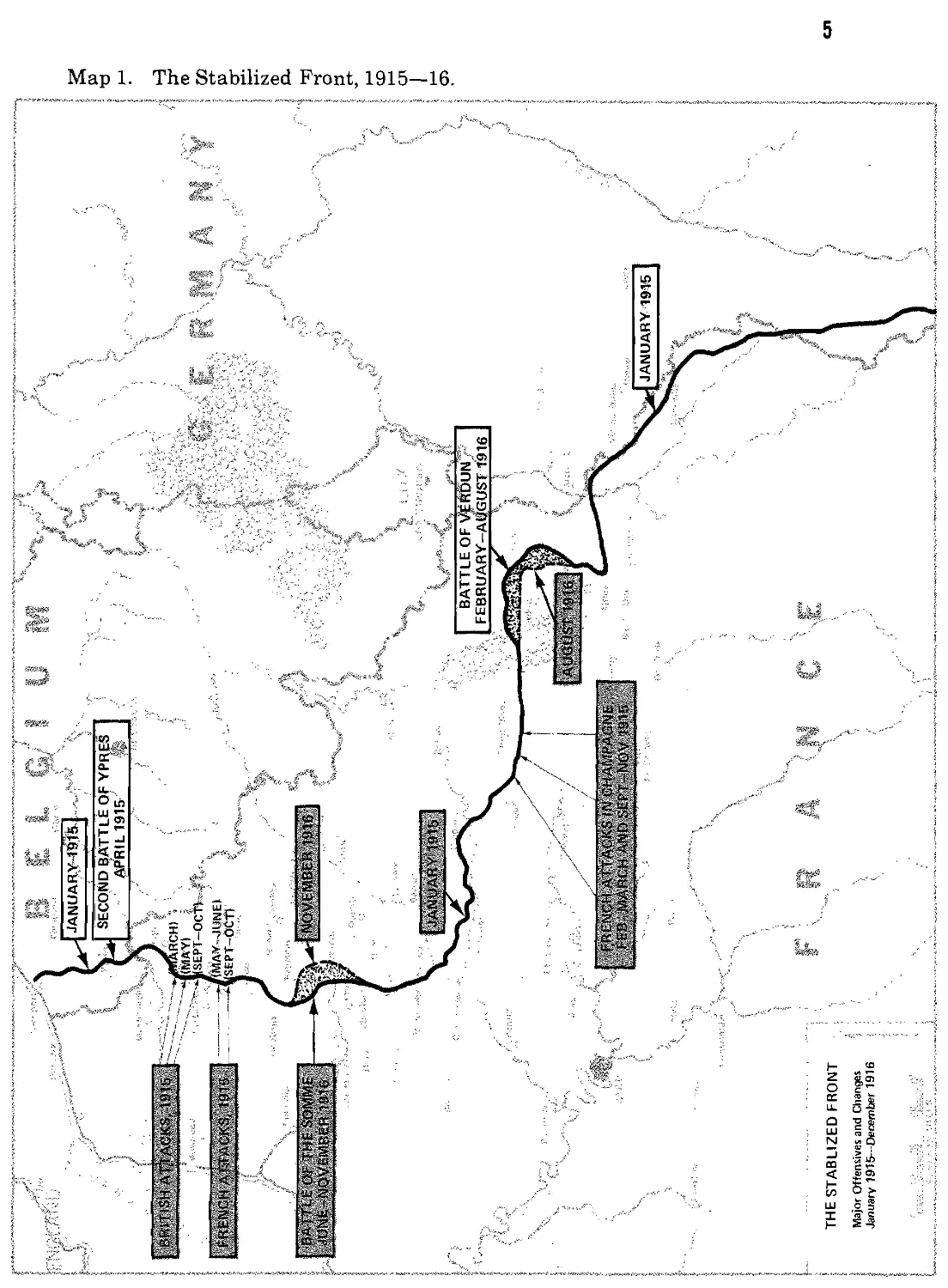
1.	The Stabilized Front, 1915—16.................................... 5
2.	Western Front, 1917 ...........................................  25
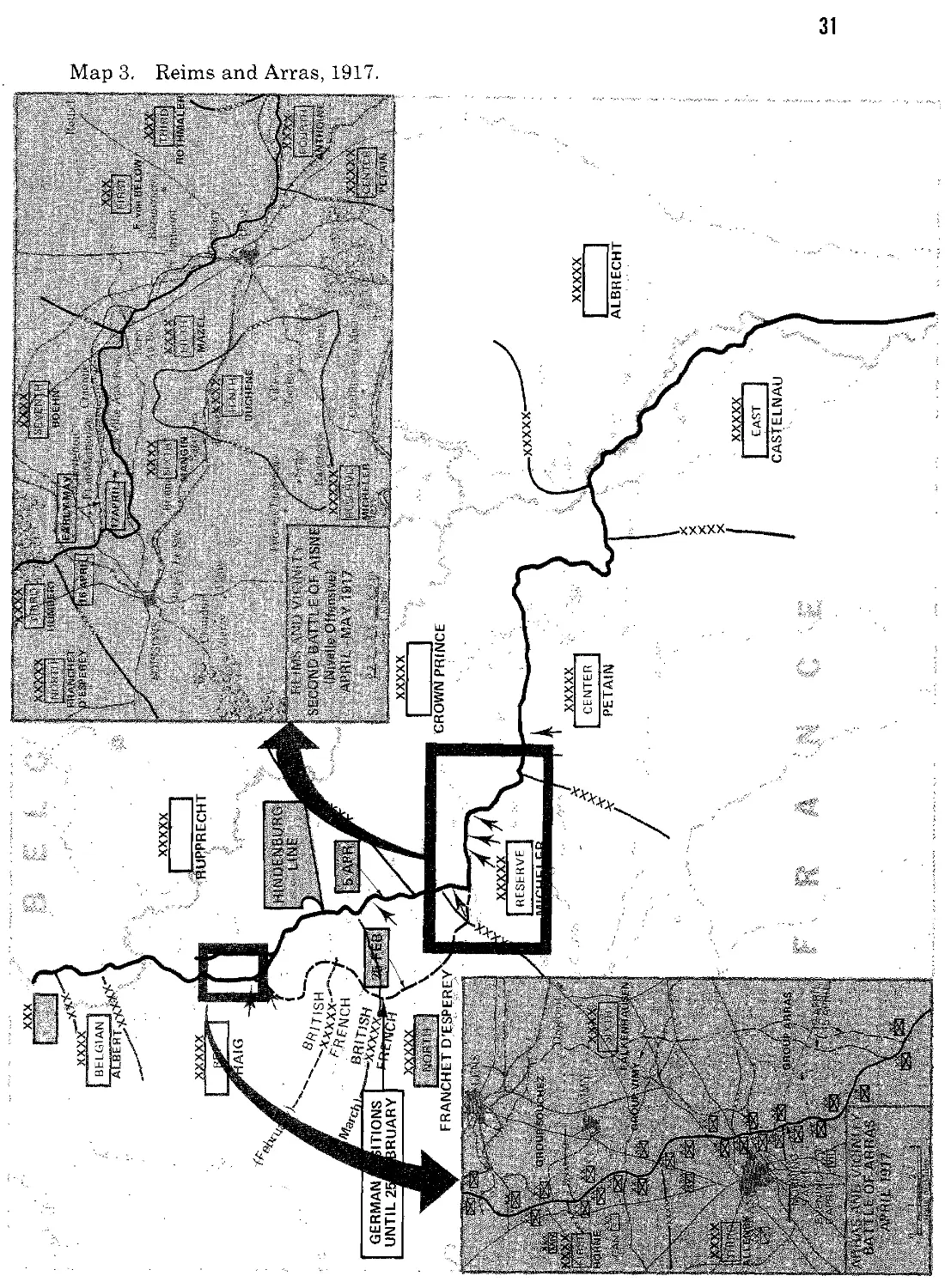
3.	Reims and Arras, 1917 .........................................  31
4.	Western	Front, 1918 ............................................ 51
FIGURES
1.	German	zones in elastic defense-in-depth....................   14
2.	German	division organization .................................. 17
3.	Infantry	division in German elastic defense-in-depth ........... 18
v
Introduction
Bullets quickly write new tactics.
— Wilhelm Balck1
Although the immediate events of the summer of 1914 which led to the
First World War surprised Europe, the possibility of a general European
conflict had been anticipated by governments and the military. Despite this
anticipation, confusion characterized the conduct of the war, from beginning
to end. No belligerent had prepared adequately for the actual conditions and
demands of this long war. The confusion was particularly apparent in the
realm of tactics on the western front. Prewar tactical doctrine had become
inappropriate by December 1914. On all sides expedient modifications soon
competed with the prewar doctrine.
Military doctrine is guidance for conduct of battle approved by the highest
military authority. In the Imperial German Army on the western front, the
Army High Command (die Oberste Heeresleitung, hereafter called OHL)
changed tactical doctrine significantly on two occasions. In the winter of
1916—17 OHL adopted a new defensive doctrine which described an elastic
defense-in-depth in response to the Allied offensive tactics during 1916 (espe-
cially those the British employed at the Somme) and in anticipation of the
continuation of similar attacks in the spring of 1917. This change is the
subject of chapter 1. In the winter of 1917—18, OHL developed a new offensive
tactical doctrine in hopes of achieving a decisive victory on the western front
with their offensives planned for the spring of 1918. This change is the subject
of chapter 2.
As the famous tactician, Wilhelm Balck,* noted, altering tactical procedures
in the middle of such a desperate struggle was a very serious undertaking,
especially for the German Army.2 To alter the deeply ingrained habits in an
army famous for its thorough peacetime training was difficult, especially when
the confusion of the war made the accuracy of any change uncertain.
♦Wilhelm Balck had written extensively on tactics before the war. During the war he served as
a division commander. His son, Hermann Balck, was a company-grade officer in the First World
War, and became an outstanding field commander in the Second World War,
vii
The Germans did not win the First World War and their strategic conduct
of the war was often flawed. Yet, much value can be derived from their
development of tactical doctrine, for the Germans developed and applied new
tactical doctrine impressively in 1917 and 1918. Their tactical changes were
systematic and thorough, for these changes in doctrine directly effected subse-
quent battlefield success. The analysis of the doctrinal changes cannot be
restricted to examining changes to regulations because doctrine that influ-
ences nothing beyond the printing press is stillborn.
German successes in World War I demonstrated a thorough process:
•	Perception of a need for change
•	Solicitation of ideas, especially from the battlefield units
•	Definition of the change
•	Dissemination of the change
•	Enforcement throughout the army
•	Modification of organization and equipment to accommodate
the change
•	Thorough training
•	Evaluation of effectiveness
•	Subsequent refinement
This outline describes the manner by which the German Army succeeded in
changing and implementing tactical doctrine during war. The process is not
rigidly sequential; it is a dynamic process that requires great intellectual
ability and strong character from tacticians who desire to make successful
changes.
Many characteristics ascribed to the German military have too often suf-
ficed for explanations of German military success. Glib expressions such as
“great organization” or “a knack for war” do little justice to the men who
brought success to German arms and, more importantly, offer little guidance
for anyone who desires to achieve similar success.
In the examination of the German process of tactical change, several
important personalities emerge. Their memoirs certainly must be used with
caution, but I have quoted extensively from participants in this paper, in part
to convey the essential interest in tactics among the participants. Their
interest in tactics is instructive, for not all military leaders possess a continu-
ing interest in tactics.
viii
I do not intend to portray all German tactical efforts as inherently brilliant.
The Germans usually achieved a relative advantage over the Allies with
respect to tactical change. Tentative generalizations about the reasons for this
German success and about the limitations of doctrine itself in wartime are
described in chapter 3. These conclusions can only be tentative, for the
uncertainties of war extend to its analysis.
Timothy T. Lupfer
Department of History
United States Military Academy
West Point, New York
ix
The Elastic Defense-in-Depth
Prelude: The German Defense, 1914—16
The German Army of 1914 was not well disposed to the defensive form of
war. The most recent major European conflict, the Franco-Prussian War of
1870—71, had demonstrated the importance of thorough prewar organization,
rapid mobilization, and aggressive strategic movement. In tactics, the German
Army of 1914 strongly emphasized the attack. Crown Prince Wilhelm, the
Kaiser’s eldest son and an army group commander in the First World War,
described in his memoirs the attitude manifested toward defense in prewar
training:
The underlying cause of this dull-wittedness in becoming adapted to the
forms of tactics [during the First World War] must have lain in the very
thorough and somewhat one-sided methods of training in peacetime, in
which defense, as a method of warfare utterly foreign to the German spirit,
was treated in a somewhat step-motherly fashion.1
Ludwig Renn,* who served as an infantry company commander during the
war, wrote that the prewar training on defense was contradictory:
We young officers had the odd experience of hearing exactly the opposite
taught in the lectures on tactics as to what was taught on the art of
fortification.2
Renn writes, however, that this did not cause great alarm among the
students, for “most of us were utterly disinterested in military theory.”3
The German emphasis on aggressive offensive movement influenced their
attitudes toward weapons. Because of its consumption of ammunition and its
tendency to jam, the machine gun was not expected to be the mainstay of a
protracted firefight during the anticipated war of movement.4 The coordination
of weapons in battle had often been overlooked in peacetime training. In the
early battles of 1914 some German commanders, disregarding any need for
*Ludwig Renn is a pseudonym for Arnold Friedrich Vieth von Golssenau, who was trained in
the prewar German Army, served in the trenches during the war, and became a communist after
the war. He fought on the Republican side during the Spanish Civil War. His writing shows little
affection for the German General Staff, and his statements represent a cynical view from the
trenches.
1
2
artillery superiority, ordered attack. The results were disastrous.5 The French
shared this aggressive attitude. Their engineer manual contained the only
prewar detailed defense regulations of the French Army.6
A stabilization of positions running from Switzerland to the Channel
followed the failure of the German envelopment in August and September of
1914. The western front became a war of position. The lethality of artillery
compelled the infantry to dig. The soldiers, whether German or Allied, did not
like the spade,7 but the compelling sight of the effect of artillery led to an
immediate appreciation of digging.8
As the trench system developed along the western front, OHL contemplated
an offensive in the west in 1915. The Chief of the General Staff, known in
wartime as Chief of Staff of the Army in the Field, directed OHL in the name
of the Kaiser, who exercised little direct influence. In preparation for the
possible offensive in the west in 1915, General* Erich von Falkenhayn (who
had replaced the ineffective Col. Gen. Helmuth von Moltke as Chief of the
General Staff in late 1914) solicited comments from subordinate units. How-
ever, the demands of the eastern front in 1915 denied the western front any
additional German forces for an offensive, so the Germans were compelled to
remain on the defense in the west during that year.9 The French and the
British launched major offensives throughout 1915 and tested the German
defenses severely.
The conduct of operations on the western front revealed the tactical
dilemmas of the war of position. Whereas in the American Civil War and the
Franco-Prussian War the greatest source of battle casualties had been the
rifled bullet, the artillery caused the greatest number of casualties over the
total duration of the First World War. Technological innovations such as recoil
systems, improved propellants and explosives, optical sights, and improved
communication made indirect fire unexpectedly effective. Although artillery
support of the attack was generally not well developed in anyone’s prewar
tactical doctrine, the experiences of the first months of the war indicated that
artillery fire was essential in support of an infantry assault. The destruction of
enemy machine guns, enemy batteries, and dug-in enemy positions, in turn,
required vast quantities of munitions. Heavy guns became particularly useful
to accomplish this. Unfortunately, to sustain the infantry advance beyond the
initial range of the guns was extremely difficult, because such heavy guns
could not displace quickly. Artillery communications, almost completely depend-
ent upon field telephones connected by wire, were cumbersome to install and
vulnerable to enemy artillery fire if not buried underground for protection.
Neither could the vast quantities of artillery munitions be transported quickly.
The terrain conditions after intense bombardment made all movement, includ-
ing that of infantry and horse-drawn artillery, very difficult.
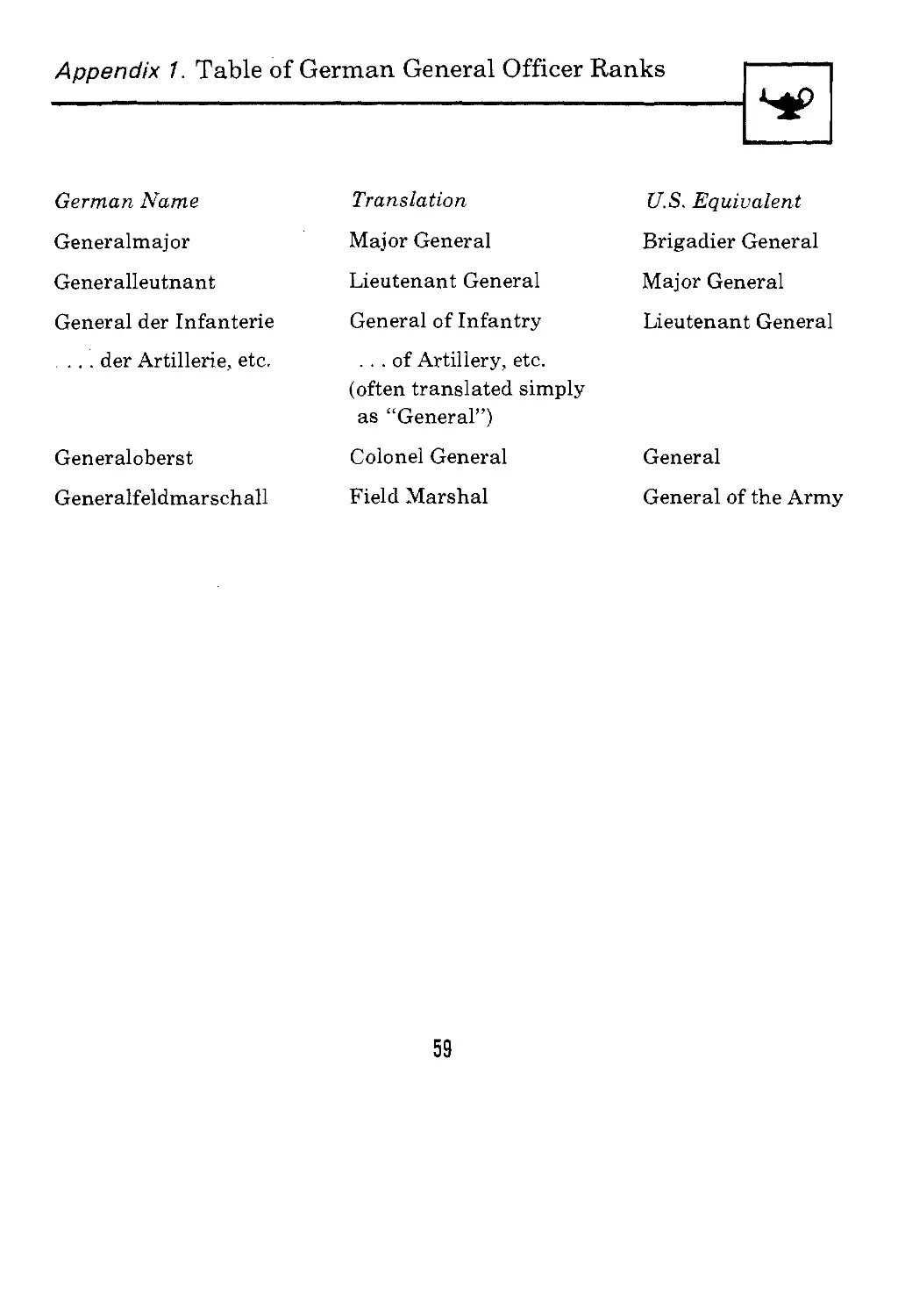
*A table of equivalent ranks is contained in appendix 1.
3
Conversely, the defense acquired several advantages. Even though the
artillery barrage in support of an attack might destroy hundreds of men, if a
few defending machine gun nests survived, the attackers could be stopped. The
defending artillery, firing upon the slowly advancing infantry and the sub-
sequent waves gathered in the assault trenches, inflicted severe casualties on
the massed attackers. Given a transportation network and communications
network still relatively intact (because of its distance from enemy artillery and
dug-in wire) the defenders could move reserves to critical areas more rapidly
than the attackers could reinforce their assault units. The conduct of the
attack became more confused and uncertain as it progressed, for the attackers’
communications deteriorated and their primary source of firepower, artillery,
could not move forward to keep pace with the attack. Time, then, favored the
defense.
However, life for the defender was not serene, and the Germans were faced
with serious problems in the defense. While the French, fighting on their own
soil, were reluctant to yield any ground,10 the Germans were equally opposed to
giving up any hard-won ground. In the war of position, nations magnified any
loss of terrain for propaganda purposes,11 and at the soldiers’ level the loss of
hard-won terrain could create serious morale problems.12 The Germans defend-
ed according to the principle, “Halten, was zu halten ist,” meaning “Hold on to
whatever can be held,”13 a principle that made commanders extremely reluc-
tant to yield ground. The Imperial German Army was well known for its
discipline and commanders were very hesitant to do anything which might
dilute this fierce fighting spirit, especially in the defense.
The experiences against the Allied offensives of 1915 showed the Germans
that some modifications of the tactical defense were necessary. The various
field armies published summaries of their experiences on the western front and
OHL published selections of these—Experiences in the War Concerning Field
Fortification—in June 1915.14 This publication expressed the principle that the
first defense line must be held, but it advised building a second line as insur-
ance against a major breakthrough. The German Army was learning several
other tactical lessons in the defense, such as the value of the counterattack
(which had been demonstrated in the Champagne battles against the French
of 191515) and the value of reverse slope positions to protect units from enemy
observation and indirect fire.16
The Germans had also been keen observers of their enemies. They consis-
tently complimented the French for their use of terrain,17 and Ludwig Renn,
that bitter observer from the trenches, credits the French with the initial
concept of defense-in-depth.18 Wilhelm Balck confirms Renn’s observations
that the Fench were quick to realize the need for greater depth on the defense.
Balck records that General Joseph Joffre, the French Commander in Chief,
4
had cautioned the French against crowding the forward line as early as 5
January 1915, but commanders were reluctant to weaken their forward posi-
tions for fear of losing ground:
Numerous captured documents showed that the French were very slow to
accept the very correct views of Joffre. Similar views . . . encountered
stubborn resistance in the German Army.19
The Allied offensives of 1915 utilized techniques of attack which the Allies
would use for most of the war. Envelopments were impossible because of the
extended front. A penetration was the only alternative, and the Allies relied
increasingly on massive artillery bombardments to achieve the penetration of
the dug-in enemy positions. After the British attack at Neuve-Chapelle in
March 1915, the British concluded that heavier artillery preparations would
give a higher chance of success.20 Similarly, in the French Army, the dominant
maxim became “the artillery conquers and the infantry occupies (I’artillerie
conquiert, I’infanterie occupe)." Massive artillery firepower became the domi-
nant factor in Allied offensive tactics.
Artillery support dictated the direction and the plan of movement of the
attacking infantry. This emphasis not only relegated maneuver to a secondary
role, it also created conditions that made maneuver extremely difficult. In
addition to tearing up the ground, the massive artillery preparations denied
the attacker the benefits of surprise. Before the preparatory artillery fires
commenced, the positioning of guns and vast quantities of ammunition, both
easily detected by air (unless strict camouflage were enforced) revealed the
Allied intentions. The long preparation itself showed generally where the
attacks were planned, and allowed the Germans time to shift reserves. This
dependence on massive artillery fire also denied the Allied infantry any
sense of self-reliance, for, despite efforts to give infantry units their organic
indirect fire (mortars and light artillery), infantry units could not conduct
operations without the considerable help of the senior partner, artillery.
Conduct of Allied operations reflected the rigidly scheduled, inflexible use
of firepower. Maneuver could not complement firepower, for infantry could
not move without the rigid curtain of fire, and the guns could not move.21
Although on the defensive in the west in 1915, in 1916 the Germans
conducted a limited offensive at Verdun: the objective was attrition of the
enemy rather than the classic German objective of rapid destruction of the
enemy force. (See map 1.) To relieve the pressure on the French at Verdun, the
British and French units near the Somme conducted an offensive in the
summer of 1916. Their tactical techniques confirmed the dominance of fire-
power over maneuver.
The six-day preparation and the assault barrage consumed 1,628,000 shells
in the British sector.22 The British had hoped to destroy all German resistance
within range of their artillery. The British failed. Sufficient numbers of
Germans survived to inflict grievous casualties on the advancing British.
Map 1. The Stabilized Front, 1915—16.
7
Many of the British soldiers were hurriedly trained volunteers who advanced
in linear formations. Hindsight makes these tactics appear absurd, but the
immediate conditions provided two justifications for the tactics.
First, the British commanders expected artillery to demolish any resistance,
and second, the soldiers had only been trained briefly. Training these volun-
teers to advance in line had an ironic twist, for it probably required more
discipline to stay in line than to trust good sense and use the ground. The
French had quickly adopted fire and maneuver techniques at the small unit
level, and the Germans, despite intensive prewar training in linear formation,
had used rushes by squad and section as early as 1914.23 Yet at the Somme, the
British command thought that the new soldiers could not accomplish such
complicated techniques.24
Perhaps the British infantry tactics at the Somme on the first day reflect a
failure to recognize that tactical techniques and lessons do not originate
exclusively at higher levels and descend to the units. A greater service can be
rendered by the higher headquarters that earnestly solicits opinions and
experiences from units in the field, evaluates and distills the information, and
disseminates the findings back to the field units. The Germans would demon-
strate this process after their Somme experience.
German Response to the Somme
While the British have justifiably lamented the slaughter of their soldiers
during the Somme campaign, and the picture of British suffering remains
vivid today, it is too often overlooked that the Germans also suffered severely
during that campaign, principally from British artillery fire.
Despite the mutual suffering, the Germans responded more quickly and
more decisively than the British with respect to tactical changes based on the
Somme experience. The problem of taking heavy casualties from the massive
Allied artillery bombardments had to be solved.
The Germans were amazed at the great amount of ordnance that the
British had hurled at them. “We had to adapt ourselves to an entirely new
phase of war,” wrote Ernst Jiinger, a well-decorated frontline officer.25 The
Germans called the phenomenon the battle of materiel (die Materialschlacht).
Throughout the Somme battles, von Falkenhayn, the German Chief of Staff,
insisted on holding the forward defense line. His persistence led to a crowding
of men in the front lines and reinforcement of the front line during battle. This
part of the German defense was well within range of Allied artillery, so the
German units suffered accordingly. The density of Germans packed into the
front line contributed further to the already heavy German casualties. OHL
provided incentive for holding the front line by relieving some German com-
manders who had failed to retake a front line captured by the Allies.26 Since
the Allies clearly had the greater supply of men and materiel, the Germans
8
could not continue to fight a battle of attrition in the west unless they could
defend with greater conservation of their fighting strength. The Germans had
to become more effective.
Although the Somme battles continued until 19 November 1916, as early as
August 1916 the German situation at the Somme, Verdun, and in the east
appeared sufficiently grim to necessitate a change of chief of staff. On 20
August, Field Marshal Paul von Hindenburg, formerly the commander in chief
of the German forces on the eastern front, replaced von Falkenhayn. More
importantly, his principal assistant, Lt. Gen. Erich Ludendorff, came to OHL
with von Hindenburg. The field marshal was the figure of authority but
Ludendorff exercised the dominant influence. Ludendorffs position was first
quartermaster general,* but his dominance of the conduct of the war made him
the de facto successor of von Falkenhayn.
The complementary relationship between von Hindenburg, who provided
the authority and steadiness, and Ludendorff, who provided the intellectual
brilliance and drive, is difficult to comprehend by one raised in a tradition of
dominant single personalities (which perhaps characterizes American military
experience). The German tactical success was not the product of a single
personality, but a corporate effort. This is not to say that personalities were
not influential in the development of German tactical doctrine. The importance
of Ludendorffs personality, however, was that it fostered the corporate spirit,
encouraging several German officers to participate in the collective effort and
not allowing his own ego to interfere. His personality did not monopolize the
effort. As events will demonstrate, the Allies, not understanding that this
German effort was corporate, often tried to identify one mastermind respon-
sible for the tactical concepts.
A new spirit of resolve and determination developed at OHL. One staff
officer later wrote that von Falkenhayn had lacked decisiveness and foresight
in the matters of organization and tactics,27 and another staff officer recalled
that with. Ludendorff “an iron will and firm determination took hold of the
German High Command.”28
Ludendorff now directed the corporate effort toward the problems of tactical
change. The idea of greater depth for the defense had been developing in some
units on the western front and in the OHL operations sections at the western
front, but von Falkenhayn had neither understood nor encouraged this.29
Ludendorff recognized the tactical ideas, adopted them, and gave them an
aggressive character. Col. Max Bauer, a heretofore frustrated member of the
OHL staff at the western front, wrote that the change in leadership made the
members of his section feel as if a great weight had been lifted from them.30
♦In the German Army the term “quartermaster" did not have an exclusive connotation of
supply; it indicated a senior staff officer.
9
Ludendorff had a variety of other concerns, because OHL direction extend-
ed to all fronts (western, eastern, Macedonian, Italian, and Middle East),
although the western front was considered the most significant front. Luden-
dorff also became increasingly involved in industrial war production. Despite
these competing demands, Ludendorff evaluated conditions on the western
front and personally directed changes in German tactics. Throughout his
career he had always possessed a genuine interest in tactics and armament.31
Although he had arrived on the western front from the eastern front where he
had enjoyed spectacular tactical successes, Ludendorff did not try to apply a
formula derived from his victories against the Russians:
On the Eastern Front we had for the most part adhered to the old tactical
methods and old training which we had learned in the days of peace. Here
[in the west] we met with new conditions and it was my duty to adapt myself
[my italics] to them.32
Ludendorff was extremely flexible and willing to change—despite his great
success in the east.
Ludendorff began his assessment by travelling to as many frontline units
as possible. By 1916 the German Army on the western front organized itself
into army groups (OHL had begun the war trying to control field armies
directly). The two principal army groups were those of Crown Prince Rupprecht
of Bavaria in the north and of Crown Prince Wilhelm of Germany in the
center. Ludendorff placed great importance on these visits to units; when he
visited a unit, he asked for a report from that unit’s chief of staff, and he
demanded accurate information, “not a favorable report made to order.”33
Soliciting information from the units was a habit acquired not only by
Ludendorff. Lt. Gen. Hermann von Kuhl, who served as chief of staff of
Rupprecht’s Army Group, aggressively sought accurate information. He at-
tempted to take into his staff only those officers who had already served with
frontline units and who had demonstrated good tactical judgment. When a
battle began, von Kuhl immediately sent selected staff officers to evaluate the
action, and he required his staff officers to answer questionnaires after their
return to headquarters.34 His network extended beyond his staff. After battles,
he had frontline officers meet at his headquarters to tell him about their
experiences and their opinions. Von Kuhl recalled that these officers were at
first reluctant to talk to him, but in time they would “express the burdens of
their hearts.”35
The border between interest and interference is imprecise, and OHL and the
general staff system were not without critics. Besides personal visits, the
telephone was another major means of communication with the front line
during the First World War. Ludendorff used it extensively and thought that it
was good to use when personal visits could not be conducted. He also felt that
the telephone had some value as a counter to the drawbacks of personal visits,
such as false personal impressions.36 General von Kuhl, often complimentary
10
of Ludendorff, admitted that this use of the telephone by OHL sometimes led
to interference.37 General Otto von Moser, a division commander, was less kind
and complained of the “cantankerous harm of the General Staff institution,
reaching out even more powerfully, that is, with the misuse of the telephone
behind the backs of the commanders.”38
Despite these inevitable conflicts between staff and units in the field, the
officers in OHL who were “reaching out” were a very superb group. Only about
one dozen staff officers formed the OHL operations section that was respon-
sible for the western front.39 Their wartime performance remains an excellent
advertisement for a small, effective staff. During most of Ludendorffs service
as first quartermaster general, the chief of OHL operations for the western
front was Maj. Georg Wetzell, an extremely capable officer. Another highly
influential staff officer was Col. Max Bauer, who devoted his efforts under
Ludendorff to problems of industrial war production, although he also helped
write the defense regulations in late 1916. Staff members exercised influence
irrespective of their rank. One of the most important members of the OHL
operations section in the west was Capt. Hermann Geyer, who contributed to
the writing of the regulations on both defense and offense.*
This operation section did not invent tactical concepts. More accurately, it
solicited ideas and opinions from units in the field, examined as much
empirical evidence as possible, defined and developed tactical principles, and
articulated these final decisions for distribution to the army. Geyer later wrote
that the most important and most difficult exercise of a staff was to review
specific war experiences in order to help maintain the excellence of combat
units.40
One of the most respected officers who provided to OHL ideas based upon
recent combat experiences was Col. Fritz von Lossberg. Having served on the
western front in 1914 as a corps chief of staff, Colonel von Lossberg became
deputy chief of operations at OHL for most of 1915. He then became chief of
staff of the Third Army. For the rest of the war von Lossberg was legendary as
the fireman of the western front, always being sent by OHL to the area of
crisis. While at the Third Army he organized the defense to counter the French
in Champagne. When the British attacked along the Somme in July 1916, von
Lossberg became chief of staff to Second Army in order to supervise the
defense in that sector.** In August 1917 when the British attacked at Arras,
von Lossberg went to Sixth Army as chief of staff. Having successfully
stopped that British effort, he went to Fourth Army as chief of staff and orga-
nized the defense at Passchendaele.11 Needless to say, von Lossberg was a
*One important characteristic of the Imperial German Army was its extreme stinginess in
promotions during the war. This army could not be accused of inflation of rank, unlike its World
War II counterpart, the Wehrmacht.
**The German Second Army headquarters was reorganized in a unit redesignation in July 1916
and von Lossberg became chief of staff to First Army, in the same sector.
11
remarkable man and an expert tactician. General von Kuhl admired von Loss-
berg’s “iron nerves.”42 Ludendorff praised him highly and referred to von
Lossberg’s great contributions to German tactical success. Ludendorff also
wrote that von Lossberg’s confidence in him was a great source of satisfac-
tion,43 a sentiment that illustrates the corporate spirit and the mutual confi-
dence which transcend rank.
In addition to examining German unit experiences, the OHL operations
section carefully screened captured enemy documents. In 1915 a captured
French document described a defensive system consisting of successive eche-
lons: a front line cf thinly held outposts, a scattering of strongpoints, and shel-
ters for reserves. Certain members of the OHL operations section viewed this
French concept as a practical alternative to the densely occupied German front
line.44 Influential foreign ideas were not limited to the defense: a captured
French document on attack greatly influenced the new German offensive doc-
trine developed in late 1917.
The desire to change defensive tactics had been building at OHL and unit
staffs before Ludendorffs arrival. Several members of OHL had developed
new concepts and some field armies had developed techniques locally. OHL
had published reports of unit experiences, had translated and published cap-
tured documents, and had begun publishing a series of regulations on the
employment of weapons in position warfare. But there had been no official
change in doctrine for the entire western front.45 Ludendorff brought these
efforts together to transform the entire effort in the west.
Genesis of the Elastic Defense-in-Depth
Assuming his duties as first quartermaster general in August 1916, Luden-
dorff quickly visited the area of the Somme fighting (Rupprecht’s Army
Group).46 He was convinced that the German Army must alter its defensive
tactics or it would not be able to win the war, for the Allied artillery was wear-
ing down the German forces.47 A meeting of OHL in Cambrai on 8 September
1916 began the process of developing the new defensive doctrine. By the end of
the winter lull in action, on 9 April 1917, when Allied soldiers went over the top
in the first Allied major offensives of 1917, they faced a German Army that in
only seven months, despite severe economic and manpower constraints, was
organized, trained, equipped, and led according to new defensive principles.
Perhaps only the preparation of the German Army for the offensives in spring
1918, which was accomplished in four months, was more impressive.
The change in defensive doctrine occurred in the following way: the opera-
tions section sifted through numerous reports from the units and considered
the various opinions in developing the new defensive doctrine in fall 1916. On
25 September OHL published what it considered to be the key lessons of recent
12
fighting. However, opinions and experiences from the different units were
often contradictory, and the process of deciding the precise content of the gen-
eral doctrine was difficult, continuing until December.48
The key regulation was The Principles of Command in the Defensive Battle
in Position Warfare (hereafter called Principles), published on 1 December
1916. Ludendorff praised the two men whom he credited with the authorship,
Colonel Bauer and Captain Geyer, “who had a well developed sense of tactics
and a clear mode of expression.”49
This document provided general guidance for the conduct of the defense
and, with subsequent editions, became the German doctrine of defense for the
rest of the war. OHL officially rejected the principle of holding the forward line
at all cost. The regulations now stated that the objective of defense was to
force the attacker to frustrate and expend himself, while the defender pre-
served his strength. The Principles related the purpose of the defense entirely
to the enemy and did not mention retention of terrain as the basic objective.
The principles for achieving the objective were:
•	The defender must not surrender the initiative to the attacker.
•	The defense must rely on firepower, not large numbers of troops.
•	The defender must not hold ground at all costs (a controversial principle).
•	The defender must consider depth for all construction and positions.50
Previous concern with the inviolability of the front line had caused the
Germans to strengthen that part of the battlefield within range of Allied
artillery and where the Allies applied their maximum power to achieve a pene-
tration, that is, on the forward edge. The range of artillery and the fields of
artillery observation favored the Allied concentration of artillery on the Ger-
man forward edge. With the new German doctrine, the Allied concentration of
firepower was on a forward edge held by relatively few German troops. Ger-
man strength no longer directly confronted Allied strength. As the Allied
attack advanced, its relative power would deteriorate as the distance from its
artillery support increased because the attack outran its inflexible communica-
tions system and eventually exceeded the range of its supporting artillery. As
the Allied advance became more confused and weak as it progressed, German
power increased, for the Germans positioned their forces in tiers or echelons
which became stronger as the distance from the front line increased.
Ideally from the German point of view, the Allies would also cross terrain
not easily observed from the Allied front lines, for wherever possible the Ger-
mans had placed their defensive positions in depth behind terrain which
blocked Allied ground observation. By further concealing their positions from
aerial observation, the Germans insured that no Allied plan could anticipate
all the surprises that the Germans had hidden in that masked area. German
counterattack units were layered in increasing degrees of strength, from the
13
outposts to deep in the rear. German knowledge of terrain, well-planned and
rehearsed reserve movements, and a better-protected communication network
gave increasing strength to the German defense.
The Principles provided the basic tactical concepts for defense. The Princi-
ples of Field Construction (hereafter called Construction) provided specific
regulations for construction of positions. Regulations describing positions had
been published earlier in the war, but this edition dated 13 November 1916
specified techniques to apply to the new defense regulations.* The defense now
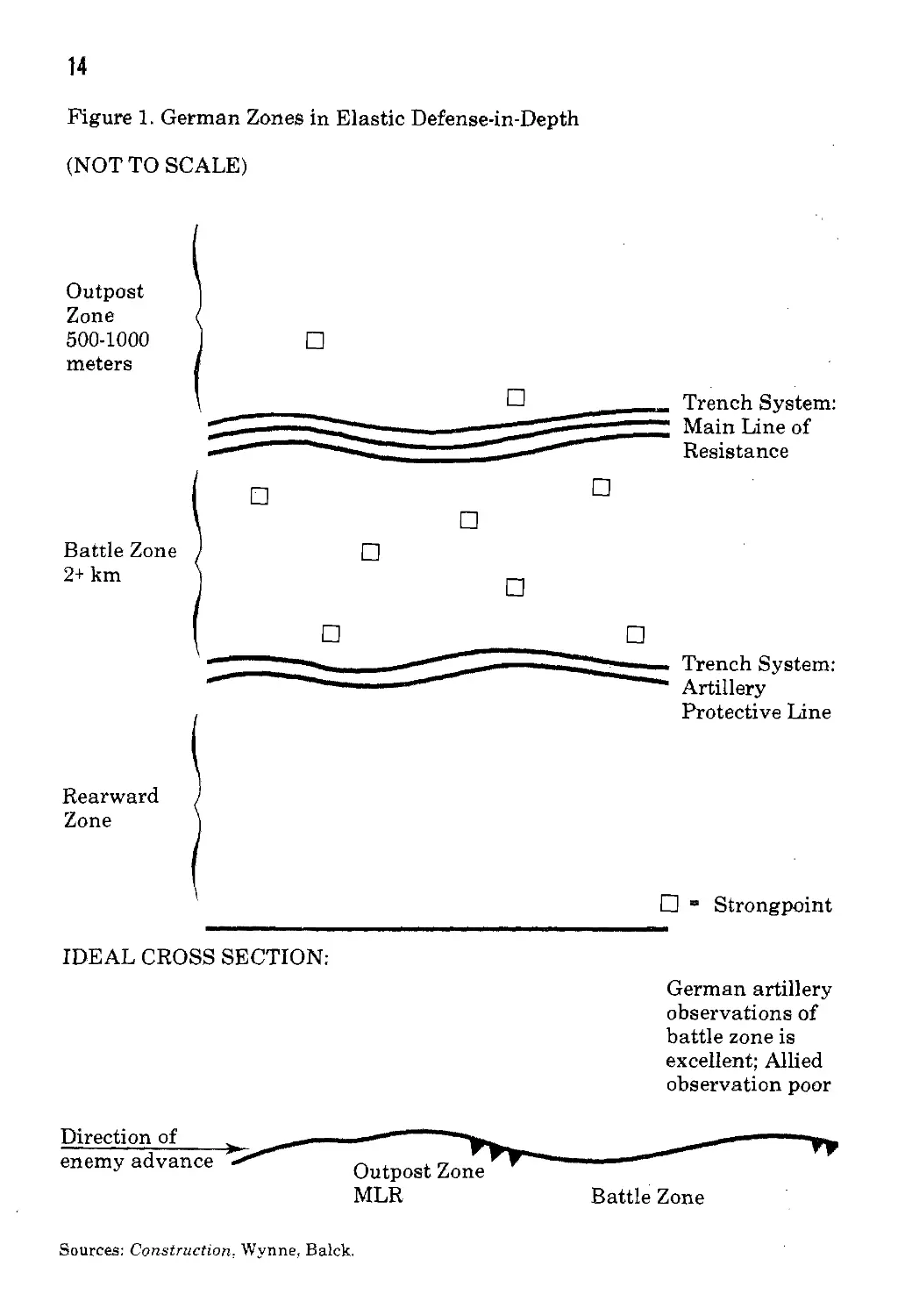
consisted of three successive zones: the outpost zone, the battle zone, and the
rearward zone. (See figure 1.) Although the regulation did recommend tactical
dimensions, it emphasized adapting the defense to the specific terrain in order
to accomplish the mission.
The outpost zone served a purpose similar to outposts in open warfare: to
contain enemy raids and patrols, to provide warning of major attacks, and to
disrupt those attacks. Behind the outpost zone was the front trench system,
usually three successive trench lines, called the main line of resistance (MLR).
This main line of resistance was the forward edge of the battle zone. The battle
zone extended back, depending on terrain, fifteen hundred to three thousand
meters, with a second trench line, the artillery protective line, as its rear boun-
dary. Behind this trench system was the rearward zone, although the Germans
later extended the battle zone to create even more depth. The artillery was
organized in great depth behind its protective line.51
If terrain permitted, the main line of resistance was on a reverse slope. The
machine gun was the crucial infantry weapon. Although placing the machine
gun on the reverse slope did not utilize the weapon’s maximum range, combat
experience had shown that sudden surprise fire, rather than prolonged long-
range engagements, defeated attacks. The reverse slope position also preserved
the defender’s advantage of surprise, kept his position concealed from enemy
ground observation, and offered protection against enemy artillery fire.
The major defensive battle would occur in the battle zone. The new regula-
tions recognized that a massive enemy attack could overrun the MLR, but the
regulations also stated that a counterattack in the battle zone would recover
the MLR. Several factors favored the defender in this critical struggle. In keep-
ing with the philosophy of using firepower to inflict maximum enemy casual-
ties, the Germans fully integrated artillery into the defense. The Principles (1
March 1917 edition) devoted more pages to artillery than to any other combat
arm. The tactical considerations for selecting defensive positions were not
placement of infantry units, but “observation and positions for artillery, and
*The German regulations did not give a specific name to this defense, but the term
elastic defense-in-depth is probably the best brief description. The echeloning of forces
provided the depth, the reliance on counterattack (instead of fixed positions) provided
the elasticity. The general summary of German defense doctrine described above
includes some refinements which were made during the battles of 1917.
14
Rearward
Zone
Figure 1. German Zones in Elastic Defense-in-Depth
(NOT TO SCALE)
Outpost
Zone
500-1000
meters
Trench System:
Main Line of
Resistance
Battle Zone
2+ km
Protective Line
□ = Strongpoint
IDEAL CROSS SECTION:
German artillery
observations of
battle zone is
excellent; Allied
observation poor
Direction of	-^* "***""	_	__
enemy advance	Outpost ZonZ^--------------
MLR	Battle Zone
Sources: Construction. Wynne, Balck.
15
communications with the rear,”52 which clearly established the role of artillery
as crucial in the defense. German artillery observers would have the battle
zone under observation, but Allied artillery observers would be unable to direct
their own artillery fire because of the masking terrain concealing the German
MLR. As the Allies advanced beyond the range of their own artillery support,
the Germans responded with carefully planned, timely artillery fire.
The German soldiers in the outposts and the main line of resistance, how-
ever, were not simply given carte blanche to evacuate their positions and head
for the rear at the first opportunity. The defense was aptly called elastic, for it
was to resist, bend, and snap back. The Principles stressed tenacity of defense,
for “stout hearted men with iron nerves form the real backbone of defense.”53
The flexibility given to soldiers in the forward areas was practical: they were to
shift to escape the artillery fire, and survive in order to inflict casualties on the
subsequent enemy infantry assault. This shifting to escape Allied artillery
could be to the flanks, to the rear, or to the front,54 and it usually occurred in
the numerous shell holes. The Somme experience had shown that large elabo-
rate positions had disadvantages under heavy artillery fire. The trenches were
necessary for daily living, but once detected they were lathered with prepara-
tory fire and barrages. Deep dugouts in forward areas were also impractical,
for soldiers remained in them too long after the enemy barrage lifted and were
often captured. Therefore, under heavy fire, the forward German soldiers evac-
uated their trenches and shifted from shell hole to shell hole, avoiding concen-
trations of fire and escaping the detection of aerial artillery spotters.
The Allied advance would first encounter resistance from pockets of Ger-
man survivors in shell holes. Having been concealed from aerial observation,
units positioned on the reverse slope would then open fire unexpectedly.55 The
Allies would also encounter fortified strongpoints (Widerstandsnester). These
strongpoints were not deep dugouts as before, but less elaborate fortified posi-
tions (of earth, wood, old buildings, or anything else available) for squads or
machine gun sections, carefully sited to avoid Allied observation. Placed
mostly in the battle zone, they were built to provide for all-around defense and
they engaged the attackers, whenever possible, with devastating enfilade
fire.56 The strongpoints would remain fighting even if cut off by the enemy
advance.
The ideal scenario was:
A fragmented, exhausted Allied attack force reaches the battle zone. They
hope that their thorough artillery preparation has killed all the Germans, but
they encounter several Germans firing at them from shell holes in the torn
ground. Sudden fire from the German main line of resistance has slowed the
Allies and their scheduled artillery barrage has crept forward without them,
according to a timed sequence of fire they cannot modify. They feel helpless
without artillery support. The Allies finally have taken the main line of resis-
tance at great cost, but now they are in unfamiliar ground, under fire from
concealed enemy machine gunners and riflemen. German artillery, which the
Allies expected to destroy in the preparatory fires, now appears very active.
The Germans concentrate their artillery fire behind the Allied advanced units,
16
cutting them off from reinforcements and supplies. For the next few minutes,
the Allies have a tenuous hold on a few acres of ground, but by advancing into
the battle zone, the Allies are most vulnerable, and have exposed themselves to
the counterattack, the soul of the German defense. The immediate counterat-
tack, well coordinated with accurate artillery fire, destroys, captures, or ejects
the Allied unit before it can consolidate its gains. The coherence of the German
defense is restored.
The German counterattack concept must be examined with respect to the
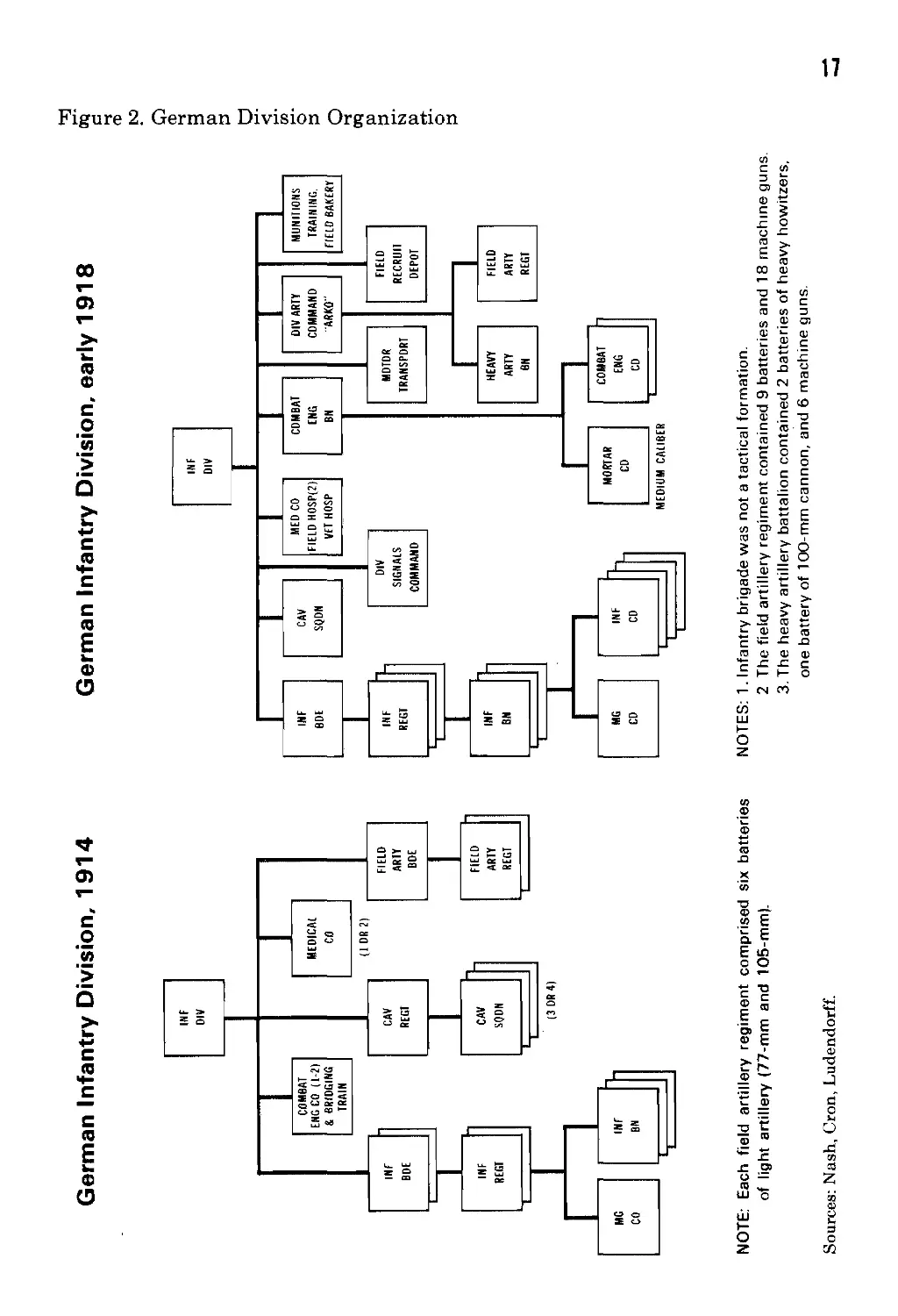
German Army organization.* The Germans began the war with an infantry
division that had two infantry brigades of two infantry regiments each. A
reorganization begun in 1916 on the western front eliminated the brigade
structure and created a division with three infantry regiments. The regiment
consisted of three battalions and each battalion had four infantry companies
and one machine gun company. The reduced number of units facilitated easier
control, and the increased number of divisions provided more opportunity for
division rotation, an important practice in German operations.
OHL did not specify to divisions exact frontages or precise defense organi-
zations of subordinate units, but the following description illustrates how a
frontline division often organized its defense. (See figure 3.) The three regi-
ments were abreast in the sector. The regiments positioned their battalions in
depth: the first battalion in the outpost zone and main line of resistance; the
second, in the remainder of the battle zone; and the third, in reserve, ready to
occupy the artillery protective line, a trench system in front of the heavy
artillery and the reserve units of higher headquarters. The forward division
deployed in an area where a major Allied attack was expected would often
have an entire counterattack division positioned behind it in the rearward
zone.
In its most developed form, the defense had designated counterattack forces
throughout the zones. In the outpost zone local commanders designated coun-
terattack squads. In the battle zone commanders designated counterattack
companies. These counterattack forces came from the two battalions already
occupying the zones. The regiment’s reserve battalion was part of the division
reserve, in which each remaining battalion from each frontline regiment
served as a counterattack battalion, striking from the rear of the battle zone.
Behind these counterattack battalions were the reserves of the field army
(entire counterattack divisions), and OHL itself retained control of additional
counterattack divisions.
The defense thus assumed a very aggressive and potentially offensive
character. The best time for counterattack was the period of confusion when
the attacker had not yet consolidated his position or reorganized his forces.
Timing was critical. The Germans layered or echeloned the counterattack
*The following description refers only to changes in infantry units. It does not describe the
changes to the other arms in the German infantry divisions. (See figure 2.)
German Infantry Division, 1914
German Infantry Division, early 1918
Figure 2. German Division Organization
NOTE: Each field artillery regiment comprised six batteries
of light artillery (77-mm and 105-mm).
NOTES: 1. Infantry brigade was not a tactical formation.
2 The field artillery regiment contained 9 batteries and 18 machine guns.
3.The heavy artillery battalion contained 2 batteries of heavy howitzers,
one battery of 100-mm cannon, and 6 machine guns.
Sources: Nash, Cron, Ludendorff.
18
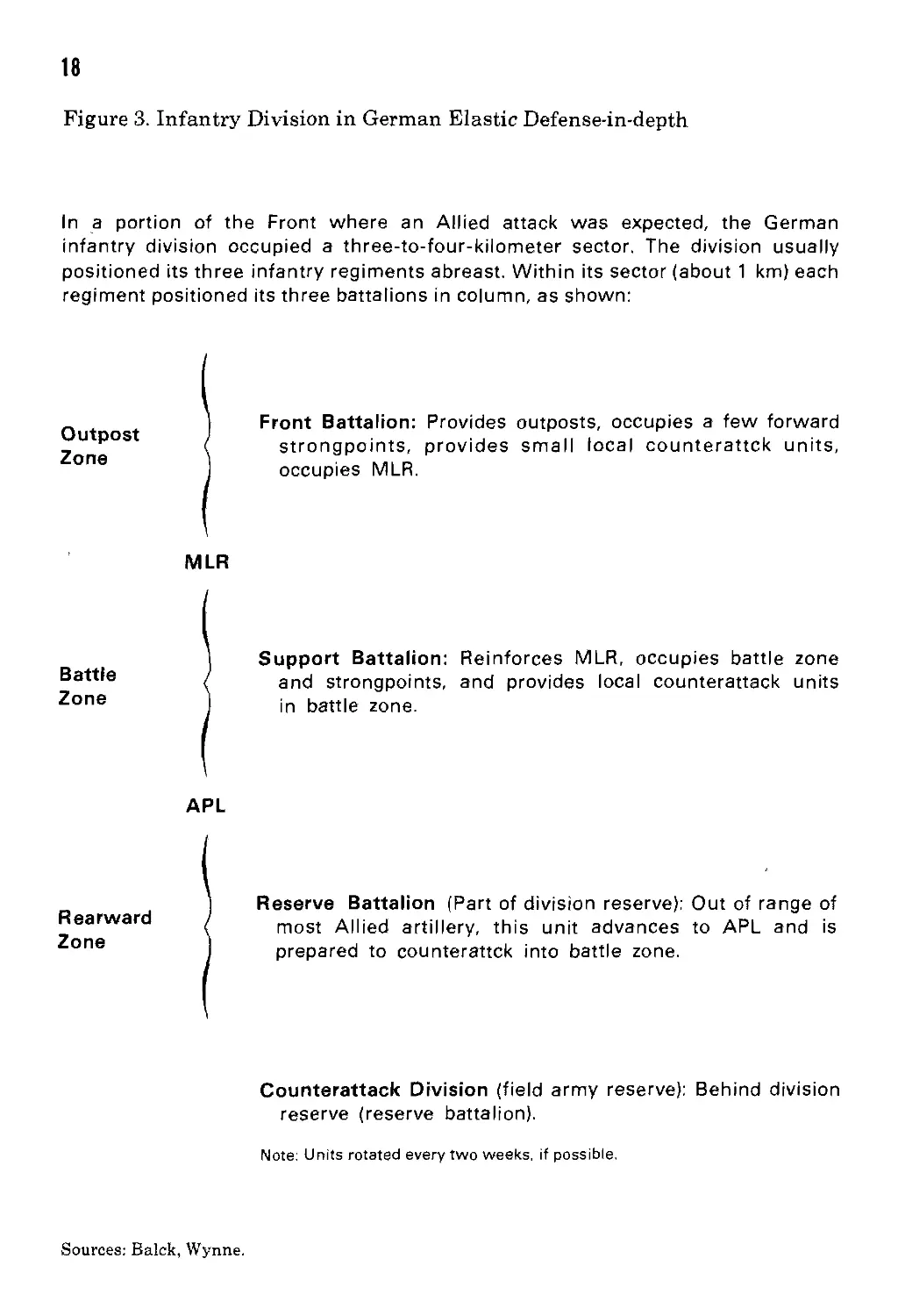
Figure 3. Infantry Division in German Elastic Defense-in-depth
In a portion of the Front where an Allied attack was expected, the German
infantry division occupied a three-to-four-kilometer sector. The division usually
positioned its three infantry regiments abreast. Within its sector (about 1 km) each
regiment positioned its three battalions in column, as shown:
Outpost
Zone
Front Battalion: Provides outposts, occupies a few forward
strongpoints, provides small local counterattck units,
occupies MLR.
MLR
Battle
Zone
Support Battalion: Reinforces MLR, occupies battle zone
and strongpoints, and provides local counterattack units
in battle zone.
APL
Rearward
Zone
Reserve Battalion (Part of division reserve): Out of range of
most Allied artillery, this unit advances to APL and is
prepared to counterattck into battle zone.
Counterattack Division (field army reserve): Behind division
reserve (reserve battalion).
Note: Units rotated every two weeks, if possible.
Sources: Balck, Wynne.
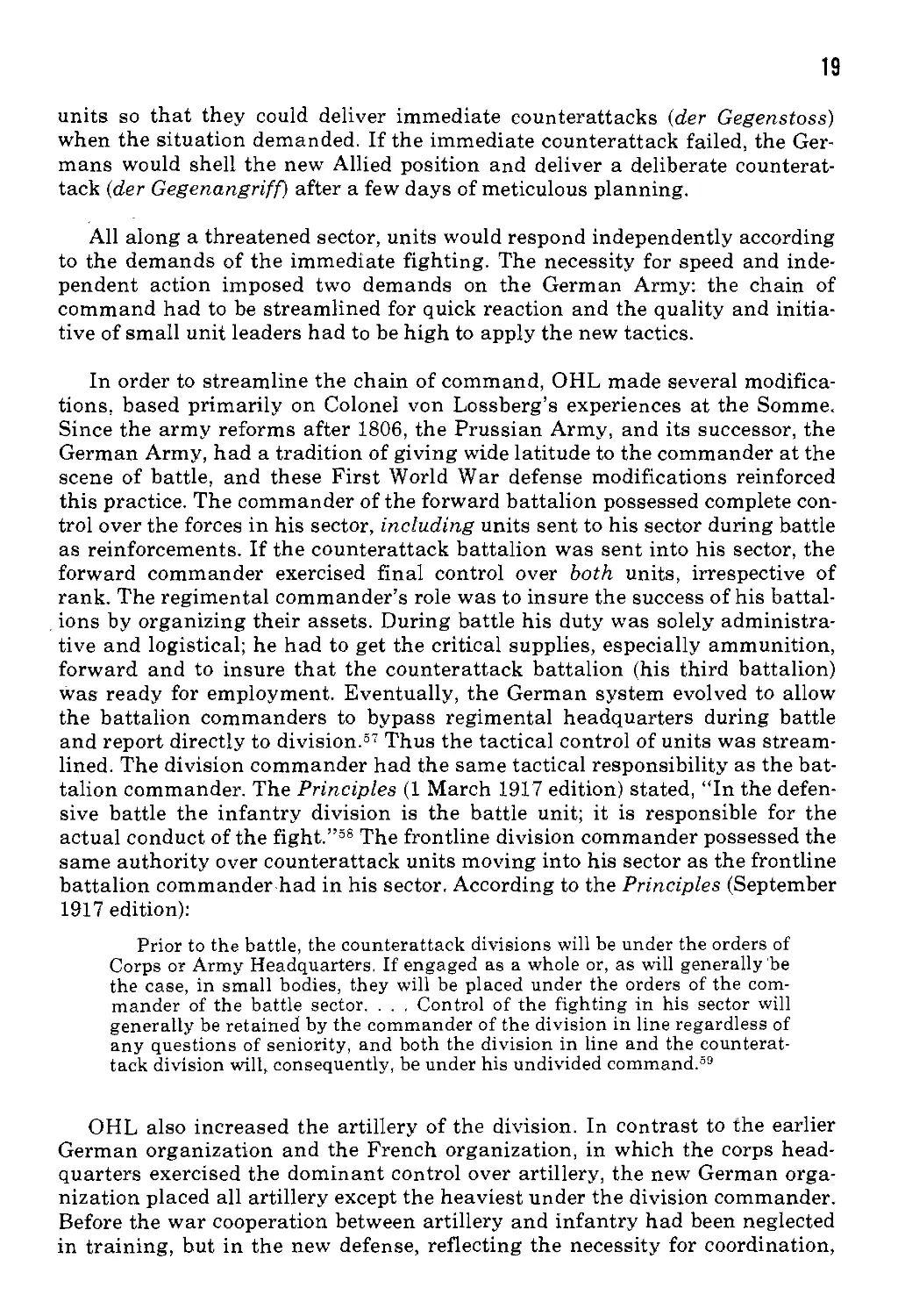
19
units so that they could deliver immediate counterattacks (der Gegenstoss)
when the situation demanded. If the immediate counterattack failed, the Ger-
mans would shell the new Allied position and deliver a deliberate counterat-
tack (der Gegenangriff) after a few days of meticulous planning.
All along a threatened sector, units would respond independently according
to the demands of the immediate fighting. The necessity for speed and inde-
pendent action imposed two demands on the German Army: the chain of
command had to be streamlined for quick reaction and the quality and initia-
tive of small unit leaders had to be high to apply the new tactics.
In order to streamline the chain of command, OHL made several modifica-
tions, based primarily on Colonel von Lossberg’s experiences at the Somme.
Since the army reforms after 1806, the Prussian Army, and its successor, the
German Army, had a tradition of giving wide latitude to the commander at the
scene of battle, and these First World War defense modifications reinforced
this practice. The commander of the forward battalion possessed complete con-
trol over the forces in his sector, including units sent to his sector during battle
as reinforcements. If the counterattack battalion was sent into his sector, the
forward commander exercised final control over both units, irrespective of
rank. The regimental commander’s role was to insure the success of his battal-
ions by organizing their assets. During battle his duty was solely administra-
tive and logistical; he had to get the critical supplies, especially ammunition,
forward and to insure that the counterattack battalion (his third battalion)
was ready for employment. Eventually, the German system evolved to allow
the battalion commanders to bypass regimental headquarters during battle
and report directly to division.37 Thus the tactical control of units was stream-
lined. The division commander had the same tactical responsibility as the bat-
talion commander. The Principles (1 March 1917 edition) stated, “In the defen-
sive battle the infantry division is the battle unit; it is responsible for the
actual conduct of the fight.”58 The frontline division commander possessed the
same authority over counterattack units moving into his sector as the frontline
battalion commander had in his sector. According to the Principles (September
1917 edition):
Prior to the battle, the counterattack divisions will be under the orders of
Corps or Army Headquarters. If engaged as a whole or, as will generally be
the case, in small bodies, they will be placed under the orders of the com-
mander of the battle sector. . . . Control of the fighting in his sector will
generally be retained by the commander of the division in line regardless of
any questions of seniority, and both the division in line and the counterat-
tack division will, consequently, be under his undivided command.39
OHL also increased the artillery of the division. In contrast to the earlier
German organization and the French organization, in which the corps head-
quarters exercised the dominant control over artillery, the new German orga-
nization placed all artillery except the heaviest under the division commander.
Before the war cooperation between artillery and infantry had been neglected
in training, but in the new defense, reflecting the necessity for coordination,
20
artillery headquarters were as close as possible to the respective division
headquarters.60
As frontline divisions employed their organic counterattack units, the coun-
terattack divisions behind them moved up to fill the recently vacated positions.
For faster employment, however, the leading counterattack division sent liai-
son officers forward to the frontline division headquarters to coordinate move-
ment. If the counterattack unit was directly behind only one frontline division,
both division headquarters could be collocated to reduce possible friction when
committing the counterattack division.61
The corps headquarters had a battlefield role similar to that of the regi-
ment, to organize and to sustain the subordinate units, but not to direct the
units during battle. The entire German Army organization gave support and
authority to the commander of the engaged forces and thus reduced the
number of headquarters controlling the tactical situation.
The immediate counterattack itself had to be delivered at the correct time,
for German experience had shown that opportunities to crush the attacker
were short-lived, and too often, late counterattacks had been unsuccessful. The
new defensive tactical doctrine emphasized the immediate counterattack and
forbade wasting time by waiting for permission from higher headquarters.62
The layered organization of counterattack units allowed even the smallest unit
to react aggressively to the attack, and such aggressiveness was encouraged,
for if the attack could be repulsed by the lowest level, men and munitions were
conserved. Such actions at the small unit level required high standards of
small unit leadership. But this devolution of responsibility necessary to apply
the new tactical doctrine caused serious misgivings among many German
officers. The German Army of December 1916 was not the army of August
1914. Losses had been severe, especially among small unit leaders. The rigor-
ous peacetime training program had been replaced with expedient wartime
training programs, in order to fill depleted units with new soldiers. Many
German commanders feared that the hasty training made the soldiers less re-
liable. Ludendorff recognized the dangers of the new tactical doctrine, for tac-
tics had become more individualized (the group, die Gruppe, consisting of one
noncommissioned officer and eight to eleven men, was becoming the key
element in small unit tactics) while the quality of training was deteriorating.
He knew that many German officers were skeptical about the ability of the
army to apply the new defensive doctrine.63
Nevertheless, the German Army cautiously adopted a doctrine that de-
manded greater initiative in small units. In direct contrast, the Allied reliance
on the brute force of firepower had the opposite effect, that of stifling initiative.
21
Writing after the war, Lt. Col. Pascal Lucas of the French Army described the
lack of initiative in Allied operations:
. . . The [higher] command, which could quickly get information on ev-
erything which was going on, tended toward excessive centralization; noth-
ing could be done except upon its orders; it took over all initiative and
responsibility. . . . Our corps of officers and noncommissioned officers lost in
that school the taste for initiative and responsibility, a grave disadvantage,
the results of which were to make themselves cruelly felt later.64
Enforcement and Application
Publication of the Principles by OHL was the result of a great effort by its
highly trained staff. Yet, the publication was meaningless by itself, for doc-
trine published is not always doctrine applied. There were many impediments
to the acceptance of the new doctrine, arising from both the virtues and the
vices of the German Army. Despite popular caricatures of Germans as author-
itarian and inflexible, the German Army fostered independent thinking among
its officers. Because commanders were expected to think for themselves, the
Principles had a tough, critical audience. Besides valuing independent judg-
ment, the German officer corps was pragmatic and considered concepts situa-
tionally, not in theoretical isolation. A concept was not accepted on the basis
of a catch-phrase or theoretical neatness. The German officer corps judged
concepts according to the specific battlefield conditions in which such concepts
would be applied. The new defensive doctrine faced the problem of any new
doctrine, for it had to be sufficiently general to apply to the varied conditions
along the western front, but sufficiently specific to insure unity of effort and
efficiency among German forces. The doctrine then had to pass the most diffi-
cult test, that of battle.
There were other obstacles. Despite the high reputation of the German
general staff, there was still a universal distrust of higher headquarters and,
in particular, of staff members, by German frontline officers and men. The
physical organization of static positions, with higher headquarters in safe,
comfortable locations well to the rear, magnified this sentiment in all armies
during the First World War.65 OHL could not rely solely on the strength of its
own authority to guarantee compliance with the new doctrine overnight.
Ludendorffs role in overcoming these problems is instructive, for he did not
treat the doctrine as Holy Writ, yet he firmly directed and reorganized the
German Army so that it would fight in 1917 according to the new doctrine.
Ludendorff knew the effort required to transform published doctrine into
applied doctrine, for he recognized that “orders on paper were of themselves
useless, they had to be ground into the flesh and blood of officers and men.”66
Ludendorff put his full authority behind the new doctrine. “The controversy
raged furiously on my staff; I myself had to take part and I advocated the new
22
tactics.”67 Shortly after the publication of the first edition of the Principles the
French counterattacked in the Verdun sector.* Contrary to the Principles,
issued two weeks earlier, the German commanders had not moved up their
reserves behind the battle zone for quick employment in counterattack. They
employed the reserves too late and the French were able to consolidate and
hold gains of their limited attack. The two German commanders responsible,
General von Lochow, Fifth Army, and General von Zwehl, XIV Reserve Corps,
were subsequently relieved.68
Ludendorffs other actions, however, showed that he could be tolerant when
he detected a disagreement based on reflections and experience, not careless
neglect. Ludendorff did not treat such constructive criticism as a personal
attack. This tolerance appears in his reaction to the criticism of Colonel von
Lossberg. This expert tactician believed that the Principles were too liberal in
allowing troops in forward trenches to move to the rear if necessary. He also
feared that the movements of so many small units would become too chaotic.
Ludendorffs reaction was gracious. He published von Lossberg’s ideas, as
expressed in the paper, “Experiences of the First Army in the Somme Battles,”
as part of an official training directive rather than stifling all criticism.69 He
had confidence in the Principles but he also realized that effective doctrine
could not be dogma. Refinements would be necessary when the battles
resumed, so he did not discourage independent thought. Colonel von Lossberg,
for his part, later demonstrated great flexibility during the battles of 1917 and
he became the supreme practitioner of the elastic defense-in-depth.
Neither was Ludendorff jealous of the ownership of the new doctrine. He
never called it “mine,” only “ours,” and he gave credit to the colonel and
captain who had written it. The development of the doctrine required deliberate
solicitation of ideas and experiences and gave the final product wide owner-
ship, facilitating its acceptance by subordinate units who felt they had
contributed to it and had a stake in its success. Colonel von Lossberg was an
important contributor to the concepts, but not the only one. Crown Prince
Wilhelm’s reaction to the defensive doctrine conveyed this feeling of owner-
ship, for in the new doctrine he recognized ideas that had been forwarded to
OHL from his army group, which “was the cause of great satisfaction to my
Chief of Staff and myself.”70
Even the bitter comments of Renn were back-handedly complimentary;
although he complained that the defensive changes were overdue, he did not
complain that they were incorrect.71
OHL also published several other documents. Eight weeks after the Prin-
ciples appeared, OHL published the Manual of Infantry Training for War.
This description of a training program came from a field army training
*Upon assuming duties as first quartermaster general, Ludendorff had stopped the German
attacks on Verdun, but the French continued to counterattack to regain lost ground throughout the
remainder of 1916.
23
program and it contained von Lossberg’s account of the Somme. The director
of artillery at OHL distributed special monthly periodicals on gunnery to
units.72 Several other OHL regulations described the use of specific weapons,
such as trench mortars and machine guns.
This enormous publishing effort was not wholly beneficial, because the
constant recording of experiences and publications of directives constituted a
paperwork nightmare. There was no relief and von Kuhl recalled that no
efforts to alleviate paperwork demands succeeded.73
Despite the inevitable problems with paperwork, the Principles and Con-
struction were very timely for some concrete reasons. The Germans were
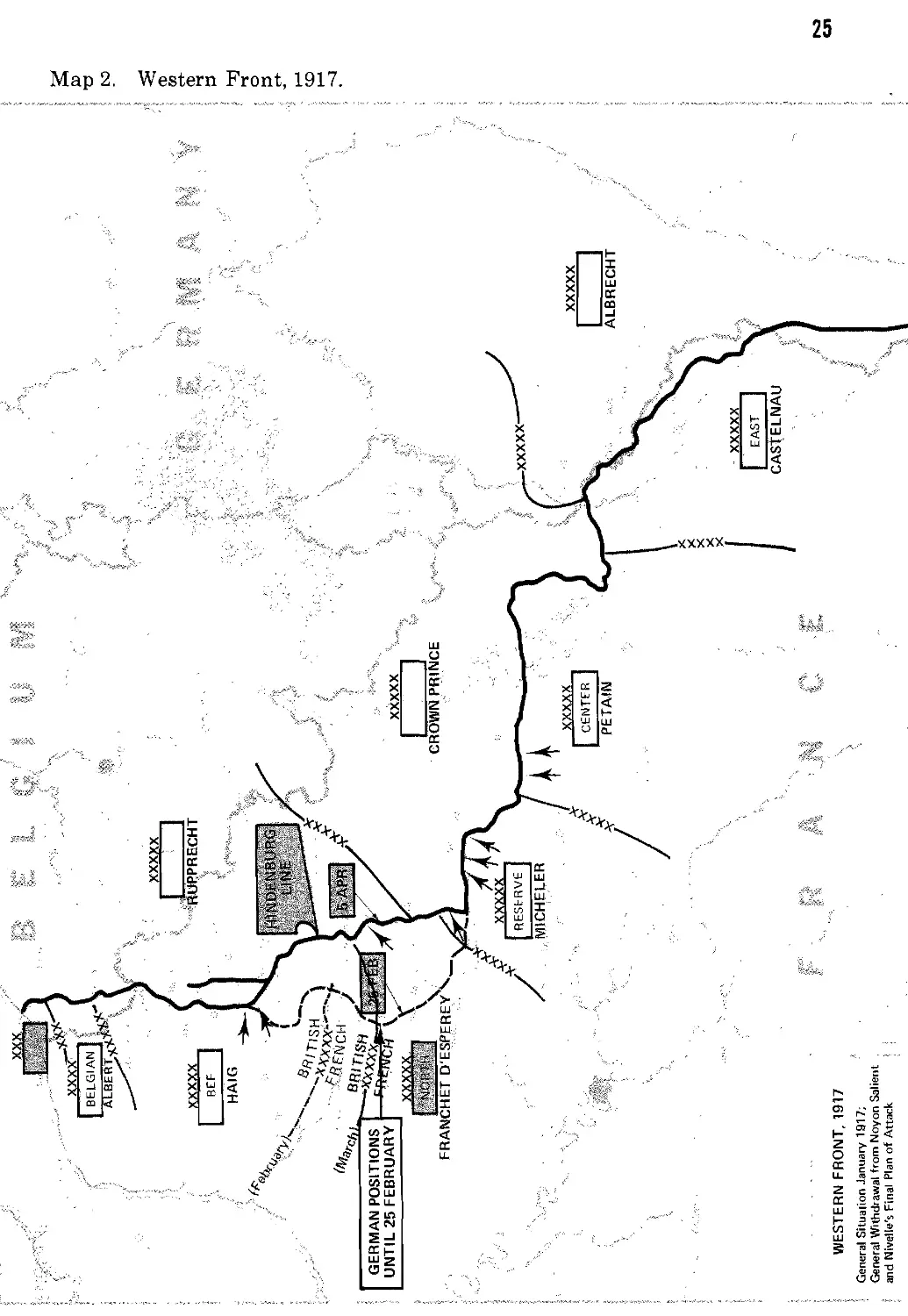
constructing new positions behind certain sectors on the western front. (See
map 2.) Since September 1916 Ludendorff had contemplated voluntary with-
drawal from certain German salients in order to shorten the length of the
western front, to occupy more favorable ground for defense, and to release
some units to become counterattack units. Besides these benefits, however,
these withdrawals also provided the Allies propaganda to create the appear-
ance of German failure. The German selection of favorable defensive terrain
for these new positions began in fall 1916 and was based upon the Somme
experiences and the subsequently published Construction. Throughout the rest
of the war, continous improvements were made to these defensive areas. The
Allied press often referred to the system imprecisely as the Hindenburg line,
but that name only correctly applied to one specific sector out of five. The use
of the word “line” was also misleading because the construction program
created deep zones; it was not devoted to making one continous line invin-
cible.74
Amid the construction efforts and the normal demands of the front in the
winter of 1916—17, the German Army trained and reorganized according to
the elastic defense-in-depth. Doctrine alone was useless unless training could
instill the necessary standards of performance. As the Principles (1 March
1917 edition) stated succinctly, “The value of troops depends on their standard
of training.”75
Ludendorff supervised the efforts to establish schools to prepare the
German Army for the anticipated Allied offensive of 1917, “to get rid of any
ignorance as to the nature of defensive fighting.76 Schools behind the lines
were not new. All adversaries on the western front had established elaborate
training schools behind their respective lines, for the static front made
establishing and maintaining such institutions possible. As early as 1915 the
Germans had established recruit depots in rear areas where divisions trained
their combat replacements.77 The bulk of recruit training for replacements was
therefore already being conducted near the front, not in Germany.78 Luden-
dorff firmly supported additional tactical schools to train the army in the new
tactics during the winter lull.79
24
High ranking commanders and staff officers attended the schools at
Solesmes (later moved to Valenciennes) and Sedan. The school at Solesmes
began classes in February 1917; the Sedan course began in March. Local
infantry and artillery units tested ideas (including coordination of the two
arms), and student comments received serious consideration.80 Field armies
established their own schools to train junior officers and noncommissioned
officers in the new methods. OHL established additional training areas for
those weapons which were particularly useful in the defense: artillery, trench
mortars, and machine guns. Despite the considerable strain on German war
production, OHL made ample supplies of ammunition available for live-fire
training. Training emphasized integration of all combat arms, and officers
received cross-training in various weapons when time and other demands
allowed.81 Divisions trained special sharpshooter machine gun units.* Units
unable to rotate to the rear for training because of demands of the front
conducted training in their sectors. The entire training effort by the German
Army was considerable.
The demand for training competed with other considerations. Troops, for
example, constantly dug new positions and improved old ones. Despite the
German use of labor units composed of prisoners of war and civilians, the
demand for manpower for construction was so great that it required additional
soldier labor. The Germans also had a requirement for resting units. The
German Army was exhausted by the end of 1916, and its leaders recognized
the need to include rest periods into the training rotation.
The leaders also soberly recognized the need for soldiers who could apply
the new tactical methods. Crown Prince Wilhelm wrote that the elastic
defense-in-depth needed well-disciplined, well-trained, and well-led troops
which were becoming more difficult to find because of the strain of war.82 The
German leaders admitted that all these demands necessitated compromise.83
The winter of 1916—17 was also a period of reorganization and standardi-
zation for the German Army. The reduction of the infantry division’s maneu-
ver units to three infantry regiments continued throughout the army. Bat-
talion strength was also reduced, creating enough surplus soldiers to form
thirteen new divisions for the spring. Cavalry units continued to be disbanded,
freeing the horses for the urgent demands of transport and freeing the men for
services as infantry.84
This reorganization and standardization placed great demands for new
equipment. The army needed artillery tubes, not only to replace those destroyed,
but also to replace tubes worn by the excessive firing.85 The famous German
steel helmet, having proven its value at the Somme in limited issue, now
became standard issue in the German Army.86 The army developed the light
machine gun during this period, and each infantry company received four, and
‘These units were called SS machine gun units, SS meaning Scharfsch'dtzen (sharpshooter).
This designation was not related in any way to the SS (Schutzstaffel) of World War II.
XXX
^*'2 •	XXX>C	Г I BELGIAN | | ALBERT^** ? /	xxxxx /	1	_J XXXXX	\ 1	RUPPRECHT 1 urr | f у	J HAIG	1 I '-T	IhINIHNBURIj|	> ।	Д. 1 LINE I / '	."'*''4^/г,8н"‘Л	yX—— 1Ч7,	-SFA/CH	/	> lb APR # 	4-^-У GERMAN POSITIONS effiXXX^J-lafrfEB	/ UNTIL 25 FEBRUARY	/ r™i v Y FRANCHET D'ESPEREY Ч_ /Л £ xxxxx z' ^4 Г	уЛ 1 RESERVE	V* Л . M1CHELER	/ WESTERN FRONT, 1917 General Situalion January 1917; General Withdrawal from Noyon Salient , and Nivelle's Final Plan of Attack	XXXXX	, CROWN PRI NCE • •	—-xxxxx— il	) XXXXX-. 	I	A	xxxxx I CENTER 1	J	^/<***\^	|	| PETAIN	\	ALBRECHT k	- x	< X	1 X	I x	L 1	xxxxx	1 1	| EAST | I	CAStELNAU	\
Map 2. Western Front, 1917.
27
later six, of these new weapons.87 With the light machine gun placed forward,
the heavy machine gun could now be placed in the intermediate area of the
battle zone. The machine gun was the most important infantry defense
weapon, as Balck recalled:
The unexpected opening of fire of a single machinegun under the efficient
leadership, even if served by only a few cool men, has several times been the
decisive factor in victory and defeat. Good training must overcome mal-
functioning of the gun.88
The dominance of the light machine gun caused a gradual reorganization
of infantry units. At the smallest unit level, the section (Gruppe) was organized
into two complementary squads (Trapps'). One squad consisted of one light
machine gun, two gunners, and two ammunition bearers. The second squad
consisted of seven riflemen and the leader. Since the machine gun became the
dominant weapon, the primary purpose of the rifle squad had become the
protection of the machine gun.89
German industry had been unable to meet many of the demands of war,
and the army had suffered equipment and munition shortages in 1915 and
1916.90 To insure that adequate amounts of equipment and munitions would be
available in 1917, Ludendorff implemented a national production plan, the
Hindenburg Program, in August 1916. Several members of the OHL staff
participated in this effort, including Colonel Bauer and Major von Harbou,
who calculated the anticipated demand for raw materials for the army. The
Hindenburg Program’s effects remain controversial, but the program did result
in peak production of German war industry in 1917 and enabled Ludendorff to
supply the German Army with new weapons and munitions.91
One final aspect of the extensive preparation of the German Army for the
offensive struggle of 1917 was the nurturing of an aggressive spirit in the
defense. The previous defense of the forward line cultivated steadfastness, but
not aggressiveness. In the new doctrine, however, the counterattack was
essential to the elastic defense-in-depth, and an aggressive spirit had to be
instilled in soldiers who had grown accustomed to fighting a position defense
for two years. Upon arriving in the west, Ludendorff saw a means to foster
such an aggressive spirit, not only for counterattacks, but also for future
offensives. Visiting Crown Prince Wilhelm’s Army Group in September 1916,
Ludendorff was greeted by a unique honor guard, the storm troopers of the
Rohr Storm Battalion, and for the first time saw “a single detachment in full
storming rig-out.”92
The concept of storm troopers, like the doctrine of the elastic defense-in-
depth, was not invented by OHL or Ludendorff. These concepts Were discov-
ered, encouraged, codified, and disseminated. Although the precise origin of the
storm troopers is unclear, the use of select infantry soldiers for special
missions has been a common development in most protracted wars. As early
as August 1914 German units used special assault troops in the Argonne,93
and in 1915 a Bavarian division employed specially trained assault infantry in
an attack.94 The famous unit that comprised the honor guard observed by
28
Ludendorff began in March 1915 as an experimental unit of combat engineers.
Their first assault against the French in a small unit action was a failure.
However, Capt. Willy Rohr assumed control of the unit on 8 August 1915 and
under his direction the storm battalion (Sturmbataillori) became famous.
Rohr was an innovative officer and he combined a good sense of tactics
with experiments with new equipment. His unit, which eventually became
known as Sturmbataillon Rohr, soon achieved success in small unit operations
against the French. What distinguished Rohr’s techniques from the prewar
German tactical doctrine was the organization of attack forces in small groups
deployed in depth, instead of advancing in a broad firing line, and the arming
of individual infantry soldiers with various types of weapons, instead of the
standard issue rifle. Rohr’s storm battalion used grenades, rifles, machine
guns, trench mortars, flamethrowers, and light artillery pieces. His battalion
practiced extensively with supporting artillery units in order to coordinate unit
movement with supporting fire. Live-fire training in these new techniques,
which caused some casualties, was extensive. The basic unit of the storm
battalion was the assault squad (Stosstrupp or Sturmtrupp)-, the originator of
the word Stosstrupp was Maj. Hermann Reddemann, who developed tactics for
the flamethrower, and who was, ironically, a former chief of the Leipzig fire
brigade.93
The success of Rohr’s unit did not go unnoticed. Officers and men from
units serving in the front near Rohr’s unit were very impressed; at their
request, Rohr established a one-week training course in December 1915 to pass
on his techniques to other units. After the initial German attacks on Verdun in
February 1916, the German Fifth Army, to which Rohr’s unit was attached,
directed Rohr’s unit to serve during lulls in the action as a training cadre for
other infantry units, in addition to their combat mission of conducting difficult
assaults. This dual mission of storm units, both training cadre and elite
assault units,"continued throughout the war.
Col. Max Bauer of OHL had also been monitoring Rohr’s progress and in
May 1916 General von Falkenhayn directed the field armies on the western
front to send selected small unit leaders to train with Rohr for fourteen days.
These small unit leaders returned to their units and established storm units in
their own divisions. There were limitations, however, for necessary equipment
was often unavailable, time was scarce, and training, especially in the coordi-
nation of artillery fire by assault units, was difficult to organize. The change of
German chief of staff in August 1916 from von Falkenhayn to Hindenburg and
Ludendorff was decisive in the further development of storm unit techniques.
After viewing Rohr’s storm battalion during his visit, Ludendorff directed that
storm battalions serve as cadre to teach storm unit techniques to the rest of the
German Army. With OHL’s backing, the training commenced on a large scale.
The official encouragement of storm unit techniques helped foster an aggressive
spirit in the German Army during the defensive battles of 1917, and carried
over to the German offensives of 1918. Crown Prince Wilhelm wrote that this
29
strong encouragement of storm unit techniques was one of Ludendorffs great-
est services rendered during the war.96
The Battles of 1917
On 21 March 1917 the German Army awaited the anticipated Allied offen-
sives. Despite severe materiel shortages and extensive demands on several
fronts, the German Army, through considerable effort, had prepared well. The
new defensive doctrine was not a panacea, however. The Allies would press the
Germans hard in 1917, and the Germans would modify their doctrine accord-
ingly. Also, despite OHL’s and Ludendorffs efforts, some German units did
not resolutely apply the new doctrine, a fact that became painfully apparent
with the first Allied attack.
The British began their 1917 offensives near Arras, attacking Crown Prince
Rupprecht’s Army Group. The preparatory bombardment, beginning on 21
March 1917, saturated an eleven-mile front with 2,687,000 shells. On 9 April
the British and Empire forces went over the top. Although the German
organization in depth had prevented a repetition of the slaughter of the
Somme, things still did not go very well for the Germans on 9 April. They had
difficulty in coordinating their defense efforts: artillery did not provide timely
support of counterattacks, and division commanders had not positioned
counterattack units sufficiently forward for timely insertion.97 Ludendorff was
distraught and feared that the efforts of seven months had been futile.98
Ludendorff talked to frontline participants by telephone and quickly concluded
that the principles were sound but had not been applied correctly.?? The worst
reverses had occurred in the sector of the German Sixth Army, where the well
planned and executed British attacks had secured their initial objectives. The
German Sixth Army commander, seventy-three-year old Colonel General von
Falkenhausen,* was half-hearted in applying the new defensive doctrine.101 To
correct this, Ludendorff appointed Col. Fritz von Lossberg, the fireman of the
western front; as chief of staff to Sixth Army. Von Lossberg immediately
changed the incomplete efforts of the Sixth Army into a coherent system using
the newly developed defensive principles. With his characteristic energy, he
established methods for coordinating artillery fire for timely response, reposi-
tioned forward units, and moved reserves closer to the front lines. Although
von Lossberg, it should be remembered, had been a critic of the fluid nature of
the elastic defense-in-depth, Ludendorff called upon von Lossberg to rectify the
situation at Arras and showed that disagreement did not destroy mutual
confidence. For his part, von Lossberg did apply the elastic principles wher-
*It is difficult to determine where the greatest responsibility for the failure of the Sixth Army-
lay. Von Falkenhausen’s superior, Crown Prince Rupprecht of Bavaria, wrote that he should have
pressed von Falkenhausen more vigorously to move reserve units closer. Von Lossberg also tended
to blame Rupprecht's Army Gloup headquarters. Divisional histories of units in Sixth Army, how-
ever, recorded that Sixth Army instructions to counterattack units were not in compliance with the
new defensive doctrine from OHL. Interestingly, on 22 April, von Falkenhausen was named
Governor-General of Belgium and relinquished command of the Sixth Army.100
30
ever local terrrain allowed, despite his earlier skepticism of the “elastic”
aspects of the doctrine.102 The enlightened tacticians of the German Army
tolerated compromise when it was inspired by good judgment.
On 14 April the British launched attacks with limited objectives to expand
the salients created by their initial assault of 9 April. Von Lossberg had
prepared the Germans and this time the battles resembled the ideal scenario
for the German defense. For example, in the VII Corps (British) sector, British
battalions attacked at 0530 behind a creeping artillery barrage. German
artillery hit the British infantry, slowing its advance and separating the
British infantry from the protective creeping barrage. The British infantry also
encountered unexpected small arms fire from German reverse slope positions.
Local German counterattack units closed in on the now confused remnants of
the British advance. By 0800, having lost two-thirds of the strength from their
lead units, the British were back at their original line. Another grim example
came from the British VI Corps sector where two British battalions gained
nothing, and lost all their forces except those in battalion headquarters.
German casualties were much less.103
Throughout April and May the British continued to attack in the German
Sixth Army sector in a series of battles called the Battles of the Scarpe. The
British did not achieve a breakthrough, although on some occasions the
Germans became quite alarmed. The German defense worked best where the
terrain favored German artillery observation. Not surprisingly, British attacks
succeeded best where terrain favored their artillery observation. The essential
difference was that the Germans recognized this, and gave up ground where
terrain did not offer the good observation necessary for effective artillery
support of counterattacks. Much to the relief of the Germans, the British did
not appear to understand that observation provided by key terrain greatly
affected their operations. The British continued to press on in a wide effort,
and did not seize fleeting opportunities to use specific areas with favorable
observation to press the advantage. The Germans yielded some ground, but
they prevented a breakthrough and preserved their fighting strength.104 It is
significant that the purpose of the elastic defense-in-depth was to restore the
cohesion of the German defense, which did not always include the recovery of
every bit of territory.
The British efforts in April, however, were only part of a larger Allied
strategic plan, which did not direct the British to make the major effort. The
purpose of the British attacks was to attract the German strategic reserves to
the British sector, in order to enhance the chances of success of the major
Allied effort by the French (see map 3) led by a newly appointed commander in
chief, the tragic Robert Nivelle.
Robert Nivelle, named French commander in chief in December 1916, had
risen very quickly to high command during the war.106 Beginning the war as
an artillery colonel, Nivelle demonstrated bravery and competence, and by
May 1916 he commanded the Army of Verdun under General Petain and
Map 3. Reims and Arras, 1917.
33
received national attention. He directed the counterattacks which successfully
recovered ground previously lost to the German attacks at Verdun. These
counterattacks relied upon artillery preparation and a rolling barrage, behind
which infantry advanced. The infantry advanced in small groups, pressing
home with speed and violence, bypassing centers of resistance.* Nivelle’s
method gave impressive results at Verdun, for he secured limited objectives at
an acceptable cost in lives. Now this man was selected to command all forces
in France. As Edward L. Spears, British liaison officer to the French High
Command, recalled:
What remained to be seen was whether the glorified raids of Verdun were
applicable on a large scale . . . above all whether he [Nivelle] was strong
enough to keep his head in the lonely and dizzy height of supreme com-
mand.1'^
The great tragedy was that Nivelle, upon assuming supreme command, was
not strong enough to keep his head. His tragic flaw was his insistence, as an
article of faith, that his method was inherently irresistible. Uttering, “We have
the formula,”107 Nivelle, with a very confident demeanor, seemed to believe
that his methods would succeed of their own merits; he treated the Germans as
if they were a terrain obstacle instead of an active, intelligent enemy.
Nivelle’s tactical method, instead of a means to an end, became an end in
itself. The extensive preparations for the offensive became increasingly unreal-
istic. For example, French commanders tried to outdo each other in establish-
ing the fastest rolling barrage during training. This would lead to disaster in
combat, when the infantry could not keep up with the rapid artillery fire.108
Spears observed that the more optimistic a prediction by a subordinate head-
quarters, the more approving was the French high command.109
In this atmosphere of unrealistic optimism, French High Command also
tolerated no criticism or skepticism. Reports of a new German defense tech-
nique were ignored. The deliberate German withdrawal to a new defensive
zone did not cause significant changes to the French plan. The Germans were
particularly well prepared, for they captured a set of orders that described
Nivelle’s plan (for Nivelle had confidently distributed his orders throughout
the army), a document that contained, in the words of Crown Prince Wilhelm,
“matter of extraordinary value.”110 Displaying an extreme disregard for real-
ity, Nivelle insisted on adhering to his plan after he had been informed that it
had been compromised. As Nivelle’s personal stake in the success of his
methods grew, the more unrealistic he became.
The French infantry assaulted on 16 April 1917 with disastrous results. The
French infantry was unable to keep up with the “insane pace of the bar-
rage.”111 Well-concealed German machine gun strongpoints engaged the
*Despite the ultimate failure, Nivelle’s methods should not be dismissed as worthless. The
German offensive tactics (see chapter 2) had several similarities to Nivelle’s concepts, but, as will
be shown, the German Army and its leaders were more successful at executing the concepts.
34
French from all directions, including from the rear, as the French entered the
battle zones.112
The German artillery was as well prepared as the German infantry.
Knowing the French preparatory fire plans, German gunners did not fire
during the French artillery preparation. The French erroneously concluded
that their artillery had silenced the German guns, and French assault units,
assembled for attack, often did not take the precaution of digging in. The
German artillery suddenly fired on the French assault forces.113
German defense positions had been chosen for good German artillery
observation, and the German counterattacks against the French lead units
were well coordinated'with German artillery, as Spears observed:
The scenario of these minor battles [the immediate German counter-
attacks] was practically always the same. They were heralded by very
accurate German artillery fire concentrated on the point of attack. The
ground the Germans intended recapturing would be turned into a field of
smoke and flame under a roaring, screeching sky that seemed about to
collapse, forcing down the heads of the [French] defenders; trenches would
rock and cave in under the violence of the explosions, then the air would
buzz as the steel wasps of the German machine gun bullets came over in
their scores of thousands. Suddenly the range would lengthen and, looming
out of the smoke of the last explosions, shadowy forms would rush forward,
gesticulating wildly, enemy soldiers [German] throwing grenades.114
The problems with the Nivelle offensive went beyond the battlefield. The
movement of supplies, especially artillery munitions, created severe problems,
caused monumental traffic problems, and left some artillery units without
adequate stocks of munitions.115 Nivelle was incorrect: his Verdun method
could not simply be expanded administratively and logistically to a larger
scale.
Before his offensive, Nivelle had promised success with glowing Napoleonic
phrases. The obvious failure of the Nivelle offensive caused a collapse of
French morale that led to widespread disobedience in the ranks. Nivelle was
relieved; Petain became commander in chief of the French Army and began to
solve the crisis of the mutiny. In order to divert the attention of the Germans,
who remained unaware of the gravity of the French crisis, the British con-
tinued the offensive operations in their sector for the remainder of 1917.
Although the British continued to employ the familiar massive use of
artillery to clear the way for their infantry, they also occasionally employed
other tactics. One spectacular method was the detonation of 500 tons of explo-
sives that had been placed in tunnels underneath a German position at
Messines on 7 June 1917.
The British also used the tank, their attempt to solve the tactical dilemma
with a technological innovation. First used in 1916, tanks were employed
increasingly by the Allies in 1917, including in the initial successes at Cambrai
in November 1917 (see chapter 2).
35
The major British campaign after the Nivelle failure, the Passchendaele (or
Third Ypres) Campaign in Flanders, lasted from 18 July to 16 November.
Predictably, Colonel von Lossberg went as chief of staff to the Fourth Army,
against whom the British directed their main effort. Also predictably, the
German defense held well.
Throughout this period, the Germans constantly reexamined their doctrine,
revised it, and adapted it to local conditions. For example, in October 1917 the
British conducted shallow, methodical attacks for limited objectives. The
Germans attempted to frustrate these attacks, which were not deep enough to
trigger the Germans’ larger counterattack forces, by placing greater numbers
of troops in the forward lines, but the result was a longer casualty list,116 The
Germans reverted to the sparsely occupied forward line. Ludendorff constantly
discussed the tactical situation with commanders and with chiefs of staff like
von Lossberg and von Kuhl. Often, new refinements in the defense were
tested.117
This flexibility was a strength in the German attitude toward doctrine.
There was no dogmatic formula that became an article of faith, as had
occurred with Nivelle. To the best German tacticians, doctrine was a means to
an end, not an end in itself.
When the Allies assumed a defensive posture for the winter of 1917—18, they
had gained very little ground but had expended much blood and materiel,
while the Germans had conserved enough strength to continue the war into
1918, despite the terrible effects of the war and the economic blockade of
Germany. The German elastic defense-in-depth had succeeded. Crown Prince
Wilhelm wrote that he was firmly convinced that had the German Army not
changed its defensive doctrine, it “should not have come victoriously through
the great defensive battles of 1917.”118
The British grudgingly complimented the Germans that winter by adopting
a defensive system based upon captured German documents.119 Unfortunately
for the British, they did not completely grasp the spirit of the German doctrine
(especially the emphasis on counterattack units) and the British Army did not
apply the principles thoroughly during the winter. This shortcoming would be
evident when the Germans unleashed their offensive in 1918.
2
The Offensive Tactics of 1918
In the second half of 1917, strategic conditions were developing that would
offer the Germans an opportunity to concentrate their military power on the
western front in 1918. Russia, suffering from internal convulsions as well as
the extreme demands of the war, could not sustain the war effort. As peace
negotiations with Russia began, German units traveled from east to west. The
number of German divisions in the west went from 150 in October 1917 to 192
in March 1918.1 The opportunity for force concentration in the west had to be
seized quickly, for the United States had declared war on Germany in April
1917. The Germans calculated that it would require one year for the United
States to exert any decisive influence on operations in the west. Therefore, the
changing strategic situation and deteriorating economic and political condi-
tions in Germany (due to the effects of the Allied blockade of Germany) only
permitted the Germans one final attempt at victory in the west.
On 11 November 1917 OHL decided that the great offensive would begin in
the spring of 1918. Between this decision and the initiation of the offensive on
21 March 1918, the German Army developed the appropriate doctrine and
prepared as many units as possible for the attack. In order to destroy the
Allied forces, the Germans attempted to solve the tactical dilemma which had
frustrated the Allies for more than three years. The preferred German maneu-
ver in prewar doctrine, the envelopment, was impossible to achieve in the west.
Therefore, a successful penetration was required, to be followed up by force
sufficient to achieve a strategic breakthrough.
Although in two and one-half years the Germans had conducted only one
major offensive on the western front (Verdun), the German Army still had
considerable experience from which to draw. Units in the east had been
participating in several major offensives throughout the war. More recently, in
October 1917, a German field army (Fourteenth Army under General Otto von
Below), having been formed with units from the western, eastern, and Rumani-
an fronts, was sent by OHL to northern Italy to cooperate with the Austrians
in an offensive against the Italians. General von Below’s order to his forces
before battle stated:
Every column on the heights must move forward without hesitation; by
doing so opportunities will be created for helping neighbors who cannot
make progress, by swinging round in the rear of the enemy opposing him.2
37
38
At the Battle of Caporetto the Germans and Austrians smashed through
the Italian forces, achieving a strategic penetration, and drove the Italians
back to the Piave River. The other Allied powers responded, sending French
and British units to Italy to strengthen the front. Italy, although badly
shaken, remained in the war. The Germans and Austrians had not eliminated
Italy from the war, but the Central Powers success had been most impressive.
Italy lost 305,000 soldiers, including 275,000 prisoners.3
The offensive successes in the east and in Italy had occurred within the
unique conditions of each theater. OHL, in considering the peculiar nature of
the western front, did not blindly adopt techniques derived outside the west
and try to apply them immediately to the western front. Instead, OHL exam-
ined each combat experience with respect to the particular conditions in which
it had occurred.
Also, the German forces on the western front were better prepared for
offensive operations than their record of recent experiences in major offensives
indicated. Although Verdun had been an offensive with a limited objective and
the 1918 offensive plan sought a strategic breakthrough, the Verdun battles
had demonstrated several useful points: the value of sudden concentrated
artillery fire in depth before the assault, the need for centralized control of
artillery, the value of surprise, and the need for greater combined arms
cooperation. The Germans had tried several tactical techniques, such as attach-
ing a horse-drawn artillery battery to an infantry regiment in the attack, in
order to provide the infantry better fire support.4
The German Army’s defensive experiences in 1917 provided another very
important source of offensive expertise. The aggressive tenor of the elastic
defense-in-depth, especially the counterattack, nurtured offensive excellence.
To train the army for this defense, units acquired the spirit of the counterat-
tack, and OHL had codified storm trooper techniques to assist this training.
Having accumulated considerable counterattack experience in 1917, the Ger-
man Army in the west already had a deceptively solid base of doctrine and
experience for offensive operations.
The Germans had another source of experience on the conduct of the
offense. They had defended against the Allied attacks for three years, and rec-
ognized that the Allies had been showing them what not to do.3 Reliance on
massive firepower to destroy the enemy was clearly not the solution. In any
event, the Germans could not match the Allied expenditure of munitions, so a
different offensive technique was required. A French captain inadvertently
provided one important source of inspiration for developing such new tech-
niques.
On 9 May 1915 Capt. Andre Laffargue led an attack on a German position.
Afterwards, Laffargue reflected upon the problems of the attack and expressed
his ideas in a pamphlet, “The Attack in Trench Warfare.” The French Army
published the pamphlet, but distributed it for information only; it did not
39
become French doctrine. The British did not translate it.6 Early in the summer
of 1916 the Germans captured a copy of the pamphlet, translated it at once,
and issued it to units. Ludwig Renn wrote that Laffargue’s ideas had immedi-
ate use as a tactical manual for German infantry.7
Laffargue personified that resource of talent which exists at the small unit
level and develops in combat; he was a part of the “human canister” of combat
who did not want to die, but to succeed.8 Exclaiming, “Let us prepare our busi-
ness down to the slightest detail in order to conquer and live,” he set out to
record his experiences and ideas.9
Laffargue advocated a sudden attack to achieve a deep penetration. His
attack resembled a gulp, not a nibble.* The momentum of the in-depth attack
would disrupt the enemy, keep him off balance, and prevent him from organiz-
ing an effective response. To capitalize on disruption, the assault had to
advance as far as possible. The first wave would identify—not reduce—
defensive strongpoints and subsequent attack waves would destroy them. An
artillery bombardment applied suddenly in depth throughout the enemy area
would precede the infantry assault. Disruption of enemy artillery batteries was
particularly important to protect the infantry advance.
Laffargue stated that all troops were not assault troops; special training
and care were necessary to develop the aggressiveness and skill for the
assault. Ironically, the German storm units best epitomized this idea of elite
assault units. In his pamphlet, Laffargue also expressed the need for an
automatic rifle for firepower in advance positions, a need later met in all
armies during the war by the light machine gun.11
Although they did not adopt all of Laffargue’s ideas (for example, he was
very insistent on some rather cumbersome formations), the Germans derived
greater benefit from his ideas and put more of his ideas into practice than the
French did. German units became well acquainted with his concepts and the
operations section of OHL was impressed with the practical combination of
surprise, firepower, and maneuver to break the tactical stalemate.12
While the Allies had not pursued Laffargue’s concept of sudden attack as
vigorously as their enemies, they had pursued a technological solution to the
tactical dilemma. During the Somme battle in September 1916 the British
introduced tanks. The initial use of tanks failed to capitalize on the tactical
and strategic potential of the weapon, to the chagrin of the early tank
enthusiasts, whose highly original tactical ideas had been rejected by British
High Command. In their first battle, tanks were dispersed as infantry support-
ing weapons and followed the characteristically heavy and long artillery
*The metaphor likening attacks to consumption of food was popular in the First World War.
Joffre described his 1915 strategy of numerous attacks with limited objectives by stating, “I am
nibbling at them.”1- The German attack regulations of 1918 used the same metaphor and de-
scribed ‘'devouring” the enemy position.
40
preparation. The Germans quickly developed antitank tactics,13 but they did
not attempt to imitate the Allies in the use of the tank.
On 20 November 1917 at Cambrai the British conducted a surprise limited
attack. The attack caught the Germans off-guard, because it had none of the
familiar signs that forewarned of Allied attacks. Instead of the long relentless
artillery preparation, there was a very brief but concentrated artillery barrage,
fired without previous registration in order to insure surprise. Immediately
thereafter a large concentration of tanks attacked, followed by infantry.
The results of this attack were as unexpected as the tactical procedures. The
attack stunned the Germans. The British penetrated the German defensive
zones, suffering few Allied casualties. Then, however, supply and reinforce-
ment difficulties stalled further British progress. Their impressive gains
formed a large, inviting salient. The Germans moved reinforcements to the
area and ten days later eleven divisions of Crown Prince Rupprecht’s Army
Group launched a deliberate counterattack.
This large-scale counterattack was the first major German offensive action
against the British since 1915. The attack began with a bombardment that
lasted only a few hours but gradually intensified. German gunners fired large
quantities of gas shells along with high explosive rounds. The German infan-
try quickly advanced, following the rolling barrage. The British Official Histo-
ry provided a description of this infantry assault, which clearly showed storm
unit methods, integration of different arms, and methods of bypassing resis-
tance:
Preceded by patrols the Germans had advanced at 7 a.m. in small
columns bearing many light machineguns, and, in some cases, flamethrow-
ers. From overhead low flying airplanes, in greater numbers than had
hitherto been seen, bombed and machinegunned the British defenders,
causing further casualties and, especially, distraction at the critical moment.
Nevertheless few posts appear to have been attacked from the front, the
assault sweeping in between to envelop them from flanks and rear.14
The Germans pushed deeply into the British positions, so quickly that the
British general commanding the 29th Division barely avoided capture, escap-
ing in his pajamas.13 In time, confusion abated and British resistance intensi-
fied. The campaign ended with lines drawn almost where they had been before
the initial tank assault of 20 November.
Ludendorff had expected greater success, but he was still pleased with the
results of the counterattack because it had been achieved by troops who had
not been specially trained for an offensive.16 Analyzing the recent experiences
almost immediately, Crown Prince Rupprecht’s Army Group staff quickly
circulated to its units a memorandum that stressed the importance of surprise
as demonstrated at Cambrai.17 This analysis of recent tactical experience was
a characteristic German Army method. British General Headquarters also
circulated to its units a pamphlet describing a successful action of three British
41
divisions in the defense against the German counterattack. The British Offi-
cial History noted that this effort by British GHQ was “unusual.”18
The Offensive Doctrine
On 1 January 1918 OHL published The Attack in Position Warfare (here-
after referred to as Attack), which became the basic document for the German
offensives of 1918. Just as Principles had described a defense that incorporated
the entire battlefield in depth instead of emphasizing only the front line,
Attack described an attack-in-depth, a devouring* of the entire enemy position
instead of nibbling away at the enemy front line. Once again that “mere
captain,” Hermann Geyer, was instrumental in writing the text.19
The objective of the major German offensive was to achieve a breakthrough
after penetrating the Allied line. In their efforts to penetrate the German
defenses, the Allies had relied upon massive artillery fire. The tank was
another possible solution, but appropriate tank tactics did not emerge until
Cambrai. The Germans could not rely on a long destructive artillery bombard-
ment to give them their penetration, for they lacked the huge quantities of
ammunition (their industrial production did not match that of the Allies), and
more importantly, they knew such tactics had not worked. The Germans did
not seek a solution through technological innovation. For example, they did
not attempt to develop the tank on a large scale, but chose to accomplish the
attack-in-depth with existing combat means in a carefully coordinated attack
relying on surprise.
The doctrine in Attack was as applicable to the deliberate counterattacks of
the defense as it was to the main attack of an offense to achieve a break-
through. The introduction to Attack clearly stated this and it demonstrated the
close tactical connection between the counterattack and the offensive. Attack
noted that the strategic breakthrough was the ultimate goal of the penetration.
In order to achieve that goal the attack had to strike deeply into the enemy
position. Acknowledging the impossibility of destroying all enemy forces in
such a deep penetration, the German tactical doctrine did not require complete
destruction. Instead, disruption of enemy units and communications was
essential. Throughout the doctrine, keeping the enemy off balance, pressing
the attack continuously, and retaining the initiative received great emphasis.
The authors of Attack described all artillery missions (preparatory fire,
creeping barrage, isolating the objective) with the acknowledgment that total
destruction of enemy forces could not be achieved. For instance, artillery would
neutralize, not necessarily destroy, enemy artillery batteries; the Attack strong-
ly recommended gas shells because of their disruptive characteristics. The
Attack clearly identified the need to move artillery and ammunition forward to
*The German text of this regulation, Der Angriff im Stellungskrieg, used the word fressen,
meaning to devour or to consume.
42
maintain the attack. Also, the authors devoted 21 of the 113 paragraphs of
Attack to air forces, which received an increased role in strafing enemy posi-
tions.
Attack stressed infantry-artillery cooperation and recommended pyrotech-
nics to control creeping barrages. Special horse-drawn artillery batteries
provided mobile artillery to infantry regiments, a technique used at Verdun
and in some storm battalion organizations. The doctrine encouraged any
techniques that could assist the artillery in keeping up with the infantry, for in
the German attack the infantry, not the artillery, determined the speed of the
attack:
The momentum of the infantry must not be dependent on the barrage,
but vice versa, otherwise the dash of the infantry will be checked in the rigid
curtain of fire.20
While the Attack urged German infantrymen to exploit the effects of
artillery, it also reminded them that success depended on their own skill. No
amount of munitions could relieve the infantryman from his responsibility to
close with the enemy.21
To conduct the attack, the German infantry organized in depth. Speed and
depth were the means of securing their flanks and rear: speed to keep the
enemy from reacting in time to the attack, and depth to provide the follow-up
units which would isolate the bypassed pockets of resistance and prevent these
remnants from interfering with the continuation of the attack.22
There has been some confusion about the name of these new German
offensive tactics. After the German offensive of 1918, the French called the
tactics “Hutier tactics,” attributing them to General Oskar von Hutier. After
serving on the eastern front, von Hutier was transferred to the west for the
1918 offensives, during which his Eighteenth Army achieved the greatest
successes against the enemy. The French credited him with the invention of
the offensive tactics, and perhaps this erroneous conjecture provides another
example of the personality-dominant thinking of the Allies. The first Allied
reaction to the new German tactics was to attempt to identify an individual
inventor. The Germans themselves never used the term “Hutier tactics,” and
recent research has established clearly that von Hutier did not invent these
tactics.23 The tactics were the product of an effective corporate effort.
A better term is “infiltration tactics.” While the German text does not use
the equivalent German word, “infiltration” is a satisfactory description of the
infantry technique of bypassing resistance and pushing forward as far as
possible. However, “infiltration” connotes individual movement, whereas the
German movement was in small units, and the word is too exclusively infantry
oriented. The German effort emphasized the coordination (das Zusammen-
wirkeri) of all arms, especially infantry and artillery: just as no one personality
was the source of tactical wisdom, there was no one weapon or technique that
exclusively carried the German attacks. Like the efforts of the officers in
43
developing doctrine, the efforts of the various arms blended in a complemen-
tary fashion.
The Attack Organization
In Attack as in Principles, the Germans considered the division the basic
unit capable of conducting independent battlefield operations. The offensive
doctrine, however, established one relationship that differed greatly from the
elastic defense-in-depth. Whereas in the defense the forward division command-
er had the authority to order counterattack units outside his own division
organization to deliver an immediate counterattack, in the offensive the higher
headquarters retained control of the follow-up units.24 The reinforcements were
kept well forward, but under the direction of higher headquarters they would
reinforce success.25
To maintain the momentum of an attack, the belligerents had tried several
different methods for relieving the leading units in the attack during the war.
The French had tried successive waves (the first wave taking one objective, the
second wave passing through to take the next one) and the British had used a
similar leapfrog technique in 1917.26 But in Attack lead units were instructed
to continue without relief, for the doctrine considered it preferable to maintain
the attack and exhaust the lead unit, rather than attempt a succession which
would lose time and impetus.27 Unfortunately, this method resulted in severe
losses for the lead units, which would have an adverse effect on the 1918
German offensive.
Maintaining the initiative in the offense demanded the same high standard
of small unit leadership which the elastic defense-in-depth required. The fluid
tactics required independent action by the assault detachments and groups
(Stosstrupps and Grupperi)26
The group (Gruppe) or section of the light machine gun and riflemen was
the basic infantry small unit, as it had been in executing the elastic defense-in-
depth. This tactical organization represented a significant change from the
prewar technique of an advancing line of similarly equipped infantrymen.
Ludendorff remarked that the new role of the light machine gun as the
dominant weapon and the subordinate role of the riflemen (to protect the
machine gun), as shown during the defensive battles, was a difficult change
for many German soldiers, previously trained in infantry units where the
rifleman had the dominant role, to understand.29
An important aspect of the application of the new offensive doctrine was
the role of the storm battalions in teaching the new small unit techniques to
the other German infantry units. Each German field army had a storm
battalion that acted as a teaching cadre during periods of training. This
instruction was so highly regarded that German units on the eastern front
began sending officers and noncommissioned officers to the western front to
44
attend storm unit training courses in late 1916. Field armies on the eastern
front then imitated their counterparts in the west by establishing their own
storm battalions, based on Rohr’s unit.30
The composition of storm units varied within these possibilities:
1 to 5 storm companies (infantry assault units)
1 to 2 machine gun companies (heavy machine guns)
1 flamethrower section
1 infantry gun battery (light mountain howitzers
or captured Russian guns)
1 Minenwerfer company (trench mortars)31
Besides the established storm battalions for each field army, ad hoc storm
units were often formed within infantry divisions and were usually led by a
cadre trained by the field army’s organized storm battalion.
Established storm battalions assaulted with additional infantry from an
accompanying division. The first wave was an infantry probe (from the
accompanying division) whose purpose was to identify enemy positions for the
next wave, about 250 meters behind. The second wave consisted of the elite
storm companies and the flamethrower section, with additional infantry sup-
port from the division. This second wave attempted to penetrate the enemy
zones by pushing through weak areas to envelop enemy positions. Supporting
these efforts was the third wave, about 150 meters behind, which contained the
storm battalion’s heavy weapons and similar additional support from the
division. This third wave provided fire to support the forward movement of the
storm companies and to protect the flanks of the penetrations. Behind these
three waves followed the remainder of the accompanying division, which
reduced pockets of resistance bypassed by the storm units, provided reinforce-
ments, and maintained the momentum of the attack.32 In sectors where
established storm units were not available, infantry divisions used their own
ad hoc storm units and imitated storm unit techniques.
The storm unit techniques and the new offensive doctrine emphasized a
constant drive forward. Speed and timing were essential for rapid advance,
and small unit initiative was crucial to seize the unpredictable and fleeting
opportunities of the battlefield. There was no “secret formula” in these tech-
niques. Enemy positions were reduced in a practical fashion: the physical and
psychological effects of the advance reinforced each other.
Artillery support was carefully integrated into the assault plan. Although
the infantry missions necessitated decentralization of control, the artillery
missions in support of the attack required greater centralization of control over
artillery. The Germans wanted to avoid any prolonged artillery fire, for
surprise would be lost and an artillery duel would develop in which the Allies,
with greater amounts of munitions, would eventually prevail.33 Therefore, Ger-
man fire had to be fast and accurate, and its mission was neutralization,
rather than elusive and costly destruction.
45
The techniques used to deliver fast and accurate neutralization fire in 1918
were greatly influenced by one very remarkable man, Georg Bruchmiiller, the
most significant “import” from the eastern front to the western front. He had
been on the retired list at the outbreak of the war because of a riding
accident.34 Recalled to active duty during the war, he served on the eastern
front. Bruchmiiller developed techniques to support attacks with a sudden
concentration of accurate fire instead of prolonged preparatory bombardments.
In the spring of 1916 he convinced the chief of staff of the Tenth Army to
adopt this method of concentration for a major attack at Tarnopol, and the
effect in supporting the rapid advance of the infantry was impressive.
Bruchmiiller’s technique emphasized fire in depth throughout the enemy
positions.35 His support included an accurate creeping barrage, the Feuerwalze,
for the advancing infantry.
Bruchmiiller knew how to derive the greatest benefits from limited means.
Attacks received support based upon the estimated minimum number of bat-
teries needed to achieve success. Bruchmiiller did not attempt to flatten every
enemy position, for this was unnecessary:
In a fire action of a few hours only, the complete destruction of enemy
trenches, a complete harassing of rear areas, etc., could naturally not be
achieved. This was not at all contemplated. We desired only to break the
morale of the enemy, pin him to his position, and then overcome him with
an overwhelming assault.86
Bruchmiiller developed several techniques to achieve this disruption, which
required strict control of all artillery assets. Each battery of each type of
weapon received specific fire missions with specific timetables. He organized
the stages of delivery of fire in this way:
First Stage: Surprise concentration, hitting headquarters, phone links,
command posts, enemy batteries, and infantry positions. Fire is
sudden, concentrated, and makes extensive use of gas.
Second Stage: Most batteries reinforce those batteries already firing on
enemy batteries.
Third Stage: Fire for effect on designated targets according to range.
Some batteries continue to shell infantry positions, and heavy pieces
engage long range targets.37
Surprise was essential to achieve maximum disruptive effect on the enemy.
Therefore, the Germans had to conceal their attack preparations very carefully
and their initial target data had to be very accurate.
The relationship between infantry and artillery in all armies often became
strained during the war. In 1915, for example, French infantry in one sector
wore conspicuous linen cloth on their backs in a vain attempt to avoid being
46
shelled by their own artillery.38 To develop mutual confidence between infan-
try and artillery, Bruchmiiller began conducting lectures with the infantry unit
before an operation. Bruchmiiller took great pride in gaining the confidence of
the infantry: “The thanks of the infantry, in my opinion, must be treasured
more by every artilleryman than all orders and citations.”39 He discussed his
targets in detail, describing the timing of the preparation, the conduct of the
rolling barrage, and any other matter of mutual concern. At the end of his
lectures he would entertain questions, including those from the lowest ranking
soldiers.40
Bruchmiiller soon earned a great reputation as a superb artilleryman. He
rose in position in the east, commanding the artillery of von Hutier’s Eighth
Army at Riga in September 1917. When his unit was transferred to the west in
late 1917, Bruchmiiller arrived in time to participate in the Cambrai counterat-
tack. Ludendorff knew of Bruchmuller’s great skill, and by the beginning of
the offensive in March 1918, he had disseminated Bruchmilller’s methods to
the units in the west. Ludendorff called Bruchmiiller “one of the most promi-
nent soldiers of this war.”41
The skills of Bruchmiiller, Rohr, and others were brought together by OHL
in the training effort to prepare for the great offensive of 1918.
Preparation for the Offensive
Major Wetzell, OHL’s chief of operations for the western front, wrote a
memorandum about the coming offensive in which he listed three conditions
necessary for success in the west in 1918: surprising the enemy, hitting him at
a weak point, and training the army “down to the smallest details in accor-
dance with military principles.”42
Again, the winter became a period of intense activity for the German Army
on the western front. Ludendorff knew that the training efforts of the previous
winter had to be imitated, only now in preparation for the offensive.43
German training programs throughout the war strongly emphasized indi-
vidual training.44 Recruit training behind the front, which stressed this indi-
vidual training, quickly incorporated the new offensive doctrine. OHL revised
the courses of instruction at the officer schools at Sedan and Valenciennes.
Each field army established a special instructional center behind the lines
where newly arrived units from the east trained in accordance with the new
doctrine.43
When possible, units withdrew from the front and went to the rear to con-
duct training exercises. In accordance with OHL training outlines, companies,
battalions, and regiments conducted exercises emphasizing assault tactics and
coordination of different weapons. The scope of the exercises expanded; com-
plete divisions were able to conduct practice assaults. Pyrotechnic devices were
47
employed in training to develop methods of controlling creeping barrages,
Despite a shortage of munitions, the Germans used live ammunition in train-
ing to achieve realism. Ernst Junger’s unit trained according to “Ludendorffs
marvelously clear scheme of training,”46 and JUnger recalled the dangers of
training with live ammunition:
Sometimes I made practice attacks with the company on complicated
trench systems, with live bombs [grenades], in order to turn to account the
lessons of the Cambrai battle [German counterattack of November 1917]. . .
we had some casualties. ... A machine gunner of my company shot the
commanding officer of another unit off his horse while he was reviewing
some troops. Fortunately the wound was not fatal.47
The artillery units also trained very extensively. Because surprise was
essential in the German concept of the attack, the Germans sought methods to
develop accurate artillery fire on a first round basis, that is, accuracy without
firing registration rounds on the potential target. This was a technique the
British had used with success at Cambrai. An artilleryman, Captain Pul-
kowsky, developed the following method for the German artillery:
•	Test fire each artillery piece to determine the peculiar characteristic of
the individual gun, called the “special influences.”
•	Carefully record and tabulate this data for each gun.
•	Record the ballistic effects of external factors (wind, atmospheric pres-
sure, precipitation, powder temperature and condition) in tables, under
the heading “daily influences.”
•	Plot initial target data using precise map locations.
•	Apply the daily influences and special influences to obtain firing data
sufficiently accurate for firing without registration.
Pulkowsky’s method met considerable resistance. Von Kuhl, the chief of
staff for Crown Prince Rupprecht’s Army Group, recalled that several of
the subordinate headquarters insisted that no accurate firing could be done
without registration. The new method was tested extensively at the artillery
school at Maubeuge and finally adopted.48
Ludendorff also noticed the objections, but supported the adoption of the
method. Captain Pulkowsky became the instructor of the technique and he
“carried out his duties with great energy and skill.”49 Pulkowsky instructed
about six thousand officers and noncommissioned officers in this technique
before the March 1918 offensive.50 A company grade artillery officer’s diary
provided evidence of the initial resistance to the new instruction. Upon receiv-
ing orders to be trained for the offensive, he was disappointed, for he did not
want to attend the school.51 However, once he began the hard training, which
included extensive use of live ammunition, his initial skepticism gave way to
48
acclaim. He described the value of the Pulkowsky method during an attack on
27 May 1918:
Not a single battery had done any range firing, but our shooting was a
masterpiece of accuracy, all worked out and plotted according to the latest
principles of ballistics.52
In all the extensive preparation for the offensives, OHL did not ignore the
continuing refinement of defensive tactics. Of particular importance in light of
the Cambrai experience was defense against tanks. The appearance of tanks
had often caused German soldiers to panic; OHL reacted to stop this. The
artillery units were trained to engage tanks with direct fire. For the infantry, a
13-mm rifle was quickly manufactured, whose bullets could penetrate the
armor of Allied tanks. Tank obstacles became part of defense preparation. The
initial panic over tanks was overcome.53
This activity contrasted with the reluctance of OHL to begin a major effort
in German use of tanks. German units had recommended the German use of
tanks from the beginning of Allied employment of tanks, and, for example, a
report of 2 October 1916 from the German First Army on the Somme recom-
mended that Germany produce its own tanks.54 Ludendorff, however, was not
enthusiastic. He thought that the limited resources of Germany were better
directed to manufacture more motor transport for greater strategic and opera-
tional mobility.55 Therefore for the offensive of 1918, the Germans employed
only a few German tanks and a limited number of captured ones. This small
effort had a negligible effect on the campaign, and Ludendorff’s failure to
encourage German tank development has been severely criticized.56
Although he probably underestimated the value of tanks, Ludendorff ne-
glected no other aspects of the preparation for the offensive. As early as July
1917 Ludendorff had outlined a comprehensive program of patriotic training
for the army. Germany was bearing the burden of the effort for the Central
Powers, and the length of the struggle and the economic stagnation were
seriously affecting German morale at home and in the army. Ludendorff began
the patriotic training to reverse this decline of morale in the army, for the effects
of the blockade and the frustration of the war threatened the ability of the
German Army to perform according to the high standards demanded by their
tactics.57 Leadership was an important ingredient in improving morale, and
OHL published principles of leadership to guide the offensive training, to
encourage small unit initiative, and to remind all levels of command that lead-
ers, including commanding generals and their staffs, belonged on the battle-
field.58
The German Army, however, could not train or equip every division for the
offensive. Lack of time, talent, and equipment created an unsatisfactory situa-
tion in which 56 divisions out of 192 were designated attack divisions,* while
the remaining divisions were called trench divisions (Stellungsdivisioneri).
*The Germans used the terms Angriffadivisionen, Stossdivisionen, or Mobilmachungsdiui-
sionen to describe attack divisions.
49
This distinction was unfortunate but unavoidable for economic reasons. The
attack divisions received extra care, better rations, and more equipment, creat-
ing resentment among soldiers in the trench divisions.39
Another example of a serious manpower shortage that forced the Germans
to adopt a grim expedient was their creating a leader reserve, usually in lead
units. Heavy casualties had occurred in the officer and noncommissioned
officer ranks throughout the war, and in anticipation of such heavy losses in
the spring offensive, the German Army identified officers who would be kept
out of the fighting intentionally in order to be available to fill the anticipated
vacancies caused by casualties.60
Despite such difficult conditions, the German Army prepared well for the
offensive. Three field armies (Second, Seventeenth, and Eighteenth), desig-
nated to conduct the attack on 21 March 1918, contained attack divisions and
were ready. Von Kuhl credited this success to Ludendorffs personal efforts,61
but Ludendorffs greatest contribution was his ability to harness the talents of
so many to achieve such unity of effort.
The Offensive
The German offensive began on 21 March 1918. Although the Allies had
been expecting a German attack, the extremely rigorous security precautions
of the Germans had confused the Allies about the exact location of the main
effort. Elaborate German deception measures had convinced the French that
the main attack would be delivered in their sector.
The major German attack was directed instead against the British posi-
tions east of Amiens. (See map 4.) At 0440 on 21 March 1918 the artillery prep-
aration began. Nearly six thousand guns commenced firing in a seven-phase
bombardment plan designed by Colonel Bruchmiiller. The elaborately planned
bombardment lasted only five hours, and then the infantry assaulted. The
concentration of fire in those five hours was terrific. One German artillery
observer recalled that, whereas the French and British had pounded the Ger-
mans for days during Allied offensives, the Germans had only five hours to
return the favor. The fumes from the guns were so intense that many German
artillery crews donned their protective masks.62
On the receiving side, a British soldier remembered his experience:
I was impressed by the way it came down with one big crash. We had
known of the coming attack—but not the exact day .... I had always
thought that the bombardment would develop gradually but the full force
was almost instantaneous .... One moment we were walking along as nor-
mal, the next there were shells bursting all about us. We all ran like mad for
cover.®3
The Germans used gas shells extensively. In areas where an infantry
assault was not planned, they used mustard, a persistent agent. In the areas
50
where the German infantry would penetrate, the Germans delivered high
explosive shells mixed with shells of chlorine and phosgene gas. The Germans
also fired shells containing lachrymatory gas, a throat irritant. The Germans
hoped that the irritant would penetrate the British masks, forcing the British
soldiers to remove their masks, and thereby exposing themselves to the more
lethal chlorine and phosgene. Despite its intricacy, this complex plan did not
work.64
The bombardment did achieve the overall desired effect, however. It dis-
rupted British communications and left British units in confusion. The British
Official History described the success of the German infantry assault:
Forward Zone as a whole was overrun at the first rush, the machineguns
still in action hardly firing a shot. Making good use of the valleys, where the
fog lay heaviest, the leading waves of German infantry swept onwards
towards the Battle Zone, leaving the posts and redoubts still holding out in
the Forward Zone to be dealt with by special parties.65
The advancing German infantry found many British areas in complete disarray.
The German artillery fire had been accurate, effective, and efficient.66
The British Fifth Army, which bore the brunt of the first day’s attack, lost
considerable ground. (See map 4.) Of the three German armies attacking on 21
March, the Eighteenth Army (von Hutier) achieved the greatest success,
although it had not been designated the principal attacking force of the field
armies in the attack. Although the British had adopted a defensive system
similar to the German one, the British had not understood the essential Ger-
man concepts. The British had neither efficiently organized their army nor
sufficiently modified their training program or their command structure to
adapt the defensive concept.67
Compared with previous Allied offensive efforts, the German tactical suc-
cess of 21 March 1918 was impressive. In the Somme battles of 1916 the British
and French had labored for 140 days at the cost of more than one-half million
casualties to capture a total of ninety-eight square miles of ground. In twenty-
four hours in March 1918 the Germans secured about 140 square miles at a
cost in casualties of less than one-tenth the Allied expenditure at the Somme.
The approximate casualty figures for 21 March 1918 were:68
	Killed	Wounded	Prisoner	Total
German	10,851	28,778	300	39,329
British	7,512	10,000	21,000	38,512
The number of British prisoners reveals how disrupted the British defense
was and also suggests that total destruction by fire is not necessarily a prereq-
uisite for a successful attack.
Map 4. Western Front, 1918.
53
Despite the German tactical success in penetrating the British line, the
Germans were unable to achieve a strategic breakthrough. Transport difficul-
ties still plagued German operations. Despite techniques like using prefabri-
cated, wooden travel-ways for artillery,69 displacing the artillery was still diffi-
cult, because of weight, lack of prime movers, and terrain. Despite a severe
shortage in horses in the Central Powers, Ludendorff had seemed to perform
miracles in obtaining horses for transport for the offensive, but the ability to
move the supporting units and the reserves to keep up with the attack still
remained elusive. Some critics have also argued that tanks might have
assisted in sustaining the momentum of the initial success and that the Ger-
mans should have pursued technological innovation more rigorously.70 Georg
Wetzell attributed failure of the German March offensive, however, to unex-
pected movement of French reinforcements by motor transport, German lack
of discipline (soldiers stopped to loot the Allied supply depots which contained
ample stocks of items, especially certain food, which their own army lacked
because of the blockade), and the lack of drive (too many German units, espe-
cially divisions, still waited for permission from higher headquarters to ad-
vance, instead of proceeding on their own initiative).71
As the tactically impressive but strategically frustrating March offensive
stalled, Ludendorff conducted offensives in other sectors of the western front
until July 1918, desperately hoping to obtain the increasingly remote strategic
breakthrough. Colonel Bruchmiiller directed the centralized artillery efforts for
OHL in these attempts. However, the German Army expended its forces while
the Allies still had large reserves of manpower, specifically American and Brit-
ish. The Allies also had overwhelming superiority in industrial production.
The German offensive in the French sector at Chemin-des-Dames in late
May 1918 also had excellent initial results. General Duchesne, commander of
the French Sixth Army, had refused to position his forces in depth, although
his superior, General Petain, had ordered him to do so. Duchesne, a follower of
Foch (who, as overall Allied commander, was Petain’s superior), refused to
yield any ground elastically, preferring to mass his infantry in the forward
trenches. Duchesne thought he was correctly applying the aggressive princi-
ples of Foch, that great advocate of the offensive, by placing forces forward
and refusing to yield any ground to a German attack.
At 0100 on 27 May 1918 Bruchmilller’s 3,179 guns fired on the French posi-
tions and about two and one-half hours later the German infantry advanced.
French failure to destroy bridges across the Aisne River greatly helped the
Germans advance twelve miles in one day.72
The unenlightened leadership of the French Sixth Army greatly assisted
the German efforts at Chemin-des-Dames, but when the Germans faced an
enemy arrayed in depth, as other French units were, the Germans could not
achieve such dramatic tactical success. The Allies continued to stall the Ger-
man advances, and the Germans expended their irreplaceable attack divisions
in their vain efforts to get the strategic breakthrough.
54
By August 1918, despite impressive territorial gains—by First World War
standards—the German Army was exhausted. It had not broken the Allies and
had not obtained the strategic breakthrough, despite several impressive tactical
victories. The Allies, with superior resources, now took the initiative. Once
again the Germans were on the defensive, now in a more desperate condition
from the losses caused by their offensive. They also occupied large salients and
now defended ground they had not had time to prepare. The Allies, especially
forces of the British Empire, now displayed greater tactical finesse in their
attacks than they had shown in previous years, using short artillery bom-
bardments and integrating large numbers of tanks and aircraft in well exe-
cuted attacks.73 The German Army was no longer the effective force to stop
these offensives. When it appeared to OHL that political, economic, and social
conditions in Germany were going out of control, causing the German Army
itself to be barely controllable, the German military leaders (now the virtual
rulers of Germany) agreed to a cessation of hostilities. The Imperial German
Army and Germany itself had been worn down by the Allies. That the army
itself had not been crushed on the battlefield would create the frustration and
bitterness of the “stab in the back” sentiment.
3
Tentative Generalizations
It is hazardous to give too much credit to any tactical doctrine; the conduct
of battle is often very decentralized. Yet, doctrine exists to give order to these
efforts. Despite the German defeat in the First World War, the German efforts
in tactical doctrine deserve close attention. In the development and application
of new tactics for their army, the Germans generally displayed superior abil-
ity. The German doctrine achieved the balance between the demands of preci-
sion for unity of effort and the demands of flexibility for decentralized applica-
tion. With clearly stated principles, the doctrine provided thorough, consistent
guidance for the training, equipping, and organizing of the army. However, this
consistency was not rigid, for in its battlefield application, the doctrine pro-
vided sufficient flexibility to accommodate the demands of local conditions
and the judgment of several commanders. In examining this accomplishment
some tentative generalizations are apparent,
Methodology was a factor in German success. No tactical concept remained
in the isolation of pure theory. The better German tacticians judged ideas
according to the actual environment in which they would be applied. Their
evaluation considered all influential factors: the condition of German forces,
the enemy situation, weapons, terrain, space, and time. No tactical concept
was a thing-in-itself with inherent strength: concepts crossed the gap from
theory to reality. For example, the counterattack was not valuable simply
because it was a “counterattack”; a counterattack would be valuable if it were
delivered at the proper time by well-trained units on known terrain against a
confused enemy. The Germans did not neglect the cause and effect relation-
ships. They did not lull themselves into a sense of satisfaction by simply coin-
ing a catchword or catchphrase. Their tactics were viable principles to adapt
to the battlefield, not impressive labels to hide ignorance. It is perhaps instruc-
tive to note that the German offensive tactics of 1918 did not receive a catchy
name until the Allies tried to give them one (which was inaccurate, anyway).
The habit of considering the cause and effect relationships when develop-
ing tactical concepts made the Germans cautious and prudent about change.
They did not advocate change for its own sake; they recommended change
whemconditions demanded improvement. The Germans knew how thoroughly
change had to be imposed before it would have the desired effect. Therefore one
can understand why Lieutenant Colonel Lucas of the French Army, in his
55
56
postwar study of tactical change, lamented that the French possessed many
valuable prewar regulations, but ignored them in the war. During the war,
French tactical change was too often exclusively a function of a single domi-
nant personality, as shown, for example, in the variation of French defense
organization in the spring of 1918, depending upon the individual field army
commander’s adherence to the ideas of Foch or Petain. In the British Army,
there were several examples of innovative commanders. Unfortunately, an
unimaginative and often unreflective High Command did not seek better tacti-
cal solutions with sufficient determination and flexibility of mind; tactical
change for the entire BEF lacked the breadth, thoroughness, and speed which
OHL achieved under von Hindenburg and Ludendorff. The Somme has pro-
vided a clear example: the British are still remembered as the great sufferers at
the Somme, but it was the Germans who were the better learners from the
experience.
The Germans treated change with caution and respect. Once they decided
that a tactical change was necessary, they pursued it with the knowledge that
several factors had to be changed in order for the doctrinal change to have the
desired effect. For example, this understanding of the breadth of change
accounts for their great respect for training: no tactical concept was considered
workable unless the army could apply the concept. The Germans always re-
mained very conscious of their army’s ability to perform. An army that adopts
tactical doctrine that it cannot apply will greatly multiply its misfortune. The
Germans recognized the considerable training effort that their tactical changes
required. Only by a great devotion to training were they able to develop high
standards of execution which made their doctrine successful and which earned
a great reputation for their army.
In developing doctrine, the Germans always considered another critical fac-
tor, the enemy. Unlike Nivelle, who unfortunately acted as if the success of his
plans were utterly independent of the existence of his enemy, the Germans
respected their enemies. The German consideration of the influential factors
made the application of their doctrine an art, not a science.
The tactical principles were guides for the exercise of good judgment in
unique situations, not formulas to eliminate the need for good judgment. While
the various drills in the use of specific weapons and basic procedures were
ingrained in the Imperial German Army through thorough training and repe-
tition, the application of these techniques in the unique conditions of a battle
was not done in a rigid fashion. The tactician was an artist who applied force
according to the particular conditions of the terrain, the enemy, his own force,
and his mission, using his own best judgment. Specific combat techniques or
habits must be learned through rigid training so they can be repeated in a
consistent manner irrespective of conditions. But tactics is the application of a
variety of habits or techniques in combination in the unique conditions of a
specific battle. The difference between techniques and tactics is significant: to
instill techniques requires inflexibility and repetition; to develop a sense of tac-
tics requires flexibility, good judgment, and creativity.
57
The German consideration of all influential factors created tactical con-
cepts that encompassed the total battle. The positioning of forces for either
offense or defense was based upon depth. The tactical principles themselves,
both offensive and defensive, emphasized the physical depth of the battlefield
and the engagement of the total enemy force. In their new tactical doctrine, the
Germans avoided excessive emphasis on the struggle at the forward edge,
where forces initially collided. The defensive principles discarded the rigid
belief that the defended space must remain inviolate. The enemy attack pene-
trated the defended space, but the depth of the battlefield weakened the attack-
ing force, preserved the defender, and enhanced the defender’s success of retal-
iation through counterattack. In their offensive principles, the Germans did
not aspire to achieve total destruction at the thin area of initial contact; they
used firepower and maneuver in a complementary fashion to strike suddenly
at the entire enemy organization. The offensive and defensive principles did
not regard the enemy as an impediment or irritant to the methodical seizure or
holding of terrain. The enemy force was the fundamental objective.
The process of developing principles to obtain this objective was a collective
or corporate effort. Individual talents and personalities were essential, but the
doctrine emerged in an atmosphere where ideas were discovered and shared,
not invented and arbitrarily imposed. OHL solicited ideas and experiences
from subordinate units, and this genuine interest gave the final product the
wide ownership that eased the acceptance and application of the doctrine.
There was also a remarkable tolerance of dissent within the process, but this
tolerance did not weaken the determination to succeed. Certainly the German
military leaders did not lack substantial egos, but their process of developing
tactical doctrine transcended individual egos. The German Army respected
and used talent, including that of the enemy. High rank was not a prerequisite
for talent. All large armies possess men of talent like Capt. Hermann Geyer;
few armies use such talent so efficiently.*
OHL directed the talent of Geyer and others to derive principles from com-
bat experiences. These principles were sufficiently general to apply to a variety
of tactical conditions, but sufficiently precise and specific to insure common
understanding and unity of effort. Their flexibility was their strength, for
these carefully and accurately developed principles could be modified without
being discarded.2 Evidence from the battlefield was more respected than the
doctrine, both in development and execution. Therefore, the process of deriving
the doctrine was inductive, and the application was in the same inductive
spirit. Too often on the Allied side, tactics originally derived from experiences
(either accurately or erroneously) became deductive formulas indiscriminately
*Geyer’s remaining life and career had a bitter twist. Geyer was a General der Infanterie (equi-
valent of U.S. lieutenant general) in World War II, but he influenced the First World War much
more as a captain. In World War II, Geyer commanded the IX Corps and received the Knight’s
Cross in June 1940. However, after Geyer’s participation in the invasion of Russia in 1941, Hitler
deprived him of his command, along with other highly respected officers, for little apparent rea-
son. For the rest of the war his status was “awaiting orders.” He committed suicide in 1946.'
58
deemed appropriate for any situation, despite contradictory evidence or
changed conditions. Nivelle’s offensive was a tragic example. Tactical methods
used successfully in a specific context, such as the Verdun counterattacks in
late 1916, became universal formulas for success in the spring of 1917. The
result was disaster physically and emotionally, for the formulas had been
applied with such certainty. The Germans never attributed such certainty to
their doctrine. This degree of uncertainty fostered a healthy curiosity and men-
tal flexibility. No evidence was rejected or ignored simply because it did not
“fit” the preconceived scheme. Therefore the Germans were often more recep-
tive to new evidence or ideas than their Allied counterparts.
In his memoirs, Crown Prince Rupprecht expresses this warning: “There is
no panacea. A formula is harmful. Everything must be applied according to
the situation.”3
For the Germans all tactical solutions were tentative: the Germans devel-
oped tactical doctrine inductively and applied and refined it in the same spirit.
This process still demands much talent and ability, and it still requires a
deliberate search for evidence. Glib solutions do not replace hard work.
Appendix 1. Table of German General Officer Ranks
German Name
Generalmajor
Generalleutnant
General der Infanterie
... der Artillerie, etc.
Generaloberst
Generalfeldmarschall
Translation
Major General
Lieutenant General
General of Infantry
... of Artillery, etc.
(often translated simply
as “General”)
Colonel General
Field Marshal
U.S. Equivalent
Brigadier General
Major General
Lieutenant General
General
General of the Army
59
Appendix 2. Promotions of Key German Officers
During First World War
Ludendorff	Generalleutnant General der Infanterie	27 Nov 1914 29 Aug 1916
von Lossberg	Colonel	Jul 1915
	Generalmajor	3 Aug 1917
Wetzell	Lieutenant Colonel	17 Dec 1917
von Hindenburg	Field Marshal	27 Nov 1914
von Falkenhayn	General der Infanterie	20 Jan 1915
Sources: von Lossberg, Cron, Nash
61
Notes
Introduction
’Wilhelm Balck, Development of Tactics—World War, trans, by Harry Bell (Ft. Leavenworth,
1922), p. 14. Wilhelm Balck’s son, General Hermann Balck of the Second World War, writes of his
father, “He was the last great tactical theorist, but also a practioner,” from Hermann Balck’s
memoirs, Ordnung im Chaos (Osnabrilck, 1980), p. 5.
2Hermann von Kuhl, Der Weltkrieg, 2 vols. (Berlin, 1930), 2:9.
Chapter 1
’Crown Prince Wilhelm of Germany, My War Experiences (London, 1923), p. 108: see also
Balck, p. 18.
2Ludwig Renn, Warfare (Oxford, 1939), p. 135.
3Renn, p. 135.
4Balck, p. 178.
5Balck, p. 33.
6Pascal Lucas, The Evolution of Tactical Ideas in France and Germany during the War of
1914—1918 (Paris, 1923), trans. P. V. Kieffer (Ft. Leavenworth, 1925), p. 6.
7Balck, p. 18: Lucas, p. 49; Sir James E. Edmonds, History of the Great War Based on Official
Documents: Military Operations, France and Belgium, 1915 (London, 1927), vol. 1, p. 28. (This
volume is part of a subcollection within a series hereafter cited as British Official History.)
8Friedrich Seesselberg, Der Stellungskrieg 1914—1918 (Berlin, 1926), p. 103; Lucas, p. 33.
9Konrad Krafft von Dellmensinger, Der Durchbruch (Hamburg, 1937), p. 36.
10Lucas, p. 46.
uBaron von Freytag-Loringhoven, Deductions from the Great War, trans. U.S. Army War Col-
lege, 1918, p. 90.
12Lucas, p. 41.
13Seesselberg, p. 103.
l1Balck, p. 55; Lucas, p. 48.
l5Graeme C. Wynne, If Germany Attacks (reprint ed., Westport, Conn., 1976), p. 97. Captain
Wynne of the British Army participated in the writing of the British Official History. Later he
wrote If Germany Attacks, unfortunately published in London in 1940 when other events overshad-
owed studies of the First World War. Despite its title, the book describes the German tactical
defense of the First World War. Wynne considered the new German defensive tactics of the latter
half of the war to have been “the work of one master-mind,” (p. 5), Fritz von Lossberg. I disagree,
and wish to show that German tactical success was a corporate effort using the talent of several
great soldiers, like von Lossberg. I feel that the Allies have been too prone to attribute German
tactical success exclusively to one personality or another. Wynne’s book was based on a series of
articles he wrote for Army Quarterly in the late 1930s. In his first articles (1937) Wynne seemed
rather skeptical of a revolution in thinking in German defense doctrine, but by his final articles
(1939) he credited the Germans with a significant conceptual breakthrough which is a major
63
64
theme of his book. His Army Quarterly articles describe the different arguments about defense in
OHL in greater detail than his book.
16Fritz von Lossberg, Meine Tdtigkeit im Weltkriege 1914—1918 (Berlin, 1939), p. 177; Balck, p.
52; Wynne, p. 63.
17Crown Prince Wilhelm, p. 268; Balck, p. 37.
18Renn, p. 137.
19Balck, p. 59; see also Lucas, p. 47.
20British Official History 1915, vol. l,pp. 74—109.
2'Wynne, p. 59.
22Wynne, p. 106.
23Balck, p. 36.
24Martin Middlebrook, The First Day on the Somme (New York, 1972), pp. 72, 260.
25Ernst Junger, The Storm of Steel, trans. Basil Creighton (London, 1929), p. 107.
26W’ynne, pp. 101, 103.
27Georg Wetzell, From Falkenhayn to Hindenburg-Ludendorff, trans. F. W. Merten (U.S. Army
War College, 1935), p. 3.
28Anonymous, A Critique of the World War, as quoted in Wetzell, p. 6. In an obituary written
about Ludendorff in Army Quarterly, vol. 36 (April—July 1938) “Archimedes” described Luden-
dorffs ability to direct a corporate effort: “It is perhaps his foremost merit, itself a sign of great-
ness, that he selected and never hesitated to employ the best men. ... In fact, under the name of
Ludendorff is comprised, exactly what a staff should be. a composite brain.”
2SVon Kuhl, Der Weltkrieg, 2:10. Wynne, p. 88, described a disagreement in the OHL operations
staff in 1915 between the junior officers, who favored a fluid defense in a deep zone, and Col. Fritz
von Lossberg, who was reluctant to allow the front line to be lost. This disagreement is important,
for the views of the junior officers will largely prevail in 1917, and von Lossberg, who is a very
crucial figure in the development of German doctrine, will modify his views. Liddell Hart in his
memoirs (1:201) writes that General Werner von Blomberg told him in 1932 that the success of the
German defense in 1917 was due to the younger officers’ ideas, for the older officers were too slow
to adjust. I wish to show that certain senior German officers, especially Ludendorff, to their great
credit, did encourage the younger officers and could adjust their own views.
30Wynne. p. 148.
31Erich Ludendorff, Ludendorff’s Own Story, 2 vols. (New York, 1919), 1:324. Hereafter cited as
Ludendorff.
32Ludendorff, 1:324.
33 Ludendorff, 1:24.
34Hermann von Kuhl, The German General Staff in Preparation and Conduct of the World War,
2d ed. rev. (Berlin, 1921; U.S. Army W’ar College translation, n.d.), pp. 309, 312, 313.
"Von Kuhl, The German General Staff, p. 314.
'^’Ludendorff, 1:25.
'"Von Kuhl, The German General Staff, p. 306.
38General von Moser, Recollections of the Campaign, as quoted in von Kuhl, The German Gen-
eral Staff, p. 303.
39Wynne, p. 84.
40Hermann Geyer, Kriegserfahrungen und Cannae im Weltkriege (Berlin, 1924), p. 13.
"Von Lossberg finished the war as chief of staff to the army group of Duke Albrecht of W’lirt-
emberg. Von Lossberg was awarded the Pour le merite on 9 September 1916 and oak leaves to that
decoration on 24 April 1917.
42Von Kuhl, The German General Staff, p. 316.
t3 Ludendorff, 1:24.
“Wynne, p. 85.
45Lucas, p. 91.
4Svon Kuhl, The German General Staff, p. 298.
^Ludendorff, 1:316.
48Oberkommando des Heeres, Der Weltkrieg, (German Official History), vol. 12, pp. 32—37.
Ludendorff, 1:458.
’•’‘German Official History, vol. 12, p. 40.
"Erich Ludendorff, Urkunden der Obersten Heeresleitung, 2d ed. (Oxford, 1936) contains the 10
65
August 1918 edition of Allgemeines uber Stellungsbau, hereafter called Construction', Balck, pp.
152—59; Wynne, pp. 150—56, also describes the defensive zones.
’-Grundsatzp fur die Abwehrschlacht im Stellungskrieg, 1 March 1917, translated as The Prin-
ciples of Command in the Defensive Battle in Position Warfare by the British Expeditionary
Force, 17 October 1918, p. 3. Hereafter cited as Principles. The 1 September 1917 edition, with
amendments, of Principles was translated in October 1918. The text specifies which edition is
quoted. One other important aspect of the German regulations was the use of airplanes to keep
Allied aerial reconnaissance aircraft away from the German defense positions.
53Principles, p. 7.
’•'•Principles, p. 8. Wynne, however, in his Army Quarterly article, vol. 34 (April—July 1937),
stated that this shifting technique was accepted only gradually in 1917.
"-’-Construction, as recorded in Urkunden der Obersten Heeresleitung, 2d ed., p. 595.
“Wynne, p. 151. In Wynne’s Army Quarterly article, vol. 34 (April—July 1937), he stated that the
concept of elasticity conflicted with the use of fortified positions. The result was a compromise,
with application according to terrain.
57Wynne, p. 313.
"Principles, p. 59.
^Principles, p. 6.
“Balck, pp. 22, 61.
61Balck, p. 163. This is Balck’s suggestion based on his experiences.
“Balck, p. 163.
’•"'Ludendorff, 1:459.
®4Lucas, p. 68.
65Eric J. Leed, No Man’s Land (New York, 1979), p. 109.
^Ludendorff, 1:460.
^Ludendorff, 1:459.
“Wynne, p. 168; Wilhelm, p. 255, attributes the reverses to poor morale of the troops. Luden-
dorff makes' no mention of the relief in his memoirs.
“Wynne, p. 161.
70Crown Prince Wilhelm, p. 267.
71Renn, p. 137.
"•^Ludendorff, p. 460. Wynne, p. 161, felt that Ludendorff had de-emphasized the elastic nature
of the defense in his training manual in deference to the critics who feared a weakening of defen-
sive spirit.
73Von Kuhl, The German General Staff, p. 308.
74Wynne, p. 145.
"^Principles, p. 20.
"•'-Ludendorff, 1:460.
77Balck, p. 24.
78Crown Prince Wilhelm, p. 145.
79Crown Prince Wilhelm, p. 267.
"German Official History, vol. 12, p. 59; Wynne, p. 162.
^Ludendorff, 1:461; von Kuhl, Der Weltkrieg, 2:11.
“Crown Prince Wilhelm, p. 282.
33Ludendorff, 1:458.
84Ludendorff1:456. The Germans became very skilled in rotating units into and out of the front
line in 1917. One of the most important aspects of the German defense, at corps and field army
level (called by the Germans the “operational” level), was this ability to shift units.
'-"-Ludendorff, 1:398.
86Junger, p. 109.
"Ludendorff, 1:401.
88Balck, p. 180.
“Wynne, p. 295. This reorganizatin was not immediate. It continued throughout the war.
“Von Freytag-Loringhoven, p. 89.
91	Ludendorff1:401. The results of the Hindenburg Program, however, were not universally
beneficial. Gerd Hardach, The First World War, 1914—1918, History of the World Economy in the
Twentieth Century, ed. Wolfram Fischer (Berkeley, 1977), pp. 63—73, described the strains of the
66
Hindenburg Program on long-term production, transportation, and labor. Hardach did state, how-
ever, that production goals for armaments like machine guns and light artillery were met.
92	Ludendorff', 1:313.
93	Most of the specific information on the storm units has been provided by Helmuth Gruss, Die
Deutschen Sturmbataillone im Weltkrieg (Berlin, 1939). A work which described the influence of
the storm units on the Nazi political organization is Robert G. Waite’s Vanguard of Nazism (New
York, 1969).
94Balck, p. 70.
"Wynne, p. 147.
9eCrown Prince Wilhelm, p. 227.
97Wynne, pp. 173, 179.
"^-Ludendorff, 2:22.
"Ibid.
l00Von Lossberg, pp. 288—89; Wynne, pp. 180—82.
‘“’Wynrtfe, pp. 180—81; British Official History, 1917, vol. 1, p. 354.
102Von Lossberg, p. 283, described his decision not to hold every bit of ground at Arras: This
showed great flexibility, for in the Champagne battles against the French in September 1915 (p.
168) and at the Somme against the British in July 1916 (p. 220) von Lossberg had given specific
orders to units to hold to the last man where they stood, yielding no ground whatsoever, which he
recorded with enthusiasm in his memoirs. I feel that Wynne, p. 214, was almost apologetic when
he described von Lossberg’s subsequent flexibility at Arras in 1917. A question for further study is
how much a certain soldier in a Bavarian unit at the Somme, Adolf Hitler, was influenced by the
“hold to the last man” defense orders of 1916, and whether Hitler ever realized that the defenses of
1917 were more flexible.
1Q3Casualty figures from World War I remain controversial. The Germans did not record lightly
wounded returned to duty as casualties, whereas the British did. British accounts, such as that of
Spears (see p. 434), often refer to the German method of casualty reporting as unreliable. Perhaps
the attention paid to comparative casualty rates by some British historians is indicative of the
“attrition mentality” which often justifies the British conduct of operations in the First World
War. A detailed account of the devastating effectiveness of the German elastic defense-in-depth
was given by Wynne, pp. 214—25. Wynne put the casualty figures for the Arras and Scarpe battles
at roughly 85,000 German casualties against 142,000 British casualties, p. 254.
104Wynne, pp. 226—57. See also Edward L. Spears, Prelude to Victory (London, 1939), pp. 430—31,
for a more nationalistic account, which nonetheless acknowledges British lethargy.
iosTwo very interesting accounts of the Nivelle offensive are Dare Call It Treason, by Richard M.
Watte (New York,1963), which also provides a moving account of the subsequent mutinies in the
French Army, and a first-hand account by a British liaison officer, Edward L. Spears, in Prelude
to Victory, describing the planning and execution of the offensive.
106Spears, p. 31.
107Alistair Horne, The Price of Glory (New York, 1952), pp. 225, 313.
iQSSpears, p. 90.
109Spears, p. 93.
110Crown Prince Wilhelm, p. 269.
11 'Spears, p. 490, 492.
112Spears, p. 492.
113Crown Prince Wilhelm, p. 276.
114Spears, p. 504.
113Spears, p. 503. Yet another problem for the French was how well the Germans used airplanes
in their defense. As the preparation for the Nivelle offensive began, the Germans massed fighters
in the sector where the main French attack was to be directed. These German fighter aircraft kept
French reconnaissance aircraft from observing the German defense positions.
116Ludendorff, 2:104; Lucas, p. 122. Balck, p. 158, stated that the British concentrated their
artillery fire on targets deeper in the German zone in October 1917, hence the Germans placed
more troops in the forward areas. He agreed that this modification by the Germans did not work.
117Ludendorff2:102.
118Crown Prince Wilhelm, p. 267.
uaBritish Official History, 1918, vol. 1, p. 41. The original purpose for Wynne’s articles in Army
67
Quarterly appears to be that he felt the British had never understood the German concept of
defense, either in 1917 or in 1939.
Chapter 2
'Martin Middlebrook, The Kaiser's Battle (London, 1978), p. 20.
"Von Below’s order, as recorded in Osterreich-Ungarne Letzter Krieg, vol. 6, p. 501, quoted in
Ronald Seth, Caporetto: The Scapegoat Battle (London, 1965), p. 146. Erwin Rommel fought as a
captain at Caporetto in a Wllrtemberg mountain infantry unit, and won the Pour le merite for his
actions there. Rommel has described his First World War experiences in a book, Infanterie Greift
An, published in 1937. While the book is an excellent description of company tactics and small
unit leadership, I do not feel that it represented the epitome of assault tactics in the First World
War (I feel the storm units do), nor do I believe that Rommel’s book foreshadowed the concept of
blitzkrieg, as some have suggested,
3S.L.A. Marshall, The History of World War I, (New York, 1964), p. 215.
"Crown Prince Wilhelm, pp. 169, 172; Balck, pp. 4, 79; Lucas, p. 72.
«Crown Prince Wilhelm, p. 292.
«Wynne, p. 57. Wynne’s claim is particularly damaging to the British, for the U.S. Infantry
Association translated Laffargue in 1916. Another influential captain, В. H. Liddell Hart, wrote in
his memoirs (1:26) that in 1916 he had written a pamphlet on his experiences as a company
commander, which the War Office had refused to publish for security reasons.
7Renn, p. 110.
«Andre Laffargue, The Attack in Trench Warfare, translated for the Infantry Journal (Washing-
ton, 1916), p. 6.
«Laffargue, p. 37.
'«Richard M. Watt, Dare Call It Treason (New York, 1963), p. 91.
"Ludendorff, 1:401, on introduction of light machine gun.
'"Wynne, p. 58. I have not yet seen evidence which would connect Laffargue’s ideas with the
techniques of Nivelle, but the similarities make such a connection possible.
13For example, Sixth German Army, Use of Artillery in Combat Against Tanks, 25 March 1917,
trans, the American Expeditionary Forces from an earlier French translation (U.S. Army War
College, 1918).
"British Official History, 1917, vol. 3, p. 177.
15C.R.M.F. Cruttwell, A History of the Great War 1914—1918, 2d ed. (Oxford, 1936), p. 476.
'^Ludendorff, 2:112.
17Crown Prince Rupprecht of Bavaria, Mein Kriegstagebuch, vol. 3, p. 193.
'"British Official History, 1917, vol. 3, p. 221, see footnote.
'«Donald J. Goodspeed, Ludendorff: Genius of World War I, (Boston, 1966), p. 244.
"«German General Staff, Der Angriff im Stellungskrieg, 1 January 1918, trans. B.E.F. Intelli-
gence as The. Attack in Position Warfare (G.H.Q., 1918), p. 12 (26 January 1918 Amendment).
Hereafter cited as Attack.
21 Attack, p. 10 (26 January 1918 Amendment).
'"Attack, p. 4.
"’Laszlo M. Alfoldi, “The Hutier Legend,” Parameters 5, no. 2 (1976): 69—74.
""Balck, p. 266.
'"'Attack, p. 7.
"«Balck, pp. 62, 81,91; Lucas, pp. 43,102.
"Attack. p. 5.
23Attack, p. 16.
"Ludendorff, 2:206.
’«Gruss, pp. 65, 90, 121.
«'Gruss, p. 73.
32Gruss, p. 101; Middlebrook, pp. 54—55
"Ludendorff, 2:205.
"Georg Bruchmiiller, The German Artillery in the Breakthrough Battles of the World War, 2d
68
ed. (Berlin, 1922), trans. J. H. Wallace and H. D. Kehrn (U.S. Army Field Artillery School, Ft. Sill,
n.d.), p. 41.
’’Bruchmiiller, p. 65. His successful use of his techniques on a large scale in 1916 was at
Tarnopol, July 1916. See Wynne, p. 294.
3SBruchmuller, p. 72.
’’Bruchmiiller, p. 70.
3SBalck, p. 244.
’’Bruchmiiller, p. 74.
4t>Bruchmliller, p. 43.
41 Ludendorff, 2:238.
42Georg Wetzell’s memorandum as quoted in The Causes of the German Collapse in 1918 by R.
H. Lutz, trans. W. L. Campbell (Stanford, 1934), p. 16. According to Professor H. Deutsch of the
U.S. Army War College, who interviewed Wetzell in the interwar years, Wetzell favored defeating
Italy first, but Ludendorff favored attacking on the western front.
43Ludendorff2:200.
44Balck, p. 13; Crown Prince Wilhelm, p. 295; Ludendorff, 2:209.
4SCrown Prince Wilhelm, p. 295; Gruss, p. 121.
46Junger, p. 240.
47Ibid.
4SVon Kuhl, Genesis, Execution, and Collapse of the German Offensive in 1918, trans. U.S.
Army War College (Washington, 1933), pt. 2, p. 28. Hereafter cited as Genesis.
49Ludendorff, 2:206.
’’Bruchmiiller, p. 48.
’‘Herbert Sulzbach, With the German Guns, trans. Richard Thonger (London, 1973), p. 141.
52Sulzbach, p. 179.
5:lVon Kuhl, Genesis, pt. 1, p. 70.
54Ibid., p. 72.
^Ludendorff, 2:203.
56Von Kuhl, Genesis, pt. 1, pp. 72—75; Balck, p. 277; Wynne, p. 321.
'’Ludendorff. 2:68, 73; see also Erich Ludendorff, The General Staff and Its Problems, vol. 2,
trans. F. A. Holt (New York, 1934). This contains a copy of the document, “Outline of a Scheme of
Patriotic Education for the Troops,” issued by OHL, 29 July 1917.
58Extract from OHL principles of leadership as recorded in Lutz, ed., The Causes of the German
Collapse in 1918, p. 16.
,9Von Kuhl, The German General Staff, p. 345; Ludendorff, 2:345.
"Balck, p. 17; Ludendorff, 2:248. The British had kept a leader reserve for their attacks since
1915. See Spears, p. 584.
91 Von Kuhl, Genesis, pt. 2, p. 33.
82Martin Middlebrook, The Kaiser’s Battle (London, 1978), p. 147.
’’Middlebrook, p. 148.
64Middlebrook, p. 153.
^British Official History, 1918, vol. 1, p. 166. Despite the tactical success, the 1918 German
offensive had many strategic flaws. Ludendorff used two army groups (Rupprecht’s and Wil-
helm’s), instead of placing the attacking forces in one command. He also shifted the German
efforts to five different sectors from March to July, rather than pressing home in one sector.
-"British Official History, 1918, vol. 1, pp. 159, 162; Middlebrook, pp. 155, 156.
6~British Official History, 1918, vol. 1, p. 39; Correlli Barnett, The Swordbearers (New York,
1964), pp. 297, 298.'
68Middlebrook, pp. 309, 322. Caution: These totals are not as “even” as they seem. Several
wounded Germans eventually returned to fight in 1918; the British prisoners did not.
"Horne, p. 64, footnote.
7CIVon Kuhl as quoted in Lutz, The Causes of the German Collapse in 1918, p. 71. As the failure
of the German offensive became apparent in July 1918, Ludendorff lost his confidence and his
nerve and began to turn on his staff. Von Lossberg (p. 344) described a painful scene in which
Ludendorff bitterly criticized Wetzell for having failed to judge correctly the fighting capacity of
some German units that had recently performed poorly. Ironically, Ludendorff was losing control
over his ego.
69
"'Wetzell as quoted in Lutz, p. 19. The looting, which also had occurred during the Cambrai
counterattack, was an indication that, despite the efforts of OHL, discipline in the German Army
was becoming fragile.
7ZBarrie Pitt, 1918: The Last Act (New York, 1963), p. 147.
73The Australian forces under General Sir John Monash were particularly effective tactically in
1918.
Chapter 3
'Heinz Guderian mentions General Geyer in Panzer Leader, trans. Constantine Fitzgibbon
(London, 1952), pp. 184, 185, 272. I am indebted to Lieutenant Colonel Boege, Bundeswehr
Exchange Officer to the United States Military Academy, for obtaining information on General
Geyer from the register of recipients of the Knight’s Cross.
2British Official History, 1917, vol. 1, is an example of an Allied view of the war which was
reluctant to recognize the flexibility of the Germans in tactics.
3Rupprecht, vol. 2, p. 270.
Bibliography
Documents
Ludendorff, Erich, ed. Urkunden der Obersten Heeresleitung. Berlin: Mittler,
1922. Contains the following editions of these key German documents:
“Allgemeines uber Stellungsbau,” 10 August 1918.
“Grundsatze fur die Abwehrschlacht im Stellungskriege,” 20 September
1918.
“Der Angriff im Stellungskriege” 1 January 1918, with changes of 26
January 1918.
General Staff (Intelligence), British Expeditionary Force. The Attack in Posi-
tion Warfare, 1 January 1918. Translation of German text. BEF, 11
October 1918.
------. The Principles of Command in the Defensive Battle in Position War-
fare, 1 March 1917 edition. Translation of German text. BEF, May 1917.
------. The Principles of Command in the Defensive Battle in Position War-
fare, 1 September 1917 with amendments of 7 July 1918 and 8 August
1918. Translation of German text. BEF, 17 October 1918.
Laffargue, Andre. The Attack in Trench Warfare, translated for the Infantry
Journal. Washington: The United States Infantry Association, 1916.
German Sixth Army. Use of Artillery in Combat Against Tanks, 25 March
1917, translated by the American Expeditionary Force from an earlier
French translation. U.S. Army War College, January 1918.
U.S. Government Printing Office. German and Austrian Tactical Studies,
translation of captured documents. Washington, 1918.
Other Works
Alfoldi, Laszlo M. “The Hutier Legend,” Parameters 5, no. 2 (1976).
Agnew, James B.; Griffiths, William R.; and Franks, C. Reid. The Great War.
West Point: Department of History, 1977.
Balck, Wilhelm. Development of Tactics—World War. Translated by Harry
Bell. Fort Leavenworth: General Service Schools Press, 1922.
Barnett, Correlli. The Swordbearers. New York: Morrow, 1963.
Bruchmuller, Georg. The German Artillery in the Breakthrough Battles of the
World War. 2d ed. Berlin: Mittler, 1922. Translated by J. H. Wallace and
H. D. Kehrn. Ft. Sill. Okla.: U.S. Army Field Artillery School, n.d.
71
72
Cron, Hermann. Geschichte des Deutschen Heeres im Weltkriege 1914—1918.
Berlin: Karl Siegismund, 1937.
Cruttwell, C.R.M.F. A History of the Great War 1914—1918, 2d ed. Oxford:
Clarendon Press, 1936.
Edmonds, Sir James E. History of the Great War Based on Official Documents: ,
Military Operations, France and Belgium, . . . Complied by the Historical
Section of the Committee of Imperial Defence. London: Macmillan and
Co., 1922—. 1914 (2 vols.), 1915 (2 vols.), 1916 (2 vols.), 1917 (3 vols.),. 1918
(5 vols.).
Falls, Cyril. The Great War. New York: Capricorn Books, 1959.
von Freytag-Loringhoven, Baron. Deductions from the World War. Selections
translated in 1918, available in Combined Arms Research Library, Ft.
Leavenworth, Kansas.
Geyer, Hermann. Kriegserfahrungen und Cannae im Weltkriege. Berlin;
Eisenschmidts, 1924.
Goodspeed, Donald J. Ludendorff, Genius of World War I. Boston: Houghton
Mifflin, 1966.
Gruss, Helmuth. Die Deutsche Sturmbataillone im Weltkrieg. Berlin: Junker
and Dunnhaupt, 1939.
Horne, Alistair. The Price of Glory. New York: St. Martins, 1962.
Immanuel, Oberst (Colonel). Siege und Niederlagen im Weltkriege. Berlin:
Mittler, 1919.
Junger, Ernst. The Storm of Steel. Translated by Basil Creighton. London:
Chatto and Windus, 1929.
-Krafft von Dellmensingen, Konrad. Der Durchbruch. Hamburg: Hanseatische
Verlagsanstalt, 1937.
von Kuhl, Hermann. Genesis, Execution, and Collapse of the German Defen-
sive in 1918. Translated by the U.S. Army War College, 1933.
------. The German General Staff in Preparation and Conduct of the World
War, 2d rev. ed. Berlin: Mittler, 1921. Portions translated by U.S. Army
War College.
------. Der Weltkrieg, 2 vols. Berlin, 1930.
Leed, Eric J. No Man’s Land. New York: Cambridge University Press, 1979.
von Lossberg, Fritz. Meine Tdtigkeit im Weltkriege 1914—1918- Berlin: Mittler,
1939.
Lucas, Pascal. The Evolution of Tactical Ideas.in France and Germany during
the War of 1914—1918. Translated by P. V. Kieffer. Ft. Leavenworth,
1925. French publication, 1923.
Ludendorff, Erich. The General Staff and Its Problems. 2 vols. Translated by
F. A. Holt. New York: Dutton, 1934.
----— . Meine Kriegserrinnerungen 1914—1918. Berlin: Mittler, 1919. Availa-
ble in translation as Ludendorff’s Own Story, 2 vols. New York:
Harpers, 1919.
Lutz, Ralph H., ed. The Causes of the German Collapse in 1918. Translated by
W. L. Campbell. Stanford University Press, 1934.
Messenger, Charles. Trench Fighting 1914—1918. New York: Ballantine, 1972.
Middlebrook, Martin. The First Day on the Somme. New York: Norton, 1972.
------. The Kaiser’s Battle. London: Penguin, 1978.
73
Nash, D. В. Imperial German Army Handbook. Shepperton, Surrey: Ian Allan,
Ltd., 1980.
Oberkommando des Heeres. Der Weltkrieg, Band 12. [German Official History,
vol. 12]. Berlin: Mittler, 1939.
Pitt, Barrie. 1918: The Last Act. New York: Norton, 1963.
Renn, Ludwig (pseudonym for Arnold Friedrich Vieth von Golssenau). War-
fare. Oxford: OUP, 1939.
Rommel, Erwin. Attacks. Translation of Infanterie Greift An, 1937, Vienna,
Va.: Athena Press, 1979.
Rupprecht, Crown Prince of Bavaria. Mein Kriegstagebuch, 3 vols. Berlin:
Mittler, 1919.
Schnitler, Gumund. Der Weltkrieg 1914—1918. Berlin: Verlag fur Kulturpolitik,
1926.
Seesselberg, Friedrich. Der Stellungskreig 1914—1918. Berlin: Mittler, 1926.
Spears, E. L. Prelude to Victory. London: Jonathan Cope, 1939.
Sulzbach, Herbert. With the German Guns. Translated by Richard Thonger.
London: Cooper, 1973.
Waite, Robert G. L. Vanguard of Nazism. New York: Norton, 1969.
Watt, Richard. Dare Call It Treason. New York: Simon and Schuster, 1963.
Wetzell, Georg. From Falkenhayn to Hindenburg-Ludendorff. Translated by F.
W. Merten. U.S. Army War College, 1935.
Wilhelm, Crown Prince of Germany. My War Experience. London: Hurst and
Blackett, Ltd., 1923.
Wynne, Graeme C. “The Chain of Command.” Army Quarterly, vol. 36,
April—July 1938.
------. “The Development of the German Defensive Battles in 1917, and
Its Influence on British Defence Tactics.” Pts. 1 and 2. Army Quarter-
ly, vol. 34, April—July 1937. Pt. 3, Army Quarterly, vol. 35, October
1937.
------. “The Hindenburg Line.” Army Quarterly, vol. 37, October 1938—
January 1939.
------. If Germany Attacks. London, 1940. Reprinted. Connecticut: Green-
wood Press, 1976.
------ . “The Legacy.” Army Quarterly, vol. 39, October 1939—January
1940.
------. “The Wotan Position.” Army Quarterly, vol. 38, April—July 1939.
*U.S. GOVERNMENT PRINTING OFFICE: 1988-554-001/82062
STUDIES IN PROGRESS
Selected Operations of the Russo-Finnish War of 1 939—40
Chemical Warfare: The Integrated Battlefield, 191 7—18
Friendly Fire: The Problem of Friendly Fire in Modern War
Selected Ranger Operations in World War II
Arracourt: Armored Warfare in France, 1944
Light Infantry Operations in Korea, 1950
The Evolution of Air-Ground Doctrine, 1939 to 1980
Soviet Operations in Manchuria, 1945
Capt, Timothy T. Lupfer is an assistant profes-
sor of military history at the United States Mil-
itary Academy, West Point, New York, where he
graduated in 1972. As a Rhodes Scholar, he re-
ceived a bachelor's and master's degree in mod-
ern history from Oxford University. He has served
as a tank company commander and a battalion
operations officer at Fort Carson, Colorado. He is
a term member of the Council on Foreign Rela-
tions, Inc., New York. He and his wife have two chil-
dren.
COMBAT STUDIES INSTITUTE
Mission
The Combat Studies Institute was established on 18 June 1979 as a separate, department-level
activity within the U.S. Army Command and General Staff College, Fort Leavenworth, Kansas, for the
purpose of accomplishing the following missions.
1.	Conduct original, interpretive research on historical topics pertinent to the current doctrinal con-
cerns of the U.S. Army in accordance with priorities established by the Commander, U.S. Army
Training and Doctrine Command, and to publish the results of such research in a variety of useful
formats.
2.	Prepare and present instruction in military history at the U.S. Army Command and General Staff
College and to assist other College departments in integrating applicable military history materials
into their instruction.
3.	Act as the proponent agency for development and coordination of an integrated, progressive pro-
gram of military history instruction in the U.S. Army Training and Doctrine Command service school
system.	I”""
SYNOPSIS OF L EA VENWORTH PAPER 4
During the First World War a tactical
stalemate developed on the western front
which lasted for nearly four veats. In this
period the adversaries sought to develop
ways of breaking the stalemate The Allies
tried strategic solutions (Gallipoli, Salonika^
technological solutions (the tank), and most
frequently a tactical solution using vast
quantities of munitions to create a penetra-
tion in the front The Germans responded to
the Allied use of firepower in a very flexible
way, developing in 1917 an elastic defense-
in-depth which caused the Allies to waste
much of their efforts, while the Germans
conserved theirs When strategic conditions
favored a German offensive in the west in
spring 1918, the Germans developed an
offensive doctrine which incorporated many
of the virtues of their elastic defense-in-
depth and which avoided several of the pit-
falls into which the Allied tactical doctrine
had fallen
The changes to the German tactical doc-
trine were profound. The defense no longer
retained terrain arbitrarily and the success
of the defense ultimately depended upon
the skilled and timely use of counterattack
forces The new offensive doctrine described
the complementary use of firepower and
maneuver, using infantry forces which
avoided strongpoints and plunged deeply in-
to enemy positions, aided by highly efficient
and effective artillery fire. These doctrinal
changes were not invented by one master-
mind Rather, they were the product of a
thorough collective effort which enlisted the
advice and experience of every possible
source The tactical doctrine was dissemi-
nated to the units through a remarkable
training program, and the entire procedure
was directed with the knowledge that condi-
tions and unique situations would always
affect the application of the tactical doctrine.