/





















Text
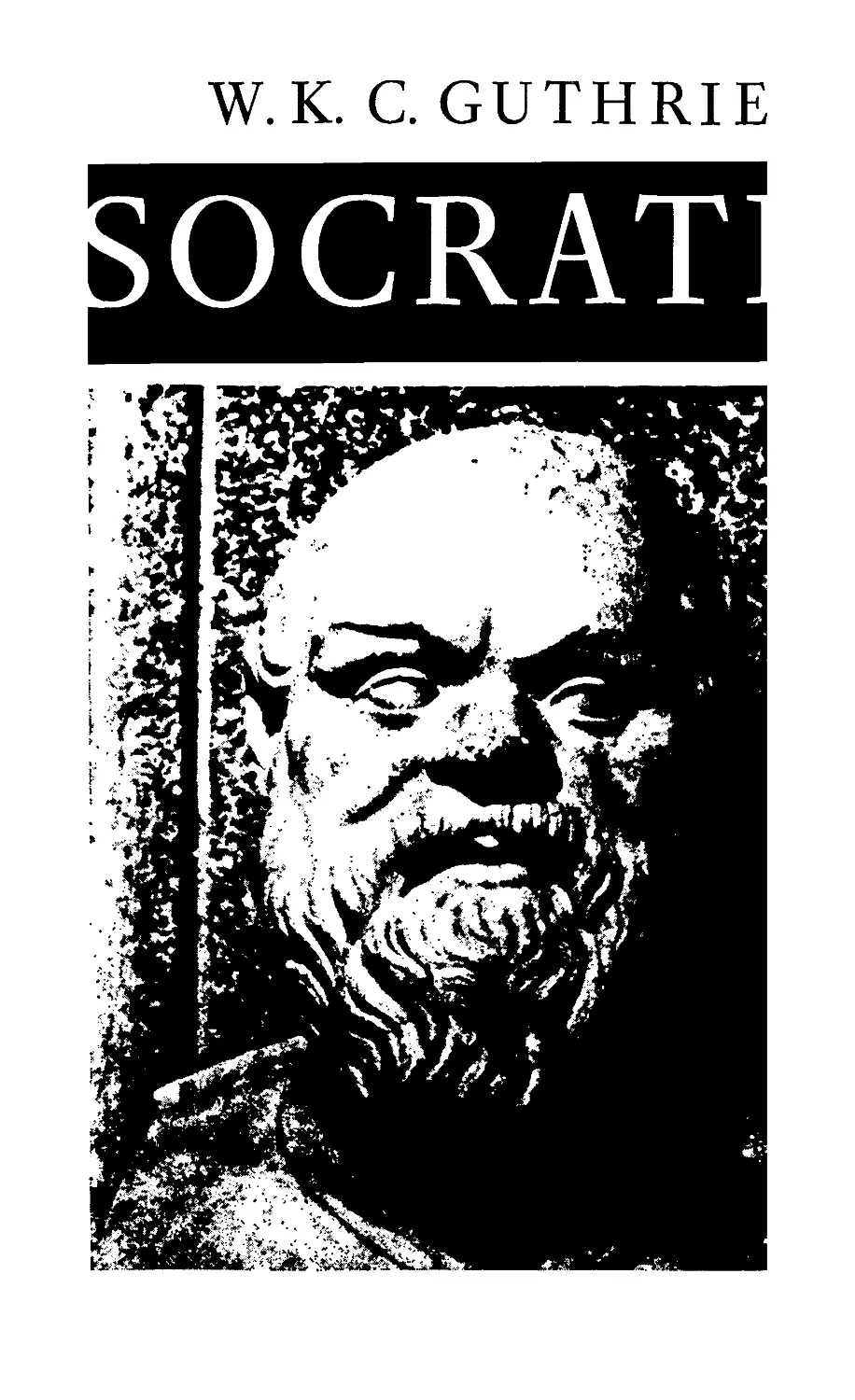
                    W.K. C.GUTHRIE
SOCRAT]

SOCRATES
BY
W. K. C. GUTHRIE
F.B.A.
Master of Downing College and
Laurence Professor of Ancient Philosophy in the
University of Cambridge
CAMBRIDGE
AT THE UNIVERSITY PRESS
1971

Published by the Syndics of the Cambridge University Press
Bentley House, 200 Euston Road, London nwi 2DB
American Branch: 32 East 57th Street, New York, N.Y.10022
© Cambridge University Press 1971
1 s Β ν : ο 52ΐ 09667 7
First published as Pan 2 of
A History of Greek Philosophy, Volume III
(Cambridge University Press, 1969)
Printed in Great Britain
at the University Printing House, Cambridge
(Brooke Crutchley, University Printer)

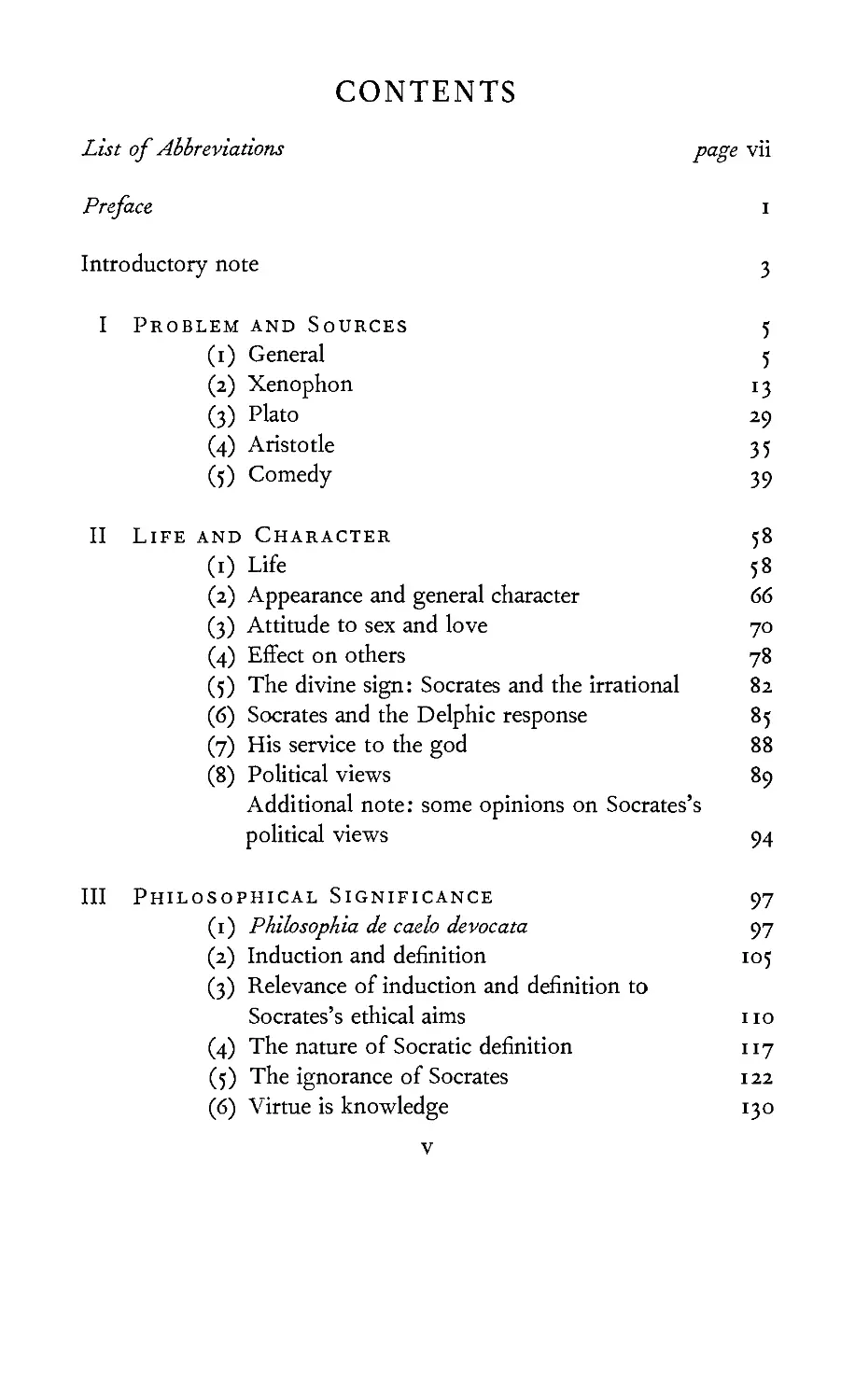
CONTENTS
List of Abbreviations page vii
Preface ι
Introductory note 3
I Problem and Sources 5
(1) General 5
(2) Xenophon 13
(3) Plato 29
(4) Aristotle 35
(5) Comedy 39
II Life and Character 58
(1) Life 58
(2) Appearance and general character 66
(3) Attitude to sex and love 70
(4) Effect on others 78
(5) The divine sign: Socrates and the irrational 82
(6) Socrates and the Delphic response 85
(7) His service to the god 88
(8) Political views 89
Additional note: some opinions on Socrates's
political views 94
III Philosophical Significance 97
(1) Phihsophia de caelo devocata 97
(2) Induction and definition 105
(3) Relevance of induction and definition to
Socrates's ethical aims no
(4) The nature of Socratic definition 117
(5) The ignorance of Socrates 122
(6) Virtue is knowledge 130
ν

Contents
(7) All wrongdoing is involuntary: Socrates a
determinist? 139
(8) The good and the useful 142
(9) Self-knowledge and 'care of the soul' 147
(10) Religious beliefs of Socrates: is the soul
immortal? 153
(11) The legacy of Socrates 165
(12) The immediate followers of Socrates
(Aristippus and Euclides) 169
Bibliography 187
Index of passages quoted or referred to 194
General Index 198
Index of selected Greek words 200
vi

LIST OF ABBREVIATIONS
Most works cited in abbreviated form in the text will be easily
recognizable under the author's or editor's name in the bibliography. It may
however be helpful to list die following:
PERIODICALS
AJP American Journal of Philology.
BICS Bulletin of the Institute of Classical Studies (London).
CP Classical Philology.
CQ Classical Quarterly.
CR Classical Review.
GGA Gottingische Gelehrte An^eigen.
HSCP Harvard Studies in Classical Philology.
J HI Journal of the History of Ideas.
JHS Journal of Hellenic Studies.
PC PS Proceedings of the Cambridge Philological Society.
REG Revue des Etudes Grecques.
ΤΑΡΑ Transactions of the American Philological Association.
OTHER WORKS
CGF Comicorum Graecorum Fragmenta, ed. Meineke.
DK Diels-Kranz, Die Fragmente der Vorsokratiker.
KR G. S. Kirk and J. E. Raven, The Presocratic Philosophers.
LSJ Liddell—Scott-Jones, A Greek—English Lexicon, gth ed.
Ο CD Oxford Classical Dictionary.
OP Oxyrhynchus Papyri.
RE Realencyclopadie der classischen Altertumswissenschaft,
ed. Wissowa, Kroll et al.
TGF Tragicorum Graecorum Fragmenta, ed. Nauck.
ZN Zeller-Nestle (see bibliography).
vii

PREFACE
The third volume of my History of Greek Philosophy (Cambridge
University Press, 1969) was divided into two parts, entitled
respectively ' The World of the Sophists' and ' Socrates'. By issuing the two
parts separately in paperback form, the Press hopes to make them more
easily and cheaply available to students. This book reproduces the
second part, with the minimum of alterations necessary to allow it to
appear as a separate publication. Mentions of' vol. 1' or ' vol. 11' in the
text refer to the earlier volumes of this work.
Books have most frequently been referred to in the text and notes by
short titles, and articles by periodical and date only. Full particulars of
books, and titles and page-references for articles, will be found in the
bibliography. The fragments of the Sophists, and other texts relating
to them, are included in the Fragmente der Vorsokratiker of Diels and
Kranz (abbreviated DK). The texts in an Ά' section of DK {Testi-
monict) have their number preceded by this letter, and those in a 'b'
section, purporting to be actual quotations from the philosopher in
question, are designated 'fr.' (fragment).
Translations, from both ancient and modern authors, are my own
unless otherwise stated.
DOWNING COLLEGE CAMBRIDGE
MARCH 1971
I

INTRODUCTORY NOTE
In 1894 Edmund Pfleiderer observed that, since innumerable writers, many
of them men of the highest reputation, had written about Socrates and Plato,
anyone undertaking the task once more must surely, in tanta scriptorum turba,
ask himself like Livy: Facturusne operaepretium sim ? I should not like to have
to count the number of books and articles about Socrates that have appeared
in the seventy-odd years since Pfleiderer wrote, but I must hope that yet
another presentation of him, in the context of the history of Greek philosophy
and especially of the philosophic preoccupations of his own century, will
prove worth while. The enormous bulk of the scholarly literature means
that my own reading in it has been even more—much more—selective than
for earlier periods of Greek thought.1 I have tried to make the selection
representative of at least the more recent work, but it is probably inevitable
that some of my readers will look in vain for their favourite items. I hope
however that I have made myself sufficiently familiar with the ancient
evidence to be entitled to views of my own, and it would not be safe to
assume that the omission of a writer or a theory is necessarily due to
ignorance. In putting Socrates into his setting in the history of Greek thought,
it is impracticable to take note of every theory about him, including those
which seem to me (though others may differ) to be highly improbable.
I shall not, for instance, say much about what may be called the pan-
Antisthenean school, who see Antisthenes lurking anonymously in many of
Plato's dialogues and disguised as Socrates in Xenophon's Memorabilia?
In a review in Gnomon for 1955 (259 ff.) Dr Olof Gigon, considering that
in spite of over 2,000 years of inquiry the problem of Socrates had not yet
been tackled in a properly methodical way, outlined what he saw as a
programme of the required research. It is perhaps the best that could be
devised, and I have tried to keep its principles in mind in my own work,
even if not proceeding in the same order. Yet the final effect of it was a feeling
1 The bibliographies of V. de Magalhaes-Vilhena's two books on Socrates, published in 1952,
cover about 96 pages of titles, and the literature of the last sixteen years could add considerably
to their number. He also provides a survey of all previous opinion from the eighteenth century.
C. J. de Vogel's article on The Present State of the Socratic Problem (Phron. 1955) deals mainly
but not entirely with Vilhena and is a useful starting-point for an exploration of recent views.
Useful bibliography will also be found in Coleman Phillipson's Trial of Socrates and Gigon's
commentaries on Xen. Mem. 1 and 2.
2 For Joel's theory see The Sophists, p. 310, n. 4. Perhaps the climax of pan-Antistheneanism is
the description of the simple word φρόνησίζ in Chroust's S. M. & M. (128) as 'a typical
Antisthenean-Cynic term'. On p. 204 the equation of σωφροσύνη with τά έαυτοϋ πράττειν at
Charm. 161 b is said to be 'an Antisthenean definition'. The cult frequently causes its devotees to
overlook completely parallels betv^een Xenophon and Plato. For more about it see p. 27 below.
3

Introductory note
that, in spite of the application of the most scientific methods, in the end we
must all have to some extent our own Socrates, who will not be precisely like
anyone else's. The first step in Gigon's programme is to set apart all texts
whose character makes them necessarily consider the historic Socrates alone.
The remainder will be those whose aim is other than a historical report:
his personal friends, comedy, the attack of Polycrates (which incidentally no
longer exists) and certain later material. As to these we are to consider several
questions, of which the first is how big a part is played by apologetic or
polemic. It sounds perfect, until one finds that the first to be mentioned in
the list of purely historical texts is the indictment of Socrates in 399. If this
gives us 'the historic Socrates alone' we must accept without question that
he was a corrupter of youth and a disbeliever in the city's gods. Did polemic
play no part in the statement of those who wished him brought to trial and
demanded the death penalty? Another is Xenophon's story of how Socrates
rebuked him for asking the Delphic oracle a leading question (p. 28 below);
but some scholars have seen a strong apologetic purpose behind this story.
The fact is that no one was left indifferent by this altogether unusual
character: everyone who has written about him was also reacting to him
in one way or another. If then every man must have his own personal
Socrates, I can do no more than present mine. It will be based on the fairest
assessment of the evidence of which I am capable.
4

I
PROBLEM AND SOURCES
(i) GENERAL
It is a bold—some will say over-bold—procedure to try to separate
Socrates from Plato. In the dialogues of Plato it would seem that he
has so blended his own spirit with that of Socrates that they can never
again be separated. I thought so myself until I came to write an account
of the Sophistic movement; but the study which this necessitated
has made me see Socrates as squarely set in his contemporary world
of the Sophists, Thucydides and Euripides and an eager participant
in their arguments. Certainly it has been impossible to leave him out
of the previous sections describing fifth-century controversies. Plato,
for all his reverence for Socrates as the inspiration and starting-
point of his own reflections, is a more sophisticated philosopher and
marks a new and fateful development in the history of thought. I
would even claim that in reading Plato himself, without any checking
or supplementation from other sources, one gets a strong impression
that he was an essentially different philosophical character from the
master through whose mouth he so often expresses the results of his
own maturer and more widely ranging mind. He was still passionately
concerned with the questions which excited the previous two
generations—whether law and morals were natural or conventional in origin,
whether 'virtue' could be taught, whether intelligence or inanimate
nature was prior, whether all values were relative, the nature and
standing of rhetoric, the relation between being and seeming,
knowledge and opinion, language and its objects—and to him Protagoras
and Gorgias, Prodicus and Hippias were still opponents whose
challenge had not been adequately met; but to meet it called for
something far more radical and comprehensive than the simple ethical
intellectualism of Socrates. It called for nothing less than a new
vision of the whole of reality, involving metaphysics, human psychology
and not least cosmology, for the physicists' conception of a world
5

Problem and Sources
arisen from soulless matter had proved a powerful support for the
sophistic denial of a scientific ethic based on anything but the
exigencies of a particular immediate situation. To provide this total solution
Plato, a genius of a far more universal stamp than Socrates, was
supremely fitted. Since he claimed to have found what Socrates all
his life was seeking, and since the personal impact of Socrates had
been for him an unforgettable experience of his most impressionable
years, he could see nothing improper in putting into Socrates's mouth
some (not all) of the discoveries which in his eyes provided the final
justification of Socrates's life and death and the answers to the questions
that he had asked.
This distinction can only be maintained on the assumption that our
sources of information about Socrates are sufficient to give a reliable
portrait of him as a man and a philosopher. Any account must begin
with the admission that there is, and always will be, a 'Socratic
problem'. This is inevitable, since he wrote nothing,1 and all that we
know about him and his thoughts comes from the writings of men
of the most varied character, from philosophers to comic poets, some
of whom were passionately devoted to him while others thought his
influence pernicious. Two things are frequently said of him which,
if they both were true, would preclude us from making any significant
remarks about him at all. It is claimed on the one hand that his teaching
is indissolubly linked with his whole personality, and on the other
that we can know nothing about the historical person Socrates because
the accounts of him which we have not only are somewhat distorted,
as might be thought inevitable, by being filtered through the minds
of his pupils or opponents, but were actually never intended by their
authors to be anything but fiction.2 It will be the purpose of the
* That is, nothing philosophical. If the Phaedo is to be believed (60 c-d), he wrote a hymn to
Apollo and versified the fables of Aesop in his last days in prison. For references to spurious
Socratic works see Chroust, Socr. M. & M. 279, n. 791.
2 Examples: for the first statement (a) Jaeger, Paideia, n, 36f.: "The whole of Socratic
literature, with one voice, denies that Socrates's doctrine can be detached from his individual
self; {b) Zeller {Ph. d. Gr. 11. i, 44): 'There is no thinker whose philosophical importance is
more closely attached to his personality than is the case with Socrates.' For the second statement:
(a) Chroust, S. M. & M. xiii:' From its very inception this [sc. the Socratic] tradition was intended
to be fiction and nothing else'; (b) 'L'ceuvre, la vie et la mort de Socrate sont une fiction litteraire'
(quoted by Ritter, Sokr. 61 f., from the summary of Dupreel's La legende socr. on its dust-cover).
Ritter comments that in this way scholarly critics have happily consigned the person of Socrates, as
they did that of Jesus, to the realm of myth (' mit nicht geringerem Scharfsinn—und eben so dumm').
6

Nature of the Information on Socrates
following pages to show that the first statement is true and the second
false.
The existence of the Socratic problem makes it necessary to start
with an examination of our sources of information. These are for
practical purposes four: Aristophanes, Xenophon, Plato and Aristotle.
Of the rest of the Socratic literature which grew up in the period
immediately following his death, virtually nothing has survived except a
few fragments of his follower Aeschines, and the later sources say little
of interest which is not taken from Plato or Aristotle. Of our four
surviving writers two were philosophers of very different
philosophical temperaments, one a retired general who, though endowed
with a strong literary and historical bent, had been for most of his
life a man of action and always remained so by temperament, and the
fourth was a writer of comedies with a strong admixture of satire and
farce. With these diverse characters and gifts they naturally saw
different things in Socrates and have left us different impressions of him.
Albert Schweitzer wrote that in the matter of historical information we
are much better off with Jesus than with Socrates, because Jesus was
portrayed by simple uneducated people, but Socrates ' by literary men,
who exercised their creative ability upon his portrait'.1 The idea of
the 'Socratic legend' as a serious theory seems to have owed its
inception to the book of E. Dupreel,2 and by some scholars it has been
taken for granted as needing no further proof. Yet the assumption that
all the writers I have mentioned intended their accounts to be no more
than fiction is so extraordinary as to require indisputable evidence
before it is believed. The nearest to such evidence that can be produced
is probably the a priori argument in the preface to A. H. Chroust's
book that
Whenever we possess an ample literary tradition about a certain historical
personality, but are yet unable successfully to reconstruct the historicity of
that person, we are compelled to assume that the whole literary tradition was
never really intended to concern itself with the historical reporting of fact.
1 The Quest of the Historical Jesus, Eng. tr., 1954, p. 6.
1 La legende socratique et les sources de Platon (1922). A similar thesis, reducing the Socratic
literature to the status of romantic fiction, is put forward by Gigon in his Sohrates (1947), on
which the comments by C. J. de Vogel in Mnemos. 1951 are pertinent.
7

Problem and Sources
We must surmise, therefore, that this tradition was aimed primarily at
creating a legend or fiction.
On the next page this becomes 'As has been pointed out, from its very
inception this tradition was intended to be fiction and nothing else'.1
Evidently therefore the theory of a deliberate fiction stands or falls by
our ability or otherwise to elicit from the sources a credible historical
figure. If the reader when he reaches the end of this book thinks that
we have done so, he need not trouble himself with the theory, but,
until the attempt has been made, judgment must be suspended.
Should it be considered to have failed, it need not on that account
have been waste of time. We shall at least have learned what Socrates
meant to many people, and there remains the possibility of regarding
him not as a historical but as a symbolic or eternal figure, in which
guise he has been proved an incalculable influence on the history of
thought. Thus A. W. Levy has written:
The problem of the historic Socrates is, I believe, insoluble, but the quest
to find the meaning of Socrates for ourselves is perennial . . . One can as
legitimately ask a philosopher what stand he takes on the meaning of
Socrates's life as one can ask what is his theory of the nature of sense-data
or his belief about the objectivity of moral values.2
For myself however I do not think that our position concerning
knowledge of the historical Socrates is as hopeless as is sometimes
alleged. The 'question' is at least in part the creation of scholars
themselves, who for some reason when they hear the name of Socrates
abandon the ordinary canons of comparative evaluation of evidence
in favour of one-sided reliance on a single source. Disparity between
the authorities is not a thing to cause despair. If they agreed exactly,
then indeed we might suspect either that we were getting a very
onesided view of him, because they were all similar people looking for
* Chroust, S. M. & M. xii and xiii. The italics are mine. M. Treu also argues that it is a priori
(von vorne herein) mistaken to look for the historical Socrates in the Memorabilia {RE, 2. Reihe,
xviii. Halbb. 1772 f.).
* JHI, 1956, 94 and 95. As an instance, Professor Ayer's claim about the controversy over
the objectivity of values (quoted in Sophists, p. 165) could certainly be described as taking a stand
on the meaning of Socrates's life, for Socrates as we know him both lived and went to his death
in the conviction that the moral problem: 'What am I to do?' cannot be adequately answered
without an antecedent knowledge of objective standards of value. In this he has not only his
contemporaries the Sophists but the whole tradition of British empiricism against him.
8

Four Horses Better Than One
and admiring the same sort of thing, or that he was himself a rather
simple and uninteresting figure, which he clearly was not. He was a
complex character, who did not and could not reveal every side of
himself equally to all his acquaintances, since by reason of their own
intellectual powers and inclinations they were not all equally capable
of observing and appreciating them. If then the accounts of, say,
Plato and Xenophon seem to present a different type of man, the chances
are that each by itself is not so much wrong as incomplete, that it
tends to exaggerate certain genuine traits and minimize others equally
genuine, and that to get an idea of the whole man we must regard
them as complementary.1 The important thing is that of all four
main authorities we have writings sufficiently voluminous and self-
revealing to leave us in no doubt about their own character, mentality
and tastes; and this knowledge of the writers themselves is a most
valuable aid in comparing and evaluating their impressions of Socrates.
To make this comparison, and neglect no one who had access to
Socrates himself or to those who knew him, is absolutely essential.
The earlier tendency to pick out one source as authentic, and belittle
the rest, became somewhat discredited when every one of the four had
found his chosen champion and been held up in turn as the only true
mirror. A. Dies speaks entertainingly of how few scholars have, as he
puts it, had the courage to mount the quadriga and drive all four horses.
Most have preferred to disqualify all but one whom, rather than guide,
they allow to run as he pleases. Plato was the first to enjoy this privilege,
then Xenophon, then Aristotle; one or two backed Aristophanes,
then round came the wheel to Plato again in this century with the
British scholars Burnet and Taylor.2
1 It is scarcely any longer possible to say anything new about Socrates. After making the
above point repeatedly in lectures, I saw the following by W. W. Baker in CJ, 1916-17, 3o8f.:
'This great figure of Socrates was not one-sided but many-sided ... If Socrates was many-
sided, it is natural that men who themselves had different tastes and interests should have seen
different sides. Therefore the pictures they draw, though different, may be entirely true.' It is
astonishing how few scholars have taken this elementary point. (Kierkegaard argued somewhat
similarly in a puckish way when he said that although we have no completely dependable
conception of Socrates, ' still, we have in exchange all the various nuances of misunderstanding, and
with such a personality as Socrates I believe this serves us best'. See his Concept of Irony, ij%{.
His American translator thinks he may have had his tongue in his cheek and Hegel in mind.)
2 Dies, Auwut de P. 157-9. See also Stenzel in RE, 2. Reihe, v. Halbb. 888: 'He who thinks
it permissible to orientate himself from a single source must inevitably, from the standpoint of
his own modern thought, intensify still further the exaggeration of his source' (and much more
9

Problem and Sources
One very curious argument is quite commonly found, that if
something appears to have been widely asserted in the Socratic literature
(the writings about Socrates of those in his immediate circle or their
associates), that is evidence that it is not genuinely Socratic. This is
clearly implied for instance in Chroust's reference to the refusal of
Socrates to be perturbed at being condemned to death (S. M. & M.
23), which is found in both Xenophon and Plato:
Both Xenophon and Plato may have borrowed 'the philosopher's willingness
to die' from Antisthenes; or Xenophon (Memor. 4.8.1) may have derived
it from Plato who, in turn, is probably dependent on some Antisthenian
dictum [when he was a close disciple of Socrates and present at his trial!].
The Stoics, who in this are admittedly under Cynic influence, made much of
this 'readiness to die'.1
Again, though there are differences between Plato's and Xenophon's
accounts of Socrates and his teaching, at many points they coincide.
Some critics, however, will not allow us to regard this as any
confirmation of the truth of what they say about him: their conclusion is
simply that Xenophon has copied Plato. This is not critical method
but uncritical theorizing. No doubt Xenophon read Plato's dialogues
and the other Socratic writings,2 but similarity between them is not
necessarily evidence that Xenophon was a mere borrower, and it is
still less justifiable to extend the argument to the rest of his Socratic
writings on the ground that if he sometimes borrowed he did so
always. Is it not more likely that, as Dies put it, ' Xenophon et Platon
exploitent un fonds commun de Socratisme' ?3
Before going on to consider the main authors one by one, a word
is in place about the so-called ' Socratic logoi' or discourses featuring
that is to the point). Vilhena's massive work is once again directed to establishing Plato's dialogues,
rightly understood in the context of their time, as the sole historical source. His examination of
Xenophon and Aristotle leads him to an entirely negative conclusion, and a full consideration of
Aristophanes is deferred.
1 We cannot doubt that the attribution of such readiness to Socrates is historical. As De
Strycker justly points out {Mel. Greg. 208), his attitude is confirmed not only by the manner of
his death but also by his solitary championship of the law against an infuriated demos in the case
of the generals after Arginusae (pp. 59 f. below).
1 Chroust has collected references to a number of'suggestive similarities' between passages
in Xenophon and the Platonic dialogues on p. 230, n. 39, of his S. M. & M.
3 A. Dies, Autour de P. 228. See also Field, P. and Contemps. 140 f., Stenzel in RE,
837 f.
IO

The ' Socratic Logoi'
Socrates. In the Apology (39d) Plato makes Socrates utter a prophecy:
if the Athenians think that by silencing him they will escape future
censure, they are wrong. Others will speak, of whom as yet they know
nothing because his authority has restrained them, and being young
they will speak all the more harshly. This was true, as Plato knew.
He himself (still in his twenties when Socrates died), Aeschines,
Antisthenes, Xenophon and others, poured out so many writings to
his memory, mostly in the form of conversations in which he played
the leading role, that these 'Socratic conversations' (Σωκρατικοί
λόγοι) achieved the status of a literary genre. The flow was stimulated
by opposition, such as that of Polycrates who, probably in the late
390s, composed an Accusation of Socrates which is now lost but is
mentioned and criticized by Isocrates {Bus. 4) as well as later writers.1
Xenophon, in writing his own version of Socrates's defence and
attitude to death, speaks of' others' who have described them before him
and says that he owes his own information to Hermogenes. (Hermo-
genes, Aeschines and Antisthenes were all of the intimate circle who
were with Socrates in his last hours. See Phaedo, 59 b.) We know of
seven Socratic dialogues by Aeschines {Alcibiades, Axiochus, Aspasia,
Callias, Miltiades, Rhinon, and Telauges) from which a number of
quotations survive, the fullest remains being those of the Alcibiades.2
For the supposition that' Socratic logoi' had the status of a literary
genre of their own our main authority is Aristotle. At the beginning
of his Poetics he introduces the subject by classifying different kinds
of 'imitation' (mimesis), of which poetry is one, according to their
media. Painters imitate through the medium of colours and shapes,
others through the voice,3 poetry through rhythm, language and
harmony, dancing through rhythm alone. There is also an art which
1 For information on Polycrates see Chroust, S. M. & M. chapter 4, and Dodds, Gorgias,
pp. 28 f. Many scholars believe that, when Xenophon speaks of what' the accuser' said of Socrates,
his reference is to Polycrates rather than to the actual accusers at the trial, and that the Gorgias
and possibly other dialogues of Plato were written in reply to his attack.
2 For Aeschines see Field, P. & Contemps. 146-52, who gives a complete translation of the
Alcibiades fragments. He seems to have looked somewhat sourly on his fellow-companions of
Socrates, determined to show the worst sides of Callias (in his Callias, Dittmar, I93ff.),
Hermogenes and Critobulus, calling Hermogenes a slave to money and Critobulus stupid and dirty
(in the Telauges, see frr. 40 and 44, Dittmar 2c>of.). Plato and Xenophon give a different
impression.
i Cf. Plato Soph. 267 a.
II

Problem and Sources
imitates by language {logos) alone, either in prose or verse. It has no
name, for (1447 b 9) 'we have no common name for a mime of Sophron
or Xenarchus1 and a Socratic logos', and should still lack one if their
imitation were in verse. I have quoted this sentence in its context
because it is sometimes said that Aristotle is here putting the Socratic
conversations 'into the same class with' the mimes of Sophron (the
Syracusan contemporary of Plato whose mimoi depicted realistic
genre scenes of everyday life) in such a way as to justify the conclusion
that in substance the former could claim no more historical veracity
than the latter. In fact he is citing them only as random samples of the
whole genus of 'imitation through language alone'. All that they are
said to have in common is the medium of logos, as painters effect their
imitation through colour,2 and mimesis could cover the whole range of
verisimilitude from Homer or tragedy ('the imitation of a serious
action') to Zeuxis's painting of grapes, so realistic that the birds pecked
at it. It is true (and this may well be what made Sophron and the
Socratic logoi occur to Aristotle's mind together) that Plato was said
to have been a great admirer of Sophron and to have introduced his
work to Athens.3 Probably he saw in the form and presentation of its
material a useful precedent for the realistic setting and conversational
style which he adopted as the best medium for interpreting to the world
the character and philosophy of his master, and developing its
implications. This is especially likely as the mime had up to then been a very
humble and popular form of entertainment, and its elevation to the
plane of literature seems to have been due to Sophron himself. It
1 Xenarchus was Sophron's son, but little else is known of him. See Ziegler in RE, 2. Reihe,
xviii. Halbb. 1422.
* The much-discussed fragment of Aristotle's dialogue On Poets (72 Rose, from Ath. 505 c),
with its doubtful points of reading, adds nothing. In Ross's translation (p. 73) it runs: 'Are we
then to deny that the so-called mimes of Sophron, which are not even in metre, are logoi [to
accept Ross's 'stories' here would be misleading] and imitations, or the dialogues of Alexamenos
of Teos, which were written before the Socratic dialogues?' (If the MS πρώτους, emended by
Kaibel to ττρότ£ροι>, is correct, the only difference is that the otherwise unknown Alexamenos
is himself being called the first writer of Socratic dialogues. See on the text Natorp in RE, 1,1375.)
Aristotle was evidently making the same point in his lost as in his surviving work on poetry.
His only other reference to the Σ. λ. is at Rhet. 1417 a 18, where he says that mathematical λόγοι
are not concerned with character or moral purpose as Socratic are.
3 The earliest reference to Plato's interest in Sophron is a quotation from the historian Duris
(fourth-third century B.C.) in Athenaeus (504 b). See also D.L. 3.18. In later times the story was
frequently told that after his death a copy of the mimes was found under his pillow. (References
in RE, 2. Reihe, v. Halbb. 1100. It was said that the plays of Aristophanes were found with them.)
12

Plato and Sophron
remains in the highest degree improbable that from the point of view
of historical fidelity there was anything in common between the
dialogues of Plato, in which Socrates is shown conversing with other
well-known historical figures like Protagoras, Gorgias or Theaetetus,
and a series of mimes with titles like The Sempstresses, The Mother-in-
law, The Fisherman andthe Farmer, The Tunny-fisher or The Sorceresses.
They are ' true to life' in a different sense, and their heirs are Theocritus
and Herondas, not Plato.1 The practice among Socrates's friends of
making notes of his conversations at the time, then writing them up
and referring back to Socrates himself to check any doubtful points, is
attested on pp. 23 f. below.
The historical value of the Socratic literature is to be judged from its
own purpose and character; that is, mainly from the internal evidence
of the writers—Plato and Xenophon—whose works have survived.
And, as Field wisely reminded us, 'we must not fall into the error of
ascribing a precisely similar purpose to all of it'.
(2) XENOPHON
Xenophon was an almost exact contemporary of Plato. Probably born
within five years of him (430-425), he is known from the internal
evidence of his works to have lived until after 35 5-a He was an Athenian
citizen, son of Gryllus of the deme Erchia.3 In 401, in spite of a warning
from Socrates {Anal·. 3.1.5), he joined the ill-fated expedition of Cyrus
in Asia, with which his name is primarily linked in most people's minds
as the author of the immortal Anabasis. Just how long his acquaintance
with Socrates lasted we cannot say, but, since Socrates was executed
in 399, it could have been almost as long as Plato's. He missed the
1 Detailed comparison between the Platonic dialogues and the mime will be found in Reich,
Der M'imus, vol. i, chapter 5. If I have not used him as an authority, it is because I find in this
chapter some misunderstandings and a truly astonishing exaggeration. One example, in the face
of which I find comment impossible, should suffice. Of Plato's portrait of Protagoras he writes
(p. 390): 'He has become a type, matched by few in world literature, such as are—besides Hamlet,
Falstaff, Don Juan and Don Quixote—above all the figures of mime, Samio and Ardalio, the
stupidus, the μωρός φαλακρός, Maccus and Pulcinello, Hans Wurst and Kasperle and Karagoz.'
2 See the discussion in M. Treu, RE, i. Reihe, xvm. Halbb. I57iff. The precise date of his
birth is not now ascertainable. Gigon (Comm. on Mem. 1, 106; but cf. OCD, 962) has revived
an early theory that it was a few years earlier (441/0), whereas others have made him a little
younger than Plato. (See Phillipson, T. of S. 27 with n. (y).)
3 Authorities in RE, vn, 1899.
*3

Problem and Sources
poignant last scenes of Socrates's life, the trial, the conversations in
prison, and the drinking of the hemlock in the presence of his intimates,
which so heightened and intensified the feelings of Plato and others
about him; but his own attachment was so strong and lasting that in
later years he made a point of inquiring about these events from
another friend of Socrates, and wrote his own version to counteract the
misleading impressions which, as it seemed to him, were being created
by others already current. 'When I think', he said at the end of this
little work {Apol. 34), 'of both the wisdom and the nobility of this man,
I cannot refrain from writing of him nor, in writing of him, from
praising him.' Set beside this the closing words of the Phaedo—' our
friend, the best, as we should claim, of any of his generation known to
us, and the wisest and most just'—and they afford together a moving
testimony to the effect of this remarkable man on others of the most
diverse character.
Xenophon might be described as a gentleman in the old-fashioned
sense of the term, implying as well as a certain not ignoble type of
character a high level of education and general culture. It is a plant that
thrives best in an environment of wealth, especially inherited wealth,
and there is a certain resemblance between Xenophon and the best
among the aristocracy which occupied the great country houses of
England in the eighteenth and nineteenth centuries—men whose hearts
were not only in the management of their estates and the service of
their country but also in the great libraries which some of them
amassed with considerable discrimination and also used. He was soldier,
sportsman, and lover of country life, methodical in his work, temperate
in his habits, and religious with the religion of the plain and honest man.
As a writer he employed a clear, easy, straightforward Attic prose on
subjects which at least have the charm of variety, and as treated by him
seem to put us in astonishingly close touch with the life of his period
and class. In these qualities it would be difficult for anyone to surpass
the man whose works include the first-hand story of the retreat of
Cyrus's Greek force across the Anatolian plateau, a history of Greece
from the time when Thucydides left off, a treatise on housekeeping and
husbandry, a manual of horsemanship (and one on hunting if the
Cynegeticus is a genuine work of Xenophon), another on 'ways and
Μ

Xenophon s Character and Mentality
means' with suggestions for improving the finances of Athens, and, of
course, a series of works designed to display the character of Socrates
and preserve his memory from detractors.
On the debit side we must put a certain literal-mindedness and
tendency to prosiness, a pedestrian outlook which is sometimes frankly
dull, and little sign of any capacity for profound philosophical thought.
Here we are concerned with his portrayal of Socrates, as to which it is
fair to say that if Plato had been as capable as Xenophon of coping
with the retreat across Anatolia or discoursing on the finer points of
horsemanship or the virtues of different kinds of soil, he would have
been unlikely to display at the same time the philosophic genius and the
deep insight into character and motives which so obviously mark
his own interpretation of Socrates's life and make one feel that it is
penetrating much further than Xenophon's. Xenophon honoured and
respected intellectual ability, but all the more, we may suspect, when
he saw it combined, as it was in Socrates, with high physical courage, a
good war record and general contempt of danger. So much of Socrates
he appreciated and loved, and he felt a generous indignation at the
harsh treatment that Athens had meted out to him. Much that he saw
in Socrates was, I am convinced, characteristic of the real man. When
however we find in the Socrates of Plato something far less
commonplace, far more paradox, humour and irony and above all a greater
profundity of thought, it would be wrong to suppose that these were
foreign to Socrates simply because they do not appear in Xenophon's
portrait. The impression of uniqueness, and the powerful impact,
favourable or unfavourable, which he made on everyone who met him
(and of these the most hardened sceptic can scarcely feel a doubt), are
more comprehensible if we suppose that he had in him much of what
Plato discovered as well as what appealed to the prosaic commonsense
of Xenophon.
The works in which Xenophon introduces Socrates (apart from the
story in Anab. 3.1) are four: Oeconomicus, Apologia, Symposium and
Memorabilia. A reading of them at once makes plain that they differ
considerably in character and purpose. The Oeconomicus is a highly
practical treatise on estate management and farming, in which out of
15

Problem and Sources
compliment to his dead teacher and friend Xenophon writes of a
favourite pursuit of his own in the form of a dialogue between Socrates
and a young man seeking his advice. Verisimilitude is assisted by making
the last two-thirds of the work a report by Socrates of a conversation
which he himself had had with a gentleman farmer, in which he
questioned him about his pursuits, although even in this part we find
that Socrates has something of his own to contribute. Readers of
Plato, knowing their Socrates, may be amused to find this devotee of
the city, who never left it of his own free will because ' trees and the
open country have nothing to teach me' {Phaedr. 230d), singing the
praises of agriculture not only as the healthiest of occupations but
because it gives the mind leisure to attend to the interests of one's friends
and city and is a training in the leadership of men, and solemnly
declaring that 'the earth teaches justice too to those capable of learning'
(Oec. chapters 5 and 6.9). Nevertheless Socrates knew himself to be a
peculiar character marked out for a unique mission. He never claimed
that his life of self-chosen poverty in the city, with no regular
occupation, was the right life for others; and there are several touches in the
dialogue sufficiently individualistic to show that the choice of Socrates
as chief speaker is something more than an empty compliment. In
making Socrates the exponent of one of his own favourite subjects,
Xenophon was not neglecting what he remembered of his character or
had learned from the talk and writing of others. So for instance
Socrates claims to be richer than his wealthy young friend Critobulus
because he has sufficient for his needs whereas Critobulus's
commitments exceed his income (2.4). At 6.13 we read of his consuming
interest in visiting the workshops of all sorts of craftsmen—builders,
smiths, painters and sculptors.1 At 11.3 he makes a joking reference to
the comic poets' picture of him as a chatterer, a measurer of the air and
a penniless beggar. At 17.15 he digresses briefly from the subject of
weeds to remark on the value of an apt simile. Finally, his conversation
1 In Mem. 3.10 Xenophon shows him conversing about their craft with a painter, a sculptor
and an armourer. The precepts on management and farming, and certain other details, are
obviously Xenophon's own, but it was a brilliant touch to remind a reader at this point of Socrates's
insatiable eagerness to acquire information about every sort of craft and profession from the men
who practised it. (Cf. also Mem. 2.7.6 and Plato, Apol. 2ib-22d.) With questions about the
secrets of their art he bombarded manual workers of every sort, poets and politicians; why not
also farmers and estate owners?
l6

Socratic Elements in the ' Oeconomicus'
with Ischomachus is not only a lesson in agriculture but an illustration
in that particular field of the truth that one can be unaware of one's own
knowledge, and that the best form of teaching is to elicit by questions
this knowledge which the pupil already possesses but has been unable
to formulate or use. ' Can it be, Ischomachus, that asking questions is
teaching? I am just beginning to see what was behind all your questions.
You lead me on by means of things I know, point to things that
resemble them, and persuade me that I know things that I thought I had
no knowledge of.'
Here is the Socratic method in a nutshell, question and answer,
'mental midwifery' and all. It is a clever (and again a truly Socratic)
touch, that this time Socrates casts himself in the role of pupil but in
reality, through narrating the conversation to one of his own young
men, is acting as his guide to the method. Xenophon is not usually
credited with an appreciation of the Socratic irony, the affectation that
everyone else was wiser than he, but surely it is present here in double
measure: in his pretence to Critobulus that he had to put himself under
the instruction of Ischomachus not only in the technicalities of farming
but even in the method which was peculiarly his own; and in the
delighted surprise with which, in the dialogue-within-a-dialogue, he hails
his discovery of what Ischomachus had been after with his questions.
There is even an open acknowledgment of the Socratic theory, which
Plato seized upon with such avidity, that learning is recollection, the
bringing into full consciousness of knowledge that was latent in the
mind already.1 For instance, Socrates is quite sure that he does not
know how big a hole should be dug when planting a fruit tree, but he
has used his eyes as he walked about the fields, and in answer to
Ischomachus's questions has to admit that he has never seen one more
than 2\ or less than ι J feet deep, nor more than 2 feet broad, and can
even suggest a reason for the appropriate depth. We may well doubt
whether the real Socrates was as observant of these things as he was of
the characters of his fellow men, but Xenophon has simply used an
example from his own sphere of interest to illustrate a pedagogic
principle that he had learned from Socrates. The recollection in this
1 Ιλ€λήθη Ιμαυτόν Ιπιστάμενος, 18.ίο. Cf. Plato, Meno 85 d ούκοΰν ούδενός διδάξαντος άλλ'
ερωτήσαντος Ιπιστήσεται, άναλαβών αυτός Ιξ αύτοΟ τήν επιστήμην.
17

Problem and Sources
instance is of observations of practical, workaday life, and the author
of the Memorabilia would be the first to admit that Socrates applied his
method to more philosophical, and particularly ethical, teaching. Yet
Socrates was not averse to taking his analogies from 'shoemakers,
carpenters and smiths' or even, in all probability, from farmers as the
Sophists did.1 Whether he raised the theory of recollected knowledge
from an educational aid to a metaphysical doctrine of an immortal soul
recalling in this life eternal truths that it has learned in the Beyond, as
Plato makes him do, is another question, and must be left till later. The
object of the present section is simply to suggest, from an independent
reading, that E. C. Marchant goes very wrong when he says (Loeb ed.
xxiv): 'The thoughts and reflections are so entirely Xenophon's
own that we may wonder why he did not frankly produce a treatise on
the management of an estate instead of a Socratic dialogue.'
The Apologia, a brief pamphlet of some eight pages, does not, like its
Platonic counterpart, consist simply of the speeches supposedly made
by Socrates at his trial. It begins with a statement of purpose. To
describe once again the bearing of Socrates at the time of his
condemnation and death will not be otiose. Previous writers have put
beyond doubt the lofty tone of what he said, but, since they omitted to
give the reason for it, it has appeared to spring from a lack of
understanding of his predicament. Xenophon therefore applied to Hermo-
genes, one of the philosopher's closest friends who was with him at the
end, and Hermogenes explained the reason, that in Socrates's opinion
it was better for him to die than live because he had reached an age
when he could only look forward to a gradual failing of his powers, and
this would be particularly intolerable to one who had lived such a
perfect life hitherto. What follows is partly in Xenophon's own words
and, as he tells us himself, Ί have not tried to relate all that was said at
the trial, but have contented myself with demonstrating, first, that
Socrates's whole concern was to act with reverence towards the gods
1 Mem. ι. 2.37, and of course analogies from everyday crafts and their tools are frequently
employed by the Socrates of both Xenophon and Plato, e.g. the shuttle and the awl at PL Crat.
388a-b, the pruning-knife at Rep. 353a. The common fifth-century analogy between education
and farming is used by Socrates at Phaedr. 276 b and e and {ex parte Protagorae) at Theaet.
167 c. (See The Sophists, pp. 168 f.)
l8

The 'Apology' ofXenophon
and justice in his dealings with men; and secondly, that he did not
think it proper to beg and pray for his life, but rather considered it
time for him to die.' His method of doing this, as is obvious to anyone
who takes the trouble to read this rather pathetic little work, is to put
all his reverence for Socrates into the philosopher's own mouth, thus
producing an impression of intolerable smugness and complacency. If
Socrates had really said such things about himself,1 far from exciting
the love and admiration of men as wise as Plato and as talented and
high-spirited as Alcibiades, he would have repelled them more speedily
and surely than the ostracizer was repelled by Aristides the Just, who,
after all, was only given that standing epithet by other people.
There are a few features in common between Plato's and Xenophon's
versions of what happened at the trial, though they have been blunted
and coarsened by Xenophon's less sensitive mind and by the fact that
his information was at second or third hand and probably put together
from various sources besides Hermogenes. In so far as they agree,
however, they provide evidence that such points were in some form or
another really made, or such incidents really occurred. Both agree that
Socrates thought it at least possible that death was better for him than
life, and there is a reference in Plato to his advanced age (38c), though
this is by no means given as his reason for thinking so. Xenophon's
Socrates has not prepared a speech in his own defence, Plato's says that
he will speak ' at random, using whatever words come into my head'
(17c). Both introduce the 'divine sign' (pp. 82 ff. below), Xenophon
as forbidding him to prepare a defence in advance, Plato as having
uttered no warning against his coming to trial, thereby indicating that,
whatever the outcome, it must be good. In both cases the effect is an
indication that death will mean no harm for Socrates. Both agree on the
substance of the charges brought against him, which are confirmed as
1 E.g. § 5:' Do you not know that up to now I would not allow that any man has had a better
life than I have, for I have had the supreme pleasure of knowing that I have lived my whole life
piously and righteously'; and §18: 'If no one can disprove what I have said about myself, do I
not justly deserve the praise of both gods and men?' Plato's Socrates says (Apol. 21 a-b) that
Chaerephon asked the Delphic oracle whether anyone was wiser than he, and the oracle replied
' no one'; whereat he was astonished and incredulous, because he knew he was not wise in the
least, Xenophon's, reporting (§14) only that Chaerephon 'asked the oracle about me', says
Apollo told him that no man was either more liberal or more just or possessed of greater prudence
and self-control (σωφροσύνη); and he accepts the reply without comment, except to say that
Apollo at any rate did not call him a god, as it did Lycurgus, but only the wisest of men.
19

Problem and Sources
historical from an independent source (p. 62 below). Both agree that
Chaerephon consulted the Delphic oracle about Socrates and received
makes Socrates speak about it in a different and more laboured way.
Both report that an exchange of remarks took place between Socrates
and Meletus, and that Socrates was unwilling to offer an alternative
penalty in the ordinary sense, though only Plato refers to the suggestion
of free meals in the Prytaneum and the offer of a sum of money put up
by his friends. Finally, both mention his refusal of the offer of his
friends to arrange his escape after condemnation, the subject of Plato's
Crito. There is some slight internal evidence that the Apology of Plato
was among Xenophon's sources, but the differences are too great to
allow of the supposition that he simply took over these facts from
Plato. Even if he had done so, we should still have been faced with the
question whether Plato, who claimed to have been present at the trial,
had himself invented them.
To conclude, Xenophon's Apology is of little or no independent
value, and may be set aside in favour of a serious consideration of
Plato's writings on the same subjects. It teaches us something about
Xenophon, that, when he was trying to live up to the demands of a
serious and solemn subject like the justification of Socrates's conduct
through his trial and approaching death, he was by no means at his best.1
The Symposium is a longer and a more elaborately composed work,
which naturally invites comparison with Plato's of the same name.
Apart from Socrates, none of the participants are the same, but some are
1 Every kind of opinion has been put forward about the Apology. Its authenticity has been
denied (by Schenkl, Wilamowitz and others) and reasserted. The reliance on Hermogenes has
been called fictitious (e.g. by Gigon and Treu; and the fact that in Mem. bk. 4 Xenophon repeats
some of the same matter on the same authority is, oddly enough, said to confirm this), and again
both genuine and Xenophon's only source (von Arnim). The Apol. has been said to have
borrowed from Plato's as well as other Socratic ' apologies' (Treu) and again to have been written
before Plato's (von Arnim, whose imagination soared to recounting how Plato's when it
appeared made Xenophon ashamed of his own so that he wrote Mem. 1.1.4 and bk. 4 to replace
it, as well as to answer the attack of Polycrates; Maier on the other hand, Sokr. p. 15, thought
his Apol. itself showed knowledge of this attack). Alternatively, it was written after Plato's not
in imitation but to oppose the sober truth to Plato's 'magnificent fiction', and is a highly
trustworthy source (W. Schmid, Gesch. 224 f.). See in general Dios, Autour de P. 220-2, Hackforth,
CPA, 11-21, Edelstein, X. u. P.Blld, 138-50, and Treu in RE, 2. Reihe, xviii. Halbb. 1888—94.
If it is true that Anytus lived until after 386 (Wilam. At. u. Athen, 11, 374f.) then the Apol.,
which mentions his death, cannot have been written before that date.
20

The ''Symposium' of Xenophon
known from the pages of Plato nevertheless. We meet Hermogenes
the brother of Callias (known to us from the Phaedo and Cratylus),
Critobulus the son of Crito (mentioned in the Apology and Phaedo),
and Plato's uncle Charmides, after whom he named a dialogue. The
host is Callias son of Hipponicus, whom Plato portrayed as the richest
man of Athens with an extravagant passion for Sophists1 and cast as
host to the gathering of Sophists so vividly described in the Protagoras.
Of special interest is the presence of Antisthenes, of whom we know all
too little. He was undoubtedly a figure of considerable importance in
the context of Sophistic and Socratic thought, yet Plato ignores him
completely except for the bare mention of his name among those
present at Socrates's death. In Xenophon he appears as a somewhat ill-
mannered, disputatious and tactless person, and at the same time quick
to take offence at any suspected aspersions on himself. It is easy to
believe that this was the man who quarrelled with Plato and gave an
insulting title to the dialogue that he wrote against him (see The
Sophists, p. 310 with n. 2).
Whatever else may be said about the work, it presents a most vivid
and realistic picture of that curious institution of the time, the
symposia», or 'drinking-together', a mixture of after-dinner conversation
over the nuts and wine with cabaret entertainment hired by the host.
Plato with his more purely philosophical interests does not give us such
a typical example. At his symposion, as soon as dinner is over, the
proposal is made and accepted that the drinking should be moderate and
the entertainer dismissed, so that the company can embark immediately
on a discussion of a set subject, each stating his views in turn. Xeno-
phon's aim is to portray the whole man Socrates, not simply the
philosopher, and for this, as he tells us, he decided it was important to
show him in his lighter and more unbuttoned as well as his serious
moods.2 It is therefore only in the middle of a varied programme of
1 The Joke about the huge sums that he has spent on them (Plato, Apol. 20a, Crat. 391 c) is
repeated by Xenophon {Symp. 1.5). On Xenophon's characterization of him see Dittmar,
Aesch. 207-10. Aeschines wrote a dialogue named after him.
1 Symp. i.i. Cf. Mem. 4.1.1. Dittmar noted {Aesch. 211) that in Plato's Prot. (347c ff.)
Socrates appears to condemn outright the hiring of entertainers at symposia as unworthy of
educated men. But he misses the irony of the passage. The point of it is that Socrates chooses
to put the understanding of poetry, which Protagoras has just advocated as ' the most important
part of education' (338ε), on a level with such cabaret turns. (In Plato's Symp. the suggestion
that the flute-girl be dismissed comes not from Socrates but from Eryximachus.)
21

Problem and Sources
entertainment that Socrates suggests turning to logoi.1 Admittedly the
dancing-girl's achievements inspire him to make a few observations on
the comparative powers of men and women (rudely interrupted by
Antisthenes with a personal remark about Xanthippe), but he breaks
into the start of a discussion on whether virtue is teachable with a
suggestion that they attend instead to the business in hand: the dancer
is ready to begin. The humour in the dialogue, of which there is plenty,
consists of personal banter, never subtle and often crude. The main
subjects of more serious talk are, first, a series of speeches and
discussions in which each symposiast is asked to say what is the
accomplishment or possession on which he most prides himself and why; and
secondly a speech by Socrates on Eros which is brought in rather
suddenly and awkwardly without natural connexion with what has
gone before. The Syracusan master of the boy and girl entertainers has
gone out to prepare with them for a little mythological scene of
Dionysus and Ariadne, and Socrates suddenly 'raised a new topic' while they
were waiting, namely the praise of Love. A eulogy on Love by each of
the diners in turn is of course the sole theme at Plato's symposium,
which may be the reason for its sudden appearance here (there are one
or two pretty clear signs that Xenophon knew Plato's),2 but it is likely
also that Love was a fairly constant theme at such gatherings in real life.
The erotic element runs like a thread throughout Xenophon's
conversations, much more crudely and outspokenly expressed than in
Plato, and no secret is made of the intentionally aphrodisiac effect of
some of the performances. As for Socrates, though as ready to join in
the jokes as anyone, his theme, as one would expect, is that 'love of the
soul is greatly superior to love of the body'.
Structurally the composition creaks at every joint. Rather than lead
naturally from one subject to another, Xenophon will say, 'So that
subject dropped. Then X said ...' or ' that was the end of that
conversation '. Unable to trust his readers to catch the tone of his writing,
he will tell us laboriously, ' Thus they mingled jest and earnest in their
1 They had already enjoyed instrumental solos by a flute-girl and boy-citharist, acrobatic
dancing by a girl with hoops and among knife-blades, a dance by the boy, a comic parody of it
by the professional buffoon, and an accompanied song by the boy.
2 On the complex relation between the two see Maier, Sokr. 17-19, and other authorities
referred to by Treu, RE, 1872. Perhaps predictably, an assumed but unknown dialogue of the
ubiquitous Antisthenes figures prominently as a conjectural common source.
22

The 'Symposium' ofXenophon
talk', or 'So then this logos was conducted seriously'. Nevertheless the
scenes have an authentic stamp, all the more perhaps for his naivety,
and few would want to miss such things as the 'beauty competition'
between young Critobulus and the Silenus-like Socrates or the latter's
complaint that Antisthenes loves him not for himself but only for his
looks. That the Symposium is an imaginative work can hardly be denied,
and Xenophon's claim to have been present must be taken as a
transparent dramatic device. He begins:' In my opinion, it is worth
recording the behaviour of good men not only when they are serious but also
when they are amusing themselves, and I wish to relate things which I
know because I was present when they took place.'1 There is no other
reference to his presence, he takes no part in the conversations, and
indeed, from the time in this first chapter when he describes the meeting
of the friends and their adjournment to the house of Callias, it is
impossible to suppose that he was among them. In any case he was
probably, as Athenaeus already objected, only a child at the time.2
What we may without undue credulity allow him is that his playlet was
at least to some extent based on conversations which he had heard at
different times and on his personal recollections of the characters and
idiosyncrasies of its real-life actors, supplemented no doubt after his
return from Asia by talk with surviving friends of Socrates and perusal
of their reminiscences. Phillipson very reasonably says3 that, if his
Socratic writings were not composed until, perhaps, between 387 and
371, this is no objection to such a supposition. Memoirs and
autobiographies are often written many years after the events and people to
which they refer. In an age when books were less amenable to quick
and easy reference, memories were better, and Xenophon, as a devoted
Boswell, would no doubt have made notes at the time of conversations
of Socrates to which he had listened. This practice among Socrates's
pupils is mentioned by Plato. In the Theaetetus Euclides of Megara
speaks of having been told by Socrates of a discussion he had had with
Theaetetus and, when asked whether he can repeat it, replies (142 d):
'Certainly not from memory, but I made some notes at the time, as
1 0Ϊ5 δέ παραγ€νόμ€νος ταΰτα γιγνώσκω δήλωσα! βούλομαι.
1 Ath. 2i6d. The dramatic date of the Symp. is fixed at 422 by the victory of Autolycus in the
Panathenaic pancration {Symp. 1.2, cf. Ath. he. cit.).
3 Trial, 29, and cf. Schmid, Gesch. 231.
23

Problem and Sources
soon as I got home, and later on wrote out what I could recall at my
leisure. Then, every time I went to Athens, I questioned Socrates upon
any point where my memory had faded and made corrections on my
return. In this way I have pretty well the whole conversation written
down.' The narrator of Plato's Symposium, Apollodorus, who has been
an associate of Socrates for three years, says that during that time he has
'made it his care to know what Socrates says and does every day'
(172 c). He learned the conversation at Agathon's house from another
admirer of Socrates, obtained confirmation of some points from
Socrates himself (173 b), and is now ready to pass it on like a precious
inheritance to others. Plato's half-brother Antiphon 'worked hard at
getting by heart' the discussion between Socrates, Zeno and Par-
menides {Parm. 126 c). One may admit the dramatic value of such
passages, but they would be impossible without a foundation in a
known practice of the disciples. To record or commit to memory
Socrates's conversations, and repeat them to one another, was obviously
a labour of love among them.1 If Xenophon included among things
that he had 'heard Socrates say' conversations which in fact had been
related to him in this way, or written down, by those who had heard
them, the conventions of the time would allow it to be an innocent
enough procedure.
Whatever Xenophon's sources of information and method of
composition may be, we recognize in the Socrates of his Symposium a
number of traits which can be justifiably regarded as genuinely Socratic.
Such are his mock modesty (1.5); his cultivation of bodily health by
exercise and avoidance of excess (2.17 and 24f.); his addiction to the
method of question and answer (4.561?.); his equation of beauty
(καλόν) with practical utility or fitness for function (5.41?.; Treu
compares Mem. 3.8.41?., 10.91T., 4.6.9, to which one could add many
passages from Plato); and his praise of a love which, though spiritual
rather than physical, does not thereby become pallid and lacking in
passion (άνετταφρόδιτον, 8.15 and 18.)2
1 Cf. also D.L.'s report of Simon the cobbler (2.122), who used to make notes of all he could
remember of what Socrates said on visits to his shop. (For details on Simon, Zeller, Ph. d. Gr.
241 f. with notes.)
2 I have said nothing about the so-called 'sympotic literature', a shadowy phenomenon which
some have assumed to have been already in existence in the fifth century, so that the Symposia of
24

Xenophon s 'Symposium' and'Memorabilia'
I have left to the last the main Socratic work of Xenophon, the four
books of Memorabilia.1 What has just been said about the credibility of
the Symposium applies in even stronger measure to them. Their
character is governed by his motive, which he states thus (i. 3. i): ' To
support my opinion that Socrates benefited those who consorted with
him, both by actions revealing his own character and by his
conversation, I will set down what I can remember of them.' This then is the
work in which he has collected all possible material bearing on his
chosen subject, and it is not surprising to find occasional repetitions of
what he has said elsewhere, e.g. in the Apology (cf. Mem. 4.8), and even
internal repetitions and sometimes inconsistencies. The occasional
claim of the author to have been present at the actual conversations he
records is perhaps not to be taken more seriously than when it occurs in
Symposium or Oeconomicus,2 but his earnest desire to reproduce
accurately the substance of what he has learned is, in accordance with
his purpose, beyond doubt.3 This purpose is not to write a life of
Socrates, nor even to give a complete portrait of his character, but by
Plato and Xenophon represent only links in a chain ('ein Glied innerhalb der sympotischen
Literatur', Treu, RE, 1872), or alternatively the tip ofan iceberg of which the rest lies submerged
beneath the waves of time. Treu refers to the article on this subject by Hug {RE, 2. Reihe, vm.
Halbb. i273ff.), but what Hug says is quite different. As a form of prose literature, the symposium
is a post-classical phenomenon owing its inspiration entirely to the work of Plato and Xenophon
who were not intermediaries but the originators of the whole genre. 'Aber erst durch den
sokratisch-platonischen Dialog wurde die naturgemasse und bequeme Form fur eine Literatur-
gattung gegossen, die Symposion-Literatur, welche... eine ununterbrochene Reihe von Plato
bis Macrobius bildet.' 'Durch ihre [sc. Plato's and Xenophon's] haufige Nachahmung wurden
die literarischen Symposien eine eigene Literaturgattung.' (See Hug, 1273 and 1274.)
1 In Greek απομνημονεύματα. Schmid {Gesch. 225, n. 5), distinguishes this word as 'personal
recollections' from υπομνήματα, written notes or memoranda. The Latin title dates only from
the sixteenth century, and Commentarii, which occurs in Gellius (14.3), has been suggested as a
better translation. See Marchant, Loeb ed. vii.
1 Schmid's attempt at a distinction, on the ground that the Mem. belong to a different
'Literaturgattung', has not been generally supported. The claim is however, as Treu remarked
{RE, 1771), genuinely intended 'to legitimize the author's right to speak about Socrates'. It is
in fact rarely made, unambiguously in only four places (1.3.8, 1.4.2, 2.4.1 and 4.3.2). To
these are usually added 1.6.14 and 2.5.1, but I do not think that εμοί ταϋτα άκούοντι and
ήκουσα άλλον αύτοΟ λόγον necessarily imply the presence of Xenophon at the conversation in
question. Contrast ήκουσα αϋτοϋ διαλεγομένου at 2.4.1 and the emphatic language of 4.3.2,
ϊγώ δέ, ότε πρόζ Εύθύδημον τοιάδε διελέγετο, παρε/ενόμην. 1.3.8 is the only occasion on which
he himself takes part in the talk.
3 For a reasoned defence of the Mem. as historical in intention, and an estimate of their
historicity in effect, see Simeterre, Theorie socratique, 7—19. For the date or dates of its
composition see his summary of the evidence on p. 13. On pp. 19-21 he gives a bibliography to date of
works on the historical value of Xenophon.
2 25 osc

Problem and Sources
illustrating in speech and action his inherent goodness and the beneficial
effect of his companionship, example and advice, to refute his detractors
and in particular those who, at his trial or afterwards, brought specific
charges against him. He is not concerned to fill in the historical,
biographical or local background, and however much we should
now treasure such information it is pointless to blame Xenophon,
as he is sometimes blamed, for not doing what he did not set out
to do.
He starts by repeating the legal indictment against Socrates and
refuting its two charges in turn, namely offences against the state
religion and corruption of the young. Under the latter head he
introduces a series of points which are not known to have been made by
the prosecution and are known from Libanius to have occurred in the
later ' Accusation' of Socrates by Polycrates (written some time after
393), and in dealing with these he speaks no longer of' the prosecution'
(οί γράψαντες) but of'the accuser' (ό κατήγορος). This apologia, it
appears, is a combined reply to both.1 It occupies only the first two
chapters of Book 1, after which Xenophon turns from the negative task
of rebuttal to the positive benefits which resulted from Socrates's
teaching and example, and it has all the appearance of a self-contained
pamphlet. The structure of the Memorabilia has given rise to wildly
different opinions. To some they are a consciously and carefully
constructed whole, to others a confused and clumsy collection of
material for whose arrangement Xenophon is not to be blamed, since
he obviously never intended it to be published and it was thrown
together by a careless editor after his death.2 Such judgments are
inevitably in large measure subjective, and need not detain us here.
Enough has probably been said in estimation of the historical value
of the work, which is made more probable by the feebleness of some
1 The allusions to Polycrates were first detected by Cobet. The charges are partly political
in character (Socrates was said to have fostered oligarchy and to have attacked the Athenian
method of election by lot), and it is suggested that such matters could not be brought up at the
trial owing to the amnesty of 403 (Chroust, 73). See also pp. 61—3 below.
2 Gigon in his Commentary argued against Maier and Wilamowitz for conscious composition
by Xenophon himself, and he is supported by Treu (RE, 1779). By way of contrast Chroust
(op. cit. 5) speaks of 'the obvious lack of an orderly and articulate arrangement', and concludes
that 'the whole Mem. could neither have been the result of one single uniform draft, nor have
been edited by Xenophon himself. Similar opinions are expressed by von Fritz in Rh. Mus.
1935, p. 20, and Schmid, Gesch. 229.
26

Character of the 'Memorabilia'
of the arguments used against it. If many of the ideas must be 'Xeno-
phon's own' because they reappear elsewhere in his writings, is it not
possible that he owed them to Socrates whom he so much admired?
Those who like to detect ' Antisthenean elements' everywhere say for
instance that, since Antisthenes's ideal was to teach by example rather
than theoretical discussion, it is 'Antisthenean' when Xenophon tells
us of the moral influence of Socrates's own conduct. Apart from the
fact that Antisthenes claimed to be in all things following Socrates, the
information is most useful as illustrating how different disciples'
accounts of Socrates supplement each other to give between them a
picture of the whole man: we know enough of Plato and Xenophon to
be sure that it is his ideas that would especially appeal to the former, his
conduct and practical advice to the latter. Again, the Antisthenes-cult
can lead its devotees to ignore completely any parallels between
Xenophon and Plato. At Mem. ι .2.53 Socrates says that once the soul
has left a body, even of a near relation, it may be disposed of quickly
and unceremoniously. Chroust compares this to ' Cynic lack of piety
towards the dead'. No thought of the Phaedo enters his head, where in
answer to Crito's question how they are to bury him Socrates smilingly
replies (115 c) ' Anyhow you like, provided you can catch me', and
explains that, since the corpse will no longer be Socrates, its disposal is of
no importance. Nor does he think of Aristotle, who says (EE
1235339) that in Socrates's opinion corpses were useless, and could
be disposed of as such.1 Finally, when Diogenes Laertius five or six
centuries later tells an anecdote in which a saying is attributed to
Antisthenes, and Xenophon gives the same saying to Socrates, the same
critics expect us to believe Diogenes rather than the man who was
personally acquainted with Socrates and with a number of his friends.2
There is indeed something in the claim that, in accordance with his
avowed purpose of winning over the ordinary Athenian, we must be
prepared to find him putting a somewhat one-sided emphasis on the
conventionally virtuous side of Socrates rather than on his uniqueness
1 Gigon (Mus. Helv. 1959, 177) assumes that Xenophon and Aristotle are both drawing on a
' Grundtext' now lost.
2 For a treasury of such examples of the Antisthenes-cult, which was inaugurated by Joel's
Echte u. xenoph. Sokr., see Chroust, S. M. & M. chapter 5. It is to be noted that, in Chroust's
own words (p. 102), 'with the exception of a few meagre fragments, all the writings of
Antisthenes have been lost'.
27
2-2

Problem and Sources
and eccentricity.1 Yet even this did not prevent him from letting
Socrates argue for his disturbing paradox (known also from Plato) that
the sinner who knows what he is doing is more righteous than the
involuntary one {Mem. 4.2.19f.).
Before leaving Xenophon it is worth recalling a story of which the
truth can hardly be doubted, and which gives a valuable insight into his
personal relations with Socrates. In the Anabasis (3.1.4) he tells how,
when he received a letter from his friend Proxenus inviting him to
join the expedition of Cyrus, his first reaction was to show it to Socrates
and ask his advice. Socrates was doubtful of the effect on Athenian
opinion of Xenophon's linking himself with the pro-Spartan Persian
prince, and advised him to consult the oracle at Delphi. Being keen to
accept, Xenophon somewhat disingenuously put his question in the
form ' to what god should he sacrifice and pray in order to ensure a
successful outcome of the enterprise he had in mind?', and the oracle
obligingly supplied the names of gods. Socrates told him frankly that
he had done wrong in not asking first whether he should go at all, but
added that, as he had put the question in this way, he must carry out the
god's orders. The Athenians did in fact pass sentence of banishment on
Xenophon, and there is something rather touching in the pains he takes
to make it clear that Socrates was not in any way responsible for his
unpatriotic conduct. One of the complaints against Socrates was that
his young associates, of whom Alcibiades was the most notorious, had
had discreditable political careers, and Xenophon elsewhere shows
himself particularly anxious to exonerate him from the charge.2 Here he
does so even when the story must be against himself. It also shows that
the occasions in the Memorabilia on which Socrates's younger friends
turn to him for immediate practical advice are based on a genuine aspect
of their relationship, though Plato preferred to concentrate on their
more general and philosophical difficulties like the nature of names or
(half-way between the two) the way in which arete is acquired.
1 So Zeller, Ph. d. Gr. 1.i, 95, and Taylor, VS, 31: 'He carefully suppresses, as far as he can,
all mention of the personal peculiarities which distinguish Socrates from the average decent
Athenian.' Since Xenophon was something of an 'average decent Athenian' himself, perhaps
'was less aware of would be truer than 'carefully suppresses'.
2 See especially Mem. ι.ζ.izff. Plato in the Symp. shows the same desire to dissociate Socrates
from Alcibiades's unprincipled conduct
28

(3) PLATO
Mann kann einem Lehrer einen schoneren Dank nich abstatten, als es Platon
gerade damit tat, dass er so iiber ihn hinausging.
The finest possible expression of gratitude to a teacher is to go beyond him in
just the way that Plato did. Julius Stenzel
When in my book on the Sophists I tried to describe the whole
intellectual ferment of the fifth century B.C., I naturally could not omit
Socrates, perhaps its most important, and certainly its most
controversial, figure. In referring there to his opinions, I depended mainly on
Plato, as I did also, to a considerable extent, for the views of the
Sophists Protagoras, Prodicus and Hippias. It may fairly be said,
therefore, that in that book I prejudged, or begged, the question of
Plato's trustworthiness as a source for Socrates. On their relationship as
I see it I have said a little already (pp. 5 f. above). It is here that one
feels most acutely the inevitable subjective element in anyone's
treatment of Socrates. Perhaps this is in itself some evidence for the kind of
man he was. 'This', said L. Versenyi, 'was what the maieutic method
aimed at: that each should come to know himself rather than Socrates.'1
At any rate it is best to state one's position frankly at the outset. For the
personal appearance, character and habits of Socrates2 we may go with
confidence to both Plato and Xenophon, and we find indeed a general
agreement in their accounts of these matters. But for our chief concern,
the contribution of Socrates to philosophical, and in particular ethical,
inquiry, I believe it is best to rely primarily on those who were
themselves philosophers and so best capable of understanding him. That
means in the first place Plato, but also Aristotle in so far as he was a
student and associate of Plato and had learned from him the relation of
his own thought to the unwritten teaching of his master.
1 Socr. Hum. 159. Did the author realize that even in that sentence he was accepting Plato as a
reliable source? It is from Plato that we learn of the 'maieutic method' as characteristic of
Socrates (pp. 58 n. 3, 114 f. below). Or take the boldly sceptical remark of Schmid about the one
work in which, if anywhere, most people would claim that there was a large amount of historical
truth (Gesch. 143): 'Although Plato was present at the trial (Plato, Ap. 34a, 38b), to regard the
Apology as historical is out of the question.' If it is out of the question to regard the Apol. as
historical, why believe its statement that Plato was at the trial?
2 Those who are wondering what place these have anyway in an account of his philosophical
views may be referred back to the quotations from Jaeger and Zeller on p. 6, η. ζ above.
29

Problem and Sources
Plato, then, it is here claimed, is the chief, and Xenophon only an
auxiliary, source of our knowledge of Socrates as a philosopher. But
this brings us immediately to the crux of the whole Socratic question,
namely the relation between the teachings of Socrates and Plato. The
very fact that Plato was himself a philosopher means not only that he
was better placed than others to understand the full import of Socrates's
teaching, but also that in his own hands philosophy was bound to
progress. His lifetime was prolonged for over fifty years after Socrates's
execution, and his love and admiration for his master did not lead him
to suppose that he could best honour his memory by merely writing
down, as nearly as possible verbatim, what he recollected of his
conversations, with no attempt to develop their implications. Piety itself
demanded that he should defend the outlook of Socrates against
criticisms inherent in the development of philosophy after his death,
and how could this be done without adding fresh arguments to what
the living Socrates actually said? This is of course the normal
relationship between the work of master and follower in the philosophical
world. Here however we have not only the complication that the master
himself left nothing in writing by which the innovations of his successor
could be. checked: we have the altogether unusual situation that the
successor wrote no impersonal treatises but a series of dialogues,
sometimes highly dramatic in form, in many of which his predecessor is the
chief speaker; and a limidess field for controversy is provided by the
question how far what is ascribed to Socrates in a Platonic dialogue
represents the views of the historic Socrates.
Our own answer to this question will only be completed with the
completion of the whole account of Socrates, for it is bound to crop up
at various points in the exposition itself. But a few principles may be
briefly laid down first. I have said already that it is difficult not to diink
of Socrates as a man of (to use a crude distinction) the fifth century and
Plato of the fourth, one who had had time and talent to think out a
fuller reply to the Sophists than Socrates had done in the heat of
personal contact and argument with them. Reading our authorities on
Socrates gives a vivid impression of a highly individual character
whom one feels one knows not only as a thinker but as a whole person.
In this of course the dramatic form of Plato's writings, far from being
30

Plato and Socrates
a hindrance, is a tremendous help.1 This feeling of personal acquaintance
gives a certain encouragement (may I even say a certain right?), when a
particular philosophical point is in question, to say: 'No, I can't
imagine that Socrates himself would have put it like that', or 'Yes, that
is just what I should have expected Socrates to say'. If this sounds an
impossibly subjective criterion, I can only say that, provided it is based
on a reading of all the sources, I do not believe that any better one
presents itself. Indeed on this basis a large measure of agreement was
being reached, at least in England, when in the first quarter of this
century the subject was once more thrown into the melting-pot by the
contentions of two Oxford scholars, both occupying chairs in Scotland,
whose knowledge of their subject and general powers of judgment
inevitably commanded respect: A. E. Taylor and John Burnet. Their
thesis obtains little if any support today,2 but reference to it may be a
useful way of leading up to what I regard as a more historical approach.
The Burnet-Taylor thesis was that whatever in a Platonic dialogue
is put into the mouth of Socrates must be assumed to be substantially
what Socrates said in his lifetime. If this were true, much of what has
through the centuries been thought of as Plato's most characteristic
contribution to philosophy would not be his at all, but only a
reproduction of his master's voice. This applies in particular to the famous
'Theory of Ideas', which is expounded through the mouth of Socrates
in some of Plato's greatest dialogues like the Phaedo and Republic. On
it Taylor wrote {Socrates, 162):
For my own part, I feel with Burnet that it is inconceivable that any thinker
should introduce an eminently original doctrine of his own to the world by
representing it as something which had long been familiar to a number of
living contemporaries who were certain to read his work and detect any
misrepresentation.
The main argument for this point of view might be described as ' the
argument from outraged propriety ',3 and it receives its greatest support
from the Phaedo, which purports to relate the conversation on the last
1 Ritter on p. 31 of his Sokrates gives an admirable summing-up of the way in which Plato
presents a consistent and rounded picture of a real, living and exceptional individual and makes
credible both the devotion of his followers and the opposition and hatred of his enemies.
2 For an effective reply to it see A. M. Adam's article in CQ, 1918.
3 'An offence against good taste and an outrage on all natural piety', Burnet {Phaedo, p. xii).
31

Problem and Sources
day of Socrates's life up to the last moving moment when, surrounded
by his most intimate friends, he drank the hemlock. How improper it
would have been for Plato at any time, but above all in describing this
last solemn scene, to misrepresent Socrates as putting forward a doctrine
which was in fact his own invention and not something taught by
Socrates at all!
This argument errs because it looks back from the present day on
all the consequences of Plato's theory, which have admittedly been
tremendous. But it is no unique event in the history of philosophy and
science that something which proves afterwards to have been a turning-
point should have been first introduced naturally, almost unconsciously,
by its author, to whom it seems no more than an inevitable consequence
of things that have been said before. A parallel will be helpful. The
'Copernican revolution' is certainly such a turning-point, yet of the
De revolutionibus of Copernicus, in which the epoch-making hypothesis
was announced, T. S. Kuhn has written:1
It is a revolution-making rather than a revolutionary text... A revolution-
making work is at once the culmination of a past tradition and the source of a
novel future tradition. As a whole the De revolutionibus stands almost entirely
within an ancient astronomical and cosmological tradition; yet within its
generally classical framework are to be found a few novelties which shifted
the direction of scientific thought in ways unforeseen by its author.
Briefly the matter stands thus. Socrates said that you cannot discuss
moral questions like how to act justly, or aesthetic questions like
whether a thing is beautiful, unless you have previously decided what
you mean by the concepts 'justice' and 'beauty'. (This we know from
Xenophon and Aristotle no less than Plato.) Until these are fixed, so
that we have a standard in our minds to which the individual actions
or objects may be referred, we shall not know what we are talking
about, and discussion may be frustrated because the parties are attaching
different meanings to the same words. If this is right, said Plato, then
we must believe that such a thing as justice or beauty really exists, for
otherwise what is the use of trying to define it? It is no good looking
1 The Copernican Revolution, 134. I have italicized words which seem to me particularly
significant for our present purpose. Cf. also what is said about the relation of Platonic to Socratic
forms on p. izi below.
32

Socrates and the Theory of Forms
for a universal standard if it is only imaginary. He taught therefore the
existence of a Form or 'Idea' (in Greek eidos or idea) of these and other
concepts, which was not a mere concept existing in our minds but had
an eternal and unchanging nature independent of what human beings
might think it was. This is the famous ckorismos, or affirmation of the
separate existence of the Ideas—separate, that is, both from the particular
instances of them in the world and from our thought of them; and
belief in such independently existing Forms constitutes what is known
as 'Plato's Theory of Ideas'. That it arose out of the Socratic demand
for definitions, and went beyond it in this way, is confirmed by
Aristotle.
This was seen by later philosophers, from his immediate pupil
Aristotle onwards, to constitute a new conception of reality, and
further reflection, and discussion with his colleagues in the Academy,
revealed serious difficulties in it to Plato himself. Yet in his own mind,
I am sure, it would seem to constitute no more than the obvious and
only possible defence of Socrates's teaching, and to do no more than
bring its implications into the open. 'Before you can know that a
thing is beautiful you must be able to say what beauty is.' It could not
have been long before someone raised the pertinent question: 'Yes,
Socrates, but are you asking us to define what is real or not? For, if
beauty, Justice and such are only creations of our imagination, surely
you are wasting our time.' By trying to answer this question in a sense
favourable to Socrates rather than to Gorgias, how could Plato have
thought that he was acting otherwise than from motives of piety, and
why should he have hesitated to put the necessary defence of Socratic
doctrine into Socrates's own mouth?
The justification, then, in Plato's mind for putting a doctrine into
Socrates's mouth was not that the doctrine tel quel, in its complete
form, had been taught by Socrates, but that it could appear to Plato to
be based on one of Socrates's fundamental convictions, and constitute a
legitimate projection, explication and defence of it. This criterion may
help us to put our fingers on some of Socrates's other beliefs. Did he,
for instance, believe in the immortality of the soul? Many scholars have
thought that in the Apology Plato makes him speak as an agnostic on
this point, but in the Phaedo he asserts it unequivocally and offers a
33

Problem and Sources
series of elaborate and highly metaphysical proofs involving the
doctrines of transcendent forms, of reincarnation, and of knowledge as
recollection of truths learned in the other world. It is neither improper
nor unlikely that Plato should have added these proofs on his own
account, drawing them from his other great source of inspiration, the
Pythagorean philosophy, provided that Socrates was convinced of
immortality in the first place. If he was not, we must agree with Burnet
and Taylor that it would have been unthinkable for Plato to have
foisted the conviction on him in narrating the last hours of his life. But
if Plato knew that Socrates died in the faith that his soul—his true
self—would survive the death of his body, it was both natural and
proper that he should make him defend that faith in what seemed to
him, Plato, the most convincing manner. Again, the idea of the
philosopher-kings in the Republic, with all the substructure of psychology,
epistemology and ontology that supports it, undoubtedly goes beyond
anything that Socrates ever said and develops his teaching in ways
peculiarly Platonic; but it has its base in the firm conviction of Socrates,
which he preached in season and out of season, that politics was no
place for the amateur, because government was a techne and depended
on expert knowledge as much as architecture, shipbuilding, shoemak-
ing, or any other craft.
The general point is well made by Stenzel in his article on Socrates
in the RE. He writes for instance (867): 'In my opinion the decisive
question here is not "what new thing has Plato introduced?" but
"what trait, what view, what tendency in Socrates gave him the
objective (or at least subjective) right to strengthen a trait in this or that
direction, to produce a line already drawn?'" Stenzel's own example
(872) of a case where the borderline between Socrates and Plato can be
detected is the nature and influence of goodness, a constant theme of
Socrates's talk, which Plato took over and sought to raise to a
theoretical plane as the highest object of knowledge. By comparing Meno 87 e
and 88 a-b (where goodness, practical benefit and rightusage are equated)
with the introduction of the form of goodness in the Phaedo (76 d) and
goodness as the 'greatest object of learning' at Rep. 504dff., he shows
how the Platonic doctrine developed out of Socrates's insistence on the
identity of good with useful or profitable (ώφέλιμον) and of virtue
34

How Plato Goes Beyond Socrates
with knowledge. These, one may add again, are known to be Socratic
from Xenophon and Aristotle as well as Plato.1
I will only add here the chronological fact that Plato was born in
427. We do not know when he first met Socrates,2 but if he were
eighteen he could have known him for about ten years, and only when
Socrates was already in his sixties. It must be admitted, then, with
Dies {Autour de P. 170), that 'Platon a done, en somme, peu vu de la
vie de Socrate'. But, as Dies goes on, Socrates would have talked of
his earlier years to his young friends, and there were plenty of others
to satisfy Plato's unquestionable curiosity about them, notably his
older relatives Charmides and Critias.
(4) ARISTOTLE3
Unlike Plato, Xenophon and Aristophanes, Aristotle, who was not
born until 384, did not have the benefit of personal acquaintance with
Socrates. He had however the inestimable advantage of having worked
for twenty years in the Academy under Plato's headship, which must
have given him an unrivalled opportunity for knowing just what we
want most of all to know: the relation between the philosophies of
Socrates and Plato. Xenophon has painstakingly amassed, from his own
memory and other sources, recollections of Socrates and his
conversations, and used them, to the best of his ability and in his own, sometimes
rather heavy-footed and platitudinous way, to construct a defence of
his life and example. Plato offers a series of philosophical and literary
masterpieces, the dramatic dialogues in which it is not easy to
distinguish what goes back to Socrates himself, what has been transformed
by the sheer artistry of the writer, and what is the result of Plato's own
reflections on the consequences of his master's thought and his attempt
to buttress it against criticism. Aristotle, whose interest is purely
1 Of the hundreds of books and articles on the subject, I would suggest, to supplement this
brief essay, Dios, Autour de P. book n, chapter ζ (Le Socrate de Platon)·, Ritter's Sokrates
(especially pp. 48ff.); Stenzel in RE, z. Reihe, v. Halbb. 865ff.; and De Strycker in Mel. Gregoire, n,
199—130. Note especially in De Strycker's excellent article his four criteria for deciding whether a
particular passage in Plato is historically Socratic or not.
2 According to Diog. Laert. (3.6) he became his 'hearer' when he was twenty.
3 The texts of Aristotle relating to Socrates are conveniently collected in Th. Deman, Le
temoignage d'A. sur Socrate.
35

Problem and Sources
philosophical, tells us in a few crisp sentences where in his opinion the
thought of Socrates ends and that of Plato begins. He if anyone ought
to know, and his contribution to the problem is invaluable. I have no
intention of trying to guide the reader through the extraordinary maze
of conflicting views which have been put forward on this point, but it
may save discussion if I allow myself to quote from one or two of those
with whom I should wish to ally myself as having said the most
obvious and sensible things.1
Sir David Ross has expressed his views in the introduction to his
edition of Aristotle's Metaphysics, pp. xxxiii-xlv, and his presidential
address to the Classical Association in 1933 {The Problem of Socrates).
Both should be read in full, but here is a quotation from the latter:
Can we seriously suppose that in twenty years' membership of the school
[sc. Plato's] he did not, just as he learned a great deal about Plato's later
views which we find nowhere in the dialogues,2 learn much from Plato or
from older members of the school about the origin of the ideal theory? It
is in the last degree improbable. And we have direct evidence that it is not
true. For one thing, he could not have learned from the dialogues that
Cratylus was Plato's first master; nothing in the Cratylus or elsewhere in
Plato suggests it.3 And, what is more important, the statement that it was
Plato and not Socrates that 'separated' the universale and called them Ideas
shows that he did not take at their face value the many passages in the
dialogues in which Socrates does both these things; are we not bound to
infer that there was a well-understood tradition in the school on the subject;
that it was known that the dialogues were Plato's chosen method of
expounding his own views, and not studies in biography? ... That Aristotle credited
Plato and not Socrates with the introduction of the ideal theory is con-
1 With Aristotle as with every other source learned opinion has swung from one extreme to
the other. He is independent of Plato and Xenophon and the only source for the real Socrates
(Joel); he is dependent on Plato, whose dialogues have no historical value, so that the only
historical source is Xenophon (Doring); or he is dependent on both Plato and Xenophon and
may therefore be omitted (Taylor and Maier). Deman (Temoignage d'Ar. 11—zi) gives a summary
of earlier scholarship which may save a reader from wading through a morass of tedious and
frequently perverse argument. I am surprised that so sympathetic a critic as Ritter (Sokr. 46 f.)
should have been seduced by Taylor and Maier into leaving Aristotle out of his assessment of
sources.
3 He also learned something about the difference between Plato's and Socrates's manner and
style of speaking. It was not from Plato or Xenophon, but from some other Socratic logos if
not even more directly, that he learned of the retort of Aristippus when Plato had expressed
himself somewhat too didactically: 'Our friend Socrates never spoke like that' (Rhet. 1398 b 31).
3 Gigon in Mus. Helv. 1959, 187, suggests that Aristotle's source here was Aeschines.
36

Value of Aristotle s Testimony
firmed—though confirmation is unnecessary—by the familiar passage in the
Ethics in which he confesses his hesitation to attack the theory because it
had been introduced by his friends. Would he have spoken thus of Socrates,
who died fifteen years before he was born?1
G. C. Field writes, referring to the influence of Socrates on Plato
(CQ, 1923, ii3f.):
In his twenty years' association with Plato, Aristotle must have had constant
personal intercourse with him and with others who knew him. It is really
impossible to suppose that Aristotle would be reduced to mere conjecture
or to a reading of Plato's works when he wanted to know anything about
him. At least for twenty years of his life he had far more direct and certain
sources of information than that.
In his compilation of Aristotle's evidence, Th. Deman writes (Temoi-
gnage, 106): 'There is no reason to charge Aristotle with inaccuracy. It is
up to us to discover his methods and use his witness in a way which
consorts with our own historical demands.'
The significance of the last sentence is this. One can usually trust
Aristotle to distil the essence of one of his predecessors in philosophy,
as it appeared to him, in the tersest and driest terms. This is most
valuable for comparison with the wordy and scarcely philosophical
expositions of Xenophon or the easy conversational flow of Platonic
dialogue, flitting naturally from subject to subject 'wherever the wind of
the argument blows' (Rep. 394d). But the terms in which he sums it
up are his own: he explains earlier ideas in his more advanced and
analytic vocabulary. This may not be in our eyes a sound historical
procedure (though common enough among philosophers today), but
guided by our knowledge of his own philosophy and terminology we
can without too much difficulty make allowances for it (it is not for
nothing that we have enough Aristotelian material to fill twelve
volumes in translation), and his purely philosophical judgments will
then form an invaluable supplement to the more personal records of
Xenophon and Plato. He says for instance that Socrates, when Plato
1 Class. Ass. Proc. 1933, i8f., supported by Dies, Autour de P. zio-i8, Robin in REG,
1916. As Ross says, his case is strong enough without the final reference to EN 1096 a nff.,
as to which a captious critic could object that Aristotle might have said the same thing (διά τό
φίλου; δνδραζ είσαγαγεϊν τά είδη) even if Plato had taken over the theory from Socrates and
given it circulation in his writings.
37

Problem and Sources
came in contact with him, was not concerning himself at all with
natural philosophy but solely with ethics, and that he had great influence
in turning the whole current of philosophy in that direction; that his
method was to look for the universal and ask for definitions, but that
he did not 'separate' the universale: it was Plato who assumed that the
object of a definition must exist apart from its instantiations in sensible
form. In the Socratic search for the universal Aristotle saw the germ of
a logical method, and being himself, unlike Socrates, keenly interested
in logic for its own sake, he gave Socrates credit for this in his own
language by saying that we may fairly ascribe two things to Socrates:
inductive argument and general definition. Socrates, who had other
aims in mind, would no doubt have been surprised to hear it put in
those terms, but in grasping the historical significance of the Socratic
method Aristode has shown considerable insight.1
Aristotle had no personal interest in Socrates. He weighed his
thought as dispassionately as he could, his purpose being, as with all
his predecessors, to study their ideas and test them by the touchstone
of his own philosophical assumptions, in order to discover how far they
might be said to have contributed to the advancement of philosophy
and still be useful for incorporation in a modern system, and how far
they must be discarded as mistaken. There is no emotional
involvement, as there was for Plato and Xenophon, who were frankly
concerned to defend the memory of their friend, ' the most righteous man
of his time', and as there was for Aristotle himself in his relations with
Plato. (The emotional tension crystallized in the later paraphrase of
EN 1096a 16, amicus Plato sed magis arnica Veritas, was genuine
enough.) With Socrates he could always be cool and critical, as in his
brief and crushing comment on the doctrine that no one does wrong
except through ignorance: it is 'in plain contradiction to experience'.
For his knowledge of Socrates he had of course the writings of
Plato, Xenophon,2 Antisthenes, Aeschines and other Socratics, and the
1 See the further quotations from Ross on p. 108 below.
2 Eud. Ethics 1135 a 35—b ζ reproduces fairly closely Mem. 1.1.54. When however Taylor
claims that Rhet. 1393 b 4 ff., because it refers to Socrates's disapproval of election by lot as
giving power to the ignorant, shows clear dependence on Mem. 1. ζ. 9, he is talking nonsense.
See Deman, 58 f. Joel (E. u. X. S. zo6-io), though a little apt to see contrasts too starkly in black
and white, has proved pretty conclusively that in general the Socrates of Aristotle owes nothing to
Xenophon's.
38

Aristotle's Knowledge of Socrates
'so-called unwritten opinions' of Plato to which in one place he
refers.1 Above all he had the earlier Platonic dialogues and the personal
instruction of Plato himself. He came to Athens at the early age of
seventeen because the fame of Plato's school had reached his northern
home. As it happened Plato was away in Sicily at the time, but the
dialogues were written, and nothing could be more natural than that
the enthusiastic youngster should prepare for the great man's return by
reading them. That he did so is confirmed by the fact that he could
think of no better inspiration for his own early efforts at writing.
The death of his friend Eudemus prompted him to compose a dialogue
on immortality on the lines of the Phaedo, and the central figure of his
Nerinthos was a farmer who had been so impressed by reading the
Gorgias that he abandoned his field and his vines to submit his soul to
Plato. In this Aristode was probably lagging behind the rest of the
Academy, who by 367 under Plato's guidance were deep in the onto-
logical and epistemological difficulties raised by the theory of
transcendent forms, and tending more and more towards mathematical
solutions of philosophical problems. One may feel some sympathy for
the young boy, who in his maturity was to express his regret that' for the
moderns, philosophy has become mathematics' {Metaph. 992332), if at
this stage he found their discussions a little difficult to follow and turned
with relief to the more Socratic topics of ethics and immortality as
treated in these dialogues. But if as a philosopher Plato had left Socrates
behind, one may be sure that he had not forgotten him as the greatest
single influence on his life, nor would he be reluctant to answer the eager
questions of his latest recruit.
(5) comedy
Surely the oddest place in which serious information about a
philosopher has ever been sought is the Athenian comedy of the fifth
1 At Phys. 209 b 13 he says that Plato's description of the 'receptacle of being' in the Timaeus
differs from that iv -rois λεγομένου άγράφοίζ δόγμασιν. Ross {Metaph, ι, χχχν) speaks of him
as drawing on these for his knowledge of Socrates as well as Plato, but it is more probable that
they contained Plato's later doctrines, formed at a time when his interests had diverged greatly
from those of Socrates, and would not have much to say about Socrates himself. From Aristotle's
description it does not sound as if they were actually never committed to writing, but rather that
they were unpublished notes for use within the school.
39

Problem and Sources
century, with its farcical knockabout business, broad sexual humour,
and grotesque phallic costumes. But though the object was certainly
to raise a laugh, many features of the plays were there because they
stemmed from the ritual origin of comedy and represented a tradition
which the poet was not free to abolish.1 Within its framework he
aimed his criticism at the manners and customs of the time and at
specific individuals of whom he disapproved. The phenomenon has no
modern parallel, though serious criticism by comic means is familiar
enough in satire and the political cartoon.
Aristophanes is the only contemporary comedian of whom we still
possess complete plays, but he was not the only one to make fun of
Socrates, who was evidendy thought of as a peculiarly good subject.
He was mentioned to our knowledge by four other writers of the Old
Comedy, Callias, Ameipsias, Eupolis and Telecleides, of whom
Ameipsias at least brought him on to the stage in person. Aristophanes
too makes passing reference to him in other plays besides the Clouds.
Not all the remarks are uncomplimentary. Ameipsias in the Connus says
that along with being foolish, going hungry, having no decent coat and
being 'born to spite the cobblers' (since he never wore shoes), he had
great powers of endurance2 and never stooped to flattery. Eupolis spoke
of him as not knowing or caring where his next meal was coming from.
Apart from this he is represented as squalid (literally 'unwashed'),
thievish, and as an endless talker indulging in time-wasting dialectical
subtleties. His name was linked, naturally enough, with that of
Euripides, in the insinuation that Socrates wrote his plays for him. Callias
spoke of one who had come under his influence as acquiring a ' solemn
and lofty mien'.3 The Connus of Ameipsias called Sophists phrontistai
1 Chapter 4 of Murray's Aristophanes gives a good account of the part played by traditional
elements.
2 καρτερικός; Xenophon uses the same word, Mem. 1.2.1. Socrates's one old coat (τρίβων,
not χλαίνα) was a byword. Cf. Plato, Prot. 33yd, Symp. 119b. It became a sort of uniform for
ascetic philosophers, especially the Cynics, who claimed to model themselves on Socrates. (D.L.
ζ. z8 in quoting these lines does not say which play of Ameipsias they come from, but I agree with
all scholars since Meineke (CGF, 1,103) that the Connus is by far the most likely.)
3 Callias ap. D.L. 2.18. The line τί δή σΰ σεμνή και φρονείς ούτω μέγα; is surely lifted from
a tragedy. Cf. Eur. Ah. 773 οΟτος, τί σεμνόν και πεφροντικός βλέπεις; other references are
to Ameipsias in D.L. z.z8 (poverty and endurance), Eupolis, Kock, 1, p. 151 (poverty and
loquacity), Aristophanes, Birds iz8z (associated with long hair, hunger and dirt), 1553
(unwashed, cf. Clouds 837), Frogs 1491 (time-wasting logic-chopping; the words Σωκράτει
τταρακαβήμενον λαλεϊν remind one of Callicles's criticism in Plato, Gorg. 48 5 d).
40

Socrates in Comedy
(thinkers), and Socrates was nicknamed phrontistes and in Aristophanes
presides over a private phrontisterion or thinking-shop.1
However, the main source for the Socrates of comedy is the Clouds
of Aristophanes, in which he is the chief figure.2 Like all other sources
of information on Socrates, it has aroused the most diverse opinions. In
the eyes of some it exhibits a 'passionate hatred' (Ritter); Aristophanes
has heaped on Socrates's head 'everything he knew about the Sophists
that was hateful and unreasonable' (Zeller). Alternatively it carefully
exonerates Socrates from the immoral teaching of the Sophists: his
would-be pupil comes to him expecting to learn how to cheat, and is
encouraged in this by the chorus, but in fact Socrates only teaches him
all sorts of unpractical and unworldly things. Socrates is not responsible
for what the Unjust Argument says, and is accused of nothing worse
than wasting time in talk and finicky argument (Gelzer). Taking a
different approach we are told on the one hand that Aristophanes aimed
his shafts at a general tendency of the time: warmongering {Acharnians),
modern poetry {Frogs), or subversive educational ideas {Clouds). For
dramatic purposes these must be embodied in a single individual, but
the element of personal attack is subordinated to the general aim, and
no one would expect to see anything but the most general resemblance
to the chosen victim. Socrates in the Clouds is 'in effect the abstract
principle of evil'. So Cornford, who argued that the characters,
though bearing historical names, were made to wear one or other of a
1 Athenaeus (218c), discussing the dates of Protagoras's sojourn in Athens, says that Ameipsias
in the Connus ού καταριθμεί αύτον εν τω των σοφιστών χορω. This was for long taken (and still
is by many) as evidence that the chorus of the Connus consisted of φροντισταί, but Rogers
{Clouds, xxxv f.) long ago pointed out the utter impossibility of a comic chorus being composed
of twenty-four named individuals or of a man like Protagoras being represented not by an actor
but by a member of the chorus. (Dover, Clouds, 1—li, does not seem to think these are
impossibilities.) The word obviously has its general, semi-humorous meaning of a troop or company,
as at Plato, Prot. 315 b, Theaet. 173 b, and elsewhere, and the explanation of the phrase is that at
some point or points in the play the Sophists then resident at Athens are named, and Protagoras
was omitted from the list. The Connus won second place in 423 when the Clouds (first version)
came third, and as I have just said it presented Socrates in person. Connus, according to Plato
(Euthyd. 272c and 27fd, Menex. 235ε), taught Socrates music.
Socrates is δ φροντιστή; at Clouds 266 and Xen. Symp. 6.6 (Spa σύ, ώ Σ., ό φροντιστή;
επικαλούμενο;;). The use at Mem. 4.7.6 has an obvious apologetic purpose. Cf. Plato, Apol.
18b.
2 K. J. Dover's recently published (1968) edition of this play did not become available to me
until I was about to deliver my completed typescript to the press. Consequently I have only been
able to add a note here and there in reference to it.
41

Problem and Sources
set of stock masks and were ' to the almost complete sacrifice of realistic
portraiture, conformed to the traditional traits of those masks'. The
masks represented a few set types—the Boastful Soldier, the Learned
Doctor (these have had a long history), the Cook, the Parasite—
which in a particular play were attached to the name of a well-known
contemporary, Lamachus or Socrates, Euripides or Cleon. In the case
of Socrates, 'almost everything he had to say and do was notoriously
foreign to the real philosopher's nature and pursuits'. The proper
comparison is Shakespeare's FalstafF, and his relation to the real Sir
John FalstafF, the 'magnificent knight' of whom Fuller wrote that 'to
avouch him by many arguments valiant is to maintain that the sun is
bright'.1 In a lecture Cornford once drew a more amusing parallel.
In one of Mr Shaw's plays there is a professor of Greek who, in moments
of enthusiasm, quotes his own translation of Euripides. He can be
identified with a personal friend of the author, well known for his pacific and
rationalist opinions, who after the ^ar became a member of die League
of Nations Assembly. Some centuries hence critics may argue, on die
strength of Major Barbara, that this gentleman had a past lamentably
inconsistent with his ostensible character. Before the war he had been the
director of an armament firm and, earlier still, the adherent of an
unconventional religious organization, frequenting the lower quarters of the town
for the purpose of indulging in corybantic rites.2
On the other side we have Taylor, for whom the old comedy 'dealt
throughout in personal burlesque, not in satire on generalized social
"types". ..A successful burlesque must be founded on notorious
fact, or what is believed to be such.' It is caricature, admittedly, but we
should be 'foolish not to ask ourselves what are the real facts which
explain the caricature, and whether we cannot discern them reappearing
from a different angle of vision in what we are told by Plato or
Xenophon' {Socrates, i8f.).
1 See Cornford's Origin of Attic Comedy, ch. 8. That the masks in the old comedy represented
types rather than actual portraits is by no means certain. Cornford argued strongly that they
did (op. cit. 169 n. 1, 170), but the case for portraiture is probably stronger. See Schmid in
Philol. 1948, 211, and the evidence in M. Bieber's RE article Maske (xxvm. Halbb. 2087).
Add now Dover, Clouds, xxxiii with notes.
3 Unpublished. The name of the professor in question will be found on the flyleaf of The
Origin of Attic Comedy, which is dedicated to him. It is a curious coincidence that A. Dies
(Autow de P. 160) speaks of A. E. Taylor presenting Socrates as 'le gέneral d'une antique Armee
du Salut'.
42

Nature of the Old Comedy
Taylor's last piece of advice is surely sound. If we can recognize,
even through the veils of caricature and burlesque, some of the traits
which we find in the more serious accounts of Socrates given by others
of his personal acquaintance, we may regard this as confirmation of
their historical verisimilitude, and perhaps even feel encouraged,
with due caution, to use Aristophanes in amplification of
knowledge already gained. If on the other hand there seems to be nothing
in common between them, it will be the comic poet rather than the
others who feels entitled by his medium to lead us into a world of
fantasy.
First, then, a summary of the play. Strepsiades, a blunt, uneducated
farmer, has married an aristocratic wife with expensive tastes, who
abets their son Pheidippides in his extravagances. This elegant youth
cherishes a passion for horses which has got his father deeply into
debt. Unable to sleep for the thought of his creditors, he bethinks
himself of a set of people who, if their palm is crossed with silver, will teach
one how to outwit an adversary, be one's cause right or wrong. They
keep on the premises both logoi, the stronger and the weaker, the latter
of which can win an unjust cause (112 ff.). Anyone who is acquainted
with the Greek Sophists as portrayed especially by Plato will recognize
the type at once—the professors of rhetoric, Protagoras let us say
(though a little unfairly), or Gorgias or Polus. But no: the people he
has in mind are Socrates and his school, who combine such instruction
with strange theories about the heavens. If his son will agree to go to
school with them, he can soon learn the way to bilk a creditor.
Pheidippides is appalled. What? Join that set of pale-faced, bare-footed
impostors? He could never look his fellow-sportsmen in the eye. He refuses
point-blank, so there is nothing else for it: the old man must go
himself, slow-witted and forgetful as he is, and try to learn the new
hairsplitting logic.
He knocks at the door, and a comic scene ensues in which the
disciples of Socrates are revealed in various indecorous poses as they
pursue their researches into geophysics, astronomy, geometry and
geography,1 and one of them explains (with a warning that these things
1 Instruction in the special sciences like mathematics and astronomy was offered by some
Sophists. Cf. Plato, Prot. 318ε, 315c, and The Sophists, p. 45.
43

Problem and Sources
are religious mysteries, only to be revealed if Strepsiades is determined
to join the disciples) how the Master applies his brilliant intellect to
such questions as the length of a flea's jump, which end of a mosquito
produces the buzz and, more practically, how to filch a supper for the
school (143-79). Socrates himself is discovered suspended above the
stage in a basket. He is contemplating the sun and other astronomical
phenomena, and gives a scientific explanation of the necessity for the
mind to be raised up from the earth's damp vapours and mingled with
its kin, the air, if it is to think clearly about such matters.1 Strepsiades
explains his wishes and promises payment on oath, whereat Socrates
chides him for invoking non-existent gods, and asks him if he wants to
know the truth about religion and consort with Our own deities', the
Clouds. He agrees, and is put through a mock initiation ceremony,
which Socrates promises will make him ' a rattling talker, a wide boy, a
slippery customer' (260). Socrates then prays to Air, Aither and the
Clouds, and the Clouds appear in the form of goddesses. They are
genuine clouds, as they themselves make plain in one of those odes of
pure poetry which so surprisingly irradiate the buffoonery of an
Aristophanic comedy, and Socrates expounds their role as weather-
controllers, the supplanters of Zeus, in the current scientific jargon of
vortices, compression, and natural necessity. But they are also, he says,
the patron deities of Sophists, and can bestow wit and cleverness, skill
in debate, verbal juggling and the like (317f.). For Aristophanes
atheistic natural science and dishonest debating tricks are evidently
but two sides of the same thing, sophistry.
The Clouds address Socrates with respect as 'high priest of the
finest nonsense', a 'meteorosophist' in his own way the equal of
Prodicus,2 and promise their favours to Strepsiades on conditions: he
will need a good memory, intelligence and powers of endurance, and to
achieve his aim of victory, in action, counsel and speech, must be
prepared to bear cold and subdue his taste for food, wine and physical
1 Kinship of the psyche with the air went back to Anaximenes, but the theory was being
developed and popularized at the time of the Clouds by Diogenes of Apollonia, with
particular emphasis on the connexion between pure, dry air and the power of thought. See vol. n,
374-
1 Even if we accept Dover's interpretation of the joke here (Clouds, lv f.), which does not
seem to me to be certain, there remains the fact that Socrates is addressed as a μετεωροσοφιστήζ.
44

Summary of the ' Clouds'
exercise.1 When he has promised to put up with all this and more, and
to renounce all gods except Chaos, the Clouds and the Tongue, they
promise to make him the best speaker in all Greece, whose words will
carry the day in the Assembly more often than any other's (432).a But
his aims are much more modest: let them only teach him how to
pervert justice and give his creditors the slip. Praising his spirit, they
promise him this and more. Through their teaching he will become
famous and rich, for men will flock to his doors to learn the secrets of
his success. They then hand him over to Socrates, whom they describe
as their minister (πρόσττολος, 436), to put him through his paces, and
the two retire together to the inner sanctum of the phrontisterion.
After the parabasis, out they come again with Socrates swearing by
all the gods in the scientific pantheon that he has never met a more
hopelessly stupid and forgetful pupil. But he will give him another
chance. In the following scene he tries to instruct him in the more
theoretical branches of the learning in which the Sophists specialized—
poetry, metre, rhythm, and the rules of grammatical gender.3 When
Strepsiades objects that not these, but the 'unjust argument', is what
he came to learn, he is told that these are a necessary propaedeutic
(658). Socrates relents so far as to set him to think out by himself
something relevant to his own affairs (695), and present it for criticism,
adding a little advice on method: 'Let your subtle thought go free,
think out the subject bit by bit, dividing it aright and examining it, and
if one of your thoughts defeats you, let go and leave it, and then again
set it in motion and weight it up' (740 ff.). The old man's first idea
(involving getting a witch to draw down the moon so that the end of
1 412 ff. The last was certainly not a genuine Socratic trait, but the poor physical condition of
his disciples seems to have been thought suitable material for a joke. They are pale creatures who
cannot stand the open air (103, 198 f.). The origin of it may have been his fanatical follower
Chaerephon, noted for his emaciated appearance. He is mentioned at v. 104, called 'half-dead' at
504, and was nicknamed 'the Bat' {Birds 1296, ij64).The παρά προσδοκίαν is effective, and {pace
Merry adloc.) spoiled by the κάδηφαγίαξ of D.L. 2.27, a feeble repetition οίάρισταν. According
to Xenophon {Mem. 1.2.4) Socrates disapproved of over-exertion; one should take as much
exercise as is agreeable to the soul. Rogers suggested that the γυμνάσια may be mentioned as
places resorted to for idle or immoral purposes, and passages illustrating the connexion of
pederasty with the palaestra have been collected by H. Reynen in Hermes, 1967, 314 f.
' This echoes the profession of Protagoras to teach a man δπωζ τά τηζ πόλεωζ δυνατώτα-ros
άν εϊη καΐ πράττειν καΐ λέγειν {Prot. 3i9a> The Sophists, p. 38).
3 See The Sophists, pp. 205, 221 (Protagoras). Hippias taught περί ρυθμών (Plato, Hipp.
Maj. 285 d).
45

Problem and Sources
the month, when payment is due, would never come) so impresses
Socrates that he consents to propose specific financial problems, and
adds the lucid advice that the pupil should 'not keep his mind close to
himself,1 but slacken it off into the air like a cockchafer tied by the foot
to a thread' (762). However, after one more successful attempt, he
produces a solution (suicide) that even Socrates cannot stomach, and
after further evidence of his forgetfulness he gives him up for good. On
the chorus's advice Strepsiades makes another attempt to enlist
Pheidippides by dazzling him with his new learning about the
nonexistence of the gods and the importance of distinguishing the names
for the male and female of animals. In the end he gets him to Socrates,
and begs that he be taught the Just and Unjust Arguments—or the
latter at least. Socrates replies that Pheidippides will learn 'from the
Arguments themselves'; he will not be present.2
Enter the Just and Unjust Logoi (also known in Protagoras's terms
as the Stronger and Weaker). They have a little preliminary sparring.
There is no such thing as justice, says the Unjust. Where can it be
found? 'With the gods', replies the Just, to be countered with the
stock reference to Zeus and his unfilial treatment of his father. The
chorus intervene and persuade them to have a set debate (reminiscent
of the dialogue between Vice and Virtue before Heracles in Prodicus's
fable), with the tutelage of Pheidippides as the winner's reward. The
Just speaks first, and commends the 'old education', when boys were
taught to be seen and not heard, to walk in well-ordered troops, coat-
less in any weather, to have good manners, defer to their elders, be
modest, chaste and hardy, avoid the baths and brothels, and train hard
for athletic success. Such an upbringing produced the heroes of
1 This cannot possibly mean, as some critics would like it to (e.g. Murray, Aristoph. 96), that
Socrates is telling Strepsiades to forget his money problems and fix his mind on higher matters.
His own instructions were έκφρόντισόν τι των σεαυτοΰ πραγμάτων, and he has fust set him the
specific problem of how to get out of an action for damages of five talents.
1 The absence of Socrates does not imply, as has been suggested, that he dissociates himself
from the άδικοζ λόγος. Given the idea of bringing the personified arguments on to the stage,
contemporary theatrical practice made it impossible for him to remain, since the same actor
would be needed to play one of the Logoi (Dover, lxvii). The theory that the poet wishes to
exonerate Socrates from the immorality of the Unjust Logos is far-fetched. It is Socrates who
'keeps the Logoi on the premises', and Socrates who personally hands back Pheidippides to his
father with the assurance that he lias learned his lesson well and can secure an acquittal however
plain the guilt. Strepsiades is under no illusions. When his son's new morality recoils on his own
head, he curses him 'along with Socrates and the worse Logos'.
φ

The 'Clouds': the Just and Unjust Arguments
Marathon. This, of course, is both the 'just' and the 'stronger' case,
but the Unjust Argument retorts that, though he is called the weaker
(simply because he taught how to confute the old rules, which has been
worth a fortune to him), he will easily beat it. For warm baths he can
invoke Heracles, strongest and best of all the heroes.1 Unchastity is
not only enjoyable but is indulged in by Zeus himself.2 What matters is
to follow 'the necessities of nature'.3 So it goes on till the Just Logos
admits defeat. The two depart, Socrates and Strepsiades enter again,
and Socrates asks the old man whether he is satisfied with what his son
has heard already, or wants him to have personal instruction from
himself. Strepsiades begs him to take the boy in hand and sharpen his
wits both for petty lawsuits and other purposes, and Socrates promises
to turn him out 'an accomplished sophist' (im).4 A choral interlude
represents the teaching period. Socrates comes out again and assures
Strepsiades that the lesson is well and truly learned. Strepsiades need
never henceforth be convicted in any court, though there be ten
thousand witnesses of his default. He receives Pheidippides with joy
and triumph, and sure enough Pheidippides can tell him a trick to
avoid the day of reckoning. They go into the house to celebrate with a
dinner, but Strepsiades is brought out again by the arrival of the
creditors, whom he tries to worst by a marvellous mixture of the 'unjust
argument' that Pheidippides has taught him with the rest of the new
cleverness that he has learned from Socrates, which in his eyes is
obviously all alike and ought to be equally effective. ' How can you
expect to be paid when you make mistakes in your genders?' 'What
right have you to your money when you are ignorant of the natural
laws governing the rainfall?'5 That natural philosophy and practical
astuteness are not in fact unconnected he shows by an argument from
analogy, applied by the Socratic method of question and answer (i 286 fF.):
What is interest? The growth of a sum of money month by month.
1 Warm springs were regularly called baths of Heracles because of the story that the first one
sprang out at Thermopylae to refresh him after one of his labours.
1 For the unprincipled use of mythology at this time as an excuse for human failings see The
Sophists, pp. 228 f.
3 Cf, Antiphon, The Sophists, p. 108.
4 Dover argues ad loc. that this conversation is between Strepsiades and the Unjust Logos,
since there would be no time for the actor to change his clothes and reappear as Socrates.
5 This has been quoted in the general context of fifth-century thought in The Sophists, p. 114.
47

Problem and Sources
Is the sea larger now than last year? No. If then the sea, with all the
rivers that run into it, grows no larger, what reason can there be for
money to grow?1
Having rid himself of the creditors by blows rather than the
persuasiveness of his arguments, Strepsiades returns within, but the
chorus have just time to prophesy an unhappy ending to his affair
when out he comes again, crying and lamenting as Pheidippides rains
blows on his head. They have quarrelled at table over the moral tone
of the old and modern poets, and armed with the New Logic
Pheidippides has no difficulty in proving that it is right for sons to beat their
fathers. That it is not nomos is no objection: he has learned the worth-
lessness of established nomoi (1400), which have no other sanction than
human persuasion, and can be altered at will (1421 ff.). We should take
example from the animal world.2 The poor old man is almost convinced
that his treatment is just, when Pheidippides tries to comfort him by
adding that he can as easily prove the Tightness of beating his mother
too. Not all his marital trials can make Strepsiades swallow this
culminating evidence of depravity, which finally convinces him that
his whole recourse to the New Thought has been wrong. Overcome by
repentance, he curses his son, Socrates and the Weaker Argument
together and turns reproachfully on the Clouds who have encouraged him
in his wickedness. They blandly reply that it was his own idea, and if
they seem to have egged on a 'poor foolish old man', it was with the
highest moral intentions: when they see someone planning evil, they let
him carry on to the inevitable downfall, thus teaching repentance and a
proper respect for the gods. Strepsiades (with astonishing magnanimity,
one might say, but Aristophanes's old men, even if rogues, are always
1 In thus associating, through caricature, natural philosophy with sophistic argument,
Aristophanes was hardly being unfair (cf. Sophists, pp. 114, 116), and argument by analogy in
ethical contexts was in itself characteristic of the Platonic Socrates. It was common in earlier
and contemporary natural philosophy (e.g. Empedocles's famous comparison of respiration to
the action of the clepsydra, or the 'like-to-like' analogies for the behaviour of atoms in Demo-
critus; see vol. 11,220 ff., 409) and in the Hippocratic Corpus. See in general Lloyd, P. & A. part 2.
These scientific analogies have already been caricatured in the Clouds (234), when Socrates
compared the absorption of moisture by cress and by the human mind. Among the Sophists we
saw analogy used in the comparison of education to husbandry {Sophists, pp. 168 f., 256), and it
was probably much more common than the scanty remains of their teaching allow us to see.
* The dethronement of ol καθεοτώτεζ νόμοι (ν. 1400) at this period was a major theme in
Sophistic teaching. Socrates of course was firmly opposed to it. That the human race could learn
from the animals is reminiscent of Democritus fr. 154. See The Sophists, p. 104 with n. 4.
48

Socrates in the 'Clouds'
rather endearing characters) admits that this is hard but just. The real
villains are Socrates and his crew, and they must be punished. The
play ends with Strepsiades setting fire to thephrontisterion and smoking
out Socrates and his disciples, 'above all for their crimes against the
gods'.
I have summarized the play at some length in the hope that it will
carry its own answer to the question how far it is likely to give a true
portrait of the historic Socrates, or at least to the question how far
Aristophanes intended to implicate Socrates in the immoral side of
sophistry. There has been a tendency of recent years to argue that
Socrates is discharged without a stain on his character, that
Aristophanes in fact is at pains to distinguish his teaching from immoral
sophistry, and that much of the comic effect lies in the contrast between
what the rascally old man hopes and expects to be taught and what he
actually finds when he joins the phrontisterion: a band of unworldly,
pale-faced students living in poverty with their heads in the clouds,
studying mathematics and the secrets of nature. Instead of ways to
cheat his creditors, Socrates teaches him the true explanation of
meteorological phenomena and the niceties of metre and grammar.
There is no attack on his honour, says Murray, and Wolfgang Schmid
repeats it: Aristophanes never impugns his honour, and he never tells
Strepsiades how to cheat his creditors. The worst that he is accused of,
adds Gelzer, is garrulity and waste of time in finicky argument.1
According to Erbse, the Unjust Argument does indeed use a' Sophistic-
Socratic method', but in a context in which Socrates would have
allowed it. Socrates, he thinks, is doing his best to cure Strepsiades of
the immoral hopes that he entertains of philosophy, and the play
demonstrates the irreconcilability of Socratic teaching with the moral
dangers of Sophistic. The themes are sophistic, for instance language
1 Murray, p. 94, Schmid, 224, Gelzer, 92. The chief upholders of this view are Murray in his
Aristophanes (who had been much impressed by Taylor's Varia Socraticd), Wolfgang Schmid in
Phllol. 1948 (not to be confused with Wilhelm Schmid of Christ—Schmid's Gr. Literaturgesch.,
whom he criticizes on p. 213, n. 2 for overestimation of Xenophon as a source), and H. Erbse in
Hermes, 1954. Much of Schmid's article seems to be taken from Murray, and Erbse's special
pleading goes too far. Socrates, he contends, is not shown as an atheist (as that was understood
at Athens), nor as pursuing natural science further than Xenophon said he did. (For this purpose
we are asked to assume that not only stupid old Strepsiades, but Socrates's own pupils in the
first scene, have 'misunderstood' him.)
49

Problem and Sources
and grammar, but Socrates's aim in his questions about' the correctness
of names' is to attack the theory that words were symbols of realities, a
theory which must have been held ' in gewissem Umfange' by all the
Sophists who taught the subject. (This is a considerable
oversimplification of a complicated situation. Cf. The Sophists, pp. 209 ff.)
Erbse makes much of the words of the Clouds at the end (1454 ff.).
"Why didn't you warn a poor ignorant old man?' asks Strepsiades.
' This is our way with wicked people, to lead them into trouble so that
they may learn to fear the gods.' The old man has misunderstood them
from the beginning. They warned him (412-19) of the necessity for
perseverance, concentration, hard work, abstinence and so forth.
(But they did promise him that the reward for all this would be ' victory
in battles of the tongue'!) Erbse does mention that Socrates introduces
the Clouds as purveyors of quick wit, verbal juggling, circumlocution
and chicanery, argument and counter-argument (320 f.), and boasts of
the way they support crowds of sophists and undesirables in idleness
(331 ff.), but he seems oblivious to the damage this inflicts on his case.
However, even if we agreed with the repentant Strepsiades that their
cruel deceit was 'hard but just', that would not exonerate Socrates and
his crew, whom he still regards as scurrilous deceivers to be smoked out
of their nest. This in Erbse's view was no outburst of hate against
philosophy on the poet's part but the trifling (sic: unbedeutender) price
paid by Socrates for a clear indication of the uprightness of his
teaching!
This is a highly distorted and over-subtle view which disregards
much that is in the play. The Clouds are the queens of sophistry (3iyf.),
the patrons of oracle-mongers, quack doctors, beringed dandies,
dithyrambic poets and hordes of Sophists (331 ff.), and Socrates is their
minister (436). They promise Strepsiades 'You shall have your wish; it
is a modest one' (435), and their astonishing volte-face at the end of the
play can only be taken as another example of their sophistry. Likewise
Socrates, who holds that all other gods are false, promises a training in
dishonesty (260), regrets that Pheidippides does not yet seem capable
of mastering all the weapons of litigation (874^), but later guarantees
that he has learned the Unjust Argument and can now get his father
acquitted of all his peccadilloes (ii48ff.). He is the master of'contrary
5°

The 'Clouds': Socrates as the Wicked Sophist
arguments',1 for he keeps both the stronger and the weaker, the just
and the unjust, on the premises (ii2fF.). This is not misunderstanding
on Strepsiades's part, for Socrates, when asked to teach them to
Pheidippides, can produce them in person and let them speak for
themselves. He is in fact a replica of Protagoras, if one assumes (as
Aristophanes and other conservatives did) that the rhetorical methods
taught by Protagoras were bound to be employed for improper
purposes. His atheism too would link him with Protagoras as well as
the natural philosophers, and he has certainly turned Pheidippides into
a Sophist when the latter declares that the 'established nomoV were
made by a man like himself and he has every right to make new ones.2
Amid the stresses and anxieties of the Peloponnesian War, which
had already continued for eight years when he produced the Clouds in
423, Aristophanes was deeply concerned at the decay of the old ideals of
conduct, the lowering of moral standards which was corrupting the
youth of Athens. This he attributed to a variety of influences in their
education and environment which all alike tended to undermine the
sense of loyalty to the old-fashioned values and virtues formerly
accepted without question. To attack these tendencies through the
medium of comedy, they must all be embodied in a single individual,
and the obvious person was Socrates. He had lived in Athens all his
life3 and would be known to everyone in the theatre since, as Xenophon
said, he always lived in the public eye and was an unmistakable figure
with his snub nose, bulging eyes, rolling gait and continuous, insatiable
questioning. Whenever distinguished Sophists visited Athens—
Protagoras, Gorgias, Hippias, Prodicus—he joined eagerly (if the
evidence of Plato and Xenophon means anything at all) in their
discussions and took up with enthusiasm their favourite subjects: the
relation between physis and nomos and of language to its objects, the
nature of virtue and whether it was teachable, or the meaning of
* άνπλογίαι. Cf. aimAoyiKOs in v. 1173, and The Sophists, pp. 1-7-7 an(^ 2<M·
1 Cf. The Sophists, p. 114.
3 On p. xxi of his Clouds, Rogers suggests that it would not have accorded with Athenian
courtesy and hospitality to make a distinguished visiting Sophist the butt of an entire comedy.
But, as he notes on p. xxxv, Protagoras was at least brought on to the stage, not simply referred
to, by Eupolis, and the supposition is not necessary. Socrates would be chosen for the advantage,
for comedy, of having a man really well known to everyone, whose personal characteristics lent
themselves readily to caricature. (James Adam in the introduction to his edition of the Apology,
pp. xxi-xxiii, is excellent on this.)
51

Problem and Sources
justice. Moreover he was well known to gather the young men of
Athens around him and set them arguing on any and every subject. If a
single Athenian had to be chosen to embody all the influences that
Aristophanes disliked, he was the obvious victim. Consequently there
is something in a claim once made by Cornford,1 that we can recognize
in the Socrates of the Clouds at least three different types which were
never united to perfection in any single person: first the Sophist, who
teaches the art of making a good case out of a bad one; secondly the
atheistic natural philosopher like Anaxagoras; and thirdly the ascetic
moral teacher, ragged and starving through his own indifference to
worldly interests. With the worship of his new deities and the initiation
ceremony in mind, we may add the begging priest or seller of
purificatory rites, a type castigated by Plato in the Republic, or the diviners and
devisers of private mysteries whom he hits at in the Laws.2 How much
of each there was in Socrates we shall hope to see as we proceed. Both
Plato and Xenophon agree that he was attracted to natural philosophy
in his younger days (Plato was a child of four when the Clouds was
first produced, perhaps seven or eight at the date of the second version);
he consorted with Sophists and advocated a freedom of thought and
lack of respect for conventional views which might be held to be
characteristic of them; and in the ardour of his intellectual and moral
mission he certainly neglected his own advancement. But (to anticipate)
he turned from natural science when he found that it could teach him
nothing about what he had come to see as the most important topic of
all, namely the conduct of human life. He disagreed with the Sophists
on fundamentals, as well as repudiating their practice of education as a
paid profession, whether with private pupils or in public lectures and
declamations at festivals. To the third type, die ascetic living in
voluntary poverty, he probably bore a stronger resemblance, with his
indifference to money, clothes and luxurious feeding, although there is
evidence that he was no lover of abstinence for its own sake: it was
simply that his mission must come first.
There is (pace Taylor) little evidence to connect him with
Pythagorean or Orphic sectaries who practised private rites, though he had
friends among them like the Thebans Simmias and Cebes of the Phaedo,
1 Camb. Anc. Hist, vi, 302 f. ' Rep. 364 b, Laws 908 d. See The Sophists, p. 246.
52

How Much Truth in the 'Clouds'?
and this together with occasional fits of rapt withdrawal (pp. 84 f.
below) might lend some plausibility to the charge. Having decided that
Socrates was to be the persona for all this, Aristophanes was not likely
to leave out every trait by which he could be recognized. There is little
about his personal appearance (probably because the mask was a
portrait or caricature, see p. 42, n. 1, above), but lines 362 f. 'You
swagger along the streets and roll your eyes from side to side and go
barefoot' must have called up a familiar picture to the audience. Other
features also tally with the Socrates of Plato and Xenophon. He is poor
and of Spartan habits. We see him teaching by asking questions on
analogous examples and explaining by means of homely similes,1
bringing people to 'know themselves' by convincing them of their
ignorance (842), and acquiring both an inner circle of genuine disciples
and a fringe of 'young gentlemen' who sought him out for the wrong
reasons. Pheidippides's treatment of his father after instruction by
Socrates can be compared with the later accusation that he undermined
the respect of children for their parents.2 Even the phrontisterion, or
college, could be a comic version (wildly distorted, but what in
Aristophanes was not?) of known features in Socrates's life. In Plato's
Apology (33a-b) he claims, no doubt justly, that he never taught
anyone privately or grudged that anyone who wished should hear him.
Nevertheless he certainly had a small band of young followers linked
to him by strong emotional ties. Though a familiar figure in the agora
and other public places, he did not always talk there. In the Gorgias
Callicles's criticism of a philosopher like Socrates is that he shuns the
city centre and the agora and retires to whisper with a few young boys
in a corner. Xenophon speaks of the common meal which he and his
friends enjoyed, and of their habit of reading together ' the treasuries of
ancient wisdom in books', and making extracts from them.3 It has to
be remembered that a meal in Greece was a ritual, probably preceded
by sacrifice and certainly followed by libation to the gods. The line
1 See 345f., 234 (cress and the human mind), 385 ff. (thunder explained by analogy with
abdominal disturbances). At i286ff. Strepsiades has learned to use the method of question and
analogy.
1 Xen. Mem. 1.2.49, dpol. 20. The comparison was made by Kierkegaard {Irony, 209η.).
3 Gorg. 485d-e, Xen. Mem. 3.14.1, 1.6.14. Xenophon's reference to oi συνιάντεζ £π!
δΕϊπνον, who each brought a contribution, suggests a regular practice. The SeTttvov of the
members of the φροντιστήριον comes in at v. 175. See also Joel, E. u. X. S. 254, n. 3.
53

Problem and Sources
between a band of friends joining regularly in a common meal, a
religious guild or tkiasos, and a philosophical school was a thin one,
and disappeared altogether in the next generation. Bodi Plato's
Academy and Aristotle's Lyceum were legally registered as thiasoi and held
organized monthly dinners.1 Although no formal foundation of this
sort can be fairly assigned to Socrates, diere may have been enough in
the habits of him and his companions to justify turning them into a
thiasos for comic effect and adding such picturesque details as the ban on
revealing its 'mysteries' to any but the initiated disciples (140-3, 258).
Xenophon and Plato make several references to the treatment of
Socrates by the comic poets, though not all are certainly to
Aristophanes. In the Oeconomicus (11.3) he says he is 'supposed to be a
chatterer and a measurer of the air and—the silliest kind of accusation—
a poor man' and in die Symposium (6.6) Xenophon makes a direct
reference to the Clouds when the impresario rudely asks Socrates not
only whether he is 'the one they callphrontistes' but also whether he
can tell him how many feet away a flea is, ' for this is the sort of
geometry they say you do' (cf. Clouds 145f.). At Phaedo 7ob-c Socrates
says drily that if, as a man condemned to death, he discusses the
possibility of immortality, ' not even a comic poet could say that I am
a chatterer about things that don't concern me', and the remark in the
Republic (488ε) that in the 'democratic' ship the skilled steersman will
be called a 'sky-gazer, a chatterer,2 and useless' is a fairly obvious
reference to the Socrates of comedy. In Plato's Symposium (221b)
Alcibiades quotes the actual words from the Clouds about his '
swaggering and rolling his eyes'. But the most striking allusion is in Plato's
Apology (18b, icjb-c). What he has to fear, says Socrates, on trial for
his life, is not the present legal accusation so much as the slander with
which for many years the minds of his fellow-citizens have been misled
about him. He will treat these slanderers as his real accusers and as it
were read their indictment. It runs thus: 'Socrates is guilty of
mischievous meddling in that he searches into the things under the earth
1 See on this Festugiere, Epicurus and his Gods, p. 25, and Jaeger, Aristotle, 325 f.
' άδολέσχηξ is the word in all three passages, and seems to have been a stock label for Socrates.
It occurs in the Clouds (1485; the φροντιστήριον is the οΜα των άδολεσχών) and in Eupolis,
Kock, 1, p. 251 (Σωκράτην τόν πτωχόν άδολέσχην). Probably it was applied also to Sophists in
general. Cf. Plutarch and Plato quoted in The Sophists, of p. 228 with n. 1.
54

Reactions of Socrates to the Comic Poets
and the things in the sky, makes the weaker argument the stronger,
and teaches the same to others.' 'That is the gist of it', he continues.
' You have seen it for yourselves in Aristophanes's play, someone called
Socrates swinging around there, saying he is treading the air and a lot
of other nonsense that I don't know the first thing about.' Many
people have expressed astonishment that, if Socrates thought of the
Clouds as a major cause of his ultimate condemnation, Plato, who tells
us diis, could also in his Symposium depict him with Aristophanes and
the tragic poet Agathon, amicably discussing the art of drama around
Agathon's hospitable board. Making all allowance for the Symposium as
an imaginative work, we cannot doubt that the two were still on friendly
terms after the writing of the Clouds. What the real situation was, one
can only conjecture, but two things may be said. The Clouds was
produced in 423, when no one had any thought of prosecuting
Socrates,1 and twenty-four of the most unhappy years in Athenian
history had to pass before such a catastrophe could occur. Many a
politician has enjoyed the cartoons about himself, and the play is
extremely funny. One can well imagine Socrates taking up at the time
the attitude attributed to him in an anecdote of Plutarch's. Asked if he
was not angry at the way Aristophanes had abused him in the Clouds, he
replied,' Good heavens no. He has his joke against me in the theatre as if it
were a big party of friends.'2 Secondly, the Clouds is certainly not
introduced in the Apology as an originating cause of the slander. Socrates says
that he has been falsely accused by many people over many years, and that
his hearers, the jury, have had it dinned into them since they were children
or adolescents. He does not even know the names of the slanderers,
'unless one of them happens to be a comic poet'. As Burnet pointed
out {Euthyphro etc., pp. 74f.), all jurors had to be over thirty, and at the
end of a war that had lasted a generation, it was unlikely that many of
them were under fifty. The mistaken impression of Socrates went back far
beyond the Clouds, which is mentioned as an example because all but the
comic poets were, as is the way with malicious gossips, unidentifiable.
1 Only the year before, it seems, he had been the hero of the fighting and retreat in Boeotia
(p. 59 below). Some have thought this difficult to reconcile with Pheidippides's sneer at 'the
pale-faced Socrates and Chaerephon', but Pheidippides is hardly an admirable character, and the
laugh would be one in which Socrates himself could join with the rest.
' Plut. De lib. educ. 10 c, literally Ί am made fun of in the theatre as at a big symposion', where
all sorts of freedom are allowed because it is all in jest and among friends. See also D.L. 2.36.
55

Problem and Sources
NOTE ON THE TWO EDITIONS OF THE 'CLOUDS'
The play as first written was produced in 423, when to Aristophanes's
disappointment (cf. Clouds 520-6) it obtained third place after the Wine-
bottle of Cratinus and the Connus of Ameipsias, although he himself thought
it his best play. He then revised it, and it is the revised version which we
possess. It can be dated between 421 and 418 (Merry, Clouds, xi; Murray,
Aristoph. 87), and it was probably never put on the stage or even (to judge
from internal evidence) completed. The extent of the revision is stated in one
of the Greek 'Arguments' prefixed to the play, which I quote first in
Merry's translation:
'This edition is identical with the former one; but it has been to some
extent1 recast, as though the poet had intended to reproduce it on the stage,
but for some reason or other had never done so. A general revision too of
nearly every part has been effected, some portions having been withdrawn,
while others have been woven into the play, and alterations made in
arrangement and interchange of characters. The main changes in the play, as recast,
are the altered parabasis, the scene between the Just and Unjust Argument,
and the burning of the house of Socrates.'
The revision was, it appears, fairly extensive, and the purport of the
first clause is somewhat obscure. For our purposes it is important to decide
whether the writer of the argument means us to understand that the whole
contest between the Just and Unjust Logos and the final burning of the
phrontisterion were additions and did not appear in the acted version at all.
This is generally assumed, and some scholars suppose that Aristophanes
concluded from his failure that the play had treated Socrates too kindly, and
added these two scenes in the revision to make it plain that he really was
against him and all the new learning. (So Murray, Aristoph. 87 f., 104, and
Schmid in Philol. 1948, 225. Others, as we have seen, think that in any case
Socrates is carefully dissociated from the enormities of the Unjust Logos.
It is amusing also to note that Kaibel in RE, n, 977, thought the failure of
the original play due to Aristophanes's error in making Socrates the scapegoat
for the sins of sophistry, when the Athenian public well knew that he was
neither an atheist nor a 'meteorosophist'.)
But were these two episodes absent from the earlier version? There is
much to be said for the arguments of Rogers, which, as they have been
generally neglected, I will quote fairly fully {Clouds, xvf.):
' Strange to say, some have supposed the writer of the argument to mean
1 i-πΧ μέρους. Not 'to some extent' but 'in details', Dover, Ixxxii.
56

Two Versions of the 'Clouds'
that the dispute between the two λόγοι had no place in the drama as acted:
and some have gone so far as to contend that it contained no reference at all
to the λόγοι. This would indeed have been " Hamlet, without the Prince of
Denmark". The promise of Protagoras that his disciples should be able
τόν ήττω λόγον κρείττω ττοιεϊν is singled out by Aristophanes as containing
the very essence of the Sophistical teaching, and he everywhere makes it the
central point of his attack The debate of the two λόγοι is the very core
of the play. Every preceding scene leads up to it; every subsequent scene
looks back to it . . . The writer of the Argument pointedly confines his
statement to the existing speech of the Just Logic [This is true, and Merry's
translation is at this point faulty; literally it should be, not 'the scene between
the Just and Unjust Argument' but 'where the Just Argument addresses the
Unjust', προς τόν άδικον λαλεί], and implies, rather than negatives, the
idea of speeches by both λόγοι in the original play.
' The part of the Play where the Phrontisterion is set on fire. It is not the
conflagration itself that is new, but the part of the written Play which describes
it. No doubt the Comedy always ended with the burning of the Phrontis-
terium, but the present description—the climbing up to the roof, the chopping
logic with the rafters, and the actual flames—is a description of proceedings
which could hardly have been presented, or described with a view to their
presentation, on the Athenian stage. We may therefore readily believe that
lines 1482 to 1507, or thereabouts, belong exclusively to the revised version.'
Rogers goes on to conjecture what the original may have been. Whatever
may be thought about the practicability of producing the revised finale on
the stage, the words of the Argument mean only 'the parabasis of the
chorus has been altered, and the part where the Just Argument addresses the
Unjust, and lastly the part where the house of Socrates is burned'.
Postscript. The above note was of course written before the appearance of
Dover's edition of the play (p. 39, n. 2 above). According to Dover
p. lxxxiv,' the last sentence of the Hypothesis tells us that the parabasis, the
contest of Right and Wrong, and the burning of Socrates' school, belong in
their entirety to the second version'. This has the support of a scholium
which he quotes. Nevertheless the first version did contain a contest at this
point (p. xciii, Ί suggest that in the first version the contestants were
brought on as fighting-cocks'), and it is not clear to me whom he supposes
the contestants to have been. A suggestion that they might have been
Chaerephon and Pheidippides is discussed on pp. xcvi f, but not favoured by
Dover. Conformably to a principle enunciated in his preface (p. viii), he
does not mention Rogers.
3
57
GSC

II
LIFE AND CHARACTER
(i) LIFE
Socrates was a native Athenian, son of Sophroniscus and Phaenarete,
of the deme Alopeke.1 He was born in 470 or 469 B.C., for the records of
his trial and execution put them in the spring of 399, and Plato gives
his age as seventy at the time. His father is said to have been a
stonemason or sculptor,2 and references in Plato to Daedalus as his ancestor
(Euthyphro 11b, Ale. I 121a) do something to confirm this. As
doctors traced their descent to Asclepius as eponymous ancestor (so
1 Apart from a number of mentions in Plato (e.g. Laches i8od, Gorg. 495 d), his father and
deme were recorded in the official indictment (D.L. 2.40). That his mother was called Phaenarete
and was a midwife is difficult to believe but seems to be true. In Plato's Theaet. (149a) Socrates
compares his own function in life to the midwife's art. As the midwife helps women in bringing
their bodily children to birth, so Socrates practises on men, and the children which he assists into
the world are offspring not of the body but of the mind. Like Greek midwives too, he is
incapable of childbearing himself. That is, he has no ideas of his own, and can be of service only by
assisting others to bring their brain-children to the light. This light-hearted simile he introduces
by saying, 'Haven't you heard that I am the son of a fine upstanding midwife (μαίας μάλα
γενναίας τε καΐ βλοσυρας) called Phaenarete? Well, I also practise my mother's art.' βλοσυρός
in classical usage meant 'shaggy, hairy, bristling' and so 'virile, burly' (LSJ; Lehmann, quoted
by Webster, Myc. to Horn. 94, supposed the word to be originally connected with vultures, but
its etymology is uncertain). It seems a strange word to apply to one's mother. That she was a
midwife might be what made Socrates think of the joke in the first place, but that she was a midwife
called Phaenarete—'she who brings virtue to light'—takes some believing. On the other hand
(a) Theaetetus's reply to the question 'Haven't you heard... ?' is 'Yes, I have heard so'; (i) In
the First Alcibiades (131ε) Socrates refers to himself as 'son of Sophroniscus and Phaenarete'
where the mention of her name has no special point; (c) Phaenarete was at any rate an Attic
name, for it occurs in an inscription (Ritter, Sokr. 6, η. 11). It was also the name of the mother of
Hippocrates of Cos {RE, vm, 1802).
1 AiSoupyas or λιθοξάος {RE, 2. Reihe, v. Halbb. 1104), generally translated 'stonemason'
but perhaps rather higher in the artistic scale. Aristotle (EN 1141a 10) applies λιθουργάς to
Phidias, λιθοξάος does not occur till later. Lucian (Somn. 9) speaks of a boy apprenticed to his
uncle in this craft, who is told in a dream that he might become a Phidias but takes instead the
advice to follow Socrates and desert it for 'culture' (παιδεία, §12). Run-of-the-mill sculptors
would be wanted to turn out the herms and Apollos and such for every house and street, which
would no more be original works of art than the monumental sculpture of our cemeteries.
Many of these workers lived in Alopeke, which lay on the road from Athens to the marble quarries
of Pentelicon (RE, 1, 1597). There is no express mention of Sophroniscus's profession in Plato,
Xenophon, Aristophanes or Aristotle, and the best evidence is probably Aristoxenus fr. 51
Wehrli. (For other late mentions see RE, loc. cit.) Burnet did not believe in it (Euthyphro, etc.,
p. 50).
58

Parentage and Life of Socrates
Eryximachus in Plato, Symp. i86e), sculptors would naturally trace
their line back to Daedalus. The justification for the mythical genealogy
is that it was regular Greek practice for a craft to be handed on from
father to son. Accordingly it was said that Socrates himself was brought
up in the sculptor's craft, which he may have practised in his earlier
years (Zeller, Ph. d. Gr. 52, nn. 1 and 2), before he 'deserted it for
paideia' as Lucian later put it {Somn. 12). Sophroniscus seems to have
been a respected citizen who could hold up his head in any company,
since Plato makes Lysimachus son of Aristides speak of him as a lifelong
friend whom he held in the highest esteem. It is unlikely that he was
poor, or that Socrates's later poverty was anything but self-chosen, as
Plato in the Apology (23 b) says it was.
The Peloponnesian War involved him in much active service, and he
earned high praise for his courage and coolness, especially in adversity,
and his powers of endurance. Plato mentions three campaigns in which
he took part, the siege of Potidaea at the beginning of the war, the
defeat and subsequent retreat of the Athenians at Delium in Boeotia in
424 (Ί was with him in the retreat,' says Laches in the dialogue that
bears his name (181 a), 'and if everyone were like Socrates, our city
would never have come to disaster'), and the battle of Amphipolis in
422. It was during the expedition to Potidaea that he saved Alcibiades's
life, and performed feats of endurance which are mentioned by
Alcibiades in the Symposium.1
We next hear of him in the public eye in 406, when he resisted the
demand that the generals who failed to rescue the men from ships
wrecked in the victorious action of Arginusae should be tried together
instead of having their cases considered separately. This was illegal, and
it happened to be the turn of his 'tribe' to be prytaneis, which meant
1 Plato mentions all three campaigns at Apol. 28e, Delium again at Laches 181a and Symp.
22oe, and Potidaea at Symp. 219ε and Charm. 153a. Whether or not he has embellished Socrates's
heroic behaviour, he would hardly have invented the fact that he was present at these
engagements. The doubts of Burnet and Gomme are answered by W. M. Calder III in Phronests, 1961.
A story known from later writers told how Socrates saved some of those retreating with him at
Delium by insisting on taking a different route from the others, warned by his 'divine sign'
(Plut. Gen. Socr. 581ε, Cic. Div. 1.54.123). According to Strabo 9.2.7 and D.L. 2.23 he saved
Xenophon's life there by carrying him when he had fallen from his horse. Some have inferred
from a fragment of Antisthenes (33 Caizzi) that Antisthenes transferred the rescue of Alcibiades
(PI. Symp. 22od-e) to Delium, and that Alcibiades was then turned into Xenophon! (RE, 2.
Reihe, v. Halbb. 812 f.) Such stories show at least that the tradition of Socrates's military service
does not depend solely on Plato.
59 3-2

Life and Character
that it was for them to decide what business should be brought before
the Assembly.1 The other members were finally intimidated into
agreeing to put the illegal motion, and Socrates alone stood out.2 He
mentions this in Plato's Apology, where he says that he has never held
any political office, though he has served on the Council as any other
citizen might be called upon to do. It was well known that he avoided
taking an active part in politics, though one purpose of his talks with
young men was to prepare them to play their own part honourably and
efficiently, 3 and he preferred to go his own way, irrespective of party,
following his inner conviction of what was right If in this instance his
conscience and respect for law ran counter to the decision of a
democracy, some two years later we find him resisting with equal courage a
demand from the newly established oligarchy of the Thirty. These men
were responsible for a series of judicial murders, especially of wealthy
citizens whose property they coveted. Attempting to implicate Socrates
in their violence, they ordered him with four others to arrest a certain
man of substance called Leon of Salamis. Leaders of the revolution like
Plato's relatives Critias and Charmides might well think that they
could count on him, since they had been members of his circle and knew,
too, that he was no advocate of the Athenian democratic system, but
they underestimated his attachment to legality. The others obeyed and
Leon was arrested and killed, but Socrates simply went home.4
He was saved from the consequences of his action by the
counterrevolution which restored the democracy. But this only brought him
into fresh danger. The times were desperate, and the democrats felt
it their plain duty to prevent a repetition of the horrors that were so
1 The Council (Boule) of 500 was divided for convenience into panels of 50 prytaneis, acting
in rotation for one-tenth of the year each. Their duty was to prepare business for the Ecclesia
(assembly of the whole people), and any proposal had to be considered by them before being
brought before the Ecclesia.
' Xen. Hell. 1.7. 12-15, Mem. 1.1.18 and 4.4.2, Plato, Apol. 32a-c. For problems connected
with details of the incident see Burnet ad loc, Treu in RE, 2. Reihe, xvm. Halbb. 1772, De
Strycker in Mel. Greg. 11, 207ft"., Dodds, Gorg. 247^ G. Giannantoni in Riv. crit. di stor. delta fl.
(1962) tries to reconstruct Socrates's attitude to the trial as an aid to understanding his political
thought, based on fidelity to the laws, and De Strycker (loc. cit.) points out how it confirms the
historical accuracy of Plato's Apol. and makes it likely that Socrates's attitude to the laws in the
Crito is also historical.
3 Xen. Mem. 1.6.15, Plato, Apol. 31c and elsewhere.
* Plato, Apol. 32 c and i?/;. 7.324 d-e, Xen. Mem. 4.4.3. The incident is also referred to without
mention of Socrates by Xenophon, Hell. 2.3.39, Andoddes, De mystt. 94, and Lysias, 12.52.
See Burnet, Apol. ad loc.
60

Socrates and the Government of the Day
fresh in everyone's mind, the reign of terror instituted in the short
period of their triumph by Critias and his oligarchic associates.
Leading figures in that spell of violence, as well as the traitor Alcibiades,
had all been intimate with Socrates in earlier days. Moreover he was
notorious for having said things which appeared incompatible with the
whole democratic form of constitution as then understood. They could
not feel safe until he was out of the way. These were not men of
violence like the Thirty. Plato himself, who had every reason for
disliking them, pays tribute to the moderation with which they conducted
themselves after their restoration.
But by some mischance, some of those in power brought my friend
Socrates to trial on an infamous charge, the last that should ever have been
brought against him. It was impiety that some of them accused him of,
and the others condemned him and put him to death—the very man who
had refused to have any hand in arresting one of their own friends when they
themselves were in exile and misfortune.1
Ostensibly, the chief accuser was Meletus, in whose name the
indictment stood. In the Euthyphro (2b), Socrates describes him to
Euthyphro, who has not heard of him, as ' an unknown young man
with straight hair and a skimpy beard', and he can only have been a
puppet whose strings were pulled by the powerful Anytus, possibly
chosen for the enthusiasm with which he would press the religious
charge.2 Anytus was one of the most powerful democratic politicians, a
leader in the fight against the Thirty, and Plato represents him in the
Meno as abusing the Sophists and uttering dark hints of what the city
might do to Socrates himself. His objections to Socrates's behaviour
will have been largely political, but to bring political charges against
him, or mention his earlier associations with Critias or Charmides,
would have been contrary to the amnesty declared by the restored
1 Plato, Ep. 7.325b-c. This is not the best place to discuss the authenticity of the Seventh
Letter, on which equally good scholars have taken opposite sides. I cannot believe that these
sentences contain anything but Plato's own judgment of the tragedy.
1 Cf. τούζ άμφΐ "Avurov and πειθάμενοι Άν<πφ,ΛροΙ. 18b and 31a (also 29c, 30b). There is
some evidence of Meletus's religious zeal in the Apol. itself, and if (as Burnet and Taylor thought)
he was the Meletus who prosecuted Andoddes in the same year, there is ample proof of it in the
speech for the prosecution which has survived among the remains of Lysias and is described by
Burnet as ' almost the only monument of religious fanaticism that has come down to us from
antiquity'. (See his Euthyphro, etc. p. 9.) The name is not common, but Kahrstedt denies the
identity in RE, xxix. Halbb. 503.
6l

Life and Character
democracy, to which Anytus was conspicuously loyal.1 The accusation
therefore confined itself to offences against the state religion and the
vaguely worded 'corruption of youth'. There was a third accuser, an
otherwise unknown Lycon, whom the Apology practically ignores to
concentrate on Anytus and Meletus. He is said to be acting on behalf
of the orators, whereas Anytus represents the crafts or trades as well as
the politicians (he owned a tannery), and Meletus the poets {Apol. 23 e).
Politicians (not really distinct from orators), craftsmen and poets are
the three classes mentioned later in the speech as having been angered
by Socrates's questioning, and the classification was no doubt made by
Plato with that in mind. We possess the text of the indictment from
two sources, Xenophon and Diogenes Laertius. Diogenes took it from
Favorinus the contemporary of Plutarch, who stated that it was
preserved in the Metroon in his day. Xenophon confines himself to the
actual charges, in which only one word, not affecting the sense, is
different in the two copies, so we may be confident that we have them
correctly.2 The full version runs:
This indictment is entered on affidavit by Meletus son of Meletus of the
deme Pitthus against Socrates son of Sophroniscus of Alopeke. Socrates is
guilty of refusing to recognize the gods recognized by the State and
introducing other, new divinities. He is also guilty of corrupting the youth. The
penalty demanded is death.
Both Plato and Xenophon lead one to believe that the second charge
was argued in somewhat vague terms. Plato makes Socrates link it with
the first, trapping Meletus into saying that he turns young men into
atheists, and Xenophon {Mem. 1.2) defends him against all possible
charges: encouraging them in licentiousness, gluttony, disrespect for
parents, and immoral interpretations of the poets. He does, however,
give prominence, in his account of what' the accuser' said (i.e. probably
Polycrates in his pamphlet written some years after the event, p. 346
above), to the charge that Socrates had been the educator of Alcibiades
and Critias, and so was responsible for their misdeeds. His relations
1 For the amnesty see Aristotle, Ath. Pol. 39, Xen. Hell. 2.4.43, and for Anytus's strict
observance of it, even to his own disadvantage, Isocr. In Callim. 23.
3 Xen. Mem. 1.1.1, Favorinus, ap. D.L. 2.40. Xenophon has καινά δαιμόνια ε'ισφέρων for
D.L.'s ίίσηγούμενοζ, which may have been the correct legal term (Burnet, Euthyphro, etc.
p. 102). Paraphrases occur at Plato, Apol. 24b, and Xen. Apol. 10, and in part at Euthyphro 3b.
62

The Charges against Socrates
with these men, especially Alcibiades, seem to have been a focus of
controversy between Socrates's attackers and defenders.1 Anytus
would have Critias very much in mind, as a strong reason for wishing
Socrates out of the way, but he was prevented by the amnesty from
bringing it into the open. Many years later the orator Aeschines {In
Timarch. 173) told the Athenians bluntly:' You put Socrates the Sophist
to death, because he was shown to have educated Critias/ The motive
was in part political, but also wider, as Zeller has well expressed it
{Ph. d. Gr. 217):
Socrates, it is true, fell as a sacrifice to the democratic reaction which followed
the overthrow of the Thirty; but his political views as such were not the
primary motive of the attack on him. Rather his guilt was sought first of all
in the undermining of the morality and religion of his country, of which the
antidemocratic tendency of his teaching was partly no more than an indirect
result, partly an isolated offshoot.
One has to remember the licentiousness and suspected sacrilege of
Alcibiades, and the atheism of Critias, as well as their politics.2
One need not accuse Anytus and his associates of thirsting for
Socrates's blood. They would have been content—probably more
content—if he had simply removed himself from the Athenian scene,
gone into voluntary exile and let the case go by default. In Plato's
Apology, Socrates quotes Anytus as having said (presumably in his
speech as a prosecutor) that either he ought never to have come before
the court at all or, now that he has come, the judges must award the
death penalty in order to save their sons from his influence {Apol. 29 c).
Similarly his friend Crito speaks of the bringing of the case to court
'when there was no need for it to be brought' {Crito 45 ε). Even after
the verdict of guilty, it was not necessary for the judges to accept the
penalty demanded by the prosecution. According to Athenian law, the
accused himself could propose a lighter penalty, and the judges voted
again on the question which was to be enforced. If at this point Socrates
1 Dies (Autour de P. i66f.) calls Alcibiades the pivot on which turned the greater part of the
attack and defence; and he instances the Accusation of Polycrates, the Alcibiades of Aeschines and
Antisthenes, Plato's Symposium, Xen. Mem. 1.2, and the Alcibiades ascribed to Plato. Republic
494C-49jbis also with good reason taken to be a reference to Alcibiades. Dittmar discusses what
the various Socratics, including Plato, say about Alcibiades in his Aeschines, 65-177.
2 On Critias and his relations with Socrates see The Sophists, pp. 298 ff.
63

Life and Character
had proposed banishment, there is every likelihood that it would have
been accepted, as according to Plato he realized himself. In his reply to
Crito's offer to smuggle him out of the country, he imagines the laws of
Athens saying to him, ' At the trial itself it was open to you to elect for
banishment had you wished, and thus to do with the city's goodwill
what you are now trying to do against it' {Hid. 52c). However,
Socrates believed, for reasons given in the Apology and Crito, that to
leave Athens would be a betrayal of his mission, and that Athens had
become in any case so essential a part of his life that he could not
imagine himself living anywhere else. Besides, he was convinced that
he had done no harm to the city, but on the contrary a great deal of
good. His counter-proposal was, therefore, that he should be granted
free meals in the Prytaneum, a privilege awarded to Olympic victors
and others who had brought honour and benefit to the State. However,
he added, he had no objection to paying a fine, since loss of money was
no hurt. He could only afford one mina himself, but some of his friends
(including Plato) had offered to collect thirty,1 and in deference to
their wishes he would offer that. So at least Plato tells. According to
Xenophon he showed his high spirit by refusing to name a counter-
penalty at all.2 In either case his behaviour hardly left the judges any
choice, and it is not surprising that this 'miscellaneous assembly of 501
Athenians, including superannuated officials, old and decrepit artisans,
little shopkeepers, and others unable to find more remunerative
employment' (as Phillipson called them) voted for the death penalty by
a somewhat larger majority than had secured the verdict of guilty.3
Normally the sentence would have been carried out at once, but a
particular circumstance delayed it. Every year the Athenians sent a ship
to Delos on a religious mission, in fulfilment of an ancient vow made to
Apollo after the success of Theseus in putting an end to the annual
1 Quite a respectable sum. It has been calculated that at the end of the fifth century a mina
had about the purchasing power of £75 in the 1950s. See the Jowett translation of Plato's
dialogues, 4th ed. vol. ι, 335 η.
2 Apol. 23. Xenophon's protestation that Socrates neither proposed an alternative himself nor
allowed his friends to do so, on the grounds that it would amount to an admission of guilt,
must be a conscious attempt to contradict Plato. Others too have felt the offer of a fine to be an
anticlimax (on which see Phillipson, 373 ff.), and its inclusion by Plato encourages the belief
that he, who was present at the trial himself, was telling the truth.
3 Phillipson, Trial, 241. For details of the voting, slightly differently expressed by Plato
{Apol, 36a) and D.L. 2.41, see Phillipson, 367, and S. Erasmus in Gymnasium 1964.
64

Condemnation of Socrates: Xanthippe
tribute of young lives paid to the Minotaur in Crete. The ship had been
dedicated on the day before the trial of Socrates, and from then until its
return the city was kept in a state of religious purity which did not
allow public executions to take place.1 During this period therefore
Socrates was kept in prison, where his friends were allowed to visit
him, thus giving opportunity for conversations such as those related by
Plato in the Crito and, on the last day of his life, the Phaedo.
Socrates was married to Xanthippe, and had three sons, of whom
the eldest, Lamprocles, was a 'youth' at the time of his execution,2 and
the youngest, to judge from the Phaedo (6oa), a small child. Xanthippe's
name suggests aristocratic connexions, and she has become a byword
for shrewishness, by all accounts deservedly. To omit the tales of later
scandalmongers, Xenophon {Mem. 2.2.7) represents their son as
complaining of her intolerable bad temper, and among the badinage of
his Symposium (2.10) Antisthenes asks Socrates why, if he holds that
women are no less capable of education than men, he has not trained
Xanthippe, but is content to live with ' the most troublesome woman
of all time'. Socrates replies in the same vein that, just as a horse-
trainer must practise on the most spirited and awkward, rather than
docile animals, so he, whose ambition was to be able to deal with all
sorts of men, had chosen her as his wife in the knowledge that, if he
could tame her, there would be no one whom he could not handle.
Plato's mention of her in the Phaedo (60a) is not against this otherwise
universal verdict. That she should remark on the day of his execution
'This is the last time that you will speak to your friends' is
commonplace enough ('the sort of thing women do say', as the narrator
Phaedo remarks), nor is it surprising that she should be led away
'crying and beating her breast'. The thought of being left husbandless
with three young sons was not a cheering one, and in any case such
conduct was expected of a Greek wife.3
1 Phaedo 58a-c, Xen. Mem. 4.8. 2. Xenophon puts the delay at a month.
2 Plato, Apol. 34 d. It could mean anything up to twenty.
3 This not very important question of Xanthippe's character has aroused surprisingly strong
feelings, and scholars have rushed gallantly to her defence. Most of them agree that the odious
Antisthenes was responsible for blackening the character of a good woman (though there are in
fact no witnesses at all on the other side), and Xenophon's second reference to her is silently
ignored. Ritter (Sokr. 64), following Joel, argues that, although Antisthenes was admittedly one
of Socrates's most devoted followers, he was an insensitive sort of fellow, and his only motive
65

Life and Character
(2) APPEARANCE AND GENERAL CHARACTER
We must remind ourselves at this point of the impossibility, already
mentioned, of separating the teaching of Socrates from his whole
personality. Otherwise the reader will soon become impatient at the
amount of attention given to matters apparently unimportant and
remote from philosophy. As it is, however, even to discuss his personal
appearance leads directly to the teleological standpoint which led him
to judge the ideals of beauty and goodness by the yardstick of utility
and fitness for function. By the same token the teaching itself cannot be
taken apart, for whether he was demanding definitions, insisting that
virtue was knowledge, claiming that no one does wrong willingly or
urging men to care for their souls, whether the ostensible subject of
the conversation was shoemaking or love, he was always, as he said
himself, 'saying the same things about the same things'.1
In appearance Socrates was universally admitted to be extraordinarily
ugly, but it was the kind of ugliness which fascinates. His chief features
in falsely insulting Socrates's wife to his face was to enhance the glory of Socrates himselfl It
should be obvious that Xenophon could never have told the story of Antisthenes's joke and
Socrates's reply if the bad temper of Xanthippe were not a well-known fact.
It has been argued more than once that, if Xanthippe's shrewish reputation were deserved,
Aristophanes could never have resisted such a gift of comic material. It is just possible that
Socrates was not yet married when the Clouds was produced, but, if not, it must have been very
soon after. I wonder if he did resist it. In the Clouds Strepsiades has a wife whose social station is
above his, and who insists on an aristocratic name for their son. (Lamprocles was an aristocratic
name, as Burnet points out on Apol, 34 d 6.) Her particular penchant was for names ending in
-ippos, and the first to be mentioned among her favourites is Xanthippos {Clouds 64)! Is it not
possible that this name brought the house down? One can only guess why Aristophanes did not
make her the wife of Socrates himself, but unlike Antisthenes he may have been prevented by a
feeling that to make fun of a friend was one thing but to laugh at his wife without disguise another.
Also there is a difference between doing it on the public stage and in the easy familiarity of a
private party, where a good deal of wine had already been drunk.
Late sources attribute to Socrates a second wife Myrto, daughter or granddaughter of Aristides,
some say bigamously married, others as a second wife after Xanthippe, which is manifestly
impossible. The truth of the story was already doubted in antiquity by Panaetius (Plut. Aristid.
27, Ath. 13.556b) and others, and the reports are indeed riddled with inconsistencies and justify
the contempt with which most scholars regard them. Some of the ancient authorities trace them
back to a lost work by Aristotle (while at the same time expressing doubts about its authenticity),
but it is most likely that it originated with his younger contemporary Aristoxenus in a context
of abuse of Socrates. (See Zeller, Ph. d, Gr. 55, n. 2, and63,n. 5.) Some texts are collected in Deman
(Timoigmge, 38), who also cites some representative scholarly opinion, but see also Aristoxenus
frr. 54a and b Wehrli, Needless to say, Joel blamed the whole story on Antisthenes.
1 Xen. Mem. 4.4.6, Plato, Gorg. 490ε. Its recurrence in the two authors (in conversation with
Hippias and Callicles respectively) suggests that it was in fact a well-known reply of Socrates to
people who taxed him with tedious repetition.
66

Personal Appearance of Socrates
were a broad, flat and turned-up nose, prominent staring eyes, thick
fleshy lips and a paunch, or, as he phrases it himself in Xenophon's
Symposium (2.18), 'a stomach rather too large for convenience'.1 He
had a characteristic way of looking at people which was unforgettable
but hard to describe. We hear of him ' staring with wide open eyes, as
his custom was', 'glancing up, as his manner was, with lowered head
like a bull', and 'casting his eyes sidelong'. He boasts humorously that
with eyes so prominent he can see further to the side than most people.2
His friends compared him to a satyr and a flatfish (the ray).3 Xenophon
in the Symposium (ch. v) describes an engaging 'beauty competition'4
between Socrates and the handsome young Critobulus, who has
challenged him to prove by his accustomed method of
cross-examination that he is the more handsome. ('Only', he adds, 'let's have the
lamp a bit nearer.') So Socrates begins:
S. Do you think beauty exists in man alone, or in anything else?
C. I believe it is found in horse and ox and many inanimate things. For
instance I recognize a beautiful shield, sword or spear.
S. And how can all these diings be beautiful when they bear no resemblance
to each other?
C. Why, if they are well made for the purposes for which we acquire them,
or well adapted by nature to our needs, then in each case I call them beautiful.
S. Well then, what do we need eyes for?
C. To see with of course.
S. In that case my eyes are at once proved to be more beautiful than yours,
because yours look only straight ahead, whereas mine project so that they
can see sideways as well.
C. Are you claiming that a crab has the most beautiful eyes of any animal?
1 References in Xenophon and Plato to Socrates's appearance and personal habits are collected
by E. Edelstein in X. und P. Blld, η f. and 22. Some of their points are confirmed by Aristophanes.
D.L. 2.43 speaks of a bronze statue of him by Lysippus erected by the repentant Athenians shortly
after his death. Extant representations are of two types, of which one is probably based on the
lost Lysippean bronze, and the other on a marble original of Hellenistic date. (They are types A
and Β respectively in Gisela Richter's Portraits of the Greeks^ The idea of a pre-Lysippean
portrait, executed in the lifetime of Socrates, is conjectural. The design on the cover of the present
book is taken from a head of type A in the Vatican {Richter, op. cit. figs. 456-7, 459).
2 Plato, Phaedo 86d (for διαβλέπω cf. Arist. De insomn. 462a 13), 117b, Xen. Symp. 5 .5.
3 Plato, Symp. 215 b, Meno 80a (pp. 78, 82 below).
4 Such competitions actually formed part of the games (άγώνεξ) at Athens and elsewhere, under
the name of εύανδρίαι. They were a feature of the Panathenaea (Arist. Ath. Pol. 60.5), and the
author of the speech against Alcibiades speaks of winning one ([Andoc] 4.42). Athenaeus
(565 f.) says that the aim was to choose the most beautiful, and speaks of a beauty contest (κρίσιξ
κάλλουξ) at Elis.
67

Life and Character
S. Certainly, since from die point of view of strengdi also its eyes are best
constructed by nature.
C. All right, but which of our noses is die more beautiful?
S. Mine, I should say, if die gods gave us noses to smell widi, for your
nostrils point to earth, but mine are spread out widely to receive odours
from every quarter.
C. But how can a snub nose be more beautiful dian a straight one?
S. Because it does not get in die way but allows die eyes to see what diey
will, whereas a high bridge walls diem off as if to spite them.
C. As for die moudi, I give in, for if moudis are made for biting you could
take a much larger bite dian I.
S. And with my thick lips don't you diink I could give a softer kiss?
C. By your account I seem to have a mouth uglier dian an ass's.
S. And isn't diis furdier evidence diat I am fairer dian you? The Naiads,
who are goddesses, are modiers of die Sileni, who resemble me much more
dian you.
C. I give up. Let's put it to the vote, so that I may know as quickly as
possible what forfeit I have to pay.
When the votes were counted, and every one was found to be for
Critobulus, Socrates protested in pained surprise that he must have
bribed the judges.
True to his aim, Xenophon is letting the mind of Socrates show
through even his lighter talk. The principle followed in the beauty
competition appears again in Plato's Hippias Major (29 yc):
Let us postulate diat whatever is useful is beautiful. What I have in mind is
this: we do not say that eyes are beautiful when diey are without the power
of sight, but only when they have that power and so are useful for seeing.
Similarly we say that the whole body is beautifully made, sometimes for
running, sometimes for wrestling, and we speak in die same way of all
living diings. A beautiful horse, or cock, or quail, and all utensils, and means
of transport both on land and sea, merchant vessels and ships of war, and all
instruments of music and of die arts generally, and for that matter practices
and laws—we apply die word beautiful to pretty well all of diese in die same
way.
This lesson of Socrates is repeated by Xenophon in other conversations
{Mem. 3.8.4-6, 4.6.9). For the closest parallel one must go, perhaps,
to eighteenth-century England. At the beginning of his Analysis of
Beauty Hogarth wrote:
68

Indifference to Appearances and Comfort
Fitness of the parts to the design for which every individual thing is formed,
either by art or nature, is first to be considered, as it is of the greatest
consequence to die beauty of die whole.
After illustrations from the size and shape of chairs, pillars and arches,
he goes on:
In shipbuilding, die dimensions of every part are confined and regulated by
fitness for sailing. When die vessel sails well, die sailors... call her a beauty :
die two ideas have such a connexion.1
Socrates gave no thought to appearances, but went regularly
barefoot, the one ancient coat he possessed was a standing joke, and his
critics called him 'unwashed'. Even his friends had to admit that to
see Socrates newly bathed and wearing shoes was unusual, and marked
a special occasion such as a party to celebrate his friend Agathon's
success in carrying off the prize with his first tragedy.2 Hardiness,
temperance and self-control are the features of his character most
remarked on, if one understands temperance as meaning not total
abstinence or extreme asceticism, but an indifference to the presence or
absence of material pleasures. On the Potidaean campaign he walked
over the icy ground in the dreaded Thracian winter unshod and
otherwise clad as at home; a practice (says Alcibiades in Plato's Symposium)
which did not endear him to the soldiers, who muffled up well and
wrapped their feet in felt and sheepskins, and thought he wanted to
humiliate them. As for drink, he was said to be able to outdrink anyone,
yet no one had ever seen Socrates drunk, nor did he drink except to
comply with social custom and because he valued the conversation
which flowed so easily at a symposion. All his appetites and passions, for
sex as for food, he kept under strict control.3 Admittedly our information
has to be taken mostly from men who not only knew him well but were
his devoted admirers, and may therefore be thought suspiciously partial
witnesses. Yet, together with what they tell us about his teaching and his
intellectual force, it builds up a portrait of an integrated and credible
1 Ed. Burke, p. 32. See also Burke's article Ά Classical Aspect of Hogarth's Theory of Art'
in Journal of the Warburg {and Courtauld) Institute, 1943. The utilitarian side of Socrates's
teaching will be developed later (ch. in, §8).
2 No shoes and one poor coat, Xen. Mem. 1.6.2; ανυπόδητο; Aristoph. Clouds 103, 363,
Plato Symp. 220 b. His coat was a stock comic joke. Cf. Ameipsias, p. 40 with n. 2, above. For
άλουτοζ see Birds 1554, and for his unusual party get-up Plato Symp. 174a.
' His attitude to sex is discussed in the next section.
69

Life and Character
character, and the little that we have to the contrary is, unfortunately,
not impartial but bears the marks of malice and scandal. That curiously
sour character Aristoxenus claimed to have heard from his father Spin-
tharus that no one could be more persuasive than Socrates when he was
in a good temper, but he was choleric, and when seized with passion was
an ugly sight and would give way to the most violent language and
actions. He was also passionate sexually, 'but did not add injury to his
licentiousness because he only consorted with married women or
common harlots'!1 That Socrates had a passionate nature there is no
doubt, and those who were smarting under the lash of his anger may
well have felt about it as Spintharus did. If it was rarely allowed to
erupt, when it did the effect was devastating. Xenophon gives an
instance. Critias had been attempting to seduce a youth in Socrates's
circle called Euthydemus. When private remonstrance had had no
effect, Socrates, seeing him behaving badly at a talk where Euthydemus
and several others of his young acquaintance were present, said before
them all, 'Critias seems to be overcome by a swinish desire to rub
himself against Euthydemus like a pig on a stone'.2
(3) ATTITUDE TO SEX AND LOVE
Socrates's attitude to sex must be looked at more closely, in view both
of his constant companionship with youth and of the central part
played by eros in the Platonic philosophy under Socratic inspiration.
The attitude to homosexual relationships in the Athens of his day was
different from our own. Romance was seen chiefly in male attachments
of the Achilles-Patroclus or Orestes-Pylades type, and it was seriously
held that such relationships between men, with varying degrees of
overtly sexual content, were far more capable of fostering heroism and
other virtues, and leading to a lasting and truly spiritual connexion,
1 Aristoxenus, fr. 54 Wehrli. It is a pity that those who mistrust the favourable accounts of
Plato and Xenophon have nothing better than this sort of gossip to put forward on the other side.
Aristoxenus was also the man who accused Socrates of bigamy, said that he had been the παιδικά
of Archelaus, and claimed that he demanded pay for his teaching (frr. J7f., 52, 59). He also said
that the whole of the Republic was to be found in Protagoras's Antilogika and that Aristotle founded
the Lyceum in Plato's lifetime as his rival (frr. 67, 65).
2 Mem. i.2. 29—30. Mary Renault has reconstructed the scene with remarkable imaginative
power in her novel The Last of the Wine (pp. 120 f. of the New English Library paperback ed.).
7O

Greek Sexual Mores
than was marriage between man and woman. In Plato's Symposium it is
taken for granted that attraction between the sexes is purely physical
and its object the begetting of children. The position is summed up by
Demosthenes: ' We have courtesans for our pleasure, concubines for
the requirements of the body and wives for the procreation of lawful
issue.'1 Different Greek states, it is true, had different codes of
behaviour. Pausanias in Plato's Symposium says that in Elis and Boeotia
there were no second thoughts about it, and Thebes is known to have
been proud of her 'Sacred Band' of lovers, a model for steadfastness
and courage. In Ionia and among Greeks under Persian rule it was
condemned, a fact which Pausanias connects with a tyrant's natural
wish to discourage intellectual and physical achievement, and strongly
knit friendships and associations, among his subjects. At Athens itself,
he goes on,2 the position is more complicated and not easy to
understand. It is believed that such love can be a noble thing, and much is
forgiven to a lover, but at the same time fathers place their sons in the
hands of tutors with orders to guard them strictly against any possible
communication with suitors. The explanation, he thinks, is that there
is a right and a wrong type of love, one man seeking only physical
gratification and making off when his favourite's looks begin to fade,
and another loving a boy's spirit rather than his body and offering him
an ennobling friendship. The obstacles put in the way, taking time and
effort to overcome them, serve as a test, and two things are
disapproved of by Athenian society: to give in to a lover quickly, or to
give in from motives of fear, greed,3 or hope of advancement. The
1 Demosth. In Neaer. (59) 122, quoted by Levinson, In Def. of P. 106, n. 81. Levinson's
description of the general state of opinion in Athens is a good antidote to a theory like Kelsen's
that Plato suffered from feelings of guilt, rejection and isolation induced by deviation from a
socially recognized standard.
2 And at Sparta if the text at 182 b is sound. It has been questioned (see Bury ad loc.) on the
grounds that Sparta was a completely permissive state and could not have been associated with
Athens in this respect. This permissiveness is referred to by Plato (Laws 636b, 836b) and from
a number of indications is generally accepted as a fact, though Dover has now argued learnedly
that the evidence does not justify supposing that homosexual practices were more prevalent at
Sparta than elsewhere or were believed to be so by the Athenians (BICS, 1964,36-8). Xenophon
certainly claims (Rep. Lac. 2.13—14) that the Lycurgan laws, while encouraging a virtuous
association between a man and a boy, regarded physical relations between them as on a par with incest.
3 Prostitution was forbidden to an Athenian citizen by law, and conviction involved loss
of civic rights (ατιμία). The chief source of our knowledge of Attic law on homosexuality
(which also throws considerable light on current νόμο; in its wider sense of conventional
attitudes) is Aeschines's speech against Timarchus. For a summary see Dover in BICS, 1964,32 f.
71

Life and Character
motive of the younger must be a belief that his association with the
older man will strengthen his character and improve his mind, and
the other should act in the knowledge that he can do this. Such love is
of value both to states and individuals' because it compels both lover and
beloved to submit to self-discipline for the attainment of excellence'.
The speakers in the Symposium are in character. Though Pausanias
says some things with which Plato would agree, his conception of love is
not the same as the Socratic-Platonic one which comes later, and it may
be taken as representative of cultivated Athenian opinion. Lagerborg
is certainly right to say, in his excellent study of the subject, that ' In
the eyes of the Greeks these tender friendships were by no means
something to be ashamed of, and 'In his love of beautiful youths Plato
is a true child of his time'.1 The same is true of Socrates, and it disposes
of any theory that either was affected by the feeling that he was a
deviant from the established mores of his society. Confusion has
been caused by failure to make the requisite distinctions between
different forms of these attachments, which might range from romantic
and high-minded affection, more easily bestowed perhaps on a youth
whose good qualities included bodily beauty, to a more or less
promiscuous desire for sensual gratification. The latter was certainly
condemned by Athenian opinion, and no less by Socrates and Plato.2 To
deny the truth of Vergil's line ' Gratior est pulchro veniens de corpore
virtus' would be hypocritical in most of us. As an instance of the
accepted moral level, which yet falls far short of the Socratic, one may
quote the words of Critobulus, a much sought-after young man now
old enough to take an interest in those younger than himself.3
We who are handsome infuse something into our admirers which makes them
more liberal with money, more ready to work hard and face danger with
honour, and even more modest and self-controlled, since what they desire
at the same time fills them with shame. Indeed, it is folly not to choose
1 Plat. Liebe, 44 f., 31. For the moral and socially valuable aspects of the Greek code of
conduct between men, see especially pp. 42 ff.
2 In the speech of Lysias which Phaedrus reads to Socrates (Phaedr. 231 e) it is the non-lover
who feels obliged to meet the point that the object of his desire may hesitate ' for fear of the
established nomos'; but the whole passage shows that in any case the flaunting of a physical
relationship was deplored.
3 Xen. Symp. 4.15. For Critobulus's stage in life cf. 8.2 S-n καΐ νυν δρώμενος ών ήδη άλλων
επιθυμεί.
72

Love Between Males in Greece
handsome men as commanders: for my part at any rate I would go through
fire if I had Clinias beside me, and I know that you with me would do die
same. So don't think it astonishing, Socrates, that my beauty should be a
good thing for mankind, and don't despise beauty as something that quickly
fades. A youth, a grown man and an old man can have beauty just as a child
can. This is proved by the choice of fine-looking old men to carry the olive-
shoots at Athena's festival, on the principle that every time of life has its own
beauty.
Phaedrus in Plato's Symposium (178-9) utters similar sentiments: That
which should be the ruling principle of a man's life, without which
neither a city nor an individual can do any great or fine deed—namely
a feeling of shame at disgraceful acts and ambition to do what is
honourable—is instilled by nothing, whether kindred, honours or wealth,
so much as by love. To have his father or his comrades catch him
behaving dishonourably, or suffering through his own cowardice, will
hurt a man less than if it is seen by his beloved. To put it at the
minimum, then, no one can read Plato or Xenophon—or for that matter
Aristophanes1—without accepting as a historical fact that among the
leisured classes at Athens love between males was a perfectly natural
and unembarrassing topic either for serious conversation or for jesting.
G. Devereux, in an interesting article written from the psychoanalytic
point of view (' Greek Pseudo-homosexuality and the "Greek Miracle "',
Symb. Osl. 1967), makes out a good case for seeing Greek homosexual
behaviour as not a true perversion but an expression of adolescence
prolonged into adult life. It may have been an unfortunate expression
but, as the author points out, adolescence is not an opprobrious term. It
is, after all, the same as youthfulness, and it is not the detractors of
the Greeks who have spoken of their eternal youth. The relation of
this youthfulness to the unparalleled flowering of the Greek genius
is admirably brought out by the author in his concluding pages.
In all this, what was the position of Socrates? He is depicted as
making free use of the language of love, declaring himself an expert
1 Hans Kelsen, in his argument that Plato felt socially isolated because homosexuality was
severely condemned at Athens, says that Aristophanes ' scourged it with the sharpest scorn and
irony' {Int. Journ. Ethics, 1937-8, 375). It is possible to put a different interpretation on his
highly obscene jokes which must have roused the audience to fits of laughter; otherwise they
could not have been there. On the difference between the attitudes of Plato and Aristophanes to
homosexuality see Dover, BICS, 1964, 36 and 38.
73

Life and Character
in 'erotics' (τά ερωτικά) and by nature a lover (εραστής). In the
Meno (76 c) he says that he can never resist the fair (who are, of course,
not of the opposite sex), and in Xenophon's Symposium (8.2) that he
cannot remember a time when he was not in love. It is by no means
unusual, however, to find someone using the language of erotics and
yet being entirely continent in his behaviour. The sexual imagery of
religious mystics has often attracted attention.1 Moreover, whereas at
the present time we acknowledge (perhaps decreasingly) at least the
residue of a social taboo on such language, Socrates was under no such
restraint. All the evidence indicates that, on the one hand, he had his
passions under complete control, and used the socially approved
association of an older man with his juniors as an educational asset; but,
on the other hand, he was by nature susceptible to youthful beauty and
did not resist it without an effort. When he speaks of it, though it is
usually in a humorous way, there is certainly something behind the
jest. The most outspoken passage is the description of Socrates's
meeting with the boy Charmides after a long absence in the army. All the
company have been praising his beauty, and Socrates agrees that he
must be quite irresistible, if only he has a soul to match his outward
form. They propose to test this by engaging him in talk, and he sits
down between Socrates and Critias.
But then I felt embarrassed, and my former confidence that I could make
conversation with him was all knocked out of me. And when Critias told
him that I knew the cure for his headache, and he turned his eyes on me
with an indescribable look and made as if to question me, and everyone in
the palaestra gathered round us, I caught a glimpse inside his clothes and
was aflame. I was no longer master of myself, and thought how well Cydias
had understood love when, speaking of a fair boy, he warned someone to
take care' that the fawn come not in sight of the lion, to be devoured by him'.
Indeed I felt just as if I had been seized by a wild beast.2
The rest of the dialogue is devoted to the nature of sophrosyne, self-
control or temperance.
1 E.g. Taylor, Socrates, 46: 'The almost universal adoption of symbolic language borrowed
from sexual passion by the mystics of all times and places seems to point to a real connexion
between the mystical and the erotic temperament.'
2 PI. Charm, ijjc-e. Cf. Xenophon, Mem. 1.3.13, where Socrates describes 'that wild beast
called "youth in bloom"' as more dangerous than a scorpion, because it can inject a maddening
poison without ever coming into contact with its victim.
74

Socrates and Love
A particular joke between Socrates and his friends seems to have
been his supposed passion for Alcibiades. It is mentioned several times
in Plato, and most interestingly in a fragment of the Socratic Aeschines,
where it is compared to Bacchic frenzy.1
For my part, the love I bore to Alcibiades brought me an experience just
like that of die Bacchae. They, when they are inspired, draw honey and milk
in places where others cannot even draw water from wells. Similarly I, though
I have learned nothing that I could impart to a man to do him good,
nevertheless thought that, because I loved him, my company could make him a
better man.
The irony is apparent. The erotic delusion of Socrates, comparable to
those of frenzied maenads, is that by his love he might be able to
convert the dissolute Alcibiades to a better way of life. With this goes
Alcibiades's own description, in Plato's Symposium, of Socrates's
impregnable chastity and ability to make him feel ashamed of himself. In
the First Alcibiades Socrates is arguing generally that a man's self is his
mind or spirit {psyche) and the body only an instrument which it
'governs' and makes use of for living. This gives him the opportunity
to point out what he means by true eros and to denounce the current
version of homosexual love; for he who loves Alcibiades's body does
not love Alcibiades but only something belonging to him.2 In lighter
vein, there is a pleasant exchange in Xenophon {Symp. 8.4) between
Antisthenes and Socrates. Antisthenes says he loves him, and the
Silenus-like Socrates replies, 'But the less said about your love the
better, since you love me not for myself (literally "mypsyche") but for
my looks'. Later (8.23) he says seriously, 'to consort with someone
who loves the body rather than the soul is slavish'.
We may trust Plato's account of Socrates's philosophy and practice
in matters of sex not only because there is no reliable evidence to the
contrary, nor because, had he been given to pederasty, the conventions
of the time imposed no need of concealment. It is more important that
the character which Plato presents is absolutely convincing, but the
most unchallengeable part of his evidence lies not in his direct praise of
1 PI. Prot. 309 a, Gorg. 481 d, Ale. I, ad ink.; Aesch. fr. 11 c, p. 273 Dittmar. At Symp. 2i7aff.
Alcibiades is made to speak of his own mistaken impression that Socrates wished to sleep with
him.
2 131 c. See further pp. 150 ff. below.
75

Life and Character
Socrates, but in his own philosophy. Holding the views on eros which
he did, he could not have been such an admiring disciple had Socrates
himself fallen short of them. It must indeed have been the influence
of Socrates which helped him to transcend so notably the current
morality of his time. He condemned pederasty both in the Republic
and the Laws.1 More important, because more positive, is the central
position occupied by eros in his whole philosophy. We cannot discuss
this fully here, but briefly it means that a complete and satisfying
philosophy of life must have regard to the emotions as well as the
reason, since both are integral parts of human nature. Philosophy does
not consist in cultivating the intellect to the neglect of everything else.
It should mean the use of reason to guide the desires towards other
forms of satisfaction than physical, in which they will find, not
frustration, but their highest fulfilment. In this process the sexual
impulses have their place, for it is through them that the psyche is first
attracted to what is beautiful. They lead first of all, of course, to the
admiration of physical beauty, and if they are indulged at this level by
physical debauchery, our life is maimed. But in fact this eros in us is a
spiritual force, and by shunning its lower manifestations and learning
its true nature, we may allow it to lead us upwards (as Socrates is made
to expound it in the Symposium) from passionate desire for a particular
body to an aesthetic enjoyment of visible beauty in general, from that
to beauty of character,2 higher still to the intellectual beauty of the
sciences, until by persevering to the end we are granted the sudden
vision of Beauty itself, the absolute Form which is perceived not with
the bodily eye at all, but with the eye of the soul or mind. On this
ultimate, indeed divine level, beauty and goodness and truth are one,
and the vision of this supreme reality, says Plato through the mouth of
Socrates, is only possible to the man who is by nature a lover, for the
power which leads to it is the power of eros. That, says Socrates, is
what is meant by initiation into the final mysteries of ta erotika; and
1 Rep. 403 a-c. At Laws 838 ε, homosexual intercourse is condemned on the grounds of its
barrenness as ' deliberate murder of the human race, sowing seed on rocks and stones where it
will never take root and bear its natural fruit'. At 636c it is called 'unnatural and the height of
shameless and incontinent indulgence'. That Plato forbade this intercourse is agreed by Aristotle,
Pol. 1262 a 32 ff.
2 It has to be remembered that the single word καλόν, which we translate 'beauty', referred
as much to moral excellence as to grace of outward form.
76

Eros and Philosophy
that is a fundamental doctrine of Platonism, a philosophy to a large
extent inspired by Socrates himself.
In speaking of Plato as a source, I made it clear that I am far from
those who claim that everything which he puts into the mouth of
Socrates was, or could have been, said by Socrates in real life. In this
magnificent central speech of the Symposium he certainly transcends
the teaching of the historical Socrates.1 But, just as he could not have
made Socrates propound what he himself regarded as the strongest
arguments for immortality if Socrates had been convinced that death
was the end of everything (p. 34 above), so it is impossible to believe
that he could have attributed the Symposium speech to Socrates if the
ideas and behaviour of the real Socrates in matters of love had been on
the same earthy level as those of many of his contemporaries.
All this agrees well with the testimony of Xenophon already noted
(pp. 22, 24 above) that Socrates put love of the soul before love of
the body, but did not believe that spiritual love need lack a passionate
element. Cicero tells a story which probably goes back to a dialogue
written by Socrates's young friend Phaedo. A certain Zopyrus, who
professed to read character from faces, said that he saw in the features
of Socrates many signs of a vicious and lustful nature—not an
unnatural verdict when one thinks of those thick sensual lips. The others
present laughed at him, out of their knowledge of the continence of
Socrates's life, but Socrates himself stood up for him: the lusts were
there all right, he said, but he had conquered them by reason.2 He was
1 At 209 ε the Mantinean prophetess Diotima, from whom Socrates professes to have had this
lore, says:' So far, Socrates, I have spoken of those mysteries of love into which even you could
be initiated,· but the final revelations, to which they lead up if properly pursued, I doubt if you
will be able to grasp.' As others have seen (see Stenzel, PMD, 4 f), it is most probable that with
this sentence Plato marks the limit reached by the philosophy of his master. It has included the
notion of the union of minds, resulting in pregnancy and parturition in the realm of ideas, linking
up with the mental labour-pains which the maieutic skill of Socrates relieves by his successful
delivery of other people's mind-children, as described in the Theaetetus. This involves the
characteristically Socratic pose of knowing nothing himself, and justifies a strong presumption that the
whole complex belongs to the historical Socrates.
1 Cic. Tusc. 4.37.80, and cf. De fato 4.10. Phaedo's dialogue Zopyrus is mentioned as
genuine by D.L. (2.105). The story has been called 'schwerlich geschichtlich' by Zeller (Ph. d.
Gr. 64η.) and 'well substantiated' by Friedlander (Plato, Eng. tr. 1, 45). Phaedo is the obvious
source, and this guarantees that it is historical at least in the sense that it fitted the Socrates he knew.
Henry Jackson (quoted by Adam, Apol. xxii) remarked that in outward appearance Socrates
' seemed the embodiment of sensuality and even stupidity'. (Cf.' stupidum et bardum' in De fato
4.10.)
77

Life and Character
a good man in the sense defined by Antiphon {The Sophists, p. 259)
and had sympathy and understanding for those weaker than himself.
As Zeller well expressed it {Ph. d. Gr. 68), he was no impersonal ideal
of virtue, but an Athenian Greek of flesh and blood.
Handsome young men then, we know, had a powerful attraction
for Socrates, and he was never so happy as when in their company. But
they knew that the only stimulus they would get from him was the
excitement of his friendship and conversation, of experiencing his
intellectual midwifery which made their thoughts seem to flow ten
times as fast as before.
(4) EFFECT ON OTHEKS
If Socrates was fascinated by youthful beauty, it is no less true that the
young were fascinated by him. This ugly, flat-nosed, pot-bellied and
pop-eyed man exerted an uncanny power of personal magnetism.
Such power is difficult to understand without experiencing it, but his
young friends have done their best to communicate it, and may be left
to speak for themselves. Alcibiades in Plato's Symposium, after
comparing him to Marsyas the satyr, who contended with Apollo in flute-
playing, and commenting on the remarkable resemblance in personal
appearance, goes on:1
But you don't play the flute, you say? No, indeed; the performance you give
is far more remarkable. Marsyas needed an instrument in order to charm
men by the power which proceeded out of his mouth ... But you, Socrates,
are so far superior to Marsyas that you produce the same effect by mere words
without any instrument. At any rate, whereas most of us pay little or no
attention to the words of any other speaker, however accomplished, a
speech by you, or even a very indifferent report of what you have said, stirs
us to the depths and casts a spell Over us, women and men and boys alike.
I myself, gentlemen, were it not that you would think me absolutely drunk,
would have stated on oath the effect which his words have had on me...
Whenever I listen to him, my heart beats faster than if I were in a religious
frenzy, and tears run down my face, and I observe that numbers of other
people have had the same experience. Nothing of this kind ever used to
1 215 bff., trans. W. Hamilton. Michael Joyce's more racy version of the brilliant young rake's
speech (in the Hamilton-Cairns volume of the collected dialogues) is also well worth looking at.
78

The Fascination of Socrates
happen to me when I listened to Pericles and other good speakers; I
recognized that they spoke well, but my soul was not thrown into confusion and
dismay by the thought that my life was no better than a slave's.
Such language is not to be explained away by any reminder of Plato's
apologetic purpose of exonerating Socrates from responsibility for
Alcibiades's misdeeds. What it describes goes deeper than mere charm
of conversation or power of argument, and is less easy to explain. Meno
also is made to describe it in the language of spells and magic, and it
can only have sprung from Plato's own experience of an effect exerted
almost unconsciously by Socrates and in part independently of the
words he used. The most remarkable description of it is in the Theages,
which, if not written by Plato, is generally agreed to be a production
of the early fourth century by one of the Socratic circle. If those who
deny it to Plato are correct, its witness is the more valuable for its
independence, and Plato's own descriptions justify confidence in what
it relates. When all allowance is made for Socrates's eironeia, there
remains something extraordinary which calls for explanation.1
A father, worried about his son Theages2 who is pestering him with
his longing to be trained for political life, brings the boy to Socrates.
Theages would like Socrates himself to take him on, but Socrates
suggests that the proper instructors are the Sophists, men like Prodicus
and Gorgias and Polus. They have something definite to teach and
know what they are about. He has no skill or knowledge to impart
save in the one art of love, and whether or not young men who
consort with him make good progress is not in his control; it is a
matter of divine providence. Sometimes his heaven-sent premonitory
voice forbids him to take a pupil, and even when it does not, success is
not guaranteed. Some acquire lasting benefit, but with others the
1 For the best short account of the Theages see Friedlander, Plato, Eng. tr. n, 147-54. He sees
no good reason against assigning it to Plato, and dates it on grounds of style to c. 400. W. Janell
(in Hermes, 1901), who thought it spurious, would identify it as the work of a Socratic composed
in Plato's lifetime, between 369 and 366. Other references are in RE, xl. Halbb. 2366f. Some
have doubted Platonic authorship simply on the grounds of what they see as an irrational,
superstitious element, in the treatment of the daimonion and the reference to physical contact in
Aristides's speech. So Dorothy Tarrant in CQ, 1958, 95. If this must always remain a matter of
opinion, Friedlander has at least given the opposite opinion a good foundation. See especially
his p. 152. (J. M. Rist disagrees, Phoenix, 1963, p. 17.)
* Theages is also mentioned in the Rep. (496b) as one who would have deserted philosophy
for politics if ill-health had not prevented him.
79

Life and Character
improvement lapses as soon as they leave his society.1 He will tell a
story to prove it (130a):
It is the story of what happened to Aristides, the son of Lysimachus and
grandson of the great Aristides. This boy spent his time in my company and made
great progress in a short while. Then he sailed off on some military
expedition, and when he returned he found that Thucydides, Melesias's son, had
attached himself to me. The day before, Thucydides had taken offence at
something in our conversation, so when Aristides caught sight of me, after
he had given me his greeting and so forth he said, Ί hear Thucydides is
taking a high line with you and complaining to you as if he were somebody.'
'Quite true', I said. 'Why,' said Aristides, 'didn't he know before he took
up with you what a slavery it was?' 'Apparently not', said I. 'No, I'll
swear he didn't.' 'And what about me, Socrates?' he said.' My own position
is ridiculous.' 'Why so?' 'Because before I sailed I could talk to anybody
and show myself their equal in argument. I even sought out the company of
the cleverest people. Now it's just the opposite. If I feel that someone is a
man of culture, I run away from him, so ashamed am I of my inadequacy.'
' Did this power leave you suddenly or gradually ?' I asked.' Gradually', was
his reply. 'And when you had it', I went on, 'did you get it from anything
you learned from me, or in some other way?' Ί will tell you something,
Socrates', said he, 'something quite incredible but true. / never learned a
single thing from you, as you know yourself; but whenever I was with you I
improved, even if I was only in the same house but not in the same room,
though more so when I was in the same room; and it seemed to me that the
effect was much greater if, being in the same room, I kept my eyes on you
while you were speaking rather than looking in another direction. But the
greatest progress of all I made when I actually sat next you and could touch
you. But now it has all leaked away.'
One can imagine the solemn youth as he meditates round-eyed on
the magical effect of Socrates's presence.2 What Plato really thought of
'education by contact' (not an impossible belief for a Greek, as
1 Similar points are made in the Theaetetus (i 50 d ff.), where they are expressly related to the
midwife metaphor, and Aristides is mentioned in passing. There however it is said only that, if
the daimonion permits a pupil's return, he again improves. The possibility of a second lapse, in
spite of the god's consent, is not mentioned.
* The Theages is not devoid of character-drawing or humour. Friedlander (pp. cit. 326)
pointed out that the stiff and heavy style of Demodocus's opening speech, which has been
stigmatized as un-Platonic (e.g. by Shorey, WPS, 429), might be intentional, as appropriate to
the worthy farmer. Inevitably he brings out the stock comparison between plant-rearing and
education (pp. i68f. above) including the delightful remark that 'planting' children is much
easier work for a man than planting trees! It is in the rearing that the hard work begins.
80

The Case of the Young Aristides
Dorothy Tarrant pointed out in CQ, 1958), he shows in the Symposium
(175 c-d), where Agathon calls to Socrates to sit beside him, so that by
contact with him he may have the benefit of his latest inspiration.
Socrates replies that it would indeed be a fine thing if by touching each
other we could make wisdom flow from the emptier to the fuller by a
sort of capillary attraction. There was nothing physical or magical
about Socrates's educational powers, as his wide-eyed young admirers
might think, but there was nevertheless more than the mere inculcation
of facts or ideas. Friedlander (op. cit. 152) rightly contrasts Socratic
education through love1 with sophistic education without love, and the
sophistic practice of offering intellectual wares to all and sundry with
Socrates's daimonion which told him whether there was likely to be the
requisite mental and moral affinity between himself and a young man to
make the teacher-pupil relationship successful. This is also connected
with his maieutic art. Since he teaches nothing but only draws out what
is there, he can do nothing with one who has not already conceived in
his mind. The others he sent to the Sophists (Theaet. 151b). The
freedom to choose only those whom his instinct (or his daimonion) told him
would be able to respond to his 'advances' was his main motive for
declining to accept payment (The Sophists, p. 39). He certainly taught
them to be anyone's equal in argument, but only because he was
convinced that clear thinking was the necessary prerequisite of right moral
action. Dialectical skill was for him only the means to moral reform,
which will always fail unless there is an initial current of sympathy
between teacher and disciple.
If Socrates had no literal magic in his touch, Plato nevertheless
makes it indisputable that the effect of his personality on his hearers was
something unique and uncomfortable. Only those of the right
temperament could respond to it, and only if they were prepared to persevere.
The first contact induced not the self-confidence of which Aristides
speaks, but a depressing sense of helplessness. His method was rooted
in his belief that before anyone could be helped on the path to wisdom
he must first be convinced of his own need, that is, of his present
ignorance and foolishness. Some only waited for this first, negative
1 Although Friedlander does not mention it here, the passage of Aeschines quoted on p. 75
is highly relevant to this.
8l

Life and Character
stage, and left him in what a psychoanalyst might call a state of
negative transference, angry with Socrates but also with themselves.
Many, he says ( Theaet. 151 c),' are ready to bite me' when they see their
brain-children discarded as phantoms. This aspect of him comes out in
the Meno (80 a), joined, as Alcibiades joined it, with an
uncomplimentary reference to his face.
It seems to me that you are exercising magic and witchcraft and spells
against me till I am a mass of helplessness. To be flippant, I think that in
outward appearance and everything else you are exactly like the flat sting-ray
in the sea. Whoever goes near and touches it, it numbs, and numbness is
just what you inflict on me. My mind and my lips are literally numb, and I
have nothing to reply to you... In my opinion you are well advised not
to go abroad. If you behaved like this as a foreigner in another country, the
chances are you would be arrested as a wizard.
Together with the Symposium and Theages this does suggest
something that goes further than the force of rational argument. At the same
time his method in itself explains much. To be inexorably compelled
to recognize one's ignorance is not a pleasant or comfortable process.
That some of the young should have enjoyed trying out on their elders
and betters what they had been put through themselves is
understandable even if not laudable.
(5) THE DIVINE SIGN: SOCRATES AND THE IRRATIONAL
There is other evidence for a less rational side to Socrates. Both Plato
and Xenophon refer frequently to what he called his dcdmonion, divine
sign or spiritual guide, often simply 'the customary sign'.1 In Plato's
Apology (3ic-d) he describes it thus:
I experience a certain divine or daemonic something, which in fact Meletus
has caricatured in the indictment. It began in childhood and has been with
me ever since, a kind of voice, which whenever I hear it always turns me
back from something I was going to do, but never urges me to act. This is
what has prevented me from taking part in politics.
1 τό δαιμάνιον, τό δαιμόνιο» σημεϊον, τό τοΰ ΟεοΟ σημεϊον, τά εΐωθόξ σημεϊον, ή είωθυϊά
μοι μαντική, φωνή. Stress is sometimes laid on the adjectival character of τό δαιμόνιον and it is
of course different from δαίμων or θεόζ. This assists the defence in Plato and Xenophon against
the accusation that it is a 'new god'.
82

The Divine Sign
(Two points in this passage are repeated by Plato elsewhere. In the
Euthyphro (3 b) Euthyphro surmises that the daimonion is the basis of
Meletus's accusation of introducing strange gods, and in the Republic
(496 c) Socrates says it is the daimonion that has kept him from a
political career.) After his condemnation he tells his friends (4oa-c):
In former times my customary prophetic sign has opposed me assiduously
even in quite trivial matters, if I was going to do anything amiss. Now there
has befallen me, as you see, what would commonly be considered the worst
of all evils; yet neither when I left my house nor when I was taking my place
in the court nor at any point in my speech has it opposed me.1 On other
occasions it has checked me in the middle of a sentence, but this time and in
this affair it has not opposed me in a single word or action.'
From this he concludes that death, which now awaits him, cannot be an
evil.
Of the 'more trivial' occasions of its intervention, Plato tells in the
Phaedrus (242b) how 'the customary sign' occurred, and he 'seemed
to hear a voice' which forbade him to leave after his first discourse on
love before he had delivered a palinode; and in the Euthydemus (272 ε)
how, as he got up to go from the dressing-room in the palaestra, it made
him sit down again, and rewarded him with an exhibition by an
egregious pair of Sophists. In the First Alcibiades he gives its veto as his
reason for having shunned Alcibiades's company.2 Perhaps its most
important function was that mentioned in the Theages and Theaetetus
(151a), of dissuading him from accepting or taking back pupils who
could not profit from his highly personal teaching methods. In the
former it is even said that this daemonic power contributes to, or
collaborates in, the success of the pupils whom he takes, and this is
distinguished from a merely negative attitude of non-opposition.3
Xenophon is more inclined to attribute a positive as well as
negative function to the daimonion, and some of his references have a more
definitely apologetic purpose. He evidently took seriously the
suggestion that in accusing Socrates of rejecting the gods of the state and
1 According to Xenophon (Apol. 4, Mem. 4.8.5), it did intervene before the trial, by
preventing him from preparing a defence in advance.
1 103a. Similarly in Xenophon (Symp. 8.5), Antisthenes complains that Socrates makes the
daimonion an excuse for not speaking to him.
3 Theages 129ε. Cf. έφήκεν at Ale. I 106a, and Friedlander, Plato, 1, 34f.
83

Life and Character
introducing new divinities Meletus and his associates had the daimonion
in mind, and he is at pains to show that the inner voice was simply the
way in which one of the known gods revealed his will to Socrates, as
others were shown it through omens, oracles and the other approved
channels of prophecy. He is also bothered by the fear that the divine
voice might be thought a delusion because Socrates made a point of
having received no warning from it about his approaching trial, when
in fact he was condemned to death. Xenophon's reply to this is that
Socrates was already so old that death was not far off, and that his
execution saved him from the diminution of powers which would
otherwise have awaited him, and brought him instead the glory due to
a noble end.1
The exact nature of the 'divine sign' may be left to students of
psychology or religious experience.2 At this distance of time, and on
the evidence available, it probably cannot be decided with certainty.
We may be content with knowing that it was something that Socrates
himself took seriously, and that therefore his educational activities were
for him a matter of genuine vocation. More generally, belief in a
special, direct relation between himself and divine forces must be
accepted in any account of his mentality which lays claim to completeness.
Other evidence adduced in favour of a less rational streak in
Socrates's nature is perhaps less certain. In the Symposium (220 c)
Alcibiades, who was with him on the Potidaean campaign, describes
how one day he stood still from dawn, apparently fixed in thought. By
noon, he began to be noticed. In the evening he was still rooted to the
spot, and some of the Ionians, out of curiosity, brought their bedding
outside to keep an eye on him and see if he would stand there all night
as well. 'And he stood until it was dawn and the sun rose,· then after a
prayer to the sun he walked away.' It may be said that, being a profound
philosopher, he was all this time engaged in following out a normal
train of thought; but even the knottiest of philosophical problems
could hardly keep him on his feet, oblivious of his surroundings, for
twenty-four hours, and the story, if true, is hard to explain without
1 See Mem. i.i.iff.,Apol. 12—13, Mem. 4.8.1, Apol. 5. The daimonion is also mentioned as a
compliment to Socrates by Euthydemus at Mem. 4.3.12.
2 Good accounts in English are those of Phillipson, Trial, 88-98, and Friedlander, Plato (Eng.
tr.) 1, 32-6. See also H. Gundert in Gymnasium, 1954 and the references in his notes.
84

Socrates and the Irrational
some element of trance. In any case, this power of complete
abstraction or withdrawal from his surroundings must partly account for
his notorious hardiness and indifference to physical conditions and
fatigue.
Less striking perhaps is the incident which caused embarrassment to
his friend Aristodemus, whom he met when he was on the way to dine
with Agathon {Symp. 174 a fF.). He suggested that Aristodemus should
join him, and he himself would take the responsibility for having
invited him. As they neared the house, Socrates stopped and asked
Aristodemus to go ahead. He entered the house thinking Socrates was
just behind, but he was nowhere to be seen. A servant of Agathon's,
sent to fetch him, reported that he was standing in a neighbour's porch
and refused to stir when spoken to. Aristodemus, who knew his odd
habit of 'going apart and standing still wherever he happens to be',
recommended that he be left alone, and he turned up about half-way
through dinner.
(6) SOCRATES AND THE DELPHIC RESPONSE
Not unrelated to all this is another event in his life which must be
mentioned before we turn to consider more specifically his teaching
and its significance. That is, the reply which the Delphic oracle gave
concerning him to his ardent and impetuous1 young follower Chaere-
phon. We know of it mainly from Plato's Apology, though it is also
mentioned, in exaggerated form, by Xenophon.2 We cannot know
exactly when it happened, but although Taylor's argument from the
Charmides, that it must have been before 430, is weak, to suppose it an
1 Apol. 21 a καΐ ΐστε δή olos ήν Χαιρεφών, ώξ σφοδρά; £φ' ότι άρμήσειεν.
2 Plato. Apol. 2iaff., Xen. Apol. 14. The two versions are compared on p. 19, n. 1, above.
For some opinions on the historicity and significance of the incident see Edelstein, X. u. P. Blld,
34, n. 13, Schmid, Gesch. 240 with nn., Ritter, Sokr. 62 f., Hackforth, CPA, 88-104, Deman,
Temoignage, 45-7. Wilamowitz, Platon, 11, 52-4, is particularly sensible. It is impossible that
Plato (who makes Socrates offer to produce the dead Chaerephon's brother as witness) should
have invented it, though opinions may differ about the extent to which it was responsible for
Socrates's 'mission'. On the reported statement of Aristotle that it was the Delphic precept 'know
thyself that gave Socrates the impulse to inquire into the nature of man, see Deman, op. cit. 44-8.
Aristotle also (according to D.L. 2.23) spoke of a personal visit of Socrates to Delphi, and in
Gigon's opinion (Mus. Helv. 1959, 176) we may 'confidently' put these statements together and
assume that Aristotle was telling a story in deliberate rivalry to Plato's.
85

Life and Character
event of Socrates's early middle age is consistent with what he says in
the Apology, and some time in his thirties would suit well.1 His story is
that Chaerephon went to Delphi and had the effrontery (έτόλμησε) to
ask the oracle if anyone was wiser than Socrates, and the Pythia replied
that no one was. 'This', wrote J. B. Bury {Hist, of Greece, 580),
' showed a strange insight which we should hardly have looked for at
the shrine of Delphi.' Taylor was nearer the mark when he said (Socr.
77) that the oracle, which liked to please, naturally gave the answer
which the eager young man with his very leading question wanted to
receive. It was not even necessary (though the necessity is generally
assumed) that Socrates should already have achieved a wide reputation
as a wise man for the question to have been asked. He need only have
had a small but devoted band of disciples, of whom the lean and earnest
Chaerephon, 'the Bat', was fanatical enough to take the question to the
oracle. Such a following he had even before he abandoned his
enthusiasm for natural science: Chaerephon figures prominently in the
Clouds?
Socrates himself chose to take the oracle very seriously, and regarded
it as a turning-point in his life. Some scholars have doubted this, for
two reasons, both fallacious. First, they do not believe that Socrates,
though a man of undoubted religious feelings, was the sort of orthodox
pietist to allow his whole life to be influenced by the Delphic oracle.
Secondly, his first reaction was to say that he was sure he was not wise
at all, and to set out immediately to find someone who was wiser than
he, so that he could point to him and refute the plain meaning of the
god.3 This he describes as acting in obedience to Apollo, but, they say,
that is a contradiction: to set out to prove the god a liar would be a
strange way of obeying him.
1 Taylor, Socrates, 78. J. Ferguson in Eranos, 1964 argues for a date c. 421.
2 Parke (CP, 1961) suggests that the oracle may have been given by lot—the drawing of a
white or black bean—and the question of motive may not have arisen. (Amandry published an
inscription showing that this method was sometimes used. See his Mantlque Apollinienne, pp. 33,
245.) This however is doubtful. Parke refers to Xenophon's addition that the response was
given πολλών παρόντων, and says that this detail (not mentioned by Plato) is likely to be
historical even though other details in Xenophon's account are not. I cannot see that it has any
better claim than the rest. On the contrary, it is just the sort of thing that Xenophon would add
to make the story sound better in the telling. In any case, the oracle's reply as Xenophon gives it
is inconsistent with the simple 'yes' or 'no' which could be conveyed by the drawing of a white
or black bean respectively. 3 ώξ έλέγξων τό μαντεϊον, Apol. 21b.
86

Socrates and the Delphic Response
The first point is a matter of opinion,1 but granted such a view of
his general attitude, there could be a good psychological reason for his
response to the oracle in this case. There is plenty of evidence that as a
young man he was an enthusiast for the natural science of his time, but
later condemned it for its irrelevance to human problems and its
neglect of final causes. Presumably he was already feeling dissatisfied
with this type of inquiry, perhaps already telling his young friends that
it was barren and urging them rather to 'care for their souls', but the
change would not be made without doubts and mental struggle. In such
a state he could well accept the impulsive act of Chaerephon and its
consequences as a sign that he was on the right track, and allow it to
make up his mind for him. If the mind is already prepared, the actual
occasion for such a call to action need only be trivial, just as, if it is not
so prepared, the most solemn adjurations in the name of Heaven may
fail to take effect.
The second objection rests on a misunderstanding of the way in
which Delphic responses were regularly regarded and acted on.
Socrates's description of his first reaction to the oracle is this (Apol.
2ib): "What can the god mean? What is his riddle? I know very well
that I am not the least bit wise. What does he mean by saying that
I am the wisest? He can't be lying: that would not be right for him.'
What he set out to refute was the obvious meaning of the oracle, its
words taken at their face value, in order to discover the answer to its
riddle. Everyone knew that it spoke in riddles, and any sensible man or
city would look past the obvious meaning for what was hidden
underneath. When the Athenians, threatened by Persian invasion, were
advised to rely on a wooden wall, they did not set about building one :
they held a consultation, and many opinions were expressed as they
sought to solve the riddle, until finally the interpretation of Themisto-
cles was accepted that by ' wooden wall' the god meant the navy.2 In this
case Socrates's solution of the riddle was that the god took advantage
1 Dodds (Gks. & Irrat. 185 and 198, n. 36) gives chapter and verse for the statement that 'he
took both dreams and oracles very seriously'.
2 Hdt. 7.142, cf. vol. 1, 418. Hackforth {CPA, 94) argues that Socrates's procedure in testing
the oracle was incompatible with a serious acceptance of its authority because he rationalizes it,
saving Apollo's face 'by ingeniously imputing to him what he did not say'. But this was a
recognized procedure, entirely compatible with acceptance of the oracle's authority. (Hackforth
is also criticized by J. A. Coulter in HSCP, 1964, p. 303, n. 33.)
87

Life and Character
of Chaerephon's question to inculcate the lesson that no human wisdom
was worth anything. He simply took Socrates as an example and used
his name in order to say diat the wisest thing a man could do was to be
aware of his own unwisdom (23a-b).
(7) HIS SERVICE TO THE GOD
His method of investigating the oracle's meaning was a tireless
interrogation of Athenians in different walks of life in order to discover
whether any of them were wiser than he. In this practice he continued
after as before his discovery of its lesson, because having learned the
lesson himself he felt it to be the god's will that he should impart it to
others. This took up so much of his time that he had little left for public
or private affairs, 'and my service to the god has brought me into
great poverty' (23b). It also, not unnaturally, brought him a
considerable amount of ill-will. Whether he really believed himself singled out
by Heaven for a special mission, or its dependence on the oracle was
simply a playful conceit (and it certainly sounds serious enough), may
remain, if one likes, a moot point; but at least his cross-questioning
and the odium it brought him are facts, and we may continue the story
as we have it in the Apology. He first sought out a politician with a
reputation for wisdom, and talked to him; and as a result of the talk he
decided that, whereas the man appeared both to himself and others to be
wise, in reality he was not so. He continued the quest, in spite of
animosity and abuse, testing the claims of various professions in turn. After
the politicians he tried the poets, those traditional repositories of
wisdom and knowledge, 'the educators of grown men', only to
conclude, regretfully, that they must indeed, as they claimed, have
written by divine inspiration rather than their own wisdom, since left
to themselves they seemed to have no understanding of what they had
done. Yet because of their poems they laid general claim to a
knowledge and wisdom denied to other men. Finally he tried the artisans or
handworkers. They had not the same reputation for wisdom as
politicians or poets, but the wisdom of these had melted away under
examination, and at least the craftsmen must be wise in what pertained
to their craft, or they could not carry it out. There was no question of
88

How Socrates Obeyed the God
divine inspiration here, and, since Socrates, as he says, was convinced
that he knew nothing at all, they could not fail to have more sophia than
he.1 Nor was he disappointed. 'And in this I was not deceived: they
knew things which I did not know, and in this respect were wiser than
me' (22d). But they did not know their own limitations. Because of
their command of a small field of technical skill, they imagined
themselves qualified to give an opinion on greater matters too, and laid
claim to a wisdom which they did not possess. This fault, similar to
that of the poets, overshadowed what wisdom they had.
(8) POLITICAL VIEWS
Socrates's opinion of the skilled practitioners of any art or craft is as
good an introduction as any to the subject of his attitude to democracy.
His appreciation of their skills is genuine. One has only to think of the
admiration which he expresses in the Gorgias (511 c ff.) for the pilot who
asks a mere two obols to carry a man, his wife, children and goods
from Aegina to the Piraeus, and only two drachmas from Egypt or
the Black Sea, for which sum he has preserved lives and goods from all
the dangers to which the sea exposes them. But his virtue is in his
modesty, which realizes that he is in no way capable of improving, in
body or soul, those whom he has landed, or even of knowing whether,
in their circumstances, a safe landing is better than drowning. He had
the same admiration for skill and good workmanship wherever he saw
them, in a shoemaker, an armourer, or a farmer.2 But he objected to the
assumption that mastery of a particular skill qualified a man to give a
judgment outside his own sphere. The practice of some modern
newspapers, which assist their circulation by publishing the opinions of
famous footballers, actors or singers on political and social questions,
1 The Greek words in question are of course sophos and sophia. For the way in which these
straddled the meanings of our 'knowledge', 'skill' and 'wisdom', see The Sophists, pp. 27 f.
2 For some interesting passages illustrating Socrates's opinion of such occupations see
Schlaifer's article reprinted in Finley, Slavery, p. 102, n. 6. It is likely that he distinguished some
trades as especially banausic on the ground that they stunted or deformed the body, with a
consequential effect on the personality (Xen. Oec. 4.2-3). That he believed honest labour was
nothing to be ashamed of, even among those of gentle birth, is most strikingly illustrated by his
advice to the impoverished Aristarchus and his family in Xen. Mem. 2,7.3s. Yet in Ale. I
(131b) he calls medicine, physical training, agriculture 'and other crafts' all banausic on the
grounds that they do not, in and by themselves, impart self-knowledge or σωφροσύνη.
4
89
GSC

Life and Character
would have seemed to him pernicious. But at Athens every citizen had
an equal right to discuss high policy in the popular Assembly, which
was a universal, not a representative body. As Socrates says in the
Protagoras (319 b), in questions requiring technical knowledge—
architecture, shipbuilding or the like—the Assembly calls on experts,
and shouts down anyone who tries to speak without professional
experience, but where the conduct of government is concerned, it is
ready to listen to anybody,' builder, smith, shoemaker, merchant, sea-
captain, rich or poor, of good family or none'.
That the shoemaker should stick to his last was not such an
unpolitical statement as it may sound. Everyone, in Socrates's view, was
by nature and training fitted for a particular job, and the mind and way
of life of a good artisan were inevitably such as to preclude him from
acquiring the knowledge, character and powers of judgment which
would make him an adequate guide in political affairs. Such a view
contravened the whole basis of democracy as then understood at
Athens, where the dogma that one man's opinion is as good as another's
was acted on so unreservedly that anyone not a slave or a metic might
be appointed to office by lot. Politics, said Socrates, was a craft like any
other. It needed natural gifts, but above all things study and
application.1 Class came into it accidentally, and by no means exclusively. In
Xenophon {Mem. 3.6) we find Socrates thoroughly deflating Glaucon,
Plato's half-brother, who had political ambitions and the right personal
connexions to gratify them, by asking him a few pertinent questions.
How can he propose to take a leading part in government when (as
quickly proves to be the case) he is ignorant of such essential facts of life
as the source of the city's revenues, the amount of its income and
expenditure, its naval and military strength, the state of its frontier garrisons,
or how far it is self-supporting and how far dependent on imports?
However, Glaucon had the contacts and the leisure to put that right
if he wished. In general Socrates would have agreed with David Hume
that 'poverty and hard labour debase the minds of the common
1 It will be seen that I would slightly modify Popper's statment (O.S. i, 128) that the wisdom
needed for ruling was only the peculiarly Socratic wisdom of knowing one's own ignorance.
This would be like saying that a doctor would be σοφό; if he confessed his ignorance of medicine
but continued to treat patients. So much is plain from many passages in the Platonic dialogues,
and especially from Xen. Mem. 4.2.3—5.
90

Socrates and Democracy
people, and render them unfit for any science or ingenious profession'.1
In a conversation with Charmides he is said to have described the
Assembly as made up of 'dunces and weaklings, fullers, cobblers,
joiners, smiths, farmers, merchants, traffickers in the market whose
minds are on buying cheap and selling dear . . . men who have never
given a thought to public affairs'.2 Such contempt for the common
people was so repugnant to Euripides that he put pure Socratic doctrine
into the mouth of a tyrant's lackey, to be refuted by Theseus as the
champion of popular power. Ά poor labourer', says Creon's herald
{Suppl. 420), 'even though he be no simpleton, is by his work made
incapable of giving heed to the common good.' Like the writer of
Ecclesiasticus (ch. xxxviii), Socrates believed of artificers and work-
masters that 'each becometh wise in his own work', and no city can
become inhabited without them; but like the same writer he would add,
' They shall not be sought for in the council of the people, and in the
assembly they shall not mount on high... neither shall they declare
instruction and judgment.'
The significance of this was not lost on his enemies.
The accuser claimed [writes Xenophon] that he led his associates to treat the
established constitution with contempt, declaring that it was folly to appoint
the rulers of the city by lot, when no one would be willing to employ a
navigator or builder or other technician who had been selected in this way,
although the mistakes of such people would have far less disastrous
consequences than political mistakes. Arguments like these, the accuser claimed,
incited young men to despise the established political order and turned them
into violent revolutionaries.3
1 See The Sophists, p. 128.
2 Xen. Mem. 3.7.6. Since Xenophon himself was no democrat, he may have been inclined
to exaggerate Socrates's contempt for the mob. But, as with Plato, one has to account for the
devotion of such men to him in the first place.
3 (a) Mem. 1.2.9. Arist. Rhet. 1393 b 4 may be a reflection of this passage, as Taylor noted.
If so, Taylor's suggestion that άβλητάξ in the received text of Aristotle should be αΰλητάξ is
probably right. (See his VS, p. 58.)
(i) Most scholars since Cobet have held that 'the accuser' mentioned by Xenophon is
Polycrates, writing after Socrates's death (cf. p. 11 above), though Blass believed it was Meletus,
the actual prosecutor at his trial. (See Taylor, VS, 4 f.) It is claimed that such a political complaint
could not have been brought forward at the trial owing to the amnesty declared by the democrats
at their restoration, for which see p. 62, n. 1, above and cf. Chroust, S. M. & M. 257.
(c) Chroust (SM& M, 58) quotes Dissoi Logoi 7 as evidence that objection to the lot was
only taken over by Socrates from the Sophists, but there is no reason why the writer should not
have got it from Socrates, even if his reasons for it are not Socratic. (See The Sophists, p. 319.)
91
4-2

Life and Character
No one need accuse Socrates of being anti-democratic, as we now
understand democracy, simply because he objected to appointment by
lot, for no democracy today, however extreme, would think of
resorting to such a bizarre method.1 Its use at Athens had at least in
part a religious motive, being a way of leaving the decision to a god.
But Socrates went further, and included popular election in his
condemnation. Kings and rulers, he said (according to Xenophon,
Mem. 3.9.10), are not those who are chosen by the man in the street
(Οττό των τυχόντων) nor those on whom the lot falls nor those who
owe their power to force or trickery, but those who know how to
rule.2 Xenophon describes his classification of the various forms of
government thus {Mem. 4.6.12):
In his view both monarchy and tyranny were forms of rule, but differed
one from the other. The rule of men with their consent and according to the
laws of the state was monarchy, but rule over unwilling subjects, not
according to law but at the whim of the ruler, was tyranny. A constitution in which
the rulers were chosen from among those who fulfilled the requirements of
the laws he called an aristocracy, when the qualification for office was
property, a plutocracy, and when all the people were eligible, a democracy.
The suggestion in Euripides that Socrates favoured tyranny is
monstrously unfair. For him the only tolerable form of government
was the rule of law, regarded as a compact entered into voluntarily by
all members of the state, whether high or low, and for that reason
binding. From this obligation no individual could claim release on a
plea of maladministration of the laws by those charged for the time
being with giving effect to them, for the reason that such licence, if
unchecked, would undermine the framework of law and order which
guaranteed and protected the freedom and happiness of the whole
body of citizens. The choice before the individual was either to obey
the laws, or to get them changed by peaceful persuasion, or else to
1 In speaking of Greek democracy, we are perhaps inclined to forget what a strange method
of appointment the lot was. This is rightly emphasized by M. A. Levy in his Pol. Power in the Anc.
World (p. 92), who calls it 'a method of appointing magistrates which was without precedent and
has never since been seriously imitated'. Lesky {HGL, 498) more tersely calls it 'an obvious
abuse'. On the nature and disadvantages of Athenian democracy see The Sophists, pp. 19 f.; for
the use of the lot as its 'hallmark', references in Vlastos, Ίσου. πολ. ■$.
2 Not 'those who know that they do not know how to rule'. Cf. p. 90, n. 1, above.
92

Political Views of Socrates
emigrate. This is made clear in the Crito (as explained in The Sophists,
pp. 143, 146 f.). It is not necessarily a democratic view, for both
constitutional monarchy and aristocracy, as defined by Socrates, would
fulfil his conditions, and he would probably have favoured the latter.
Living under a democracy, his principles made him loyal to its laws,
and his native Athens had penetrated too deeply into his bones to
make the choice of emigration possible. How could Socrates, of all
people, desert the most intellectually alive of all Greek cities where
he could meet and argue with men of every shade of opinion, the
magnet which attracted sophistai like Protagoras, Gorgias, Prodicus
and Anaxagoras, the home of Euripides and Aristophanes, the place
where he could gather around him a brilliant circle of younger men
like Antisthenes and Plato ? For preference, he never went outside its
walls (Phaedr. 230c-d). That being so, he must obey the laws, a
course not inconsistent with a profound disapproval of the way the
city was governed in his latter days. ' No man can be safe', he says to
the representative body of citizens which tried him, ' who genuinely
opposes you or any other democracy and tries to prevent many wrongs
and illegalities from occurring in the city. A true champion of justice
must keep to himself and avoid politics or he will not last long.'1
The truth is that, although Socrates might call himself the only true
statesman (and one can see what he means), he was not interested in
politics as ordinarily understood. He lived and spoke according to
certain principles, which brought him into conflict, now with the
dictatorial Thirty and again with the restored democracy, and set him
apart from all political ambitions. We cannot therefore judge of his
political ideas until we have made an examination of his whole
philosophy of life, into which they had to be fitted as consequential. It
included the conviction that not only wealth but power, reputation
and honour were as nothing compared to the well-being of one's soul,
that the unexamined life was not worth living because goodness, or
the right sttate of the soul, depended on knowledge, especially self-
knowledge, and that to suffer any injury, even death, was better than
to commit one, because wrongdoing harmed the soul.
1 Plato, Apol. 31 e—32a. 'Democracy' (Athenian variety) for πλήθοξ, as Tredennick translates
it, seems a fair rendering.
93

Life and Character
If ever it was true that the teaching of a philosopher is not to be
separated from the whole man, it is true of Socrates, but so far I have
tried to convey a sense of personal acquaintance with him before
proceeding to more strictly philosophical topics. One may like or
dislike him, but at least it is difficult to disagree with the general
verdict of his time as he himself summed it up:' This reputation which
I have—it may be true or it may be false, but at any rate the view is
held that Socrates is different from the general run of mankind.' This
uniqueness above all was what struck his young friends:' no other man
is like him, living or dead; that's the amazing thing'.1
ADDITIONAL NOTE: SOME OPINIONS ON SOCRATES'S
POLITICAL VIEWS
In 1939 two American scholars, A. D. Winspear and T. Silverberg, published
a study of Socrates purporting to apply to him the genetic method which has
had considerable success with Plato and Aristotle. They decided that he
came from a humble background, as the son of a skilled artisan, and in his
younger days was characterized by a rugged honesty, an acceptance of
poverty, and a close connexion with the democratic movement, coupled
with a devotion to natural science and a materialistic and sceptical outlook.
His democratic activity brought him into contact with intellectual and
political leaders and so led to a marked improvement in his material and social
position. After a transitional period he was won over to the conservatives,
surrendered his independence for the flattering approval of the nobility and
threw in his lot with a wealthy and aristocratic set which included Alcibiades,
Crito, the family of Aristides, Plato (whose 'loathing for democracy' is
apparent) and his relatives, and the wealthy manufacturer Cephalus. The
accusations concerning Plato's uncle Critias were all too true, and the
apologias of Plato and Xenophon worthless: starting as a vigorous democrat,
he became a bloodthirsty tyrant under the influence of none other than
Socrates himself. The religion of Socrates accorded with his politics, for ' the
new gods whom he was accused of introducing were the mystic divinities
of the Pythagorean sects—the militant protective deities of international
conservatism' (p. 76). (Taylor is brought into the witness box here, although
he traced Socrates's Pythagoreanism back to the Clouds, whereas in our
authors' view Socrates was then in his healthy sceptical stage, and in the
1 Plato, Apol. 34ε and Symp. 221 c.
94

Political Views of Socrates
Apology 'takes great pains to confuse the issue and to confound the recent
suspicion with the earlier attack of Aristophanes', p. 77.) Socrates was now
engaged in 'a conspiracy against the democratic constitution of Athens and
an intellectual assault on the whole democratic way of life' (p. 84). Even his
conduct at the trial of the generals is best interpreted not as a high-minded
and courageous action, but' a move in the incredibly complicated game that
was being played by both sides in this hectic period' (p. 6η). To make him
out an idealist, above the contending factions, was a political ruse to which
was directed ' the whole effort of the conservative faction'. As the tradition
of idealist philosophy began to find expression, Socrates was caught up in
it and 'shared the ascent of philosophy from earth to heaven' (a strange
thing to say of the man who in the eyes of posterity 'primus philosophiam
devocavit e caelo, et in urbibus collocavit et in domos etiam introduxit';
with Cicero at least, the 'conservative faction' failed in their efforts to get
Socrates off the ground).
The character of Plato's Apology as an elaborate attempt to throw a veil of
idealism over Socrates the political intriguer has evidently escaped Sir Karl
Popper. He looks upon the Apology and Crito as Socrates's 'last will', and
concludes from them that 'he showed that a man could die, not only for
fate and fame and other grand things of this kind, but also for the freedom of
critical thought, and for a self-respect which has nothing to do with self-
importance or sentimentality' (O.S. 194). It was later that Plato betrayed
him, 'just as his uncles had done'. He foisted Pythagorean exclusiveness on
him, and in the Republic made his most successful attempt to implicate him
in his own totalitarian ideas (195 f.). For Socrates was a lover of freedom, a
democrat and a humanitarian, whereas the thesis of Popper's book is that
'Plato's political demands are purely totalitarian and anti-humanitarian'
(88). He finds the Platonic theory of justice identical with the theory and
practice of modern totalitarianism, but, far from being in this the heir of
Socrates, Plato is guilty of one of the most heinous intellectual betrayals in
history.
These two polar opposites may serve to indicate the twisting and turning
to which the evidence can be subjected.1 Nearest to the truth were surely the
older generation of liberal thinkers, or as they have been called ' the Oxford
school of neo-idealism', typified by A. E. Taylor and Ernest Barker.2
Everyone may—perhaps must—be influenced by his own political and
social preferences, but these at least were men who put scholarship before
1 I would not be misunderstood as intending by this to put the two on the same level. Between
the doctrinaire assertions of the American book and the learning and open-mindedness of
Popper there can be no comparison.
1 Havelock, Lib. Temp. 19.
95

Life and Character
apologetics. It may even have been an advantage that they were not caught
up in the reaction against modern Fascism and other forms of totalitarianism.
At any rate they cannot be accused of hostility to Socrates, and it was the
evidence itself that caused Taylor to write of him (Socr. 150): 'It was out of
the question that, with all his practical loyalty to the constitution, he should
approve of the principle of democracy, the sovereignty of the multitude
who have no knowledge of the good, and have never dreamed that such
knowledge is a necessary qualification for the direction of their affairs.'
And again (151, n. 1): 'His disillusionment as the temper of the Athenian
democracy grew narrower and harder in the course of the great war would
be all the bitterer that he had grown up in the great "fifty years" before the
war, and presumably had hoped and expected very different things.' On
p. 5 8, η. ι, he goes so far as to say that Alcibiades was speaking as a genuine
Socratic when he told the Spartans that democracy was' acknowledged folly'
(Thuc. 6.89.5).
Barker's conclusion is simple (Pol. Th. of P. & A. 51): 'The
antidemocratic trend of his teaching is obvious', and of Plato he says (p. 61):
' Belonging to a family of anti-democratic tendencies, he naturally became
a member, somewhere about 407, of the circle which had gathered round
Socrates. Here too democracy was out of favour . . . Politics was treated as
an art: the proper conduct of political affairs was shown to depend on
knowledge—a knowledge which neither the democratic assembly itself,
nor the officials whom it appointed by the chance of the lot, could be said to
possess.'
So far as Socrates had a political standpoint, and so far as it can be
disentangled from the aberrations of his ancient admirers and enemies, it is in
statements like these that we see him best.
96

Ill
PHILOSOPHICAL SIGNIFICANCE
(i) 'PHILOSOPHIA DE CAELO DEVOCATA'
For the Greeks themselves the name of Socrates formed a watershed
in the history of their philosophy. The reason they give for this is
that he turned men's eyes from the speculations about the nature of
the physical world which had been characteristic of the Presocratic
period, and concentrated attention on the problems of human life. In
the most general terms, his message was that to investigate the origin
and ultimate matter of the universe, the composition and motions of
the heavenly bodies, the shape of the earth or the causes of natural
growth and decay was of far less importance than to understand what
it meant to be a human being and for what purpose one was in the
world. This estimate of Socrates as a turning-point can be traced to
Aristotle, though he does not perhaps give it such incontrovertible
support as later writers supposed, and the exaggeratedly schematic
view of Greek philosophy which it suggests was the work of the
Hellenistic and Graeco-Roman periods. The chief testimonies in
Aristotle are these:
(i) In the first chapter of De partibus ammalium he is asserting the
importance of recognizing the formal-final cause as well as the
necessary or material. This had not been clear to earlier thinkers because
they had no adequate conception of essence ('what it is to be' so-and-
so) nor of how to define the real being of anything. Democritus had
an inkling of it,1' and in Socrates's time an advance was made as to
the method, but the study of nature was given up (έληξε), and
philosophers turned their attention to practical goodness and political
science' (642a 28).
(ii) Metaph. 987b iff. (and 1078b 17 which repeats it in slightly
different words) assigns the change more definitely to Socrates. Aris-
1 For Aristotle on definition before Socrates see vol. n, 483 f. (Democritus and the
Pythagoreans: for the latter add Metaph. A 987a 20.)
97

Philosophical Significance
totle is explaining Plato's theory of transcendent forms as having
arisen out of the problem of how knowledge could be possible in a
world which, as the Heracliteans seemed to have demonstrated, was
in a perpetual state of flux. This theory he had encountered in his
young days.
But when Socrates was busying himself with ethical questions to the complete
neglect of nature as a whole, and was seeking in them for the universal and
directing the mind for the first time to definitions, Plato, accepting his
teaching, came to the conclusion that it applied to something other than
the sensible world: the common definition, he reasoned, could not apply
to any of the sensibles, since they were always changing.
It will be seen that in both these passages the switch from natural to
ethical philosophy comes in by the way. The subject of both is what
Aristotle consistently regarded as Socrates's chief contribution to
scientific thought, namely his demand for definitions. The first does
not even ascribe the switch to Socrates but to philosophers in his
time, which is obviously correct. The second does not say that
Socrates had never been interested in the study of external nature, but
only that he had abandoned it by the time that Plato came into contact
with him. Given that Plato was not only old enough to be interested
in philosophy but had already been impressed by the difficulties of
Heraclitean doctrine, this can hardly have been before his sixty-
second year.
The tradition of Socrates as the philosopher who 'brought
philosophy down from the skies' became widespread in the Hellenistic
period, perhaps under the influence of the Stoic Panaetius,1 and is
familiar to us from Cicero. Its popularity has made it, whatever its
historical basis, an important element in the history of thought. After
speaking of Pythagoras Cicero says {Tusc. 5.4.10):
Ancient philosophy up to Socrates, who was taught by Archelaus the pupil
of Anaxagoras, dealt with number and movement, and the source from which
all things arise and to which they return; and these early thinkers inquired
zealously into the magnitude, intervals and courses of the stars, and all
celestial matters. But Socrates first called philosophy down from the sky,
1 So Pohlenz thought {Die Stoa ι.ι<)^ΐ., no). Panaetius lived c. 185-109 B.C.
98

Socrates and the Humanistic Revolution
set it in the cities and even introduced it into homes, and compelled it to
consider life and morals, good and evil.
And in the Academica (i. 4.15):
Socrates I think—indeed it is universally agreed—was the first to divert
philosophy from matters which nature herself has wrapped in obscurity,
with which all philosophers before him had been concerned, and apply it to
ordinary life, directing its inquiries to virtues and vices, and in general to
good and evil. Celestial phenomena he regarded as beyond our
comprehension, or at any rate, however well we might understand them, as irrelevant
to die good life.
One may well wonder where the Sophists come in in all this. In the
Brutus (8.30-1) Cicero acknowledges that they existed and that
Socrates was acting in opposition to them. He introduces them mainly
as rhetorical teachers (rhetoric being the subject of the Brutus), but
sees the moral import of their teaching. As the power of expert
oratory came to be recognized, he says, there arose a class of
instructors in the art. This was the time when Gorgias, Protagoras, Prodicus,
Hippias and many others rose to fame by claiming, arrogantly enough,
to teach how speech could make the weaker cause the stronger.
Socrates opposed them [he goes on] and used to refute their instruction by
his own subtle brand of argument. His fertile talk gave rise to a succession of
accomplished thinkers, and it is claimed that then for the first time philosophy
Was discovered—not the philosophy of nature, which was older, but this
which we are speaking of, whose subject is good and evil, and the life and
manners of men.
That Socrates alone brought about the revolution which redirected
men's thoughts from nature to human affairs is one of those cliches or
over-simplifications of which written history is full. No doubt the
assumption (which I hope my own book on the Sophists may have
helped to dispel) was that the Sophists did not deserve the name of
philosophers. The great tradition running from Socrates through Plato
to Aristotle already had the upper hand, and with the notable exception
of the Epicureans, most schools, however diverse, liked to think of
themselves as the heirs of Socratic thought. In fact the complex causes
of the switch of interest from natural science to human affairs were
99

Philosophical Significance
remarkably complex. More interesting now is the much disputed
question whether it took place not only in the fifth century at large but in
the mind of Socrates himself. Cicero does not deny it any more than
Aristotle; indeed by linking Socrates with Archelaus and Anaxagoras
he strongly suggests it, and there is much contemporary evidence in
its support.
Much of what Cicero says could have been taken from Xenophon,
whose contention is, briefly, that on the one hand Socrates was entirely
guiltless of the charge of teaching 'what goes on in the heavens and
beneath the earth', with all that that implied of atheism and impiety;
but on the other hand this was not for want of knowledge: he was
himself well versed in such sciences, but disparaged them as being of
no practical use. In the first chapter of the Memorabilia (n ff.) we
are told that he 'never discussed' nature in general—the origin of
the cosmos, or the laws governing celestial phenomena—as most
philosophers did. Xenophon gives four reasons why he dismissed all
this as folly:1 (a) It is wrong to neglect the study of human affairs, which
concern us much more nearly, so long as knowledge of them is so
incomplete;2 (b) no two scientists agreed even on fundamental questions
such as whether the sum of things is one or infinitely many, whether
everything moves or nothing moves, whether everything comes into
existence and decays or nothing does; (c) natural science is of no practical
use: studying the laws governing winds, waters and seasons does not
give one power over these things; (d) not only are the secrets of the
universe unfathomable, but to pry into them is displeasing to the gods.4
Xenophon lays great emphasis on the primarily utilitarian character
1 (α)-(Ό are in 1.1.12-15 (with (c) repeated at 4.7,5) and (d) in 4.7.6.
2 Xenophon and Plato agree on Socrates's point of view here. Cf. Phaedr. 229 ε: Ί cannot yet,
in the words of the Delphic precept, "know myself", and it seems to me ridiculous to be studying
alien matters when still ignorant of this.'
3 This of course was not original. Cf. Gorgias, The Sophists, p. 51.
4 It was probably from Cicero rather than Xenophon that Milton took the Socratic sentiments
which Adam utters in P.L. book 8, when he agrees with Raphael
That not to know at large of things remote
From use, obscure and subtle, but to know
That which before us lies in daily life
Is the prime wisdom; what is more is fume,
Or emptiness, or fond impertinence,
And renders us in things that most concern
Unpractis'd, unprepared, and still to seek.
IOO

Socrates and Natural Science
of Socrates's arguments. In general this was right. Socrates was an
intensely practical person, and his equation of the good with what was
useful or beneficial comes out as clearly in some of Plato's dialogues.1
One may suspect, however, that having learned this, Xenophon
sometimes made his own choice of examples according to his more
commonplace ideas of what was truly beneficial, and that Socrates
had other things in mind. Socrates, he says, advised studying
geometry so far as it was necessary for measuring a plot of land to be
bought or sold, or calculating the profit it would yield. Similarly
astronomy should be learned in order to tell the time, the month and
the year, in planning a journey, setting a watch and so on. Enough
could be picked up from people like night hunters and pilots. 'But
he strongly deprecated going so far as to study bodies revolving in
different courses, planets and comets, or wearing oneself out in
calculating their distances from the earth, their periods and the causes
of them. He could see no use in it.' It is in this chapter too {Mem.
4.7.1-5) that he insists that Socrates knew what he was talking about.
In the higher mathematics he was 'not inexperienced', and in the
'useless' parts of astronomy 'not uninstructed'.
All this accords sufficiently with the 'autobiographical' passage in
Plato's Phaedo (96 a ff.) to give good grounds for crediting the latter
with some historical truth.2 Socrates is there made to say that 'when
he was young' he developed a passion for natural philosophy in the
hope that it would explain the 'why' of things—why they are here,
why they ever came into being, why they perish again. He studied
the current theories of the origin of life, of physiology, psychology,
astronomy and cosmology, but found them all unsatisfying and
concluded that he had no aptitude for such subjects. His hopes were again
raised by hearing that Anaxagoras had named 'mind' as the first cause,
but dashed once more when he found that in its details Anaxagoras's
1 See pp. 142 ff. below.
2 It does not however accord with some of the more metaphysical parts of the Republic, where
Socrates is made to express contempt for the application of mathematics and astronomy to
practical ends, and to advocate using them as a means of directing the mind away from the
physical world to that of the eternal Forms. See for instance the remarks about geometry at
J26d-e, and their context. On a comprehensive view of all the evidence about Socrates, the only
reasonable conclusion is that Plato is there reaching out beyond anything that the historical
Socrates ever said. Kierkegaard drew attention to the contrast between Xenophon and Plato in
this respect {Irony, 61 with n.).
ΙΟΙ

Philosophical Significance
system was just another set of physical theories like the rest. The
distinctive character of mind as cause was simply ignored, and the
explanations alleged were as material and mechanical as if intelligence
had no part in them. Since Socrates remained convinced that a thing
could only be explained in terms of its function, he gave up natural
science after this and turned to entirely different methods of inquiry.
Plato uses this narrative for his own purposes, but it would be
strange indeed if it had no basis in fact. To the inherent improbability
may be added the congruence of the account with information from
Xenophon, and with the equally reasonable supposition that the
representation of Socrates in the Clouds is a farcical exaggeration of
certain known trends of his thought rather than based on nothing
at all. At the time of the Clouds Plato was a little boy, and may have
slipped in the word 'young' about the Socrates of those days, so long
before he knew him, even though he was a man of forty-six. Much more
probably Aristophanes knew quite well that Socrates's enthusiasm for
science had been on the wane for a long time: if he had ever embraced
it, that was quite a sufficient handle for comedy,1 once Aristophanes
had decided to make Socrates the collective repository of most of his
betes noires. The statement of Aristotle that the investigation of nature
'ceased' (έληξε) in the time of Socrates is an exaggeration. One has
only to think of Diogenes of Apollonia, Archelaus (whose association
with Socrates is probably historical; see vol. π, 239) and some of the
Sophists themselves—Gorgias the pupil of Empedocles, and interested
in his theory of pores and effluences, Alcidamas the author of a
Physicus, Antiphon in the Truth, perhaps also Critias.2 Democritus
too was active until after the death of Socrates, though it is a moot
point how much his work was known at Athens.
There is thus impressive evidence for a period in the life of Socrates
1 This chronological point unnecessarily troubled Zeller, who is one of those who have seen
not a shred of truth in the autobiographical passage of the Phaedo. E. Edelstein (X u. P. Bild,
69-73) thought the historicity of the Phaedo guaranteed by its agreement with Xenophon.
2 For Gorgias see Plato, Meno 76c; for Alcidamas, D.L. 8.56; for Antiphon, his frr. 23-32,
DK; for Critias, Ar. De an. 405 b f (Empedoclean identification of the ψνχή with blood). Diels
made this point in SB Berlin (1894), but he was probably wrong to build up Polus as a student
of physics on the basis of Socrates's ironical σύ yap τούτων ίμπειροζ at Gorg. 465d (p. 357).
Some of these, like Gorgias (who laughed at the physical theorists) and Critias, were no doubt
mere dabblers; but the theories were certainly continuing to attract interest.
102

Socrates and Natural Science
when he was intensely interested in natural science. It would take a
lot to shake it, but some have seen it all overthrown—Aristophanes,
Xenophon, and Plato himself in the Phaedo—by some pleas of
Socrates in the Apology, a work which all sides in the dispute accept as
historical. At 18b he denies that he is 'a wise man who theorizes about
the heavens and has investigated everything beneath the earth, and
makes the weaker argument the stronger', and at 23 d he says these
are the stock charges hurled at any philosopher whose accusers are
at a loss for material. At 19 c he adds,
You have seen it yourselves in the comedy of Aristophanes, someone called
Socrates swinging around, declaring that he is treading the air and pouring
out a great deal more nonsense about things of which I haven't the slightest
understanding. I don't mean to disparage such knowledge ... but the fact is
that I take no interest in it. Moreover I can call most of you as witnesses to
this, and I beg all who have ever listened to me talking (and there are a
great many such) to inform each other by saying whether any of you have
ever heard me discourse either much or little on these topics.
There is, then, the evidence that we have previously considered
and there is this. It all happened some 2,400 years ago and our
information is far from adequate. We cannot hope to know all that lies
behind it. But it is reasonable to claim that these words of Socrates
cannot annihilate all the rest. Assuming that they were actually used
by him in his defence, we need not accuse him of 'lying for the sake
of saving his skin V His study of the natural world may have ended
forty years before, and was in any case an inquiry undertaken to
satisfy himself. He never taught it publicly nor promulgated any
theories of his own,2 though no doubt he would eagerly debate the
current theories with a few chosen friends. When he took to going
1 The phrase about 'lying to save his skin' occurs in almost identical words in Hackforth
(CPA, 148) and Popper (OS, 308). Popper finds that Apol. and Phaedo flatly contract each other
and that only Apol. is to be believed. Hackforth also accepts Apol. as historical, and goes so far as
to say (p. 147): 'It is not the least use to say that Socrates had dropped these pursuits when he
found science unsatisfying ... for the language which he uses rules out ... the possibility that
at any age whatever he engaged in scientific speculation or research.' Yet rather puzzlingly he
can still suppose it' quite likely that he started with the eager enthusiasm which Plato attributes
to him in the famous autobiographical passage of the Phaedo' (pp. ij2f.).
2 The 'intellectual autobiography' of the Phaedo is a cento of current theories which even
now can be assigned to their authors without difficulty. (See Burnet's notes ad loc.) There is no
hint that Socrates made any original contribution.
IO3

Philosophical Significance
round Athens accosting worthy citizens and questioning them, or
talking to any bright young men whom he saw in the palaestra, it
was because he had already recognized the futility of the scientists'
speculations and the urgent need to know oneself, to find out 'what
is pious, what impious; what fine, what ugly; what is just, what is
unjust; what is prudence, madness, courage or cowardice; what is a
state and what a statesman; what is meant by governing men, and what
is a governor'.1 If these were the questions that he had been pressing
on the attention of all and sundry for the last thirty or forty years,
can anyone say that his claim of indifference to natural science, made
when he was on trial for his life, was falsified by an earlier period of
study in it? In any case he had never taken it up for its own sake, or
with the same questions in mind as the physical theorists themselves.
His question was 'Why?' Why should there be a world like this,
and why should we be in it? At first he thought this was what the
scientists were asking too, and plunged into their discussions, until he
discovered that they were only interested in the question how it all
came about. Diogenes of Apollonia may have been an exception,2
and it is noteworthy that in characterizing Socrates as a scientist it is
first and foremost the air-theories of Diogenes which Aristophanes
puts into his mouth. But Socrates may have already broken with
natural science when Diogenes wrote, and while acknowledging his
teleological tendency was not likely to be attracted back by a
materialistic theory which embodied the directing power in one of the physical
elements. Nevertheless, when he became unpopular with those in
power, his earlier interest in the subject could be brought up against
him like the youthful left-wing escapades of some respected American
senator or philosopher today.
Socrates gave up science for ethics, the study of nature for the
pursuit of practical principles. But, perhaps because of his early
scientific studies, he insisted that ethics itself was a field of exact
knowledge calling for the application of rigorous scientific method.
For this method Aristotle believed that science would be for ever in
Xen. Mem. ι. ι. 16. So also Aristotle, e.g. EE 1216b 4: Socrates used to investigate what is
justice, what courage, and so with all the other parts of virtue, because he equated the virtues
with knowledge.
2 See vol. 11, p. 362, n. 1.
IO4

Effect of Science on Socrates's Ethical Theory
his debt, while he deplored its exercise in a sphere to which he
considered it inappropriate. In Aristotle's eyes (as Gigon has pointed out)
Socrates plays a double role in the history of philosophy: he produced
a method and a principle indispensable for the proper study and
classification of natural phenomena, while at the same time his name
marks the end of the scientific and the beginning of the ethical epoch
in philosophy.1 What this method was is the next thing that we have
to inquire, only pausing first to note that here at last we have put
our finger on the essential difference between Socrates and the Sophists.
If the word philosophy is taken in its strict sense, as the search for
knowledge, the old tradition was justified that he and he alone brought
philosophy into human life. That is, he sought to make ethics and
politics the subject of a scientific inquiry which should reveal universal
laws or truths, in opposition to the scepticism and relativism that had
turned all things into matters of opinion and left men's minds at the
mercy of the persuader with the smoothest tongue. Even a Protagoras
could not escape from this; a Gorgias or a Polus gloried in it.
(2) INDUCTION AND DEFINITION
As I have said,2 for a thumbnail version of an earlier philosopher's
contribution we can generally turn with confidence to Aristotle. Here
are no dramatic masterpieces, to tantalize the historian of philosophy
as much as they delight the lover of great literature. His bald notes
may need elaboration, and possibly modification in the light of his
known philosophical assumptions, but their terseness and lucidity
make them excellent starting-points for our own study of one of his
predecessors. The extent of Socrates's contribution to philosophy, as
distinct from Plato's, was probably already a matter of debate in his
own time, and his summing-up is this (Metaph. 1078b27): 'There are
two things which may justly be credited to Socrates, inductive
arguments and general definition.' The mention of definition connects the
sentence with other passages, already quoted for their bearing on the
1 See Gigon in Mus. Helv. 1959, 192. Compare also the interesting remarks of Deman,
Temoignage, 78 f.:' Socrate s'est consacre a la recherche morale, mais il a apporte a cette recherche
une preoccupation strictement scientifique', etc.
2 P. 37 above. In the same section will be found what needs to be said about Aristotle's value
as a source.
IO5

Philosophical Significance
transition from natural to ethical philosophy (p. 97), whose main
purport was the methodical advance initiated by Socrates in the
comprehension of essence through definition. It is hardly fanciful to
detect a note of disappointment in Aristotle's observation that the
first man to grasp the importance of these indispensable aids to
scientific thinking was the one who abandoned theoretical science for
ethics, a subject in which, as he never tires of reminding us in his own
ethical writings,1 scientific accuracy neither can nor should be
demanded.
Induction, Aristotle tells us {Top. 105313), is the progress from the
particular to the universal, and he illustrates it with an example of
Socratic type: if the best navigator is the expert (in Aristotle's words
'the one with knowledge') and the best driver the expert, and so on,
we infer that in general the expert (or knowledgeable) is in every
occupation the best. Another example might be taken from Plato's
Gorgias (474 d ff.). Socrates gets Polus to agree that bodies are called
beautiful (kcda) because they are either useful or pleasure-giving, and
then that the same is true of shapes, colours, sounds, nomoi and
learning. From this the general conclusion is drawn that if anything
is more beautiful than any other it must be either more useful or more
pleasant or both. The mind is 'led on' (as the Greek word for
induction, epagdge, may signify),^ from the observation of particular
E.g. EN 1179b ι: ούκ εστίν iv to!s πρακτοϊζ τέλος τό θεωρησαι έκαστα καΐ γνωναι, άλλα
μάλλον τώ ττράττειν αυτά. Not to have seen this was in his view a major error on the part of
Socrates. Cf. pp. 130 f. below.
2 The word only becomes technical in Aristotle, and it is difficult to be sure what is the idea
behind it. (Cf. however Plato, Pol. 278 a.) It often seems to be that suggested above (so Mure in
note to O. Tr. of An. Post. 71a 8); e.g. at Top. 15634, έπάγοντα μέν άπό των καθ' έκαστον έπί τό
καθόλου the implicit object of the verb is pretty clearly the interlocutor, and this personal
reference is confirmed by the use of the passive at An. Post. 81 b 2, αδύνατον δέ τά καθόλου Θεωρησαι μή
δΓ επαγωγή; . . . έπαχθήναι δέ μή έχοντα; αϊσθησιν αδύνατον and 71 a 21 άμα επαγόμενο;
έγνώρισεν. Cicero seems to preserve this meaning when he defines it (in its translation 'inductio')
as 'oratio quae rebus non dubiis captat assensionem eius quicum instituta est' {De inv. 1.31.51).
On the other hand at Top. 108b 10, i+j καθ" έκαστα έπί των ομοίων επαγωγή τό καθόλου
άξιοϋμεν έπάγειν. ού γαρ £άδιόν εστίν έπάγειν μή είδότα; τά όμοια the verb seems to be used
in a dual sense, of bringing on or adducing individual instances in order to bring out, or make
apparent, the universal. The active in έπάγειν μή είδότα; contrasts strongly with the passive
with μή έχοντα; at 81b 5. So also Cicero shortly after the passage just quoted has 'illud quod
inducemus', not 'ilium quern', έπάγεσθαι (middle) is so used in the Hippocratic De fractt.,
which may be slightly later in date than Aristotle. See the passages quoted by Taylor, VS, 73.
On pp. n2f. he suggests that there may have been a different underlying metaphor. (For a full
discussion of this question see Ross, Analytics, 481-3.)
IO6

Induction
instances to grasp a general characteristic shared by all the members
of a class. It may be a class of people, things or events. Because the
sun has risen with unfailing regularity for thousands of years, we infer
not only that it will rise tomorrow but that we can predict the exact
time of its rising in any given part of the world. An inductive
conclusion may be falsified at any time by a new or newly discovered
fact, unless it is made into a truism by refusal to give the name χ to
anything that has not all the qualities that we have decided to associate
with x's. This we do not usually do. The black swans of Australia
were not denied the name because hitherto the generalization 'All
swans are white' had seemed a safe one. Yet without the constant use
of this device of drawing inductions from a limited experience it
would be impossible either for laymen to carry on their everyday
lives or for scientists to pursue their researches. Since Socrates only
employed a rudimentary form of it, with his eye on the good life
rather than on logic or scientific method, its full discussion is more
appropriate in connexion with Aristotle. Yet it may be said here that,
though everyone uses it, with varying degrees of consciousness of
what they are doing, logicians are as much concerned today as in the
time of Aristotle with the problems that it raises and the obstinate
fact that, indispensable as it is to thought and action, it appears to have
no perfectly rational justification. Briefly, there are three possibilities:
(a) Complete enumeration. The general statement is only made with
knowledge of every case falling under it. ('All boys in this school
are in the age-group 12-18.') Here it does not seem that any inference
has been drawn, but to make the general statement explicitly is a
useful step towards drawing further conclusions and combining it
with other similar information to make wider generalizations. It is
only in these cases that induction can be reduced to valid syllogistic
form as Aristotle wished to reduce it.
(β) Admission that the conclusion is only probable, and subject to
review if a negative instance should be found. ('All schoolboys like
holidays.')
(c) The claim that the human mind has a faculty of intuition enabling
it to 'see' the universal after examination of a sufficient number of
individual instances. Complete enumeration, except in certain very
107

Philosophical Significance
limited cases like the one cited above, is impossible at the individual
level, but may be possible (or so at least it seemed to Aristotle) at the
level of species. Consequently, in treating induction as a part of formal
logic, Aristotle operates with species as units. He did however believe
in intuition as justifying the initial inductive leap from particulars to
the first, or lowest, universal, and in this he was assisted by the belief
in specific forms as substantively existing essences, which was a legacy
from Socrates through Plato. If specific form is something fixed in
nature, it is reasonable to suppose that it may be detected and defined
after only a partial examination of the particular instances which share it.
This is to anticipate. To return to Socrates, he was on the one
hand at a much earlier, more tentative stage of thought, before logic
had been codified and formalized at all, nor was its formalization his
aim as it was Aristotle's; but on the other hand, because some form
of inductive reasoning, more or less conscious, is a necessity of life,
let alone of anything that can be called philosophy, it has been argued
that Aristotle was wrong in attributing it in any special way to Socrates.
On this it is sufficient to quote Ross:
It would, of course, be as untrue to say that Socrates invented inductive
argument as, in Locke's phrase, to suppose that God has been ' so sparing to
men to make them barely two-legged creatures, and left it to Aristotle to
make them rational'. Professor Taylor can without difficulty produce
instances of the use of έιτάγεσθαι for inductive argument from the early
Hippocratic writings. But surely anyone can recognize in Socrates, whether
as depicted in the Memorabilia or as depicted in what are generally known as
the 'Socratic' dialogues of Plato, a careful testing of general opinions by the
examination of particular cases that is foreign to the previous schools of
Greek philosophy, with which Aristotle is here contrasting Socrates. In
this sense the ascription of inductive argument to him is thoroughly justified.
And again:
Aristotle cannot mean that Socrates was the first person who used inductive
arguments or gave general definitions, but that he was the first who
recognized the importance of them and systematically used the former to get the
latter. The inductive arguments referred to are not scientific inductions but
arguments from analogy such as we often find Socrates using in the
Memorabilia and in Plato's 'Socratic' dialogues.1
1 Ross, Metaph. ι.xliii and 2.422. The reference is to Taylor's VS, 72ff.
IO8

Induction, Analogy and Definition
Aristotle's own way of describing Socratic arguments is somewhat
similar, when he introduces them as a particular mode of persuasion
in the Rhetoric (i393b4). The use of illustrative examples, he says,
resembles induction, which is the starting-point of all reasoning.1
One variety of it, which Aristotle calls 'the parallel' (παραβολή), is
represented by the practice of Socrates, for instance the argument
against filling government offices by lot on the ground that no one
would use the lot to select athletes for a contest or a steersman
from among a crew. The general lesson of these parallels, he adds, is
that one ought in every case to choose the man who understands
the job.
The nature of analogy, and its relation to induction, is a complex
and much-discussed question. Perhaps the most satisfactory course is
to refer analogy to the comparison of single cases and reserve
induction, as Aristotle did, for the argument which leads from single cases
to the universal.2 Socrates employed both methods, but in the above
passage Ross appears to be regarding analogy (as it is often regarded)
as an earlier, looser and less systematic form of induction. To keep to
induction (as credited by Aristotle to Socrates) for the present, its
function is to establish, from a number of observed instances, a general
characteristic of a whole class, e.g. of broad-leafed trees that they are
deciduous. (The example is Aristotle's.) Although there must be
thousands of broad-leafed trees which no one has ever seen, the botanist
draws this conclusion with confidence. Induction leads to definition
because a definition consists of a collection of these general
characteristics, selected with certain requirements in mind.-3
(a) They must be essential to membership of the class, not
accidental attributes of certain individuals within it. Many men have blue
eyes, but this characteristic has no place in a definition of the species
'man'.
1 Cf. An. Post, ioo b 3, δηλον δή ότι ήμϊν τά πρώτα επαγωγή γνωρΐ3ειν άναγκαΐον. This
is because all knowledge originates in sensation, and it is induction that enables us to pass beyond
the sensation of particulars to apprehension of the universale which provide the premises for
syllogism. On Rhet. 1393 b 4 see also p. 91, n. 3 (a) above.
2 On the relation of induction to analogy see Lloyd, P. & A. 172-5 and Robinson, P.'s
Earlier D. 10η, and cf. p. 48, n. 1 above.
3 These requirements are Aristotle's, based on his own development of Socratic thought
including the concept of specific form (είδοζ).
io9

Philosophical Significance
(b) They must be collectively sufficient to mark off1 the class of
objects to be defined from all other classes of objects whatsoever.
To call man a two-legged living creature is to name characteristics
essential to the human race, but they do not constitute a definition,
because they do not mark it off from the race of birds.2 The sum of
essential attributes forming the content of the definition was called,
among other things, the form {ados) of the class. The use of this word
as a technical term of logic is post-Socratic, for there was no science
of logic before Plato, and it was only Aristotle who systematized it
and gave it anything like a technical vocabulary. But eidos, as we shall
see, was one of the names used by Socrates for the essential nature
that he was seeking to define. In popular use the word commonly
designated outward appearance or shape, perhaps particularly of
human physique, as being handsome or ugly, 'looking' powerful,
weak and so forth. But in both literary and technical (especially
medical) language it already meant the peculiar character or essential
nature of anything, approximating sometimes to species or class.
Thucydides says of the plague (2.50) that 'its eidos was beyond
description', and in Herodotus the word approaches the meaning of
class or species when he speaks (1-94-3) of'dice, knucklebones, balls
and all other eidea of playthings'. It is frequent in the medical writings,
e.g. Epidemics 3.12 (in, 92 L.), 'Many other eidea of fevers were
widespread, tertian, quartan, nightly, continuous . . .'3 The use of it
by Socrates led to momentous developments when it was taken over
by Plato.
(3) RELEVANCE OF INDUCTION AND DEFINITION TO
SOCRATES'S ETHICAL AIMS
The interest of Socrates in definitions is one of the best-attested facts
about him. Apart from Aristotle, it is insisted on by both Xenophon
1 This is the primary meaning of opijav (6ρΐ3εσθαι), the verb translated'define'in Xenophon,
Plato and Aristotle, namely to mark off the οροί or limits of a field or other territory from those
of its neighbour.
3 There is a story that Plato defined man as a featherless biped, whereupon Diogenes the Cynic
produced a plucked chicken and said, 'There is Plato's man for you' (D.L. 6.40).
3 Taylor's review of the uses of the word in VS may be conveniently studied in the summary
of Gillespie {CQ, 1912, 179 f.), where it is followed by a criticism.
no

Ethical Significance ofSocratic Definitions
(who gives numerous examples besides the general statement, already
quoted on p. 104, at Mem. 1.1.16) and Plato. But what was his
motive? Again our authorities are unanimous, that it was not scientific
but practical.1 Aristotle's bare statement to this effect may be
supplemented in particular from Plato. One feature in the thought and
speech of his contemporaries seemed to Socrates particularly harmful.
Whether in conversation, in political speeches or in the oratory of
the law-courts, they made constant use of a great variety of general
terms, especially terms descriptive of ethical ideas—justice,
temperance, courage, arete and so forth. Yet at the same time it was being
asserted by Sophists and others that such concepts had no basis in
reality. They were not god-given virtues, but only 'by convention',
varying from place to place and age to age. Serious thought about the
laws of human behaviour had begun with a radical scepticism, which
taught that it rested on no fixed principles but each decision must be
made empirically and ad hoc, based on the expediency of the immediate
situation (Jcairos). From this theoretical soil grew the pride of youthful
rhetoric in its ability to sway men to or from any course of action
by mastery of the persuasive use of words. In such an atmosphere
it was not surprising that there was much confusion in the meanings
attached to moral terms. Socrates noted this,2 and disapproved of it.
If these terms corresponded to any reality at all, he thought, then
one meaning must be true and the others false. If on the other hand
the Sophists were right, and their content was purely relative and
shifting, it must be wrong to go on using the same words for different
things and they ought to go out of use. He himself was convinced that
1 That the first attempt at systematic inductive methods was made in the context of practical
action adds interest to some remarks of the eighteenth-century Dutch mathematician s'Gravesande
as paraphrased by E. Cassirer {Ph. of E. 61). On the inductive axiom that past experience is a
guide to conclusions about the future he said: 'This is not strictly a logical, but a pragmatic
axiom; its validity does not lie in the necessity of thought, but in that of action. For all action,
all practical relationships with things, would be impossible, if we could not assume that the
lessons of former experience will be valid in the future. Scientific prediction does not then involve
the syllogistically necessary conclusions of formal logic; it is, nevertheless, a valid and
indispensable conclusion by analogy. But we must and can be content with such a conclusion, for that
must indeed be true whose denial would imply the negation of all man's empirical existence and
all his social life.' On this Cassirer himself comments that' things have taken a strange turn; the
certainty of physics is no longer based on purely logical presuppositions but on a biological and
sociological presupposition'.
2 See the passages from Plato and Xenophon quoted in The Sophists, p. 165.
Ill

Philosophical Significance
the first alternative was true, and that it was illegitimate and unhelpful
for an orator to exhort the people to adopt a certain course of action
as being the wisest or most just, or for advocates and jury to debate
whether an individual had acted well or badly, justly or unjustly,
unless those concerned were agreed upon what wisdom, justice and
goodness are. If people are not agreed on that, but though using the
same words mean different things by them, they will be talking at
cross-purposes, and their discussions can make no progress either
intellectually or—when ethical terms are in question—morally. Here
Socrates was raising for the first time a fundamental question of
philosophy, the question by what right we use general terms, including
all nouns except proper names, and what is the factual content of such
terms, and Aristotle was right to see that this was so. At the same
time, as Aristotle also recognized, he did not see it as a logical or
ontological question, but simply as an indispensable requirement for
what to him was much more important: the discovery of the right
way to live.1
In Socrates's opinion, then, if order is to be restored to thought on
the rights and wrongs of human conduct, the first necessity is to
decide what justice, goodness and other virtues are. According to his
method, as described by Aristotle and illustrated in Xenophon and
Plato (especially but not exclusively the earlier dialogues), the inquiry
consists of two stages. The first is to collect instances to which both
parties to a discussion agree that the name under consideration may be
applied, e.g., if it is piety, to collect instances of agreed pious acts.
Secondly, the collected instances are examined in order to discover
some common quality in them by virtue of which they bear that name.
If they do not share such a common quality, then he claimed it would
be improper to go on applying the same word to them all. This
common quality, or nexus of common qualities, is their nature, essence
1 This may be what Aristotle had in mind when he said (Metaph. 1078 b 24) that Socrates
sought for definitions because he wanted to syllogize, and a definition is the starting-point of a
syllogism. Once again he has put it in his own language and seen it as a purely logical process, but
Zeller {Ph. d. Gr. 129 with n. 2) has pointed to some cases where Socrates is shown using a
definition as the basis for further demonstration; and this demonstration is always ethical, to
prove that a certain line of conduct should or should not be followed. We must learn to
distinguish good from bad, useful from harmful, in order to follow the one and avoid the other
(διαλέγοντας κατά γένη τά μέν αγαθά προαιρεϊσθαι των δέ κακών άπέχεσθαι Xen. Mem.
4.5.11, an<J cf· 4·ι·5)·
112

Definition as Discovery of Form
or 'form'1 considered as pious. It will provide in fact, if it can be
discovered, the definition of piety, abstracted from the accidental
properties of time and circumstance which differentiate the individual
cases falling under it. As a scientific method this is of course the
necessary basis of any study like botany or zoology whose chief task
is one of classification. Animals and plants are grouped in genera,
species and sub-species according as they exhibit in common certain
properties which are regarded by the trained investigator as structural
and essential, though often very different from those which strike the
eye of the casual observer. As such it was developed by Plato (compare
his insistence on classifying according to the natural joints or divisions,
κατ' άρθρα fj πέφυκεν, Phaedr. 265 ε) and especially appreciated by
Aristotle as the first systematic zoologist.
Socrates was not interested in botany or zoology but in his fellow
men, and what he wanted to see classified and defined was their actions.
If anyone contradicted him on some point [says Xenophon] -without being
able to make himself clear, asserting without sufficient proof that so-and-so
was wiser, more statesmanlike or braver, or anything of the same kind, he
would lead the whole discussion back to the assumed definition.* ' You say
your man is a better citizen than mine? Then let us consider what we mean
by a good citizen.'
1 That logic is not yet a science, but still feeling its way, is well shown by the variety of words
and phrases used by Socrates in attempting to get his idea across, in contrast to the firm technical
vocabulary of Aristotle. The Meno is a treasury of these. Socrates asks for the ουσία (being,
essence, 72 b); the εν τι είδοζ (single form) which all the instances possess (72 c and d); the
εν κατά πάντων, διά πάντων, επί πασι (the one thing said of them all, running through them
all, in them all, 73 d, 74a, 75 a); τό i-πΧ πδσι ταύτάν (what in them all is the same, 75 a); φ ταύτόν
είσιν άπασαι (that by which they are all the same, 72 c); κατά όλου άρετηζ πέρι δτι Ιστί
(of virtue in general, what it is, 77a); and frequently simply τ! ποτ' εστί (what it is). Cf. Lysis
222 b and 223 b, Prot. 361c, Laches 190 d, Charm. 159 a (where the definitions sought are
respectively of a friend, of αρετή in general, of courage, and of σωφροσύνη).
2 έττί την Οπόβεσιν, Mem. 4.6.13. Marchant (Loeb ed.) was surely right to translate the
word by ' definition'. The man must be brought to see the underlying assumption of his loosely
worded encomium, which is that wisdom, statesmanship and courage have a certain fixed nature
and that the subject's behaviour is in accordance with that nature. Only if he can define his
standard of reference will his praise have any significance. Similarly at Euthyphro <)&, τοϋτο
ύποθέμενοζ means ' on the definition that you have given' (i.e. of piety, that it is what is pleasing
to the gods). Again in the Meno, when pressed to inquire whether virtue can be taught before
they have decided what it is, Socrates reluctantly agrees on condition that they proceed εξ
υποθέσεως, that is, on a hypothetical definition: if virtue is knowledge, then it will be teachable.
This use of ϋποθεσίζ in both Xenophon and Plato (cf. also Phaedo 100b Οποθέμενοζ είναί
τι καλόν κτλ.) suggests strongly that it was genuinely Socratic, as Ross has pointed out (Class.
Ass. Proc. 1933, 21).
113

Philosophical Significance
Who is the good citizen in finance, in war, on an embassy, in debate
before the Assembly? From such examples a conclusion could be
drawn about good citizenship in general. The fault that he usually had
to correct in his interlocutors is that when faced with a question of
definition like 'What is courage?' or 'What is piety?' they saw no
further than the first stage of the dual process. Some examples are:
Euthyphro, 62 d:
What I wanted you to tell me was not one or two of the numerous actions
that are pious, but the actual form that we spoke of, which makes them all
pious. You did say, didn't you, that impious acts were impious and pious
acts pious by reason of a single form? Show me then what the form itself is,
so that I can refer to it and use it as a standard, calling an action by you or
anyone else pious if it resembles it but not otherwise.
Theaet. 146ε:
But the question, Theaetetus, was not what are the objects of science or how
many sciences there are. My purpose in asking you was not to count them
but to find out what knowledge itself is.
The same point is made in other dialogues (e.g. at Laches 191 cff.),
but the best exposition of the method is in the Meno. Without preamble
this impetuous young man bursts out with the burning question of
the day: 'Can virtue {arete) be taught, or how is it acquired?' How
can I tell you that, replies Socrates, when I don't even know what it is1
and have never met anyone who does? Meno is astonished. Has he
not met Gorgias, and did not Gorgias know? Here Socrates exhibits
a little of his notorious irony. It is Meno who interests him, and whom
he wishes to draw out. So he says, ' I'm afraid I'm a forgetful person,
and can't say just now what I thought at the time. Probably he did
know, and you know his views, so remind me—or tell me yourself
if you will. I expect you agree with him.' Meno does, 'so', says
Socrates, 'we can leave him out of it, but tell me what you say virtue
is'. The victim is now in the net, and proceeds to give a string of
instances and types of virtue to his own satisfaction, but not to that
* In the Protagoras the question whether virtue can be taught is discussed at length, but there
too Socrates returns at the end to what is for him the prior question of definition. They have got
themselves into a muddle, he says, and what is needed is ' to make a determined attack on the
question what virtue itself is: then we could return to the question whether or not it can be
taught' (361c).
II4

Enumeration and Definition
of Socrates, who complains that he has been given a swarm of virtues
when he only wanted the one thing, virtue. Taking up this metaphor,
he gets Meno to agree that if asked what a bee is he would not list
and describe different kinds of bee but mention the points in which
they were all similar. Can he not do the same for virtue? Meno demurs:
virtue does not seem to him to be on the same footing.1 But under
Socrates's guidance, and with specimen definitions of shape and colour
to help him, he makes more than one attempt, only to have them
shown up as defective by Socrates. This is done by citing counter-
instances ('Virtue is the capacity to govern men': 'Then is it virtue
in a slave to govern his master?' and so on), because naturally the
same inductive process of adducing instances, which can lead to a
sound definition, also shows up those that are faulty.2 Young Meno is
easy game, and can only collapse with the complaint that Socrates
is a wizard who paralyses his mind and his tongue. But, although he
1 See 72 d, 73 a, 74a-b.
1 I hope it is not simple-minded to say this. Ross {Class. Ass. Proc. 1933, 20 f.) says Socrates
used inductive arguments in two ways: (a) to reach the definition of a virtue by agreement,
examining cases in order to elicit the general principle common to them; (fi) destructively, pointing out
instances which conform to the proposed definition but are obviously wrong. Robinson (P.'s
Earlier D. 48) even gives as one reason for his claim that there is no necessary connexion between
epagoge and definition the fact that 'epagoge is a means to the destruction rather than the
establishment of definitions'. But surely the method of arriving at a conclusion is also appropriate
for testing it, amending it if necessary, and so getting nearer the truth. The conclusion 'All
swans are white' was arrived at by induction, and induction showed it to be inadequate. The
result is not destructive, but brings the naturalist nearer to the correct definition of a swan.
It can also be said (with Popper in his Logic ofSc. Discovery) that the process of falsifying a
generalization is not inductive but deductive; i.e., if I understand the matter correctly, it is an
argument of the form: 'The general assumption demands that all *'s arey; but a, which is an x,
is notjy; therefore the assumption is false.' This way of putting it is linked to Popper's contention
that in science all inferences are deductive: the scientist does not reason from observations to a
general hypothesis (which of course can never be proved by observation), but first propounds a
hypothesis and then tests it as far as possible by observation and experiment. (See also Hare,
Freedom and Reason, 87 f., 92, 109.) It would be rash to become involved at this point in the
whole problem of the nature of induction, on which Popper has thrown so much light. But,
after reading with some care what he says on the subject in Conj. andRef. ch. 1,1 still feel that the
initial choice of one theory rather than another must be largely determined by prior observations,
even taking into account his remarks about the selectiveness of our observations from early
infancy and his claim that the observations which the theory sets out to explain themselves
presuppose a framework of theories (p. 47). After all, 'unexpected and unexplained observations'
do present themselves (p. 222), and we try to explain them by theory. As excuse for these
presumptuous remarks I can only plead the extraordinary interest of Popper's views, which
require a book, not a footnote, for their appraisal. To return to the safer ground of history, the
process of scientific discovery as Aristotle saw it was from observations to general hypotheses,
and in the use of epagoge he considered himself to be following Socrates.
115

Philosophical Significance
himself is in need of the logical lesson that enumeration of instances
is not the same as definition of a general concept, his vague feeling
that virtue is not something to be defined like a biological species
marks him as the pupil of Gorgias and reminds us that Socrates was
not only teaching elementary logic but taking his stand on a much
bigger question, the universality of value-judgments, in which he was
opposed not only by the Sophists but afterwards by Aristotle, who
recognized the scientific importance of his method while at the same
times denying its applicability in this sphere.1
The Meno provides an example of the kind of questioning in which
Socrates indulged, and which, with its 'numbing' effect that called
forth such bitter complaint from Meno, made him so unpopular with
all but his friends and sympathizers. We can now give more definite
content to the picture of himself which he drew at his trial, going
tirelessly round the city, in obedience as he said to the will of Apollo,
and questioning one class of citizens after another—poets, politicians,
craftsmen—in order to discover wherein lay their claim to wisdom
and knowledge. He had one simple criterion. If a man knew anything,
he could ' give an account {logos)' of it, and in his hands that maid-of-
all-work among Greek words takes on the meaning 'definition' or
something closely approaching it.2 To the poets, then, he would put
the question 'What is poetry?', to the politicians 'What do you
understand by zpoliteia}' or 'You say you will establish a just order
of society; now what exactly do you mean by justice?' And the poets
would reply, 'Why, when I say poetry I mean the Iliad and the
Agamemnon, and that little thing of my own that I recited at Olympia
last month.' Then Socrates would set to work patiently and tirelessly
as he did with Meno, pointing out that he had not asked for a list of
poems but for a logos of the ousia—the essential nature—of poetry.
What was the common property shared by Homer, Solon, Empe-
docles, the tragedians, down to the latest paean of Tinnychus that
everyone was singing, which made people include them all under
1 See The Sophists, pp. 253 f.
2 Cf. Laches 190 c ούκοΟν ό γε ϊσμεν, καν είποιμεν δήπου τΙ εστίν, Xen. Mem. 4.6.1 Σωκράτης
γαρ τους μέν εΐδότας τί ί-καοτον εΐη των δντων ένόμι^ε καΐ τοις άλλοις αν Ιξηγεΐσθαι δύνασθαι.
In Plato we find this sense of λόγος fairly well established, e.g. in δ τοΟ δικαίου λόγος or λόγος
της πολιτείας {Rep. 343 a» 497 c)·
Ιΐ6

Enumeration and Definition
one head as poetry rather than calling them history or philosophy or
anything else? And when any suggestion of the poets was refuted by
the mention of another acknowledged poet who did not fit into their
proposed definition, and they went away in a bad temper, Socrates
could only sigh and conclude that they must indeed compose their
poems in a divine frenzy, as mouthpieces of the god; for if they did
it of themselves they would assuredly know what they were doing
and could give a logos of it. With the craftsmen he was more fortunate.
Ask a bronze-worker what he means by the are-perdue method of
casting, and he can give you a lucid and adequate answer. Their fault
was a lack of modesty in failing to realize that they had not the
competence to pronounce with equal ability on matters outside their
province.
(4) THE NATURE OF SOCRATIC DEFINITION
The definitions sought by Socrates are sometimes criticized on the
ground that they are 'persuasive definitions', a useful term which does
not necessarily involve anachronism because it was first coined in the
twentieth century.1 In view of what has been written about this by
others, what follows can be little more than a summing-up, and a fairly
extensive use of quotation may be excusable. A persuasive definition
is one in which the author, instead of simply seeking to clarify the
usage of a word and prevent misunderstanding, has argued for that
meaning of it of which he himself approves, and which, if adopted,
will incline people towards the course of action which he thinks right.
He takes a term expressive of value, like goodness, justice or beauty,
to which people inevitably react favourably (it has 'emotive force'),
and by defining it in a certain way enlists this favourable reaction to
further his own moral or aesthetic preferences. ' Persuasive definitions
alter the descriptive meaning of a word without disarming its emotive
force; hence they are effective instruments of valuational reform.'
'The effect of saying that "the true definition of justice is y\' is to
make people . . . apply the evaluative tone of the word "justice" to
the thing described by the wordsjy^.'2
1 By C. L. Stevenson. See his article'Persuasive Definitions' in Mind, 1938, orhisbookZTfAics
and Language.
* R. M. Gordon in J. of Philos. 1964, 436; R. Robinson, Definitions, 166.
117

Philosophical Significance
Since Socrates's attempts to elicit definitions were concentrated on
terms of value, it is very natural that he should fall under suspicion
of acting in this way. 'The basic criticism, however', writes R. M.
Gordon {loc. cit.), 'is not that Socrates surreptitiously reforms by
offering definitions that are not morally neutral, but that he offers
definitions that are not morally neutral.'
It would certainly be difficult to maintain a criticism that Socrates
'surreptitiously reforms' (to transfer Mr Gordon's italics) by his
definitions, whether or not they were morally neutral. It may be
assumed at the outset that moral reform was his openly avowed
object.1 'En cultivant la science il entendait promouvoir la vertu.'2
But it does not follow that he was guilty of promulgating persuasive
definitions. It may of course be true, as Stevenson wrote, that 'to
choose a meaning [for justice] is to take sides in a social struggle',
and that when theorists have sought to avoid the element of persuasion
by defining their terms, 'ironically enough, these very definitions
involved that same persuasion; and in a way that veiled and confused
it, by making it appear to be purely intellectual analysis' {loc. cit. 344).
It scarcely needs to be said that Socrates was unaware of the emotive
theory of ethical language, although had it been explained to him he
would have opposed it on the ground that to say '"this is right"
means only "I approve of this'" was to play into the hands of sophistic
relativism. Nor could it occur to him that in seeking to discover and
define the good for man he might be guilty of the curiously named
'naturalistic fallacy' which, according to G. E. Moore, must inevitably
be committed by any definition of 'good'.3 In view of later advances
in ethical theory, it may be claimed that the general question whether
1 It hardly seems necessary to quote evidence, but one might mention that immediately after
speaking of his continual search for definitions of moral terms (in Mem. 1.1.16, quoted on
p. 104 above), Xenophon goes on to say that it was a knowledge of these and similar things which
in his opinion would produce fine, liberal characters (καλούς κάγαθούζ), and those altogether
ignorant of them were little better than slaves. In Plato's Laches (190b) he says that, because his
two friends want their sons to acquire virtue and have their characters improved, therefore they
must find out what virtue is. 'For how can we advise anyone how to acquire something when
we have no idea what it is?'
* Deman, Temoignage, 80.
3 See for instance Theories of Ethics, ed. Philippa Foot, p. 5. She adds that Moore never
succeeded in explaining what he meant by a 'natural' property, and it was this difficulty which
Stevenson claimed to be removing by his theory of emotive meaning.
Il8

Persuasive Definitions
an ethical term can be defined other than persuasively is no longer
arguable, but, if intention is allowed to be relevant at all, one or two
things may be added about Socrates. He was not a dogmatic moralist
but an inquirer, who believed that an honest search after the truth
about the principles governing human behaviour was most likely,
simply because of the better understanding which it would ensure,
to lead to an improvement in behaviour itself. It was the Sophists,
not Socrates, who were the archpriests of persuasion, and it is to them
that we must look for the clearest examples of persuasive definition.
'Justice is obedience to the established laws.' 'Justice is obedience to
the dictates of nature, which are often contrary to the established laws.'
'Justice is the right of the stronger.' 'Justice is a device of the weak
to frustrate the stronger.' Rhetorical assertions of this kind, thought
Socrates, must be replaced by inductively based conclusions if we are
to have any hope of finding out what justice or virtue is and living
up to it. If the mind was at the mercy of bodily desires and pleasures
(according to a Callicles the happiest state for a man to be in), it had
little chance of making progress. ' Only the self-controlled can
investigate the most important things, and classifying them according to their
kinds both in discussion and in action choose the good and reject the
bad.'1 The mind must be fresh and keen only because the prerequisite
of right action is to replace Sophistic persuasion by understanding
of the facts. It would be difficult to improve on Barker's assessment
of Socrates in this (PoL Thought of P. & A. 47):
He differed from the Sophists in not attempting to teach new canons of
conduct... He sought to elicit from the ordinary conduct of men a clear
conception of the rules by which they already acted. He wished men to
analyse carefully the duties of life, and to arrive at a clear conception of their
meaning: he did not wish them to bring a new conception, acquired from
some other source, and remodel life by its aid.
This is not inconsistent with the addition in the next paragraph:
But it was for no mere intellectual purpose that he craved for definitions: it
was always for a moral end.
1 Xen. Mem. 4.5.11. On this passage and the relation between knowledge and self-control
or its opposite (άκρασία) see further pp. 136 f. below.
119

Philosophical Significance
Barker cites the analogy of descriptive and prescriptive grammar.
(That of the Sophist Protagoras was prescriptive; see The Sophists,
pp. 219 f., 221.) Prescriptive grammar is misguided, and grammar
may be purely descriptive and yet help one to more correct usage:
'Get to know the rules by which you have all along been acting—
unknowingly' and therefore imperfectly—and then you will write
better Greek.' ' A man who had arrived at a general conception and
expressed it in a definition had made explicit the rules on which
he had hitherto been unconsciously and imperfectly acting; and his
life would be the better for his acting by a known and explicit
rule.'
To define something is to express one's understanding not only of
what it is but equally, as has been noted (see (b), p. no above), of
what it is not. It is a remedy for confusion, a 'sorting out of things
according to their kinds'. So Xenophon, after the sentence just quoted
(Mem. 4.5.12), says that Socrates derived the Greek word for
discussion (διαλέγεσθαι) from a word meaning 'to collect apart',1
because, properly understood, it was a procedure of joint deliberation
among several people for the purpose of arriving at a definition.
Underlying the procedure of Socrates is an assumption, or faith, never
mentioned because not consciously recognized, that the kinds or
classes to which particulars belong, the 'forms' which they possess,
have a quasi-substantial nature and hence a stability which enables
the essence of each to be grasped, described, and clearly distinguished
from all other essences. It is hardly surprising if Socrates did not,
in the first, pioneer attempt at such classification, solve at one leap
the 'problem of universale' that has plagued philosophers from his
day to our own, or arrive at the Wittgensteinian theory of 'family
resemblances' which may at last have provided the right answer.2
But two special circumstances may be mentioned, one common to
1 διαλέγειν. The active is not otherwise in use, and Stenzel {RE, 862) notes the suggestion
of paradox about the compound (contrast the common συλλέγειν) as a possibly Socratic touch.
On this section in Xenophon and the important question of its independence of the Phaedrus and
relation to that and other passages in Plato, see Stenzel, RE, 855-64. The difference between
διαλέγειν here (corresponding to διαγιγνώσκειν at 4.1.5) and the διαίρεσίζ of a later stage
of Plato's dialectic was explained by Zeller {Ph. d. Gr. 128, n. 4) before Stenzel (86of.). See also
Dies, Autour de P. 228.
2 See the claim of Bambrough in 'Universale and Family Resemblances', Proc. Arist. Soc.
1960-1; also L. Pompa in PQ, 1967.
I20

Definition and Substantial Form
most Greek thought and the other typically Socratic, as having
helped to make his view what it was.
(i) It is probable that the notion of the eidos (meaning a natural
kind), as something at least quasi-substantial already had a hold on
Greek minds.1 Cf. G. B. Kerferd in CR, 1968, 78:
Many of the less satisfactory uses of analogy in Greek thought seem to
us to have a false ontological basis—a belief in the existence of natural kinds
either at the phenomenal or at the transcendental level. When Plato in the
first book of the Republic makes Socrates raise the question τοιούτος άρα
εστίν έκάτερο^ αυτών οϊσττερ Ιοικεν; ['Is each such as that which he
resembles?'] (349a 10) he seems to be appealing to a widely held view that
one similarity will be ontologically associated with others.
Such an inherited belief would be of great assistance to Socrates in
forming his objective view of moral concepts in opposition to the
Sophists, and is perhaps some slight evidence for believing that he
came to it from an early study of natural science. It has also an
important bearing on the Platonic 'Theory of Ideas', which in its hypo-
statization of forms, and their separation from particulars, may be
seen rather as the culmination of a gradual process than as a radically
new and revolutionary doctrine. Scholars dispute for instance whether
the use of the phrase 'the eidos itself at Euthyphro 6d implies the
transcendent forms of the full Platonic theory. Probably not, but its
use there in connexion with definition, as in the Meno and elsewhere,
shows how the Socratic investigations constituted an important stage
on the way towards complete hypostatization, the ground for which
had already been prepared in the unphilosophical assumptions of
Greek thought from which both took their rise.
1 It is of interest that this use of the word is particularly well attested in medical contexts (as
noted on p. no above), for the temptation to objectify diseases and their varieties has always
been particularly strong for doctors, as Sir H. Cohen pointed out in Philosophy, 1952. 'Only
in recent times', he wrote, 'has it been widely recognized that, however convenient may be a
category of "diseases", they have no separate self-subsistence but are simply abstractions from
experience.' Most of us still speak of influenza or malaria as a thing, yet we have never met a
disease, only sick people; and no two of them repeat the same symptoms exactly. Cohen himself
attributed the common mode of thought to a survival from the days when disease was explained
as embodied in an evil spirit. 'Even when the spectral origin of the disease was forgotten, the
idea of the disease as a clinical entity, a substantial essence with an independent existence,
persisted.' The belief, as he remarked, can, by imposing an undue rigidity of treatment, be the
reverse of beneficial to the patient. The same fallacy was pointed out much earlier by the French
medical writer Cabanis, quoted by Grote, Plato, in, 524η.
5
121
GSC

Philosophical Significance
(ϋ) More typical of Socrates himself was his teleological outlook,
his conviction that to understand the nature of anything was to
understand the function or purpose which it was intended to serve.
A definition must state not only what we might regard as the essential
attributes, but also, and primarily, the ergon, or work that the object
in question has to perform. Relevant here is not so much the lesson
of the natural world (though he was convinced that nature too was
providentially designed, Xen. Mem. ι. 4.4 ff., 4.3 · 3 ff.) as his
favourite analogy from the crafts—the shoemakers, fullers and cooks, the
builders and metal-workers that he so obstinately and tiresomely
harped on to illustrate his points {Gorg. 491a, Xen. Mem. 1.2.37). It
is Socratic when Plato in the Cratylus (389a-c) makes him say that if
a man wants to make a shuttle he must look to the eidos of shuttles
(the purpose of knowing the eidos is always a practical one), and this
eidos, which he must understand and take as his model, is not simply
the shape, or other observable properties, of another shuttle; it is
determined by the part which a shuttle has to play in forwarding the
work of the weaver. The proper definition of the eidos of shuttle
does not state its 'form' in the ordinary sense (that it is a piece of
wood carved in a certain shape and of certain dimensions), but describes
how it is shaped and put together in the way best calculated to perform
this task.1
(5) THE IGNORANCE OF SOCRATES
But did Socrates positively lay down these all-important definitions
of moral virtues, or was his life a continually unsatisfied search for
them? It is well known that those dialogues of Plato which have the
best claim to be called Socratic tend to lead, ostensibly at least, to a
negative conclusion. Possible definitions of the subject of inquiry—
courage, temperance, friendship, knowledge, arete—are put forward,
examined and rejected as faulty, with Socrates sometimes taking the
blame for failure on himself. Even Xenophon, who in accordance both
with his own temperament and his apologetic purpose shows us a
much more positive Socrates, represents him far more often as con-
1 That for Socrates everything, from a horse to a knife, has its own ipyov and therefore its
own αρετή or distinctive excellence, has been noted in The Sophists, p. 90, n. 1.
122

Socratic Teleogy: Socratic Ignorance
sidering, or investigating (σκοπών), together with his friends, the
nature of this or that virtue than positively stating what it is.1 Although
he turned others away from idleness and vice and implanted in them
a desire for goodness, he never professed to teach but achieved his
effect by example, manifesting his own goodness both in his actions
and in 'the excellence of his conversation about virtue and human
affairs in general' {Mem. 1-2-3, 1^)· Xenophon mentions a current
criticism that Socrates exhorted men to goodness but was incompetent
to show them the way to it, a criticism illustrated by the complaint
in the Platonic dialogue Clitophon that Socrates continually preaches
righteousness, like a god from his platform in a tragedy, but either
does not know or declines to divulge the nature of this righteousness
that he is always praising to the skies. To counter this criticism
Xenophon simply refers, first, to his questioning and refutation of
those who thought they knew everything, and secondly to his ' daily
conversations' with his companions, as evidence that he did make
men better (ibid. 1.4.1). To Euthydemus, indeed (ibid. 4.2.40), he
did 'explain most simply and clearly what knowledge he considered
most necessary and what practices were best'; but, Xenophon continues,
his aim was not to make men cleverer, more efficient, or more skilled
in speaking, but to implant sophrosyne.
Some other inquiries into the nature of this or that as recorded
by Xenophon (e.g. of graphic art at Mem. 3.10 and of leisure at
3.9.9) have the tentative and exploratory character which we know
from Plato, and we may fairly quote against him many passages in
his own work, as well as other authorities, when, exceptionally and
notably in Mem. 4, ch. 6, he claims to give a string of examples of
Socratic definitions of such things as piety, justice, goodness, beauty
and courage. They are not all in substance false to Socratic teaching,2
but the stylized and neatly rounded arguments in which they are
embodied certainly falsify the Socratic method.3 Xenophon does not
1 Mem. 1.1.16, 4.6.1 (σκοπών τί εκαστον είη των όντων), 3·9·9 and elsewhere.
1 E.g. the utilitarian conceptions of goodness and beauty as τώ ώφίλιμον and τό χρήσιμον,
pp. 142 f. below.
3 Ritter (Sokr. 45 f.) regarded these definitions, which he found 'extremely inept', as
unintelligent borrowings from Plato. Anyone who has been subjected to a telephone call from a
reporter and then read the result in print will suspect that he has an inkling of the way in which
the neat little conversations were constructed.
123
5-2

Philosophical Significance
actually mention Socrates's well-known confession of his own ignorance
(Zeller, Ph. d. Gr. 118, η. ι), but he does show him disclaiming the part
of a teacher, preferring to make his friends companions in investigation,
and emphasizing the importance of self-knowledge and of not
supposing that one knows what one does not (ibid. 3.9.6).1 Aristotle
gives us the general statement that ' it was the practice of Socrates to
ask questions but not to give answers, for he confessed that he did not
know' (Soph. el. 183b6-8), and Aeschines (p. 75 above) and Plato
provide examples as from his own mouth. Most illuminating is that in
the Theaetetus, where it is connected with the metaphor of midwifery.
I am so far like the midwife, that I cannot give birth to wisdom; and the
common reproach is true, that though I question others, I can myself bring
nothing to light because there is no wisdom in me. The reason is this:
heaven constrains me to serve as a midwife, but has debarred me from giving
birth. So of myself I have no sort of wisdom, nor has any discovery ever
been born to me as the child of my soul. Those who frequent my company
at first appear, some of them, quite unintelligent; but, as we go further with
our discussions, all who are favoured by heaven make progress at a rate that
seems surprising to others as well as to themselves, although it is clear that
they have never learned anything from me; the many admirable truths they
bring to birth have been discovered by themselves from within.2
The metaphor of intellectual conception and birth-pangs, as the result
of eros, recurs in the Symposium (206 cff.) and the Republic (490 b),
where the lover of knowledge is said to 'have intercourse with'
reality, to 'bring forth' intelligence and truth, and so to find release
from 'travail'. Elsewhere the intercourse is of mind with mind, and
Socrates claims that, like other midwives, he combines with his
maieutic skill that of a matchmaker ( Theaet. 151b) and even of a pander
(Xen. Symp. 3.10). The close connexion of all this with his profession
of ignorance, and its extension beyond Plato, leave no room for
doubt that the whole complex is genuinely Socratic.3
1 Cicero's claim {Brutus 85.292) to find Socratic irony in Xenophon as well as in Plato and
Aeschines is not entirely unjustified. Cf. p. 17 above.
2 Theaet. 1500-d, trans. Cornford. Many other examples of the profession of ignorance could
of course be cited. Some references are collected by Deman, Temoignage, 64, to which it is worth
adding Charm. 165 b.
3 The midwife figure itself occurs only in Plato, which made Dorothy Tarrant (CQ, 1938, 172)
suspect that it might have been his invention, and Robinson (PED, 83) state dogmatically that
he invented it 'long after Socrates' death'. Among others, however, Stenzel (PMD, 4) accepted
124

Intellectual Midwifery
In plain terms, the maieutic method based on the professed
barrenness of the midwife meant getting the patient, or pupil, to make a
general statement, usually, though not always, in the form of saying
'what χ is' (and often, as in the case of Theaetetus and Meno, after
rejecting as inadequate a random enumeration of examples), and by
discussion showing that it is in some way defective. The pupil then
proposes another, which will improve on the previous one and so
bring him nearer the truth. Yet a third may be required, and even the
last to be suggested often breaks down and the dialogue ends with a
confession of failure, but at the same time on a note of hope. Thus
Socrates makes Theaetetus abandon successively the notions that
knowledge is (a) sensation, (b) true belief, (c) true belief plus
explanation or account {logos). This exhausts the tale of Theaetetus's embryo
thoughts, but, says Socrates, if he conceives again his offspring will
be all the better for the scrutiny of these, and if he does not, he will be
a better man for the knowledge of his own ignorance.
This method could do much for a chosen pupil like Theaetetus,
if not necessarily in the production of new discoveries, at least as a
mental catharsis. Every one of Theaetetus's attempts to discover the
nature of knowledge proves to be a 'phantom' or 'wind-egg' (as
R. Robinson points out, PED, 84), and no doubt the merit of the
Socratic method lay rather in weeding out confused and ill-thought-out
ideas than in bringing new ones to light. Nevertheless mathematical
knowledge, in which young Theaetetus was already expert, was of the
a priori kind which does ' come out of oneself and can be explicated
by the Socratic or an analogous mediod; and for Socrates and Plato
ethical truths had the same timeless and eternal value.1 To those for
whom the method was unsuited, either youths whose minds 'have
it as historical, and there is no good reason to do otherwise. In the Theaet. Socrates develops the
figure by speaking of the 'miscarriage' of thoughts, and this recurs in the mouth of one of
Socrates's disciples in the Clouds of Aristophanes (v. 137; on this parallel however see Peipers,
Erkenntmstheorie, 714 f.). Cf.fp. 77, η. ι above.
' See my Penguin edition of the Prot. and Meno, 109 f. In the one clear instance of Socrates's
'drawing out of a pupil, by question and answer, a correct positive conclusion, namely the
experiment on Meno's slave, the problem set is mathematical, and the inference is then drawn
that, if it can be solved in this way, so can the problem of defining αρετή. Unfortunately for the
maieutic method, this cannot be taken as a valid example of it as explained in the Theaet. since
Socrates himself (and Meno) did know the answer that he was trying to elicit. That was necessary
if Meno was to see the point of the experiment.
125

Philosophical Significance
not conceived at all' or older men whose thoughts were already
formed, it was only ' Socrates's usual affectation, shamming ignorance
and doing anything rather than answer a question', 'his old game of
never giving a positive answer himself, but taking up everyone else's
answer and refuting it'. This is the eironeia which makes Thrasy-
machus so angry (Rep. 337a), and if we translate it 'irony' we water
it down unduly. In the fifth century it was a term of abuse meaning
plainly deceit or swindling, as in the Wasps (174) and the Clouds of
Aristophanes, where it appears (at v. 449) in a list of villainous qualities
along with imposture and all sorts of blackguardly conduct. In Plato's
Laws (908 ε) it is used of the worst type of atheist who hypocritically
pretends to religion. In Aristotle it is still a form of untruthfulness,
and therefore blameable, but specialized into mock-modesty and
regarded as preferable to boasting. He quotes Socrates as an example,
and the softening down of the word may well have been an effect of
the Socratic literature.1 In Plato it retains its bad sense, in the mouth
either of a bitter opponent like Thrasymachus or of one pretending
to be angry at the way in which Socrates deceives everyone as to his
real character (Alcibiades at Symp. 216e, 2i8d). It is not used for
the gentle irony which he employs with his young friends when he
puts himself on a level with them and says ' Come now, let's look
into this, you and I, for I don't know any more about it than you do'.
The accusation of eironeia is also brought against Socrates (though
the word is not used) in Xenophon. When he is threatened by the
Thirty, Charicles objects to his conduct in 'asking questions when
he knows the answers' (Mem. 1.2.36), and Hippias (ibid. 4-4-9)
tells him that he is ' always mocking at others, questioning and refuting
everybody but never willing to submit to examination or reveal his
own opinion about anything'. It is true that Socrates preferred to ask
questions of others, though occasionally in a Platonic dialogue he
1 Arist. EN 1127b 22 ff. On είρων and its derivatives see O. Ribbeck in Rh. Mus. 1876
and R. Stark,Rh. Mus. 1953,79fF. Ribbeck describes it as 'ein derber, volkstiimlicher Ausdruck,
ja um es gerade herauszusagen, ein Schimpfwort'. In modern times 'Socratic irony' is sometimes
taken in a much wider sense, in which it was the subject of Kierkegaard's book and of an attractive
chapter by Friedlander {Plato, Eng. tr. 1, ch. 7). A more strictly scholarly account is in Zeller,
Ph. d. Gr. 124-6. In Theophrastus {Char. 1) the είρων is still a man who will praise you to
your face and attack you behind your back, and such characters are ' more to be avoided than
vipers'.
126

Socratic Irony
offers his interlocutor the choice of roles.1 But the accusation of
eironeia in the full sense, involving deliberate deceit, can scarcely be
maintained. We should not dismiss his profession of ignorance as
altogether insincere. His mission was not to impart any body of
positive doctrine, but to bring home to men their intellectual need,
and then invite them to join with him in the search for truth by the
dialectical method of question and answer. He claimed, for instance,
that the knowledge necessary for the acquisition of virtue must
comprise the discovery of the function of human life as such. Of any
other teacher one would naturally expect that he would go on to
expound what was this ultimate end or aim, but one may doubt
whether it is to be found in the records of any teaching which can
reasonably be attributed to Socrates. This, we may assume, was one
of the chief reasons which made the more positive Plato feel it his
duty not only to reproduce what Socrates said but also to go further
and bring out what he thought were its implications. The essence
of the Socratic method, the elenchus, is to convince the interlocutor
that, whereas he thought he knew something, in fact he does not.
Meno complained that its first effect was comparable to an electric
shock: the mind went numb. This comparison with the electric
stingray, said Socrates, would only be valid if the fish itself were in a state
of numbness when it inflicts its shock; if he reduces others to doubt,
it is only because he is in doubt himself, and this is precisely what
Meno has heard from others {Meno 79e-8oa). Not everyone, it seems,
accused Socrates of the eironeia of asking questions when he knew
the answers perfectly well. No doubt some irony (in the English sense)
is present in his words to Meno. He knew that he saw more clearly
than his companion what was needful. But he had no cut-and-dried
system of knowledge to hand over, nor did he believe that knowledge
handed over in this way, even if he possessed it to give, would do a
man any good. In the controlled experiment on Meno's slave,
undertaken to convince Meno of the value of being reduced to a confession
of ignorance, Socrates demonstrates that, even when the teacher knows
1 Gorg. 462b, Prot. 338C-CI. The results are interesting, in the one case a speech for whose
length Socrates very properly thinks an apology is due to Polus (465 ε), and in the other a
brilliant parody of a Sophistic έπίδειξίζ whose solemn approval by such an authority as
Hippias must have amused him.
127

Philosophical Significance
the answer, it is sound educational method not to tell it to the pupil
at once but to lead him to discover it step by step through the
successive destruction of answers which are plausible but wrong.
Of the many attempts to sum up the aims and achievements of the
Socratic conversations, this short one of Hackforth's is one of the best
{Philosophy, 1933, p. 265):
Two points in particular should be noticed with regard to these
conversations: first, that although the primary object is to convince the interlocutor
of his own ignorance, yet, since the definitions suggested are always those
shared by him with general opinion, or at least some large body of general
opinion, the effect, or secondary object, is to show the unsatisfactoriness of
commonly received ideas on matters of conduct; secondly, that since many
of the definitions are the outcome of Socrates's own suggestions—in some
cases actually formulated by him—and yet are found no less than those of his
interlocutor to be untenable, Socrates has no ready-made system of ethics to
impart. This is, of course, what we should expect from his disclaiming the
office of a teacher; he is a fellow-searcher only. Yet it would be wrong to
suppose that the results of such conversations are purely negative. For one
thing, the discussion commonly reveals an element of truth in each definition;1
for another, the interlocutor is helped by the lesson of intellectual honesty,2
is shown an ideal of knowledge unattained, and a method whereby he may
progressively attain, or at least approximate, thereto. Thirdly, the suggestion
underlying the apparent failure of the discussions is that the whole problem of
conduct can only be solved when viewed as a whole: the several 'virtues'
cannot be defined nor understood nor possessed in isolation from one
another, for they are all different applications of a single knowledge—the
knowledge of good and evil.
1 Versinyi goes further (Socr. Hum. 118). The aporetic end of a dialogue, he says, 'does not
mean that the dialogues contain nothing positive since, in the first place, there is hardly a dialogue
that does not arrive at solutions to the problems discussed. These conclusions are negated at the
end merely to prevent the student from uncritically accepting them instead of going through
reflection that would make them his own.' This, I believe, goes too far. There is more truth in his
continuation: 'In the second place, what is positive here is not so much something contained in
the written word itself as something that takes place in the learner's soul, namely that he does in
fact search for and acquire knowledge.' The question of positive content in Plato's early,' Socratic'
dialogues is also discussed by R. Dieterle in his Freiburg dissertation (1966), Platons Laches u.
Charmides: [Inters, ς. elenktisch-aporetisch. Struktur d. plat. Friihdialoge. See the review by
Easterling in CR, 1968.
2 Since this article was written, some critics might cavil at the words'intellectual honesty'.
Fallacies are certainly committed in the Socratic dialogues of Plato, and it is a debated point
how far either Plato or his master were unaware of them and how far Socrates may have used
them deliberately in what he believed to be a good cause.
128

Aims of the Socratic Conversations
'In contrasting Socrates with the Sophists', wrote Ernest Barker
{Pol. Thought of P. & A. 46), ' we must remember that in many
respects he was one of them.' In many respects, yes, but in the words
'an ideal of knowledge unattained' Hackforth has put his finger on
one of the vital differences between them. His identification with
them by his contemporaries was indeed excusable. They held that
knowledge (as opposed to shifting opinion) was impossible, for there
were no stable and indisputable objects to be known. He demonstrated
to everybody that what they called their knowledge was not
knowledge at all. Superficially alike, the two statements were fundamentally
different, for that of Socrates was based on an unshakeable conviction
that knowledge was in principle attainable, but that, if there was to
be any hope of attaining it, the debris of confused and misleading
ideas which filled most men's minds must first be cleared away. Only
then could the positive search for knowledge begin. Once his
companion had understood the right way to the goal (the method in its
Greek sense), he was ready to seek it with him, and philosophy was
summed up for him in this idea of the 'common search',1 a conception
of the purpose of discussion directly contrary to the sophistic idea of
it as a contest aiming at the overthrow of an opponent. Neither knew
the truth yet, but if only the other could be persuaded of this, they
might set out together with some hope of finding it, or at least
approaching it more closely, for the man who has rid his mind of a
false conception is already nearer the truth. To be a Socratic is not to
follow any system of philosophical doctrine. It implies first and
foremost an attitude of mind, an intellectual humility easily mistaken
for arrogance, since the true Socratic is convinced of the ignorance
not only of himself but of all mankind.
1 Contrast, in the Prot., Socrates's plea of σύν τε δύ' έρχομένω (348c0 with Protagoras's
reference to άγωνες λόγων at 335 a. Some of the many references in both Plato and Xenophon
to his habit of κοινή 3ητείν, σν^ητεϊν, Koivfj βουλεύεσδαι etc. are collected by Zeller, Ph. d.
Gr. 118, n. 3. See also the references to κοινή σκέψΐζ at Charm. I58d, Crito 48d, and μετά
σοϋ σκέψασδαι καΐ συ3ητήσαι at Meno 80 d, and on the agonistic character of sophistic debate
The Sophists, p. 43.
I29

Philosophical Significance
(6) VIRTUE IS KNOWLEDGE
Three fundamental theses of Socrates are so closely related as to form
scarcely separable parts of a single whole. They are: virtue is
knowledge; its converse, that wrongdoing can only be due to ignorance and
must therefore be considered involuntary; and ' care of the soul' as the
primary condition of living well. As far as possible, something will be
said about each in turn.
The Socratic paradox (as it is usually called) that virtue is
knowledge bears directly on the characteristically fifth-century controversy
over the method of acquiring it, whether by teaching or otherwise;
and for this reason it has been necessary to say something about it
elsewhere. It puts Socrates squarely among his contemporaries, the
great Sophists with whom he was crossing swords when Plato was
unborn or an infant. In the same place1 I noted the wide sense of arete
in earlier and current use (e.g.' the arete of carpentry or any other craft'),
which must have made the 'paradox' less paradoxical in his own time,
and also makes it essential to remember that, if we use the English
word 'virtue', it is only as a counter to stand for the Greek
expression.2
Once again let us start from Aristotle, about whose general value
as a source enough has been said already. In this case much of what
he says can be traced back to the Platonic dialogues, but he has not
on this account confused Socrates with Plato. That is plain from the
undoubtedly genuine references, and is stated explicitly if we may
take the following passage from the Magna Moralia (as we surely may)
to represent Aristotle's opinion. In a brief historical survey the writer
mentions first Pythagoras, then Socrates, then Plato, distinguishing
the last two thus :3
1 The Sophists, pp. 257 f., 252, and for the question in general ch. χ as a whole. Cf. also ihid. p. 25.
2 The Greek habit of using 'knowledge' (επιστήμη, Ιπίστασθαι and words of kindred
meaning), to denote practical skill or trained ability, and of' explaining character or behaviour in
terms of knowledge', has often been remarked on. See Dodds, Gks. & Irrat. 16 f., and cf. his
Gorgias, 218; Snell, Ausdriicke, and Philol. 1948, 132. Adam on Rep. 382a notes the moral
connotation of words like άμαθης, απαίδευτος, άγνώμων, and remarks that 'the identification of
ignorance and vice is in harmony with popular Greek psychology'.
3 1182 a 20. In general I have been sparing of quotation from the MM, owing to the widespread
view that it is a product of the Peripatos after Aristotle's death.
I30

Aristotle on Virtue as Knowledge
The effect of his [sc. Socrates's] making the virtues into branches of knowledge
was to eliminate the irrational part of the soul, and with it emotion and moral
character. So his treatment of virtue was in diis respect mistaken. After him
Plato, rightly enough, divided die soul into die rational and irrational parts
and explained the appropriate virtues of each.
This is valuable information, comparable to what Aristotle tells us
about the difference between the Socratic and Platonic treatment of
universals, and justifies a belief that what he has taken from Plato as
Socratic is genuinely so. It excludes the 'Socrates' of the Republic and
many other dialogues, and is supported, as we shall see, by Xenophon.
At the same time, in his concise and more advanced terminology
Aristotle presents us with the 'virtue-is-knowledge' doctrine in its
most uncompromising form, in order to point out its shortcomings
and contrast it with his own. We may look at it in this form first,
and afterwards consider whether its intellectual severity needs any
mitigation if we are to get at the mind of Socrates himself.
Aristotle repeats several times that Socrates said or thought that
'the virtues are sciences' or a single virtue (courage) 'is a science'.1
This he interpreted as an unqualified intellectualism, reached by
analogy with pure science and with the practical arts. So EE1216 b 2ff.:
Socrates believed that knowledge of virtue was the final aim, and he inquired
what justice is, and what courage and every other kind of virtue. This was
reasonable in view of his conviction that all the virtues were sciences, so that
to know justice was at the same time to be just; for as soon as we have learned
geometry and architecture we are architects and geometricians. For this
reason he inquired what virtue is, but not how or from what it is acquired.
Aristotle comments that this is true of the theoretical sciences but
not of the productive, in which knowledge is only a means to a further
end, e.g. health in medicine, law and order in political science.
Therefore to know what virtue is matters less than to know what conditions
will produce it, 'for we do not want to know what courage or justice
1 EN H44b28 Σ. μεν οϋν λόγου; τά; άρετά; φετο είναι· έπιστήμα; γάρ είναι πάσα;; 1144Ι319,
φρονήσει; φετο είναι πάσα; τά; άρετά;; Hi6b4, ό Σ. φήθη έπιστήμην είναι τήν άνδρείαν (also EE
123087). From the first passage, and EE I246b33 και ορθόν τό Σωκρατικόν ότι ουδέν Ισχυρότερον
φρονήσεω;, ότι δέ έπιστήμην εφη, οϋκ όρθω;, Joel inferred (Ε. & Χ. S. ι.2ΐι) that Socrates
called the virtues έπιστήμαι but not λόγοι or φρονήσει;. Such a rigid terminology seems to be
refuted by both Plato's and Aristotle's usage. For the former, see O'Brien, Socr. Parad. 79,
n. 58, and for the latter p. 132, n. 3, below. Cf. also p. 181, n. 3.
I3I

Philosophical Significance
is, but to be brave or just, just as we wish to be healthy rather than to
know what health is'. This antithesis is one to make Socrates turn in
his grave; 'for', he would protest, 'how can I know how virtue is
acquired when I don't even know what it is?'1 Aristotle on the other
hand lays it down as his general policy for an ethical treatise {EN
1103b26): 'The present study does not aim at theoretical knowledge
as others do, for the object of our inquiry is not to know what
goodness is but to become good.' Even if one were to agree with Socrates
that knowledge of the nature of courage or justice is a necessary
precondition of becoming brave or just,2 it would be difficult to concede
that it is a sufficient one. Elsewhere (1144b 18) Aristotle himself admits
that Socrates was partly right: right in saying that reason3 was a
sine qua non of virtue, but wrong in identifying the two.
In Plato's Protagoras, as part of an argument for the unity of
virtue, Socrates tries to maintain that courage, like any other virtue,
is knowledge, because in any dangerous enterprise—diving in a
confined space, cavalry engagements, light-armed combat—the
trained expert will show more courage than the ignorant. Thus
courage is knowledge of what is and what is not to be feared.4 In an
obvious reference to this passage, Aristotle asserted that its claim is
the opposite of the truth.5 Some may be cowards but face what appear
to others to be dangers because they know them not to be dangers
at all, e.g. in war there are many false alarms which the trained and
experienced soldier can recognize as such; but in general those who
face dangers owing to experience are not really brave. Those who are
skilled at climbing masts, he says, are confident not because they
know what is to be feared but because they know what aids are
available to them in dangers. The example is similar to Socrates's of
1 Meno 71a, Prot. 3606-361 a, Laches 190b.
2 It is curious that Aristotle, in his irritation against Socrates, should go so far as to speak of
knowing what goodness or health is and being good or healthy as alternatives, instead of
saying only that Socrates's demand does not go far enough. In his own philosophy any
practitioner must first have complete in his mind the είδος of what he wishes to produce—health if he
is a doctor, a house if he is an architect or builder. Only then does he start to produce it. Thus
the formal cause pre-exists in art as well as nature. See Metaph. 1032 a 32-i032bi4-
3 φρόνησίζ at 1144b 18, λόγος at b 29. In this book of the EN Aristotle has given his own
technical sense to φρόνηση, but Socrates must have used these terms for what at other times he
called knowledge. Cf. p. 131, n. 1, above. The cobbler who knows his trade is φρόνιμος at it
{Ale. 1125 a).
4 349ε—350a, 36od. s EE 1230a 6, and cf. EN 1116b 4.
132

Aristotle on Virtue as Knowledge
the divers, and he would hardly have considered it to invalidate his
point. In fact however he was arguing at a different level, as he shows
at a later stage (354a-b). Courage is not to be considered in isolation,
because all virtue is one, to be summed up as the knowledge of what
is ultimately good or evil. At this level death itself may not be an evil
to be feared, if one knows that it may result in a greater amount of
good, for instance the freedom of one's country. The paradoxical
nature of the doctrine appears in a comparison with the superficially
similar words of Pericles in the funeral oration (Thuc. 2.40.3): some
are made bold by ignorance, he says, but the bravest are those who
recognize most clearly what things are fearful and what enjoyable,
and are not by this knowledge deterred from dangers. By this high
but orthodox standard, men face physical dangers although they know
them to be fearful; according to Socrates, they face them in the
knowledge that what may happen to them is not an evil at all, if it is more
beneficial than cowardice to the real self, the psyche.
Aristotle's chief objection to the doctrine is that which would
occur to most people, namely that it makes no allowance for weakness
of will, lack of self-control, 'incontinence', the effect of appetite or
passion.1 In book 7 of the Ethics {EN 1145 b 25) he makes it the
starting-point of his own discussion of the right use of these terms, and
once again begins with a reference to the Protagoras, where the
question was raised (at 352b-c) whether knowledge, when it is present,
can be 'hauled around like a slave by the passions'. 'Socrates', he
continues, 'was totally opposed to this idea, on the ground that there
is no such thing as incontinence: when a man acts contrary to what is
best, he does not judge it to be so, but acts in ignorance.' So put,
says Aristotle bluntly, the doctrine is in plain contradiction to
experience; and most of us have to agree with Medea (as Euripides and
Ovid depict her) that it is possible to see and approve the better
course but follow the worse. Aristotle's own solution, cast in a form
to deal most gently with the paradox, is reached through his more
advanced technique of analysis. A crude dichotomy between
knowledge and ignorance is not enough. Knowledge can be actual or
' άκρασία, usually translated 'incontinence', but more literally 'lack of mastery' over one's
passions or lower nature; and ττάθοζ, emotion, passion.
133

Philosophical Significance
potential (i.e. acquired but not consciously present, as in sleep or
drunkenness), universal or particular. After considerable discussion
(not relevant here), he concludes that the wrongdoer may know the
universal rule, but this is not the efficient cause of a particular action,
which is motivated by particular knowledge (i.e. that this present
action, in my individual circumstances, is or is not contrary to the rule
and therefore wrong). It is this kind of knowledge which is overcome
(banished from consciousness, rendered merely potential) by the
temptation of pleasure, fear, etc.; but such immediate awareness of
particulars is a matter of sense-perception only, and ought not,
according to Aristotle's epistemology, to be called knowledge.1 Thus
by the application of Aristotelian distinctions of which Socrates never
dreamed, something of his paradox can be saved: 'Because the last
term (i.e. the particular)2 is not a universal nor equally an object of
knowledge with the universal, even what Socrates sought to establish
seems to come about; for there is no incontinence when knowledge
in the full sense is present, nor is it that knowledge which is "hauled
about" by passion, but perceptual knowledge.' (1147b 14.)
Plato contains many passages which support the interpretation of
Socrates's dictum as over-intellectual and neglectful of moral
weakness. When Aristotle says that in his view to understand the nature
of justice was at the same time to be just, he was simply echoing the
Gorgias, where this conclusion is drawn from an analogy with the
practical arts: to 'learn justice' is to be just and will inevitably lead
to just action (460b). In the Laches Socrates leads the search for a
definition of courage, first to knowledge of what is or is not to be
feared, and then to include the knowledge of all good and all evil
things. This however would make courage identical with virtue as a
whole, and Socrates ostensibly writes off the argument as a failure
because they had begun by agreeing that it was only a part of it.
In fact it has led to precisely what he believed to be the truth and
endeavoured to demonstrate in the Protagoras. In the Meno (87 c ff.)
1 Knowledge (επιστήμη) must be demonstrable, and can only be of the universal. See EN
Ii39bi8ff., H4ob3off. (ή επιστήμη περί των καθόλου Ιστίν ΰπόληψίζ . . . μετά λόγου yap ή
επιστήμη), and for a full account of its acquisition An. Post, z, ch. 19.
2 τό ίσχατον has the double sense of the last (i.e. least inclusive) term of a syllogism {An. Pr.
2jb33) and also the particular, which being ατομον (indivisible) comes last in the downward
process of analysis from summa genera. (See Bonitz, index 289b39ff.)
*34

Virtue is Knowledge
he argues that virtue is knowledge on the ground that it must be held
to be something good, i.e. always beneficial, never harmful, and all
other so-called good things in life (health, wealth, and even a so-
called virtue like courage if it is a thoughtless boldness, divorced
from knowledge) may bring harm as well as good unless they are
wisely and prudently used. Here again the argument is artfully
contrived to stimulate thought by being led to ostensible breakdown. If
virtue is knowledge, it can be taught, but a search for possible teachers
(including the Sophists, who are somewhat lightly dismissed as a
doubtful case) reveals none, so the deductive argument is wrecked on
the shores of experience. A final suggestion is made, that 'right
opinion', which comes to a man not by teaching but in some mysterious
manner comparable to the gift of prophecy, may be as good a guide
to action as knowledge, so long as it is present; its only fault is its
fickleness. Once again the conclusion is that they do not yet know
'what virtue is in and by itself, and are therefore in no position to
say how it is acquired.
Xenophon too bears out the intellectualism of Socratic ethics:
'Socrates said that justice and all the rest of virtue was knowledge'
{Mem. 3.9. 5),1 and the same point is somewhat crudely developed
in dialogue form at 4.6.6: no one who knows what he ought to do can
think he ought not to do it, and no one acts otherwise than as he thinks
he ought to act. In other places, however, Xenophon gives high praise
not only to the continence of Socrates's own life but to his continual
commendation, in his teaching, of the virtue of self-control—enkrateia,
the opposite of that akrasia, or incontinence, which according to
Aristotle was on his assumptions an impossibility.2 This brings up
the question whether the 'paradox' in fact represents such a one-sided
view of morality as Aristotle made out. To Joel the solution was
simple (E. u. X. S. 237): Aristotle, Plato's Protagoras, and Xenophon
when he says Socrates believed virtue to be knowledge, are giving
the genuine Socratic view; Xenophon when he makes Socrates preach
self-control and condemn incontinence is giving his own. But it was
scarcely as simple as that.
1 Or 'skill acquired by learning', σοφία {The Sophists, pp. 27 f.). For its equation with
knowledge cf. also Mem. 4.6.7 6 αρα έττίσταται έκαστος, τοΟτο και σοφός εστίν, and Plato, Prot. 35°d·
* See e.g. Mem. 1.5, 2.1, 4.5.
135

Philosophical Significance
To start with Xenophon, his Socrates claims indeed that complete
understanding of what is good will inevitably be reflected in action,
but deplores akrasia, a yielding to the temptations of sensuality,
greed or ambition, as the greatest obstacle to such understanding:
' Don't you agree that akrasia keeps men from wisdom {sophia) and
drives them to its opposite? It prevents them from paying attention
to, and properly learning, the things that are profitable by drawing
them away to pleasures, and often so stuns their perception of good
and evil1 that they choose the worse instead of the better' {Mem.
4.5.6). This leads, later in the same conversation (4. 5.11), to the
assertion that the man of uncontrolled passions is as ignorant and
stupid as a beast, because only the self-controlled are in a position
'to investigate the most important things, and classifying them
according to their kinds, both in discussion and in action to choose
the good and reject the bad'. Here the notions of moral self-control
and the acquisition of knowledge are brought together in a way which
involves no contradiction.2 A teacher of mathematics would hardly
be inconsistent in warning a weak-willed pupil that a life of
drunkenness and debauchery is not conducive to success even in a purely
intellectual pursuit. Some degree of moral discipline is a necessary
prerequisite of all knowledge^ but most of all when what is sought
is an understanding of relative values, in which a mind dulled and
confused by unthinking indulgence in sensual pleasure will be
especially at sea. It must also be remembered that Socrates's constant
analogy for virtue was not theoretical science but art or craft (techne),
mastery of which calls for both knowledge and practice. At Mem. 3.9.
1-3 Xenophon claims to give his answer to the question whether
1 So Marchant (Loeb ed.) renders αίσθανομένου; έκπλήξασα, on the analogy of παύειν
with participle. This gives a sense more obviously in keeping with the 'virtue is knowledge'
doctrine, but I doubt if it can be paralleled. Simeterre (Verm-science, 53, n. 72) more plausibly
assumes it means that, although they perceive good and bad, yet, 'comme frappes d'egarement',
they choose the bad, and he cites it as one of the rare passages that appear to contradict the
'virtue is knowledge' doctrine. But he adds that αίσθάνεσθαι is not the same as knowing
or possessing σοφία (3.9.5), and it is plain from the words προσέχειν τε τοϊξ ώφελοϋσι καΐ
καταμανθάνειν αυτά κωλύει that Xenophon has the doctrine in mind and intends no contradiction
of it.
2 On the 'inner connexion between διαιρεϊν and προαιρεϊσβαι' cf. the remarks of Stenzel
in his RE article, 863 f.
3 As Aristotle agreed: intemperance distorts one's medical or grammatical knowledge (EE
1246 b 27).
136

Knowledge and Self-control
courage is natural or can be learned. It remains on the level of Xeno-
phon's comprehension—there is no progress towards the unification
of virtue in a single knowledge of good and evil—but so far as it
goes it agrees with Protagoras 350a (pp. 132 f. above). Nature, says
Socrates, plays a part, 'but courage is increased in every man's nature
by learning and practice'. Soldiers will fight more bravely if they are
using weapons and tactics in which they have been thoroughly trained
rather than those with which they are unfamiliar. So too on a higher
level in the Gorgias (509 dff.), no one wishes to do wrong, but
unwillingness is not enough; one needs a certain power, an art, and only
by learning and practising this techne will he avoid wrongdoing. In
the acquisition of arete Socrates did not deny a place to any of the
three factors commonly recognized in the fifth century: natural gifts,
learning, and practice.1 Yet his view of the case was still original.
Knowledge, in and by itself, of the nature of virtue was sufficient to
make a man virtuous; but there was little chance of his learning the
truth of it if he had not subjected his body to the negative discipline
of resisting sensual indulgence and his mind to the practice of dialectic,
the art of discriminating and defining.
Socrates's constant representation of arete, the art of good living,
as the supreme art or craft, does then detract somewhat from Aristotle's
criticism of him for treating it as if it were a theoretical science in
which knowledge is the sole and final objective.2 Although in the
productive and practical arts the purpose is fulfilled in the product
and not solely in the knowledge or skill itself, there is something in
the argument that a skilled carpenter or weaver will inevitably turn
out good work; to reduce his handiwork deliberately to the faulty
level of a beginner's would be impossible for him. At the same time,
1 For other examples in Xenophon see O'Brien, Soar. Parad. 146 n., and compare his whole
note 27, from p. 144. On pp. 136-8 (n. 21) he discusses the qualifications to be made to the purely
intellectualist interpretation of the definition of virtue as knowledge. When he speaks of Plato's
doctrine that 'virtue is not knowledge alone, but knowledge (or right opinion) built on natural
endowment and long training', one might well ask whether Plato believed that there was any
other kind of knowledge. The selection and education of the guardians in the Republic suggest
that he did not. Pp. I47f. state rather differently the way in which the virtues are 'not knowledge
alone', bringing out more clearly one of the Platonic modifications of Socratic doctrine.
1 Simeterre puts it well (Vertu-science, 71): 'Dans les techniques, et quelles qu'elles soient, on
ne devient maitre qu'apres un long apprentissage, un severe entrainement. On ne s'en dispense
pas dans l'art difficile de la vertu.'
!37

Philosophical Significance
no one would claim that a simple analogy between this and moral
action provides a complete, mature ethical theory. Socrates was the
initiator of a revolution, and the first step in a philosophic revolution
has two characteristics: it is so rooted in the traditions of its time that
its full effects are only gradually realized,1 and it is presented in a
simple and absolute form, leaving to future thinkers the job of
providing the necessary qualifications and provisos. The tradition in
which Socrates was caught up was that of the Sophists, and his teaching
would have been impossible without theirs, much of which he accepted.
They based their lives on the conviction that arete could be taught,
and he concluded that therefore it must be knowledge. Like them he
upheld, as we shall see, the principle of utility and was impressed by
what they said about the relativity of the good. Antiphon emphasized
the need to be master of one's passions as a precondition of choosing
the better and avoiding the worse, nor was his advocacy of'
enlightened self-interest' without its appeal for Socrates.2
As for the sublime simplicity of Socrates's dictum, that certainly
owed much to his own remarkable character. As Joel epigrammatically
expressed it, ' in the strength of his character lay the weakness of his
philosophy'.3 But it also reflects the pioneer character of his thought.
His was the first attempt to apply philosophical method to ethics,
and Aristotle showed perspicacity in giving generous recognition to
the value of his achievement for the advance of logic, while deprecating
its immediate and universal application to moral theory and practice.
Socrates, it may be said, with his 'Virtue is knowledge', did for ethics
what Parmenides did for ontology with the assertion that 'what is, is'.
Both turned philosophy in an entirely new direction, and both left
to their successors the task of refining a simple statement by examining
and analysing the concepts underlying its terms, the use of which as
single terms had hitherto concealed from consciousness a variety of
meanings. Both stated as an absolute and universal truth something
which needed to be said, which the advance of philosophy would
never refute, but to which it would assign its due place as part of a
1 See the quotation from T. S. Kuhn on p. 32 above.
2 See also The Sophists, ch. X.
3 E. u. X. S. 1.256: 'Die Starke des Charakters wird zur Schwache der Philosophic.' See
The Sophists, p. 258.
I38

The Socratic Revolution
larger whole.1 That is why it seemed worth mentioning Aristotle's
refinements (pp. 131 ff. above), as an example of this process at work.
'Virtue is knowledge.' But what sort of knowledge? Actual, potential,
universal, particular? And is knowledge the whole of virtue, or an
essential integrating element in it?
If Socrates held virtue to be knowledge, whether or not he believed
that either he or any man had acquired it, he must have had some
conception of the object of that knowledge. Though a single object,
it had two aspects. In one aspect it was knowledge of the end and aim
of human life, which embraced and transcended all partial ends and
individual arts such as those aiming at health, physical safety, wealth,
political power and so on. These may or may not make for the best
and happiest life, for they are all instrumental to further ends, and it
depends how they are used. Secondly, the knowledge required is self-
knowledge. We have seen that Socrates's conception of a definition is
teleo logical (p. 122 above): to know the nature of anything is to know
its function. If we could understand our own nature, therefore, we
should know what is the right and natural goal of our life, and this is
the knowledge which would give us the arete that we are seeking.
(7) ALL WRONGDOING IS INVOLUNTARY: SOCRATES
A DETERMINIST?
If virtue is knowledge, and to know the good is to do it, wickedness is
due to ignorance and therefore, strictly speaking, involuntary. This
corollary made a deep impression on Plato, and in spite of his more
advanced psychology he retained it as his own up to the end. If in his
earlier works he attributes it to Socrates, he repeats it later in dialogues
where Socrates is not even nominally the speaker. In the Timaeus the
statement that 'no one is voluntarily wicked' is connected with a
remarkable theory that all vices have their origin in somatic disorders,
1 Joel is good on this, e.g. on p. 222 where he speaks of 'the general historical law that every
new truth is at first accepted absolutely before its individuality and relativity are recognized';
and p. 249:' Every beginning is one-sided, and Socrates marks the beginning of Geistesphibsophie.'
One may however, while admitting the rationalistic bias of Socrates, differ from him over the
extent to which Xenophon has distorted it. Simeterre's conclusion on this is sound (Verm-science,
54): with his practical inclinations, he may have exaggerated the role of άσκησίξ and μελέτη, but
if he has not maintained his master's thesis at every point, he has not failed to give us the essentials.
139

Philosophical Significance
and in the Laws it is repeated on the more Socratic ground that no man
will deliberately harm his most precious possession, which is his soul.
In the Protagoras Socrates himself says: 'My own opinion is more or
less this: no wise man believes that anyone sins willingly or willingly
perpetrates any base or evil act; they know very well that every base
or evil action is committed involuntarily.' In the Meno, an argument
making a wickedly sophistical use of ambiguity is used to demonstrate
that 'no one wishes evil', on the ground that 'to desire and obtain evil
things' is a recipe for unhappiness, so that anyone who ostensibly
wishes evil must be presumed to be ignorant that it is evil. The
Republic asserts that, whether one considers pleasure, reputation or
profit, the man who commends justice speaks the truth, while the man
who disparages it (does not lie, but) speaks in ignorance. He must
therefore be gently persuaded, for his error is not voluntary.1
Plato, then, maintained the paradox at all periods,2 but Aristotle
opposed it on the grounds that it makes men no longer masters of their
own actions. 'It is irrational to suppose that a man who acts unjustly
does not wish to be unjust or a man who acts dissolutely to be
dissolute.' 'Wickedness is voluntary, or else we shall have to quarrel with
what we have just said and deny that a man is the author and begetter
of his actions.'3 This criticism of the doctrine as deterministic is put
most clearly in the Magna Moralia, and has been repeated in modern
times. MM 118737 expresses it thus:
Socrates claimed that it is not in our power to be worthy or worthless men.
If, he said, you were to ask anyone whether he would like to be just or
unjust, no one would choose injustice, and it is the same with courage and
cowardice and the other virtues. Evidently any who are vicious will not be
vicious voluntarily. Neither, in consequence, will they be voluntarily virtuous.
Karl Joel was one who took this as a complete description of Socratic
ethics, which he therefore regarded as primitively deterministic.
1 Tim. 86d, Laws 731 c and 86od, Prot. 345d, Meno 78a, Rep. 589c. Related are Soph. 228c,
Phileb. 22 b.
2 Joel, as we have seen, rejected Xenophon's account on the grounds that it allowed for
άκρασία, which on the Socratic paradox is impossible. But if we wish to pick on every apparent
inconsistency, we can say equally that Plato himself denied that according to Socrates it is
impossible to do wrong willingly. At Crito 49 a he asks oOSevi τρόπφ φαμέν έκάντα; άδικητεον
είναι; and what would be the point of asking this question if voluntary wrongdoing were
impossible anyway?
3 EN 1114a 11, 1113 b 16.
140

Is No One Voluntarily Good?
All wrong action is involuntary. Whether we are good or bad does not
depend on ourselves. No one wills unrighteousness, cowardice etc., but only
righteousness etc. (MM 1187 a). On this basis it would be nonsensical to
exhort to virtue. The will as such cannot be improved, because it is entirely
unfree, in bondage to the reason. (E. u. X. S. 266.)
That the beginning of psychology should be as primitive as the
beginning of physical science (ibid. 227) is, as he says, natural enough;
but what he is doing is to force this nascent psychology into the
categories appropriate to a maturer stage. To say that if no one is
voluntarily bad then no one is voluntarily good may seem an obvious
inference, but it is nevertheless an inference drawn by Aristotle or his
follower, not by Socrates.1 Not for him the searching analysis, which
we find in Aristotle, of the interrelated concepts of desire, wish,
deliberation, choice, voluntary and involuntary, nor of the status of an
act committed involuntarily but arising out of a condition brought on
by voluntary action in the past. What Socrates did, as Aristotle frankly
acknowledges, was to initiate the whole discussion out of which such
analysis sprang. To Socrates the matter appeared thus. No man with
full knowledge of his own and his fellows' nature, and of the
consequences of his acts, would make a wrong choice of action. But what
man has such knowledge? Neither himself nor anyone known to him.
His awareness of this laid on him the obligation to make it clear to
others, and having convinced them both of their ignorance and of the
paramount need of knowledge, to persuade them to shun those ways of
life which were an impediment to discovery and accept the help of his
maieutic powers. As Joel himself goes on to say, he did not seek to
prove (better, to discover) that virtue is good—that was a truism—
but what virtue is. And he urged others to do the same. This was an
exhortation to acquire virtue, in the only way in which Socrates thought
it could be acquired.
note. One of the best short expositions of the essence of Socraticism is
Ritter's on pp. 54-7 of his Sokrates, where he states and answers four
objections to the doctrine that virtue is knowledge. The fourth is that such intel-
1 I think it is plain that the author of the MM has heard no more attributed to Socrates than
that no one would choose to be unjust. The addition of the word σπουδαίου; at line 7, and the
conclusion ώστε δήλο» ότι ουδέ σπουδαίοι, are his own.
I4I

Philosophical Significance
lectual determinism destroys the point of moral precept and the recognition
of any strict or absolute duty. The gist of his answer is worth repeating to
supplement the one above. True, he says, a man in possession of full
knowledge would have no duty in the sense of a command laid on him by a higher
authority which he must recognize, and it would be superfluous to demand
moral action from him. Where there is natural necessity there is no duty. But
in Socrates's (and Plato's) belief, imperfect and limited humanity is incapable
of such complete insight, σοφία is for God, only φιλοσοφία for men.1 Their
search for wisdom is above all a search for self-knowledge. This cannot be
taken for granted, but remains a duty, because the necessity of seeking
knowledge is not always recognized, being in conflict with the urge towards
pleasure and honour. It can only be maintained, in the face of many
temptations, by an optimistic belief in its overriding value. Nevertheless the duty
of self-examination may be felt so deeply that it sums up all duties in itself,
and in content and importance does not fall below any of the fundamental
moral demands that have ever been made or could be made.
(8) THE GOOD AND THE USEFUL
In Republic ι (336c-d) Thrasymachus opens his attack by challenging
Socrates to say what he means by justice or right conduct: 'And don't
tell me that it is the necessary or the beneficial or the helpful or the
profitable or the advantageous, but speak plainly and precisely, for if
you give me such nonsensical answers I won't stand it.' Socrates was
famous for this utilitarian approach to goodness and virtue.2 At 339 b
he agrees that he believes justice to be something advantageous. In the
Hippias Major he says: 'Let us postulate that whatever is useful is
beautiful (or fine, kalori)'$ In the Gorgias (474 d) all things fine—
bodies, colours, shapes, sounds, habits or pursuits—are so called either
in view of their usefulness for some specific purpose or because they
give pleasure. In the Meno (8yd-e) he argues that, if arete is what makes
1 Cf. Apol. 23a-b: Apollo revealed to Socrates the inadequacy of human wisdom and laid on
him the task of bringing it home to others; Xen. Mem. 1.3.2: he prayed for no specific thing,
because the gods know best what things are good.
* The terms used to connote utility include ώφελιμον, χρήσιμον, συμφέρον, λυσιτελοΰν. With
the Rep. passage cf. Clitophon 409 c.
3 P. 68 above. The beauty competition in Xenophon's Symp. (described just before) is
fought on the same arguments. The close connexion of καλόν with αγαθόν, and of both with
usefulness for practical ends, has been remarked on in The Sophists, pp. 170 f. A good example of
their identification by Socrates in Xen. Mem. 3.8.5.
I42

Socratic Utilitarianism
us good, it must be something advantageous or useful, since all good
things are useful. Many things normally considered such—health,1
strength, wealth—may in certain circumstances lead to harm. What we
have to find is something always, unfailingly advantageous. Sometimes
goodness is coupled with pleasure as well as usefulness, as in the
Protagoras (358b): 'All actions aimed at this end, namely a pleasant
and painless life, must be fine actions, that is, good and beneficial. If
then the pleasant is the good ...' The knowledge and wisdom
necessary for a good life consist in acquiring an 'art of measurement' which
will reveal the real, as opposed to the apparent, magnitude of pleasures.
As with physical objects, they may deceive by appearing larger when
close at hand, smaller when distant. If we are able to judge their actual
measurements, we shall ensure not only a momentary, fleeting pleasure
which may be followed by unhappiness, but the maximum of pleasure
and minimum of pain throughout our lives. In the metric art, or hedonic
calculus, lies salvation, since it 'cancels the effect of the immediate
impression and by revealing the true state of affairs causes the soul to
have peace and to abide in the truth, thus saving our life' {Prot. 356 d-e).
The utilitarian conception of good is certainly Socratic. Xenophon
makes him say, just before his identification of justice and the rest of
virtue with knowledge {Mem. 3.9.4): 'All men, I believe, choose from
the various courses open to them the one which they think will be most
advantageous to them, and follow that.' An important consequence is
that goodness is relative to a desired end. This is especially emphasized
by Xenophon in two conversations, with Aristippus and Euthydemus.2
Aristippus was a hedonist in the vulgar sense of indulging excessively
in food, drink and sex, and had already been rebuked by Socrates for
his unwisdom. He hopes to get his own back by asking Socrates if he
knows of anything good, and then, when Socrates gives any of the
usual answers and names some one thing commonly thought to be
good, showing that in certain circumstances it can be bad. Socrates
however counters by asking whether he is to name something good for
a fever, or for ophthalmia, or for hunger or what, 'because if you are
asking me whether I know of something good which is not the good of
1 In Xenophon {Mem. 4.2.32) Socrates gives an example of circumstances in which the sick
may have an advantage over the healthy.
1 Mem. 3.8.1-7, 4.6.8-9.
M3

Philosophical Significance
anything, I neither know nor want to know'. Similarly with what is
beautiful (kalon), Socrates knows plenty of beautiful things, all unlike
one another. 'How can what is beautiful be unlike what is beautiful?'
In the way that a beautiful (fine) wrestler is unlike a beautiful runner,
a shield, beautiful for protection, differs from a javelin which is beautiful
for its swift and powerful motion. The answer is the same for good and
beautiful because what is good in relation to anything is beautiful in
relation to the same thing. Arete is expressly mentioned as an example.
The question whether in that case a dung-basket is beautiful leaves
Socrates unperturbed.' Of course, and a golden shield is ugly if the one
is well made for its special work and the other badly.' Since everything
has its own limited province of usefulness, everything may be said to
be both good and bad, beautiful and ugly: what is good for hunger is
often bad for fever, a build that is beautiful for wrestling is often ugly
for running, 'for all things are good and beautiful in relation to the
purposes for which they are well adapted'.
The conversation with Euthydemus follows the same lines. The
good is nothing but the useful, and what is useful to one man may be
hurtful to another. Beauty is similarly related to function. What is
useful is beautiful in relation to that for which it is useful, and it is
impossible to mention anything—body, utensil or whatever—which
is beautiful for all purposes.
In these conversations Socrates is making exactly the same point that
Protagoras makes in Plato's dialogue, that nothing is good or bad,
beneficial or harmful, in abstracto, but only in relation to a particular
object. {The Sophists, pp. 166 f.) Similarly in the Phaedrus (ibid, p. 187,
n. 3) he asks how anyone can call himself a doctor because he knows the
effect of certain drugs and treatments, if he has no idea which of them
is appropriate to a particular patient with a particular illness, at what
stage they should be applied or for how long. Socrates did not scorn
empiricism in the ordinary exigencies of life, he was as alive as any
Sophist to the folly of imposing rigid rules indiscriminately, and one of
the most indisputably Socratic tenets is that the goodness of anything
lies in its fitness to perform its proper function. But once the importance
of calculation is admitted, and hence the need for knowledge if pleasures
are to be chosen with discrimination (and even a Callicles is forced to
144

Socrates on the Relativity of Good
admit in the end that there are bad pleasures as well as good, because
some are beneficial and others harmful, Gorg. 499b-d), Socrates is able
to proceed, by apparently common-sense arguments, to stand common
sense on its head. According to Xenophon {Mem. 4.8.6), when on trial
for his life he could claim that no one had lived a better, or a pleasanter,
more enjoyable life than he; for they live best who make the best effort
to become as good as possible, and most pleasantly they who are
most conscious that they are improving. Good (= useful or needful)
things can obviously be arranged in a hierarchy: the right arms and
equipment give soldiers the means to fight well; over and above this,
the right strategy and tactics are needed if their fighting is to be
effective; if this has brought victory, that only leaves further aims,
and the means to them, undecided, for which a yet higher wisdom and
knowledge are required. How is the former enemy to be treated, and
how is the country to be so ordered that the fruits of victory are a
peaceful, prosperous and happy life?1 Every art—strategy, medicine,
politics and the rest—has its own particular aim, to which particular
means are relative. This is 'the good' for it—victory, or health, or
power over one's fellows. But at the end of each there is always a
further aim. Victory may turn sour on the victors, restored health may
mean only the continuation of an unhappy life, political power may be
frustrating. 'Men think of the practically useful as that helping them
to get what they want, but it is more useful to know what is worth
wanting.'2 Thrasymachus and Clitophon were right to be annoyed
when they asked in what consisted human excellence, righteousness or
good conduct, and were put off with the answer that it was ' the useful';
for this was an answer without content. What is useful, what will further
the ends of human life? The doctor as such, the general as such, know
what they want to achieve—in the one case health, in the other victory
—and this guides them in their choice of implements and means. But
when it comes to the aim of human existence, the good life which the
arete that we are seeking is to ensure, one cannot name any single,
material thing. Any that could be mentioned might be misused, and
1 This particular example is invented, not taken from a Socratic conversation; but it is
essentially Socratic.
1 Gouldner, Enter Plato, 182, which I quote to draw attention to his sensible remarks on this
and the following page.
M5

Philosophical Significance
(as Versenyi has pointed out, Socr, Hum. 76 f.) would in any case be
a particular instance incapable of universality. What is wanted is 'that
quality, characteristic mark, or formal structure that all good things,
no matter how relative, particular and materially different, must share if
they are to be good at all'.
Socrates agreed with the Sophists that different specific, or
subordinate, activities had their different ends or 'goods', calling for
different means to acquire them. On the other hand he deplored the
extreme, individualistic relativism which said that whatever any man
thought right was right for him. The ends, and so the means, were
objectively determined, and the expert would attain them while the
ignorant would not. Hence his insistence on 'leading the discussion
back to the definition'. To decide who is the better citizen, one must
inquire what is the function of a good citizen.1 First he is considered in
separate aspects: who is the good citizen in economic matters, in war,
in debate and so forth? From these instances (as dozens of examples
show) must be extracted the ados common to them all, which would
turn out to be knowledge—in this case knowledge of what a polis is
and for what end it was constituted. Where Socrates went beyond the
Sophists was in seeing the need for this formal definition. Yet he could
never have satisfied a Thrasymachus, for seeing the need did not mean
that he could fulfil it easily or quickly. Indeed he was only too well
aware that the search was long and difficult, if not endless. It might take
a lifetime, but it would be a lifetime well spent, for ' the unexamined life
is not the life for a human being' (Apol. 38a). He laid no claim to the
knowledge which was virtue, but only a certain insight into the right
way to look for it. The clue lay in the close connexion between essence
and function, between what a thing is and what it is for. One cannot
know what a shuttle is without understanding the work of the weaver
and what he is trying to make. To know what a cook or a doctor or a
general is is to know his job, and leads to a knowledge of the particular
arete which will enable him to perform it. If therefore we want to learn
what is areti as such, the supreme or universal excellence which will
enable us all, whatever our craft, profession or standing, to live the span
of human life in the best possible way, we must first know ourselves, for
1 This is Xenophon's example at Mem. 4.6.13 if., quoted on pp. 113 f. above.
146

Goodness and the Psyche
with that self-knowledge will come the knowledge of our chief end.
Pursued to this extreme, the doctrine which started out as utilitarian and
even selfish may end in such an apparently unpractical conclusion as
that it is better to suffer wrong than to inflict it, and having done a
wrong, better to be punished for it than to escape. For the real self,
which is to be 'benefited', turns out to be the psyche, and this is only
harmed by the commission of wrongful acts, and improved by
chastisement.1
(9) SELF-KNOWLEDGE AND 'CARE OF THE SOUL*
One of Socrates's most insistent exhortations to his fellow-citizens was
that they should look after—care for, tend—their souls (της ψυχής
Ιπιμελεϊσθαι). In the Apology he says (29 d):
I will not cease from philosophy and from exhorting you, and declaring the
truth to every one of you I meet, saying in the words I am accustomed to use:
' My good friend ... are you not ashamed of caring for money and how to
get as much of it as you can, and for honour and reputation, and not caring
or taking thought for wisdom and truth and for your psyche, and how to
make it as good as possible?'
And at 30a:
I go about doing nothing else but urging you, young and old alike, not to
care for your bodies or for money sooner than, or as much as, for your
psyche, and how to make it as good as you can.
The original word psyche avoids the overtones which the English
translation 'soul' has acquired through centuries of use in a Christian
context. As Socrates understood it, the effort that he demanded of his
fellows was philosophic and intellectual rather than religious, though
the psyche did not lack religious associations in and before his time.
Burnet went so far as to say that 'not only had the word psyche never
been used in this way, but the existence of what Socrates called by that
name had never been realized'.2 To make good this statement called for
1 Plato, Gorg. 469 b, 509 c, 477 a. Such doctrine was not to be produced on every occasion,
nor in answer to every kind of question. In judging conversations like that with Aristippus, it is
important not to forget what Grote pointed out {Plato, 111,538): 'The real Socrates, since he
talked incessantly and with everyone, must have known how to diversify his conversation and
adapt it to each listener.'
2 'Socratic Doctrine of the Soul', Ess. & Add. 140. The above translations from the Apology
are his.
147

Philosophical Significance
an inquiry into the history of the word which he proceeded to make,
as others have also done. By the fifth century it had certainly acquired
remarkably complex associations. There was still the Homeric
conception of it as the breath-soul which was a worthless thing without the
body and had no connexion with thought or emotion. There was the
primitive ghost-psyche which could be summoned back to prophesy
and to help or take vengeance on the living. There was the psyche of the
mystery-religions, akin to the divine and capable of a blessed life after
death if the necessary rites or practices had been observed, with the
addition, among the Pythagoreans, of the pursuit of philosophia.
Psyche could mean courage, and 'of a good psyche' (εύψυχος) brave,
or it could mean bare life, so that' to love one's psyche' was to cling to
life in a cowardly way,1 and swooning was a temporary loss of psyche
(λιποψυχία). Both in the Orphic and in the Ionian-scientific tradition
this life-substance was a portion of the surrounding air or aither
enclosed in a body, and would fly off to rejoin it at death. This, though
material, was the divine element and seems to have been associated
with the power of thought,2 as the psyche also is in Sophocles when
Creon says that only power reveals the psyche, thought and mind of a
man {Ant. 175-7). Here it verges on character, and it is used in moral
contexts also. Pindar speaks of 'keeping one's psyche from
unrighteousness ',3 and Sophocles of 'a well-disposed psyche with
righteous thoughts'.4 The law of homicide demanded forfeiture of 'the
1 In the very speech in which he exhorts the Athenians to 'care for their psyche' in an entirely
different sense, Socrates can also use φιλοψυχία in this sense of a clinging to mere life (Apol. 37 c).
Ιμψυχοζ is of course a common word for living or animate.
1 Although in Eur. Hel. 1014 the subject is vous, and in Suppl. 533 πνεύμα, both seem identical
with the ψυχαΐ of the Potidaea epitaph. See Guthrie, Gks. & Gods, 262 f., and cf. the phrase όσ'
So-t' έμψυχα και γνώμην ίχει at Medea, 230. At fr. 839.<)S. the aetherial part is nameless.
3 O/.2.70. This might be said to be in an Orphic setting, since the passage deals with
transmigration and the blessedness awaiting those who have lived three righteous lives in succession.
4 Fr. 97 N. Since this is a little inconvenient for Burnet's argument, he can only say that it
' goes rather beyond its [the psyche's] ordinary range' (p. 154), and he is similarly impelled to play
down the significance of Soph. Phil. 55 and 1013 (p. 156). It must be said, however, ύαχ.psyche
is sometimes used as a synonym for a person, even redundantly or periphrastically, as when
Electra, clasping the um which she supposes to contain the ashes of Orestes, calls it ψυχ%
Όρέστου λοιπόν—'all that is left of Orestes' (Soph. El. 1127). This should warn us not to
give too much weight to the word in lines like άρκείν yap οίμαι... μίαν ψυχήν τάδ' ΙκτΙνουσαν
ήν eOvous παρη or when Clytemnestra calls Orestes της Ιμήζ ψυχηζ yeycbs—'my own offspring'
(ibid. 775). Perhaps it has little more weight at Ph. 55, where 'to deceive thepsyche of Philoctetes'
means simply to deceive Philoctetes, though it is arguable that the periphrasis would hardly have
been possible here if it had not been natural to associate the psyche with the mind.
I48

What Was the Psyche?
psyche which did or planned the deed', combining the senses of life
and the power of thought and deliberation.1 When Aristophanes calls
the school of Socrates ' a home of clever psyched', this may of course
be a satirical allusion to his own use of the word {Clouds, 94).
These examples, many of them taken from Burnet's own collection,
may make us hesitate to go the whole way with him in his belief that no
one before Socrates had ever said ' that there is something in us which is
capable of attaining wisdom, that this same thing is capable of attaining
goodness and righteousness, and that it was called "soul" (ψυχή)'.
More to the point is his observation (p. 158) that we do not dispose of
Socrates's claim to originality by observing that his conception of the
soul was reached by combining certain features of existing beliefs: 'the
power of transfusing the apparently disparate is exactly what is meant
by originality'. Nor does Burnet even mention what is perhaps the most
distinctive feature of the Socratic doctrine, namely the description of
the relationship of soul to body in terms of the craftsman analogy: soul
is to body as the user to the used, the workman to his tool.
In brief, what Socrates thought about the human psyche was that it
was the true self. The living man is the psyche, and the body (which
for the Homeric heroes and those still brought up on Homer took such
decided preference over it) is only the set of tools or instruments of
which he makes use in order to live. A craftsman can only do good work
if he is in command of his tools and can guide them as he wishes, an
accomplishment which demands knowledge and practice. Similarly life
can only be lived well if the psyche is in command of (άρχει) the
body.2 It meant purely and simply the intelligence^ which in a properly
1 ή δράσασα και βουλεύσασα ψυχή, Antiphon Tetr. Γ. α. η. This is quoted by Burnet (i54f.),
who passes somewhat lightly over the evident power of the psyche to initiate and plan an action.
2 Thus the later, Stoic epithet for the intelligence, τό ήγεμονικάν, perpetuates the genuine
Socratic idea. It is foreshadowed by the ήγεμονοΰν of Plato, Tim. 41 c. Cf. also the use of τό
ήγ-ούμενον by Aristotle, EN 1113a6.
3 Socrates's language is not completely consistent on this point. At Ale. /133b he speaks of
τοϋτον αύτηζ τόν τόττον iv φ έγγίγνεται ή ψυχηζ αρετή, σοφία and immediately after of Tfjs
ψυχής . . . τοϋτο περί ου τό είδέναι τε και φρονεϊν έστιν. This language is construed by Jowett's
editors (1,601 n. 1) as expressing 'the view of reason as an innermost self within the human
soul', a view which they call 'characteristic of the last phase of Plato's thought {PhUebus,
Timaeus)'. It is, I am sure, no more than a momentary concession to the common view of
ψυχή as the seat of life. For Socrates throughout the dialogue, but especially when he describes
the ψυχή as that which is to be cherished because its function is to govern the body, it is the
mind, as indeed it is when he calls it that whose αρετή is σοφία, for a thing is rightly defined with
I49

Philosophical Significance
ordered life is in complete control of the senses and emotions. Its
proper virtue is wisdom (σοφία) and thought (το φρονεϊν), and to
improve the psyche is to take thought for wisdom (φρόνησις) and truth
{Apol. 29 d, p. 147 above). This identification of the psyche with the
self and the self with the reason might be said to have roots both in
Ionian scientific thought and in Pythagoreanism, yet there was certainly
novelty in Socrates's development of it,1 apart from the fact that the
ordinary Athenian, whom he particularly wished to persuade, was not
in the habit of letting his life be ruled by either of these influences.
The arguments leading to this conception of the soul have the familiar
Socratic ring, and make clear its intimate connexion with his other
fundamental conception, that of knowledge, and in particular self-
knowledge, as the prerequisite of the good life. They are best set forth
in the First Alcibiades, a dialogue which, whether or not Plato wrote it,
was aptly described by Burnet as ' designed as a sort of introduction to
Socratic philosophy for beginners'.2
Alcibiades, still under twenty, has ambitions to be a leader of men,
both in politics and war. He ought then to have some understanding of
such concepts as right and wrong, expedient and inexpedient. Socrates
first gets him to contradict himself on these subjects, thus proving that
he did not know their meaning although he thought he did. He next
points out that it is not ignorance that matters, but ignorance that you
are ignorant. Alcibiades does not know how to fly any more than he
knows how to govern justly or for the good of the Athenians, but since
he is aware of his ignorance he will not try, and no harm will be done.
reference to its αρετή. (In his analogy, the eye which wishes to see itself must look to the seat
(τόπο;) of its αρετή.) There is no contradiction between the view of the soul in the Ale. and that
at Apol. v)d: to care for the ψυχή is to care for φρόνηση and αλήθεια.
1 It may be that in some respects Democritus came close to the Socratic position, in spite of
the inclusion of soul in his all-embracing materialism. Vlastos has claimed that he ' would advise
men, exactly as did Socrates, to care for their souls' (Phtios. Rev. 1945, 578ff.). Yet there are
legitimate doubts about the genuineness of his ethical fragments, as well as about the relative
dates of his writings and Socrates's dialectical activity, and I can add nothing to what I have said
in vol. 11, 489 ff. On the constitution of the soul in Democritus, see the index s.v. 'atomists:soul'.
2 Ess. & Add. 139. Cf. D. Tarrant in CQ, 1938, 167: 'an able exposition of the Socratic
method of έλεγχο; and induction. The personality of Socrates is . . . again drawn on familiar
lines.' In antiquity the dialogue was universally accepted as Plato's, but its authorship has been
doubted in modern times, especially by German critics, against whom it was stoutly defended
by its Budi editor Croiset in 1920. More recently its authenticity has been upheld by A. Motte in
L'Ant. Class. (1961). See also the appraisal by R. Weil in L'Inf. Litt. (1964), and the references
given by the revisers of Jowett's Dialogues of Plato, vol. 1, 6oi n. 1.
15Ο

How to Know Ones Self
Again (a favourite illustration), there is no harm in his knowing
nothing of seamanship if he is content to be a passenger and leave the
steering to the skilled helmsman, but there may be disaster if he thinks
himself capable of taking over the helm.
Socrates next gets Alcibiades to agree that for success in life it is
necessary to care for, or take pains over, oneself (επιμελεΐσθαι
iotuToO), to improve and train oneself, and goes on to demonstrate that
you cannot tend and improve a thing unless you know its nature. As
always, he is trying to ' lead the discussion back to a definition' (p. 113
above). 'Knowing how' for Socrates must be preceded by 'knowing
what', a lesson that the Sophists had failed to learn. First he draws
a distinction between tending a thing itself and tending something that
belongs to it. These are generally the subjects of different skills. To
tend the foot is the job of the trainer (or doctor or chiropodist); to tend
what belongs to the foot—i.e. shoes—belongs to the cobbler. Now
such things as wealth and reputation are not ourselves but things
belonging to us, and therefore to augment these externals—which many
regard as a proper aim in life—is not to look after ourselves at all, and
the art of tending ourselves is a different one. What is this art? Well,
can anyone make a good shoe or mend one if he does not know what a
shoe is and what it is intended to do? No. One must understand the
nature and purpose of anything before one can make, mend or look
after it properly. So in life, we cannot acquire an art of
self-improvement unless we first understand what we ourselves are. Our first duty,
therefore, is to obey the Delphic command, 'Know thyself, 'for once
we know ourselves, we may learn how to care for ourselves, but
otherwise we never shall'.1
How do we come by this knowledge of our real selves?2 It is reached
by means of a further distinction, between the user of anything and
what he uses. Alcibiades is first made to admit that the two are always
distinct: he and Socrates are people, conversing by means of logoi, and
1 I28b-i29a, 124a. Commendation of the Delphic precept occurs again in Plato at Phaedrus,
229ε, and in Xenophon at Mem. 4.2.24 and 3.9.6, where not knowing oneself is equated with
not knowing one's own ignorance, a folly which in the Alcibiades has already been exposed.
Plut. Adv. Col. 1118c quotes Aristotle as saying that it was the starting-point of Socrates's
inquiries into the nature of man. (απορία; ταύτης there refers to the question τί άνθρωπάζ εσ-τι,
though this is not made clear by the passage as printed in the fragments of Aristotle by Rose
(fr. 1) or Ross (JDe phil. fr. ι).) 2 τί ποτ' Ισμέν ούτοί, 129 b.
Mi

Philosophical Significance
the logoi they use are different from themselves. A shoemaker is
distinct from his knife and awl, a musician from his instrument. But we
can go further. A shoemaker, we say, or any other craftsman, uses not
only his tools but also his hands and eyes. We may generalize this and
say that the body as a whole is something which a man uses to carry out
his purposes, his legs to take him where he wants to go, and so on. And
if we agree that such a statement is meaningful, we must agree that in
speaking of a man we mean something different from his body—that, in
fact, which makes use of the body as its instrument. There is nothing
that this can be except the psyche, which uses and controls (άρχει) the
body.1 Therefore he who said 'know thyself was in fact bidding us
know our psyche (130ε). Going back to the earlier distinction, to
know the body is to know something that belongs to oneself, as a shoe
to a foot, but not one's real self; and likewise to look after the body is
not to look after one's real self. To know oneself is at once an intellectual
and a moral insight, for it is to know that the psyche, not the body, is
intended by nature or God (cf, 124c) to be the ruling element: to know
oneself is to be self-controlled (sophron, 131b, and 133 c). This may
throw some further light on our earlier discussions of Socratic intel-
lectualism (pp. 135 ff. above). It is at this point, too, that Socrates makes
use of the argument to oppose the prevailing sexual standards: he
himself may be correctly described as a lover of Alcibiades, because he
loves his psyche; those who love his body love not Alcibiades, but only
something belonging to him (p. 75 above).
All of this is familiar Socratic doctrine, the elements of which can be
found repeated many times in the Socratic writings, but are so presented
here as to bring out their interrelations in a single continuous
argument. We are not surprised therefore when, after establishing that to
know ourselves is to know the psyche and not the body, he goes on to
say that if we want to know what the psyche is, we must look
'particularly at that part of it in which its virtue resides', and adds at once
that this virtue o( the psyche is wisdom (sophia). To know what
something is is to know what it is for, and we have already discovered that
1 It is difficult to understand what was in Jaeger's mind when he wrote (Paideia, Π, 43) that
'in his [Socrates's] thought, there is no opposition between psychical and physical man'. The
body is as extraneous to the man himself, his psyche, as the saw is to the carpenter.
152

The Body as Instrument of the Psyche
this ergon or function of the soul is to rule, govern or control. That
virtue is knowledge is true right through the scale of human
occupations. The virtue of a shoemaker is knowledge, of what shoes are for
and how to make them; the virtue of a doctor is knowledge, of the body
and how to tend it. And the virtue of a complete man both as an
individual and as a social being is knowledge of the moral and
statesmanlike virtues—justice, courage and the rest—which all ambitious
Athenian politicians carelessly claimed to understand, but of the
nature of which it was Socrates's painful duty to point out that they
(and himself no less) were so far ignorant.1 Here we have the whole train
of thought that lay behind the exhortation in the Apology to care for the
psyche and for wisdom and truth, rather than for money or reputation,
which it would have been inappropriate, or rather impossible, to
unfold in a speech before the judges at his trial.
(io) RELIGIOUS BELIEFS OF SOCRATES: IS THE SOUL IMMORTAL?
The next point made in the Alcibiades comes rather unexpectedly to
a modern reader, but is introduced by Socrates without preamble:' Can
we mention', he asks (133 c), 'anything more divine about the soul than
what is concerned with knowledge and thought? Then this aspect of it2
resembles God, and it is by looking toward that and understanding all
that is divine—God and wisdom—that a man will most fully know
himself.' God, he goes on, reflects the nature of psyche more clearly and
brightly than anything in our own souls, and we may therefore use him
as a mirror for human nature too, if what we are looking for is the
arete of the soul, and this is the best way to see and understand
1 In describing the first serious attempt in history to define the meaning of the word ' good',
I have not thought it helpful or fair to compare it directly with the ideas of the twentieth century
a.d., as set forth in a book like R. M. Hare's Language of Morals. But one outstanding difference
between the two may be noted. On p. ioo of that book Professor Hare speaks of certain words
which he calls 'functional words', and the example he gives is a Socratic one: 'We do not know
what a carpenter is until we know what a carpenter is supposed to do.' But the extrapolation from
this kind of case to man in general is no longer allowed: '"man" in "good man" is not normally
a functional word, and never so when moral commendation is being given' (p. 145). The point
is elaborated in his essay reprinted in the Foot collection, pp. 78—82.
2 τοΰτο airrfjs. As often, one envies the elusiveness which the omission of the noun makes
possible for a Greek. It is by no means certain that 'part' is the best word to supply, τάποζ at
133 b is metaphorical, and carried over from the example of the eye. If pressed for a noun, the
writer might well have suggested δύναμίζ.
6
M3
GSC

Philosophical Significance
ourselves.1 With this passage in mind, Jowett's editors (i. 601 η. ι) say
that in the Alcibiades 'the religious spirit is more positive than in
Plato's earlier dialogues', and give this as a reason for supposing it a
later and possibly spurious work. But the religious references in the
Apology are equally positive, and the conception of a divine mind as a
universal and purer counterpart of our own was common in the fifth
century and is attributed to Socrates by Xenophon. In Plato's Apology
Socrates says that it would be wrong to disobey God's commands
through fear of death (28 e), and that, fond as he is of the Athenians, he
will obey God rather than them (29 d), that God has sent him to the
city for its good (3od-e), and that the fortunes of the good are not
neglected by the gods (41 d). He claims that it is 'not permitted
(θεμιτόν)' for a better man to be harmed by a worse (30 d), and the
forbidding agent is clearly not human but divine. Both Apology and
Euthyphro mention his serious acceptance of the 'divine sign', which
he regarded as a voice from God. How far one is justified in translating
ό θεός simply as ' God' is a difficult question. At 29d Socrates
presumably has chiefly in mind Apollo and his oracle, and at 41 d he speaks of
'the gods' in the plural. Yet in some cases he seems to have advanced
beyond the popular theology to the notion of a single divine power, for
which 'God' is the least misleading modern equivalent. In any case it
cannot be said that the religious language of the Apology is less
'positive' than that of the Alcibiades, and we certainly have no right to
say that it is used in a different spirit.
Closest to the thought of the Alcibiades about God and the soul is
the passage in Xenophon {Mem. 1.4.17) where Socrates says to
Aristodemus: 'Just consider that your own mind within you controls
your body as it will. So you must believe that the wisdom in the whole
universe disposes all things according to its pleasure.' This supreme
being appears at 4.3.13, in contrast to 'the other gods', as 'he who
coordinates and holds together the whole cosmos', and a little further on
1 The sentences about using God as a mirror are omitted from our manuscripts of the dialogue,
but were read by Eusebius and other ancient authors. They are restored by Burnet in the Oxford
text and in Jowett's translation, and are obviously necessary to complete the rather elaborate
analogy with mirrors and the eye which Plato is drawing. Croiset's objection (Bude ed. ι ίο η. ι)
that they only repeat what has gone before is misleading, nor is his claim convincing that their
content has a Neoplatonic tinge.
154

God and the Human Psyche
in the same chapter the psyche of man is described as that which 'more
than anything else that is human partakes of the divine'. The
resemblance of the language here to that reported of Anaximenes, who
compared the universal breath or air to the human soul, which is also air,
and holds us together (vol. i, 131), reminds us how old is this connexion
between human and universal soul. The intellectual character of the
universal soul as divine mind, and its creative role, were emphasized in
Socrates's own lifetime by Anaxagoras and Diogenes of Apollonia, and
considering its possibilities for spiritualization it is not surprising that
he should have taken over the belief and adapted it to his own teaching.
At 1.4.8 he claims it is absurd that wisdom should 'by some lucky
chance' reside in the tiny portions of matter which form our bodies,
and yet 'all the huge and infinitely numerous bodies' in the universe
should have achieved the regularity and order which they display
without any thought at all.1 His criticism of Anaxagoras was not that he
made Mind the moving force behind the whole universe, but that
having done so, he ignored it, and explained the cosmic phenomena by
mechanical causes which seemed to have no relation whatsoever to
intelligence.
The mentions of a god who is the supreme wisdom in the world, as
our minds are in us, are associated with an insistence on his loving care
for mankind. At 1.4.5 this being is 'he who created man from the
beginning', and Socrates points out in detail how our own parts are
designed to serve our ends, and at 4.3.10 how the lower animals too
exist for the sake of man. God cares for men (as also in Plato's Apobgy,
41 d), takes thought for them, loves them, assists them, as well as being
their creator.2 All this excludes the supposition that Socrates merely
shared the vague pantheism of contemporary intellectuals. He uses
'God' or 'the gods' indifferently, but with a bias towards the former,
and we have seen mention of a supreme governor of the universe
contrasted with lesser gods. In so far as he genuinely believed in the gods
of popular polytheism (and Xenophon was emphatic in defending him
against charges of neglecting their cult), he probably thought of them
1 A similar argument is used in Plato's Phllebus (2c)b-3ob), a late dialogue which nevertheless
has Socrates as its chief speaker. The idea behind it certainly goes back to the fifth century.
2 See the phrases collected by Zeller, Ph. d. Gr. 178 n. 3.
155
6-2

Philosophical Significance
as different manifestations of the one supreme spirit. This was the
position of many thinking men, and an apparently indifferent use of
'the god', 'the gods' and 'the divine' (neuter) is characteristic of the
age. 'If you make trial of the gods by serving them', says Xenophon's
Socrates {Mem. ι .4.18), 'and see whether they will give you counsel
in the things which are hidden from men, you will discover that the
divine is such, and so great, that at one and the same time it sees and
hears everything and is everywhere and takes care of everything.' The
words 'in the things hidden from men' are a reminder that Socrates
deprecated resort to oracles as a substitute for thought. In matters where
the gods have given men the power to judge for themselves, they
emphatically ought to take the trouble to learn what is necessary and
make up their own minds: to trouble the gods about such things is
contrary to true religion (αθέμιτα: see Mem. 1.1.9). To sum up, Socrates
believed in a god who was the supreme Mind, responsible for the
ordering of the universe and at the same time the creator of men. Men
moreover had a special relation with him in that their own minds, which
controlled their bodies as God controlled the physical movements of
the universe, were, though less perfect than the mind of God, of the
same nature, and worked on the same principles. In fact, if one looked
only to the arete of the human soul and disregarded its shortcomings,
the two were identical. Whether or not because of this relationship,
God had a special regard for man, and had designed both man's own
body and the rest of nature for his benefit.
These religious views are amply attested for Socrates, and they
create a presumption that he believed the soul to persist after death in
a manner more satisfying than the shadowy and witless existence of the
Homeric dead; but in deference to many scholars who have thought
him to be agnostic on this point, it must be looked at further. To call
the soul, or mind, the divine part of man does not by itself imply
personal, individual survival. The hope of the mystic was to lose his
individuality by being caught up into the one all-pervading spirit, and
this absorption was probably the expectation of all, mystics or natural
philosophers, who believed in the airy (and ultimately aetherial) nature
of the psy eke and in the aither as a living and 'governing' element in the
156

Did Socrates Believe in Immortality ?
universe. For believers in transmigration like the Orphics and
Pythagoreans, individual survival, carrying with it rewards and punishments
for the kind of life lived on earth, was the fate only of those who were
still caught in the wheel and destined for reincarnation. The final goal
was again reabsorption.1 In one form or another—through the
mysteries, the philosophers, and superstitions of a primitive antiquity—
this belief would be fairly widespread in the fifth century, and is
probably behind Euripides's lines about the mind of the dead 'plunging
immortal into the immortal aither' {Hel. ioi4ff.).
That is one reason for caution in using the reference in the AlciUades
to the soul as divine as evidence that Socrates believed in personal
immortality. Another is the doubt expressed by some scholars
concerning the date of the dialogue. Even if intended as 'an introduction to
Socratic philosophy" it might, if not written before the middle of the
fourth century, include in all innocence something that was not
Socratic. For the closest parallel to its statement of the divinity of the
human reason, put briefly and soberly with none of the language about
initiation, rebirth and so on which Plato adopted from the mystery-
religions, we have to look to Aristotle. In the tenth book of the Ethics
he argues that the best and highest form of human life would consist in
the uninterrupted exercise of the reason; 'but', he goes on (\\ηη\>-2.η),
' it is not by virtue of our humanity that we can live this life, but in so
far as there is something of the divine in us'. A little later on, in
exact agreement with the AlciUades, he says that nevertheless this divine
faculty of reason is above all others a man's true self (117837). If the
AlciUades was written, as some think, about the time of Plato's death
and Aristotle's maturity, the addition might be very natural. It might
indeed be supposed (as Plato did suppose) that the soul's independence
of the body, and hence its immortality, were the natural consequence of
the sharp dualism of soul and body that is maintained in the main part
of the dialogue, the thoroughly Socratic argument that the body is not
the real man but only an instrument of which the man (that is, the
psyche) makes use. But we cannot yet say for certain that Socrates drew
that conclusion.
It is safer to turn first to the Apology, the most certainly Socratic of
1 See vol. i, especially 480 f. and 466 with n. 2.
157

Philosophical Significance
all Plato's works.1 There Socrates says in several places what he
thinks about death. On no other subject is it truer to say that
everyone has his own Socrates. Some read into these passages agnosticism,
others religious faith in a future life. First of all the text must speak
for itself. At 28 e he says it would be shameful if, after facing death in
battle at the command of the state, he should now through fear of
death disobey the god's command to philosophize by examining
himself and others.
To fear death is only an instance of thinking oneself wise when one is not;
for it is to think one knows what one does not know. No one in fact knows
whether death may not even be the greatest of all good things for man, yet
men fear it as if they knew well that it was the greatest evil... This perhaps
is the point in which I am different from the rest of men, and if I could make
any claim to be wiser than another, it is in this, that just as I have no full
knowledge about the things in Hades, so also I am aware of my ignorance.
This however I do know, that it is both evil and base to do wrong and
disobey a better, be he god or man. Therefore I shall never fear nor run away
from something which for all I know may be good, but rather from evils
which I know to be evils.
After the death-sentence Socrates addresses a few words to those who
had voted for his acquittal. First he tells them of the silence of his
divine sign or voice (p. 83 above), which means that 'what has
1 Concerning the historicity of the Apol. every shade of opinion has been held (see Ehnmark
in Eranos, 1946, 106 ff. for this, especially in its bearing on the question of immortality), but few
have been found to deny its essential faithfulness to the Socratic philosophy. Admittedly a
special case has been made of the third speech (38cff.), delivered after sentence has been passed,
but even a sceptic like Wilamowitz agreed that in composing it' Plato must have carefully avoided
saying anything that Socrates himself could not have said' (Ehnmark, loc. clt. 108). There is
really no good reason to separate this speech from the rest, and about the whole the most
reasonable supposition is that Plato (who makes a point of mentioning his own presence at the trial:
34a, 38b), while doubtless polishing up and reducing to better order what Socrates actually said,
has not falsified the facts or the spirit of his remarks. At the very most, he will have gone no
further than Thucydides in reporting speeches in his history, some of which he had only heard at
second hand. See The Sophists, p. 85. In Plato's case we must take into account that he was present
himself and that the occasion was the final crisis in the life of the man whom he admired most in
all the world. It is sufficient guarantee that he has given the substance of what Socrates said, and
that, if anything has been added by way of vindicating Socrates's memory, it will be in keeping
with his real character and views.
If it is still denied that we can know for certain whether Socrates himself used the opportunity
of his trial to make such a complete apologia pro vita sua, we can only reply that it would have
been an entirely reasonable thing for him to do, and that in any case the account of his life and
beliefs which Plato gives us is true to the real man.
I58

Immortality and the 'Apology'
happened to me must be something good, and those of us who think
death is an evil cannot be right'. He continues (40c):
Looking at it another way we may also feel a strong hope that it is good.
Death is one of two things. Either the dead man is as if he no longer exists,
and has no sensations at all; or else as men say it is a change and migration of
the soul from here to another place. If we have no sensation, but death is like
a sleep in which the sleeper has not even a dream, then it must be a wonderful
boon; for if a man had to pick out the night in which he slept so soundly
that he did not even dream, and setting beside it the other nights and days
of his life, to compare them with that night and say how many better and
pleasanter days and nights he had spent, I truly believe that not only an
ordinary man but even the Great King himself would find them easy to
count. If then that is death, I count it a gain, for in this way the whole of
time will seem no more than a single night.
If on the other hand death is a sort of migration to another place, and the
common tales are true that all the dead are there, what finer thing could there
be than this? Would it not be a good journey that takes one to Hades, away
from these self-styled judges here, to find the true judges who are said to
dispense justice there—Minos, Rhadamanthys, Aeacus, Triptolemus and
other demigods who were just in their own lives? Or what would not one
of you give to meet Orpheus and Musaeus and Hesiod and Homer? I myself
would have a wonderful time there, with Palamedes and Ajax son of Telamon
and any other of the ancients who had met his death as the result of an unjust
verdict, comparing my experiences with theirs. There would be some
pleasure in that. Best of all, I could examine and interrogate the inhabitants
of Hades as I do the people here, to find out which of them is wise, and which
thinks he is though he is not. What would not a man give to question the
leader of the great army at Troy, or Odysseus or Sisyphus or thousands
more whom one might mention, both men and women? It would be an
infinite happiness to consort and converse with them and examine them—
and at any rate they don't put people to death for it there! For among the
advantages which those in Hades have over us is the fact that they are
immortal for the rest of time, if what we are told is true.
And you too, my friends, must face death with good hope, convinced of
the truth of this one thing, that no evil can happen to a good man either in
life or in death, nor are his fortunes neglected by the gods.
Then there is the final sentence of the whole Apology:
Now the time is up and we must go, I to death and you to life; but which of
us is going to the better fate is known to none, except it be to God.
M9

Philosophical Significance
It is only by reading such passages as this at length that one can
catch something of the flavour of the man, which was at least as much
of an influence on his friends and posterity as any positive doctrine
that he had to teach. Indeed, as these same passages show, with such
a naturally undogmatic person it is not always easy to say what he did
teach, and the majority who like and admire him tend to see in his
language whatever they themselves believe. The agnostic greets him as
a kindred spirit because he has said that to claim knowledge of what
happens after death is to claim to know what one does not know: he
states possible alternatives and leaves them open. The religious-minded
is impressed by the fact that whenever he mentions death it is to say
that it is something good. In this speech, it is true, he entertains the
possibility that it may be either a new life, in which one will meet the
great men of the past, or a dreamless sleep, and professes to see good
in both. But one would not expect him to assert his innermost
convictions in a public speech, in which indeed he treats the matter with a
certain amount of humour, as when he imagines himself carrying on in
the next world the inquisitorial activities which had made him so
unpopular in this. One may feel with Taylor that' it requires a singularly
dull and tasteless reader not to see that his own sympathies are with the
hope of a blessed immortality' (VS, 31). Hints of his own belief appear
rather in statements like 'the fortunes of a good man are not neglected
by the gods'. The man who believed that the souls of the righteous
are in the hand of God, it may be said, is unlikely to have believed that
death means utter extinction. The nature of death, he concludes, is
unknown except it be to God; and that exception, one might argue,
makes all the difference.
My own reading of the Apology inclines me to this second
interpretation, but there is too much to be said on both sides for the question
to be resolved on the basis of these passages alone. They must be taken
with other considerations. It would be unusual, to put it no higher,
for anyone with Socrates's views both about man as the supreme object
of the care and solicitude of God, for whose sake the rest of creation
exists (and for this one may cite both Plato's Apology and Xenophon as
quoted on p. 155 above), and about the nature and importance of the
human soul, to hold at the same time that physical death was the end
160

Socrates and Life after Death
and the soul perished with the body. A belief in the independence of
the soul, and its indifference to the fate of the body, goes naturally with
that sharp distinction between them which we find drawn not only in
the Alcibiades but in the Apology and elsewhere in the more indubitably
Socratic parts of Plato. Always for Socrates they were two different
things, with the psyche (that is, the rational faculty) superior and the
body only its sometimes refractory instrument. Hence the supreme
importance of' tendance of the psyche' (i.e. the training of the mind),
and although Socrates saw this as issuing primarily in the living of a
practically good life on earth, he most probably thought that just as it
was of an altogether superior nature to the body, so also it outlived it.
Of course if one took the Phaedo as a mere continuation of the
Apology, relating what Socrates said to his intimate friends on the day
of his death with as much fidelity as the Apology employs in telling what
he said before the five hundred judges at his trial, there would be no
question about it; for there Socrates does maintain that the psyche not
only is distinct from, and superior to, the body, but differs from it as the
eternal from the temporal. It would, however, be here too a 'dull and
tasteless reader' who did not sense the entirely different character of
the two works, the intellectual modesty of the one and the human
simplicity of its alternatives—either a dreamless sleep or a new life
much like this one—and the elaborate combination in the other of
mystical language about reincarnation with metaphysical argument
about the soul's relation to the eternal Forms. As to this, I have
already expressed the view (pp. 33 f. above) that if Socrates had not
felt confident of personal immortality, it would have been impossible
for Plato to have written an account of his last conversation and death,
however imaginative in its details, of which the whole purpose was to
instil such confidence. In marked contrast to the Apology, he tells us
that he himself was not present, and he has felt free to support the
simple, unproved faith of his friend with the kind of arguments that
appealed to his more speculative nature. Even so, there are many
touches of the well-remembered Socrates, not only in the perfect calm
and steadfastness with which he goes to meet his death. Surely Socratic
is the 'quiet laugh' with which he replies to Crito's request as to how
they should bury him: 'Any way you please, provided you can catch
161

Philosophical Significance
me', with the explanation that the dead body which they will shortly
see is something quite different from Socrates, the person now talking
to them. The Apology, though innocent of any theories of reincarnation,
speaks of death as a' change of abode for the soul from here to another
place' and 'like going to another country', and this language is exactly
paralleled in the Phaedo.1 In the Phaedo also Socrates repeats his hope
of meeting among the dead with better men than those now living
(63 b). Even the Socratic profession of ignorance and posing of
alternatives is not forgotten there (91b): 'If what I say is true, it is
indeed well to believe it; but if there is nothing for a man when he
has died, at least I shall be less troublesome to the company than if I
were bemoaning my fate.' That however was before the final
arguments, after which the Platonic Socrates takes over, and when he has
described a possible course of events for the soul both in and out of the
body, claims that even if one cannot be positive on such a matter, yet
something like it must be true 'because the soul has been clearly shown
to be (φαίνεται ούσα) immortal' (ii4d). Plato thinks he has proved
what Socrates only believed, the fact of the soul's immortality, but when
it comes to the details of its fate he remembers again how the un-
dogmatic Socrates, the knower of his own ignorance, used to speak.
Something like his mythos must be true, 'for it is fitting, and it is
worth taking a chance on believing that it is so—the risk is a good one
—and one should repeat such diings to oneself like a charm, which is
why I have spun out the story at such length'. The reason, as always
with Socrates, is practical: belief in the scheme of transmigration which
he has outlined, with promotion to better lives for the good and vice
versa, will encourage a man to think litde of bodily pleasures, to pursue
knowledge and ' deck the psyche with her proper adornments, self-
control, justice, courage, freedom and truth' (ii4d-e).
The Phaedo is a dialogue inspired by Socrates, but in certain
important ways going beyond him. To claim to separate the Socratic from
the Platonic will seem to many presumptuous, but one can only follow
1 Cf. Apol. 40 c, μετοΐκησίζ τη ψυχή τοϋ τόπου του ενθένδε Α% άλλον τόπον with Phaedo,
117 c, τήν μετοίκησιν τήν ενθένδε έκείσε, and 40ε, ει δ' αυ ο[ον άποδημήσαί ίοτιν ό θάνατοζ ενθένδε
είζ δλλον τόπον, with 61 e, where Socrates speaks of himself as μέλλοντα εκεΐσε άποδημεϊν.
(αποδημία also at 67b.) On the relations between the Apol. and Phaedo see also Ehnmark in
Eranos, 1946.
l62

The Faith of Socrates
one's own best judgment and leave the verdict to others. I have already-
given a character sketch of Socrates based on what seemed the most
trustworthy evidence, and it is to this impression of his personality as a
whole that we must turn for the answer to a question like this.1 He
seems to have been a man who, as Aristotle said, applied the whole of
his remarkable intellectual powers to the solution of questions of
practical conduct. In higher matters I would suggest that he was
guided by a simple religious faith. Certain problems were in principle
soluble by human effort. To trouble the gods with these was lazy and
stupid. But there would always be truths beyond the scope of human
explanation, and for these one must trust the word of the gods, whether
given by oracles or through other channels.2 There was no irony in the
way he talked of his divine sign: he put himself unreservedly in the
hands of what he sincerely believed to be an inspiration from heaven.
He possessed the religious virtue of humility (which in others also
has sometimes been taken for arrogance), and with it, despite his
ceaseless questioning of everything in the human sphere, of
unquestioning belief. There is nothing impossible or unprecedented in the union
of a keen and penetrating insight in human affairs, and an unerring eye
for humbug, with a simple religious piety. He cannot have laid such
emphasis on the 'care' of the psyche as the real man, without believing
that as it was both truly human and had some share in the divine nature,
so also it was the lasting part of us, and that the treatment accorded
it in this life would affect its nature and fortunes in the next (Pkaedo,
63 c). The difference between him and Plato is that whereas he was
content to believe in immortality as the humbler and less theologically
minded Christian does, as an article of simple faith, Plato felt the need
to support it with arguments which might at least strengthen the fearful,
1 It is obviously theoretically possible that parallels between Apol. and Phaedo are due to the
Platonic character of the former rather than to Socratic elements in the latter. Only this feeling of
personal acquaintance with an integral character, Socrates, enables one to reject such an—as I
see it—incredible hypothesis.
1 Xen.Afem. 1.1.6-9, especially 9: τους δέ μηδέν των τοιούτων οίομένους είναι δαιμόνιον, άλλα
πάντα της ανθρωπινής γνώμης δαιμοναν έφη. Hackforth put it well (CPA, 96): 'He was, I
think, content and wisely content not to attempt an explicit reconciliation of reason with faith;
not out of indifference, nor in a spirit of complacent, condescending toleration of traditional
belief, but rather because he possessed that rare wisdom which knows that, while no bounds may
properly be set to the activity of human reason—that the ανεξέταστο; (3ios is oO βιωτός
άνθρωπο)—yet ή ανθρωπινή σοφία ολίγου τινός αξία εστί καί ουδενός.*
163

Philosophical Significance
if not convert the unbelieving. He sought to promote the immortality
of the soul from religious belief to philosophical doctrine.
This however involves in the end an essential change of attitude.
Once focus attention on the psyche to the extent necessary for a proof
of its immortality, and one is inevitably, if insensibly, led to the
attitude which Plato adopts in the Phaedo, of contempt for this life
and a fixation on the other. Life becomes something that the
philosopher will long to escape from, and while it lasts, he will regard it as
practice, or training, for death; that is to say, as death is the release of
soul from body, so he will hold the body in contempt (όλιγωρεϊν
68 c), and keep the soul as pure from the taint of its senses and desires
as is possible in this life.1 One becomes immersed in Orphic and
Pythagorean notions of the body as a tomb or prison for the soul, and
this life as a kind of purgatory, from which the philosopher's eyes
should be averted to gaze on the bliss of the world beyond. This
attitude of Plato's I would venture to call essentially un-Socratic. One
remark in Burnet's essay on the Socratic doctrine of the soul is
profoundly true, but difficult to reconcile with his fixed idea that the
Phaedo contains nothing but pure Socratic doctrine. 'It does not seem,
then', he wrote, 'that this [belief in immortality] formed the ordinary
theme of his discourse. What he did preach as the one thing needful for
the soul was that it should strive after wisdom and goodness' (p. 159).
These twin goals must be brought back to their Greek originals:
sophia, the knowledge and skill essential for all good craftsmanship,
from shoemaking to moral and political science; and arete, the
excellence which meant being good at something, in this case living
to the utmost of one's powers. Socrates saw his proper place not
'practising for death' in philosophic retirement (however Callicles
might sneer), but thrashing out practical questions with the political
and rhetorical teachers of Athens in her heyday, as well as instilling a
proper sense of values into his younger friends in gymnasium or
palaestra.
1 See especially in the Phaedo, 6ib-c, 64 a, 6-jc-e.
164

Socrates and his Successors
(il) THE LEGACY OF SOCRATES
Even systematic philosophers, whose ideas are perpetuated in
voluminous writings, have been differently understood by their followers.
This was even more certain to happen with Socrates, who taught by
word of mouth and insisted that his only advantage over others was the
knowledge of his own ignorance. His service to philosophy was the
same as that which he claimed to have performed for the Athenian
people, namely to be a gadfly which provoked and stung them into
fresh activity. Much of his influence was due not to anything that he
said at all, but to the magnetic effect of his personality and the example
of his life and death, to the consistency and integrity with which he
followed his own conscience rather than adopting any belief or legal
enactment simply because it was accepted or enjoined, while un-
questioningly admitting the right of the state, to which he owed
parents, education, and lifelong protection, to deal with him as it
thought fit if he could not persuade it otherwise. Inevitably, therefore,
in the years following his death, the most diverse philosophers and
schools could claim to be following in his footsteps though some at
least of them may appear to us to be highly un-Socratic in their
conclusions. Here was an inspiring talker, of outstanding intellect and,
for his time at least, a unique power of logical discrimination, who was
prepared to devote all his time to an examination of human conduct,
in the conviction that life was not a meaningless chaos or the heartless
jest of an unfeeling higher power but had a definite direction and
purpose. Nothing therefore was more important for himself or for others
than to ask themselves continually what was the good for man and
what the peculiarly human arete or excellence which would enable him
to attain that good. But it is essential to remember that, as we have seen
already, Socrates himself never claimed to have the answer to these
questions. He wished to counter those Sophists and others who saw
the best life as one of self-indulgence or tyrannical power, those whom
Plato's Callicles represents when he identifies the good with pleasure.
It must be true, for instance, to say that the orator who pleases the
demos may do them much harm, and that the one who aims at their
165

Philosophical Significance
good may have to say some very unpalatable things; and though
pleasure in itself may be a good thing, such statements as these would
be impossible if pleasure and good were identical. How was he to
show that such Sophists were wrong?
To a large extent he tried to do it by meeting them on their own
ground. Granted that self-interest is paramount, and our object is to
maximize our own enjoyment, success demands that it be enlightened
self-interest. Unreflecting pursuit of the pleasure of the moment may
lead to future misery. This is the thin end of the Socratic wedge.
Everyone admitted it, but it follows that actions pleasant in themselves
may lead to great harm, even if the meaning of harm is still restricted
to what is painful. Hence pleasure cannot be itself the end of life. If we
want a word to be the equivalent of' good' (αγαθόν) and explain it,
we must try another. Socrates himself suggested 'useful' or 'beneficial'.
The good must be something which always benefits, never harms. Acts
which in themselves give pleasure may now be referred to this as a
higher standard. We may ask, still maintaining our attitude of pure
self-interest,' Will it be for my ultimate benefit to act thus ?' Having got
as far as this, it was easy for him to show that we cannot live the best
life without knowledge or wisdom. We have seen how this is necessary
to acquire the ' art of measurement' whereby we can calculate the course
of action which will in the long term give us the maximum of pleasure
and the minimum of pain. In the Protagoras, where to the dismay of
some of his admirers he apparently champions the cause of pleasure as
the good, he gets Protagoras first to agree that the pleasure on which
we base our calculations must be in the future as well as the present,
and finally to include under 'pleasure' everything that in other
dialogues (e.g. Mend) he describes as 'beneficial'. All this is carefully
excluded when in the Gorgias he argues against the equivalence of
pleasure with the good. 'Pleasures' in the Protagoras include most
of what in modern speech comes under the heading of'values', with at
least as much emphasis on spiritual values as on any others.
So it turned out that on a nominally hard-headed and even in-
dividualistically utilitarian basis one can, with Socrates for a guide,
achieve at least as high and altruistic a code of morals as most people
are ever likely to aspire to. It was not, as we know, the sum total of his
166

Socrates Leaves the Final Question Unanswered
teaching, which included the belief that the real self is the rational and
moral psyche, and that therefore the true meaning of ' benefiting
oneself was benefiting one's psyche, which could only be harmed by a life
of unpunished wrongdoing. I would add myself that in calculating the
future benefit or harm likely to accrue from a course of action, he would
include the treatment of the soul by the divine power in a future life. All
this was an inspiration to his followers, but not a sufficient answer to
moral sceptics, because it left open the question of what was in fact the
ultimate end and purpose of human life. Advocacy of' the beneficial' as
the criterion of action leaves undecided the nature of the benefit which
the doer hopes to receive. Socrates, the reverse of a hedonist by nature,
had used the hedonistic argument, pressed to a logical conclusion, to
turn the tables on the hedonists themselves, but this expedient had its
limitations. It left open the question: 'Beneficial for what?' A man
might still take even physical pleasure as his ultimate aim, provided he
proceeded with just enough caution to ensure that the pleasures of the
day did not interfere with those of the morrow. Or he might choose
power. The attainment of this may well necessitate, as the biography of
some dictators shows, a curtailment of pleasures in the ordinary sense,
even a life of strict personal asceticism. The hedonic calculus provides
no answer to this, and if Socrates says,' But you are ignoring the effect
on your psyche and what will happen to it after death', communication
breaks down, as Plato showed in the Gorgias; for what he relies on is
simply not believed by the adversary, nor is there any means of
convincing him of what is to some extent an act of faith. (Cf. Theaet. 177 a.)
In one way, then, the aim of Socrates's immediate followers and their
schools was to give content to the ' good' which he had set them to seek
but himself left undetermined. On the side of method, he bequeathed to
them the negative virtues of elenchus or refutation, the dispeller of
false pretensions to knowledge, and a sense of the supreme importance
of agreeing upon the meaning of words, working towards definitions
by means of dialectic or discussion. His insistence on definitions was
noted by such widely different characters as Plato and Xenophon, and
could lead, according to temperament, to a form of linguistic
philosophy on the one hand and, on the other, to philosophic realism when
Plato hypostatized the objects of definition and gave them independent
167

Philosophical Significance
existence.1 Similarly his dialectical and elenctic skill could either be used
constructively or lose itself in a somewhat barren eristic. In the eyes of
Grote, Socrates himself was the supreme eristic,2 and certainly his
arguments, as they appear in Plato, were sometimes of a rather dubious
nature; but at least his aim was not personal victory in a Sophistic
contest, but the elucidation of the truth. Otherwise his life would have
taken a different course, and he might have died a natural death.
As for the various answers which his pupils gave to the unanswered
question of the good for man, one or two of these may be made the
subject of a short concluding section before we turn, in the next
volume, to the one who, whatever we may think of his faithfulness to
their master's teaching, was one of the most universal thinkers of all
time. The others, so far as our knowledge goes, seem to have seized on
one aspect of Socrates and developed it at the expense of the rest.
Plato, however much he may have built on to Socraticism in the way of
positive doctrine, shows himself aware of its true spirit when his
Socrates says that education does not mean handing over knowledge
ready made, nor conferring on the mind a capacity that it did not have
before, as sight might be given to a blind eye. The eye of the mind is
not blind, but in most people it is looking the wrong way. To educate
is to convert or turn it round so that it looks in the right direction {Rep.
Ji8b-d).
1 Perhaps the man who came nearest to the aims of Socrates in his search for the meanings of
words was not a Greek at all, but a contemporary in a distant land who knew nothing of him. It
was said of Confucius {Analects, 13.3) that when asked what he would do first if he were given
charge of the administration of a country, he replied: 'It would certainly be to correct language'
(World's Classics translation). His hearers were surprised, so he explained that if language is not
correct, then what is said is not what is meant; if what is said is not what is meant, what ought to
be done remains undone; if this remains undone, morals and arts deteriorate, justice goes astray,
and the people stand about in helpless confusion. With this may be compared the words given
to Socrates by Plato, Phaedo, 115e: 'You may be sure, my dear Cebes, that inaccurate language
is not only in itself a mistake: it implants evil in men's souls' (trans. Bluck).
1 See especially his Plato, m, 479, where he says that although the Megarians acquired the name
of eristics, they 'cannot possibly have surpassed Socrates, and probably did not equal him, in the
refutative elenchus... No one of these Megarics probably ever enunciated so sweeping a negative
programme, or declared so emphatically his own inability to communicate positive instruction,
as Socrates in the Platonic Apology. A person more thoroughly eristic than Socrates never lived.'
168

The Friends of Socrates
(l2) THE IMMEDIATE FOLLOWERS OF SOCRATES
To know who were the closest followers or friends of Socrates, we
can hardly do better than look at the list of those whom Plato is careful
to mention by name in the Phaedo (59b) as present with him in his last
hours in the prison, or whose absence Plato felt must be accounted for.
Phaedo the narrator was said to be a native of Elis.1 The Athenians
present included Apollodorus, Critobulus and his father Crito, Hermo-
genes, Epigenes, Aeschines, Antisthenes, Ctesippus and Menexenus.
From other city-states there were Simmias, Cebes and Phaedondes
from Thebes, Euclides and Terpsion from Megara. Aristippus and
Cleombrotus were said to be absent in Aegina, and Plato himself was
ill.2 Simmias and Cebes, disciples of the Pythagorean Philolaus, of
course play a large part in the Phaedo's discussions of immortality, and
Crito, Hermogenes, Ctesippus, Menexenus and Euclides appear also in
other Platonic dialogues. Echecrates of Phlius, to whom Phaedo is
telling the story, was also a pupil of Philolaus, which adds to the
Pythagorean atmosphere of the dialogue.3 All except Aeschines,
Phaedo, Ctesippus and Cleombrotus occur in Xenophon as companions
of Socrates. Of some, little or nothing is known. Aeschines we have
already met as a writer of Socratic dialogues (p. 11), but the only
companions of whom we know anything as philosophers are
Antisthenes, Euclides and Aristippus, each of whom was the reputed founder
of a school which maintained the particular aspect of Socraticism that
1 Grote {Plato, in, 503 note m) opined that the historical circumstances of his capture and sale
into slavery at Athens (D.L. 2.105) could only be explained on the assumption that 'Eleian'
was a mistake for 'Melian'—a suggestion which Mary Renault used to dramatic effect in her
novel The Last of the Wine. See however von Fritz in RE, xxxvm. Halbb. 1538 (also for
everything known or conjectured about Phaedo).
1 I had never paid much attention to this (though, as Burnet says adloc,, 'many strange things
have been written' about it) until an able colleague in a different subject said in a letter that
Plato's conduct in deserting Socrates in his last hours, however unwell he might be, was to him
unforgivable. In the context it is certainly a remarkable statement, and it might be interesting to
speculate on why Plato inserted it. To judge him unfavourably on it would be manifestly unfair,
since not only do we owe our knowledge of the circumstance solely to Plato himself but the
whole of the Phaedo, to say nothing of other dialogues, reveals beyond doubt the reality and
strength of his devotion to Socrates. His feelings may have been so intense that he could not
bear the prospect of witnessing the actual death of 'the best, wisest and most righteous man that
he knew'. He could have made his farewell earlier to an understanding Socrates. But since we
have absolutely nothing to go on but his own four words, all such guesses at motivation are idle.
3 For references see Bluck's' Phaedo, 34ff.
7
169
GSC

Philosophical Significance
appealed to him. Of the opinions of these men themselves, Plato must
have been well aware, but their successors can only have been active
from the time of Aristotle onwards. It seems appropriate therefore to
say something here about those who, like Plato, were personal friends
of Socrates, and to leave a full discussion of their' schools'—the Cynic,
Cyrenaic and Megarian—to a later stage.
Each one seems to have taken a single feature of the
conversations, or personal example, of Socrates, and carried it to extremes as
representing for him the 'true' spirit of his teaching, while ignoring
the rest as irrelevant. Antisthenes has been considered in The Sophists.1
For him what mattered about Socrates was that he was indifferent to
worldly possessions and pleasures and proclaimed the supremacy of
virtue. Following his example, Diogenes and the Cynics adopted an
extreme asceticism and cult of poverty, with the ragged cloak,2 staff and
beggar's wallet as their badge together with a complete disregard of
appearances and (perhaps a curious corollary of the cult of virtue) a
deliberate flouting of accepted standards of decency in public behaviour.
Not for them the occasional careful toilet in compliment to a friend and
host, nor the pleasures of the symposion into which Socrates could
throw himself with wholehearted enjoyment.
At the opposite extreme, at least on a superficial view, was Aristippus.
Well might St Augustine marvel that these ' two noble philosophers,
both of them in Athens and both Socratics, should find the meaning of
life in such different, indeed irreconcilable goals' (Civ. Dei, 18.41).
Aristippus, a native of Cyrene (whence the name of his followers,
Cyrenaics), was said to have been brought to Athens by the fame of
Socrates. He taught as a Sophist, the first of Socrates's pupils, it was
said, to charge fees, and made sufficient reputation to be invited to
the court of Dionysius3 where he was said to have much enjoyed the
luxurious life. An anecdote told by Diogenes Laertius (2.83) makes
1 See especially pp. 304-11.
3 This at least was Socratic See p. 69 with n. 2 above. But Socrates wore it not from pride,
but only because he had more important things than a new cloak to think about. His reported
rebuke to Antisthenes (D.L. 2.36), who adjusted his cloak to show the rents, is true to character:
' I can see your vanity through your cloak.'
3 No doubt the elder, as a scholiast on Ludan says (fr. 37 β Mannebach). See Grote (reference in
next note).
170

Aristippus
him older than the Socratic Aeschines. Probably he was a little older
than Plato, and Diodorus (15.76) speaks of him as still alive in 366. It
may be assumed that he returned to Cyrene to end his days, where his
daughter Arete and grandson Aristippus (the 'mother-taught'),
together with other Cyreneans, developed his hedonistic views and
became known as the Cyrenaic school.1
Most of the evidence for his views is very late, and does not always
distinguish clearly between Aristippus himself and later modifications
by his followers, who after Epicurus were concerned to maintain
certain differences from the rival conception of hedonism.2 We also
encounter him, however, in Xenophon and Aristotle, who are free
from the possibility of such confusion, and with whom therefore we
must start. In a passage of the Metaphysics Aristotle is arguing that not
all forms of cause are to be looked for in every subject, e.g. in
unchangeable things like the objects of mathematics there is no place for a
cause of motion nor for goodness as a principle. He continues (996329):
Therefore in mathematics nothing is proved by this kind of cause, nor is any
demonstration made on the grounds that so-and-so is better or worse.
Nothing of this kind is ever mentioned at all. For this reason certain Sophists,
for instance Aristippus, disparaged mathematics because the other arts, even
the vulgar ones like carpentry and cobbling, spoke always in terms of better
or worse, whereas mathematics took no account of good and bad. 3
According to Aristotle's Greek commentator, Aristippus went to the
length of making this an argument for the non-existence of the objects
1 For the above details about Aristippus see D.L. 65 f. etc (frr. 1-8 Mannebach), and on his
relationswith Dionysius I, Grote's Plato, in, 549 note s. Mannebach (A· et Cyr. Frr. 89) would put
the date of his death at c. 355. For Arete and Aristippus Μητροδίδακτοζ D.L. 2.72 and 83,
Aristocles (second century a.d.) ap. Eus. P.E. 14.18.
1 C. J. Classen in Hermes 1958 aims at separating Aristippus from the Cyrenaics, but
perhaps goes too far. It is difficult to maintain, on whatever grounds, that when D. L. describes
the Cyrenaics at 2.86 as oi i-πΐ τήζ άγωγηζ τήζ Άριστίτηνου μΕίναντεζ this cannot be interpreted
as intended to mean that they kept to the teaching of Aristippus (p. 184). Mannebach {A. et Cyr.
Frr. 86) says only that the word αγωγή signifies nothing more definite than ' vivendi quandam aut
philosophandi rationem in universum'. Though Cyrenaicism as a whole is being reserved for
latEr treatment, readers may like to have the following references to some of the literature on
them and Aristippus. Texts are collected and commented on by E. Mannebach, A. et Cyr. Frr.
(1961) and G. Giannantoni, / Clrenalci (1958). (My own references are to Mannebach's ed.)
Otherwise one might select Grote's account in his Plato, in, 530-60, and Stenzel's article Kyrenaiker
in the RE. (Natorp's on Aristippus is somewhat outdated.)
3 These critics of mathematics occur again, unnamed, at 1078333. The only other mention of
Aristippus in Aristotle concerns his rebuke to Plato and has already been mentioned (p. 36, n. 2).
I7I
7-2

Philosophical Significance
of mathematics, on die premise that ' everything that exists works for
some good or fine end'.1 He may well have claimed to find the germ of
this curious ontological argument in Socrates, to judge from passages
like Plato, Rep. 352dff.
We have already looked (pp. 143 f.) at conversations between
Socrates and Aristippus in Xenophon in which Socrates avoided a trap
by insisting on the relativity of' good' to the particular end in view.
On another occasion (Mew. 2.1) Socrates tried to pin Aristippus down
to a choice of two types of life. There are those fit to govern others,
who must have trained themselves to be courageous, enduring of
hardships, physically fit and in full command of their appetites; and
those lacking in these qualities, who are fit only to be subject to the rule
of others, liable at any time to be robbed, enslaved or subjected to any
other indignity or suffering. Aristippus replied that neither rule nor
slavery appealed to him, but in his opinion there was a third, middle
way: the road to happiness lay through freedom, which was certainly
not the lot of a ruler or commander, with all the risks and hard work
that it entailed. He wished only to pass through life as easily and
pleasantly as possible, and thought that he could achieve this by not
identifying himself with any particular state but being 'everywhere an
alien (xenos)'.2 It is in criticism of this predilection for the life of ease
and pleasure that Socrates repeats the allegory of Prodicus about the
choice of Heracles (The Sophists, pp. 277 f.).
We need not here go into the question (not always very meaningful)
whether the companion of Socrates or his grandson of the same name
should be regarded as the founder of the Cyrenaic school. Different
views have been held, and one can hardly go beyond the judicious
verdict of Mannebach (p. 88) that the grandson built the doctrine on
foundations laid by his grandfather. (But see p. 174, η. ι below.) So
far as the sources allow us to differentiate between Aristippus and later
1 Pseudo-Alex. In Metaph. 1078331, fr. 154 A in Μ. εΐ yap παν, φησίν δ Ά., δν άγαθοΰ ή
καλοϋ ένεκεν Ιργά3εται, τά δε μαθηματικά ούτε καλοϋ ούτε άγαθοΰ στοχά3εται, τά μαθηματικά
άρα οΰκ είσιν.
1 Aristippus is sometimes cited as the originator of the Cynic and Stoic κοσμοπολίτη;.
Perhaps the practical effect was much the same, but in form at least there is a difference between
belonging everywhere and belonging nowhere, being πολίτη; and being ξένο>. Antisthenes, if
not his followers, is actually said to have been opposed to Aristippus (as in most other things) in
believing that the wise man ought to take part in government (Aug. Civ. Dei, 18.41, Aristippus
fr. 23ι Μ.).
172

Character of Aristippus
modifications of his views, they supplement but do not contradict the
information in Xenophon and Aristotle. Much is in the form of anecdote
and repartee, including the kind of floating saying that is attributed to
others also. They show that mixture of a kind of cockney wit with
sheer boorish rudeness which also characterized Diogenes the Cynic.
The one thing that some of Socrates's younger friends do not seem to
have learned from him is urbanity, and if Aristippus really criticized
an expression of Plato's because 'Socrates never spoke like that'
(p. 36, n. 2 above), it was a case of pot and kettle if not of mote and
beam. At the court of Dionysius he seems to have had the position of
the licensed jester and parasite who in medieval times could speak to the
king with an effrontery that would not be tolerated in an ordinary
courtier. One example will suffice. When he asked for money Dionysius
replied:' But you said the wise man would never be in want.' ' Give me
the money and then we will go into that.' Dionysius gave it,
whereupon Aristippus replied, 'You see, I am not in want'.1 He is generally
represented as living a life of luxury and unrestrained pleasure, fond of
rich food, drink, fine clothes, scents and women (frr. 72-83). As to
ownership of wealth and possessions, he is said on the one hand to have
asserted that, unlike shoes, one's property could never be too large for
comfort (Stobaeus, fr. 67), and on the other to have advised his friends
to limit their possessions to what they could save, with their own lives,
from a shipwreck (fr. 9 a, b, d and e). No doubt he saw the advantage
of enjoying the bounty of a tyrant rather than undergoing the toil of
amassing one's own fortune and the responsibilities of looking after it.
He was also said to have accepted the risks involved in such a course,
and while he enjoyed wearing fine purple, to be willing to put up with
rags if he had to (frr. 30-4). One pleasant story about him, told by a
commentator on Horace, is reminiscent of Socrates's rebuke to Antis-
thenes (p. 170, n. 2 above). One day at the baths he took Diogenes's old
cloak and left his own purple one behind. Diogenes followed him out
without it, demanding the return of his own, whereat Aristippus
chided him for caring so much about his reputation that he would
rather go cold than put on a purple cloak (fr. 32c).
1 D.L. 2.82, fr. 45 M. The story has more point in the Greek, where άπορεϊυ means both to be
in want and to be at a loss.
173

Philosophical Significance
Diogenes Laertius (2.83-5) gives a long list of titles of writings by
Aristippus, which lends some colour to Grote's suspicions of those who
claim that he was a mere voluptuary, and that anything like a doctrine
came from his grandson.1 They may however have consisted largely of
isolated apophthegms. That consideration apart, from the scattered
late sources one may reasonably credit Aristippus the Socratic with the
following views. Only practical principles of conduct should be studied,
not mathematics (as we have seen) nor the physical world, for it was
not knowable, nor, if it were, would the knowledge serve any useful
purpose (fr. 145). Pleasure was the end at which the psyche should aim
(frr. 156, 157, 161), and this hedonism was of the strictest sort.
Pleasure was confined to bodily pleasure (frr. 181—3) and consequently
to the pleasure of the moment: neither the anticipation of future nor
the recollection of past pleasures could be called pleasure (frr. 207-9:
in Mannebach's opinion Aelian in fr. 208 is beyond doubt preserving
Aristippus's own words). Such pleasures of course are in any case
mental rather than physical, but Aristippus had another reason, based
on his theory that pleasure and pain were motions, the one smooth and
the other rough, or, as it is also put, 'he showed that the telos (end
or aim, i.e. in his case pleasure) is smooth motion spreading to the
senses' (frr. 193 and following). These motions, though caused by and
therefore contemporary with the bodily events, are communicated to
the psyche (otherwise, presumably, we could not be conscious of them),
and 'the motion of the psyche dies away with time' (fr. 209). It was in
this glorification of bodily pleasures and insistence that pleasure
consisted in motion that the followers of Aristippus were most at odds
with the hedonism of Epicurus, who exalted the pleasures of the mind
and the static or stable pleasures equated simply with absence of pain.
Like his teacher Socrates, Aristippus believed that a man should be
1 Grote, Plato, in, 549 note r. The case for the younger Aristippus as founder of the school
rests on a single statement of Aristocles (ap. Eus. P.E. 14.18, divided in M. between frr. 155,
163 and 201) that the elder said nothing clear about the τΐλοζ but only that the substance of
happiness lay potentially in pleasure. The younger σαφώς ώρΙσατο το τέλος είναι τό ήδέω; 3ην,
ήδουήυ έντάττων τήν κατά κίνησιν. This is not much to go on, especially as (a) Aristocles
has just referred to the elder Aristippus as δ τήυ καλουμένηυ Κυρηναϊκήν συστησάμενοζ αΐρεσιν,
and (b) the doctrine that pleasure is a motion is one of the few that can with some confidence be
ascribed to the elder. See Mannebach's note to fr. 193. Other late testimonies definitely refer to
the Socratic Aristippus as founder of the school. See frr. 125, 126 A-c, 132 et al. On the existence
and probable nature of Aristippus's writings see Mannebach on fr. 121, pp. 76 ff.
174

Aristippus on Pleasure
master of himself, and never allow himself to be mastered, or overcome,
by pleasures. But whereas to Socrates this seemed to entail of necessity
the leading of a temperate life, the pupil drew no such conclusion.
His view as reported (fr. 45, from Stobaeus) was that to be the master
of pleasures meant not to refrain from them but to enjoy them without
being at their mercy, just as to be master of a ship or a horse does not
mean to make no use of it but to guide it where one will. For all his
purple and his scents, he could claim that he had as much self-control
as Diogenes, for just as, if a man had a body impervious to fire, he
could safely commit himself to the flames of Etna, so the man with the
proper attitude to pleasure could plunge into it without being burned
or wasted (fr. 56).1 Ancient writers loved to quote his retort on being
reproached for his association with the famous courtesan Lais: Ί
possess Lais, she does not possess me' (frr. 57 a-g). In conformity with
this he enjoyed in full measure the pleasures that were at hand or easily
procurable, but saw no reason to exert himself to gain pleasures the
acquisition of which involved hard work or effort (frr. 54 A and b).
In spite of some modern opinion, it is scarcely rash to attribute also
to Aristippus a sceptical theory of knowledge which agrees well with
the ethic of immediate sensual pleasure to which, in his eyes, it must
have been subordinate.2 It is summed up in the sentence ' only of the
1 One is reminded of the late J. L. Austin's comment on taking two portions of a favourite
sweet of which there are only enough portions to allow one for each of the company: Ί am
tempted to help myself to two segments and do so, thus succumbing to temptation . .. But do I
lose control of myself? ... Not a bit of it. We often succumb to temptation with calm and even
with finesse.' This argument, from his Presidential Address to the Aristotelian Society (1956,
pp. 24f.), is quoted and criticized by Gellner in Words and Things (Pelican ed. 1968), 242.
1 To be strict, Eusebius attributed it to ol κατ' Ά. (or κατ' Ά. του Κυρηναϊον) λέγ-οντεζ, and
Aristocles to Ινιοι των ix. τηζ Κυρήνηζ (frr. 211 A and Β, 212). Cicero and Sextus (frr. 213 a-c,
217) speak of the Cyrenaics, and D.L. (2.92) of 'those who maintained the αγωγή of Aristippus
(sc. the Socratic) and were called Cyrenaics'. In another place (fr. 210) Aristocles refers a
statement of similar meaning to the grandson, but on the difficulty of distinguishing the two from this
source see p. 174, n. 1. Judging by what has been seen of them already, Eusebius and his source
Aristocles, when they use the name Aristippus unqualified, are more likely to have meant the
Socratic than the Μητροδίδακτοζ. Nevertheless what I have said above goes against the most
recent scholarship. Mannebach (pp. 114-17) conjectures that the sceptical theory of knowledge
was taught by the younger Aristippus, who however did not originate it but learned it from
Pyrrho, an idea which, as he frankly notes, Pohlenz regarded as 'not within the bounds of
probability'. The trouble is that supporters of the opposite view have relied heavily on a belief
that certain passages in Plato are directed against Aristippus, a belief which, not being susceptible
of proof, is not taken into account here. If certainty is impossible, at least the sceptical theory is
in complete harmony with Aristippus's form of hedonism and was probably set forth in some of
his fairly numerous writings.
!75

Philosophical Significance
feelings can we be certain'.1 Sextus {Math. 7.ic)off., fr. 217), after
remarking that the Cyrenaic school, like the Platonic, appears to have
had its origin in the teaching of Socrates, explains their view thus. We
apprehend without possibility of error our own feelings, affections or
sensations, but can know nothing of their causes. We can state in-
controvertibly that we have a sensation of sweetness or whiteness but
not that this sensation is produced by an object which is sweet or white.
' The affection which takes place in us reveals to us nothing more than
itself.' Both he and Plutarch {Adv. Col. ii2obff.,fr.2i8) adduce in this
connexion the evidence of pathological states in which honey can
produce a sensation of bitterness or an affected eye make everything appear
tinged with red, and Sextus adds hallucinations. The affections or
sensations are also described (by Cicero, see fr. 213 a) as 'interior
motions' (or disturbances, permotiones intimae). The theory at once
reminds us of Protagoras, and Eusebius (fr. 211 a) speaks of 'those
who follow Aristippus in saying that only the feelings convey certainty,
and again the followers of Metrodorus and Protagoras who say that one
must trust nothing but the bodily sensations'. This does not suggest any
great difference,2 nor is it accurate, seeing that Protagoras applied the
same canon to moral concepts like justice {The Sophists, pp. 171 ff.).
Cicero {Ac. pr. 2.46.142, fr. 213 a) tried to distinguish them in this
way: 'The judgment of Protagoras is one thing, that that which
appears to each man is true for him, and that of the Cyrenaics another,
who think that nothing can be judged except the interior motions.' In
so far as the tradition can be relied on, the difference amounts to this,
that Aristippus and the Cyrenaics were epistemologically more sceptical
than Protagoras (i.e. they thought that even less could be known), but
ontologically less so, in that they would not go all the way with him
in denying the existence of a reality outside ourselves. We simply
could not say whether there was one or, if there was, what it was like.
This slight modification of Protagoras's doctrine is very likely to have
1 μόνα τά πάθη καταληπτά, frr. 211A and Β, 212, and in various paraphrases in the rest of frr.
211-18. πάθη is a wider word than αισθήσεις, including (and in some contexts confined to) the
emotions, but ancient explanations of the doctrine show it to have rested primarily on sensation
for its credibility.
1 Though admittedly Eusebius later (14.19) quotes Aristocles as calling Metrodorus and
Protagoras together tous την ΙυαντΙαν paSijovras. Protagoras surely differed more from
Metrodorus than from Aristippus.
176

Aristippus: Theory of Knowledge and Conclusion
been the work of a Socratic of the generation following Protagoras
himself.1
Two further notes on Aristippus may be quoted from our late
sources. The first (rather dubious perhaps) suggests that he had a
Prodicean interest in differentiating between words of similar meaning
or form.2 The second (fr. 227) states that he called it ridiculous to pray
and make requests to the divinity: doctors, he said, do not give food or
drink to a sick man when he asks for it, but when it is good for him.
All this shows that, although ending up with such different
conclusions, especially moral, Aristippus had listened to Socrates and
remembered much of what he heard. In his scepticism he might claim
that he was only carrying out the Socratic advice to be aware of his
own ignorance. Like Socrates he eschewed political activity, though
Socrates, far from being 'everywhere an alien', was heart and soul a
citizen of Athens and loyal to her laws. Like Socrates too he was
interested first and foremost in practical living and deprecated carrying
mathematical and physical studies beyond the point at which they
ceased to serve practical ends. Themistius was right in numbering him
among ' the genuine band of Socrates' in so far as he kept to the study
of good and evil and human happiness. (See fr. 143 in M.) Though
his chosen goal was different, he echoed Socratic language in
maintaining that the psyche had its goal or distinctive aim (τέλος της ψυχής,
fr. 156). With him also the teleological hypothesis applied not only to
man but to all existing things, and he used the analogy of the humbler
creative occupations to support it. His attitude to prayer went one
stage further than Socrates, but is based on his teaching that since the
1 I.e. Aristippus. Grote {Plato, m, 560) thought his doctrine substantially the same as the
'man the measure' of Protagoras, and indeed the difference is not great. Zeller (Ph. d. Gr. 3Jof.)
granted that in asserting the subjectivity of all our impressions the two are identical, but saw a
difference which I confess I do not find at all clear. The German runs: 'Ihre [sc. the Cyrenaics']
Ansicht unterscheidet sich von der seinigen nur dadurch, dass dieselben bestimmter auf die
Empfindung unserer ZustSnde zuriickfuhren, in dieser, nicht in der durch die ausseren Sinne
vermittelten Wahrnehmung, das urspriinglich Gegebene suchen.' He adds in a note that both
Cicero and Eusebius (i.e. Aristocles) exaggerate the difference. But today the most favoured view
is probably Mannebach's (p. 114) that it 'neither can be demonstrated nor is even probable' that
the Cyrenaics were following in Protagoras's footsteps. Here again the argument has been
confused by an understandable opposition to those who have tried to prove the contrary by
reading Aristippus into Plato.
1 Frr. 22 A and B. The example given is θάρσοζ and θράσος.
177

Philosophical Significance
gods know what is good for us we ought not to pray for specific gifts
(Xen. Mem. 1.3.2). As for his hedonism, which provides such a
contrast both to Socrates's life and to the spirit of his teaching, we
must always remember, first that Socrates did not himself answer his
own question about the ultimate aim of human life and secondly that,
as I have tried to show, what he did say lent itself certainly to a
utilitarian, and even to a hedonistic, interpretation. Stenzel put it {RE, 2.
Reihe, v. Halbb. 887) that the Cyrenaic doctrine of pleasure is not so
much (as it had been called) a polar reversal of the Socratic ethic as a
narrowing to the individual of a basic Socratic tenet. It might be more
accurate to say that though both men had the individual in mind
Aristippus left out much of what Socrates said about the nature of the
psyche and the kind of conduct which would benefit it.
Finally, as justification for giving so much space to one who, it may
be thought, exists only on the margin of philosophy, we have Plato.
Plato never names Aristippus, and it would be dangerous to follow the
older critics in using certain of his dialogues as evidence for Aristippus's
views, on the assumption that he is necessarily the target of criticism.
But the two were contemporaries and acquaintances, and when one
thinks that in the Theaetetus Plato criticizes a sceptical theory of
knowledge which certainly has affinities with the Cyrenaic, and that the
Philebus is wholly devoted to discussion of the place of pleasure in the
good life, raising such questions as whether pleasure is of the body or
the soul, the status of pleasures of anticipation and memory, the relation
of pleasure to movement and to the neutral state of absence of pain, it
would be equally rash to exclude the possibility that he is replying to a
fellow-pupil of Socrates who must have seemed to him to have gone
wildly astray. The Philebus is universally, and with good reason, agreed
to be one of Plato's latest dialogues, belonging to a period in which
Socrates is made to hand over the whole conduct of a dialogue to
another or else is absent altogether. Yet in the Philebus he is back
again in the centre of the picture, directing the whole conversation.
These are questions to consider when we come to Plato. But the
possibility that he is sometimes attacking Aristippus must certainly not be
denied a priori if we want to see his philosophy, as we should, as
arising from the debates that raged in his own time, and in response to
178

Euclides
which he formulated his problems and produced his own answer to the
Socratic question: What is the ultimate aim of human life ?
Euclides of Megara (best called by the full Greek form of his name
to avoid confusion with his more famous namesake), besides being
mentioned by Plato as present during the last hours of Socrates, is
made to narrate the conversation which forms the main part of the
Theaetetus.1 If a story of Gellius can be relied on (Noct. Att. 6.10), his
acquaintance with Socrates went back to the Megarian Decree of 432,
and the evidence of the Theaetetus shows him to have been still alive
when Theaetetus was brought back from Corinth dying of wounds and
dysentery. This must have been in 369 when Euclides was an old man
of eighty or more.2 After the death of Socrates, Plato and some of his
other companions left Athens to stay for a while with Euclides at
Megara,3 and Megara, together with Thebes (or Boeotia) the home of
Simmias and Cebes, is mentioned in Crito (53 b) and Phaedo (99a) as a
place in which Socrates himself could have found refuge had he chosen
to evade the sentence of the Athenians. It is evident therefore that
Euclides was an intimate member of the Socratic circle. As to his
teaching we are even more at a disadvantage than with Aristippus.
Plato never mentions him in a philosophical context, and Aristotle
never assigns a doctrine to him by name, but speaks only of 'the
Megarians', so that we have to rely solely on much later sources. The
names of a number of his pupils are on record, as well as of later
members of the school.4 Among them was Eubulides, famous as the
author of certain logical puzzles, including one which has troubled
philosophers down to the present century: that, namely, which asks
whether the man who says Ί am lying' is speaking the truth or not.
1 More accurately, he orders a slave to read out the account of it which he had written earlier
with the aid of notes made at the time, checked and supplemented by Socrates. Cf. pp. 23 f. above.
1 He need not have been much older, since like other youths he could well have been attracted
into the circle of Socrates at the age of 18 or little more. It has been disputed at which of two
battles fought between Athens and Corinth in the manhood of Theaetetus he met his fate, that of
394 or that of 369, but the question was settled beyond reasonable doubt by Eva Sachs, in her
monograph De Theaeteto, pp. 22 ft'. See also von Fritz in RE, 2. Reihe, x. Halbb. 13 51 f.
3 D.L. (2.106 and 3.6) states this on the excellent authority of Hermodorus, a friend or pupil
(h-aipos) of Plato who wrote a book about him (Simpl. Phys. 247.33, 256.32). He added that
Plato's age at the time was 28. On the question of the 'tyrants', fear of whom drove Plato and
his friends to take this course, see Zeller, Ph. d. Gr. 402 n. 2.
4 For these see e.g. Zeller, Ph. d. Gr. 246-8, and cf. The Sophists, p. 217.
179

Philosophical Significance
His date is roughly indicated by the facts that he is said to have been a
teacher of Demosthenes and to have made personal attacks on Aristotle.1
'The Megarians' as a school of thought are first mentioned in Aristotle,
and may not have been recognized as such before his time.2 It seems
certain that they carried philosophy further than Euclides, especially in
the development of logic, and it would therefore be unsafe to hold him
responsible for a doctrine simply on the ground that it was called' Megar-
ian'. Six dialogues were ascribed to him (they are named in D.L. 2.108),
but their genuineness was doubted by Panaetius the Stoic (ibid. 64).
Only one positive doctrine can be safely credited to Euclides,
namely the unity of the good. The testimonies are:
(i) Cicero, Ac. pr. 2.42.129. Cicero begins somewhat oddly by
saying that, 'as I have read', the princeps of the Megaricorum nobilis
(Esciplina was Xenophanes, followed by Parmenides and Zeno. 'Then',
he continues,' came Euclides, a disciple of Socrates from Megara, after
whom they were called Megarians. He said that that alone was good
which was one, all alike, and always the same.'
(ii) D.L. 2.106: 'He declared that the good was one, though called
by many names, sometimes wisdom, sometimes God, and again mind
(nous) and so on. Things opposed to the good he rejected, saying that
they did not exist.'
(iii) With these one may compare a passage from the history of
philosophy of Aristocles quoted by Eusebius (P.E. 14.17), which
speaks only of the Megarians without mentioning Euclides by name.
He ranks them with those who condemned the senses and claimed that
only reason was to be trusted. ' So said, in earlier times, Xenophanes,
Parmenides, Zeno and Melissus, and later the followers of Stilpo and
the Megarians. For this reason the last-named said that what is is one
and anything else does not exist,3 and that nothing comes into being
or is destroyed or undergoes any movement whatever.'
1 On the paradoxes of Eubulides see W. and M. Kneale, Dev. of Logic, 114 (and their index
s.v. 'liar, the'for later attempts to solve it), and Grote,ΡΙαιο,ιιι, ^τ,ί. with note ο. His attacks on
Aristotle are mentioned by D.L. 2.108, and Aristocles ap. Eus. P.E. 15.2, and his connexion
with Demosthenes by D.L. ibid, and [Plut.] Vit. orat. 845 c.
1 Metaph. I046b29· Cf. the remarks of Taylor, VS, 19 n. 2.
3 This is the sense whatever the exact reading, but the reading in Heinichen's (1842) and
Gifford's (1903) editions, καΐ τό Ετερον μή είναι, yields it much more naturally than και τό
μή όν Ετερου είναι (Zeller, Ph. d. Gr. 261 n. 2), i.e. 'and the non-existent is something else'.
180

Euclides on the Unity of the Good
There was thus a tradition, represented by Cicero and Aristocles,
which classified the Megarian as a continuation of the Eleatic school.
Aristocles has assimilated it wholly to Parmenides by confining its
basic dogma to the unity of being, without mention of the good. Nor
does he so much as mention Socrates as an influence. Cicero and
Diogenes, however, who profess to be speaking of Euclides in person,
do bring in his association with Socrates, and the fact that for him the
' one being' was ' the good'. The tendency of older scholarship was to
lay stress on the Eleatic element and assume that Euclides had been
impressed by Parmenidean arguments before he met Socrates;1 but
the one doctrine which can be credited to him with certainty suggests
that his approach was different from the Eleatic.2 Both were agreed on
the unity of what exists, and in this Euclides no doubt owed something
to Parmenides; but the Eleatic was a doctrine of being, pure and simple,
whereas Euclides, as a follower of Socrates, was concerned with the
nature of the good. Assuming that the statement in Diogenes most fully
represents his view (for it includes Cicero's version and also accounts
for the doctrine of his followers that only one thing exists), what he
said about the good was twofold: it is a unity though called by many
names, and what is opposed to it—i.e. evil—has no existence. The
first is a legitimate deduction from the teaching of Socrates that all
virtue, or goodness, can be reduced to the one thing, wisdom or
knowledge. Temperance, justice, courage, quickness of mind, memory,
and a noble heart, no less than external advantages such as health,
strength, physical beauty and wealth—all these (he says in the Meno)
may be harmful as well as beneficial unless they are allied to, and
guided by, knowledge and good sense. But it was agreed that the term
' goodness' ought only to be applied to that which always benefits, never
harms, and this one unfailingly beneficial factor turns out to be wisdom.3
1 E.g. Natorp, RE, vi, iooi; Zeller, Ph. d. Gr. 245 n. 3; Robin, Greek Thought (Eng. ed. of
1928), 162: 'That he was first attached to the principles of Eleaticism is certain.' If there is
anything in the story that he was already consorting with Socrates in 432, this is unlikely.
* Cf. von Fritz in RE, Suppl. v, 707 ff., to whose discussion my own remarks are much
indebted. He calls it the Grunddogma, and there is justice in Grote's remark {Plato, 111,475) that
'this one doctrine [sc. the identity of τό Εν with τό αγαθόν] is all that we know about Euclides:
what consequences he derived from it, or whether any, we do not know'.
3 Meno, 87eff. In using terms like knowledge, wisdom and good sense interchangeably, I
am only following Socrates's example, who refers to goodness, almost in the same breath, as
181

Philosophical Significance
Since Socrates was also a devout theist, who believed that God
alone had full knowledge of what was good for man, Euclides
could suppose that he was still carrying on the spirit of his master's
teaching when he said that God too was but another name for the
goodness which was knowledge.
In the Republic (505 b-c) Plato, through the mouth of Socrates,
remarks on the absurdity of those who say that the good is knowledge,
and when asked 'Knowledge of what?' can only reply 'Of the good'.
This has been thought to be a criticism of Euclides,1 though the fact
that knowledge was for him one of the 'many names' applied to the
good hardly justifies the inference. It is in fact a criticism that could
with some justice be brought against Socrates himself, and it is
followed very shortly by a repetition on Glaucon's part of the familiar
complaint that Socrates always refuses to give a positive answer when
asked whether goodness is knowledge or pleasure or anything else.
After yet another protestation of his own ignorance, and the
wrongfulness of talking as if one knows what one does not, he yields to pressure
and undertakes to describe, not the good itself (that would be too
ambitious), but something that he 'imagines to be the offspring of the
good and to resemble it closely'. This turns out to be the sun, and we
now have the famous disquisition on the degrees of knowledge,
intelligibility and being under the images of the sun, divided line and cave,
in the course of which 'the good' is described (at 509 b) as 'not identical
with being (reality), but beyond and superior to it'. In other words,
when the Platonic Socrates is persuaded or bullied into formulating a
positive doctrine, we can be sure that we owe it to Plato himself,
though he has sufficient recollection of the real Socrates, and sufficient
επιστήμη, φρόνηση and voGs; and it will be noticed that the latter two are among the names
which according to Euclides are given to the good. Thompson in his Meno says that φρόνηση
is the mental faculty correlative to επιστήμη, but it too could be used with a dependent genitive
(φ. άγαθοϋ, Rep. 505b and c), where the only possible English equivalent is 'knowledge'.
Nevertheless I think there is a nuance of difference. The knowledge Socrates has in mind is not
επιστήμη as commonly used, to mean often no more than technical know-how. It is that
'knowledge of what is and is not to be feared' (Prot. 360 d) which sees pain or death as a lesser evil than
dishonourable conduct, and this better deserves the name of insight or wisdom which φρόνηση
also conveyed.
1 E.g. by Zeller, Ph. d. Gr. 260 n. 1. Cf. Stenzel in RE, 2. Reihe, v.Halbb. 876f. Diimmler
and others have thought of the ubiquitous Antisthenes. See Adam ad be: in his opinion the
criticism applies, and was intended to apply, to Plato himself and other disciples of Socrates.
182

Euctides and Plato
dramatic sense, to make him preface it with the warning that he can only
offer an opinion, that unsubstantiated opinion is ugly and blind, and
that he will probably make a fool of himself (506 c-d).
The doctrine of Euclides, though we cannot reconstruct it fully,
evidently resembled Plato's in so far as it elevated the good to the
status of an eternal and unchanging metaphysical principle, but coming
more deeply and immediately under Eleatic influence he equated it
directly with the One Being of Parmenides and declared that it alone
could be said to exist. The doctrine of a plurality of transcendently
existing Forms was Plato's own. Even in the Republic, however, the
good is made superior to the other Forms (objects of knowledge),
which are said to owe to it in some unspecified way both their
intelligibility and their existence (509b); and it appears from Aristotle that
in his later years Plato equated it with unity ('the One'), to which he
granted a higher grade of reality than to the Forms. The Forms
themselves were now said, in Aristotle's terms, to have a 'material' as well
as a formal component, owing their existence to the combination of the
One with the great-and-small; that is, to the imposition of unity and
limit on an indefinite continuum.1 At this later stage the One is itself
'being' or 'existence' (ουσία), whereas in the Republic the single Form
of good was explicitly said to be 'not being but beyond being'. In view
of this passage in the first book of Aristotle's Metaphysics, another in
the last book (1091 b 13) which mentions no names is regularly referred
to Plato by commentators. It runs: 'Of those who maintain the
existence of the unchangeable substances, some identify absolute unity
with absolute goodness, but thought that its substance lay chiefly in
its unity.'2 So far as our information from Cicero and Diogenes takes
us, this could be a pretty accurate statement of the position of
Euclides.3 Both he and Plato thought deeply about the ontological
difficulties bequeathed by Parmenides, and probably had many a
friendly discussion about the nature of being and unity and their
1 Ar. Metaph. 987b20. 'Material' is of course used in the Aristotelian sense, not in that of
corporeality.
1 Literally, they 'say the One itselr" is the Good itself, but thought that its substance was
chiefly the one'.
3 I do not think (though others may) that the use of the plural, Tas άκινή-rous criatas, is
an objection to this, especially since oi μίν indicates that Aristotle intended the phrase to
embrace a wide class of which he is only mentioning a part.
183

Philosophical Significance
relation to the good which had been the object of Socrates's unending
search. No true pupil of Socrates could doubt that it existed, but to
more metaphysical natures than his the doctrine of the unity of being
created a serious problem.
Parmenides had said that besides the One Being nothing existed,
Euclides that nothing existed besides the One Good or, to follow our
sources more exactly, nothing opposed to it; that is, evil was
nonexistent. Von Fritz has pointed out (RE, Suppl. v, 716) that even this
can be seen as a modification of Socratic teaching brought about by
turning it (under Eleatic influence) into speculative theory. The
corollary of 'virtue is knowledge' is that wickedness is error, for no one
knowingly and willingly chooses to do wrong. This robs evil of any
status as a positive power opposed to goodness and reduces it to mere
intellectual inadequacy or absence of knowledge or, as von Fritz puts
it, a 'logical nothing'. Unfortunately however we have no clue to the
arguments by which Euclides arrived at his conclusion.
In saying that the good was one, and that what was opposed to the
good did not exist, was Euclides maintaining a strict Parmenidean
monism, only substituting 'good' for 'being' as the one thing that
exists? In view of the scantiness of our information an answer to this
question must be partly speculative, but is perhaps worth attempting. I
have just hinted at the possibility that 'nothing opposed to the good'
may not be the same as ' nothing but the good', which excludes a neutral
class. Again, L. Robin may have been on the right lines in suggesting
an analogy with the physical atomism of Leucippus and Democritus.1
These thought that they were adhering to the Parmenidean canon of
the unity of being by equating it with 'the solid' (or 'the full'),
irrespective of the fact that this one being was represented by millions
of tiny particles dispersed through space (which was 'non-being').
They were one in substance, and only 'the solid' existed. Similarly, in
what Robin called a 'logical atomism', the one substance could be 'the
good', single, homogeneous and unchanging, but could be dispersed
through a plurality of particular things or living creatures as their
1 Gr. Thought, 163. Since I do not find Robin's language altogether clear (particularly his use
of the word 'essences'), I cannot claim to be reproducing his interpretation. I can only say that
his comparison with atomism provided a starting-point for my own reconstruction, the
conjectural nature of which must be admitted.
184

Euclides
substance. To it they would owe their being, as the Forms did for
Plato. In spite of differences caused by the interposition of the equally
unchanging Forms between the Form of the Good and the changing
particulars in the sensible world of becoming, the equation of existence
with goodness (what is best is most fully real) would be a fundamental
mark of resemblance between the ways in which these two men
developed their common inheritance from Socrates.
In addition to his positive doctrine of the good as uniquely existent,
two matters of philosophic method are recorded for Euclides by
Diogenes(2.107).
(i) He attacked a proof by opposing its conclusions, not its premises.
This has reminded scholars, not unreasonably, of the dialectical method
of Zeno of Elea,1 thus providing some further evidence of Eleatic
influence on Euclides. The method, usually involving the reductio ad
absurdum of an opponent's view, was apt to generate heat and be
stigmatized as eristic, whence perhaps the anecdote (D.L. 2.30) that
Socrates, observing his fondness for eristic arguments, once said to
him, ' You will be able to get on with Sophists, Euclides, but not with
men'.
(ii) He rejected the argument from parallel cases. The component
cases, he said, must be either similar or dissimilar. If they are similar,
it is better to deal with the original case itself rather than what resembles
it; if dissimilar, the comparison is irrelevant.2 Here Euclides dares to
criticize the use of analogy to which Socrates himself was so much
addicted. In interpreting him, we must bear in mind that the word
(όμοιος) translated 'similar' was ambiguous in Greek, wavering in
meaning between similarity and complete identity.3 If the subject of
the argument and the other objects chosen to illustrate it are only
instances of the same thing, it is better to draw conclusions from the
subject itself than from the others; if the identity is incomplete, the
1 E.g. Natorp, RE, vi, 1002; Robin, Gr. Thought, 163. For von Fritz, on the other hand, it
corresponded to the usual practice of Socrates {RE, Suppl. v, 717), in amusing contrast to Robin,
in whose eyes it showed that Euclides had 'abandoned the inductive dialectic of Socrates'. (It
looks as if Robin is running this argument and the next together, in the reverse order to D.L.'s,
as parts of a single compound argument. I doubt if this is right.)
2 ει μέν ίξ ομοίων, περί αυτά δεϊν μάλλον f\ ols όμοια io-tiv άναστρέφεσδαι· Α δ' έξ άνομοίων
παρέλκειν τήν παράθεσιν.
3 See vol. ι, 230 and 305» and cf. the phrase τό αυτό καΐ δμοιον in Arist. GC, 323 b 11.
l85

Philosophical Significance
comparison introduces an irrelevant factor which may be misleading.
Gomperz gives as an example diat Euclides would not have deduced
the necessity of expert knowledge in statesmanship from analogies
with pilots, farmers or doctors, in which partial resemblances go with
important differences, but solely from consideration of the facts of
political life.1
The foregoing account has shown, I hope, that even from the
scanty evidence at our disposal we can form some idea of what Euclides
took from Socrates and how he modified or developed it; and also of
certain resemblances and differences between his version of Socraticism
and that of his friend and contemporary Plato. Like Plato he wished to
give a theoretical or metaphysical backing to the mainly practical and
ethical teaching of Socrates about the good; and both men were
convinced that in any such theory the Eleatic doctrine of being had to be
taken into account.2 But whereas Plato accommodated it to a place in a
grandiose metaphysical scheme in which the Pythagoreans and
Heraclitus also played a part, as well as Socrates and the genius of its
author himself, Euclides seems to have clung more closely to both the
methods and the results of Parmenides and Zeno. He was even further
removed than Plato from the empirical world, and moved in a world of
dialectical abstractions and dilemmas depending on the
uncompromising use of an 'either-or' dichotomy. There are hints of this in what we
are told of the man himself, and it certainly applied to his followers,
whose achievements were mainly in the field of logic. Working by
means of paradoxes and puzzles, or logical traps, they earned for
themselves the name of eristics, but the advances that they made were
real and important.
As with Antisthenes and Aristippus, scholars have claimed to detect
veiled criticisms of Euclides in a number of dialogues of Plato. (They
include the Euthydemus, Republic, Parmenides, Theaetetus and Sophist.')
However, since for every scholar who makes this claim there is another
1 Gomperz, Gr. Th. n, 188 f. Von Fritz (Joe. clt.) thought it more likely that the criticism was
aimed at Platonic myths and similes than at the analogical arguments of Socrates. He mentions
the ambiguity of the word Aoyos (which can include μϋθο>), but says nothing about παραβολή,
which Aristotle used to denote precisely the Socratic argument from analogy. (See p. 109
above.)
1 For Plato, see index to vol. 11, s.v. 'Plato: debt to Parmenides'.
186

Euclides, Plato and Parmenides
to deny it, it will be best to continue the policy adopted for Aristippus,
and deny ourselves the use of Plato as an aid to the reconstruction of
his thought. Enough has been said, however, to show the close
connexions, both personal and philosophical, between the two, and
this should add interest to our study of Plato himself.
BIBLIOGRAPHY
The following list contains full particulars of books or articles mentioned (often with
shortened titles) in the next or notes. In addition, a few titles have been included which
may be useful for reference although there has not been occasion to mention them in the
course of the work, but the list makes no pretensions to completeness. For Socrates,
there are the bibliographies in MagalhSes-Vilhena's two books and Gigon's
commentaries on Xenophon's Memorabilia, books ι and n, and the useful survey of the state of
scholarship by Cornelia de Vogel in Phronesis, 1955.
Collections of source-material have been included in the general bibliography under
the names of their editors.
The Greek commentators on Aristotle are referred to in the text by page and line in
the appropriate volume of the Berlin Academy's edition (Commentaria in Aristotelem
Graeca, various dates).
Adam, A. M. 'Socrates, "quantum mutatus ab illo"', CQ, 1918, 121-39.
Adam, J. (ed.). Platonis Apologia Socratis. Cambridge, 1910.
Adam, J. Platonis Protagoras, with introduction, notes & appendices. Cambridge, 1921.
Adam, J. The Republic of Plato, edited with critical notes, commentary & appendices.
2 vols., Cambridge, 1926—9. (2nd ed. with introduction by D. A. Rees, 1963.)
Amandry, P. La mantique apollinienne a Delphes: essai sur le fonctionnement de Γ oracle.
Paris, 1950.
Amundsen, L.' Fragment of a Philosophical Text, P. Osl. Inv. 1039', Symbolae Osloenses,
1966, 5-20.
Anscombe, G. E. M. and Geach, P. T. Three Philosophers. Ithaca, N.Y. and Oxford,
1961.
Arnim, H. von. Xenophons Memorabilien und Apologie des Sokrates. Copenhagen, 1923
(Royal Danish Academy of Science, Philos.-Hist. section, no. 8.1).
Ayer, A. J. Philosophical Essays. London, 1954.
Bailey, C. The Greek Atomists and Epicurus. Oxford, 1928.
Baker, W. W. 'An apologetic for Xenophon's Memorabilia', CJ, xn (1916-17), 293-
309.
Bambrough, J. R.' Universale and Family Resemblances', Proceedings of the Aristotelian
Society, i960—1, 208-22.
Barker, E. Political Thought of Plato and Aristotle. New York and London, 1959.
Bieber, M. 'Maske', RE, xxvm. Halbb. (1930), 2070-120.
Bluck, R. S. Plato's Meno, edited with Introduction and Commentary. Cambridge, 1961.
Burke, J. Τ. Α. Ά Classical Aspect of Hogarth's Theory of Art', Journal ofthe Warburg
and Courtauld Institutes, 1943, 151—3.
187

Bibliography
Burkert, W. Weisheit und Wissenschaft: Studien {u Pythagoras, Philolaos und Platon.
Nurnberg, 1962.
Burnet, J. Plato's Phaedo, edited with introduction and notes. Oxford, 1911.
Burnet, J. Greek Philosophy; Part I, Thales to Plato (all published). London, 1924.
Burnet, J. Plato's Euthyphro, Apology of Socrates and Crito, edited with notes. Oxford
1924.
Burnet, J. Essays and Addresses. London, 1929.
Burnet, J. Early Greek Philosophy. 4th ed., London, 1930.
Bury, J. B. A History of Greece to the Death of Alexander the Great. London, 1900.
(3rd ed. by R. Meiggs, 1951.)
Bury, R. G. The Symposium of Plato edited with introduction, critical notes and
commentary. Cambridge (HefTer), 1909.
Calder, W. M., III. 'Socrates at Amphipolis', Phronesis, 1961, 83-5.
Calogero, G. 'Gorgias and the Socratic Principle Nemo sua spontepeccat', JHS, 1957
(1), 12-17.
Campbell, L. The Theaetetus of Plato, with a revised text and English notes. Oxford,
1883.
Cassirer, E. The Philosophy of the Enlightenment, transl. F. C. A. Koelln and J. P.
Pettegrove. Princeton Univ. Press, 1951. (Beacon Press repr. 1962.)
Cherniss, H. Aristotle s Criticism of Presocratic Philosophy. Baltimore, 1935 (reprinted
New York, 1964).
Chroust, A. H. Socrates, Man and Myth. London, 1957.
Classen, C. J. 'Aristippose', Hermes, 1958, 182—92.
Classen, C. J. 'The Study of Language among Socrates' Contemporaries', Proceedings
of the African Classical Associations, 1959, 33—49.
Cloche, P. 'L'Affaire des Arginusines', Revue Historique, 1919, 5-68.
Cohen, Sir H. 'The Status of Brain in the Concept of Mind', Philosophy, 1952, 259-72.
Cornford, F. M. The Origin of Attic Comedy. Cambridge, 1914.
Cornford, F. M. 'The Athenian Philosophical Schools', Cambridge Ancient History,
vol. vi, 1927.
Cornford, F. M. The Republic of Plato, translated with introduction and notes. Oxford,
1941 (and later reprints).
Coulter, J. A. 'The Relation of the Apology of Socrates to Gorgias's Defense ofPala-
medes and Plato's critique of Gorgianic rhetoric', HSCP, 1964, 269-303.
Crossman, R. H. S. Plato Today. 2nd ed., London, 1959.
Deman, T. Le emoignage d'Aristote sur Socrate. Paris, 1942.
Devereux, G. 'Greek Pseudo-homosexuality and the Greek Miracle', Symbolae Osloen-
ses, 1967, 69—92.
Diels, H. and Kranz, W. Die Fragmente der Vorsokratiker (Greek and German).
10th ed., 3 vols., Berlin, 1960-1.
Dies, A. Autour de Platon: I. Les vo'isinages; Socrate. II. Les dialogues—esquisses
doctrinales. Paris, 1927.
Dittenberger, W. Sylloge Inscriptionum Graecarum. 3rd ed., 4 vols., Leipzig, 1915-21.
Dittmab, H. Aischines von Sphettos; Studien ^ur Literaturgeschichte der Sokratiker.
Berlin, 1912.
Dodds, E. R. The Greeks and the Irrational. California Univ. Press, 1951.
Dodds, E. R. Plato, Gorgias, a Revised Text with Introduction and Commentary. Oxford,
1959.
Dover, K. J. 'Eros and Nomos', BICS, 1964, 31-42.
188

Bibliography
D OVER, K. J. Aristophanes: Clouds, edited with introduction and commentary. Oxford,
1968.
Drexler, H. 'Gedanken iiber den Sokrates der platonischen Apologie', Emerita, 1961,
177-201.
Dudley, D. R. A History of Cynicism. London, 1938.
DupREEL, E. La Legende socratique et les sources de Platon. Brussels, 1922.
Dupreel, E. Les Sophistes. Neuchatel, 1948.
Easterling, H. J. Review of R. Dieterle's Platons Laches und Charmides (Freiburg
diss., privately printed, 1966), CR, 1968, 236 f.
Edelstein, E. Xenophontisches undplatonisches Bilddes Sokrates. Berlin, 1935.
Ehnmark, E. 'Socrates and the Immortality of the Soul', Eranos, 1946, 105-22.
Ehrenberg, V. Society and Civilisation in Greece and Rome. Cambridge, Mass. (Harvard
Univ. Press), 1964.
Erasmus, S. 'Richterzahl und Stimmenverhaltnisse im Sokratesprozess', Gymnasium,
1964, 40—2.
Erbse, H. 'Sokrates im Schatten der aristophanischen Wolken', Hermes, 1954, 385-420.
Ferguson, A. S. 'The Impiety of Socrates', CQ, 1913, 157-75.
Ferguson, J. 'On the Date of Socrates's Conversion', Eranos, 1964, 70-3.
Festugiere, A. J. Epicurus and his Gods, transl. C. W. Chilton. Oxford (Blackwell),
1955·
Field, G. C. 'Aristotle's Account of the Historical Origin of the Theory of Ideas',
CQ, 1923, 113-24.
Field, G. C. 'Socrates and Plato in the Post-Aristotelian Tradition', CQ, 1924,
127-36.
Field, G. C. Plato and his Contemporaries. London, 1930.
Foot, P. (ed.). Theories of Ethics. Oxford, 1967.
Frankena, W. K. 'The Naturalistic Fallacy', Mind, 1939, 464-77 (reprinted in Foot,
Friedlander, P. Plato, transl. H. MeyerhofF, vol. 1, An Introduction, London, 1958,
vol. 11, The Dialogues, First Period, 1964 [actually 1965].
Fritz, K. von. 'Megariker', R.E. Suppl. ν (1931), 707-24.
Fritz, K. von. 'Theaitetos (2)', RE, 2. Reihe, x. Halbb. (1934), 1351-72.
Fritz, K. von. 'Antisthenes und Sokrates in Xenophons Symposion , Rheinisches
Museum, 1935, 19-45.
Fritz, K. von. 'Phaidon (3)', RE, xxxvm. Halbb. (1938), 1538-42.
Fritz, K. von. 'Xeniades', RE, 2. Reihe, xvm. Halbb. (1967), 1438-40.
Gantar, K. 'Amicus Sibi I', Ziva Antika, 1966, 135-75.
Gellner, E. Words and Things. London, 1959 (reprinted by Penguin Books, Har-
mondsworth, 1968).
Gelzer, T. 'Aristophanes und sein Sokrates', Museum Helveticum, 1956, 65-93.
Giannantoni, G. / Cirenaici: raccolta dellefonte antiche. Tradu\ione e studio introduttivo.
Florence, 1958.
Giannantoni, G. 'La pritania di Socrate nel 406a. C, Rivista critica di storia delta
filosofia, 1962, 3—25.
Gigon, O. Sokrates, sein Bild in Dichtung und Geschichte. Bern, 1947.
Gigon, O. Kommentar \um ersten Buch von Xenophons Memorabilien. Basel, 1953. Ditto,
\um \weiten Buch, 1956.
Gigon, O. Review of Magalhaes-Villhena, Leprobleme de Socrate, Gnomon, 1955, 259-
66.
189

Bibliography
Gigon, Ο. 'Diesokratische"Doxographie" bei Aristoteles', Museum Helveticum, 1959,
174-212.
Gillespie, C. M. 'The Use of είδος and ιδέα in Hippocrates', CQ, 1912, 179-203.
Gladigow, B. 'Zum Makarismos des Weisen', Hermes, 1967, 404-33.
Gomperz, T. Greek Thinkers: A History of Ancient Philosophy. 4 vols., London, 1901-12.
(Vol. 1 transl. L. Magnus, vols, ii-iv by C. G. Berry.) Re-issued in paperback,
London, 1964.
Gordon, R. M. 'Socratic Definitions and Moral Neutrality', Journalof Philosophy, 1964,
433-5°·
Gouldner, W. W. Enter Plato. London, 1967.
Grant, Sir A. The Ethics of Aristotle, Illustrated with Essays and Notes. 4th ed., 2 vols.,
London, 1885.
Grote, G. Plato and the other Companions of Sokrates. 3rd ed. 3 vols., London, 1875.
Grube, G. M. A. Plato's Thought. London, 1935 (and later reprints).
Gundert, H. 'Platon und das Daimonion des Sokrates', Gymnasium, 1954, 513-31.
Guthrie, W. K. C. The Greeks and their Gods. London, 1950 (and later reprints).
Guthrie, W. K. C. Plato, Protagoras and Meno, translated with introduction,
summaries, etc. Harmondsworth (Penguin Books), 1956 (and later reprints.)
Hackforth, R. The Composition of Plato's Apology. Cambridge, 1933.
Hackforth, R. 'Socrates', Philosophy, 1933, 259-72.
Hackforth, R. Plato's Phaedrus, translated with introduction and commentary.
Cambridge, 1952.
Hamilton, E. and Cairns, H. (ed.). The Collected Dialogues of Plato including the
Letters. New York, 1961.
Hamilton, W. The Symposium by Plato, a new translation. Harmondsworth (Penguin
Books), 1951 (and later reprints).
Hare, R. M. The Language of Morals. Oxford, 1952 (and later reprints).
Hare, R. M. Freedom and Reason. Oxford, 1963 (and later reprints).
Harrison, A. R. W. The Laws of Athens: Family and Property. Oxford, 1968.
Havelock, E. A. 'The Evidence for the Teaching of Socrates', ΤΑΡΑ, 1934, 282-95.
Havelock, E. A. The Liberal Temper in Greek Politics. London, 1957.
Heath, T. L. A History of Greek Mathematics. 2 vols., Oxford, 1921.
Hirzel, R. Der Dialog. 2 vols., Leipzig, 1895.
Hogarth, W. The Analysis of Beauty, ed. J. T. A. Burke. Oxford, 1955.
Hug, A. 'Symposion-Literatur', RE, viii. Halbb. (1932), 1273-82.
Jaeger, W. Paideia: the Ideals of Greek Culture, transl. G. Highet. 3 vols., Oxford,
1939-45 (vol. 1, 2nd ed.).
Jaeger, W. Aristotle: Fundamentals of the History of his Development, transl. R.
Robinson. 2nd ed., Oxford, 1948 (and later reprints).
Janell, W. 'Die Echtheit und Abfassungszeit des Theages', Hermes, 1901, 427-39.
JofiL, K. Der echte und der Xenophontische Sokrates. Berlin, 1893.
Joel, K. Gesckichte der antiken Pkilosophie. 1. Band, Tubingen, 1921.
Jowett, B. The Dialogues of Plato translated into English with Analyses and Introductions,
4th ed., 4 vols., Oxford, 1953.
Kahrstedt, U. 'Meletos (3)', RE, xxix. Halbb. (1931), 503 f.
Kaibel, G. 'Aristophanes, der Komiker', RE, 11 (1896), 971-94.
Kelsen, H. 'Platonic Justice', International Journal of Ethics, XLVin (1937-8),
367-400.
Kern, O. (ed.). Orphicorum Fragmenta. Berlin, 1922.
190

Bibliography
Kierkegaard, S. The Concept of Irony, with constant reference to Socrates. Transl. with
introduction and notes by L. M. Capel, London, 1966.
Kirk, G. S. and Raven, J. E. The Presocratic Philosophers. Cambridge, 1957. (Selected
texts with introduction and commentary.)
Kneale, W. and M. The Development of Logic. Oxford, 1962.
Kock, T. Comicorum Atticorum Fragmenta, 3 vols., Leipzig, 180-8.
Korte, A. 'Sophron', RE, 2. Reihe, v. Halbb. (1927), 1100-4.
KuHN, T. S. The Copernican Revolution. Cambridge, Mass., 1957.
Lagerborg, R. Platonische Liebe. Leipzig, 1926.
Lee, H. D. P. Plato, the Republic: a new translation. Harmondsworth (Penguin Classics),
1955·
Leisegang, H. 'Platon (1) Der Philosoph', RE, xl. Halbb. (1941), 2342-537.
Levy, A. W. 'Socrates in the Nineteenth Century', JHI, 1956, 89-108.
Levy, M. A. Political Power in the Ancient World, transl. Jane Costello. London, 1965.
Littre, E. (Euvres Completes d'Hippocrate, Traduction nouvelle, avec le texte grec en
regard. . . accompagne d'une introduction, de commentaires medicaux, etc. Paris, 1839—
61.
Lloyd, G. E. R. Polarity and Analogy: two types of argumentation in early Greek thought.
Cambridge, 1966.
Lloyd, G. E. R. 'The Role of Medical and Biological Analogies in Aristotle's Ethics',
Phronesis, 1968, 68-83.
Magalhaes-Vilhena, V. de. (i) Le probleme de Socrate: le Socrate historique et le Socrate
de Platon. (ii) Socrate et la legende platonicienne. Paris, 1952.
Maier, H. Die Syllogistik des Aristoteles. Tubingen, I. Teil, 1896, II. Teil, 1900.
Maier, H. Sokrates, sein Werk und seine geschichtliche Stellung. Tubingen, 1913.
Mannebach, E. (ed.) Aristippi et Cyrenaicorum Fragmenta. Leiden, 1961.
MarcHANT, E. C. Xenophon, Memorabilia and Oeconomicus, with an English translation.
London and Cambridge, Mass. (Loeb ed.), 1959.
Meineke, A. Comicorum Graecorum Fragmenta. 5 vols., Berlin, 1839-57.
Merry, W. W. Aristophanes: The Clouds, with introduction and notes. Oxford, 1916.
Meyer, T. Platans Apologie. Stuttgart, 1962.
Mondolfo, R. Problemi delpensiero antico. Bologna, 1936.
Mondolfo. See also Zeller-Mondolfo.
Moore, G. E. Principia Ethica. Cambridge, 1903.
Motte, A. 'Pour 1'authenticate du "Premier Alcibiade"', L'Antiquite C/assique, 1961,
5-3 2-
Muller, E. Sokrates in der Volksversammlung. Zittau, 1894.
Murray, G. Aristophanes: a Study. Oxford, 1933.
Murray, G. Greek Studies. Oxford, 1946.
Natorp, P. ' Alexamenos', RE, 1 (1894), 1375.
Natorp, P. 'Eukleides aus Megara', RE, vi (1909), 1000-3.
Nauck, A. (ed.). Tragicorum Graecorum Fragmenta. 2nd ed., Leipzig, 1889.
Nestle, W. Vom Mythos ^um Logos. 2nd ed., Stuttgart, 1941.
Neumann, H. 'On the Madness of Plato's Apollodorus', ΤΑΡΑ, 1965, 283-9.
North, H. Sophrosyne: self-knowledge and self-restraint in Greek literature. New York,
1966.
O'Brien, M. J. The Socratic Paradoxes and the Greek Mind. Chapel Hill (Univ. of N.
Carolina Press), 1967.
Parke, H. W. 'Chaerephon's Inquiry about Socrates', CP, 1961, 249 f.
191

Bibliography
Peipers, D. Untersuchungen iiber das System Platos, Erster Theil: Die Erkenntnistheorie
Platos. Leipzig, 1874.
Pfleiderer, E. Sokrates, Plato undihre Schiiler. Tubingen, 1896.
Phillips on, C. The Trial of Socrates (with chapters on his life, teaching, and personality).
London, 1928.
Pomp A, L. 'Family Resemblance', Philosophical Quarterly, 1967, 63-9.
Popper, Sir K. R. The Logic of Scientific Discovery (transl. from German). London,
1959.
Popper, Sir K. R. Conjectures and Refutations. 2nd ed., London, 1965.
Popper, Sir K. R. The Open Society and its Enemies, vol. 1, The Spell of Plato, 5th ed.,
London, 1966.
Reich, H. Der Mimus, vol. 1, parts 1 and 2. Berlin, 1903.
Reynen, H. ' Philosophie und Knabenliebe', Hermes, 1967, 308-16.
Ribbeck, O. 'Uber den Begriff des εϊρων', Rheinisches Museum, 1876, 381-400.
Richter, G. M. A. Portraits of the Greeks. London, 1965.
Rist, J. M. 'Plotinus and the Daimonion of Socrates', Phoenix, 1963, 13-24.
Ritter, C. Sokrates. Tubingen, 1931.
Robin, L. 'Sur une hypothese recente relative a Socrate', REG, 1916, 129-65.
Robin, L. Greek Thought and the Origins of the Scientific Spirit, transl. from La Pensee
Grecque by M. R. Dobie. London, 1928. (A third ed. of the French was published by
P.-M. Schuhl in 1963.)
Robinson, R. Definitions. Oxford, 1950.
Robinson, R. Plato's Earlier Dialectic. 2nd ed., Oxford, 1953.
Rogers, Β. Β. The Clouds of Aristophanes. The Greek text revised with a translation into
corresponding metres, introduction and commentary. London, 1916.
Ross, W. D. Aristotle's Metaphysics, a revised text with introduction and commentary.
2 vols., Oxford, 1924.
Ross, W. D. 'The Problem of Socrates', Classical Association Proceedings, 1933,
7-24.
Ross, W. D. Aristotle's Prior and Posterior Analytics, a revised text with introduction and
commentary. Oxford, 1949.
Sachs, E. De Theaeteto Atheniensi Mathematico. Berlin Diss. 1914.
Schmid, Wilhelm and Stahlin, O. Geschichte der griechischen Literatur. 1. Teil, Die
Classische Periode, 3. Band, 1. Halfte. Munich, 1940.
Schmid, Wolfgang. 'Das Sokratesbild der Wolken', Philologus, 1948, 209-28.
Shorey, P. What Plato Said. Chicago, 1933.
Schweitzer, A. The Quest of the Historical Jesus. 3rd ed., London, 1954.
Simeterre, R. La theorie socratique de la vertu-science. Paris, 1938.
Snell, B. Die Ausdriicke fur den Begriff des Wissens. Berlin, 1924 (Philol.
Untersuchungen, 29).
Snell, B. 'Das fruheste Zeugnis iiber Sokrates', Philologus, 1948, 125-34.
Stark, R. 'Sokratisches in den Vogeln des Aristophanes', Rheinisches Museum, 1953,
77-89.
Stenzel, J. 'Kyrenaiker', RE, xxm. Halbb. (1924), 137-50.
Stenzel, J. 'Logik', RE, xxv. Halbb. (1926), 991-1011.
Stenzel, J. 'Sokrates (Philosoph)', RE, 2. Reihe, v. Halbb. (1927), 811-90.
Stenzel, J. Plato's Method of Dialectic, translated and edited by D. J. Allan. Oxford,
1940.
Stevenson, C. L. 'Persuasive Definitions', Mind, 1938, 331-50.
192

Bibliography
Stevenson, C. L. Ethics and Language. New Haven (Yale Univ. Press), 1945.
Strycker, E. de. 'Les temoignages historiques sur Socrate', Melanges Gregoire, π
( = Annuaire del'Institut de Philologie et d'Histoire orientates et slaves, 1950), 199—230.
Tarrant, D. 'The Pseudo-Platonic Socrates', CQ, 1938, 167-73.
Tarrant, D. 'The Touch of Socrates', CQ, 1958, 95-8.
Taylor, A. E. Varia Socratica, First series, Oxford (Parker), 1911.
Taylor, A. E. Plato, the Man and his Work. London, 1926 (p. back reprint, i960).
Taylor, A. E. Socrates. London, 1932.
Thompson, E. S. The Meno of Plato, edited with introduction, notes and excursuses.
London, 1901 (reprinted 1937).
Tredennick, H. Translations of Plato's Apology, Crito and Phaedo. Harmondsworth
(Penguin Books), 1954.
Treu, M. 'Xenophon', RE, 2. Reihe, xvm. Halbb. (1967), 1567-982.
'Ueberweg-Praechter.' Ueberweg, F. Grundriss der Geschichte der Philosophie, ed.
K. Praechter. 13th ed., Basel, 1953 (photographic reprint of 12th ed., 1923).
Versenyi, L. Socratic Humanism. New Haven, Conn., and London (Yale Univ. Press),
1963·
Vlastos, G. Plato's Protagoras: B. Jowett's translation extensively revised by Martin
Ostwald, edited with an introduction by Gregory Vlastos. New York, 1956.
Vogel, C. J. DE. Greek Phihsophy. A colhction of texts, selected and supplied with some
notes and explanations. Vol. 1, Thales to Plato, Leiden, 1950.
Vogel, C. J. de. 'Une nouvelle interpretation du probleme socratique', Mnemosyne,
1951,30-9.
Vogel, C. J. de. 'The Present State of the Socratic Problem', Phronesis, 1955, 26-35·
Wehrli, F. Die Schule des Aristoteles; Texte und Kommentar (Basel), Heft X: Hierony-
mos von Rhodos, Kritolaos, Riickblick, Register, addenda, 1959; Heft vn: Herak-
leides Pontikos, 1953; Heft 11: Aristoxenos, 1945.
Weil, R. 'La place du Premier Alcibiade dans l'ceuvre de Platon', L'Informatton
Litteraire, 1964, 75-84.
Wilamowitz-Moellendorff, U. von. Aristoteles und Athen. 2 vols., Berlin, 1893.
Wilamowitz-Moellendorff, U. von. Platon. 2 vols., Berlin, 1920.
Wilamowitz-Moellendorff, U. von. 'Lesefriichte', Hermes., 1927, 376-98
Wilamowitz-Moellendorff, U. von. Der Glaube der Hellenen. 2 vols., Berlin, 1931-2.
Winspear, A. D. and Silverberg, T. Who was Socrates} New York (Cordon Co.),
1939·
Zeller, E. Die Philosophie der Griechen, 2. Teil, 1. Abteilung, Sokrates und die Sokratiker:
Plato und die alte Akademie. 5. Auflage, Leipzig, 1922 (repr. 1963).
'Zeller-Mondolfo.' La filosofia dei Greci nel suo sviluppo storico. Florence, various
dates from 1932. (Zeller's work translated and enlarged by R. Mondolfo.)
' Zeller-Nestle.' E. Zeller, Die Philosophie der Griechen, 1. Teil, I. Halfte (7th ed.,
1923) and 2. Halfte (6th ed., 1920), edited by W. Nestle (Leipzig).
Ziegler, K. 'Xenarchos', RE, 2. Reihe, xvm. Halbb. (1967), 1422.
193

INDEXES
INDEX OF PASSAGES QUOTED
OR REFERRED TO
Aeschines, orator
In Tim. (173), 63
Aeschines, Socraticus
fr. (10c Dittmar), 75 n. 1; (40, 44), 11 n. 2
[Alexander]
Ad. Ar. Metaph. (1078331), 172 n. I
Ameipsias
ap. D.L. 2 (28), 40 n. 3
Andocides
De myst. (94), 60 n. 4
[Andocides]
4 (42), 67 n. 4
AntipHon, orator
Tetr. Γα (7), 149 n. ι
AntipHon, Sophist
fr. (23-32), 102 n. 2
Antisthenes
fr· (33λ 59 n.
Aristippus
fr. (1-8 Mannebach), 171 n. 1; (9 A, B, D, e),
173; (22A, b), 177 n. 2; (30-4), 173;
(32c), 173; (37B), 170 n. 3; (45), 173 n.,
175; (54A, b), 175; (56), 175; (57A-G),
175; (67)» 173; (72-83)5 173; (I2I)>
174 n., (125), 174 n.; (126a-c), 174 n.;
(132), 174 n.; (143), 177; (145), 174:
(154A), 172 n. 1; (155), 174 n.; (156),
I745 1775 (i57)5 174; (161), 174; (l63),
174 n.$ (181-3), 174; (193), 174 n.;
(193 ff.), 174; (201), 174 η.; (207-9), x74»
(2θ8), 174; (209), 174; (210), 175 η. 2;
(2ΐι-ι8), 176 n. ι; (2ιια), 176; (2iiA,
β), 175 η· 2> Ι7<5 η. ι; (212), 175 η. 2,
176 η. ι; (213Α), 176 Us; (213A-C), 175
η. 2; (217), 175 η· 2» Ι76; (2ι8), Ι76;
(227), I77J (23θ» ΐ72η· 2
Aristocles
αρ. Eus. P.Ε. (ij. 2), 180 η. ι
Aristophanes
Birds (1282), 40 η. y, (1296), 45 η· 1i
(ΐ553)> 4° η. y, (1554). 69 η. 2; (1564),
45 η. ι
Clouds (64), 65 η. 3; (94) M9! (!°3), 45 η. ι,
69 η. 2; (ιο4), 45 η. ι; (ii2ffi), ji;
(113 ff.), 43! (137). «4 η· 35 (Μο-3), 545
(Μ3-79). 44i (M5 f-)> 54! (175). 53 η. y,
(198 f.), 45 η. ι; (234), 4» η. ι, 53 η. ι,
(25»), 54; (2<>ο), 44, 5°; (266)> 41 η. ι;
(317 f·)» 44; (32°f·)» 5° bis; (331 ff.)»
50 bis; (345 f.), 53 n. 1; (362 f.), 53; (363),
69 η. 25(385 ff.), 53 η. ι; (412 ft'.), 45 n. ι;
(412-19), 50; (435), 50; (436), 45, 50;
(449), 126; (504), 45 n. 1; (520-6), 56;
(<>58)» 45; (695)» 45; (740 ff)» 45» (7<>2),
46; (837)> 4° n. 3; (842), 53; (874 f.), 50;
(" 11)» 57;(n48ff), 50; (1173), 51 n. 1;
(1286 ff.), 47, 53 η. ι; (1400), 48 and n. 2;
(1421ft), 48; (1454 ft), 5°i (1482-
1507)» 575 (1485)» 54Π- 2
Frogs (1492), 40 n. 3
Aristotle
Anal. Post. 2 (ch. 19), 134 n. 1; (71 a8),
106 n. 2; (71321), 106 n. 2; (81 b2),
106 n. 2; (1006 b 3), 109 η. ι
Anal. Pr. (25b33), 134 n. 2
Ath. pol. (39), 62 n. 1; (60.5), 67 n. 4
De anima (405 b 5), 102 n. 2
De Insomn. (462a 13), 67 n. 2
De part. an. (642328), 97
EE (1216 baft), 131; (1216 b4), 104 n. 1;
(123036), 132 n. 5; (123037), 131 n.;
(1235335^2), 38 n. 2; (1235339) 2,7;
(1246 627), 136 n. 3; (i246b33), 131
n.
EN (1096a 1 iff.), 37 n.; (1096316), 38;
(1103^26), 132; (11336), 149 n. 2;
(1113b 16), 140 η. 35(1114311), 140 η. y
(m6b5), 131 n., 132 n. 5; (ii27b2ff.),
126 η. ι j (1139b 18 ft.), 134 n. 1; (1140b
30 ff), 134 n. 1; (1141310), 58 n. 2;
(ii44bi8), 132 snd n. 3; (ii44b29),
132 n. 3; (u45b25), 133; (ii77b27),
157; (117837), I57;(ii79bi), 106 η. ι
GC (323b 11), 185 n. 3
Metaph. (987320), 97 n.; (987 bi ft), 97;
(987 b 20), 183 n. 1; (992332), 39; (9963
29), 171; (1032332 - 1032b 14), 132 η. 2;
(io46b29), 180 n. 2; (1078333), 171 n. 3;
(1078b 17), 97; (i078b24), 112 n.;
(i078b27), 105; (1091b 13), 183
Phys. (209^13), 39 n.
Poet. (i447b9), 12
Pol. (1262332 ft), 76 η. ι
Rhet. (i393b4), 411 n. 3, 429 snd n. 1;
194

Index of passages quoted or referred to
Aristotle (cont.)
(i393b4ff.) 38 n. 2; (i398b3i), 36 n. 2;
(1417318), 12 11. 2
Soph. el. (i83b<5-8), 124
Top. (8ibj), 106 n. 2; (105313), 106;
(io8bio), 106 n. 2; (15634), 106 n. 2
[Magna Mora/ία] (n82a2o), 130 n. 3;
(1187a), 141; (1817 a 7), 140
fr. (1 Rose), 151 n. 1; (72), 12 n. 2
Aristoxenus
fr. (51 Wehrli), 58 n. 2; (52), 70 n. ij (54),
70 n. 1; (54 a, b), 65 n. 3; (57 f.), 70 η. ι;
(59), 70 n. 1; (65), 70 n. 1; (67),
70 η. ι
Athenaeus
(2i6d), 23 n. 2; (218c), 41 n. 1; (504b),
12 n. 3; (505c), 13 n. 2; (556b), 65 n. 3;
(565 f.), 67 n. 4
Augustine
CD. (18. 41), 170, 172 n. 2
Cicero
Ac.pr. 1 (4. 15)99
2 (42. 129), 180; (46. 142), 176
Brut. (8. 30-1), 99; (85. 292), 124 η. ι
De div. 1 (54. 123), 59 n.
De fat. (4. 10), 77 n. 2 bis
Deinv. 1 (31. 51), 106 n. 2
Tusc. 4 (37. 80), 77 n. 2
5 (4. 10), 98
Democritus
fr (154), 48"· 2
Demosthenes
Neaer. (122), 71 η. ι
Diodorus
i? (76), 171
Diogenes Laertius
2 (18), 40 n. 3; (23), 59 n., 85 n. 2; (27),
45 n. 1; (28), 40 nn. 2, 3; (30), 185; (36),
55 n. 2, 170 n. 2; (40), 58 n. 1, 62 n. 2;
(41), 64 n. 3; (43), 67 n. 1; (64), 180;
(65 f.), 171 n. 1; (72), 171 n. 1; (82),
173 n.; (83), 170, 171 n. 1; (83-5), 173;
(92), 175 n. 2; (105), 77 n. 2, 169 n. 1;
(106), 179 n. 3, 180; (107), 185; (108),
180 and η. ι bis; (122), 24 η. ι
3 (6), 35 n. 2, 179 n. 3; (18), 12 n. 3
6 (40), 110 n. 2
8 (56), 102 n. 2
Dissoi logoi
(7), 91 n· 3
ECCLESIASTICUS
(38), 91
Eupolis
(in Kock 1, p. 251), 40 n. 3, 54 n. 2
Euripides
Ale. (773). 4° n· 3
Hel. (1014), 148 n. 2; (1014 if.), 157
Med. (230), 148 n. 2
Suppl. (420), 91; (533), 148 n. 2
fr. (839. 9 ft), 148 n. 2
Eusebius
P.E. 14 (17), 180; (18), 171 n. 1, 174 n.;
(19), 176 n. 2, 15 (2), 180 η. ι
Favorinus
ap. D.L. 2 (40), 62 n. 2
Gellius
6 (10), 179
Μ (3), Μ η. ι
Herodotus
ι (94· 3). 110
7 (M2)> s7 η· 2
Hippocratic Writings
Epidem. 3. 12 (in, 92 L.), no
Isocrates
Busins (4), 11, 26 η. ι
Callim. (23), 382 η. ι
Lucian
5Omn. (9) 58 n. 2; (12) 58 n. 2, 59
Lysias
Or. (12. 52), (So n. 4
Pindar
O/. 2 (70), 148 n. 3
Plato
Alcibiades I (tnit.), 75 n. 1; (103 a), 83 n. 2;
(121a), 58; (124a), 151 n. 1; (124c), 152;
(125a), 132 n. 3; (i28b-i29a), 151 n. 1;
(129b), 151 n. 2; (i3oe), 152; (131b),
89 n. 2, 152; (131c), 75 n. 2; (131 e),
58 η. ι; (133 b), 149 n. 3, 153 n. 2; (133 c),
Μ2, Μ3
Apology (17c), 19; (18b), 41 n. 1, 54, 61
n. 2, 103; (i9b-c), 54; (19c), 103; (20a),
21 n. 1; (21a), 85 n. 1; (2ia-b), 19 n.;
(2iaff.), 85 n. 2; (21b), 86 n. 3, 87;
(2ib-22d), 16 n.; (22d), 89; (23a-b),
88, 142 n. 1; (23b), 59, 88; (23d), 103;
(23ε), 62,· (24b), 62 n. 2; (28e), 59 n.,
154, i?»; (29c), 61 _n. 2, 63; (29d), 147,
149 n. 3, 150, 154 bis; (30a), 147; (30b),
61 n. 2; (3od), 154; (3od-e), 154; (31a),
61 n. 2; (31c), 60 n. 3; (310-d), 82;
(3ie-32a), 93 n.; (32a-c), 60 n. 2; (32c),
60 n. 4; (33a-b), 53; (34a), 29 n. 1,
158 n.; (34d), 65 n. 2; (34d6), 65 n. 3;
(34ε), 94 n.; (36a), 64 η. y, (37c), 148
n. 1; (38a), 146; (38b), 29 n. 1, 158 n.;
(38c), 19; (38cff.), 158 n.; (39d), n;
(4oa-c), 83; (400)^159, 162 n.; (4oe),
162 n.; (41 d), 154 lis, 155
Charmides (153a), 59 n.; (1550-e), 74 n. 2;
(i58d), 129; (159a), 113 n. 1; (161a),
3 n. 2; (165 b), 124 n. 2
Clitophon (409 c), 142 n. 2
[95

Index of passages quoted or referred to
Plato (font.)
Cratylus (388a-b), 18 n.; (3898-0), 122;
(391c), 21 η. ι
Crko (45ε), 6y, (4Sd), 129 n.; (49a), 140
n. 2; (52c), 64; (53b), 179
Epist. 7 (324 d-3), 60 n. 4; (325 b-c), 61 η. ι
Euthydemus (272c), 41 η. ι; (272ε), 83;
(2?5 d), 4i η. ι
Euthyphro (2b), 61; (3 b), 62 n. 2, 83; (6d),
114, 121; (9d), 113 n. 2; (11b), 58
Gorgias (460b), 134; (462b) 127 n.; (405d),
102 n. 2; (465ε), 127 η.; (469b), 147 η. ι;
(474d), Μ2; (474dff-), !o6; (477a),
147 η. ι; (481 d), 75 n. i;(485d), 40 η. 3;
(485 d-e), 53 n. 3; (490 ε), 66 n. i;(49ia),
122; (495d), 58 n. 1; (499b-d), 145;
(509c), 147η. i;(?09d ff.), 137;(5HC ff),
89
Hipp. Maj. (285d) 45 n. 3; (295c), 68
Laches (i8od), 58 n. 1; (181a), 59 and n.;
(190b), 118 n. 1, 132 n. 1; (190c), 116
n. 2; (i9od), 113 n. 1; (i9icff), 114
Laws (636b), 71 n. 2; (636c), 76 n. 1;
(731c), 140 n. 1; (836b), 71 n. 2; (838ε),
76 η. ι; (8<Sod), 140 η. ι; (908d), 52 η. 2;
(908 ε), 126
Lysis (222b), 113 η. ι; (223b), 113 η. ι
Menexenus (235 ε), 41 η. ι
Meno(7ia), 132 η. ι; (72b), 113 η. ι; (72c),
113 η. ι bis; (72d), 113 η. ι, 115 η. ι;
(73»), ιι? η. ι; (73d), 113 η. ι; (74a),
113 η. ι; (74a-b), 115 η. ι; (75a), 113
η. ι bis; (76 c), 74, 102 η. 2; (77a), 113
η. ι; (78a), 140 η. ι; (79^803), 127;
(8oa), 67 η. 3, 82; (8od), 129 η.; (S^d),
7 η.; (87cff.), 134; (87ε ff.), 181 η. γ,
(88a-b), 34
Parmenides (126 c), 24
Phaedo (58a-c), 65 η. ι; (59b), 11, 169;
(60a) 65 bis; (6oc-d), 6 n. 1; (61 b-c),
164 η.; (61ε), 162 n.; (63b), 162; (63c),
163; (64a), 164 n.; (67b), 162 n.; (67c-
ε), 164 n.; (68 c) 164; (70b-c), 54;
(7<>d), 34; (86d), 67 n. 2; (91b), 162;
(96a ff), 101; (99a), 179; (100b), 113
n. 2;(u4d), 162; (ii4d-e), 162; (115c),
27 n. 2; (117c), 162 n.
Phaedrus (229 ε), ιοο n. 2, 151 n. 1;
(23oc-d), 93; (230d), 16; (231ε), 72 η. 2;
(242b), 83; (265ε), 113; (27<>b), 18 η.;
(276 ε), 18 η.
Philebus(22b), 140η. i;(29b-3ob), 155η. ι
Politicus (278 a), 106 η. 2
Protagoras (309a), 75 n. 1; (315b), 41 n. 1;
C3ίϊc), 43 n.; (318c), 43 n.; (319a),
45 n. 2; (319b), 90; (335a), 129 n.;
(335 d), 40 n. 2; (338c-d), 127 η.; (338ε),
2i η. 2; (345d), 140 η. ι; (347cffi),
21 n. 2; (348 d), 129 n.; (3498-3503),
132 n. 4; (350a), 137; (3?od), 135 n. 1;
(352b-c), 133; (354a-b), 133; (356d-e),
M3; (358b), 143; (36od), 132 n. 4;
(3606-361 a), 132 n. 1; (361c), 113 n. 1,
114 n.
Republic (3360-d), 142; (337a), 126;
(339b), M2; (343a), "6 n. 2; (349dio),
121; (352 ff), 172; (353a), 18 n.; (364b),
52 n. 2; (382a), 130 n. 2; (394d), 37;
(4033-0), 76 η. ι; (488ε), 54; (490b),
124; (4940-495^, 63 n. 1; (496b), 79
n. 2; (496c), 83; (497c), 116 n. 2; (504d
ff), 34; (505b), 181 n. 3; (505b-c), 182;
(505c), 181 n. 3; (5o6c-d), 183; (509b),
182, 183; (5i8b-d), 168; (526d-e),
101 n. 2; (589c), 140 η. ι
Sophist (228c), 140 n. 1; (267a), 11 n. 3
Symposium (172c), 14; (173b), 14; (174a),
69 n. 2; (174a ff), 85; (i75c-d), 81;
(178-9), 73! (182b), 71 n. 2; (206c ff),
124; (209ε), 77 n. ι; (215b), 67 η. 3;
(215 k ff·), 7s n-,' (2l6e), I2<>; (2I7 a ff),
75 n. 1; (2i8d), 126; (219b), 40 n. 2;
(219ε), 59 n.; (220b), 69 η. 2; (220c),
84; (22od-e), 59; η. (220ε), 59 n.;
(22i b), 54; (221c), 94 n.
Theaetetus (i42d), 23; (146ε), 114; (149a),
58 n. 1; (i5oc-d), 124 n. 2; (i5odff),
80 n. 1; (151a), 83; (151b), 81, 84;
(151c), 82; (167c), 18 n.; (173b),
41 n. 1; (177a), 167
Theages (129ε), 83 n. 3; (130a), 80
Timaeus (41c), 149 n. 2; (86 d), 140 η. ι
Plutarch
Adv. Colot. (1118c), 151 n. 1; (1120b ff),
176
De gen. Socr. (581ε), 59 n.
De lib. educ. (10c), 55 n. 2
V. Aristid. (27), 65 n. 3
[Plutarch]
V. or. (845 c), 180 η. ι
Sextus
Adv. math. 7 (190 ff.), 176
SlMPLICIUS
Phys. (247. 34), 179 n. 3; (256. 32), 179 n. 3
Sophocles
Antig. (175-7), 148
El. (775), 148 n. 4; (1127), 148 n. 4
Phil. (55), 148 n. 4 bis; (1013), 148 n. 4
fr- (97), 148 n. 4
Strabo
9 (2· 7), 59 n·
Theophrastus
Char. (1), 126 a
Thucydides
2(40· 3), !33;(5°), "°
6 (89. 5), 96
Xenophon
Anab. 3 (1), 15; (1. 4), 28; (1. 5), 13
Apol. (4), 83 n. 1; (5), 19 n., 84 n. 1; (10),
196

Index of passages
Xenopiion {font.)
62 n. 2; (12-13), 84 η· ι; (M), x9 n.,
8j η. 2- (ι8), 19 η.; (20), 53 η. 2; (23),
64 η. 2; (34), Μ
//β//, ι (j. 12-15), 60 η. 2
Mem. ι (ι. ι), 62 η. 2; (ι. 2 if.), 84 η. ι;
(ι. 4), 2° η·; C1· «Η»), ι63 η· 2> C1· 9).
156, 163 η. 2; (ι. ιι if.), 100; (ι. 12-15),
ιοο η. ι; (ι. ι6), ιο4 η. ι, ιιι, ιι8 η. ι,
ΐ23 η·*; C1· ι8)>6ο η·2; C1-2),2β; (2),
62, 63 η. ι; (2. ι), 4° η. 2; (2. 3), 123;
(ι. 4), 45 η. ι; (2. 9), 3» η. 2, 91 n. y,
(2.12 ff.), 28 η. 2; (2.18), ΐ23; (2. 29-3°)>
70 η. 2; (2. 36), 126; (2. 37), ι8 η., 122;
(ι. 49), 53 η. 2; (2. 53), 27; (2. 54), 38
η. 2; (3· ι), 25; (3· 2), Μ2 η. ι, 178; (3· 8),
25 η. 2 ί«; (3· 13), 74 η. 2; (4. ι), 123;
(4. 2), 25 η. 2; (4- 4 ff·) ι22! (4· 5), ΐ55ί
(4. 8), 155, (4· !7), 154» (4· ι8), Μ6; (5),
135 η· 2> (6· 2), 69 η· 2; (6· J4), 25 η. 2,
53 η. 3,(6· Μ), 6° η. 3
2 (ι), 135 η. 5, χ72; (2· 7), 65; U· Ο, 25 η. 2
ί«; (5. ι), 25 η. 2; (7. 3 ff.), 89 η. 2;
(7· 6), ιβ η.
3 (6), 9°," (7· 6), 91 η· 2; (8· '-7), 143 η. 2;
(8. 4 ff), 24; (8. 4-6), 68; (8. 5), 142 η. y,
(9· !-3), !36; (9· 4), Μ3, (9· 5), ^5,
136 η. ι; (9· 6), ΐ24, Ι51 η. ι; (9· 9), Ι23
ted or referred to
and η. ι; (9. 10), 92; (10), 16 η., 123;
(ίο. 9 ff.), 24; (14. ι), 53 η. 3
4 (ι. ι), 2ΐ η. 2; (ι. 5), ιΐ2 η., ΐ2ο η. ι;
(2· 3-5), 9θ η.; (2. 19 f.), 28; (2. 24),
151 η. ι; (2. 32), Μ3 η. ι; (2. 4ο), 123;
(3· 2), 25 η. 2 Us; (3. 3 ff), 122; (3. 10),
155, (3· Ι2)> 84 η. ι; (3· 13), 1545 (4· 2),
6ο η. 2; (4- 3), 6ο η. 4; (4· 6), 126 η. ι;
(4· 9), Ι2β; (5), '35 η· 2> (5· 6), !36;
(5. 11), 112 η., ιΐ9 η·, 136; (5· Ι2), I2°J
(6), 123; (6. ι), ιι6 η. 2, 123 η. ι; (6. 6),
135; (6· 7), 135 η· τ; (6· 8-9), Μ3 η. 2;
(6. 9), 24, 68; (6. 12), 92; (6. ι3), 113 η. 2;
(6. 13 ff·), 146 η.; (7. 1-5), ι°ι, (7· 5),
ιοο η. ι; (j. 6), 41 η. ι, ιοο η. ι; (8), 25;
(8. ι), ίο, 84 η. ι; (8. 2), 65 η. ι; (8. 5),
83 η. ι; (8. 6), ι45
Oec. (2. 4), 16; (4· 2-3), 89 η. 2; (5), ι6;
(6. 9), ι6; (6. 13), ι6; (ιι. 3), ι6, 54,
(ι7. 15), ι6; (ι»· ίο), 17 η.
Rep. Lac. (2. 13-14), 71 η. 2
•Sy«P· (ι· '), 2Ι η· 2> (ι· 2), 23 η. 2; (ι. 5),
2ΐ η. ι, 24; (2. ίο), 65; (2. ι7), 24;
(2. ι8), 67; (2. 24 f.), 24; (3. 10), 124;
(4. 15), 72 η. 3ί <Α· 56ff·), 24ί (5), 67,
(5· 4 ff), 24, (5· 5), 67 η. 2; (6. 6), 4ι η. ι,
54ί (8· 2), 72 η. 3, 74; (8. 4), 755 (8· 5),
83 η. 2; (8. ι5), 24; (8. ι8), 24; (8. 23), 75
197

GENERAL INDEX
Bold figures denote a main or more imj
often selective, and as a rule no entry is
Aeschines of Sphettus, 7, 11, 75, 169
Agathon, 81
Air, divinity of, 44, 148
aither, divinity of, 44, 148, 156
akrasia, 135, 136
Alcibiades, 28, 61; relations with Socrates,
63 η· i,75,94» ^off-
Alexamenos of Teos, 12 n. 2
Ameipsias, 40
Analogy, 109; use of in natural philosophy,
48 η. ι
Anaxagoras, 101, 155
animals, as models of human behaviour, 48
Antisthenes, 169; relation to Socrates, 75;
character, 21; theories of his influence, 3,27;
in Xenophon, 21
Anytus, 61 ff.
Apollodorus, 24, 169
Archelaus, 98, 102
arete, as practical skill, 130; utilitarian
conception of, 142 f.
Arginusae, affair of, 59 f.
Aristippus 1, 36 n. 2, 143, 147 n. 1, 169,
179-8
Aristippus 2 (grandson of 1), 171, 172,
175 η. 2
Aristophanes, 41-57
Aristotle, 35-9, 104, 105 ff., 112 n. 1; on
change from natural to ethical philosophy,
97 f.; criticism of 'virtue is knowledge',
i3off.,· of wrongdoing as involuntary,
140; on the life of reason, 157
Aristoxenus, 70
Augustine, 170
Austin, ]. L., 175 η. ι
Ayer, A. J., 8 n. 2
Baker, W. W., 9 η. ι
Barker, E., 96, 119 f.
Beauty competition, 67 f.; as an institution,
67n. 4
Burnet, J., 31, 147 ff., 164
Callias, 11 n. 2, 21
Callias (comic poet), 40
Cassirer, E., m η. ι
Cebes, 52, 169
Cephalus, 94
Chaerephon, 19 n. 1, 20, 45 n. 1, S5 f.
Charicles, 126
Charmides, 21, 60, 61
Chroust, A. H., 7, 26 n. 2, 27
I
t entry. The entries for modern scholars are
where the text has no more than a reference.
Classen, C. J., 171 n. 2
Cleombrotus, 169
Cohen, H., 121 η. ι
Confucius, 16S η. ι
Cornford, F. M., 42, 52
Cratylus, 36
Critias, 60, 61, 62 f., 70, 94
Crito, 94, 169
Critobulus, 11 n. 2, 16, 169
Ctesippus, 169
Cynics, 170
Cyrenaics, 171 n. 2, 175 n. 2, 176
definitions (see also Socrates), 109 f.;
persuasive, 117 ff.; must include function, 122
Delphic oracles, 28, 151; on Socrates, 19 n. 1,
85-8
Deman, T., 37, 105 η. ι
democracy, Socrates's views on, 89-93
Democritus, 102, 150 n. 1, 184
Devereux, G., 73
Dies, Α., 9
Diogenes of ApoUonia, 44 n. 1, 102, 104, 155
Diogenes of Sinope, 170
Dover, K. J., 41 n. 2, 46 n. 2, 47 n. 4, 57,
71 n. 2
Dupreel, E., 7
Echecrates, 169
cidosx no, 121, 122, 146
Eleatics, relation to Megarians, 181
Empedocles, use of analogy, 48 η. ι
Epicurus, 174
Epigenes, 169
Erbse, H., 49, 50
eros (Platonic), 76
Eubulides, 179
Euclides of Megara, 23, 169, 179-87
Eupolis, 40
Euthydemus, 70, 123, 144
Euthyphro, 61
'family resemblances', 120
Field, G. C, 37
form (see also eidos), Socratic view of, 120 f.
Forms, Plato's theory of, 32 f., 36, 39,101 n. 2,
121, 161, 183, 185
Fritz, K. von, 184, 186 η. ι
Gelzer, T., 41, 49
Gigon, O., 3 f., 26 n. 2
Glaucon, 90

General Index
god, gods {see also names of separate gods,
providence), moral failings of, 47; replaced
by natural forces, 44
Gordon, R. M., 117 f.
Gorgias, 102; refused to define arete, 116
grammar, 120
Grote, G., 147 n. 1, 181 n. 2
Hackforth, R., 103 n. 1, 128, 163 n. 2
Hare, R. M., 153 η. ι
Hedonic calculus, 143, 144 f., 166 f.
Hedonism {see also pleasure); of Aristippus,
174 f.
Heracles, 47; see also Prodicus
Hermogenes, 11 n. 2, 18, 21, 169
Hippias, 126
Hogarth, W., 68
homosexuality, 70 ff.
Hume, D., 90
Ideas, Platonic. See Forms
induction, 105 ff., m n. 1, 115 n. 2
irony, 126 f.
Jaeger, W., 6 n. 2
Jesus, 6 n. 2, 7
Joel, K., 135, 139 n. 1, 140 f.
kairos, 111
Kelsen, H., 71 n. 1, 73 η. ι
Kierkegaard, S., 9 n. 1, 126 η. ι
Kuhn, T. S., 32
Lagerborg, R., 72
Lais, 175
Lamprocles, 65
Leon of Salamis, 60
Levy, A. W., 8
lot, appointment by, 91 f.
Lycon, 62
Magalhaes-Vilhena, V. de, 3 n. 1, 9 n. 2
Mannebach, E., 171 n. 2, 172
mathematics, 39, 125, 171
Megarian school, 179, 180 f.
Meletus, 61 f., 84
Melissus, 180
Menexenus, 169
Merry, W. W., 56, 57
Metrodorus, 176
Milton, John, 100 n. 4
Moore, G. E., 118
Morality, see relativity, Protagoras
Murray, G. G. R., 49
Myrto, 65 n. 3
natural philosophers, immoral use of, 47 f.
naturalistic fallacy, 118
nature, and necessity, 47
O'Brien, M. J., 137 η. ι
Orphism, 52, 148, 157, 164
Panaetius, 98
Parke, H. W., 86 n. 2
Parmenides, 180, 183
persuasion, 119
Phaedo, 77, 169 with η. ι
Phaedondes, 169
Phaenarete, 58 with η. ι
Philolaus, 169
phrontlsterion, 41
Plato {see also Forms), 29-35, 94, 113; visit to
Megara, 179; compared to Socrates, 5 f.;
Apology, historicity of, 29 n. 1, 158 n. 1;
doctrine of eros in, 76; on homosexuality,
76 with n. 1; on wrongdoing as
involuntary, 139 f.; Theages, 79 f.; otherworldliness
of, 164; and Aristippus, 178 f.
pleasure {see also hedonic calculus), Socrates
on, 143, 166; Aristippus on, 174
Polycrates, 11, 26, 62, 63 n. 1, 91 η. %{ί)
Popper, K. R., 95, 115 n. 2
Prodicus, Choice of Heracles, 46; as natural
philosopher, 44
prophecy, see Delphic oracle
Protagoras, 41 n. 1, 46, 51, 176, 177 η. ι
providence, Socrates's belief in, 155 f.
Proxenus, 28
Pythagoreanism, 52, 94, 148, 157, 164
Reich, H., 13 η. ι
relativity, of values, m, 143 ff.
Renault, M., 70 n. 2, 169 η. ι
Ritter, C., 36 n. 1, 141 f.
Robin, L., 184, 185 η. ι
Rogers, Β. Β., 56 f.
Ross, W. D., 36, 108, 115 n. 2
scepticism, m; of Aristippus, 175 f.
Schweitzer, Α., η
self-control, as prerequisite of intellectual
progress, 136 f.
s'Gravesande, 111 η. ι
Shaw, G. B., 42
Silverberg, T., 94
Simeterre, R., 137 n. 2, 139 η. ι
Simmias, 52, 169
Simon the cobbler, 24 η. ι
Socrates {see also table of contents), political
views, 89-96; belief in a future life, 33 f.,
156 ff.; on relativity of values, m f., 143 ff.;
utilitarianism of, 34, 66 ff., 100 f., 142 ff.,
166; teleology of, 66, 122, 146, 152 f.;
relation to Sophists, 51 f., 105, 129;
'virtue is knowledge', 130-9; wrongdoing
is involuntary, 139 ff.; as intellectual
midwife, 17, 58 n. 1, 77 n. 1, 124 f.; poems of
6 n. 1; his divine sign, 19, 79, 80 n. 1, 81,
82 ff.; how far he had a 'school', 53 f.;
portraits of, 67 n. 1; compared to a
stingray, 82, 127; attitude to the crafts, 88 ff.,
199

General Index
Socrates (cont.)
122; the common search, 129; his
questioning, 88, 116, 123, 126; demand for
definitions, 98, no if., 146, 151; interest in
natural science, 100 if.; on soul's relation to
God, 153 ff.
Socratic logoi, 10-13
Sophists, 99
Sophron, 12
Sophroniscus, 58, 59
soul {see also Socrates), Greek conceptions of,
147 ff·. 156 f.
Spartans, 71 n. 2
Stenzel, J., 9 n. 2, 34
Stevenson, C. L., 117, 118
Stilpo, 180
Stoics, 149 n. 2
sympotic literature, 24 n. 2
Taylor, A. E-, 31, 42, 85, 94, 96, 160
Telecleides, 40
teleology, in Socrates, see Socrates; in Aristip-
pus, 177
Terpsion, 169
Theaetetus, 179
Theages, 79
Thirty, tyranny of the, 60, 126
utilitarianism, see Socrates
Verseriyi, L., 128 n. 1, 146
Vogel, C. J. de, 3 n. 1, 7 n. 2
will, weakness of, 133; as bar to intellectual
progress, 136 f.
Winspear, A. D., 94
Wittgenstein, L., 120
Xanthippe, 65 with n. 3
Xenarchus, 12
Xenophanes, 180
Xenophon, 13-28; life and character, 13-15,
28; Oeconomicus, 15—18; Apologia, 18—20;
Symposium, 20—4; Memorabilia, 25—8
Zeller, E., 41, 63, 177 η. ι
Zeno of Elea, 185, 186
Zeus, replaced by natural forces, 44
Zopyrus, 77
INDEX OF SELECTED GREEK WORDS
Greek words transliterated in the text will be found In the general index
άκρασία, 133 n. ι, 140 n. 2
βλοσυρός, 5 8 η. ι
επαγωγή, ιο6 η. 2
επιστήμη, 130 η. 2, 134 η. ι, ι8ι η. 3
ήγεμονικόν, 149 n- 2
μετεωροσοφιστής, 44 n- 2
παραβολή, 109, ι86 η. ι
δπόθεσις, 113 η. 2
2θΟ