/





Text
                    FROM SCRATCH

®

table of contents

17

Hot from the Oven: Holiday Baking Must-Haves

23

Baker Spotlight: Macarons for a Cause

25
31

3

We reveal some of our favorite holiday baking
tools and upcoming cookbook releases that are
sure to make for a sweet holiday season

We talk with 17-year-old baker Shrobana
Sengupta about how her macaron business has
raised thousands for charity
From the Pantry: Vanilla

Our vanilla origin story will introduce you to
varieties both familiar and foreign, all while
offering tips to get the most out of every type
Retro Redo: White Biscotti

One of our own editorial assistants, Alex Kolar,
reminisces on holidays spent in her mimi’s kitchen
making this quintessential Italian holiday cookie

bake from scratch

35

Baker Profile: The Measure of Her Power

43

Bread Box: Holiday Bread Ahead

Jackie Kai Ellis shares her incredible story of selfdiscovery through baking, along with a chocolate
chip cookie recipe that can’t be missed

Taking inspiration from France and Belgium, we
show you two sweet European yeasted breads with
a holiday twist

47 THE ESSENTIAL . . . PANETTONE

Learn to master this domed Italian enriched bread
with the help of our step-by-step guide

57 4 WAYS WITH RED VELVET

Red-hued and with that classic cream cheese
component, each of these red velvet spins will be a
festive addition to your holiday lineup

67
77

A MOVABLE FEAST
For this season of giving and gathering, we give
you an array of bakes perfect for sharing at your
own Thanksgiving feast, whether the location is
near or far

COOKIE + CAKE SWAP
All your sweet holiday wishes come true in this
feature that gives you classic holiday cookies and
then transforms them into showstopping cakes

97 BAKING FOR HANUKKAH

Celebrate the eight-day Festival of Lights with
recipes that revel in baking traditions both old
and new

105

Origin of a Classic: Sarah Bernhardt Cookies

Dive into the story behind a cookie almost as
multilayered as its namesake, the famed French
actress Sarah Bernhardt

111

Fast-Fix Baking: Panettone Bread Pudding

113

Talk to Trish: Trish’s Holiday Hot Tips

When your leftovers start to stack up, we
recommend giving your excess panettone a
sweet eggnog soak and then baking for the
ultimate holiday brunch indulgence

Trish talks everything puff pastry, no-bake
cheesecake, and baking spray in this holidaythemed edition of Talk to Trish

november | december 2021

4

ADVERTISING

PEPPERMINT BARK CHEESECAKE
Delivering a wintry bite of peppermint with the rich flavor of chocolate, this peppermint bark-inspired cheesecake has a blend of both
C&H® Golden Brown Sugar and C&H® Granulated Sugar in the filling. Finished with a silky peppermint ganache topping,
this dessert offers the creamiest holiday treat of the season.
Makes 1 (9-inch) cake

2

cups (224 grams) fine chocolate
graham cracker crumbs
¼ cup (57 grams) unsalted butter,
melted
½ cup (110 grams) plus 2½ tablespoons
(35 grams) firmly packed C&H®
Golden Brown Sugar, divided
½ teaspoon kosher salt, divided
3 (8-ounce) packages (680 grams)
cream cheese, cubed and room
temperature
12 ounces (340 grams) white chocolate,
melted and slightly cooled
1 cup (200 grams) C&H® Granulated
Sugar
3 tablespoons (24 grams) all-purpose
flour
2 teaspoons (12 grams) vanilla bean
paste
1 teaspoon (4 grams) peppermint
extract
3 large eggs (150 grams), room
temperature
1 cup (240 grams) cold heavy whipping
cream
Peppermint Chocolate Ganache (recipe
follows)
Garnish: chopped white chocolate,
crushed peppermint candies
1. Preheat oven to 350°F (180°C). Spray

bottom of a 9-inch springform pan with
baking spray with flour.
2. In a large bowl, stir together graham
cracker crumbs, melted butter,
2½ tablespoons (35 grams) brown sugar,

and ¼ teaspoon salt until well combined;
using a small straight-sided measuring cup,
press crumb mixture into bottom and 1 inch
up sides of prepared pan.
3. Bake until set and fragrant, 8 to 10 minutes.
Let cool on a wire rack for 30 minutes. Wrap
bottom and sides of pan with heavy-duty foil;
place in a large oven bag, tucking ends so bag
is flush with top edge of pan. (Alternatively, if
not using an oven bag, wrap bottom and sides
of pan with a double layer of heavy-duty foil.)
Reduce oven temperature to 325°F (170°C).
4. In the bowl of a stand mixer fitted with the
paddle attachment, beat cream cheese at
medium speed until smooth and creamy, 2 to
3 minutes, stopping to scrape sides of bowl.
Add melted white chocolate, granulated
sugar, flour, vanilla bean paste, peppermint
extract, remaining ½ cup (110 grams) brown
sugar, and remaining ¼ teaspoon salt; beat
at low speed just until combined. Increase
mixer speed to medium, and beat until
well combined, 1 to 2 minutes, stopping
to scrape sides of bowl. Add eggs, one at a
time, beating just until combined after each
addition and stopping to scrape sides of bowl.
Add cold cream, and beat at medium-low
speed until well combined, 1 to 2 minutes.
5. Spray sides of prepared pan with baking
spray with flour. Pour cream cheese mixture
into prepared crust, spreading into an even
layer with a small offset spatula. Carefully
place springform pan in a large roasting pan.
Position oven rack in bottom third of oven;
place roasting pan in oven, and add hot water
to come 1 inch up sides of springform pan.
6. Bake until edges are set, top looks dry,
and center is almost set, 1½ hours to

1 hour and 45 minutes, loosely covering
with foil to prevent excess browning, if
necessary. Let cool in pan on a wire rack
for 1½ to 2 hours. Refrigerate in pan on a
wire rack overnight, loosely covering with
foil only when completely cool to prevent
condensation from forming on top of
cheesecake.
7. Carefully remove cheesecake from pan,
and transfer to a serving plate. Spread
Peppermint Chocolate Ganache on top, and
garnish with chopped white chocolate and
candies, if desired. Use a hot dry knife to
slice when ready to serve.

PEPPERMINT CHOCOLATE GANACHE
Makes ⅔ cup

⅔ cup (113 grams) chopped 60% cacao
dark chocolate
½ cup (120 grams) heavy whipping
cream
½ teaspoon (2 grams) peppermint
extract
1. In a medium heatproof bowl, place

chocolate.
2. In a small saucepan, heat cream over
medium-low heat just until steaming. (Do
not boil.) Pour hot cream over chocolate; let
stand for 3 to 5 minutes. Starting in center
of bowl, slowly stir with a rubber spatula
until well combined. Stir in peppermint
extract until combined. Use immediately.

FROM SCRATCH
november | december 2021

Volume 7, Issue 6

EDITORIAL
EDITOR-IN-CHIEF
MANAGING EDITOR Kyle Grace Mills
ASSISTANT EDITOR Olivia Kavanagh
BAKING AND PASTRY EDITOR Tricia Manzanero
EDITORIAL ASSISTANT Alex Kolar, Hannah Pellicer
SENIOR COPY EDITOR Rhonda Lee Lother
COPY EDITOR

Meg Lundberg

CREATIVE DIRECTOR/PHOTOGRAPHY

Brian Hart Hoffman
GROUP CREATIVE DIRECTOR

Deanna Rippy Gardner
ART DIRECTOR Liz Kight
SENIOR ST YLIST

Sidney Bragiel

ST YLISTS

Courtni Bodiford, Lucy Finney, Mary Beth Jones,
Lily Simpson, Dorothy Walton

Mac Jamieson
SENIOR PHOTOGRAPHER

John O’Hagan
PHOTOGRAPHERS

Jim Bathie, Steve Rizzo,
Stephanie Welbourne Steele
CONTRIBUTING PHOTOGRAPHERS

Joe Chan, Joann Pai

TEST KITCHEN DIRECTOR

Laura Crandall

FOOD ST YLISTS/RECIPE DEVELOPERS

Becca Cummins, Katie Moon Dickerson,
Kathleen Kanen, Megan Lankford,
Vanessa Rocchio, Izzie Turner
TEST KITCHEN ASSISTANTS/PREP COOKS

Audrey Harris, Leah Nicole Perez
CONTRIBUTING FOOD ST YLIST/RECIPE DEVELOPER

SENIOR DIGITAL IMAGING SPECIALIST

Jackie Kai Ellis

Delisa McDaniel
Clark Densmore

DIGITAL IMAGING SPECIALIST

D I G I TA L M E D I A
MARKETING DIRECTOR

Kristy Harrison

MARKETING COORDINATOR Hannah Crowe
SENIOR ONLINE EDITOR Courtney duQuesnay
DIGITAL DESIGNER Stephanie Lambert
DIGITAL EDITOR Stephanie Welbourne Steele

A D M I N I S T R AT I V E
HUMAN RESOURCES DIRECTOR

Judy Brown Lazenby
IT DIRECTOR Matthew Scott Holt
DEALER PROGRAM MANAGER Janice Ritter
ADMINISTRATIVE ASSISTANT/EDITORIAL Alex Kolar

I N T E G R AT E D M A R K E T I N G S O LU T I O N S
V I C E P R E S I D E N T, A DV E R T I S I N G

Katie Guasco [AL, AR, LA, MS, TX]
REGIONAL ADVERTISING DIRECTORS

Mary-Evelyn Dalton [DC, KY, MD, NY, VA, WV]
Kathy Gross [FL, GA, NC, NY, SC, TN]
Kevin Masse [CA, CT, MA, ME, NH, NY, OR, RI, VT]
ACCOUNT MANAGER

MARKETING MANAGER

Lindsay Jones Edmonds
Anna Portante

MARKETING COORDINATOR

ADVERTISING PRODUCTION REPRESENTATIVE

Kimberly Lewis
GRAPHIC DESIGNER

Kile Pointer

For assistance with advertising, please call (888) 411-8995.

Christy Chachere Lohmann [AL, AR, LA, MS, TX]
DIRECT RESPONSE Hagan Media/Katie Hagan

CHAIRMAN OF THE BOARD/CEO
PRESIDENT/COO

Eric W. Hoffman

EVP/OPERATIONS & MANUFACTURING

Greg Baugh
VP/FINANCE Laura Sappington
VP/DIGITAL MEDIA Jon Adamson

EDITORIAL & ADVERTISING OFFICE
1900 International Park Drive, Suite 50
Birmingham, AL 35243
Phone: (205) 995-8860

Phyllis Hoffman DePiano
Brian Hart Hoffman

PRESIDENT/CCO

VP/CULINARY & CUSTOM CONTENT

Brooke Michael Bell
VP/SHELTER CONTENT Cindy Smith
VP/ADVERTISING Katie Guasco

Cooper

SUBSCRIPTION CUSTOMER SERVICE
Bake from Scratch
P.O. Box 6201, Harlan, IA 51593
Manage My Subscription: hoffmanmedia.com/ecare
Phone: (888) 647-7304

bakefromscratch@hoffmanmedia.com
Bake from Scratch ISSN 2472-0089 is published bimonthly by Hoffman Media, LLC, 1900 International Park Drive, Suite 50, Birmingham, AL 35243. The cover and contents of Bake from Scratch are
fully protected by copyright and cannot be reproduced in any manner without prior written permission. All rights reserved in all countries.
Subscription Rates: For the United States, $39.95 per year, 6 issues, add $10 for postage in Canada, add $20 elsewhere. Single issue $12.99 available at newstands and bookstores. Periodicals postage
paid in Birmingham, Alabama, and additional mailing offices. POSTMASTER: Send address changes to Bake from Scratch, P.O. Box 6201, Harlan, IA 51593
©2021 Hoffman Media, LLC. Printed in the USA.

fromEXPERTLY
the editor
TESTED

from the editor

RECIPES FEATURING
PREMIUM
INGREDIENTS

All recipes in each issue pass
through the hands of the Bake
from Scratch test kitchen. Each
is flavorful and distinctive and
developed with your unique
tastes in mind.
The below products are
partners of Bake from Scratch
magazine and used exclusively
in all of our recipes.

It was a delight to bake in person again at our Southern Baking Retreat!
Visit bakefromscratch.com for more information on our baking retreats.

HELLO, HOLIDAYS!
It’s that delicious time of year when bakers really get to flex their muscles, turning
out pies for Thanksgiving, cookies for Christmas, or sufganiyot for Hanukkah. For
a baking season this grand, I knew we needed to deliver an equally grand issue.
Kicking off this celebratory issue is our guide to baking panettone, the domed
Italian loaf that is a quintessential piece of yuletide decadence. Then we hop into
a Thanksgiving-focused feature that offers perfectly portable baked goods, from
a savory bread wreath to a turtle brownie-pie mash-up. Next, we march into one
of my absolute favorite sections: our Cookie + Cake Swap, a sprawling collection
of holiday cookie recipes and their cake counterparts. Find out the wonders
of Belgian biscuits, rugelach, Linzer cookies, and their whimsical cake twists.
Speaking of rugelach, we dive deep into Jewish baking with our Hanukkah feature,
from a mandelbrot-inspired cake to a fig- and apple-studded challah. Finally, take
a look at our four new revolutionary takes on red velvet. The Red Velvet Sweet
Rolls are a recipe I’m particularly obsessed with, especially since it’s baked in the
CMK Vintage Inspired Baking Dish. Inspired by my own vintage copper collection
from France, Bake from Scratch and Coppermill Kitchen teamed up to create two
new pieces of copper bakeware: the baking pan and soufflé dish. Supply is limited,
so be sure to go to bakefromscratch.com to grab yours before they’re gone.
A special note about our Origin of a Classic, the Sarah Bernhardt Cookies: This
time last year, we lost our incomparable former test kitchen director Irene Yeh to
cancer. She made Sarah Bernhardt cookies during the Christmas season for family
and friends. Ever humble, Irene often claimed she wasn’t really a baker. But these
technically perfect cookies made up of almond meringues, French buttercream,
and chocolate coating prove what we already knew about her: Irene was a woman
of fathomless talents and grace. The women I’m photographed with here—baking
and pastry editor Tricia Manzanero Stuedeman (left) and our test kitchen director
Laura Crandall (center)—are two amazing bakers and chefs who are carrying on
Irene’s legacy and bringing Bake from Scratch to new sweet heights. We miss you,
Irene, and we thank you for all the wisdom and love you left behind.
Without further ado, jump into this merry and bright issue. I promise you’ll find
your next holiday hit within these pages!
Happy baking,

Brian Hart Hoffman
Editor-in-Chief

Visit bakefromscratch.com
and follow us for daily baking inspiration.

Bake from Scratch

The Crumb

@thebakefeed
november | december 2021

10

ADVERTISING

HOLIDAY GLITTER SANDWICH COOKIES
Glittering with a beautiful blend of blue and white sparkling sugars and aromatic Heilala Vanilla Sugar, these sandwich cookies packed
with Heilala Vanilla Bean Paste are sure to bring holiday twinkle to your cookie swap.
Makes about 12 sandwich cookies

1¾ cups (397 grams) unsalted butter,
softened and divided
2½ cups (300 grams) confectioners’
sugar, divided
2 teaspoons (12 grams) Heilala Vanilla
Bean Paste, divided
2¼ cups (281 grams) all-purpose flour
¾ teaspoon (1.5 grams) kosher salt,
divided
¼ cup (50 grams) white sparkling sugar
2 tablespoons (24 grams) Heilala Vanilla
Sugar, divided
¼ cup (50 grams) blue sparkling sugar
2 tablespoons (42 grams) honey
1 tablespoon (15 grams) cold heavy
whipping cream
1. Preheat oven to 400°F (200°C).

Line baking sheets with parchment paper.
2. In the bowl of a stand mixer fitted with
the paddle attachment, beat 1 cup
(227 grams) butter and ½ cup (60 grams)
confectioners’ sugar at low speed; slowly
increase mixer speed to medium, beating
until light and creamy, 3 to 4 minutes,

stopping to scrape sides of bowl. Beat in
1 teaspoon (6 grams) vanilla bean paste.
3. In a medium bowl, whisk together flour
and ½ teaspoon (1.5 grams) salt. With mixer
on low speed, gradually add flour mixture to
butter mixture, beating until a dough forms.
Using a 1½-tablespoon spring-loaded scoop,
scoop dough (about 24 grams), and roll into
balls.
4. In a small bowl, stir together white
sparking sugar and 1 tablespoon (12 grams)
vanilla sugar. In another small bowl, stir
together blue sparkling sugar and remaining
1 tablespoon (12 grams) vanilla sugar. Roll
half of dough balls in each sugar mixture,
and place 3 inches apart on prepared pans;
gently press into 2-inch disks.
5. Bake, one batch at a time, until edges are
lightly golden, 8 to 10 minutes, rotating pan
halfway through baking. Let cool on pan for
3 minutes. Remove from pan, and let cool
completely on wire racks.
6. Clean bowl of stand mixer and paddle
attachment. Using the paddle attachment,
beat remaining ¾ cup (170 grams) butter
and remaining ¼ teaspoon salt at medium
speed until smooth, 2 to 3 minutes.

Beat in honey and remaining 1 teaspoon
(6 grams) vanilla bean paste. With mixer on
low speed, gradually add remaining 2 cups
(240 grams) confectioners’ sugar, beating
until combined. Add cold cream; increase
mixer speed to medium-high, and beat until
light and fluffy, 1 to 2 minutes.
7. Spoon buttercream into a pastry bag
fitted with a large round piping tip (Wilton
1A). Pipe buttercream onto flat side of half
of cookies. Place remaining cookies, flat
side down, on top of buttercream. Serve
immediately.

recipe index
BARS AND COOKIES
Almond-Pecan Biscotti Cookies 32
Chai Oatmeal Cookies with Apple Cider
Cream Cheese Filling 22
Cherry Belgian Biscuits 84
Chocolate Chip Cookies 39
Cream Cheese-Stuffed Red Velvet
Cookies 63
Gingerdoodle Sandwich Cookies 33
Gelt Cookie Butter Blossom Cookies 104
Holiday Glitter Sandwich Cookies 11
Iced Gingerbread Cutout Cookies 90
Italian Rainbow Cookies 94
Linzer Cookies 80
Macadamia Nut Bars 41
Red Velvet-Cheesecake Swirl
Brownies 64
Sarah Bernhardt Cookies 109
BREADS
Fig-Apple Braided Challah 103
Gingerbread Spice Loaf 15
Milk Bread Gibassier 45
Panettone 56
Red Velvet Sweet Rolls 66
Savory Herb Wreath 75
Sufganiyot 102
Sweet Potato Muffins 74
Vanilla Chai Liège Waffles 46

CAKES
Chocolate-Almond Olive Oil Cake 99
Chocolate Rugelach Cake 88
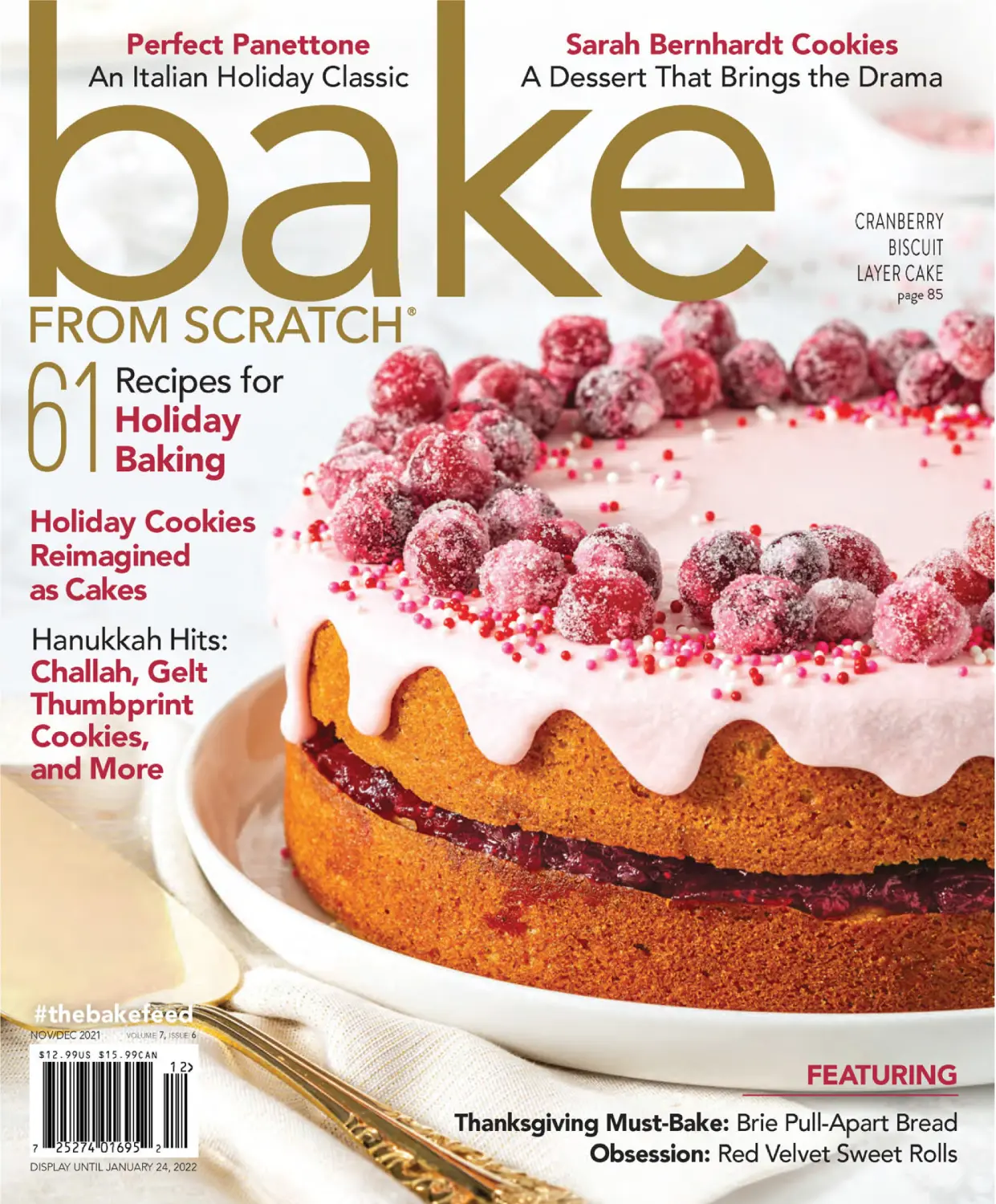
Cranberry Biscuit Layer Cake 85
Eggnog Red Velvet Cake 65
Gingerbread Bundt 91
Italian Rainbow Cookie Loaf Cake 95
Peppermint Bark Cheesecake 5

on the cover
Cranberry Biscuit
Layer Cake
page 85
PHOTOGRAPHY BY

STEPHANIE
WELBOURNE STEELE
RECIPE DEVELOPMENT BY

BECCA CUMMINS
FOOD STYLING BY

KATIE MOON
DICKERSON
STYLING BY

DOROTHY WALTON

FROSTINGS, FILLINGS,
GARNISHES, AND GLAZES
Cheesecake Swirl 64
Chocolate Filling 88
Cranberry Filling 85
Cream Cheese Glaze 66
Eggnog Buttercream 65
Fig Filling 104
Hydrated Cranberries 76
Lemon Frosting 33
Molasses Glaze 15
No-Bake Cheesecake 65
Nutmeg Buttercream 80
Oat-Walnut Streusel 74
Peppermint Chocolate Ganache 5
Pink Glaze 85
Royal Icing 90
Salted Caramel Sauce 29
Simple Syrup 85
Soaked Fruits 56

Sugared Cranberries 86
Vanilla-Almond Glaze 32
Vanilla Bean Glaze 91
Vanilla Glaze 102
Vanilla Sea Salt 39
MISCELLANEOUS
Milk Roux 46
Panettone Bread Pudding 112
Pumpkin-Pecan Bread Pudding 29
PASTRIES, PIES, AND TARTS
Linzer Cookie Torte 81
Orange Zest Pie Dough 75
Puff Pastry Crust 73
Root Vegetable Tarte Tatin 73
Turtle Brownie Pie 75

resources
Hot from the Oven
Page 17
Occo Cinnamon Sampler photography by
Peter Garritano.
Let It Snow Bundt Pan photography courtesy of
Williams Sonoma.
The Chef’s Apron by Flax Home photography by
Janis Nicolay.

13

bake from scratch

Baker Profile
Page 35
Photography by Joann Pai.

Page 38
Photography of Beaucoup Bakery pastries by Joann Pai.
Photos of cherries and Jackie Kai Ellis by Janis Nicolay.

Page 36
Photo of Jackie Kai Ellis by Joe Chan.

Page 39
Photography by Jackie Kai Ellis.

Page 37
Photography by Joann Pai.

Page 41
Photography by Jackie Kai Ellis.

ADVERTISING

GINGERBREAD SPICE LOAF
The warm spices and molasses taste of gingerbread transforms this zigzagging bread loaf into an instant holiday classic.
Fluffy and tender, this loaf receives its beautiful rise from Platinum® Yeast from Red Star®.
Makes 1 (8½x4½-inch) loaf

21⁄2 to 23⁄4 cups (313 to 344 grams)
all-purpose flour, divided
⅓ cup (73 grams) plus ¼ cup (55 grams)
firmly packed dark brown sugar, divided
3 teaspoons (9 grams) kosher salt, divided
1 (0.25-ounce) package (7 grams)
Platinum Yeast
4 teaspoons (8 grams) ground ginger,
divided
3 teaspoons (6 grams) ground
cinnamon, divided
1 teaspoon (2 grams) ground nutmeg,
divided
1 teaspoon (2 grams) ground cloves,
divided
⅓ cup (76 grams) unsalted butter, cubed
¼ cup (60 grams) water
¼ cup (60 grams) whole milk
2 tablespoons (42 grams) unsulphured
molasses
½ teaspoon (2 grams) vanilla extract
2 large eggs (100 grams), room
temperature
3 tablespoons (42 grams) unsalted
butter, room temperature
Molasses Glaze (recipe follows)
1. In the bowl of a stand mixer, whisk

together 1 cup (125 grams) flour, ¼ cup
(55 grams) brown sugar, 2½ teaspoons
(7.5 grams) salt, yeast, 2 teaspoons
(4 grams) ginger, 2 teaspoons (4 grams)
cinnamon, ½ teaspoon (1 gram) nutmeg,
and ½ teaspoon (1 gram) cloves by hand.
2. In a small saucepan, heat cubed butter,
¼ cup (60 grams) water, milk, and molasses
over medium-low heat until butter is melted
and an instant-read thermometer registers
120°F (49°C) to 130°F (54°C).

Add warm butter mixture and vanilla to
flour mixture; using the paddle attachment,
beat at low speed until combined. Add eggs,
and beat until well combined. With mixer
on low speed, gradually add 1½ cups (188
grams) flour, beating just until combined and
stopping to scrape sides of bowl.
3. Switch to the dough hook attachment.
Beat at low speed until a soft, sticky dough
forms, 5 to 7 minutes, stopping to scrape
sides of bowl and dough hook; add up to
remaining ¼ cup (31 grams) flour, 1 tablespoon
(8 grams) at a time, if dough is too sticky.
Turn out dough onto a lightly floured surface,
and shape into a smooth round.
4. Lightly oil a large bowl. Place dough in
bowl, turning to grease top. Cover and let
rise in a warm, draft-free place (75°F/24°C)
until doubled in size, 35 to 50 minutes.
5. Turn out dough onto a lightly floured surface,
and gently press into an 8x6-inch rectangle.
Loosely wrap in plastic wrap. Refrigerate for
at least 1 hour or up to overnight.
6. Spray an 8½x4½-inch loaf pan with
cooking spray. Line pan with parchment
paper, letting excess extend over sides of pan.
7. In a medium bowl, combine room
temperature butter, remaining ⅓ cup
(73 grams) brown sugar, remaining
2 teaspoons (4 grams) ginger, remaining
1 teaspoon (2 grams) cinnamon, remaining
½ teaspoon (1.5 grams) salt, remaining
½ teaspoon (1 gram) nutmeg, and
remaining ½ teaspoon (1 gram) cloves.
Using a silicone spatula, press and stir
together until well combined.
8. On a lightly floured surface, roll dough into
a 12x10-inch rectangle (about ½ inch thick).
Using a small offset spatula, spread
room temperature butter mixture
onto dough, leaving a ½-inch
border around edges.

Using a knife or pastry wheel, cut dough into
4 (10x3-inch) strips. Starting at one short
end of prepared pan, arrange 1 dough strip in
a zigzagging ribbonlike pattern, leaving about
½-inch gap between dough and long sides
of pan. Repeat with remaining dough strips.
Cover and let rise in a warm, draft-free place
(75°F/24°C) until puffed, 30 to 35 minutes.
9. Preheat oven to 375°F (190°C).
10. Bake for 15 minutes. Loosely cover with
foil, and bake until top and sides are golden
and an instant-read thermometer inserted
in center registers 190°F (88°C), 20 to
25 minutes more. Let cool in pan for
15 minutes. Using excess parchment as
handles, remove from pan, and let cool
completely on a wire rack. Drizzle with
Molasses Glaze.

MOLASSES GLAZE
Makes ⅓ cup

¾ cup (90 grams) confectioners’ sugar,
sifted
1 tablespoon (15 grams) cold whole milk
1 teaspoon (7 grams) unsulphured
molasses
¼ teaspoon (1 gram) vanilla extract
⅛ teaspoon kosher salt
1. In a medium bowl, stir together all

ingredients until smooth and well combined.
Use immediately.

hot from the oven

HOLIDAY BAKING
MUST-HAVES
WITH THE HOLIDAYS JUST
AROUND THE CORNER, WE’VE
ROUNDED UP SOME OF OUR
NEW FAVORITE PRODUCTS TO
HELP YOU GET THROUGH THE
HOLIDAY BAKING SEASON.
WHETHER YOU’RE PREPARING
TO HOST YOUR FIRST
THANKSGIVING OR SWEEP THE
HOLIDAY COOKIE SWAP, THESE
ITEMS WILL HELP YOU GET IT
DONE ALL IN GOOD TASTE.

BAKE AND TAKE

JUST A PINCH

This beautifully designed Emma
Bridgewater tin will be the highlight of the
holiday cookie swap season. The Partridge
Deep Rectangular Tin is charmingly
adorned with partridges and a golden pear
tree, incorporating a bit of British charm
and style to any occasion.
Available at thebeeskneesbritishimports.com,
$16.50

As cinnamon is the reigning spice of
the holidays, it’s time to invest in some
worthy of the season. With this Cinnamon
Sampler from Occo, you get to sample four
different varieties of cinnamon, including
the sweet cinnamon you know and love,
plus three barks known for their bite. Each
card contains eight half-teaspoon pods
individually sealed for freshness.
Available at eatocco.com, $20

BAKE FROM SCRATCH EXCLUSIVE
A COPPER DREAM TEAM
BEAUTIFUL BUNDTS
The new Let It Snow Bundt Pan
from Nordic Ware serves up just the
right amount of holiday cheer and
whimsy. With a swirling snowflake
design, cakes baked in this pan are
gorgeous as is, but dusted with
confectioners’ sugar or even drizzled
with a sglaze, they’ll truly shine.
Available at williams-sonoma.com,
$39.95

17

bake from scratch

No kitchenware is quite so classically
attractive as a copper pan, and this
CMK Vintage Inspired Baking Dish and
CMK Vintage Inspired Soufflé Dish are no
exception. Part of an exclusive collaboration
between Coppermill Kitchen and Bake from
Scratch, these two pans were inspired by
editor-in-chief Brian Hart Hoffman’s travels
to the brocantes of France. Bake with these
beauties to elevate any dish.
Available at bakefromscratch.com, $250–
$375

THE BAKER’S BEST FRIEND
Jackie Kai Ellis, highlighted in our Baker
Profile (page 35), joined forces with Flax
Home to design these crisp, French-inspired
linen aprons. The design of the Chef’s
Apron is practical, but also easy to put on
and take off to greet guests. With a pocket
for small kitchen tools and a tie waist that’s
perfect for tucking tea towels into, it
might just become your new favorite
kitchen accessory.
Available at shopflaxhome.com, $78

COZY UP WITH THESE
COOKBOOKS
WITH WINTER FINALLY ON ITS WAY, WE’LL TAKE ANY EXCUSE TO TURN ON THE OVEN AND
WELCOME SOME EXTRA WARMTH INTO OUR HOMES. THESE COOKBOOKS WILL INSPIRE YOU
TO DO JUST THAT AND YIELD SOME DELICIOUS BAKES IN THE PROCESS.
BAKE AND DECORATE
In Creative Cookie Decorating
for Everyone: Buttercream
Frosting Recipes, Designs,
and Tips for Every Occasion
(Good Books, 2021), the
follow-up to the beloved
Creative Cookie Decorating
(Good Books, 2019), Emily
Hutchinson takes bakers
through decorating with
buttercream with hundreds
of step-by-step photos.
She covers each season and
holiday with new ideas and designs for your cookies, including
piping technique and even a method she developed to flood with
buttercream. If you’re looking to add some embellishments to your
holiday cookies, look no further. From gorgeously piped poinsettias
for winter to sweet yellow chicks for spring, this book offers ideas
for every get-together and gathering you could possibly imagine.

STORIED SOUTHERN
BAKING
Cheryl Day is one of the
South’s most revered bakers,
a best-selling author, and
co-owner of the acclaimed
Back in the Day Bakery in
Savannah, Georgia. Cheryl
Day’s Treasury of Southern
Baking (Artisan, 2021) reads
as one giant love letter to
classic Southern recipes and
ingredients. Within the book,
Cheryl is with you every step
of the way, offering tips and
technique as well as recipes
for Southern staples, including four separate biscuit recipes
(each fluffier and flakier than the next).
Available October 26, $40

Available October 19, $29.99

FROM SWEDEN,
WITH LOVE
From her kitchen nestled in the
wilds of Sweden, Sofia Nordgren
takes readers on a journey
through the seasons in The Nordic
Baker: Plant-Based Bakes and
Seasonal Stories from a Kitchen in
the Heart of Sweden (Quadrille
Publishing, 2021). Each recipe is
completely plant-based and will
introduce you to the wonders
of ingredients like aquafaba and
plant-based milks. The book starts
in spring with recipes like Swedish
almond cake and ends in winter
with cozy cardamom buns and traditional gingerbread.
Available November 9, $29.99

19

bake from scratch

A COOKIE FOR EVERY
OCCASION
Recipe developer, writer, and
food stylist Jesse Szewczyk’s
new cookbook, Cookies:
The New Classics (Clarkson
Potter, 2021), takes
everything you love about
classic cookie recipes and
pumps up the volume. Move
beyond basic chocolate chip,
peanut butter, and oatmeal
cookie recipes with this
collection of 100 intriguing
yet familiar recipes. Each
chapter focuses on a specific flavor profile, and we personally can’t
wait to try the Oatmeal Chocolate-Covered-Raisin Cookies and,
for a savory twist, the Cacio e Pepe Slice and Bakes.
Available October 26, $27.50 •

BREADS, COOKIES,
CAKES AND PIES!
WHY CHOOSE
JUST ONE?

Complete your baking book collection today!
You’ll Ɠnd all of the inspiration you need to learn the ins and outs of
baking, including kitchen essentials, need-to-know terms, and helpful tips
and techniques from our Bake from Scratch baking experts.
Find hundreds of step-by-step recipes for delicious baked goods—like
Peppermint Swirl Pound Cake, Everything Chocolate Thumbprint Cookies,
Banana Pudding Meringue Pie, and Vanilla Bean and Cardamom
Scones—perfect for any celebration or season, or all year round.
It’s time to roll up your sleeves, Ŵour your work surface, and whip up
something delicious!

3 EASY WAYS TO ORDER
Hoffman Media Store
P.O. Box 8510 • Big Sandy, TX 75755
800-361-8059
BAKEFROMSCRATCH.COM/INSPIRATION
SHOP OUR ENTIRE BAKE FROM SCRATCH COLLECTION
AT BAKEFROMSCRATCH.COM/SHOP.

ADVERTISING

better

BAKING
ACADEMY

with

CHAI OATMEAL
COOKIES WITH
APPLE CIDER
CREAM CHEESE
FILLING
In our recent lesson of the Better Baking Academy
with Bob’s Red Mill, we gave you three takes on
a classic: the oatmeal cookie. They’re soft and
chewy, perfectly spiced, and dotted with specks
of juicy raisin. In order to achieve perfectly chewy
yet tender cookies, we used both Bob’s Red Mill
Gluten Free Organic Old Fashioned Rolled Oats
and Bob’s Red Mill Organic All-Purpose Flour.
Whether sandwiched with buttercream, stuffed
with cream cheese filling, or dipped in vanilla
glaze, these cookies are sure to serve up a
healthy dose of nostalgia. Amanda Powell
of the blog A Cookie Named Desire shares
a masala chai and apple cider twist on our
Cream Cheese-Stuffed Oatmeal Cookies!

CHAI OATMEAL COOKIES WITH
APPLE CIDER CREAM CHEESE
FILLING
Makes about 22 cookies

Recipe by Amanda Powell
3
½
2
2
2½
1¾
1
1
½
¼
¼
¼
¼
1
1¾
2
2
1
1¼
8
3½

cups (300 grams) Bob’s Red Mill
Gluten Free Organic Old Fashioned
Rolled Oats, divided
cup (80 grams) roughly chopped
raisins, divided
cups (250 grams) Bob’s Red Mill
Organic All-Purpose Flour
tablespoons (10 grams) unsweetened
cocoa powder
teaspoons (5 grams) ground cinnamon
teaspoons (4.5 grams) kosher salt,
divided
teaspoon (2 grams) ground ginger
teaspoon (2 grams) ground cardamom
teaspoon (2.5 grams) baking soda
teaspoon (1.25 grams) baking powder
teaspoon ground allspice
teaspoon ground nutmeg
teaspoon finely ground black pepper
cup (227 grams) unsalted butter,
softened
cups (385 grams) firmly packed light
brown sugar
large eggs (100 grams), room
temperature
tablespoons (42 grams) molasses
teaspoon (4 grams) vanilla extract
cups (300 grams) apple cider
ounces (226 grams) cream cheese,
room temperature
tablespoons (42 grams) granulated
sugar

1. In the work bowl of a food processor, pulse

2 cups (200 grams) oats until uniform in
size and almost ground but not too powdery.
Add ¼ cup (40 grams) raisins, and pulse
until raisins are finely chopped. Add flour,
cocoa, cinnamon, 1½ teaspoons (4.5 grams)
salt, ginger, cardamom, baking soda, baking
powder, allspice, nutmeg, and pepper; pulse
just until combined.
2. In the bowl of a stand mixer fitted with
the paddle attachment, beat butter and

JOIN THE
BETTER BAKING
ACADEMY!

brown sugar at medium speed until fluffy,
2 to 3 minutes, stopping to scrape sides of
bowl. Add eggs, one at a time, beating well
after each addition. Beat in molasses and
vanilla until combined. With mixer on low
speed, add oats mixture in two additions,
beating until combined after each addition.
Add remaining 1 cup (100 grams) oats and
remaining ¼ cup (40 grams) raisins, beating
just until combined. Cover and refrigerate
for 30 minutes or up to overnight.
3. In a small saucepan, cook cider over
medium heat until thick, syrupy, and
reduced to about ¼ cup. Remove from heat,
and let cool.
4. Preheat oven to 350°F (180°C). Line
several baking sheets with parchment paper.
5. In a medium bowl, whisk together
reduced cider, cream cheese, granulated
sugar, and remaining ¼ teaspoon salt until

smooth and combined. Cover and freeze for
15 minutes.
6. Using a 1½-tablespoon spring-loaded
scoop, scoop dough (about 30 grams
each). Roll into balls, and flatten into
2¼- to 2½-inch disks. Spoon or scoop
2 teaspoons (12 grams) cider mixture into
center of 1 disk, and cover with a second
disk. Crimp edges to seal, and gently shape
(or roll) into a ball. Repeat with remaining
cider mixture and remaining dough disks.
Place dough balls about 3 inches apart on
prepared pans.
7. Bake until bottom edges are golden but
centers look a little wet, 10 to 14 minutes.
(Do not overbake.) Let cool on pans for
5 minutes. Remove from pans, and let
cool completely on wire racks. Store in an
airtight container at room temperature for
up to 3 days.

Love what you see? Join the Better Baking Academy today
to keep up with each month of recipes and lessons. Visit
bakefromscratch.com/better-baking-academy to enroll.

baker spotlight

MACARONS FOR A CAUSE
MEET SHROBANA SENGUPTA, 17 YEARS OLD AND A MACARON-BAKING QUEEN.
FIND OUT HOW THIS SAN JOSE, CALIFORNIA, TEEN USES HER ONLINE MACARON
BUSINESS, MERAKI-X, TO HELP MAKE THE WORLD A BETTER PLACE.

How did you get started with your
macaron business?
Shrobana Sengupta: I’ve always really
been interested in business and combining
that with giving back to the community. In
middle school, I started my own handmade
card business where I would make greeting
cards and donate the proceeds to St. Jude’s
charity. Once the [COVID-19] pandemic
started, I decided to start blogging and
tracking my journey as a baker. I posted
a French cookie box for Mother’s Day
2020, and my mom suggested I include
macarons. I gave it a shot and got hooked.
I continued to practice and perfect them
to the point that I was making macarons,
like, every week. Soon, friends and family
wanted to purchase my macarons, and I
thought this would be a great opportunity
to start giving back. So far, I've sold
10,000 macarons and raised over
$15,000 for various causes, including a
local fundraiser to purchase 50 laptops for
50 families affiliated with Sunday Friends,
an organization that helps families break
the generational cycle of poverty.

23

bake from scratch

What are your favorite macarons you’ve
made?
SS: I love making macarons that can bring
in my Indian culture. For Diwali, I made
these Ras Malai Macarons, flavored with
rose water and cardamom and adorned
with rose petals and edible silver leaf. I’m
really proud of those flavors, especially
because it’s kind of difficult to nail that
Indian flavor and incorporate it into such
a finicky dessert. I also love some of the
more technically decorated macarons I’ve
made. Learning to airbrush on different
templates—like one of Bob Marley—has
been fascinating as well. And I’m very
proud when I pull it off.
Any tips for bakers making macarons for
the first time?
SS: You have to be very patient. Some
people think every single batch I make
is perfect, but that is not the case—just

yesterday, I had batch come out wrong
because I rushed the process. There’s a lot
of patience involved in getting these to be
correct. Another tip is to be very precise,
and the best way to do that is to measure
by weight. Macarons should be made by
grams, not cups.
What’s up next for you and your
macarons?
SS: I’m a senior, so I’ll be attending college
next year. I plan to study business or social
entrepreneurship combined with design
because I’m very interested in blending my
creative ideas with my interest in business.
I plan to take my macaron business to
college with me. I would love to open
a store locally and have a place where
friends and family can gather to enjoy
my macarons. There are people in need
wherever I go to college, so no matter
what, I’ll be baking to pay it forward. •
Support and follow Shrobana:
merakix.com | @_merakix_

from the pantry

VANILLA
A LOOK AT THE UBIQUITOUS INGREDIENT,
FROM THE POD TO THE EXTRACT
BY

OLIVIA KAVANAGH

c

onsidering its role in everything from custards and pies to
cakes and cookies, vanilla might just be the MVP of the
baking world. It appears in almost every ingredient list, but
it’s also one of the most expensive ingredients in a baker’s pantry.
Since its discovery around the 14th century, vanilla has been both
elusive and highly coveted. Its rich, floral, and complementary
nature gives depth to almost every recipe it’s added to. And
although vanilla has become commonplace in baking, its origin is
anything but ordinary.
The creeping vanilla vine originated in the tropical forests of
Mesoamerica, with the pre-Columbian Maya being the first to use
vanilla and the Totonac people being the first to cultivate it. For the
Totonac people, vanilla beans were used for medicinal and religious
purposes. Once the conquering Aztecs encountered vanilla, they
began to incorporate it into their cooking. Most notably, they used
vanilla in combination with cocoa to create a drink they called
xocolatl. The Aztecs believed xocolatl to be a divine drink, capable
of building immunity and fighting fatigue. Once the Spanish
conquered the Aztecs, vanilla beans started showing up in Europe.
Upon introduction to the European market in the 1520s, vanilla
became a precious culinary commodity—but there was a problem.
The vanilla grown in French and English botanical gardens wasn’t
producing seeds. This would remain a mystery until 1836 when
a Belgian horticulturist named Charles Morren discovered that
vanilla’s natural pollinator, the Melipona bee, wasn’t native to
Europe. Without those specific bees present, the vanilla plants were
unable to properly develop and produce their sought-after seeds.
It wasn’t until five years later, on the small French island of
Réunion, that everything changed. In 1841, an enslaved 12-yearold boy named Edmond Albius developed the meticulous handpollination technique for vanilla orchids. Still practiced today, the
process involves using a stick (about the size of a toothpick) to lift
a flap in the orchid called the rostellum and pressing together the
pollen-covered anther against the stigma. Edmond’s technique
spread from Réunion to its neighboring island Madagascar and
then to a variety of other tropical islands. Eventually, even
Mexico began to supplement its naturally pollinated supply with
hand-pollinated plants.
Similar to how every wine is uniquely fermented and aged, every
region where vanilla is cultivated employs a specific curing process,
giving each bean a unique flavor. For instance, Tahitian beans are
characterized by floral tones, with hints of cherry and smoke.
Mexican vanilla is more subtle, known for its perfect marriage
between woody and sweet aromas with undertones of spice.
Finally, Bourbon vanilla from Réunion (formerly Île Bourbon—the
vanilla’s namesake), the Kingdom of Tonga, and Madagascar is
known for its sweet, buttery, and rich flavor profile. Today, about
80% of the world’s natural vanilla comes from farms in Madagascar.

VANILLA
BEANS

VANILLA
BEAN
PASTE

VANILLA
SUGAR

VANILLA
EXTRACT

VANILLA
POWDER

Of course, it hasn’t taken long for vanilla demand to exceed
natural production. Vanilla orchids often don’t start producing
vanilla beans until about three years after planting. The entire
process, from growing and pollinating to drying, curing, and
preparing vanilla beans for export, takes around one year in
total. Currently, less than 1% of vanilla flavor used in commercial
products comes from actual vanilla orchids. As early as the 1800s,
chemists were tasked with synthesizing the compound vanillin (the
main flavor component of cured vanilla beans) from other sources.
Pine bark, clove oil, rice bran, and spruce tree lignin were among
the top natural sources. However, in the 1970s, a French chemical
and pharmaceutical company discovered a way to produce vanillin
using petrochemicals derived from crude oil, which is how most
imitation vanilla is still produced today. Although pure vanilla
contains natural vanillin, it also contains hundreds of other flavor
compounds. For that reason, imitation vanilla, which gets its flavor
from vanillin alone, often lacks the complexity and depth of flavor
that natural vanilla contains.
Here are the six most common forms of vanilla used in baking:

1

VANILLA BEANS are by far the most expensive form of
vanilla flavor but can elevate desserts to a whole new level.
To use vanilla beans, cut the ends off the bean and slice it
lengthwise to reveal its thousands of tiny black seeds. Scrape out
the seeds and add them to ice creams, custards, or light-colored
buttercreams to show off all those little flecks of flavor. Keep in
mind that high temperatures can degrade the complex flavors
of vanilla bean seeds, so try to reserve this special ingredient for
uncooked or gently simmered items.

2

VANILLA BEAN PASTE is made from the scraped seeds of
a vanilla bean, lightly sweetened with sugar and suspended in
a natural thickener. It can be substituted 1:1 for vanilla extract
but mimics the look of whole vanilla beans in baked goods because
it still contains vanilla bean seeds. Vanilla bean paste is also more
viscous than vanilla extract, so it won’t water down your recipes.
Like vanilla beans, vanilla bean paste is best used in bakes that show
off each coveted vanilla bean seed.

3

PURE VANILLA EXTRACT is easily the most common
form of vanilla used in baking. It’s made by soaking ground
vanilla beans in a solution of alcohol and water. Some vanilla
extract products have sugar or corn syrup added to enrich the
flavor of low-quality vanilla beans. A truly pure vanilla extract
will contain only vanilla bean, alcohol, and water. Because vanilla
extract is one of the more affordable forms of vanilla, it’s incredibly
useful in high-volume baking applications. Its liquid form also
makes it easier to evenly incorporate into doughs and batters.

27

bake from scratch

VANILLA SIMPLE SWAPS
With its numerous forms, it can be tricky to have
every kind of vanilla on hand. Save yourself a trip to
the store by using these substitutions.
1 vanilla bean =
1 tablespoon (13 grams) vanilla extract or
1 tablespoon (18 grams) vanilla bean paste
1 tablespoon (18 grams) vanilla bean paste =
1 tablespoon (13 grams) vanilla extract or
1 vanilla bean
1 tablespoon (13 grams) vanilla extract =
1 tablespoon (18 grams) vanilla bean paste or
1 vanilla bean
½ teaspoon (2 grams) vanilla powder =
1 teaspoon (4 grams) vanilla extract,
1 teaspoon (6 grams) vanilla bean paste, or
a 2-inch section of a vanilla bean

4

VANILLA POWDER is perhaps slightly less common but
can act as another low-maintenance alternative to whole
vanilla beans. Made from dried, ground vanilla beans, vanilla
powder in its purest form contains no fillers and should be light
to dark brown in color. A plus of vanilla powder? It contains no
liquids, so it can be seamlessly added to buttercreams or batters
without watering them down. Its flavor is also unaffected by heat,
making it a more viable option in baked goods. Expect the price
tag to be similar to that of whole vanilla beans.

5

VANILLA SUGAR is made by infusing granulated
sugar with vanilla beans and their seeds. Vanilla sugar is
an extremely common ingredient in Europe, specifically
in countries like Germany, Poland, and Hungary. There, it’s
commonly used in traditional cakes and cookies, or as a finishing
sugar, powdered and dusted over pastries, fresh fruit, and other
desserts. Although not as common in the US, it’s easy enough to
make your own vanilla sugar at home using whole or spent vanilla
bean pods and granulated sugar. Simply allow the pods to marinate
with the sugar in an airtight container for a month or more
and you’ll have another perfect way to incorporate vanilla into
beverages, bakes, and more.

6

IMITATION VANILLA contains only one flavor compound,
so it lacks the complex, nuanced flavors of real vanilla.
However, unlike vanilla beans, paste, and extract, whose flavors
degrade at the high temperatures used during baking, the flavor of
imitation vanilla can withstand heat. Not to mention, it’s a fraction
of the cost of real vanilla. For those reasons, imitation vanilla is
preferred by some bakers for large-batch bakes. Its vanilla flavor
remains prominent after baking and usually cannot be distinguished
from the real thing when utilized in bakes with longer cook times. •

BAKE WITH VANILLA
In this issue, don’t miss:
Vanilla Chai Liège Waffles,
page 46
Red Velvet-Cheesecake Swirl
Brownies, page 64
Gingerbread Bundt, page 91
Sufganiyot, page 102

ADVERTISING

PUMPKIN-PECAN BREAD PUDDING
Perfectly tender and bursting with the flavors of fall, this nutty pumpkin bread pudding is baked in the SHARP SuperSteam+™ Built-In
Wall Oven (SSC2489DS), receiving gentle yet thorough steam heat to create the ideal dessert.
Makes 12 servings

16 ounces (454 grams) challah bread, cut
into 1-inch cubes (about 14 cups)
1¾ cups (442 grams) canned pumpkin
(about 1 [15-ounce] can)
2½ cups (600 grams) cold heavy whipping
cream, divided
1½ cups (360 grams) whole milk
⅔ cup (133 grams) plus 2 tablespoons
(24 grams) granulated sugar, divided
⅔ cup (147 grams) firmly packed light
brown sugar
5 large eggs (250 grams)
3 tablespoons (45 grams) bourbon (see
Notes), divided
2 teaspoons (4 grams) ground cinnamon
2 teaspoons (4 grams) pumpkin pie spice
1¾ teaspoons (5.25 grams) kosher salt
¾ cup (85 grams) chopped toasted
pecans, divided
1 tablespoon (14 grams) unsalted butter,
melted
Salted Caramel Sauce (recipe follows)
Garnish: chopped toasted pecans

1. Spread bread cubes evenly in 2 trays. Set

SHARP SuperSteam+™ Built-In Wall Oven
(SSC2489DS) to Manual/Convection Bake/
Preheat/2 Trays/275°F/25 minutes/Start.
When preheated, place trays on oven’s upper
and lower racks. Press Start.
2. Bake for 25 minutes until lightly golden, dry,
and toasted, rotating trays halfway through
baking. Let cool on trays for 10 minutes.
3. In a very large bowl, whisk together
pumpkin, 1½ cups (360 grams) cold cream,
milk, ⅔ cup (133 grams) granulated sugar,
brown sugar, eggs, 2 tablespoons (30 grams)
bourbon, cinnamon, pie spice, and salt. Add
bread cubes; toss until bread is thoroughly
coated and mostly submerged. Let stand
at room temperature for 1½ hours, stirring
occasionally and keeping bread mostly
submerged. Stir in ½ cup (57 grams) pecans.
4. Brush an 11x8-inch baking dish with melted
butter; spread bread mixture evenly in
prepared pan. Sprinkle with remaining ¼ cup
(28 grams) pecans.
5. Set SHARP SuperSteam+™ Built-In Wall
Oven (SSC2489DS) to Manual/Steam
Bake/Water Bath/300°F/55 minutes/Start.
(Oven will preheat.)
6. Place prepared pan on 1 tray; position on
lower rack of oven. Press Start.
7. Bake for 55 minutes until puffed and set,
a wooden pick inserted in center comes out
mostly clean, and an instant-read thermometer

inserted in center registers 165°F (73°C) to
170°F (77°C), adding up to an additional
16 minutes, if necessary. (See Notes). Let cool
on a wire rack for at least 20 minutes.
8. Meanwhile, in a medium bowl, whisk
together remaining 1 cup (240 grams) cold
cream, remaining 2 tablespoons (24 grams)
granulated sugar, and remaining 1 tablespoon
(15 grams) bourbon until medium-stiff peaks
form. Serve warm bread pudding with Salted
Caramel Sauce and whipped cream. Garnish
with pecans, if desired.
Notes: For an alcohol-free version, replace
bourbon in bread pudding and whipped cream
with vanilla extract to taste.
Some 11x8-inch baking dishes may vary a bit
in design and capacity, which could impact
bake times slightly.

SALTED CARAMEL SAUCE
Makes about 1¼ cups

½ cup (110 grams) firmly packed light
brown sugar
½ cup (120 grams) heavy whipping cream
¼ cup (57 grams) unsalted butter, softened
3 tablespoons (63 grams) dark corn syrup
¾ teaspoon (2.25 grams) kosher salt
1. In a medium saucepan, stir together all

ingredients. Bring to a boil over mediumhigh heat; reduce heat to medium-low, and
simmer, stirring frequently, for 3 minutes.
Transfer mixture to a small heatproof bowl.
Let cool for at least 10 minutes before using.

STANDARD OVEN INSTRUCTIONS:
1. Bake bread cubes at 300°F (150°C) until

dry and toasted, 20 to 25 minutes, stirring
and rotating pans halfway through baking.
Let cool for 10 minutes.
2. Prepare bread pudding mixture as
directed in step 2 and step 3.
3. Place bread pudding pan in a 13x9-inch
baking dish; add enough hot water to come
halfway up sides of bread pudding pan.
4. Bake at 325°F (170°C) until set, a
wooden pick comes out mostly clean, and
an instant-read thermometer inserted in
center registers at least 170°F (77°C),
1 hour and 5 minutes to 1 hour and
15 minutes. Let cool, and serve as directed.

retro redo

WHITE BISCOTTI
OUR EDITORIAL ASSISTANT ALEX KOLAR SHARES HER
MEMORIES OF A VERY SPECIAL CHRISTMAS
COOKIE AND THE WOMAN BEHIND IT

M

y grandmother is proud to say she’s Sicilian, not Italian,
an important distinction between her and the rest of the
family. As iconic as her apron adorned with the island of
Sicily is my mimi’s recipe for white biscotti. You may think of the
twice-baked biscotti with that toothsome finish, the kind you dip
into your coffee, but these cookies are a different story. “Biscotti”
just means “little biscuit,” a petite cookie with any kind of texture or
flavor. This cookie is nutty and soft and dissolves with one bite. My
grandmother makes these cookies as an act of service, and they pop
up at every baby shower, wedding, and gathering we have. We can
always count on her white biscotti to show up on Christmas, along with
her cuccidati, chocolate biscotti, and sesame cookies.

THE REDO
ALMOND-PECAN BISCOTTI
COOKIES
Makes about 38 cookies

These cookies challenge the crunchy, crisp
biscotti stereotype. Soft and melt-in-yourmouth tender, these biscotti pack a double
dose of nuttiness with both ground toasted
pecans and almond extract before being
finished with a bright white glaze.
2 cups (250 grams) all-purpose flour
⅔ cup (75 grams) finely ground toasted
pecans (see Notes)
½ cup (100 grams) granulated sugar
2½ teaspoons (12.5 grams) baking powder
¾ teaspoon (2.25 grams) kosher salt
¾ cup (168 grams) refined coconut oil
2 large eggs (100 grams), room
temperature
1 teaspoon (6 grams) vanilla bean paste
½ teaspoon (2 grams) almond extract
Vanilla-Almond Glaze (recipe follows)
Garnish: finely ground toasted pecans

Right before Christmas, my whole family—me, my mom, my
grandmother, my aunts, my uncle, everybody who’s in town—gathers
to bake these cookies so we can gift them to friends. We argue and
talk over each other. Basically, it’s the best time ever. Inevitably,
whenever we’re done baking, my grandmother proclaims, “This isn’t
gonna be enough. I’m gonna have to go home and make some more
batches.” In reality, we have hundreds of cookies, and everybody ends
up with a gallon-size bag of cookies. Our ongoing joke is if you eat any
of the cookies on the day they’re made, you get in trouble with my
grandmother. She always threatens, “I’m not making any more—when
they’re gone, they’re gone.” She always gets so sassy, even though
she’ll always make more. Like the white biscotti, she talks a tough
game, but she’s got a sweet, tender heart.
—Alex Kolar

1. Preheat oven to 350°F (180°C). Line

2 rimmed baking sheets with parchment
paper.
2. In a large bowl, whisk together flour,
pecans, sugar, baking powder, and salt.
3. In a small bowl, stir coconut oil until
smooth, and add to flour mixture; add eggs,
vanilla bean paste, and almond extract. Using
clean hands, mix until well combined and a
dough forms. Scoop dough by tablespoonfuls
(about 18 grams each); roll into smooth balls,
and place 1 inch apart on prepared pans.
4. Bake, one batch at a time, until tops are
set and bottoms are lightly golden, 10 to
12 minutes. Let cool on pan for 5 minutes.
Remove from pan, and let cool completely
on wire racks.
5. Line rimmed baking sheets with parchment
paper. Place wire racks with cookies on top of
prepared pans. Drop cooled cookies, 1 or 2 at
a time, in Vanilla-Almond Glaze, and coat on
all sides. Using a fork, remove cookies from
glaze, letting excess drip off; return, flat side
down, to wire racks. Garnish with pecans, if
desired. Let stand until glaze is set, at least
2 hours or up to overnight.

Note: To finely grind toasted pecans, place
them in a large resealable plastic bag and use a
rolling pin to pound and crush until pieces are
about ⅛ inch or smaller. Measure or weigh out
the needed amount once finely ground.
The coconut oil in this recipe will make for
a nicely moist, slightly shiny dough. This
makes it easy to roll into desired shapes and
contributes to these cookies’ super tender,
melt-in-your-mouth texture.

VANILLA-ALMOND GLAZE
Makes about 1½ cups

4
⅓
1
½
¼

cups (480 grams) confectioners’ sugar
cup (80 grams) water
teaspoon (6 grams) vanilla bean paste
teaspoon (2 grams) almond extract
teaspoon kosher salt

1. In a small bowl, stir together all

ingredients until smooth and well
combined. •

ADVERTISING

GINGERDOODLE SANDWICH COOKIES
A delightful blend of two classic cookies, the gingersnap and the snickerdoodle, these spiced sandwich cookies will satisfy all your
holiday cravings. We pulled the dough and zesty frosting together with the revolutionary Ankarsrum mixer, a favorite of Swedish
bakers for generations. Sleek and sturdy, the Ankarsrum mixer is perfect for cookie dough, its combination of dough roller and
dough scraper attachments eliminate the need to scrape down the sides or bottom of the bowl after mixing.
Makes 14 sandwich cookies

¾ cup (170 grams) unsalted butter,
room temperature
⅔ cup (147 grams) firmly packed dark
brown sugar
¼ cup (50 grams) granulated sugar
½ teaspoon (1 gram) packed lemon zest
¼ cup (85 grams) molasses (not
blackstrap)
1 large egg (50 grams), room
temperature
2¼ cups (281 grams) all-purpose flour
2 teaspoons (4 grams) ground ginger
1 teaspoon (3 grams) kosher salt
¾ teaspoon (3.75 grams) baking soda
3¼ teaspoons (6.5 grams) ground
cinnamon, divided
½ teaspoon (1.5 grams) cream of tartar
½ teaspoon (1 gram) ground cardamom
½ teaspoon (1 gram) ground cloves
½ cup (100 grams) sanding sugar
Lemon Frosting (recipe follows)
1. Assemble Ankarsrum mixer with

stainless steel bowl and dough roller and
dough scraper. Add butter, brown sugar,
granulated sugar, and lemon zest to bowl;
starting out on lowest speed (12 o’clock),
turn machine on with dough roller resting
against side of bowl. Increase mixer speed
to highest setting (8 o’clock), and let cream
for 1 minute. Turn off, and scrape roller and
center of bowl with a spatula. Set machine
to medium-high speed (4 o’clock), and
cream for 2 minutes. Add molasses and egg.
Continue creaming until mixture is light and
fluffy, about 1 minute. Briefly pull arm/roller
toward middle to help thoroughly combine
all ingredients as needed.
2. In a medium bowl, whisk together flour,
ginger, salt, baking soda, ¾ teaspoon
(1.5 grams) cinnamon, cream of tartar,
cardamom, and cloves. Set machine to
lowest speed (12 o’clock), and add flour
mixture to butter mixture. Mix just until
combined; briefly pull arm/roller toward

middle to help thoroughly combine
all ingredients as needed. Cover and
refrigerate dough for 1 hour.
3. Preheat oven to 350°F (180°C). Line
2 baking sheets with parchment paper.
4. In a small bowl, stir together sanding
sugar and remaining 2½ teaspoons
(5 grams) cinnamon.
5. Using a 1½-tablespoon spring-loaded
scoop, scoop dough (about 27 grams
each), and roll into balls. Roll balls in sugar
mixture, and place 1½ to 2 inches apart on
prepared pans.
6. Bake until edges are set but centers still
seem slightly underdone, 10 to 12 minutes,
rotating pans halfway through baking.
Let cool completely on pans on wire racks.
7. Place Lemon Frosting in a pastry bag
fitted with a ¼-inch French star piping tip
(Ateco #862). Pipe about 1½ tablespoons
(about 23 grams) frosting onto flat side of
half of cookies. Place remaining cookies,
flat side down, on top of frosting.

Note: Cookies can be made 1 day ahead
and stored, without frosting, in an airtight
container.

LEMON FROSTING
Makes about 2 cups

⅔ cup (150 grams) unsalted butter,
room temperature
¾ teaspoon (1 gram) packed lemon zest
⅛ teaspoon kosher salt
2⅓ cups (280 grams) confectioners’ sugar
2½ tablespoons (37.5 grams) heavy
whipping cream
1. Assemble Ankarsrum mixer with plastic

bowl and balloon whisks. Add butter,
lemon zest, and salt. Beat at high speed
(6 o’clock) until combined, about 1 minute,
stopping halfway to scrape sides of bowl.
Add confectioners’ sugar and cream;
begin mixing on lowest speed (12 o’clock),
gradually increasing mixer speed to
medium-high (5 o’clock), and beat until
fluffy, about 2 minutes. Use immediately.

baker pro²le

35

bake from scratch

THE MEASURE OF

HER POWER
WE TALK WITH JACKIE KAI ELLIS,
FOUNDER OF BEAUCOUP BAKERY
& CAFÉ AND CELEBRATED AUTHOR
OF THE MEASURE OF MY POWERS,
ABOUT FINDING LOVE AND LIGHT
THROUGH BAKING
OLIVIA KAVANAGH
PHOTOGRAPHY BY JOE CHAN, JACKIE KAI ELLIS,
AND JOANN PAI
BY

H

er passions are innumerable, and her
home, decorated with stacks of novels,
records, and cookbooks lining the walls,

stands as evidence of her unending curiosity. Each
item in her home tells the story of a woman trying
to find herself. Little did she know, the answers she
searched for sat right in her own kitchen. For Jackie
Kai Ellis, baking isn’t just a hobby—it’s a necessity,
a life source. But don’t think that’s all that defines
her. Her accolades are extensive. She’s the ultimate
embodiment of a multidisciplinary creator. She wears
many hats and is an entrepreneur first and foremost
but also claims the titles of trained pastry chef and
founder of world-famous Beaucoup Bakery & Café
in Vancouver, Canada, designer, best-selling author,
lifestyle writer, and so much more.

november | december 2021

36

Jackie’s journey into baking started about 10 years ago, when she
found herself in a place of personal turmoil. She’d checked every
box—a picture-perfect marriage, a thriving career as a creative
director in branding at a top firm (which she co-owned, by the
way), and a beautiful home. But it never felt like enough. So, every
day, she had to come up with something worth living for, one good
thing to carry her through the day. In this time of uncertainty
and doubt, she turned to a simple place of solace: baking—more
specifically, baking chocolate chip cookies. It started with the
simple mission of trying to find the best chocolate chip cookie but
quickly evolved into Jackie baking her way through hundreds of
chocolate chip cookie recipes in search of the world’s best. From
there, it was a frenzy. She would bake three cakes a week, doling
them out to friends, coworkers, and neighbors until they begged
her to stop. But she had finally found her purpose through baking.
Why baking? “When you’re in the kitchen, you have to connect
to the present moment. The timer is on, there are smells wafting
from the oven, and, you know, for me, baking was really just this
exploration of the simple things in life,” she says.
In search of a new audience and a little money to fund her
newfound passion, she started a farmers’ market booth, Yummy
Bakery. Through the market, she was able to start expanding her
skills, selling her tried-and-true Chocolate Chip Cookies but
also new recipes like her Macadamia Nut Bars, which quickly
developed a cult following. Hungry to learn more, she decided
to take her passion to Ecole Gastronomique Bellouet Conseil in
Paris, a culinary school with an internationally recognized pastry
program. There, she was immersed in the world of French pastry.
She marveled at the way the pastry culture was integrated into
every day life in Paris. “Every morning started with a trip to the
boulangerie or pâtisserie for a baguette or a croissant. It’s just
what you did in the morning. For lunch, you’d go get a sandwich or
a salad from the bakery. And then after school, little kids go and
get their little snack from a bakery and then, right before dinner,
people go on their way home from work and grab their baguette.
It’s woven into everyone’s every day.” Not long after finishing her
degree, Jackie decided to take up part-time residence in Paris.
But first, she had her sights set on opening a bakery in Vancouver.
In Paris, bakeries were steeped in tradition. In Vancouver, Jackie
saw the opportunity not only to return to her roots but also to
create something special for customers. She recognized that, in
Canada, bakeries were places of special occasions and celebration.
So, she brought everything she learned in and loved about Paris,
from pain au chocolat to kouign amann, back with her to Vancouver
and opened Beaucoup Bakery & Café in 2012. The bakery was
featured in countless publications and even gained recognition as
having the best croissant in Vancouver. Aiming to do more, Jackie
developed scholarship programs for her chefs and baristas and
tirelessly prioritized the empowerment of her team. After five years
of devoted work, she decided to pass along the bakery she created
to two of her long-time team members, sister-and-brother duo
Betty and Jacky Hung.

37

bake from scratch

With a continued desire to share her passion for Paris and pastry,
Jackie then created the Paris Tours. With this new venture, she
took her love for design, food, travel, and writing and led intimate
small groups to the best of Paris’s pâtisseries and chocolate shops.
However, with her ever-changing schedule, she decided to shift
gears once more and pursue her writing further. Jackie put pen
to paper to document her own story in the incredibly raw and
heartbreakingly honest memoir The Measure of My Powers.
Jackie’s memoir tells the story of her unique journey to find herself,
with recipes beautifully woven into each chapter. She didn’t even
want to write the book at first. “I was just not interested at all.
Mostly because I knew that to write a life story that’s worth hearing,
you have to write the honest truth; you have to write the ugly stuff
in order for the beautiful stuff to make sense.” However, when it
came down to it, she said the book was an opportunity to show
up more authentically in her life. It was a personal challenge to be
as vulnerable, open, and honest with herself as possible. It meant
confronting years of struggling with depression, reflecting on a
failing marriage, and digging into past trauma. If there was someone
out there who could read her story and be helped by it in some way
though, she knew that would make it all worth it. And the book was
an instant success.

During the initial stay-at-home orders of the COVID-19
pandemic, she hopped on the sourdough bandwagon with the rest
of the baking world and even started writing a monthly advice
column for Vitruvi’s Basenotes Magazine. In her column, Ask
JKE, Jackie looks to her own life experiences to offer up heartfelt
reflections on reader questions regarding relationships, work, and
wellness. Recently, she also cocreated a line of kitchen and dining
linens with Flax Home, drawing inspiration from the Parisian table
and lifestyle. Each piece is perfectly simple and polished and a
gorgeous addition to any kitchen. Her newest project, a fiveepisode TV series, House Special, is set to start filming next year.
The show will explore topics like immigration and race in Canada,
all through the vehicle of Chinese Canadian food. Jackie plans to
make stops in small towns, visiting Chinese restaurants that have
been there for generations, unraveling their stories over piping hot
dishes of bao and dumplings.

plays host to Thanksgiving and Christmas gatherings. Her staples?
A pumpkin pie, turkey, balsamic-braised onions, potatoes, and
perfectly fluffy Touch of Grace biscuits. Creating Touch of Grace
biscuits involves a process like no other. There is no rolling, no
biscuit-cutting. Instead, messy, wet pieces of dough are enrobed
in flour and scrunched up against each other in a small, round pan.
Then the heat of the oven causes the moist dough pieces to steam
upward into fluffy, extra-tender biscuits

As for this holiday season, Jackie’s plans are simple and satisfying.
She’s looking forward to being around loved ones. She anticipates
gathering with her family to make handmade dumplings—a true
labor of love—and reminiscing about previous family holiday
celebrations, a mash-up of cultures where turkey was served
alongside steamed white rice and vegetables. These days, she usually

Looking to learn more about Jackie Kai Ellis? Be sure to check out
her Instagram (@jackiekaiellis) and her website (jackiekaiellis.com)
for inspired baked goods, a healthy dose of kitchen envy, and more.
Her book, The Measure of My Powers: A Memoir of Food, Misery, and
Paris, is available online and in bookstores nationwide.

Ultimately, Jackie stands as living testament to the belief that
following your passions will never be a misstep, regardless of the
outcome. Every recipe, every career choice, every relationship,
and every written word led her to this exact moment. With her
creativity and drive, who’s to say what comes next? Given her truly
exceptional appetite for life, it’s sure to be something wonderful.

november | december 2021

38

CHOCOLATE CHIP COOKIES
Makes 30 to 36 cookies

Recipe by Jackie Kai Ellis
Of the hundreds of chocolate chip cookie recipes Jackie Kai Ellis
tested, these were a favorite. With a sprinkle of vanilla salt, they’re the
perfect combination of sweet, salty, and caramelized goodness.
1¼
1¼
1
2
2
3¾
1½
1½
1¼
10

cups (284 grams) unsalted butter, softened
cups (285 grams) firmly packed light brown sugar
cup plus 2 tablespoons (224 grams) granulated sugar
large eggs (100 grams)
teaspoons (8 grams) vanilla extract
cups (469 grams) all-purpose flour
teaspoons (7.5 grams) baking powder
teaspoons (6 grams) fine sea salt
teaspoons (6.25 grams) baking soda
ounces (283 grams) 66% cacao bittersweet chocolate fèves
(see Notes)
10 ounces (283 grams) 40% cacao milk chocolate fèves
(see Notes)
Vanilla Sea Salt (recipe follows)
1. In the bowl of a stand mixer fitted with the paddle attachment,

beat butter and sugars at medium speed until lighter in color and
fluffy, 3 to 4 minutes, stopping to scrape sides of bowl. Add eggs
and vanilla, and beat until well combined, stopping to scrape sides
of bowl.
2. In a medium bowl, whisk together flour, baking powder, fine
salt, and baking soda. With mixer on low speed, gradually add
flour mixture to butter mixture, beating just until a few large
streaks of flour remain. Add chocolate, and beat just until
combined. Cover with plastic wrap, and refrigerate for
48 hours. (Alternatively, refrigerate in an airtight container
for 48 hours.)
3. Let dough stand at room temperature for about 30 minutes.
4. Preheat oven to 350°F (180°C). Line a baking sheet with
parchment paper.
5. Using a 1-ounce spring-loaded scoop, scoop heaping balls of
dough, and place about 2 inches apart on prepared pans.
6. Bake until edges are browned and caramelized and centers are
just set, about 15 minutes. Immediately sprinkle with Vanilla Sea
Salt. Let cool on pans for 2 minutes. Remove from pans, and let
cool completely on wire racks. Store in an airtight container for
up to 3 days.
Notes: For bittersweet chocolate, Jackie prefers Valrhona Alpaco;
for milk chocolate, Valrhona Jivara. While it is harder to find fèves
(oblong disks of chocolate) than chocolate chips, there is a distinct
difference in the resulting cookie. With the use of fèves, the chocolate
layers in the cookie in a way that does not quite happen with regular
chocolate chips.

39

bake from scratch

While 48 hours may seem like a long time, aging the dough is crucial,
as it melds the flavors and creates nutty caramel notes that won’t
develop otherwise.

VANILLA SEA SALT
Makes ½ cup

½ cup (125 grams) flaked sea salt
1 vanilla bean, split lengthwise, seeds scraped and reserved
1. In a resealable container, gently stir together salt and vanilla

bean and reserved seeds. Seal, and let stand for at least 36 hours.
Note: You can leave the split bean in the salt indefinitely to continue
infusing. The salt will just pick up more of the vanilla scent and flavors
the longer it is left to mingle. When the cookies are warm and just out of
the oven, sprinkle a pinch onto the top of each one.
PRO TIP
This recipe makes more than you might need for the cookies,
but Jackie likes to keep some on hand at all times. Vanilla
salt is perfect for finishing dishes like seared scallops or on
almost any kind of sweet, such as brownies, cakes, cookies, and
caramel ice cream.

MACADAMIA NUT BARS
Makes 18 bars

Recipe by Jackie Kai Ellis
These were a farmers’ market favorite, and it’s really no surprise
why. Pecan halves incorporated into the filling give these bars their
quintessential toasted nutty crunch, and the macadamia nuts
provide extra richness and buttery flavor. Both are then coated with
a chewy caramel that gives these bars an irresistible sweet finish.
Crust:
1 cup plus 2 tablespoons (255 grams) unsalted butter,
softened
¾ cup (165 grams) firmly packed light brown sugar
½ teaspoon (2 grams) fine sea salt
3 cups (375 grams) all-purpose flour
Topping:
1 cup (227 grams) unsalted butter, softened
1 cup (220 grams) firmly packed light brown sugar
¾ cup (255 grams) honey
¼ cup (50 grams) granulated sugar
¼ cup (60 grams) heavy whipping cream
1 teaspoon (4 grams) fine sea salt
3 cups (340 grams) macadamia nuts
2 cups (227 grams) pecan halves
1 teaspoon (4 grams) vanilla extract

41

bake from scratch

1. Preheat the oven to 375°F (190°C). Butter a 13x9-inch baking

pan. Line pan with parchment paper, letting excess extend over
sides of pan.
2. For the crust: In the bowl of a stand mixer with the paddle
attachment, beat butter, brown sugar, and salt at medium speed
until light and creamy, 3 to 4 minutes, stopping to scrape sides
of bowl. Add flour, about 1 cup (125 grams) at a time, beating
until well combined after each addition. Beat until dough comes
together and forms large clumps. Press dough into bottom of
prepared pan. Using a fork, prick (or dock) dough all over.
3. Bake until edges and top are light golden brown, 15 to
20 minutes. Let cool in pan on a wire rack until it is warm to the
touch. Reduce oven temperature to 325°F (170°C).
4. For topping: In a large saucepan, bring butter, brown sugar,
honey, granulated sugar, cream, and salt to a boil over high heat,
stirring constantly, until an instant-read thermometer registers
243°F (117°C). Remove from heat, and stir in macadamia nuts,
pecans, and vanilla. Pour onto prepared crust.
5. Bake until topping is bubbly and nuts around edges are
mahogany-colored, 15 to 20 minutes, rotating pan halfway
through baking. Let cool completely in pan on a wire rack.
6. Using excess parchment as handles, remove from pan. Using
a sharp knife, cut into bars. (Caramel and nuts will droop slightly
after bars are cut.) Refrigerate in an airtight container for up to
1 week. •

B

K
A

A
M
D
E
G
EA
IN

SY

Say hello to our newest column, Bread Box! Powered
by Red Star® Yeast, this new feature is an extravaganza
of bread, both in our magazine and on our website.
» EACH ISSUE will offer two must-make, yeastleavened baked goods ready to be added to your
bread box. But that’s just half of the fun.
» ON OUR WEBSITE, we’ll offer even more
craveworthy recipes that come packed with
expert techniques for kneading, shaping, and
baking your dough.
Each facet of this new feature is designed to help you
bolster your bread-baking skills and stack your recipe
book with the best bread recipes around. So, tie on
your apron and stock up on Red Star Yeast products
—your bread-baking marathon begins now.

EXPLORE BREAD BOX ONLINE:
Go to bakefromscratch.com/bread-box-with-red-star-yeast
to find recipes,
p , technique,
q , and more bread-bakingg inspiration!
p

bread box
powered by Red Star® Yeast

HOLIDAY
BREAD AHEAD
CELEBRATE THE SEASON WITH DIVINELY FLUFFY GIBASSIER AND YEASTED WAFFLES
STUDDED WITH BELGIAN PEARL SUGAR

Milk Bread
Gibassier
page 45

Vanilla Chai
Liège Waffles
page 46

november | december 2021

44

MILK BREAD GIBASSIER
Makes 10 loaves

A French bread from Provence, the gibassier
is flavored with anise, candied orange peel,
and orange blossom water. We took this
decorative holiday bread one step further,
incorporating the milk bread method to
create an extra-fluffy loaf.

1. Make a 2½-inch-long cut crosswise in center
of semicircle. Make a 2½-inch-long cut on each
side of first cut, angled toward center of flat
portion of semicircle, leaving about ¼ to ½ inch
of dough intact on each side.

2. Along rounded side of semicircle, make
1-inch cuts evenly spaced to side of each original
cut.

3. Stretch dough gently to open cuts; place
on prepared pans. Cover and let rise in a warm,
draft-free place (75°F/24°C) until dough is
puffed and holds an indentation when poked,
25 to 30 minutes.

45

bake from scratch

3¼ to 3¾ cups (413 to 477 grams) bread
flour, divided
1⅔ cups (334 grams) granulated sugar,
divided
1 (0.25-ounce) package (7 grams)
instant yeast*
2 teaspoons (6 grams) kosher salt
¾ teaspoon (1.5 grams) plus ⅛ teaspoon
ground cardamom, divided
½ teaspoon ground ginger, divided
½ cup (120 grams) whole milk
¾ cup (170 grams) unsalted butter,
softened and divided
3 tablespoons (42 grams) olive oil (not
extra-virgin)
Milk Roux (recipe follows)
2 large eggs (100 grams), room
temperature
2 teaspoons (10 grams) orange blossom
water
½ cup (78 grams) lightly packed finely
chopped candied orange
2 teaspoons (6 grams) anise seeds
1. In the bowl of a stand mixer fitted

with the paddle attachment, beat 1 cup
(127 grams) flour, ⅓ cup (67 grams)
sugar, yeast, salt, ¾ teaspoon (1.5 grams)
cardamom, and ¼ teaspoon ginger at low
speed until combined.
2. In a medium saucepan, heat milk, ¼ cup
(57 grams) butter, and oil over medium
heat, stirring frequently, until butter is
melted and an instant-read thermometer
registers 120°F (49°C) to 130°F (54°C).
Add warm milk mixture to flour mixture;
beat at medium-low speed for 2 minutes,
stopping to scrape sides of bowl. Add Milk
Roux, eggs, and orange blossom water;

beat at medium-high speed for 2 minutes.
With mixer on low speed, gradually add
2¼ cups (286 grams) flour, beating just
until combined.
3. Switch to the dough hook attachment.
Beat at medium-low speed until a soft,
tacky dough forms, 6 to 10 minutes,
stopping to scrape sides of bowl; add up to
remaining ½ cup (64 grams) flour,
1 tablespoon (8 grams) at a time, if dough
is too sticky. (Dough may still stick slightly
to sides of bowl but should pass the
windowpane tests see Notes.)
4. Add candied orange and anise seeds
to dough, and beat at low speed just until
combined. Turn out dough onto a very
lightly floured surface; knead 6 to
10 times to help disperse candied orange
and anise seeds.
5. Lightly spray a large bowl with cooking
spray. Place dough in bowl, turning to
grease top. Cover and let rise in a warm,
draft-free place (75°F/24°C) until
doubled in size, 40 minutes to 1 hour.
6. Punch down dough; cover and let stand
for 5 minutes. Turn out dough onto a clean
surface; divide into 10 portions (about
96 grams each), and shape into balls,
pinching seams closed as needed. Cover
with plastic wrap, and let stand for
10 minutes.
7. Position oven rack in upper third of
oven. Preheat oven to 375°F (190°C).
Line 2 light-colored baking sheets with
parchment paper.
8. Flatten and shape each ball into a
4x4-inch semicircular shape. With flat
side closest to you, use a plastic bench
scraper, make a 2½-inch-long cut
crosswise in center of semicircle. Make
a 2½-inch-long cut on each side of first
cut, angled toward center of flat portion
of semicircle, leaving about ¼ to ½ inch of
dough intact on each side. Along rounded
side of semicircle, make 1-inch cuts
evenly spaced to side of each original cut.
Stretch dough gently to open cuts; place
on prepared pans. Cover and let rise in a
warm, draft-free place (75°F/24°C) until
dough is puffed and holds an indentation
when poked, 25 to 30 minutes.
9. Bake, one batch at a time, until lightly
golden, 8 to 10 minutes.
10. In a small microwave-safe bowl, heat
remaining ½ cup (113 grams) butter
on high in 10-second intervals, stirring
between each, until melted.
11. In a medium bowl, stir together
remaining 1⅓ cups (267 grams) sugar,

remaining ¼ teaspoon ginger, and
remaining ⅛ teaspoon cardamom.
12. Brush warm loaves on both sides with
melted butter. Roll each loaf in sugar
mixture twice. Serve warm, or let cool
completely on wire racks.

1

*We used Platinum® Yeast from Red Star®.

¾
¼
¼
1

Notes: To use the windowpane test to check
dough for proper gluten development, lightly
flour hands and pinch off (don’t tear) a small
piece of dough. Slowly pull the dough out
from the center. If the dough is ready, you
will be able to stretch it until it’s thin and
translucent like a windowpane. If the dough
tears, it’s not quite ready. Beat for 1 minute,
and test again.

2
1
¾

¾
1
2
1

(0.25-ounce) package (7 grams)
instant yeast*
teaspoons (4 grams) ground
cinnamon
teaspoon (3 grams) kosher salt
teaspoon (1.5 grams) ground
cardamom
teaspoon (1.5 grams) ground ginger
teaspoon ground white pepper
teaspoon ground allspice
cup (227 grams) unsalted butter,
cubed
cup (180 grams) whole milk
teaspoon (6 grams) vanilla bean paste
large eggs (100 grams), room
temperature
cup (208 grams) Belgian pearl sugar*

1. In the bowl of a stand mixer fitted

If you don’t have a plastic bench scraper on
hand, you can also use kitchen scissors to
make the appropriately sized cuts. This may
result in slightly more rustic loaves, but they
will still taste amazing.

MILK ROUX
Makes about ⅓ cup

⅓ cup (80 grams) whole milk
2 tablespoons (16 grams) bread flour
1. In a small saucepan, whisk together milk

and flour. Cook over medium-low heat,
whisking constantly, until thickened, whisk
leaves lines on bottom of pan, and an
instant-read thermometer registers 149°F
(65°C). Transfer to a small bowl, and let
cool to room temperature before using.

VANILLA CHAI LIÈGE WAFFLES
Makes 12 waffles

Named after the Belgian city they hail from,
Liège waffles have all the rich qualities of the
enriched and yeasted Belgian waffle but with
one delicious difference: Belgian pearl sugar.
In the waffle iron, the pockets of pearl sugar
caramelize into crunchy hot spots that add
crisp texture and notes of toffee.
4 to 4¼ cups (500 to 531 grams)
all-purpose flour, divided
2 tablespoons (28 grams) firmly packed
light brown sugar

with the paddle attachment, beat 3 cups
(375 grams) flour, brown sugar, yeast,
cinnamon, salt, cardamom, ginger, white
pepper, and allspice at low speed until
combined.
2. In a medium saucepan, heat butter
and milk over medium heat until butter is
melted and an instant-read thermometer
registers 120°F (49°C) to 130°F (54°C).
Add warm butter mixture to flour
mixture; beat at medium-low speed until
combined. Beat in vanilla bean paste.
Add eggs, one at a time, beating until
well combined after each addition; scrape
sides of bowl. With mixer on low speed,
gradually add 1 cup (125 grams) flour,
beating just until combined; scrape sides
of bowl.
3. Switch to the dough hook attachment.
Beat at low speed until dough is smooth
and elastic and pulls away from sides
of bowl, 6 to 8 minutes, stopping to
scrape sides of bowl and dough hook;
add up to remaining ¼ cup
(31 grams) flour, 1 tablespoon
(8 grams) at a time, if dough is
too sticky. Turn out dough onto a
lightly floured surface, and shape
into a smooth round.
4. Spray a large bowl with
cooking spray. Place dough in
bowl, turning to grease top. Cover
and let rise in a warm, draft-free
place (75°F/24°C) until doubled in
size, 45 minutes to 1 hour.

5. Preheat oven to 200°F (93°C). Place

an ovenproof wire rack on a large rimmed
baking sheet.
6. Lightly punch down dough. Cover and
let stand for 10 minutes. Turn out dough
onto a lightly floured surface, and press
in a 10-inch circle. Place pearl sugar into
center; gently fold dough in half, and
knead until sugar is well incorporated,
5 to 6 times. Divide dough into 12 portions
(about 105 grams each). Gently shape
into smooth balls, pinching any seams to
seal. (Keep remaining dough covered with
plastic wrap to prevent it from drying out.)
7. Heat waffle iron according to
manufacturer’s instructions. Spray with
baking spray with flour.
8. Place 1 dough ball in center of waffle
iron; cook until golden brown, 3 to 5
minutes. (See Note.) Carefully transfer
waffle to prepared rack, and keep warm
in oven until ready to serve. Repeat
procedure with remaining dough. Serve
immediately.
*We used Platinum® Yeast from Red Star®
and Lars Own Belgian Pearl Sugar.
Note: We urge readers to be careful
when removing the waffles from the
iron. While the melted pearl sugar
makes a sweet coating, that
sugar can also burn the skin. •

Looking for more spectacular bread recipes? Head to bakefromscratch.com and
check out our Bread Box collection!
november | december 2021

46

PANETTONE
MASTER THE CLASSIC ITALIAN YULETIDE DELICACY WITH OUR
STEP-BY-STEP GUIDE AND LIQUEUR-SOAKED RECIPE
BY

SANDI SHRIVER
BY

KYLE GRACE MILLS

M

ilan, Italy, is a treasure chest of architectural jewels, from the sky-piercing Gothic Duomo di Milano Cathedral
to the dazzling, light-filled arcades of Galleria Vittorio Emanuele II. In the Milanese bakeries, another great
construction is prepared during the holiday season. Built with yeast, butter, and flour, and powered by a wood-fired
oven, these edible masterpieces rise to remarkable heights before billowing into a majestic cupola. Behold the panettone, an
enriched bread that borders on the richness of cake, pillowy-soft and destined for the decadent festivities that the yuletide
season calls for. Indeed, what could be more celebratory than a bread that resembles a Champagne cork writ large?
There are as many tall tales about the origin of panettone as there are about Santa Claus. In one
legend, a falconer-turned-baker created the recipe to woo his new bride and impress his fatherin-law. In yet another, a nun called Sister Ughetta (ughett means “raisin” in Milanese dialect)
invented panettone as a source of joy for her fellow sisters at their cloistered nunnery. In the
most linguistically literal tale, a young apprentice named Toni served this impromptu dish to
the Duke of Milan when the chef burned dessert, creating pane di Toni (Toni’s bread). No matter
how panettone came about, it has remained an enduring symbol of the Italian yuletide season.
Here, we open the gates to home bakers to recreate the fabulously rich bread in the domestic
kitchen with a recipe that cuts down on time and energy but not flavor.

PHOTOGRAPHY BY

STEPHANIE WELBOURNE STEELE
LAURA CRANDALL
STYLING BY LILY SIMPSON

RECIPE DEVELOPMENT BY

Utensili (Tools)
A look at the crucial
tools needed to make
our Panettone

1. PANETTONE PAPER MOLDS:
Convenient yet classic, decorative
panettone paper molds (pirottino in
Italian) make baking this loaf easy and
very gift-friendly. Most come measured
in centimeters, which don’t directly
translate to inches. So, when we call for
a 5.9x3.9-inch mold, know that this is
our approximation of a standard 15x10centimeter mold. Most molds come in
a pack of six, so use your leftover molds
to create cylindrical loaves of brioche or
save them for spring to create Kulich, the
classic Russian Easter sweet bread. We
used Natalie’s Kitchen Panettone Paper
Molds D 5.9" x H 3.9" (D 15cm x H 10cm)
6 Pack, available at amazon.com.
2. SWEDISH PEARL SUGAR: Unlike
Belgian pearl sugar (which we used in our
Chai Vanilla Liège Waffles on page 46),
Swedish pearl sugar is more petite and
uniform in size, perfect for sprinkling on
top of baked goods. However, if you already
have a bag on hand, feel free to use Belgian
pearl sugar in place of Swedish—it’ll still
bring sweet crunch, just in a bigger way. We
like Lars Own Swedish Pearl Sugar, available
online and at specialty food shops.
3. ROLLING PIN: For incorporating the
fruit and shaping your Panettone, a heavyduty rolling pin is key. We prefer a French
rolling pin with its gradually tapered ends,
as it applies firm, even pressure during
rolling out.
4. PARING KNIFE: Scoring your
Panettone is essential to creating a lofty loaf
with an even rise. (See Scarpatura on page
54.) A lame will work for scoring as well, but
a simple, sharp paring knife is the only tech
necessary for creating the cross slice.
5. BOWL SCRAPER: You’re probably
familiar with the bench scraper, but it’s high
time you get acquainted with its smaller,
plastic cousin, the bowl scraper. Our
Panettone is wonderfully rich, but this also
makes transferring the dough a sticky affair.
The handy bowl scraper makes the process
easier and faster. We like the Ateco Bowl
Scraper, available online and at specialty
kitchen supply stores.

49

bake from scratch

Impastare (Mixing)
Much like a brioche, this enriched
dough needs a generous amount
of butter and mixing time to come
together
1. In the bowl of a stand mixer, whisk
together ⅓ cup (80 grams) lukewarm
water and yeast until yeast dissolves. Add
1 cup (125 grams) flour; using the paddle
attachment, beat at low speed until a stiff
dough forms.
2. Add 2 cups (250 grams) flour,
granulated sugar, salt, and anise seed to
yeast mixture. Add 2 eggs (100 grams),
lukewarm milk, vanilla, and orange zest.
Beat at low speed until a shaggy dough
forms; scrape sides of bowl.

1

2

3

4

3. Switch to the dough hook attachment.
Beat at low speed until dough is tacky, soft,
smooth, and elastic, 6 to 8 minutes; add up
to remaining ¼ cup (31 grams) flour,
1 tablespoon (8 grams) at a time, if dough
is too sticky.
4. Add butter, 1 tablespoon (14 grams) at
a time, beating until combined after each
addition (3 to 4 minutes total). Beat until a
soft, smooth, and elastic dough forms, 5 to
7 minutes.
5. Turn out dough onto a lightly floured
surface, and shape into a smooth round.

5

november | december 2021

50

Fermentazione (Fermentation)
The slow, cold secret to fluffy and tasty panettone
Panettone is a classic enriched dough, made with a baker’s richest ingredients, like milk,
butter, eggs, and sugar. It’s set apart from lean doughs, like sourdough and focaccia, by
these incorporations. All this added fat affects fermentation, meaning enriched dough
can take longer to proof than lean dough. In fact, panettone is famous for its luxurious
fermentation period, with some Old-World recipes requiring two to three days to ferment
the dough. These recipes are usually made with starter or natural yeast, which don’t quite
pack the powerful leavening punch of commercial yeast. Because we used instant yeast
for this recipe, our dough needs less time fermenting. However, for superior flavor, some
fermentation is still key. The overnight chill in the refrigerator allows complex flavors to
mature without the dough ballooning to the point of collapse with excess carbon dioxide.
This patient proofing will lead to a perfect bite of panettone.

Piegare (Folding)
Learn how to tuck in your Soaked Fruits
and fold your dough
1. On a heavily floured surface, roll dough
into a ½-inch-thick oval (about 12x10
inches). Sprinkle with half of Soaked Fruits.
Using rolling pin, press fruit into dough.
2. Fold dough in half lengthwise. Turn
dough 90 degrees. (Wipe off any liquid
from fruit, and re-flour rolling pin, if
needed.) Roll dough into a ½-inch-thick
oval. Sprinkle with remaining Soaked
Fruits. Press fruit into dough; fold dough in
half lengthwise.
3. Turn dough 90 degrees, and roll into a
½-inch-thick oval, one long side closest to
you. Lift bottom long side of dough, and
gently stretch and fold bottom third over
to center. Stretch right side out, and fold
over to center; repeat with left side. Fold
top third over previous folds.

1

2

3

november | december 2021

52

Pirlatura
(Dough Rounding)
Shape your dough into a perfectly
domed boule

53

bake from scratch

1. Roll dough away from you, and using both hands, cup dough, and pull
it toward you to seal. Turn dough 90 degrees, and pull again, repeating
until a tight, smooth boule forms (about 6 times). Place, seam side down,
in a 5.9-inch-wide, 3.9-inch-tall paper panettone mold, and place mold
on a rimmed baking sheet. Cover and let rise in a warm, draft-free place
(75°F/24°C) until doubled in size, 1½ to 2 hours.

Scarpatura (Scoring)
The sweet significance of scoring your panettone
Scarpatura has long been the final step before baking Panettone.
Although scoring is often used to channel the uneven bursts of steam
caused during ovenspring, here, the practice is more symbolic than
practical. Slashing a cross into the cupola, or dome, of the dough was a
way to bless the bread for the oncoming Christian celebration. Some
bakers would tuck a final pat of butter in the heart of the cross as one
last dose of decadence. Instead, we adorned our cross with a sweet
scattering of pearl sugar.

PANETTONE
Makes 1 loaf

Rich beyond measure and bejeweled with orange liqueur-soaked fruit,
panettone is a holiday dessert steeped in historical tradition and
modern extravagance. Adorned with pearl sugar for a touch of crunch
and baked into an ornate paper mold, the luscious interior is matched
by a stunning exterior. Serve with Moscato d’Asti, a sweet Italian
white wine that complements the dessert perfectly.
⅓ cup (80 grams) lukewarm water (85°F/29°C to 90°F/32°C)
2¼ teaspoons (7 grams) instant yeast
3 to 3¼ cups (375 to 406 grams) all-purpose flour, divided
¼ cup (50 grams) granulated sugar
2¾ teaspoons (8.25 grams) kosher salt
½ teaspoon ground anise seeds
3 large eggs (150 grams), room temperature and divided
⅓ cup (80 grams) lukewarm whole milk (85°F/29°C to
90°F/32°C)
2 teaspoons (8 grams) vanilla extract
1½ teaspoons (10 grams) tightly packed orange zest
⅓ cup (76 grams) unsalted butter, cubed and room temperature
Soaked Fruits (recipe follows)
2 teaspoons (8 grams) Swedish pearl sugar
1. In the bowl of a stand mixer, whisk together ⅓ cup (80 grams)

lukewarm water and yeast until yeast dissolves. Add 1 cup
(125 grams) flour; using the paddle attachment, beat at low
speed until a stiff dough forms. (If flour is not incorporated,
knead dough in bowl by hand until it is combined.) Cover and let
rise in a warm, draft-free place (75°F/24°C) until doubled in size,
15 to 20 minutes.
2. Add 2 cups (250 grams) flour, granulated sugar, salt, and anise
seed to yeast mixture. Add 2 eggs (100 grams), lukewarm milk,
vanilla, and orange zest. Beat at low speed until a shaggy dough
forms; scrape sides of bowl.
3. Switch to the dough hook attachment. Beat at low speed until
dough is tacky, soft, smooth, and elastic, 6 to 8 minutes; add up
to remaining ¼ cup (31 grams) flour, 1 tablespoon (8 grams) at a
time, if dough is too sticky. Add butter, 1 tablespoon (14 grams) at
a time, beating until combined after each addition (3 to 4 minutes
total). Beat until a soft, smooth, and elastic dough forms, 5 to
7 minutes. Turn out dough onto a lightly floured surface, and
shape into a smooth round.
4. Lightly oil a large bowl. Place dough in bowl, turning to grease
top. Cover and refrigerate overnight.

5. On a heavily floured surface, roll dough into a ½-inch-thick oval

(about 12x10 inches). Sprinkle with half of Soaked Fruits. Using
rolling pin, press fruit into dough. Fold dough in half lengthwise.
Turn dough 90 degrees. (Wipe off any liquid from fruit, and reflour rolling pin, if needed.) Roll dough into a ½-inch-thick oval.
Sprinkle with remaining Soaked Fruits. Press fruit into dough; fold
dough in half lengthwise. Turn dough 90 degrees, and roll into a
½-inch-thick oval, one long side closest to you. Lift bottom long
side of dough, and gently stretch and fold bottom third over to
center. Stretch right side out, and fold over to center; repeat with
left side. Fold top third over previous folds. Roll dough away from
you, and using both hands, cup dough, and pull it toward you to
seal. Turn dough 90 degrees, and pull again, repeating until a tight,
smooth boule forms (about 6 times). Place, seam side down, in a
5.9-inch-wide, 3.9-inch-tall paper panettone mold, and place mold
on a rimmed baking sheet. Cover and let rise in a warm, draft-free
place (75°F/24°C) until doubled in size, 1½ to 2 hours.
6. Position oven rack in bottom third of oven. Preheat oven to
375°F (190°C).
7. In a small bowl, lightly whisk remaining 1 egg (50 grams). Brush
top of dough with egg; sprinkle with pearl sugar. Using a lame or
sharp paring knife, score top of loaf with an “X.”
8. Bake until just starting brown, 12 to 15 minutes. Reduce oven
temperature to 350°F (180°C), and bake until deep golden brown
and an instant-read thermometer inserted in center registers
190°F (88°C), 40 to 50 minutes more, covering with foil after
10 minutes of baking to prevent excess browning. Let cool in pan
for 10 minutes. Remove from pan, and let cool completely on a wire
rack.

SOAKED FRUITS
Makes 1½ cups

½
½
¼
¼
½
⅓

cup (80 grams) diced candied orange
cup (80 grams) golden raisin
cup (40 grams) chopped dried cherries
cup (40 grams) chopped dried cranberries
cup (120 grams) orange liqueur*
cup (80 grams) water

1. In a medium bowl, toss together candied orange, raisins,

cherries, cranberries, liqueur, and ⅓ cup (80 grams) water. Cover
and let stand overnight.
2. Drain fruit. Gently pat dry with paper towels to remove excess
moisture. Use immediately.
*We used Cointreau. •
november | december 2021

56

4 Red Velvet

WAY S
WITH

JIM BATHIE / RECIPE DEVELOPMENT BY BECCA CUMMINS
FOOD STYLING BY KATIE MOON DICKERSON / STYLING BY MARY BETH JONES
PHOTOGRAPHY BY

A CLASSIC SOUTHERN STAPLE GETS REIMAGINED
IN DELICIOUS CREAM CHEESE-SWIRLED BROWNIES,
STUFFED COOKIES, SWEET ROLLS, AND A LAYER CAKE
WITH A HOLIDAY CHEESECAKE TWIST
november | december 2021

58

Eggnog Red Velvet Cake
page 65

Red Velvet-Cheesecake
Swirl Brownies
page 64

Cream Cheese-Stuffed
Red Velvet Cookies
page 63

Red Velvet
Sweet Rolls
page 66

CREAM CHEESE-STUFFED
RED VELVET COOKIES
Makes about 28 cookies

Add a pop of color to your cookie exchange
with these red-hued beauties. Moist and chewy
red velvet cookies get a dollop of sweetened
cream cheese stuffed in the center and a
decorative white chocolate drizzle. When
finished, each cookie will look like a perfectly
wrapped present with a sweet surprise inside.
1½ cups (340 grams) unsalted butter,
softened
2¼ cups (450 grams) plus 3½ tablespoons
(42 grams) granulated sugar, divided
3 large eggs (150 grams), room
temperature
2 tablespoons (30 grams) red liquid food
coloring
1½ teaspoons (6 grams) vanilla extract*
4½ cups (563 grams) all-purpose flour
½ cup (43 grams) unsweetened cocoa
powder, sifted
1½ tablespoons (22.5 grams) baking
powder
½ teaspoon kosher salt, divided
8 ounces (226 grams) cream cheese,
room temperature
Garnish: melted white chocolate
1. In the bowl of a stand mixer fitted with the

paddle attachment, beat butter and 2¼ cups
(450 grams) granulated sugar at medium
speed until light and fluffy, 3 to 4 minutes,
stopping to scrape sides of bowl. Add
eggs, one at a time, beating well after each
addition. Beat in food coloring and vanilla.

2. In a medium bowl, whisk together flour,

cocoa, baking powder, and ¼ teaspoon salt.
With mixer on low speed, gradually add
flour mixture to butter mixture, beating
just until combined and stopping to scrape
sides of bowl. Cover and refrigerate until
dough no longer sticks to your fingers
when pinched, 30 to 45 minutes.
3. In a medium bowl, stir together cream
cheese, remaining 3½ tablespoons
(42 grams) granulated sugar, and
remaining ¼ teaspoon salt. Cover and
freeze for 15 minutes.
4. Preheat oven to 350°F (180°C). Line
baking sheets with parchment paper.
5. Using a 1½-tablespoon spring-loaded
scoop, scoop dough (about 26 grams),
and roll into balls. Press balls into 2½inch disks. Place 1½ teaspoons (9 grams)
cream cheese mixture each in center of
half of disks; cover with remaining disks,
and crimp edges closed. Gently shape into
balls, and place 3 inches apart on prepared
pans; gently press into 2¼-inch disks,
pressing together any cracks in edges, if
necessary. (Refrigerate assembled disks
until ready to bake.)
6. Bake, one batch at a time, until edges
are dry and centers are slightly wet and
puffed, 8 to 10 minutes. Let cool on pan
for 5 minutes. Remove from pan, and let
cool completely on wire racks. Garnish
with melted white chocolate, if desired.
*We used Heilala Pure Vanilla Extract.

RED VELVET-CHEESECAKE
SWIRL BROWNIES

6

large eggs (300 grams), room
temperature and lightly beaten
1 tablespoon (13 grams) vanilla extract
2 tablespoons (30 grams) red liquid food
coloring*
Cheesecake Swirl (recipe follows)

Refrigerate in an airtight container for up
to 6 days. Let come to room temperature
before serving.
*We used McCormick Red Food Color.

CHEESECAKE SWIRL
1. Preheat oven to 325°F (170°C). Line

a 13x9-inch baking pan with parchment
paper, letting excess extend over sides of
pan; spray with baking spray with flour.
2. In the top of a double boiler, combine
chocolate and butter. Cook over simmering
water, stirring occasionally, until melted
and smooth. Turn off heat, and whisk in
sugars until well combined. (Mixture will
not be completely smooth.) Remove from
heat, and let cool slightly, 3 to 5 minutes.
3. In a medium bowl, whisk together flour,
cocoa, and salt.
4. Slowly add eggs to chocolate mixture,
whisking until combined. Whisk in vanilla
and food coloring. Fold in flour mixture
just until combined. Reserve 1 cup (about
276 grams) batter in a small bowl. Spread
remaining batter in prepared pan. Spoon
Cheesecake Swirl on top of batter in pan,
smoothing flat with an offset spatula.
Dollop reserved batter by tablespoonfuls
(about 35 grams) on top of Cheesecake
Swirl. Using a wooden skewer, swirl layers.
5. Bake until top is shiny, edges are set,
center jiggles slightly, and an instant-read
thermometer inserted in center registers
165°F (74°C), 40 to 45 minutes. Let cool
completely in pan. Refrigerate for at least
1 hour. Using excess parchment as handles,
remove from pan, and cut into bars.

Makes about 2½ cups

16 ounces (454 grams) cream cheese,
softened
1 cup (200 grams) granulated sugar
¼ cup (31 grams) all-purpose flour
2 large eggs (100 grams), room
temperature
1 tablespoon (13 grams) vanilla extract
1. In a medium bowl, whisk cream cheese

until smooth. Add sugar and flour, and
whisk until combined; scrape sides of bowl.
Add eggs, whisking well. Whisk in vanilla.
Use immediately.

Makes 12 brownies

All the classic flavors of red velvet cake,
reworked into a brownie! These rich, redtinted brownies get a lusciously tangy
Cheesecake Swirl. With crisp edges, a gooey
center, and a cream cheese twist to tie it all
together, they’re the perfect holiday treat.
12 ounces (340 grams) 60% cacao
bittersweet chocolate, chopped
1 cup (227 grams) unsalted butter,
cubed
1½ cups (300 grams) granulated sugar
1 cup (220 grams) firmly packed light
brown sugar
2 cups (250 grams) all-purpose flour
¼ cup (21 grams) unsweetened cocoa
powder, sifted
1½ teaspoons (4.5 grams) kosher salt
november | december 2021

64

EGGNOG RED VELVET CAKE

1. Preheat oven to 350°F (180°C). Butter

Makes 1 (9-inch) cake

and flour 2 (9-inch) round cake pans.
2. In the bowl of a stand mixer fitted with
the paddle attachment, beat butter and
sugar at medium speed until fluffy, 3 to
4 minutes, stopping to scrape sides of
bowl. Add eggs, one at a time, beating well
after each addition.
3. In a medium bowl, whisk together flour,
cocoa, baking soda, and salt. With mixer on
low speed, gradually add flour mixture to
butter mixture alternately with buttermilk,
beginning and ending with flour mixture,
beating just until combined after each
addition. Stir in food coloring, vinegar, and
vanilla. Divide batter between prepared
pans, smoothing tops with an offset
spatula.
4. Bake until a wooden pick inserted in
center comes out clean, 25 to 30 minutes.
Let cool in pans for 10 minutes. Remove
from pans, and let cool completely on wire
racks.
5. Level cooled cake layers; reserve cake
crumbs for garnish.
6. Remove sides of springform pan, leaving
No-Bake Cheesecake on pan base. Place
1 cake layer, cut side down, on top of

Classic red velvet cake gets a rich holiday spin
in this showstopping layer cake. Two layers of
moist red velvet cake sandwich an irresistibly
smooth and creamy No-Bake Cheesecake,
and then the whole cake is enrobed in a sweet,
lightly spiced Eggnog Buttercream.
1

cup (227 grams) unsalted butter,
softened
2 cups (400 grams) granulated sugar
4 large eggs (200 grams), room
temperature
2½ cups (313 grams) all-purpose flour
½ cup (43 grams) unsweetened cocoa
powder
1 teaspoon (5 grams) baking soda
½ teaspoon (1.5 grams) kosher salt
1 cup (240 grams) whole buttermilk
2 tablespoons (30 grams) red liquid food
coloring
1 tablespoon (15 grams) distilled white
vinegar
2 teaspoons (8 grams) vanilla extract
No-Bake Cheesecake (recipe follows)
Eggnog Buttercream (recipe follows)

No-Bake Cheesecake. Top with a 12-inch
cake board. Using cake board and base of
springform pan, turn cake onto cake board.
Remove pan base and parchment. Place
remaining cake layer, cut side down, on top
of No-Bake Cheesecake.
7. Reserve ¾ cup (161 grams) Eggnog
Buttercream. Spread remaining Eggnog
Buttercream on top and sides of cake.
Place reserved buttercream in a pastry bag
fitted with a large French star piping tip
(Ateco #865). Pipe buttercream on top of
cake as desired; garnish with cake crumbs,
if desired.

NO-BAKE CHEESECAKE
Makes 1 (9-inch) cake

3

(8-ounce) packages (681 grams)
cream cheese, softened and cubed
⅓ cup (67 grams) granulated sugar
1 teaspoon (5 grams) fresh lemon juice
½ teaspoon (1 gram) ground nutmeg
½ teaspoon (2 grams) vanilla extract
2 cups (480 grams) cold heavy whipping
cream
1. Line bottom of 9-inch springform pan

with parchment paper.
2. In the bowl of a stand mixer fitted with
the paddle attachment, beat cream cheese
and sugar at medium speed until smooth
and creamy, 2 to 3 minutes, stopping to
scrape sides of bowl. Add lemon juice,
nutmeg, and vanilla, and beat just until
combined, about 1 minute. With mixer
on low speed, gradually add cold cream,
beating until combined, 1 to 2 minutes;
thoroughly scrape sides of bowl. Slowly
increase mixer speed to medium-high, and
beat until light and fluffy and stiff peaks
form, 1 to 2 minutes. Pour into prepared
pan, smoothing top with a small offset
spatula. Freeze until firm, at least 2 hours.

EGGNOG BUTTERCREAM
Makes 8½ cups

2⅔ cups (604 grams) unsalted butter,
softened
9 cups (1,080 grams) confectioners’
sugar, divided
⅔ cup (160 grams) prepared eggnog,
room temperature and divided
1 teaspoon (2 grams) ground nutmeg
1 teaspoon (4 grams) vanilla extract

1. In the bowl of a stand mixer fitted with

1. In the bowl of a stand mixer fitted with

the paddle attachment, beat butter at
medium speed until creamy, about
1 minute, stopping to scrape sides of bowl.
With mixer on low speed, gradually add
confectioners’ sugar, about 1 cup
(120 grams) at a time, alternately with
eggnog, about 1 tablespoon (15 grams) at
a time, beating just until combined after
each addition. Beat in nutmeg and vanilla.
Increase mixer speed to medium, and beat
until light and fluffy, about 2 minutes,
stopping to scrape sides of bowl. Use
immediately.

the paddle attachment, beat 2½ cups
(313 grams) flour, granulated sugar, ⅓ cup
(25 grams) cocoa, 5 teaspoons (15 grams)
salt, and yeast at medium-low speed until
well combined.
2. In a medium saucepan, heat milk and
cubed butter over medium heat until
butter is melted and an instant-read
thermometer registers 120°F (49°C) to
130°F (54°C). Add warm milk mixture to
flour mixture; beat at medium-low speed
until combined. Beat in food coloring
and vanilla. Add eggs; beat for 2 minutes;
scrape sides of bowl. With mixer on low
speed, gradually add 2¼ cups (281 grams)
flour, beating just until a shaggy dough
forms; scrape sides of bowl.
3. Switch to the dough hook attachment.
Beat at low speed until a soft dough forms,
6 to 8 minutes; turn dough, and beat for
6 to 8 minutes, stopping to scrape sides of
bowl and dough hook; add up to remaining
¼ cup (31 grams) flour, 1 tablespoon
(8 grams) at a time, if necessary. (Dough
should pass the windowpane test.)
4. Spray a large bowl with cooking spray.
Place dough in bowl, turning to grease top.
Cover and refrigerate for 4 hours or up to
overnight.
5. Turn out dough onto a lightly floured
surface. Cover and let stand for
30 minutes.
6. Spray a 9-inch baking pan with baking
spray with flour.
7. In a small bowl, stir together brown
sugar, room temperature butter, cinnamon,
remaining 3 tablespoons (15 grams) cocoa,
and remaining ¾ teaspoon (2.25 grams)
salt.
8. Hit dough with rolling pin to flatten
slightly before rolling out. On a lightly
floured surface, roll dough into a 19x18inch rectangle (about 3⁄16 inch thick). Using
a small offset spatula, spread sugar mixture
onto dough. Starting on one long side,
roll up dough, jelly roll style; place seam
side down. Gently shape log to 19 inches
long and even thickness, if necessary.
Using a serrated knife, trim ½ inch off
each end wiping between each cut. Cut
log into 9 (2-inch-thick) slices. Pinch
each slice at the bottom to pop up the
center of roll. Place, pinched side down,
without touching, in prepared pan. Cover
and let rise in a warm, draft-free place

RED VELVET SWEET ROLLS
Makes 9 rolls

This recipe proves that you can turn any
dessert into a breakfast treat. And what
better way to celebrate the holidays than
with a warm pan of these Red Velvet
Sweet Rolls? They’re decadent and slightly
chocolaty, with a Cream Cheese Glaze
that adds the perfect bit of sweetness to
every bite.
4¾ to 5 cups (594 to 625 grams)
all-purpose flour, divided
½ cup (100 grams) granulated sugar
⅓ cup (25 grams) plus 3 tablespoons
(15 grams) unsweetened cocoa
powder, divided
5¾ teaspoons (17.25 grams) kosher salt,
divided
4½ teaspoons (14 grams) instant yeast
1 cup (240 grams) whole milk
½ cup (113 grams) unsalted butter,
cubed
2 tablespoons (30 grams) red liquid
food coloring
2 teaspoons (8 grams) vanilla extract
2 large eggs (100 grams), room
temperature and lightly beaten
¾ cup (165 grams) firmly packed light
brown sugar
½ cup (113 grams) unsalted butter*,
room temperature
1½ teaspoons (3 grams) ground
cinnamon
¼ cup (60 grams) warm heavy whipping
cream (105°F/41°C to 110°F/43°C)
Cream Cheese Glaze (recipe follows)

(75°F/24°C) until slightly puffed in size,
15 to 20 minutes.
9. Preheat oven to 350°F (180°C).
10. Spoon 1 teaspoon (5 grams) warm
cream onto each roll. Pour remaining warm
cream into bottom of pan.
11. Bake for 12 minutes. Lightly lay a single
sheet of foil on top of rolls, and bake until
fragrant and an instant-read thermometer
inserted into center roll registers 190°F
(88°C), 40 to 45 minutes. Let cool in pan
for 20 minutes. Pour Cream Cheese Glaze
onto warm rolls. Serve immediately.
*We used Kerrygold.
Note: We used the CMK Vintage Inspired
Baking Dish, available at bakefromscratch.
com. However, this recipe can be baked in a
regular 9-inch baking pan.
PRO TIP
To prep ahead, follow recipe through
step 3. Place in a large resealable
plastic bag, and refrigerate overnight.
When ready to shape, punch down
dough and prepare filling ingredients.
Shape dough as directed; let rise in a
warm, draft-free place (75°F/24°C)
until doubled in size, about 20 minutes.
Bake as directed.

CREAM CHEESE GLAZE
Makes about 11⁄2 cups

½ cup (112 grams) cream cheese,
softened
3 tablespoons (42 grams) unsalted
butter, room temperature
¼ teaspoon kosher salt
2 cups (240 grams) confectioners’ sugar
½ cup (120 grams) whole milk
1. In the bowl of a stand mixer fitted

with the paddle attachment, beat cream
cheese, butter, and salt at medium speed
until smooth, 1 to 2 minutes, stopping to
scrape sides of bowl. With mixer on low
speed, gradually add confectioners’ sugar,
beating until combined. Gradually add
milk, beating until combined. Increase
mixer speed to medium-low, and beat until
smooth, 3 to 4 minutes, stopping to scrape
sides of bowl. Use immediately. •
november | december 2021

66

A Movable Feast

THANKSGIVING IS A HOLIDAY DEVOTED TO GATHERING, REUNITING
FAR-FLUNG FAMILY AND FRIENDS OVER ONE SPECTACULAR
MEAL. EACH OF THESE RECIPES, FROM A SAVORY TARTE
TATIN TO A GOOEY TURTLE PIE, WAS DESIGNED TO
TRAVEL WITH EASE SO YOU CAN BRING A PIECE
OF THE FEAST TO YOUR DESTINATION.
STEVE RIZZO
RECIPE DEVELOPMENT BY MEGAN LANKFORD
STYLING BY LILY SIMPSON
PHOTOGRAPHY BY

Savory Herb Wreath
page 75

Turtle Brownie Pie
page 75

Root Vegetable Tarte Tatin
page 73

Sweet Potato Muffins
page 74

ROOT VEGETABLE TARTE TATIN

4. Meanwhile, in a small saucepan, stir

Makes 1 (9-inch) tart

medium carrot (117 grams), peeled and
sliced crosswise ⅛ inch thick
1 medium sweet potato (123 grams),
peeled and sliced crosswise ⅛ inch
thick
1 medium parsnip (220 grams), peeled
and sliced crosswise ⅛ inch thick
1½ tablespoons (21 grams) olive oil
2 cloves garlic (10 grams), minced
1¼ teaspoons (3 grams) kosher salt,
divided
½ teaspoon (1 gram) ground black
pepper
½ cup (100 grams) granulated sugar
3 tablespoons (45 grams) water
1½ tablespoons (22.5 grams) sherry
vinegar
1 teaspoon chopped fresh sage
Puff Pastry Crust (recipe follows)
Garnish: crumbled goat cheese, fresh sage
leaves

together sugar and 3 tablespoons
(45 grams) water. Cook, without stirring,
over medium-high heat until ambercolored, 10 to 14 minutes. Remove
from heat, and carefully add vinegar and
remaining ¼ teaspoon salt, stirring until
combined. Quickly pour caramel into
a 9-inch glass pie plate; rotate plate to
evenly coat bottom. Arrange carrot, sweet
potato, and parsnip in concentric circles,
overlapping, on top of caramel. (Use smaller
carrot and parsnip pieces to cover any gaps.
It’s OK if you have a few vegetable pieces
left over.) Sprinkle with chopped sage.
5. On a lightly floured surface, roll Puff
Pastry Crust into a 10-inch circle (about
¼ inch thick). Drape dough over pie plate.
Trim about ¼ inch off edges, and tuck
edges into plate and around vegetables.
Prick dough all over with a fork in ½-inch
intervals.
6. Bake until crust looks dry and
has a slightly golden color, 16 to
18 minutes. Reduce oven temperature
to 375°F(190°C), and bake until crust is
golden brown, 10 to 12 minutes more.
Let cool in plate for about 5 minutes.
Invert tart onto a large serving plate.
Garnish with goat cheese and sage leaves.

1. Preheat oven to 400°F (200°C). Line a

PUFF PASTRY CRUST

rimmed baking sheet with foil.
2. On prepared pan, toss together carrot,
sweet potato, parsnip, garlic, oil, 1 teaspoon
(3 grams) salt, and pepper. Spread into an
even layer.
3. Bake until vegetables are fork-tender,
8 to 10 minutes. Leave oven on.

Makes 1 (9-inch) crust

Balancing upon a knife’s edge of savory and
sweet, this gorgeous tarte Tatin blends the
earthy flavor of root vegetables with a sweettart sherry vinegar-spiked caramel. This twist
on the classic is as stunning as it is delicious.
1

1 cup (125 grams) all-purpose flour
⅔ cup (150 grams) cold unsalted butter,
cubed
1 teaspoon (3 grams) kosher salt

1 teaspoon chopped fresh sage
¼ teaspoon ground black pepper
3 tablespoons (45 grams) ice water
1. In the bowl of a stand mixer fitted with

the paddle attachment, beat flour, cold
butter, salt, sage, and pepper at low speed
just until butter is coated with flour. With
mixer on low speed, add 3 tablespoons
(45 grams) ice water in a slow, steady
stream, beating just until dough comes
together, about 1 minute. (There will still be
large pieces of butter.)
2. Turn out dough onto a lightly floured
surface, and shape into a 6-inch square.
Wrap in plastic wrap, and refrigerate for
30 minutes.
3. On a lightly floured surface, roll dough
into a 10x4-inch rectangle, lightly flouring
surface and top of dough as needed. Fold
dough into thirds, like a letter. Rotate
dough 90 degrees; roll into a 10x4-inch
rectangle, and fold into thirds, like a letter.
Repeat procedure once. Wrap dough in
plastic wrap, and refrigerate for at least
1 hour or up to overnight.
Transportation: Bake Root Vegetable Tarte
Tatin as directed (best baked same day as
serving). Turn out the tarte Tatin onto a dish,
and let cool completely before covering. Do
not garnish.
To Reheat: Preheat oven to 300°F (150°C).
Place tarte Tatin on a parchment paper-lined
baking sheet, and loosely cover with foil. Bake
until thoroughly heated through, 20 to
30 minutes. Garnish with goat cheese and
sage leaves, if desired.

SWEET POTATO MUFFINS
Makes 9 jumbo muffins

These soft sweet potato-packed muffins are
complemented by a crunchy oat and walnut
streusel while the sweet heat of cinnamon
and nutmeg add a cozy level of spice.
2½ cups (313 grams) all-purpose flour
2 teaspoons (10 grams) baking powder
1 teaspoon (2.25 grams) kosher salt,
divided
½ teaspoon (1 gram) ground nutmeg
¾ cup (150 grams) granulated sugar
1 cup (220 grams) firmly packed dark
brown sugar, divided
3 large eggs (150 grams), room
temperature
⅔ cup (149 grams) vegetable oil
½ cup (120 grams) whole milk, room
temperature
1¼ cups (305 grams) mashed roasted
sweet potatoes, room temperature
1 cup (113 grams) finely chopped
walnuts
2 teaspoons (4 grams) ground
cinnamon
Oat-Walnut Streusel (recipe follows)
1. Preheat oven to 350°F (180°C). Spray

9 jumbo muffin pan wells with baking spray
with flour, or line 9 wells with jumbo paper
liners.
2. In a medium bowl, whisk together flour,
baking powder, ¾ teaspoon (2.25 grams)
salt, and nutmeg.
3. In a large bowl, whisk together
granulated sugar, ½ cup (110 grams) brown
sugar, and eggs. Whisk in oil and milk

until well combined. Add sweet potato,
and whisk until well combined. Add flour
mixture, and fold until combined. Let stand
for 30 minutes.
4. In another medium bowl, stir together
walnuts, cinnamon, remaining ½ cup
(110 grams) brown sugar, and remaining
¼ teaspoon salt.
5. Spoon batter into prepared muffin cups,
filling halfway full (about ¼ cup [70 grams]
each). Make a well in centers, and spoon
1½ tablespoons (23 grams) walnut mixture
into each well, leaving ⅛-inch border around
edges. Divide remaining batter among wells.
Sprinkle with Oat-Walnut Streusel.
6. Bake until a wooden pick inserted in
center comes out clean, about 30 minutes.
Let cool in pan for 10 minutes. Remove
from pan, and let cool on a wire rack. Serve
warm or at room temperature.

Transportation: Bake Sweet Potato Muffins
as directed. Store in an airtight container for
up to 1 day.
To Serve: Serve at warm or at room
temperature. To warm, preheat oven
to 300°F (150°C). Place muffins on a
parchment paper-lined baking sheet, and
loosely cover with foil. Bake until thoroughly
heated through, 10 to 20 minutes.

OAT-WALNUT STREUSEL
Makes about 1¼ cups

⅓ cup (73 grams) firmly packed light
brown sugar
¼ cup (31 grams) all-purpose flour
¼ cup (20 grams) old-fashioned oats
¼ cup (28 grams) chopped walnuts
¼ teaspoon kosher salt
¼ teaspoon ground cinnamon
3 tablespoons (42 grams) cold unsalted
butter, cut into ½-inch cubes
1. In a large bowl, stir together brown sugar,

flour, oats, walnuts, salt, and cinnamon.
Using a pastry cutter or 2 forks, cut in cold
butter until butter is pea-size. Freeze for at
least 10 minutes.

CREAMY SPINACH GALETTE
Find this gorgeous Creamy Spinach
Galette online at bakefromscratch.com/
creamy-spinach-galette.

through baking to prevent excess browning.
Let cool completely on a wire rack.
7. In a small microwave-safe bowl, heat
remaining dulce de leche on high in
10-second intervals, stirring between each,
until fluid. Serve pie with warm dulce de
leche.
Transportation: Bake Turtle Brownie Pie
as directed, and let cool completely. Once
cooled, cover and refrigerate for up 2 days.
To Serve: In a small microwave-safe bowl,
heat remaining dulce de leche on high in
10-second intervals, stirring between each,
until fluid. Serve pie with warm dulce de
leche.

ORANGE ZEST PIE DOUGH
Makes 1 (9-inch) crust

TURTLE BROWNIE PIE

1. Preheat oven to 375°F (190°C). Spray

Makes 1 (9-inch) pie

a 9-inch pie plate with baking spray with
flour.
2. On a lightly floured surface, roll Orange
Zest Pie Dough into a 12-inch circle (about
⅛ inch thick). Transfer to prepared plate,
pressing into bottom and up sides. Fold
edges under, and crimp, if desired. Freeze
until firm, about 15 minutes.
3. In the top of a double boiler, combine
chocolate and butter. Cook over simmering
water, stirring occasionally, until melted
and smooth. Turn off heat, and whisk in
sugars until well combined. (Mixture will
not be completely smooth.) Remove from
heat, and let cool slightly, 3 to 5 minutes.
4. In a medium bowl, whisk together flour,
cocoa, salt, and espresso powder.
5. Slowly add eggs to chocolate mixture,
whisking until combined. Whisk in vanilla.
Fold in flour mixture just until combined.
Fold in pecans. Spread batter in prepared
crust. Dollop half of dulce de leche by
teaspoonfuls on top of batter. Using the tip
of a knife, gently swirl together.
6. Bake until a wooden pick inserted in
center comes out with a few moist crumbs,
45 to 50 minutes, covering with foil halfway

Combining the pleasures of a molten brownie
with a flaky piecrust, this turtle brownieinspired pie is a masterclass in decadence.
Finished with a rich pour of dulce de leche,
don’t expect there to be any leftovers of this
delicious chocolate dessert.
Orange Zest Pie Dough (recipe follows)
6 ounces (170 grams) 60% cacao
bittersweet chocolate, chopped
½ cup (113 grams) unsalted butter, cubed
⅔ cup (147 grams) firmly packed dark
brown sugar
½ cup (100 grams) granulated sugar
½ cup (63 grams) all-purpose flour
1 tablespoon (5 grams) unsweetened
cocoa powder, sifted
1 teaspoon (3 grams) kosher salt
¼ teaspoon instant espresso powder
2 large eggs (100 grams), room
temperature and lightly beaten
1 teaspoon (4 grams) vanilla extract
½ cup (57 grams) chopped pecans
1 (13.4-ounce) can (380 grams) dulce
de leche, divided

75

bake from scratch

1¼ cups (156 grams) all-purpose flour
1 teaspoon (3 grams) tightly packed
orange zest
½ teaspoon (1.5 grams) kosher salt
½ cup (113 grams) cold unsalted butter,
cubed
¼ cup (60 grams) ice water
1. In a medium bowl, stir together flour,

orange zest, and salt with a fork until
combined. Add cold butter, tossing to coat.
Using a pastry blender or 2 forks, cut in
butter until mixture is crumbly and butter
is pea-size. Add ¼ cup (60 grams) ice
water, 1 tablespoon (15 grams) at a time,
stirring with a fork to bring dough together.
2. Turn out dough onto a clean surface, and
knead by hand until flour is well combined.
Shape into a 5-inch disk. Wrap tightly in
plastic wrap, and refrigerate for 30 minutes.

SAVORY HERB WREATH
Makes 30 rolls

In this beautiful doughy wreath, herbaceous
bread rolls form a pillowy barrier around
a gooey wheel of Brie cheese. Topped with
Hydrated Cranberries and a touch of fresh
rosemary, this edible centerpiece was destined
for a place of honor on your Thanksgiving
spread.

4 to 4¼ cups (500 to 531 grams)
all-purpose flour, divided
⅓ cup (67 grams) granulated sugar
2¼ teaspoons (7 grams) instant yeast
1 tablespoon (9 grams) kosher salt
¾ teaspoon (1.5 grams) poultry
seasoning
½ teaspoon dried thyme
¾ cup (180 grams) whole milk
⅔ cup (160 grams) water
½ cup (113 grams) unsalted butter,
divided
2 large eggs (100 grams), room
temperature and divided
½ teaspoon chopped fresh sage
½ teaspoon chopped fresh rosemary
1 (8-ounce) wheel (226 grams)
Brie cheese
Garnish: Hydrated Cranberries (recipe
follows), fresh rosemary sprigs
1. In the bowl of a stand mixer fitted with

the paddle attachment, beat 1⅓ cups
(167 grams) flour, sugar, yeast, salt,
poultry seasoning, and thyme at mediumlow speed until well combined.
2. In a medium saucepan, heat milk,
⅔ cup (160 grams) water, and ¼ cup
(56.5 grams) butter over medium heat
until butter is melted and an instant-read
thermometer registers 120°F (49°C) to
130°F (54°C). Add warm milk mixture
to flour mixture, and beat at low speed
until combined, stopping to scrape sides
of bowl. Add 1 egg (50 grams), and beat
until combined, stopping to scrape sides of
bowl. Gradually add 2⅔ cups (333 grams)
flour, beating just until combined and
stopping to scrape sides of bowl.
3. Switch to the dough hook attachment.
Beat at low speed until a soft, somewhat
sticky dough forms, 7 to 9 minutes,
stopping to scrape sides of bowl and dough
hook; add up to remaining ¼ cup (31 grams)
flour, 1 tablespoon (8 grams) at a time, if
dough is too sticky. (Dough should pass
the windowpane test [see Note] but may
still stick slightly to sides of bowl.) Turn
out dough onto a very lightly floured
surface, and gently shape into a ball.
4. Spray a large bowl with cooking spray.
Place dough in bowl, turning to grease top.
Cover and let rise in a warm, draft-free
place (75°F/24°C) until doubled in size,
35 to 50 minutes.
5. Punch down dough; cover and let stand
for 5 minutes.
6. Punch down dough. Turn out onto a

lightly floured surface, and divide into
30 portions (about 35 grams each). Roll
each portion into a ball, pinching any seams
closed if needed.
7. Line a baking sheet with parchment
paper. Place lid of Brie container or a
4½-inch round cutter in center of prepared
pan. Place 12 dough balls in a circle around
lid or cutter, leaving a ¼-inch gap between
dough balls and between balls and lid. Place
remaining dough balls, evenly spaced and
almost touching, ¼ inch outside first circle.
Cover and let rise in a warm, draft free
place (75°F/24°C) until dough holds an
indentation when poked, 35 to 45 minutes.
8. Preheat oven to 350°F (180°C).
9. In a small bowl, whisk remaining 1 egg
(50 grams), and brush onto dough. Remove
lid or cutter, and place Brie in center of rolls.
10. Bake until golden brown, 20 to
25 minutes.
11. Meanwhile, in a small saucepan, cook
sage, chopped rosemary, and remaining
¼ cup (56.5 grams) butter over medium
heat, stirring occasionally, until butter is
melted. Immediately brush hot rolls with
butter mixture. Garnish with Hydrated
Cranberries and rosemary sprigs, if desired.
Note: Test the dough for proper gluten
development using the windowpane test.
Pinch off (don’t tear) a small piece of dough.
Slowly pull the dough out from the center.
If the dough is ready, you will be able to
stretch it until it’s thin and translucent like a
windowpane. If the dough tears, it’s not quite
ready. Beat for 1 minute, and test again.

Transportation: Bake Savory Herb Wreath
as directed (best baked same day as serving)
through step 10. Keep the wreath on the
parchment paper, and let cool completely on
a wire rack. Move the wreath to a portable
dish, and cover. Make the butter mixture in
step 11, let cool, and refrigerate in an airtight
container. Make Hydrated Cranberries, let
cool, and refrigerate in an airtight container.
To Reheat: Preheat oven to 300°F (150°C).
Place Savory Herb Wreath on a parchment
paper-lined baking sheet. Bake until heated
through, 20 to 30 minutes. Meanwhile,
microwave butter mixture on high in
10-second intervals, stirring between each,
until fluid. Let Hydrated Cranberries come
to room temperature. Immediately brush hot
wreath with butter mixture. Garnish with
Hydrated Cranberries and rosemary,
if desired..

HYDRATED CRANBERRIES
Makes 1½ cups

1¼ cups (145 grams) dried cranberries
1 teaspoon (4 grams) tightly packed
orange zest
⅓ cup (80 grams) fresh orange juice
2 tablespoons (28 grams) firmly packed
dark brown sugar
¼ teaspoon kosher salt
1. In a small saucepan, stir together all

ingredients. Bring to a gentle boil over
medium heat, stirring occasionally, until
thickened, about 5 minutes. •

Cookie + Cake

SWAP
TAKING CLASSIC HOLIDAY DESSERTS FROM
THE COOKIE PLATE TO THE CAKE STAND

STEPHANIE WELBOURNE STEELE
RECIPE DEVELOPMENT BY BECCA CUMMINS / FOOD STYLING BY KATIE MOON DICKERSON
STYLING BY SIDNEY BRAGIEL AND DOROTHY WALTON
PHOTOGRAPHY BY

november | december 2021

78

LINZER COOKIES
Makes about 24 sandwich cookies

Nothing could be more festive on the holiday table than
a tray of these buttery, confectioners’ sugar-dusted, jamand buttercream-filled Linzer cookies. The nuttiness of
the hazelnut flour in the cookie is balanced beautifully by
the Nutmeg Buttercream and the slightly tart blackberry
preserves.
1 cup (227 grams) unsalted butter, softened
1½ cups (180 grams) confectioners’ sugar, plus more
for dusting
1 large egg (50 grams), room temperature
½ teaspoon (2 grams) vanilla extract
2½ cups (313 grams) all-purpose flour
1 cup (96 grams) hazelnut flour
½ teaspoon (1.5 grams) kosher salt
½ teaspoon (1 gram) ground nutmeg
Nutmeg Buttercream (recipe follows)
½ cup (160 grams) blackberry preserves

Using a 1⅛-inch snowflake cutter, cut centers from
half of cookies. Reroll scraps, and cut dough; place 2
inches apart on prepared pans.
5. Bake, one batch at a time, until edges are lightly
golden, 10 to 12 minutes. (Let remaining cutout dough
stand at room temperature until ready to bake.) Let
cool on pan for 5 minutes. Remove from pan, and let
cool completely on wire racks. Repeat with remaining
dough.
6. Dust cookies with cutouts with confectioners' sugar.
Place Nutmeg Buttercream in a pastry bag fitted with
a large round piping tip (Ateco #805). Pipe dollops
of buttercream at base of each point on flat side of
solid cookies. Spoon a scant 1 teaspoon (6 grams)
preserves into center of all solid cookies. Place cookies
with cutouts, flat side down, on top of preserves and
buttercream. Refrigerate in an airtight container for
up to 5 days.

NUTMEG BUTTERCREAM
Makes about 2 cups

1. In the bowl of a stand mixer fitted with the paddle

attachment, beat butter and confectioners’ sugar at
medium speed until light and fluffy, 2 to 3 minutes,
stopping to scrape sides of bowl. Beat in egg and vanilla
until well combined, stopping to scrape sides of bowl.
2. In a medium bowl, whisk together flours, salt, and
nutmeg. With mixer on low speed, gradually add flour
mixture to butter mixture, beating just until combined
and stopping to scrape sides of bowl. Turn out onto a
lightly floured surface, and divide dough in half (about
423 grams each). Shape each half into a disk, and wrap
in plastic wrap. Refrigerate until firm, about 2 hours.
3. Preheat oven to 350°F (180°C). Line baking sheets
with parchment paper.
4. On a lightly floured surface, roll half of dough to
¼-inch thickness. (Keep remaining dough refrigerated
until ready to use.) Using a 2½-inch snowflake cutter,
cut dough, and place 2 inches apart on prepared pans.

⅔
¼
2¼
2

cup (150 grams) unsalted butter, softened
teaspoon kosher salt
cups (270 grams) confectioners’ sugar
tablespoons (30 grams) whole milk, room
temperature
2 teaspoons (4 grams) ground nutmeg
½ teaspoon (2 grams) vanilla extract
1. In the bowl of a stand mixer fitted with the paddle

attachment, beat butter and salt at medium speed
until creamy, about 1 minute, stopping to scrape
sides of bowl. With mixer on low speed, gradually add
confectioners’ sugar alternately with milk, beginning
and ending with confectioners’ sugar, beating just until
combined after each addition. Beat in nutmeg and
vanilla. Increase mixer speed to medium, and beat until
light and fluffy, about 2 minutes, stopping to scrape
sides of bowl. Use immediately.

november | december 2021

80

LINZER COOKIE TORTE
Makes 1 (9½-inch) tart
1. In the bowl of a stand mixer fitted with the paddle

Traditional Linzer cookie dough is reimagined as a buttery,
lightly spiced, and slightly citrusy crust, with a generous
slathering of blackberry preserves spread throughout the
middle for that classic jammy note. Topped with a cutout
top crust and dusted with confectioner’s sugar, this torte
is sure to impress.
1

cup (227 grams) unsalted butter,
room temperature
⅔ cup (133 grams) granulated sugar
⅓ cup (73 grams) firmly packed light brown sugar
2 large eggs (100 grams), room temperature and
divided
¾ teaspoon (4.5 grams) vanilla bean paste*
½ teaspoon (1 gram) packed lemon zest
2½ cups (313 grams) all-purpose flour
½ cup (48 grams) hazelnut flour
1 teaspoon (2 grams) ground nutmeg
½ teaspoon (1.5 grams) kosher salt
1 cup (320 grams) blackberry preserves
1 tablespoon (15 grams) water
Garnish: confectioners’ sugar

attachment, beat butter, granulated sugar, and brown
sugar at medium speed until creamy, 2 to 3 minutes,
stopping to scrape sides of bowl. Beat in 1 egg
(50 grams), vanilla bean paste, and lemon zest until
well combined.
2. In a medium bowl, whisk together flours, nutmeg,
and salt. With mixer on low speed, gradually add flour
mixture to butter mixture, beating just until combined.
Turn out onto a lightly floured surface, and divide
dough in half (about 415 grams each). Shape each half
into a disk, and wrap in plastic wrap. Refrigerate until
firm, at least 2 hours or up to overnight.
3. Spray a 9½-inch fluted round removable-bottom
tart pan with baking spray with flour.
4. On a lightly floured surface, roll half of dough into
a 10-inch circle (about ½ inch thick). Gently transfer
to prepared pan, pressing into bottom and ½ inch up
sides. Spread blackberry preserves in prepared crust.
5. On a lightly floured surface, roll remaining dough
into a 10-inch circle (about ½ inch thick). Trim dough
into a 9½-inch circle. Using a 4½-inch snowflake
cutter dipped in flour, cut center from dough. Discard
scraps. Using a rolling pin, transfer dough to top of
preserves. Using a small knife, trim bottom crust to
sit even with top crust. Freeze until firm, about
30 minutes.
6. Preheat oven to 350°F (180°C).
7. In a small bowl, whisk together 1 tablespoon
(15 grams) water and remaining 1 egg (50 grams).
Using a pastry brush, brush dough with egg wash.
8. Bake until top crust is dry and golden brown, 30 to
35 minutes. Let cool in pan for 15 minutes. Remove
from pan, and let cool completely on a wire rack.
Garnish with confectioners’ sugar, if desired.
*We used Heilala Pure Vanilla Bean Paste.

81

bake from scratch

CHERRY BELGIAN BISCUITS
Makes about 25 sandwich cookies

Belgian biscuits, also called Belgium biscuits, are thought
to have originated in Germany but are most popular
in British Commonwealth countries, particularly New
Zealand. Traditionally, they consist of two spiced cookies
sandwiched together with raspberry jam, topped with pink
icing, and sprinkled with sugar. For this spin, we added a
splash of rum extract to both the biscuits and the cherry
preserves filling, making these biscuits particularly bright
and merry.
1 cup (227 grams) unsalted butter, softened
⅔ cup (147 grams) firmly packed dark brown sugar
2 large eggs (100 grams), room temperature
3 teaspoons (12 grams) rum extract, divided
2½ cups (313 grams) all-purpose flour
1 tablespoon (6 grams) ground cinnamon
2 teaspoons (10 grams) baking powder
2 teaspoons (4 grams) ground ginger
¾ teaspoon (2.25 grams) kosher salt
¾ teaspoon (1.5 grams) ground cardamom
¼ teaspoon ground cloves
1¼ cups (150 grams) confectioners’ sugar
2 tablespoons (30 grams) tart cherry concentrate*
Pink sparkling sugar (optional)
1 cup (320 grams) cherry preserves

1. In the bowl of a stand mixer fitted with the paddle

attachment, beat butter and brown sugar at medium
speed until creamy, 2 to 3 minutes, stopping to scrape
sides of bowl. Add eggs, one at a time, beating well
after each addition. Beat in 2 teaspoons (8 grams) rum
extract.
2. In a medium bowl, whisk together flour, cinnamon,
baking powder, ginger, salt, cardamom, and cloves.
With mixer on low speed, gradually add flour mixture
to butter mixture, beating until dough begins to
clump together. Turn out dough onto a lightly floured
surface, and shape into a disk. Wrap in plastic wrap,
and refrigerate until chilled, about 1 hour.
3. Preheat oven to 350°F (180°C). Line baking sheets
with parchment paper.
4. On a lightly floured surface, roll dough to ¼-inch
thickness. Using a 2½-inch fluted round cutter, cut
dough, rerolling scraps as needed, and place 1 inch
apart on prepared pans.
5. Bake, one batch at a time, until tops are dry and
edges are lightly golden brown, 10 to 12 minutes. Let
cool slightly on pan for 5 minutes. Remove from pan,
and let cool completely on wire racks.
6. In a small bowl, whisk together confectioners’ sugar
and cherry concentrate until smooth. Dip tops of half
of cookies in glaze. Sprinkle with sparkling sugar (if
using). Refrigerate until firm, about 10 minutes.
7. In a small bowl, combine preserves and remaining
1 teaspoon (4 grams) rum extract. Spoon ¾ teaspoon
(12 grams) preserves mixture onto flat side of
remaining cookies. Place glazed cookies, flat side
down, on top of preserves mixture. Refrigerate in an
airtight container until ready to serve.
*We used Tart Is Smart Tart Cherry Concentrate, found in
the fruit juice aisle of the grocery store or online.

november | december 2021

84

CRANBERRY BISCUIT
LAYER CAKE
Makes 1 (9-inch) cake

For this cookie-turned-cake, we added some of our favorite holiday
flavors. Warm spices and orange zest give the cake a nice spike of
flavor while a brush of Simple Syrup after baking ensures perfectly
sweet and moist cake layers. Cranberry Filling ties together all of
the classic holiday flavors, and a topping of Pink Glaze and Sugared
Cranberries gives this cake a splendidly sweet finish.

Place 1 cake layer on a cake plate. Brush top with half of Simple
Syrup. Spoon Cranberry Filling on cake top; using an offset
spatula, spread into a smooth layer. Top with remaining cake layer,
and brush top with remaining Simple Syrup. Spread Pink Glaze
on top of cake, letting glaze drip down sides slightly. Garnish with
Sugared Cranberries and nonpareils, if desired.

SIMPLE SYRUP
Makes about ⅓ cup

1¼ cups (284 grams) unsalted butter, softened
2½ cups (500 grams) granulated sugar
5 large eggs (250 grams), room temperature
3¾ cups (469 grams) unbleached cake flour
1 tablespoon (6 grams) ground cinnamon
2½ teaspoons (12.5 grams) baking powder
2 teaspoons (4 grams) ground cardamom
2 teaspoons (4 grams) packed orange zest
1 teaspoon (3 grams) kosher salt
1 teaspoon (2 grams) ground ginger
½ teaspoon (1 gram) ground cloves
1¼ cups (300 grams) whole milk, room temperature
1 teaspoon (4 grams) vanilla extract
Simple Syrup (recipe follows)
Cranberry Filling (recipe follows)
Pink Glaze (recipe follows)
Garnish: Sugared Cranberries (recipe follows), assorted nonpareils
1. Preheat oven to 350°F (180°C). Spray 2 (9-inch) round

cake pans with baking spray with flour. Line bottom of pans with
parchment paper.
2. In the bowl of a stand mixer fitted with the paddle attachment,
beat butter and sugar at medium speed until fluffy, 3 to
4 minutes, stopping to scrape sides of bowl. Add eggs, one at
a time, beating well after each addition.
3. In a medium bowl, whisk together flour, cinnamon, baking
powder, cardamom, orange zest, salt, ginger, and cloves. With
mixer on low speed, gradually add flour mixture to butter mixture
alternately with milk, beginning and ending with flour mixture,
beating just until combined after each addition. Beat in vanilla.
Divide batter between prepared pans, smoothing tops with an
offset spatula.
4. Bake until edges are dry and golden brown, center is slightly
shiny, and a wooden pick inserted in center comes out clean, 25 to
30 minutes. Let cool in pans for 10 minutes. Remove from pans,
and let cool completely on wire racks.
5. Trim cooled cake layers, if necessary; discard parchment.

85

bake from scratch

¼ cup (50 grams) granulated sugar
¼ cup (60 grams) water
1. In a medium saucepan, heat sugar and ¼ cup (60 grams) water

over medium heat, stirring occasionally, just until sugar dissolves.
Let cool completely.

CRANBERRY FILLING
Makes 1½ cups

3
¾
⅛
2

cups (330 grams) fresh or thawed frozen cranberries
cup (150 grams) granulated sugar
teaspoon kosher salt
tablespoons (30 grams) water

1. In a medium saucepan, cook cranberries, sugar, and salt over

medium-high heat, stirring constantly, until cranberries begin
to burst and mixture is boiling. Reduce heat to low; stir in
2 tablespoons (30 grams) water, and simmer, stirring occasionally,
until filling holds its shape when a spatula is dragged through,
about 5 minutes. Transfer to a heatproof medium bowl, and let
cool completely. Cover and refrigerate until chilled, about 1 hour.

PINK GLAZE
Makes about 1 cup

1½ cups (180 grams) confectioners’ sugar
¼ cup (60 grams) heavy whipping cream, room temperature
3 tablespoons (42 grams) mascarpone cheese, room
temperature
¼ teaspoon kosher salt
Pink liquid food coloring
1. In a medium bowl, whisk together confectioners’ sugar, cream,

mascarpone, and salt just until smooth and well combined. Stir in
food coloring until desired color is reached. Use immediately.

cover recipe

SUGARED CRANBERRIES

1. In a medium saucepan, heat ½ cup (100 grams) sugar and ½ cup

Makes about 1 cup

(120 grams) water over medium heat, stirring occasionally, just
until sugar dissolves. Let cool slightly.
2. Stir cranberries into syrup. Remove cranberries using a slotted
spoon, letting excess drip off. Place on a sheet of parchment
paper, and let dry for 1 hour.
3. In a medium bowl, toss together cranberries and remaining
½ cup (100 grams) sugar.

1 cup (200 grams) granulated sugar, divided
½ cup (120 grams) water
1 cup (110 grams) fresh or thawed frozen cranberries

november | december 2021

86

Find this cake’s cookie inspiration,
Mocha Rugelach, online at
bakefromscratch.com/mocha-rugelach.

CHOCOLATE RUGELACH CAKE
Makes 1 (9-inch) cake

Soft and pillowy vanilla-scented dough is rolled into
chocolate espresso-filled swirls and nestled into a 9-inch
cake pan to make this hypnotically twirled cake.
2½ to 2¾ cups (313 to 344 grams) all-purpose flour
3 tablespoons (42 grams) firmly packed dark brown
sugar
1½ teaspoons (4.5 grams) instant yeast
1¼ teaspoons (3.75 grams) kosher salt
½ cup (120 grams) whole milk
⅓ cup (76 grams) unsalted butter, cubed
2 teaspoons (12 grams) vanilla bean paste
2 large eggs (100 grams), room temperature and
divided
Chocolate Filling (recipe follows)
1 tablespoon (15 grams) water
1 tablespoon (12 grams) vanilla sugar
1. In the bowl of a stand mixer, whisk together 1 cup

(125 grams) flour, brown sugar, yeast, and salt by hand.
2. In a small saucepan, heat milk, butter, and vanilla bean
paste over medium-low heat until butter is melted and
an instant-read thermometer registers 120°F (49°C)
to 130°F (54°C). Add warm butter mixture to flour
mixture. Using the paddle attachment, beat at mediumlow speed until combined. Add 1 egg (50 grams), and
beat until combined. With mixer on low speed, gradually
add 1½ cups (188 grams) flour, beating just until
combined and stopping to scrape sides of bowl.
3. Switch to the dough hook attachment. Beat at low
speed until a soft, somewhat sticky dough forms, 6 to
8 minutes, stopping to scrape sides of bowl and dough
hook; add up to remaining ¼ cup (31 grams) flour,
1 tablespoon (8 grams) at a time, if dough is too sticky.
Turn out dough onto a very lightly floured surface, and
shape into a smooth round.
4. Lightly oil a large bowl. Place dough in bowl, turning to
grease top. Cover and let rise in a warm, draft-free place
(75°F/24°C) until doubled in size, 30 to 45 minutes.
5. Turn out dough onto a very lightly floured surface.
Divide dough in half (about 335 grams each). Gently
press each half into a 3-inch square. Loosely wrap each
square in plastic wrap, and refrigerate for at least
1 hour or up to overnight.

6. Generously spray a 9-inch springform pan with

baking spray with flour. Line bottom of pan with
parchment paper.
7. Roll half of dough into a 18x6-inch rectangle. (See
Note.) (Keep remaining dough in refrigerator until
ready to use.) Using a small offset spatula, spread half
of Chocolate Filling onto dough. Using a sharp knife
or pizza cutter, trim ¼ inch off short ends of dough.
Cut rectangle into 7 (2½-inch) strips. Starting at one
corner of each strip, cut on a diagonal into 2 triangles.
Starting at base of each triangle, carefully roll toward
sharpest point of dough. Place dough, touching, in
a single layer in prepared pan. Repeat procedure
with remaining dough and remaining Chocolate
Filling. Cover and let rise in a warm, draft-free place
(75°F/24°C) until puffed, 30 to 45 minutes.
8. Preheat oven to 350°F (180°C).
9. In a small bowl, whisk together 1 tablespoon
(15 grams) water and remaining 1 egg (50 grams) .
Using a pastry brush, brush egg wash on top of dough.
Sprinkle with vanilla sugar.
10. Bake until tops are golden brown and an instant-read
thermometer inserted in center registers 190°F (88°C),
25 to 30 minutes, covering with foil after 20 minutes of
baking to prevent excess browning. Let cool in pan for
10 minutes. Carefully remove sides of pan; serve warm.
Note: If you have issues with your dough retracting in
on itself, loosely cover dough with a piece of plastic wrap,
and let stand at room temperature for 5 to 10 minutes.

CHOCOLATE FILLING
Makes ½ cup

⅓ cup (57 grams) chopped 60% cacao dark
chocolate
3 tablespoons (42 grams) unsalted butter
¼ cup (30 grams) confectioners’ sugar
3 tablespoons (15 grams) Dutch process cocoa powder
½ teaspoon (1.5 grams) kosher salt
1. In the top of a double boiler, place chocolate

and butter. Heat over simmering water, stirring
occasionally, until melted and smooth. Remove from
heat. Whisk in confectioners’ sugar, cocoa, and salt
until smooth. Let cool completely.
november | december 2021

88

ICED GINGERBREAD
CUTOUT COOKIES
Makes about 36 cookies

Is there a more classic holiday cookie than the
gingerbread cutout cookie decorated with icing? With the
quintessential blend of warm spices and a spritz of lemon
zest to brighten the flavor, these cookies might become
your new go-to.
1 cup (227 grams) unsalted butter, softened
¾ cup (165 grams) firmly packed dark brown sugar
¼ cup (50 grams) granulated sugar
1 large egg (50 grams), room temperature
1½ teaspoons (6 grams) vanilla extract
¼ cup (85 grams) unsulphured molasses
3 cups (375 grams) all-purpose flour
2 teaspoons (4 grams) ground cinnamon
1½ teaspoons (7.5 grams) baking powder
1 teaspoon (2 grams) ground ginger
¾ teaspoon (2.25 grams) kosher salt
½ teaspoon (1 gram) packed lemon zest
¼ teaspoon ground nutmeg
¼ teaspoon ground cloves
Royal Icing (recipe follows)
1. In the bowl of a stand mixer fitted with the paddle

attachment, beat butter and sugars at medium speed
until creamy, 3 to 4 minutes, stopping to scrape sides
of bowl. Beat in egg and vanilla until combined. Beat in
molasses just until combined, stopping to scrape sides
of bowl.
2. In a medium bowl, whisk together flour, cinnamon,
baking powder, ginger, salt, lemon zest, nutmeg, and
cloves. With mixer on low speed, gradually add flour
mixture to butter mixture, beating just until combined
and stopping to scrape sides of bowl. (Dough will be
slightly sticky.) Turn out dough onto a lightly floured
surface. Divide dough in half (about 480 grams each),
and shape each half into a disk. Wrap in plastic wrap,
and refrigerate until firm, about 1 hour.

3. Preheat oven to 375°F (190°C). Line baking sheets

with parchment paper.
4. On a lightly floured surface, roll half of dough to
¼-inch thickness. (Keep remaining dough refrigerated
until ready to use.) Using desired 3½-inch holiday
cutters dipped in flour, cut dough, rerolling scraps
as needed, and place 2 inches apart on prepared
pans. (Refrigerate dough if it becomes too soft when
rerolling.) Repeat with remaining dough.
5. Bake until centers are slightly puffed and dry and
edges are slightly golden, 6 to 8 minutes. Let cool on
pans for 3 minutes. Remove from pans, and let cool
completely on wire racks.
6. Place Royal Icing in pastry bag fitted with a coupler
to switch between piping tips* as desired. Decorate
cooled cookies with icing as desired. Store in an
airtight container for up to 1 week.
*We used Wilton No. 1, No. 3, and No. 4 piping tips.

ROYAL ICING
Makes 2½ cups

3¾ cups (450 grams) confectioners’ sugar
2½ tablespoons (25 grams) meringue powder
6 tablespoons (90 grams) warm water (105°F/41°C
to 110°F/43°C)
1. In the bowl of a stand mixer fitted with the paddle

attachment, beat confectioners’ sugar and meringue
powder at low speed until combined. With mixer on
low speed, add 6 tablespoons (90 grams) warm water
in a slow, steady stream, beating until fluid, about 1
minute. Increase mixer speed to medium, and beat
until stiff, 4 to 5 minutes. Refrigerate in an airtight
container for up to 5 days.

november | december 2021

90

GINGERBREAD BUNDT
Makes 1 (10-cup) Bundt cake

This decorative Bundt takes all of the beloved spices
of a gingerbread cookie and incorporates them into a
delightfully rich and dense pound cake. Topped with a
vanilla glaze and baked in the brand-new Nordic Ware
Let It Snow Bundt Pan, this stunning cake is sure to get
everyone in the holiday spirit!
1½ cups (340 grams) unsalted butter*, softened
2 cups (440 grams) firmly packed dark brown sugar
6 large eggs (300 grams), room temperature
⅓ cup (113 grams) unsulphured molasses
2 teaspoons (8 grams) vanilla extract
3 cups (375 grams) all-purpose flour
1½ tablespoons (9 grams) ground ginger
1 tablespoon (6 grams) ground cinnamon
1 tablespoon (6 grams) ground nutmeg
1 teaspoon (3 grams) kosher salt
1 teaspoon (2 grams) ground cloves
1 teaspoon (2 grams) ground allspice
½ teaspoon (2.5 grams) baking powder
1 cup (240 grams) whole milk, room temperature
Vanilla Bean Glaze (recipe follows)

3. In a large bowl, whisk together flour, ginger,

cinnamon, nutmeg, salt, cloves, allspice, and baking
powder. With mixer on low speed, gradually add
flour mixture to butter mixture alternately with milk,
beginning and ending with flour mixture, beating just
until combined after each addition. (Batter may look
slightly broken at this point.)
4. Spray a 10-cup Bundt pan with baking spray with
flour. Spoon batter into prepared pan. Firmly tap pan
on a kitchen towel-lined counter 5 to 6 times to settle
batter and release any air bubbles.
5. Bake until golden brown, a wooden pick inserted
near center comes out clean, and an instant-read
thermometer inserted near center registers 200°F
(93°C), 1 hour to 1 hour and 5 minutes. Let cool in pan
for 10 minutes. Invert cake onto a wire rack, and let
cool completely.
6. Trim bottom of cooled cake, if desired. Transfer to a
serving plate. Pour Vanilla Bean Glaze on top of cake;
using a spoon, spread glaze to help evenly coat cake.
*We used Kerrygold.

VANILLA BEAN GLAZE
Makes about 1½ cups

1. Preheat oven to 350°F (180°C).
2. In the bowl of a stand mixer fitted with the paddle

attachment, beat butter and brown sugar at medium
speed until light and fluffy, 3 to 4 minutes, stopping
to scrape sides of bowl. Add eggs, one at a time,
beating until well combined after each addition. Beat
in molasses and vanilla until well combined, stopping to
scrape sides of bowl.

3
⅓
2½
1½
½

cups (360 grams) confectioners’ sugar
cup (80 grams) whole milk, room temperature
tablespoons (52.5 grams) light corn syrup
teaspoons (9 grams) vanilla bean paste
teaspoon (1.5 grams) kosher salt

1. In a medium bowl, whisk together all ingredients

until smooth and well combined. Use immediately.

91

bake from scratch

ITALIAN RAINBOW COOKIES
Makes 32 cookies

Italian American bakeries in the late 1800s and early
1900s are credited with creating these bright and
colorful cookies. The colors are both festive and rooted
in tradition, with each layer representing a stripe on
the Italian flag. Perhaps because food coloring has only
taken on bright shades in modern times, the cookie often
appears to be colored pink, green, and yellow rather than
the vibrant red, green, and white of the Italian flag. Super
thin layers of sponge cake get their signature flavor from
almond paste and are layered with raspberry preserves
before being topped with a rich coating of dark chocolate
and sprinkles.
5

large eggs (250 grams), separated and room
temperature
1 cup (200 grams) granulated sugar, divided
8 ounces (226 grams) almond paste*, chopped into
¼-inch pieces
1 cup (227 grams) cold unsalted butter, cubed
1 teaspoon (4 grams) vanilla extract
1 teaspoon (4 grams) almond extract
2 cups (250 grams) all-purpose flour
¾ teaspoon (2.25 grams) kosher salt
Pink gel food coloring
Green gel food coloring
Yellow gel food coloring
⅔ cup (213 grams) raspberry preserves
6 ounces (170 grams) 60% cacao dark chocolate,
chopped
1 teaspoon (5 grams) coconut oil
2 tablespoons (24 grams) chocolate sprinkles
1. Preheat oven to 350°F (180°C). Lightly spray

3 (13x9-inch) baking pans with cooking spray. Line
pans with parchment paper, letting excess extend over
sides of pans.
2. In the bowl of a stand mixer fitted with the whisk
attachment, beat egg whites at medium-high speed
until foamy, about 1 minute. Gradually add ¼ cup
(50 grams) sugar, beating until stiff peaks form.
Gently transfer to a medium bowl.
3. Clean bowl of stand mixer. Place almond paste in
bowl. Using the paddle attachment, with mixer on

medium-low speed, gradually add remaining ¾ cup
(150 grams) sugar, beating until combined. Add cold
butter, 1 tablespoon (14 grams) at a time, beating until
well combined after each addition. Increase mixer
speed to medium, and beat until fluffy, 2 to 3 minutes,
stopping to scrape sides of bowl. Add egg yolks, one
at a time, beating well after each addition. Beat in
extracts.
4. In a medium bowl, whisk together flour and salt.
With mixer on low speed, add flour mixture to butter
mixture, beating just until combined. (Batter will be
thick.) Stir in one-fourth of egg whites. Gently fold
in remaining egg whites in three additions until well
combined. Divide batter among 3 bowls (about 1⅓ cups
[367 grams] each). Add pink food coloring to first bowl,
folding until just combined. Add green food coloring to
second bowl, folding until just combined. Add yellow
food coloring to third bowl, folding until just combined.
Pour each batter into a separate prepared pan, and
spread evenly in as few strokes as possible.
5. Bake, in batches, until layer begins to pull away from
sides of pan, 10 to 12 minutes. Let cool completely in
pans on wire racks.
6. Place a large piece of plastic wrap on a clean work
surface. Place green layer in center of plastic wrap;
spread half of preserves on top. Top with yellow layer;
spread remaining preserves on top. Top with pink layer,
and wrap in plastic wrap. Place in a 13x9-inch baking
pan; place an empty 13x9-inch baking pan on top of
wrapped layers, and weigh down with cans. Refrigerate
for 4 hours or up to overnight.
7. In a small microwave-safe bowl, heat chocolate on
high in 10-second intervals, stirring between each,
until melted and smooth (1 to 1½ minutes total). Stir in
coconut oil until well combined.
8. Unwrap layers, and place on a cutting board. Using a
small offset spatula, spread chocolate mixture on top.
(It’s OK if some chocolate runs down sides.) Gently
tap cutting board on a kitchen towel-lined counter
to smooth chocolate into an even layer. Top with
sprinkles. Refrigerate for 15 minutes. Using a warm
serrated knife, trim edges. Cut into bars, dipping knife
in warm water and wiping clean between each cut.
*We used Odense Almond Paste.

november | december 2021

94

ITALIAN RAINBOW
COOKIE LOAF CAKE
Makes 1 (9x5-inch) cake

This festive take on the classic Italian rainbow cookie
has each layer representing a stripe on the Italian flag
and the yuletide season. In addition to keeping the sweet
almond paste in the cake layers, we added a citrusy twist
with orange marmalade sandwiched between each layer.
Half the fun will be cutting through the chocolate shell at
parties to reveal a festive holiday surprise for guests.
½
1⅓
4
½
½
¼
1½
1
½
⅓

cup (113 grams) unsalted butter, softened
cups (267 grams) granulated sugar*
large eggs (200 grams), room temperature
cup (130 grams) almond paste, grated
teaspoon (2 grams) almond extract
teaspoon (1 gram) vanilla extract
cups (188 grams) all-purpose flour
teaspoon (5 grams) baking powder
teaspoon (1.5 grams) kosher salt
cup plus 1 tablespoon (95 grams) whole
buttermilk, room temperature
Red gel food coloring
Green gel food coloring
1 cup (320 grams) strained orange marmalade
4 ounces (113 grams) 60% cacao dark chocolate,
finely chopped
¼ cup (60 grams) heavy whipping cream
1½ cups (285 grams) chocolate sprinkles
1. Preheat oven to 325°F (170°C). Spray 3 (9x5-inch)

loaf pans (see Note) with baking spray with flour. Line
pans with parchment paper, letting excess extend over
sides of pan.
2. In the bowl of a stand mixer fitted with the paddle
attachment, beat butter and sugar at medium speed
until light and fluffy, 4 to 5 minutes, stopping to scrape
sides of bowl. Add eggs, one at a time, beating well
after each addition. Beat in almond paste and extracts
until well combined, stopping to scrape sides of bowl.
3. In a medium bowl, whisk together flour, baking
powder, and salt. With mixer on low speed, add flour
mixture to butter mixture in three additions alternately
with buttermilk, beginning and ending with flour
mixture, beating just until combined after each addition.

95

bake from scratch

4. In a medium bowl, place one-third of batter (about

325 grams). In a second medium bowl, place one-third
of batter (about 325 grams). Add red food coloring to
first bowl, folding until well combined. Add green food
coloring to second bowl, folding until well combined.
Leave remaining batter as is. Spread each batter in a
separate prepared pan. (See Note.)
5. Bake until tops are dry and a wooden pick inserted in
center comes out clean, 25 to 30 minutes. Let cool in
pans for 10 minutes. Remove from pans, and let cool
completely on a wire rack.
6. Place a large piece of plastic wrap on a clean work
surface. Place green layer in center of plastic wrap;
spread half of marmalade on top. Top with uncolored
layer; spread remaining preserves on top. Top with red
layer, and wrap in plastic wrap. Place in a 9x5-inch loaf
pan; place an empty 9x5-inch loaf pan on top, and
weigh down with cans. Refrigerate for 4 hours or up to
overnight.
7. In a medium heatproof bowl, place chocolate.
8. In a small saucepan, heat cream over medium heat,
stirring frequently, just until steaming. (Do not boil.)
Pour hot cream over chocolate; let stand for 1 minute.
Starting in center of bowl, slowly stir in small circles
until chocolate is melted and mixture is shiny, smooth,
and well combined. Let cool completely.
9. Line a rimmed baking sheet with parchment paper.
Place a wire rack on top.
10. Unwrap cake, and place on prepared rack. Pour
chocolate mixture over cake, and using a small offset
spatula, spread in a thin layer on top and sides of cake.
Gently press sprinkles on top and sides of cake, letting
excess fall off. Refrigerate until chocolate layer is firm,
about 15 minutes. Refrigerate in an airtight container
for up to 1 week.
*We used C&H® Granulated Sugar.
Note: Recipe can be made using 1 (9x5-inch) loaf
pan. Spread first prepared batter into pan, and bake as
directed, keeping remaining batters at room temperature
until ready to bake. Let layer cool in pan for 10 minutes
and then remove from pan. Wash pan, spray, line with
parchment paper, and fill with second batter. Repeat
procedure with remaining batter. •

Baking for
HANUKKAH
HANUKKAH (THE EVENING OF NOVEMBER 28 THROUGH
THE EVENING OF DECEMBER 6 THIS YEAR) IS A JEWISH
CELEBRATION RICH IN HISTORY, EXEMPLIFIED BY THE
BEAUTIFUL BAKED GOODS ENJOYED DURING THE EIGHT
DAYS OF FESTIVITIES. FROM CLASSICS LIKE SUFGANIYOT
TO GELT THUMBPRINTS, HERE ARE FOUR
RECIPES THAT PAY HOMAGE TO ONE OF
THE SWEETEST JEWISH HOLIDAYS.

PHOTOGRAPHY BY

STEPHANIE WELBOURNE STEELE
RECIPE DEVELOPMENT BY

LAURA CRANDALL
STYLING BY

MARY BETH JONES

Gelt Cookie Butter
Blossom Cookies
page 104

november | december 2021

98

CHOCOLATE-ALMOND OLIVE
OIL CAKE
Makes 1 (10-cup) Bundt cake

Baked in the glorious Star of David Bundt
Pan and carrying the flavors of the crunchy
mandelbrot cookie, this tender dessert
combines two Jewish traditions into one
beautiful cake. Akin to the biscotti, Jewish
mandelbrot or mandel bread is a twice-baked
cookie made with neutral oil, chocolate chips,
and almonds. Our Bundt take brings those
signature flavors as well as a hint of spice and
citrus zest.
3

large eggs (150 grams), room
temperature
1½ cups (300 grams) granulated sugar
¾ cup (168 grams) extra-virgin olive oil
½ cup (120 grams) water or whole milk,
room temperature

1
2

tablespoon (13 grams) vanilla extract
teaspoons (6 grams) tightly packed
mandarin zest
2 cups (250 grams) all-purpose flour
1 cup (96 grams) blanched almond flour
2 teaspoons (10 grams) baking powder
1 teaspoon (3 grams) kosher salt
1 teaspoon (2 grams) ground cinnamon
½ teaspoon (1 gram) ground cloves
¾ cup (120 grams) chopped 64% cacao
semisweet chocolate
Garnish: confectioners’ sugar
1. Preheat oven to 350°F (180°C).
2. In the bowl of a stand mixer fitted with

the whisk attachment, beat eggs at high
speed until uniform in color and foamy,
about 1 minute. With mixer on medium
speed, add granulated sugar in a slow,
steady stream. Increase mixer speed to
high, and beat until thick and pale, about
2 minutes. With mixer on medium-high
speed, add oil in a slow, steady stream,

beating until combined; scrape sides of
bowl. With mixer on medium speed, add
½ cup (120 grams) water or milk in a slow,
steady stream, beating until combined.
Beat in vanilla and mandarin zest.
3. In a medium bowl, whisk together flours,
baking powder, salt, cinnamon, and cloves.
Add flour mixture to egg mixture in two
additions, folding with a balloon whisk just
until combined after each addition. Fold in
chocolate.
4. Spray a 10-cup Star of David Bundt Pan
with baking spray with flour. Pour batter
into prepared pan. Tap pan on a kitchen
towel-lined counter 5 to 6 times.
5. Bake until a wooden pick inserted near
center comes out clean, 45 to 50 minutes,
covering with foil after 25 minutes of
baking to prevent excess browning. Let
cool in pan for 10 minutes. Invert cake
onto a wire rack, and let cool completely.
Garnish with confectioners’ sugar, if
desired.

THE SIGNIFICANCE OF OIL
Three of the four recipes in this feature here make
generous use of oil and for a symbolic reason.
Hanukkah celebrates the endurance and tenacity of
the Jewish faith, commemorating the reclaiming of
Jerusalem from the despotic reign of King Antiochus
in 165 BC and the rededication of the sacred Second
Temple. Upon entering the Temple, the Jewish army
found it in ruins and the eternal light snuffed out. One
precious cask of pure oil was found, only enough to
relight the flame for one day. However, miraculously,
the flame burned for eight days and nights, allowing
the soldiers enough time to prepare the Temple and
rededicate it to the Jewish people. Since then, food
made with and fried in oil, like latkes, sufganiyot,
and mandelbrot, are served during Hanukkah in
remembrance of that miraculous substance.

SUFGANIYOT
Makes 10 sufganiyot

Fried pastries filled with jelly or custard,
sufganiyot are the most popular fried good
in Israel, particularly during Hanukkah. Fried
food is often served during Hanukkah to
commemorate the remaining cruse of pure oil
that kept the Second Temple’s menorah lit for
eight nights after the Temple’s rededication.
Sufganiyot are one of the sweetest versions
of this symbolic food, offering pillowy dough
with a crisp exterior, a jammy interior, and a
smooth, and creamy glaze on top.
1

cup (240 grams) warm water
(110°F/43°C to 115°F/46°C)
6 tablespoons (72 grams) granulated
sugar, divided
2¼ teaspoons (7 grams) active dry yeast
41⁄4 to 4½ cups (531 to 562 grams)
all-purpose flour, divided
2 large eggs (100 grams), room
temperature
3 tablespoons (42 grams) canola oil
1 tablespoon (9 grams) kosher salt
2 teaspoons (6 grams) tightly packed
lemon zest
Vegetable oil*, for frying
1½ cups (480 grams) Concord grape jelly
1½ teaspoons (9 grams) vanilla bean paste
½ teaspoon (1 gram) ground cinnamon
¼ teaspoon ground allspice
Vanilla Glaze (recipe follows)
1. In the bowl of a stand mixer, stir

together 1 cup (240 grams) warm water,
1 tablespoon (12 grams) sugar, and yeast.
Let stand until foamy, 5 to 10 minutes.
2. Add 2 cups (250 grams) flour, eggs,
canola oil, salt, lemon zest, and remaining
5 tablespoons (60 grams) sugar to yeast
mixture; using the paddle attachment,
beat at low speed just until combined. Add
2¼ cups (281 grams) flour; beat just until
combined.
3. Switch to the dough hook attachment.
Beat at low speed until a smooth, soft,
slightly sticky dough forms, about
14 minutes; add up to remaining ¼ cup
(31 grams) flour, 1 tablespoon (8 grams)
at a time, if needed. (Be careful not to
add too much flour. It is important for the
dough to be soft and slightly sticky so it will
have the soft interior we want after frying).
4. Spray a large bowl with cooking spray.
Place dough in bowl, turning to grease top.
Cover and let rise in a warm, draft-free
place (75°F/24°C) until doubled in size, 45

minutes to 1 hour. (Alternatively, cover and
refrigerate overnight. When ready to use,
proceed as directed.)
5. Cut out 10 (6-inch) squares of
parchment paper, and place 2 to 2½ inches
apart on 2 baking sheets. Spray parchment
squares with cooking spray.
6. Punch down dough; turn out onto a
heavily floured surface, and roll to ½-inch
thickness. Using a 3¼-inch round cutter
dipped in flour, cut dough. Gently transfer
cut dough to prepared parchment squares.
Reroll scraps, and let stand for 5 to
10 minutes; cut scraps. Discard remaining
dough. Cover and let rise in a warm, draftfree place (75°F/24°C) until puffed, about
30 minutes.
7. In a large heavy-bottomed saucepan,
pour vegetable oil to a depth of 2 inches,
and heat over medium heat until a deepfry thermometer registers 365°F (185°C).
8. Line a large rimmed baking sheet with
paper towels.
9. Working in batches, using parchment
squares, gently pick up sufganiyot and add
to oil. (Do not place parchment paper in
oil.) Fry until golden brown, about
2½ minutes, turning halfway through
frying. Using a spider strainer, remove
sufganiyot from oil, and place on prepared
pan. Let cool completely.
10. Using a small paring knife, make a hole
in side of each cooled sufganiyah; using
a small wooden skewer, hollow
inside of each sufganiyah.

11. In a medium bowl, whisk together jelly,

vanilla bean paste, cinnamon, and allspice.
Place in a squeeze bottle. Pipe jelly mixture
into sufganiyot, being careful not to
overfill. (Each sufganiyah will hold about
50 grams. If it is overfilled, it will just leak
back out, which can be wiped off but gets
sticky). Dip tops in Vanilla Glaze, letting
excess drip off. Let stand until glaze is set.
Best served same day.
*Canola oil can also be used for frying.

VANILLA GLAZE
Makes about 1½ cups

3 cups (360 grams) confectioners’ sugar
3 to 4 tablespoons (45 to 60 grams) water
or whole milk
2 teaspoons (12 grams) vanilla bean
paste
1. In a medium bowl, whisk together sugar,

3 tablespoons (45 grams) water or milk,
and vanilla bean paste,; whisk in up to
remaining 1 tablespoon (15 grams) water
or milk, 1 teaspoon (5 grams) at a time,
until desired consistency is reached. (Glaze
needs to be thick but will run off whisk in a
slow stream.)

FIG-APPLE BRAIDED CHALLAH
Makes 1 large loaf

Though often associated with Rosh
Hashanah, the Jewish New Year, challah is
a braided yeast bread enjoyed during many
other Jewish ceremonies and celebrations,
including Hanukkah. This multistranded
enriched bread encases a sweet fig and apple
interior, providing comfort by the slice.
1

cup (240 grams) lukewarm water
(85°F/29°C to 90°F/32°C), divided
2¼ teaspoons (7 grams) active dry yeast
5¼ to 5½ cups (656 to 687 grams)
all-purpose flour, divided
3 tablespoons (36 grams) granulated
sugar
4 teaspoons (12 grams) kosher salt
¼ cup (56 grams) extra-virgin olive oil
4 large eggs (200 grams), room
temperature and divided
2 tablespoons (42 grams) honey
Fig Filling (recipe follows)
1 cup (120 grams) finely diced
Honeycrisp apple
1. In the bowl of a stand mixer, whisk

together ½ cup (120 grams) lukewarm
water and yeast until dissolved. Add
1 cup (125 grams) flour; using the paddle
attachment, beat at low speed until
combined, about 30 seconds. Cover
and let rise in a warm, draft-free place
(75°F/24°C) until doubled in size, about
30 minutes.
2. Add 4¼ cups (531 grams) flour, sugar,
and salt to yeast mixture. Switch to dough
hook attachment.
3. In a medium bowl, whisk together oil,
3 eggs (150 grams), honey, and remaining
½ cup (120 grams) lukewarm water. Add oil
mixture to flour mixture, and beat at low
speed until a smooth, elastic dough forms,
6 to 7 minutes, stopping to scrape sides of
bowl and dough hook; add up to remaining
¼ cup (31 grams) flour, about 1 tablespoon
(8 grams) at a time, if dough is too sticky.
Turn out dough onto a very lightly floured
surface, and shape into a smooth round.
4. Lightly oil a large bowl. Place dough
in bowl, turning to grease top. Cover
and let rise in a warm, draft-free place
(75°F/24°C) until doubled in size, 1½ to
2 hours.
5. Place 2 same-size baking sheets on top
of each other (double panning).
6. Punch down dough, and let stand for
10 minutes. Turn out dough onto a heavily

floured surface, and roll into a 24x12-inch
rectangle. Using a floured pastry cutter,
cut dough into 3 (24x4-inch) rectangles.
Spread Fig Filling onto rectangles
(about 137 grams each), leaving a ½-inch
border around edges. Sprinkle apple onto
rectangles (40 grams each). Starting with
one long side, roll up each rectangle, jelly
roll style.
7. Place a large rectangle of parchment
paper (about 16x12 inches) on your work
surface. Place logs equidistant and parallel
to each other (about 1½ inches apart),
stretching logs to 28 inches. (Make sure
logs are lightly covered with flour and
not too sticky. It makes braiding more
difficult.) Starting in center, loosely braid
strands together, working your way to
one end (leave small spaces or gaps in
between strands), pinching and tucking
ends underneath. Braid opposite side,
pinching and tucking ends underneath.
Place one hand at either end, and gently
press ends toward center. (This will make
the braid shorter and wider.) Arrange braid
diagonally on parchment rectangle, and
place on prepared pans. (Final length of
braid is 16 inches.) Cover and let rise in a
warm, draft-free place (75°F/24°C) until
puffed, 30 to 45 minutes.
8. Preheat oven to 375°F (190°C).
9. In a small bowl, whisk remaining 1 egg
(50 grams). Brush top and sides of braid
with egg.
10. Bake until golden brown and an instantread thermometer inserted in center
registers 190°F (88°C), 30 to 35 minutes,
covering with foil after 20 minutes of
baking to prevent excess browning. Let
cool on pan for 30 minutes. Serve warm or
at room temperature.

FIG FILLING
Makes 1½ cups

1⅓ cups (233 grams) quartered dried
Black Mission figs*
⅓ cup (80 grams) water
¼ cup (60 grams) fresh orange juice
3 tablespoons (36 grams) granulated
sugar
2 teaspoons (8 grams) vanilla extract
1½ teaspoons (6 grams) tightly packed
orange zest
1 teaspoon (2 grams) ground cinnamon
½ teaspoon (1.5 grams) kosher salt
¼ teaspoon fennel seed
½ cup (57 grams) pecan pieces

1. In a medium saucepan, bring figs, ⅓ cup

(80 grams) water, and orange juice to
a boil over medium heat. Cook, stirring
occasionally, until all liquid is absorbed,
about 6 minutes.
2. In the work bowl of a food processor,
place figs, sugar, vanilla, orange zest,
cinnamon, salt, and fennel seed; process
until smooth and a thick paste forms. Add
pecans, and process until pecans are finely
ground. Transfer to a bowl, and let cool to
room temperature.
*We used Valley Figs.

GELT COOKIE BUTTER
BLOSSOM COOKIES
Makes 48 to 50 cookies

Traditionally given to children during
Hanukkah, gelt is gold foil-wrapped chocolate
coins, often adorned with the menorah. In
this playful twist on peanut butter blossoms,
we replaced the chocolate kiss with gelt and
added speculaas cookie butter to the dough.
For a final touch of sparkle, we rolled the
dough in blue and white sparkling sugars, two
colors commonly associated with Hanukkah.
1

cup (227 grams) unsalted butter,
softened
1 cup (200 grams) granulated sugar
1 cup (220 grams) firmly packed light
brown sugar
1 cup (240 grams) speculaas cookie
butter
2 large eggs (100 grams), room
temperature
1 tablespoon (15 grams) whole milk,
room temperature
2 teaspoons (8 grams) vanilla extract
3½ cups (438 grams) all-purpose flour
1 teaspoon (5 grams) baking soda
1 teaspoon (5 grams) baking powder
White sparkling sugar
Blue sparkling sugar
48 to 50 unwrapped Hanukkah gelt milk
chocolate coins

1. Preheat oven to 375°F (190°C). Line

baking sheets with parchment paper.
2. In the bowl of a stand mixer fitted
with the paddle attachment, beat butter,
granulated sugar, and brown sugar at
medium speed until fluffy, 2 to 3 minutes,
stopping to scrape sides of bowl. Beat in
cookie butter. Add eggs, one at a time,
beating well after each addition. Beat in
milk and vanilla.
3. In a medium bowl, whisk together flour,
baking soda, and baking powder. With
mixer on low speed, gradually add flour
mixture to butter mixture, beating just
until combined and stopping to scrape
sides of bowl.
4. In a small bowl, place white sparkling
sugar. In another small bowl, place blue
sparkling sugar.
5. Using a 1½-tablespoon spring-loaded
scoop, scoop dough (28 to 30 grams
each), and roll into smooth 1½-inch balls.
Roll in desired sparkling sugar until well
coated. Place 2 to 2½ inches apart on
prepared pans.
6. Bake, one batch at a time, until bottom
edges are lightly golden brown, 8 to
10 minutes, rotating pan halfway through
baking. Immediately press 1 unwrapped gelt
into center of each cookie. Let cool on pan
for 5 minutes. Remove from pan, and let
cool completely on wire racks. ••
november | december 2021

104

origin of a classic

Sarah Bernhardt
Cookies

THE STORY BEHIND THE ELEGANT DANISH COOKIE
AND ITS STAR NAMESAKE
BY

KYLE GRACE MILLS

C

hristmas in Iceland is a wondrous thing. You can expect snow, kaleidoscopic
Northern Lights, reindeer, and, perhaps, a thriving black market for Sarah
Bernhardt cookies. It’s not often that a cookie inspires such a fervor, but
this is not your average cookie. Unassuming, like a simply wrapped present, the
Sarah Bernhardt cookie conceals wonders beneath its chocolate covering. Under
the velvet layer of chocolate lies a delicate, crunchy meringue cookie that gives
way to a pyramid of silken buttercream. Three distinct textures converge into
one miraculous bite. Dramatic to the last crumb, the cookie earns its celebrity
distinction. But to appreciate the Sarah Bernhardt cookie’s many lovely layers, you
must first appreciate Sarah Bernhardt herself.
Born in France in 1844, the woman who would become Sarah Bernhardt was
originally christened Henriette-Rosine Bernard. One of her first acting roles would
come at the age of 10, when she played the archangel Raphael in Tobias and the
Angel at Grandchamp, an exclusive convent school outside of Versailles, France.
There was another, no less theatrical, anecdote from her time at Grandchamp.
Sarah was famously reprimanded for conducting a sacrilegious Christian burial for
her pet lizard. These two stories presaged the future of a woman with a flair for the
dramatic, both on stage and in her personal life.
In a career that would span six decades, Sarah would become well-known for her
tragic heroines, from Marguerite Gautier in La Dame aux Camélias to Tosca in La
Tosca, as well as her groundbreaking gender-bending turn as Hamlet. She was a
muse to George Sand, Victor Hugo, and Oscar Wilde, who gave her the famous
designation of “the Divine Sarah.” She helped launch the career of art nouveau
painter Alphonse Mucha while simultaneously being an accomplished artist and
sculptor herself. While her performances received high praise, Sarah’s personal life
shocked, fascinated, and scandalized Victorian society. She took numerous lovers,
bore a child out of wedlock, was a Roman Catholic proud of her Jewish heritage,
and, most shockingly of all, never apologized for any of it. Whether by the power
of her talent or the affability of her charm, Sarah remained the most celebrated
actress of her lifetime. But how did the French actress become intrinsically linked
to a Danish cookie?
While performing in Denmark in the 1880s, Sarah toured the fabled tomb of
Hamlet and drank from Ophelia’s spring. But of the many wonders she surveyed,
one delicious pastry from a Danish bakery struck the strongest chord with the
actress. Part macaron, part chocolate truffle, the cookie she so adored would be
the precursor to the Sarah Bernhardt cookie—but that was not destined to be its
name yet. Fast forward to 1911, when Sarah made a triumphant return to Denmark,
revealing her memoirs newly translated into Danish. Greeting her were adoring fans
and that fateful cookie, baked by Johannes Steen. In honor of the book and the
grand actress, Johannes rechristened the dessert as the Sarah Bernhardt Cookie.

The Sarah Bernhardt cookie was one of many desserts that
combined sugar and star power. Anna Pavlova, the renowned
Russian ballerina, was the inspiration for the cloudlike meringue
dessert. Nineteenth-century opera singer Nellie Melba had not
one but four dishes named in her honor, with Auguste Escoffier’s
ice cream- and fruit-laden Peach Melba being the most famous.
Someone packing as much star wattage as Sarah Bernhardt was
bound to inspire a slew of menu items as well, from a light and
fluffy soufflé to Sarah potatoes served at New York City’s famed
Delmonico’s. Of all her namesake dishes, only the cookies have
withstood the test of time and taste.
Though Denmark was the home of the Sarah Bernhardt cookie,
the dessert found a warm welcome in many other countries.
Denmark’s Scandinavian neighbor Sweden has a version of Sarah
Bernhardt cookies called chokladbiskvier (chocolate macaroon).
This falls in the larger cookie group of biskvi, each one packing an
almond meringue base, but the filling and coating can vary, from
raspberry buttercream to white chocolate. Biskvi can be found
in every Swedish bakery, and chocolate biskvi is by far the most
popular. However, the name “Sarah Bernhardt” is completely
removed from the title equation.
In the United States, the Sarah Bernhardt cookie traveled to New
England, name intact, with Danish immigrants. A Danish bakery in
Westchester, New York, Jespersen’s Pastry Shop, had a particularly

107

bake from scratch

famed recipe for Sarah Bernhardt cookies, importing European
ingredients like Droste chocolate to make the cookies. Stanley
Schear, the late former owner and head baker at Jespersen’s,
would have the cookies dipped in chocolate by hand, as machineautomated dipping sacrificed texture and taste. Alas, Jespersen’s
has since closed, leaving a generation of fans pining for a nostalgic,
long-gone cookie.
Perhaps no other country has more thoroughly adopted the Sarah
Bernhardt cookie than Iceland. A former Danish dependency and
later a fully sovereign and an independent state in a personal union
with Denmark until the mid-1940s, Iceland has a special affection
for the cookie, which they’ve dubbed simply Sörur (or “Sarahs”).
Though it’s delicious at any season, Icelandic bakers typically reserve
Sarah-baking for the holiday season. Whether it’s saved for the
yuletide festivities because of the cookie’s sophisticated technique
or its delicious richness is anyone’s guess. In fact, the cookie’s level
of difficulty, from executing the delicate meringue base to the egg
yolk-rich French buttercream, has proved a roadblock to many a
home baker. In 2020, a minor scandal broke out in Iceland when
a thriving Sarah Bernhardt cookie black market popped up during
the Christmas season. Dozens of home bakers began peddling their
cookies—without permits—to buyers looking to cut down on the
hassle but still get a taste of those addictive Sarahs. Hopefully, this
won’t be a trend carried into 2021—but consider yourself warned.
One bite of a Sarah Bernhardt cookie can lead to a lifelong love affair.

SARAH BERNHARDT COOKIES

2. For cookies: Gradually sift flour,

Makes 34 cookies

confectioners’ sugar, and granulated sugar
through a fine-mesh sieve into the bowl of
a stand mixer, pressing through any solids.
(Use a whisk, silicone spatula, and/or a clean
hand to help press flour mixture through.)
Using the paddle attachment, beat flour
mixture at medium-low speed until well
combined, 1 to 2 minutes. Gradually add egg
whites, beating until combined, about
30 seconds. Increase mixer speed to
medium; beat until a smooth paste forms,
about 3 minutes, stopping halfway through
mixing to scrape sides of bowl. Add almond
extract and salt; beat for 1 minute.
3. Spoon batter into a pastry bag fitted with
a ¼-inch round piping tip (Ateco #802).
Holding tip about ¼ to ½ inch above and
perpendicular to pans, pipe batter onto
drawn circles on parchment; apply even
pressure, leaving tip stationary, until batter
reaches drawn circle. Release pressure, and
move tip in a quick circular motion to finish
piping each round.
4. Bake, one batch at a time, until tops are
shiny and crackled and edges are lightly
golden brown, about 20 minutes, rotating
pan halfway through baking. Let cool
completely on pan on a wire rack.
5. For buttercream: Clean bowl of stand
mixer. Using the whisk attachment, beat
egg yolks at medium-high speed until thick
and light in color, about 4 minutes; reduce
mixer speed to low, and beat until sugar
syrup is ready.
6. In a small saucepan, stir together
granulated sugar and ½ cup (60 grams)
water; bring to a boil over medium-high
heat. Cook, stirring occasionally,
until an instant-read
thermometer registers
240°F (116°C).
7. Increase mixer speed
to medium, and pour
hot sugar syrup between
side of bowl and whisk
attachment in a slow,

A technical and visual masterpiece, the Sarah
Bernhardt cookie packs three seductive layers
of confectionery: an almond meringue base,
chocolate buttercream filling, and a shiny
chocolate coating. Divine and dramatic like
the French actress for whom it’s named, the
cookie’s stunning look is surpassed only by its
rich flavor.
Cookies:
2 cups (192 grams) superfine almond
flour
2 cups (240 grams) confectioners’ sugar
¼ cup (50 grams) granulated sugar
½ cup (120 grams) egg whites (about
4 large egg whites), room temperature
1¼ teaspoons (5 grams) almond extract
(see Notes)
½ teaspoon (1.5 grams) kosher salt
Buttercream:
⅔ cup (160 grams) egg yolks (about
9 large egg yolks)
¾ cup (150 grams) granulated sugar
½ cup (120 grams) water
1⅓ cups (303 grams) unsalted butter,
cubed and softened
4 ounces (113 grams) 60% cacao
bittersweet chocolate, finely chopped
and melted (see Notes)
½ teaspoon (1.5 grams) kosher salt
Coating:
12 ounces (340 grams) 60% cacao
bittersweet chocolate, finely chopped
¼ cup (56 grams) vegetable oil
Garnish: edible gold flakes
1. Preheat oven to 300°F (150°C). Using

a permanent marker, draw 34 (1½-inch)
circles ¾ to 1 inch apart on 2 pieces of
parchment paper (17 circles per sheet).
Place parchment, marker side down, on
2 rimmed baking sheets.

steady stream, beating until combined;
scrape sides of bowl. With mixer on high
speed, beat until bowl and mixture are
relatively cool to the touch (71°F/22°C
to 76°F/24°C), 12 to 14 minutes. Reduce
mixer speed to medium; add butter, a few
cubes at a time, beating until combined
after each addition. Add melted chocolate
(see Notes) and salt. Beat until light and
fluffy, about 2 minutes.
8. Spoon buttercream into a pastry bag
fitted with a ½-inch French open star piping
tip (Ateco #864). Holding tip about ¼ to
½ inch above and perpendicular to center of
flat side of a cooled cookie, pipe buttercream
onto cookie, applying even pressure and
leaving tip stationary until buttercream
reaches edges of cookie. Release pressure,
and move tip upward to finish piping.
Place on a parchment paper-lined baking
sheet. Repeat with remaining cookies and
remaining buttercream. Freeze for 1 hour.
9. For coating: In the top of a double boiler,
combine chocolate and oil. Cook over
simmering water, stirring occasionally, until
chocolate is melted and mixture is well
combined. Pour into a deep small bowl. Dip
cookies, buttercream side down, in chocolate
mixture until it just coats edges of cookie.
Lift straight up, using small circular motions,
shake off excess. Quickly turn cookie right
side up, and return to pan; repeat with
remaining cookies and remaining chocolate
mixture, wiping fingers clean as needed.
Refrigerate until set, about 15 minutes.
Garnish with gold flakes, if desired.
Notes: These macaron cookies are almondforward. For a more subtle almond flavor, use
½ teaspoon (2 grams) to 1 teaspoon
(4 grams) almond extract instead.
For best results, add chocolate
to buttercream when freshly
melted. No need to let it cool. •

STATEMENT OF OWNERSHIP, MANAGEMENT AND
CIRCULATION (required by Act of August 12, 1970: Section
3685, Title 39, United States Code). 1. Bake from Scratch. 2.
(ISSN: 2472-0089) 3. Filing date: 10/1/2021. 4. Issue frequency:
Bi-monthly. 5. Number of issues published annually: 6. 6. The
annual subscription price is $39.95. 7. Complete mailing address of
known office of publication: Hoffman Media, 1900 International
Park Drive, Suite 50, Birmingham, AL 35243-5038. Contact
person: Kolin Rankin. 8. Complete mailing address of headquarters
or general business office of publisher: Hoffman Media, 1900
International Park Drive, Suite 50, Birmingham, AL 35243-5038.
9. Full names and complete mailing addresses of publisher, editor,
and managing editor. Publisher, Phyllis Hoffman DePiano, 1900
International Park Drive, Suite 50, Birmingham, AL 35243-5038;
Editor, Brian Hart Hoffman, 1900 International Park Drive, Suite
50, Birmingham, AL 35243-5038; Managing Editor, Kyle Grace
Mills, 1900 International Park Drive, Suite 50, Birmingham, AL
35243-5038. 10. Owner: Hoffman Media, 1900 International
Park Drive, Suite 50, Birmingham, AL 35243-5038. 11. Known
bondholders, mortgages, and other security holders owning or
holding 1 percent of more of total amount of bonds, mortgages, or
other securities: None. 12. Tax status: Has Not Changed During
Preceding 12 Months. 13. Publisher title: Bake from Scratch. 14.
Issue date for circulation data below: September/October 2021.
15. The extent and nature of circulation: A. Total number of copies
printed (Net press run). Average number of copies each issue during
preceding 12 months: 115,451. Actual number of copies of single
issue published nearest to filing date: 116,035. B. Paid circulation. 1.
Mailed outside-county paid subscriptions. Average number of copies
each issue during the preceding 12 months: 53,391. Actual number
of copies of single issue published nearest to filing date: 58,242. 2.
Mailed in-county paid subscriptions. Average number of copies each
issue during the preceding 12 months: 0. Actual number of copies
of single issue published nearest to filing date: 0. 3. Sales through
dealers and carriers, street vendors, and counter sales. Average
number of copies each issue during the preceding 12 months:
14,295. Actual number of copies of single issue published nearest to
filing date: 13,575. 4. Paid distribution through other classes mailed
through the USPS. Average number of copies each issue during
the preceding 12 months: 713. Actual number of copies of single
issue published nearest to filing date: 758. C. Total paid distribution.
Average number of copies each issue during preceding 12 months:
68,399. Actual number of copies of single issue published nearest
to filing date: 72,575. D. Free or nominal rate distribution (by mail
and outside mail). 1. Free or nominal Outside-County. Average
number of copies each issue during the preceding 12 months: 388.
Number of copies of single issue published nearest to filing date:
476. 2. Free or nominal rate in-county copies. Average number
of copies each issue during the preceding 12 months: 0. Number
of copies of single issue published nearest to filing date: 0. 3.
Free or nominal rate copies mailed at other Classes through the
USPS. Average number of copies each issue during preceding 12
months: 0. Number of copies of single issue published nearest to
filing date: 0. 4. Free or nominal rate distribution outside the mail.
Average number of copies each issue during preceding 12 months:
0. Number of copies of single issue published nearest to filing date:
0. E. Total free or nominal rate distribution. Average number of
copies each issue during preceding 12 months: 388. Actual number
of copies of single issue published nearest to filing date: 476. F. Total
free distribution (sum of 15c and 15e). Average number of copies
each issue during preceding 12 months: 68,787. Actual number of
copies of single issue published nearest to filing date: 73,051. G.
Copies not Distributed. Average number of copies each issue during
preceding 12 months: 46,664. Actual number of copies of single
issue published nearest to filing date: 42,984. H. Total (sum of 15f
and 15g). Average number of copies each issue during preceding 12
months: 115,451. Actual number of copies of single issue published
nearest to filing: 116,035. I. Percent paid. Average percent of copies
paid for the preceding 12 months: 99.4%. Actual percent of copies
paid for the preceding 12 months: 99.3%. 16. Electronic Copy
Circulation: A. Paid Electronic Copies. Average number of copies
each issue during preceding 12 months: 0. Actual number of copies
of single issue published nearest to filing date: 0. B. Total Paid Print
Copies (Line 15c) + Paid Electronic Copies (Line 16a). Average
number of copies each issue during preceding 12 months: 68,399.
Actual number of copies of single issue published nearest to filing
date: 72,575. C. Total Print Distribution (Line 15f) + Paid Electronic
Copies (Line 16a). Average number of copies each issue during
preceding 12 months: 68,787. Actual number of copies of single
issue published nearest to filing date: 73,051. D. Percent Paid (Both
Print & Electronic Copies) (16b divided by 16c x 100). Average
number of copies each issue during preceding 12 months: 99.4%.
Actual number of copies of single issue published nearest to filing
date: 99.3%. I certify that 50% of all distributed copies (electronic
and print) are paid above nominal price: Yes. Report circulation
on PS Form 3526-X worksheet. 17. Publication of statement of
ownership will be printed in the November/December 2021 issue
of the publication. 18. Signature and title of editor, publisher,
business manager, or owner: Greg Baugh, Executive Vice President/
Operations & Manufacturing. I certify that all information furnished
on this form is true and complete. I understand that anyone who
furnishes false or misleading information on this form or who omits
material or information requested on the form may be subject to
criminal sanction and civil actions.

Order
Now!

cookie
THE

COLLECTION

ORDER YOUR
C O P Y T O D AY !
3 EASY WAYS TO ORDER

Join us for the ultimate ode to cookies. With
more than 100 all-time favorites from the pages
of Bake from Scratch magazine and 20
never-before-seen recipes you’ll go crazy for, this

HOFFMAN MEDIA STORE
P.O. BOX 8510 • BIG SANDY, TX 75755

is the cookie every home baker should have in
their collection. From buttercream-wlled sandwich
cookies and berry-studded sugar cookies for

800-361-8059

summer to gingerbread and shortbread primed
for the winter holidays, these recipes will see
you through every season. With both classics
and contemporary crowd-pleasers, this is the
collection you’ll turn to time and time again.
No matter the occasion, we’ve got you covered
with cookies.

BAKEFROMSCRATCH.COM/COOKIE

SHOP OUR ENTIRE
BAKE FROM SCRATCH COLLECTION AT
BAKEFROMSCRATCH.COM/SHOP.

CODE: 83PCK19

fast-²x baking

PANETTONE
BREAD PUDDING
GIVE THE CLASSIC HOLIDAY LOAF THE RICH BREAD PUDDING TREATMENT
PANETTONE BREAD PUDDING
Makes 12 servings

Bread pudding made with eggnog and lofty
leftover panettone? That’s a festive brunch
dream come true. Brimming with almonds
and cranberries, this bread pudding is soaked
in an eggnog custard overnight before being
baked to tender perfection. Consider it the
last holiday hurrah for your yuletide sweets.
1
4
¼
1
½
5
1
1
1¼
½

(1-pound) loaf (about 454 grams)
panettone, cut into 1-inch cubes (see
Note)
cups (960 grams) prepared eggnog
cup (57 grams) unsalted butter,
softened
cup (220 grams) firmly packed dark
brown sugar
cup (100 grams) granulated sugar*
large eggs (250 grams), room
temperature
teaspoon (2 grams) ground nutmeg
teaspoon (2 grams) ground cinnamon
cups (141 grams) sliced almonds,
divided
cup (100 grams) fresh or thawed
frozen cranberries

medium heat. Whisk in sugars, and cook,
whisking occasionally, until moistened
and combined, about 2 minutes. Remove
from heat. Whisk in eggs, nutmeg, and
cinnamon until smooth. Pour egg mixture
over panettone mixture. Gently fold in
1 cup (113 grams) almonds. Spoon into
prepared pan. Cover with plastic wrap, and
refrigerate for 4 hours or up to overnight.
4. Preheat oven to 350°F (180°C).
5. Unwrap pan; loosely cover with foil.
6. Bake until edges are slightly set,
55 minutes to 1 hour. Uncover and
sprinkle with cranberries and remaining

1. Spray a 9-inch baking dish with baking

spray with flour.
2. In a large bowl, toss together panettone
cubes and eggnog. Let stand for about
20 minutes.
3. In a medium saucepan, melt butter over

Love our baking dish? Get this copper wonder,
a collaboration between Coppermill Kitchen and
Bake from Scratch, exclusively at bakefromscratch.com!

¼ cup (28 grams) almonds. Bake until
almonds are lightly golden brown and an
instant-read thermometer inserted in
center registers 170°F (76°C), 20 to
25 minutes more. Let cool for 5 minutes.
Serve warm.
*We used C&H® Granulated Sugar.
Note: Our Essential Panettone (page 56)
is the perfect bread for this morning delight.
But if you’re short on your 1 pound of
panettone, you can use a blend of panettone
and enriched bread such as brioche. •

talk to trish

TRISH’S HOLIDAY TIPS
FROM PERFECTLY CRISP PUFF PASTRY TO PAN PREP, OUR BAKING AND
PASTRY EDITOR HAS THE ANSWERS TO YOUR BURNING BAKING QUESTIONS
How do I get my puff pastry to come
out flaky and crisp, not chewy and
soft?
We all know good puff pastry is a
celebratory experience. The shower of
confetti-like, golden shards that follow
one bite signals success. To start, you
need proper lamination. The distinct,
thin layers of dough and fat, rolled
and folded several times over, yield
that crisp, flaky texture. Once in the
oven, the fat melts and leaves pockets;
the steam from the dough’s moisture
leavens while the remaining fat “fries”
the dough, locking those puffy layers
in place. Roll too few times and the
steam will escape, leaving you with
squat pastry. Fold too many times and
the dough and fat may merge, meaning
goodbye lovely layers. That’s also why
it’s important to work quickly and keep
your ingredients as cold as possible.
When it comes to baking, opt for higher
heat. A too-low baking temperature
can lead to soft, chewy results. We
often start ours at 400°F (200°C) for
maximum initial lift and then drop the
temperature slightly lower the rest of
the time. To see these best practices in
action, check out the rough puff pastry
for our Root Vegetable Tarte Tatin on
page 73.

Should you add gelatin to a no-bake
cheesecake?
To add gelatin or not to add gelatin?
That decision depends on your desired
end product. Sans eggs and oven,
no-bake cheesecakes can use various
means to achieve firm, sliceable
perfection. Gelatin is one solution.
When swirled into the mix, gelatin gives
the cheesecake a gelled, set structure
that sometimes boasts a panna cottalike texture. Tap unflavored varieties
to let the other ingredients shine
through or reach for flavored gelatins
to twirl things up. Other bakers take
a page from key lime pie, relying on a
chemical reaction between citrus juice
and condensed milk to firm up their
cream cheese creation. This route,
however, may produce results too acidic
for cheesecake purists. Others, like the
No-Bake Cheesecake in our Eggnog
Red Velvet Cake (page 65) rely largely
on cream cheese itself. Once chilled for
several hours, this option yields firm,
denser results, more like their baked
cheesecake counterparts. So, there are
several potential paths to take on your
no-bake cheesecake journey. Feel free
to experiment and let your cravings be
your guide.

Is baking spray a necessity?
Pan preparation is always a hot debate,
and baking sprays have their own set
of diehard devotees. These convenient
aerosol cans feature nonstick spray
mixed with flour. For many applications
where butter and flour are appropriate,
baking spray is often a suitable swap.
Both create a flour barrier between
grease (be it butter or spray) and batter,
keeping the two separate; this way, the
former can fulfill its nonstick destiny
and your baked goods release with ease.
For intricately designed affairs like
our Vanilla Bean-Glazed Gingerbread
Bundt on page 91, a nonstick coating
can be outright essential. Baking spray
is an efficient way to coat every nook
and cranny easily and evenly. If you
spray too much and it begins to pool,
don’t panic. Use a silicone pastry brush
to evenly distribute excess pools of
baking spray with flour so it doesn’t
settle into the Bundt pan’s intricately
designed ridges. Meanwhile for angel
food cakes and other egg white foamleavened items, it’s often ideal to skip
pan prep completely. These batters
need a clean surface to climb and rise.
Baking spray’s necessity, therefore,
may hinge on who you ask and what
you’re making. •

Have a baking question for Trish? Email us at bakefromscratch@hoffmanmedia.com and your question could be featured in our next issue!

113

bake from scratch