/
























































Text
                    by Anatol Rapoport
Two Person баше Theory
The Essential ideas
"Game theory is an i
weals the skeletal stn
therefore, the e
•onflict and coope

Two Person taw Theory
л» еши mas
by Anatol Rapoport
ANN ARBOR
THE UNIVERSITY OF MICHIGAN PRESS

Copyright © by The University of Michigan 1966
All rights reserved
Library of Congress Catalog Card No. 66-11082
Published in the United States of America by
The University of Michigan Press and simultaneously
in Toronto, Canada, by Ambassador Books Limited
Manufactured in the United States of America

Preface
Like most branches of mathematics, game theory has
its roots in certain problems abstracted from life
situations. The situations are those which involve the necessity
of making decisions when the outcomes will be affected
by two or more decision-makers. Typically the
decisionmakers' preferences are not in agreement with each other.
In short, game theory deals with decisions in conflict
situations.
A key word in what has just been said is abstracted. It
implies that only the essential aspects of a situation are
discussed in game theory rather than the entire situation
with its peculiarities, ambiguities, and subtleties. If,
however, the game theoretician is asked "What are the
essential aspects of decisions in conflict situations?" his only
honest answer can be "Those which I have abstracted."
To claim more would be similar to maintaining that the
essential aspect of all circular objects is their circularity.
This may be so for the geometer but not for someone
who distinguishes coins from buttons and phonograph
records from camera apertures.
To be sure, the geometer deals not with "circular
objects" but with circles. That is to say, the conceptual act

6 Two-Person Game Theory
of abstracting circularity from all circular objects was
performed long enough ago to have been institutionalized
in our language and in our science. Hence the geometer
can assume that people who wish to study the geometric
properties of circles will easily forget all the other
properties of circular objects, such as their color, the material
from which they are made, or the uses to which they are
put.
The game theoretician is in a more difficult position.
The aspects of decisions in conflict situations which he
considers to be essential are not immediately evident to
the mind as is the circularity of circular objects. And
even after those aspects are brought into focus, they do
not easily stay in focus. We are more emotionally
involved with conflicts than with shapes of objects; and so
the aspects which happen to be important to us keep
intruding into our conceptions of conflict.
For this reason and, of course, also because the subject
is new, there is still little understanding of what game
theory is and what it is not, of what it could become and
of what it cannot become because of certain inherent
(not merely circumstance-imposed) limitations. On the
other hand interest in game theory as a "science of
rational conflict" is extremely widespread in our age of
competition, strategy, and gamesmanship. This interest
is shared also by the "hard" behavioral scientists, ready
to welcome a rigorous mathematically oriented
conceptual framework. This combination of lively interest and
lack of sufficient acquaintance with the essential ideas of
game theory has frequently led to regrettable
misunderstandings and confusion; for example, about the uses and
misuses of game theory in policy making, and about the
relevance of game theory to the social sciences.
This book is an attempt to introduce the theory of
games to those interested in it in a way which would
bring the essentials of the theory into the focus of atten-

Preface 7
tion and keep them there. I suppose a disposition to read
this book is sufficient evidence of interest; so I have no
misgivings on that score. On the other hand, the question
of what to presuppose about the reader's mathematical
background is a difficult one. On formal grounds it is
possible to maintain that hardly any knowledge of
mathematics is required for understanding the essential ideas
of game theory. If by knowledge of mathematics, one
means an acquaintance with geometry, the calculus, and
so forth, then it indeed appears to be true that very little
of such knowledge is required beyond the ability to
follow the process of solving some quite simple algebraic
equations. However, the issue is not technical
mathematical knowledge but rather mathematical background, that
is, certain habits of thought usually acquired only through
the study of mathematics. Similarly, it is not the ability
to play an instrument that is required in order to follow
the development of a musical thought, say in a
symphony, but rather "musicality," certain habits of listening.
The ability to think mathematically is like the ability to
listen musically. Some of this ability may be inborn; some
may be acquired without technical training; and much of
it comes with technical training. Therefore it is not to be
denied that readers with some mathematical background
will follow the ideas of game theory more easily than
others. Clearly, however, this book is not addressed to
mathematicians, who, if they wish to acquaint themselves
with game theory, will turn to the standard treatises. The
book is meant as a popular exposition of the subject,
which (hopefully) penetrates it in depth.
The difficulty which the nonmathematician experiences
in reading mathematical works stems from two sources:
a lack of experience with mathematical ideas, and a lack
of experience with mathematical notation. In the case of
game theory, the mathematical ideas are rather simple,
their major source being set theory, which is almost en-

8 Two-Person Game Theory
tirely self-contained and requires no "prerequisites." *
However the notation of set theory is special and thus
unfamiliar to readers whose contact with mathematics has
been through conventional elementary courses. I believe
it is this special notation which makes difficulties for
nonmathematicians who wish to familiarize themselves
with game theory. Thus, I am told by my nonmathemat-
ical colleagues that they find Games and Decisions by
R. D. Luce and H. Raiffa difficult to read. In my opinion,
that book has achieved a triumph in its lucid exposition
of the essential ideas of game theory. I can conclude only
that the difficulties stem from the fact that nonmathemat-
ical readers shy away from unfamiliar mathematical
notation which is still typographically prominent in Games
and Decisions, in spite of the vast simplification over the
original entirely uninhibited notation of the fundamental
treatise (Theory of Games and Economic Behavior by
J. von Neumann and O. Morgenstern). On the other
hand, J. D. Williams' popular exposition, The Compleat
Strategyst, from which difficult notation was eliminated,
confines itself almost exclusively to the two-person zero-
sum game. The idea embodied in this type of game is,
perhaps, the foundation of game theory; but one cannot
get an idea of a building by examining just the
foundation.
My original aim was to present the essential ideas of
game theory (including its most interesting and
challenging departures from the two-person zero-sum game) for
the general reader and for the social scientist, using the
barest minimum of mathematical notation. I found this
possible in the context of the two-person game; but I still
have not succeeded in making an acceptable "translation"
of the N-person game theory. Therefore, I have ventured
* We may point out that the so-called "new math" now
introduced to American children in grade schools places major
emphasis on set theory. The approach has been, as far as I know, a
definite pedagogical success.

Preface 9
to offer the present book first, hoping eventually to
continue with Essential Ideas of the Ή-person Game, when
and if the notation problem is solved.
In the present volume the reader will find only the
mathematics of high school algebra and of very
elementary analytic geometry, except for an occasional
derivative. The only game-theoretical notation retained was that
of the game matrix, which is quite easy to grasp and
which is, at any rate, indispensable. In addition to the
standard topics in the two-person game, a discussion of
gaming theory is included, which, in my opinion, is an
important link between abstract game theory and an
experimentally oriented behavioral science. Specific
applications to social science have not been stressed (these
being discussed at length elsewhere); but the
methodological relations between game theory, decision theory,
and social science are emphasized throughout. In contrast
to the purely logical and mathematical ideas of game
theory, the methodological ideas are controversial. I hope
that the dividing line between facts and opinions has
been made sufficiently clear.
I am indebted to Prof. Robert M. Thrall, of The
University of Michigan and to Mrs. Claire Adler for helpful
editorial suggestions; to my colleagues at the Mental
Health Research Institute, and to The University of
Michigan Press, for encouraging me to write this book.
Whatever errors may have crept in despite the help I
have received are, of course, my own.
Anatol Rapoport

This page intentionally left blank

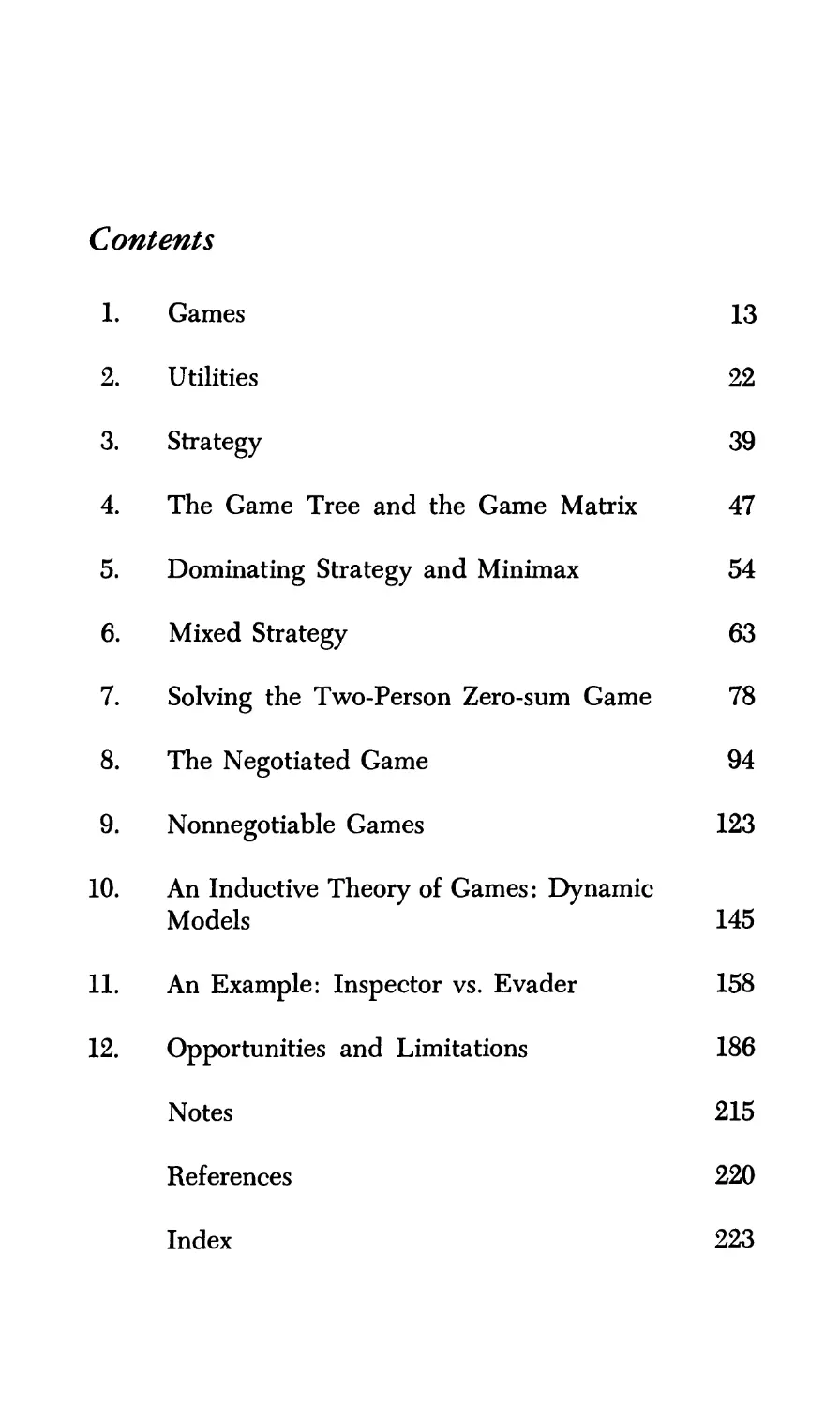
Contents
1. Games 13
2. Utilities 22
3. Strategy 39
4. The Game Tree and the Game Matrix 47
5. Dominating Strategy and Minimax 54
6. Mixed Strategy 63
7. Solving the Two-Person Zero-sum Game 78
8. The Negotiated Game 94
9. Nonnegotiable Games 123
10. An Inductive Theory of Games: Dynamic
Models 145
11. An Example: Inspector vs. Evader 158
12. Opportunities and Limitations 186
Notes 215
References 220
Index 223

This page intentionally left blank

1. Games
Game theory is to games of strategy what probability
theory is to games of chance. And just as probability
theory far transcends its role as the logical basis of rational
gambling, so does game theory transcend its original
guise as the logical basis of parlor games.
Yet the history of game theory is not a replica of the
history of probability theory. The birth of the latter is
reckoned from some problems posed by the intellectually
inclined gambler Chevalier de Mere to the philosopher-
mathematician Blaise Pascal. Probability theory received
its original impetus from attempts to solve concrete
problems.
This was not the case with game theory. No one came
to John von Neumann with questions about how to play
chess or poker. Nor do we have any evidence that von
Neumann, who laid the foundations of game theory
practically single-handed, was an outstanding expert in any
game of strategy. Nor is there any more reason to expect
such skill from a game theoretician than to expect
instrumental virtuosity from an orchestra conductor or
mechanical ingenuity from a physicist. Game theory is

14 Two-Person Game Theory
concerned not with any particular game but with all of
them, not with technical but with theoretical matters.
"What is the best way to play Chess?" is not a
game-theoretical question. On the other hand, "Is there a best
way to play Chess?" is a game-theoretical question.
It may seem at first that the question is a foolish one.
One might be convinced that of course there is a best
way to play Chess since there is a hierarchy of Chess
players. Some players are obviously better than others;
therefore they must use better ways of playing, and so
there must be a best way to play Chess.
In response to this line of reasoning, a game
theoretician would reply as follows. Yes, there is a best way to
play Chess, but the supporting arguments just given for
this conclusion are not valid. It is not true in general that
if we have a number of quantities clearly comparable
with respect to magnitude, then one of them must be the
largest. Consider, for example, the sequence of natural
numbers, 1, 2, 3, etc. Each is larger than the preceding;
yet there is no greatest natural number. Nor must the
magnitudes increase without bound so that an ordered
set of them will have no largest member. Consider, for
example, the set of all real numbers between zero and
one, exclusive of zero and one. This is an ordered set,
because of any two such numbers one is definitely the
larger. Yet the set as defined has neither a smallest nor a
largest number. To be sure, it is true that although the
magnitudes of the numbers from zero to one are not
increasing without bound, the quantity of such
numbers is infinite; and it is true that if a set ordered by
magnitude has only a finite number of members, there
must be a smallest and a largest. Therefore, the question
of whether there is a best way to play Chess is related
to the question of whether the number of ways to play
a game of Chess is finite or infinite. This number
happens to be finite. But whether it is an ordered set in the
sense that it is always possible to decide which is the

Games 15
better way of playing between any two, depends on the
principle according to which the ordering is made.
Finally, it does not follow that if there is a best way of
playing a game, the player who knows it will always
win. For the player who plays against him may also
know a "best way/' What happens when both have this
knowledge is also an open question. In some games the
victory must go to the one or to the other; in other
games, if both know a "best way to play," the outcome
must always be a draw. In still other games, not
necessarily games of chance as these are usually understood,
the outcome will nevertheless depend on chance.
All the matters just touched upon pertain to the theory
of games. They are not matters related to any specific
game; they are matters related to games in general. The
way the questions have been put suggests that games can
be classified according to the way the questions are
answered.
Game theory is, accordingly, very largely concerned
with the classification of games, and in this it has much
in common with other sciences which at a certain stage
of their development were concerned mainly with
classification.
For example, biology was for many centuries mainly a
classification science (a taxonomy). Biologists sought a
"proper" way to classify plants and animals. It would
seem at first that what the "proper" principles of
classification are depends crucially on what the classifier is
interested in. For instance, someone coming in frequent
contact with animals in a primitive life environment
might classify animals into large and small, or into
dangerous and harmless, or into edible and inedible. There
comes a time, however, when observation and
description of nature becomes more or less separated from
immediate utilitarian interests. Accordingly, biologists soon
recognized that although mice and lizards were both
small animals while horses and crocodiles were both

16 Two-Person Game Theory
large animals, nevertheless mice were more closely
related to horses than to lizards while crocodiles were more
closely related to lizards than to horses.
Formal Decision Theory
The principle according to which game theory
classifies games is best understood if game theory is viewed
as the branch of mathematics concerned with the formal
aspect of rational decision. The emphasis is on the word
"formal," which in this context means "devoid of
content." As has been said, game theory has been hitherto
developed as a branch of mathematics. Mathematics
treats of formal relations devoid of content. For
example, arithmetic is not concerned with apples, sheep, or
dollars, but only with relations among numbers be they
of apples, sheep, dollars, or divorces. Geometry is not
concerned with land tracts or shapes of objects but only
with spatial relationships. Similarly a mathematical
theory of rational decision is concerned not with the
problem of making wise decisions but with the logical
structure of problems which arise in connection with the
necessity of making decisions.
A decision problem is the problem of choosing among
a set of alternative actions. Clearly such a problem is
meaningful only if whoever must make the choice has
some idea of what the consequences of his choice may
be. In the simplest case, each choice of action leads to
a single specific consequence, so that the choice of action
is equivalent to a choice of a consequence among a set of
consequences. Hence the first condition which must be
fulfilled if a decision problem is to have meaning is that
choices have known consequences:
Next, choice is meaningful only if the chooser has
preferences. Thus the second condition which must be
fulfilled, if the decision problem is to have meaning, is
the existence of preferences of the chooser. Again we
may consider the simplest case in which all the possible

Games 17
consequences can be clearly rank ordered, calling the
most preferred consequence first choice, the next most
preferred second choice, etc. We have already assumed
that in the simplest case, each choice of action has
exactly one consequence, known to the chooser. Therefore
the decision problem in this case reduces to the problem
of assigning preference rank orders to the consequences,
noting which choice leads to the most preferred
outcome, and choosing it.
Most decision problems are not so simple. As a rule, an
action may lead to a number of different outcomes, and
which one will actually obtain in a given instance is not
known to the chooser. The structure of the decision
problem depends critically on the factors that determine
which of the possible outcomes of an action will actually
occur. If the actual outcome is determined purely by
chance, we have a decision problem under risk or
uncertainty. Probability theory is sometimes a valuable tool
in such decision problems.
In some cases the outcome of one's choice of action
will be determined not by chance but by someone else's
choice of action. These situations fall properly within
the scope of game theory. The classification of games
is guided by the sort of decision problems that arise in
the course of a game. Moreover, any situation having the
abstract (formal) features of a decision problem of the
same sort that appear in a game can also be called a
game.
In short, what distinguishes games from nongames
from the point of view of game theory is not the
seriousness or lack of seriousness of a situation, nor the
attitudes of the participants, nor the nature of the acts and
of the outcomes, but whether certain choices of actions
and certain outcomes can be unambiguously defined,
whether the consequences of joint choices can be
precisely specified, and whether the choosers have distinct
preferences among the outcomes.

18 Two-Person Game Theory
It may seem surprising that nothing has yet been said
about the rules which define a game. Rules are
important only to the extent that they allow the outcomes
resulting from the choices of the participants to be
unambiguously specified. Once these choices have been listed
and the outcomes resulting from the participants' choices
have been ordered according to the preference of each
participant, the rules according to which the game is
played are no longer of any consequence. Any other
game with possibly quite different rules but leading to
the same relations among the choices and the outcomes
is considered equivalent to the game in question? In
short, game theory is concerned with rules only to the
extent that the rules help define the choice situation and
the outcomes associated with the choices. Otherwise the
rules of games play no part in game theory. How this
comes about will, we hope, become clear in the next
chapter.
The Essential Features of a Game
Game theory is concerned with situations which have
the following features.
1. There must be at least two players.
2. The game begins by one or more of the players
making a choice among a number of specified
alternatives. In ordinary parlance such a choice is called a move.
In game theory "move" refers rather to the situation in
which the choice is made, for example, the specification
of who is to make the choice and what alternatives are
open to him. Thus the game of Chess begins with a
range of twenty alternatives open to the player called
White. [These twenty alternatives are advances of one
or two squares for each of the eight pawns (sixteen
alternatives) and two squares open to each of two knights
(four alternatives).]
3. After the choice associated with the first move is
made, a certain situation results. This situation deter-

Games 19
mines who is to make the next choice and also what
alternatives are open to him. For example, in Chess, the
players alternate in making their choices regardless of
the situation. In many card games, however, the player
to make the next choice is always the player who took
the last trick. In all games, however, it is clear in every
situation which player is to make the next choice and
what alternatives are open. In Chess, after White has
moved, Black has the same twenty alternatives
regardless of how White has moved. But this is not the case
on the next move (White's). For example, if White
advanced his King's pawn two squares on his first move,
and Black responded by advancing his King's pawn two
squares, then White cannot advance the King's pawn on
his next move. Had Black responded in any other way,
White would have that alternative open.
4. The choices made by the players may or may not
become known. In Chess all the choices are known to
both players. But in a variant of Chess called Kriegspiel
none of the choices made by one player are made known
to the other (although these choices can sometimes be
inferred from other information). This circumstance
makes this game quite different from Chess. Games in
which all the choices of all the players are known to
everyone as soon as they are made are called games of
perfect information. Chess, Checkers, Go, Backgammon,
and Tic-Tac-Toe are all games of perfect information.
Most card games are not games of perfect information.
It is instructive to see why this is so. In most card games,
the cards are dealt face down, so that each player can
see only his own hand. Imagine that Chance is a
fictitious player in such a card game. The first move is
Chance's. She is to "choose" between all the possible
arrangements of the deck. The result of this move is
unknown to the other players. Thereafter, the results of
each move may be known to everyone (e.g., if the cards
are played face up), but Chance's choice remains un-

20 Two-Person Game Theory
known at least for some time. (It may be inferred later.)
Therefore such a card game is not a game of perfect
information. The importance of singling out games of
perfect information is that in such games there is always
a "best way to play" which can be specified without
mentioning chance, while in other games this is not
necessarily the case.1
5. If a game is described in terms of successive choices
(moves), there is a termination rule. Each choice made
by a player determines a certain situation. For example,
following each move, the arrangement of the pieces on
the chessboard defines a situation. Certain situations in
Chess are called "checkmate." When such a situation
occurs, the game is ended. Many card games end when
all cards in the deck have been played; a game of Tic-
Tac-Toe ends when one player has three naughts (or
crosses) in a straight line, etc. While in common parlance
one speaks of the end of a game, in game theory one
speaks of the end of a play of the game. The word
"game" is reserved for the totality of rules which define
it. We shall for the most part adhere to the usage of
game theory, but on occasions, when there is little danger
of confusion, we shall revert to common usage in order
to avoid awkward expressions. Thus we shall say, "Three
games of Chess were played" instead of "Three plays of
Chess were played."
6. Every play of a game ends in a certain situation
(i.e., one of the situations which define the end of a
play). Each of these situations determines a payoff to
each bona fide player. A bona fide player is one who
(1) makes choices and (2) receives payoffs. Thus,
although we called Chance a player in a card game
(because she "chose" the arrangement of the cards), we
cannot call her a bona fide player, because she gets no
payoffs. In a game, as defined in game theory, there
must be at least two bona fide players, in the sense that
each of them makes choices and receives payoffs.

Games 21
Solitaire is not a game from the point of view of game
theory. The player of Solitaire is, to be sure, a bona fide
player, because he both makes choices (in the more
sophisticated forms of Solitaire) and receives payoffs (at
least wins or loses). However, the other player, Chance,
only makes choices (arranging the cards), but
receives no payoffs. Chance is only a dummy player. Nor
can the House (if solitaire is played in a gambling
establishment) be called a bona fide player, because although
the House receives payoffs, it makes no choices. Playing
the slot machine is not a game either. Curiously, the slot
machine can be considered a bona fide player. It makes
choices (to be sure at random, but this does not matter)
and receives payoffs. But the person who plays the slot
machine only receives payoffs. He makes no choices,
because the only thing he can do in each play of the
game is insert a coin and pull the lever. Therefore he is
not a bona fide player. He is only a dummy player.
If the above six criteria are satisfied, we can speak of
a game.2 A particular game is defined when the choices
open to the players in each situation, the situations
defining the end of a play, and the payoffs associated with
each play-terminating situation have been specified.

2. Utilities
So far nothing has been said about the nature of the
payoffs. In game theory it is simply assumed that numbers,
positive or negative, can be specified as payoffs for each
of the terminating situations. In card games it is quite
natural to view the money gains and losses as the
payoffs. Some games like Chess or Tic-Tac-Toe are not
usually played for money. However, the outcomes of these
games are clearly defined as "win," "draw," or "lose."
It is assumed in game theory that all outcomes can be
interpreted as numbers. For example, if the only
distinguishable outcomes are win, lose, and draw, 1 can
stand for win, —1 for lose, 0 for draw. How these
numbers are assigned is not the game-theoretician's concern.
It is conceivable, for example, that a Chess player would
rather risk losing a game than settle for a draw. It is
even conceivable that a man playing Checkers with a
child would rather lose than win. In that case a larger
payoff must be assigned to his loss than to his win.
If payoffs are in money it is quite likely that the
psychological "worths" of the amounts of money do not
correspond to their numerical values. To win $20 in a poker

Utilities 23
game may be "worth," to a given Poker player, more
than twice as much or less than twice as much as to win
$10. Since the magnitudes of the payoffs play a part in
defining a particular game, the game remains undefined
if we do not know what payoff magnitudes are assigned
by the players to the outcomes, even if the latter are
specified in terms of monetary payoffs. However, this
problem is bypassed by the game theoretician, who
assumes that the payoffs are given. Once the payoffs are
given, the game is defined. Once the game is defined,
game-theoretical analysis can be brought to bear on it.
The assumption that something is "given" is not as
crippling to a theory as might first appear. Every theory
must begin with some givens. For example, the
mathematical theory known as trigonometry purports to
specify the length of the third side of a triangle once the
lengths of the other sides included in the angle are given.
The problem of measuring the two sides and the angle of
a real physical triangle (say a tract of land) is not the
business of the trigonometer. This is the business of the
surveyor, who works with appropriate instruments. It
so happens that small errors in the surveyor's
measurements are reflected in a small error of the theoretically
inferred result. This circumstance makes trigonometry
useful as a practical science. But whether this is so or
not, a theoretical science has its own validity: its
conclusions are certain consequences of what has been
given; they need not correspond to what is factually
true.
Euclid's geometry is a more abstract science than the
applied trigonometry used by the surveyor. A theorem of
geometry says that "there exists" only one triangle with
the lengths of two of its sides and the included angle
specified. (This assertion is to be understood in the sense
that all such triangles are congruent.) Elementary
geometry does not specify how the length of the third side is
to be determined from the lengths of the other two and

24 Two-Person Game Theory
from the included angle. It says only that the length of
the third side is determined once the other two lengths
and the angle are given. This conclusion is not
"practical" in the business of surveying, because what the
surveyor wants to know is how actually to find the length
of the third side. Nevertheless the "existence" theorem of
geometry is important, for only if the theorem is true
does it make sense for the trigonometer to calculate the
third side.
Game theoretical conclusions, like all mathematical
conclusions, are based on givens and on the assumption
that these givens can be somehow made known. The
given payoffs are assumed to reflect the psychological
worth of the associated outcomes to the player in
question. The task of determining these psychologically
meaningful payoffs is the task of the psychologist, not of
the game theoretician, just as the job of measuring the
distances along the surface of the earth is the job of the
surveyor, not of the mathematician. It goes without
saying that it helps the surveyor to be versed in
mathematics. Similarly it may help the psychologist to be
versed in game theory.
While the actual determination of the payoffs is not
the game theoretician's concern, the game theoretician
has something to say about the scale on which such
determination should be made. We must therefore look
into this question.
Scales of Measurement
All measurements specify relations among magnitudes.
Once these relations have been specified, other relations
can be derived from them. For example, if A is found
to be twice В and В three times C, then we can
conclude that A is six times C. Some relations are not so
exactly specified, and the conclusions that can be derived
from them are accordingly less precise. For instance, if
all we know is that A is larger than В and В is larger

Utilities 25
than С, we can conclude that A is larger than С but not
how much larger.
It stands to reason that the more exactly relations are
specified, the more specific are the conclusions that can
be drawn from them. But not all relations can be
specified as exactly as we wish. For instance, if we read the
temperature to be 20° F. on Monday and 40° F. on
Tuesday, we can certainly say that it was warmer on Tuesday
than on Monday. But we cannot say it was twice as
warm on Tuesday. For suppose the temperatures had
been read on a Centigrade scale. Then the readings
would have been —6 2/3° С and 4 4/9° C. for Monday
and Tuesday, respectively. The second of these numbers
is certainly not twice the first. Hence the statement "It
was twice as warm on Tuesday as on Monday" is true
only with respect to the Fahrenheit scale. But the
Fahrenheit scale is not something given by nature; it was
invented by Fahrenheit, who chose the fixed points and
the size of a degree quite arbitrarily. A conclusion which
depends on these specific conventions cannot reflect an
objective state of affairs, such as the weather reflects.
It follows that it makes no sense to speak of the ratio
of two temperatures, at least on the conventional scales.
It is, however, meaningful to speak of the ratios of
differences of temperature. Suppose, for example, we read
30° F. on Wednesday. Then we could say, "The rise of
temperature was twice as much from Monday to
Tuesday as the fall from Tuesday to Wednesday." Indeed on
the Centigrade scale the temperature would have read
— 1 1/9° on Wednesday, and on that scale the rise in
temperature from Monday to Tuesday was 11 1/9°; the
fall from Tuesday to Wednesday was 5 5/9°. The first
number is indeed twice the second.
If magnitudes are given in such a way that one can
sensibly say of any two which is the larger but can say
nothing about the magnitude of the differences, these
magnitudes are said to be given on an ordinal scale.

26 Two-Person Game Theory
Thus if I can say that I prefer Keats to Shelley and
Shelley to Wordsworth (and therefore Keats to
Wordsworth), then my preferences among poets are defined on
an ordinal scale. But I may not be able to say whether
my preference of Keats to Shelley is larger or smaller
than my preference of Shelley to Wordsworth. If I can-
hot, then my scale of preference is no stronger than the
ordinal scale.
If differences of magnitude can be compared, but
nothing can be said about the ratios of the magnitudes
themselves, the magnitudes are said to be given on an
interval scale. For instance, the conventional
temperature scales are interval scales, as we have seen.
If ratios of the magnitudes themselves can be specified,
the magnitudes are said to be given on a ratio scale.
Weight, money, length, area, energy, time intervals are
all measured on ratio scales.
Of the three scales just described, the ordinal scale
is the "weakest," and the ratio scale is the "strongest."
The ordinal scale is weak in the sense that little
information is given about the magnitudes measured on it—only
the rank order of the magnitudes is given. This means
that we have much freedom in assigning actual numbers
to the magnitudes. Suppose, for example, the relative
magnitudes of A, B, and С are given by the inequality
A > В > С. We can, if we wish, assign the numbers 100,
17, and —25 to A, B, and С respectively. Or we can
equally well assign the numbers 3, 2, and 21/11. It does
not matter how we assign the numbers as long as they
are in descending order; for this is the only relation
specified by the ordinal scale of magnitudes.
Mathematically speaking, one can substitute for A, B, and С
any three other numbers А', В', С, so long as the latter
are obtained from the former by a so-called monotone
transformation—a formula that changes the numbers of
one set to the numbers of another set while preserving
their relative positions on the axis of real numbers. Ex-

Utilities 27
amples of such formulas, or mathematical functions as
they are called, are у = χ3 or у = 10x. They are called
positive monotone because the two variables always
increase or decrease together. This property guarantees
the preservation of the rank order. For example, if the
x's are 100, 17, and —25, and if we transform the x's into
y's by у = χ3, we obtain instead of 100, 17, and —25,
1,000,000, 4913, and -15,625 which are still in the same
rank order. If we transform by у = Юх, we obtain 1,000,
170, and —250 which are again in the same rank order.
But clearly the transformation у = χ2 will not do,
because this gives 10,000, 289 and 625 which are not in the
same order of magnitude as 100, 17, and —25. The
function у = χ2 is not a monotone function of x.
Mathematically speaking, the ordinal scale is invariant with respect
to positive monotone transformations.
Consider now the ratio scale, which, we said, was the
strongest of the three. If magnitudes are given on a ratio
scale, this means that the ratios of any two magnitudes
are also given. We now ask what kind of transformations
leave the ratios the same. The answer is that only the
function у = ax where a is a constant leaves the ratios
the same. If we demand that also the relative magnitudes
are preserved, then a must be a positive constant. For
example, if we multiply our three numbers 100, 17, and
-25 by 10, we get 1,000, 170, and -250. The ratio
between any two of them is clearly the same as before,
because the factor of ten cancels out in the ratio. The
transformation у = ax is sometimes called the similarity
transformation. The ratio scale is invariant with respect
to the similarity transformation.
Finally, let us look at the interval scale. The important
relation now is the ratio of differences. This relation is
left invariant with respect to the so-called linear
transformation у = ax + b. If the rank order is to be
preserved, we must also have a > 0. The ratio of the
differences among our three numbers is (100 — 17)/[17 —

28 Two-Person Game Theory
(-25)] = 83/42. Let a = 2 and b = 1. Then the three
numbers become 201, 35, —49. The ratio of the
differences is now (201 - 35)/[35 - (-49)] = 166/84 =
83/42. Thus the ratio of differences has been preserved.
The interval scale is invariant with respect to the (order-
preserving) linear transformations y = ax-fb(a>0).
(In what follows always assume that a linear
transformation is order-preserving.)
In game theory it is assumed that magnitudes assigned
to the payoffs denote the worth of the payoffs to the
respective players, and denote also that the magnitudes
can be determined on an interval scale. This means that
a player given any three outcomes, A, B, and C, can say
without ambivalence not only his order of preference
(say, A > В > С) but can also tell the ratio of the
differences among the preferences, for example, "My
preference of В over С is 3£ times greater than my preference
of A over B."
Thus the player's preference scale used in game theory
must be stronger than the ordinal scale (on which he
needs to specify only the preference order among the
outcomes) but need not be as strong as the ratio scale
(on which he would have to specify the ratio of any two
magnitudes).
Payoffs as Utilities
When payoffs are specified on an interval scale, they
are called utilities. Let us now see why it is necessary to
specify payoffs on the interval scale.
Suppose a certain game of strategy is analyzed to the
extent that a best way of playing the game is found.
Suppose now the game is played for different stakes.
What had been pennies become dollars. It is quite
conceivable that real people would play the same game
quite differently if it were played for dollars than if it
were played for pennies. But how differently they would
play we do not know without knowing quite a bit about

Utilities 29
the psychology of playing for money and, very possibly,
without knowing a great deal about different kinds of
people. Some people might take smaller risks when
playing for bigger stakes; some might take larger risks,
carried away by the excitement of playing for big stakes.
Game theory, however, is not at all concerned with such
matters. It is concerned with rational ways of playing
and this means only one thing: to get as much as
possible in terms of utilities. Therefore it should make
no difference in what units the utilities are measured.
Translated into mathematical language, this means that
the payoff scale should remain invariant under the
positive similarity transformation у = ax (a > 0).
Next, suppose all the possible payoffs of a player are
changed by having the same constant added to each of
them. This means, essentially, that whatever the
outcome of the game, the player gets a certain fixed bonus
(or pays a certain fee). Since the magnitude of the bonus
or of the fee is independent of the outcome, including
the reward or the penalty in the payoff should make no
difference in the way the game should be rationally
played by the player in question. Therefore the payoff
scale should also be invariant with respect to the
transformation у = χ + b (b constant). Combining this
transformation with the similarity transformation, we get a
linear transformation in the form у = ax + b. But if a
scale remains invariant under the linear transformation,
it is an interval scale. This is why utilities are assumed
to be given on an interval scale, namely to make them
invariant under linear transformations.
How realistic is this assumption? Recall that it implies
the player's ability to measure the ratios of differences
among his preferences. If the nature of the outcomes is
not restricted, this may mean that the player must be
able to answer questions like "How many times greater
is your preference for malaga over madeira than your
preference of madeira over port?" To expect meaningful

30 Two-Person Game Theory
(i.e., consistent) answers to questions of this sort does
not seem realistic.
Actually the measurement of utilities is supposed to be
carried out in another way. Suppose the payoffs are a
bottle of malaga, a bottle of madeira, and a bottle of
port, and suppose a player prefers wines in that order.
This determines his preferences on an ordinal scale, but
we need a stronger one, namely an interval scale. To
obtain it, we offer the player a choice between two
tickets. One ticket entitles him to a bottle of madeira.
The other ticket is essentially a lottery ticket. It will get
him a bottle of malaga or a bottle of port depending on
the outcome of an event determined by chance, where
the chances are, say, 50-50 of either outcome. Now all
the man has to decide is which ticket he prefers. No
numerical estimate is demanded of him.
Suppose, for example, the man prefers the lottery
ticket to the ticket which entitles him to madeira. Let
him now be confronted with another choice, the same as
before except that the chances in favor of malaga (his
favorite wine) have now been reduced to forty percent.
If he still prefers the lottery ticket, let the chances for
malaga be reduced still further. Somewhere along the
line before the chances for malaga are reduced to zero,
the man must change his mind; otherwise he will be
preferring a ticket which entitles him to port over a
ticket which entitles him to madeira, in contradiction to
his declared preference.
Suppose the change of mind occurs just as the chances
for malaga reach twenty-five percent. The game theorist
now determines the man's utilities (i.e., his preferences
on an interval scale) as follows. Let u0 stand for the
utility of port, u for the utility of madeira, and ui for the
utility of malaga. We can, if we wish, assign the value
0 to u0 and the value of 1 to ub because on an interval
scale the choice of the zero point and the unit point are
arbitrary. It remains merely to determine the value of

Utilities 31
u, or, which is the same thing, the ratio of the intervals
(Ui — u) and (u — uo). This is done by equating the
expected3 utility associated with lottery ticket to the
utility of madeira, namely,
.25ui + .75u0 = u. (1)
But we have set Ui = 1, u0 = 0. Therefore u = .25. On
the interval scale of utilities, then, the preference
magnitudes of malaga, madeira, and port are respectively 1,
.25, and 0. Since the interval scale is invariant with
respect to linear transformations, any other three numbers
will do provided they are obtained from 0, .25, and 1
by a linear transformation, for example, 3, 4, and 7 or
13, 17, 29: in short, any three numbers such that the
difference of the larger two is three times the difference
of the smaller two. For by indicating his indifference
between the (.25, .75) lottery ticket and madeira, the
man has effectively said "My preference of malaga over
madeira is three times greater than my preference of
madeira over port." Possibly he could not have given
such an answer directly.
Now whether in fact utility scales can be teased out by
such methods more easily than by direct questions about
relative sizes of preference differences (if at all) is an
open question. The answer depends on whether the
ratios so determined are consistent. Suppose an interval
scale is obtained on which several objects are rated, A,
B, C, D, etc. Then, if our investigation reveals that
(A-B) =2(B-C) and (B-C) =3(C-D), then we ought
to obtain 2(A-B) + 2(B-C) = 2(A-C) = 6(B-C) =
18(C-D) or (A-C) = 9(C-D). But the last relation can
be determined also directly by using A, C, and D as the
triple (offering a choice between С with certainty and
various lottery tickets involving A and D). The two
results ought to be consistent with each other if the utilities
of the four objects are to be meaningful. It is by no
means certain that data obtained from people asked to

32 Two-Person Game Theory
express preferences of this sort will be sufficiently
consistent to allow the construction of an unambiguous
utility scale.
As has already been pointed out, these matters are
not of concern to the game theoretician. His position is
that if utility scales can be determined, then a theory of
games can be built on a reliable foundation. If no such
utility scale can be established with references to any
real subjects, then game theory will not be relevant to
the behavior of people in either a normative or
descriptive sense.4
For the time being, we shall leave this question of
relevance and assume that somewhere players exist or
can be imagined for whom utility scales of payoffs can
be constructed.
Choices Between Lottery Tickets
The utility scale, as it has been defined, implies that of
two risky outcomes, the one with the greater expected
utility is always preferred. A risky outcome can be
thought of essentially as a lottery ticket entitling the
owner to any of several prizes depending on the
outcome of a chance event. Such a lottery ticket carries a
list of the prizes with the probability attached to each,
namely the probability of the event which entitles the
holder of the ticket to the prize in question. Two
examples of such lottery tickets are given:
PRIZES PROBABILITIES
(chances to win)
'Prepaid trip to Mexico City (.02)
Ford station wagon (.10)
Getting elected mayor (.00)
20 days in jail (.20)
Nothing (.38)
Win $1,000 (.19)
.Lose $1,500 (.11)
Lottery J
Ticket #1 1

Utilities 33
City (.08)
(.00)
(.12)
(.35)
(.10)
(.15)
(.20)
The definition of utility, as it is used in game theory,
implies that players can consistently choose among all
possible lottery tickets of this type.5 Let us take a closer
look at what this means.
Note that the outcomes listed on one ticket are all
listed also on the other. This can always be done if we
include outcomes with zero probabilities. For example,
"getting elected mayor" has zero probability on Ticket
#1, and "Ford station wagon" has zero probability on
Ticket #2. We could, therefore, have omitted "getting
elected mayor" from one ticket and the station wagon
from the other. But this also implies that we can add
to any lottery ticket any item which is not listed on it, if
we assign zero probability to the added item. This, in
turn, means that the lists of prizes associated with all
the relevant lottery tickets can be made identical.
Imagine now a man who must choose between Tickets
#1 and #2. Suppose Mexico City, station wagon,
getting elected mayor, and winning $1,000 are attractive to
this man, while 20 days in jail, losing $1,500, and nothing
are not attractive. Some of the attractive items appear
with greater probabilities on one ticket, some on the
other, and similarly for the unattractive items. What will
determine the man's preference? He may concentrate on
one item, for example, 20 days in jail. If he wants to
avoid this at all costs, he will be wise to choose Ticket
#1. But if he happens to want to get elected mayor at
all costs, he will choose Ticket #2. This sort of "one-
criterion decision" is easy, but it ignores the really im-
Lottery
Ticket #2
Prepaid trip to Mexico
Ford station wagon
Getting elected mayor
20 days in jail
Nothing
Win $1,000
I Lose $1,500

34 Two-Person Game Theory
portant problems of conflicting preferences. In order to
face these problems, the man must weigh advantages
against disadvantages. If he wants very much to be
elected mayor but also to stay out of jail, he will have
to estimate the relative importance to him of these
outcomes so as to know whether an increase of the
probability of being elected mayor, from zero to .12, is worth
the increase of the probability of jail from .20 to .35.
This estimate involves comparisons of two pairs of
outcomes but of course neglects all the others. We begin to
see how complex the problem becomes if all of the
outcomes must be considered.
Now, in being asked to decide between the two tickets,
the man is not asked to calculate anything. He is asked
simply to choose between the two. It is from his choices
that the theoretician will construct the man's utility
scale on which all the outcomes will be assigned
numbers (utilities). But this scale can be constructed only if
the man's choices are consistent, e.g., if having chosen
Ticket#2 over Ticket #1 and Ticket #3 (not shown
here) over Ticket #2, the man will choose Ticket #3
over Ticket #1 when this pair is presented to him for
choice. This consistency is not expected in experiments
or in real life situations. Faced with complex choices,
people are very frequently inconsistent, especially when
the outcomes are as different qualitatively as the ones
we have listed (and frequently also when the outcomes
are easily comparable, e.g., all money prizes with
different probabilities attached). Nevertheless, game theory
postulates "rational players" who are able to choose
consistently among all possible risky outcomes. The question
whether such players exist bears on the question of
whether game theory can ever be applied to behavior
(either normatively or descriptively). However, many a
theory deserves examination quite apart from the
question of its immediate applicability, and game theory is
an outstanding example of a theory of this sort.

Utilities 35
Expected Gain
Consistent choices among risky outcomes become
somewhat more likely if the outcomes are all of one
kind. Suppose all outcomes are in money, and the man
must choose between the following lottery tickets.
Ticket A <
PRIZES
rLose $10
Lose $5
Lose $1
Nothing
Win $2
Win $20
I Win $100
Ticket В <
rLose $10
Lose $5
Lose $1
Nothing
Win $2
Win $20
.Win $100
PROBABILITIES
(.05)
(.10)
(.20)
(.35)
(.25)
(.03)
(.02)
(.15)
(.20)
(.20)
(.30)
(.00)
(.08)
(-07)
Here a man might calculate his "expected gain" from
each lottery. To do this he multiplies each gain (positive
or negative) by the associated probability and adds the
products. Thus the expected gain associated with Ticket
A in dollars is
(-10)(.05) + (-5)(.10) + (-l)(.20)
+ (2)(.25) + (20)(.03) + (100) (.02) = $1.90
The expected gain associated with Ticket В is
(-10)(.15) + (-5)(.20) + (-l)(.20)
+ (20)(.08) + (100)(.07) = $5.90
The man may well choose Ticket В on that basis. Clearly
the choice is rational if it is offered many times. For then
it is highly probable that the expected gain of a ticket

36 Two-Person Game Theory
will be the actual gain averaged over many such tickets.
In fact, the maximization of expected gain is actually
used as a decision principle in businesses where actuarial
computations are made, e.g., insurance.
However, if the choice between Ticket A and Ticket В
is offered only once, it is by no means certain that
everyone will prefer Ticket B, nor that it is necessarily the
rational choice. For on the single occasion neither of the
expected gains will be realized. What will be realized is
one of the listed outcomes. In this case the expected gain
is nothing but a theoretical construct without practical
significance: it is no consolation to know that the
expected gain was $5.90 if you actually lose $10, which is
more likely if Ticket В is chosen.
A man faced with a choice between Ticket A and
Ticket В might be impressed by the fact that Ticket A
offers him thirty chances out of a hundred to win money,
while Ticket В offers only fifteen chances out of a
hundred. But if he is guided by this consideration, he is in
effect simply making a cruder calculation than that based
on expected gain. Specifically, he is equating the utilities
of all the winning outcomes. Is this rational? The theory
of utility, as it is presented in game theory, makes no
judgment about such matters. How one assigns utilities
to outcomes is the decision-maker's private affair. These
assignments are to be presumably discovered from the
decision-maker's preferences among all possible lottery
tickets, provided these preferences are consistent.
Therefore it makes no sense to ask whether it is rational always
to choose risky outcomes with greater expected utility.
Utility, as it is defined in game theory, is that quantity
whose expected gain in a risky choice is attempted to be
maximized by a decision-maker, whose choices among
risky outcomes are consistent. In short, in the context of
game theory it makes no more sense to ask whether
maximization of expected utility gain is a rational principle
of decision than to ask whether an inch is really an inch
long.

Utilities 37
This view of utility is not always well understood, and
so must be made entirely clear before game theory
proper is examined. As an example, suppose a man is
asked to bet his life savings ($10,000) on a toss of a
die, which will win him $100,000 if the ace turns up.
The expected gain (in money) of this bet is $8,333.33.
Most people would feel that it would not be wise to
accept this bet. This feeling is a reflection of a tacit
assumption that the loss of $10,000 in life savings has a
far greater disutility than one-tenth of the utility of
winning $100,000. On the other hand, suppose the man
needs $100,000 to ransom his child from murderous
kidnappers and that this bet is the only way he can
procure the amount. His acceptance of the bet becomes
understandable.
Another important problem raised in connection with
the use of utilities is that of comparing the utilities for
the same outcome of different people.
Suppose two people, A and B, must decide jointly
between two alternatives, say between two business
ventures X and Y. Should they undertake venture X, A will
make $200 while В will make $400. If they undertake
venture Y, A will make $500, while В will make $200. It
stands to reason that A prefers Y, while В prefers X.
One might argue that it makes more sense for them to
undertake Y, since jointly they will make more in that
venture. It would, indeed, be worthwhile to A to pay В
$250 in order to induce him to join in venture Y, since
as a result A will have made $50 more than in venture
X, and so will B. This arrangement is reasonable if (1)
it is possible for the money to be transferred, (2)
agreements about the transfer are enforceable, and (3) in
being transferred, money preserves its utility. Situations
can be easily imagined where any or all of these
conditions are violated. Moreover, outcomes of decisions are
not always associated with monetary payoffs.
Suppose, for example, venture Υ will bring A a much
larger profit but will cost В his self-respect. It is now

38 Two-Person Game Theory
more difficult to argue that A can compensate В by
turning over a portion of his profits to him. To be sure,
there are versions of economic theory in which all
utilities can be reduced to a common measure like money;
but the realism of such theory is open to question. At
any rate it would be desirable to have a theory of
rational conflict in which such an assumption need not be
made.
Now if the utility of each party (a party is represented
by a set of interests) is given on an interval scale, the
question of comparing the utilities for a given outcome
of two or more parties need not arise, in fact, cannot
arise, for in that case such comparisons are meaningless.6
Whether the assumption of an interval scale for
utilities is psychologically realistic is another question, and
one against which much evidence can probably be
marshalled. This assumption is made in order to avoid
psychological issues, such as whether utilities of
different parties can be meaningfully compared.
Having by-passed all the psychological problems
associated with the measurement of utilities or, indeed, with
the question of whether consistent utility scales can be
established at all, two-person game theory makes only
one demand, namely that whatever utility scale is
established, it shall be an interval scale. This means that
whatever decisions are prescribed in risky choices, they should
remain the same if the decision-maker's utility scale
undergoes a linear transformation. If the utilities
associated with a certain set of outcomes are denoted by
u(oi), where ob o2, . . . on are the outcomes, no
conclusion of the theory should be affected if instead of u(oi)
we write au(oi) + b where a and b are arbitrary
constants, a > o. Moreover, we can choose a and b
differently for each of the players in a game.
We shall henceforth accept this basic assumption of
two-person game theory.

3. Strategy
Race-to-Twenty is a children's game which is a simple
version of the ancient game of Nim. In our discussion
the extreme simplicity of Race-to-Twenty will enable us
to analyze the game completely. The idea of strategy
will come out of this analysis.
In Race-to-Twenty, two players count from 1 to 20
alternately, each player having a choice of advancing
the count by either one or two numbers. Thus the first
player may say "One" or "One, two." If he says "One,"
the second player may say "Two" or "Two, three"; if the
first player says "One, two," the second player may say
"Three," or "Three, four," etc. The player who says
"Twenty" first wins.
A little reflection shows that player 1 must always
win. He will certainly win if he can say "Seventeen." For
in that case, if player 2 says "Eighteen," the first player
can say "Nineteen, twenty"; if the second player says
"Eighteen, nineteen," the first player can say "Twenty."
Similarly the first player can always say "Seventeen" if
he can say "Fourteen"; he can say "Fourteen" if he can
say "Eleven," and so on with "Eight," "Five," and "Two."

40 Two-Person Game Theory
But player 1 can start the count with "One, two."
Therefore, he will always win, provided he ends his successive
counts on five, eight, eleven, etc. To win, he must adhere
to the following policy: always end the count with a
number which upon division by 3 gives remainder 2.
The critical numbers, 2, 5, 8, 11, 14, 17, and 20 all give
remainder 2 upon division by 3. The mathematician says
these numbers are congruent to 2 modulo 3. Two
numbers congruent to a third are congruent to each other.
We can, therefore, also formulate the policy so: always
end the count on a number congruent to 20 modulo 3.
This idea of "congruence modulo some number"
immediately enables us to generalize the winning policy
of any game of this sort, where the target number may
be chosen at will and each player has a choice of
advancing the count by any of a set of successive numbers.
Suppose, for example, the target number is 57, and each
player can advance the count by one, two, three, four,
or five consecutive numbers. Then the winning policy for
the first player is the following: always end the count
by a number congruent to 57 modulo 6. And in general,
if the target number is N and the count may be advanced
by 1, 2, . . . or k, the first player will win if he ends all
his counts on numbers congruent to N modulo к + 1.
The statement, always end the count on a number
which . . . etc., is clearly a set of directions which tells
a player what he is to do in every possible situation in
which he may find himself while playing one of the
games just described. A strategy is essentially just that.
It is, of course, not always possible to give such
instructions in so compact a form. For example, in order to
state a strategy for the game of Tic-Tac-Toe, one needs
many more words than in the case of Race-to-Twenty,
because we do not have terms to express the various
classes of configurations which may arise. Specifically,
the description of a strategy chosen by player 1
(Naughts) might start as follows. "My first naught will
be placed in the center square. Should Crosses (player
2) play in a corner, I will play in the diagonally oppo-

Strategy 41
site corner. . . ." This does not complete the
description, which becomes more and more involved as it
proceeds, because the next choice must be given in all
the possible situations which may arise. These become
progressively more numerous, because Naughts must
take into account all possible choices of Crosses, stupid
ones as well as intelligent ones. After this is done, one
strategy has been described.
How many of such strategies are there in a game? How
many would there be in a game like Tic-Tac-Toe, and
in how many different ways can a game of Tic-Tac-Toe
be played? Although the latter number is quite large, it
does not compare in magnitude with the number of
possible strategies. This is important to keep in mind,
because it is easy to confuse the idea of strategy with
that of a particular realization of a game, which is
determined by a pair of strategies.
In Tic-Tac-Toe, the first player has a choice of
nine boxes in which to put his naught. Then the
second player has a choice of eight boxes in which
to put his cross. Then the first player has a choice
of seven boxes in which to put his naught, etc. The
game ends, of course, when one of the players has
placed three of his marks in a row. This can happen
at the earliest on the fifth move. Therefore the game
can last anywhere from five to nine moves. Actually a
game of Tic-Tac-Toe is usually broken off when it
becomes obvious that one of the players must win or that
neither can win. But if we are to go by this criterion,
then every game of Tic-Tac-Toe should be broken off
before it starts, since a complete analysis reveals that
neither player can win if both play correctly. We shall
suppose, however, that every game is played out to the
bitter end, and for simplicity of calculation we shall
suppose that the game continues until all the boxes have
been filled, even if a player has succeeded in getting
three in a row. So calculated, the number of different
ways a game of Tic-Tac-Toe can be played is 9 X 8 X
7x6x5x4x3x2 = 362,880 ways. This number is

42 Two-Person Game Theory
inflated, because it includes all the plays of the game that
have continued even after one player has won. The
number is inflated also in another way. It includes plays
of the game which show the same record (i.e., plays
where naughts and crosses are in the same boxes but
which happen to have been arrived at by different
sequence of choices). We can easily correct for this by
calculating the number of ways five naughts can be put
into nine boxes (for this leaves the other four boxes for
crosses). This number turns out to be 126, much smaller
than our original estimate of 362,880. But even 126 is an
inflated value if one does not wish to distinguish
between outcomes which can be considered equivalent. For
example, compare the two outcomes shown in Figure 1.
(a)
Fig. 1
(b)
Obviously (b) can be obtained from (a) by rotating (a)
clockwise through 90°. Should not therefore (a) and
(b) be considered the same outcome? This depends, of
course, on the purpose of the classification, i.e., the sort
of analysis the classification is supposed to serve.
We see, then, that the question of how many different
ways a game can be played does not have a clearly
defined answer unless we specify how we wish to classify
the different outcomes.
With strategies the situation is similar. In order to fix
ideas, we shall calculate the largest possible value of
the number of strategies possible in Tic-Tac-Toe, for this
number is the easiest to calculate.

Strategy 43
We note that the first player can start the game in nine
different ways. On the next move, the second player has
eight choices, after which the first player has seven
choices. Now the number of ways in which the first
player can specify what he will do on the third move in
response to each of the other's choices is 78. Similarly
the number of ways in which the first player can specify
what he will do on the fifth move in response to the
other's six choices is 56, and the number of ways in which
the first player can specify what he will do on the
seventh move in response to each of the other's four
choices on the sixth move is 34. On the ninth move,
however, the first player can do only one thing, namely put a
naught in the only box left. Thus the number which is
sufficient to encompass all of the first player's strategies
is 9 x 78 X 56 Χ 34 = 65,664,686,390,625.
Like our previous estimates of the number of
outcomes, this number is strongly inflated. In order to trim
it down, we would have to take into account the
symmetries inherent in the structure of the game. This is by
no means an easy task. Therefore, the question, "How
many different strategies are available to each of the
players in Tic-Tac-Toe?" remains open. The answer
depends on which strategies we are willing to consider
equivalent, for practical purposes. "For practical
purposes" is to be understood in terms of what is important
in the strategic structure of the game.
The importance of the idea of strategy stems not
from the possibility of analyzing a game but rather from
the resulting conceptualization of a game. In common
parlance we speak of flexible and of rigid plans of action.
We call a plan of action rigid if it contains few
contingent decisions, and flexible if it contains many such
decisions. Plans made long in advance of the action we
associate with rigidity, implying that to be flexible, one
must be willing to wait and see, to defer decisions until
one has taken into account the way a situation develops.
This conception of flexibility may be valid in real life, but

44 Two-Person Game Theory
it is irrelevant to the notion of strategy, as the term is
defined in game theory. One might think that making
a commitment to a definite strategy before the play of
the game starts is tantamount to abandoning flexibility,
but this is by no means the case. A strategy, as we have
defined it here, already contains in it all the
contingencies which can possibly arise. Deferring decisions until
the corresponding choice must be made does not increase
flexibility. Any feeling to the contrary which we may
have stems from the well-known circumstance that in
real life unforeseen developments occur. In the
situations defined as games in game theory there are no such
unforeseen developments. Everything that can possibly
occur in the course of a play of a game is known. What
is not known is the way the opposing player will actually
choose each of his moves. But all the choices open to
him are known. A strategy is a plan which provides for
every possible choice on the part of the other player.
To emphasize the irrelevance of the notion of rigidity
to that of strategy choice, consider the following strategy
chosen by player 1 in Race-to-Twenty. "Whatever he
does, I shall continue the count by two." Our
immediate reaction to this strategy is that it is too rigid. We feel
the player should make his responses contingent on the
other player's responses. For example, if the other says
"Ten" it is better to continue with one number and say
"Eleven." And if he says "Nine," it is better to continue
with two numbers and say "Ten, eleven." However, this
is merely one way of describing a winning strategy.
Another way of describing it follows: "Whatever the other
does, I shall end my counts on numbers congruent to 2
modulo 3." Actually this strategy seems no more flexible
than the preceding one, but it nevertheless encompasses
a maximum of flexibility, because it has made provision
for every possible eventuality.
In short, what we mean by flexibility in common
parlance is really bound up with the inherent uncertainty
of the real world. Things are always coming up not

Strategy 45
listed in the contingencies with which we are familiar.
Flexibility means remaining uncommitted to the extent
of allowing oneself some leeway to design ways of
dealing with these unforeseen events. Such events are
deliberately excluded from consideration in game theory.
This, as well as the many other simplifications assumed
in game theory, may have an important bearing on the
extent to which game theory can be applied to practical
affairs, but no bearing on the conceptual value of game
theory.
However large the number of strategies, they are not
infinite, so long as the number of possible moves and
the number of choices on each move remains finite. Next,
it should be clear that once each player has chosen a
strategy among all the strategies available to him, the
course of the game is completely determined. This is
not to say that each player is in a position to know at
the beginning of the game how it will turn out. He
cannot know this without knowing the other player's
strategy as well as his own. But an observer who knows
which pair of strategies has been chosen (one by each
player) can, in principle, figure out the exact course of
the game. The qualification "in principle" is, of course,
crucial, because the vast numbers of strategies and the
practical impossibility of specifying even a single
strategy in words (for any but the most trivial games) makes
it humanly impossible to carry out the necessary
calculation. It cannot be emphasized too strongly, however, that
detailed analysis of specific games is not a test of game
theory. The theory is concerned only with the logic of
strategic analysis. Accordingly, the fact that a single
choice of a strategy by each player is in principle
sufficient to determine the course of the play, and hence
the outcome, enables the game theoretician to continue
the analysis on another level. Instead of worrying what
is likely to happen on each move, while the possibilities
become super-astronomically numerous, the game
theoretician can reduce the question to what will happen

46 Two-Person Game Theory
as a result of a choice by each player of a single
strategy.
The number of strategies available to each player, as
we have seen, is finite. Suppose, therefore, the strategies
available to player 1 are numbered from 1 to N, and
those open to player 2 from 1 to M. Each pair of
strategies chosen can be designated by (i, j), meaning that
the i-th strategy was chosen by player 1 and the j-th by
player 2. This pair determines an outcome Оц. The
mathematician says that the variable outcome Оц is a function
of two variables, i and j. If we arrange all the possible
outcomes Oij (some of which may well be identical) in
a rectangular array of N rows (i = 1, 2 . . . N) and Μ
columns (j = 1, 2, . . . M), we shall have the
corresponding game represented by a matrix, which depicts
the entire strategic structure of the game. When games
are classified and conclusions about them are drawn
according to the properties of these matrices, the resulting
theory is called the theory of games in normal form.
Practically the entire theory of two-person zero-sum
games is stated as a theory of games in normal form. The
next four chapters will be devoted to this topic. The
paradigm of a game in normal form is shown as Game 1.
1 2 j Μ
Oil
Ои
ой
1 Oni
ои
Ου
Оц
Ош
Onm
Game 1

4* The Game Tree and
the Game Matrix
One of the keystone ideas of game theory is that any
"well defined" game can be reduced to normal form. As
we have said, a game in normal form presents to each
player a choice among several alternatives called
strategies. When such a choice is presented, it suffices for each
player to choose one of the strategies available to him.
It is essential that every player make his choice
simultaneously or, what is the same thing, in ignorance of
what choices are made by others. (We shall examine
below the consequences of violating this condition.) The
simultaneous choices of respective strategies determine
an outcome of the game, which, in turn, specifies the
payoff to each player. These payoffs may be positive or
negative and are supposed to be represented in units of
utility.
Typical parlor games are, of course, not described in
normal form. Instead they are defined by rules, among
which the most essential are those that specify what
choices a player has in each possible "position" resulting
in the course of the game. So conceived, a play of a

48 Two-Person Game Theory
game is a sequence of moves or choice points, at which
now one, now another player must choose among
available alternatives, i.e., the legal moves. This form of the
game also has a representation called the extensive form
of the game. We can now restate the first sentence of
this chapter as follows: every game can be reduced
from the extensive form to the normal form. This implies
what is meant by a "well defined" game, namely a game
which can be represented in extensive form.
Let us see how the extensive form is obtained and how
the reduction to normal form is made. We cannot take
any "real" game as a working example, because, as we
have seen, even a very simple child's play like Tic-Tac-
Toe would involve an enormous number of strategies if
put into normal form. We must therefore confine our
examples to artificial games, invented specifically for
illustrative purposes. Although such games must
necessarily be much simpler than even Tic-Tac-Toe, they
illustrate the basic principles equally well.
We shall analyze a game called Square-the-Diagonal.
It is played by two players as follows. The first player,
whom we shall call Castor, has a choice of 1, 2, or 3 units.
When he has made his choice, the second player, Pollux
(knowing what the first player has chosen), has a choice
of 1 or 2 units. Following this, Castor, knowing how
Pollux has chosen, again has a choice of 1, 2, or 3 units.
Imagine that each choice determines respectively the
length, the width, and the depth of a box. The box
determined by a play of the game will have dimensions x, y,
and z, corresponding to the three consecutive choices of
the two players. The square of the length of its diagonal,
therefore, will be x2 + y2 + z2.7 The payoffs to each of
the players will be determined by what this magnitude
turns out to be. Namely, if for a particular outcome
x2 + y2 + z2 is congruent to 0 or 1 modulo 4 (i.e., leaves
a remainder of either 0 or 1 upon being divided by 4),
then the amount x2 + y2 + z2 will be won by Castor. If

The Game Tree and the Game Matrix 49
x2 -f y2 + z2 is congruent to 2 or 3 modulo 4, that amount
will be won by Pollux.
Our game is now completely defined and can be
represented in extensive form. This is done by constructing
the game tree, a diagram in which all the choices and
the resulting positions, including the final outcomes, are
displayed. Square-the-Diagonal is shown in extensive
form in Figure 2.
<-6
Castor's
Choice
Pollux'
Choice
Castor's^^^ „22
Choice
Outcomes
(Castor's Payoff)
Fig. 2. The Square-the-Diagonal game in extensive form.
From the game tree we see that if Castor starts the
game by choosing 1 unit, Pollux can always be sure of
winning something, for Pollux can choose 1 unit, which
gives Castor a choice among losing 3, losing 6, or losing
11, depending on whether he chooses 1, 2, or 3 units for
the depth of the box.

50 Two-Person Game Theory
Similarly, if Castor starts with 3 units, Pollux can again
make sure that Castor will lose something, namely by
choosing 1 unit, which gives Castor a choice of losing 11,
14, or 19.
The matter looks different if Castor starts by choosing
2 units. For then, if Pollux continues with 1 unit, Castor
can win 9 (by choosing 2 units on the final move); if
Pollux continues with 2 units, Castor can win as much
as 17.
It follows that Castor can guarantee himself a win of
9 by starting with 2 units. Pollux can do nothing to
prevent Castor from winning at least 9. If Pollux is not
careful, he may lose as much as 17. On the other hand,
Castor cannot hope to get more than 9 unless Pollux
makes a stupid choice. For if Castor starts with anything
but 2 units (say, with 3 in the hope of getting 17),
Pollux can win as much as 11 by continuing with 1 unit.
To obtain 17, Castor must count on Pollux's cooperation,
i.e., on his continuing with 2 units following Castor's 3.
But there is no reason for Castor to hope that Pollux will
do this.
So far our analysis has proceeded sequentially from
move to move. Let us now reduce the game to normal
form so that a play of the game can be represented by
a single simultaneous choice of strategy by each of the
players.
It turns out that Castor has twenty-seven strategies.
The first nine of these are as follows.
Ci: Choose 1 unit on each of the first and third moves,
regardless of how Pollux chooses on his move.
C2: Start with 1. On the third move do what Pollux
has done on the second.
C3: Start with 1. On the third move do the opposite
of what Pollux has done on the second.
C4: Start with 1. On the third move choose 2,
regardless of how Pollux has chosen.

The Game Tree and the Game Matrix 51
СГ): Start with 1. On the third move respond with 2 to
Pollux' 1 and with 3 to his 2.
C6: Start with 1. On the third move respond with 3 to
Pollux' 1 and with 2 to his 2.
C7 Start with 1. On the third move choose 3
regardless of Pollux' choice.
C8: Start with 1. On the third move respond with 1 to
Pollux' 1 and with 3 to his 2.
C9: Start with 1. On the third move respond with 3 to
Pollux' 1 and with 1 to his 2.
The next nine strategies prescribe the same
contingencies respectively as the first nine but they all
prescribe 2 as Castor's first move. The last nine prescribe 3
as Castor's first move and thereafter follow the same
pattern as all the others. This completes the twenty-seven
strategies available to Castor.
Pollux has eight strategies. Each of them can be
designated by three numbers, each number (1 or 2) being
understood as the response which Pollux will make to
Castor's choice of 1, 2, or 3 units respectively. Thus
Pollux' eight strategies are the following:
Pi: 1, 1, 1
P2: 1, 1, 2
Рз: 1, 2, 1
P<: 2, 1, 1
P6: 2, 2, 1
Pe: 2, 1, 2
Pt: 1,2,2
P8: 2, 2, 2
Combining Castor's twenty-seven and Pollux' eight
strategies into a matrix, we have the game of Square-the-
Diagonal in normal form see (see Game 2). The payoffs
are the entries in the boxes of the matrix. By convention,
only the payoffs to Castor (the chooser of the strategies

52 Two-Person Game Theory
Pi
P3
P4 P6
P7
Cl
o2
o3
04
c5
c,
c,
0,
c,
Сю
Ou
C12
C13
Cm
C16
C16
c„
C18
C19
C20
С21
C22
C23
C24
C26
C26
C27
-3
-3
-6
-6
-6
-11
-11
-3
-11
-6
-6
9
9
9
-14
-14
-6
-14
-11
-11
-14
-14
-14
-19
-19
-11
-19
-3
-3
-6
-6
-6
-11
-11
-3
-11
-6
-6
9
9
9
-14
-14
-6
-14
-14
17
-14
17
-22
17
-22
-22
-14
-3
-3
-6
-6
-6
-11
-11
-3
-11
9
12
9
12
17
12
17
17
9
-11
-11
-14
-14
-14
-19
-19
-11
-19
-6
9
-6
9
-14
9
-14
-14
-6
-6
-6
9
9
9
-14
-14
-6
-14
-11
-11
-14
-14
-14
-19
-19
-11
-19
-6
9
-6
9
-14
9
-14
-14
-6
9
12
9
12
17
12
17
17
9
-11
-11
-14
-14
-14
-19
-19
-11
-19
-6
9
-6
9
-14
9
-14
-14
-6
-6
-6
9
9
9
-14
-14
-6
-14
-14
17
-14
17
-22
17
-22
-22
-14
-3
-3
-6
-6
-6
-11
-11
-3
-11
9
12
9
12
17
12
17
17
9
-14
17
-14
17
-22
17
-22
-22
-14
-6 1
9
-6
9
-14 1
9
-14
-14
-6
9
12
9
12
17
12
17
-6
-14
-14
17
-14
17
-22
17
-22
-22
-14
Game 2

The Game Tree and the Game Matrix 53
shown as horizontal rows) are entered, it being
understood in this case that the payoffs to Pollux are
numerically the same as those to Castor but with the sign
reversed.
In our analysis of the game in extensive form we have
seen that Castor should start with 2. Thereafter, if
Pollux continues with 1, as he should, Castor ought to follow
with 2. He will then win 9, the amount which the game
guarantees to him. If Pollux should (foolishly) play 2,
following Castor's 2, then, of course, Castor should finish
with 3 to get 17. This eventuality should also be foreseen
in Castor's calculation. Therefore Castor's best strategy
is the following: start with 2. If Pollux plays 1, play 2;
if 2, play 3. This is designated as Ci4 in the game matrix.
What is Pollux' best strategy? If Castor should start
with 1, obviously Pollux should reply with 1, thus
insuring a positive payoff for himself (negative to Castor). If
Castor should start with 2, Pollux should avoid 2, for
this would give Castor the opportunity of winning 17.
Pollux' best answer to Castor's 2 is 1. If Castor should
start with 3, Pollux' best answer is again 1, for this too
assures Pollux a positive payoff. Therefore Pollux' best
strategy is the following: regardless how Castor starts,
play 1. We have symbolized this strategy by the triple
(1,1,1). It corresponds to strategy Pi in the game matrix.
Consulting the game matrix, we see that the outcome
determined by the players' simultaneous single choice of
their respective best strategies is identical with the
outcome predicted by the analysis of the game in extensive
form. This is the outcome found at the intersection of
Castor's strategy Ci4 and Pollux' strategy Pb

5. Dominating Strategy and Minimax
Referring once more to Game 2, let us compare
Castor's strategy C14 with Ci2. We see that regardless of
which strategy is chosen by Pollux, Castor will do at
least as well with Ci4 and possibly better (if, for
instance, Pollux should choose P3) than with C12. We say
that Си dominates Ci2. Similarly, Pollux' strategy Pi
dominates P3, since Pollux does at least as well with Pi
and possibly better (e.g., if Castor chooses Сю or Ci»).
We said that Px is Pollux' best strategy. This does not
mean, however, that Pi dominates every other strategy
available to Pollux. For example, Px does not dominate
P2. Pollux does not do better, or even as well, with Pi
regardless of Castor's choice. Should Castor choose С2з,
Pollux does better with P2 than Pi. A strategy which
dominates every other strategy is, of course, obviously
the best strategy, since it is unconditionally at least as
good (or possibly better) than any other by definition of
domination. Neither of the two strategies which we have
singled out as best for each of our two players,
respectively, dominates every other. However, strategies С!4
and Pi are best, respectively, against a player assumed
to be "rational."

Dominating Strategy and Minimax 55
The conclusions of game theory are typically based on
such an assumption. In the course of our discussion, we
shall frequently subject this assumption to closer scrutiny,
but for the time being we shall continue to base our
arguments upon it. However, we shall note at the outset
that "rationality" can have many meanings. In particular,
we can speak of levels of rationality, depending on how
much of the environment (including the thought
processes of the other player) is taken into account in arriving
at choices of action.
As an example, consider a game in which a player has
a strategy available which dominates all the other
strategies. Clearly a "rational player" will choose such a
strategy in preference to all the others. Note that the level of
rationality required for arriving at this choice is not high.
One needs only to note that the strategy in question is at
least as good and possibly better than all the others
regardless of what the other phyer does. The principle
which dictates the choice of such a strategy is sometimes
called the "sure thing principle," so-called because it is
unnecessary in arriving at a decision to take into account
what the other player may do.
The possibility of the existence of dominating
strategies in games suggests a classification of games
according to the level of rationality involved in their "solution,"
i.e., the discovery of strategies to be prescribed as
rational, namely games in which (1) each player has a
dominating strategy, (2) only one of the players has
a dominating strategy, and (3) neither of the players has
a dominating strategy.
An example of a game in which both players have
dominating strategies is shown in Game 3.
Clearly Castor's dominating strategy is C2, which
gives him a larger payoff than either of the others
regardless of Pollux' choice. Similarly Pollux' dominating
strategy is Pi. (Recall that Pollux' payoffs are the negatives of
Castor's.)

56 Two-Person Game Theory
Pi P2 Рз
-3
-1
-2
0
5
2
1
2
0
Game 3
An example of a game in which only one of the players
has a dominating strategy is shown in Game 4.
Pi P2 Рз
-3
1 -1
1 ~2
0
5
-4
-10 1
2 1
0
Game 4
Here Castor still has a dominating strategy, C2. But
none of Pollux' three strategies dominates either of the
others. We see that Pi is better than P2 against Castor's
Ci and C2 but not against C3; Pi is better than P3
against C2 and C3 but not against Cx; P2 is better than
P3 against C3 but not against either of the two others;
etc.
In this game, therefore, although Castor need not
consider what Pollux will do, Pollux must consider what
Castor will do. Since Castor has a dominating strategy,
what he will do (if he is rational) is obvious; he will
choose the dominating strategy. On the basis of that
assumption, it is quite clear what Pollux should do,
namely choose Pb which is best against C2.
Finally we may have a game in which neither player
has a dominating strategy. An example of such a game is
shown in Game 5.

Dominating Strategy and Minimax 57
Pi P2 Рз
-3
-1
-2
18
5
-4
-20
2
15
Game 5
Here it is no longer obvious to either player what
strategy should be chosen. Nor can either player decide
on obvious grounds what the other is going to choose.
Let us try to arrive at a rational decision by reasoning
about the strategic structure of this game. Let us select
some provisional principle of choosing a strategy. A
number of such principles come to mind. One might,
for example, choose the strategy which offers the
possibility of the largest payoff. For Castor this would be the
row which has the biggest entry in it. Another possible
principle would be to choose the strategy with the
largest average payoff (assuming that the choices of the
other player are equiprobable).
It should be apparent that neither of these principles
satisfies the criterion of maximizing one's own payoff
under the constraints of the game. For the single
crucially important constraint on the game is the rationality
of the opponent. One should therefore assume that
whatever one has figured out to be to one's advantage, the
opponent has also figured out; and he may be able to
prevent the hoped-for outcome. Respect for the
opponent's perspicacity is a typical example of rationality
in games of strategy. Experienced chess players,
playing against able opponents, usually do not build their
strategies around plans in which a crucial element is the
expectation that the opponent will not see the traps set
for him. In short, a rational player does not expect stupid
decisions from his opponent.
Suppose now Castor, playing Game 5, chose by the

58 Two-Person Game Theory
first principle, namely Cb where his biggest payoff is
entered (Cb P2). He must now ask himself "What
would Pollux do if he knew what I am about to choose?"
The answer is obvious. On the basis of Castor's row I,
Pollux would P3. The resulting payoff is a loss of 20 to
Castor. Surely Castor can do better than that.
Let us now suppose that Castor chooses the strategy
with the largest average payoff, namely C3, the average
being computed by assuming that Pollux' choices are
'equiprobable. This choice is already questionable on the
grounds that there is no reason to suppose that Pollux
will choose at random from his three strategies. Nor
does it help to assign probabilities to Pollux' possible
choices without somehow justifying these probabilities
on grounds other than one's belief or hunch. Let us,
however, pursue the implication of the policy just assumed.
Consider what would happen if Pollux knew that Castor
is choosing the row with the greatest average payoff to
him. Knowing this, Pollux would choose P2 to win 4
from Castor. As we shall see, Castor can do better than
this.
From the game matrix (Game 5) we see that Castor
has a guaranteed payoff, namely — 1, which he is sure to
get (possibly more) if he chooses C2. Observe that
there is a "worst" outcome for Castor in each of the rows.
(We assume that if several outcomes are "equally worst,"
any one of them can be taken to be the worst.)
Suppose Castor were to choose the row which contains
the best of these worst outcomes. (Again we assume
that if several outcomes are "equally best," any one of
them can be called the best.) Then no matter what
Pollux did, Castor would be sure to get at least this best of
the worst. Next, suppose Pollux assumes that Castor will
do just that. Specifically, suppose that Pollux has
assumed that Castor has chosen C2. Clearly Pollux should
on the basis of this assumption choose Pi. Now knowing
that Pollux, acting on the assumption that Castor has

Dominating Strategy and Minimax 59
chosen C2, has chosen Pb Castor must choose C2, which
is best against Pi.
In this way, the joint choice (C2, Pi) appears as a
sort of equilibrium or "balance of power." The payoff
in that entry is the best that either of the players can do,
given that he is playing against a rational opponent.
An entry such as (C2, Pi) is called a saddle point of
the game matrix. The term is suggestive. The center of a
saddle is the lowest point on the horse's back in the
horse's longitudinal plane (i.e., as one moves from front
to back) and at the same time the highest point in the
plane perpendicular to the horse's motion (i.e., as one
slides from side to side). Hence the saddle point is at the
same time a minimum and a maximum. The term
"minimax" (or "maximin"), frequently used in game theory, is
in this context synonymous with saddle point.
A game matrix may have more than one saddle point.
An example is shown below:
Pi P2 P, P4 P6
10
-5
-4
4
6
2
0
-1
2
-3
3
1
8
7
5
2
-7
-7
2
0
3 1
-4 1
10
5
0
Game 6
Here the entries (Cb P2), (C4, P2), (Cb P4), and
(C4, P4) are saddle points. ("Saddle point" will refer
in our discussion both to the row-column position and
to the associated payoff.) Take (d, P2) and (C4, P4),
which are both in different rows and in different columns.
Clearly they cannot be the only saddle points in a game

60 Two-Person Game Theory
matrix, if the entries in them are equal. For if these were
the only saddle points, then the entry in (Cb P4) would
have to be at least as large as the saddle point entry in
(Ci, P2) and at most as large as the saddle point entry
in (C4, P4). But the entries in (Cb P2) and (C4, P4)
are equal, and therefore must be equal to the entries in
(Ci, P4) and in (C4, P2). Suppose now, two saddle
points in different rows and different columns were not
equal. Let aij, the entry in the i-th row and j-th column,
be smaller than akh, the entry in the k-th row and h-th
column. Then the entry akj must be at least as great as
akh, being in the same row of which akj is minimal. But
then akj is larger than ац, contrary to the assumption
that au is a saddle point and hence maximal in the j-th
column.
We are thus led to the conclusion that if (i, j) and
(k, h) are both saddle points, then their entries must be
equal, and moreover (i, h) and (k, j) are also saddle
points with entries equal to those in the other two. In
short, when we speak of "the" saddle point of a game
matrix, we may mean one of the (equal) entries of any
of its saddle points.
The minimax principle can now be restated as follows:
If a two-person zero-sum game has saddle points, the
best each player can do (assuming both to be rational)
is to choose the strategy (i.e., the row or column of the
game matrix) which contains a saddle point.
We have seen that if the game matrix has several
strategies containing saddle points, then regardless of how
the players choose their strategies, the outcome (in
the sense of payoffs) will be the same: namely the
payoffs will be entered in the saddle points, which are all
equal.
Let us return to the game matrix (Game 2) of Square-
the-Diagonal. We see six saddle points, namely, (Ci2,
Pi), (Cis, Pi), (C14, Pi), (C12, P4), (C13, P4), and (C14,
P4). These are saddle points, because their entries are

Dominating Strategy and Minimax 61
both the smallest in the corresponding rows and the
largest (taking sign into account) in the corresponding
columns. (Recall the smallest and largest means any one
of the smallest or largest.) Note that there are several
other boxes of the game matrix with entry 9, but none
of the others is a saddle point.
According to the minimax principle, then, Castor should
choose either C12, or C13, or Ci4 (it doesn't matter
which), while Pollux should choose Pi or P4 (it does not
matter which).
Let us nevertheless compare Ci2, C13, and Ci4. We
find that C14 dominates the other two. Therefore from
a certain point of view C14 should be preferred to Ci2
and to Ci3. We see that the choice of Ci4 by Castor
allows him to cash in on a possible mistake by Pollux, for
example, if Pollux should (foolishly) choose P3, P5, or
P7. However, if we continue to assume the players'
rationality this additional consideration should play no
part in choosing a strategy among those which contain
a saddle point.
Comparing Pi and P4, we see that neither dominates
the other. For example, Px is better than P4 against C4,
but P4 is better than Ρχ against C5. Therefore there is no
additional consideration (such as providing for Castor's
possible mistakes) that can be conclusive for Pollux'
choice between Pi and P4. If Castor is not expected to
make a mistake, the choice between Ρχ and P4 is
indifferent. In order to make his choice, if he has reason to
suppose that Castor will make a mistake, Pollux must know
what sort of mistake Castor will make. We must keep in
mind that the choice of strategy (unlike the choice of
sequential moves) is made before the game starts and
that by definition of strategy no information obtained
in the course of play in a game is relevant to changing'
the strategy in the course of the game.
The minimax principle constitutes a general solution of
all two-person zero-sum games with saddle points. It is

62 Two-Person Game Theory
not a practical solution; it does not determine specific
prescriptions of how to play specific games. To obtain
such a practical solution for a given game one must first
reduce the game to normal form. In view of the
enormous number of strategies available even in most of the
simplest games, this is usually a physically impossible
task. The value of the general solution is conceptual
rather than "practical." It tells us that if a game has a
saddle point, there is sl best strategy from the standpoint
of each player. If each player finds this best strategy, the
outcome of every play of the game is determined in
advance. In a sense, therefore, there is no point in playing
such a game. Tic-Tac-Toe is a game of this sort.
It is also shown in game theory that all the so-called
"games of perfect information" have saddle points. In
these games at each move each player knows exactly the
position reached in the game so far. Chess is a game of
perfect information. Therefore if the best strategy
available to White and to Black respectively were ever
found, the outcome of every game of Chess would be
the same and known in advance. In fact, even today most
Chess games are broken off before they are formally
ended, when it becomes clear that one of the players (or
neither) has a winning strategy at his disposal.
Poker, on the other hand, is not a game of perfect
information, because no player knows with certainty what
cards are held by the others. Formally speaking, no
player knows the outcome of a move made by a fictitious
player called Chance, who at the beginning of each deal
chooses among all the possible arrangements of the deck.
Games which are not games of perfect information
may not have any saddle points, and so the minimax
principle in the form we have stated it need not apply to
such games. In the next chapter we shall consider an
extension of the minimax principle which does apply to
zero-sum games without saddle points.

6. Mixed Strategy
If, in the course of the game, some player's choice on a
given move remains unknown to the other players after
the move is made, then the game is no longer a game of
perfect information. A variant of Chess called Kriegspiel
is a well known example. As mentioned earlier, the
rules of this game are the same as those of Chess except
that each player knows only the positions of his own
pieces, because his opponent's moves are kept secret.
Kriegspiel requires the participation of a referee, whose
function is to remove captured pieces, to declare check,
and to forestall moves which, unbeknown to the player
who makes them, are illegal (such as moving into
check).
Let us return to the Square-the-Diagonal game.
Suppose that each player makes his choice in ignorance of
the other's preceding choice. Under these conditions,
Castor can no longer choose strategies in which the last
choice is made conditional on Pollux' choice. The only
strategies available to Castor are those in which he
decides in advance both of his choices (recall that Castor
moves twice) without regard for Pollux' choice, since

64 Two-Person Game Theory
without knowledge of Pollux' choice it is impossible to
take that choice into account. It follows that the only
strategies available to Castor are Ci, C4, Cr, Сю, Ci3,
Cie, C19, C22, and C25. Note that those are the strategies
in which Castor's second choice does not depend on
Pollux', a fact expressed by the identity of the last two
numbers in the triples designating Castor's strategies.
For example, C4 says "Start with 1; following Pollux'
choice, choose 2 regardless of how Pollux has chosen." In
this context, "regardless" is synonymous with "in
ignorance of."
Pollux' situation is similar. Where he formerly had
eight available strategies, he now has only two, namely
Pi and P8, since for him to choose in ignorance of
Castor's choice means to choose 1 or 2 unconditionally, and
this is just what strategies Pi and P8 prescribe.
The game matrix of Square-the-Diagonal has now
shrunk. It has been reduced from twenty-seven rows and
eight columns to nine rows and two columns (see Game
7).
It turns out, however, that this Kriegspiel version of
Square-the-Diagonal still has a saddle point, namely at
(C13, Pi). We shall soon see that we cannot expect this
to happen in general. Typically, a game loses its saddle
point when it is no longer a game of perfect
information. Our example is instructive, however, in showing
that even a game which is not a game of perfect
information may have a saddle point. We thus learn the
following fact about Square-the-Diagonal: neither player has
anything to gain from knowing how the other has moved,
if both are rational. Therefore the game may just as well
be played with the "cards on the table." If the game were
a paradigm of some military situation, military secrecy
would be pointless in this case.
Let us now turn our attention to another game, in
which the presence or absence of information makes a

Mixed Strategy 65
Pi P8
-3
-6
-11
-6
9
-14
-11
-14
-19
-6
9
-14
9
12
17
-14
17
-22
Game 7
crucial difference. This is a variant of Button-Button,
a game one plays ordinarily only with babies but which
is quite instructive in some respects.
Button-Button is played as follows. Hider conceals a
button in either hand, and Guesser tries to guess in which
hand the button is concealed.
Trivial as this game seems, we shall make it even
more trivial by making Hider's choice known to Guesser.
To compensate for this simplification, we shall add a
complication, namely different payoffs to Hider
depending on all the four possible outcomes, instead of only on
two (guessed and not guessed.) The four outcomes are
(1) button in left hand, and Guesser says "Left"; (2)
button in left hand and Guesser says "Right"; (3) button
in right hand and Guesser says "Left"; (4) button in right
hand and Guesser says "Right."
The game tree is shown in Figure 3, the payoffs being
Ci
C4
C7
Сю
C13
Cl6
C19
C22
C25

66 Two-Person Game Theory
those to Hider. As before, the game is zero-sum, so that
the payoffs to Guesser are the same with the opposite
sign.
Hider's ^>^
Choice "\.
Guesser^<^
Choice ^ч.
Outcomes
(Hider's Payoffs)
Fig. 3. Button-Button in extensive form.
We can now reduce the game to normal form. Hider
has only two strategies, namely Hi (left) and H2 (right).
Guesser, however, has four strategies, namely Gi (guess
left regardless of where the button is; G2 (guess the
hand where the button is); G3 (guess the hand where
the button is not); G4 (guess right regardless where the
button is). Note that to make the analysis complete we
must list all the strategies, even the obviously foolish
ones like G3.
The matrix is shown as Game 8.
Gi G2 G3 G4
-2
2
-2
-1
4
2
4
-1
Game 8
We observe a single saddle point, namely, at (H2, G2).
The prescription, to Hider, therefore is to hide the
button always in the right hand, and to Guesser to guess the

Mixed Strategy 67
hand in which the button is. This is, of course, the
prescription dictated by common sense. It is obviously best
for Guesser, and it is also best for Hider (under the
circumstance that Guesser always knows where the
button is) who stands to lose less by putting the button in
his right hand. However, let not the utter triviality of
this game and its solution obscure its theoretical
importance. For if we now deny to Guesser information as to
where the button is, the game ceases to be trivial.
Observe that in the absence of this information only
two strategies are available to Guesser, namely Gi and
G4, for he can now guess only unconditionally left or
right. The game matrix becomes as is shown for Game 9.
Gi G4
-2
2
4
-1
Game 9
How shall Game 9 be played? Let us see what we can
conclude if we apply in turn each of the three possible
principles discussed in Chapter 5, namely choosing the
strategy which contains the biggest payoff, choosing the
strategy which contains the biggest average payoff
(assuming equiprobability of the other's choices) and
choosing the strategy which contains the best of the worst.
Suppose Hider chooses Hi, hoping for the biggest
payoff (4). But if he is consistent in his choices and
Guesser knows this, Guesser will choose Gi and so the
outcome will be the worst possible for Hider (—2).
Suppose Hider calculates his average payoffs.
Assuming equiprobable choices by Guesser, the expected
(average) payoff Hi is +1 from Hi and +i from H2. Hence
Hi is indicated. But if Guesser knows this, he can again
win 2 by choosing Gb

68 Two-Person Game Theory
Suppose finally that Hider is guided by the minimax
principle. His best of the worst is now in H2, which
guarantees him a payoff of —1. But if he accepts —1, he
is no better off than if Guesser always knew where the
button was hidden. We feel that this cannot be right.
Certainly Hider must derive some advantage from
denying to Guesser the knowledge of where the button is
placed. How can Hider secure this advantage?
Hider's failure to secure an advantage stems from not
having pursued the strategic analysis of the game to its
conclusion. Let us now do so.
Suppose after Hider has provisionally decided to
choose H2 (for that is where his best of the worst is),
he asks himself what Guesser would do if he knew of his
(Hider's) decision. The answer is obvious. Guesser
would choose G4. But now knowing Guesser's choice,
what should Hider do? The answer is again obvious: he
should choose Hi (not H2). But knowing this, Guesser
would choose G3 (Not G4), and knowing this, Hider
should choose H2 (not Hi). The process of deciding
"what he would do if he knew that I know that he
knows, etc." apparently has no end. And so the minimax
principle seems to be refuted in this game or, at least,
seems to lead to no conclusion.
Examining the game matrix, we see at once where the
trouble lies. Game 9 has no saddle point. The minimal
entry in neither row is maximal in its column. To put it
in another way, Hider's minimax does not coincide with
Guesser's minimax, and so the "balance of power,"
which characterizes the games with saddle points, does
not operate.
One of the- fundamental results in the theory of two-
person zero-sum games is the extension of the minimax
method to games without saddle points. The extension
is done by introducing a new concept, namely the mixed
strategy.
Roughly speaking, the purpose of mixed strategy is to

Mixed Strategy 69
keep the opponent guessing about what one will do. It
may appear that keeping the opponent guessing (i.e.,
denying information to him) is always advantageous.
However, as we have already seen, this is not always the
case. If a game has a saddle point and if the opponent is
rational, there is no advantage in denying information to
him. For in choosing a minimax strategy one does what
the opponent expects one to do, on the assumption that
the opponent is rational, which in the context of game
theory always includes the assumption that the opponent
assumes his opponent (namely oneself) to be also
rational. On the other hand, doing the unexpected, i.e.,
departing from the minimax strategy (in a game with a
saddle point) can never improve and, in general, will
impair the payoff of the player who does this (assuming
the opponent to stick to the minimax strategy).
Theoretically, therefore, one should never depart from a
minimax strategy in a game of perfect information, like,
say, Chess.
There are, to be sure, famous examples in the world
of Chess of "brilliant and unconventional play." On the
face of it, these examples can be construed as departures
from prudent strategies and so, perhaps, from minimax
strategies, since in the light of what has been said,
minimax strategies are certainly prudent. In response, two
things can be pointed out. First, the minimax strategies
of Chess (comprising the entire game, not just a part of
it, such as the end game) are unknown. Therefore,
"unconventional" play may not actually be a departure from
minimax strategy. Second, the minimax strategy principle
is prescribed against a rational opponent, namely one
who himself uses a minimax strategy. Many a "brilliant"
play, even of the greatest masters, has been shown upon
analysis to have been unsound, i.e., would have led to
a lost game if the opponent had played differently. This
is prima facie evidence that such play may have
departed from minimax strategy. But the fact that it sue-

70 Two-Person Game Theory
ceeded is evidence that the opponent also departed from
minimax strategy and therefore was not rational. Mini-
max strategy is not prescribed against an irrational
opponent.
If, then, the rationality of both players is assumed,
definite strategies are prescribed for both in games with
saddle points, and there is no way of confusing the
opponent to one's own advantage.
The situation is entirely different in games without
perfect information, such as Button-Button. In the
simplest cases, where the outcomes are either "guessed"
or "not guessed," and the payoffs are symmetric, it is
clear that no consistent pattern of hiding the button is of
advantage to Hider. For if this pattern is discerned by
Guesser, Guesser can always guess. Hider must confuse
Guesser. He can do this by randomizing his choices of
right and left. Moreover, he must randomize them in
such a way that the choices are equally probable, for
if one hand is favored over the other and Guesser finds
out which, Guesser can win more than he loses by always
guessing the favored hand.
It may appear that by cleverly shifting the favored
hand, Hider can entice Guesser to guess wrong most of
the time. But if such tactics are successful, this merely
shows that Hider is more clever in anticipating Guesser's
choices than Guesser is in anticipating Hider's choices.
Game theory cannot assume that one player is more
clever than another. The reasonable conjecture,
therefore, is that Hider should choose each hand with equal
probability, but in completely random fashion; and
similarly, Guesser should choose each hand randomly
with equal probability. This way of playing illustrates
the principle of mixed strategy, in particular the (hi)
strategy. (The notation Ц, ^] indicates the respective
probabilities of the two choices.) The (hi) strategy
can be realized by tossing a coin before each choice and
by making the choice dependent on the outcome of the

Mixed Strategy 71
toss. Here it is of the essence to conceal one's specific
choices from the other. But in another sense, no secrecy
is involved, because each player can assume that the
other is choosing each hand half the time. If this
assumption is correct, the mixed strategy is not a secret. The
assumption can be made wrong only by departing from
the (hi) strategy, which is a disadvantage to the player
making the departure.
When the winning and losing payoffs are not
numerically equal, as in Game 9, it is no longer true that
the (hi) mixed strategy is best for either player. To
show this, let us calculate the long-range (expected)
gains or losses accruing to each player if each uses the
(h ^) mixed strategy.
Since the players make their choices independently,
each of the four outcomes will occur with probability £.
This means that Hider can expect on the average a payoff
of (-2)1+ (4)i+ (2)£+ (-1)J = i units per play
and, of course, the guesser must expect to lose this
amount. However, as we shall see in a moment, Guesser
can reduce the expected gain of Hider, and there is
nothing Hider can do about it.
Let Guesser favor Gi slightly, namely guess the left
hand five times out of nine. Then every time Hider
chooses the same hand (Hi), Guesser will win 2. This
will be 5/9 of the time. Consequently, Guesser's
expected gain in this outcome is 2 X 5/9 = 10/9. Guesser
will also guess wrong 4/9 of the time (when Hider
chooses Hi), and his loss will be 4 X 4/9 = 16/9.
Consequently Guesser's expected gain when Hider chooses
Hi will be 10/9 - 16/9 = -2/3.
If, on the other hand, Hider chooses H2, Guesser will
be wrong 5/9 of the time, which will give him —2 X
5/9 = —10/9; and he will be right 4/9 of the time, which
will give him 1 X 4/9 = 4/9. Consequently when Hider
chooses H2, Guesser will have an expected gain of
-10/9 + 4/9 = -2/3, exactly as before.

72 Two-Person Game Theory
It follows that no matter what Hider does, he cannot
expect to win more than § per play (in the long run)
if Guesser follows the policy just described. Guesser can
therefore do better with a (5/9, 4/9) strategy, which
gives him an average loss of § per play, than with a
(hi) strategy, which gives him an average loss of f
per play.
We have seen that Guesser can get an expected
payoff per play of — § no matter what Hider does. Hider,
however, must also protect himself with a mixed strategy,
for if he chooses Hi or H2 consistently, Guesser can take
advantage of this and win 2 in the one case or 1 in the
other (instead of losing § on the average).
Let Hider, therefore, choose the mixed strategy ($,
§), i.e., let him favor H2 (right hand) over Hx two-tor
one. Then, when Guesser chooses Gb Hider can expect
to win (-2)1/3 + (2)2/3 = -2/3 + 4/3 = 2/3. When
Guesser chooses G2, Hider will win (4)1/3 4-(—1)
2/3 = 4/3 - 2/3 = 2/3, exactly the amount expected to
be lost by Guesser. Hider cannot improve his
expectation any more than Guesser can.
Now take some other mixture. Suppose, for example,
that Hider mixes Hi and H2 strategies in proportion (J,
f). We now ask whether Guesser can find a strategy
mixture which will give Hider less than an average of §
per play. Let (y, 1 — y) be such a mixture. Then Hider's
expected win will be
y[(-2)(l/4) + (2)(3/4)] + (1 - y)[(4)(l/4)
+ (-l)(3/4)] = (l + 3y)/4 (2)
We see that if у < 5/9 Hider's expected gain necessarily
will be less than §.
This happened when the Hider chose Right with
greater frequency than §. Let us now see what may
happen if he chooses Right with a frequency smaller
than §, say three times out of five. Let us see whether
now Guesser has a mixture which will give Hider less

Mixed Strategy 73
than § expected win. Again call this mixture y. The Hider
can now expect
y[(-2)(2/5) + 2(3/5)] + (1 - y)[(4)(2/5
+ (-l)(3/5)] = (5-3y)/5 (3)
Now we see that Hider's expected gain can be made less
than 2/3 if у > 5/9.
Suppose now Hider mixes his strategies in any other
proportion than (£, §). Call this proportion (x, 1 — x).
Then, assuming that Guesser mixes his strategies in
proportion (y, 1 — y), we have the following formula for
Hider's expected gain:
y[(-2)x + 2(1 - x)] + (1 - y)[(4)x
+ (-1)(1 - x)] = y(3 - 9x) + 5x - 1. (4)
Whenever χ < £, this expression can be made smaller
than § by choosing у sufficiently small. Whenever χ > $,
Hider's payoff can be made smaller* than § by choosing
у sufficiently large. Only when χ = $, the choice of у
cannot affect the resulting payoff (§), because in that
case the coefficient of y, namely (3 — 9x) vanishes.
On the basis of these results, the game theoretician
concludes that the mixture (£, §) is the best mixture for
Hider. It gives him a guaranteed expected gain of §, and
no other mixture does this. Similarly, the best mixture
for Guesser is (5/9, 4/9). This completes the analysis of
the game. Rational mixed strategies can be prescribed to
both players as follows: Hider should hide the button
in one or the other hand without any pattern, i.e.,
completely randomly, but choosing the right hand twice as
frequently on the average as the left. Guesser should
likewise randomize his choices, guessing the left hand
5/9 of the time. As a result, Hider will win on the
average (in the long run) § per play, and, of course,
Guesser must lose this amount. Nothing that Hider can
do can increase his expected gain of §. The outcome of
each play is not determined, but the long-run average
outcome is.

74 Two-Person Game Theory
This result is generalizable. A similar statement can
be made about any two-person zero-sum game. In other
words, once the strategies available to each player have
been listed and the payoffs entered, it is possible in
principle to indicate to each player how to mix the
available strategies so as to obtain an expected gain
(positive or negative) which cannot be improved upon
as long as both players are rational. "Rational" in this
context means seeking to maximize one's own expected
gain under the constraints of the game. The constraints,
be it noted, are the other player's attempts to do the
same thing.
In the strategy mixture of a game with a saddle point
probability one (certainty) is assigned to a strategy
containing the saddle point and probability zero to every
other. In other words, the strategy mixture is replaced by
a pure strategy. Thus every two-person zero-sum game
has a pair of strategies either pure or mixed which are
optimal in the sense described above.
The Idea of General Solution
The result we have derived constitutes the general
solution of every two-person zero-sum game. A
discussion of the sense in which the game theoretician speaks
of a solution may serve to clarify the nature of game
theory and, perhaps, to remove some misconceptions
about it. Let us examine a somewhat analogous situation
in mathematics.
There is an ancient Egyptian treatise on mathematics
known as the Rhind Papyrus (dating from ca. 1700 B.C.).
The treatise contains a collection of problems which
involve the solution of algebraic equations. In particular,
it contains this brain teaser:
Divide 100 loaves among 5 men so that the shares
are in arithmetic progression and so that the sum of
the larger three shares is seven times the sum of the
smaller three shares.

Mixed Strategy 75
To the modern mathematician such problems are
utterly uninteresting. He recognizes the type, namely a
problem formulated as two linear equations in two
unknowns. The modern mathematician can write down the
solution of every such pair of equations which will
include the solutions of all such problems regardless of
the number of men or loaves or of the ratio of the sums.
In the formulation of the general problem, the number
of men, the number of loaves, the number of smaller
shares (and therefore of the larger shares) and the ratio
of the sums of the shares are assumed known. These are
the parameters of the problem. The size of the smallest
share and the difference between successive shares are
unknown. These are the variables of the problem. The
pair of equations is
Ax + By = С . .
Dx + Ey = F w
where χ is the smallest share, у is the difference between
shares, while A, B, C, D, E, and F are expressions
involving the parameters. The general solution of the
problem is
CE - BF ,A.
X = AE-DB (6)
AF^-DC
y AE-DB Ki)
If the parameters are known, A, B, C, D, E, and F
can be calculated. When these are known, χ and у can be
calculated.
For example, in the context of the Egyptian problem,
if χ is the number of loaves in the smallest share and у
the difference between successive shares, then it can be
shown that A = 5, В = 10, С = 100, D = 11, Ε = -2,
F = 0. Solving the resulting equations, we obtain χ =
If, у = 9£. The shares are thus 1§, lOf, 20, Щ9 Щ.
The "practical" man is not impressed by the general

76 Two-Person Game Theory
form of the solution given by (6) and (7). He wants an
answer to a specific problem, the actual numbers of
loaves received by each man. In principle he can get the
numbers from the general solution, but he cannot use the
solution "in principle."
The mathematician, on the other hand, is interested
in what can be said about the solution, not in the specific
solution. For example, from (6) and (7) he can
conclude that if AE = DB, while CE φ BF and AF φ DC,
the problem has no solution at all. He can conclude that
if AE = DB, CE = BF, AF = DC, the problem has an
infinity of solutions; also that under certain conditions
the smallest share will be negative which may or may
not be an acceptable solution, depending on whether
the "loaves of bread" are supposed to be physical loaves
or merely bookkeeping entries, and so forth.
The example is meant to illuminate the difference in
outlook between someone faced with a specific problem
and a mathematician who is usually interested in the
most general formulation of classes of problems.
Sometimes the mathematician comes up with a formula
which in one stroke solves all problems of a given class,
but this does not happen frequently. The
mathematician's elucidation of problems sometimes leads not to a
solution but to a clarification, namely of what it is that
the problem involves, what obstacles stand in the way
of solutions, what special cases of the problem can be
treated by what methods, and the like.
Solving problems is not the only, nor even the most
important task of mathematical theory. Mathematics is
all of one piece—all of its parts are interconnected,
sometimes by extremely subtle threads of logic. Any
discoveries which shed light on one class of mathematical
problems usually have relevance to other areas. The
interlocking of the different mathematical developments
makes the entire structure of mathematics
understandable and harmonious. It is this unity of method that has

Mixed Strategy 77
made mathematics the most powerful tool of creative
deductive thought known to man.
Game theory should be viewed in the same way. The
focus in game theory is on the general principles
governing the logical structure of strategic conflict. The
existence of a best mixed strategy for each of the players in
a two-person zero-sum game is one such principle. It is
quite analogous to the existence theorems of algebra, for
example, the theorem that there exist two real roots of a
quadratic equation ax2 + bx + с with real coefficients,
provided b2 ^ 4ac, but not otherwise. The existence
theorem says nothing about how to find the roots, but it
says a great deal nevertheless; for clearly there is no
sense in trying to find the real roots of such an equation
if they do not exist. Similarly the expression "There's gold
in them thar hills" is significant, if true, even if it gives
no indication about where the gold is. Similarly
Mendeleev's periodic table was significant in giving an
indication of the possible existence of elements not yet
discovered, although it said nothing about how they
might be discovered. Similarly Einstein's equation Ε =
mc2 was significant in calling attention to the energy
locked in the atom, even thought it gave no indication
of how that energy might be released.

7. Solving the Two-Person
Zero-sum Game
The existence theorem on two-person zero-sum games
tells us that we shall not be attempting the impossible in
searching for a best strategy for each player. It tells us
also that if the game has a saddle point, then there exists
among all the available strategies a best one for each
player (possibly several equally good ones). If the game
has no saddle point, then there is no best "pure"
strategy. In that case the players should mix their strategies.
A best mixture (possibly several) is available among the
possible strategy mixtures. However, what the existence
theorem does not tell us is how to find the best strategy
mixture. Let us see how we might proceed in the case of
the 2 X 2 game.
Game 10 is a general game of this sort, in which the
payoffs (always assumed to be the row chooser's) may
be anything.
Suppose we classify all such games depending on the
ways the four payoffs to Castor are arranged in the order
of magnitude, for example, a>b>c>d, a>b>d>
с, а > с > b > d, etc. Next suppose a is a saddle point.

The Two-Person Zero-sum Game 79
Pi P2
a
с
b
d
Game 10
Then because of the way saddle point is defined, b > a
> с But we already have the solution of all games with
saddle points. Therefore we wish to omit them from
consideration. We seek solutions of games without saddle
points, and so we must eliminate all the 2x2 games in
which b > a > с These are the games in which the
payoffs are ordered as follows: d>b>a>c; b>d>
a>c;b>a>d>c;b>a>c>d. Assuming, in turn,
that b, c, cr d is a saddle point, we remove all the
games in which this is the case.
This procedure leaves only the games to be considered
in which a>d>b>c or d>a >b > c, or a > d > с
> b, etc., in short where the arrangement is such that
both payoffs in one of the diagonals of the game matrix
are greater than either of the payoffs in the other
diagonal. This means that either Castor or Pollux prefers the
two outcomes in which both players use the same
strategy (either 1 or 2) to the two outcomes in which they
use disparate strategies. A game of this sort is seen to
be similar to Button-Button, in which Guesser always
prefers the pair of outcomes in which both players have
chosen the same hand, and, of course, Hider prefers the
other pair of outcomes. Clearly it does not matter how
we label the players or the outcomes. Therefore we can
represent all the 2x2 games without saddle points by
Game 10, in which it is understood that a ^ d > b ^ с
Note: we must assume that d > b (i.e., that the
inequality is strict), otherwise b would be a saddle point.
The existence theorem tells us that each player can
guarantee himself a certain minimum expected payoff if

80 Two-Person Game Theory
he uses a certain mixed strategy. Let ν be the payoff to
Castor if both players use the prescribed mixed
strategies. The quantity ν is called the value of the game. We
shall have solved the game if we find all the mixed
strategies (x, 1-х) prescribed to Castor and all the mixed
strategies (y, 1 — y) prescribed to Pollux, such that when
both use such mixed strategies, Castor can expect the
payoff v, and consequently Pollux can expect —v.
We proceed to find χ and y.
Since ν is guaranteed to Castor, Castor should get at
least ν regardless of how Pollux plays. If Pollux plays Pi,
Castor can expect ax + с (1 — χ), and this amount must
not be less than v. Therefore we write
ax + c(l - x) £ v. (8)
Analogously we can write (assuming Pollux plays P2)
bx + d(l - x) £ v. (9)
Since Pollux should get at least — v, regardless of how
Castor plays, we can also write8
ay + b(l - у) ^ v; (10)
cy + d(l - y) ^ v. (11)
Finally, since χ and у are probabilities, we must have
0<х<1; 0<у<1. (12)
The last inequalities are strict, since otherwise we would
allow the existence of optimal pure strategies, which are
ruled out by the absence of a saddle point.
We shall have found x, y, and ν if we find three
corresponding numbers which satisfy all of the conditions
[(8)-(12)].
Note that if we find values which satisfy some of the
conditions with the inequality signs replaced by
equality signs, these values will do, because the condition
"greater than or equal to" includes "equal to." Let us
therefore try to solve some equations which result if the

The Two-Person Zero-sum Game 81
inequality sign is replaced by an equality sign. We
choose (8) and (9) and accordingly write
ax + c(l - x) = v; (13)
bx + d(l - x) = v. (14)
Since the right sides of these equations are equal, we
can write
ax + c(l - x) = bx + d(l - x). (15)
Solving for x, we obtain
x = (a + d) - (b + c)' (16)
Solving for y, we have
У = (a + d) - (b + c)' (17)
Since there is no restriction on v, the value of ν
determined by χ and у reveals itself automatically as the
value of the game (to Castor). It remains, however, to
test the condition 0 < χ < 1 and 0 < у < 1 and also
whether the value of ν determined by (13) and (14)
satisfies (10) and (11).
Note that because of our arrangement a > d > b > c,
both the numerators and the denominators on the right
sides of (16) and (17) are positive. To satisfy (12),
one must show that the numerators are smaller than the
denominators, namely
d-c<a + d-b-c, (18)
d-b<a + d-b-c, (19)
in other words
0 < a - b, (20)
0 < a - с (21)
But inequalities (20) and (21) must be satisfied, since
a ^ d > b ^ с implies a > b and a > с Therefore (12)
is satisfied. Game 10 is now solved.

82 Two-Person Game Theory
Applying exactly the same procedure to our Button-
Button game (Game 9), we arrive at the following
solution:
* = (Ξ^ = V3, (22)
У = (Ξ^6 - V9, (23)
which was the solution found earlier.
Two things are noteworthy about 2x2 games
without saddle points. First, the mixed strategy solution is
unique; that is, only one mixed strategy is prescribed to
each player. Second, if one of the players plays the
prescribed mixed strategy (the minimax), he gets the same
expected payoff whatever the other player does. These
features are consequences of the fact that if a 2 X 2
game has a saddle point, then necessarily at least one of
the players must have a dominating strategy. From this
it follows that if neither player has a dominating
strategy, a 2 X 2 game cannot have a saddle point. In larger
games neither condition necessarily obtains. Some
strategies may dominate others without dominating all the
others. Also a saddle point may exist without either
player having a dominating strategy. Therefore, in larger
games (with more than two strategies available to each
player) the conditions which insure the nonexistence of
dominating strategies or saddle points can become
exceedingly involved; at least it takes involved expressions
to write them down. Accordingly the task of determining
minimax mixed strategies in a general two-person game
is usually quite tedious. The explicit methods of solving
such games involve search procedures; the object of the
search is essentially to eliminate from the game those
strategies or strategy mixtures which are dominated by
other strategies or strategy mixtures. When all such
sets of strategies have been eliminated, the remaining
reduced game gives rise to solutions in terms of strategy

The Two-Person Zero-sum Game 83
mixtures from which the eliminated strategies are
missing.
To illustrate the method, let us solve a game just one
step removed from a 2 X 2 game, namely Game 11,
which is a 2 X 3 game.
Ci
c2
Pi
a
d
P2
b
e
Рз
с
f
Game 11
We seek a mixed strategy (x, 1-х) for Castor and a
mixed strategy (y, z, 1 — у — z), for Pollux.
The inequalities to be satisfied are the following:
ax + d(l - x) £ v, (24)
bx + e(l - x) £ v, (25)
ex + f (1 - x) £ v, (26)
ay + bz + c(l - у - ζ) £ ν, (27)
dy + ez + f (1 - у - ζ) £ ν, (28)
0 ^ χ ^ 1, (29)
О ^ у ^ 1, (30)
0 ^ ζ ^ 1, (31)
0 ^ у + ζ ^ 1. (32)
Note that the last four inequalities permit some of the
strategies to be eliminated.
We could attempt to solve a game of this sort in
general, that is, in terms of the payoffs designated by letters.
However, this would involve a tedious enumeration of
conditions which must be satisfied if the solutions so
obtained could be accepted. (For example, certain
conditions must be satisfied if x, y, and ζ are to be confined to

84 Two-Person Game Theory
the interval between zero and one.) Instead of seeking
the general solution, we shall construct a numerical
example of a 2 X 3 game, keeping in mind certain features
we want it to have. We shall then solve the specific
game, by a method which will illustrate the general
principles used in the solution of all two-person zero-sum
games.
The features which we should like our game to have
are those that insure (to the extent possible) "non-
degeneracy." 9 In other words, we should not like our
game to reduce immediately to a game with a saddle
point or to a 2 X 2 game, since we have already found
the general solution of all such games and would learn
nothing new by solving a 2 X 3 game. In particular we
do not wish either of Castor's strategies to dominate
the other, since this would immediately introduce a
saddle point. Next, we wish to avoid games in which one of
Pollux' strategies dominates another, since in that case
Pollux should simply omit the dominated strategy from
his mixture. This is because increasing the "weight"
(probability) of the dominating strategy at the expense
of the dominated one can only improve the payoff
resulting from the mixture.
One might think that a way to avoid dominating
strategies in Game 11 is by making sure that no dominating
strategies occur in any of its three 2x2 sub-games,10
namely
Game 12
Game 13
Ci
c2
Pi
a
d
P2
b
e
Cl
c2
P2
b
e
Pi
с
f
Ci
C2
P.
a
d
Рз
с
f
Game 14
However, it turns out that in at least one of the sub-
games Castor must have a dominating strategy, if Pollux

The Two-Person Zero-sum Game 85
is to have none. To see this, let us try to deny dominating
strategies to either player. To insure the absence of a
dominating strategy in Game 12 let us have Min (a, e)
> Max (d, b); that is to say, either payoff in the first
parenthesis should be larger than either in the second.
We have seen above (see p. 79) that this insures the
absence of a dominating strategy in a 2 X 2 game. Once
we have prescribed that Min (a, e) > Max (d, b), we
have no choice for Game 13 but to assign Min (e, c) >
Max (b, f). We cannot assign Min (b, f) > Max (e, c),
because this would contradict Min (a, e) > Max (d, b),
and any other assignment would give a dominating
strategy to one of the players. But the two assignments
together imply Min (a, c) > Max (d, f), and so in Game
14 Castor must have a dominating strategy.
It appears, then, that the best we can do to avoid
simplification (degeneracy) in our 2x3 game is to have
none of Pollux' strategies dominate another and to have
a dominating strategy for Castor in just one of the
2x2 sub-games (but not in the 2x3 game).
Game 15 is a numerical example which satisfies these
conditions.
Pi P2 Рз
4
-3
0
2
3
-1
Game 15
Neither of Castor's strategies dominates the other in
the full game; none of Pollux' strategies dominates
another.
By substituting the payoffs of Game 15 into
inequalities [(24)-(28)], we obtain
4x - 3(1 - x) £ v, (33)
2(1 - x) £ v, (34)

86 Two-Person Game Theory
3x - (1 - x) £ v, (35)
4y + 3(1 - у - ζ) £ ν, (36)
-3y + 2z- (l-y-χ) £ v. (37)
Observe that if we can find x, y, z, and ν to satisfy the
five equations obtained from [(33)-(37)] by replacing
the inequality signs by equality signs, we shall have
satisfied the inequalities also, since the sign ^ stands
for greater than or equal to. If our values of x, y, and ζ
furthermore lie between 0 and 1, as required by [(29)-
(32)], we shall have found a solution to the game. (The
question of whether there may be other solutions
will remain open.) Let us therefore start by trying to
solve [ (33) - (37) ] as a system of equations.
Before we start, we should note that the system to be
solved has four unknowns, x, y, z, and v, and five
equations. Such a system is called over determined. It may not
be possible to solve it, because the values obtained from
four of the equations may not fit the fifth. When this
happens the system is said to be inconsistent.
Inspecting the system [(33)-(37)], we see that it is
convenient to determine χ and ν from (33) and (34),
then to substitute the value of ν so obtained into (36)
and (37) which will determine у and z. The question of
consistency will then be settled by whether (35) is
satisfied by the previously obtained values of χ and v.
Solving (33) and (34) for χ and v, we get χ = 5/9;
ν = 8/9. Substituting 8/9 for ν in (36) and (37), we
obtain у = 2/9; ζ = 7/9. We note that x, y, and ζ all
fall in the interval between zero and one, as required.
(The fact that ν also falls into this interval is merely
incidental and of no significance.) Testing for consistency,
we substitute 5/9 for χ and 8/9 for ν in (35) and get
11/9 on the left side and 8/9 on the right.
We see that the system [(33)-(37)] is inconsistent as
a system of equations. But in asking this consistency, we
have asked for too much. Only the inequalities need to

The Two-Person Zero-sum Game 87
be satisfied if x, y, z, and ν are to be a solution of the
game. The inequalities are satisfied because 11/9 > 8/9.
Therefore,
1. we have found a value of v, which satisfies the
definition of the value of the game, because
2. we have also found a mixed strategy for Castor,
namely (5/9, 4/9) which insures at least ν to him; and
one for Pollux, namely (2/9, 7/9, 0) which insures at
least —v to him.
We have also found that although none of Pollux'
strategies are dominated by any other, still one of the
strategies, namely P3, has to be assigned weight 0 (never
played). This suggests that even strategies which are not
dominated should sometimes be avoided altogether, and
this is revealed by game-theoretical analysis.
It is instructive to see what would have happened if
we started with the system of equations derived from
(34), (35), (36), and (37). Proceeding as before we
would have obtained χ = J, у = 0, ζ = f, ν = 1. This
would have violated inequality (33), and consequently
our values for x, y, z, and ν would not have served as
a solution of the game. When this happens, one method
of finding a solution prescribes the elimination of some
of the strategies. This can be done by trial and error.
Trying each strategy in turn, we would find that by
eliminating P3, we do arrive at a unique solution of the
reduced 2x2 game, namely the one just found.
The general method can now be described:
1. Examine the game for saddle points. If one is found,
the solution is immediate.
2. Examine the game for any strategies of either player
that are dominated by other strategies. Eliminate all the
dominated strategies from the game.
3. For each of the column chooser's strategies, write
down an inequality which states that the row chooser
expects a payoff of at least v, if he plays the mixed
strategy (xb x2, . . . xn). The x's represent η — 1 of the un-

88 Two-Person Game Theory
knowns, because only η — 1 of them are independent; the
n-th is obtained by subtracting the sum of the others
from 1.
4. For each of the row chooser's strategies, write down
an inequality which states that the column player
expects at least — v, if he plays the mixed strategy (yb y2,
. . . ym). The y's represent m — 1 of the unknowns.
We now have a system of (m 4- η — 2) inequalities
involving (m + η — 1) unknowns (ν is the remaining
unknown).
5. Add the conditions that all of the x's and y's must
lie in the interval between zero and one, inclusive.
6. Select some (m + η — 2) of the inequalities. Try to
solve them as a system of simultaneous equations in as
many unknowns. There are two possibilities: either the
determinant of the system vanishes or it does not. If it
does not vanish, the system yields a unique solution to
be tested against the other criteria. If the determinant
vanishes, there are again two possibilities depending on
whether the system contains terms not involving the
unknowns (i.e., is a nonhomogeneous system) or does not
contain such terms (i.e., is a homogeneous system). In
the former case the system is inconsistent. In the second
case there may be an infinity of solutions.
7. If, in a solution so obtained, zero weights are
assigned to some of the strategies, eliminate those
strategies from the game matrix and start over.
8. If a solution without zero weights has been
obtained by solving the system of equations (possibly of a
reduced game), test this solution for compatibility with
all the other criteria of the entire game. If it is
compatible with all of them, it is a solution of the game. (There
may be many solutions. For example, some weights may
be any fraction within a prescribed interval.) If the
system selected is inconsistent, or if it yields solutions
incompatible with the other criteria, the search continues
by reducing the game progressively, first by eliminating

The Two-Person Zero-sum Game 89
single strategies, pairs of strategies, etc. Eventually a
solution must be found, because if all but two strategies
are left to each player, the reduced game must either
have a saddle point or a mixed strategy solution.
9. All the strategies eliminated in the process just
described are assigned weight zero in the corresponding
strategy mixtures. The remaining weights are found
from the solution of the first system that proves to be
solvable and compatible with the remaining inequalities.
The value of ν is also determined in this process. We
now have a strategy mixture (or a class of such
mixtures) prescribed to each player, and the value of the
game. These constitute the solution of the game.
We conclude this chapter by examining a game in
which a class of mixed strategies is prescribed to each
player. An example is the ancient two-person zero-sum
game called Morra.
Morra has several versions of varying complexity. The
simplest version is the following. Each player
simultaneously shows either one or two fingers. If the number
of fingers is odd one player wins, if even the other. We
can see immediately that this game is strategically
equivalent to Button-Button. If the payoffs are symmetrical,
the strategy prescribed to each player is obvious, namely
x = h У = i- This game presents no further interest.
The next version of Morra is considerably more
interesting. In this game each player shows one or two
fingers and at the same time guesses the number of
fingers shown by the other. If both guess correctly, or if
neither does, the payoff is zero to both. If one guesses
and the other does not, the payoff to the guesser is the
sum of the fingers shown. We shall solve this game.
First, we construct the game matrix, as shown. Each
strategy is designated by the number of fingers shown
(first number of each pair) and the number guessed
(second number). The payoffs are, as usual, to the row
chooser.

90
Two-Person Game Theory
(1,1)
P2
(1,2)
Рз
(2,1)
P4
(2,2)
Ci (1, 1)
C2 (1, 2)
Сз (2, 1)
C2 (2, 2)
0
-2
3
0
2
0
0
-3
-3
0
0
4
0
3
-4
0
Game 16, two-finger Morra.
Next we write down the inequalities. It should be clear
that the value of this game is zero, since the game is
entirely symmetric and there is no reason why either
player should be favored. This result ought to come out
of the formal solution, but we may as well use the
symmetry of the game to guess its value in advance. The
inequalities with respect to Castor's expectations are
-2x2 + Зхз £ 0, (38)
2χχ - 3(1 - xi - x2 - x3) ^ 0, (39)
-3xi + 4(1 - Xl - χ, _ x3) £ 0, (40)
3x2 - 4хз £ 0. (41)
The inequalities representing Pollux' expectations are,
of course, entirely analogous and so need not be written
down.
We are to select three out of these four inequalities
to solve as a system of three equations in three
unknowns. We note at once that if both (38) and (41) are
included, the complete system cannot be satisfied. For
(38) and (41) jointly yield x2 = 0, x3 = 0. Substituting
these values for the remaining two inequalities, we
obtain from (39) xx ^ 3/5 and from (40) xx ^ 4/7, which
is a contradiction, since 3/5 > 4/7.
Therefore we include only one of (38) and (41) in
our system. Taking (38), (39), and (40), we obtain

The Two-Person Zero-sum Game 91
from (38) x3 = §x2. Substituting this into (39), we
obtain χχ = f — x2. Substituting both results into (40),
we obtain — Xi/3 = 0, hence, Xi = 0. But Χχ = 0 means
that one of the strategies has been eliminated. Therefore
we must start over again with a reduced game without
the strategy Ci; otherwise we may not obtain all of the
solutions. Note that entirely similar reasoning will
eliminate the strategy Px from Pollux' choices. The reduced
game leads to the following inequalities:
-2x2 + Зхз £ 0, (42)
-3 + 3х2 + 3хз^ 0, (43)
4 - 4x2 - 4хз £ 0. (44)
3x2 - 4хз £ 0. (45)
If equalities are substituted for inequalities in (43)
and (44), we get x2 -f x3 = 1. Moreover we know that
X2 + Хз cannot exceed one (because xi ■+■ x2 + Хз + X4 =
1). Therefore we know that both xi and x4 are
eliminated. This leaves only inequalities (42) and (45). We
know that they cannot be satisfied as equations, because
the only solution of these two equations is x2 = x3 = 0,
which contradicts x2 + x3 = 1. Hence we must choose
x2 and x3 so as to satisfy (42) and (45) as inequalities.
This gives
3x2/4 < хз < 2x2/3, (46)
X2 + хз = 1. (47)
The result is, of course, entirely analogous for the
other player. In words this means that in playing the
two-finger Morra game just described, one should never
guess the same number of fingers that one shows. The
result is not intuitively obvious, and it would be
interesting to know whether experienced Morra players (the
game is said to have been popular in antiquity) were
aware of it. If the players follow this advice, then either
both will guess correctly or neither will guess. The out-

92 Two-Person Game Theory
come will be zero in either case. This would make the
game utterly uninteresting, but this is the only prudent
way of playing it (including the prescribed limits on the
frequencies of the two strategies). A departure from the
prescription on the part of either player can be taken
advantage of by the other.
At this point one might ask the following question. If
the strategies prescribed lead only to zero payoffs, what
difference does it make in what proportion they are
mixed? The answer is that the strategies should be mixed
in the prescribed proportions in self-defense, as it were.
Any consistency on the part of one player can be taken
advantage of by the other. Should, for example, Castor
play C3 exclusively, Pollux can win 4 by switching to P4.
Should Castor choose consistently C2, Pollux can win 2
by switching to Ρχ.
We note that the "yield" of the prudent strategy is not
high. For example, if Castor chooses the mixture x2 =
f, x3 = §, he will gain nothing from Pollux* use of the
prohibited strategy Pi and only an average of £ from
Pollux' use of the prohibited strategy P4. Obviously
Castor wins nothing as long as Pollux sticks to P2 and P3.
Therefore Castor, playing the above mixture, can
expect to win from an opponent, ignorant of game theory,
f/5 points per play, where f is the fraction of plays on
which the opponent plays the prohibited strategy P4.
To win more, Castor must himself depart from the
minimax, which, of course, involves a risk (if the
opponent is also clever).
To be able to take advantage of his opponent by using
the prohibited strategies, Castor must be "more
perceptive" than his opponent; that is, Castor must be able
to anticipate Pollux' departures sooner or more
accurately than Pollux anticipates Castor's. We cannot be too
emphatic in pointing out that game theory, as such, has
absolutely nothing to say about how one becomes "more
perceptive" than one's opponent. This question is psy-

The Two-Person Zero-sum Game 93
etiological, not theoretical. Its investigation requires data
and methodological tools which fall wholly outside of
game theory. On the other hand it is well to recognize
the role of game theory in bringing such questions to
light and, above all, in separating these questions from
the purely logical considerations with which game theory
is concerned.

8. The Negotiated Game
Conflicting parties enter negotiations if each hopes to
gain from the results. Each party will gain if, as a
result of the negotiations, the parties agree on a course
of action expected to lead to an outcome which is
preferred by both (or all) parties concerned to the
outcomes which might have obtained in the absence of the
agreement. If the outcomes in question are only the
various outcomes of a two-person zero-sum game, then
clearly no negotiated agreement can simultaneously
benefit both parties. For if one of two possible outcomes
is preferred by one of the parties in such a game, the
other outcome is sure to be preferred by the other in
the same degree.11
The situation is different in a nonzero-sum game. Here
there may be outcomes which are preferred to other
outcomes by both players. In a negotiated settlement
the players can at least agree to act in such a way that
one of the possibly several outcomes preferred by both
players (to other outcomes) obtain. This is, of course,
possible only if the rules of the game or the nature of
the situation allow the players to coordinate their actions
so as to attain one of the preferred outcomes.

The Negotiated Game 95
As a simplest example, consider the game of Button-
Button played as follows. If Guesser guesses where Hider
concealed the button, each of the players is paid a
dollar by the House. If he does not, each player pays a
dollar to the House.
If the players are not able to communicate, hardly
anything can be said about what each player should
do. Whether they will pay or collect seems to be a
matter of chance. In this sense, the game is trivial. On
the other hand, if the players are allowed to coordinate
their choices, they can easily agree on where to conceal
the button. Thus the coordinated game is also trivial.
The coordinated game of Button-Button is trivial,
because the interests of the players completely coincide.
The interesting features of nonzero-sum games derive
from situations in which the interests of the players
partly coincide and partly conflict. The essential purpose
of negotiation is to use the common interests of the
players as leverage in the settlement of their conflicting
interests.
As an example, consider Button-Button with negotiation
allowed, in which as before both players get positive
payoffs if they agree on their choice of hand, and both get
negative payoffs if they do not agree. However, we shall
now assume that the positive payoffs are not the same
to the two players.
To add vividness to our example, let us give the game
another interpretation. The players are now Man and
Woman who are negotiating the matter of choosing an
evening's entertainment. The man proposes opera, the
woman a prize fight. Let Man get one unit of payoff if
both go to the opera, while Woman gets nothing. If
both go to the prize fight, Woman gets a unit of
payoff while Man gets nothing. If they go their separate
ways, both get negative payoffs. Namely, if Man goes
to the opera while Woman goes to the prize fight, Man
gets —a, and Woman gets — b. If, on the contrary, Man

96 Two-Person Game Theory
goes to the prize fight, while Woman goes to the opera,
Man gets — c, and Woman gets — d. This game has been
nicknamed Battle of the Sexes and is discussed by R. D.
Luce and H. Raiffa (1957).
At this point one might raise the reasonable objection
that it makes no sense for Man to go to the prize fight
alone, while Woman goes to the opera alone, since if
they go separately they may as well go to their respective
preferred places. However, this outcome is not entirely
absurd. Suppose, for example, that after a spirited
argument, in which Man insists on opera and Woman on the
prize fight, they go off separately. But suppose further
that enroute both change their minds, each deciding to
give in to the other. Man, assuming that Woman has
gone to the prize fight goes there looking for her.
Consequently, Man ends up at the prize fight, which he
abhors, while Woman, pursuing a similar course, ends up
at the opera, with which she is bored.
The situation is depicted in Game 17.
Woman
02 F2
1,0
— c, —d
— a, — b
0,1
Game 17
It may seem that to treat the problem in the most
general context, we should leave all the payoffs
unspecified (i.e., denote them by letters). However, we shall
take advantage of the game-theoretical assumption that
payoffs are utilities. Therefore we can arbitrarily fix the
zero and the unit point in the payoff scale of each player
independently. This we have done in the "agreement
diagonal," (Ob 02) and (Fb F2). The other payoffs have
been left unspecified except that they are all negative

The Negotiated Game 97
(a, b, c, and d being all positive numbers). This is in
accordance with the situation we are examining, namely
where failure to agree on the choice of entertainment is
worse for each player than agreement even on the less
preferred outcome.
Next, we shall wish to impose the condition Min(a,
b) > Max(c, d). This condition also reflects a feature
of our game. If agreement fails because each party
insists on his own preferred choice, the punishment is
more severe (for both) than it agreement fails because
each insists on the choice preferred by the other.
Psychologically this could be interpreted as follows. If Man
ends up at the prize fight alone, where it dawns on him
that Woman had repented and went looking for him
at the opera, his disappointment is somewhat
compensated by this evidence of her affection, and vice versa.
Another way of interpreting the outcome (Fb 02) is in
terms of an Alphonse-Gaston result. The reference is to
the ancient comic strip characters who habitually get
into the impasse of excessive politeness ("After you, my
dear Gaston. . . . No, after you, my dear Alphonse").
In short, the outcome (Ob F2) represents Man's and
Woman's respective threat potentials (what each will get
if he or she does not follow the other to the
entertainment of her or his choice). The outcome (Fb 02)
represents the frustration resulting from misplaced altruism.
Finally, we shall also suppose that a, b, c, and d are
all smaller than 1. This last restriction is logically
unnecessary. It is made simply in the interest of
simplifying some calculations below.
The question before us is what should the players do,
say, in repeated plays of this game? Should they
alternate between (Ob 02) and (Fb F2) so as to "split the
difference"? This would seem eminently fair if the game
were entirely symmetric (although we shall see below
that even the notion of symmetry is not unambiguous in
this context). But suppose the threat available to Man,

98 Two-Person Game Theory
namely b (what Woman loses if she insists on the prize
fight, while Man goes off to the opera) is larger than
the threat available to Woman, namely a?12 We can
imagine the following conversation.
He: "Are we agreed that (Ob 02) and (Fb F2) are
both better than the other two outcomes?"
She: "We are."
He: "Therefore if I go to the opera, it is in your
interest to do likewise."
She: "This is true. On the other hand, if I go to the
prize fight, your best choice is to come along, too."
He: "However, I prefer the opera. Therefore I shall go
there."
She: "I, on the contrary, prefer the prize fight.
Therefore I shall go there."
He: "What will this get you? You will lose b units of
utility. Why don't you come with me and break even?"
She: "If you persist in your stubbornness, you will
lose a units, whereas you could break even if you went
along with me."
He: "But you stand to lose more than I if we both
persist. (Recall that we are assuming here that b > a.)"
She: "Look at it this way. Suppose you could get your
1 utile at the opera whether I went along or not. Then
you would not even want to negotiate with me. You
would simply go off to your opera. But you do not get a
full utile if I don't come along. My good will must be
worth something to you. You must, therefore, give me
something in order to assure it."
If we feel that Woman has a point, in spite of being
apparently in a weaker position (having a smaller threat),
then we must decide how much that point is worth. Once
we decide this, we can arbitrate the conflict, i.e., we
can suggest how the difference is to be split in the
interest of "fairness" (however defined).
Several approaches to problems of this sort have been
proposed. Collectively they constitute so-called theories

The Negotiated Game 99
of bargaining and arbitration. These theories are clearly
closely connected to game theory and can be considered
to be a branch of the latter. It is important to note,
however, that the "purely rational" character of game theory,
as originally formulated, is modified in the theories of
bargaining and especially in the theories of arbitration.13
How and why this comes about will, I hope, become
apparent from the discussion to follow.
Two-person nonzero-sum games of this sort are
conveniently represented in the so-called payoff space, a
two-dimensional diagram, in which the horizontal axis
represents the row chooser's payoffs and the vertical the
column chooser's. The game just discussed is
represented in Figure 4.
^Woman's
Payoff Axis
Man's
Payoff Axis
Fig. 4. The payoff polygon of the Battle-of-the-Sexes game
(Game 17).
We have assumed that the two players can coordinate
their choices. This means that they can mix their choices
of (О) and (F) strategies in any desired proportion and
moreover that each can make his choices contingent on
those of the other. Thus, for example, the players can
confine the outcomes to (Ob 02) and (Fb F2), mixing
only these in any desired proportion. Note that if the
players cannot coordinate their choices, they cannot
attain all possible mixtures of outcomes. For example, they
cannot play so as to get fifty percent (Ob 02) and fifty
percent (Fb F2), because without coordination some

100 Two-Person Game Theory
(Oi, F2) and (02, Fi) are bound to obtain. But if they
can coordinate their choices, they can certainly avoid
the outcomes (Ob F2) and (02, Fi) if they so desire.
Clearly in the game we are considering the players,
after reaching an agreement, will want to avoid (Οχ, F2)
and (02, Fi). Suppose, then, they have agreed on some
mixture of (Ob 02) and (Fb F2). Depending on the
proportions of this mixture, the point representing the
average payoff to each player will be a point on the
straight line joining (1,0) and (0, 1). The more (Ob
02) there will be in the mixture, the closer the point will
be to (1,0), and vice versa. In fact, it can be shown that
by mixing the four outcomes in various proportions, the
players can attain a pair of (average) payoffs
represented by any of the points inside and on the border of
the quadrangle (the payoff polygon) joining the four
points shown in Figure 4.
More generally, a convex14 polygon joining some of
the points in the payoff space so as to include all of
these points either on its boundary or inside, includes all
of the points and only those which can be realized as
payoffs by coordinated pairs of mixed strategies. Such a
polygon is called the convex hull of the set of payoff
points. An example of a convex hull is shown in Figure 5.
Fig. 5. A convex hull enclosing a set of payoff pairs.

The Negotiated Game 101
We return to the Battle of the Sexes (Game 17). It
stands to reason that if the players can agree on a pair
of payoffs, they will not accept as a negotiated
settlement any point either inside the payoff polygon or on
any of its three aides except the side joining (1, 0),
(0, 1). This is because both can get more that way than
by any of the remaining points. Unless they are already
on the line joining (1,0) and (0, 1), they cannot both
do better while still staying within the payoff polygon.
If one does better, it will be at the expense of the other.
The points on the line joining (1,0) and (0, 1)
therefore lie on the negotiation set of the negotiated game.
Payoff pairs not in this set need not be considered by a
pair of rational players.
Let us generalize the situation. Consider any two-
person nonzero-sum game. All of the payoffs attainable
by pure strategy pairs will be points in the payoff space.
The convex hull of the space will include all of the
payoff pairs which can be obtained by mixtures of
coordinated strategies. Among these pairs will be a
particular pair (xo, y0) which represents the respective
security levels of the players. The security level of a
player is the payoff which the player can guarantee to
himself by choosing an appropriate mixed strategy. To
obtain the security level payoff, the player need only do
what he would do in a zero-sum game, in which his
payoffs are the same as in the game under consideration.
Clearly, a player need not accept any negotiated payoff
which is less than his security level, for he can get that
much without the cooperation of the other player.
Let us draw a vertical and a horizontal line through
the point (x0, yo), i.e., the intersection of the two security
levels. These lines will intersect the boundary of the
payoff polygon in some pair of points. Then clearly the
negotiation set must be included between these two
points. Sometimes the whole portion of the boundary of
the polygon so included will be the negotiation set, as

102 Two-Person Game Theory
shown in Figure 6a; sometimes only part of it, as shown
in Figure 6b. At any rate, every point on the negotiation
set must satisfy the following two conditions: (1) the
players should not be able to improve their payoffs
jointly from any such point, and (2) the coordinates of
Second Player's
Payoff Matrix
I .First Player's
f Security Level
Negotiation Set
First Player's
/Payoff Axis
ι Second Player's
I Security Level
(a)
Second Player's
Payoff Axis
Second Player's
Security Level
First Player's
[^Security Level
Negotiation Set
First Player's
Payoff Axis
(b)
Fig. 6, (a) and (b)
the point must not represent payoffs smaller than the
corresponding security levels of the two players.
We have now defined the negotiation set completely.
We assume that the pair of payoffs agreed upon in a
negotiation between two rational players must be
represented by a point on this set.

The Negotiated Game 103
The question before us is which point on the
negotiation set will be agreed upon by "rational players." It is
here that the notion of rationality becomes vague and
somewhat mixed with other notions, such as bargaining
advantage or, perhaps, equity. We can see this from
the negotiation protocol reproduced above (see p. 98).
Each player presents arguments which seem rational.
Each points out to the other what the latter stands to
lose if an agreement is not arrived at and, by implication,
what an agreement ought to be worth to him. Still it is
not easy to determine (objectively) the extent to which
one or the other player can make his argument stick.
The fact that several theories of bargaining and
arbitration have been employed in attempts to solve this
problem indicates a lack of agreement among the
theories' proponents. I shall here give four examples of
these theories, sufficient to demonstrate the flexibility of
the notions involved in the concepts of bargaining power
or of equity.
First, we shall suppose that among all the points
inside (or possibly on the boundary of) the payoff
polygon one point is singled out as a "status quo" point. For
the time being we shall not inquire which point this will
be. It will merely play the part of a point of reference.
The solution of the negotiated game will be sought with
reference to that point. A solution will be, as we have
said, a point in the negotiation set. Every point on that
set, we have seen, satisfies certain properties which we
feel the solution should satisfy. However, the
negotiation set in general consists of many points. We should
like to reduce this set to a single one. Therefore the
criteria to be satisfied by that point should be more
restrictive than those which define the negotiation set.
Let us see what we can reasonably expect.
If the spirit of game theory is to prevail, these criteria
should contain as few "psychological" overtones as
possible. "Rational players," we feel, should not have any
"psychology." Or, to put it another way, if they have a

104 Two-Person Game Theory
"psychology," it must be an extreme one: they must be
perfectly rational or perfectly ruthless or (if possible)
both. For if their psychologies are not extreme, then two
such players might have some psychological property
in different measures, which necessitates an examination
of these measures. This is a psychologist's task, not a
game theoretician's.
Nash's Solution of the Special Bargaining Problem
The first approach we shall examine is due to John
Nash (1950). This method illustrates the
mathematician's way of finding a solution to a problem when the
characteristics of the solution have been specified. First,
the characteristics of the solution are defined precisely.
What can we expect these characteristics to be if the
intrinsic (psychologically determined) bargaining
abilities of the players are not to play any part in it?
1. We can expect that the solution will not depend
on the way the players are labeled. Consider Games 18
and 19.
0,1
— b, — a
— d, —с
1,0
1,0
— с, — d
—a, — b
0,1
Game 18 Game 19
The only difference between them is that the roles of the
two players are interchanged. Therefore the only
difference in the solutions of the two games ought to be an
interchange of the payoffs to the two players. In
particular, if the game "looks" exactly alike to each of the
players with respect to the relations between his
strategies and his payoffs, then the solution should award
equal amounts to each.
2. The solution ought to be in the negotiation set. We
have already justified this assumption.

The Negotiated Game 105
3. We can expect that the solution is not affected by
a linear transformation of the payoffs.15 Consider Games
20 and 21.
1,0
— c, — d
— a, —b
0,1
1,1
-c, 1 - 2d
-a, 1 - 2b
0,3
Game 20 Game 21
Game 21 is obtained from Game 20 by applying the
transformation 2x + 1 to player 2's payoffs; i.e., each of
player 2's payoffs has been doubled and then increased
by one unit. Suppose a solution of Game 20 prescribes
the payoffs to the two players as the point on the line
segment joining (1, 0) and (0, 1) and dividing this
segment in proportion p:q. Then the solution of Game
21 ought to be a point on the line segment joining (1,1)
and (0, 3) and dividing that segment in the same
proportion.
Note that the negotiated settlement does not really
prescribe each player's "share of the joint payoff,"
because "joint payoff" cannot be defined in the context of
utilities measured on an interval scale. The sum of the
payoffs along the negotiation set is not necessarily
constant, and so the "joint payoff" is not defined. What the
negotiated solution prescribes is this: if the conflict is
about which of several outcomes on the negotiation set
is to obtain, the negotiated settlement singles out some
of these outcomes and prescribes in what proportion they
are to be mixed. In other words, what is prescribed is
"how much each player is to have his way" in the
occurrence of his preferred outcome. It is this selected set of
outcomes and the proportions in which they are mixed
which remain invariant when payoffs are subjected to
a linear transformation.
4. Suppose the payoff polygon is enlarged so that now

106 Two-Person Game Theory
additional payoff pairs become available, while the
status quo point (see p. 103) remains unchanged. Then
these additional payoff pairs should either contain the
solution of the game or else they must not affect the
solution of the old game.
This last criterion is sometimes called "independence
from irrelevant alternatives." It implies that in a
negotiated game, if both sides reject alternatives which are
offered, the result of the negotiation should not be
affected by them, provided these alternatives do not
change the status quo point, i.e., the reference point of
the bargaining procedure.
The problem now is to find a point in the negotiation
set which satisfies these four criteria. Note that the
negotiation set is a line (usually a portion of a boundary of a
polygon) in the payoff space. This line can be
represented by expressing Υ (player 2's payoff) as a function
of X (player l's payoff). Let this function be Υ = f(X).
Then the coordinates of the solution will be some specific
pair of points [X*, f(X*)]. It was shown by J. Nash
(1950) that the only point which satisfies the above
four criteria is the point obtained by finding the
maximum of the function [X — x0] [f(X) — yo] where (x0,
y0) are the coordinates of the status quo point.
We have called this the solution of the special
bargaining problem, because it is based on the assumption that
the status quo point is given. There remains, however,
the question of how this status quo point is to be
determined. The bargaining problem with this question
included we shall call the general bargaining problem.
In some situations the selection of the status quo
points seems straightforward enough. For example, let
player 1 be a buyer and player 2 a seller, and let them
bargain about the price of some object to be sold by
player 2 to player 1. Assume that the utility can be
measured in money and that the utility scales are linear
with money for both players. When the object is sold,

The Negotiated Game 107
the seller loses the utility of the object (to him) in return
for the price, while the buyer loses the corresponding
amount of money in return for the utility of the object
(for him). Presumably a bargain will be struck if both
parties gain utility as a result of their negotiations. The
negotiation set then will be all possible sale prices which
result in positive utility gains for both parties. It is
natural to take for the status quo point the pair of utility
gains associated with the outcome No Sale. Since the
zero points of the utility scales of both parties can be
fixed arbitrarily, this can be taken as the point (0, 0).
In the case of a game like Game 22, choice of the
status quo point is not as clear.
Pi
Cl
c2
2,4 -3,-2
-1. -5 4. 1
Game 22
To choose (0, 0) would be tantamount to saying that
the players may decide not to play the game at all. This
alternative may well be included in the formal
representation of the game, as shown in Game 23.
C3
Pt
0,0
0,0
0,0
0,0
-2,4
-1,-5
0,0
-3, -2
2,1
Game 23
Here, if either player chooses strategy 1, the outcome is
(0, 0) for both, regardless of what the other does. This

108 Two-Person Game Theory
choice of strategy, therefore, is equivalent to a refusal to
play.
But suppose it is impossible to refuse to play. What
then shall be taken as the status quo point? We shall
describe two possible views on this question.
Shapley's Solution
The following approach is due to L. S. Shapley (1953).
Consider the matrix of payoffs accruing to Man in
Game 17 without regard to the payoffs accruing to
Woman, as shown:
Οχ
Fx
Game 24
Suppose Man solves this game as a zero-sum game. Then
he has at his disposal a mixed strategy which
guarantees him a certain minimum expected payoff, namely the
strategy ^ + ° + c> 1 + & * J- The guaranteed
minimal payoff resulting from this strategy is — ac/(l-fa
+ c).
Now look at the game from the Woman's point of
1
— с
—a
0
view:
02
F2
0
-d
-b
1
Game 25
Woman has at her disposal the mixed strategy
[ , ), which guarantees her a mini-
\l + b + d 1 + b + d/ 6
mal expected payoff of — bd/(l + b + d).

The Negotiated Game 109
Shapley's solution of the general bargaining problem
amounts to taking this pair of minimal guaranteed
payoffs, i.e., the security levels of the two players, as the
status quo point and then solving the resulting special
bargaining problem by Nash's method.
Let us see what Shapley's solution prescribes in the
Battle of the Sexes.
To satisfy Nash's axioms, the following quantity must
be maximized:
[x + r+T^F + TTTT+d] (48>
Since along the negotiation set, Υ = 1 — X, (48)
becomes
[x + r+fnl'^ + T+r+d] w
To maximize the quantity given by (49), we set its
derivative equal to zero16 and solve for X, namely
х-х*-И[т+тЪ-гтт^] <50>
Y-Y*--2 + l[T+T^-T+T+d] <51>
Let us see what the solution says. First, observe that if
a = b and с = d, the expressions in the brackets vanish,
so that X* and Y* both reduce to £. This is, of course,
exactly as it should be. If the situations of both players
are exactly equal, the only equitable bargain is one
which splits the difference for which the players are
contending. This is accomplished by mixing the
(coordinated) outcomes (Ob 02) and (Fb F2) in equal
proportions.
Next note that if с and d are interchanged in (50)
and also a and b, the second term on the right side of
(50) changes sign and becomes the payoff due Woman.
Hence Nash's first postulate is satisfied.

110 Two-Person Game Theory
Next, it is clear that the payoff pair given by (50) and
(51) is on the negotiation set, because both payoffs are
nonnegative and add up to one (which is true only of the
points on the negotiation set). Thus Nash's second
postulate is satisfied.
Next, we can verify that if we multiply the payoffs of
either player by a constant or add a constant to all the
payoffs of either player, then the prescribed mixture of
(Ob 02) and (Fb F2) will remain invariant. Thus Nash's
third postulate is satisfied.
Finally, the solution depends only on the status quo
point and on the negotiation set. This implies that Nash's
fourth postulate is satisfied.
Now we can answer the question as to how unequal
situations of the players affect the solution. We have
seen that the payoffs at (Ob 02) and at (Fb F2) have
been fixed by our choice of zero and unit points of the
utility scales. Consequently, only a, b, c, and d can vary.
Using the method of differential calculus, we can
readily see how X* depends on each of these parameters.
Differentiating X* partially with respect to each in turn
we obtain
θΧ* -C(l+c) ( 9.
"ST = (1 + a + o)« < °' (52)
ax* d(i + d)
дЪ (1 + b + d)2
ЭХ* = -a(l + a)
dc (1 + a + c)2
ffX* b(l+b)
dd ~ (i + b + d)2 > °· (55)
The signs of the corresponding derivatives of Y* are, of
course, reversed. The meaning of inequalities (52) and
(53) is clear. The greater the threat which Man can
use against Woman, i.e., b, the greater is Man's share.
> 0, (53)
< 0, (54)

The Negotiated Game 111
The greater the threat which Woman has against Man,
i.e., a, the greater will be Woman's share.
The naming of inequalities (54) and (55) is less clear.
These inequalities state that the greater the loss one
incurs as a consequence of misplaced altruism, the
smaller is one's share in the negotiated solution.
Formally it is easy to see why this is so. From (50) and (51)
we see that a player's advantage is expressed as the
excess of his security level over that of the other player
(observe the quantities in the brackets). Therefore
whatever depresses a player's security level is to his
disadvantage. However, why the payoff for misplaced altruism
should have an effect on the negotiated solution is not
intuitively obvious. That it does have an effect is simply
a consequence on the way Shapley's negotiated solution
is conceived. It is derived with reference to a situation
in which each player considers only his own position,
essentially assuming the worst situation, namely playing
against an opponent whose interests are directly opposite
to his. Such an opponent is able to utilize every
opportunity to drive one's security level down. The fact that
the point, misplaced altruism, would not be normally
used as bargaining leverage does not enter the derivation
of Shapley's solution.
Nash's Solution of the Generalized
Bargaining Problem
The essential difference between the solution proposed
by Nash (1953) and that proposed by Shapley is in the
choice of the status quo point. In Shapley's solution, we
recall, the status quo point is determined by the players'
security levels, namely by what each could get without
bargaining, just by mixing his strategies so as to insure a
certain minimum expected payoff. Reasonable as this
point of reference appears, some game theoreticians
feel that it does not reflect the relative bargaining posi-

112 Two-Person Game Theory
tions of the players. Surely the players should have
stronger bargaining points at their disposal than "what
they can do by themselves." For instance, retreating to
his own security level is not the only thing a player can
do; he can also prevent the other player from getting
more than his security level. To be sure, the payoffs
associated with the threat point partially determine the
security level and thus the solution. But in Shapley's
solution the difference in the threat potentials can
sometimes be completely obscured, as is seen in Game 26.
2,1
-2,-1
-1,-2
1,2
Game 26
We can verify that in Game 26 the security level of
each player is zero. Since the origin of coordinates in
this case lies on the perpendicular bisector of the
negotiation set, the solution assigns an equal share to each
player. Yet the row chooser's threat potential is larger
than the column chooser's. This advantage fails to be
reflected in the solution.
Nash's solution of the general bargaining problem
differs from Shapley's in the way the status quo point is
determined, namely not by the security levels of the
players but by their choice of threat strategies. Roughly
speaking, Nash's solution favors the player who combines
a certain degree of prudence with a certain degree of
brinksmanship. The exact mixture is determined by a
strategic calculation, as we shall see.
A threat strategy is simply one of the available pure
or mixed strategies chosen with a view of establishing
a status quo point. As we have said, any pair of available
strategies determines a pair of payoffs within the payoff
polygon. The pair of payoffs determined by the pair of

The Negotiated Game 113
threat strategies can, in a way, be considered to be the
status quo point. It represents the payoff to each player
if each carries out his threat. Nash's solution of the
general bargaining problem amounts to finding a "proper"
pair of threat strategies, and so the status quo point, to
which the solution of the resulting special bargaining
problem is then applied.
It is therefore to each player's advantage to choose the
threat strategy in such a way that the resulting status
quo point will give him the greatest possible share of
the joint payoff in the negotiated solution.
Let us solve the Battle of the Sexes game by this
method.
Let Man's threat strategy be x. This means that Man
chooses strategy Oi with probability χ (hence strategy Fi
with probability 1-х), the fraction χ being for the
time being unknown. Similarly let Woman's threat
strategy be y, which means that she chooses O2 with
probability у (hence F2 with probability 1 — y). Then Man's
expected payoff will be
xo = xy - ax(l - y) - c(l - x)y. (56)
Woman's expected payoff will be
yo = -bx(l - y) - d(l - x)y + (1 - x)(l - y). (57)
We have taken this pair of (as yet unknown)
coordinates (x0, yo) as the coordinates of the status quo
point. Now we apply Nash's solution of the special
bargaining problem. The solution of our game with respect
to an arbitrary point (xo, yo) gives Man
X = 1/2 + l/2(x0 - yo) (58)
and Woman
Υ = 1/2 + l/2(y0 - xo). (59)
We now write down the expression for this payoff, where
x0 is given by (56) and y0 by (57). This gives Man

114 Two-Person Game Theory
X* = 1/2 + l/2[xy + (b - a)x(l - y)
+ (d - c)(l - x)y - (1 - x)(l - y)] (60)
Clearly Man wishes to maximize the expression in the
bracket, which represents his advantage, while Woman
wishes to minimize the same expression.
Consider now the following zero-sum game between
Man and Woman.
Wi W2
1
d-c
b — a
-1
Game 27
Suppose Man in this game plays the mixed strategy
(x, 1-х) and Woman the mixed strategy (y, 1 — y).
Then the expression in the brackets of (60) will be the
expected payoff to Man, which Man would like to
maximize and Woman would like to minimize. Therefore if
we find these maximizing-minimizing strategies χ and y,
we shall have also found the χ and у which maximize-
minimize the expression in the brackets of (60). This
pair (x, y) will therefore be the threat strategies which
we are seeking.
We observe first that since the absolute value of a, b,
c, and d are all less than 1, also |a — b| < 1. But this
means that Game 27 has a saddle point, namely (Mb
W2), because whatever the sign of b — a, this difference
is less than 1 and greater than —1. Then the pair of
strategies which constitute the solution of Game 27 are not
mixed but pure strategies, namely Mi for Man and W2
for Woman. These can be taken as special cases of mixed
strategies by setting χ = 1, у = 0. Substituting these
values into (60) gives Man a payoff of

The Negotiated Game 115
X* = 1/2 + (b - a)/2 (61)
and to Woman
Y* = 1/2 + (a - b)/2. (62)
It follows at once that this negotiated solution does
not depend on the misplaced altruism point. This
circumstance pleases those who argue that the payoffs
associated with misplaced altruism are irrelevant to the
bargaining positions of the plays. Note, however, that our
argument depends on the assumption that |b — a| < 1.
If this is not the case, Game 27 may not have a saddle
point, in which case its solution would be in terms of
mixed strategies χ and y. Then, if the expression in the
bracket does not vanish and if с ¥=■ d, the negotiated
payoff to Man will depend on с and d, the payoffs associated
with the misplaced altruism point. We shall not pursue
the analysis of this varient.
Raiffa's Solution
A somewhat different approach to the negotiated game
was proposed by H. Raiffa (1953). The nonzero-sum
game, Raiffa argues, has two components, a competitive
component and a cooperative component. The
cooperative component reflects the fact that rational players will
negotiate in such a way as to arrive at a payoff which
is jointly the largest. After having assured for themselves
the maximum joint payoff, they can proceed to compete,
i.e., each will try to get the largest possible share of this
joint payoff.
Now the nonzero-sum game can be turned into a zero-
sum game by replacing the pairs of payoffs in each
outcome with their differences. If we do so for Game 17,
we arrive at the zero-sum game identical with Game 27.
Suppose now the two players play this game first, to
decide what the difference between their payoffs shall
be. We have already noted that Game 27 has a saddle

116 Two-Person Game Theory
point, namely at (Mi, W2). Therefore its outcome is
determined: Man gets b — a. Judging by this outcome of
the competitive game, Man is "entitled" to b — a more
units of payoff than Woman.
The salient feature of Raiffa's solution is that the
player who gets the advantage in the outcome of the
zero-sum game should keep the same numerical
advantage in his share of the joint payoff. This principle
seems no less reasonable than Shapley's or Nash's, but
it differs in an important respect: the solution just
proposed is not invariant with respect to linear
transformations of the payoffs. Specifically, in the Battle of the
Sexes, if we decide to double all of Man's payoffs (which
simply amounts to measuring them in units one half as
large as before), Nash's and Shapley's methods will lead
to exactly the same respective mixtures of (Ob 02) and
(Fi, F2) as the game with the original payoffs. But
Raiffa's method (unless it is supplemented by a
normalization, to be presently described) will lead, in general,
to a different mixture if the payoffs undergo a linear
transformation. This defect (if it is a defect) is removed
by establishing a standard utility scale before the
procedure is applied. Namely, the zero and the unit points
of both players are fixed in a particular way instead of
being chosen arbitrarily, as they may be in either Nash's
or Shapley's treatment of the bargaining problem.
The payoff scale proposed by Raiffa is the following.
Let the worst outcome in each player's set of outcomes
be associated with payoff 0, and the best outcome with
payoff 1. These two points of the utility scale being
fixed, the other payoffs are thereby also determined by
the ratios of the intervals between them. Since this
procedure is a linear transformation, any two sets of payoffs
which are linear transformations of each other will
yield the same set of payoffs when normalized in the way
described.17 In this way, Raiffa's solution remains
invariant if the originally given payoffs are changed by a

The Negotiated Game 117
linear transformation. But the procedure described above
(namely, solving the competitive game and using the
solution to split the joint payoff) cannot be applied to a
set of payoffs on an arbitrarily chosen scale. First the
scale must be transformed to the standard scale. Only
then can the procedure be utilized.
When this normalization is applied to the Battle of the
Sexes, we see that a and b must be assigned value 0,
while 1 remains 1. Then, prescribing interval ratios, we
must transform с into (a — c)/(l + a), d into (b — d)/
(1 4- b), Man's 0 into a/(l + a), and Woman's 0 into
b/(l + b).
The resulting game becomes
02
Οχ
F,
Ι ι -^~
' b + 1
a — с b — d
1 + a'l + b
< 1
0,0
a 1
Game 28
The zero-sum game derived from the differences of the
payoffs becomes
Mi
M,
Wi
W2
1
b + 1
a — с b — d
ГТа ГТь
0
1
a + 1
Game 29
Game 29 has a saddle point at (Mi, W2) where the
payoffs of both players are zero. So it appears that

118 Two-Person Game Theory
neither player has a numerical advantage in the zero-
sum game normalized by Raiffa's scheme. The equation
of the negotiation set line now becomes
(Y-rTb) = -$^ <*-'>·
(63)
Setting X = Υ (since neither has a numerical
advantage) and solving for X, we obtain
χ* = ab + b(l + a) , .
a(l + b) + b(l + a) ^
Reconverting into our original units, we get the share
due Man and Woman respectively:
χ„ __ b(l + a)
a(l+b) + b(l + a)'
(65)
V* _ a(l + b)
a(l + b) + b(l + a)'
which is Raiffa's negotiated solution for the Battle of the
Sexes.
We note that the solution behaves properly in several
respects. As in Nash's solution, the shares depend only
on the available threats and not on the misplaced
altruism point. Note, however, that as in the preceding case,
this is partially a consequence of our restrictions on the
payoffs. For example, had we not assumed that the
payoffs at the threat point were the worst for both
players, the normalized payoffs for that outcome would not
both have been zero, and so the solution of the zero-sum
game would have been different. The final solution may
then have involved the misplaced altruism point.
Finally, we can verify by methods already described
that Man's share increases with his threat capability and
decreases with Woman's threat capability, as we should
expect.

The Negotiated Game 119
Braithwaite's Solution
R. Braithwaite (1955) proposed a method of
arbitration similar to Raiffa's. Again the players decide on a
division of the joint payoff by solving the zero-sum game
derived from the differences of their payoffs.
Braithwaite's method differs from Raiffa's in the choice of
normalization. As for Raiffa, for Braithwaite, "equity" is
essentially the problem of choosing appropriate units in
which to measure each player's payoff.
In a nonzero-sum game there is a distinction between
a maximin strategy and a minimax strategy. The maximin
strategy is one which assures a player the minimal
guaranteed payoff (the security level). The minimax strategy
is one which keeps the other player's payoff to his
security level.18 It turns out that if one player shifts from
his maximin strategy to his minimax strategy, while the
other player sticks to his maximin strategy, the former
player's payoff increases. Braithwaite's normalization
scheme is a choice of payoff units which insures equal
increases of this sort to each player. Note that the notion
of "threat" is implicit in this procedure, because a shift
to the minimax is essentially a method of keeping the
opponent's payoff to its minimum.
In our Battle of the Sexes game, Man's minimax strat-
/ 1+d b \
egy is \JTdTb' 1 +d + b/; Woman,s minimax strat-
/ a 1+ c \
egy is ( — ;—» 7—■ ;— ). The calculation of the
6/ \1 + a + с 1 + a + c/
payoff increases associated with the shifts from maximin
to minimax are straightforward but tedious. These
shifts will be equalized if Man's payoffs are multiplied
by the factor (1 4- b 4- d), while Woman's are multiplied
by the factor (1 + a + c). When this is done, the zero-
sum game, in which the payoffs are the differences of
Man's and Woman's payoffs gives Man an advantage of

120 Two-Person Game Theory
b(l-fc)— a(l-fd). This "advantage" can, of course,
be negative ifa(l + d)>b(l + c), which happens if
a or d are sufficiently large compared to b and с The
final solution (converted to the original payoff units)
gives Man and Woman respectively
χ* = 1 + b V + ЬС - ft (66)
2+a+b+c+d
Y* = 1 + a + d + ad - be , _
2 + a+b + c + d' ^°';
Comparison of the Four Solutions
It is clear that if a = b, с = d, all four solutions
prescribe an equal mixture between opera and prize fight.
We can therefore compare the four solutions in terms
of the excess over i which each awards to Man. This
"excess" can, of course, be either positive or negative,
depending on the relations among the parameters a, b, c,
and d. The excess to Man in each of the four methods is
as follows:
Shapley: 1/2 [_М^ - j-J^-J (68)
Nash: 1/2 [b - a] (69)
Чоттга] (70)
Raiffa:
Braithwaite:
"(b - a) + (c - d) + 2(bc - ad)"
1/2 [i
2+a+b+c+d
(71)
The simplest form of settlement is that of Nash. Man
(or Woman) gets his (or her) way to the extent that his
(or her) threat potential exceeds hers (or his).
Raiffa's settlement also depends only on the threat
potentials, but in a more complicated way. We see also

The Negotiated Game 121
that when the threat potentials are small, the excess
given to the player with the larger threat potential is
larger in Raiffa's settlement than in Nash's; but when
the threat potentials are large, the opposite is true.
Shapley's and Braithwaite's settlements both involve
the misplaced altruism points as well as the threat
potentials. There is a fundamental difference between these
two settlements, namely in the role of the misplaced
altruism payoff. In Shapley's settlement a large
(negative) misplaced altruism payoff is detrimental to the
player who has it; in Braithwaite's settlement, on the
contrary, it benefits the player who has it. We have
already explained the role of misplaced altruism in
Shapley's solution: it depresses the security level and thus
the negotiated payoff. How can we explain the opposite
result in Braithwaite's settlement? Observe that a large
negative payoff for misplaced altruism carries the
"message" that the associated outcome will be strongly
avoided, which also means that concessions will be hard
to get from the player threatened with this outcome.
This puts the player in a favorable bargaining position.
Thus we see that from the point of view of final
settlements, Shapley's and Braithwaite's solutions stand at
opposite poles (because of the opposite roles played in
them by the misplaced altruism payoffs). Those of Nash
and Raiffa fall between (because misplaced altruism
plays no part in these solutions).
From the point of view of the underlying rationale,
however, Shapley's and Nash's procedures belong to one
type while Raiffa's and Braithwaite's belong to another.
For Shapley's and Nash's schemes reduce to Nash's
solution of the special bargaining problem after the status
quo point has been determined. The two methods differ
only in the way the status quo point is determined. On
the other hand, both Raiffa's and Braithwaite's methods
are based on the idea of breaking up the original game

122 Two-Person Game Theory
into a competitive and a cooperative phase. These two
methods differ only in the way the utility scales of the
two players are to be normalized.19
It must be borne in mind that the above analysis was
carried out only in one type of game used as an
illustration, namely a Battle of the Sexes game with certain
restrictions on the payoff parameters. To what extent the
results are generalizable to other types of games is still
an open question.

9. Nonnegotiable Games
Consider the following game
Pi Pi
-1,-1
2,-2
1,1
-2,2
Game 30
Suppose we treat it as a negotiable game and solve
it by Shapley's method. Broken up into separate games,
Game 30 becomes
Pi P2
-1
-2
1
2
-1
2
1
-2
Game 31 Game 32
(Castor's) (Pollux')

124 Two-Person Game Theory
Castor's maximin strategy is (§, £). His security level
is 0. Pollux' maximin strategy is P2 since it is the
dominating strategy, and his security level is 1. The payoff
polygon is shown in Figure 7.
Pollux'
Payoff Axis
(-2,2)
Shapley's
Solution
(1/2,7/6)
(1 J) Nash's
Solution
Castor's
Payoff Axis
(2,-2)
Fig. 7. The payoff polygon of Game 30.
The negotiation set is the line segment connecting (0,
4/3) to (1,1). The equation of this line is Υ = 4/3 -X/3.
Accordingly we maximize X (4/3 — X/3 — 1) and obtain
X* = 1/2, Y* = 7/6.
(72)
The solution prescribes a mixture of the outcomes (1,1)
and (-2, 2) in proportion (5/6, 1/6).
Let us now solve the game by Nash's method. Formal
application of the method leads to Ci as Castor's best
"threat" strategy and to P2 as Pollux' best "threat"
strategy.20 Hence (1, 1) is the status quo point.
We maximize
and obtain
(X - l)(l/3 - X/3)
X* = Y* = 1.
(73)
(74)

Nonnegotiable Games 125
Which is the more reasonable solution. Shapley's or
Nash's? Pollux gets more in Shapley's solution. Does he
"deserve" to get more? To see whether he does, let us
see what would happen if the two players made their
decisions without negotiation, but with full knowledge
of each others payoffs.
Note that this question is not identical to the question
concerning the players' security levels. Security levels are
determined in ignorance of the other's payoffs or, to put
it in another way, by assuming the worst about the other
player, namely that his interests are diametrically
opposed to one's own. If, however, the payoffs of the
other are available, decisions can be made on another
basis. In particular, Pollux' decision in Game 30 is
obvious. Since P2 dominates Pi, he must choose P2. Castor,
seeing Pollux' payoffs, will also conclude that Pollux will
choose P2, since P2 dominates Pi. Castor's best answer
to P2 is Ci. Accordingly, in the absence of negotiation,
the outcome (Cb P2) will obtain, which gives each
player 1 unit. This is also the outcome recommended by
Nash.
Because of the decisive role played by the
dominating strategy, it is difficult to disagree with this verdict.
The only argument in favor of Shapley's solution is
that Pollux deserves some bonus because his security
level is higher than that of Castor's. But this argument is
hard to accept if both players are fully aware of the
game they are playing.
Nash's solution can be defended on still another
ground. The outcome (Cb P2) is a so-called equilibrium
point. This means that neither player is willing to move
away from this outcome, once it obtains. For if Castor
should move away, he can move only to (C2, P2) which
is worse for him than (d, P2); while if Pollux is to move
away, he can only move to (Cb Pi) which is also worse
for him. An equilibrium outcome, in other words, is one
from which neither player is motivated to move away

126 Two-Person Game Theory
(alone), for if one does he can only do worse or, at least,
no better.
It would seem, then, that the concept of equilibrium
is a useful one in the treatment of the nonzero-sum game,
especially since it enables us (possibly) to solve games
without appeal to negotiation. Recall also that the
solutions of zero-sum games are also equilibria and that
those games are all nonnegotiable.
A nonzero-sum game can have more than one
equilibrium. Consider the following game:
Pi P2 Рз
3,1
0,0
0,0
0,0
2,2
0,0
0,0
0,0
1,3
Game 33
Here (Ci, Pi), (C2, P2), and (C3, P3) are all
equilibria, since neither player is motivated to move away
from either of these outcomes. The two players, however,
have opposite orders of preference for the equilibrium
outcomes. Castor, evidently, likes (Cb Pi) best, while
Pollux likes (C3, P3) best.
Because of the symmetry of this game, we know that
each of the four methods of solving negotiated games
will lead to an equal payoff to each player, i.e., to the
outcome (C2, P2). It has also been argued, for example
by Т. С Schelling (1960), that players will arrive at the
same outcome even without negotiation. In fact, it might
seem that the outcome (C2, P2) is even more likely
without negotiation than as a result of negotiation. For if
we forget for the moment the cardinal principle of game
theory, namely that players are psychologically
indistinguishable, we might conjecture that the "stronger"
negotiator (say, Castor) might get his way by threaten-

Nonnegotiable Games 127
ing to stick with Ci regardless of what Pollux does.
Pollux has no recourse against this threat but to yield
(unless he wants to punish himself as well as Castor),
i.e., choose Ρχ.21 Of course, Pollux can insist on P3 if he
is the "stronger" negotiator.
Note that if negotiation is impossible this sort of
blackmail cannot take place. It does Castor no good to play
Ci if Pollux does not know of his intent. Threats which
cannot be transmitted are powerless. Players who cannot
communicate must depend entirely on guesses about
what the other is going to do. In some cases such guesses
can be defended on rational grounds. For instance, in the
case of Game 30, Castor's best guess is certainly that
Pollux will choose P2. Can a reasonable guess be made
in the case of Game 33? Schelling (1960) argues that it
can, namely, that each player can depend on the other's
choosing strategy 2. Schelling calls strategy 2 a
prominent strategy. First, it is an equilibrium; second, among
the three equilibrium strategies in this game, it is the
"prominent" one, singled out because of its symmetry.
Neither of the other two equilibrium strategies (Cb Pi)
and (C3, P3) can claim uniqueness, because each of
them is a mirror image of the other. While (Cb Pi)
favors Castor, and (C3, P3) favors Pollux (C2, P2) is
unique: it favors neither player.22
Schelling argues that wherever it is of interest to both
players to coordinate their choices (as it obviously is in
Game 33), they will (or should) seek a pair of strategies
which somehow stand out, so that even in the absence
of negotiation each can depend on the other's good
sense to choose the strategy which offers the opportunity
for a tacit agreement.
Game 33 can be generalized. Suppose Castor and
Pollux are to name independently some fraction of a
dollar. If the sum of the fractions which they name does
not exceed a dollar, each will get the fraction he names.
If, however, the sum does exceed a dollar, neither will

128 Two-Person Game Theory
get anything. In this game, any pair of fractions (x, y)
such that χ + у = 1 is an equilibrium. For each player
hurts himself by claiming either less or more. If, for
example, the first player chooses x' < x, while the second
chooses y, the first player will get x' < x. If he chooses
x" > x, while the other chooses y, he will get nothing.
Of all these equilibria, however, one is "prominent,"
namely (|, £). It seems reasonable, therefore, that in
the absence of negotiation, each player should choose J.
If the game is negotiated, each of the four methods
described in the previous chapter will also prescribe J to
each player.
J. Nash has shown (1951) that every nonzero-sum
game has at least one equilibrium point. Coupled with
the notion of prominence, the notion of equilibrium
therefore seems to extend the theory of nonzero-sum
games to the nonnegotiable case. Namely, if a game has
only one equilibrium, then the corresponding pair of
strategies can be prescribed in virtue of the properties
of the equilibrium. If there are several equilibria and
one happens to be "prominent," then the pair of strategies
corresponding to the prominent equilibrium might be a
reasonable solution of the nonnegotiable game.
While this extension of the theory can be defended
in many cases, there are situations in which it leads to
paradoxes, as we shall now show.
Consider the following game.23
C2 D2
5,5
10, -10
-10,10
-5, -5
Game 34, Prisoner's Dilemma
[We have changed our notation of the strategies, for
reasons which will become clear. Here the players are

Nonnegotiable Games 129
labeled 1 and 2, and each has a choice of а С strategy
or a D strategy.]
If the game is negotiable, each of the methods
described in the previous chapter leads to the same
solution: the outcome (Cb C2).
Suppose, however, the game is nonnegotiable or, which
is the same thing, suppose the agreement is not binding.
Then the situation looks very different. For in the
absence of agreement it is obviously in the interest of each
player to choose the D strategy. If an unenforceable
agreement has been made to choose the С strategy, it
is in the interest of each player to break the agreement.
Moreover, it is in the interest of each player to break
the agreement regardless of whether the other keeps it
or not. If the other keeps it (chooses С) the defector can
get the biggest payoff by choosing D. If one player
breaks the agreement (chooses D) then there is all the
more reason for the other to do so, since otherwise he is
left holding the bag. Not only is a constant temptation
to break the agreement pressing on each player, but
also the knowledge that the other player is tempted
makes the defection practically compelling.
Formally speaking, strategy D dominates strategy С
for both players (see p. 54). In order to make the
agreement to choose С stick, some incentives must be
provided. In real life the most common incentives for
keeping agreements are the sanctions which are imposed
when agreements are broken. These may be in the form
of legally imposed penalties or loss of credit, prestige, or
honor. At any rate, if breaking the agreement is viewed
as a move in a game, then payoffs must be assigned to
outcomes associated with this move. Sanctions are
payoffs with negative utility. If these negative utilities are
added to the original payoffs the resulting payoffs are
different, and one is playing a different game.
For this reason it has been argued by some game
theoreticians, particularly Nash, that game theory should

130 Two-Person Game Theory
be developed primarily in the context of the nonnegoti-
ated game where questions related to agreements need
not be raised. If negotiations are provided for, they
should simply be treated as moves in another game
composed of the original one plus the negotiations. One
could, of course, introduce a "higher order negotiation"
dealing with the new game. But this process has no end.
It is an open question whether one should stop with a
negotiated game where agreements are absolutely
binding or with a nonnegotiated game which results when the
negotiations are reduced to sequences of moves.
At any rate, it is certainly in order to analyze a non-
negotiable game, because in real life negotiations are
often impossible or fruitless, and also because frequently
agreements cannot be enforced.
If no binding agreement can be effected, the mutually
advantageous choice (C,C) is impossible to rationalize
by appeal to self-interest. By definition, a "rational
player" looks out for his own interest only. On the one
hand, this means that the rational player is not
malicious—that is, he will not be motivated to make choices
simply to make the other lose (if he himself gains
nothing in the process). On the other hand, solidarity is
utterly foreign to him. He does not have any concept of
collective interest. In comparing two courses of action,
he compares only the payoffs, or the expected payoffs,
accruing to him personally. For this reason, the rational
player in the absence of negotiation or binding
agreements cannot be induced to play С in the game we are
discussing. Whatever the other does, it is to his
advantage to play D. It is clear, however, that if both
reason this way (and both do, if they are "rational" in the
sense of game theory) both are worse off than if they
were guided by their joint interest to play C. Note also
that the outcome (Db D2) is the only equilibrium in
this game.24
We have then a genuine bifurcation of the notion of

Nonnegotiable Games 131
rationality into that of individual rationality and that of
collective rationality, each of which prescribes a
different strategy to both players.
One might think that the situation is different if the
game is played not once, but many times in succession,
the result of each play being announced to both players.
For in that case a player might hesitate to play D for
fear of retaliation by his opponent on successive plays.
On the other hand it seems sensible to play С as a way
of communicating to the opposing player that one is
ready to cooperate if he will. If he goes along, then a
tacit agreement might be reached to continue to
cooperate (i.e., choose C). No external sanctions need to
be applied for breaking this tacit agreement. Each
player is prevented from defecting to D by the
knowledge that the other, in order to save himself from the
worst outcome associated with unilateral cooperation,
will be forced to retaliate by also playing D on
successive plays. But the choice (D,D) is punishing to both.
It therefore seems sensible to stick to (C,C) at least
until the very last play of the game, after which no more
retaliation is possible.
This last qualification, exempting the last play from
the tacit agreement, proves to be the undoing of the
entire argument. For, suppose the game is to be played
some known number of times, say one hundred times in
succession. Whatever is the prudent policy to follow
during the first ninety-nine plays, it seems that on the
one hundredth play it is of advantage to play D. This is
so regardless of whether the other cooperates to the
very end or whether he also decides to take advantage
of the impunity conferred by the fact that the one
hundredth play is the last. Both players, therefore, know that
on the last play the outcome will be (D,D), and that
they cannot prevent it during the course of the other
plays. On the other hand, the last outcome cannot
influence what happens earlier. Therefore the last outcome

132 Two-Person Game Theory
must simply be written off: it will be unconditionally
(D,D). But if the one hundredth outcome is known and
if nothing can be done about it, then the ninety-ninth
outcome becomes effectively the last, and the same
reasoning applies to it. Therefore the ninety-ninth outcome
must also be unconditionally (D,D). In this way the
entire system of tacit collusion which appeared to make
strategic sense collapses like a row of dominoes, and we
arrive at the bizarre conclusion that two players,
pursuing their individual interests, ought to play D all the
one hundred times in succession, even though this gives
each of them a loss of five hundred units, whereas had
they played С one hundred times in succession, they
would each have won five hundred units.
We feel that even though the choice of D in a single
play of the game may seem justified (in the absence of
a possibility to agree on C), the choice of D one hundred
times in succession is much more difficult to defend
when an opportunity exists to establish a tacit agreement,
enforceable at least by "deterrence." Why this is so can
be seen more clearly in a formal analysis of a game
matrix.
For simplicity we shall suppose that the game is
played just twice. But now we shall view this succession
of two plays as a single play of a game with two moves.
Each move will be a simultaneous choice between С and
D by the two players. The result of the first move will be
known to both before the second move is made.
We can now list all the strategies available to each of
the players in this two-move game. Recall that the choice
of a strategy by each player completely determines the
course of the game. The eight strategies open to each
of the players are the following:
1. On the first move choose C; on the second move
choose С regardless of what the other chose on the first
move.

Nonnegotiable Games 133
2. On the first move choose C; on the second move
choose what the other chose on the first move.
3. On the first move choose C; on the second choose
the opposite of what the other chose on the first move.
4. On the first move choose C; on the second choose
D regardless of what the other chose on the first move.
5. On the first move choose D; on the second choose
С regardless of what the other chose on the first move.
6. On the first move choose D; on the second choose
what the other chose on the first move.
7. On the first move choose D; on the second choose
the opposite of what the other chose on the first move.
8. On the first move choose D; on the second choose
D regardless of what the other chose on the first move.
We are now in a position to display the game in
matrix form. The outcomes resulting from each of the
paired strategy choices are shown in Game 35.
Let us now compare Game 35 with Game 34. We see
that in Game 34, D is a dominating strategy for each
player. However, the larger Game 35 has no strategy
which dominates all the others. In particular the
unconditionally uncooperative strategy 8, while it is the best
answer to the other's choice of strategy 8, is not best
against all the other's choices. For example, strategy 8
is not the best answer against the other's strategy 2.
Against this strategy, strategies 3 or 4 are best.
If, therefore, there were some way in which player 1
could convince player 2 that he would in fact play
strategy 2, then player 2 would be serving his own interest by
choosing strategy 4, not strategy 8. As a result player 1
would get —5 and player 2 would get 15. Player 2 would
get the best of it, but both would be better off than they
would have been with strategy 8, which gives each
player —10.
The question is whether there is a way for player 1 to
let player 2 know (and to convince him) that he will

134 Two-Person Game Theory
-20, 20
-20, 20
ю
Ю
1
-5, 15
ю
1
τ—Ι
1
τ—<
1 r—t
τ—Ι
о
τ—<
1
1
о
о
о
о
τ—Ι
ю
1
1
О
-20, 20
-20, 20
1
1
о
о
о
о
1
1
т—I
1
г—t
ι 1
о
о
о
о
о
о
о
о
1
1
1
о
о
1
о
о
о
о
1
о
о
1
о
1
τ—Ι
1
1
о
о
1
1
о
о
1
о
о
1
7
о
о
-15, 5
о
о
1
20, -20
1
20, -20
τ—Ι
1
1
1
1
1
г—1 1
1
1
20, -20
1
20, -20
»-<(Ν00τ^ΐΟζΟΪ^00

Nonnegotiable Games 135
play strategy 2.25 Let us see whether player 2 can
deduce player l's intentions.
If he could be sure of one of two things, player 2 might
well ascribe to player 1 an intention to play strategy 2:
either (1) player 1 will choose strategy 2 "on common-
sense grounds" (i.e., without completing the strategic
analysis); or (2) player 1, having completed the strategic
analysis will act "ethically" rather than strategically.
The "commonsense grounds" for choosing strategy 2
might be somewhat of this sort: if we cooperate (choose
strategy 1) we will both be better off than if we do not
(say choose strategy 8). I do not know whether he will
cooperate, but I shall see. If he cooperates on the first
move, then he probably has the same idea that I have.
If he does not, I was wrong about him and so I shall
resort to D.
This "commonsense" plan fails to take into account the
other's "best reply" to strategy 2. The "best reply" is
strategy 4, i.e., feinting cooperation on the first move
in order to induce the other's cooperation in the second
(which strategy 2 promises) so as to take advantage of
this cooperation by defecting on the second move.
Acting "ethically" rather than strategically means
ignoring the possibility of the other's taking advantage of
one's good intentions; it means carrying out these
intentions anyway. In other words, even if player 1 knows
that player 2's best answer to strategy 2 is strategy 4, he
may nevertheless stick with strategy 2 on the grounds
that the resulting payoff of —5 is still better than —10,
which each will get if each follows the logic of strategy
to the bitter end and acts on it. This logic is epitomized
in the following considerations. "If he could trust me
(not to budge from my intention to make my
cooperative response as the second move contingent on his
cooperation on the first), it would be to his best interest to
play cooperatively on the first move. But he knows that
it is to my advantage to double-cross him on the second

136 Two-Person Game Theory
move. Therefore, he must assume that I shall do so, and
so he must decide to double-cross me on the first move.
But he knows that I have already deduced this decision
of his and so have decided not to play cooperatively
even on the first move. Therefore he will not either."
The only way to get out of this vicious circle is to
apply some ironclad guarantee that this line of reasoning
("he may, therefore I ought, therefore he will, therefore
I must choose the defecting strategy") will be nipped
in the bud. But if the possibility of guarantees are
considered, one might as well admit a guaranteed
agreement between the players, and so we are back in the
context of a negotiated game!
In view of the situation just described, can we speak
of a general game-theoretical solution of nonnegotiated
games? As we have seen, the game theorist is not
particularly concerned with whether the outcomes which he
calls "solutions" are intuitively acceptable, however one
chooses to define rationality. Indeed, it turns out that no
single definition of rationality suffices. If one admits
several definitions, it is not surprising that a
game-theoretical solution satisfies some criteria of rationality and not
others. The mathematician or the game theorist is
concerned rather with whether certain outcomes of a game
can be singled out as somehow special. In the case of the
two-person zero-sum game, as we have seen, such special
outcomes (when each player plays a minimax strategy)
satisfy intuitively acceptable criteria of a solution.
Neither player can individually improve his payoff if both
choose a minimax strategy. Since, moreover, the players
of a zero-sum game cannot jointly improve their
payoffs, the minimax appears as a natural solution of the
two-person zero-sum game.
In the case of the nonzero-sum game, it is not clear
how in the absence of an enforceable agreement or, at
least, of negotiation, the two players can improve their
payoffs jointly. On the other hand, there are always some

Nonnegotiable Games 137
outcomes of these games which result because neither
player can improve his own payoff if the other sticks to
the strategy leading to the outcome. It seems natural,
therefore, to view these outcomes as solutions of
nonzero-sum nonnegotiable games. These are the equilibria,
defined above.
The role of the equilibrium in the theory of the non-
negotiable game is controversial. It is tempting to view
the equilibrium as the natural extension of the minimax
solution of the zero-sum game because of its analogous
properties. However there are serious difficulties for
accepting one of the equilibria of a nonnegotiable game as
"the" solution. We have already examined some of these
difficulties in the context of Prisoner's Dilemma. Namely,
in a "supergame" consisting of a hundred (or a million)
plays of Prisoner's Dilemma, in which the outcome of
each play is announced, the equilibrium strategy, of both
players is the totally uncooperative strategy, i.e., the
choice of D all one hundred (or million) times. This
result appears absurd, no matter how impeccable the
logic which leads to it. But this discrepancy between
strategic logic and common sense does not exhaust the
difficulties with the equilibrium solution.
Consider the following game
C2 D2
1,1
2,-2
-2,2
-5, -5
Game 36, Chicken
This game resembles Prisoner's Dilemma (Game 34)
in that both players are tempted to defect from the
cooperative outcome (Cb C2) and both are punished in
the outcome (Db D2) if both defect. Chicken differs,
however, from Prisoner's Dilemma in that the D strate-

138 Two-Person Game Theory
gies do not dominate the С strategies. The D strategy is
each player's best answer to the other's С strategy, but
the С strategy is the best answer to the D strategy.
Next we note that unlike Prisoner's Dilemma, which
has a simple equilibrium at (Db D2), Chicken has at
least two equilibria, namely at (Cb D2) and at (C2, Di).
Of these, player 1 prefers (C2, Di), while player 2
prefers (Cb D2). In the absence of negotiation each
must choose his strategy independently of the other.
Suppose each player chooses the strategy which contains
his own preferred equilibrium. The resulting outcome is
(Db D2) which is the worst for both. Suppose, on the
other hand, each chooses the strategy which contains the
other's preferred equilibrium. The resulting outcome is
(Ci, C2) which is intuitively satisfactory, but is not an
equilibrium.
How shall rational players choose? Let us see whether
there may be other equilibria. Suppose player 1 plays
the mixture (x, 1 — χ) and player 2 plays (y, 1 — у).
Then the respective expected payoffs will be
Gi = xy - 2x(l - y) + 2(1 - x)y - 5(1 - x)(l - y)
= x(3 - 4y) + 7y - 5; (75)
G2 = xy + 2x(l - y) - 2(1 - x)y - 5(1 - x)(l - y)
= y(3 - 4x) + 7x - 5. (76)
Now if у < f, then the coefficient of χ in (75) is positive
and player 1 can get more by increasing x. He gets
most by setting χ = 1, i.e., playing the pure Ci strategy.
Player 2's best answer to Ci is D2, and we arrive at (Cb
D2), an equilibrium point. Similarly if у > f, the
coefficient of χ in (75) is negative and player 1 can get more
by decreasing x. He gets most by setting χ = 0, i.e.,
playing the pure Di strategy. Player 2's best answer to
Di is C2, and so we arrive at the other equilibrium point.
Examining (76), we find that player 2 faces the same
situation depending whether χ < f or χ > f.
Suppose, however, χ = у = f. Then the coefficient of

Nonnegotiable Games 139
χ in (75) vanishes, and so does the coefficient of у in
(76). Now neither player can affect his own expected
payoff by choosing a mixed strategy because his payoff
becomes independent of the mixed strategy which he
controls, i.e., χ in the case of player 1 and у in the case of
player 2. Therefore the strategy mixture (f, i) chosen
by both players represents an equilibrium of sorts. It
gives each player £, which is above his security level
(which is —2 in this game) but not as much as 1, which
is what each gets at (Cb C2).
The advocates of the equilibrium solution would argue
that ^ is the most the players can hope to get in the
absence of negotiation, because the outcome (Cb C2) is
"inaccessible" if the two cannot coordinate their
strategies (Harsanyi, 1962). But whether it is "inaccessible"
or not depends on how one defines rational choice.
Suppose, for example, we identify rationality with
prudence. The prudent strategy is the one which
guarantees one's security level. In Game 35, player l's prudent
strategy is Ci (because it contains his security level —2),
and player 2's prudent strategy is C2. The outcome is
(Ci, C2) which gives each player +1 instead of +£,
which each receives at equilibrium. Against this one can
argue that (f, £) is a better answer to Ci than is C2, for
the mixture gives player 2 expected payoff of 5/4 instead
of 1. But if one makes this argument, why not go all the
way and argue that D2 is a still better answer to Cb
because it gives player 2 a payoff of 2? The reply is that
one cannot expect his opponent to play the pure Ci
strategy if he is "rational." And this again raises the
question of what "rational" is.
J. C. Harsanyi (1962) argues that the concept of
rationality should include the "mutual perception of each
other's rationality." But whether one perceives the other
as "rational" depends on how one defines rationality.
Therefore Harsanyi's criterion is circular. So are other
criteria. Take prudence. If I call prudence rational, and

140 Two-Person Game Theory
expect the other to be rational, I expect him to be
prudent. Therefore I can expect him to play C. Can I on
the basis of this assumption rationalize an attempt to
get more by playing D? Not without abandoning either
my definition of rationality or my claim to rationality!
Similarly the equilibrium strategy (f, i) depends on
the assumption that the other is like me. So the only
reason for him to choose the mixture is the assumption that
I shall play it and moreover shall expect him to play it.
The mixture is the only "prominent" one among the three
equilibria. But its prominence is due only to its
mathematical symmetry, not to any advantage it confers on the
players.
If one chooses "symmetry" as a basis for coordinating
strategies without demanding that the solution be an
equilibrium, then the choice in Game 35 is clearly among
the following three pairs: (Cb C2), the pair of mixtures
(}, J), and (Db D2). Of these three (d, C2) benefits
both players most, and I, for one, fail to see any good
reason for refusing to name it as the "rational" solution of
the nonnegotiated game.
To see the situation from still another point of view
let us see what a player can expect from the symmetrical
equilibrium mixture (f, £). Setting χ = f, player 1
examines his expected gain
Gx = 3/4(3 - 4y) + 7y - 5
11 л.л W
= -T + 4y.
We see that player 1 with his equilibrium mixture is
entirely at the mercy of player 2. By setting у = 0,
player 2 can make player 1 get — -j-, which is below
player l's security level, while player 2's payoff remains at
£. "But why should player 2 do this?" counters the
proponent of the equilibrium solution. When player 1
plays the equilibrium mixture, player 2 cannot affect his

Nonnegotiable Games 141
own payoff at all and so has no incentive to depress
player l's payoff. But there is such an incentive if player
2 anticipates player l's response to setting у = 0. Player
l's best response is to set χ = 1, which gives player 2 his
biggest payoff (2).
To this the advocate of the equilibrium replies:
Oh, but player 1 can also do what player 2 is
contemplating. Since both players are rational, each must
refrain from making any 'asymmetrical assumption' which
promises him an advantage." So goes the argument
involving the "mutual perception of rationality." But once
one invokes such an argument, why not invoke it to
rationalize (Ci, C2) which gives both players more than
the equilibrium and which can be, moreover, supported
by extending the security level principle to this game?
Also if "mutual perception of rationality" is a valid
criterion of rationality, can it not be extended even to
Prisoner's Dilemma? The argument for choosing С in
that game might go something like this (player 1
speaking).
"The best outcome for both of us is (С, С). However,
if player 2 assumes that I shall choose C, he may well
play D to win the largest payoff. To protect myself I will
also play D. But this makes for a loss for both of us. Two
rational players certainly deserve the outcome (С, С). I
am rational and by the fundamental postulate of game
theory, I must assume that player 2 is also rational. If I
have come to the conclusion that С is the rational choice,
he too must have come to the same conclusion. Now
knowing that he will play C, what shall I play? Shall I
not play D to get the greatest payoff? But if I have come
to this conclusion, he has also probably done so. Again
we end up with (D, D). To insure that he does not
come to the conclusion that he should play D, I better
avoid it also. For if I avoid it and am rational, he too
will avoid it if he is rational. On the other hand, if
rationality prescribes D, then it must also prescribe D

142 Two-Person Game Theory
for him. At any rate because of the symmetry of the
game, rationality must prescribe the same choice to both.
But if both choose the same, then (C, C) and (D, D)
are the only possible outcomes. Of these (С, С) is
clearly the better. Therefore I should choose C."
It is perhaps remarkable that while some game
theoreticians might accept the conclusion that С is the
rational choice in the game of Chicken, they usually do
not accept the conclusion that С is the rational choice
in Prisoner's Dilemma. Perhaps the reason is that in
Chicken the choice of С is also the choice of one's own
maximin strategy while in Prisoner's Dilemma the choice
of С is not the choice of one's maximin strategy. In other
words the idea of the maximin dominates the concept of
rationality in some game theorists' analysis of nonzero-
sum games as well as of zero-sum games.26
The foregoing examples lead us to the following
conclusion. Either the concept of rationality is not well
defined in the context of the nonnegotiable nonzero-sum
game; or if the definition of rationality in the context of
the zero-sum game is applied to the "solution" of some
nonzero-sum games, the results are paradoxical. At any
rate neither the maximin nor the equilibrium is a
satisfactory concept as a basis for the solution of all nonzero-
sum games. We have seen that in Prisoner's Dilemma,
the choice of maximin leads to an equilibrium outcome
which is bad for both players, while in Chicken, if each
player chooses the strategy which contains his maximin,
the outcome is satisfactory but is not an equilibrium.
These paradoxes do not hurt game theory if it is
viewed as a purely formal theory. On the contrary, the
conclusion that "rationality" becomes an ambivalent
concept in certain contexts is a valuable discovery, having
a bearing on the logic inherent in these situations. It is
only the prescriptive aspect of game theory which is
crippled by the paradoxes. A theory is not in a position to

Nonnegotiable Games 143
prescribe a rational decision if the meaning of rationality
is not clear.
We suspect that these ambiguities stem from the
peculiar forms of regress which characterize reasoning
about someone else's reasoning, which, in turn, is based
on assumptions about one's own reasoning, a point
repeatedly stressed by Schelling (1960). In some types of
games this process comes to an end in a finite number of
steps, for example, in zero-sum games with a saddle
point. In other types of games, even though the
reasoning involves infinite regress, an extension of the strategy
concept to include mixed strategies also leads to a
satisfactory equilibrium. However there are still other games
where this process leads to a paradox: if each player
assumes that the other is individually rational, both can
rationalize a strategy which is not collectively rational.
We suspect that the more fundamental source of the
difficulties is an incompatibility between the
fundamental assumption of game theory and the nature of
"reflexive reasoning." The fundamental assumption of game
theory is that everything there is to know about a
situation is known at the start by "rational players," and
"stays put" as they reason about the situation. Reflexive
reasoning, on the other hand, "folds in on itself," as it
were, and so is not a finite process. In particular when
one makes an assumption in the process of reasoning
about strategies, one "plugs in" this very assumption into
the "data." In this way the possibilities may never be
exhausted in a sequential examination. Under these
circumstances it is not surprising that the purely deductive
mode of reasoning becomes inadequate when the rea-
soners themselves are the objects of reasoning.
In the following chapter we shall admit the inductive
mode of reasoning as an analytical tool of game theory.
Whether the resulting investigations ought or ought not
to be called game theory is, of course, a matter of ter-

144 Two-Person Game Theory
minological consensus. Some game theorists will
probably feel that "inductive game theory" is properly not
game theory, any more than experimental mathematics
deserves the name of mathematics. The crucial factor to
be introduced is that of an environment (including the
other player) which is not given at the outset but which
is to be found out in the process of playing the game,
whereby one reacts to what one learns and by these
reactions modifies the environment.
Admittedly this approach is more similar to that
undertaken by mathematical psychologists in developing
stochastic learning theories than to game theory. In fact,
several investigators have already combined game theory
with learning interactive concepts, including some of
the game theorists themselves.27 In my opinion this
mixture leads to the most promising paths of development
both for game theory and for behavioral science and
therefore opens the way for developing a descriptive
branch of game theory as an applied science.

10. An Inductive Theory of Games:
Dynamic Models
It is commonplace to view the theory of games as the
logical foundation of a theory of rational conflict. This
view is justified in the context of games of pure strategy,
of which Chess is a classical example. Indeed, the
fascination which Chess has for the intellectual resides in the
opportunity offered by this game for engaging in
conflict conducted entirely on the symbolic level, where
reason completely replaces physical prowess. Chess is a
conflict which calls for complete ruthlessness and yet can
be devoid of rage or hatred, emotions often felt by
mature minds to be degrading to human beings.
From the game-theoretical point of view, Chess
belongs to the class of games of pure strategy, not only in
the sense that the degree of mastery of calculations and
rational deduction completely determines the degree of
skill in playing the game, but also in the technical sense
of pure strategy. That is to say, Chess is a game with a
saddle point, and this implies the existence of an optimal
pure strategy available to each player. The definition of

146 Two-Person Game Theory
rational play in terms of the prescribed optimal strategy
is the clearest and intuitively the most acceptable
definition of strategic rationality.
We have seen how, in the case of games without
saddle points, this straightforward definition of strategic
rationality no longer suffices. It must be supplemented
by the notion of maximizing expected gain or else by a
supposition that a consistent rank order of preference
can be assigned to all possible choices among risky
outcomes (see p. 70).
In the context of nonzero-sum games, the definition of
rationality must be further generalized. For example, if
game theory is to prescribe a choice of strategy to each
player in a nonnegotiable nonzero-sum game, the only
strategically rationalizable optimal strategies are often
not optimal in the sense of maximizing the payoffs of
the players under the constraints of the game. Thus the
definition of rationality bifurcates into individual
rationality and collective rationality, and so unambivalent
intuitively acceptable normative solutions are no longer
available.
Once "rationality" acquires more than one meaning,
we must specify context. In this chapter we shall define
an inductive rationality, as contrasted with deductive
rationality on which the entire formal theory of games
has been based.
Classical logic distinguishes between deductive and
inductive reasoning as follows: the former proceeds
from general principles to particular instances, while the
latter proceeds in the opposite direction. As is well
known, mathematics admits only deductive reasoning,
but natural science is impossible without some resort to
induction. However, in the so-called exact natural
sciences, persistent efforts are made to reduce the inductive
steps to a minimum by replacing them with chains of
deduction. The idealized goal of mathematical physics,
for example, is to derive as many experimental facts as

An Inductive Theory of Games 147
possible from as few general principles as possible. In
physics, the role of mathematics is not confined to the
quantitative description of data. Mathematics serves to
forge theoretical physics into a compact deductive
system.
However, as has been said, there is no natural science
without an inductive component. Deductions are made
from assumptions to conclusions. But the assumptions
themselves must also be corroborated if the conclusions
are to be accepted. The assumptions are assumed to be
true either as generalizations of experience or on the
basis of observations which corroborate but do not prove
the conclusions. At any rate, generalizations based on
observations must enter the process at some point, and
so inductive logic must be invoked.
As long as game theory is developed as a purely
deductive system of thought (like any branch of pure
mathematics), it need not involve an inductive
component. All the statements of game theory can be in the
form "If so . . . then so" where the "if" part may remain
forever hypothetical. However, as soon as game theory
purports to be a prescriptive theory (purports to derive
optimal course of action), the inductive component can
no longer be dispensed with in application. For a given
course of action is prescribed as optimal only on the
basis of a given situation. The course of action
recommended can be confidently undertaken if the situation
assumed actually obtains. This can be established only
by evidence of some sort, involving observations.
If induction is permitted as a component of game
theory, the theory can be extended to situations where
the game matrix is not known to the players. The players
can nevertheless discover optimal strategies by trial and
error, provided, of course, the results of their choices are
made known to them, and they are given the
opportunity to play a game many times.
Consider the following zero-sum game

148 Two-Person Game Theory
A2 B2
Αχ '
Βχ
Game 37
where a > d > b > с It is easily verified that this game
has no saddle point (see p. 79). Therefore each player
has an optimal mixed strategy:
a
с
b
d
X =
У =
d-c
a + d - (b + c)
d-b
(the relative frequency of Ai); (78)
(the relative frequency of A2). (79)
a + d - (b + c)
If the players do not know the payoffs, they can only
try to guess what such an optimal strategy might be.
One way to guess it would be as follows. Let each try
some arbitrary mixed strategy; say, player 1 tries χ and
player 2 tries y. When they use this pair of mixed
strategies for some time, an average return will accrue to
each, namely
d = axy + bx(l - y) + c(l - x)y + d(l - x)(l - y)
(80)
to player 1, and
G2 = -Gx (81)
to player 2.
Let now player 1 switch to some other mixed strategy,
x' such that x' > χ (i.e., Ai is used with greater
frequency). The average payoff to player 1 resulting from
x' may be either greater or less than the average payoff
resulting from x. If it is greater, then player 1 knows that
he is "on the right track." Consequently he will next
choose x", which increases the frequency of Ai still more.
If, on the other hand, the switch from χ to x' brought in
a smaller average payoff, then player 1 will conclude

An Inductive Theory of Games 149
that he went "in the wrong direction" and consequently
will choose an x" which decreases the frequency of Αχ
relative to x. Player 2 will be going through a similar
trial and error search. Moreover, we may suppose that if
a change in χ brought in a large positive change in player
l's expected gain, the subsequent changes in χ in the
same direction will be large, and vice versa, and similarly
for player 2. It is as if both players were driven toward
their optimal strategies with a force which is stronger
the greater the rate of change of expected payoff with
respect to the rate of change of the frequency with
which one or the other strategy is chosen.
This process can be described by a pair of differential
equations,28 namely
dx/dt = 1^, (82)
dy/dt = k2^ (83)
where ki and k2 are constants of proportionality. For
simplicity, we shall take these constants to be unity.
Then, taking the partial derivatives of Gi and G2 with
respect of χ and у respectively, we obtain the following
pair of differential equations:
dx/dt = y(a + d - b - c) + b - d, (84)
dy/dt = -x(a + d-b-c)+d-c. (85)
Note that if we set dx/dt = 0 and solve for χ and y, we
get precisely the optimal mixed strategies x* and y* as
the solution (see p. 81). However, this does not mean
that the players using the trial and error method just
described will necessarily "zero in" on the pair of
equilibrium strategies. To see this, let us solve the pair of
differential equations (84) and (85) to obtain χ and у as
functions of time. For simplicity of notation, denote
(a + d-b-c)byK.
The solution of the differential equations (84) (85) is

150 Two-Person Game Theory
χ = A sin (Kt) + В cos (Kt) + x*, (86)
у = A cos (Kt) + В sin (Kt) + y* (87)
where x* and y* are the equilibrium strategies given by
(78) (79) while A and В depend on the strategies
initially chosen. In the phase space29 (x, y), the point
which represents the (variable) pair of mixed strategies
will be moving around a circle with (x*, y*) as its
center. The magnitude of the radius will depend on the pair
of strategies chosen initially. However, regardless of
how large this circle will be, the average payoff
accruing to the players will be Gi and G2, just as if they
had chosen the equilibrium pair (x*, y* ) to begin with.30
We see, therefore, that the players can, in principle,
arrive at the "solution" of a mixed strategy game even if
they do not know the game matrix to begin with but are
only informed about "how they are doing" while they
choose various mixed strategies by trial and error. In this
case, then, an inductive approach leads us to the same
result as a deductive one.
Let us now turn to a nonzero-sum game and see
where a similar procedure leads us. Consider the
following nonzero-sum game
C2 D2
-R, -R
T, S
S,T
P,P
Game 38
where Τ > R > Ρ > S.
Suppose we treat this game by the same method as the
zero-sum game above (Game 37). Let Ci and C2 stand
for mixed strategies in which the strategies so designated
are chosen with frequencies Ci and C2 (O^Ci^l;
0^C2^1). Then Di=l-Ci (i=l, 2) and

An Inductive Theory of Games 151
Gi = dC2R + Ci(l - C2)S + (1 - Ci)C2T
+ (1 - d)(l - C2)P. (88)
Taking the partial derivative with respect to Ci, we have
<JGi
aCi
= C2(R - T) + (1 - C2)(S - P).
(89)
But according to our assumption Τ > R and Ρ > S.
<9GX
Therefore трг is always negative. Similarly it is easily
dG2
seen that Tp- is always negative. Consequently, using
trial and error method, the two players will use Ci and
C2 less and less frequently until they use Di and D2
exclusively.
But this is the equilibrium point of the game
(considered nonnegotiable). Hence once more the inductive
method leads to the same result as the deductive. We
have obtained nothing new, and it seems so far that
inductive reasoning simply corroborates the conclusions
deduced from the knowledge of the game matrix. In a
way this is gratifying, but in a way it is not. For recall
that the conclusion regarding optimal strategies deduced
from games like Game 38 was not satisfactory
intuitively.31 It led to a recommendation of a pair of
strategies which was bad for both players. Is there a way of
approaching the problem inductively that would lead to
a different conclusion? Let us investigate further.
Consider two automata playing the following special
case of Game 38:
D2
C2
R, R
τ, -τ
-T,T
— R, —R
Game 39
where R > 0, Τ > 0.

152 Two-Person Game Theory
Being very simple automata, they have no a priori
knowledge nor any deductive ability. They simply react
to what happens, and this in the simplest possible
manner. Namely, if following a play of the game the payoff is
positive, an automaton of this sort plays the same
strategy on the next play. Otherwise he switches to the other
strategy. Suppose also that at the initial play the
strategies are chosen at random.
Then, if the initial choice happens to be (CiC2), it
will remain so. If the initial choice happens to be
(DiD2), both "players" will switch strategies because of
the resulting negative payoffs. Consequently, the next
outcome will be (CiC2) and will remain so thereafter.
Finally, if the initial choice is (CiD2), the first
"player" will switch (because he has got a negative
payoff ) while the second player will repeat the same strategy
(because he got a positive payoff). The next outcome,
therefore, will be (DiD2). But this outcome will be
followed by (CiC2), as we have seen, which will thereafter
persist. The sequence following (C2Di) is analogous.
Thus we see that two automata which react only to
whether payoffs are positive or negative will achieve
"cooperation" in this game very easily. These automata,
be it noted, are guided in their choices not by a simple
propensity for the one or the other choice, but by a
conditional propensity. For whether such an automaton
will repeat, say, а С choice depends on what the other
automaton did. If the other also played C, the first
automaton will repeat it; but if the other played D, then the
first automaton will not repeat the С choice. Similarly a
D choice will be repeated, if and only if, the other chose
С on that play.
We generalize the notion of conditional propensities
by introducing the four variables, x, y, z, and w, defined
as follows:
Χι is player l's propensity for choosing С
after a (CiC2) outcome;

An Inductive Theory of Games 153
yi is player l's propensity for choosing С
after a (CiD2) outcome;
Zi is player l's propensity for choosing С
after a(DiC2) outcome;
Wi is player Ts propensity for choosing С
after a (DiD2) outcome.
Four other variables, x2, y2, z2, and w2, are defined
analogously.
We now introduce an inductive model of this game.
We assume that the players adjust not their
unconditional propensities for the С or for the D choice (as in
the case referring to Game 38), but rather adjust their
conditional propensities x, y, z, and w in such a way as
to maximize their expected payoffs.
Since the model will be presented here for illustrative
purposes only, we shall simplify the situation drastically.
Observe that in the case of the two automata discussed
above, the values of the conditional propensities were
implied to be the following: xt = Wi = 1; yi = Zi = 0
(i = 1, 2). In the present model we leave Wi = 1; у ι = Zi
= 0, but Xi is now a variable. In other words, we assume
that each player will try to adjust his χ (independently)
so as to maximize expected payoffs.
We first calculate the expected payoffs to each player
in terms of Xi and x2. These turn out to be respectively32
= Rx,x2 + T(x2 - Xl)
2 + xi + x2 — 3xix2
n _ Rxix2 + T(xi - x2) ,οιΛ
^2 ~ 2 + Xl + x2 - 3Xlx2* m
Now differentiating Gi and G2 with respect to xi and
x2 and setting the derivatives equal to zero, we find the
two strategies apparently in equilibrium:
* Τ - R + VR2 + 7T2 _
xi = x2 = x* = 3T _ R (92)

154 Two-Person Game Theory
Note: the solution involving the negative square root
is discarded, because it implies x* < 0, which has no
meaning in the present context.
Does it then follow that the players, guided by trial
and error adjustments of their propensities xi and X2, will
gradually bring these propensities toward the value x*
given by equation (92)? Not at all. This would be the
case if the equilibrium in question were stable, that is, if
small departures from the equilibrium set a process in
motion which would bring the values Xi and x2 back
toward the equilibrium position.
Let us examine the equation which represents both
<9GX <9G2
—— and ——. In the two-dimensional space in which xi
uXi (7X2
<9G2 / dGA
(or x2) is plotted against -7— ( or -τ— J both equations
represent the same parabola. The parabola is shown in
Figure 8.
Fig. 8

An Inductive Theory of Games 155
Observe that the parabola intersects the horizontal
axis twice. Of these two intersections only one lies
between 0 and 1. Since χ is a probability, this is the only
intersection which has a meaning in the context of our
model. Suppose now Χχ becomes slightly greater than χ*χ.
The parabola rises above the horizontal axis, which
dG2l
means that -τ— becomes positive. But this means that x2
will increase, because player 2, guided by trial and
error, finds that he can increase his expected payoff by
increasing x2. But the rate of change of player l's payoff
with respect to x2 is represented by the same parabola.
Consequently, as x2 increases, Xi will also increase.
Mutual positive stimulation sets in between Χχ and x2, which
drives the value of χχ and x2 toward unity.
Suppose, on the contrary, that χχ has decreased to a
value smaller than x*. By the same argument, it can be
shown that now mutual stimulation drives both χχ and
x2 to zero.
Note: Even if Χχ = x2 = 0, this does not mean that no
cooperation will occur. It only means that following the
outcome (CxC2) the outcome (DxD2) will inevitably
occur. Because Wi = w2 = 1, (CxC2) will always follow
(DxD2), so that if xx = x2 = 0, the players will oscillate
between (CxC2) and (DxD2), i.e., of the choices, fifty
percent will be cooperative. However, this is a
consequence of our special assumption that wi = 1. A lower
value of wt will lead to lower values of С choices when
xi = x2 = 0. If wi = 0, the players will "lock in" either
on (CxC2) or on (DxD2), depending on the initial
conditions.
We see, therefore, that this sort of trial and error
adjustment model leads to an unstable equilibrium at
Xi = X2 = x* if x* < 1. Suppose this to be the case. If
the values of Χχ and x2 somehow become larger than x*,
they will be driven still further in the same direction

156 Two-Person Game Theory
toward unity. If they become smaller than x*, they will
be driven in the opposite direction, toward zero. The
critical value of x* is thus seen as a sort of threshold
separating a trend toward maximum cooperation from
a trend toward minimum cooperation. Consequently,
this model of game behavior leads to results different
from those prescribed by the purely deductive model,
where everything is presumed to be known a priori,
where the players are assumed to be rational and to
strive to maximize their expected payoffs independently
of each other.
The question before us is whether the trial and error
adjustment procedure described above cannot also claim
to be a rational procedure.
The procedure can certainly be called rational if
complete knowledge of the game matrix by the players is
not assumed. In the absence of such knowledge, the
players must be guided by trial and error. Note that if
they are so guided, then the long-run outcome depends
on what parameters are being adjusted in the trial and
error process. In particular, in the 2x2 zero-sum game
without a saddle point, if the parameter being adjusted
is the frequency of one of the strategies (in the case of
just two strategies, this determines, of course, the
frequencies of both strategies), the long-run result is
identical to that prescribed by the game-theoretical mini-
max theory. In the nonzero-sum game examined, if the
parameter being adjusted is the frequency of one of the
strategies, again the long-term result coincides with the
game-theoretical prescription of the equilibrium strategy.
However, if the parameter adjusted is the conditional
probability of response, the results are entirely different.
They depend on the payoffs and on the initial conditions
of the values of the adjusted parameters and exhibit a
characteristic threshold effect. Roughly, this model,
suggested for Game 39, leads to a conclusion that if initially
the tendency of the players to "stick" with the (CC)

An Inductive Theory of Games 157
outcome is sufficiently large, it will become still larger
until (CC) outcomes occur exclusively. But if the initial
tendency to stick with (CC) is not sufficiently large, it
will become still smaller. Interpreted psychologically,
this can be stated so: trust begets trust; distrust begets
distrust.
Once we introduce psychological notions, we are
outside the realm of game theory as it was originally
formulated. The implications of this departure will be
discussed more fully in the concluding chapters.

11. An Example: Inspector vs. Evader
We have now discussed the essential ideas which form
the basis of the theory of the two-person game. We
have used different games to illustrate the different
principles: to define the concept of strategy, to reduce
the game to normal form, to solve games with and
without saddle points, to illustrate the way different
bargaining principles are applied to a negotiated game, to
exhibit paradoxes immanent in some nonnegotiated games,
and to resolve these paradoxes by the use of an inductive
theory.
We shall now discuss a single situation in which all
of these principles can be illustrated. In thus relating
the main problems of the theory to a model of a
concrete situation, we hope to give the reader a "feel" for
what is involved when one attempts to "apply" the
theory, specifically an appreciation of both its conceptual
power and its serious limitations.
Imagine an agreement concluded between two
sovereign states, Urania and Plutonia, to the effect that each
shall refrain from certain acts or activities. The treaty
provides for an inspection procedure presumably de-

An Example: Inspector vs. Evader 159
signed to give assurance that the agreement is not
violated.
Urania, for reasons which are irrelevant to our
problem, insists on more inspection privileges, while Plutonia
is reluctant to grant them. Obviously the entire problem,
involving as it does a vast network of strategic, political,
psychological, and possibly psychopathological
components, is too complex to be formulated as a well-defined
game. We can, however, isolate a salient feature of the
problem and concentrate the entire conceptual apparatus
of two-person game theory upon it. The result will be
not a unique prescriptive solution of "the game"; for, as
we shall see, even the drastically simplified version offers
a large array of "solutions." The constructive feature of
our result will be an unfolding of the problem into its
various constituent parts and so a clarification of the
issues, which ordinarily remain obscure.
Let us suppose that the issues have for a while
revolved about the number of inspections to be allowed
in a specified interval of time. As we have said, Urania
has been pressing for more, while Plutonia has been
holding out for fewer. At long last, however, the two
sovereign states have agreed on the frequency of
inspections. The only disagreement is on whether this
frequency is to be realized by a fixed number of inspections
per year or as an average number of inspections whose
actual number can fluctuate statistically.
Specifically, suppose the year is divided into two
six-month periods. Urania offers the following scheme.
At the end of each period a coin is to be tossed. If it
falls heads, an inspection is to be allowed; if it falls tails,
not. In this way, although there may be one, two, or no
inspections in any particular year, on the average there
will be one inspection per year. Plutonia opposes this
plan. She proposes a scheme whereby the question of
whether there will or will not be an inspection in a six-
month period shall be decided toward the end of that

160 Two-Person Game Theory
period by the inspecting party. If it is decided to inspect
at the end of the first six months, then no inspection can
take place during the last six months of the year. If it
is decided to omit the inspection at the end of the first
six months, then an inspection will be allowed during
the last six months. (We shall also assume that the nature
of prohibited activities is such that violations can be
detected within six months but not after a longer period.)
From the positions of Urania and Plutonia, it appears
that Urania is more interested in preventing violations
by Plutonia than in having an opportunity for clandestine
evasion. One might also suspect from Plutonia's position
that she is less interested in inspecting Urania than in
having an opportunity to evade. Let us therefore refer
to the two high contracting parties as Inspector and
Evader respectively.
The problem before us is which inspection schedule
should Inspector prefer, the single allowed inspection
per year or the two potential inspections per year, each
with probability one half?
Urania's strategic experts argue that the probabilistic
schedule is preferable to the fixed one. In support of
their contention, they cite the so-called "end effect."
For consider what is likely to happen if the fixed
schedule is in effect. Clearly Inspector cannot always defer the
inspection to the second period. For if he does, Evader
can evade with impunity during the first. On the other
hand, if Inspector randomizes his choice of period to
inspect, Evader can simply wait until Inspector chooses
to inspect the first period and then evade with impunity
in the second. With a probabilistic inspection schedule,
this is not possible, for whatever happened in the first
period has no bearing on the second. Therefore Evader
always stands the risk of being found out and is thereby
deterred from evading.
The argument looks conclusive. Let us see, however,

An Example: Inspector vs. Evader 161
how it looks in the light of game theory. Consider the
following game consisting of four moves.33
Move 1. Evader chooses to evade or not in the first
period.
Move 2. Inspector, not knowing how Evader has
chosen (naturally, otherwise there is altogether no need for
inspections!) chooses to inspect or not to inspect in the
first period.
Move 3. Evader (knowing Inspector's choice on move
2 and, of course, his own choice on move 1) chooses to
evade or not in the second period.
Move 4. Inspector, knowing the choices made in moves
1 and 2 (but not 3) chooses to inspect or not in the
fourth period.
Inspector's knowledge of move 1 at move 4 is assumed
to have come from some outside source, for example,
espionage. It is also assumed that knowledge about
evasion in a prior time period does not constitute a detected
evasion. Thus if an evasion took place in the first period,
which was not inspected, and an inspection took place
in the second period when there was no evasion, then,
although an evasion is credited to Evader, no detection
is credited to Inspector.
Let Evader prefer the outcomes in this order:
undetected evasion, no evasion, detected evasion. Next,
we must assign the actual payoffs. For the time being
we shall assume the game to be zero-sum, since it is
often argued by the strategists of both Urania and
Plutonia that the interests of Inspector and Evader, as
well as those of the countries they represent, are
diametrically opposed. Assuming, as usual, utilities on an
interval scale, we assign +1 (to Evader) for successful
evasion and 0 for no evasion. The payoff for detected
evasion, therefore, must be negative. But we cannot
specify this payoff without further information. We
shall therefore leave it further unspecified and denote it
simply by —a (a > 0).

162 Two-Person Game Theory
Finally, we shall assume that the payoffs are simply
additive. Thus two undetected evasions shall be worth
two utiles to Evader. Two detected evasions shall be
worth 2a to Inspector, etc.
There are, as we have said, two versions of this game,
namely under fixed inspection and under probabilistic
inspection. We shall consider first the version under
fixed inspection.
We examine the strategies available to each player.
Inspector has only two feasible strategies: either to
inspect in the first period or in the second. This is because
under fixed inspection, he cannot inspect in the second
period if he did so in the first, and he obviously should
inspect in the second if he did not in the first.
Evader has, formally speaking, eight strategies of
which, as we shall see in a moment, also only two are
feasible. The eight formally possible ones are:
Εχ. Evade in the first, and regardless of whether there
has been inspection or not, also in the second.
E2. Evade in the first and evade in the second if and
only if there has been inspection in the first.
E3. Evade in the first and evade in the second if and
only if there has been no inspection in the first.
E4. Evade in the first only.
E5. Evade in the second only.
E6. Refrain in the first; evade in the second if and
only if there has been inspection in the first.
E7. Refrain in the first; evade in the second if and
only if there has been no inspection in the first.
E8. Do not evade at all.
The game appears in normal form as Game 40, with
Evader's strategies as above, and Inspector's strategies
being Ii (inspect in the first period); I2 (inspect in the
second period).
We see immediately that all of Evader's strategies
except strategy 2 and strategy 6 can be eliminated from
consideration. Strategy 2 dominates 1, 3, and 4; strategy

An Example: Inspector vs. Evader 163
Ii Ь
Ex '
E2
E3
E4
E5
Ее
E7
E8
Game 40
6 dominates 5, 7, and 8. Neither of the two strategies
dominates the other. Thus the game is reduced to a 2 X 2
game:
1 -a
1-a
—a
—a
1
1
0
0
1-a
1
1-a
1
—a
0
— a
0
Ε
F
1 -a
1
1
0
Game 41
E: Evade in first period; F: Do not evade in first period.
I: Inspect in first period; J: Do not inspect in first period.
Note that the strategies in Game 41 refer to Evader's
and Inspector's choices with regard to the first period.
What happens thereafter is completely determined by
the outcome of this game. For example, if Evader has
evaded and been caught, then clearly he evades again
in the second period, because under the fixed inspection

164 Two-Person Game Theory
schedule there can be no more inspections.
Consequently, the payoff to Evader in this outcome is 1 — a,
the sum of the payoff for getting caught (—a) and for
having got away with one evasion (+1), etc. Note also
that F also counsels evasion in the second period if
there has been an inspection in the first.
Next, we note that Game 41 has no saddle point and
therefore calls for mixed strategies. We solve it by the
usual methods described in Chapter 6. The solution
prescribes the following:
Evader should evade in the first period with
probability 1/(1 + a).
Inspector should inspect in the first period ah о with
probability 1/(1 + a).
The expected payoff to Evader (the value of the game)
in utiles is 1/(1 + a) and the negative of this quantity
to Inspector.
We pass to the version played under probabilistic
inspections. Here Inspector has nothing to choose. Not he
but Chance decides whether there may be an inspection
or not. If yes, then obviously he should inspect. If no, he
cannot inspect. This version, therefore, is not a genuine
two-person game (see p. 21) but only a "game against
nature" in which Evader is the only bona fide player.
Inspector merely represents Nature, which can be in
each of four possible states with probability £. The
probabilistic version is shown as Game 42. Evader has
eight strategies as before. They have been labeled the
same way. Nature has four strategies (i.e., states)
represented by YY, YN, NY, and NN. Here Υ stands for yes
and N for no, in answer to the question whether an
inspection is allowed in the first (second) period.
Now if the payoffs are actually utiles, then Evader
should choose the strategy which maximizes expected
payoff. We see, therefore, that if a > 1, Evader should
never evade (should choose strategy 8). If, however,
a < 1, he should always evade (choose strategy 1). In

An Example: Inspector vs. Evader 165
YY
YN
NY NN
E,
E2
Ез
E4
E6
Ее
E7
Ее
-2a
-2a
—a
—a
—a
—a
0
0
1 -a
1 -a
—a
—a
1
1
0
0
1 -a
1
1 -a
1
—a
0
—a
0
2 1
1
2 1
ι 1
ι Ι
0
1
0
Expectation
1 — a
3(1 - a)/4
3(1 - a)/4
(1 - a)/2
(1 - a)/2
(1 - a)/4
(1 - a)/4
0
Game 42
the first case, his expected payoff is zero. In the second
case, his expected payoff is 1 — a.
We return to our original question: Which inspection
schedule should Inspector prefer?
If Inspector's aim is to minimize Evader's payoffs,
clearly he should prefer the probabilistic schedule, for
under this schedule Evader's payoff is either 0 (if a > 1)
or 1 — a (if a < 1). Both of these payoffs are smaller
than 1/(1 + a), which is Evader's expected payoff under
the fixed schedule. So in this context, Urania's strategists
are right. But there are other formulations of the
Inspector-Evader game.
It is instructive to examine a variant, in which the
game ends as soon as an evasion has been detected. One
interpretation of this version is that a provision in the
treaty between the two countries allows unlimited
inspection following a detected violation. Another
interpretation is that the treaty is voided whenever an evasion
is detected. It is assumed that the payoffs remain the
same.

166 Two-Person Game Theory
This version is shown in Game 43.
I J
—a
1
1
0
Game 43
Here Evader's best strategy (mixed) is to evade in
the first period with probability 1/(2 + a). This is also
Evader's expected payoff. Under the probabilistic
schedule, the payoff matrix is modified only in the rows
corresponding to Evader's strategies 1 and 2. Namely, the
payoffs in row 1 become (—a, — a,l — a, 2), so that the
expected payoff is 3(1 - a)/4. The payoffs in row 2
become (—a, a, 1, 1) with expected payoff (1 — a)/2.
If a > 1, this situation is identical with the preceding
one from the game-theoretical point of view. If a < 1,
Evader's maximum payoff under the probabilistic
schedule is now 3(1 — a)/4.
We have already seen that without assuming the
termination of the game after detection, Inspector ought to
prefer the probabilistic schedule. In that case the
arguments of the Uranian strategists are justified. If, however,
termination is assumed, it may be to Inspector's
advantage to insist on the fixed schedule. This happens when
1/(2 + a)< 3(1 - a)/4, (93)
which, in turn, is the case if a < .46 approximately.
So far, we have assumed that Inspector's payoffs are
equal to those of Evader with the opposite sign. This is
not necessarily the case, if Inspector's aim is to minimize
the frequency of evasion. In this case Inspector's best
strategy in Game 41 is still to inspect in the first period
r—— of the time (assuming no termination), since
this keeps evasions to a minimum. But now Inspector

An Example: Inspector vs. Evader 167
clearly prefers the fixed schedule to the probabilistic
one if a < 1, since in this case Evader will always evade
under the probabilistic schedule and only a part of the
time under the fixed schedule. To be sure, Evader will
get less payoff under the probabilistic schedule, but he
will evade more than under the fixed schedule.
In this way game-theoretical analysis brings out clearly
the distinction between the situation in which Inspector
is interested in catching evasions and the situation in
which Inspector is interested in preventing evasions. In
the first case, Inspector should always prefer the
probabilistic schedule if the game does not terminate with
detection. If the game terminates with detection,
Inspector should prefer the probabilistic schedule only if a >
.46. In the second case (if there is no termination and if
prevention rather than detection is the aim), Inspector
should prefer the probabilistic schedule only if a > 1.
The distinction between the cases has a counterpart
in law enforcement. If a law-enforcing agency has a
positive payoff from arrests (e.g., fines, bonuses,
promotions), and if it acts to maximize these payoffs, the result
may not be a maximal reduction in the crime rate
(assuming a zero-sum cops-and-robbers game). In some
instances the ethical issues raised by this aspect of the
gaming mentality are not serious. Consider the problem
of fixing the level of fines for illegal parking. If the city's
aim is to reduce illegal parking, it can do so by setting
the fines sufficiently high. If, however, the city wishes to
maximize the income from the fines, it will set the fines
at a lower level, so as to encourage some violations. Such
a practice does not seem very horrendous since no moral
significance is attached to parking violations. It looks
very different, however, when a police agent instigates
a felony in order to add an arrest to his credit.
Coming back to our Inspector-Evader game, the view
that the probabilistic schedule is always preferable from
Inspector's point of view can be justified only if
Inspector's aim is to maximize his own payoff (which in a zero-

168 Two-Person Game Theory
sum game includes rewards for catching evasions) rather
than to minimize evasions.
How seriously this conclusion is to be taken is
impossible to say in categorical terms. In my opinion, it should
be taken at least more seriously than the so-called
"solution" of the game. There is no question that the
"solution" depends on ludicrously simplified assumptions,
which may have deprived the model of even a modicum
of reality. The distinction between the possible aims of
Inspector, however, is not a "solution" and does not
depend on the drastic simplification we have made. The
distinction is a real life issue. Awareness of it does not
depend, of course, on game-theoretical analysis. But we
have seen how game-theoretical analysis links this issue
to the distinction between the inspection schedules. In
other words, if one is to justify a preference of one
schedule over another on "hard" grounds, then one ought
to derive such preference from "hard" analysis. If one
derives an opposite result, then one must conclude either
that wrong assumptions had been built into the game
(which, of course, is quite likely), or else that one's
preferences have a basis other than the conclusions of
hard analysis (which is also a distinct possibility). This
verdict comes out in the contradiction revealed by the
analysis. For example, if a < 1, then one cannot maintain
all three of the following assertions:
1. Inspector prefers the probabilistic schedule.
2. Inspector prefers to minimize evasions rather than
to maximize one's payoffs in a zero-sum game.
3. The game as formulated so far is an adequate
model.
At least one of these three statements must be false.
The realization that this must be so can be credited to
game-theoretical analysis.
Statement (3) above is, of course, very likely to be
false. Let us, therefore, seek other models of the Evader-
Inspector game.

An Example: Inspector vs. Evader 169
The Nonzero-sum Model
To begin with, if the treaty between the two countries
is to benefit both, and if Inspector represents the interest
of his country, then we ought to suppose that a detected
violation is worse than the absence of evasion not only
for Evader but also for Inspector. Next, we may suppose
that an inspection which proves the alleged Evader
innocent should be worth more to Evader than a non-
inspected absence of evasion. In short, it is reasonable to
suppose that Evader prefers the outcomes in the
following order: successful evasion is better than inspection
which clears him, which is better than no-evasion-no-
inspection, which is better than detected evasion.
Inspector, on the other hand, prefers the outcomes as
follows: no-evasion-no-inspection is better than inspection-
clearing-Evader,34 which is better than detected evasion,
which is better than undetected evasion.
These preference orders are also compatible with our
previous model under the fixed inspection schedule,
provided we assume that evading in the second period is
worth less to Evader than evading in the first. For in that
case, Evader's best outcome is (E, J), since it implies
that he has gotten away with the valuable evasion; his
next best outcome is (F, I), because after refraining in
the first period, he can still evade in the second; his third
best outcome is (F, J), since in that case he has refrained
from evading in the first period but cannot evade in the
second because inspection is sure to come; his worst
outcome is (E, I), as before, assuming that the disutility of
getting caught is greater than the utility of evading in
the second period. By similar reasoning, we can verify
that Inspector's preferences are (F, J) > (F, I) > (E,
I)>(E,J).
We shall now normalize the payoffs. Calculations will
be simplified if we assign +1 to each player's best
outcome and 0 to each player's next to worst outcome. Of

-a, 0
с, b
1,-d
0,1
170 Two-Person Game Theory
the two remaining payoffs, then, one will be positive
between 0 and 1, and one (representing the worst
outcome) will be negative without restriction on its
magnitude.
As in the preceding case, the strategic analysis leads
to a 2 χ 2 game, shown as Game 44.
I J
Ε
F
Game 44
Game 44 is a nonzero-sum game and therefore admits a
variety of "solutions." We shall examine several of them.
Shapley's Solution
Suppose Game 44 is negotiable. (We shall discuss the
"realism" of this assumption below.) We shall now apply
Shapley's method to obtain a negotiated solution. There
are two cases, depending on whether the point (c, b) is
inside or outside the triangle joining the points (—a, 0),
(0, 1) and (1, — d). The difference between the two
cases is seen in Figures 9 and 10.
Inspector's —
Payoff Axis
(-a,o)
Evader's
Payoff Axis
Fig. 9
If (c, b) is inside the triangle, the payoff polygon is
the triangle and then the negotiation set is contained in

An Example:
Inspector's^^
Payoff Axis
(-a,o)\yr
Inspector vs. Evader
(0,1)
^Mc,b)
\ Evader's
\ Payoff Axis
^*(1,-d)
171
Fig. 10
the line joining (0, 1) to (1, — d). In the contrary case,
the payoff polygon is a quadrangle, and the negotiation
set is contained in the broken line joining (0, 1) to (c, b)
to (1, -d).
Let us derive the conditions on the parameters which
determine the one condition or the other. The equation
of the line joining (0,1) and (1, —d) is
Υ - 1 = - (d + 1)X.
Setting Υ = b and solving for X, we obtain
X =
1 - b
d + l"
(94)
(95)
Here X and Υ are the utilities accruing to Evader and
Inspector, respectively. Now if X ^ c, when Υ = b, the
point (c, b) will be inside the triangle or on the
boundary. If X < c, the point (c, b) will fall outside. Therefore,
if the negotiation set is to be contained in the line Υ —
1 = — (d + 1)X, we must have
с ^ ί-=-ξ or b ^ 1 - c(l + d). (96)
We shall consider this case first.
From the game matrix, we find that Evader's security

172 Two-Person Game Theory
level is c/(l 4- a + c),35 which he can obtain by evading
with probability c/(l + a -f c) in the first period. As for
Inspector, his payoff matrix has a saddle point at (E, I).
Therefore, his security level is 0, which he can obtain by
always inspecting (in the first period). Note that
Evader's security level strategy is not best against Inspector's
security level strategy. Nor is the latter necessarily best
against the former. This is in consequence of the fact
that the game is nonzero-sum. The reason for
determining the pair of security level strategies is that they
determine the status quo point in Shapley's negotiated
settlement (see p. 108).
Accordingly,36 we are able to maximize the quantity
[χ - пНЫ[1 -(d +1)x] (97)
which gives us the negotiated solution
Х*-1/2[йТ1) + (Г+7Тй]; (98)
Y'- 1'2Ь - £Шк] <">
If the solution is to be acceptable, X* and Y* must both
exceed the respective players' security levels. But this
can be easily seen to be the case because of inequality
(96).
The above negotiated solution can be obtained if the
players alternate between the outcomes (E, J) and (F,
J). That is to say, Inspector agrees never to inspect in
the first period. This means that Evader will never evade
in the second period. He is allowed, however, to evade in
the first period with probability
v^irh + r+f+J· (100)
Next consider the case when (c, b) falls outside the
triangle, and consequently the payoff polygon is a
quadrangle, as shown in Figure 10. In that case

An Example: Inspector vs. Evader 173
b > 1 - c(d + 1). (101)
Now the solution may be either on the upper or the
lower segment of the broken line joining the points (0,
1), (c, b), and (1, — d). Suppose, first, that it lies on the
upper segment. The equation of the line with which the
segment coincides is
Υ = 1 - i—bx.
С
Accordingly, we must maximize
[x-r+b-J-^x)
We obtain
*-ν[ϊ±τ + τ+τ+ι]
γ* -1/2 Γι - ,1т* 1·
(102)
(ЮЗ)
(104)
(105)
If the solution is to be on the segment being examined,
we must have 0 ^ X* ^ с By inspection, we can see
that X* > 0. To have X* ^ c, we must have
1 + ι л,! ^ ^ 2. (106)
1-b'1+a+c
which after rearrangements reduces to
b < ttsH- <107)
Combining inequality (107) with (101), we obtain the
following inequality
a + C £ b > 1 - c(d + 1), (108)
1 + 2a + 2c
which is the condition sought. When this condition is
fulfilled, the mixture is between the outcomes (F, I)
and (F, J). That is to say, Evader never evades in the
first period, while Inspector is obliged to inspect in the

174 Two-Person Game Theory
first period (therefore not the second) a certain fraction
of the time. This fraction is computed so as to yield the
payoffs given by (104) and (105). In other words we
must find a θ such that с θ = X*. But this is
•-^[ггь + г+тт^] (109)
and so is the fraction of times that the first period is
inspected.
Let now the solution lie on the lower segment, i.e., on
the line joining (c, b) with (1, — d).
The equation of this line is
Υ + d = - J-±-^ (X - 1). (110)
ι с
We maximize
[х-ттЫ[-а-г^* + г^} <"»
Using the same procedure as above, we obtain for this
case
Х..1/2[=^^ + 1 + _£_]; (112)
v* _ 1 facd + c2d + ab + Ъ~\ ,. „
Y -20Π^)|_ l + a + c J (Ud)
To satisfy the security level condition, we must have
0 < Y* < b. By inspection, Y* > 0. To guarantee Y* < b,
we must have, as the reader can verify,
b>a + ld-2tcC-2c^ and a + l>2ac + 2c>. (Ш)
Hence
b>"'x[tt + fi%r)_2c,-i-^ + »]
and a + 1 > 2ac + 2c2. (115)
When this condition obtains, the mixture is between (F,

An Example: Inspector vs. Evader 175
I) and (E, J). Namely, Inspector will inspect the first
period only when there is no evasion: Evader will evade
in the first period only when there is no inspection.37
Nash's Solution
We shall confine ourselves to the case where the
payoff polygon is a triangle (Figure 9), hence b ^ 1 —
c(d + 1), and so Υ = 1 — (d + 1)X is the equation of
the negotiation set line. To determine the threat
strategies,38 we calculate the expected payoffs x0 and y0,
resulting from the hypothetical pair of threat strategies χ
and y:
xo = -axy + x(l - y) + c(l - x)y, (116)
yo = -dx(l - y) + b(l - x)y + (1 - x)(l - y). (117)
Once x0 and y0 are determined, the negotiated payoff to
Evader is found by maximizing the quantity
[X - x0][l - (d + 1)X - yo], (118)
which determines
X* = 2(d \ 1} [1 - yo + (d + l)xo]. (119)
Evader wishes to maximize the quantity in the brackets
of (119), while Inspector wishes to minimize it. Equiv-
alently the quantity to be maximized (minimized) can
be taken as (d + l)x0 — y0. But these oppositely directed
efforts of the players are equivalent to playing the
following zero-sum game:
Ii I2
-a(d + l)
c(d + 1) - b
1 + 2d
-1
Game 45

176 Two-Person Game Theory
The minimax strategies of Game 45 will be the threat
strategies we are seeking.
What these minimax strategies are depends on whether
Game 45 has a saddle point. We shall confine ourselves
to that case. Game 45 has a saddle point, if and only if
b £ (c + a)(d + l). (120)
To see this, observe that (Eb I2) cannot be a saddle
point because 1 + 2d > — a(d + 1); (E2, I2) cannot
be a saddle point, because — 1 < 1 4- 2d; (E2, Ii) can be
a saddle point only ifc(d-fl)— b<— 1, which
contradicts the assumed condition b^l — c(d-fl). Only
(Ei Ii) can possibly be a saddle point, provided
-a(d + 1) £ c(d + 1) - b, (121)
which is equivalent to (120).
Thus, if (120) holds, the threat strategies are pure
strategies, namely Ε and I of Game 44. That is to say,
Evader threatens to evade and Inspector threatens to
inspect. The status quo point is (—a, 0), and so (119)
reduces to
x* - щтт)[1 -a(d +a)]
= 1/2[dTI-a} <122>
Then
Y* = 1/2[1 + (d + l)a]. (123)
Note that X* > 0, since otherwise a(d -f 1) > 1, which
violates (120). (Recall that b < 1.)
The Nonnegotiable Game
It may be argued that the Inspector-Evader game
should be considered nonnegotiable since it is unrealistic
to assume agreements between a would-be evader and
an inspector concerning the number of "allowable"
evasions. As we have said, whether this is a reasonable as-

An Example: Inspector vs. Evader 177
sumption or not depends on the social context with
which game theory is not concerned. It is certainly in
order, however, to investigate the nonnegotiable version
of the game as well as the negotiable version.
First let us find the equilibria. We note that none of
the four outcomes is an equilibrium, since one or the
other player can always improve his position by
switching to the other strategy, whatever the outcome. Let us
see whether there is a mixed strategy equilibrium.
Assuming strategy mixtures (x, 1-х) and (y, 1 — y), we
obtain the respective expected payoffs to Evader and
Inspector:
GE = -axy + x(l - y) + c(l - x)y,
= x(l - ay - у - су) + су, (124)
Gi = -dx(l - у) + b(l - x)y + (1 - x)(l - y),
= y(-l + b + dx - bx + x) + 1 - (d + l)x. (125)
An equilibrium obtains if
x = f^Td' <126)
у = ττττ-c (127)
Let us investigate the stability of the equilibrium.
Suppose χ deviates from (126) to a larger value. Then the
coefficient of у in (125) becomes positive and Inspector
can increase his payoff by increasing y. But if у increases
to a value larger than the equilibrium value, the
coefficient of χ in (126) becomes negative, and consequently
Evader can increase his payoff by decreasing x. In short,
a positive deviation of χ from the equilibrium leads to a
restoring tendency back toward the equilibrium. The
same can be shown with regard to the oppositive
deviation of χ and the deviations of y. Thus the equilibrium
given by (126) and (127) is stable. The expected
payoffs to Evader and Inspector are

178 Two-Person Game Theory
Gk = Γ^' (128)
Gi = Γ+ΤΓ+d №
We note that the equilibrium gives Evader no more
than his security level, but it gives Inspector more
than his security level.
A Dynamic Model
A full-scale dynamic model would involve all possible
transition probabilities among the four outcomes. A
drastically simplified model will suffice to illustrate the
process. First, we introduce some notation. We shall
designate by
a : the outcome (E, I),
β : the outcome (E, J),
7 : the outcome (F, I),
δ : the outcome (F, J).
We shall suppose the simplest type of dynamics.
Namely, if in some outcome a player receives the
payoff 1 (the highest), he will not switch his strategy on
the next play. If in an outcome he receives a negative
payoff, he will certainly switch. Otherwise he will switch
with probability χ (for Inspector) and with probability у
(for Evader) but only if by switching he can improve
his payoff.
These "rules" determine all the transition probabilities.
For example, we can verify that the transition from a,
i.e., (E, I) to γ i.e., (F, I) takes place with probability
one. This is because Evader will certainly switch, since
in a he gets a negative payoff. As for Inspector, he will
not switch, because if he should (while Evader does
not) his payoff will be diminished. Next, we can verify
that the players will remain in γ with probability 1 — y,
or they will switch from γ to δ with probability y. This
is because Evader cannot improve his payoff by switch-

An Example: Inspector vs. Evader 179
ing from γ, but Inspector can. Similarly, we can verify
the remaining transition probabilities, as shown in the
following matrix:
β
0
1
0
0
0
0
0
X
1
0
i-y
0
0
0
У
1-х
a
β
У
δ
This stochastic process eventually leads to a steady
state, in which the probabilities of the four states are
given by
-^ (130)
(131)
7 = —T^T-riuz:9 (132)
5 = , J, о ' (133)
χ + у + 2xy
Accordingly, the expected long term payoff averages
will be to Evader and Inspector respectively:
X +
X +
X +
У + 2ху
xy
y + 2xy
X
у + 2xy'
У
n -axy + xy + ex
v*E = ; j—?i »
x + у + 2xy
GI =
-dxy + bx + у
(134)
(135)
2xy + χ + у
As the players adjust the variables which they
respectively control, GE and Gi move about in (x, y) space.
Whenever <9GE/dx is positive, Evader adjusts χ upward,
and vice versa. Whenever <9Gi/<9y is positive, Inspector
adjusts у upward, and vice versa.

180 Two-Person Game Theory
If there are equilibria in (x, y) space, they are
obtained by setting these partial derivatives equal to zero.
These derivatives turn out to be
3GE = y[c - y(a - 1)]
dx (x + y + 2xy)2'
aGi = x[(l - b) - x(d + 2b)]
dy (x + У + 2xy)2
There are four cases:
1. a - 1 < c; d + 2b < 1 - b. (138)
2. a - 1 > c; d + 2b < 1 - b. (139)
3. a - 1 < c; d + 2b > 1 - b. (140)
4. a - 1 > c; d + 2b > 1 - b. (141)
Case 1. Here both partial derivatives [(136), (137)]
are always positive. Consequently both χ and у increase
until they reach their maximum values, i.e., 1. In this
case a shift of strategy always occurs whenever a player
can improve his position. The "system" keeps going
through the four states (outcomes) counterclockwise.
The average payoffs are
Ge = 1~^ + c; Gl = 1+^~d· (142)
Case 2. Here dd/dy is always positive. Consequently
у keeps increasing and finally reaches 1. When this
happens, (9GE/dx is negative. Consequently, χ keeps
decreasing to zero. There results a stable equilibrium at χ = 0,
у = 1. Referring to [(130)-(133)] we see that the system
comes to rest in state δ, i.e., (F, J). In this case Evader
will not evade and Inspector will not inspect. The
payoffs will be:
GE = 0; Gi = 1. (143)
Case 3. Here <9GE/dx is always positive. Consequently
χ keeps increasing to 1. Then dGi/<9y will become
negative and у will drop to zero. The system will come to
rest at γ, i.e., (F, I). In this case, Evader will never
(136)
(137)

An Example: Inspector vs. Evader 181
evade and Inspector will always inspect. The payoffs
will be:
Ge = c; Gi = 1. (144)
Case 4. Here an unstable equilibrium will obtain at
χ = (1 - b)/(d + 2b); у = c/(a - 1). Slight deviations
of either χ or у from this equilibrium will start χ and у
into opposite directions. Consequently the system will
move either toward δ or toward γ. This case, therefore,
reduces either to Case 2 or Case 3, depending on the
initial conditions.
Probabilistic Inspection
To complete our investigation, we must investigate
also the outcomes of the probabilistic inspection schedule.
However, as we have formulated the game, we do not
have enough information to treat this case, since under
probabilistic inspection it is possible, for example, for
Eyader to evade twice and be caught both times, or not
to be caught at all. Since this was not possible under the
fixed inspection schedule, we have not assigned payoffs
to some of the outcomes possible under the probabilistic
schedule. Let us now see what we can infer and what
we must assume in addition.
Let the following unknowns represent Evader's payoffs
associated with the corresponding single events.
x: undetected evasion in the first period,
y: undetected evasion in the second period,
z: detected evasion in the first period,
w: detected evasion in the second period,
u: no evasion in the first period,
v: no evasion in the second period.
Now we can write
ζ + у = -a. (145)
This is because —a is Evader's payoff associated with
the outcome (E, I), i.e., detected evasion in the first

182 Two-Person Game Theory
period which, under the conditions of fixed inspections,
implies that Evader may evade with impunity in the
second.
Similarly, examining the implications of the remaining
outcomes, we can write
χ + ν = 1, (146)
u + у = с, (147)
u + ν = 0. (148)
The four equations [(145)-(148)] allow us to determine
four of the single-event payoffs in terms of those
associated with fixed inspections. Two payoffs, however,
must remain undetermined. Accordingly, we must
introduce two additional payoffs (Evader's):
e: the utility of undetected evasion in the first period;
— f: the utility of detected evasion in the second period,
where e > 0, f > 0.
Assuming the payoffs to be additive, we can determine
the remaining payoffs, namely
с — e + 1 : undetected evasion in the second period,
— a — c + e—1: detected evasion in the first period,
1-е : no evasion in the first period,
e — 1 : no evasion in the second period.
Analogous calculations of Inspector's payoffs yield the
following:
— g : undetected evasion in the first
period,
b — d + g — 1 : undetected evasion in the second
period,
—b + d — g + 1 : detected evasion in the first
period,
h : detected evasion in the second
period,
d — g + 1 : no evasion in the first period,
— d + g : no evasion in the second period.

An Example: Inspector vs. Evader 183
Here we have introduced — g and h (g > 0, h > 0) as
additional payoffs. From Evader's utilities, we conclude
the following.
Evader will evade in the first period if
— a — с + 2e — 1 1 __
2 > 1 с
or if
4e-a-c-3>0.
Evader will evade in the second period if
_f + c_e + 1>e_i
or if
3e - 3 + f - с < 0.
Since under probabilistic inspections Inspector no longer
makes decisions, Evader's choices in the first and second
period are independent. That is to say, he will evade in
both the first and second period if inequalities (150)
and (152) are both satisfied, and will never evade if
neither of those inequalities is satisfied. A necessary
condition that there be no evasions at all is
4e-a-c-3<3e-3 + f-c (153)
or
e < a + f. (154)
If there are no evasions, Inspector gets the largest
possible payoff, 1. He will therefore prefer the probabilistic
schedule to any other arrangement, including all the
forms of negotiation.
Note, however, that (154), while necessary, is not
sufficient. If either inequality (150) or (152) is satisfied, it
is worth Evader's while to evade either in the first period
or in the second. In that case, depending on the payoffs
to Inspector, the latter may prefer either the fixed
schedule or the probabilistic one.
As an example, suppose Evader's payoffs are such that
(149)
(150)
(Ш)
(152)

184 Two-Person Game Theory
he always evades in the first period. Then Inspector's
expected payoff turns out to be (1 — b — d)/2. If we
compare it to, say, what Inspector expects at the
equilibrium of the nonnegotiated game with fixed schedule,
namely bd/(l + b + d) [see (129)], we see that it
may very well happen that the latter payoff is larger.
In conclusion, it appears that Inspector's preference
for the one or the other schedule is by no means obvious.
If the problem is analyzed quantitatively, taking actual
utilities into account, we see that within certain ranges
of utilities the fixed schedule may well be to the
Inspector's advantage. The commonsense argument in favor
of the probabilistic schedule really contains a tacit
assumption either to the effect that the game is zero-sum
or to the effect that the disutility of being caught in an
evasion is sufficiently large to prevent evasion altogether
under the probabilistic schedule.
We now are in a position to say under what conditions
Inspector will prefer fixed inspection schedules (i.e., the
Uranian strategists are mistaken in their conclusion that
probabilistic inspection is always preferable).
We shall confine ourselves to comparing Inspector's
payoffs under probabilistic inspections with those under
fixed inspections when the game is not negotiable,
specifically with the equilibrium solution to that game.
1. If с + 3 < Min [4e - a, 3e + f], i.e., if Evader
always evades in the first period, never in the second,
then fixed inspections are preferred by Inspector if
bd 1 -b-d
1+b+d> 2
or
4bd > 1 - b2 - d2.
2. If с 4- 3 > Max [4e — a, 3e + f], i.e., if under
probabilistic inspection Evader always evades in the first
period, never in the second, then fixed inspections are
preferred by Inspector if
(155)
(156)

An Example: Inspector vs. Evader 185
bd l+b + d + h-g
1+b + d > 2 (157)
or
2bd > (1 + b + d)2 + (h - g)(l + b + d). (158)
3. If 3e + f < с + 3 < 4e — a, i.e., if under
probabilistic inspection Evader always evades, then fixed
inspections are preferred by Inspector if
bd > 2h + d-4g-b
1 + b + d > 4 U59;
Obviously this condition will be more easily satisfied
than (157), since the right side of (157) is larger than
that of (159) for all values of the variables.
4. If 4e — a < с -f 3 < 3e + f, i.e., if under
probabilistic inspections no evasions will ever occur, then
probabilistic inspection is, of course, preferred.
These results are merely quantitative statements of
the commonsense conclusion that probabilistic
inspections will not stop evasions if it is worthwhile for Evader
to evade even if he gets caught now and then. If so, then
under probabilistic inspections he will always evade. The
fixed inspection schedule, on the other hand, induces a
genuine two-person game, in which Evader can
maximize his payoff by judiciously randomizing evasions, i.e.,
by evading only part of the time. If the game is nonzero-
sum, Evader's optimizing strategy may actually be of
benefit to Inspector as well.

12. Opportunities and Limitations
Of what use is game theory? Questions of this sort are
always put to the theoretician. The theoretician
sometimes resents such questions because he senses behind
them a suspicious attitude toward any activity not
directed toward one of very few goals, such as
accumulation of wealth or of power, or of technology, the latter
being frequently regarded as subservient to the former.
The theoretician often gives vent to his resentment by
championing the cause of "pure science." Sometimes he
goes so far as to declare that application degrades
science. Mathematicians especially, being dependent in their
creative work on almost absolute freedom of choosing
a postulational framework (for this is the way original
mathematical systems are created), sometimes take pride
in the fact that their mathematical theories seem
extremely remote from application.
In order to examine these matters without prejudice,
the emotional connotations of the pure vs. applied
science controversy should be suppressed at least until the
meanings of the terms have been clarified. It is
reasonable to respond to the question "Is this theory useful?"

Opportunities and Limitations 187
with a counter question "Useful for what?" If it indeed
turns out that the "usefulness" refers to crude ambitions
and appetites, like moneymaking or acquisition of power,
or reveals a parochial view of science as a handbook of
gadgetry, then perhaps a simple "No" to the first
question is in order, even if this answer is not entirely
correct. A negative answer in this case could be given
as a paraphrase of a comment which one might not
wish to make directly: "Maybe the theory is 'useful/
but if those are the uses you are thinking of, I couldn't
care less."
There is no reason, however, why the theoretician
should share the shortsighted view of what is "useful"
or "applicable." For example, many branches of abstruse
mathematics are eminently useful because they shed
light on other (perhaps equally abstruse) branches of
mathematics. In this way the development of
mathematical theory serves the purpose of unifying the various
branches of mathematics by revealing the logical
connections or analogies among them. One may, of course,
ask whether the unification of mathematics is useful,
and if so, how. To this one might reply that any
theoretical unification serves the purpose of "compressing"
knowledge so that more of it can be fitted into a single
mind, and this, in turn, facilitates the further expansion
of knowledge. One then invites the question of whether
the expansion of knowledge is useful, to which one
could answer unequivocally "Yes," which is simply a
value judgment. Arguments about value judgments are
notoriously sterile. Still, this sort of inquiry brings out
distinctions between unsystematic accumulation of
knowledge (which is perhaps of questionable value beyond a
certain point) and a highly organized expansion of
knowledge, i.e., enlightenment, which is a very different
thing.
The question of the "usefulness" of game theory is
extremely important because of serious misconceptions

188 Two-Person Game Theory
concerning the range of applicability of the theory. These
misconceptions are in large measure due to the social
climate in which game theory was developed.
As we have already pointed out, game theory can be
viewed as an extension of a theory of rational decision
to situations characterized by conflicts of interest. As
such, the development of game theory appears to
parallel the development of the theory of probability whose
origin was in the analysis of games of chance. For
example, the British philosopher R. B. Braithwaite (1955)
wrote:
No one will doubt the intensity, though he may
dislike the color, of the (shall I say) sodium light
cast by statistical mathematics, direct descendant of
games of chance, upon the social sciences. Perhaps
in another three hundred years* time economic and
political and other branches of moral philosophy
will bask in radiation from a source—theory of
games of strategy—whose prototype was kindled
around the poker tables of Princeton.
Now the theory of probability is today a mature
branch of mathematics with a tremendous range of
application in the physical, biological, and social sciences.
However, it is also possible to view the theory of
probability as an extension of a theory of rational decision to
situations in which the outcomes of choices of action are
uncertain. This is the context in which the theory of
probability was originally developed. In a game of
chance one can, in the simplest case, suppose that one is
faced with the choice of accepting or rejecting a bet on
an event or, somewhat more generally, of choosing
among alternative bets. The concept of expected gain
solves with one stroke all such problems, provided either
(1) the utilities of the payoffs are linear functions of the
payoffs or (2) the bet in question is offered so many

Opportunities and Limitations 189
times that in the long run the expected average payoff
becomes the actual average payoff.
Certain business decisions can also be viewed as bets.
If the probabilities of alternative outcomes are known,
and if the situation in question presents itself sufficiently
many times, then the principle of rational decision which
emerges out of probability theory can be applied. The
applicability of the theory to decision problems is then
established.
One can now argue by analogy that if two-person
game theory is an extension of rational decision theory
to situations in which outcomes are controlled by two
decision-makers whose interests are at least partially in
conflict, then the range of application of two-person
game theory ought to be the range of such situations. It
is understandable why, in the period following the close
of World War II, when so much attention was paid,
especially in the United States, to the impending power
struggle between the Communist and the
non-Communist worlds, the appearance of game theory on the
scientific horizon was hailed with enthusiasm and with great
expectations.
People had witnessed the increasing abstruseness of
the sciences geared to military applications. World War
I had been called the chemists' war. World War II was
called the physicists' war. Toward its final phases,
World War II was rapidly becoming a mathematicians'
war with cybernetic devices and electronic computers
beginning to play a decisive role. It is assumed in many
quarters that World War III (which many feel to be a
matter-of-fact culmination of existing trends) will be
truly a mathematicians' war.
Moreover, mathematics is assumed in those quarters
to be not merely an appendage to physical science but
also the foundation of strategy. "Postures" are frequently
calculated in terms of destructive potential, which, in

190 Two-Person Game Theory
turn, is calculated from projected "nuclear exchanges"
and capabilities.
Reading the writings of nuclear age strategists, one
often gets the impression that strategy as a science is
enjoying a renaissance. Formal military strategy had a
golden age during the European wars of the eighteenth
century. These were primarily wars of maneuver; and
military specialists took great pride in conducting their
campaigns in accordance with classical strategic
principles.
The first large twentieth-century war must have been
an enormous disappointment to those specialists. With
maneuver in open country made practically impossible
by the formidable fire power of the machine gun and of
artillery, World War I degenerated into a war of
attrition without intellectual interest. World War II,
however, was again largely a war of movement, and
consequently interest in strategy and maneuver was revived.
Wars to come are imagined by the strategists to be
either "limited wars" or "nuclear exchanges," both being
envisaged as wars of strategy rather than of attrition. It
seems that those strategists who are actively concerned
with the conduct of limited war view such wars as
"rational" instruments of national policy, in contrast to
nuclear war which, because of its awesome destructive-
ness, falls outside the scope of rational policy. Those
strategists, on the other hand, who are concerned with
nuclear "exchanges," although noncommittal about the
"rationality" of such maneuvers, view the potential for
waging nuclear war as bargaining leverage in
international affairs. They view the use of this potential as a
basis of a rational diplo-military policy.
Both schools of strategy assume that the use of force,
and certainly the threat of force, are instruments of
rational conflict. Both place great emphasis on rationality
in the conduct of conflict. In fact, Karl von Clausewitz,
the author of the classical treatise on strategy, Vom

Opportunities and Limitations 191
Kriege, appears often explicitly as a hero in the writings
of contemporary strategists. For Clausewitz was a
champion of the rational use of force. War should never
become an activity for its own sake, Clausewitz insisted.
Wars should be fought in the pursuit of specific goals,
which were usually understood as opportunities to
enhance the power of the war-waging nation vis-a-vis rival
nations. Accordingly, Clausewitz viewed war as a
civilized, intellectually challenging enterprise. He probably
would not confer the dignified title of war upon the
massacres among "savages," and it is an open question
what he would have thought of the "total wars" of our
century.
In summary, then, one finds in the writings of
contemporary strategists a deliberate striving to rehabilitate
war as a normal event among civilized nations. The re-
establishment of high intellectual content in military
strategy doubtless serves this purpose. In my opinion,
the tremendous interest aroused by game theory is in
no small measure due to the climate in which the
rehabilitation of war, or at least of the sophisticated power
struggle, was undertaken.
It becomes, therefore, extremely tempting to those
actively involved in game theory and also interested in
its application potential to reply in the affirmative to the
question "Is game theory useful?" Since rationality in
conflict enjoys extremely high prestige in our day when
"realism" and "tough-mindedness" are extolled as
evidence of sophistication and maturity, game theory can
indeed be sold as a useful science.
To the credit of the game theoreticians (and by those
I mean the genuine ones, those who understand the
logical structure and the technicalities of game theory),
they seldom, if ever, present game theory in this light.
If pressed, they may cite a few illustrative examples;
but they eschew claims to the effect that a formal
training in game theory will soon become as necessary to a

192 Two-Person Game Theory
military strategist as a formal training in physics is
necessary to an engineer. Sanguine prognoses for game theory
as an adjunct to military science are usually traceable to
the military profession and to its fringes, not to the game
theoreticians. The military man with a faith in "science"
would like to have a way of coming by strategic know-
how "scientifically." From this sort of wishful thinking
arose the great hopes centered on game theory and
manifested in the support of research and the financing
of conferences on the subject. The topic makes good
newspaper copy, too.
In what follows we shall list what is required in order
to develop game theory into an applied science in the
field of application with which it is frequently associated.
As we have said, the listing of analogous requirements
for probability theory is a comparatively simple matter.
If the field of application of probability theory is
gambling, whether in casinos or in business, if the payoffs
are in money, if utilities are linear with money, or if the
bets are presented sufficiently frequently, and if the
probabilities of all the possible outcomes are known,
then probability theory provides a general method of
solving all decision problems, which, in the context of
gambling, are all of the same sort: choices among bets
(including no bet). To make use of probability theory
outside of money-betting gambles, it is also necessary to
assign utilities on an interval scale to all the possible
outcomes. Let us now see what the situation is in game
theory.
First, let us take the simplest case, namely a well-
defined two-person zero-sum game of strategy (e.g., a
parlor game) played for money, the utility of money
being a linear function of the amount. In this case the
problem of assigning utilities does not arise. The game-
theoretical problem appears in its purest form, namely
that of finding optimal strategies (pure or mixed) for

Opportunities and Limitations 193
both players in the sense of maximizing expected
payoffs under the given constraints.
As long as game theory is viewed as a "pure" science,
the minimax theorem, which merely asserts the existence
of optimal strategies, appears as an eminently important
finding. A different demand, however, is put on applied
science. Applied game theory must indicate actual
solutions of actual games. The enormous difficulty of finding
such solutions is evident from the fact that it is all but
humanly impossible to obtain either the matrix
representation or the game tree of any parlor game worth
playing. In the case of a very simple game like Tic-Tac-
Toe, a game tree could conceivably be drawn, but a
matrix representation of the strategies remains out of the
question. The number of strategies of Tic-Tac-Toe is
enormous even if the symmetries of the game are taken
into account (see p. 43).
On the other hand, the game of Tic-Tac-Toe probably
was solved in the practical sense already in antiquity,
without the benefit of game theory. The solution
becomes clear in the course of repeated plays to anyone
with a mental age of about eight. While the
game-theoretical conclusion about the outcome of every play of
Tic-Tac-Toe is of great value in giving us insight into
the nature of a certain class of games, it is hardly an
accomplishment of an applied theory. The value of an
applied theory is estimated from its power of finding
solutions which had eluded the practitioners. Game
theory has few successes on this score. (Perhaps the
solution of Morra [see p. 91] could be cited as an
exception.)
The situation is different if a matrix representation of
a decision problem can be obtained. As we have seen,
this cannot generally be done for parlor games. It can,
however, be done in situations where each of two
decision-makers has a comparatively small number of de-

194 Two-Person Game Theory
cisions at his disposal. Here is where the full power of
game-theoretical analysis is revealed. Especially in
situations represented by games without saddle points, game
theory has made a genuine and original contribution in
the sense of a prescriptive theory. In general, such
problems would have remained unsolved without the game-
theoretical notion of mixed strategy and without the
methods of computation, likewise discovered by game
theoreticians, of arriving at the optimal mixed strategies.
Let us, therefore, see what must be known in order to
make use of this important game-theoretical result in
real situations. Situations in which each decision-maker
has a choice of only a few strategies, although not found
in the usual parlor games, are frequently found in real
life. Businessmen, administrators, and military strategists
frequently must decide between a few alternative courses
of action or plans in situations in which the outcomes of
decisions are determined not only by chance but also by
the choices made by other decision-makers, whose
interests in the outcomes are, in general, different. Here, then,
is the sort of situation to which the fundamental game-
theoretical result on two-person zero-sum games might
be applicable, provided, of course, the "games" in
question are indeed zero-sum.
If a game of this sort is indeed zero-sum, the problem
of assigning utilities to the several possible outcomes
reduces to the problem of assigning only one's own
utilities. The utilities of the other are given as soon as one's
own are determined, because in a zero-sum game the
former are equal to the latter with the sign reversed.
How shall the decision-maker assign his own utilities
to the outcomes? If the game has a saddle point (hence
a pure strategy solution), the utilities need to be
assigned on a scale no stronger than the ordinal scale. This
sort of assignment is easiest. It requires only that the
decision-maker rank all the outcomes in his order of

Opportunities and Limitations 195
preference of them without regard for the sizes of the
intervals between the assigned preferences. Therefore
it is reasonable to begin the analysis by rank ordering
the outcomes. Then the outcomes are placed into the
proper boxes of the game matrix (each being the result
of a pair of strategy choices by the two players). If it
turns out that some outcome is at the same time the
worst in its row and the best in its column, a saddle point
is determined. In that case, the player need not worry
about ascribing more exact magnitudes to his
preferences. The ordinal scale is sufficient. It only remains to
choose a strategy containing the saddle point, and the
problem is solved.
Yet, the typical real-life decision problem is usually
much more involved. For the time being, we shall
continue to assume that there are comparatively few
strategies to choose from (not an unrealistic assumption)
and that the strategies open to the other player are also
known (a somewhat less realistic assumption). However,
we have actually assumed more. We have assumed that
the outcomes are determinate events. This is not
generally the case in real life. Even if the strategies are
determinate, i.e., pure, the outcomes may well be not
determinate events but "lottery tickets." For example,
let the choices open to a military commander be (1) to
attack Sector A or (2) to attack Sector B; while the
corresponding choices of the opposing commander are
(1) to reinforce Sector A or (2) to reinforce Sector B.
It is too much to expect that the result of a pair of
strategy choices will be a perfectly determinate one, for
example, a breakthrough with so many casualties, or a
failure of breakthrough with so many casualties.
Realistically, at most probabilities can be attached to success
or failure and to each possible casualty figure. Let us
assume that the expected number of casualties can be
estimated from experience in similar situations. Then the

196 Two-Person Game Theory
outcome remains as the probability of a breakthrough at
such and such (estimated) casualty cost. The game
matrix (of outcomes, not utilities) might then look like
this:
A2 B2
•30(4)
.50 (3)
.60 (10)
.40 (6)
Game 46
The chances of breakthrough and the estimated
casualties (in thousands) in each of the four contingencies when
the row chooser attacks the corresponding sector and the
column chooser reinforces one or the other.
Now the attacking commander must undertake to
rank the four outcomes in the order of his preference.
Among the outcomes (A, A), (B, B), and (B, A) the
first choice is easy. Certainly (В, А) is preferred to both
(A, A) and to (Β, Β) because the probability of
breakthrough is larger in (B, A) and the estimated casualty
costs are smaller than in either (A, A) or (В, В). But
how about the relative utilities of (A, A) and (В, В) ? To
compare these, estimated casualties must be weighed
against the probability of breakthrough (also estimated).
It makes a difference how preference is assigned. The
problem also arises when (A, B) is compared with (B,
A). The way the preference will be assigned will make
an essential difference in the resulting decision problem.
Suppose first that the commander considers ten
thousand (estimated) casualties altogether prohibitive, so
that he prefers (A, A) to (А, В). He also thinks that
additional two thousand casualties are not worth an
increase of .10 in the probability of a breakthrough, and
accordingly prefers (A, A) to (В, В). Then the game
matrix with utilities assigned on an ordinal scale will
look like this:

Opportunities and Limitations 197
A2 B2
3
4
1
2
Game 47
This game has a saddle point, namely at (В, В), and
the commander's choice is clear. He should attack Sector
B. Suppose, on the contrary that the commander is
relatively insensitive to casualty costs. He thinks that it pays
to have two thousand excess casualties to increase the
probability of breakthrough from .30 to .40, and that it is
worth ten thousand casualties to have a better than 50-50
chance to break through (A, B). Then the game matrix
will look like this:
A2 B2
1
3
4
2
Game 48
This game has no saddle point. Its solution involves
the use of mixed strategies. Now it is no longer sufficient
to assign utilities on an ordinal scale. They must be
assigned on an interval scale if the concept of optimal
mixed strategy is to be meaningful. This means that the
commander must specify how many casualties it is worth
to him to increase the probability of breakthrough by
any specified amount. This exchange ratio may be
different in the different ranges of casualties or
probabilities. For instance, it may be worth more casualties to
increase the probability of a breakthrough from .50 to
.60 than from .30 to .40. Or else the marginal disutility of
a casualty may be different in the high casualty range
from what it is in the low casualty range, etc.

198 Two-Person Game Theory
In short, if the game theoretician is to solve a decision
problem of the sort we have examined, he must have the
sort of information we have described. Can
decisionmakers supply such information aside from making
arbitrary on-the-spot estimates on the basis of hunches? We
think not.
Now the concept of utility, as it appears in game
theory, is developed in a manner which frees the
decisionmaker from assigning numerical utilities to the outcomes.
All that is required from him is a rank ordering of the
outcomes, provided, however, that risky outcomes are
included in the ordering. Thus, in order to construct a
game matrix with utilities on an ordinal scale, the game
theoretician needs only to know how the decision-maker
rank orders the associated risky outcomes. For example,
given that the preference rank order among the four
outcomes is (А, В) > (В, А) > (В, В) > (A, A), the
decision-maker must answer questions of this sort:
"Which do you prefer, (В, В) with certainty, or a 50-50
chance between (A, B) and (A, A)?" and so on, for all
possible combinations of outcomes and associated
probabilities. Recall that the outcomes themselves are already
risky outcomes, i.e., expectations associated with events
rather than events themselves. Thus, in constructing an
interval scale, estimates must be made of "expectations
of expectations." It is highly unlikely that questions of
this kind can be understood by people involved with
real life decisions, let alone answered with any degree
of assurance. We thus see that even in the simplest real
life situations a meaningful application of game theory
is beset by formidable difficulties.
We have not nearly exhausted the sources of these
difficulties. We have not yet raised the question of how
probabilities of events are to be assigned in the first
place.
The assignment of a probability to an event depends
on a definition of a "universe" of events, i.e., a listing of

Opportunities and Limitations 199
all the different ways in which an event can happen,
these ways being a priori equally likely. The event whose
probability is to be determined is viewed as a certain
combination of these basic events. For instance, a roll
of a die can result in 1, 2, 3, 4, 5, and 6. The event "Even,
not greater than 5" comprises the elementary events 2
and 4, and accordingly has probability ^.
These results are simple consequences of the
definition of probability. To apply the concept of probability
to real life decisions, we must have some empirical
justification for the way probability is defined. Such
justification is actually obtained if identical situations recur
many times. For instance, if we roll a fair die many
thousands of times, the outcome "Even, not greater than
5" will in fact occur with a frequency which is very
nearly one third of the times.
Some events are by their very nature nonrepeatable.
For instance, a boxing match takes place between two
individuals who, as a rule, meet only once or at most
very few times. It is therefore impossible to estimate the
probability of victory for the one or the other on the basis
of observed frequencies of such victories. How, then, are
such probabilities estimated? We know that they are
estimated, because the estimated probabilities are
reflected in the odds offered or accepted on bets about the
outcome of the match.
One is tempted to guess that such estimates are no
more than personal hunches. Nevertheless a certain
consensus often exists among people professionally
concerned with bets of this sort. Therefore, "factors" must
somehow be taken into consideration and weighed. It
is very difficult to make these considerations explicit.
Professional gamblers may talk knowingly of what they
take into account when they bet on sporting events, but
these explanations can hardly be translated into
numerical computations. They are seldom more than
elaborations of their feelings or beliefs.

200 Two-Person Game Theory
When events are repeated, there is more opportunity
for objective estimates. For example, in the course of a
baseball season, each team will play every other team of
its league many times. In the course of several seasons
the number of games between two specific teams may
form a statistically meaningful sample. Or rather, the
sample would be statistically meaningful if the
conditions under which the games were played were identical.
We know, of course, that this is not the case. The
composition of the teams changes. Whether a team plays on
its home grounds or not is said to make a difference. The
weather, the time of the season, and the team's past
experience both immediate and cumulative also probably
make a difference. In trying to estimate the probability of
victory of one team over the other, we are faced with a
dilemma: on the one hand, it is desirable to have a large
sample of games between the teams for a reliable
estimate; on the other hand, it is desirable to have the
conditions under which the games are played as constant
as possible. If we try to achieve the latter, we sacrifice
the former, because if we try to standardize the
conditions, we reduce the number of events in each category.
In short, the estimate of probabilities of real life
events is not at all a simple matter. When the nature
of probability is carefully examined, it appears as if the
notion of probability as some sort of objective attribute
of an event evaporates. A probability, we have seen,
depends on the universe of events in which the event in
question is imbedded. But it is largely up to us to choose
that universe. Therefore a subjective element is always
present in the estimate of probabilities, and this
subjective factor cannot be eliminated unless the probabilities
are checked against observed frequencies; and this
cannot be done if the probability to be estimated relates to
an essentially unique event.
Coming back to our commander, we had credited him
with the ability to estimate expected casualties. Presuma-

Opportunities and Limitations 201
bly he does this by reference to experience, the relevant
experiences being those related to similar situations. But
the degree of similarity of situations is always open to
question, and the experience of a single person is only
a small sample of possibly related events. Therefore we
were extremely generous in taking the commander's
estimate seriously in an objective sense. At most his
estimates reflect his own degree of belief. In all likelihood,
if he is forced to assign numbers both to probabilities
and to utilities, he will do so either arbitrarily or in such
a way that his intuitively preferred decision is
rationalized by the assignment. Under these circumstances, it is
difficult to view game theory as a tool for rendering
decisions precise and rational. Nor is there any evidence that
decisions based on game-theoretical calculations lead to
measurably better results than decisions based on com-
monsense considerations intuitively arrived at.
Nothing of what has just been said applies to
situations where probabilities and utilities can be determined
with reasonable precision, and where the outcomes are
determined by a single decision-maker. The field of
operations research, for example, is largely concerned with
well-defined optimization problems, where optimization
depends on finding a maximum or a minimum of a well-
defined quantity, be it efficiency (precisely defined) or
cost or some combination of these, or even a probability
(provided the situation presents itself many times as,
for example, in problems of quality control). Problems
of this sort can be meaningfully solved in terms of the
values assigned. Situations to which game theory might
apply, namely conflicts, seldom fulfill these requirements.
Still we have not touched on the greatest obstacle to
casting conflicts in the framework of games of strategy.
We have all along assumed that the game to be solved
is a zero-sum game. If it is, one needs only to assign
one's own utilities to the outcomes. In a nonzero-sum
game, however, one must also assign the other's utilities

202 Two-Person Game Theory
to outcomes. How is this done? It hardly seems practical
to ask the opponent how he values the various outcomes.
One might well get false answers if the opponent thinks
that it is to his advantage to deceive. And even if the
opponent is willing to give the information, he is likely
to be as arbitrary in his choices of utilities as we are,
and so the uncertainties inherent in the problem
multiply. If the opponent is reticent about giving
information about his utilities, he will be all the more reticent
about listing the strategies open to him. In military
operations, it is precisely the available strategies which are
the most jealously guarded secrets. Without knowledge
of all available strategies both to self and to the
opponent, the game cannot be cast into matrix form.
Suppose, however, that all of these difficulties have
been overcome, and the situation has been cast into a
game model, and the game turns out to be nonzero-sum
of the type discussed in Chapters 8 and 9. The question
of what strategy one is to choose still remains open if
the full significance of nonzero-sum theory is to be
grasped, for reasons which we hope have become clear
in our analysis. It is at this point that game theory fails
as a "know-how" theory.
We have spelled out the severe and, in our opinion,
insuperable limitations of game theory as a prescriptive
theory of rational decision in conflict situations. Wherein,
then, does its usefulness lie?
Game theory, we think, is useful in the same sense
that any sophisticated theory is useful, namely as a
generator of ideas. The reason it is difficult to explain the
usefulness of game theory in the limited conventional
context of "usefulness" is because the really fruitful
ideas of game theory are not those that lead to a more
complete control of environment (as is the case with
the natural sciences), but rather in quite a different
direction. It is primarily because the usefulness of science
is conventionally evaluated by its environment-control-

Opportunities and Limitations 203
ling potential that the (projected) uses of game theory
are still imagined in terms of "know-how." We have
argued that this is largely an illusion. But this does not
invalidate the usefulness of game theory, if the meaning
of "usefulness" is extended beyond the enhancement of
environment control.
We shall argue that the usefulness of game theory is
somewhat akin to the usefulness of psychology and also,
incidentally, that the usefulness of psychology is not
that of a "know-how" science, whatever the imagined
uses of psychology may be. In its role as a know-how
science, psychology is easily degraded. Mass behavior
manipulated to enhance the manipulators' power is an
easily imagined by-product of psychological know-how;
but it is questionable whether any benefit accrues to the
human race from activities of this sort. Indeed, when we
speak here of the usefulness of science, we shall speak
of its usefulness to man, not to particular interests of
power-wielding coalitions. If the manipulative
applications of psychology are discounted, there still remains a
tremendous potential of psychology as a science which
can enhance man's insight into himself. This value tends
to be ignored in a climate where manipulative techniques
are held to be the most valuable product of knowledge.
Like psychology, game theory can be a source of ideas
which lead to insights—insights into the nature of
conflict based on the interplay of decisions.
In this role, the purely formal game theory has
provided a rigorous logical basis of analysis of all forms of
such conflict. If the insight-generating role of game
theory is to be further developed, the next step is toward a
descriptive theory, not a prescriptive theory. In my
opinion, the prescriptive aspect of game theory ought to
be written off for the following reasons: (1) game
theory is inadequate as a theory of rational decision in the
general context of nonnegotiable nonzero-sum games
(which represent the overwhelming majority of real

204 Two-Person Game Theory
life conflicts among human beings); and (2) in the
context of a zero-sum game, where game theory is an
adequate theory of rational decision, its application is
ultimately self-defeating. For if one side can find optimal
strategies in a zero-sum situation, so can the other. No
one gains from this "advance."
Consider for a moment the possibility of applying
game theory to business competition. The competition
for the share of the market (as distinguished from the
size of the market) is by definition a zero-sum game.
There is no question that the use of effective game-
theoretical techniques by some firms will instigate almost
immediately the use of the same techniques by other
firms. The total effect at first is bound to be simply the
sharpening of competition. In the context of business
competition, this effect can sometimes be rationalized
as beneficial to the public at large (although I am not
at all prepared to admit this in general). However, if
we follow the logic of the zero-sum game to completion,
we must conclude that the ultimate effect will be the
elimination of competition. For the outcome of a zero-
sum game is determined immediately, in the case of
games with saddle points, and in the long run in the case
of games without. A really complete game-theoretical
analysis of a projected competitive game among firms
ought to reveal how, for example, the market is to be
divided between them, and to show to everyone's
satisfaction that there is no point whatsoever in playing the
game out. This may be a fantasy from the practical point
of view, but this is where the "know-how" uses of game
theory point.
While in the business sphere one can still make an
argument about possible beneficent effects of
competition, it is next to impossible to do so in the military
context. Unless we espouse the point of view that the
militarily strongest nations are the most worthy to survive, it
is impossible to see what benefits derive from "improve-

Opportunities and Limitations 205
ments" of military technology. The same is true of
"improvements" of military strategy, which are the chief
reasons for game theory as seen by military professionals.
No science can be kept a secret. Strategic improvements
achieved by one military power can be immediately
achieved by others. If this process led to actual definitive
solutions of military conflicts viewed as zero-sum games
(i.e., solutions on paper), this would indeed be an
achievement of the first magnitude. No battle would
need to be fought, no campaign waged, no war started.
The outcomes would be clear in advance, and the power
relations among states could be adjusted accordingly. It
is, however, quixotic to suppose that these are the goals
of the military profession. It is more realistic to suppose
that the military professionals are as committed to their
purely professional goals (i.e., to technological and
strategic excellence) as the practitioners of any other
profession. If, then, one believes that from the point of the
human race (as distinct from the interests of power-
wielding groups) the military profession contributes to
misery rather than to well-being, one must necessarily
hold the view that anything which enhances the
effectiveness or the prestige of that profession is to be
deplored rather than welcomed. The reason it is
unnecessary to damn the theory of games as such on that account
is that this theory is extremely ineffective as a prescriptive
theory in actual application to real conflict situations, for
reasons we have already pointed out.
Let us return to what we believe to be the creative,
positive, and beneficent role of game theory. We have
already mentioned the power of logical analysis provided
by the purely formal theory of games, which gives us
insights into the logic of strategic conflict, in particular
the way it leads to the altogether novel idea that the
very concept of rationality dissolves into ambiguities in
certain conflicts not strictly competitive (nonzero-sum
games). We also said that the formal theory could serve

206 Two-Person Game Theory
as the conceptual point of departure for a descriptive
(empirical) theory of conflict. The aim of such a theory
would be not to prescribe how people ought to conduct
a conflict, but to describe how people do conduct
themselves in conflicts.
Game theory, as it was formulated by mathematicians,
is not equipped to deal with these matters, because there
is no room in that theory for the psychological make-up
of the participants. To the extent that psychological
matters are allowed to enter a theory of conflict, the theory
ceases to be a model of rational conflict. Its
mathematical apparatus must then include parameters, so that
conflict behavior would depend on these parameters.
The theory would become a behavioral theory, and
real behavior can never be explained on the basis of
concepts of "rationality" alone. At least "rationality" must
be modified to a relative concept to be put into specific
psychological contexts.
For example, in our interactive model of game
behavior (see Chapter 10), we assumed that the rate of
change of the frequency with which a strategy will be
chosen is proportional to the rate of change of the
expected payoff with respect to that frequency. This was
offered as a possible rationality principle. But the
constant of proportionality appears in that model as a
parameter. It may be different in different players, or
in different classes of players, or it may vary with the
payoffs of the game.
Thus the model we have proposed does not specify
how a game will be played nor how it ought to be
played. The model is an attempt to establish relations
among the payoffs, the psychological parameters, and
the behavior of players. The model may or may not be a
good representation of what goes on, but in either case,
it has a theoretical leverage. By comparing observations
(usually obtained in controlled experiments) with the
predictions of the model (after suitable values of the

Opportunities and Limitations 207
parameters have been put into the equations), we can
form an idea about possible directions for further
development of the theory.
The most important role of a model of this sort is not
so much to describe the observations as to furnish
interpretations of the parameters which fit the observations.
To illustrate this role of the mathematical model, let us
suppose for the moment that the variables x, y, z, and w
(see pp. 152-53) do not change in the course of repeated
plays of Game 39. It is, then, these quantities which
constitute the parameters of the model. Suppose that by
a proper assignment of values to these parameters we
are able to get good agreement between some collection
of experimental data and the predictions of the model.
In view of the way the parameters have been defined,
we can now proceed to interpret them in psychological
terms.
Consider first the conditional propensity x. This
propensity, we recall, is the probability that a player,
following the outcome (CC), will again choose strategy С on
the next play. Let us see whether this definition
suggests a psychological interpretation of the parameter x.
We may arrive at such an interpretation if we inquire
into the psychological (instead of the strategic)
structure of Game 39. We have seen that in this game, it is
in the individual strategic interest of each player to
choose strategy D, which dominates strategy C.
Nevertheless the outcome (DD) is poor for both players, and
this leads to the paradox that the choice of "rational"
strategies leads to an undesirable result. We now ask,
how is it possible to rationalize the choice of strategy С
which, if chosen by both players, leads to a result desired
by both players (CC).
To see how this can be done, let us examine the
psychological rather than the strategic aspects of the
situation depicted by Game 39. A player may choose strategy
С in preference to D if (1) he trusts the other player

208 Two-Person Game Theory
to do the same, and (2) is himself trustworthy, i.e., does
not succumb to the temptation to choose D (while the
other chooses C) in order to get a bigger payoff. If the
last outcome in a series of plays was (CC), he has some
reason for trusting the other. Therefore the main
motivation for sticking to С when (CC) has just occurred is
something akin to trustworthiness. This may then be
taken as an interpretation of the propensity x:
trustworthiness.
Let us now consider the possible meaning of the
propensity y. We recall that у is the probability that a
player will choose С following a play on which he chose
С and received a negative payoff as a result (because
the other player chose D). The player, basing his
estimate of what the other will do next time on what the
other did last time, may well assume that the other will
again choose D, especially since he was rewarded for
that choice. If, therefore, in spite of this expectation, the
"betrayed" player still chooses C, he is behaving either
like a martyr or a fool, depending on the world view of
whoever is evaluating this behavior. At any rate, we
could associate the propensity у with a tendency to
"forgive," or to try to elicit cooperation by example, or
something of this sort. It is certainly a propensity to pursue
a "soft" policy.
Next, consider the propensity z. This, we recall, is the
tendency to play С after one has played D and been
rewarded (because the other has played С). Here we have
a tendency to exploit the good will of the other, or
perhaps ordinary greed, since D coupled with the other's С
brings in the biggest payoff.
Finally, consider the propensity w. This is the
tendency to play С following a (DD) outcome. This
tendency is akin to that represented by y, but perhaps not
so much tinged with "martyrdom," because one might
suppose that the other has played D "in self-defense"
following one's own choice of D. Therefore, the shift to

Opportunities and Limitations 209
С represents not so much a tendency to cooperate in the
face of the other's clearly exploitative behavior as a
readiness to initiate cooperation in a deadlock of mutual
distrust.
We see that the interpretation of these parameters has
considerable psychological richness. It is, of course, an
open question to what extent people's behavior in a
game of this sort (which in an experimental situation is
usually played for trivial stakes) reflects actual
psychological propensities. However, the translation from
in vitro to in vivo is a problem in all experimental
sciences. The fact remains that in the context of the
experiment itself, these psychological interpretations can be
suggestive. Next, note that although the psychological
factors presumably operating touch on rather deep facets
of character (trust, suspicion, trustworthiness, betrayal,
forgiveness, repentance, etc.), nevertheless the
measurements of these propensities is a perfectly straightforward
matter. It requires no scaling, no arbitrarily selected
indices. A frequency (which is what each of the
propensities is) is a pure number—a fraction of the time a
particular response is chosen. Mathematical models are
most powerful when variables can be quantified in di-
mensionless units.39
Another source of new concepts which emerges from
the analysis of nonzero-sum games is the multi-ordinal
meaning of rationality. We have already seen how the
seemingly clear notion of rationality (in the context of
strategic decisions) must be separated into individual
and collective rationality if the paradoxes immanent in
some nonzero-sum games are ever to be resolved. The
inductive (or dynamic) approach to game theory
provides us with a further scale of refinement. We have
seen that if two automata play Prisoner's Dilemma (see
p. 151), independently adjusting the probability of the
С response so as to maximize the long run expected
payoff, they end up in the noncooperative trap. How-

210 Two-Person Game Theory
ever, if they adjust not the direct probabilities of the С
response but the conditional probabilities, the trend
toward the noncooperative equilibrium is no longer
inevitable. The dynamics of this process has an unstable
equilibrium. Whether the automata will end up
cooperating or not depends on the direction in which a
deviation from this equilibrium takes place.
Adjusting conditional response probabilities can be
taken as symptomatic of a higher order of "rationality"
than adjusting direct probabilities. In common parlance,
we often associate intelligence with a degree of condi-
tionality of response (i.e., a degree of discernment of
one's environment). We are thus led away from a "static"
conception of rationality, which has dominated game
theory, namely a rationality based on a complete
knowledge of an existing state of affairs coupled with
superhuman powers of deduction. We become aware of
another "dynamic" conception of rationality, namely an
ability to read the environment, to change one's
hypotheses in accordance with acquired information and,
by acting on the hypotheses, to affect the environment,
in particular the perceptions of other actors like oneself.
The so-called self-fulfilling assumption becomes in this
context not merely a philosophically recognized
possibility, but a genuine instrument of rational decision.
Finally, the theory of the negotiated game reveals the
multi-ordinal meaning of equity. For example, Shapley,
Nash, Raiffa, and Braithwaite have come up with
different methods of arriving at a negotiated solution of a
nonzero-sum game (see Chapter 8). One feels that there
must be differences in the conceptions of the four men
of what is "rational" or "equitable" or both. On the other
hand, J. C. Harsanyi (1962) argues that one ought to
distinguish solutions based on bargaining principles from
those based on arbitration principles, in that only the
latter involve the concept of equity. Without a precise
definition of "equity," it is difficult to agree or disagree

Opportunities and Limitations 211
with this idea. In some cases it seems to be reasonable.
Compare, for example, Shapley's and Nash's solutions of
the two-person negotiated game. They differ only in
their choice of the status quo point. Shapley chooses the
point determined by the security levels of the players.
Implicit in this choice is the idea that a person's share
in the negotiated solution ought to reflect how much he
effects improvement in his opponent's payoff over what
his opponent would have gotten had he played the game
as a zero-sum game, i.e., against a malevolent opponent.
Hence a player gets the less the more he needs the
cooperation of the other. This may be interpreted as an
equity principle.
In Nash's solution, on the other hand, the status quo
point is determined by the threat potentials of the
players. The player gets the more, the more pressure he can
bring to bear on the other. This is more difficult to
interpret as an equity principle.
Although Raiffa's method of normalizing the utility
scales appears as an equity principle, we see that it
bears a strong resemblance to Nash's method in that both
depend on the solution of a certain zero-sum game, in
which the payoffs are differences of the payoffs in the
original game, properly normalized.
Thus game-theoretical analysis directs a spotlight, as it
were, on the assumptions which distinguish one principle
of "equity" from another. (If one broadens the concept
of equity to include "might is right," then the distinction
between bargaining and arbitration disappears.) Game-
theoretical analysis makes it possible to reduce disputes
about equity to the really fundamental differences and
so to avoid essentially unresolvable disputes about what,
if anything, can be meant by "the greatest good for the
greatest number," "fairness," "bargaining advantage,"
and similar concepts which, although certainly not
entirely devoid of sense, can be different things to different
people.

212 Two-Person Game Theory
This leads us to the possible promise which the theory
of the negotiated game holds out as an instrument of
conflict resolution.
Ordinarily, one thinks only of nonzero-sum games as
negotiable. It would seem that since in the zero-sum
games the interests of the players are diametrically
opposed, there is nothing to negotiate. However, in the
larger context of negotiation, namely that of joint analysis
of the situation, zero-sum games can also be
"negotiated."
As an example, imagine a situation in a game of Chess
in which one player clearly sees that he must win. If his
opponent is a sufficiently competent Chess player, then
he, too, will agree that inevitably victory must go to the
first player. At this point it seems futile to continue the
game.
In the days when war was the "sport of kings,"
negotiated settlements were the rule rather than the
exception. Often the strategic potentialities open to the
contending forces were taken into account in the
negotiations. Even in our days of total and ideological wars,
demands for surrender are sometimes coupled with
appeals to humanitarian rationality, e.g., "to avoid
useless bloodshed." These appeals are bids to recognize the
nonzero-sum character of the conflict. If defeat of one
side is inevitable, it often seems (especially to the
prospective victor) that both sides ought to take advantage
of a rational appraisal of the outcome and to avoid
useless losses.
Torts offer, perhaps, even better examples of situations
of this sort. Settlements out of court are results of
recognition by the contending parties (or, rather by their
attorneys, who are experienced in such matters) wherein
lie the strengths and weaknesses of each side. These
strengths and weaknesses may stem from the legal
aspects of the case; and they may be economic, stemming
from the resources at the disposal of each side for
fighting the case through the courts.

Opportunities and Limitations 213
Can the theory of the negotiated game ever be of
help in settling torts, labor-management disputes, etc.?
Again we must make a sharp distinction between the
immediate application potential of the theory and its
heuristic, concept-generating value. Our example of the
Inspector-Evader game was designed to emphasize this
difference. If our treatment of the situation appeared
grotesque to the point of being a caricature, perhaps
even a hoax, we must admit that this is exactly the way
we meant it to appear. To take the various "solutions"
seriously (including the negotiated settlements where
Inspector deliberately refrains from inspection in order
to allow Evader to evade, so that both can get larger
payoffs) is to disregard completely the political,
historical, psychological, and psychopathological
underpinnings of the fundamental problems that have created
the situation in the first place. Not that farces of the sort
proposed are unknown. One is reminded of the strictly
formalized duels of a century ago, in which gentlemen
went through the motions of saving their "honor," at the
same time taking elaborate precautions against serious
consequences. A * similar formalization of the Evader-
Inspector "settlement" is certainly not inconceivable.
However, it would be folly to identify such settlements
with "rational conflict resolution." Genuinely rational
conflict resolution demands an inquiry into the genesis
of conflict. And this is precisely what game theory, with
its marvelously sophisticated but utterly "blind"
apparatus of analysis, completely ignores. The sine qua
non of game theory is that it can get started only after
the utilities are given. It never questions the rationality
of the goals pursued by the contending parties.
There is, nevertheless, a lesson to be derived, if one
deliberately forgets what the "interests" of the Evaders
and the Inspectors reflect, and the probable
consequences of pursuing them. If one views the end-result of
the analysis not as a prescription to both the Inspectors
and to the Evaders of what they ought to do, but rather

214 Two-Person Game Theory
a disclosure of the rich ramifications of the problem,
then the very grotesqueness of the "solutions" is
instructive. Especially the multiplicity of the solutions should
give rise to some sober thought. If the analysis teaches
us anything, it is how even the most drastic "stripping
down" of a conflict to the simplest conceivable level
(for there is no conflict simpler than a 2 X 2 game)
reveals a maze of assumptions which must be made in
order to get anywhere with the analysis. There are
many choice points in this maze, and each leads to a
different "solution." The lesson to be derived is that many
of our cherished notions about every problem having an
"answer," about the existence of a "best" choice among a
set of courses of action, about the power of rational
analysis itself, must be relegated to the growing
collection of shattered illusions. Rational analysis, for all its
inadequacy, is indeed the best instrument of cognition
we have. But it often is at its best when it reveals to us
the nature of the situation we find ourselves in, even
though it may have nothing to tell us how we ought to
behave in this situation. Too much depends on our
choice of values, criteria, notions of what is "rational,"
and, last but by no means least, the sort of relationship
and communication we establish with the other parties
of the "game." These choices have nothing to do with
the particular game we are playing. They are not
strategic choices, i.e., choices rationalized in terms of
advantages they bestow on us in a particular conflict.
Rather they are choices which we make because of the
way we view ourselves, and the world, including the
other players. The great philosophical value of game
theory is in its power to reveal its own incompleteness.
Game-theoretical analysis, if pursued to its completion,
perforce leads us to consider other than strategic modes
of thought.

Notes
ι. To the layman the presence or absence of chance events
seems important in classifying games, as reflected in the distinction
between "games of chance" and "games of skill." From the
point of game theory, however, the important distinction is not
the interventions of chance but the information about the results
of the intervention. If the results are known (as, for example, in
dice games) one theory applies; but if they are not (as in card
games), additional concepts must be introduced. In particular, in
the latter case, it is often to a player's advantage to allow chance
to decide his own choices (see Chapter 6).
2. Games with only one bona fide player are sometimes called
"games against nature" or "one person games." Gambling theory,
decisions determined by actuarial principles, and many
problems treated in what is known as "operations research"
("operational research" in Britain) can be viewed as falling within the
scope of one person game theory.
3. In the early writings on probability theory the expected
utility was sometimes called "moral expectation." This was
essentially the mean of all possible utilities with respect to their
probabilities of occurrence.
4. I feel that this point must be strongly stressed because of
the constant temptation to view game theory as a source of
techniques for a rational conduct of conflicts.
5. Consistency of choice implies, among other things, a
transitive preference relation. Thus if a player prefers Ticket #1 to

216 Notes to Pages 33-99
Ticket #2 and the latter to some other Ticket #3, then to be
consistent, the player must prefer Ticket #1 to Ticket #3. When
the prizes are numerous and diverse such consistency can by no
means be taken for granted.
6. For example, if an outcome is "worth" 1 utile on one party's
utility scale, and 2 utiles on the other's, we can by no means say
that the outcome is worth more to the second party than to the
first; for by choosing different units or different zero points we
can easily reverse the inequality.
7. The square of the length of a diagonal of a rectangular
parallelopiped (a box) equals the sum of the squares of its three
dimensions.
8. If a quantity is at least as great as —v, its negative does not
exceed v. For convenience we refer all quantities to ν rather than
to —v.
9. In mathematics "degeneracy" refers to a simplification
resulting from a limiting case. For example, consider a rectangular
parallelopiped one of whose dimensions keeps shrinking. When
this dimension becomes zero, the parallelopiped changes into a
rectangle. Thus a rectangle can be viewed as a "degenerate
parallelopiped." Similarly, by varying a payoff of a game without
a saddle point we can change it to one with a saddle point. Since
from the point of view of game theory, games with saddle points
are simpler than those without, the former can be viewed as
"degenerate cases" of the latter.
10. A sub-game of a game is a game whose payoff matrix is
obtained by striking some rows and/or columns from the matrix
of the original game.
11. Note that the phrase "in the same degree" implies
interpersonal comparison of utilities, hitherto excluded from our
considerations. In a zero-sum game, even if the players can pool
their payoffs (which may be, for example, money) to be
apportioned between them by a negotiated settlement, there can be no
outcome which is preferred by both to another outcome.
12. Again an interpersonal comparison of utilities is implied. It
is, perhaps, inevitable in negotiations.
13. Some authors, notably J. Harsanyi (1962), make a
distinction between bargaining and arbitration. The latter
presumably makes use of some equity principles based on some social
norms while the former does not. However, both bargaining and
arbitration presuppose some principles of rationality. Since I
believe that notions of what is "rational" (in situations depicted as
nonzero-sum games) are also socially determined, I do not see as

Notes to Pages 99-130 217
sharp a distinction between bargaining and arbitration as does
Harsanyi.
14. A convex polygon is one all of whose angles have less than
180 degrees. More generally, if two points inside or on the
boundary of a "convex body" are joined by a straight line, every
point in that line lies inside or on the boundary of the body.
15. This expectation is not justified on psychological grounds.
It is simply a consequence of assuming utilities to be measured on
an interval scale. This assumption is retained in game theory
whenever possible.
16. The derivative of a quantity is essentially its rate of change
with respect to another quantity. If this rate of change alters
continuously, then it must vanish whenever a maximal (or
minimal·) value is reached.
17. It is an open question whether this reference of all utility
scales to a "standard" scale does not in itself imply a subtle
introduction of interpersonal comparison of utilities.
18. Note that in a zero-sum game the maximin and the mini-
max strategies are identical.
19. The two normalizations reflect two different "equity
principles."
20. Note that the payoff of —2 to Pollux at (C2, Pi) is actually
not a threat at Castor's disposal; for if Castor "threatens" C2,
Pollux has an excellent counter-threat, P2, which gives him the
largest payoff of +2, at the same time punishing Castor with —2.
21. If the game is played several times, psychological
complications arise. Pollux can decide to take the punishment in order to
"teach Castor a lesson." Since players' learning capacities do not
fall within the scope of game theory proper, this possibility
cannot be discussed in the present context.
22. This argument, like others based on the "prominence" of
a particular outcome, presupposes psychological characteristics of
the players, i.e., carries the discussion beyond game theory proper.
In particular, the prominence of (C2, P2) depends on an absolute
utility scale. It is lost if the utilities of one player undergo a
linear transformation.
23. The game has been studied in experimental contexts by
several investigators. As an example, see A. Rapoport and A.
Chammah (1965). A review of the literature on this game is
by P. S. Gallo and С McClintock (1965).
24. In Schelling's view (conveyed by personal
communication), a "prominent outcome" must be an equilibrium. Thus the
outcome (G, C2) does not qualify as a "prominent" outcome. If,

218 Notes to Pages 130-69
however, the equilibrium requirement is dropped, (G, C2)
certainly appears as a prominent outcome, since it is the only
outcome in which both players "win" (assuming an absolute utility
scale).
25. Note that if the game is represented by a strategy matrix,
simultaneous or independent choice of strategies is assumed; thus
it is impossible from the point of view of game theory to
"communicate intentions" in this context.
26. Clearly this is my own judgment. However, it has been
repeatedly reinforced in conversations with other game theorists.
27. Μ. Μ. Flood introduced the term game-learning theory to
encompass these ideas. For an example of this approach, see
P. Suppes and R. C. Atkinson (i960).
28. A differential equation relates variables and their rates of
change with respect to each other. A solution of a differential
equation is a relation among the variables only, from which the
original relations can be deduced. For example, the statement
that the rate of growth of a population is proportional to the
population's size is expressed as a differential equation. A
solution of this differential equation expresses the size of the
population as an exponential function of time.
29. Consider two differential equations in which variables χ and
у and their rates of change with respect to time t are related. A
solution is a pair of expressions giving χ and у as functions of
time. In the phase space, χ and у are plotted against each other.
Thus the phase space exhibits the relations which χ and у have to
each other but not to time. Viewing it another way, a solution
may be thought of as the motion of a point (with variable
coordinates χ and y) in the phase space. The track or orbit of the
point is the plot of у against χ in phase space.
30. This result is obtained by integrating (summing) the time
functions of χ and у over long time intervals and dividing by the
length of these intervals.
31. Game 38 will be recognized as a general form of Prisoner's
Dilemma.
32. The expected payoffs are obtained by averaging the
possible payoffs weighted by the probabilities of their occurrence.
The latter one occurred as the asymptotic solution of the
stochastic process which constitutes our present model.
33. This formulation was proposed by H. Raiffa (personal
communication).
34. For example, one can assume a cost associated with
inspections. Hence in the case of no evasion, no inspection is preferred
to inspection.

Notes to Pages 172-209 219
35. I.e., Evader can guarantee himself this amount.
36. For the rationale of this procedure, see for example, R. D.
Luce and H. Raiffa, Games and Decisions, chapter 6.
37. This is the most outspoken form of collusion between
Evader and Inspector. We have already raised the question of
"realism" of the negotiated game model. If the frank collusion
seems unrealistic, we suspect it is because of the semantic
connotations of the terms "Evader" and "Inspector." In reality, the
feasibility of the collusion reflects only the fact that to a certain
extent the interests of the two players coincide.
38. See discussion of Nash's generalized bargaining problem
in chapter 8.
39. Generally speaking, the stronger the scale, the less restricted
is the class of mathematical models in which the corresponding
quantities can enter as variables. For a discussion of this
principle see R. D. Luce (1959).

References
Bibliographies on game theory and related topics are included
in most books on the subject. The following references are
suggested to the reader who wishes to familiarize himself more
thoroughly with the topics selected in this book.
Books on Game Theory
Williams, J. D. The Compleat Strategyst. New York: McGraw-Hill,
1954. (An elementary discussion of the two-person zero-sum
game.)
Rapoport, A. Fights, Games, and Debates. Ann Arbor: The
University of Michigan Press, i960. (Part II is an elementary
exposition of game theory.)
Luce, R. D. and Raiffa, H. Games and Decisions. New York: John
Wiley & Sons, 1957. (A rather complete exposition with
emphasis on social science applications. Contains a full
bibliography of the literature through 1955. Presupposes some
mathematical background.)
Von Neumann, J. and Morgenstern, O. Theory of Games and
Economic Behavior. New York: John Wiley & Sons, 3rd ed.,
paper, 1964, Science Editions. (The original treatise. Presupposes
an extensive mathematical background.)
Discussions of Nonzero-game Theory
Braithwaite, R. B. Theory of Games as a Tool for the Moral
Philosopher. Cambridge: Cambridge University Press, 1955.

References 221
Harsanyi, J. С. "On the rationality postulates underlying the theory
of cooperative games." Journal of Conflict Resolution, 5 (1961),
179-96.
. "Rationality postulates for bargaining solutions in
cooperative and noncooperative games." Management Science, 9
(1962), 141-53.
Nash, J. F. "The bargaining problem." Econometrica, 18 (1950),
155-62.
. "Noncooperative games." Annals of Mathematics, 54
(1951), 286-95.
. "Two-person cooperative games." Econometrica, 21
(1953), 128-40.
Raiffa, H. "Arbitration schemes for generalized two-person games,"
in Kuhn, H. W. and Tucker, A. W. (eds), Contributions to the
Theory of Games, II (Annals of Mathematics Studies, 28),
Princeton, N.J.: Princeton University Press, 1953.
Schelling, Т. С The Strategy of Conflict. Cambridge, Mass.:
Harvard University Press, i960.
Shapley, L. S. "A value for η-person games," in Kuhn, H. W. and
Tucker, A. W. (eds), Contributions to the Theory of Games,
II (Annals of Mathematics Studies, 28). Princeton, N.J.:
Princeton University Press, 1953.
Monographs on Gaming Experiments
Rapoport, A. and Chammah, A. M. Prisoner s Dilemma: A Study
of Conflict and Cooperation. Ann Arbor: The University of
Michigan Press, 1965.
Suppes, P. and Atkinson, R. C. Markov Learning Models for Mul-
tiperson Interactions. Stanford: Stanford University Press, i960.
Discussion of the Relation between Scales of Measurement
and Mathematical Models
Luce, R. D. "On the possible psychophysical laws." Psychological
Review, 66 (1959), 8ι-95·
Game Theory, Gaming, and Applications
Shubik, M., (ed.). Game Theory and Related Approaches to Social
Behavior. New York: John Wiley & Sons, paper, 1964.
(Introductory exposition of game theory, essays on application, gaming
experiments.)

This page intentionally left blank

Index
(Numbers marked η refer to the
the References)
Actuarial computations, 36
Adler, C, 9
Agreement(s), binding, 130;
broken, 129, 131;
enforceable, 136; incentives for
keeping, 129; negotiated, 94;
tacit, 127, 131, see also Tacit
collusion; unenforceable, 129
Alphonse-Gaston result, 97
Applied science, 186, 192, 193
Arbitration, 210, n216; theories
of, 99; see also Bargaining,
Game, negotiated
Asymmetrical assumption, 141
Atkinson, R. С, п218, Ь221
Automata, 151
Balance of power, 59, 68
Bargaining, ability, 104;
advantage (leverage, power), 103,
111, 211; principles, 210,
n216; theories of, 99; see also
Arbitration
Bargaining problem, 104-22;
general, 106-22; special, 104-
6,121
Behavioral science, 144
Notes; those marked b refer to
Behavioral scientists, 6
Behavioral theory, 206
"Best of the worst," 58, 68; see
also Maximin, Minimax
Best reply (answer), 135, 138,
141
Best strategy, 62, 78; see also
Dominating strategy,
Strategy, optimal
"Best way to play," 15, 20
Betrayal, 209
Bets, 192
Biology, 15
Blackmail, 127
Bona fide player, 20
Braithwaite, R. В., 119, 188,
210, Ь220
Braithwaite's solution (of the
negotiated game), 119-20
Brinkmanship, 112
Business decisions, 189
"Cards on the table," 64
Chammah, Α., η217, Ь221
Chance (as a player), 19, 20,
21, 62, 214
Chance events, n214

224 Index
Choice(s), among bets, 192;
between lottery tickets, 32-
37; consistency of, 34;
coordination of, 94, 99-100,
127, see also Strategy,
coordination of; consequence
of, 16; contingent on those
of the other, 99; equiprob-
able, 58, 67, 70;
independent (simultaneous), 46, 47,
49, 71; preference, 16;
randomized, 70, 73, 160
Clausewitz, Karl von, 190, 191
Collective interest, 130
"Common sense grounds," 135,
137
Communication, 95, 131, 214
Competition, 6, 204
Competitive component (of a
nonzero sum game), 115
Conditionality of response, 210
Conditional probability of
response, 156, 210; see also
Transition probabilities
Conditional propensities, 152,
207, 209
Conflict, 5-6, 145, 201, 205, 214
Conflict resolution, 212
Constraints of the game, 74
Contingencies, 44-45
Controlled experiments, 206
Convex body, n215
Convex hull, 100
Convex polygon, 100
Cooperation, 101, 152, 156, 209,
211; feinting, 135; unilateral,
131, 209
Cooperative component (of a
nonzero-sum game), 105
Counter-threat, n215
Cybernetic devices, 189
Decision problem under risk or
uncertainty, 17
Decision theory, 9, 16-21, 188
Deductive reasoning, 143, 146
Deferring decisions, 44
Degree of belief, 201
de Mere, Chevalier, 13
Deterrence, 132
Dimensionless units, 209
Diplo-military policy, 190
"Distrust," 157, 209
Dominating strategy, 54-62, 82,
84, 85, 125, 133
Dummy player, 21
Dynamic models of games, 145-
57, 178-84
Efficiency, 201
Einstein, Α., 77
Electronic computers, 189
"End effect," 160
Environment, 144
Equilibrium(a), 59, 126-30,
137-39, 142-43, 150, 151,
177-78, 184; as a generalized
minimax, 137; deviations
(departures) from, 154,177,
210; of a nonnegotiable
game, 137, 210; preferred,
138; stable, 154, 177;
strategies, 127, 137, 140, 153;
unstable, 181, 210
Equiprobability of choices, 67;
see also Choices, equiproba-
ble
Equity, 103, 119,210,211,
n216, n217; multi-ordinal
meaning of, 210
Events, chance, n214;
determinate, 195; nonrepeatable,
199; probability of, 198;
repeated, 200; "universe of,"
198, 200
Existence theorem, 77; on two-
person zero-sum games, 78-
79

Index 225
"Expectations of expectations,"
198
Expected gains (payoffs,
utilities), 31, 35-37, 71-73, 82,
89, 113-14, 130, 139, 153-55,
165-66, 177, 184, 188, 206,
209, n214, n2l8; guaranteed,
73, 79, 108, see also Security
level; maximization of, 74,
146, 153-56, 193; see also
Strategy, optimal
Experimental sciences, 209
"Fairness," 98, 211; see also
Equity
Flexibility, 43-44
Flood, Μ. Μ., n218
Gallo, P. S., n217
Game matrix, 47-52
Games, against nature, 164,
n214; artificial, 48; card, 19,
20; of chance, n214;
classification of, 15, 17, 55;
competitive, 116; essential features
of, 18-21; in extensive form,
48-49; negotiated
(negotiable), 94-121, 126,136,210,
212, 213; nonnegotiable, 123-
44, 176-84; nonzero-sum, 95,
101, 115, 119, 126, 169-85;
in normal form, 46-48, 51,
62, 66y 133, 162; one-person,
n214, see also Games, against
nature; parlor, 13, 47, 193;
of perfect information, 62;
played a known number
of times, 131-32; saddle
point, with, 59-62, n216;
saddle point, without, 68-74,
146, 156, 164, 194, 197, n216;
of skill, n214; value of, 80-81,
90; zero-sum, 8, 77, 115,142,
161,175, 192, 194, 201, 204,
211,212
Games, Backgammon, 19;
Baseball, 200; Battle-of-the-Sexes,
96-122; Button-Button, 65-
73, 79-89, 95; Checkers, 19;
Chess, 14, 18, 19, 21, 62, 63,
69, 145, 212; Chicken, 138-
44; Go, 19; Kriegspiel, 19, 63;
Inspector-Evader, 158-84;
Morra, 89-93; Nim, 39; Poker,
62; Prisoner's Dilemma, 128-
44, 137, 138, 141-42, 209,
n218; Race-to-Twenty, 39-46;
Solitaire, 21; Square-the-
Diagonal, 48-53, 63-64; Tic-
Tac-Toe, 19, 20, 21, 40, 41,
48,62
Gamesmanship, 6
Game tree, 47-52, 65, 193; see
also Games, in extensive form
Gaming theory, 9
Geometry, 16, 23
"Greatest good for the greatest
number," 211
Guesses, 127
Harsanyi, J. C, 139, 210, n216,
Ь221
Heuristic, 213
Honor, 213
Incentives, 129, 141
Independence from irrelevant
alternatives, 106
Inductive method (reasoning),
146, 150, 151, 209
Inductive theory of games, 144-
57
Infinite regress, 143
Insight, 203
Interests (of players), 38, 95,
125, 132, 189
Interval scale, 26-31, 38, 105,
161
Irrational opponent, 70

226 Index
Joint payoff, 104, 113;
improved, 136; largest, 57
Knowledge, of game matrix,
156; of each other's payoffs,
125; of other player's motive,
129
Labor-management disputes,
213
Law enforcement, 167
Linear transformation, 27, 31,
38, 116, 117,n217
Lottery tickets, 30, 32-37, 195
Luce, R. D., 8, 96, n219, b220,
b221
Malevolent opponent, 211
"Martyrdom," 208
Mass behavior, 203
Mathematical conclusions, 24;
functions, 27; ideas, 7;
models, 207, 209; notation, 7, 8
Mathematical physics, 146
Mathematics, 7, 8, 16, 189
Maximin, 59, 119, 124, 142,
n215; see also Minimax
Minimax, 59-61, 69, 82, 119,
136, 156, n217; departures
from, 69, 92, see also
Equilibrium, deviations from;
existence theorem, 77, 193;
principle, 60, 61, 68
Move (of a game), 8
Nash, J., 104,106, 111, 128,
129, 210, b221
Nash's axioms, 109
Nash's solution (of the
bargaining problem or of the
negotiable game), 104-6, 111-15,
120, 121, 125, 175-76, 211
Natural sciences, 146, 147
Nature (as a player), 114; see
also Games, against nature
Negotiated solution (agreement,
settlement), 94, 101, 111,
115, 172, 211, 212; see aho
Braithwaite's, Nash's, Raiffa's,
Shapley's solutions
Negotiations, 94, 126-27, 130,
136, n216; absence of, 127-
28, 130, 138; often
impossible, 130; purpose of, 95;
reduced to sequence of moves,
130; results of, 106, 107
Negotiation set, 101-4, 106,
110, 112, 124, 175; equation
of, 118
Normative theory, 32
No sale, 107; see also Status
quo point
Nuclear exchange, 190
One-criterion decision, 33
Operations research, 201, n214
Optimal strategy, see Strategy,
optimal
Optimization problems, 201
Ordered set, 14
Ordinal scale, 25-28
Outcome(s), 5, 17-18, 23, 28,
34, 36, 45-46, 60, 94, 96,
105, 129, 131, 137-39, 152,
161, 163, 169; as lottery
tickets, 195; determined by a
single decision-maker, 201;
equilibrium, 125-26, 142;
inaccessible, 139; in absence of
negotiation, 125; mixtures of,
105, 109, 124; preferred, 105;
preferred by both players, 94;
risky, 32, 34, 36, 146, 198;
special, 136
Paradoxes, 128, 142, 143, 209
Parameters, 75, 156, 171;
assignment of values to, 207;

Index 227
interpretation of, 207-9;
psychological, 206-7
Pascal, В., 13
Payoff(s),20-38,47,95, 100,
104, 114, 129, 130, 152, 161-
64, 208; additive, 162, 182;
as utilities, 28-38; average,
150; expected, see Expected
gains (payoff, utilities);
ignorance of each other's, 125,
148; interchange of, 104;
joint, 104, 113; jointly
improved, 136; jointly largest,
115; largest, 57; largest
average, 57; linear transformation
of, 105, 116; minimal
guaranteed, 58, 119, see also
Security level; monetary, 37;
multiplied by a constant, 110,
119; normalized, 118, see also
Braithwaite's solution, Raiffa's
solution; opponent's, 211;
polygon, 100-106, 112, 124,
171-72; relations among, 206;
restrictions on, 118; scale of,
29,96, 116; space of, 99,
106; units of, 119
Phase space, 150, n218
Physics, 192
Player(s), bona fide, 20;
dummy, 21; psychological
characteristics of, n217;
psychologically indistinguishable,
126; rationality of, see
Rational, player, Rational,
opponent, Rationality, mutual
perception of
Play of a game, 20
Policy making, 6
Positive monotone
transformation, 27
Power struggle, 189
Preference(s) 5, 16, 30, 36,
195; assignment of, 196;
consistent, 34; order of, 17, 146,
169; scale, 28; transitive,
n214
Prescription (s), (prescriptive
theory), 62, 142-43, 147, 159,
194, 203, 213
Probabilistic inspection, 181-84
Probability(ies), 57, 189, 192,
197-98, 201; estimation of,
198, 200
Probability theory, 13, 17, 188-
89, 192, 199, n214
Prominence (prominent
solution), 128, 140, n217
Prudence, 112, 139
Prudent policy (strategy), 92,
131; see also "Best of the
worst," Maximin, Minimax,
Security level
Psychological characteristics of
players, n217; notions, 157;
overtones, 103; parameters,
206-11
Psychology, applications of, 203;
of playing for money, 29
"Pure science," 186, 193
Pure strategy, see Strategy,
pure
Raiffa, H., 8, 96, 115, 210,
n218, n219, b221
Raiffa's solution (of the
negotiated game), 115-21,211
Rapoport, Α., η217, Ь220, Ь221
Rational, analysis, 214; choice,
142, see also Prudent policy;
conflict, model of, 206;
conflict, theory of, 145; conflict
resolution, 213; decision, 57;
decision theory, 189;
gambling, 13; player, 79, 139;
opponent, 57, 139, 141
Rationality, 55, 103, 131, 136,
139, 140-44, 205-6, 210,

228 Index
n216; ambivalence of, 142;
collective, 131, 143, 146, 209;
"dynamic" conception of,
210; higher order, 210;
humanitarian, 212; individual,
131, 143, 146, 209; in the
context of a zero-sum game,
142; levels of, 55;
multi-ordinal meaning of, 209; mutual
perception of, 139-41; of both
players assumed, 70; of goals,
213; of opponent, 57, 139,
141; strategic, 145
Ratio scale, 26, 27, 28
"Realism," 191, n219
"Reflexive reasoning," 143
Refusal to play, 108
"Repentance," 209
Retaliation, 131
Rhind Papyrus, 74
Rigidity, 44
Risks, 29
Risky choice(s), 36-38
Risky outcome(s), 32, 34, 36,
146, 198
Rules, 18, 47
Saddle point(s), 59-60, 69, 78-
89, 115, 117, 145, 194-95,
197, 204
Sanctions, 129, 131
Scales of measurement, 24-31
Schelling, Т. С, 126, 127, 143,
n214, b221
Secrets, 64, 202
Security level(s), 101-2, 109-
19, 124-25, 139, 141, 171-72,
178, 211; see also Maximin,
Minim ax
Self-defense, 208
Self-interest, 130
Set theory, 7, 8
Settlements out of court,
negotiated, 212
Shapley, L. S., 108, 111, b221
Shapley's solution (of the
negotiated game), 108-11, 112,
116,121,123,125,170,211
Share of the joint payoff, 104,
113
Shubik, M., b221
Similarity transformation, 27;
see also Payoffs, multiplied
by a constant
Slot machine, 21
Social context, 177
Social sciences, 6, 9
Solidarity, 130
Solution(s), 55, 89, 116,213;
general, 74-76; multiplicity
of, 214; of algebraic
equations, 74; of games with
saddle points, 79, see also
Maximin, Minimax; of games
without saddle points, 79-87,
150; of nonnegotiable games,
128, see also Equilibrium,
Paradoxes; of negotiable
games, see Braithwaite's
solution, Nash's solution, Raiffa's
solution, Shapley's solution;
of zero-sum games, 78-93,
see also Maximin, Minimax
"Split the difference," 97, 109
Stakes, 28, 29
Status quo point, 103-21, 124,
176, 211
Steady state, 179
Stochastic learning theories,
144
Stochastic process, 179
Strategic analysis, 45, 68;
calculation, 112; conflict, 77,
205; logic, 77, 137, 205; mode
of thought, 214; potentials,
212; principles, 190;
rationality, 145
Strategists, 190, 191

Index 229
Strategy(ies), 6, 39-46, 54-62,
63-76,104,127,128,162,194-
95, 202; choice of, 146, 161;
coordination of, 100, 140;
determinate, 195;
dominating, see Dominating strategy;
independent (simultaneous)
choice of, n218; optimal
(maximizing), 78, 146, 164,
192-94, see also Solutions;
mixed (mixture), 63, 76, 78-
87,92,101,112-14,139,
145, 194-95; number of, 41-
46; prohibited, 92; prominent,
127; pure, 74, 78, 101, 112,
114, 145, 194; randomly
chosen, 192; shift of, 180;
totally (unconditionally)
uncooperative, 133, 137;
winning, 62
"Stronger" negotiator, 126-27
Subgame, n216
Subjective element, 200
Suppes, P., n218, b221
"Sure-thing principle," 55
"Suspicions," 209
Symmetrical equilibrium
mixture, 140
Symmetry, 97, 126-27, 140-42
Tacit collusion, 132; see also
Agreement, tacit
"Temptation," 129
Termination rule, 20
Thrall, R. M., 9
Threat(s), 97, 110-18, 119-21,
124,126-27,190,211
Threshold effect, 156
Torts, 213
"Tough-mindedness," 191
Transition probabilities, 178
Transitive preference relation,
n214
Traps, 57
Trial and error, 147-51
Trigonometry, 23
"Trust," 157, 207, 209
"Trustworthiness," 208, 209
Uncertainty, 44
Unforeseen developments, 44,45
Uniqueness, 127
Unit point, 96
Utilities, 22-37, 47, 96, 105,
106, 129, 161, 171, 182-84,
194, 196, 201-2, n214;
assignment of, 201-2;
comparison of, 37-38; linear with
money, 192; measurement of,
30, 38, 106, n217; numerical,
198; on the ordinal scale,
198
Utility scale, 31-37, 116, n214,
n216, n217; normalized, 122,
211, see also Braithwaite's
solution, Raiffa's solution
Value judgments, 187
Value of a game, 80-81, 90
Values, 214
Vicious circle, 136
von Neumann, J., 8, 13, b220
War(s), 189-90, 205, 212
Williams, J. D., 8, b220
Zero point, 96, 107
Zero-sum game, see Games,
zero-sum; derived from
payoff differences, 114-19; logic
of, 204