/


Author: Leopold A.
Tags: biology ecology nature conservation natural science environmental protection
ISBN: 0-19-500777-8
Year: 1968



Text
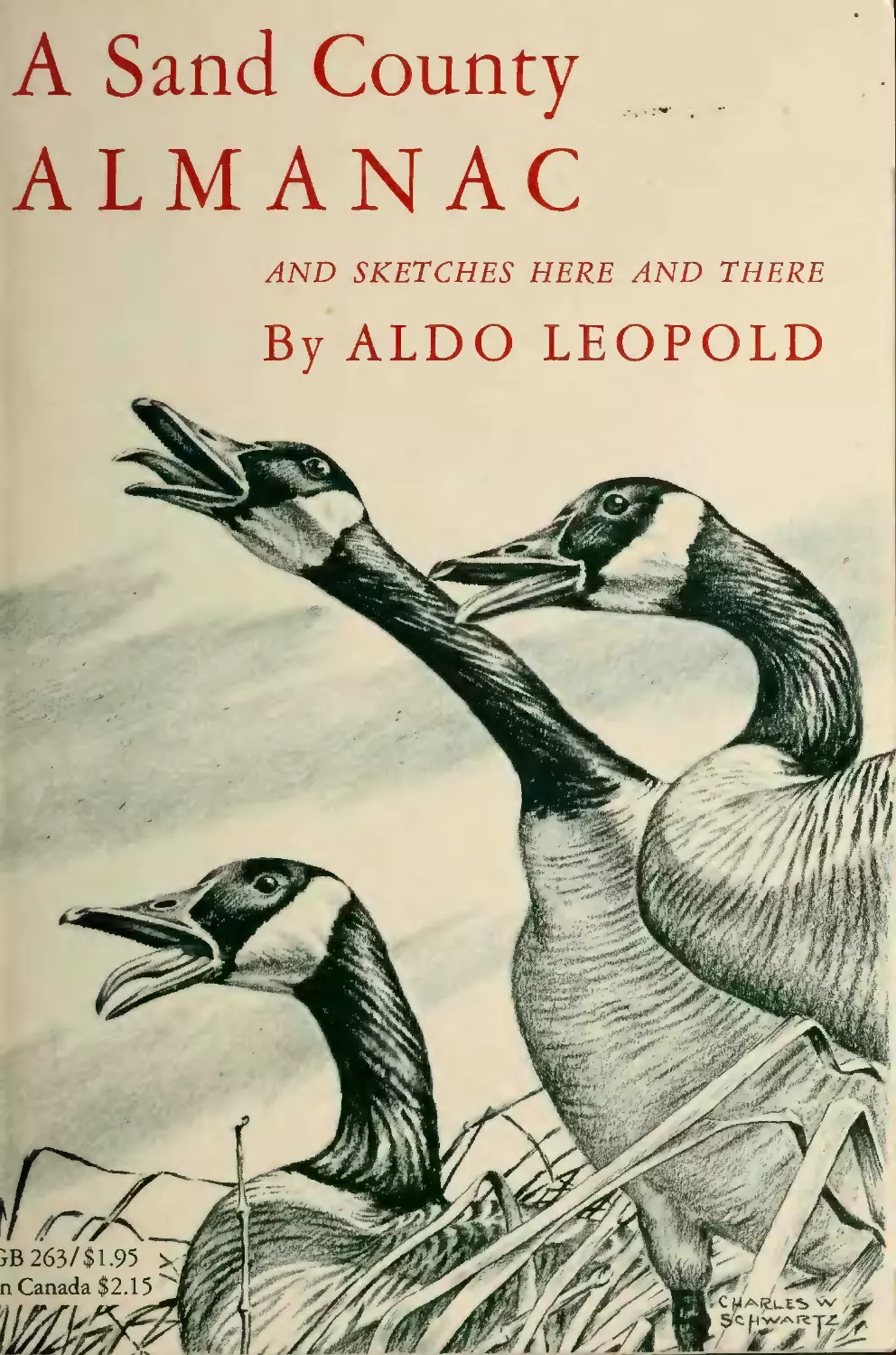
A
Sand County
ALMANAC
AND SKETCHES HERE AND THERE
By
//-/7<'_
7B263/$1.95
n Canada $2.15
ALDO LEOPOLD
A
Sand County
ALMANAC
fl
Sand Gounty Mlmanac
AND
SKETCHES HERE AND THERE
BY
Illustrated
by Charles W. Schwartz
American Museum of Natural History
Special Members' Edition
OXFORD UNIVERSITY PRESS
LONDON
OXFORD
NEW YORK
Mldo Leopold
OXFORD UNIVERSITY
London
Glasgow
Cape Town
Delhi
Ibadan
Oxford
Toronto
Nairobi
PRESS
New
York
Melbourne
Dar es Salaam
Wellington
Lusaka
Addis Ababa
Bombay Calcutta Madras Karachi Lahore Dacca
Kuala Lumpur Singapore Hong Kong Tokyo
Grateful, acknowledgment is made to the editors of the following magaand journals who have Idndly allowed to be reprinted in book form
portions or all of individual articles: American Forests, 'Marshland Elegy/
The Green Lagoons/ and 'Flambeau'; Audubon Magazine, 'Odyssey'; Bird
Lore, 'Conservation Esthetic'; The Condor, 'The Thick Billed Parrot of
Chihuahua*; Journal of Forestry, 'The Conservation Ethic'; Journal of Wildlife Management, 'Wildlife in American Culture' and 'Song of the Gavilan';
The Land, 'Cheat Takes Over'; Outdoor America, 'The Alder Fork'; Silent
Wings, 'On a Monument to the Pigeon'; Wisconsin Agriculturist and Farmer,
'Bur Oak' and 'Sky Dance'; Wisconsin Conservation Bulletin, 'A Mighty
Fortress/ 'Home Range/ and 'Pines above the Snow/ Thanks are also due
to The Macmillan Company for permission to quote from 'Tristram/ copyright, 1927 by Edwin Arlington Robinson, on page 223.
zines
Copyright 1949 by Oxford University Press,
Inc.
New York,
1949
First
published by Oxford University Press,
First
issued as an Oxford University Press paperback, 1968
Printed
in
the United States of
America
To my ESTELLA
Foreword
There are some who can
who
one
live
without wild things, and some
cannot. These essays are the dehghts and dilemmas of
who
cannot.
Like winds and sunsets, wild things were taken for granted
until progress
began
to
do away with them.
the question whether a
worth
cost in things natural, wild,
its
Now we
face
higher 'standard of living'
still
and
the minority, the opportunity to see geese
is
is
For us of
free.
more important
than television, and the chance to find a pasque-flower
is
a
right as inahenable as free speech.
These wild
things, I admit,
had
little
human
value until
mechanization assured us of a good breakfast, and until
science disclosed the
how
drama of where they come from and
they Hve. The whole conflict thus boils
question of degree.
We of the minority see
ishing returns in progress; our opponents
«
Part I
my
tells
shifts.
what
shift
not.
«
with things as they
They
to a
a law of dimin-
do
«
One must make
essays are
down
are.
These
are grouped in three parts.
my family
sees
[vii]
and does
at
its
week-end
FOREWORD
refuge from too
much
farm in Wisconsin,
this
sand
worn out and then abandoned by
first
we
our bigger-and-better society,
try to rebuild,
what we are losing elsewhere. It
seek— and still find— our meat from God.
and
On
modernity: 'the shack.'
axe,
with shovel
here that
is
we
These shack sketches are arranged seasonally as a 'Sand
County Almanac'
Part n, 'Sketches Here and There,' recounts some of the
episodes in
my life that taught me,
painfully, that the
company
is
gradually and sometimes
out of step. These episodes,
and through
scattered over the continent
forty years of
time, present a fair sample of the issues that bear the collective label: conservation.
Part in, 'The Upshot,' sets forth, in
some
of the ideas
whereby we
more
logical terms,
dissenters rationalize our
Only the very sympathetic reader wiU wish
dissent.
to
wrestle vdth the philosophical questions of Part ni. I sup-
pose
it
it
may
may be
get back in step.
»
patible with our
because
Abrahamic concept of
see land as a
it
nowhere because
getting
is
we regard
begin to use
»
«f
Conservation
we
company how
said that these essays tell the
it
as a
land.
to
it
is
incom-
is
abuse land
When
we may
to us.
which we belong,
with love and respect. There
us to reap from
We
commodity belonging
community
for land to survive the
it
no other way
impact of mechanized man, nor for
the esthetic harvest
it is
capable, under
science, of contributing to culture.
That land
is
but that land
a community
is
to
is
the basic concept of ecology,
be loved and respected
[viii]
is
an extension
FOREWORD
of ethics.
That laud
yields a cultural harvest is a fact long
known, but latterly often forgotten.
These essays attempt to weld these three concepts.
Such a view of land and people is, of course, subject to
the blurs and distortions of personal experience and personal
bias. But wherever the truth may lie, this much is crystalclear: our bigger-and-better society is now hke a hypochondriac, so obsessed with its own economic health as to
have lost the capacity to remain healthy. The whole world
is
so greedy for
more bathtubs
that
it
has lost the stability
necessary to build them, or even to turn
oflE
the tap. Nothing
could be more salutary at this stage than a
contempt for a plethora of material
Perhaps such a
shift of values
little
healthy
blessings.
can be achieved by reap-
praising things unnatural, tame, and confined in terms of
things natural, wild,
and
free.
Aldo Leopold
Madison, Wisconsin
4 March 1948
[ix]
Contents
Part
I:
A
Sand County Almanac
JANUARY
January
Thaw
FEBRUARY
Good Oak
MARCH
The Geese Return
18
Come High Water
Draba
Bur Oak
Sky Dance
23
Back from the Argentine
34
The Alder Fork
37
Great Possessions
41
Prairie Birthday
44
APRIL
26
26
30
MAY
JUNE
JULY
[xi]
CONTENTS
AUGUST
The Green Pasture
51
The Choral Copse
53
Smoky Gold
Too Early
Red Lanterns
54
SEPTEMBER
OCTOBER
59
62
NOVEMBER
If I
Were
the
Wind
66
Axe-in-Hand
67
A
73
Mighty Fortress
DECEMBER
Home Range
Pines above the
78
Snow
65290
Part
II:
81
87
Sketches Here and There
WISCONSIN
Marshland Elegy
95
The Sand Counties
101
Odyssey
104
On
a
Monument
to the Pigeon
Flambeau
ILLINOIS
108
112
AND IOWA
Illinois
Bus Ride
Red Legs Kicking
ARIZONA AND
117
120
NEW MEXICO
On Top
122
Thinking Like a Mountain
129
Escudilla
133
[xii]
CONTENTS
CHIHUAHUA AND SONORA
Guacamaja
The Green Lagoons
Song of the Gavilan
137
141
149
OREGON AND UTAH
Cheat Takes Over
154
Clandeboye
158
MANITOBA
Fart
III:
The Upshot
CONSERVATION ESTHETIC
WILDLIFE IN AMERICAN CULTURE
WILDERNESS
THE LAND ETHIC
[xiii]
165
177
188
201
Part
I
A
Sand County Almanac
January
January
Each
Thaw
year, after the midwinter blizzards, there conies a
night of thaw
when
the tinkle of dripping water
is
heard in
the land. It brings strange stirrings, not only to creatures
abed for the night, but to some who have been asleep
The hibernating skunk,
the winter.
curled
up
in his
for
deep
den, uncurls himself and ventures forth to prowl the
wet
world, dragging his belly in the snow. His track marks one
of the earhest datable events in that cycle of beginnings
and ceasings which
The
afFairs
track
is
if its
dropped the
mind and
an
indiflFerence to
at other seasons;
maker had hitched
it
«
and destination
if
mundane
leads straight across-
his
wagon
reins. I follow, curious to
appetite,
The months
call a year.
likely to display
uncommon
country, as
we
to a star
deduce
and
his state of
any.
«
#
of the year, from January
up
to June, are a
geometric progression in the abundance of distractions. In
January one
may
follow a skunk track, or search for bands
on the chickadees, or see what young pines the deer have
browsed, or what muskrat houses the mink have dug, with
only an occasional and mild digression into other doings
[3]
A SAND COUNTY ALMANAC
January observation can be almost as simple and peaceful
as snow, and almost as continuous as cold. There is time not
only to see who has done what, but to speculate why.
«
«
A meadow
»
my
mouse, startled by
across the skunk track.
Why is
approach, darts damply
he abroad in daylight? Prob-
ably because he feels grieved about the thaw.
Today
his
maze
of secret tunnels, laboriously chewed through the
matted grass under the snow, are tunnels no more, but
only paths exposed to public view and ridicule. Indeed the
thawing sun has mocked the basic premises of the microtine
economic system
The mouse
is
I
a sober citizen
may
in order that mice
store
who knows
it
as
that grass grows
underground haystacks,
mice may build subways
demand, and transport all neatly
organized. To the mouse, snow means freedom from want
and that snow
from stack
and
falls
in order that
to stack: supply,
fear.
»
»
A rough-legged hawk comes sailing over the meadow ahead.
Now he stops, hovers like a kingfisher, and then drops like
a feathered
so I
am
bomb
mouse-engineer
He does not rise again,
now eating, some worried
into the marsh.
sure he has caught, and
who
is
could not wait until night to inspect
damage to his well-ordered world.
The rough-leg has no opinion why grass grows, but he
is well aware that snow melts in order that hawks may
again catch mice. He came dovsni out of the Arctic in the
hope of thaws, for to him a thaw means freedom from want
the
and
fear.
[4]
JANUARY
The skunk
and crosses a glade where
the rabbits have packed down the snow with their tracks,
and mottled it with pinkish urinations. Newly exposed oak
seedlings have paid for the thaw with their newly barked
track enters the woods,
stems. Tufts of rabbit-hair bespeak the year's
among
first
battles
the amorous bucks. Further on I find a bloody spot,
by a wide-sweeping arc of owl's wings. To this
thaw brought freedom from want, but also a
reckless abandonment of fear. The owl has reminded him
that thoughts of spring are no substitute for caution.
encircled
rabbit the
The skunk track leads on, showing no interest in possible
food, and no concern over the rompings or retributions of
his neighbors. I wonder what he has on his mind; what got
him out of bed? Can one impute romantic motives to this
corpulent fellow, dragging his ample beltline through the
slush? Finally the track enters a pile of driftwood,
not emerge.
logs,
still
and
I
I
hear the tinkle of dripping water
fancy the skunk hears
wondering.
it
too. I turn
and does
among
the
homeward,
A SAND COUNTY ALMANAC
February
Good Oak
There are two
is
spiritual
dangers in not owning a farm.
One
the danger of supposing that breakfast comes from the
and the other that heat comes from the furnace.
the first danger, one should plant a garden,
preferably where there is no grocer to confuse the issue.
grocery,
To avoid
To
avoid the second, he should lay a
on the andirons, preferably where there
let it
warm
his shins while
trees outside. If
one has
good oak
no furnace, and
split of
is
a February blizzard tosses the
cut, split, hauled,
and piled
his
own good
oak, and let his mind work the while, he will
remember much about where the heat comes from, and
with a wealth of detail denied to those who spend the week
end in town astride a radiator.
The
particular oak
#
«
o
now aglow on my
andirons grew on the
bank of the old emigrant road where it climbs the sandhill.
The stump, which I measured upon felling the tree, has a
diameter of 30 inches. It shows 80 growth rings, hence the
seedling from ^hich it originated must have laid ils first
ring of wood in 1865, at the end of the Civil War. But I
know from the history of present seedlings that no oak
grows above the reach of rabbits without a decade or more
of getting girdled each winter,
following summer. Indeed,
and re-sprouting during the
it is all
[6]
too clear that every sur-
FEBRUARY
viving oak
the product either of rabbit negligence or of
is
Some day some
rabbit scarcity.
patient botanist will
draw a
frequency curve of oak birth-years, and show that the curve
humps every
ten years, each
hump
originating from a low
(A fauna and flora, by this
perpetual battle within and among species,
in the ten-year rabbit cycle.
very process of
achieve collective immortality.)
It is likely, then, that
middle
'sixties,
a low in rabbits occurred in the
when my oak began
but that the acorn that produced
when
ing decade,
over
my
to lay
it fell
on annual
the covered wagons were
road into the Great Northwest.
rings,
during the preced-
It
still
passing
may have been
wash and wear of the emigrant traffic that bared this
roadbank, and thus enabled this particular acorn to spread
its first leaves to the sun. Only one acorn in a thousand ever
grew large enough to fight rabbits; the rest were drowned
the
at birth in the prairie sea.
It is
a warming thought that
lived to
that
is
gamer
now
this
one wasn't, and thus
eighty years of June sun. It
is
this sunlight
being released, through the intervention of
my
to warm my shack and my spirit through eighty
gusts of blizzard. And with each gust a wisp of smoke from
my chimney bears witness, to whomsoever it may concern,
axe and saw,
that the sun did not shine in vain.
My dog does not care where heat comes from, but he cares
ardently that
ability to
rise in
come, and soon. Indeed he considers
it
make
it
hearth making a
me
come
as
something magical, for
the cold black pre-dawn and kneel shivering
fire,
my
when
I
by the
he pushes himself blandly between
and the kindling splits I have laid on the ashes, and
I
must touch a match to them by poking it between his legs.
Such faith, I suppose, is the kind that moves mountains.
[7]
A SAND COUNTY ALMANAC
It
by
was a bolt of lightning that put an end
this particular oak.
We were
all
to
wood-making
awakened, one night in
by the thunderous crash; we realized that the bolt
must have hit near by, but, since it had not hit us, we all
July,
"'^^mm^m
'^mm-^^^f
went back to sleep. Man brings all things to the test of
himself, and this is notably true of lightning.
Next morning, as we strolled over the sandhill rejoicing
with the cone-flowers and the prairie clovers over their
fresh accession of rain, we came upon a great slab of bark
freshly torn
from the trunk of the roadside oak. The trunk
spiral scar of barkless sapwood, a foot wide
showed a long
[8]
FEBRUARY
and not yet yellowed by the sun. By the next day the leaves
had wilted, and we knew that the lightning had bequeathed
to us three cords of prospective fuel wood.
We
mourned the
dozen of
loss of the old tree,
its
sands had already taken over
We
but knew that a
progeny standing straight and stalwart on the
its
job of wood-making.
the dead veteran season for a year in the sun
let
could no longer use, and then on a crisp winter's day
a newly filed saw to
its
bastioned base. Fragrant
spewed from the saw
of history
it
we laid
little
chips
and accumulated on the
cut,
snow before each kneeling sawyer. We sensed that these
two piles of sawdust were something more than wood; that
they were the integrated transect of a century; that our saw
was biting its way, stroke by stroke, decade by decade, into
the chronology of a liFetime, written in concentric annual
rings of
good oak.
*
It
»
«
took only a dozen pulls of the saw to transect the few
which we had learned to love
farm. Abruptly we began to cut the years
years of our ownership, during
and cherish
this
of our predecessor the bootlegger,
skinned
it
it
of residual fertility,
who
burned
its
hated
this
farm,
farmhouse, threw
back into the lap of the County (with delinquent taxes
to boot),
ties of
and then disappeared among the
good wood for him;
and
as pink as
The
landless anonymi-
the Great Depression. Yet the oak had laid
his
our own.
sawdust was as fragrant, as sound,
An
oak
is
no respecter of persons.
reign of the bootlegger ended sometime dinring the
dust-bowl drouths of 1936, 1934, 1933, and 1930.
from
down
his
still
Oak smoke
and peat from burning marshlands must have
[9]
A SAND COUNTY ALMANAC
clouded the sun in those years, and alphabetical conserva-
was abroad
tion
in the land, but the sawdust
shows no
change.
and we pause
Rest! cries the chief sawyer,
«
«
*
Now
for breath.
our saw bites into the 1920's, the Babbittian decade
when
everything grew bigger and better in heedlessness
and arrogance—until 1929, when stock markets crumpled.
If the oak heard them fall, its wood gives no sign. Nor did
it
heed the
Legislature's several protestations of love for
a National Forest and a forest-crop law in 1927, a
trees:
great refuge on the
new
and a
demise of the
its first
Upper
Mississippi bottomlands in 1924,
forest policy in 1921. Neither did
state's last
it
notice the
marten in 1925, nor the
arrival of
starling in 1923.
In March 1922, the *Big Sleet tore the neighboring elms
limb from limb, but there
What
a ton of
is
ice,
is
no sign of damage to our
more or
Rest! cries the chief sawyer,
•
Now
the
saw
less, to
tree.
a good oak?
and we pause
for breath.
«
«
bites into 1910-20, the
decade of the drain-
age dream, when steam shovels sucked dry the marshes of
central
Wisconsin to make farms, and made ash-heaps
Our marsh escaped, not because of any caution or
forbearance among engineers, but because the river floods
instead.
it
each April, and did so with a vengeance—perhaps a defen-
sive
vengeance— in the years 1913-16. The oak
just the
same, even in 1915,
when
laid
on wood
the Supreme Court abol-
ished the state forests and Governor Phillip pontificated
that *state forestry
is
not a good business proposition.' (It
[10]
)
FEBRUARY
did not occur to the Governor that there might be more
than one definition of what
good, and even of what
is
him
is
that while the courts
were
writing one definition of goodness in the law books,
fires
business. It did not occur to
were writing quite another one on the face of the land. Perhaps, to be a governor, one must be free from doubt on such
matters.
While
forestry receded during this decade,
game con-
became
successfully
servation advanced. In 1916 pheasants
established in
Waukesha County;
in
1915 a federal law
prohibited spring shooting; in 1913 a state
started; in
game farm was
1912 a *buck law' protected female deer; in 1911
an epidemic of refuges spread over the
state.
'Refuge'
became a holy word, but the oak took no heed.
Rest! cries the chief sawyer,
*
Now we
lished a
millions
and we pause
for breath.
*
cut 1910,
when
«
a great university president pub-
book on conservation, a great sawfly epidemic killed
of tamaracks, a great drouth burned the pineries,
and a great dredge drained Horicon Marsh.
We cut 1909, when smelt were first planted in the Great
Lakes, and when a wet summer induced the Legislature to
cut the forest-fire appropriations.
We cut 1908, a dry year when the forests burned fiercely,
and Wisconsin parted with
We
cut 1907,
when
its last
cougar.
a wandering lynx, looking in the
wrong
direction for the promised land,
among
the farms of
We cut
fires
1906,
Dane County.
when the first state
burned 17,000 acres
when
ended
forester took oflSce,
in these sand counties;
a great flight of goshawks
[11]
his career
came out
we
and
cut 1905
of the North
and
A SAND COUNTY ALMANAC
ate
up
to eat
local grouse (they
tlie
no doubt perched
in this tree
some of mine). We cut 1902-3, a winter
which brought the most intense drouth
cold; 1901,
(rainfall only
of bitter
of record
17 inches); 1900, a centennial year of hope,
and the usual annual ring of oak.
and we pause for breath.
of prayer,
RestI cries the chief sawyer,
Now our saw bites into the 1890's,
called
gay by those whose
eyes turn cityward rather than landward.
We cut 1899, when
the last passenger pigeon colUded with a charge of shot near
Babcock, two coimties to the north;
dry
fall,
year,
1896,
when
when
from the
fires;
seven
killed the apple trees; 1897, another drouth
25,000 prairie chickens were shipped to market
village of
Spooner alone; 1895, another year of
1894, another drouth year;
this oak,
gone without. )
and 1893, the year of 'The
when a March blizzard reduced
ing bluebirds to near-zero.
ahghted in
when a
soil
another forestry commission came into being;
Bluebird Storm,'
low
cut 1898
followed by a snowless winter, froze the
deep and
feet
we
We
(The
first
bluebirds
but in the middle nineties
cut 1892, another year of
in the grouse cycle;
the migrat-
it
always
must have
fires;
1891, a
and 1890, the year of the Babcock
Milk Tester, which enabled Governor Heil to boast, half a
century
later, that
Wisconsin
is
America's Dairyland.
The
motor licenses which now parade that boast were then not
foreseen, even
It
by
was likewise
tory slipped
Professor Babcock.
in 1890 that the largest pine rafts in his-
down
the Wisconsin River in full view of
oak, to build an empire of red
prairie states.
Thus
it is
bams
that good pine
[12]
for the
now
my
cows of the
stands between
FEBRUARY
the
COW and
the blizzard, just as good oak stands between
the blizzard and me.
Rest! cries the chief sawyer,
*
Now
in
and
we
pause for breath.
»
«
our saw bites into the 1880's; into 1889, a drouth year
which Arbor Day was
Wisconsin appointed
proclaimed; into 1887,
first
its first
game wardens;
the College of Agriculture held
farmers; into 1885, preceded
its
first
by a winter
length and severity'; into 1883,
into 1886,
when
when
short course for
*of
unprecedented
when Dean W. H. Henry
reported that the spring flowers at Madison bloomed 13
days later than average; into 1882, the year Lake Mendota
opened a month
late following the historic 'Big
Snow' and
bitter cold of 1881-2.
It
was hkewise
in 1881 that the
Society debated the question,
Wisconsin Agricultural
'How do you account
for the
second growth of black oak timber that has sprung up
over the country in the
One
of these.
last thirty years?'
My
debater claimed spontaneous
another claimed regurgitation of acorns
all
oak was one
generation,
by southbound
pigeons.
RestI cries the chief sawyer,
*
Now
and we pause for breath.
#
#
our saw bites the 1870's, the decade of Wisconsin's
carousal in wheat.
Monday morning came
chinch bugs, grubs,
rust,
and
soil
in 1879,
when
exhaustion finally con-
vinced Wisconsin farmers that they could not compete with
the virgin prairies further west in the
game
of wheating
land to death. I suspect that this farm played
its
share in
the game, and that the sand blow just north of
my
oak had
its
origin in over-wheating.
[13]
A SAND COUNTY ALMANAC
same year of 1879 saw the first planting of carp in
Wisconsin, and also the first arrival of quack-grass as a
stowaway from Europe. On 27 October 1879, six migrating
Tliis
prairie chickens
perched on the rooftree of the German
Methodist Church in Madison, and took a look at the growing
city.
On
8 November the markets at Madison were
reported to be glutted with ducks at 10 cents each.
In 1878 a deer hunter from Sauk Rapids remarked prophetically, *The hunters promise to
On
outnumber the
deer.'
10 September 1877, two brothers, shooting Muskego
Lake, bagged 210 blue-winged teal in one day.
In 1876 came the wettest year of record; the rainfall piled
up 50
hard
inches. Prairie chickens decHned, perhaps
owing to
rains.
In 1875 four hunters killed 153 prairie chickens at York
one county to the eastward. In the same year the
U.S. Fish Commission planted Atlantic salmon in DeviFs
Prairie,
Lake, 10 miles south of
In 1874 the
to
oak
trees; I
now under
first
my
oak.
factory-made barbed wire was stapled
hope no such
artifacts are
buried in the oak
saw!
In 1873 one Chicago firm received and marketed 25,000
prairie
chickens.
The Chicago
trade collectively bought
600,000 at $3.25 per dozen.
In 1872 the
last
wild Wisconsin turkey was
killed,
two
counties to the southwest.
It
is
appropriate that the decade ending the pioneer
carousal in
wheat should likewise have ended the pioneer
carousal in pigeon blood. In 1871, within a 50-mile triangle
spreading northwestward from
are estimated to have nested,
it,
for
it
was then a
my
oak, 136 million pigeons
and some may have nested in
20 feet tall. Pigeon hunt-
thrifty sapling
[14]
FEBRUARY
ers
by
scores plied their trade with net
and gun, club and
hck, and trainloads of prospective pigeon pie
salt
moved
was the last
big nesting in Wisconsin, and nearly the last in any state.
This same year 1871 brought other evidence of the march
of empire: the Peshtigo Fire, which cleared a couple of
counties of trees and soil, and the Chicago Fire, said to have
southward and eastward toward the
started
cities. It
from the protesting kick of a cow.
meadow mice had
already staged their march
up the young orchards of the young
state, and then died. They did not eat my oak, whose bark
was already too tough and thick for mice.
It was likewise in 1870 that a market gunner boasted in
the American Sportsman of killing 6000 ducks in one season
In 1870 the
of empire; they ate
near Chicago.
and we pause
Rest! cries the chief sawyer,
Our saw now
when thousands died to settle
man-man community lightly to be dis-
cuts the 1860's,
the question: Is the
membered? They
we
for breath.
settled
it,
but they did not
see,
nor do
yet see, that the same question applies to the man-land
community.
This decade was not without
larger issue. In 1867 Increase A.
Horticultural Society to
ojBFer
its
gropings toward the
Lapham induced
prizes for forest plantations.
In 1866 the last native Wisconsin elk was
now
Muir
the State
killed.
The saw
severs 1865, the pith-year of our oak. In that year John
offered to
home farm
buy from
his brother,
thirty miles east of
wildflowers that
my
had gladdened
who
then owned the
oak, a sanctuary for the
his
youth. His brother
dechned to part with the land, but he could not suppress
[15]
A SAND COUNTY ALMANAC
the idea: 1865
still
stands in Wisconsin history as the birth-
year of mercy for things natural, wild, and free.
We
have cut the
tion in history;
we
ward toward the
core.
Our saw now
reverses
its
orienta-
cut backward across the years, and out-
far side of the stump.
At
last there is a
tremor in the great trunk; the saw-kerf suddenly widens;
the saw
is
quickly pulled as the sawyers spring backward
to safety; all hands cry 'Timber!';
my oak leans,
groans,
and
crashes with earth-shaking thunder, to lie prostrate across
the emigrant road that gave
it
«
birth.
«
«
Now comes the job of making wood. The maul rings on steel
wedges
only to
as the sections of trunk are
fall
up-ended one by one,
apart in fragrant slabs to be corded
by the road-
side.
There
is
an allegory for historians in the diverse functions
of saw, wedge,
and
axe.
The saw works only across the years, which it must deal
with one by one, in sequence. From each year the raker
teeth pull
little
piles, called
torians;
chips of fact,
little
sawdust by woodsmen and archives by
his-
both judge the character of what hes within by the
character of the samples thus
imtil the transect
stump
which accumulate in
is
visible without. It
completed that the tree
yields a collective
hodge-podge called
all
or no view at
skill
plane of the
split is
depending on the
chosen.
(
If in
not
its fall
the
history.
splits;
the years at once,
with which the
doubt, let the section sea-
son for a year until a crack develops.
[16]
is
and the
other hand, works only in radial
such a spht yields a collective view of
all,
falls,
view of a century. By
tree attests the unity of the
The wedge, on the
made
Many
a hastily driven
)
FEBRUARY
wedge
lies
rusting in the woods,
embedded
in unsplittable
cross-grain.
The axe
and
this
functions only at an angle diagonal to the years,
only for the peripheral rings of the recent past. Its
special function
wedge
The
is
to lop limbs, for
which both saw and
are useless.
three tools are requisite to good oak,
and to good
history.
These things
I
ponder as the
kettle sings,
and the good oak
biuns to red coals on white ashes. Those ashes, come spring,
I will return to the orchard at the foot of the sandhill.
will
come back
to
me
They
again, perhaps as red apples, or per-
[17]
A SAND COUNTY ALMANAC
haps as a
spirit of enterprise in some fat October squirrel,
who, for reasons unknown to himself, is bent on planting
acorns.
March
The Geese Return
One swallow does
geese, cleaving the
A
not make a summer, but one skein of
murk of a March thaw, is the spring.
cardinal, v/histling spring to a
thaw but later finding
by resuming his
himself mistaken, can retrieve his error
winter silence.
A
chipmunk, emerging for a sunbath but
finding a blizzard, has only to go back to bed. But a migrat-
ing goose, staking two hundred miles of black night on the
chance of finding a hole in the lake, has no easy chance for
retreat.
His arrival carries the conviction of a prophet
who
has burned his bridges.
A March
morning
is
only as drab as he
who
without a glance skyward, ear cocked for geese.
I
walks in
an educated lady, banded by Phi Beta Kappa, who told
that she
it
once knew
me
had never heard or seen the geese that twice a year
proclaim the revolving seasons to her well-insulated roof.
Is
education possibly a process of trading awareness for
things of lesser worth?
The goose who
trades his
is
soon a
pile of feathers.
The geese
of
many
that proclaim the seasons to our farm are aware
things, including the Wisconsin statutes.
The
south-
bound November flocks pass over us high and haughty, with
scarcely a honk of recognition for their favorite sandbars
[18]
MARCH
and sloughs.
'As a
crow
flies' is
crooked compared with their
undeviattng aim at the nearest big lake twenty miles to the
where they loaf by day on broad waters and filch
com by night from the freshly cut stubbles. November geese
are aware that every marsh and pond bristles from dawn
south,
till
dark with hopeful guns.
March geese
been shot
at
are a different story. Although they have
most of the winter,
shot-battered pinions, they
now
as attested
know
by
their buck-
that the spring truce
is
They wind the oxbows of the river, cutting
low over the now gunless points and islands, and gabbling
to each sandbar as to a long-lost friend. They weave low
over the marshes and meadows, greeting each newly melted
puddle and pool. Finally, after a few pro-forma circlings of
our marsh, they set wing and glide silently to the pond,
black landing-gear lowered and rumps white against the far
hill. Once touching water, our newly arrived guests set up
in effect.
a honking and splashing that shakes the last thought of win-
Our geese
ter out of the brittle cattails.
It is at this
moment
are
home
again!
of each year that I wish I
were a
muskrat, eye-deep in the marsh.
Once the
they honk a clamorous invitaand in a few days the marsh is
full of them. On our farm we measure the amplitude of our
spring by two yardsticks: the number of pines planted, and
first
geese are
in,
tion to each migrating flock,
the
number
of geese that stop.
Our record
is
642 geese
coimted in on 11 April 1946.
As
in
fall,
our spring geese
make
daily trips to
these are no surreptitious sneakings-out
by
com, but
night; the flocks
and from com stubbles through the day.
Each departure is preceded by loud gustatory debate, and
each return by an even louder one. The returning flocks,
move
noisily to
19
A SAND COUNTY ALMANAC
once thoroughly at home, omit their pro-forma circhngs of
the marsh. They tumble out of the sky like maple leaves,
and left to lose altitude, feet spraddled
toward the shouts of welcome below. I suppose the ensuing
side-slipping right
gabble deals with the merits of the day's dinner. They are
now
eating the waste
com
that the
snow blanket has pro-
tected over winter from corn-seeking crows,
meadow
It is
geese
a conspicuous fact that the
reflects
feeding
for
are
No man knows
prairies.
cottontails,
mice, and pheasants.
some superior
tradition transmitted
com
stubbles selected
by
occupying former
usually
those
whether
this bias for prairie
nutritional value, or
some
com
ancestral
from generation to generation since
the prairie days. Perhaps
prairie cornfields tend to
it
be
reflects the
simpler fact that
could understand the
large. If I
thunderous debates that precede and follow these daily
excursions to corn, I might soon learn the reason for the
prairie-bias.
But
I
am
What a
dull
and
I cannot,
should remain a mystery.
well content that
world
if
we knew
it
all
about geese!
In thus watching the daily routine of a spring goose convention, one notices the prevalence of singles— lone geese
that
do much
flying
about and
much
talking.
One
impute a disconsolate tone to their honkings, and
to
is
apt to
jump
to
the conclusion that they are broken-hearted widowers, or
mothers hunting
lost children.
The seasoned
ornithologist
knows, however, that such subjective interpretation of bird
behavior
is risky.
I long tried to
keep an open mind on the
question.
After
my
years the
students and I
number
had counted
for half a
of geese comprising a flock,
[20]
dozen
some unex-
^^^
A.I
-^
'/ti£!M i'-J
SJ'^i Sl/^J.
^
A SAND COUNTY ALMANAC
pected light was cast on the meaning of lone geese. It was
found by mathematical analysis that flocks of six or multiples of six
were
far
more frequent than chance alone would
dictate. In other words, goose flocks are families, or aggrega-
and lone geese
what our fond imaginings had
tions of families,
in spring are probably just
first
They
suggested.
are
bereaved survivors of the winter's shooting, searching in
Now I am
vain for their kin.
free to grieve with
and
for the
lone honkers.
It is
not often that cold-potato mathematics thus confirms
the sentimental promptings of the bird-lover.
On
when
April nights
outdoors,
we love
it
has become
warm enough
to sit
to listen to the proceedings of the conven-
tion in the marsh.
There are long periods of silence when
one hears only the winnowing of snipe, the hoot of a distant
some amorous coot. Then, of a
sudden, a strident honk resounds, and in an instant pandemonium echoes. There is a beating of pinions on water, a
rushing of dark prows propelled by churning paddles, and a
owl, or the nasal clucking of
by the onlookers of a vehement conFinally some deep honker has his last word, and
general shouting
troversy.
the noise subsides to that half-audible small-talk that sel-
dom
ceases
among
geese.
Once
again, I
would
I
were a
muskrati
By
the time the pasques are in full bloom our goose-
convention dwindles, and before
May
our marsh
is
once
again a mere grassy wetness, enlivened only by redwings
and
rails.
«
It is
*
»
an irony of history that the great powers should have
discovered the unity of nations at Cairo in 1943.
[22]
The geese
APRIL
had that notion for a longer time, and each
March they stake their Hves on its essential truth.
In the beginning there was only the unity of the Ice Sheet.
Then followed the unity of the March thaw, and the northward hegira of the international geese. Every March since
the Pleistocene, the geese have honked unity from China
Sea to Siberian Steppe, from Euphrates to Volga, from Nile
to Murmansk, from Lincolnshire to Spitsbergen. Every
March since the Pleistocene, the geese have honked unity
from Currituck to Labrador, Matamuskeet to Ungava,
Horseshoe Lake to Hudson's Bay, Avery Island to Baffin
of the world have
Land, Panhandle to Mackenzie, Sacramento to Yukon.
By
this international
of Illinois
is
commerce
of geese, the waste
com
carried through the clouds to the Arctic tundras,
there to combine with the waste sunlight of a nightless June
grow
to
goslings for all the lands between.
annual barter of food for
mer
solitude, the
wild
whole continent receives
poem dropped from
the
And
and winter warmth
light,
murky
skies
in this
for
sum-
as net profit a
upon the muds
of March.
April
Come High Water
The same
big
cities
logic that causes big rivers always to flow past
causes cheap farms sometimes to be marooned
spring floods. Ours
we
visit it in
Not
April
is
we
a cheap farm, and sometimes
by
when
get marooned.
intentionally, of course,
[23]
but one can, to a degree,
A SAND COUNTY ALMANAC
when the snows up north will
and one can estimate how many days it takes for the
guess from weather reports
melt,
flood to run the gaimtlet of upriver cities. Thus,
come Sun-
day evening, one must go back to town and work, but one
can*t.
How
murmur condoon Monday morn-
sweetly the spreading waters
lence for the wreckage they have inflicted
How
deep and chesty the honkings of the geese
as they cruise over cornfield after cornfield, each in process
of becoming a lake. Every hundred yards some new goose
ing dates!
flails
the air as he struggles to lead the echelon in
ing survey of this
its
morn-
new and watery world.
The enthusiasm
of geese for high water
is
a subtle thing,
and might be overlooked by those unfamiliar with goosegossip, but the enthusiasm of carp is obvious and unmistakable.
No
sooner has the rising flood wetted the grass roots
than here they come, rooting and wallowing with the prodigious zest of pigs turned out to pasture, flashing red
tails
and yellow bellies, cruising the wagon tracks and cow-paths,
and shaking the reeds and bushes in their haste to explore
what to them is an expanding universe.
Unlike the geese and the carp, the terrestrial birds and
mammals accept high water with
A
philosophical detachment.
cardinal atop a river birch whistles loudly his claim to a
but for the trees, cannot be seen to exist. A
drums from the flooded woods; he must be
perched on the high end of his highest drumming log.
Meadow-mice paddle ridgeward with the calm assurance of
miniature muskrats. From the orchard bounds a deer,
territory that,
ruffed grouse
evicted from his usual daytime
bed
in the willow thickets.
Everywhere are rabbits, calmly accepting quarters on our
hill, which serves, in Noah*s absence, for an ark.
The spring flood brings us more than high adventure; it
[24]
APRIL
brings likewise an unpredictable miscellany of floatable
objects pilfered from upriver farms. An old board stranded
on our meadow has, to us, twice the value of the same piece
new from the lumberyard. Each old board has its own individual history, always unknown, but always to some degree
guessable from the kind of wood, its dimensions, its nails,
screws, or paint, its finish or the lack of it, its wear or decay.
One can even guess, from the abrasion of its edges and ends
on sandbars, how many floods have carried it in years past.
Our lumber pile, recruited entirely from the river, is thus
not only a collection of personalities, but an anthology of
human
strivings in upriver
biography of an old board
farms and
is
The
forests.
auto-
a kind of literature not yet
taught on campuses, but any riverbank farm
a library
is
where he who hammers or saws may read at will. Come high
is always an accession of new books.
water, there
«
«
#
There are degrees and kinds of solitude. An island in a lake
has one kind; but lakes have boats, and there is always the
chance that one might land to pay you a visit. A peak in
the clouds has another kind; but most peaks have
trails
have
tourists. I
guarded by a spring
know
flood;
of
no
and
trails,
solitude so secure as one
nor do the geese,
who have
seen
more kinds and degrees of aloneness than I have.
So we sit on our hill beside a new-blown pasque, and
watch the geese go by. I see our road dipping gently into
the waters, and I conclude (with inner glee but exterior
detachment) that the question of
this
day
at least, debatable only
[251
traffic,
among
in or out,
carp.
is
for
A SAND COUNTY ALMANAC
Draba
Within a few weeks
now
Draba, the smallest flower that
blows, will sprinkle every sandy place with small blooms.
He who
hopes for spring with upturned eye never sees
so small a thing as Draba.
downcast eye steps on
it,
He who
spring with his knees in the
Draba
asks,
comfort;
space.
and
gets,
despairs of spring with
imknowing.
mud
He who
finds
it,
searches for
in abundance.
but scant allowance of warmth and
on the leavings of unwanted time and
it two or three lines, but never a
Sand too poor and sun too weak for bigger,
subsists
it
Botany books give
plate or portrait.
better blooms are
good enough
for Draba. After all it
is
no
spring flower, but only a postscript to a hope.
Draba plucks no
is
lost in
heartstrings. Its perfume, if there
the gusty winds.
leaves
wear a
small.
No
Its
color
it.
Some
name, and then forgot
it.
Altogether
of
any,
it; it is
botanist once gave
it is
is
plain white. Its
sensible woolly coat. Nothing eats
poets sing of
just
is
it
too
a Latin
no importance-
a small creature that does a small job quickly and well.
Bur Oak
When
school children vote on a state bird, flower, or tree,
they are not making a decision; they are merely ratifying
history.
made bur oak the characteristic tree
Wisconsin when the prairie grasses first gained
Thus
of southern
history
Bur oak is the only tree that can
stand up to a prairie fire and live.
Have you ever wondered why a thick crust of corky bark
covers the whole tree, even to the smallest twigs? This cork
possession of the region.
[26]
APRIL
is
by the invadwhat they had to fight.
had covered the prairie
armor. Bur oaks were the shock troops sent
ing forest to storm the prairie;
Each
April, before the
new
fire is
grasses
with unbumable greenery,
fires
ran at will over the land,
sparing only such old oaks as had grown bark too thick to
scorch.
Most of these groves
of scattered veterans,
to the pioneers as *oak openings,' consisted of
known
bur oaks.
Engineers did not discover insulation; they copied
it
from
these old soldiers of the prairie war. Botanists can read the
war for twenty thousand years. The record conof pollen grains embedded in peats, partly of
interned in the rear of the battle, and there for-
story of that
partly
sists
relic plants
gotten.
The record shows
that the forest front at times
Lake Superior; at times it advanced far
to the south. At one period it advanced so far southward
that spruce and other 'rear guard' species grew to and
retreated almost to
beyond the southern border
appears at a certain level in
of Wisconsin; spruce pollen
peat bogs of the region. But
all
the average battle line between prairie and forest was about
where
it is
now, and the net outcome of the battle was a
draw.
One
reason for this was that there were
their support first to
bits
and mice
one
side,
allies
that threw
then to the other. Thus rab-
mowed down the prairie herbs in summer, and
in winter girdled
any oak seedlings that survived the
Squirrels planted acorns in
and ate them
fall,
all
fires.
the rest of
the year. June beetles undermined the prairie sod in their
grub stage, but defoliated the oaks in their adult stage. But
for this geeing
tory,
and
we
and hawing of
allies,
and hence of the
vic-
should not have today that rich mosaic of prairie
forest soils
which looks so decorative on a map.
[27]
APRIL
Jonathan Carver has
left
us a vivid word-picture of the
On
prairie border in pre-settlement days.
he
visited
Blue Mounds, a group of high
10 October 1763,
(now wooded)
hills
near the southwestern comer of Dane County.
He
says:
ascended one of the highest of these, and had an extenview of the country. For many miles nothing was to be
seen but lesser mountains, which appeared at a distance like
haycocks, they being free from trees. Only a few groves of
hickory, and stunted oaks, covered some of the vallies.
I
sive
In the 1840's a
prairie battle.
fields to
new
He
animal, the settler, intervened in the
didn't
mean
deprive the prairie of
ling oaks forthwith
its
to,
he
just
plowed enough
immemorial
romped over the
ally: fire.
Seed-
grasslands in legions,
and what had been the prairie region became a region of
If you doubt this story, go count the rings
on any set of stumps on any Mdge' woodlot in southwest
Wisconsin. All the trees except the oldest veterans date back
to the 1850's and the 1860's, and this was when fires ceased
on the prairie.
John Muir grew up in Marquette County during this
woodlot farms.
period
when new woods overrode
the old prairies and
engulfed the oak openings in thickets of saplings. In his
Boyhood and Youth he
The uniformly rich
recalls that:
soil of
the
Illinois
and Wisconsin
prairies
produced so close and tall a growth of grasses for fires that
no tree could hve on it. Had there been no fires, these fine
prairies, so marked a feature of the country, would have
been covered by the heaviest forest. As soon as the oak
openings were settled, and the farmers had prevented
running grass-fires, the grubs [roots] grew up into trees
and formed tall thickets so dense that it was difficult to
[29]
A SAND COUNTY ALMANAC
walk through them, and every trace of the sunny [oak]
openings' vanished.
Thus, he
tree.
who owns
He owns
a veteran bur oak owns more than a
a historical library, and a reserved seat in the
theater of evolution.
To
the discerning eye, his farm
is
labeled with the badge and symbol of the prairie war.
Sky Dance
owned my farm
two years before learning that the sky
my woods every evening in April
and May. Since we discovered it, my family and I have been
I
dance
is
for
to be seen over
reluctant to miss even a single performance.
The show begins on the first warm evening in April at
exactly 6:50 p.m. The curtain goes up one minute later each
day until 1 June, when the time is 7:50. This sliding scale is
dictated by vanity, the dancer demanding a romantic light
intensity of exactly 0.05 foot-candles.
quietly, lest
The
he
fly
away
in a
Do not be
late,
and
sit
huflF.
stage props, like the opening hour, reflect the tem-
peramental demands of the performer. The stage must be an
open amphitheater in woods or brush, and in
must be a mossy
its
center there
spot, a streak of sterile sand, a bare out-
crop of rock, or a bare roadway.
Why
the male woodcock
should be such a stickler for a bare dance floor puzzled
at
first,
but
now
I
think
cock's legs are short,
to
and
it is
me
The woodcannot be executed
a matter of legs.
his struttings
advantage in dense grass or weeds, nor could his lady see
them
there.
because
I
I
have more woodcocks than most farmers
have more mossy sand, too poor to support
Knowing
grass.
the place and the hour, you seat yourself under
[30]
A SAND COUNTY ALMANAC
a bush to the east of the dance floor and wait, watching
against the sunset for the woodcock's arrival.
from some neighboring
and
thicket, alights
He flies
in
low
on the bare moss,
at once begins the overture: a series of queer throaty
peents spaced about two seconds apart, and sounding
hke the summer
much
the nighthawk.
call of
Suddenly the peenting ceases and the bird flutters skyward in a series of wide spirals, emitting a musical twitter.
Up and up he goes, the spirals steeper and smaller, the twittering louder and louder, until the performer is only a speck
in the sky. Then, without warning, he tumbles like a crippled
plane, giving voice in a soft liquid warble that a March
bluebird might envy. At a few feet from the ground he levels
off and retxmis to his peenting ground, usually to the exact
spot where the performance began, and there resumes his
peenting.
It is
soon too dark to see the bird on the ground, but you
can see his
flights against
the sky for an hour, which
On moonhght
usual duration of the show.
it
may
is
the
nights, however,
continue, at intervals, as long as the
moon
continues
to shine.
At daybreak the whole show
the final curtain
falls at
minutes a day until June,
the year at 3:15.
fear that even
Why
romance
light to stop the sky
is
repeated. In early April
5:15 a.m.; the time advances two
when
the performance closes for
the disparity in sliding scale? Alas,
tires,
for
it
takes only a fifth as
dance at dawn as
I
much
suffices to start it at
sunset.
It is fortunate,
studies
the
perhaps, that no matter
hundred
little
dramas
[32]
of
how
latently one
the
woods and
APRIL
meadows, one can never learn all of the salient facts about
any one of them. What I do not yet know about the sky
dance
is
:
she play?
where
is
what part, if any, does
two woodcocks on a peenting ground,
the lady, and just
I often see
and the two sometimes
fly together,
but they never peent
together. Is the second bird the hen, or a rival male?
^•^"^^f
Another unknown;
My friend.
Bill
is
£^^'
the twitter vocal, or
is it
mechanical?
Feeney, once clapped a net over a peenting
bird and removed his outer primary wing feathers; thereafter the bird
peented and warbled, but twittered no more.
But one such experiment
is
Another unknown: up
to
hardly conclusive.
what stage of nesting does the
male continue the sky dance? My daughter once saw a bird
peenting within twenty yards of a nest containing hatched
eggshells,
but was
this his lady's nest?
[33]
Or
is this
secretive
A SAND COUNTY ALMANAC
fellow possibly bigamous without our ever having found
out? These, and
many
it
other questions, remain mysteries of
the deepening dusk.
The drama
of the sky dance
enacted nightly on hun-
is
dreds of farms, the owners of which sigh for entertainment,
but harbor the illusion that
it is
be sought in
to
theaters.
They Hve on the land, but not by the land.
The woodcock is a living refutation of the theory that the
utility of a game bird is to serve as a target, or to pose
gracefully on a slice of toast. No one would rather hunt
woodcock in October than I, but since learning of the sky
dance I find myself calHng one or two birds enough. I must
be sure that, come April, there be no dearth of dancers in
the sunset sky.
May
Back from the Argentine
When
dandelions have set the
mark
time to listen for the
of
final
May on
Wisconsin
proof of spring. Sit
pastures,
it is
down on
a tussock, cock your ears at the sky, dial out the
bedlam of meadowlarks and redwings, and soon you may
it: the flight-song of the upland plover, just now back
hear
from the Argentine.
If
your eyes are strong, you
may
search the sky and see
him, wings aquiver, circling
among
your eyes are weak, don't try
it;
Soon a flash of silver will
tell
the woolly clouds. If
just watch the fence posts.
you on which post the plover
has alighted and folded his long wings.
[34]
Whoever invented
MAY
the
word
'grace'
must have seen the wing-folding
of the
plover.
whole being says it's your next move
to absent yourself from his domain. The county records
may allege that you own this pasture, but the plover airily
rules out such trivial legalities. He has just flown 4000 miles
to reassert the title he got from the Indians, and until the
There he
sits;
his
young plovers are a-wing,
this pasture is his,
and none may
trespass without his protest.
Somewhere near
large pointed eggs
chicks.
From
the
which
moment
through the grass
your clumsy
by, the
like
efforts to
hen plover
is
brooding the four
will shortly hatch four precocial
their
mice on
down
stilts,
is
dry, they
scamper
quite able to elude
catch them. At thirty days the chicks
no other fowl develops with equal speed. By
August they have graduated from flying school, and on cool
August nights you can hear their whistled signals as they set
wing for the pampas, to prove again the age-old unity of
the Americas. Hemisphere sohdarity is new among statesmen, but not among the feathered navies of the sky.
are full grown;
The upland
side.
He
plover
fits
easily into the agricultural country-
follows the black-and-white buffalo,
which now
pasture his prairies, and finds them an acceptable substitute for
brown
ones.
He
nests in hayfields as well as pas-
clumsy pheasant, does not get caught
hay mowers. Well before the hay is ready to cut, the
yoimg plovers are a-wing and away. In farm country, the
plover has only two real enemies: the gully and the drainage ditch. Perhaps we shall one day find that these are
tures, but, unlike the
in
our enemies,
too.
There was a time in the early 1900's when Wisconsin
farms nearly
lost their
immemorial timepiece, when
[35]
May
JUNE
and August nights brought no
impending fall. Universal gunpowder,
pastures greened in silence,
whistled reminder of
plus the lure of plover-on-toast for post- Victorian banquets,
had taken too great a
toll.
federal migratory bird laws
The belated protection
came just in time.
of the
June
The Alder Fork—A Fishing Idyl
We
found the main stream so low that the teeter-snipe
what last year were trout riffles, and so
pattered about in
warm that we could duck in its deepest pool without a shout.
Even
after our cooling
swim, waders
felt like
hot tar paper
in the sun.
The
guries.
evening's fishing proved as disappointing as
We
asked that stream for trout, and
chub. That night
we
sat
debated the morrow's plan.
road
we had come,
to feel again the
impetuous tug of a
There were no
dis-
trout.
we now remembered, was a stream of parts. High
the headwaters we had once seen a fork, narrow,
this,
up near
deep, and fed
by cold
do
springs that gurgled out under
its
What would a self-respecting
what we did: go up.
morning, when a hundred whitethroats
close-hemmed walls of
trout
au-
its
gave us a
under a mosquito smudge and
Two hundred miles of hot, dusty
illusioned brook or rainbow.
But
it
alder.
in such weather? Just
In the fresh of the
had forgotten it would ever again be anything but sweet
and cool, I climbed down the dewy bank and stepped into
[37]
A SAND COUNTY ALMANAC
the Alder Fork.
A
was rising just upstream. I paid out
would always stay thus soft and dry—
trout
some line—wishing
it
and, measuring the distance with a false cast or two, laid
down
a spent gnat exactly a foot above his
now were
gotten
ignominious chub.
the
He
shortly I could hear
hot
took
the
miles,
last swirl.
For-
mosquitoes,
the
with one great gulp, and
it
him kicking
in the
bed
wet alder
of
leaves at the bottom of the creel.
Another, albeit larger, fish had meanwhile risen in the
next pool, which lay at the very 'head of navigation,' for at
upper end the alders closed in
its
with
its
brown stem laved
a perpetual silent laughter, as
men might
or
solid phalanx.
One
bush,
in the middle current, shook with
to
if
mock
beyond
cast one inch
*
its
at
any
that gods
fly
outermost
leaf.
»
«f
For the duration of a cigarette
I sit on a rock midstream—
and watch my trout rise under his guardian bush, while my
rod and line hang drying on the alders of the sunny bank.
Then—for prudence' sake— a little longer. That pool is too
smooth up
it
for
an
there.
instant,
A
breeze
come— a
stirring
and may shortly
ruffle
and thus make more deadly that perfect
cast I shall shortly lay
It will
is
upon
puff strong
its
bosom.
enough
to shake a
brown miller
the laughing alder, and cast it upon the pool.
Ready now Coil up the dry line and stand midstream,
rod in instant readiness. It's coming— a httle premonitory
off
I
shiver in that aspen on the hill lets
and swish
it
get out half a cast,
gently back and forth, ready for the main puff
to hit the pool.
is
me
No more
than half a
line,
mind you! The sun
high now, and any flicking shadow overhead would fore-
warn
my hunker of his
impending
[38]
fate.
Now! The
last three
JXJNE
yards shoot out, the
fly falls
laughing alder—he has
jungle beyond.
he, too,
is
He
gracefully at the feet of the
hard to hold him out of the
I set
it!
rushes downstream. In a
few minutes
kicking in the creel.
happy meditation on my rock, pondering, while
my line dries again, upon the ways of trout and men. How
like fish we are: ready, nay eager, to seize upon whatever
new thing some wind of circumstance shakes down upon the
I sit in
river of time!
And how we
rue our haste, finding the gilded
morsel to contain a hook. Even
tue in eagerness, whether
its
so, I
think there
some
is
object prove true or false.
vir-
How
would be a wholly prudent man, or trout, or
Did I say a while ago that I waited *for prudence'
sake? That was not so. The only prudence in fishermen is
that designed to set the stage for taking yet another, and
utterly dull
world!
perhaps a longer, chance.
Time
to
be
at
it
now— they
will soon stop rising. I
waist deep to head of navigation, poke
into the shaking alder,
my
head
and look within. Jungle
is
coal-black hole above, so canopied in greenness
not wave a fern,
And
much
there, almost
less
a rod, above
its
wade
insolently
right!
A
you could
rushing depths.
rubbing his ribs against the dark bank, a
great trout rolls lazily over as he sucks
down
a passing bug.
Not a chance to stalk him, even with the lowly worm.
But twenty yards above I see bright sunshine on the water
—another opening. Fish a dry fly downstream? It cannot,
but
it
must, be done.
I retreat
and
and climb the bank. Neck deep
in jewel-weed
nettles, I detour through the alder thicket to the opening
above.
step in,
With
cat-like care
and stand
not to
roil his majesty's
stock-still for five
calm down. The while,
minutes to
I strip out, oil, dry,
[39]
and
bath, I
let things
coil
upon
A SAND COUNTY ALMANAC
my left hand thirty feet of hne. I am that far above the portal
to the jungle.
Now
for the long chancel I
blow upon
my
fly
to give
it
one last fluflF, lay it on the stream at my feet, and quickly
pay out coil after coil. Then, just as the line straightens out
and the fly is sucked into the jungle, I walk quickly downstream, strainiag
fortunes.
A
my
eyes into the dark vault to follow
fleeting glimpse or
sunlight shows
it still
time—long before the
No
prudent
as
it
passes a speck of
rides clear. It rounds the bend. In
roil of
my
ruse— it reaches the black pool.
rush of the great
two
fish; I set
man would
I hear, rather
a
no
walking has betrayed the
than see, the
hard, and the battle
risk
its
dollar's
is
on.
worth of
fly
and
leader pulling a trout upstream through the giant tooth-
brush of alder stems comprising the bend of that creek. But,
no prudent man
as I said,
much
and
a fisherman.
cautious unraveling, I got
finally
I shall
had
is
him up
By and
into
by, with
open water,
aboard the creel.
now
confess to
you that none of those three trout
be beheaded, or folded double, to fit their casket.
big was not the trout, but the chance. What was
full was not my creel, but my memory. Like the whitethroats, I had forgotten it would ever again be aught but
morning on the Fork.
to
What was
[40]
JULY
July
Great Possessions
One hundred and twenty
Clerk,
Clerk
the extent of
is
is
County
worldly domain. But the County
acres, according to the
my
who never looks at his record books
What they would show at daybreak is
a sleepy fellow,
before nine o'clock.
the question here at issue.
Books or no books,
it is
myself, that at daybreak I
I
can walk over.
It is
a fact, patent both to
my dog and
am
all
the sole owner of
the acres
not only boundaries that disappear,
but also the thought of being bounded. Expanses unknown
deed or
to
map
are
known
posed no longer to
hand
as far as the
to every
exist in
dew can
my
dawn, and
solitude, sup-
county, extends on every
reach.
Like other great landowners, I have tenants. They are
negligent about rents, but very punctilious about tenures.
Indeed at every daybreak from April to July they proclaim
their boundaries to each other, and so acknowledge, at least
by
inference, their fiefdom to me.
This daily ceremony, contrary to what you might suppose, begins with the utmost decorum.
down
its
protocols I do not know.
Who
At 3:30
originally laid
a.m.,
with such
dignity as I can muster of a July morning, I step from
cabin door, bearing in either hand
my
my
emblems of sovereignty, a coflFee pot an<l notebook. I seat myself on a bench,
facing the white wake of the morning star. I set the pot
[41]
A SAND COUNTY ALMANAC
my
beside me. I extract a cup from
mode
will notice its informal
shirt front,
hoping none
of transport. I get out
watch, pour coiEee, and lay notebook on knee. This
is
my
the
cue for the proclamations to begin.
At 3:35 the nearest field sparrow avows, in a clear tenor
chant, that he holds the jackpine copse north to the riverbank, and south to the old wagon track. One by one all the
other field sparrows within earshot recite their respective
holdings. There are
just hsten,
in this
no
disputes, at least at this hour, so I
hoping inwardly that their womenfolk acquiesce
happy accord over the
Before the
field
status
quo
ante.
sparrows have quite gone the rounds,
the robin in the big elm warbles loudly his claim to the
crotch where the icestorm tore
oflF
a limb, and
all
appurte-
nances pertaining thereto (meaning, in his case,
all
the
angleworms in the not-very-spacious subjacent lawn).
The
tells
robin's insistent caroling
awakens the
oriole,
who now
the world of orioles that the pendant branch of the elm
milkweed
stalks near by, all loose strings in the garden, and the
exclusive right to flash like a burst of fire from one of these
belongs to him, together v^ith
all
fiber-bearing
to another.
My watch says 3:50. The indigo bunting on the hill asserts
dead oak limb left by the 1936 drought, and to
divers near-by bugs and bushes. He does not claim, but I
think he implies, the right to out-blue all bluebirds, and all
title
to the
spiderworts that have turned their faces to the dawn.
Next the wren— the one who discovered the knothole in
the eave of the cabin— explodes into song. Half a dozen
other wrens give voice, and
now
all is
bedlam. Grosbeaks,
thrashers, yellow warblers, bluebirds, vireos, towhees, car-
dinals—all are at
it.
My
solemn hst of performers, in their
[42]
JULY
order and time of
my
first
ear can no longer
song, hesitates, wavers, ceases, for
empty and the sun is about
before
my title runs
out
filter
priorities. Besides,
to rise. I
the pot
is
must inspect my domain
out.
He
has paid
scant respect to all these vocal goings-on, for to
him the
We
sally forth, the
dog and
I,
at
random.
'^4^
not song, but scent.
evidence of tenantry
is
bundle of feathers, he
says,
Any
can make a noise in a
illiterate
tree.
Now
he is going to translate for me the olfactory poems that whoknows-what silent creatures have written in the summer
night. At the end of each poem sits the author— if we can
find him. What we actually find is beyond predicting: a
rabbit, suddenly yearning to
be elsewhere; a woodcock,
flut-
tering his disclaimer; a cock pheasant, indignant over wet-
ting his feathers in the grass.
Once
late
in a while
from the
we
turn
night's foray.
up a coon
Sometimes
his imfinished fishing, or surprise
or mink, returning
we rout
a mother
a heron from
wood duck with
her ponvoy of ducklings, headed full-steam for the shelter
[43]
A SAND COUNTY ALMANAC
of the pickerelweeds. Sometimes
we
back
alfalfa
to the thickets, replete
and wild
More
lettuce.
darkened
often
with
we
lines that lazy hoofs
see deer sauntering
blooms, veronica,
see only the interweaving
have traced on the silken
fabric of the dew.
I
can feel the sun now. The bird-chorus has run out of
The far clank of cowbells bespeaks a herd ambling
breath.
to pasture.
astir.
to
A
tractor roars
The world has shrunk
county
clerks.
warning that
to those
my
neighbor
is
mean dimensions known
We turn toward home, and breakfast.
Prairie Birthday
During every week from April to September there are, on
the average, ten wild plants coming into first bloom. In
many as a dozen species may burst their buds on a
single day. No man can heed all of these anniversaries; no
man can ignore all of them. He who steps unseeing on May
dandelions may be hauled up short by August ragweed
pollen; he who ignores the ruddy haze of April elms may
June as
skid his car
of
on the
what plant-birthday a man
you a good deal about
fever,
and the general
that I
his vocation, his hobbies, his
tell
hay
#
#
I
me
level of his ecological education.
«
Every July
June catalpas. Tell
takes notice, and I shall
fallen corollas of
watch eagerly a certain country graveyard
pass in driving to and from
prairie birthday,
and
in
my
one comer of
farm. It
this
is
time for a
graveyard
lives
a
surviving celebrant of that once important event.
It is
an ordinary graveyard, bordered by the usual spruces,
and studded with the usual pink granite or white marble
[44]
JULY
headstones, each with the usual Sunday bouquet of red or
pink geraniums. It
instead of square,
of
its
is
extraordinary only in being triangular
and
in harboring, within the sharp angle
fence, a pin-point
remnant of the native
prairie
on
which the graveyard was estabHshed in the 1840's. Heretoby scythe or mower, this yard-square rehc
of original Wisconsin gives birth, each July, to a man-high
stalk of compass plant or cutleaf Silphium, spangled with
saucer-sized yellow blooms resembling sunflowers. It is the
sole remnant of this plant along this highway, and perhaps
the sole remnant in the western half of our county. What a
fore unreachable
thousand acres of Silphiums looked hke when they tickled
the belhes of the buffalo
is
a question never again to be
answered, and perhaps not even asked,
[45]
A SAND COUNTY ALMANAC
This year I found the Silphium in
a week later than usual; during the
date was 15 July.
When
first
bloom on 24
last six years
July,
the average
passed the graveyard again on 3 August, the
fence had been removed by a road crew, and the Silphium
I
cut. It is
now
easy
to predict the future; for a
Silphium will try in vain to
and then
few years
my
above the mowing machine,
rise
With it will die the prairie epoch.
The Highway Department says that 100,000 cars pass
yearly over this route during the three summer months
when the Silphium is in bloom. In them must ride at least
100,000 people who have 'taken' what is called history, and
perhaps 25,000 who have 'taken' what is called botany. Yet
it
will die.
doubt whether a dozen have seen the Silphium, and of
its demise. If I were to tell a
preacher of the adjoining church that the road crew has
I
these hardly one will notice
been burning history books
in his
cemetery, under the
mowing weeds, he would be amazed and uncomprehending. How could a weed be a book?
guise of
This
which
is
one
little
in turn
is
episode in the funeral of the native
one episode in the funeral of the
the world. Mechaiiized man, oblivious of
his progress in cleaning
nilly,
at
he must
once
all
up
might be wise to prohibit
teaching of real botany and real history, lest
suffer
qualms about the
«
«
it
comes
to pass that
its
floristic
price
«
farm neighborhoods are good
proportion to the poverty of their floras.
selected for
proud of
the landscape on which, willy-
live out his days. It
some future citizen
of his good life.
Thus
floras, is
flora,
floras of
lack of goodness
[46]
and
its
My own
in
farm was
lack of highway;
JULY
indeed
my
whole neighborhood
River Progress.
My
road
is
a backwash of the
lies in
wagon
the original
track of the
pioneers, innocent of grades or gravel, brushings or bulldozers.
My
neighbors bring a sigh to the County Agent.
go unshaven for years on end. Their
marshes are neither dyked nor drained. As between going
fishing and going forward, they are prone to prefer fishing.
Their fencer ows
Thus on week ends
my floristic
the backwoods, while on
standard of living
week days
is
I subsist as best I
that of
can on
the flora of the university farms, the university campus, and
the adjoining suburbs. For a decade I have kept, for pastime,
a record of the wild plant species in
first
bloom on these two
diverse areas:
Species First
Suburb and
Backward
Blooming in
Campus
Farm
April
14
May
29
43
2S
9
26
59
70
56
June
July
August
September
1
226
120
Total visual diet
It is
14
apparent that the backward farmer s eye
is
nearly
twice as well fed as the eye of the university student or busi-
nessman. Of course neither sees his
confronted by the two
flora as yet, so
alternatives
we
are
already mentioned:
either insure the continued blindness of the populace, or
examine the question whether
and
we
cannot have both progress
plants.
The shrinkage
in the flora
is
due
to a combination of
clean-farming, woodlot grazing, and good roads.
Each
of
these necessary changes of course requires a larger reduction in the acreage available for wild plants,
[47]
but none of
A SAND COUNTY ALMANAC
them
requires, or benefits by, tbe erasure of species from
whole farms, townships, or counties. There are idle spots on
every farm, and every highway is bordered by an idle strip
it is; keep cow, plow, and mower out of these idle
and the full native flora, plus dozens of interesting
stowaways from foreign parts, could be part of the normal
as long as
spots,
environment of every
The outstanding
citizen.
conservator of the prairie
enough, knows httle and cares
the railroad with
is
its
less
flora, ironically
about such frivohties:
fenced right-of-way.
Many
it
of these
raihoad fences were erected before the prairie had been
plowed. Within these linear reservations, oblivious of cin-
and annual clean-up
ders, soot,
splashes
May
its
fires,
the prairie flora
still
calendar of colors, from pink shooting-star in
have long wished
to blue aster in October. I
to con-
front some hard-boiled railway president with the physical
evidence of his soft-heartedness.
I
haven't
The
met
I
have not done so because
one.
railroads of course use flame-throwers
and chemical
sprays to clear the track of weeds, but the cost of such necessary clearance
actual
rails.
is still
too high to extend
it
much beyond
Perhaps further improvements are in the
the
oflBng.
The erasure of a human subspecies is largely painless—to
us— if we know little enough about it. A dead Chinaman is
of
little
import to us whose awareness of things Chinese
is
bounded by an occasional dish of chow mein. We grieve
only for what we know. The erasure of Silphium from westem Dane County is no cause for grief if one knows it only
as a
name
in a
botany book.
became a personality to me when I tried to
dig one up to move to my farm. It was like digging an oak
sapling. After half an hour of hot grimy labor the root was
Silphium
first
[48]
JULY
-«t>^
I
As
enlarging, like a great vertical sweet-potato.
still
know, that Silphium root went clear through
got no Silphium, but I learned
ground stratagems
it
by what
contrives
far as
to bedrock. I
elaborate under-
weather the prairie
to
drouths.
I
and
next planted Silphium seeds, which are large, meaty,
taste
after
Hke sunflower
seeds.
They came up promptly, but
^ve years of waiting the seedlings are
and have not yet borne a
flower-stalk.
my
pet plant in the cemetery? It
than the oldest tombstone, which
Hawk
watched the fugitive Black
is
it
juvenile,
takes a
how old,
then,
may have been
older
decade for a Silphium to reach flowering age;
was
still
Perhaps
dated 1850. Perhaps
retreat
it
from the Madison
it stood on the route of that
saw the successive funerals of
they retired, one by one, to their repose
lakes to the Wisconsin River;
famous march. Certainly
the local pioneers as
it
beneath the bluestem.
I once
saw a power
shovel, while digging a roadside ditch,
[49]
A SAND COUNTY ALMANAC
sever the *sweet-potato' root of a Silphium plant.
soon sprouted
new
leaves,
and eventually
why
it
The
root
again produced
which never
invades new ground, is nevertheless sometimes seen on
recently graded roadsides. Once established, it apparently
withstands almost any kind of mutilation except continued
grazing, mowing, or plowing.
a flower
Why
stalk.
This explains
this plant,
does Silphium disappear from grazed areas?
saw a farmer turn
his
cows
into a virgin prairie
previously used only sporadically for
cows cropped the Silphium
was
plant
visibly eaten at
buffalo once
to the
all.
one meadow. In
once
meadow
hay.
The
ground before any other
One can imagine
had the same preference
brooked no fences to confine
to
mowing wild
I
that the
for Silphium, but
his nibblings all
he
summer long
short, the buffalo's pasturing
was
dis-
continuous, and therefore tolerable to Silphium.
It is
a kind providence that has withheld a sense of his-
tory from the thousands of species of plants
and animals
that have exterminated each other to build the present
The same kind providence now withholds it from
grieved when the last buffalo left Wisconsin, and
few will grieve when the last Silphium follows him to the
world.
us.
Few
lush prairies of the never-never land.
[50]
AUGUST
August
The Green Pasture
Some
become famous because, being durable,
they are viewed by successive generations, in each of which
are likely to be found a few appreciative eyes.
I
at
paintings
know a
painting so evanescent that
all,
wields the brush, and
bring
seldom viewed
it is
except by some wandering deer. It
my
human
view
friends to
Like other
artists,
predicting
when
how
it
long
fleets cruise
worth
strolling
river
mood
But
will last.
white
his work, erases
exists
it
my
the
is
only in
it
forever from
my mind's
eye.
temperamental; there
is
no
come upon him, or
midsummer, when the great
to paint will
in
the sky for day after flawless day,
down
who
a river
the same river who, before I can
it is
view. After that
is
to the sandbars just to see
it is
whether he
has been at work.
The work begins with a broad ribbon
on the sand of a receding
shore.
sun, goldfinches bathe in
its
deers, raccoons,
tracks.
There
is
and
turtles
no telhng,
As
pools,
cover
of
silt
brushed thinly
this dries
and
it
slowly in the
deer, herons, kill-
with a lacework of
at this stage,
whether anything
further will happen.
But when
ocharis, I
the river
ocharis
I see
watch
is
the
silt
in a painting
becomes
ribbon turning green with Ele-
closely thereafter, for this
is
the sign that
mood. Almost overnight the Ele-
a thick turf, so lush
51
and so dense that
A SAND COUNTY ALMANAC
the
the
meadow mice from the adjoining upland cannot resist
temptation. They move en masse to the green pas-
ture,
and apparently spend the nights rubbing
in
velvety depths.
its
A
maze
their ribs
of neatly tended mouse-trails
bespeaks their enthusiasm. The deer w^alk up and
it,
apparently just for the pleasure of feeling
it
down
in
underfoot.
Even a stay-at-home mole has tunneled his way across the
dry bar to the Eleocharis ribbon, where he can heave and
hump
At
the verdant sod to his heart's content.
numerous to count
life from the damp
this stage the seedlings of plants too
and too young to recognize spring to
warm sand under the green ribbon.
To view the painting, give the river three more weeks of
solitude, and then visit the bar on some bright morning just
after the sun has melted the daybreak fog. The artist has
now laid his colors, and sprayed them with dew. The Eleocharis
sod, greener than ever,
is
now
spangled with blue
mimulus, pink dragon-head, and the milk-white blooms of
Sagittaria.
Here and there a cardinal flower
thrusts a red
spear skyward. At the head of the bar, purple ironweeds
and pale pink joe-pyes stand tall against the wall of willows. And if you have come quietly and humbly, as you
should to any spot that can be beautiful only once, you may
surprise a fox-red deer, standing knee-high in the garden of
his delight.
Do
there
not return for a second view of the green pasture, for
is
none. Either falling water has dried
water has scoured the bar to
its
come upon
in
out, or rising
original austerity of clean
mind you may hang up your picture, and
some other summer the mood to paint may
sand. But in your
hope that
it
the river.
[52]
SEPTEMBER
September
The Choral Copse
By September,
A
the day breaks with
song sparrow
woodcock may
last
owl
help from birds.
give a single half-hearted song, a
twitter overhead
thicket, a barred
with one
may
little
may
wavering
en route
to his
daytime
terminate the night's argument
but few other birds have any-
call,
thing to say or sing about.
It is
on some, but not
breaks that one
is
all,
may hear the
of these misty
autumn day-
chorus of the quail.
The silence
suddenly broken by a dozen contralto voices, no longer
able to restrain their praise of the day to come. After a brief
minute or two, the music closes as suddenly as
There
is
it
began.
a peculiar virtue in the music of elusive birds.
Songsters that sing from top-most boughs are easily seen
and
as easily forgotten;
obvious.
they have the mediocrity of the
What one remembers
is
the invisible hermit thrush
pouring silver chords from impenetrable shadows; the soaring crane trumpeting from behind a cloud; the prairie
chicken booming from the mists of nowhere; the quail's
Maria in the hush of dawn.
choral act, for the covey
grass,
No
is still
naturalist has
on
its
Ave
even seen the
invisible roost in the
and any attempt to approach automatically induces
silence.
In June
give voice
it is
completely predictable that the robin will
when
the light intensity reaches 0.01 candle
[53]
A SAND COUNTY ALMANAC
power, and that the bedlam of other singers will follow in
predictable sequence. In autumn, on the other hand, the
robin
is
silent,
and
it
is
quite unpredictable whether the
covey-chorus will occur at
all.
The disappointment
I feel
on these mornings of silence perhaps shows that things
hoped for have a higher value than things assured. The hope
of hearing quail
My
is
worth half a dozen
risings-in-the-dark.
farm always has one or more coveys in autumn, but
the daybreak chorus
is
usually distant. I think this
is
be-
cause the coveys prefer to roost as far as possible from the
dog, whose interest in quail
is
even more ardent than
own. One October dawn, however, as
I sat
my
sipping coffee
by the outdoor fire, a chorus burst into song hardly a stone's
throw away. They had roosted under a white-pine copse,
possibly to stay dry during the heavy dews.
We felt honored by this daybreak hymn sung almost at
our doorstep. Somehow the blue autumnal needles on those
pines became thenceforth bluer, and the red carpet of dewberry under those pines became even redder.
October
Smoky Gold
There are two kinds of hunting: ordinary hunting, and
ruffed-grouse hunting.
There are two places
to
hunt grouse: ordinary places, and
Adams County.
There are two times to hunt in Adams: ordinary times,
[54]
OCTOBER
and when the tamaracks are smoky gold. This is written for
those luckless ones who have never stood, gun empty and
watch the golden needles come sifting
down, while the feathery rocket that knocked them off sails
mouth agape,
to
unscathed into the jackpines.
The tamaracks change from green
first frosts
to yellow
when
the
have brought woodcock, fox sparrows, and juncos
out of the north. Troops of robins are stripping the last white
berries
from the dogwood
as a pink
thickets, leaving the
haze against the
hill.
The
empty stems
creekside alders have
shed their leaves, exposing here and there an eyeful of
Brambles are aglow, lighting your footsteps grouse-
holly.
ward.
The dog knows what is grouseward better than you do.
You will do well to follow him closely, reading from the
cock of his ears the story the breeze
last
he stops
is
When
telling.
at
and says with a sideward glance,
the question is, ready for what? A twitter-
stock-still,
'Well, get ready,'
ing woodcock, or the rising roar of a grouse, or perhaps only
a rabbit? In this
moment
of uncertainty
of the virtue of grouse hunting.
to get
is
condensed much
He who must know what
ready for should go and hunt pheasants.
«
Hunts
«
«
differ in flavor,
est hunts are stolen.
but the reasons are subtle. The sweet-
To
steal
a hunt, either go far into the
wilderness where no one has been, or else find some undis-
covered place under everybody's nose.
Few
for
hunters
when
know
that grouse exist in
they drive through
pines and scrub oaks. This
is
it,
Adams County,
they see only a waste of jack-
because the highway intersects
a series of west-running creeks, each of which heads in a
[55]
A SAND COUNTY ALMANAC
swamp, but drops
to the river through dry sand-barrens.
Naturally the northbound highway intersects these
swamp-
but just above the highway, and behind the
screen of dry scrub, every creeklet expands into a broad
less barrens,
ribbon of swamp, a sure haven for grouse.
Here, come October, I
sit
in the solitude of
my tamaracks
and hear the hunters' cars roaring up the highway, hell-bent
for the
their
crowded counties to the north.
dancing speedometers, their strained faces, their eager
eyes glued on the northward horizon.
passing, a cock grouse
we
I chuckle as I picture
drums
his defiance.
note his direction. That fellow,
we
At the
we
noise of their
My
dog
grins as
agree, needs
some
him up presently.
The tamaracks grow not only in the swamp, but at the
foot of the bordering upland, where springs break forth.
exercise;
shall look
[56]
OCTOBER
Each spring has become choked with moss, which forms a
boggy terrace. I call these terraces the hanging gardens,
muck
for out of their sodden
the fringed gentians have
Hfted blue jewels. Such an October gentian, dusted with
tamarack gold,
when
worth a
is
full stop
and a long
even
look,
the dog signals grouse ahead.
Between each hanging garden and the creekside is a
moss-paved deer trail, handy for the hunter to follow, and
for the flushed grouse to cross— in a split second.
tion
is
whether the bird and the gun agree on
should be
split.
finds a pair of
If
they do
empty
I
how
a second
but no feathers.
encounter an abandoned farm.
I try to read, from the age of the
across an old field,
how
ques-
not, the next deer that passes
shells to sniff at,
Higher up the creeklet
The
young jackpines marching
long ago the luckless farmer found
out that sand plains were meant to grow solitude, not com.
Jackpines
the unwary, for they put on several
tell tall tales to
whorls of branches each year, instead of only one. I find a
elm seedling that now blocks the
better chronometer in an
bam
back
door. Its rings date
to the drouth of 1930. Since
no man has carried milk out of this bam.
wonder what this family thought about when
that year
I
mortgage
finally
outgrew
signal for their eviction.
their crops,
Many
their
and thus gave the
thoughts, like flying grouse,
some leave clues that
some unforgotten April,
leave no trace of their passing, but
outlast the decades.
planted
this lilac
He who,
who used this washboard, its
with many Mondays, may have
for all the Aprils to come.
corrugations
in
must have thought pleasantly of blooms
worn
thin
wished for a cessation of
Musing on such
She
all
Mondays, and soon.
questions, I
[57]
become aware
of the
dog
A SAND COUNTY ALMANAC
down by
I
the spring, pointing patiently these
my
walk up, apologizing for
woodcock,
batlike, his
inattention.
many
and follow
Up
minutes.
twitters a
salmon breast soaked in October sun.
Thus goes the hunt.
It*s hard on such a day to keep
there are
many
The
in idle curiosity.
mind on grouse, for
buck track in the sand,
one's
distractions. I cross a
track leads straight from
one Jersey tea bush to another, with nipped twigs showing
why.
This reminds
me
of
my game
pulled out of
my own
lunch, but before I get
skyward, needing identification.
shows
I
his red
I
popple. Here a buck has rubbed
long ago? The exposed
I
wait
my
wood
is
oflF
he banks and
eye catches a peeled
his itchy velvet.
How
already brown; I conclude
must therefore be clean by now.
reach again for the lunch, but
excited
till
tail.
reach again for the lunch, but
that horns
it
pocket, I see a circhng hawk, high
yawp from
am
interrupted
by an
the dog, and a crash of bushes in the
swamp. Out springs a buck,
flag aloft,
horns shining, his
coat a sleek blue. Yes, the popple told the truth.
This time
eat.
A
I
get the lunch
all
the
way
out and
sit
down
to
chickadee watches me, and grows confidential about
his lunch.
He
doesn't say
turgid ant-eggs, or
what he
ate,
perhaps
it
some other avian equivalent
was
cool
of cold
roast grouse.
Lunch
young tamaracks, their
golden lances thrusting skyward. Under each the needles of
yesterday fall to earth building a blanket of smoky gold;
over, I regard a phalanx of
at the tip of
each the bud of tomorrow, preformed, poised,
awaits another spring.
[58]
OCTOBER
Too Early
Getting up too early
geese,
and freight
and some
is
a vice habitual in
trains.
coffee pots
Some hunters
from hunters.
the multitude of creatures
acquire
It is
who must
homed
it
owls, stars,
from geese,
strange that of
rise in
all
the morning at
'^:^
M
^
:^^^-^
rzL
'*¥-^<f^^
some
time, only these
few should have discovered the most
pleasant and least useful time for doing
it.
Orion must have been the original mentor of the tooearly
It is
company, for
time
as far as
Early
it is
when Orion
he who
has passed west of the zenith about
one should lead a
risers feel at ease
imlike those
who
signals for too-early rising.
teal.
with each other, perhaps because,
sleep late, they are given to understate-
ment of their own achievements. Orion, the most widely traveled, says hterally nothing. The coffee pot, from its first soft
[59]
OCTOBER
gurgle, underclaims the virtues of
what simmers
owl, in his trisyllabic commentary, plays
the night's murders.
The goose on the
down
The
within.
the story of
bar, rising briefly to a
point of order in some inaudible anserine debate, lets
no
and
fall
hint that he speaks with the authority of all the far hills
the sea.
The
freight, I admit,
is
hardly reticent about his
own
im-
portance, yet even he has a kind of modesty: his eye
is
single to his own noisy business, and he never comes roaring
into somebody else's camp. I feel a deep security in this
single-mindedness of freight trains.
«
»
To
marsh
arrive too early in the
listening;
«
the ear roams at will
night, without let or hindrance
is
an adventure in pure
among
the noises of the
from hand or eye.
When you
hear a mallard being audibly enthusiastic about his soup,
you are
weeds.
free to picture a score guzzling
When
among the duck-
one widgeon squeals, you
may
squadron without fear of visual contradiction.
flock of bluebills, pitching
heaven
in
pondward,
postulate a
And when
a
tears the dark silk of
one long rending nose-dive, you catch your breath
at the sound,
but there
is
nothing to see except
stars.
This
same performance, in daytime, would have to be looked at,
shot at, missed, and then hurriedly fitted with an alibi. Nor
could daylight add anything to your mind's eye picture of
quivering wings, ripping the firmament neatly into halves.
The hour
of listening ends
when
the fowl depart on
wings for wider safer waters, each flock a
graying
Like
lasts
blrn:
muted
against the
east.
many
another treaty of restraint, the pre-dawn pact
only as long as darkness humbles the arrogant. It would
[61]
A SAND COUNTY ALMANAC
seem
as
if
the sun were responsible for the daily retreat of
reticence from the world.
At any
by the time the mists
is bragging ad lib,
rate,
are white over the lowlands, every rooster
and every corn shock
is
com
By sun-up every
that ever grew.
pretending to be twice as
squirrel
is
tall as
any
exaggerat-
ing some fancied indignity to his person, and every jay
proclaiming with false emotion about suppositious dangers
to society, at this
very
moment
discovered
crows are berating a hypothetical owl,
how
by him. Distant
just to tell the
world
and a pheasant cock, musing perphilanderings of bygone days, beats the air
vigilant crows are,
haps on his
with his wings and
he owns
tells
marsh and
this
the world in raucous warning that
all
the hens in
it.
Nor are all these illusions of grandeur confined to the
birds and beasts. By breakfast time come the honks, horns,
shouts, and whistles of the awakened farmyard, and finally,
at evening, the drone of an un tended radio. Then everybody
goes to bed to relearn the lessons of the night.
Red Lanterns
One way
and
to
hunt partridge
is
make
to
probabilities, of the terrain to
a plan, based on logic
be hunted. This
will
take you over the ground where the birds ought to be.
Another way
is
to
wander, quite aimlessly, from one red
lantern to another. This will likely take
actually are.
The
you where the birds
lanterns are blackberry leaves, red in
October sun.
Red
lanterns
first
my way
have lighted
hunt in many a region, but
have learned
how
to
I
glow
on many a pleasant
think that blackberries must
in the
[62]
sand counties of cen-
OCTOBER
boggy streams of these
whose own lights
friendly wastes, called poor by
barely flicker, the blackberries burn richly red on every
sunny day from first frost to the last day of the season. Every
woodcock and every partridge has his private solarium
under these briars. Most hunters, not knowing this, wear
tral
Wisconsin. Along the
little
those
themselves out in the briarless scrub, and, returning
home
birdless, leave the rest of us in peace.
By *us' I mean the
The stream is a lazy
birds, the stream, the dog,
and myself.
one; he winds through the alders as
if
he would rather stay here than reach the river. So would I.
Every one of his hairpin hesitations means that much more
streambank where hillside briars adjoin dank beds of frozen
ferns and jewelweeds on the boggy bottom. No partridge
can long absent himself from such a place, nor can I. Partridge hunting, then,
a creekside
is
stroll,
upwind, from one
briar patch to another.
to
The dog, when he approaches the briars, looks around
make sure I am within gunshot. Reassured, he advances
with stealthy caution, his wet nose screening a hundred
scents for that one scent, the potential presence of
gives life
and meaning
prospector of the
air,
to the
whole landscape.
perpetually searching
olfactory gold. Partridge scent
relates his
My
is
its
He
which
is
the
strata for
the gold standard that
world to mine.
dog,
by the way,
thinks I have
much
to learn about
partridges, and, being a professional naturaHst, I agree.
persists in tutoring
He
me, with the calm patience of a professor
of logic, in the art of drawing deductions from an educated
nose. I dehght in seeing
him deduce a
conclusion, in the
form of a point, from data that are obvious
[63]
to
him, but
A SAND COUNTY ALMANAC
speculative to
my
unaided eye. Perhaps he hopes
his dull
pupil will one day learn to smell.
know when the professor is
right, even though I do not know why. I check my gun and
walk in. Like any good professor, the dog never laughs when
Like other dull pupils,
I miss,
which
is
He
often.
I
gives
me
just
one look, and pro-
ceeds up the stream in quest of another grouse.
Following one of these banks, one walks astride two landscapes, the hillside one hunts from,
hunts
in.
pets of
There
is
a special
Lycopodium
special
his willingness to
is
parallel
and the dog disappears from view. Hurry
or point,
and the
dog
do the wet
him on the dry bank.
problem arises where the belt of alders widens,
work while you
A
in treading soft dry car-
to flush birds out of the bog,
test of a partridge
first
charm
and the bottom the dog
where you stand
to follow the dog.
A
at
once to a knoll
stock-still, straining
eye and ear
sudden scattering of whitethroats may
reveal his whereabouts. Again you
may
hear him breaking
a twig, or splashing in a wet spot, or plopping into the
creek.
for
But when
he
is
all
sound ceases, be ready for instant action,
hkely on point. Listen
now
for the premonitory
clucks a frightened partridge gives just before flushing.
follows the hurtling bird, or perhaps
known
as
many
as six, clucking
each sailing high for
his
own
two
Then
of them, or I have
and flushing one by one,
destination in the uplands.
Whether one passes within gunshot is of course a matter
of chance, and you can compute the chance if you have
time: 360 degrees divided by 30, or whatever segment of the
circle your gun covers. Divide again by 3 or 4, which is
your chance of missing, and you have the probability of
actual feathers in the hunting coat.
[64]
OCTOBER
The second
test of
a good partridge dog
reports for orders after such an episode. Sit
it
over with him while he pants.
Then look
is
whether he
down and
talk
for the next red
and proceed with the hunt.
brings my dog many scents other
than grouse, each of which may lead to its own pecuhar
episode. When he points with a certain humorous expression
of the ears, I know he has found a bedded rabbit. Once a
lantern,
The October breeze
no bird, but still the dog stood
frozen; in a tuft of sedge under his very nose was a fat
sleeping coon, getting his share of October sun. At least
once on each hunt the dog bays a skunk, usually in some
denser-than-ordinary thicket of blackberries. Once the dog
pointed in midstream: a whir of wings upriver, followed by
three musical cries, told me he had interrupted a wood
duck's dinner. Not infrequently he finds jacksnipe in
heavily pastured alders, and lastly he may put out a deer,
bedded for the day on a high streambank flanked by alder
bog. Has the deer a poetical weakness for singing waters,
or a practical liking for a bed that cannot be approached
wdthout making a noise? Judging by the indignant flick of
dead-serious point yielded
his great white flag
Almost anything
it
might be
either, or both.
may happen between one
red lantern
and another.
At sunset on the
last
berry blows out his
day of the grouse season, every black-
light. I
do not understand how a mere
bush can thus be infalHbly informed about the Wisconsin
statutes,
nor have I ever gone back next day to find out.
For the ensuing eleven months the lanterns glow only
recollection. I
in
sometimes think that the other months were
[65]
A SAND COUNTY ALMANAC
constituted mainly as a fitting interlude between Octobers,
and I suspect that dogs, and perhaps grouse, share the
same view.
November
If I
Were
Wind
the
The wind that makes music in November com is in a hurry.
The stalks hum, the loose husks whisk skyward in halfplayful swirls, and the wind hurries on.
In the marsh, long windy waves surge across the grassy
sloughs, beat against the far willows.
the sandbar there
is
seaward. Every wisp of grass
I
wander over the bar
tree tries to argue,
no detaining the wind.
only wind, and the river sliding
bare limbs waving, but there
On
A
is
is
drawing
circles
to a driftwood log,
on the sand.
where
I sit
and
hsten to the universal roar, and to the tinkle of wavelets
on the shore. The
river
is lifeless
:
not a duck, heron, marsh-
hawk, or gull but has sought refuge from wind.
«
«
«
Out
of the clouds I hear a faint bark, as of a far-away dog.
It is
strange
dering.
coming
The
how the world
Soon
it is
cocks
louder: the
its
honk
ears at that sound,
won-
of geese, invisible, but
on.
flock
emerges from the low clouds, a tattered ban-
blown up and blown down,
blown together and blown apart, but advancing, the wind
wrestling lovingly with each winnowing wing. When the
ner of birds, dipping and
rising,
[66]
NOVEMBER
flock
is
a blur in the far sky I hear the last honk, sounding
taps for summer.
It is
«
«
«
warm behind
the driftwood now, for the
wind has gone
with the geese. So would I— if I were the wind.
Axe-in-Hand
and the Lord taketh away, but He is no
so. When some remote ancestor
of ours invented the shovel, he became a giver: he could
plant a tree. And when the axe was invented, he became a
taker: he could chop it down. Whoever owns land has thus
assmned, whether he knows it or not, the divine functions
of creating and destroying plants.
The Lord
giveth,
longer the only one to do
[67]
A SAND COUNTY ALMANAC
Other ancestors,
remote, have since invented other
less
tools,
but each of these, upon close scrutiny, proves to be
either
an elaboration
of,
of basic implements.
or an accessory
We
to,
the original pair
classify ourselves into vocations,
each of which either wields some particular
or repairs
so;
it,
or sharpens
by such
it,
tool, or sells
or dispenses advice on
we
division of labors
avoid responsibility for
the misuse of any tool save our own. But there
tion—philosophy—which knows that
think about and wish
that
men
for, in effect
thus determine,
wishing, whether
it is
by
is,
to fell
for
one voca-
men, by what they
wield
knows
thinking and
all tools. It
manner
of
«
warm enough
enough
all
is
worth while to wield any.
«
November
their
it,
how to do
many
to grind
#
reasons, the montli for the axe. It
is
an axe without freezing, but cold
a tree in comfort.
woods, so that one can see
just
The
leaves are off the hard-
how the
branches intertwine,
and what growth occurred last summer. Without this clear
view of treetops, one cannot be sure which tree, if any,
needs felling for the good of the land.
I
have read many
definitions of
and written not a few myself, but
is
what
I
is
a conservationist,
suspect that the best one
written not with a pen, but with an axe. It
is
a matter of
what a man thinks about while chopping, or while deciding
what to chop. A conservationist is one who is humbly aware
that with each stroke he is writing his signature on the face
of his land. Signatures of course differ, whether written
with axe or pen, and
I find it
behind
not
this is as
it
should be.
disconcerting to analyze, ex post facto, the reasons
my own axe-in-hand
all trees
decisions. I find, first of
are created free and equal.
[68]
all,
that
Where a white pine
NOVEMBER
and a red birch are crowding each
bias; I
other, I
have an a
always cut the birch to favor the pine.
Well,
of
first
all,
I
'priori
Why?
planted the pine with
my
shovel,
whereas the birch crawled in under the fence and planted
itself.
My bias
is
thus to
some extent
not be the whole story, for
hng
like
if
the pine were a natural seed-
the birch, I would value
deeper for the
The birch
logic, if any,
it
behind
an abundant
paternal, but this can-
even more. So
must dig
I
my bias.
in my township
and beand becoming
scarcer; perhaps my bias is for the underdog. But what
would I do if my farm were further north, where pine
is abundant and red birch is scarce? I confess I don't know.
My farm is here.
is
coming more
The pine
do
so,
tree
whereas pine
is
scarce
will live for a century, the birch for half that;
I fear that
my
signature will fade?
planted no pines but
all
My
have many birches;
neighbors have
am
I
snobbish
about having a woodlot of distinction? The pine stays green
all
winter, the birch punches the clock in October;
the tree that, like myself, braves the winter wind?
do
I favor
The pine
do I conbed more important than board? The pine will ultimately bring ten dollars a thousand, the birch two dollars;
have I an eye on the bank? All of these possible reasons for
my bias seem to carry some weight, but none of them carries
will shelter a grouse but the birch will feed him;
sider
very much.
and here perhaps is something; under this
pine will ultimately grow a trailing arbutus, an Indian pipe,
a pyrola, or a twin flower, whereas under the birch a bottle
gentian is about the best to be hoped for. In this pine a
So
I try again,
pileated
woodpecker
will ultimately chisel out a nest; in
the birch a hairy will have to sufiBce. In this pine the
[69]
wind
A SAND COUNTY ALMANAC
me
will sing for
rattling
naked
which time the birch
in April, at
twigs.
These possible reasons for
is
only
my
bias
why? Does the pine stimulate my imagination and my hopes more deeply than the birch does? If
so, is the difference in the trees, or in me?
The only conclusion I have ever reached is that I love
carry weight, but
all trees,
As
but
I
in love
November
I said,
other love
am
affairs,
there
is
with pines.
month
the
for the axe, and, as in
the exercise of bias. If the
is skill in
birch stands south of the pine, and
is taller, it
will
shade the
and thus discourage the pine
pine's leader in the spring,
weevil from laying her eggs there. Birch competition
minor
kill
compared with
affliction
this weevil,
is
a
whose progeny
the pine's leader and thus deform the tree. It
is
interest-
ing to meditate that this insect's preference for squatting in
the sun determines not only her
my
but also the future figure of
if
a drouthy
summer
birch's shade, the hotter soil
tion for water,
Lastly,
if
continuity as a species,
pine,
my own
and
success
axe and shovel.
as a wielder of
Again,
own
and
my pine
follows
may
my
removal of the
offset the lesser
be none the better for
competi-
my bias.
the birch's limbs rub the pine's terminal buds
during a wind, the pine will surely be deformed, and the
birch must either be removed regardless of other considerations, or else it
must be pruned
of limbs each winter to a
height greater than the pine's prospective
summer growth.
Such are the pros and cons the wielder of an axe must
and decide upon with the calm assurance
will, on the average, prove to be something
foresee, compare,
that his bias
more than good intentions.
The wielder of an axe has
as
many
biases as there are
species of trees on his farm. In the course of the years
[70]
he
NOVEMBER
imputes to each species, from his responses to their beauty
or utility, and their responses to his labors for or against
I
am
men
im-
them, a series of attributes that constitute a character.
amazed
to learn
what diverse characters
pute to one and the same
Thus
to
different
tree.
me the aspen is in good repute because he glorifies
October and he feeds my grouse in winter, but to some of
my neighbors he is a mere weed, perhaps because he sprouted
so vigorously in the
tempting to
stump
clear. (I
lots their
cannot sneer at
Again, the tamarack
to
is
me
white pine, perhaps because he
is
myself
this, for t-find
whose resproutings threaten
disliking the elms
ship
grandfathers were at-
my
pines.)
a favorite second only to
nearly extinct in
my town-
(underdog bias), or because he sprinkles gold on
October grouse (gunpowder bias), or because he sours the
and enables it to grow the loveliest of our orchids, the
showy lady's-slipper. On the other hand, foresters have
excommunicated the tamarack because he grows too slowly
to pay compound interest. In order to clinch this dispute,
they also mention that he succumbs periodically to epizo-
soil
otics of saw-fly,
so I shall let
but
my
this
is fifty
years hence for
grandson worry about
tamaracks are growing so
lustily that
it.
my
my tamaracks,
my
Meanwhile
spirits soar
with
them, skyward.
To me an
ancient cottonwood
is
the greatest of trees
because in his youth he shaded the buffalo and wore a halo
and I
some day become
of pigeons,
like
a young cottonwood because he
ancient.
the farmer) despises
all
But the farmer's wife
(
may
and hence
cottonwoods because in June the
female tree clogs the screens with cotton. The modern
dogma is comfort
I find
my
any cost.
biases more numerous than those of
at
[71]
my
neigh-
A SAND COUNTY ALMANAC
bors because I have individual likings for
many
species that
they lump under one aspersive category: brush. Thus I like
the wahoo, partly because deer, rabbits, and mice are so
avid to eat his square twigs and green bark and partly
because his cerise berries glow so warmly against November
snow. I like the red dogwood because he feeds October
and the prickly ash because my woodcock take their
sunbath under the shelter of his thorns. I like the hazel
robins,
daily
because his October purple feeds
November
catkins feed
sweet because
1st of July of
leaves,
I
to
I
eye,
and because
his
my deer and grouse. I like the bitter-
father did,
and because the
deer,
on the
each year, begin suddenly to eat the
have learned
to predict this event to
new
my guests.
cannot dislike a plant that enables me, a mere professor,
blossom forth annually as a successful seer and prophet.
It is
If
and
my
my
evident that our plant biases are in part traditional.
your grandfather liked hickory nuts, you will
hickory tree because your father told you
to. If,
on
like the
the other
hand, your grandfather burned a log carrying a poison ivy
vine and recklessly stood in the smoke, you will dislike the
species,
no matter with what crimson
eyes each
It is
glories it
warms your
fall.
also evident that our plant biases reflect not only
vocations but avocations, with a delicate allocation of priority
between industry and indolence. The farmer who would
rather hunt grouse than milk cows will not dislike hawthorn,
no matter if it does invade his pasture. The coon-hunter will
not dislike basswood, and I know of quail hunters who bear
as
no grudge against ragweed, despite their annual bout with
hayfever.
Our
biases are indeed a sensitive index to our
affections, our tastes, our loyalties, our generosities,
manner
of wasting weekends.
[72]
and our
NOVEMBER
Be
that as
it
may,
I
am
content to waste mine, in
Novem-
ber, with axe in hand.
A
Mighty Fortress
Every farm woodland,
and
in addition to yielding lumber, fuel,
posts, should provide
crop of
wisdom never
its
fails,
here record some of the
owner a
but
many
it is
liberal education. This
not always harvested.
lessons I
have learned in
I
my
own woods.
«
«
«
after I bought the woods a decade ago, I realized that
had bought almost as many tree diseases as I had trees.
My woodlot is riddled by all the ailments wood is heir to.
I began to wish that Noah, when he loaded up the Ark, had
left the tree diseases behind. But it soon became clear that
these same diseases made my woodlot a mighty fortress, unequaled in the whole county.
My woods is headquarters for a family of coons; few of
my neighbors have any. One Sunday in November, after a
new snow, I learned why. The fresh track of a coon-hunter
and his hound led up to a half-uprooted maple, under which
one of my coons had taken refuge. The frozen snarl of roots
and earth was too rocky to chop and too tough to dig; the
holes under the roots were too numerous to smoke out. The
hunter had quit coonless because a fungus disease had
weakened the roots of the maple. The tree, half tipped over
by a storm, offers an impregnable fortress for coondom.
Without this 'bombproof shelter, my seed stock of coons
would be cleaned out by hunters each year.
Soon
I
My
woods houses a dozen
[73]
ruffed grouse, but during
A SAND COUNTY ALMANAC
periods of deep
snow
woods, where there
many
my
grouse shift to
my
neighbor's
better cover. However, I always retain
is
by summer
storms. These summer windfalls keep their dried leaves, and
during snows each such windfall harbors a grouse. The droppings show that each grouse roosts, feeds, and loafs for the
as
grouse as I have oaks wind-thrown
duration of the storm within the narrow confines of his leafy
camouflage, safe from wind, owl, fox, and hunter.
The cured
oak leaves not only serve as cover, but, for some curious
reason, are reUshed as food
These oak windfalls
by the
grouse.
are, of course, diseased trees.
out disease, few oaks would break
would have down tops
oflF,
With-
and hence few grouse
to hide in.
Diseased oaks also provide another apparently delectable
grouse food: oak
galls.
A
gall is a diseased
twigs that have been stung
succulent. In October
my
growth of new
by a gall-wasp while tender and
grouse are often
stuflFed
with oak
galls.
Each year the wild bees load up one of my hollow oaks
with combs, and each year trespassing honey-hunters harvest the honey before I do. This is partly because they are
more skillful than I am in lining up' the bee trees, and
partly because they use nets, and hence are able to work
before the bees become dormant in fall. But for heart-rots,
there would be no hollow oaks to furnish wild bees with
oaken hives.
During high years of the
in
my
cycle, there
is
a plague of rabbits
woods. They eat the bark and twigs
kind of tree or bush
almost every kind
I
I
am
off
almost every
trying to encourage,
should like to have
less of.
and ignore
(When
the
rabbit-hunter plants himself a grove of pines or an orchard,
[74]
\-
)
A SAND COUNTY ALMANAC
the rabbit
somehow ceases
to
be a game animal and becomes
a pest instead.
The rabbit, despite his omnivorous appetite, is an epicure
in some respects. He always prefers a hand-planted pine,
maple, apple, or wahoo to a wild one. He also insists that
be preconditioned before he deigns
certain salads
them. Thus he spurns red dogwood until
it is
to eat
attacked
by
which the bark becomes a delicacy,
be eagerly devoured by all the rabbits in the neighbor-
oyster-shell scale, after
to
hood.
A
flock of a
dozen chickadees spends the year in
my
woods. In winter,
when we
trees for our fuel
wood, the ring of the axe is dinner gong
They hang in the offing waiting for
are harvesting diseased or dead
for the chickadee tribe.
commentary on the slowness of
is down, and the wedges
to open up its contents, the chickadees draw up their
napkins and fall to. Every slab of dead bark is, to
a treasury of eggs, larvae, and cocoons. For them
ant-tunneled heartwood bulges with milk and honey.
the tree to
fall,
our labor.
When
begin
white
them,
every
We
offering pert
the tree at last
often stand a fresh split against a near-by tree just to
see the greedy chicks
labor to
know
mop up
the ant-eggs. It lightens our
that they, as well as we, derive aid
and com-
from the fragrant riches of newly split oak.
But for diseases and insect pests, there would likely be
no food in these trees, and hence no chickadees to add
fort
cheer to
Many
my
woods
in winter.
other kinds of wildlife depend on tree diseases.
pileated woodpeckers
chisel
living
grubs from the diseased heartwood.
pines,
My
to
My
extract fat
barred owls find
surcease from crows and jays in the hollow heart of an old
basswood; but for
this diseased tree their
[76]
sundown
sere-
NOVEMBER
nade would probably be
silenced.
hollow trees; every June brings
its
My wood
ducks nest in
brood of downy duck-
my
woodland slough. All squirrels depend, for permanent dens, on a delicately balanced equilibrium between
a rotting cavity and the scar tissue with which the tree
attempts to close the wound. The squirrels referee the contest by gnawing out the scar tissue when it begins unduly
lings to
to shrink the amplitude of their front door.
The
real jewel of
thonotary warbler.
my
He
disease-ridden woodlot
nests in an old
is
woodpecker
the prohole, or
other small cavity, in a dead snag overhanging water.
The
plumage amid the dank decay
in itself proof that dead trees are
animals, and vice versa. When you
flash of his gold-and-blue
of the June
woods
is
transmuted into living
doubt the wisdom of
this
arrangement, take a look at the
prothonotary.
[77]
A SAND COUNTY ALMANAC
December
Home Range
The wild
me,
in so
on
things that live
my
many words, how much
farm are reluctant to
of
within their daily or nightly beat.
for
it
me
gives
tell
my township is included
I
am
curious about
this,
the ratio between the size of their universe
and the size of mine, and it conveniently begs the much
more important question, who is the more thoroughly acquainted with the world in which he lives?
Like people,
my
by
animals frequently disclose
their
what they decline to divulge in words. It is difficult
predict when and how one of these disclosures will come
actions
to
to light.
The
«
«
«
dog, being no
hand with an
the rest of us are making wood.
axe,
A
is
free to
us notice that a rabbit, flushed from his
headed elsewhere in a hurry.
is
hunt while
sudden yip-yip-yip gives
bed
He makes
in the grass,
a beeline for a
woodpile a quarter-mile distant, where he ducks between
two corded
gunshot ahead of his pursuer. The
stacks, a safe
dog, after leaving a few symbolic toothmarks
up and resumes
oak, gives
it
cottontail,
and
This
all
little
of the
we resume
episode
tells
his search for
on the hard
some
less
canny
our chopping.
me
ground between
that this rabbit
his
bed
[78]
in the
is
familiar with
meadow and
his
I
DECEMBER
blitz-cellar
How
under the woodpile.
else the beeline? This
home range is at least a quarter-mile in extent.
The chickadees that visit our feeding station are trapped
and banded each winter. Some of our neighbors also feed
chickadees, but none band them. By noticing the furthest
points from my feeder at which banded chickadees are seen,
we have learned that the home range of our flock is half a
rabbit's
mile across in winter, but that
it
includes only areas pro-
tected from wind.
In summer,
when
the flock has dispersed for nesting,
banded birds are seen at greater distances, often mated with
unhanded birds. At this season the chickadees pay no heed
to wind, often being found in open wind-swept places.
The fresh tracks of three deer, clear in yesterday's snow,
pass through our woods. I follow the tracks backward and
find a cluster of three beds, clear of snow, in the big willow
thicket
I
on the sandbar.
then follow the tracks forward; they lead to
my
neigh-
where the deer have pawed waste com out
the snow, and also tousled one of the shocks. The tracks
bor's cornfield,
of
then lead back, by another route, to the sandbar.
the deer have
pawed
at
some
En
route
grass tufts, nuzzling for the
tender green sprouts within, and they have also drunk at a
spring.
My
picture of the night's routine
over-all distance
from bed to breakfast
is
is
complete.
The
a mile.
Our woods always harbors grouse, but one day last winter, after a deep and soft snow, I could find neither a grouse
nor a track of one. I had about concluded that my birds
had moved out, when my dog came to a point in the leafy
top of an oak blown down last summer. Three grouse
flushed out, one by one.
[79]
A SAND COUNTY ALMANAC
There were no tracks under or near the down
viously these birds
must
had flown
eat, especially in zero
pings for a clue.
bud-scales,
shade
and
in,
Ob-
but from where? Grouse
weather, so
I
examined the drop-
Among much unrecognizable
also the
top.
debris I found
tough yellow skins of frozen night-
berries.
In a thicket of young soft maple
I
had
noticed, in
sum-
mer, an abundant growth of nightshade. I went there and,
after a search,
not
waded
found grouse tracks on a
log.
The
birds
had
the soft snow; they had walked the logs and
picked the berries projecting here and there within their
reach. This
was a quarter-mile
popple thicket
east of the
down
oak.
saw a grouse budding in a
a quarter-mile west. There were no tracks.
That evening,
at sunset, I
This completed the story. These birds, for the duration of
[80]
DECEMBER
the soft snow, were covering their
afoot,
and the range was
Science knows
is
«
«
little
various seasons,
ship
a-wing, not
half a mile across.
«
and how
home range
it is
about
home
range:
what food and cover
defended against
it
trespass,
an individual, family, or group
how
big
it is
at
must include, when
and whether owneraffair.
These are the
fundamentals of animal economics, or ecology. Every farm
a textbook on animal ecology; woodsmanship
is
is
the
translation of the book.
Pines above the
Snow
Acts of creation are ordinarily reserved for gods and poets,
but humbler folk
know how. To
may
circumvent
this restriction if
they
plant a pine, for example, one need be neither
god nor poet; one need only own a shovel. By virtue of this
curious loophole in the rules, any clodhopper may say; Let
there
be a tree— and there
If his
will
back be strong and
eventually be ten thousand.
lean
upon
his shovel,
be
one.
may
seventh year he may
his shovel sharp, there
And
in the
and look upon
his trees,
and
find
them
good.
God
but
its
passed on his handiwork as early as the seventh day,
I notice
He
has since been rather noncommittal about
merits. I gather either that
trees stand
He
spoke too soon, or that
more looking upon than do
ments.
[81]
fig leaves
and
firma-
A SAND COUNTY ALMANAC
Why is the shovel regarded as a symbol of drudgery? Perhaps because most shovels are dull. Certainly all drudges
have dull
facts
is
am
shovels, but I
cause and which
uncertain which of these two
the mellow loam. I
only
effect. I
vigorously wielded, makes
file,
my
know
am told there is music in the
shovel;
it
hums
who
that the fellow
upon the harp
in
my wrists
tried so
it
best in
as I plant a pine. I suspect
hard to
strike
one clear note
of time chose too difficult an instrument.
It is well that the planting
for moderation
it slices
sharp plane,
the sharp chisel, and the sharp scalpel, but I hear
my
good
that a
shovel sing as
is
best in
other months you
season comes only in spring,
all things,
may watch
even shovels. During the
the process of becoming a
pine.
The pine's new year begins in May, when the terminal
bud becomes *the candle.' Whoever coined that name for the
new growth had subtlety in his soul. *The candle' sounds like
a platitudinous reference to obvious facts: the
waxy, upright,
brittle.
But he who
lives
new
that candle has a deeper meaning, for at
bums
its tip
eternal flame that lights a path into the future.
May my
shoot
is
with pines knows
May
the
after
pines follow their candles skyward, each headed
straight for the zenith,
and each meaning
to get there
if
only there be years enough before the last trumpet blows.
It is
a very old pine
candles
is
who
at last forgets
which of
his
many
the most important, and thus flattens his crown
against the sky.
You may
forget,
but no pine of your
own
planting will do so in your lifetime.
If you are thriftily inclined, you will find pines congenial
company, for, unlike the hand-to-mouth hardwoods, they
iiever
solely
pay current bills out of current earnings; they live
on their savings of the year before. In fact every pine
[82]
DECEMBER
carries
an open bankbook, in which his cash balance
recorded by 30 June of each year.
If,
on that date,
his
is
com-
pleted candle has developed a terminal cluster of ten or
twelve buds,
and sun
it
means that he has
for a two-foot or
salted
lesser one,
air that goes
rain
even a three-foot thrust skyward
next spring. If there are only four or
be a
away enough
six
buds, his thrust will
but he will nevertheless wear that peculiar
with solvency.
Hard years, of course, come to
and these are recorded as shorter
pines as they
thrusts,
i.e.
do
to
men,
shorter spaces
between the successive whorls of branches. These spaces,
then, are an autobiography that he who walks with trees
may read at will. In order to date a hard year correctly, you
must always subtract one from the year of lesser growth.
Thus the 1937 growth was short
in all pines; this records
On
the other hand the 1941
the universal drouth of 1936.
growth was long in
all pines;
perhaps they saw the shadow
of things to come, and made a special effort to show the
world that pines still know where they are going, even
men do not.
When one pine shows
though
not,
you may
a short year but his neighbors do
some purely local or india gnawing meadowmouse, a
safely interpolate
vidual adversity: a
fire scar,
windburn, or some local bottleneck in that dark laboratory
we
call the soil.
is much small-talk and neighborhood gossip among
By paying heed to this chatter, I learn what has transpired during the week when I am absent in town. Thus in
March, when the deer frequently browse white pines, the
height of the browsings tells me how hungry they are. A
There
pines.
[83]
A SAND COUNTY ALMANAC
deer
full of
corn
above the ground; a really hungry deer
legs
and nips
nomic
more than four
too lazy to nip branches
is
feet
as high as eight feet.
Thus
rises
I learn
status of the deer without seeing them,
without visiting his
whether
field,
my
on
his
hind
the gastro-
and
I learn,
neighbor has hauled
in his comshocks.
In May,
when
the
new
candle
is
tender and brittle as an
asparagus shoot, a bird alighting on
Every spring
oflF.
with
it
will often break
a few such decapitated
I find
wdlted candle lying in the grass. It
its
what has happened, but
in a
is
trees,
is
each
easy to infer
decade of watching
never once seen a bird break a candle. It
it
an object
I
have
lesson:
one need not doubt the unseen.
In June of each year a few white pines suddenly show
wilted candles, which shortly thereafter turn brown and
die.
A
pine weevil has bored into the terminal bud cluster
and deposited
eggs; the grubs,
along the pith and
doomed to frustration,
among themselves who
all
and
do,
It is
as a
when
hatched, bore
down
the shoot. Such a leaderless pine
kill
is
for the surviving branches disagree
is
to
head the skyward march. They
consequence the tree remains a bush.
a curious circumstance that only pines in
full sun-
light are bitten by weevils; shaded pines are ignored. Such
are the hidden uses of adversity.
In October
when
my
pines
tell
me, by their rubbed-oflF bark,
the bucks are beginning to Teel their
oats.'
A jackpine
about eight feet high, and standing alone, seems especially
to incite in a
Such a
tree
emerges
tice in
buck the idea that the world needs prodding.
must perforce turn the other cheek also, and
much
The only element of justhe more the tree is punished,
the worse for wear.
such combats
is
that
[84]
DECEMBER
more pitch the buck
the
carries
away on
his not-so-shiny
antlers.
The chit-chat of the woods is sometimes hard to translate.
Once in midwinter I found in the droppings under a grouse
some
roost
half -digested structures that I could not identify.
They resembled miniature corncobs about
I
examined
of,
half
an inch long.
samples of every local grouse food I could think
but without finding any clue to the origin of the
'cobs.'
open the terminal bud of a jackpine, and in its
found the answer. The grouse had eaten the buds,
Finally I cut
core
I
digested the pitch, rubbed off the scales in his gizzard, and
the cob, which was, in effect, the forthcoming candle.
left
One might
say that this grouse had been speculating in
jackpine 'futures/
The
#
»
»
three species of pine native to Wisconsin (white, red,
and jack)
differ radically in their opinions
able age.
The
about marriage-
precocious jackpine sometimes blooms and
bears cones a year or two after leaving the nursery, and a
my
few
of
My
13-year-old reds
13-year-old jacks already boast of grandchildren.
first
bloomed
this year,
but
my
whites
have not yet bloomed; they adhere closely to the AngloSaxon doctrine of
Were
it
free, white,
red squirrels would be
Each year
and twenty-one.
not for this wide diversity in social outlook,
in
much
my
curtailed in their bill-of-fare.
midsummer they
start tearing
up jackpine
cones for the seeds, and no Labor-Day picnic ever scattered
more
hulls
and rinds over the landscape than they do:
under each tree the remains of
their
annual feast
and heaps. Yet there are always cones to spare,
by
their
lie
in piles
as attested
progeny popping up among the goldenrods.
[85]
A SAND COUNTY ALMANAC
Few people know that pines bear
those who do are too prosy to see in
and most of
festival of bloom
flowers,
this
anything more than a routine biological function. All
illusioned folk should
spend the second week in
dis-
May
in
a pine woods, and such as wear glasses should take along
an extra handkerchief. The prodigaHty of pine pollen should
convince anyone of the reckless exuberance of the season,
even when the song of the kinglet has failed to do
Young white pines
so.
usually thrive best in the absence
know
whole woodlots in which the
younger generation, even when provided with a place in the
sun, is dwarfed and spindled by its elders. Again there are
woodlots in which no such inhibition obtains. I wish I knew
whether such differences lie in tolerance in the young, in the
of their parents. I
of
old, or in the soil.
and
and disHkes. Thus
there is an affinity between white pines and dewberries,
between red pines and flowering spurge, between jackpines
and sweet fern. When I plant a white pine in a dewberry
patch, I can safely predict that within a year he will develop
a husky cluster of buds, and that his new needles will show
that bluish bloom which bespeaks health and congenial
company. He will outgrow and outbloom his fellows planted
on the same day, with the same care, in the same soil, but
Pines,
hke people, are choosy about
do not succeed
in the
company
straight
of grass.
walk among these blue plumes, rising
and stalwart from the red carpet of dewberry
wonder whether they are aware of their state of
In October
leaves. I
their associates
in suppressing their likes
well-being. I
I like to
know
only that
I
am.
Pines have earned the reputation of being 'evergreen by
the
same device that governments use
[86]
to achieve the appear-
DECEMBER
ance of perpetuity: overlapping terms of oflBce. By taking on
new needles on the new growth of each year, and discarding old needles at longer intervals, they have led the casual
onlooker to believe that needles remain forever green.
Each
species of pine has
term of
scribes a
its
own
constitution,
which pre-
needles appropriate to
office for
its
way
of
life. Thus the white pine retains its needles for a year and a
half; the red and jackpines for two years and a half. Incoming needles take office in June, and outgoing needles write
same thing, in
which by November turns
and are filed in the duflF to
farewell addresses in October. All write the
the same tawny yellow ink,
brown. Then the needles
enrich the
dom
wisdom
fall,
of the stand. It
that hushes the footsteps of
midwinter that
It is in
I
is
this
accumulated wis-
whoever walks under pines.
sometimes glean from
something more important than woodlot
my
politics,
pines
and the
news of the wind and weather. This is especially likely to
happen on some gloomy evening when the snow has buried
all irrelevant detail, and the hush of elemental sadness lies
heavy upon every living thing. Nevertheless, my pines, each
with his burden of snow, are standing ramrod-straight, rank
upon
rank,
and
in the
dusk beyond
I sense the
presence of
hundreds more. At such times I feel a curious transfusion of
courage.
65290
To band
Most of
us hold tickets on our own survival, but we buy them from
the insurance company, which knows too much to sell us a
really sporting chance. It is an exercise in objectivity to hold
a bird
is
to hold a ticket in a great lottery.
[871
A SAND COUNTY ALMANAC
a ticket on the banded sparrow that falleth, or on the banded
chickadee that
prove that he
The
may some day
is still
re-enter your trap,
and thus
ahve.
from banding new
tyro gets his thrill
birds;
he plays
a kind of game against himself, striving to break his previous
score for total numbers. But to the old-timer the banding
new
becomes merely pleasant routine; the real
thrill hes in the recapture of some bird banded long ago,
some bird whose age, adventures, and previous condition of
of
birds
appetite are perhaps better knov^ai to
you than
to the bird
himself.
Thus in our family, the question whether chickadee 65290
would survive for still another winter was, for five years,
a sporting question of the
first
magnitude.
Beginning a decade ago, we have trapped and banded
most of the chickadees on our fann each winter. In early
winter, the traps yield mostly
unhanded
birds; these pre-
sumably are mostly the young of the year, which, once
banded, can thereafter be
unhanded
'dated.'
As the winter wears
birds cease to appear in the trap;
that the local population consists largely of
We
can
present,
we
on,
then
know
marked
birds.
tell froni the band numbers how many birds are
and how many of these are survivors from each
previous year of banding.
65290 was one of 7 chickadees constituting the
1937.'
When
he
first
'class
of
entered our trap, he showed no visible
evidence of genius. Like his classmates, his valor for suet
was greater than
my
his discretion.
Like his classmates, he bit
finger while being taken out of the trap.
and released he
minum
fluttered
up
to a limb,
When banded
pecked
his
new
alu-
anklet in mild annoyance, shook his mussed feathers,
cursed gently, and hurried
away
[88]
to catch
up with the gang.
DECEMBER
doubtful whether he drew any philosophical deductions
It is
from
ters' )
By
of 7
his experience
,
for
(such as
*all is
not ants' eggs that gUt-
he was caught again three times that same winter.
showed that the class
and by the third winter to 2. By the fifth
the second winter our recaptures
had shrunk
to 3,
winter 65290 was the sole survivor of his generation. Signs
of genius
were
still
for living, there
During
lacking, but of his extraordinary capacity
was now
his sixth winter
historical proof.
65290 failed to reappear, and the
verdict of 'missing in action'
is
now confirmed by his
absence
during four subsequent trappings.
At
that, of
97 chicks banded during the decade, 65290 was
the only one contriving to survive for five winters. Three
[89]
A SAND COUNTY ALMANAC
reached 4 years, 7 reached 3 years, 19 reached 2 years, and
67 disappeared after their first winter. Hence if I were selling insurance to chicks, I could compute the
premium with
But this would raise the problem: in what currency would I pay the widows? I suppose in ants' eggs.
assm-ance.
I
know
so
little
about birds that
why 65290
survived his fellows.
dodging
enemies?
his
What
I
can only speculate on
Was he more
enemies?
A
clever in
chickadee
is
almost
too small to have any. That whimsical fellow called Evolution,
having enlarged the dinosaur until he tripped over his
own
toes, tried shrinking
the chickadee until he was just
too big to be snapped
up by flycatchers as an insect, and just
be pursued by hawks and owls as meat. Then
he regarded his handiwork and laughed. Everyone laughs
too
little
to
at so small a
bundle of large enthusiasms.
The sparrow hawk,
cially the
the screech owl, the shrike, and espe-
midget saw- whet owl might find
to kill a chickadee,
but
it
worth while
once found evidence of
I've only
actual murder: a screech-owl pellet contained one of
my
bands. Perhaps these small bandits have a fellow-feeling
for midgets.
It
seems
of both
likely that
weather
humor and dimension as
that in the chickadee
is
the only
killer so
devoid
to kill a chickadee. I suspect
Sunday School two mortal sins are
windy places in winter,
taught: thou shalt not venture into
thou shalt not get wet before a blizzard.
I
learned the second
commandment one
drizzly winter
dusk while watching a band of chicks going to roost in
my
woods. The drizzle came out of the south, but
tell
I
could
would turn northwest and bitter cold before morning. The
went to bed in a dead oak, the bark of which had
peeled and warped into curls, cups, and hollows of various
it
chicks
[90]
DECEMBER
and exposures. The bird selecting a roost dry
against a south drizzle, but vulnerable to a north one, would
surely be frozen by morning. The bird selecting a roost dry
from all sides would awaken safe. This, I think, is the kind
of wisdom that spells survival in chickdom, and accounts
sizes, shapes,
for
65290 and
The
from
his like.
his
windy places
deduced
behavior. In winter he ventures away from woods
chickadee's fear of
is
easily
only on calm days, and thb distance varies inversely as the
breeze. I
know
less all winter,
several wind-swept woodlots that are chick-
but are freely used at
are wind-swept because cows have
growth.
farmer
is
To
who
all
other seasons.
They
browsed out the under-
who mortgages the
who need more pasture, wind
the steam-heated banker
needs more cows
a minor nuisance, except perhaps at the Flatiron comer.
To
the chickadee, winter
wind
habitable world. If the chickadee
is
the boundary of the
had an
office,
the
maxim
over his desk would say: 'Keep calm.'
His behavior at the trap discloses the reason. Turn your
he must enter with even a moderate wind at his
the king's horses cannot drag him to the bait.
Turn it the other way, and your score may be good. Wind
from behind blows cold and wet under the feathers, which
trap so that
tail,
and
all
are his portable roof and air-conditioner. Nuthatches, juncos,
tree sparrows,
and woodpeckers likewise fear winds from
wind tolerin the order named. Books on nature seldom
behind, but their heating plants and hence their
ance are larger
mention wind; they are written behind
I suspect there is
a third
stoves.
commandment
thou shalt investigate every loud noise.
in chickdom:
When we
start
chop-
ping in our woods, the chicks at once appear and stay imtil
the felled tree or riven log has exposed
[911
new
insect eggs or
A SAND COUNTY ALMANAC
pupae
The discharge
for their delectation.
hkewise
What
summon
chicks,
but with
of a
gun
will
less satisfactory dividends.
served as their dinner bell before the day of axes,
mauls, and guns? Presumably the crash of falling trees. In
December
1940, an ice-storm felled an extraordinary
num-
ber of dead snags and Hving limbs in our woods. Our chicks
scoffed at the trap for a month, being replete with the
dividends of the storm.
65290 has long since gone to his reward.
his
new woods,
I
hope that
great oaks full of ants' eggs keep falling
day long, vdth never a wind
the edge off his appetite.
composure or take
hope that he still wears my
to ruffle his
And
I
band.
[92]
in
all
Part
II
Sketches Here and There
Wisconsin
Marshland Elegy
A dawn
on the great marsh. With almost imperceptible slowness it rolls a bank of fog across the wide
wind
stirs
morass. Like the white ghost of a glacier the mists advance,
over phalanxes
riding
tamarack,
of
meadows heavy with dew.
A
single
across
bog-
silence hangs
from
sliding
horizon to horizon.
Out
of
falls soft
some far
upon the
recess of the sky a tinkling of little bells
listening land.
Then again
silence.
Now
comes a baying of some sweet-throated hound, soon the
clamor of a responding pack. Then a far clear blast of hunting horns, out of the sky into the fog.
High
horns,
low horns,
silence,
of trumpets, rattles, croaks,
the
it
bog with
its
and
and
finally
a pandemonium
cries that
almost shakes
nearness, but without yet disclosing
whence
comes. At last a glint of sun reveals the approach of a
great echelon of birds.
from the
lifting mists,
On
motionless wing they emerge
sweep a
final arc of sky,
and
settle in
clangorous descending spirals to their feeding grounds.
new day
has begun on the crane marsh.
[95]
A
SKETCHES HERE AND THERE
A
sense of time
of cranes.
down
it
and heavy on such a place. Yearly
has awakened each spring to the clangor
thick
lies
since the ice age
it
The peat
layers that comprise the
an ancient
in the basin of
lake.
The
were, upon the sodden pages of their
bog are
laid
cranes stand, as
own
history.
These
peats are the compressed remains of the mosses that clogged
the pools, of the tamaracks that spread over the moss, of the
cranes that bugled over the tamaracks since the retreat of
An
own bones
the ice sheet.
endless caravan of generations has built
of
this
its
bridge into the future, this habitat
where the oncoming host again may live and breed and die.
To what end? Out on the bog a crane, gulping some
luckless frog, springs his ungainly hulk into the air
the morning sun with mighty wings.
with his bugled certitude.
He
flails
seems to know.
«
«
and
The tamaracks re-echo
«
Oin: abihty to perceive quality in nature begins, as in art,
with the pretty.
It
expands through successive stages of the
beautiful to values as yet uncaptured
ity of cranes lies, I think, in this
by language. The
qual-
higher gamut, as yet beyond
the reach of words.
This much, though, can be said: our appreciation of the
crane grows with the slow imraveling of earthly history. His
tribe,
we now know,
stems out of the remote Eocene. The
members of the fauna in which he originated are long
entombed within the hills. When we hear his call we
hear no mere bird. We hear the trumpet in the orchestra of
other
since
evolution.
He
is
the symbol of our untamable past, of that
sweep of millennia which underlies and condithe daily affairs of birds and men.
incredible
tions
And
so they
hve and have their being— these cranes—not
[96]
WISCONSIN
in the constricted present, but in tlie
tionary time. Their annual return
geologic clock.
Upon
peculiar distinction.
wider reaches of evoluis
the ticking of the
the place of their return they confer a
Amid
the endless mediocrity of the
commonplace, a crane marsh holds a paleontological patent
of nobility, won in the march of aeons, and revocable only
by shotgun. The sadness discernible in some marshes arises,
perhaps, from their once having harbored cranes. Now they
stand humbled, adrift in history.
Some sense of this quality in cranes seems to have been
felt by sportsmen and ornithologists of all ages. Upon such
quarry as this the Holy Roman Emperor Frederick loosed
his gyrfalcons. Upon such quarry as this once swooped the
hawks of Kublai Khan. Marco Polo tells us: *He derives
the highest amusement from sporting with gyrfalcons and
hawks. At Changanor the Khan has a great Palace surrounded
by a fine plain where are found cranes in great numbers. He
causes millet and other grains to be sown in order that the
birds
may not want.'
The ornithologist Bengt Berg, seeing cranes as a boy
upon the Swedish heaths, forthwith made them his life
work. He followed them to Africa and discovered their winter retreat
on the White
Nile.
He
says of his
first
encounter:
It was a spectacle which eclipsed the flight of the roc in the
Thousand and One
Nights.'
«
When
hills
ice
the glacier
and gouging
«
«
came down out of the north, crunching
some adventuring rampart of the
valleys,
climbed the Baraboo Hills and
gorge of the Wisconsin River.
up and formed a lake
fell
back into the outlet
The swollen waters backed
on
half as long as the state, bordered
[97]
SKETCHES HERE AND THERE
the east
by
cliffs
of ice,
and fed by the
torrents that fell
from melting momitains. The shorelines of
still
visible; its
The
bottom
is
this
old lake are
the bottom of the great marsh.
lake rose through the centuries, finally spilling over
east of the
Baraboo range. There
it
new
cut a
channel for
itself. To the residual lagoons
bugUng the defeat of the retreating win-
the river, and thus drained
came
ter, summoning the on-creeping host
the cranes,
of living things to
Floating bogs of
their collective task of marsh-building.
sphagnum moss clogged the lowered waters, filled them.
Sedge and leatherleaf, tamarack and spruce successively
advanced over the bog, anchoring it by their root fabric,
sucking out its water, making peat. The lagoons disappeared,
but not the cranes. To the moss-meadows that replaced the
ancient waterways they returned each spring to dance and
bugle and rear their gangling sorrel-colored young. These,
albeit birds, are not properly called chicks,
not explain why.
gambol over
On some dewy
but
colts. I
can-
June morning watch them
their ancestral pastures at the heels of the roan
mare, and you will see for yourself.
One year not long ago
pushed
his
a French trapper in buckskins
canoe up one of the moss-clogged creeks that
thread the great marsh. At this attempt to invade their miry
stronghold the cranes gave vent to loud and ribald laughter.
A
century or two later Englishmen came in covered wagons.
They chopped
clearings in the timbered moraines that bor-
der the marsh, and in them planted corn and buckwheat.
They did not
intend, like the Great
Khan
at Changanor, to
feed the cranes. But the cranes do not question the intent
of glaciers, emperors, or pioneers.
when some
irate
They
ate the grain,
and
farmer failed to concede their usufruct in
[98]
WISCONSIN
com, they trumpeted a warning and sailed across the
marsh to another farm.
There was no alfalfa in those days, and the hill-farms
made poor hay land, especially in dry years. One dry year
someone set a fire in the tamaracks. The bum grew up
his
when cleared of dead
made a dependable hay meadow. After that, each
August, men appeared to cut hay. In winter, after the
quickly to bluejoint grass, which,
trees,
cranes had gone South, they drove
wagons over the frozen
bogs and hauled the hay to their farms in the
they phed the marsh with
fire
and
axe,
hills.
Yearly
and in two short
decades hay meadows dotted the whole expanse.
Each August when the haymakers came
to pitch their
camps, singing and drinking and lashing their teams with
whip and tongue, the cranes whinnied
to their colts
and
retreated to the far fastnesses. 'Red shitepokes' the hay-
makers called them, from the rusty hue which at that season
often stains the battleship-gray of crane plumage. After the
hay was stacked and the marsh again
returned, to call
down
their
own, the cranes
out of October skies the migrant
from Canada. Together they wheeled over the newcut stubbles and raided the com until frosts gave the signal
flocks
for the winter exodus.
These haymeadow days were the Arcadian age for marsh
dwellers.
Man and
beast, plant
and
soil lived
on and with
each other in mutual toleration, to the mutual benefit of
The marsh might have kept on producing hay and
chickens, deer
all.
prairie
and muskrat, crane-music and cranberries
forever.
The new
include
soil,
They did not
mutuality. The
overlords did not understand this.
plants, or birds in their ideas of
dividends of such a balanced economy were too modest.
[99]
SKETCHES HERE AND THERE
They envisaged farms not only around, but
in the marsh.
epidemic of ditch-digging and land-booming
set in.
An
The
marsh was gridironed with drainage canals, speckled with
new fields and farmsteads.
But crops were poor and beset by frosts, to which the
expensive ditches added an aftermath of debt. Farmers
moved
out.
Peat beds dried, shrank, caught
fire.
Sun-energy
out of the Pleistocene shrouded the countryside in acrid
smoke.
No man
raised his voice against the waste, only his
nose against the smell. After a dry summer not even the winter
snows could extinguish the smoldering marsh. Great
pockmarks were burned into
reaching
down
field
and meadow, the
scars
to the sands of the old lake, peat-covered
Rank weeds sprang out of the
ashes, to be followed after a year or two by aspen scrub.
The cranes were hard put, their numbers shrinking with
the remnants of unburned meadow. For them, the song of
the power shovel came near being an elegy. The high priests
of progress knew nothing of cranes, and cared less. What is
a species more or less among engineers? What good is an
undrained marsh anyhow?
For a decade or two crops grew poorer, fires deeper,
wood-fields larger, and cranes scarcer, year by year. Only
these hundred centuries.
reflooding,
it
appeared, could keep the peat from burning.
Meanwhile cranberry growers had, by plugging drainage
ditches, reflooded a
few
spots
and obtained good
yields.
Distant politicians bugled about marginal land, over-production, unemployment relief, conservation. Economists and
planners came to look at the marsh. Surveyors, technicians,
A
counter-epidemic of reflooding set
Government bought
land, resettled farmers, plugged
CCC's, buzzed about.
in.
ditches wholesale. Slowly the bogs are re-wetting.
[100]
The
fire-
WISCONSIN
pocks become ponds. Grass
longer
fires still
bum, but they can no
bum the wetted soil.
CCC camps
were gone, was good for
cranes, but not so the thickets of scrub popple that spread
inexorably over the old bums, and still less the maze of new
All this, once the
roads that inevitably follow governmental conservation.
build a road
is
so
much
country really needs.
simpler than to think of
A
marsh
roadless
To
what the
seemingly as
is
worthless to the alphabetical conservationist as an undrained
one was to the empire-builders. Solitude, the one natural
undowered of alphabets, is so far recognized
as valuable only by ornithologists and cranes.
Thus always does history, whether of marsh or market
place, end in paradox. The ultimate value in these marshes
is wildness, and the crane is wildness incarnate. But all
resource
still
conservation of wildness
is
self-defeating, for to cherish
we
must see and fondle, and when enough have seen and
fondled, there is no wilderness left to cherish.
Some
day, perhaps in the very process of our benefactions,
perhaps in the fullness of geologic time, the
trumpet
his farewell
and
spiral
last
crane will
skyward from the great
marsh. High out of the clouds will
fall
the sound of hunt-
ing horns, the baying of the phantom pack, the tinkle of
httle bells,
and then a
silence never to
be broken, unless per-
chance in some far pasture of the Milky Way.
The Sand Counties
Every profession keeps a small herd of epithets, and needs
a pasture where they may run at large. Thus economists
[101]
SKETCHES HERE AND THERE
must
find free range
somewhere
pet aspersions,
for their
such as submarginahty, regression, and institutional rigidity.
Within the ample reaches of the Sand Counties these economic terms of reproach find beneficial exercise, free pasr-
and immunity from the gadflies of critical rebuttal.
Soil experts, likewise, would have a hard life without the
Sand Counties. Where else would their podzols, gleys, and
turage,
anaerobics find a living?
Social planners have, of late years,
come
Sand
to use the
Counties for a different, albeit somewhat parallel, purpose.
The sandy region
serves as a pale blank area, of pleasing
on those polka-dot maps where each dot
represents ten bathtubs, or five women's auxiharies, or one
mile of black-top, or a share in a blooded bull. Such maps
would becOTne monotonous if stippled imiformly.
In short, the Sand Counties are poor.
shape and
size,
Yet in the 1930's,
like forty
when
the alphabetical uplifts galloped
horsemen across the Big
Flats, exhorting the
sand
farmers to resettle elsewhere, these benighted folk did not
want
to go,
even when baited with 3 per cent at the federal
land bank. I began to wonder why, and
question, I
finally, to settle
the
bought myself a sand farm.
Sometimes in June, when I see unearned dividends of
dew hung on every lupine, I have doubts about the real
poverty of the sands. On solvent farmlands lupiaes do not
even grow,
much
less collect
they did, the weed-control
dawn, would doubtless
known about
a daily rainbow of jewels. If
officer,
insist that
who seldom
they be cut.
sees a
dewy
Do economists
lupines?
Perhaps the farmers
who
did not want to
move
out of the
Sand Counties had some deep reason, rooted far back in
history, for preferring to stay. I am reminded of this every
[102]
WISCONSIN
the pasque-flowers bloom on every gravelly
April
when
ridge.
Pasques do not say much, but
I infer that their pref-
erence harks back to the glacier that put the gravel there.
Only gravel ridges are poor enough to offer pasques full
elbow-room in April sun. They endure snows, sleets, and
bitter winds for the privilege of blooming alone.
There are other plants who seem to ask of this world not
riches but room.
Such
the
is
little
sandwort that throws a
white-lace cap over the poorest hilltops just before the
them with blue. Sandworts simply refuse to
live on a good farm, even on a very good farm, complete
with rock garden and begonias. And then there is the little
Linaria, so small, so slender, and so blue that you don't even
see it until it is directly underfoot; who ever saw a Linaria
lupines splash
except on a sandblow?
Finally there
is
Draba, beside
whom
even Linaria
is tall
and ample.
I
have never met an economist who knows
Draba, but
if
I
were one
I
should do
all
my
economic
pondering lying prone on the sand, with Draba at noselength.
There are birds that are found only in the Sand Counties,
for reasons sometimes easy, sometimes diflScult, to guess.
The
he
clay-colored sparrow
is
enamored of
sandhill crane
enamored of
is
is
there, for the clear reason that
jackpines,
and jackpines of sand. The
there, for the clear reason that
solitude,
and there
is
none
left
he
is
elsewhere. But
why do woodcocks prefer to nest in the sandy regions?
Their
no such mundane matter as food, for
earthworms are far more abundant on better soils. After
years of study, I now think I know the reason. The male
preference
is
rooted in
woodcock, while doing
his peenting prologue to the sky
[103]
SKETCHES HERE AND THERE
dance,
up
to
is
like a short
lady in high heels: he does not show
advantage in dense tangled ground cover. But on the
poorest sand-streak of the poorest pasture or
Sand Counties, there
all,
meadow
of the
no ground cover
at
save only moss, Draba, cardamine, sheep-sorrel, and
Antennaria,
legs.
in April at least,
is,
all
negligible impediments to a bird with short
Here the male woodcock can
not only without
let or
puflF
and
strut
and mince,
hindrance, but in full view of his
audience, real or hoped-for. This
little
circumstance, im-
month
portant for only an hour a day, for only one
year, perhaps for only one of the
two
of the
and certainly
sexes,
wholly irrelevant to economic standards of
living,
deter-
mines the woodcock's choice of a home.
The economists have not
yet tried to resettle woodcocks.
Odyssey
X had marked time in the limestone ledge since the Paleozoic
an atom locked in a rock,
seas covered the land. Time, to
does not pass.
The break came when a bur-oak
the rock decayed, and
world of hving things.
became an
Indian,
From
acorn,
all in
X
a crack
century
flash of a
was pulled out and up
He
into the
helped build a flower, which
which fattened a
deer,
which fed an
a single year.
his berth in the Indian's bones,
chase and
down
root nosed
and began prying and sucking. In the
flight, feast
X
joined again in
and famine, hope and
these things as changes in the
little
X
[104]
He
felt
chemical pushes and
pulls that tug timelessly at every atom.
took his leave of the prairie,
fear.
When
moldered
the Indian
briefly
under-
WISCONSIN
ground, only to embark on a second trip through the blood-
stream of the land.
was a rootlet of bluestem that sucked him up
and lodged him in a leaf that rode the green billows of the
This time
it
common task of hoarding sunlight.
an uncommon task: flicking shadows
prairie June, sharing the
To
this leaf also fell
across a plover's eggs.
The
ecstatic plover, hovering over-
head, poured praises on something perfect: perhaps the
eggs, perhaps the shadows, or perhaps the haze of pink
phlox that lay on the
When
all
prairie.
the departing plovers set
wing
for the Argentine,
waved farewell with tall new tassels. When
geese came out of the north and all the bluestems
the bluestems
the
first
glowed wine-red, a forehanded deermouse cut the
which X lay, and buried it in an underground nest,
hide a bit of Indian
summer from the
leaf in
as if to
thieving frosts. But a
fox detained the mouse, molds and fungi took the nest apart,
and X lay in the soil again, foot-loose and fancy-free.
Next he entered a tuft of side-oats grama, a buffalo, a
buffalo chip, and again the soil. Next a spiderwort, a rabbit, and an owl. Thence a tuft of sporobolus.
All routines come to an end. This one ended with a prairie
fire, which reduced the prairie plants to smoke, gas, and
ashes. Phosphorus and potash atoms stayed in the ash, but
the nitrogen atoms were gone with the wind. A spectator
might, at this point, have predicted an early end of the
biotic
drama, for with
fires
exhausting the nitrogen, the
soil
might well have lost its plants and blown away.
But the prairie had two strings to its bow. Fires thinned
its
grasses,
but they thickened
prairie clover,
trefoil,
and
bush
Baptisia,
its
stand of leguminous herbs:
clover, wild bean, vetch, lead-plant,
each carrying
[105]
its
own
bacteria housed
SKETCHES HERE AND THERE
in nodules
out of the
soil.
from
on
its
air into
rootlets.
Each nodule pumped nitrogen
the plant, and then ultimately into the
Thus the prairie savings bank took in more nitrogen
its legumes than it paid out to its fires. That the prairie
is
rich
is
known
is
rich
is
a question seldom asked in
to the
humblest deermouse;
all
the
why
still
the prairie
lapse of ages.
Between each of his excursions through the biota, X lay
and was carried by the rains, inch by inch, downhill. Living plants retarded the wash by impounding atoms;
dead plants by locking them to their decayed tissues.
Animals ate the plants and carried them briefly uphill or
downhill, depending on whether they died or defecated
higher or lower than they fed. No animal was aware that the
altitude of his death was more important than his manner of
dying. Thus a fox caught a gopher in a meadow, carrying X
uphill to his bed on the brow of a ledge, where an eagle
laid him low. The dying fox sensed the end of his chapter in
in the soil
foxdom, but not the
new
beginning in the odyssey of an
atom.
An
Indian eventually inherited the eagle's plumes, and
with them propitiated the Fates,
whom
he assumed had a
special interest in Indians. It did not occur to
him
that they
might be busy casting dice against gravity; that mice and
men, soils and songs, might be merely ways to retard the
march
One
of atoms to the sea.
year, while
X
lay in a cottonwood
by the
river,
he
was eaten by a beaver, an animal that always feeds higher
than he dies. The beaver starved when his pond dried up
during a bitter
frost.
X
rode the carcass
down
the spring
freshet, losing more altitude each hour than heretofore in a
century. He ended up in the silt of a backwater bayou,
where he fed a crayfish, a coon, and then an Indian, who
[106]
WISCONSIN
laid
him down
to his last sleep in a
mound on the riverbank.
spring an oxbow caved the bank, and after one short
One
week
X lay again in his
of freshet
An atom
at large in the biota
is
ancient prison, the sea.
too free to
an atom back in the sea has forgotten
it.
know freedom;
For every atom
to the sea, the prairie pulls another out of the
rocks.
The only
hard, live fast,
certain truth
and die
is
that
often, lest
*
its
its
creatures
losses
decaying
must suck
exceed
its
gains.
«
»
the nature of roots to nose into cracks.
It is
lost
thus released from the parent ledge, a
When Y was
new
animal had
and begun redding up the prairie to fit his own
notions of law and order. An oxteam turned the prairie sod,
arrived
and Y began a succession
of dizzy annual trips through a
new grass called wheat.
The old prairie lived by
the diversity of
its
plants
and
which were useful because the sum total of
and competitions achieved continuity.
But the wheat farmer was a builder of categories; to him
only wheat and oxen were useful. He saw the useless pigeons
animals,
all
of
their co-operations
upon his wheat, and shortly cleared the skies
of them. He saw the chinch bugs take over the steahng job,
and fumed because here was a useless thing too small to
kill. He failed to see the downward wash of over-wheated
settle in
clouds
loam, laid bare in spring against the pelting rains.
soil-wash
ing,
and chinch bugs
Y and
his like
When
wheat farm-
finally put an end to
had aheady traveled far down the water-
shed.
When
leaf
the empire of wheat collapsed, the settler took a
from the old
livestock,
prairie book:
he augmented
it
he impounded
his fertility in
with nitrogen-pumping
[107]
alfalfa,
SKETCHES HERE AND THERE
and he tapped the lower layers of the loam with deep-rooted
com.
But he used his alfalfa, and every other new weapon
against wash, not only to hold his old plowings, but also
new
to exploit
ones which, in turn, needed holding.
So, despite alfalfa, the black
loam grew gradually
Erosion engineers built dams and terraces to hold
engineers built levees and wing-dams to flush
rivers.
The
rivers
would not
flush,
it
thinner.
it.
Army
from the
but raised their beds
choking navigation. So the engineers built
instead, thus
pools hke gigantic beaver ponds, and
these, his trip
from rock to
river
Y
landed in one of
completed in one short
century.
On
first
reaching the pool,
Y made
several trips through
and waterfowl. But engineers build sewers
as well as dams, and down them comes the loot of all the far
hills and the sea. The atoms that once grew pasque-flowers
to greet the returning plovers now he inert, confused, imwater plants,
fish,
prisoned in oily sludge.
Roots
still
Deermice
men who
nose
still
among
the rocks. Rains
still
pelt the fields.
hide their souvenirs of Indian summer. Old
helped destroy the pigeons
still
recount the glory
of the fluttering hosts. Black and white buffalo pass in
and
out of red barns, offering free rides to itinerant atoms.
On
We
a
Monument
to the
have erected a monument
Pigeon^
to
commemorate the
neral of a species. It symbolizes our sorrow.
We
fu-
grieve be-
1 The monument to the Passenger Pigeon, placed in Wyalusing State Park,
Wisconsin, by the Wisconsin Society for Ornithology. Dedicated 11 May
1947.
[108]
WISCONSIN
man
cause no living
will see again the onrushing phalanx of
March
the woods and
victorious birds, sweeping a path for spring across the
chasing the defeated winter from
skies,
all
prairies of Wisconsin.
Men
Trees
still
who, in their youth, remember pigeons.
who, in their youth, were shaken by a living
live
still
live
wind. But a decade hence only the oldest oaks will remember,
and
at long last only the hills will
know.
There will always be pigeons in books and in museums,
but these are
effigies
and images, dead
to all delights. Book-pigeons
make
to all hardships
and
cannot dive out of a cloud to
the deer run for cover, or clap their wings in thun-
derous applause of mast-laden woods. Book-pigeons cannot
new-mown wheat in Minnesota, and dine on
in Canada. They know no urge of seasons; they
breakfast on
blueberries
feel
no
forever
kiss of sun,
by not
no
lash of
living at
their lot are also those
haps
that
live
all.
Our grandfathers were
we are. The
clothed than
wind and weather. They
less well-housed, well-fed, well-
strivings
by which they bettered
which deprived us of pigeons. Per-
we now grieve because we are not sure, in our hearts,
we have gained by the exchange. The gadgets of
industry bring us
more comforts than the pigeons
did, but
much to the glory of the spring?
It is a century now since Darwin gave us the first glimpse
of the origin of species. We know now what was unknown
to all the preceding caravan of generations: that men are
do they add
as
only fellow-voyagers with other creatures in the odyssey of
evolution. This
this time,
live
and
new knowledge
should have given us, by
a sense of kinship with fellow-creatures; a wish to
let live;
a sense of wonder over the magnitude and
duration of the biotic enterprise.
[109]
SKETCHES HERE AND THERE
Above all we should, in the century since Darwin, have
come to know that man, while now captain of the adventuring ship,
hardly the sole object of
is
quest, and that
from the simple
its
his prior assumptions to this effect arose
necessity of whisthng in the dark.
These
things, I say, should
have not come
to
have come to
us. I fear
they
many.
mourn the death of another is a new
The Cro-Magnon who slew the last
mammoth thought only of steaks. The sportsman who shot
the last pigeon thought only of his prowess. The sailor who
For one species
to
thing under the sun.
clubbed the
have
lost
last
auk thought of nothing
our pigeons, mourn the
ours, the pigeons
fact, rather
loss.
at
Had
all.
But we, who
the funeral been
would hardly have mourned
us.
In
this
than in Mr. DuPont's nylons or Mr. Vannevar
Bush's bombs, Hes objective evidence of our superiority over
the beasts.
This monument, perched like a duckhawk on this
cliff,
will
scan this wide valley, watching through the days and years.
For many a March
it
will
watch the geese go by, telling the
on the tundra.
river about clearer, colder, lonelier waters
For many an April
and
for
hills.
many
a
Questing
May
it
will see the
redbuds come and go,
the flush of oak-blooms on a thousand
wood ducks
will search these
basswoods for
hollow hmbs; golden prothonotaries will shake golden pollen from the river willows. Egrets will pose on these sloughs
in
August;
plovers
will
whistle
from September
skies.
Hickory nuts will plop into October leaves, and hail will
rattle in
November woods. But no pigeons
will pass, for
there are no pigeons, save only this flightless one, graven in
[110]
WISCONSIN
bronze on
this rock. Tourists will
read
this inscription,
but
mourn
the
their thoughts will not take wing.
We
by economic
are told
moralists that to
had not done
away with him, the farmers would ultimately have been
obhged, in self-defense, to do so.
pigeon
is
mere
This
is
one of those pecuHar truths that are
nostalgia; that if the pigeoners
valid,
but not
for the reasons alleged.
The pigeon was a
biological storm.
He was
the lightning
between two opposing potentials of intolerable
and the oxygen of the air.
Yearly the feathered tempest roared up, down, and across
the continent, sucking up the laden fruits of forest and
prairie, burning them in a traveling blast of life. Like any
that played
intensity: the fat of the land
other chain reaction, the pigeon could survive
tion of his
own
furious intensity.
When
no dimuni-
the pigeoners sub-
and the pioneers chopped gaps
tracted from his numbers,
in the continuity of his fuel, his flame guttered out
with
hardly a sputter or even a wisp of smoke.
Today the oaks
still
the feathered lightning
flaunt their
is
no more.
burden at the
Worm
sky,
but
and weevil must
now perform slowly and silently the biological task that once
drew thunder from the firmament.
The wonder is not that the pigeon went
ever survived through
out,
but that he
the millennia of pre-Babbittian
all
time.
The pigeon loved
he lived by the intensity of his
desire for clustered grape and bursting beechnut, and by his
contempt of miles and seasons. Whatever Wisconsin did not
offer
him
his land:
gratis today,
he sought and found tomorrow
[111]
in
SKETCHES HERE AND THERE
Michigan, or Labrador, or Tennessee. His love was for
present things, and these things were present somewhere;
to find
them required only the
free sky,
and the
will to ply
his wings.
what was is a new thing under the sun, unknown
most people and to all pigeons. To see America as history,
To
to
love
to conceive of destiny as a
tree
through the
sible for us,
and
still
becoming, to smell a hickory
lapse of ages— all these things are pos-
to achieve
them
takes only the free sky,
and
the will to ply our wings. In these things, and not in Mr.
Bush's
bombs and Mr. DuPont's
nylons, lies objective evi-
dence of our superiority over the beasts.
Flambeau
People
who have
never canoed a wild
river, or
who have
done so only with a guide in the stem, are apt to assume
that novelty, plus healthful exercise, account for the value
of the trip. I thought so too, until I
met
the two college boys
on the Flambeau.
Supper dishes washed,
we
sat
on the bank watching a
buck dunking for water plants on the far shore. Soon the
buck raised
his head,
cocked his ears upstream, and then
bounded for cover.
Around the bend now came the cause of his alarm: two
boys in a canoe. Spying us, they edged in to pass the time
of day.
'What time
was their first question. They explained
that their watches had run down, and for the first time in
their lives there was no clock, whistle, or radio to set watches
by. For two days they had lived by 'sun-time,' and were
is it?'
[112]
WISCONSIN
getting a thrill out of
they got their meat
No
it.
cop v^histled them
traflBc
No
them meals:
servant brought
No
out of the river, or w^ent v^ithout.
oflF
the hidden rock in the next
them dry w^hen they misNo guide showed
them v^hich camping spots offered a nightlong breeze, and
vv^hich a nightlong misery of mosquitoes; which firewood
made clean coals, and which only smoke.
Before our young adventurers pushed oflF downstream,
we learned that both were slated for the Army upon the
conclusion of their trip. Now the motif was clear. This trip
was their first and last taste of freedom, an interlude between two regimentations: the campus and the barracks.
The elemental simplicities of wilderness travel were thrills
rapids.
friendly roof kept
guessed v^hether or not to pitch the tent.
not only because of their novelty, but because they represented complete freedom to
gave them their
first
make
taste of those
mistakes.
wise and foolish acts which every
but against which
civilization
These boys were 'on
The
wilderness
rewards and penalties for
woodsman
faces daily,
has built a thousand
buflFers.
their ov^m' in this particular sense.
Perhaps every youth needs an occasional wilderness
in order to learn the
When
I
meaning of
was a small boy,
my
this particular
father used to describe
choice camps, fishing waters, and
as the Flambeau.'
When
I finally
in this legendary stream, I
river,
but as a wilderness
tages, resorts,
found
it
woods
launched
it
was on
up
my own
all
good
as 'nearly as
canoe
to expectations as a
its last legs.
New
cot-
and highway bridges were chopping up the
wild stretches into shorter and shorter segments.
down
trip,
freedom.
To run
the Flambeau was to be mentally whipsawed between
alternating impressions:
no sooner had you
built
up
the
mental illusion of being in the wilds than you sighted a boat-
[113]
SKETCHES HERE AND THERE
landing, and soon
you were coasting past some
cottager's
peonies.
buck bounding up the bank
helped us to restore the wilderness flavor, and the next rapids
finished the job. But staring at you beside the pool below
was a synthetic log cabin, complete with composition roof,
*Bide-A-Wee' signboard, and rustic pergola for afternoon
Safely past the peonies, a
bridge.
Paul Bunyan was too busy a
but
if
he had asked
man
to think about posterity,
to reserve a spot for posterity to see
what the old north woods looked Hke, he
likely
would have
chosen the Flambeau, for here the cream of the white pine
grew on the same acres with the cream of the sugar maple,
yellow birch, and hemlock. This rich intermixture of pine
and hardwoods was and is uncommon. The Flambeau pines,
growing on a hardwood soil richer than pines are ordinarily able to occupy, were so large and valuable, and so close
to a good log-driving stream, that they were cut at an early
day, as evidenced by the decayed condition of their giant
stumps. Only defective pines were spared, but there are
enough of these alive today to punctuate the skyline of the
Flambeau with many a green monument to bygone days.
The hardwood logging came much later; in fact, the last
big hardwood company pulled steeF on its last logging railroad only a decade ago. All that remains of that company
today
is
a land-office' in
its
ghost town, selling
oflF its
cut-
overs to hopeful settlers. Thus died an epoch in American
history: the
epoch of cut out and get
Like a coyote rummaging in the
out.
offal of
a deserted camp,
Flambeau subsists on the
leavings of its own past *Gypo' pulpwood cutters nose
around in the slashings for the occasional small hemlock
the post-logging
economy
of the
[1141
WISCONSIN
A
overlooked in the main logging.
portable sawmill crew
dredges the riverbed for sunken 'deadheads/
drowned dming the
days.
Rows
many of which
hell-for-leather log-drives of the glory
of these mud-stained corpses are
drawn up on
shore at the old landings— all in perfect condition, and some
of great value, for
no such pine
exists in the
north woods
swamps of white
them around and strip the felled tops
Everybody and everything subsists on leav-
today. Post and pole cutters strip the
cedar; the deer follow
of their foliage.
ings.
So complete are
modem
all
these scavengings that
when
the
cottager builds a log cabin, he uses imitation logs
and hauled
woods
in
freight
car.
The
proverbial
a
coals to
to Wisconsin
Newcastle seem a mild irony compared with this.
Yet there remains the river, in a few spots hardly changed
since Paul Bunyan's day; at early dawn, before the motor
sawed out
of slab piles in Idaho or Oregon,
boats awaken, one can
still
hear
it
singing in the vsdldemess.
There are a few sections of uncut timber, luckily
owned.
And
there
is
state-
a considerable remnant of wildlife:
muskellunge, bass, and sturgeon in the river; mergansers,
black ducks, and
wood ducks breeding
in the sloughs; os-
and ravens cruising overhead. Everywhere are
many: I counted 52 in two days afloat. A
wolf or two still roams the upper Flambeau, and there is a
trapper who claims he saw a marten, though no marten skin
has come out of the Flambeau since 1900.
preys, eagles,
deer, perhaps too
Using these remnants of the wilderness as a nucleus, the
State Conservation
Department began,
in 1943, to rebuild a
a wild area for the use and enjoyyoung Wisconsin. This wild stretch is set in a
matrix of state forest, but there is to be no forestry on the
fifty-mile stretch of river as
ment
of
[115]
SKETCHES HERE AND THERE
and as few road crossings as possible. Slowly,
patiently, and sometimes expensively the Conservation Department has been buying land, removing cottages, warding oflF imnecessary roads, and in general pushing the clock
back, as far as possible, toward the original wilderness.
The good soil that enabled the Flambeau to grow the
best cork pine for Paul Bunyan likewise enabled Rusk
river banks,
County, during recent decades, to sprout a dairy industry.
These daiiy farmers wanted cheaper
electric power than
by local power companies, hence they organized
a co-operative REA and in 1947 applied for a power dam,
which, when built, would clip oflF the lower reaches of a
that oflFered
fifty-mile stretch in process of restoration as canoe-water.
There was a sharp and
bitter political fight.
ture, sensitive to farmer-pressure
values, not only
approved the
The
Legisla-
but oblivious of wilderness
REA
dam, but deprived
the Conservation Commission of any future voice in the
disposition of
power
sites.
It thus
seems
likely that the
remaining canoe-water on the Flambeau, as well as every
other stretch of wild river in the state, will ultimately be
harnessed for power.
Perhaps our grandsons, having never seen a wild
river,
will never miss the chance to set a canoe in singing waters.
[116]
AND IOWA
ILLINOIS
Illinois
and Iowa
Bus Ride
Illinois
A farmer
and his son are out in the yard, pulling a crosscut
saw through the innards of an ancient cottonwood. The
tree is so large and so old that only a foot of blade is left
to pull on.
Time was when
was a buoy in the prairie sea.
George Rogers Clark may have camped under it; buffalo
may have nooned in its shade, switching flies. Every spring
it
that tree
roosted fluttering pigeons. It
is
the best historical library
short of the State College, but once a year
the farmer's
second
is
The
window
screens.
Of
these
it
two
sheds cotton on
facts,
only the
important.
State College tells farmers that Chinese elms
clog screens,
and hence are preferable
likewise pontificates
do not
to cottonwoods. It
on cherry preserves. Bang's
disease,
The only thing
where they came from. Its
hybrid com, and beautifying the farm home.
it
know about farms is
make Illinois safe for soybeans.
does not
job
is
I
way
to
am
sitting in
a 60-mile-an-hour bus sailing over a high-
originally laid out for horse
and buggy. The ribbon of
concrete has been widened and widened until the field
fences threaten to topple into the road cuts. In the narrow
thread of sod between the shaved banks and the toppling
fences
grow the
No one
relics of
what once was
in the bus sees these relics.
[117]
Illinois:
the prairie.
A worried farmer, his
SKETCHES HERE AND THERE
fertilizer bill projecting
at the lupines,
pumped
loamy
from
his shirt pocket, looks blankly
or
lespedezas,
originally
nitrogen out of the prairie air and into his black
acres.
He
does not distinguish them from the parvenu
quack-grass in which they grow.
com makes
states
that
Baptisias
Were
I to ask
him why
his
a hundred bushels, while that of non-prairie
does well to
make
he would probably answer
thirty,
him the name
of
that white spike of pea-hke flowers hugging the fence,
he
that Illinois soil
would shake
A
is
better.
his head.
ask
I to
A weed, likely.
cemetery flashes by,
coons. There are
Were
its
borders alight with prairie puc-
no puccoons elsewhere; dog-fennels and
sowthistles supply the yellow motif for the
modern land-
scape. Puccoons converse only with the dead.
Through the open window I hear the
whistle of an upland plover; time was when
heart-stirring
his forebears
followed the buffalo as they trudged shoulder-deep through
A
an ilhmitable garden of forgotten blooms.
boy
spies the
bird and remarks to his father: there goes a snipe.
*
The
*
»
Green River
sign says, 'You are entering the
servation District.' In smaller type
operating; the letters are too small to
ing bus. It must be a roster of who's
The
sign
is
a hst of
is
Soil
who
Conco-
is
be read from a mov-
who in
conservation.
neatly painted. It stands in a creek-bottom
pastinre so short
you could play
golf
on
it.
Near by
is
the
The new creek bed is
has been 'uncurled' by the
graceful loop of an old dry creek bed.
ditched straight as a ruler;
it
county engineer to hurry the
background are contoured
run-off.
On
strip-crops;
[118]
the hill in the
they have been
ILLINOIS
AND IOWA
by the erosion engineer to
water must be confused by so much
'curled'
«
retard the run-oflF.
advice.
«
«
Everything on
farm
this
money
spells
The farm-
in the bank.
A
stead abounds in fresh paint, steel, and concrete.
on the
bam commemorates
gilt.
Even the
date
The
roof
proud
v^ith
the founding fathers.
bristles v^ith lightning rods, the v^eathercock is
new
The
pigs look solvent.
The old oaks in the woodlot are without issue. There are
no hedges, brush patches, fencerows, or other signs of shiftless
no
husbandry. The cornfield has fat
quail.
The
but probably
steers,
whobarbed vdres must have been
fences stand on narrow ribbons of sod;
ever plowed that close to
saying, 'Waste not,
want
not.'
In the creek-bottom pasture, flood trash
is
lodged high
The creek banks are raw; chunks of Illinois
and moved seaward. Patches of giant ragweed mark where freshets have thrown down the silt they
in the bushes.
have sloughed
oflF
could not carry. Just
who
is
#
how
long?
#
The highway
and clover
solvent? For
*
stretches like a taut tape across the
fields;
ball, taxes, sons-in-law,
About what? About basemovies, motors, and funerals, but
talk.
never about the heaving groundswell of
the windows of the speeding bus.
shoals or deeps,
is
oats,
the bus ticks off the opulent miles; the
passengers talk and talk and
no history, no
them Illinois
unknown.
com,
no
Illinois that
Illinois
tides of life
and death. To
only the sea on which they
[119]
washes
has no genesis,
sail
to ports
SKETCHES HERE AND THERE
.^
41/
^^^^w^iiWia
Red Legs Kicking
When
I
call to
mind
my
earliest impressions,
I
wonder
whether the process ordinarily referred to as growing up is
not actually a process of growing down; whether experience, so
lack,
by
is
much
touted
among
adults as the thing children
not actually a progressive dilution of the essentials
much
the trivialities of living. This
earliest impressions of wildlife
and
its
at least
is
sure:
my
pursuit retain a vivid
sharpness of form, color, and atmosphere that half a century
of professional wildlife experience has failed to obliterate
or to improve upon.
Like most aspiring hunters,
I
was
given, at an early age,
a single-barreled shotgun and permission to hunt rabbits.
One
I
winter Saturday, en route to
my
favorite rabbit patch,
noticed that the lake, then covered with ice and snow, had
[120]
ILLINOIS
AND IOWA
developed a small
'airhole' at
warm water from
charged
a point where a windmill dis-
the shore. All ducks
since departed southward, but I then
my
first
ornithological hypothesis:
he
in the region,
drop in at
(then no
(
or she )
this airhole. I
mean
would
if
down
there were a duck left
inevitably, sooner or later,
suppressed
feat), sat
had long
and there formulated
my
appetite for rabbits
in the cold
smartweeds on
the frozen mud, and waited.
I
waited
all
afternoon, growing colder with each passing
crow, and with each rheumatic groan of the laboring wind-
a lone black duck came out of the
and without even a preliminary circling of the airhole, set his wings and pitched downward.
I cannot remember the shot; I remember only my unspeakable delight when my first duck hit the snowy ice
mill. Finally, at sunset,
west,
with a thud and lay there, belly up, red legs kicking.
When my
father gave
hunt partridges with
from
trees. I
it,
me
the shotgun, he said I might
but that
was old enough, he
I
might not shoot them
said, to learn
wing-shoot-
ing.
My
dog was good
sure shot in the tree in
bird was
my
first
and to forego a
favor of a hopeless one at the fleeing
at treeing partridge,
exercise in ethical codes.
Compared with
a treed partridge, the devil and his seven kingdoms was
a mild temptation.
At the end of my second season of featherless partridgehunting I was walking, one day, through an aspen thicket
when
a big partridge rose with a roar at
my left,
and, tower-
ing over the aspens, crossed behind me, hell-bent for the
was a swinging shot of the sort
the partridge-hunter dreams about, and the bird tumbled
dead in a shower of feathers and golden leaves.
nearest cedar swamp. It
[121]
SKETCHES HERE AND THERE
I
could draw a
map
today of each clump of red bunch-
berry and each blue aster that adorned the mossy spot where
he
lay,
my first partridge
affection
for
on the wing.
bunchberries
and
I
asters
suspect
dates
my
present
from that
moment.
i
A
'V^
Arizona and
New
Mexico
On Top
When
I first lived in
Arizona, the White Mountain was a
horseman s world. Except along a few main routes, it was
too rough for wagons. There were no cars. It was too big
for foot travel; even sheepherders rode. Thus by elimina[122]
ARIZONA AND
NEW MEXICO
known
was the
exclusive domain of the mounted man: mounted cowman,
mounted sheepman, mounted forest oflBcer, mounted trapper, and those unclassified mounted men of unknown origin
and uncertain destination always found on frontiers. It is
tion, the county-sized
difficult for this
plateau
as 'on top'
generation to understand this aristocracy of
space based upon transport.
No
such thing existed in the railroad towns two days to
the north, where you had your choice of travel
leather,
burro,
cowhorse, buckboard, freight
boose, or Pullman.
distinctive vernacular,
store,
caste,
wore
distinctive clothes, ate distinc-
and patronized
tive food,
mon
wagon, ca-
modes of movement corthe members of which spoke a
Each
responded to a social
by shoe
of these
diflFerent saloons.
Their only com-
denominator was a democracy of debt to the general
and a communal wealth of Arizona dust and Arizona
sunshine.
As one proceeded southward across the plains and mesas
toward the White Mountain, these castes dropped out one
by one as their respective modes of travel became impossible, until finally, 'on top,* the
horseman ruled the world.
Henry Ford's revolution has of course abolished all this.
Today the plane has given even the sky to Tom, Dick, and
Harry.
«
«
ft
In vvdnter the top of the mountain was denied even to horse-
men,
little
snow piled deep on the high meadows, and the
canyons up which the only trails ascended drifted full
for the
to the brim. In
rent,
May
every canyon roared with an icy
tor-
but soon thereafter you could *top out'— if your horse
had the heart
to climb half a
day through knee-deep mud.
[123]
ARIZONA AND
In the
existed,
NEW MEXICO
little
tacit
to invade the high soHtudes.
we
did not stop to analyze.
first
mountain there
village at the foot of the
each spring, a
competition to be the
first
rider
Many of us tried it, for reasons
Rumor ran fast. Whoever did it
wore a kind of horseman's
halo.
He was
man-of-the-
year.'
The mountain
spring, storybooks to the contrary not-
withstanding, did not
come with a
rush.
Balmy days
alter-
nated with bitter winds, even after the sheep had gone up.
I
have seen few colder
than a drab gray mountain
sights
meadow, sprinkled with complaining ewes and half-frozen
lambs, pelted by hail and snow. Even the gay nutcrackers
humped their backs
The mountain
in
to these spring storms.
summer had
were days and weathers; the
horse, felt these
On
moods
to the
as
many moods
as there
dullest rider, as well as his
marrow
of his bones.
you to get down
less inhibited
and
flowers
(your
and roll in its new grass
horse did just this if you failed to keep a tight rein). Every
living thing sang, chirped, and burgeoned. Massive pines
and firs, storm-tossed these many months, soaked up the sun
a fair morning the mountain invited
in towering dignity. Tassel-eared squirrels, poker-faced
exuding emotion with voice and
what you already knew
full well:
told
so rare a day, or so rich a solitude to spend
An hour
later,
may have
thunderheads
sun, while your erstwhile paradise
pending lash of hghtning,
rain,
but
you insistently
that never had there been
tail,
and
it in.
blotted out the
cowered under the imhail. Black gloom hung
bomb with the fuse lighted. Your horse
jumped at every rolling pebble, every crackling twig. When
you turned in the saddle to unlash your slicker, he shied,
snorted, and trembled as if you were about to unfurl the
poised, as over a
[125]
SKETCHES HERE AND THERE
scroll of
an Apocalypse.
not fear lightning,
When
I still
I
hear anyone say he does
remark inwardly: he has never
ridden The Mountain in July.
The
explosions are fearsome enough, but
smoking
slivers of stone that sing past
bolt crashes into a rimrock.
that fly
when
Still
more
so are the
your ear when the
more so are the splinters
I remember one gleam-
a bolt explodes a pine.
ing white one, 15 feet long, that stabbed deep into the earth
at
my feet
It
and stood there humming
must be poor
life
grass,
mountain was a great meadow, half a day's
do not picture it as a single amphitheater of
of the
hedged
«
*
ride across, but
meadow were
tuning fork.
that achieves freedom from fear.
«
The top
like a
in
by a wall
The edges
of pines.
of that
and crenulated with an infinity of bays and coves, points and stringers, peninsulas and
parks, each one of which differed from all the rest. No man
knew them all, and every day's ride offered a gambler's
chance of finding a new one. I say new' because one often
scrolled, curled,
some flower-spangled cove, that
if anyone had ever been here before, he must of necessity
have sung a song, or written a poem.
had the
feefing, riding into
This feeling of having this day discovered the incredible
accounts, perhaps, for the profusion of
cattle
camp
site.
In these inscriptions one could,
any day, read the history of
ture,
and
brands inscribed on the patient bark of aspens at
every mountain
in
initials, dates,
Homo
texanus and his cul-
not in the cold categories of anthropology, but in terms
some founding father whose
initials you recognized as the man whose son bested you at
horse-trading, or whose daughter you once danced with.
of the individual career of
[126]
ARIZONA AND
NEW MEXICO
Here, dated in the
'nineties,
brand, inscribed no doubt
mountain
was
his simple initial, without
when he
first
arrived alone on the
an itinerant cowpuncher. Next, a decade
as
by
his initial plus brand;
that time he
later,
had become a
solid
citizen with an 'outfit,' acquired by thrift, natural increase,
and perhaps a nimble rope. Next, only a few years old, you
found his daughters initial, inscribed by some enamored
youth aspiring not only to the lady's hand, but to the eco-
nomic succession.
The old man was dead now; in his later years his heart
had thrilled only to his bank account and to the tally of his
flocks and herds, but the aspen revealed that in his youth
he too had felt the glory of the mountain spring.
The history of the mountain was written not only in aspen
bark, but in its place names. Cow-country place names are
lewd, humorous, ironic, or sentimental, but seldom
trite.
Usually they are subtle enough to draw inquiry from
arrivals,
whereby hangs that web of
tales
which,
full
new
spun,
constitutes the local folk-lore.
For example, there was *The Boneyard,' a lovely meadow
where bluebells arched over the half-buried skulls and scattered vertebrae of cows long since dead. Here in the 1880's
a foolish cowman, newly arrived from the warm valleys of
Texas, had trusted the allurements of the mountain
and essayed
to winter his
November storms
but not
hit,
herd on mountain hay.
he and
his horse
summer
When
had floundered
the
out,
his cows.
Again, there was 'The Campbell Blue,' a headwater of
the Blue River to which an early
himself a bride.
The
yearned for a piano.
piano. There
A
cowman had brought
lady, tiring of rocks
and
trees,
had
piano was duly fetched, a Campbell
was only one mule
[127]
in the county capable of
SKETCHES HERE AND THERE
packing
human
it,
and only one packer capable
of the almost super-
But the piano failed
to bring contentment; the lady decamped; and when the
story was told me, the ranch cabin was already a ruin of
task of balancing such a load.
sagging logs.
Again there was
'Frijole
Cienega,' a marshy
walled in by pines, under which stood, in
my
meadow
day, a small
by any passer-by as an overnight camp. It
was the unwritten law for the owner of such real estate to
leave flour, lard, and beans, and for the passer-by to replenish such stock as he could. But one luckless traveler,
trapped there for a week by storms, had found only beans.
This breach of hospitality was suflBciently notable to be
handed down to history as a place name.
Finally, there was 'Paradise Ranch,' an obvious platitude
when read from a map, but something quite different when
you arrived there at the end of a hard ride. It lay tucked
log cabin used
away on the far side of a high peak, as any proper paradise
should. Through its verdant meadows meandered a singing
trout stream. A horse left for a month on this meadow waxed
so fat that rain-water gathered in a pool
my
first visit to
else
could you
Paradise
Ranch
I
remarked to myself: what
White Mountain.
roads, sawmills,
to
it.
I
#
«
Despite several opportunities to do
out 'on
I
so, I
and logging
exclaim about
have never returned
what tourists,
have done for it, or
prefer not to see
railroads
hear young people, not yet
top,'
his back. After
call it?
*
to the
on
it
as a
bom when
with an unspoken mental reservation,
[128]
I
first
wonderful place. To
I agree.
rode
this,
ARIZONA AND
NEW MEXICO
Thinking Like a Mountain
A
deep chesty bawl echoes from rimrock to rimrock,
down
the mountain, and
night. It
is
tempt for
Every
an outburst of wild defiant sorrow, and of con-
all
the adversities of the world.
living thing
(and perhaps many a dead one as
well ) pays heed to that
the
way
scuffles
rolls
fades into the far blackness of the
call.
To
the deer
it is
a reminder of
of all flesh, to the pine a forecast of midnight
and of blood upon the snow, to the coyote a promise
of gleanings to come, to the
cowman
a threat of red ink at
the bank, to the hunter a challenge of fang against bullet.
Yet behind these obvious and immediate hopes and fears
there
lies
a deeper meaning,
known
only to the mountain
Only the mountain has lived long enough to listen
howl of a wolf.
Those unable to decipher the hidden meaning know
itself.
objectively to the
nevertheless that
and
it is
distinguishes that country
in the spine of all
their tracks
is
by
implicit in a
of a
there, for
who
day.
it is felt
from
all
in all wolf country,
other land. It tingles
hear wolves by night, or
Even without
sight or
who
scan
sound of wolf,
it
hundred small events: the midnight whinny
pack horse, the
fleeing deer, the
rattle of rolling rocks, the
way shadows
the ineducable tyro can
fail to
lie
bound
of a
under the spruces. Only
sense the presence or absence
of wolves, or the fact that mountains have a secret opinion
about them.
My own
saw a woH
conviction on this score dates from the day I
die.
We
were eating lunch on a high rimrock,
which a turbulent river elbowed
saw what we thought was a doe fording the
at the foot of
[129]
its
way.
We
torrent, her
SKETCHES HERE AND THERE
awash in white water. When she cUmbed the bank
toward us and shook out her tail, we reahzed our error: it
was a wolf. A half-dozen others, evidently grown pups,
sprang from the willows and all joined in a welcoming melee
of wagging tails and playful maulings. What was literally a
pile of wolves writhed and tumbled in the center of an open
breast
flat at
the foot of our rimrock.
In those days
we had
never heard of passing up a chance
second we were pumping lead into the
more excitement than accuracy: how to aim
to kill a wolf. In a
pack, but with
a steep downhill shot
is
always confusing.
When
our
rifles
were empty, the old wolf was down, and a pup was dragging a leg into impassable slide-rocks.
We
fire
reached the old wolf in time to watch a
dying in her eyes.
since, that there
I realized then,
was something new
fierce
green
and have known ever
to
me
in those
something known only to her and to the mountain.
eyesI
was
young then, and full of trigger-itch; I thought that because
fewer wolves meant more deer, that no wolves would mean
But
hunters' paradise.
after seeing the green fire die, I sensed
that neither the wolf nor the mountain agreed with such a
view.
Since then I have Hved to see state after state extirpate
wolves. I have watched the face of
many a newly
its
wolfless
mountain, and seen the south-facing slopes wrinkle with a
maze
of
new
deer
seedling browsed,
trails. I
have seen every edible bush and
to
anaemic desuetude, and then to
first
death. I have seen every edible tree defoliated to the height
of a saddlehorn.
given
God
a
Such a mountain looks
new pruning
shears,
[130]
as if
someone had
and forbidden Him
all
r^^-
^^^^ -^?^^^:.f^'''^;:^^^
'-
"^
^
t:-'4il^
SKETCHES HERE AND THERE
Other exercise. In the end the starved bones of the hopedfor deer herd,
dead of
own
its
too-much, bleach with the
bones of the dead sage, or molder under the high-hned
junipers.
I
of
now
its
suspect that just as a deer herd Hves in mortal fear
wolves, so does a mountain live in mortal fear of
its
And perhaps with better cause, for while a buck
pulled down by wolves can be replaced in two or three
years, a range pulled down by too many deer may fail of
replacement in as many decades.
So also with cows. The cowman who cleans his range of
deer.
wolves does not realize that he
of trimming the herd to
think like a mountain.
is
taking over the woK's job
the range.
fit
He
has not learned to
Hence we have dustbowls, and
washing the future into the
sea.
[132]
rivers
ARIZONA AND
We
NEW MEXICO
all strive
dullness.
for safety, prosperity, comfort, long
The deer
strives
with his supple
legs,
the
life,
and
cowman
with trap and poison, the statesman with pen, the most of
us with machines, votes, and dollars, but
same
is all
well enough, and perhaps
thinking, but too
much
is
is
comes to the
of success in this
a requisite to objective
safety seems to yield only danger in
the long run. Perhaps this
wildness
it all
A measure
thing: peace in our time.
is
behind Thoreau's dictum: In
the salvation of the world. Perhaps this
hidden meaning
in the
howl
of the wolf, long
mountains, but seldom perceived
is
the
known among
among men.
Escudilla
bounded under foot by grama grass,
overhead by sky, and on the horizon by Escudilla.
To the north of the mountain you rode on honey-colored
plains. Look up anywhere, any time, and you saw Escudilla.
To the east you rode over a confusion of wooded mesas.
Each hollow seemed its own small world, soaked in sun,
Life in Arizona was
fragrant with juniper, and cozy with the chatter of piiion
jays.
But top out on a ridge and you at once became a speck
On its edge hung Escudilla.
in an immensity.
To
the south lay the tangled canyons of Blue River, full
of white tails, wild turkeys,
and wilder
cattle.
When
you
missed a saucy buck waving his goodbye over the skyline,
and looked down your
sights to
wonder why, you looked
at
a far blue mountain: Escudilla.
To
the west billowed the outliers of the
Forest.
forty
We
by
Apache National
cruised timber there, converting the
forty, into
tall pines,
notebook figures representing hypo[133]
SKETCHES HERE AND THERE
thetical
lumber
piles.
Panting up a canyon, the cruiser
felt
a curious incongruity between the remoteness of his notebook symbols and the immediacy of sweaty fingers, locust
thorns, deer-fly bites, and scolding squirrels. But on the
next ridge a cold wind, roaring across a green sea of pines,
his doubts away. On the far shore hung Escudilla.
The mountain bounded not only our work and our play,
blew
but even our attempts to get a good dinner.
nings
we
often tried to
The wary
On
ambush a mallard on
winter eve-
the river
flats.
flocks circled the rosy west, the steel-blue north,
and then disappeared
into the inky black of Escudilla. If
they reappeared on set wings,
Dutch oven.
If
we had
a fat drake for the
they failed to reappear,
it
was bacon and
beans again.
fact, only one place from which you did not
on the skyline: that was the top of Escudilla
there you could not see the mountain, but you
There was, in
see Escudilla
itself.
Up
The reason was the big bear.
Old Bigfoot was a robber-baron, and Escudilla was his
castle. Each spring, when the warm winds had softened the
could feel
it.
shadows on the snow, the old grizzly crawled out of
hibernation den in the rock slides and, descending the
tain,
bashed in the head of a cow. Eating
his
fill,
his
moun-
he climbed
and there summered peaceably on marand roots.
I once saw one of his kills. The cow's skull and neck
were pulp, as if she had collided head-on with a fast freight.
back to
his crags,
mots, conies, berries,
No one
ever saw the old bear, but in the
about the base of the
Seeing them
made
cliffs
you saw
muddy
springs
his incredible tracks.
the most hard-bitten cowboys aware of
Wherever they rode they saw the mountain, and when
they saw the mountain they thought of bear. Campfire
bear.
[134]
ARIZONA AND
NEW MEXICO
conversation ran to beef, hailes, and bear. Bigfoot claimed
for his
own
less rocks,
cow a year, and a few square miles
only a
of use-
but his personality pervaded the county.
Those were the days when progress
had various
country. Progress
One was
the
first
boys understood
first
came
to the
transcontinental automobilist.
this
cow
emissaries.
The cow-
breaker of roads; he talked the same
breezy bravado as any breaker of bronchos.
They did not understand, but they
at,
listened to
and looked
who came to enlighten
accent, about woman suffrage.
too, at the telephone engineer who strung
the pretty lady in black velvet
them, in a Boston
They marveled,
wires on the junipers and brought instantaneous messages
from town.
him a
old
man
asked whether the wire could bring
side of bacon.
One
ment
An
spring, progress sent
trapper,
a sort of
still
St.
another emissary, a govern-
George in
dragons to slay at government expense.
overalls,
Were
seeking
there,
he
asked, any destructive animals in need of slaying? Yes, there
was the big
The
bear.
trapper packed his mule and headed for Escudilla.
In a month he was back, his mule staggering under a
heavy hide. There was only one barn in town big enough to
dry it on. He had tried traps, poison, and all his usual wiles
to no avail. Then he had erected a set-gun in a defile through
which only the bear could pass, and waited. The last grizzly
walked into the string and shot himself.
It was June. The pelt was foul, patchy, and worthless. It
seemed to us rather an insult to deny the last grizzly the
chance to leave a good pelt as a memorial to his race. All he
left was a skull in the National Museum, and a quarrel
among
scientists
over the Latin
[135]
name
of the skull.
,
SKETCHES HERE AND THERE
was only after we pondered on these things that we
began to wonder who wrote the rules for progress.
It
Since the beginning, time had
gnawed
of Escudilla, wasting, waiting,
at the basaltic hulk
and building. Time
built
three things on the old mountain, a venerable aspect, a community of minor animals and plants, and a grizzly.
^V;-
.
The government trapper who took the grizzly knew he
had made Escudilla safe for cows. He did not know he had
toppled the spire
stars
off
an
edifice a-building since the
morning
sang together.
The bureau
chief
who
was a biologist
but he did not know
sent the trapper
versed in the architecture of evolution,
that spires might be as important as cows.
see that within two decades the
[136]
He
did not fore-
cow country would become
CHIHUAHUA AND SONORA
tourist country,
and
as
such have greater need of bears than
of beefsteaks.
The Congressmen who voted money to clear the ranges of
bears were the sons of pioneers. They acclaimed the superior
virtues of the frontiersman, but they strove with
main
to
We
make an end
forest officers,
of the bear,
knew a
might and
of the frontier.
who
acquiesced in the extinguishment
local rancher
who had plowed up
a
dagger engraved with the name of one of Coronado's captains.
We
for gold
spoke harshly of the Spaniards who, in their zeal
and converts, had needlessly extinguished the native
Indians. It did not occur to us that we, too,
of
were the captains
an invasion too sure of its own righteousness.
still hangs on the horizon, but when you see
you no longer think of bear. It's only a mountain now.
Escudilla
it
Chihuahua and Sonora
Guacamaja
The
still
physics of beauty
is
one department of natural science
Dark Ages. Not even the manipulators of bent
its equations. Everybody knows,
example, that the autumn landscape in the north woods
in the
space have tried to solve
for
is
the land, plus a red maple, plus a ruffed grouse. In terms
of conventional physics, the grouse represents only a mil-
mass or the energy of an acre. Yet suband the whole thing is dead. An enormous
lionth of either the
tract the grouse
amount
of
some kind of motive power has been
[137]
lost.
SKETCHES HEBE AND THERE
It is
is
easy to say that the loss
there any sober ecologist
is all
who
in our mind's eye, but
will agree?
He knows
full
well that there has been an ecological death, the significance
of
which
A
philosopher has called this imponderable essence the
numenon
is
inexpressible in terms of contemporary science.
of material things. It stands in contradistinction to
phenomenon, which is ponderable and predictable, even
the tossings and turnings of the remotest star.
The grouse
is
the
numenon
to
of the north woods, the blue
jay of the hickory groves, the whisky-jack of the muskegs,
the pinonero of the juniper foothills. Ornithological texts do
not record these
facts. I
suppose they are
new
to science,
however obvious to the discerning scientist. Be that as it
may, I here record the discovery of the numenon of the
Sierra Madre; the Thick-billed Parrot.
He is a discovery only because so few have visited his
haunts. Once there, only the deaf and bhnd could fail to
perceive his role in the mountain life and landscape. Indeed
you have hardly finished breakfast before the chattering
flocks leave their roost on the rimrocks and perform a sort
of morning drill in the high reaches of the dawn. Like
squadrons of cranes they wheel and spiral, loudly debating
with each other the question (which also puzzles you)
whether this new day which creeps slowly over the canyons
is bluer and golder than its predecessors, or less so. The vote
being a draw, they repair by separate companies to the high
mesas for
their
breakfast
of
pine-seed-on-the-half-shell.
They have not yet seen you.
But a httle later, as you begin the steep ascent out of the
canyon, some sharp-eyed parrot, perhaps a mile away, espies
this strange creature pufiBng up the trail where only deer or
lion,
bear or turkey,
is
licensed to travel. Breakfast
[138]
is for-
CHIHUAHUA AND SONORA
With a whoop and a shout the whole gang is a-wing
and coming at you. As they circle overhead you wish fervently for a parrot dictionary. Are they demanding whatthe-devil business have you in these parts? Or are they, like
an avian chamber-of-commerce, merely making sure you
gotten.
appreciate the glories of their
citizens,
all
and
its
home town,
glorious future as
its
weather,
its
compared with any and
other times and places whatsoever? It might be either or
And
both.
there flashes through your
monition of what will happen
this riotous reception
when
committee
mind the sad
the road
pre-
and
is built,
greets the tourist-with-
first
a-gun.
It is
soon clear that you are a dull inarticulate fellow,
much as a whistle to the standard
morn. And after all, there are more
imable to respond by so
amenities of the Sierra
pine cones in the woods than have yet been opened, so
finish breakfast!
This time they
may
settle
upon some
let's
tree
below the rimrock, giving you the chance to sneak out to
the edge and look down. There for the first time you see
color: velvet green uniforms with scarlet and yellow epaulets and black helmets, sweeping noisily from pine to pine,
but always in formation and always in even numbers. Only
once did I see a gang of Bve, or any other number not comprised of pairs.
I
do not know whether the nesting
these roistering flocks that greeted
know
tain,
that in September,
you
will soon
if
know
pairs are as noisy as
me
there are parrots
it.
As a proper
should doubtless try to describe the
do
on the moun-
in September. I
ornithologist, I
call. It superficially re-
sembles that of the pinon jay, but the music of the pinoneros
is
as soft
and nostalgic
as the
haze hanging in their native
[139]
SKETCHES HERE AND THERE
'k\
canyons, while that of the Guacamaja
is
louder and full of
the salty enthusiasm of high comedy.
In spring,
in
some
tall
I
am
told, the pair
hunts up a woodpecker hole
dead pine and performs
its
racial
i
duty in tem-
[140]
i
CHIHUAHUA AND SONORA
porary isolation. But what woodpecker excavates a hole
large enough? The Guacamaja (as the natives euphoniously
call the parrot)
squeezed into a
is
flicker-loft.
be
own power-
and hardly
as big as a pigeon,
Does he, with
his
to
ful beak, perform the necessary enlargement? Or is he dependent on the holes of the imperial woodpecker, which is
said to occur in these parts?
future ornithological
bequeath the pleasant task of discovering the
I
visitor
To some
answer.
The Green Lagoons
wisdom never to revisit a wilderness, for
the more golden the lily, the more certain that someone has
gilded it. To return not only spoils a trip, but tarnishes a
memory. It is only in the mind that shining adventure reIt is the part of
mains forever bright. For
back
this reason, I
to the Delta of the Colorado since
explored
it,
by canoe,
we
have never gone
my
brother and I
in 1922.
had lain forgotten since
Hernando de Alarcon landed there in 1540. When we
camped on the estuary which is said to have harbored his
ships, we had not for weeks seen a man or a cow, an axe-cut
For
all
could
the Delta
tell,
Once we crossed an old wagon track, its maker
unknown and its errand probably sinister. Once we found a
tin can; it was pounced upon as a valuable utensil.
Dawn on the Delta was whistled in by Gambel quail,
which roosted in the mesquites overhanging camp. When
or a fence.
the sun peeped over the Sierra Madre,
hundred miles of lovely
ness
rimmed by jagged
it
slanted across a
desolation, a vast flat
peaks.
On
[141]
the
map
bowl
of wilder-
the Delta
was
SKETCHES HERE AND THERE
bisected by the river, but in fact the river
was nowhere and
everywhere, for he could not decide which of a hundred
green lagoons oflFered the most pleasant and least speedy
path to the Gulf. So he traveled them
all,
and so did we.
He
divided and rejoined, he twisted and turned, he meandered
in
awesome
jungles,
he
all
we. For the
last
word
a book until
he dalhed with
circles,
of
in procrastination,
river reluctant to lose his
*He leadeth
but ran in
and was glad
lovely groves, he got lost
freedom in the
me by still waters' was to
we had nosed our canoe
it,
and
so
were
go travel with a
sea.
us only a phrase in
through the green
David had not written the psalm, we should have
felt constrained to write our own. The still waters were of a
deep emerald hue, colored by algae, I suppose, but no less
green for all that. A verdant wall of mesquite and willow
separated the channel from the thorny desert beyond. At
each bend we saw egrets standing in the pools ahead, each
white statue matched by its white reflection. Fleets of cormorants drove their black prows in quest of skittering mullets; avocets, willets, and yellow-legs dozed one-legged on
the bars; mallards, widgeons, and teal sprang skyward in
lagoons. If
alarm. As the birds took the
cloud ahead, there to
When
air,
settle,
they accumulated in a small
or to break back to our rear.
a troop of egrets settled on a far green willow, they
looked like a premature snowstorm.
and fish was not for our
Often we came upon a bobcat, flattened
All this wealth of fowl
tion alone.
half -immersed driftwood log,
paw
delectato
poised for mullet.
some
Fam-
ihes of raccoons waded the shallows, munching water
beetles. Coyotes watched us from inland knolls, waiting to
resume
pose,
their breakfast of
by
mesquite beans, varied,
I sup-
an occasional crippled shore bird, duck, or quail.
[142]
CHIHUAHUA AND SONORA
At every shallow ford were tracks of burro deer. We always
examined these deer trails, hoping to find signs of the
despot of the Delta, the great jaguar, el
We
saw neither hide nor
tigre.
hair of him, but his personality
pervaded the wilderness; no living beast forgot
presence, for the price of unv/ariness
rounded a bush, or stopped
tree,
to nibble
without a premonitory
died without talk of him.
sniflF
No dog
his potential
was death. No deer
pods under a mesquite
for el tigre.
curled
up
No
campfire
for the night,
save at his master's feet; he needed no telling that the king
of cats
fell
an
still
ruled the night; that those massive
ox, those jaws shear off
bones like a
[143]
paws could
guillotine.
SKETCHES HERE AND THERE
By
this
time the Delta has probably been
made
safe for
cows, and forever dull for adventuring hunters. Freedom
from fear has arrived, but a glory has departed from the
green lagoons.
When
Kipling smelled the supper smokes of Amritsar,
he should have elaborated, for no other poet has sung, or
smelled, this green earth's firewoods. Most poets must have
subsisted on anthracite.
On
the Delta one
bums
only mesquite, the ultimate in
fragrant fuels. Brittle with a hundred frosts and floods,
baked by a thousand
of these ancient trees
suns, the gnarled imperishable bones
lie
ready-to-hand at every camp, ready
smoke across the twilight, sing a song of teabrown a kettle of quail, and warm the shins
bake a
of man and beast. When you have ladled a shovelful (rf
mesquite coals under the Dutch oven, take care not to sit
down in that spot before bedtime, lest you rise with a yelp
that scares the quail roosting overhead. Mesquite coals have
to slant blue
pots,
loaf,
seven hves.
We
had cooked with white-oak coals in the com belt,
smudged our pots with pine in the north woods, we
had
we
had browned venison ribs over Arizona juniper, but we had
not seen perfection until we roasted a young goose with
Delta mesquite.
Those geese deserved the best of brownings, for they had
bested us for a week. Every morning we watched the
cackling phalanx head inland from the Gulf, shortly to
return, replete and silent. What rare provender in what
green lagoon was the object of their quest? Again and again
we moved camp gooseward, hoping to see them settle, to
find their banquet board. One day at about 8 a.m. we saw
the phalanx
circle,
break ranks,
[144]
sideslip,
and
fall to earth
CHIHUAHUA AND SONORA
maple leaves. Flock after flock followed. At long last
we had found their rendezvous.
Next morning at the same hour we lay in wait beside an
like
its bars covered with yesterday's
were already hungry, for it had been a
long tramp from camp. My brother was eating a cold roast
quail. The quail was halfway to his mouth when a cackle
from the sky froze us to immobility. That quail hung in midair while the flock circled at leisure, debated, hesitated, and
ordinary-looking slough,
goosetracks.
finally
spoke,
We
came in. That quail fell in the sand when the guns
and all the geese we could eat lay kicking on the
bar.
More came, and
settled.
The dog
lay trembling.
We
ate
quail at leisure, peering through the blind, listening to the
Those geese were gobbling gravel. As one flock
up and left, another arrived, eager for their delectable
stones. Of all the millions of pebbles in the green lagoons,
those on this particular bar suited them best. The difference,
to a snow goose, was worth forty miles of flying. It was
small-talk.
filled
worth a long hike to
us.
Most small game on the Delta was too abundant to hunt.
At every camp we hung up, in a few minutes' shooting,
enough quail for tomorrow's use. Good gastronomy demanded at least one frosty night on the stringer as the necessary interlude between roosting in a mesquite and roasting
over mesquite.
All
so
game was
much
of incredible fatness. Every deer laid
tallow that the dimple along his backbone
down
would
have held a small pail of water, had he allowed us to pour
it.
He
The
didn't.
origin of all this opulence
was not
far to seek.
Every
mesquite and every tomillo was loaded with pods. The
[145]
SKETCHES HERE AND THERE
mud flats bore an annual grass, the grain-like seeds
which could be scooped up by the cupful. There were
great patches of a legume resembhng coffeeweed; if you
walked through these, your pockets filled up with shelled
dried-up
of
beans.
I
remember one patch
of wild melons, or calahasillas, cov-
ering several acres of mudflat.
The deer and coons had
opened the frozen fruits, exposing the seeds. Doves and quail
banquet like fruit-flies over a ripe banana.
fluttered over this
We
could not, or at least did not, eat what the quail and
deer did, but
we
shared their evident delight in
and-honey wilderness. Their
mood; we
all
reveled in a
festival
this
milk-
mood became
common abundance and
our
in each
other s well-being. I cannot recall feeling, in settled country,
hke sensitivity to tlie mood of the land.
Camp-keeping in the Delta was not all beer and skittles.
The problem was water. The lagoons were saline; the river,
where we could find it, was too muddy to drink. At each
new camp we dug a new well. Most wells, however, yielded
only brine from the Gulf. We learned, the hard way, where
to dig for sweet water. When in doubt about a new well,
we lowered the dog by his hind legs. If he drank freely,
a
was the signal for us to beach the canoe, kindle the fire,
and pitch the tent. Then we sat at peace with the world
while the quail sizzled in the Dutch oven, and the sun sank
it
in glory
behind the San Pedro Martir. Later, dishes washed,
we rehearsed
Never did
the day, and listened to the noises of the night.
we
plan the morrow, for
we had
learned that
in the wilderness some new and irresistible distraction is
sure to turn up each day before breakfast. Like the river, we
were
To
free to wander.
travel
by plan
in the Delta
[146]
is
no
light matter;
we were
CHIHUAHUA AND SONORA.
whenever we climbed a cottonwood for a
wider view. The view was so wide as to discourage prolonged scrutiny, especially toward the northwest, where a
reminded of
this
white streak at the foot of the Sierra hung in perpetual
mirage. This was the great salt desert, on which, in 1829,
Alexander Pattie died of
thirst,
exhaustion,
and mosquitoes.
had a plan: to cross the Delta to California.
Once we had a plan to portage from one green lagoon to
a greener one. We knew it was there by the waterfowl
hovering over it. The distance was 800 yards through a
jungle of cachinilla, a tall spear-hke shrub which grows in
thickets of incredible density. The floods had bent down the
spears, which opposed our passage in the manner of a
Macedonian phalanx. We discreetly withdrew, persuaded
that our lagoon was prettier anyhow.
Getting caught in a maze of cachinilla phalanxes was a
real danger that no one had mentioned, whereas the danger
we had been warned against failed to materialize. When we
launched our canoe above the border, there were dire predictions of sudden death. Far huskier craft, we were told,
had been overwhelmed by the tidal bore, a wall of water
that rages up the river from the Gulf v^th certain incoming
Pattie
tides.
We talked about the bore, we spun elaborate schemes
to circumvent
phins riding
When we
its
it,
we even saw
crest
and an
it
in our dreams, with dol-
aerial escort of
reached the mouth of the
screaming
river,
we hung
canoe in a tree and waited two days, but the bore
down.
It
gulls.
our
let
us
did not come.
The Delta having no place names, we had to devise our
own as we went. One lagoon we called the RilHto, and it is
here that we saw pearls in the sky. We were lying flat on our
backs, soaking up November sun, staring idly at a soaring
[147 J
SKETCHES HERE AND THERE
buzzard overhead. Far beyond him the sky suddenly exhibited a rotating circle of white spots, alternately visible
and
A
faint bugle note soon told us they
were
cranes, inspecting their Delta and finding it good. At the
time my ornithology was homemade, and I was pleased to
think them whooping cranes because they were so white.
Doubtless they were sandhill cranes, but it doesn't matter.
What matters is that we were sharing our wilderness with
the wildest of living fowl. We and they had found a common home in the remote fastnesses of space and time; we
were both back in the Pleistocene. Had we been able to, we
would have bugled back their greeting. Now, from the far
invisible.
reaches of the years,
*
I see
them wheeling
still.
«
«
away and long
am
All this
was
far
lagoons
now
raise cantaloupes. If so, they should not lack
ago. I
told the green
flavor.
N^i-:^
Man always kills the thing he loves, and so we the pioneers
have killed our wilderness. Some say we had to. Be that as
[148
1
CHIHUAHUA AND SONORA
may,
it
I
am
glad I shall never be young without wild
country to be young
in.
Of what
avail are forty freedoms
without a blank spot on the map?
Song of the Gavilan
The song
of a river ordinarily
means the tune that waters
play on rock, root, and rapid.
The Rio Gavilan has such a
bespeaking dancing
mossy
and
riffles
roots of sycamore, oak,
the tinkle of waters so
fills
song. It
fat
and
is
a pleasant music,
rainbows laired under
pine. It
is
also useful, for
the narrow canyon that deer and
coming down out of the hills to drink, hear no footman or horse. Look sharp as you round the next bend,
may yield you a shot, and thus save a heart-breaking
turkey,
fall
of
for
it
climb in the high mesas.
This song of the waters
is
audible to every ear, but there
by no means audible to all. To
hear even a few notes of it you must first live here for a long
time, and you must know the speech of hills and rivers.
Then on a still night, when the campfire is low and the
Pleiades have climbed over rimrocks, sit quietly and listen
for a wolf to howl, and think hard of everything you have
seen and tried to understand. Then you may hear it— a vast
pulsing harmony— its score inscribed on a thousand hills,
its notes the lives and deaths of plants and animals, its
rhythms spanning the seconds and the centuries.
The life of every river sings its own song, but in most the
song is long since marred by the discords of misuse. Overgrazing first mars the plants and then the soil. Rifle, trap,
and poison next deplete the larger birds and mammals; then
is
other music in these
hills,
[149]
SKETCHES HERE AND THERE
comes a park or
made
many
forest
with roads and
to bring the music to the
are attuned to hear
men
There once were
it
there
is
tourists.
Parks are
many, but by the time
httle left
but noise.
capable of inhabiting a river with-
out disrupting the harmony of
its life. They must have lived
on the Gavilan, for their works are everywhere.
Ascend any draw debouching on any canyon and you find
in thousands
yourself climbing
crest of
little
rock terraces or check dams, the
one level with the base of the next. Behind each
dam
was once a field or garden, subirrigated by the showers which fell on the steep adjoining
slopes. On the crest of the ridge you may find the stone
foundations of a watch tower; here the hillside farmer
is
a
little
plot of soil that
probably stood guard over his polka-dot
acrelets.
water he must have carried from the
river.
animals he evidently had none.
How
What
crops did he raise?
long ago? The only fragment of an answer
300-year-old pines, oaks, or junipers that
in his httle fields. Evidently
it
Household
Of domestic
now
lies in
the
find rootage
was longer ago than the age
of the oldest trees.
The deer
love to
lie
on these
little terraces.
They
afford a
oak leaves, and
and the deer
dam
the
over
bound
One
level bed, free of rocks, upholstered with
curtained
is
by
shrubs.
out of sight of an intruder.
by aid of a roaring wind, I crept down upon a
buck bedded on a dam. He lay in the shade of a great oak
whose roots grasped the ancient masonry. His horns and
ears were silhouetted against the golden grama beyond, in
which grew the green rosette of a mescal. The whole scene
One
day,
had the balance
of a well-laid centerpiece. I overshot,
my
arrow splintering on the rocks the old Indian had laid. As
the buck bounded down the mountain with a goodbye wave
[150]
CHIHUAHUA AND SONORA
of his
snowy
allegory.
flag, I realized
Dust
to dust, stone
that he
age
and
I
were
to stone age,
actors in an
but always the
was appropriate that I missed, for when a
great oak grows in what is now my garden, I hope there
will be bucks to bed in its fallen leaves, and hunters to
stalk, and miss, and wonder who built the garden wall.
Some day my buck will get a .30-.30 in his glossy ribs. A
clumsy steer will appropriate his bed under the oak, and
will munch the golden grama until it is replaced by weeds.
Then a freshet will tear out the old dam, and pile its rocks
eternal chase! It
against a tourist road along the river below. Trucks will
churn the dust of the old
trail
on which
I
saw wolf
tracks
yesterday.
To
the superficial eye the Gavilan
land, full of cruel slopes
post or sawlog,
its
and
cliffs, its
is
a hard and stony
trees too gnarled for
ranges too steep for pasturage. But the
knew
old terrace-builders were not deceived; they
it
by
experience to be a land of milk and honey. These twisted
oaks and junipers bear each year a crop of mast to be had
by wildlings
for the pawing.
spend their days,
The
like steers in
deer, turkeys,
and
javelinas
a cornfield, converting this
mast into succulent meat. These golden grasses conceal,
under their waving plumes, a subterranean garden of bulbs
and tubers, including wild potatoes. Open the crop of a fat
Mearns' quail and you find an herbarium of subsurface foods scratched from the rocky ground you thought
barren. These foods are the motive power which plants
little
pump
through that great organ called the fauna.
Every region has a human food symbolic of
The
hills
its
fatness.
of the Gavilan find their gastronomic epitome in
this wise: Kill
a mast-fed buck, not earlier than November,
not later than January.
Hang him
[151]
in a live-oak tree for seven
SKETCHES HERE AND THERE
frosts
from
and seven
their
bed
suns.
Then cut out
transversely into steaks.
and
flour.
the half-frozen 'straps'
of tallow under the saddle,
Throw
into a
Rub each
and
steak with
slice
salt,
them
pepper,
Dutch oven containing deep smok-
ing-hot bear fat and standing on live-oak coals. Fish out the
->^
steaks at the
the
fat,
first
sign of brov^naing.
Throw
a
little flour
into
then ice-cold water, then milk. Lay a steak on the
summit of a steaming sour-dough
biscuit
and drown both
in
gravy.
This structure
tain,
is
symbolic.
and the golden gravy
is
The buck
lies
on
his
moun-
the sunshine that floods his
days, even unto the end.
Food
is
the continuum in the Song of the Gavilan. I mean,
of course, not only your food, but food for the
[152]
oak which
CHIHUAHUA AND SONORA
feeds the buck
who
feeds the cougar
oak and goes back into acorns for
is
one of
many food
under an
dies
his erstwhile prey. This
cycles starting
oaks, for the oak also feeds the jay
who
from and returning to
who
feeds the goshawk
who named your river, the bear whose grease made your
gravy, the quail who taught you a lesson in botany, and the
turkey who daily gives you the slip. And the common end of
all is to
help the headwater trickles of the Gavilan
more grain of
soil
make another
oak.
There are
men
oflF
the broad hulk of the Sierra
construction of the plants, animals, and soils
Each
one
to
charged with the duty of examining the
instruments of the great orchestra. These
professors.
split
Madre
selects
which are the
men
are called
one instrument and spends his
life
apart and describing its strings and sounding
boards. This process of dismemberment is called research.
taking
The
A
it
place for dismemberment
professor
may
is
called a university.
pluck the strings of his
own
instrument,
but never that of another, and if he listens for music he
must never admit it to his fellows or to his students. For
all are restrained by an ironbound taboo which decrees that
the construction of instruments is the domain of science,
while the detection of harmony is the domain of poets.
Professors serve science and science serves progress. It
serves progress so well that many of the more intricate instruments are stepped upon and broken in the rush to
spread progress to all backward lands. One by one the parts
are thus stricken from the song of songs. If the professor is
able to classify each instrument before it is broken, he is
well content.
Science contributes moral as well as material blessings to
the world.
Its
great moral contribution
[153]
is
objectivity, or the
SKETCHES HERE AND THERE
This means doubting everything
means hewing to the facts, let the chips fall
where they may. One of the facts hewn to by science is that
every river needs more people, and all people need more
inventions, and hence more science; the good life depends
on the indefinite extension of this chain of logic. That the
good life on any river may likewise depend on the perception of its music, and the preservation of some music to perceive, is a form of doubt not yet entertained by science.
Science has not yet arrived on the Gavilan, so the otter
plays tag in its pools and riffles and chases the fat rainbows
from under its mossy banks, with never a thought for the
flood that one day will scour the bank into the Pacific, or
for the sportsman who will one day dispute his title to the
trout. Like the scientist, he has no doubts about his own
design for living. He assumes that for him the Gavilan will
scientific point of view.
except facts;
it
sing forever.
Oregon and Utah
Cheat Takes Over
is honor among thieves, so there is solidarity
and co-operation among plant and animal pests. Where
one pest is stopped by natural barriers, another arrives to
breach the same wall by a new approach. In the end every
Just as there
region and every resource get their quota of uninvited
ecological guests.
Thus the English sparrow, rendered innocuous by the
shrinkage in horses, was succeeded by the starling, who
[154]
)
OREGON AND UTAH
wake of tractors. The chestnut bUght, which
had no passport beyond the west boundary of chestnuts, is
being followed by the Dutch elm disease, with every chance
of spreading to the west boundary of elms. The white-pine
blister rust, stopped in its westward march by the treeless
thrives in the
plains, effected a
new landing via
the back door, and
is
now
romping down the Rockies from Idaho toward California.
Ecological stowaways began to arrive with the earliest
settlements. The Swedish botanist, Peter Kalm, found most
of the
European weeds established
York as early as 1750. They
plow could prepare a
Others arrived
New
in
Jersey and
New
spread as rapidly as the settler's
suitable seedbed.
later,
from the West, and found thousands
of square miles of ready-made seedbed prepared
by the
trampHng hoofs of range hvestock. In such cases the spread
was often so rapid as to escape recording; one simply woke
up one fine spring to find the range dominated by a new
weed. A notable instance was the invasion of the intermountain and northwestern foothills by dov^oiy chess or cheat
grass ( Bromus teetotum
Lest you gain too optimistic an impression of this new
.
ingredient of the melting pot, let
me
say that cheat
of the grass family, like foxtail
and reseeding that
habitat
word
is
fall
is
not a
is
or the next spring. In Europe
the decaying straw of thatched roofs.
for roof
is
an annual weed
or crabgrass, dying each fall
grass in the sense of forming a live sod. It
its
The Latin
tectum, hence the label *Brome of the roofs.'
A plant that can make a living on the roof of a house can also
thrive
on
this rich
but arid roof of the continent.
Today the honey-colored hills that flank the northwestern
mountains derive their hue not from the rich and useful
bunchgrass and wheatgrass which once covered them, but
[155]
SKETCHES HERE AND THERE
from the
grasses.
which has replaced these native
inferior cheat
The
motorist
who
tours that lead his eye
exclaims about the flowing con-
upward
to far
summits
him
of this substitution. It does not occur to
is
that
unaware
hills, too,
cover ruined complexions with ecological face powder.
The cause
of the substitution
the foothills,
Cheat
is
overgrazing.
When
the
chewed and trampled the hide off
something had to cover the raw eroding earth.
too-great herds
and
flocks
did.
Cheat grows in dense stands, and each stem bears a mass
of prickly awns which render the mature plant inedible
to stock.
To
appreciate the predicament of a
eat mature cheat, try walking through
field
it
in
cow
low
trying to
shoes. All
workers in cheat country wear high boots. Nylons are
here relegated to running boards and concrete sidewalks.
These prickly awns cover the autumn
blanket as inflammable as cotton-wool.
to protect cheat country
from
fire.
hills
It is
with a yellow
impossible fully
As a consequence, the
remnants of good browse plants, such as sagebrush and
burned back to higher
terbrush, are being
they are
less useful as
altitudes,
bit-
where
winter forage. The lower fringes of
pine timber, needed as winter cover for deer and birds, are
likewise being singed back to higher levels.
To a summer
tourist, the
may seem
burning of a few bushes
He
off the
unaware that, in winfoothills
ter, snow excludes both livestock and game from the higher
mountains. Livestock can be fed on valley ranches, but deer
and elk must
a minor
loss.
is
find food in the foothills or starve.
itable wintering belt
is
The hab-
narrow, and the further north one
is
the disparity between the area of hab-
itable winter range
and the area of summer range. Hence
goes, the greater
these scattering foothill clumps of bitterbrush, sage, and
[156]
OREGON AND UTAH
now
under the onslaught of cheat fires,
are the key to wildhfe survival in the whole region. Besides,
these scattered bushes often harbor, under their mechanical
oak,
fast shrinking
protection, remnants of native perennial grasses.
bushes are burned
these grass remnants
off,
When
succumb
the
to live-
While the sportsmen and stockmen wrangle over who
move first in easing the burden on the winter range,
cheat grass is leaving less and less winter range to wrangle
stock.
should
about.
Cheat gives
rise to
many minor
irritations,
most of them
less important, perhaps, than starving deer or cheat-sores in
a cow's mouth, but
alfalfa
fields
still
worth mentioning. Cheat invades old
and degrades the hay.
hatched ducklings from riiaking the
It
blockades newly
vital trek
from upland
nest to lowland water. It invades the lower fringe of lum-
ber areas, where
it
chokes out seedling pines and threatens
older reproduction with the danger of quick
I
experienced a minor irritation myself
fire.
when
I arrived at
a port of entry' on the northern California border, where
my
and baggage were searched by a quarantine officer. He
explained pofitely that California welcomes tourists, but
that she must make sure their baggage harbors no plant or
car
animal pests. I asked him what pests.
of prospective garden
and orchard
He
recited a long
afflictions,
list
but he did
not mention the yellow blanket of cheat, which already ex-
tended from his feet to the far
As
is
hills in
true of the carp, the starling,
every direction.
and the Russian
make a virtue of
Newly sprouted cheat
thistle,
and
good forage
the cheat-afflicted regions
necessity
find the invader useful.
is
while
it lasts;
like as not the
lamb chop you ate
for lunch
was nurtured on cheat during the tender days of spring.
Cheat reduces the erosion that would otherwise follow the
[157]
SKETCHES HERE AND THERE
overgrazing that admitted cheat.
(This
ecological ring-
around-the-rosy merits long thought.)
hstened carefully for clues whether the West has accepted cheat as a necessary evil, to be lived with until kingI
dom
come, or whether
tify its
regards cheat as a challenge to rec-
it
past errors in land-use. I found the hopeless attitude
almost universal. There
no sense of pride in the
and animals, no sense of shame in
is,
husbandry of wild plants
as yet,
the proprietorship of a sick landscape.
We
tilt
windmills in
behalf of conservation in convention halls and editorial offices,
but on the back forty
we
disclaim even owning a lance.
Manitoba
Clandeboye
Education, I fear,
is
learning to see one thing
by going blind
to another.
One
thing most of us have gone blind to
marshes. I
am reminded
is
the quality of
of this when, as a special favor, I
take a visitor to Clandeboye, only to find that, to him,
merely lonelier to look upon, and
stickier to navigate,
it is
than
other boggy places.
This
is
strange, for
western grebe
is
any pelican, duckhawk, godwit, or
is a marsh apart.
aware that Clandeboye
Why else do they seek it out in preference to other marshes?
Why else do they resent my intrusion within its precincts
not as mere trespass, but as some kind of cosmic impropriety?
I think the secret
is this:
Clandeboye
[158]
is
a marsh apart, not
MANITOBA
only in space, but in time. Only the uncritical consumers of
hand-me-down
taneously in
history suppose that
all
The
marshes.
birds
1941 arrived simul-
know
Let a
better.
squadron of southbound pelicans but feel a
lift
of prairie
breeze over Clandeboye, and they sense at once that here
is
a landing in the geological past, a refuge from that most
relentless of aggressors, the future.
With queer antediluvian
grunts they set wing, descending in majestic spirals to the
welcoming wastes of a bygone age.
Other refugees are already there, each accepting in
own
fashion his respite from the
terns, like troops of
flats as if
the
first
happy
march
mud-
children, scream over the
cold melt from the retreating ice sheet
were shivering the spines of
their
minnowy
sandhill cranes bugles defiance of whatever
A
it is
distrust
and
bemoaning the evanescence of swanly
file
of
that cranes
bay
of swans rides the
flotilla
A
prey.
dignity,
fear.
his
of time. Forster's
in quiet
things.
From
the tip of a storm-wracked cottonwood, where the marsh
discharges into the big lake, a peregrine stoops playfully at
passing fowl.
him
He
is
gorged with duck meat, but
to terrorize the squealing teals. This, too,
dinner sport in the days
when Lake
was
it
amuses
his after-
Agassiz covered the
prairies.
It is
easy to classify the attitudes of these wildlings, for
each wears his heart on his sleeve. But there
in
Clandeboye whose mind
no truck with human
I
is
one refugee
cannot read, for he tolerates
intruders.
Let other birds
spill
easy
confidence to upstarts in overalls, but not the western grebe!
Stalk carefully as I will to the bordering reeds, all I get to
see
is
And
a flash of silver as he sinks, soundless, into the bay.
then, from behind the reedy curtain of the far shore, he
[159]
SKETCHES HERE AND THERE
tinkles a little bell,
warning
all his
kind of something. Of
what?
IVe never been able to guess, for there is some barrier
between this bird and all mankind. One of my guests dismissed the grebe by checking
and
jotting
down a
off his
name
in the bird
list,
syllabic paraphrase of the tinkling bell;
some such inanity. The man failed to sense
that here was something more than a bird-call, that here was
'crick-crick,' or
a secret message, calling not for rendition in counterfeit
lables,
and
but for translation and understanding. Alas,
still
am,
I
syl-
was,
as helpless to translate it or to imderstand
it
as he.
As the spring advances, the bell grows persistent; at dawn
and at dusk it tinkles from every open water. I infer that
the young grebes are now launched in their watery career,
and are receiving parental instruction in the grebe philosophy. But to see this schoolroom scene, that is not so easy.
One day I buried myself, prone, in the muck of a muskrat house. While my clothes absorbed local color, my eyes
absorbed the lore of the marsh. A hen redhead cruised by
with her convoy of ducklings, pink-billed fluffs of greenishgolden down. A Virginia rail nearly brushed my nose. The
shadow of a pelican sailed over a pool in which a yellow-leg
alighted with warbling whistle;
whereas
I write
a
poem by
it
occurred to
me
that
dint of mighty cerebration, the
by lifting his foot.
behind me, nose in air,
the
shore
mink
slithered
up
A
trailing. Marsh wrens made trip after trip to a knot in the
bulrushes, whence came the clamor of nestlings. I was starting to doze in the sun when there emerged from the open
pool a wild red eye, glaring from the head of a bird. Finding
all quiet, the silver body emerged: big as a goose, with the
yellow-leg walks a better one just
[160]
MANITOBA
when
Before I was aware of
lines of a slim torpedo.
or
whence, a second grebe was there, and on her broad back
rode two pearly-silver young, neatly enclosed in a corral of
humped-up wings.
my
breath.
bend before I recovered
heard the bell, clear and derisive,
All rounded a
And now
I
behind the curtain of the reeds.
A
sense of history should be the most precious gift of
who
we do. His dim primordial brain knows nothing of who won the Battle of Hastings, but it seems to sense who won the battle of time. If
the race of men were as old as the race of grebes, we might
science
and of the
arts,
but
I suspect that the grebe,
has neither, knows more history than
better grasp the import of his
call.
Think what
and wisdoms even a few
prides, disdains,
What
generations bring to us!
who was
impels this bird,
traditions,
self-conscious
pride of continuity, then,
a grebe eons before there was a
man.
Be
may, the call of the grebe is, by some peculiar
authority, the sound that dominates and unifies the marshthat as
it
land chorus. Perhaps, by some immemorial authority, he
wields the baton for the whole biota.
Who beats the measure
for the lakeshore rollers as they build reef after reef for
marsh
after marsh, as
lower levels?
Who
sucking sun and
age after age the waters recede to
holds sago and bulrush to their task of
air, lest
in winter the muskrats starve,
the canes engulf the marsh in lifeless jungle?
patience to brooding ducks
in
by
Who
marauding minks by night?
all
counsels
day, and incites bloodthirst
Who
exhorts precision for
the heron s spear, and speed for the falcon's
sume, because
and
fist?
We
as-
these creatures perform their diverse tasks
without admonition audible to us, that they receive none,
that their
skills
are inborn
and
[161]
their industry automatic,
SKETCHES HERE AND THERE
that weariness
is
unknown
is
unknown
reminds them that
feed and
to the wild. Perhaps weariness
only to grebes; perhaps
fight,
if all
breed and
The marshlands
the grebe
it is
are to survive, each
must
who
ceaselessly
die.
that once sprawled over the prairie from
the Illinois to the Athabasca are shrinking northward.
Man
cannot live by marsh alone, therefore he must needs live
marshless. Progress cannot abide that farmland and marsh-
and tame, exist in mutual toleration and harmony.
So with dredge and dyke, tile and torch, we sucked the
combelt dry, and now the wheatbelt. Blue lake becomes
green bog, green bog becomes caked mud, caked mud be-
land, v^ld
comes a wheatfield.
Some day my marsh, dyked and pumped,
will lie forgot-
ten under the wheat, just as today and yesterday will
forgotten under the years. Before the last
lie
mud-minnow
makes his last vdggle in the last pool, the terns will scream
goodbye to Clandeboye, the swans v^U circle skyward in
snowy dignity, and the cranes will blow their trumpets in
farewell.
[162]
Part
III
The Upshot
Conservation Esthetic
Barring love and war, few enterprises are undertaken with
such abandon, or by such diverse individuals, or with so
paradoxical a mixture of appetite and altruism, as that
group of avocations known
common
nature.
to
It
consent, a good thing for people to get
But wherein
encourage
its
lies
the goodness, and
pursuit?
fusion of counsel,
free
outdoor recreation.
as
On
back
by
to
what can be done
these questions there
and only the most
is,
uncritical
is
con-
minds are
from doubt.
Recreation became a problem with a
the elder Roosevelt,
when
the railroads
name
in the days of
which had banished
the countryside from the city began to carry city-dwellers,
en masse, to the countryside.
It
began to be noticed that the
greater the exodus, the smaller the per-capita ration of
peace, solitude, wildhfe, and scenery, and the longer the
migration to reach them.
The automobile has spread
scarce in
back
this
once mild and local pre-
good roads—it has made
the hinterlands something once abundant on the
dicament to the outermost
limits of
But that something must nevertheless be found.
Like ions shot from the sun, the week-enders radiate from
forty.
every town, generating heat and friction as they go.
[165]
A tour-
THE UPSHOT
ist
industry purveys bed and board to bait
further. Advertisements
on rock and
sundry the whereabouts of
new
rill
more
ions, faster,
confide to
all
retreats, landscapes,
and
hunt-
ing-grounds, and fishing-lakes just beyond those recently
overrun. Bureaus build roads into
more hinterlands
A
roads.
new hinterlands,
then buy
to absorb the exodus accelerated
by the
gadget industry pads the bumps against nature-in-
the-raw; woodcraft becomes the art of using gadgets.
And
banalities, the trailer. To him
woods and mountains only those things
now, to cap the pyramid of
who
seeks in the
obtainable from travel or golf, the present situation
able.
But
to
him who
become a
self-destructive process of seeking
finding, a
major frustration of mechanized
The
retreat of the wilderness
ized tourists
is
no
is
toler-
seeks something more, recreation has
local thing;
but never quite
society.
under the barrage of motor-
Hudson Bay,
Alaska, Mexico,
South Africa are giving way. South America and Siberia are
next.
Drums along
rivers of the world.
own
vine and
the Mohawk are now honks along the
Homo sapiens putters no more under his
fig tree;
he has poured
into his gas tank the
stored motivity of countless creatures aspiring through the
ages to wiggle their
way to pastures new.
Ant-like
he swarms
the continents.
This
Who
Outdoor Recreation, Latest Model.
now is the recreationist, and what does he seek?
is
A
few samples will remind us.
Take a look, first, at any duck marsh. A cordon of parked
cars surrounds it. Crouched on each point of its reedy margin
is some pillar of society, automatic ready, trigger finger itching to break, if need be, every law of commonwealth or commonweal to kill a duck. That he is already overfed in no way
dampens his avidity for gathering his meat from God.
[166]
CONSERVATION ESTHETIC
Wandering
in the near-by
ing rare ferns or
seldom
new
calls for theft
woods
is
another
pillar,
hunt-
warblers. Because his kind of hunting
he disdains the
or pillage,
killer.
Yet,
youth he was one.
At some near-by resort is still another nature-lover—the
kind who writes bad verse on birchbark. Everywhere is the
unspecialized motorist whose recreation is mileage, who has
run the gamut of the National Parks in one summer, and
now is headed for Mexico City and points south.
like as not, in his
Lastly, there
less
is
the professional, striving through count-
conservation organizations to give the nature-seeking
public what
Why,
it
it
wants, or to
may be
make
it
want what he has
to give.
asked, should such a diversity of folk
bracketed in a single category? Because each, in his
way,
a hunter.
is
tionist?
And why does each
call
be
own
himself a conserva-
Because the wild things he hunts for have eluded
his grasp,
and he hopes by some necromancy of laws, appro-
priations, regional plans, reorganization of departments, or
other form of mass-wishing to
Recreation
is
make them
commonly spoken
of
stay put.
as
an economic
resource. Senate committees tell us, in reverent ciphers,
many
millions the public spends in
its
how
pursuit. It has indeed
an economic aspect— a cottage on a fishing-lake, or even a
duck-point on a marsh, may cost as much as the entire adjacent farm.
It
has also an ethical aspect. In the scramble for unspoiled
and decalogues
places, codes
manners.'
'What
is
We
We hear of 'outdoor
We print definitions of
evolve.
indoctrinate youth.
a sportsman?' and hang a copy on the wall of who-
soever will pay a dollar for the propagation of the faith.
It is clear,
though, that these economic and ethical mani-
festations are results, not causes, of the
[167]
motive force.
We
THE UPSHOT
seek contacts with nature because we derive pleasure from
them. As in opera, economic machinery is employed to
create and maintain facilities.
As
in opera, professionals
make
a living out of creating and maintaining them, but it
would be false to say of either that the basic motive, the
The duck-hunter in his blind and
the operatic singer on the stage, despite the disparity of
raison d'etre,
is
economic.
their accoutrements, are doing the
ing, in play, a
same thing. Each is revivdrama formerly inherent in daily life. Both
are, in the last analysis, esthetic exercises.
Public policies for outdoor recreation are controversial.
Equally conscientious citizens hold opposite views on what
it is and what should be done to conserve its resource-base.
Thus the Wilderness Society seeks to exclude roads from
the hinterlands, and the Chamber of Commerce to extend
them, both in the name of recreation. The game-farmer kills
hawks and the bird-lover protects them in the name of shotgun and field-glass hunting respectively. Such factions
commonly label each other with short and ugly names,
when, in fact, each is considering a different component of
the recreational process. These components differ widely in
their characteristios or properties, A given policy may be
true for one but false for another.
It
and
seems timely, therefore, to segregate the components,
to
examine the distinctive characteristics or properties
of each.
We
begin with the simplest and most obvious: the physi-
cal objects that the
outdoorsman
may
seek, find, capture,
and carry away. In this category are wild crops such as
game and fish, and the symbols or tokens of achievement
such as heads, hides, photographs, and specimens.
All these things rest
upon the idea
[168]
of trophy.
The
pleasure
CONSERVATION ESTHETIC
they give
or should be, in the seeking as well as in the
is,
The
getting.
trophy, whether
it
be a
bird's egg,
a mess of
a basket of mushrooms, the photograph of a bear, the
trout,
pressed specimen of a wild flower, or a note tucked into the
on a mountain peak, is a certificate. It attests that its
owner has been somewhere and done something—that he
cairn
has exercised
skill,
persistence, or discrimination in the age-
old feat of overcoming, outwitting, or reducing-to-possession.
far
These connotations which attach to the trophy usually
exceed
physical value.
its
But trophies
differ in their reactions to mass-pursuit.
game and
yield of
fish can,
by means
The
of propagation or
management, be increased so as to give each hunter more,
more hunters the same amount. During the past
decade a profession of wildlife management has sprung into
or to give
existence.
A
score of universities teach
its
techniques, con-
duct research for bigger and better wild animal crops.
ever,
when
carried too far, this stepping-up of yields
ject to a
law of diminishing
ment
game
of
artificializing
returns.
How-
is
sub-
Very intensive manage-
or fish lowers the unit value of the trophy
by
it.
Consider, for example, a trout raised in a hatchery and
newly hberated
in
an over-fished stream. The stream
is
no
longer capable of natural trout production. Pollution has
fouled
its
warmed
waters,
or
or silted them.
deforestation
No
and trampling have
one would claim that
this trout
has the same value as a wholly wild one caught out of some
immanaged stream
in the high Rockies. Its esthetic con-
notations are inferior, even though
its
capture
may
require
one authority says, is also so degenerated by
hatchery feeding as to forebode an early death.) Yet several
skill.
(
Its liver,
[169]
THE UPSHOT
over-fished states
made
now depend
almost entirely on such man-
trout.
All intergrades of artificiality exist, but as mass-use in-
creases
tends to push the whole gamut of conservation
it
techniques toward the
artificial
end, and the whole scale of
trophy-values downward.
To
and more or less
helpless trout, the Conservation Commission feels impelled
to kill all herons and terns visiting the hatchery where it
was raised, and all mergansers and otters inhabiting the
stream in which it is released. The fisherman perhaps feels
no loss in this sacrifice of one kind of wild life for another,
safeguard this expensive,
but the ornithologist
Artificialized
is
artificial,
ready to bite
management
off
has, in effect,
ten-penny
bought
nails.
fishing at
the expense of another and perhaps higher recreation;
it
has
paid dividends to one citizen out of capital stock belonging
all. The same kind of biological wildcatting prevails in
game management. In Europe, where wild-crop statistics
are available for long periods, we even know the Vate of
exchange' of game for predators. Thus, in Saxony one hawk
is killed for each seven game birds bagged, and one predator
to
of
some kind
Damage
ment
for each three
head of small game.
to plant life usually follows artificialized
of animals—for example,
One may
see this in north
vania, in the Kaibab,
and
damage
to forests
by
deer.
Germany, in northeast Pennsyl-
in dozens of other less publicized
regions. In each case over-abundant deer,
their natural enemies,
manage-
have made
it
when deprived
of
impossible for deer
food plants to survive or reproduce. Beech, maple, and
yew
Europe, ground hemlock and white cedar in the eastern
states, mountain mahogany and cliff-rose in the West, are
in
deer foods threatened by
artificialized deer.
[170]
The composi-
CONSERVATION ESTHETIC
from wild flowers to forest trees, is graduimpoverished, and the deer in turn are dwarfed by mal-
tion of the flora,
ally
nutrition.
There are no stags in the woods today
on the walls of feudal
On
by
like those
castles.
the English heaths, reproduction of trees
inhibited
is
rabbits over-protected in the process of cropping par-
and pheasants. On scores of tropical islands both
flora and fauna have been destroyed by goats introduced for
meat and sport. It would be hard to calculate the mutual
injuries by and between mammals deprived of their natural
predators, and ranges stripped of their natural food plants.
Agricultinral crops caught between these upper and nether
millstones of ecological mismanagement are saved only at
the cost of endless indemnities and barbed wire.
tridges
We
generalize, then,
dilute the
and
by saying
that mass-use tends to
quahty of organic trophies
to induce
damage
like
game and
to other resources such as
and farm crops.
and damage is not apparent
fish,
non-game
animals, natural vegetation,
The same
dilution
in the yield
of 'indirect' trophies, such as photographs. Broadly speaking,
a piece of scenery snapped by a dozen tourist cameras
daily
is
not physically impaired thereby, nor does any other
resource suffer
when
camera industry
is
the rate increases to a hundred.
The
one of the few innocuous parasites on
wild nature.
We have,
as
then, a basic difference in reaction to mass-use
between two categories of physical objects pursued
as
trophies.
now
Let us
which
is
more
in nature.
That
consider another component of recreation,
subtle
this is
high to some persons
and complex: the feeling of
isolation
acquiring a scarcity- value that
is
attested
[171]
by the wilderness
is
very
contro-
THE UPSHOT
The proponents
versy.
of wilderness
have achieved a com-
promise with the road-building bureaus which have the
custody of our National Parks and Forests. They have agreed
on the formal reservation of roadless areas. Out of every
dozen wild areas opened up, one may be ofiScially proclaimed Vilderness,' and roads built only to its edge. It is
then advertised as unique, as indeed
trails
are congested,
it is
CCC's, or an unexpected
being dolled
fire
it is.
up
Before long
its
make work
for
to
necessitates splitting
it
in
two
fire-fighters. Or the congestion induced
by advertising may whip up the price of guides and packers,
whereupon somebody discovers that the wilderness policy
is undemocratic. Or the local Chamber of Commerce, at first
with a road to haul
quiescent at the novelty of a hinterland
Vild,' tastes
its first
officially
blood of tourist-money.
It
labeled as
then wants
more, wilderness or no wilderness.
In short, the very scarcity of wild places, reacting with
the mores of advertising and promotion, tends to defeat
any dehberate
effort to
prevent their growing
still
more
scarce.
It is
clear without further discussion that mass-use in-
volves a direct dilution of the opportunity for solitude; that
when we speak
of toads, campgrounds,
'development* of recreational resources,
trails,
we
and
toilets as
speak falsely in
respect of this component. Such accommodations for the
crowd are not developing
ing)
anything.
On
(in the sense of adding or creat-
the contrary, they are merely water
poured into the already-thin soup.
We now contrast with the isolation-component that very
distinct if simple one which we may label 'fresh-air and
change of
value.
scene.'
Mass-use neither destroys nor dilutes
The thousandth
tourist
who
[172]
this
clicks the gate of the
CONSERVATION ESTHETIC
National Park breathes approximately the same
air,
and
experiences the same contrast with Monday-at-the-office, as
does the
assault
first.
One might even
believe that the gregarious
on the outdoors enhances the contrast. We may
and change-of-scene component
say, then, that the fresh-air
is like
the photographic trophy—it withstands mass-use with-
out damage.
We
come now
to another component: the perception of
the natural processes by which the land and the living things
upon it have achieved their characteristic forms (evolution)
and by which they maintain their existence (ecology). That
thing called nature study,' despite the shiver
spines of the elect, constitutes the
first
it
brings to the
embryonic groping of
the mass-mind toward perception.
The outstanding
characteristic of perception
is
that
it
no consumption and no dilution of any resource. The
swoop of a hawk, for example, is perceived by one as the
entails
drama
of evolution.
To
another
it is
only a threat to the full
The drama may thrill a hundred successive witthreat only one—for he responds with a shotgun.
frying-pan.
nesses; the
To promote perception
is
the only truly creative part of
recreational engineering.
This fact
is
ing 'the good
Boone
important, and
life'
its
potential
power
only dimly understood.
for better-
When
Daniel
entered into the forests and prairies of 'the dark
first
and bloody ground,' he reduced to
his possession the
pure
He didn't call it that, but what
we now seek, and we here deal with
essence of 'outdoor America.'
he found
is
things, not
the thing
names.
Recreation, however,
to
it.
is
not the outdoors, but our reaction
Daniel Boone's reaction depended not only on the
[173]
THE UPSHOT
what he saw, but on the quality of the mental
eye with which he saw it. Ecological science has wrought
a change in the mental eye. It has disclosed origins and
functions for what to Boone were only facts. It has disclosed
mechanisms for what to Boone were only attributes. We
quality of
change, but
we may
compared with the competent
ecologist
have no yardstick to measure
safely say that, as
this
Boone saw only the surface of things.
The incredible intricacies of the plant and animal community—the intrinsic beauty of the organism called America,
then in the full bloom of her maidenhood—were as invisible
and incomprehensible to Daniel Boone as they are today to
Mr. Babbitt. The only true development in American recreaof the present day,
tional resources
is
the development of the perceptive faculty
in Americans. All of the other acts
are, at best,
we
grace by that
name
attempts to retard or mask the process of dilu-
tion.
Let no
his
man jump
to the conclusion that Babbitt
Ph.D. in ecology before he can
contrary, the Ph.D.
to the mysteries at
may become
which he
*see' his
be
country.
as callous as
officiates.
of the mind, perception can
Like
must take
all real
The weeds
what may not be vouchsafed
small
in a city lot
convey the same lesson as the redwoods; the farmer
tist
the
treasures
split into infinitely
fractions without losing its quality.
in his cow-pasture
On
an undertaker
may
see
to the scien-
adventuring in the South Seas. Perception, in short, can-
not be purchased with either learned degrees or dollars;
it
who has a little
he who has much. As a
grows at home as well as abroad, and he
may
use
it
to as
good advantage
as
search for perception, the recreational stampede
and unnecessary.
[174]
is
footless
COXSZBVATION ESTHETIC
There
It is
lastly,
is,
a
fifth
component: the sense of husbandry.
imknowTL to the outdoorsman who works for conserva-
tion with his vote rather than with his hands. It
when some
only
some person
art of
management
of perception.
That
reser\'ed for landholders too
apphed
is
to say,
is
its
is
reahzed
by
to land
enjo\Tnent
is
poor to buy their sport, and
land administrators with a sharp eye and an ecological mind.
The
who buys
tourist
access to his scenery misses
gether; so also the sportsman
underhng, to be
his
is
it
away
seeks to offer
its
for,
to
its field officers
citizens.
and same manasjers mio;ht lodcallv pav
paid
some
for pri\-ate operation of recrea-
unwittingly giving
a large share of what
hires the state, or
alto-
gamekeeper. The Government, w^hich
pubhc
essays to substitute
tional lands,
who
it
for,
We foresters
instead of bein^
our job as husbandmen of wild crops.
That a sense of husbandry exercised in the production
may be
crops
quite as important as the crops themselves
some extent
realized to
of
is
in agriculture, but not in conser^'a-
tion.
-\merican sportsmen hold in small esteem the inten-
sive
game-cropping of the Scottish moors and the German
forests,
and
in
some
tirely the sense of
respects rightlv.
But they overlook en-
husbandry' developed
landholder in the process of cropping.
thing as yet.
It is
important. \\Tien
we
by the European
We
have no such
conclude that
must bait the farmer with subsidies to induce him
forest, or
we
we
to raise a
with gate receipts to induce him to raise game,
are merely admitting that the pleasures of husbandry-in-
the-wild are as
\"et
unknown both
to the farmer
and
to our-
selves.
Scientists ha\-e
What
they
mean
an epigram: ontogeny repeats phylogeny.
is
that the development of each individual
[175]
THE UPSHOT
repeats the evolutionary history of the race. This
is
true of
mental as well as physical things. The trophy-hunter
is
the
caveman reborn. Trophy-hunting is tlie prerogative of youth,
racial or individual, and nothing to apologize for.
The disquieting thing in the modern picture is the trophy-
who
hunter
never grows up, in
lation, perception,
haps
lost.
He
is
whom
and husbandry
is
the capacity for iso-
undeveloped, or per-
who swarms the contiown back yard, who con-
the motorized ant
nents before learning to see his
sumes but never creates outdoor
trophies in the fond belief that he
its
For him the
satisfactions.
recreational engineer dilutes the wilderness
is
and
artificializes
rendering a public
service.
The
trophy-recreationist has peculiarities that contribute
in subtle
ways
own undoing. To
to his
invade, appropriate.
enjoy he must possess,
Hence the wilderness that he cannot
Hence the universal as-
personally see has no value to him.
sumption that an unused hinterland
to society.
the
(
Is
go
map
is
To
is
rendering no service
those devoid of imagination, a blank place on
a useless waste; to others, the most valuable part.
my share in Alaska worthless to me because I shall never
there? Do I need a road to show me the arctic prairies,
the goose pastures of the Yukon, the Kodiak bear, the sheep
meadows behind McKinley?)
It
would appear,
in short, that the rudimentary grades of
outdoor recreation consume their resource-base; the higher
grades, at least to a degree, create their
with httle or no
attrition of
land or
own
life. It is
satisfactions
the expansion
of transport without a corresponding growth of perception
that threatens us with qualitative bankruptcy of the recreational process. Recreational
development
[176]
is
a job not of
WILDLIFE IN AMERICAN CULTURE
building roads into lovely country, but of building receptivity into the still
unlovely
human mind.
Wildlife in American Culture
The
life.
culture of primitive peoples
is
often based
on wild-
plains Indian not only ate buffalo, but buffalo
Thus the
largely determined his architecture, dress, language, arts,
and
religion.
In civihzed peoples the cultural base
the culture nevertheless retains part of
shifts
its
elsewhere, but
wild roots. I here
discuss the value of this wild rootage.
No one
can weigh or measure culture, hence
no time trying
to
do
so. Suffice it to
say that by
I shall
waste
common
con-
sent of thinking people, there are cultural values in the
sports, customs,
and experiences that renew contacts with
wild things. I venture the opinion that these values are of
three kinds.
First there
is
value in any experience that reminds us of
our distinctive national origins and evolution,
lates
in
its
awareness of history. Such awareness
i.e.
is
that stimu-
'nationalism'
best sense. For lack of any other short name, I shall
call this, in our case, the 'split-rail value.' For example: a
boy scout has tanned a coonskin cap, and goes DanielBooneing in the willow thicket below the tracks. He is reenacting American history. He is, to that extent, culturally
prepared to face the dark and bloody realities of the present.
Again: a farmer boy arrives in the schoolroom reeking of
[177]
THE UPSHOT
muskrat; he has tended his traps before breakfast. He is reenacting the romance of the fur trade. Ontogeny repeats
phylogeny in society as well as in the individual.
Second, there
value in any experience that reminds us
of our dependency on the soil-plant-animal-man food chain,
and
is
of the fundamental organization of the biota. Civiliza-
tion has so cluttered this elemental man-earth relation w^ith
gadgets and middlemen that awareness of
We
it is growing dim.
fancy that industry supports us, forgetting what sup-
ports industry.
soil,
Time was when education moved toward
it. The nursery jingle about bringing
skin to wrap the baby bunting in is one of
not away from
home a rabbit
many reminders
and clothe
in folk-lore that
once hunted to feed
his family.
Third, there
is
value in any experience that exercises those
ethical restraints
and sportsmanship
is
these armaments. It
and shrink the
Our
called 'sportsmanship.'
collectively
tools for the pursuit of wildlife
A
man
improve faster than
we
do,
a voluntary limitation in the use of
is
aimed
to
augment the
role of skill
role of gadgets in the pursuit of wild things.
peculiar virtue in wildlife ethics
is
that the hunter
ordinarily has no gallery to applaud or disapprove of
conduct. Whatever his acts, they are dictated
conscience, rather than
by a mob
by
his
his
own
of onlookers. It is difficult
to exaggerate the importance of this fact.
Voluntary adherence to an ethical code elevates the
respect of the sportsman, but
it
self-
should not be forgotten that
voluntary disregard of the code degenerates and depraves
him. For example, a
codes
is
common denominator
not to waste good meat. Yet
it is
of all sporting
now
a demon-
strable fact that Wisconsin deer-hunters, in their pursuit of
a legal buck, kill and abandon in the woods at least one doe,
[178]
WILDLIFE IN AMERICAN CULTURE
fawn, or spike buck for every two legal bucks taken out. In
other words, approximately half the hunters shoot any deer
until a legal
where they
deer
fall.
is
killed.
The
are left
illegal carcasses
Such deer-hunting
is
not only without social
value, but constitutes actual training for ethical depravity
elsewhere.
It
seems, then, that
split-rail
and man-earth experiences
have zero or plus values, but that ethical experiences
may
have minus values as well.
This, then, defines roughly three kinds of cultural nutri-
ment
available to our outdoor roots. It does not follow that
culture
is
fed.
The
extraction of value
is
never automatic;
only a healthy culture can feed and grow. Is culture fed
by
our present forms of outdoor recreation?
The pioneer period gave
birth to
two ideas that are the
essence of spHt-rail value in outdoor sports.
One
is
the 'go-
Hght' idea, the other the 'one-bullet-one-buck' idea.
The
He shot with economy and
he lacked the transport, the cash, and the
weapons requisite for machine-gun tactics. Let it be clear,
then, that in their inception, both of these ideas were forced
on us; we made a virtue of necessity.
pioneer went light of necessity.
precision because
In their later evolution, however, they became a code of
sportsmanship, a self-imposed limitation on sport.
is
based a distinctively American tradition of
On them
self-reliance,
hardihood, woodcraft, and marksmanship. These are intangibles, but they are not abstractions. Theodore Roosevelt
was a great sportsman, not because he hung up many
trophies, but because he expressed this intangible American
tradition in words any schoolboy could understand. A more
subtle
and accurate expression
of Stewart
Edward White.
It
is
found in the early writings
is
not far amiss to say that
[1791
THE UPSHOT
such
men created cultural value by being aware of it, and by
creating a pattern for
Then came
ing-goods dealer.
with an
growth.
its
the gadgeteer, otherwise
He has
known
as the sport-
draped the American outdoorsman
infinity of contraptions, all ofiFered as aids to self-
marksmanship, but too
reliance, hardihood, woodcraft, or
often functioning as substitutes for them. Gadgets
fill
the
The overflow fills
Each item of outdoor
pockets, they dangle from neck and belt.
the auto-trunk, and also the
equipment grows
trailer.
and often
lighter
better,
but the aggregate
poundage becomes tonnage. The trafiic in gadgets adds up
to astronomical sums, which are soberly published as representing 'the economic value of wildlife.' But what of cultural
values?
As an end-case consider the duck-hunter,
sitting in a steel
boat behind composition decoys.
A
brought him to the blind without
exercise.
stands
by
to
warm him
to the passing flocks
put-put motor has
in case of a chilling wind.
He
talks
what he hopes are
from a phonograph record
on a factory
caller, in
home lessons
have taught him how. The decoys work,
seductive tones;
flock circles in. It
Canned heat
must be shot
at before
despite the caller; a
it
circles twice, for
the marsh bristles with other sportsmen, similarly accoutred,
who might
choke
him
shoot
He
that Super-Z shells,
reach.
The
flock flares.
elsewhere. Is this
he
first.
is set for infinity,
just feeding
how else
is
A
opens up at 70 yards, for his poly-
and the advertisements have told
and plenty
of them, have a long
couple of cripples scale
off to die
sportsman absorbing cultural value? Or
is
minks? The next blind opens up at 75 yards;
a fellow to get some shooting? This
ing, current model. It
is
is
duck shoot-
typical of all public grounds,
[180]
and
AMERICAN CULTURE
"WILDLIFE IN
of
many
Where
clubs.
is
the go-hght idea, the one-bullet
tradition?
The answer is not a simple one. Roosevelt did not disdain
the modern rifle; White used freely the aluminum pot, the
dehydrated foods.
silk tent,
moderation, without being used by them.
aids, in
I
do not pretend
the line
seems
Somehow they used mechanical
is
to
know what
between legitimate and
clear,
moderation, or where
is
illegitimate gadgets. It
though, that the origin of gadgets has
do with
their cultural effects.
outdoor
life
Homemade
much
to
aids to sport or
man-
often enhance, rather than destroy, the
who kills a trout with his own fly has scored
two coups, not one. I use many factory-made gadgets myself.
earth drama; he
Yet there must be some limit beyond which money-bought
aids to sport destroy the cultural value of sport.
Not
sports
all
duck-huntins:.
exist.
have degenerated
to the
same extent
Defenders of the American tradition
as
still
Perhaps the bow-and-arrow movement and the revival
of falconry
however,
mark the beginnings of a reaction. The net trend,
clearly toward more and more mechanization,
is
with a corresponding shrinkage in cultural values, especially
split-rail
I
values and ethical restraints.
have the impression that the American sportsman
puzzled; he doesn't understand what
is
Bigger and better gadgets are good for industry, so
for outdoor recreation? It has not
I
dawned on him
door recreations are essentially primitive,
value
is
is
happening to him.
why
not
that out-
atavistic; that their
a contrast-value; that excessive mechanization de-
stroys contrasts
by moving the
factory to the
woods or
to the
marsh.
The sportsman has no leaders to tell him what is v^ong.
The sporting press no longer represents sport; it has turned
[181]
THE UPSHOT
billboard for the gadgeteer. Wildlife administrators are too
busy producing something to shoot at
to
worry much about
the cultural value of the shooting. Because everybody from
Xenophon
to
assumed that
Teddy Roosevelt
this
said sport has value,
it is
value must be indestructible.
Among non-gunpowder
sports, the
impact of mechaniza-
had diverse effects. The modern field glass, camera,
and the aluminum bird-band have certainly not deteriorated
tion has
the cultural value of ornithology. Fishing, but for outboard
motors and aluminum canoes, seems
nized than hunting.
On
mecha-
less severely
the other hand, motorized transport
has nearly destroyed the sport of wilderness travel by leaving only fly-specks of wilderness to travel
in.
Fox-hunting with hounds, backwoods
style, presents
a
dramatic instance of partial and perhaps harmless mechanized invasion. This
split-rail flavor; it
The
is
fox
is
is
one of the purest of
sports; it has real
has man-earth drama of the
first
water.
deliberately left unshot, hence ethical restraint
But we now follow the chase in Fords! The
Bugle Ann mingles with the honk of the flivver!
also present.
voice of
However, no one
is
likely to invent a
mechanical foxhound,
or to screw a polychoke on the hound's nose.
to teach dog-training
No one
shortcuts. I think the gadgeteer has reached the
tether in
It is
likely
end of
his
dogdom.
not quite accurate to ascribe
inventor of physical aids-to-sport.
ideas,
is
by phonograph, or by other painless
and ideas are seldom
even though they
may be
all
the
The
ills
of sport to the
advertiser invents
as honest as physical objects,
equally useless.
One such
deserves
special mention: the where-to-go' department. Knowledge
of the whereabouts of
good hunting or
sonal form of property. It
is
fishing
is
a very per-
like rod, dog, or gun: a thing to
[182]
WILDLIFE IN AMERICAN CULTURE
be loaned or given
as a personal courtesy.
But
to
hawk
it
in
the marketplace of the sports column as an aid to circulation
me
seems to
another matter.
To hand
as free public 'service' seems to
ter.
Even
me
and sundry
to all
distinctly another mat-
'conservation' departments
and Harry where the
it
fish are biting,
now
Tom, Dick,
and where a flock of
tell
ducks has ventured to alight for a meal.
All of these organized promiscuities tend to depersonalize
one of the
essentially personal elements in outdoor sports. I
do not know where the
between legitimate and
illegitimate practice; I am convinced, though, that Vhereto-go' service has broken all bounds of reason.
If the
line lies
hunting or fishing
is
good, the Vhere-to-go' service
suffices to attract the desired excess of
no good, the advertiser must
One such
is
is
if it is
more forcible means.
which a few hatchery fish
resort to
the fishing lottery, in
are tagged, and a prize
sportsmen. But
offered for the fisherman catching
the winning number. This curious hybrid between the tech-
niques of science and of the pool hall insures the overfishing of
many an already exhausted lake, and brings a glow
many a village Chamber of Commerce.
of civic pride to
It is idle for the professional wildlife
themselves aloof from these
affairs.
managers
to consider
The production engineer
and the salesman belong to the same company; both are
tarred with the same stick.
Wildlife managers are trying to raise
by manipulating
its
game
in the wild
environment, and thus to convert hunt-
ing from exploitation to cropping. If the conversion takes
place,
how will
it
affect cultural values? It
that split-rail flavor
torically associated.
and
free-for-all
must be admitted
exploitation are his-
Daniel Boone had scant patience with
agricultural cropping, let alone wildhfe cropping. Perhaps
[183]
THE UPSHOT
the stubborn reluctance of the 'one-gallus' sportsman to be
converted to the cropping idea
is
an expression of
inheritance. Probably cropping
rail
is
his spUt-
resisted because
incompatible with one component of the
it is
split-rail tradition:
free hunting.
Mechanization
rail
or
values
it
management does
least
no cultural substitute for the splitnone visible to me. Cropping
offers
destroys; at least
offer a substitute, w^hich to
me
has at
equal value: wild husbandry. The experience of man-
aging land for wildlffe crops has the same value as any other
form of farming;
Moreover
it is
a reminder of the man-earth relation.
ethical restraints
are involved;
thus managing
game without
resorting to predator-control calls for ethical
restraint of a
high order.
game cropping
It
may be
concluded, then, that
shrinks one value (split-rail) but enhances
both of the others.
we
regard outdoor sports as a
between
an immensely vigorous process of mechanization and a
If
wholly
is
static tradition,
indeed dark. But
field of conflict
then the outlook for cultural values
why
cannot our concept of sport grow
with the same vigor as our
vation of cultural value
list
lies in
one, believe that the time
is
of gadgets? Perhaps the salseizing the offensive.
ripe.
I,
for
Sportsmen can determine
for themselves the shape of things to come.
The
last
decade, for example, has disclosed a totally
new
which does not destroy wildlife, which uses
gadgets without being used by them, which outflanks the
problem of posted land, and which greatly increases the
human carrying capacity of a unit area. This sport knows no
form of
sport,
bag hmit, no closed season.
wardens.
value.
It calls for
The
a
It
needs teachers, but not
new woodcraft
sport I refer to
is
of the highest cultural
wildlife research.
[184]
WILDLIFE IN AMERICAN CULTURE
Wildlife research started as a professional priestcraft.
and laborious research problems must doubtremain in professional hands, but there are plenty of
more
less
The
difficult
problems suitable for
all
grades of amateurs. In the
field of
mechanical invention research has long since spread to amateurs. In the biological field the sport-value of amateur research
is
just
beginning to be realized.
Thus Margaret Morse Nice, an amateur
ornithologist,
studied song sparrows in her back yard. She has
become a
world-authority on bird behavior, and has out-thought and
outworked many a professional student of social organization in birds. Charles L. Broley, a banker, banded eagles for
fun.
He
discovered a hitherto
unknown
eagles nest in the South in winter,
to the north woods.
fact:
that
some
and then go vacationing
Norman and
wheat
Stuart Criddle,
ranchers on the Manitoba prairies, studied the fauna and
flora of their farm,
and became recognized
on
authorities
everything from local botany to wildlife cycles. Elliott
cowman
Barker, a
in the
New
S.
Mexico mountains, has writ-
ten one of the two best books on that elusive cat: the mountain lion.
Do
work out
of play.
in seeing
and studying the unknown.
not
Ornithology,
you that these people made
They simply realized that the most fun lies
let
anyone
tell
mammalogy, and botany,
as
now known
to
most amateurs, are but kindergarten games compared with
what
One
is
possible for (and
reason for this
education
(
is
open to) amateurs in these
that the
fields.
whole structure of biological
including education in wildlife )
is
aimed
petuate the professional monopoly on research.
To
to per-
the ama-
teur are allotted only make-believe voyages of discovery, to
verify
what
professional authority already knows.
[185]
What
the
THE UPSHOT
youth needs to be told
is that a ship is a-building in his own
mental dry dock, a ship with freedom of the seas.
In my opinion, the promotion of wildlife research sports
is
the most important job confronting the profession of wild-
management. WildHfe has still another value, now visible
only to a few ecologists, but of potential importance to the
whole human enterprise.
life
We now
know
that animal populations have behavior
patterns of which the individual animal
unaware, but
is
which he nevertheless helps to execute. Thus the rabbit
unaware of cycles, but he is the vehicle for cycles.
We
cannot discern these behavior patterns in the indi-
vidual, or in short periods of time.
of
is
an individual rabbit
tells
The most
intense scrutiny
us nothing of cycles.
The
cycle
concept springs from a scrutiny of the mass through decades.
This raises the disquieting question: do
tions
have behavior patterns of which
which we help
we
human
popula-
are unaware, but
Are mobs and wars, unrests and
to execute?
revolutions, cut of such cloth?
Many
historians
and philosophers
persist in interpreting
our mass behaviors as the collective result of individual acts
of volition.
The whole
subject matter of diplomacy assumes
that the political group has the properties of an honorable
person.
On
the other hand,
some economists
see the
whole
of society as a plaything for processes, our knowledge of
which
It is
is
largely ex post facto.
reasonable to suppose that our social processes have
a higher volitional content than those of the rabbit, but
is
also reasonable to
suppose that we,
population behavior patterns of which nothing
because circumstance has never evoked them.
others the
meaning
of
which we have misread.
[186]
it
as a species, contain
is
known
We may have
WILDLIFE IN AMERICAN CULTURE
This state of doubt about the fundamentals of
human
population behavior lends exceptional interest, and exceptional value, to the only available analogue:
animals. Errington,
among
the higher
others, has pointed out the cul-
tural value of these animal analogues.
For centuries
this
knowledge has been inaccessible to us because
did not know where or how to look for it. Ecology is now
rich library of
we
teaching us to search in animal populations for analogies to
our
own
problems.
biota ticks,
The
we
By
learning
can guess
how
ability to perceive these
praise
them
To sum
critically, is
how some
small part of the
the whole mechanism ticks.
deeper meanings, and to ap-
the woodcraft of the future.
up, wildlife once fed us and shaped our culture.
It still yields
us pleasure for leisure hours, but
we
try to
reap that pleasure by modern machinery and thus destroy
part of
its
value.
Reaping
by modem mentality would
wisdom as well.
it
yield not only pleasure, but
if'
[187]
J'
^''
THE UPSHOT
Wilderness
Wilderness
mered the
the
is
raw material out
of
which man has ham-
artifact called civilization.
Wilderness was never a homogeneous raw material.
It
was
very diverse, and the resulting artifacts are very diverse.
These differences
The
in the end-product are
known
rich diversity of the world's cultures reflects a corre-
sponding diversity in the wilds that gave them
For the
first
changes are
ness in the
is
as cultures.
time in the history of the
now impending. One is
birth.
human
species,
two
the exhaustion of wilder-
more habitable portions of the
globe.
The other
modern
the world-wide hybridization of cultures through
transport and industrialization. Neither can be prevented,
and perhaps should not be, but the question
by some
tain values can
To
arises
whether,
impending changes,
cer-
be preserved that would otherwise be
lost.
slight amelioration of the
raw stuff on
be conquered. So was wilderness
the laborer in the sweat of his labor, the
his anvil
is
an adversary
to
an adversary to the pioneer.
But
to the laborer in repose, able for the
philosophical eye on his world, that
thing to be loved and
and meaning
cation of those
same raw
to cast a
stuff is
some-
cherished, because it gives definition
to his life. This
some tag-ends
moment
is
a plea for the preservation of
museum pieces, for the edifiwho may one day wish to see, feel, or study
of wilderness, as
the origins of their cultural inheritance.
[188]
WILDERNESS
The Remnants
Many of the
which we have hammered America are already gone; hence in any practical
program the unit areas to be preserved must vary greatly in
size and in degree of wildness.
No
living
diverse wildernesses out of
man
will see again the long-grass prairie,
where
a sea of prairie flowers lapped at the stirrups of the pioneer.
We
shall
do well
to find a forty here
and there on which
the prairie plants can be kept alive as species. There were a
hundred such plants, many of exceptional beauty. Most of
them are quite unknown to those who have inherited their
domain.
But the
short-grass prairie,
where Cabeza de Vaca saw
the horizon under the bellies of the buffalo,
is still
extant in
chewed up by
and dry-farmers. If the forty-niners are worth
commemorating on the walls of state capitols, is not the
scene of their mighty hegira worth commemorating in sev-
a few
spots of 10,000-acre size, albeit severely
sheep, cattle,
eral national prairie reservations?
Of the
coastal prairie there
one in Texas, but
are closing in,
oil wells,
armed
one block in Florida, and
is
onion
to the teeth
fields,
with
and citrus groves
and bulldozers.
drills
It is last call.
No
Lake
living
man
will see again the virgin pineries of the
States, or the flatwoods of the coastal plain, or the
giant hardwoods; of these, samples of a
have to
suffice.
But there are
hemlock of thousand-acre
still
size;
few
acres each will
several blocks of maple-
there are similar blocks of
Appalachian hardwoods, of southern hardwood swamp, of
cypress
swamp, and
of Adirondack spruce.
[189]
Few
of these
THE UPSHOT
tag-ends are secure from prospective cuttings, and fewer
still from prospective tourist roads.
One
of the fastest-shrinking categories of wilderness
coastlines.
Cottages and tourist roads have
is
but anni-
all
hilated wild coasts on both oceans,
and Lake Superior is
now losing the last large remnant of wild shoreline on the
Great Lakes. No single kind of wilderness is more intimately
interwoven with history, and none nearer the point of complete disappearance.
In all of North America east of the Rockies, there is only
one large area formally reserved as a wilderness: the Quetico-Superior International Park in Minnesota
and Ontario.
This magnificent block of canoe-country, a mosaic of lakes
and
as
rivers, lies
mostly in Canada, and can be about as large
Canada chooses
to
make
it,
but
its
integrity
is
threatened
by two recent developments: the growth of fishing resorts
served by pontoon-equipped airplanes, and a jurisdictional
dispute whether the Minnesota end of the area shall be
National Forest, or partly State Forest.
in
The whole
danger of power impoundments, and
cleavage
among proponents
power the whip-hand.
In the Rocky Mountain
of wilderness
states,
tional Forests, varying in size
half a million acres, are
to roads, hotels,
aries are delimited.
is
may end
in giving
from a hundred thousand to
withdrawn
is
region
regrettable
a score of areas in the Na-
as wilderness,
and other inimical
Parks the same principle
this
all
and closed
uses. In the National
recognized, but no specific bound-
Collectively, these federal areas are the
backbone of the wilderness program, but they are not so
secure as the paper record might lead one to believe. Local
pressures for new tourist roads knock off a chip here and a
slab there.
There
is
perennial pressure for extension of roads
[190]
WILDERNESS
and
by slow degrees, become
public highways. Idle CCC camps presented a widespread
temptation to build new and often needless roads. Lumber
shortages during the war gave the impetus of military necessity to many road extensions, legitimate and otherwise. At
the present moment, ski-tows and ski-hotels are being promoted in many mountain areas, often without regard to
for forest-fire control,
these,
their prior designation as wilderness.
One
most insidious invasions of wilderness is via
It works thus: wolves and lions are cleaned
of the
predator control.
out of a wilderness area in the interest of big-game manage-
ment. The big-game herds (usually deer or elk) then in-
must
then be encouraged to harvest the surplus, but modern
hunters refuse to operate far from a car; hence a road must
be built to provide access to the surplus game. Again and
again, wilderness areas have been split by this process, but
crease to the point of overbrowsing the range. Hunters
it still
continues.
The Rocky Mountain system of wilderness areas covers a
wide gamut of forest types, from the juniper breaks of the
Southwest to the 'illimitable woods where rolls the Oregon.'
It is lacking,
however, in desert areas, probably because of
that under-aged brand of esthetics
tion of 'scenery' to lakes
and pine
which
limits the defini-
trees.
In Canada and Alaska there are
still
large expanses of
virgin country
Where nameless men by nameless
and
A
rivers
wander
in strange valleys die strange deaths alone.
representative series of these areas can, and should, be
kept.
Many
use. It will
are of negligible or negative value for economic
be contended, of
course, that
[191]
no deliberate plan-
THE UPSHOT
ning to
this
end
is
necessary; that adequate areas will sur-
vive anyhow. All recent history belies so comforting an as-
sumption.
Even
The woodland
if
wild spots do survive, what of their fauna?
caribou, the several races of mountain sheep,
the pure form of woods buffalo, the barren ground grizzly,
the freshwater seals, and the whales are even
now
threat-
Of what use are wild areas destitute of their distinctive faunas? The recently organized Arctic Institute has
embarked on the industrialization of the Arctic wastes, with
excellent chances of enough success to ruin them as wilder-
ened.
ness. It
is last call,
even in the Far North.
To what extent Canada and Alaska
grasp their opportunities
ally scoff at
any
effort to
will
be able
to see
and
anybody's guess. Pioneers usu-
is
perpetuate pioneering.
Wilderness for Recreation
Physical combat for the means of subsistence was, for unnumbered centuries, an economic fact. When it disappeared
as such, a
sound
athletic sports
instinct led us to preserve
it
in the
form of
and games.
men and beasts
now preserved as
Physical combat between
manner, an economic
fact,
was, in like
hunting and
fishing for sport.
Public wilderness areas are,
petuating, in sport form, the
in pioneering travel
Some
details
skill is
first
more
of
all,
virile
a means of per-
and primitive
skills
and subsistence.
of these skills are of generalized distribution; the
have been adapted
to the
American scene, but the
world-wide. Hunting, fishing, and foot travel by pack
are examples.
[192]
WILDERNESS
Two
of them, however, are as
American as a hickory
tree;
they have been copied elsewhere, but they were developed
to their full perfection only
on
this continent.
One
of these
is travel by pack-train. Both
Hudson Bay Indian now has a
put-put, and your mountaineer a Ford. If I had to make a
living by canoe or packhorse, I should likely do likewise,
is
canoe
travel,
and the other
are shrinking rapidly. Your
for both are grueling labor.
But we who seek wilderness
are forced to compete
when we
travel for sport are foiled
with mechanized substitutes.
It is footless to
execute a por-
tage to the tune of motor launches, or to turn out your bell-
mare in the pasture
home.
summer
of a
Wilderness areas are
first
hotel. It
is
better to stay
of all a series of sanctuaries
for the primitive arts of wilderness travel, especially canoe-
ing and packing.
I
suppose some will wish to debate whether
to keep these primitive
Either you
know
it
in
arts alive. I shall
it is
important
not debate
your bones, or you are very, very
European hunting and
it.
old.
fishing are largely devoid of the
thing that wilderness areas might be the means of preserving
in this country.
own work
Europeans do not camp, cook, or do their
woods
in the
if
they can avoid doing
so.
Work
chores are delegated to beaters and servants, and a hunt
carries the
atmosphere of a picnic, rather than of pioneering.
The test of skill
game or fish.
There are those
cratic'
confined largely to the actual taking of
is
who
decry wilderness sports as 'undemo-
because the recreational carrying capacity of a wil-
compared with a golf links or a tourist
camp. The basic error in such argument is that it applies the
philosophy of mass-production to what is intended to counderness
is
small, as
[193]
THE UPSHOT
teract mass-production.
The value
matter of ciphers. Recreation
is
of recreation
is
not a
valuable in proportion to the
its experiences, and to the degree to which it
and
contrasts with workaday life. By these crifrom
teria, mechanized outings are at best a milk-and-water affair.
Mechanized recreation aheady has seized nine-tenths of
the woods and mountains; a decent respect for minorities
intensity of
differs
should dedicate the other tenth to wilderness.
Wilderness for Science
The most important
characteristic of
capacity for internal self-renewal
an organism
known
is
that
as health.
There are two organisms whose processes of self-renewal
have been subjected to human interference and
man
is
other
land (agriculture and conservation).
is
The
effort to control the health of
successful. It
is
now
loses fertility, or
when water
the land
control.
himself (medicine and public health).
of these
One
The
land has not been very
generally understood that
washes away faster than
it
when
soil
forms, and
systems exhibit abnormal floods and shortages,
is sick.
Other derangements are known as
facts,
but are not yet
thought of as symptoms of land sickness. The disappear-
ance of plants and animal species without visible cause,
despite efforts to protect them, and the irruption of others I
as pests despite efforts to control them, must, in the absence
of simpler explanations,
be regarded
as
symptoms of
sick-
ness in the land organism. Both are occurring too frequently
to
be dismissed as normal evolutionary events.
The
status of thought
on these ailments of the land
[194]
is
WILDERNESS
them are still
Thus when a soil loses fertility we pour on
fertilizer, or at best alter its tame flora and fauna, without
considering the fact that its wild flora and fauna, which
reflected in the fact that our treatments for
prevailingly local.
may
begin with,
built the soil to
likewise
be important
to
It was recently discovered, for example,
good tobacco crops depend, for some unknown reason,
maintenance.
its
that
on the preconditioning of the
soil
by wild ragweed.
It
does
not occur to us that such unexpected chains of dependency
may have wide
When
prevalence in nature.
prairie dogs,
pest levels
we
ground
squirrels, or
we do
poison them, but
mice increase to
not look beyond the
animal to find the cause of the irruption.
We
assume that
animal troubles must have animal causes. The latest scienevidence points to derangements of the plant com-
tific
munity
as the real seat of rodent irruptions,
being made.
tions of this clue are
Many
trees
trees.
ably
on
Why?
lies
and that
it
forest plantations are
which
soil
Many
originally
it
producing one-log or two-log
grew three-log and four-log
Thinking foresters
not in the
may
tree,
take
took to destroy
but few explora-
know
that the cause prob-
but in the micro-flora of the
more years
soil,
to restore the soil flora than
it.
conservation treatments are obviously superficial.
Flood-control
dams have no
relation to the cause of floods.
Check dams and terraces do not touch the cause of erosion.
Refuges and hatcheries to maintain the supply of game and
fish do not explain why the supply fails to maintain itself.
In general, the trend of the evidence indicates that in
land, just as in the
human body,
one organ and the cause in another.
call
may lie in
The practices we now
the symptoms
conservation are, to a large extent, local alleviations of
[195 J
THE UPSHOT
bio tic pain.
They
are necessary, but they
must not be con-
fused with cures. The art of land doctoring
being prac-
is
ticed with vigor, but the science of land health
is
yet to be
bom.
A
science of land health needs,
of normality, a picture of
as
how
of
first
all,
a base datum
healthy land maintains
itself
an organism.
We
have two available norms. One
is
found where land
physiology remains largely normal despite
human
occupation. I
eastern Europe. It
is
know
of
of only one such place: north-
not likely that
The other and most
centuries
perfect
we
norm
is
shall fail to study
it.
wilderness. Paleon-
tology offers abundant evidence that wilderness maintained
itself for
were
immensely long periods; that
its
component species
rarely lost, neither did they get out of hand; that
weather and water built
soil as fast
or faster than
it
was
car-
ried away. Wilderness, then, assumes unexpected impor-
tance as a laboratory, for the study of land-health.
One cannot
study the physiology of Montana in the
Amazon; each bio tic province needs its own wilderness for
comparative studies of used and unused land. It is of course
too late to salvage more than a lopsided system of wilderness study areas, and most of these remnants are far too
small to retain their normality in all respects. Even the National Parks, which run up to a million acres each in size,
have not been large enough to retain their natural predators,
or to exclude animal diseases carried by livestock. Thus the
Yellowstone has lost its wolves and cougars, with the result
that elk are ruining the flora, particularly on the winter
range. At the same time the grizzly bear and the mountain
sheep are shrinking, the latter by reason of disease.
While even the largest wilderness areas become partially
[196]
WILDERNESS
deranged,
required only a few wild acres for
it
to discover
why
the prairie flora
than the agronomic
flora
is
more
J.
E.
Weaver
drouth-resistant
which has supplanted
it.
Weaver
found that the prairie species practice 'team work' under-
ground by distributing
their root-systems to cover all levels,
whereas the species comprising the agronomic rotation over-
draw one
level
lative deficits.
and neglect another, thus building up cumuAn important agronomic principle emerged
from Weaver's researches.
Again,
discover
it
required only a few wild acres for Togrediak to
why
pines on old fields never achieve the size or
wind-firmness of pines on uncleared forest
ter case, the roots follow old root channels,
soils.
In the
and thus
lat-
strike
deeper.
do not know how good a performance to expect of healthy land unless we have a wild
area for comparison with sick ones. Thus most of the early
travelers in the Southwest describe the mountain rivers as
originally clear, but a doubt remains, for they may, by accident, have seen them at favorable seasons. Erosion engineers
had no base datum until it was discovered that exactly
In
many
cases
we
hterally
Madre
similar rivers in the Sierra
of Chihuahua, never
grazed or used for fear of Indians, show at their worst a
milky hue, not too cloudy for a trout
water's edge
rivers in
on
their banks.
Arizona and
New
Most
fly.
Moss grows
to the
of the corresponding
Mexico are ribbons of boulders,
The preservation and
study of the Sierra Madre wilderness, by an international
experiment station, as a norm for the cure of sick land on
mossless, soil-less,
and
all
but
treeless.
both sides of the border, would be a good-neighbor enter-
worthy of consideration.
In short aU available wild areas, large or
prise well
[197]
small, are likely
THE UPSHOT
to
have value
their only, or
as
norms
for land science. Recreation
even their principal,
is
not
utility.
Wilderness for Wildlife
The National Parks do not
suffice as
a means of perpetuating
the larger carnivores; witness the precarious status of the
and the fact that the park system is already
Neither do they suffice for mountain sheep; most
grizzly bear,
wolfless.
sheep herds are shrinking.
The
reasons for this are clear in
in others.
The parks
some
cases
and obscure
are certainly too small for such a far-
ranging species as the wolf.
unknown, do not seem
Many animal species, for reasons
to thrive as
detached islands of popu-
lation.
The most
feasible
wilderness fauna
Forests,
parks in
is
way
to enlarge the area available for
for the wilder parts of the National
which usually surround the Parks, to function as
respect of threatened species. That they have not
so functioned
is
tragically illustrated in the case of the
grizzly bear.
when
saw the West, there were grizzlies
in every major mountain mass, but you could travel for
months without meeting a conservation officer. Today there
is some kind of conservation officer 'behind every bush,' yet
In 1909,
I first
most magnificent
as wildlife bureaus grow, our
treats steadily
mammal
re-
toward the Canadian border. Of the 6000
grizzlies officially reported as
remaining in areas owned by
the United States, 5000 are in Alaska. Only ^ve states have
any at
all.
There seems
to
be a
It is
tacit
assumption that
if
Canada and Alaska, that is good enough.
not good enough for me. The Alaskan bears are a dis-
grizzlies survive in
[198]
WILDERNESS
tinct species. Relegating grizzlies to
gating happiness to heaven; one
Alaska
may
about
is
like rele-
never get there.
Saving the grizzly requires a series of large areas from
and
w^hich roads
stock
damage
stock ranches
is
is
livestock are excluded, or in w^hich live-
compensated. Buying out scattered
live-
the only w^ay to create such areas, but de-
spite large authority to
buy and exchange
lands, the con-
servation bureaus have accomplished virtually nothing
ward
this end.
The Forest
Service has, I
one grizzly range in Montana, but
I
am told,
know
to-
established
of a mountain
range in Utah in which the Forest Service actually pro-
moted a sheep
industry, despite the fact that
it
harbored
the sole remnant of grizzlies in that state.
and permanent wilderness areas
are of course two names for one problem. Enthusiasm about
either requires a long view of conservation, and a hisPermanent
grizzly ranges
torical perspective.
Only those able to see the pageant
evolution can be expected to value
its
of
theater, the wilder-
But if edumore and more
citizens who understand that relics of the old West add
meaning and value to the new. Youth yet unborn will pole
up the Missouri with Lewis and Clark, or climb the Sierras
with James Capen Adams, and each generation in turn v^ll
ask: Where is the big white bear? It will be a sorry answer
to say he went under while conservationists weren't looking.
ness, or its outstanding achievement, the grizzly.
cation really educates, there will, in time, be
Defenders of Wilderness
Wilderness
is
a resource which can shrink but not grow.
Invasions can be arrested or modified in a
[199]
manner
to keep
THE UPSHOT
an area usable either for recreation, or for science, or for
wildlife,
of the
but the creation of
word
is
new wilderness
in the full sense
impossible.
It follows, then, that
any wilderness program
is
a rear-
guard action, through which retreats are reduced to a mini-
mum. The
Wilderness Society was organized in 1935
the one purpose
'for
of saving the wilderness remnants
in
America.'
It
does not
however, to have such a society. Unless
suffice,
there be wilderness-minded
men
conservation bureaus, the society
scattered through all the
may
new
never learn of
invasions until the time for action has passed. Furthermore
a mihtant minority of wilderness-minded citizens must be
on watch throughout the nation, and available for action in
a pinch.
In Europe, where wilderness has
now
retreated to the
Carpathians and Siberia, every thinking conservationist be-
moans
its loss.
Even
in Britain,
luxuries than almost
vigorous
if
belated
which has
any other
movement
less
room
for land-
civilized country, there
for saving a
few small
is
a
spots
of semi-wild land.
Abihty to see the cultural value of wilderness
boils
down,
in the last analysis, to a question of intellectual humility.
The shallow-minded modern who has lost his rootage
land assumes that he has already discovered what
portant;
it is
such
nomic, that will
who
last
who
appreciates that
sions
from a single
and again
im-
prate of empires, pohtical or eco-
a thousand years. It
all
in the
is
is
only the scholar
history consists of successive excur-
starting-point, to
which man returns again
to organize yet another search for a durable scale
of values. It
is
only the scholar
[200 J
who
imderstands
why
the
THE LAND ETHIC
raw wilderness
gives definition
and meaning
to the
human
enterprise.
The Land Ethic
When
god-like Odysseus returned from the wars in Troy,
he hanged
hold
whom
all
on one rope a dozen
slave-girls of his house-
he suspected of misbehavior during
his absence.
This hanging involved no question of propriety.
were property. The disposal
of property
was then,
The
as
girls
now, a
matter of expediency, not of right and wrong.
Concepts of right and wrong were not lacking from Odysseus' Greece: witness the fidelity of his wife
r201]
through the
THE UPSHOT
long years before at
last his
black-prowed galleys clove the
wine-dark seas for home. The ethical structure of that day
covered wives, but had not yet been extended to
chattels.
human
During the three thousand years which have since
been extended to many fields
elapsed, ethical criteria have
of conduct, with corresponding shrinkages in those judged
by expediency
The
only.
Ethical Sequence
This extension of ethics, so far studied only by philosophers,
is
actually a process in ecological evolution. Its sequences
may be described in ecological
terms. An ethic, ecologically, is
as well as in philosophical
a limitation on freedom of
An ethic, philosophically,
action in the struggle for existence.
is
a dijfferentiation of social from anti-social conduct. These
are
two
in the
definitions of
one thing. The thing has
origin
its
tendency of interdependent individuals or groups to
The
evolve modes of co-operation.
ecologist calls
these
symbioses. Politics and economics are advanced symbioses
in
which the
original free-for-all competition has
placed, in part,
been
by co-operative mechanisms with an
re-
ethical
content.
The complexity
of co-operative mechanisms has increased
with population density, and with the efficiency of
was
tools. It
simpler, for example, to define the anti-social uses of
sticks
and stones
and billboards
The
first
viduals; the
tions dealt
in the days of the
mastodons than of bullets
in the age of motors.
ethics
dealt with the relation
Mosaic Decalogue
is
between
indi-
an example. Later accre-
with the relation between the individual and
[2021
THE LAND ETHIC
The Golden Rule
society.
democracy
society;
tries to integrate
the individual to
to integrate social organization to the
individual.
There
as yet
is
no ethic dealing with man's
relation to
land and to the animals and plants which grow upon
Land,
like Odysseus' slave-girls,
relation
is still
strictly
is still
property.
The
it.
land-
economic, entailing privileges but not
obligations.
The
extension of ethics to this third element in
environment
is,
if I
human
read the evidence correctly, an evolu-
and an ecological necessity. It is the third
step in a sequence. The first two have already been taken.
Individual thinkers since the days of Ezekiel and Isaiah
tionary possibility
have asserted that the despoliation of land
not only
is
in-
expedient but wrong. Society, however, has not yet affirmed
their behef I regard the present conservation
.
movement
embryo of such an affirmation.
An ethic may be regarded as a mode of guidance
as
the
ing ecological situations so
new
for meet-
or intricate, or involving
such deferred reactions, that the path of social expediency
is
not discernible to the average individual. Animal instincts
are
modes
of guidance for the individual in meeting such
situations. Ethics are possibly a
kind of community instinct
in-the-making.
The Community Concept
upon a single premise: that
the individual is a member of a community of interdependent parts. His instincts prompt him to compete for his
All ethics so far evolved rest
place in that community, but his ethics prompt
[203]
him
also to
THE UPSHOT
co-operate (perhaps in order that there
compete
may be a
place to
for).
The land ethic simply enlarges the boundaries of the
community to include soils, waters, plants, and animals, or
collectively: the land.
This sounds simple: do
and obligation
we
not already sing our love for
and the home of the
do we love? Certainly
to the land of the free
brave? Yes, but just what and
whom
which we are sending helter-skelter downriver.
Certainly not the waters, which we assume have no function
except to turn turbines, float barges, and carry off sewage.
Certainly not the plants, of which we exterminate whole
not the
soil,
communities without batting an eye. Certainly not the
animals, of which we have already extirpated many of the
largest
and most beautiful
species.
A
land ethic of course
cannot prevent the alteration, management, and use of these
'resources,'
but
it
does affirm their right to continued exist-
ence, and, at least in spots, their continued existence in a
natural state.
In short, a land ethic changes the role of
Homo
sapiens
from conqueror of the land-community to plain member
and
and
In
citizen of
is
It implies
also respect for the
human
history,
conqueror role
it
it.
is
respect for his fellow-members,
community
we have
as such.
learned (I hope) that the
eventually self-defeating.
Why?
Because
implicit in such a role that the conqueror knows, ex
what makes the community clock tick, and
just what and who is valuable, and what and who is worthless, in community life. It always turns out that he knows
neither, and this is why his conquests eventually defeat
cathedra, just
themselves.
In the biotic community, a parallel situation
[204]
exists.
Abra-
THE LAND ETHIC
ham knew
exactly
what the land was
for: it
was
to drip
milk and honey into Abraham's mouth. At the present mo-
ment, the assurance with which
is
we
regard this assumption
inverse to the degree of our education.
The ordinary citizen today assumes that science knows
what makes the community clock tick; the scientist is
He knows
equally sure that he does not.
mechanism
is
so complex that
its
that the biotic
workings
may
never be
fully understood.
That man
shown by an
is,
in fact, only a
member
of a biotic
ecological interpretation of history.
torical events, hitherto explained solely in
enterprise,
were actually
and
The
land.
team
Many hishuman
terms of
biotic interactions
between people
characteristics of the land
determined the
facts quite as potently as the characteristics of the
who Hved on
is
men
it.
Consider, for example, the settlement of the Mississippi
valley. In the years following the Revolution, three groups
were contending for its control: the native Indian, the
French and English traders, and the American settlers. Historians wonder what would have happened if the English
at Detroit had thrown a little more weight into the Indian
side of those tipsy scales which decided the outcome of the
colonial migration into the cane-lands of Kentucky. It
now
to ponder the fact that the cane-lands,
when
to the particular mixture of forces represented
plow,
if
fire,
is
time
subjected
by the cow,
and axe of the pioneer, became bluegrass. What
the plant succession inherent in this dark and bloody
forces, given us some
weed? Would Boone and Kenton
ground had, under the impact of these
worthless sedge, shrub, or
have held out? Would there have been any overflow into
Ohio, Indiana, Illinois, and Missouri? Any Louisiana Pur[205 J
THE UPSHOT
chase?
Any
new
transcontinental union of
Any
states?
Civil
War?
Kentucky was one sentence in the drama of history. We
are commonly told what the human actors in this drama
but
tried to do,
lack of
it,
we
hung
are seldom told that their success, or the
in large degree
on the reaction of particular
to the impact of the particular forces exerted by their
soils
we do
occupancy. In the case of Kentucky,
where the bluegrass came from—whether
species,
not even
it
know
a native
is
or a stowaway from Europe.
Contrast the cane-lands with what hindsight
tells
us
about the Southwest, where the pioneers were equally brave,
resourceful,
and persevering. The impact
brought no bluegrass, or other plant
the
bumps and
of
occupancy here
fitted to
withstand
buffetings of hard use. This region,
when
grazed by livestock, reverted through a series of more and
more worthless
grasses, shrubs,
Each
unstable equilibrium.
erosion;
and weeds
to a condition of
recession of plant types bred
each increment to erosion bred a further recession
The
of plants.
result
today
a progressive and mutual
is
deterioration, not only of plants
and
community
subsisting thereon.
The
early settlers did not
expect
on the cienegas of
New
Mexico some even cut
this:
ditches to hasten
it.
So subtle has been
residents of the region are
the tourist
who
charming
as
what
(
soils,
finds this
indeed
it is,
aware of
it.
its
but of the animal
progress that few
It is quite invisible to
wrecked landscape colorful and
but
it
bears scant resemblance to
was in 1848).
This same landscape was 'developed' once
it
with quite different
results.
The Pueblo Indians
before, but
settled the
Southwest in pre-Columbian times, but they happened not
I
206
J
)
THE LAND ETHIC
to
livestock. Their civiHzation ex-
be equipped with range
pired, but not because their land expired.
In India, regions devoid of any sod-forming grass have
been
settled,
apparently w^ithout wrecking the land, by the
simple expedient of carrying the grass to the cow, rather
than vice versa. (Was
or
was
just
it
this the result of
good luck?
I
some deep wisdom,
do not know.
In short, the plant succession steered the course of history; the pioneer simply demonstrated, for
successions inhered in the land. Is
spirit? It will be,
good or
ill,
what
history taught in this
once the concept of land as a community
really penetrates our intellectual
life.
The Ecological Conscience
Conservation
men and
a state of harmony between
is
land.
Despite nearly a century of propaganda, conservation
proceeds at a
snail's
pace; progress
letterhead pieties and convention oratory.
we
still slip
The
two
steps
backward
No one will
debate
On
the back forty
for each forward stride.
usual answer to this dilemma
education.'
still
consists largely of
still
this,
is
but
*more conservation
is it
certain that only
the volume of education needs stepping up? Is something
lacking in the content as well?
It is difficult to give
form, but, as
this:
I
a fair
understand
obey the law, vote
practice
what conservation
not
this
worth-while?
it,
is
of
its
the content
right, join
the government will do the
Is
summary
some
profitable
content in brief
is
substantially
organizations,
and
on your own land;
rest.
formula too easy to accomphsh anything
It defines
no
right or wrong, assigns
[207]
no
obliga-
THE UPSHOT
tion, calls for
no
sacrifice, implies
no change
philosophy of values. In respect of land-use,
enlightened self-interest. Just
take us?
An example
By 1930
it
how
far will
in the current
urges only
it
such education
will perhaps yield a partial answer.
had become
clear to all except the ecologically
blind that southwestern Wisconsin's topsoil was slipping
seaward. In 1933 the farmers were told that
adopt certain remedial practices for
would donate
CCC
they would
if
the public
five years,
labor to install them, plus the neces-
sary machinery and materials.
The
offer
was widely
ac-
when
the
cepted, but the practices were widely forgotten
five-year contract period
only those practices that
was up. The farmers continued
yielded an immediate and visible
economic gain for themselves.
This led to the idea that
quickly
if
maybe farmers would
learn
more
they themselves wrote the rules. Accordingly the
Wisconsin Legislature in 1937 passed the
Soil
Conservation
Law. This said to farmers, in effect: W^, the pubyou free technical service and loan you
specialized machinery, if you will write your own rules for
land-use. Each county may write its own rules, and these
will hav^ the force of law. Nearly all the counties promptly
District
lic,
will furnish
organized to accept the proffered help, but after a decade of
operation,
no county has yet written a single
rule.
There
has been visible progress in such practices as strip-cropping, pasture renovation,
and
soil liming,
but none in fenc-
ing woodlots against grazing, and none in excluding plow
and cow from steep
slopes.
The
farmers, in short, have
selected those remedial practices which were profitable anyhow, and ignored those which were profitable to the community, but not clearly profitable to themselves.
When one asks why no rules have been written, one is
[208]
THE LAND ETHIC
community is not yet ready to support them;
education must precede rules. But the education actually in
progress makes no mention of obligations to land over and
above those dictated by self-interest. The net result is that
we have more education but less soil, fewer healthy woods,
and as many floods as in 1937.
The puzzling aspect of such situations is that the existence
of obligations over and above self-interest is taken for
granted in such rural community enterprises as the betterment of roads, schools, churches, and baseball teams. Their
told that the
existence
is
not taken for granted, nor as yet seriously
dis-
cussed, in bettering the behavior of the water that falls
on
the land, or in the preserving of the beauty or diversity of
Land-use ethics are
the farm landscape.
wholly by economic
still
governed
self-interest, just as social ethics
were a
century ago.
To sum
up:
we
asked the farmer to do what he con-
veniently could to save his
and only
that.
soil,
The farmer who
and he has done
clears the
woods
oflF
cent slope, turns his cows into the clearing, and
rainfall, rocks,
and
soil into
the community creek,
otherwise decent ) a respected
lime on his
fields
and plants
member
Conservation District. The District
social
machinery, but
it is
we have been
a 75 per
dumps
is still
is
its
(
if
of society. If he puts
on contour, he is
and emoluments of his
his crops
entitled to all the privileges
just that,
still
Soil
a beautiful piece of
coughing along on two cylinders
and too anxious for quick
success, to tell the farmer the true magnitude of his obligations. Obligations have no meaning without conscience, and
the problem we face is the extension of the social conscience
from people to land.
No important change in ethics was ever accomplished
because
too timid,
[209]
THE UPSHOT
without an internal change in our intellectual emphasis,
loyalties, affections,
and convictions. The proof that con-
servation has not yet touched these foundations of conduct
the fact that philosophy
lies in
heard of
it.
have made
In our attempt to
make
have not yet
religion
conservation easy,
we
it trivial.
Substitutes for a
When
and
Land Ethic
the logic of history hungers for bread and
out a stone,
we
are at pains to explain
resembles bread.
I
now
describe
how much
some of the
we hand
the stone
stones
which
serve in lieu of a land ethic.
One
basic weakness in a conservation system based wholly
on economic motives
is
that
most members of the land com-
munity have no economic value. Wildflowers and songbirds
are examples.
to Wisconsin,
can be
Of
the 22,000 higher plants and animals native
it is
doubtful whether more than 5 per cent
sold, fed, eaten, or otherwise
put to economic use.
Yet these creatures are members of the biotic community,
and
if
(as I believe)
its stability
depends on
its
integrity,
they are entitled to continuance.
When
and
if
one of these non-economic categories
we happen
to love
it,
we
is
threatened,
invent subterfuges to give
it
economic importance. At the beginning of the century songbirds
were supposed
jumped
to the rescue
to
be disappearing. Ornithologists
with some distinctly shaky evidence to
the effect that insects would eat us
trol
up
if
birds failed to con-
them. The evidence had to be economic in order to be
vahd.
It is
painful to read these circumlocutions today.
[2101
We have
THE I^AND ETHIG
no land
ethic yet, but
we have
at least
drawn nearer the
point of admitting that birds should continue as a matter of
biotic right, regardless of the presence or absence of eco-
nomic advantage
to us.
iS:^*-^*-'
A
mamTime was when
parallel situation exists in respect of predatory
mals, raptorial birds, and fish-eating birds.
biologists
creatures
somewhat overworked the evidence that these
preserve the health of game by killing weaklings,
or that they control rodents for the farmer, or that they prey
only on 'worthless' species. Here again, the evidence had to
be economic
that
we
in order to
be
valid. It
is
only in recent years
hear the more honest argument that predators are
members
of the
community, and that no special
interest has
the right to exterminate them for the sake of a benefit, real
[211]
THE UPSHOT
or fancied, to
still
itself.
Unfortunately this enlightened view
in the talk stage.
is
In the field the extermination of
predators goes merrily on: witness the impending erasure
of the timber wolf
Bureaus, and
by
fiat
of Congress, the Conservation
many state legislatures.
Some species of trees have been *read out of the party'
by economics-minded foresters because they grow too
have too low a
slowly, or
sale value to
pay
as timber crops:
white cedar, tamarack, cypress, beech, and hemlock are
examples. In Europe, where forestry
ecologically
is
more
advanced, the non-commercial tree species are recognized
as
members
of the native forest community, to be preserved
as such, within reason.
been found
fertility.
to
The interdependence
flora,
of economic value
of species
(like
beech) have
have a valuable function in building up
ent tree species, ground
Lack
Moreover some
is
of the forest
and fauna
is
and
its
soil
constitu-
taken for granted.
sometimes a character not only
or groups, but of entire biotic communities:
marshes, bogs, dunes, and 'deserts' are examples.
Our
for-
mula in such cases is to relegate their conservation to government as refuges, monuments, or parks. The difficulty is
that these communities are usually interspersed with more
valuable private lands; the government cannot possibly
or control such scattered parcels.
The net
own
we
effect is that
have relegated some of them to ultimate extinction over
large areas. If the private
owner were
ecologically minded,
he would be proud to be the custodian of a reasonable proportion of such areas, which
farm and
to his
add
diversity
and beauty to
his
community.
In some instances, the assumed lack of profit in these
Vaste' areas has proved to be wrong, but only after most
[212]
THE LAND ETHIC
of
them had been done away with. The present scramble
reflood muskrat marshes
There
owners
a case in point.
is
a clear tendency in American conservation to
is
relegate to
to
government
fail to
all
necessary jobs that private land-
perform. Government ownership, operation,
subsidy, or regulation
is
now
widely prevalent in forestry,
and watershed management, park
and wilderness conservation, fisheries management, and
migratory bird management, with more to come. Most of
this growth in governmental conservation is proper and
logical, some of it is inevitable. That I imply no disapproval
of it is implicit in the fact that I have spent most of my life
working for it. Nevertheless the question arises What is the
ultimate magnitude of the enterprise? Will the tax base
carry its eventual ramifications? At what point will govrange management,
soil
;
ernmental conservation, like the mastodon, become handi-
capped by
its
own
dimensions?
seems to be in a land
signs
more
The
ethic, or
answer,
if
there
is
any,
some other force which
as-
obligation to the private landowner.
Industrial landowners
and
users, especially
lumbermen
and stockmen, are incHned to wail long and loudly about
the extension of government ownership and regulation to
land, but (with notable exceptions) they show little disposition to develop the only visible alternative: the vol-
untary practice of conservation on their
When
the private landowner
is
own
lands.
asked to perform some
unprofitable act for the good of the community,
he today
him
assents only with outstretched palm. If the act costs
cash this
is
fair
and proper, but when
it
costs only fore-
thought, open-mindedness, or time, the issue
batable.
The overwhelming growth
is
at least de-
of land-use subsidies in
recent years must be ascribed, in large part, to the govem-
[213]
THE UPSHOT
ment's
own
agencies for conservation education: the land
bureaus, the agricultural colleges, and the extension services.
As
far as I
can detect, no ethical obhgation toward land
is
taught in these institutions.
To sum
up: a system of conservation based solely on eco-
nomic self-interest is hopelessly lopsided. It tends to ignore,
and thus eventually to eliminate, many elements in the land
community that lack commercial value, but that are ( as far
as we know) essential to its healthy functioning. It assumes, falsely, I think, that the economic parts of the biotic
clock will function without the uneconomic parts. It tends
government many functions eventually too
too complex, or too widely dispersed to be performed
to relegate to
large,
by government.
An
ethical obligation
on the part of the private owner
is
the only visible remedy for these situations.
The Land Pyramid
An
ethic to supplement
and guide the economic
to land presupposes the existence of
land as a biotic mechanism.
tion to something
we can
otherwise have faith
We
is
*the
see, feel,
truer
little
image
rela-
understand, love, or
in.
in conservation educa-
balance of nature.' For reasons too lengthy to
detail here, this figure of
what
some mental image of
can be ethical only in
The image commonly employed
tion
relation
speech
we know about
is
fails to
describe accurately
the land mechanism.
A much
the one employed in ecology: the biotic pyra-
sketch the pyramid as a symbol of land, and
mid.
I shall first
later
develop some of
its
implications in terms of land-use.
[214]
THE LAND ETHIC
Plants absorb energy from the sun. This energy flows
through a circuit called the biota, which
by a pyramid
A
consisting of layers.
may be
The bottom
represented
layer
is
the
plant layer rests on the
soil, an insect layer on the
and rodent layer on the insects, and so on up
through various animal groups to the apex layer, which
soil.
plants, a bird
consists of the larger carnivores.
The
where they came
from, or in what they look like, but rather in what they eat.
Each successive layer depends on those below it for food
and often for other services, and each in turn furnishes food
and services to those above. Proceeding upward, each sucspecies of a layer are alike not in
cessive layer decreases in numerical abundance. Thus, for
every carnivore there are hundreds of his prey, thousands
of their prey, millions of insects, uncountable plants.
pyramidal form of the system
gression from apex to base.
reflects this
Man shares
The
numerical pro-
an intermediate layer
with the bears, raccoons, and squirrels which eat both meat
and vegetables.
The
lines of
dependency for food and other
Thus soil-oak-deer-Indian
called food chains.
that has
now been largely converted
services are
is
a chain
to soil-com-cow-f armer.
Each species, including ourselves, is a link in many chains.
The deer eats a hundred plants other than oak, and the cow
a hundred plants other than corn. Both, then, are links in
a hundred chains. The pyramid is a tangle of chains so
complex as to seem disorderly, yet the stability of the system
be a highly organized structure. Its functioning
depends on the co-operation and competition of its diverse
proves
it
to
parts.
In the beginning, the pyramid of
life
was low and
squat;
the food chains short and simple. Evolution has added layer
[215]
THE UPSHOT
after layer, link after link.
has given us
Man
one of thousands of accre-
is
and complexity of the pyramid. Science
tions to the height
many
doubts, but
certainty: the trend of evolution
it
has given us at least one
is
to elaborate
and
diversify
the biota.
Land, then,
is
not merely
flowing through a circuit of
a fountain of energy
soil; it is
soils, plants,
and animals. Food
chains are the living channels which conduct energy up-
ward; death and decay return
closed;
some energy
absorption from the
long-hved
forests;
is
to the
soil.
dissipated in decay,
air,
but
it
some
it is
is
stored in
a sustained
The
circuit is not
some
soils,
added by
peats, and
is
circuit, like a slowly
augmented revolving fund of life. There is always a net loss
by downhill wash, but this is normally small and oflFset by
the decay of rocks. It
is
deposited in the ocean and, in the
course of geological time, raised to form
new lands and new
pyramids.
and character of the upward flow of energy
depend on the complex structure of the plant and animal
community, much as the upward flow of sap in a tree depends on its complex cellular organization. Without this
The
velocity
complexity, normal circulation would presumably not occur.
means the characteristic numbers, as well as the
characteristic kinds and functions, of the component species.
This interdependence between the complex structure of the
land and its smooth functioning as an energy unit is one
Structure
of
its
basic attributes.
a change occurs in one part of the circuit, many
other parts must adjust themselves to it. Change does not
necessarily obstruct or divert the flow of energy; evolution
When
is
a long series of self-induced changes, the net result of
which has been to elaborate the flow mechanism and
[216]
to
THE LAND ETHIC
lengthen the
Evolutionary changes, however, are
circuit.
usually slow and local. Man's invention of tools has enabled
him
and
to
make changes
of unprecedented violence, rapidity,
scope.
One change is in
The larger predators
food chains, for the
the composition of floras and faunas.
are lopped off the apex of the pyramid;
time in history, become shorter
first
rather than longer. Domesticated species from other lands
are substituted for wild ones,
new
In
habitats.
floras,
some
this
species get out of
others are extinguished.
and wild ones are moved
Such
bounds
as pests
effects are
foreseen; they represent unpredicted
and
a race between the emergence of
new
diseases,
seldom intended or
and often untraceable
readjustments in the structure. Agricultural science
gence of
to
world-wide pooling of faunas and
new
pests
is
largely
and the emer-
techniques for their control.
Another change touches the flow of energy through plants
and animals and
its
return to the
of soil to receive, store,
and
overdrafts on the
or
soil,
soil.
Fertility
is
the ability
release energy. Agricultm'e,
by too
by
radical a substitution of
domestic for native species in the superstructure,
may
de-
range the channels of flow or deplete storage. Soils depleted
of their storage, or of the organic matter
wash away
faster than they form. This
Waters, like
soil,
is
which anchors
it,
erosion.
are part of the energy circuit. Industry,
by polluting waters or obstructing them with dams, may
exclude the plants and animals necessary to keep energy
in circulation.
Transportation brings about another basic change: the
plants or animals
and returned
grown
in one region are
now consumed
to the soil in another. Transportation taps the
[217]
THE UPSHOT
energy stored in rocks, and in the
thus
we
air,
and uses
it
elsewhere;
fertihze the garden with nitrogen gleaned
by the
on the other side of the
Equator. Thus the formerly localized and self-contained circuits are pooled on a world-wide scale.
guano birds from the
The
fishes of seas
process of altering the pyramid for
releases stored energy,
and
human occupation
this often gives rise,
during the
pioneering period, to a deceptive exuberance of plant and
animal
life,
both wild and tame. These releases of biotic
capital tend to becloud or postpone the penalties of violence.
#
#
»
This thumbnail sketch of land as an energy circuit conveys
three basic ideas:
(
1
That land
)
is
not merely
soil.
(2) That the native plants and animals kept the energy
circuit open; others
may
or
may not.
(3) That man-made changes are of a different order than
evolutionary changes, and have effects more comprehensive
than
is
intended or foreseen.
These
ideas, collectively, raise
land adjust
itself to
the
new
two basic
order?
Can
issues:
Can
the
the desired altera-
be accomplished with less violence?
seem to differ in their capacity to sustain violent
conversion. Western Europe, for example, carries a far dif-
tions
Biotas
there. Some large animals
swampy forests have become meadows or plowmany new plants and animals are introduced, some of
ferent
pyramid than Caesar found
are lost;
land;
which escape
changed
as pests; the
in distribution
remaining natives are greatly
and abundance. Yet the
there and, with the help of imported nutrients,
the waters flow normally; the
new
[218]
soil is still
still fertile;
structure seems to func-
THE LAND ETHIC
tion
and
ment
to persist.
There
is
no
visible
stoppage or derange-
of the circuit.
Western Europe, then, has a
resistant biota. Its inner proc-
esses are tough, elastic, resistant to strain.
No
matter
how
violent the alterations, the pyramid, so far, has developed
some new modus vivendi which preserves
man, and for most of the other natives.
its
habitability for
Japan seems to present another instance of radical conversion without disorganization.
Most other civilized regions, and some as yet barely
touched by civilization, display various stages of disorganization, varying from initial symptoms to advanced wastage.
In Asia Minor and North Africa diagnosis is confused by
climatic changes, which may have been either the cause or
the effect of advanced wastage. In the United States the
degree of disorganization varies locally;
it is
worst in the
Southwest, the Ozarks, and parts of the South, and least in
New
England and the Northwest. Better land-uses may still
arrest it in the less advanced regions. In parts of Mexico,
South America, South Africa, and Australia a violent and
accelerating wastage
is
in progress, but I cannot assess the
prospects.
This almost world-wide display of disorganization in the
land seems to be similar to disease in an animal, except that
it
never culminates in complete disorganization or death.
The land recovers, but at some reduced level of complexity,
and with a reduced carrying capacity for people, plants, and
animals.
Many
biotas currently regarded as lands of oppor-
tunity' are in fact already subsisting
tiu'e, i.e.
on exploitative
agricul-
they have already exceeded their sustained carry-
ing capacity. Most of South America
this sense.
[219]
is
overpopulated in
THE UPSHOT
In arid regions
we
attempt to
age by reclamation, but
it is
offset the process of wast-
only too evident that the pros-
pective longevity of reclamation projects
often short. In
is
own West, the best of them may not last a century.
The combined evidence of history and ecology seems to
support one general deduction: the less violent the manour
made
changes, the greater the probability of successful re-
adjustment in the pyramid. Violence, in turn, varies with
human
more
population density; a dense population requires a
America has
violent conversion. In this respect. North
a better chance for permanence than Europe,
trive to limit
if
she can con-
her density.
This deduction runs counter to our current philosophy,
which assumes that because a small increase
riched
human
indefinitely.
life,
in density en-
that an indefinite increase will enrich
it
Ecology knows of no density relationship that
holds for indefinitely wide limits. All gains from density are
subject to a law of diminishing returns.
Whatever may be the equation
probable that
eries in
we
as yet
know
for
all its
men and
land,
it is
im-
terms. Recent discov-
mineral and vitamin nutrition reveal unsuspected
dependencies in the up-circuit: incredibly minute quantities
of certain substances determine the value of soils to plants,
of plants to animals.
What
as
What of the
we now regard
of the down-circuit?
vanishing species, the preservation of which
an esthetic luxury? They helped build the
unsuspected ways
Professor
may
they be essential to
Weaver proposes
that
we
its
in
what
maintenance?
use prairie flowers to re-
flocculate the wasting soils of the dust bowl;
what purpose cranes and condors,
some day be used?
soil;
otters
who knows for
grizzlies may
and
[220]
I
THE LAND ETHIC
Land Health and the A-B Cleavage
A land ethic, then, reflects the existence of an ecological conscience,
and
this in turn reflects
a conviction of individual
responsibility for the health of the land.
ity of the land for self -renewal.
understand and preserve
Health
Conservation
is
is
the capac-
our effort to
this capacity.
Conservationists are notorious for their dissensions. Superficially
these
seem
to
add up
to
mere
confusion, but a
careful scrutiny reveals a single plane of cleavage
to
many
common
specialized fields. In each field one group (A) re-
gards the land as
tion;
more
soil,
another group
(
and
B)
its
function as commodity-produc-
regards the land as a biota, and
function as something broader.
How much
broader
is
its
ad-
mittedly in a state of doubt and confusion.
In
my own field, forestry, group A is quite content to grow
trees like cabbages,
with cellulose as the basic forest com-
modity. It feels no inhibition against violence;
is
its
ideology
agronomic. Group B, on the other hand, sees forestry as
fimdamentally different from agronomy because
it
employs
natural species, and
manages a natural environment rather
than croating an artificial one. Group B prefers natural reproduction on principle. It worries on biotic as well as economic groimds about the loss of species Uke chestnut, and
the threatened loss of the white pines. It worries about a
whole
series of
secondary forest functions: wildlife, recrea-
To my mind. Group B
tion,
watersheds, v^ildemess areas.
feels
the stirrings of an ecological conscience.
In the wildlife
A
field,
a parallel cleavage exists. For
Group
the basic commodities are sport and meat; the yardsticks
of production are ciphers of take in pheasants
[221]
and
trout.
THE UPSHOT
Artificial
propagation
is
acceptable as a permanent as well
temporary recourse— if
as a
its
unit costs permit.
on the other hand, worries about a whole
side-issues.
What
is
Group B,
series of biotic
the cost in predators of producing a
game crop? Should we have further recourse to exotics?
can management restore the shrinking species, like
prairie grouse, already hopeless as shootable game? How
can management restore the threatened rarities, like trumpeter swan and whooping crane? Can management prin-
How
ciples
me
be extended to wildflowers? Here again it is clear
we have the same A-B cleavage as in forestry.
to
that
In the larger field of agriculture I
speak, but there
am
competent to
less
seem to be somewhat parallel cleavages.
was actively developing before ecology
Scientific agriculture
was born, hence a slower penetration of ecological concepts
might be expected. Moreover the farmer, by the very nature
of his techniques, must modify the biota more radically than
the forester or the wildlife manager. Nevertheless, there are
many discontents in agriculture which seem
new vision of 'biotic farming.'
Perhaps the most important of these
that
poundage or tonnage
is
is
no measure
to
the
add up
new
evidence
of the food-value
of farm crops; the products of fertile soil
may be
tively as well as quantitatively superior.
We
poundage from depleted
tility,
but
we
soils
The
can bolster
its
fer-
The
immense
are not necessarily bolstering food-value.
must leave
their exposition to abler pens.
discontent that labels itself 'organic farming,' while
bearing some of the earmarks of a
in
qualita-
by pouring on imported
possible ultimate ramifications of this idea are so
that I
to a
direction, particularly in
tance of
soil flora
its
cult, is nevertheless biotic
insistence
on the impor-
and fauna.
[222]
I
THE LAND ETHIC
The
poorly
ecological fundamentals of agriculture are just as
known
to the public as in other fields of land-use.
For
example, few educated people realize that the marvelous ad-
vances in technique
made during
recent decades are im-
provements in the pump, rather than the well. Acre for
have barely sufficed to
acre, they
the sinking level of
oflFset
fertihty.
In
all
of these cleavages,
paradoxes
:
man
we
see repeated the
the conqueror versus
man
same basic
the biotic citizen;
science the sharpener of his sword versus science the searchlight
on
his universe; land the slave
and servant versus land
the collective organism. Robinson's injunction to Tristram
may
well be applied, at this juncture, to
Homo sapiens
as a
species in geological time:
Whether you will or not
You are a King, Tristram, for you are one
Of the time-tested few that leave the world.
When they are gone, not the same place it was.
Mark what you leave.
The Outlook
It is
can
inconceivable to
exist
me
that an ethical relation to land
without love, respect, and admiration for land,
and a high regard
for
its
value.
By
value, I of course
something far broader than mere economic value;
I
mean
mean
value in the philosophical sense.
Perhaps the most serious obstacle impeding the evolution of a land ethic is the fact that our educational and eco-
nomic system
is
headed away from, rather than toward, an
intense consciousness of land. Your true
[223]
modem is
separated
THE UPSHOT
from the land by many middlemen, and by innumerable
He has no vital relation to it; to him it is
physical gadgets.
the space between cities on which crops grow.
Turn him
loose for a day on the land, and if the spot does not happen
to be a golf links or a 'scenic' area, he is bored stiflF. If crops
could be raised by hydroponics instead of farming, it would
suit him very well. Synthetic substitutes for wood, leather,
wool, and other natural land products suit him better than
the originals. In short, land is something he has 'outgrown.'
Almost equally serious as an obstacle to a land ethic
attitude of the farmer for
is
the
whom the land is still an adversary,
or a taskmaster that keeps
him
in slavery. Theoretically, the
mechanization of farming ought to cut the farmer's chains,
but whether
One
land
is
it
really does
debatable.
is
of the requisites for an ecological comprehension of
an understanding of ecology, and
co-extensive with 'education'; in fact,
this is
much
by no means
higher educa-
tion seems deliberately to avoid ecological concepts.
An
understanding of ecology does not necessarily originate in
courses bearing ecological labels;
it is
quite as likely to be
labeled geography, botany, agronomy, history, or economics.
This
as
is
training
The
is
it
should be, but whatever the label, ecological
scarce.
case for a land ethic
the minority which
is
would appear hopeless but
for
in obvious revolt against these 'mod-
em' trends.
The Icey-log' which must be moved to
tionary process for an ethic
simply
is
release the evolu-
this:
quit thinking
about decent land-use as solely an economic problem. Ex-
amine each question
in terms of
ically right, as well as
thing
is
right
when
it
what
what
is
is
ethically
and
esthet-
economically expedient.
A
tends to preserve the integrity, stabil-
[224]
THE LAND ETHIC
ity,
and beauty of the
biotic
community.
It is
wrong when
it
tends otherwise.
course goes without saying that economic feasibihty
It of
what can
limits the tether of
always has and
have tied
terminists
we now need
mines
be done for land. It
economic dearound our collective neck, and which
always
it
will.
to cast off,
This
all land-use.
or cannot
is
is
The
fallacy the
the belief that economics deter-
simply not true.
An
innumerable
host of actions and attitudes, comprising perhaps the bulk of
all
land relations,
is
determined by the land-users' tastes and
predilections, rather than
by
his purse.
The bulk
of all land
on investments of time, forethought, skill,
rather than on investments of cash. As a land-user
relations hinges
and
faith
thinketh, so
I
is
he.
have purposely presented the land ethic as a product
of social evolution because nothing so important as an ethic
is
ever written.' Only the most superficial student of history
supposes that Moses wrote' the Decalogue;
it
evolved in
the minds of a thinking community, and Moses wrote a
tentative
summary
of
it
for a 'seminar.' I say tentative be-
cause evolution never stops.
The
evolution of a land ethic
tions
which prove
they are devoid of
to
be
futile,
critical
paved with good intenor even dangerous, because
is
understanding either of the land,
or of economic land-use. I think
ethical frontier advances
munity,
its
an intellectual as well as
is
emotional process. Conservation
it is
a truism that as the
from the individual to the com-
intellectual content increases.
The mechanism
of operation
is
the same for any ethic:
social approbation for right actions: social disapproval for
wrong actions.
By and large, our present problem
[225]
is
one of attitudes and
THE UPSHOT
We are remodeling the Alhambra with a steamand we are proud of our yardage. We shall hardly
relinquish the shovel, which after all has many good points,
but we are in need of gentler and more objective criteria for
implements.
shovel,
its
successful use.
[226]
SCIENTIFIC
A SAND COUNTY ALMANAC
Here and There
a72d Sketches
ALDO LEOPOLD
When
Aldo Leopold was named
Conservation Hall of
Fame
to the National Wildlife Federation's
in September,
1965, the Wisconsin State
Journal wrote: "Aldo Leopold died in 1948, but he stands
tall today, like
from the remote corners of the land and from
the concrete racetracks of civilization. His shadow has come to be the
conscience of the monster ambition to make a great pinball machine of
a giant pine tree, visible
the world."
"We
can place
this
book on the
Thoreau
San Francisco Chronicle
shelf that holds the writings of
and John Muir."
"A
notable book of discovery, a book whose beginning
and artists, and whose conclusion
statesmen and philosophers."
naturalists
is
is
fashioned for
a far-seeing challenge to
The Land
is safe to assume that A Sand County Almanac will be read for decades,
William Vogt
and probably centuries to come."
"It
"The book
is
a revelation of the intimate feelings of a
man who
fully
wonders of nature. Further, it sings with Aldo Leopold's very
and rare sense of ethics and philosophy."
Fairfield Oshorn
senses the
special
"The
late
Aldo Leopold
.
.
.
was both
a better writer
and a better
than Thoreau."
naturalist
Sterling
North
"Every reading countryman will want to add
this
book
Alan Devoe, Commonweal
to his library."
Aldo Leopold was born
1909,
when he
in
Iowa
joined the U.
S.
in 1887.
thoughtful and lovely
His professional career began in
Forest Service. In
1924 he became Associate
Director of the Forest Products Laboratory in Madison, Wisconsin; and
in
1933 the University of Wisconsin created
a chair of
game management
for him.
He
after he
had become an advisor on conservation to the United Nations.
died in
1
948, fighting a grass
A GALAXY BOOK
OXFORD UNIVERSITY
ISBN 0-19-500777-8
PRESS,
fire
on a neighbor's farm,
NEW YORK
shortly