/



Text
                    2
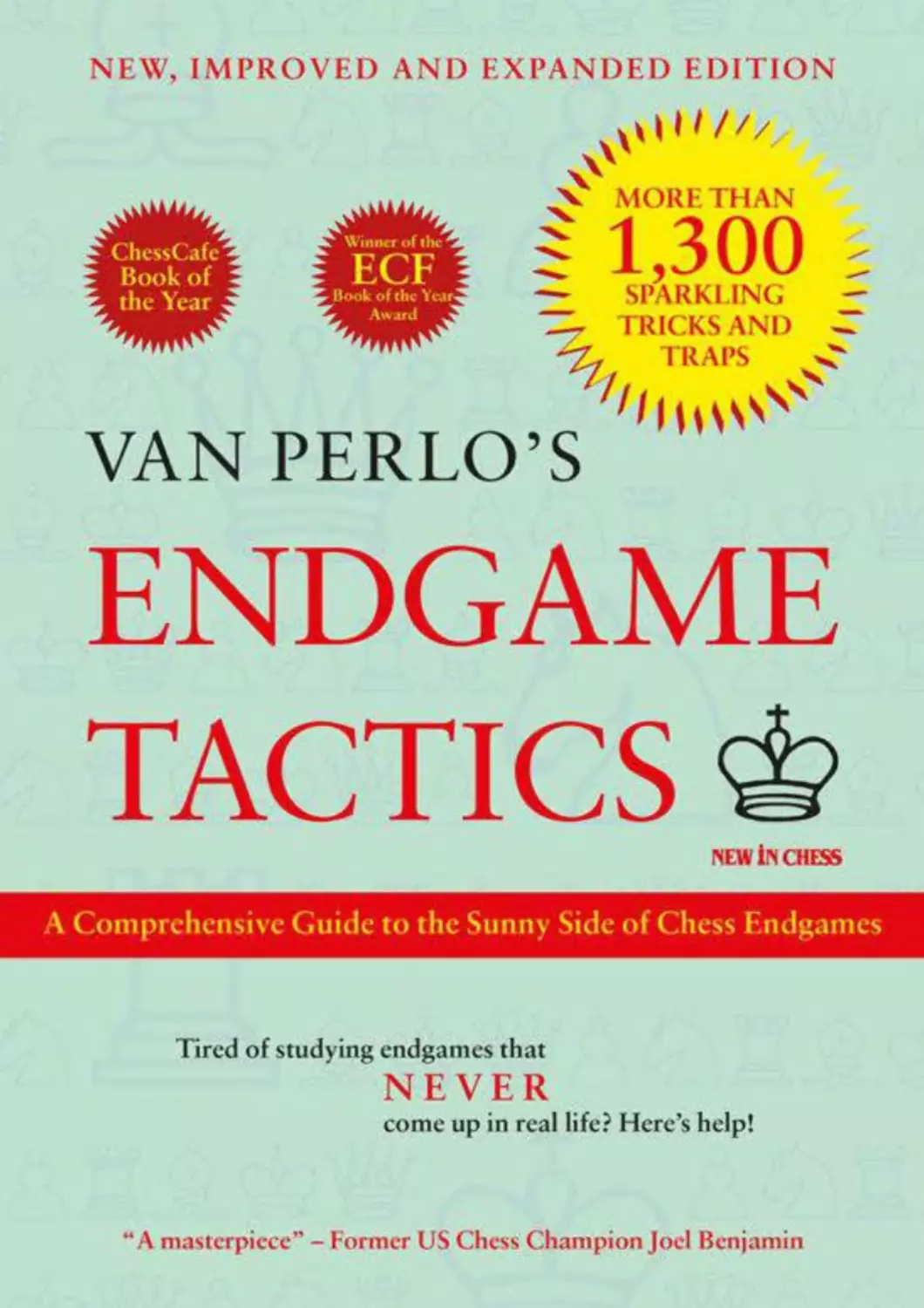
ENDGAME TACTICS
“There is considerable instructional content in the book. But the winning factor for the judges
was the sheer entertainment value – a rare commodity in the chess world these days.”
From the Judges’ Report, the English Chess Federation’s 2006 Book of the Year Award
“The instruction indeed comes with a spoonful of sugar. It cannot but help to improve your
chess, painlessly, even enjoyably.
The annotations are light and sometimes quite witty.”
Don Aldrich, ChessToday
“A marvellous book. Recommended for every club player.”
Jules Welling, Schaaknieuws
“A fantastic collection of endgame positions from actual play. Van Perlo’s respect for the game,
his delight in every little twist, is undeniable.
And it is infectious.”
Glenn Petersen at ChessCafe
“An irresistible collection of more than 1,100 endgame tricks and traps. A superb book, highly
instructive.”
Paul Motwani, The Scotsman
“Quite a powerful book. It does not wish to drill, it just wishes to entertain. And it does!”
Gerhard Josten, Rochade Europa
“A colourful mix of combinations, tricks, blunders, instructional examples and curiosities. An
unusual chess book with a very special charm.”
Schach Magazine
“All chess life is here: brilliant wins, amazing draws and not infrequently defeat snatched from
the jaws of victory.”
British Chess Magazine
“A milestone in achievement for the endgame.”
Bob Long, Thinkers Press
“Really excellent work. Very suitable for the vast majority of chess players who want to
improve.”
Andrew Martin on ChessBase Radio
“The thing’s addictive! (...) You can absorb fundamental lessons while being entertained.”
John Watson, The Week In Chess
“As a coach, I definitely understand the importance of beefing up my juniors’ endgame skills.
However I also realised that chess endgame studies are the last thing that truly excites them. ( ...)
Thus, instead of starting them on endgame principles, it only made sense to start them off by
showing them the sunny side of endgames: the tactical fireworks.”
Edwin Lam, ChessMate Magazine
“Destined to achieve classic status.”

3
Chess Life
“It is hard to believe that a simple collection of endgame positions could be so entertaining but
Van Perlo’s sardonic comments give the book a unique flavour.”
Ian Rogers, Sun-Herald
“I recommend this book very strongly and urge you to improve your play by reading it from
cover to cover.”
Eric Schiller
“Excellent.”
Alex Baburin, Chess Today
“An entertaining romp through more than 1,100 examples of endgame tricks and traps.”
Douglas Bryson, Scotland on Sunday
“A wonderful book.”
John Donaldson
“Did the theme ‘endings’ always seem a bit dusty to you? Thanks to Van Perlo it really starts
(perhaps for you for the first time?) to shine.”
Peter Doggers, ChessVibes
“This book has several tactical twists and turns on each page, which should convince you that
the endgame is definitely more interesting than you probably imagined, and it is a phase where
many half points can be picked up – or thrown away.”
Tim Harding, The Kibitzer
“The most enjoyable endgame book I’ve ever read. I’ve always loved tactics books, and this is
the first endgame book I’ve ever encountered with this approach. Middlegame tactics books like
this helped me reach master level; I wonder how far an endgame tactics book could have helped
me go? I never found endgames as much fun to study (till now).”
Hal Bogner, Chess Magnet School
“There are 1,105 examples of endgame tricks and clever traps that prove it’s worth staying alert,
even in the late stages of the game.”
Mark Donlan, Chess Horizons
“During three years (1999-2002) I spent four afternoons a week as a chess instructor in the
‘Penitenciária’, the convict prison in Lisbon. As you can imagine, the atmosphere in there is not
like paradise, but all I can remember is that many times the prisoners and I laughed our heads off
while playing through the positions of Van Perlo’s collection.”
Rini Luyks, chess coach, Lisbon, Portugal

4
VAN PERLO’S
ENDGAME TACTICS
A Comprehensive Guide to the Sunny Side of Chess Endgames
NEW, IMPROVED AND EXPANDED EDITION
2014

5
© New In Chess
First edition March 2006
Second edition November 2006
Third edition January 2008
New, improved and expanded edition March 2014
Published by New In Chess, Alkmaar, The Netherlands
www.newinchess.com
All rights reserved. No part of this book may be reproduced, stored in a retrieval system or transmitted in any form or by
any means, electronic, mechanical, photocopying, recording or otherwise, without the prior written permission from the
publisher.
Cover de sign: Steven Boland
Translation: Peter Boel
Proofreading: René Olthof
Production: Anton Schermer
Have you found any errors in this book?
Please send your remarks to editors@newinchess.com. We will collect all relevant corrections on the Errata page of our
website www.newinchess.com and implement them in a possible next edition.
ISBN: 978-90-5691-494-3

6
Foreword by the author
‘Endgame Tactics’ is the result of approximately 30 years of collecting, analysing and
categorizing. It has grown into a collection of endgames that have a particular charm for me on
account of their special character. I have cast them into a framework and little by little, a course
of instruction developed, treating many varieties of tactical possibilities that occur in endgame
practice. I have drawn on every source I could find. Original analyses I have often rewritten or
placed in a different context.
I have used the original manuscript for a series on the endgame in the Dutch correspondence
chess magazine Schaakschakeringen. Relevant reactions by readers I have later incorporated in
this book.
Many players consider the study of the endgame a necessary evil. Resignedly, they plough their
way through one or more standard works, restricting themselves to basic positions or, on the
contrary, a few exceptionally ingenious studies. Most of them do not find it very exciting.
Actually this is a pity, for in the endgame, too, there is a lot to be enjoyed and a thorough study
of a great number of practical fragments has taught me that even this phase of the chess struggle
can produce many different types of drama. Clever tactical tricks, gruesome blunders and other
tragicomic scenes, it’s all possible. When after many hours of toil the end of the game is nigh, it
is a difficult task for many to keep a clear head, to control their nerves and to make optimal use
of the opportunities that present themselves.
Especially a well-developed feeling for the multitude of tactical possibilities contained in the
endgame of ten signifies the difference between a full point and an annoying zero!
Of course, an investigation like this can always be continued, supplied and extended with new
and previously undiscovered older material. I don’t know if I will be able to do this, or if others
will take over. But it is clear to me that it is important that the entire field of tactical possibilities
is charted and will be in the future.
I owe many thanks to the New In Chess staff, who have cooperated with me, screened my work
scrupulously and moulded it into a form which suited my purposes perfectly.
I sincerely hope that the reader will de rive as much pleasure from studying the presented
material as I have derived from writing it.
G.C. van Perlo

7
Preface to the new, improved and expanded edition
For this new edition of Van Perlo’s Endgame Tactics we have prepared a special surprise for
you: an extra part with almost 300 fresh examples!
In 1998, after Wim Andriessen had started working on the first edition of this legendary tome,
Ger van Perlo sent him another 100-page manuscript which had not yet been published in Dutch.
It consisted of some fantastic new material in rook endgames, organized in the same structure as
Part III in Endgame Tactics, which corresponds with booklets 2 and 3 of the version that had
been published in Dutch in the 1990s. The Dutch correspondence chess grandmaster and chess
author suffered a stroke shortly afterwards and passed away in 2010.
At the time it was decided not to include this new part into the compilation, for various practical
reasons. First we wanted to see if there was a market for this work at all. Well, as you may
know, worldwide the reactions exceeded all expectations. So now that the time came for a fourth
edition, six years after the third, we decided to take another plunge and add Van Perlo’s ‘secret
book’ to the manuscript, expanding it to a whopping 600-odd pages.
We could have added this material to the chapters in Part III, but decided against this as Van
Perlo had written it as an independent new book in Dutch, and in order to keep the work ‘pure
Van Perlo’ we thought it better to present it as a separate part in the back of this book. As a new
feature, the Dutchman had added a series of exercises for the reader to test himself with. You’ll
find all this in Part V from page 465 in this edition!
Also in this new part you will find a fresh number of exciting endgame struggles, brilliancies
and tragic mistakes, all celebrated by Van Perlo in his contagiously humoristic style. This part
has also been scrutinized by my colleague René Olthof with the help of Houdini 1.5 and the
tablebases. And, infected by Van Perlo’s enthusiasm, we couldn’t help but make an addition
here and there. For example, when I saw position 1294 (Smyslov-Flohr), I was immediately
reminded of the very recent fragment Peng-Burg, played in Groningen last year.
And then of course there were still enthusiastic readers from all over the world who kept writing
through the years, enriching and refining the already published material. With the help of Steve
Murdoch we were able to refine the analysis of fragment 127 (Zhilin-Chernov), and both
Eckhard Hoffman and David Hotham pointed out to us that in Smirin-Polovodin we had given a
wrong line. Karsten Müller told us that Grünfeld may not actually have resigned in fragment 5,
against Colle, and Hans Ree told us how his victory over Polugaevsky actually went (diagram
439).
And so we’re getting ever closer to the truth, although, like Achilles in the race with the Tortoise
in Zeno’s paradox, we will never quite catch up with it!
Many thanks to all these contributors to this wonderful project, which will undoubtedly remain
alive for years to come.
Peter Boel
New In Chess
March 2014

8
Preface to the third edition
In his Preface to the first edition of Van Perlo’s Endgame Tactics, W.F. Andriessen announced
that we might use readers’ comments in ‘a future edition’. About twenty months ago we
couldn’t imagine that the fruits of Dutch correspondence grandmaster G.C. van Perlo’s life’s
work would have such an enormous appeal to chess players all over the world.
In 2006, the author earned the English Chess Federation’s as well as the Chess Café’s Book of
the Year Award for this remarkable, painstakingly researched and analysed work. Van Perlo
took an original approach to a subject matter hitherto often considered ‘dull’, displaying ‘wicked
glee’ (the ECF judges’ words) at the wealth of endgame tricks and traps he collected. And his
wish that readers would derive as much pleasure from studying the material as he had had from
writing it, has come true.
After the first edition, many readers started to provide us with feedback, ranging from useful
additions to outright refutations of sometimes well-known examples. This process continued
after the second edition. Van Perlo’s Endgame Tactics is indeed a ‘living organism’!
GM Karsten Müller’s comments have been very useful and for this third edition, we’d like to
thank Dutch IM and chess tutor Cor van Wijgerden especially.
Additionally, for this third edition René Olthof has run all positions with 6 pieces or less through
the endgame tablebases. This useful check has provided us with still more new insights. For
instance, the famous queen endgame Ribli-Spassky (position 75) turns out to be a theoretical
draw after all, Distler should have beaten Brown anyway in the B + 2P vs B endgame in
example 885 – and the same goes for Jones vs Edmonson (position 913)! Moreover, closer
research has finally provided us with what we now assume is the truth about Söderborg-Drimer
(position 3) and Helmertz-Wernbro (position 835).
So once again, our sincere thanks go out to everyone who has contributed to the further growth
of this wonderful project. A project which will remain vibrantly alive as long as ‘endgame fun’
exists.
Peter Boel
New In Chess
December 2007

9
Preface
Ten, twenty years ago it was not yet common usage to check data from chess games or positions
with the help of databases or chess computers. So it was with this publication, which appeared in
the Dutch-speaking regions in the 1990s. Van Perlo, a strong over-the-board player who gained
the title of correspondence chess grandmaster at a later age, was one of those chess enthusiasts
who built up a collection of positions for pleasure. His interest was in the endgame and as there
were no databases at the time, his collection grew by the gentle art of cutting and pasting,
analysing and classifying, during a period of more than thirty years. What was so special about
his collection was not the purely technical aspect as we know it from many standard works, but
the myriad of tactical possibilities as they occurred in practice, which Van Perlo has classified
according to theme.
As the four-part Dutch publication was a success, in the year 2005 the decision was made to
publish the collection in one volume in the English language. Van Perlo cooperated
enthusiastically and even supplied some new material. Unfortunately, before the work came to
its conclusion, he suffered a severe stroke which did not allow him to continue the work during
the final phase.
As indicated in the opening lines, the original work had not been checked with the aids we
dispose of nowadays. Of course, for the new version the need for this did exist and with the
author’s consent the editorial staff of New In Chess started with the job. Each position was
checked with NICBase and/or ChessBase, and with the chess programme Fritz 8.
First of all we should express our admiration for Van Perlo, who turned out to have produced
high-quality material. There were preciously few positions that could not be maintained.
Riddles
Thanks to present-day databases, many riddles could be solved. In the past, analyses would
sometimes be confused with the actual course of the game. In many cases the truth could be
found, sometimes with not so favourable consequences for the players in question. In the Dutch
edition, for example, Position 789, derived from the game Zukertort-Steinitz, Vienna 1882, was
presented as won by Steinitz in an elegant manner. In fact, the winning line was all analysis. The
future World Champion had missed it in the actual game and had had to content himself with a
draw.
A riddle that, at first, seemed to be unsolvable was contained in Position 724, derived from a
game between Klaman and Kholmov, played in the semi-final of the 1949 Soviet Championship.
Originally, the following position was what it was all about.
In NICBase, a game between these two was found and, curiously enough, this game even
featured an endgame of Rook + Bishop versus Rook, but this position did not occur in it. Would
it be possible that this endgame had appeared on the board twice in the same year, between the
same players? Of course, anything is possible, but this did not seem very probable. So on we
searched. The diagram position was mirrored and again compared to the game. Again, no match,
until we mirrored the position as well as tilted it. That did the trick! Now the position turned out
to match the one in the game after 61...Rf8. Some cases still remained unsolved. Position 967 is
derived from a Keres-Lengyel game, Luhacovice 1969. Van Perlo discussed the game starting
with the move 1.Ke3. But NICBase as well as Chessbase give as White’s first (and last!) move

10
1.Ke2. Which source should we believe? Games in databases can very well be taken from one
and the same source and it is well-known that the last (unchecked) moves of a game are a weak
spot in databases. Until further notice we will maintain Van Perlo’s version.
original diagram Klaman-Kholmov
Position 616, supposed to be from a game Bird-Janowski, Hastings 1895, also remains an
unsolved problem. Although both players did compete in this historic event, this position did not
occur in their game. After the tournament, a number of participants went on to play some free
games and a few consultation games, but these do not include a game Bird-Janowski either, and
neither does the game in question feature in the recently published Janowski biography.
What’s more, many of the positions are not featured in today’s databases. A lot of them are
taken from chess magazines, which means that the complete score may not be available. An
example is Position 839. In the Dutch edition this position is mentioned as taken from Pachman-
Welling, London 1973. At first, we assumed that the Dutch master Gerard Welling was meant,
but the latter told us that he had not been in London at that time and moreover, he had never
even played Pachman. But he was able to tell us that we were looking for the Dutch journalist
Jules Welling here. A modest player himself, he turned out to be the one that had invented the
elegant move 3...Rh8 and not Pachman!
The game was played during a simultaneous exhibition and it seems fair to add that Jules
Welling himself had organized it. Shortly before, Pachman had found refuge in the West and
Welling had made himself quite useful by organizing exhibitions for him in Holland and, as in
this case, London. He had simply seized the opportunity to join in for a game.
Pachman-Welling

11
Chess computer
The human chess player is as sloppy as he is inventive and nowadays, we have the chess
computer to point out his failures to him. For the present publication, Fritz 8 was consulted. By
the way, this wasn’t simply a matter of pushing the button and letting Fritz do all the calculating.
A certain amount of guidance remains necessary at all times. For instance, Fritz is especially
poorly geared to stalemate situations and fortresses. Still, it is curious to watch how the
apparatus keeps producing alternatives or even outright refutations, often in record time as well.
In many cases, Fritz helped us to make useful additions to the original fragments without
damaging them. An example is Mieses-Gunsberg, Hanover 1902, Position 866, where Fritz
immediately came up with a drawing line for Black. This is just one of the many improvements
we have included in this edition, and they are not only to be found in games by the ancient
masters.
A classic is Position 567 from Tarrasch-Réti, Vienna 1922. We wouldn’t want to state that this
magnificent example of a ‘wandering king’ contains a flaw, would we? The position after 8.Kf4
is critical.
If Black plays 8...Ne2+ 9.Ke5 Kg8 instead of the game continuation, how can White make
progress? Black keeps the possibility of ...Kg8 at hand to prevent White’s Kf7. Is this correct?
This is something for the reader to sink his teeth into. For the time being, we have drawn a veil
over this episode.
Tarrasch-Réti
Finally, there are three quite beautiful discoveries by Fritz that we don’t want to keep from you.
The first is to be found in the final position of the Shikova-Krumova game, Position 53.
In the original edition, this fragment ended with ‘Black resigned’, without further variations.
Which was understandable, for how does Black intend to stop the h-pawn? Well, Fritz has found
a way, as you can discover on page !

12
Shikova-Krumova
Very subtle was the discovery in Position 688, derived from the game Jovcic-Rajkovic, Belgrade
1977, in the analysis after 1.Rf1 Rg2+ 2.Kh1.
Jovcic-Rajkovic
The original analysis went 2...Rh2+ 3.Kg1 f2+ 4.Rxf2 gxf2+ 5.Kf1 Nf3 6.Rxf3 Rh1+ 7.Kxf2
Rb1 with a draw. But in just a fraction of a second, Fritz gives the winning 2...Re2!. Why does
this rook have to be on e2 of all squares? This becomes clear at the end of the following line:
3.Kg1 g2 4.Rbb1 (4.Rbxf3 Rb2 5.Rf7 gxf1Q+ 6.Kxf1 g5 and White wins) 4...gxf1Q+ 5.Kxf1
Nf5! 6.b8Q Ne3+ 7.Kg1 f2+ 8.Kh1 Re1+ and after 9.Kh2 Ng4+ 10.Kg3 f1Q White is mated.
Impressive!
And finally, in the last example, Position 854 (Volosin-Tarasov, Soviet Union 1968) we were
wondering why Fritz stubbornly kept evaluating the position as ‘0.00’, as it was crystal-clear
that one of White’s pawns would queen, as had been claimed in the original version.
Until we finally saw that on the 7th move, the black king would switch to the other direction like
in the famous 1921 study by Richard Réti... here put into practice to great effect.

13
Volosin-Tarasov
Van Perlo has woven an exceptionally rich tapestry of endgame tricks and traps in this book. It
is clear, though, that even the most famous of positions are still worth having a closer look at.
We have tried to do this in this new and, hopefully, enriched version. But we are quite aware
that there is still a lot to be discovered also in the material presented here. We would, therefore,
be indebted to readers who can supply us with additional information about the examples or with
new analysis. We may include them in a future edition.
W.F . Andriessen

14
Contents
Part I Pawn Endgames
Chapter 1 More than Meets the Eye
A) Is it really all that simple?
B) Trompe l’oeil
Chapter 2 Typical Motifs
A) Zugzwang
B) Breakthrough
C) Outside passed pawns
D) Pawn sacrifices
Chapter 3 Upsets
A) Marvellous tricks
B) A few more blunders
Part II Queen Endgames
Chapter 1 Pure Queen Endgames
A) Zugzwang
B) The march of the passed pawn
C) Mating attacks
D) Stalemate tricks
E) Pawn sacrifices, liquidations and other goodies
F) Some more blunders to round off
Chapter 2 Queen + Minor Piece versus Queen + Minor Piece
A) Queens with Bishops of opposite colour
B) Queens with Bishops of the same colour
C) Queen + Knight versus Queen + Knight
D) Queen + Bishop versus Queen + Knight
Chapter 3 Queen + Rook versus Queen + Rook
A) Mating attacks
B) Queen sacrifices
C) Rook sacrifices
D) Stalemate combinations
E) Queen + Rook versus Queen + Rook: Miscellaneous
Chapter 4 Queen Endgames: Various Types
A) Queen + Rook versus Queen + Bishop
B) Queen + Rook versus Queen + Knight
C) Queen versus Rook + Minor Piece
C1) The battle of Queen versus Rook + Bishop
C2) The battle of Queen versus Rook + Knight
C3) Stalemate tricks
D) Queen versus Two Rooks
E) Queen versus other material
E1) Queen versus Rook
E2) Queen versus Minor Pieces/Pawns
E3) Queen versus Queen + Minor Piece

15
Part III Rook Endgames
Chapter 1 Introduction
Chapter 2 Pure Rook Endgames
A) Disappointment, despair and discontent
B) Stalemate tricks
C) Rook Endgames with equal number of Pawns
C1) Rook + Pawn versus Rook + Pawn
C2) Rook + 2 Pawns versus Rook + 2 Pawns
C3) Rook + 3 Pawns versus Rook + 3 Pawns
C4) Rook + 4 Pawns versus Rook + 4 Pawns
C5) Rook + 5/6/7 Pawns versus Rook + 5/6/7 Pawns
Chapter 3 Pure Rook Endgames with Extra Pawn(s)
A) Rook + 2 Pawns versus Rook + 1 Pawn
B) Rook + 3 Pawns versus Rook + 2 Pawns
C) Rook + 4 Pawns versus Rook + 3 Pawns
D)Rook+5or6PawnsversusRook+4or5Pawns
E) Two or more Extra Pawns
Chapter 4 Rook + Minor Piece versus Rook + Minor Piece
A) Rooks with Bishops of the same colour
B) Rooks with Bishops of opposite colour
C) Rook + Knight versus Rook + Knight
D) Rook + Bishop versus Rook + Knight
Chapter 5 The Exchange – Rook versus Minor Piece
A) Rook versus Bishop
A1) The Rook side dominates
A2) The Bishop side dominates
A3) Balanced positions
B) Rook versus Knight
B1) The Rook side dominates
B2) The Knight side dominates
B3) Balanced positions
C) Two Rooks versus Rook + Bishop
C1) The Two Rooks are stronger
C2) Bishop and Rook in the attack
C3) Balanced positions
D) Two Rooks versus Rook + Knight
E) Rook and Minor Piece versus Two Minor Pieces
Chapter 6 Other Endgames of Rooks with Minor Pieces
A) Rook versus Bishop pair
B) Rook versus Two Knights
C) Rook versus Bishop and Knight
D) Rook + Bishop versus Rook
E) Rook + Knight versus Rook
F) Bizarre curiosities
Chapter 7 Endgames with 4 (or 3) Rooks
A) Rampant Rooks
B) Mating attacks

16
C) Other tricks
Chapter 8 Rook versus Pawn(s)
A) Rook versus 1 Pawn
B) Rook versus 2 Pawns
C) Rook versus 3 or more Pawns
D) Rook with Pawn(s) versus Pawns
Part IV Minor Piece Endgames
Chapter 1 Pure Bishop Endgames
A) Bishops of the same colour
B) Bishops of opposite colour
Chapter 2 Pure Knight Endgames
Chapter 3 Bishop versus Knight
A) The Bishop side dominates
B) The Knight side dominates
Chapter 4 Endgames with More Minor Pieces
A) The possession of the Bishop pair
B) The possession of Two Knights
C) Knight + Bishop versus Knight + Bishop
D) Various Endgames with Minor Pieces
Chapter 5 Minor Piece(s) versus Pawn(s)
A) Bishop versus Pawns
A1) The Pawns set the tone
A2) The Bishop dominates
A3) The position is balanced
A4) Stalemate tricks
B) Knight versus Pawns
B1) The Pawns set the tone
B2) The Knight dominates
B3) The position is balanced
B4) Stalemate tricks
C) More Pieces against Pawns
Part V More Rook Endgames
Chapter 1 Introduction
Chapter 2 Pure Rook Endgames
A) Disappointment, despair and discontent
B) Stalemate tricks
C) Rook Endgames with equal number of Pawns
C1) Rook + Pawn versus Rook + Pawn
C2) Rook + 2 Pawns versus Rook + 2 Pawns
C3) Rook + 3 Pawns versus Rook + 3 Pawns
C4) Rook + 4 Pawns versus Rook + 4 Pawns
C5) Rook + 5/6/7 Pawns versus Rook + 5/6/7 Pawns
Chapter 3 Pure Rook Endgames with Extra Pawn(s)
A) Rook + 2 Pawns versus Rook + 1 Pawn
B) Rook + 3 Pawns versus Rook + 2 Pawns

17
C) Rook + 4 Pawns versus Rook + 3 Pawns
D) Rook + 5/6/7 Pawns versus Rook + 4/5/6 Pawns
E) Two or more Extra Pawns
F) Analogies with Pure Rook Endgame studies
Chapter 4 Rook + Minor Piece versus Rook + Minor Piece
A) Rooks with Bishops of the same colour
B) Rooks with Bishops of opposite colour
C) Rook + Knight versus Rook + Knight
D) Rook + Bishop versus Rook + Knight
D1) Positions where the bishop dominates
D2) Positions where the knight dominates
Chapter 5 The Exchange – Rook versus Minor Piece
A) Rook versus Bishop
B) Rook versus Knight
C) Two Rooks versus Rook + Bishop
D) Two Rooks versus Rook + Knight
E) Rook and Minor Piece versus Two Minor Pieces
Chapter 6 Other Endgames of Rooks with Minor Pieces
A) Rook versus Two Minor Pieces
B) Rook + Minor Piece versus Rook
C) Bizarre curiosities
Chapter 7 Endgames with 4 (or 3) Rooks
Chapter 8 Rook versus Pawn(s)
Index of Names
Glossary of Terms

18
Part I
Pawn Endgames

19
Chapter 1
More than Meets the Eye
As the material is considerably reduced, many tend to underestimate this type of endgame, or
think that it is merely a matter of good calculation.
Nothing could be further from the truth. This seemingly simple subject matter bristles with
pitfalls and incredible beauty may lie hidden just below the surface. And things can get
extremely complicated!
For starters, however, we shall keep it simple. We shall call the first paragraph:
A) Is it really all that simple?
We shall deal with a few positions with minimal material, where it seems at first glance that not much can go wrong.
The position of diagram 1 occurred in the game Sajtar-Benko, played in Budapest, 1954. Despite the reduced material,
there is much to enjoy here. Black does not resign yet and plays
1...Kh7
followed by
2.Kf7
Thematic would have been 2.g8Q Kxg8 3.Kg6 and White wins, as he has the opposition.
2...Kh6
Now, if White is too confident and naively plays 3.g8Q immediately, it’s stalemate. It could happen to you in time-trouble!
But White decides on an underpromotion.
3.g8R!
A little joke, perhaps out of irritation because Black has played on for so long. 3 .g5+ would also have won simply. Now
Black finally resigned. However, he could have checked if White was still awake with
3...Kh7
Of course, White does not fall for the second stalemate trick 4.g5?
4.Rg5

20
followed by mate on h5!
3.g8R!
Diagram 2 is from the game Antsigin-Zhuravlev, played in Russia in 1952. As White saw only 1.Kxf3 Kg1 and curtains, he
decided to resign.
What the poor wretch did not see was 1.Kf2!, drawing. He probably didn’t sleep much that night.
Diagram 3 stems from Söderborg-Drimer, Reykjavik 1957. There followed
1...Kd2
1...a3 and 2...c4 looks like a simple winning method, for example: 1...a3 2.Kc1 c4 3.Kb1 Kd2 4.Ka1 Kc1 5.c3 Kd2 6.Kb1
Kd3! 7.Kc1 Kxc3 8.Kb1 Kd2 9.Ka1 c3 10.Kb1 c2+.

21
However, as Stephen Falk and Fernando Semprun have pointed out, this line yields no more than a draw either, as White
can play 3.Kd1! instead of 3.Kb1, and now 3...Kb2 (see diagram) 4.c3!, after which neither 4...Kxc3 5.Kc1 nor 4...Kxa2
5.Kc2 brings Black anything.
2.c4!
analysis after 3...Kb2
This is something to memorize, as is the follow-up!
2...Kc3 3.Kc1 Kxc4 4.Kc2! Kd4 5.Kd2 c4
5...a3 6.Kc2 Ke3 7.Kc3 Ke2 8.Kc2 holds the opposition, too.
6.Kc2 Kc5 7.Kc3 Kb5 8.Kc2
and Black settled for a draw after many more moves.
Now that we know this, diagram 4 is easy. After 1.c4! it’s a draw in the same way. If Black goes after this pawn, White
gains the opposition and draws. In l’Hermet-Johnsteyn 1877 – a correspondence game! – there followed
1.Kd2?
and after
1...c4
White resigned.
They weren’t quite so far in those days!

22
But Black should have known better in the game Colle-Grünfeld, Carlsbad 1929. According to some sources he resigned
here, while the draw was there for the taking with 1...Kd3!, for instance 2.Kg5 Ke4 3.Kxh5 Kf5.
You can figure out the rest yourself. But the great Grünfeld did not see it!!
B) Trompe l’oeil
If any approach lends itself for bad mistakes, it is superficial calculation or judgment of pawn endgames. They may look
simple at first sight, but they are not!
A very eloquent example of what may still be possible in seemingly hopeless positions is Taimanov-Cuellar, Leningrad
Interzonal 1973.
With his faraway king, White does not seem to have any perspectives left. But look what followed and keep it in mind!
Taimanov finds the following way out:
1.Kb3 Kd4
Neither does 1...Ke4 win, see 2.Kc4 Kf4 3.Kd5 (see diagram) and now:
A) 3...Kg3 4.Ke6 Kxg2 5.Kf7 f5 6.Kxg7;
B) 3...Kg4 4.Ke6 Kxh5 5.Kf5! Kh6 (or 5...Kh4 6.Kg6 Kg3 7.Kxg7 f5 8.Kg6 f4 9.Kg5) 6.g4 Kh7 7.g5.
2.Kb4 f5 3.Kb5 Kd5

23
analysis after 3.Kd5
3...Ke3 is wasted trouble as well, viz. 4 .Kc5 Kf2 5.Kd5 Kxg2 6.Ke5.
4.Kb6 f4 5.Kc7 Ke6 6.Kd8 Kf7 7.Kd7 Kf6 8.Ke8
and a draw was agreed.
Deservedly famous for his ability to save his skin in hopeless situations was Emanuel Lasker. The following amazing
escape occurred in Lasker-Tarrasch, St Petersburg 1914. Black threatens 1...c4 2.bxc4 bxc4, followed by a4 and c3. The
white king again seems too far off and the h-pawn can be stopped easily. But Lasker once again lives up to his reputation as
an escape artist.
1.h4 Kg4 2.Kg6!
There’s the rub. Tarrasch has calculated that after 2.Kf6 c4 3.bxc4 bxc4 4.Ke5 c3! 5.bxc3 a4, the a-pawn will decide the
issue.
With 2.Kg6, however, White gains a decisive tempo, because Black must take on h4 first. But then the white king rushes to
the queenside, using the b1-h7 diagonal instead of the a1-h8 diagonal. What difference does it make? We will find out!
2...Kxh4 3.Kf5 Kg3!
Tarrasch sees the danger. On 3...c4 follows 4.bxc4 bxc4 5.Ke4 c3 6.bxc3 a4? (6...Kg3 or 6...Kg5 still draws) 7.Kd3 and
now Black is in a right mess. After all, the white c3-pawn is not in the way now that its king is on the b1-h7 diagonal!
4.Ke4 Kf2 5.Kd5 Ke3 6.Kxc5 Kd3 7.Kxb5 Kc2 8.Kxa5 Kxb3
Draw.

24
3.Kf5
We see something similar in an even older game: Schlechter-Marco, Vienna match, 1893. Here White also appears lost,
since the black king is closer to the fray than his. But it’s not as bad as it seems. There followed:
1.Ke6 Kxb3 2.Kd7 Kxc4
Of course, Black cannot take on a3, as then White would arrive first with his d-pawn.
3.Kxc7 Kxd5 4.Kxb6!
White would have been fooled after 4.Kxb7? Kc5.
4...Kc4 5.Kxb7 d5 6.a4 Kb4 7.Kb6
And as Black must lose time again to take the a-pawn, it’s a draw.

25
A few more examples of trompe l’oeil. First we cast our eyes on a game Julia Horvath-Sandor Horvath, Hungary 1988.
After
1.Kf4
Black, doubtlessly optimistic about his chances, continued
1...h3 2.Kg3 Kg5
counting on 3.Kxh3? Kxh5 4.Kg3 Kg5 5.Kf3 Kf5 6.Ke3 Ke5. But he was brought down to earth with a bump by White’s
reply:
3.Kh2! Kh6
3...e5 4.h6 is also a draw.
4.Kg3!
Draw!
2...Kg5
In a worse ending, sooner or later a player will be confronted with the question if the time to resign has not come yet.
White decided that it had in the position given in diagram 10, from Van Mil-Peelen, Nijmegen 1985. When I saw this
position in print, I agreed with the commentator that White’s capitulation was a tad premature in view of the possible
continuation 1.Kb4 Kd4 2.Kb3 Kd3 3.g5 e3 4.g6 e2 5.g7 with a drawn queen ending.
Later, however, it was found that Black meets 1.Kb4 with the simple 1...e3!, winning in all lines (2.Kc3 Ke4 3.g5 Kf3 4.g6
e2). Van Mil must have seen this, so his resignation was correct. Nevertheless, more tenacious characters would have
waited and seen if their opponent found the move 1...e3.

26
Black did despair too quickly in Szabo-Füster, Budapest 1937. Black was apparently at a loss here. Against the great
master-to-be, he timidly played
1...Kf8?
Naturally, Szabo did not let this chance slip and with
2.Kg5 Kg7 3.Kxh5 f6 4.Kg4 Kg6 5.Kf4 Kg7 6.Kf5 Kf7 7.g4 Kg7 8.h4 Kf7 9.h5 Kg7
10.Ke6
he finished the job efficiently.
But he should have got half a point less!
In the endgame we must be extremely wary of small details. Black missed the possibility 1...h4!!. Capturing on h4 yields
White nothing, but after 2.g4 it is a draw, too, because then Black has 2...h3. There may follow 3.Kg5 Ke7 4.Kh4 Kf6!
5.Kxh3 Kg6! 6.Kh4 (6.Kg3 is also answered by 6...f5!) and now Black has the trump 6...f5 and there is no credit left to be
gained by White.

27
Chapter 2
Typical Motifs
In this chapter we introduce a number of tactical motifs that we will see returning throughout the
book. These motifs, you might say, are the blood and bone of endgame tactics. Without them,
this tome would be considerably thinner.
A) Zugzwang
In between events, we have been able to spot quite a few tempo moves. This paragraph specifically deals with that subject,
which we could also classify under the heading ‘Trouble and Affliction’. After all it’s a harrowing experience to find
yourself in a position where any move will only make things worse. Or imagine that in time-trouble, you have your
opponent by the short and curlies, but after one slight carelessness all your work has been in vain.
Diagram 12 is a good example. After a long game, the young Swinkels (White) had managed to reach a drawn pawn
endgame in his game against Erenburg, Dieren 2006. He starts off well:
1.Kf1 Ke3 2.Ke1 Ke4
Waiting tactics. An important point in this type of endgame is that 2...f2 3.Kf1 Kf3 does not win on account of the tempo
move 4.h3!.
3.Kf2 Kf4 4.Kf1 h4 5.Kf2 Kg4 6.Kf1 Kf5 7.Kf2 Kf4 8.Kf1??

28
8.Kf1??
In this war of nerves the young Dutchman goes astray. Necessary was 8.Ke1! Ke3 9.Kf1 and after 9...f2 again 10.h3!.
8...Ke5??
But Erenburg fails to grab his only chance! 8...Ke3 would have been winning: 9.Ke1 f2 10.Kf1 Kf3 (10...h3 stalemate is
another stalemate that’s easy to overlook!) 11.h3 Kg3 etc. Now the game ends ‘normally’ as the Israeli grandmaster does
not get a second chance.
97.Kf2 Ke4 98.Ke1! Ke3 99.Kf1 Kd4 100.Kf2 Ke4 101.Ke1 Kf5 102.Kf2 Kg4 103.Kg1
Kh3 104.Kh1 Kg4 105.Kg1 Kf4 106.Kf2 h3 107.Kf1 Ke4 108.Kf2 Kf4 109.Kf1 Ke3
110.Ke1 Kd3 111.Kf2 Ke4 112.Kf1 Ke3 113.Ke1 f2 114.Kf1 Kf3
Stalemate.
That’s how accurate these endgames have to be treated. That a little knowledge is no luxury is proved by the following
example from Yermolinsky-Komarov, also played in Russia, in 1986. White can enter a phase of intricate tempo play with
1.Kg2 Kd5 2.Kh3 Ke6, with a queen endgame resulting after 3.e4! fxe4 4.fxe4 Ke5 5.f3! Kf4 6.e5 Kxf3 (6...Kxe5 7.Kg4
Kf6 8.f4) 7.e6 g4+ 8.Kh4 g3 9.e7 g2 10.e8Q g1Q 11.Qc6+ Kf4 12.Qxc4+ which is very hard to win, if at all. He finds an
easier winning method.
1.f4+!
Sacrificing a pawn to reach a zugzwang position like the one in the preceding diagram, but now on the opposite side of the
board. Again, Black has no choice:
1...gxf4+ 2.Kf3! fxe3 3.fxe3 Kd5 4.Kf4 Ke6 5.e4 fxe4 6.Kxe4
and there is no salvation.
In diagram 14, we see Bob Wade at work as White against Kaderi, Siegen Olympiad 1970. Wade also tosses off a pawn sac

29
to bring Black in fatal zugzwang. The instructive continuation is:
1.d5! c5 2.Kd2
2.d6 does not work because of 2...Kb8, 2...Kb7 or 2...Kb6. This is downright deep-sea diving, but the assessment seems
to be correct. Let’s stick to the game.
2...Kb7 3.Kc2 Kc7 4.Kb2 Kd6 5.Ka3 Kxd5
As a result of all this hocus-pocus White is a pawn down. But in compensation he has conquered possession of the key
squares on the queenside and that’s what counts here.
6.Ka4 Kd6
As 6...Kc6 loses to 7.Ka5 Kd5 8.Kb5 Kd6 9.Kb6 etc.
7.Kb5 Kd5 8.Ka5 Ke6! 9.Ka6!
Now White has gained the so-called distant opposition.
9...Kd6
8.Ka5
Now this is forced, as 9...Ke7 meets with 10.Kb5 Kd6 11.Kb6 and Black must give up material.
10.Kb6 Kd5 11.Kc7!
What a way to crush your opponent’s ego!
11...Ke6 12.Kc6 Ke7 13.Kxc5 Kd7 14.Kxc4 Kc6 15.Kd4
and Black resigned, in desperate need of a rest day.
Despite heroic attempts to head for the hills, the second player did not manage to escape either in Istvan Polgar-Ciocaltea,
Asztalos Memorial, Baja 1971.
1.Kg3!

30
That’s fine. With 1.Kg5 Kg7 2.Kh4 Kg8 White wouldn’t make any progress.
1...Kf7 2.Kf3 Ke7 3.Ke3 Kd7 4.Ke4 Ke6 5.g5!
Depriving the black king of some vital squares in the tempo battle.
5...Kd6 6.f5 Ke7!
6...Ke7!
Black can still hope: 7.fxg6? Kf8! is looming after which half a point would be saved! But...
7.f6+ Kf7
Another bitter pill to swallow. 7 ...Ke6 meets with 8.f7! Kxf7 9.Kd5! and Black remains in zugzwang. One more trick to
memorize!
8.Ke5 Kf8 9.f7!
Black has done all he could, but now the end is near. If he plays 9...Kxf7, then 10.Kd6, and after 9...Ke7 comes 10.f8Q+!.
In view of this, Black resigned.
And yet sometimes there is still hope for those who remain alert and act timely. I shall give three examples. The first is the
game Andersson-Gheorghiu, Moscow 1981, in which Black gets off the hook like an escape artist with
1...f4!!
Absolutely necessary, as zugzwang inevitably awaits him after 1...Kc6? 2.f4! Kc7 3.Ka7 Kc6 4.Kb8! and we don’t want to
see what’s next!
However, after the text Black deserves the draw.
2.gxf4 Kc6 3.f3 Kc5 4.Kb7 b5 5.axb5
Of course, 5.a5 is met by 5...b4, and if anything, Black is better.
5...Kxb5 6.Kc7 Kc5 7.Kd7 Kd4 8.Ke6 Ke3 9.Kf6 Kxf3 10.f5 gxf5 11.Kxf5

31
and there is nothing more to be gained.
Draw.
5...Kxb5
In this position, taken from Pelikian-Tsuboi, Sao Paulo 2002, the black position also looks critical. The threat of zugzwang
is hanging over his head. For instance, if he plays 1...Ke6? there may follow 2.h4 Ke5 3.g3 Ke6 4.f4 Ke7 5.f5 and White is
winning.
However, the black player found an ingenious solution to this problem with the pawn sacrifice
1...h4!!
after which the draw was agreed. The motivation consists of:
A) 2.Kg4 f6 3.Kxh4 Kf4 4.g4 (or 4.g3+? Kxf3 5.g4 Kf4 6.g5 fxg5 mate, the actual point of Black’s pawn sacrifice!) 4...
Kxf3 5.g5 f5 stalemate;
B) 2.f4+ Ke4 3.f5 gxf5 4.Kxh4 Kf4! 5.Kh5 Kg3 6.Kg5 f4 (6...Kxg2 is also sufficient for a draw) 7.h4 (see diagram) 7...
f6+! 8.Kf5 Kxh4 with equality.
A highly instructive episode.

32
7.h4
A little less hard to find but still clever was the way White saved his skin in Filep-Mariotti, Reggio Emilia 1969/70.
1.Kg2 Ke4 2.Kg3 h5
Now is the time to be careful, as 3.h4? Ke3! again leads to zugzwang. But White is not to be discouraged and plays
3.h3!
and after
3...Ke3
he continued, grinning broadly, with
4.Kh4!
After
4...Kxf4
he is stalemated.

33
4...Kxf4
B) Breakthrough
Now we arrive at an even more spectacular branch of our chapter on Pawn Endgames. In this paragraph, crude violence
and brute force play a starring role, as well as missed opportunities, of course. But we are dealing with an important theme
here, as the timely recognition of a possibility to break through may constitute the difference between a full point and a lost
one, in other words between great joy and deep sorrow!
But let’s allow the examples to speak for themselves. We start with Pomar-Cuadras, Olot 1974, where Black conjured up
the following winning method:
1...f4! 2.Kd5
Probably already despairing, as 2.exf4 is met by 2...h4! 3.gxh4 g3!. But Black doesn’t lose his head.
2...h4! 3.Kxe4
3.gxh4 does not help either on account of 3...g3!, but now came
3...f3 4.gxf3 h3 0-1

34
Next, let’s have a look at Weinstein-Rohde, Lone Pine 1977. In all probability, the black player will not enjoy being
reminded of this position, in which he came up with the unfortunate thought
1...h4?
and White thankfully grabbed his chance to haul away the loot, and perhaps a fistful of dollars, with
2.gxh4 gxh4 3.Kd4 Ke6 4.a5
analysis after 3.Kd4
and wins. Looking at the preceding diagram, you had doubtlessly already seen that Black had victory for the taking with
1...f4! 2.gxf4 gxf4 3.Kd4 (see diagram) and now the punch line: 3...e3! 4.fxe3 f3! 5.gxf3 and after 5...h4!, the road to h1
lies open and Black wins.

35
Sometimes it is indeed difficult to recognize such a breakthrough opportunity, especially if there are more pawns on the
board, hiding the motif. A nice example is Havasi-Reko, Budapest 1976, where Black could not find a way out and
resigned.
The entire playing hall must have fallen over him, because every horseman on his feet, not hindered by nerves and other
discomforts, had doubtlessly seen the entire winning line that Black could have forced with the breakthrough
1...c4! 2.bxc4
Other ways to lose are 2.dxc4 a4 and 2.Kg3 a4.
2...a4 3.c5 a3 4.bxa3 bxa3 5.c6 a2 6.c7 a1Q 7.c8Q Qf1+ 8.Kg3 Qf4+ 9.Kh3 Qf3+ 10.Kh2
Qf2+ 11.Kh3 Qh4+ 12.Kg2 Qxg4+
and wins.
We can safely assume that Reko did not sleep so well that night!
Things were still more complicated in Tischbierek-Vorotnikov, Leipzig 1979. Black has the same trick as in diagram 21,
but he must reckon with stronger resistance on the opposite wing.
1...c4!
We could have expected this, although it doesn’t harm to point out that 1...a4? badly fails to 2.bxa4 c4 3.b3!. Another
resource to keep in mind! After the text move White plays his own trump card.
2.Kh5! a4!
Now is the right time. By the way, 2...Kf7 also wins.
3.Kg6 axb3!
The critical moment. Things can go quite wrong if Black plays the tempting 3...a3?. There follows 4.bxa3 bxa3 5.Kg7 a2
6.g5 a1Q? (6...fxg5! 7.f6+ Kd7 8.f7 a1Q 9.f8Q is still a draw) 7.gxf6+ Kd7 8.f7 Qg1+ 9.Kf6 and Black has screwed up!
After 3...axb3 the black pawn promotes on d1 in much more favourable circumstances.
4.cxb3 cxd3 5.Kg7 d2 6.g5 d1Q 7.gxf6+ Kd6 8.f7 Qg4+ 9.Kf6 Qh4+
and White resigned.

36
3.Kg6
Something completely different was going on in Edward Lasker-Moll, Berlin 1904. White can win here, but first he must
create the right conditions for a successful breakthrough with 1.f6! gxf6 2.f4 Kd5 3.g5 fxg5 4.fxg5 Ke5 5.gxh6 Kf6 6.Kc2
(see diagram) and wins, because the black king will eventually have to leave the square of the h6 pawn.
But White missed this chance. Even worse, he played
1.f4?? f6! 2.g5 Kd3
and it was Black who won!
analysis after 6.Kc2

37
Now we arrive at an entirely different type of breakthrough: the creation of two outside passed pawns, one of which cannot
be stopped.
The first example is Capablanca-Conde, Hastings 1919. The great Cuban here played one of his famous petites
combinaisons:
1.b4! axb4 2.a5 Kc7
and now, on the other side of the board:
3.g5! fxg5 4.fxg5 hxg5 5.hxg5!
Attention please. With 5.h5? White could still have thrown away the game because of 5...b3 6 .Kd3 g4 and White gets a
taste of his own medicine: a big zero! But the text does haul in the loot.
5...b3 6.Kd3 Kd7 7.g6 fxg6 8.fxg6
and Black resigned.
4...hxg5

38
Yandemirov-Feoktistov, Vladimir 2004, seemed to be heading for a long-winded pawn endgame. Instead, Yandemirov
lashed out with a fantastic breakthrough that seemed to appear out of the blue.
1.g4!! Kc7
Trying to reach the kingside in time. The alternatives show how much better White’s king is placed than Black’s: 1...fxg4
2.Kg2 Kc7 3.Kg3 Kd6 4.Kxg4 and White wins, or 1...f4 2 .Kg2 Kc7 3.Kf3 Kd6 4.Ke4 with zugzwang.
2.f4!
Now we have reached familiar ground. The black king can stop the passed pawn on the kingside, but then the trouble starts
on the queenside.
2...gxf4 3.g5 Kd6 4.b4! e5 5.c4 e4 6.a4 e3 7.g6 Ke6 8.b5
The second passed pawn will be lethal. Black resigned.
Sometimes it’s not how many passed pawns you can create, but how far apart they are. A telling example is Mannion-
Sareen, played in Port Erin 2005. How many pawns can Black put en prise? Exactly:
1...g5! 2.exf5 g4!
2...gxh4? would not have done, see 3.gxh4 Kf6 4.Kxc5 Kxf5 5.Kxb4 Kf4 and now both 6.Kxa3 Kxf3 7.b4 and 6.Kc3 Kxf3
7.Kd2 e4 8.Ke1 Ke3 9.b4 Kd4 10.Ke2 Kc4 11.Ke3 Kxb4 12.Kxe4 Kc3 13.Ke3 Kb2 14.Kd2 are good for a draw.
3.fxg4 e4!
It’s important that White does not have a king move now.
4.gxh5 e3 5.Kd3 c4+!
Creating an outside passer! White resigned.

39
In Levacic-Janosevic, Yugoslavia 1948, things also went wrong. Black made a last-ditch attempt:
1...a4 2.Kc3 d5
and yes!
3.d4?
3.Kc2 is a draw. After the text, however, Black hit home with
3...b4+! 4.axb4 cxd4+ 5.Kxd4 a3
Finished!
3.d4?
In diagram 28, we see a big name from chess history in the role of a pupil. In the game Euwe-Schelfhout, Amsterdam 1920,

40
the 19-year-old future World Champion had to hold the draw with 1.bxc4 bxc4 2.Ke4.
But he saw no danger and allowed a break with
1.Ke4?
Black reacted in a flash!
1...d3! 2.cxd3 c3!
A different version this time. After 3.Ke3, Black creates a protected passed pawn on c3 with 3...b4 and White can resign.
We conclude this subject with a few more high-level examples, starting with Garcia Gonzales-Quinteros, Moscow
Interzonal 1982, which saw the pretty continuation
1.g6! f3 2.Kg1! Kf6
and now the very beautiful
3.e5+! dxe5 4.d6 e4 5.d7
and Black gave up resistance.
Also very elegant was the way Black decided the correspondence game Kuznetsov-Selensky in 1971. With a sharp eye for
the possibilities in this type of position, he fixed White’s kingside pawns with
1...g4!
which was necessary, as after 1...a4 White saves himself neatly with 2.g4! hxg4 3.g3. He was denied this small pleasure
with 1...g4. Such postcards do not make a correspondence player happy... White swallowed and continued
2.Kxb3
but he was counted out with

41
2...h4 3.gxh4 g3 4.fxg3 e3 5.Kc2 e2 6.Kd2 a4
which is something we have seen before. All the more reason to look for a new subject.
C) Outside passed pawns
A passed rook’s pawn is one of the most dangerous weapons in a pawn endgame. We start with a basic example from
Smirnov-Bernan, Soviet Union 1972. First, Black fixes the queenside with
1...a5
and after
2.Ke3
he continues with
2...h5! 3.Kf3
On 3.Kd3, Black plays 3...hxg4! 4.hxg4 c4+! 5.bxc4+ Kc5 6.Kd2 Kxc4 7.Kc2 b5 and wins.
3...c4!
White has no alternative but
4.b4
and now comes the point:
4...b5!
and White could resign, because one Black a-pawn or the other queens!
4...b5!

42
Something similar, in a different guise, we see in Ree-Ftacnik, Kiev 1978.
1.Kd3 f6 2.Ke3
and instead of 2...f5, with probably good chances due to his more active king and his possibilities to gain tempi after, for
instance, 3.exf5 Kxf5 4.Kf3 g5 5.hxg5 Kxg5, Black had a catastrophic brainwave:
2...g5?
and White immediately hit home with the trick we know from our previous example:
3.g4!
For the books, we give the rest of the moves:
3...hxg4 4.h5 Ke6 5.Kf2 Kf7 6.Kg3 Kg7 7.Kxg4 Kh6 8.Kf5 Kxh5
Please take note of 8...Kg7 9.e5.
9.Kxf6 g4 10.e5 g3 11.e6 g2 12.e7 g1Q 13.e8Q+
and White won the second pawn ending after 13...Kh4 14.Qh8+! swapping on g1.
3.g4!

43
Sad was the fate of the white player in Gavrikov-Kharitonov, Sverdlovsk 1984.
1.Kg4 Kf7 2.Kf5 b4
An important move, fixing White’s queenside. Less successful would have been 2...Ke7 3.b4 Kd7 4.e6+ Ke7 5.Ke5 d4
6.Kxd4 Kxe6 (not 6...Kd6 7.e7!) 7.Kc5 Kf5 8.Kb6 Kg5 9.Kxa6 Kxh5 10.Kxb5 Kg4 11.a4.
3.e6+ Ke7 4.Ke5 d4 5.Kxd4 Kxe6 6.Kc4 Kf5
6...a5 is, of course, answered by 7.Kb5.
7.Kxb4 Kg4
and now White completely lost control:
8.Ka5??
The king moves in the wrong direction, missing a breakthrough opportunity. The win was for the taking with 8.Kc5! Kxh5
9.b4 Kg4 10.a4 h5 11.b5 axb5 12.a5! and there it is again, the high-speed passed rook’s pawn. In the game, Black
gratefully took the draw with
8...Kxh5 9.Kxa6 Kg4 10.b4 h5
and the subsequent queen ending resulted in a draw.
7...Kg4

44
In Ivanchuk-Hellers, World Junior Championship, Baguio City 1987, White faced the task of having to prevent the well-
known draw that would result after 1...hxg5+ 2.Kxg5 Kxa2 3.h6 Kb1 4.h7 a3 5.h8Q a2. He found the charming
1...hxg5+ 2.Ke3!
and now Black loses because of his extra g-pawn, making stalemate impossible. Another trick to remember!
A highly important trump is the outside passed pawn (rook’s pawn or other), on which quite a few winning tricks have
been based. We start with Budrich-Teschner, Berlin 1956, in which White grabbed his chance as follows:
1.g4!
If Black now takes on g4, 2.f5 frees the passage for the white e- and a-pawn. The black king cannot stop both. Black tried
1...d4+ 2.Kxd4 h5 3.gxf5 h4
but resigned after
4.Ke3
because the white king does get back in time!

45
Looking at the classics, we recognize this theme in a game Stoltz-Nimzowitsch, Berlin 1928. A superficial look at the
position might suggest that White has the advantage with his two connected passed pawns on the queenside. However,
Black demonstrates that outside passed pawns are stronger.
1...f4! 2.gxf4+ Kd6!
Again this powerful move, which would also have followed if White had tried something like 2.b6 or 2.a5 instead of
2.gxf4+. After the text, the black pawns cannot be stopped by the king, but the white pawns can!
3.a5 g3 4.a6 Kc7 5.Ke2 d3+ 6.Kxd3 g2 7.Ke4 g1Q
and White resigned a few moves later.
2...Kd6!
One more fragment from the ‘good old days’ is Nimzowitsch-Tarrasch, San Sebastian 1911, in which the second player

46
lived up to his fame as the Praeceptor Germaniae with
1...a5 2.Ke4
and now the lovely
2...f5+!
and after 3.Kd4, Black decides the issue with 3...f4 . That left White no option but to resign.
Another example in which the king cannot stop the outside pawn is Vorotnikov-Chekhov, played in the Soviet Union in
1977. White made use of his possibilities elegantly:
1.a4 h5 2.a5!
Very strong in combination with the next move.
2...Kd7
There is no time for 2...g5, which is met by the immediate b4-b5.
3.e4! dxe4+ 4.Kxe4 Kc6
An important finesse comes to light if Black plays 4...h4 . In that case 5.b5! axb5 6.a6 Kc8 7.d5 h3 8.Kf3 h2 9.Kg2 b4
10.d6 b3 11.a7 Kb7 12.a8Q+ follows, and the white d-pawn promotes with check.
5.d5+ Kb5 6.Kf4 g5+
Or 6...g6 7.Kg5, also with zugzwang.
7.Kxg5
and Black resigned.
4.Kxe4

47
Diagram 39 is taken from Wohl-Solomon, Australian Championship, Toowoomba 1985.
1.d5!
Not the obvious 1.dxe5? Ke6 2.f4 Kd5 3.Ke3 Kc4 and Black holds the draw, as long as he remains alert and keeps
preventing the g3-g4 break. After the text Black does not get this chance any more, as after
1...e4
there followed the immediate
2.g4!
which would also have been the answer to 1...Kd6. So, Black resigned. Incidentally, the white finish 1...Kd6 2.g4 fxg4
3.fxg4 Kxd5 4.gxh5 Ke6 5.h6 Kf6 6.h5 deserves attention. The black pawn on f7 blocks its own king, a ‘sub-theme’ which
is quite frequent.
Diagram 40 is another example of beauty and simplicity going hand in hand. The position occurred in the correspondence
game Kretschmar-Mohrlok, 1973.
Black came up with the pretty
1...g5!
and White could resign, for against the combined power of the c- and f-pawns there is no remedy.
If the postman deposits such a move in your box, life is surely tough for a correspondence player.

48
Things get a lot more complicated in Taborov-Vovk, Kiev 1993. White read the position well, judging by his
1.Ke4!
He could have gone quite astray with 1.Kd4?, whereupon Black draws with 1...a5!. The reason for this will be revealed
below. If Black, after 1.Kd4, does not play 1...a5 but, for instance, 1...Ke6?, then he has not grasped the situation and will
be demolished with 2.Kc5!! c3 3.c7 Kd7 4.Kb6 c2 and here it comes... 5 .e6+! Kc8 6.e7. Now Black can choose to be
mated right away or play without his queen, which is not something a gentleman would do!
So why is it a draw after 1.Kd4 a5, a stubborn reader may ask. In that case the continuation is 2.Kc3 (not 2.Kc5 c3 3.c7 c2!,
because the king has remained on the black square e7 and that’s what this endgame is all about; 2.a4 b4 3.Kxc4 does not
win either after 3...Ke6 4.Kb3 Ke7) 2...Ke6! (certainly not 2...Kd8?? 3.e6) 3.Kd4 Ke7 with a draw.
After this instructive and enjoyable elaboration we return to the game.
1...Ke6
Now 1...a5 doesn’t help on account of 2.Kd4 and after 2...Ke6 the black king finds itself on the wrong square again.
2.Kd4
Threatening 3.Kc5.
2...Ke7 3.Kc3 Ke6
At the risk of getting boring: 3...a5 again meets with 4.Kd4.
4.Kb4! Ke7 5.Ka5!
The final point!
5...c3 6.c7 Kd7 7.Kb6!
Here we are again: mate or loss of the queen.
7...c2 8.e6+
and, disheartened by all this sadism, Black resigned.
4...Ke7

49
Sinclair-Stean, Clacton on Sea 1974, also demonstrated the high degree of complexity of this endgame type. Here, White
must do his utmost for a mere half point. The ‘simplest’ way to achieve this is:
1.a5!
Not 1.b4? cxb4 2.cxb4 h5! and White’s connected passed pawns are outweighed by Black’s d- and h-pawns.
1...Kd6 2.Kg4 Kc6 3.Kf5
After 3.Kh5 d4! Black wins immediately, as our reader Gary Bagstad has pointed out, for example: 4.cxd4 cxd4 5.Kg4
h5+! and the three pawns are too much for White to cope with.
3...Kb5 4.Ke5 d4!
Fine! Black recognizes the danger after 4...Kxa5 5.Kxd5 Kb5 6.Ke5. Everything revolves around the question whether
Black can reach the crucial square f7 in time.
5.cxd4 cxd4 6.Kxd4 Kxa5 7.Ke5
Trying to fix something, seeing that 7.Kc5 Ka6! is also a draw.
7...Kb4 8.Kf6 Kxb3 9.Kg6 Kc4 10.Kxh6 g4!
Unfortunately, in spite of all the trouble White has taken, Black can still draw with this finesse because he reaches f7 in
time.
White’s last hope was 10...Kd5?. After 11.Kxg5 Ke6 12.Kg6 he would have been able to cut off the black king after all.
D) Pawn sacrifices
If you think that we have exhausted the theme of pawn endgames now I have to disappoint you. I have some more material
in reserve, so bear with me a little longer.
The possibilities and tricks that we have outlined in this chapter so far are in practice often introduced by a pawn sacrifice.
This requires a sharp awareness of such tricks. It goes without saying that quick action is needed and that any mistake or
miscalculation may be fatal. Let the pictures speak for themselves!

50
We start with the conclusion of the game Kushnir-Sulim, Soviet Union 1979. Black continued
1...f4+!
and the follow-up demonstrated that Black’s calculations were accurate:
2.Kxf4
White cannot escape with 2.Kd2 because of 2...h4!.
2...Kd4 3.a5 e3 4.a6 e2 5.a7 e1Q 6.a8Q Qe5+ 7.Kf3 Qe3
Mate.
This type of mating finish occurs quite frequently.
6.a8Q

51
Mitrovic-Cvetkovic, Bela Crkva 1988, is heavier stuff.
1...a5!
Excellent, as the obvious 1...h5 is met by 2.c4! Kc7 (or 2...c5 3.b5 Kc7 4.a5) 3.a5 a6 4.c5! and Black gets nothing out of
this.
2.h4
A pretty little return sacrifice. White hopes for 2...g4? 3.h5!, now that he has come to realize that other moves do not help:
A) 2.b5 cxb5 3.axb5 Kc5 4.c4 (see diagram) 4...h5! and against the combined threats of g4 and a4 (there are those cursed
outside passed pawns again!) there is nothing to be done;
B) 2.Ke3 h5, threatening ...axb4 followed by ...c5;
C) 2.bxa5 h5! and after 3...Kc7 Black wins with his outside pawns again!
Back to the game, where Black did not rise to the bait.
2...gxh4 3.Ke3 axb4 4.cxb4 c5 5.bxc5+
Or 5.b5 h3, threatening c5-c4.
5...Kxc5 6.Kf3 Kb4 7.Kg4 Kxa4
and White resigned.
analysis after 4.c4
White introduced a breakthrough motif in Plaskett-Flear, Hastings 1984/85.
1.h4! Kxb4
1...Kd4 does not save the game, see 2.Kf3 Ke5 and here also, 3.g4! decides.
2.g4 a5
To 2...hxg4 White replies 3.f6! and 2...Kc5 does not help either, for example 3.gxh5 Kd6 4.f6 Ke6 5.fxg7 Kf7 6.h6.
3.g5

52
and Black resigned in view of 3...Kc5 4.f6 gxf6 5.g6.
The presence of doubled pawns also often offers possibilities to decide a game by means of a pawn sacrifice with well-
known motifs. We turn to Muresan-Nieves Garcia, Malta Olympiad 1980.
1.Kb5
and now the elegant
1...a3!
after which Black wins as follows:
2.bxa3 Kf3 3.a4 Kxf2 4.Kxa5
White’s a-pawn and her king are well in each other’s way now and Black takes advantage of this.
4...h5! 5.Kb6 h4 6.a5 g3 7.hxg3 h3!
Stay awake please! After the careless 7...hxg3 it’s a draw.
8.a6 h2 9.Kb7 h1Q+ 10.Kb8 Qc6 11.a7 Qb6+ 12.Ka8 Qc7
and mate follows.
A very pretty episode was seen in Levitina-Saunina, Soviet Union 1970. This game should have ended in a draw, but White
fell victim to one of those devilish tricks, the kind we are already familiar with.
1.Ke5!?
Safer was 1.h4 .
1...Kg5 2.c4?
2.c3! b5 (2...b6 3 .d4 cxd4 4.cxd4 and Black is in zugzwang, for instance 4...b5 5.d5! cxd5 6.axb5) 3.c4! b4 (3...bxa4

53
4.bxa4, again with zugzwang) 4.d4 cxd4 5.Kxd4 h4 6.gxh4+ Kxh4 7.Ke5 Kg5 8.c5 zugzwang; or 5...f4 6.gxf4+ Kxf4
7.Kc5 and White wins both of Black’s pawns in the arising queen endgame.
2...b6 3.Kd6?
3.d4! cxd4 4.Kxd4 h4 (4...f4 5.gxf4+ Kxf4 6.c5 and White comes first) 5.gxh4+ Kxh4 6.Ke5! Kg5 7.h4+ Kg4 8.h5 f4 9.h6
still yields White a favourable queen endgame.
3...h4 4.gxh4+ Kf6!
There it is! Of course, White expected 4...Kxh4 and she would have liked the pretty win 5.Ke5 Kg5 6.h4+ Kg4 7.h5 etc.
After the text, this wonderful dream is over. Mopping up the black forces on the queenside (doubled pawn included) takes
too much time and Black’s f-pawn decides. In desperation, White played
5.Kxc6 f4 6.Kxb6 f3
and then resigned.
4.gxh4+
A quite uncommon position, with two sets doubled pawns, occurred in Pritchett-Kagan, Ybbs 1968. The quite interesting
and instructive continuation was:
1.c4 Kf6 2.Ke4 e5 3.c5 Ke6
Black could have played 3...h4 allowing 4.Kd5, as then 4...Kf5 5.b4 e4 6.Kd4 Kf4 7.b5 e3 8.c6 bxc6 9.b6 e2 10.b7 e1Q
11.b8Q+ e5+ wins.
4.g3! Kd7!
Without this pawn sacrifice Black cannot make progress, for instance 4...h6 5.b4 and Black still has a long way to go.
5.Kd5 Kc7! 6.Kxe5
White has to take now, as 6.b4? is met by 6...e4!
6...Kc6 7.Kd4 Kb5 8.Kd5 Kb4!

54
Black has built his winning plan on his passed e-pawn. By keeping it on e7, he ties the white king to the central squares.
9.c6 bxc6+ 10.Kxc6 Kc4!
Yet another venomous finesse. If Black plays 10...Kb3, White is fully alive again after 11.Kd5 and draws.
11.b4 Kxb4
This move yields Black the one tempo that he needs.
12.Kd5 Kc3! 13.Ke6 Kd4 14.Kxe7 Ke5 15.Kf7 Kf5 16.Kg7 h4!
Black must remain on his toes. White’s last hope was 16...Kg4? 17.Kh6!. We all know this, but oh, how soon a game is
ruined at the last moment and all the hard work has been in vain!
17.gxh4 h5 18.Kf7 Kg4
and Black triumphantly escorted his h-pawn to the other side.
8.Kd5
We conclude this paragraph with a pretty stalemate motif, introduced by the sacrifice of a doubled pawn. We have derived
this from the game Lukany-Smulyan, Taganrog 1938.
1...c4! 2.dxc4 c5!
Fixing the first pawn.
3.Kg4 Kc7 4.Kf5 Kb6 5.Kxe5 Ka5 6.Kd5 Ka4 7.Kxc5 a5!
and the draw cannot be avoided.
A good example of how points can be earned by a player with a keen eye for such tricks.

55
7...a5!

56
Chapter 3
Upsets
Here we have reserved some space for examples where not everything goes according to plan,
either because a clever player throws a spanner in the works with an unexpected trick, or
because another falls victim to a fatal oversight.
A) Marvellous tricks
I have a few other tricks in portfolio that cannot be heaped together under one denominator, but do deserve some attention.
The first of these is a very pretty theme, taken from Hort-Doncevic, which was played in the Germany Bundesliga 1983/84.
1...f6 2.f5!
and Black is in dire straits. On 2...gxf5 comes 3.c5+ Kd7 4.g6 with a breakthrough on the queenside, White, in a manner
well-known to us, creates two passed pawns that cannot be stopped! Black tried
2...e5+
but Hort counted him out professionally as follows:
3.Ke3 gxf5 4.g6 f4+ 5.Kd3 Ke6 6.b5
and Black resigned.

57
Now, for a change, a few haunting tales of sadism, starting with the 1927 correspondence game Wagner-Dührssen. White
spots a chance at self-stalemate, but for that purpose he must first get rid of his g-pawn.
1.g4 hxg4?
Black apparently does not see what’s going on and decides not to play the winning 1...hxg3, which queens one move
sooner.
2.Ka8 h3 3.a7
Draw.
A wonderful alternative win is 1...h3(!) 2.g5 h2 3.g6 (see diagram) 3...h1B!! (such an underpromotion really turns the
screws on your opponent) 4.g7 Bd5 5.g8Q (if I had wanted to play on here, I would have chosen a knight!) 5...Bxg8 (with
a queen this would have been stalemate) 6.Ka8 Bc4.
analysis after 3.g6

58
Serious sadism was also demonstrated by the great Rubinstein as Black against Cohn, St Petersburg 1909.
1...g4! 2.e4
You may calculate for yourself how Black wins after 2.fxg4.
2...fxe4 3.fxe4 h4 4.Kg1 g3 5.hxg3 hxg3
and in his misery, White resigned, because he will be taken in with 6.f4 exf4 7.e5 g2 8.e6 Kg3 9.e7 (almost, but...) 9...f3
10.e8Q f2 mate.
It’s a sheer delight to do this to someone!
A pretty endgame with pleasing features and a dramatic finish we see in Shikova-Krumova, Bulgaria 1972. Black possesses
an ugly doubled pawn, but under the right circumstances she may threaten to push her e-pawn. White decides to prevent
this once and for all.
1.Kc3 Kb8 2.Kd2 Kc7 3.Ke2 Kd6
An alternative was 3...Kc8!? 4.a6 bxa6 5.bxa6 Kb8 6.Kf1 Ka7 7.g3 fxg3 8.fxg3 hxg3 9.Kg2 Kxa6 10.h4 Kb5 11.h5 Kc4
12.h6 e3! and Black is doing fine.
4.Kf1!
This looks somewhat strange, but the follow-up makes everything clear. Moreover, White doesn’t want any problems like
4.g3 fxg3 5.fxg3 hxg3 6.h4 f4 7.h5 f3+! 8.Ke3 g2 9.Kf2 e3+ 10.Kg1 e2, when she would meet an inglorious end.
4...Kc5 5.a6 bxa6 6.bxa6 Kb6 7.g3! fxg3 8.fxg3 hxg3 9.Kg2!
and now the white king acts as a kind of sweeper! After 9.h4? e3! 10.h5 f4! 11.h6 f3 it would be too late again.
9...Kxa6
After 9...f4 10.h4 e3 11.Kf3 it’s all over.
10.h4
and Black resigned – in a better position! She had probably only looked at 10...f4, which loses as explained in the previous
note. But there is no win for White after 10...Kb5! 11.h5 (or 11.Kxg3 Kc4 12.h5 (12.Kf2? Kd5 and Black even wins) 12...
e3 13.h6 Kd3 14.h7 e2 15.h8Q e1Q+ with winning chances for Black) 11...Kc4 12.h6 e3 13.Kf3 Kd3 14.h7 e2 12.h8Q
e1Q 13.Qd8+ and White is the one who will have to fight for the draw.
A perfect illustration of the treacherousness of pawn endgames!

59
10.h4
Now we take a look at positions with f-, g- and h-pawns, or a-, b- and c-pawns, on both sides. It turns out that such
positions may also contain some nice possibilities, as we shall see in three examples.
We start with a game Duistermaat-Dekker from the Dutch Team Championship 1978. Full of confidence, Black played
1...f6
but the shrewd white player pulled a rabbit out of his hat:
2.g4+! hxg4+ 3.Kg3 g5 4.fxg5 fxg5 5.h5 Ke6 6.Kxg4 Kf6 7.h6 Kg6 8.h7 Kxh7 9.Kxg5
Draw.
Even worse did a game in a Dutch Junior Championship end in 1975.

60
White optimistically played
1.a4?
But to his shock and amazement – and to the schadenfreude of the witnesses, there followed
1...b6+! 2.cxb6+ Kb7 3.b5 axb5 4.axb5 c5
and Black won.
We shall quickly leave these tragedies behind us. Let’s move on swiftly to another theme. This position, from Andres-
Vilela, Havana 1992, looks simple, but it contains some vicious pitfalls, like 1...e3? 2.Kd3 g4 3.hxg4 h4 (3...hxg4 4.c5!)
4.Ke2 and it’s all over. No time to waste, the black player must have thought.
1...g4! 2.hxg4
Certainly not 2.c5? gxh3 3.gxh3 e3 and things get completely out of hand. And after 2.h4? e3 3.Kd3 Kg3 4.Kxe3 (4.Ke2!?)
4...Kxg2 5.c5 Kh2 6.c6 g3 7.c7 g2 8.c8Q g1Q+ it is White who must fight for the draw.
2...h4!
Black had to stay awake. If he unsuspectingly captures on g4, 3.c5 will follow (3...e3 4.Kd3).
3.g5!
And now it was White’s turn to mind his P’s and Q’s. He could have gone wrong with 3.c5 e3! 4.Kd3 h3 and he would
have been in for it!
3...e3 4.Kd3 h3! 5.gxh3 Kf3
and the queen endgame was drawn.
B) A few more blunders
The previous paragraph more or less wrapped up my observations on pawn endgames, but I cannot resist giving a few more
examples in a final paragraph, to illustrate how the careless can come to a tragic end.

61
We start with Sorm-Jurcka, Czechoslovakia 1976. You wouldn’t expect it at first sight, but Black is winning. He started
well with
1...hxg3 2.hxg3 b5!? 3.bxa5 bxa4 4.a6
Reader, you can start paying attention already. 4 .Kd3 g4! is what this is about!
4...Kc7 5.a7 Kb7 6.a8Q+ Kxa8 7.Kd3 Kb7
He doesn’t see it!
8.Kc4 Kc6?
He still doesn’t see ...g4, he didn’t see it at all and in the end, the poor wretch had to content himself with a draw, although
even the final position is still winning for Black.
In our grand finale, watch how the great Kortchnoi slipped up with Black against Wade, Buenos Aires 1960. Instead of the
stronger 1.h3!, Wade made an attempt at a breakthrough we know well.
1.a4 Kh5 2.b4
Black didn’t get the punch line, unsuspectingly played
2...Kg5?
and to his horror, White finished him off with
3.b5! Kh5 4.a5!
Black resigned.
What should Black have done? For us, dear reader, the answer is easy. After 2...b5! 3.axb5 (3.a5? g5 4.h3 g4+! 5.hxg4
Kg5 even loses) 3...b6! there would have been no breakthrough. Fortunately, even for the very great the game sometimes
remains too difficult. And with this happy observation, I conclude this chapter.

62
4.a5!

63
Part II
Queen Endgames

64
Chapter 1
Pure Queen Endgames
Together we have made it through Part I: Pawn Endgames. Now it’s time to move on. My
choice has fallen on the so-called ‘pure queen endgames’ first. By this, I mean endgames with
queens and pawns only. I can imagine many readers fluttering their eyelids and wondering how
this can be any fun at all!
So it was with me in 1960, when I landed in the notorious endgame queen + b-pawn versus
queen in a correspondence game against a Dane, Rasmussen. As I was the owner of the extra
pawn, of course I badly wanted to win. But how long would that take? My theoretical stock-in-
trade in those days consisted of a single Botvinnik-Minev endgame from the Amsterdam
Olympiad 1954, in which Botvinnik demonstrated how to handle this endgame. But this
example also illustrated how long the win takes and how far off it is. Stuff for nightmares.
My opponent and I, however, bravely got ourselves immersed in this job for several years and
we even managed to reach exactly 100 moves! Then apparently, Rasmussen was fed up as he
allowed a sudden mate, admittedly in a lost position.
The point was gained and patience was rewarded, but was it fun? No, it wasn’t.
There are more depressing examples like this. I vividly remember an adjourned game from the
Dutch team championships that our correspondence chess friend Gerben van Maanen had to slog
out with Leon Pliester during a match between Philidor Leeuwarden and VAS Amsterdam.
Pliester faced the task of converting a bishop’s pawn, in which he succeeded after several
sessions and weeks of broken down cars, train delays and other misfortunes. Was it fun? It
wasn’t.
However, we can boost the negative imago of this endgame type. Surprising as it may seem,
here, too, chess history features several miraculous stories. I would like to show you some of
those in this chapter to demonstrate how captivating the game of chess is in all its aspects, and
will remain until its last throes.
Let me start with Tatai-Mariotti, Rome 1972. A fitting transition from the Pawn Endgames part, as the breakthrough motif
again plays an important role.
1...g4+

65
An attractive start, as 2.Kxg4 meets with 2...Qf5 mate. Therefore, White played
2.Qxg4
only to be surprised by
2...Qf5!
and suddenly, the exchange of queens followed by c5-c4 is threatened.
Duly disappointed, White replied
3.h5
but after
3...c4 4.h6 Qxg4+ 5.Kxg4 Kf6
he resigned anyway.
Not bad, what?
5...Kf6
To liven up this introduction further I follow up with the ancient classic Neumann-NN from 1887, in which White, in spite
of the reduced material, managed to set off the following firework display:
1.Qd5!
Sacrificing the only pawn he has left!
1...Qxb4+
Unfortunately Black is mated now.
2.Kf3 Qe1 3.Qh5+ Kg1 4.Qg4+
and mate on g2.
Let me show you how White must finish after 1...Qg6+ (instead of 1...Qxb4+): 2.Kf4+! Kh2 3.Qe5 (again, several deadly

66
discovered checks are threatened) 3...Qd3 4.b5! (White plays his other trump card, the passed b-pawn) 4...Qd1 5.b6 Kh1
6.Qe4+ Kh2 7.b7 and White wins.
After these introductory skirmishes, in the next two paragraphs several motifs will be treated that we already know from
the Pawn Endgames part.
A) Zugzwang
Diagram 61 is from a game Loughran-Harrison, Victoria 1916. White was a pawn down and lost the game. However, he
could have won in subtle fashion with 1.Qf6!, after which nothing can save Black.
Here are two variations:
A) 1...Qh3 2.Qf7 d4 3.Qf8 d3 4.Qb4+ g4 5.Qe7 mate.
B) 1...Qf4 2.Kg2 d4 3.Qxe6 g4 4.Qf6+ Qg5 5.f4 (see diagram) and it’s all over.
anal y sis after 5.f4

67
Terrible things happened in Gusev-Yudovich, Soviet Union 1970.
1...h5+
Now White believed he could permit himself to gobble up the h-pawn, instead of resigning himself to a draw with 2.Kg3.
2.Kxh5 Qxf5 3.Qf3?
Salvation was to be found in two other lines: 3.Qa7 Kg8 4.Qe7 fxg5 5.Qxg5, or 3.Qe2!? Qxf4 4.Qd3.
3...Kg8! 4.Qb7 fxg5 5.fxg5 Kh7
and again, the zugzwang is fatal, because the mate threats ...Qf3 and ...g7-g6 cannot be parried at the same time.
Such blindness with fatal outcome was also suffered once by Larsen. In his game against Keres, San Antonio 1972, he
would have been wise to aim for a draw with 1.Kh3, but, being the optimist that he is, he fearlessly played
1.Kf4? Qh2+ 2.Kg5?
Perhaps White would have had more chances to save himself after 2.Ke4, but then 2...Qxh4 wins. Larsen is dreaming
sweet dreams of victory, but he is rudely awakened:
2...Qg3
Suddenly White is in fatal zugzwang, as his queen has to keep covering square e5 as well as the pawn on f3, which is
totally impossible.
There followed:
3.Qe3
Or 3.Qc5 Qxf3 4.Qd4 Qe2.
3...hxg4 4.Qf4 Qxf3 5.Qxg4 Qe3+ 6.Qf4 Qe2! 7.Qg3 Qb5+ 8.Kf4 Qf5+ 9.Ke3 Qxf6
and White lost, lamenting and gnashing his teeth.

68
B) The march of the passed pawn
The march of the passed pawn is another frequent motif in this type of queen endgame. With the support of a heavy battery
–
the queen – such a passed pawn is obviously a very dangerous weapon.
The following examples will make this clear.
Firstly, we give the floor over to Larsen again. He was more successful in his 7th match game against Andersson,
Stockholm 1975. Larsen again started a reckless attack. After
1.a5 d4
he ignored the threat to his f-pawn:
2.Qb7! Qxf2+ 3.Qg2 Qe3 4.b6 Qb3
4...d3! was a better try: 5.b7 d2 (5...Qa7 cannot save Black because of 6.Qf3+ Ke6 7.Qc6+ and 8.Qc8) 6.b8Q d1Q and
now a charming finish with four queens on the board: 7.Qh3+ Kf6 8.Qh4+ Qg5 9.Qb6+ Ke7 10.Qhb4+ Ke8 11.Qc6+!
(11.Qb8+ Qdd8! and there is no win in sight) 11...Qd7 12.Qb8+ Qd8 13.Qxe5+ retaining winning chances thanks to the
passed a-pawn.
5.a6!
Throwing a second pawn into the fray to continue the march.
5...Qxb6 6.Qb7 Qa5 7.a7
Black resigned.
In Mikhalchishin-Cvetkovic, Trnava 1988, White continued in aggressive fashion with:
1.h6! Qc4+
Not 1...Qxh6, after which follows 2.Qc8+ Kh7 3.Qxc6 and via b5, b6 etc., the decision will take place on the queenside.

69
2.Kf3 Qxa6
2...Qxb4 does not help either on account of 3.hxg7+ Kxg7 4.Qd7+ Kg6 5.Qxc6.
3.e5!!
A beauty!
3...Qa3+
Or 3...gxh6 4.Qxf6+ Kh7 5.Qf5+ Kg7 6.Qd7+ Kg6 7.e6 and now the decision will fall in the centre!
4.Kg2 Qxb4 5.exf6 gxh6 6.Qc8+ Kh7 7.Qd7+
and Black resigned because of the possible 7...Kg6 8.Qg7+ Kh5 9.f7 and now the game is decided on the right wing! After
9...Qe4+ 10.Kh2 Qf4+ 11.Kg1 Qc1+ 12.Kg2 the game ends.
3.e5!!
We conclude this paragraph with Glek-Kishnev, Dortmund 1992.
1.Qc2+ Kg7
Impossible is 1...f5 in view of 2.Qc5! Qg3+ 3.Kh1 Qe1+ 4.Qg1 Qd2 5.Qb6+ threatening 6.d8Q.
2.Qe4! Qd2 3.f4!!
Plenty of violence again.
3...gxf4
Declining does not help, for instance 3...Qxd7 4.fxe5 fxe5 5.Qxe5+ and b4-b5-b6, but the text does not provide any
consolation either.
4.Qb7 Kg6 5.Qc8 f3 6.Qg8+ Kh6 7.d8Q
Black resigned.

70
3.f4!!
C) Mating attacks
In the preceding paragraphs, little joy was to be found for the underdog. It gets worse from here. It will be clear to all that
with this interplay of forces, it is also possible that a queen supported by her footmen enters the attack with full force.
So, to arms!
We break the ice with Borisenko-Simagin, Soviet Championship, Moscow 1955. If White still wants to win, he must try
1.Kh2 and manoeuvre extremely carefully with 1...Qe2+ 2.Kg1 Qe1+ 3.Kg2 Qe2+ 4.Qf2 Qe4+ 5.Kh2 Qc4 6.Qe3! (see
diagram) etc.
1.Kh4 amounts to the same after 1...Qe2 (threatening 2....Qh5 mate), as now 2.Kh3 Qf1+ 3.Kh2 is forced and after 3...
Qe2+ we have the same variation.
But White had let the win slip before and was not enthusiastic about this at all. In such situations, objectivity tends to suffer
and this is what happened to Borisenko here. He decided on
1.Kg4??
was rudely awakened with
1...f5+!
and suffered a humiliating defeat.
After 2.gxf6 Qf5+ 3.Kh4 Qh5 he will be mated!

71
analysis after 6.Qe3!
A good example of the combined attacking forces of queen and pawns we see in Kartanaite versus Kutawiciene, Vilnius
1983. White conducted the attack very instructively:
1.Qf8+ Kh5 2.Qf4! g5
On 2...Qe7 there follows 3.g4+ Kh4 4.h3!.
3.Qf7+ Kh6 4.Qf6+ Kh5 5.g4+! Kh4
Sadly, after 5...Kxg4 comes 6.Qf3+ and 7.Qh3 mate.
6.Qf3 Qe4 7.Qxe4 d1Q 8.h3!
This little move again!
8...Qd7 9.Qf3
Black resigned.

72
6.Qf3
Diagram 69 from Tiviakov-Arbakov, Belgorod 1989, is a simple but attractive exercise: White to win in one move.
The answer is
1.a3!
and Black gets mated: 1...Qxb3 2.Qc5+ Kg8 3.Qg5+ Kf8 4.Qg7+ Ke8 5.Qg8 mate.
Just like Borisenko in diagram 67, in the game Matokhin-Kuzmin, Soviet Union 1970, White could not resist stubbornly
playing on for a win. He designed the self-destructive
1.Qf4??
and Black eagerly accepted with the spectacular variation
1...f6+ 2.Kg4 Qg2+ 3.Qg3 f5+ 4.Kf4 e5+! 5.dxe5 Qd2
Mate.
This fragment features in the famous 1978 motion picture Schwarz und Weiß wie Tage und Nächte by Wolfgang Pedersen.

73
4...e5!
In Brodsky-Toradze, Kazan 1981, there was nothing to be done anyway, as White liquidated flawlessly with:
1.Qd3+ Kb4 2.Qa6! c4 3.Qb6+ Ka4 4.Qc6+! Ka5
4...Kb4 5.c3+ Ka5 6.a4 and 7.Ka3 also leads to mate.
5.a4 c3+ 6.Ka3! Qe2 7.Qb7!
Black resigned.
Sadism from beginning to end. 7 ...Qc4 8.Qa7+ Qa6 9.Qc5+ is end of story.
7.Qb7!
D) Stalemate tricks

74
Usually, the weaker side faces a hopeless task when it has to compete with the combined power of queen and pawn(s).
But sometimes, there is hope. To illustrate this, I shall now proceed to the most spectacular branch of this type of endgame:
stalemate tricks. Often we see demonstrations of escapes that would not shame a Houdini. I shall break the ice with a few
simple examples with only one pawn on the board, to paint a simple picture of this theme.
We focus on Vaisman-Marovici, Romania 1975.
With a dull gaze, Black played
1...Qh8+
White must have thought that his was a kind of spite check and carelessly promoted to a second queen.
2.e8Q?
2.Kd7 wins as easily as 2.Kc7. Great must have been Vaisman’s disenchantment during the following.
2...Qc3+ 3.Kd8
Still sadder is 3.Kd7 Qc6+!, but now came
3...Qc7+!
Draw!
The extra pawn didn’t yield White a win either in Podgaets-Klovans, Soviet Union 1969. Black cleverly saved his skin
with:
1...Ka5 2.b7+ Ka6
and now White had no better than
3.b8N+
after which he could not win.

75
He must have nursed higher hopes for this pawn, but 3.b8Q is met by 3...Qe6+ and after 4.Kg7 Qh6+ 5.Kg8 Qh8+ it’s
really a draw.
In Lehmann-Pfeiffer, Germany 1958, we add another pawn.
1.g6 Qd3+
And here, White unsuspectingly played
2.Kg4?
Instead of the winning 2.Kh4. Black jumped to his feet with
2...Qxg6+ 3.Qg5 Kh8!
and again, the masterpiece is completed. White still tried for a win with 4.Kf4, but he didn’t succeed.
White was also extremely unfortunate in Ribli-Spassky, Montpellier 1985. He played the ‘attractive’
1.h6
as even 1.Qe4, followed by 2.g4, appears to be a theoretical draw.
The intention of the text is to win after 1...Qxh6+? with 2.Qh4 Qh7 3.Kg4! and that would have been no mean feat against
a player like Spassky. But the latter was on his guard and played
1...Qb2
with the nice point that 2.Qg7+ Qxg7 3.hxg7+ Kxg7 4.Kh4 Kh6 draws. White didn’t fall for that one and played
2.Kh4
Here 2.Qf5 was another try, but the position remains drawn after 2...Qd4 3.Qf4 Qa1.
2...Qh2+ 3.Kg5? Qxh6+!

76
Draw. If Ribli had foreseen this catastrophe, he might well have tried 3.Qh3. But he himself indicates in his analysis that
the white win remains questionable. Indeed, it is even impossible. Black should not play 3...Qd2? (see diagram).
Now, 4.Qe6 already wins, for example: 4...Kh7 5.Qf7+ Kxh6 6.Qh5+ Kg7 7.Qg5+. After 4...Qd4+ or 4...Qh2+ Black will
soon run out of checks.
analysis after 3...Qd2?
Even more convincing is another liquidation to a winning pawn end game: 4.Qc8+! Kh7 5.Qf5+ Kxh6 6.Qh5+ Kg7
7.Qg5+.
So, after 3.Qh3 Black should play either 3...Qc2 or 3...Qf2, when according to the tablebases we have a draw again!
Incredible how much venom a seemingly elementary position can contain.
Very tragic was Black’s case in Adams-Dimitrov, Burgas 1993, starting from an adjourned position. To everyone who
wanted to hear, Adams predicted a draw after 1...e3? 2.Qh6+, but no man could hope for such a miracle. Indeed, Black had
not sealed 1...e3. His move was
1...Qe3+
But look... The miracle happened after all, as to everyone’s astonishment there followed:
2.Kf1 Qf3+ 3.Kg1 e3?
Surely this is possible now? Nay!!
4.Qh3+!
with a draw after all.

77
4.Qh3+!
Now look what happened in Atanasov versus Spiridonov, Kamen Piskov Memorial, Ruse 1978.
We meet an old acquaintance. You can guess what happened.
1...Qf7+ 2.Qg6+
White cannot prevent this disappointing conclusion, seeing that after 2.Kg5 Qd5+ his king cannot go to f4 on account of
3...Qd2+.
2...Kh8! 3.Kg5 Qf4+!
Of course. Again, White cannot avoid stalemate.
Draw.
From a game Halkias-Dambacher, Amsterdam 2002, we add a drama on f7 in a position that White could have won as he

78
liked, but not with what Halkias, without thinking or perhaps in time-trouble, produced:
1.Kf5??
Filled with gratitude, Dambacher grabbed this chance of a lifetime:
1...Qf7+ 2.Qxf7
Stalemate.
Blood, sweat and tears had already been shed in the game Bilek-Heidenfeld, Lugano Olympiad 1968. It had all been in vain
when White forget to pay attention for an instant with
1.c4
which, to the joy of the entire Irish chess community, was punished mercilessly with
1...Qg3+
Life could have been so much sweeter for White if only he had played something like 1.Ka3 or 1.Kb4.
A very handsome theme with reduced material we encounter in a sideline of Dikarev-Pelts, Ukrainian Championship, Kiev
1964.
1...b1Q? 2.Qa8+? Qg8
and Black was winning. Fair enough. But there is a fly in the soup. 2 .Qe5+! would have shattered Black’s illusion, because
2...Kg8 fails to 3.Qg7+ and stalemate is reached again. Still prettier is 2...Qg7 3.Qb8+! and even two queens do not
suffice for Black to win!!
In the initial position Black should have started giving checks. 1...Qc5+ or 1...Qd1+ both keep Black on the right track.

79
With still more material on the board it remains vital to tread carefully, as an old hand like Matanovic had to learn to his
cost as White against Lengyel, Budapest 1964. To win, he only had to keep occupying the b8-h2 diagonal, in order to avoid
irritating checks.
However, he played
1.Qe6+ Kf8 2.f6?
2.Qd6+ or 2.Qe5 would still have won. Black gratefully jumped to the opportunity and adroitly forced the draw with
2...Qf4+ 3.Kg1 Qc1+ 4.Kf2 Qf4+ 5.Ke2
and now the pretty
5...d3+! 6.Kxd3 Qd4+!
Draw.
Stalemate couldn’t have been avoided anyway: 6.Kd1 Qd2+!.
5...d3+!

80
A famous example is Keres-Kholmov from the Soviet Championship, Moscow 1948. I remember this one well, as it was
the first time I saw this trick.
In despair Black tries one more check and lo and behold, Keres falls for the trap.
1...Qh3+ 2.Kg1??
2.Ke2 would have been curtains. But now follows the incredible
2...Qg4+!!
winning the a-pawn or forcing stalemate!!
The game ended in a draw.
A very beautiful alternation of attack and counterattack developed in Scherbakov-Arlazarov, Soviet Union 1972. White
started well with
1.f6! Kh7
but then went terribly astray with
2.fxg7??
We cannot give enough question marks here, because with
2...Qf7+
Black jumped to the opportunity to draw. It could have been so wonderful if White had only played 2.f7 and Black would
have countered with the witty 2...Qe5+. After 3.Qxe5, 3...g6+ even mates, but White has a no less attractive reply, namely
3.g5! Qxe6 4.f8N+ and this underpromotion brings an immediate win!
And this guy plays 2.fxg7?? It’s enough to lie awake for weeks!!

81
That even the very great fall for it over and over again, we see once more in Pilnick-Reshevsky, US Championship, New
York 1942. Reshevsky thought he could decide the game neatly with
1...g4?
Carl Pilnick – not to be confused with the great Argentinian grandmaster Herman Pilnik – struck immediately:
2.Qf2!
and Black may give stalemate!
That the ancient masters knew how to make use of this type of tricks may become clear from the next example from the
game Von Gottschall-Neumann, 1882(!!). White continued with the excellent
1.Ka3!
Not 1.Ka1 a6! and White cannot play the planned 2.Qb1 then, as Black can take on b1 with check and win with 3...g5!.
After the text move, however, taking the white queen would mean stalemate.
1...a6
1...Kh6 does not win either because of 2.Qc1+ Kh7 3.Qb1.
2.Qb1!
Draw.

82
A quite different type of stalemate we find in Boljos-Maric, Yugoslavia 1970.
1...Qd1+ 2.Kh2 Qd6+ 3.Kh3
3.g3 also wins easily, but White does not suspect anything. Why should he?
3...Qd7+ 4.g4 hxg4+ 5.Kg3 Qd6+
and instead of the simple 6.Kxg4 White played
6.Qf4+?
falling for a terrible stalemate trap that snapped shut with
6...Kh5
It could happen to you!
6.Qf4+?

83
Another masterly example we see in Friedmann-Paterson, Johannesburg 1962. With 1...Qxa3 Black would have been
calling the shots, but he thought he saw something more devastating.
1...h6?
Great was his disillusion... do you see it?
2.Qxh6+! Kxh6 3.g5+
and yes!
3...Kg7
Stalemate!
Correspondence chess players Nesis and Kolker put their oar in with diagram 88 (1975).
1...Qg8!
And against the threat of 2...Qxc4 and stalemate no remedy can be found. So Nesis had to content himself with the draw,
which probably did not content him at all.

84
Even a surplus of three pawns sometimes does not suffice to escape the draw, as in Browne-Planinc, Wijk aan Zee 1974.
Black continued
1...Qh2+
1...Qf2+ was simple enough, but after the text move we can learn something!
2.Kf3
Now Black can keep giving checks with 2...Qf2+ 3.Kg4 Qf3+. Planinc played the even cooler
2...Qe2+
and thanked Browne for handing him the half point!
Another tour de force in correspondence chess, from Lecroq-Oechslein, 1977/80.
Black could have virtually clinched victory with 1...Qd5, but he went for
1...d3?
Now, the Frenchman, slippery as an eel, neatly escaped with
2.cxd3 Qxd3
And you probably see it coming.
3.Qe7+ Kxe7
With 3...Kg8 nothing is to be gained either, as White then has 4.Qe8+ Kg7 5.f6+ Kxf6 6.Qe5+! (see diagram). In the
game, of course, there followed
4.f6+
with a draw.

85
analysis after 6.Qe5+!
A nice sequence we also find in the game Saunina-Semina, Soviet Union 1987.
1.Qd5+
After 1.Qd7+ Kf8 2.Kd6 Qd1+! White must try 3.Kc7, since after 3.Ke6 Qg4+ the win, if there is one, is extremely hard to
find.
After the text, Black cleverly took her chance with
1...Kf8 2.Kd6
2.f5!? may be worth a try.
2...Qa6+ 3.Ke5 Qe2+ 4.Kf6? Qe7+ 5.Kxg6 Qe6+!
again with stalemate as a result.

86
How important it is to be mindful of such treachery we may learn from a game between Geller and Simagin (Moscow
1961). Here the stalemate trick 1.c7? a3 2.e5 a2 3.exf6 a1Q+ 4.Kh2 Qe5+ 5.Kh3? (5.g3! still wins: 5...hxg3+ 6.Kg2 Qe4+
7.f3 Qe2+ 8.Kh3 Qh2+ 9.Kg4 Qh5+ 10.Kf4 Qg5+ 11.Ke4 Qg6 12.Qf5) 5...Qf5+! (see diagram) was hanging over Geller’s
head. However, he spotted it in time and simply turned things around with
1.e5 Qxe5 2.c7
and with the aid of a queen check, the c-pawn promotes, guaranteeing White the win!
analysis after 5...Qf5+!
Some people may go too far to prevent stalemate, as we see in the next ‘slice of life’ from Efimov-Fedoruk, Soviet Union
1978.
The unlucky white player, who was threatening 2.Qd8+ so subtly, saw his noble ambitions thwarted by a clever defence:
1...Qd5!
Of course, he saw that he was now threatened by various stalemates such as 2.Qe2 Qe6+, to name but one.
Therefore, feverishly, desperately and perhaps plagued by time-trouble, he started calculating and, as happens so often in
our game, he was promptly struck by blindness. See what happened.
He played
2.Qa3??
to maintain his a-pawn and to put a definite end to all those stalemate threats. The text takes care of all that, but not of
2...Qe6+ 3.Kxh5 Qf5
Mate.
Enough to make you never touch a chess board again!

87
We conclude this paragraph with a nasty example of double-dealing.
The position of which we shall now speak with abhorrence occurred in the game Gereben-Ardijansyah from the Siegen
Olympiad, 1970, during the match Switzerland-Indonesia.
The second player could of course have resigned here, but this swindler spotted a possibility that hardly anyone could have
conceived of.
Triumphantly he grabbed his queen, planted it on g6 crying ‘Stalemate’ and threw the pieces back in the box.
Flabbergasted, Gereben accepted the draw, only to discover later how he had been bamboozled. The moral of this story:
always check if the stalemate is genuine when it happens on your board!
E) Pawn sacrifices, liquidations and other goodies
Of course, the stronger side is always looking out for a quick way to liquidate into something less complicated than a long
endgame, which can so easily happen if he does not watch out.
Let me show you some examples. We start with Howell-Zakic, Vienna 1989, in which Black was able to speed up the end
with a pawn sacrifice, as follows:
1...Qe7+ 2.Qf6 h6+!
That’s it. After 2...Qxf6+ 3.Kxf6 b5 4.Ke7! (threatening f4-f5) Black can forget it.
3.Kxg6 Qh7+ 4.Kh5 Qf7+ 5.Qxf7+ Kxf7 6.Kxh6 Kg8!
and Black wins with his b-pawn. If 7.Kg6 b5 8.Kf6 Kf8!.

88
Every chess player knows how fatally loss of concentration, slackening in the fifth hour, time-trouble and the like can
affect a game. We can find a nice example in the game Becker-Moritz, Breslau 1925.
White could not find anything better than
1.Qh8? Qd6+ 2.Kg4 Qe6+
Draw. How much brighter his chess life would have looked that day, had he discovered the elegant win that was close at
hand: 1.a8Q!! Qxa8 2.Qf6+ Kh7 3.g6+ Kh6 4.g7+! (see diagram) 4...Kh7 (please take note of the charming finesse 4...
Kh5 5.Qf7+ Kh6 6.g8N+! and this underpromotion closes the case) 5.Qf8! Qd5 6.Qh8+ Kg6 7.g8Q+ and wins.
analysis after 4.g7+!
Black was more alert in Wl. Schmidt-Pytel, Poland 1975. Like a flash, he did grab the point with
1...g3+! 2.Kg2

89
This flight does not help, but there is no salvation either in 2.fxg3 Qe2+ 3.Kh1 (or 3.Kh3 Qg4+ 4.Kg2 Qxg3+ 5.Kf1 Qf3+)
3...Qf3+ 4.Kh2 Qxg3+ 5.Kh1 Qh3+.
2...Qd5+ 3.Kg1 Kg4!
Threatening 4...Kh3. White resigned.
And another pretty pawn sacrifice was demonstrated in Kirpo-Bengtsson, Sweden 1983:
1.h6+ Kg6
Black cannot accept the sacrifice, see 1...Kxh6 2.f5+ Kg7 3.f6+.
2.Qd6+ Kf5 3.Qf6+ Ke4 4.Qc6+ Kxf4 5.Qxf3+
The decisive liquidation.
5...Kxf3 6.Kg5 Ke4 7.Kf6 Kd5 8.Kg7!
Black resigned.
Things can get even more violent. In the following two examples, a trick is shown that occurs in practice more often than
you would think.
The first is Pihajlic-Ivanka, Subotica 1976. That one went like this:
1.g7 Qe3+ 2.Kh7 Qd3+ 3.Kh8 Qc3
That’s settled, you might think. Indeed.
4.Qc4+!
wins the queen.

90
That was the archetype of this theme, which we recognize in Iskov-Huss, Menorca 1974.
1...Qd4+ 2.Kg2 Qe4+ 3.Kf2
and, armed with the knowledge of the previous example, we immediately see what follows.
3...Qh4+!
Finished!
We have seen before that nice things can be done with underpromotions. In this example, from Szily-Ozsvath, Budapest
1954. Black did not see things so clearly anymore and resigned himself to
1...Qc1
After 2.Qf7+ Ke1 3.Qxg6 Qf4+ 4.Kg1 e3! Black may still win, but Ozsvath didn’t find it.
With a clear mind, he could have made a better profit with the immediate 1...e3! in view of the following resource: 2.Qc4+
e2 3.Qf4+ Qf2 4.Qc1+ e1N!. We can all guess what comes next: 5.Qc4+ Qe2 6.Qf4+ Nf3+! 7.Qxf3+ Qxf3 8.gxf3 Kf2.

91
Another beauty is Reshko-Kaminsky, Leningrad Championship 1972, in which Black should have fought for the draw with
1...Qa4! (1...Qa8? 2.Qe3! Qb7/c6 3.g5), which prevents 2.g5 because of the check on the d1-h5 diagonal. Instead, he
thought he had discovered a pretty stalemate trick.
1...Qd5?
An attractive thought in itself, as 2.Qf8? g6+ is mate and after 2.Qe8 Qb7 3.a8Q? he saw the stalemate with 3...Qf7+ on
the horizon.
But as so often, this chess player’s fate was sad and miserable, as this attractive thought contained a fatal flaw. To Black’s
astonishment, White did not play 3.a8Q but ‘contented himself’ with
2.Qe8 Qb7 3.a8B!
On the principle that modesty is a good virtue. After
3...Qb3 4.Qd7 Qg8 5.Bd5
he could cash in the full point!
3.a8B!

92
We conclude this paragraph with an impressive piece of analysis from the AVRO 1938 tournament book. This position
could have occurred in the game Alekhine-Reshevsky.
Later, it was found that Black could have saved himself as follows:
1...Qd4! 2.Qe8+ Kg7 3.d7
This looks decisive, but see:
3...Qd2+ 4.Kh3 Qd3!!
This way Black escapes, because White is forced to play 5.Kg2 Qd2+ 6.Kh3 Qd3 and back again. Just in case White would
lose self-control:
5.d8Q?? Qf1+ 6.Kh4 g5+ 7.Qxg5+ hxg5+ 8.Kh5
Or 8.Kxg5 Qf6+!.
8...Qf6
And the mate cannot be parried.
4...Qd3!!
F) Some more blunders to round off
I conclude this chapter – like the previous one – with some horrible cases of short-circuiting.
We must confess to a certain amount of schadenfreude, but we may also console ourselves with the thought that even the
greatest players cannot avoid blunders. After all, we are all mere mortals. I learned this long ago at school and this
knowledge can keep a man on his feet even under the roughest circumstances.

93
It remains highly doubtful, however, if this knowledge would have been sufficient consolation for Black in our next
example. In Boidman-Siniavsky, Soviet Union 1979, Black was confronted with the move
1.Qb4+
That’s fine, he must have thought; exchange queens and that’s that. So...
1...Qf4+
Indeed, that was that:
2.g3+
and the pieces could be put back in the box.
We see something similar in Levenfish-Romanovsky, Soviet Championship, Leningrad 1933.
There followed:
1...Qc1+ 2.Kh2 Qf4+ 3.g3+
with the same effect. It is less easy to see, however, that 1...Qc1+ already was a blunder, as Black has no defence on the
second move. Correct would have been 1...Qf4, in order to draw after 2.Qe7 with, for instance, 2...Kg3. The mortal danger
that threatens Black in this position is also illustrated by the little line 1...c3? 2.Kh2 Qf2 3.Qd6! c2 (see diagram) 4.Qd4+!
Qxd4 5.g3 mate.
Did I hear someone say that queen endgames are boring!?

94
analysis after 3...c2
We hang on just a little longer and cast a glance on Daan Smit-Arp, Hilversum 1984. Here also, terrible things are about to
happen.
Black tried
1...g5 2.Qf3 h4+
and now something happened that you can only dream of.
3.Kg4??
Of course, the king had to go to h3.
3...f5+! 4.Kxf5 Qxf3+ 5.gxf3 h3
and Black will win this without knowledge of any endgame whatsoever!
3...f5+!

95
Finally, I present to you two highly prominent victims. First Rogers-Kortchnoi, Biel 1986. White is in trouble in view of
Black’s strong passed pawn.
He defends bravely with
1.c4
keeping a queen check on d8 in reserve. Now Kortchnoi loses patience:
1...Qd4 2.Qd8+ Kc5??
Incredible...
3.Qc7
Mate!
Toon van Lanen-Chiel van Oosterom, Dieren 2005, was also turned around by a tragic blunder.
White is in check. 1.Kh4 Qd8+ (1...fxg4 2.Qxg4+) 2.Qg5 Qh8+ 3.Qh5 leaves little doubt about the result of this game.
Van Lanen thought he saw something better.
1.Qg3??
What can possibly be wrong with such a multi-purpose move? White covers his king and the queenside pawns.
1...f4!
Van Oosterom, not the chess maecenas but a Dutch junior player, is quick to show the defects of White’s scheme. After the
forced queen swap 2.Qxd3+ Kxd3 little hope is left: 3.Kg2 Ke2 and the f-pawn marches on. Therefore, White resigned.

96
No less miserable was Simagin’s plight as Black against Batuev, Riga 1954. He thought his future was rosy:
1...e2??
but how cruel was his fate...
2.Qg1+ Kd2 3.Qc1+ Kd3 4.Qc3
Mate.
I suggest we forget these misfortunes as soon as possible, conclude this chapter and move on to another story.

97
Chapter 2
Queen + Minor Piece versus
Queen + Minor Piece
In the previous chapter, we have dallied with solo queens surrounded by simple pawns. It’s time
to give our lonely she-warrior some more powerful support!
We start with a single minor piece. That allows us to distinguish between four possibilities, each
with its own, rather particular types of hostilities:
A) Queens with Bishops of opposite colour
B) Queens with Bishops of same colour
C) Queen + Knight versus Queen + Knight
D) Queen + Bishop versus Queen + Knight
It’s interesting that not so much systematic research, let alone comprehensive theory is available
on these subjects, which leaves us all the more scope for our own inventiveness, reflections and
conceptions!
The technical difficulty of this type of endgame often lies in the possibility to liquidate into
other endgame types (a pure queen endgame or an endgame with minor pieces without queens).
This often requires accurate calculation and a sharp eye for the best chance.
However, we shall leave these possibilities to liquidate aside in most cases, as in this chapter I
want to restrict myself to the subject at hand and above all, I want to call attention to the many
treacherous tactical possibilities that can occur precisely there.
A) Queens with Bishops of opposite colour
This endgame type is infamous for its opportunities to play for mate. Actually, that’s quite logical. After all, the player who
is attacking, having managed good cooperation between queen and bishop, is not hampered by a danger of simplification
by the exchange of bishops into the queen endgame, which is abhorred by so many. This player has obtained free rein, so to
speak, and this may lead to surprisingly fascinating material, which I hope to illustrate with the examples on the next pages.
We start with a quite clear image without pawns, a genuine archetype.

98
We are dealing with an old one, the game Kolb-Schroder, Nuremberg 1895.
Black did the job skilfully:
1...Qh7+ 2.Kf8 Qh6+ 3.Ke8
and as so often in this type of position, a handsome combination is possible now.
3...Bd7+! 4.Kxd7 Qe6+ 5.Kc7 Qc6
Mate. Simple, but you still have to find it!
The conclusion of the correspondence game Berggreen-Mayr, 1988/90, was also completely forced.
1...g5
Threatening mate.
2.Qf3 Qg1
Threatening mate again.
3.Qg2 Qe3+ 4.Bf3
The bishop cannot defend effectively and 4.Qf3 fails to 4...fxg4+ 5.Kxg4 Qe6+ 6.Qf5 Qxe2+. But now Black played
4...Qe1!
and White resigned.
Just as forced was the finish of the correspondence game Tarnai-Penakov, 1983/84.
1.Qh4+ Qh5
And now the crushing piece sacrifice
2.Bg7+!!

99
After
2...Kxg7 3.Qe7+
Black suspended further correspondence.
It is not always so easy to see. In Kholmov-Baikov, Moscow Championship 1988, the first player – not exactly an amateur
–
made things unnecessarily hard for himself with
1.Qg8+?
Admittedly, White won after this, but only after a long time. An elegant and forceful road to victory was 1.Qf7! Qe2 (1...f3
2.Qg6+ Kh8 3.Qh5+! Qh6 4.Qe8+ Kh7 5.Qg8 mate) 2.Bc4!! Qd1 3.Qg6+ Kh8 4.Qe8+ Kh7 5.Bg8+ Kh8 6.Bb3+, with
which Kholmov could have saved himself a lot of technical work.
A long, entirely forced road to victory was found by White in another correspondence game: Sabinin-Tamarkin, 1974.
White clearly has the initiative and uses it to force mate:
1.Qh6+
Not the tempting 1.Bg6, as Black can then try 1...Bg7, followed by e5. After 1.Qh6+ Black does not get this chance.
1...Bg7 2.Qe6 Bf6 3.Bg6 Kg7 4.Qf7+ Kh6 5.Bf5 Kg5 6.Qg6+ Kf4 7.Qg4+ Ke3 8.Qe4+
Kf2
Not gladly, but there is no other way, see 8...Kd2 9.Qd3+ Ke1 10.Bg4! Kf2 11.Qf3+ Ke1 12.Qe2 mate.
9.Bg4 Kg3 10.Qf3+?!
10.Bd1! Qg8 11.Qe3+ Kh4 12.Qf4+ would have forced a quicker mate.
10...Kh4 11.Be6!
Preventing all counterplay and threatening mate again.

100
11...Kg5 12.Qf5+ Kh6 13.Bf7 Kg7 14.Qg6+ Kf8
It is striking when you compare this position with the original one. After marching over the entire board, the black king is
back on f8, completely exhausted now and ready for the slaughter...
15.Qg8
Mate.
14...Kf8
After these examples, in which queen and bishop managed to seal the opponent’s fate in such harmonious cooperation, we
move on to a few examples in which the footmen contribute their mite.
In Ivanchuk-Pavel Blatny, World Junior Championship, Sharjah 1985, Black let the spirit out of the bottle with
1...h3! 2.Kxh3 Bxf3!
White is in a right fix. On 3.Kh4 there follows 3...Qxg2 4.Qc8 (or 4.Bg3 f6 5.g5 fxg5+ 6.Kxg5 Qh3) 4...f6! 5.Qf5+ g6
6.Qd7+ Kh6 (see diagram), Black’s Leitmotiv! So White tried
3.Kg3
and was defeated as follows:
3...Qxg2+ 4.Kf4 Qxg4+ 5.Ke3 Qe4+ 6.Kf2 Qe2+ 7.Kg3 f6
Here also!
8.Bd6 Be4 9.Qc7 Qf3+ 10.Kh4 Bf5
White resigned.

101
analysis after 6...Kh6
Perhaps somewhat simpler, but rather attractive was the way Black’s king position was torn open in Ghitescu-Zuidema,
Amsterdam 1971.
1.e5! fxe5
1...Qc7 also meets with Qh1 and g4-g5, but tougher resistance would have been offered by 1...g5! 2.Qh1+ Kg7 3.Qa8 Qf8
4.Qb7+ Qe7 5.Qc8 Qf8 6.exf6+ Kxf6 7.Qf5+ with ‘merely’ a technical win for White.
2.Qh1+ Kg7 3.g5
Black resigned.
We haven’t got round to the inevitable stalemate combination yet. Here’s a pretty example: Gonzalez-Martinez, Cuba
1991.

102
1.Bh6+ Kg6 2.Qg8+ Kh5
Black tries to elude his fate by declining to take the bishop, but White does not let go of his prey.
3.hxg4+ fxg4 4.Qf7+
Now Black is forced to capture.
4...Kxh6 5.Qg6+
It’s worked: a draw.
We conclude this paragraph with an intriguing piece of analysis by Ekström as the arbiter of a position in which the game
Secchi-Salm from the 3rd World Correspondence Chess Championship in the early 1960s was adjourned. He found the
forceful 1.Qa3+ Kf7 and now the subtle 2.Qb2, with two threats (b6-b7 en e5-e6) that cannot be parried at the same time.
2...Bc8 3.e6+! (see diagram).
Here come the footmen again! 3...Kg8 (if Black plays 3...Qxe6, then on the opposite side 4.b7!) 4.Bh6 Qb7 (preventing
mate and stopping the b-pawn) 5.Qf6 and now it’s the e6-e7 threat that decides.
An attractive piece of cooperation, but consultation of our silicon friend Fritz yields some new conclusions. If Black plays
3...Kxe6! instead of 3...Kg8, things are not at all clear. However, one move earlier, White has a more convincing win with
2.Bf6! instead of 2.Qb2, as pointed out by Colin McNab in 1997. The threat of 3.Qe7+ and mate can only be parried by 2...
Qe6, when 3.b7! wins at once. So we may conclude that at least Ekström’s assessment was correct!
analysis after 3.e6+!
B) Queens with Bishops of the same colour
Here also, we have to search hard for the scarce tactical tricks that can help us avoid heavy technical problems. If such a
chance presents itself, it is important to take it without hesitation.
Familiarity with the following examples may be of some use!

103
First we cast our eye on the correspondence game Müllner-Janosi, 1987. Black is okay in this position and 1...Qa6 –
keeping the a8- and c6-squares covered – should suffice for the win, but it can be attained more quickly and attractively
with
1...Bc1!
and who would not prefer to win this way?
2.Bxc1 h3! 3.Qe2 Qa2+
White resigned.
If he tries to elude this fate with 2.Bh2, 2...h3 comes anyway, and after 3.Qf2 b2 4.Qb6 Qe4+ 5.Ka2 (see diagram) the
thunderbolt 5...b1Q+! 6.Qxb1 Qa4 forces mate.
analysis after 5.Ka2

104
We encounter another bishop sacrifice in Buxa-Kovacs, Hungary 1965.
1...Bf6+! 2.exf6
and now Black tightened the mating net with
2...Kg6
White has no checks and is left with the desperate 3.g4, after which Black executes the sentence with 3...Qe1.
A different type of bishop sacrifice was demonstrated by Black in Peelen-Fedorowicz, Wijk aan Zee II 1990.
1...exd4 2.Bb4
Taking on d4 is not to be recommended, see 2.Bxd4 Bd2! or 2.Qxd4 Qg2+ 3.Ke1 Qg1 mate.
The text was wittily answered by
2...Be3! 3.Ke1
As 3.fxe3 does not work in view of 3...Qg2+ and 4...f2+.
3...Qg1+ 4.Qf1 Bxf2+
White resigned.
Sometimes it is also possible to force a quick decision with a piece sacrifice that serves to create an outside passed pawn.
Two examples, starting with Vasiliev-Dolmatov, Soviet Union 1982. White faces the problem of how to get his c-pawn on
c8, as Black appears to have a firm grip on the promotion square. With
1.Qd8+ Kg7 2.Bb7 Bh3
White even landed into trouble.
There is, however, a clever solution: 1.Bd5!! and after 1...Qxd5, 2.Qd8+. Another trick to memorize!

105
With a similar piece sacrifice, based on his passed e-pawn, White decided the issue in Suba-Kindermann, Beer-Sheva 1984.
1.Bh5+! Kxh5 2.Qf5
and Black resigned in view of the forced liquidation 2...Be2 3.g4+ Bxg4 4.hxg4+ Kh4 5.Qf3! Qb8+ 6.Kg2 Qb2+ 7.Qf2+
and White gets himself a new queen on e8.
Sometimes a piece sacrifice can mean salvation from a delicate situation, as Gheorghiu had to experience against Scheeren,
Romania 1985. He expected to decide the issue with the ‘powerful’
1.Qh7
Imagine his disappointment when he saw Black’s reply
1...Bg1+! 2.Kxg1 Qc1+ 3.Kf2 Qb2+ 4.Ke3 Qb3+ 5.Ke2?
5.Qd3! Qxb4 6.a6! retains good winning chances.
5...Qxb4 6.Qg8+
and grinding his teeth, Gheorghiu had to resign himself to a queen endgame which promised him no more than a draw.

106
An amusing combinative interlude occurred in Scoleric-Tonoli from the Belgian Team Championship in 1988. White had a
go at the full point with
1.Bd5
but he was put off his stroke by the clever reply
1...Be6!
In his grief he saw nothing better than
2.Qxd3
and lost quickly after
2...Qxd5
But there is more under the sun here. White’s confusion must have originated when he was calculating 1.Bd5 Be6 2.Bxa8
Bxb3 3.f4 d2 4 .Bf3 Bd5 or perhaps 2.Bxe6 Qxf3+ 3.Kh2 Qe2+ 4.Kh3 Kh6 5.Bc4 g5!. A player panics and his view on
events gets blurred. With a clear mind, White would have seen that there is still a ministering angel close by, if only White
continues 5.Qc4! (see diagram) instead of 5.Bc4. That takes care of 5...g5 because of 6.Qc6 and White even takes over.
After 5.Qc4 it is probably a draw.
Our royal game remains a breeding ground of dangers and obstacles where mischief is always lurking.
analysis after 5.Qc4!

107
Two Dutch players experienced this, too, in their national championship game in Eindhoven 1993. In Hoeksema-Van der
Sterren, there followed
1.Ke1?
after which White eventually lost. Both players had missed 1.Kd3! or rather, they had not seen that after 1.Kd3 Qd6+,
2.Bd5+! would have been possible. If Black wants to have his cake and eat it and tries, for instance, 1...Qd7+ 2.Bd5+ Kc5
3.Qxe5 Qb5+?, he ends up in a mess after 4.Bc4+. The sting is in the tail, so to speak.
A quite extraordinary case was Zhilin-Chernov, Soviet Union 1960, where White continued
1.f6! Bxh3
1...Qd6+ does not help either after 2.Qe5 Qxe5+ 3.dxe5 Bxh3 4.Kxh3 and the pawn endgame is lost for Black, for example
4...d4 (4...gxf6 5.e6! and Kh3-g4 -f5xf6 wins) 5.cxd4 b5 6.Kg4 b4 7.Kh5 b3 8.e6 etc.
2.Qe5!
The threat is 3.fxg7+ Kg8 4.Qe8+ and 2...gxf6 meets with 3.Qxf6+ Ke8 4. Qf7+ (not 4.g7 Qxc3+ 5.Kh4 Qe1 drawing) 4...
Kd8 5.g7 Qxc3+ 6.Kh2! and after 6...Qd2+ 7.Kxh3 the king walks to g3 after which White can interpose the queen on f3.
2...Bd7?
There was a narrow escape with 2...Qxc3+ 3.Kh4 gxf6 4.Qxf6+ Ke8 5.g7 Qe1+ with a perpetual.
3.Kh4!
Stunning. Black is in fatal zugzwang.
3...b6 4.Kh5 b5 5.Kh4 h5 6.Kxh5
and Black shook his head and resigned!

108
3.Kh4!
We conclude this subject with a missed tactical chance in Short-Timman, Amsterdam/Arnhem 1983.
Timman collected the e-pawn with
1...Qh1+
and could not win after that. What he had failed to see was 1...Qf1+ 2.Kg3 hxg4 and White is confronted with the nasty
problem that 3.Qxg4 does not work in view of the loss of a bishop, but even worse is the fact that after 3.Kxg4 Qg2+ 4.Kf4
the position contains the sledgehammer blow 4...Qxd2+! followed by 5...Bh6+!.
C) Queen + Knight versus Queen + Knight
After playing around with the niceties that we may come across in endgames with queens and bishops, we move on to a
highly fanciful subject, a type of endgame of which some are scared to death.
We start with a trick that we may justifiably call the dream of every chess player. In certain positions the queen can be
sacrificed with a terrific blow, to be regained by a knight fork, with a transfer to a winning endgame or a rescue from a
hairy predicament, or simply with the infliction of severe psychological injury upon the enemy!

109
Our first example is Ljubojevic-Karpov, Linares 1991. White served the organizers of this tournament – always keen on a
spectacle – quite well:
1.Nf6+ Kh6?
There is no lethal discovered check after 1...Kg7!
2.Qe3+!
There it is. Black lands in a lost endgame, as soon becomes clear.
2...Qxe3 3.Ng4+ Kg5 4.Nxe3 Kf4
and now, very sadistically,
5.a4!
and White won with his unstoppable a-pawn.
Diagram 130 stems from Maroczy-Rubinstein, Prague 1908. At first sight things do not look good for White, as 1.Qxb6?
fails miserably to 1...Nf4+. But Maroczy, who knew a thing or two about the game, thought of something better – you
probably see it already.
1.g5+! fxg5 2.Qxh7+!
and Black resigned. The resulting knight endgame offers him no chance at all.

110
This position is from Timman-Kosashvili, Curaçao 2002. After a move like 1...Kf8 there is not much going on. However,
the second player, though certainly tactically gifted, produced the unbelievable
1...Kg6?
We jump up enthusiastically with Timman and unleash
2.Qxg7+! Kxg7 3.Nxh5+ Kf7 4.Nxf4
Probably too upset to resign immediately, Kosashvili played on for a few more moves, deprived of his leading position in
the tournament and also of another illusion.
Not very hard to guess is Black’s first move in diagram 132 from Seirawan-Illescas Cordoba, Barcelona 1989.
1...Qxg3+!
That does not put an end to it, as White does not play 2.fxg3 but
2.Kf1 Qxh3+ 3.Ke2 Kg7 4.e4!
White also had a queen sacrifice at his disposal, but refused to fall for 4.Qxf7+ Kxf7 5.Ng5+ Kf6 6.Nxh3. After all, this
knight endgame is clearly better for Black!
4...Nh6 5.Qe5+ Kg8 6.Qe8+ Kg7 7.Qe5+ Kg8
Draw. The funny thing is that Black cannot push too hard for a win with 7...f6 8.Qe7+ Nf7 on account of 9.e5! (see
diagram) 9...fxe5? and now 10.Qxf7+ is possible.
After the promising 1...Qxg3+, this must have come as a disappointment. To us it teaches not to start cheering too soon.

111
analysis after 9.e5!
There were cheers for the second player in Smagin-Agzamov, Soviet Championship, Riga 1985, when he produced the
subtle
1...Qg2!
The deadly threat is 2...Qg3+ and most annoyingly, 2.Qxf7 fails to – yes – 2 ...Qxf3+ and 3...Ng5+. And because he is
mated immediately after 2.Kxe4 Qxg4 or also 2.Nh2!? Ng5! 3.e4 Nh3+ 4.Ke3 Qf2 mate, White had to admit that he was in
fatal zugzwang. So, he lay down his weary head and resigned, appalled by the fact that so many catastrophes can occur in
one single position.
The next example, Matulovic-Tsvetkov, Varna 1975, is harder to find but a feast to behold.
1.Qc1!!

112
Attacking the knight, but leaving the d4 pawn hanging. Albeit with healthy suspicion, Black went for
1...Nxd4+ 2.Kd3 Qxe5
There we go.
3.Qc8+ Kg7
and with a terrific blow
4.Qh8+! Kxh8
and now the fat is in the fire.
5.Nxf7+ Kg7 6.Nxe5
To top it all off, the black knight is lost as well. White won quickly.
That is about enough of this type of tricks. Now we want to investigate situations where, more modestly, a knight is put on
offer instead of a queen.
A pretty example we find in a correspondence game between Erkki Rasanen and Seppo Rasanen, 1984.
1.Qh8+ Kf7 2.Qd8!
Black undoubtedly saw 2...Qe8 3.e5. He tried
2...Qc8
but alas – White saw it.
3.Nc6!
Black resigned.

113
Slightly more difficult does this position look, from Brenninkmeijer-Douven, Wijk aan Zee II 1988, as Black achieves
nothing with an attacking knight move. There does exist, however, another standard trick in this type of position:
1...Qd1+ 2.Kf2 Nxe4+ 3.Ke3
and now (remember this one!)
3...Qd2+!
White resigned because of 4.Kxe4 Qe2 mate or 4.Kf3 Ng5+ 5.Kg4 Qf4 mate.
This trick we also found in Wolff-Hodgson, London 1990, where the black player, adventurous as ever, hit home with a
single stroke:
1...Qg1+
White can choose between 2.Kxf3 Qf1+ losing a queen on the next move, or 2.Kh3 and now either 2...Qh1 or 2...Ng5
mate!
After these knight sacrifices we take an even more modest look at things and confine ourselves to the sacrifice of a mere
pawn, naturally with the aim of hauling in a bigger fish.
In Taimanov-Koshy, New Delhi 1982, White faced the problem of how to enter the black fortress with his queen. This was
his solution:
1.b5!
Black had to take with the knight:
1...Nxb5
after which White was able to seize his chance:
2.Qa2+ Kf8 3.Qa8+ Ke7 4.Qh8!

114
Now look how helpless Black is. Nonchalantly, White executed the sentence:
4...Kd6 5.Qxf6+ Kc5 6.Qg7 Kd4 7.Nf6 Qa5 8.Qxh7 Qe1+ 9.Kg4 Qf2 10.Kh3 g5 11.Qd7+
Kc5 12.Qg4
and Black resigned.
In the previous example, the pawn sacrifice served to clear the way for the queen. You can also imagine the need for an
intervention by the knight. This is shown in Zarubin-Polovodin, Leningrad 1985.
1...Qh1+ 2.Kg4 Qg2+ 3.Kh4 e4!!
White resigned.
The threat is 4...Qh2+ followed by a decisive knight intervention via square e5.
Inferior was 3...f3? 4.Qg6! and there is nothing better than a repetition of moves.
A very pleasing fragment including a piece sacrifice, another trick to keep in mind, is depicted in diagram 140. It stems
from the game Möhring versus Kaikamdzozov, Zamardi 1978.
A magnificent spectacle was displayed after
1.f7 Ng7
and now the piece sacrifice
2.Qf6+ Kxh5 3.Kg3 b6 4.Kh3!
Dear reader, let this position sink in for a while. You would not think it was possible. Black is in zugzwang! Have a look at
4...Qc8+ 5.Kg2! Qf8 6.Kg3 and Black has no sensible moves left. In the game, Black tried
4...Ne8 5.Qf5+ Kh6 6.Qe6+ Kh7 7.fxe8Q Qf3+
Granted, White is a queen to the good, but how can he prevent the perpetual? The instructive solution is:

115
8.Kh4 Qf2+ 9.Kh5 Qh2+ 10.Qh3!!
Yes, another trick to memorize. White gives one of his queens to lure Black’s queen into a less favourable position, thereby
allowing his king to escape the perpetual.
There fol lowed:
10...Qxh3+ 11.Kg5 Qg3+ 12.Kf6 Qf3+ 13.Ke7 Qxb3 14.Qh5+ Kg7 15.Qg4+!
and Black resigned in view of 15...Kh7 16.Kf7!.
10.Qh3!!
That this type of zugzwang occurs more often was demonstrated in the game Siegel-Ehlvest from the Junior World
Championship, Mexico 1981. White constructed a zugzwang situation with
1.Kf1!
after which Black saw nothing better than
1...e5
Now White liquidates into a winning endgame.
2.Ng6+! Qxg6 3.Qf8+ Qg8 4.Qf6+ Qg7 5.Qxd8+ Qg8 6.Qf6+ Qg7 7.Qxf5
and Black resigned.

116
Another such quiet king move we find in Smejkal-Moles, Skopje Olympiad 1972. White subtly played
1.Kh2!!
and suddenly all Black can come up with is
1...Nxa4 2.Qd7+ Kh6 3.b7
Black resigned. 3...Nc5 4.Qc8 Nxb7 5.Qh8 mate; or 3...Qe1 4.Qh3 Qb4 5.Qc8 Qe1 6.Qh8 mate.
But there turn out to be other ways to weave zugzwang possibilities into this type of endgame. We may study Mikhail
Gurevich-Andersson, Leningrad 1987, where White produced the quiet queen move
1.Qg4!!
Now Black is at a loss. He has to cover square c8 (against the queen) as well as square g6 (against the knight) at the same
time. This can only be done with
1...Qc2
However, now White plays
2.Qf3!
and after 2...Qc4+ 3.Kh5 Qa2 4.h4! Black has no move left at all! He preferred to avoid this miserable fate and resigned
after the text.

117
To round off this subject, two more examples that underline the treacherous character of these endgames. The first is from
Beliavsky-Karpov, Linares 1989. Beliavsky thought he could haul in the big fish Karpov with the exquisite
1.b7!? Nxb7 2.Qe7?
Despite time-trouble, however, Karpov managed to find the eye-opening
2...Qd8!
and White is lost at once, although he gave it one more try:
3.Qxb7 Qxh4+
Torture never stops.
4.Kg1 Qxg3 5.Qb4 Qc7 6.Qf8 c3 7.f4 Kf6
White resigned.
Even great teachers are fallible. An example from the practice of Holland’s eminent chess teacher is diagram 145 from the
game Euwe-Wijnans, Beverwijk 1941.
Here Black contented himself with
1...Qa4
and an eventual draw.
Subsequently, an elegant, study-like win was discovered: 1...Nxa2! 2.Qc8+ (2.Qxa2 Qxd3 is hopeless) 2...Kh7 3.Ne5 b3
4.Nd7. The threat 5.Nf8+ now seems sufficient for a half-point, but there is more between heaven and earth: 4...Qb4!! (see
diagram). Now, 5.Nf8+ is met by the thunderbolt 5...Qxf8! 6.Qxf8 b2 7.Qb8 Nb4 and further rescue operations are not in
sight!

118
analysis after 4...Qb4!!
D) Queen + Bishop versus Queen + Knight
Let’s move on to the final subject of this chapter. We arrive at the time-honoured moot question: which of the two is better
in the endgame, bishop or knight? This question, difficult as it is, is even harder to tackle with the queens still on the board.
In order to find a solution by thinking independently, we first investigate those cases in which the bishop is clearly
stronger.
We start with a rather study-like example from the game Böhm-Biyiasas, Wijk aan Zee 1980. Black stages an elegant
mating construction in which literally each piece participates.
1...Qe1+ 2.Kc2
White can also try 2.Kb2, but then comes 2...Qd2+ (protecting the d6-pawn) 3.Kb1 Bb3 and he is mated.
2...Qxe4+ 3.Kc1 Qc4+ 4.Kb2 Qb4+ 5.Kc1 Qa3+ 6.Kd2 Qb2+ 7.Kd3
This appears to save White, but now it comes:
7...e4+! 8.Kxe4 Qe2+ 9.Kd4 Qd2+ 10.Ke4 Bd5
Mate.
A quite curious mating construction. This is only possible in open positions where the bishop has the best possibilities,
especially when it cooperates well with the queen.

119
7.Kd3
Another example of perfect cooperation between queen and bishop, again resulting in an open position where Black ends
up in fatal zugzwang, we see in a correspondence game Sakharov-Laes, 1983/84. White sacrificed a pawn with
1.f7!
and after
1...Qxf7 2.Qb8+ Qg8 3.Qe5+ Ng7 4.Qf6
the ensnarement was complete.
Black resigned.
Here also, White executed the sentence with a pawn sacrifice and a decoy of the queen. The fragment stems from
Unzicker-Dückstein, Krems 1967.

120
1.e5! Qxe5
After 1...fxe5 White sacrifices a second pawn with 2.f6!.
2.Qd8+ Kh7 3.e7 Qxf5+ 4.Kg2 Qe4+ 5.Kh2
and Black resigned. He will soon run out of checks, as is easy to verify.
A different type of pawn sacrifice in an open position, where a knight cannot accomplish much, we see in Miles-Larsen,
London 1980. It features an elegant introduction:
1.d5! Nxd5
After 1...Qxd5+ White liquidates with 2.Qxd5 Nxd5 3.Ba5! (such is the role of the bishop, which is obviously in charge
here) 3...f3 4.a7 f2 5.a8Q f1Q 6.Qf8+, always the point of the pawn sacrifice.
2.a7 Qg8 3.Qa6+ Nb6+ 4.Kb4 Qe6 5.Kb5 f3 6.Qxb6
Black resigned, because 6...Qxb6+ 7.Kxb6 f2 8.a8Q follows, and after 8...f1Q again 9.Qf8+.
An entertaining and instructive story is connected with Nimzowitsch-Yates, Bad Kissingen 1928. This position also
harbours a winning pawn sacrifice. Black has the possibility 1...Qf1+ 2.Kg4 Qe2+ 3.Qf3 (or 3.Kxh4 g5+ 4.Kg3 Bf4+) 3...
f5+ (see diagram) (a motif well-known to us) and White is finished. This trick escaped Yates’s attention completely,
probably because he thought it was sufficient to protect square h5 with an easy win. But his wily opponent was not to be
caught so easily and gave us another demonstration of how one can deprive the opponent of all pleasure in life! In the
diagram position there followed:
1...Qd1+ 2.Kg2 Qc2+ 3.Kh1 Qd1+ 4.Kg2 a5?
Black could still turn back to the winning line mentioned above with 4...Qg1+, but now this chance is gone. White offered
a draw and when Black hot-temperedly declined, he played
5.Nxf6+! gxf6 6.Qg6+

121
analysis after 3...f5+
with a draw, making Yates a sadder and wiser man.
Now it is time for a switch to positions in which the knight is stronger. We can start by forcing an open door with the
remark that a knight is definitely stronger in closed positions, especially when the pawns of the bishop side are on the
wrong colour (i.e. the same as the bishop). Most of the time, the knight side will push its way to victory. We are more
concerned, however, with tactical tricks, in this case tricks favouring the player who has the knight. Such possibilities occur
when the beast can cooperate with the queen in the search for mate. Defending is often hard here because of whimsical
knight jumps that may crop up at every conceivable moment.
But let’s see what practice has to tell us.
We start with Chiburdanidze-Lukacs, Polanica Zdroj 1984. The first player will have found the introductory moves easy.
1.Qf6+ Kh7 2.Qf7+ Kh8 3.Nf6
and mate is threatened. What should Black do now? 3...Qb8 is met by 4.Ne8!, winning in similar fashion to the game,
3...Qd2+ 4.Kh3 Qd8 5.Ne8!!
And what next? Well, there is no salvation.
5...Qg5 6.Nf6
Black resigned. The fact that 5...Qd4 would not have helped is cold comfort. After 6.Qf8+ Kh7 (see diagram) White
decides the game quite elegantly with the knight sacrifice 7.Nf6+ Kg6 8.Qg8+! Kxf6 9.Qh8+.

122
analysis after 6...Kh7
Lots of sadistic chess fun can be derived from Radulov-Osmanovic, Sarajevo 1978. Black found the beautiful pawn
sacrifice
1...d4!
A very strong one. Clearly 2.Qxd4 is out of the question. But neither does 2.exd4 work, as then Black has the following
pretty line: 2...Qe1+ 3.Kh2 Ne2 4.Qc7+ Kh6 5.Kh3 Qh1+ 6.Qh2 Nf4+ 7.Kg3 and now the lovely 7...h4+ 8.Qxh4+ Nh5+
9.Kg4 f5+. A magnificent combination of motifs that we have seen before.
In the game White tried the third possibility
2.e4
which Black took care of as follows:
2...Qxe4 3.Qc7+ Kh6 4.Qf7
Threatening something on f6, but unfortunately Black comes first.
4...Ne2+ 5.Kf1 Ng3+ 6.Kg1 Qe1+ 7.Kh2 Nf1+ 8.Kg1 Ne3+ 9.Kh2 Ng4+ 10.Kh3 Qh1+
11.Kg3 Qh2+
White resigned.

123
Diagram 153 is a classic in correspondence chess history. The position is from a game Khasin-Sloth in the 8th World
Championship final in the 1970s. The white king is in check, but if Khasin had played 1.Kc3 now, the win and the title
would have become very problematic for Sloth. To the latter’s great joy, however, White chose
1.Ke3?
obviously in blissful ignorance of the dangers that are threatening him now.
1...f5!
Suddenly Black has mating threats.
2.d6+ Kf8 3.Be5 g5!
Now White is threatened by the terribly strong 4...Qe1+, forcing him to play
4.Qc3
Not possible is 4.Bc3 on account of 4...Qc1+ 5.Ke2 Nd4+ 6.Kd3 Qf1+ winning the queen. But the text cannot ward off
fate either. Sloth is unleashed now and finishes the job with ease.
4...Nc1 5.Bg7+ Kg8 6.Qc4+ Kxg7 7.d7 f4+
and the valuable point was scored.
7...f4+

124
And there’s more! Have a look at diagram 154 from the game Schneider-Buker, Mecklenburg 1940.
1.Qg5+ Kf8
Not 1...Kh8 2.Qd8+ Qg8 3.Qf6+.
2.Qd8+ Qe8
And now the thunderbolt
3.Ng6+! Kf7
On 3...hxg6 there follows 4.Qxe8+ Kxe8 5.h7. But the text is only a reprieve.
4.Nh8+! Kf8 5.Qf6+ Bf7
And now once more that cursed move
6.Ng6+! hxg6 7.h7
Black resigned.
We have a look at another piece sacrifice that serves to clear the way for the queen. Diagram 155 is from a Dutch team
championship game Marcus-Marcel Piket (1987). Do you see what White saw here?
1.Ne6!!
It is clear that the knight cannot be taken: 1...fxe6 2.f6 Qf8 3.Qxd7 Qxf6+ 4.Kg1 and it’s all over, or 1...Bxe6 2.fxe6 and
3.Qd8+. So Black played
1...c2 2.Qd8+ Kh7
but...
3.fxg6+ Kxg6

125
Or 3...fxg6 4.Qe7+.
4.Qg5+
and mate follows.
Sometimes deep calculation is not even necessary, as in diagram 156 from Trapl-Forintos, Oberhausen 1961. The simple
knight sacrifice 1...Qd7+ 2.Kxe4 Qd5 mate would have sufficed. But Black did not see this and he even lost after
1...Qd5+?
Such a shame!
A dramatic case was Van der Vliet-Scheeren from a Volmac tournament held in the Netherlands. White is not favourably
positioned against the combined attacking power of Black’s queen, strong knight and pawns. He chose
1.Bd1 Nd4 2.Qd2
and now – fasten your seatbelts –
2...Kh7??
Two question marks are not enough here. Simple and strictly logical was 2...h4! 3.gxh4 Qf4+ with an easy win.
3.Qxd4!
and the point was for White. To fully realize the magnitude of this disaster, put the diagram position on the board once
more and imagine you are Black. In a pleasant mood, you lean back in your chair and after White’s move 1.Bd1 you
casually reply 1...Nd4. With a mild glance you take note of 2.Qd2, which you cannot but view as White’s last squirms. To
make sure, you glance at the board one more time and of course you see that 2...h4 wins easily. Then you see a more
elegant win. White cannot do anything, so why not bring the king a little closer first and make White wriggle a little
longer? Something as simple as that does not require any more thought, so you quickly play 2...Kh7 (see diagram) and
lean back in the chair again. And now, imagine how you would feel when harsh reality struck with 3.Qxd4 and you realized

126
what you had done to yourself!
2...Kh7??
I dare not fathom it myself, but you understand the lesson that keeps returning. You’re always in danger in this miserable
game, you must always take heed! I do not know how this drama unfurled in reality, but it’s conceivable that the dismay in
Black’s camp was great!
After we have coped with this shock, we will now investigate several spectacular rescue operations in which the knight
plays an important part. The first example is Smyslov-Vaganian, Leningrad 1977. Black stands well and has just declined a
draw offer. After all, victory against Smyslov would be no mean feat. Expectantly, Vaganian played
1...Qf5
The bishop is protected and let’s see what happens next! But surely, you also see the move that the first player needed only
a second to discover? Right:
2.Nf6+!
with a draw after all!

127
In Alster-Ragozin, Marianske Lazne 1956, Black thought he could gobble up a pawn
1...Qxb3
but was surprised by
2.Qb8+ Kg7 3.Nh5+!
and the weakness of the dark squares made the draw inevitable, as is easy to verify.
Things were slightly more complicated in Parma-Bukic, Yugoslav Championship, Belgrade 1978.
First I give the game continuation:
1.f7! Qxf7 2.Qxg3!! h1Q 3.Qxe5+ Ka7
After 3...Kc8 the knight intervenes elegantly: 4.Nb6+ Kd8 5.Qd6+ Ke8 6.Nd5! (see diagram) and Black must give one of
his queens to prevent mate, retaining winning chances with his passed h-pawn after 6...Qe4! 7.Nc7+ Qxc7 8.Qxc7 h5.
However, after first 4.Qd6 (threatening 5.Nb6 mate) 4...Qhxd5 5.cxd5 it must be a draw.
4.Qd4+ Kb8 5.Qh8+
Draw.
Great brains have later pored over the diagram position, trying to find a winning method for Black after 1.f7. 1 ...Ka8
particularly received attention. But then, too, White saves himself, slippery as an eel, with 2.Qh3!! and after the inevitable
2...Qxf7 comes a series of checks introduced by 3.Qc8+, which guarantees the draw again.

128
analysis after 6.Nd5!
Now that we are talking about rescue operations in hairy situations and I am looking for a fitting final chord for this
chapter, it is time to see if here also, stalemate combinations may play a part. After all, most chess players can never get
enough of these tricks. They remain box-office hit number one. Fortunately I have found a few for you, first for the side in
possession of the knight.
The first example, Pietzsch-Fuchs, Berlin 1963, should make us applaud right away.
1...Qc6+ 2.Kf5 Ng7+ 3.Bxg7
Andnow–doyouseeit?
3...Qg6+!
Fabulous!

129
Really clever was the way Black handled this position from Bannik-Ivkov, Rijeka 1963. If White had seen what was
coming, he would certainly have played 1.Qb4. A rather boring move, but a winning move. We cannot really blame him for
not seeing any problem with
1.Bxh6
but we can after the move that Ivkov sprung on him:
1...Nf4!!
White still has good winning chances if he plays 2.Qb1 now, but it is not so clear any more after 2...Ne2+ 3.Kf1 Nxc3
4.Qe1 Ne4!. So:
2.Bxf4
and now Black’s stalemate combination works:
2...Qe1+ 3.Kg2 Qh1+! 4.Kg3 Qh3+ 5.Kxh3
Stalemate.
And what did White miss in Hjartarson-Popovic, Belgrado 1987? In desperation, he played
1.Qxa7?
and lost. But don’t you know by now that you should never despair? The draw was for the taking with 1.Qxg7+!! Kxg7
2.Nxf5+ (see diagram).
When Hjartarson discovered what he had missed, chess history was enriched with another broken-hearted grandmaster.
analysis after 2.Nxf5+

130
For an example with the bishop we can have a look at Sliwa-Doda, Lodz 1967. This one is really funny. Black played
1...Qxc4 2.Qe7+ Kg6
counting on 3.Qxd6 Kf6! which looks good for him. But White had something else in mind.
3.Be4+! Qxe4 4.Qg7+
and stalemate. Scarce comfort for Black was that 2...Kg8 would not have won either, as then follows the even prettier
3.Qe8+ Nf8 4.Bd5+! (see diagram) 4...Qxd5 5.Qxf8+. A stalemate within a stalemate!
analysis after 4.Bd5+!
That was about it for this chapter. Definite conclusions are hard to draw, but I do hope that this has been more fun than you
had expected beforehand.

131
Chapter 3
Queen + Rook versus Queen + Rook
Now the heavy artillery is brought to bear and blood and sparks will fly all around.
There may be some dispute over the question whether we are still dealing with endgames here,
especially since we focus entirely on the tactical aspect. Many tricks that we shall encounter
might feature equally well in a treatise on the middlegame. Nevertheless, in view of the small
material potential I shall follow the customary classification, according to which this type is
included in the endgame. A quite violent type, mind you!
To illustrate this, I start with:
A) Mating attacks
In Rudensky-Sinelnikov, Soviet Union 1978, White initiated a pure and direct mating attack with
1.h4!
Threatening 2.Rxh7+ and 3.hxg5+.
1...gxh4
1...g4 fails to 2.Qe7 g5 3.Rxh7+, a rook sacrifice that we shall encounter more often.
2.Qe7 g5 3.Qe6+ Kh5 4.g4+!
All very forceful.
4...hxg3 5.Qh3+ Kg6 6.Qf5+ Kh6 7.Rd7!
The point. Black’s reply is forced, but it cannot save him!
7...Rf8 8.Rxd6+ Kg7 9.Qe5+ Kf7 10.Qf6+
Black resigned.
Extremely violent stuff. To illustrate the artistic element as well, we follow up with a few examples around the ‘back rank’
theme, which is a popular item in the middlegame as well.

132
In Bernstein-Capablanca, Moscow 1914, the grandmaster of the petite combinaison delivered the following thunderbolt.
1...Qb2
Bernstein, a combinative player pur sang, immediately resigned, for as you do, reader, he realized that 2.Qe1 cannot save
the motherland in view of 2...Qxc3, and neither can 2.Rc2 due to 2...Qb1+.
White was not better off in Paavilainen-Belkhodja, Mendoza 1985. Here, Black decided the struggle with a well-known
trick that is nevertheless often overlooked.
1...Rd2!
threatening (along with everything else) 2...Qe4+. White tried to flee with
2.Re1
but... you see it, don’t you?
2...Re2
and there is nothing left.

133
A variation as well as an elaboration on this theme I derive from correspondence chess practice: the game Madsen-
Napolitano from the first World Championship in the early 1950s.
In the diagram position White resigned, as he realized that his only defence 1.Rd1 fails horribly to 1...Re1+ 2.Rxe1 Qd4+!
(see diagram).
Another devastating blow. But don’t worry. The next paragraph will be worse.
analysis after 2...Qd4+!
B) Queen sacrifices
When the queen is sacrificed, the rook must do the dirty work. That it is capable of such is shown first of all in diagram 169
from Leshnev-Starostin, Saratov 1984. Black gave in to the temptation to ‘win the queen’ as follows.

134
1...Rd8+
Better was 1...Re6+ or 1...Qf6+. The text was met by the cunning
2.Ke7!
Obviously, Black cannot capture on d5 now on account of 3.gxf7+ and mate follows.
2...Qh4+ 3.Rg5! hxg6??
Time-trouble? With 3...Qxg5+ 4.Qxg5 hxg6 5.Kxd8 d1Q+ 6.Qd5 (see diagram) Black could still play for a win with 6...
Qh5 or 6...Qe2.
4.Qxf7+
Black resigned.
analysis after 6.Qd5
The same theme we encounter in diagram 170 from a game Basman-Wallis. White thought he had calculated neatly and
that he could win back the queen after
1...Kd4 2.Qxd3+ Kxd3 3.Rd1+
But to his sore disappointment Black came up with the counter
3...Ke2
White resigned. That must have hurt!

135
In this type of endgame we often see queen sacrifices with the aim of promoting a pawn, as in Smyslov-Rossetto, Mar del
Plata 1961. White sprung the surprise
1.cxb6!
on his opponent, which appears to fail to
1...Re1+ 2.Rxe1 Qxb5
winning the queen. But White had calculated more deeply.
3.bxa7
What now? Black decided on
3...Qc6
3...Qxa6 is obviously met by 4.Re8+.
4.Rb1! Kh7 5.Rb8
and the promotion of White’s a-pawn cannot be prevented.
A salient detail is the function of the white pawn on c2, which stands in the way of a perpetual by the black queen. Such
small matters can determine the outcome of a game.
Equally cruel was Black’s fate in Nemet-Hendriks, Dutch Open, Dieren 1988. Black is fine here and after 1...c4 White’s
days would have been numbered. But Hendriks saw something pretty.
1...Rf7?
Undoubtedly played with a contented smile on his face. But the seasoned professional Nemet must have made his reply
with even more pleasure, and with relief! You probably see it coming:
2.Qxf7+!

136
Uh, oh, ouch.
2...Kxf7 3.b7 Qxd5+ 4.Rf3+
With check!! Black resigned. That’s how dangerous this game is. And why don’t we ever spot these tricks until it’s too
late?
4.Rf3+
Things were more complicated in Gipslis-Urban, Berlin 1991.
1.d6!!
Allowing Black to win the queen with a simple combination.
1...Rxh3+ 2.Kg1 Qe3+ 3.Qf2 Rh1+ 4.Kxh1 Qxf2
Now, of course, White plays his trump card:
5.d7
but that does not put an end to it.
5...Qh4+ 6.Kg1 Qd8
The case appears to be closed, but...
7.Rd4!!

137
7.Rd4!!
A stunning move. The rook blocks the a7-g1 diagonal and protects square h4 against queen checks at the same time.
Suddenly Black faces a hopeless task. There followed:
7...Kf7 8.b6 Ke6 9.b7 Ke7
Not 9...h5 10.b8Q Qxb8 11.d8Q.
10.Kh1 h5 11.Re4+! Kf7
And not 11...Kxd7 12.Rd4+ or 11...Kd6 12.Rb4! Qb8 13.d8Q+.
12.Rb4!
Black resigned, as 12...Qb8 is met by 13.d8Q Qxd8 14.b8Q, but you had understood that already.
Diagram 174 is a classic example that stems from a manual by Emanuel Lasker. Do you see the original combination in
which White sacrifices both rook and queen to round off with a decisive underpromotion?
1.Rc8+ Rxc8 2.Qa7+ Kxa7
and here it comes...
3.bxc8N+!
and White wins easily.

138
White must have been heavily disappointed after Tal-Kortchnoi, Soviet Championship, Riga 1958. Instead of resigning
himself to equality with 1.Qf3 he thought he could decide the game in style:
1.h6+?? Rxh6 2.Qxh6+ Kxh6 3.g7
But Kortchnoi is also a player who can stand his ground in such positions! As you and I would have done (!?), he finished
White off with
3...Qxg3+
leaving Tal with nothing to fight for.
An attractive conclusion to this paragraph is Ermenkov-Sax, Warsaw 1969. Naturally, White played
1.d7
and Black is in agony. However, he found a resource:
1...d3
With the threat of 2...Qxf1+ and mate on d1.
2.Qb3 Rc2
Again threatening 3...Qxf1+, now followed by mate on c1. White continued
3.Qa3
covering square c1. Now Black thought he could still strike:
3...Qxf1+ 4.Kxf1 d2
But now the elegant parade is revealed.
5.Qxf3!! Rc1+ 6.Qd1!!

139
and Black resigned.
After 6...Rxd1+ 7.Ke2 Rb1 8.d8Q d1Q+ 9.Qxd1 Rxd1 10.Kxd1 a pawn endgame remains which is an easy win for White.
6.Qd1!!
Enough about this subject. We move on to other important methods of sacrificing heavy material.
C) Rook sacrifices
We start with a few combinations where a rook sacrifice forces a queen to abandon her defensive role, with fatal
consequences, as in Vogel-Nickel, Baden-Baden 1985.
1...Rb1+ 2.Kh2 g3+
A little pawn sacrifice to start with.
3.Kxg3
and now – watch this:
3...Rb2!
That’s what this is about. The white queen covers square f4 and that requires a violent solution.
4.Qe3
Forced.
4...Re2
White thinks he has found the solution and continues
5.Qf3
but now Black decides the game with

140
5...h4+
White resigned, as after 6.Kg4, 6...Qg5 mates and 6.Kh2 loses the queen.
In a consultation game played in Merseburg 1986, White thought he could indulge in the consumption of a few pawns and
defend his threatened squares at the same time. Instead of the modest 1.Qb3, eyeing square f3, he misappropriated the black
queenside pawns:
1.Qxb7 Qf3 2.Qxa7
and came away with a flea in his ear:
2...h3 3.Kf1 Qg2+ 4.Ke2 Qxe4+ 5.Qe3
Now the devastating
5...Rxf2+!
and White was done for!
5...Rxf2+!

141
A correspondence game Kopylov-Varlamov, 1984, provides us with a different motif.
1.Rc8!
The black queen cannot cover everything anymore, so Black resigned.
A more complicated example is Kiselev-Piskov, Moscow 1987.
1...Qg7+ 2.Kxh5
There is no other way, as 2.Kf5 is elegantly met by 2...Re5+ 3.Qxe5 Qg6 mate.
2...Rh2+ 3.Rh4 Rd2!
There we go again. White cannot let go of square g6.
4.Qe6
But now there is the elegant and decisive
4...Rd5+ 5.Qxd5
and again
5...Qg6
Mate.

142
4...Rd5+
A most brutal rook sacrifice was demonstrated in Bronstein-Kortchnoi, Leningrad 1962.
1.Rxh6+!!
and Kortchnoi resigned after this sledgehammer blow in view of:
1...Kxh6
The alternative 1...gxh6 also loses the queen, as is easy to see.
2.Qh8+ Kg6 3.Qh5+ Kf6 4.g5+
Winning the queen.
By radically eliminating a defending pawn, White could have forced the draw in Bosch-Van Wely, Dutch Junior

143
Championship, Hilversum 1989: 1.Rxg6+ fxg6 2.Qxe5+ with perpetual check.
He saw it but mixed up the move order in time trouble.
1.Qxe5+? Kh7 2.Rxg6 Qd1+
White resigned.
Recapturing is not obligatory in our game!
In Bogatirev-Zagoriansky, Moscow 1947, neither of the players paid attention. When Black played
1...Ra3+
there followed
2.Rd3 Ra7?
With 2...Qd4!, Black could have decided the issue at once. To preclude this, White should have played 2.Kg4, but then we
would return to our theme with 2...Qh2 3.Qf2 Rxh3!!.
White did force an elegant win in Kwilecki-Roslinski, Poznan 1954.
1.Qe5+ Kf8 2.Qf6!
Another trick to memorize, even if it is well-known. It can be over in a flash.

144
I like this one, from Ravelo-Marcel, Cuba 1994, as well. White played the powerful
1.Rb8!! Rc8 2.Rb7+ Rc7
2...Ke8 3.Qf6!.
3.a7!
A very charming variation on our theme.
3...Rxb7 4.a8Q
And 4...Qxa8 is met by the killing 5.Qg7+ again.
A study-like rescue is demonstrated in diagram 186 from a game Schmidt-Seela, Berlin 1976. White seems lost, since his
queen is pinned and attacked at once.
But to his opponent’s dismay and discontent, White escaped as follows:
1.Rb6+! Kxb6 2.d8Q+ Qxd8 3.Qxh1
and White won.
At least, I cannot imagine that the second player carried on after a shock like that.

145
Equally fantastic was what happened in this fragment of an amateur game that is supposed to have been played in
Yugoslavia in 1949.
White is completely winning, but he thought that he could finish Black off simply and swiftly with
1.Rc7?
The reply – do you see it?
1...Rc5!!
It is unbelievable, but nothing can save White now. These things happen.
In diagram 188 we feature another jinx. Averbakh must have been very satisfied with this position as Black against
Gligoric, Titovo Uzice 1966. But see how the useless rook on h3 and the doomed d-pawn come to life!
1.Rh6! Qd7
Clearly the white rook cannot be taken (1...gxh6 2.Qd4+ Kg8 3.Qd5+), but what now?
2.Re6!!
And after the inevitable
2...Qxe6 3.d7 Rd6 4.d8Q+ Rxd8 5.Qxd8+ Qg8 6.Qxb6
White won the endgame. Astonishing, isn’t it?

146
2.Re6!!
White did not see things so sharply in Simagin-Furman, Soviet Union 1961. True, he liquidated quite cleverly into a
winning rook endgame with
1.Qh8+ Kxh8 2.e8Q+ Qg8 3.Qxg8+
But rather more effective would have been 1.Rxg6! with an immediate win.
Good concentration may save you a lot of trouble!
In diagram 190 we see the great Kasparov with Black at work against Winants, Brussels 1987.
He forced the win with an elegant rook sacrifice:
1...Qd1+ 2.Kg2 Qe2+ 3.Kh3 Qxf3!
White could not find anything else than the rook capture

147
4.Qxa7
upon which Black capitalized on his passed c-pawn as follows:
4...Qh1+ 5.Kg4 h5+
An even more elegant win would have been 5...hxg5! 6.Qd4+ f6! 7.Rb7+ Kh6 (see diagram) and the mate on h5 is
inevitable.
6.Kf4 Qf1+ 7.Ke5 Qf5+ 8.Kd6 Qe6+ 9.Kc7 Qe7+ 10.Kb6 Qxa7+ 11.Kxa7 c2
White resigned.
analysis after 7...Kh6
We conclude this paragraph with a missed opportunity in the game Böhm-Browne from the Hoogovens tournament, 1976.
White could have forced a draw here with a pretty rook sacrifice: 1.Rb8! Rxg4 2.Qg8+ Kg6 and now, along well-known
lines: 3.Rb6+ Kh5 4.Rxh6+! (see diagram) and White gives perpetual check, as is easy to verify. But White sadly missed
this chance and eventually lost the game.

148
analysis after 4.Rxh6+!
D) Stalemate combinations
Time to move on to another subject: again, we arrive at the ‘inevitable’ stalemate combinations.
Not very complicated is diagram 192, derived from Joffe-Rau, East Germany 1973.
Surely, you have spotted it already.
1...Rf1+ 2.Kh2 Rh1+ 3.Kg3 Qxg2+!
Of course, that would also have been the reply to 3.Kxh1.
4.Kxg2 Rg1+ 5.Kxg1
Stalemate.

149
Just as simple was Black’s ploy in the correspondence game Ruster-Busch:
1...Rxh2+ 2.Kxh2 Qh6+ 3.Kg3
Or 3.Kg2 Qh2+ 4.Kf1 Qf2+.
3...Qh2+
and the half point was saved.
Things were more complicated in Lazdies-Zenitas, Riga 1936.
1.Qf8+ Kf6 2.Qh8+ Kf5
Now, some deep calculation is required to find the elegant forced stalemate:
3.g4+!! hxg4 4.Rd5+! exd5 5.Qc8+!
Beautiful.
5...Qxc8
Stalemate.

150
The black player must have had a field day in Najdorf-Kurtic, Mar del Plata 1984. White could have won easily with the
simple 1.Qd4. However, Najdorf did not live up to his reputation as a cunning old fox. He saw no satisfactory reply for
Black after
1.Qxc3?
And now he was outwitted by his opponent for once.
1...Qxf2+ 2.Kg5
Obviously not 2.Qg3 g5+, but the text also promises Black some fun.
2...f6+ 3.Qxf6 Qh4+
Suddenly White has to content himself with a draw, as after 4.Kxh4 g5+! another stalemate pops up.
In Ivan-Cvetkovic, Harkany 1986, Black must also have gazed groggily at what White dished up for him.
1.Qg4!!
A move that opens your eyes, once the evil intent dawns on you: 1...Rxg4 2.Rh6+ Kg8 3.Rh8+ Kf7 4.Rf8+ and so on.
Therefore, White tried
1...Qxg4+ 2.Rxg4 Rf2
but Black remains alert:
3.Rf4!
with a draw.
Incidentally, the diagram position contains a second possibility which is just as disappointing for Black: 1.Rg4!! Rf2 2.Qf4
Qc2 3.Rg2!! (see diagram). The resulting rook endgame with two pawns against one on the kingside does not promise
Black any winning chances. He may also try 1...Qe8+ 2.Rg6 Rc2 or 2...Rb2, but then there is no way to make progress. I
can imagine that the post mortem was not a pleasant affair for the poor Cvetkovic.

151
analysis after 3.Rg2!!
To conclude this stalemate series we present the game Spassky-Keres, Soviet Championship, Baku 1961.
Things do not look cheerful for Black. His rook on a2 is hanging and the white a5-pawn cannot be captured by the queen
on account of a mating attack. The capture 1...Rxa5 looks rather scary, but may be playable: 2.Qxg6+ Kh4.
Black found another, more forceful escape:
1...Ra1! 2.Qxg6+ Kh4
White tried
3.Rxa1 Qxa1+ 4.Kh2
but after the familiar
4...Qh1+!
he had to resign himself to the inevitable stalemate.
E) Queen + Rook versus Queen + Rook Miscellaneous

152
We start with an attractive combination based on overburdening, from a correspondence game Jens Otto Pedersen-Nienhuis
1984/85.
1.Rd3!
Black saw the storm building and tried the counter
1...Rc5
There followed, however,
2.Qe7
prompting Black to resign without waiting for the elegant 2...Qc4 3.Rd4!.
From another correspondence game, Marcussi-Timmerman, NBC-Volmac tournament 1987, stems diagram 199.
Here, 1...Qd7! would have put up the toughest resistance. In this perilous position, Black tried a counterattack.
1...Qf6?
But White replied quite elegantly:
2.Qh1!!
An extraordinary move!
2...Qxf2+ 3.Kh3
Black resigned. Mate is inevitable.

153
Let’s go on another excursion to the classics. Nimzowitsch-Capablanca, New York 1927, features some quite subtle tempo
play, which makes a nice change after so much crude violence.
1...Qc1 2.Kg3
Obviously, 2.h4 is possible, but then White must try to find a sensible move after 2...b3 .
2...Qh1 3.Rd3 Re1 4.Rf3
Or 4.Rb3 Rf1 5.Qe3 (5.Qe2 h4+) 5...Rg1+.
4...Rd1 5.b3
Nothing helps: 5.Rb3 Qe4 6.Rxb4 Rd3+.
5...Rc1! 6.Re3
After 6.h3 it gets to be fun – at least for Black: 6...Rg1+ 7.Kh4 Rg4 mate.
6...Rf1
Discouraged, White resigned, as 7.Qe2 fails to 7...Qg1+ 8.Kh3 Re1! and the queen is overburdened again!
6...Rf1

154
This type of endgame is closely related to the middlegame, as was nicely demonstrated in Reshevsky-Simonson, New York
1938.
1.d5!
Now Black came up with a dodge:
1...Rb7
With the aim to meet 2.e6 with 2...Qxd5. But that fails to the funny move 3.Rd4!, forcing mate or winning the queen. This
escaped White’s attention and he chose the prosaic
2.dxc6
which, by the way, also won with little effort.
In Minev-Grillitsch, Austria 1983, White also forced matters by means of a pawn sacrifice.
1.Re6! Rxe6
Avoiding the exchange does not help, for instance 1...Rd7 2.Qc6 Kg7 and White hits home with 3.Rxf6.
2.dxe6 Qxe6
Black cannot elude his fate with a move like 2...Qg7 3.e7 Qf7 4.Qxc7 Qe8 (not 4...Kg7 because of the underpromotion
5.e8N+ – always a feast for the eye) 5.Qd8. He cannot try 2...Qe8 either due to 3.g4 and Black is helpless.
3.Qf8+ Kh5 4.f3 f5 5.Qg7! h6 6.exf5 gxf5 7.Kh3
Black resigned.

155
In Beliavsky-Portisch, Szirak Interzonal 1987, we see another example of the immense power of a marching passed pawn.
1...Qb2 2.Rb1 c3!
You could bet your life on it. White did not do that, but he was not glad at all as he created the bolthole
3.h3
after which Black cheerfully carried on with
3...Ra2 4.Qf1 c2
Instead of resigning, White prolonged his agony with
5.Rc1 Qxb4 6.e5
after which Black finished the hangman’s job with
6...Rb2 7.Qf2 Qe4 8.Kh2 Qxd5
and White finally considered it time to resign.
How important it is to pay constant attention to all kinds of venomous tactics, was once more demonstrated in Zuidema-
Bonne, Zurich 1962. White did not take heed for one instant and gave in to the unlucky brainwave
1.Qb5?
His world collapsed after the reply:
1...Qf4! 2.Rg1 Qe3
And now 3.Qf1 Rxf1 4.Rxf1 Qe2 5.Kg1 Qxe5 6.f7 Qc5+ results in an interesting draw after 7.Kh1 Qf8 8.g4 Kc7! 9.g5 Kd7
10.g6 Ke7. White, however, forced the draw with 3.Rf1.
And it could have been so wonderful if he had only discovered the idea 1.Qf3! (see diagram). Then, Black would have
been the one to curse the world and his own life in particular at the realization that after 1...Qxf3 2.gxf3 Rxf1+ 3.Kg2

156
White’s passed pawns cannot be stopped.
So, half a point!
analysis after 1.Qf3!
We already know that a sharp eye for liquidations can save a player lots of hard work. We see this once more in the
correspondence game Huuskonen-Pallenius, 1985/86.
Black saved himself a tough job with
1...h4+!
Introducing a theme which is known from rook endgame theory:
2.Kh3 Qxf3+ 3.Rxf3 e2 4.Re3 Rd3
And moaning and groaning, White had to sit down and write a friendly congratulatory letter.

157
Still, it is often hard to find such liquidations at the board, especially in time-trouble. That was what White found out in
Damjanovic-Lutikov, Sarajevo 1969. If he had had all the time in the world to study the position calmly, it would not have
been so hard to find the forced win:
1.Qg3+ Kh8 2.Qe5+ Kg8 3.Qg5+ Kh8 (see diagram) and now he can strike with 4.Rxf7 Qxf7 5.Qd8+ Qg8 6.Qf6+ and it’s
all over.
Apparently, White was not calm. He could find nothing better than
1.Qe6? Qe7 2.Qg4+ Kf8 3.Qc8+ Qe8 4.Rxf7+ Kxf7 5.Qxc7+
White has gained a pawn, but he did not get more than a draw out of it and that’s something that gets bogged in your mind
for a while.
analysis after 3...Kh8
The first player may have put on a more cheerful face in Paglilla-Carbone, Argentina 1985. Let’s go, quickly and merrily!!
1.Qa8!! Rxa8 2.fxe7
and this is something that you can show your children, your grandchildren and the rest of the family for years on end.
That concludes this subject. We move on to the final chapter on Queen Endgames.

158
Chapter 4
Queen Endgames
Various Types
It is logical, after the previous chapter, that we direct our attention first to positions with Queen
+ Rook versus Queen + Minor Piece. With this heavy material, it will be clear that dynamic
rather than material factors tend to be of overriding importance.
We shall let the pictures speak for themselves.
A) Queen + Rook versus Queen + Bishop
We start this paragraph with a nice one from Nijboer-Knaak, Wijk aan Zee II 1988. Clearly, the win will be quite
problematic after 1.a8Q h1Q. However, White has an elegant tactical solution at hand and immediately finishes the game
with
1.Qxe4!! dxe4
and only now
2.a8Q
Now, after 2...h1Q the difference is clear: the black queen on h1 is not protected anymore and 3.Qh8+ wins.

159
Susan Polgar-Bischoff, Dortmund 1985, also had an attractive finish.
The eldest of the Polgar Sisters was painfully surprised by
1...Rg3+ 2.Bxg3 c4+!
That blow hit hard. White can postpone her sad fate for the moment with
3.Kd4
but after
3...Qd2+
the dramatic end is inescapable: 4.Kxc4 Qe2+, followed by ...Qxb5 and ...fxg3 and the g-pawn whistles its way to the
back rank.
The white player had a field day in Zaidman-Garifulin, Soviet Union 1961, when he spotted the pretty
1.Rg8+ Kh6 2.Qg4!
Undoubtedly Black saw what was coming, too, but what could he do about it? Desperately, he decided on
2...Qc3
Do you see what’s next??
3.Qg5+!! Bxg5 4.hxg5+ Kh5 5.Rh8!!
Violent art!
5...Qxh8 6.g4
Mate.

160
4...Kh5
A similar trick was overlooked by Black in Weemaes-Walter Tonoli, Sas van Gent 1988. Black could haul in the loot with
the simple 1...Qf2 2.Qg4 Be7, with the nasty mate threat 3...Qf1. But he carelessly turned the moves around: after
1...Qf2 2.Qg4
he gave the obvious check
2...Qf1+?
and now watch the dramatic finale:
3.Kh4 Be7+ 4.Qg5+!
Tableau!
A depressing experience that proves once more how unhealthy the game of chess can be for the heart and the blood vessels.

161
A remarkable queen sacrifice was demonstrated in Kamsky-Judit Polgar, Buenos Aires 1994. White had just played 1.d6-
d7 and possibly looked to the future with some confidence because of
1...Qb1+ 2.Kh2 Rxf2+ 3.Kh3
and now after 3...Qxh1+, he has 4.Kg4 with winning chances. However, Judit had calculated more sharply. To Kamsky’s
horror, there followed
3...h5!!
and there is no escape for the white king. Even Kamsky saw no way out and after
4.Qf8+ Kh7
he let his flag fall.
Now we arrive at some examples where the rook side gets the worst of it. In the correspondence game Zugehör-Siedler
from 1985, White could decide the game easily with
1.b4+ Kxb4 2.Qd4+ Ka5 3.Qc3
Mate.
Not so difficult, but you have to spot it.
More complicated and actually a little tragic was what happened in Plato-Fridh, Malmö 1977. White displayed little
philosophical modesty, he did not fancy the draw that he could easily have reached with 1.Qxf7+. He chose the more
ambitious
1.Qf5+ Kg8 2.Qg5+ Kf8 3.Qc5+ Ke8 4.Qf2
and arched his back to meet Black’s last spasms.
He did not have to wait long, as with an apologetic glance – it wasn’t his fault after all! – Black replied

162
4...Qxf1+!
and the pieces could be put back into the box.
A similar final scene was displayed in Kuhn-Kauschmann, Germany Bundesliga 1985/86. You probably see immediately
how White decided the issue with a single blow:
1.Qxe6!
Black resigned.
But now Kortchnoi-Tal, Erevan 1962! White found the time to prevent all checks to his own king, while maintaining his
own terrible threats:
1.Qe5!!
And here even the Magician from Riga could not find a solution. He had to surrender after
1...axb2 2.e7 Kf7 3.d7!
on account of 3...Qxd7 4.Qf6+ Kg8 5.Qf8+ followed by mate.

163
3.d7!
This position from the correspondence game Eder-Mantei (1971) didn’t give Black much reason to be cheerful either, when
he found
1.Bf6+
in his post box. Of course, he bravely tried
1...Kd6
but when White followed up with the second blow
2.Be5+
he gave up further resistance in the face of such obstinacy. And rightly so, as Black can only fall victim to new disasters,
with 2...Ke7 3.f6 mate as a depressing all-time low.

164
We conclude this series again with the ‘inevitable’ stalemate tricks.
In Mindadze-Kalugin, Yalta 1978, White escaped by the skin of his teeth:
1.Bd3! Qxd3 2.h5+!
The actual point.
Of course, Black saw 2...Kxh5 3.Qxh7+! and White would save the day. That’s why he opted for
2...Kh6
But now it gets even better.
3.Qg7+ Kxg7
cursing and swearing already!
4.h6+
and the draw is reached.
Afterwards, clever spectators will have pointed to the possibility 1...Rh1+ 2.Kxh1 and only then 2...Qxd3 (see diagram),
but White’s combination also takes care of that. After 3.Qe8+ Kh6 4.Qf8+ Black must allow the perpetual, as after the
suicidal 4...Kh5? 5.Qf7+ he is already in big trouble: 5...Qg6 6.Qxd5+ or 5...Kh6 6.Qxf6+.
analysis after 2...Qxd3
Something pretty we can also see in Minia-Savic, Porec 1989. The position looks bad for Black. Mate on h1 is threatened
and if he tries to prevent this with 1...Rc1 it’s all over after 2.Qf3. But the darkest hour is just before the dawn. Let’s take
the plunge.
1...Rc6!! 2.Qxc6
With 2.Bf7 White cannot escape the draw either due to 2...Rxg6 and 3...Qd5+.
2...Qd5+ 3.Qxd5 b3+!
And Black has made it! Nice, isn’t it?

165
B) Queen + Rook versus Queen + Knight
We proceed towards a quite volatile subject.
In diagram 220 from Klovans-Agafonov, Riga 1980, we do not see much of this fickleness yet, because here something
else is going on.
White starts with the pretty
1.Rxe6!
It seems that Black must be able to survive this, as he has the intermediate check
1...Qb7+
Certainly, but what do you play after
2.Kc1
Now the actual point comes to light. After
2...fxe6 3.Qh8+
the black queen is lost!
We encounter a different motif in Seirawan-Andrijevic, Lugano 1988, where White made mincemeat of Black’s position
with a magnet combination.
1.Rh4+!
Black resigned. 1 ...Kxh4 2.Qxh6+ Qh5 3.Qf4+ mating.

166
But in the correspondence game Olszewski-Chernik (1979) the knight did have its say with a vintage smothered mate. The
tragedy – for Black – unfolded as follows:
1.e7 Rxf3 2.e8Q+ Rf8
and White could celebrate after the well-known
3.Qe6+ Kh8 4.Nf7+
Surely you can find the rest of the moves yourself.
4.Nf7+
In Dekhanov-K.Yusupov, Uzbek Championship 1981, the first player was less aware of the power of his knight, because
after

167
1...Qa6
he resigned, to Black’s considerable amazement!
He would not have done that if his little grey cells had been working properly at that moment, as the position holds some
promising perspectives for White. These come to light after the move 2.g4+! (the flashy 2.Ng4? runs into the equally flashy
2...Rxh2+!) with the main line: 2...fxg4+ 3.Nxg4+ (see diagram) 3...Qxb5 4.Nf6 mate or 3...g5 4.Qe8+ Qg6 5.Nf6 mate.
White must have panicked after 1...Qa6, when he saw he could not avoid the exchange of queens on account of the mate
on f1.
We have seen that this fear was unfounded. That leaves the question if Black had an alternative on the first move. It turns
out that he had not, because both 1...Rf2 and 1...Rd2 are useless due to the elegant 2.Ng4 or 2.Nd7 with the point 2...Qe7
3.Nf6+! Qxf6 4.g4 mate. That means that the wrong player received the full point. Is there no justice?
analysis after 3.Nxg4+
For justice, we prefer to look at diagram 224 from Lörincz-Forgacs, Budapest 1990, where White experienced the pleasure
of winning with a very beautiful underpromotion.
1.gxh6 Qxe5 2.h7
Black thought he had a lucky escape with
2...Qxf6
threatening to take on f2 after 3.h8Q, but you probably see it already.
3.h8N+!
And wins. This white player from Hungary must be an equestrianism fan.

168
3.h8N+!
We conclude this paragraph with a little stalemate motif from Gutman-Bellon Lopez, Brussels 1987. Black obviously plays
1...Kf8 2.Qb8+
Not 2.Qxe5 Qe6+! and the first stalemate is reached.
2...Re8 3.Qb5
White should not expect too much from 3.Qf4+, but that is less important for our theme.
3...Re5!!
The second stalemate trick, a real firecracker.
4.Qf1+ Ke7 5.g4
and now Black attained the hard-earned draw with
5...Rxh5+
with perpetual check.
C) Queen versus Rook + Minor Piece
For the moment, we stick to the subject ‘exchange up’ and start this paragraph with:
C1) The battle of Queen versus Rook + Bishop

169
The first example is Knaak-Kovacs, Zinnowitz 1969. White saved himself a huge amount of technical difficulties – for
which this endgame is infamous – with the elegant pawn sacrifice
1.e5! Bxe5
Black has no choice, as 1...Rf3+ fails to the simple 2.Ke8 Rf8+ 3.Ke7 and wins.
2.Qa8!
The important point. White prevents 2...Rf3 and threatens mate.
2...Rb8
Or 2...Bb8 3.Qc6, when the blow is dealt on g6.
3.Qe4 Rg8 4.Qxe5 Rf8+ 5.Ke7 Rf7+
Trying to save himself with a little stalemate motif, but White does not fall for it.
6.Kd6
Black resigned.
5...Rf7+

170
An astonishing defensive feat could have been accomplished in the correspondence game Rittner-Thiele from the 6th
World Championship 1968/71. Black resigned here, but later analysis proved that there was an extremely cunning way to
draw, introduced by
1...Kg8!
The only move, as 1...Rxe7 2.dxe7 Bd7 3.Kc7 Ba4 4.Kd8 Kg7 5.e8Q wins for White.
2.Kc7
Threatening 3.Qxf7+. But this is met by
2...Rg7!!
which is based on 3.Qxg7+ Kxg7 4.d7 Bxd7 5.Kxd7 Kf7!. And that turns out to be the punch line of Black’s rescue
operation. White bravely keeps on trying:
3.Kd8 Rf7 4.Ke8 Rg7 5.Qe5 Bd7+ 6.Kd8 Bg4 7.Qe8+ Kh7 8.d7 Bf5!!
And that’s a trick that would have made Houdini proud!
We may add that the seemingly promising 8...Bxd7 actually loses: 9.Qxd7 Rxd7+ 10.Kxd7 Kg7 11.Ke7, that’s the
construction that Black must avoid. After the text, Rittner might have tried one more trick:
9.Kc7
But now Black hits home:
9...Bxd7 10.Qxd7 Kg8! 11.Kd6 Rxd7+ 12.Kxd7 Kf7
And the drawn position is reached.
8...Bf5!!

171
That it’s quite a business to win this kind of endgame is also beautifully demonstrated in Pyhälä-Igor Novikov, Odessa
1989, where Black barely managed to create a zugzwang position on the board. That must have cost him streams of sweat!
1...a4 2.Ba7
Or 2.Bg1 a3 3.Ba7 Qb4! 4.Rf2 (for 4.Bg1 Qb2, see the game continuation) 4...Qb2 5.Be3 Qc3 6.Re2 Kf3.
2...a3 3.Bg1 Qb2!
Threatening 4...Kf3.
4.Rf2 f5 5.Kg2 Qc3 6.Bh2 Qc6+ 7.Kf1 Kh3 8.Ke2 Qc2+ 9.Ke3
Now Black can finally finish the job.
9...Qxf2+
White resigned in view of 10.Kxf2 Kxh2 11.Kf3 Kg1.
Another fragment to remember is diagram 229, Susan Walker-Christine Flear, Southampton1986. Black overplayed her
hand:
1...a4
and lost the game. It could have been so wonderful had she kept paying attention. For a woman master like Christine Flear
the elegant 1...Rh8!! should not be impossible to find. After 2.Qxh8 Bg5+ and 3...Bh6 (see diagram), the queening of the
black h-pawn is guaranteed.

172
analysis after 3...Bh6
White did pay attention in Zolotov-Ivlev. He immediately saw the winning
1.Bg8+ Kh8
1...Kg6 2.Bf7+.
2.Be6
Black resigned. If he takes on e6, 3.Rf8+ wins.
But White was not alert in Fichtl-Frantisek Blatny, Bratislava 1956, as is clear from his disastrous move
1.d6?
Black jumped at the opportunity to save his skin spectacularly with:

173
1...Bc6+!!
And someone had got caught in a stalemate trap again: 2.Qxc6 Rg1+.
A similar windfall escaped White’s attention in the game Mieses-Post, Mannheim 1914. He resigned, seeing nothing better
than 1.Rh7 Ka5 2.Rxb7 Ka6 3.Rb8 Ka7 (see diagram) and White is lost.
But this wasn’t the end of it. For years, everyone thought that White had been winning here because of the possibility
2.Rh8!. In 1950, however, Szabo discovered that that wasn’t true either. He saved the situation with a stalemate: after
1.Rh7 Black can draw with 1...a1Q!! 2.Rxb7+ Ka5 3.Ra7+ Kb4 4.Rxa1 stalemate.
So you see how many years of toil it can take before the truth is finally found!
analysis after 3...Ka7
And now for the big showpiece of all studies in the field of rook versus pawns.

174
The study goes by the name of Barbier/Saavedra, 1895, and originated from a game Fenton-Potter, played in 1875. You can
find that game in diagram 802. There, Fenton could not find the solution which was discovered twenty years later after
much discussion.
Now for the solution of the study, which is qualified by fans as immortal!
1.c7 Rd6+ 2.Kb5 Rd5+ 3.Kb4 Rd4+ 4.Kb3 Rd3+ 5.Kc2 Rd4!
An ingenious defence: 6.c8Q Rc4+! 7.Qxc4 stalemate.
6.c8R!! Ra4
The threat was 7.Ra8, mating.
7.Kb3!
An incredible finish. Black is either mated on c1 or he loses a rook.
A real thriller, with only four pieces on the board.
This is impossible to topple, so let’s move on to our last item.
5...Rd4!
How a player sometimes has to perform all kinds of magic to avoid stalemate is shown in Kupreichik-Igor Zaitsev, Soviet
Championship, Moscow 1969. White can only win by balancing on the edge with
1.g6!
White appears to be tempting fate, since Black can try all kinds of stalemate tricks, but White will sail round them all.
1...Rf8! 2.Qa5 Rf5! 3.Qa8
Watch out: 3.Qxf5? Be6!!.
3...Rf8 4.Qe4!
Only this way!
4...Re8 5.Qd3 Rf8 6.Kg3 Rd8 7.Qe4 Rd5 8.f4 Be6

175
A final attempt, but White just slips through.
9.Qxe6 Rd3+ 10.Kf2 Rd2+ 11.Qe2
and curtains after
11...Rxe2+ 12.Kxe2 Kg8 13.Kf3 Kf8 14.f5
Black resigned.
8...Be6
C2) The battle of Queen versus Rook + Knight
A little more complicated was the situation in the correspondence game Schumann-Leisebein 1985. Black appeared to meet
his opponent halfway with
1...h6
and White did not hesitate:
2.gxh6+
Probably 2.Ne8+ would have been better here, but White saw his way clear!
The quite uncommon continuation was
2...Kxf6 3.h7
And what now? Well, what would you think of
3...Kg6!!
A very nasty surprise for the first player, who had been playing so enthusiastically for a win. The h-pawn cannot promote
now because of 4...Qxh2+. The clever 4.h8N+ does not help either, as Black then has 4...Kf5 5.Kg3 Qxd7 and the a3-
pawn is taboo on account of 6...Qd6+ and the rook is lost. And should White try 4.Rxa3 straightaway, then comes 4...
Qb4+! 5.Kg3 Qxa3+, after which the white pawns are easily stopped. Desperately, White tried

176
4.Ra7
but after
4...Qg5+ 5.Kh3 Qd8
he had to throw in the towel. Such a winning streak can be missed easily, even in a correspondence game.
3...Kg6!!
Terrible things also happened to White in Blok-Felderhof, Eindhoven 1942.
Carelessly, he played
1.d8Q
instead of something like g4-g5 first. The consequences must have haunted his mind for a long time. You probably see it
too, for quietly behind the board in our study, we see everything!!
1...g5+ 2.Kh5 Nf4+
And White’s world must have fallen apart, because he cannot escape his sad fate: 3.exf4 Rxh3 mate.

177
Black must have felt quite pleasant in Saltis-Gelzinis, Soviet Union 1980, when he produced
1...Rg8!!
After all, you don’t get the chance to save yourself like that every day.
White cannot take due to 2.Qxg8 Kf2!. Therefore,
2.Qxa7+
but now comes
2...Kxf3
and White has a hard time trying to win, as his queen cannot reach the right squares. A possible line is 3.Qg1 Rd8 4.Qg2+
Ke3 5.f5 Rd1 6.Qb7 Rd2+ 7.Kg1 Rd1+ 8.Kh2 (see diagram) with repetition of moves.
analysis after 8.Kh2

178
In Legky-David, Cannes 1991, Black must also have enjoyed his position. He found the stunning
1...Rg3!!
White saw that he’d better not take on g3 and tried to escape with
2.Qh1
But again fate struck:
2...d2+ 3.Kc2 Rd3!
This is too much for weak nerves.
4.Kxd3
4.Qd1 is not on either because of 4...Rxd5.
4...d1Q+ 5.Qxd1 Nb2+ 6.Kc2 Nxd1 7.Kxd1 b5!
And to crown everything, the pawn endgame was just winning for Black. It never rains but it pours.
C3) Stalemate tricks
Of course, at the end of this paragraph also, we are allowed a hearty laugh.
The game Cummings-Cuijpers was played during the Glorney Cup in 1979 and the second player could have gained this
cup for Holland, were it not for... You can feel the catastrophe coming.
Black carelessly fell into the trap with
1...Ne3?
instead of 1...f2+ with a simple win.
2.Qxf3+!
and Black was plunged in sheer misery. It was just one of those days.

179
That even the great fall victim to such disasters once in a while was touchingly illustrated in Petursson-Ljubojevic, Biel
Interzonal 1985. Ljubo had very persistently been playing for a win for hours and at move 114 thought the time had come
for a pawn push.
1...e3?
This throws away the win. The black king finds no shelter.
2.Qc8+ Kg3 3.Qb8+ Kf3 4.Qf8+ Ke4 5.Qe7+ Kf4 6.Qf8+ Kg4 7.Qc8+ Kh4 8.Qh8+ Kg3
9.Qb8+ Kf3 10.Qf8+ Ke2
The last resort.
11.Qf1+! Kxf1
Stalemate.
In Zagoriansky-Tolush, Soviet Union 1945, White also sharply spotted the pretty possibility that this position offered him:
1.Qxf4! g2+ 2.Kf2 Rf6
and now – oh, how simple
3.Kg1!
and salvation is delivered by stalemate again.

180
We conclude this paragraph with Koberl-Tipary, Budapest 1955. Black posed White an awkward problem with
1...Ne5
as 2.Qd4 is obviously impossible on account of 2...Rh2+ with boundless misery. But see what White managed to dig up:
2.g6+!! Kxg6 3.Qg1+
gaining half a point after all.
3...Kf6
Not 3...Kf5, of course, as then the pin with 4.Qb1 is lethal.
4.Qg5+ Kxg5
and stalemate.
4...Kxg5
D) Queen versus Two Rooks
You probably realize that in the lonely battle of a queen against two rooks, colossal powers are involved and storms can
rise to hurricane force.
We start with three positions in which the side with the queen possesses an outside but isolated passed pawn, making it
almost impossible to escort it to the other side and force the win. In general, this is only possible with connected passed
pawns. But this rule has one exception: if the side of the queen manages to support the passed pawn with a king march,
which can be full of dangers.
That’s what we will discuss in the aforementioned three examples.

181
We start with an adjourned position from Ljubojevic-Torre, Brussels 1987. White has come a long way with his king, but
how to finish such a job?
The sealed move was:
1.Qf8+ Kc7
and after some diligent analysis, White played:
2.Ke7
threatening mate and after
2...Rb8
he continued with
3.Qf7!!
A quiet move, as you see more often in this type of position. It’s not that quiet, by the way, as White threatens mate in two
and 3...Rb7 is not to be recommended due to 4.Qe8!.
With a grave face, Black waited with
3...Kb7
The continuation was
4.Kd6+ Ka8 5.e6 Rxc3 6.e7 Re3 7.Kxc6 d4 8.Kd6 Re1 9.Qd5+ Ka7 10.Qxd4+ Ka6
11.Qd5
Black resigned. He cannot prevent a liquidation into a lost pawn endgame after 11...Ka7 12.Kd7 Rb7+ 13.Qxb7+.
3.Qf7!!

182
Such liquidations are harder to anticipate in positions like this one from Robert Fischer-Donald Byrne, Bay City 1963. At
first sight a breakthrough for White seems impossible, but the great Bobby Fischer managed to get the job done with a very
long king march, followed by a liquidation into a winning pawn endgame.
1.Kb3 g5 2.Ka4 Ra8 3.c4 h5 4.c5 h4 5.Kb5 Kh8
Black doesn’t move, what can he do?
6.a4 Kg8 7.Kb6 f5!
Demonstrating that he is aware of the dangers. White has to pay attention now. He cannot jump at the bait, as 8.Qxa8 and
9.Kb7 yields no more than a draw yet.
8.Qd5+ Kg7 9.Kb7 Kg6 10.Qe6+ Kg7 11.Qe7+ Kg6 12.f4!
Played with iron precision.
12...gxf4 13.Qxh4
Black resigned, realizing that the liquidation into a lost pawn endgame is inevitable now.
12.f4!

183
In Kaikamdzozov-Haik, Reggio Emilia 1976/77, Black used the same strategy to escort his passed pawn to the other side.
Take note of the instructive continuation:
1...d3 2.Ree1 Qxb2 3.h4 d2 4.Reb1 Qc2 5.Kg2 Qe4+ 6.Kf1 Qd3+ 7.Kg2
Again, White cannot do anything but wait where the blow will fall.
7...Qe2 8.Kg1 Kg7
White now sees that the black king can stroll undisturbed to c2, after which a liquidation into a winning pawn endgame
follows. So he sadly resigned.
In the next example, Mateu-Yusupov, Junior World Championship, Skien 1979, we see a quite different but extremely
attractive way to sacrifice the queen.
1...Qd6! 2.R8a6
Or 2.R4a6 Qd1+ 3.Kg2 b3! 4.Rxa3 Qf3+ 5.Kg1 b2!.
2...Qd1+ 3.Kg2 b3 4.Rxa3 Qf3+
Here also.
5.Kg1 b2 6.Ra1 Qf6!!
A stunning final move, one that a chess lover can enjoy for hours!

184
6...Qf6!!
A little simpler, with a modest pawn sacrifice, was the way Black craftily decided the game in Gruenfeld-Kortchnoi, San
Bernardino 1983.
1...h5+! 2.Kxh5 Qg2!
Now White is in dire straits, for what can he do? 3.Re3 is met by 3...Qf2 and 3.Rdd3 is even worse because of 3...g6+ and
mate. So:
3.Rf4 Qe2+!
White resigned, as 4.Rg4 loses the d7-rook after 4...Qe8+.
Something completely different we see in Alekhine-Janowski, an off-hand game in Scheveningen, 1913. White decided the
game with a pawn storm on the kingside, illustrating how closely this type of ending is actually related to the middlegame.

185
1.f4 b6 2.g5 c5
Another nice line is 2...Rf8 3.f5 Rd5 4.Qh6 Rg8 5.g6 fxg6 6.f7!.
3.f5 b5 4.g6 fxg6 5.fxg6 Rxg6 6.Qe5!
And Black resigned: 6...Rd8 7.f7+ Rg7 8.Qe8+!. It is sad for the black player to watch how defeat inescapably approaches,
knowing that he can do nothing sensible against it. It’s a fate that visits every chess player now and then, making him wish
that he had never taken up this so-called noble game...
Something similar Andrey Sokolov must have felt when analysing his game with Jansa, Gausdal 1990. Black (Sokolov)
started well:
1...Ka7!
Surely the best chance in this position that does not inspire much confidence, as 1...Rfc5+ 2.Kd4 does not promise much.
On 2...Ka7 White then plays 3.Qe7+, with a winning exchange of the queen against the two rooks.
2.a6!
The best practical winning chance. 2 .c7 is met by 2...Rfc5+ 3.Kd4 Rd5+! and the aforementioned exchange does not yield
more than a draw, see 4.Qxd5 Rxd5+ 5.Kxd5 Kb7 6.Kd6 Kc8 and now both 7.Kc6 and 7.a6 are stalemate. After 2.Qe7+ it
is not so clear either: 2...Ka6 3.c7 Rfc5+ 4.Kd4 and again 4...Rd5+!.
2...Rfc5+ 3.Kd4 Kxa6??
Only here does Black really go astray. He could have played 3...Rc2 with the fine point that 4.Qe7+ (4.Qc8!?) 4...Kxa6
5.c7 Rbc5 6.Qxc5 Rxc5 7.Kxc5 Kb7 is a draw again. However, after the text Black is hopelessly lost.
4.Qa8+ Kb6 5.Qb7+ Ka5 6.Qa7+ Kb4 7.Qe7!
Black resigned.

186
Reader, before you get utterly distressed, I will show you a successful defence from the correspondence game Honfi-
Kallinger, 1989/91. White built an important defensive weapon, a fortress, into the position as follows.
1.Rf3! Qh5
Or 1...h2 2 .Rh3+ Kg8 3.Rb4 g5 4.Rd4, followed by Rd2.
2.Rg3 Qh6 3.Rbxg7+! Qxg7 4.Rxh3+ Kg8 5.Rd3 Qb7+ 6.Kc1 a5 7.c4 Qb4
Or 7...a4 8.c5 Qb4 9.c6 a3 10.c7 Qe1+ 11.Rd1 Qe3+ 12.Rd2 and Black has no way to break through either.
8.Rb3 Qxc4 9.Kb2 a4 10.Rd3
and reluctantly, Black had to settle for a draw.
We encounter another elegant rook sacrifice in Yanvarev-Maliutin, Soviet Union 1988.
1.Rg4+ Kh6 2.Rf6+ Kh5 3.Rg7!
Now something needs to be done against the threat of 4.g4+ and 5.Rh6 mate.
3...Qe3
3...Qb2+ 4.Kh3 Qxf6 does not really help: 5.g4+ Kh6 6.g5+ Kxg7 7.gxf6+ Kxf6 8.a5.
4.a5 c5 5.a6 Qe5 6.Rf5+!
Very pretty. Black resigned.
6.Rf5+!

187
Now that we are looking at rook sacrifices, what do you think of Merkulov-Karpenko, Soviet Union 1975?
Black starts with
1...Rc7
Threatening mate.
2.f3 Rfd7+ 3.Ke1 e3 4.Kf1 Rg7 5.Qa5+ Kh4 6.Qe1+ Kh3
The black king joins the attack in person.
7.a4
Hath the tide turned? Nay!
7...Rc1!!
A stunning final move.
8.Qxc1 Kxh2!
White resigned.
7.a4

188
As a conclusion to this subject we present another handsome fragment from a game by Mieses as White against an
unknown opponent.
1.g4+!! fxg3
1...Kh4 2.Kh2 h5 3.Rh6.
2.Rh4+!! gxh4 3.Rb5+ Qxb5 4.axb5
Black resigned. Isn’t that pretty?
E) Queen versus other material
E1) Queen versus Rook
This is a piece of cake, you might think, but harsh reality sometimes teaches us different. I had to learn this to my shame in
my younger years – a long time ago! – in a reserve group at Hastings, where already in the first three rounds I faced the
task of clinching the point, being the queen side. After various adjourned positions, long sessions and three failed attempts
to break through, in all three games I was close to psychic and physical exhaustion and you can imagine that the rest of the
tournament was nothing special any more.
It does not always have to turn out that extreme, but still...!
Let’s not beat about the bush and put a difficult position on the board, from Kotov-Pachman, city match Moscow-Prague
1946. Black thought he could win quite subtly with
1...h4? 2.Rxh4 Qf3
but he was in for a big surprise:

189
3.Rh2!
Suddenly Black cannot prevent the white rook’s return to f4, creating an impregnable fortress: 3...Qd1+ 4.Kg2 Qd5+ 5.Kf2
Qd2+ 6.Kg1 Qe1+ 7.Kg2 Qe2+ 8.Kg1 Qf3 9.Rf2 and the rook reaches f4. That is just what the queen side must avoid. The
defence of the rook side contains yet another finesse: 3...Kg4 4.Rh4+! Kxg3 5.Rh3+! and stalemate is inevitable. This is
often the second resource for the rook side in this endgame.
analysis after 10...Qh1
It goes without saying that Pachman was not so pleased with this sad ending. Later in his game analysis he published a
narrow road to victory: 1...Qa2 2.Kh1 Qd2 3.Kg1 Qe2 4.Kh1 and now that the white king is on h1: 4...h4! 5.Rxh4 Qf3+
(with check!) 6.Kh2 Qf2+ 7.Kh3 Qg1 8.Rg4+ Kf5 9.Rf4+ Ke5 10.Kg4 Qh1 (see diagram). But that wasn’t the last word on
this endgame either. Experts pointed to a study by Berger, who assessed the final position yet again as drawn, on account of
11.Rf5+ Ke4 12.Kg5 Qc1+! 13.Rf4+. And even that doesn’t put an end to this story. In 1950 Cheron investigated this
position and published a winning method after all.
Cheron continues – I will offer no opinion on the question whether all his moves are forced – 13...Kd3! 14.g4 Qd2 15.Kf5
Ke3 16.Kg5 Qd8+ 17.Rf6 Ke4 18.Kg6 Qg8+ 19.Kh5 Qh7+ 20.Rh6 Qf7+ 21.Kh4 Kf3! 22.g5 Qf4+ 23.Kh5 Qg4+ 24.Kg6
Kf4 (see diagram) and now Black does win.
analysis after 24...Kf4

190
I can imagine that the previous example has left you dizzy and you may wonder if this really happens so often.
Well, I can serve you hand and foot by presenting you with the endgame Daskalov-Tringov, Bulgaria 1974. This position
looks hauntingly familiar, so finding the win after ploughing through the lines of the previous example must now be a piece
of cake for you.
However, the second player found a new way to ruin his chess life for a while. Watch the horrifying continuation:
1...h5 2.Kh1 Kg6 3.Kg1 Kg5 4.Kh1 h4!
Up to this point he knew what he was doing.
5.Rxh4
But now he wanted to simplify matters:
5...Qf2?
The rest could be trusted to Tringov. You have to see it.
6.Rg4+
And the stalemating devil has crawled out of his box again.
6.Rg4+

191
Something similar happened to Black in Karolyi-Brenninkmeijer, Amsterdam 1988. Cheerfully he played:
1...Kf2??
but White was wide awake:
2.Rf1+
and a new victim was added to our list.
Now for a few examples in which the rook side lets slip half a point as a consequence of insufficient belief in his defensive
possibilities, or perhaps insufficient alertness.
In Rogulj-Andres, Yugoslavia 1967, White could have attained the draw with, for example, 1.Ra3 Qf6+ 2.Ka2! Qh6
3.Kb2! Qh1 4.Rd3! Qa8 and again 5.Ra3. Unfortunately he missed a subtlety and thought he could start with
1.Rf3? a3+!
And suddenly his situation was hopeless!
2.Ka2 Qc4+ 3.Rb3+ Ka4 4.Ka1
Vainly hoping for 4...Qxc2 5.Rb4+!.
4...a2!
White resigned, although the win was still far from obvious: 5.Rb2 (5.Kb2 Qxc2+!) 5...Qd4! (5...Ka3 6.Rb3+) 6.Kxa2
Qd2 7.Kb1 Qe1+ 8.Ka2 Qd1 (see diagram) with zugzwang.

192
analysis after 8...Qd1
In Timman-Nunn, Wijk aan Zee 1982 (compare this position and the previous with the final position from Honfi-Kallinger,
diagram 250), White did not fare much better. Instead of drawing with 1.Ra3, Timman, too, allowed the a4-pawn to be
pushed forward by kindly clearing the way with
1.Ka2?
Evil was punished swiftly:
1...a3!
and White resigned. After 2.Rb3+ Black only has to avoid taking his king to the a-file.
Somewhat more complicated is Yanofsky-Sosonko, Haifa Olympiad 1976. Black played the very strong

193
1...Qd4! 2.Rc2
Now Sosonko missed the easiest win that could be attained with 2...Qb4 3.Kb2 Kd4 and White cannot permit himself to
enter the pawn endgame after 4.Rc4+ Kd5! 5.Rxb4 cxb4. Sosonko played
2...Qg1+
and thanks to a nice finesse things turned out well for him after all.
3.Kb2 Kd4 4.Rd2+ Ke5 5.Rc2 Kd5 6.Ka2 Kc6 7.Kb2 Kb5!
It’s a devil of a job for Black, but White is in zugzwang now.
8.Rc4 Qf2+ 9.Kb1 Qe2 10.Rc2 Qd3 11.Kb2 Qd4+ 12.Kb1 Kb4! 13.Rc4+ Kxb3
and thanks to this joke, the touchdown was made after all!
Now we continue with a few examples of queen sacrifices that serve to settle the dispute in a pawn endgame, starting with
Sämisch-Prins, Hastings 1938/39.
The win can be achieved with
1.Qb8! Rg6
Other moves don’t help, see 1...Rd6 2.Qc7+ or 1...Kd7 2.Qf8.
2.Qb4+ Ke8
Or 2...Rd6 3.Qa3 Kd7 4.Qc5 Ke7 (4...Ke6 5.g6! or 4...Re6 5.Qf8 are also futile) 5.Qc7+!.
3.Qe4+ Re6
3...Kf8 is of no avail, as 4.Qxg6 comes.
4.Qxe6+ fxe6 5.Kh6
and White wins.
3...Re6

194
And now Pismenni-Shvarts, Soviet Union 1968.
1.Qf6! Kf8
Now my source gives
2.Kd8 Kg8 3.Kd7 Re1 4.g6
which is not so bad, but I think that 2.Qh8+ Ke7 3.Qd8 mate may be smarter!
In Bogoljubow-Ahues, San Remo 1930, Black broke open the fortress that White had tried to build up, in an instructive
manner:
1...a4 2.Rh3 Kc5 3.Rh5+ Kd4 4.Rh3 Qd3!
The queen is put on offer again!
5.Rh4+ Ke3 6.Rh2 Kf4 7.Rf2+ Kg3
A long march, but it is worthwhile.
8.Rf8 Qb3+
and White resigned in view of the c4-c3 threat.

195
8...Qb3+
A subtle winning method by means of a pawn break was conjured up by White in Stein-Hennings, Kislovodsk 1972.
1.Qe7+ Kg8 2.g3!!
Screaming silence! Black has no alternative but
2...Kh8 3.g4!!
Violence!
3...hxg4 4.h5! gxh5
Not 4...Rxh5 5.Qf7 and Black is equally helpless.
5.Qe6 Rf3 6.Qxe5+
With a handsome and well-earned victory.

196
Another exquisite pawn sacrifice we find in Barbulescu-Diaz, Havana 1986.
1.g5!!
Anything is possible.
1...Ra7
See: 1...hxg5 2.h6 or 1...gxh5 2.gxh6.
2.gxh6 Ra2+
Or 2...Kxh6 3.Qh8+ Kg5 4.Qe5+ Kh6 5.Qe3+ winning the rook.
3.Kg1!!
Black resigned. After 3...Kxh6 4.Qh8+ Kg5 5.h6 the h-pawn marches on.
3.Kg1!!

197
Another tragic howler in Züger-Kindermann, Munich 1989. White thought he could build a strong fortress with the rather
obvious
1.f3+?
Precisely the wrong pawn. What he should have done was give up the f-pawn with 1.a3! Qxf2 and everything would have
been fine after 2.Rf3! Qe3 (Black cannot liquidate, because White has held on to his passed a-pawn for brighter days!)
3.Rh3 Kd3 4.Rf3! (not 4.a4 Ke4 and White will not survive) 4...Kd2 5.Rh3 Ke2 6.Rf3 Qe5 7.Kg1.
After the text everything went wrong.
1...Kd4 2.Kg1 Qe1+! 3.Kh2 Qa1!! 4.Ra3 Qb2 5.Ra4+ Ke3 6.Re4+ Kf2 7.Kh3 Qg7!
There’s the rub. White resigned.
Please, as we conclude this subject, don’t forget to have another look at the final position from diagram 176, Ermenkov-
Sax, which fits into this series rather nicely!
E2) Queen versus Minor Pieces/Pawns
Normally, it won’t be a problem for the queen side to gain the full point. Yet, sometimes he has to take heed and it is to
such cases that we shall focus our attention in this paragraph.
In Arshak Petrosian-Hazai, Schilde 1970, Black makes a remarkable attempt to save himself out of the tight spot he is in.
1...Qb6!?
Kindly inviting White to capture his queen and enter an endgame of queen versus bishop. White did not hesitate.
2.Nxb6+
But perhaps it would have been more prudent to gracefully refuse the invitation and start rearranging his pieces to attack
the loose a-pawn. But who would not have fallen for this temptation?

198
What follows fits into our observations on fortresses.
2...cxb6 3.h4 gxh4 4.Qd2 h3! 5.gxh3 h4
and there is no way through. It’s enough to tear your hair out...
5...h4
Remarkable things occurred in a game Masculo-Yusupov, World Junior Championship, Innsbruck 1977. For a long time it
was thought that White could have attained a draw with knight and passed pawn against queen after 1.Kf6! Qf8? 2.Ng7
Qd8+ 3.Kg6 Qd6+ 4.Ne6! (or also 4.Kh7!) and the f-pawn guarantees a theoretical draw. Later it was discovered that Black
can win anyway with 1...Qg5+!. Still, such tricks should always be tried. Instead, White decided on
1.Nd6
whereupon Yusupov won cleverly as follows:
1...Qe5+ 2.Kf8
Or also 2.Kd7 Qf6 3.Ke8 Qe6+ 4.Kf8 Kg5!.
2...Kg5! 3.Kg8 Qe6 4.Kh7 Qg6+ 5.Kh8 Qxd6 6.Kg7 Qg6+ 7.Kh8 Qf6+ 8.Kg8 Kg6!
The elegant dénouement. This kind of tricks may be well-known, but it characterizes the real grandmaster-to-be that he is
able to weave such motifs into a position. The rest is not difficult:
9.f8Q Qe6+ 10.Kh8 Qh3+
And White resigned himself to his misfortune.

199
8...Kg6!
Curious is the next position, from Janowski-Edward Lasker, New York 1924. A very uncommon struggle between queen
and two knights. White has just played e6-e7, with good hopes for the things to come.
1...Qd5+ 2.Kf6 Qd4+ 3.Ke6?
3.Kg6! wins: 3...b1Q 4.d8Q Qb6+ (4...Qg1+ 5.Kf5!) 5.Qxb6 Qxb6+ 6.Kh5 Qa5+ 7.Kg4.
3...b1Q!
This promotion is what it’s all about. White is obliged to take with the king on e6 in view of 4.d8Q Qa2+ 5.Kf5 Qxf7+.
4.Nxb1 Qxe4+ 5.Kf6 Qh4+
And after White had concluded that he could not evade the checks (6.Kg7 Qxe7 7.d8Q Qxd8 8.f8Q Qg5+ etc.), he agreed
to a draw.
3...b1Q!

200
Black also saved himself like a contortionist and a real grandmaster in Ree-Hort, Wijk aan Zee 1986. In a seemingly
delicate position he liquidated towards an impregnable fortress of bishop and knight versus queen.
1...Rxh4! 2.Kxh4 Bd4! 3.Kg3 Ke7 4.Kf3 Ba1
The queen is locked up and cannot do any damage. Draw.
We move on to a few examples in which the queen has to take on a couple of pawns only. As a rule this is not worth
spending much time on, other than being a nice exercise for beginners to learn how to mate the opponent. But sometimes
things are different, so I venture to ask your attention for Fenske-Okrajek, East Germany 1973. No worries, Black must
have thought, and he carelessly played
1...Kc3
waiting for White to resign. The latter reacted, with the famous dull gaze:
2.h4 Kd4 3.h5
and then the incredible happened:
3...Ke5??
First 3...Qg8! would have sufficed. Now in our mind’s eye we see Fenske jump up, the dull gaze changing into a sinister
grin, a triumphant cry only barely suppressed, and on the board appears
4.g8Q!

201
Right, you may think, these things happen, but in practical play you hardly have to reckon with such things. Think again!
Look at diagram 271 from Yates-Marshall, Karlsbad 1929, and you will have to admit that two full-blooded chess players
are at work here. Yates sails round the first cliff, not falling for 1.Qc2 b1Q! as in the previous farce.
1.Qd3+ Ka2
And now 2.Qc2 a3 3.Kc4! Ka1 4.Qc3 would have been good enough. But Yates saw things differently.
2.Kc4?
And now comes a marvellous episode.
2...b1Q 3.Qxb1+ Kxb1 4.Kb4
Please note that 4.f4 a3 even loses, but this way, Yates thought he could win easily. Having studied our Pawn Endgames
part, we know better!
There, we learned from Lasker-Tarrasch (diagram 7) the lesson that Yates is about to learn now. What is Marshall’s
answer? Obviously not 4...Kc2 after which 5.f4 does win, but
4...Kb2!!
Threatening to win with ...a4-a3. Analogous to Lasker-Tarrasch, White must now lose a tempo with
5.Kxa4
and Black catches up with the f-pawn:
5...Kc3 6.f4 Kd4
and reaches the draw. Know thy classics!
4.Kb4

202
There is also occasion for schadenfreude in Menas-Braunstein, Bucharest 1960. White innocently played
1.Qh8?
and yes, we have another victim of the eternal evil goblin – stalemate.
1...h1Q+
Perhaps you were wondering if White can win at all in this position. Yes, he can, and rather elegantly too: 1.Qxf4+! Kxf4
2.Kg2. You have to take care, but that doesn’t take the fun away.
E3) Queen versus Queen + Minor Piece
We start with queen versus bishop. Even here nice things are possible. You would hardly believe it, but look at the
following examples.
Keres-Fischer, Curaçao 1962. As his g-pawn is about to queen, there seems to be nothing wrong for Fischer.
1...Qh1+
Cheerfully he sets out on his journey, maybe worrying just a little because there is already a considerable hurdle ahead. The
seemingly adequate 1...Qf2+ does not win on account of the diabolical twist 2.Kh3 g1Q 3.Bf5+ Kh6 4.Qf6+ Kh5 5.Bg6+
Qxg6 6.Qg5+!! and even with two extra queens it is stalemate. Incredible!!
2.Bh3 Qxh3+
This is the only way, as it would be stalemate or perpetual after 2...g1Q 3.Qh5+ Kg7 4.Qg6+!!.
3.Kxh3 g1Q 4.Qe7+ Kh8 5.Qf8+ Kh7 6.Qf7+
and Black had to consent to a draw, as White can even permit himself the queen exchange 6...Qg7 7.Qxg7+ Kxg7 8.Kg3!.

203
6.Qf7+
A true pearl is the following finish of a correspondence game Chandon-Bottlik, 1974. White thought he could get out of
trouble with the manoeuvre
1.g5 fxg5 2.f6
That looks nice, but after the commonsensical
2...g4 3.f7 g3 4.f8Q g2
suddenly several problems emerge. One line is 5.Qh6 g1Q+ 6.Kh7+ c6 7.Qd8+ Ka7, which does not look good. That’s why
White played:
5.Qf2
But now:
5...Qd3+! 6.Kg5
6.Kh5 Qh7+ 7.Kg4 g1Q+ or 6.Kh6 Qd6+ 7.Kg5 Qd4!, the actual point, which also appears after the text move:
6...Qd4! 7.Qxb7+ Kxb7 8.Qxg2+ Kb6
And Black won the queen ending.

204
Also something to snigger about is Pantelev-Stolarov, Odessa 1973, where Black brought all the difficulties in the world on
himself by playing, instead of 1...Qg3+ 2.Kh1 Bd5! 3.Qxd5 Qe1+ and 4...Qxe7, or 1...Qf1+ 2.Kh2 Qf2+ 3.Kh1 g3 and
mate,
1...g3?
The first player immediately took profit.
2.Qe5+ Kh7
Things are wrong already, see 2...f6 3.e8N+ (an underpromotion as well) 3...Kg8 4.Nxf6+ Kf7 5.Qc7+ Kxf6 6.Qe7+! Kf5
7.Qd7+ Be6 8.Qxe6+ stalemate. Go on, spend your money like water!
3.Qh8+! Kxh8 4.e8Q+ Kh7 5.Qh8+ Kxh8
Stalemate.
Another quite sadistic episode.
We are moving on to Simagin-Bronstein, Soviet Union 1947. White came up with the tall order
1.Bg5!! h1Q
What else? 1...fxg5 2.f6 and 1...Qxg5 is met by 2.Qc8+ Kg7 3.Qc7+ and Qxh2.
2.Qe8+ Kg7 3.Qg6+ Kf8 4.Qxf6+ Kg8 5.Qd8+ Kg7 6.Qe7+ Kg8 7.Qe8+
Black resigned.

205
Very instructive was Gufeld-Damjanovic, Skopje 1971. At first sight the win does not look so simple, but White plays
flawlessly, using all his material and making the most of his tactical opportunities. Enjoy!
1.Bc6 Qd6 2.Qb7 Qf8 3.Qb2 Qc5 4.Be4 Qe7 5.Qe5
The first threat is here: 6.Qxh5+.
5...Kg8 6.Qg5 Qe8 7.Qf6!
Making short shrift of all counterplay and preparing for the storm.
7...Kh7 8.g4! hxg4 9.h5! Kh6 10.hxg6 fxg6 11.Kg3
The white king has to join the battle, otherwise it doesn’t work.
11...Kh7 12.Kxg4 Kh6 13.f4! Kh7 14.Kg5 Qb5+ 15.f5!
The last pawn also enters the fray.
15...exf5 16.Qf7+ Kh8 17.Kh6
with a well-earned victory.
15.f5!

206
Great is our pity for White in the club competition game Van Steenbergen-Jacques Kuiper, Apeldoorn 1988. In desperate
time-trouble, Black decided to try one more thing before resigning:
1...Kf7
As so often, White did not pay attention and carelessly played
2.a6??
and only after
2...g3!!
did he realize what he had done to himself. White faces a sad choice between mate or loss of his queen. The point was for
Black.
With a knight instead of a bishop I have another nice example from Liutov-Botvinnik, Leningrad 1925. The young
Botvinnik created an attractive finish:
1...h5!
Threatening 2...g4+. White cannot prevent this by playing 2.g4 himself in view of 2...hxg4+ 3.Qxg4 Qh1+ 4.Kg3 Qe1+
and he remains two pawns down.
What follows is worse. Amusing, though.
2.Qxh5 Qh1+ 3.Kg4 Qd1+ 4.Nf3 Qd7
Mate.

207
Some more stalemate jokes – they seem to be inexhaustible – we encounter in Kaidanov-Thorhallsson, Gausdal 1991.
Not very alertly, White played
1.Qc4??
Now that I have spilled the beans about the stalemate, we obviously prefer 1.Nf7+ hoping for 1...Kg6 2.Nh8+ (2.Nd8 also
draws and the same applies after 1...Kg7) 2...Kg7 (see diagram) 3.Qd7+ Kxh8 4.Qg7+!! and also 1...Kg7 2.Nxg5 is also
good for a draw. After the text, disaster strikes:
1...Qf2! 2.Nf7+
Too late.
2...Kg7 3.Nxg5 fxg5 4.Qc3+ Kg6
and White resigned. By the way, did you see 4...Kf7?? Yes indeed, then White saves himself by stalemate: 5.Qf3+!
analysis after 2...Kg7

208
In this position, derived from Tancsa-Palkövi, Paks 2000, the trained eye of a tactician will have to recognize the stalemate
dangers. The white player did not and continued
1.b6?
and now the fat is in the fire, as Black immediately took his chance:
1...Qe6+!
White, rudely awakened, saw (too late!) that the stalemate trick would work after 2.Qxe6 and tried to evade this with
2.Qe4
but after
2...Qxb6+ 3.Kf3 Qf6+ 4.Nf4 Kc7 5.Ke3 Qb6+
he consented to the draw.
By way of an encore I round off with two examples in which an extra rook does not suffice for the win. The first is
Taimanov-Kestler, Hamburg 1965. Black is in check and he did not see how, with his king in the open field, he could avoid
the draw. So he did concede the draw and friendly as ever, Taimanov immediately showed him how he could have won:
1...Kg5 2.Qd8+
and now the surprising
2...Kf5!
Presumably, Black had racked his brains too long over 2...Kf4 3.Qh4+ Kf3? 4.Qg3+! Ke2 5.Qxd3+ Kxd3 6.d7 and that
would indeed be something to worry about! After the text, it’s over. The point is:
3.Qf8+ Ke4 4.Qe8+ Kf3 5.Qxe1 Qc2+

209
And now the absolute and definite final number. From the fight for the championship of the city Gross-Bitterfeld, 1957.
White discovered a smash hit among stalemate tricks with
1.Qf6!!
I find this one a real beauty to behold and I can enjoy it for hours. However, the second player must have felt dazed and
confused and the story goes that these feelings had taken on such proportions that with a mad gaze and subject to great
emotions, he produced
1...Kg8??
Immediately losing. I do not know if all this is true, but actually I think a move like 1.Qf6 does deserve more than half a
point.
In any case, a pretty conclusion, which gives us courage to keep following the road taken, on which we have come across
so many beautiful things already!

210
Part III
Rook Endgames

211
Chapter 1
Introduction
Entire libraries have been filled with material on rook endgames.
However, if that leads you to conclude that this is a popular subject among chess players, I have
to disappoint you. We are not dealing with pure, taintless love here, but with sheer necessity, for
two reasons.
1. Rook endgames occur so often in practice that no ambitious chess player can do without study
and more than superficial knowledge. Indeed, it is said that the strength of a chess player
actually depends on his ability to handle rook endgames.
Classic examples of star players in this genre are Capablanca, Flohr and Rubinstein, to name a
few.
2. Like no other type, rook endgames lend themselves for technical-scientific treatment,
including the formulation of basic rules that are quite straightforward and immediately
applicable.
From such an introduction to this subject, it may easily be concluded that we are talking about a
very technical and therefore ‘dull’ subject, requiring above all heavy toil and study. But the
power of our game lies in the fact that in practice, there are always many exceptions and special
or divergent characteristics to be found, and these render even the study of this subject
interesting and entertaining.
It is all well and good to check out all the libraries, i.e . all standard books by Fine, Keres,
Averbakh, Berger, Chéron and whoever else, but in practice, when time-trouble, simple human
emotions, nerves and other factors continuously influence our chess lives, even the all-time great
lose control, and it’s just as well that they do. In such cases, to our amazement and astonishment
we may see the manifestation of scenes that will never be found in the manuals.
In itself, this is not so surprising, because these endgames are outstanding examples where
strategic features and tactical finesses go hand in hand. Usually, technique is essential, but a
quick perception of tactical possibilities can come in handy.
We may add that the complexity of rook endgames can grow so high that well-known
grandmasters have been known to proclaim in desperation that they can never be won!!
Even with a two or more pawns’ plus, theoretical standard draws have been discovered and in a
practical game this is doubly frustrating, of course.
But especially in practice, as experience is the father of wisdom, it is doubly useful to search for
divergences, which are often quite special and often make the difference between half a loaf and
no bread.
It is my intention to accompany the reader a while on this quest.
However, before we start our journey, it is advisable, perhaps even necessary, to have three main
rules of the rook endgame within arm’s reach. In my opinion these three rules are extremely
important. Sinning against them often lies at the base of the unnecessary loss of points.
Here they are:
a) Passed pawns must be supported by the rook. The defending side must naturally try to prevent
this.
Tarrasch has formulated the rule that the rook must always be placed behind the passed pawn,

212
whether it be his own or the enemy’s.
b) Connected passed pawns are nearly always stronger than isolated ones in rook endgames.
c) The rook as well as the king must be active at all times. Nowhere is passivity more severely
punished than in endgames with rooks! Activity is often more important than material!!
So, aggression is often rewarded. And that must be a satisfaction to many of you readers.
Various other more or less important rules (of which there are quite a few) will present
themselves in the following, but the abovementioned three lie at the heart of this subject and are
usually predominant.
Enough theory, enough previews. We must be on our way!

213
Chapter 2
Pure Rook Endgames
If you are familiar with my terminology, you know that we mean endgames with rooks and
pawns only here, no other pieces on the board. I have warned you – these endgames can be very
difficult already. So let’s not beat about the bush and name the next paragraph:
A) Disappointment, despair and discontent
Or: the ‘simple’ endgame of rook + pawn(s) versus bare rook.
You have guessed it already: we start with several examples where things go terribly wrong. The reader may be consoled
by the fact that the victims were no amateurs.
I shall add a little theory that is useful to take note of here and there.
It’s unbelievable, but in this position, from Sax-Tseshkovsky, Rovinj/Zagreb 1975, Black resigned. This must have caused
him grief afterwards, as it is actually a draw after
1...Kh7!
A move to keep in mind. Black probably knew that it’s a draw with his rook on the a-file (as far away as possible), but he
does not realize that this is not so hard to achieve. The theoretical way to draw is:
2.f7 Rc8!
There’s a venomous little snake in the grass here: 2...Re1+? 3.Kd7 Rd1+ 4.Ke7 Re1+ 5.Kf8 (see diagram) and White wins
after 5...Rf1 6.Rg7+ Kh8 7.Rg8+ Kh7 8.Ke7 etcetera. An archaic piece of analysis by Lucena and Salvio in the 15th and
16th century. But after the text it is really a draw.
3.Kd7 Ra8! 4.Kc6 Rf8
and White cannot get through.

214
analysis after 5.Kf8
Something similar happened in Miles-Benko, Sao Paulo 1977.
1.Re1 Rh2 2.Kf7 Ra2! 3.Re6+
Or 3.f6 Ra7+, but you had gathered that already.
3...Kh7! 4.f6
and again the incredible happened: Black resigned.
Of course it’s a draw after 4...Ra8! (beware: 4...Ra7+? 5.Kf8!).
With the rook on e5 instead of e6 this had already appeared in 1898 in Vienna (Steinitz-Blackburne). There, in a mirrored
position, the continuation was:
4...Ra7+!
In this setting the correct reply.
5.Re7 Ra8 6.Rd7 Rb8 7.Re7 Ra8 8.Rd7 Rb8 9.Rd4 Rb7+ 10.Ke6 Kg6 11.Rg4+ Kh7 12.f7
Rb6+
Draw. Those guys knew how to play the game!

215
Another player who did not have this knowledge ready is at work in Matsukevich-Lein, Soviet Union 1968. As we know
by now, White can draw here with 1.Ka2!, but the unfortunate Matsukevich played
1.Rb8?
and was punished immediately and unrelentingly with
1...c3+ 2.Ka2 Rd1!
White cannot organize his defence anymore. The continuation was:
3.Rd8+ Kc1 4.Rh8 c2 5.Rh2 Rd8 6.Rh1+ Kd2 7.Rh2+ Kc3
and White resigned.
With two pawns it can be quite difficult, too. First I will give a position from a game Dennis Dieks-Quist from the Dutch
team championship. White played
1.b6 Rb1 2.Rh4 Kb7 3.Rb4 Rh1 4.Kb3?
Still winning was 4.Rd4! Ka6 5.Rd5! (threatening to take a walk with the king) 5...Rc1 6.Rd7! Ra1+ (now Black has no
lateral checks) 7.Kb4 Rb1+ 8.Kc5 Rb5+ 9.Kc6.
4...Rh3+?
After 4...Ka6! White cannot make any headway, see 5.Kc4 Rh4+ 6.Kc5 Rh5+ 7.Kd6 Rh6+ 8.Ke7 Rh7+ 9.Kf6 Rb7!
10.Ra4 Rh7! 11.Ra1 Rb7 with a draw.
5.Ka2 Rh2+
Draw agreed, although White could still have played his king to a4 and carried out the winning plan indicated on move 4.

216
5...Rh2+
Also tricky was the position in diagram 288, from Biro-Liptay, Hungary 1987.
1.h6! Kg5
More tenacious was 1...Rc1+ 2.Kf2! (2.Kg2? Kg4!) and White wins after 2...Rc2+ 3.Kg3 Rc3+ 4.Kh4 Kg6 5.Kg4 etc. But
now also White has to take care. If he continues rashly with 2.h7, it’s already a draw with Rc1+-c2+-c3+.
2.Rh1! Kf4 3.h7 Rc1+
In case of 3...Kg3 White has a nice trick: 4.Rh3+! (see diagram). But 3...Rc1+ does not save Black either.
4.Kg2 Rc2+ 5.Kh3
Black resigned.
analysis after 4.Rh3+!

217
And what would you think of Alexander Ivanov-Vitolinsh, Frunze 1979? Here we have the notorious endgame rook with f-
and h-pawn versus rook, which is often impossible to win.
Do you see the tactical possibility with which White can still decide the game with a single blow?
1.Rg5+!!
What a disillusionment for Black! The rook cannot be captured because of 2.h7 and 1...Kxh6 is met by 2.Rg8 or even
2.Rg1!. So, instead of a draw, Vitolinsh earned terrible bafflement and sorrow.
Next, we shall illustrate another great source of misery, of which we have often spoken already:
B) Stalemate tricks
Again? you may ask. But there is no way to avoid them. I guarantee that you will see quite a few tragicomic scenes and that
there is much fun to be had.
Initially, we shall keep it simple and, with reference to the previous subject, blaze away with a few rook + 1 pawn versus
rook positions.
We start with Drimer-Ciocaltea, Romania 1955. To his deep regret, Black saw that the win was gone. So, to please the
crowd he decided to play
1...Rg8??
and offered a draw with a smile, to which the first player immediately agreed. Still in the heat of the preceding battle,
maybe struck by chess blindness, both had missed that after 2.Rxg8 h2 the stalemate can easily be evaded with 3.Kg3! (see
diagram) 3...Kg1 4.Kh3+ Kh1 5.Ra8.

218
analysis after 3.Kg3!
We elaborate on this theme with Badestein-Otto, Wernigerode 1952. Here also, things look simple and conveniently
arranged. So Black merrily set off with:
1...Ke2 2.Re8+ Kd3
The ascent of the ladder, a well-known theme in endgame theory!
3.Rd8+ Ke4 4.Re8+ Kd5 5.Rd8+ Ke6 6.Rf8
Now pay attention. After the triumphant 6...f1Q it is actually perpetual check or a long king walk to try and avoid
stalemate. Black saw this and avoided the trap with an underpromotion, always funny:
6...f1R!
and there the fairy tale ended for White.

219
A combination of stalemate, mate and underpromotion we see in Gufeld-Gulko, Soviet Union 1984.
1...Kf4 2.Kh3
Of course not 2.Rxg3 Rh8 mate, just to let you know.
2...g2 3.Kh2 Kf3!
It does not look good for White, so he tries
4.Rf1+
Unfortunately, Gulko found
4...gxf1B
to seal White’s fate.
By the way, any other underpromotion would also have sufficed.
That’s how hard it can be with only one pawn on the board. Now, let’s have a look at positions with bare rook versus rook
plus two pawns.
If these two pawns are connected, it is almost always won, but take a look at Heilman-Bernstein, Berlin 1901.
Black managed to draw this as follows:
1...Rc1+ 2.Kd5 Rd1+ 3.Kc6 Rc1+ 4.Kb6 Rc7!
Absolutely vital.
5.Ka6
Or 5.a6 Rxb7+!, but now there follows
5...Rc6+
and White cannot escape stalemate again.
5...Rc6+

220
In Teschner-Kurt Richter, Berlin 1958, Black also tried to save himself by stalemate. White continued with the not so
obvious
1.Rb7!
A tactical method to solve the problem of how to prevent Black from playing 1...Rh5 and giving inconvenient checks
along the h-file. Obviously, with the text White threatens 2.Rd7 with consolidation, but things are not so simple as the rook
appears to be in some danger on b7.
Black has no time left to calmly move his rook to h5, therefore:
1...Re6+ 2.Kd5!
Karsten Müller has pointed out that 2.Kd7! would have won as well. True, Black can move his rook to the h-file with 2...
Rh6, but then 3.Rc7! still decides.
Black tried one more thing:
2...Ra6!
Clever, but White does not intend to cooperate:
3.Rh7! Rxa5 4.Kc6 Ra1 5.Kb6
And now there is nothing left for Black, so he resigned.
2...Ra6!

221
Yet another stalemate trick we see in Witkowski vs. Rakowiecki, Poland 1979.
1...Ka4 2.Kb2 Rg2+?
There was only one way to win: 2...b3! 3.Rd4+ Kb5 4.Rd1 Kc4.
3.Ka1 Rc2 4.Rd4!
and Black had to concede the draw because of 4...Ka3 5.Rd3+ Rc3 6.Rxc3+ bxc3 stalemate.
Things can get still worse, as we see in the melancholy case of Hickl-Solomon, Thessaloniki Olympiad 1988.
1.Rg8+ Kf6
and to the horror of everyone watching, White missed the simple draw 2.Rg6+! and played
2.Rf8+??
Terrible, but it gets worse, as Black could seal his next move.
What did he do? Indeed, he sealed
2...Kg6??
instead of 2...Ke7 or 2...Kg7, both with an easy win. But the entire stalemate trick had escaped his attention. So he
repeated moves at the adjournment, to be able to search tranquilly for the winning method with his Australian teammates. I
can imagine that they quickly opened his eyes and then there was only one hope left: that the white player would resign
without further play.
And indeed, this horror story ended happily for Solomon. Hickl did resign!
You may ask yourself how such things can happen in team competitions on this level, but I have been shouting it from the
rooftops on many pages: in this game anything can happen!

222
We present to you the next victim. In Blees-Plachetka, Copenhagen 1985, Black resigned. As every reader will see
immediately, he could have saved himself the trouble by playing 1...Rxg6.
Though dramatic, all this looks rather simple. So we will move to more complicated matters now and put the spotlight on
positions with rooks and two disconnected pawns.
Then we get pictures like this one from Khiut-Alalin, Rostov 1952.
1.Kf4 Kf7
and now 2.f6 with the threat Rh8, the standard manoeuvre in this type of position, would have left Black without much
hope.
White thought he could also achieve this aim with
2.Rh8?
but rude was his awakening:
2...Rxa7! 3.Rh7+ Kf6! 4.Rxa7
Stalemate.

223
2.Rh8?
You may think, ‘Well, that was Khiut’, but what do you think of Bernstein-Smyslov, Groningen 1946?
1...b3 2.Rb8 b2??
And that was Smyslov, who did not pay attention for an instant, or he would have played something like 2...Ke5! first.
After the text move the old fox Bernstein jumped up. You can guess the rest:
3.Rxb2! Kg4
3...Rh2+ 4.Kf3 Rxb2 stalemate was the point, of course.
4.Kf1
Draw.
That’s a little joke to keep in mind! Mind you, other victims of this trick were the first players in Blaszczak-Gawlikowski,
Poland 1952 and Gereben-Branicki (=Grynfeld), Spindlerov Mlyn 1948.

224
I want to return to the notorious endgame with f- and h-pawn, a theoretically extremely difficult subject that generally lies
outside the scope of my investigations. But that does not apply to the position in diagram 300 from Reshevsky-
Apscheneek, Kemeri 1937.
There, Black played
1...Rg5?
and without doubt, he plunged into deep thought after the white reply
2.f6!
Can Black capture on h5?
Apscheneek did not – he took his rook to a5. A pity, as a beautiful stalemate trick lies hidden in this position, see 2...Rxh5
3.Rd8+? Kh7 4.Kg4 Rg5+! (see diagram). That way Black holds the draw, as after 5.Kf4 Rg8! (5...Rg1? happens to lose
to 6.Kf5!) there is no win either.
However, White can triumphantly play 3.Kg4! and the rook ending is winning.
analysis after 4...Rg5+

225
We allot two extra pawns to a few more players and have a look at the game Schlechter-Heinrich Wolf, Nuremberg 1906.
Black tries his last resource
1...Re3
and yes: like a mad bull White rushes ahead:
2.b6??
Punishment follows swiftly:
2...Re1+ 3.Rxe1
Stalemate again!
Carelessness is not always punished. After all, both players can suffer from it. See, for instance, what happened in Kluger-
Vajda, Hungarian Championship, Budapest 1952. First Black gave a check:
1...Re7+
and indeed, there followed
2.Re5??
We cannot put enough question marks here, as after 2...Rxe5+ 3.Kxe5 it would have been stalemate.
But what did Black do? He decided on the unbelievable
2...Ra7?
Well, if you so desperately don’t want to lose – you lose.

226
I rather like Plachetka-Farago, Belgrade 1984. Black found
1...Re4!
based on 2.Rxa3 (2.fxe4 is stalemate, of course) 2...Rxe6 3.Ra8? (3.Kf4!) 3...Re8!.
But White saw this too and played
2.Rc2!
Now it’s really over, as on 2...a2 White has 3.Rc7! at hand, after which Black finds himself caught in a mating net. So his
resignation was justified. Doubtlessly, Plachetka has shown the diagram position many times to his friends and
acquaintances.
Back to positions with only one extra pawn. We continue looking at possibilities to save ourselves out of emergency
situations by weaving stalemate tricks into the position.
We start with two pawns against one, then three against two, etcetera, and we will see that discovering the tricks requires
more resourcefulness with every new step.
First we go to Alkmaar to look at the 1981 game Kayser-Veenstra. Black is clearly winning, isn’t he? First he neatly
collects pawn f4:
1...Kg7 2.Ra7+ Kf6 3.Ra6+ Kf5 4.Ra5+ Kxf4 5.Ra4+
And now the win is there! With 5.Ra6! White could have forced a theoretical draw. But as so often, that’s not the end of the
story! Now Black unjustifiably abandoned the winning 5...Ke3 and thought of something ‘simpler’: he merrily trodded
back to h6 with his king.
5...Kf5 6.Ra5+ Kf6?
6...Ke4! would still have won, since after 7.Ra6 there is 7...Rf4+.
7.Ra6+ Kg7

227
and then, all of a sudden came the terrible blow
8.Rxg6+!
With a draw and much sorrow for Black.
Again the g- and h-pawn, now versus an h-pawn in Chelidze-Buslaev, Soviet Union 1963.
Things went slightly different here.
1.Re6+
Not 1.Rg5 Rd5!.
1...Kf5 2.Rh6 Rd5!
and White saw nothing better than
3.Rxh5+ Kg4 4.Rxd5
and stalemate. 3 .Kf3 Rd3+ 4.Kf2 Kg4 5.Rg6+ Kh3 would not have won either, as White can make no progress.
And now we ask your special attention for Shirokov-Rubin, Soviet Union 1984. This spectacle actually would have
deserved a grandstand filled with exhilarant spectators.
1.c6
There is not much else if White wants to play for a win.
1...Re6! 2.b7
Let him find an answer to this, the first player must have thought contentedly, suspecting nothing.
2...Rxc6!!
Can this be true?

228
3.b8Q
If this does not win, chess is indeed a quite dangerous game. But...
3...e1Q+ 4.Rxe1 Rb6+!!
It’s easy to overlook such a move.
5.Qxb6
and in spite of the extra rook and queen it’s stalemate.
Pulling off something like that is a peak in your chess career that’s hard to topple!
Now we put one more square between both pawns and end up in the game Hübner-Penrose, Paignton 1970.
Black steered his king towards the ‘stalemate corner’.
1...Kf7 2.Rb7+ Kg8 3.Rxb2
Greedy. Black can already draw with 3...Rg6+. The comedian Penrose found something even funnier:
3...Rh3+ 4.Kg6 Rb3! 5.Rf2 Rf3
and now Hübner did not find it funny anymore.
Draw.
Sometimes deep and accurate calculation is needed to find a saving move. This happened in an original manner in Ullrich-
Muhlmann, match between the cities Berlin and Leipzig, 1960.
White would lose if he fell for the temptation 1.Rxa2 Rxa2 2.g8Q Rh2+. Instead, he found
1.g8Q Rxg8 2.Kxg8 c2
That does not look great either, but look at the surprising continuation:
3.Kg7 Ke6

229
He probably sees what’s coming, but there is no escape.
4.Kg6 Ke5 5.Kg5 Ke4 6.Kg4 Ke3 7.Kg3 Kd3
Please note the finesse 7...Kd2 8.Rxa2!.
8.Kf3 Kc3 9.Ke3 Kb2 10.Kd2 Kxa1 11.Kc1
The long journey has been completed.
Stalemate.
One more square between the pawns and we find ourselves in Kholmov-Ehlvest, Volgodonsk 1983. We see a pretty
underpromotion which enabled Black to avoid stalemate, a motif well-known from endgame studies.
White steered towards stalemate with
1.c7+ Kc8 2.Ra1
Now 2...h1Q 3.Ra8+! Qxa8 would result in an uncommon stalemate. But Black put a stop to that with
2...h1B!!
which won after
3.Rf1 Rh8 4.Rf7 Re8 5.Kc5 e5 6.Kd6 Bb7
White resigned.
2...h1B!!

230
Black made things too hard for himself in Agapov-Yudasin, Soviet Union 1984. He let slip the simple win that could be
attained with 1...Ra4. This rules out all stalemates and the d4-pawn is just lost.
Black chose the other possibility to conquer pawn d4:
1...Rd3
and saw his opponent escape as follows:
2.Rg8+ Kf6 3.Rg6+!
That’s something we have seen before. Think of Hickl-Solomon, for instance, in diagram 296.
It’s even more difficult to recognize the possibilities when the distance between the pawns is still greater, as in Kluger-
Sandor, Budapest 1954, where Black gained an elegant draw:
1...Kf5 2.a6 Ra3+ 3.Kg2 Kg4 4.a7
Or 4.f5 Ra2+ 5.Kf1 Kf3 6.Ke1 Re2+ 7.Kd1 Re7 with a draw.
4...Ra2+ 5.Kg1 Kf3 6.Kh1 h4 7.f5 Kg3
The stalemate motif is woven into the position.
8.Rg8+ Kh3 9.Kg1
Or 9.a8Q Ra1+. Did you see that one?
9...Rg2+
Draw. After 10.Rxg2 it’s stalemate.

231
7...Kg3
Tough luck for Black in Zurakhov-Vaisman, Soviet Union 1966.
He started off so well with
1.Re8 Rxa7 2.Re7+ Kh8!
Not taken aback, White merrily kept trying:
3.Kf7 Ra6 4.Kg6 Ra8! 5.Kxf6
As we remarked at the beginning of this chapter, this kind of technical positions keeps making victims and this black player
became one of them by taking the wrong direction with
5...Kg8? 6.Kg6
And to his disappointment, he had to resign, whereas he could have eluded this fate with 5...Ra6+!.

232
I have been looking in amazement at the following fragment, from Shirov-Morozevich, Astana 2001. There followed
1...Rh3+ 2.Kb2?
and here the second player sunk into deep thought, even though a few very noisy spectators are supposed to have all but
shouted the stalemate rescue in his ear.
Of course, we all see it, but Morozevich did not see or hear anything, played
2...Kb4?
and lost.
It is stalemate after 2...Rxh5! 3.Ra5+ Kb4 4.Rxh5.
Shirov did hear the shouts around him, but he also missed the stalemate. He must have been quite relieved afterwards!
This is not an unprecedented case. Have another look at Bernstein-Smyslov (diagram 299 in this part), where Smyslov, not
exactly a modest amateur either, even missed a similar stalemate rescue with two extra pawns.
The conclusion of the game Znosko Borovsky-Salwe, Ostend 1907, was quite uncommon.
White seems to be totally lost, but he saves himself:
1.Rh8 f2 2.h7 Kf3 3.Ra8! Rxa8 4.h8Q
It’s pure coincidence that this new queen covers square a1, thereby preventing Black from mating him. Salwe had to resign
himself to 4...Rxh8 stalemate.
Now we are going to immerse ourselves in positions with three versus two pawns. We start with Tomovic-Vidmar,
Ljubljana 1945. It is clear that White can win with 1.Re7! Rd1 2.Re8 Rd2 3.f6! Kg6 4.Rg8+ Kh6 5.e6. However, he played
1.Kd6?
It pays to give some thought to the position that is on the board now and to try and find the clever salving trick that Vidmar
produced.
We have seen this before, but to find it in this position...

233
1...Rxe5! 2.Kxe5 f6+!
Draw.
Pretty, isn’t it?
Please note that 2.Rxf7 does not win either. Besides the rampant rook with 2...Rd5+, the move 2...Re4 is also good
enough for a draw.
2...f6+!
A nice trick that we have seen before with less pawns on the board, occurred in Wockenfuss-Andersson, Bad Lauterberg
1977.
1.h6+ Kg8 2.h7+ Kh8
Dutifully he enters the corner, with clear intentions. Black cannot take on h7, as then 3.Rxf7+ and 4.Rb7 follows, with a
theoretically lost endgame.
3.Rxf7 Re5+ 4.Kd4 Rd5+
There it is again. White cannot escape the draw although he tried for a few more moves.

234
Patience remains a virtue. That’s something we realize once again when we see what happened in the 9th match game
Hübner-Adorjan, Bad Lauterberg 1980. Black has a slow win at his disposal. If he plays the patient 1...Rxh3 he will be
fine. But he saw something faster flashing by and went for
1...Rc5??
and Hübner immediately opened his eyes with
2.Kxh4! Rxg5
and Black had to resign himself to stalemate. Fooled again!
And in Ostojic-Stupica, Yugoslav Championship, Cateske Toplice 1968, another sweet dream was disturbed. Black thought
he could decide the game immediately with
1...f4+ 2.Kh3 Rf2
It will be clear to you all what followed:
3.Re7+!
and again a chess player had lost an illusion!

235
Just as disillusioned Black must have been after Golz-Iulius Szabo, Dresden 1959.
The Romanian master went for:
1...Ra8 2.Kh4 Kg6
White entered the safe haven with relief:
3.Rxa3!
That must have been a blow. Draw. 3 ...Rxa3 is stalemate.
In the 20th match game Tal-Botvinnik, Moscow 1961, we find a stalemate motif at the base of a rescue operation.
1.Ka2 Rb5 2.a7 Ra5+ 3.Kb3 Kb7 4.Rf8 Rb5+ 5.Ka4
Now things look really hopeless for Black.
5...Kxa7 6.Rxf5 Rb1!!
But this was what Botvinnik had been aiming for, as 7.Rf7+ fails to 7...Ka6 8.Rc7 Rb4+.
Tal tried
7.Rf6 Kb7 8.f5
but eventually he had to settle for a draw.

236
And what do you think of diagram 321 from Van Wely-Cvitan, San Benedetto 1991? White went wrong with
1.Kd4
and was surprised by the reply
1...e3!! 2.Kxe3 d5 3.Kd4
A better try would have been 3.Kd3, although after 3...d4 4.Kc4 d3 5.Kb5 d2 6.Kb6 Re8! the win seems far off. However,
White had assumed that after 3.Kd4, 3...Kg7 would be forced, after which 4.Kc5 would indeed have won, but...
3...Rxa7!
draws in view of the stalemate.
analysis after 9.h3!
The best winning chance for White in the diagram position seems to be 1.Kd5 with a very pretty zugzwang variation,
which I shall give for those interested: 1.Kd5! e3 2.Kc6 d5 3.Kb7 Rxa7+ 4.Kxa7 d4 5.Re1 Kg7 6.Kb6 Kf6 7.Kc5 Ke5
8.Kc4 Ke4 9.h3! (see diagram) – zugzwang no. 1
–
9...d3 10.Kc3 d2 11.Ra1 Kf3 12.Kd3 Kf2 13.Rd1 – zugzwang no. 2
–
13...Kf3 14.Rf1+ Kg2 15.Ke2 and wins.

237
It’s often hard to react in a quiet and balanced manner when, in an apparently easily won position, you fall victim to such a
stalemate catastrophe, however obvious it may be.
The end of Zach-Kipke, Berlin 1936, must have been quite hectic.
With a broad grin White offered a draw, and the second player indignantly refused. With a look on his face that suggested:
‘If I really have to...’, Zach produced:
1.Rd2!
(I hope you saw that too) and Kipke’s face grew pale. If he does not take the draw, the win is gone because of the loss of
the d-pawn.
Much more deeply hidden was the stalemate rescue in Garcia Toledo-Mecking, Mar del Plata 1969.
1.g5! Kb4
Didn’t Mecking suspect anything? First 1...hxg5 2.fxg5 and only then 2...Kb4 would have offered more chances, though a
draw seems possible for White after 3.g6! e5 4.Rxe5 Rxg6 5.Kf4.
2.g6! Ka3 3.Kg3 Rb6 4.Kh4 Rxb3 5.Rxe6 Rb7 6.Kh5 Kb4 7.h4 c4
Hurray, it’s worked again.
8.Rb6+
Draw.

238
With many pawns on the board things can get quite complicated and sometimes more than one motif plays a role, as
witness Gulko-N.N., Soviet Union 1970. After Black’s
1...dxc4
Gulko could have secured the win with 2.h5!, but he preferred to keep things simple with
2.Rxc4
after which the first surprise came:
2...Rc8
Nice, he may have thought when carrying out his third move:
3.g6!
but now Black cleverly builds a fortress, his second defensive motif:
3...Rxc4 4.g7 Rxd4+ 5.Kh5 Rd5+ 6.Kh6 Rd6+ 7.Kxh7 Rd5 8.g8Q Rh5+ 9.Kg6 Rxh4
and White cannot get through.
3.g6!

239
We conclude this paragraph with a few more finger exercises, like Trabattoni-Barlov, La Valletta 1979. White saw that
1.g4? fails to 1...Rg2+ 2.Kh1 Rxg4 3.Rxh5 Ra4! 4.Rg5 Ra1+ 5.Rg1 Rxg1+, and he also saw that in this position another
stalemate might be possible.
He was right, but unfortunately he chose the wrong method:
1.Rg5? Rg2+ 2.Kh1 Rf2!
White had only reckoned with 2...Rxg3 3.Rxg6!.
3.Kg1 Rf6
and White was in zugzwang.
The right method would have been: 1.Re6! (the active rook move!) 1...Rg2+ 2.Kh1 Rxg3 (now 2...Rf2 can be met by
3.Kg1) 3.Rxg6 and the stalemate aim is achieved.
More difficult to assess is the next example, Titenko-Murey, Moscow 1963.
Black is in trouble and he sees that 1...Rc2? fails to 2.Re6+ Kf3 3.Re7!.
The way out is not easy and requires a solid bit of calculation, but Black managed to find it:
1...d2+ 2.Kxf2 d1Q 3.Re6+ Kd3! 4.c8Q
Most players can calculate this far, but you also have to foresee what comes next.
4...Qd2+ 5.Kg1 Qc1+!
with stalemate after 6.Qxc1.

240
Black was in for a very nasty surprise in Jansa-Rublevsky, Ostrava 1992. Black stands well and, calculating in the right
direction, he cheerfully played
1...Kf4
which was excellent so far.
Jansa understood that it would be very hard to defend his position with ordinary means and set a tactical trap:
2.Rxe6 f5 3.Re2!?
According to the motto: ‘You never know’. 3.Rf6 may have been objectively better but it is not sufficient on account of
3...Rxa5.
Now, Black could have hauled in the loot with 3...Ra4, if he had been alert. But you probably see tragedy looming, as the
stalemate devil is already lurking again.
3...Rxa5??
Words fail me.
4.Ra2!
and a draw is unavoidable. The rook has nowhere to go.
Very clever was Black’s defence in Rustemov-Goldin, Russian Championship, Elista 1995, with the aid of a deeply hidden
stalemate trick.
1...Rh8
Better not first 1...Kd7 2.Re2 and then 2...Re8?, as then White has the pretty 3.c6+! Kd8 4.c7+.
2.Re2+ Kd7
Now this is possible.
3.Re7+ Kc6 4.Rxf7

241
Gaining a pawn, but Black has seen further.
4...Rh3+ 5.Kc2 Rh2+
This fragment even contains a double stalemate trick, quite a rare phenomenon. See: 5...b3+ 6.Kb2 Rh2+ 7.Kxb3 Rb2+
with a ‘stalemate forcing’ on the second rank. But the position contains one more trick, the one Black chooses.
5.Kc2
6.Kc1 Rh1+ 7.Kd2 b3 8.Kc3 b2 9.Kxb2 Rb1+
Draw, as now stalemate on the first rank follows. Very funny.
Next, the 8th game between woman masters Bykova and Rubtsova from their World Championship match in Moscow
1958. The position is not so simple and rather insidious, especially after several hours of struggle, when the decision is near
and nerves start to play a role.
Black could have played the quite clever 1...Kh1!, with the probable continuation 2.Kg4 h3! 3.Kxh3 Rxg7 and once again,
stalemate has served as Black’s saviour. This saving mechanism had already been indicated by Kantorowitsch in a study he
had composed six years earlier.
However, in this game Black did not see it and played
1...h3?
after which White forced her to resign with the subtle
2.Rg3! Rxg7 3.Rxg7 Kh1
Please note that 1...Kh3? 2.Rg4! would not have saved the game either.
We have seen enough stalemate tricks and strange blunders for now and proceed to the treatment of other tactical shocks,
that can sometimes crop up in simple-looking positions.
C) Rook Endgames with equal number of Pawns

242
C1) Rook + Pawn versus Rook + Pawn
At first sight this subject does not seem to lend itself for extensive and elaborate tactical contemplations, but it also has its
tall tales.
The first one is Jansa-Geller, Budapest 1970.
This diagram allows me to add a slice of theory, namely the so-called ‘Lasker ladder’, after a famous study by the great
German himself from 1890, that is nicely put in practice here.
1.Rc6+ Kh5
The first step of the ‘descent of the ladder’.
2.Kg7 Rg4+ 3.Kh7
The proper technique is to stay on the h-file, protecting the king against rook checks and at the same time preventing Black
to ascend the ladder again.
3...Rf4 4.Rc5+ Kh4
The king descends again.
5.Kg7 Rg4+ 6.Kf6
A slight detour. In passing White threatens to promote his pawn, so:
6...Rf4+ 7.Ke6 Re4+ 8.Kf5 Re2 9.Kg6
Here Black resigned. There might have followed
9...Rg2+ 10.Kh6
Reaching the h-file again.
10...Rf2 11.Rc4+
Like on move 4, driving the black king further down.
11...Kh3 12.Kg6
Now 13.Rxc2! is also a threat, a tactical trick that one should always be wary of in this kind of endgames!
12...Rg2+ 13.Kh5 Rf2 14.Rc3+ Kh2 15.Rxc2
And White has finally achieved his aim.

243
12.Kg6
In this position from Tarrasch-Blümich, Breslau 1925, White resigned. This was not necessary, as there was a tactical
rescue operation possible. The main line goes:
1.h6! Rb6
Or 1...a2 2.h7 Rb8 3.Rb5+!. This possibility is what it’s all about.
2.Rh5! a2
Neither does 2...Rb8 help, as then comes 3.h7 Rh8 4.Kg4 a2 5.Rb5+! Kc3 6.Ra5 Kb3 7.Rb5+ Ka4 8.Rb7 Ra8 and 9.Ra7+
which is the same in green, as we used to say in the old days.
3.h7 Rb8 4.Rb5+!
and again, a draw.

244
How difficult it can be even for famous players, we see once more in Bogoljubow-Thomas, Hastings 1922.
White started with
1.Kc5
and Black immediately missed the narrow road to a draw which was to be found in 1...Kd8! (the king must always stay as
close as possible to the enemy promotion square) 2.Kb5 a2!.
What Black tried looked nice:
1...a2 2.c7 Ra5+ 3.Kb6 Ra6+!
but after
4.Kc5 Ra5+ 5.Kc6 Ra6+ 6.Kd5 Ra5+ 7.Ke6 Ra6+
White could still have won with 8.Kd5 Ra5+ 9.Kc4 Ra4+ 10.Kb3 Ra3+ (see diagram) and now 11.Kc2!! Rc3+ (11...a1N+
12.Kb2) 12.Kb2. However, frightened by all those nasty black checks that he saw shimmering, Bogoljubow conceded the
draw.
analysis after 10...Ra3+
An ugly inaccuracy was committed by Black in Westerinen-Bobotsov, Venice 1971, when in this position he thoughtlessly
played
1...h3?
More to the point would have been 1...Rg3+, with which he could have steered towards the draw.
The consequences of 1...h3 were disastrous, as it allowed White to play the devastating
2.Rd3!
after which Black was lost.

245
A funny conclusion to this paragraph is derived from an analysis of Shamkovich-Bannik, Soviet Championship, Kiev 1954.
This one you must see.
1.g6!
Obviously, Black cannot capture on account of 2.Rh3 mate. But there isn’t anything better: 1...Rd8 2.g7 Rg8 3.Kf5 etc.
Once again it turns out that even with considerably reduced material the utmost alertness is still required!
C2) Rook + 2 Pawns versus Rook + 2 Pawns
Here there is a lot more to be told, although this seems hard to believe. But have a look at the following rather special
cases.
First Karpenko-Nebilitsin, Soviet Union 1969. White thought he could force a quick decision with
1.Rf5+ Kc6 2.Rg5
and how is Black to stop the g-pawn now? Still, Nebilitsin managed to survive with the following ingenious switch:
2...Rb3!
Threatening 3...a2+ and forcing White to play
3.Rg1
but now it came anyway:
3...a2+ 4.Kxa2 b1Q+! 5.Rxb1 Rg3!
and again, a deed of valour had been done!

246
What do you think of Walbrodt-Zinkl, Leipzig 1894? This is a genuine classic and a position to watch in amazement. The
game was agreed drawn in this position, but clever analysts later found an elegant winning method:
1.c8Q f1Q
Not 1...g1Q? on account of 2.Qxf8+ Kxf8 3.b8Q+ and 4.Qa7+.
2.Qg4+ Kh8 3.Qh3+ Kg7
Not 3...Kg8 because of 4.Rxf1 gxf1Q 5.Qxf1 Rxf1 6.b8Q+ and White wins. With the king on g7 White cannot allow this
liquidation, because then Black emerges victorious with 6...Rb1+.
We proceed on the road to victory.
4.Rd7+ Rf7 5.Qg4+ Kh7 6.Qe4+! Kg7 7.b8Q g1Q
Now all the pawns from the starting diagram have promoted to queens!
8.Qbe5+
There is nothing left for Black, as White always comes first: 8...Kg8 9.Qa8+! Rf8 10.Qe6+ or 8...Qf6 9.Qxf6+ Kxf6
10.Qf4+.
7...g1Q

247
We take a break with a fragment from Thelen-Jaromir Florian, Zlin 1945. It is necessary, however, to stay awake, or you’ll
end up like the white player, who, to his shame, went for:
1.a5?! bxa5 2.bxa5? Ke5
and a draw was reached.
Any bright lad would have discovered the road to victory. It was there for the taking with 1.Kxa7 Rxa4+ 2.Kb7! and White
keeps the winning b-pawn on account of 2...Rxb4? 3.Rh4+.
Moreover, Karsten Müller has pointed out that even after 1.a5?! bxa5, White could still have won with 2.b5! Rb1 3.Rh7,
e.g. 3 ...a4 4.Rxa7 a3 5.Kb6.
What do you think? I think it’s a very instructive example, one to impress firmly on your memory.
Another example that shows how our watchfulness is constantly tested is Distler-Veitch, England 1947.
Black may have thought he was winning when he executed
1...Rg1
His awakening was rude after the thunderbolt
2.Rf1!!
and Black was lucky to grasp the draw with 2...Rxf1 3.g8Q Re1 4.Qxe6+ Kf3, as otherwise White would even have won
with the pawn march h4-h5-h6.

248
Now we take up a really difficult case, namely Furman-Mikhail V. Novikov, Voronezh 1973. Black has a narrow path to
victory at his disposal with: 1...e2+! 2.Ke1 g2 3.Re7+ Kf3 4.Rf7+ Kg3 5.Rg7+ Kh2 6.h6 (see diagram) 6...Rxa7 7.h7 Ra8
8.Rg8 g1Q+!!. Certainly not easy to find. Black missed it and instead played:
1...g2+?
which does not win, although the continuation is interesting enough to show:
2.Kg1 e2 3.a8Q+ Rxa8 4.Kxg2 Ra1 5.Re7+ Kd3 6.Kf3 e1Q 7.Rxe1 Rxe1
and now White draws quite elegantly:
8.Kf4! Rh1 9.Kg5 Ke4 10.h6 Ke5 11.Kg6 Ke6 12.Kg7 Ke7 13.h7 Rg1+ 14.Kh8!
A real brainteaser.
analysis after 6.h6

249
Many fine points lie hidden in this fragment from Kudrin-Larsen, New York 1984. White can force the win with 1.d6!.
Instead he thought he could win in another way:
1.Rh7+ Kf6 2.d6
with the idea 2...Ke6 3.d7 Kxd7 4.e8Q+, which also looks good. But Larsen thought up something else. Instead of 2...Ke6
he came up with the zwischenschach
2...Rc8+
There followed
3.Kb1 Ke6 4.Rg7
Draw.
The poisonous finesse that Black held up his sleeve – a vintage Larsen trick – was 4.Rf7 Kxf7 5.d7 and now 5...Rc1+.
Sometimes you have to see many finesses to bring such seemingly simple positions to a good end.
To stress this point I give you Smirin-Polovodin, Soviet Union 1985. The position actually doesn’t look so difficult, but
pay attention to what follows. It is hard to believe how elegantly Black succeeds in taking advantage of the awkward
position of the white king on h4.
1...e3!! 2.Rd6+
What if White tries 2.a7? The pretty main line is: 2...Ra1 3.Rxb4 e2 4.Rb3+ Kd2 5.Rb2+ Kd1 6.Rxe2 (6.Rb1+ Rxb1 7.a8Q
e1Q+ does not help) 6...Kxe2 7.g5 Kf3! 8.Kh5 Kf4 9.Kh6 Kf5 10.g6 Kf6 etc.
2...Kc3 3.Re6 Kd4 4.Rd6+ Ke5!!
Once more switching towards the white king.
5.Rd8 e2! 6.Re8+ Kf4
Magnificent cooperation between the scant black pieces.
7.Rf8+ Ke3 8.Re8+ Kf2 9.a7 Rh1+ 10.Kg5 Ra1 11.Rf8+ Kg3 12.Re8 Ra5+ 13.Kg6 Kf3
14.g5
Checks no longer help as after 14.Rf8+ Ke4 15.Re8+ Kd3 16.Rd8+ Ke3 17.Re8+ Kd2 18.Rd8+ Ke1 19.a8Q Rxa8 20.Rxa8
b3! one of Black’s pawns will queen.
14...b3
White resigned. A true work of art!

250
5...e2!
C3) Rook + 3 Pawns versus Rook + 3 Pawns
This adds new possibilities again, but technical and strategic factors play an increasingly important part. The trick is to
recognize the tactical possibilities even in these cases and incorporate them into your plans, to give the game an extra
dimension.
Let’s start this chapter with a charming little combination that was built in by Schlechter during a game with Perlis in
Carlsbad 1911.
White devised a plan with a twofold aim:
a) The black rook must be forced to less favourable squares;
b) The white king must go to e6 to give the attack the decisive boost.
He started tactically with a pawn sacrifice:
1.e5! Rd2+
That was the idea. Black does not have much better, see 1...Rxe5+ 2.Kc6 Ke8 3.Ra8+ Kf7 4.d7 Re6+ 5.Kc5 and Black’s
defence is totally disorganized, or 1...fxe5 2.Ke6 Rc2 3.Ra8+ Rc8 4.Rxc8+ Kxc8 5.Ke7, or 1...h3 2.e6.
But after 1...Rd2+ White also achieves his aim. There followed:
2.Ke6 Kc8 3.d7+ Kb8 4.Ra6! Kc7 5.Rd6! 1-0
After the exchange of rooks, the white b-pawn queens, giving mate.

251
A unique final position occurred in a correspondence game Wiersma-Novak, 1977/79.
1.Kc6 Rc2+ 2.Kd5 Rb2 3.Kc4 g5
With a few tactical jokes, Black tries to make the most of his strategically awful predicament. The same applies in the
following.
4.hxg5 Kg6 5.b5 Kxg5 6.Rb3 Rc2+ 7.Kd3 Rc7 8.b6 Rb7 9.Ke3 h4 10.gxh4+ Kg4
In any case Black has managed to create a passed pawn too.
11.Rb5! Kg3 12.h5! f4+ 13.Ke2 Kg2 14.Rg5+
Surprisingly, the decision now falls on the kingside.
14...Kh3 15.Rg6 Kh4 16.h6 Kh5 17.Rg7!!
and Black resigned. The point is 17...Rxb6 18.h7 Rh6 19.Kf3! and Black is in fatal zugzwang (19...Kh4 20.Rg1!).
A zwischenschach can be most important. Such was the case in Borkowski-Roy Dieks, Groningen 1974/75. White subtly
played
1.Rh5+
after which the black king had to leave his cosy spot on h7 and became exposed to a decisive check:
1...Kg6 2.Ra5 Rd3+
Or 2...b3 3.Rxa3 Rd3+ 4.Kc8 b2 5.Ra6+ and Rb6. This is always the crucial trick.
3.Ke7 Rc3 4.Kd7 Rd3+ 5.Kc6 Rc3+ 6.Kb7
If the black king had moved to g8 on the first move, then 6.Rc5 a2 7.c8Q, with check, would have decided the game here.
6...b3 7.Rxa3 b2 8.Ra6+

252
Here it comes again.
8...Kf7 9.Rb6 Rc2 10.c8Q
and Black resigned.
We even found a mating attack in a correspondence game Novak-Ryc, 1978. White concocted something really beautiful:
1...Kg6 2.Re8! Kf5 3.h4!
Introducing a mating attack that already starts after 3...h5: 4.Rg8 and 5.Rg5 mate!
3...a5 4.h5! a4 5.Rh8 a3 6.Rxh6 a2 7.Rg6 a1Q 8.Rg5
Mate.
A delicate touch, cleverly constructed.
8.Rg5 mate

253
Another mating attack, from Wismont-Zielinski, Nadole 1995.
1.Ra8!
White does not take the slightest notice of Black’s fierce h-pawn. Which is justified, as White is hunting bigger game.
1...h4 2.Rxa7 h3 3.b6 Kc8 4.d6!
A treacherous dagger thrust. What’s Black supposed to do?
4...cxb6+
4...cxd6+ 5.Kc6 is an offensive weapon we have seen before, and against which there is no satisfactory remedy.
Neither is 4...h2 possible, as after 5.Ra8+ Kb7 6.dxc7 there is no hope left. Resignation came into consideration. Black
tried one more thing:
5.axb6 Rh5+ 6.Kc6 Kb8 7.Re7 Rh8 8.d7 Rh6+ 9.Kb5 Rd6 10.Ka6
But now he did re sign.
While analysing his adjourned fourth match game against Kortchnoi, Moscow 1971, Petrosian reached the position
depicted in diagram 347. Just in case, he had prepared an amazing defensive masterpiece.
1...Ra4!!
Introducing a rescue motif based on stalemate.
2.Kc6
This is forced, as 2.Ke6 fails to 2...c5.
But now Black’s defence turns out to be correct, as he has
2...Kh5 3.Kxc7 h6!!
at hand. Now, try to think of something against 4...Rxb4 and stalemate!

254
C4) Rook + 4 Pawns versus Rook + 4 Pawns
With still more pawns on the board, the possibilities increase and with them, the difficulties. We start with an example
featuring some dainty combinations.
We are talking about Gurevich-Vitolinsh, Soviet Union 1976.
1.Rh3!
Stopping Black’s passed pawn and covering pawn e3 before capturing on a5.
1...Ke4 2.Kxa5 Kd3
2...Rb8 or 2...g5 are also good for a draw.
3.Kb6 Ke2 4.e4! Kf2 5.f5 exf5 6.gxf5 Kg2 7.Rd3
The rook has done its job on h3. Now the question is whether White retains sufficient chances to win with his passed
pawns.
7...h3 8.e5 h2 9.Rd1 Rh3!!
A colossal discovery. Black must have seen that 9...h1Q 10.Rxh1 Rxh1 11.d5 looks bad for him and he changes his tack.
10.e6 Rd3!! 11.Re1 Re3!!
and with mixed feelings, White consented to a draw.
9...Rh3!!

255
White despaired too quickly in Dake-Campolongo, Folkestone Olympiad 1933. He allowed himself to be slaughtered like a
lamb with 1.Kf2 Re4 2.Kf3 Rxe5.
There was a better alternative:
1.Rb1
Threatening mate and generally a good move following the principle that the rook should be active.
1...g6 2.Rb8+ Kg7 3.Rb7
Introducing the threat e5-e6. It’s precisely this type of threats on which many escapes from awkward positions are based.
3...Kf8 4.Rb8+ Ke7 5.Rb7+ Ke6 6.Rb6+
and White is alive again.
A quite curious ending appeared on the board in the 4th match game Andersson-Larsen, Stockholm 1975.
White saw that 1.Rd7 g4! 2.Rxd6 h4 (breakthrough!) would not look so bright for him. Therefore...
1.e5 h4 2.gxh4 Rf4+ 3.Ke3 Rxh4 4.exd6
Not an everyday formation, this tripled pawn on the d-file, but pretty nice to look at!
4...Rh6 5.Kd4 Rxd6 6.Kc5 Rd8 7.d6 Kf6
Not 7...Kf8 8.Re3, threatening 9.Kc6.
8.Kc6 g4 9.Re3! Kg5 10.d7 f5 11.Re8 Rxd7 12.Kxd7 f4
Often we come across a liquidation into a struggle of rook versus a couple of menacingly marching pawns. Usually –
especially in time-trouble – this is a tough calculating job and an assault on the nervous system. I will return to this in a
separate chapter.
It pays to note that Black does not have any saving possibilities here, see for instance 12...g3 13.Ke6 f4 14.Ke5 f3 15.Rg8+
Kh4 16.Kf4!.

256
In the game there followed:
13.Ke6! f3 14.Rf8! Kh4 15.Rf4
and Black resigned.
Quite clever play by White, but after all he goes by the name of Ulf Andersson and already has a lot of masterful endgames
to his name.
12.Kxd7
A position particularly worthy of attention appeared on the board in Munoz-Salazar, Novi Sad Olympiad 1990.
With a beautiful breakthrough, Black decided the game.
1...d3! 2.cxd3
Or 2.Kxe4 dxc2, respectively 2.Rc5 d2.
2...Rc4!!
Another dream move. It’s fantastic if you get the chance to play such a move.
3.bxc4 c2 4.Kxf4 c1Q+ 5.Ke4 Qd1
and White resigned.

257
The more pawns, the more possibilities. Sometimes we get genuine middlegame features, as in a correspondence game that
Pia Cramling (White) played in her youth – in 1982 – against Peter Backe.
She weaved a mate threat into her attack with
1.h4! b5
1...Rd6, to prevent the next trick, does not save Black on account of 2.Rc6!.
2.h5+!! Kxh5 3.Rc6
and either Black is mated on h6 or he has to allow the promotion of the d-pawn after 3...Rd4+ 4.Kxf5 Rd5+ 5.Ke6.
That was easy to see, but understanding all the combinatory subtleties that Black brought on the board in Eliskases-
Levenfish, Moscow 1936, requires more brainwork.
1.Rd6+ Kf5 2.Rc6
Well-spotted. White has prevented Black from supporting his passed c-pawn with Rc7.
2...Re1+ 3.Kh2 Rc1 4.Rc7 g5!
And this is well-spotted by Black. The initiative is worth its weight in gold and a pawn or two more or less are not
important.
5.Rxa7 c4 6.Ra5+?
At the board it was not easy to see that this will eventually lose. The best chance of a draw was 6.Re7 c3 7.a4! Ra1 8.Rc7
Ra3 9.a5!, but the text move looks good enough.
There followed:
6...Ke6! 7.Ra6+ Kd5 8.Rxh6 c3 9.Rh8 Ra1 10.Rc8 Rxa3 11.Kh3

258
11.Kh3
White must have relied on this counterattack, but alas...after the liquidation into an endgame of rook versus pawns he is
always a tempo short and that was what Black had based his play on. The finish was handled with great precision by Black:
11...Kd4 12.Kg4 Ra5 13.f4 Rc5 14.Rd8+ Ke3 15.Rd1 c2 16.Rc1! gxf4 17.gxf4 Kd2
18.Ra1 c1Q 19.Rxc1 Rxc1 20.Kg5 Ke3 21.f5 Ke4 22.g4 Ke5 23.Kg6 Rc6+ 24.Kg7 Ra6!
25.Kf7 Kf4 26.Kg7 Kg5!
and White resigned.
Black moved much too fast in Lukacs-Sehner, Budapest 1987. He presented White with the a-file with:
1...b3?
It was better to give the zwischenschach – very important also here – 1 ...Rd4+ 2.Kh5 Rc4 3.Kh6 and only then b4-b3.
The game continuation was no picnic for Black:
2.axb3 axb3 3.Ra1
Threatening mate; quite a shock.
3...Rd4+ 4.Kh5 Rd5+?
He has lost the thread completely and is chasing White’s king to better squares. After 4...Rd8 there is no more than a
perpetual with 5.Ra7 c1Q 6.Rf7+.
5.Kh6 Ke8
Now it was too late for 5...Rd8 in view of 6.Kh7 b2 7.Ra7 and White mates.
6.f7+ Ke7 7.Rf1 Rf5
Unfortunately, 7...Rd8 8.g7 c1Q+ 9.Rxc1 Kxf7 does not help either. White simply replies 10.Kh7.
8.Rxf5 c1Q+ 9.Kg7 Qc3+ 10.Kg8

259
and there was nothing else but
10...exf5 11.f8Q+ Kd7 12.Qd6+
Black resigned. A harsh lesson!
Quite unpleasant things happened to Black in Rogers-Bellini, Chiasso 1988. In this position he played 1...h5+?, which was
not so successful. Rogers didn’t have much trouble deciding the game after 2.gxh6+ Kxh6 3.Rxf7. However, Black could
have made it much more difficult for White with the quite surprising
1...Kf8
Attempts at a breakthrough like 2.h5 or 2.f5 do not yield anything decisive. Moreover, the position contains the following
nasty trap:
2.Rc8+ Ke7!
and White is even mated after 3.b8Q? h5+ 4.gxh6 f5+ 5.Kg5 Rg3. That was a possibility that you do not conjure up in a
few seconds!
C5) Rook + 5/6/7 Pawns versus Rook + 5/6/7 Pawns
We find ourselves in a game Füster-Rethy, Munich 1941. Black could have drawn immediately with 1...Rc7! and White
cannot take the rook due to 2...e5 mate.
Black, however, didn’t see this. He played
1...Rb7?
But after
2.Rxa5
Black did see the light:

260
2...Ra7! 3.Rb5 Rxa4+ 4.e4 fxe4 5.fxe4 Ra2 6.Rh5 Kg7 7.Rg5+ Kf8
and the happy ending – a draw – was reached after all.
After this joyful occasion we present a player who is not afraid to give a pawn to take the initiative. In Portisch-Honfi,
Hungarian Championship, Budapest 1968, Portisch sacrificed two pawns straightaway:
1.f4! Rxg2+ 2.Kf3 Rxa2 3.e6
A similar manoeuvre we have already seen before.
3...Kf8
After 3...Ra3+ Portisch would have shown his comedian face with the joke 4.Ke4 Kf6 5.e7 Ra1 6.e8N+. A pretty
underpromotion that no chess player would pass by.
4.Rxf7+ Ke8 5.Rxh7 a5 6.bxa5 Rxa5 7.Ke4! Kf8 8.Rf7+ Kg8 9.Rf6 Kg7 10.e7!
White seems to have an inexhaustible reservoir of jokes, but it is doubtful that Honfi enjoyed it as much as we do.
10...Ra8 11.Ke5 b5
On 11...Rc8 comes another familiar joke: 12.Rc6!.
12.Rd6
Black had had more than enough and resigned.
10.e7!

261
Another white player performed the starring role of the comedian in Kaiszauri-Niklasson, Sweden 1975.
It does not look good for him. But in such cases, you just play with a broad grin:
1.Rc6!!
Dealing a nasty blow to the black player’s illusions, for if he captures the rook with 1...bxc6, there follows 2.b7!! Rd8
3.dxc6 with big trouble.
That’s why he contented himself with
1...Rxd5
Now the fun is over. There followed
2.Rc7 Rb5 3.Rxb7 Rb2 4.Rb8+ Kg7 5.b7 Rb1+ 6.Kg2 a5 7.Ra8
Draw.
Magnificent play on the highest level, with many instructive motifs, we see in the 31st game Kortchnoi-Karpov, 1978,
which Kortchnoi decided in his favour masterfully:
1.Rd2! Re4
On 1...Re1 the breakthrough motif crops up: 2.d5! Rc1+ 3.Kb2! Rxc5 4.dxc6 bxc6 5.a6 or 4...Rxc6 5.Rd7+, which is just
as bad.
2.Kb4 Ke8 3.a6!
The wonderful point, but there is more to come.
3...bxa6 4.Ka5 Kd7 5.Kb6
Threatening Kb7 and d4-d5, but White had to watch out. Have a look at 5.Kxa6 Kc7! and Black gets the best of it.
5...b4 6.d5!

262
Always the road to victory.
6...cxd5 7.Rxd5+ Kc8 8.Rd3
The actual decisive move. The b-pawn is stopped and an invasion along the g-file is threatened.
8...a5 9.Rg3 b3
Or 9...a4 10.c6 Re8 11.Rg4.
10.Kc6! Kb8 11.Rxb3+ Ka7 12.Rb7+ Ka6 13.Rb6+ Ka7 14.Kb5 a4 15.Rxf6 Rf4 16.Rxh6
a3 17.Ra6+ Kb8 18.Rxa3 Rxf5 19.Rg3 Rf6 20.Rg8+ Kc7 21.Rg7+ Kc8 22.Rh7
Black resigned.
8.Rd3
Black blundered in Smyslov-Pilnik, Amsterdam 1956. To his misfortune, he went for
1...Rd4?
Correct was 1...Rd5! and after 2.Kf4 Rd2 3.Kg5 Rxf2 4.Kxh5 g3 Black can count on a draw.
After the text, Black was surprised by
2.e6! fxe6 3.Ra8!
which he must have overlooked. The pawn threatens to march on.
3...Rd7 4.Ke4
After the immediate 4.Kf4 Black has 4...Rd5 and a check on f5.
4...b5 5.Rc8+ Kd6 6.Kf4 c4
After 6...e5+ Black’s misery is also complete, see 7.Kf5 e4 8.Kg6 e3 9.fxe3 g3 10.f7.
7.bxc4 bxc4 8.Rxc4 Ra7 9.Rd4+ Kc5 10.Ke5 Kc6 11.Kxe6 Ra2 12.Rc4+

263
Black resigned.
Things went even further out of hand in diagram 361. With 1...Rc5, followed by moves like 2...Kf5 and 3...e5, Black
could have faced future events with confidence.
Instead, he ruined hours of toiling in a single blow with the horrendous
1...Kf5??
The white player immediately started consuming:
2.Rxg5+ Kxg5 3.Kxe5 a6 4.a3 a5 5.a4
Black resigned.
What patzer was at work here, you may ask. Wrong. This happened in the game Mamatov-Mark Tseitlin, Moscow
Spartakiad 1979 and we definitely cannot qualify the second player as a patzer. But as so often in these writings, in this so-
called noble game danger is always lurking, for each player, on each level. This knowledge may console you when you
yourself have fallen victim to these perils again.
A position with six pawns each is to be found in Capablanca-Eliskases, Moscow 1936, where White decided the issue
quickly with one of his famous petites combinaisons:
1.f5 exf5 2.Kf4 Re6 3.Kxf5 Rg6 4.e6
That settles the matter.
4...Rg4 5.Ke5 Re4+ 6.Kd6 Rxd4 7.Re3
Black resigned. That’s how simple it can sometimes be. Especially when we look at Capablanca’s games, chess does not
seem difficult at all. Unfortunately we know better!

264
This is illustrated in diagram 363, which looks rather easy as well.
Therefore, the second player must have been inconsolable in Svinarev-Lowejko, Saratov 1986.
After
1.b5
the move
1...Rc5??
slipped out. It turned out to be catastrophic. You probably see immediately what Black had overlooked here.
2.bxa6 Rxa5 3.axb7
Ow, that hurts! And it would have been so easy after 1...cxb5 2.axb5 and only now 2...Rc5!.
We conclude with three positions where both sides have seven pawns. The first is a wonderfully intricate tempo game from
Polovodin versus (again!) Mark Tseitlin, play-off match for the city championship, Leningrad 1979.
1.b4!!
Striking the first hole in Black’s stronghold.
1...d6 2.a4 f6 3.a5 b5 4.Kd3! Kf7 5.a6 g6 6.a7 h5 7.f4 h4 8.h3 f5 9.Re2
Black cannot move a muscle anymore. A possible line is 9...Kf6 10.c3! dxc3 11.Ra2 Ra8 12.e8Q!.
An awful case. You see tragedy looming and you can do nothing but complain ‘there should be a law against this’ and hope
that next time you will sit at the right side of the board!

265
9.Re2
In Susan Polgar-Takacs, Hungary 1984, we encounter a break-through again. White has a perfect position, but how to get
in?
The white player convincingly shows how.
1.d5!
This is nearly always the solution in this type of position. With this pawn sacrifice, White clears square d4 to grant her king
passage. Her king and rook cooperate optimally.
1...exd5 2.Kd4 Kf6 3.Rf8+ Ke6 4.Rd8 Ke7 5.Rd6 Rc8 6.Ke5 Rd8 7.Rh6 d4
If White had carelessly played 7.Rxc6, this breakthrough would have been in the cards, but now Susan quickly puts paid to
such illusions.
8.Rxh7+ Kf8 9.Rh8+ Ke7
and White liquidates into an easily winning endgame.
10.Rxd8 Kxd8 11.Kxd4
and it is over.

266
6...Rd8
A pretty final number is this elegant combination from the correspondence game Behting-Nimzowitsch (1911). White
made optimal use of the bad position of the black rook and produced the following beauty:
1.h4!! Rxh4
1...gxh4+ does not leave Black any prospects either.
2.f6!!
Wow! Two powerful blows.
2...h5 3.Re7+ Kd8 4.gxh5 Rxh5 5.Rxf7 Rh4 6.c5! Rxb4 7.c6!
A wonderfully balanced series of moves, the kind you don’t encounter every day.
7...bxc6 8.dxc6 Ke8 9.Rxc7 Rc4 10.Re7+ Kf8 11.c7
and Black resigned.
And with this we conclude the first part of our treatment of pure rook endgames.

267
Chapter 3
Pure Rook Endgames with Extra Pawn(s)
We will now examine rook endgames in which one side has one or several extra pawns and
investigate how much this increases the tactical possibilities.
In the previous chapter, we have already paid attention to the ‘simple’ rook plus one or several
pawns versus bare rook and that is why we now start with:
A) Rook + 2 Pawns versus Rook + 1 Pawn
As an intro, a cunning trap set by White in the game Rozenfeld-Nei, Estonia 1955.
1.Ra1
Nei fell for it:
1...Rxh4?
He should not have done that, as with a little more patience he would have won quickly, by playing first 1...Kg3 and only
then 2...Rxh4, for instance 1...Kg3 2.Rh1 Rxh4 3.Rg1+ Kf3 4.Rxg7 Re4+ 5.Kf5 Rf4+ 6.Ke5 h4.
2.Ra2+! Kg3 3.Ra3+ Kg4
and here it comes – watch out:
4.Ra7!
with the nasty point that 4...g6 or 4...g5 is met by 5.Kf6!.
There followed
4...Kf3 5.Ra3+! Kg4 6.Ra7 Rh1 7.Rxg7+
and Black settled for the draw.

268
4.Ra7!
A similar pitfall put an end to a long and tedious struggle in Gustafsson-Nicolai Pedersen, Dutch Team Championship
2005/06.
Black thought that exactly on move 100, he could force the draw by conquering White’s f-pawn with
1...Rf5+??
After 1...Ra7+ 2.Re7 Ra5 White would have soon stopped his milking activities. But now his patience is rewarded:
2.Rf6!
As after 2...gxf6 3.g6+ the g-pawn queens and after 2...Rxf6+ 3.gxf6 gxf6 the endgame is hopeless after both 4.f5 and
4.Kxf6. Black retraced his footsteps with
2...Ra5
but it was too late:
3.Rh6+!
and now it’s a forced mate. Black resigned.

269
3.Rh6+!
A sly attempt that was crowned with success we find in Van Voorthuijsen-Blees, Eindhoven 1982. According to the motto:
‘you never know’ White played in this drawn position
1.Re4
And lo and behold, Black could not resist the temptation and took the pawn, which proved to be an expensive mistake.
1...Rxh5 2.Re8!
Now suddenly, salvation is no longer possible, as 3.g6+ and 4.Rh8 mate is threatened.
Black tried
2...g6+ 3.Kf6 Rh1 4.Re7+ Kg8 5.Kxg6 Kf8 6.Rf7+ Ke8 7.Rf2 Ra1 8.Kh6 Ke7 9.Kg7
and then resigned. Very painful!

270
Also rather painful was what happened to Black in Schuster-Just, East Germany 1972. If Black plays 1...Kd6 with the
threat Kc5 and c6, there is nothing to be gained for White anymore.
But she, too, was visited by very evil spirits and fell for what is probably the most elementary trick in rook endgames,
which we have already encountered several times. Watch and tremble:
1...c6?? 2.Rh8!
Of course. 2 ...cxb5 3.a7 and on 2...Kd6 comes 3.b6 and it’s over.
As we have seen before, a rampant rook is often an effective means to save yourself out of a predicament. Of course, the
rook must be really rampant and that was what Black forgot to check properly in Ree-Langeweg, Wijk aan Zee 1972.
1.h6 Rb5 2.Rg7+ Kh8 3.Kg4 Rb4+ 4.Kf5 Rb5+ 5.Kg6 Rb3 6.Kxf6 Rb6+ 7.Kg5
and now Black thought he could strike with an attractive trick. Instead of continuing 7...Rb5+ he saw something pretty.
7...Rxh6??
This turns out to be too much. Ree opened his eyes with a simple move.
8.Rg8+!
Black resigned. A useful trick to remember. If 8...Kh7 9.Rh8+!.
7.Kg5

271
This position occurred in the blindfold game Judit Polgar-Short, Monaco 1993. White faces a small problem, as after 1.Rd8
Black has a good defence with 1...Re5+ followed by 2...Kg6. However, a Polgar sister is not easily frightened. Judit rolled
up her sleeves and solved the problem drastically:
1.g5!
Mopping up pawn f6 and so ruling out the defence with Re5.
1...fxg5
and now White does play
2.Rd8! Re1 3.h7
and Black resigned after
3...Rf1+ 4.Kxg5 Rg1+ 5.Kf4
A much-discussed position is diagram 373 from Jeroen Piket-Ivan Sokolov, Dutch Championship, Amsterdam 1995. White
thought he could win easily with 1.h6?. This way he missed an insidious defence, which we shall see later, but he also
forgot about the principle that the pawn which is not attacked by the enemy rook, the g-pawn in this case, should advance
first. Therefore, it would have been better to prepare the march of the g-pawn with 1.Kg4.
1.h6? Kd3 2.Kf3 Rh3+ 3.Kg4 Rh1 4.Kf5 e2 5.Kf6
According to some press reports White could have still won here with 5.Kg6 e1Q (5...Rh3? 6.Rxe2) 6.Rxe1 Rxe1 7.Kh7
(7.Kf7 Rh1) 7...Re7+ 8.Kg8, but that is not correct. Black draws easily with 8...Ke4 9.h7 Kf5. After 5.Rxe2 Kxe2 6.Kg6
Ke3 7.h7 Kf4 there is no win either.

272
5...Rh3!!
This was the defence that White had overlooked.
4...e2
6.Kf7 Rf3+ 7.Kg6 Re3 8.Rxe3+ Kxe3 9.h7 e1Q 10.h8Q Qb1+
and the game was soon drawn.
An instructive mistake was made by White in Maroczy-Tarrasch, San Sebastian 1911.
1.Kc6?
Letting slip the win that was within reach with 1.Ka6!. After 1...Ra4 (threatening 2.b5 Rh4. There is not much else, as 1...
h1Q+ fails to 2.Rxh1 Rxh1 3.b5) 2.Rxh2, White wins, as his king is not in check after 2...Rxb4; he can then play 3.Rh5
and 4.Rb5, securing the win. Moreover, Averbakh has pointed out that the immediate 1.Rxh2 Kxh2 2.Ka6! wins as well.
1...Rc1+ 2.Kb6
Not 2.Kb5, as then 2...h1Q is possible.
2...Rc4!
Now 3...Rh4 is really threatened, forcing White to sacrifice on h2:
3.Rxh2 Rxb4+ 4.Kc5 Ra4
Draw.

273
A beautiful pawn sacrifice we see demonstrated in Bayer-Polasek, Luxembourg 1986.
1.g6+
Not 1.f6 Ra7.
1...Kf6
1...Ke7 2.Rg8 Kf6 3.Rf8+ transposes to the game.
2.Rf8+ Ke5 3.f6!
White could have spoiled everything with 3.Rf7 Ra1 4.Rxg7? Kf4! (see diagram) and Black gives mate! Something to stop
and marvel at for a moment. But we’re not there yet!
3...Rxf6 4.Rf7! Ke6
Or 4...Rf5+ 5.Kg4 Rf6 6.Kg5.
5.Rxg7 Rf1 6.Ra7
and White was winning. Very subtle and pointed.
analysis after 4...Kf4!

274
How hard it is in practice to keep a clear view on things in these seemingly simple positions, we also see in Khasin-
Liublinsky, Soviet Union 1949. Black started out well with
1...Rc2 2.Rh3 Ra2 3.Rh5!
The best defence. White either defends pawn f3 or he attacks one of Black’s. Black tries one more thing:
3...Ra4 4.Kg2 Rb4
and he even succeeds:
5.Kg1?
He does not pay attention for a moment and apparently overlooks the following liquidation!
The consistent 5.Rh3 would have kept the draw within reach.
5...Kxf3!
and after 6.Rxg5 White liquidates into a winning pawn endgame with 6...Rg4+.
In pain, White had to resign.
5...Kxf3!

275
Another example where things went wrong, from the game Tylor-Eliskases, Hastings 1936/37.
Correct would have been 1.a8Q! Rxa8 2.Kxg6! f5 3.Rxf5! Rg8+ 4.Kf7, three powerful moves in a row.
Unfortunately, White thought he could play differently, with fatal consequences:
1.Rb6
A nice one, Tylor must have thought.
1...Rxa7+ 2.Kxf6
The other capture, 2.Kxg6, would now also lose after 2...f5 . However White plays, one of the pawns will stay alive and
cause his downfall.
2...g5 3.Rb4+
Or 3.Rb1 Ra6+ 4.Ke5 Kh3!.
3...Kh5! 4.Rb5 Kh4! 5.Rb4+ g4 6.Kf5 Kh3
White resigned.
And what do you think of diagram 378 from Shamkovich-Ginsburg, USA 1976?
Black made an ugly mistake with the seemingly strong:
1...f6+? 2.Kg6 fxe5 3.f5
and White won.
Life would have been more bearable for him after a waiting move like 1...Rc5!. Let me add a pretty variation: 2.Ra7+ Kf8!
3.f5 Rxe5 4.Kf6 Re1 5.Rxf7+ and now 5...Kg8! 6.Ra7 Rf1! and White cannot win anymore.
These examples were relatively simple, with two connected pawns on the board. Things get more complicated if the two
pawns are not connected. A number of fragments with this type of formation.

276
In Ree-Sahovic, Lone Pine 1979, White was thought to have made a mistake that cost him shared first prize and 8,000
dollars:
1.Re7 h6 2.Re2 Ra6 3.Kg4 Rb6 4.Re8 Ra6 5.h4 Rb6
with a draw.
Initially, the story went that 1.Re8, threatening f5-f6 followed by the entrance of the white king, would have won. But then
1...h5! draws, e.g . 2 .Kf3! (2.f6 h4+ 3.Kf3 Ra6 is a draw as well) 2...h4 3.Ke3 Ra3+ 4.Kf4 Rxh3 5.Rd8+ (see diagram) 5...
Kc6! (this improvement on the losing 5...Kc5? was pointed out by Peter Scheeren in Schaakbulletin 142 and brought to
our attention again by Karsten Müller. White’s f-pawn does not promote with check and Black’s pawn reaches h2) 6.f6
Rh1! 7.Kg/e5 h3! and there is no win. Jan Timman added a last try for White which does not win either: 6.Rd1 Rh2 7.Kf3
Rh3 8.Kg4 Rh2 9.Rd3 h3!.
analysis after 5.Rd8+

277
Elegant play with the same material we see in Estevez-Arencibia, Cuban Championship, Camagüey 1988, in which the
white player subtly forced matters in his favour.
1.h5!
and Black resigned in view of
1...Kf6 2.Rf1+ Ke6 3.Kg7!
Not too impatient: after 3.h6? a1Q 4.Rxa1 Rxa1 5.h7 Ra8+ 6.Kg7 Ke7 all the trouble has been in vain.
3...Rg3+ 4.Kh6!
Very good. On 4.Kf8 Black would still have 4...Ra3!.
4...a1Q 5.f8Q
In this final position, it is funny to see how Black has been deprived of all counterplay.
And some real juggling with this reduced material we see in Chernin-Drasko, Polanica Zdroj 1988, which does not look
simple at all.
But White did find the narrow and quite ingenious path to victory.
1.Rg4
He wants to either move to the c-file or support his e-pawn, so much is clear.
1...Rc2
If Black plays 1...Re2, the tempo move 2.Rg5! follows. The win is thematic after 1...Kxe7 2.Kc7 Rc2+ 3.Kb6 Rb2 4.Kc6
Rc2+ 5.Kd5 Rb2 and now 6.Rxg2+! Rxb7 7.Rg7+ decides.
2.Re4 Ke8 3.Re1
Now Black must do something. He chooses:
3...Rf2
He had probably considered that the obvious 3...Re2 is not smart enough, as after 4.Rc1 Rc2 (see diagram) White has the
even smarter 5.Ka7! Ra2+ 6.Kb6 Rb2+ 7.Kc7. Moreover, 3...Ra2 4.Rc1 Kd7 is elegantly met by 5.e8Q+! Kxe8 6.Kc7.
The position contains many interesting possibilities that will not have made Black feel comfortable.
4.Ra1!
White has to keep paying attention. 4 .Rc1? would still have thrown away the win, as then 4...Kxe7 is suddenly possible.
4...Kxe7
Now it’s not!
5.Ka8 Rf1 6.Ra7!
and Black resigned in view of 6...g1Q 7.b8Q+ with check.
A quite subtle piece of work in which the white player must have taken some pride.

278
analysis after 4...Rc2
In this type of endgames it is also quite important to estimate which liquidation or simplification yields the best chance of
the desired result.
An example of a missed chance of this order we see in Apscheneek-Alekhine, Buenos Aires Olympiad 1939.
White missed the following drawing possibility: 1.Rb8! (threatening 2.Rb7) 1...Ra7 2.Rf8 Rxa6 3.Rxf4+ Kc3 4.Rf3+ Kc2
5.Rf6 and even an Alekhine cannot get much out of this anymore.
This apparently escaped White’s attention, as he played:
1.Kf3? Kb5! 2.Rc8 Kb6 3.Ra8
After 3.a7 Rxa7 4.Kxf4 Re7! a well-known win is reached.
3...Rf6!
Now White is counted out with some instructive triangulations.
4.Ke2 f3+ 5.Kf2 Ka5 6.Ra7 Kb5!
This is rather attractive for those who like that sort of thing.
7.Ra8 Kb6 8.a7 Kb7 9.Rb8+ Kxa7 10.Rb1 Ka6 11.Ra1+ Kb5 12.Rb1+ Kc4 13.Rc1+ Kd3
14.Rc5 Kd4 15.Ra5 c5
White resigned.

279
An elegant draw was brought on the board by Black in Eliskases-Spielmann, 2nd match game, Semmering 1936.
1.Rc8 Rc4 2.c6
How should Black save himself here? Just how critical the situation is is proved by a line like 2...Kf5 3.c7 Ke6 4.Re8+
Kd7 5.c8Q+ Rxc8 6.Rxc8 Kxc8 7.Ke2 Kd7 8.Ke3 Kd6 9.Kxe4 Ke6 10.Kf4 Kf6 11.f3.
But Spielmann did find a way out:
2...Kf3! 3.Ke1 e3!! 4.Rf8+
The main line that Black had thought up was 4.fxe3 Kxe3 5.Kd1 Kd4 6.c7 Kc3 and the black king can hide!
4...Ke4! 5.Re8+ Kf5 6.Rc8 exf2+ 7.Kxf2 Ke6
Draw.
Now we are about to admire a true work of art, which can rival with the best endgame studies in this area. We present to
you the final position of the correspondence game Dyckhoff-Kunert from 1932 after Ke6-d5. The winning method is very
instructive, viz.
1.Kf6!
Intending to meet 1...Kc5 with the counterattack 2.Ke6 Rg7 3.d7 Rxg4 and now not 4.d8Q because of 4...Rg6+ and 5...
Rxb6 with a theoretical draw, but simply 4.Rxb7. Black, however, replied:
1...Rh7!? 2.g5 Rd7
Now White faces the problem that the obvious 3.g6 only leads to a draw. However, he has another possibility.
3.Rb5+
And that is too much for Black. All lines win for White.
I leave it to the reader to engross himself in the many sidelines in order to amuse himself and learn something. I shall give
only the main line: 3...Kxd6 4.g6 Kc6 5.Re5 b5 6.g7 Rd8 7.Kf7 Rd7+ 8.Kf8! (and not 8.Re7 Rd8 9.g8Q? Rxg8 draw) 8...

280
Rxg7 9.Kxg7 Kb6 10.Kf6 Ka5 11.Ke6 Ka4 12.Kd5 b4 13.Kc4 b3 14.Rb5 etc.
This must have taken quite a few hours of analysis!
Let’s take a break with Wiesniak-Kholmov, Warsaw 1991. Some high-class play by Black.
1...g4!!
The intention is clear, but nevertheless the idea had to be found. If White takes on g4, 2...Kc3 follows and the d-pawn
cannot be stopped.
2.Rd7+ Kc3 3.Rc7+ Kb4 4.Rg7 g3
The point. To White’s sorrow, the g-pawn moves one step forward and again it cannot be taken. 5 .Rxg3 Kc3 6.Ke1 Kc2
etc. So White resigned.
And then Greenfeld-Pachman, Netanya 1983.
Black chose the wrong direction for his king with
1...Ke6
which probably became clear to him after
2.Rc2
as he now resigned.
His chess playing life would have been sunnier after 1...Kg4!! and there would have been no chess god that could offer
White more than 2.f5 Kg3 3.f6 (see diagram) 3...Rc1 (after 3...Kxf2 4.f7 Rf1 there is no win either) 4.Rxh2 Kxh2 5.f7
Rf1 with a draw.

281
analysis after 3.f6
In diagram 387 we see a position from Toth-Haik, Reggio Emilia 1976/77, in which White let himself be fooled. There
followed
1...e4 2.Re7? Rf8! 3.Kh6 Kf6 4.Rh7 e3
and White resigned.
That was not necessary. After all, 2.Rc8! draws: 2...e3 3.Re8! Re6 4.Rf8+ Ke4 5.Rf1 and things are looking up already.
Next, I present to you Van der Wiel-Timman, Amsterdam 1987. White seems lost; Black can sacrifice his rook for the e-
pawn in order to win with the remaining g-pawn, after he has forced White to give his rook for the a-pawn in turn.
Fortunately, it isn’t always that simple. White discovered a hidden drawing trick.
1.Kd5 a2 2.Kd6 Kb4 3.e7 Kb3 4.Kd7 Kb2

282
With 4...g4 Black could have prevented the following shocker, but then 5.e8Q Rxe8 6.Kxe8 g3 Rg1 leads to a draw.
5.Rf2!!
Try to anticipate such a move!!
5...Rxf2 6.e8Q Rd2+ 7.Kc7 Rc2+ 8.Kd6! Rd2+ 9.Kc7 a1Q 10.Qh8+ Ka2 11.Qa8+
with perpetual check.
A beautiful discovery! So, hats off!
Another pretty one is Ilincic-Kontic, Yugoslavia 1992.
Black pulled the following rabbit out of his hat:
1...Rf5!!
That’s a move you don’t conceive of so easily and it can’t have made White happy. So he swallowed and courageously
marched on with:
2.a6 Ra5 3.Ra7
But Black had yet another surprise in store:
3...Rxg5+!!
and now White saw no way out anymore, after he had convinced himself that 4.Kxg5 h2 5.Ra8+ Kg7 6.Ra7+ does not win
either. In this line, White even has to watch out for the nasty extra trick 5.Kg6?? h1Q and Black controls square a8.
And to conclude this paragraph the game Polugaevsky-Parma, Soviet Union-Yugoslavia match, Vrnjacka Banja 1965.
Black saw no way out here and resigned. That was not necessary, as the position contains a saving trick that is worth to
keep in mind.
This is what escaped Parma’s attention: 1...Ra4 2.Ra8+ Kf7 3.a7 Ra1 4.h6 and now 4...Kg6! (see diagram) and White
cannot make the last step with his a-pawn.

283
analysis after 4...Kg6!
B) Rook + 3 Pawns versus Rook + 2 Pawns
More material promising more possibilities. Let’s allow the pictures to speak for themselves.
We start with Keres-Eliskases, Noordwijk 1938.
In this fragment, we encounter an elegant and skilful application of a well-known saving mechanism.
1...d3! 2.cxd3+ Ke3! 3.b4 Ra2 4.b5
At first sight it still looks as if White is winning, but...
4...f2 5.d4 Kxd4 6.Rxf2 Rxf2 7.a7 Ra2 8.b6 Kc3!
That’s what this is about. The permanent mating threat does not allow White to push his passed pawns through.
Keres tried:
9.Kb1 Ra6 10.b7 Rb6+ 11.Kc1 Rh6!
and a draw was agreed.
I’d like to call attention to the line 12.Kd1 Kd3 13.Ke1 Ke3 14.Kf1 Kf3 15.Kg1 and now Black must take heed. It is
absolutely necessary to interpolate 15...Rg6+ and only then continue the pursuit.
One has to stay awake at all times, for they will always keep trying! It makes a man tired sometimes.

284
10.b7
Attractive to watch is Teschner-Kurt Richter, Berlin 1951.
The black player, a renowned tactician, had a pretty double underpromotion in store for White.
1.Rc3+
White does not have much else.
1...Ka4
It is vital to take care, as 1...Ka2 is not on because of 2.Rxc2 and 1...Kb4 2.f7! is not good either.
2.g8Q
Now comes the first:
2...c1N+ 3.Rxc1 bxc1N+
And the second.
4.Ke4 Rxg8 5.Kf5 Nd3 6.f7 Rf8 7.Kf6 Ne5
White resigned.

285
A position from the World Championship game Topalov-Kasimdzhanov, San Luis 2005.
After 1.Kd6 Ra6+ 2.Kd7 Kf7 3.Rg3 Kg6 4.Rh3 White would not have missed the win either, but Topalov added some
lustre to his new world championship title with an instructive and elegant winning method:
1.Kd4 Ra4+ 2.Ke3 Ra5 3.Rb8+ Kf7 4.Rb7+ Kf8
After 4...Kg6 White wins with 5.Rg7+ Kh6 6.Rg8 Ra7 7.Re8 etc.
5.Kd4 Ra4+ 6.Kc5
Topalov repeats moves to gain time.
6...Ra5+ 7.Kd4 Ra4+ 8.Ke3! Ra3+ 9.Kf2 Ra5 10.Kg3! Rxe5 11.Kg4 Rxe4+ 12.Kh5!
The king hides behind the g-pawn. Black resigned, as after 12...Ra4 13.Kg6 Ra8 14.Rh7 the f-pawn promotes.
11...Rxe4+

286
Interesting was Yusupov-Ljubojevic, Linares 1992, from which we can learn that if you liquidate into a different type of
endgame, you definitely have to know what you’re doing.
Black could have kept technical control with 1...Ra3. A nice possible continuation is 2.Ke4 f5+ 3.Kd4 Kf6 4.Kc4 f4! 5.g4
f3 6.gxh5 f2.
However, Black saw a more elegant liquidation into a pawn endgame he considered winning:
1...Rf5?
and now things went terribly out of hand:
2.Ke4!!
That’s something you easily overlook, as it doesn’t look like much.
2...Rxg5 3.hxg5 f6 4.gxf6 Kxf6 5.Kf4! g5+ 6.Kf3!
Suddenly Black was left holding the baby. After he had convinced himself that 6...Kf5 leads nowhere on account of 7.g4+!
hxg4+ 8.Kg3 with an immediate draw, he made one more courageous attempt:
6...Kf7
but after
7.Kf2!
he soon had to concede the draw.
6.Kf3!
A well-known but ever attractive trick was demonstrated ‘live’ in Vetemaa-Kärner, Parnu 1982.
1...e3+ 2.Kf3
2.Kg3 does not help due to 2...e2 3.Re7 Re4.
2...Rf4+! 3.Kxf4
Now the white king is in the way of his own rook and after

287
3...exf2
Black’s passed pawn could march on freely.
White resigned some ten moves later.
With this trick in mind, the first move in diagram 396, from Pabians-Zhuravlev, Yurmala 1985, is not hard to find.
1.Rxe5!
Black, of course, sees what’s going on and plays
1...Rc4+
and as so often, it is important to keep a clear head and not forget to put your king on the right square.
If White carelessly plays 2.Kg3, then Black just has time to pick up the b-pawn and draw with 2...Ke7 3.Kf3 Rxb4 4.Ke3
Rh4 (see diagram). Therefore:
2.Kf3! Kxe5
Now 2...Ke7 is impossible as White has 3.Re4.
3.e7 Rf4+ 4.Kg3
and Black resigned.
analysis after 4...Rh4

288
The archetype of this theme was demonstrated in Vatnikov-Vital, Czechoslovakia 1973.
Of course, you see it instantly:
1.Rd4!! Kxd4 2.d7
and Black can resign. Very simple, if only you spot it!
Lively, exciting and full of subtle points was the course of the game Kozlov-Kirpichnikov, Soviet Union 1980.
Let yourself be dazzled by the following:
1.b4 f4 2.b5 e5 3.Rb1
This is necessary, as on 3.b6 Black has 3...Rb3! in store.
3...Kd7 4.Ka6! Rg7 5.Rc1 f3 6.b6 e4 7.b7
A deadly intermezzo would have been 7.Rc7+? Ke6 8.Rxg7 f2!.
7...Rg8 8.Rf1 Kc6 9.a5 Kc5! 10.Rc1+!
Not 10.Ka7 Kd4!.
10...Kd4 11.Kb6 f2 12.a6 e3 13.a7 e2
Such scenes you would expect to take place on an athletics track rather than the chess board.
14.b8Q Rxb8+ 15.axb8Q e1Q 16.Qf4+?
Here White misses the splendid 16.Rd1+!. But just you try to find such a move at the board when the tension is mounting.
And we’re not there yet!
16...Kd3 17.Qc4+ Ke3 18.Rc3+ Qxc3!!
Black saves himself after all.
19.Qxc3+ Ke2 20.Qc2+ Kf1 21.Kc5 Kg1

289
Draw. It’s amazing how many points such a simple-looking rook endgame can contain!
15...e1Q
Diagram 399 is a position that was thoroughly analysed with a team.
It occurred in the correspondence game Frederiks-Armstrong from the international match Holland-Canada in one of the
preliminaries of the 12th Olympiad 1994/96. Holland badly needed the full point to stay in the race for the final.
White decided to try and tempt Black to emerge from his hedgehog position.
1.Kh3!?
This was a collective decision – which can be risky.
1...Rf3
Greedily going after the f2 pawn, but violating the rule that the rook must stay behind the passed pawn.
2.a5 Rxf2 3.Ra4
Now the white rook supports its passed pawn, but the situation is still far from simple.
3...Kg6 4.g4 f5 5.Kg3!
This was what Black had missed when he decided to gobble up the f2-pawn.
5...Rc2 6.a6 f4+ 7.Kf3 Rc8 8.a7 Ra8 9.Ke4 Kf6 10.Kd4 Ke6
Another crucial moment. Consultants in the team tended towards 11.Kc5, but Frederiks saw too many problems after 11...
Ke5! – correctly, in my opinion – and preferred a useful intermediate check, driving the black king back.
11.Ra6+ Kd7 12.Ra5!
Abstaining from the tempting 12.Rg6 Rf8!? 13.Rxg5 f3 14.Rf5 Rxf5 15.a8Q f2 16.Qb7+ Kd8 and there is still a lot of work
to be done.
12...Kc6 13.Ke4 Kd6 14.Rxg5
14.Kf5 also looks winning.

290
14...Rxa7 15.Rg6+
and Black resigned. 15 ...Kc5 is met by 16.Kxf4, after which Frederiks, who had investigated this endgame’s theory deeply
during the game, proudly claims that he can reach the so-called ‘Lucena position’ (white rook to the f-file and king in front
of the pawn).
An exciting fragment, where the white player got everything there was to get out of the position.
The breakthrough motif, rounded off with a piece of fireworks, we see in Kurajica-Andric, Belgrade 1968.
1.Rf8
Threatening, of course, f4-f5 and White has an a-pawn to boot.
1...Ra3+
Black cannot simply capture the a-pawn because then he loses pawn g6 and the white passed pawns will be too strong.
2.Kf2 Kd5 3.f5! Ra2+ 4.Ke3 Ra3+ 5.Kd2 Rf3 6.a5 Kc6 7.a6 Kb6
Well, Black may have thought, I could get away with this. The a-pawn is stopped by the king and the f-pawn is guarded by
the rook. A toilsome but sufficient defence, you might think. But...
8.Rb8+!
A move to feast your eyes on.
8...Ka7 9.fxg6!
A left hook, followed by a straight right. Black has gone down and is counted out. He resigned and groggily left the ring.
8.Rb8+!

291
The painful developments in the Swiss club game Aebischer-Wirtz from 1984 probably gave the black player feelings of
regret as well.
After White’s
1.Rh6
there was not yet a cloud in the sky, in view of the active positions of his king and rook. However, Black managed to find
the only way to lose:
1...Kg4?
This is really tempting fate. White immediately strikes with an unpleasant mate threat.
2.Rf6!
Now dark clouds gather over Black’s head.
2...Rb2 3.b7!
And lightning strikes. There followed:
3...h4 4.b8Q h3+ 5.Kh2
and Black resigned.
Slightly less dramatic was the liquidation with which the second player forced the win in Alawieh-Timoshenko, Guichen
1992.
1...Rf3! 2.Rc6 c3 3.Rc4 f5 4.Rc6 Re3 5.Kf2 Rd3! 6.Rf6 Rd2+ 7.Ke3 Rd1 8.Rc6 Rf1!
White resigned.
There is not much else than 9.Rxc3, but then nothing can prevent Black from liquidating with 9...Rf3+ 10.Kd4 Rxc3
11.Kxc3 and now he concludes with a ‘small breakthrough’: 11...f4!.
We knew that, didn’t we?

292
Torn with self-pity Black must have been in Urban-Hasselmann, Zinnowitz 1974.
In the diagram position the draw was for the taking with a move like 1...Rc1, but Black just had to show off his sense of
humour with
1...Rxa4
That seems a nice thought, provided that White cooperates after
2.Kxa4 Kxh4
by allowing the black pawns to march.
However, that was something White refused to do. With a sadistic grin, he produced
3.Rf5!
retaining pawn g5 for the moment and winning with ease. We’ll say it again: playing chess is not always healthy for
everyone.
For a change we show you another race between passed pawns, from a correspondence game Sandklef-Palm 1976/77.
Black went for the pawn sacrifice
1...Kh7! 2.Rxa7+ Kh6
convinced that his connected passed pawns would be faster than White’s. Most of the time things are not that simple, but in
this case thinking along straight lines brought the desired result!
3.Rc7 Rd6 4.b4 h4+
Straight on. Black does not get distracted by the temptation of winning a pawn by 4...Rd3+ 5.Kh2 Rxa3, as then White
barely saves himself with 6.Rc6+ Kg7 7.b5.
5.Kg2 Rd2+ 6.Kh3 Kh5
White resigned on account of 7.Rh7+ Kg6 8.Ra7 Rd3+ 9.Kh2 g4.

293
A different, quite instructive pawn sacrifice was offered by the great Emanuel Lasker, with Black in his first match game
against Schlechter, Vienna 1910. Things look quite bad for him, in view of the white threat c2-c4, followed by Kf4. He
parried this threat elegantly with:
1...Re4
Sacrificing a second pawn, but cutting the white king off and that is the first point of his defence. Let’s follow the spectacle
further.
2.Rc5 Kf6 3.Rxa5 Rc4!
The second finesse. White finds himself in a completely passive position and we have established before that rook
endgames cannot be won that way. He tries it anyway, which is understandable with a surplus of two pawns.
4.Ra6+ Ke5 5.Ra5+ Kf6 6.Ra6+ Ke5 7.Ra5+ Kf6 8.Ra2 Rc3+! 9.Kg2 Ke5 10.Rb2 Kf6
11.Kh3 Rc6
Black does not fall for 11...f4? 12.Rb3! Rxc2 13.Rf3.
12.Rb8 Rxc2 13.Rb6+ Kg7 14.h5 Rc4 15.h6+ Kh7 16.Rf6 Ra4
Draw agreed.
11.Kh3

294
We conclude this paragraph by playing around some more with doubled pawns, which leads us to another beautiful
breakthrough in Nei-Averbakh, Kishinev 1976.
Averbakh could have decided the issue brilliantly with
1...Kg5 2.Rg8+ Kh5 3.Rg7
Not 3.Rh8+ Kg4 4.Rh4+ Kg5 5.Rh8 e4!.
3...e4 4.Rg8
and we all see it now:
4...e3+!! 5.fxe3 Ra1
with an immediate win. Averbakh apparently did not see this and played the ‘normal’ 4...Rb3, which by the way also won
eventually.
A very unusual and pointed endgame arose in Böhm-Timman, Amsterdam 1977.
1.a6!
That’s excellent, as 1.Re1 Rf1 2.Rxe2+ Kxe2 loses for White.
1...Rf1 2.Ra3+ Ke4
Black also has to take care. The obvious 2...Kf2 fails to 3.Ra2 Kf3 4.a7!.
3.a7 Rf8 4.Ra6!
Very good again. 4.Ra1 is met by 4...Ra8, threatening 5...Rxa7.
4...e5!
On 4...Ke5 White does play 5.Ra1 Ra8 and now he has 6.Re1.
5.Ra1 Ra8 6.Re1 Kf3 7.Kd5 Rxa7

295
After 7...e4 8.Rxe2 Kxe2 9.Kxe4 Rxa7 10.Kd5 it’s a draw.
8.Kxe5 Rb7 9.g4
White does not flinch. 9 .Kd4 would still lose: 9...Rxb4+ 10.Kd3 Rb8, threatening 11...Rd8+.
9...Kxg4 10.Ke4 Re7+ 11.Kd5
Draw.
The following trick, from Ivkov-Webb, Moscow 1977, is reminiscent of Kaiszauri-Niklasson, diagram 358 in the previous
chapter. White forced the draw as follows:
1.Rc6+! Kg7
Or 1...Kf5 2.Rc7 and the black king must return to f6.
2.Rc7
Now 3.Ke6 is threatened.
2...Kf6 3.Rc6+ Kg7
Draw.
And what do you think of the mating attack that White tossed off in Pascual Perez-Otano, Cuba 1995? Try to find it by
yourself. You can do it.
With a devilish grin, White played
1.Rf6!
White is not worried by the onrushing black h-pawn and why should he? He can already see the mate looming.
1...Rh4

296
Black must have started to feel miserable and desperate while calculating alternatives like:
A) 1...h2 2 .a4+! Kxa4 3.Ra6+ Kb5 4.Ra5+ and the black rook is caught.
B) 1...Rd5 2.a4+ Kxa4 3.Kxc4! and both the black rook is hanging and mate is threatened.
In such a situation a player shakes his weary head and concludes that things will never go his way.
2.a4+ Kxa4 3.Rf5!!
Finishing the job. Black resigned.
Such accidents are enough for a black player to stay away from the board for days. The white player, however, had every
reason to spend these days celebrating! As you see, joy and sorrow are closely connected in this game.
3.Rf5!!
C) Rook + 4 Pawns versus Rook + 3 Pawns
One more pawn, meaning more possibilities still.
We start with a fragment with 4 versus 3 pawns on one wing. In practice, this is usually a tough job to win.
In Radzikowska-Erenska, Poland 1978, White set a trap to try and avoid the technical problems:
1.Kh2!
This does not spoil anything and you never know.
1...Kg4?
Right, Black falls for it.
2.f5!!
Suddenly 3.Rf4 mate is threatened.
2...Rxg3 3.f6

297
and Black resigned.
Another quick finish in such a 4 versus 3-situation we see in Bellon Lopez-Chekhov, Barcelona 1984, where Black gained
a rook in a quite uncommon manner.
1...Rd8!
A tremendous hammer blow. White is confronted with an impossible choice. He cannot capture on d8, as the pawn
endgame is immediately lost, of course. But to his horror White will have discovered that 2.Rxg7 costs him the rook: 2...
Kf8 3.Rh7 Kg8 4.Rxh6 Kg7 5.Kg5 Rd5+. So he resigned. Very painful.
White’s winning method in Pfleger-Kauder, Weissenturm 1977, is another example of how easy and smoothly the game
can go, if only you see how!
The flashy continuation was:
1.b6!
So far it’s quite obvious.
1...axb6 2.a7!
Already less obvious, but 2.Rb8 is not at all simple after 2...Kg6 3.Rxb6+ Kg5.
2...Kf6 3.e4!
Another thing that needed to be anticipated, but it’s an approved tactical given that the black king must be lured into the
open field in a position like this.
3...h4 4.e5+
and Black resigned. On 4...Kxe5 comes the deadly rook check on e8 and 4...Kf5 fails to 5.e6.
An instructive fragment.

298
4.e5+
Another quite instructive example is Seyboth-Lebedev, St Petersburg 1895. White was in bad shape, but he saved himself
with a trick that was clever, especially in those times:
1.b6 axb6 2.Ra5!!
A typical joke to memorize.
2...bxa5 3.a7 Rf5 4.a8Q+ Ke7 5.Qe4+
There is nothing to be gained with 5.Qb7+ Ke6 6.Qxg7 h5! either.
5...Re5 6.Qxh7 Kf7
Draw.

299
In earlier days, Trifunovic was well-known as a peace-loving player, but in his prestigious duel with Gligoric, Yugoslav
Championship, Novi Sad 1945, he decided to force the black king to declare himself with:
1.Re7+ Kd3?
And Black goes wrong. There was a study-like draw with 1...Kf2. For those interested I give the main line that was given
at the time: 1...Kf2 2.Re2+ Kg1 3.Ra2 h4 4.g3 h3 5.f4 gxf4 6.gxf4 c3! 7.f5 c2+ 8.Rxc2 Rxa7 9.Ke2 Rg7.
That had escaped Gligoric and now White strikes mercilessly:
2.h4! gxh4 3.f4 h3 4.gxh3 Rg8 5.f5 c3 6.Rd7+ Kc4 7.f6 Rg1+ 8.Kc2 Rg2+ 9.Kc1 Ra2 10.f7
Ra1+ 11.Kc2 Ra2+ 12.Kb1
Black resigned.
Vitriolic play can be seen in the game Pekarek-Arshak Petrosian, Dortmund 1990. Of course White did not capture on g7.
We have seen in Bellon Lopez-Chekhov (diagram 411) that the rook then gets into trouble. White chose
1.g5
only to succumb to the temptation one move later:
1...Rc1 2.Rxg7?
In view of what followed, White should have avoided this.
And ‘what followed’ was another nice example of the art of forceful liquidation:
2...Rg1+ 3.Kf4 Rxg5! 4.Rxg5 hxg5+ 5.Kxg5 d4! 6.Kf4
and now the painful surprise:
6...f5!!
and White resigned.
He will have to give ground one way or another, as we have seen more than once in the Pawn Endgames in Part I.
6...f5!!

300
The course of Miles-Sosonko, Tilburg 1978, was very profound.
1.Kg1!
A tempo move you do not find so easily. Still things are not as bad as they seem, as long as for his part Black replies with
the correct tempo move 1...Ke6!. In the analysis the following main line was given: 2.Kh2 f4 3.h4 Kf5 4.hxg5 Kxg5 5.a4
Rc2 6.a5 f3 7.b6 axb6 8.axb6 f2 9.Rb1 Rb2 draw, and I believe that. The psychological effect of 1.Kg1! lies mainly in the
dilemma of choice that Black faced. He saw that neither 1...Ke5 nor 1...Kd6 nor 1...Rc2 was good. Sosonko couldn’t
decide on 1...Ke6 and relied on:
1...f4?
This ended sadly for him:
2.h4 Rc1+ 3.Kh2 Kc5 4.Re4 gxh4 5.Rxf4 Kxb5 6.a4+ Kc6 7.Rxh4 Ra1 8.Kh3 a5 9.Rf4
Kd6 10.Kh4 Rb1 11.Kg5
and Black resigned.
White had to take care in Kveinis-Djurhuus, Oslo 1992, when he thought he could simplify matters by liquidating into a
pawn endgame.
1.g5+
Quite ‘simple’ would have been 1.b5, but then we would have missed the following attractive exchange of traps.
1...hxg5 2.hxg5+ Kxg5 3.b5!
Now he does play it, as White discovers on time (or maybe he had calculated it in) that 3.Rxe5+? (see diagram) 3...Kf6!
leads to a draw.
3...Kf6
After 3...axb5 White can now liquidate with 4.Rxe5+ Kf6 5.Rxe6+ Kxe6 6.a6.

301
4.b6 Re8 5.Kd5 Ke7 6.Rc7+ Kd8 7.Ra7
and Black resigned.
analysis after 3.Rxe5+
A small masterpiece was produced by Black in Konstantinov-Aratovsky, Soviet Union 1955. He made clever use of the
bad position of the white rook.
1.Rg1
Or 1.h4 Rg4+ 2.Kf3 Rxh4 3.Kxg3 Rf4.
1...g2 2.Kf3 Kf5 3.Rxg2 e4+ 4.Kf2 Rc7 5.Ke1 e3 6.h4 Ke4 7.h5
and here it comes:
7...a4!! 8.bxa4 b3!!
Such violence! White resigned, as after 9.cxb3 Kf3! it’s over.

302
7.h5
Black came away with an ugly flea in his ear in Kagan-Kaldor, Israel 1972. His position was clearly winning and he could
have hauled in the loot with 1...Ra1 2.Rh6+ Kd7 3.Rh7+ Kc6 4.Ra7 a2 (threatening Re1+) 5.Kf2 and now the elementary
5...Rh1.
But he saw something more beautiful. Evil spirits enticed him into:
1...Re2+?
Very funny, but it does not win:
2.Kxe2 a2 3.Rh6+
Black cannot escape the perpetual check. Even less appealing are possibilities like 3...Ke5 4.Rh5+ Kd4?? 5.Kd2 and Black
even gets mated, 4...Kf6?? 5.Rf5+ and 6.Rf1 or 3...Kd7 4.Rh7+ and 5.Ra7.
I point out these alternatives just in case you were wondering why Black, in a fright, conceded the draw so suddenly after
3...Ke5 4.Rh5+ Ke6
It is vital to remain alert in this game!

303
It is well-known that in the USA, tournaments tend to contain quite a few showpieces. A good example is Commons-
Mednis, Houston 1974.
Black started the hostilities with
1...a4!
and the continuation is really something:
2.g4 e3! 3.Ra2
And not 3.Kxe3 fxg4 4.Kd4 Rg5 5.h4 g3!.
3...f4 4.Rxa4 Re5!
We already know this one, but it’s something else to foresee it! By the way, the more prosaic 4...e2 5.Ra1 Re5! 6.Kxe5 f3
also looks winning.
5.Kxe5 e2 6.Kxf4 e1Q 7.Kg5 h4!
And White played on wearily for almost twenty more moves, starting with 8.Ra6+ Kb7. After the better 8...Kc5! 9.Rh6
Qe3+ 10.Kh5 Qxh3 he would have been lost at once. A real Western, I would say!
A painful thorn in the white player’s flesh was the black pawn on g3 in Dorzhiev-Vagaviev, Kazan 1983. Black made
clever use of it:
1...d2!
Not 1...Rc2? 2.Kf1 Rf2+ 3.Ke1!. Black wins a pawn here, but the win is far from easy.
2.Kf1 Rf4+!
Excellent again. 2 ...Rc2? is less forceful.
3.Ke2 Rf2+ 4.Ke3 f5! 5.Rxd2 f4+ 6.Kd3 Rxd2+ 7.Kxd2 f3!

304
Iron logic. White resigned.
I conclude this paragraph with a quintet of examples that offer us a nice opportunity to test our tactical alertness, as in all
cases tactical motifs are used that have been treated before.
First Martinovic-Dumpor, Novi Becej 1986. What would you do?
1...g4!
Right: 2...exf2 and 3...g3(+) is threatened.
2.hxg4 h3!
Well-spotted again!
3.gxh3 exf2 4.Rb7+ Kf6 5.Rb6+ Ke5 6.Rb5+ Kd4 7.Kxf2 Rh1!
The familiar motif, covering the b2-pawn indirectly. The promotion of this pawn cannot be prevented.
I give the rest without comment.
8.Kg3 b1Q 9.Rxb1 Rxb1 10.Kf4 Kd5 11.h4 Rf1+ 12.Kg5 Ke6 13.Kg6 Rf6+ 14.Kg7 Rf7+
15.Kg8 Ra7!
White resigned.
15...Ra7!

305
And then Bronstein-Minic, from the match Soviet Union-Yugoslavia, Lvov 1962. A position with doubled pawns, which
often means some tactical advantage. Bronstein designs a snare and Black gets caught.
Do you also see something looming?
1.g4+!
Bronstein wants to have the king and the rook on the same rank, in order to weave a familiar motif into the position.
1...Kxg4 2.a6 e5?
Apparently he does not yet see it coming. With 2...Kf5 he could still have offered resistance. Now it is over.
3.Rc7 Rb3 4.Rxc6 Rxb4 5.a7!
Now Black did see it and he immediately resigned. We understand his desperation: 5...Ra4 6.Rc4+ and the trap snaps shut!
5.a7!

306
Another pretty one is Bukic-Maric, Yugoslavia 1968.
White has a simple win with:
1.Rf6!
and we understand it immediately. The threats are Rf8 or a8Q.
1...Kxd7
Even more elementary would have been 1...Rxa7 2.Rf8+ Kxd7 3.Rf7+.
But now White also puts an immediate end to it:
2.Rf8
Black resigned.
We have a ‘breakthrough exercise’ for you to solve in diagram 425 from Alekhine-Spielmann, New York 1927.
Led by the Great Maestro, we continue the game with:
1.b5!
This crowbar needed to be used, as to all appearances Black had organized his defence adequately.
1...cxb5 2.Kb4
Black capitulated. Do you see on which motif this is based?
Precisely. The b5 pawn cannot be covered with c7-c6 on account of the thematic Ra8-h8.
2.Kb4

307
And then the last one. Bellon Lopez-Fernandez Garcia, Torremolinos 1985, is a case where we need our knowledge of
pawn endgames, as Black makes use of a possibility to liquidate after White’s faulty first move...
1.h3?
You probably see it coming:
1...Rc3! 2.f5+
2.hxg4 does not help either on account of 2...Rxd3+ 3.Kxd3 h5 4.f5+ and – pay attention again – 4 ...Ke7! and wins.
2...gxf5 3.exf5+ Kxf5 4.hxg4+ Kxg4 5.Rd1 h5 6.Re1 h4
and White resigned.
D) Rook + 5 or 6 Pawns versus
Rook+4or5Pawns
We start this paragraph with a mating attack from Sturua-Kolpakov, Soviet Union 1978.
1.f3!
Threatening to drive the black king back and actually there is already not much Black can do about it.
1...Rc2+ 2.Kh3 Rxa2 3.Re7
Cutting off some escape routes.
3...Kg5 4.g4 f5 5.Re6!
And suddenly no escape is possible. Black resigned.
Not really difficult. But we have now reached types of position that sometimes remind us of the middlegame.

308
Such is also the case in the following example, Epstein-Mulenko, 36th Women’s Championship of the Soviet Union,
Tbilisi 1976.
In itself this diagram is already unique, if we look at Black’s pawn structure. When you see positions like this one you
wonder how on earth they manage to get them on the board.
The white player does not have much choice.
1.Ra4
In any case this prevents the black pawn front to get moving immediately. But it releases control of square e1. Therefore,
Black immediately calls her to order with:
1...Re8 2.Ra1 h4
Of course, that was already in the wind. White cannot stop Black’s plans with something like 3.Rg1, as then follows the
quite subtle 3...Ke6! and on 4.Rxg4? e1Q+! 5.Kxe1 Kf5+.
So there is nothing to do but wait.
3.Rb1 Rf8 4.Rb7+
And not 4.Ra1 g3+! 5.hxg3 hxg3+ 6.Kxg3 f2!.
4...Ke6 5.Rg7 Ra8 6.Rxg4?
As we have seen so often, White now loses patience and her trust in a good outcome. She could still have made things quite
difficult with 6.d7! and it is even questionable if Black can win at all. However, now the way is paved and Black finishes
the game effectively.
6...Rxa7 7.Re4+ Kd5 8.Rxh4 Ra1
White resigned.
In soccer terms we could describe this as ‘a defence failure to mark’, leaving the road towards the goal (e1) wide open.
5...Ra8

309
The position in diagram 429 from Tarrasch-Rubinstein, San Sebastian 1911, also looks rather hopeless for Black, but he
has several important counter-trumps: his king’s position is good, his pawn centre is active and he can control the open d-
file. On the basis of these trumps he constructs a fantastic rescue operation.
When you see such fragments, you feel deep admiration for the great players in those years, who could only dream of the
theoretical development of the game that we know today, and of all the technical tools and facilities that top players dispose
of nowadays.
The concept that Black demonstrates here shows great vision and a tremendous insight in the game. Enjoy!
1...Rd8!
Immediately grabs the open file and threatens with a march of his f-pawn.
2.Ra6 Rd2!!
Black understands that only attacking can save him, even if it costs him a second pawn.
3.Rxb6+ Kg5 4.Ke1 Rc2 5.Rb5
White has an even riskier try with 5.a4!?. Now Black’s pawn centre really gets moving, e.g . 5 .a4 f4 6.a5 f3 7.a6 Re2+
8.Kf1 Rc2 9.Ke1 Re2+. With 10.Kd1 (see diagram), however, White can still try for a win: 10...Rxf2 11.a7! (with the
tempo loss 11.Rb5+ he would even land in danger: 11...Kf4 12.Ra5 e3 13.a7 e2+ 14.Kd2 Rf1) 11...Rf1+ 12.Kd2 Ra1
13.Rb7 f2 14.Rf7 Rxa7 15.Rxf2.
5...Kg4 6.h3+ Kxh3 7.Rxf5
analysis after 10.Kd1
One danger has been warded off and one trump has been rendered harmless, but now White’s beautiful pawn formation on
the queenside is ruined.
7...Rxb2 8.Rf4 Rxa2 9.Rxe4 h5!
This is actually already the completion of the rescue operation, as White’s extra pawn does not suffice for the win anymore.
Tarrasch, however, does not relinquish and tries:

310
10.c4 Kg2 11.Rf4
11.Rh4 Ra5 is also a draw.
11...Rc2 12.Rh4 Kf3!
Black must stay on his toes, as after 12...Rxf2 White still wins with 13.Rh2+.
13.Kd1 Rxf2
Now he can!
14.c5 Ke3 15.Rxh5 Kd4
and the draw was agreed. Quite impressive!
From our own times, in which strong players of the female gender sometimes confuse the chess lives of innocent men,
stems the game Bertholée-Judit Polgar, Amsterdam 1990.
Apparently White cannot bring himself to face reality and draw with 1.axb4. We have to add that he was in time-trouble
and, hunted by the clock, he arrived at the fatal thought:
1.Ra5?!
It is unwise to give the shrewd black player such chances. Punishment followed promptly:
1...b3!
Not a pleasant thing to get thrown at you in time-trouble.
2.Rxa7?
It was still a draw after 2.Rb5.
2...Rb4!!
We have seen this before, but still...
We keep enjoying such fragments, although the white player did not. He played on for a few moves but proved to be
beyond salvation.

311
2...Rb4!!
Also very attractive to watch is the position in diagram 431 from a radio consultation game, Russia 1963/64.
It is not difficult, but as White you have to spot the first move.
1.b6!!
Confronted with such a barbaric move, your heart sinks into your boots and you are struck by bewilderment and
desperation.
1...axb6 is met by 2.Rxc7 Kxc7 3.a7 and when you see that, what’s left to do? There followed
1...Rxc8
but after
2.axb7 Rb8 3.bxa7 Kc7 4.a8Q
Black decided to resign.
A small jewel!
A different subject, which we have treated before, concerns two far advanced connected pawns: the question in such cases
is always who reaches the other side first.
In an extreme form we encounter this theme in Gligoric-Stein from the annual match Soviet Union-Yugoslavia, Lvov 1962.
Of course, White can see his destiny approaching already. He plays his last trump card.
1.Rxf2
Black cannot capture the rook, as then the white pawns grow wings. That’s why Stein swiftly throws a rook into the fray:
1...e3!!
and he wins the race with:

312
2.Rxf8 d2 3.c7 d1Q+ 4.Kg2 Qg4+ 5.Kf1 Qc4+ 6.Kg2 e2 7.Kf2 Qe6 8.Ke1 Qxd6 9.Rh8+
Kg6 10.Rg8+ Kh5
White resigned.
7.Kf2
We can also offer a quick win for Black in Van der Werf-Van den Doel, Dutch Championship semi-finals, Enschede 1994.
1...Rxf2+ 2.Rxf2 e3
and White resigned.
Now for a few fragments with 6 versus 5 pawns. We find ourselves at the conclusion of Petrosian-Kortchnoi, Moscow
1963. This conclusion was rather dramatic, as White has just taken a pawn on h6 and that turns out to be fatal.

313
1...f3
and White is in dire straits. 2 .Kxf3 is not on, as after 2...Kg7+ the rook is lost.
White tried
2.Kg5
after which 2...f2 would be premature (3.Rf6+ and 4.Rg6+), but after
2...Ke8!
he gave up trying.
A quite fantastic endgame took place in Yermolinsky-Atalik, San Francisco 2002.
White immediately went wrong with:
1.Rh4?
Probably better is 1.c6, after which the players conjured up the following pretty variation in the post mortem: 1...Kxc6
2.g6 fxg6 3.hxg6 Rxh1 4.f7 Rd1+ 5.Kc2 Rd2+ 6.Kc1 Rf2 7.g7 Rxf7 8.g8Q Rf1+ 9.Kc2 Rf2+ 10.Kd3 Rd2+ 11.Ke4 c2,
after which it is still unclear if White can win.
1...e5! 2.g6 fxg6?
But now Black is the one to throw away his chances. He could have played for a win with 2...Rd8+!, e.g .:
A) 3.Rd4 exd4 4.exd4 a4 5.g7 a3 6.h6 (or 6.Kc2 Re8 7.h6 Kc4 8.h7 Re2+ 9.Kd1 Kd3 and wins) 6...b3 7.h7 b2 8.Kc2 Rxd4
9.g8Q (see diagram) 9...Rd2+ 10.Kxc3 b1N!!+ 11.Kb3 Rb2 mate! This underpromotion, followed by mate, is just what
White needs...
B) 3.Kc2 Rd2+ 4.Kb1 Rb2+ 5.Ka1 a4 6.gxf7 b3 and Black wins.
3.hxg6 Rd8+ 4.Rd4! exd4 5.exd4
analysis after 9.g8Q
Not 5.e4 a4! 6.f7 b3 7.axb3 axb3 8.g7 b2 and Black is winning.

314
5...Rxd4+
Just what White needs, again.
6.Kxd4 c2 7.f7 c1Q 8.f8Q
The finale is starting to take shape.
8...Qg1+ 9.Kd5 Qg5+ 10.Kd4 Qg1+ 11.Kd5
and here the players agreed to a ‘peaceful’ draw.
A fascinating story.
Another little test with the help of Osnos-Shekhtman, Leningrad 1967. It seems to me that you must be able to find the first
move with your eyes closed.
1...Rc3!
and the continuation was as follows:
2.e5 Kf7 3.h4 Ke6 4.Kh2 Kxe5 5.bxc3
White is now forced to capture. He tries to build a fortress.
5...dxc3 6.Rxd3 b2 7.Rxc3 b1Q 8.Rg3 Qe4 9.Kh3 Kd4 10.Rg5 Kc4
White resigned in view of 11.Rg3 Qf4 12.Rg5 Qxg5!.
Now we move on to a position from the first match game Lilienthal-Smyslov, Moscow 1941, in which Black sacrificed all
his worldly goods to realize the draw.
He succeeded in the following manner:
1...g5! 2.Rxh7 Rxa2 3.Rh6+ Ke5! 4.Rxc6 Ke4 5.Rxc5 f4!!

315
That was what Black had planned. His king reaches the safe square f3 and that is sufficient for the draw in spite of the
material minus.
6.exf4 Kf3 7.h3 Ra1+
Draw agreed.
A short but sweet finish we see in the 1988 game Rutten-Versfeld.
Black provided his opponent with an ugly hangover with:
1...Rf4+ 2.Kd3 g2 3.d7 Rd4+!
Another horrible disappointment, if you are White and you have not seen this coming.
After 4.Kxd4 comes 4...g1Q+ and Black wins the white pawn after a few checks.
A pity for the white player, who had probably imagined a different conclusion to the game!
E) Two or more Extra Pawns
Even in this case things can get quite difficult. Think only of the infamous f+h-duo that we have discussed before. I will
show once more what misery this endgame can bring in practice, using a purely technical example.
This one is from Polugaevsky-Ree, Amsterdam 1981. For two players of this calibre, the job should be an easy one, for
a+c-pawn is a well-known draw. But see what happened:
1...a4+ 2.Ka3 Rg3+ 3.Kb2! Kb4 4.Rb8+! Kc4 5.Ra8 Rg2+ 6.Ka3! Kc3 7.Rxa4 c4
With White’s passive king, Black gives it one more try.
8.Ra8 Rg7 9.Ka2?

316
An elementary mistake. White can draw with 9.Ra6 or 9.Ra5. Then after 9...Kc2 he plays his rook to the h-file and has
enough space to give checks from the side; the black king has no space to escape via the b-file.
9...Kc2! 10.Ka1 c3 11.Ka2 Rb7 12.Ra6 Rd7 13.Ra8 Kd2
White resigned.
It may be worth mentioning that shortly before in a training camp, Polugaevsky had pointed out to his colleagues how
important it is to study this kind of endgames thoroughly. They must have thrown that back at him a few times!
With three pawns against one there is more fun to be had, but in Landau-List, Hastings 1937/38, White cleverly managed to
sail round all problems with the small joke
1.h5! Rxh5 2.Re5
and Black could resign immediately.
Not exactly difficult but still rather nice I found the decisive attack in Tseshkovsky-Vladimirov, Tashkent 1987.
White executed the sentence as follows:
1.h6 Kh8 2.Kh5 Ra6 3.Rd8+ Kh7
and now, quite neatly:
4.g6+! Rxg6 5.Rh8+ Kxh8 6.Kxg6 Kg8
Black still does not want to budge, but...
7.g5!
was too much for him. He resigned.

317
4.g6+!
That things can end up worse we demonstrate with the help of Prins-Lehmann, Leipzig Olympiad 1960.
Black could win easily with 1...Ke7 2.Rf3 Rg6+ and 3...Rf6. But he thought he could win more attractively in a way we
have seen many times before, and triumphantly played:
1...Rg6??
In this case, this move is no good at all and Prins saw this.
2.c6+!
That must have hit hard!
2...bxc6 3.Rxf2 Kd6 4.Rd2+ Ke5 5.Rc2
and, moaning and groaning, Black had to concede the draw.
2.c6+!

318
It is always a dilemma to which side the king must be transported. In Anikaev-Karasev, Severodonetsk 1982, Black faced
this tough choice. Guess what: he chose the wrong direction.
1...Ke3?
Tempos are important here and Black could have gained a few with 1...Kg3!. The analysis runs as follows: 2.e5 Kg2 3.Re1
Kf2 4.Rd1 Kxf3 5.e6 Kg4 6.e7 Re8 7.Re1 Kxh4 8.Kc6 Kg3 9.Kd7 Rxe7+! 10.Kxe7 h4 with a draw. For that matter, after a
move like 1...Rc7! it’s also hard to see White making any progress.
After the text move the poor black player was many tempos short, as the further course of the game shows:
2.e5 Ke2 3.Rg1!
We already see the difference: the black king is cut off from the h-file ‘too early’.
3...Kxf3 4.e6 Re8 5.Rg6 Kf4 6.Kc6 Kf5 7.Kd7 Ra8 8.Rh6 Ra7+ 9.Ke8 Kg4 10.e7 Kxh4
11.Rg6!
At the right moment again.
11...Kh3 12.Kf8 Ra8+ 13.e8Q Rxe8+ 14.Kxe8 h4 15.Ke7 Kh2 16.Kf6 h3 17.Kf5 Kh1
18.Kg4 h2 19.Kg3
Black resigned.
11.Rg6!

319
‘Go for it’, Larsen must have thought in his game as White with Kavalek, Buenos Aires 1980.
1.Re6!! Rb1
More or less resigning himself to his fate, but 1...fxe6 fails to 2.f6+ and 1...Ra1 is met by 2.f6+ Kg6 3.Re5.
2.Rb6 Re1+ 3.Kd7 Re5 4.f6+ Kg6 5.a6 Ra5 6.Kc7
Black resigned.
With this combination, a precursor of Gustafsson-Pedersen (diagram 368), White saved himself quite a few technical
difficulties!
As White, in Scheeren-Brondum, Copenhagen 1982, realized that 1.Ke2 c3 2.Ra1 Kb4 3.Rb1+ Kxa4 4.Rb6 c2 5.Rc6 Kb3
6.Rb6+ would not yield him more than a draw, Scheeren tried to force the march of his a-pawn tactically.
1.Kc2
But after
1...Rd3 2.a5 Rxf3 3.a6 Rf2+ 4.Kb1 Rf1+ 5.Kb2 Rf2+ 6.Ka3 Rf3+ 7.Ka4
he was painfully surprised by
7...Rb3!!
Now White’s idea turns out to be an illusion. Because of the threat of perpetual check he has no more than a draw. If he
makes another winning attempt with 8.Ra1 Rb4+ 9.Ka3?, he even loses: 9...Rb6! 10.a7 Ra6+ 11.Kb2 c3+ 12.Kb1 c2+. A
draw, therefore.

320
7...Rb3!!
More sunny was White’s day in Ftacnik-Vogt, Trnava 1983, as Caissa had the following elegant mating attack in store for
him:
1.h4+! Kxh4
On 1...Kf4 follows 2.Rh6 and in a detailed analysis Ftacnik has shown how he would have won in that case. We gladly
believe him and follow the further course of the game:
2.Rg6! Rxa2 3.f4
and Black resigned on the grounds of 3...a5 4.f5 a4 5.f6 a3 6.f7 Ra1+ 7.Kh2 Rh1+ 8.Kxh1 a2 9.Kh2 and Black gets mated.
A minor tragedy unfolded in Portisch-Christiansen, Portoroz 1985. Here we see what can happen if the player who
possesses a few extra pawns takes things too lightly and pays insufficient attention to his opponent’s counterchances.

321
White could have consolidated his position with 1.Rf5 and actually there is no hope for Black after that.
But White did not pay attention for an instant.
1.Rh6+ Kxc5 2.Rxa6 Rf2 3.Rf6 Kc4!
Suddenly threatening 4...b4+ and 5...Rxa2 mate.
4.Rc6+ Kd4 5.Rc7
White should have activated his king. After 5.Kb4! White is still a healthy pawn up.
5...Rxf3+ 6.Kb4 Rf2 7.Kxb5
and the White player was robbed of one more illusion.
Draw.
3...Kc4!
Not unfamiliar, but always nice to see is the way White forced the draw in Eberle-Navarovszky, Hungary 1959. Do you see
it?
1.c6! bxc6 2.Rb5!!
A surprise. It’s not easy to see that the diagram position contains such a move.
White now even has three pawns less, but see what follows.
2...axb5!
Black is on his guard. After 2...cxb5 he even loses: 2...cxb5 3.b7 Rxa5 4.b8Q+ Kd7 5.Qb7+ Kd8 6.Qb6+.
3.b7 Rxa5 4.b8Q+ Kd7
Draw.

322
2.Rb5!!
To conclude this chapter we cast a glance at Fischer-Durao, Havana Olympiad 1966.
Of course White is clearly winning, but still it’s impressive how the great American gets the job done in a jiffy:
1.b4!
After this elegant move, threatening mate with 2.Rc5, Black immediately surrendered. On 1...cxb3, 2.Kd3 with the threat
3.c4 mate wins.
A worthy conclusion to this chapter!

323
Chapter 4
Rook + Minor Piece versus
Rook + Minor Piece
Now we find ourselves on theoretically less cultivated territory. The degree of difficulty is
considerably raised because the players have to be constantly wary of liquidations into either
pure rook endgames or pure bishop or knight endgames (or bishop versus knight, of course). Not
to mention all the possible exchange sacrifices that must be reckoned with!
In practice this requires a huge amount of extra calculation.
However, we shall restrict ourselves here, too, to the tactical elements. Just like with the
endgames of queens with minor pieces we have already dealt with, we can distinguish four
types:
A) Rooks with Bishops of the same colour;
B) Rooks with opposite-coloured Bishops;
C) Rook + Knight versus Rook + Knight;
D) Rook + Bishop versus Rook + Knight.
We do not find much established theory on these subjects. But a few general rules can be
formulated, such as:
1. Two advantages (e.g. active rook and bishop of the right colour) tend to work cumulatively.
2. If both sides have a positive feature (e.g. more active rook versus superior bishop), then the
advantage concerned with the rook tends to outweigh the other.
But that’s about all the theory that we can build on. In the following, we will try to return to
specific features as we are investigating one of the four distinguished types.
A) Rooks with Bishops of the same colour
From a tactical viewpoint, it is important to be wary of all kinds of treacherous liquidating possibilities in this type of
endgame.

324
We demonstrate this with Rosenblatt-Wolk from 1977, a quite pretty intro with the pinning motif as its subject.
With the following combination White decides the game in his favour:
1.Rb8!! Rxb8 2.Bxe5+ Kg8 3.Bxb8
and Black resigned.
It’s these fine moments that give a chess player courage to go on with the game.
Also very nice is Tan Hoan Liang-Kchouk, Leipzig Olympiad 1960. With his last move ...Bb5, which has created the
threat of 1...Rb1 and 2...Bf1+, Black makes an attempt at counterplay, but White takes care of this adequately.
1.Rf7+ Ke8 2.Rb7 Rb1 3.Rxb5
A pretty find. Black resigned.
Another beautiful example from pre-war correspondence chess times is Boekdrukker-Lewander, 1936.
White found:
1.Rxa4+!!
A move that’s not so easy to discover. The point is that 1...Kxa4 is met by 2.Bg6! (see diagram), after which the
threatening pin on e8 is lethal.

325
analysis after 2.Bg6!
We carry on for the moment with this type of miniatures.
In Voitsekhovsky-Sandler, Soviet Union 1982, Black managed to decide the action with the poisonous
1...e2 2.Bxf2
2.Ba5+ does not help either (2...Kc6 3.Ra1 Be3), and after 2.Rxf4 Rxf4 3.Bxg3 Black casually walks out of the pin with
3...Kc6!.
And now Black dealt the heavy blow
2...Be3!!
Finished.
However, it is not always as easy as in these first four examples. Let’s focus our attention on Lewis-Pines, Cape Town

Pribyl-Jansa, Czechoslovakian Championship, Trinec 1972, teaches us not to rely on a pin too much.
326
1955.
Instead of 1...Rc4 2.Ra1 c5, Black decides to mix some tactical venom into the position with:
1...Ra7!?
White jumps at the pawn.
2.Rxc7
True, now the bishop is pinned, but doesn’t White have Rc8 at his disposal?
No, he doesn’t...
2...Be8!! 3.Kf1?
Remarkably, this loses! White apparently does not see the danger, but he should have resigned himself to the loss of the f2-
pawn with 3.h4 g6 4.Kh2 Kg7 (4...h5 is also promising) 5.Rc8 Bd7 6.Rb8 Ra2 7.Rd8 Rxf2+ 8.Kg1 Rd2 9.Bc8 Rd1+
10.Kf2 Bg4 11.Rxd1 Bxd1.
3...g6 4.Ke1 Kg7
Now the simple and awkward threat is Be8-b5-a6 and the pin becomes fatal, but White thinks he can avoid this with
5.Rc8
4...Kg7
And now we witness White’s downfall: Black quite originally converts the horizontal pin into a vertical one.
5...Bd7 6.Rb8 Ra1+ 7.Kd2
By this time White most certainly regretted not having moved his king to h2, as indicated above.
7...Rb1 8.Ke3 Bc6 9.Bxc6 Rxb8
and White resigned.

327
White went for:
1.Bc5?
Forceful and winning would have been 1.Bg3! Rxg4 2.Rxd6+ Ke7 (see diagram) 3.Kg2 Rxg3+ 4.Kxg3 Kxd6 and the fast
runner 5.h6 brings the win at once.
That White chose the wrong side with the text move becomes clear from the tragic course that the game now took for him:
1...Rxg4+ 2.Kf2 Kd5! 3.Bxd6 Rh4
and the win was oh so far away.
Another telling example of the way tragedy and drama are connected in our noble game!
analysis after 2...Ke7
Close to and sometimes connected with the subject of pins is the promotion combination theme. To illustrate this clearly, I
ask your attention for the game Piasetski-Rajkovic, Stip 1977.
White did well with:
1.Be6!!
Not just a pretty move, it’s also the only good one, as 1.Bc6?? would have been totally mistaken. Black then has 1...Kf6,
since his own trump pawn on h2 is about to promote!
1...Rxe6 2.Rb6!!
A lovely solution.
2...h1Q
This is forced as other moves don’t help, e.g. 2 ...Rxb6 3.e8Q+ with check, or 2...Kf5 3.Rxe6 h1Q 4.e8Q Qb1+ 5.Kc3
Qa1+ 6.Kb4.
3.e8Q+ Kf5 4.Qxe6+ Kxf4 5.Qh6+
and Black resigned.

328
Another rook doing a good job on the vertical we see in a game Sziva vs Wemmers, Dutch Team Championship 1994.
1.Kb2!
and Black resigned.
He has no defence against 1...Bxb7 2.axb7 Rb6 3.Rc6+.
The position in diagram 458, from a game Bernes-Thomson in 1910, does not look good for White. The sacrifice of a
promoting pawn saved him.
1.Re7+ Kd4 2.Rxe4+ Kxe4 3.a8Q+ Rxa8 4.Bf3+ Kf5 5.Bxa8
And by the skin of his teeth he escaped to a draw. A win for White is obviously out of the question, as he is stuck with the
wrong rook’s pawn.
If Black tries to wriggle out with 1...Kd5 instead of 1...Kd4, then 2.Rxe4 comes anyway and after 2...d2 (which is
supposed to be the justification of 1...Kd5) White always has 3.Re8! at his disposal. By the way, 3.Bc4+ is also nice.

329
In Fischer-Euwe, Leipzig Olympiad 1960, White introduced his promotion combination as follows:
1.a5 f5 2.Bb8 Rc8 3.a6 Rxc3 4.Rb5+ Kc4 5.Rb7!
Of course White can win a piece with 5.Ra5, but then Black could have struggled on for quite some time. Fischer saw
something better!
5...Bd4 6.Rc7+ Kd3 7.Rxc3+ Kxc3 8.Be5!!
and Black resigned.
Such a fragment you would expect to appear in an endgame study rather than a game.
8.Be5!!
How incredibly dangerous a far advanced passed pawn can be in this kind of endgames, we see in Kiril Georgiev-Suba,
Dubai Olympiad 1986. White was taken out elegantly with:

330
1...Ra4+ 2.Kb3 Bxd4!!
That must have hurt. 3 .Bxd4 fails to 3...Rxd4 4.Kxa2 (4.Ra8 Rd2!) 4...Rd3 etc. White preferred
3.Kxa4 Bxa1 4.Rc8+
Another sad disappointment is that 4.Kb3 fails to 4...Be5!! 5.Rc8+ Kd7 6.Kxa2 Kxc8 7.fxe5 Kd7 8.Kb3 Ke6 9.Kc3 Kxe5
10.Kd3 f4.
4...Kd7 5.Rc2
and as if all this misery hasn’t been enough:
5...Bb2
and White resigned.
Something completely different was shown by Vidmar in a demonstration game (of course, against a player by the name of
NN).
He prepared his trick with the pawn sacrifice:
1.f5+ gxf5 2.gxf5+ Kd6
Putting the king on the wrong track. Obviously 2...Kxf5 was not possible either, as then the passed c-pawn decides after
3.c7. After the text move the same happens, only in a more elegant way:
3.Rxb4!!
3.Bc5+ is not as good as it looks: 3...Bxc5 4.Rxb1 Kxc6.
3...Rxb4 4.Bc5+!
Even prettier!
4...Kxc5 5.c7
and the masterpiece is finished.

331
4.Bc5+!
An instructive fragment is this one from the correspondence game Flum-Flatau, 1964/65. White gets himself into trouble
with
1.Kf3
This move makes a study-like win possible.
1...h5!
Tempting was 1...c2, but White has counted on that. He can play 2.Bc1 and after 2...Bh6 3.Bxh6 g5 4.Rxf6!, he is
suddenly threatening mate. The text move prevents this possibility.
2.Ra7?
Not sensing the danger yet. By the way, White already had problems, as becomes clear from 2.Ke2 c2 3.Bc1 h4! and 4...
hxg3 together with 5...Bh6 is threatened. White does not have f2-f4 at his disposal anymore.
2...Rxa7 3.Bxa7 c2 4.Be3 Bh6!
Now this is possible! 5.Bxh6 is met by 5...g5 and it’s all over.
So White resigned.
One more pretty promotion combination, also derived from a correspondence game: Marks-Clayton, 1994/95.
1.f4+!
Black resigned.
A few variations:
A) 1...Kf6 2.Rd7 Bc6 3.h7 Rb8 4.Rd6+ Kg7 5.Rxc6 Rxb2 6.Rc7+ Kh8 7.fxe5 Rb1 8.e6 Rxd1+ 9.Kf2 Rb1 10.Rc8+ Kxh7
11.e7.
B) 1...exf4 2.gxf4+ Kxf4 3.Rg7 g5 4.h7 Rh6 5.Rxb7.

332
Another far advanced passed pawn we see in Glek-Schlosser, Budapest 1989. White forces matters with:
1.b5 cxb5 2.Bf4!
Not 2.c6? Rc7 3.Rxb5 Kf8 4.Bc5+ Ke8 5.Rb8+? Bd8 6.Bb6 Rxc6! and White has lost his way.
2...g5
2...Rd4 is not on either because of 3.c6 Rc4 4.c7, threatening 5.Rc1.
3.c6 Rd8 4.c7 Ra8 5.Bd6 Bc3 6.g3 b4 7.Bxb4 Be5
And now the pretty decision:
8.Ba5!!
That settles things, see for instance 8...Rc8 9.Rd1 Bxc7 10.Rc1 Bxa5 11.Rxc8+ Kg7 12.Re8.
An exchange sacrifice combined with a breakthrough motif could have decided the game Pitschak-Foerder, played in
Breslau.
1.Rc8! Kd6 2.Rxc5 Rxc5 3.h4!
Gaining the decisive tempo for the breakthrough. It is always important to recognize this kind of tactical niceties in time.
3...Kd5 4.Bxc5 Kxc5 5.g5 hxg5 6.f6 gxf6 7.h5
White missed this and played the immediate 1.Bxc5+, with a draw as a result.

333
5...hxg5
Another exercise. This position stems from Slobodjan-Stern, German Championship, Binz 1995, and in fact you ought to
see the solution at once.
You have passed the test if your choice is:
1.Rxg8+!
and Black is completely finished.
A trickier case is the following position from the women’s game Pia Cramling-Zhaoqin Peng, Belgrade 1996.
1.Rxe5!
An excellent exchange sacrifice with which White creates some strong passed pawns and decides the game.

334
1...Rxe5
1...dxe5 2.d6 Rg7 3.Bb6 followed by 4.Ke4 or 1...Rxc7 2.Re6 Rd7 and also 3.Ke4.
2.Bxd6 Re1 3.Bxc5 Kg6 4.Bb4 Rh1 5.c5 Kf7 6.c6 Rc1 7.Bd2
and White won easily.
And an attractive decision was forced by White in Ragatshevsky-Zaverniaev, Soviet Union 1972.
1.g5! fxg5 2.Rh6
Now 3.Rh7+ is threatened.
2...Kf8
2...Rxa6 is met by 3.Bxg5+ Kd7 4.Rh7+ Kc8 5.Rh8.
3.Rh8+ Kg7 4.Bb8!
A lovely move, revealing White’s evil intentions.
4...Kxh8 5.Bxa7 Bc7 6.d5!
Black resigned.
The threat d5-d6, followed by Bxb6 and a decisive king’s march to b7 is not to be parried, e.g . 6 ...Kg7 7.Kc4 g4 8.d6!
Bxd6 9.Kd5 Bf4 10.Bxb6 Bb8 11.Kc6.
Now we will examine bishop sacrifices. We start with two striking generosities on the same square b5. One of those
peculiar coincidences that we encounter from time to time!
The first one is of the poisonous kind, from Ciocaltea-Fischer, Havana 1965.
Black escaped in the nick of time with:

335
1...e3+ 2.Kc2
Less successful would have been 2.Kd1 Kb3! and suddenly White is in trouble.
2...Bxb5!!
A marvellous find, sufficient for a draw.
3.Rxh7 Bxe2 4.Rf7 f3 5.gxf3 Bxf3 6.Kd3
Watch out: 6.Rxf5 Be4+, but I’ll bet you had seen that.
6...Be4+ 7.Kxe3 Kxa4
Draw.
Very directly did a bishop interfere on b5 in Larrondo-Camacho, Cuba 1979.
1...Bb5!!
Bull’s eye!
2.Rxb5
Or 2.Bxb5 Kb6 3.Ra8 Kxb5 4.Kc2 Rh1, liquidating into a winning pawn endgame.
2...Rb1 3.Ra5 a1Q 4.Rxa1 Rxa1 5.Bd1 Kd6 6.Ke1 Ra2 7.Be2 Ra4
and after all this misfortune the d4 pawn is lost as well. Therefore, White resigned.
7...Ra4

336
Something similar we see in Lengyel-Kaufman, Los Angeles 1974, in which White dumped his bishop on b4 with a bang.
1.Bb4! cxb4 2.a6 Rc3 3.a7 Rc8 4.Rxb4 Kg7 5.Rb8 Rc1+ 6.Kg2 Ra1 7.a8Q Rxa8 8.Rxa8
Kf6 9.f4 Bc3 10.g4 h6 11.h4 Bb4 12.Rh8
and Black resigned.
After seeing these examples we don’t even blink our eyelids when observing White’s first move in diagram 472 from
Perenyi-Brandics, Hungary 1985:
1.Bg5!!
This must have been disconcerting for Black, for at first sight his position looked fine with his menacing g-pawn. What
should he do now against the mate threats? The prettiest is 1...g1Q 2.Bxf6+ Kg8 3.h7+ Kf8 4.Rd8+ Kf7 (see diagram), and
now the ‘underpromotion mate’ 5.h8N!!. The crudest is 1...fxg5 2.Kg6 and 3.Rd8 mates.
Therefore Black had to resign, with his tail between his legs.

337
analysis after 4...Kf7
Another unexpected bishop dump we see in Seredenko-Belousov, Russia 1972.
1...Bc1!!
and White could resign in view of 2.Rxc1 d2 and 3...Re1+. This pretty little move was vital, for 1...d2 is met by 2.Ba5 and
suddenly White has complete control of the crucial e1-square.
After this crude violence we move on to subtler matter. We start with a few pawn sacrifices, the first from a game
Skoblikov-Bierenbroodspot.
With a little concentration the reader should be able to find the deadly blow:
1...g5+!
and White resigned at once. 2.hxg5 Bc7 is mate and 2.Ke5 Rf3! does not leave much space for illusions either.

338
A tad more complicated were things in the game Toth-Farago, Hungary 1971.
White started an elegant final attack here, heralded with the pawn sacrifice
1.g7! Rxf6 2.Bh5
Cutting off the black rook’s retreat.
2...Bc4 3.Ke3 a4 4.Kd2 a3 5.Kc3
and Black resigned. He is doomed to eternal passivity.
In Ivanovic-Smejkal, Bar 1977, Black must have eyed his pathetic bishop on e7 with horror.
For White, this was a more pleasant sight. He took optimal advantage of it with the pawn sacrifice
1.e5+!
Clearing the passage to the white squares for his king.
1...dxe5
After 1...Kxf5 the continuation is 2.exd6 Bd8 3.Re2 Rb8 4.Re8 with the decisive threat d6-d7.
2.Ke4 Kg7
Or 2...Bd6 3.Rxd6+ and White liquidates into a winning pawn endgame.
3.Bxe5+ f6
Or 3...Bf6 4.Rd6!.
4.Rb2!
Keeping a sharp eye on things. Any bishop end game is unplayable for Black.
4...Rc6 5.Kd5 Rc8 6.Rb8!

339
Thus White can force a bishop end game after all.
Therefore, Black resigned after
6...Rxb8 7.Bxb8 h5 8.g4
6.Rb8!
We have arrived at the subject of liquidation again. A model example of this theme we see in Tal-Trifunovic, Palma de
Mallorca 1966.
1.e6!! Bxe6 2.Ra7+ Bd7 3.Kh2 Rh5
And here it comes:
4.b5!! Rxc5 5.Bxh3 f5 6.bxc6
Black’s position is raided from all sides!
6...Rxc6 7.Bxf5 Rd6 8.Kg3
For White it must have been a pleasure to play this position, seeing that he can even permit himself this quiet move.
8...Ke8 9.Rxd7
Here we go!
9...Rxd7 10.Bxd7+ Kxd7 11.Kg4 Ke6 12.Kg5 Kf7 13.Kf5
Black resigned.

340
8.Kg3
A somewhat simpler example we see in the game Forintos-Utasi, Hungary 1986.
White liquidates after:
1.Kd5 Bh8
Or 1...Bf8 2.Rf4+ Ke7 3.Rxf8.
2.Rh4 h6 3.Rg4 Re8 4.e6+!
and Black cannot escape his fate.
An attractive example is Sunye Neto-Velimirovic, Rio de Janeiro Interzonal 1979.
White can win in the long run with 1.Bg2 Re2 2.h5 Rxe3+ 3.Kf2 as the passed pawn on h5 forces the black rook into a
rather cheerless defensive position.

341
However, White saw a more elegant possibility to get rid of that defending rook once and for all:
1.Rd5+! Rxd5 2.Bxd5 Kxd5
Now the remaining bishop must compete against two passed rook’s pawns and possibly a passed pawn in the centre as
well. Velimirovic put up some tough resistance...
3.Kf4 Ke6 4.Kg5 Bc6 5.a4 Be4 6.a5 Bd3 7.h5 Kf7 8.b4 Kg7 9.b5! Bxb5 10.Kxf5 Kh6
11.Kxg4
but after about 15 more moves he lost anyway.
9.b5!
I would like to show you some attractive mating attacks, as these tend to occur now and then in this type of endgame.
We start with an elementary example, Alenius-Holopainen, Helsinki 1982.
White is clearly strategically outplayed and now Black has to finish the job. Do you see his elegant first move?
1...d5!!
Threatening mate in two, so White must take on d5. He chose the quickest death.
2.cxd5? Bc8!
And there is nothing to be found against the mate threat.
It’s cold comfort that 2.exd5 forbears the end but does not acquit White: 2...Bf7 3.Re1 Bg6+ 4.Re4 Ka3 5.Bd1 Kb2 and
after 6.Be2 Black can liquidate with 6...Rxe2! 7.Kxe2 Bxe4 8.fxe4 Kc2 9.d6 d3+.

342
There’s more where that came from, so to speak. In a Russian correspondence game Pokrovsky-Belenko, 1978/80, White
struck mercilessly with:
1.d4!!
It is all over, for 1...exd4 is met by 2.Bg1 and 1...cxd4 by 2.Be1, and there are no alternatives for Black in sight.
In the correspondence game Löh-Quist, 1988/89, White also made short work of his opponent with the dagger-thrust
1.g4+!
Black resigned by return post in view of 1...fxg4 2.Rh8 mate and the alternative 1...Kh4(6) is not to be taken seriously
either.

343
More difficult but beautiful was what happened in a game Sergeev-Legky.
Black initiated the attack with
1...g5! 2.hxg5+
Desperate attempts like 2.Ra4 gxh4 3.g5+ (3.Bf1 hxg4) 3...Ke5 lead nowhere at all.
2...Kxg5 3.Kg3
Or 3.Ra4 Kf4!.
3...h4+ 4.Kf2 h3
The black pieces cooperate perfectly in the mating attack. See 5.Kg3 h2 6.Kxh2 Kh4. That’s why White preferred to resign.
A beautiful, high-class demonstration was given in Botvinnik-Larsen, Oegstgeest 1970. White finishes this endgame
flawlessly.
1.b5! cxb5 2.Rxe6 Bc1 3.Bb4 d4
True to his style, Larsen clutches at active counterplay. He does not have much choice anyway.
4.Rg6+ Kh7 5.Rd6 Bb2 6.Rd7+ Kg8
An attractive variation is 6...Kh6 7.Bd2+ Kxh5 8.Rd6! Rh8 9.c6 d3 10.c7 Bxe5 11.c8Q and it’s over.
7.e6 Bc3 8.e7 Re8 9.Rd8 Kf7 10.Rxe8 Kxe8 11.c6!
Black resigned. Even in the twilight of his career, Botvinnik was still able to inflict some damage on his opponents!
11.c6!

344
For those interested I have a few characteristic stalemate tricks in store! See for instance the game Honfi-Lengyel from the
Hungarian Championship, Budapest 1963.
Black could have won with 1...a5+! 2.Kb5 Rb2+ 3.Kxa5 Kxc5 4.g7 Rb6 (threatening mate) 5.Bxb7 Rxb7 (threatening
mate again) 6.Ka6 Rxg7 7.Ka5 Ra7 and now it really is mate.
However, Black mixed up a few variations, as happens to all of us from time to time. He came up with
1...Rb2+? 2.Ka5 Kxc5
and overlooked the diabolical trick
3.g7 Rg2 4.Bg4!!
Words are not enough to describe the black player’s misery. If your opponent flings a move like that in your face with a
vengeance, you know what time it is!
4...Rxg4 5.g8Q Rxg8
and stalemate.
Another victim was the white player in a game Boskov-Delamarre. Black is clearly lost, but in desperation you try to think
up something.
1...e3 2.Bxe3?! Bxe3
and indeed, White goes astray.
3.Re7+? Kf4 4.Rxe3 Rxf2+!!
and White cannot prevent stalemate now, whereas he had the win for the taking with 2.Re7+ Kf4 3.Rxe3! (see diagram).
We cannot repeat often enough: no opponent is to be trusted and even in the most promising position you have to keep
paying attention, no matter how resigned or dismayed the man or woman on the opposite side sits staring at the board.

345
analysis after 3.Rxe3!
Now for some more strong examples of misfortune and woeful failure. We cast our eye with some horror on Kohlweyer-
Short, Dortmund 1986. Short had been in considerable trouble throughout the game, but by the looks of it he had put the
worst behind him and with some relief, he played
1...Kf8??
offering a draw. The white player resignedly accepted instead of giving the position some more thought. Doubtlessly he
would have found 2.Bc6! then, pocketing the full point. As it was, he was greeted with howls of derision!
The white player in Rudenko-Rootare, Soviet Union 1956, also met this cruel fate, when in the diagram position she
resigned, seeing no defence against the 1...Rc1 threat. You probably see how White can save herself, it is not very
difficult.

346
1.Bxa2 Rc1 2.Rf1!
even winning a piece.
But Black also had every reason for sad contemplation. Have another look at the diagram position. Black’s last move was
...b 3 -b2, which also deserves many question marks. Instead, ...Kg8-f8 would have been possible. With 1.Rd2, avoiding
1...Rxd5 2.exd5 b2, White can probably barely draw, see 1...Rc2 2.Rd3 b2 3.Bxa2 Rc1+ 4.Kg2 Ra1 (see diagram) 5.Bb1!
Rxb1 6.Rb3.
analysis after 4...Ra1
Great misery by mail in the correspondence game Demian-Charushin, 1977/79.
White carelessly played
1.Rxa4?
and offered a draw.
The second player quickly opened his eyes:
1...Re3+ 2.Kd4 Rxf3! 3.gxf3 c5+!!
White resigned.
That’s something you can even miss in a correspondence game!

347
Things get even crazier in Normann-Palme, Bad Elster 1941: blundering away an entire rook and still saving the draw!?
White came up with the obvious
1.Rc8
and now Black should have played 1...Kf7, keeping the squares e8 and g8 under control.
He thought he saw something better.
1...g4?
but he had missed the nasty
2.Bc5!
winning a full rook and Black could have resigned here. But he did not and so treated us to the following comic
intermezzo:
2...g3+ 3.Ke3 g2 4.Rxf8+ Kg7 5.Kd2??
Chess blindness or colour blindness? Apparently, White does not realize – and you know that these things can really
happen! – that there is a white rook and not a black one on f8. Otherwise, of course, he would have played 5.Kxf3 after
which Black would have had to surrender. The bizarre continuation was:
5...f2!! 6.Rxf2 g1Q 7.Rf7+ Kxf7 8.Bxg1
Draw. You wouldn’t believe it!
5...f2!!

348
In Pliester-Wemmers, from the Dutch team championship 1994/95, the course of the game cannot have pleased White
either. Black combined towards – at least – a draw with:
1...c3! 2.Bxc3+
Neither does 2.bxc3+ look very pleasant on account of 2...Kc4.
2...Ke3 3.Rxh7?
A move that makes you tear your hair out. After 3.Rb5 Kf2 4.Rxb3 Kxg2 a draw would have been the outcome.
3...Bf4!
Urgh! White had put all his trust in 4.Rf7, but alas, this is met by 4...Ke2+ 5.Rxf4 Rd1 mate. So he resigned.
A quite pretty ambush I have extracted from Ruderfer-Dvoretsky, Odessa 1972.
White must have felt happy, in view of lines like 1...Kc7 2.Rxc8+ Kxc8 3.e7 and wins.
But Black has a cunning plan.
1...Kb7! 2.Rxc8?
White sticks too rigidly to his prepared winning plan, taking on c8, but without check this time. Under these different
circumstances he should have switched to his other threat 2.e7!, of course. Now he is treated to a clever intermediate check:
2...Rg2+!!
and suddenly the draw cannot be avoided. To avoid the repetition, White has to enter the e-file sooner or later and then
Black plays Rxg6.
A nice trick to keep in mind!

349
We conclude this paragraph with a comic intermezzo with underpromotions on both sides, from Donnelly-Lewis, Salisbury
1965.
Black could have saved himself a lot of fuss with the simple 1...Rxd7, but he thought he saw something better.
1...e2!?
In itself this is not such a crazy thought. His clever idea is to meet 2.d8Q with 2...e1N+! winning a piece.
But White proves to be a cool customer as well.
2.d8N+!
With this underpromotion Donnelly beats Lewis to it. Suddenly, Black must pull out all the stops.
2...Ke7 3.Re6+ Kxd8 4.Rxe2 Rxe2 5.Kxe2
and the game was drawn. I think Black still deserved that.
B) Rooks with Bishops of opposite colour
Of the four distinguished types, this endgame looks the simplest as the players do not have to reckon so much with
liquidations. After all, if the rooks are exchanged an endgame remains with bishops of opposite colour, with great chances
of a draw. And you cannot exchange opposite-coloured bishops.
So there does not seem to be much going on here and indeed, often a long phase of boring wood-shifting ensues.
But please stay alert, for danger lurks even in these endgames. Woe to the careless one who does not realize that even here
he is threatened by more poison than he would deem possible.
We will let practice speak for itself again and add weight to our claims with a number of examples.
First of all I ask your attention for a few genuine mating or otherwise decisive attacks.
In Garbarino-Yakovich, El Vendrell 1991, Black continued aggressively with:

350
1...h3+! 2.Kg1
Not 2.Kxh3 Rf2.
2...Kh4
Threatening to tie up the mating net with Bd4+ and Rf2.
3.Ra2?
Allowing Black’s next move, which he could have prevented with 3.Rd5!. It does not look as if Black can make progress
then, e.g . 3...Rg8+ 4.Kh1 Rg2 5.Rd1 Rh2 6.Kg1 Rb2 7.Bd5 h2+ 8.Kh1 Kg3 9.Rf1!.
3...d5!!
Excellent. Not 3...Kg3 as then White escapes with 4.Rd2.
4.Bxd5
Or 4.Bd3 Kg3 5.Rd2 Bd4+ 6.Kh1 Ra8 7.Rd1 Ra2 etc.
4...Bd4+ 5.Kh2 Rf1 6.Ra4 Rf2+ 7.Kg1 Kg3 8.Bc4 Rg2+ 9.Kf1 h2
White resigned.
The position in diagram 495 is derived from Attila Schneider-Ferenc Portisch, Hungarian Championship, Budapest 1986.
White initiates the attack with:
1.f6! Rg1+ 2.Kh3
Not much use is 2.Kf2 Rf1+!.
2...Bxf6
After 2...a1Q Black is mated by the discovered check 3.Rb/c/d7+ and 4.Rb/c/d8. But of course, the text move does not
help either.
3.Rxf6+ Kg7 4.Rf7+
Black resigned.

351
A quite sharply calculated finish we see in Smith-Sokolsky, quarterfinals of the 4th Correspondence Chess World
Championship 1962/65.
1.Rg7+ Kf6 2.Be5+ Ke6 3.h7 a2 4.Ra7!
and after this elegant move Black resigned on account of 4...Rxa7 5.h8Q a1Q 6.d5+ or 5...Kd5 6.Qd8+ Kc6 7.Qd6+ Kb7
8.b5.
Please note that the black bishop on e4 does not play any part in the defence. This reveals the contours of this type of
endgame. If one of the sides has an active bishop that can be employed in the attack, tactical possibilities arise because the
bishop of the defending side is in fact not in the game.
4.Ra7!
The same pattern we have encountered in endgames with queens and bishops of opposite colour. Those endgames tend to
involve more crude and violent play, but the general picture is comparable.
I cannot illustrate this better than with several examples in which heavy material is sacrificed, starting with a few rook
sacrifices.

352
The first example is Shirazi-Vasiukov, Thiruchirapalli 1978.
1...Re2+ 2.Kg3 g5!! 3.Kf3 h2 4.Ra1 g4+!!
Putting an entire rook on offer. This is possible here because the white bishop does not contribute to the defence and the
small front of two connected pawns that march towards promotion boasts an immense dynamic power.
5.Kxe2 g3 6.Kf3
6.Rh1 does not help due to 6...Be4!. After 7.f5 Bxh1 8.Bxg3 Black has a decisive bishop check. 6 .Ra8 loses to 6...Bh3 or
6...g2.
6...Kh4 7.Bd4 Kh3
Easier than 3...Be4+ 4.Kxe4 g2 5.Kf3 h1Q 6.Bf2+ Kh5 7.Rg1. After 3...Kh3 White makes a last-ditch attempt, but it also
fails.
8.Bf2
8.Rh1 should be met by 8...Bc8, not 8...g2? due to 9.Rxh2+!.
8...g2!
Now this is fine! White resigned. A slice of black magic!!
A quite attractive example stems from a simultaneous game Hort-Deuker, 1986. Black tried to escape with
1...f5
Hort, however, finished him off in a few short strokes.
2.exf6+!! Kxd6 3.Bc5+! Ke5 4.f7 Bb5 5.Kg3!
Black resigned, as after 5...Rf1 White has 6.Bf2.

353
Kmoch-Nimzowitsch, Niendorf 1927, is also a good one. White appears to have organized his defence quite well with a
blockade. However, the second player finds a rather violent solution.
1...Rb4!!
White’s house of cards suddenly collapses because the bishop is rendered worthless for the defence in one stroke.
2.cxb4 a4 3.b5+ Kxb5 4.Ba3 c3 5.Rb1 Kc4 6.f4 Kxd4 7.Kf2 Kc4
Black is not in a hurry. White’s defence is completely powerless.
8.Ke1 d4 9.Ke2 Kd5 10.Kf3 Bb7
In peace and quiet the bishop is also activated. What can you do about it?
11.Re1 Kc4+ 12.Kf2 b2 13.f5 exf5 14.e6 Bc6
White resigned.
In this blocked position from the game Crabbendam-Andriessen, Wijk aan Zee 1969, there seems to be no way for Black to
get through because White can overcome the breakthrough ...a4-a3. The immediate 1...a3 would even be a blunder on
account of 2.bxa3 b2 3.Rb1 Bxa3 4.Bc1!.
1...Rb8 2.Bc1
2...a3 was a threat now.
2...Rb6 3.Rb1 f6!
One single weakness is generally not enough to decide a game, therefore Black opens a second front.
4.exf6
If Black is allowed to capture, new files and diagonals are opened: 4.Bd2 fxe5 5.dxe5 (5.fxe5 Rb8! 6.Rf1 a3 7.bxa3 Ka4
8.Rb1 Rf8) 5...Bc5 6.Be1 Rc6 7.Ra1 a3 8.bxa3 Ka4 9.c4 b2 10.Rb1 Kb3 and wins.

354
4...Bxf6 5.Ra1 Be7 6.Rb1 Kc6
The black king is on his way to the kingside. At the same time, Black must prevent White from freeing himself on the
queenside. 7 .Ra1, for instance, would be met by the immediate 7...a3.
7.Ke2 Bd6 8.Kd3 Rb7 9.Ke2 Kd7 10.Kd3 Rc7 11.Ra1 Rc4 12.Rb1 Ke7 13.Bd2 Kf6
14.Ke3 Kf5
White must defend on two fronts. In the following phase Black arranges his pieces for the decisive breakthrough.
15.Kf3 Rc8 16.Ke3
14...Kf5
A nice example of the way White may be outmanoeuvred is the following line: 16.Ra1 a3 17.bxa3 b2 18.Rb1 Bxa3 19.Be1
Rb8 20.Ke3 (White has to give way, since 20.Bd2 Rb3! introduces a fatal pin: 21.Be1 Bb4!) 20...Kg4 21.Kd3 Kf3 22.Kc2
Ke2 23.Bd2 Rb6 24.Be1 Bf8 25.Bd2 Be7 (Black wants to have the bishop on e1) 26.Be1 and now 26...Ra6! is the icing on
the cake.
16...Kg4 17.Kf2 Ra8 18.Bc1 Rc8 19.Bd2 Rc4 20.Kg2 Bc7 21.Re1 Kf5 22.Kf3 Ba5
Finally, everything is arranged for the decisive breakthrough. 23.Ra1 is met by 23...Bxc3!! 24.Bxc3 Rxc3+ 25.bxc3 b2 and
wins.
23.Rb1 a3 24.bxa3 Bxc3 25.Bxc3 Rxc3+ 26.Kf2 Ke4 27.Re1+ Kd3 28.Rxe6 b2
and White resigned.
22...Ba5

355
In Nimzowitsch-Bernstein, Wilna 1912, we again see a few powerful passed pawns. Their march is introduced by a bishop
sacrifice.
Black tries to remove some material with
1...Rf8
Threatening f7-f6. Seemingly resignedly and carelessly, White continues:
2.Rxb4 f6
but now he awakes from his feigned lethargy!
3.Bc5! Rc8
This is forced, as 3...Rf7 fails to 4.Rb7!. Such pin-pricks can embitter your chess life!
4.exf6
We’re not there yet. A full bishop is sacrificed for the good cause.
4...Rxc5 5.f7 Rc8 6.Rb7 Bd3 7.Re7 Bb5
In any case the defending bishop tries its best.
8.Kf4
Too eager would have been 8.Re8? Bxe8 9.f8Q and an unpleasant surprise awaits White: 9...Bc6+ and his dream is
shattered.
8...Rh8 9.h7
He wants to be in on the action too.
9...Ba4 10.Ke5
Now the white king intervenes decisively and finishes the job.
10...Bb5 11.Kf6 e5 12.Kg7
Black resigned.

356
10.Ke5
A quite beautiful piece sacrifice was made by White in Réti-Romanovsky, Moscow 1925.
White seems to be on the verge of blundering, coming up with:
1.g4 g6 2.Rxh6 Kg5
It looks as if White has been caught in a trap.
3.Rh7 Kxg4
But...
4.Be6!! fxe6 5.fxg6!
Now this is possible and it becomes clear that White has calculated more deeply. Suddenly it is Black who is lost. There
followed:
5...Rd8 6.Rxa7 Kg5 7.g7 Kh6 8.a5 Kh7 9.a6 Rd6 10.h4 Be1 11.h5 Bh4 12.h6
Black resigned.
In the introduction to this chapter I already mentioned exchange sacrifices. With the help of a dozen or so examples I
would like to show what’s possible in this area.

357
Our first position is derived from the game Wedberg-Curt Hansen, Nordic Championship, Esbjerg 1983.
You probably see it immediately:
1...Rxc3
and the case is closed after 2.bxc3 Be2.
A little more complicated is Gelfand-Korniejevich, Minsk 1980.
White immediately eliminates Black’s only active piece.
1.Rxe4! fxe4 2.Bb8 Kxe7 3.Kxc2 Ke6 4.Kd2!
Not too careless: after a move like 4.Kc3? White is in for a nasty surprise: 4...Kd5!.
4...Kf5 5.Ke3 Kg4 6.Kxe4 Rxa7
It seems as if Black can still save himself because White has the wrong rook’s pawn, but White has one more important
trump up his sleeve.
7.Bxa7 Kxg3 8.Bf2+
An elegant final chord. Black resigned.

358
8.Bf2+
The following fragment introduces us to modern communication technique. The position is derived from a telex match
Krimpen aan den IJssel versus Homécourt in 1985.
White showed some Krimpen chess ingenuity with the hammer blow
1.Bg5!
The French opponents saw sharply that this bishop cannot be taken on account of 2.Rxe6 and that they were forced to play
1...h5
White kept their cool and played
2.Rxe6!
anyway. This really was too much for the black players. 2...fxe6 is met by 3.Bd8. So they resigned.

359
We switch to correspondence chess. Diagram 506 occurred in a game Thurnhuber-Kribbe. White did not lose any time.
1.Rxc8! Rxc8 2.g6!
Beautiful.
2...fxg6 3.f7 Kg4 4.Kd3
Black resigned as there is no salvation, see 4...Kg3 5.Kd4 Kg4 6.Kd5 Kg3 7.Kd6 Kg4 8.Kd7 Rh8 9.Bf6.
For a change, we show you an exchange sacrifice that serves to avoid a draw. In Suetin-Dzindzichashvili, Soviet Union
1972, the second player, adventurous as always, produced
1...h3+ 2.Kg1 f4 3.gxf4+ Kxf4
in order to blaze away after
4.Rc4
with
4...Rxb3! 5.axb3 Kf3 6.Rc2
What ‘Dzin’ had neatly calculated was the line 6.Rc6 Bf4! 7.Rf6 e3 8.d6 g3! 9.hxg3 e2 10.Rxf4+ Ke3! 11.Rf1 h2+.
But what appeared on the board was not to be sneezed at either.
6...e3 7.Kf1 Be7
This intervention by the bishop is decisive.
8.Ke1 Bh4+ 9.Kf1 Bf2
White resigned.
5...Kf3

360
Very nice is also the course of the game Kotlerman-Zinman, Leningrad 1985, where Black struck energetically with
1...Rxa4! 2.bxa4 b3 3.Rg4
This still looks difficult and the spectators may have wondered if Black had not overlooked something. But look what he
had up his sleeve:
3...Be1+!!
and White was counted out.
Those are pretty moves to keep in mind!
We can always console ourselves with the knowledge that even the greatest players do not always succeed in preserving
their calm. Sometimes even they miss tricks that we mere mortals see at one glance. An example is Karpov-Salov, Dos
Hermanas 1995.
The time control had just passed and in the excitement to which every player is exposed at such moments, the immediate
win escaped Karpov’s attention. Relying on his technique he played 1.h7+ Bxh7 2.Kxe6 and after some hard work he won
the game in the end. Boris Gelfand later showed him what he had missed:
1.Rg6!!
Threatening 2.h7+, so
1...Rd8 2.Kg5 Kh7 3.Rf6 Rg8 4.Rf8 Bd3 5.Kf6 Be2 6.Rxg8 Kxg8 7.h7+ Kxh7 8.Kf7 Bh5+
9.Kf8
It must have been annoying for a player like Karpov that he hadn’t seen this.

361
5.Kf6
The position depicted in diagram 510 from Tal-Bronstein, Moscow 1974, was a piece of cake for an artist like the first
player.
Just like you and I would have done, he fearlessly played
1.Rxd5! cxd5 2.Kd4 Ke7
Or 2...Re8 3.c6 Re6 4.Kc5 Ke7 5.Kb6.
3.Kxd5 Kd7 4.b4!
Fixing the pawn structure and preparing c2-c4.
4...Re8
Black is fighting a losing battle, but he still tries something.
The alternative defence 4...Rc6 fails to 5.c4 bxc4 6.b5.
5.c6+ Kc8 6.c4 Re5+ 7.Kd4 bxc4 8.Kxc4 Re2 9.b5 Rc2+ 10.Kd5 Ra2 11.Bc3 Rxg2 12.b6
Rf2 13.b7+ Kb8 14.Bxf6
Black resigned.

362
In Fomin-Giterman, Moscow 1972, another open door was forced. Just like the white player, we see the winning method
immediately:
1.Rxe6!
Black saw it too, resigning dejectedly. See 1...fxe6 2.Bb6! or 1...Rxe6 2.d7 Re1+ 3.Kf2 Rd1 4.Bd4.
After all these successful manoeuvres it is time to show some compassion for players who do not see things so sharply.
Diagram 512 stems from Hussong-Heinrich, Bad Dürkheim 1935. White hastily alleviated his hunger with
1.Bxh4
after which Black, with a broad smile, produced
1...h2
under the impression that this would win for him. He overlooked that after 2.Rb7+ Kc6 3.Rc7+ (see diagram) there is no
win.
But that is not the final word on this position. Tactically there is still a lot going on here. A good practical choice for White
would have been 1.Rd6+ instead of 1.Bxh4. Then, Black faces quite a difficult choice, especially if he loses sight of all
objectivity and keeps looking for a win, relying on his big trump, the h-pawn. For the record, I point out some examples of
how things can go wrong: 1...Kc7? 2.Bxh4 h2 3.Bg3 h1Q 4.Rh6+, which is easy to see, and 1...Kc8? 2.Bxh4 h2 3.Rc6+
and 4.Rc1. He may try 1...Ke8!? 2.a6 h2 3.a7 Ra4 4.Rh6 Rxa7. White has to find 5.Bf4! here, as 5.Rxh2 obviously fails to
5...Ra2+.
In short, a bundle of deceitful tricks, this diagram! Moreover, it is quite a good example of psychology in chess practice.

363
analysis after 3.Rc7+
Black also proceeded carelessly in Veselovsky-Psakhis, Krasnoyarsk 1980. He has the game in the bag and he could have
finished it with 1...Kc3!. Apparently he did not think this move was elegant enough and decided on
1...Be3?
This looks pretty and that’s apparently what the white player thought, for he dejectedly resigned here. The spectators had a
ball. They all saw immediately that White would suddenly have great hopes again after 2.Bh7+!.
Filled with compassion for the first player I shall limit myself to two main lines: 2...Kc3 3.Rc4+ or 2...Kc5 3.Rc4+ Kxb5
4.Bxd3 and the struggle is not at all decided yet.
We are equally sorry for the black player in Azmaiparashvili-Ivanchuk, Erevan 1989. With 1...f3! he could have won
comfortably, but instead he chose the awful

364
1...Bd6?
Undoubtedly White needed some time to recover from his astonishment, but that did not stop him from finding the
miraculous rescue:
2.Rxb5+! Kxb5 3.Bd7+ Kb4 4.Bxe8 fxg3 5.hxg3 Bxg3
Draw.
Melancholic was the fate of the white player in the game Senff-Avrukh, Biel 2001. In the diagram position things looked
rosy for him and he merrily continued:
1.Rb8
But Black took a different view and replied, no less merrily:
1...Rd2! 2.Rb3
This is sad, but by now White had discovered to his dismay that after 2.a8Q Kg3 he would have been confronted with a
mate threat that cannot be parried.
2...Bxa7
The proud a-pawn is gone. Black won easily and Senff probably left the playing hall in shock.
We conclude this paragraph with a few genuine showpieces in which a wide range of tricks passes in review.
A beautiful, classic introduction to this series is Yates-Rubinstein, Moscow 1925, in which Black rejected 1...Be1, with a
probable draw, in favour of the careless
1...Rd2?
upon which the white player had a tremendous surprise up his sleeve.

365
2.Bg4! Bb6 3.Rxb6 hxg4 4.hxg4
You wouldn’t expect all this at a first glance on the diagram position. The conclusion is also attractive as it contains some
nice motifs, starting with a few attempts at stalemate by Rubinstein.
4...Rb2 5.Rc6!
And not 5.Rxd6? Rb6!.
5...Rb1
Now 5...Rb6 is, just like in the game, met by the manoeuvre 6.Rc4! Rb4 7.Re4!. If Black tries to prevent this with 5...Rb4,
he is first put on the wrong track with 6.Rc1 Rb1 and then counted out again with 7.Rc4!.
6.Rc4!
Again, not 6.Rxd6 Rb6!.
6...Re1 7.Re4 Rxe4 8.fxe4 Kxg4 9.e5!
Another breakthrough. All sorts of stuff in one single fragment!
9...f3+ 10.Kg1 Kf5 11.e6
Black resigned.
5.Rc6!
Quite a beautiful little masterpiece with minimal material is Petran-Szell, Szopak 1987. Brace yourself!
Black sails round the first cliff:
1...Kc6!
And not 1...b1Q 2.Bxb1, with a theoretical draw.
2.Rd3
Not 2.Rg7? Rg1+ 3.Kh6 Be3+.

366
2...Rg1+!!
Very good, though the underpromotion 2...b1N, to prevent 3.Rc3+, was also possible.
3.Kf4
Other possibilities are 3.Kh4 Bf2+ 4.Kh3 Rh1+ and 3.Kf6 b1Q 4.Rc3+ Kb7 5.Bxb1 Bd4+.
3...Bc7+! 4.Ke3
Or 4.Kf3 b1Q 5.Rc3+ Kb7 6.Bxb1 Rg3+.
4...Rg3+ 5.Kd2 b1Q
White resigned.
We would also like to ask your attention for the following showpiece from Radnoti-Liptay, Hungary 1971.
Black found the following solution for his quite urgent problems:
1...Re4!
After the immediate 1...b2 Black loses his valuable b-pawn: 2.Re7+ Kxf6 3.Bg5+ Kf5 4.Rf7+ Ke5 5.Bf6+ and 6.Bxb2.
White, who was also wide awake, played:
2.Re6
but now Black does have
2...b2 3.Rc6 b1Q
Not 3...Re7 4.Rb6! and the win is gone.
4.Rc7+
Hoping for 4...Kxf6 5.Bg7+ Kf5 6.Rf7 mate. But Black has another surprise up his sleeve.
4...Re7!! 5.Rxe7+ Kxf6 6.Bg5+ Kf5
and White resigned.
Like an eel, Black slipped through the net!

367
4.Rc7+
Energetic play by Black was rewarded in Passerotti-Joksic, Banja Luka 1978.
1...e3+ 2.Kf3
Or 2.Kg2 Rxd4 3.cxd4 Bh3+ 4.Kg1 f3. Neither does 2.Ke2 work due to 2...Bg4+ 3.Ke1 Rxd4 4.cxd4 f3.
But after the text move the exchange sacrifice on d4 also decides.
2...Rxd4 3.cxd4 Bg4+! 4.Kxf4
White cannot take the bishop, see 4.Kxg4 e2 5.Rc5 e1Q 6.Re5+ Qxe5 7.dxe5 c3. And 4.Kg2 f3+ 5.Kg3 f2 is also hopeless.
4...e2
and White resigned (5.Rc5 e1Q with an easy win).

368
How great the danger of a draw is in this type of endgame, we see once more in Uhlmann-Malich, Berlin 1968.
White seems to be on a bed of roses with his active pieces. He thinks he can merrily work on his full point with
1.Rxd4
But now Malich saves his skin:
1...Rxf2+!! 2.Kxf2 Bc5
What now? 3.Ke3 is met by 3...f5 and one day White will have to give his rook to get out of the pin. A bizarre case!
Uhlmann decides to return the rook right away.
3.Kf3 Bxd4 4.Ke4 Bf2
and the game was soon drawn.
2...Bc5
We end this paragraph with Miles-Kavalek, Amsterdam 1977. This position was treated with the utmost accuracy by
White.
1.e6! Bxe6 2.Be7+ Ke8 3.Bd6 Rxb2 4.Re7+ Kd8 5.Rxe6 Kd7 6.Be5 Rxh2 7.Rd6+
This way White keeps exactly one extra piece, so Black resigned.
C) Rook + Knight versus Rook + Knight
This is an endgame with an entirely different, entirely individual character.
Besides the many fanciful tactical possibilities, active piece cooperation is what this endgame type is about.
The king sometimes plays a crucial role in the open field, as an active leader of the attack. But that is not uncommon in the
endgame.

369
We start with Raicevic-Suba, Albena 1977. A frightening example in which Black called down the problems on himself
with
1...Nc2?
instead of the more solid 1...Nd5.
2.Rg7+ Kh8 3.Rf7 h6
Black must already have regretted what he had done here, as after 1...Nd5 he would have had 3...Nf4 in store, with the
elegant stalemate trick 1...Nd5 2.Rg7+ Kh8 3.Rf7 Nf4+ 4.Nxf4 Rxf4 5.Rxh7+.
4.Kg6 Rg4+ 5.Ng5!
Another move that made the black player repent the error of his ways.
5...Kg8 6.Rc7
Black abandoned this cheerless business. 6...Kf8 7.Kxf6 Ke8 8.Ne6 is not seriously playable.
A fierce and pointed struggle took place in Shamkovich-Sheiner, United States 1977. White involved his king in the attack.
1.Ke5 e2 2.Kf6
With the obvious threat of Rd8 and Ng5.
2...Rg2?
Salvation was still possible, but only with razor-sharp play: 2...Rxf5+! 3.Kg6! Rf8!.
3.Rd8+ Kh7 4.Nf8+ Kh6 5.Ng6 Rxg6+
The alternative was 5...Kh5. Then White decides the game as follows: 6.Nf4+ Kg4 7.Nxg2 Kf3 8.Rc8! Nb4 (or 8...Nd4
9.Ne1+ Kf2 10.Ke5) 9.Ne1+ Kf2 10.Rc1 d4 11.Ke6 d3 12.Nxd3+ Nxd3 13.Rb1.
6.fxg6 Kh5 7.g7 e1Q 8.Rh8+ Kg4 9.g8Q+ Kf3 10.Qxd5+

370
Black resigned.
5.Ng6
Another handsome conclusive attack stems from Van der Sterren-Piket, Dordrecht 1988. White decided the game with:
1.f6+ Ke8 2.Nh5! Ne6
Not 2...Nd7 3.e6!.
3.Ng7+ Kf8 4.Rh4!
The previous was not very difficult, but this last move had to be seen in advance.
4...Kg8 5.Nf5
and against this violence there is no remedy.
Black resigned.

371
We conclude this small series with Pismenni-Bangiev, played in the Soviet Union, 1975.
1.a4 bxa4
Or 1...Rxe4 2.a5!.
2.b5 c3
Black cannot find refuge in the rook endgame, see 2...Nc5 3.Nxd6 Nxe4+ 4.Nxe4 Rxe4 5.Kf6!.
3.Rc2 a3 4.b6 Rxe4 5.Rxc3 a2 6.Rc8+ Kh7
Or 6...Kf7 7.Rc7+ Kf8 8.Kf6!.
7.Rc7+ Kg8 8.b7 Rb4 9.Kg6 Rg4+ 10.Kf6 Rb4 11.Nh6+
See how well the white pieces cooperate. Black was convinced and he resigned.
Of course, with such attacks success is not always guaranteed, but the pseudo-sacrifice of a knight does occur regularly.
Here is a number of poignant examples.
We start with Parma-Puc, Ljubljana 1969.
1.a7 Rd8+
If Black captures, he ends up playing a losing pawn endgame: 1...Nxa7 2.Nc4+ Kb5 3.Rxa7 Rxc4 4.Ra5+.
2.Nd5+! Kb7 3.a8Q+! Rxa8 4.Rb4 Ra5
And not 4...Kc6 5.Rxb5!; everything is against Black!
5.Nc3 Kc6 6.Rxb5 Rxb5 7.Nxb5 Kxb5 8.Kd4 Kc6
This way we end up in the aforementioned pawn endgame after all. There followed:
9.Ke5 Kd7 10.Kf6 Ke8 11.Kg7 Ke7 12.f6+ Ke6 13.h3!

372
The decisive reserve tempo. Black resigned.
A somewhat less subtle example is diagram 527 from a game Tolhuizen-Engelkes, played in 1988. I’ll bet you see it
already:
1...Nd4
White cannot capture on d4 on account of 2...d2 and the pawn marches on, so he chose
2.Nd2 Re2 3.Rd6 Rxd2
etcetera.
A finer display we see in Uhlmann-Larsen, Aarhus 1971. White starts with an overload combination.
1.Nxg5!
There followed:
1...Kg6 2.Rh8 Nf2 3.Rg8+ Kh6 4.Ne6 Ne4+ 5.Kc2 Rd6 6.g5+ Kh5 7.Rh8+ Kg6
and all this was just the prelude to:
8.Nxc5!
after which Black resigned with a depressed glance at the bad position of his king. Viz. 8 ...Nxc5 9.Rh6+ or 8...Nxg5
9.Rg8+ Kf6 10.Rxg5.

373
8.Nxc5!
Now let’s have a look at diagram 529 from Barczay-Sebestyen, Györ 1954. With the first player, we see that he can hardly
capture on c4 due to 1...Rxb3+. It seems that the white knight cannot move either, as then 1...Rd2 mate follows.
But there turns out to be a pretty solution available.
1.Nd4+!! exd4
and now the cool
2.Rxc4
with an easy win!
An equally unlikely solution, also from Hungary, occurred in Szabo-Dozsa, Budapest 1962. Here also, White solved all his
problems in one stroke, with the pseudo-sacrifice of a knight.

374
1.Ne6+! fxe6 2.Rc7+ Kg8 3.Rc8+ Kg7? 4.Rxh8 exd5
Or 4...Kxh8 5.d6.
5.Re8
and Black resigned.
3...Kf7, or 2...Kf8 and 3...Ke7 for that matter, would have been much more resilient.
Very funny I find Smejkal-Jansson, Stockholm 1975, where the white knight even intervenes twice in a row.
1.Nxc5!
One of those thunderbolts that nobody likes to fall victim to. Black resigned. Trying to get away with a black eye is of little
use, e.g .
1...Nb8 2.Na6! Rxb2+ 3.Kd3 Ra2
And the following cannot have pleased him either.
4.Nxb8! Rxa7 5.Nc6+
That’s how annoying these knights can be.
The black player in Dautov-Kaminski, Dresden 1986, also found this to his cost. He was unpleasantly surprised by the
spectacular
1.Ne8!!
Quite original. Probably petrified with fright, Black knuckles under immediately.
1...Re7
More tenacious was 1...Rc6. White then wins as follows: 2.Rb8+ Kd7 3.Kg5 Nf5 4.Nf6+ Kc7 5.Rb7+ Kc8 6.Rxa7 Kb8

375
7.Rxf7 Rxa6 8.Nd7+ Kc8 9.Nf8 (see diagram).
2.Rxe7 Kxe7 3.Nd6
Now Black had had enough. After 3...Kd7 the quickest win is 4.Kg5 Nf5 5.Nxf7.
analysis after 9.Nf8
Van der Wiel must also have felt a considerable shock as Black against Ruben Rodriguez, Moscow Interzonal 1982.
In diagram 533 White treated him to:
1.Nxd7!!
He tried
1...Rxd7 2.c6!
Did you see that one too? Black took a last stand with
2...Rxd6 3.c7 Nd7 4.c8Q+ Nf8
but lost anyway, after a long struggle.

376
I conclude this series with Yates-Alekhine, San Remo 1930, a marvellous illustration of the black player’s abilities.
The reigning World Champion, too, conjured up a magnificent first move from his box of tricks.
1...Nh2!!
Vintage Alekhine. White tried
2.Nf1 Nxf1
but after
3.Rh5+ Kd4 4.Kxf1 b4
he resigned anyway.
Apart from pseudo-sacrifices, of course ‘real’ knight sacrifices may also be used to force a decision. A few examples.
In diagram 535 we see Shipov at work against Gagarin in Moscow, 1994. White is slightly better and the obvious move is
1.Kh4.
Shipov, however, chose
1.Kf4?!
and was surprised by
1...Rxc3 2.Rxc3 Ne2+ 3.Ke5 Nxc3
Many a player would now have knuckled under disappointedly, but the white player found a saving combination:
4.b6 Na4 5.b7 Nc5
This seems decisive, but now comes
6.b8N!

377
The saving underpromotion. We have seen it before, but it’s always a treat! Draw.
5...Nc5
A remarkable win was gained in Kosikov-Bezman, Soviet Union 1986. By holding on to the crucial f7 pawn White boldly
puts his knight at stake.
1.Rf2!? Rxb3? 2.Rg2 Rb1+ 3.Kf2 Rb2+ 4.Kg1 Rxg2+ 5.Kxg2
A unique position; with a full extra piece and reduced material Black is hopelessly lost!
5...Ne6 6.Kf2 Nf8 7.Ke3 Ne6 8.Kd3 d5 9.Ke3
Black resigned.
However, Jacob Aagaard has correctly hinted at the saving clause 1...Re7+! 2.Kd2 Re6! 3.Rg2 (threatening mate at g8)
3...Rg6 4.Rxg6 hxg6 5.Nd4 Kh7 6.Nb5 Kxh6 7.Nc7 Kg7 8.Nxa6 Ne6.

378
The second player also had a horrifying experience in Kortchnoi-Eslon, Biel 1984. Eslon had played very well and had
posed his great opponent great problems. But as we cannot repeat often enough, you have to remain on your toes at all
times.
1...Rb3
There’s nothing wrong with this move, even though it allows the following sacrifice. After 1...Rf8 or 1...Rf5 White would
have made Black’s life difficult with 2.Rb1 and Rb7.
2.Nf6+!?
A typical speculative sacrifice in time-trouble (it was the 39th move). With 2.Nf4 Rb6 3.Kd3 a3 4.Kc3 White could have
fought for the draw.
2...gxf6 3.exf6 Rb8?
After this passive move the tables are turned completely. Correct was 3...Nd6! and Black is still on top: 4.Rh7 Rg3 (4...
Rb7 5.Rh3 does not yield Black much) 5.Rd7 Rxg6 6.Rxd6 Kf7 7.Ra6 Rg2+ or 4.Rc1 Rg3 5.Rc6 Rxg6 6.Rxd6 Kf7 etc.
4.Rh7 Nd6 5.Rg7+ Kh8 6.Rd7! Ra8
3.exf6
Another weak move, but 6...a3 would not have saved Black either: 7.Rxd6 a2 8.Rd7! (see diagram) 8...a1Q 9.Rh7+ Kg8
10.f7+ Kf8 11.Rh8+ Kg7 12.Rxb8 and Black has only two checks, after which the f-pawn promotes.
Still, Black had a better possibility, namely 6...Kg8! 7.Rxd6 Rf8 and White has nothing better than the queen endgame
after 8.Rxe6 a3 9.g7 Ra8 10.Re7 a2 11.f7+ Kxg7 12.Re8 Rxe8 13.fxe8Q a1Q 14.Qe5+ etc.
7.Rxd6 Kg8 8.Rd7
Black resigned.
analysis after 8.Rd7!

379
In this diagram position, from Hickl-Beliavsky, Germany Bundesliga 2002/03, Black played the more or less standard
knight sacrifice
1...Nxa3 2.Rxa3 cxb4
and now his passed pawns skated through unstoppably:
3.Ra1 Rc3 4.Kg3 b3 5.Rb1 b4 6.Kf4 a3! 7.Nxb3 Rxb3!
Go on, add a rook as well. This was too much for Hickl and he resigned.
And another correspondence game, this time Ventura-Neu, 1968/69.
With a knight sacrifice Black initiates the decisive attack.
1...Nxc3!
Threatening 2...Nd5 mate and after 2.Ke3 Black can choose between 2...Nd1+ and 2...Nd5+ 3.Kd4 Nxb4 4.Kxc5 Nd3+
5.Kxb5 f4!.
2.bxc3 Rxc3
Black does not let go of his prey. Now he threatens 3...Rf3 mate.
3.Nh4 Rc4+
On top of everything Black has this move.
4.Rxc4+ bxc4
White resigned. Actually, quite an original promotion combination.

380
A totally different method of sacrificing heavy material we see in Sagalchik-Meijers, Soviet Union 1988.
Black correctly rejects 1...Nd4 2.Nxd4 cxd4 3.Kc1.
1...Nd6 2.Rb8 Nb5!
This combination is correct, see the following:
3.g8Q Nc3+!!
An essential check to drive away the king, as on 4.Kc1 White is suddenly mated by 4...Rc2.
4.Ke1 Rxg8 5.Rxg8
White again has a material plus, but...
5...b2 6.Rb8 Nb5
White resigned.
Another simple but effective rook sacrifice in the correspondence game Shalov-Lendin from 1985.
You should spot this one immediately:
1...Ne3!! 2.Nxf5 Nd1!
and the curtain falls.

381
Rook and knight are ‘pseudo-sacrificed’ in Timman-Kramnik, Horgen 1995. White quite inventively played:
1.Nb7 Nxb7 2.a6 Ke7
Trying to stop the pawn, but White has another trick:
3.Rd8! Nxd8 4.a7 g5 5.a8Q
Unfortunately for Timman, Kramnik managed to build a fortress and secure the draw after all. White’s pointed play
deserved a better fate.
White did get what he deserved in Psakhis-Vyzhmanavin, Moscow city championship 1981. With brute force he unleashed
1.Nxb7!
and after
1...Rxb7
he added
2.Rxg4+!
That was too much for Black and he resigned. The c-pawn simply marches through and there is nothing he can do about it.

382
I have announced some exchange sacrifices and here they come. The first one is not the deepest we have ever seen, but it is
rather thematic.
It stems from Saraiva-Dubois, Monaco 1995.
1...Rxf4+! 2.gxf4 Nh4
Mate.
We follow up with a not very difficult but still quite pointed combination from Dartov-Kogan, Riga 1977.
Black uses an exchange sacrifice to build up a mating attack with
1...Rxc4! 2.Rxc4 Nb6
His intentions are clear. White has only one way to prevent mate:
3.Rc5
which leads to a losing pawn endgame:
3...Nd5+ 4.Rxd5 exd5 5.e4 fxe4 6.fxe4 dxe4 7.Kxe4 Ke6
There is a second solution which is at least as effective as the text. Instead of 2...Nb6 Black can play 2...e5+ and after the
forced 3.dxe5 Nxe5 (see diagram) he wins at once in view of the double threat 4...Nxc4 and 4...Ng6 mate.

383
analysis after 3...Nxe5
Not all too difficult is this small finger exercise at the end of the game Novkovic-Meijers, Liechtenstein 2002. There
followed:
1...Rxe3
and White resigned.
The reversed version with 1...Nc1, threatening 2...Rxe3, is just as effective, by the way.
Instructive indeed. These tricks absolutely should not be missed by any ambitious player. It must be part of his stock-in-
trade.
A good rescue operation by means of a fortress we see in diagram 547. In Larsen-Torre, Brussels 1987, Black could have
put up an impregnable defence with:

384
1...Rxf5! 2.exf5 Nf6
and White cannot make a breach.
Instead Black chose 1...Rd7 and lost.
With a pawn sacrifice Black forced a pretty win in Nebojsa Nikolic-Miralles, European Junior Championship, Groningen
1985/86.
1...b2!
The threat is Rc1 and the b2-pawn cannot be taken due to 2...Nd3+.
2.Nf1
Intending to meet 2...Rc1 with 3.Nd2, but after
2...Nd3+ 3.Ke2 Nc1+ 4.Kf2 Rc2+ 5.Ke3 Re2+ 6.Kd4 Re1
White suffered material loss and lost the game in the end.
After a pawn sacrifice White introduced the familiar breakthrough motif in the position in Jansa-Lechtynsky,
Czechoslovakian Championship, Trinec 1972.
1.c5! axb5 2.a6 bxa6 3.c6 Nf6 4.Rd4 Ne8 5.Rd8 Re7
Black seems to be able to close the ranks, but White has a lovely reply.
6.c7! Rxe6 7.Kf1 Rc6 8.Rxe8+
and Black resigned after
8...Kf7 9.c8Q Rxc8 10.Rxc8

385
A good stalemating chance was missed by Black in Sosonko-Timman, Tilburg 1983. He went for 1...Rd2+ 2.Kg3 Rd3
3.Kf2 Rd2+ 4.Ke3 Rh2 5.Nd6 Rxh4 6.Nf7 g5 7.Rh8+ and had to resign.
He could have played better:
1...h5!! 2.g5
2.gxh5 Nxh5 does not really promise White a win.
2...Nxe4
This piece sacrifice forces stalemate, as you can see coming.
3.fxe4 Rd2+ 4.Kf3 Rd3+ 5.Ke2 Rd2+!
Please note that this stalemate cannot be reached by 1...Rd2+ 2.Kg3 and then 2...h5, as White then plays 3.Nc7! hxg4
4.Ne6 and the threat of 5.Ng5+ is fatal.
I follow up with a number of fragments requiring ‘normal’ skilfulness and a good nose for small tactical chances. All too
often such factors decisively turn around a game.
5...Rd2+!

386
Time-trouble can rather frustrate a man, even with this reduced material. In Vaisser-Vadim Milov, Paris 1994. White had
only two seconds left, Black twelve.
1...Kh6 2.Rc1 Ng5+
He could play that quickly; under these circumstances a check comes in handy.
3.Kf5 Rh4?
Shutting off the h-file. 3 ...Nh3 was a better way to reach that aim.
4.Rg1?
With one second left on the clock there is no time for deliberation. Small wonder White misses the winning 4.Rc8. Now it
was Black’s turn to appear on top.
4...Rf4+! 5.Kxf4 Nh3+
Unfortunately, this line took Vadim the remaining four seconds to find and to carry out; he exceeded the time limit!
Another tragedy that can happen to us all.
3...Rh4?

387
Yet another such tragedy, in which both players were equally close to winning and to losing, unrolls before our eyes in
Nedeljkovic-Udovcic, Yugoslavia 1952.
The continuation, so humiliating for White, was
1.Rg8?? Na3+
White resigned in view of 2.bxa3 Rc3 mate.
And to think that it was he who could have won so beautifully with 1.b3+ Rxb3 and now with his totally rampant knight he
plays 2.Nc5+!!.
So close and yet so far away. It doubtlessly resulted in a sleepless night.
Somewhat more regular but quite subtle play we see at the conclusion of Reshevsky-Keres, Semmering 1937, with a
rampant pawn this time!
1...g3! 2.hxg3 hxg3 3.Rd3
White does not have much choice, as taking refuge in a rook endgame does not offer any hopes.
3...g2!
That’s the pawn I was talking about. 4 .Rg3 Rxc3+ 5.Kxc3 Nxe4+ guarantees Black the win. It’s tricks like this that lend
these endgames such a treacherous character. The game ended:
4.Ne2 Rxe4 5.Ng1 Re1
White resigned.

388
Treacherous was also what Black put on the board in Tseshkovsky-Gulko, Soviet Championship, Moscow 1976.
He produced the quite surprising
1...bxc3! 2.Kxb5 c2
and White felt he might as well resign. I give the line that compelled him to do so: 3.Rxc2 Nd4+ 4.Kc4 Nxc2 (another
omnipresent knight!) 5.Nd2 Kf5 6.Kc3 Ne1 7.g3 Kg4, threatening Kh3.
White preferred all this not to be demonstrated to him, though Black would have liked to finish his show!
In Carlier-Farago, Amsterdam 1987, White, in a last desperate effort, tried everything to save his position, but in vain.
1.g4 hxg4 2.h5
That would not be such a bad idea if he could swap his h-pawn for Black’s dangerous c-pawn. However, Black turns out to
have other plans.
2...f5! 3.h6 f4 4.Nxc2
Another drawing attempt that would have succeeded if Black went for 4...Nxc2 5.h7 Rh3 6.Rxc2. Unfortunately for the
white player, the immediate 4.h7 is not possible due to 4...Rh3 5.Nxc2 f3+ and White gets mated.
4...Ne2! 5.h7 Rh3
White resigned. Against 6...f3+ there is nothing to be found.

389
4.Nxc2
Last-round games often become quite curious showcases, especially for a level-headed spectator who is able to watch
everything peacefully and not plagued by the emotions that play a role when a tournament win is at stake.
Watch what happened to Black in Kamstra-Legky, Groningen 1995. White tries a check.
1.f4+
By winning this game Legky would have taken first place in the tournament. Instead of settling for the draw and the shared
win with the sober 1...Kg6, he bravely but recklessly preferred to put the rope round his own neck.
1...Kg4? 2.Nd7!!
Have a good look at what Black has done to himself. The black rook on b6 is attacked and to make matters worse, suddenly
Ne5 with mate has become an option. No tournament win then, but a sad loss. These things hurt terribly, although we may
say that it was Black’s own fault!

390
Very exciting was what happened in Bujupi-Mijuskovic, Yugoslavia 1987.
Black finds himself facing a quite menacing passed pawn. First, he invalidates this marvellously.
1...f6! 2.b6 fxe5 3.b7 d3 4.b8Q Ra1+ 5.Rb1
and now exhaustion must have befallen him, for he could have won with 5...Rxb1+ 6.Qxb1 d2+ 7.Kf1 Nc3!.
This variation may have dawned on Black but, possibly in time-trouble, he turned the moves around:
5...d2+?
Now White saw his chance and played:
6.Ke2! Rxb1 7.Qc7+!
and half a point was saved!
5.Rb1
We conclude this part with another fatal mistake from Lerner-Averkin, Odessa 1974. White had calculated everything so
neatly:
1.Nxc3 Rxc3 2.Rxa3
and now you might expect Black to cooperate and dutifully capture on c2 with his rook!? But that’s exactly what Black
didn’t do. Do you see what he did to the white player here? Right:
2...e5+
and after this intermediate check the pieces could be put back in the box!
D) Rook + Bishop versus Rook + Knight
We are entering some particularly difficult and theoretically rather uncharted territory here. Actually, we have faced this
situation before, in Part II, Chapter 2, par. D, where we investigated the struggle of Queen + Bishop versus Queen +

391
Knight. As in this chapter, the time-honoured battle question was which is stronger in the endgame: bishop or knight.
In general we can claim that the bishop side has more chances in open positions and in positions where there are no
annoying pawns nailed to squares of the bishop’s colour, hampering its movements.
Some theoreticians have attempted to quantify this slight difference and advanced the thesis that the bishop side’s chances
generally lie at 60%, against 40% for the knight side, mainly because in the endgame most positions are open. However,
with queens or rooks in the game, more dynamic factors start to play a role. Theoreticians have claimed that, also in
general, a knight cooperates better with a queen, whereas a bishop agrees more with a rook.
In this paragraph, however, we are not solely concerned with the way the various pieces cooperate, we also have to take
into account all kinds of transitions and liquidations into different endgames.
It goes without saying that this can involve huge calculation and evaluation problems in practice. Therefore, it can make the
task of the toiling player considerably easier if he possesses some feeling for tactical possibilities to make the most of his
opportunities in this field.
In this context it is also important to realize that the possibilities for the bishop decrease if the struggle takes place mainly
on one wing. Contrary to the bishop, the knight covers squares of both colours and therefore has more attacking
possibilities in a smaller area.
Let us try to keep all this in the back of our minds, as we look at all the things that can occur in a practical game.
First we investigate a few positions where the bishop side is pulling the strings, the first example being Sergeev-
Panchenko, Soviet Union 1984.
White has a powerful move at his disposal here, which immediately highlights Black’s problems:
1.Rd5!! Ne2+
Practically the only chance to play on for a bit, see 1...Nxd5 2.Bd7 mate or 1...Rxd5 2.exd5 and the knight cannot stop
White’s passed pawns.
2.Kh1!
Keeping the mate threat alive.
2...Rxd5 3.exd5 g5 4.Bd7+ g4 5.a5 Nc3 6.a6 Nxd5 7.a7 Nb6 8.a8Q! Nxa8 9.Bc6
with mate to follow.

392
Diagram 560, from a correspondence game Praagman-Timmerman, 1981/82, is a beautiful example. White is tempted by
the possibility of a tactical nicety and does not realize the possibilities of the black bishop.
1.Nd5?
After 1.Rc4 the battle would not have been decided yet.
1...Rxg3+ 2.Kf2 Rh3!
Black does see his chance!
3.Rc3 Rh2+ 4.Kg1 Be5!
Resuscitating his bishop.
5.Nb6 Rd2
Winning material. White resigned.
4...Be5!

393
In Rublevsky-Volzhin, St Petersburg 1995, White turned the tables.
1.c5!!
A pretty pawn sacrifice, activating the bishop to maximum extent.
1...Rc8
Or 1...Nb4+ 2.Kb2 bxc5 (2...Nd5 3.Rxd5! exd5 4.cxb6) 3.b6 Nc6 4.b7 Rf8 5.Bd6 Re8 6.Rc7 Na5 7.Rc8.
2.bxa6 Nb4+
Or 2...Rxc5+ 3.Kb2 Ra5 4.a7 and Black is helpless.
3.Kd2 bxc5 4.a7 c4
4...Ra8 does not help either because of 5.Bb8 Nc6 6.Rc7.
5.Rc7 Rd8+ 6.Ke2
Black resigned.
Some brilliant tricks, doing his bishop full justice, White put on the scene in Keres-Clarke, Leipzig Olympiad 1960.
1.Bf5!
Threatening to win a pawn already with 2.Rg8.
1...g5 2.Rh8! gxf4 3.Rxh6 Nf7 4.Rg6 Ne5 5.h5!
Very funny, see 5...Nxg6 6.hxg6 Rd8 7.Be6.
5...f3 6.Rg8 d3 7.cxd3 Nxd3!
Imaginative play, as 8.Bxd3 f2 9.Ke2 Rxd3 is no easy win.
8.Ke3 f2 9.Ke2 Nxb2 10.Kxf2 a4 11.bxa4 bxa4? 12.Rb8+

394
Black resigned.
Now a few positions in which the knight is pulling the strings, starting with Hans Klarenbeek-Nijboer, Dutch Team
Championship 1994/95.
1...Nd5 2.Bd6 e3!
Actions centred around the strongly positioned knight are the appropriate strategy in this kind of positions. 3 .fxe3 is not
possible now because of 3...Nxe3+ 4.Kf3 Ng4+, winning a piece.
3.Kf3 Nc3 4.Rg1+ Kf7 5.Be5 e2+ 6.Kg2 Nxa2 7.Re1 Nc1! 8.Rxc1 Rd1
The knight has done its job and has fallen on the field of honour.
9.Rc7+ Ke6 10.Bc3 Rc1 11.Rc8
White is lost. A sideline is 11.Kf3 Rxc3+ 12.Rxc3 e1Q 13.Re3+ Qxe3+ 14.fxe3 b5 and Black wins the pawn endgame.
11...Rxc3 12.Re8+ Kf6 13.Rxe2 Rxb3 14.Ra2 b6 15.f3 Rb4 16.Kg3 a4 17.Rc2 Rb5
18.Rc6+ Ke7
White resigned.
In Panno-Gomez Baillo, Buenos Aires 1987, we also see some elegant actions centred around a knight. The Argentinean
grandmaster shows his class:
1.d6! Bxd6
Not 1...Bf8 2.h6! (the Leitmotiv) gxh6 3.Nxf6+ Kd8 4.Rb8 mate.
2.Kc2
Forcing the rook to the most miserable square!

395
2...Rd5 3.h6!
Black resigned.
Not that complicated, but rather instructive was the way Black was counted out in a club game Hoeksema-Van Dongen,
1989.
1.Rh8+ Ke7 2.Rb8 Kd6 3.Rd8+ Ke7
Or 3...Kc7 4.Rf8.
4.Rd7+ Kf8 5.e7+!
Clearing the way for the knight.
5...Rxe7 6.Ne6+ Kf7
A pretty picture is created after 6...Ke8 7.Rd8+ Kf7 8.Rf8 mate.
7.Rxb7
Black resigned.
5.e7+!

396
Hlousek-Jansa, Luhacovice 1971, also belongs in this category. Again, we see a beautiful combination of a pawn action
with a strongly positioned knight.
1...Ng6+ 2.Kg4 f5+ 3.exf5 Rc4+
And White had to resign on account of 4.Kg3 Rxc3+ 5.Kg4 Ne5+.
3...Rc4+
We return to the opportunities for the bishop side and find ourselves back in the distant past. In Tarrasch-Réti, Vienna
1922, White successfully carries out a mating attack.
1.Rg7+
Without rooks on the board it would have been Black who was superior, but in this case the white bishop plays an
important part in the attack, keeping the black king imprisoned in his tight corner.

397
1...Kh8 2.Re7 Kg8 3.f3!
An important finesse. Of course, White can win a pawn with 3.Rxe6, but then with 3...Kf7 the black king escapes to the
centre of the board, after which it is precisely the weakness of White’s bishop that promises Black drawing chances.
3...Ne8 4.Kh2!
Heading for square f7. Remarkably, Black cannot do anything about this. This is one of those pathetic positions in which
you are forced to wait motionlessly where the blow will fall and you can only hope for a miracle.
4...Nd6 5.Rg7+ Kh8 6.Rd7 Nb5 7.Kg3! Nxc3
One more pawn doesn’t matter!
8.Kf4 Nb5 9.Ke5 Re8 10.Kf6
4.Kh2!
White has achieved his aim. He now threatens Kf7 and Bg7 mate. Black resigned in view of 10...Kg8 11.Rg7+ Kh8
12.Rb7 Nd6 13.Rd7 Nb5 14.Kf7 Rg8 15.Rd8!! (the brilliant point) 15...Nd6+ 16.Rxd6 g5 17.Rd8! Rxd8 18.Bg7 mate. It
never fails to fascinate seeing the grandmasters from the past at work. Great admiration suits us when we realize how deep
these players’ understanding must have been to be able to produce all this beauty without the advanced knowledge of the
game that we possess nowadays.
10.Kf6

398
Heavy material is sacrificed by the bishop side in the following examples. First Kjeldsen-Enevoldsen, Sandefjord 1975.
White can win a pawn with 1.Ra8, but he sees a shorter road to victory.
1.b7!
Threatening 2.Rh8+ and 3.b8Q+.
1...Kg6 2.Re8 Rxb7 3.Rxe4!
And now the position of the black rook is fatal. Black can do nothing about it as, paradoxically, after an intermediate check
on b1 the rook is also standing on a light square that is covered by the bishop after 3...fxe4 4.Bxe4+!
Back in the human arena, we examine Nikolic-Oll, Biel 1993.
White didn’t much fancy 1.Rxc3 Rxc3 2.Nxc3 a3! and decided on
1.f4?
which proved fatal:
1...cxb2!! 2.Rxc8 a3 3.Nxa3 Bxa3 4.Rb8 a5 5.Rb3 a4 6.Rb7+ Ke6 7.Rb6+ Kd7
and White resigned.
Black can even permit himself a bishop sacrifice on b4 and confronted with such possibilities it is preferable to cease
resistance.

399
Diagram 570 is taken from Ligterink-Van der Wiel, Hilversum 1985. Black found the tactical solution to decide the game
quickly and, comfortably at home behind the board, we’re sure to find it too!
1...Rxa6! 2.bxa6
Now we throw a bishop in as well:
2...c4!
winning easily with our strong passed pawns, as the white rook is no match for them!
Later, by the way, Ligterink indicated that 1...c4 2.Rxa3 d3 would also have sufficed for the win.
I have always watched the following combination, produced by Black in Ortueta-Sanz, Madrid 1933, in amazement. The
position looks easily won, but see what daredevil feats the black player must perform for the win.
1...Rd2 2.Na4 Rxb2!! 3.Nxb2 c3
Elegant, but not really surprising yet. But now...
4.Rxb6 c4!!
That must have been some shock for White. The threat is 5...c2 and 5.Rc6 is met by 5...cxb2. Therefore:
5.Rb4
and now comes the actual point...
5...a5!!
White played
6.Nxc4 c2
and then resigned.

400
4...c4!!
Marvellous, isn’t it? But now have a look at diagram 572.
According to my sources, this position stems from Tylkowski-Wojciechowski, Poznan 1931, two years before Ortueta-
Sanz. As you see, the position and Black’s winning method are virtually identical:
1...Rxb2 2.Nxb2 c3 3.Rxb6 c4 4.Rb4 a5
etcetera.
Coincidence? Plagiarism? I don’t know, but I do know that these are quite special twins!!
For the sake of completeness, we mention that you can find more details about this curious case in Tim Krabbé’s book
Chess Curiosities (George Allen & Unwin 1985).
5...a5!!
A quite ostentatious method for the bishop side to demonstrate its superiority is, obviously, by an effective sacrifice of the
bishop itself, which is what happens in the next series of examples.

401
We start with Minev-Banas, Rimavska Sobota 1974, where White manages to save his critical position with:
1.Bxb5! Ra2+ 2.Ke3 axb5 3.Rxa2 Nxa2 4.Kd4!
and suddenly the draw is within reach. There followed:
4...Kf4 5.Kc5 b4 6.Kc4
Draw.
Please note: 6...Ke3 7.Kb3 Kd3 and now White must not continue 8.Kxa2?? Kc2, but 8.g4!.
We continue with Farago-Peev, Albena 1977.
1...Bc3!
And you’ll see the tactical justification, as we have dealt with it before: 2.Rxc3 Rb3!. That’s why White decided on
2.Nxc2 Rxc2 3.a4
But again, the white position is racked and ruined.
3...Rh2! 4.a5
White joins in for the moment with a clever move, see 4...Bxa5 5.g5+!.
4...Rh3+ 5.Kg2 Rg3+
After this piece of cunning White gave up trying: 6.Kf2 Bxa5! 7.Ra7 Ra3.

402
5...Rg3+
The venom is much more deeply hidden and more difficult to trace in the defence that Black put up in Capablanca-
Alekhine, AVRO tournament, The Netherlands 1938. White strives to create two connected passed pawns, rejecting 1.h4,
which was objectively the strongest move.
1.Nf4 Bd4 2.Ra4 Bb2 3.e4 g5 4.Ra7+ Kg8 5.Nd5 Bd4 6.Ra8+ Kf7 7.Nb4
All this looks fine. But Alekhine has calculated more deeply.
7...Rb1!
A subtle move, threatening 8...Rxb4 as well as 8...Rb2.
8.Nc2 Bxf2!
Draw: 9.Kxf2 Rb2 10.Rc8 a2 or 9.Rxa3 Bc5!.

403
Less deep, but tactically strong was the continuation from the diagram in Scheeren-Hjartarson, Wijk aan Zee II
(Hoogovens) 1982.
1.Rc1
attacking Black’s trump, the passed pawn on c2.
1...Rd2
Black must have seen, to his dissatisfaction, that 1...Rc8 fails to 2.Bxc2 Rxc5 3.Bxh7+, again this cursed bishop sacrifice
on h7. Knight moves do not save the game either: 2...Na6 3.c6 or 2...Na2 3.Bf5.
2.Bxc2!!
If something like that happens to you in such a seemingly pleasant position, it’s time for despair. Black cannot recapture on
c2 because after 2...Nxc2 3.c6 Rd8 4.c7 Rc8 White strikes with 5.Rd1!.
So with a weary head, Black played
2...Kf8 3.Be4
and White won quickly.
2.Bxc2!!
A comparable disappointment was experienced by Black in a game Yudasin-Kiril Georgiev, Manila Interzonal 1990, where
the second player unsuspectingly tried to force a quick win that was, by the way, at hand with 1...a5! 2.Rxg6 Na6 3.Rxe6
Nxc5+.
1...b6?
To his dismay came the reply:
2.c6!!
and now Black is in big trouble. 2...Rxd6 does not work because of 3.c7 Rc6 4.Rc3 and 2...Kxc6 3.Bxb4 loses a piece.
Consequently,

404
2...Nxc6 3.Rb3+ Ka5 4.Ra3+ Kb5 5.Rb3+
and Black had to content himself with a draw.
A quite shrewd liquidation we see in Alekhine-Bogoljubow, Dresden 1936.
1.Rxa6!! Bxd4 2.Rxf6 Bxf6 3.a5
Suddenly it is all over, as 3...Bd8 is met by a white king’s march to c6. Black tried one more thing:
3...Be5 4.b5 h4
but decided to resign after
5.a6
Less obvious and just as clever was what White did in Stein-Bilek, Moscow 1967.
1.Bd8!
Not an easy move to find. Obviously the white bishop cannot be captured. In despair, Black decided on
1...a5
and was counted out with
2.Rb8! a4 3.c7
Black resigned.
So much for this small series of bishop sacrifices. Now I have some different types of position on offer, showing us what a
good cooperation between rook and bishop can bring about.

405
First we call attention to Dlugy-Flear, London 1986. The introduction is not so difficult here.
1...Rxc5! 2.Rb8+ Kh7 3.Nd3
But now the chips are down.
3...Rc8! 4.Rb5 Ra8 5.Nxb2 Ra1+
Some unpleasant pins for White appear on the horizon. 6 .Ke2 is met by 6...Ra2 and after the text move
6.Kg2
Black won with
6...Rb1
5...Ra1+

406
It’s time for a stalemate trick. We move on to Lisitsin-Bondarevsky, Leningrad 1950. Just like the white player, you must
be able to find it!
1.Bxe4+! fxe4 2.Re5+
Black tried
2...Kd6 3.Rxe4 Ne6
but he didn’t get further than a draw.
A disappointing finish for White in Short-Sax, Candidates’ match, Saint John 1988.
1.Ne1 was White’s best chance, although the win is questionable after 1...Ke4. Short, however, saw
1.Rd2
and was completely surprised by the powerful move
1...Bc3!!
Not so pleasant. After some deep meditation White could not produce anything better than
2.Rc2 Ke4! 3.Rxc3
and a draw offer, which Black accepted with relief. In the rook endgame after 3...Kd4 4.Rc8 Kxd3 5.a5 Rxf2 Short
apparently didn’t see any chances and he was probably right.
3.Rxc3

407
The black pieces also cooperated optimally in Rittner-Bruntrup, Berlin 1962. White heads directly and confidently for the
pawn promotion.
1.e7
What can Black undertake against that? Well, now the game develops into a true endgame study:
1...Rg4!!
Threatening, out of the blue, 2...Bg2 mate and not only that: after 2.Rg3, 2...Rh4+ is also mate and if White makes an
attempt at ruse and guile with 2.Rc2!?, he gets no more than a draw out of it after 2...Rh4+ 3.Kg3 f4+ 4.Kf2 Rxh2+ and the
white king cannot walk out of the checks.
2.Ra3+ Kb4 3.Ra4+?
There is nothing more in it for White than a draw with 3.Ra2, see 3...Rh4+ 4.Kg3 f4+ 5.Kf2 Rxh2+ and White can make
no progress. But Rittner tries to carry the pawn promotion through after all.
3...Kxa4 4.e8Q+ Kb3?
The king could have strolled out of the checks with 4...Kb4! 5.Qe7+ Kb3 6.Qe6+ Kc3 and finish off with 7.Qa2 Rh4+
8.Kg3 f4+ 9.Kg2 Rxh2+ and 10...Rxa2.
5.Qb5+ Kc3 6.Qc5+ Kd3 7.Qd6+ Ke3 8.Qc5+ Kf3 9.Qc3+ Kf2 10.Qd2+ Kf3 11.Qd1+ Kf4
12.Qd2+ Kf3 13.Qe1
Draw.
4...Kb3?

408
Diagram 584, from Troianescu-Soos, Romania 1987, also looks as if taken from an endgame study.
1.Re1+ Kf4 2.Bd1! Rg3 3.Rxe6 Rd3
That smells like a draw, you would think, but no:
4.Re4+!!
A grievous awakening!
Black resigned immediately in view of 4...Kxe4 5.Bc2, or 4...Kg3 5.Re3+! or 4...Kf5 5.Bc2 Rxd7 6.Re7+.
We may label diagram 585 from Karolyi-Gelfand, Amsterdam 1988, as quite a success.
White continued rather surprisingly with the cheeky
1.Be6!?
which won’t have made Gelfand very happy.
1...Rxd2 2.c7 Rd3+ 3.Kg2 Rd2+ 4.Kf3 Rf2+
An alternative way to try to squeeze something out of the position is 4...fxe6!? 5.c8Q Rd3+ 6.Kf2 (6.Kg2?! Rd4 is clearly
worse) 6...Kf4 7.Qf8+ Kxg4 8.Qxb4 Kf4 9.Qb8+ Kxe4 10.Qb7+ Rd5 and this should be a draw after 11.Qc6!, but only
Black can play for a win.
5.Kxf2 Nxe4+ 6.Ke3 Nd6
Now, 7.c8Q Nxc8 8.Bxc8 a3 9.Bf5 b3 10.Bb1 bxa2 11.Bxa2 f5 12.gxf5 barely draws, but White made his task easier with
7.Bxf7!
and now Black believed him. Draw.

409
6.Ke3
A charming underpromotion is shown in Weber-Raetsky, Düsseldorf 1994, where Black demonstrated the enormous power
of his passed pawn:
1...d3! 2.Rxc3
Or 2.Nxd3 Bd4+ or 2.Ke3 f2 3.Kxf2 d2!. After the text move Black continued
2...d2!
and White resigned. 3 .Na2 d1N+ 4.Kxf3 Nxc3 does not offer him any chances of survival.
Time to switch to a number of examples in which the knight side shows its fortes.
We start with a mating attack from Lasker-Schiffers, Nuremberg 1896. Enthusiastically and optimistically, Black continued

410
1...b4?
according to the motto ‘Let passed pawns march!’.
That’s exactly what he should not have done; much more sensible would have been 1...Rf8. Lasker now gives a
magnificent demonstration of the power of a knight cooperating with a rook in a small space. We have announced it in the
introduction!
2.f8Q+!! Kxf8 3.Kf6!
3.Kf6!
Suddenly it is all over. See:
A) 3...Re8 4.Rh8+ Bg8 5.Ng6 mate.
B) 3...Kg8 4.Rg7+ Kf8 5.Ng6+ (the old winning line 5.Re7 Bd5 6.Ng6+ Kg8 7.Rg7 mate does not hold, as Black has 5...
Bf5! and after 6.Rf7+ Ke8 7.Kxf5 Rc2! 8.Ke6 Rxf2 White has no more than a draw) 5...Ke8 6.Kxe6 Rc6+ 7.Ke5 Rc2
8.Nf4 Rxf2 (8...Kd8 9.Nd3) 9.Ne6 Re2+ 10.Kf6 and wins;
C) 3...Bd5 4.Rh8+ Bg8 5.Ng6+ Ke8 6.Rxg8+ Kd7 7.Ne5+ Kc7 8.Rxc8+ Kxc8 9.Nxf3 b3 10.Nd2.
Black even finds a fourth way to lose:
3...Bg8 4.Re7! Bh7
There is nothing else.
5.Rxh7 Kg8 6.Rg7+ Kf8 7.Rb7 Ra8 8.Rf7+! Ke8 9.Re7+
Black resigned a few moves afterwards.
Quite an instructive fragment.
Less spectacular, but still attractive was the way Pigusov-Kozul, Belgrade 1988, developed.
1.f6+! Kh6
Or 1...Bxf6 2.Nf5+ gxf5 3.Rxc1 Bb2 4.Rc5 Bxa3 5.Rxa5 and White should be able to win.
2.Kg4 g5?

411
Forsaken by all the gods, Black now gets caught in a mating net.
The strongest resistance would have been offered by 2...Bxf6!, although White should win after 3.Ng8+ Kg7 4.Rxc1 Bb2
5.Rc8. After the text move Black is quickly executed.
3.Rg8 Rf1 4.Nf5+
Good enough, though with 4.Rxg5 and 5.Ng8 mate White could have gained more honour.
4...Rxf5 5.Kxf5
Black resigned.
A seemingly not so simple position occurred in the game Mardle vs Elaine Pritchard-Saunders, Bognor Regis 1959.
1.a6 g2 2.Rd1 g1Q or 1.b8Q Rxb8+ 2.Nxb8 g2 does not lead to a win. Therefore White shuffles the cards, making
excellent use of the possibilities that his passed pawns offer him.
1.Ne7+ Ke4 2.Rxe3+!
In an analysis I found written that 2.Nc8 does not win on account of 2...Bf4, but I really think that 3.Rd6!! is no less pretty
than the game continuation.
2...Kxe3 3.Nf5+
and the passed pawns decide. Not so smart would have been 3.Nc8 g2 4.b8Q Kf2! and the win is still extremely difficult.
We repeat once more: stay awake at all times, as danger lurks always and everywhere in this game!
This endgame, from Van Wely-Alexandrov, European Championship Istanbul 2003, features only one white passed pawn.
By the looks of it, White is not doing very well, but the position is tense and the sole passed pawn saved White, when
Black avoided the ‘safe’ road to the draw with 1...Re2+ 2.Kf1 (White could try 2.Kd1, hoping for 2...Rg2+ 3.Rxg4+ and
4.c7, but then Black escapes with 2...Rxe4+! 3.Kd2 Re2+ 4.Kd3 Rg2!) 2...Rc2 (see diagram). Instead, Black completely
lost track and went tragically astray with:

412
1...d3?
Clearly, Van Wely was still in control.
analysis after 2...Rc2
Gratefully he grabbed the chance that was offered him and to his opponent’s dismay, he unleashed
2.Rxg4+! Kxg4 3.c7
and Black resigned, as 3...Rc2 fails to the knight fork 4.Ne3+.
A tragic case where the whole world was against Black!
Now for a few knight sacrifices, for they deserve a closer look as well.
First a small exercise that everyone should be able to solve. Ree-Ligterink, Amsterdam 1988. What does White play???
Right:
1.Nxh6+
Black resigned due to 1...Kxh6 2.g5 mate.

413
Over to Szymczak-Orso, Zalakaros 1985, where Black was clearly off track, witness his 1...Re5? after which the game was
drawn.
Since I have already let on that we would be dealing with knight sacrifices, we immediately see what Black should have
done. You guessed right!
1...Nh5!!
and Black will make the grade!
It never ceases to make us melancholy when we see a heartless and emotionless computer have a go at a human player; it’s
hard to get used to. Look what happened in a game Saitek Brute Force versus Kieboom, The Hague Aegon tournament
1994. Black thought he could postpone 1...Rd8 for a bit and played:
1...Kf5?
Now the silicon monster starts to calculate and we must admit, it decides the battle elegantly and, of course, cold-
bloodedly.
2.d7 Rd8
Alas, too late.
3.Nd5!!
That’s something a human being can easily overlook, but not this Saitek!
3...cxd5 4.c6 Be5
After 4...Ba5 5.Rxd5+ Ke6 6.Rxa5 Kd6 he (it?) would not have missed 7.Rc5!.
5.Rxd5 Ke6 6.Rxe5+! Kd6 7.Re8 Kc7 8.f4
and Black resigned.

414
To our comfort and satisfaction, this fragment from Zapata-Nogueiras, Thessaloniki Olympiad 1984, was handiwork again.
Black struck immediately, as if computer-operated.
1...Nxb2! 2.Rxb2 Ka4 3.Rb1 Kxa3 4.Ra1+ Kb2
and White packed it in.
White was threatened by a myriad of stalemate resources while in desperate time-trouble in Miles-Rachels, US
Championship, Long Beach 1989.
1...Rd2+ 2.Kc5 g4!
In a flash, White sees that the win is not so simple in view of, for instance, 3.Rg7 Ne6+! 4.Bxe6 Rd5+! and there is the first
stalemate. Therefore, somewhat resignedly:
3.Rd7
and to his relief, Black did not play 3...Rxd7 with a draw, but
3...Rf2? 4.Rd5 Nf7 5.Be4+?
White goes astray again. Correct is 5.Bd7+ Kg6 6.Bxg4 and he can still play for a win.
5...Ng5 6.Kb5
Now Black strikes mercilessly.
6...Rb2+! 7.Kxa5 Rb5+!! 8.Ka6 Rb6+ 9.Kxb6
Stalemate.

415
7...Rb5+!!
We continue with some other possibilities for the knight side. First a famous escape, from the eleventh match game
Hübner-Portisch, Abano Terme 1980. Black could have won here with 1...Bf7, but he chose a different method, which
looks good enough.
1...a3? 2.Rxb3 a2
2...Bf7 does not win now because of 3.Rc3 Bxc4+ 4.Rxc4+ Kd7 5.Rc2!! a2 6.Rd2+ Ke6 7.Kd3 Kxf6 8.Kd4.
3.Ra3 Bh5+
Likewise, 3...Rh1 is met by the intermediate check 4.Ra7+ with a similar finish to the game.
4.Kf2 Rh1 5.Ra7+! Kb8
Or 5...Kd8 6.Ra8+ Kd7 7.Ne5+ Ke6 8.f7 with a draw.
6.Rxa2 Rh2+ 7.Kg3 Rxa2 8.Ne5 Kc7 9.f7 Ra8 10.Kh4 Rh8 11.Kg5 Kd6 12.Kf6
Draw.
Another endgame where practice approaches endgame study!

416
Also charming was Certic-Brkljaca, Kladovo 1995.
1...Kf4 2.a6 Nxd3!
Introducing some beautiful motifs.
3.a7
Or 3.cxd3 Kg3 4.a7 Rf2+ 5.Ke3 Rf1!.
3...Re3+ 4.Kd2 Ne1!!
A move like that always makes the grandstands roar!
5.Rxe1 Rxe1
White resigned in the sad knowledge that 5.a8Q would not have saved him either: 5...Nf3+ 6.Kc1 Re1+ 7.Kb2 Rxb1+
8.Kxb1 g1Q+ 9.Ka2 Qd4 etc.
Somewhat simpler and, actually, slightly outside the scope of our theme, but still funny is Paoli-Mihaljcisin, Debrecen
1968.
Black did his utmost to be funny with
1...e4+
1...Re3+ 2.Kg2 Ra3 would have offered considerable winning chances.
2.Nxe4+ Rxe4
A nice joke, but White is a comedian, too.
3.h4+! Kxh4 4.Rxh6+ Kg5 5.Rxg6+!
and to his dismay, the hoaxer was hoaxed! Draw.

417
For another funny joke, see diagram 599 from Tavernier-Grodner, Charleville 1952.
Very shrewdly, Black played
1...Kg6
White wants to be demonstrated the win instead of trying to save his skin with 2.Bxf7+ Kxf7 3.Rxg5.
2.Bb1
and now there follows a quite elegant unpinning sequence crowned by mate.
2...h4+ 3.Kg4 f5+!! 4.Rxf5 Rg2
Mate.
On with a game Lee-Peelen from 1988. White decided the game quickly.
1.Ne5! Rxf2+ 2.Ke1 Rf5
There is no salvation anymore. On 2...Rxb2, of course, 3.Rxc5+ and 4.Nd3+ follows. Now, however, White prepares a
similar decision:
3.b4!
and it’s over: 3...Kxb4 4.Nd3+ or 3...f6 4.Rxc5+ Ka4 5.Nd3.

418
3.b4!
Quite ticklish did the black position look in Womacka-Espig, East Germany 1984, but the second player solved his
problems brilliantly.
1...e2! 2.Kxg4
Dangerous would have been the winning attempt 2.Bxe2 Re3+ 3.Kg2 Rxe2+ 4.Kf1 f3 5.a8Q (even worse is 5.Ra6+?? Kf5
6.a8Q and White is in a right mess after 6...Ne3+) 5...Ne3+ 6.Kg1 f2+ 7.Kh1 Re1+ 8.Kh2 f1Q and it is questionable if
White can escape in one piece.
2...Re3! 3.Ra6+ Ke5
and after
4.Ra5+
the draw was agreed.

419
A similar rescue operation based on tactics did Black produce in Legky-Kiik, Tallinn 1985, where he gave up his proud d-
pawn for something better.
1...d1Q!! 2.Bxd1
Not possible was 2.Rxd1? Rxh2+ 3.Kg4 h5 mate.
2...Rxh2+ 3.Kg4 h5+ 4.Kf3 Nd2+ 5.Kg3 Nf1+
Draw.
We may add that Black should not be too ambitious in the diagram position. Should he play 1...h5?, then White still wins
with 2.a7! d1Q 3.a8Q+ Kf7 4.Ra7+ or 2...Rc8 3.a8Q Rxa8 4.Rxa8+ Kf7 5.Rd8.
5...Nf1+
A spicy little puzzle you can find in diagram 603 from Piket-Cuijpers, Dutch Championship, Hilversum 1988. White can

420
win instantly. Do you see the elegant move??
1.Re7!
and Black resigned.
And another nice puzzle is the following small showpiece from Berelovich-Grigore, Sautron 2002, introduced with the
rook sacrifice
1.Rxb7+! Bxb7
More resistance could have been offered by 1...Kf8 2.Rb8 Kf7 3.Ng5+ Kf6, but White has a great advantage here, too,
after 4.f4 . Moreover, 1...Kh6 fails to 2.Rb6! Rxc4 (2...Rxb6 3.axb6 fxe4 4.b7 winning) 3.Nf6!.
2.d7 Rc8
Or 2...fxe4 3.d8Q Bc8 4.Qe7+ Kh6 5.Qf8+ Kg5 6.h4+! and Black is mated soon.
3.Nc5!
and Black resigned.
3.Nc5!
I would like to conclude this chapter with a bit of schadenfreude – a few blunders, that is – in order to demonstrate how
much can go wrong. First, again, some examples in favour of the bishop side.

421
To start with, we have a look at diagram 605 from Wockenfuss-Helgi Olafsson, Hindas 1975, in which White can draw
with 1.Rxa2.
But with his extra pawn, he felt that was beneath him, so forthwith he decided on:
1.Kc2??
which brought him unbearable grief. You probably see it, too.
1...Rb1!
White resigned.
We have warned before: a bishop has a sizeable range: 2.Rxb1 Bh7+!.
We can see this even more clearly in Cuijpers-Bosboom, Dutch Team Championship 1984, where White unleashed the
‘enormity’
1.f5??
The tragic dénouement was:
1...Ra3!
and White was outsmarted. A true sledgehammer blow!

422
Another irresponsible attempt, in a correspondence game to boot, in Arne Sörensen-Dick Smit, 1992/93. White cannot
reconcile himself to the draw and ventures:
1.Kh4? Bf1 2.g6
A luft for my king, White must have thought, but...
2...h6 3.g5 h5!
this cannot have been White’s intention.
4.Kxh5 Re4!
Suddenly it is all over in view of the double mate threat 5...fxg6 and 5...Be2.
4...Re4!
The knight side can also produce this kind of surprises. We conclude this chapter with some tall tales in this area.

423
In Riemersma-Enklaar, Dutch Team Championship 1986, White enthusiastically took his king for a walk.
1.Ke5??
But he had to pay dearly:
1...Nd2
and despair and deep sorrow were his lot.
There was also much grief for Black in Kavalek-Ree, Eersel 1969. He started so well with
1...Nh6!
After 2.Bf6 Nxg4 Ree had calculated everything sharply:
A) 3.Bxh8 Nxe5 4.Bxe5+ Kd3;
B) 3.Re8+ Nxf6 4.Rxh8 Nxe4.
White could believe that and tried something else:
2.Bxh6 Rxh6 3.Rxc5+ Kd4 4.Rf5
and, sure enough, with success. For instead of choosing the draw with 4...Rg6 or 4...Rh4, Ree went for
4...Kxe4? 5.Kg2! Rh8 6.Kg3 Rg8 7.Ra5
Black resigned.

424
4.Rf5
More grief for the black player in Ponomariov-Adams, Wijk aan Zee 2005. He settled for 1...Rf3 2.Ke2 Rg3 3.Kd2 Rf3,
although there was a knight fork hanging in the air:
1...Rxh3!
and even 2.Rxa5 doesn’t help because after 2...Rh2+ 3.Be2 bxa5 4.b6 Rf2 Black is in time to stop the b-pawn.
Quite a tall tale is Tomovic-Vladimir Sokolov, Belgrade 1961. With 1.Ra8 White could have saved himself much grief, but
he must have thought: ‘Well, what in the world can go wrong here?’ and carelessly played
1.Re5+??
Slippery as an eel, Sokolov immediately hit home:

425
1...Kf2 2.Re8
Now he does go to the eighth rank, but unfortunately it’s too late.
2...Rh1+!! 3.Bxh1 Nf1
Mate. It’s just one of those things!
2...Rh1+!!
White wanted to finish in style in Grünfeld-Sämisch, Baden-Baden 1925.
1.Re8+? Kb7 2.d7?
and Sämisch escaped with a sigh of relief:
2...Rg2+ 3.Kh1 Nf5
and White had to take the draw with
4.Rb8+ Ka7 5.Ra8+
He was lucky that that was even possible.
What was worse, in the diagram position he could have won quite neatly with 1.d7+ Kc7 and only then 2.Re8!, and one
move later he could have interpolated 2.Re7+ Kb8 and only then 3.d7.

426
In conclusion, another diabolical trick, from the third match game Larsen-Andersson, Stockholm 1975.
White thought he could first protect his b-pawn before making a luft with 1.h3.
1.Rc2??
The continuation was, to his deep sorrow:
1...Nxd4
and White was beyond salvation.
That brings us to the end of a particularly difficult chapter, in which I had the feeling that I had to find my way on virgin
territory, on thin ice if you like.
This road has turned out longer than I thought, but I hope it will give you as much pleasure as it has given me.
I am convinced that here, a wide unexplored field lies open for us. Maybe this can be a first impulse for further
development. It seems to me that there is quite some work to give a diligent chess student something to go on!

427
Chapter 5
The Exchange – Rook versus Minor Piece
One of the most interesting elements of the chess game is the exchange sacrifice in the
middlegame. In the endgame, too, things get no less lively if one side has an exchange less,
whether or not compensated for by pawns or other sorts of counterchances.
As these counterchances are often based on tactical elements, it will be clear that there is a lot of
material for us in this area!
To retain some consistency in my arguments, it seems advisable to make a clear division of the
material. It seems feasible to do so as follows:
A) Rook versus Bishop
B) Rook versus Knight
C) Two Rooks versus Rook plus Bishop
D) Two Rooks versus Rook plus Knight
E) Rook + Minor Piece versus two Minor Pieces
A) Rook versus Bishop
I must prepare you for the fact that we are not at all dealing with simple material here. There are preciously few general
rules that can be formulated. Sometimes the exchange is more than compensated for by one pawn, sometimes not even two
or three pawns are sufficient compensation.
And in the case of strongly reduced material, for instance in endgames of rook + 1 pawn versus bishop + 1 pawn, the win
can be quite difficult, as was shown, for instance, in the famous endgame Timman-Velimirovic, Rio de Janeiro 1979,
which, by the way, lies outside the scope of this book. For this endgame we must refer you to theoretical works, where it
has been discussed exhaustively.
It is possible to claim in general that the outcome of this type of endgame is mainly determined by many combinations of
details in the position and out of those many details, we will select the tactical aspects to examine in the following. Here
also, for the sake of clarity and transparency, it seems desirable to make a further division. We have chosen:
A1) Positions where the rook side dominates;
A2) Positions where the bishop side dominates;
A3) Balanced positions.
With the help of the above, we hope to develop some feeling as to how positions should be assessed in which one side or
the other has tactical chances, and to increase our tactical skills in practice.
A1) The Rook side dominates
Firstly, we will discuss a few examples where the rook side has an extra pawn, but with reduced material.

428
The first of this small series is Larsen-Miles, Portoroz 1979. You should study this position well, as White has a sinister
little joke at his disposal that is worth keeping in mind. Do you see it?
1.a7!
and there was nothing left for Miles but to resign, as 1...Bxa7 is obviously met by 2.Kc8 and the bishop is lost.
There was another complete surprise for the white player in Baratz-Tartakower, Paris 1933:
1...g2!
in order to answer 2.Bxg2 with 2...Kg3 (3.Bf1 Ra1). White did not give up all hope yet and tried to elude his fate, but in
vain.
2.Kh2 Rf2! 3.Bd7+
Or 3.Bb7 g1Q+! 4.Kxg1 Kg3.
3...Kh4 4.Bh3
and now it is possible:
4...g1Q+! 5.Kxg1 Kg3
White resigned.

429
4.Bh3
From the classics, we can learn a different possibility to convert surplus material. We move back in time towards a game
Bird-Janowski, played in Hastings 1895, though not in the famous tournament.
1...Rd2!
Coming straight to the point: a favourable liquidation by returning the exchange.
2.g4
2.Kxf5 is also met by 2...Rxd4 and if White tries to avoid this by 2.Be3, then 2...Rd3 leaves him without any chance.
2...Rxd4 3.cxd4 e3!
Pay attention! Not 3...fxg4 4.Kxg4 and White escapes.
4.Kxe3 fxg4 5.Kf4 h5 6.d5+ Kxb6 7.Ke5 Kc7
White resigned.

430
An instructive example is the forceful conclusion of the game Aseev-De Vreugt, Ohrid 2001. In the diagram position, there
followed:
1.Rxg5+! Kxg5
and now White forces the win in this pawn endgame (which he must have anticipated!) with
2.e5! exd5
Or 2...dxe5 3.d6 Kf6 (after 3...e4+ 4.Kxe4 Kf6 5.g5+, a well-known motif) 4.Ke4!, winning.
3.exd6 Kf6 4.Kd4 Ke6 5.Kc5 Kd7
Or 5...d4 6.Kc6.
6.Kxd5 f6 7.Kc5 Kd8 8.Kc6 Kc8 9.d7+ Kd8 10.Kd6 f5 11.g5
Black resigned. A colourful combination of motifs!
A few more fragments where the combatants have an equal number of pawns. The first is Tseshkovsky-Alburt, Minsk
1976. This game ended in a draw after 1.Kh3? Bg4+ and it must have caused White much grief when it dawned on him
how subtly he could have won!
1.g6! Kh6 2.g7+!
Something to really keep in mind, as this is often the proper method to drive the king back. This may be the key to the win
if it is followed by a combined attack with king and rook...
2...Kxg7 3.Kg5
... as is the case here!
3...Bg4 4.Re7+ Kf8 5.Kf6 Kg8 6.Ra7 e3

431
Forced, as after 6...Bh3, 7.Rg7+ Kh8 8.Kg6 is decisive.
7.Re7 e2 8.Kg6 Kf8 9.Re5
and wins. Quite instructive!
6.Ra7
Also instructive is Gipslis-Hermansson, Gausdal 1993, where the win is again forced with an exchange sacrifice:
1.f3+!
Accurate play is required. 1 .gxh3+? leads nowhere, see 1...Kxh3 2.Kf5 Kg2 3.Ra2 Kf3! 4.Rc2 Bh2! and with 5...Bg1
Black conquers the white f-pawn.
1...Kg3 2.gxh3 Kxf3
On 2...Kxh3, White immediately sacrifices with 3.Rxf4, winning the pawn endgame after 3...gxf4 4.Kf5 Kg3 5.Ke4.
3.Ra3+ Ke4
The alternative 3...Kg2 is met by 4.Kf5 Bg3 5.Kg4 Bh4 6.Ra2+ Kg1 7.Kf3 Kh1 8.Rg2. As you see, there is still plenty of
play in this position!
4.Ra5 Be3 5.Rxg5
Now he liquidates, forcing Black to resign.

432
The breakthrough is a different subject altogether. An example is Radev-Pribyl, Tbilisi 1971.
1.g4!!
A move you wouldn’t expect here.
1...hxg4 2.h5
Obviously, if Black had captured with the f-pawn, f4-f5 would have followed here.
2...Kg7 3.hxg6 Kxg6 4.Rd5 Bc1 5.Rxf5 Bxf4
Black tries all kinds of tricks; now he wants to combat the rook with a fast-marching pawn, which is a subject we shall
return to in detail.
6.Rxf4 Kg5 7.Ke5 g3 8.Ke4 g2 9.Rf8
The decisive finesse. The rook is running down the villain. It had to come a long way!
9...Kh4 10.Rg8
Black resigned.
Over to positions in which the bishop side has one or two extra pawns which, however, do not provide sufficient
compensation. Our first example consists of a mating pattern that occurs often and should therefore be kept in mind.
It happened in Moldojarov-Samochanov, Soviet Union 1974.
This does not look so simple, as after 1.Rxa5 Kg3 White’s winning chances are minimal. The first player finds a quite
drastic solution:
1.Rg6
What do you know? He ignores the a-pawn and starts to play for mate!
1...a4 2.Ke3 a3 3.Kf4 a2 4.Rg3 Be6

433
Black thinks he has prevented the mate, but...
5.Rh3+! Bxh3 6.g3
Mate.
We shall see this motif again at a later stage.
5.Rh3+!
Another breakthrough, and a very beautiful one at that, we see in Topalov-Short, Amsterdam 1996. Short introduced it
with:
1...Rc5!
with the nasty threat a4-a3 and if White tries to prevent this with a move like a2-a3, a big hole is created on b3 through
which the black king will stroll in.
2.Be3
White chooses an elegant way to go. 2 .Bd2 would not have saved him either because of 2...b4! 3.cxb4 Rc2.
2...a3 3.Bc1 b4!
White resigned.
A charming finish would have been: 4.Kd2 b3! 5.bxa3 Rd5+ 6.Ke1 bxa2 7.Bb2 Rb5.

434
So there is a lot to enjoy within the scope of this subject. To top it all, we will now deal with a case of zugzwang that
occurred in a game Blackburne-Mason, way back in Nuremberg 1883.
White is threatening 2.g2 -g4, after which Black will have a hard time getting through. Hence his first move:
1...h5
Now White could have saved himself all the trouble that befell him in the following by playing 2.gxh6 Kh7 and only then
3.g4 and 4.h4 . However, he thought he could reach such a position straightaway with:
2.g4?
This can happen to you if you are very keen on such a move.
2...Rf3 3.Kg2 Re3
This must have hurt in a big way. Suddenly White is in fatal zugzwang.
4.Kh2 Re2+ 5.Kg3
Even worse is 5.Kg1 hxg4 6.hxg4 Re4.
5...h4+! 6.Kf3 Rh2
and White resigned.
The amusing 6.Kxh4 Rg2! 7.Ba5 Rxb2 would have been more attractive for the spectators, but we must realize that we
could hardly expect high spirits from the white player in this situation.
5...h4+!

435
The black player, however, must have enjoyed the position depicted in diagram 624, from Nogueira-Martinez, Sao Paulo
1994, intensely. He immediately revealed his evil intentions with:
1...g5 2.f5
as on 2.fxg5 the mate from diagram 621 comes on the screen again, as I have promised: 2...hxg5 3.e6 Kf3 4.Be5 Re4! 5.e7
Rxg4 6.Bg3 and now 6...Rh4+! 7.Bxh4 g4 mate.
2...Kf3 3.f6 h5!
White resigned, as he is mated just as badly as in the above comment after 2.fxg5, see 4.gxh5 Re4! 5.f7 Rh4+ 6.Bxh4 g4
mate.
We end this series with a charming rook sacrifice from Gutman-Knezevic, Baden-Baden 1984.
You probably see this at once:
1.Rxd7!! Bxd7 2.c5!
Black resigned.
Against the threatened march of the c-pawn there is nothing to be done.
We have had a sufficient view now of what the rook side is capable of. High time to have a look at what the bishop side has
going for it.
A2) The Bishop side dominates
Here, we start with what I would like to call the interception trick.

436
It is demonstrated in Garcia Martinez-Padevsky, Varna 1970.
It is useful to investigate first if moves like 1...Bg3 or 1...g3 are winning and we can conclude that this is not as easy as it
looks. After 1...g3, the simplest draw is 2.Kf3 g2 3.Rg7+, but 1...Bg3! 2.Rg7+ Kf6 3.Rxg4 h2 just might do the job.
Now, look at the trick:
1...Be5!
Making things a lot easier! If White captures the bishop, the pawns march on: 2.Kxe5 h2 3.Rg7+ Kh6 4.Rg8 Kh7.
2.Rd7 h2 3.Rd1
Or 3.Rh7 Bg3, threatening 4...Bh4.
3...Bd4!
Definitely the most elegant killer move! White resigned.
Again, the bishop cannot be captured. We rarely see this trick in this form!
3...Bd4!

437
In a slightly different form we found it in a game Dziobek-Von Scheve, played around 1920. Black found this variation:
1...Kg2 2.Rg8+ Bg4!! 3.Rxg4+ Kh3 4.Rg8
And now comes the actual point, one that we see more often, namely first:
4...c1Q+
with check!
5.Kxc1 h1Q+
White resigned.
An elegant use of the breakthrough mechanism by the bishop side we see in Fine-Keres, AVRO tournament, The
Netherlands 1938.
1...g4! 2.fxg4 f4 3.g5 Bd4 4.Rd1 Be3 5.Kxc3 Bc1
Thus, the white rook is cut off from the b-pawn and it has to lose time to get behind it.
6.Rd6+ Kxg5 7.Rb6 f3 8.Kd3 Kf4 9.Rb8 Kg3
White resigned.
A possible continuation is 10.Rg8+ Kh3 11.Rh8+ Kg2 12.Rg8+ Kf1 13.Kc2 f2 14.Re8 Kg2 15.Rg8+ Kf3 16.Rf8+ Bf4 etc.

438
With a few more pawns on the board matters become more complicated again. An astute pawn sacrifice from Ghinda-
Majstorovic, Yugoslavia 1973.
1.Bd6
Clearly threatening 2.Bc5. Black thinks he can prevent that:
1...Rc6 2.c4!!
Now this is something else. The pawn is taboo, hence:
2...Kf7 3.cxb5 Rc1+ 4.Kh2 Ke6 5.Bf4
It is time to resign, so that’s what Black did.
White also resigned after the first powerful black move in diagram 630 from the correspondence game Andreev-Eremin,
played in 1975/77.
Do you see it?
1...d3!
and White lay down his weapons!
There was nothing left to fight for. 2 .Kxd3+ Kb6 threatens 3...a2 and after 2.Rd2, 2...a2! does win.
At the same time, White has been robbed of the illusion 1...a2?? because of 2.Kb3 with check.

439
White did not take heed, despite my continuous warnings, in diagram 631 from Csanadi-Forintos, Budapest 1963. What he
omitted was the simple intermediate check 1.Rh8+ and only after 1...Kg4 2.Rc8. He had to pay dearly for it.
1.Rc8?? Bc3!! 2.Rxc3+ Kg2
A victim of our well-known trick, White resigned some ten moves later, having learned an expensive lesson.
White was also badly fooled in Petrov-Yarovich, Sverdlovsk 1948, when instead of 1.Rh5, with winning chances, he went
for
1.Kxc6??
The consequences were beyond words:
1...d4! 2.Rxd4 h2 3.Rh4 h1Q+ 4.Rxh1 Be4+
and the chess community had gained one totally shattered member!

440
I have one more beautiful interception, in this case we might call it a real knock-out, from Mateo-Cuartas, Thessaloniki
Olympiad 1984.
1...Be1+!!
After such a cuff you go down and fall silent: 2.Kxe1 b1Q with check, or 2.Ke2 b1Q 3.Rb5+ Bb4. This should not happen
too often to a player, or he will really start to hate this game!
The black player must also have hated the game for a moment after the game Steinitz-Blackburne, London 1863, when he
realized that the pretty 1...Re6!, with a quite probable draw, had escaped his attention. He had preferred to roll forward
with his pawns and after
1...f4? 2.a5 Kc8
it was too late for 2...Re6 as the a-pawn marches through.
3.a6 Kb8 4.b4 Rf8
After 4...Re6 (see diagram) White now has an elegant mate starting with 5.Bxe6! e2 6.Kb6!.

441
5.d7 Rf6+ 6.Kd5 Kc7
Now Black was surprised by the familiar
7.d8Q+ Kxd8 8.a7
analysis after 4...Re6
and resigned, as the a-pawn cannot be stopped anymore.
A3) Balanced positions
White did see things sharply in the following happy episode from his chess life. Building on the motif ‘bishop plus wrong
rook pawn’ he drew from this position in Parr-Farrand, England 1971.
Do you see it as well?
1.Rd5! Bf6 2.Rxf5!
and as 2...gxf5 3.Kf4 is an immediate draw, Black tried 2...Ke7 3.Rb5 Ke6, but he soon had to admit that the draw was
inevitable.

442
The next one is also a sight to see. In Schiffers-Asharin, St Petersburg 1875, the black player had the same high aim as Parr
when he gave up his rook.
1...Rd5 2.a4 Rxe5
Certainly not 2...Rxc5? 3.dxc5 Kxe5 4.a5 and the a-pawn queens.
3.dxe5 Kxe5 4.a5 Kd5 5.a6 Kc6 6.Kg5 Kc7 7.Ba7 Kc6
Draw.
This is all not very difficult, but certainly instructive enough to fix in your chess memory!
Very sly was the way White managed to draw in Kurt Richter-Heinicke, Swinemünde 1933, when Black made the wrong
pawn move to convert his advantage. Black mixed up a few things and missed 1...f4! 2.Rxe5 f3 in the diagram position.
Instead, he pinned his faith on his other passed pawn.
1...c3? 2.Rxe5
Here, too, but there is an important difference, as the continuation shows.
2...c2
We can establish that 2...Bxe5 does not win due to 3.a7 c2 4.a8Q c1Q 5.Qd5+.
3.Re1 f4
Things are not going Black’s way, for now 3...Kb2 meets with 4.Kc4!.
4.Rf1 Be3 5.a7! Bxa7 6.Rxf4 c1Q 7.Rb4+
And Richter had fixed it: a draw in view of the continuous rook checks on the a- and b-file.

443
We now limit the material to one extra pawn for the bishop side only and we see an overly eager black player squandering
his win in Kishnev-Nikolac, Germany 1991.
1...a1Q?
He should have controlled himself. 1 ...Kd6 looks like the most accurate move and first 1...Rf1+ 2.Kg6 and only then 2...
a1Q should also have sufficed to save the game.
2.Bxa1 Rxa1 3.h7 Rf1+
Or 3...Rh1 4.g6 etc. We will return to the rook versus pawns endgame!
4.Kg4! Rg1+ 5.Kf4
Black resigned.
5.Kf4

444
Another drawing mechanism is by building a fortress, as we have seen several times. It is also demonstrated in Zuidema-
Kostro, Havana Olympiad 1966. It seems as if there is not much chance of salvation for White, but after
1.Kc3 Ke6 2.Kb2!!
it transpires that he has built a perfectly safe stronghold. He never has to fear the pawn endgame and if the black king heads
for e2, the white king also rushes forward. Black tried for many more moves, but he couldn’t get through.
Very clever was also the way White saved himself in Sergievsky-Khasin, Soviet Union 1978, making use of a
breakthrough:
1.b5! cxb5 2.cxb5 axb5 3.a6 b4 4.a7 Be4
and now not 5.Rb2 g3, but first, quite pointedly:
5.a8Q! Bxa8 6.Rb2
Now White can eliminate the black b-pawn with check.
6...g3 7.Rb3+ Kf4 8.Rxb4+ Be4 9.Rb2
Draw.
With an equal amount of pawns on both sides, the white player handled his drawing chances skilfully in Matanovic-
B.Tomson, Adelaide 1970.
1.Bb6 Ra1+ 2.Kf2 Rh1 3.Bc7!
With a draw, because after 3...Rxh4 4.Kg1! the black rook is off-side and there is no win to be seen elsewhere.

445
Some more stalemate tricks in conclusion. First Crowl-Pitzler, Sydney 1948.
1.Bf2! Rg7 2.Bg3!!
and White can get away with allowing Black to take on g3 as well.
Just as classical is Hegde-Palatnik, Calicut 1988, where Black had
1...Bg7! 2.Rh4 Bd4!!
at his disposal. However, he did not see it. Even worse, he resigned. After realizing what he had thrown away here, he must
have gone completely berserk!
In fact, it all happened before, with colours reversed, in Gusev-Zhukhovitsky, Alma Ata 1958.

446
But here is a considerably more difficult example, from Goldstein-Shamkovich, Moscow 1946. After this game, I imagine
that emotions must have run high as well. Black tries an innocent-looking check:
1...Rd1+ 2.Ke5??
Giving away his entire advantage. 2.Ke3 leads to a winning position, see 2...gxf3 3.c7+ Kc8 4.Bf5+ Rd7 5.Kxf3.
The difference will soon become clear.
2...gxf3 3.Bxf3
Here, 3.c7+ does not work: 3...Kc8 4.Bf5+ Rd7 5.Bh3 f2!, followed by 6...f1Q and 7...Rxc7.
3...Rd7!
Now the fun really starts for Black!
4.Bd5 Rb7!
And this is even funnier!
5.Kd6 Rxb6
Draw.
3...Rd7!
That was a dramatic conclusion to the subject bishop versus rook. Now we will investigate what the other minor piece can
accomplish against a rook.
B) Rook versus Knight
We will employ the same division. Consequently, first:
B1) The Rook side dominates
In these cases the rook, because of its greater range, will be so dominant that tactical tricks are hardly ever necessary. Still,
I have managed to find some examples in which they are.

447
Your attention please for the following fragment from Tal-Andersson, Tilburg 1980.
White played:
1.Rxf6?
and the game ended in a draw after
1...Kxg4 2.Rxh6
White’s last winning chance was 2.Kxe5 Kg5 3.Rf7 trying to hunt down the knight.
2...Nf3! 3.Kd5 Ng5 4.Rh8 Nf7 5.Rh7 Ng5 6.Rh6 Kh4
Once more Andersson had lived up to his reputation as an endgame specialist.
However, the diagram position contained a study-like win. Let’s see what Tal missed: 1.g5! fxg5 2.Rxg5!! (see diagram).
Now Black is lost, as the magician from Riga himself illustrated with the following variations in the tournament book:
A) 2...Ne6 3.Rxe5 Ng7 4.Rg5!! – this was the move that Tal had missed;
B) 2...Kh4 3.Rxe5 Nc6 4.Rc5 Nd8 5.Kf5 Kxh5 6.Rc1!;
C) 2...Ne2 3.Kxe5 Ng3 4.Rxg3+ Kxg3 5.Kf5.
analysis after 2.Rxg5!!

448
A marvellous trick, fitting perfectly in our series, we see in this position, given everywhere as Capablanca-Lasker, Berlin
1914. According to the eminent chess historian Edward Winter, however, this is a joint composition by both great players.
Based on stalemate, Black has built up a wonderful defence, but you probably see how it can be taken apart:
1.Ra8+!! Kxa8
Or 1...Nxa8 2.Kc8!.
2.Kxc7 Ka7 3.Kc6 Ka8 4.Kxb6
The rest is child’s play.
We find this one magnificent. Seeing such a fragment gives us the courage to go on playing the game, in spite of all our
misfortunes!
The following self-mate, from the game Narciso Dublan-Medvegy, Andorra 2001, must be included here.
1.Rxh4! Kxh4 2.Kxf6 g5 3.Kf5! g4 4.Kf4
and before he would be forced to play 4...g3 5.hxg3 mate, Black resigned.

449
4.Kf4
The advantage of an exchange is always quite a job to convert, for instance with three pawns against three on the same
wing. In general, we will often have to resort to liquidating into a pawn endgame. An example is Dobosz-Hassenrück,
Dortmund 1976.
1...Nb5 2.Rd3 Nc7 3.f4 Ne8 4.Rd7 Ng7
If Black wanted to avoid the following liquidation, he should have played 4...h5 here, but that would not have saved the
game either, see 4...h5 5.f5+ Kh6 6.h4 . Now, however, comes the liquidation we already mentioned:
5.Rxg7+! Kxg7 6.f5 g4 7.Kd5
Black resigned.
In Davidovic-Farago, Dortmund 1986, Black required a double breakthrough to break White’s resistance.

450
Since my interest lies mainly in the unique finish, I give the final moves of this game, which are beautiful to see, and will
not pay much attention to other defensive possibilities for the white player, who cannot ward off defeat anyway.
1...f4! 2.Nxf4 Kf5
The king enters the passage that was cleared by the first pawn sacrifice.
3.Kb2 Ke4 4.Nxh5 Kxe3 5.Kc3 b4+!!
Creating two outside passed pawns; try to defend against that.
6.axb4 a3 7.Kb3 Ra8
Rook behind the pawn!
8.Ka2 Kxd4 9.Nf4 Kc4 10.Nxe6 d4
White resigned.
And then diagram 650, which does not look at all simple for Black. In Glek-Hector, Copenhagen 1995, the black player
could not find a way to win.
He did not attain more than a draw after
1...Rc1+? 2.Nc6 Rxc6+
And yet, there was a winning trick here, which can only be discovered if Black realizes that he can liquidate into an
endgame in which he can still win with his b- and g-pawn (two outside passed pawns again) against a knight and an off-
side white king.
Glek’s analysis, extracted from Yearbook 43, runs as follows:
1...b4! 2.d7+ Rxd7+! 3.Nxd7 b3 4.Nf6+ (see diagram) and now:
A) 4...Ke7? 5.Ne4! b2 6.Nc3 f5 7.gxf6+ Kxf6 8.Kb6 g5 9.Kxa6 g4 10.Kb5 g3 11.a6=;
B) 4...Kf8!! 5.Ne4 b2 6.Nd2 f5! 7.gxf6 (not with check this time!) 7...g5! and wins.
analysis after 4.Nf6+
Those were a few of the problems that the side with a dominant rook can encounter on its way to the win. Now let us

451
examine under which conditions there are still real possibilities for the knight side.
B2) The Knight side dominates
Opportunities for the knight side occurred in Sivkov-Faizulin, Soviet Union 1973. White decided that game quite smartly
in his favour:
1.c6!
Threatening 2.c7, when the pawn cannot be captured due to 3.Ne8+.
1...Ke5 2.f6!!
and Black had to consent to the losing liquidation:
2...Kxd6 3.fxe7 Kxe7 4.Kb3 Kd6 5.Kc4 Kxc6 6.b3
Black resigned.
And now the very special case of Chan-Depasquale, Laoag Zonal 1985, on which Ian Rogers, in an article on
underpromotions in New In Chess 1996, issue 4, drew attention. I will largely follow his humorous comments on the course
of the game starting from diagram 652.
In this position White (that is, the rook side) is winning and he can convert his advantage with 1.Rxd3 f4 2.Rxe3!. Possibly,
he did not fancy calculating everything through and decided on:
1.f4??
which brings us within the scope of our subject, as all of a sudden only the knight side – Black – has chances of an
advantage. According to Rogers and on the authority of the black player (who published his own comments to this
endgame in Chess in Australia, July 1985), the latter had recovered his belief in God after the blunder 1.f4? (so you
immediately understand the importance of a good position for a chess player! –vP) and gladly he lay his great trump card
on the table:

452
1...g2! 2.Rxd3!
After this move the religious feelings of Depasquale were dented, as both 2...g1Q and 2...g1R and 2...g1N lead to a draw.
But those feelings were immediately revived by his discovery of the fourth promotion possibility:
2...g1B!
because this does win. There followed:
3.Rd8+ Kf7 4.Rh8 Nd5 5.Kg3 Be3 6.Rxh5 Bxf4+ 7.Kf3 Kg7 8.Kf2 Bh6
White resigned.
2...g1B!
Full of trust in a satisfactory result, Black sacrificed his knight in Sternberg-Pawelczak, Berlin 1964.
1...Nf3!!
and White immediately resigned, as 2.Kg2 does not work because of 2...Ne1+ and 2.Rd7 is met by 2...Nd4. Moreover,
Black is threatening to march to e4 with his king and there is nothing to be done about that.

453
Positions like the one in diagram 654 from Shaposhnikov-Ivanets, Soviet Union 1972, are much harder to assess in
practice. Black is better, but after
1.h4 Kd3 2.h5
things went wrong when Black went for:
2...Ke2? 3.h6 Kd1 4.h7 e2 5.Re5 Ke1 6.Rxe2+ Kxe2 7.h8Q f2+ 8.Kh2 f1Q 9.Qe5+ Kf2
10.Qg3+
Draw.
Should the black player blame himself for this? He could have won with 2...e2 3.Kf2 Ne4+ 4.Ke1 Ke3 5.Rxf3+ Kxf3 6.h6
Ke3 7.h7 Ng5 (see diagram), but it’s not so easy to see such a variation in the heat of the battle. So we will excuse him. At
least, we understand his problems!
analysis after 7...Ng5

454
Such understanding and pity we should also feel for the white player in Pohl-Wolff, Pasewalk 1978, but our disposition is
not always so noble. In this case it is not easy to hide our schadenfreude after what happened:
1.Rxc1?
Sorry, dear white player, you should have realized that Black would not allow this to go unpunished. You must always be
watchful and wary of all evil in this world!
1...Kd3!!
This is what I mean. White resigned.
In this position, from Saltaev-Docx, Belgian Interclubs 2003/04, Black is totally winning and in such cases concentration
tends to slacken. Such was the case here, as Black played
1...Re2+?? 2.Kf3 Rxe5
apparently convinced that all is over now. After all, 3.fxe5+ Ke7! leads to an easily won pawn endgame. Saltaev took a
different view, however, and saw the terrible hitch.
3.g7!
and not Black but White won in a few moves.
A deeply tragic disillusion, enough to depress a player for weeks on end.
B3) Balanced positions
We will show with a few examples how hard it can be to attain such an equilibrium.
First, a quite well-known one: Smyslov-Fischer, Candidates’ tournament Bled/Zagreb/Belgrade 1959. Bobby Fischer saw
that he would not be able to frighten the former World Champion with 1...Nf3 2.Rg8 e2 because of 3.Rd8+!, followed by

455
Re8 and Rxe2. The brilliant American found a much better solution:
1...a3! 2.Ra6 Nb3!!
That’s how we can recognize a genius. Smyslov even has to tread carefully now, which he does. After all, he, too, hadn’t
been World Champion for nothing!
3.Rxa3 e2 4.Ra1!
Draw.
Wow, what a fragment. So much beauty in so few moves!!
4.Ra1!
In Keene-Daniel Roos, Berlin 1980, the knight side also had to work hard to maintain the balance:
1.Ra1 Nd3 2.Rf1+?
Not until here does Black get possibilities. After 2.Rb1! things would still have looked gloomy for him. After 2...Kf6
3.Rf1+ Kg6 4.Ke4 the e-pawn is lost and if, as in the game, he tries to save himself with 2...Nf4, there follows 3.gxf4 exf4
4.Rb8! g3 5.Rg8 and the rook controls the passed pawns (5...f3 6.Rxg3 Kf4 7.Rg8! and wins). But now the knight move
does save Black.
2...Nf4+! 3.gxf4 exf4 4.Kd4 g3 5.Kd3 Kg4 6.Ke2
Draw.

456
Diagram 659 is extracted from my own practice, a correspondence game Meddeler-Van Perlo, which was to decide the
Dutch Championship in 1957. Time flies like an arrow! For the title a draw would suffice for me, but that’s a long way off
in the diagram position. Let us follow the course of this rather unique endgame:
1...Kf8!
Certainly not 1...Kg6? 2.Rb8 Kf5 3.e6 and the title would have gone to Meddeler, as so often in those years.
2.e6 g3 3.Rf7+ Kg8 4.Rf3 g2 5.Rg3+ Kf8 6.e7+ Ke8
You must agree with me that this is all not very common. This position has even inspired several composers to make an
endgame study and was exhaustively investigated by Euwe at the time.
7.Kb1 a5 8.a4
A short phase of navigation and tempo play starts. I will not tire you with all the technical details.
8...Nc4! 9.Rxg2 Nb6 10.Rg4 Kxe7 11.Kc2 Nd5 12.Rg7+
Or 12.Rg6 Kd7 13.Kb3 Kc7 14.Kc4 c2 15.Rg1 Nb4 16.Kb3 Kc6.
Whatever White tries, Black always reaches a drawn position! White makes a final attempt:
12...Kd6 13.Ra7 Kc5 14.Rxa5+ Kc4 15.Ra8 Nb4+ 16.Kd1 Kb3!
Draw agreed. Phew, that was hard work!
Out of interest (or vanity!?) I will show one of the compositions inspired by the above fragment. This one is by Milescu
and was published in Schach-Echo 1961.
1.exd7+ Kd8 2.Rf3
Not 2.Rd1 Nd3! 3.Rf1 Kxd7 4.Kc2 Ne1+ 5.Kb1 Nf3.
2...Nd3 3.Rf7!

457
White must pull out all the stops.
3...Ne5
Or 3...Kc7 4.Kc2 (4.Rf3? c2+!, I warned you!) 4...Kd8 5.Kb1 and we find ourselves more or less in Meddeler-Van Perlo.
4.Rxf2 Nc4!
This way, Black sails toward a certain draw.
5.Rf8+!
And there is no alternative for White either.
5...Kxd7 6.Rb8 Na3+ 7.Ka2 Nc4 8.Kb1 Kc6 9.Kc2
with equality.
Shorter, but rather sweet is the following fragment from Sorokin-Suetin, Kirovabad 1973.
1.Ke6+!
Correct. Woe is White if he plays 1.Kg4+?, as then comes 1...Kd4! 2.Re5 Ne3+.
1...Kc6
Or 1...Kd4 2.Rd5+! Ke3 3.Re5+ Kf3 4.Rxe2 Nxf4+ 5.Kd6 Nxe2 6.Kc5.
2.Re5 a4 3.h5!
Certainly not 3.f5? a3 4.f6 a2 5.f7 Nf4+! 6.Kf5 a1Q (see diagram) 7.f8Q Qxe5+!! 8.Kxe5 Ng6+; the truth lies in the
details.
3...Nxf4+ 4.Kf5 Nxh5 5.Kg4
Draw.
analysis after 6...a1Q

458
A stalemate trick to conclude. This one is a ‘golden oldie’ from Teichmann-Marble, Leipzig 1913, an untraceable game by
the way. Do you see the elegant combination?
1.h6+ Kxh6 2.e7 Rb8! 3.Kc1 Kg7? 4.e8Q Rxe8 5.Kb2
In the corner, of course.
5...Re2
Or 5...Ra8 6.Ka1 Ra4 7.Ne1 Ra3 8.Nc2 and the knight cannot be held off from the a-pawn. This would, however, have
been possible had Black given his king a more active position on move 3: 3...Kg5! and now the 4.e8Q trick doesn’t work:
4...Rxe8 5.Kb2 Ra8! 6.Ka1 Kf4! 7.Nb4 Ke3 8.Nxa2 Rb8! and the knight will be decisively separated from the king.
6.Ka1
with a draw. 6...Rxc2 is stalemate and after other moves the white knight captures the a2-pawn.
In true fact, however, the trick does not work if Black activates his king properly with 3...Kg5!. After 4.e8Q Rxe8 5.Kb2
Ra8! 6.Ka1 the move 6...Kf4! makes all the difference – the black king enters the battlefield just in time, viz. 7 .Nb4 Ke3
8.Nxa2 Rb8! and surprisingly the knight gets lost: 9.Nc3 Kd3!.
So we have laid a foundation for the assessment of this type of endgames. This may facilitate the study of the next
paragraphs, which sometimes tend quite heavily towards the middlegame and are often not easy to assess.
Prepare yourself for some fireworks in the next paragraph.
C) Two Rooks versus Rook + Bishop
Not much theory about this endgame is available. As a rule, we can offer no more than the advice (which also applies to
endgames with two rooks versus rook + knight, but more about that in the next paragraph) to strive for the exchange of
pieces whenever this makes matters easier.
That does not bring us much further, but the material is scarce and we have to limit ourselves to a number of more or less
representative examples from practice. We will try to find out if these show any patterns, aiming, as always, at pure tactical
elements. Let us not forget about our starting-point and try to keep things entertaining! In this case, that’s not such a
difficult job, as there is a lot of action in these endgames.
In this paragraph, the division is comparable to the one in the previous paragraphs.
C1) The Two Rooks are stronger

459
Our first example, Goglidze-Kasparian, Soviet Union 1934, features no less than a mating attack. The attack was initiated
with:
1.g4!
There followed:
1...Rh3+ 2.Kf4 Rh4 3.Rxf5 gxf5 4.Kxf5
Black resigned.
Now for a fragment in which the combinations sweep the entire board empty. It happened in Kalomuev-Isakov, also played
in the Soviet Union, but in 1970.
1.h4!
The bad placement of the king and the bishop on the g-file is violently exploited.
1...Rb4+ 2.Kxe5 Rxh4 3.f4!
The rook is also navigated into the field of fire.
3...Rxf4 4.Rxg7+ Kxg7 5.Rxg5+
Black resigned.

460
Another beautiful mating attack we found in Mednis-Kaimo, New York 1977.
In this position, the white player faces the problem that 1.Rxh7 Kf4 gives the opponent all kinds of counterchances, so it
may be useful to search for a simpler, tactical solution. This turns out to be possible here. Look how White solves this
problem:
1.Kg3
Threatening mate in a few moves.
1...h6 2.h4+ Kh5 3.Kh3 Be2 4.Rf4 e5
Or 4...g5 5.g4+ Kg6 6.h5 mate.
5.g4+ Bxg4+ 6.Rxg4 e4
It is remarkable that White misses 7.Rg5+! hxg5 8.Rh7 mate here, but he still won after:
7.Rf4 e3 8.Rb1 e2 9.Re1
and Black resigned.
And yet, the white player must have gulped when he was shown 7.Rg5+.
6...e4

461
A charming breakthrough to bring matters to a swift end appeared in Alekhine-Treybal, Baden-Baden 1925:
1.d5!
The quickest way, which is why this is a useful fragment to show.
1...exd5
Or 1...cxd5 2.Rc8, threatening 3.Ra8.
2.e6 Kg7 3.g5 h5 4.Kd4 Rc7 5.Kc5 Rc8 6.Kb6 d4 7.e7
Black resigned.
To round off this series, a fine moment in the career of a great player. In Brzozka-Bronstein, Miskolc 1963, Black produced
a wonderful combination:
1...Rxb3+!!
A surprising sacrifice, which was necessary as White threatened to build an impregnable fortress with Bb1-c2.
2.Kxb3
Not very alluring was 2.axb3 a2 3.Bxa2 Rxa2 4.Rd2 Ra1 5.Rg2 Rf1! followed by a king’s march to a5.
2...Rb6+ 3.Kc2 Rb2+ 4.Kc1 Re2
Hunting for tasty pawn snacks.
5.Rd1 Rxe3 6.Rg1 Rc3+ 7.Kd2 Rxc4 8.Bc2 d5
Now look how the black pawn steamroller rolls on. It is always an impressive sight.
9.Rb1 d4 10.Bd1 Rc3 11.Rb3 e3+ 12.Ke2 Rc1 13.Rxa3 c4 14.Ra7+ Kd6 15.Ba4 Rh1
16.Rd7+ Kc5 17.Rc7+ Kb4 18.a3+ Kc3 19.Bb5 Rh2+ 20.Kf1 d3

462
White resigned.
C2) Bishop and Rook in the attack
We start with a straightforward piece from the game Ribli-Kavalek, Manila Interzonal 1976.
1.d4 h4 2.Kd5 Re3
In any case, better than 2...Rc3 3.e5 h3 4.Rg1+!. Now White obviously takes his c-pawn for a stroll.
3.c6 h3 4.c7 Kf7 5.Rb1 Ke8 6.e5
Everything is properly stationed and White can prepare himself for the finale!
6...fxe5 7.dxe5 h2 8.Ke6 Rb3
Black manages to find an attractive riposte, but White keeps a cool head.
9.f6!
A mate on f7 is not bad either. Black must acquiesce:
9...Rxc7 10.Rxb3
Black resigned.
8...Rb3

463
Totally desperate White must have been in diagram 669 from a game Adams-Lputian, Ljubljana 1995. Normally a white
player would slog on with 1.g3, but Adams preferred to give us the opportunity to learn something:
1.Rf2
Find the knock-out!
1...d2! 2.Rxd2
Back in prison and on its way to the scaffold!!
2...f4+
White resigned.
For a change, a computer demonstration which we have derived from a blitz game Short-Fritz 3, Munich 1994. Short was
surprised by:
1...a3
He had thought that this wouldn’t work due to 2.Rxd5, but in the speed of the Blitzkrieg he forgot that Blitz Fritz would
take him in with 2...Rxf3+ 3.Kxf3 Bxd5+.
Often, especially when you see such a joke, you hear that computers are tactically extremely strong, especially in rapid
games. I think that’s a misconception, as a computer simply cannot have any notion of tactics! I’d rather see this reserved
for human beings, i.e. those with a finely tuned feeling for it. What a computer can do, that is to say, what it is programmed
to do, is calculate quickly, deeply, without nerves, and extremely accurately. And as we have seen so often, plain good
calculation does play a role with many tactical tricks, although that’s not all there is to them.
The merit of the computer is mainly that it may be of use to us in discovering this kind of tricks during its calculations, and
that’s what it was built for.
However this may be, Short must have been quite shocked when he discovered his misapprehension. Down-heartedly he
continued, knowing that the calculating monster would not give him much chance of an escape:

464
2.Ra7?!
White could still have reached a comfortable draw, and maybe even more, with 2.Rcc7! d4 3.Rxd4 a2 4.Ra7 Be6 5.Rd2.
2...d4 3.Rd6?
Not a good move. Maybe 3.Rxa3 Rxa3 4.Rxc4 Rd3 5.Rc5 should have been tried, with some technical problems for Black.
If you are not prepared to resign, that is what you must try against a computer. After 3.Rd6? it is over quickly.
3...d3 4.Kf4 a2 5.g5 Rc1 6.gxf6+ Kg6 7.h5+ Kxh5
White resigned.
Not very difficult, though it still needs to be discovered, is the combination in Alekhine-Flohr, Nottingham 1936, when
computer programs like Fritz 10 could not even be dreamt of. White’s best chance to finish the game quickly – you
probably see it already in this position – lies in a breakthrough.
1.h6! gxh6 2.g6 Rg7
Also attractive is 2...Rf8 3.f5 Rxf5 4.Rd8+ Rb8 5.Rxb8+ Kxb8 6.g7.
3.f5 Rf8
Or 3...h5 4 .Bc2 Rhg8 5.f6 Rxg6 6.Bxg6 Rxg6 7.f7.
4.Bc2 h5 5.Rd6 Re7 6.f6 Re1+ 7.Kd2 Rf1 8.f7 h4 9.Rd7
Black resigned.
A finger exercise, also with a breakthrough, from Ribli-Unzicker, Germany Bundesliga 1985/86.
1.b6! axb6 2.a7
Black resigned.

465
A new case for therapeutic treatment occurred in a simultaneous game between Carlos Torre against Parker, New York
1924. In the diagram position White resigned on account of the threat 1...Rc1+. Even for a simultaneous player it must
have been a terrible shock to be told by a couple of sneering bystanders how beautifully he could have won!
1.Rd6!!
Did you see that one too?
1...Rxd6 2.g8Q+ Kd7 3.Qf7+ Kc6 4.Qe8+ Kb6 5.Qe3 Kc6
Here, Torre didn’t even get the chance to ask if that was all, as eager hands immediately grabbed the rook:
6.Qxc5+ Kxc5 7.Bf8
Finished.
Even the life of a simultaneous player can be hard!
5...Kc6

466
We move on to a charming finger exercise from Yurgis-Botvinnik, Leningrad 1931, where a rook was put en prise as well:
1...Rc4!! 2.bxc4
No better would have been 2.Rc1 Bc5.
2...Bc5
Stay alert – not 2...b3 3 .Rxc2 and your tears will flow!
3.Kg2 Bxf2 4.Kxf2 b3
White resigned.
A sizable blunder by Black in diagram 675 from the correspondence game Malmberg-Nordström, 1964, offers us the
opportunity to show another characteristic trick for the benefit of the bishop side. After
1.Rf7+
the black player was kind enough to put his king exactly on the wrong square.
1...Kg5??
Laughing in his sleeve, White grabbed this chance that was quite unique for a correspondence game:
2.h4+ Kh5 3.Rf5+!
followed by 4.Bf7 mate.

467
That you cannot always trust the grandmasters, I hope to illustrate with the help of diagram 676 from Kotov-Lambert,
London 1978. The game was adjourned, which was still customary in those days, and at that moment, a sensible person
leaves for his home or his hotel room to recover from all emotions in peace, and only later make an attempt at objective
analysis, as far as that’s possible with a game by oneself. Apparently, Lambert did not do that. He chewed the fat a little
longer with the grandmaster, which, by the way, we can understand as well. After all, you don’t get such a chance every
day!
Kotov was kind enough – or clever enough, we do not know – to reveal his sealed move:
1.Re6+
Nonchalantly, he must have demonstrated that the game is over after 1...Kd7 2.Rxe8 Kxe8 3.Re6+, followed by 4.Rxe4,
for what does Black want to do in this position? Lambert could not find anything either and doubtlessly impressed by the
grandmaster’s reputation he resigned the game.
If only he had gone home straightaway and followed the course of action I have indicated above – which, by the way, I
have not always followed myself against my better judgment! Peacefully analysing at home, he would doubtlessly have
found that not the grandmaster, but he himself was winning! Do you see the joke?
1.Re6+ Kd7 2.Rxe8 and now Black is not obliged to recapture on e8. We’re not playing checkers here. We prefer to play
2...g3!! (see diagram) and then the result will be 0-1 instead 1-0!!
The moral of this story is: never believe a bluffer. Even though you are sitting opposite a World Champion, there is no
reason at all to be impressed. Just like you, he has 16 chess pieces at his disposal at the start of the game and you yourself
decide what you do with them!
analysis after 2...g3!!

468
To conclude this paragraph, we are obliged to bring a sad incident out into the open. In Hansen-Møller, Denmark 1964.
White must have felt a bit cramped. When you’re feeling that way, it is not easy to keep your thoughts cool and clean, and
that’s why we can perfectly understand the further course of the game. Which, by the way, was quite entertaining. Have a
look:
1.h3? Rxg2! 2.Rxg2 f2
and White resigned.
This mountain of misery could have been avoided. A clear thinker would find that the diagram position holds the move
1.Kg1! and if you examine this position more deeply, it will become clear to you that the game is not at all decided yet.
We have a short way to go yet. The next paragraph is about:
C3) Balanced positions
If a position is balanced, there may still be some work that needs to be done.
Our first example is Andrianov-Kremenietsky, Moscow City Championship 1982. Here, Black solved his many problems
smartly.
1...f4!
with the intention to sacrifice the bishop in order to protect his king against the intervention of the battery of white rooks.
2.Rxe5
White must stay awake too, as after 2.gxf4? Rb1+ 3.Kh2 Bxf4+ he will be mated.
2...Rb1+ 3.Kh2 Rb2+ 4.Kh3 Rb1
Draw.

469
Sharp play was also required in diagram 679 from Chatalbashev-Mirkovic, Belgrade 1992, where White had to resort to:
1.c6!
which was exactly right, as on 1.Rd2+ or 1.Rb2, 1...Kc3! would be too strong.
1...Bxc2 2.c7 Rh1+ 3.Kb2 Rb1+ 4.Ka2!
Quite right again, see 4.Ka3? Rb3+ 5.Ka2 Rc3 6.c8Q Rxc8 7.Rxc8 e4.
4...Rb4!
The easiest way, if Black is satisfied with a draw.
5.c8Q Ra4+ 6.Kb2 Rb4+ 7.Ka3 Ra4+
Draw.
A true endgame study appeared on the board in a game Kuijpers-Finn Petersen, played in the Halle Zonal, 1967.
In the diagram position the following came to pass:
1...Rg8
threatening with – the at first sight unavoidable – 2 ...Rg1 mate. Do you see the pretty parade?
2.Re6+ Kxf5 3.Rg6!!
That’s the way we like it! The rook cannot be taken, but Black has something else up his sleeve.
3...Re8 4.Re6!!
White has something too. Capturing on e6 does not lead to a clearly winning position, see 4...Kxe6 5.Rb8 Kd6 6.Rxe8
Kxc7 7.a4 Bg1 8.a5 e2+ 9.Rxe2 and Black is left with the wrong rook’s pawn. However, 4...e2+! 5.Kg2 Kxe6 6.Rb8 Rxb8
7.cxb8Q e1Q would have been less comfortable for White.
The game concluded:

470
4...Rg8 5.Rg6 Re8 6.Re6 Rg8
and the draw was agreed. Remarkably, White could have carried out the same concept much more forcefully by using the
other rook: 2.Rb6+! Kxf5 3.Rg6!! (see diagram) and after the forced 3...Rc8 4.Rgg4 Rxc7 5.Ref4+ Ke5 6.Re4+ it is an
immediate draw.
analysis after 3.Rg6!!
Will we see a stalemate yet?, you may ask. At your service:
Have a look at diagram 681 from Perez Perez-Ivkov, Havana 1962. If Black wants something, he will have to play 1...
R3g5, but this is not so simple, so it is understandable that he chose:
1...Rg1
and...White resigned!
How wrong! An escape artist would certainly have discovered that this position was still tenable. See:
2.Bxe4! fxe4 3.Rd6+
and you may see it coming again:
3...Ke7 4.Re6+!
and it’s a draw, for if Black captures the rook it is stalemate and the pawn endgame after 4...Kf8 5.Re8+ Kg7 6.Rxg8+
Kxg8 7.Kxg1 cannot be won either.
D) Two Rooks versus Rook + Knight
Mostly these endgames are clear and there is not so much tactics going on, but still we have found some attractive
fragments.

471
If we assume that as a rule, without pawns it’s a draw, then diagram 682 from Lesiège-Moutousis, Biel Interzonal 1993, is
nice. White to move would lose after 1.b8Q Rc1+. White may hope for a draw with 1.Re7+ or 1.Kb6, but there is a more
rigorous solution to this problem. Do you see it?
It lies in underpromotion:
1.b8N!
with a draw, although Black tried for a couple more moves.
To the rule that without pawns this endgame is a draw, I will provide you with an exception straightaway, which can be
found in Kristinsson-Benediktsson, Iceland 1961.
Black cannot draw with 1...Na5 here, as this is met quite elegantly by 2.Ra8+! and 3.Ra6 mate.
The best practical chance appears to be:
1...Nd6!
The knight cannot be captured on account of 2.Rxd6 Rc1+. This check is also the answer to 2.Rcb6 and Black forces a
draw with a rampant rook. However, there is a small road to the win, starting with:
2.Rb2
The intricacy of the win does not lie in this introductory move, as White has many alternatives, but the following variations
are instructive to show the problems Black faces with his cornered king:
A) 2...Ne8+ 3.Kc8 Ra5 4.Rb7+ Ka8 5.Re7 winning the knight;
B) 2...Nf7 3.Rb7+ Ka8 4.Kc8!, threatening 5.Rb8+, 6.Rc7+ and 7.Ra8+;
C) 2...Nf5 3.Rcc2 Ka6 4.Rb8 Ka7 5.Rb7+ Ka8 6.Rcb2 and wins, e.g . 6 ...Rc1+ 7.Kb6 Ra1 8.Rh7 or 6...Nd6 7.R7b6 Ne8+
8.Kd7 and the knight is driven away;
D) 2...Ne4 3.Rb7+ Ka8 4.Kc8 Ra5 5.Rb5! (see diagram), a quite attractive way to push back the black pieces, see 5...Ra2
6.Rb4 Ng5 7.Rc7 followed by mate.
I have not been able to find out what was played in the game, but this diagram clearly suggests that only in this kind of
extreme situations a winning try is possible.

472
analysis after 5.Rb5!!
With a few more pawns, we have some interesting positions, starting with a correspondence game Bryson-Dick Smit,
played around 1988.
1...Rxg4!!
After this White could bury his illusions and resign immediately, see:
A) 2.Rxg4 Rh2+ and mate;
B) 2.Rh5 Rc8 3.Kh7 Rg7+ 4.Kh6 Rh8 mate;
C) 2.Rh1 Rc8 3.Kh5 Rg5+ 4.Kh6 Rh8 mate.
In short, mate in all lines!
Diagram 685 is from Miles-Mestrovic, Lone Pine 1978. The white king has moved to f5 after a check by the black g-pawn.
Is this possible?, you may ask yourself, just like Mestrovic did. There followed:

473
1...Rf8+ 2.Nf6 Rxf6+
but now, to Mestrovic’s dismay:
3.Ke4!!
Black resigned.
Tough and cruel, we have seen it so often already.
3.Ke4!!
Diagram 686 stems from a game that Janowski played around 1900 against an amateur, probably in a simultaneous
exhibition. Here we see another example of the great abilities of the classic masters:
1.Na6+ Ka8 2.Nxc7+ Kb8
Sad necessity.
3.Na6+ Ka8 4.Rb7
Black resigned, for against 5.Rb8+ Rxb8 followed by 6.Nc7 mate there is nothing to be found.

474
And I would like to implement a hearty discussion about diagram 687 from Nemet-Adorjan, Biel 1983. White lost after
1.Rg4? Kg8! 2.Ra4 a2 3.Ra8+ Kh7 4.Ra7 Kh6
The question seems to have been raised whether White had not missed a draw with 1.Rf8! a2 2.R1f4, threatening perpetual
check. This looks correct, provided that Black plays 2...a1Q at once. Does it also hold if Black interpolates 2...Rxg2+ and
3...a1Q? It seems to. After 4.Rh4+ Kg6 5.Rg4+ Kh5 6.Rxg7 Qb2+ 7.Kh3 Kh6 8.Rg3 Qxe5 9.Rxb3 Black does not have
more than a draw either.
White was close to saving half a point in Jovcic-Rajkovic, Belgrade 1977.
The game continued:
1.b8Q f2+ 2.Kh1 g2+ 3.Kh2 g1Q+ 4.Rxg1
White had not anticipated
4...Nf3+!!
and it is over, e.g .:
A) 5.Rxf3 f1Q+ 6.Kg3 Qxg1+ and mate follows;
B) 5.Kh3 g4+! 6.Rxg4 f1Q+ and wins.
However, White could have made the win far more difficult in the diagram position. Only with the help of Fritz have we
been able to find a hidden win in Variation B) below.
After the not so obvious
1.Rf1!
Black cannot get through with 1...g2 2.Rbb1!! gxf1Q+ 3.Kxf1 Rd8, but the hidden win lies in the following line:
1...Rg2+ 2.Kh1 Re2! (see diagram).
We will soon see why this square is so important. 2 ...Re2! is the computer’s improvement over 2...Rh2+ 3.Kg1 f2+ (or
3...g2?) 4.Rxf2 fxg2+ 5.Kf1!. The line continues 3.Kg1 g2 4.Rbb1 gxf1Q+ 5.Kxf1 Nf5! 6.b8Q Ne3+ 7.Kg1 f2+ 8.Kh1

475
Re1+. That’s it. White is soon mated after 9.Kh2 Ng4+ 10.Kg3 f1Q.
analysis after 2...Re2!
Another stalemate at the end of this paragraph, from Gilg-Mohrlok, Würzburg 1959. White starts quite courteously by
voluntarily putting his knight en prise:
1.Ng5
This gift is just as courteously accepted by Black.
1...Rg2+ 2.Kh1 Rxg5
It’s rather strange that Black doesn’t even try 2...Rff2! 3.Nf3 g5!. That would not have done White any good. What
follows now is easy to guess:
3.Re8+ Kd7 4.Re7+!
That was the idea!
4...Kd6 5.Re6+ Kd5 6.Rxf6
Draw agreed. After all, White can also take the pawn on g6 and still the stalemate threat is not neutralized.
E) Rook and Minor Piece versus 2 Minor Pieces
First, we investigate two positions where rook + bishop compete against two bishops.

476
To commence, we have chosen a correspondence game Schütt-Hunter, 1975/77.
White is not in great shape and Black makes optimal use of his opportunities to quickly decide the game in his favour:
1...Bd8! 2.Bd6 Bxa5!
Perfect. The white bishop is tied to the b8-h2 diagonal and White’s other bishop cannot move now because of 3...Rc3
mate. In desperation, White decides to capture the black rook:
3.Bxa3 h2 4.Kc5+ Kg7 5.d5 h1Q 6.dxc6 Qa1
White resigned.
Very interesting was the endgame in Pirc-Gligoric, Yugoslav Championship, Zagreb 1953.
1.f5!!
Forcing a passed pawn and clearing the way for the white king, a procedure we have seen before. But that’s not the end of
it!
1...Bxe5
If Black plays 1...gxf5, the white king intervenes triumphantly: 2.Kf4 Bd4 3.g6 Bc3 4.Kg5! Bxe5 5.Kh6 (see diagram).
2.f6 Bd4+ 3.Ke2 Be4 4.Ba3!
Threatening 5.f7+ Kg7 6.f8Q+! and 7.Rxd4.
4...Bd3+ 5.Kd2 e5 6.Rg7+
Actually this check is unnecessary and it only delays the win.
6...Kh8 7.Rd7 Kg8 8.Rg7+ Kh8 9.Rc7 e4
The critical phase has started. A single tempo can be decisive.
10.Bxc5 e3+ 11.Kc1 e2 12.Bb4

477
With the king still on g8, 12.f7+ would have decided at once here.
12...Be3+ 13.Kb2 Bxg5 14.f7 Bf6+ 15.Ka3 Bg7 16.Bc3!
An elegant conclusion to a fragment brimming with combinations.
Black resigned.
analysis after 5.Kh6
We stay with the rook + bishop endgame to see what problems the rook side can encounter. We start with an example of
downright coffee-house chess from Anshan-Prieditis, Balby 1974. Black is completely winning, but White does not lose
courage and pushes some pawns forward:
1.a6 Bf3 2.e6 fxe6 3.Nxe6 h2
With a meaningful look at his opponent. The latter, however, keeps shifting his pieces without a blush.
4.Kb6 h1Q
Not bad, but more patient would have been 4...Ra2 and only then 5...h1Q, after which White could have resigned.
5.a7
One more pawn forward. Black now decided to improve the position of his queen immediately, creating a pin at the same
time. ‘That ought to do’, he must have thought. You will understand that it oughtn’t!
5...Qh6??
Question marks and tears abound. 5 ...Qh7 or 5...Qh2 would still have won.
6.Bc6+! Bxc6 7.Nc7
Mate.
That’s how White cashed in a full point and his opponent was plunged into indescribable misery. I assume that time-trouble
played a role here. We have all witnessed such scenes at one time or another!

478
In the next example a promotion to a queen was also not enough to save the skin of the player with the rook, but this took
some more ingenuity! For in a game Artur Frolov-Maliutin, Yurmala 1989, Black hit on the brilliant idea to play
1...g3!
which was exceptionally strong. The clever thought behind it was that the immediate 1...Ne4 is strongly met by 2.Bh4!,
which is prevented now.
2.hxg3 Ne4 3.Bc3 Nxc3!!
Black takes the risk, allowing the f-pawn free passage.
4.f6 Ne4 5.f7 Nxf2 6.f8Q Ne4
White has his queen, but at what price?
7.Qd8+ Kc4 8.Qg8+
However White checks, the black king crawls towards c1, after which his d-pawn cannot be stopped. A superb piece of
calculation which deserves admiration.
8...Kc3 9.Qg7+ Kb3 10.Qf7+ Kb2 11.Qxb7 Kc1
White resigned.
Now we ask your attention for an especially pointed finish, which we found in Rogulj-Semkov, Varna 1977.
1.g6 Rh1
The alternative was 1...hxg6 2.fxg6 Rh1 3.g7+ Kg8 4.Nd6!! (this move is what this fragment is about) 4...Rxh6 5.Ne8 or
5.Bc4+ Kxg7 6.Nf5+ Kh7 7.Nxe7.
2.g7+ Kg8 3.Nd6!
Here it is again!

479
3...Rxh6 4.Ne8 Rh2+ 5.Kg3
Black resigned.
Another masterpiece by Bobby Fischer, who demonstrates that there are still many possibilities even with greatly reduced
material. It happened in Browne-Fischer, Zagreb 1970:
1...h1Q!
The immediate 1...Ne5+? would have lost, as Gerhard Josten has pointed out in Rochade Europa 5, 2006. White does not
take on d6 as indicated in the first edition of this book, but plays 2.Kb6! Bc5+ 3.Kxc5 Nxf7 4.Kb6 Nd8 (see diagram) and
now White has loads of winning moves, as long as he does not capture on d8. With the text, Black achieves that the white
bishop must abandon the protection of the Rf7.
2.Bxh1 Ne5+ 3.Kb6 Bc5+!
A second fantastic move which was also necessary, as 3...Nxf7 fails to 4.Bb7+.
4.Kxc5 Nxf7 5.Kb6 Nd6 6.Bd5 Kd7 7.Bc6+ Kc8
Draw.
analysis after 4...Nd8
We end this paragraph with four fragments in which the rook cooperates with the knight to join battle with two minor
pieces.

480
In its purest shape, we see this taking place in Landau-Abrahams, Bournemouth 1939. There followed:
1.Nd7!
With this move, White threatens to start a mating attack with 2.Nf6+ and 3.Rh3+.
1...Nd5+ 2.Kd6 Ne3
Despite all his troubles, Black does not lose his sense of humour, which is praiseworthy.
3.Ke5 Ng4+ 4.Kf4 Nh6 5.Kg5 Nf7+ 6.Kf6 Nd6 7.Rf1
White wants to occupy the g-file without being hindered by knight checks.
7...Ngf5 8.Rg1+ Kh8 9.Ne5!
Tying up the mating net slowly but surely.
9...Nh6 10.Rh1 Kh7 11.Ng4.
Black resigned.
You may recognize the final theme: 11...Nf7 12.Nxh6 Nxh6 13.Rh2 and it’s over.
9.Ne5!

481
An attractive finish was created by the white player in Chernenko-Bakunin, Soviet Union 1968. Here, Black abandoned all
caution and chose, in his endeavour to avoid losing material:
1...bxc6?
It would have been more clever to eliminate the white pawn force at the cost of a knight with 1...Nxc6.
2.b6! c5 3.Na5 Rc2 4.b7 Rb2
Apparently Black had put his faith in this move, but...
5.Ndb3!!
The icing on the chess cake, we might say. To the black player it must have been more like a poisoned cup, but it’s been his
own doing. We have no sympathy!
5...Rxb3 6.Nxb3 Nc6 7.Nxc5
and White won.
From the AVRO tournament, The Netherlands 1938, stems the next, exceedingly pointed endgame from Fine-Keres:
1...Nd3!
This is just possible in view of the threats b3-b2 and/or Nf4.
2.Rd2 b2 3.Rd1
The first threats have been warded off, but Black can lay a few more trumps on the table.
3...c5 4.Rb1 c4 5.Kf1 Bc5!
Introducing some more pretty tricks. There are some positions in which you can spread one threat after the other over your
opponent’s head and he can only sit and wait where the coup de grâce falls.
White does what can reasonably be expected from him.

482
6.Ke2 Bxf2 7.Ne3 c3
Now this. Black liquidates flawlessly and artistically, as we could expect from Paul Keres.
8.Nc2
It seems as if White will win a piece. Please note that 8.Kxd3 fails to 8...Bxe3 9.Kxc3 Bc1.
8...Ne1! 9.Na3 Bc5!
The actual point. It all fits like clockwork.
10.Kxe1 Bxa3 11.Kd1 Bd6 12.Kc2 Bxh2 13.Rh1 Be5 14.Rxh7 Kf7 15.Rh1 g5 16.Re1 Kf6
17.Rg1 Kg6 18.Re1 Bf6 19.Rg1 g4
and Black won.
The attractive winning method is described in diagram 628 in the previous chapter.
8.Nc2
We conclude this chapter with another high-level struggle from Bjarke Kristensen-Psakhis, Gausdal 1994.
1.d5!
White does not pull his punches and gives Black plenty of opportunities to lose the thread. Psakhis gives (and I trust him
blindly):
A) 1...Nxc4? 2.d7 Rh8 3.dxe6 Nb6 4.Ng6 Rg8 5.Ne7;
B) 1...Nxd5 2.Bxd5 exd5 3.Nxf5 Rf6 4.d7 Rf8 5.b6 Rd8 6.Ke3 Rxd7 7.Kd4;
C) 1...exd5 2.Nxf5 Rf6 3.Bd3.
1...Kb8!!
A small but extremely important step in the direction of the actual battlefield.
2.Bb3
Or 2.dxe6 Nxc4 3.e7 Nxd6 4.Nxf5 Ne4+! 5.Ke3 Re6.

483
2...Nxd5 3.Bxd5 exd5 4.Ke3
More or less resigning himself to his fate, but as Psakhis indicates in his analysis in Informant 61, 4.Nxf5 Rf6 5.Nd4 Kc8!
does not save the game either.
4...Rxd6 5.Kd4 Re6 6.Nxf5 Re2 7.b6 Rxh2 8.Kxd5 Rb2
and White resigned.
3...exd5
That takes us to the end of our selection of possibilities that may occur in a type of endgame that lends itself pre-eminently
for fighting chess, and which leaves plenty of space for cleverness and creativity.
To chart this territory systematically is virtually impracticable within this scope, but hopefully we have given you a small
helping hand to deal with this subject matter in practice.

484
Chapter 6
Other Endgames of Rooks with Minor Pieces
In the preceding chapter, we have dealt with many different endgame types of rooks with or
versus minor pieces. The remaining material is featured in this chapter, namely:
A) Rook versus Bishop pair
B) Rook versus 2 Knights
C) Rook versus Bishop and Knight
D) Rook + Bishop versus Rook
E) Rook + Knight versus Rook
F) Bizarre curiosities
A) Rook versus Bishop pair
Without any special features in the position, this battle generally offers the rook side few prospects.
But of course, we have searched for exceptions to this rule again, which can lead to expensive losses of points if they are
not timely recognized.
We start with Touzane-Pfeifer, Villeneuve 1988. At first glance we already see that the black bishops are not ideally posted
in this position. Still, two bishops are two bishops. If White wants to take advantage of this temporary situation, he must
force a breakthrough:
1.h5! gxh5+
Black has to capture; 1...Ke7 2.h6.
2.Kf5 h4
Assuming that White has overplayed his hand, Black starts running with his passed pawn. After 2...Ke7 3.g6 Bd7+ 4.Kg5
Bd2+ 5.Kxh5 Be8! a dynamic equilibrium would have arisen, which neither White nor Black can break out of.
3.g6 h3 4.Ke6 h2 5.Rxe8+! Kg7
Black still appears to be in the right, but now White conjures up a beautiful reply:
6.Rh8!!
Stopping the h-pawn and threatening mate.

485
6...Kxh8 7.Kf7
Black resigned.
Diagram 701 from Ciocaltea-Pachman, Prague 1954, deserves attention too, as here the bishops side goes quite astray:
1...h2+? 2.Kh1 Bf3+ 3.Rg2+!
and stalemate is inevitable.
With 1...Bf3! 2.Rf2 Bd5 Black could have won. How this is done is shown in the next diagram.
3.Rg2+!
The winning method has already been worked out by Kling and Horwitz in a study from 1851. The bishops can take the
rook by the short hairs:

486
1...Kg3 2.Rg2+ Kf3
The king hurries towards a safer place.
3.Rc2
Or: A) 3.Re2 Be3+ 4.Kf1 Bc4 5.Ke1 Bg1, threatening h3-h2;
B) 3.Rf2+ Ke4 4.Kh1 Kd3+ 5.Kg1 Be3.
3...Ke4 4.Re2+ Kd3 5.Rb2 Kc3 6.Re2 Kb3
and the rook has no squares left. That’s the way to play it!
3.Rg2+!
Often, stalemate is an apt method for the rook side to save himself. Two more examples, the first from Raina-Lintia, Lugoj
1960.
White’s first move is:
1.Rg8
Threatening 2.Rxg2, after which Black is left with the wrong rook’s pawn.
1...Bg3+
But now there follows:
2.Rxg3! hxg3+ 3.Kg1
and the stalemate is inevitable: 3...Kh4 4.b6 Bc8 5.b7 Bxb7.

487
One more example, from Smyslov-Blackstock, London 1988. Black went down after
1...Rb5? 2.h5!
and Black resigned.
Apparently, he didn’t believe in salvation anymore, which was wrong because 1...h5! would have given him good saving
chances. Many stalemate possibilities appear on the horizon:
A) 2.g5 Rb7+ 3.Kf8 Rf7+! 4.Ke8 Re7+;
B) 2.gxh5 Rb7+ 3.Kf6 (3.Kf8 Kh6) 3...gxh5 4.Kg5 (see diagram) 4...Rg7+! 5.Kxh5 Rg5+!.
analysis after 4.Kg5
The bishops side did win in Hradeczky-Hardicsay, Hungary 1980, although after
1...e3+ 2.Kf1!

488
it does not look easy at all: 2...exf2 3.h6 and the a- and h-pawn decide the issue for White. Do you see the solution?
2...Bg2+!! 3.Kxg2
Forced. After 3.Ke2 Black does play 3...exf2.
3...e2 4.a6
Or 4.Rxd4 Kxd4!. It cannot go wrong!
4...e1Q 5.Ra2
Nothing helps now; 5.a7 Qxf2+ 6.Kh3 Qf3+ 7.Kh2 Be5+ 8.Kg1 Qd1+, winning the rook and stopping the a-pawn.
5...Qe4+ 6.f3 Qb1 7.Ra5+ Kb4 8.a7 Qg1+
White resigned.
Diagram 706 from Czerniak-Sacharowsky, Tel Aviv 1963, also looks bad for Black at first glance. However, he has an
adequate solution to his problems:
1...d2!
White would have done better to reject the bishop now, but I can imagine that he didn’t think that 2.Rd1 would pay.
2.Rxe5+ Be6!
The standard solution in such cases!
3.Rxe6+ Kd7
and the d-pawn cannot be stopped, so White resigned.
B) Rook versus Two Knights
Especially in a small space the rook side has not much chance here.

489
A good example is Van der Houw-Stoll, Südlohn 1975:
1...a3! 2.bxa3 c3 3.Re2 c2+ 4.Rxc2 Nxc2 5.a4
This position gives me the opportunity to point out the important distinction between positions with bare king against two
knights (which are drawn) and king with pawn against two knights, where a win for the knights’ side is often possible.
Troitzky has made a deep study of this endgame. If the pawn has not advanced beyond a certain square, different for each
file, it is a theoretical win for the knights. The point is that after the enemy king is driven into a corner by one knight, the
other will lift the blockade of the pawn, which has to advance thereby eliminating possible stalemate threats. The knights
can subsequently weave a mating net. That is what also happens in this example:
5...Na3+ 6.Ka1 Nb4 7.a5 Nbc2
Mate.
5.a4

490
How difficult this configuration can be was illustrated in Miles-Yakovich, Ostend 1993.
1.Nd4+
Rejecting 1.f5+ Ke5 2.Kf3 Rxf2+! 3.Kxf2 Ke4 4.Kg2 Kd3.
1...Kd5 2.fxg5 fxg5 3.Nf3 Rg2 4.Nxg5 h3!! 5.Kf3
Or 5.Ngxh3 Rg3+ and there are enough chances for the rook now that the knights have difficulty cooperating on two
wings.
5...Rg1 6.Ngxh3 Rb1 7.Nf4+ Kc6 8.g5 Rxb3+ 9.N2d3 Kd6 10.Ke4 Rb1 11.g6 Rg1
Again we see how much more mobile the rook is in such positions.
12.Kf5 b3
and the game was drawn after ten more moves.
C) Rook versus Bishop and Knight
Here the perspectives for the rook side are much better and the examples will make clear that in this type of endgame it is
often small details that make the difference.
Like in Réti-Bogoljubow, Kissingen 1928, where White mistakenly went for
1.g4? h4!
The h3-pawn is weak now and this counts heavily. Without the two h-pawns White would be better in view of the
possibility Nc2-e1-f3xg5.
2.Bc1 Rc7 3.Kd3 Rb7! 4.Bxg5 Rb3+ 5.Kc4 Rxh3 6.Kb4 a3! 7.Nxa3 Rxa3
This tactical finesse illustrates the fatal consequences of 1.g4? to full extent. The black rook cannot be taken as then the
black h-pawn marches on. There followed:
8.Bxh4 Re3 9.Kc4 Rxe4+ 10.Kd3 Rxg4 11.Bf2 Kf5 12.Ke3 Ra4 13.Kf3 Ra3+ 14.Be3 Rb3!
Threatening 15...Ke4. White resigned.

491
Short but clear-cut is the solution in Ribli-Szuk, Hungarian Team Championship 1995/96. Do you see the combination?
1.Rxc5!
Black resigned.
The bishop is too late to stop the a-pawn.
White had liquidated into a position full of tactical venom in a game Judit Polgar-Keith Arkell, London 1988.
She executed the sentence as follows:
1.Ra5! Bb6
The alternative is 1...Be7, but then follows 2.Rb5 Bf6 3.Rb7 (always this move) 3...Bxc3 4.Rxa7 Bf6 5.Ra8 d4 6.Rxd8+
Bxd8 7.a7.
2.Rb5
And now White is threatening 3.Rxb6 again. Judit always has something up her sleeve!
2...Bc7 3.Rb7!
That, too. Black preferred to resign.

492
An extremely interesting endgame appeared on the board in a game Wessman-Lev, European Junior Championship,
Arnhem 1987/88.
Black starts energetically:
1...b3+! 2.Kd2 c3+!
Not leaving White any choice.
3.Kxe1 cxb2 4.Bd5+ Kf6 5.Be4!
White goes all out, too. At the cost of his bishop but gaining a tempo, he brings his knight to square c3 to stop Black’s
passed pawn.
5...fxe4 6.Nd5+ Kf5?
Unfortunately Lev goes astray here. He could have won extraordinarily beautifully with 6...Ke6 7.Nc3 b1Q+! (see
diagram) Black forces a free passage for his king. 8 .Nxb1 Kd5 9.h5 c4 10.f5 Kd4 11.h6 gxh6 12.f6 c3 13.Kd1 (or 13.Nxc3
Kxc3 and Black wins the queen endgame) 13...c2+ 14.Kc1 e3! 15.Nd2 e2! and wins. Wonderful!
7.Nc3 Kg4 8.Kf2 e3+ 9.Kxe3 Kxg3 10.f5
Draw.
analysis after 7...b1Q+

493
Better are the chances for the rook side when it has two or more extra pawns, especially when they are connected and
passed. See diagram 713 from the 13th World Championship match game Zukertort-Steinitz, New Orleans 1886.
1.Rb7 Bc3 2.Kh5 Bd4
2...Bg7 has been deeply analysed by Berger and his fine main line that leads to a win goes 3.Kg4! Bc3 4.Rb3! Bg7 5.Kf4!
Bh8 6.Ke4 Bg7 7.Rb6 Bc3 8.f6 (see diagram) Finally, after much preparation, White can take this step forward. 8 ...Ng6
9.Rb7+ Ke6 10.Rg7 Nh4 11.Re7+ Kd6 12.Rh7 Ng6 13.Kf5 Nf8 14.g6!.
The game went differently, it finished even quicker.
3.Kh6 Bg7+ 4.Kh7
An important difference with Berger’s analysis. The white king has reached an ideal position without a fight.
4...Be5 5.g6+ Kf8 6.Rxe7!
Zukertort could be trusted to find this! Black resigned.
analysis after 8.f6

494
A pawn surplus sometimes offers chances to liquidate quickly into a win. That’s what we see in diagram 714 from the
correspondence game Podgorny-Sevecek, 1985:
1.Rxe8+! Kxe8 2.Kc7 Be6
Or 2...hxg4 3.Kxc8 gxh3 4.Kb8 h2 5.c7 h1Q 6.c8Q+ Ke7 7.c5 (see diagram).
3.gxh5 Bxh3
The pawn endgame is also losing: 3...Ke7 4.Kb8 Kd6 5.c7 Kc5 6.c8Q+ Bxc8 7.Kxc8 Kxc4 8.Kd7.
4.Kb8
Black resigned.
analysis after 7.c5

495
And a glorious triumph was in store for the black player in Lund-Nimzowitsch, Oslo 1921, when he carried out the
following classic breakthrough:
1...b4! 2.axb4 Rxh4
Thunder and lightning.
3.gxh4 g3! 4.fxg3
Now the white bishop is unprotected.
4...c3+ 5.bxc3 a3
White resigned.
Certainly not an everyday combination.
In a game Chandler-Short, London 1986, White played 1.b4 and won after a tough struggle. As Larsen later pointed out, he
could have done it much quicker with the following tactical joke:
1.d6!
Black can react in two ways, both of which lead to a quick loss. See:
A) 1...cxd6 2.Rb4 Bc5 3.Rb7+ Kf6 4.b4 winning a piece;
B) 1...c5 2.Ra4! Nxf5 3.Ra6 Bd8 4.Ra8 B~ 5 .d7 and wins.
It pays to stay sharp!
Black was certainly sharp in his cramped position in diagram 717 from Kotov-Langeweg, Amsterdam 1967.
Kotov saw that his winning chances were endangered by stalemate tricks. That’s why he rejected 1.g6 Rg8! 2.Kf5 Rxg6!
3.Nxg6 stalemate and tried:
1.Bf4 Rg8 2.Nf3 Rf8 3.Bd2 Re8+ 4.Ne5 Rg8 5.Nf3 Re8+ 6.Kf4 Rf8+ 7.Kg3 Rd8 8.Bc3
Rd3 9.Bf6

496
Or 9.Bd2 Rxd2!. Like an annoying gadfly Langeweg keeps circling around Kotov’s weary head with drawing threats.
9...Rd1 10.Kf4 Rc1
And now Kotov had to resign himself to a draw, as 11.Ne5 Rf1+ 12.Kg3 Rg1+ 13.Kf4 Rxg5 again leads to stalemate.
In Armas-Rogers, Sonnevanck Tournament, Wijk aan Zee 1995, White also had to fight for his life. He managed to find
something:
1.a5! bxa5 2.Rxe7
That’s nice and with a bit of luck, it should barely suffice for a draw. That would have been easier to reach with the pretty
2.g6+! Kxh6 (the point is that 2...Kxg6? even loses after 3.Rxe7 Nf5+ 4.Kc5 Nxe7 5.d6) 3.gxf7 Bf8 4.Re8 Kg7 5.Ra8=. In
the game White was still hard-pressed after:
2...Nf5+ 3.Kc5 Nxe7 4.d6 Ng6 5.d7 Nf8!
A nasty intermediate move, but after
6.d8N Ne6+ 7.Nxe6 fxe6 8.Kd6 a4 9.Ke7!
White, after a long struggle, navigated to a draw in a queen endgame and to my mind, that’s what he deserved!
9.Ke7!

497
Another interesting possibility to escape with stalemate remained undiscovered in Gligoric-Liberzon, Moscow 1963.
The game continued:
1...Kg5 2.Kg3 Rh6
Draw.
That’s pretty, but prettier would have been 1...Rb6 2.Bd4 b2! 3.Bxb6 Kg5 4.h4+ (4.Bc5? h5!) 4...Kh6 5.Bc5! Kg7!
6.Bd4+ Kh6!! 7.Bxb2 stalemate.
An ingenious line, suitable to demonstrate to your friends and acquaintances!
Also very cleverly, and with a fine feeling for subtle jokes, White won from the position in diagram 720 in Gheorghiu-
Honfi, Monaco 1968.
1.Nd4!
This move must have been received with deep distrust by the black player. Neither the pawn nor the knight can be
captured.
1...Ke4 2.b5 Rb7 3.Kc3 Rb8 4.Be7 Re8 5.Nc6 Kf5
Resigning himself too easily to his fate. 5 ...d4+ 6.Kd2 Ra8 would have put up some fight, though White should emerge
victorious after 7.b6 Ra2+ 8.Kc1 Ra1+ 9.Kb2 Ra6 10.Bc5.
6.Kd4 Ke6 7.b6 Rc8 8.b7 Rxc6 9.Bc5!
Accurate till the end. Black resigned.

498
A small exercise to test your tactical skills as we go along.
What is Black’s quickest win in this position from Nilsson-Hoen, Sweden 1970? You will go on to the next round if you
find:
1...Nxb2 2.Rxb2 a3
White resigned.
I’ll bet you managed that!
A wonderful example of his chess playing abilities was shown by the white player in Mednis-Peelen, Lugano 1986:
1.Nc8!! Rb7 2.Ne7
With quite subtle play White starts to besiege Black with all kinds of mate threats. It pays to take a close look at the way he
pulls it off.
2...Rb8+ 3.Kf7 Ra8 4.Kf6!
Certainly not 4.Bf5+ Kh6 5.Ng8+??, as after 5...Rxg8 it suddenly turns out that Black is not to be caught.
4...Ra6 5.Nf5 Rb6 6.Ng3! Kh6 7.Ne4 Rb4 8.Nd6!
I keep warning you: 8.Nxg5? Rxg4!=.
8...Rf4+ 9.Bf5
Threatening 10.Nf7 mate and tying up the mating net.

499
9.Bf5
It’s remarkable how clever we sometimes think we are and how terribly wrong we can turn out to be. These and similar
thoughts must have run through the mind of the black player in the game Tchelebi-Barcza, Munich Olympiad 1958, when
in diagram 723 he carelessly rejected the prosaic 1...a3, with a probable draw, triumphantly put forward the idea
1...Rc8+? 2.Kd7 Rc4?!
and it turned into a pitch-black nightmare!
3.Nf5! a3 4.Nd6 Kg7 5.Bh6+
and Black resigned.
Out of the blue he had been chucked off the board!
D) Rook + Bishop versus Rook
As in the previous paragraph we are dealing with positions that, as a rule, are decided because of the material advantage.
With few or no pawns on the board, however, problems may occur and positions can arise that are impossible to win.
This makes the material attractive again and that’s what I will try to demonstrate.
Of course, we start with the problem in its purest form – without pawns – in five examples taken from life, that is, from
tough everyday practice, where things can get horribly out of hand sometimes.

500
That becomes clear from the first example, from Klaman-Kholmov, Tbilisi 1949. Watch and be amazed!
1.Rb7?
Ready knowledge of the classics would have been of good use to White here, for endgame study composers in the 18th and
19th century have already occupied themselves with this type of endgame. I shall return to this subject in my section on
minor pieces, but here I will give away that the winning continuation in this position is 3.Rb1! Kh6 4.Rb7!. This is the
correct mating procedure.
1...Rf6!
Here the white player must have understood that something had gone terribly wrong.
2.Rh7+ Rh6 5.Rf7 Ra6
and after another 25 moves White was forced to agree to a draw.
Bronstein, too, had to pay dearly for his lack of basic knowledge in Smyslov-Bronstein, Soviet Championship, Moscow
1949:
1.Be3 Rh5+?
From the old masters (Philidor, 1749!) he could have learned that, among others, 1...Rg6! draws here!
Now Black lands into trouble, for you should not give Smyslov such a chance.
2.Kc4 Rh4+ 3.Bd4 Ka6 4.Rb6+ Ka5 5.Rg6 Re4 6.Rg1! Ka6 7.Rg7
Black resigned.

501
5...Re4
We continue this series, which is getting quite dramatic, with diagram 726 from Böhm-Debarnot, Amsterdam IBM 1974.
Here, things also got completely out of hand after White’s first move:
1.Rg2?
This is about the only rook move that does not win. The simplest was 1.Rg4+, followed by 2.Rg2 and 3.Ra2 mate. Now,
however, there followed:
1...Re3! 2.Kc4 Ka5 3.Rg6 Re1 4.Kc5 Rb1! 5.Bc4 Rb5+!
To top it all, Black has this second rank defence trick.
6.Kd4
After a game of 170 moves, White had enough of trying: draw.

502
And if you think that we have had it now, you are mistaken. What happened in Knezevic-Vaganian, Erevan 1980, must be
called downright shocking. Please follow me and watch this thriller:
1.Kh1??
How can one even think of such a move? There were four rook moves along the third rank that would have drawn.
1...Bg3!
Finished, a normal human being would think.
2.Rh7 Ra4?
Unbelievable. 2...Rg4! 3.Rf7+ Bf4 and White can resign.
3.Rf7+ Bf4?
3...Bf2 was still a theoretical, albeit more complicated win.
4.Ra7 Rd4 5.Ra4!
Suddenly White is wide awake, he closes the stalemate trap and has some breathing space again. A good recovery from the
shock of 1...Bg3. To us it confirms that in this game nothing is too crazy.
It occurs to me that you might need a short recovery. To that end we insert a finger exercise that you should be able to
solve in your sleep. We find it in diagram 728 from Wedberg-Sjöberg, Stockholm 1986, and play off the cuff:
1.Rh8 Ka4 2.Rh3
and mate follows.
Those who wanted to play 1. Rh3?? at once (1...Re4!), must continue their exercises, for instance with the help of the
aforementioned classic endgame composers!
After this cosy tête-

503
à
-tête I have to prepare you for a terrible comedown again. It happened to the white player in
Basman-Hartston, Southend 1968.
It’s even worse here, since we have given him an extra pawn. Look what he did after Black’s desperate
1...Kh8
You won’t believe it, but he actually played:
2.Ke7?? Rf7+ 3.Kxf7
Stalemate.
That this had to happen to Basman! You will have understood that he should have driven the black king from the corner
with 2.Bg6 Ra8 3.Kf6 Ra6+ 4.Kg5 Ra5+ 5.Bf5 Ra8 6.Rh7+ Kg8 7.Re7 Rb8 8.Be6+.
We give the rook side two pawns now. But even these were wasted on the white player in Doda-Sliwa, Polanica Zdroj
1967, as witness the following:
1.Rg4+!
The famous stalemate joke. Black declines with thanks.
1...Kf5 2.Rg8 Ra7 3.Kg1?
Asking for trouble. To a draw would have led 3.Rf8+ Kg4 4.Rg8+ Bg7 and only now 5.Kg1 Kxg3 6.Kf1, after which there
is not much to fear.
3...Bd4+ 4.Kf1 Ke4 5.Re8+
Now White is beyond salvation. He should have created some extra space for his king with 5.g4 Ra1+ 6.Ke2 Ra2+ 7.Kf1
Kd3 8.g3.
5...Kd3
White resigned.

504
4...Ke4
Good chess in a position with one pawn for both sides, we see in Polasek-Karolyi, Prague 1988:
1.Rg3+
Perhaps slightly better was 1.Rg8 Ra8 2.Rg7! Ra6 3.Rf7! Rh6+ 4.Kg1 Rg6 5.Rf2 with a tough battle ahead.
1...Kf2 2.Rg7 Ra2 3.Rd7
Or 3.Rf7+ Ke1 4.Rg7 Kf1 5.Rf7+ Rf2.
3...Re2
Black remains alert and avoids stalemate.
4.Rd1 Bxg2 5.Rd2 Bf3
White resigned.
Now for some light fare; a position with two pawns against one.
First diagram 732 from Chistiakov-Iliushenko, Moscow 1962. This looks bad for White in view of, e.g ., 1.Ka6 Kc8 (and
not 1...Kc6? 2.Rxh2 Bxh2 stalemate) 2.Kb5 Rh7 3.a6 Rh5+, but White springs a surprise with:
1.Rxh2! Bxh2 2.a6 Rb8 3.a7
Pushing the right pawn. 3 .b7? Bg1 is no use.
3...Ra8 4.Ka6
A draw, as after 4...Bg1 5.Kb7 Black must return the rook.

505
Amusing is Melnikov-Ruban, Soviet Union 1979. This does not only look hopeless for White, it is hopeless. But he tries
his best with
1.Rf4
Now it could still have ended in a draw after 1...Rd4? 2.Rxd4 Bxd4 3.f3!.
However, Black kept his head cool and his nerves steady, and he was rewarded with the following discovery:
1...Rxf2+! 2.Rxf2 Bxf2 3.Kxf2 Kd4!
White resigned.
3...Kd4!
Great temptations plagued White in the game Sax-Kovacevic, Sarajevo 1982.
It is clear that 1.Rxh7 is not great after 1...Kg8!. But what can there be against capturing with the bishop, he must have

506
thought. Less materialistically inclined players, by the way, would have chosen a simple winning move like 1.Ke5. Not so
Sax:
1.Bxh7? g5+!!
A nasty surprise.
2.hxg6+ Kg7
and suddenly Sax was left holding the baby. He cannot free his bishop and there is no passage for the g-pawn. A sad draw,
therefore, although he did try for about ten more moves.
In Mirchev-Dimitrov, Bulgaria 1974, there were more pawns on the board. Still, this fragment is of interest:
1...f4! 2.Ra4
The pawn cannot be taken as then the black bishop interferes with an attack on the f2-pawn.
2...f3 3.Kg1
Or 3.Ra1 Bc5! and 4...Bxe3 is threatened.
3...Bb4! 4.Ra1 Ke6 5.Rd1 Bd2 6.Ra1 Kd5 7.Ra4 Rb1+ 8.Kh2 Bxe3
Now this bishop sacrifice comes anyway.
9.fxe3 f2
White resigned.
8.Kh2

507
Kenez-Meleghegyi, Hungary 1973, also featured a quick decision, introduced by Black with:
1...h4! 2.Ra3+
Or 2.gxh4 Kxf4 3.Ra6 Kf5.
2...Be3 3.Kxh4 Rc5!
Suddenly and out of the blue, a mating attack!
4.g4 Kxf4 5.Kh3 Kf3
White resigned.
That’s how fast it can go!
Legky-Zhelesny, Odessa 1991, was very intelligently decided by the white player in his favour.
1.Ra8+!
Such moves are always a marvellous sight. Speed and vigour are called for in this position.
1...Kb6
After 1...Kxa8, obviously the f-pawn promotes with check.
2.Rc8 Bg4 3.Re8
3...Be6 had to be prevented, as a player who is on the qui vive sees instantly.
3...Bf3
Neither does 3...Bh5 work, see 4.f7 Rf2 5.f8Q Rxf8 6.Rxf8 Bxg6 and White has 7.Rf6+ up his sleeve, winning the bishop.
4.c4?
Of course the bishop must be kept from the d5-square, but 4.Re5! was better suited for this purpose, for now Black could

508
have reached a tenable endgame with 4...Bh5! 5.f7 (5.g7 Bf7!) 5...Rd3+ 6.Kb2 Rd2+ 7.Kc3 Rd3+! (see diagram) 8.Kxd3
Bxg6+ and 9...Bxf7.
4...Be2? 5.Rxe2! Rxe2 6.g7 Rg2 7.f7 Rxg7 8.f8Q Rg6 9.Qf5
and White won soon afterwards.
analysis after 7...Rd3+!
White had to act just as vigorously in Rajkovic-Damljanovic, Cetinje 1991. And that’s what he did by choosing the only
right move:
1.g4! hxg4 2.h5 g3 3.h6 Rxf1!
Suddenly the situation was critical, see 3...g2? 4.Rh4+ and 5.Bxg2.
4.Rh4+!
Bright lads, these two: 4.Rxf1? g2 5.h7 gxf1Q 6.h8Q+ Kxc4.
4...Ke5 5.h7 Rd1+!
Excellently played again.
6.Kc2 Rc1+!
Black does not let go.
A draw which does both players honour, and half a point was in fact a poor reward for them both.

509
A nice puzzle for the white player we find in diagram 739 from Wang Zili-Popovic, Lucerne 1989. He was tempted by a
fatal check, preferring, instead of the immediate 1.bxa3,
1.Re2+?
Well, preferring?!?
1...Kf7 2.bxa3 Rb8+ 3.Kc1 Bg5+
The difference is clear. On e2, the rook is badly in the way and White gets mated.
So beware of such checks. In this case White himself is mated and that can’t have been his intention!
We end this paragraph with a charming pawn demonstration from Serper-Bern, World Junior Championship, Baguio City
1987.
1.e6! Ra2
Not 1...Rf2+ 2.Kg1 Re2 3.Re5!. The check does not help Black much. By the way, neither does the text move.
2.g5+ Kxh5 3.e7 Kg4!
The rogue has thought up something, just in case White too quickly plays 4.e8Q? now, for then it’s a draw after 4...Ra1+
5.Kg2 Ra2+ 6.Kf1 Ra1+ 5.Ke2 Re1+!. A little patience is required.
4.Re5 Ra8 5.e8Q Rxe8 6.Rxe8 Kxf4 7.g6 Bf6
And now the final chord:
8.Re7!
Black resigned.
E) Rook + Knight versus Rook

510
In itself, this endgame should not entail all too many problems, but of course there are exceptions also here that are worth a
second look.
Without pawns, it is usually a draw with this material. With pawns, however, even just one or two, considerable problems
can crop up.
In the next fragment, from Matulovic-Suttles, Palma 1970, a careful player could win in many ways by untying the
‘stalemate net’, for which a wide variety of moves is available, for instance 1.Ne6, 1.Nd5, or 1.Rd5 Rb1 2.Nb5+. But
instead Matulovic played:
1.Kf2??
1.Rc5 Rb1 2.Rc3 Rxb3! would have been rather unfortunate too.
1...Rd2+ 2.Ke1 Re2+! 3.Kf1 Rf2+!
and there was no escaping the draw. That would also have been the case if White had moved his king up on the second
move: 2.Ke3 Rd3+ 3.Ke4 Rxb3!.
A quite curious stalemate pattern appeared on the board in Balcerowski-Witkowski, Poland 1971.
A patient white player would have settled for 1.Ng5 or, if he were even more patient, the winning rook ending after 1.Kg4
Kxe6 2.Kg5!.
White, however, was in a hurry and fell for the temptation:
1.f8Q+?? Rxf8 2.Nxf8
resulting in a wonderful stalemate, even though White must have viewed it with horror at the time!

511
A quite elegant mate attack was shown by White in Akopian-Khenkin, Las Vegas 1994. A truly excellent achievement.
1.Rf7+! Kh8
Or 1...Kg6 2.Rg7+ Kh5 3.Kf6.
2.Kf6 Ra3
Or 2...g3 3.Kg6.
3.Rd7! Ra6+ 4.Nd6 Kg8
There is no escape after 4...g3 5.Kg6! Ra8 6.Rh7+ Kg8 7.Rg7+ Kf8 8.Kh7. Especially White’s last move you should keep
in mind, because that’s what this example is about.
5.Kg6 Kf8
Now Black was manoeuvred into a mating net as follows:
6.Rf7+ Kg8 7.Rf6 g3 8.Re6 Ra8 9.Re7 g2 10.Rg7+ Kf8 11.Kh7!
However, it had escaped White’s attention that he could have saved himself this entire beautiful sequence, if he had found
his final king sally already on the 6th move!
5...Kf8

512
The next stalemate trick, from Tatiana Rubtsova-Zaitseva, Sochi 1985, is charming. I urge you to see if you can find the
trick for yourself:
1...Rxf6! 2.Nxf6 g1Q 3.Rg8+
‘Gotcha’, White must have thought in Russian here.
3...Kh6!
‘U2!’, Black replies in Irish.
Draw!
Quite uncommon was the finish of the game Gennady Kuzmin-Smyslov, Lvov Zonal 1978. Would you expect a quick mate
here?
But that’s precisely what happened:
1...h4
In his death agony he tries to exchange all the pawns.
2.Nc4! hxg3 3.Kb4!!
Now all the white pieces join in to construct a truly exceptional mate.
Black resigned.

513
Much schadenfreude the spectators must have experienced when watching Partos-Planinc, Porec 1974.
Black appears in trouble here, though after 1...Nc4+ 2.Kxd5 Nb6+ 3.Ke5 (3.Kc5? Ra4!) 3...Nc4+ 4.Kf5 Ne3+. it looks as
if he will be able to draw. With much bravado, however, he decided on:
1...Rxd4
and offered a draw. Against Planinc that’s not bad, the white player may have thought, and he accepted.
Of course, the entire audience fell over him and everyone present wanted to be the first to crush his ego by demonstrating
the crystal-clear winning variation that White had within reach:
2.Kxd4 a1Q+ 3.Rxa1 Nc2+ 4.Kc3!! Nxa1 5.Kb2
White must have felt the ground opening up and swallowing him.
We carry on for a while with genuine chess players’ grief, which can be experienced to the full in this example from Rubin-
Harshberger, United States 1987.
1.h7
Black is a piece up, but he is facing quite a threat of a pawn roller. It seems logical to transport the king to the endangered
zone, so that’s what Black did.
1...Kf5?
But that was precisely what led to his tragic demise:
2.Rf7+ Kg6
Counting on 3.Rf6+ Kxh7 4.Rxe6 Rxa2.
But cruel was his fate, for now came
3.h8N!
Mate!

514
Imagine how the black player must have felt here. But what should he have done?
The answer is 1...Kd5, moving to the other side and after 2.g6 Nf4 3.g7 (see diagram) 3...Ng6+ 4.Kh5 Nf4+ it’s a draw by
perpetual. White cannot avoid this, because if he plays 5.Kh6?? he is the one to get mated by 5...Rg6.
Chess is a tough game, we’ll say it again!
analysis after 3.g7
In diagram 748 from Gallagher-Tolnai, Kecskemet 1990, especially the beginning is remarkable:
1.Rd8 Rg8! 2.Rxg8+?
After this, Black had breathing space again and after a long struggle he gained a draw. White had a much stronger move:
2.Ng5!!. Now Black does not have much better than 2...f6 3.Nf7+ Kh7 4.Rd7 Rg7 5.Rxb7 and there is no escape anymore.
It’s this kind of details that so often make the difference between a whole point and a half, or even a zero!

515
Black was successful in Vaganian-Vasiukov, Soviet Championship, Leningrad 1974, with quite sharp play.
1...Nd5+!! 2.Kd4 Nxc7 3.Kc5 Ra8 4.Kc6 Ne8
and White had to cease his winning attempts.
Draw.
One more pretty example to end this paragraph, derived from the correspondence game Seibold-Rey, 1932.
1.Ra1
Or 1.Kc1 Rb1+ 2.Nxb1 a2.
1...c1Q+! 2.Kxc1 Rc2+
Winning a knight. White resigned.
That’s about all on the subject of endgames with rooks and minor pieces, but there remain a few odd bits, which we will
deal with under the heading:
F) Bizarre curiosities
In the 8th game of the match Boleslavsky-Bronstein, Moscow 1950, being a full rook down, a bare knight, in harmonious
cooperation with several far advanced pawns, brings the white player’s project to a good end.
1.g7!!
After 1.dxe6?? Black saves his skin with 1...Bxg6+ 2.Nxg6 b3.
1...Be2+ 2.Kg5!
Certainly not 2.Kh4 Re4+! with the threat 3...Rg4+.

516
2...Re4 3.Kf6 Rg4 4.Ng6 Rxg6+ 5.Kxg6 Bd3+ 6.Kh6
Black resigned.
Amusing complications can be seen in this position from Pieterse-Roebers, Zaandam 1986. The players had a good time of
it with:
1.Bf4 Rxd7 2.Be5+ Rg7 3.Kh6 Rf6+ 4.Bxf6
Stalemate.
Such a situation with two rooks against two bishops is quite a rarity.
That can also be said from the last fragment of this chapter, from De Firmian-Azmaiparashvili, Erevan Olympiad 1996.
Actually there are a few too many pieces on the board, but I think it’s a charming conclusion.
Black does not see all the dangers that are threatening him.
1...Rcb6? 2.Rxf5
The spirit comes out of the bottle and horrified, Black reacts:
2...Rb5? 3.Ng4+
And after 3...Kg7 4.Ne6+ and 5.Rf8 Black will be mated.
For the spectators this must have been a funny little scene. It’s what they come for!

517
Chapter 7
Endgames with 4 (or 3) Rooks
Just like with the chapter Queen + Rook versus Queen + Rook (treated in Part II of this book)
we can establish that this type of endgame contains many middlegame features and would just as
well fit into a different treatise. Still, it’s undeniable that there are so many endgame finesses
that a discussion at this juncture is justified, although systematic and comprehensive theory on
the subject is lacking.
This subject matter is exceedingly difficult and dangerous. First and foremost, the initiative is
important, as it is everything but simple for the defending side to find his way out of the
labyrinth.
Often, the role of the seventh rank is important.
In practice we often see positions that are quite cumbersome and unmanageable, in which there
is not much to pry up. In such cases, many players do not think that they can get anything out of
the position and take refuge in a draw.
But we are frequently confronted with extremely tense positions that demand tough and dynamic
play and form a challenge for any player who really loves the game. Of course, we will deal
with such cases and we start with the most notorious item.
A) Rampant Rooks
We have encountered these before, but in this type of endgame they are almost the order of the day.
To come straight to the point, I present the wild example Henley-Bonin, New York 1983, which even features two
consecutive rooks on the rampage!
1...Rf3+
The first!
2.Rxf3 Rb5+ 3.Ke6 Re5+
And there is number two!
4.Kf7 Re7+ 5.Kg8 Rg7+! 6.Kh8 Rg8+

518
Even this is possible.
7.Kh7 Rg7+
And White acquiesced: 8.fxg7 is stalemate.
A quite notorious classic example is diagram 755 from Post-Nimzowitsch, Barmen 1905. For once, I will require your
patience to play through a lot of moves, for if there is one fragment in which we can see how terribly difficult all this can
get and how easily even very strong players can go astray, it’s this one:
1...a4
Now the black king has no move, which allows him to launch his rampant rooks.
2.Kf4
He does not see it, or maybe he doesn’t believe it.
2...Rh4+ 3.Kg5 Rxf3 4.Kxh4 Rh3+ 5.Kg4
Slightly more accurate is 5.Kg5. What little theory exists on this subject, teaches that the hunted king must go to the
intersection of the rook lines, in this case d7.
By the way, it’s rather strange that on this subject, which has considerable practical relevance, there is so little theory
available. In fact, the only place where I have been able to find anything sensible is in chapter 2 of Tim Krabbé’s book
Nieuwe Schaakkuriosa (Amsterdam 1977) and I share his amazement about this. Small wonder that quite a few mistakes
keep occurring in both practice and analysis.
5...Rg3+ 6.Kf4 Rf3+ 7.Kg5
On the road after all!
7...Rf5+ 8.Kg6 Rf6+ 9.Kg7 Rg6+ 10.Kh8 Rg8+ 11.Kh7 Rh8+ 12.Kg6 Rh6+ 13.Kf5 Rf6+
14.Kg5?
As said, it was better to go to d7 with 14.Ke5.
14...Rf5+ 15.Kg6 Rf6+ 16.Kg7 Rg6+ 17.Kh8 Rg8+ 18.Kh7 Rh8+ 19.Kg6 Rh6+ 20.Kg5
Rg6+ 21.Kf4 Rg4+ 22.Kf3?
Again stubbornly refusing to play 22.Ke5.
22...Rf4+ 23.Ke2 Rxe4+ 24.Kd1 Re1+ 25.Kc2 Rc1+ 26.Kd3 Rc3+ 27.Kd4 Rc4+ 28.Kd5
Rc5+ 29.Kd6 Rc6+ 30.Kd7
So the marathon man, almost exhausted by now, has landed on d7 after all and the rook’s rampage has ended for the
moment. A reason for Black to resign?
No, he is still hoping.
30...Rb6 31.Rc7! Rb2 32.Rd4

519
30.Kd7
Because of the a-pawn, White avoids the exchange of rooks.
32...Rb8 33.Rcc4 Ra8 34.Rb4 Ra6 35.Ke7
Heading for an amazing climax.
35.Kc7 would have been simplest, but White has become impatient – as we can understand – and thinks he sees a quick
mate. A new race starts!
35...Ra7+ 36.Ke6 Ra6+ 37.Ke5 Ra5+ 38.Ke4 Ra6 39.Kd3 Ra8 40.Kc2 Rc8+ 41.Kb1??
Totally wrong, but can you imagine White’s relief? After all he is threatening mate in three, but...
41...Rb8!!
Quite incredible; it’s a draw. If the white player burst into tears here, we could fully understand it!
40...Rc8+

520
Shorter, but not devoid of tragedy either, was this fragment from a World Cup game Hübner-Salov, Skelleftea 1989.
This looks good for White, but Black finds a radical solution:
1...Rxb7!! 2.Rxb7
Precisely the only square on the 7th rank where the white rook is in the way, giving Black the opportunity to escape. There
followed:
2...Rf8+ 3.Ke4 Re8+ 4.Kd3 Rd8+ 5.Ke2 Re8+ 6.Kd1 Re1+ 7.Kd2 Rd1+
Draw.
Also interesting was Brenninkmeijer-Van der Wiel, Dutch Championship, Eindhoven 1991, where two rampant rooks also
entered the arena.
1...Rb3+ 2.Ka2
Now Black could have activated his rampant rooks already with 2...Rb2+ 3.Kxb2 Rc2+, but first Van der Wiel tried for
more:
2...Rb7 3.Ra6 Rc2+ 4.Ka1 Rxg2 5.Re6 Ra7+ 6.Kb1 Rb7+ 7.Ka1
Draw agreed. For the audience it would have been entertaining to demonstrate the double rook sacrifice, which is still
possible. On behalf of the players I will show it: 7...Ra7+ 8.Kb1 Ra1+ 9.Kxa1 Ra2+.
Just for curiosity seekers: this diagram position features no less than four rampant rooks!
7.Ka1

521
I must beg for your patience once more, for you will need it to fully understand the following drama.
This position demonstrates the restrictions that apply even to a rampant rook.
In our game, much is possible, but not everything!
This took place in Schallopp-Blackburne, Frankfurt am Main 1887.
1.Rxg2+ Kh8 2.Rxc7 Rfe4 3.Ra7 R4xe5 4.Rxa6 Re4 5.h5 Rh4 6.h6?
Giving Black a chance: 6...Re1+ 7.Kf2 Rf4+ 8.Kxe1 Rf1+.
But Black does not take it yet and that should have proved fatal for him.
6...Rd4? 7.c3! Rd1+ 8.Kh2 Rd5 9.b4 Rh5+ 10.Kg1 Re1+ 11.Kf2 Rf5+
And the draw was agreed due to the rampant rook. But that’s exactly what Black shouldn’t have done as he could have
escaped the checks, see: 12.Kxe1 Rf1+ 13.Ke2 Re1+ 14.Kf3 Re3+ 15.Kg4 Re4+ 16.Kh5 Rh4+ 17.Kg5 Rh5+ 18.Kg4 Rh4+
19.Kf3 Rf4+ 20.Ke2 Re4+ 21.Kd2 Rd4+ and with 22.Kc2 (see diagram), Black could have followed the escape route that
he created on his 7th and 9th move and grabbed the full point!
analysis after 22.Kc2

522
In the game Matusin-Varavin, Soviet Union 1991, White could have attained a draw as follows:
1.Rxg4+! Kxg4 2.Rd4+ Kf3 3.Rf4+!
Here and in the following, White must always take care that he checks on the right square, as this fragment, too, contains a
few narrow escape routes on the intersections that may remove the stalemate threats.
After the preceding, I think that little comment is needed and that I can confine myself to exclamation marks at the critical
moments.
3...Ke2 4.Rf2+ Ke3 5.Re2+! Kd4 6.Re4+ Kc5 7.Re5+ Kb6 8.Rb5+ Kc7 9.Rxb7+ Kd6
10.Rd7+ Kc5 11.Rd5+ Kb4 12.Rb5+ Ka3 13.Ra5+ Kb2 14.Ra2+! Kb1 15.Rb2+!
15.Rb2+!
Things went totally wrong in the game Pavlovic-Mikhalchishin, Yugoslavia 1991.

523
White could not resist the temptation to play for a win and so things quickly got out of hand:
1.Rh8? Kh5 2.Rbxh7+ Kg4 3.Rh4+ Kf3
White resigned.
We all fall for such tricks from time to time, but here it was doubly tragic, as the diagram position cries out for a rampant
rook ride and of course, there is one.
This is how White should have done it:
1.Rxh7+ Kxh7 2.Rb7+! (see diagram).
White has to be extremely careful, as after the tempting 2.Rh8+? Black escapes with 2...Kg7 3.Rg8+ Kf7 4.Rf8+ Ke7
5.Re8+ Kd7 6.Rd8+ Kc7 7.Rc8+ Kb7 8.Rb8+ Ka7 9.Rb7+ Ka6 (sailing into the safe haven!) 10.Rb6+ Ka5 11.Rb5+ Ka4
12.Rb4+ Ka3 13.Ra4+ Kb2.
Now the draw is inevitable after 2...Kg8 3.Rb8+ Kf7 4.Rb7+=.
You see the difference. The white pawn on d5 closes off all escape routes, if only the white rook keeps giving vertical
checks and is not so stupid as to leave the file!
analysis after 2.Rb7+!
A very special case is Edward Lasker-Lewitt, Hamburg 1910. I advise you to take some time for this. In itself the position
is unusual. It is clear that White has been outplayed completely. His only chance is a stalemate construction, hence his first
move:
1.h5!
locking in the white king. Black now has a choice and we can quickly establish that the following alternatives do NOT win:
A) 1...cxb1Q 2.Re8+! Rxe8;
B) 1...Rbg8 2.Rxb2 c1Q+ 3.Rxc1 Rxb2 4.Rc8!=.
So we can understand why Black chooses:
1...c1Q+ 2.Rbxc1 bxc1Q+ 3.Rxc1 Rbg8
Black must have played this with some relief, as he appears to have a remedy against the ever threatening Rc1-c8. But no...
4.Rc8 Rg6+

524
That was meant to be the point.
5.fxg6
Careful; not 5.hxg6??, as then Black does capture on c8 because the white king suddenly has an escape square.
5...Rxc8
4.Rc8
Resignation. Why not 5...hxg6, I hear someone ask. Well, then comes 6.Rxg8+ Kxg8 7.hxg6 and now the nasty 7...Kf8,
after which only 8.Kh7! still draws (8.gxf7? Kxf7 loses, as well as 8.g7+? Kg8). Many a player would still have tried!
6.g7+ Kg8
Stalemate.
A beautiful endgame, rich with small traps and finesses.
In the magazine De Schaakwereld, diagram 762 was printed, from a game Donk-Adema, played in 1941 in Amsterdam.
In this position White played:
1.Kf3
and the game was drawn in view of Black’s rampant rooks. In his examinations, Krabbé has provided this result with a
question mark, as White can always escape and is simply winning, see:
1...Rgxg3+ 2.fxg3 Rxg3+ 3.Kf4 Rf3+ 4.Ke5 Rf5+ 5.Ke6 Rf6+ 6.Kd5 Rd6+ 7.Kc4 Rc6+ 8.bxc6 and wins.
Moreover, in the diagram position White could have captured on g1 already, as the white king can always reach square d5
and then the game runs along the same lines.

525
Two more rampant rooks we see at work in Marcel Piket-Dörenberg, Eindhoven 1989.
1...g5 2.Rh8+ Kg6
Now it is clear that White must seek refuge in a draw and he did so competently.
3.Rc6+ bxc6 4.Rh6+! Kf5 5.Rf6+ Ke4 6.Rf4+ Ke3 7.Rf3+ Kd2 8.Rd3+!
He had to take the right square! Things could have gone wrong with 8.Rf2+? Rxf2 and the stalemate is gone.
The game was drawn after some more moves.
8.Rd3+!
With two rooks against one, a rescue turned out to be possible in Garnier-Schout from a junior tournament, Verdun 1994.
Do you see how White can draw here?

526
1.Rxf7+ Ke8 2.Re7+ Kd8 3.Rd7+ Kc8 4.Rc7+ Kb8 5.Rc8+ Ka7 6.Ra8+ Kb6 7.Ra6+ Kc5
8.Rc6+
Draw.
I think I will end this crazy series now with a rather special dessert, also with the two rooks versus one configuration.
Enjoy!
We are talking about Marshall-Kljua, New York 1923.
White amazed everyone present with:
1.Rh6! Rxh6 2.h8Q+ Rxh8 3.b5!!
Here we see a real Houdinian artist at work. With two extra rooks Black has to concede the draw, for if he removes the
stalemate threat things can even go wrong, see: 3...Rd7? 4.cxd7 c6?? 5.bxc6 Kb8 6.Kxb6 Rc8 7.c7+ and Black turns out to
have found a brilliant way to cook his own goose. Kljua was wiser and preferred to keep the white king confined in his
self-created prison.
Aren’t you rampaged yourself by now?
Let’s move on to the next paragraph then, with the obvious subject:
B) Mating attacks
Naturally, this type of endgame also lends itself extremely well for that which the game of chess is all about: mating the
enemy king.
As a first example, an elementary but instructive trick that White missed in Englisch-Gunsberg, Hamburg 1885. The game
was drawn after:

527
1.Rdxa6 Rxa6+ 2.Rxa6 Rg1
but the win was up for grabs with 1.Ra8+ Rg8 2.Kf7!.
It’s always annoying to have to establish these things after the event!
We keep dwelling in the remote past for the moment and have a look at diagram 767 from Marshall-Kupchik, Havana
1913, where White carries through a mating attack with great verve. Something you might expect from Marshall.
1.Rdd8 Rg7
With 1...f5 there was no escape either: 2.Rh8+ Kg6 3.Rcg8+ Kf6 4.Rxh6+ Rg6 5.g5+ Ke7 6.Rhxg6 fxg6 7.Rg7+ Ke8
8.Rxg6.
2.h4 h5 3.Rh8+
Black resigned because of 3...Kg6 4.gxh5+ Rxh5 5.Rxh5 Kxh5 6.Rh8+ Kg6 7.h5 mate (see diagram).
analysis after 7.h5

528
From a correspondence game Soultanbeieff-O’Kelly, 1943, I have taken diagram 768. Anyone can imagine that White is
playing for a win here and that he will start hunting the black king, who is quite uncomfortably posted right in the centre.
But look how O’Kelly weathers all the storms and holds the draw:
1.h4+ Kxh4 2.R6d5 g5! 3.R1d3 Rc8 4.Rh3+ Kg4 5.Rg3+ Kf4 6.Rf3+ Kg4 7.Rf6 Rc4
The fourth rank must be defended, for now mate is threatened.
8.Kh2 Kh5 9.g3 Kg4!
Now White threatened to weave a mating net with 10.Kh3, followed by f3 and g4.
10.Rxf7 Rxa4 11.Rff5 h6 12.Rf6 Rab4 13.Kg2 Rb6
Draw.
Admirable!
7...Rc4

529
Black was mated in Chiburdanidze-Feustel, Tbilisi Interzonal 1976. You probably see it already.
1.Rg7+ Kf6 2.g5+!
That’s the one you had to find.
2...hxg5 3.Rgf7+ Kg6 4.f5+ Kh6 5.Rh7
Mate.
Nice. White forced the pawn to go to g5, depriving its king of this escape square, after which no escape is possible.
Next, two identical mating tricks that we have seen before. First Wekkawi-Frank, Nigeria 1976:
1...Rh4+! 2.gxh4 g4+
Mate.

530
Diagram 771 stems from Durao-Catozzi, Dublin Zonal 1957. You should recognize this one.
1.Raf7 bxc4
Or 1...Kh5 2.Rf1 bxc4 3.Rh1+ Kg4 4.Rh4 mate.
2.Rf4+ Kh5
There we go again.
3.Rh4+ gxh4 4.g4
Mate.
A successful attempt at suicide was made in Karpov-Larsen, Linares 1983, where Black could have avoided a quick death
with 1...Re1. However, abandoned by all the gods, he played:
1...Rbb7?
and was promptly treated to:
2.Rc1!
Black resigned in dismay because of the inevitable 2...Rbd7+ 3.Kc2 (you do not hope for 3.Kc4 Re4 mate against
Karpov!) 3...Re2+ 4.Kb1 Rb2+ 5.Ka1 Rd4 6.Rh1+ Rh4 7.g4 mate (see diagram).

531
analysis after 7.g4
In rapid tournaments sometimes nice motifs can be found. An example is Kasparov-Nikolic, New York 1994.
The black king is in check and if it moves to g3 mate quickly follows: 1...Kg3 2.Rhg1+ Kh2 3.Ke2 fxe3 4.Kxe3.
What Nikolic did almost ended happily, probably to his own surprise:
1...Kxf3
Now White could have announced mate in about three moves, starting with 2.Rhg1.
But even World Champions don’t see everything! Kasparov continued
2.Rbf1+?
and won the game, but it was a quite laborious affair.
A powerfully waged conclusive attack we see in Keene-Mortensen, Aarhus 1983:

532
1.b4!! cxb4 2.f4!
Quite surprising. Suddenly Black is caught in a mating net and if he tries to escape with 2...Rh7, then 3.Rxe7+!! Rxe7
4.Rd1 and mate follows. Therefore:
2...Rc6
but now
3.Rd1 Rxc4 4.Rc7!!
Black resigned.
A quite remarkable role for White’s Rd7, which de-activates first one black rook and then the other!
How apprehensive one must be of mate threats and how sharply a defence must be conducted, we can see in Van der
Sterren-Timman, Dutch team competition 1980/81:
1.Rd6 Rb7!
A shrewd move, trying to lure White’s queen’s rook away from the back rank.
2.Raxa6
That’s worked.
2...Rbf7 3.f3
As 3.Rd2 fails to 3...e3.
3...exf3 4.gxf3 Rxf3 5.Rd2?
5.Rd1 Rf2 6.Rxe6 Rxb2 7.Re7 would have offered more counterchances.
5...Rf1+ 6.Kg2 R1f5 7.Rxe6 Rg5+ 8.Kh3 Rf3+ 9.Kh4 Rg1!
White resigned in view of the threat 10...g5+ and 11...Rh3 mate.
9...Rg1!

533
Quite subtle and sharp was the way White conducted the attack in Serper-Mestel, Hastings 1990/91:
1.g4!
Much better than the obvious 1.Rxh5+ Kg7 2.Rdh1? Rxf5=.
1...Rxg4
Or 1...Kg7 2.Rxh5 Rh8 3.f6+ Kg8 4.Rxd6 Rxh5 5.gxh5.
2.Rxh5+ Kg7 3.Rdh1 Rg8
Or 3...Re8 4.Rh7+ Kf8 5.g6!.
4.Rh7+ Kf8 5.g6!
Always this trick.
5...Rg7 6.f6!! R7xg6 7.Rh8+
Black resigned in view of 7...Rg8 8.Rc1 Rg1 9.Rxg8+ Rxg8 10.Rc8 mate.
6.f6!!

534
Another example where the dangers of a mating attack were recognized too late was Beliavsky-Adams, Haifa 1989:
1.h5+ Kxh5
Safer was 1...Kf6. The text is not wrong, except that Black is approaching the ambush step by step...
2.Rxf7 bxc4 3.Rf6!!
A move like that ought to open the black player’s eyes, you would think!
3...cxb3?
But apparently it did not! After, for instance, 3...g4, the danger would have been averted: 4.Rxc4 Rd8! 5.b4 Kg5 6.Rf7
Kg6 7.Rf4 h5 with mutual – and equal – chances.
4.g4+! Kxg4 5.Rg3+
A time-trouble check. With 5.Rxh6! White could have delivered a quicker mate.
5...Kh5 6.Rh3+ Kg4 7.Rfxh6 Rb4+ 8.Ke5
Black resigned, as on 8...Rf4, to prevent f2-f3 mate, 9.Rg3 mate follows.
A horrible short circuit concludes this paragraph, from Motwani-Wicker, British Championship, Southampton 1986.
White tried
1.Rb3
after which Black showed great helpfulness by unsuspectingly rising to the bait:
1...Re6?? 2.Rb8+!
and the chess community counted one more disillusioned member. Black resigned.

535
C) Other tricks
In this paragraph, anything can happen and nothing is too crazy.
We start with Prokes-Janos Balogh, The Hague Olympiad 1928.
After White’s first move
1.Kb2
nothing much seems to be going on; with a move like 1...Rc4 Black can steer towards a draw. Balogh, however, thought
he saw something more attractive and – as it happens to ourselves only too often – that’s when things get really risky. The
Romanian, who later turned Hungarian, devised:
1...Kb5??
attacking the white rook in turn.
The reply brought him down to earth with a bump:
2.Ra5+! Kxb4 3.Rha3!
and these pieces could also be put back in the box.
As we have seen many times before, to liquidate correctly is also an art. If he had mastered that, Black could have gained
an extra half point in Sidney Bernstein-Dake, US Championship, New York 1936. He played:
1...Rxd1+? 2.Kxd1 Rxf5 3.gxf5 f6
And the pawn endgame was drawn. Winning would have been the good-looking 1...Rf1+!! 2.Rxf1 Rxd1+ 3.Kxd1 Kxf1
(see diagram) and this pawn endgame is winning after 4.Kd2 Kf2 5.Kd3 Kf3 6.g5 Kf4 7.Ke2 Kxg5 8.Kf3 Kf5.

536
analysis after 3...Kxf1
Two pawns are about to promote and in such cases, it comes in handy if you manage to get there first. That is what Black
must have thought in Shamshin-Polovodin, Lugansk 1989. Do you see his elegant solution?
1...Rh6+ 2.Ka5 Ra2+! 3.Rxa2 e1Q+
White resigned.
We can even encounter the breakthrough motif in this endgame type. A correspondence game Footner-Kramer, 1981/84,
was decided by:
1...b3!
This pawn must be taken, as 2.Rxc3 bxa2 will cost White a rook.

537
2.axb3 Rb2
White resigned because of 3.Rf4+ Kg5 4.Rxb2 cxb2 5.Rf1 Rb5.
Another example of a breakthrough is Wahltuch-Capablanca, London 1922:
1...h4! 2.gxh4 e5! 3.fxe5 f4 4.Re1 Ke6 5.c4 Kxe5!
This is all not very difficult, but it is vintage Capablanca, who pulled it off again, as he so often did!
6.Rxd5+ Rxd5 7.cxd5 f3
White resigned.
Another breakthrough in the game Petrosian-Gligoric, Candidates’ Tournament, Yugoslavia 1959.
1.b5
Now, Black, as Gligoric himself has indicated, could have maintained equality with 1...Rac2 2.f6 Rxf6 3.Rhg4 Rf7.
However, he thought he saw a safer and quicker way and preferred to keep White’s b-pawn under control with
1...Rab2?
and now we get to see Petrosian as a clever tactician:
2.b6!! Rxb6
Or 2...cxb6 3.Rc1 Rbc2 4.Rxc2 Rxc2 5.Rg4 and one of the pawns triumphantly marches through.
3.Rhg4
Here, too!
3...Rb8 4.Rg7+ Kh8 5.R7g6
Black resigned.

538
The finish might have been: 5...Kh7 6.f6! Rc8 7.Rg7+ Kh8 8.Rxc7 R2xf6 9.Rd7 and there is no hope left for Black.
5.R7g6
Several times we have seen that tactics are also a matter of good calculation. This is once more illustrated in Suba-Hebden,
Hastings 1983/84.
1...Rc2+
Or 1...Rxc6 2.f5+ Kf6 3.Rh6+ Kg7 4.Rg6+ Kf7 5.Rb7+ Kf8 6.Rh6 Kg8 7.f6. Optimal cooperation of two rooks with an
advanced passed pawn! But after the text, White had a liquidation at his disposal that he had calculated sharply:
2.Kf3 Rc3+ 3.Kg4 Rg8+ 4.Rg5 Rxg5+ 5.fxg5 Ra3
Now the fun starts again:
6.g6! Ra8 7.g7 Rg8 8.c7
Black resigned in view of 8...Kd7 9.c8Q+ Kxc8 10.Rh8 or 8...Kf7 9.Rh8!.

539
The game Budnikov-Varavin, Leningrad 1989, was also finished with a neat liquidation.
1.Rf2 Rf5 2.Rxf5 gxf5
And now the surprising
3.g6!! Rxb2
3...Kxg6 fails to 4.Rc6+. You saw that, I hope!?
4.gxf7
Black resigned.
3.g6!!
Three versus two on one wing in Petrosian-Balashov, Soviet Championship, Leningrad 1977. In this position you wouldn’t

540
expect a quick decision yet, but here it is.
1.Re2 Raf8 2.Ra7 Ra8 3.Rae7 Rac8 4.R2e6+ Kd5
and after the fine
5.Kh3
Black, in despair, hastened the end with
5...Rc7? 6.Rxg6!
and after this knock-out punch he resigned at once.
The position wasn’t great for Black anyway. But White played it jolly well, this rooks’ switch from the 7th rank to the e-
file rounded off with a tactical finesse.
6.Rxg6!
Stalemate is threatened in diagram 788 from Pelitov-Ivanov, Plovdiv 1994, but Black cleverly sneaks past it.
1...g5+ 2.Kh5 Kg7 3.Rc6 Rd8! 4.Rh6
Or 4.Raa6 Re8 5.h4 Re4.
4...g4! 5.d6 gxh3 6.Ra5
Neither does 6.Rxh3 offer any solace because of 6...f6, threatening 7...Rg5+.
6...h2 7.Rg5+ Rxg5+ 8.Kxg5 f6+
White resigned.

541
An especially mean attack with an attractive final chord could have been put on the board by Black in Zukertort-Steinitz,
Vienna 1882:
1...h5
Threatening mate already.
2.Kh4 Rb3! 3.Kg5 Kg7!!
That takes courage!
4.Rxg6+ Kf8
Exactly the same trick as in Miles-Mestrovic, diagram 685. One white rook will perish.
However, the future World Champion did not see this elegant win and the game itself ended in a draw after 1...Rh2+
2.Kg4 Rh5 3.Rf6.
3...Kg7!!

542
A trick that occurs quite regularly in practice we see in Borkowski-Pioch, Poland 1979:
1...Rxg2+ 2.Kh1 Rxh2+
These two pawns are a welcome bonus already.
3.Kg1
And now for the liquidation with:
3...d1Q! 4.Rfxd1 Rbg2+ 5.Kf1 Rd2! 6.Kg1
Or 6.Rxd2 Rh1+ 7.Kg2 Rxa1 8.Rd8+ Kg7 9.Ra8 h5 etc.
6...Rxd1+ 7.Rxd1 Ra2
White resigned.
How careful you have to go about this game is once more illustrated in Miles-Hort, Amsterdam 1982.
Instead of settling for a draw with 1.Raa7, White went pawn-hunting with
1.Rd7??
and punishment was severe:
1...Rg8!
and White could resign. True, 2.e4 prevents the direct mate, but the loss of several pawns is inevitable.

543
From a rapid tournament, London 1995, stems diagram 792, Dreev-Ivanchuk, with the attractive introduction:
1...Rd4+!
This way Black saves himself out of his somewhat cramped position, as he obtains active counterplay.
2.Kc3 Ra4! 3.Rcc2 Rc6 4.Kb3!
Accurate and sufficient for the draw.
Examples like this one indicate how important it is to have an eye for this kind of tactical finesses, even with little time, and
to train on this.
Also quite illustrative is the next fragment, from Smyslov-Botvinnik, Absolute Soviet Championship, Moscow 1941.
White will win a rook after:
1.a6 Rxb6 2.Rxb6
but Black is the one left with the passed pawns, and watch how clever he makes use of them.
2...d3 3.Rg1 d2! 4.Rxf6 Rc7
Excellent. He should certainly not play 4...c2? too early, due to 5.Rf7+ Kh8 6.Rf6 and White holds the draw.
5.Rfg6
The same trap once more: if, again, Black plays 5...c2? too early, then 6.R6g5!=.
5...d1Q!
This is the final blow, as after 6.Rxd1, 6...c2 decides now. So White resigned.

544
4.Rxf6
In Zarychta-Biedunkiewicz, a correspondence game played in 2003, Black finished the game radically with a rook
sacrifice:
1...Rxc6+! 2.Rxc6 Rxc6+ 3.Kxc6 f3 4.Rxh7 f2 5.Re7+ Kd3
and White resigned, because Black’s passed pawns cannot be stopped anymore.
Another quick liquidation, which can serve as a finger exercise, from Arlandi-Grivas, European Junior Championship,
Groningen 1985/86:
1.Rxf7! Rxf7 2.Rxf7
Black resigned as the c-pawn marches on.

545
Another episode in the history of ‘miraculous escapes’. In Teichmann-Perlis, San Sebastian 1912, the remarkable
continuation was:
1.f4
Clearly intending to move the rook from d3 to e3 and to penetrate on the 7th rank. To carry this out to maximum effect,
White prevents Rg5 first.
1...c4?
It would have been wiser to play 1...Kf8 in order to meet 2.Re3 with 2...Re8.
2.Re3 Rxd5?
Black still does not grasp what is hanging over his head.
Some chances were still offered by 2...c3.
3.Ree7 Rh5 4.Rxg7+ Kh8 5.Kg2 c3
Extremely risky would have been 5...d5 6.g4 Rh6 7.f5.
6.g4 c2
Or 6...Rh6 7.Rgc7 Rxc7 8.Rxc7 f5=.
7.gxh5 c1Q 8.Rxh7+
and the draw was agreed.
6.g4

546
Despite being a rook down, Black also saved himself quite skilfully in Garcia-Hartoch, Manchester 1981.
1...Rc8!
Neither 1...Rb8? 2.Rb1 nor 1...Ra8? 2.Rb6 Ra1 3.Rg1 Ra2 4.Rb1 will do the trick.
2.Rb6 Rc1 3.Rg1 Rc2!
Now this is possible. Draw agreed in view of 4.Rf1 f4 5.Kg1 f3.

547
Chapter 8
Rook versus Pawn(s)
This shouldn’t be a problem for the rook side, you might think, but the experts know better.
In previous chapters we have already come across liquidations that lead to this type of endgame.
Rook endgames are difficult, we know that by now. But things get doubly tough when, after
hours of struggle and hounded by the clock, we have to take into account that the opponent may
sacrifice a rook to create one or more swift passed pawns threatening to promote. The bare
thought of this can become an obsession for tired and hounded fighters! Often they land in
gigantic calculating problems in situations where a single tempo can be decisive and a single
mistake can be fatal.
The importance of a certain amount of study on this subject is evident. It occurs frequently and
some ready knowledge of what is just possible and what not can save a player heaps of trouble.
We start our tour of practical examples with the simplest conceivable item:
A) Rook versus 1 Pawn
This is the problem in its pure form. Whoever thinks that not much can go wrong here, will have his eyes opened
straightaway.
We will do this with the aid of Marshall-Duras, San Sebastian 1912. We are talking renowned players here, but what
happened?
1.Kd2?? h3 2.Ke2 h2 3.Rg5+ Kh1!
and the black king is safe in his stalemate corner. Draw agreed.
So this was not the way to go about it. Then what was?
1.Rg5+! Kf3
Now the king cannot enter the corner on account of a very important standard trick: 1...Kh2 (1...Kh1? drops the pawn to
2.Rh4) 2.Kd2! (now the king does join. This subtle concept of ‘first give check, then bring the king’ we will come across
more often) 2...h3 3.Ke2 Kh1 4.Kf2 h2 5.Kg3!. This manoeuvre is what we require here!
2.Rh5! Kg3 3.Kd2 h3 4.Ke2 Kg2
Please note the finesse 4...h2 5.Kf1.

548
5.Rg5+ Kh1 6.Kf3! Kh2 7.Kf2 Kh1 8.Re5 Kh2 9.Rh5 Kh1 10.Rxh3
Mate.
We have already mentioned that it can be important to give a check first and only then approach the pawn with the king.
This is clearly demonstrated in Fries Nielsen-Plachetka, Rimavska Sobota 1991.
White could not summon enough self-control here.
1.Kc6? h5 2.Kd5 h4 3.Ke4 h3 4.Ke3 Kg3 5.Re1 h2 6.Ke2 Kg2
Now White apparently felt challenged to finally show something good, and finished with:
7.Rh1 Kxh1 8.Kf1
Stalemate.
He could have shown his capacities in a more productive vein by following our ‘rule of thumb’ in the diagram position:
1.Rg2+! Kf4 (or 1...Kh3 2.Rg8 h5 and only now 3.Kc6 h4 4.Kd5 Kh2 5.Ke4 h3 6.Kf3 etc.) 2.Rh2! Kg5 (see diagram) and
only then 3.Kc6 h5 4.Kd5 h4 5.Ke4 Kg4 6.Rg2+ Kh3 7.Rg8.
analysis after 2...Kg5

549
To demonstrate that this does not always go wrong in practice, I give diagram 800 from Benko-Barcza, Hungarian
Championship, Budapest 1951, which was rounded off smoothly by Barcza.
1...Rg2!
First he cuts off the white king from the g-file, as 1...Kb2? leads to a draw after 2.Kg6! Rg2+ 3.Kf6!.
2.Kh6
and now the king joins in:
2...Kc2 3.h5 Kd3 4.Kh7 Ke4 5.h6 Kf5
White resigned, for stalemate is no longer possible.
We turn away from the rook’s pawn and move on to positions with a b- or g-pawn. That brings us to the notorious diagram
801 from Fenton-Potter, England 1875, an episode from chess history about which much has been said and written.
We prefer to concentrate on the position itself right now. Every true connoisseur immediately shouts ‘Saavedra!’ at the
sight of this diagram. This famous study is depicted in diagram 231.
But right now we are looking at the game on which this study was based. Black offered a draw and Fenton accepted, for
Potter was a strong player and that can be an argument, too.
In this case, however, it wasn’t. Have a good look at the winning method, which is exceptionally beautiful in all its
simplicity and has become a classic:
1...Ra6+ 2.Kc5! Ra5+ 3.Kc4 Ra4+ 4.Kc3 Ra3+ 5.Kb2
and the b-pawn promotes.

550
The following example, from Mednis-Dukic, Nice 1977, does not amount to much, but I include it in this treatise to show
you how a player can be mated out of the blue with this reduced material, for instance in time-trouble.
In the game this didn’t happen, for there came:
1...Kf2 2.Rf8+ Ke1
Draw.
But during analysis I saw 1...Kf1? 2.Ke3 g2?? 3.Rb1 mate. I thought it appropriate to warn you!
Before I show you some dramatic games where things went out of hand, first two examples of a perfect winning method.
The first is from Byvshev-Simagin, Soviet Championship, Moscow 1951:
1...Rf7+!
That’s the way to play in this position: first put your rook on a good square and hold back the enemy king, then move your
own king there! The consequences of the immediate 1...Kc2? are downright disastrous: 2.g4! Kd3 3.g5 Kd4 (this is a fatal
loss of time) 4.Kf5 and Black can forget the win.
2.Ke4 Rg7! 3.Kf3 Kc2!
Only now.
4.g4 Kd3 5.Kf4 Kd4 6.Kf5 Kd5 7.g5 Rf7+
White resigned.

551
3...Kc2!
Lerner-Dorfman, Tashkent 1980, is another masterly display of endgame technique.
1.Rf2!!
Again the ‘natural’ 1.Kb7? turns out to be wrong: 1...Kf6! 2.Kc6 Ke5! (this defensive method is called ‘shouldering’ and
aims to keep the enemy king at bay for as long as possible) 3.Kc5 (or 3.Rg2 Kf4 4.Rf2+ Ke3 5.Rf8 g4 6.Rg8 Kf3 7.Kd5
g3) 3...g4! 4.Kc4 Ke4 5.Kc3 g3 6.Rh8 g2 7.Rg8 Kf3 8.Kd2 Kf2 drawing.
Amazingly there is only one satisfactory reply to 1.Ra2?, since 1...Kf6? allows 2.Ra5! (cutting off the black king) and if
2...g4 3.Kb7 g3, White picks up the pawn with 4.Ra3.
Correct is 1...Kg6! 2.Ra5 Kh5 (crossing the Rubicon) 3.Kb7 Kg4 4.Kc6 Kf4! (again applying the shouldering technique)
5.Kd5 g4 6.Ra4+ Kf3 7.Ke5 g3 8.Ra3+ Kf2 9.Kf4 g2 10.Ra2+ Kg1 (10...Kf1 11.Kf3 g1N+ =) 11.Kg3 Kh1 12.Rxg2
stalemate.
1...Kh6 2.Kb7 g4 3.Kc6 Kg5 4.Kd5 g3 5.Rf8 Kg4 6.Ke4
White’s king is close enough to stop the pawn. Black resigned.

552
The fatal consequences of inattention and the disregard of these rules are aptly illustrated in Diaz-Dominguez, Pinar del Rio
1981.
1...Ke4
and now we all would have played 2.Re2+!. Then the win is within our reach after 2...Kd5 (or 2...Kf3 3.Re1 f5 and only
then 4.Kd6) 3.Rf2! Ke5 and only now 4.Kc6 f5 5.Kc5 Ke4 6.Kc4 f4 7.Re2+ Kf3 8.Kd3 etcetera.
However, the white player took his king for a walk too soon.
2.Kd6?
and he could forget the win at once:
2...f5 3.Re2+
Too late.
3...Kd4!
Draw.
How often have I warned you to remain careful and alert and have I pointed at the dangers that keep threatening a careless
player?
Another frightening example is diagram 806 from a Dutch club game Ephraim-Hoogenboom. The position looks a bit like
Saavedra’s, (you know, for the connoisseurs!). The white player merrily sets off:
1.Rb4+ Kd5 2.Rb5+ Kd6 3.Rb6+ Kd7 4.Rb7+ Kc8
The job is done, Black must have thought here. But have a good look at the position of both kings. Danger is lurking here,
and indeed, fate strikes.
5.Rb5!! c1Q 6.Rc5+!! Qxc5
Another victim of stalemate!

553
It is clear: It isn’t all that simple and it can get worse, as now we will deal with:
4... Kc8
B) Rook versus 2 Pawns
You can guess that panic can strike here even more heavily, especially if you have to compete with your rook against two
marching passed pawns that are connected to boot! Or you are the one that has to move his two pawns forward in the
correct order. Not exactly easy either! Add a little fatigue and time-trouble and the foundation has been laid for
indescribably dramatic scenes.
In practice the examples of human failure are there for the picking.
We have made a selection and we will start with some examples where we see two connected passed pawns at work. We
have already come across several examples of this kind; I refer first of all to Piket-Sokolov, diagram 373. A devil of a job,
even for the commentators afterwards.
We start with Kozma-Demeter, Slovak Championship, Hlohovec 1975. This is one that merits a closer look, for many
things can go wrong here. Like:
A) 1.g7? The wrong pawn, see 1...Rg1+ 2.Kh3 Kf3 3.Kh2 Rg6 4.h7 Rh6+ 5.Kg1 Rg6+ 6.Kf1 Ra6! and the continuous
mate threats keep White so busy he cannot even think of a win.
B) 1.Kg5? Ke5! 2.h7 Rg1+ 3.Kh6 Rh1+ 4.Kg7 Kf5 (see diagram) and Black is in time with his king.
Kozma, however, kept his head cool and his nerves in control, and won neatly as follows:
1.h7!
The right one!
1...Rg1+ 2.Kh3
Black resigned, see 2...Kf3 3.Kh2 Rg2+ 4.Kh1.

554
analysis after 4...Kf5
A quite remarkable instance of analogy we find in the next two diagrams. First Van Leene-Houweling, a Dutch team
competition game.
Black played:
1...f3?
expecting to haul in the loot after 2.Rxg3 f2.
This illusion was cruelly destroyed.
2.Rg4+!
Draw.
There was a win in the diagram position with 1...Kf3! 2.Kc6 Kg2 (not 2...Kf2? 3.Kd5 f3 4.Ke4 g2 5.Kf4=) 3.Kd5 f3
4.Ke4 f2.

555
The same drama in a slightly different shape, and with a different outcome, had taken place earlier in Fridstein-Lutikov,
Riga 1954. In the position of diagram 809 White resigned because of 1.Rxb3 c2. By now, we see the solution at once:
1.Rb4+!
with a draw. So you see how our aspirations can be thwarted by hallucinations that ruin our chess lives!
This also happened to the black player in Ambartsumova-Zaiats, Sochi 2004. White had just recaptured on f7, so she has to
make up her mind what to do with the c-pawn.
1...Kd5?
Passed pawns must be pushed – the straightforward 60...d3! 61.Rxc4 d2 would have secured the win.
2.Rc8! d3 3.Kf6 Kd4 4.Kf5 d2 5.Kf4 Kd3 6.Rd8+ Ke2 7.Re8+ Kf2 8.Rd8 c3 9.Rd3!
The saving clause! Black can no longer make any progress.
9...Ke2 10.Re3+ Kf2 11.Rd3 Ke2 12.Re3+ Kf2 13.Rd3
Draw.
In Arshak Petrosian-Tseshkovsky, Minsk 1976, Black conceded the draw after
1.Kf5
This was totally unnecessary as he could have won quite subtly with
1...b3 2.Rd8+ Kc5! 3.Rc8+ Kd4 4.Rd8+ Ke3 5.Rb8!
Forcing Black to play very accurately. After the clumsy 5.Re8+ Kd2 6.Rd8+ Kc2 White is finished.
5...b2!
Certainly not 5...c2? 6.Rxb3+ Kd4 7.Rb4+ Kd5 8.Rb8!! and Black has to force the draw with 8...Kd4, as 8...c1Q? fails to

556
9.Rd8+, 10.Rc8+ and 11.Rxc1.
6.Ke5 Kf3 7.Kf5
Parrying c3-c2, but Black has more tricks up his sleeve.
7...Ke2 8.Ke4 Kd1! 9.Kd3 c2 10.Rh8
Parried everything? No. For a change, we have kept an underpromotion in reserve!
10...c1N+
That’s what should have happened. Just try to find all this.
10.Rh8
In the examples we have seen so far, the pawns were already far advanced. If such is not the case, matters are usually
simpler for the rook side, although accurate play remains required. A good example we have seen already in part III,
diagram 353, Eliskases-Levenfish. Assuming that a reference to that one will do, I move on to a few examples where the
pawns are not connected. These contain their own specific possibilities.
We start with an example where the pawns are separated by one file.
In Ullrich-Muhlmann, East Germany1960, we see the white player take refuge in a well-known drawing trick.
1...Ke6 2.Kg6 Ke5 3.Kg5 Ke4 4.Kg4 Ke3 5.Kg3 Kd3 6.Kf3 Kc3
and you must see it coming.
7.Ke3 Kb2 8.Kd2 Kxa1 9.Kc1
Stalemate.

557
A stereotypical blunder we see in Beutum-Czerniak, Jerusalem 1937, where White played
1.Rh7?
Winning would have been 1.Kc4, for in this position the white king must try to reach f1 and then cooperate with the rook to
draw the teeth of the black pawns. After the text White cannot manage that anymore. With a pawn sacrifice Black
immediately grabs his chance.
1...Ke4! 2.Rxh4+ f4
Draw.
We found an analogy in the following two diagrams. First Parma-Bleiman, Netanya 1971.
1.Kb6!
Certainly not 1.Kc6? Ka5.
1...Rg6+
Now comes the joke:
2.d6!
Not the only win, but certainly the most demoralizing for Black. This pawn cannot be captured as after 3.Kc7 the b-pawn
queens.
Black resigned.

558
The same ploy we see in Khasin-Geller, Leningrad 1954.
1.d6! Rxd6 2.Kc7 Rd4 3.b8Q Ke3 4.Kc6
Now Black resigned himself to his sad fate and surrendered.
The pawns are further apart in the next diagrams, starting with Dückstein-Keller, Bad Pyrmont 1963. We are witness to a
small drama here.
1...Rd8
Excellent; Black restricts the white king’s freedom of movement.
2.Kc5 Ka3 3.b5! Ka4
And now, White could have forced a draw not only with 4.Kc6, but also with the quite witty 4.b6! Ka5 5.b7 Ka6 6.b8Q
Rxb8 7.Kd6. By the sacrifice of the b-pawn, the white king manages to cross the d-file after all and secures the draw with
his f-pawn. In the game things went wrong as follows:
4.Kb6?
Now White loses after two powerful black moves.
4...Rf8! 5.Ka6 Kb4! 6.b6 Kc5
Both pawns are within range now. White is left with a ruined position.
7.Ka7 Kc6 8.b7 Kc7
White resigned.

559
8...Kc7
We have seen how important it is when and how the king approaches the pawn and how careful these considerations must
be made. Betbeder-De Souza Mendes, Munich Olympiad 1936, illustrates how this can go hopelessly wrong.
In this position the winning move for White is 1.Kd3!. Play may continue 1...a2 2.Rb8+ Ka3 3.Kc2. Black has the knight
promotion 3...a1N+ at his disposal, but White wins quite simply even then.
The game continued:
1.Kd2? a2 2.Ra8
Now 2.Rb8+ is met by 2...Kc4!. After the text move White cannot force zugzwang anymore. He had to cease his winning
efforts after:
2...Kb3 3.Kc1 g5 4.Rb8+ Kc3! 1⁄2-1⁄2

560
Now for an example where Black performed his task perfectly: Kagan-Reshevsky, Petropolis 1973. Any comments are
superfluous here:
1...Kd4 2.h5 Kd5! 3.b5 Rd6 4.Kg5 Ke6 5.Kg6 Rd1! 6.h6 Rg1+ 7.Kh7 Kf7
and White resigned.
‘We know how it works’, you may say. But the trick is to apply this knowledge at the right moment!
The last example of this series, with an a- and an h-pawn (I definitely wanted to include this!) is Kamenik-Korn, Soviet
Union 1962. This also features a knight promotion as a futile last resort.
White did a good job here, too, with
1.Ke7 a5 2.Kd6 a4 3.Ke5!
The right king move...
3...a3 4.Kf4 a2 5.Ra8!
... in combination with the right rook manoeuvre!
5...h2 6.Rxa2 Kg1 7.Kg3! h1N+ 8.Kf3
and Black resigned.
C) Rook versus 3 or more Pawns
Materially speaking this can be called approximately equal, so it depends on various other factors who has the best chances.
We begin with Arulaid-Gurgenidze, Lugansk 1955. In this position, White resigned. He must have regretted this dearly, for
he can hold the draw by attacking the black king and approaching the pawns at the same time, which is a theme we have

561
seen before.
1.Kd6! Kc8 2.Rc1+ Kb7 3.Rb1+ Ka6 4.Kc6 Ka5 5.Kc5 Ka4 6.Kc4 Ka3 7.Kc3 Ka2
Here we have reached the critical juncture.
8.Rf1! h5 9.Kd3 h4 10.Ke3 h3
and now (or on the previous move, for that matter) 11.Rxf2+ already suffices.
A trickier example is diagram 821 from Piskov-Alster, Sofia 1949.
1.Rh8? b3 2.Rb8 Kc4! 3.Rc8+ Kb4 4.Kd2 d3?
Here Black should have played 4...e3+. The game would have ended in a draw after 5.Kd3 b2 6.Ke2 d3+ 7.Kxe3 Kb3
8.Rb8+ Kc2. The clearest win is now 5.Re8, but White first gives some checks. Two moves later Black mysteriously
avoids 6...Kb4, after which White would have had to play 7.Re8 after all.
5.Rb8+!? Kc4
Of course, 5...Ka4 is met by 6.Kc3.
6.Rc8+ Kd4?! 7.Rd8+! Kc4 8.Rb8
Black resigned due to, e.g ., 8...e3+ 9.Kxe3 Kc3 10.Rc8+.
4.Kd2

562
Romanovsky-Plats, St Petersburg 1916, also went wrong. White did not find the solution and lost after
1.Kxe2? b2 2.Rg8 Ka6! 3.Ra8+ Kb7
White resigned.
Correct would have been the useful check 1.Rg5+!. If the black king approaches the rook, then White plays Rxg2 at the
right moment, see 1...Kb4 2.Rg4+ Kc5 3.Rg5+ Kd4 4.Rg4+ (see diagram) and if the king now enters the e-file, 5.Rxg2
and 6.Rxe2+ follows. If the king supports the b-pawn, 1...Ka4 2.Rg4+ Ka3 3.Rg3! Ka2 4.Rxg2 draws.
analysis after 4.Rg4+
A nice little trick from a U-12 World Championship: Grischuk-Hua Lefong, Szeged 1994.
1...Rf8!
You don’t let such a move slip by when you’re twelve years old.

563
2.Rb8!
The youthful scoundrel playing White did not fall for the stalemate. You probably see how he secured the win:
2...Rxb8 3.axb8B!
One more victory by underpromotion, always a useful idea!
A fantastic spectacle was seen in Kremenietsky-Minasian, Russia 1992. Black held the draw by a string of stalemate threats
only.
1...Ka8!
Not the obvious 1...Re8, aiming to cut off the white king, as the latter does get through after 2.Kf6! Ka8 (too late) 3.d5 Rc8
4.d6 Rxc5 5.d7 Rd5 6.Ke7 and the thrill is gone for Black.
2.Ke5 Rh5+ 3.Kd6 Rh6+ 4.Kc7 Rh7+
As far as I can see, 4...Rxb6! already draws, but let’s follow the attractive course of the game.
5.Kc6 Rh6+ 6.Kb5 Rh5 7.Kb4 Rh4 8.Kc4 Rg4 9.Kd3 Rg3+ 10.Ke4 Rc3 11.Ke5 Rc4!
Black does everything to make things as hard as possible for White!
12.Kd5 Ra4 13.Ke4 Rc4 14.Ke5 Kb7!!
A pure demonstration. White must have been close to despair.
15.Kd5 Ra4 16.Ke4 Rc4 17.Ke5 Ka8!
Draw agreed. We cannot expect more of White!
11...Rc4!

564
We conclude this paragraph with an example of mind confusion. It stems from Portisch-Dely, Budapest 1953.
1.Ke6 h3 2.Rb2 Kg6 3.Rf2 Kg5 4.Rf8 g3 5.Ke5
Now Black faced the difficult choice which pawn to move forward. By now, we should be able to guess this right. Black
chose the wrong one!
5...g2?
Correct was 5...h2 6.Rg8+ Kh6 7.Kf6 Kh7 8.Rg7+ Kh8. This looks fine for Black. After the text White pulls a draw out of
the fire.
6.Rg8+ Kh6 7.Kf6 Kh7 8.Rg3!
The big difference.
8...h2 9.Rh3+ Kg8 10.Rg3+ Kf8
And now the switch
11.Ra3!
Draw.
8.Rg3!
D) Rook with Pawn(s) versus Pawns
If the rook side possesses pawns as well, this obviously enhances his winning chances, because there is room for extra
resources.

565
Firstly, we allot the pawn side one or more extra pawns. As our first example we choose Chandler-Hodgson, British
Championship, Brighton 1984. Black is clearly lost, but Hodgson always manages to find something; he tried the joke
1...f1N
with as its sole point 2.Rf5? Ng3+ 3.Kf4 Nxf5 4.Kxf5 Ke3 and it would indeed be a draw! However, Chandler kept his wits
about him.
2.Rxf1 Kxf1 3.Kf4
Black resigned.
The black player did get confused in Lein-Benko, Novi Sad 1972, after:
1.Ke4 Ke2??
First 1...Rd8! was necessary, but White’s answer is easy to overlook.
2.d4! exd4+ 3.Kxd4
and a draw, as we know by now!

566
Black fell victim to a familiar trick in Kasimov-Comay, Israel 1979.
Convinced that the win was easy, he skipped 1...Ke5! for the moment and off the cuff, he played
1...h2? 2.Rh1 f2 3.Kc6 Ke5 4.Kc5 Kxe4
He was rudely awakened with the well-known stalemate mechanism
5.Kc4 Ke3 6.Kc3 Kf3 7.Kd3 Kg2 8.Ke2
Draw, as we have seen before!
An old hand like Golombek must have been quite cross with himself after what happened in the game Beaty-Golombek,
Paignton 1964:
1.Kd6 a3 2.Re4! Kb5 3.Re5+ Kc4?
3...Kb6 was absolutely necessary.
4.Ra5 b3
and now the deadly check:
5.Ra4+
Black resigned.
Well-known, but still.....

567
5.Ra4+
It gets more difficult with even more pawns on the board.
Have a look at diagram 830 from Schmid-Toth, France 1976. White tries to avert the threatening calamity by moving his
king towards the passed pawns as quickly as possible.
1.Ke3
To gain control after 1...h3 2.Kf4.
But now Black plays another trump card:
1...d4+!
An extra possibility which is immediately decisive.
2.Kf4 Kf2
The simplest, although 2...d3 3 .Rd7 Kf2 4.Rxd3 Ke2 5.Rc3 (or 5.Re3+) 5...Kd2 would also have won.
3.Rc7 d3 4.Rd7 g2
White resigned.

568
In Milenkovic-Stankov, Yugoslavia 1979, Black was faced with the problem that White had woven some annoying
stalemate threats into the position. He found a radical solution:
1...Rc6! 2.bxc6
Or 2.Ka7 Kc7! maintaining the threat of 3...Rb6.
2...g5! 3.a7 f5 4.c7
4.h4 is met by 4...g4 and the stalemate is gone for the moment.
4...f4! 5.h4 g4 6.h5 h6!
White resigned.
I’d like to add that Black has a second elegant, albeit somewhat more laborious winning method in the diagram position:
1...Rc5 2.b6 Rb5 3.b7+ Kc7 4.h4 Rb6! 5.Ka7 g5 6.h5 h6 7.f4 g4 8.f5 Rxa6+ 9.Kxa6 Kb8!.
6...h6!

569
A similar winning rook sacrifice would also have been possible in Schahar-Itzhak Aloni, Israel Championship 1957. Aloni
thought he could draw with a nice trick which, however, contained a flaw. But White didn’t spot it and the game ended
peacefully:
1...Bxb2?! 2.Rxb2 c3 3.Kxd3 cxb2 4.Kc2 Kd4 5.Kxb2 Ke4 6.Kc3 Kxf4 7.Kb4 Kxg4
White missed the beautiful possibility 3.Rb5+! Kxb5 4.Kxd3 c2 5.Kxc2 Kc4 and now he can win with a classic
breakthrough. Do you remember it? 6.g5 Kd4 7.f5! Ke5 8.f6! gxf6 9.gxh6 and the black king cannot reach the pawns!
White’s winning move from Schahar-Aloni had already been the subject of this wonderful study by Prokes in 1939. Here it
serves to save the draw. White must eliminate the pawns and he finally manages to do so after an impressive series of rook
sacrifices.
Here’s the fantastic solution, which has come to be known as the Prokes manoeuvre.
1.Kg4 e2
Or 1...d2 2.Kf3 Kd3 3.Ra1! e2 4.Ra3+ Kc2 5.Ra2+ Kc1 6.Ra1+ Kb2 7.Kxe2=.
2.Rc1+
Or 2...Kb3 3.Kf3 d2 4.Rb1+ Kc2 5.Kxe2, respectively 2...Kd5 3.Kf3 d2 4.Rc5+ Kxc5 5.Kxe2.
2...Kd4 3.Kf3 d2 4.Rc4+!! Kd3 5.Rd4+! Kxd4 6.Kxe2
and White draws.

570
Nonchalance and carelessness when under stress even happens to the great players every now and then. In Rogers-Shirov,
Groningen 1990, Black thought he could gain a simple draw with:
1...Kg2?
Rogers saw things more clearly and prepared an extremely unpleasant surprise for Shirov:
2.Kxf4 h1Q 3.Rxh1 Kxh1 4.Kg3!
That’s what Shirov must have missed. He cannot save himself anymore in this pawn endgame, e.g . 4 ...Kg1 5.f4 Kf1 6.f5!
(6.Kf3? f5!) 6...Ke2 7.Kf4 Kd3 8.Ke5 Ke3 9.f6! and wins.
It would have been a draw after 1...Kg3! 2.Rh8 f5+! (see diagram); this move was what Black needed to find.
After 3.Kxf5 Kxf3 4.Rxh2 Kg3 the half point is indeed secured!
analysis after 2...f5+!

571
Quite resourceful was the way White could have gained the draw in Helmertz-Wernbro, Lund 1973, instead of the game
move 1.d7?, which lost to 1...Rxd7 in view of 2.Kc4 Rc7!.
1.b4! Rxb4
1...Rxd6 2.bxc5 also leads to a draw.
2.d7 Rd4
and now, again:
3.b4!
Draw. Quite pleasing.
An intriguing position appeared on the board in Kristinsdottir-Savereide, Women’s Olympiad, Malta 1980.
The white player found no way out of the awful problems she was facing and lost after:
1.h4? h5 2.Ke7 Rxa7+ 3.Ke6 Ra8 4.Ke7 Kd5 5.Kf6
Or 5.f8Q Rxf8 6.Kxf8 Ke6!.
5...Kd6 6.Kg6 Ke7 7.Kg7 Rf8
White resigned.
That was hard on her team, as the diagram position harboured a draw, but only if the white king would have gone to e7 at
once:
1.Ke7! Rxa7+ 2.Kf6 Ra8 3.Kg7 Kd5 4.f8Q Rxf8 5.Kxf8 h5 6.Kf7=.
And so we see, you can never act fast enough!
White did act fast in Gulko-Berkovich, Soviet Union 1971, setting his pawns in motion straightaway:
1.b6 Re1 2.a5 Rb1

572
Rook behind the pawns!
3.c4
Black could have made it quite difficult for White now by building a fortress with 3...Kh7 4.c5 Rb5 5.c6 Rxa5 6.c7 Rb5
7.c8Q Rxb6 (see diagram). But either he missed this opportunity or he didn’t believe in it, for he continued:
3...Kf7? 4.c5 Ke6 5.a6
Black resigned.
analysis after 7...Rxb6
White took a heavy blow in a game Emanuel Lasker-Loman from a simultaneous display, London 1910.
I can imagine that he must have felt sure of the win, but look what diabolical powers were unleashed on him:
1...Rc4+ 2.Kg5 Rh4!!
Did you see that one? This must have been a traumatic experience and White must have finished the game in a haze,
wondering what he had done to deserve this!
3.Kxh4 g5+! 4.Kxg5 Kg7
He could have saved himself the rest.

573
For another tall tale from a simultaneous display in London we turn to the year 1973. The story behind Pachman-Jules
Welling has already been told in the preface of this book.
1...Rc7+ 2.Kg8 Rc8+ 3.Kg7 Rh8!!
Try to imagine how you would feel if this happened to you in a promising position like this. It’s indescribable!
4.Kxh8
The quickest way, but there is no salvation. See, for instance, how White is tortured with 4.h3 Ke7 5.h4 Ke8 6.h5 Ke7 7.h6
Ke8 8.Kf6 Rxh7 9.Kg6 Rh8 10.Kg7 Rf8 11.h7 and - again - 11 ...Rh8.
4...Kf7 5.b4 axb3
White resigned.
3...Rh8!!

574
The motif of incarceration is not unknown to the world of tournament chess, let alone correspondence chess. In Estrin-
Boey, 10th World Championship Final 1978, the eventual champion found:
1.Ra1!! Bc4
After 1...Kxa1 2.Kc1 it’s almost like a pawn ending with both kings immobilized. White’s passed pawn decides the issue,
e.g. 2 ...h5 3.Nd4 Ba4 4.f4 .
2.Nd4 a5 3.f4
Black resigned.
Not so easy to find is the following, again stalemate-based salvation for White in Tamas Horvath-Angantysson, Reykjavik
1982:
1.Ke1 g3 2.Kf1!!
It’s hard to make this up on the spot, it has to be anticipated!
2...d3 3.Rf2+!
Draw.
Useful training material, this short fragment, for there are many sidelines to figure out (3...Ke3 4.hxg3 fxg3 5.Rf8!). I
myself have not been able to find a win for Black from the initial position.
According to the bulletin the final move of the game was 3.Rd2?, but that would have been a terrible mistake, because
White cannot activate his rook after 3...Ke3 4.hxg3 fxg3 and 4.Ra2 loses to 4...gxh2 5.Rxh2 d2.

575
And have you ever seen a pawn formation like the one in diagram 842 from Heim-Øgaard, Norway 1977?
For the players this was apparently an ordeal as well, for they continued:
1.hxg5 hxg5 2.Rf5+ Ke4 3.Rxg5 f3 4.Rg4+ Ke5 5.Rh4 Kf5 6.c4 Kg5?
The wrong direction for the king. 6...Ke5 was better.
7.Rd4 Kf5 8.c5 Ke5
Retracing his footsteps, but this should have been punished with 9.Rd8!, winning.
But White has lost track as well, small wonder in this chaos.
9.Rh4? Kd5 10.c6 Kxc6 11.Rh3 f2 12.Rh1 Kd5 13.Ke2 Kd4 14.Ra1 Ke4!
Draw.
8...Ke5

576
In Marco-Maroczy, Vienna 1903, White made a last-ditch but vain attempt to squeeze his pawn mass through, and he
almost succeeded.
1.d5 a3 2.c6+ Kc7 3.Kc5 a2 4.d6+ Kc8 5.e6
Clutching at straws. What would you have played here?
Not 5...fxe6?, I hope, as then you would even lose: 6.f7!.
Maroczy played, more sensibly:
5...a1Q!
White resigned.
White’s passed pawns also looked menacing in Benavent-Dominguez, Badalona 1977, but Black solved this problem
cleverly.
1...Kf2
Threatening to start a mating attack with 2...Rg5 and 3...Rh5.
2.Kh2 f5!!
Quite clever and that’s the way we like it. Certainly not 2...Rg5? 3.Kh3 f5 here, for then we are too late after 4.Kh4!.
But with the text move Black snaps the trap shut neatly.
3.Kh3 Rg1! 4.Kh2 Rg5!
Bravo. White resigned.
I would like to conclude this part in style, warning you once more for over-confidence, laxity and reckless trust.
I will do this with the aid of the correspondence game Babushkin-Postnikov, 1969/70. Totally ignorant of what was
hanging over his head, careless and convinced of an easy win, Black played:

577
1...h3? 2.e7 h2
Everything was ready for the victory celebrations, but alas, of course you see White’s reply:
3.e8N!!
The black player must have rubbed his eyes in astonishment, but there is no escape from the perpetual check introduced by
4.Nc7+ and 5.Nxb5+.
One more dream was cruelly disturbed, but these things do not surprise us anymore!
3.e8N!!

578
Part IV
Minor Piece Endgames

579
Chapter 1
Pure Bishop Endgames
By the above, we mean endgames of bishop versus bishop with or without pawns. The main
arrangement speaks for itself:
A) Bishops of the same colour
B) Bishops of opposite colour.
Although the general belief is that the A- category is more interesting than the B-category, this is
certainly not always the case. Especially for the attacker, opposite-coloured bishops may come
in handy.
A) Bishops of the same colour
These endgames often feature a combination of small advantages that form the foundation of a winning plan, for instance a
superior pawn structure, a more active king, a passed pawn, more space, or an extra pawn.
But the colour of the squares on which the pawns are fixed is usually of preponderant significance. This mostly determines
whether a bishop is ‘good’ or ‘bad’ and the significance of a bad bishop is that:
1: it is often not very useful for the defence;
2: as a consequence, it often overburdens its own king.
In closed positions these factors weigh more heavily than in open positions.
Other important factors are the wrong rook’s pawn – that is, a rook’s pawn of which the promotion square has a different
colour than its bishop – and breakthrough opportunities contained in the pawn structure – as we have seen in other
endgame types, often in combination with a bishop sacrifice.
That takes us into the territory of tactical possibilities, which is in my interest, of course.
So again, we will search for tactical tricks that can either save us many technical problems or rescue us from positions that
look either hopeless or impossible to win.
At this juncture I would like to point out that such tactical chances are not there for the picking in this type of endgame. So
great acuteness of judgment is needed!!
But we will allow the practical examples to speak for themselves.
By way of a warming-up session we start with a beautiful fragment from Klebanov-Kalinichenko, Soviet Union 1970.
Black faces the problem that there is not much to be gained with 1...Bf3 (2.Bxf3 Kxf3 – or 2...g2 – 3 .a7!). He finds an
elegant idea which, unfortunately, turns out to contain a flaw. But it was a nice invention, so we can enjoy it anyway.
1...Bh1!?

580
Quite original and attractive, although 1...Ke5 would have been just as easy.
In his book Tactical Chess Endings Nunn gives 2.Kb6 Be4! 3.Bxe4 g2. This is possible now that the white king is on b6, as
the black pawn will promote with check. The line 2.b5 Bd5 3.Kb6 Kd6 4.Bxd5 g2! amounts to the same.
2.b5?
Or 2.Bxh1 g2 3.Bxg2 hxg2 4.a7 g1Q 5.a8Q Qa1+. But a lot better would have been 2.Kb5!, dixit Nunn. After that, he gives
2...g2 3.a7 g1Q 4.a8Q Qf1+ 5.Kb6! Qf2+ 6.Kc7 Bxb7 7.Kxb7 h2 and Black must eventually win by interposing the queen.
2...g2 3.b6 g1Q 4.Bxh1 Qxh1 5.b7 Qb1
White resigned.
In Mollov-Kerchev, Sofia 1988, despite his two extra pawns White also faced considerable problems to find the winning
method. For instance, 1.Kd6 Be2 2.Bd5 may be best, but it is clear that stalemate threats are constantly lurking.
It is important, though, that the rook’s pawn can promote on the a8 square, i.e. the square of the right colour.
1.Ba4 Bc4+ 2.Kd6 Bb5
Playing his ‘stalemate trump’.
3.Bb3 Bc4 4.Ba2!
Splendid.
4...Bb5
After 4...Bxa2 5.a6 Bb1 6.Ke5 one of the pawns will queen.
5.Bd5 Bc4 6.Bb7 Be2
Or 6...Bb5 7.Kc5! Bxd7 8.Kb6!.
7.Kc6
and Black resigned. At least he had really done everything possible to avert his downfall.
4.Ba2!

581
Black was luckier in Goglidze-Kasparian, Tbilisi 1929.
Kasparian, too, had to compete with a bare bishop against a bishop and two pawns.
1...Bg4+!
Obviously with the intention to sacrifice the bishop for the white e-pawn and saddle White with the wrong rook’s pawn.
Please note that this is not possible with 1...Bb3+ 2.Ke7 Bxf7 as White has the little joke 3.h6+.
2.Ke7 Be2 3.Bg6 Bg4 4.Kd8 Kh6 5.Be8 Kg7 6.Ke7 Bd1 7.Bf7 Be2
Now White will have to come up with something, otherwise he won’t make any progress. Hence:
8.h6+ Kxh6 9.Kf6 Bg4 10.Bg6
with the threat Bf5. But Black is in time to stop the e-pawn.
10...Be2 11.e6 Bc4 12.e7 Bb5 13.Kf7 Kg5
Draw. Quite a remarkable saving mechanism.
How horribly a player can misjudge a situation and be lulled to sleep, became clear in Gutman-Mikenas, Riga 1969.
White could easily win here with 1.e6 Kxf4 2.e7 Bd7 3.h6, but he was visited by a fata morgana:
1.Bg6? Kxf4 2.Bxf5
and was surprised by:
2...Kxe5!
Suddenly White is stuck with the wrong rook’s pawn!
3.h6 Kf6 4.Kc2 Kf7 5.Bh7 Kf6 6.Bg8 Kg6 7.h7 Kg7
Draw!!

582
White was also plagued by a fata morgana in diagram 850 from a simultaneous game Averbakh-NN in Norway, 1964.
He could have won – quite elegantly, too – with 1.Ke5! a5 2.Kf5 Bd5 3.Kg5 Bc4 4.Kh6 Kg8 5.Bh5 a4 6.g7! a3 7.Bg6! d1Q
(see diagram) and now a playful mate in two: 8.f7+ Bxf7 9.Bh7 mate.
Maybe Averbakh could not be bothered to calculate all this.
In any case, he played
1.Kc3?
and was completely surprised by:
1...Bf7!! 2.g7+ Kg8 3.Kxd2?
analysis after 7...d1Q
Apparently White had lost all hopes already. He would still have had good chances of a win with 3.Bc2! (keeping the king
in his cage) 3...Ba2 4.Kd4! Bf7 5.Ke5. This is based on the following point: 5...Bg6 6.Bd1 Bf7 7.Kd6 a6 8.Ke7 Ba2 9.Bc2
a5 (see diagram) 10.Bh7+! Kxh7 11.f7.
3...Kh7 4.Bc2+ Kh6
and the draw was agreed.

583
analysis after 9...a5
What White should play in diagram 851 from Bannik-Nikolaevsky, Ukrainian Championship, Kiev 1958, you should see
rightaway, for such a combination of b- and g-pawn cries out for a tactical solution!
1.Bxb6!
Black resigned. After 1...Bc3 2.Ba5! it’s all over.
A pleasure to inflict such misery upon your opponent!
Diagram 852, from Kovchan-Antal, Hungary 1995, must have brought much amusement to everyone present.
White probably had considerable calculating problems when he realized that after 1.Bxb6 there is not much to be gained in
the pawn endgame, as breakthrough opportunities with h4-h5 do not bring him anything. Black always has h7-h6! in
reserve, as we have seen before.
The solution is quite clever!

584
1.h5! fxg5
The big trick is that 1...Bxe3 fails to 2.h6! gxh6 3.g6 (see diagram), which is annoying as the saving h7-h6 is not possible
as long as the bishop is still on e3. And the worst is yet to come...
2.Bxb6! Kxb6 3.h6
Rounding off the breakthrough.
Black resigned.
analysis after 3.g6
In this diagram, from the game Stroppa-Duffau, Fontenay-le-Fleury 2003, we see a different type of breakthrough. The
beautiful continuation was:
1.g5! fxg5
The alternatives: 1...b4 2.Bxf6! or 1...Be5 2.gxf6 gxf6 3.h5! Bxc3 4.h6 and White wins.
2.h5! Kd6
Neither does 2...Be5 bring any relief, e.g. 3.f6! gxf6 4.Bxe5 Ke6 5.h6! Kf7 6.h7 Kg7 7.Bxf6+ Kxh7 8.Bxg5 c4 9.b4,
winning.
3.f6! Ke6 4.fxg7 Kf7 5.h6 Kg8 6.Kg4 Bf4 7.Kf5 Kh7 8.Kf6
and Black packed it in. The finish 8.g8Q+ Kxg8 9.Kg6 would have been nice, too.

585
Now look what came to pass in Volosin-Tarasov, Soviet Union 1968.
1.a5! bxa5
Not 1...Kxg3 2.axb6 Bc8 3.Kc3 Kf4 4.Bxg4, but in the game White also invested a piece!
2.Bxg4! Bd5 3.Be6?
This looks very strong, but in fact Black could have drawn now with a quite surprising Réti-like king manoeuvre! See 3...
Bxe6! 4.b6 Bd5 5.g4 Kg3 6.g5 Kf4 7.g6 (see diagram) 7...Ke5! 8.g7 Kd6!!. That’s the secret: the king does not go after
the g-, but after the b-pawn! Instead of 3.Be6?, White could have played 3.Bd7 Kxg3 4.Bc6 Be6 5.b6 Bc8 6.Kb3, winning.
3...Bb7? 4.g4
Black resigned.
analysis after 7.g6

586
This proves the great practical importance of Réti’s study from 1921. To freshen up your memory, here it is, astonishing in
its simplicity. White is to play and draw. At first sight this seems impossible, as his king is too far removed from the fray
and the black king needs only two steps to eliminate the c-pawn. But the white king can perform two tasks at the same
time, developing power in two directions.
1.Kg7 h4 2.Kf6! Kb6 3.Ke5! Kxc6
Black must spend some time on this, otherwise both pawns will promote. Now, however, the white king reaches the h-
pawn in time.
4.Kf4 h3 5.Kg3 h2 6.Kxh2
with a draw.
Réti’s inspiration for this study came from the following analysis of a Schlechter-Marco endgame, Vienna 1893.
There followed 1.Ke6 Kxb3 2.Kd7 Kxc4 3.Kxc7 Kxd5 4.Kxb6! Kc4 5.Kxb7 d5 6.a4 Kb4 7.Kb6 draw.
The same theme can be found in diagram 7 in Part I, where in the equally famous game Lasker-Tarrasch, St Petersburg
1914, White held the draw along the same lines. Look and compare!!
Quite a nice little breakthrough with a mating attack by way of an encore we see in Mascarenhas-Maxim Sorokin, Rio de
Janeiro 1991. This is one of those positions where much beauty is produced with simple means. Have a look.
1...g4!
With 1...Be6 Black would not have made much progress.
2.hxg4 h3 3.g5
Trying to get some air.
3...Bf7 4.Kg1 Kg3 5.f4
Trying to wriggle out of the stranglehold again.

587
5...h2+ 6.Kf1 Bh5!
Threatening Bf3 and that is too much, so White resigned. He could have postponed his fate with 7.g6, but after 7...Bxg6
the bishop returns to h5 with the same threat.
Subtle and quite clever was what Black produced in Juan Martinez-Cobo, Havana Olympiad 1966. Enjoy:
1...f4! 2.gxf4
Or 2.Bxf4 Bxf4 3.gxf4 Kd2 and Black wins.
2...Bb6 3.f5
A desperate try to give his bishop some air.
3...gxf5 4.Bf4 Bd8 5.Bg5 Bc7 6.Ke1
6...f4 was threatened, but the text is merely stay of execution because White will end up in zugzwang.
6...Bd6! 7.Kf2 f4!
White resigned in view of 8.Bh6 fxe3+ 9.Bxe3 Bg3+!.
Violent art!
7...f4!

588
Too nasty for words is what the white player did to his chess friend (that’s what we use to call our opponents, isn’t it?) in
Bragin-Gavrilov, Russia 1993.
We really must sympathize with the black player:
1.g5!
Quite a surprise. But believe me, it gets worse.
1...fxg5
A few more lines:
A) 1...Bxg5 2.Bd6!!, a trick we shall see again;
B) 1...Be5 2.g6 hxg6 3.fxg6 f5 4.Bd6!! (there it is).
2.f6 Ke8 3.Ba5 g4 4.Bxc7 Bd2
Black is not allowed the time to capture peacefully on c7: 4...Bxc7 5.Kxc7 g3 6.Kd6 g2 7.c7 g1Q 8.c8Q+ and Qe6.
5.Ka6! Bb4
Not 5...Bc3 as this meets with 6.Bd6 again!
6.Bg3 Kd8 7.Kb7 Ba5
Has he managed to protect everything? No!
8.Be1!!
It never stops.
8...Bc7 9.Bh4
and sorely grieved, Black resigned.
7...Ba5

589
However, things can go completely wrong as well, as we can see in diagram 860 from Goglidze-Bannik, Riga 1954, where
White could not find anything better than:
1.g5? fxg5 2.fxg5 hxg5 3.hxg5 Kb5 4.Bf7 Kxb4 5.Bxg6 Kc5 6.Bh7 Bc4 7.g6
with a draw.
However, he had something better and he will certainly have found this out after the game:
1.e5! fxe5 2.f5! gxf5 3.g5!! hxg5 (see diagram) 4.h5!! (4.hxg5? fails to 4...e4 5.g6 Bg2! 6.Bc4 e3+ 7.Ke1 d3!) 4...e4 5.h6
e3+ 6.Ke1 Bb5 7.h7 d3 8.Bb3 d2+ 9.Kd1 Bc6 10.Ke2 etc. It must be painful to discover that you have missed this.
analysis after 3...hxg5
Now some flexible brainwork is required. Something quite remarkable is about to take place in Sulskis-Slekys, Vilnius
1994.
Initially, White is riding roughshod over all the rules we know.

590
1.b5
As 1.c5 is met by 1...b5.
1...Ke7 2.h5
As 2.g5 is met by 2...h5 . But what is happening here anyway? White has put all his pawns on the colour of his bishop,
which cannot be right. That’s not what we have learned!
2...Bd7 3.c5!
So that was the dummy! First White prevents all counterplay, next he breaks through on two fronts and he finishes things
off with the pepped up bishop. Original and quite clever.
3...bxc5 4.b6 Bc8 5.Bc4 Bb7 6.g5
According to plan, White switches to the other wing.
6...hxg5 7.h6 Kf6 8.Bxe6!
In this kind of positions, such tricks will always tend to crop up. Behind the black pieces you cannot help feeling that the
entire universe is against you. But such is life sometimes, any psychologist will tell you that!
8...Kg6 9.Bd5 Bc8 10.b7 Bxb7 11.Bxb7
The black bishop has fallen, we cannot even say ‘on the field of honour’. It’s been quite a useless death!
11...c4 12.Bc8 Kxh6 13.Bg4
Black resigned. The white king strolls to c4 without hindrance and Black is not prepared to wait for him.
8.Bxe6!
In Filip-Mozny, Czechoslovakia 1977, it seemed that White would be able to defend neatly by sacrificing his bishop for
Black’s queenside pawns, but Black thwarted this plan as follows:
1...b5!!

591
We have seen this possibility to force a second passed pawn before, and here it works perfectly!
2.bxa5
After 2.axb5 comes 2...a4 with the same annoying sequel for White.
2...bxa4 3.a6 Kc6 4.Bb4 Bb6!
Extreme watchfulness was still required. Have a look at the careless 4...Kb6? 5.Ba5+!. Such disasters leave you with the
desire for a vendetta on each following opponent!
5.Kxh4 Kb5 6.Ba3 Kxa6
and the right rook’s pawn remains. There followed:
7.Kg3 Kb5 8.Kf3 Bc5 9.Bc1 Kc4 10.Ke2 Kb3
White resigned.
In diagram 863 from Larsen-Quinteros, Las Palmas 1974, we immediately see, just as Larsen did:
1.f5! exf5 2.exf5 gxf5 3.g6 Bd4
This calamity seems to be averted, but Larsen has some more nasty tricks up his sleeve.
4.Bd6!! h4 5.Bxc5!!
Very effective, and there is more to come.
5...Bg7 6.Bg1 h3 7.Kd3 Bh6 8.Ke2 h2 9.Bxh2 Kb6 10.Kd3 Kxa6 11.Kc4 Kb6 12.Kd5
Kb5 13.Bf4!
The moment suprême! White puts his bishop on offer for the third time.
13...Bg7 14.Be5 Bh6 15.Ke6 Kc6 16.Kf7
and Black resigned.

592
Quite delightful for the bystanders was the finish of Bachmann-Mayinger, Augsburg 1898.
1...Bb5! 2.Bxb5 d3! 3.cxd3 e2
White resigned.
And what do you think of diagram 865 from Ree-Igor Zaitsev, Sochi 1976, where White was defeated quite differently but
equally amazingly?
1...h4 2.gxh4 Bb4!
Suddenly White is in major trouble, as 3.Bxb4 is met by 3...g3 4.e6 gxf2 5.e7 f1Q 6.e8Q Qg2+ and f3-f2 .
The game continued:
3.e6! g3 4.e7?
Better chances of survival were offered by 4.fxg3! (see diagram) 4...Bxe1 5.e7 f2 6.e8Q f1Q 7.Qe4+, which is about
equal.

593
analysis after 4.fxg3!
4...Bxe7 5.fxg3 Bb4! 6.Bf2 Bc5 7.Be1 f2 8.Bxf2 Bxf2
and White resigned: 9.h5 Bxg3 10.h6 Kc6 and 11...Be5.
And another bishop was thrown in with a bong in Mieses-Gunsberg, Hanover 1902. But even the old masters messed up
sometimes!
1.Bg8! Bxg8
Otherwise Bg8-e6-c8 comes.
2.Kxb7 Bc4?
2...Bh7! would have drawn: 3.Kxa6 Bxf5 4.Kb7 Be4+ 5.Kc7 Ke6 or 3.c6 Bxf5 4.c7 Kd6! (see diagram) 5.c8Q Bxc8+
6.Kxc8 Kc6 7.Kd8 Kd6=.
3.c6 Bd5 4.Kb6 Kd8 5.f6!
Now the breakthrough. Mieses did know the ropes!
5...gxf6 6.h6 Be4 7.Kb7!
White must round things off correctly and this is his key move. Black is in zugzwang. The game ended:
7...Ke7 8.Kxa6 Kf7 9.Kb6
Black resigned.

594
analysis after 4...Kd6!
A textbook case of good versus bad bishop, rounded off with a ‘standard piece sacrifice’ we find in Laclau-Pytel, Val
Thorens 1978.
1...g5+ 2.Kg3 Ke5 3.Kf2 Be8 4.Kg3 Bf7 5.Kf2
We all understand that 5.Be2 is met by 5...d3!.
5...Kf4 6.Bf1 h5 7.Bd3 Be8 8.Bf1
Or 8.Be2 hxg4 9.hxg4 Bd7 10.Bd3 and now the piece sacrifice 10...Bxg4! looks decisive, although it is not yet easy:
11.fxg4 Kxg4 12.Bb1 Kf4 13.Bc2 g4 14.Bd3 g3+ 15.Ke2 Kg4! and White is pinned down.
Just another of those games where fate inescapably approaches the player, who has to wait passively where and when the
knock-out will follow, unable to undertake anything. Pessimistic souls will prefer to resign at once in such cases. The
optimists among us keep believing in miracles and sometimes they are proven right.
8...hxg4 9.hxg4 Ba4!!
White resigned.
That was the standard trick I had announced already. It is important to remember it, as it tends to occur in practice every
now and then.

595
We illustrate this with Specht-Janzen, Berlin 1996. I’ll bet you expected it already: Black played the immediate
1...Ba4! 2.Kh5 Bxb3 3.Kxh6 Bd1 4.Bd7 b3 5.Ba4
Just a little joke instead of resigning immediately.
5...b2!
Of course we saw that one, too.
6.Bxd1 b1Q 7.Bf3 Qg1
White resigned.
We stick with the piece sacrifices. What follows now is a serious case of carelessness and generosity. In Legky-Tasic,
Chanac 1995, the black player cheerfully takes his bishop outside his badly-coloured pawn chain, with terrible
consequences.
1...Bf2??
After 1...Bf6 Black might have been able to survive.
2.Bc3 Bh4
Hurrying back, but it’s too late.
3.Bxe5!
Obviously, this would have been the answer to 2...Kf6 as well.
3...dxe5 4.d6 Bd8 5.Kxe5 Kf7 6.b5 Bf6+ 7.Kd5 Bd8 8.g5!
and after Black resigned, he probably kept wondering for days how this could ever have happened to him.

596
8.g5!
Somewhat deeper was the piece sacrifice – which is the least we might expect from Bobby Fischer – in Fischer-Cardoso,
4th match game, New York 1957. It was introduced by:
1.Ba7 Bb4 2.Bb8! Bc5 3.g3
Black must make a move and that is a problem. He decides to start a counteraction, but after
3...Ke7 4.Kc6 g6 5.fxg6 f5 6.Bxd6+!
he had to lay down arms: 6...Bxd6 7.g7 Kf7 8.Kxd6 fxe4 9.b6 e3 10.b7 e2 and White has the intermediate 11.g8Q+ at
hand before continuing his victorious passage with the b-pawn.
In the next position, from the correspondence game Ludolf Richter-Kerinnis, White offered a draw, convinced that after
1...b2 he would neatly save the game with the piece sacrifice 2.Bxb2+ Kxb2 3.Kf5!. He is right in that, but Black played

597
differently and mailed:
1...Kc2!
Not exactly what White had hoped for!
2.Kd5
Charming was 2.Kf5 Bxd6! and not White but Black sacrifices a piece!
2...Bd2
and now White resigned in view of 3.Ke6 Ba5 4.Ke7 b2 5.Bxb2 Kxb2 6.d7 Kc3 7.d8Q Bxd8+ 8.Kxd8 Kd4.
White did carry out a successful rescue manoeuvre in Fischer-Matanovic, Bled 1961.
1.Kd3 g5 2.Ke4 g4 3.Bg3! h5 4.a5 Kd7 5.Kd5 Ba7
Black also has to take care, as after a move like 5...Be7 he would suddenly lose with 6.a6 Kc8 7.Kc6.
6.Ke4 Kc8 7.Kf5
An amusing draw would have been the result of 7.a6 Bb8 8.Bh4 Bc7 9.Kf5 g3 10.Bxg3! Bxg3 11.Ke4!.
7...Bb8
Now comes the point:
8.Kg5!!
and Black had to reconcile himself to the draw: 8...Bxg3 9.Kxh5 Bxf2 10.Kxg4.
8.Kg5!!

598
In Evertz-Kiffmeyer, Solingen 1964, Black could have cruised to victory with 1...f4 2 .h6 f5 3.h7 Bxd4 and square h8 is
covered.
But he thought he could use a different move order:
1...Bxd4?
after which White pulled a typical ‘swindle’ out of his high hat. Keep this one in mind as well!
2.Bf4!!
This cannot be true, Black must have thought, but it is. This wonderful blockade sacrifice turns the tables completely.
2...Kxf4 3.h6
Now Black cannot reach this pawn and he has to stand by helplessly while White becomes the richer by a queen.
3...Ke4 4.h7 f4 5.h8Q
and White won!
The white bishop was totally adrift in Mikhailenko-Savenko, Krasnodar 1995, where just like that, the move
1.Bf4
appeared on the board. My goodness! Upon a closer look, this amazing sacrifice turns out superior to the ‘brilliant’
1.Bxg5? fxg5 2.f6 Bg3.
1...Bxd4?
After 1...gxf4 2.g5 (see diagram) the black bishop cannot run down the pawn, but he does have a passer of his own now:
2...f3 3.gxh6 Be3 4.h7 f2 with a probable draw.
2.Bxg5!
But now it is possible!

599
2...Bxc3 3.Kxc3 b4+ 4.Kd2
and the drawing bishop sacrifice even yielded White the full point in the end.
analysis after 2.g5
In this type of endgame the king often tends to play an important part, something we can demonstrate nicely with the
following case of ‘analogy’: diagrams 875 and 876. The first is from Capablanca-Janowski, New York 1916.
White played
1.Kd5
and Black down-heartedly resigned, upon which he was triumphantly demonstrated the following incredible saving
manoeuvre. Let’s enjoy this:
1...Kf4! 2.Bd4 Kf3 3.b5 Ke2 4.Kc6 Kd3 5.Bb6 Bg5 6.Kb7 Kc4 7.Ka6 Kb3! 8.Bf2 Bd8 9.Be1 Ka4 and Black is in control.
Beautiful, isn’t it?

600
Black saw this trick – and more – in Taimanov-Fischer, Buenos Aires 1960. First of all, he could have adopted the same
method with 1...Kf5 2.Kd5 Kf4, as we know by now.
But Fischer saw something else: the immediate
1...Kf4 2.b5
After 2.Kd5 not 2...Kf5, which is met by the immediate 3.Be5!, but 2...Ke3!. Ergo: stay alert and sharp!
2...Ke4 3.Bd4
Now Fischer finished the game with:
3...Bc7 4.Kc5 Kd3 5.Kc6 Kc4! 6.Bb6 Bg3 7.Ba7 Bc7!
Draw.
A tragicomical case was the game Ivanchuk-Bu Xiangzhi, Stepanakert 2005. 1 ...Kc6 would have secured the draw, but Bu
was apparently unaware of the dangers ahead.
1...Ke6??
whereupon Ivanchuk, after a long and deep thought, picked up his bishop, but his flag fell before he could complete his
move. We may assume that he had figured out the winning manoeuvre 2.Bb6 Kd5 3.Ba5 Kd4 4.Kd1 Kc5 5.a3, which
makes this case all the more tragic!

601
All this serves to introduce a few remarkable king’s marches. Like in Pantebre-Paoli, Haifa Olympiad 1976, where Black
starts with a pawn sacrifice to clear the passage for a very long king’s march:
1...c3!! 2.Bxc3
and now the black king is ready to go:
2...Kg4 3.Kf1 Kf5 4.Ke1
The white king dutifully marches along, but he is anchored to the threat ...Bg3!.
4...Ke6 5.Kd1 Kd5 6.Ke1 Kc4 7.Bd4 Kd3 8.Kf1 Kd2 9.Bc3+ Kc2 10.Bd4
Forced, as now the threat was 10...Ba3.
10...Bc7 11.Ke1?
White has let his opponent come a long way, but he could still have kept the door shut here with 11.Bc3! Bd6 (threatening
12...Bxa3) 12.Bd4 and there is still no way through for Black. After the text, however, the long king march is gloriously
rounded off with a bishop manoeuvre.
11...Ba5+ 12.Kf1 Bd2 13.Kg1 Bc1 14.b4 axb3 15.a4 Bd2 16.Kh2 Bc3
and White resigned. A cheerless business for him.
A similar king’s march was initiated in Kallai-Halasz, Hungary 1981. White is two pawns up, but how to enter the black
position?
1.b6! Kc8 2.Kc4 Kb7 3.Kb5 Bf6 4.Kxa5 Be7 5.Kb4
The aim is to go back all the way to square h2; what can Black do?
5...Bd8 6.Kc4 Bf6 7.Kd3 Ka6 8.Ke2 Kb7 9.Kf1 Ka6 10.Kg1 Kb7 11.Kh2
Here we are. Now White’s intended action starts.

602
11...Ka6 12.g3 hxg3+ 13.Kxg3 Bd8 14.f4!!
That’s what it was all about.
14...exf4+ 15.Bxf4 gxf4+ 16.Kxf4 Bf6 17.Kf5 1-0
A pawn sacrifice, a diversion and to top it all a piece sacrifice, there seems to be no end to all the treats in Enders-Karsa,
Harkanyi 1989.
1.a3! Bxa3
Waiting patiently with 1...Kd8 or 1...Ke7 (2.Bc3 Ke8 3.Kc6) is no alternative, but now White uses brute force.
2.Bxh6 Bb2
Protecting the g7-pawn at least, which is wise as 2...Bf8 is met by 3.Bd2 Kd8 4.Bb4!. 2 ...Kf8 fails as well; to 3.Bf4 Be7
4.Bd6.
3.Bg5 Kf8
This defence will not do either. White mops up professionally with
4.h6 gxh6 5.Bxh6+ Ke7 6.g7 Bxg7 7.Bxg7 b4 8.Bd4
Black resigned.
Quite elegant tempo play we see in Nadanian-Arakelov, Armenia 1993, where White smartly operates on two wings and
squeezes every single opportunity out of the position:
1.Bd3!
Rightly convinced that Black cannot capture on g4, see 1...Bxg4 2.Kb5 Bf3 3.Bc4 with a kill on the queenside.
1...Kd8 2.Bf5!

603
This is also awful for Black. He will find no refuge in the pawn endgame.
2...Be8 3.h5
First Black is tied down.
3...Ke7
Quite annoying again, for now 3...Kc7 is impossible due to 4.g5.
4.Bc8 Kf8
Black cannot win here, for on 4...Kd8, 5.g5 suffices again. But now White switches to the coveted square c6.
5.Bb7 Bd7 6.Bc6 Bxg4
In desperation, now:
7.Kb5 Bxh5 8.Kxb6 Bf3 9.Kc7 h5 10.Kxd6 f5
10...h4 11.Bd7 doesn’t help either.
11.Kc7 h4 12.d6
Finishing a masterpiece. Black resigned.
6...Bxg4
Another pawn sacrifice, this time to create havoc in the enemy camp, we see in Shabanov-Raetsky, Soviet Union 1989.
1.c3!
The immediate 1.c4? is too hasty in view of 1...Ka5 2.cxd5 cxd5 3.Bc2 Kb4 4.Kd2 Be6 and Black can put up a tough
defence. But now Black has to make a move and he has an awkward choice here.
1...Ba6?
Necessary was again 1...Ka5 White has to reply 2.Bc2 and cannot make progress after that: 2...Kb6 3.Kd3 Ka5 4.c4 Be6
5.cxd5 (5.c5 Kb4) 5...cxd5 6.Kc3 Bd7 7.Bb3 Bc6. But now he can play:

604
2.c4!! Bc8
Liquidation into a pawn endgame is not on for Black now.
3.Kd2 Bd7
Tougher was 3...dxc4 4.Bxc4 Ka5 5.Bb3 Kb4 6.Bf7! Kxa4 7.Be8 Kb4 (or 7...Kb5 8.d5) 8.Bxc6 Kc4 and by some tempo
play White will conquer the centre: 9.Bg2 Be6 10.Bb7 Bd7 11.Ba6+ Kd5 12.Kd3 followed by e3-e4+, with promising
winning chances.
4.Kc3 Ka5 5.Kb3 Be6 6.cxd5 cxd5 7.Bb5 Bc8 8.Bc6 Be6 9.Be8!
It’s over. Black resigned.
A not so obvious defensive chance was missed by Black in Matanovic-Uhlmann, Skopje 1976.
In a last-ditch attempt at a pull after a heavy struggle, White played
1.c4 dxc4? 2.Bxa8 cxb3 3.Be4 b2 4.h5 b4 5.Ke3
and Black resigned.
Apparently, Uhlmann was tired and 1...bxc4! 2.bxc4 Bc6 3.Bxd5 Be8! escaped him; after 4.c5+ Kc7 Black can build an
impregnable fortress. Not easy to find, but, we’ll say it again: never despair!
We conclude this paragraph with a few inevitable stalemate tricks that serve quite well here, too.
Have a look at diagram 884 from Kinzel-Hartston, Adelboden 1969.
Black played
1...Kc6
and won. But we all strongly prefer 1...f2! 2.Bg1 and now the underpromotion 2...f1B!.
Who would let a chance like that pass by?

605
And look what Black missed in a seemingly simple position like this one from Brown-Distler, London 1949.
1.Bf2!
Not very difficult, but I found it quite a surprise when I first saw it.
1...Bg3 2.Be3 Be1?
Black doesn’t find the right plan, which consisted of playing his bishop to g5, removing his king and pushing the h-pawn:
2...Bh2! 3.Bf2 Bf4 4.Be3 Kg3 5.Bf2+ Kf3 and now 6.Be1 (or 6.Kg1) 6...Bg5 and 7...h4, or 6.Bh4 Be5! 7.Kg1 Bg3 and
8...h4 .
3.Bf2! Bd2 4.Be3! Kg3
A last try.
5.Bxd2 Kf2 6.Bg5
and a draw.
Black also saw a stalemate trick on the horizon in Katishonok-Markauss, Riga 1976. The introduction, with obvious
intentions, was:
1...Kg8!
Doubtlessly White saw it coming too, but what could he do about it? Not much, as there followed:
2.f6 Be6 3.Be4 Kh8 4.g6 Kg8 5.g7 Bc4 6.Bg6 Be6 7.Bd3 Bf7 8.Kc1 Be6 9.Be4 Bf7 10.Bf5
Bd5 11.Kb1 Bc4 12.e6
and now Black finished this cat and mouse game with
12...Bd3+! 13.Bxd3 a2+ 14.Kb2 a1Q+ 15.Kxa1 b2+
Draw.

606
The last stalemating example is Darga-Spassky, Amsterdam Interzonal 1964, where Darga, under the murmured approval
of his fans, started a king’s march to g8:
1.Kb7 Bd3 2.Kc8 Be2
and now, to the amazement of all present, he went back:
3.Kb7
For he had discovered just in time what the desperate Spassky had conceived of after 3.Kd8 (see diagram). There’s
something wrong with that move, namely 3...Bxc4!! 4.Bxc4 stalemate!
So White swiftly retraced his footsteps and after
3...Bd3 4.Ka6
he eventually won after all, with a little more effort than he had thought!
analysis after 3.Kd8
B) Bishops of opposite colour
A notorious drawing theme, where even one or two extra pawns often do not guarantee the win. Therefore, it may come in
handy if there are tactical opportunities at hand with which the win can be forced.
These are what we will focus on in this paragraph and the first theme we stumble upon is the sacrifice of one or several
pawns to win a decisive tempo for either the win or the draw.
We first illustrate this with two remarkable cases of analogy.

607
In diagram 888 from Calvo-Donald Byrne, Palma de Mallorca 1968, it was White’s move. The black player didn’t worry
too much, for it seemed that he did not need to fear 1.b8Q. Both white pawns would leave the board and the draw would be
his!
But do you see the deceitful snake in the grass?
White did play
1.b8Q! Bxb8+
and now the super-surprise:
2.Kb7!!
and after
2...Kb5 3.Bg4
Black resigned, as he will be ‘out-tempoed’. White still has to proceed with care, as in some cases ...d2-d1Q may put a
spoke in the wheels.
That’s why I give the exact winning line: 3...Ka5 4.Be2 g4 5.Bxg4 Kb5 6.Bd1! (see diagram) (not, for instance, 6.Be2+
Ka5 7.Kxb8? d1Q and Black escapes!) 6...Ka5 7.Be2 d1Q 8.Bxd1 Kb5 9.Be2+ Ka5 10.Bd3 completing the zugzwang, or
simply 10.Kxb8.
analysis after 6.Bd1!

608
But now, have a look at diagram 889 from Calvo-Hamann, Menorca 1974, with Black to move. Of course, Calvo saw the
storm building. After all, he had found himself in this situation before. What did this cool customer do?
Well, he played the only right move: he offered a draw and Black accepted. Incredible!
In this position the winning line also starts with
1...g1Q! 2.Bxg1 Kg2 3.Kg4
and now
3...Ba8! 4.Kh4 Bf3! 5.a8Q Bxa8 6.Kg4 Bb7 7.Kh4 Bf3!
and the zugzwang has been accomplished again.
These are not the only two examples, as has been claimed here and there. In a women’s game Sillye-Karakas, played in
Sinaia 1960, this trick already occurred. Black saw it and was rewarded with a full point!
In diagrams 885 and 886, I gave two Calvo positions that showed a curious analogy and I thought I had presented you with
a nice find.
But see this study by Duras, 1906.
True, this position contains bishops of the same colour, but Black’s downfall is as dramatic as in the two abovementioned
examples:
1.b8Q+! Bxb8+ 2.Kb7
and Black is in zugzwang also here. He must give all his pawns.
2...Ka5
Mind the pretty finesse 2...g3 3.Bxg3 Bxg3 4.a7 f2 5.a8Q f1Q 6.Qa6+ and the black queen is lost.
3.Bh4 Kb5 4.Be1! f2 5.Bxf2 Ka5 6.Bh4 Kb5 7.Be1
Etcetera.

609
3...Kb5
One more tall tale of analogy.
In diagram 891 from Perez Perez-Milic, Beverwijk 1955, White seems to have organized his defence perfectly as with his
bishop he has built an impregnable fortress, which is a renowned drawing weapon in this type of endgame.
But Black blew up this fortress violently, as follows:
1...b5!! 2.cxb5 Bb6! 3.Kf3 Kd3
and White could resign in disappointment.
That’s exactly what also happened to White in diagram 892 from Dean-Redman, USA 1984. Of course, you see it
straightaway:
1...b5! 2.cxb5 Bb6 3.Ke4 Kd2 4.Kf3 Kd3

610
and Black won.
Something completely different happened in Kotov-Botvinnik, Soviet Championship, Moscow 1955.
Black is winning here, but he has to play quite sharply and not be stingy with his pawns, as the matter is urgent. The black
rook pawn is the urgent piece. Black cleared its passage to h1 as follows:
1...g5!!
This move will not surprise you if you have read the above.
2.fxg5
The alternative was 2.hxg5 h4 3.Bd6 Bf5 4.g6 Bxg6 5.f5 Bxf5 6.Kxb3 Kg2 and wins.
2...d4+!
Taking all coherence out of the white position. Black finished the game as follows:
3.exd4 Kg3 4.Ba3 Kxh4 5.Kd3 Kxg5 6.Ke4 h4 7.Kf3 Bd5+
and White resigned.
White experienced some anxious moments in the position of diagram 894. I should know, as the white player was me (!) in
a correspondence game Van Perlo-Jovcic, 1977/79.
I was treated to a nasty tempo move:
1...Bf8!
A fly in the ointment, as I had entered this endgame quite light-heartedly. After all, what can happen to you with bishops of
opposite colour?
But the first analysis wasn’t very uplifting, see:
A) 2.f4 g4! 3.hxg4 Kxg4 4.d6 Bxd6 5.Kc6 Bf8;
B) 2.Bg6 Kxh3 3.Bxf5+ Kg2 4.Be4 Kxf2 5.Kc6 c4 6.Kd7 h4.

611
However, there is a saving possibility. With a pawn sacrifice White can win back a tempo and reach the safe drawing
haven.
2.d6! Bxd6 3.Kc6 c4!
The scoundrel keeps trying; it would have been easier after 3...Bf8 4.Kd5.
4.Kxd6 c3 5.Ba4 Kxh3 6.Ke5 Kg2
Or 6...f4 7.Kf5 Kg2 8.Kxg5 Kxf3 (8...h4? 9.Kxf4 h3 10.Ke3 h2 11.f4 even wins for White) 9.Bd1+! Kxf2 10.Kxf4 h4
11.Kg4 with a draw. The white king is truly omnipresent!
7.Kxf5 h4 8.f4!
The key move here.
8...h3 9.fxg5 h2 10.g6!
The final finesse, after which the draw was agreed.
White could still have gone astray on the last move: 10.Bc6+? Kxf2 11.g6 c2 12.g7 c1Q 13.g8Q Qxc6-+ .
White also saved himself with a pawn sacrifice in this cramped position from Barbulescu-Joita, Romania 1986.
Here White also has a tempo problem, which becomes clearly visible when we investigate a passive defence like 1.Bd6
Be6 2.Bf8 h5 3.Bh6 g5 4.Ke3 Kf5! 5.Kf3 h4 6.gxh4 gxh4 7.Bf4 c5!. The white bishop lacks the necessary space to defend
on two wings and its cooperation with its king is feeble. White solves this problem in the same radical manner as yours
truly did in the previous example:
1.e6!! Bxe6 2.Ke3 Bc4 3.Bd6
The big difference. The bishop now operates along the entire b8-h2 diagonal and the white king has more freedom of action
as well.
3...h5 4.Bc7 Bb5 5.Bd6 Bf1 6.Kf2 Bd3 7.Ke3 Bc2 8.Kd2 Bb3 9.Ke3 Bc2 10.Kd2 Bb3
Black apparently doesn’t see things so sharply anymore and tries to gain some time.
11.Ke3 Bd1 12.Kd2 Ba4 13.Ke3 Bb5
and the draw was agreed.
Barbulescu has indicated in Informant 42 how he had intended to draw: 14.Bc7 a5! 15.bxa5 c5! 16.Be5 c4 17.Kf2 Kf5
18.Bc3 Ke4 19.Ke2 Ba6 20.Bf6 c3+ 21.Kd1! and this seems correct to me.

612
13... Bb5
Another heroic defence we find in Szabo-Bronstein, Candidates’ Tournament, Budapest 1950, where Black has to run for
his life:
1...g3! 2.hxg3 h3 3.g4!
Both players go all out; 3.a7 Bc6! 4.Kxc6 h2 5.Kb7 h1Q+ and Black holds the draw by perpetual check.
3...Bd7 4.a7 Bc6! 5.g5
Another nice drawing line is 5.d7 Kxd7 6.Bh2 Ba8 7.Kd4 Ke6 8.Ke3 Kf6 9.Kf4 Bc6 10.Kg3 Bg2 11.Kh4 Kg6 12.g5 and
Black draws by moving his king to g8.
5...Kd7!
Magnificent chess. Black has seen 5...h2 6.d7!!.
6.g6 h2 7.g7 h1Q 8.g8Q
and now the game quickly ended in a draw after:
8...Qc1+ 9.Qc4 Qxc4+ 10.Kxc4 Bh1
White cannot get through anymore.

613
5...Kd7!
If the position appears to be blocked, a piece sacrifice may come in handy and that’s what we see in Aseev-Bagirov,
Leningrad 1989. Black was abruptly and firmly put out of his misery with
1.Bxh6+! Kxh6 2.f6
Quicker than 2.g5, which also wins.
2...Bd3 3.g5+ Kh7 4.f7! Kg7 5.g6
and Black resigned.
You saw that as well, didn’t you?
In the game Kosteniuk-Dembo, Gothenburg 2005, Black also put up some heroic resistance, but nevertheless Kosteniuk
managed to convert her extra pawn with razor-sharp play.

614
1.Ke5
Creating a sort of zugzwang. Dembo tries her last defensive chance:
1...d3! 2.c4!!
Very adroit and probably the only road to victory. In the German periodical Schach Magazin 64 Kosteniuk gave the line
2.cxd3? Bb8+ 3.Kf5 Bd6 4.Kxg5 Bb8 5.d4 Bd6 6.Kf5 Bc7 7.d5 Bd6. After 8.Be2 Bb8 9.Bb5 Bc7 10.Bd7 Bd6 11.Bc8
(achieving the optimal constellation, but it’s not enough) 11...Bb8 (see diagram) 12.Ke4 Bd6 13.Kd4 Kd8 14.Kc4 Ke7!
(after 14...Kc7? White does get through with 15.Kb5 Kd8 16.Kb6 Bb8 17.d6 Bxd6 18.Ka7, but with the king on e7 and the
bishop on the b8-h2 diagonal there is nothing to be gained with the d5-d6 push) 15.Kb5 Bc7 16.Kc6 Bb8 it’s a draw!
analysis after 11.Bc8
2...d2 3.c5 Bb8+ 4.Kd5 Ba7 5.c6 Bb8 6.Kc5 Bc7 7.Kb5 Kd6
After 7...d1Q 8.Bxd1 Kxe6 9.Ka6 Kd6 10.Bf3 g4 11.Bh1 Bb8 12.Kb6 g3 13.Bg2 White holds on to the other pawn and
wins.
8.Ka6 d1Q 9.Bxd1 Kxc6 10.Ka7 Kd6 11.Bg4
and Black resigned. A high-class endgame by the 2005 Women’s World Champion!
11.Bg4

615
Now I have a very beautiful showpiece, the solution of which is not easy to find. In diagram 899 from Hindle-Möhring, Tel
Aviv Olympiad 1964, it’s Black to move. He discovered that 1...a2 does not win on account of 2.Bxa2 Kxa2 3.Kxh6. But
he found something else:
1...Be3!! 2.Kxh6 g4+ 3.fxe3 g3
and with this trotting pawn he won after
4.Kh7 g2 5.h6 g1Q 6.Kh8 a2 7.Bxa2 Kxa2 8.h7 Qg6 9.e4 Qf7
and White could resign.
Another example where putting a piece en prise clears the way for two outside passed pawns is Diaz-Cruz Lima, Cuba
1983. After
1.b6 Bb8
came
2.Bf7! Kxf7
Refusing the piece sacrifice is even more hopeless.
3.Kf5 Bd6 4.Kxg5
Black resigned.
Against the passed b- and g-pawns there is no cure.

616
White was condemned to act just as helplessly in Romanov-Chukaev, Soviet Union 1971, where after
1...Bf3 2.Kf2
Black, with the familiar
2...Be2! 3.Kxe2 Kg2
brought utter dismay upon White and forced him to resign.
As I have argued before, it is essential to be able to recognize at an early stage if a position contains elements that make a
tactical solution possible. A fine example of the preparation of such a trick, in this case a bishop sacrifice, is Chandler-
Andersson, Leningrad 1987. Before we start, I will give away that the white bishop will be sacrificed on h6!
1.g4
The simplification with h6-h5 had to be forestalled.
1...Kf7 2.Be3!
A strangling move. It’s as if not Chandler but Andersson is playing with White!
2...Ke6 3.Kf2 Kd5 4.h4 Kc4 5.Bd2 Kd3
All counterplay has been prevented and the time is ripe.
6.Bxh6
Black resigned: 6...gxh6 7.g5 hxg5 8.h5!.

617
We will now bring up the breakthrough theme again. This is also a method to make progress in an ending. A nice example,
in which we also find back several elements we have seen before, is Kiviharju-Ernhroot, Finland 1982, with Black to move.
At first sight there is not much for him to be gained here, but see... (we recognize it):
1...b5! 2.axb5
Undoubtedly White had done some heavy calculation and he had probably discovered that the alternative 2.Bxb5 would not
have saved him, see 2...Kxb3 3.Kd1 c4 4.Bc6 c3 5.Kc1 Be1 (see diagram) and 6...Bd2+ 7.Kd1 c2+ 8.Kxd2 Kb2 is
threatened. Therefore, White has to give up his a4-pawn as well and after that, further resistance is useless.
2...f3+!
Black had to be careful, as 2...a4? would have led to severe disappointment: 3.Kf3! a3 4.b6 and White escapes with the
draw. After the text move, however, square b8 is under control again.
3.Kxf3 a4 4.Bd3 Kxb3 5.Ke4 c4 6.Be2 c3
White resigned.
analysis after 5...Be1

618
Capablanca-Thomas, Hastings 1929/30, even featured a double breakthrough:
1.f5! gxf5 2.g5 f4 3.Bxf4 Bg6
He has stopped this one, but after
4.Be3+ Kb7 5.c5!
suddenly there is more trouble on the other side of the board.
5...dxc5
Or 5...Bf7 6.c6+ Kc8 7.Kc4, threatening Bd2.
6.Kc4 Bc2 7.Kxc5 Bxa4 8.Bd2 Bc2 9.Bxa5 Bg6 10.d6 cxd6+ 11.Kxd6
Black resigned.
Beautiful breakthrough motifs were also seen in Bradvarevic-Maric, Yugoslavia 1970.
On the queenside Black had put up a solid fortress and he was actually justified in hoping for a draw. White wanted to
question him one more time with:
1.f5!
His best chance. Black can parry White’s threat with 1...Bd3! only, on which I will not elaborate here. However, Maric
lost patience and as we know, that’s something you must never do...
1...Bxb5? 2.g4!
Squeezing the best out of the position. Not 2.fxg6? fxg6 3.Kxg6 Be2 and the bishop fortress is intact again.
2...hxg4
Otherwise 3.Kxf7, but this is coming anyway.
3.Kxf7 gxf5 4.Bf4!!

619
Black had probably missed this. Because of the blockade of the f5-pawn it has suddenly become impossible to control
square h7.
4...g3
4...Bxa6 is too slow, see 5.h5 g3 6.h6 g2 7.Bh2! f4 8.h7.
5.h5 g2 6.Bh2 f4 7.h6 Bd3 8.axb7+ Kxb7 9.Bg1
and Black resigned.
4.Bf4!!
Another double breakthrough we see in Ambroz-Novak, Stary Smokovec 1980, which began with
1.b4! Bd2
Or 1...axb4 2.c5 bxc5 3.a5.
2.bxa5 Bxa5 3.c5! Bb4
Or 3...bxc5 4.Kd3, threatening 5.Kc4.
4.d6!
and this was too much for Black, so he resigned.

620
A famous endgame between Euwe and Yanofsky in Groningen 1946, masterfully conducted by the Dutch champion. First
he reminds his opponent of his dangerous rook’s pawn.
1.Bc5! Bd3 2.Bxd6 Bxe4 3.a6 c5!
Of course otherwise 4.Bc5! would really win.
4.Bxc5 h5! 5.Kf2 Bd3!
A subtlety depriving the white king of the a7-square.
6.a7 Be4 7.g3 Ke6 8.Ke3 Bg2?
On a youth training in Holland, Michael Riemens recalled on the website www.utrechtschaak.nl, coach Cor van Wijgerden
taught his pupils that 8...Kf5! would have drawn: 9.Bf8 g6 10.Kd4 Ba8 11.Kc5 Ke6 12.Kb6 Kd7 and the invasion of the
white king is successfully warded off.
9.Kf4 g6 10.g4! hxg4 11.Kxg4 Bh1 12.Kg5 Kf7 13.Bd4 Bg2 14.h4 Bh1 15.b4 Bg2 16.b5
Bh1 17.Bf6!
Controlling not only square e7 but also h4!
17...Bg2 18.h5!! gxh5 19.Kf5!
Black resigned. Great work!
The discussion mentioned in the above was caused by the next diagram position.
18.h5!!

621
A quite poignant fragment from the World Chess Cup in the Siberian city of Khanty Mansiysk, 2005. In the game Aronian-
Bacrot, Black resigned in a drawn position!
1.Kf4 h5!
Not only taking square g4 from the bishop for the moment. It may be useful to run as fast as possible with this pawn, to
deflect the white bishop from the defence of its own pawn.
2.Ke4 Ke7 3.Kd5 Kd7 4.f6+ Ke8 5.Be6 h4! 6.Kc6
Or 6.Ke5 Kf8 7.Kf4 Bd4 8.Kg4 Bf2 9.Kh5 and now even 9...Bd4! draws.
6...h3! 7.Kb7 h2 8.Bd5 Bd4 9.a7 Bxa7 10.Kxa7 h1Q
The point of Black’s first move. White’s last pawn disappears.
11.Bxh1 Kf7
and it’s a dead draw.
If there is salvation in a bad position in this type of ending, usually haste must be made. What happens to a player who does
not act energetically when given the chance, was demonstrated in Benesch-Bukacek, Austria 1972:
1.Bc8 b5!
This is correct due to the saving possibility 2.Bxa6 b4!.
2.cxb5 axb5 3.a4! bxa4?
Fatal slowness of action. The immediate, maximally active 3...c4! was indispensable here, with the possible follow-up
4.axb5 cxb3 5.Be6 b2 6.Ba2 Bd4 and Black is still in the game.
After the text, however, there is only one player in the game.
4.bxa4 c4

622
Too late.
5.Ke3 c3 6.Kd3 Kf4 7.Bf5 Bd4 8.a5 Ke5 9.a6 Kf4 10.Bd7!
Complete control.
10...c2 11.Kxc2 Kxe4 12.g5
and White gratefully collected the full point.
A position that exercised many minds was the one in diagram 910, which occurred in a game from the Challengers’ group
in Wijk aan Zee 1983, Marian-De Boer.
White played
1.b4
and after
1...Bxb4
the game eventually ended in a draw.
After the game, however, the idea 1...Kc3! was raised, mainly based on the quite clever line 2.bxc5 Kb2 3.Bxb7 Kxa2
4.Bxc6 Kb2 5.Bb7 a2 6.c6 a1Q 7.c7 Qh1+ 8.Ke2 (see diagram) and now Black had not anticipated 8...Kc2!!, mating
White.
Fortunately for the black player’s peace of mind, Bent Larsen stepped in and demonstrated that not Black, but White will
get the best of this line if he does not play 3.Bxb7, but 3.e5!! Kxa2 4.h5!. This trick is certainly not new to us, but it’s a
matter of seeing and playing it at the right moment.
analysis after 8.Ke2

623
We move on to Klimenok-Kabanov, Soviet Union 1969. Here we witness an extremely active king after
1.g5 fxg5 2.Kg4!
This is the right way, depriving the black king of square e5. Not 2.fxg5? Ke5 3.Kg4 Be7 and White cannot get through.
2...Be7?
Missing the strongest defence 2...Ke4!, even though the problems remain after 3.Kxg5 Be7+ 4.Kg6 Kxf4 and now White
has the overwhelming 5.Be8!, confining the black king’s activities. The main line, which would not have been easy to find
over the board, is 5...Bb4 6.Bd7 Bc5 7.Kxg7 Kg5 8.h6. After 2...Be7? it was easier:
3.Kf5 gxf4 4.Kxf4 Kc5 5.Kf5 Kd6 6.Kg6 Bf8 7.Kh7 Ke7 8.Kg8
End of the line: Black resigned.
Highly active play we see in the game Masternak-Pribyl, Marianske Lazne 1989.
1...d3! 2.Kf1 g3!
In order to hinder the passage of the white king to the queenside. Not 2...Kd4? 3.Ke1 Kc3 4.Kd1 Kb2 5.b4!=.
3.fxg3 Bxg3 4.h5
With high hopes, White’s counter-trump also swiftly sets off.
4...Kd4 5.h6 Kc3 6.h7 Be5 7.Ke1 Kc2 8.b4!
Introducing a tactically interesting finish with some more hurdles and pitfalls. Of course, 8.Bh5? d2+ was nothing.
8...d2+ 9.Kf2 Kc1!
Black now ‘only’ has to solve the problem how to make hard cash of his two connected passed pawns, that is, how to
convert them into a full point. After all, with 8.b4 White has cleverly rendered 9...d1Q impossible on account of 10.Bb3+
followed by 11.Bxd1 and 12.bxc5.

624
10.Bb3 c4!
This is sufficient. The c4-c3-c2 march guarantees him the win. White resigned, with the scarce comfort that he had done
everything humanly possible to avert defeat.
8.b4!
A slippery dilemma that pops up from time to time in the career of a chess player is where to go when your king is in
check. How often have we not chosen precisely the wrong square!
That’s why our pity for the black player should be great in Jones-Edmonson, USA 1983.
1.e6+?
Sure, after the game it was easy to establish that the only right square for the black king was c8. Unhindered by all the
discomforts to which a player is exposed in the heat of the battle, we demonstrate the ‘obvious’ drawing line:
1...Kc8! 2.e7 Bc6! 3.Kf7 Kb7 4.e8Q Bxe8+ 5.Kxe8 Ka8 and Black is standing like a brick wall. That’s how he should
have played.
But as you will have sensed by now, the unfortunate Edmonson, a prey to the usual confusion in such circumstances,
played
1...Ke8?
and the utterly appalling continuation was:
2.Ke5 Bb7 3.Kd6 Ba8 4.Bb8 Bb7 5.Bc7
This resurrection of the white bishop was too much for Black and he resigned: 5...Bg2 6.e7 Bf3 7.Bd8.
And so we might hesitatingly conclude that justice had been done. After all, the immediate 1.Bb8! would have won fair and
square for White. The old saying ‘Never forget to give check, it might be mate’ doesn’t always apply...

625
5.Bc7
This position, from Mark Tseitlin-Kaspi, Israelian Championship 2000, is unique. We may ask ourselves how it could ever
have appeared on the board.
What we can understand is that Black’s only chance of salvation is by stalemate. Kaspi is trying very hard to achieve this
and he gets quite close.
1...Ba7 2.b8Q+!
White has sailed round the first rock. Every reader has seen that 2.bxa7 or 2.Kxa7 is stalemate, I hope.
2...Bxb8 3.Kb7! Bxd6
An attractive line is 3...Ba7 4.Be4 Bxb6 5.Kxb6 Kxd7 6.Kc5 and White has untied another knot.
4.Ka8
and now Black resigned himself to his fate.
An attractive finale for the boards. Nothing too complicated, just a few nice tricks!

626
At the end of this chapter a rather special stalemate, which occurred in Maroczy-Pillsbury, Munich 1900.
White had a sharp eye on things and he immediately made his intentions clear:
1.e6 fxe6 2.fxe6 Bxe6
The pawns have been cleared away and White can work on the stalemate now.
3.Ke5 Bb3 4.Kd6 c4 5.Kc5 Kf5 6.Kb4 a2 7.Ka3 Ke4 8.Kb2 Kd3 9.Ka1
and these chess giants agreed the draw.
9.Ka1
With this fragment we conclude the chapter of bishop endgames. Next, we will have a look at new battlefields on which the
other minor piece is active.

627
Chapter 2
Pure Knight Endgames
As the range of a knight is relatively small, in this type of endgame themes like zugzwang,
passed pawns and active kings can play a role. The relative scarcity of theory reminds us of
pawn endgames.
But these endgames can take a more fanciful course sometimes due to the unpredictable jumps
that a knight can make.
Extra tactical possibilities can play a role if the kings are located on opposite wings.
To clarify the above I will start with a rather technical endgame from Lasker-Nimzowitsch, Zürich 1934. A classic.
Black starts with a subtle tempo move, intending to take his king to better squares under the most favourable
circumstances.
1...b6 2.Nf4 b5 3.Nh3 Nc6+ 4.Ke3 Kc5 5.Kd3 b4 6.axb4+ Kxb4 7.Kc2 Nd4+ 8.Kb1
Black has decided the ‘duel for space’ clearly in his favour. White’s last move, 8.Kb1, looks a bit strange, but Lasker saw
that 8.Kd3 would have left him without counterchances (8.Kd3 Ne6! 9.Kc2 (Averbakh gives: 9.Ke3 Kb3 10.Nf4 Kxb2
11.Nxe6 a3) 9...Kc4 10.Kd2 Kd4 11.Nf2 Ng5 12.e5 Nf3+) and seeks refuge in a counterattack on the a4-pawn.
8...Ne6 9.Ka2 Kc4 10.Ka3 Kd4 11.Kxa4 Kxe4
Now, however, the superiority of Black’s rook’s pawn decides.
12.b4 Kf3 13.b5 Kg2
and White resigned. His pawn cannot reach b7 on account of Nc5 and these are details that we will come across more
often.

628
We have arrived at the subject of rook’s pawns. Larsen-Timman, Brussels 1987, is a perfect illustration of their potential.
You will not have much difficulty solving this one:
1.c8Q+ Nxc8 2.h6 e2 3.Kd2
and Black resigned.
The black knight is just in time to cover the h8-square with either 3...Ne7 4.h7 Ng6 or 3...Nd6 4.h7 Nf7, but in both cases
the 5.Ne5 check decides.
The conclusion of the previous example already indicated how many possibilities can appear on the board in positions with
very little material. Sometimes it is just amazing. Another good example is Krogius-Rosen, Bad Liebenzell 1995.
1...Kg4 2.Ng1
White can also try 2.Nf2+. Then the continuation may be 2...Kf3 3.Nh3 Ne2! (always the decisive finesse) 4.Kf5 Nd4+
5.Kg5 Kg3 6.Ng1 (see diagram) 6...Nf3+ 7.Nxf3 h3!!.
2...Ne2!
The passage for the pawn is cleared.
3.Nxe2 h3 4.Nc3 h2 5.Ne4 Kf3 6.Nd2+ Kg2
And White resigned.
No study composer would be ashamed of such a piece of work!

629
analysis after 6.Ng1
Another example is Suba-Kuijf, Sitges 1992, a game which White rounded off with exemplary play:
1.b7 Nd7
Threatening to avert the danger with 2...Nc5.
2.Kc8! Ke7
Or:
A) 2...Kd6 3.Ne4+ Kc6 4.Nf6! Nb6+ 5.Kb8 threatening Ka7.
B) 2...Nb6+ 3.Kd8 Nd7 4.Ne4 Nb8 5.Kc8! Nc6 6.Kc7 Kd5 7.Nf6+ Kc5 8.Nd7+ Kd5 9.Ne5! Nb4 10.Kb6 etc.
3.Nf5+ Ke6 4.Ne3!
Now Ne3-d5-f6 is threatened again. The white knight reminds one of an annoying wasp!
4...Nb6+ 5.Kd8 Nd7 6.Nd5 f5
Or 6...Nb8 7.Kc8 Nc6 8.Nb4! or 6...Ne5 7.Nf4+ Kf5 8.Nd3 Nc6+ 9.Kc7.
7.Kc8 f4
and now the wasp stings:
8.Nxf4+
and White won.

630
Great deeds were also done with reduced material in Horner-Paul Littlewood, British Championship, Morecambe 1981.
Black wasn’t tempted to play 1...a2? 2.Nxa2 d2+ 3.Kc2 Ke2 because he apparently saw the elegant resource 4.Nc1+ in this
line. 1 ...d2+!, however, would have won too, see 2.Kc2 Nb2! 3.g5 Na4! 4.Nxa4 a2.
What Littlewood found was:
1...Nd6! 2.g5 Ne4 3.Nd5+
The pawn endgame is not playable for White because of Black’s far advanced a- and d-pawns, but now there is no stopping
them either.
3...Kd4 4.Nb4 Kc3!
and White resigned. 5.Na2+ is met by 5...Kb3 and 5.Nxd3 by 5...a2.
A test exercise between times is diagram 921 from Christiansen-Root, US Open Pasadena 1983. You do see it, don’t you?
1.Nxg6! Nxg6 2.h5! Nf8 3.h6 Ke3 4.e5
With healthy self-confidence we can claim that in this position we would all have scored the point for certain!

631
However, I prefer to do away with any possible over-confidence as soon as possible, so we immediately move on to a
considerably more difficult example, the thriller Hort-Portisch, Wijk aan Zee 1975.
1...e3!
introducing an extremely sharply calculated finale.
1...Kxb3 2.Kxe6 Ng7+ 3.Kd5 Nxh5 4.Kxe4 a4 5.Nd3 a3 6.Kd4 Nf4! also wins, but I can imagine that Portisch chose the
text against Hort, who can play like a brick wall sometimes.
2.Kxe6 Ng7+!
Above all, this had to be calculated, as after 2...Nh6? White can reach a draw with the fantastic 3.Kd5 Kxb3 4.Ke4 e2
5.Nd3 Kc2 6.Ke3 Kd1 7.Nf2+ Ke1 8.Ne4!! and Black cannot win.
3.Kd5 Nxh5 4.Kd4 Kxb3 5.Kxe3 Kc3! 6.Nc6 a4 7.Na7
On 7.Nd4 comes 7...Nf4!.
6...a4
7...Nf6 8.Nb5+ Kb4 9.Nd4 Kc4 10.Nc2 Kc3! 11.Nd4 Nd5+ 12.Ke4 Nc7! 13.Ne2+ Kd2
and White resigned.
The fight against the black rook’s pawn is hopeless.
Beautiful, grandmasterly chess!

632
There was not much, or rather, nothing that the black rook’s pawn could accomplish in diagram 923 from the
correspondence game Dünhaupt-De Carbonnel 1953, after White continued:
1.Nf3+! Kf4
Or 1...Kxe4 2.Ng5+ and the black knight is deprived of the checking square e6.
2.e5!
and Black resigned. After 2...Kxf3 3.d8Q Ne6+ 4.Kd7 Nxd8 5.Kxd8 h4 6.e6, his rook’s pawn can march on full-strength
to h1, but after 9.Qc6+ its existence will bring him short joy.
The most impressive knight endgame I know must be Tartakower-Botvinnik, Groningen 1946.
Black conjured up the following piece of calculation, blended with some tactical venom, after:
1.Nc4+
Later analysis suggested that the immediate 1.a4! could have saved the game, but Botvinniks own analysis proves that
Black wins with Bronstein’s move 1...Nd2!, see 2.a5 h4 3.a6 g3 4.fxg3 (4.a7 gxf2) 4...hxg3 5.a7 g2 6.Kh2 Nf3 7.Kh3 g1Q
8.a8Q Qh2 9.Kg4 Ne5 and White is mated.
In the game, after 1.Nc4+ there followed:
1...Kd5 2.Ne3+ Ke4 3.a4
Or 3.b4 Nd4! and this is the only move, for it would still be a draw after 3...Kd3? 4.b5 Ke2 5.b6 Kxf2 6.Nf5 h4 7.Nxh4 g3
8.Nxf3 Kxf3 9.b7 Kf2 10.b8Q g2+ 11.Kh2 g1Q+ 12.Kxh3. Again a marvellous piece of calculation, but we’re not there
yet!
3...Kd3 4.Nd5
4.a5 does not produce any effect. There follows 4...Ke2 5.a6 Kxf2 6.a7 g3 7.Nd1+ Ke2 8.Nc3+ Kd3 9.a8Q g2 mate. It all
fits like clockwork.
4...Ke2 5.Nf4+ Kxf2 6.Nxh3+

633
Or 6.Nxh5 g3 7.Nxg3 Kxg3 8.a5 h2 9.a6 Ng5 10.a7 Ne4 11.a8Q Nf2 mate. Again, Black gets there in time.
6...Kf1 7.Nf4 g3 8.Ng2
Or 8.a5 h4 9.a6 h3 and mate follows.
5...Kxf2
8...Kf2 9.a5 h4 10.Nf4 Kf1 11.Ng2 h3 12.Ne3+ Kf2 13.Ng4+ Ke2
and White resigned as it is mate in two.
A truly dashing exploit!!
Simple, but useful to keep in mind is the trick with which Black decided the game in Alushev-Shulman, Riga 1980:
1...Ng4+ 2.Kf3 Ne3!
and Black won.
A joke we have seen before and will see again!

634
Diagram 926 from Klysbekov-Khamraev, Soviet Union 1987, featured the surprising start
1...Nd3!
The knight cannot be captured (2.Kxd3 h3 3.Ne3 Kf4 4.Nf1 Kxf3) and 2.Nc3 offers no solace either on account of 2...h3
3.Ne4 h2 4.Ng3 Nc1, therefore:
2.Ke2 Nf4+! 3.Nxf4 gxf4
and you will believe me when I tell you that Black won this pawn endgame.
The winning combination that White demonstrated in Spassky-Shirazi, Somerset 1986, had also been seen before.
1.Nxb7! Na6
Capturing on b7 didn’t work, of course, but this cannot save Black either. The game went:
2.c5 f6 3.Ke2 g5?
Tougher would have been 3...e5! 4.Nd6 (4.Ke3 Kc6 5.Nd8+ Kd7 6.Nf7 Nxc5) 4...Nxc5 5.Ne4 Ne6 6.Kd3 Nf4+ 7.Kc4
Kc6 (see diagram), after which the win would still have taken some inventiveness.
4.Nd6 Nxc5 5.Ne4 Nb3 6.Nxf6+ Ke7 7.a6 Nd4+ 8.Kd3 Nxf3
and Black simultaneously resigned.

635
analysis after 7...Kc6
A final example in which White uses some violence to create a passed rook’s pawn is Dzindzichashvili-Ljubojevic, Tilburg
1985.
White’s crude first move sufficed for Black to resign!!
1.Nxa6!!
No further comment. Black must have viewed the final position with intense grief!
Obviously there are more possibilities in a knight endgame. Now, we will occupy ourselves with a number of fragments in
which a piece sacrifice serves to force a decision.
We shift our attention to diagram 929 from Larsson-Karlsson, Sweden 1976.
Black to move can hold the draw – another ploy worth remembering – with 1...Nc7! 2.Nxc7 Kd6. This evidently escaped
Karlsson’s attention.

636
1...Ke6? 2.Kb5! Kd5 3.Kb6 Nb8 4.Nf6+ Kd6 5.c7
and White won.
That was an unnecessary defeat, and the same can be said of Rogers-Bellotti, Mendrisio 1987.
Here, Black missed the drawing chance 1...Ng6! (1...Nd5 or 1...Ng8 also suffice) 2.Ng5 Ne5+ and Black has plenty of
space for checks.
In the game, there followed
1...Nf5?
and now we see Rogers in his element!
2.Nd4! Ne7 3.Kd8!
and Black resigned, realizing the hopelessness of 3...Nd5 4.Nf5! Kg8 5.Ne7+ or 3...Ng8 4.Nf5! Nf6 5.e7+ Kf7 6.Nd6+
Ke6 (see diagram) 7.Ne4 or 7.Ne8.
analysis after 6...Ke6

637
Diagram 931 from Goldenov-Kan, Soviet Union 1946, is one of those positions where you ask yourself what could be the
problem. But in a last-ditch attempt, Black found a surprising tactical win:
1...e3! 2.fxe3+ Ke4!
The immediate 2...Kxe3 3.Nd5+ yields nothing.
3.Kf1 Nxe3+ 4.Kf2 Nd1+?
4...Ng4! was the winning move.
5.Ke1?
Precisely the wrong way. Correct was 5.Kg3! Ke3 6.Nd5+ and try as he may, Black can never win this.
5...f2+ 6.Ke2 Kf4!
and Black hauled in the loot after all.
Black seemed to have organized his defence perfectly in Shirov-Almasi, Tilburg 1996. But in fact he was in deep trouble
and White added fuel to the fire with
1.f5!
Very neatly calculated, as the continuation shows:
1...Nxb2 2.g5 Nc4 3.h5 b5 4.Kf4 Na3 5.h6! gxh6 6.g6
6.gxh6 also wins: 6...Nxc2 7.Ng5 Kf8 8.h7 Kg7 9.f6+ etc.
6...Nc4 7.f6+ Ke6 8.f7 Ne5
That’s what all this was about. Now, after 9.f8Q Nxg6+, Black would even be better. Did White miscalculate? No; an
underpromotion decides the issue:
9.f8N+!

638
and White won.
8...Ne5
We keep our eye fixed on players who lose track in this intricate subject matter and have a look at O’Sullivan-Walsh,
Leicester 1952. First we give the game continuation:
1.Nxh4 Ne4+ 2.Ke3 f2 3.Nf3! Kg3
3...Kg3
and, horror-struck, White resigned, as his knight is lost.
What is wrong with all this? Well, quite a lot! First of all, White resigned too early, as 4.Ke2 Nc3+ 5.Kf1 Kxf3 ends in
stalemate. But Black should never have given White this chance. He could have avoided the line by choosing, instead of
1...Ne4+, the other check 1...Nd3+!. A possible continuation is 2.Ke3 f2 3.Nf3 Kg3 4.Ke2 Nc1+ 5.Kf1 Nb3 6.Ke2 Nd4+!
7.Nxd4 Kg2. In this latter line 4.Nd2 does not help either, see: 4...Nc5! 5.Nf1+ Kg2 6.Ke2 Ne4 7.Ne3+ Kg1 8.Kd3 Ng3
9.Kc3 Nf5.

639
But White could have saved himself all this fuss by drawing in the diagram position with the simple 1.Ne3+! Kf4 2.Nd5+
Ke4 3.Nc3+ (see diagram).
Rarely do we see players miss so many opportunities in one game. For that matter, lovers of drama can often enjoy these
endgames to their heart’s content!
analysis after 3.Nc3+
On the other hand, Black did not miss any chances in Egorov-Grigoriev, Moscow 1928. His way of deciding this endgame
is a treat to the eye, and a very instructive one as well:
1...Kh3 2.Kf1
And now it comes, please pay attention:
2...e3! 3.Ke2 Kg2 4.Kxe3 Ne4!
It’s wonderful how the white king is constantly denied the saving squares. Now comes the seal on Black’s work:
5.Ke2 Ng3+
and White resigned.
A small masterpiece!

640
In an earlier argument I have mentioned the theme of trompe l’oeil. A strong example can be seen in Taimanov-Spassky,
Leningrad 1952.
By the looks of it, White can pack it in. But that’s the last thing we should ever do and that’s probably how Taimanov felt.
See the resource that he squeezed out of the position:
1.Nf3! Kg4
1...e5 is also disappointing: 2.Nh4+ Kg5 3.Nf3+ Kg4 and now the knight sacrifice 4.Kxf6 saves White because 4...e4
5.Ne5+ Kg3 6.Nc4 yields nothing. Neither does 1...Ke4 seem to win on account of 2.Nd2+! Kd3 3.Nf1 e5 4.Kxf6 e4 5.Kf5
Nd5 6.Ke5 Nb4 7.Kf4 and Black cannot get through.
2.Nh2+ Kh3 3.Nf1 f5 4.Kf6
Draw.
The threat of Ne3 and Nxf5 cannot be parried satisfactorily, see 4...Ng2 5.Kxe6 f4 6.Nd2!.
One more fine piece of precision work we see in diagram 936, which stems from Shulishko-Betinsh, Soviet Union 1955.
Black’s first move was easy to see:
1...Nxa2
as we understand that 2.Nxa2 b3 does not work. But that’s not the end of the story.
2.e5 Nxc1 3.e6 Ne2+!
The first hurdle that had to be taken. The alternative 3...Nd3+? would have yielded no more than a draw as 4.Kf5! rules out
all the clever knight checks.
4.Kg4 Nc3! 5.e7 Nd5
White resigned, since after 6.e8N everything wins.

641
Less accurate was what White did in Chuchelov-Dorzhiev, Soviet Union 1986:
1.Nf7+?
With hindsight, 1.Ng8! would have been better, but then we would have missed Black’s attractive rescue that follows now.
1...Kf5 2.Nd6+
That should suffice, but...
2...Kxg6!!
A move you can easily overlook in your calculations.
3.Kxe6 Kg5 4.Nf5 Kg6! 5.Ke5 Kg5
A draw, which cannot have left White with pleasant reminiscences.
In the next example, Toth-Kovacs, Hungarian Championship, Budapest 1970, White must also have counted on a more
favourable end.
1.Nxf4+ Kxf3! 2.d5
This should decide as well, you would think, but our game always harbours surprises.
2...Nc3!!
with the finesse 3.d6 Ne4 4.d7 Nc5+, sadly for White. The knight, moreover, has to go, to make a well-known draw
possible.
3.Kxc3 gxf4 4.d6 Kg2 5.d7 f3 6.d8Q f2
and after a few more moves the draw was agreed.

642
A very sly fox used to be the Yugoslav player Kostic. One of his Houdini acts is shown in diagram 939 from Euwe-Kostic,
The Hague 1921:
1.b5 Ne5 2.b6 Nc4 3.Nxe6
A fine tactic, you might say, but:
3...Nxb6!!
This one is not to be sneezed at either! Draw.
Another rescue by means of a piece sacrifice did Black manage in Psakhis-Lerner, Moscow 1986.
Have a quiet look at this position and put yourself in White’s shoes. He must have been in a pleasant mood here. He
probably saw 1...Ng2 2.Ke5, which looks fine. Furthermore, after 1...Kxa2 2.Nxh4 b4 3.g6 b3 4.Nf3! White is sufficiently
insured against fire and burglary. However, these pleasant musings were cruelly disturbed:
1...b4!!
Your first reaction to such a move is ‘this cannot be true’!
2.Nxh4 a4 3.g6 b3 4.a3
But it is true: 4.axb3 a3! (a well-known and, in this case, venomous little motif) 5.g7 a2 6.g8Q a1Q 7.Qc4 Ka3+ 8.Kf7 Qd1
8.Qa4 Kb2, which we might call a considerable upset.
4...Kc3
White’s last hope was 4...Kxa3? 5.Nf3!.
5.g7 b2 6.g8Q b1Q 7.Qg3+ Qd3
Draw.

643
4...Kc3
Fine must have felt pretty miserable in his third match game against Najdorf, New York 1949, after he had unleashed the
near disgusting
1.h3??
This actually invites Black to jump into all the holes in White’s position, which is something you should not do against
Najdorf, as it gives him every chance to open up his trick box. With 1.Nf2 White could have kept the game within drawing
margins.
1...Ne3+ 2.Kh2
This luft was obviously what White had had in mind, but after
2...Nc2 3.Kg2 Ne1+ 4.Kf2
we get to see what we have seen before:
4...Kxh3!!
and after
5.Kxe1 Kg2 6.Ke2 h5 7.Ng5 h4 8.Ne6 g5!
White had to resign.

644
We did find a clever defence in diagram 942 from Berg-Umanskaya, Groningen 1993.
Black’s position looks critical and after, for instance, 1...Kf5 it will be blown up with 2.Nh6+ Kg5 3.Nxg4 Ne1+ (or 3...
Kxg4 4.h3+) 4.Kh3 Nf3 5.Ne5!. Hence:
1...Ke4 2.Nh6 Ne1+
Black has to be extremely careful: after 2...Ne5 3.Nxg4 Nxg4 4.f3+ her position is in ruins.
3.Kf1 g3!
This clever move crushes all of White’s illusions. The next moves are forced.
4.hxg3 hxg3 5.fxg3 Kxe3 6.Kxe1 Kf3 7.g4 Kf4 8.Kf2 Kg5 9.Kg3 Kxh6
and the half point is saved.
In the next fragment, from Filipowicz-Dejkalo, Porabka 1986, it is clear that a knight sacrifice is hanging in the air, but the
question is: how? There followed:
1.Ne8+
Well-spotted. The immediate knight sacrifice 1.Kg4 does not win, see 1...Kxg7 2.Kf5 Kf7 3.Ke5 Nc3! 4.b6 Na4 5.b7 Nc5.
Now the underpromotion 6.b8N is imperative but 6...Nd3+ 7.Ke4 Ne1 saves the day. And 1.Nh5+ Kg5 2.Ng3!? or 2.Nxf4,
no matter how promising they look, aren’t decisions made lightly.
1...Ke7 2.Nc7
Tactics in chess are often a matter of applying the things you know at the right moment. In itself, we have seen this trick
before, but it’s the way we use this knowledge in practice that counts.
White uses it well here and his finishing touch is perfect. See:
2...Nxc7 3.b6 Na6 4.Kg4 Kd6 5.Kxf4
The second trump, two passed pawns, comes into play. Still, a clever knight move on Black’s part could have saved him:

645
5...Nb4!.
5...Kc6? 6.g4! Kxb6 7.g5! Nc7 8.Ke5 Ne8 9.g6 Kc6 10.Ke6! Ng7+ 11.Kf7 Nf5 12.Kf6!
Please pay attention: 12.g7? Kd6! 13.g8Q Nh6+ and Black saves himself in a way we have seen before.
12...Nh6 13.Ke6! Kc7 14.g7
and Black resigned.
The story behind Szabo-Groszpeter, Kecskemet 1984, is most entertaining.
1.Nd2!! Nxd2 2.a5!
Here, at move 61, the game was interrupted, according to the rules applied at the time in the Hungarian Team
Championship. The adjourned position was sent in for adjudication and the all-grandmasters committee declared the game
a win for White.
I give the main line, which is not so simple:
2...bxa5 3.b6 Nc4 4.b7 Ne5 5.Kb8!! (in front of his own pawn!) 5...Nc6+ 6.Kc7 Nb4 7.Kb6 Nd5+ 8.Kb5 Nc7+ 9.Kxa5.
And 2...Nc4 is met by 3.a6! Nd6 4.Kxb6 h4 5.Kc5! h3 6.a7 Nb7+ 7.Kb4 h2 8.a8Q h1Q 9.Qh8+ and wins.
We see the same Szabo struggling in vain in Szabo-Suba, Medina del Campo 1980. Black played
1...b5!?
The alternatives 1...Na6 and 1...Ne6 are lengthy wins, but the following sequence is worth a look, for it shows familiar
motifs in new forms. It’s always fruitful to recognize them and weave them into your own game!
2.cxb5 Nxb5 3.Kd5 c4!
Here we have such a joke, although I trust it did not make Szabo laugh: 4.Kxc4 Na3+.
4.Na1 c3 5.Ke4

646
And not 5.Kc4 c2 6.Nxc2 Na3+ and Black can go on laughing.
5...Na3 6.Kd3 c2 7.Kd2 Kf6 8.Kc1 Kg5 9.Kb2 Kxg4 10.Nb3 Kh3 11.Kxa2 Nc4!
Keeping the white king cornered for one more move.
12.Nc1 Kxh2 13.Kb3 Ne3 14.Kc3 Kg2 15.Kd2 Kf3 16.Nd3 h5 17.Ne5+ Kg3 18.Nd3 h4
One more nice trick and White resigned.
Deep in ancient history we find the following unique winning method from Marco-Maroczy, Paris 1900:
1...Nd3!
A quite surprising start.
2.Nb3
Or 2.Na2 Ke2 3.Kb3 Kd2 4.Kxa3 Kc2 winning a piece.
2...Ne1+ 3.Kd1 Kd3!
That’s how knight endings sometimes work.
4.Kxe1 Kxc3 5.Na1!
4...Kxc3
Marco, who wasn’t born yesterday either, finds a trick: 5...Kb2 6.Kd1 Kxa1 7.Kc1 and Black may try to win the queen
endgame after 7...a2 8.Kc2 c5! 9.dxc5 (9.bxc5? b4 10.c6 b3+ 11.Kxb3 Kb1 12.c7 a1Q 13.c8Q Qb2+ 14.Ka4 Qc2+ and
Black wins) 9...d4 10.c6 d3+ 11.Kxd3 Kb2 12.c7 a1Q 13.c8Q Qd1+ 14.Ke3 Qb3+.
5...Kxd4 6.Nc2+ Kc3 7.Kd1
Or 7.Nxa3 Kb2 and the knight is caught.
7...a2 8.Kc1 d4 9.Na1 d3 10.Nc2

647
You never know!
10...c5!
and this was too much even for Marco: he resigned.
It pays to have a good look at the position in diagram 947 from the correspondence game Wolf-Balogh, 1930, and see if
you can find the many motifs that White weaves into a colourful mosaic, leading to a win.
1.e6 Ne4 2.e7 Nd6
And not 2...Nf6 3.Nd4 and 4.Nxb5.
3.Nd4 Kxh7 4.Nxb5!
Now it looks as if Black can save himself.
4...Ne8 5.Nc7!!
We have seen this before, but you know... Please note, by the way, that 5.Nd6 Nxd6 6.b5 Kg7 7.b6 Kf7 would have
spoiled the win.
5...Nxc7 6.b5
and after this third consecutive knight sacrifice, Black resigned.
He who timely anticipates a tactical trick can often play comfortably and go straight for the goal. This is aptly illustrated in
Barcza-Simagin, Budapest-Moscow match, 1949.
1...d3 2.Kf1 Nc3 3.Ke1 Kd4 4.Kd2 Ne4+ 5.Kc1 Nd6!
Does it dawn on you what Black saw?
6.Kd2 Nc4+ 7.Kc1 d2+ 8.Kc2 Ke3 9.Nb5

648
Defended everything? No!
9...Na3+!!
White resigned. True art!
That was rather deep, but sometimes we don’t have to look so far. I give a few examples in which the players fearlessly and
merrily fling their knights around.
9...Na3+!!
First diagram 949 from Stenborg-O’Sullivan, Dublin Zonal 1957.
1.c5! Ng4
Have a go at 1...dxc5 2.Nxc7. Blood will flow. But now it will flow as well. Tougher would have been 1...f3! 2.a7! Kb7
3.c6+ Ka8 4.Ke3 Nf1+ 5.Kxf3 Nd2+ 6.Ke3 Nc4+ 7.Kd3 Nb6 8.Nxc7+ Kxa7 9.Nb5+ and White should win this.
2.Nxc7! Kb8 3.Ne8 dxc5 4.d6
Black resigned. Convince yourself: 4...Nh6 5.d7 Nf7 6.Nd6! Nd8 7.Nb7 and Black did not fancy waiting for that. He was
right, wouldn’t you say?

649
You probably see at once how Black comminuted White’s position with one blow in Portisch-Adorjan, Amsterdam 1971:
1...Nxb3!! 2.axb3 c4
and White resigned.
Another one to keep in mind and put into practice whenever possible.
With this fragment we have reached the well-known breakthrough theme. An elegant example is this Bulgarian
correspondence game Ivanov-Chiankov, 1985/86, where Black continued:
1...g3!
If Black greedily consumes the white knight he only has one narrow path to victory: 1...Nxa2 2.a6 and now 2...g3? is
already too late, viz. 3 .fxg3 Nc1 4.a7 Ne2+ 5.Kf2! h2 6.a8Q h1Q 7.Qxf3. The correct line for Black is 2...Nc1 3.a7 Ne2+
4.Kh2 g3+ (only now, when the white king cannot reach f2 anymore) 5.fxg3 f2.
2.fxg3
2.Nxb4 is no solution either, see 2...gxf2+ 3.Kf1! Ke4!! (certainly not 3...h2 4 .Nd3+ and 5.Nxf2) 4.a6 h2 5.a7 h1Q+.
2...Nd3! 3.Nc1
Or 3.a6 f2+ 4.Kf2 h2 5.Kg2 h1Q.
3...Nxc1 4.a6 Ne2+
And White resigned on account of 5.Kf2 h2 6.a7 h1Q 7.a8Q Qg1+ 8.Kxf3 Qh1+. Quite pointed. Black opened his trick box
wide.

650
4...Ne2+
That was also what Black did in Pavlov-Susan Polgar, Targoviste 1984, where we come across a familiar manoeuvre:
1...a4! 2.axb4
Or 2.bxa4 b3.
2...axb3 3.Na3 b2 4.b5 Kd5 5.b6 Kc6 6.Kg2 Ne3+!
On 6...Kxb6 White had, of course, kept 7.Nc4+ in reserve.
7.Kg3 Kxb6 8.f5 Kc5 9.Kf4 Nxf5!
and overwhelmed by so much aggression of 15-year-old Susan, White resolved to resign. The planned continuation was
10.Kxg4 Ne3+ 11.Kf4 Kb4 12.Nb1 Kb3 13.Ke4 Ka2 14.Nd2 Nf1!.
9...Nxf5!

651
A small masterpiece we also see in Hon Kah Seng-Cifuentes Parada, Dubai Olympiad 1986.
1.g7?
After this greedy move Black finished the game quickly and efficiently.
1...Nxg7! 2.Nxg7 c4!
and won easily. There is no remedy against the combined power of the e-pawn and the freely advancing queenside pawns.
The preliminary exchange on b4 would have spared White a lot of trouble.
And quite beautiful was the way Black employed the breakthrough motif, introduced with a piece sacrifice, in Bonner-
Medina Garcia, Haifa Olympiad 1976:
1...Nc3! 2.bxc3
There is nothing better. 2 .Nxc3 dxc3 3.bxc3 a4 brings no relief either.
2...a4 3.cxd4 cxd4 4.c3 a3
and White resigned.

652
An exceptionally surprising knight move served to initiate a breakthrough in Negrea-Ciocaltea, Romania 1958.
1...Nf1!!
Not what you would call an everyday thought. After 2.Kxf1 Kg3 White cannot move a muscle.
2.Ne2 Ne3 3.Nc1 Nc2 4.Nd3 Nd4
Ready for the sacrifice on b3 and to make White’s torment complete, Black is not in a hurry to carry it out.
5.Nc1 Kh3 6.Nd3 Kh2 7.Ne1 h5 8.Nd3 Nxb3!
The time is ripe to reap the harvest. A last White convulsion:
9.Nxe5 dxe5
and now White resigned.
With a charming pawn sacrifice, worth remembering, White forced the decision in Miles-Benjamin, US Championship,
Long Beach 1989.
1.c5! bxc5
Black can choose, but if he captures with the other pawn or the knight, the white king enters the black position via c4. But
now the white knight does this job, spreading death and destruction in the black camp.
2.Nc4 Ke7 3.Nxa5 Nc7 4.Kc4
The white king follows suit.
4...Kd7 5.Nc6 Na6 6.e4 Nc7 7.a5
and Black resigned.

653
Even a mating attack is a possibility in these endings and to those who are not prepared to believe this, I present an
example from the correspondence game Gines-Trias, 1981, where Black finished this masterpiece as follows:
1...Ng4 2.Nxg6 Kf2 3.Nf4 Kg1 4.Nd3 Kh1!
and see what has been done to White. He is in fatal zugzwang. After a move with his knight comes Ng4-f2 mate. White has
nothing left, so he resigned.
4...Kh1!
We conclude this chapter with a few examples of missed chances, blunders and other pretty things, i.e. schadenfreude!!
A good kick-off is the game De Firmian-Beliavsky, Thessaloniki Olympiad 1988.

654
Black, to move, could have solved his problems neatly with the well-known trick 1...Ng3+!, conquering both white pawns
after 2.Nxg3, when the draw is inevitable.
But to the horror of his team mates this escaped the attention of the unfortunate Beliavsky; in despair he decided on
1...Nh6 2.Kd3 Nf5?
and resigned after
3.f7
Beliavsky did not care to see the following nice line: 3...Ke7 4.Nf6! e4+ 5.Kd2! Ng7 6.Nh7 Ne6 (see diagram) 7.Kd1! e3
8.f8Q Nxf8 9.g7 Nxh7 10.g8Q Nf6 11.Qc4.
What he had missed as well was an easy draw on move 2 with 2...Ng4!.
analysis after 6...Ne6
Another unfortunate black player enters the stage in diagram 959 from Csaba Horvath-Dueball, Rotterdam 1988.
He had been doing fine so far and could have virtually forced White to resign with 1...Nf5.
But apparently he was not looking forward to a pawn endgame and, hoping to conquer the displaced white knight on h6, he
decided on:
1...f5!?
after which he had to undergo a grim episode in his chess life when White worked himself out of the jam quite cleverly:
2.g3! f3!?
Black could have won his opponent’s knight with 2...Kf6! 3.gxf4 Kg6 4.Ng8 Nc6! and 5...Kg7.
3.Ke3 Kf6 4.Ng8+ Kf7 5.Nh6+ Kg7??
This is the real mistake! Black could have constructed a study-like zugzwang situation here with 5...Kg6! 6.Ng8 f4+!!
7.gxf4 Kf7 8.Nh6+ Kf8!!.
6.Kxd4!

655
This was not possible with the black king on g6 in view of 6...f2, but now this move is obviously met by 7.Nxf5+. After
the text and the follow-up 6...Kxh6 7.Ke3 the game soon ended in a draw.
5.Nh6+
‘Just a breakthrough and I will win’, is what Black must have thought here in Sax-Torre, Biel Interzonal 1985. Instead of
remaining within the drawing margin with the careful 1...b6, he optimistically continued
1...b5??
White grabbed his chance immediately and quite cleverly, but that’s what you have to do in knight endgames!
2.g6 Nd7 3.g7 Nf6 4.axb5 a4 5.Kd2 Ke5 6.Ne6 Kxf5 7.Nxc7 Kg6 8.Ne8!
Black must have been closer to crying than laughing here. After one more check
8...Ne4+ 9.Kc2
he resigned.

656
7...Kg6
With a similar error White missed the boat in Estevez-Ftacnik, Cienfuegos 1980. He could have attained a draw with
1.Nxa6 e3 2.Nc5 e2 3.Nd3. Did he fear 3...Nxb4 then? We can imagine, but his fears were groundless as 4.Ne1! solves
everything. White, however, sought refuge in:
1.b5 e3 2.Kf1 f4 3.Ke2
Or 3.bxa6 f3 4.a7 e2+ with check!
3...Nd4+ 4.Kd3 e2 5.Kd2
and unrelentingly:
5...f3
White resigned.
The white player must also have felt some grief after the game Suba-Zapata, Tunis Interzonal 1985.
In the diagram position he played 1.h4? and the game was eventually drawn.
With hindsight he probably realized, or it will have been explained to him, that he could have won with the following
elegant piece sacrifice:
1.Ne8+ Ke7 2.Nxd6! Kxd6 3.Kg5 Ke7 4.Kxg6 Nd7
and only now:
5.h4 Nf6 6.Kf5
and wins.
And with this last example we conclude this chapter about knight endgames.

657
Chapter 3
Bishop versus Knight
With this subject we land in a discussion which always mounts passionately: which piece is
stronger in chess, bishop or knight? This question was discussed before when we dealt with the
endgames ‘Queen + Bishop versus Queen + Knight’ and ‘Rook + Bishop versus Rook +
Knight’.
Now we will discuss the same question, but this time in its purest form.
In the history of the game, statisticians have made many attempts to quantify the value of chess
pieces, expressing and lumping them together in terms of ‘pawn points’, i.e. 1 point is the value
of 1 pawn.
This may produce a table like:
Queen = 9 pawns
Rook = 41⁄2 pawns
Bishop = 3 pawns
Knight = 3 pawns
As you see, this does not take us one step further in our discussion. In this table, bishop and
knight are equally strong.
But of course, these are merely static values and as you know, in tactical considerations it’s
mainly the dynamic forces of the different pieces that count.
After all, a pawn on the seventh rank that cannot be stopped from promoting is worth more than
a pawn on the second rank that has yet to take its first steps in the evil chess world.
The same applies when we are to compare the strength of a knight with that of a bishop.
Everything depends on the position where these pieces have to cross swords.
Yet, of course, it is possible to formulate some general rules. The first – and main – rule is that a
bishop mostly outweighs a knight in open positions, in which its range is greater.
On the other hand, the knight is superior in closed positions where the bishop’s space is
restricted. The knight is not tied to squares of one colour and can cover squares that cannot be
controlled by the bishop by definition.
In smaller spaces, a knight is stronger most of the time, and sometimes omnipresent. In case of
an open battle on two wings, however, the bishop will dominate the struggle most of the time,
especially in combination with other factors like, for instance, an outside passed pawn.
Now that we are talking about attendant pawn formations, it will be clear to anyone that a bishop
can be considerable handicapped if its pawns are fixed on its own colour. In that case we speak
of a ‘bad bishop’ and if such is the case, it’s often the knight that has the better chances.
That’s by far not everything there is to say about this subject, but I’d rather switch to practical
examples now. As we have seen so many times before, in this endgame type, too, there are –
fortunately – quite a lot of exceptions, and additional traps and pitfalls can make the life of
smaller and greater players difficult, sometimes even unbearable.
So what else is new?

658
To work some systematics into the treatment of our subject, we divide the subject matter into the
following paragraphs:
A) The Bishop side dominates
B) The Knight side dominates
which allows me to avoid an assessment about our key question: which piece is stronger? My
convenient answer to this question is the following slogan, which tells you everything and
nothing:
‘Which piece is stronger, depends’. What it depends on, I hope to indicate a bit more concretely
in the following.
I do have to admit that I myself have always tended towards a slight preference for knights. This
is connected with a youth trauma and, as every amateur psychologist knows, these traumas keep
haunting us until ripe old age!
I made my first faltering steps on the chess path as a 14-year-old youth in a small village club,
where people were terrified of folks who knew how to handle horses. They warned you for
them, you were afraid of them and such things continue to rankle!
By the way, in this club we also had a few acknowledged stalemate specialists, but more about
that another time.
In short, you will understand that my chess youth has been hard, but I hope to have overcome
my worst hang-ups.
In any case, I have enough confidence to enter the battlefield with a good bishop against a lame
knight!
However this may be, we will go about our business and to tempt fate, we start with the first
paragraph:
A) The Bishop side dominates
This is no guarantee – my hang-up rears its ugly head again – that this piece will win the battle. I have to warn you that
even in rough conditions a knight can accomplish amazing feats!
I have known this from my early youth and I will show it with a classic rescue operation from the correspondence game
Clarapede-Grob, played in 1950.
In the open position of diagram 963 you probably see immediately that White’s bishop dominates, but that he unfortunately
possesses the wrong rook’s pawn.
We have seen this before in our treatment of bishop endgames. Black, to move, makes use of this with the following double

659
knight sacrifice:
1...Ne5! 2.Be6
2.h6 Ng4+ and 2.Kxe5 Kg7 cannot avert the inevitable either.
2...Nf7! 3.Kg6 Kg8
Even this is possible!
4.Bxf7+
And a draw was agreed.
Even a disadvantage of two pawns does not always have to be hopeless, see diagram 964 from Portisch-Kavalek, Montreal
1979.
In this position White seems to have everything going for him: two connected passed pawns and a strong bishop, but he
also needs some patience to prepare the decisive advance. And as we will see, he didn’t possess such patience.
With 1.Kc4 White will probably win eventually, but he fell for the temptation:
1.b4? Nb8! 2.Kc4 Nc6
You see it coming. This knight move would also have been the reply to 2.b5!
3.Kb5 Nxb4!
White has the wrong rook’s pawn and the game was drawn after
4.Kb6 Nd3
3.Kb5

660
You have now been insistently warned and after seeing the next example you will be even more on your guard in similar
positions. In diagram 965 from Chandler-Susan Polgar, Biel 1987, the black player – not surprisingly – gave it one more
try:
1...Nh6!
Chandler did not fail to grasp the idea behind this move, but after some thought he still decided on
2.gxh6+?
convinced that 2...Kxh6 3.Kf6 Kh5 4.Kg7 would chase the enemy king away from the h-file. Rude was his awakening.
2...Kh8!
He hadn’t seen that. A draw after all, leaving White with deep feelings of hatred for the chess game in general and possibly
woman chess players in particular. Which is not meant to say anything against the ingenuity of the Polgar sisters. Boy, can
they play chess!
A fragment taken from Kramnik-Zhang Zhong, Wijk aan Zee 2004. In a difficult phase Zhang had defended well, but in the
diagram position he missed the boat. He played
1...Nh8?
and was ‘out-tempoed’ with
2.Ke7 Kxh4 3.Kf6 Kg4 4.Kg7 Kg5 5.f6 h4 6.Bc8!
Black resigned after 6...Kh5 7.Bf5 Kg5 8.Be6! Ng6 9.f7 Nf4 10.Bc8 Nh5+ (or 10...Ng6 11.Bd7 Kh5 12.Bf5) 11.Kh7.

661
6.Bc8!
Salvation, however, was quite close in the diagram position:
1...Nxh4!! 2.f6 Kf4 3.f7 Ng6 and now:
A) 4.Ba4 h4 5.Bc2 Nf8 6.Ke7 h3 7.Kxf8 h2 and both sides will queen.
B) 4.Bb5 h4 5.Bf1 h3! 6.Bxh3 Kg5 7.Ke6 Nf8 8.Ke7 Ng6+ 9.Ke8 Kf6 10.Bf1 Kg7 11.Bd3 Nf8 12.Bf5 (see diagram).
True, Black is in zugzwang, but now he can save himself with 12...Kh8 13.Kxf8 stalemate. If White tries to evade this
trick with 13.Kd8 Kg7 14.Ke7 Kh8 15.Kf6, we have a new stalemate trick 15...Ng6!, which is just as funny! All these
lines were indicated by John van der Wiel in the Dutch magazine Schaaknieuws, 2004 issue 3.
analysis after 12.Bf5
The knight side has more possibilities than just to take advantage of the wrong rook’s pawn. Keres-Lengyel, Luhacovice
1969, shows us the relativity of the scarce rules in this endgame.
After
1.Ke3

662
Black resigned. After all, we have an open position and the white bishop is active on both wings.
What had escaped Black’s attention is that he could have saved himself by building a fortress, to be realized as follows:
1...Ne1!
and remarkably, White cannot get through. See:
A) 2.g3 Nf3 3.Ke4 Kc8 4.Bxe5 Kd7 5.Kf4 Nh2 and the stronghold cannot be taken;
B) 2.Kf2 Nd3+ 3.Kf1 (3.Kg3 e4 4.Kxg4 Ne1! 5.g3 e3 6.Kf4 Nc2 7.Kf3 Nd4+! 8.Ke4 Nb5=) 3...Kc8 4.g3 Kd7 5.Ke2 e4
6.Ke3 Ne1 and here also, there is no way to get through.
So we’ll say it again: Never despair!
The knight side clung to another kind of last resort in Pinter-Ribli, Budapest 1975.
1.Nd1 Bc1
Winning the white a-pawn. Things now seem rather hopeless for White, but see how he finds a way out:
2.c4 Bxa3 3.Nc3 Kb4 4.c5! Kb3 5.c6 Bd6 6.Nxa4!
So that’s also possible. White sacrifices his knight and captures both of Black’s last pawns.
Draw. After 6...Kxa4 the white king is on his way to the f-pawn with 7.Ke4 Kb5 8.Kf5.
Justice is often far away and if you don’t believe that, I may refer you to diagram 969 from Guliev-Tukmakov, Nikolaev
Zonal 1993.
Black is in rather bad shape and after 1...Kd7 he should be quite glad to reach a draw.
But he decided on
1...Ne5? 2.Bxe5 dxe5
and now we witness a small chess miracle, or rather a terrible drama, namely:
3.Ke3??

663
analysis after 5...Kc5
A howler of the first category. A player with some knowledge of breakthrough possibilities in pawn endgames would have
played the winning 3.a4! Kd6 4.a5 c4 (4...Kxd5 5.a6!, we see that, don’t we?) 5.a6! (careful: 5.b6? a6!) 5...Kc5 (see
diagram) 6.d6! Kxd6 7.b6 with his eyes closed here. What follows in the game is a good occasion for sleepless nights.
3...Kd6 4.Ke4 c4 5.a4 c3 6.Kd3 Kxd5
and White resigned.
In diagram 970 from Dvoiris-Makarov, Soviet Union 1990, the black knight also performs miracles. See how Black
manages to hold this critical position.
1...h5+! 2.Kxh5 Nc6
It’s important to establish that Black had to force the king to the edge first, because the immediate 1...Nc6 would have
been met by 2.Kf4!.
3.e6 Nd4 4.e7 Nf5
Arming himself against 5.e8Q, therefore White now tries an underpromotion.
5.e8N
But that doesn’t help him either.
5...Ne3!
And not 5...Ng3+ 6.Kg6! Ne4 7.Nf6!.
6.Bb5 Nd5 1⁄2-1⁄2

664
Such an underpromotion did prove successful in Cavanagh-Hough, US Open, Dearborn 1992. Black won here with
1...b1N
and this was too much for White, therefore 0-1!
And Black saved himself in a spectacular manner by sacrificing a piece to make use of the wrong rook’s pawn in
Reshevsky-Tatai, Netanya 1973, like this:
1...Nxf4+! 2.gxf4 g5! 3.fxg5 h6!
Draw.
Would you have found that one behind the board? If so, good for you!

665
An omnipresent knight working wonders we see galloping with seven-league strides in Boudy-Sieiro Gonzalez, Havana
1986.
I give the move sequence without comment so you can enjoy it with me in silence:
1.c3+ Kxc3 2.b5 axb5 3.axb5 cxb5 4.Nd5+ Kc4 5.Nxc7 b4 6.Ne8 b3 7.Nd6+ Kd5 8.Nb5 b2
9.Nc3+ Kd4 10.Nb5+ Ke5 11.Nc3 Kf4 12.g5 Kxg5 13.Nxe4+ Kf4 14.Nc3 Kg3 15.Kf1
Draw. It might be useful to try and calculate such a sequence by heart starting from the diagram position. A devil of a job!
Another knight which is here, there and everywhere we see at work in Ostojic-Cvetkovic, Yugoslavia 1973:
1...Ne4! 2.d7
Or 2.c7? Nxd6 3.b4 Ke7 4.b5 Kd7 5.b6 Kc6. The cooperation between knight and king is remarkable throughout this
ending.
2...Ke7 3.a4
Or 3.b4? Nc3.
3...Nc5!!
The beast is a real torment for the white player.
4.a5
A better winning try would have been 4.Kg2! with the idea 4...Nxa4?? 5.c7! Kxd7 6.Bb5+, for instance 4...Nd3 5.Kxg3
Ne5 6.Kf2 Nxc6 7.Ke3 Kxd7 8.Kxd2. It’s probably still a draw as Black can stop b2-b4 with 8...Kd6! 9.Kc3 Kc5.
4...Nb3 5.a6
Another pitfall was 5.Bg4? f5!.
5...Nd4
and White down-heartedly agreed to the draw here.

666
3...Nc5!!
After all these successful rescue operations it is high time that we have a look at positions where the side with the strong
bishop does manage to convert its advantage.
This way, we can overcome our anxiety complexes definitively!
Let’s get the show on the road with Paul Littlewood-Kovacevic, Hastings 1982/83.
This does not seem so difficult, but it turns out that it is:
1.a5 Nc8 2.Be2 Na7 3.Kb3 Nc6 4.Bf3!!
It was not easy but quite necessary to find this and the subsequent bishop sacrifice. 4 ...Nxa5+ 5.Kb4 traps the knight.
4...Nd4+ 5.Kc4 Nxf3 6.a6!
White has calculated well and simple accurate calculation so often is what counts in liquidations. Both sides will queen
their pawns, the queens will be exchanged and White will win the remaining pawn endgame. Again, it’s a good training
method to calculate the entire sequence by heart from the diagram position. The game ended:
6...g4 7.a7 g3 8.a8Q g2 9.Qxf3 g1Q 10.Qd5+ Kf6 11.Qd4+
Black resigned.
An unsuccessful attempt to save a losing position by stalemate and other devices, we see in a correspondence game Zanetti-
Van Perlo, 1994/96:
1...Ne7
This knight cannot be captured, but my Italian chess friend was on his qui vive:
2.g7!
Eliminating the stalemate. Black resigned.
I could still have tried 2...Nf5 3.e7 Nxg7 and after 4.Bxg7? Kxg7 5.e8Q a1Q White would not have an easy time winning

667
this queen endgame. Behind the board, when your opponent is in time-trouble, it may be useful to try this, according to the
famous motto ‘you never know’, but in this case, with an opponent who was obviously wide awake, this attempt would go
too far.
Moreover, my opponent immediately indicated the right path: instead of 4.Bxg7? he would have played 4.e8Q Nxe8
5.Kxe8 Kh7 6.Ke7 Kg8 (see diagram) 7.Kf6! Kh7 8.Bb2 Kg8 9.Kg6 and White wins.
analysis after 6...Kg8
Also instructive and good for our self-confidence is Murugan-Mestel, Thessaloniki Olympiad 1988. Before playing his
countertrump c5-c4, Black first prevented g5-g6 with:
1...Nf8
but after
2.Bf6 c4
it still came:
3.g6+!
and Black resigned on account of 3...Nxg6 4.d7 Ne7+ 5.Ke4 Nc6 6.Kd5.

668
With reduced material, all this is not too hard to visualize, but things get a lot more difficult in diagram 978 from the
correspondence game Doliner-Van Oosterom, 1995, where White created a decisive passed pawn with a breakthrough.
This attractive concept is introduced by a double pawn sacrifice:
1.e5!!
The first pawn sacrifices itself.
1...fxe5 2.g5!
And here’s number two.
2...exf4
As 2...hxg5 is met by 3.h6.
3.g6
Finished, as after 3...Ng5, 4.Kd3 will do.
Another correspondence game: Renneby-Arnesson, 1980.
The only way to offer any resistance is 1.g4 . White, however, thought that it did not matter so much which first move he
played, and so:
1.g3?
Of course, with all our experience with breakthroughs we immediately see the difference. Just like Black we play, with our
eyes closed and with a sardonic grin on our face:
1...g4! 2.gxh4 gxh3 3.Ng3 Bf2 4.Nf5
The scoundrel even manages to create a mate threat, but with our sharp eye for beauty we find the elegant solution:
4...d4!

669
and Black won.
4.Nf5
In Liberzon-Mititelu, Luhacovice 1971, we are shown a well-known piece sacrifice which it does not take long to find:
1.b5!
and in view of 1...axb5 2.Bxb7! Nxb7 3.a6 Black resigned immediately.
A more modern example which must have given the white player much pleasure is Fischer-Addison, US Open, Cleveland
1957.
The grand finale is introduced as follows:
1.Be5! Kh5 2.Kd3 g4 3.b4!

670
It is the hallmark of a great player that he is not distracted by such trifles as the gain of a pawn, but imperturbably proceeds
on his way to the goal.
3...a6 4.a4 gxf3 5.gxf3 Kh4 6.b5 axb5 7.a5!
This was the idea. This breakthrough decides the game in the quickest way imaginable.
7...Kh5 8.c6
Black resigned.
And now for some cruder stuff again. We return to the theme of piece sacrifices that serve to finish the game as quickly as
possible.
First we come across a tragic tale that happened to Black in Szallai-Marillai, when for one moment he did not realize the
danger that lay there lurking, that he might be stuck with the wrong rook’s pawn. Naively, he played
1...Bc5?
and we already see it:
2.Nxg4!
and Black can bury all hopes of a win. It could have been so beautiful: 1...g3!! 2.Nf3+ Kh5 3.Nxd4 h2+ 4.Kg2 gxf2 and
one of the pawns will queen.
Please note that in the diagram position 1...Bxf2+ does not win either after 2.Kxf2 g3+ 3.Kg1.
A fine piece of work we also see in Mankus-Fomin, Soviet Union 1977, where White introduced a sequence that went
wondrously well for him with a pawn sacrifice:
1.d6!
Very good. This move clears square d5 for the white bishop, from where the standard sacrifice 3.Bxb7 is threatened, after
which the a-pawn queens.

671
As said, it is important, when we are talking tactics, to combine as many threats as possible into a devastating avalanche
from which no defender can escape.
That’s what is about to happen here.
1...Nxd6 2.Bd5 Kf8 3.Bxb7! Ke7 4.Bd5 f5 5.h4 h6 6.Kf1 Kd7 7.Ke2 Nb5 8.Kd3 Kd6
9.Bf7
Here we see a bishop operating on the entire board!
9...Kc5 10.Bxg6 Nd6 11.a6 Kb6 12.Bxf5!
Another bishop sacrifice. This was too much for Black.
Now, diagram 984 from Renet-Miralles, Epinal 1986, where Black cleverly combined actions on two wings with some
fireworks:
1...b4! 2.axb4 g4!
Great self-control was called for here. Tempting was the bishop sacrifice 2...Bxb2+, but then he would have been brought
down to earth with a bump by 3.Nxb2 a3 4.Kb1!. You know how careful you should be for this kind of surprises.
3.fxg4 hxg4 4.hxg4 f3
The bishop sacrifice on b2 was possible now, but Black wants to end the game more quickly and efficiently.
5.Kd2 Bxb2 6.Nxb2 Kxb2
and White resigned.
Another attractive one is Agapov-Kurmasov, Soviet Union 1978. The quite uncommon road to the win was:
1...a3 2.Nc1 Ba4! 3.Kxd5 Bb3!!
A shock from which it is hard to recover.

672
4.cxb3 a2!
A new surge is coming White’s way.
5.Nxa2 cxb3
And Black won. A pretty sight.
If White had seen this coming, he might have tried the more stubborn 3.Kc5! instead of 3.Kxd5, after which he can
maintain equality after the funny sequence 3...Bb3? 4.Kb4 a2 (see diagram) 5.Nxa2 Bxa2 6.Ka3 Bb1 7.Kb2 Bxc2 8.Kxc2.
Black’s best try for a win would then have been 3...Bxc2 4.Kb4 Ke5.
analysis after 4...a2
A classical piece sacrifice like the one in diagram 986 from Istvan Almasi-Magerramov, Nimes 1992, should be part of any
collection of Endgame Tactics. We must have pity on the white player, who was forced to sit and watch what was going to
be done to him.
1...Bxa4! 2.Nxa4+ Kxb5 3.Nb2 a4 4.Nd3 a3 5.Nc1
Making the best of it, but of course, he sees with great anxiety the menacing black e-pawn coming at him.
5...Kc4 6.Kd2 e5 7.fxe5 fxe5 8.Kc2 e4
The finish is quite instructive, although White may have preferred to miss this lesson!
9.h5 e3 10.g4 b5
Adding a touch of zugzwang to this melange of motifs.
11.Ne2 a2 12.Kb2 a1Q+
and White resigned.

673
A good example of a classic breakthrough is Janowski-Schlechter, Vienna 1898, where White did not beat about the bush:
1.g5! Ng8
He realizes that after 1...hxg5 2.Bxf6! the fragile black fortress will collapse.
2.gxf6 gxf6 3.Bc1
White is in no hurry and quietly prepares the decisive action, which is based on the fact that Black cannot undertake
anything and eventually cannot cover all the invasion squares.
3...Kc7 4.Bd2 Kc6 5.Bf4 Kc7 6.e7!
Now is the time!
6...Kd7 7.e8Q+ Kxe8 8.Kd5 Ne7+
The black knight flies to the rescue, but what can the poor beast do? Neither would 8...Kd7 9.Bxd6 Ne7+ 10.Bxe7 bring
any hopes of salvation.
9.Ke6
and Black resigned.
Our classic teachers also knew the ropes!
6.e7!

674
A piece of grandmasterly play from present-day top-level chess concludes this paragraph. In Salov-Karpov, Buenos Aires
1994, White did not wait for the grass to grow either:
1.Bxf5!! Kd6
Let’s see what happens if Black accepts the piece sacrifice. I give the main line: 1...exf5 2.Kxf5 Kf7 3.g4 Nb8 4.f3! (an
essential little tempo move) 4...Na6 5.f4 Nb8 6.g5 fxg5 7.fxg5 hxg5 8.Kxg5 Kg7 9.Kf5 Kh6 10.Ke6 Kxh5 11.Kd6 Kg6
12.Kxc5 Kf7 13.Kd6 Ke8 14.c5 and wins.
2.Be4
Another bishop that dominates the board. Even Karpov is defenceless against that.
2...Nb8 3.Bg6 Kc7 4.Bf7 Kd6 5.Be8 Ke7 6.Bb5 Kd6 7.Ke4 Kc7 8.g4
Black resigned.
In this paragraph we have seen examples where the bishop side was at the helm and we have seen how many rocks had to
be sailed round.
It is time to examine positions where the knight is pulling the strings and where a healthy respect for the beast seems due.
B) The Knight side dominates
Despite the reduced material White was in a tight spot in Stein-Dorfman, Soviet Union 1970, but he conjured up a
remarkable saving operation:
1.Bf6 Nd3 2.Ba1! Nb2 3.Ke1 Kb1?
That seems to settle the matter, but...
4.Kd2 Kxa1 5.Kc1 Nc4 6.Kc2

675
and suddenly there is no way to get through. Draw. It is even more remarkable that in a game Lehmann-Stephan, Dortmund
1953, a similar rescue had been seen before.
And perhaps the most remarkable is that John Nunn, a renowned specialist in this field, seems to have discovered that in
our example Black could have won after all if, instead of the seemingly perfectly logical 3...Kb1, he had chosen 3...Na4. I
have taken the following line from his book Tactical Chess Endings: 3...Na4 4.Ke2 Kc1 5.Ke1 Nc5 6.Ke2 Kb1 7.Kd1 Nd3
8.Kd2 Nb2 with zugzwang.
This research lies outside our scope, but it allows me to complain how difficult this seemingly simple game time and again
proves to be!
The black player from our following example, Bildhauer-Dima, Arad 1940, would agree with me entirely. He was standing
well and saw that he had to direct his knight towards f4, to round off the game with the double mate threat Nh3 or Ne2. So
he decided on
1...Nb2??
and to his horror he found not himself, but the white player triumph with the terrible:
2.b6 Nd3 3.Be3!! Kxe3 4.b7! Kf3 5.b8Q Nf4 6.Qf8
and Black could resign. That was bad, and it’s even worse when in your analysis you find out that your idea would have
been effective in a different version: 1...Nd6! 2.b6 Ne4! 3.b7 (on 3.Be3 there may follow 3...Nc3 - threatening 4...Ne2
mate - and 4.h3 is again met by 4...g3) 3...Ng5 4.h4 Nh3+ 5.Kh2 Nf4, followed by g4-g3+ and Ne2 mate. Truly sad, I
might add.
Mixing up two moves can also have tragic consequences, as in Serper-Lobron, Dortmund 1993. Black thought he was in
business with
1...Ke6?
counting on 2.hxg6 c4 3.g7 Kf7. The white player took a different view and surprised the German grandmaster completely
with

676
2.h6! Nxh6 3.Bxc5
and a draw.
If he had inserted 1...c4!, there wouldn’t have been any problem and after 2.hxg6 Ke6 his neat winning line would have
appeared on the board.
With an intermediate move, in Neubauer-Franz, East Germany 1986, Black inflicted great misery and despair on his own
camp, when White refuted the ‘brilliant thought’
1...Ba6??
with the simple
2.d7!
and that was clearly not what Franz had expected. The game went:
2...Ke7 3.Nxa6 b3 4.Nb4! b2 5.Nd5+ Kxd7 6.Nc3
and White won.
The immediate 1...b3 would have spared Black this grief.
Catastrophic was Black’s miscalculation in Shirov-Akopian, Oakham 1992, when he decided on the piece sacrifice:
1...Bxf3?
His position wasn’t great, by the way, but according to Akopian 1...Kf4 would still have led to a draw.
2.Kxf3 h2 3.Kg2! Kxe4 4.c5!
This must have scared him off his wits.
4...Kd5
Or 4...bxc5 5.a5 Kd5 (5...c4 6.b6) 6.a6!. But now Black is finished too:

677
5.c6 Kd6 6.Kxh2 Kc7 7.Kg3 Kd6 8.Kf4 Ke6 9.Ke4
and Black resigned.
Fortunately we do not have to show you just the miscalculations and ugly mistakes. Now we present a game fragment in
which Black, off his own bat and quite elegantly, can help himself out of a terrible jam. This could have happened in
Kholmov-Igor Zaitsev, Soviet Championship, Moscow 1969, as later analysis showed:
1...d5!
bringing the bishop back to life and at once demonstrating the value of this long-range piece!
2.Ng7!
A last-ditch attempt, as 2.cxd5 Be5! looks reasonably well for Black.
2...dxe4 3.dxe4 a3 4.Ne6!
Not 4.Kc2 a2!.
4...a2 5.Nxc5+ Kc8!!
A fine move, locking the entrance door.
6.Nb3 f3 7.h5 Bb6 8.Ke1
Almost but not entirely winning is 8.Kd2!? Bxf2 9.h6 Bd4 10.h7 (threatening 11.Nxd4+ and 12.h8Q+) 10...Be5 11.Ke3 f2
12.Kxf2 a1Q and Black keeps his bishop.
8...Ba5+ 9.Kf1 Bc3 10.Kg1 Be5!
That’s what we were talking about. The bishop is in full bloom now; draw agreed.
7...Bb6

678
A very subtle saving combination was concocted by White in Crouch-Arkell, Port Erin 1993. First a pawn goes down in the
waves:
1.h4! gxh4 2.gxh4 Nxh4
But now the white king also hurls himself into the wild billows:
3.Ke5 Ng6+ 4.Kf6 Nh8 5.Kg7 h5 6.Kxh8
Diving into the deep.
6...e5 7.Bb7!
The lifeboat turns out, which was necessary, because if the white king keeps trying by himself everything will go wrong,
see 7.Kg7 e4! 8.Kf6 h4 9.Kf5 h3.
7...f5 8.Kg7 e4 9.Kg6 e3 10.Bf3
Just in time.
10...h4 11.Kxf5 h3 12.Kf4
And White has saved the day. A draw worth celebrating!
By the way, in the diagram position White could also have drawn with 1.Bd3, but that would have been rather less
spectacular.
Things went terribly wrong with the black player in diagram 996, which is rather surprising, as this is taken from a game
Pillsbury-Lasker, St Petersburg 1895/96.
Here, the great Lasker sinned against the well-known principle that it is generally wise to make great haste in positions with
passed pawns on both sides. Lasker thought he could take it easy with:
1...Be4?
and was counted out skilfully by Pillsbury:

679
2.a5 c5+ 3.Kxc5 Bxg2 4.a6 g5
Too late.
5.Nd5+! Ke5 6.Ne3! Bf3 7.b4 Ke6 8.b5 Be2 9.Nd5
and Black resigned.
In the diagram position it was necessary to play the immediate 1...g5 2.a5 Bxh3!! 3.gxh3 g4 4.hxg4 h3 5.a6 h2 6.a7 h1Q
7.a8Q Qg1+ and the pain would have been gone.
As we go along, we present a pretty little mating attack in a small space where, as we know, the knight is the stronger
minor piece.
We add an extra in the form of a venomous attempt at stalemate. It all happened in Igor Zaitsev-Bakulin, Moscow 1964:
1...Nc3+ 2.Ka1 Kf7! 3.h7 Kg7
Zugzwang; White cannot prevent b4-b3 any longer. The promised extra is tried now.
4.Bd3!?
Look for yourself: after 4...cxd3? 5.h8Q+ Kxh8 actually stalemates. But Bakulin remains in control and doesn’t let go of
his prey.
4...b3
and White resigned.
Next, we will concern ourselves with possibilities to decide a game with a piece sacrifice, giving up our knight for higher
gains. The first of the line is Lewis-Duffy, Dublin 1966:
1.Nb5 Bb7 2.Nd4
This is necessary to keep the black king away from the f5-square.

680
2...Bd5 3.Kf2
On his way to the g4-square to protect the g5-pawn, for White must not let that one disappear from the board.
3...Kd6 4.g6! Ke7 5.g7 Kf7
and now for the pièce de resistance, the knight sacrifice:
6.Nxe6!
and Black resigned.
5...Kf7
In diagram 999 we renew our acquaintance with a familiar old trick. After all, repetition never does any harm. The position
is from Medina Garcia-Tal, Palma de Mallorca 1966 and you will surely see Black’s winning move:
1...Ne3!!
and tableau.

681
Plecsko-Staar, Hungary 1978, is also a sight for sore eyes. The game went:
1...Kd4! 2.Kf7 Ke5!!
A totally different motif. The trick is to lure the white king far away from the saving squares.
3.Kxe8 Kf6 4.Bh5 Kg7
And now it’s impossible to stop the black pawns!
White resigned.
Next, a correspondence game Spohr-Tiemann, played in 1959.
Black had a nice surprise up his sleeve:
1...Nd5+!
Well-spotted. If White captures with 2.cxd5, the two passed pawns are unstoppable, since the white bishop cannot join in
the hunt.
2.Kf3 Nxb4 3.Kg3 Nd5!
A simple switchback. Black won.

682
Quite out of the ordinary was the solution to Black’s problems in Seirawan-Nikolic, Sarajevo 1987.
The obvious 1...Ng7 does not win in view of 2.hxg6+ hxg6 3.Kd4 Kg8 4.Bxg7 Kxg7 and White barely holds the draw.
Black found something else:
1...b3! 2.hxg6+
and the next move must have come to Seirawan like a sledgehammer blow:
2...Kg8!!
Forcing immediate surrender.
‘Did White have an alternative to 2.hxg6+?’ you may ask. We don’t see any.
After 2.Bf6, the simple 2...b2 wins. If White plays 2.Kd5, Black closes the diagonal with 2...Ng7!.
analysis after 3...Nxh5
More tenacious seems 2.Ke4, but then Black has two winning lines:
A) 2...Ng3+ 3.Kd3 Nxh5 (see diagram) 4.Be5 (other bishop moves are answered by 4...Nf4+ and after 4.Kc4 Ng7 5.Kxb3
Kg8! Black liquidates into a winning pawn endgame) 4...Ke6 5.Bc7 Kf5 6.Kc3 Nf4!;
B) 2...Ng7 3.hxg6 Kg8! (the same motif) 4.Bxg7 (or 4.gxh7+ Kxh8! 5.Kd3 Nf5 6.Kc3 Nd4 and wins) 4...Kxg7 5.Kd3 (see
diagram) and now 5...h5! or the more prosaic 5...Kxg6 forces a winning pawn endgame. The h-pawn is exactly one tempo
too far off for the white king, as is easy to verify.

683
analysis after 5.Kd3
Against two outside passed pawns the bishop is powerless, as we can also see in a game Leonid Milov-Gelfand, which was
played in the Soviet Junior Championship, Kirovabad 1984. Still, there are some nice motifs in the course of this ending:
1...Kxb4! 2.Kxe4 g2 3.Bh2 Kc4
The g-pawn has been brought to a halt, but now the b-pawn is coming through!
4.Ke3
You would expect 4.Kf3, but after 4...b4 5.Kxg2 Kd5! the bishop cannot run down the pawn.
4...b4
and White resigned.
The most elegant finish is 5.Kf2 g1Q+! (certainly not 5...Kd5 6.Ke3! – I thought I’d warn you) 6.Kxg1 and now 6...Kd5
will do.

684
4...b4
Raimundo Garcia-Rubinetti, Argentinean Championship, Buenos Aires 1972, had a stunning intro:
1...Nc4+!! 2.bxc4 c5
and the white bishop has been cut off completely from the scene of battle. The stunned white player made a few more
moves, but after
3.Bxf7 a4 4.Bg6 a3 5.Bb1 Kb3 6.h4 Kb2 7.Ba2 Kxa2
he had run out of steam and the battle was lost.
A very different kind of knight sacrifice, and an especially crafty one at that, we see in Selig-Balogh, Budapest 1947:
1.Kg8!
The annoying thing is that Black is forced by tempo to move his bishop, after which either square g6 or square e6 is left
unprotected. And that means that the way is paved for a knight sacrifice on that particular square.
1...Bg4 2.Ng6! Bd1 3.Nh8 Bh5
Preventing the sacrifice one more time, but after 4.Kg7, 5.Nxf7 cannot be precluded anymore. Black resigned.

685
Another knight sacrifice was made in Popchev-Cvitan, Dubrovnik 1990. Here, White went astray with
1.Bc6?
Obvious, but wrong. Better was 1.Kg2 Ne2 2.Be4 Nd4 3.Kg3 and now the knight sacrifice 3...Nxf3 fails to 4.Bxf3 e4
5.Bg2 Kd3 6.Kf2. In this variation the only way Black can try for a win is by 3...Ke2 4.Kg2 Ne6! followed by 5...Nf4+.
After the knight check, White plays Kg1, but then Black still has the manoeuvre Nf4-d3-e1 to continue his winning
attempts.
1...Ne2+ 2.Kg2 Nd4 3.Bb7
Now it is possible:
3...Nxf3! 4.Bxf3 e4 5.Bd1 Kd2
and White lost, as he ends up in a lost pawn endgame. That was difficult to foresee at the board!
Contrary to my usual practice, I have to ask you now to play through a long sequence of moves before you reach the
attractive finish. It happened in Torre-Jakobsen, Amsterdam 1973.
White didn’t mind an early night and set a thin stalemate trap:
1.Be2
but obviously Black didn’t fall for that and so the lengthy manoeuvrings started. Whoever wants to know everything about
the next phase, I recommend reading Jan Timman’s book Power Chess with Pieces.
1...Nb1! 2.Bc4 Na3 3.Bb3 Kc3 4.Ba4 Nc4 5.Bb5 Ne3+ 6.Kg1 Kd2 7.Ba6 Ke1 8.Bd3 Nd1
9.Ba6 Nc3 10.Bd3 Na4 11.Bb5 Nc5 12.Bc4 Nb7 13.Bb5 Na5 14.Ba4 Nc4 15.Bb5 Nd2
16.Ba4 Ke2 17.Bb5+ Ke3 18.Ba4
and now comes the knight sacrifice we have waited for all this time:
18...Nxf3+! 19.gxf3 Kxf3 20.Bc6 g2

686
White resigned.
Double knight sacrifices we have seen before, but this one, from Grancharov-Kaikamdzozov, Bulgaria 1976, is really
special. Sit down and enjoy!
1...Ng4 2.Be2 Ne3!
We immediately understand that a4-a3 is threatened!
But I can defend against that, White must have thought.
3.Bd3
On its way to the saving square b1.
3...a3 4.Bb1 Nf5+!
‘Gotcha’, the black player may have quipped in Bulgarian.
5.Kd3 Kb3
White resigned.
After this subtle exercise, a slapstick scene from Ekberg-Martius, Copenhagen 1962. The continuation from diagram 1009
is based on a classic and quite frequent manoeuvre:
1.Nb8+ Kc7 2.Ke6!!
Giving up the knight for a broad pawn front.
2...Kxb8 3.Kxd6 Kb7
The alternatives are 3...Bg3 4.Kc6 or 3...Bf6 4.Ke6.
4.Kxe5 Kc7 5.Ke6 Bg3 6.e5 Kd8 7.d6 Ke8 8.Kd5 Kd7 9.Ke4

687
and confronted with all this, Black preferred to resign.
Well, now I suppose you’ll want to take a stroll with a few outside passed pawns again.
We can do that in diagram 1010, 7th match game Fischer-Spassky, Sveti Stefan 1992, where Fischer demonstrated his class
once again:
1.d6 Ke6 2.g5! a5 3.g6 Bf6 4.g7
Plain sailing all the way. Now, no salvation is offered either by 4...Bxg7 5.Nxg7 Kxd6 6.Kd4 Kc6 7.Nf5 and White wins.
4...Kf7 5.d7
And Black called it a day in view of 5...b4 6.Nd6+ Kxg7 7.Ne8+, or 5...Bd8 6.Nd6+ Kxg7 7.Nb7 Bc7 8.d8Q.
5.d7

688
Diagram 1011 is taken from Nurmamedov-Volovich, Rostov 1960.
1.g4!
First we throw a knight into the fray.
1...e1Q 2.Nxe1 Kxe1 3.Kg3 Ke2
Or 3...Be5+ 4.Kh4 Bf6+ 5.Kh5 Bg5 6.h4 .
4.h4 Ke3 5.g5 hxg5 6.h5!
That’s a move you view powerlessly and with grinding teeth sitting behind the black pieces; Volovich resigned.
6.h5!
Now for a pawn sacrifice that is more modest, but it’s a delicacy for connoisseurs!
Diagram 1012 is from a game between the computer programme Mephisto Portoroz versus the human player Sandor
Videki, Budapest 1991. See the amazing move that the calculator spewed out:
1.h4!!
I can hardly believe it. Brilliant?
Black kept thinking until he was blue in the face, but in the end he resigned because of 1...Bxg4 2.h5 Bf5 3.h6.
Such a march of a pawn from h2 of h3 to h8 is called the Excelsior theme by endgame composers, so I have been told. And
indeed, it is a glorious march into the highest spheres.
But if a computer flings this into your face, there is no reason to sing its praises! For then this move is not divine
inspiration, but merely cold calculation. Black resigned in frustration.
And so, every human being has such sad memories, especially if he is a chess player.
Now that we have mentioned pawn sacrifices in this type of endgame, I cannot get round to putting on the scene the
following bitter pill from my own practice.

689
Diagram 1013 is from the correspondence game Van Perlo-Sanakoev, 1983/85.
The black player, the reigning World Champion at that time, was to move. I felt quite comfortable with my bishop against
his knight and with play on both wings. My last move had been Bf2-c5 with the idea to open fire on the black queenside
pawns.
Those illusions took a nasty bite when Black’s reply fell through my post box, for what do you think the rascal had thought
up?
1...b3!!
At first you cannot believe such a move, but then you start analysing, and your feelings grow more and more mixed by the
minute.
The black player’s idea, as he has explained in one of his books, was – unfortunately for me – as logical as it was
thoroughly sound: if the possession of one doubled pawn can rack your opponent’s brains considerably, what happens if
you give him a second one? Let’s see:
2.axb3 Kc6 3.Bd4
Now look at these ruins. Suddenly White is saddled with two isolated doubled pawns and the queenside is easily defended
by a single black pawn, so Black can advance his central pawn front within a small space, which is ideal for his knight
again.
White – that was me – kept floundering desperately, but after
3...Nh5 4.Kf2 Kd5 5.Bc3 Ke4 6.h4 e5 7.b4 f5 8.Be1 Kf4
Black forced a weakness in the white camp as well, enabling his king to penetrate further.
9.h3 Ke4 10.Bc3 f4 11.b3
Now the game was arbitrated and in a long analysis, which I will spare you, the black player demonstrated that 11...Nf6
wins in all lines, as yours truly, knocked silly, had to admit. Resignation, therefore.
8... Kf4

690
You will understand that this memory was too much for me for a moment, but now I have digested it we will bravely move
on to diagram 1014 from Hendriks-Pliester, Dutch Team Championship 1994.
This white player, too, must feel some pain thinking back on this episode from his chess life. We empathize with him.
Have a look at what Hendriks missed here.
1.Nxf6!
A standard trick that we all know, including the white player, of course. But to recognize it in the heat of the battle, feeling
time pressure and other inconveniences, that’s always the problem.
White, in any case, did not see it on this moment suprême and decided on 1.Nc3?, which eventually yielded no more than a
draw.
And 1.Nxf6! would have been so beautiful!
1...gxf6 2.g5
and as we have seen before, either the g or the f-pawn or the one on c6 marches through. With 1...a5 or other ways of
refusing the piece sacrifice, the game could not have been saved either.
White was wide awake in diagram 1015 from Stetsiuk-Khrobust, Soviet Union 1977, when he energetically played:
1.b5! axb5 2.a6 b4
and now watch closely:
3.Nd5+!
Very beautiful. White was quite alert and saw that after 3...exd5 the saving diagonal would be closed for the bishop, which
implied an unhindered march of the a-pawn. Therefore, Black resigned.

691
An equally important role was in store for the black a-pawn in Hug-Kortchnoi, Biel 1986. See if you can find White’s first
move.
1...Nb4!
Obviously, White cannot take this knight on account of a4-a3, so he didn’t. The continuation is rather pleasing:
2.h4 gxh4 3.Bxh4 Ke6 4.g5 Nxc2 5.gxf6 Nxa3 6.f7 Kxf7 7.Kd5 Nc2 8.Kc4
and now Black finishes the game, again making use of his a-pawn, of course:
8...Ne3+! 9.Kxc5 a3
and White resigned.
That wasn’t very difficult and so, for a change, now for an example I find rather difficult, and ingenious as well.
In Bandza-Petkevich, Soviet Union 1985, White does not wait for the grass to grow.
1.Nxb6!!
Also a piece sacrifice that cannot be accepted. Convince yourself: 1...axb6 2.Kc4 Bg1 3.a6 b5+ 4.Kxb5 Ke6 5.Kc6,
followed by b4.
Or 1...Bxb6 2.axb6 axb6 3.Kc4 Ke6 4.Kb5 Kxe5 5.Kxb6 Kd4 6.b4 Ke3 7.b5 Kf2 8.Kc5 Kxg2 9.b6 g5 10.b7 g4 11.b8Q
(see diagram) 11...gxf3 12.Qxf4 f2 13.Qg3+ and all Black’s trouble is in vain because of this check which is the
deathblow for him!
So Black does not capture.
1...Ke6 2.Kc4 Bg1 3.h3! Kxe5
Capturing on b6 still offers no relief, see: 3...axb6 4.a6 Kd7 5.e6+ and this is all too much.
4.Nd5! g5 5.b4 Kd6 6.b5 Bf2 7.a6!
Quite sharp points all over the place. The threat is 8.b6 and then 9.Kb5!. So Black resigned.

692
analysis after 11.b8Q
Somewhat simpler, but quite charming as several breakthrough motifs played a role at the same time, was Knaak-
Schöneberg, East German Championship, Strausberg 1971.
1.h6+
and now Black immediately made a mistake. After 1...Kf8 he would still have had drawing chances, but as so often, the
king moved to a fatally wrong square.
1...Kh7? 2.Ne5!
The trouble already starts: 2...Kg8 3.h7+.
2...f5+ 3.gxf6 Bxh6
and, painfully aware of what he had done to himself, Black resigned in view of 4.Nd7 Kg8 5.Nxc5.

693
A final breakthrough example is from an exhibition game Keres-Najdorf, Margate 1939. Not so difficult, but a classic
nevertheless.
1.c5! bxc5
Or 1...dxc5 2.d6, winning with ease.
2.Nc4 Ke7 3.b6 Kd7 4.b7
and White won, as nothing can be done against 5.Nxa5.
We end this chapter with a few liquidations. You know that these are often important and if they can be accelerated by
tactical means, that may come in handy.
A pretty example is the following Averbakh analysis of a game Romanovsky-Verlinsky, Moscow 1925. White’s trump is
his passed h-pawn, but he cannot lay it on the table rightaway: 1.h5? Be6!. Therefore:
1.Nd7+ Ke6
And not 1...Kg6 2.h5+! Kg7 3.Kxf5.
2.Nc5+ Kf6 3.h5! Bh7!
The best defence, see: 3...Bf7 4.Nd7+ Ke7 (4...Ke6 5.h6!) 5.h6 Bg8 6.Kxf5! Bh7+ 7.Kg5 Kxd7 8.Kf6.
4.Nd7+ Ke7 5.Ne5 Kf6
And not 5...Ke6 6.Nf3 Kf6 7.Nd4, winning the f5-pawn.
6.h6! Bg8 7.Nd7+ Kg6
Now White has got things fixed up. He finishes the game with the elegant and instructive foil prick
8.h7
liquidating into a winning pawn ending.
7...Kg6

694
In diagram 1021 from Judd-Mackenzie, 3rd match game Saint Louis 1881, White, faced with the threat 1...g2 and 2...Ng3,
expected to save his skin with a familiar trick.
1.Bxg7
We have seen this before, and anyway, what’s wrong with it? Just wait. The black player, who has calculated further, will
show you.
1...Nxg7 2.h6 Nf5! 3.h7 Nd4 4.h8Q
White has had his say, now it’s Black’s turn.
4...Ne2+ 5.Kf1 g2+ 6.Ke1 g1Q+ 7.Kd2 Qc1+ 8.Kd3 Nf4+ 9.Kd4
Here I stand, what can I do?
9...Qa1+
White resigned.
4.h8Q

695
A beautiful and sharply calculated liquidation leading to the winning of a queen (!) we see in diagram 1022 from Perez-
Martinez, Pinar del Rio 1966:
1.a6! Bg5+ 2.Kg6!
This is important. As we shall see, this position required deep calculation.
2...d3 3.Ne3+!!
And now this wonderful knight move. And this is not the end of Black’s suffering.
3...Bxe3 4.a7 d2 5.a8Q d1Q 6.Qg2+
and broken-heartedly, Black resigned, as everything is in the wrong place!
A) 6...Kh4 7.Qh2+ Kg4 8.Qh5+ and the queen on d1 is lost;
B) 6...Kf4 7.Qg5+ Ke4 8.Qf5+ Kd4 9.Qd7+. It takes one more move, but here also, the queen on d1 perishes! Very
elegant.
A phenomenon you do not see every day is two liquidations leading to pawn endings in one game. This happened in
Henneberger-Nimzowitsch, Winterthur 1931.
1...Nb1 2.Bb2 a3! 3.Ba1 Kd6 4.Ke2 Kc6!
Thanks to this triangulation the black king can always penetrate.
5.Kd1 Kd5 6.Kc2 Ke4 7.Kxb1 Kf3 8.Bb2
His only chance is the a-pawn, so he has to play this way.
8...axb2
Pawn ending number one.
9.a4 Kxg3 10.a5 Kh2! 11.a6 g3 12.a7 g2 13.a8Q g1Q+ 14.Kxb2 Qg2+ 15.Qxg2+ Kxg2

696
Black had to calculate until this move when he allowed his knight to be locked in. The second pawn endgame is now on the
board and it is an easy win for him.
16.Ka3 Kf3 17.Kb4 Kxf4 18.Kxc4 Ke3 19.d5 exd5+ 20.Kxd5 f4 21.c4 f3 22.c5 f2 23.c6
f1Q
and White resigned. He disposes of the notorious c-pawn, but unfortunately his king is too far off after 24.c7 Qa6.
15...Kxg2
A strange phenomenon, much like a fairground attraction, is blindfold chess. Actually I don’t know if this is such a healthy
occupation. My own experiences in this area are not so positive, as mostly they brought me quite a headache and I have
heard the same from other players.
In recent years, however, chess Maecenas Joop van Oosterom has organized the so-called Melody Amber tournaments in
honour of his daughter, in which strong grandmasters face each other in one rapid game and one blind game in each round.
The level of these games is sometimes astonishingly high, but sometimes other games become ridiculous spectacles, where
even these top players completely lose control of what happens on the board. In the endgame this sometimes leads to
amusing scenes, one of which I will show you.
Diagram 1024 is from a blind game between Kamsky and Ljubojevic, Monaco 1995. No average amateurs!
1...a5?
In view of what follows, Black must have ‘seen’ something like passed pawns on two wings on the horizon.
2.Bxa5 Nxh3 3.gxh3 g4 4.Kxg4
Probably he hadn’t ‘seen’ the king on f5 either. Ljubojevic resigned, shaking his head in disgust!
This is of course nonsense, but I decided to show it anyway, so we can say that we have covered this circus-like subject of
blindfold chess in our book as well.
In this case we were watching with malicious delight and dread. Let me assure you that the world’s top players have proved
to be capable of wonderful chess on a high level in these blindfold games. But when fatigue strikes, strange things may
happen. This example was an amusing way to conclude this chapter in a different vein for once.

697
Chapter 4
Endgames with More Minor Pieces
The most frequent type in this category is when both sides have two minor pieces and some
pawns.
Special rules for these endgames have hardly been formulated.
The only certainty is that when one side has the bishop pair, his winning chances are fairly good.
I will not venture further than this conclusion and prefer to move on to a number of practical
examples again.
As usual, we are looking for special, mostly tactically charged aspects and this way we will try
to find out if there are specific characteristics to be discovered.
We start our investigation with the most conspicuous factor:
A) The possession of the Bishop pair
Here we can distinguish further into:
–
Both sides have two bishops
–
The struggle between two bishops and two knights
–
Two bishops versus bishop + knight.
So we start with four-bishop endings, a phenomenon that does not occur very often in practice. Our first example is Bujupi-
Milonjic, Sutomore 1973.
White faces a difficult choice. Obviously there are two possibilities to play for stalemate, but if he wants to do this with the
immediate 1.Bg3, the bats are in the belfry because of 1...Bxg3 2.Bb7 (this is the move that ought to make it happen) 2...
Ke4! 3.Bxd5+ Kxd5 4.Kxg3 Ke4 and Black wins.
Possibly 1.Bb6 still draws, but the solution that White chose should also suffice:
1.Bf1 Kf2 2.Bb5 Kg1

698
analysis after 3...Kh1
It’s high time for White to beat his brains and choose between many confusing alternatives. As so often, he makes the
wrong choice. Later, peacefully in his study, Bujupi quickly found the road to the draw: 3.Bb6+ Kh1 and now 4.Bf2!? Bxf2
5.Bc6!. A nice solution, but Black is not obliged to capture. After 4...Bg2+! 5.Kg3 Bxf2+ 6.Kxf2 Kh2 White is still in big
trouble. There is, however, another way of salvation: after 4.Bf1! Black’s king is kept in the corner and White can simply
keep moving his other bishop along the a7-g1 diagonal.
To his deep sorrow White chose the other check:
3.Bh2+? Kh1 4.Bf1 Bd2!
and suddenly his troubles became painfully clear.
A possible continuation is 5.Bc7 Kg1 6.Ba6 Bg2+ 7.Kg3 Be1 mate. As he realized this, White resigned and we all have
sympathy for his intense grief.
More than you would think, it it possible to trace tactical possibilities timely by thinking along consistent lines. Sometimes
this is quite clearly visible in computer games and analyses.
A beautiful example is Hennings-Walter, East Germany 1964.
White would like to play 1.g7 and decide the game with 2.Bh7+. However, Black has 1...f5 and 2...Bf6. What if White
were able to prevent this? Well, it is possible – even on the first move. Try to find it!
1.Bg5!!
That’s it! The bishop cannot be captured, as then 2.g7 does come, and 1...f5 is not expedient either.
1...Be7 2.g7
Black resigned.
We may add that 1...Bc7 does not solve anything for Black (2.Bxf6 e4 3.Bxe4 Bf4+ 4.Kh5 Be6 5.Bd5).

699
We move on to the subject of two bishops versus two knights, an endgame which, as a rule, can be won by the bishops
side. But I have found an exception: Donchenko-Shteinberg, Soviet Championship, Kharkov 1967, where two powerless
bishops went down to two mighty knights.
1...g4! 2.fxg4 Ng5 3.f3 Kg3 4.Be1+ Kg2 5.Bh4 Nxf3!! 6.Bxf6 Ng5!!
Well I never, the white player must have thought. Both knights are sacrificed for a higher purpose.
A wonderful example which shows how badly two bishops manage in a small space.
7.Bxg5 f3+ 8.Kd2 f2 9.Be7 f1Q 10.g5 Kf3 11.g6 Qg2+ 12.Kc1 Ke3 13.Bxd6 Kd3
and White resigned.
6.Bxf6
That leaves the endgame of two bishops versus bishop and knight. Of this endgame I have some more examples at hand,

700
starting with a Taimanov-Bronstein game (time and place unknown). White can continue 1.Bc2 and this should win in the
long term, but he thought he spotted a quicker win and decided to go for it, to the dismay of his fans:
1.Bxb8??
Words fail us.
1...c5+!
Bull’s eye!! Bishops of opposite colour and the game ended in a draw.
That the bishop pair can offer much better chances to liquidate cleverly and advantageously, we demonstrate with the help
of Van Wely-Zoltan Almasi, Groningen 1995. The straightforward continuation was:
1.Bxe4 Kxe4
Sad, but that’s the way it is.
2.Bxf6 Bxf6 3.Kxb6
The well-known item: passed pawns on two different wings, a hell of a job for a single piece to stop.
3...Kd4 4.c5 Bd8+ 5.Kb7 Kc4 6.c6 Kxb4 7.h4
And Black resigned. A textbook example!
5...Kc4

701
The women’s game Kobaidze-Tsereteli, played in Georgia, 1969, has made the world press as a super example of a saving
operation by the building of a fortress.
Things look bad for Black, because her position after 1...Na8 is not very attractive.
But the black player quite cleverly eluded her fate, at the same time showing how beautiful our game is!
1...Ke8!! 2.Bxb6 Ke7!
Locking one bishop away from the heat of the battle for good. White can forget the win, as Black can hide in her fortress
by forever shifting her bishop to and fro along the a5-e1 diagonal. Curious!
We see two bishops in a defensive role, mainly because of a two pawns’ deficit, in diagram 1031 from a correspondence
game Jerzy Kostro-Van Perlo. White tries some cunning tricks.
1.Bf4 h5 2.Kf2 Ke6 3.Nh4 Bf6 4.Ng2 Be7!
This bishop is functioning as a stopper.
5.Bh6 Be8
And this one is the sweeper.
6.Nf4+ Kd6 7.Bg7 Bf7!
White’s first trick was to lure Black into an ending with opposite-coloured bishops: 7...Bg5? 8.Be5+ Kc6 9.b5+! Kxb5
10.Ne6. A nasty trap!
8.Ke2 Kc6 9.Nd3 Kb5 10.Ne5 Be6 11.Bh6 Bf6 12.Kf3 Bc8!
Another finesse. Harder to draw would be 12...Bxe5 13.dxe5 Kc4 14.Be3! Kxc3 15.b5 d4 16.Bg5 and now 16...Kc4!
17.b6 Kc5! 18.Bd8 (18.b7 Bd5+) 18...Kc6 and White can make no progress. After the text, White is also at the end of his
tether, so...
13.Kf4

702
Draw.
12.Kf3
Another correspondence game: Rajala-Pietinen, 1987. Black makes clever use of the unfortunate positions of the white
pieces:
1...g5+! 2.Kxg5 f6+!! 3.Bxf6 Bxe3+ 4.Kh4
Maybe Black will take on f6. You never know and it’s never too late to resign! But that’s what White was forced to do after
4...Bd4
Another correspondence chess fragment from Sumkin-Rausch, 1992/94, starts in diagram 1033, where the black bishop
pair is not allowed to come to life as White takes quick and effective action with a surprising piece sacrifice:

703
1.Bg5+!! Kxg5
Or 1...Kxf5 2.Ne7+ Kxg5 3.Nxg8 and wins.
2.Ne7 a4
Also nice is 2...Kf6 3.Nxg8+ Kxf5 4.g7 Kg6 5.Ne7+ Kxg7 6.Nf5+.
3.Nxg8 Kxf5
Even the a-pawn cannot save Black with a straight march, see 3...a3 4.g7 a2 5.Nh6! a1Q 6.g8Q+ Kf4 7.Qg4+ and wins.
4.Ne7+ Kf6 5.Nxd5+ Kxg6 6.Kb4
and White soon won.
Pins and promotion combinations will always be highlights in any chess player’s life. Black was able to produce a pretty
combination of these in Andreev-Begun, Leningrad Championship 1974.
1...e2+ 2.Kd2 a3!
Uh-oh!
3.Bxb4 e1Q+
Just a quick intermediate move.
4.Kxe1 axb2
White resigned and Black deserved an applause!
White wanted too much in Timman-Donner, Dutch Championship, Leeuwarden 1977. 1 .a4 Nxa4 2.Bc7 looks best, but
White wanted more and we can understand that.
1.Kf2 Kf7 2.Bc7 a4!

704
This pawn will prove fatal for White.
3.Ba5 e4 4.Ke3 Ke6 5.Bxe4??
That’s what he had anticipated. 5 .Bxc3 Bxc3 6.Bxe4 would have maintained a small advantage...
5...Nxa2 6.Kd3 a3 7.Kc4 Nb4!
A spanner in the works which you’ve probably seen coming.
White resigned.
4...Ke6
Diagram 1036 from Olsson-Andersson, Sweden 1969, will not take much time.
White, fit as a fiddle, played the ‘active’
1.Be4?
His eyes were opened painfully:
1...b5!
Silence!! Mate cannot be parried. It gives you the shivers.
In closed positions, the bishop pair is not always an advantage, but there are exceptions to this rule and these mostly occur
when the position can be opened, with violence if necessary.

705
A good example, in which a certain amount of knowledge of tactical pranks may come in handy, we see in Karlsson-
Polugaevsky, Haninge 1988:
1.Na5
White has to try something, but Black is alert.
1...Kg3 2.Nb7 Kf2 3.Nxd6 Kxf1 4.Nxe8
If Karlsson had known what was in store for him, he would have tried 4.c5! here, with good chances: 4...Bxb5 5.Nxb5
bxc5 6.Kd1! Bf2 7.Nd6! Bh4 8.Ne4 and White is not worse.
4...e4!!
The neatly calculated point of the liquidation. All the resulting queen endings are losing for White.
5.Nf6
After 5.dxe4 Black inserts 5...Ke2! and then marches on with the d-pawn. The same king move follows after 5.d6: 5...Ke2
6.fxe4 f3 and after the passed pawns have promoted, the white king turns out to be caught in a mating net!
5...exf3 6.Ne4 f2 7.c5 Ke2 8.Nxf2 Bxf2 9.c6 f3
And White resigned. After 10.c7 Be3 11.c8Q f2 and ...f1Q he is losing in the queen endgame.
4...e4!!

706
The first move of this fragment, from Poluliakhov-Sergey Ivanov, Russian Championship, Samara 2000, is quite fantastic.
Can you find it?
1.Bd7!
Not such an easy one to find, I’d say! It suffices to add that White won a quite technical tempo game after
1...Bg7 2.Bb5
.... by manoeuvring his other bishop to d8. But that’s not important for our theme, so I’ll leave it at this.
To conclude, a case where the bishop pair has to compete with a knight and two outside passed pawns, from Kupreichik-
Lputian, Soviet Championship, Riga 1985.
1.a6 Bc5
Black had to take care. Of course, he could not capture the knight on g7: 1...Bxg7? 2.e7 Bc6 3.a7.
2.a7 Bc6 3.Nf5 Bxa7 4.Nxh6
Now White also has a passed g-pawn. The black king will have to relocate to this threatened front.
4...Ke3! 5.Nf5+ Kf3 6.e7 Bc5 7.g5 Bf2!
Now that the white pawn has left g4, this is decisive. White resigned in view of, for instance, 8.Nd6 Bd7 or 8.Nh4+ Kxg3
9.Nf5+ Kf3 etc.

707
7...Bf2!
That concludes our examination of the bishop pair.
B) The possession of Two Knights
First we look at a situation where both sides have two knights, from Sergeev-Kotov, Moscow 1935.
In this delicate situation, Black elegantly forced a draw with a double knight sacrifice.
1...Nb6! 2.Ne7 Ke8 3.c7 Nd8+!! 4.Kd6 Nc4+ 5.Kd5 Kxe7
and after 6.c8Q Black can just play 6...Nb6+. This must have been a shocking experience for the white player.

708
Next, we investigate five cases where two knights compete with bishop + knight. We start with Sielavkin-Fedorov,
Voronezh 1976.
It looks worrisome for the white player. But salvation is possible.
1.Be2! Nxe2
The point is that a piece is interposed on the f1-a6 diagonal, so Black’s pawn will not promote on f1 with check. And this
makes the following rescue possible:
2.Ng4
and a draw on account of 2...f1Q 3.Ne3+. Very droll.
The white player didn’t feel very comfortable in Anand-Spassky, Cannes 1989.
Of course he understood that he was winning, but any player can envisage that the technical job after 1.a6 Nxa6 is not so
simple. Anand was not too keen on that and searched for a tactical solution, which indeed turned out to be available:
1.Nd3+! Nxd3
and now he can play
2.a6 Be8 3.Nd5+!
Black resigned, for the threat of 4.Ne7 is lethal. A quick finish, but not so easy to find!
In a simultaneous game Kasparov-Barbara Hund, Basle 1988, White also had quite a problem, as in this closed position
Black seems to be sufficiently insured against fire and burglary. However, Kasparov made a wonderful tactical attempt at a
break:
1.Nd5!? Nfd7?!
Not pleasant, but 1...exd5 is met by 2.cxd5 with the threat e5-e6 and Kf6. However, things are not so clear here. Black
could have defended with first 1...Nh7+ 2.Kf4 and now 2...exd5 3.cxd5 Kg8 4.Kf5 Na6 5.e6 fxe6+ 6.dxe6 Nb4 or 6.Kxe6

709
Ng5+!.
2.Nxb6
The knight is once more put on offer and this time Black is obliged to accept.
2...Nxb6 3.Kf6 Nc6?
3...Kg8 is obligatory despite the possible deflection 4.h7+.
4.Kxf7
This decides the game.
4...Nd4 5.Bxa5 Nd7 6.Bc7 Kh7 7.a5 Nc6 8.a6 Ndxe5+ 9.Bxe5 Nxe5+ 10.Kxe6
Black resigned.
That’s how a World Champion plays chess!
A bishop needs space and that was what White created for himself in Kovacevic-Matulovic, Yugoslavia 1973, with a pawn
sacrifice that is familiar to us:
1.b6! cxb6
Obviously we have to examine 1...Nxb6 as well. There follows 2.Bb5 Ke7 3.Nf5+ Kf8 4.Bxe8 Kxe8 5.h6 and this pawn
will do its killing job.
2.Bb5 Nc7 3.Bd7 Ne7
Or 3...Na7 4.Nf5 Nab5 5.Bc6!.
4.b5! Ng8 5.Nf5 Na8 6.Be8 Nc7 7.Bc6!
and White won.

710
The Cuban champion weaved another one of his petites combinaisons in this position from Sergeant-Capablanca, Margate
1935. You should recognize the motif. If Black can sacrifice his knight on g2, the h-pawn will score a homerun with h4-h3-
h2-h1!
Once you have discovered that, it becomes clear that square f4 has to be cleared for the knight, therefore...
1...Bc7 2.Nd2 Nf4+ 3.Kc2 Nxg2
White resigned. And Capablanca had shown once more how simple it all is.
Two knights against one should also be easy all the time, but not in Zakharov-Petrushin, Omsk 1973. Here, White totally
panicked at the menacing sight of the black a-pawn and the game ended in a catastrophe for him:
1.Ne7? f6+! 2.Kxf6 Kh7! 3.Nf5 a2 4.Ng6
and now not 4...a1Q+ 5.Kf7, which White had doubtlessly been praying for, but
4...Nd4!!
and White resigned.
Tragic. Even worse was the discovery that White could have won with 1.Kh6! (1.Kf6 a2 2.Kxf7 a1Q 3.Ng6+ Kh7 4.Nf8+
only draws) and Black is caught in a mating net: 1...Kg8 2.Nd7 Nd4 3.Ne7+ Kh8 4.Ne5 (see diagram) 4...Nf5+ 5.Nxf5 f6
(5...Kg8 6.Nd7! a2 7.Ne7+ Kh8 8.Ne5! a1Q 9.Nxf7 mate) 6.Nf7+ Kg8 7.Kg6 and the h-pawn marches through, just as
after 1...f6 2.Nf7+ Kg8 3.Kg6.
analysis after 4.Ne5

711
Not at all common was the way things went in the game Branka Vujic-Marija Petrovic, Yugoslav Women’s Championship,
Kula 1985, where Black draws after 1.f8Q with 1...Ne6+.
But that was not what White did. With
1.f8N!
she created an endgame of 3 knights versus 1! I will not keep the finish from you, as this is an endgame you don’t see every
day.
1...Ne4 2.Ne6+ Kb7 3.Kf7 Ka6 4.Nd4 Kb7 5.Ke7 Nc5 6.Nf7 Kc7 7.Nfd6 Na4 8.N6b5+
Kb7 9.Kd8 Nc5 10.Nbd6+ Ka7 11.Kc8 Nd3 12.Nc6+ Ka6 13.Nb8+ Ka7 14.Nb5+ Ka8
15.Nb6
Mate.
C) Knight + Bishop versus Knight + Bishop
In this endgame we will also witness some strange events. One started in diagram 1048, from the 1st match game of the
Women’s World Championship, Jaen 1996, between Susan Polgar and Xie Jun.
What happened here is described by the white player as one of the worst mistakes in her entire career.
Well, we have seen so many mistakes already, we won’t blink an eye when we see another one! But let’s have a look how
bad this one was. Black should have played ‘simply’ 1...Nxa5 here.
1...Kc7 2.Nxa6+ Kb7 3.Nxc5+ Bxc5 4.a6+!
Missed that one! The point is that after 4...Kxa6 White can force an immediate draw with 5.Bf5, followed by Bd3 and
Black is stuck with the wrong rook’s pawn. Well-spotted by Susan and here she had no reason for self-pity whatsoever. But
she will have yet.

712
4...Kb6
Black does not capture on a6 and now we will see what we have seen so many times before. The opponent does not
cooperate by dutifully doing exactly what we have anticipated, next our mind gets blurred and we are haunted by
hallucinations!
5.Kd3??
White should have played 5.Bc8, protecting the a6-pawn and retaining chances to hold the position. That was what White
had planned, but as a result of that notorious phenomenon, the black-out, she thought she could wait with this, as she was
expecting 5...Ne5. But Black refused to cooperate.
5...Nd6!
That was also possible. Now square c8 is permanently inaccessible for the white bishop. Totally shattered, White played on
for fifteen more moves and then finally resigned.
A nice little trick comes from Van Riemsdijk-Gennady Kuzmin, Riga Interzonal 1979. Black sails round many difficulties
with an underpromotion, a weapon we should always be wary of!
1...c1N!
Safeguarding the draw. The game continued:
2.Ne6+ Nxe6 3.Bxe6 Ne2 4.Bf5
Draw.
An elegant piece sacrifice brought about the decision in Suba-Ermenkov, Tunis Interzonal 1985:
1.c5!
An accurate prelude to a knight sacrifice on e7. This may have been possible at once, but the way White plays it the d-pawn

713
is also activated, which is one of those details that may become important.
1...dxc5 2.Nxe7!
That’s what it was all about.
2...Nxe7 3.d6 Be8+
There is no better move in sight.
4.Kxe8 Nc8 5.d7 Nd6+ 6.Kf8
and Black resigned: 6...Nb7 7.Bd5.
6.Kf8
A wonderful, high-level finish we see in the game Minev-Portisch, Halle Zonal 1967.
White could have saved himself a lot of fuss if he had simply played 1.Nf4, retaining his advantage. But Minev also wanted
more and apparently he saw possibilities in a siege of the f5-pawn.
It seems that the great tactical possibilities Black disposes of here had escaped him, e.g . moves like Ba4 or a knight
sacrifice on c4, combined with breakthrough opportunities on the queenside. The pawn structure there, with the potentially
dangerous outpost on a3, is not exactly whispering for action.
Let’s sit and watch this.
1.Nh4? f4!!
Revealing his evil intentions already.
2.Be4
An ugly concession, but 2.gxf4 Bg4+ 3.Kd2 Nxd3 4.Kxd3 Bd1 with the threat of 5...Bxb3 did not look inviting either.
White must have realized here what he had done to himself with 1.Nh4?.
2...fxg3
There we have it, White must have thought with horror. The threats of Ba4 and Nxc4, which we have already announced,
appear on the scene.

714
3.Ng2 Bg4+ 4.Kd2
Starting to show signs of panic. 4 .Ke3 was better here.
4...Nxc4+! 5.bxc4 b3 6.Bb1 Bf5 7.Kc3 Bxb1 8.Kxb3 Ke5 9.Kxa3 Be4
With tears in our eyes we behold the ruins of White’s position. As we might expect from Portisch, he cleaned up
professionally:
10.Ne3 g2 11.Nxg2 Bxg2 12.Ka4 Kd4 13.Kb5 Bf1! 14.d6 Bxc4+ 15.Kb6 Be6 16.a4 Kd5
and White resigned.
9...Be4
Deep disappointment Black must have felt after the game Panchenko-Lputian, Irkutsk 1983. The game had been adjourned
shortly before, Lputian had defended all the invasion squares and seemed to steer towards an easy draw. The white player
took a different view and spotted a hidden opportunity to create two outside passed pawns. So he resorted to brute force:
1.Nxc5+!? Bxc5 2.Kh6 Ke6?
With 2...f5! 3.gxf5 Nf6 Black could have saved himself and probably even won the endgame. After 3.exf5 Nf6 4.g5, 4...
Bf8 is even mate!
3.Kxh7 Kf7 4.g5 fxg5 5.hxg5 Be7 6.g6+ Kf8
6...Kf6 is met by the same second piece sacrifice. You have been warned, time and again!
7.Bb6! Nf6+ 8.Kh8 Ne8 9.Bxa7 Bf6+ 10.Kh7 Nc7 11.Bc5+ Ke8 12.a7 Kd7 13.Bb6 Na8
14.Ba5 Ke8 15.g7
Black resigned.

715
6...Kf8
This position, from Kallio-Jojua, European Championship, Batumi 2002, is crying out for a tactical solution and that’s
what it got:
1.Nf5! Kf8
Or 1...exf5 2.h6, or 1...Bxh5 2.Ng7+.
2.Bxd7 exf5 3.h6 Kg8 4.Bxf5
and the rest was technique. White won after eleven more moves.
‘Never despair’ is a famous slogan, as you know by now. That sometimes there may be hope in tough circumstances, we
see in diagram 1054 from a game Roemersma-Van Dongen, Amsterdam IBM, a position that looks hopeless for Black.
There followed:

716
1...a6!
and I actually think that’s quite clever. Black must lure the probing eye of the white bishop away from square d7.
2.Bxa6 h5 3.gxh6
You cannot allow that pawn to walk to h1!
3...g5
Suddenly threatening 4...Nd7 mate. So:
4.Bb5 Ng6
and this is mate, too. It’s one of those things.
We conclude this series with a classic blunder from Lasker-Euwe, Nottingham 1936.
Euwe had a creative thought and played:
1...Ba5??
A good witz, but Lasker knew a better one...
2.b4!
And Black resigned, as after 2...Bxb4 3.Nc2 (see diagram) two pieces are hanging.
Terrible. But we’ve all had to learn this game the hard way. Lessons like these you never forget, and this one did not
exactly ruin the career of the black player.
analysis after 3.Nc2
D) Various Endgames with Minor Pieces

717
A bare knight fought successfully against bishop + knight in Hertog-Leman, Barcelona 1936.
What appeared on the board here resembles an endgame study:
1.Nf6+!
Wreaking havoc in the black position.
1...gxf6 2.e7
Now either the bishop or the knight must go and occupy the critical square e7. Black chose
2...Bxe7 3.dxc7
and White won.
2...Nxe7 would have been met by 3.d7!. The fine point of the move 1.Nf6+ was that 1...gxf6 deprived the black bishop of
the saving move ...Bg5+.
But what if Black had played the ultra-cool 2...cxd6! instead of 2...Bxe7? After 3.e8Q c5 (see diagram) he has bishop,
knight and four pawns for the queen, which seems more than enough!
analysis after 3...c5

718
A pretty mate in the middle of the board was the point that White had weaved into this position from the correspondence
game Idema-Podolsky, 1980/85. There followed:
1.Bd3 Kg7 2.Kg1 gxf5 3.gxf5 Ne3 4.Ng3 Kf6 5.h4!!
The preparation of the mating net. 5 .Kf2 does not win: 5...Ng4+ 6.Kf3 Ne5+! (please note 6...Nxh2+? 7.Kf4!) 7.Ke4
Nxd3 8.Kxd3 e6=.
5...b5 6.Kf2 Ng4+ 7.Kf3 Nh6
What Idema had cooked up was 7...Ne5+ 8.Ke4 Nxd3 and now mate with 9.Nh5. Very elegant!
8.Kf4 e5+ 9.Ke4
and White won.
7.Kf3

719
How quickly can Black win this endgame? You would predict a highly technical phase with endless manoeuvring, much to
the liking of Ulf Andersson. However, in Van de Oudeweetering-Alexey Kuzmin, Amsterdam 2004, the Russian
grandmaster did not need very long.
1...h2! 2.Kg2 h1Q+ 3.Kxh1 Kh3!
A perfect illustration of the impotence of White’s dark-squared bishop.
4.Bc7 Bb5 5.Ba5 Bf1 6.Bc3 Bg2
Mate!
3...Kh3!

720
The last example in this chapter is a smashing episode with three pieces against three, from Sopkov-Moiseev, Moscow
1952. Black’s best chance lay in 1...Bxb2 with drawing chances, but he thought he could eliminate the dangerous white c-
pawn at once:
1...Bxc5 2.Bxc5 Nxg2
With the point 3.Kxg2? Bd5+, but White has kept a surprise up his sleeve:
3.Ne7!!
Suddenly 4.Bd4 mate is threatened, which meant the loss of the Ng2 and great bewilderment: Black lost.

721
Chapter 5
Minor Piece(s) versus Pawn(s)
This is a subject we have come across in earlier chapters already.
Its importance is obvious. Before, we have seen that in many cases virtually the only possibility
to break open a deadlocked position is by a piece sacrifice.
Most of the time, the point is that a couple of outside passed pawns cannot be stopped by the
remaining enemy piece, but other possibilities are conceivable and they will be treated here.
Things frequently heat up, for you will understand that sharp calculation is vital here and that a
single tempo can make the difference between life and death, if you’d like to call it that!
In addition, the fight of bishop against pawns is quite different from the one between knight and
pawns, so we will devote two separate paragraphs to these themes. And you won’t believe it, but
we even have a few attractive examples where a pawn mass waged a fierce battle with more than
one piece! Nothing is too crazy for this game!
With this thought in mind, we set to work again with:
A) Bishop versus Pawns
To remain systematic, we distinguish between positions where the pawns are stronger, positions where the bishop remains
the master of the house, balanced positions and, finally (also here), the inevitable stalemate tricks. Along the same lines we
will deal with the fight between knight and pawns.
A1) The Pawns set the tone
We start with an especially nasty trick for which we cannot warn you often enough, to be seen in diagram 1060 from a
correspondence game Balabanov-Mamaev 1960.
This does not look serious for White. So, merrily and cheerfully he posted the moves:
1.Kf2 Kd2! 2.Bg5+
What could happen to White?
2...e3+
Well, this. In fact, every postman should follow a course ‘First Aid for correspondence players’, for you really cannot

722
deliver a card with such a move to an addressee without thorough preparation and guidance.
3.Bxe3+ Kd3
White resigned.
4.Bd4 is prevented and the a2-pawn will promote. All in all, a joke to keep in mind.
Another short circuit in Kosten-Adorjan, Esbjerg 1988.
Will you join us in the search for the solution?
1...Kd4!
and the disconnected passed pawns will be fatal for White, for 2.Kf3 is met by 2...g2!. So he resigned.
Quite instructive and technically difficult is this fragment from Boban Nikolic-Mozetic, Yugoslavia 1991, a constellation
that occurs more often.
White could not find a win and played
1.Kd6?
which did not succeed after
1...Bc1! 2.g6+ Kg8!
Not 2...Kf6? 3.h7 Kg7 4.f6+ Kh8 5.Ke6 Bb2 6.g7+! or 2...Kf8? 3.h7 Bb2 4.Ke6 Kg7 5.f6+.
3.h7+ Kh8 4.f6 Bb2 5.g7+ Kxh7 6.Ke6 Bxf6
with a draw.
Yet, White could have won with his three pawns against the bare bishop. In view of its practical importance and also
because this example will return at a later stage, I give the verification by Mozetic in Informant 54. This is not simple, you
will have to sink your teeth into this one.
1.h7!! Kg7 2.Ke6! (see diagram) and now:

723
A) 2...Kxh7 3.Kf7 Bc3 (3...Bc1 4.g6+) 4.f6 Kh8 5.g6 Bxf6 6.Kxf6;
B) 2...Bc1 3.g6 Bb2 4.f6+ Bxf6 (4...Kh8 5.g7+) 5.h8Q+!;
C) 2...Bc3 3.f6+ Kxh7 4.Kf7;
D) 2...Kh8 3.f6 (not 3.Kf7 Bc1 4.g6 Bb2 5.f6 Bxf6) 3...Bc3 4.Kf7 Bb2 5.Ke8 Bc3 6.f7 Bb4 7.f8Q+ Bxf8 8.Kxf8 Kxh7
9.Kf7 Kh8 10.Kg6.
analysis after 2.Ke6!
With a black bishop on c3, by the way, White did play this endgame correctly in Minev-Dukanovic, Belgrade 1977. There
followed: 1.h7! Kg7 2.Ke6 Kxh7 3.Kf7 Kh8 4.g6 Bb5 5.f6 and White won.
However, Minev made the interesting remark that if Black were to move in this starting position, he would hold the draw
with 1...Bd2! 2.h7 Kg7 3.g6 Bc3 4.Ke6 Kh8!.
As said, we continue on this subject with Ribli-Smyslov, Las Palmas Interzonal 1982.
Black went quite astray with
1...Bh2? 2.b6 Kd5 3.b7 Bb8 4.h4 Ke5 5.h5!
and Black resigned, as he will slowly have to make way for the white king: 5...Kf6 6.Ke4 Ke7 7.Kd5 Kf6 8.Kc6 Ke7 9.g5!
hxg5 10.h6 Kf7 11.Kd7 g4 12.h7 Kg7 13.f6 Kxh7 14.f7 Kg7 15.Ke8 Bd6 16.b8Q Bxb8 17.f8Q.
Ribli has indicated in Schaakbulletin 177 (the predecessor in Dutch of New In Chess Magazine) that Black could have
reached Minev’s concluding analysis from diagram 1057 as follows:
1...Be5! 2.b6 Kc6 3.Ke4 Bc3! 4.h4 Bf6! (4...Kxb6 loses as the white king enters the position: 5.Kd5 Kc7 6.Ke6 Kd8
7.Kf7 Kd7 and now the breakthrough 8.g5!) 5.h5 Bh8! 6.b7 Kxb7 7.Kd5 Kc7 8.Ke6 Kd8 9.Kf7 Kd7 10.Kg6 (10.f6 Kd8!
leads to a draw as long as the black king can reach e8 in time) 10...Ke7 11.Kxh6 (see diagram) 11...Bc3 12.g5 Bd2! (here
we are) 13.Kg6 Kf8 14.h6 Kg8=. If you have fared like me, your head will now be spinning not a little!

724
analysis after 11.Kxh6
So we move on to some lighter fare, from Capablanca-Lasker, New York 1924.
1.b4 a6 2.Kg4 Bc4 3.f5 Bb3 4.Kf4 Bc2 5.Ke5 Kf7 6.a4! Kg7 7.d5!
Two pawn sacrifices in a row to force the breakthrough. That’s how Capablanca handled such positions.
7...Bxa4 8.d6 c5 9.bxc5 Bc6 10.Ke6 a5 11.f6+
and Black resigned.
A dramatic episode took place in the correspondence chess game Hölscher-Van Buuren, 1981/82. The white win seems to
be assured in view of his outside passed pawns and he thought he was introducing a quick finish:
1.a5??

725
First 1.Kh2 would have sufficed, for here the threat is more dangerous than the execution. Black’s riposte is merciless:
1...Ke1!
and suddenly the game is over. Let’s see what White has done to himself here and why he resigned: 2.a6 g4 3.a7 g3 4.a8Q.
That’s something, but now: 4...gxf2+ 5.Kh2 f1Q and it’s all over.
By the way, this is a good introduction to the next paragraph:
A2) The Bishop dominates
In our first example it does so from a position in which you would rather expect some action from the white pawns.
In Begun-Malisov, Soviet Union 1981, Black has a serious problem, since 1...Bd6 2.a4 does not look very stimulating.
However, he solves this spectacularly with a sharply calculated liquidation which, via a breakthrough in a pawn endgame,
leads to a classic queen endgame win.
Please join us in our calculations.
1...Bxf4! 2.gxf4 g5!
This has been seen before and it looks like the only solution here.
3.fxg5 f4 4.a4
Or 4.g6 Kxe7.
4...f3 5.a5 f2 6.a6 f1Q 7.e8Q+ Kxe8 8.a7 Qb1+ 9.Kc7 Qa2 10.Kb7 Qb3+ 11.Kc7 Qa4
12.Kb7 Kd7!
Now a well-known final attack is introduced. This is all exceedingly cleverly played.
13.a8Q Qb5+ 14.Ka7 Kc7
And after having been torn between hope and fear for so many moves, White finally had to surrender, with the scant
comfort that he had contributed to the creation of something magnificent. Still, it was Black who won.

726
12...Kd7!
We reduce the material now and have a look at Ansorge-Hübner, Cologne 1960.
We imagine to ourselves the contented feeling the white player must have had in this position., What can happen to him?
Black does have an extra bishop, but he has the wrong rook’s pawn as well. So without a care in the world White played
1.h6? Be5 2.Kh5?
and now horrible things happen to him. However, 2.Kh4 was also already lost for White. Black will either drive the white
king away from the h-pawn or corner it on h1, forcing a losing pawn sacrifice on g6.
2...Bg3!
White has walked into an ambush from which no escape is possible. The slaughter – I don’t know what else to call it – now
follows at a punishing pace.
3.Kg5 Ke5 4.Kh5
How must Ansorge have felt here?
4...Kf6! 5.g5+ Kf5 6.g6 hxg6
Mate.
Even Hübner must have felt pity for his opponent!

727
4.Kh5
As a last example in this series I have a nice little puzzle for you from Khasanov-Borisov, Russia 1995.
White is a piece and a pawn to the good, but he has a hell of a job getting through, in view of the tripled and, moreover,
wrong-coloured rook’s pawn.
This is an intriguing position just to look at! The solution, which White found, is:
1.a4!
For if he plays the immediate 1.Kd5, then 1...b5! follows.
1...Kb8 2.Kd5 Ka8 3.Kd6 Kb8 4.Kd7 Ka8 5.Bh4!
A key move, for things could have gone quite wrong here: 5.Kc8? b5! 6.axb6 (6.axb5 a6!) 6...axb6 7.Kc7 b5=.
5...Kb8 6.Bd8 Ka8 7.Kc8 b6 8.a6 b5 9.a5 b4 10.Bb6!
And this is the motif that this example is all about. An artful construction, or a constructive work of art, if you like.
10...b3 11.axb3 axb6 12.b4 Ka7 13.Kc7 bxa5 14.b5
and Black resigned.

728
10.Bb6!
A3) The position is balanced
But both sides often have to struggle and suffer dearly for this.
We see this in Gavrikov-Chikovani, Soviet Union 1979, a good intro as this fragment contains a manoeuvre with which a
hard-pressed bishop side can make a draw in this type of position. By the looks of it, Black is in a tight corner here, but he
manages to get out:
1.Ka5
Making things as difficult as possible, since 1.Kc5 Kf6 2.Kd6 Bd1 3.a5 Be2! yields nothing.
1...Kf6 2.b4 Ke5
The king must get behind the white pawns and these are things that you must be familiar with. It’s not so easy to invent
them at the board! With a passive defence like 2...Ke7 3.b5 Kd8? 4.Ka6! Black would come to a bad end. By approaching
the pawn from behind, however, he can still draw: 3...Kd6! 4.Ka6 Kc5 5.b6 Bf3.
3.b5 Kd4! 4.Kb6 Bf3 5.a5 Kc4 6.a6 Kb4 7.a7 Ba8!
and with a sigh of relief Black could sign for the half point. In practice Black has had some success with this trick before,
as for instance in O’Siochru-Healy, Ireland 1967, and in Platonov-Doroshkevich, Soviet Union 1978, to name but a few.

729
The pawns side also has to resort to drastic means sometimes to make the draw. That’s what White did in Kalushin-Ivanov,
Soviet Union 1971, where he clutched at the last straw with a breakthrough:
1.d5! exd5
Or 1...Kxc5 2.dxe6.
2.f5 d4 3.g6 d3 4.g7 Bf7 5.e6 a3+ 6.Kxa3
Draw. After 6...d2 7.exf7 d1Q 8.f8Q or 8.g8Q Qd3+ Black gives perpetual check.
Not so alert was what Black did in Kobese-Tu Hoang, Erevan Olympiad 1996.
With 1...Kg6 the draw was within reach, since White’s bishop does not have the right colour to support its rook’s pawn on
its way to promotion. What he did was:
1...Kh4? 2.Bg4 h5
and the tragedy is complete.
3.Kf5!
and suddenly White wins the pawn endgame!

730
A dramatic fragment from the knock-out World Cup in Khanty Mansiysk 2005. In Minasian-Van Wely, White must have
thought that he could cruise to an easy draw here with:
1.Kh5
White’s plan is simple: push the g-pawn forward and trade it for Black’s last pawn. But it turns out not so simple, as Black
can employ exactly the same trick as White did in the previous fragment:
1...h6! 2.g4 Bg5! 3.h4 Kf4! 4.Kg6
and White resigned at the same time in view of 4...Kxg4 5.h5 Kh4.
Could he have saved himself? Maybe White should not have been afraid to sacrifice his pawns, as the black pawn is of the
wrong colour? In the diagram position he could have tried retracing his steps with 1.Kh3 h6 2.g4!?, e.g . 2 ...Kf2! (2...Kf4?
3.Kg2!) 3.g5 hxg5? 4.Kg4 and Black cannot prevent 5.h4 with a draw. After 3...Bxg5!, however, Black does have the
bishop of the wrong colour, but 4.Kg4 Kg2 5.h4 Bd2! puts White in zugzwang. With careful manoeuvres Black can snatch
the h-pawn while keeping the white king away from h1 and, apparently, still win. Quite intricate stuff!
An interesting problem was dished up in Arbunic-Fatalibekova, Bad Kissingen Women’s Interzonal 1982:
1...b5!
Well-spotted. If White captures the pawn, Black emerges with two outside passed pawns and White is in danger of losing.
So she is right in moving her king to the kingside like greased lightning. Her bishop is allotted the noble task of keeping the
dangerous black a-pawn in check.
2.Kd5! bxa4 3.Ke4 Kc6
White’s defence also holds after 3...a3 4.Kf3 a2 5.Be5, everything according to plan.
4.Kf3 a3 5.Be5 Kd7 6.Kg3 Ke6 7.Bg7
Draw.

731
A4) Stalemate tricks
These are featured quite often in these endings. We start with a correspondence game Erlandsson-Gil from the Swedish
Championship 1976, where a bare bishop held its own against three pawns thanks to a stalemate rescue:
1.Bd5 b2 2.Kc2 d3+ 3.Kb1 d2 4.Bb3!
Draw.
This trick is the essence of the white defence. 4 .Bf3 is met by 4...Kb3, winning, but after 4.Bb3 there is no win in sight,
viz. 4...e4 5.Bc2! Kb4 (on 5...e3 White plays 6.Bd1) 6.Kxb2 Kc4 7.Ba4! Kd3 8.Bb5+ Ke3 9.Kc2.
A characteristic stalemate trick is featured in Zapata-Vaganian, Thessaloniki Olympiad 1984. It does not look good for
White, but he can save his skin with 1.g6+! Kxf6 2.a5 bxa5 3.g7 Kf7 4.Kh7 Bxg7 stalemate (see diagram). This trick
would not look bad in an endgame study. Zapata had probably seen it, but to the deep sorrow of the Colombian delegation
at this Olympiad he mixed up the move order:
1.a5? bxa5 2.g6+
Black started to his feet and, with a contented smile, after
2...Kg8!
he made off with all the loot. White resigned.
2...Kf8? would in fact have spoilt everything in view of 3.g7+! Kg8 4.f7+ Kxf7 5.Kh7, and White draws after all.

732
analysis after 4...Bxg7
To keep spirits high, here is a new stalemate trick, from Avni-Radashkovich, Israeli Championship, Tel-Aviv 1978:
1.Kg5 Ke5 2.f6 Ke6 3.f7 Ke7 4.Kh6 Kf8 5.Kh7 Bd3
White still had an opportunity to lose: 6.Kh6? Bc4. We don’t want that and so, we all find the move
6.Kh8!
and after the black bishop captures on g6 it’s stalemate.
5...Bd3

733
A different constellation can be seen in diagram 1077 from Fichtl-Hort, Czechoslovakian Championship, Kosice 1961.
Black got things fixed up with
1...f5! 2.Ke5 f4 3.Ke4 f3 4.Ke3 h5 5.Kf2 h4
You can see it coming!
6.Bd6 Kh3!
He’s done it: draw.
The black player was not so alert in Strating-Langeweg, Amsterdam 1996.
In this position he only has to take his king to g8 and keep him in the direct vicinity of this square. Langeweg, however, felt
that he was up against a brick wall and resigned. The game keeps amazing us and it never stops!

734
Very close to an endgame with wrong bishop was the white player in a game Short-Kasparov, Beograd 1989. But Black
found a nice way to sail round this by virtually stalemating him:
1...Bb1!
and White resigned, as the door to stalemate is locked after 2.b5 axb5 3.b4 and Black will avert the danger with a bishop
move.
In the stunning next, and last, example: Pape-Roth, Germany 1972, the stalemate is completely forced by:
1.d6! exd6 2.Kd3! Bxg3 3.a5 d5 4.a6 Bb8 5.a7! Bxa7
Stalemate.
In Informant 15, this endgame is given under no. 30. Nice, but to our astonishment we read in Tim Krabbé’s Dutch book
Nieuwe Schaakkuriosa (page 196) that this entire fragment may well have been made up, and that we are dealing with a
study by G. Bernhardt from 1923. I am inclined to believe Krabbé’s version here.

735
4...Bb8
B) Knight versus Pawns
This rather differs from our previous subject, because the range of a knight is smaller and its fickleness is greater than the
bishop’s, thereby creating its own problems.
We can, however, deal with this subject making use of the same systematics as in the previous part, so we start with:
B1) The Pawns set the tone
We set off with an example in which time-trouble or an excessive fear of the black knight must have played a role, in
Riley-Russ, Felixstowe 1949.
White took precisely the wrong pawn and succumbed after
1.h7+? Kh8 2.f7 Nxg6
and Black booked a draw. No living soul had reckoned with that, as of course, all the best horsemen saw the right move
1.f7+! Nxf7 2.h7+ Kg7 (see diagram) 3.gxf7 Kxh7 4.f8R!. This was, by the way, what Neumann already saw in his game
against Von Guretzky Cornitz in 1863 (with reversed colours). This piece of wisdom I have taken from Tim Krabbé’s
Chess Curiosities (page 180), in which the author has brought to light so many of such cases! Bravo!

736
analysis after 2...Kg7
Black saw something quite beautiful in diagram 1082 from Tikhomirova-Voitsik, Moscow 1960, an underpromotion.
1...c4? 2.Nc1 a1B
But this only prevents the stalemate and does not bring Black any further. The game ended in a draw after 3.Nxe2.
However, the position contained a winning continuation. Black should have played 1...Kd3 2.Nc1+ Kc2 3.Nxa2 Kb2!
4.Kxe2 Kxa2 5.Kd3 Kb3 and wins.
We don’t always realize that even the very great have had to learn the game the hard way. A good example can be found in
Reshevsky-Rellstab, Kemeri 1937, where the white player was taught a lesson in breakthrough motifs on two wings:
1.Ke7 h5
Can you see it coming? Two far advanced outside passed pawns are dangerous rascals, especially for a short-range knight.

737
2.Kf7 h4 3.Kxg7 Kg3 4.Kf6 h3 5.Nf1+ Kf2 6.Nh2 a4!
Here comes number two and now White has to swallow heavily.
7.bxa4 b3 8.f4 b2
White resigned.
6...a4!
Sometimes you do not have to look so far. Like in Svidler-Van Wely, Groningen 1995. Van Wely does not keep us in
suspense for long:
1...f4!
and the game is over at once. This type of joke has to be in every chess player’s stock-in-trade.

738
Looking superficially at diagram 1085 from Lobron-Spraggett, Dortmund 1984, one would be easily inclined to play
1.Kb3, but this move is too slow. With a sharp eye for tactical opportunities, Lobron preferred:
1.c4!!
and the point was quickly his after
1...Nxc4+ 2.Kc3 Nd6 3.b6 Kf6 4.b7!
We know that one!
4...Nb5+ 5.Kc4 Nxc7 6.b8Q Ne6 7.Kd5
Black resigned.
To surprise an old war-horse like the white player tactically you must have what it takes, but this is what happened in
Nezhmetdinov-Zhukhovitsky, Soviet Union 1969:
1...a4 2.Nf6
2.Ng5 is also met by 2...b4.
2...b4 3.cxb4 a3 4.b5+ Kb7!
Black watches carefully. You knew that you had to be on your guard against this white player! Nezhmetdinov had to resign
now.
B2) The Knight dominates
In diagram 1087 from Chubukin-Riazanov, Kursk 1977, White has the knight, but Black is threatening the annoying f5-f4 .
The solution that White finds is based on an especially clever liquidation. He is not at all concerned with the f5-f4 threat
and cold-bloodedly starts consuming the queenside pawns. Alas, the no less cold-blooded Fritz has proved that it should
not have sufficed for the win.

739
1.Kxa5! f4?
Black had two ways to draw here:
A) 1...Ke5 2.Kxb4 Ke4 3.Nc2 Kd3 4.Kb3 f4 5.gxf4 gxf4 6.h3 Kd2! (see diagram) 7.Nd4 Kd3! 8.Nf3 Ke3 9.Ne5 Kd2! etc.;
B) 1...b3!? 2.axb3 Ke5 3.Kb4 Ke4. Now the white king cannot even reach b3, White has an extra pawn but less
manoeuvring space here.
2.gxf4 gxf4 3.Kxb4
Dear Riazanov, please go ahead, Chubukin probably thought here.
3...fxe3 4.Kxc3
Black resigned. The pawn endgame is an easy win for White.
analysis after 6...Kd2!
A very surprising combination, where White was not sparing with his knight, we find in Gladishev-Videki, Budapest 1994.
To my mind, the introduction is not at all obvious and it may have totally surprised the black player. Have a look:
1.g4! Kg6
Interesting is 1...fxg4!? (Van Wijgerden). After 2.Ke3 h5 3.Kxe4 h4 4.Kxd3 g3 5.hxg3 fxg3 6.Ne3 White retains good
winning chances.
2.Nxb6!
Not so easy to find. The knight sacrifice cannot be accepted, see 2...axb6 3.b4 fxg4 4.a5. This is prompt action in due
form.
2...fxg4 3.Nc8 Kf5 4.Ke3 d2 5.Kxd2 Kf4 6.Ke2 g3 7.hxg3+ Kxg3 8.Nxa7 g4
The other possibility was 8...h5 9.Nb5 h4 10.Nc3 Kf4 and then, quite elegantly: 11.a5 h3 12.Nxe4!. It all seems to fit
wonderfully. The game continued:
9.Nb5 Kh3 10.Nc3 g3 11.Ke3!

740
and Black resigned.
8.Nxa7
Although the knight is generally strong in small spaces, there is no need to panic if the beast is a bit further removed from
the battlefield. The white player Kondratiev-Arulaid, Soviet Union 1956, did not get nervous, see:
1.Nxf7 Kg4 2.e6! h3 3.Ne5+ Kg3
All White’s efforts seem to be in vain and the draw seems to be imminent. But White still has a trick and it’s one that we
know!
4.Nf3! Kxf3 5.e7 h2 6.e8Q h1Q 7.Qa8+
And Black resigned, as his queen is lost. An established line, but it’s always nice to be able to get it on the board.

741
Very spectacular was the way the game Shishkov-Uzsöki, Hungary 1972, unfurled.
White started well with
1.f4 Ke3
Or 1...Kd5 2.Ne5 Ke6 3.Nxg6 and White wins in the pawn endgame.
2.Nf6?
But here White misses the boat. The elegant win that escaped his attention goes 2.Ne5 f6+ (see diagram) and now 3.Kg4!!
g5 4.f5! and once again we are dumbfounded at the sight of so many possibilities in such a seemingly simple ending.
After 2.Nf6? Black makes use of a well-known drawing mechanism.
2...Kf3!
With a continuous attack from the rear on pawn f4 from f3 and g3, securing the draw.
analysis after 2...f6+
Another knight that has to come from far we see frolicking in Rozentalis-Klauser, Chiasso 1991:
1.Nd5! f2
Obviously, 1...Kg2 is met by 2.Kxd4, threatening 3.Ne3+.
2.Ke2 d3+ 3.Kf1 Kf3 4.Nc3
With this omnipresent knight White averts all danger.
4...Ke3 5.Nd1+ Kd2 6.Nxf2 Kc3 7.Ke1 d2+ 8.Kd1 Kb4 9.Ne4
Now the knight is just in time to prevent the a-pawn from falling, when all its troubles would have been in vain.
9...Ka3 10.Nc3
Black resigned.

742
This kind of endings can contain a pretty and typical mating pattern for the knight side, which we will demonstrate with
this fragment from Gavrikov-Giordanengo, Switzerland 1992:
1.Ne5+! Kg2 2.Ke2 Kxh2
Black can try to escape his fate with 2...f3+ (after 2...Kg1 3.Kf3! Kxh2 4.Kf2 we transpose to the game), but then the
game also ends quickly: 3.Nxf3 Kh1 (this is the corner in which we want the king to be) 4.Nd2 Kg2 5.Nf1 Kh1 6.Ne3 Kg1
7.Ke1 Kh1 8.Kf1 Kxh2 9.Kf2 Kh1 10.Nf1 h2 11.Ng3 mate. This mating motif is also seen in the game, but in a slightly
subtler way, as White has to beware of stalemate.
3.Kf2 f3 4.Ng4+! Kh1 5.Kf1 f2 6.Nxf2+ Kh2 7.Ne4 Kh1 8.Kf2 Kh2 9.Nd2
Now White is back on course.
9...Kh1 10.Nf1 h2 11.Ng3
Mate.
The same version in another vein we find in diagram 1093 from a postal game Montgomery-Franke, played around 1990:
1.Ka3 Kb5 2.Kb3 a5 3.Ka3 a4 4.Ka2
Literally going downhill.
4...Kb4 5.Kb2 a3+ 6.Ka2 Ka4 7.Ka1
Much more artistic would have been 7.Kb1 Kb3 8.Ka1 Nf7 9.Kb1 Ne5 10.Ka1 Nc4 11.f7 Ne3 12.f8Q Nc2+ 13.Kb1 a2+
14.Kc1 a1Q+ 15.Kd2 Qe1+ 16.Kd3 Qe3 mate, but of course, White did not allow his opponent to play this. Perhaps he was
not an art lover?
7...Kb3 8.Kb1 Nf7 9.Ka1 Ne5 10.Kb1 a2+ 11.Ka1 Nc4 12.f7 Na3 13.f8Q Nc2
And this is also mate.

743
And with only one pawn versus one, quite clear-cut you would say, White missed a standard mate in the women’s game
Zatulovskaya-Ioseliani, Sochi 1981:
1.Nc1! Kc3
Neat and according to the book: towards the corner square a1.
2.Ke4??
Afterwards, Zatulovskaya will have wondered what on earth she had been thinking here. Of course, we all see the mate:
2.Ke3! Kb2 3.Kd2 a3 4.Nd3+ Kxa2 5.Kc2 (see diagram) – we can now play this sequence with our eyes closed, I venture –
5...Ka1 6.Nc1 a2 7.Nb3 mate.
After the text move the cunning black player escaped.
2...Kb2! 3.Kd3 Kxc1 4.Kc3 a3! 5.Kb3 Kd2 6.Kxa3 Kc3
Draw.
analysis after 5.Kc2

744
For inventive players in this field, the endgame holds quite a few swindling possibilities. A good example is Kurt Richter-
Stoltz, Sopot 1935. White is lost here and no normal move can save him. In this tight corner, Richter conceives of a dodge:
1.Kg5
After 1...Ne7 he would have been forced to resign anyway. Black, however, saw no danger anywhere and decided to
consume the g7-pawn first.
1...Kf7? 2.Kf5!
That’s put the cat among the pigeons. Suddenly the position does not seem to hold a win for Black anymore.
The game ended:
2...Kxg7 3.Ke6! Nf6 4.Ke7
Draw.
A familiar trick we see in Mohr-Conquest, Gausdal 1989. Black blundered with
1...Kc1? 2.g7 b1Q 3.g8Q
but still won this farce by time forfeit.
What he should have seen was: 1...Nd5! (we remember that one!) 2.Kxd5 Kc1 3.g7 b1Q 4.g8Q Qb3+. No further comment
required.
B3) The position is balanced

745
This is all well and good, but it does not determine the game result yet and this was tragically illustrated in O’Kelly-
Forintos, Bordeaux 1964. In itself, the position in diagram 1097 is quite simple and there is not much material on the board.
In spite of this, the problems got the better of the experienced grandmaster O’Kelly. Maybe he panicked with his knight
being so far removed from the battle scene. He continued:
1.Nc7 Kd4!?
and after this dummy by the black king, he probably saw that 2.Ne6+ loses in view of 2...Ke3 3.Kg1 g2 4.Ng5 f2+ 5.Kxg2
Ke2, and this is the kind of thing that makes one mistrust knight moves.
Which was wrong here, as 2.Nb5+ Kd3 3.Nd6 g2+ 4.Kf2 would have been sufficient. Instead, O’Kelly fell into the abyss:
2.Ke1 Kd3 3.Nd5?
Either 3.Ne6 or 3.Nb5 would still draw.
3...f2+ 4.Kf1 Ke4!
with a sad defeat.
Adding some pawns, we find ourselves in diagram 1098 from a correspondence game Gustafsson-Bata, 1984/85.
White resigned here, but the black player reported the following saving possibility, which is reminiscent of the famous
pawn endgame Lasker-Tarrasch (Part I, diagram 7):
1.Kg8!!
After 1.h5, 1...Kf7! is the key move for Black.
1...Kxf5 2.Kg7!
A well-known manoeuvre. The white king is crawling closer and gaining time, because Black has to undertake something
against the threatened march of the white h-pawn. Bata gives the following lines:
A) 2...Kg4 3.Kg6! Kxh4 4.Kf5 and the white king reaches the black c-pawn in time;
B) 2...c4 3.h5 c3 4.h6 draw.

746
With only a pawn for the knight (even less material) a tough fight may still be necessary, as we see illustrated in
Tseshkovsky-Bagirov, Lvov Zonal 1978:
1.b4!
The typical rescue, here in a quite clever version.
1...cxb4 2.Ka4!
This way the white king gets there from behind.
2...Kf4 3.c5 Ke5 4.c6 Kd6 5.Kb3
Draw.
Like in a good study, all pieces were acting extremely functionally.
It will always be a difficult game, even for the very great. The blunder in the 6th World Championship match game
Bronstein-Botvinnik, Moscow 1951, caused great sensation at the time. In the position of diagram 1100 White apparently
thought he could wait one move with 1.Ne6+ and decided on the fatal
1.Kc2??
clearly convinced that 1...Kf3 would follow. Botvinnik, however, refused to cooperate.
1...Kg3!
That’s a horse of a different colour. This extremely expensive mistake allowed Botvinnik to pull even in the match.

747
In the Dutch Team Championship, strange things can also happen, like in Van Dongen-Helsloot, 1994/95. There followed:
1...b3? 2.c3+
and White won.
To think that Black could have made such a pretty draw: 1...c3 2.f6 b3 3.Na3 b1Q 4.Nxb1 bxc2 5.Nxc3 and the
‘coincidental’ threat of a knight check on e2 saves the half point. Did I hear someone say that White was lucky here? Don’t
we know that luck and, for that matter, justice do not exist in chess? We do it all to ourselves!
B4) Stalemate tricks
In fact I have only one of these for you here. We have been close a few times in the previous examples. But the one that I
have saved for this occasion is a sight to see. In diagram 1102 from the correspondence game Palevic-Luzniak, 1980/81,
White pulled the following forced-stalemate-rabbit out of his hat. Enjoy:
1.Nf6+! Ke6
Or 1...Ke5 2.Nd7+ Ke6 3.Nf8+ Kf7 4.c3!.
2.c3! bxc3 3.Ne4 c2 4.Nc5+! dxc5
With a quite surprising stalemate.
By the way, Cor van Wijgerden has indicated another way to draw for White: 1.Nc3+! and if Black takes, another drawn
pawn endgame is reached.

748
3...c2
Even with a still greater surplus in material the struggle of minor pieces against pawns can cause some headaches, which
will be shown in the following examples.
C) More Pieces against Pawns
We set off with a difficult one from Thal-Kahn, Leipzig 1962. You don’t want to get this on your board!
Mating with bishop and knight is already a hell of a job and in this case White also has two pawns that have to be cleared
away first.
To show you how hard this is, here is a way in which Black can go wrong: 1...Bd7 2.a5 Nf5+? (Black can still transpose to
the game line here with 2...Bb5 3.Kd4 Bf1!) 3.Ke4 Nd6+ 4.Kd5 Nb5 5.Kc5 Kg3 6.a6 Kf4 7.Kb6 with a draw.
We can put your mind at rest; Black played better.
1...Bd1 2.a5 Be2 3.Kd4 Bf1!
A quiet move, which you wouldn’t expect here.
4.Kc5
After 4.Kd5 Black had puzzled out (this must have been homework) 4...Ne2! 5.a6 Nc3+ 6.Kd4 Na4 7.a7 Bg2 8.b5 Kg3
9.Kc4 Kf4 10.Kb4 Nb6 11.Ka5 Nd7 12.b6 Ke5 13.Ka6 Nc5+ and wins.
After the text it is slightly simpler, although I still think it is difficult.
4...Ne4+! 5.Kb6 Nc3! 6.a6 Nd5+! 7.Ka5 Nc7 8.a7 Bg2 9.b5 Kg3 10.b6 Ne6 11.Ka6 Nd8
12.b7 Bxb7+ 13.Kb6 Ba8! 14.Kc7 Nc6!
and White resigned.

749
10.b6
When a player faces a high-speed steamroller of pawns and is in desperate time-trouble as well, he deserves pity and
understanding if things go completely out of hand. That is what happened to Black in Petran-Jeroen Piket, Rotterdam 1988.
1.a6 d3 2.a7
Now the unfortunate Piket grabbed the wrong piece.
2...Nc3?
and Black lost after
3.Ke1! Bd4 4.a8Q Bxf2+ 5.Kd2
He had missed 2...d2! 3.Ke2 (or 3.a8Q Nc3) 3...Nb2! 4.Kxd2 Nc4+ 5.Kd3 Nb6, which makes quite a difference!

750
We end this book with a beautiful fragment: diagram 1105 from Belik-Igonin, Soviet Union 1990. This does not look easy
at all, even with three extra pieces. There followed:
1.Nb4!
Returning one piece, but Black politely refuses and creates new difficulties.
1...c4+ 2.Ka3 d3
Not 2...Kd1 3.Nxc2 Kxc2 4.Nxd4+.
3.Bxc4 bxc4 4.Na2+! Kd1
Certainly not 4...Kb1 5.Nd2+ Ka1 6.Nc1! c3 7.Ncb3 mate. But Black cannot escape that fate anyway.
5.Nc3+ Kc1 6.Ka2 d2 7.Ka1 d1Q 8.Na2
Mate.
Did you ever see square a2 used so intensively before?
Unfortunately, like in diagram 1080, this game appears to be a hoax. In 1935 Vladimir Pachman published exactly the
same position as an endgame study in Ceskoslovensky Sach.
8.Na2 mate

751
Part V
More Rook Endgames

752
Chapter 1
Introduction
In Part III of Endgame Tactics, the so-called pure rook endgames were extensively dealt with in
Chapters 1, 2 and 3. In my terminology this entails endgames with only rooks and pawns on the
board.
In these chapters, the material was basically divided into four areas, as follows:
a) Disappointment, despair and discontent
b) Stalemate motifs
c) Equal number of pawns
d) Endgames with extra pawns
This arrangement was preceded by an introduction, where a few theoretical outlines were
presented for the purpose of a better understanding.
Also, in the solutions to the chosen examples some attention was paid to some important and
some less important theoretical rules.
However, my main intention was, and still is, to let practice speak for itself, with the stress on
the many tactical elements that can be found even in rook endgames.
In most of the sections, I have opted for an arrangement with an increasing number of pawns,
which usually carries an increasing degree of complexity with it. This has the advantage that we
get a reasonable level of organization and a great diversity of subjects within each section. Also,
in this way we will avoid monotony. However, a didactic shortcoming of this method is that
typical tactical tricks of a similar kind are not nicely discussed together.
On the other hand, hopefully my method will promote the reader’s self-activation and his ability
to find such tricks also in increasingly complicated positions. It is precisely this which is of the
utmost importance in the tough practice of our game that I’m trying to describe here.
Let’s say that the pros and cons more or less balance each other out, and also that my choice
corresponds best to the arrangement of my collection of endgames, taken or derived from
practical games.
As an extra feature in this part I’ve added another device to promote the reader’s self-activation:
a number of exercises scattered throughout the material, the solutions to which are given at the
end of each chapter.
What typical tactics are we actually talking about in pure rook endgames, if we don’t consider
the blunders, short-circuits and stalemate tricks that we will bring up in the first sections of this
chapter?
Let me just mention a number of them, without pretending to give a complete catalogue.
We have, for instance, things like:
-
rook sacrifices in order to enable the promotion of a pawn, or force another kind of decision
-
other types of promotion combinations
-
surprising minor promotions
-
breakthroughs
-
switches

753
-
pawn sacrifices for the initiative, which is so important in these endgames
-
surprising in-between checks and other in-between moves
-
mating motifs
-
psychological tricks and traps
We also remain attentive to spectacular opportunities, sinister jokes, traps, and any tricks we can
think of to influence the result of a game.

754
Chapter 2
Pure Rook Endgames
A) Disappointment, despair and discontent
First we have a look at diagram 1106 from Mieses-Louis Paulsen, Nuremberg 1888.
This tournament marked the debut of the young Mieses. He moved his king in the direction of the g-pawn:
1.Ke6
The great Paulsen, no doubt surprised by the tenacity of this troublesome young man, reacted mechanically by cutting off
the king, which was a good idea in itself:
1...Rf2??
Like the spectators, Mieses probably hardly believed what he saw, but of course he didn’t let this stroke of luck slip
through his fingers. The scalp of a renowned player like Paulsen was a welcome bonus for a novice on this level!
2.Rd8
Mate!
Not a fragment that deserves an enthusiastic applause, but it does give me the opportunity to point out how dangerous it can
be to sit staring mesmerized at a motif in a position (in this case, cutting off the opponent’s king) and lose sight of
everything else that happens in the world.
By the way, many trainers recommend their pupils to always, under any circumstances and even in time trouble, even if
only in a flash, check whether with his last move the opponent is intending or even threatening something. Following this
advice would have spared Paulsen a nasty hangover in this case!
From my own practice I remember a similar case in a correspondence game against the Russian player Oim (who was
actually the World Champion in this discipline at the time!).
Oim (and I) saw a magnificent, winning piece sacrifice, and in order to prevent it I made a move with my rook, threatening
to give mate on the back rank. Oim, however, was so hypnotized by his piece sacrifice that he completely overlooked the
mate. As flabbergasted as Mieses must have been, I cashed in the unexpected full point. Such things even happen in top-
level correspondence chess!

755
Diagram 1107 is another endgame of Rook + 1 pawn versus lone rook. It is taken from a game Savisaar-Puis, Tartu 1976.
Black is in trouble, but he must have reckoned he could save the draw here.

756
EXERCISE 1 – But the white player managed to frustrate him. Can you see the winning line for White?
SOLUTION 1 – Savisaar-Puis
White won cleverly and instructively as follows:
1.Rg6!
Threatening mate.
1...Rh5!
1...Ra7 2.Rh6+! Rh7 3.g6! is pretty.
2.Rg7!
Not so strong is 2.Rg8+ Kh7 when White cannot make progress after 3.g6+? Kh6.
2...Rh4
Black is forced to worsen the position of his rook.
3.Rg8+ Kh7 4.g6+ Kh6 5.Rh8+ etc.

757
True to our custom, we add another pawn – 2 versus 0 – and so in diagram 1108 from Kaminski-Ehlvest, Polanica Zdroj
1997, we end up once again in the notorious f+h endgame (a+c, in this case), which is drawn in most of the cases.
However, in this case White wins in an extremely clever way, as follows:
1.a7! Ra5
And now the surprising
2.Rd5!
as after 2...Rxa7 White has 3.Rd7+ Kb8 4.Rxa7 Kxa7 5.Kc5, winning in the pawn endgame.
2...Ra1 3.Kb5 Rb1+ 4.Ka6 Rb6+ 5.Ka5 Rb2 6.Rd4
Black resigned.
Diagram 1109, from an off-hand game NN-Rabinovich, München 1930, is nice.
It seems that after
1.Ra2+ Ke3 2.Rxa3+ Kd4! 3.Rg3
Black cannot win anymore. However, to the great disappointment of the white player there followed
3...Ke4!
And suddenly White is in zugzwang. 4.Kg5 runs into the dainty 4...Rh8 and it is all over.
Please note that Black could still have made a mistake by not playing 2...Kd4! on the second move, but instead
immediately 2...Ke4?. Then, after 3.Rg3, not White but Black would have been in zugzwang: his g-pawn would have been
lost and the win would have been spoiled. I’ll say it again: always be on your guard until the very end!

758
We move on to diagram 1110 from Tal-Grigorian, Leningrad 1971, with one pawn on each side.
White must have been convinced that he could win this.
1.Rd2 Rb2! 2.Rd1 Rf2+! 3.Ke8 a2 4.e7 Kg7 5.Kd7
And now the saving clause
5...Rd2+! 6.Rxd2 a1Q 7.Rg2+
7.e8Q doesn’t win either. After 7...Qa4+ or 7...Qa7+ the white king has to stay close to the queen, and Black easily holds
the draw.
7...Kf6 8.e8Q Qa4+
Drawn.

759
EXERCISE 2 – Couldn’t White have won with 2.e7 ?
SOLUTION 2 – Tal-Grigorian
2.e7 doesn’t win either on account of 2...Rxd2 3.e8Q Rf2+ 4.Ke7+ Kg7 with the threat ...a3-a2; this strong passed pawn
guarantees Black a draw. A surprising and, for Tal, disappointing finish.

760
It’s two against one in diagram 1111 from N.Degenhardt-Tröger, Kettig 1977. We all see that here 1...Rd2+ followed by
2...Rxd6 is good enough for the draw, but apparently Black wanted more and he sank into thought here.
Now thinking can actually never be wrong – in fact we will always wholeheartedly recommend it.
But things are different for a chess player who wants to achieve more than is actually possible. Then it can indeed be quite
dangerous to think too much.
1...Kd3? 2.Rd5+ Kc4 3.d7!!
This is how you get punished for thinking the wrong things! Suddenly the black player’s dream is over and he has acquired
a zero in the table. Desperately he carried on with
3...c2+ 4.Kc1 Kc3 5.Rc5+ Kb3
Cheerfully and in high spirits after what had gone before, White finished off with a joke move:
6.Rxc2
and Black, brokenhearted, resigned.
It’s two pawns versus two in diagram 1112 from Matiushina-Grinfeld, Women’s tournament, Soviet Union 1970.
Also here, in a position that looked good for her, the white player sank into thought, with fatal consequences. She came up
with the catastrophic idea to finish the game with a brilliant rook sacrifice.
1.Rf4+??
Any player not plagued by hallucinations would win simply with 1.Rxf6 here, but don’t we all sometimes think: ‘why take
the easy road if we can take the hard road?’!
And of course, a beautiful rook sacrifice is always a treat.
1...Rxf4 2.b7
That should have been the point, but now a cold shower followed!

761
2...Kc3! 3.b8Q Ra4+
White resigned.
And who would dare say that this would never happen to him or her? This book wasn’t written for such optimists!
A horrible and also incredible episode developed from the position in diagram 1113 from NN-Duras, played around 1930
in Prague.
The unknown NN is two pawns up against the great Duras, and what could happen to him here?

762
EXERCISE 3 – How did Duras crush White’s illusions?
SOLUTION 3 – NN -Duras
1...Re8+ 2.Rg8 Rf8!!. An amazing case of zugzwang. Try to imagine how the white player must have felt: like a polar bear
in a furnace! His king locked in, his h-pawn blocked. There was nothing better for the unfortunate NN than something like
3.Rxf8+ Kxf8 4.a4 bxa4 5.b5 a3 6.b6 a2 7.b7 a1Q mate.

763
Another chimera, this time involving an absolute endgame expert, with 3 versus 2 in diagram 1114, Averbakh-A.Zaitsev,
Alma Ata 1968/69.
Here one would expect 1.Rxd4 and with a little technical skill White should be able to hold this – certainly Averbakh
would.
But Averbakh too had days when he wanted too much. See what happened:
1.Rd8+ Ke7 2.h6?? Kxd8 3.hxg7
A nice concept, isn’t it? Yes – nice for Black, that is:
3...Rf5+
The simple refutation, and 0-1 .
We go on and on, nothing can stop us, and we move on to diagram 1115 from Timman-Ivkov, Amsterdam 1971, where
there are a great number of pawns on the board.
What follows is unbelievable, and after the game both players had to gasp for air.
Watch, and rub your eyes or weep bitterly.
1.f6?
What could happen to me here? Timman must have thought. Something like 1.Rg6+ Kxe7 2.Ra6 was good enough for the
win.
Is White perhaps pursuing a higher aim? We will soon see!
1...a3 2.Rg8
Another fata morgana in the shape of an elegant rook sacrifice.
2...Rxg8 3.f7 a2??
Black also thinks too much, or, more probably, he’s giving up.

764
The real thinkers in the playing hall (and you too at home at your board, I hope) already foresaw with horror that Timman
would go down. Ivkov could have hurt him badly with 3...Rxg2+ and 4...Kxe7. Which goes to show: never despair!!
In the game the players continued, probably still not suspecting anything:
4.fxg8Q a1Q+ 5.Kh2 Kxe7 6.Qg5+
Black resigned.
We can guess what the comments were like in the post-mortem.
What a section! A chain of depressing delusions, once again demonstrating how the human mind can become confused
after hours of toil, and how even great minds suffer from this once in a while.
With this consoling thought we continue on our path with the next subject, regarded by some as trivial.
B) Stalemate tricks
For some these are highlights, for others they are nothing more than cheap jokes. I don’t quite understand the latter, as also
in books on artistic endgames that are to be taken quite seriously a lot of attention is paid to this motif. There is even a book
by Yuri Akobia with 4,432 endgame studies that end in stalemate. So if you’re a real stalemate lover, now you know who
to consult.
Such record attempts are not for me, however I do like the subject, and therefore the theme can also be found in my work,
in all kinds of varieties and all types of endgames.
But 4,432 in a row – no, I couldn’t go on for so long!
In this section I will again follow the usual path from a little to a lot of material.
So let’s get cracking with diagram 1116 from Nedela-Schmalz, Stockerau 1992. Number of pawns: 1 against 0.
1.Rh6
A nice little trap, based on a well-known trick.
If Black plays 1...b1Q?, there follows 2.Rb6+!! and whichever way Black takes, it’s stalemate.
However, Black avoided this tomfoolery with the minor promotion
1...b1R!
White resigned.
We already saw this escape clause in Part III, Chapter 2 in diagram 291, Badestein-Otto, Wernigerode 1952. 1 ...Rb3! or
1...Rc4+ or other rook moves on the c-file would have served the same purpose.
I have a few more examples, even with 3 against 0, which show how important it is to be constantly on your toes.

765
And that was what White forgot in diagram 1117 from Yurtaev-Legky, Odessa 1981. After his careless first move he had to
pay dearly:
1.Rf5?
Quite incredible, actually, as I’d say that what follows should be sufficiently known.
1...Rxg2+
Of course! After 2.Kxg2 Black is already stalemated. So, ruefully and, as I expect, brushing away a tear, White continued
with
2.Kf1 Rd2 3.Rf4+
Discovering the Witz 3.d5 Kxh3 4.Ke1 Kg4 won’t have cheered the white player up either!
3...Kxh3 4.Ke1 Rh2!
Black keeps his mind on the lesson. White hadn’t given up all hope yet, as would have become clear after 4...Ra2? 5.d5!
Kg3 6.Rd4 Kf3 7.d6! Ke3 8.d7! etc.
5.d5 Kg3! 6.Rc4
Now 6.Rd4 Kf3 7.d6? Ke3 doesn’t work for White, since mate is threatened with 8...Rh1.
6...Kf3! 7.d6 Rh6 8.Rc6
Again, 8.Rd4? loses to 8...Ke3, threatening mate.
8...Rh8
Draw.
Even though he had three pawns versus zilch in the starting position, White still had to work for the half point!
Diagram 1118 from Overgaard-Brinck Claussen, Lyngby 1988, is another position that screams for a stalemate trick.

766
EXERCISE 4 – How can White prevent this after the game moves 1.Kf6! Rxh5 ?
SOLUTION 4 – Overgaard-Brinck Claussen.
1.Kf6! Rxh5 2.Rg7 Rg5! 3.Rg8+
Black resigned.
A nice concluding liquidation into a winning pawn endgame.

767
We change the material balance to 2 versus 1 and take a look at diagram 1119 from Starck-Estrin, Moscow 1970.
Black can force the draw in a nice way with:
1...a1Q 2.Rxa1 Ra2 3.Rc1 Rc2 etc.

768
EXERCISE 5 – Can you see yet another way to draw?
SOLUTION 5 – Starck-Estrin
Yes, there is. In the game there followed
1...Rg2+ 2.Kf6 Rg6+ 3.Kf5 Rg2 4.d6 Rd2 5.Ke6
with a draw.

769
In the position from diagram 1120 (Jülich-Schorn, East Germany 1986), a draw was agreed. Black could still have tried
1...Rg6+
Hoping for 2.Kf1? Kh2!.
After all, you never know! However, White plays
2.Kh1
But thanks to the stalemate tricks Black can now also force the draw, in two ways even:
A) 2...Rg4! and now:
A1) 3.b6 Rb4!;
A2) 3.Rb3 Rb4! 4.Rxf3+ Kg4 5.Rg3+ Kf4;
A3) 3.Rg1 Rb4.
B) 2...Rg2 and the rook keeps moving between g2 and h2, also after Kf1.
Now we get to 3 pawns versus 1. We start with a quite strange case of analogy.
First we have to go back to Part III, Chapter 8, diagram 823, from Grischuk-Hua Lefong. There, White bypassed the
stalemate with 1.axb8B!.
Now take a look at what happened in diagram 1121 from Pinzon-Del Pozo, Lima 1959:
1...Re8 2.Rb8 Rxb8 3.axb8B!
and Black resigned.
That’s good enough, and not a line you’d want to let pass unnoticed. But still, 2.g6+ or 3.g6+, followed by mate in a few
moves, would have saved the white player some work!

770
Another minor promotion serving to avoid stalemate can be seen in diagram 1122 from Vasiukov-Tukmakov, Erevan 1976.
In awful death throes, White demonstrated that he’d kept his sense of humour with the bizarre
1.Rg1+
Black took a brief look at this move and then reacted coolly:
1...hxg1R
White resigned.
White did have success with a stalemate joke in diagram 1123 from Cukierman-Tartakower, Paris 1934.
1.Rg8+
Either Tartakower (who also learned the game the hard way!) underestimated the danger, or he had a black-out. He
committed a grave sin with
1...Kf4?? 2.Rg4+!!
and stalemate followed.

771
Playing with 3 against 2, now we come to diagram 1124 from Cu. Hansen-L.A.Schneider, Esbjerg 1983. White played
1.g4, avoiding the neat stalemate trick which could have followed after
1.Ra6+ Kg5 2.Rg6+ Kxh5 3.Rxg7
And it’s not hard to guess Black’s next move:
3...Rxe3+!
Hurrah, another half point saved!
Things were much more complicated in the correspondence game Neil-Andeer, 1995/96, diagram 1125, where Black put
his shoulder to the wheel with ingenuity and a great feeling for the possibilities to save this critical position:
1...h6! 2.gxh6+
Or 2.Rxh6 Rh4+ 3.Kg2 Rg4+ 4.Kf3 Rxg5.
2...Kh7 3.Rf6
Or 3.Kg2 f5! 4.Rf6 f4 5.Kf3 Kh8.
3...Rg4 4.Kh2 Rg5 5.Kh3 Rg1 6.Kh4 Rg2 7.Rxf7+
That looks good, but...

Jl..ilS
0-iyli:S .:>_9Lb
772

773
EXERCISE 6 – Can you see what followed?
SOLUTION 6 – Neil-Andeer
7...Kxh6!
Introducing the stalemate motif.
8.b7
Neither does the escape clause 8.Rb7 work in view of 8...Rg4+!! 9.Kh3 Rg8. In fact, all rook moves on the g-file would
work, as long as you get the idea!
8...Rb2
8...Rg4+ also draws.
9.Kg4 Rxb7!
with a draw.
We don’t have the actual concluding moves of the game, but it is given as a win for Neil, so Andeer must have missed this
saving clause.

774
Diagram 1126 from Pisa Ferrer-Bellon Lopez, Barcelona 1984, is also nice. You’d swear that White could achieve a draw
by stalemate after
1.Rd2+ Ke1 2.Rd1+ Kxf2 3.Re1
However, to the white player’s deep distress Black found a counter-combination here. I guess you’ve seen it by now:
3...Rh1+!! 4.Rxh1 e3 5.Ra1 e2 6.Ra3 e1Q 7.Rxf3+ Ke2
and 7 moves later White resigned. That’s how cruel the game can be!
With even more pawns (5 against 2) White could have forced a rare stalemate in the middle of the board in diagram 1127
from Zollner-Gebhardt, Munich 1938. There followed:
1...Rxh3 2.Rxc7? Rh4+ 3.Kf3 Rd4
and the struggle continued.

775
EXERCISE 7 – Which stalemate combination did White have at his disposal after 1...Rxh3 instead of 2.Rxc7 ?
SOLUTION 7 – Zollner-Gebhardt
2.Rf8+ Kg7 3.Rf7+ Kh6 4.Rh7+!! Kxh7 with a stalemate you certainly don’t see every day.

776
Another position with seven pawns (4 versus 3 this time) occurred in diagram 1128 from Sombor-Hempson, Hastings
1968/69.
There are stalemate threads in the position, but how can we knit them together? White found the solution:
1.g4!
And the draw was agreed in view of, for example, 1...Rxg5 2.gxh5 Rxh5 3.Re7+!.
C) Rook Endgames with equal number of Pawns
C1) Rook + Pawn versus Rook + Pawn
We cannot expect great fireworks here, but nevertheless I have found a few remarkable examples.
Diagram 1129, from Neishtadt-Volkevich, Moscow 1958, should certainly be regarded as such. White stands appallingly.
He tries to save himself with a long king march towards the pawn on h2.
1.Ke7 Kd5 2.Kf7 Kxc5 3.Kg7 Rh3 4.Kg6 Kd4 5.Kg5 Ke3 6.Kg4 Rh8 7.Kg3

777
The aim seems to have been achieved.

778
EXERCISE 8 – Do you see the tactical refutation?
SOLUTION 8 – Neishtadt-Volkevich
With a well-known, nasty and – for White – heartbreaking trick Black decided the game:
7...Rg8+
Taking on h2 is not possible now: 8.Kxh2 Kf2!. Therefore:
8.Kh4 Kf3
And White resigned.

779
Now let’s follow the course of the game from diagram 1130, Eisinger-Haag, European team championships, Oberhausen
1961.
1...e3 2.h5 Ke1 3.h6 e2
A fully-fledged pawn race.
4.Rf8
Or 4.h7 Rg7, threatening 5...Rf7. White wants to avoid this.
4...Rh3 5.Rf6 Kd2 6.Rd6+ Kc2 7.Re6
7...Rh4+!
Again an intermediate check, which is often so important to obtain a decisive advantage. Here the point is that the white
king cannot go to the 6th rank, for instance 8.Kc5 Kd2 9.Rd6+ Kc3 10.Re6 Rh5+ 11.Kc6 and now, as we saw, 11...Rxh6!.
8.Kb5 Kd3 9.Rd6+ Kc3 10.Re6 Rh5+ 11.Ka4
Forced, as we know.
11...Kd3 12.Rd6+ Kc4
And wins, as 13.Re6 is still met by 13...Rh1! and the black e-pawn cannot be taken on account of 14.Ra1 mate.
7.Re6
C2) Rook + 2 Pawns versus Rook + 2 Pawns
Here there are some more playing opportunities.

780
We start with another pawn race, where the fact that his pawns are connected gives Black some edge. Diagram 1131 is
taken from Gurgenidze-Chernin, Riga 1985.
1...b4 2.h5 b3 3.h6 Rb1 4.h7 b2!
Not so easy to calculate is 4...Rxa1 5.h8Q Rd1+ 6.Kc4 a1Q 7.Qh7+. But Black has spotted bigger game.
5.Rxa2 Rd1+ 6.Ke2 b1Q 7.h8Q Qd3
Mate!
White thought he saw a pretty and clever way to win in diagram 1132, Opocensky-Schelfhout, Mannheim 1914.
1.Rd5!?
Especially psychologically, this looks like a severe blow. But now look how Black keeps his cool and finds a way to save
himself.
1...Kxd5 2.d7 Kxe5 3.d8Q Ke4
Quickly toward the black rook, which will be protected and in turn keeps the a-pawn covered.
4.Qe7+ Kf3 5.Qxf6+ Kg2 6.Qg5+ Kh1
Into the stalemate corner. This trick constitutes the final point of Black’s defence.
7.Qh4+ Kg1 8.Qg3+ Kh1!
With a draw. The rook is taboo! 8...Rg2 and 8...Kf1 also draw here, but the text is easiest and clearest.

781
That it’s not always clever to slavishly follow the theoretical rules, was found out by Black in diagram 1133 from Khodos-
Polugaevsky, Soviet Union 1967.
Did Polu underestimate the dangers that threatened him, when according to the motto ‘Rook behind the passed pawn’ he
opted for the immediate
1...Ra3?
It would have been better to wait with this until after a6-a7, for example by first playing 1...Rb3 or 1...Rc3.
2.Kxg5 h3 3.Ra7+ Kg8 4.Kg6!
Here we see the difference. Mate is threatened, and the black rook has deprived itself of side checks.
4...Kf8 5.Ra8+ Ke7 6.a7 h2 7.Rh8 Ra6+ 8.Kg7 Rxa7 9.Rxh2 Ke6+ 10.Kg6 Ke5 11.Rf2
Ra6+ 12.Kh5
Black resigned.
In diagram 1134 from Permiakov-Petkevich, Riga 1988, a draw would have been the logical outcome after
1.Rd1 a2 2.Ra1 Ra3+ 3.Kf2 Ra4
Not 3...Kxg4? 4.h6!.
4.Kf3!
However, White played 1.Rd5+.

782
EXERCISE 9 – What do you think of this move?
SOLUTION 9 – Permiakov-Petkevich
1.Rd5+? f5 2.Rxf5+ Kh6 and 0-1
The black a-pawn cannot be stopped.

783
We see another demonstration of the importance of an intermediate check at the right moment in diagram 1135, taken from
Schön-Bagirov, Berlin 1996.
What do you think, can’t White simply win with 1.Rb6 here?
No – this is met by 1...Rxb6 2.Kxb6 h2 3.b8Q h1Q.
But White saw something better:
1.Rg6+! Kxf4
Black does not play this gladly, but he has no alternative, for example:
A) 1...Kh5 2.Rb6 Rxb6 3.Kxb6 h2 4.b8Q h1Q 5.Qh8+;
B) 1...Kf3 2.Rb6 Rxb6 3.Kxb6 h2 4.b8Q h1Q 5.Qb7+.
2.Rb6 Rxb6 3.Kxb6 Kg3 4.b8Q+
Promoting with check, which makes all the difference!
4...Kg2 5.Qg8+ 1-0
C3) Rook + 3 Pawns versus Rook + 3 Pawns
In these endgames, technical and strategic motifs play a larger role. However, we will keep focussing on the tactical side
and will try to keep you happy with the following amusing finish in diagram 1136 (Gutman-Feustel, Randers 1982).

784
EXERCISE 10 – Do you see what the white player saw here?
SOLUTION 10 – Gutman-Feustel
1.f7+! Kg7 2.Rh7+ Kxg6 3.f8N+!!
Black resigned.
A pretty minor promotion. The newborn foal ‘covers’ the Rh7, chases away the black king, and also conquers the black
rook.
A horse couldn’t start its life in a more glorious way!

785
Less spectacular, but still instructive, is diagram 1137 from Gulko-Romanishin, Moscow 1976. Black is in big trouble and
gives it a last shot – or was he just being very optimistic?
1...Kf5?
There are dangers for the black king here, and White brings them alive with a rather nasty move.
2.Rb5!
This is even stronger than 2.Kd6, and it was enough to get Romanishin to repent, but already there was no way back.
2...Rxc7 3.Kd6+ Kg4 4.Kxc7 g6 5.Rb6 1-0
With the help of some attractive tactical Spielerei, this time Gulko was the one who was run in, in diagram 1138,
Yermolinsky-Gulko, Los Angeles 1991. Instead of the prosaic 1.Kf5, White came up with
1.Re8!! a1Q 2.Rxd8
And Black has no check, so 1-0 .
Quite amusing, though not for Gulko.

786
Many press releases reported that the computer program Fritz saw immediately what the white player missed in Van der
Sterren-Martens, Eindhoven 1993, diagram 1139.
In the press rooms the computers give so many suggestions that there will always be a direct hit among them somewhere.
However, sometimes we’re given the impression that computers see everything and we poor mortals in the playing hall see
nothing.
For example, here White played 1.Rb7 and hauled in the point after a tough struggle.

787
EXERCISE 11 – What did the computer find here?
SOLUTION 11 – Van der Sterren-Martens
The very flashy 1.Rf8+ Kd7 2.Rc8!! appeared on the screen, and it’s all over. Nice, yes – but was it better than what Van
der Sterren played?

788
We get to see another rook sacrifice in diagram 1140 from Wojtkiewicz-Krasenkow, Manila 1998.
1...Rd8!! 2.Rxd8 c1Q
And Black won.
The game also couldn’t have been saved with 2.Rc7 c1Q 3.Rxc1 Kxc1 4.Ke5 Kd2 5.e7 Ra8 6.Ke6 Ke3 7.Kf7 g5 etc.
C4) Rook + 4 Pawns versus Rook + 4 Pawns
The tactical opportunities increase here. Let’s see where that can lead to.
Black saved himself in a very clever way in diagram 1141 from Capablanca-Vidmar, New York 1927. After
1...Re8 2.Rxd6 Re5+ 3.Kf4 Re6!
the game was agreed drawn, as White saw that it wouldn’t be good for him to trade the rooks: after 4.Rxe6 Kxe6 Black
even gets winning chances, though White can defend with 5.b4! axb4 6.c5 b3 7.c6 b2 8.c7 Kc7 (8...b1Q 9.c8Q+) 9.c8Q+
Kxc8 10.f7 b1Q 11.f8Q+ Kb7.

789
The black player in diagram 1142 from Leimbach-Heinrichs, Plettenberg 1931, was less on his guard.
Without compromising he sent his rook off:
1...Re2+ 2.Kd3 Rb2
In order after
3.f6
to go for a reckless pawn grab:
3...Rxb3+?
But this was too extravagant. After 3...gxf6 4.Rxf6+ Kd5 5.Rf5+ or 5.Kc3 the position would still be equal. However,
White also misses his chance at the first instance.
4.Ke4? Rxf3?
4...Rb4+ would have been equal again.

790
EXERCISE 12 – How did White decide the game with a single blow here?
SOLUTION 12 – Leimbach-Heinrichs
After
5.fxg7!
Black resigned, as the promotion of the pawn cannot be prevented.
Especially if your opponent is in time trouble, such jokes tend to be successful.
Of course this isn’t endgame theory science, but still – people score points with it!

791
In diagram 1143, Ewald-Franke, Bad Frankenhausen 1970, Black could have obtained a good game with 1...Rg3 2.Ra7
Kd4! 3.Rxa5 e5!.
However, he thought he saw something better and fell victim to a well-known trick, which White wove into the position in
a quite clever way:
1...Kf5? 2.Rh7 Rg3 3.g7! Rxg5 4.Rh5!
The trick is to see this in advance, and then to make it happen in the position.
4...Rxh5 5.g8Q
And White won.
Exceptionally clever and subtle was the way Black won in the correspondence game Lytschik-Pubo (1976), diagram 1144:
1...b3
First the b-pawn marches, giving White no time to take on e2.
2.a5 b2 3.a6 Rf8+! 4.Ke3 Ra8 5.Rb1
And now the switch
5...Re8+
and White resigned.
From my own experience I know what a nuisance it is to play such positions with white in correspondence chess.
However, even in those cases you never know!

792
In diagram 1145 from Vogt-Berndt, Berlin 1936, the white rook was caught in an amusing way. After the waiting move
1.Rh5?
there followed
1...g6 2.Rxh6 Kg7
And White resigned.
We saw a similar imprisonment of a rook earlier on in Part III, Chapter 3, diagram 411, Bellon Lopez-Chekhov, Barcelona
1984.
C5) Rook + 5/6/7 Pawns versus Rook + 5/6/7 Pawns
We start this section with a trick that occurs quite frequently in practice.
See diagram 1146 from the sixth match game Vinken-Stumpers, Heerlen 1942.

793
EXERCISE 13 – How did White decide this game?

794
SOLUTION 13 – Vinken-Stumpers
The game continued:
1.Rxb7! Rxb7 2.Kc6 Rf7 3.b7 Rf8 4.Kc7 Rf7+ 5.Kb6 Rf8 6.Ka7 Rf7 7.Ka8 Kg7 8.b8Q
Rf8 9.Kb7
with a winning pawn ending. Black resigned.

795
In diagram 1147 from a simultaneous game Alekhine-NN, Groningen 1933, White faced the problem of how to prevent the
black rook from switching to the queenside and blocking the passage of White’s main trump, the a-pawn.
He solves this problem with some elegant tactics. Enjoy!
1.g4! Re4 2.a5 Rxg4
2...Rf4! 3.f3 e5! 4.Ke3 g5 would not be so bad.
3.a6
It seems as if White has only gained a tempo. But there’s more to this than meets the eye!
3...Rh4
Or 3...Rg1 4.a7 Ra1 5.Ra3. So Black tries from the other side.
4.Rd8!!
It won’t hurt to keep this trick in mind, like the quite analogous one in Van der Sterren-Martens (diagram 1139)!!
4...Kxd8 5.a7
Black resigned.
From an analysis in diagram 1148 from Larduet Despaigne-Alvarez, Cuba 1998, we derive the following beautiful finale.
1...e3+! 2.fxe3
Or 2.Ke2 exf2-+.
2...fxg3
Even the immediate 2...Ke4 would win here – the black king threatens to stroll to h2.
3.hxg3 Ke4 4.Ke2

796
And now again the decisive
4...Rxc3!
After 5.Rxc3 the h-pawn promotes.

797
Chapter 3
Pure Rook Endgames with Extra Pawn(s)
In this section, we will also start with few pawns and increase the number step by step.
Moreover, in comparison with the previous section, we have added a new dimension in the form
of a pawn surplus (which is also increased step by step). This gives the player with the
favourable position extra possibilities to liquidate.
A) Rook + 2 Pawns versus Rook + 1 Pawn
This first example shows how, even with little material on the board, the troubles can pile up until even pretty strong
players can’t cope with them anymore.
See diagram 1149 from Sadler-Short, Torquay 1998.
Black played
1...f4! 2.Kd1
and now followed up with
2...Rf8?
And after a few more errors the game ended in a draw. Short can’t have been too pleased with this afterwards, since he
could have won very nicely with 2...d2!! (see diagram) after which White has no defence, see for instance:
A) 3.h6 Kg6 4.Re7 Kxh6 5.Re2 f3 (or also 5...Kg5) 6.Rxd2 and now the elegant 6...f2!! is the crucial trump;
B) 3.Rf7 Rd4 4.Rh7 f3 5.Rf7 Rd3 6.Rh7 Kg4 7.h6 Kg5 8.Rh8 Kg6 9.h7 Kg7 10.Rf8 Kxh7-+ . A nice step-by -step
procedure that I can’t find any fault with!

798
analysis after 2...d2!!
This is just one of those small disappointments that even the greatest players have to deal with once in a while.
In the introduction we already hinted at extra liquidating possibilities for the player with the extra pawn. We demonstrate
this in the following example, which marks another low point in the career of Boris Gulko.
Just have a look at diagram 1150 from Gulko-D. Gurevich, Parsippany 1996.
White could have saved himself a lot of trouble here by continuing with 1.Rc4 Kh4 2.Rc6, but he was looking for a tactical
solution.
That’s what we are doing all the time, but it can also turn out wrong, as we see here:
1.Rb6 Ra4 2.Kh3 Rxg4 3.Rxf6
That was White’s intention, but Black has a – for Gulko – fatal in-between check. It’s this kind of pitfalls that we always
have to watch out for!
3...Rh4+!! 4.Kg3 Kxf6
That wasn’t what Gulko had planned.
5.Kxh4 Kf5
Suddenly the pawn ending is lost for White, who resigned.

799
This example with doubled pawns (diagram 1151) stems from an analysis of a position from the game Kieninger-
Schultheim, played in Cologne in the 1930s (I haven’t been able to trace the exact year).
The diagram has some rarity value in itself – you certainly don’t see such positions every day.
In these cases it’s not at all easy to find the right path, and Kieninger didn’t manage to do so either.
He missed the following pointed and very pretty liquidation, which was found in the post-mortem:
1.Rxg2+!
Of course you also look at such moves during the game, but calculating everything to the end demands a lot from a brain
that has already suffered so much. Possibly also time trouble was playing a role.
1...Rxg2 2.Kd7 Rd2+ 3.Kc6 Rc2+ 4.Kd6!
The first bump rises in the line 4.Kb5? Rb2+ 5.Kc4 Rb8. In other words, it’s too early to walk towards the rook with the
king.
4...Rd2+
Not 4...Rc8 5.Kd7.
So the rook doesn’t have a choice either!
5.Ke5 Re2+ 6.Kf5 Rf2+ 7.Kg5!
Another finesse. On 7.Kg4? Black holds the draw with the surprising 7...Rf8!!.
7...Rg2+
Now 7...Rf8 is not possible, since then the pawn ending is lost for Black, viz. 8 .exf8Q+ Kxf8 9.Kf6!. White would have
missed this tempo if he had played 7.Kg4? instead of 7.Kg5!.
8.Kh4
And White wins, as now he can walk towards the black rook.
A variation that requires a lot of brainwork, but it’s instructive and worth studying.
B) Rook + 3 Pawns versus Rook + 2 Pawns

800
How important active play is in rook endgames is something we are taught once again in diagram 1152 from Olafsson-Tal,
Portoroz 1958.
White took a purely materialistic stance by capturing the pawn on a4 – and that’s exactly what he shouldn’t have done:
1.Rxa4? Re3+ 2.Kd8 f5!
You could never give Tal such escape chances!
3.gxf5 Kf6 4.Ra6 Kxf5 5.Kc7 g4 6.d7 Re7 7.Kd6 Rxd7+ 8.Kxd7 g3 9.Kd6 g2 10.Ra1 Ke4
Draw.
Then how should White have played it?
Well – actively!!
1.d7! Re3+ 2.Kd8 a3 3.Ra8 does win.
Another beautiful example of active play, where White doesn’t mind giving a pawn or two, can be seen in diagram 1153
from Csom-Hazai, Szirak 1986.
White starts with a pawn sacrifice:
1.a4! Rxa4
1...Rxh5 2.Rxa6 might have given Black better drawing chances.
Now White crosses the 5th rank:
2.Kf5 Ra1 3.Rb7+ Kg8 4.e5
Thus, White has significantly improved his position at the cost of a pawn, but that isn’t the end of it.
4...a5 5.Kf6 Rf1+ 6.Ke6 Rh1 7.Kf6 Rf1+ 8.Ke6 Rh1 9.Ke7!
After repeating moves once, White finds this follow-up. He sacrifices a second pawn!
9...Rxh5 10.e6 Rh1 11.Kd8 Rd1+ 12.Rd7

801
Now the rook and a-pawn are so much in each other’s way that Black is not able to occupy the a-file. The consequences of
this become clear on the 15th move.
12...Rb1 13.Rc7 Rd1+ 14.Rd7 Rb1 15.Rd2!
Black has to make do with the b-file, and there the checking distance is too short, viz. 15...Rb8+ 16.Kd7 Rb7+ 17.Kc6!
etc.
15...Re1 16.e7 Kf7 17.Rd7! 1-0
Diagram 1154 is taken from Ohms-Carls, Bremen 1939.

802
EXERCISE 14 – How did Black decide the game at once?
SOLUTION 14 – Ohms-Carls
After 1...Rb1!! the promotion of the f-pawn cannot be prevented. Another turn which occurs quite frequently, and which
we have seen before.

803
In diagram 1155, from a game Agzamov-Sveshnikov, Frunze 1981, some ingenuity is also required from you.

804
EXERCISE 15 – How did White finish the game here?
SOLUTION 15 – Agzamov-Sveshnikov
White can defend with active play!!
1.f4+ Kxf4 2.Rh4+ Ke3 3.Ra4
Rook behind the passed pawn!
3...f5 4.a6 Re8 5.a7 Ra8 6.Kxg3
That one is out of the way. White won without trouble.

805
Diagram 1156 from Ulybin-Nevednichy, Soviet Union 1986, also contains a typical draw trick: 1...Kxf3 2.a7 Ra3! and
after 3.Rf8+, 3...Ke4+ suffices. However, this escaped the attention of the black player. Unselfishly
and
unmaterialistically, he played:
1...Ke3?
And although we ought to praise this in him, this modesty turned out to be completely mistaken after
2.Kg3 Ra1 3.Re8+! Kd4 4.Kf4 Rxa6 5.Rd8+ Kc5 6.Kg5
Black resigned; the black king has been driven away too far.
In diagram 1157 from Bosboom-Plaskett, Netanya 1987, White had nicely calculated that after 1...Kd2 he would hold the
draw with 2.Rxc2+!. However, an intermediate check threw a spanner in the works.
1...Rc5+
This looks like a tempo loss, but appearances are deceptive.
2.Ke6
Or 2.Kf4 Kd2 3.Rxc2+ Rxc2 4.f6 Kd3 5.f3 Rf2! (in this way the rook gets behind the white passed pawn just in time) 6.f7
Ke2! 7.Ke5 Rxf3.
2...Rc4! 3.f6 Rf4 4.f7 Rxf2 5.Ke7 Kd2 6.Rxc2+ Kxc2
White resigned.
For the true endgame lovers I give Plaskett’s analysis of the line 1...Kd2 2.Rxc2+! and now:
A) 2...Kxc2 3.f6 Kb2 4.f7 Kxa2 5.Ke6 Kb3 6.Ke7 Kc4 7.f8Q Rxf8 8.Kxf8 Kd5 9.Ke7! a5 10.f4 Ke4 11.Ke6= – a
beautiful Réti manoeuvre;
B) 2...Rxc2 3.f6 Kd3 4.f4! Rc5+ 5.Ke6 Ke4 6.f7 Rf5 7.Ke7 Rxf4 8.f8Q Rxf8 9.Kxf8=.

806
Sad also was White’s plight in diagram 1158 from Zinn-Bronstein, Berlin 1968, where he was overcome by fatigue after a
tenacious defence. The draw was within reach with 1.Rh6! Kg4 2.Rg6!. Possibly White was seeing ghosts, like 2.Kd4? e3!.
In any case, he refrained from 1.Rh6! and, to his detriment, went for:
1.hxg5 Kxg5 2.Rb8 Kg4 3.Rg8+ Rg5! 4.Ra8 Kxg3 5.Kxe4 h4 6.Ra3+! Kg4 7.Ra1
You could never give Bronstein such a chance. 7 .Ke3! was still equal.
7...h3!
Very fine, for after 8.Rg1+ Kh4! 9.Rxg5 follows 9...h2 and now the apparently saving move 10.Rg8 fails to 10...h1Q –
with check!
8.Ke3 h2
He could also have cut off the king with 8...Rf5-+ .
9.Kf2 Ra5!! 10.Rxa5 h1Q
White resigned. I’ll say it again: it’s a tough game!
We get to see some very bad, but entertaining chess in diagram 1159 from Albert-Wolf, Leuchtenburg 1988. Black could
have held the draw with the clever 1...f6! 2.exf6 Re2 3.Ra5+ e5!. Here it is worth mentioning that after the ultimate try
4.Rxe5+ Black shouldn’t play 4...Rxe5? 5.f7! but 4...Kxe5!.
What followed in the game defies description, but all right, I’ll try.
1...Kxe5?
I’ll spill the beans right away: this greediness will even be rewarded in the end.
2.Rxf7 Rd4 3.Kg5 Kd5 4.Rf4?
White is apparently glad to return the favour. Still good for a draw was 4.Rd7+ Ke5 5.Rxd4 Kxd4 6.Kxg4 e5 7.Kf3 Kd3
8.Kf2 Kd2.

807
4...Rxf4 5.Kxf4 Kd4?
This is beyond words; there was nothing against 5...e5+ 6.Kxg4 e4 7.Kf4 Kd4.
6.Kxg4 e5 7.Kf3 Kd3 8.g4? e4+
And so White managed to lose after all. The correct end to this ‘comedy of errors’ should have been something like 8.Kf2
e4 9.Ke1 Ke3 10.g4 Kf4 11.Kf2 Kxg4 12.Ke3 Kf5 13.Ke2=.
C) Rook + 4 Pawns versus Rook + 3 Pawns
White wasn’t gluttonous in diagram 1160 from Konopka-Scherbakov, Decin 1996.
First let me show how gluttony would have cost him half a point: 1.Kxe6? Rxe3+ 2.Kxf5 Rb3 and White cannot win this
anymore.

808
EXERCISE 16 – White played better. Do you see how?
SOLUTION 16 – Konopka-Scherbakov
1.Kc6! Rc3+ 2.Kb5 Rb3+ 3.Kc5! Rc3+ 4.Kb4 Rc1
And now the standard
5.Rg8+
Black resigned.

809
Now I would like to ask your attention for diagram 1161 from Prasjan-NN, Soviet Union 1982.

810
EXERCISE 17 – Do you see how Black finished the game here?
SOLUTION 17 – Prasjan-NN
With the well-known interception sacrifice:
1...e3! 2.Ra3 Re5!!
An original and beautiful variant!
3.fxe5 f4 0-1
The black passed pawns cannot be stopped.

811
We have often pointed out how dangerous it can be to try to be funny; so with horror we will now see what happened in
diagram 1162 from Kacir-Smetana, CSSR 1960.
White continued with two moves we can’t find any fault with:
1.Rg7+ Kd6 2.e7
Now Black thought it was time to play the humorist. So instead of the simple 2...Re5+ he opted for
2...c1Q??
in order after 3.e8Q to continue with 3...Qe1+.
But there is still such a thing as a minor promotion, and we have a quite special case here!
3.e8N+!
With a draw, since 3...Ke6 4.Nxc7+ leads to a repetition of moves, as Black found out to his dismay. It could happen to
you!
In diagram 1163 from Alburt-Doroshkevich, Erevan ch-URS 1975, Black is in trouble, see for example 1...Rxf4? 2.g6 or
1...a4 2.Kd2!.
He found a very creative solution:
1...e5!
And White saw nothing better than to make a draw with 2.Re6 (2...Kh7!) as he didn’t want to stick his neck in the noose
with something like 2.Rxe5 Rxf4 3.g6? Re4+!. However, he could still have won with 2.Rg7+! Kh8 3.fxe5+-.
So you see, it doesn’t always pay to be sensible!

812
Black, in diagram 1164 from Kampfhenkel-Hattendorf, East Germany 1983, thought he could tempt the white player to
liquidate prematurely:
1...Ke5?
However, there still followed
2.f4+! Kxf4 3.Rxg3 Kxg3
Since what Black had missed was the breakthrough possibility that now suddenly appears:
4.g5!
and Black resigned.
We always have to remain sharp and have to keep calculating to the end. This was another textbook example, which is why
it was included in this book!
D) Rook + 5/6/7 Pawns versus
Rook + 4/5/6 Pawns
Attractive and instructive is the pawn sacrifice in diagram 1165 from Van der Wiel-Zagema, play-offs Dutch team
championship, 1997:
1.b4! axb4 2.Kb3
And the a-pawn decides. There followed:
2...Rc1 3.a5 Kf7 4.a6 Rc8 5.Kxb4 Rc1 6.Ra2
and Black resigned.

813
Here’s a hard nut for you to crack. In diagram 1166 from a consultation game played in 1964 in the Soviet Union (let’s say
a game NN + NN-NN + NN), Black played
1...Rc7?

814
EXERCISE 18 – Do you see the refutation?
SOLUTION 18 – NN-NN
An original breakthrough with a rook sacrifice:
2.b6!! Rxc8 3.axb7 Rb8
There’s no escape. See what follows:
4.bxa7 Kc7 5.a8Q
and 1-0 .

815
Another exercise for you, from a correspondence game in 1996, Cardelli-Bertino, diagram 1166.

816
EXERCISE 19 – Can Black liquidate into a pawn ending here?
SOLUTION 19 – Cardelli-Bertino
Certainly Black can simplify, but he has to be accurate:
1...Re3+ 2.Rxe3 dxe3 3.Kxe3 Kb6 4.Kd3!
A final try to tempt Black to make a mistake.
4...Ka5!
He still had to be careful, viz. 4 ...Kxa6? 5.Kc2! or 5.Kc3! and White escapes after all! But now the result is no longer in
doubt and White resigned.

817
Diagram 1168 from Ivkov-Taimanov, Hastings 1955/56, has more pawns.

818
EXERCISE 20 – How did White win this?
SOLUTION 20 – Ivkov-Taimanov
Black resigned after the standard trick
1.Rxa6
Of course, 1.Kd3 followed by 2.Kc4 and 3.b5 also wins, but you should never miss this one!

819
E) Two or more Extra Pawns
We have seen in Part III, Chapter 3, that even with such a surplus in material the win can be problematic. Let me add a few
more examples to this theme.
For example diagram 1169 from Rethy-Euwe, Budapest 1940. Here I will give you another chance to test your skills.

820
EXERCISE 21 – With what well-known trick did Black win here?
SOLUTION 21 – Rethy-Euwe
Black won with
1...Ra1+ 2.Kxe2 a2
White resigned.
The well-known switch 3...Rh1, threatening 4...a1Q and intending 4.Rxa2 Rh2+, is deadly.

821
Next, a position with 3 pawns against 1 in diagram 1170 from Vladimirov-Balabaev, Soviet Union 1987. Skilfully, White
steered clear of all the technical problems he might have encountered after 1.Ra6+ or 1.Ra8, with the pseudo-sacrifice:
1.Rb4! Rd3
Or 1...Rh4 2.Rb6+ Kg7 3.Kd5.
2.Rb6+ Kg7 3.a4 Rd4 4.Rb1!
Rook behind the passed pawn; that’s how it should be, even though it temporarily costs a pawn.
4...Rxc4 5.Ra1 Rc2 6.a5
Black resigned.
Earlier on (diagram 1162, Kacir-Smetana) we saw a promotion to a queen fail to a minor promotion on the other side.
Another fine example on this theme is diagram 1171 from Pedrag-Mlimoric, Sisah 1970. There followed:
1.e6 b1Q?
The intermediate check 1...Ra5+ was necessary, but clearly Black had no idea what he was in for.
2.e7+ Kf7 3.Rg7+ Kxf6
Until here Black must have calculated, and apparently he had missed...
4.e8N+!!
With terrible consequences, as 4...Kf5 runs into 5.Rg5 mate.
So, Black resigned, and one more inconsolable chess player walked the earth.

822
Sometimes, as a diversion, I like to add in a curiosity, and that’s indeed what we may call the position in diagram 1172
from Gilfer-Tegelmann, Stockholm 1941. We don’t often see a position with quadrupled pawns on the board.
In this game, by the way, it soon disappeared:
1.Rd1 Rd8 2.Kg2 Rd6 3.Kf2 b3 4.Ke3 Rxf6
The start of a clearing, or, if you like, cleaning operation.
5.Rxd2 Rxf5 6.Ke4 Rc5 7.Kd4 Rc2
Draw.
Not a shocking fragment, but rather another good example that shows how even in practical games the pieces may be
dispersed randomly all over the board!
But our tactical heart starts beating faster as soon as we see diagram position 1173 from a simultaneous game Richter-NN,
Berlin 1930. Black has a beautiful win here, hasn’t he?
Time for an exercise:

823
EXERCISE 22 – How did the game continue after 1...Rh1+ ?
SOLUTION 22 – Richter-NN
On 1...Rh1+?? Richter had prepared a bitter pill for the black player: 2.Kxh1 gxf2 3.Rf5!! (that hurts!) 3...Kxf5 4.g4+
Kxg4 5.Kg2 and the f-pawn is arrested, with dire consequences for Black. A cruel disillusion!
This motif is called Loman’s move, after the Dutch master Rudolf Loman, who used it victoriously in a simul in London
1910 against World Champion Emanuel Lasker.

824
F) Analogies with Pure Rook Endgame studies
Diagram 1174 is taken from a game Tarrasch-Erbina, Munich 1921.
1.h6 Rg8 2.Kh5 a5 3.g6+ Kh8 4.Rf7! d2 5.hxg7+ Rxg7 6.Kh6! Rxg6+ 7.Kxg6 Kg8 8.Rd7
and Black resigned.
The likeness of this fragment with a study by Selezniev, composed in 1915 and depicted in diagram 1175, is striking.
Also here, a threatened pawn promotion is rendered powerless by a mating attack combining the forces of rook and king,
introduced by the key moves 2.Rf7 and 4.Kh6.
The solution to this study runs as follows:
1.f6! Rg8 2.Rf7!
The rook move I hinted at, which, with the black rook on g8, leads to the imprisonment of the black king.
2.f7 doesn’t win in view of 2...Rf8! 3.Ra1 b2 4.Re1 d2 5.Rf1 b1Q 6.Rxb1 Rd8 7.Rf1 d1Q+ 8.Rxd1 Rd5+ 9.Kg4 h5! with
stalemate.
2...d2 3.fxg7+ Rxg7 4.Kxh6 d1Q
The d-pawn’s promotion makes the denouement slightly different from the Tarrasch-Erbina fragment.
5.Rf8+ Rg8 6.g7
Mate.
The above diagrams were described by Tarrasch in Dresdner Nachrichten, 1921. It’s a nice story, however we have to be
critical. For example, I cannot understand why in his analysis of his game with Erbina, Tarrasch doesn’t mention the
possibility of 4.Rf7 Rd8! instead of 4...d2?. I don’t see how White can win after that. Perhaps the didactician Tarrasch was

825
only concerned with the analogy with Selezniev’s study – on the other hand, it’s also possible that he simply missed 4...
Rd8 !
By the way, such analogies occur more often than the average practical player would think.
For example, Part III, Chapter 3 under diagram 391 I gave a rook ending from the game Keres-Eliskases, Noordwijk 1938,
where Black pulled off a saving operation that startled the entire chess world. However, later I read in an old article by
Selman that this operation was already known from two studies by Rinck and Moravec.
There are many such examples to be found in endgame study literature. And this is not so surprising, since it may be clear
that precisely in practice those rules are applied that have been established by endgame theory in the course of the years.
And in this process, the endgame study has always played an important part. After all, that is where exceptions to the rules,
or a refined adaptation of them, are demonstrated and elaborated upon in many ways.
It is nice to search examples from practical chess that show all kinds of exceptions to the rules, and refinements of them.
This is a different, and, perhaps for some, more appealing approach which I have tried to take in this collection.
The objection that studies make too sterile and sometimes too forced an impression on practical players, disappears in that
case, because all the examples from this collection have occurred in ‘real life’.
Still, many great players emphatically stress the great use of the study of constructed endgames, because it strongly
develops the tactical skills of a player.
This also applies to purely thematic or artistic studies, and even to solving chess problems, although it is very hard to
associate the latter with practical play.
As we see, we can make connections in many different ways. And so I hope that my approach may also be of some use for
the reader!
We have looked at some 235 Pure Rook Endgames in Part III and in this part taken together, which gives us a certain
impression of the surprising amount of tactical possibilities that are contained even in these endgames.
Enough reason to move on to the next subject!

826
Chapter 4
Rook + Minor Piece versus
Rook + Minor Piece
This subject was discussed in Part III, Chapter 4. Here we will use the same division as in those
chapters, into the following 4 main sections:
A) Rooks with Bishops of the same colour
B) Rooks with opposite colour Bishops
C) Rook + Knight versus Rook + Knight
D) Rook + Bishop versus Rook + Knight
As usual I will limit myself to the tactical elements. Sometimes the level of difficulty will be
high.
Some prominent elements may be:
A) liquidations into other types of endgames, i.e . rook or bishop or knight endgames, or bishop
versus knight endgames, or even, if all the pieces are exchanged, pure pawn endgames.
B) Exchange sacrifices, which could in fact make for a separate liquidation chapter!
Often these endgames require an enormous amount of calculation work, and what makes it even
harder is that there is not a lot of conclusive theory on this material.
A sharp eye for tactical opportunities may save us a lot of calculation work. Of course, this is
not always realizable, but some well-focussed training in this area can never do any harm!
Apart from this, it remains important to keep a few general rules in the back of our minds in
these endgames, which occur quite often in practice. I mentioned the main rules at the time:
1) Two advantages (e.g. an active rook and a good bishop) work cumulatively and can form the
basis of a winning plan.
2) If both sides have an advantage (e.g. a more active rook versus a well-functioning minor
piece), then the advantage of the strongest piece (in most cases, the rook) tends to outweigh the
other.
This is what we will have to work with, and in order to keep our spirits up, we will look at many
exceptions along the way.
Under the separate types we will try to discover a few more specific aspects, and devote
attention to uncommon situations.
A) Rooks with Bishops of the same colour

827
These endgames can be especially deceptive. A nice example is diagram 1176 from Mortensen-Honfi, Budapest 1987.
It is clear that the black bishop cannot be taken, as then a rook check follows, and the black b-pawn promotes.

828
EXERCISE 23 – How can White solve this problem?
SOLUTION 23 – Mortensen-Honfi
White can solve this problem as follows:
1.e6+! Kg8
Or 1...Kf8 2.Rb8+ Kg7 3.Be5+ etc.
But after 1...Ke8! White would have had no winning checks and the game would have ended in a draw.
2.Rb8+ Kh7 3.Kxg5!
Now he can take, after the black king has been driven to the h-file. 3 .Bxg5 was also possible.
3...Rg1+ 4.Kf5 b1Q+ 5.Rxb1 Rxb1 6.e7 Re1 7.Be5
etc.

829
In diagram 1177 from Smejkal-Gheorghiu, Novi Sad 1982, the white player quickly put his opponent out of his misery
with an elegant final move.

830
EXERCISE 24 – What move was that?
SOLUTION 24 – Smejkal-Gheorghiu
1.Rc7!!
Black resigned.
Effective and sufficient! The threat of 2.Rc8 cannot be parried.

831
Quite treacherous is the position in diagram 1178 from Shirov-J .Polgar, Dos Hermanas 1997.
Black sees that she cannot win with 1...Bxb4 on account of 2.Re4+ Kd3 3.Re3+ Kd2 4.Re4+ or 4.Re8+, and therefore she
tries
1...Bd4!?
But Shirov finds an answer to that move as well:
2.Be3!! Rf1 3.Bxd4 e1Q 4.Rxe1 Rxe1 5.Bg7 Re4 6.Kg3 Re1 7.Kg2 Re4
And there is nothing better than the move repetition. Draw.
Very grim was the white player’s fate in diagram 1179 from Deegens-Kiriakov, Dieren 1997, where he thought he could
permit himself to grab a pawn.
1.Rxe6
After 1.Rh8 Be4 2.Kh2 things are not so clear. But after what follows, they are!
1...Ra1+ 2.Kh2?
That’s exactly what the black pieces were set up for! Necessary was 2.Bf1 Be4 3.f4+ Kf5 4.Re5+ Kxf4 5.Kf2 Ra2 6.Be2.
2...Rh1+ 0-1
There follows 3.Kg3 Rxh3+! 4.Kxh3 Bg4+ and 5...Bxe6. In fact it’s quite pleasant to have a cooperative opponent for
once!

832
In diagram 1180 from the 5th match game Kramnik-Shirov, Cazorla 1998, a promising opportunity was missed. After
1.Kg4! Rg7+ 2.Kf4! Bxd6 3.Ke4, White has some chances. But White didn’t see this; he played
1.Rh5
after which Black escaped with a draw:
1...Rxh5+ 2.Kxh5 b5 3.d7 Ke7 4.Be5
Or 4.Kg6 b4 5.Be5 Kxd7 6.Kf5 Bf2!=.
4...Kxd7 5.Bb2 Ke6! 6.Kg6 Bd6 7.h4 b4 8.h5
And now the elegant
8...Bf4! 9.h6 Bxh6 10.Kxh6 Kf5
Draw. Kramnik must have been quite disappointed.
There was an overburdening of pieces, and also some cooperation by the black player, in the game Cifuentes Parada-
Rubinetti, Mar del Plata 1989 (diagram 1181). Black played
1...Ke7
expecting 2.Rc7+ Kd6!.

833
EXERCISE 25 – How did White crush this illusion?
SOLUTION 25 – Cifuentes Parada-Rubinetti
In reply to 1...Ke7 came the winning
2.Bxd5!!
Black resigned. After 2...Bxd5 the black rook is suddenly unprotected and will fall: 3.Rc7+.

834
If there are pins involved, the situation may get out of hand, as we can see in diagram 1182 from Bogoljubow-Heinicke,
Berlin 1940.
White unsuspectingly played
1.f4?
And Black replied, equally unsuspectingly,
1...Ke6?
After
2.Bg4+ Kd5 3.h5
the game was eventually drawn.

835
EXERCISE 26 – What did both players miss after 1.f4 ?
SOLUTION 26 – Bogoljubow-Heinicke
1...Bxd1! was missed, when after the capture of the rook by 2.Rxa2 there follows 2...Bc2 and the threat of 3...d2 is lethal.
It’s easy to miss a trick like that!

836
In practice it may require a lot of effort to actually win a won game. If the number of winning possibilities is large,
carelessness may strike and that can be oh so dangerous!
However, White didn’t have any trouble with that in Nogrady-Takacs, Hungary 1987, diagram 1183. He even found the
most attractive win. Instead of the prosaic 1.Bxe4 fxe4 2.a6 Ke6 3.Rxc7 Rxc7 4.b6 Rc3+ 5.Kxe4, he played the more
elegant
1.Re7+ Kd6 2.Rxe4! fxe4 3.a6
etc.
It’s time for some spectacle. We can find plenty of that in diagram 1184 from De La Paz-Perez, Santa Clara 1977.
White opens the hostilities with a pseudo-sacrifice:
1.Kf6
Threatening mate on h8. Black inserts:
1...Re6+ 2.Kxe6 a1Q
That looks like a good solution, but...
3.Kf6
Like an annoying gadfly White keeps threatening to sting.
3...Kg8
3...Ke8 4.g7.
4.Bg4!
The idea is very nice, however 4.Rg7+ Kf8 5.Re7 with the threat 6.g7+ would have won faster.
4...Qf1+ 5.Bf5

837
Threatening 6.Rc7, hurting Black badly, and if he tries to parry this with 5...Qf2, well, then White has the fine 6.Rh2! Qf4
7.g7 etc. Mind you, not immediately 6.g7? Qxf5!.
5...Qf4 6.Rh3 Bc4 7.g7 Qxf5+ 8.Kxf5 Kxg7
The smoke has cleared, and White has emerged with an extra exchange. Black still tried to hold after
9.Rg3+ Kf7 10.Rg6 Bb5 11.Re6 Ba4 12.Ke5 Bb5 13.Kd6 Ba4 14.Re5 Bb5
But
15.c4!
was too much for him.
8...Kxg7
A nice pawn sacrifice turned out to be the key to the win in diagram 1185 from a game L.Espig-Kir.Georgiev, match East
Germany-Bulgaria, Zinnowitz 1982.
1.d6! Rxd6 2.Rb8 Rxe6 3.Bg6
and White won.
You either see it or you don’t.

838
The 13th World Champion didn’t see it in the next example, in which he played a tragic part.
In diagram 1186 from the game Lautier-Kasparov, Tilburg 1997, Black, to his later horror, missed 1...c5!.
The game was agreed drawn in the diagram position. But after 1...c5 Black has good winning chances, viz. 2.bxc5 Rb8 or
2.Bc3 Rb8.
Actually this is a quite remarkable case. See, for instance, diagram 489 from Part III, Chapter 4 of this collection.
After a World Champion that was too pessimistic, we now look for an optimist. And there, in diagram 1187, is Jan Timman
(Timman-Salov, Amsterdam 1991).
1.h4?
Tactically bad, and Black profits optimally:
1...Ba4! 2.Re2 Bxb3 3.Bd3 Rxe2+ 4.Kxe2

839
EXERCISE 27 – What did Black have prepared here?
SOLUTION 27 – Timman-Salov
4...Bd1+!!
And White resigned, as 5.Ke1 is met by 5...b3 6 .h5 Bc2.
Passed pawns on two wings – you know!!

840
In this category of battles between R+B and R+B I also found a pawn sacrifice with some nice points in Gustafsson-
Dantas, Sas van Gent 1996, diagram 1188.
Here White came up with the excellent
1.e4! Ke6
Either capture on e4 costs material, as is easy to see.
2.exf5+ gxf5 3.Rh6+ Ke7 4.Kxf5 Rf8 5.Kg4 Be6+ 6.Kf3 Rg8 7.Bc2 d4?
Now White can finish the job quite comfortably, since he saw what we all see here:
8.Rxe6+!
And Black resigned.
We conclude this section with a finger exercise in diagram 1189 from Kuijpers-Ghizdavu, Nice Olympiad 1974.
The move you certainly shouldn’t miss here is:
1.Rxb6+!
The databases give this position with the black rook on e7 instead of f8, but according to Frans Kuijpers himself the above
position is the correct one – which explains why Black resigned immediately!
That was all for this subject. Now we move on to somewhat more slippery matters.
B) Rooks with Bishops of opposite colour
Usually these endgames are a little boring, but beware of the dangers that may lurk under the surface! Chapter 4 in Part III
already featured a decent number of examples, and we will add a few here.

841
First diagram 1190 from Krasenkow-Karpov, Polanica Zdroj 1998. It’s nice to see how White dealt with this situation:
1.h6!
In order after 1...Bxh6 to strike immediately with 2.Rh7.
Of course, Karpov saw this, and he defended with
1...Kg8 2.Bf5 Re8
Again 2...Bxh6 was impossible, this time because of 3.Be6+ Kh8 4.Kg6.
That’s the way to keep your opponent busy!
3.Be6+
More accurate than 3.Rg7+ Kh8 4.Kf7 Rf8+!?, even though this is also winning after 5.Kg6! Rg8 6.Be6!.
3...Kh8 4.Bc4 1-0
The threat is 5.Kg6 and 4...Re3 is met by 5.Rd8+ Kh7 6.Bd3+.
Quite typical is diagram 1191 from Ye Rongguang-Visser, Groningen 1997. Also here, in spite of the scarce material,
White can decide the game with a combination. To this new finger exercise we devote

842
EXERCISE 28 – Find the move which decides the issue at once.
SOLUTION 28 – Ye Rongguang-Visser
The final move was
1.b8Q+
Black resigned.
I bet you found that one.

843
Of course, not all our exercises are so easy. Let me present to you diagram 1192 from Nikolac-Horvat, Zagreb 1951.
Here the situation got a little out of hand; after
1...Rh1+ 2.Bh3+ Kh6? 3.Rxa2
the game was drawn.

844
Jl..ilS
0-iyli:S .:>_9Lb
EXERCISE 29 -Couldn't Black have won on the second move?
II.tII
i
IIi
II
II
jl
ill II :!'.
I.
•
Ex29

845
SOLUTION 29 – Nikolac-Horvat
Black could have won with the surprising 2...Bg3+!! 3.Rxg3+ Kf6 4.Ra3 a1Q 5.Rxa1 Rxa1 6.Bd7 Rd1 etc.

846
The black player was in for an unpleasant surprise in diagram 1193 from M. Gurevich-Motwani, Ostend 1991.
After the rook check on h7 he couldn’t bring himself to flee to the safe square e8. Always the optimist, Motwani continued
with
1...Kd6
How did White now strike? Exactly, with...
2.Rd7+ Kc6 3.Bd5+!!
That must have been quite a shock!
Black resigned.
Some monkey tricks were pulled in diagram 1194 from the game Ignatieva-Mileika, Soviet Union 1987.

847
EXERCISE 30 – Can you see a win for Black?
SOLUTION 30 – Ignatieva-Mileika
Black won with the immediate strike
1...d2! 2.Ke2 Bf1+
White resigned.

848
The breakthrough motif also played a role in Kivipelto-Välkesalmi, Finland 1980 (diagram 1195), where Black must have
dozed off for a moment. With
1...h6?
he tried to breathe some air into his cramped position. That could have turned out wrong:
2.h5!!
A breakthrough combined with mate threats to boot. In other words, a real KO: 2...gxh5 3.g6 or 2...hxg5 3.hxg6; and also
2...Rd8 3.c4 Rd6 4.Rc8+ Kg7 5.Rg8+ Kh7 6.Bf7 hxg5 7.hxg6+ Kh6 8.c5 Rd4 9.c6 Bf4 should win for White eventually.
The game itself ended in a draw after 2.gxh6?.
In diagram 1196 from Heinrich-Schmidt, Apolda 1977, White apparently didn’t see any great problems and cheerfully
went for
1.Rg2
In reply Black added a little more poison to the drink:
1...b4! 2.axb4?
Too careless. Necessary was 2.Bd2, when Black does not have a decisive discovery yet. But now the thunder breaks:
2...Rxb4+?! 3.Kg3
3.Kh2!∓ was much better.
3...a3!
That’s what this was all about, and with the rook on c4 this would have been even stronger.
4.Rg1

849
Or 4.Bxb4 a2, or 4.bxa3 Rb3.
4...a2 5.Ra1 Rg4+ 6.Kf2 Bb1
And White remorsefully resigned.
In diagram 1197 from Euwe-Milner Barry, Hastings 1938/39, the black rook was a little out of play and White invented a
scheme to exploit this tactically.
1.a5! Bxa5?
Black shouldn’t have done this, but in chess it’s not always easy to suppress your materialistic leanings!
2.Kf2 Ke5
There was no way back: 2...Bb6+ 3.Rxb6 and 4.g3+.
3.g3! Rxh3 4.Kg2 Rh5 5.Ra6 Bb6 6.Bg6
The flytrap snaps! Black resigned.
Another victim of a superficial assessment error was the black player in diagram 1198 from Polugaevsky-Wedberg,
Haninge 1989. Caught in a tight spot, Wedberg decided to create a passed pawn:
1...a5?
Polugaevsky, the tactician, immediately spotted the hole.
2.bxa6 Rxc6 3.Rh6+! Kf5
There is no way out, for example 3...Ke7 4.Rh8! Rc2+ 5.Kf3 Ra2 6.a7 and again the position of the king on e7 seals
Black’s fate.
4.a7 Rc2+ 5.Kf3 e4+ 6.Kg2 Ra2 7.Rxd6 Rxa7 8.Rxb6 Rg7 9.Rh6

850
Black resigned.
We all know that it can be extremely risky to play for a win at all cost. On the other hand, it’s not always easy to accept that
a position you’ve been evaluating optimistically suddenly threatens to peter out into a draw. Then things may develop as in
Sax-Vaganian, Hoogovens tournament 1989 (diagram 1199).
Black can easily draw with 1...Rxc2, but he cannot reconcile himself to that and puts himself in a jam.
1...Rh4 2.Bd6 Ke6
Already he has to admit (mostly not a good sign!) that the planned 2...Rxf4?, grabbing a pawn and creating a passed pawn
on the f-file, fails to 3.Rc7+ Ke6 4.c4! or, even worse, 3...Ke8 4.e6!.
3.Rc7 Kd5 4.Kd2 Rxf4?
Black is still haunted by chimeras; otherwise he would have played 4...Rh2+ here. Now White thankfully accepts the point
that fell into his lap!
5.c4+ Kd4 6.e6!
Decisive also here.
6...Rf2+ 7.Ke1 Rf3 8.exf7 Bd3 9.f8Q
Black resigned.
In a tricky position, White’s drawing chances vanished into thin air when in diagram 1200 from Todorcevic-Damljanovic,
Yugoslavia 1989, he played, instead of 1.Kf3:
1.Bf3?
There followed
1...Kf4+ 2.Kh2 Bg1+!!

851
A move that was to be expected!
3.Kh1 Ke3 4.Bg2 Bf2
White resigned 15 moves later. The f-pawn will march, and that will do the trick.
In combination with heavier material, quite often opposite-coloured bishops can make mating attacks possible.
That is not so surprising, since in this case a strong attacking bishop doesn’t find a defender on the squares of its colour!
A beautiful example is diagram 1201 from Sznapik-Kurajica, Banja Luka 1983.
1.Rc7+ Kb8 2.g7 Rg2 3.Kb6!
Negotiating an obstacle. The tempting 3.g8Q+? would fail to 3...Rxg8 4.Rg7+? Ka7 5.Rxg8 h2 6.Rh8 a2 and the black
passed pawns will seal White’s fate.
3...Rb2+ 4.Kxa5 Rg2 5.g8Q+!!
Black resigned.
Suddenly the white pieces cooperate perfectly in a decisive mating attack, viz. 5 ...Rxg8 6.Rg7+ Ka7 7.Rxg8 and now 7...
h2 does not help due to 8.Bc5 mate.
A quite beautiful and in this form frequently-seen piece sacrifice was made in the game Nicolescu-Bartu, Baile Herculane
1982 (diagram 1202).
1.c7 Kg7
Or 1...Ke8 2.Ra8+ Kd7 3.Rf8.
2.Bd5!!
Magnificent. Suddenly the threat is 3.Bxe6 fxe6 4.c8Q+.
2...exd5 3.e6! Ba5 4.e7! f5+ 5.gxf6+ Kf7 6.Ra8

852
Black resigned.
It’s time to set the reader to work again. We will do this with the help of diagram 1203 from Sammer-Findeisen, East
Germany 1947.

853
EXERCISE 31 – How can White force the win?
SOLUTION 31 – Sammer-Findeisen
There followed
1.h7! Bxh7 2.Rh6+! Kf7 3.Rxh7
Black resigned.

854
Another sharpness test for you, from Wolff-Fedorowicz, Los Angeles 1991, diagram 1204.

855
EXERCISE 32 – How did White win this?
SOLUTION 32 – Wolff-Fedorowicz
And here
1.a4! Bf2 2.d4+!!
Black resigned.
Something to remember! 2...Kxd4 runs into 3.Rc8 and 4.Rc4 mate.

856
Now and then, a little Schadenfreude can be fun. See for example diagram 1205 from the game Mestel-Beliavsky, Hastings
1974/75.
Either tired of life or in great time trouble, White hurled his king into the stormy sea:
1.Kg4? f5+ 2.gxf6 h5+ 3.Kg5 Rg3
Mate.
Such missteps are immediately punished!
A nice little problem for you in diagram 1206 from Rantanen-Vihtiala, Tampere 1989.

857
EXERCISE 33 – What should White play in this position?
SOLUTION 33 – Rantanen-Vihtiala
White correctly played
1.c4!
This wins a piece due to 1...Bxc4 2.Rxc6+ and now 2...Kd5? is not possible, as then 3.Rd6 is mate.

858
Several motifs were combined in Sakharov-Pelts, Kiev 1969, diagram 1207.
1...c4! 2.Bxc4
After 2.bxc4 the breakthrough 2...b3! decides.
2...Kxe4 3.Rf1
3.Bf1 was far more resilient, but of course it’s no fun for White.
3...Ke3! 4.f6 gxf6 5.Rxf6 Rh3 6.Be2 e4 7.Rf5 Rh2
White resigned.
And with this we conclude the R+B section.
C) Rook + Knight versus Rook + Knight
These are slightly more capricious circumstances, where certain treacherous possibilities can make the life of a chess player
difficult.
Active play is needed in most cases, with the king often playing an important role.
We start with an example where there is little material left on the board, but where the coordination between the white
pieces is optimal.
Let’s have a look at diagram 1208 from Smyslov-Penrose, Amsterdam 1954.
The introduction, and actually already the coup de grace, is White’s first move:
1.g6!
Much prettier and more effective than 1.Kf5, which also looks winning. After the text, Black saw that there was no escape:

859
1...Nd8 2.Nd7 Re8+ 3.Kd5, and so he resigned.
Just look at the beautiful cooperation of the white pieces in the main line 1...fxg6 2.h7+ Kh8 3.Nxg6 mate.
No less streamlined was the course of events in Pirc-Byrne, Helsinki 1952, diagram 1209.
1...Nf5+ 2.Kd3
And now...

860
EXERCISE 34 – How did Black finish the job after this introduction?
SOLUTION 34 – Pirc-Byrne
The game finished as follows:
2...Rxc3+! 3.Kxc3 Ne3 4.Rxf2 Nd1+
And Black won. Not difficult, but quite funny!

861
Especially in time trouble, this type of endgame is very hard to play. In Part III I already gave a few heartbreaking
examples.
In diagram 1210 from Short-Smirin, Tilburg 1992, time trouble also played a role, and to his later horror Short erred here
with the ugly
1.Kf3? Ng4
Threatening mate, and, even worse, White had to resign after making the move 2.Nh3 (2...Ne5+). If he prevents the mate
with 2.Rxd5, then there follows 2...Rf2+ 3.Ke4 Nf6+ (4.Ke3 Rxf4!).
It never rains but it pours!
In diagram 1211 from Andonov-Kantsler, Frunze 1989, Black needs to see further than the end of his nose. That was what
Kantsler did when he first gave check:
1...Rd1+ 2.Kc2 Rd5!
And White resigned.
The fine point is clear. First the king had to be lured to the ‘wrong’ square c2, and only then could Black create the double
threat of 3...Rxc5 and 3...Ne1+. Well spotted.

862
A good example of how precarious things can become in this type of endgame is diagram 1212 from Van Wely-Topalov,
Monaco 1997.

863
EXERCISE 35 – Can you see how White, even in this blindfold game, managed to exploit the bad position of the black
king?
SOLUTION 35 – Van Wely-Topalov
White quickly finished off with a neat trick that is worth remembering:
1.f4! exf4 2.e5+! Kxe5 3.Rxe7+
Black resigned.

864
Another nice finger exercise is diagram 1213 from Pritzker-Bolshunov, Vinnitsia 1982. To this position we link

865
EXERCISE 36 – Indicate the winning combination for Black.
SOLUTION 36 – Pritzker-Bolshunov
The win was forced with
1...h5+ 2.Kxh5 Rxe2 3.Rxe2 Ng3+
White resigned.
Such ‘off-the-cuff’ combinations are stock-in-trade for every ambitious player. You should be able to reproduce these
motifs, if only to entertain the gallery!

866
Seeing a combination from a distance is something quite different than rounding off a combination. A tragic example is
diagram 1214 from Tseshkovsky-Pähtz, Trnava 1986.
Let’s follow the events closely and let things sink in for a while. Black started hopefully.
1...Nb3+ 2.Kc4 Rxb4+!
That looks good, but we’re not there yet, since the black knight on a1 is immediately in mortal danger after
3.cxb4 Nxa1 4.Kc3
Now Black must keep a clear head and he has to control his nerves.
4...f5?
Which he didn’t do. In a pawn ending – and clearly there is one in the offing here – it’s important to be frugal with tempo
moves.
5.Kb2 Kf7 6.Kxa1 Ke6 7.Kb2 Kd5
And now there is no more than a draw in it for Black.
4.Kc3
So how should he have played it? Like this...
4...Kg7!
Moving the king even faster to the middle, and moreover Black keeps moves with his f-pawn in reserve.
5.Kb2 Kf6 6.Kxa1 Ke5 7.Kb2 Kd4
and wins.
As I said in the introduction to this section: play actively and think carefully about the role that your king can play.

867
Some easier stuff now. Let me present to you a position where White can win immediately: diagram 1215 from Sosonko-
Miles, Hoogoven tournament 1981.

868
EXERCISE 37 – Which forcing move is immediately decisive here?
SOLUTION 37 – Sosonko-Miles
This game was finished with
1.a4+!
This one you found without trouble, I hope!
After
1..Kxa4 2.Rxc4 Kb5 3.Rc7 a4 4.Rxh7 a3 5.Nd2
Black resigned.

869
In our opinion, the most beautiful mate patterns are still those where a king is arrested in the middle of the board.
A funny example is diagram 1216 from Rasmussen-Nunn, Lugano 1985, where White cooperates enthusiastically, lifting
Black’s – and also our – joy to great heights. With
1.Nb1?
he thought he could abandon the protection of square c2 and transport his knight to better squares. Great was his
disillusionment after...
1...f3!
That’s easy to miss, but now White is immediately done for, as after 2.gxf3 Nc2 3.Rxe2 Rd4 the mate picture we already
announced is on the board.
White couldn’t see the fun of it and resigned straight away.
We have already seen that Smyslov’s play could be very smooth and subtle. In diagram 1217 from Smyslov-Benko,
Monaco 1969, we see another sample of his skills.
1.Ng5+ Kf6
Or after 1...Kg8 2.Rc6 Nb2 the in-between move 3.Kf3!.
2.Kf1!
Threatening, if the rook budges, to weave a mating net with 3.f4 Kf5 4.h3.
Black still tried
2...Rxf2+ 3.Kxf2 Kxg5
but after
4.Ke3 Kg4 5.b5 Kh3 6.Rc4 Nb2 7.Rc2

870
he preferred to give up resistance.
At first sight you would say that in diagram 1218 from Hamann-Bednarski, Aarhus 1971, not more than a draw can be
achieved with ...Nh2+-f3+-h2+ etc.
However, the black player didn’t reconcile himself to this.

871
EXERCISE 38 – Like Bednarski, do you see another possibility for Black?
SOLUTION 38 – Hamann-Bednarski
Indeed, we can still hear some music after
1...h4!
Obviously White doesn’t have time for 2.a8Q hxg3 3.Qa2 g2 mate.
2.gxh4 g4!
Again a quick mate is threatened.
3.Ra5
More tenacious would have been 3.Re1! Ra2 4.Re2 Rxa7 5.Nxc6 Rc7 6.Nd4 Rxc4 7.Nxf3 gxf3∓ (8.Rf2?? Rc1#).
3...g3 4.Rg5+ Nxg5 5.hxg5 Ra2
Quite trivial, in fact, but it was enough to make the drums roll after another handful of moves.

872
White tried everything to save his skin in diagram 1219 from De La Villa Garcia-Psakhis, Mondariz Balneario 1997.
1.Nb5
Another attempt could be 1.Rb7 Ke6 2.Kd3, but then there follows 2...f5! 3.gxf5+ Kxf5 4.c4 dxc4+ 5.Kc3 h5!-+.
1...Nd6!
Surprising and to the point.
2.Nxc7
White decides to accept. 2.Na3 Ke6 doesn’t look inviting either.
2...Nc4+ 3.Kd3 Nxb6 4.Nb5 Nc4 5.Ke2 Ke6
and Black won quickly.
D) Rook + Bishop versus Rook + Knight
In Part III, Chapter 4, I already showed how difficult this endgame can be, and that this is still largely virgin territory.
Moreover, the poor player who finds himself in this endgame type needs to reckon with all kinds of liquidations into other
endgame types, and in practice this may involve a lot of calculation.
A certain feel for tactical opportunities may help you in some cases, so it won’t hurt if we do some further study on this
theme.
For our assessments, we keep the great main rule in the back of our minds, which states that in restricted spaces or with
play taking place on one wing, the knight is more agile than the bishop.
If the struggle is spread over the entire board, then the bishop, with its greater range of action, has the advantage.
That is also how we will organize the material, beginning with:
D1) Positions where the bishop dominates
Of course, this doesn’t mean that the win for the dominating side is certain.
Since we tend to sympathize with the underdog, we always keep feverishly searching for saving actions for the weaker
side!

873
However, in the first two examples we prefer to illustrate our claim from the introduction. Diagram 1220 from Danner-
Pribyl, Hradec Kralove 1978, is a real textbook example of a dominant bishop which covers the entire board.
Probably White didn’t have too much trouble to crown his work:
1.Ra8!!
Black resigned.
I hope you saw that move right away. If not, then you should diligently start studying for Step 1!
Diagram 1221 from Tomovic-V . Sokolov, Belgrado 1961 (which I have given earlier in this book – in Part III, Chapter 4,
under diagram 611 – but I present it in another context here) also doesn’t look good for the knight side. We must go
hunting for survival chances; for Black these might lie in the small space around the white king, in which the knight can
operate effectively.
White shouldn’t allow this to happen, and moves like 1.Rc5 (useful for a better cooperation with the bishop) or even 1.Ra8
or 1.Ra4 are good enough to rob Black of his illusions.
However, perhaps in time trouble, White opted for:
1.Re5+?
That may be a check, but it isn’t good. So this is a good opportunity to look for a successful rescue operation for Black,
keeping in mind what we said in the introduction.
And with success, as there is one available:
1...Kf2!
White resigned.
It must have been a shock for the white player to suddenly realize how terribly strong a knight can be in its beloved small
space: there is no remedy to the threat of 2...Rh1+! 3.Bxh1 Nf2 mate.
‘I’m going to stop playing chess, this is no fun anymore,’ or words of similar import (only stronger!), is what I would have
shouted or stammered, if I’d been White here!

874
However, we won’t stop. On the contrary, we continue our quest undaunted and recover ourselves in diagram 1222 from
Browne-Timman, Stockholm 1972.
Our compatriot played 1...Rc4 here and there is nothing against that move in itself, even though a tough technical job still
seems to be ahead.
However, an interesting question is whether in the diagram position Black could have gone for
1...h6 2.gxh6 Kxf6 3.Rh3
For the piece White has a menacing passed h-pawn. You need strong nerves to be able to face such dangers, but here
Black’s idea seems to pay off. After all, he has
3...Rg4+ 4.Kf2 Rf4+ 5.Kg1
The alternatives are not very appealing either, viz.: 5.Ke3 Re4+ or 5.Kg3 Rf3+.
5...Bd7!! 6.h7
That should be the justification, but...
6...Rf1+! and 7...Bh3
and it’s over.
With sufficient time, tranquillity, and good form, such lines may be found, but I can imagine that not every chess player at
the board would enter them spontaneously and with an easy mind!
Black did have an easy mind in diagram 1223 from Chekhov-Gulko, Moskou 1975, where he went for
1...Rc1+ 2.Kh2 g5!
Preventing h3-h4 for the moment, but White pushes that move through anyway:
3.Ra4 Bc7 4.h4

875
Jl..ilS
0-iyli:S .:>_9Lb
•II.t
IIKII

876
EXERCISE 39 – Which nice zugzwang motif did Gulko find here?
SOLUTION 39 – Chekhov-Gulko
Black now played the very beautiful
4...Rc3 5.Rg4 Rxg3! 6.Rxg3 g4
Completing the zugzwang, White resigned.

877
So-called interception moves can also occur in this type of position. One example is diagram 1224 from Dzubasz-Hobusch,
Jena 1984:
1.Be5!
Threatening 2.Kc6, which is prevented by
1...Re1
Not good is 1...Ne8+ 2.Ke6 Ng7+ 3.Kf6 Ne8+ 4.Kf7.
2.Rc2 Rd1+
3.Bd4!!
There it is.
3...Rxd4+ 4.Ke5 Rd5+ 5.Ke4
And Black had to acknowledge defeat.
2....Rd1+

878
We can enjoy a great combinatory spectacle in diagram 1225 from Smejkal-Nogueiras, Reggio Emilia 1985/86. I’ll let you
find this one by yourself.

879
EXERCISE 40 – Do you see the winning combination for White?
SOLUTION 40 – Smejkal-Nogueiras
White won with
1.Bxf7+! Nxf7 2.Re4+ Ne5+ 3.Rxe5+!
Another heavy blow. This liquidation wins and therefore Black resigned. Let me give the variations:
A) 3...fxe5 4.f5+ etc.
B) 3...Rxe5 4.fxe5 and now:
B1) 4...Kxe5 5.b4;
B2) 4...fxe5 5.Kc5!;
B3) 4...f5 5.gxf5+ Kxe5 6.b4 h5 7.b5 h4 8.b6 h3 9.b7 h2 10.b8Q+ with check.
It needed a little calculation, but it was well worth it!

880
If both sides have put their hopes on a fast-running passed pawn, it’s simply a matter of who comes first, as we see in
diagram 1226 from a correspondence game Kroll-Spodny from 1991. So who did come first here?
Well, White did:
1.Rb4+ Ka6 2.Kc6 Rh6+ 3.Kd5 Rh8 4.Rb6+ Ka7 5.Rb8 h2 6.Rxh8 Nh4
This looks nice, but...
7.Ra8+
This is nicer. Black resigned.
We already know that great confusion can occur even in great chess minds, but in diagram 1227 from Ebralidze-Ragozin,
Tbilisi 1937, both players went a little too far.
Black opened the festivities with
1...Rc7?
The point is nice in itself: after 2.Rxc7 Black wants to re-conquer the rook with 2...Bd6+. But this is a fata morgana,
because, as you will see right away, the bishop on e7 is pinned.
Yes, we see this, but the white player didn’t. Sometimes it happens in a chess game that one player’s hallucination works
contagiously on the opponent, and things go from bad to worse. And that’s what happened in this game.
2.Rd5? Bf6 3.Nb5 Rc2+
In the meantime, the white player must have realized what he had done, and he continued in utter confusion with
4.Kg3?! a6 5.Rd7+ Ke8
How often have I warned you to remain sharp under all circumstances?
But the white player could no longer summon such equanimity. He carried on, now supposing that the bishop was still
pinned:

881
6.Rc7?
There aren’t enough question marks to evaluate this move. Precisely on the same c7-square, where Black started this
drama, White now places his rook, when on the second move this would still have won. But now Black grabs his chance on
this of all squares.
6...Be5+
White resigned.
A very dramatic episode, which the audience must have watched with perplexity. And the commentators were probably no
less perplexed!
With repugnance we turn away, and in order to get an idea of real chess again, we hurl ourselves onto diagram 1228 from
Rodgaard-Klinger, Thessaloniki Olympiad 1988.
1...Rxf3! 2.Kxf3 Bg7
Black could also have started with 1...Bg7 2.Ng5 Kg8! with the same idea. What can White do to get his rook back into
play and stop the black b-pawn? He made an ultimate attempt:
3.Rh5 b3 4.Rg5 Bd4!
Cleverly played. White’s rook has no access to the saving square g1, so he resigned.
Diagram 1229 from Asztalos-B.Nielsen, München Olympiad 1936, again offers us a small finger exercise, which requires
some dexterity.

882
EXERCISE 41 – How did Black decide this game?
SOLUTION 41 – Asztalos-B.Nielsen
There followed:
1...Rd1+ 2.Kf2 Bxf3
White resigned.
The motif was the unprotected white rook on d8. A good tactician ought to see with a single glance how this can be
exploited!

883
A nice tactical solution was also hidden in the position of diagram 1230, Menk-Blosze, East Germany 1984, where Black
forced a liquidation:
1...Rxd6! 2.cxd6
White had to accept the exchange sacrifice. If 2.c6 Bd5 3.Rd2 Rxc6! 4.Rxd5 Rh6 etc.
2...Bd7
White resigned. The cheerless finish could be 3.a4 g4 4.Re5 g3 5.Rh5+ Kg7 6.Rg5+ Kh7 and he didn’t want to do this to
himself.
Quite ingenious was the way White decided the issue in his favour in diagram 1231 from Mokry-Rozentalis, Trnava 1988.

884
EXERCISE 42 – How did he go about this?
SOLUTION 42 – Mokry-Rozentalis
White won with a manoeuvre you don’t come across every day:
1.d5+! Rxd5 2.Bb4
And Black resigned. He loses his unprotected knight on a5 due to the mate threat on e7. This is a much more attractive win
than the more cumbersome 2.Rg7 or 2.Bxa5 Rxa5 3.Rg7.
Often it’s a case of quickly recognizing such a tactical motif and then you will be able to force an immediate decision.

885
With pleasure I rescue the exciting finish in diagram 1232 (K.Richter-Sämisch, Berlin 1937) from oblivion.
1.Nxf7!
An ultimate attempt to save this bad position.
1...Kg6 2.Nd6 a3!
Black doesn’t flinch. His point is 3.Rxa3 Kg5!. White doesn’t fall for this, but 3.h4! would have been more tenacious here.
3.Re7 Rb3+! 4.Kxf4 Rb4+ 5.Kg3 a2
Consistently playing his trump.
6.Rxe6+
Not 6.Ra7 d4!.
6...Kh5 7.Nf7
Trying to weave a mating net. It seems as if White will still save the game.
7...Rg4+ 8.Kh3
Another attractive line is 8.Kf3 Rg6 9.Re8 Rf6+! 10.exf6 a1Q 57.Ne5 Qf1+ 58.Ke3 Qxf6.
8...Rg6 9.Re8 Rg3+!
The point.
10.hxg3 a1Q
And Black won.
An entertaining fragment!

886
In diagram 1233 from Sallay-Stein, Budapest 1970, we give the stage to another underdog who fights back and succeeds.
Black’s salvation is based on a stalemate motif. With that in mind, there followed:
1...Nd4!
Now we will see another white player coming to grief at the ultimate moment, and not wanting to reconcile himself to the
facts. And again it leads to disaster!
The tragic denouement went as follows:
2.Ke1? Rxe2+ 3.Kd1 Rxe3 4.a5
White’s dream image appears, but Black continues imperturbably:
4...Rxg3 5.a6 Ra3 6.Rd6 g3
And White resigned.
It’s incredible that a strong player like Sallay loses like that, but we have already seen so many examples where a player
lost all objectivity after losing his illusions...
The lesson we can learn from this example is clear, but in a practical game, under the pressure of all kinds of emotions,
time trouble and other inconveniences, it’s always hard to keep a cool and clear mind.
With this and similar examples we will keep stressing the importance of trying to achieve this nevertheless, and under all
circumstances. This will yield you many extra half and whole points, and that is pure gain!
Another example is diagram 1234 from Grünberg-Pähtz, Gröditz 1976. Black could certainly harbour hopes of victory
here, but he was surprised by a pawn sacrifice.
1.g4!
Suddenly, mate is threatened by 2.Ng5 and 3.Rxh7.
Apparently Black panicked, as he didn’t find a solution and resigned after
1...Rh3+ 2.Kd4 Rb3 3.Ra7
Better was 3.Re7 Rd3+ 4.Ke5 Bb3 5.Ng5 Bg8 6.gxf5.
3...g5?? 4.fxg5+
Now it’s mate after 4...Kg6 5.Rg7.
Had he kept his cool, Black could have taken the wind out of White’s sails with 1...Rf2!.

887
Also in diagram 1235, even though this was a correspondence game (Moser-Hünnekes, 1983), the underdog stole a half
point when Moser greedily consumed the black knight.

888
EXERCISE 43 – Can you see how Black was able to save himself after 1.Kxg2 ?
SOLUTION 43 – Moser-Hünnekes
After 1.Kxg2? Black saved himself with a stalemate trick:
1...c1Q 2.Rxc1 Re2+ 3.Kf1 Re1+!!
Draw.

889
Events did develop normally in diagram 1236 from T.Espig-Knaak, Erfurt 1973, where White tried to generate some
counterplay:
1.Rc4
The solution Black has at his disposal here is so simple that I won’t trouble you with an exercise about it.
Of course, Knaak continued with
1...Rxf1+!
And White resigned in view of 2.Kxf1 Ba6 3.b3 d5.
In this example we can find some consolation: there are still games where the player with the better position wins – we
would be inclined to doubt it after all the previous accidents!
Likewise, in diagram 1237, from Barczay-Hradeczky, Budapest 1976, you might start to doubt whether Black can take on
e5 or not.
But yes, he can, as becomes clear after
1...Kxe5 2.g7
And now don’t panic, but coolly play
2...Rxc2+!
And earn another point.

890
Black also played with sangfroid in diagram 1238 from Kortchnoi-Savon, Moscow 1971:
1...g3! 2.Ne2 gxf2 3.Ng3 Be5!
The instructive and technically strong finish was:
4.Nf1 Rh5 5.Rc2 Bd4 6.Rd2 Rh1! 7.Rd1 Bc3 8.Kb5 Be1 9.Ng3 Rg1 10.Kxa5 Rxg2 11.Rd3
f5! 12.Rf3 Rg1 13.Nxf5 Rg5
White resigned.
Diagram 1239 from C.Braga-Ilincic, Erevan Olympiad 1996, is yet another example of a trick we know all too well.
White first eliminates the black knight, and then his pawn has free passage:
1.Rxe3! Kxe3 2.e7
Black resigned.
There were other ways to win, but still it’s good to see this trick once again.

891
We see sharp play in diagram 1240 from Tartakower-Yates, New York 1924:
1.Bxf5! Rf7
Black does not accept the piece sacrifice in view of 1...gxf5 2.Rh6+, especially since the text move appears to be the
refutation! But Tartakower has seen further.
2.Rb1! Kc7 3.d6+!
And further still!
3...Kd8
Not 3...Kxd6 4.Rxb6+ Kc7 5.Rf6.
But more chances to hold would have been offered by 3...Kc6! 4.Be4+ (Alekhine) and now 4...Nxe4 5.Kxe4 Kxd6
6.Rxb6+ Kc5 7.Rf6.
4.Bh3! Rxf4+ 5.Kd5 Nd7 6.Ra1 Kc8 7.Ra7
Black resigned.
Our opponents keep pestering us with their cunning schemes, and of course the underdog will always stand up only against
us and not against all the others. Here’s another good example, in diagram 1241, Chernikov-Buslaev, Tbilisi 1972.
The black player could win easily with 1...a2! 2.Rd1 Bc3 3.Ne2 a1Q, but he saw things from a sunnier side:
1...Re1+? 2.Kxe1 Bc3 3.Kd1 Bxd2
Who can hurt me here? and: How elegant is this?, the black player must have thought here. Most probably he was
preparing to receive the congratulations and heartfelt compliments from his opponent.
Which is precisely what we keep warning against!
White did not cooperate at all. You must have seen it by now:
4.Kc2!!

892
I guess this ruined the black player’s life for a while. He is even losing here!
A very strong bishop brought to life decided the game in diagram 1242 from I. Sokolov-Hübner, Garmisch Partenkirchen
(rapid) 1994:
1.Bf6 Ng7
It’s important that 1...g5 doesn’t save Black due to 2.g4!.
And now how did White continue?
2.e6!
Another devious tactical manoeuvre.
2...Rb1+ 3.Kh2
And, ‘satisfied’ with his spite check, Black resigned. On 3...fxe6 there follows 4.Ra7, winning a piece.
An ‘oldie’ from my own home country is diagram 1243 from Wolthuis-Wijnans, Dutch League 1941:
1.f5+ gxf5
1...Kxf5 runs into 2.Re8!, threatening 3.Kd5.
2.Rxh5 Nxb6 3.axb6
And thus the aim of the tactical liquidation is achieved. White’s passed pawns decide the issue as they are further
advanced. There followed:
3...Rc8 4.Rh7 Rd8+ 5.Kc3 Kd5 6.Rc7 Rg8 7.b7 Rxg3+ 8.Kb4 a5+ 9.Kxa5 Ra3+ 10.Kb6
1-0

893
Another liquidation in diagram 1244, Capablanca-Tartakower, New York 1924. Also here we start with a pawn sacrifice:
1.Bxf5 gxf5 2.Kg3!
In order to achieve the classical set-up Kf6, Rh7, pawn g6. Black cannot do much against this.
2...Rxc3+ 3.Kh4 Rf3
Or 3...Rc1 4.Kh5 (please pay attention; not the premature 4.g6? Rh1+ 5.Kg5 Rxh7 6.gxh7 Kg7 7.Kxf5 c5=).
4.g6
Now he can.
4...Rxf4+ 5.Kg5 Re4!
Black is doing what he can.
On 5...Rxd4 White had planned 6.Kf6 Ke8 7.Rxc7 Rxa4 8.g7 Rg4 9.Rxa7.
6.Kf6!
And again, not 6.Kxf5 Rxd4 7.Kf6 Rf4+. White had to stay alert!
6...Kg8 7.Rg7+! Kh8 8.Rxc7 Re8 9.Kxf5 Re4 10.Kf6 Rf4+ 11.Ke5 Rg4 12.g7+
And White won.
Quite inventive was the way Black saved himself in diagram 1245 from a correspondence game in East Germany (around
1970) by Fuchs against a group of junior players playing in consultation.
The white player saw a mate picture looming up and continued with
1.Kf6
If Black now plays 1...axb2 or 1...a2, then 2.Kf7 Rg8 3.Rc8! and the bishop mate on g7 cannot be prevented. However,
the juniors turned out to be quite awake and they saw what their sly master was up to.

894
1...Kg8!
There was another elegant way to draw: 1...Nd4 2.Kf7 Ne6 3.Kxe6 Kg8!=.
2.Rg7+ Kf8!!
After 2...Kh8, White would also need to find something new. However, the text is a very clever defence. If White goes for
the rook win with 3.Ra7+ Ke8 4.Rxa8+ Kd7 5.Bc1, Black’s point becomes clear: 5...a2! with the terrible threat of 6...
Na3!!. Therefore, Fuchs made the best of a bad bargain and forced a draw with
3.Re7+ Kg8 4.Rg7+
Those smart youngsters must have regretted this!
We conclude this section with another true Houdini act by an underdog: diagram 1246 from Schafer-Kürschner, East
Germany 1988.
White played, quite vigorously:
1.b5! Nd5 2.b6 g5!?
Objectively best is 2...cxb6, but Black hopes that in his haste and his optimism White will forget to play 3.Rc1+ or 3.f4 .
And yes, to Kürschner’s great joy Schafer played the ‘consistent’
3.b7??
and got a cold shower:
3...Re3+! 4.Bxe3 Nc3
Mate.
Words fail me, but we don’t need them here, as with this example I conclude this quite dramatic section.
D2) Positions where the knight dominates
For these positions, of course the opposite applies to what we said in the introduction to the previous section. In this section
the bishop party is the side with the problems.

895
First, diagram 1247 from Afek-Lybin, Kiev 1996.
White, being the bishop side, is obviously doing badly, but a cool thinker should be able to achieve a draw here.
However, this position contains a nasty trap, and White fell for it.
1.Rg3+
Why would this be a mistake? Let’s see what happened:
1...Kh2 2.Rg5 Ra1+ 3.Kd2 e3+! 4.Bxe3 Ra2+ 5.Ke1 Nxe3 6.Rh5+ Kg3 7.Rh3+ Kf4
8.Rf3+ Ke4 9.Rf4+ Kd5 10.Rd4+ Kc5
And White resigned, since Black has escaped from the stalemate net.
White could have avoided this. Can you see how?
After the immediate 1.Rg5!, there also follows 1...Ra1+ 2.Kd2 e3+ 3.Bxe3 Ra2+ 4.Ke1 Nxe3 5.Rg3+ Kh2 6.Rh3+, but
now it’s stalemate.
White should remain sharp and not play the greedy 6.Rxe3? on move 6 in view of 6...Kg2!.
So you see, every game remains perilous until the very end!
The bishop side was able to solve the problems quite quickly in diagram 1248 from Reinderman-Visser, Hoogeveen 1998,
when White got the idea to make an ultimate winning attempt:
1.h4?
He came to regret this after Black’s reply:
1...Rf2+ 2.Kg4 Rxf4+!! 3.Kxf4 Kg7
Suddenly the white rook is captured. After
4.Rxg6+ Kxg6
Black could start unwrapping the present.

896
Another rescue from a delicate situation can be seen in diagram 1249 from Szabo-Botvinnik, Budapest 1952.
1...Rxa5!
An exchange sacrifice, based on very thorough theoretical knowledge. Botvinnik did have that!
2.Nd7+
2.Ng6+ amounts to the same, as does 2.f7 Rxe5! 3.Rxe5 Bxg4.
2...Bxd7 3.Rxa5 Bxg4
And now:
4.Ke3 Be6 5.Kf4 Bc4 6.Ra7 h5 7.Kg5 h4
In Berger (Theorie und Praxis der Endspiele, published in 1891) we could already read that Black can draw this even
without the h-pawn. You can try that by yourself!
It was (too) difficult for Black to win from diagram 1250, Nijboer-Khalifman, Groningen 1997, after
1.f6!? g6?

897
EXERCISE 44 – Do you see how Black could have made things easier for himself?
SOLUTION 44 – Nijboer-Khalifman
Black could have won more simply and more forcefully with 1...Rxc2+! 2.Rxc2 Nxf6, and the knight and three pawns
should be able to overcome the single white rook without difficulty.
With
1...g6
Black eventually also won, but not without some trouble.

898
We have often argued how that same chess player’s life can be made easier with well-timed liquidations.
Do you see how White can achieve this in diagram 1251 from the correspondence game Dobsa-Zilberberg 1973/76?
White can win by moving his rook, but then the realization will still require some technique. What’s the simplest
liquidation?
1.Nxd4! Rxd6 2.Re6+!
Leading to an easily winning pawn endgame!
2...Rxe6 3.Nxe6 Kxe6 4.Kc4 Kd6 5.Kb5 g5 6.g4
Black resigned.
With little material on the board White staged an especially beautiful mating attack in diagram 1252 from Kholmov-
Planinc, Skopje 1969. Enjoy!
1.h6!
The prelude move, which was easy to find.
1...gxh6 2.Ne4! Rf5 3.Re7 Bb3 4.Ng3!
White had to see this pawn sacrifice in advance.
4...Rxf4+ 5.Ke5 Rf2 6.Ne4!
And this is what it was all about. All White’s pieces now cooperate in the attack, which rages over the black fortress like a
hurricane.
6...Rb2 7.Kf6 Ba4 8.Rg7+ Kh8 9.Kf7! Be8+ 10.Kf8 Bxg6
Black is groggy and just plays on for a few more moves.

899
11.Rg8+ Kh7 12.Nf6
Mate.
In diagram 1253 from Daudzvardis-Klimakov, Soviet Union 1970, the knight side also has the upper hand. After the game,
1...c4! was indicated as offering Black good winning chances.
However, it’s certainly not easy, and the following sequence proves that White hadn’t given up all hope yet.
1...Re1+?
This looks good, as after
2.Kf4 f2?
White must lose, mustn’t he? But no...
3.Kxe5!! f1Q 4.Rd7+ Kf8 5.Kf6 Ke8 6.Rh7 1-0
The black queen cannot offer any solace against the combined power of the perfectly cooperating white lightweights.
That appearances can be deceptive was demonstrated once more in diagram 1254 from Grün-Hebden, Plovdiv 1983. Who
would give a sou for White’s chances after
1...f2 2.Kg2 Re1
?
However, White buckled up and cheerfully continued with:
3.Kxf2! Rxd1 4.Ne3!
Now this does look annoying for Black, in view of 4...Rd2+ 5.Ke1. Therefore:
4...Rc1 5.Nxf5 Rxc5 6.Ne7! Rc3 7.Ke2 Rc4 8.Ke3 Rc1 9.Ke4

900
It’s amazing how the knight keeps the rook at bay here. On 9...Rd1 there follows 10.Nd5 Re1+ 11.Kf5 Rf1+ 12.Ke6 Rf8
13.d7. What Black tried was also hopeless.
9...Kg7 10.d7 Re1+ 11.Kf5
Black resigned.
Yet, White had to stay sharp right until the last move. Had he played 11.Kd5?? then 11...Kf7! would have saved the draw
after all. It wouldn’t be the first time!
Another optical illusion in diagram 1255 from Mamoshin-Kolker, Liepaja 1972. It looks as if White is dead lost after
1.Bxg7 Nc3 2.Ke3 Kb2 3.Kd2 Kxa1

901
EXERCISE 45 – Can you see how White found a way out of this predicament?
SOLUTION 45 – Mamoshin-Kolker
White forced the draw with
4.Kc2!! Rc4 5.g5 Rc7 6.h5 Rc8 7.h6 Rc6 8.f4 f6
Draw, in view of 9.Bxf6 Rxf6 10.gxf6 Ne2 11.f7 Nd4+ 12.Kd3 Ne6 13.f5 Nf8 14.Kc2=.

902
Diagram 1256 from a women’s game Madl-Szmacinska, Thessaloniki 1988, contained a number of nasty tactics.
1...Nxf4+
Did Black take with the wrong piece?
No! The combination 1...Rxf4!?, with the winning idea 2.Bxf4 Nxf4+ 3.Ke3 Nxh5 4.gxh5 c4!, would have run into 2.Bb8!
and White draws.
The same result was reached after
2.Bxf4 Rxf4 3.Rxc5 Rxg4 4.Rxa5
Draw.
In diagram 1257 from Uhlmann-Spassov, Cienfuegos 1973, White had to solve the problem of how to weave a mating net
with rook and knight without getting disturbed by a perpetual check.
For that purpose, first the black bishop needs to be kicked from g4, as 1.Nf6 Rd1+ is already a perpetual. But it is possible.
1.c8Q+! Bxc8 2.Nf6!
Black resigned, as now the mate threat cannot be averted any longer, viz. 2 ...Rxg3+ 3.Kf2 Rg7 4.Rf8+ Rg8 5.Rxg8 mate.

903
White forced a very elegant win in diagram 1258, Panno-Gomez Baillo, Santiago 1987. I think you should find this one by
yourself.

904
EXERCISE 46 – How did White win?
SOLUTION 46 – Panno-Gomez Baillo
The following requires no comment:
1.d6! Bxd6 2.Kc2
Not immediately 47.h6 Be5+ 48.Kc2 Rg1!=.
2...Rd5 3.h6!
Black resigned.
An attractive mix of tactical motifs!

905
The endgame from Feigin-Apscheneek, Kemeri 1937, diagram 1259, was heavily disputed at the time.
First I give the interesting game continuation:
1...Rb8!
1...Rc7!-+ also appears to be good, but that’s not what this fragment is about.
2.c7 Rb1+ 3.Kh2
Not 3.Bf1? Rc1 and the white c-pawn falls.
3...Nxf2
Now the threat is 4...Rh1 mate.
4.Be6+ Kxd4 5.g4? Ke3
White resigned as there is again a mate threat with 6...Rh1 and Rh3, or 6.Kg3 Rg1+ 7.Kh2 Rg2+, or also 6.Ra3+ Kf4 with
inevitable mate.
All these lines are beautiful and they made a great impression at the time.
But what if White plays 5.Ra4+ ? Then 5...Ke5 6.Ra5+ d5! is forced (Kmoch wrote in the magazine De schaakwereld
(July 9, 1937) that White even wins after 6...Kf6? 7.g4, but Black has 7...Rh1+ 8.Kg3 Rh8 9.Kxf2 Kxe6 10.Rxg5 d5
11.Rh5∓ after which he is still better, but the win isn’t easy) 7.Rxd5+ Kxe6 8.c8Q+ Kxd5 and based on this analysis,
Kmoch concluded that Black is winning after all.
However, I have made an extensive analysis of 9.Qd7+, and I think that White can still draw after that, and the same goes
for 9.Qa8+.
A nice puzzle for you, dear reader, to solve on a rainy Sunday afternoon.
At any rate, it’s a fascinating endgame.
It’s not every day that we see Karpov as a tactician, but that was how he manifested himself in diagram 1260 from Karpov-
Liberzon, Bad Lauterberg 1977. He came up with an original idea:

906
1.Kc2! Kc4 2.Rc7+!
The rook cannot be taken on account of 3.Ne3 mate.
2...Kd5
There is nothing else. The king simply has to go back.
3.Rc5+ Ke6 4.Nd4+ Kf7 5.Rxb5 Be3 6.Rb7+ Kg8
With this simplification White has made quite some progress compared to the diagram position, and the end is near now.
7.Nf5 Rd2+ 8.Kb3
Black resigned.
White made a successful suicide attempt in diagram 1261 from a game Dzindzichashvili-Mikadze, where, aggressive as
always, Dzindzhi recklessly sought the adventure with
1...Rb4+ 2.Ke5? Ke7!
Already threatening mate with 3...Nd7. But that is not the end of White’s troubles, as after
3.Bc8
Black also has
3...Ng4+! 4.fxg4 Re4
Mate.
You probably saw all this, but we cannot practice these positions often enough!
The black player in Georgadze-Faibisovich, Odessa 1968, diagram 1262, was not so awake:
1...Rc3? 2.Bh1! Rc4 3.g4

907
And, relieved, White could steer for the draw.

908
EXERCISE 47 – What did Black miss right on the first move?
SOLUTION 47 – Georgadze-Faibisovich
Black missed 1...Rf3!! with the deadly threat of 2...Ng2 mate.

909
In diagram 1263 from Morella-Perez, Cuba 1998, we see a combination of motifs.
1...Nc4 2.Rb4
This turns out to be only an apparent pin, but neither do other moves, like 2.Rb8 or 2.Ra2, save the game:
A) 2.Rb8 Nxa3 3.Rc8 Rd7! 4.Bd6 Ra7 5.Rxc6 Nc4;
B) 2.Ra2 Rd2 3.Ra1 Ne3+ 4.Kg1 Rd1+ 5.Rxd1 Nxd1 6.Bd8 Nb2 7.Ba5 Nd3 8.Bb6 Nb4!! 9.axb4 a3 10.Bc7 f6! and the
black a-pawn will promote.
2...Ne3+ 3.fxe3 Rxb4 4.axb4 a3 5.Bd6
Or 5.b5 a2 6.bxc6 a1Q 7.c7 Qa8+.
5...f6
And again, the bishop cannot get to the pawn in time.
White resigned.
Black took great risks in diagram 1264 from Petrosian-Spassky, World Championship match 1969, Game 14. Instead of the
safe 1...Kc5 he went for
1...Ke4?
White immediately grabbed his chance and threw a pawn into the bargain.
2.f3+!
When challenged, Petrosian could stick up for himself!
2...Kxe3 3.Rd2
Threatening 4.Re2 mate, so Black already has to give the exchange.
3...Rb3+ 4.Nxb3 cxb3 5.Rd7 h5 6.Ra7 Bf1 7.f4 h4!

910
Black is clutching at straws, and this turns out to be the saving one.
8.gxh4
The immediate 8.Kxb3 was another matter, as was 8.Rxa5, which also wins.
8...Kxf4 9.Rxa5 Ke4 10.Kxb3
If White still wanted to win, he should have tried 10.Ra8 f4 11.Kd2 (or 11.Re8+!), for example 11...f3 12.Ra4+ Kd5
13.Ke3 Bc4 14.Rb4 Kc5 15.Kxf3 Kd4 16.Rb6+-.
10...f4 11.Rg5 f3! 12.Rxg6 Bh3! 13.Rg1 f2 14.Rc1
Draw.
Time for a finger exercise. Diagram 1265 is from a correspondence game Kuhne-Hauptmann, 1975.

911
EXERCISE 48 – What did White play here?
SOLUTION 48 – Kuhne-Hauptmann
A move like 1.Rc8! should win, but here you shouldn’t miss
1.f6+!
winning the exchange after
1...Bxf6 2.Nd5
Black resigned.

912
Another correspondence game: Burgarth-Huttner, 1981, diagram 1266, containing another mixture of motifs:
1.Nd6! Ke7 2.Rxe8+ Kxd6 3.g5!! 1-0
As breakthrough experts we ought to spot such tricks right away. After all, that’s what we’ve been training for here!
Black overburdened himself in diagram 1267 from Andersen-Koch, Swinemünde 1930. In this position the win is within
reach after 1...b3! with the threat 2...Rc2, or 1...Re1+ 2.Kg2 Ne5, for instance 3.h4 h6 4.hxg5 hxg5 5.Kh3 b3-+ . But
Black preferred to grab a pawn.
1...Rxh2??
Punishment followed immediately – again the underdog strikes!
2.Be3!
Now Black should have hastened to force the draw with 2...Rxb2! 3.Bb6 Ne5! 4.Bxa5 Ke8 5.Re7+ Kf8 61.d7 Nf3+ 7.Kf1
Nh2+ 8.Ke1 Nf3+ 9.Kf1, with perpetual check. Instead, he took on e3 and lost the endgame.

913
An ingenious pawn sacrifice eased Black’s task in Rashkovsky-Kirov, Sochi 1976, diagram 1268:
1...f3! 2.Rd1
Not 2.Rxf3 Rb1+ and 3...Nd4+, or 2.gxf3 Rb1+ and 3...Nf4+. In other words, it’s either green or blue, and both are
equally bad.
2...fxg2+ 3.Kxg2 Nf4+ 4.Kf3 Nxd5 5.Rxd5
5.exd5 was more tenacious.
5...Rxa2 6.Rb5 Ra3+ 7.Kf4 Rh3
And Black won.
To conclude this section we offer you two exercises. First diagram 1269 from Kanko-Koskinen, Helsinki 1982.

914
EXERCISE 49 – Which decisive move could White play here?
SOLUTION 49 – Kanko-Koskinen
There followed the beautiful
1.Rc7!!
winning immediately.

915
And we finish with diagram 1270 from Peresypkin-Chekhov, Minsk 1976.
Black thought he had a strong move here in
1...Bb2
but this was forcefully refuted.

916
EXERCISE 50 – How did White do this?
SOLUTION 50 – Peresypkin-Chekhov
Quite effectively, and with a sense for spectacle, White played
1.Nd6!!
counting Black out at once. Tableau – and Chapeau!

917
Chapter 5
The Exchange – Rook versus Minor Piece
This lively subject was examined in Chapter 5 of Part III. So I will use the classification that was
given there:
A) Rook versus Bishop
B) Rook versus Knight
C) Two Rooks versus Rook + Bishop
D) Two Rooks versus Rook + Knight
E) Rook and Minor Piece versus Two Minor Pieces
Of course, the question here is whether there are sufficient counterchances when an exchange is
sacrificed or lost, which often happens in the middlegame. Such chances are often largely based
on tactical motifs.
In Part III this subject was extensively studied, and we will do the same in this chapter with the
help of some newly found examples.
A) Rook versus Bishop
Earlier I made the quite general claim that the final result in this type of endgame is often determined by all kinds of
combinations of specific features in the position, which does not make it easy to discover regular patterns.
In order to nevertheless establish some kind of system, I have again made a further division into positions where the rook
side dominates, those where the bishop or knight dominates, and positions where we can more or less speak of a balance.
So I will also start this section with a position that offers more chances to the rook side, although at first sight it doesn’t
look that way in diagram 1271, taken from Lehmann-Jäger, German championship, Berlin 1953.
White solved his problems with one move, which proved completely sufficient:
1.Re4! Bh6
And now White didn’t hang on like grim death to his extra exchange, but in the face of the threat 2...c2+ he confined the
action range of the black bishop with the sacrifice
2.Rf4! 1-0
If he takes on f4, the pawn ending is lost due to White’s passed a-pawn, and after 2...Bf8 3.Rxf8+ the game is also decided

918
for the same reason, whereas 3.Rxc4 wins as well.
However, often the bishop side has reasonable chances, and this I will illustrate with a number of examples.
First diagram 1272 from Borisenko-Mezeniev, Moscow 1950.
Quick action was required here, as so often in this type of ending. However, Black missed a finesse. He played:
1...Ke4?
and didn’t achieve more than a draw.

919
EXERCISE 51 – Which finesse did Black miss here?
SOLUTION 51 – Borisenko-Mezeniev
Black could win with the surprising 1...f2!. This seems to fail to 2.Rg8, with the idea 2...f1Q 3.Rf8+, but then comes 2...
Bb1!!. That’s something you can easily miss. If White takes on b1, then the f-pawn promotes with CHECK, and the rook
check on f8 is parried with ...Bb1-f5.
A case of interception, which we have seen before.
Please note that Black cannot turn the moves around: 1...Bb1? runs into 2.Rxf3+ and 3.Kxb1=.

920
Diagram 1273, from Flores Alvarez-Letelier Martner, Santiago 1959, gives me one more opportunity to warn you to never
underestimate the inventiveness of your opponent.
In a position like this one, one may easily be inclined not to look any further and reply a tempo.
In this case that might lead to shortcuts like 1.f8Q? Rf1+ 2.Bf4 Rxf4+! 3.Kxf4 and another stalemate trap has worked.
Flores Alvarez didn’t fall for that one, as witness the continuation:
1.f8R!
Black resigned.
Diagram 1274 from Gorse-Nicolai, Bad Honnef 1967, is another of those cases: you sit staring as if mesmerized at this
passed b-pawn, and you convince yourself that it must decide the game.
You will be strongly inclined to storm forward with the pawn, and that is what White did here. There followed:
1.b7? Rc3+ 2.Kb5 Rb3+ 3.Kc6 Rc3+ 4.Kb6 Rb3+ 5.Kc6 Rc3+
Already a three-time repetition!
6.Kd6 Rb3 7.b8Q+
White sees nothing better. If 7.Kc7 Rc3+ 8.Kb8 Kd7!=.
7...Rxb8 8.Kxe6
Draw.
However, if we look a little more closely at the diagram position, we can see that the sting can be taken out of Black’s
counterplay with the pawn sacrifice 1.d5!!, taking away essential squares like a1 and c3 from the black rook. The
continuation can be, for instance, 1...Rh1 2.b7 Rc1+ 3.Kb6 Rb1+ 4.Ka6 and White wins.
Even 1.Bd6! wins, as the bishop can now be interposed in reply to a check on c3.

921
If we have learned anything in this book, it is that we should ‘never despair’. For example, Black’s resignation in diagram
1275 from Gelfand-Lautier, Belgrado 1997, was misguided.
1.Rc5
and Black laid down his weapons in view of 1...Bc4 2.Kd2.

922
EXERCISE 52 – How could he have punished 1.Rc5??, however?
SOLUTION 52 – Gelfand-Lautier
The winning move was 1...b4!! and after 2.axb4 b2 Black’s other passed pawn cannot be stopped!

923
So the bishop side can have the advantage, especially if it has a few passed pawns at its disposal, as its help and stay.
A beautiful and actually quite violent demonstration of this point can be seen in diagram 1276 from Tolnai-Arkhipov,
Budapest 1987. This game went:
1.Kb5! Rb2
Or 1...Rxe4 2.Ka6! etc. (after all, recapturing is not obliged!) This is the first letdown for Black.
The position is highly complicated, but there were still two ways to draw:
A) 1...Re3 2.Bd5 e4 (2...Rxc3 3.Bc4=) 3.Ka6 exf3 4.b7 Re8 5.Bxf3 Kc7 6.Ka7=;
B) 1...a4! 2. bxa4! Rxe4! 3.fxe4! f3! 4.Ka6! f2! (all of these moves were forced!) 5.b7 f1Q+ 6.Ka7=.
2.b4 Rb3
Or 2...axb4 3.c4, which is not pleasant for Black either.
With iron logic, White continues along the chosen path.
3.Ka4 Rxc3 4.bxa5 Rc4+ 5.Kb5 Rxe4 6.a6!
Another surprise. White won, and I think we can say deservedly, don’t you? The queen ending after 6.fxe4 also looks
winning, for example 6...f3 7.b7 Kc7 8.Ka6 f2 9.Ka7 f1Q 10.b8Q+-.
A small drama on the same theme developed from diagram 1277, Wilk-Levy, Berlin 1931. Black omitted to keep the
supporting white king under control with 1...Rh1! and instead played
1...Rc1?
in order to pin the white bishop.

924
EXERCISE 53 – Why was this the wrong choice?
SOLUTION 53 – Wilk-Levy
Another case of interception, now as the final point. White won with
2.e6! Kd6
On 2...Rb1 White wins with 3.e7 Kd7 4.Kd5 Rb3 5.Be5+-.
3.b7! Rb1
Now Black is too late to stop the separated passed pawns.
4.Be5+!
Black resigned.

925
The question in diagram 1278, from a correspondence game Riihimaki-Koskinen, 1983, is whether Black can capture on
b2. This is the kind of problem that often crops up in practical play. A sharp look at the position quickly shows us that it is
allowed!
1...Bxb2! 2.h8Q
And now the clever point, again according to the motto that unlike in draughts, capturing is not obliged in chess:
2...Bc3+! 3.Qxc3 bxc3
And wins.
The position in diagram 1279 from Dzhachenko-Maiorova, Leningrad 1984, looks critical for White. But he managed to
save himself quite resourcefully:
1.Kh1!
Steering towards stalemate.
1...g2+
Also interesting is 1...Kf2 2.Rxe2+ Bxe2 stalemate; or 2...Kxe2 3.Kg2 and Black’s last pawn falls.
White should watch out and not play 2.Rg1 here, as then there follows 2...e1Q! and the bird has flown in view of the
diabolic 3.Rxe1 Bf3 mate. Anyone who has this happen to him won’t be approachable for weeks on end!
Back to the game after 1...g2+.
2.Kg1
2.Kh2 is also a draw, for the same reason.
2...Kg3
There’s no way around it, since also if the black bishop moves, there follows the inevitable 3.Rxe2.

926
3.Rxe2 Bxe2
Stalemate.
As we have seen, with an extra exchange you often have to toil hard and long – sometimes even in vain, as I had to find out
to my sorrow in a correspondence game of my own, Van Perlo-Rittner 1995/97, diagram 1280.
At a much earlier stage of the game I had given the exchange for a few pawns, convinced that this would win easily. But to
my detriment and to my deep disappointment, in this position the black player made clever use of a well-known drawing
mechanism, which we have already encountered in Part III. Do you see it?
1...Ra3+ 2.Kf4 Rb3 3.h5 Rxb5 4.Bc3+ Kf7 5.g5 Kg8 6.Be5 Rb4+ 7.Kf5 Rh4 8.h6
With a draw, as White cannot prevent that after Be5-f4, g5-g6 and h6-h7+ Black gives his rook for the two white pawns.
Alas!
We conclude this paragraph with a nice study by Gulyaev, 1940, diagram 1281. Again the motto is ‘capturing is not
obliged’:
1.g7 f2 2.Be7 f1Q 3.Bf6 Qxf6!
So there we are. Now what?
4.gxh8Q+!!
White can simply make this capture, and it even wins!
4...Qxh8 5.d4!
Demonstrating Black’s helplessness in a quite unique way.
5...Qg7 6.hxg7 h5 7.e6 1-0
We move on to the next category of extra exchanges.

927
B) Rook versus Knight
We start with a correction in Part III, Chapter 5. In diagram 646 we discussed a fragment from the game Capablanca-
Lasker, Berlin 1914. We give the diagram in question here as no. 1282.
In Chapter 5 we gave as the game continuation: 1.Ra8+!! Kxa8 2.Kxc7 Ka7 3.Kc6 Ka8 4.Kxb6 etc.
However, as it turns out the actual course of the game was as follows:
1.Ra8+!! Nxa8 2.Kc8! Nc7 3.Kxc7 Ka8 4.Kxb6 Kb8 5.Ka6
Please pay attention – 5 .Kc6 Ka7! only loses time: 6.Kc7 Ka8 7.Kb6 Kb8 and it’s back to square one.
5...Ka8 6.b6 Kb8 7.b7 1-0
In general, the rook dominates the knight due to its greater action range. Unless there are certain special features that play a
role. Obviously there are plenty of exceptions in this endgame type too – something for which we should always be
prepared!
We’ll let the examples speak for themselves. Already in the first of them we stumble upon one of those cases where
confusion of the mind made a tragic victim.
Have a look at diagram 1283 from Bernard-Packo, Krynica 1988. Here White should liquidate in the right way, and that’s
exactly what he didn’t do. He erred with the eager
1.Rxf7+? Kxf7 2.g5 hxg5??
It doesn’t often happen, but here we do have an opponent who cooperates nicely. With 2...Ke7! Black could have attained
the draw (3.Ke5 h5!). Let’s not be too harsh on the black player. These things happen to all of us!
Of course, White thankfully grabbed his chance, since the following line was exactly what he had calculated:
3.hxg5 Ke7 4.Ke5
And White won anyway.
But this shouldn’t have happened. We ask you:

928
EXERCISE 54 – In the initial position what was the correct way for White to liquidate to a win?
SOLUTION 54 – Bernard-Packo
The correct liquidation was 1.g5+! hxg5 and only now 2.Rxf7+!. A little patience and self-control were needed here!

929
In the Belgian team competition in 1977, an interesting episode developed from diagram 1284 between two players whose
names I haven’t been able to trace, so let’s call them NN-NN. Again we learn that getting a queen doesn’t always bring
universal happiness in this (chess) life.
1...gxh2
On its way to queening.
2.Ke5!
You go ahead, White thinks.
2...Kf7 3.h7 Kg7 4.h8Q+!
Conquering a queen and immediately repudiating her.
4...Kxh8 5.Kf6 h1Q
Black does want a queen, but he won’t derive much pleasure from her, as she will have to remain quiet in her corner.
6.Kf7! Ng3
An attempt to bring the queen to life. But in vain:
7.Kg6!
And Black resigned. A small human drama, but I thought it nice enough to save from oblivion.
Another liquidation example in diagram 1285: Geller-Mikhalchishin, Riga 1985. There followed:
1...f4! 2.gxf4+ gxf4 3.f3 Ra2+ 4.Kf1 Rxg2! 5.Kxg2 Kd4
And White resigned in this lost pawn ending. That’s how it should be done.

930
It can also be done with what we tend to call a magnet combination.
We see an example in diagram 1286 from Peglow-B.Meyer, Bremen 1938.

931
EXERCISE 55 – How did Black decide the issue?
SOLUTION 55 – Peglow-B.Meyer
An energetic combination followed:
1...Rxe4! 2.b6 d2 3.b7 d1Q+ 4.Kxe4 Qb1+
White resigned.
No comment needed.

932
Time and again we see that the finish of a game can often be accelerated by an energetic tactical action.
That was something White failed to come up with in diagram 1287 from Ftacnik-Van der Werf, Dutch team championship
1997/98. After
1...f5?
he responded with
2.e5?
This move did win, but of course, not hindered by the hustle of competitive play, we immediately see 2.Rxf4 gxf4 3.e5,
which decides the game much more quickly.
Something similar, but with much more serious consequences, happened to White in diagram 1288 from Van den Doel-
Van Wely, Antwerp 1998. Possibly in time trouble, he continued with
1.Re4?
and even lost after
1...Ke6 2.a6?
After 2.Rf4 he would still be more or less alive.
2...Kf5!
Van den Doel had missed a move which we, of course, see in a flash: 1.Rxf3+! Nxf3 2.a6 and the pieces can be put back in
the box.

933
It’s about time we give the knight the starring role. We do this with the help of diagram 1289 from Inkiov-Zaharichev,
Bulgaria 1981.
You, dear reader, will have the pleasure of playing with the white pieces.

934
EXERCISE 56 – How can White solve the problems in this position in a radical way?
SOLUTION 56 – Inkiov-Zaharichev
A white tornado raged over the black position:
1.Nb6!!
Now 1...axb6 is met by 2.c7, and otherwise the white knight covers the promotion square c8, so Black resigned.
A knight in a small space, at full blast.

935
A quite jumpy knight gained Black the draw in diagram 1290, from the correspondence game Caldeira-Barnabe 1996/97.
The position looks critical for Black, but here is what happened:
1...Kb3 2.g5
Or 2.Ke4? Nc3+ and 3...Nb1.
2...Nd4!
We’ve seen that before, but in this case there’s more beauty to behold!
3.g6 Kb2 4.Rh1 Nb3!
Draw.
White cannot win, which is most convincingly and attractively proved by the following line: 5.g7 Nc1+ 6.Rxc1 Kxc1
7.Kxe2 a1Q 8.g8Q and now the punchline: 8...Qa2+! 9.Qxa2 stalemate!
There was another, equally pointed way to draw: 1...Nc3! 2.Kc2 Nb1 3.Kb2 Nc3= and White cannot make progress.
One more time the subject is liquidation. This time, for a change, it’s the pawns that play the starring role. In diagram 1291
from Briedis-Timoshenko, Riga 1991, White continued with
1.Rxh7?
He should have played 1.Rg8+, but Briedis thought he could neatly simplify to a win with the text move.
However, Timoshenko refused to cooperate and, in defiance of all his opponent’s calculations, he inserted:
1...f5+!
In-between moves – always a nuisance!
2.Kf3
And only now:

936
2...Kxh7
And after
3.d5 exd5!? 4.exf5 Kg7
the game ended in a draw, which as we may presume was a disillusion for White. After 5.g4 he has a protected passed
pawn, but after 5...Kf7 6.Ke3 Ke7 7.Kd3 Kd7 it’s still a draw.
C) Two Rooks versus Rook + Bishop
In Part III, Chapter 5, paragraph C and D, I already showed what the struggle between two rooks and rook + minor piece
can involve.
Middlegame features creep in, and the first diagram, no. 1292, from a correspondence game Gaujens-Mattison, 1984, sets
the tone right away.

937
EXERCISE 57 – Black to move – what do you think?
SOLUTION 57 – Gaujens-Mattison
1...Re8+
This looks like a spite check in a hopeless position.
2.Kd7
Nothing is further from the truth, since now there came
2...Re5!! 0-1
Turning the tables completely, and the postman may have run some risk when, innocently whistling a tune, he put this
move in the white player’s mailbox.
Later it was found that the brilliant 1...Be5 also wins!

938
Taking this subject a little further, we move on to diagram 1293 from Reshevsky-Boleslavsky, Zurich Candidates’ 1953.
There followed:
1...Bc5? 2.Rd8+ Bf8 3.Rdb8! 1-0

939
EXERCISE 58 – Can you see anything better for Black?
SOLUTION 58 – Reshevsky-Boleslavsky
A very beautiful draw, reminiscent of the previous exercise, could have been achieved by 1...Ra7!!. You see that these
things even happen to world-class players!

940
We can also put mating attacks on the programme. An example is diagram 1294 from Smyslov-Flohr, Moscow 1949. The
surprise attack is introduced by:
1.g6+!
Black resigned.
Suddenly there is no escape: 1...hxg6 2.Rb7 mate.
Or 1...Kxg6 2.Rg8+ Kf7 3.Rbg1 with a mate threat that cannot be parried.
The latter variation is remarkably similar to the finish of a very recent game Peng-Burg, Groningen 2013.
1.Bxh5! gxh5 2.Rcg7
And mate was unavoidable.

941
We add a beautiful finish in diagram 1295, Marcetic-P.Damnjanovic, Yugoslavia 1996. The position contains many motifs
and even a hidden minor promotion – in short, all mod cons.
1...Be3!
Not the greedy 1...d1Q? 2.Rg6+ Bg5 3.Rf4 mate, and also not 1...Bg5? 2.Rg6! Rf5 3.Rf4+ Rxf4 4.Rxg5 mate, or 3.Rxg5+
Rxg5 4.Rf4 mate. A picturesque double mate – a feast for the eye!
2.Rf1
As on 2.Rg6+? now suddenly 2...Rg5! is possible.
2...g5 3.Ra4 Re5 4.Ra3
4.hxg5!∓ may have been more tenacious.
4...Bc5?
The black bishop suddenly comes into full action, but stronger would have been 4...Rf5 or 4...Bd4.
5.Ra8 Rf5?
Black has to stay alert – 5 ...e3?? is again too greedy on account of 6.Rg8, threatening 7.Rf4 mate. However, the retreat 5...
Be3 was in fact better.
6.Rg8?
6.Rxf5! Kxf5 7.Rd8 would have equalized.
6...Be7 7.Rh1 e3 8.Rd1 Rf2+
Here Black could have played more attractively and more sadistically: 8...e2 9.Rxd2 e1N+! – certainly not 9...e1Q??
10.Rd4+.
9.Kg1 e2
This is also good enough. White resigned.
In the next example, diagram 1296 from Salov-J.Polgar, Madrid 1997, the white player prepared himself for a long
endgame. He also saw that 1.Bc5 is met by 1...Rxc5+ (1...Rc6! 2.Rxc6 (2.Ra8? Kc4!-+) 2...Kxc6 may also give Black
some chances) and for that reason he opted for
1.Ra8 Kc4! 2.Bc5?
Now suddenly this is the losing move! He should have played 2.Rd8.
2...Rc6!
White had missed that. Which is a bad thing, as now he will suffer dearly. 3 .Ka4 runs into 3...Rxc5 4.bxc5 Rb1 and he is
either mated or loses a rook, and 3.g4 Rb5+! 4.Ka4 Rcxc5 has the same dire consequences. That is why White tried:
3.Bf8 Rb5+ 4.Ka4 Rb8
White resigned. You wouldn’t believe it!

942
A unique stalemate trick came on the board in diagram 1297 from Vallin-Nilsson, Perstorp 1968.
White could have saved himself this tragedy had he played the simple 1.Rf1, but eagerly and over-confidently he went for
1.b8Q
and now Black saw his chance:
1...f2+ 2.Kf1 Bg2+! 3.Kxg2?
This means the definite loss of a half point. There was still a win after 3.Rxg2 fxe1Q+ 4.Kxe1 Rxb8 5.a7, but the white
player, disappointed and bewildered perhaps, probably only saw 3...fxe1Q+? 4.Qxb2 Qe4+ 5.Kh3! Qf3+ 6.Rg3 Qh5+
7.Kg2. We can understand that.
3...f1Q+!! 4.Kxf1 Rf2+
Draw. If 5.Kg1 Rg2+ 6.Kh1 Rxh2+ and also after the queen is taken the stalemate remains intact!
That’s how a position can slip through your fingers. It’s always a tough process to learn to live with such things and start
the following round as if nothing had happened.
In diagram 1298 from Ksieski-Karlik, Trnava 1986, there followed:
1.Rexe2
And that looked like a fine way to simplify.
However, Black cleverly escaped with
1...Bxa2! 2.Rg2 Bd5=

943
EXERCISE 59 – Did White have anything better than 1.Rexe2?
SOLUTION 59 – Ksieski-Karlik
Indeed there was a better move for White: the immediate 1.Rg2!, when after 1...Bd5 2.Rxe2 Black has no time to capture
on a2: 2...Rg8 (or 2...Rd7 3.Rgxe2 (not 3.Rexe2?? Rd1+) 3...Bxe2 4.Rxe2) 3.Kg1 Bxg2 4.Rxg2 Ra8 5.a3, in both cases
with some winning chances. That’s how important it can be to make your moves in the right order!

944
We continue with an attractive liquidation in diagram 1299 from Wieringa-Van der Tak, Haarlem 1996.

945
EXERCISE 60 – Black went about it in an extremely violent way. How?
SOLUTION 60 – Wieringa-Van der Tak
There followed the petit combinaison
1...Rxe4+ 2.Kxe4 Rf3!
and the threat of 3...Bf5 mate is lethal.

946
D) Two Rooks versus Rook + Knight
Next, we replace the bishop by a knight. Even though most positions with two rooks against rook and knight contain less
tactics, we did find a quite special combination in diagram 1300 from the correspondence game Sokolsky-Shamkovich,
1955. There followed:
1.Rxc4!! Ra3+ 2.Nb3
Black resigned.
The wonderful main line did not come on the board, so I will give it here. Enjoy: 1...Rxc4 2.d7 Rxd4 3.Kxd4 Ra4+ 4.Kc5
Ra5+ 5.Kd6 Kf7 6.d8Q Rd5+ 7.Kc7 Rxd8 8.Kxd8 and White wins the pawn ending. A devil of a calculation job, even in a
correspondence game!
E) Rook and Minor Piece versus 2 Minor Pieces
First we direct our attention to the endgame of Rook + Bishop versus two Bishops. Also here we can find some clear
middlegame motifs, which is understandable.
What happened with this material balance in diagram 1301 from Nenarokov-Grigoriev, Moscow 1923, ought to elicit a
loud applause. Black won brilliantly, as follows:
1...Bb4+ 2.Ke3 d2 3.Rd8 Bd6!!
A magnificent move, evading the malicious trap 3...Ba5? 4.Bxa5 h2 5.Rf8+ and 6.Rf1.
4.Rxd6 h2 5.Rxd2 h1Q

947
White resigned.
And no less impressive was the way Black decided the game with a double piece sacrifice in diagram 1302, Hult-Lundin,
Stockholm 1946/47:
1...Bxc7+ 2.Kxc7 Bxb5!
As if intoxicated, only not with drink!
3.Bxb5 a1Q 4.Rxa1 Kxa1 5.Be2 h4 6.Kd6 h3
White resigned.
The treacherous character of these endgames is underlined in diagram 1303 from Yurtaev-Eingorn, Riga 1980:
1...Rb5?
Missing the white reply. More sensible would have been 1...Rc2.

948
EXERCISE 61 – Do you see what White had planned after 1...Rb5? ?
SOLUTION 61 – Yurtaev-Eingorn
1...Rb5? was met by the surprising
2.Bg5!
and Black resigned. If 2...Bxg5 3.c7 Rxd5 4.c8Q+ Kg7 5.Qc7 and won’t be able to erect a fortress.
Another move that was easy to miss!

949
In Ivanov-Dolmatov (diagram 1304) White played the ‘natural’
1.Rxb4
The incredible continuation was:
1...e2 2.Re4 Bxf5 3.gxf5 h4
And despite his material preponderance White cannot win any more. His rook has to keep covering square e1 and his king
is locked up. A rare sight.
How should White have gone about this? 1.fxe3 Bc5 2.Re4 hxg4 3.Rxg4 Bxe3+ 4.Kf1 Bg5 5.Bxg6 Kxg6 6.h4 Kh5 7.hxg5!
etc. But that’s not so easy to calculate at the board!
Now we will let Rook + Bishop compete against Bishop + Knight, first in diagram 1305 from Ljubojevic-Razuvaev,
Amsterdam 1975.
Black thought he had organized things nicely with his last move ...c7-c5.
However, White had a little spanner in his pocket to throw in the works:
1.Bxc5!
Anyway!
1...Kd5 2.Rh4 Nxc5 3.Rh5 Ke5 4.g4
So White had seen further. He won a piece and later the game.

950
The black position looks hopeless in diagram 1306 for Ramma-Kryms, Riga 1984. What should he do against the white
mating attack?
And yet, salvation is possible, as the continuation shows:
1...Re2+ 2.Kd1 Re1+ 3.Kxe1 d2+ 4.Kxd2 Bxb5
Draw.
An impressive piece of escape art!
But the black player made a terrible mess of it in diagram 1307, Christiansen-Csom, Lucerne Olympiad 1982. He opened
the door wide with
1...Bf5??

951
EXERCISE 62 – How did White leisurely stroll through that door?
SOLUTION 62 – Christiansen-Csom
2.Rxf8+!
Black resigned. The d6-pawn will stroll to d8!

952
Some spirited chess was seen in Murugan-Mestel, Thessaloniki Olympiad 1988 (diagram 1308), where a bishop and knight
bested a rook and knight:
1.g6+ hxg6+ 2.hxg6+ Rxg6
Or 2...Kg8 3.Ng5 c4 4.g7!.
3.Ng5+ Rxg5+ 4.fxg5!
Not 4.Kxg5? Ke6!=.
4...Nf8
Or 4...c4 5.g6+ Kg8 6.Bd4!.
5.Bf6 c4 6.g6+
Black resigned in view of 6...Nxg6 7.d7 Ne7+ 8.Ke4! Nc6 9.Kd5.
Quite craftily played, and a fitting conclusion to this chapter.

953
Chapter 6
Other Endgames of Rooks with Minor Pieces
We will divide these ‘leftovers’ as follows:
A) Rook versus Two Minor Pieces
B) Rook + Minor Piece versus Rook
C) Bizarre curiosities
This corresponds roughly to the organization of this subject in Part III.
A) Rook versus Two Minor Pieces
Especially if the rook has to compete with a bishop pair, the rook side usually has a hard time, and has to search frantically
for survival chances.
This was made a little too easy for Black in diagram 1309 from Nisman-Mijuskovic, Naleczow 1979. Apparently White
was not sufficiently alert on stalemate dangers. He played the unsuspecting
1.hxg7?
We immediately jump to our feet and triumphantly reply
1...Rxg6+!
Draw.
We did it again!

954
Black saw another saving possibility looming up in diagram 1310, Vaganian-Speelman, Germany Bundesliga 1997/98. As
an introductory move he played:
1...h6!?
The point of this move eluded the white player. He replied:
2.gxh6?
Correct was 2.Kxb3 Ra8 (2...Ra5 3.Bc3) 3.Bd3 hxg5 4.hxg5. But after the text move Black gets the chance to saddle
White with a rook pawn + wrong-coloured bishop – like this:
2...Ra2! 3.Bxb3
There is already nothing to be done about it, for example 3.Bxe6+ Kg6! 4.Bf5+ Kxh6 5.Bc1+ Kh5 6.Bg5 Ra5!=.
3...Rxb2! 4.Kxb2 Kg8
Draw – a half point spoiled!
Also in diagram 1311 from Schöneberg-Honfi, Kapfenberg 1970, Black didn’t manage to capitalize on the possibilities of
his bishop pair. The actually quite amazing continuation was:
1...b3
That’s good – but not the avaricious 1...Bxa2? 2.Rg8!.
2.axb3 axb3 3.h8Q Bxh8 4.Rxh8 Kc5
Or 4...Kc7 5.Re8.
5.Rd8! Kc4 6.Rxd5!
Black resigned.
So this was a win for the rook side, but...

955
EXERCISE 63 – Didn’t Black have something better on move 2?
SOLUTION 63 – Schöneberg-Honfi
Black can almost win with 2...a3!, for example:
A) 3.Rg8? a2 4.Rxg7 a1Q 5.h8Q Qe5+! (avoiding perpetual check) 6.Kg4 Qe4+ 7.Kg5 Qe3+ with mate or loss of the
queen;
B) 3.h8Q Bxh8 4.Rd8+! Kc5 5.Rxh8 a2 6.Rc8+ Bc6. Here White can just save himself with 7.b4+ or 7.g7 a1Q 8.g8Q=.
However, this kind of position is very hard to play. You will realize this if you just try to calculate by heart the variations
given from the diagram position. I’ve tried it myself, and it’s definitely no picnic.
In itself, this doesn’t prove anything, but still... don’t underestimate it!

956
Very beautiful and study-like, in my view, is what happened in diagram 1312, Konstantinopolsky-Vedensky, Soviet Union
1954. White made a magnificent winning attempt which, however, ought to have failed with perfect defence:
1.Kc2 g3 2.Bg5+
2.Be3 Ra1 3.c6 bxc6 4.Bxc6 Rxa2+ 5.Kb3 Ra1 is equal.
2...Kc8 3.c6 g2
Now what?
4.Ba6!! Rf1?
Black declines the bishop in view of 4...bxa6! 5.b7+ Kc7 6.Bf4+ Kxc6? 7.b8Q Rc1+ 8.Bxc1 g1Q 9.Qc8+ +-.
But both
players had overlooked the brilliant parade 6...e5! 7.Bxe5+ Kxc6 after which Black can promote with check: 8.b8Q Rc1+
9.Kxc1 g1Q+ with a draw. Still, a great try!
5.Bxb7+ Kb8 6.Be7!
Stay sharp: 6.Bd8? Rc1+ 7.Kb2 Rxc6! and it’s Black who wins! But 6.Ba6 would also have done the job.
6...Rc1+ 7.Kd2
Black resigned. Now the bishop can take part in the final attack on d6. A real triumph for the two bishops!
Against Bishop and Knight the Rook’s chances improve a little, as we will see in the following examples.
For instance, diagram 1313 from Yermolinsky-Serper, Chicago 1996.
Victory is White’s, with two minor pieces against a rook – or is it?
Well, it isn’t if White snaps at the pawn with 1.Nxg5?, because then Black has the witty 1...Rxf4+ 2.Bf5 Rxg4!!.
However, Yermolinsky saw this, and after
1.Bf5 Rxf4 2.Nd8

957
with little sense of humour but a lot of effectivity, he hauled in the loot!
And in diagram 1314 from Wl.Schmidt-Janocha, Katowice 1989, the rook side could have put up some tough resistance
with 1...Rxa6+ 2.Bxa6 Kd6.
Instead, he continued with
1...h4?
after which White acquired a quick win with a witty trick:
2.Na5 Kc8 3.a7
3.Bc4 was a less humorous way to win.
3...Rxa5 4.Ba6+! 1-0
There are a couple of comedians around. From time to time Kasparov would act as one, as we can see in diagram 1315
from a clock simul game Pert-Kasparov, Oakham 1997. At least I thought the following was funny:
1...f6! 2.Bxf6
White has to keep covering square a1, but now the h-pawn gets time and space.
2...h4 3.Kb2 h3 4.Be5 h2 5.Bxg3 h1Q 6.Kxa2 Qg2+ 7.Kb3 Qxg3+ 8.Kb4 0-1

958
No less funny was the way White won in diagram 1316 from Anetbaev-Itkis, Moscow 1972. It’s time for you to try and
find this one:

959
EXERCISE 64 – How did White win quickly here?
SOLUTION 64 – Anetbaev-Itkis
The quickest win runs as follows:
1.a6! bxa6 2.c6 Rxa4 3.Kd3! Ra3+ 4.Bc3
Black resigned.

960
How dangerous two minor pieces can be was found out by White in diagram 1317 from Aaron-Chatterjee, India 1986. He
continued enthusiastically with
1.g5?
1.Rd1, 1.Re1 and 1.Ke4 were all winning. Aaron was brought down to earth with a bump after
1...Ne2
White resigned.
Aaron must have looked at this move with, shall we say, mixed feelings. Suddenly the rook is hanging. White can live with
that, but there is also a mate threat by 2...Nc3, spreading death and destruction. In any case, it compelled White to give up
the fight, with that feeling of disgust that is so well known to every chess player!
What a man can contrive in desperate situations sometimes borders on the incredible. A strong example can be seen in
diagram 1318 from Dyboi-Rakhmanov, Krasnodar 1970.
Here Black conceived of the following move, according to the motto ‘you never know’:
1...Rc8
And – believe it or not, but there were witnesses – there followed:
2.Nxc8?? b4+ and stalemate.
There are many ways to steal a half point!

961
To conclude this section we present diagram 1319 from Brüggemann-Babrikowski, East Germany 1982, where White had
to think of a way to get his knight to d6. He found a radical solution:
1.Nb5!?
Considering the following line: 1...cxb5 2.cxb5 Ra2 (better is 2...Rd2! 3.a5 g6 4.a6 Rd7! after which it still isn’t easy)
3.a5 g6 4.a6! bxa6 5.b6 Re2 6.b7 Re8 7.Ba7 etc. Black tried:
1...Rxc4? 2.Nd6 Rh4+ 3.Kg3 Rg4+ 4.Kf3 b6 5.Nxf5 h5 6.Ne3!
And now he had to resign after all because of the finesse 6...bxc5 7.Nxg4 hxg4+ 8.Ke2! and the white a-pawn brings the
win.
B) Rook + Minor Piece versus Rook
In this section you will also find endgames that are as a rule already decided due to the material plus.
So also here we will be looking for exceptions to the rule, or for other special cases that must be taken into account or
deserve to be highlighted for other reasons.
We will get going with a number of cases where a lone Rook has to compete with a Rook + Bishop. As a first example I
can offer you an unbelievable finish: diagram 1320, Gutsche-Baron, Berlin 1938.
White is a piece up, and you might ask: ‘Who can do him any harm?’ But look what happened.
1.Kb4? a3! 2.Kxa5 a2 3.Rb1
Clever – and doesn’t this save White’s bacon? No!
3...b2!
White resigned.

962
A highly amusing fragment. White, however, must have been glued to his chair in a cold sweat, perplexed by what had
been done to him. Had he been able to keep a clear head, he might still have hung on with 4.Kb4 (which he could also have
tried on the third move) 4...a1Q 5.Kb3 Qa7 6.Rxb2 Qxe3∓.
White played on with a completely innocent expression on his face in diagram 1321, Steckbauer-Neumann, Halle 1970:
1...Bf2 2.Rb2 Bxa7 3.Rg2+
Again we have occasion to raise a reproving finger to an inattentive player, for the stalemate spectre is about to strike.
3...Kh7?
Still winning was either 3...Kh8! or 3...Kf7 4.Rg7+ Kf6 5.Rxa7 Rg8!.
4.Rg7+
Draw.
Another cause for great amusement is diagram 1322 from the correspondence game Siedler-Rossner, 1988, where Black, a
piece up, thought he could solve a few trivial problems in a clever way:
1...Rd1 2.c7 Bg5
The following finish probably plunged him into misery for several days:
3.Rg3! Bd2 4.Rc3!!
Black resigned.
2...Ke5! would still have drawn.
This is another true story – you just can’t make up things like that!

963
We see another surprise escape in diagram 1323 from Koblents-Moiseev, Riga 1955. You may try to find the solution
yourself.

964
EXERCISE 65 – How did Black save himself here?
SOLUTION 65 – Koblents-Moiseev
Not only can Black escape here (the rook ending after 1,,,Re3 2.Rf6+ Rxe5 3.Rxf7+ and 4.Rxf2 is about equal), but he can
even win:
1...f5+!!
White resigned.
2.Kxh3 (or 2.gxf6 f1Q and White has no effective discovered check) 2...f1Q+ 3.Kh4 Qe1+ 4.Bg3 Qh1+.

965
I found another try to save a game by stalemate in diagram 1324 from Janssen-Nijboer, Hoogoven tournament 1997.
White made an ultimate attempt with
1.Rf4+!
Of course, now 1...Bxf4 is already stalemate, and 1...Kg7 also has its drawbacks due to 2.Rf7+ Kg8 3.Kxg6.
Unfortunately for White, there is still a third possibility, and Nijboer found it:
1...Ke7! 2.Rf7+ Kd8
And now White resigned. He can take the rook on g6, but then 3...b3! still wins for Black.
Diagram 1325 from Buchal-Gromsch, Germany 1971, is another excellent occasion for an exercise. White played 1.a7.

966
EXERCISE 66 – Is this any good?
SOLUTION 66 – Buchal-Gromsch
No, this isn’t possible! There followed:
1...f2+
Not the hasty 1...Rh1+? 2.Bf1.
2.Ke2 f1Q+! 3.Kxf1 Rh1+
Followed by 4...Rxa1, and Black won.

967
Black faced an important choice in diagram 1326 from Van den Doel-Janssen, Dieren 1998. He picked the wrong option:
1...g3?
With 1...f3!, threatening 2...f2, he could have crowned a good attacking game. Now, however, White takes his chance, and
Black’s game goes rapidly downhill, as happens so often in such situations.
2.a7 d5
There is no more time for 2...f3 or 2...g2, as White then captures the g-pawn.
3.Kb2! Rf8
Black doesn’t see things sharply anymore. His best chance was 3...Kd6 4.Bb7 Rf8∓ and in the post-mortem the players
found 5.Rd1 g2 6.Rxd5+ Ke6, but then 7.Rg5 even wins for White! Instead, 6...Kc7 wins for Black.
Some quite fantastic lines. In the game there followed, after 3...Rf8:
4.Rd1 g2 5.Rxd5+ Kf6 6.Rd1 Ke5?
6...Kf5! was still equal.
7.Re1! f3 8.Rxe4+ Kd6?
8...Kf5 gave more chances to hold.
9.Be8 Rxe8 10.Rxe8 g1Q 11.a8Q Qd4+ 12.Kb3 1-0
The position in diagram 1327 from the correspondence game Nesis-Kujala, 1993/99, was quite exciting. White continued
with
1.h7!? Kxh7 2.f5 Rd7
Or 2...Kg8 3.Kf4 with the threat g5-g6.

968
3.Kf4 Bc6 4.g6+!
Immediately pushing through. Not 4.Rh2+ Kg8 5.g6 Rd6.
4...Kg8 5.Rb2! Rb7
Or 5...fxg6 6.fxg6 Rd8 7.Rh2+-.
6.Rh2 Rb1 7.g7 Rh1 8.Rd2!! 1-0
Not good would have been 8.Rxh1 Bxh1 9.Ke5 Bc6! 10.Kd6 Bb5 11.Kxc5 a6 and Black draws.
However, 8.Rd2!! decides the game, for example: 8...Re1 9.Rd8+ Re8 (9...Be8 10.Ra8) 10.Rd6! Bb7 or 10...Rc8 11.Rd2!
Re8 12.Rh2+-) 11.Rd2! and again the threat is 12.Rh2.
An entertaining finale.
Can we enjoy such dramatic episodes as we have seen in the previous section also in positions where the struggle is
between a lone Rook and Rook + Knight?
We will see, first with the help of diagram 1328 from Rotlewi-Fahrni, Karlsbad 1911.
This one looks quite clear: not much material, and the a-pawn appears to offer Black enough saving chances. But it’s
precisely this pawn that will be his undoing!
1.Kf7!
Going straight for mate.
1...Kh6
Or 1...Rh1 2.Nd5 Kh6 3.Nf6.
2.Kg8!
And Black will be mated. Without the pawn on a3 this would not have been possible, as then Black could have steered
towards stalemate with 2...Rg1!.

969
Another pure mating attack is presented in diagram 1329 from Tseshkovsky-Psakhis, Irkutsk 1983, an example that I give
especially to train your dexterity in positions of this type, which look so simple. Give yourself a few minutes, and then I
hope you will come up with the moves that also occurred in the game:
1...Rd5 2.Kb1 Na4! 3.Rc1 Nc3+ 4.Ka1 Rd2
White resigned.
Technique, coupled with decisiveness, are fierce weapons in the hands of a grandmaster!
We see another example of grandmasterly chess skill in diagram 1330 (Grünberg-Geller, Sochi 1983). There followed:
1...Ne5!
He had to spot that one, as after 1...Ne1 2.h5 the draw is almost certain.
2.Kxe5
2.Ke3 is met with 2...Ng4+ and 2.Rf4 with 2...f2 3.Ke3 Re1+, and finally 2.Rf5 runs into 2...f2!.
2...f2 3.Kf5 Re1 4.Kg6
White’s only hope: the two connected passed pawns.
4...f1Q 5.Rxf1 Rxf1 6.h5 Kf8 7.Kh7 Rf5! 8.h6
Or 8.Kg6 Ra5 9.h6 Kg8.
8...Rxg5 9.Kh8 Kf7 10.h7 Kg6!
Geller knew how to handle such positions. On 11.Kg8 he has the standard 11...Kh6+ 12.Kh8 Ra5! at his disposal, so 0-1 .
About the struggle of Rook + Knight versus Rook I have said in Part III, Chapter 6, that with a small amount of pawns it is
important to force a quick decision. But if time trouble also plays a role, then it’s not easy to find the straight and narrow
path in positions that can sometimes be bizarre.

970
And time trouble there was in the game Flear-Adams, Hastings 1996/97, diagram 1331. Pressed for time, Flear didn’t see
things so clearly anymore, and there followed
1.Nf6 Kd8 2.Rd7+ Kc8 3.Rg7 Kd8 4.Rd7+ Kc8 5.Rg7
Now, Adams, probably grinning already, could claim the draw, as after 5...Kd8 the same position appears on the board for
the third time!

971
EXERCISE 67 – Please take some more time to find the solution to this one: How should White have played in the
diagram position?
SOLUTION 67 – Flear-Adams
White must steer straight for mate. It goes like this:
1.Nf6 Kd8
and now 2.Kb7! with an unstoppable mate threat.

972
Diagram 1332 shows us an endgame artist at his best, and in a simultaneous game at that: Grigoriev-NN, Soviet Union
1932.
Black had just sacrificed a piece and thought he could now reap the harvest:
1.Nc5 a3
Objectively, his best practical chance was 1...Rb5 2.Nxa4 Rxg5 3.Re4 Rb5.
Now 2.Nxb7? fails to 2...axb2 and 2.b3? to 2...Ra7!-+ . Therefore:
2.bxa3 b3 3.Ne4 b2 4.Nf6! Re7+! 5.Kd2
With the intention:
A) 5...Rd7+ 6.Kc3 (not 6.Nxd7? b1Q 7.Nf6 Qb2+∓) 6...Rc7+ 7.Kd4! Rd7+ 8.Kc5 (8.Ke5? Re7+!) 8...Rc7+ 9.Kd6;
B) 5...b1N+ 6.Kc1! (not 6.Kc2? Nxa3+ en 7...Rxe8) 6...Rc7+ 7.Kb2! (White takes care not to touch the black knight!)
7...Rb7+ 8.Ka1 and mate follows.
Back to the game:
5...Rxe8 6.Nxe8+ Kf8 7.Kc2 Kxe8
And in this pawn ending, Grigoriev was like a fish in the water:
8.Kxb2 Ke7 9.a4! f5 10.gxf6+ Kxf6 11.a5
Black resigned.
Impressive!
Another little problem for you in diagram 1333 from Gaidarov-Kaushansky, Riga 1978.

973
EXERCISE 68 – How would you solve this problem as White?
SOLUTION 68 – Gaidarov-Kaushansky
White has to pay attention here, since 1.Re1? does not work because of 1...c5!.
Gaidarov found the following solution:
1.Kc4
Now square b3 will be available for the white knight, since after 1...Kxa1 2.Kb3 Black will even be mated!

974
A nice example, where White made clever use of his passed pawns, is diagram 1334 from Van Wely-Van der Wiel,
Hoogoven tournament 1994. Can you see how White won quickly here?
1.Rg8+! Kd7 2.Rb8
And Black resigned, as his downfall is inevitable after 2...Kc6 3.d7 Nxd7 4.a8Q+ etc.
C) Bizarre curiosities
In this category, first we present a unique endgame of two rooks versus two bishops in diagram 1335 from a
correspondence game Kuznetsov-Strand, 1994/95: a fine demonstration of the power of the bishop pair.
White does not simplify here, but plays the subtle
1.Bc4! g5
Or 1...Kf7 2.d5 Rh6 3.Bb4; or 1...a5 2.d5 Rh6 3.d6+ Kf8 4.Be3 Rb8 5.e6 b5 6.Bd5.
2.d5 Rh6 3.d6+ Kg7 4.fxg5 Rh3 5.Kg2 Rh4 6.d7
And 1-0 in view of 6...Rd8 7.e6 Re4 8.Bc3+ Kg6 9.Bf6.

975
It’s hard to believe, but I found another example where 2 rooks are worsted by 2 bishops. This one is not so difficult, but
it’s so unique that we cannot leave it out here. We’re talking about diagram 1336 from Bratsev-Dragunov, Soviet Union
1965. Black is to move:
1...Rxc2+ 2.Kg3 Rc7 3.f4 fxe6 4.Bxe6+ Rf7 5.f5 b4 6.f6 a4
Of course we understand this right away. Black spots a stalemate.
7.Bg7!
Putting paid to that hope. Therefore, Black resigned.
In diagram 1337 from Hübner-Yukhtman, Frankfurt am Main 1975, White dropped a brick:
1.Rxe3? b1Q 2.Ree1 Qb3 3.Kg2 b5
And he even lost.
It could have been so beautiful, if only he had seen 1.Ra1!! and now Black cannot escape with 1...bxa1Q 2.Rxa1 Kf5
3.Rxa2 Kxf4 4.Rb2 since White gets the best of it here!

976
As a pièce de résistance we present a fantastic finish that came on the board in the game Estrin-Boey from the 10th
correspondence chess world championship. In diagram 1338 there followed:
1.Ra1!! Bc4
Or 1...Kxa1 2.Kc1 h5 3.f4 etc.
2.Nd4 a5 3.f4
Black resigned.
Mind-boggling!!

977
Chapter 7
Endgames with 4 (or 3) Rooks
This is the wildest subject of this Rook section, and in fact I wonder if we can still speak of
endgames here.
There certainly are endgame features, but on the other hand sometimes it rather looks as if we
are still right in the middlegame – a middlegame of a quite clumsy and cumbersome type, in
fact.
But okay, we have made a choice. And again, I have opted for a criss-cross approach, starting
with positions with little material and increasing the material as we go along. Certain tricks and
opportunities (rampant rooks, mating attacks, stalemate rescues, etc.) do occur from time to
time, but also in this chapter I have decided not to arrange them systematically into sections.
In my opinion, it is more effective for the development of the reader’s practical skills to present
these motifs in a random order also in this category, with differing material balances and
differing position types.
After all, this is how it goes in a practical game. It simply doesn’t happen that in a certain
position, a player is explicitly requested to search for the saving stalemate trick, and to bring it
on the board!
So, whether our method is didactically sensible or not, we keep trying to find our way inside the
motley labyrinth of positions, and keep trying to find the solution to every one of them.
From that harsh reality we extract as our first example diagram 1339 from Heinsohn-Möhring, Stralsund 1975, with very
limited material – one pawn against one.
Hypnotized by his passed c-pawn, White could no longer control himself, and rushed onto the pitch:
1.c6?
To make a good start, we put you to the test right away:

978
EXERCISE 69 – What is your reply to this move?
SOLUTION 69 – Heinsohn-Möhring
The refutation of 1.c6 runs as follows:
1...Ra2+ 2.Kb3 Ra3+!
and White resigned. If 3.Kxa3 Rxc3+ and 4...Rxc6.
That was an easy one to miss!

979
We move on to two pawns versus two. A treacherous example is diagram 1340, taken from an analysis of the game
Ftacnik-Lein, Hastings 1982/83.
You should be able to see in a flash what White can play here (besides the ‘normal’ probable win with 1.f5+ and 2.g6+):
1.Rf6+!!
Black resigned, as 1...gxf6 2.f5 is mate; and 1...Kh7 runs into 2.Rh6+. I call that crude, but it is also funny.
Another rough-and-tumble business can be seen in diagram 1341 from the game Anderssen-Nielsen, Vejle 1989. I’ll bet
you also see the immediately decisive
1.d4+!
Winning a rook, and the game.
Of course it’s not every day things run so quickly and smoothly. So here is a much more intricate case.

980
Diagram 1342 is from Kramnik-Leko, Dortmund 1998, where things went quite astray.
Let’s first follow the course of the game:
1...Rb7? 2.Re4 Re7 3.Rea4 Rb5!
Please take note of the alternatives 3...Rg7 4.Re4 and 3...Kg6!? 4.Re4 Kf7 5.Rea4 Kf6 6.Kg3.
4.Rxa7 Rxa7 5.Rxa7 Rb4 6.Kg3 Rb3+ 7.Kg2 Kf5 8.Ra5+ Kxf4 9.Rxh5
Draw.
What was wrong with 1...Rb7 ?
Well, first of all Black can then win with 1...Re3!, for example:
A) 2.Rc4 Rb5!-+;
B) 2.Rxa7 Rf3 3.Rf7+! Kg6! (not 3...Kxf7 4.Ra7+ Kf8 5.Ra8+=) 4.Rg7+ Kxg7 5.Ra7+ Rf7-+ .
By the way, the starting position also contains a pretty stalemate trick if Black plays 1...Rf3.
Then there can follow: 2.Rxe6+!! Kxe6 3.Ra6+ Kd5 4.Ra5+ Ke4 5.Ra4+ Ke3 6.Ra3+ Kf2 7.Ra2+ Kg1 8.Rg2+ Kf1 9.Rg1+
Ke2 10.Re1+ Kd3 11.Rd1+ Kc3 12.Rd3+ Kb4 13.Rd4+ (and not 13.Rxf3 a5) =, all of this on the authority of an analysis
by Leko in New In Chess 1998/5, page 21.
A cunning scheme was devised in diagram 1343, Moen-Lehmann, Kringsja 1977. Black played
1...Rxg4
upon which White reacted instantaneously with
2.Rxc4
Right after playing this move he saw to his horror that Black wasn’t forced to reply 2...Rxc4, after which the trick would
work. After the simple 2...Kxc4! the game is immediately over.
Despite his desperation, White kept a cool head and found the only chance to save himself: he immediately offered a draw.
And Lehmann... accepted.

981
The question could be raised whether such a draw offer is gentlemanly behaviour. I think it is bordering on the unfair, but
it’s not against the rules of the game, and after all a player is not forced to accept a draw offer. So in this case it was
Lehmann who made a mistake. But still I think Moen’s behaviour was dubious, and we have seen such cases before.
So let me warn you: beware of tricksters. They’ll try it every time!
The rampant rook motif played a role in the analysis of diagram 1344 from Zhu Chen-Van der Weide, Groningen 1997,
which attracted quite a bit of attention.
In itself this is not so surprising, since if some help is required in the post-mortem of a game involving a charming young
Chinese beauty, many will be ready and willing to demonstrate their not inconsiderable analytical talents! But, granted, the
fragment itself is attractive too.
In the game there followed:
1.Ra6!
Better than 1.Rd7+ Kh6 2.Ra7 Rf6! – not 2...Rg2 3.Rxh7+ Kxh7 4.Rd7+ and the first rampant rook rears its head!
1...Rf7
Black is on his guard: 1...Rg2 2.Rd7+ Kh6 3.Rxg6+!.
2.Rda3 Kh6 3.Rb3 Rf1 4.Rc3 Kg7 5.Rca3 Rg1 6.Ra7 g5+
Or 6...Kh6 7.R3a6 Rxa7 8.Rxg6+! and there we go again.
7.Kh5 Rg3 8.Rxf7+ Kxf7 9.Ra6 Kg7 10.Rb6 h6 11.Rg6+ Kf7 12.Rxh6 Rxh3+ 13.Kxg5
Rxf3
Draw.
Some positions simply cannot be won!

982
A deep disappointment was in store for the white player in diagram 1345 from Browne-Chandler, Surakarta/Denpasar
1982. Browne thought he could keep playing Rd3-e3-d3 eternally. He was rudely awakened:
1...Kg6!
And after
2.a4
White had to admit that there was no remedy against
2...Kh5 3.a5 R4xf3+
and resigned.
There was some cooperation in Csom-Misailovic, Cacak 1996 (diagram 1346). Black threatens to give mate on a1, which is
why White has no time to promote his f-pawn. So there followed:
1.Rf6+ Kd5 2.Rd7+ Ke4 3.Rf4+ Kd3! 4.Rf3+ Ke4 5.Re7+ Kd5 6.Rf5+ Kd6?
Trying to do the impossible. 6 ...Kc6 7.Rf6+ Kd5 was equal, but apparently Black wasn’t satisfied with that.
Now that’s a sin that is almost always punished.
7.Re2!
Apparently Black had missed this Witz.
7...Rg1+ 8.Re1 Ra1+ 9.Kc2
Black resigned.
Of course 9.Kd2 would also have done the job. It must have been Csom’s lucky day!
Diagram 1347 is taken from Smirin-Kempinski, Groningen 1996. Here, some new aspects come to the fore.
White set up a sharp attack, as follows:

983
1.Re6! Rg8
Or 1...Rh1+ 2.Kxh1 b1Q+ 3.Kh2 and Black will be mated in a few moves.
2.f3!
Black resigned in view of 2...Rh1+ 3.Kxh1 b1Q+ 4.Kh2 Qe1 5.h4+ Qxh4++ 6.Rxh4 Kxh4 7.Rf6.
We might add that 2.h4+ also wins. However, that would take a little more effort, which is not what we want, for example:
2...Kg4 3.f3+ Rxf3 4.gxf3+ Kxf3 5.Rb7 Rg2+ 6.Kh1 Rc2 7.Rb3+ Kg4 8.Rg6+ Kxh4 9.Rgb6+-.
Bent Larsen was a player who did not often miss any tactical tricks. And yet it was he who, in diagram 1348 (Larsen-
Yrjölä, Matinkylä 1981), in reply to
1...Rbxe2?
didn’t see anything better than
2.Ra7?
after which the game eventually ended in a draw.
What Larsen had missed, to his sorrow, was 2.g6! Re7 3.Rxe7+ Rxe7 4.g7! and there is no good escape for Black here, as
on, for example, 2...R2e3+ 3.Kf4 R3e4+ 4.Kg5! R4e5+ 5.Kh6 Kd8, White again has 6.Ra7.
In the diagram position, Yrjölä missed an instructive drawing line: 1...Rb3+! 2.Kf4 Rb4+ 3.Kf5 (this is the difference –
square g5 is not available) 3...Rbe4 4.g6 R6e5+ 5.Kf6 Rf4+ 6.Kg7 Re7!=.
Now I have a funny little puzzle for you. See diagram 1349 from Rossolimo-Monin, Paris 1945. White to move.

984
EXERCISE 70 – Who will be first with his passed pawn?
SOLUTION 70 – Rossolimo-Monin
White was first:
1.Rf3! Rd5 2.Rc8!
Black resigned.
Very crafty.

985
Another nice fragment is diagram 1350, from Ehrlich-Beyer, Hamburg 1932.

986
EXERCISE 71 – How did Black decide the game here?
SOLUTION 71 – Ehrlich-Beyer
Here the following combination decided the issue:
1...Rc4+!! 2.Kxc4
Or 2.Rxc4 a1Q+.
2...Re4+ 3.Kc5 Rxa4
and Black won.

987
The black player must have derived much pleasure from the combination he brought on the board in diagram 1351 (Künitz-
Dvoretsky, Bad Wiessee 1997). Even a renowned trainer doesn’t see such things every day:
1...d3! 2.R1xc5
Or 2.R7xc5 d2.
2...Rh8!
Not 2...Rxb3 3.Rc1.
3.Kg1
Or 3.g3 Rxc5 4.Rxc5 Rh1+ 5.Kg2 d2!.
3...Rdd8! 4.Rc1 d2 5.Rd1 Rde8 6.Rf1 Re1 7.Rd7 Rh1+!!
White resigned.
That’s how beautiful simplicity can be!
The problem in diagram 1352 (Welz-Lüthke, Warnemünde 1977) lies in the fact that although it is clear that Black has to
play a rook to c2, it’s less clear which one it should be!
Especially in time trouble such problems can take on absurd proportions and cause acute nervous disturbances. How it was
in this game, I don’t know, but I do know that Black used the wrong rook:
1...Rac2?
As will soon become clear, Black had to keep square b2 doubly protected, which he could have done with 1...Rec2!.
2.c7 Kh7 3.Rb2!!
Touché – Black resigned.

988
In diagram 1353, Kasparov showed once again what a terribly strong player he was. This position is taken from Topalov-
Kasparov, Las Palmas 1996. After a move like 1...Rf4 the draw seems inevitable. But as so often, Kasparov spots
something else:
1...a4 2.Re3
Not 2.Rxe4? c3! – it was already worth a try to weave this little trick into the position!
2...Rg7!
A particularly nasty trap. Perhaps White can still draw here with 3.h3, which removes the mate from the position, but
Topalov prefers to see what White wants. Well, he will!
3.Rxe4 a3! 4.Re7+ Rxe7 5.dxe7+ Kxe7 6.bxa3 Rb1+ 7.Kg2 c3!
Securing free passage for the black king.
8.Re2+ Kd6 9.Kf3 Kd5 10.a4 Kd4 11.a5 Rxb5 12.a6 Ra5 13.Re4+ Kd5 14.Re3 c2 15.Rc3
Rc5
White resigned.
All the lines are quite exquisite: 16.Rxc5++ Kxc5 17.a7 c1Q 18.a8Q Qh1+, winning the queen. This was the final finesse
that Kasparov had built in.
Another finger exercise from diagram 1354 (Grünberg-Granda Zuniga, Havana 1990). White to move.

989
EXERCISE 72 – What can we make of this?
SOLUTION 72 – Grünberg-Granda Zuniga
Of course here you would play what the white player played:
1.Rh7+! Kxh7 2.Rxf7+ Kh6
2...Kg8 3.Kxe6 Rc6+ still seems to promise something, but White plays 4.Kd5. Good things come in small packages!
3.Kxe6 Rc6+ 4.Ke5 Ra6 5.Rf2
Black resigned.

990
Liquidation is always a way to reduce a four-rook endgame to a somewhat simpler job, and that is what happened in
diagram 1355 from Drewes-Madl:
1...Rc1! 2.Kxe2 Rxb1 3.Rb7
I hope you see what should be familiar by now:
3...Rg1!
White resigned.
Doubtlessly to the amazement of the unknown white player (in fact, the black player is just as unknown to me!), in diagram
1356 (NN-Ullrich, Berlin 1934) there followed:
1...Re5!
Simply giving away the precious c-pawn. White has to go for it in view of 2.Rxe5 c1Q.
2.Rxc2
And now Black goes hunting for bigger game:
2...Rf5+ 3.Kg3 Re3+ 4.Kh4 Rh5 mate
What did I tell you in the introduction to this chapter?
Gobsmacking and downright crude is how things can be in these four-rook endgames!

991
This is once more confirmed in diagram 1357 from Wendt-Schlage, East Germany 1980. White isn’t doing so well here.
More or less in desperation he produced the move
1.g4!?
And with success! Black couldn’t control himself and instead of playing the safe 1...Kg7, he decided to grab the measly
white rook on f1, without first wondering why White had put it on offer.
I’ve stressed it so many times before – never forget to look, even if only for a few seconds, whether there may be an
intention behind your opponent’s last move.
We should know it by now – they’ll always keep trying! Now, laugh, cry and shudder with us:
1...Rxf1?? 2.Rb7 g5+ 3.Kf5 Rxb3
Black was clearly too dazzled to resign, but not too far out of it to see 3...gxh4 4.g5+ with mate. But he will be mated
anyway:
4.hxg5
Mate!
If we compare diagram 1173 (Richter-NN) with diagram 1358 from the game NN-Nimzowitsch, Copenhagen 1925, we see
that there is a clear analogy. But in this case Black does have success with the trick that was so sneakily thwarted by
Richter.
Here, Black did win with
1...Rh1+ 2.Kxh1 exf2
White resigned.

992
In diagram 1359 from Groszpeter-Mestrovic, Keszthely 1981, White made clever use of his chances.

993
EXERCISE 73 – How did he do that?
SOLUTION 73 – Groszpeter-Mestrovic
1.a7 Ra2
And now:
2.Rh8!
Black resigned. If 2...Rxa7 3.Rxh6+ and 4.Rh7+.

994
In Crotto-Lazarevic, Rio de Janeiro 1979, diagram 1360, there followed:
1...Rb8
With the clear and strong threat 2...Rbb3, with mate on h3, Black had enough reason to look to the future with confidence.
What could White do? Well, in the game White resigned!
After 2.h3! Rbb3

995
EXERCISE 74 – how could White have saved himself here?
SOLUTION 74 – Crotto-Lazarevic
The stalemate trap snaps shut again: 3.Ra8+ Kg7 4.Rg8+ Kxg8 5.Rc8+ Kg7 6.Rg8+ Kxg8.
No comments, no question marks. We’ve warned you often enough!

996
Rubinstein called the following finale from Winter-Mir Sultan Khan, England 1929 (diagram 1361) ‘sheer wizardry’:
1...Rc8!? 2.Kd2
Or 2.Kf2 e1Q+ 3.Rxe1 Rf8+.
2...Rec6!!
Magnificent. The e-pawn is sacrificed in order to create a mating attack.
3.Kxe2
A) 3.Rgb1 Rc2+ 4.Ke1 Rf8!;
B) 3.Re7 Rc2+ 4.Ke1 Rc1+ 5.Kf2 Rf8+ 6.Kg2 Rxg1+ 7.Kxg1 Rf1+.
There is, however, one flaw in Black’s combination:
C) 3.Rb2! would have equalized.
Therefore, 1...Rf8 on the first move, with the same ideas, would have been even better than the text.
3...Rc2+ 4.Kf3 Re8!
Threatening mate in two.
5.Kf4 Re3! 6.Rf1 Rg2
Now this. The threat is 7...Rg4 mate. Therefore White resigned.
An instructive intermezzo can be seen in diagram 1362 from Taube-Reinhardt, Hamburg 1935. White went for the
following liquidation:
1.Rxc2? Rxc2 2.Rxh4 Rxc6
And eventually he lost. He missed the highly surprising 1.Rgc4!. Not a move that’s easy to find. It takes some thought...
1...Rcd2! (one more try) 2.Rg4 (2.c7 bxc4 3.c8Q Re1+ 4.Kh2 Rdd1! or 2.Rxh4 Rxg2) 2...Rc2 (now not 2...Re1+ 3.Kh2

997
Rdd1 4.Rxh4!) 3.Rgc4 Rcd2 4.Rg4 draw.
There was a successful liquidation on c2 in diagram 1363 from Sapi-Jansa, Würzburg 1989:
1...Rxc2+ 2.Rxc2 Rxc2 3.Kxc2
The ‘sneaky’ intermediate move 3.Rxb5 fails to 3...Rxg2.
3...Kc5 4.Rxb5+ Kxb5 5.Kd3 Kb4 6.f4 f6
White resigned.
A well-camouflaged combination, based on the unfortunate position of the white rook on b4.
Also beautiful was White’s winning plan in diagram 1364 from Ardeleanu-Vasilev, Djuni 1996:
1.f5! gxf5
1...Rc5! was a better defence.
2.e6! fxe6
If 2...Rh4 3.Rxf7.
3.Rxh7 Rbc8 4.g6!
Or also 4.Rdd7.
4...Kf8
Or 4...R4c7 5.Rdh1!! Re7 (the threat was 6.Rc7 Rxc7 7.Rh8+ Ke7 8.Rh7) 6.Rh8+! Kd7 7.Rxc8 Kxc8 8.Rh7.
5.Rdd7 Kg8 6.Rdg7+ Kf8 7.Rxb7 Kg8 8.Rbg7+ Kf8 9.Rxa7 Kg8 10.Rag7+ Kf8 11.Re7!
Kg8 12.Rxe6 Rxc2 13.Re8+ Rxe8 14.Kxc2
Black resigned.

998
We’ll let you try and find the solution to diagram 1365, G.Röder-Ostermeyer, Germany Bundesliga 1985/86, by yourself
again. Black to move.

999
EXERCISE 75 – How did he liquidate here?
SOLUTION 75 – G .Röder-Ostermeyer
With a breakthrough as the point, there followed:
1...Rxd2+ 2.Kxd2 g4!
And Black won without further problems.

100
0
In diagram 1366 from Ahonen-Lahti, Helsinki 1954, Black liquidated as follows:
1...Rxh3+
Spectacular, but wrong! Black should have played more patiently – something like 1...Re8 2.Re2 Rh4 with the idea 3...f5 .
2.Rxh3 Rxh3+ 3.Kxh3 Kd4
This is Black’s trump: connected passed pawns.
4.Rxf6
A gross blunder. 4 .Kg2/3 Kxe4 5.Kg3/2 was still equal.
4...c2 5.Rf1 Kxe4!
White resigned.
As you know, we always have to keep paying attention. Here, 5...Kd3? would allow the strong counter 6.e5!, when Black
would have let the win slip away after all!
All the pawns were still on the board in the game Roos-Bebersdorf, Schweinfurt 1986 (diagram 1367), where White had
just offered a draw. But Black wasn’t satisfied with a half point, which led to a gripping finale:
1...e5!? 2.dxe5
Not much better is 2.fxe5 f4 3.exf4 Rf8 and 4...Rxf4+. Also in that case the rooks will penetrate.
2...d4 3.exd4 Rd3 4.Rb2 Rgg3!
Very good, since 4...Rxd4 5.g4! would give White counterplay again.
5.Re1 e3+
And here, after 5...Rxd4 White would find benefit in 6.Re3.

100
1
6.Ke2?
After 6.Kg1! White’s disadvantage would still be within bounds.
6...Rxd4
Finally! White is lost.
7.Rd1 Rxf4 8.Rf1 Rxg2+ 9.Kxe3
9.Kd3 Rxb2 10.Rxf4 e2.
9...Re4+
White resigned.
With a rook against two pawns, what could happen to you?
But we have already seen so much that diagram 1368, from Rosselli del Turco-Van Rossem, a correspondence game
played in 1934, cannot surprise us anymore.
In this game White omitted to give the intermediate check 1.Rh/ef5+, or else to just play 1.Re1, and instead carelessly
played:
1.Reg5?
Now what could be the problem with this move?
Well, only this:
1...Rd5!!
The half point simply falls into Black’s lap!
2.Rxg2 Rxh5
Draw.

100
2
Chapter 8
Rook versus Pawn(s)
A good knowledge of the ins and outs of this endgame type can be of great importance in cases
where you have to understand the consequences of certain liquidations. Often it is a question of
calculating deeply and accurately, but it can also be useful to have ready knowledge of a number
of standard positions.
Furthermore, it can’t do any harm to have some extra knowledge of tactical opportunities that
may play a role!
The great practical problem is that often, in time trouble or in tense positions, which have
already demanded a lot from your nervous system, you have to calculate a lot of lines quickly,
accurately and, above all, calmly.
One single tempo, a small subtlety – these are things that may tip the balance – and you have to
spot them all in a matter of seconds.
In Part III we already dealt with this matter. To the examples given there we will now add a few
more attractive fragments.
For instance, diagram 1369, from a game Torngren-NN, Stockholm 1952.
There followed:
1.Ra8! Kh5 2.Kf5 Kh6 3.Kf6 Kh7 4.Ra7+
Draw.
This is actually a twin sister of the endgame from Keres-Eliskases, Noordwijk 1938, which we already gave in Part III,
Chapter 3 under diagram 391.
This theme is also known from endgame studies. As an illustration I give a study by Moravec (1924) in diagram 1370.

100
3
Jl..ilS
0-iyli:S .:>_9Lb
II
II
II
IIIIII
II II
II II
II II
IIIIII
IIIIII
II Iiii
II
0
1370

100
4
EXERCISE 76 – Give the solution to this study (diagram 1371).
SOLUTION 76 – Endgame study by Moravec
The solution of this study is:
1.Ra1+ Kb8 2.Rb1+ Kc8 3.Ra1 Kd8 4.Kd6 Ke8 5.Ke6 Kf8 6.Kf6 Kg8 7.Ra8+ Kh7
8.Ra7+ Kh6 9.Ra8 Kh5 10.Kf5 Kh4 11.Kf4 Kh5 12.Kf5 =

100
5
A remarkable triptych!
In diagram 1371 from Svidler-Lobron, played at the Erevan Olympiad 1996, Black resigned, to the astonishment of all the
endgame study experts (Réti!).
How does Black hold the draw?
The above-mentioned experts will immediately come up with the line 1...Kg2 2.Kc5 h1Q 3.Rxh1 Kxh1 4.Kd5 Kg2! 5.Ke5
Kf3 and it’s a draw. Please note that White would win if his pawn were on c2 instead of c3, because then the black king
would not be able to reach the vital d3-square.
But why did Black actually resign, apart from the fact that he lacked ready knowledge of this study? The ghost he saw was
that after 1...f4 the white king would reach the e2-square in time. Yet another optical illusion, and one more striking
example of the importance of seeking the quiet of your study to familiarize yourself with the finesses of liquidations, which
are often so confusing. This may yield you several valuable tournament points!
Another example where panic struck is diagram 1372 from Blass-Schneider, Davos 1970. Black also resigned
unnecessarily after
1.f7
He didn’t need to do so, as after 1...Re2+ the white king cannot go to the f-file on account of 2...Re6, and so there isn’t
any more in it for White than a draw by perpetual check.
You have to be able to see such little tricks in a flash.

100
6
White also went off the track in diagram 1373 from Geissert-Starck, Dresden 1971.
To the black player’s joy there followed:
1.Ke3?? Ra4!
1...Rd8 would also suffice for the win in this case, for example: 2.Kf3 Rg8 3.Kg2 Kd6 or 2.b6 Rf/g8-+.
2.b6 Ra2!
Suddenly Black has time!
3.b7 g2 4.a8Q g1Q+ 5.Kd3 Qd1+
White resigned.
White could have avoided this misery with 1.Ke2!= when the black g-pawn is under control.
We found another nice Witz in diagram 1374 from Inkiov-Donchev, Varna 1979:
1.Kf6! d3 2.e6 d2 3.Rg7+ Kh6
Can you see it coming?
4.Rg8! Kh7 5.e7 d1Q 6.Rh8+!!
Black resigned.

100
7
I thought it would be nice to present a middlegame position to you, which was decided with a motif that we have already
encountered in certain endings.
Of course, the trick is to recognize such motifs in time, and the white player in this game could be trusted to do it.
I am talking about diagram 1375 from the game Karpov-Mickiewicz, from a simultaneous display in Koszalin 1997.

100
8
EXERCISE 77 – How does White win?
SOLUTION 77 – Karpov-Mickiewicz
1.Bxh5
This looks harmless. White parries the attack on g3.
1...Kxh5 2.Re4
’Merely’ threatening to double rooks on the b-file.
2...Rf7 3.Bd2
This move reveals a more nefarious plan, but what can Black do except give up a piece on g3? Not much, can he?
3...Rff8 4.Rh4+
And mate next move with g3-g4. That’s a mate picture we know!

100
9
With this final chord I have come to the end of what I can offer you in endgames with rooks.

1010
Index of Names
A
Aaron 565
Abrahams 296
Adams 54, 262, 285, 329, 569, 573
Addison 413
Adema 324
Adorjan 148, 292, 399, 446
Aebischer 183
Afek 527
Agafonov 108
Agapov 145, 414
Agzamov 75, 491, 499
Ahonen 584
Ahues 124
Akobia 472
Akopian 315, 417
Alalin 141
Alawieh 183
Albert 492
Alburt 266, 494
Alekhine 63, 119, 174, 192, 235, 250 - 251, 284, 286, 483, 525
Alenius 214
Alexandrov 255
Almasi, Istvan 414
Almasi, Zoltan 392, 432
Aloni 349
Alster 85, 345
Alushev 390
Alvarez 483
Ambartsumova 342
Ambroz 380
Anand 437
Andeer 475, 485
Andersen 534
Anderssen 575
Andersson 25, 49, 79, 147, 160, 263, 275, 378, 435
Andonov 514
Andreev 270, 434
Andres 42, 123
Andrianov 289
Andric 182
Andriessen 222
Andrijevic 108
Anetbaev 564, 572
Angantysson 352
Anikaev 200
Anshan 295
Ansorge 449
Antal 359
Antsigin 19
Apscheneek 142, 174, 531
Arakelov 370
Aratovsky 189
Arbakov 51
Arbunic 451
Ardeleanu 583

1011
Ardijansyah 60
Arencibia 173
Arkell 303, 418
Arkhipov 546
Arlandi 335
Arlazarov 56
Armas 306
Armstrong 181
Arnesson 412
Aronian 381
Arp 64
Arulaid 345, 457
Aseev 266, 377
Asharin 272
Asztalos 521, 541
Atalik 197
Atanasov 54
Averbakh 96, 185, 358, 471
Averkin 243
Avni 452
Avrukh 228
Azmaiparashvili 227, 318
B
Babrikowski 565
Babushkin 353
Bachmann 364
Backe 161
Bacrot 381
Badestein 139, 472
Bagirov 377, 460, 479
Baikov 68
Bakulin 419
Bakunin 297
Balabaev 496
Balabanov 445
Balashov 332
Balcerowski 315
Balogh, Janos 330, 398, 422
Banas 249
Bandza 426
Bangiev 232
Bannik 87, 154, 359, 362
Baratz 265
Barbulescu 125, 376
Barcza 308, 338, 398
Barczay 233, 524
Barlov 150
Barnabe 551
Baron 566
Bartu 511
Basman 90, 310
Bata 460
Batuev 65
Bayer 171
Beaty 348
Bebersdorf 584
Becker 60
Bednarski 516, 540
Begun 434, 448
Behting 167

1012
Belenko 214
Beliavsky 79, 102, 237, 329, 402, 512
Belik 463
Belkhodja 89
Bellini 162
Bellon Lopez 110, 187, 192, 476, 482
Bellotti 391
Belousov 212
Benavent 353
Benediktsson 291
Benesch 382
Bengtsson 61
Benjamin 401
Benko 18, 137, 338, 347, 516
Berelovich 260
Berg 396
Berger 528
Berggreen 67
Berkovich 351
Bern 314
Bernan 31
Bernard 548, 559
Berndt 482
Bernes 207
Bernstein 89, 139, 142, 223
Bernstein, Sidney 330
Bertholée 195
Bertino 495, 500
Betbeder 344
Betinsh 394
Beutum 343
Beyer 578, 586
Bezman 236
Biedunkiewicz 335
Bierenbroodspot 212
Bildhauer 416
Bilek 55, 251
Bird 265
Biro 138
Bischoff 104
Bitterfeld 132
Biyiasas 80
Blackburne 268, 271, 322
Blackstock 301
Blass 589
Blatny, Frantisek 112
Blatny, Pavel 69
Blees 141, 169
Bleiman 343
Blok 114
Blosze 521
Blümich 153
Bobotsov 154
Boekdrukker 204
Boey 352, 571
Bogatirev 95
Bogoljubow 124, 153, 251, 303, 504, 537
Böhm 80, 97, 185, 309
Boidman 63
Boleslavsky 318, 552, 560
Boljos 57

1013
Bolshunov 514, 539
Bondarevsky 252
Bonin 319
Bonne 102
Bonner 400
Borisenko 50, 545, 558
Borisov 449
Borkowski 158, 333
Bosboom 261, 491
Bosch 95
Boskov 216
Bottlik 129
Botvinnik 131, 148, 215, 287, 334, 375, 389, 461, 528
Boudy 410
Bradvarevic 380
Braga 524
Bragin 362
Brandics 211
Bratsev 571
Braunstein 128
Brenninkmeijer 76, 122, 321
Briedis 551
Brinck Claussen 473, 485
Brkljaca 258
Brodsky 52
Brondum 200
Bronstein 94, 130, 191, 226, 284, 309, 318, 376, 432, 461, 492
Brown 372
Browne 58, 97, 296, 518, 577
Brüggemann 565
Bruntrup 252
Bryson 292
Brzozka 284
Bu Xiangzhi 369
Buchal 567, 573
Budnikov 332
Budrich 33
Bujupi 243, 430
Bukacek 382
Buker 83
Bukic 86, 192
Burg 552
Burgarth 534
Busch 98
Buslaev 144, 525
Buxa 71
Bykova 152
Byrne 513, 539
Byrne, Donald 118, 373
Byvshev 339
C
Caldeira 551
Calvo 373
Camacho 211
Campolongo 160
Capablanca 29, 89, 101, 165, 250, 276, 331, 368, 379, 438, 447, 481, 526, 548
Cardelli 495, 500
Cardoso 366
Carlier 242
Carls 491, 499

1014
Catozzi 327
Cavanagh 409
Certic 258
Chan 278
Chandler 305, 347, 378, 407, 577
Chandon 129
Charushin 217
Chatalbashev 289
Chatterjee 565
Chekhov 34, 187, 482, 518, 535, 540, 543
Chelidze 144
Chernenko 297
Chernik 108
Chernikov 525
Chernin 174, 478
Chernov 73
Chiankov 399
Chiburdanidze 82, 326
Chikovani 450
Chistiakov 311
Christiansen 201, 388, 557, 561
Chubukin 456
Chuchelov 394
Chukaev 378
Cifuentes Parada 400, 504, 536
Ciocaltea 25, 138, 210, 300, 401
Clarapede 406
Clarke 245
Clayton 208
Cobo 361
Cohn 41
Colle 20
Comay 348
Commons 190
Conde 29
Conquest 459
Crabbendam 222
Cramling 161, 210
Crotto 582, 587
Crouch 418
Crowl 274
Cruz Lima 378
Csanadi 271
Csom 490, 557, 561, 577
Cuadras 27
Cuartas 271
Cuellar 20
Cuijpers 115, 260 - 261
Cukierman 475
Cummings 115
Cvetkovic 37, 49, 99, 410
Cvitan 149, 422
Czerniak 301, 343
D
Dake 160, 330
Dambacher 54
Damjanovic 103, 130
Damljanovic 313, 510
Damnjanovic 553
Danner 517

1015
Dantas 507
Darga 372
Dartov 239
Daskalov 122
Daudzvardis 529
Dautov 234
David 115
Davidovic 277
De Boer 382
De Carbonnel 389
De Firmian 318, 402
De La Paz 505
De La Villa Garcia 516
De Souza Mendes 344
De Vreugt 266
Dean 374
Debarnot 309
Deegens 503
Degenhardt 470
Dejkalo 396
Dekhanov 109
Dekker 42
Del Pozo 474
Delamarre 216
Dely 347
Dembo 377
Demeter 341
Demian 217
Depasquale 278
Deuker 221
Diaz 125, 340, 378
Dieks, Dennis 137
Dieks, Roy 158
Dikarev 55
Dima 416
Dimitrov 312
Dimitrov, Vladimir 54
Distler 155, 372
Djurhuus 189
Dlugy 251
Dobosz 276
Dobsa 529
Docx 280
Doda 87, 310
Doliner 412
Dolmatov 71, 556
Dominguez 340, 353
Doncevic 40
Donchenko 431
Donchev 590
Donk 324
Donnelly 219
Donner 434
Dörenberg 324
Dorfman 339, 416
Doroshkevich 494
Dorzhiev 190, 394
Douven 76
Dozsa 234
Dragunov 571
Drasko 174

1016
Dreev 334
Drewes 580
Drimer 19, 138
Dubois 238
Dückstein 81, 344
Dueball 402
Duffau 360
Duffy 419
Dührssen 40
Duistermaat 42
Dukanovic 447
Dukic 339
Dumpor 191
Dünhaupt 389
Durao 202, 327
Duras 337, 374, 471, 484
Dvoiris 409
Dvoretsky 218, 579
Dyboi 565
Dyckhoff 175
Dzhachenko 547
Dzindzichashvili 225, 391, 532
Dziobek 270
Dzubasz 519
E
Eberle 202
Ebralidze 520
Eder 107
Edmonson 384
Efimov 59
Egorov 393
Ehlvest 78, 145, 469
Ehrlich 578, 586
Eingorn 556, 560
Eisinger 477
Ekberg 423
Eliskases 161, 165, 172, 175, 178, 498, 588
Enders 370
Enevoldsen 247
Engelkes 233
Englisch 325
Enklaar 262
Ephraim 340
Epstein 193
Erbina 497 - 498
Eremin 270
Erenburg 23
Erenska 186
Erlandsson 451
Ermenkov 92, 440
Ernhroot 379
Eslon 236
Espig 259
Espig, Lutz 506
Espig, Thomas 523
Estevez 173, 403
Estrin 352, 474, 485, 571
Euwe 30, 79, 207, 381, 395, 442, 495, 501, 509
Evertz 367
Ewald 482

1017
F
Fahrni 568
Faibisovich 533, 542
Faizulin 278
Farago 143, 212, 242, 249, 277
Farrand 272
Fatalibekova 451
Fedorov 437
Fedorowicz 71, 512, 538
Fedoruk 59
Feigin 531
Felderhof 114
Fenske 127
Fenton 113, 338
Feoktistov 29
Fernandez Garcia 192
Feustel 326, 479, 486
Fichtl 112, 452
Filip 363
Filipowicz 396
Findeisen 511, 538
Fine 270, 297, 395
Fischer 118, 129, 202, 207, 210, 280, 296, 366 - 368, 413, 423
Flatau 208
Flear 37, 251, 569, 573
Flear, Christine 112
Flohr 286, 552
Flores Alvarez 545
Florian, Jaromir 155
Flum 208
Foerder 209
Fomin 226, 413
Footner 331
Forgacs 109
Forintos 84, 213, 271, 460
Frank 326
Franke 458, 482
Franz 417
Frederiks 181
Fridh 106
Fridstein 341
Friedmann 57
Fries Nielsen 338
Fritz 480
Fritz 3 286
Frolov, Artur 295
Ftacnik 32, 201, 403, 550, 575
Fuchs 86, 526
Furman 97, 156
Füster 22, 163
G
Gagarin 235
Gaidarov 570, 573
Gallagher 317
Garbarino 219
Garcia 336
Garcia Gonzales 30
Garcia Martinez 269
Garcia Toledo 149
Garcia Vicente 38

1018
Garcia, Raimundo 421
Garifulin 105
Garnier 324
Gaujens 552, 559
Gavrikov 32, 450, 458
Gavrilov 362
Gebhardt 476, 486
Geissert 589
Gelfand 224, 253, 421, 546, 558
Geller 59, 152, 343, 549, 569
Gelzinis 115
Georgadze 533, 542
Georgiev, Kiril 207, 250, 506
Gereben 60
Gheorghiu 25, 72, 307, 503, 536
Ghinda 270
Ghitescu 69
Ghizdavu 507
Gil 451
Gilfer 496
Gilg 293
Gines 401
Ginsburg 173
Giordanengo 458
Gipslis 91, 266
Giterman 226
Gladishev 456
Glek 50, 209, 277
Gligoric 96, 188, 196, 294, 306, 331
Goglidze 283, 358, 362
Goldenov 392
Goldin 151
Goldstein 274
Golombek 348
Golz 148
Gomez Baillo 246, 531, 542
Gonzalez 69
Gorse 545
Gottschall 57
Grancharov 423
Granda Zuniga 580, 587
Greenfeld 176
Grigore 260
Grigorian 470, 484
Grigoriev 393, 555, 570
Grillitsch 101
Grinfeld 470
Grischuk 346, 474
Grivas 335
Grob 406
Grodner 259
Gromsch 567, 573
Gross 132
Groszpeter 397, 581, 587
Gruenfeld 119
Grün 530
Grünberg 523, 569, 580, 587
Grünfeld 20, 263
Gufeld 130, 139
Guliev 408
Gulko 139, 150, 242, 351, 480, 489, 518 - 519, 540

1019
Gulyaev 548
Gunsberg 325, 365
Gurevich 159
Gurevich, Dmitry 489
Gurevich, Mikhail 79, 508
Gurgenidze 345, 478
Gusev 48
Gustafsson 460
Gustafsson, Jan 169, 200, 507
Gutman 110, 269, 358, 479, 486
Gutsche 566
H
Haag 477
Haik 118, 176
Halasz 369
Halkias 54
Hamann 373, 516, 540
Hansen 289
Hansen, Curt 224, 475
Hardicsay 301
Harrison 48
Harshberger 316
Hartoch 336
Hartston 310, 371
Hasselmann 183
Hassenrück 276
Hattendorf 494
Hauptmann 534, 542
Havasi 27
Hazai 126, 490
Hebden 332, 530
Hector 277
Hegde 274
Heidenfeld 55
Heilman 139
Heim 352
Heinicke 272, 504, 537
Heinrich 227, 509
Heinrichs 481, 487
Heinsohn 574, 586
Hellers 33
Helmertz 350
Helsloot 461
Hempson 476
Hendriks, Willy 91, 425
Henley 319
Henneberger 428
Hennings 125, 431
Hermansson 266
Hertog 443
Hickl 140, 237
Hindle 378
Hjartarson 87, 250
Hlousek 246
Hobusch 519
Hodgson 76, 347
Hoeksema 73, 246
Hoen 307
Holopainen 214
Hölscher 448

1020
Hon Kah Seng 400
Honfi 120, 163, 216, 307, 503, 536, 563, 572
Hoogenboom 340
Horner 388
Hort 40, 127, 221, 334, 388, 452
Horvat 508, 537
Horvath, Csaba 402
Horvath, Julia 22
Horvath, Sandor 22
Horvath, Tamas 352
Horwitz 300
Hough 409
Houweling 341
Howell 60
Hradeczky 301, 524
Hua Lefong 346, 474
Hübner 144, 148, 258, 321, 449, 525, 571
Hug 426
Hult 555
Hund, Barbara 437
Hünnekes 523, 541
Hunter 294
Huss 62
Hussong 227
Huttner 534
Huuskonen 102
I
Idema 443
Ignatieva 508, 538
Igonin 463
Ilincic 177, 524
Iliushenko 311
Illescas Cordoba 75
Inkiov 550, 559, 590
Ioseliani 459
Isakov 283
Iskov 62
Itkis 564, 572
Ivan 99
Ivanchuk 33, 69, 227, 334, 369
Ivanets 279
Ivanka 61
Ivanov 333, 399, 450, 556
Ivanov, Alexander 138
Ivanov, Sergey 436
Ivanovic 212
Ivkov 87, 185, 290, 471 - 472, 495, 500
Ivlev 112
J
Jäger 544
Jakobsen, Ole 422
Janocha 564
Janosevic 30
Janosi 70
Janowski 119, 127, 265, 292, 368, 415
Jansa 119, 151 - 152, 206, 240, 246, 583
Janssen 567
Jansson 234

1021
Janzen 366
Joffe 98
Johnsteyn 19
Joita 376
Jojua 442
Joksic 230
Jones 384
Jovcic 293, 375
Judd 428
Jülich 474
Jurcka 43
Just 169
K
Kabanov 383
Kacir 493, 496
Kaderi 24
Kagan 39, 190, 344
Kahn 462
Kaidanov 131
Kaikamdzozov 77, 118, 423
Kaimo 284
Kaiszauri 164
Kaldor 190
Kalinichenko 357
Kallai 369
Kallinger 120
Kallio 442
Kalomuev 283
Kalugin 107
Kalushin 450
Kamenik 345
Kaminski 234, 469
Kaminsky 62
Kampfhenkel 494
Kamsky 105, 429
Kamstra 242
Kan 392
Kanko 535, 543
Kantsler 514
Karasev 200
Karlik 554, 560
Karlsson 435
Karlsson, P 391
Kärner 180
Karolyi 122, 253, 311
Karpenko 120, 154
Karpov 74, 79, 164, 226, 327, 415, 507, 532, 590 - 591
Karsa 370
Kartanaite 51
Kasimdzhanov 179
Kasimov 348
Kasparian 283, 358
Kasparov 97, 327, 437, 453, 506, 564, 579 - 580
Kaspi 384
Katishonok 372
Kauder 187
Kaufman 211
Kauschmar 106
Kaushansky 570, 573
Kavalek 200, 230, 262, 285, 406

1022
Kayser 143
Kchouk 204
Keene 280, 328
Keller 344
Kempinski 577
Kenez 312
Kerchev 357
Keres 48, 56, 100, 129, 178, 241, 245, 270, 297, 408, 427, 498, 588
Kerinnis 367
Kestler 132
Khalifman 528, 541
Khamraev 390
Kharitonov 32
Khasanov 449
Khasin 83, 172, 273, 343
Khenkin 315
Khiut 141
Khodos 478
Kholmov 56, 68, 145, 176, 308, 417, 529
Khrobust 426
Kieboom 256
Kieninger 489
Kiffmeyer 367
Kiik 260
Kindermann 71, 125
Kinzel 371
Kipke 149
Kiriakov 503
Kirov 535
Kirpichnikov 181
Kirpo 61
Kiselev 94
Kishnev 50, 273
Kiviharju 379
Kivipelto 509
Kjeldsen 247
Klaman 308
Klarenbeek 245
Klauser 458
Klebanov 357
Klimakov 529
Klimenok 383
Kling 300
Klinger 521
Kljua 325
Klovans 53, 108
Kluger 143, 146
Klysbekov 390
Kmoch 221, 532
Knaak 104, 110, 427, 523
Knezevic 269, 309
Kobaidze 432
Koberl 116
Kobese 450
Koblents 567, 572
Koch 534
Kogan 239
Kohlweyer 216
Kolb 67
Kolker 58, 530, 542
Kolpakov 193

1023
Komarov 24
Kondratiev 457
Konopka 493, 499
Konstantinopolsky 563
Konstantinov 189
Kontic 177
Kopylov 94
Korn 345
Korniejevich 224
Kortchnoi 43, 64, 92, 94, 106, 119, 159, 164, 196, 236, 426, 524
Kosashvili 74
Koshy 77
Kosikov 236
Koskinen 535, 543, 547
Kosten 446
Kosteniuk 377
Kostic 395
Kostro 273, 433
Kotlerman 225
Kotov 121, 288, 306, 375, 436
Kovacevic 312, 410, 438
Kovacs 71
Kovacs, Laszlo 110, 394
Kovchan 359
Kozlov 181
Kozma 341
Kozul 255
Kramer 331
Kramnik 238, 407, 504, 575
Krasenkow 480, 507
Kremenietsky 289, 346
Kretschmar 35
Kribbe 225
Kristensen 298
Kristinsdottir 350
Kristinsson 291
Krogius 387
Kroll 520
Krumova 41
Kryms 556
Ksieski 554, 560
Kudrin 156
Kuhn 106
Kuhne 534, 542
Kuijf 387
Kuijpers 290, 507
Kuiper, Jacques 131
Kujala 568
Kunert 175
Künitz 579
Kupchik 325
Kupreichik 113, 436
Kurajica 182, 511
Kurmasov 414
Kürschner 527
Kurtic 99
Kushnir 36
Kutawiciene 51
Kuzmin, Alexey 444
Kuzmin, Gennady 51, 316, 440
Kuznetsov 31, 571

1024
Kveinis 189
Kwilecki 95
L
l’Hermet 19
Laclau 365
Laes 80
Lahti 584
Lambert 288
Landau 199, 296
Langeweg 170, 306, 453
Larduet Despaigne 483
Larrondo 211
Larsen 48 - 49, 81, 156, 160, 200, 215, 233, 239, 263, 265, 327, 364, 386, 578
Larsson, H 391
Lasker, Edward 28, 127, 323
Lasker, Emanuel 21, 92, 184, 254, 276, 351, 386, 418, 442, 447, 501, 548
Lautier 506, 546, 558
Lazarevic 582, 587
Lazdies 98
Lebedev 187
Lechtynsky 240
Lecroq 58
Lee 259
Legky 115, 215, 242, 260, 313, 366, 473
Lehmann 53, 199, 544, 576
Leimbach 481, 487
Lein 137, 347, 575
Leisebein 114
Leko 575
Leman 443
Lendin 238
Lengyel 55, 211, 216, 408
Lerner 243, 339, 395
Leshnev 90
Lesiège 291
Letelier Martner 545
Lev 304
Levacic 30
Levenfish 64, 161
Levitina 38
Levy 546, 558
Lewander 204
Lewis 205, 219, 419
Lewitt 323
Liberzon 306, 412, 532
Ligterink 248, 256
Lilienthal 198
Lintia 300
Liptay 138, 229
Lisitsin 252
List 199
Littlewood, Paul 388, 410
Liublinsky 172
Liutov 131
Ljubojevic 74, 116 - 117, 179, 391, 429, 556
Lobron 416, 455, 589
Löh 215
Loman 351, 501
Lörincz 109
Loughran 48

1025
Lowejko 166
Lputian 285, 436, 441
Lukacs 82, 162
Lukany 39
Lund 305
Lundin 555
Lüthke 579
Lutikov 103, 341
Luzniak 461
Lybin 527
Lytschik 482
M
Mackenzie 428
Madl 531, 580
Madsen 89
Magerramov 414
Maiorova 547
Majstorovic 270
Makarov 409
Malich 230
Malisov 448
Maliutin 120, 295
Malmberg 288
Mamaev 445
Mamatov 165
Mamoshin 530, 542
Mankus 413
Mannion 29
Mantei 107
Marble 282
Marcel 95
Marcetic 553
Marco 21, 353, 361, 397
Marcus 84
Marcussi 100
Mardle 255
Marian 382
Maric 57, 192, 380
Marillai 413
Mariotti 47
Markauss 372
Marks 208
Maroczy 74, 171, 353, 385, 397
Marovici 52
Marshall 128, 325, 337
Martens 480, 483, 487
Martinez 69, 428
Martinez, Carlos 269
Martinez, Juan 361
Martinovic 191
Martius 423
Mascarenhas 361
Masculo 126
Mason 268
Masternak 383
Matanovic 55, 274, 367, 371
Mateo 271
Mateu 118
Matiushina 470
Matokhin 51

1026
Matsukevich 137
Mattison 552, 559
Matulovic 75, 314, 438
Matusin 322
Mayinger 364
Mayr 67
Mecking 149
Meddeler 281
Medina Garcia 400, 419
Mednis 190, 284, 307, 339
Medvegy 276
Meijers 237, 239
Meleghegyi 312
Melnikov 311
Menas 128
Menk 521
Mephisto 424
Merkulov 120
Mestel 328, 411, 512, 557
Mestrovic 292, 581, 587
Meyer, B 550, 559
Mezeniev 545, 558
Mickiewicz 590 - 591
Mieses 112, 121, 365, 468
Mihaljcisin 258
Mijuskovic 243, 562
Mikadze 532
Mikenas 358
Mikhailenko 368
Mikhalchishin 49, 323, 549
Mileika 508, 538
Milenkovic 349
Miles 81, 137, 188, 230, 257, 265, 292, 302, 334, 401, 515, 539
Milescu 281
Milic 374
Milner Barry 509
Milonjic 430
Milov, Leonid 421
Milov, Vadim 241
Minasian 346, 451
Mindadze 107
Minev 101, 249, 440, 447
Minia 107
Minic 191
Mir Sultan Khan 582
Miralles 240, 414
Mirchev 312
Mirkovic 289
Misailovic 577
Mititelu 412
Mitrovic 37
Mlimoric 496
Moen 576
Mohr 459
Möhring 77, 378, 574, 586
Mohrlok 35, 293
Moiseev 444, 567, 572
Mokry 521, 541
Moldojarov 267
Moles 78
Moll 28

1027
Møller 289
Mollov 357
Monin 578, 586
Montgomery 458
Moravec 498, 588, 591
Morella 533
Moritz 60
Morozevich 146
Mortensen 328, 503, 536
Moser 523, 541
Motwani 329, 508
Moutousis 291
Mozetic 446
Mozny 363
Muhlmann 145, 343
Mulenko 193
Müllner 70
Munoz 161
Muresan 38
Murey 150
Murugan 411, 557
N
NN 469, 471, 483 - 484, 493, 495, 497, 500 - 501, 549, 570, 580 - 581, 588
Nadanian 370
Najdorf 99, 395, 427
Napolitano 89
Narciso Dublan 276
Navarovszky 202
Nebilitsin 154
Nedela 472
Nedeljkovic 241
Negrea 401
Nei 168, 185
Neil 475, 485
Neishtadt 477, 486
Nemet 91, 292
Nenarokov 555
Nesis 58, 568
Neu 237
Neubauer 417
Neumann 47, 57, 566
Nevednichy 491
Nezhmetdinov 456
Nickel 93
Nicolai 545
Nicolescu 511
Nielsen 575
Nielsen, Bjorn 521, 541
Nienhuis 100
Nijboer 104, 245, 528, 541, 567
Niklasson 164
Nikolac 273, 508, 537
Nikolaevsky 359
Nikolic 248, 327, 420
Nikolic, Boban 446
Nikolic, Nebojsa 240
Nilsson 307, 554
Nimzowitsch 33 - 34, 81, 101, 167, 221, 223, 305, 320, 386, 428, 581
Nisman 562
Nogrady 505

1028
Nogueira 269
Nogueiras 257, 519, 540
Nordström 288
Normann 217
Novak 157 - 158
Novak, Ivan 380
Novikov, Igor 111
Novikov, Mikhail V 156
Novkovic 239
Nunn 123, 515
Nurmamedov 424
O
O’Kelly 326, 460
O’Sullivan 392, 399
Oechslein 58
Øgaard 352
Ohms 491, 499
Oim 468
Okrajek 127
Olafsson, Fridrik 490
Olafsson, Helgi 261
Oll 248
Olsson 435
Olszewski 108
Opocensky 478
Orso 256
Ortueta 248
Osmanovic 82
Osnos 197
Ostermeyer 584, 587
Ostojic 148, 410
Otano 186
Otto 139, 472
Overgaard 473, 485
Ozsvath 62
P
Paavilainen 89
Pabians 180
Pachman 121, 176, 300, 351
Pachman, Vladimir 463
Packo 548, 559
Padevsky 269
Pähtz 514, 523
Palatnik 274
Palevic 461
Palkövi 132
Pallenius 102
Palm 184
Palme 217
Panchenko 244, 441
Panno 246, 531, 542
Pantebre 369
Pantelev 130
Paoli 258, 369
Pape 453
Parker 287
Parma 86, 177, 232, 343
Parr 272

1029
Partos 316
Pascual Perez 186
Passerotti 230
Paterson 57
Paulsen 468
Pavlov 400
Pavlovic 323
Pawelczak 279
Pedersen, Jens Otto 100
Pedersen, Nicolai 169, 200
Pedrag 496
Peelen 22, 71, 259, 307
Peev 249
Peglow 550, 559
Pekarek 188
Pelikian 26
Pelitov 333
Pelts 55, 512
Penakov 67
Penrose 144, 513
Perenyi 211
Peresypkin 535, 543
Perez 428, 505, 533
Perez Perez 290, 374
Perlis 157, 335
Permiakov 479, 486
Pert 564
Petersen, Finn 290
Petkevich 426, 479, 486
Petran 229, 462
Petrosian, Arshak 126, 188, 342
Petrosian, Tigran V. 196, 331 - 332, 533
Petrov 271
Petrovic 439
Petrushin 438
Petursson 116
Pfeifer 299
Pfeiffer 53
Pfleger 187
Piasetski 206
Pieterse 318
Pietinen 433
Pietzsch 86
Pigusov 255
Pihajlic 61
Piket, Jeroen 170, 232, 260, 462
Piket, Marcel 84, 324
Pillsbury 385, 418
Pilnick 56
Pilnik 165
Pines 205
Pinter 408
Pinzon 474
Pioch 333
Pirc 294, 513, 539
Pisa Ferrer 476
Piskov 94, 345
Pismenni 124, 232
Pitschak 209
Pitzler 274
Plachetka 141, 143, 338

1030
Planinc 58, 316, 529
Plaskett 37, 491 - 492
Plato 106
Plats 346
Plecsko 420
Pliester 218, 425
Podgaets 53
Podgorny 305
Podolsky 443
Pohl 279
Pokrovsky 214
Polasek 171, 311
Polgar, Istvan 25
Polgar, Judit 105, 170, 195, 303, 503, 553
Polgar, Susan 104, 167, 400, 407, 439
Polovodin 77, 156, 166, 330
Polugaevsky 177, 198, 435, 478, 510
Poluliakhov 436
Pomar 27
Ponomariov 262
Popchev 422
Popovic 87, 314
Portisch 102, 163, 201, 258, 347, 388, 399, 406, 440
Portisch, Ferenc 220
Post 112, 320
Postnikov 353
Potter 113, 338
Praagman 244
Prasjan 493, 500
Pribyl 267, 383, 517
Prieditis 295
Prins 124, 199
Pritchard-Saunders, Elaine 255
Pritchett 39
Pritzker 514, 539
Prokes 330, 349
Psakhis 227, 238, 298, 395, 516, 569
Pubo 482
Puc 232
Puis 469, 484
Pyhälä 111
Pytel 61, 365
Q
Quinteros 30, 364
Quist 137, 215
R
Rabinovich 469
Rachels 257
Radashkovich 452
Radev 267
Radnoti 229
Radulov 82
Radzikowska 186
Raetsky 254, 371
Ragatshevsky 210
Ragozin 85, 520
Raicevic 231
Raina 300

1031
Rajala 433
Rajkovic 206, 293, 313
Rakhmanov 565
Rakowiecki 140
Ramma 556
Rantanen 512, 538
Rasanen, Erkki 76
Rasanen, Seppo 76
Rashkovsky 535
Rasmussen 515
Rau 98
Rausch 434
Ravelo 95
Razuvaev 556
Redman 374
Ree 32, 127, 170, 173, 198, 256, 262, 364
Reinderman 528
Reinhardt 583
Reko 27
Rellstab 455
Renet 414
Renneby 412
Reshevsky 56, 63, 101, 142, 241, 344, 409, 455, 552, 560
Reshko 62
Rethy 163, 495, 501
Réti 223, 247, 303, 360, 492, 589
Rey 317
Riazanov 456
Ribli 53, 285, 287, 303, 408, 447
Richter, Kurt 140, 178, 272, 459, 497, 501, 522, 581
Richter, Ludolf 367
Riemersma 262
Riihimaki 547
Riley 454
Rinck 498
Rittner 111, 252, 547
Röder, Gerd 584, 587
Rodgaard 521
Rodriguez, Ruben 235
Roebers 318
Roemersma 442
Rogers 64, 162, 306, 350, 391
Rogulj 123, 296
Rohde 27
Romanishin 480
Romanov 378
Romanovsky 64, 223, 346, 427
Roos 584
Roos, Daniel 280
Root 388
Rootare 217
Rosen 387
Rosenblatt 204
Roslinski 95
Rosselli del Turco 585
Rossetto 90
Rossner 566
Rossolimo 578, 586
Roth 453
Rotlewi 568
Rozenfeld 168

1032
Rozentalis 458, 521, 541
Ruban 311
Rubin 144, 316
Rubinetti 421, 504, 536
Rubinstein 41, 74, 194, 228, 582
Rublevsky 151, 245
Rubtsova, Olga 152
Rubtsova, Tatiana 315
Rudenko 217
Rudensky 88
Ruderfer 218
Russ 454
Rustemov 151
Ruster 98
Rutten 198
Ryc 158
S
Sabinin 68
Sacharowsky 301
Sadler 488
Sagalchik 237
Sahovic 173
Saitek Brute Force 256
Sajtar 18
Sakharov 80, 512
Salazar 161
Sallay 522
Salm 70
Salov 226, 321, 415, 506, 537, 553
Saltaev 280
Saltis 115
Salwe 147
Sämisch 124, 263, 522
Sammer 511, 538
Samochanov 267
Sanakoev 424
Sandklef 184
Sandler 205
Sandor 146
Sanz 248
Sapi 583
Saraiva 238
Sareen 29
Saunina 38, 59
Savenko 368
Savereide 350
Savic 107
Savisaar 469, 484
Savon 524
Sax 92, 136, 252, 312, 403, 510
Schafer 527
Schahar 349
Schallopp 322
Scheeren 72, 84, 200, 250
Schelfhout 30, 478
Scherbakov 56, 493, 499
Schiffers 254, 272
Schlage 581
Schlechter 21, 142, 157, 184, 361, 415
Schlosser 209

1033
Schmalz 472
Schmid 348
Schmidt 96, 509
Schmidt, Wlodzimierz 61, 564
Schneider 83, 589
Schneider, Attila 220
Schneider, Lars Ake 475
Schön 479
Schöneberg 427, 563, 572
Schorn 474
Schout 324
Schroder 67
Schultheim 489
Schumann 114
Schuster 169
Schütt 294
Scoleric 72
Sebestyen 233
Secchi 70
Seela 96
Sehner 162
Seibold 317
Seirawan 75, 108, 420
Selensky 31
Selezniev 497 - 498
Selig 422
Selman 498
Semina 59
Semkov 296
Senff 228
Seredenko 212
Sergeant 438
Sergeev 215, 244, 436
Sergievsky 273
Serper 314, 416, 564
Sevecek 305
Seyboth 187
Shabanov 371
Shalov 238
Shamkovich 154, 173, 231, 274, 555
Shamshin 330
Shaposhnikov 279
Sheiner 231
Shekhtman 197
Shikova 41
Shipov 235
Shirazi 221, 390
Shirokov 144
Shirov 146, 350, 392, 417, 503 - 504
Shishkov 457
Short 73, 170, 216, 252, 268, 286, 305, 453, 488, 513
Shteinberg 431
Shulishko 394
Shulman 390
Shvarts 124
Siedler 106, 566
Siegel 78
Sieiro Gonzalez 410
Sielavkin 437
Simagin 50, 59, 65, 97, 130, 339, 398
Simonson 101

1034
Sinclair 36
Sinelnikov 88
Siniavsky 63
Sivkov 278
Sjöberg 310
Skoblikov 212
Slekys 363
Sliwa 87, 310
Slobodjan 209
Sloth 83
Smagin 75
Smejkal 78, 212, 234, 503, 519, 536, 540
Smetana 493, 496
Smirin 156, 513, 577
Smirnov 31
Smit, Daan 64
Smit, Dick 261, 292
Smith 220
Smulyan 39
Smyslov 85, 90, 142, 165, 198, 280, 301, 309, 316, 334, 447, 513, 516, 552
Söderborg 19
Sokolov, Andrey 119
Sokolov, Ivan 170, 525
Sokolov, Vladimir 263, 517
Sokolsky 220, 555
Solomon 34, 140
Sombor 476
Soos 253
Sopkov 444
Sörensen, Arne 261
Sorm 43
Sorokin 282
Sorokin, Maxim 361
Sosonko 123, 188, 240, 515, 539
Soultanbeieff 326
Spassky 53, 100, 372, 390, 393, 423, 437, 533
Spassov 531
Specht 366
Speelman 562
Spielmann 175, 192
Spiridonov 54
Spodny 520
Spohr 420
Spraggett 455
Staar 420
Stankov 349
Starck 474, 485, 589
Starostin 90
Stean 36
Steckbauer 566
Stein 522
Stein, Leonid 125, 196, 251, 416
Steinitz 271, 304, 333
Stenborg 399
Stern 209
Sternberg 279
Stetsiuk 426
Stolarov 130
Stoll 302
Stoltz 33, 459
Strand 571

1035
Strating 453
Stroppa 360
Stumpers 483, 487
Stupica 148
Sturua 193
Suba 71, 207, 231, 332, 387, 397, 403, 440
Suetin 225, 282
Sulim 36
Sulskis 363
Sumkin 434
Sunye Neto 214
Suttles 314
Sveshnikov 491, 499
Svidler 455, 589
Svinarev 166
Swinkels 23
Szabo 22, 234, 376, 397, 528
Szabo, Iulius 148
Szallai 413
Szell 229
Szily 62
Sziva 206
Szmacinska 531
Sznapik 511
Szuk 303
Szymczak 256
T
Taborov 35
Taimanov 20, 77, 132, 368, 393, 432, 495, 500
Takacs 167, 505
Tal 92, 106, 148, 213, 226, 275, 419, 470, 484, 490
Tamarkin 68
Tan Hoan Liang 204
Tancsa 132
Tarasov 360
Tarnai 67
Tarrasch 21, 34, 153, 171, 194, 247, 497 - 498
Tartakower 265, 389, 475, 524, 526
Tasic 366
Tatai 47, 409
Taube 583
Tavernier 259
Tchelebi 308
Tegelmann 496
Teichmann 282, 335
Teschner 33, 140, 178
Thal 462
Thelen 155
Thiele 111
Thomas 153, 379
Thomson 207
Thorhallsson 131
Thurnhuber 225
Tiemann 420
Tikhomirova 454
Timman 73 - 74, 123, 177, 185, 238, 240, 328, 386, 434, 471 - 472, 506, 518, 537
Timmerman 100, 244
Timoshenko 183, 551
Tipary 116
Tischbierek 28

1036
Titenko 150
Tiviakov 51
Todorcevic 510
Tolhuizen 233
Tolnai 317, 546
Tolush 116
Tomovic 147, 263, 517
Tomson 274
Tonoli 72
Tonoli, Walter 105
Topalov 179, 268, 514, 539, 579
Toradze 52
Torngren 588
Torre, Carlos 287
Torre, Eugenio 117, 239, 403, 422
Toth 176, 212, 348, 394
Touzane 299
Trabattoni 150
Trapl 84
Treybal 284
Trias 401
Trifunovic 188, 213
Tringov 122
Troianescu 253
Tröger 470
Tseitlin, Mark 165 - 166, 384
Tsereteli 432
Tseshkovsky 136, 199, 242, 266, 342, 460, 514, 569
Tsuboi 26
Tsvetkov 75
Tu Hoang 450
Tukmakov 408, 475
Tylkowski 249
Tylor 172
U
Udovcic 241
Uhlmann 230, 233, 371, 531
Ullrich 145, 343, 580
Ulybin 491
Umanskaya 396
Unzicker 81
Urban 91, 183
Utasi 213
Uzsöki 457
V
Vaganian 85, 309, 317, 452, 510, 562
Vagaviev 190
Vaisman 52, 146
Vaisser 241
Vajda 143
Välkesalmi 509
Vallin 554
Van Buuren 448
Van Dongen 246, 442, 461
Van Lanen 65
Van Leene 341
Van Mil 22
Van Oosterom, Chiel 65

1037
Van Oosterom, Joop 412
Van Perlo 281, 375, 411, 424, 433, 547
Van Riemsdijk 440
Van Rossem 585
Van Steenbergen 131
Van Voorthuijsen 169
Van Wely 95, 149, 255, 432, 451, 455, 514, 539, 550, 570
Van de Oudeweetering 444
Van den Doel 196, 550, 567
Van der Houw 302
Van der Sterren 73, 232, 328, 480, 483, 487
Van der Tak 554, 560
Van der Vliet 84
Van der Weide 576
Van der Werf 196, 550
Van der Wiel 177, 235, 248, 321, 494, 570
Varavin 322, 332
Varlamov 94
Vasilev 583
Vasiliev 71
Vasiukov 221, 317, 475
Vatnikov 180
Vedensky 563
Veenstra 143
Veitch 155
Velimirovic 214
Ventura 237
Verlinsky 427
Versfeld 198
Veselovsky 227
Vetemaa 180
Videki 424, 456
Vidmar 147, 208, 481
Vihtiala 512, 538
Vilela 42
Vinken 483, 487
Visser 508, 528, 537
Vital 180
Vitolinsh 138, 159
Vladimirov 199, 496
Vogel 93
Vogt 201, 482
Voitsekhovsky 205
Voitsik 454
Volkevich 477, 486
Volosin 360
Volovich 424
Volzhin 245
Von Scheve 270
Vorotnikov 28, 34
Vovk 35
Vujic 439
Vyzhmanavin 238
W
Wade 24, 43
Wagner 40
Wahltuch 331
Walbrodt 155
Walker, Susan 112
Wallis 90

1038
Walsh 392
Walter 431
Wang Zili 314
Webb 185
Weber 254
Wedberg 224, 310, 510
Weemaes 105
Weinstein 27
Wekkawi 326
Welling, Jules 351
Welz 579
Wemmers 206, 218
Wendt 581
Wernbro 350
Wessman 304
Westerinen 154
Wicker 329
Wieringa 554, 560
Wiersma 157
Wiesniak 176
Wijnans 79, 525
Wilk 546, 558
Winants 97
Winter 582
Wirtz 183
Wismont 158
Witkowski 140, 315
Wockenfuss 147, 261
Wohl 34
Wojciechowski 249
Wojtkiewicz 480
Wolf 398, 492
Wolf, Heinrich 142
Wolff 279
Wolff, Patrick 76, 512, 538
Wolk 204
Wolthuis 525
Womacka 259
X
Xie Jun 439
Y
Yakovich 219, 302
Yandemirov 29
Yanofsky 123, 381
Yanvarev 120
Yarovich 271
Yates 81, 128, 228, 235, 524
Ye Rongguang 508, 537
Yermolinsky 24, 197, 480, 564
Yrjölä 578
Yudasin 145, 250
Yudovich 48
Yukhtman 571
Yurgis 287
Yurtaev 473, 556, 560
Yusupov 118, 126, 179
Yusupov, K. 109

1039
Z
Zach 149
Zagema 494
Zagoriansky 95, 116
Zaharichev 550, 559
Zaiats 342
Zaidman 105
Zaitsev, Alexander 471
Zaitsev, Igor 113, 364, 417, 419
Zaitseva 315
Zakharov 438
Zakic 60
Zanetti 411
Zapata 257, 403, 452
Zarubin 77
Zarychta 335
Zatulovskaya 459
Zaverniaev 210
Zenitas 98
Zhang Zhong 407
Zhaoqin Peng 210, 552
Zhelesny 313
Zhilin 73
Zhu Chen 576
Zhukhovitsky 456
Zhuravlev 19, 180
Zielinski 158
Zilberberg 529
Zinkl 155
Zinman 225
Zinn 492
Znosko-Borovsky 147
Zollner 476, 486
Zolotov 112
Zugehör 106
Züger 125
Zuidema 69, 102, 273
Zukertort 304, 333
Zurakhov 146

1040
Glossary of Terms
Adjourned game
Until halfway the 1990s, games were interrupted, usually after 40 moves and 4 or 5 hours of play, and resumed later in the
evening or on a rest day. One of the players would have to *seal his next move and the game would be resumed with this
*sealed move.
Bolthole
When a pawn is moved forward to create an escape possibility for its own king (see also *Luft).
Blitz game
Quick game in which each player gets five minutes (or even less) for all his moves.
Check
When a king is under direct attack by an opposing piece.
Checkmate
When a king is under direct attack by an opposing piece and there is no way to deal with the threat.
Combination
A clever and more or less forced sequence of moves which usually results in an advantage for the player who starts the
sequence.
Connected pawns
A number of fellow pawns on adjacent files; they can protect each other and are usually less vulnerable than *isolated
pawns.
Correspondence game
A game between two players who send each other each move in turn by mail or (in recent years) by e-mail.
Decoy
When a piece is lured away from an important square.
Diagonal
A line of squares running from top left to bottom right or the other way round (e.g . ‘the a1-h8 diagonal’).
Doubled (tripled) pawns
Two (three) pawns on the same file (the result of a capture by one (two) of these pawns).
Endgame
The final phase of the game when there are few pieces left on the board. A synonym is ending.
Endgame study
A composed *endgame position which, with exemplary play, leads to a forced draw or win.
En prise
When a piece is under attack and threatened with capture.
Exchange
1) When both sides capture pieces that are of equal value. A synonym is trading or swapping pieces.
2) The surplus in value of a rook above a *minor piece (a bishop or a knight). The player who possesses the rook is ‘an
exchange up’, or he has ‘won the exchange’.
File
A line of squares from the top to the bottom of the board (e.g . ‘the e-file’).
Fork
When two (or more) pieces are attacked simultaneously by the same opposing piece.
Fortress

1041
A defensive formation designed to prevent the opponent from breaking through.
Fritz
A computer programme with which games can be analysed.
Isolated pawn
A pawn which does not have any fellow pawns on adjacent files. It cannot be protected by another pawn and therefore may
be vulnerable.
Kingside
The board half on the right (e-, f-, g- and h-*files).
Liquidation
Entering the next phase of a game by an *exchange of a number of pieces.
Luft
When a pawn is moved forward to create an escape possibility for its own king (see also *Bolthole).
Major piece
A queen or a rook.
Mate
See *Checkmate.
Mating net
A situation where a king is attacked by enemy pieces and eventually cannot escape the *mate threat.
Middlegame
The phase of the game that follows immediately after the *opening.
Miniature
An *endgame with very few pieces on the board (in *endgame studies the maximum is seven pieces).
Minor piece
A bishop or a knight.
Opening
The initial phase of the game.
Opposition
A situation where two kings are facing each other with one square in between. The king that is forced to move ‘loses’ the
opposition and has to make way for the opponent. When the distance between the two kings is larger, but one of the two
cannot avoid ‘losing’ the opposition, the other is said to have the ‘distant opposition’.
Overburdening/Overload
When a piece has to protect more than one fellow piece or square at the same time and is not able to maintain this situation
satisfactorily.
Passed pawn
A pawn that has no enemy pawns on the same or an adjacent file. Its *promotion can only be prevented by enemy pieces.
Perpetual (check)
An unstoppable series of checks that neither player can avoid without risking a loss. This means that the game ends in a
draw.
Pin
An attack on a piece that cannot move away without exposing a more valuable piece behind it. Pins can take place on a
*rank, *file or *diagonal.
Post mortem
Analysis between the players immediately after a game.
Promotion
When a pawn reaches the 8th *rank, it is turned into a more valuable piece (knight, bishop, rook or queen).

1042
Queening
When a pawn reaches the 8th *rank and *promotes to a queen.
Queenside
The board half on the left (a-, b-, c- and d-*files).
Rampant rook
A rook that keeps giving checks and cannot be captured on account of *stalemate.
Rank
A line of squares running from side to side (e.g . ‘the third rank’).
Rapid game
Quick game in which each player gets fifteen to thirty minutes for all his moves, sometimes added with a number of
seconds after each completed move.
Sacrifice
When material is deliberately given up for other gains.
Sealed move
A move which was written down and kept in cover when a game was *adjourned. When the arbiter opened the cover, the
game was resumed starting with the sealed move. In the meantime, the players were allowed to analyse the position.
Simultaneous display
An event where a strong player takes on a number of weaker players on a number of boards at the same time.
Stalemate
When a player who is not in check has no legal move and it is his turn. This means that the game ends in a draw.
Tempo
The duration of one move made by one side. A tempo can be won or deliberately lost by several methods, see e.g.
*Triangulation (here below).
Triangulation
A manoeuvre where the king first moves sideways and only then forward, in order to ‘lose’ a *tempo, for example to gain
the *opposition.
Underpromotion
The promotion of a pawn to a piece of lesser value than the queen. This is quite rare, but it does happen in, for example,
positions with *Stalemate motifs.
Wing
Either the kingside or the queenside.
Zugzwang
When a player is to move and he cannot do anything without making an important concession.
Zwischenschach
Intermediate check, disrupting a logical sequence of moves.