/






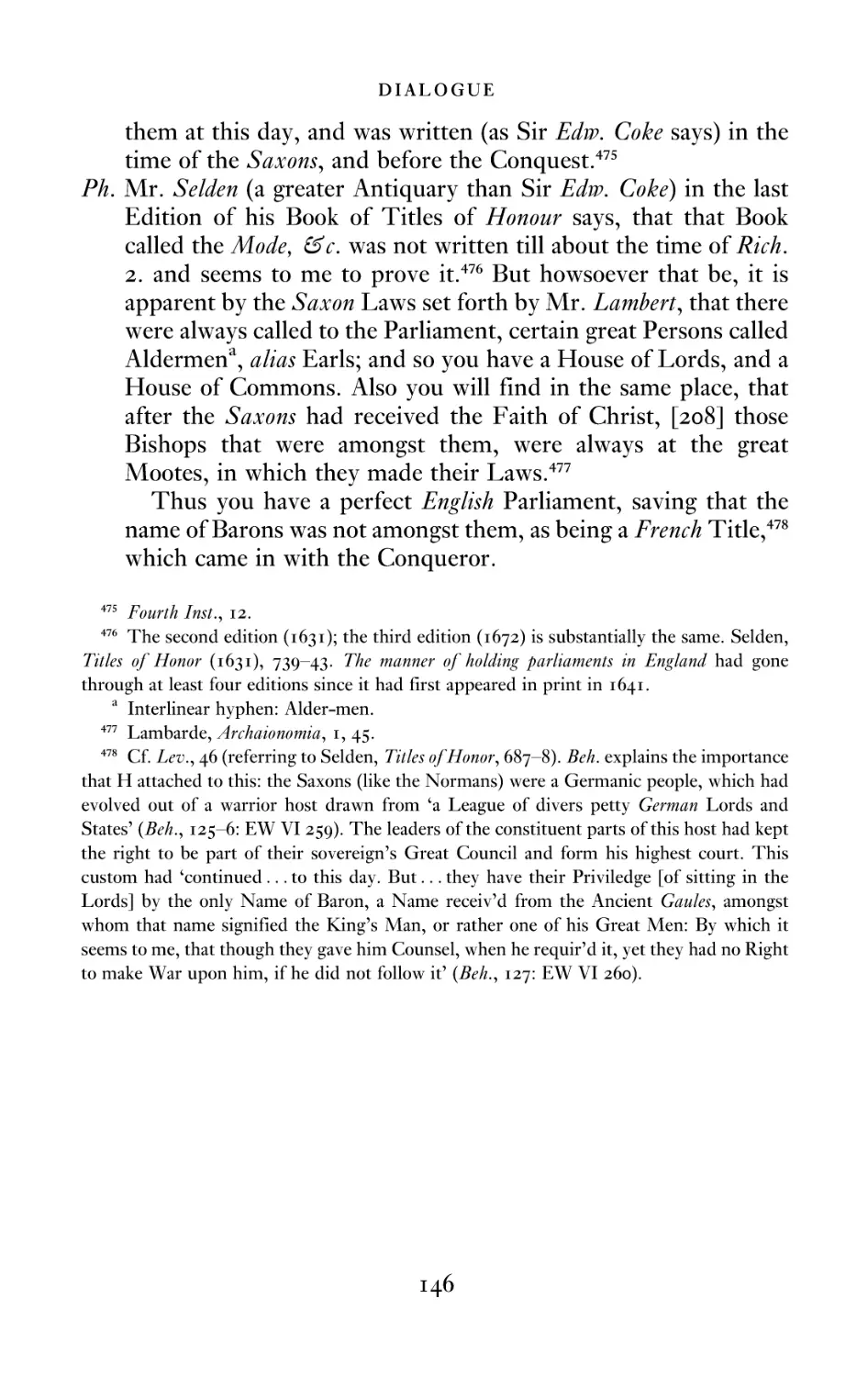






Text
                    THE CLARENDON EDITION OF
THE WORKS OF THOMAS HOBBES

VOLUME XI

A DIALOGUE BETWEEN
A PH I L O S O P H E R
AND A STUDENT, OF THE
COMMON LAWS OF ENGLAND
QUESTIONS RELATIVE
TO HEREDITARY RIGHT

CLARENDON HOBBES EDITORIAL BOARD
N o e l Ma l c o l m Si m o n Sc h a f f e r
Quentin Sk i n n e r Ke i t h Th o m a s
Bibliographical adviser
Da v id Mc Ki t t e r i c k
S C H E M E OF V O L U M E S

1: Elements of Law
2, 3: De cive
4, 5: Leviathan
6, 7: Correspondence
8: Autobiographical and occasional writings
9: Writings on rhetoric and literature
10: Behemoth
11: Writings on common law and hereditary right
12: Writings on religion, heresy, and church history
13: Writings on liberty and necessity
14, 15: Anti-White (with ‘Objections’ to Descartes)
16, 17: De corpore (with related manuscripts)
18: Later writings on physics
19: Writings on optics (including De homine)
20, 21, 22: Writings on mathematics
23: Translation of Thucydides
24: Translation of Homer
25: Cavendish-related writings
26: Index

THO MA S HO BB E S

A DIALOGUE BETWEEN
A PHILOSOPHER AND
A S TUDENT, OF THE
COMMON LAWS OF
ENGLAND
EDITED BY

ALAN CROMARTIE

QUESTIONS RELATIVE
TO HEREDITARY RIGHT
EDITED BY

QUENTIN SKINNER

CLARENDON PRESS

.

OXFORD

3

Great Clarendon Street, Oxford ox2 6dp
Oxford University Press is a department of the University of Oxford.
It furthers the University’s objective of excellence in research, scholarship,
and education by publishing worldwide in
Oxford New York
Auckland Cape Town Dar es Salaam Hong Kong Karachi
Kuala Lumpur Madrid Melbourne Mexico City Nairobi New Delhi
Shanghai Taipei Toronto
With offices in
Argentina Austria Brazil Chile Czech Republic France Greece
Guatemala Hungary Italy Japan South Korea Poland Portugal
Singapore Switzerland Thailand Turkey Ukraine Vietnam
Published in the United States
by Oxford University Press Inc., New York
This edition ß Oxford University Press 2005;
introductions and editorial material ß Alan Cromartie and Quentin Skinner 2005
The moral rights of the author have been asserted
Database right Oxford University Press (maker)
First published 2005
All rights reserved. No part of this publication may be reproduced,
stored in a retrieval system, or transmitted, in any form or by any means,
without the prior permission in writing of Oxford University Press,
or as expressly permitted by law, or under terms agreed with the appropriate
reprographics rights organization. Enquiries concerning reproduction
outside the scope of the above should be sent to the Rights Department,
Oxford University Press, at the address above
You must not circulate this book in any other binding or cover
and you must impose this same condition on any acquirer
British Library Cataloguing in Publication Data
Data available
Library of Congress Cataloging in Publication Data
Data available
ISBN 0-19-823702-2
1 3 5 7 9 10 8 6 4 2
Typeset by Kolam Information Services Pvt. Ltd, Pondicherry, India
Printed in Great Britain on acid-free paper by
Biddles Ltd, King’s Lynn, Norfolk

ACKNOWLEDGEMENTS
I am most grateful for the help received from the staff of the British
Library, Cambridge University Library, the Bodleian Library, the
Huntington Library and the London Library. The late Duke of
Devonshire and the Trustees of the Chatsworth Settlement kindly
allowed me access to the materials in their possession. Illustrations in
this volume are reproduced by permission of the British Library.
I have also benefited from the excellent technical advice of the
General Editors, especially Noel Malcolm, and the good nature and
efficiency of Peter Momtchiloff, Sally Lane, Rebecca Bryant, and
Jacqueline Baker. Ralph Houlbrooke and David Sedley gave authoritative answers to specialized questions.
Alan Cromartie
I am grateful to the late T.S. Wragg, who as Librarian of Chatsworth
first showed me the Hereditary Right manuscript (in 1964) and
photographed it for me. I am likewise grateful to Peter Day, the
present Keeper of Collections at Chatsworth, for generous assistance
on my more recent visits. I owe a particular debt to Noel Malcolm for
indispensable technical help, and to Alan Cromartie, Mark Goldie,
Kinch Hoekstra, Susan James, John Morrill, Eric Nelson, and David
Sacks for many helpful comments on my Introduction. My principal
thanks are due to the late Duke of Devonshire and the Trustees of
the Chatsworth Settlement for permission to examine and publish
the manuscript. Warm thanks are also due to Peter Momtchiloff and
his team at the Oxford University Press, all of whom have shown
exceptional patience and helpfulness.
Quentin Skinner

This page intentionally left blank

CONTENTS
List of Abbreviations
List of Illustrations

viii
x

A DIALOGUE BETWEEN A PHILOSOPHER AND
A STUDENT, OF THE COMMON LAWS
OF E NGL AND
edited by Alan Cromartie
General Introduction
Textual Introduction
Text
Bibliography

xiv
lxvi
1
147

QUESTIONS RELATIVE TO HEREDITARY RIGHT
edited by Quentin Skinner
Textual Introduction
Historical Introduction
Text
Bibliography

155
159
177
179

Index

181

vii

LIST OF ABBREVIATIONS
Beh.
Brief Lives
Cropsey
De C.
De H.
El.
ER
EW
H
Hist. Narr.
HW
Inst.
Lat. Lev.

Behemoth, the History of the Causes of the Civilwars of England, ed. W. Crooke (London, 1682)
‘Brief Lives’, chiefly of Contemporaries, set down
by John Aubrey, between the years 1669 & 1696,
ed. Andrew Clark, 2 vols. (Oxford, 1898)
A Dialogue between a Philosopher and a Student,
of the Common Laws of England, ed. J. Cropsey
(Chicago, 1971)
De Cive: the Latin Version, ed. H. Warrender
(Oxford, 1983)
Elementorum Philosophiae sectio secunda de
Homine (London, 1658)
The Elements of Law Natural and Politic, ed.
F. Tönnies (London, 1889)
The English Reports, ed. The Earl of Halsbury,
178 vols. (London, 1900–32)
The English Works of Thomas Hobbes of Malmesbury, ed. W. Molesworth, 11 vols (London,
1839–45)
Hobbes
An Historical Narration concerning Heresie, and
the Punishment thereof, ed. W. Crooke (London,
1682)
The Clarendon Edition of the Works of Thomas
Hobbes (Oxford, 1983–)
Coke, Sir Edward, The [first/second/third/
fourth] part of the Institutes of the Laws of England, 4 vols. (London, 1628–44)
Hobbes, Thomas, Leviathan, sive de Materia,
Forma, et Potestate Civitatis Ecclesiasticae &
Civilis in Thomae Hobbes Malmesburiensis
Opera Philosophica, quae Latine scripsit, omnia,
2 vols. (Amsterdam, 1668)

viii

list of abbreviations
Lev.
Moral works
OL
P/phrase
Quot.
SR
Vita

Thomas Hobbes, Leviathan, or the Matter,
Forme, & Power of a Common-wealth Ecclesiasticall and Civill (London, 1651)
Thomas Hobbes, The Moral and Political Works
of Thomas Hobbes of Malmesbury (London,
1750)
Thomae Hobbes Malmesburiensis, Opera
Philosophica quae Latine Scripsit Omnia, ed.
W. Molesworth, 5 vols. (London, 1839–45)
Paraphrase
Quotation
The Statutes of the Realm, 9 vols. (London,
1810–22)
Thomae Hobbes Angli Malmesburiensis Philosophi
Vita, ed. R. Blackburne (London, 1681)

ix

LIST OF ILLUSTRATIONS
1

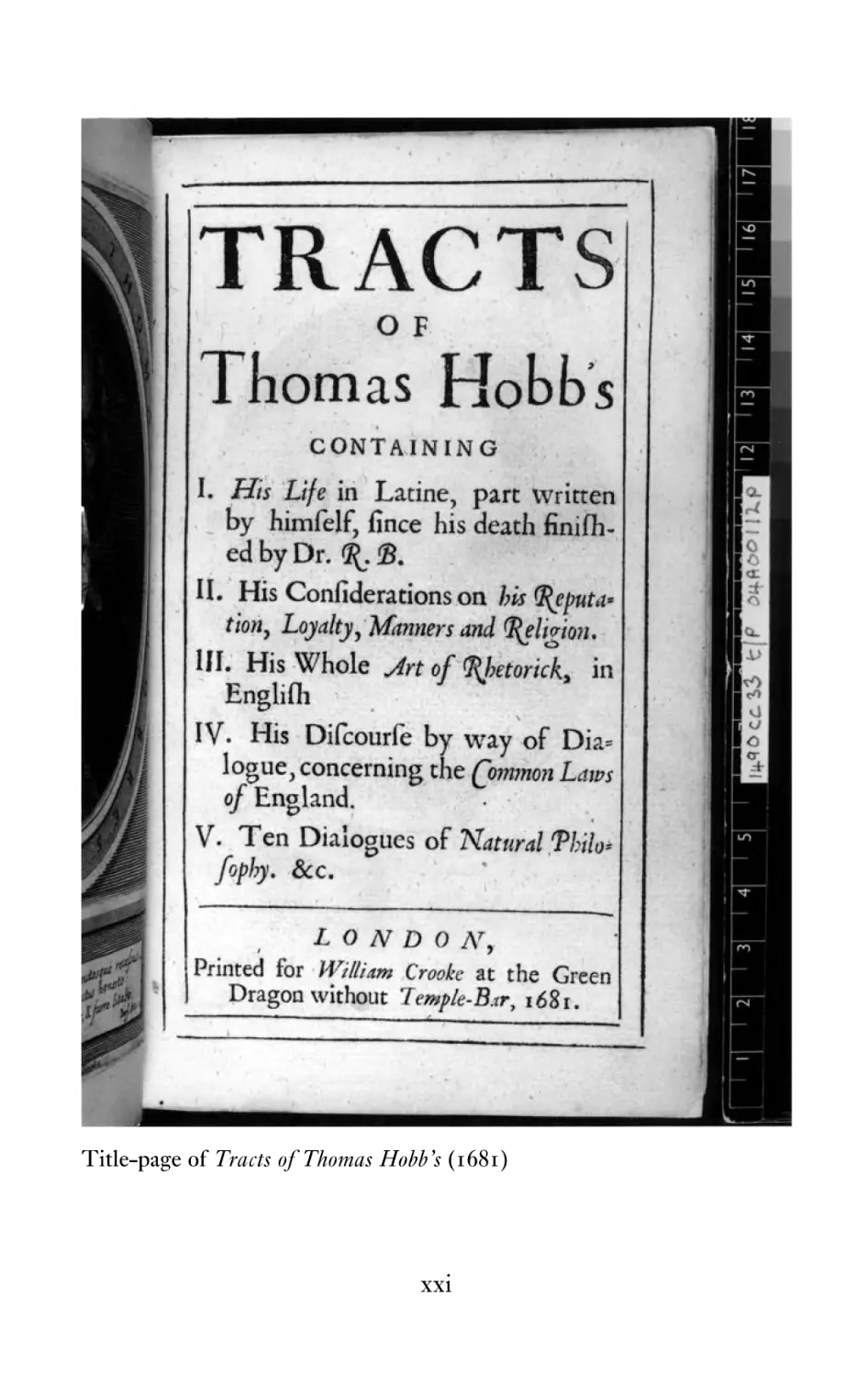
Title-page of Tracts of Thomas Hobb’s (1681)

2

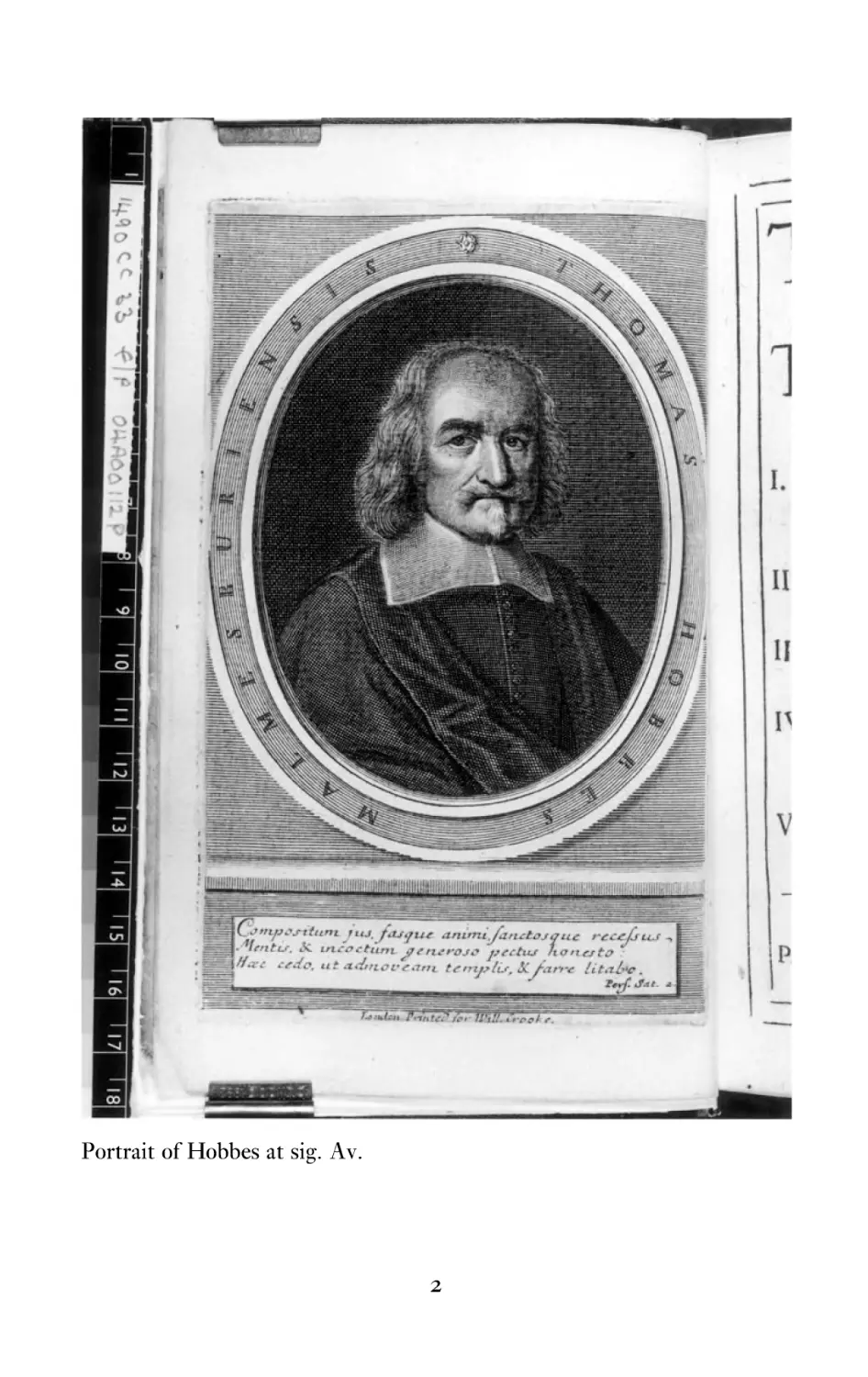
Portrait of Hobbes at sig. Av.

2

3

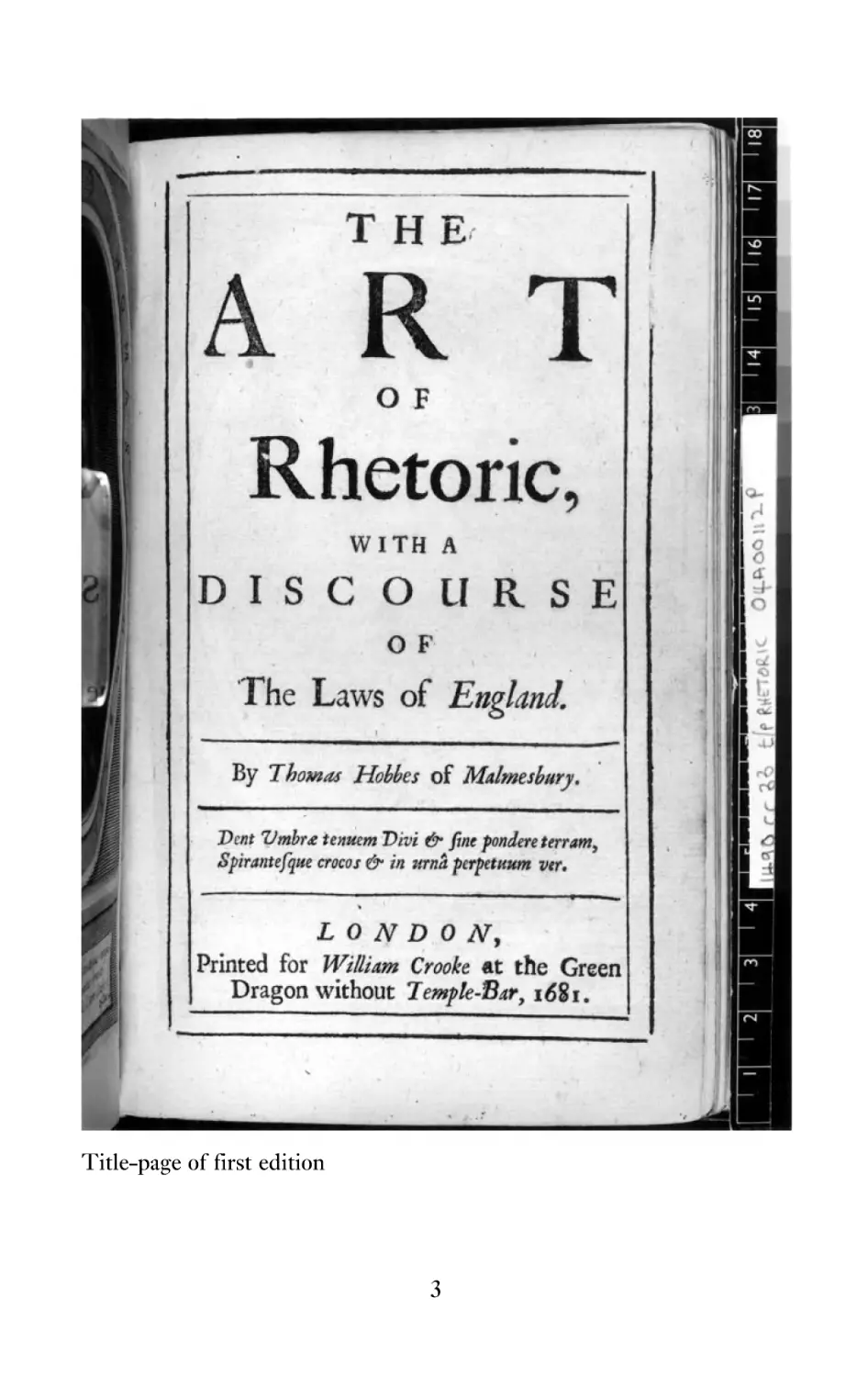
Title-page of first edition

3

4

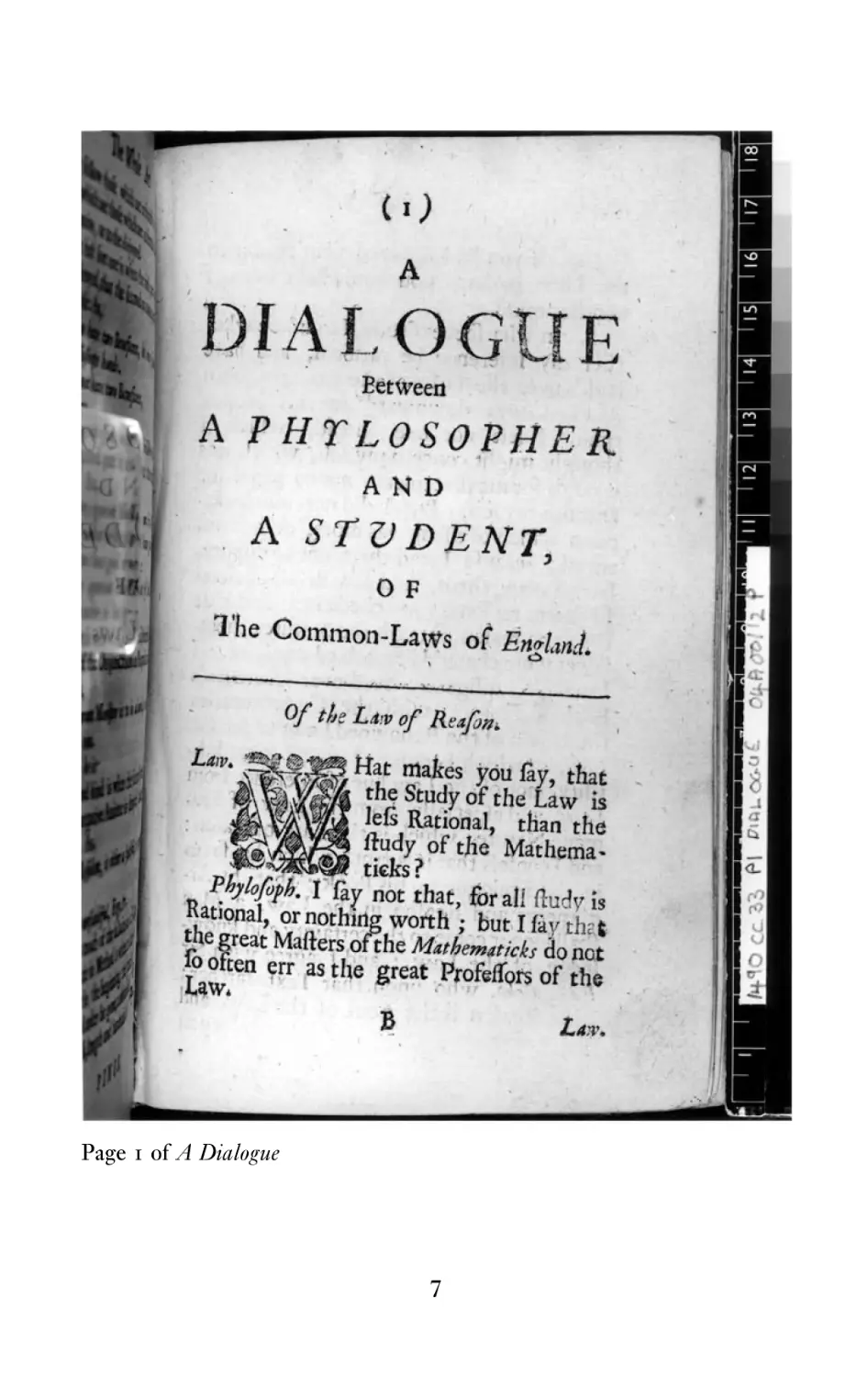
Page 1 of A Dialogue

7

5

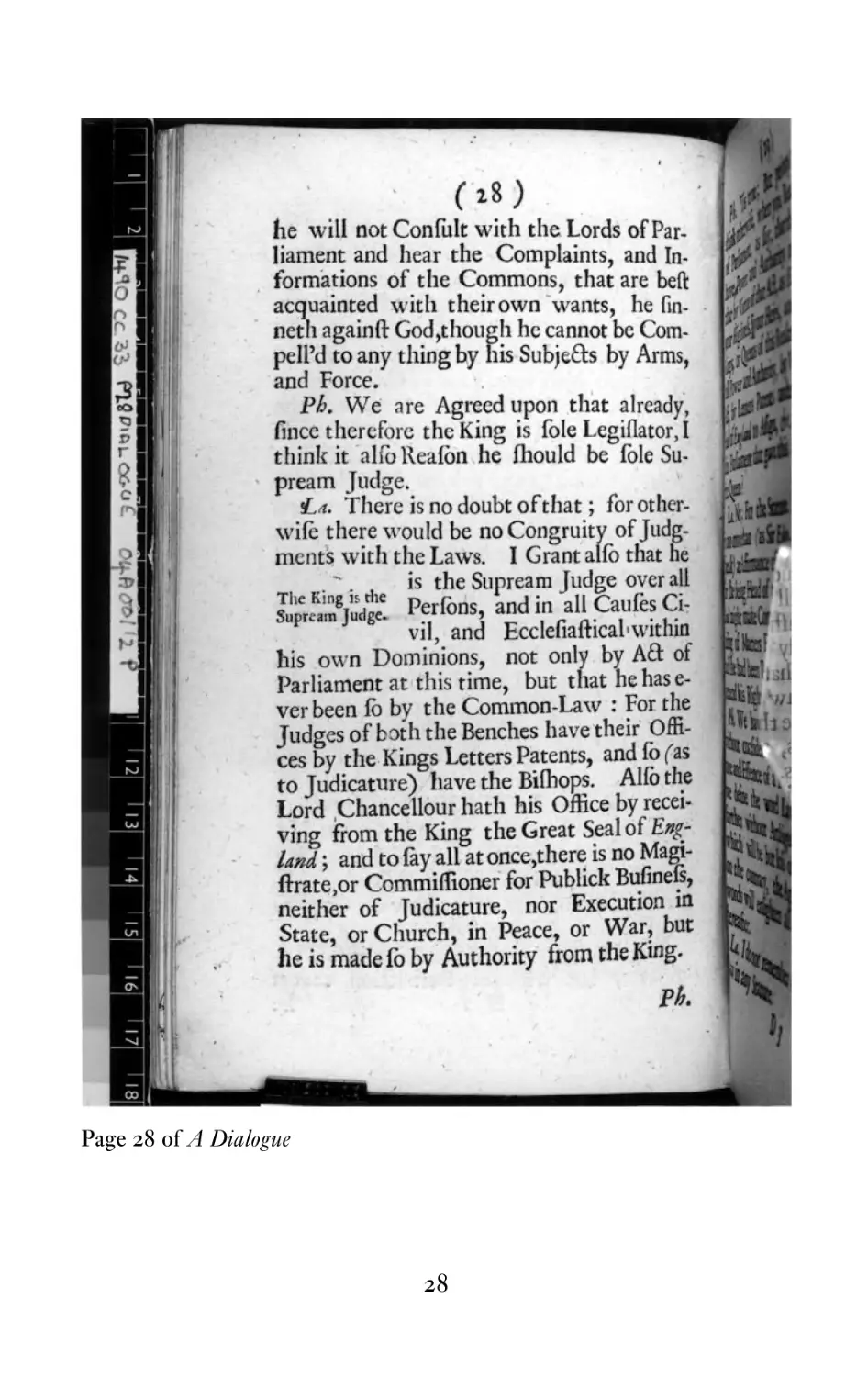
Page 28 of A Dialogue

28

x

xxi

THOMAS HOBBES

A DIALOGUE BETWEEN
A PHILOSOPHER AND
A S TUDENT, OF THE
COMMON LAWS OF
ENGLAND
EDITED BY

ALAN CROMARTIE

xi

This page intentionally left blank

GENERAL INTRODUCTION

Introduction
First publication, title, and synopsis
First publication
Title
Synopsis
Hobbes and common law
Contemporary legal theories
Hobbes, Coke, and equity
Hobbes on unwritten law

xiv
xvi
xvi
xx
xxii
xxvi
xxvi
xxxii
xxxv

Hobbes and heresy
English heresy law
The occasion of Hobbes’s fears
Hobbesian accounts of heresy law

xlv
xlv
xlix
liii

Conclusion: the unity of the work
Appendix: Behemoth and the Dialogue

lviii
lxii

xiii

general introduction
Introduction
After the reformation, & Disolution of the Abyes, then the Lawe
crepte upp, & att laste grew to bee so numerous, And to such a
vaste Body, as itt swelde to bee to bigg, for the kingdome, & hath
been no smale meanes to fomente & Continue this late & unfortunate Rebellion.
(William Cavendish, first Earl of Newcastle and dedicatee of
Elements of law)1

A dialogue between a philosopher and a student, of the common laws of
England should be an indispensable resource for Hobbesian scholarship. Apart from the short fragment to be found at the end of this
volume, it was probably its author’s final word about political questions; it certainly gave a coherent account of England’s constitutional
arrangements and an array of confident pronouncements on subjects
from crime, punishment, and war to suicide, the family, and English
history. Its primary subject matter, common law, has great historical
significance, for the dominance of common law ideas was both a
striking feature of seventeenth-century English political culture and
one that has been difficult to study. Most of the English then
believed that the legitimate powers of their monarch could be
defined, in principle, by the professional learning of their judges;
but precisely because this assumption was pervasive, it encountered
little searching criticism. Its oddity could only be perceived by
those—high monarchists and radicals—who found it an obstruction
to what they were trying to do. A Restoration treatise on the subject
would have an interest whoever wrote it; a Dialogue by the absolutist
Hobbes is a piece of tremendous good fortune.
But for all the opportunities it might be thought to offer, this late
work needs to be approached with caution. To begin with, Hobbes
composed it when he was very old; the last event referred to in the
text was a parliamentary statute of 16612 (when he was 73), and a
good case can be made, as we shall see, that it was written about a
decade later. Hobbes was a late developer who had composed
Leviathan (1651) when he was over 60, but some allowance should
1 Thomas P. Slaughter, Ideology and Politics on the Eve of Restoration: Newcastle’s Advice
to Charles II (Philadelphia, 1984), 24.
2 Text, 15–16.

xiv

general introduction
be made for dwindling intellectual energies. He seems to have been
dissatisfied himself, for though he gave a copy to his publisher
William Crooke, he refused to have it published because he thought
it ‘at the end . . . imperfect’.3 He may have meant ‘imperfect’ in the
then current sense of ‘incomplete’, but its abrupt conclusion—suggesting that he broke off composition—was not its only noticeable
failing.
There is room for disagreement about the way this text should be
regarded—it may be a simplification of previous statements, a revision of his previous theories, or even a straightforward application of
a consistent ‘system’—but where comparison is possible, it seems
less full, less rigorous, and less well-organized than his more famous
earlier treatises. As we shall see, one possible explanation of some of
these perplexing weaknesses is that its composition was influenced
by a distorting motive. Although the work was nominally a treatise
‘of the common laws of England’, Hobbes showed a noticeable
preoccupation with narrower questions of crime and punishment,
perhaps because his dominant concern was fear of being burned for
heresy.4
The primary purpose of this introduction is to lay out the evidence
of when, and why, Hobbes wrote the Dialogue, but proper treatment
of this complex problem involves unpicking the relationship between
his ‘jurisprudence’ and his more practical anxieties. Here the question will be tackled in four stages. The opening section discusses
what we know about the circumstances of the work’s first publication
and gives a brief account of its overall structure. At this point, a
problem arises. It seems entirely possible that Hobbes had glued
together two different projects by adding a discussion of the law of
heresy to an unfinished dialogue ‘of laws’. This possibility necessitates considering these projects separately.
The second section leaves aside the heresy material. It treats
Hobbes as a writer about the common law and shows how the
Dialogue’s treatment of the system can be related to the views of
his contemporaries and to his broader legal theory. The following
section deals with the passages concerned with heresy and argues
that comparison with similar passages in other works reveals that the
relevant material was written after 1668. The conclusion gives
grounds for supposing that the work forms a unified whole by
3 HW, Correspondence, 772.

4 Richard Tuck, Hobbes (Oxford, 1989), 35.

xv

general introduction
showing that even the theory ‘of laws’ was probably shaped by his
fear of prosecution. When the treatise is approached in isolation,
both the Dialogue’s date and its purpose are difficult to guess; when it
is carefully compared with other texts from the same period, it yields
a speculative reconstruction of what he was trying to do.
First publication, title, and synopsis
First publication
The puzzles begin with the question of when and why Hobbes let the
work be read, for though it was unprinted till 1681, it was in some
sense ‘published’ at least eight years before. An admirer who invested
in a copy of A supplement to Mr Hobbes his works (London, 1675), a
collection of Hobbesian writings put out by William Crooke, would
have discovered Crooke’s advertisement for other Hobbesian material, including a manuscript of ‘A Dialogue betwixt a Student in the
Common laws of Eng-land, and a Philosopher’. If this advertisement
can be believed, Crooke had copies of at least six manuscripts,
including two important works (Behemoth and An historical narration
concerning heresie) that Hobbes had been refused permission to print.
Such works appear to have enjoyed some possibility of circulation,
no doubt in return for a payment made to Crooke; we know that the
Historical Narration was consulted by the eccentric young deist
Charles Blount (1654–1693) ‘by your [Hobbes’s] Permission and
Mr. Crook’s Favour’.5 There thus seems no reason to doubt that
the ‘Dialogue’ deposited with Crooke was also the work referred to
by Hobbes on 18 August 1679, when he told his friend and biographer John Aubrey (1626–1697) that ‘The Treatise De Legibus at the
end of it is imperfect. I desire Mr. Horne to pardon me that I consent
not to his Motion. Nor shall Mr. Crooke himselfe get my consent to
print it.’6
5 HW, Correspondence, 759. Cf. the undated loan of the Latin prose Vita to ‘ye Ld
Hatton’s son’ (Bodleian Library, Aubrey MS 9, fo. 27r–27av). Harold Love suggests
that Blount was lent the only manuscript that then existed (Love, Scribal Publication in
Seventeenth-century England (Oxford, 1993), 71). This is plausible; in the letter discussed
below, Aubrey implied that Beh. existed in only one copy (Bodleian Library, Wood MSS
F 39, fo. 196v).
6 Aubrey 9, fo. 14. The statutory arrangements for licensing printing lapsed earlier in the
year; the same letter complains that Beh. had recently been printed without his consent.

xvi

general introduction
The earliest indication that we have that the work had acquired
this semi-public status is a letter of John Aubrey’s, dated 2 February
1673. This crucial piece of evidence implies that the work was
recently completed. Aubrey reported to a friend that ‘the old gent.
(T. Hobbes) is strangely vigorous for his understanding still & every
morning walks abroad to meditate.’ There follows a paragraph break,
but the next line commences with evidence of intellectual vigour: the
composition of a legal treatise.
He haz writt a treatise concerning Lawe wch 8 or 9 years since I much
importund him to doe & in order to it gave him ye L: ch: Bacons Maximes of
ye Lawe: now every one will doe him ye Right to acknowledge he is rare for
definitions & ye Lawyers building on old fashioned maximes (some right some
wrong) must needs fall into severall paralogismes; upon this consideration I
was earnest wth him to consider these things; to which he was unwilling, telling
me he doubted he should not have dayes enough left to doe it.7

This passage should be treated with some care. It tells us that some
‘eight or nine years since’ (Aubrey elsewhere identifies the date as
1664)8 Aubrey asked Hobbes to write a work about the legal system;
it gives no solid evidence about the dating of the Dialogue or about
the philosopher’s motives. It could mean that Hobbes wrote the
Dialogue in the mid-1660s, but did not trouble to inform his friend,
or that he had composed it in the fairly recent past (perhaps for
reasons largely unconnected with Aubrey’s initial request); in either
case, the letter tells against the significance of Aubrey’s intervention.
Aubrey’s letter goes on to suggest that Hobbes’s treatise had
practical political importance. It seems to have been shown to the
senior judges, whose duties included the licensing of law-books.9
The passage immediately following states:
He drives on in this the Ks Prerogative high. Judge Hales (who is no great
courtier) haz read it & much mislikes it, and is his Enemy. Judge Vaughan haz
read it & much commends it; I have lately desired Dr Lock to get a transcript of
it, & I doubt not but this present Ld Chancellor (being much for the Ks
Prerogative) will have it printed. & have also ordered to have some copies of his
7 Bodleian Library, Wood MS F 39, fo. 196v.
8 Brief Lives, I 341.
9 14 Car. II c.33 §2 (SR V 429), most recently renewed by 17 Car II c.4 (SR V 577), gave
the task of licensing books on common law to one or more of the four senior lawyers (the two
Chief Justices, the Chief Baron of the Exchequer, and the Lord Chancellor), or to somebody
entrusted with the task by one or more of these four notables.

xvii

general introduction
History of the late times [Behemoth] . . . wch the Bishops will not licence . . . ’tis
fit there should be more copies then one.10

All of these names have some significance, especially when it is
grasped that Aubrey was writing at a moment of considerable tension.
In mid-March 1672, Charles had suspended payment on his debts,
issued a Declaration of Indulgence (suspending the laws against
Catholic and Puritan dissent), and embarked upon a war against the
Dutch. The war had not gone well, and the royal Declaration was
most unpopular, not least with the judiciary, who pointedly
neglected to endorse it.11 Aubrey’s letter was dated on 2 February;
a day of reckoning was to be expected on 5 February, when Charles
was due to meet his parliament. ‘Judge Hales’, who was said to dislike
the Dialogue (and whose hostile ‘Reflections’ upon its conclusions
survive),12 was Sir Mathew Hale (1609–76), Chief Justice of King’s
Bench and hero of the constitutionalists; ‘Judge Vaughan’, who was
said to admire it, was Hobbes’s close friend Sir John Vaughan
(1603–74), who was also, as it happened, Chief Justice of the Court
of Common Pleas and therefore the second most senior common law
judge. ‘Dr Lock’, the philosopher Locke (1632–1704), was doctor
and adviser to the Earl of Shaftesbury (1621–83), who was Lord
Chancellor and a supporter of Charles’s toleration policy.
Ten days later, on 12 February, Aubrey composed a letter to John
Locke embodying almost exactly the same information:
I was at your lodgeing twice to have kiss’t your hands before I came out of
Towne—to have recommended a MSS or two (worthy of your perusall) of my
old friend Mr Th: Hobbes. One is a Treatise concerning the Lawe, which I
importun’d him to undertake about 8 yeares since and then in order thereto
presented him with my L. Ch: Bacon’s Elements of the Lawe. All men will give
the old Gentleman that right as to acknowledge his great felicity in well
defining: and all know that the lawyers especially the common [omnium
Doctorum genus indoctissimum]13 superstruct on their old fashion’d Axioms,
right or wrong; for great practisers have not the leisure to be analytiques.
Mr H. seem’d then something doubtfull he should not have dayes enough left
10 Bodleian Library, Wood MS F 39, fo. 196v.
11 Ronald Hutton, Charles II: King of England, Scotland, and Ireland (Oxford, 1989), 294.
12 They were printed by William Holdsworth, A History of English Law, 7th edn., 14 vols.
(London, 1957), vol. V, 500–13. The autograph MS (unknown to Holdsworth) can be found
in Lambeth MS 3479.
13 ‘The least learned class of all the learned’. The brackets are Aubrey’s.

xviii

to goe about such a worke. In this treatise he is highly for the Kings Prerogative: Ch: Just: Hales haz read it, and very much mislikes it; is his enemy
and will not license it. Judge Vaughan haz perusd it and very much commends
it, but is afrayd to license for feare of giving displeasure . . . I never expect to see
it printed, and intended to have a copy, which the bookeseller will let me have
for 50s; and God willing I will have one at my returne . . .
. . . I have a conceit that if your Lord sawe it he would like it.14

When carefully read, however, this passage casts some doubt on the
reliability of Aubrey’s testimony. It shows that his previous letter
overstated his contact with Shaftesbury’s household. It also suggests
he knew little about the actual contents of the treatise; scholars have
tended to assume that he had read the work, but it is clear he did not
own a copy and neither of his letters clearly states that he had had the
chance to look at one.
The Dialogue certainly differed from the book that Aubrey seems
to have expected. The volume he presented to the philosopher,
Bacon’s The Elements of the Common Lawes of England (composed
in the mid-1590s; first printed 1630) consists in a succession of brief
essays on various unconnected legal maxims. Aubrey appears to have
envisaged Hobbes, as someone who was ‘rare for definitions’, examining those maxims and helping to sort out their contradictions. But
the Dialogue does not refer to Bacon and shows no interest in Bacon’s
project of formulating legal principles as a preliminary to law
reform.15 Aubrey must also have been disappointed to find that the
work did not refer to the country’s political crisis. Though by the
standards of most other writers it is ‘highly for the King’s prerogative’, it has normally struck readers as notably conciliatory in tone. It
stresses, for example, that Kings should take counsel,16 that they
should avoid unnecessary wars,17 and that they ought to keep their
promises unless necessity compels them not to.18 The Dialogue was
indeed less usable by politicians such as Shaftesbury than Bacon’s
14 Locke, The Correspondence of John Locke, ed. E. S. De Beer, 8 vols. (Oxford 1976–89),
vol. I, 375–6. The passage continues: ‘You may there see likewise his History of England
from 1640 to 1660 about a quire of paper, which the King haz read and likes extremely, but
tells him there is so much truth in it he dares not license for feare of displeasing the Bishops.’
15 For Bacon’s probable intention, see The Works of Francis Bacon, ed. J. Spedding,
R. L. Ellis, and D. D. Heath, 14 vols. (London, 1857–74), vol. VII, 316.
16 Text, 21.
17 Ibid., 16.
18 Ibid., 20.

xix

general introduction
much earlier treatise. Bacon considers and defends the royal power to
dispense with statutes, the power which made it plausible that
Charles had the right to suspend the penal laws;19 Hobbes does not
explicitly mention its existence.
None of this should be taken to imply that Aubrey’s account was
totally misleading, for there is independent evidence that Hobbes did
take an interest in law at around the time he was given the volume of
Bacon. A clergyman who visited him in 1664 reported that ‘hee is
auncient and does not talk so as I expected’. He added what appear to
be some notes about the topics they discussed:
All land hath ye fee simple in some man or else it is in abeyance yt is his
expectation:
Inquire for what somme special bayl is requisite:
No man taken in [illegible] is baylable. inquire further
A bodie politique does not cannot committ Treason or performe personal
service as a single person may:20

These jottings corroborate Aubrey’s account, but they are not,
unfortunately, conclusive; not one of the points listed was mentioned
in the Dialogue itself. Though Hobbes no doubt allowed him to
believe that he had been the spur to composition, it remains an
open question if he was genuinely responsible.
Title
When read in isolation, the text itself adds little to Aubrey’s evidence, except to raise some further difficulties. As readers may have
noticed, we do not even know its proper title. Hobbes casually spoke
of ‘my Treatise De Legibus’,21 but Crooke’s initial advertisement of
1675 described it as ‘A Dialogue betwixt a Student in the Common
laws of Eng-land, and a Philosopher’. This latter title called to mind
an early Tudor work, A Dialogue betwixt a Doctor of Divinity and a
Student of the Common Laws of England (first Latin edition 1528), by
the great common lawyer Christopher St German (?1460–1541).
St German’s book was a subtle and lucid discussion of the relationship of common law to wider equitable principles. 140 years later, it
19 Bacon, Works, VII, 370.
20 Folger Shakespeare Library MS V. a. 293, fo. 2r. I am indebted to Dr Noel Malcolm
for a transcription of this document.
21 Thus in Bodleian Library, Aubrey MS 9, fo. 14. The capital D perhaps suggests that
the amanuensis believed ‘De Legibus’ to be a title.

xx

Title-page of Tracts of Thomas Hobb’s (1681)

xxi

general introduction
was still as close as common lawyers came to what might be called
‘jurisprudence’, and its three Restoration editions revealed continuing demand for what it had to offer.22 The Hobbesian Dialogue
quoted from St German and showed an interest in equity, so there
was a quite genuine connection between the treatises. Although the
body of the text refers to the ‘Student’ as ‘Lawyer’, A Dialogue
between a Philosopher and a Student was a title Hobbes might easily
have chosen.
But if he had actually done so, and if he attached importance to the
wording, he failed to impress this fact upon his publisher. The general
title page of the first edition speaks of ‘The Art of Rhetoric, with a
Discourse of the Laws of England’. The treatise has no separate title
page, and the title traditionally given is found upon p.1: ‘A Dialogue
between a Phylosopher and a Student, of the Common-Laws of
England’.23 The highly significant comma removes an ambiguity by
showing that ‘of’ means ‘concerning’. This may be a compositor’s
decision, but it was perfectly in line with what we know of Crooke’s
habitual practice. In bookseller’s advertisements produced in the
next year he described it as ‘A Dialogue betwixt a Student and a
Philosopher, about the Common Laws of England’ and as A Dialogue
betwixt a Student in the Common-Laws of England, and a Philosopher
in which is set forth the Errors in some Practise’.24 The contents page
of Tracts of Thomas Hobb’s (1681), the volume including the subsequent reissue, lists it as ‘His Discourse by way of Dialogue, concerning the Common Laws of England’.
Synopsis
Whatever Hobbes actually called it—whether he had intended to
make some kind of reference to St German or was content to have it
known as a work ‘of common laws’—his name for it was notably
22 Editions were published in 1660, 1668, and 1673 (Wing S312, 316, 317, 317A).
23 For details of presentation, see Text, 3 and 7. H can hardly have intended the
barbarous spelling of ‘philosopher’. Like other anomalous spellings, it has been reproduced
in this edition, but the authority of a single sheet seems insufficient to affect the title of this
work. We cannot be sure that p. 1 was ever intended as a title page and it is noticeable that
the word ‘philosopher’ is more conventionally spelled elsewhere.
24 At the end, respectively, of Behemoth and Seven philosophical problems in the British
Library copy (Classmark: 714.b.21) of Tracts of Mr Thomas Hobbs of Malmsbury (London,
1682).

xxii

general introduction
unhelpful. As a crude measure indicates, neither alternative conveys
the real nature of the Dialogue. The treatise was divided into either
seven or eight unequal sections: ‘Of the Law of Reason’ (3.4% of its
length); ‘Of Soveraign Power’ (17.5%); Of Courts (20.4%); ‘Of
Crimes Capital’ (18.2%); ‘Of Heresie (8.5%); ‘Of Praemunire’
(7.0%); ‘Of Punishments’ (16.3%); untitled [probably ‘Of Meum
and Tuum’]25 (8.7%). As Crooke made little effort with the text, we
can be fairly confident that these sub-headings were the author’s
own,26 but in any case they give a fair impression of how he had
apportioned his attention.
The opening section, ‘Of the Law of Reason’, discusses the idea
that law is ‘artificial reason’ (artificial comes from artifex: a craftsman), that is, that it is reason as understood by trained professional
lawyers. Hobbes was happy to admit that law is reason, but much less
happy with the claim that the professional lawyer enjoys a privileged
access to what is rational. Here, as elsewhere throughout the Dialogue,
Hobbes took the Institutes composed by the jurist and former Chief
Justice, Sir Edward Coke (1554–1632), to represent the common law
position (from motives which will soon become apparent, he did not
refer to Coke’s equally famous Reports). The four parts of these
Institutes (published in 1628, 1642, 1644, and 1644 respectively)
were widely different in approach and content, the first part being
a sprawling commentary on Sir Thomas Littleton’s Tenures, and the
next three being opinionated surveys of the statutes, of criminal law,
and of the powers of various jurisdictions. Hobbes nonetheless
appears to have resolved to find at least something to say about
all four.
At all events, ‘Of the Law of Reason’ was focused on two passages
from the First Institutes, one of which states that common law is ‘an
artificiall perfection of reason’;27 the other maintains ‘that Equity is a
certain perfect Reason that interpreteth and amendeth the Law
written’.28 In the following section, ‘Of Soveraign Power’, Hobbes
25 At Text, 134 the Philosopher remarks ‘I have done with Crimes and Punishments, let
us come now to the Laws of Meum and Tuum.’
26 They seem to have been found in the manuscript copy seen by Sir Mathew Hale; the
Chief Justice’s ‘Reflections’ on the text discuss the first two sections under the headings ‘Of
Laws in Generall and the Law of reason’ and ‘Of Soveraigne Power’. (William Holdsworth,
A History of English Law, 7th edn., 14 vols. (London, 1956), vol. V, 500–13).
27 First Inst., 97b.
28 Ibid., 24b.

xxiii

general introduction
offered what amounted to a reading of the English constitution. He
argued that a rational legal system must be a Hobbesian system,
allowing the King a totally unfettered power to do what he sincerely
felt that national security demanded. ‘Of Soveraign Power’ has little
to say about Coke, but most of the rest of the Dialogue reverts to
commentary. ‘Of Courts’ discusses passages of the Fourth Institutes,
Coke’s work about the privileges and functions of legal jurisdictions.
Hobbes skipped the long treatment of parliament itself, but followed
Coke’s detailed account of a number of courts, especially the equitable court presided over by the Chancellor. He seemed particularly
keen to claim, in the light of the passages quoted in ‘Of the Law of
Reason’, that as the law and equity were really the same thing, the
equitable side of Chancery was really a court of appeal from the
common law system.
The next four sections (‘Of Crimes Capital’, ‘Of Heresie’, ‘Of
Praemunire’, and ‘Of Punishments’) follow the exposition of the
Third Institutes, Coke’s digest of the principles of English criminal
law. Throughout this portion of the Dialogue, Hobbes must have had
Coke’s text in front of him as he dictated to whoever helped him. It
has usually been thought significant that he gave heresy so much
attention, not just in the section ‘Of Heresie’ itself, but also in a
couple of pages of ‘Of Punishments’, where he maintained that
punishment by burning had been abolished at the start of the reign
of King Edward VI. In the untitled section with which the existing
Dialogue concludes, Hobbes undertook to criticize the ‘Laws of
Meum and Tuum’. The appropriate way to do this, he maintained,
was to consider the Second Institutes, Coke’s commentary on the
statute book.29 In the event, however, his argument tailed off after
nearly twenty pages of digressions, the last of them on parliamentary
history.
The Dialogue thus combined a reading of the English constitution,
taking its cue from Coke’s belief that common law was reason, with a
fairly detailed survey of Coke’s works, focusing in particular on
crime and punishment. It is easy to see why Hobbes might have
embarked upon the former project; less easy to see why he should
have attempted the latter, unless his purpose were to camouflage his
views about the law of heresy. There is, however, a further complication, because it is quite possible that both the passages on heresy
29 Text, 134.

xxiv

general introduction
were only later added to the text.30 A writer who was strictly following Coke would have discussed the crime between treason and
murder;31 Hobbes took it after murder, disturbing the flow of debate
in order to do so. His treatment followed the words ‘Let us now come
to Crimes not Capital’ at the end of the section ‘Of Crimes Capital’;
the Lawyer was then made to ask ‘Shall we pass over the Crime of
Heresie, which Sir Edw. Coke ranketh before Murder.’ The main
thread of discussion was later resumed with the words ‘let us come
now to such Causes Criminal, as are not Capital.’32 The passage
about burning involved a very similar discontinuity. It was found
in a more logical position, but at the price of blatant interruption:
La. The Judgement for Felony is—
Ph. Heresie is before Felony in the Catalogue of the Pleas of the
Crown.
Almost two pages later, the Lawyer explained that ‘The Punishment
for Felony is, that the Felon be hang’d’, and the debate continued on
its way. Unless the clumsiness is a device to draw attention to these
passages, it suggests that they were added rather later.33
There seem to be two theories that could account for such behaviour. If Hobbes always intended to deal with heresy, but abandoned
the work after losing control of its structure, the late insertion of the
new material was an attempt to rescue what he could of an abortive
project; if he originally meant to write a book about the legal system
(without much reference to heresy), he probably put in the additional
matter when he discovered that his life was threatened. On either
view, he clearly attached some importance to publishing his thoughts
on heresy—enough to motivate him to make available a treatise he
regarded as ‘imperfect’.
The presence of the heresy material thus offers the most likely
explanation of the decision (possibly later regretted) to give the
original manuscript to Crooke; it does not necessarily explain the
writing of a work ‘De Legibus’. To address this further question—
the question of whether the work as a whole was influenced by his fear
of being burned—we need to examine the substance of his theory.
30 Heresy is also mentioned at Text, 42 and 111–12.
31 Third Inst., 39–43.
32 Text, 91, 103.
33 Text, 119, 120. As Philip Milton remarks, ‘the joins are very clearly visible’ (P. Milton,
‘Hobbes, heresy and Lord Arlington’, History of Political Thought 14 (1993), 544).

xxv

general introduction
Hobbes and common law
Contemporary legal theories
Here a certain amount of background is essential, for to grasp what
Hobbes was doing in writing as he did, a reader needs some general
conception of what the English meant by common law. There is no
particular reason to think that Hobbes himself had truly detailed
knowledge of the subject. As intimate adviser to a great landowner,
he could hardly have avoided some acquaintance with the law,34 but
nothing in the Dialogue gives unambiguous evidence of real erudition; it suggests an intelligent layman with a marked tendency to
misremember his smattering of legal principle. No one completely
ignorant of law would base an argument upon the legal concept of a
warranty;35 no one accustomed to consulting law books would find it
easy to mix up the third and fourth parts of Coke’s Institutes.36
Though he had obviously thought hard about the legal system, we
need not assume he gave the same attention to every, or any, particular legal doctrine.
One way to sketch the necessary background is to consider
what was meant when people used the phrase ‘the common law’.
St German once helpfully stated that references to common law
could bear three different senses: ‘the lawe of this realme of Englande
dysceyeured [dissevered?] from all other lawes’; ‘the kynges courtes
of his benche or of the comon place’; and ‘such thynges as were law
before any statute made in that poynt that is in questyon’.37 The
phrase ‘common law’ could be used, in other words, to distinguish
English law from Roman law, to distinguish the procedures of the
two great royal courts from those of every other jurisdiction, and to
distinguish the unwritten law from later statutory alterations.
All three of these senses should be borne in mind, but the best
place to start is with the second, for the common law of England
consisted in rules developed and respected by the judges of King’s
Bench and Common Pleas. Advocates were inducted into the knowledge of these principles in the course of a long period (a minimum of
34 We know he was closely involved in his master the third Earl of Devonshire’s legal
wranglings with his mother (HW, Correspondence, 815–16).
35 Text, 37–8.
36 Ibid., 72, 83, 85, 86.
37 St German, Doctor and Student, 180.

xxvi

general introduction
seven years was usual) of residence and study at one of the four Inns
of Court.38 Down to the civil wars, though not thereafter, this
involved participation in learning exercises conducted by established
professional lawyers. There was no strict obligation on the judges to
follow precedent, but the pronouncements of their predecessors were
the object of intense and arduous study; a truly erudite professional
was distinguished by his knowledge of the late medieval Year Books,
volumes recording dicta and passages of legal reasoning (but often
not the outcome of the case).
The common lawyers neither had nor needed a fully worked out
theory of their activities, but few if any would have disagreed that
their unwritten principles were customary and rational in nature:
customary in having existed time out of mind; rational in that the
wisdom of professional tradition had adapted them to English circumstances. When professionals tried to articulate what actually
happened in court, they usually spoke of a concept they called
‘reason’. This notion derived from the Year Books, but its continuing
usefulness owed much to the way it made sense of recent practice,
especially the relationship between the statute book and ‘such
thynges as were law before any statute made in that poynt that is in
questyon’.
The claim that the unwritten law was reason reflected the fact that
its rules had a different status from rules invented by a parliament. It
is true that the lawyers acknowledged that parliament made law;
though they believed that many of the statutes were ‘declarations’
of existing law, they knew that ‘the high court of parliament’ was in
the modern sense a legislature. But they also maintained that enactments which declared the common law ought to receive a more
respectful treatment than laws which changed the legal situation.
A statute that extended or confirmed the common law ought to be
generously interpreted, while statutes that repealed the common law
were to be taken strictly.39 In consequence, full knowledge of the
statutes required some acquaintance with pre-statutory arrangements. The Elizabethan treatise A discourse upon the exposicion &
38 The principal authorities on the Inns are W. R. Prest, The Inns of Court under Elizabeth
I and the Early Stuarts, 1590–1640 (London, 1972) and Prest, The Rise of the Barristers
(Oxford, 1986).
39 Edward Hake, Epieikeia: a Dialogue on Equity in three parts, ed. D. E. C. Yale (Yale,
1953), 89, 91; ‘Sir Christopher Hatton’, A treatise concerning statutes, or acts of parliament:
and the exposition thereof (London, 1677), 76.

xxvii

general introduction
understandinge of statutes acknowledged ‘the opynion of some . . . that
it forcethe not what the commen lawe was, sence it ys certen what the
lawe is nowe by estatute’, but insisted that ‘they shall neither knowe
the statute nor expounde it well, but shall, as it were, folowe theire
noses & groape at yt in the darke.’40
Thus the difference between common law and statutes was not
just that the former had not been written down. As the Discourse
went on to explain,
those statutes that come in encrese of the commen lawe . . . shall be taken by all
equytye, for synce the commen lawe is grounded upon commen reason yt is
good reason that that which augmenteth commen reason shulde be augmented.41

Conversely, if a statute ‘abridged’ the common law, ‘this statute
abridginge commen reason [shall] be taken strycte.’42 It was perfectly
usual, moreover, for remedies at common law to coexist with statutory replacements. A Year Book dictum had maintained that ‘where a
statute that gives a process is in the affirmative, the party may have
this process or the common law process, but it is different where the
statute is in the negative . . . he must then have this process and no
other.’43
These features of existing legal practice encouraged views of
common law that emphasized its rationality. In one of the clearest
attempts to make such views intelligible to laymen, the judge Sir
John Doddridge (d. 1626) explained that
the Common Law of this Land (which is often stiled in our Bookes by the name
of common reason) is deduced from principles evident and knowne, for the
decision of such things as are drawne into doubt, and are unknowne.44

What common lawyers did was to ‘frame Law upon deliberation and
debate of reason . . . when present occasion is offered to use the same,
40 A Discourse upon the Exposicion & Understandinge of Statutes, ed. S. E. Thorne (San
Marino, Calif., 1942), 141. Thorne seems not to have known that the bulk of this tract had
previously been printed as part of a text called ‘Instructions, How and in what manner
Statutes shall be Expounded’. The material is found at the end (120–64) of The Office of a
Justice of the Peace (London, 1658 [corrected in BL E1668(2) to 1657]), a work attributed to
William Fleetwood (c.1525–94).
41 Discourse upon statutes, 143.
42 Ibid., 159–60.
43 Quoted by Thorne at Discourse upon statutes, 38.
44 Doddridge, The English lawyer (London, 1631), 62.

xxviii

general introduction
by a case then falling out and requiring Iudiciall determination’;45 the
principles that were their starting point were taken from natural law
and national custom.46 The findings of this cumulative science could
be crystallized in general rules called ‘maxims’, a maxim being ‘the
foundation of Law, and the conclusion of reason: for reason is the
efficient cause thereof, and Law is the effect that floweth therefrom.’47 Doddridge was simply spelling out the implications of the
well-known dictum set down by the reporter Edmund Plowden
(1518–85) that ‘there are two principal things from whence arguments may be drawn, that is to say, our maxims, and reason, which is
the mother of all laws. But maxims are the foundations of the law and
the conclusions of reason.’48 The picture that emerged was of a
system steadily growing in sophistication by a process based on
natural principles and previous feats of legal reasoning.
The point to notice here is that Doddridge did not see unwritten
law as an unchanging corpus of rules derived from custom; English
custom formed only a part of common law and customary rules could
be corrected by reference to natural principles. His attitude was
shared by Henry Finch (d. 1625), who thought that ‘positive’ laws,
‘those laws which every Common-Wealth makes for itself’, were the
basis of the common law’s ‘Grounds and Maxims’,49 but who also
believed that such maxims should be ‘ruled and over-ruled’ by
natural law.50 Both writers appear to have thought of legal maxims
more as the consequence of reasoning than as its precondition; Finch
spoke of equitable principles ‘as guiding the Grounds and Maxims of
Things, which newly arise’, implying that these ‘grounds’ emerged
in the judicial process.51 The book that Aubrey gave to Hobbes, Sir
Francis Bacon’s The Elements of the Common Lawes of England (1630),
was quite compatible with this tradition. Bacon was stating common
law in order to reform it, but he nonetheless included many maxims
‘gathered and extracted out of the harmony and congruity of
cases . . . such as the wisest and deepest sort of Lawyers have in
iudgement, and use, though they bee not able many times to express
and set them down.’52
45
48
49
50
51
52

Ibid., 241.
46 Ibid., 153.
47 Ibid., 152.
1 Plowden 27 (ER LXXV 44), cited at Doddridge, English lawyer, 152.
Henry Finch, A description of the common laws of England (London, 1759), 52.
Ibid., 5.
Ibid., 15.
Bacon, Elements, sig., B2r.

xxix

general introduction
An influential line of thought thus treated the unwritten law as a
blend of natural law and positive custom—and one whose evolution
continued to be shaped by an appeal to natural principles. It would be
most misleading to imply that any of these writers were expressing an
established orthodoxy; it is, however, helpful, for present purposes, to
see them as the middle of a spectrum. On one side, they were flanked
by those who stressed the system’s customary aspect, treating it as a
set of rules that the realm as a whole had tacitly accepted. This way of
thinking about law, which emphasized its origins in popular consent,
offered a way of making sense of non-common law jurisdictions,
especially the church courts and the court of Admiralty. All common
lawyers were agreed that the legal force of canon law in England
derived, in some sense, from acceptance by the English polity. As a
Jesuit scathingly put it, ‘[Sir Edward Coke] runneth every where to
this shift, that the Popes Ecclesiastical and Canon laws, being
admitted in England, may bee called the Kings ecclesiasticall laws,
for that, they are admitted, and allowed by him and his realme.’53 The
works of the learned John Selden (1588–1654), one of the few
contemporaries Hobbes certainly admired, repeatedly stressed the
need for such reception,54 and it was not surprising that the Dialogue
endorsed the same position; Hobbes held that ‘the Canons of the
Church of Rome were no Laws, neither here, nor any where else
without the Popes Temporal Dominions, farther than Kings, and
States in their several Dominions respectively did make them so.’55
Selden regarded every legal system as ‘limited law of nature’:
a rational response to local problems enacted or permitted by a
legislating ‘state’;56 he would have had no reason to dissent from
Hobbes’s view that ‘The Law of Nature, and the Civill Law, contain
each other, and are of equall extent.’57 His view was unusual, however, in discouraging the claim that common law was wiser than its
rivals. Some other lawyers took a subtler tack, agreeing that their
system consisted in what people had accepted, while holding that
53 ‘A Catholicke Devyne’ [Robert Parsons], An answere to the fifth part of reports lately set
forth by Syr Edward Cooke (London, 1606), 3.
54 On Selden, see Alan Cromartie, Sir Matthew Hale: Law, Religion, and Natural
Philosophy (Cambridge, 1995), 30–41.
55 Text, 26.
56 John Selden, Opera omnia, ed. D. Wilkins, 3 vols. in 6 (London, 1725), vol. III, col.
1891.
57 Lev., 138.

xxx

general introduction
its character as custom could be presented as a guarantee that its
provisions would be rational. A custom, after all, came into existence
because it was convenient to the people; and it could alter to incorporate the lessons of their communal experience. This view was
carefully set out in the English-language preface to the Irish reports
(1615) composed by Sir John Davies (1569–1626).58 Its tendency was
to direct attention to the collective wisdom of the whole community,
as opposed to the techniques of the legal profession.
Hobbes mentioned both Selden and Davies,59 but chose to concentrate his fire on the other extreme of the spectrum: on those who
stressed law’s rationality almost to the exclusion of its basis in consent.
Doddridge referred to those who thought that English common law
was so infused with natural principles ‘that all the Law of the Realme is
the Law of Reason’.60 Such people had existed in the sixteenth
century,61 but Doddridge’s primary reference was probably to his
colleague Sir Edward Coke, who borrowed a phrase from Cicero by
calling common law ‘the perfection of reason’ (ratio perfecta), the
realization of natural law in English circumstances. This reason had
nothing to do with common sense (the previously popular statement
that law is ‘common reason’ was noticeably absent from Coke’s writings) but was ‘to be understood of an artificiall perfection of Reason
gotten by long studie, observation and experience . . . for, Nemo
nascitur artifex [no one is born a craftsman].’62 The law had been
by the wisdom of the most excellent men, in many successions of ages, by
long and continual experience, (the trial of right and truth) fined and refined,
which no one man (being of so short a time) albeit he had in his head the
wisdom of all the men in the world, in any one age could ever have effected or
attained unto.63

These ‘most excellent men’ were the judges. In the ‘Proeme’ to his
Second Institutes, his commentary on the statute book, Coke contrasted his efforts with those of Roman lawyers:
58 Properly Le primer report des cases et matters en ley resolves & adjudges en les courts del
Roy en Ireland (Dublin, 1615).
59 It is possible he had not read the latter. See Text, 75n 243.
60 Doddridge, Lawyer, 194.
61 ‘Hatton’, Treatise concerning statutes, 24–5; Alan Cromartie, ‘The constitutionalist
revolution: the transformation of political culture in early Stuart England’, Past and Present 163 (1999), 82–3.
62 First Inst., 97b.
63 Coke, Seventh reports, Calvin’s case, 3b (ER LXXVII 381).

xxxi

general introduction
the difference then between those glosses and Commentaries, and this which
we publish, is, that their glosses and Commentaries are written by Doctors,
which be Advocates, and so in a manner private interpretations: And
our Expositions or Commentaries upon Magna Charta, and other Statutes,
are the resolutions of Judges in Courts of Justice in judiciall courses of
proceeding.64

Coke claimed, in other words, a public status as the expositor of
English law. As this was arguably to usurp the place reserved for
legislative sovereigns, it was not at all surprising that Hobbes found
his ideas objectionable.
Hobbes, Coke, and equity
In choosing to direct his fire at Coke, Hobbes was attacking
an extreme position. But Coke’s account also had features that he
could build upon, for he was happy to accept the view
that law was reason; at intervals throughout the Dialogue, he reverted
to ‘Sir Edw. Coke’s Confession’65 of this equivalence. His principal
objection was to the notion that the rational was best identified
by common lawyers. Thus his opening section ‘Of Reason’ quoted
Coke:
this [reason] is to be understood of an artificial perfection of Reason gotten by
long Study, Observation and Experience, and not of every Mans natural
Reason; for Nemo nascitur Artifex.66 This Legal Reason is summa Ratio;67 and
therefore if all the Reason that is dispersed into so many several heads were
united into one, yet could he not make such a Law as the Law of England is,
because by many successions of Ages it hath been fined and refined by an
infinite number of Grave and Learned Men.68

Hobbes rejected this view on two grounds: that the notion of an
‘artificial’ reason was unintelligible; and that ‘It is not Wisdom, but
Authority that makes a Law.’69 The laws of England were ‘made by
the Kings of England, consulting with the Nobility and Commons in
Parliament, of which not one of twenty was a Learned Lawyer’.70
He later conceded, however, that even if such laws were all
abolished, ‘Equity, and Reason which [are] Laws Divine and Eternal,
which oblige all Men at all times, and in all places, would still
64 Second Inst., Proeme.
65 Text, 86; cf. 11, 18, 91, 117.
66 ‘No one is born a craftsman.’
67 ‘The highest Reason.’
68 Text, 9.
69 Ibid., 10.
70 Ibid.

xxxii

general introduction
remain’;71 these latter rules made up the common law. He thought, in
fact, there were two laws in England: the written law consisting in the
rules the sovereign had expressly willed; and unwritten law, which
was the law of nature and which ought to be applied by the relevant
judges in cases not yet covered by the former. In Hobbesian terminology, the former type of law was based on ‘justice’, the virtue of
keeping one’s contracts, including the state’s founding covenant; the
latter represented ‘equity’. The application of both types of law
required an intellectual operation (for even written law gave rise to
ambiguities), but neither required any kind of professional training
for you are to allow to me, as well as to other Men, my pretence to Reason,
which is the Common Law (remember this that I may not need again to put
you in mind, that Reason is the Common Law) and for Statute Law, seeing it is
Printed, and that there be Indexes to point me to every matter contained in
them, I think a Man may profit in them very much in two Months.72

One implication of the claim that common law was simply natural
reason was that there was no functional distinction between common
law and equitable courts. This meant that the principal equitable
court, the equitable side of Chancery, was not confined to supplementing common law procedures, but was perfectly entitled to act as
a court of appeal. Hobbes mischievously suggested that as bishops
were ‘obliged by their profession to Study Equity’, they were well
suited to be Chancellor ‘as they were most often before the time of
Hen. 8. and since that time once in the Raign of King James’.73 Here,
as Hobbes must have known, he was touching on a very sensitive
matter, for Chancery’s equitable jurisdiction was recognized as giving scope for the subversion of the rule of law. Though common
lawyers practised in the court and though the Chancellor usually
cooperated closely with the judges, the jurisdiction’s theoretical basis
was arguably incompatible with constitutionalist pieties.
It was in principle a ‘court of conscience’, that is, a court whose
main concern was with the application of general moral rules to
puzzles created by special circumstances.74 Its supporters could
protest, quite accurately, that its purpose was merely to supplement the law and that its operations were informed by a deep knowledge of the legal system, but in the early Stuart period its existence
had made thoughtful men uneasy. As they were well aware, its
71 Ibid.
72 Ibid., 11.
73 Ibid., 66.
74 Sir Thomas Smith, De republica Anglorum, ed. Mary Dewar (Cambridge, 1982), 93–4.

xxxiii

general introduction
jurisdiction could be seen as a vessel of monarchical ‘absolute’
power.75 In a revealingly defensive statement, King James had once
described it as ‘the dispenser of the Kings Conscience, following
alwayes the intention of Law and Justice; not altering the Law, not
making that black which other Courts made white’.76 As Hobbes’s
friend John Selden (1588–1654) pointed out, ‘Equity is according to
ye conscience of him that is Chancellor, and as yt is larger or
narrower, soe is equity[.] Tis all one as if they should make ye
Standard for the measure we call A foot, to be ye Chancellor’s foot.’77
In his description of the court in his Fourth Institutes, Coke gave an
extremely restrictive account of these activities, cast doubt (as it
happens, correctly) on their antiquity, and stressed that a Lord
Chancellor ‘that knew not the common law could never well judge
in equity (which is a just correction of Law in some cases)’.78 He
pointedly printed a list of complaints about the conduct of Lord
Chancellor Wolsey.79 Elsewhere in his works, he said little of the role
of equity; the definition that Hobbes quotes from the First Institutes
referred to the quite separate common law concept ‘the equity of the
statute’, a concept that Coke had chosen to define as ‘a certain perfect
Reason that interpreteth and amendeth the Law written, it self being
unwritten, and consisting in nothing else but right Reason’.80
‘Equity’ in this sense was ‘perfect [i.e. artificial] reason’ applied to
statutory interpretation.
Somebody like Coke was unable to show why Chancery was
necessary at all, for a law that was ‘reason itself’, wiser than any
man or generation, was surely not in need of supplementing. This
underlying tension in his thinking was the intellectual background
to an episode alluded to by Hobbes, his quarrel with Chancellor
Ellesmere (1540–1617) in 1616. The clash between Ellesmere and
Coke was the climax of a complicated story that probably involved
a clash of personalities, but the matter that was formally at issue
was whether Chancery could hear a suit after a judgment at the
75 John Cowell, The interpreter: or booke containing the signification of words (Cambridge,
1607), s.v. ‘Chanceler’; Finch, Law, or, a discourse thereof (London, 1627), 238.
76 James VI & I, Political writings, 214.
77 John Selden, Table talk of John Selden, ed. Sir Frederick Pollock, Selden Soc.
(London, 1927), s.v. ‘Equity’.
78 Fourth Inst., 79.
79 Ibid., 89–95.
80 First Inst., 24b; Text, 9.

xxxiv

general introduction
common law.81 Coke thought that such behaviour amounted to the
crime of praemunire, the crime of those ‘which doe sue in any other
Court to defeat or impeach the judgments given in the Kings
Court’.82 As the statute that created praemunire was clearly designed
to discourage appeals to the Pope, Coke’s view could not be said to
have much merit, but the question was never definitively resolved; as
late as 1670, a litigant attempted to revive it, prompting anxiety in
the Lord Chief Justice, who knew ‘what heats there were betwixt
Lord Coke and Lord Ellesmere, which we ought to avoid’.83
Hobbes on unwritten law
The nub of the Dialogue’s argument, set out in its opening pages,
thus exploited a genuine weakness in Coke’s position. Coke was after
all maintaining that the true basis of the law of England was reason as
perceived by common lawyers. But the claim that law was reason was
perfectly acceptable to Hobbes, so long as the reason in question was
Hobbesian. He must have been encouraged in pursuing this line of
attack by knowing it involved no real departures from previous
statements of his legal theory.
Though common lawyers ranked behind the presbyterian clergy
in Hobbes’s private demonology, he was consistent in his fear of
them and in his diagnosis of the ultimate source of the mischief. An
outline of his later legal theory is found in the last chapter of Elements
of law, the manuscript pamphlet he wrote in 1640.84 The aspect of
this theory that most concerns us here was the continuing need that
he detected for what he referred to as ‘unwritten law’. The most
important passage is short enough to merit reproduction and full
enough to summarize the heart of his position:
It is not possible [law-makers] should comprehend all cases of controversy that
may fall out, nor perhaps any considerable diversity of them; but as time shall
instruct them by the rising of new occasions, so are also laws from time to time
81 J. H. Baker, The Legal Profession and the Common Law: Historical Essays (London,
1986), 205–29.
82 Third Inst., 119.
83 1 Modern 61 (ER LXXXVI 731); for the outcome, see 1 Levinz 243 (ER LXXXIII
388).
84 If A briefe of the art of rhetorique (1637) can be used as a source for Hobbbesian
opinions, there is one earlier piece of evidence. A briefe makes use of the phrase ‘unwritten
law’ as an expression meaning ‘equity’ (Art of rhetorique, 59: EW VI 447).

xxxv

general introduction
to be ordained: and in such cases where no special law is made, the law of
nature keepeth its place, and the magistrates ought to give sentence according
thereunto, that is to say, according to natural reason. The constitutions therefore of the sovereign power, by which the liberty of nature is abridged, are
written, because there is no other way to take notice of them; whereas the laws
of nature are supposed to be written in men’s hearts. Written laws therefore are
the constitutions of a commonwealth expressed; and unwritten, are the laws of
natural reason.85

There were thus two different categories of law applied by the
group that Hobbes called ‘the magistrates’: the ‘written’ or explicit
commands of the sovereign, and the ‘unwritten’ principles supposed
to be available to every human being’s natural reason. The following
passage revealed by implication that ‘the magistrates’ need not be the
same as the sovereign. The danger Hobbes perceived was that whoever undertook the work of ‘giving sentence according to natural
reason’ in ‘cases where no special law is made’ might in effect become
a legislator through the insidious power of precedent:
Custom of itself maketh no law. Nevertheless when a sentence hath been once
given, by them that judge by their natural reason; whether the same be right or
wrong, it may attain to the vigour of a law; not because the like sentence hath of
custom been given in the like case; but because the sovereign power is
supposed tacitly to have approved such sentence for right; and thereby it
cometh to be a law, and numbered amongst the written laws of the commonwealth. For if custom were sufficient to introduce a law, then it would be in the
power of every one that is deputed to hear a cause, to make his errors laws.86

Hobbes thus accepted that ‘the magistrates’ should act on equitable principles whenever written law was incomplete; but he was
anxious to deny that equitable ‘sentences’ enjoyed a legal status (that
is, authority over anyone except the immediate parties to the case)
without at least the tacit assent of the sovereign. He went on to repel
the closely analogous danger arising from interpretation of the written law: ‘In like manner, those laws that go under the title of responsa
prudentum, that is to say, the opinions of lawyers, are not therefore
laws, because responsa prudentum, but because they are admitted by
the sovereign.’87
His point is probably best understood by relating it to two more
basic theses, both of which Hobbes repeated in all his writings
about moral questions, but between which there appears to be
85 El., II x 10.

86 Ibid.

xxxvi

87 Ibid.

general introduction
some tension. One is the claim that natural law is very readily
accessible, so long as ‘a man imagine himself in the place of the party
with whom he hath to do’, and that its dictates have been promulgated
to every human being.88 The other is that ‘right reason’ requires
authoritative definition:
This common measure, some say, is right reason: with whom I should consent,
if there were any such thing to be found or known in rerum naturâ. But
commonly they that call for right reason to decide any controversy, do mean
their own. But this is certain, seeing right reason is not existent, the reason of
some man, or men, must supply the place thereof; and that man, or men, is he
or they, that have the sovereign power . . . and consequently the civil laws are
to all subjects the measures of their actions.89

Thus in practice, controversies do arise, even on moral questions,
presumably in consequence of errors induced by the passions;
Leviathan was to remark that ‘the unwritten Law of Nature’ was
easy to such, as without partiality, and passion, make use of their naturall
reason, and therefore leaves the violaters thereof without excuse; yet considering there be very few, perhaps none, that in some cases are not blinded by self
love, or some other passion, it is now become of all Laws the most obscure.90

Hobbes seems to have believed, in other words, that natural law was
accessible enough to justify the punishment of those who offended
against it, although he knew that its interpretation in fact occasioned
frequent disagreements. He saw a role for equitable judges in dealing
with matters not covered by existing written law, so long as their
decisions were not mistaken for a prospective measure of right and
wrong.
De Cive (1642) picked up on the theme by noting in passing that
‘ambitione iurisconsultorum factum sit, ut leges non ab authoritate
civitatis, sed ab eorum prudentiâ dependere, imperitis videantur’;91
but Hobbes did not expand upon this statement. As he had warned
the reader that he would avoid the ‘dangerous shores’92 of national
88 Ibid., I xvii 9 (H’s italics); cf. El. II x 7; De C., iii 26, iv 23; Lev., 79, 140; De H., xiv 5.
89 Ibid., II x 8; cf. De C., ii 1n., iii 31, vi 9; Lev., 18–19; De H., xiii 8.
90 Lev., 143.
91 De C., xii 4. H is punning on the word prudentia, which means foresight/practical
wisdom, but which also suggests jurisprudence: ‘by the ambition of legal experts [jurisconsulti], it has come about that laws may appear to laymen to depend not on the authority of the
state, but on the experts’ own prudentia’.
92 ‘Litora periculosa’ (Ibid., Ep. Ded, 11).

xxxvii

general introduction
legal systems, his reticence was understandable. He did, however,
mention that ‘there are two types of civil law: written and unwritten’,
the distinction being the mode of promulgation. The former was said
to require the voice or some other sign of the will of the legislator’,
while the latter ‘needs no promulgation but the voice of nature’.93
Unwritten law existed to fill the gaps inevitably left by written laws,
given the sheer impossibility of drafting rules to meet all situations. 94
Hobbes also mentioned that neither ‘responsa prudentum’ nor the
opinions of philosophers ought to be counted among written laws
without the sovereign’s express consent.95 When he next came to
write an English treatise, he would elaborate on all these points.
In Leviathan (1651), as in his previous works, Hobbes presented
himself as a writer about ‘Civill Law in generall . . . my designe
being not to shew what is Law here, and there; but what is Law.’96 As
might have been expected, though, given his wholly English readership, he made explicit reference to the assertions of the common
lawyers. He thought that there existed civil laws ‘not written, nor
otherwise published’, which must be taken to be laws of nature; the
marginal heading explained that ‘Unwritten Lawes are all of them
Lawes of Nature’.97 Such principles required ‘interpretation’, which
‘consisteth in the application of the Law to the present case’,98 but no
particular interpretation was binding on subsequent judges:
no mans error [about equity] becomes his own Law; nor obliges him to persist
in it. Neither (for the same reason) becomes it a Law to other Judges, though
sworn to follow it. For though a wrong Sentence given by authority of the
Soveraign, if he know and allow it, in such Lawes as are mutable, be a
constitution of a new Law, in cases, in which every little circumstance is the
same; yet in Lawes immutable, such as are the Lawes of Nature, they are no
Lawes to the same, or other Judges, in the like cases for ever after.99

Thus if a judge had misapplied a written principle with the
implicit approval of the sovereign, the latter was simply deemed to
have revised it, but if the same judge erred about a point of equity,

93 ‘Rursus lex civilis, pro duplici modo promulgandi, duorum generum est: Scripta, & non
scripta. Per scriptam intelligo, eam quae voce sive signo aliquo alio voluntatis legislatoris
indiget ut fiat lex . . . Non-scripta est ea, quae non aliâ indiget promulgatione praeter vocem
naturae.’ (Ibid., xiv 14).
94 Ibid.
95 Ibid., xiv 15.
96 Lev., 137.
97 Ibid., 140 and marg.
98 Ibid., 143.
99 Ibid., 144.

xxxviii

general introduction
again with the tacit agreement of the sovereign, his error bound only
the parties appearing before him.100
This theory of unwritten law has some surprising features, but the
Hobbesian account of ‘written’ law (his name for every principle the
sovereign had already promulgated) was more what modern readers
would expect. ‘The Law of Nature excepted, it belongeth’, he wrote,
‘to the essence of all other Lawes, to be made known . . . either by
word, or writing, or some other act, known to proceed from the
Soveraign Authority.’101 He recognized that knowledge of such laws
depended on conventional procedures; to use Leviathan’s terminology, they needed to be ‘verified’ by knowledge of the ‘publique Registers, publique Counsels, publique Ministers, and
publique Seals’.102
Leviathan thus repeated his previous distinction between the
written and unwritten law. It also reproduced the gist of his earlier
treatment of custom. Hobbes stressed that ‘when long Use obtaineth
the authority of a Law, it is not the Length of Time that maketh the
Authority, but the Will of the Soveraign signified by his silence, (for
Silence is sometimes an argument of Consent).’103 He feared the way
that ignorance encouraged appeals to ‘Custome and Example’, with
the result that people would call an action just ‘of the impunity and
approbation whereof they can produce an Example, or, (as the
Lawyers which onely use this false measure of Justice barbarously
call it) a Precedent’.104 But he was happy to exploit the fact that ‘our
Lawyers account no Customes Law, but such as are reasonable’, so
long as ‘the Judgement of what is reasonable . . . belongeth to him
that maketh the Law, which is the Soveraign Assembly, or Monarch’.105
He made it quite explicit here that his principal target was Coke:
That Law can never be against Reason, our Lawyers are agreed; and that not
the Letter, (that is, every construction of it,) but that which is according to the
Intention of the Legislator, is the Law. And it is true: but the doubt is, of whose
Reason it is, that shall be received for Law. It is not meant of any private
Reason; for then there would be as much contradiction in the Lawes, as there is
in the Schooles; nor yet, (As Sr. Ed. Coke makes it,) an Artificiall perfection of
100 Though H seems not to have troubled to spell the point out, the logic of his theory
demands that the sovereign’s approval be merely implicit; a principle expressly approved by
the sovereign would have the status of a written law.
101 Lev., 141.
102 Ibid., 142.
103 Ibid., 138.
104 Ibid., 50.
105 Ibid., 138.

xxxix

general introduction
Reason, gotten by long study, observation, and experience, (as his was.) For it is
possible long study may encrease, and confirm erroneous Sentences: and where
men build on false grounds, the more they build, the greater is the ruine: and of
those that study, and observe with equall time, and diligence, the reasons and
resolutions are, and must remain discordant: and therefore it is not that Juris
prudentia, or wisedome of subordinate Judges; but the Reason of this our
Artificiall Man the Common-Wealth, and his Command, that maketh Law.106

It seems, then, that what Hobbes disliked about the common law
was the tendency of claims that law was reason to justify judicial
legislation. In fairness to the lawyers, it should be pointed out that
none of them saw precedent as absolutely binding. At the time that
Hobbes was writing, the two most gifted lawyers were polar opposites: the puritan proto-Whig Sir Mathew Hale and the high church
royalist Sir Heneage Finch (1621–82). Both nonetheless saw precedent as no more than an ‘evidence’ of law, which was not to be
confused with law itself.107 When occasion served, Finch offered an
analysis that Hobbes would have accepted, pointing out that ‘if
precedents make law and one Court may make precedents, there’s
a new way found out to change all our laws and supersede the
legislative power.’108
Most lawyers would probably also have denied that precedent in
equity was binding.109 In 1670, in a famous Chancery case, Fry v.
Porter, the leading judges actually considered a Hobbesian assertion
of the irrelevance of precedent. Hobbes’s great friend Chief Justice
Sir John Vaughan had maintained ‘with his wonted Assurance . . .
I wonder . . . to hear of citing of Presidents in Matters of Equity; for if
there be Equity in a Case, that Equity is an Universal Truth, and
there can be no President in it.’110 Vaughan may well have spoken for
no one but himself (he was fond of provocative dicta), but the
answers to his challenge were revealing. Sir Orlando Bridgman
(?1606–74) pointed out that precedent could be a guide to the
rationale of equitable decisions; that previous judges ought to be
supposed to have acted ‘upon great Consideration’; and that there
106 Ibid., 139–40.
107 Hale, The History of the Common Law of England, ed. C. M. Gray (Chicago, 1971), 45;
D. E. C. Yale (ed.), Lord Nottingham’s Chancery Cases, Selden Soc. 73 & 79 (London,
1957–61), 2 vols., vol. II, 939.
108 Yale, Nottingham’s Chancery Cases, I xlix.
109 For a learned survey, see ibid., I xxxvii–cxxiv.
110 Reports of cases taken and adjudged in the court of Chancery (London, 1693), sig.A3r–v.

xl

general introduction
was a cost attached to the disruption of existing practice. Hale
conceded that ‘Equity and right Reason in it self is an universal
thing’, but thought that ‘Mens Judgments especially in Politicks or
Morals, can seldom be said to amount to Mathematical Decisions.’
To be human was to suffer from
Inclinations (no ways guided by any Interest or Prejudice) which will turn the
Scale; there is something of a Mans Temper which will insensibly mingle and
slide into his best formed Notions and Designs. I say, such Reflections as these
will convince us with what great Reason a Judge in Equity will search into
deliberate Resolutions in Cases of the like Nature before him.111

But neither of these clever, conventional men denied the force of
Vaughan’s argument.
The only attack on Leviathan composed by a practising lawyer,
John Whitehall’s The Leviathan found out (1679), stressed that the
role of precedent was just to offer guidance:
suppose Mr. Hobbes was now to be arraigned for his Book (and that no Pardon
had intervened) . . . The Judges would look to see the punishment of such a
precedent Malefactor, the better to direct themselves in such a Case, and if
they could find no such Malefactor (it being impossible as I think) then they
would judge what was the Law and punishment due in such a Case: Not that
they would condemn Mr. Hobbes, could they find a precedent, because of that
precedent, but they would first examin whether that precedent was agreeable
to the Law of this Nation, and in case it was they would proceed accordingly,
and in case it was not, would reject it and judge the Law without it.112

But Whitehall’s claims, when carefully inspected, tended to justify
his enemy. He contested the Hobbesian view that all unwritten law
was equity by treating it as largely positive custom (‘is any thing
more apparent’, he exclaimed, ‘than that generally Customs are no
part of the Law of Nature?’),113 but in forswearing an appeal to
nature, he left himself unable to explain why Hobbes could be
legitimately punished. Hobbes could quite reasonably have enquired
by what authority the judges acted in deeming a custom to cover an
unprecedented case.
111 Reports of cases, A4. The fullest conventional report of this exchange (1 Modern 307–
9; ER LXXXVI 902–3) has a virtually identical account of Vaughan’s and Bridgman’s
remarks, but a less adequate version of Hale’s position.
112 John Whitehall, The Leviathan found out: or the answer to Mr. Hobbes’s Leviathan, in
that which my Lord of Clarendon hath past over (London, 1679), 33.
113 Ibid., 54.

xli

general introduction
This point was to be relevant both to the Dialogue’s theory of the
law in general and to its understanding of the law of heresy. But
almost as important were chapters xxvii, ‘Of CRIMES, EXCUSES,
and EXTENUATIONS’, and xxviii, ‘Of PUNISHMENTS, and
REWARDS’. Between them these chapters developed a theory about
the rule of law—though it might be better to call it an ethics of the
sovereign magistrate. According to chapter xxvii, a state of incurable
ignorance was a complete excuse, ‘for the Law whereof a man has no
means to enforme himself, is not obligatory’;114 it followed, amongst
other things, that there could no retrospective laws. But ignorance
could not excuse an act in breach of an unwritten law (that is, in
breach of natural equity), because such laws were deemed to be
familiar to every human being. Hobbes probably later regretted his
chosen example that ‘if a man come from the Indies hither, and
perswade men here to receive a new Religion . . . he commits a
Crime, and may be justly punished for the same . . . because he
does that which he would not approve in another, namely, that
comming from hence, he should endeavour to alter the Religion
there.’115
It was a further basic principle that ignorance of the penalty was
never an excuse. As Hobbes robustly put it, ‘Punishment is a known
consequence of the violation of the Lawes’; if the appropriate penalty
‘be determined already by the Law, he is subject to that; if not, then
is he subject to Arbitrary punishment’.116 This notably harsh teaching was reinforced by the remark that ‘it is reason, that he which does
Injury, without other limitation than that of his own Will, should
suffer punishment without other limitation, than that of his Will
whose Law is thereby violated.’117 But if a penalty had ‘been usually
inflicted in the like cases’, the sovereign was forbidden to augment it,
for if his practice was so lenient that rational criminals were not
deterred, he had issued an ‘invitement’ to the crime.118
Leviathan chapter xxviii, ‘Of PUNISHMENTS, and REWARDS’, restated the same principles as implications of a definition. A punishment was said to be ‘an Evill inflicted by publique
Authority, on him that hath done, or omitted that which is Judged by
the same Authority to be a Transgression of the Law; to the end that
the will of men may thereby the better be disposed to obedience.’
114 Lev., 156.
117 Ibid., 153.

115 Ibid., 152.
118 Ibid.

xlii

116 Ibid., 152–3.

general introduction
There were thus four main conditions for calling an ‘evil’ a proper
punishment: the pain must be inflicted by the sovereign or his
agents; the law must precede the transgression; the action punished
must be ‘Judged by publique Authority’ to be against the law
(a marginal note explained that this involved a ‘publique hearing’);
and there must be some possibility ‘of disposing the Delinquent, or
(by his example) other men to obey the Lawes’. All other pains were
classified by Hobbes as ‘hostile acts’.119
These were important safeguards. The third of these conditions
was not perhaps as liberal as it sounds (‘publique hearing’ means a
hearing by state authority, not a hearing that happens in public), but
it was nonetheless a real constraint upon the government’s behaviour. The fourth had two corollaries that we have already encountered. One was that over-lenient pains were in effect encouragements
to crime; as it was ‘of the nature of Punishment’ to have a deterrent
effect, an evil outweighed by the profits of the crime was not a
punishment at all, but ‘rather the Price’ of committing the deed in
question.120 The other was that evils in excess of previously stated
penalties were to be classified as ‘acts of hostility’; an ‘unexpected
addition’ was not a punishment, because it could have had no
deterrent effect.121 A hostile act was quite permissible within the
state of nature, where everyone could be presumed to be an enemy;
‘punishment’ was the privilege of a subject, forgone by someone who
rebelled against the commonwealth ‘whatsoever penalty hath been
formerly ordained for Treason . . . For in denying subjection, he
denyes such Punishment as by the Law hath been ordained.’122
Conversely, ‘All Punishments of Innocent subjects, be they great
or little, are against the Law of Nature.’123
The interest of Leviathan’s treatment of punishment is that it can
be readily compared with the teachings of the later Dialogue. The
most obvious single parallel was Hobbes’s treatment of a principle
transcribed from a copy of Coke’s First Institutes: an innocent man
accused of felony, who fled but was later acquitted, should nonetheless forfeit all the goods he had, ‘for as to the Forfeiture of them,
the Law will admit no proofe against the Presumption in Law,
grounded upon his flight’.124 It is instructive to compare the quality
of the two commentaries. Leviathan has:
119 Ibid., 162.
122 Ibid., 163.

120 Ibid.
121 Ibid., 162–3.
123 Ibid., 165.
124 Ibid., 144

xliii

general introduction
Here you see, An Innocent Man, Judicially acquitted, notwithstanding his Innocency, (when no written Law forbad him to fly) after his acquitall, upon a
Presumption in Law, condemned to lose all the goods he hath. If the Law
ground upon his flight a Presumption of the fact, (which was Capitall,) the
Sentence ought to have been Capitall: if the Presumption were not of the Fact,
for what then ought he to lose his goods? This therefore is no Law of England;
nor is the condemnation grounded upon a Presumption of Law, but upon the
Presumption of the Judges. It is also against Law, to say that no Proofe shall be
admitted against a Presumption of Law. For all Judges, Soveraign and subordinate, if they refuse to hear Proofe, refuse to do Justice: for though the
Sentence be Just, yet the Judges that condemn without hearing the Proofes
offered, are Unjust Judges; and their Presumption is but Prejudice; which no
man ought to bring with him to the Seat of Justice, whatsoever precedent
judgements, or examples he shall pretend to follow.125

The Dialogue has:
If ‘‘a Man that is Innocent be accus’d of Felony, and for fear flieth for the same;
albeit that he be judicially acquitted of the Felony, yet if it be found that he fled
for the same, he shall (notwithstanding his Innocence) forfeit all his Goods and
Chattells, Debts and Duties.’’ O unchristian, and abominable Doctrine! which
also he in his own words following contradicteth: ‘‘For (saith he) as to the
forfeiture of them, the Law will admit no proof against the presumption of
the Law grounded upon his flight, and so it is in many other cases: But that the
general Rule is, Quod stabitur praesumptioni, donec probetur in contrarium [That
one should stick to the presumption till the contrary be proved], but you see it
hath many exceptions.’’ This general Rule contradicts what he said before; for
there can be no exceptions to a general Rule in Law, that is not expresly made
an exception by some Statute, and to a general Rule of equity there can be no
exception at all.126

The treatment in Leviathan is more precise and less rhetorical. The
Dialogue scores the verbal point that a general rule admits of no
exceptions, but it omits the valuable distinction between factual and
legal presumptions. It also omits the insistence that the principle
applies to ‘all Judges, Soveraign and subordinate’ and the careful
flank-guarding parenthesis that ‘no written law’ forbade the man to
fly. From a purely analytical perspective, Leviathan’s discussion is a
careful piece of work; the Dialogue’s falls well below its author’s
previous standards.
A number of further examples suggest a general decline in precision. Thus his earlier works attended to the question of whether a law
125 Ibid., 144–5.

126 Text, 126–7. I have added inverted commas.

xliv

general introduction
with a penalty attached was really two separate acts of legislation;
Hobbes evidently found difficulty deciding if he should distinguish a
‘penal or vindicative’ law, a law enjoining magistrates to punish
malefactors, from the purely ‘distributive’ law that the penalty was
intended to uphold.127 The Dialogue briefly touches on the problem,
but only a reader with access to one or other of his previous works
would have much sense of its significance. The Dialogue makes no
reference to the concept of ‘verification’. It also says nothing at all of
the view that a punishment which is too lenient should be construed
as an encouragement; nor of the view that certain harms inflicted by
the sovereign are properly described as ‘hostile acts’. Most strikingly
of all, it never states that punishment should always be prospective.
Yet this powerful and elegant idea, a feature of his theory since
Elements of law, was needed to make sense of the distinction Hobbes
produced between a punishment and restitution.128
These were subtle and intricate questions, on which a reasonable
man might well have changed his mind, but the feature of the
Dialogue that needs to be explained is his repeated failure to address
them at something resembling his previous level of rigour. Even after
some allowance has been made for advancing years, declining
powers, and growing disinclination to take pains, this failure makes
it hard to see the treatise as purely an attempt at ‘jurisprudence’.
What this suggests is that its composition required the presence of
some further motive. To grasp how fear of being burned could in fact
have supplied such a motive, we must now turn to the subject of the
law of heresy.
Hobbes and heresy
English heresy law
The English law of heresy had had a complicated history and even a
brief outline of the facts (as they were known to seventeenth-century
scholars) reveals a number of important points that Hobbes had
failed to master. Even where they derive from sloppiness, his errors
have a certain interest, because they seem to indicate the way that his
knowledge developed. But some of his legal ‘mistakes’ are also
127 The terminology is De C.’s (De C. xiv 6–7; cf. El., II x 6; Lev., 148).
128 Text, 41.

xlv

general introduction
profoundly conceptually revealing, for his failure or refusal to grasp
the position as understood by legally-informed contemporaries was
intimately related to his theory of law.
The history of the law of heresy could be divided roughly into
three. To begin with, there was the common law (pre-statutory)
period. This period was not rich in precedents, for apart from a
well-known but isolated case in which a deacon had apostatized
for love of a Jewess, no English subject died for his opinions before
the early fifteenth century. The unfortunate deacon was punished
in 1222; Hobbes incorrectly dated the event to ‘the time of William
the Conqueror’.129 The earliest formal provision for the crime of
heresy was a statute said to have been passed in 1382 (5 Richard II
st.2 c.5), allowing bishops to imprison suspects; this measure was
found in printed statute books, but the Protestant martyrologist John
Foxe (1517–87) denied that it had been approved by the Commons.130
The only reliable evidence of the pre-statutory situation was the
fate of the Lollard martyr, William Sawtre (d. 1401), who was tried
by a provincial convocation, then burned by the sheriff of London on
the issue of a writ from Chancery de heretico comburendo. The
Dialogue refers to the relevant passage in Sir Anthony Fitzherbert’s
La novel Natura Brevium (1534), the standard reference work on
common law writs. In the English translation Hobbes probably used,
Fitzherbert’s account was unambiguous:
the person who shall be burnt for Heresie, ought to be first convict thereof by
the Bishop, who is his Diocesan where he dwelleth, and abjured thereof, and
afterwards, if he Relapse into that Heresie, or any other, and thereof be
condemned in the said Diocess; then he shall be sent from the Clergy to the
Secular Power, to do with him as it shall please the King, &c. And then it
seemeth the King, if he will, may pardon him.131

Fitzherbert helpfully printed the writ by which Sawtre was burned,
noting that ‘by that writ it appeareth’ that only a provincial convocation was entitled to convict for heresy.
129 Ibid., 97.
130 The Acts and Monuments of John Foxe, ed G. Townsend, 8 vols. (London, 1843–9), vol.
III, 37–9, followed by Third Inst., 40.
131 Fitzherbert, The new Natura Brevium of the most reverend judge Mr. Anthony Fitzherbert (London, 1652), 667.

xlvi

general introduction
Fitzherbert went on to explain the changes introduced by written
law, beginning with the statute of 2 Henry IV c.15,132 enacted shortly
after Sawtre’s burning. This statute gave authority to the diocesan to
make the sheriff burn the malefactor, thus in effect depriving the
King of a veto by rendering a writ unnecessary.133 A statute of 2
Henry V (st.1 c.7)134 completed the medieval heresy law by stripping
the condemned man of his personal property. These anti-Lollard
statutes were the basis of the law till Henry VIII’s erratic policies
resulted in some detailed tinkering, most notably by the provisions of
25 Henry VIII c.14, which made the writ once more compulsory.
The late medieval ‘statutory phase’ was ended by 1 Edward VI
c.12 (1547), which repealed the legislation so far mentioned, together
with ‘all and everie other Acte or Actes of parliament concerninge
Doctryne and matters of Religion, and all and everie braunche article
sentence and matter, paynes and forfaitures conteyned, mentioned or
in anny wise declared in anny of the same acts of parliament or
Estatutes.’135 What happened next provided a perfect illustration of
the entrenched presumption of the English in favour of pre-statutory
arrangements. Far from ensuring heretics were safe, this blanket
repeal of statutory provisions simply abolished statutory procedures.
The Edwardian regime burned a couple of anti-Trinitarian heretics
but nobody seems to have raised any legal objection.
Queen Mary revived the anti-Lollard statutes, but not their Henrician successors, thus liberating bishops from the need to get the
writ de heretico comburendo. Elizabeth again repealed these statutes,
returning English law to its Edwardian position; her bishops made
use of the writ to burn alive at least half a dozen erring Protestants,
most of them ‘Anabaptists’ (a sixteenth-century umbrella term for
various kinds of radical dissent).136 The only known complaint came
from John Foxe, who disapproved of capital punishment as a method
of controlling heretics (though he had no objection to lesser penalties). On the first of these occasions, in 1575, he wrote a number of
impassioned letters, which argued, amongst other things, that the
132 SR II 125–8.
133 This is not to say, however, that the writ was never used (Logan, Excommunication and
the Secular Arm in Medieval England (Toronto, 1968), 70).
134 SR II 181–4.
135 Ibid., IV 19 (1 Edward VI c.12 §2).
136 The six known cases are listed by John Coffey, Persecution and Toleration in Protestant
England 1558–1689 (Harlow, 2000), 100–1.

xlvii

general introduction
repeal of the medieval statutes denied the burnings any legal basis.137
Foxe’s letters are important evidence that it was possible to claim
that burnings must be founded upon statute, but he seems to have
found no credible legal supporters.
In 1612 there were two final cases, Bartholomew Legate and
Edward Wightman: both of them anti-Trinitarians, both of them
tried by their diocesans and executed in the usual fashion. The
amiable Thomas Fuller’s The Church-History of Britain (1655)
records that this rigorous policy was dropped because of its effect
on ‘vulgar judgments’, who felt compassion for the miscreant’s pain
and admiration for his stubbornness, ‘wherefore King james politickly preferred, that Hereticks hereafter, though condemned,
should silently, and privately waste themselves away in the Prison.’138
The survival of these savage penalties was seldom much discussed,
but it is most unlikely that someone born in 1588 could have grown
up completely unaware that heresy was a capital offence. Debate
about these burnings, such as it was, concerned the claim that the
diocesan was acting ultra vires if he conducted such a trial alone;
some people appear to have argued, on the basis of the Sawtre
precedent, that Convocation had the jurisdiction.139 Confusingly,
Coke’s writings lent support to both positions. In the Third Institutes,
he recorded that a handful of the judges had been consulted about
Legate’s case; they thought the jurisdiction was the bishop’s ‘and so
it hath been put in ure in all Queen Elizabeth’s reign’.140 But in the
rather scrappy private notes that someone published as his Twelfth
reports (1656), he had revealed his personal belief that jurisdiction
properly belonged to Convocation.141
Hobbes did not know or did not care about the existence of the
Twelfth reports; he may of course have thought of Convocation as
more of a threat to his safety than his diocesan. Nor did any of his
writings ever mention that only relapsed or obstinate offenders were
liable to punishment by burning. He did, however, show great
137 See Appendices 10, 11, and 13 to Townsend’s ‘Life and Defence’ printed in vol. I of
Acts and Monuments.
138 Thomas Fuller, The church-history of Britain (London, 1655), Book X, 64.
139 A position referred to but rejected by Richard Cosin, An apologie: of, and for sundrie
proceedings by jurisdiction ecclesiastical, of late times by some challenged, and also diverly by some
impugned (London, 1591), 48.
140 Third Inst., 40.
141 Coke, Twelfth reports, 56–8 (ER LXXVII 1335–7).

xlviii

general introduction
interest in the provisions of 1 Elizabeth c.1 §8 (1559), which empowered a mixed lay/clerical group, the court of High Commission, to
exercise the Queen’s ecclesiastical jurisdiction, including the power
to deal with ‘Errours, Heresies, Scismes, Abuses, Offences, Contemptes, and Enormities’.142 This statute had further provided that
only a statement opposed to the plain sense of Scripture or the
canons of the first four general councils could be declared to be
heretical; nothing else could be defined as heresy except ‘such as
hereafter shall bee ordredd, judged or determined to bee Heresye by
the Highe Courte of Parlyament of this Realme with thassent of the
Clergie in their Convocacion’.143 But as Coke pointed out, this
limitation on the High Commission was not necessarily binding on
lesser but concurrent jurisdictions, though he believed that ‘it may
serve for a good direction to others, especially to the Diocesan, being
a sole Judge in so weighty a cause’.144
High Commission was abolished in 1641.145 An explanatory act of
1661 confirmed the abolition, while safeguarding the ‘ordinary’
powers enjoyed by diocesan bishops.146 In the absence of relevant
statutes, the legal situation that Hobbes faced was thus essentially the
same as that which obtained in the reign of Edward VI or during the
high Middle Ages. A persecuting prelate would have secured his
excommunication (perhaps for non-appearance), before applying for
the writ de excommunicato capiendo, which could in theory result in an
indefinite imprisonment. This was a much more likely fate than
actual execution. Under such circumstances, there can be very little
doubt that Hobbes would have recanted, but if he were convicted of
relapsing, the bishop would have been allowed to apply for the writ
de heretico comburendo. Given cooperation from the lay authorities,
there was no legal obstacle to truly sanguinary persecution.
The occasion of Hobbes’s fears
Hobbes’s fears were no doubt much exaggerated; a man who believed
in the duty of disclaiming his private opinions whenever the authorities requested would have been very hard to persecute. But the state
of the law was undoubtedly alarming to anyone who worried about
the theoretical position. To reconstruct Hobbes’s response to the
threat to his safety, we need to establish when and why he seems to
142 SR IV 352.
143 1 Eliz. c.1 §20 (SR IV 354).
144 Third Inst., 40.
145 16 Car. I c.11 (SR V 112–13).
146 13 Car. II c.12 §1 (SR V 315).

xlix

general introduction
have felt threatened. So far as we know, there were three episodes
that might have stimulated him to write about the subject. Our
knowledge of the first depends on evidence provided by John
Aubrey. In a note that he must have composed in 1674 or
earlier, Aubrey said that ‘about the time of the King’s returne’
Hobbes had been ‘makeing of a very good poeme in Latin hexameters
. . . the history of the encroachment of the clergie (both Roman and
Reformed) on the civill power’, of which Aubrey ‘sawe at least 300
verses (they were mark’t)’.147 This was probably part of the poem that
became Historia ecclesiastica, a work that appears to have reached its
final form more than a decade later.148 The importance of this piece
of testimony lies in the additional statement Aubrey attached to it:
‘At what time there was a report the bishops would have him burn’t
for a heretique. So he then feared the search of his papers and burned
the greatest part of these verses.’149
The existence of this rumour is not in itself particularly surprising; nothing could be more likely than that ‘some of the bishops’ had
this aspiration, or at least were reported to do so, and it was only
prudent to respond by weeding out incriminating papers. But
Aubrey’s Life of Hobbes supplies a rather different version:
There was a report (and surely true) that in parliament, not long after the king
was setled, some of the bishops made a motion to have the good old gentleman
burn’t for a heretique. Which he hearing, feared that his papers might be
search’t by their order, and he told me he had burn’t part of them.150

This tells us that Hobbes himself was Aubrey’s source, but it adds a
claim that nobody has yet succeeded in corroborating: that Hobbes
had been attacked in parliament. The episcopal initiative has left no
trace in the official Journals, so it cannot have been literally a
‘motion’.

147 Brief Lives, I 394; cf. I 338.
148 It is mentioned in the prose Life just after Behemoth (Vita, 17: OL I xx). His
amanuensis Wheldon’s detailed account book (Hardwick MS 19) records a payment of £1
‘for writing a booke, Historia Ecclesiastica Romana’ in the period ‘September and October’
1671. Hobbes made frequent small payments to Wheldon, but this was the only Hobbesian
work that the account book ever specifically mentioned.
149 Brief Lives, I 394. For details, including the date, see Milton, ‘Hobbes, Arlington and
heresy’, 510.
150 Brief Lives, I 339.

l

general introduction
The blame for this confusion appears to lie with the philosopher.
Aubrey probably derived his information (which he kept reminding
himself to verify)151 from a work Hobbes attempted to publish in
June 1668: An historical narration concerning heresie. This book
described the episode as follows:
It pleas’d God . . . to restore His most Gracious Majesty that now is, to his
Fathers Throne, and presently [¼at once] His Majesty restored the Bishops,
and pardoned the Presbyterians; but then both the one and the other accused in
Parliament this Book of Heresie, when neither [sic] the Bishops before the War
had declared what was Heresie, when if they had, it had been made void by the
putting down of the High Commission at the importunity of the Presbyterians.152

Although the natural reading of this passage is that the pardoned
presbyterians at once teamed up with the returning bishops, Hobbes
did not pin the accusation down to any particular date. The presbyterian influence was strongest in the Convention parliament that sat
till the end of December 1660, but the bishops themselves did not sit
in that assembly. The most likely explanation is simply that the
wording is misleading (the phrase ‘but then’ might cover a period
of years), and that he was referring to a later episode.
At all events, the scare described by Aubrey was probably quite
brief, because there is no evidence that Hobbes attempted to defend
himself; none of his works discussing heresy law can be shown to date
from earlier than 1666. He had good reason to be quite complacent,
for he had benefited from a statute central to the settlement: the
generous Act of Indemnity and Oblivion (1660). This legislation
pardoned every crime committed in the Revolution period, excluding only a short list of offences and offenders; as it mentioned neither
heresy nor Hobbes, he should thereafter have felt quite secure. In the
Apology that he appended to Seven philosophical problems (1662), he
said he had been attacked in a court sermon, but claimed that he did
not ‘rely upon Apologies, but on Your Majesties most Gracious
General Pardon’.153
151 Ibid., I 339n.
152 Hist. narr., 160 (EW IV 407).
153 This is the English wording published by Crooke in 1682 (Seven philosophical problems, sig. A2v: EW VII 4); the Latin original published in 1662 reads ‘Non tamen ut
Apologiae qualicunque, sed Amnestiae generali confidere consilium mihi sit’ (Problemata
physica, sig.A4v–5r; OL IV 301). According to Crooke, the English was ‘translated by
himself, and presented to His Majesty, with the Epistle prefix’d, in the Year 1662 at the

li

general introduction
This feeling of security would have been shattered as soon as he
heard of the House of Commons order of 17 October 1666
That the Committee to which the Bill against Atheism and Profaneness is
committed, be impowered to receive Information touching such Books as tend
to Atheism, Blasphemy, or Profaneness, or against the Essence or Attributes of
God; and, in particular, the Book published in the name of one White; and the
Book of Mr. Hobbs, called The Leviathan.154

A tradition in the Cavendish family, committed to print in 1708,
recorded the philosopher’s reaction:
In October 1666, when Complaint was made in Parliament against his Books,
and some Proceedings against him were depending, with a Bill against Atheism
and Profaneness; he was then at Chatsworth, and appear’d extreamly disturb’d at
the News of it; fearing that Messengers would come for him, and that the Earl
would deliver him up, and the Two Houses commit him to the Bishops, and
they decree him a Heretick, and return him to the Civil Magistrate for a writ
de Heretico comburendo . . . Under these apprehensions of Danger he drew up
An Historical Narration of Heresie, and the punishment thereof.155

It was probably this incident that prompted his first writings about
the English law of heresy.
There is, however, one final episode that ought to be recorded. In
1668 one Daniel Scargill, a youthful Fellow of Corpus Christi, Cambridge, defended in the Cambridge schools a number of openly
Hobbesian propositions. On 7 December that year, he was ordered
by the University to make a recantation. On 25 March 1669, he was
expelled and lost his fellowship, but he had somehow made some
powerful friends, because by 28 May he had managed to elicit a letter
from the King, asking the university for mercy. On 25 July, he
publicly renounced his previous views and his recantation was published in London and Cambridge.156 At the safe distance of three
same time they came forth in Latin’. If so, H presumably made a deliberate choice to omit
the reference in the Latin version to an attack upon Leviathan ‘in a sermon in your very
presence’ [in concione etiam coram te ipso] (Problemata physica, sig.A6; OL IV 302).
154 Commons Journal, vol. VIII, 636.
155 White Kennett, A sermon preach’d at the funeral of the right noble William Duke of
Devonshire: with some memoirs of the family of Cavendish (London, 1708), 109–10. As Kennett
was a well-informed contemporary historian, he probably supplied the date himself.
156 The recantation of Daniel Scargill publickly made before the University of Cambridge, in
Great St Maries, July 25, 1669 (Cambridge, 1669). There were at least three simultaneous
editions of this work. On the whole affair, see James L. Axtell, ‘The Mechanics of

lii

general introduction
centuries, this is a highly entertaining text, for Scargill himself drew
attention to the dismaying possibility that someone might ‘mistake or
suspect this confession and unfeigned renunciation of my sinful and
accursed errors, for an act of civil disobedience or submission in me,
performed according to my former principles, at the command of my
Superiors’.157
Hobbes nonetheless failed to achieve the necessary spirit of
detachment, and wrote a letter to an unnamed Colonel ‘concerning
Dr Scargill’s recantation sermon’. This letter has not survived, partly
because he foolishly despatched his personal copy to the government
censor Sir John Berkenhead (1616–79) in an unsuccessful attempt to
get it licensed.158 According to Scargill himself (writing in 1680),
He writt about 3 or 4 sheets of paper, but I remember little of ym but yt he
pretended the university had forfeited her Charter by exceeding her Commission or delegated Authority, and he made a mighty quoteing of his Leviathan in
defence of himself yt [sic] I remember Sir John Birkenhead fell a sweareing,
The mans starved yt eates his own flesh.159

One reason why Hobbes was so exercised about the whole affair may
be that he erroneously thought the university had imprisoned Scargill. This was what Dr Blackburne, his biographer, believed,
prompting Scargill himself to comment that ‘I wonder . . . who it
is yt writes at all adventures thus, and say’s the university imprison’d
me for the Cause, which they never offer’d to doe; he might as well
have made me one of his Martyrs.’160
Hobbesian accounts of heresy law
Against the background of these episodes, Hobbes gave four different accounts of English heresy law which seem to have been meant as
comprehensive. In ascending order of accuracy and fullness, they are
Opposition: Restoration Cambridge v. Daniel Scargill’ in Bulletin of the Institute of Historical
Research 38 (1965), 102–11; Jon Parkin, ‘Hobbism in the later 1660s: Daniel Scargill and
Samuel Parker’, Historical Journal 42 (1999), 85–108.
157 Scargill, Recantation, 7.
158 Brief Lives, I 360–1.
159 BL, Add. MS 38,693, fo. 131v. As Malcolm points out, H actually wrote two letters on
the subject, one to the unnamed colonel and a second to Berkenhead, presumably protesting
at Berkenhead’s refusal to publish the first. Scargill could be referring to either (HW,
Correspondence, lv–vii).
160 BL, Add. MS 38,693, fo. 130r, referring to Vita, 107 (OL I xliii).

liii

general introduction
found in the Appendix to the Latin version of Leviathan (1668), the
Historical Narration concerning Heresie, the Dialogue, and the ‘Chatsworth manuscript’. It can be argued with some confidence that the
first of the three other works was the Appendix, because the account
of the law to be found in this text made a surprising and unique
admission. Before the statute made by Henry IV, there was just one
known precedent for burning heretics, but the Appendix stated that
the penalty of burning dated from shortly after the papacy of Pope
Alexander III (d. 1181), and that ‘however that may be, it is certain
that in our England, from near that time until the times of Queen
Elizabeth, by a custom passing into Law heretics have usually been
burned’.161 This simple error was accompanied by what appear some
dangerous concessions. He did not contest the legality of the postReformation executions (although he did attack the High Commission for failing to publish the doctrines it defined as heresy).162 He
also noted, accurately, that heretics at the time that he was writing
could be punished
also by those penalties which follow excommunication by force of the civil
laws. For he will be summoned to the ecclesiastical court, where, unless he
condemns his error, he will be handed over to the secular power, to be put in
jail. He will remain there until he renounces his heresy and performs the
penance established by the laws.163

Hobbes let the Appendix be printed some time in early 1668.
By the time that he wrote the Historical Narration concerning
Heresie, which we know he had completed by late June,164 he
had evidently taken a look at the statutes and settled on another
strategy. The Narration pointed out that ‘the first Law that was
here made for the punishments of Hereticks called Lollards, and
mentioned in the Statutes, was in the fifth year of the reign of
161 ‘Utcunque id sit, certum est, in Anglia nostra, ab illo ferè tempore, usque ad tempora
Reginae Elizabethae consuetudine quadam in Legem transeunte, Haereticos comburi solitos
esse’ (Lat. Lev., 354–5; OL III 552).
162 Lat. Lev., 355, 357 (OL III 553–4, 555–6).
163 ‘Etiam poenis iis, quae excommunicationem (virtute Legum Civilium) consequuntur.
Citabitur enim ad Curiam Ecclesiasticam, ubi, nisi errorem suum ipse damnet, tradetur
potestati seculari in carcerem conjiciendus, ibi mansurus, donec Haeresi suo renuntiet,
penitentiamque egerit Legibus constitutam’ (Lat Lev., 357: OL III 556).
164 See his letter to Joseph Williamson of 30 June 1668, enclosing a complete text to be
licensed and quoting a sentence (part of our Narration) that Williamson had found objectionable (HW, Correspondence, 699).

liv

general introduction
Richard the Second’.165 This seems an unambiguous advance on the
damaging and incorrect admission that heretics had customarily been
burned; it should be remembered, however, that Hobbes distinguished between ‘law’ and custom. He had avoided stating that
there was a custom, but he had not in fact ruled out the possibility.
The Narration went on to insist that 1 Edward VI c.12, abolishing
punishments for heresy, had never been repealed by Queen Mary,
though Hobbes admitted it had been ‘made useless’ by the revival of
the Lollard statutes.166
Though it is not especially surprising that Hobbes should have
wished to believe that this enactment was still a part of English
statute law, his evidence for its continuing force reveals an interesting misconception. He thought that it was ‘not repealed . . . insomuch as it was Debated, Whether or no they should proceed upon
that Statute against the Lady Elizabeth’; the parallel passage in the
Dialogue points out that ‘the same Statute confirmeth the Statute of
25 Ed.3. concerning Treasons’.167 Thus Hobbes believed that in the
reign of Mary the principles of 25 Edward III (the great medieval
summary of English treason law) depended for validity on their
reaffirmation by a branch of 1 Edward VI c.12.
Here Hobbes had actually made two separate errors. The first,
which was of no great interest, was a misreading of the statute book.
He seems to have missed the statute 1 Mary st.1. c.1, which passed
into law at the start of Mary’s reign and reaffirmed the principles of
25 Edward III; there was therefore no need for the Marian regime to
use 1 Edward VI c.12 against Elizabeth. His second mistake was
conceptually revealing, because it showed the gulf between his attitudes and orthodox common law thinking. He assumed that this
particular formulation of treason law depended upon statute. But 25
Edward III was usually taken to be a declarative statute; its primary
intention was not so much to make new law as to resolve some
ambiguities. What was more, its main effect was thought to have
been to give additional safeguards to the subject by imposing a
restrictive definition;168 its repeal would thus have restored the
165 Hist. Narr., 155 (EW IV 403).
166 Ibid., 157 (EW IV 405).
167 Ibid. Part of the letter sentence (Text, 99 and n) is evidently corrupt, but the context
does show beyond reasonable doubt that the phrase ‘the same Statute’ refers to 1 Edward
VI c.12.
168 Sir William Staunford, Les plees del coron (London, 1557), fo. 1v; Third Inst., 2.

lv

general introduction
troubling vagueness of the pre-statutory situation. The Hobbesian
misunderstanding of English treason law exactly mirrored his misunderstanding of the position about heresy. In both cases, he chose to
believe that something that was part of common law was founded on
a statutory basis.
This highly typical misapprehension was not, however, necessary
to Hobbes’s argument, for the Narration went on to maintain that
Elizabeth abolished ‘the Laws Ecclesiastical of Queen Mary, with all
other former Laws concerning the punishments of Hereticks’.169
There was therefore now ‘no Statute by which a Heretick could be
punished otherways, than by the ordinary Censures of the
Church’.170 Elizabeth did give to High Commission a power to
‘declare or not declare, as they pleased, to be Heresie or not Heresie,
any of those Doctrines which had been condemned for Heresie in the
first four General Councils’,171 but they had never used their right to
do so. At this point, Hobbes confronted an awkward piece of factual
information:
Some men may perhaps ask, whether no body were Condemned and Burnt for
Heresie, during the time of the High Commission. I have heard there were: But
they which approve such executions, may peradventure know better grounds
for them than I do.172

In any case, he added, High Commission was abolished in 1641 in
order to appease the presbyterians.173
The last of the three other works to be composed appears to have
been the ‘Chatsworth manuscript’, which was a brief but generally
accurate digest of English written law upon the subject. The manuscript agreed with the Narration that the provisions of 1 Edward VI
c.12 were ‘void’ but not ‘repealed’ in Mary’s reign.174 It strengthened
the Narration’s claims, however, by quoting the preamble of 2 Henry
IV c.15 to show that heresy was then a new problem and therefore
that there ‘was no custome of burning men for religion’.175 The
169 Hist. Narr., 157–8 (EW IV 405).
170 Ibid., 158 (EW IV 406).
171 Ibid., 158 (EW IV 405–6).
172 Ibid., 159 (EW IV 406). These were the objectionable words which H had offered to
delete in his letter to Sir Joseph Williamson (HW, Correspondence, 699).
173 Ibid., 159 (EW IV 406–7).
174 Samuel Mintz, ‘Hobbes on the law of heresy: a new manuscript’, Journal of the History
of Ideas 29 (1968), 413.
175 Ibid., 412.

lvi

general introduction
Narration made no mention of the writs de excommunicato capiendo
and de heretico comburendo, but the manuscript stressed that such
writs must have a statutory basis.176 In consequence, the latter introduced a novel error, maintaining that de heretico comburendo was
‘founded upon the statute of 25 Henry VIII’, when in fact the effect
of that statute was simply to make the writ compulsory.
The Dialogue’s affinities were mainly with the Chatsworth manuscript. It too incorporated a denial that there had been pre-statutory
burnings, a denial supported by noting that ‘in the Preamble to [2
Henry IV c.15] it is intimated, that before those Lollards there never
was any Heresie in England’.177 It also shared the manuscript’s
insistence that writs must have a statutory basis and that de heretico
comburendo was grounded in 25 Henry VIII c.14.178 The only significant difference between them was that the Dialogue ignored the
earliest heresy statute, the enactment of 5 Richard II that Foxe and
Coke alleged had been forged by the clergy. This could be taken to
suggest that the manuscript was written before Hobbes studied the
Third Institutes, but it is just as likely that there is a straightforward
explanation: the manuscript set out to summarize the contents of the
printed statute book, in part because Hobbes was committed to the
view that such publications provided an adequate ‘verification’ of the
law.179
The Dialogue’s relation to the Chatsworth manuscript is not, of
course, of very much importance; what matters is the probability
that it post-dates the Historical Narration (a work almost certainly
written in 1668). Simple comparison suggests that the relevant
parts of the Dialogue are later. The point of the Historical Narration
was to parade its author’s erudition, but the Dialogue reports
such additional details as the burning of the judaising deacon,
the role of the writ de heretico combwendo and the name of the
Arian Legate. Although this is an argument from silence, it has a

176 Ibid., 414.
177 Text, 98.
178 Ibid., 120.
179 The Ricardian statute’s omission from the Dialogue’s account perhaps explains the
Dialogue’s one mistake. Mary’s regime revived three heresy statutes. The manuscript states,
correctly, that they were 5 Richard II st.2 c.5, 2 Henry IV c.15, and 2 Henry V st.1 c.7; the
Dialogue substituted 25 Henry VIII c.14 for 5 Richard II st.2. c.5 (Text, 99).

lvii

general introduction
certain cumulative weight, especially as the Dialogue’s account of
heresy seems tailored to respond to the Scargill affair (1669).
One reason why the Appendix and Narration appear so illinformed on legal questions may be that knowledge of the law was
no defence against a parliament. To judge by their order of 1666, the
House of Commons saw Leviathan as manifesting ‘Atheism, Blasphemy, or Prophaneness’. Hobbes must have remembered the case
of the Quaker James Naylor, whose tongue was bored in 1656, at the
instructions of the House of Commons, for the equally indeterminate
offence of ‘horrid blasphemy’.180 The more precise idea of ‘heresy’
might well have proved to be irrelevant to the business of ensuring
Hobbes’s safety. The Scargill episode was different. Unlike the
previous scare, the Scargill affair was narrowly concerned with
heresy, and the villains of the piece were subordinate agents who
might be deflected by legal argument.
The circumstances might have been invented to illustrate the
tendencies Hobbes dreaded: the university authorities, a body of
clergymen, had acted without state authority against the teacher of
a Hobbesian doctrine. If (as Hobbes wrongly thought) they had
imprisoned his young sympathizer, they had inflicted, what was
more, a corporal punishment. If both the Dialogue and the manuscript were written after 1669, it is easy to see why both these later
texts attacked the invocation of de excommunicato capiendo. It also
becomes easier to see why the Dialogue’s view of parliament was
generally rather favourable, and why ‘Of Heresie’ argues, against the
logic of his earlier theory, that ‘the Punishing of Offences can be
determined by none but by the King, and that, if it extend to life or
member, with the Assent of Parliament.’181 This major theoretical
concession would hardly have been made by somebody whose primary fear was of parliamentary action.
Conclusion: the unity of the work
All these laborious comparisons would be of little use if the two
passages on heresy were wholly unconnected afterthoughts. But
180 W. C. Abbott, The Speeches and Writings of Oliver Cromwell, 4 vols. (Cambridge,
1937–47), vol. IV, 356.
181 Text, 102.

lviii

general introduction
there are three good reasons for supposing that something like the
passages in question formed part of the original design. The first is
that Hobbes would have stumbled across the relevant facts while
doing research for a work on common law. The general legal reading
Hobbes attempted included four relevant works: Bracton’s De Legibus et Consuetudinibus Angliae (1569), Fitzherbert’s La novel Natura
Brevium (1534), Coke’s Third Institutes (1644), and Pulton’s Statutes
at large (1618).182 Hobbes would hardly have consulted Fitzherbert
or Coke on matters of no great significance without at least a glance at
the views of these writers on a crime that he was said to have
committed. His own account of his knowledge of Pulton’s Statutes
was that he ‘look’t over the Titles of the Statutes from Magna Charta
downward to this present time. I left not one unread, which I thought
might concern my self, which was enough for me that meant not to
plead for any but my self.’183 Together these works would have given
him the facts that he appears not to have known when writing the
Narration. The non-existence of a previous custom was a deduction
from the statute book; the deacon’s tragedy is found in Bracton;184
Fitzherbert describes de heretico combwendo and the heresy chapter of
Coke’s Third Institutes of course discusses Legate.
A second and possibly more persuasive reason is that even the
main body of the work gives evidence of concern with heresy. Some
of the evidence that Hobbes was worried is fairly obvious. He had no
need, for instance, to show the mutability of law by saying that ‘he
that should have said in Queen Maries time, that the Pope had no
Authority in England, should have been Burnt at a Stake’.185 Nor did
he need to demonstrate that Kings can disregard their subjects’ will
by postulating that a parliament might seek to ‘restore those Laws
Spiritual, which in Queen Maries time were in Force’.186 When he
composed ‘Of Soveraign Power’, he must have had the powers of
High Commission on his mind, because he made the words of 1
Elizabeth c.1 the basis of a mildly digressive objection.187
Although its bearing upon heresy law was rather less immediately
clear, a still more significant detail was Hobbes’s evident interest in
royal actions pardoning offenders. Hobbes chose to end the section
‘Of Soveraign Power’ by discussing Charles II’s Act of Oblivion,
182 Dates are of first editions.
184 Bracton, De legibus, 123v–4r.
187 Ibid., 27.

183 Text, 8.
185 Text, 42.

lix

186 Ibid., 26.

general introduction
concluding that it was equivalent to one of the regular royal ‘parliament’ or ‘coronation’ pardons.188 He later returned to the subject,
twice pouring scorn on Coke’s belief that piracy was a ‘Sea-Felony’,
not covered by a normal royal pardon.189 A glance at the Third
Institutes reveals why Hobbes was exercised about this arcane question, for heresy and piracy had something important in common.
Coke’s chapter about pardons had a paragraph which read in full as
follows:
The King may pardon one convict of heresie, or of any other offence punishable by the Ecclesiasticall law. In all proceedings in the Ecclesiasticall Court ex
officio, the King may pardon the offence. The King may also pardon Piracy
upon the sea; but by what word, and in what manner, see before in the Chapter
of Piracy.190

A reader who pursued this reference would have found out that
piracy was not a felony at common law; it was a principle of common
law that a convicted felon lost his goods, but pirates were deprived of
theirs by statute. A further reference pointed out that heretics too
were allowed to keep their goods until they were deprived of them by
2 Henry V c.7.191 It is easy to follow the Hobbesian train of thought:
if a parliamentary statute of oblivion was really a type of royal general
pardon, and if the crime of heresy had an analogy with piracy, then
statutes of oblivion gave no security to heretics. This far-fetched line
of argument was legally unsound (general pardons covered suits in
episcopal courts undertaken ‘pro Salute Animae’),192 but the fact
Hobbes thought it worth considering is most revealing of his state
of mind.
A third and final reason for detecting a concern with heresy in the
main body of the Dialogue is an apparent shift in legal theory.
Leviathan stated quite clearly that ‘he that goes about the violation
of a Law, wherein no penalty is determined, expecteth an indeterminate, that is to say, an arbitrary Punishment.’193 As readers may
188 There is one obvious disanalogy: such pardons were available to any anxious subject,
but they had to be applied for and the subject paid a fee.
189 Text, 132, 134.
190 Third Inst., 238.
191 Ibid., 111 and marg. See also the matching cross-reference at 43 marg.
192 William Gibson, Codex Juris Ecclesiastici Anglicani, 2nd edn. (Oxford, 1761), 1069. As
Gibson noted at 352, some Tudor parliament pardons explicitly excluded heretics.
193 Lev., 163.

lx

general introduction
remember, Leviathan also stated that ignorance of natural law was
never an excuse, giving the most unfortunate example of the stranger
attempting to teach ‘a new Religion’.194 The obvious inference would
be that publishing a heresy was always criminal, whether or not
behaviour of this kind was outlawed by specific legislation; in the
absence of a written penal law by which the penalty had been
determined, the heretic could thus expect to have an ‘arbitrary
punishment’. The Dialogue escaped this unwelcome conclusion by
introducing a new principle: that only the sovereign in person was
empowered to determine punishments.195 In the absence of instructions on the subject, the judge was ‘to consult the King before he
pronounce Sentence of any irreparable dammage on the Offender’.196
There is scope for disagreement on whether or not this doctrine had
been implicit in the earlier work, but nobody could plausibly maintain that the idea was given prominence; in the Dialogue, by contrast,
the section ‘Of Punishments’ opened by discussing ‘who it is that
hath the power, for an Offence committed to define and appoint the
special manner of Punishment’197—and the sovereign’s exclusive
right to do so was defended in considerable detail.198
We are now in a position to tie together the themes of our discussion. The argument so far has established three points. The first is
that the Dialogue’s legal theory is barely different from Leviathan’s,
though it is much less full and rigorous. The most suggestive difference between them is the Dialogue’s insistence that only the sovereign can establish a new corporal punishment. The second is that the
passages in which Hobbes treats the law of heresy incorporate some
facts he did not know when writing the Historical Narration, but
which he would have come across when reading for a work ‘of
common laws’. The last is that the main bulk of the treatise gives
evidence of an anxiety about the common law of heresy.
We cannot say what prompted Hobbes to study the heresy chapter
of the Third Institutes, though we can guess it was the fate of Scargill.
We can, however, say that once he had done so, Coke’s treatment of
the law of heresy would have exemplified his grounds for hating
common lawyers: their usurpation of the sovereign’s role through the
creation of new precedents. Hobbes made the connection explicit
194 Ibid., 152.
195 Text, 114.
196 Ibid., 116.
197 Ibid., 113.
198 Ibid., 113–21. The passage about heresy is found at 119–20.

lxi

general introduction
when he discussed Coke’s attitude towards the Legate case. Hobbes
commented that
he himself confesseth, that no Statute against Heresie stood then in Force:
when in the 9th year of King James, Bartholomew Legat was burnt for Arianism,
and that from the Authority of the Act of 2 Hen. 4. cap. 15. and other Acts
cited in the Margin, it may be gather’d, that the Diocesan hath the Jurisdiction
of Heresie. This I say is not true: For as to Acts of Parliament it is manifest,
that from Acts Repea-[137]led; that is to say, from things that have no being,
there can be gathered nothing. And as to the other Authorities in the Margin,
Fitzherbert, and the Doctor and Student, they say no more than what was Law
in the time when they writ; that is, when the Popes Usurped Authority was
here obeyed: But if they had Written this in the time of King Ed. 6. or Queen
Elizabeth, Sir Edw. Coke might as well have cited his own Authority, as theirs;
for their Opinions had no more the force of Laws than his. Then he cites this
Precedent of Legat, and another of Hammond in the time of Queen Elizabeth;
but Precedents prove only what was done, and not what was well done.199

Hobbes could regard Coke’s treatment of the law of heresy as a
peculiarly good example of the dangers of judicial precedent; there
was a harmony between his theoretical anxieties about the political
claims of common lawyers and his more concrete fears for his own
safety. Whether or not John Aubrey had stimulated interest in law, it
was surely this coincidence of motive which led him to compose the
Dialogue.
Appendix: Behemoth and the Dialogue
There are thus good grounds for thinking that the main body of the
Dialogue gives evidence of fear of a heresy charge, and therefore that
the suspect passages formed part of the original design. One final
piece of evidence corroborates these claims. According to his autobiography, Hobbes wrote Behemoth, his history of the troubles,
‘around his eightieth year’.200 His eightieth birthday fell in April
1668, but he can hardly have had time for it in 1667, when he was
busy finishing the Latin version of Leviathan,201 so it was probably
composed in 1668–70.
199 Ibid., 99–100.
200 ‘Circa annum aetatis suae octogesimum’ Vita, 17 (OL I xx).
201 Working two hours a day, he had managed two-thirds of the job before November
1667; he hoped at that stage to finish the rest by Easter (HW, Correspondence, 693).

lxii

general introduction
Behemoth has an interest for any reader of the Dialogue, for one of
its principal targets was legalistic constitutionalism. Hobbes used the
work to make his usual points about the effects of legal influence,
complaining that the lawyers ‘had infected most of the Gentry of
England with their Maxims and Cases prejudged, which they
call Presidents’.202 Disastrously for Charles I, Hobbes thought, his
leading supporters included a number of ‘Lawyers by profession, or
such Gentlemen as had the Ambition to be thought so,’203 whose
moderation hampered the royalist cause. This feature of Behemoth’s
argument explained why John Whitehall, the lawyer who wrote
The Leviathan found out (1679), felt moved to follow his
earlier work with Behemoth arraign’d (1680), a pamphlet defending
‘the good men of the late King’s Party, which desired Accommodation’.204
At the time that Hobbes was writing, the leading surviving ‘good
man’ was Edward Hyde, first Earl of Clarendon (1609–74), the
constitutionalist royalist who later became Charles II’s most important minister. Hyde fled into exile in 1667, but he devoted part of his
retirement to A Brief View and Survey of the Dangerous and Pernicious
Errors to Church and State, in Mr Hobbes’s book, entitled Leviathan
(Oxford, 1676), which noted that ‘after the Kings return, he
[Hobbes] came frequently to the Court, where he had too many
Disciples’.205 In an epistle dedicatory, dated 10 May 1673, Clarendon
stated that he had composed it ‘that all the World may know, how
much you [Charles II] abhor all those extravagant and absurd Privileges, which no Christian Prince ever enjoied or affected’;206 he
felt anxiety, in other words, that Hobbes might win the battle to
interpret royalism. This fear was no doubt disproportionate. Though
Clarendon quite possibly believed that he had been done down
by Hobbesians, there is no need to postulate that anything that
202 Beh., 195 (EW VI 312).
203 Ibid., 191 (EW VI 309).
204 John Whitehall, Behemoth arraign’d: or, a vindication of property against a fanatical
pamphlet stiled Behemoth (London, 1680), sig.A3r–A3v. Admittedly, Whitehall knew curiously little about the 1640s; these words, from his Epistle Dedicatory, were addressed to the
King’s ruthless general Prince Rupert, who was hardly a conciliatory figure.
205 Clarendon, Brief view, 9.
206 Ibid., Brief view, Ep. Ded. Clarendon says he finished the main body of the work in
April 1670. One possible explanation for the date of the epistle would be that Charles had
recently reverted to a respect for statutory law. On 8 March 1673, Charles rescinded his
Declaration of Indulgence, which suspended penal laws against dissent.

lxiii

general introduction
either of them wrote would have been seen as relevant by younger
politicians. But Behemoth does show that Hobbes had a continuing
preoccupation with the shortcomings of the moderates, and therefore
that contempt for their position was probably one motive behind the
Dialogue.
It thus seems quite important that the Dialogue made a concession
to moderate feeling that Behemoth explicitly rejected. The crucial
passage was Behemoth’s discussion of the legality of Ship Money. As
might have been expected, Hobbes claimed that it would be inequitable to leave the King without the right to tax and that ‘the Common
Law contained in Reports’ had no legitimate bearing on the question;
he conceded, however, that ‘amongst the Statute Laws there is one
called Magna Charta . . . in which there is one Article, wherein a
King heretofore hath granted, That no Man shall be distrained, that
is, have his Goods taken from him, otherwise than by the Law of the
Land’. Hobbes explained away this solitary exception as ‘securing of
every Man from such as abused the King’s Power by surreptitious
obtaining the King’s Warrants’.207
This was a remarkable statement, revealing just how ignorant he
was of a point of great importance to constitutionalists. No one who
read the statute book with some degree of care could have been left in
any doubt that Kings were forbidden by statute to tax without
consent. This was conceded in the Dialogue, where the Lawyer states
that
I know, that there be Statutes express, whereby the King hath obliged himself
never to Levy Money upon his Subjects without the consent of his Parliament.
One of which Statutes is. 25 Ed. I. c. 6.in these words, We have granted for us,
and our Heirs, as well to Arch-Bishops, Bishops, Abbots, and other Folk of the Holy
Church, as also Earls, Barons, and to all the Commonalty of the Land, that for no
Business from henceforth, we shall take such Aids, Taxes, or Prizes, but by the
common Consent of the Realm. There is also another Statute of Ed. I. in these
words, No Taxes, or Aid shall be taken or Levyed by us, or our Heirs in our Realm,
without the good will, and assent of the Arch-Bishops, Bishops, Earls, Barons,
Knights, Burgesses, and other Freemen of the Land; which Statutes have been
since that time Confirmed by divers other Kings, and lastly by the King that
now Reigneth.208

Denial of the existence of these statutes was not an eccentric conjecture, nor even a fraud with some prospect of success, but a quite
207 Beh., 61 (EW VI 210).

lxiv

208 Text, 17.

general introduction
unambiguous error, and one that was virtually certain to be spotted
by one of the groups that his text was concerned to attack. It therefore seems likely that Behemoth pre-dated Hobbes’s course of legal
reading. If so, Hobbes must have planned the Dialogue in full
awareness of the threat of being prosecuted.

lxv

TEXTUAL INTRODUCTION
No manuscript of the Dialogue appears to have survived. The earliest
printed edition, from which all others ultimately stem, was part of
a volume printed by William Crooke entitled The Art of Rhetoric,
with a Discourse of The Laws of England (1681).1 As the General
Introduction has explained, Hobbes seems to have given the manuscript to Crooke at least as early as 1673, presumably with an eye
to circulation; a print-run was out of the question, because a book
about the law had to be licensed by the senior judges, the most
important of whom, Sir Mathew Hale, the Lord Chief Justice, had
read it and expressed distaste for it. The licensing arrangements
lapsed on 27 May 1679, but a letter Hobbes wrote to John
Aubrey on 18 August reveals that he still wished to stop its printed
publication:
I have been told that my Booke of the Civill Warr is come abroad and am sorry
for it, especially because I could not get his Majestye to license it, not because it
is ill printed or has a foolish Title set to it. For I believe that any ingenious man
may understand the wickednesse of that time, notwithstanding the Errors of
the presse.
The Treatise De Legibus at the end of it is imperfect. I desire Mr. Horne to
pardon me that I consent not to his Motion. Nor shall Mr. Crooke himselfe get
my consent to print it . . .
The priviledge of Stationers is (in my opinion) a very great hinderance to the
advancement of all humane learning.2

The same day Hobbes felt moved to write to Crooke to ‘thank you for
taking my advice in not stirring about the printing of my Book
1 The copy-text adopted here is the reissued copy found in Tracts of Thomas Hobb’s
(1681): British Library shelfmark 1490. cc. 33. I have collated with the following copies:
Bodleian Library, Oxford, Wood 128; British Library, London 884.k.5; Cambridge
University Library N. 4. 60, Syn. 68. 52. I am grateful to Noel Malcolm for doing an
additional collation with a copy in his possession. I have also consulted: Aberdeen University Special Collections HN. 19. 76; Huntington Library, San Marino, CA 175855
and 600509; King’s College, Cambridge A.14.10 and A.15.12; Trinity College, Cambridge
T.13. 46.
2 Bodleian Library, Aubrey MS 9, fo. 14r.

lxvi

textual introduction
concerning the Civil Wars of England, &c.—I am writing somewhat
for you to print in English.’3
Hobbes died on 4 December, so in the event, Crooke hardly had to
wait, but there are signs the latter had cold feet about the actual
printing of the treatise. When it eventually appeared, in 1681, it was
bound up with two quite different works, Hobbes’s own A Briefe of
the Art of Rhetorique (a work first published in 1637 by William’s
predecessor Andrew Crooke)4 and a work called The Art of Rhetorick
plainly set forth. Crooke attributed the latter work to Hobbes, but we
know that it was actually composed by the puritan and Ramist
Dudley Fenner (?1558–87).
It is easy to see what had happened. As William’s Preface of 1681
referred to A Briefe as written ‘some thirty years since’, he clearly did
not know of its first edition. He must have been thinking of A
Compendium of the Art of Logick and Rhetorick in the English tongue,
a volume put out in 1651 by the printer Thomas Maxey, a business
associate of Andrew’s.5 This ‘compendium’ had three principal
components: a primer of Ramist Logic (attributed to ‘R. F.’),6
Hobbes’ A Briefe (which was unattributed), and the Dudley Fenner
material (which was said to be ‘by a concealed Author’). William
probably did not own a manuscript (his text of A Briefe was demonstrably based on Maxey’s second edition),7 so he had no doubt leapt
to the conclusion that both the rhetorics were Hobbesian. But at all
events, his error casts doubt upon his claim that he had printed from
Hobbes’s ‘own true Copies’.8
The volume as a whole collates as follows (the Dialogue begins at
the second sig. B):
A4 B–L8 M4 , B4 C–O8 P4
A1–A4 are taken up by a portrait of Hobbes (at Av; this is missing in
some copies), a general title page (A2), and William Crooke’s brief
3 HW, Correspondence, 774; cf. 771.
4 The two were not father and son (ibid., 824).
5 The previous year (1650), Maxey printed for Andrew an English translation of Virgil
(Wing V609).
6 R[obert] F[age].
7 This was shown by Mary C. Dodd, ‘The rhetorics in Molesworth’s edition of Hobbes’,
Modern Philology 50 (1952), 36–42.
8 Text, 5.

lxvii

textual introduction
preface ‘To the Reader’ (A3–4); B1–M4 are occupied by the two
rhetorical works, which are continuously paginated. The Dialogue
has no separate title page and the page numbers, which begin again,
differ in style from their predecessors (the Dialogue’s numbers are
printed in round brackets). John Aubrey, who was clearly not
involved, described it as ‘bound up with his Rhetorique [so] that
one cannot find it but by chance’.9
All this suggests a rather late decision to sell the works together.
Crooke’s preface suggests that his motive was fear of being identified
with Hobbesian political opinions. He carefully avoided endorsing
the Dialogue’s message, merely noting that Hobbes had attempted ‘to
accommodate the general notions of his Politic to the particular
constitution of the English Monarchy. A design of no small difficulty,
wherein to have succeeded, deserves much Honour; to have perchance miscarryed, deserves easie Pardon.’10 Still more revealingly,
he stressed that it was
not to be expected, that al Men should submit to his Opinions, yet ’tis hoped
none will be offended at the present Publishing these Papers, since they will not
find here any new fantastic Notions, but only such things as have been already
asserted with strength of Argument by himself, and other Persons of
eminent Learning. To the Public at least this Benefit may accrue, that some
able Pen may undertake the controversie, being moved with the desire of that
reputation, which will necessarily attend Victory over so considerable an
Adversary.11

Crooke’s nervousness has probably had some effect upon the work’s
reception. He subsequently reissued his edition as part of a still larger
compilation called Tracts of Thomas Hobb’s (1681),12 but never sold
the Dialogue on its own; it was not until the excellent Chicago edition
of 1971 that anyone encountered it as a freestanding volume. But his
timidity is less important, for narrow editorial purposes, than his
apparent failure to proof-read what he printed. Collation of six
copies13 has revealed one variant (the correction of an obvious misspelling: ‘Sheirs’ for ‘Shires’),14 but it is difficult to believe that there
was any systematic checking; at several points, the prose is simply
9 Aubrey, Brief Lives, I 44.
10 Text, 6.
11 Ibid.
12 This volume reissues five previous publications; its only novel feature is an inserted
general title page. For details, see Hugh Macdonald and Mary Hargreaves, Thomas Hobbes:
A Bibliography (London, 1952), 73–4.
13 See n.1 above.
14 Text, 32.

lxviii

textual introduction
unintelligible without some speculative emendation. It may be, of
course, that Crooke was being faithful to an extremely faulty manuscript, but the compositor he used showed other signs of mild
incompetence: over-frequent interlinear hyphenation, omission of
gaps between words, and failure to observe consistent conventions in
punctuation and abbreviation. In all these respects, the Dialogue was a
shoddier piece of work than other treatises in the Tracts volume.
It is likely, then, that Crooke was negligent, but he may have faced
unusual difficulties, especially if Hobbes released the Dialogue in
what for him was an unpolished state; it would be interesting to
know, for instance, why a short passage on p.31 appears to have been
printed out of sequence. Part of the problem must have been that
Hobbes relied on an amanuensis. From about 1655, we know that
Hobbes was subject to a ‘palsy’ that made it very hard for him to
write, so we can be sure that the text was produced by dictation.15 As
a result, we should expect two different kinds of error in transmission, one arising from mishearing by Hobbes’s assistant, the other
from misreading by the compositor (or by some intermediate copyist). ‘Confin’d’ instead of ‘can find’ is probably an instance of the
former;16 ‘1206’ instead of ‘120b’ is an obvious example of the latter.17
Needless to say, it would be most incautious to rest interpretative
claims on any individual verbal detail. The reason for preserving all
features of Crooke’s text, however minor, is that they may assist us in
deducing the likely contents of the manuscript.
Editorial principles
This edition sets out to preserve those features of the first edition’s
text that may conceivably give clues about the manuscript the printer
used, including capitals (apart from the dropped capitals that follow
the italicized subheadings), orthography, italics, and punctuation.
I have omitted catchwords and interlinear hyphens, except in a
handful of cases where the latter give rise to real ambiguities.18 The
ligature ae and the long s have both been modernized, but there have
been no other silent changes. Corrections affecting the printing
of just one word can be recovered from the foot of the page. In all
15 HW, Correspondence, xxiii–xxv.
16 Text, 119.
17 Ibid., 84.
18 i.e. where the hyphen joins two possible words, where it is followed by a lower-case
letter, and where the surrounding text provides no other indication of the spelling that the
compositor preferred.

lxix

textual introduction
other cases, additions to Crooke’s text are placed within square
brackets; where matter has been removed without replacement,
a footnote prints it within angled brackets. Where only punctuation
has been altered, I have followed the helpful convention, established
by Howard Warrender’s De Cive, of using the swung dash (). Thus
where the text reads ‘ . . . Reason,x’ and a bracketless note reads ‘;’
a comma has been substituted for the original semicolon.
A special difficulty has been caused by the Dialogue’s use of
quotation, which was extensive and inaccurate. Hobbes clearly had
a liberal view of what, exactly, constitutes quotation; he was seldom,
if ever, deliberately misleading, but he seems to have felt no duty to
be completely faithful to the wording of the passages he copied. So
far as we know, he quoted from just seven volumes: the four parts of
Coke’s Institutes, ‘Bracton’, the statute book, and Christopher St
German’s Doctor and Student. I have marked passages, however
brief, that he seems to have read aloud from one of these, but have
not noted those discrepancies that make no significant difference to
the meaning; a truly comprehensive register of possible misquotations would have to list all minor variants between editions that
Hobbes might have used. I have also marked those passages where
paraphrase appears to have been attempted, that is, where Hobbes
tried to convey, in full, the substance (though not the original words)
of some continuous section of his source.
It should be borne in mind that one detail that the process of
dictation had probably left indeterminate was whether Hobbes was
using his own words at any given moment. Crooke sometimes put
quotations in italics or used inverted commas, but the first edition
has no consistent device for indicating verbal borrowings. Even
where Hobbes provided references, he frequently left it uncertain
if he was quoting or just paraphrasing. I have reproduced Crooke’s
pointers, but have refrained from adding to or regularizing them
(they could reflect some feature of the earlier manuscript).
Annotation

Notes signalled by superscript letters are relevant to establishing the
text; all other notes have been arranged in a numerical series. The
present edition has benefited from the emendations to be found in
The Moral and Political Works of Thomas Hobbes of Malmesbury
(1750), Sir William Molesworth’s English works (1841), and the
lxx

textual introduction
version edited by Joseph Cropsey (1971). The first two slightly
modernized those details of the text that seemed to have no relevance
to meaning. An apparatus criticus seemed needless, but the notes
record a number of Cropsey’s suggestions that seemed particularly
valuable.
The numerical series of notes does not provide continuous commentary, but sets out to facilitate informed interpretation of the text.
I have followed Howard Warrender’s convention of using the
symbol ‘¼’ to introduce notes that gloss unfamiliar words. Where
Hobbes makes unambiguous factual errors, I have corrected them.
Where legal matters are concerned, I have frequently referred to Les
termes de la ley . . . newly corrected and enlarged, ed. T. B. [Thomas
Blount] (London, 1667), a copy of which may have been available at
Hardwick.19 A comparable modern work would certainly give sharper definitions, but at the cost of some anachronism. In general,
I have tried to give the background information that Hobbes
could assume in a perfect contemporary reader, including information about his earlier works. When viewed against this background,
a number of startling doctrines appear surprisingly conventional.
19 The book listed as ‘Termes of the law’ in Chatsworth MSS, Hardwick 16* was
probably some edition of this standard reference work.

lxxi

This page intentionally left blank

THOMAS HOBBES

A DIALOGUE BETWEEN
A PHILOSOPHER AND
A S TUDENT, OF THE
COMMON LAWS OF
ENGLAND
EDITED BY

ALAN CROMARTIE

Portrait of Hobbes at sig. Av.

2

Title-page of first edition

3

This page intentionally left blank

TO THE READER
Altho these pieces may appear fully to express their own real intrinsic
value, as bearing the Image and Inscription of that great Man Mr.
Hobbes; yet since common usage has rendred a Preface to a Book as
necessary as a Porch to a Church, and that in all things some Ceremonies
cannot be avoided, Mode and Custom in this point is dutifully to be
obeyed.
That they are genuine, credible testimony might be produced; did not
the peculiar fineness of thought and expression, and a constant undaunted
resolution of maintaining his own Opinions sufficiently ascertain their
Author. Besides which, they are now Publish’d from his own true Copies,
[A3v] an advantage which some of his works have wanted.1
The first of them, being an abridgement containing the most useful part
of Aristotle’s Rhetoric, was written some thirty years since.2 Mr. Hobbes
in his Book of Humane Nature had already describ’d Man, with an
exactness almost equal to the original draught of Nature; and in his
Elements of Law, laid down the constitution of Government, and shewn
by what Arm’d Reason it is maintain’d.3 And having demonstrated in the
State of Nature, the Primitive Art of Fighting to be the only medium
whereby Men procur’d their ends; did in this design to shew what Power
in Societies has succeeded to reign in its stead. I mean the Art of speaking,
which by use of Common places of Probability, and knowledge in the
manners and passions of Man¼kind,a throu the working of Belief is able
to bring about whatsoever Interest.
How necessary this Art is to that of Politic, is clearly evident from that
mighty force, whereby the Eloquence of the Anci¼[A4]ent Orators
1 The reference is probably to the unauthorized versions of Beh. Crooke’s Preface to his
own edition complained ‘how much both the World, and the Name of Mr. Hobbs have been
abus’d by the several spurious Editions of the History of the Civil Wars; wherein, by various
and unskilful Transcriptions, are committed above a thousand faults, and in above a
hundred places whole Lines left out’ (Beh., sig.A4).
2 This is A Briefe of the Art of Rhetorique (1637), which will be published elsewhere in
HW. Crooke is evidently referring to the second edition of 1651. See p. lxvii above for the
source of this error.
3 The two parts of Elements of law were printed separately in 1650 as Human nature; or the
fundamental elements of policy and De corpore politico; or the elements of law, moral and politic.
a
Interlinear hyphen.

5

printer to the reader
captivated the minds of the People. Mr. Hobbes chose to recommend by
his Translation the Rhetoric of Aristotle, as being the most accomplish’d
work on that Subject, which the World has yet seen, having been admir’d
in all Ages, and in particular highly approv’d by the Father of the Roman
Eloquence,4 a very competent Judge. To this he thought fit to add some
small matter relating to that part which concernsa Tropes and Figures; as
also a short discovery of some little tricks of false and deceitful Reasoning.5
The other piece is a Discourse concerning the Laws of England, and
has been finish’d many years.6 Herein he has endeavour’d to accommodate
the general notions of his Politic to the particular constitution7 of the
English Monarchy. A design of no small difficulty, wherein to have
succeeded, deserves much Honour; to have perchance miscarryed, deserves
easie Pardon. It has had the good fortune to be much esteem’d by the
greatest Men of the Profession of the Law,8 and therefore may be
pre¼[A4v]sumed to contain somewhat excellent. However ’tis not to be
expected, that al Men should submit to his Opinions, yet ’tis hoped none
will be offended at the present Publishing these Papers, since they will not
find here any new fantastic Notions, but only such things as have been
already asserted with strength of Argument by himself, and other Persons
of eminent Learning. To the Public at least this Benefit may accrue, that
some able Pen may undertake the controversie, being moved with the
desire of that reputation, which will necessarily attend Victory over so
considerable an Adversary.
4 If Cicero is meant, the reference is perhaps to De Inventione, 15.
a
concern’s
5 This matter is not by Hobbes. See above, p.lxvii.
6 Crooke had possessed a copy since at least 1673. See above, p. xvii, xix.
7 ¼form, make-up, character.
8 Cf. Blackburne’s biography, which describes it as ‘commentarium . . . doctissimis
J[uris]C[onsul]tis in pretio habitum [a commentary prized by the most learned lawyers]’
(Vita, 98–9; OL I, xl); the probable source in both cases was John Aubrey, whose writings
name Chief Justice Sir John Vaughan (1603–74) and Serjeant Robert Stevens (d. 1675) as
legal admirers of H (Brief lives, I 342, 372).

6

Page 1 of A Dialogue

7

dialogue
Of the Law of Reason.
Law. What makes you say, that the Study of the Law is less Rational,
than the study of the Mathematicks?
Phylosoph. I say not that, for all study is Rational, or nothing worth;
but I say that the great Masters of the Mathematicks do not so
often err as the great Professors of the Law.9 [2]
Law. If you had applied your reason to the Law, perhaps you would
have been of another mind.
Ph. In whatsoever Study, I examine whether my Inference be rational, and have look’t over the Titles of the Statutes from
Magna Charta downward to this present time.10 I left not one
unread, which I thought might concern my self, which was
enough for me that meant not to plead for any but my self. But
I did not much examine which of them was more, or less rational;
because I read them not to dispute, but to obey them, and saw in
all of them sufficient reason for my obedience, and that the same
reason, though the Statutes themselves were chang’d, remained
constant. I have also diligently read over Littleton’s Book of
Tenures, with the Commentaries thereupon of the Renowned
Lawyer Sir Ed. Coke,11 in which I confess I found great subtility,
not of the Law, but of Inference from Law, and especially from
the Law of Humane Nature, which is the Law of reason: and I
confess that it is truth which he sayes in the Epilogue to his
Book; that 12by Arguments and Reason in the Law, a Man shall
sooner come to the certainty and knowledge of the Law: and I
9 Given H’s controversies with the Oxford mathematicians, some irony may be intended
here.
10 Magna Charta was usually dated to the ninth year of Henry III (1225) and treated as
the oldest surviving statute. As general collections of statutes were chronologically organized, it was printed at the start of all such volumes.
11 Sir Thomas Littleton’s Tenures (written c. 1470, in Law French) was a lucid introduction to land law, extravagantly admired by common lawyers. By 1600 ‘Littleton’ was
proverbially ‘not now the name of a Lawyer, but of the Law it selfe’ (Fulbecke, Direction, 27),
a tag incorporated in the title of Sir Edward Coke, The first part of the Institutes of the Lawes
of England. Or, A Commentarie upon Littleton, not the name of a lawyer onely, but of the law it
selfe (London, 1628). Coke printed Littleton in full with a parallel translation into English;
his commentary was keyed to specific French phrases, but the connection with the text was
often no more than tangential.
12 Quot. to ‘of the Law’ (First Inst., 394b–95a), except that Coke wrote ‘by the arguments
and reasons’ (the plural is of some significance).

8

dialogue
agree with Sir Edw. Coke, who upon that Text [says] farther;
That Reason is the Soul of the Law,13 and [3] upon sect. 138.
14Nihil quod est Rationi contrarium est licitum; that is to say,
nothing is Law that is against Reason: and that Reason is the
life of the Law, nay the Common Law it self is nothing else but
Reason. And upon Sect. 21. Aequitas est perfecta quaedam Ratio,
quae Jus scriptum interpretatur & emendat, nulla scriptura comprehensa, sed soluma in vera Ratione consistens.15 i.e. Equity is a certain
perfect Reason that interpreteth and amendeth the Law written,
it self being unwritten, and consisting in nothing else but right
Reason. When I consider this, and find it to be true, and so
evident as not to be denyed by any Man of right sense, I find my
own reason at a stand; for it frustrates all the Laws in the World:
for upon this ground any Man, of any Law whatsoever may say it
is against Reason, and thereupon make a pretence for his disobedience. I pray you clear this passage, that we may proceed.
La. I clear it thus out of Sir Edw. Coke. I Inst. Sect. 138. that this 16is
to be understood of an artificial perfection of Reason gotten by
long Study, Observation and Experience, and not of every Mans
natural Reason; for Nemo nascitur Artifex.17 This Legal Reason is
summa Ratio;18 and therefore if all the Reason that is dispersed
into so many several heads were united into one, yet could he [4]
not make such a Law as the Law of England is, because by so
many successions of Ages it hath been fined and refined by an
infinite number of Grave and Learned Men.
13 This was Coke’s gloss on Littleton’s phrase ‘the Arguments and the Reasons’.
14 P/phrase to ‘but Reason’ (First Inst., 97b). Coke’s immediate qualification of this
statement is discussed by H below.
a
solus
15 Coke’s gloss on Littleton’s phrase ‘the equity of the statute’ (a narrower conception
than the one that H invokes). As Coke’s discussion went on to explain, ‘Equitie is a
construction made by the Judges, that cases out of the letter of a stat., yet being within
the same mischiefe, or cause of the making of the same, shall bee within the same remedie
that the Statute provideth: And the reason hereof is, for that the Law maker could not
possibly set down all cases in expresse termes’ (First Inst., 24b). The translation that follows
is H’s; a slightly different version is offered at p. 61.
16 Quot. to end of speech (First Inst., 97b). The words ‘artificial . . . experience’ are
quoted, with an accurate page reference, at Lev., 140.
17 ‘No one is born a craftsman.’ Coke saw a close connection between ‘artificial’ and
artifex (¼craftsman). In ordinary usage, the word could mean ‘displaying special art or skill’
(OED 6–7) and ‘according to the rules of art’ (OED 10).
18 ‘The highest Reason.’

9

dialogue
Ph. This does not clear the place, as being partly obscure, and partly
untrue;a that the Reason which is the Life of the Law, should be
not Natural, but Artificial I cannot conceive. I understand well
enough, that the knowledge of the Law is gotten by much study,
as all other Sciences are, which when they are studyed and
obtained, it is still done by Natural, and not by Artificial Reason.
I grant you that the knowledge of the Law is an Art, but not that
any Art of one Man, or of many how wise soever they be, or the
work of one and more Artificers, how perfect soever it be, is
Law. It is not Wisdom, but Authority that makes a Law.19
Obscure also are the words Legal Reason; there is no Reason in
Earthly Creatures, but Humane Reason; but I suppose that he
means, that the Reason of a Judge, or of all the Judges together
(without the King) is that Summa Ratio, and the very Law,
which I deny, because none can make a Law but he that hath the
Legislative Power. That the Law hath been fined by Grave and
Learned Men, meaning the Professors of the Law is manifestly
untrue, for all the Laws [5] of England have been made by the
Kings of England, consulting with the Nobility and Commons in
Parliament, of which not one of twenty was a Learned Lawyer.
Law. You speak of the Statuteb Law, and I speak of the Common
Law.
Ph. I speak generally of Law.
La. Thus far I agree with you, that Statute Law taken away, there
would not be left, either here, or any where, any Law at all that
would conduce to the Peace of a Nation; yet Equity, and Reason
which [are] Laws Divine and Eternal, which oblige all Men at all
times, and in all places, would still remain, but be Obeyed by few:
and though the breach of them be not punished in this World, yet
they will be punished sufficiently in the World to come.20 Sir
,
19 Cf. Lev., 143, a passage condensed by Lat. Lev. into ‘Authoritas, non Veritas, facit
Legem [Authority, not Truth, makes Law]’ (Lat. Lev., 133: OL III 202). Cf. also St
German’s statement that the law-maker needs ‘wysdom & auctoritye wysedom that he
may Iuge after reason . . . Auctoritye that he have auctoritye to make lawes. For the lawe is
named of Ligare: that is to say to bynde. But the sentence of a wyse man doth not bynde the
commynaltie yf he hath no rewle over theym’ (Dr and student, 27).
b
Statue
20 According to Lev., the good will live forever, while the resurrected wicked will endure
a period of torment before a second death (Lev., 244–5, 344–6). But Lev. also maintains that
a

10

dialogue
Edw. Coke for drawing to the Men of his own Profession as much
Authority as lawfully he might, is not to be reprehended; but to
the gravity and Learning of the Judges they ought to have added
in the making of Laws, the Authority of the King, which hath
the Soveraignty: for of these Laws of Reason, every Subject that
is in his Wits, is bound to take notice at his Peril, because Reason
is part of his Nature, which he continually carryes about with
him, and may read it, if he will.21 [6]
Ph. ’Tis very true; and upon this ground, if I pretend within a
Month, or two to make my self able to perform the Office of a
Judge, you are not to think it Arrogance; for you are to allow to
me, as well as to other Men, my pretence22 to Reason, which is
the Common Law (remember this that I may not need again to
put you in mind, that Reason is the Common Law) and for
Statute Law, seeing it is Printed, and that there be Indexes to
point me to every matter contained in them, I think a Man may
profit in them very much in two Months.23
Law. But you will be but an ill Pleader.
Ph. A Pleader commonly thinks he ought to say all he can for the
Benefit of his Client, and therefore has need of a faculty to wrest
the sense of words from their true meaning; and the faculty of
Rhetorick to seduce the Jury, and sometimes the Judge also, and
many other Arts, which I neither have, nor intend to study.
La. But let the Judge how good soever he thinks his Reasoning, take
heed that he depart not too much from the Letter of the Statute:
for it is not without danger.
Ph. He may without danger recede from the Letter, if he do not from
the meaning and sense of the Law, which may be by a Learned
Man, (such as Judges commonly [7] are) easily found out by the
Preamble, the time when it was made, and the Incommodities
for which it was made:24 but I pray tell me, to what end
it would still be rational to obey the law of nature even without this powerful incentive
(ibid., 72–3).
21 Cf. El., II x 10; De C., xiv 14; Lev., 140–1.
22 ¼claim.
23 All public statutes were printed as a matter of course as soon as they were passed.
H clearly had access to an edition of The Statutes at large, ed. Ferdinando Pulton (London,
1618), which printed every statute from Magna Charta onwards, including enactments
subsequently repealed.
24 Cf. Lev., 145. This way of finding out the ‘meaning and sense’ was perfectly acceptable
to lawyers; Coke himself believed that judges should identify ‘the mischief and defect for

11

dialogue
were Statute-Laws ordained, seeing the Law of Reason ought to
be applyed to every Controversie that can arise.
La. You are not ignorant of the force of an irregular Appetite
to Riches, to Power, and to sensual Pleasures, how it Masters
the strongest Reason, and is the root of Disobedience, Slaughter,
Fraud, Hypocrisie, and all manner of evil habits; and
that the Laws of Man, though they can punish the fruits of
them, which are evil Actions, yet they cannot pluck up
the roots that are in the Heart. How can a Man be Indicted
of Avarice, Envy, Hypocrisie, or other vitious Habit,
till it be declared by some Action, which a Witness may take
notice of; the root remaining, new fruit will come forth till you
be weary of punishing, and at last destroy all Power that shall
oppose it.
Ph. What hope then is there of a constant Peace in any Nation, or
between one Nation, and another?
La. You are not to expect such a Peace between two Nations, because
there is no Common Power in this World to punish their
Injustice: mutual fear may keep them quiet for a time,
but upon every visible [8] advantage they will invade one another, and the most visible advantage is then, when the
one Nation is obedient to their King, and the other not;
but Peace at home may then be expected durable, when the
common people shall be made to see the benefit they shall
receive by their Obedience and Adhaesion to their own Soveraign, and the harm they must suffer by taking part with them,
who by promises of Reformation, or change of Government
deceive them. And this is properly to be done by Divines, and
from Arguments not only from Reason, but also from the Holy
Scripture.25
Ph. This that you say is true, but not very much to that I aim at by
your Conversation, which is to inform my self concerning the
Laws of England: therefore I ask you again, what is the end of
Statute-Laws?

which the common law did not provide’ and then ‘make such construction as shall suppress
the mischief . . . according to the true intent of the makers of the Act’ (Third reports, 7b; ER
LXXVI 638).
25 Cf. De C., xiii 9; Lev., 175–7; Beh., 96, 116 (EW VI 237, 252).

12

dialogue
Of Soveraign Power.
La. I say then that the scope26 of all Humane Law is Peace, and
Justice in every Nation amongst themselves, and defence against
Forraign Enemies.
Ph. But what is Justice?
La. Justice is giving to every Man his own. [9]
Ph. The Definition is good, and yet ’tis Aristotles;27 what is the
Definition agreed upon as a Principle in the Science of the
Common Law?
La. The same with that of Aristotle.28
Ph. See you Lawyers how much you are beholding to a Philosopher,
and ’tis but reason, for the more General and Noble Science,
and Law of all the World is true Philosophy, of which the
Common Law of England is a very little part.
La. ’Tis so, if you mean by Philosophy nothing but the Study of
Reason, as I think you do.29
Ph. When you say that Justice gives to every Man his own, what
mean you by his own? How can that be given me which is my
own already? or, if it be not my own, how can Justice make it
mine?
La. Without Law every thing is in such sort every Mans, as he may
take, possess, and enjoy without wrong to any Man, every thing,
Lands, Beasts, Fruits, and even the bodies of other Men, if his
Reason tell him he cannot otherwise live securely: for the dictates of Reason are little worth, if they tended not to the preservation and improvement of Mens Lives.a Seeing then without
Humane Law all things would be Common, and this Community a cause of Incroachment, Envy, Slaughter, and continual
26 A common term in biblical hermeneutics. Literally ‘a mark for shooting or aiming at’
(OED1a), referring to the white patch at the centre of the target. Figuratively ‘object,
purpose, aim’ (OED2a).
27 Aristotle’s definition of commutative (as opposed to distributive) justice (Aristotle,
Ethics, 277).
28 ‘Constans & perpetua voluntas suum cuique tribuens [a constant and perpetual will
giving each his own]’ (Bracton, De legibus, 2v).
29 Lev. defines philosophy as ‘the Knowledge acquired by Reasoning, from the Manner
of the Generation of any thing, to the Properties; or from the Properties, to some possible
Way of Generation of the same; to the end to bee able to produce, as far as matter, and
humane force permit, such Effects, as humane life requireth’ (Lev., 367).
a
, seeing

13

dialogue
War [10] of one upon another,30 the same Law of Reason Dictates to Mankind (for their own preservation) a distribution of
Lands, and Goods, that each Man may know what is proper to
him, so as none other might pretend31 a right thereunto, or
disturb him in the use of the same. This distribution is Justice,
and this properly is the same which we say is [ones own]a: by
which you may see the great Necessity there was of Statute
Laws, for preservation of all Mankind.32 It is also a Dictate of
the Law of Reason, that Statute Laws are a necessary means of
the safety and well being of Man in the present World, and are to
be Obeyed by all Subjects, as the Law of Reason ought to be
Obeyed, both by King and Subjects, because it is the Law of
God.
Ph. All this is very Rational; but how can any Laws secure one Man
from another? When the greatest part of Men are so unreasonable, and so partial to themselves as they are, and the Laws of
themselves are but a dead Letter, which of it self is not able to
compel a Man to do otherwise than himself pleaseth, nor punish,
or hurt him when he hath done a mischief.
La. By the Laws, I mean, Laws living and Armed: for you must
suppose, that a Nation that is subdued by War to an absolute
submission of a Conqueror, it may by [11] the same Arm that
compelled it to Submission, be compelled to Obey his Laws.
Also if a Nation choose a Man, or an Assembly of Men to
Govern them by Laws, it must furnish him also with Armed
Men and Money, and all things necessary to his Office, or else
his Laws will be of no force, and the Nation remains, as before it
was, in Confusion. ’Tis not therefore the word of the Law, but
the Power of a Man that has the strength of a Nation, that makes
the Laws effectual. It was not Solon that made Athenian Laws
(though he devised them) but the Supream Court of the People;
30 Cf. El. I xiv 11; De C., i 11–12; Lev., 64. H has put his best-known doctrine into La.’s
mouth. He simplifies the classic statements of his argument by omitting the important
postulate that some (though not all) human beings are motivated by a wish to do their
fellows down (El., I xiv 3; De C., i 4; Lev., 61).
31 ¼claim.
a
one owns
32 ‘And this they well knew of old, who called that Nómos, (that is to say, Distribution,)
which we call Law; and defined Justice, by distributing to every man his own’ (Lev., 128). Cf.
Finch, Law, 1.

14

dialogue
nor the Lawyers of Rome that made the Imperial Law in Justinian’s time, but Justinian himself.33
Ph. We agree then in this, that in England it is the King that makes
the Laws, whosoever Pens them, and in this, that the King
cannot make his Laws effectual, nor defend his People against
their Enemies, without a Power to Leavy Souldiers, and consequently, that he may Lawfully, as oft as he shall really think it
necessary to raise an Army (which in some occasions34 [may] be
very great) I say, raise it, and Money to Maintain it. I doubt not
but you will allow this to be according to the Law (at least) of
Reason.
La. For my part I allow it. But you have heard how, in, and before
the late Trou-[12]bles35 the People were of another mind. Shall
the King, said they, take from us what he please, upon pretence
of a necessity whereof he makes himself the Judg?36 What worse
Condition can we be in from an Enemy! What can they take from
us more than what they list?
Ph. The People Reason ill; they do not know in what Condition we
were in the time of the Conqueror, when it was a shame to be an
English-Man, who if he grumbled at the base Offices he was put
to by his Norman Masters, received no other Answer but this,
Thou art but an English-Man, nor can the People, nor any Man
that humors them in their Disobedience, produce any Example
of a King that ever rais’d any excessive Summsa, either by
himself, or by the Consent of his Parliament, but when they
had great need thereof; nor can shew any reason that might move
any of them so to do. The greatest Complaint by them made
against the unthriftiness of their Kings was for the inriching now
and then a Favourite,37 which to the Wealth of the Kingdom was
inconsiderable, and the Complaint but Envy. But in this point of
raising Souldiers, what is I pray you the Statute Law?
La. The last Statute concerning it, is 13 Car. 2. c. 6. By which the
Supream Government Command, and disposing of the [13]
33 Cf. Lev., 139.
34 ‘Occasions’ bears a connotation of ‘necessity’ (OED II 5 a).
35 A conventional and politically neutral way of referring to 1640–1660.
36 King Charles I had justified demanding Ship Money, a non-parliamentary levy, by
reference to an emergency of whose existence only he could judge.
a
Summ’s
37 Cf. El., II v 5; De C., x 6; Lev., 96–7.

15

dialogue
Militia of England is delivered to be, and always to have been the
Antient Right of the Kings of England:38 But there is also in the
same Act a Proviso, that this shall not be Construed for a
Declaration, that the King may Transport his Subjects, or compel them to march out of the Kingdom, nor is it, on the contrary
declared to be unlawful.39
Ph. Why is not that also determined?
La. I can imagine cause enough for it, though I may be deceiv’d. We
love to have our King amongst us, and not be Govern’d by
Deputies,40 either of our own, or another Nation: But this I
verily believe, that if a Forraign Enemy should either invade
us, or put himself intoa a readiness to invade either England,
Ireland, or Scotland (no Parliament then sitting) and the King
send English Souldiers thither, the Parliament would give him
thanks for it. The Subjects of those Kings who affect the Glory,
and imitate the Actions of Alexander the Great, have not always
the most comfortable lives, nor do such Kings usually very long
enjoy their Conquests.41 They March to and fro perpetually, as
upon a Plank sustained only in the midst, and when one end
rises, down goes the other.
Ph. ’Tis well. But where Souldiers (in the Judgment of the Kings
Conscience) are indeed necessary, as in an insurrection, or [14]
Rebellion at home; how shall the Kingdom be preserved without
a considerable Army ready, and in pay? How shall Money be
rais’d for this Army, especially when the want of publick Treas-

38 13 Car II st.1 c.6 (SR V 308–9) on which see Beh., 337–8 (EW VI 417–8). This was ‘An
Act declaring the sole Right of the Militia to be in [the] King and for the present ordering &
disposing the same’. The statute noted that ‘an Act is under consideracion for exercising the
Militia with most safety and ease to the King and His People’. Existing arrangements
depending on the King’s prerogative powers were confirmed till March 25 1662; the
principle of royal control was then reaffirmed by 14 Car II c.3 (SR V 358), an Act that H
seems to have missed.
39 ‘Provided That neither this Act nor any matter or thing therein contained shall be
deemed construed or taken to extend to the giving or declaring of any Power for the
transporting of any the Subjects of this Realme or any way compelling them to march out
of this Kingdome otherwise then by the Lawes of England ought to be done’ (SR V 309). As
H correctly noticed, the Act does not identify or expound the laws referred to.
40 ¼representatives, substitutes.
a
int
41 Cf. El. II ix 9; De C., xiii 14; Lev., 174.

16

dialogue
ure inviteth Neighbour Kings to incroach, and unruly Subjects
to Rebel?
La. I cannot tell. It is matter of Polity,42 not of Law; but I know, that
there be Statutes express, whereby the King hath obliged himself never to Levy Money upon his Subjects without the consent
of his Parliament.43 One of which Statutes is. 25 Ed. I. c. 6. in
these words, We have granted for us, and our Heirs, as well to ArchBishops, Bishops, Abbots, and other Folk of the Holy Church, as also
Earls, Barons, and to all the Commonalty of the Land, that for no
Business from henceforth, we shall take such Aids, Taxes, or Prizes,
but by the common Consent of the Realm.44 There is also another
Statute of Ed. I. in these words, No Taxes, or Aid shall be taken or
Levyed by us, or our Heirs in our Realm, without the good will, and
assent of the Arch-Bishops, Bishops, Earls, Barons, Knights, Burgesses, and other Freemen of the Land;45 which Statutes have been
since that time Confirmed by divers other Kings, and lastly by
the King that now Reigneth.46
Ph. All this I know, and am not satisfied. I am one of the Common
People, and [15] one of that almost infinite number of Men, for
whose welfare Kings, and other Soveraigns were by God Ordain’d:
For God made Kings for the People, and not People for Kings.
How shall I be defended from the domineering of Proud and
Insolent Strangers that speak another Language, that scorn us,
that seek to make us Slaves? Or how shall I avoid the Destruction
that may arise from the cruelty of Factions in a Civil War, unless
42 ¼practical statecraft.
43 Beh. denied the existence of laws to this effect, conceding only that ‘amongst the
Statute Laws there is one called Magna Charta . . . in which there is one Article, wherein a
King heretofore hath granted, That no man shall be distrained . . . otherwise than by the
Law of the Land’; H explained away this solitary exception as ‘securing of every Man from
such as abused the King’s power by surreptitious obtaining the King’s Warrants’ (Beh., 61:
EW VI 210). Unless he was attempting a deception in which he was unlikely to succeed, this
error must have stemmed from ignorance; it follows that he wrote the Dialogue later.
44 SR I 123.
45 Ibid., 125. An undated measure described in Statutes at large as ‘a Statute concerning
certaine liberties graunted by the King to his Commons’ (Pulton, Statutes at large, 56), but
normally referred to as De Tallagio non Concedendo; it was cited as such in the 1628
‘Petition of Right’, printed in statute books as 3 Car. I c.1 (SR V 23).
46 Charles II had never in fact formally conceded this general principle. His closest
approach to doing so was probably 12 Car. II c.4 §6 (SR V 182), which denied that customs
duties could be levied without parliament’s consent.

17

dialogue
the King, to whom alone, you say, belongeth the right of Levying,
and disposing of the Militia; by which only it can be prevented,
have ready Money, upon all Occasions, to Arm and pay as many
Souldiers, as for the present defence, or the Peace of the People
shall be necessary? Shall not I, and you, and every Man be undone?
Tell me not of a Parliament when there is no Parliament sitting, or
perhaps none in being, which may often happen; and when there is
a Parliament if the speaking, and leading Men should have a design
to put down Monarchy, as they had in the Parliament which began
to sit Nov. 3. 1640.47 Shall the King, who is to answer to God
Almighty for the safety of the People, and to that end is intrusted
with the Power to Levy and to dispose of the Souldiery, be
disabled to perform his Office by virtue of these Acts of Parliament which you have [16] cited? If this be reason, ’tis reason also
that the People be Abandoned, or left at liberty to kill one
another, even to the last Man; if it be not Reason, then you
have granted it is not Law.
La. ’Tis true, if you mean Recta Ratio,48 but Recta Ratio which I grant
to be Law, as Sir Edw. Coke says, I Inst. Sect. 138. 49Is an
Artificial perfection of Reason gotten by long Study, Observation, and Experience, and not every Mans natural Reason; for
Nemo nascitur Artifex.50 This Legal Reason is summa Ratio;51 and
therefore, if all the Reason that is dispersed in so many several
Heads were united into one, yet could he not make such a Law as
the Law of England is, because by many Successions of Ages it
hath been fined and refined, by an infinite number of Grave and
Learned Men. And this is it he calls the Common-Law.
Ph. Do you think this to be good Doctrine? though it be true, that no
Man is born with the use of Reason, yet all Men may grow up to
it as well as Lawyers; and when they have applyed their Reason
to the Laws (which were Laws before they Studyed them, or else
it was not Law they Studied) may be as fit for, and capable of
Judicature as Sir Edw. Coke himself, who whether he had more,
47 The Long Parliament, which sat continuously until April 1653 and formally dissolved
itself only in February 1660.
48 ‘Right Reason’.
49 Quot. to ‘Learned Men’ (First Inst., 97b). The words ‘Artificial . . . Experience’ are
quoted at Lev., 140.
50 ‘No one is born a Craftsman’.
51 ‘The highest Reason’.

18

dialogue
or less use of Reason, was not thereby a Judge, but because [17]
the King made him so: And whereas he says, that a Man who
should have as much Reason as is dispersed into so many several
Heads, could not make such a Law as this Law of England is; if
one should ask him who made the Law of England;a Would he
say a Succession of English Lawyers, or Judges made it, or rather
a Succession of Kings; and that upon their own Reason, either
solely, or with the Advice of the Lords and Commons in Parliament, without the Judges, or other Professors of the Law? You
see therefore that the Kings Reason, be it more, or less, is that
Anima Legis,52 that Summa Lex,53 whereof Sir Edw. Coke speaketh, and not the Reason, Learning, or Wisdom of the Judges; but
you may see, that quite through his Institutes of Law, he often
takes Occasion to Magnifie the Learning of the Lawyers, whom
he perpetually termeth the Sages of the Parliament, or of the
Kings Council:54 therefore unless you say otherwise, I say, that
the Kings Reason, when it is publickly upon Advice, and Deliberation declar’d, is that Anima Legis, and that Summa Ratio, and
that Equity which all agree to be the Law of Reason, is all that is,
or ever was Law in England, since it became Christian, besides
the Bible.55 [18]
La. Are not the Canons of the Church part of the Law of England, as
also the Imperial Law used in the Admiralty, and the Customs of
particular places, and the by-Laws of Corporations, and Courts
of Judicature.
Ph. Why not? for they were all Constituted by the Kings of England;
and though the Civil Law used in the Admiralty were at first the
Statutes of the Roman Empire, yet because they are in force by
no other Authority than that of the King, they are now the Kings
Laws, and the Kings Statutes.56 The same we may say of the
?
52 ‘The Soul/Life of the law’.
53 ‘Highest Law’.
54 Coke does sometimes refer to judges as ‘Sages of the law’ (at Fourth Inst., 72, for
instance), but ‘perpetually’ is an exaggeration.
55 Cf. Lev.: ‘The Law of Nature, and the Civill Law, contain each other, and are of equall
extent’ (Lev., 138).
56 Cf. De C., xiv 5; Lev., 336. That alien law in England was the King of England’s law
was not in itself a controversial statement. In Coke’s opinion, ‘albeit the Kings of England
derived their ecclesiastical laws from others, yet so many as were proved, approved and
a

19

dialogue
Canons; such of them as we have retained, made by the Church
of Rome, have been no Law, nor of any force in England, since
the beginning of Queen Elizabeth’s Raign, but by Virtue of the
Great Seal of England.57
La. In the said Statutes that restrain the Levying of Money without
consent of Parliament, Is there any thing you can take exceptions
to?
Ph. No, I am satisfied that the Kings that grant such Liberties are
bound to make them good, so far as it may be done without sin:
But if a King find that by such a Grant he be disabled to protect
his Subjects if he maintain his Grant, he sins; and therefore may,
and ought to take no Notice [19] of the said Grant: For such
Grants as by Error, or false Suggestion are gotten from him, are
as the Lawyers do Confess, Void and of no Effect, and ought to
be recalled.58 Also the King (as is on all hands Confessed) hath
the Charge lying upon him to Protect his People against
Forraign Enemies, and to keep the Peace betwixt them within
the Kingdom; if he do not his utmost endeavour to discharge
himself thereof, he Committeth a Sin, which neither King, nor
Parliament can Lawfully commit.59
La. No Man I think will deny this: For if Levying of Money be
necessary, it is a Sin in the Parliament to refuse, if unnecessary,a
it is a sin both in King and Parliament to Levy: But for all that it
may be, and I think it is a Sin in any one that hath the Soveraign
Power, be he one Man, or one Assembly, being intrusted with
the safety of a whole Nation, if rashly, and relying upon his own
allowed here, by and with a general consent, are aptly and rightly called, the King’s
ecclesiastical laws of England’ (Coke, Fifth Reports, Caudrey’s case, 9a: ER LXXVII 11).
57 The Act for the submission of the clergy (25 Henry VIII c.19; SR III 460–1) had
envisaged a reform of canon law, ending with ratification by the Great Seal of all surviving
Roman principles; in fact, however, this had never happened, and so the English monarchy
had never formally endorsed the canons it inherited from the medieval church.
58 Noy, Compleat lawyer, 37. H may have been thinking particularly of Third Inst., 236,
where charters of pardon are said to be void if based on false suggestion.
59 Lev., 113 states that ‘If a Monarch, or Soveraign Assembly, grant a Liberty to all, or
any of his Subjects, which Grant standing, he is disabled to provide for their safety, the
Grant is voyd; unlesse he directly renounce, or transferre the Soveraignty to another . . . it is
to be understood it was not his will; but that the Grant proceeded from ignorance of the
repugnancy between such a Liberty and the Soveraign Power.’ This suggests the stronger
thesis that grants of this type are always and utterly void.
a
.

20

dialogue
Natural sufficiency, he make War, or Peace without Consulting
with such, as by their Experience and Employment abroad, and
Intelligence by Letters, or other means have gotten the Knowledge in some measure of the strength, Advantages and Designs
of the Enemy, and the Manner and Degree of the Danger that
may from thence arise.60 In like man-[20]ner, in case of Rebellion
at Home, if he consult not with [men] of Military Condition,
which if he do, then I think he may Lawfully proceed to Subdue
all such Enemies and Rebels; and that the Souldiers ought to go
on without Inquiring whether they be within the Country, or
without: For who shall suppress Rebellion, but he that hath
Right to Levy, Command, and Dispose of the Militia? The last
long Parliament denied this. But why? Because by the Major part
of their Votes the Rebellion was raised with design to put down
Monarchy, and to that end Maintained.
Ph. Nor do I hereby lay any Aspersion upon such Grants of the King
and his Ancestors. Those Statutes are in themselves very good
for the King and People, as creating some kind of Difficulty fora
such Kings as for the Glory of Conquest might spend one part of
their Subjects Lives and Estates, in Molesting other Nations,
and leave the rest to Destroy themselves at Home by Factions.
That which I here find fault with, is the wresting of those, and
other such Statutes to a binding of our Kings from the use of
their Armies in the necessary defence of themselves and their
People. The late long Parliament that in 1648,61 Murdered their
King (a King that sought no greater Glory upon Earth, but [21]
to be indulgent to his People, and a Pious defender of the
Church of England) no sooner took upon them the Soveraign
Power, then they Levyed Money upon the People at their own
Discretion. Did any of their Subjects Dispute their Power? Did
they not send Souldiers over the Sea to Subdue Ireland,62 and
others to Fight against the Dutch at Sea,63 or made they any
60 H may be toning down his real antipathy to parliaments. He had earlier contrasted the
rational practice of taking advice from individual experts within the area of their expertise
with the counterproductive expedient of collecting them together in a council (Cf. De C., x
10; Lev., 96, 135–6).
a
, or
61 30 January 1648/9 (H dates the year from 25 March).
62 In August 1649; English troops were stationed in Ireland down to the Restoration.
63 The First Dutch War (May 1652–April 1654).

21

dialogue
doubt but to be obeyed in all that they Commanded, as a Right
absolutely due to the Soveraign Power in whomsoever it resides?
I saya not this as allowing their Actions, but as a Testimony from
the Mouths of those very Men that denyed the same Power to
him, whom they acknowledged to have been their Soveraign
immediately before, which is a sufficient Proof, that the People
of England never doubted of the Kings Right to Levy Money for
the Maintenance of his Armies, till they were abused in it by
Seditious Teachers, and other prating Men, on purpose to turn
the State and Church into Popular Government, where the most
ignorant and boldest Talkers do commonly obtain the best preferments;64 again, when their New Republick returned into
Monarchy by Oliver, who durst deny him Money upon any
pretence of Magna Charta, or of these other Acts of Parliament
which you have Cited?65 You may therefore think it good Law,
for [22] all your Books; that the King of England may at all times,
that he thinks in his Conscience it will be necessary for the
defence of his People, Levy as many Souldiers, and as much
Money as he please, and that himself is Judge of the Necessity.
La. Is there no body harkning at the door?
Ph. What are you afraid of?
La. I mean to say the same that you say: but there be very many yet,
that hold their former Principles, whom, neither the Calamities
of the Civil Wars, nor their former Pardon66 have throughly
cur’d of their Madness.
Ph. The Common People never take notice of what they hear of this
Nature, but when they are set on by such as they think Wise; that
is, by some sorts of Preachers, or some that seem to be Learned
in the Laws, and withal speak evil of the Governors. But what if
the King upon the sight, or apprehension of any great danger to
,
64 Cf. El., II ii 5; De C., x 7; Lev., 96–7.
65 Cromwell became Lord Protector and possessor of a quasi-monarchical power on 16
Dec. 1653. Contrary to what H implies, some of his subjects openly denied that he was
entitled to tax without consent; a test case was brought by a merchant named George Cony
in ‘Upper’ [King’s] Bench in 1655. But the upshot was what H would have expected;
Cromwell imprisoned Cony and his lawyers until their resistance collapsed (Gardiner,
Commonwealth and Protectorate, III 298–302).
66 ‘An Act of Free and General Pardon Indempnity and Oblivion’ of 1661 (12 Car II c.11:
SR V 226–34), a measure discussed by H at pp. 39–40 below.
a

22

dialogue
his People; as when their Neighbours are born down with the
Current of a Conquering Enemy, should think his own People
might be involved in the same Misery, may he not Levy, Pay,
and Transport Souldiers to help those weak Neighbours by way
of prevention, to save his own People and himself from Servitude? Is that a sin? [23]
La. First, If the War upon our Neighbours be Just, it may be
question’d whether it be Equity or no to Assist them against
the Right.
Ph. For my part I make no Question of that at all, unless the Invader
will, and can put me in security, that neither he, nor his Successors shall make any Advantage of the Conquest of my Neighbour, to do the same to me in time to come; but there is no
Common Power to bind them to the Peace.
La. Secondly; when such a thing shall happen, the Parliament will
not refuse to Contribute freely to the safety of themselves, and
the whole Nation.
Ph. It may be so, and it may be not: For if a Parliament then sit not, it
must be called; that requires 6 Weeks time; Debating and Collecting what is given requires as much, and in this time the
Opportunity perhaps is lost. Besides, how many wretched
Souls have we heard to say in the late Troubles; What matter
is it who gets the Victory? We can pay but what they please to
Demand, and so much we pay now: and this they will Murmur,
as they have ever done whosoever shall Raign over them, as long
as their Coveteousness and Ignorance hold together, which will
be till Dooms-daya, if better order be not taken for their [24]
[In]structionb in their Duty, both from Reason and Religion.
La. For all this I find it somewhat hard, that a King should have
Right to take from his Subjects, upon the pretence of Necessity
what he pleaseth.
Ph. I know what it is that troubles your Conscience in this Point. All
Men are troubled at the Crossing of their Wishes; but it is our
own fault. First, we wish Impossibilities; we would have our
Security against all the World, upon Right of Property, without
Paying for it: This is Impossible. We may as well Expect that
Fish, and Fowl should Boil, Rost, and Dish themselves, and
a
b

Interlinear hyphen.
First syllable supplied from catchword: ‘In-’.

23

dialogue
come to the Table; and that Grapes should squeeze themselves
into our Mouths, and have all other the Contentments and ease
which some pleasant67 Men have Related of the land of Cocquany.68 Secondly, There is no Nation in the World where he, or
they that have the Soveraignty do not take what Money they
please, for Defence of those respective Nations, when they think
it necessary for their safety. The late long Parliament denyed
this; but why? Because there was a Design amongst them to
Depose the King. Thirdly, There is no Example of any King of
England that I have Read of, that ever pretended any such
Necessity for Levying of Money, against [25] his Conscience.
The greatest summsa that ever were Levyed (Comparing the
value of Money, as it was at that time, with what now it is) were
Levied by King Edw. 3d. and King Henry the 5th. Kings of
whom we Glory now, and think their Actions great Ornaments
to the English History.69 Lastly, As to the enriching of now and
then a Favourite, it is neither sensible to the Kingdom,70 nor is
any Treasure thereby Conveyed out of the Realm, but so spent
as it falls down again upon the Common People.71 To think that
our Condition being Humane should be subject to no Incommodity, were Injuriously to Quarrel with God Almighty for our
own Faults; for he hath done his part in annexing [a reward to]b
our own Industry and Obedience.
67 ¼amusing, lighthearted, facetious.
68 More often ‘Cockaigne’: an imagined land of plenty.
a
sounds
69 Sir Mathew Hale’s ‘Reflections’ commented: ‘they write and speak at randome that tell
us the two most eminent kinges of this Realme Edward the 3d and H 5 tooke the greatest
freedome in impositions upon theyre Subjects. For hee that is but little conversant wth the
parliament Rolls of Historyes of those kinges will finde that though they did great thinges
yet [it: deleted] was theyre warres and armyes maintained by parliamentary supplyes and
those kinges had the fewest of parliamentary imposition[s] of any that preceded or succeeded them’ (Lambeth MS 3479, fo.78).
70 ¼the Kingdom does not feel it.
71 Cf. El., II v 5; De C., x 6; Lev., 96–7.
b
The unexpanded text embodies the impeccably Calvinist thought that industry and
obedience are themselves a gift from God, while our faults must be regarded as our own. H
might conceivably have written this, but both the argument and its expression are odd and
uncharacteristic; elsewhere in his writings, in English and in Latin, he prefers to speak of
annexing x to y. Cf. Lev.’s account of ‘natural punishments’: ‘he that will do any thing for his
pleasure, must engage himselfe to suffer all the pains annexed to it’ (Lev., 193). In this case,
the reward annexed would be a state of peace.

24

dialogue
La. I know not what to say.
Ph. If you allow this that I have said; then, say that the People never
were, shall be, or ought to be free from being Taxed at the will of
one or other; being hindred, [in] that if Civil War come, they
must Levy all they have, and that Dearly, from the one, or from
the other, or from both sides.a Say, that adhering to the King,
their Victory is an end of their Trouble; that adhering to his
Enemies there is no end; for the War will continue by a perpetual
Subdivision, and when it ends, they will be in the same [26]
Estate they were before. That they are often Abused by Men
who to them seem wise, when then their Wisdom is nothing else
but Envy to those that are in Grace, and in profitable Employments, and that those Men do but abuse the Common People to
their own ends, that set up a private Mans Propriety against the
publick Safety. But say withal, that the King is Subject to the
Laws of God, both Written, and Unwritten, and to no other; and
so was William the Conqueror, whose Right isb all Descended to
our present King.72
La. As to the Law of Reason, which is Equity, ’tis sure enough there
is but one Legislator, which is God.
Ph. It followeth then that which you call the Common-Law, Distinct
from Statute-Law, is nothing else but the Law of God.
La. In some sense it is, but it is not Gospel, but Natural Reason, and
Natural Equity.

a
Like Ph.’s previous sentence, this appears to be corrupt, but emendation should be
very cautious. Suspicion centres on ‘being hindred’ and ‘Levy’, but both embody analogous
inversions of the conventional wisdom. Hobbesian liberty is absence of hindrance (‘a FREEMAN, is he, that . . . is not hindred to doe what he has a will to’: Lev., 108), but the state of
war is full of hindrances. In peace, kings levy money from their subjects’ property; in war,
the subjects do the ‘levying’, in that they lose control of all their goods and need to ask for
them to be returned.
b
it
72 The Dialogue is the only work in which H attaches importance to the historical fact of
William’s conquest. Beh. says ‘by right of a descent continued above 600 years’ down to 1640
(Beh., 2; EW VI 165–6); if the figure 600 is taken literally, it implies that the Duke was no
conqueror, but the legitimate heir of Edward the Confessor. Lev. casually refers to ‘a descent
of 600 years’ (Lev., 95), but in general it discourages attention to the historical origins of
states: ‘as if, for example, the Right of the Kings of England did depend on the goodnesse of
the cause of William the Conquerour, and upon their lineall, and directest Descent from
him’ (ibid., 391).

25

dialogue
Ph. Would you have every Man to every other Man alledge for Law
his own particular Reason? There is not amongst Men an Universal Reason agreed upon in any Nation, besides the Reason of
him that hath the Soveraign Power;73 yet though his Reason be
but the Reason of one Man, yet it is set up to supply the place of
that [27] Universal Reason, which is expounded to us by our
Saviour in the Gospel, and consequently our King is to us the
Legislator both of Statute-Law, and of Common-Law.
La. Yes, I know that the Laws Spiritual, which have been Law in this
Kingdom since the Abolishing of Popery, are the Kings Laws,
and those also that were made before; for the Canons of the
Church of Rome were no Laws, neither here, nor any where else
without the Popes Temporal Dominions, farther than Kings,
and States in their several Dominions respectively did make
them so.
Ph. I grant that. But you must grant also, that those Spiritual Laws
[abroad were made by]a Legislators of the Spiritual Law; and yet
not all Kings, and States make Laws by Consent of the Lords
and Commons; but our King here is so far bound to their
Assents, as he shall Judge Conducing to the Good, and safety
of his People; for Example, if the Lords and Commons should
Advise him to restore those Laws Spiritual, which in Queen
Maries time were in Force, I think the King were by the Law of
Reason obliged, without the help of any other Law of God, to
neglect such Advice.
La. I Grant you that the King is sole Legislator, but with this
Restriction, that if [28] he will not Consult with the Lords of
Parliament and hear the Complaints, and Informations of the
Commons, that are best acquainted with their own wants, he
sinneth against God, though he cannot be Compell’d to any
thing by his Subjects by Arms, and Force.74
73 Cf. El., II x 8; De C., xiv 17; Lev., 19.
a
Ph. must be expressing a more extreme position than La.’s view that canon law is made
by the secular state. If the proposed addition is correct, his point is that the canon law is valid
even when made by monarchs who make laws without consent. He goes on to concede (‘but
our King . . . ’) that English Kings are bound to take their subjects’ good advice. Moral works
and EW both suggest ‘were made by’. Cropsey prefers ‘were enacted in England by consent
of the Lords and Commons assenting in the Kings’ actions as sole’.
74 At Lev., 184–5 H stresses the importance of hearing complaints in rather similar
phrasing; he deplores the claim, however, that nobles have a right to be consulted.

26

dialogue
Ph. We are Agreed upon that already;a since therefore the King is
sole Legislator, I think it also Reason he should be sole Supream
Judge.
La. There is no doubt of that; for otherwise there would be no
Congruity of Judgments with the Laws. I Grant also that he is
the Supream Judge over all Persons, and in all Causes Civil, and
Ecclesiastical within his own Dominions,75 not only by Act of
Parliament at this time, but that he has ever been so by the
Common-Law: For the Judges of both the Benches76 have their
Offices by the Kings Letters Patents, and so (as to Judicature)
have the Bishops. Also the Lord Chancellour hath his Office by
receiving from the King the Great Seal of England; and to say all
at once, there is no Magistrate, or Commissioner for Publick
Business, neither of Judicature, nor Execution in State, or
Church, in Peace, or War, but he is made so by Authority
from the King. [29]
Ph. ’Tis true; But perhaps you may think otherwise, when you Read
such Acts of Parliament, as say, that the King shall have Power
and Authority to do this, or that by Virtue of that Act, as
Eliz. c. 1. 77That your Highness, your Heirs, and Successors,
Kings, or Queens of this Realm shall have full Power and
Authority, by Virtue of this Act, by Letters Patents under the
Great Seal of England to Assign, &c. Was it not this Parliament
that gave this Authority to the Queen?
La. No; For the Statute in this Clause is no more than (as Sir Edw.
Coke useth to speak) an Affirmance of the Common-Law;78 for
she being Head of the Church of England might make Commissioners for the deciding of Matters Ecclesiastical, as freely as if
,
75 Marginal note: ‘The King is the Supream Judge.’ See Illustration 5.
76 The courts of King’s Bench and Common Pleas.
77 Quot. to ‘Assign, &c.’ (1 Eliz. c.1 §8: SR IV 352). The famous clause H quotes confers
authority upon the monarch to nominate commissioners to exercise ‘all manner of Jurisdictions Privileges and Preheminences in any wise touching or concerning any Spiritual or
Ecclesiastical Jurisdiction’ and to ‘visite refourme redres order correcte and amende all such
Erroures Heresies Schismes Abuses Offences Contemptes and Enormities whatsoever’
within the scope of such a jurisdiction. It is discussed below (p. 99).
78 Coke frequently treats statutes as ‘confirmations’ of the common law. In his report on
Caudrey’s case, printed as De jure regis ecclesiastico at the start of his Fifth Reports, he argued
that this very clause simply confirmed existing royal power (5 Coke: De jure regis ecclesiastico, 8a–b: ER LXXVII 10).
a

27

Page 28 of A Dialogue

28

dialogue
she had been Pope, who did you know pretend79 his Right from
the Law of God.
Ph. We have hitherto spoken of Laws without considering any thing
of the Nature and Essence of a Law; and now unless we define
the word Law, we can go no farther without Ambiguity, and
Fallacy, which will be but loss of time; whereas, on the contrary,
the Agreement upon our words will enlighten all we have to say
hereafter.
La. I do not remember the Definition of Law in any Statute. [30]
Ph. I think so: For the Statutes were made by Authority, and not
drawn from any other Principles than the care of the safety of the
People. Statutes are not Philosophy as is the Common-Law, and
other disputable Arts, but are Commands, or Prohibitions which
ought to be obeyed, because Assented to by Submission made to
the Conqueror here in England,80 and to whosoever had the
Soveraign Power in other Common wealths; so that the Positive
Laws of all Places are Statutes. The Definition of Law was
therefore unnecessary for the makers of Statutes, though very
necessary to them, whose work it is to Teach the sence of the
Law.
La. There is an Accurate Definition of a Law in Bracton, Cited by Sir
Edw. Coke ([Second Inst., 588]) Lex est sanctio justa, jubens honesta, & prohibens contraria.81
Ph. That is to say, Law is a just Statute, Commanding those things
which are honest, and Forbidding the contrary. From whence it
followeth, that in all Cases it must be the Honesty, or Dishonesty
that makes the Command a Law, whereas you know that but for
the Law we could not (as saith St. Paul)82 have known what is
sin; therefore this Definition is no Ground at all for any farther
Discourse of Law. Besides, you know the Rule of Honest, and
[31] Dishonest refers to Honour,83 and that it is Justice only, and
Injustice that the Law respecteth. But that which I most except
79 ¼claim.
80 See p. 25 n.72 above.
81 Bracton, De legibus, 2r; Second Inst., 588.
82 ‘I had not known sin, but by the law’ (Romans vii 7).
83 ‘Honourable is whatsoever possession, action, or quality, is an argument and signe of
Power’ (Lev., 44); the ‘Lawes of Honour’, the principles that restrain societies at war with
one another, are ‘to abstain from cruelty, leaving to men their lives, and instruments of
husbandry’ (Lev., 85; for a slightly different account, cf. El. I xix 2).

29

dialogue
against in this Definition, is, that it supposes that a Statute made
by the Soveraign Power of a Nation may be unjust. There may
indeed in a Statute Law, made by Men be found Iniquity, but
not Injustice.84
La. This is somewhat subtil; I pray deal plainly, what is the difference between Injustice and Iniquity?
Ph. I pray you tell me first, what is the difference between a Court of
Justice, and a Court of Equity?
La. A Court of Justice is that which hath Cognizance of such Causes
as are to be ended by the Positivea Laws of the Land; and a Court
of Equity isb that, to which belong such Causes as are to be
determined by Equity; that is to say, by the Law of Reason.
Ph. You see then that the difference between Injustice, and Iniquity
is this; that Injustice is the Transgression of a Statute-Law, and
Iniquity the Transgression of the [Common-Law, which]c was
nothing else but the Law of Reason, and that the Judges of that
Law are Courts of Justice, because the breach of the Statute-Law
is Iniquity, and Injustice also.85 But perhaps you mean by Common-Law, not the Law it self [32], but the manner of proceeding
in the Law (as to matter of Fact) by 12 Men, Free-holders,d
though those 12 Men are no Court of Equity, nor of Justice,
because they determine not what is Just, or Unjust, but only
whether it be done, or not done;86 and their Judgment is nothing
84 Cf. El., II ii 3, ix 1; De C., vii 14; Lev., 90, 109.
a
Possitive
b
in
c
< Law of Reason > Three considerations converge to recommend this emendation: (i)
‘the transgression of a Statute-Law’ is naturally contrasted with the transgression of a
common law; (ii) the later reference to ‘Common-Law’ suggests that the phrase has recently
been used; and (iii) H frequently reminds the reader of Coke’s belief that common law is
reason, and actually says ‘the Common-Law (which is the Law of Reason)’ at p. 122 below.
85 If the above emendation is sound, ‘that Law’ is common law (if it is not, the phrase is
likely to refer to ‘the Law of Reason’, which comes to the same thing). The argument
appears to run as follows: H has equated common law with reason/equity and ‘justice’ with
observance of positive law; he now explains that courts of common law (equity) are
nonetheless courts of justice (positive law). Judges of common law can deal with breaches
of positive law, as any disobedience to the latter is a breach of the natural law of covenantkeeping. Cf. Lev.’s maxim that ‘The Law of Nature, and the Civill Law, contain each other,
and are of equall extent’ (Lev., 138).
d
Interlinear hyphen.
86 Contrast Lev., 146, where juries are said to be judges ‘not onely of the Fact, but also of
the Right’.

30

dialogue
else but a Confirmation of that which is properly the Judgment
of the Witnesses; for to speak exactly there cannot possibly be
any Judge of Fact besides the Witnesses.87
La. Seeing all Judges in all Courts ought to Judge according to
Equity, which is the Law of Reason, a distinct Court of Equity
seemeth to me to be unnecessary, and but a Burthen to the
People, since Common-Law, and Equity are the same Law.
Ph. It were so indeed; If Judges could not err, but since they may err,
and that the King is not Bound to any other Law but that of
Equity, it belongs to him alone to give Remedy to them that by
the Ignorance, or Corruption of a Judge shall suffer dammage.
La. How would you have a Law defin’d?a
Ph. Thus; A Law is the Command of him, or them that have the
Soveraign Power, given to those that be his or their Subjects,
declaring Publickly, and plainly what every88 of them may do,
and what they must forbear to do. [33]
La. By your Definition of a Law, the Kings Proclamation under the
Great Seal of England is a Law; for it is a Command, and
Publick, and of the Soveraign to his Subjects.89
Ph. Why not? If he think it necessary for the good of his Subjects:
For this is a Maxim at the Common-Law Alledged by Sir
Edward Coke himself. 2b Inst. c 306. Quando Lex aliquid concedit,
concedere videtur & id per quod devenitur ad illud.90 And you know
87 Few if any early modern common lawyers would have accepted this; in principle juries
were judges of the facts whether or not they heard some testimony. Coke actually distinguished between trial ‘by witnesses’ and trial ‘by jury’ (Third Inst., 26–7). Though it is true
that witnesses were playing a growing role in criminal trials, juries remained entitled to draw
on their personal knowledge in reaching a verdict. As late as 1670, in his famous judgment
upon Bushel’s case, H’s friend Sir John Vaughan successfully maintained that juries could
base their decisions on information never produced in court; it followed that no judge could
punish them for verdicts that defied a judicial direction (Vaughan 147; ER CXXIV 1012).
a
In copy-text, this question and Ph’s answer is found before the previous exchange
(between ‘the Witnesses’ and ‘Seeing all Judges’). The emendation (Cropsey’s) restores
them to their logical position.
88 ¼each (cf. Lev., 137).
89 Cf. Answer to Bramhall, 113–4 (EW IV 370) and see below, p. 139.
b
1
c
< Sect. > First Inst. (unlike Second) has numbered sections. Somebody who thought
that the (correct) page reference was to the earlier work might well assume that ‘306’ was in
fact a section number.
90 ‘When the law allows something, it seems to allow also the means by which that thing
has come about.’

31

dialogue
out of the same Author, that divers Kings of England have often,
to the Petitions in Parliament which they granted, annexed such
exceptions as these, unless there be necessity, saving our Regality;91 which I think should be always understood, though they be
not expressed; and are understood so by Common Lawyers,92
who agree that the King may recall any Grant wherein he was
deceiv’d.
La. Again, whereas you make it of the Essence of a Law to be
Publickly and plainly declar’d to the People, I see no necessity
for that. Are not all Subjects Bound to take notice of all Acts of
Parliament, when no Act can pass without their Consent?
Ph. If you had said that no Act could pass without their knowledge,
then indeed they had been bound to take notice of them; but
none can have knowledge of them but [34] the Members of the
Houses of Parliament, therefore the rest of the People are
excus’d; or else the Knights of the Shiresa should be bound to
furnish People with a sufficient Number of Copies (at the
Peoples Charge) of the Acts of Parliament at their return into
the Country; that every man may resort to them, and by themselves, or Friends take notice of what they are obliged to; for
otherwise it were Impossible they should be obeyed: And that no
Man is bound to do a thing Impossible is one of Sir Edw. Cokes
Maxims at the Common-Law.93 I know that most of the Statutes
are Printed, but it does not appear that every Man is bound to
Buy the Book of Statutes, nor to search for them at Westminster
or at the Tower,94 nor to understand the Language wherein they
are for the most part Written.95
La. I grant it proceeds from their own Faults; but no Man can be
excused by the Ignorance of the Law of Reason; that is to say, by
Ignorance of the Common-Law, except Children, Mad-men,
and Idiots: But you exact such a notice of the Statute-Law, as
is almost Impossible. Is it not enough that they in all Places have
a sufficient number of the Poenal Statutes?
91 See below, pp. 60–1, 130
92 See above, p. 20 n.58.
a
Copy-text prints ‘Sheirs’, but BL 884.k.5 and some other copies have ‘Shires’. This is
the only variant between copies arising from deliberate intervention.
93 First Inst., 92a.
94 The possible locations of legal records.
95 Latin and Norman French.

32

dialogue
Ph. Yes; If they have those Poenal Statutes near them, but what
Reason can you give me why there should not be as many [35]
Copies abroad of the Statutes, as there be of the Bible?
La. I think it were well that every Man that can Read had a StatuteBook; for certainly no knowledge of those Laws, by which Mens
Lives and Fortunes can be brought into danger, can be too
much. I find a great Fault in your Definition of Law; which is,
that every Law either forbiddeth or Commandeth something.
’Tis true that the Moral-Law96 is always a Command or a
Prohibition, or at least Implieth it; but in the Levitical-Law,
where it is said; that he that Stealeth a Sheep shall Restore four
Fold;97 what Command, or Prohibition lyeth in these words?
Ph. Such Sentences as that are not in themselves General, but
Judgments;a nevertheless, there is in those words Implied a
Commandment to the Judge, to cause to be made a Four-fold
Restitution.98
La. That’s Right.
Ph. Now Define what Justice is, and what Actions, and Men are to be
called Just.

96 Theologians used the phrase ‘the moral law’ to refer to that part of God’s law for the
Jews that continues to be binding everywhere (i.e. that overlaps with natural law), in
contrast to the ‘ceremonial’ and ‘judicial’ laws. H liked to point out that natural law was
‘moral’ (from the Latin mores¼customs, manners), on the grounds that it concerned ‘mens
manners and conversation one towards another’ (El., I xviii 1; cf. De C., iii 31, De H., xiii 9).
97 Exodus xxii 1; alluded to II Samuel xii 6.
a
,
98 Lev. distinguishes ‘distributive’ laws, addressed to every subject and defining private
rights at positive law, from ‘penal’ laws defining punishments, addressed ‘to publique
Ministers appointed to see the Penalty executed. And these Penal Lawes are for the most
part written together with the Lawes Distributive; and are sometimes called Judgements’
(Lev., 148; cf. El., II x 6). Lat. Lev. states: ‘Distributivae sunt, quibus Iura Civium
definiuntur; quaeque Civibus praescribuntur universis. [New line] Poenales sunt quae
poenas violatoribus Legum infligendas definiunt; quaeque Ministros quorum officium est
poenas exequi solos alloquuntur, et cum Legibus Distributivis conjunguntur’ [Distributive
laws are those by which the rights of subjects are defined; and which are prescribed to the
whole citizen body. Penal laws are those which define the pains to be inflicted on violators of
the law; and which are addressed to the officers alone, whose duty is to implement the pains,
and which are joined together with the distributive laws] (Lat. Lev., 135: OL III 207). De C.
held that ‘distributive’ (distributiva) and ‘vindicative, or penal’ (vindicativa, sive poenaria)
were properly not labels for different types of law, but the inseparable parts of every positive
law (De C., xiv 6–7).

33

dialogue
La. Justice is the constant will of giving to every Man his own;99 that
is to say, of giving to every Man that which is his Right, in such
manner as to Exclude the Right of all Men else to the same thing.
A Just Action is that which is not against the Law. [36] A Just
Man is he that hath a constant Will to live Justly;100 if you require
more, I doubt101 there will no Man living be Comprehended
within the Definition.
Ph. Seeing then that a Just Action (according to your Definition) is
that which is not against the Law; it is Manifest that before there
was a Law, there could be no Injustice, and therefore Laws are in
their Nature Antecedent to Justice and Injustice, and you cannot
deny but there must be Law-makers, before there werea any
Laws, and Consequently before there was any Justice, I speak
of Humane Justice; and that Law-makers were before that which
you call Own, or property of Goods, or Lands distinguished by
Meum, Tuum, Alienum.102
La. That must be Granted; for without Statute-Laws, all Men have
Right to all things; and we have had Experience when our Laws
were silenced by Civil War,103 there was not a Man, that of any
Goods could say assuredly they were his own.
Ph. You see then that no private Man can claim a Propriety in any
Lands, or other Goods from any Title, from any Man, but the
King, or them that have the Soveraign Power; because it is in virtue
of the Soveraignty, that every Man may not enter [37] into, and
Possess what he pleaseth; and consequently to deny the Soveraign
any thing necessary to the sustaining of his Soveraign power, is to
destroy the Propriety he pretends to. The next thing I will ask you
is, how you distinguish between Law and Right, or Lex and Jus.
La. Sir Ed. Coke in divers places makes Lex and Jus to be the same,
and so Lex Communis, and Jus Communeb to be all one; nor do
I find that he does in any places distinguish them.
99 See above, p.13.
100 Like Aristotle, H always insisted a man does not cease to be just because he commits
the occasional unjust action (Lev., 74; De C., iii 5; El., I xvi 4).
101 ¼I am sure.
a
was
102 See above, pp. 13–14.
103 ‘It is a proverbial saying, inter arma silent leges [amid arms the laws are silent]’
(El., I xix 2).
b
Communis

34

dialogue
Ph. Then will I distinguish them, and make you judge whether my
distinction be not necessary to be known by every Author of the
Common Law: for Law obligeth me to do, or forbear the doing
of something; and therefore it lies upon me an Obligation; but
my Right is a Liberty left me by the Law to do any thing which
the Law forbids me not, and to leave undone any thing which the
Law commands me not.104 Did Sir Ed. Coke see no difference
between being bound and being free?105
La. I know not what he sawa, but he has not mention’d it, though a
man may dispense with his own Liberty, that cannot do so with
the Law.
Ph. But what are you better for your Right, if a rebellious Company
at home, or an Enemy from abroad take away the Goods, [38] or
dispossess you of the Lands you have a right to? Can you be
defended, or repair’d, but by the strength and authority of the
King? What reason therefore can be given by a man that endeavours to preserve his Propriety, why he should deny, or malignly
contribute to the Strength that should defend him, or repair
him? Let us see now what your Books say to this point, and other
points of the Right of Soveraignty. Bracton, the most authentick
Author of the Common Law, fol. 55. saith thus: Ipse Dominus
Rex habet omnia Jura in manu suâ, est Dei Vicarius; habet ea quae
sunt Pacis, habet etiam coercionem ut Delinquentes puniat; habet in
potestate suâ Leges; nihil enim prodest Jura condere, nisi sit qui Jura
tueatur.106 That is to say, our Lord the King hath all Right in his
104 Cf. El., II x 5; De C., xiv 3; Lev., 64.
105 A common etymology derived lex (law) from ligare (to bind). Cf. Fortescue,
De laudibus, 31; St German, Dr and Student, 27.
a
was
106 A composite quotation. Phrases reproduced have been italicised: ‘Et sciendum quod
ipse dominus Rex, qui ordinariam habet jurisdictionem & dignitatem & potestatem super
omnes qui in regno suo sunt, habet enim omnia jura in manu sua, quae ad coronam & laicalem
pertinent potestatem & materialem gladium, qui pertinet ad regni gubernaculum, habet
etiam iustitiam, & iudicium quae sunt jurisdictiones, ut ex jurisdictione sua, sicut dei
minister et vicarius, tribuat unicuique quod suum fuerit. Habet etiam ea quae sunt pacis,
ut populus sibi traditus in pace sileat & quiescat, & ne quis alterum verberet, vulneret, vel
male tractet, ne quis alienam rem per vim & roberiam auferat vel asportet, ne quis hominem
mahemiet vel occidat. Habet etiam coertionem, ut delinquentes puniat & coerceat. Item habet in
potestate sua leges, & constitutiones, & assisas in regno suo provisas & approbatas, & juratas,
ipse in propria persona sua observet, & a subditis suis faciat observari. Nihil enim prodest iura
condere nisi sit qui jura tueatur (Bracton, De legibus, 55v).

35

dialogue
own Hands; is Gods Vicar; he has all that concerns the Peace; he
has the power to punish Delinquents; all the Laws are in his
power; To make Laws is to no purpose, unless there be somebody to make them obeyed. If Bracton’s Law be Reason, as I, and
you think it is; what temporal power is there which the King
hath not? Seeing that at this day all the power Spiritual which
Bracton allows the Pope, is restored to the Crown; what is there
that the King cannot do, excepting sin against the Law of God?
The same Bracton Lib. 1a.[39] c. 8. saith thus; Si autem a Rege
petitur (cum Breve non curratb contra ipsum) locus erit supplicationi,
quod factum suum corrigat, & emendet; quod quidem si non fecerit,
satis sufficit [ei] ad poenam, quod Dominum expectet Ultorem; nemo
quidem de factis ejus praesumat disputare, multo fortius contra
factum ejus venire:107 That is to say, if any thing be demanded
of the King (seeing a Writ lyeth not against him) he is put to his
Petition, praying him to Correct and Amend his own Fact;
which if he will not do, it is a sufficient Penalty for him, that
he is to expect a punishment from the Lord: No Man may
presume to dispute of what he does, much less to resist him.
You see by this, that this Doctrine concerning the Rights of
Soveraignty so much Cryed down by the long Parliament, is the
Antient Common-Law, and that the only Bridle of the Kings of
England, ought to be the fear of God. And again Bracton, c. 24. of
the second Book sayes, That the Rights of the Crown cannot be
granted away; Ea vero quae Jurisdictionis & Pacis, & ea quae sunt
Justitiae & Paci annexa, ad nullum pertinent, nisi ad Coronam &
Dignitatem Regiam, nec a Corona separari possunt, nec a privata
persona possideri.108 That is to say, those things which belong to
Jurisdiction and Peace, and those things that are annexed to
Justice, and [40] Peace, appertain to none, but to the Crown
and Dignity of the King, nor can be separated from the Crown,
a

21
curret
107 Bracton, De legibus, 5v–6.
108 Another composite: ’Ea vero quae jurisdictionis sunt & pacis, & ea quae sunt justitiae et
paci annexa, ad nullum pertinent, nisi ad coronam & dignitatem regiam, nec a corona separari
poterunt, cum faciant ipsam coronam. Est enim corona Regis facere iustitiam & iudicium, &
tenere pacem, & sine quibus, coronam consistere non potest, nec tenere. Huiusmodi autem
iura sive iurisdictiones ad personas vel tenementa transferri non poterunt, nec a privata
persona possideri.’ (ibid., 55v).
b

36

dialogue
nor be possest by a private Person. Again you’l find in Fleta
(a Law-Book written in the time of Edw. 2.)109 That Liberties
though granted by the King, if they tend to the hinderance of
Justice, or subversion of the Regal Power, were not to be used,
nor allowed: For in that Book c. 20. concerning Articles of the
Crown, which the Justices Itinerant are to enquire of, the 54th
Article is this, you shall inquire De Libertatibus concessis quae
impediunt Communem Justitiam, & Regiam Potestatem subvertunt.110 Now what is a greater hindrance to Common Justice, or
a greater subversion of the Regal Power, than a Liberty in
Subjects to hinder the King from raising Money necessary to
suppress, or prevent Rebellions, which doth destroy Justice, and
subvert the power of the Soveraignty? Moreover when a Charter
is granted by a King in these words, Dedita & coram pro me &
Haeredibus meis,a111 the grantor by the Common-Law (as Sir
Edw. Coke sayes in his Commentaries on Littleton) is to warrant
his Gift;112 and I think it Reason, especially if the Gift be upon
Consideration of a price Paid. Suppose a Forraign State should
layb claim to this Kingdom (’tis no Matter as to the Que[41]stion I am putting, whether the Claim be unjust) how
would you have the King to warrant to every Free-holder in
England the Lands they hold of him by such a Charter? If he
cannot levy Money, their Estates are lost, and so is the Kings
109 The treatise known as ‘Fleta’ was an account of common law, believed by Coke to date
from the reign of Edward II. H’s acceptance of this date reveals his knowledge of the work
was second-hand or very superficial. Selden’s edition of 1647 (the only printed version) not
only argued for an earlier date (Selden, Ad Fletam dissertatio, 177–85), but stated it upon the
title page: Fleta, seu Commentarius juris Anglicani sic nuncupatus, sub Edwardo Rege Primo . . .
ab anonymo conscriptus [Fleta, or the commentary on English law thus titled, composed by an
unknown hand under King Edward I].
110 ‘Concerning liberties granted which impede Common Justice and subvert Royal
Power’ (Fleta, 26).
a
. The
111 ‘Given to and in the presence of for me and my Heirs.’
112 The law of warranties was intricate and H may not have troubled to understand its
technicalities. To warrant a gift is to promise that you and your heirs will defend the donee’s
title against ‘eviction’ (that is, against all other legal claimants), or else will substitute real
property of at least equivalent value. One function of a warranty was thus to extinguish the
claims of the donor’s heirs. Monarchs were never warrantors, but in their natural capacities
they could inherit such an obligation. Coke’s detailed discussion (First Inst., 365a–93b) does
not explicitly state that donors are obliged to warrant their gifts.
b
say

37

dialogue
Estate, and if the Kings Estate be gone, how can he repair the
Value due upon the Warranty?113 I know that the Kings Charters
are not so meerly Grants, as that they are not also Laws;114 but they
are such Laws as speak not to all the Kings Subjects in general,
but only to his Officers; implicitly forbidding them to Judge, or
Execute any thing contrary to the said Grants. There be many
Men that are able Judges of what is right Reason, and what not;
when any of these shall know that a Man has no Superiour, nor
Peer in the Kingdom, he115 will hardly be perswaded he can be
bound by any Law of the Kingdom, or that he who is Subject to
none but God, can make a Law upon himself, which he cannot
also as easily abrogate, as he made it. The main Argument, and
that which so much taketh with the throng of People, proceedeth
from a needless fear put into their minds by such Men as mean to
make use of their Hands to their own ends; for if (say they) the
King may (notwithstanding the Law) do what he please, and
nothing doa restrain him but the [42] fear of punishment in the
World to come, then (in case there come a King that fears no
such punishment) he may take away from us, not only our
Lands, Goods, and Liberties, but our Lives also if he will: And
they say true; but they have no reason to think he will, unless it
be for his own profit, which cannot be; for he loves his own
Power; and what becomes of his power when his Subjects are
destroyed, or weakned, by whose multitude, and strength he
enjoyes his power, and every one of his Subjects his Fortune?116
And lastly, whereas they sometimes say the King is bound, not
only to cause his Laws to be observ’d, but also to observe
them himself; I think the King causing them to be observ’d is
the same thing as observing them himself: For I never heard it
taken for good Law, that the King may be Indicted,117
113 The argument implied appears to be: (i) At common law gifts must be warranted
(ii) Kings make gifts at common law (iii) Common law must therefore allow the King the
resources to meet the obligations a warranty implies.
114 Contrast Lev., 150: ‘Charters are Donations of the Soveraign; and not Lawes, but
exemptions from Law.’
115 i.e. the man who can judge right reason.
a
to I owe this emendation to Noel Malcolm.
116 Cf. El., II v 1; De C., x 2; Lev., 182.
117 Indictment is ‘a Bill or Declaration in form of Law, exhibited by way of Accusation
against one for some Offence either criminal or penal, and preferred to Jurors, and by their
Verdict found and presented to be true before a Judge or Officer.’ (Termes de la ley, 306).

38

dialogue
or Appealed,118 or served with a Writ, till the long Parliament
practised the contrary upon the good King Charles, for which
divers of them were Executed, and the rest by this our present
King pardoned.119
La. Pardoned by the King and Parliament.120
Ph. By the King in Parliament121 if you will, but not by the King,
and Parliament; you cannot deny, but that the pardoning of
Injury,122 [belongs] to the Person that is Injur’d.a Trea-[43]son,
and other Offences against the Peace, and against the Right of
the Soveraign are Injuries done to the King; and therefore
whosoever is pardoned any such Offence, ought to acknowledge
he ows his Pardon to the King alone: But as to such Murders,
Felonies, and other Injuries as are done to any Subject how mean
soever, I think it great reason that the parties endammaged ought
to have satisfaction before such pardon be allow’d.123 And in the
death of a Man, where restitution of Life is Impossible, what can
any Friend, Heir, or other party that may appeal, require more
than reasonable satisfaction some other way? Perhaps he will be
content with nothing but Life for Life; but that is Revenge, and
belongs to God, and under God to the King, and none else;124
therefore if there be reasonable satisfaction tendred, the King,
without sin (I think) may pardon him. I am sure, if the pardoning
him be a sin, that neither King, nor Parliament, nor any earthly
Power can do it.
118 A largely obsolete procedure, in which an accusation of felony or treason was levelled
by a private individual.
119 The King was not in fact so merciful; those who had signed his father’s death warrant
but were not executed were actually left to die in prison (Hutton, Charles II, 172).
120 By an ‘Act of Free and General Pardon Indempnity and Oblivion’ (SR V 226–34: 12
Car II c.11).
121 By a King who happens to act within a parliamentary setting, as opposed to a King
who has some need of parliament’s consent. Cf. Lev., 139.
122 ‘Injury’ is a term of art for H, referring, ‘in the proper signification’, to breach of
covenant (Lev., 90; cf. El., I xvi 2; De C., iii 3).
a
,
123 Cf. Lev., 180.
124 Some puritans insisted, following Gen. ix 6 (‘whoso sheddeth man’s blood, by man
shall his blood be shed’) that it was always wrong to pardon murder. H’s talk of royal
revenge should probably not be taken literally; his previous unambiguous opinion was that
‘Revenge without respect to the Example, and profit to come’ is against the law of nature
(Lev., 76; cf. El., I xvi 10; De C., iii 11).

39

dialogue
La. You see by this your own Argument, that the Act of Oblivion,
without a Parliament could not have passed; because, not only
the King, but also most of the Lords, and abundance of Common
People had received Injuries; which not being pardonable, but
by their own Assent, it was absolutely ne-[44]cessary that it
should be done in Parliament, and by the assent of the Lords
and Commons.
Ph. I grant it; but I pray you tell me now what is the difference
between a general Pardon, and an Act of Oblivion?
La. The word Act of Oblivion was never in our Books125 before; but
I believe it is in yours.
Ph. In the State of Athens long ago, for the Abolishing of the Civil
War, there was an Act agreed on; that from that time forward, no
Man should be molested for any thing (before that Act done)
whatsoever without exception, which Act the makers of it called
an Act of Oblivion; not that all Injuries should be forgotten (for
then we could never have had the story) but that they should not
rise up in Judgment against any Man.126 And in imitation of this
Act the like was propounded (though it took no effect) upon the
death of Julius Caesar, in the Senate of Rome.127 By such an Act
you may easily conceive that all Accusations for offences past
were absolutely dead, and buried,a and yet we have no great
reason to think, that the objecting one to another of the Injuries
pardoned, was any violation of those Acts, except the same were
so expressed in the Act it self.128 [45]
La. It seems then that the Act of Oblivion was here no more, nor of
other nature than a General Pardon.129

125 Books of common law.
126 The obvious authority was Xenophon’s continuation of Thucydides, which H had
surely read when translating the latter (Xenophon, Hellenica, 169). It lists exceptions to the
amnesty. H may have been influenced by Sir Walter Raleigh (History of the World, III ix 3),
who stated that ‘a law was passed by which all injuries past should be forgotten’.
127 Plutarch, Cicero, xlii; Cicero, Philippics, 21.
a
.
128 12 Car II c.11 §24 made it illegal, for a three-year period, ‘malitiously to call or alledge
of, or object against any other person or persons any name or names, or other words of
reproach any way tending to revive the memory of the late Differences or the occasions
thereof’ (SR V 230).
129 This statement is qualified at pp. 133–4 below.

40

dialogue
Of Courts.
Ph. Since you acknowledge that in all controversies, the Judicature
originally belongeth to the King, and seeing that no Man is able
in his own person to execute an Office of so much business; what
order is taken for deciding of so many, and so various Controversies?
La. There be divers sorts of Controversies, some of which are concerning Mens Titles to Lands, and Goods; and some Goods are
Corporeal, asa Lands, Money, Cattel, Corn, and the like, which
may be handled, or seen; and some Incorporeal, as Priviledges,
Liberties, Dignities, Offices, and many other good things, meer
Creatures of the Law, and cannot be handled or seen: And both
of these kinds are concerning Meum, and Tuum. Others there are
concerning Crimes punishable divers wayes; and amongst some
of these, part of the punishment is some Fine, or Forfeiture to
the King, and then it is called a Plea of the Crown, in case the
King sue the party, otherwise it is but a private Plea, which they
call an Appeal: And though upon Judg-[46]ment in an Appeal
the King shall have his Forfeiture; yet it cannot be called a Plea
of the Crown, but when the Crown pleadeth for it.130 There be
also other Controversies concerning the Government of the
Church, in order to Religion, and virtuous Life. The offences
both against the Crown, and against the Laws of the Church are
Crimes; but the offences of one Subject against another, if they
be not against the Crown, the King pretendeth131 nothing in
those Pleas, but the Reparation of his Subjects injur’d.
Ph. A Crime is an offence of any kind whatsoever, for which a penalty is
Ordain’d by the Law of the Land: But you must understand that
dammages awarded to the party injur’d, has nothing common with
the nature of a penalty, but is meerly a Restitution, or satisfaction
due to the party griev’d by the Law of Reason, and consequently is
no more a punishment than is the paying of a Debt.132
La. It seems by this Definition of a Crime you make no difference
between a Crime, and a sin.
a

and
130 Cf. Lev., 125.
131 ¼claims.
132 Cf. Lev., 164.

41

dialogue
Ph. All Crimes are indeed Sins, but not all Sins Crimes. A Sin may
be in the thought or secret purpose of a Man, of which neither a
Judge, nor a Witness, nor any Man take notice; but a Crime is
such a Sin as consists in an Action against the Law, of [47] which
Action he can be Accused, and Tryed by a Judge, and be
Convinced,133 or Cleared by Witnesses. Farther; that which is
no Sin in it self, but indifferent, may be made Sin by a positive
Law. As when the Statute was in force; that no Man should wear
Silk in his Hat, after the Statute, such wearing of Silk was a Sin,
which was not so before:134 Nay sometimes an Action that’s good
in it self, by the Statute Law may be made a Sin; as if a Statute
should be made to forbid the giving of Alms to a strong and
sturdy Beggar;135 such Alms after that Law would be a Sin, but
not before: For then it was Charity, the Object whereof is not the
strength, or other Quality of the poor Man, but his Poverty.
Again, he that should have said in Queen Maries time, that the
Pope had no Authority in England, should have been Burnt at a
Stake; but for saying the same in the time of Queen Elizabeth,
should have been Commended. You see by this, that many
things are made Crimes, and no Crimes, which are not so in
their own Nature, but by Diversity of Law, made upon Diversity
of Opinion, or of Interest136 by them which have Authority: And
yet those things, whether good, or evil, will pass so with the
Vulgar (if they hear them often with odious terms recited) for
hainous Crimes in themselves, as many [48] of those Opinions,
which are in themselves Pious, and Lawful, were heretofore by
the Popes Interest therein137 called Detestable Heresie. Again;
some Controversies are of things done upon the Sea, others of
things done upon the Land. There need be many Courts to the
deciding of so many kinds of Controversies. What order is there
taken for their Distribution?
133 ¼convicted.
134 1&2 Philip & Mary c.2 §1 (SR IV 239).
135 St German discusses 23 Edward III c.7 (SR I 308), a law to this effect (St German, Dr
and Student, 41, 99–101).
136 ¼personal advantage.
137 The primary meaning here is probably ‘because the Pope’s interests were affected by
them’; but the phrasing also connotes both ‘by the Pope’s machinations’ and ‘by the Pope’s
followers’.

42

dialogue
La. There be an extraordinary great number of Courts in England;
First; there be the Kings Courts both for Law, and Equity in
matters Temporal, which are the Chancery, the Kings-Bench,
the Court of Common-Pleas, and for the Kings Revenue the
Court of the Exchequer, and there be Subjects Courts by Priviledge, as the Courts in London, and other priviledg’d places. And
there be other Courts of Subjects, as the Court of Landlords,
called the Court of Barons,138 and the Courts of Sherifs. Also the
Spiritual Courts are the Kings Courts at this day, though heretofore they were the Popes Courts. And in the Kings Courts,
some have their Judicature by Office, and some by Commission,
and some Authority to Hear, and Determine, and some only to
Inquire, and to Certifie into other Courts. Now for the Distribution of what Pleas every Court may hold; it is commonly held,
that all the Pleas of the Crown, and of all [49] Offences contrary
to the Peace are to be holden in the Kings Bench, or by Commissioners, for Bracton saith; Sciendum est, quod si Actiones sunt
Criminales, in Curia Domini Regis debent determinari; cum sit ibi
poena Corporalisa infligenda, & hoc coram ipso Rege, si tangat
personam suam, sicut Crimen Laesae Majestatis, vel coram Justitiariis ad hoc specialiter assignatis [si tangat personas privatas].b
That is to say; That if the Plea be Criminal, it ought to be
determin’d in the Court of our Lord the King, because there
they have power to inflict Corporeal punishment, and if the
Crime be against his person, as the Crime of Treason, it ought
to be determin’d before the King himself, or if it be against a
138 Although it was perfectly proper to call such a court a curia baronis (cf. First Inst., 58a),
the conventional English expression was ‘Court Baron’; H may have intended the English
phrase to be a little jarring.
a
C rporalis. The missing character is faintly visible in some copies.
b
The words supplied (‘if it should touch private persons’) are translated by H just
below. Bracton’s text reads: ‘Et sciendum, quod si actiones criminales sint, in curia domini
Regis debent terminari, cum sit ibi poena corporalis infligenda, & hoc coram ipso Rege, si
tangat personam suam, sicut crimen laesae maiestatis, vel coram justitiariis ad hoc specialiter
assignatis, si tangat personas privatas’ (Bracton, De legibus, 104v). The four last words reveal
that his distinction was between crimes affecting the King’s person (which he would hear
himself) and crimes affecting private individuals (which would be dealt with by commissioners). It is possible that H chose to omit these words. But he evidently thought that he
had shown, in the words of the sentence following the translation, that ‘Kings
did . . . determine Pleas of Treason . . . by their own Persons’. It follows that he must have
meant this passage to give a fuller account of what Bracton said.

43

dialogue
private person, it ought to be determin’d by Justices Assigned;
that is to say, before Commissioners. It seems by this, that
heretofore Kings did hear and determine Pleas of Treason
against themselves, by their own Persons; but it has been otherwise a long time, and is now: For it is now the Office of the Lord
Steward of England in the Tryal of a Peer, to hold that Plea by a
Commission especially for the same. In Causes concerning
Meum, and Tuum, the King may sue, either in the KingsBench, or in the Court of Common Pleas, as it appears by
Fitzherbert in his Natura Brevium, at the Writ of Escheat.139 [50]
Ph. A King perhaps will not sit to determine of Causes of Treason
against his Person, lest he should seem to make himself Judge in
his own Cause; but that it shall be Judged by Judges of his own
making, can never be avoided, which is also one as if he were
Judge himself.
La. To the Kings-Bench also (I think) belongeth the Hearing, and
Determining of all manner of Breaches of the Peace whatsoever,
saving alwayes to the King that he may do the same, when he
pleaseth, by Commissioners. In the time of Henry the 3d, and
Edward the 1st, (when Bracton wrote) the King did usually send
down every seven years into the Country Commissioners called
Justices Itinerant,140 to Hear, and Determine generally all
Causes Temporal, both Criminal, and Civil, whose places have
been now a long time supplyed by the Justices of Assize, with
Commissions of the Peace of Oyer, and Terminer, and of GaolDeliverya.141
Ph. But why may the King only Sue in the Kings-Bench, or Court of
Common-Pleas, which he will, and no other Person may do the
same?
La. There is no Statute to the contrary, but it seemeth to be
the Common-Law; for Sir Edw. Coke, 4 Inst. setteth down
the Jurisdiction of the Kings-Bench; which (he says) has;
142First, Jurisdiction in all [51] Pleas of the Crown. Secondly,
The Correcting of all manner of Errors of other Justices, and
139 Fitzherbert, Novel Natura Brevium, 144a.
140 Fourth Inst., 184–5.
a
Goal-Delivery.
141 Commissions of Gaol-delivery gave power to empty the gaols and try the malefactors
that were found there; Commissions of Oyer and Terminer gave power to try other offences.
Justices of assize invariably came equipped with both.
142 P/phrase to ‘personal Actions’ (Fourth Inst., 71).

44

dialogue
Judges, both of Judgments and Process (except of the Court of
Exchequer) which he sayes, is to this Court Proprium quarto
modo.143 Thirdly; That it has power to Correct all Misdemeanours extrajudicial tending to the breach of the Peace, or oppression of the Subjects, or raising of Factions, Controversies,
Debates, or any other manner of Misgovernment. Fourthly; It
may hold Plea by Writ out of the Chancery of all Trespasses
done Vi & Armis.144 Fifthly; It hath power to hold Plea by Bill
for Debt, Detinu, Covenant, Promise, and all other personal
Actions; but of the Jurisdiction of the Kings-Bench in Actions
real145 he says nothing; save, that 146if a Writ in a Real Action be
abated by Judgment in the Court of Common-Pleas, and that the
Judgment be by a Writ of Error, reversed in the Kings-Bench,
then the Kings-Bench may proceed upon the Writ.
Ph. But how is the Practice?
La. Real Actions are commonly decided, as well in the Kings-Bench,
as in the Court of Common-Pleas.
Ph. When the Kinga by Authority in Writing maketh a Lord-ChiefJustice of the Kings-Bench; does he not set down what he makes
him for? [52]
La. Sir Edw Coke sets down the Letters Patents, whereby of Antient
time the Lord Chief-Justice was Constituted, wherein is expressed to what end he hath his Office; viz. 147Pro Conservatione
nostra, & tranquilitatis Regni nostri, & ad Justitiam universis &
singulis de Regno nostro exhibendam, Constituimus Dilectum &
Fidelem nostrum P.B. Justitiarium Angliae, quamdiu nobis placuerit
Capitalem, &c. That is to say, for the preservation of our self,
and of the Peace of our Realm, and for the doing of Justice to all
143 It is not very clear from Coke’s text (and was probably not obvious to H) if the Latin
phrase (‘proper in a fourth way’) is meant as a term of art. In fact, the meaning is nontechnical; Coke was drawing the fourth (of no fewer than six) conclusions from a passage by
Bracton containing the phrase ‘proprias causas regias’ (‘the King’s own suits’).
144 ‘By force and arms’: a phrase (often wholly fictitious) that had to be inserted in all
complaints of ‘trespass’.
145 An action real is an action to recover some specific thing; an action personal seeks
recompense from a person.
146 P/phrase to end of speech (Second Inst., 23).
a
Kng
147 Fourth Inst., 74. ‘Letters patent’ is a slip (repeated below); as the passage cited
explains, the Lord Chief Justice had been made by writ since the time of Edward I.

45

dialogue
and singular our Subjects, we have Constituted our Beloved and
Faithful P.B. during our pleasure, Chief Justice of England, &c.*
Ph. Methinks ’tis very plain by these Letters Patents, that all Causes
Temporal within the Kingdom (except the Pleas that belong to
the Exchequer)148 should be decidable by this Lord-ChiefJustice. For as for Causes Criminal, and that concern the
Peace, it is granted him in these words, for the Conservation of
our self, and peace of the Kingdom, wherein are contained all
Pleas Criminal; and, in the doing of Justice to all and singular the
Kings Subjects are comprehended all Pleas Civil. And as to the
Court of Common-Pleas, it is manifest it may hold all manner of
Civil-Pleas (except those of the Exchequer) by Magna Charta,
Cap.11.149 [53] So that all original Writs concerning Civil-Pleas
are returnable into either of the said Courts; but how is the
Lord-Chief-Justice made now?
La. By these words in their Letters Patents; 150Constituimus vos
Justitiarium nostrum Capitalem ad Placita coram nobis tenenda,
durante beneplacito nostro. That is to say, we have made you our
Chief-Justice to hold Pleas before our self, during our pleasure.
But this Writ, though it be shorter, does not at all abridge the
power they had by the former. And for the Letters Patents for
the Chief-Justice of the Common-Pleas, they go thus, 151Constituimus dilectum & Fidelem, &c. Capitalem Justitiarium de Communi Banco, Habendum, &c. quamdiu nobis placuerit, cum vadiis
& foedis ab antiquo debitis & consuetis. Id est, We have Constituted our Beloved and Faithful, &c. Chief-Justice of the Common-Bench, To have, &c. during our pleasure, with the ways,
and Fees thereunto heretofore due, and usual.
Ph. I find in History, that there have been in England always a
Chancellour and a Chief-Justice of England, but of a Court of
Common-Pleas there is no mention before Magna Charta. Common-Pleas there were ever both here, and I think, in all Nations;
for Common-Pleas and Civil-Pleas I take to be the same. [54]
La. 152Before the Statute of Magna Charta Common-Pleas (as Sir
Edw. Coke granteth, 2 Inst. p. 21.) might have been holden in the
148
149
150
151
152

Ibid., 72.
Second Inst., 550–1.
Quot. to nostro (Fourth Inst., 75).
Quot. to ‘consuetis’ (ibid., 100).
P/phrase to end of speech (Second Inst., 21–2).

46

dialogue
Kings-Bench; and that Court being removeable at the Kings
will, the Returns of Writs were Coram Nobis ubicunque fuerimus
in Anglia;153 whereby great trouble of Jurors ensued, and great
charges of the parties, and delay of Justice; and that for these
causes it was Ordain’d, that the Common-Pleas should not
follow the King, but be held in a place certain.
Ph. Here Sir Edw. Coke declares his Opinion, that no Common-Plea
can be holden in the Kings-Bench, in that he says they might
have been holden then. And yet this doth not amount to any
probable proof, that there was any Court of Common-Pleas in
England before Magna Charta: For this Statute being to ease the
Jurors, and lessen the Charges of Parties, and for the Expedition
of Justice had been in Vain, if there had been a Court of
Common-Pleas then standing; for such a Court was not necessarily to follow the King, as was the Chancery, and the KingsBench. Besides, unless the Kings-Bench, wheresoever it was,
held Plea of civil Causes, the Subject had not at all been eased by
this Statute: For supposing the King at York, had not the Kings
Subjects about London, Jurors, and parties as much [55] trouble,
and charge to go to York, as the People about York had before to
go to London? Therefore I can by no means believe otherwise,
then that the Erection of the Court of Common-Pleas was the
effect of that Statute of Magna Charta, Cap. 11. And before that
time not existent, though I think that for the multiplicity of Suits
in a great Kingdom there was need of it.
La. Perhaps there was not so much need of it as you think: For in
those times the Laws, for the most part, were in setling, rather
than setled; and the old Saxon Laws concerning Inheritances
were then practised, by which Laws speedy Justice was Executed
by the Kings Writs, in the Courts of Barons, which were Landlords to the rest of the Freeholders, and Suits of Barons in
County-Courts, and but few Suits in the Kings Courts, but
when Justice could not be had in those Inferior Courts; but at
this day there be more Suits in the Kings Courts, than any one
Court can dispatch.
Ph. Why should there be more Suits now, than formerly? For I
believe this Kingdom was as well Peopled then as now.
153 ‘Before Us wherever We are in England.’

47

dialogue
La. Sir Edw. Coke, 4 Inst. p. 76. assigneth for it six Causes, 1. Peace,
2. Plenty, 3. The Dissolution of Religious Houses, and dispersing of their Lands among so many several persons, 4. The
multitude of Infor-[56]mers, 5. The number of Concealers, 154
6. The multitude of Attorneys.
Ph. I see Sir Edw. Coke has no mind to lay any fault upon the Men of
his own Profession; and that he Assigns for Causes of the
Mischiefs, such things as would be Mischief, and Wickedness
to amend; for if Peace, and Plenty, be the cause of this Evil, it
cannot be removed but by War and Beggery; and the Quarrels
arising about the Lands of Religious Persons cannot arise from
the Lands, but from the doubtfulness of the Laws. And for
Informers they were Authorised by Statutes, to the Execution
of which Statutes they are so necessary, as that their number
cannot be too great, and if it be too great the fault is in the Law it
self. The number of Concealers, are indeed a number of Couseners,155 which the Law may easily Correct. And lastly for the
multitude of Attorneys, it is the fault of them that have the
power to admit, or refuse them.156 For my part I believe that
Men at this day have better learn’t the Art of Caviling against the
words of a Statute, than heretofore they had, and thereby encourage themselves, and others, to undertake Suits upon little
reason. Also the variety and repugnancy157 of Judgments of
Common-Law do oftentimes put Men to hope for Victory in
causes, whereof in reason they had no [57] ground at all. Also the
ignorance of what is Equity in their own causes, which Equity
not one Man in a thousand ever Studied, and the Lawyers
themselves seek not for their Judgments in their own Breasts,
but in the precedents of former Judges,158 as the Antient
Judges sought the same, not in their own Reason, but in the
Laws of the Empire. Another, and perhaps the greatest cause of
multitude of Suits is this, that for want of Registring of conveyances of Land, which might easily be done in the Townships
where the Lands ly, a Purchase cannot easily be had, which
154 ‘Concealers are such as find out lands concealed, that is, such lands as are secretly
detained from the King by common persons’ (Termes de la ley, 158).
155 ¼cheats.
156 The judges of particular courts in which they operated.
157 ¼contradictory nature.
158 Cf. El., I xvii 11, II x 10; De C., xiv 15; Lev., 144; Beh., 6 (EW VI 169).

48

dialogue
will not be litigious.159 Lastly, I believe the Covetousness of
Lawyers was not so great in Antient time, which was full of
trouble, as they have been since in time of Peace, wherein Men
have leisure to study fraud, and get employment from such Men
as can encourage to Contention. And how ample a Field they
have to exercise this Mystery in is manifest from this, that they
have a power to Scan and Construe every word in a Statute,
Charter, Feofment, Lease, or other Deed, Evidence, or Testimony. But to return to the Jurisdiction of this Court of the
Kings-Bench, where, as you say, it hath power to correct and
amend the Errors of all other Judges, both in Process, and in
Judgments; cannot the Judges of the Com-[58]mon-Pleas correct
Error in Process in their own Courts, without a Writ of Error
from another Court?
La. Yes; and there be many Statutes which Command them so to
do.160
Ph. When a Writ of Error is brought out of the Kings-Bench, be it
either Error in Process, or in Law, at whose Charge is it to be
done?
La. At the Charge of the Clyent.
Ph. I see no reason for that; for the Clyent is not in fault, who never
begins a Suit but by the advice of his Council Learned in the
Law, whom he pays for his Council given. Is not this the fault of
his Councellor? Nor when a Judge in the Common-Pleas hath
given an Erroneous Sentence, [is it]a always likely that the Judge
of the Kings-Bench will reverse the Judgment (though there be
no Question, but as you may find in Bracton, and other Learned
Men, he has power to do it) because being Professors of the same
Common Law, they are perswaded, for the most part, to give the
same Judgments: For example; if Sir Edw. Coke in the last
Terme that he sate Lord-Chief-Justice in the Court of Common-Pleas, had given an Erroneous Judgment, that when he was
removed, and made Lord-Chief-Justice of the Kings-Bench,161
159 A register of property in land was a standard demand of moderate law reformers during
the Interregnum (Veall, Movement for law reform, 219–24); it was also recommended to the
exiled Charles II by H’s patron the Earl of Newcastle (Slaughter, Ideology and politics, 32).
160 It is not clear what statutes H is referring to.
a
it is
161 Coke was moved from Common Pleas to King’s Bench during the Michaelmas term of
1613.

49

dialogue
[he] would therefore have reversed the said Judgment, it is possi[59]blea he might, but not very likely. And therefore I do believe
there is some other power, by the King constituted, to reverse
Erroneous Judgments, both in the Kings-Bench, and in the
Court of Common-Pleas.
La. I think not; for there is a Statute to the contrary, made 48,
Hen. 4. cap. 23. in these words; Whereas, as well in Plea Realb,
as in Plea Personal, after Judgment in the Court of our Lord
the King, the Parties be made to come upon grievous pain,
sometimes before the King himself, sometimes before the
Kings Council, and sometimes to the Parliament to answer
thereof anew, to the great Impoverishing of the Parties aforesaid,
and to the subversion of the Common-Law of the Land, it is
ordained and established, that after Judgment given in the Court
of our Lord the King, the Parties, and their Heirs shall be there
in Peace, until the Judgment be undone by Attaint,162 or by
Error, if there be Error, as hath been used by the Laws in the
times of the Kings Progenitors.163
Ph. This Statute is so far from being repugnant164 to that, I say, as it
seemeth to me to have been made expressly to confirm the same:
For the substance of the Statute is, that there shall be no Suit
made by either of the Parties for any thing adjudged, either in
the Kings-Bench, or Court of Common-[60]Pleas, before the
Judgment be undone by Error, or Corruption prov’d; and that
this was the Common-Law before the making of this Statute,
which could not be, except there were (before this Statute) some
Courts authorised to examine, and correct such Errors as by
the Plaintiff should be assign’d. The inconvenience which
by this Statute was to be remedied was this, that often [when]
Judgment [was] given in the Kings Courts, by which are
meant in this place the Kings-Bench, and Court of CommonPleas, the Party against whom the Judgment was given, did
begin a new Suit, and cause his Adversary to come before
the King himself; here by the King himself must be understood the King in Person; for though in a Writ by the words
Catchword is ‘ble’, but [59] starts ‘he might’.
Re/al (line break: no hyphen).
162 See below, p.52 n172
163 4 Henry IV c.23 (SR II 142).
164 ¼contradictory.
a

b

50

dialogue
Coram nobis165 is understood the Kings-Bench, yet in a
Statute it is never so; nor is it strange, seeing in those days the
King did usually sit in Court with his Council, to hear
(as sometimes King James)166 and sometimes the same Parties
commenced their Suit before the Privy-Council, though the
King were absent; and sometimes before the Parliament
the former Judgment yet standing. For remedy whereof, it was
ordained by this Statute, that no Man should renew his Suit,
till the former Judgment was undone by Attaint, or Error;
which Reversing of a Judgment had been impossi-[61]ble, if
there had been no Court (besides the aforesaid two Courts)
wherein the Errors might be Assigned, Examin’d, and Judg’d;
for no Court can be esteemed in Law, or Reason, a Competent
Judge of its own Errors. There was therefore before this Statute
some other Court existent for the hearing of Errors, and reversing of Erroneous Judgments. What Court this was I enquire not
yet, but I am sure it could not be either the Parliament or the
Privy-Council, or the Court wherein the Erroneous Judgment
was given.
La. The Doctor and Student discourses of this Statute, cap. 18.
much otherwise than you do: For the Author of that Book
saith, that against an Erroneous Judgment all Remedy is by
this Statute taken away.167 And though neither Reason, nor the
Office of a King, nor any Law positive can prohibit the remedying of any Injury, much less of an unjust Sentence, yet he shows
many Statutes, wherein a Mans Conscience ought [not] to prevail above the Law.
Ph. Upon what ground can he pretend, that all Remedy in this case is
by this Statute prohibited?
La. He says it is thereby enacted, 168that Judgment given by the
Kings Courts shall not be examin’d in the Chancery, Parliament,
nor elsewhere. [62]
165 In our presence (cf. Fourth Inst., 76).
166 James used to sit in justice in his capacity as King of Scotland, but always refrained
from doing so in England. H is probably thinking of 20 June 1616, when James had visited
the court of Star Chamber and made a speech upholding Chancery against Coke’s criticisms
( James VI and I, Political Writings, 204–28).
167 St German, Dr and Student, 107–9. The reference shows H read the English version.
168 Quot. to end of speech (St German, Dr and Student, 107).

51

dialogue
Ph. Is there any mention of Chancery in this Act? It cannot be
examin’d before the King and his Council, nor before the Parliament, but you see that before the Statute it was examin’d
somewhere, and that this Statute will have it examin’d there
again.
And seeing the Chancery was altogether the highest Office of
Judicature in the Kingdom for matter of Equity, and that the
Chancery is not here forbidden to examine the Judgments of all
other Courts, at least it is not taken from it by this Statute. But
what Cases are there in this Chapter of the Doctor and Student,
by which it can be made probable, that when Law, and Conscience, or Law, and Equity seem to oppugne one another, the
written Law should be preferr’d?
La. 169If the Defendant wage his Law170 in an Action of Debt brought
upon a true Debt, the Plaintiff hath no means to come to his
Debt by way of Compulsion, neither by Subpoena, nor otherwise, and yet the Defendant is bound in Conscience to pay him.
Ph. Here is no preferring that, I see, of the Law above Conscience, or
Equity; for the Plaintiff in this case loseth not his Debt for want
either of Law, or Equity, but for want of Proof; for neither Law,
nor Equity can give a Man his Right, unless he prove it. [63]
La. 171Also if the Grand-Jury in Attaint affirm a false Verdict given
by the Petty-Jury,172 there is no farther Remedy, but the Conscience of the party.
Ph. Here again the want of Proof is the want of Remedy; for if he can
prove that the Verdict given was false, the King can give him
remedy such way as himself shall think best, and ought to do it,
in case the Party shall find surety, if the same Verdict be again
affirmed, to satisfie his Adversary for the Dammage, and Vexation he puts him to.
La. But there is a Statute made since; viz. 27 Eliz. c. 8. by which that
Statute of [4] Hen. 4. 23. is in part taken away; for by that Statute
169 Quot. to end of speech (ibid., 109), omitting only some redundant phrasing.
170 A defendant who ‘waged his law’ found 11 ‘compurgators’ or ‘oath-helpers’ to swear
their faith in his veracity. In theory, these would be neighbours; in practice, they could be
hired in Westminster Hall.
171 Quot. to end of speech (St German, Dr and Student, 109), omitting only some
redundant phrasing.
172 Attaint was a procedure by which a ‘grand jury’ of 24 inquired into the verdict of a
previous jury (the petty jury).

52

dialogue
Erroneous Judgments given in the Kings-Bench, are by a Writ of
Error to be examin’d in the Exchequer-Chamber, before the Justices of the Common-Bench, and the Barons of the Exchequer,173
and by the preamble of this Act it appears, that Erroneous Judgments are only to be reform’d by the High Court of Parliament.174
Ph. But here is no mention, that the Judgments given in the Court of
Common-Pleas should be brought in to be examin’d in the
Exchequer-Chamber, why therefore may not the Court of Chancery examine a Judgment given in the Court of Common-Pleas?
[64]
La. You deny not but, by the Antient Law of England, the KingsBench may examine the Judgment given in the Court of
Common-Pleas.
Ph. ’Tis true; but why may not also the Court of Chancery do the
same, especially if the fault of the Judgment be against Equity,
and not against the Letter of the Law?
La. There is no necessity of that; for the same Court may examine
both the Letter and the Equity of the Statute.
Ph. You see by this, that the Jurisdiction of Courts cannot easily be
distinguished, but by the King himself in his Parliament. The
Lawyers themselves cannot do it; for you see what Contention
there is between Courts, as well as between particular Men. And
whereas you say, that Law of 4 Hen. 4. 23. is by that of 27 Eliz.
cap. 8. taken away, I do not find it so. I find indeed a Diversity of
opinion between the makers of the former and the latter Statute,
in the preamble of the latter and Conclusion of the former. The
Preamble of the latter is; 175forasmuch as Erroneous Judgments
given in the Court called the Kings-Bench, are only to be
reformed in the High Court of Parliament, and the Conclusion
of the former is, that the contrary was Law in the times of
the Kings Progenitors.176 These are no parts of those Laws,
173 The title of the judges of the Exchequer.
174 27 Eliz. c.8 §1 (SR IV 714).
175 Quot. to ‘Parliament’ (ibid.).
176 The chapter concludes: ‘That after Judgment given in the Courts of our Lord the
King, the Parties and their Heirs shall be thereof in Peace, until the Judgment be undone by
Attaint or by Error . . . as hath been used by the Laws in the Times of the King’s Progenitors’ (SR II 142). Pulton, Statutes at large distinguishes typographically between an act’s
preamble and the rest. The notion of a ‘conclusion’ of a statute, mirroring the preamble,
appears, however, to be unique to H.

53

dialogue
but Opinions only con-[65]cerning the Antient Custom in that
Case, arising from the different Opinions of the Lawyers in those
different times, neither Commanding, nor Forbidding any thing;
though of the Statutes themselves, the one forbids that such
Pleas be brought before the Parliament, the other forbids it not:
But yet if after the Act of Hen. 4. such a Plea had been brought
before the Parliament, the Parliament might have Heard, and
Determin’d it: For the Statute forbids not that! nor can any Law
have the force to hinder the Parliamenta of any Jurisdiction
whatsoever they please to take upon them, seeing it is a Court
of the King and of all the People together, both Lords, and
Commons.
La. Though it be, yet seeing the King (as Sir Edw. Coke affirms, 4
Inst. p. 71.) 177hath committed all his power Judicial, some to one
Court, and some to another, so as if any Man would render
himself to the Judgment of the King, in such case where the
King hath committed all his power Judicial to others, such a
render should be to no effect. And p. 73. he saith farther; 178That
in this Court the Kings of this Realm have sitten on the High
Bench, and the Judges of that Court on the Lower Bench, at his
feet; but Judicature belongeth only to the Judges of that Court,
and in his presence they answer all Motions. [66]
Ph. I cannot believe that Sir Edw. Coke, how much soever he desir’d
to advance the authority of himself, and other Justices of the
Common-Law, could mean that the King in the Kings-Bench
sate as a Spectator only, and might not have answered all motions, which his Judges answer’d, if he had seen cause for it: For
he knew that the King was Supream Judge then in all Causes
Temporal, and is now in all Causes both Temporal, and Ecclesiastical; and that there is an exceeding great penalty ordained by
the Laws for them that shall deny it.179 But Sir Edw. Coke as he
had (you see) in many places before, hath put a Fallacy upon
himself, by not distinguishing between Committing, and Transferring. He that Transferreth his power, hath deprived himself
a

Law
177 Quot. to ‘no effect’ (Fourth Inst., 71), except that Coke speaks of ‘some in one Court,
some in another’.
178 Quot. to end of speech (ibid., 73).
179 Someone who twice refused to swear an oath to this effect was technically guilty of
high treason (5 Eliz c.1 §9: SR IV 404).

54

dialogue
of it, but he that Committeth it to another to be Exercised in his
name, and under him, is still in the Possession of the same
power. And therefore if a Man render himself; that is to say,
Appealeth to the King from any Judge whatsoever, the King may
receive his Appeal; and it shall be effectual.
La. Besides these 2 Courts, the Kings-Bench for Pleas of the Crown,
and the Court of Common-Pleas for Causes Civil, according to
the Common-Law of England, there is another Court of Justice,
that hath Jurisdiction in Causes both Civil, and Cri-[67]minal,
and is as Antient a Court, at least as the Court of Common Pleas,
and this is the Court of the Lord Admiral, but the proceedings
therein are according to the Laws of the Roman Empire, and the
Causes to be determin’d there are such as arise upon the Marine
Sea: For so it is ordain’d by divers Statutes, and confirm’d by
many Precedents.
Ph. As for the Statutes they are always Law, and Reason also; for
they are made by the Assent of all the Kingdom, but Precedents
are Judgments one contrary to another; I mean divers Men, in
divers Ages, upon the same case give divers Judgments. Therefore I will ask your Opinion once more concerning any Judgments besides those of the King, as to their validity in Law. But
what is the difference between the proceedings of the Court of
Admiralty, and the Court of Common-Law?
La. One is, that the Court of Admiralty proceedeth by two Witnesses, without any either Grand-Jury, to Indict, or Petty to
Convict, and the Judge giveth Sentence according to the Laws
Imperial, which of old time were in force in all this part of
Europe,180 and now are Laws, not by the Will of any other
Emperor or Forraign Power, but by the Will of the Kings of
England that have given them force in their own Domi[68]nions; the reason whereof seems to be, that the causes that
arise at Sea are very often between us, and People of other
Nations, such as are Governed for the most part by the self
same Laws Imperial.
Ph. How can it precisely enough be determin’d at Sea, especially near
the Mouth of a very great River, whether it be upon the Sea, or
180 A controversial statement. In a celebrated passage that Coke quoted (Third reports,
xxi), Sir John Fortescue maintained that even the Romans had governed England by the
common law (Fortescue, De laudibus, 39).

55

dialogue
within the Land? For the Rivers also are, as well as their Banks,
within, or a part of one Country or other.
La. Truly the Question is difficult, and there have been many Suits
about it, wherein the Question has been, whose Jurisdiction it is
in.181
Ph. Nor do I see how it can be decided, but by the King himself, in
case it be not declar’d in the Lord Admirals Letters Patents.
La. But though there be in the Letters Patents a power given to hold
Plea in some certain cases; to [uphold]a any of the Statutes
concerning the Admiralty the Justices of the Common-Law
may send a Prohibition182 to that Court, to Proceed in the Plea,
though it be with a non-obstante183 of any Statute.184
Ph. Methinks that That should be against the Right of the Crown,
which cannot be taken from it by any Subject: For that Argument of Sir Edw. Coke’s, that the King has given away all his
Judicial Power,185 is worth [69] nothing; because (as I have said
before) he cannot give away the Essential Rights of his Crown,
and because by a non-obstante he declares he is not deceived in
his Grant.
La. But you may see by the Precedents alledged by Sir Edw. Coke,
the contrary has been perpetually practised.186
Ph. I see not that perpetually; for who can tell, but there may have
been given other Judgments in such cases, which have either
been not preserv’d in the Records, or else by Sir Edw. Coke
(because they were against his opinion) not alledged: For this is
possible, though you will not grant it to be very likely; therefore I
insist only upon this, that no Record of a Judgment is a Law,
save only to the party Pleading, until he can by Law reverse the
former Judgment.187 And as to the proceeding without Juries by
181 Fourth Inst., 135, 137.
a
Insertion captures Coke’s sense.
182 A writ used to restrain a court from acting in a manner allegedly beyond its jurisdiction.
183 ‘Notwithstanding’ (a phrase used in letters patents to dispense with any statutes to the
contrary).
184 Fourth Inst., 135, 137. The question was still a live one in the reign of Charles II. For a
survey, see the introduction to Hale on Admiralty jurisdiction; for a statement printed in
1663, Richard Zouch, Jurisdiction of Admiralty, esp. 80–107.
185 Second Inst., 103; Fourth Inst., 71.
186 Fourth Inst., 137–42.
187 Cf. El., II x 10; De C., xiv 15; Lev., 143–4.

56

dialogue
two sufficient Witnesses, I do not see what harm can proceed
from it to the Common-wealth, nor consequently any just Quarrel that the Justice of the Common-Law can have against their
proceedings in the Admiralty: For the Proof of a Fact in both
Courts lyeth meerly on the Witnesses, and the difference is no
more, but that in the Imperial-Law, the Judge of the Court
Judgeth of the Testimony of the Witnesses, and the Jury doth
in a Court of Common-Law. Besides, if a Court of CommonLaw should chance to [70] Incroach upon the Jurisdiction of the
Admiral, may not he send a Prohibition to the Court of Common-Law to forbid their proceeding? I pray you tell me what
Reason there is for the one, more than for the other?
La. I know none but long Custom; for I think it was never done.
Ph. The Highest ordinary Court in England is the Court of Chancery, wherein the Lord Chancellour, or otherwise Keeper of the
Great Seal is the only Judge. This Court is very Antient, as
appears by Sir Edw. Coke, 4 Inst. p. 78a. where he nameth the
Chancellors of King Edgar, King Etheldred, King Edmund, and
King Edward the Confessor. His Office is given to him without
Letters Patents by the Kings delivery to him of the Great Seal of
England;188 and whosoever hath the keeping of the Great Seal
of England hath the same, and the whole Jurisdiction that the
Lord Chancellour ever had by the Statute of 5 Eliz. cap. 18.
wherein it is declar’d, that such is, and always has been the
Common-Law.189
[La.]b And Sir Edw. Coke says, he has his name of Chancellour from
the highest point of his Jurisdiction; viz. a Cancellando; that is,
from Cancelling the Kings Letters Patents, by drawing strokes
through it like a Lattice.190
Ph. Very pretty. It is well enough known that Cancellarius was a great
Officer under [71] the Roman Empire, whereof this Island was
once a Member, and that the Office came into this Kingdom,
either with, or in Imitation of the Roman Government. Also it
was long after the time of the 12 Caesars, that this Officer was
a

87
188 Fourth Inst., 87.
189 SR IV 447; Fourth Inst., 87.
b
Cropsey’s suggestion. In copy-text, the sentence following is part of Ph.’s previous
speech. H starts a speech with ‘And’ in seven other places in the text.
190 Fourth Inst., 88.

57

dialogue
created in the State of Rome. For till after Septimius Severus his
time, the Emperors did diligently enough take cognizance of
Causes and Complaints for Judgments given in the Courts of
the Praetors, which were in Rome the same that the Judges of the
Common-Law are here;191 but by the continual Civil Wars in
after-times for the choosing of Emperors, that diligence by little
and little ceased; and afterwards (as I have Read in a very good
Author of the Roman Civil Law)192 the number of complaints
being much increased, and being more than the Emperor could
dispatch, he appointed an Officer as his Clerk, to receive all such
Petitions; and that this Clerk caused a partition to be made in a
Room convenient, in which partition-Wall, at the heighth of a
Mans reach, he placed at convenient distances certain Bars; so
that when a Suitor came to deliver his Petition to the Clerk, who
was sometimes absent, he had no more to do, but to throw in his
Petition between those Bars, which in Latin are called properly
Cancelli; not that any certain Form of those Bars, or any Bars at
all were ne-[72]cessary; for they might have been thrown over,
though the whole space had been left open; but because they
were Cancelli, the Clerk Attendant, and keeping his Office there,
was called Cancellarius: And any Court Bar may properly enough
be called Cancelli, which does not signify a Lattice; for that is but
a meer Conjecture grounded upon no History nor Grammar, but
taken up at first (as is likely) by some Boy that could find no
other word in the Dictionary for a Lattice but Cancelli.193 The
Office of this Chancellour was at first but to Breviate the matter
of the Petitions, for the easing of the Emperor, but Complaints
encreasing daily, they were too many, considering other Businesses more necessary for the Emperor to determine, and this
caused the Emperor to commit the Determination of them to the
Chancellor again; what Reason doth Sir Edw. Coke alledge to
prove, that the highest point of the Chancellors Jurisdiction is to
Cancel his Masters Letters Patents, after they were Sealed with
his Masters Seal; unless he hold Plea concerning the validity of
them, or of his Masters meaning in them, or of the surreptitious
191 That is to say, they exercised a broadly equitable jurisdiction.
192 Unidentified.
193 This ‘conjecture’ was supported by most authorities: Cowell, Interpreter, s.v. ‘Chanceler’; Calvinus, Lexicon, s.v. ‘Cancelli’.

58

dialogue
getting of them, or of the abusing of them, which are all causes of
Equity? Also, seeing the Chancellor hath his Office only by
the delivery of the Great Seal,194 without any Instruction, or
Limitati-[73]on of the Process in his Court to be used; it is
manifest, that in all Causes whereof he has the hearing, he may
proceed by such manner of hearing, and examining of Witnesses
(with Jury, or without Jury) as he shall think fittest for the
Exactness, Expedition and Equity of the Decrees. And therefore,
if he think the Custome of proceeding by Jury, according to the
Custome of England in Courts of Common-Law, tend more to
Equity (which is the scope195 of all the Judges in the World, or
ought to be) he ought to use that method, or if he think better of
another proceeding, he may use it, if it be not forbidden by a
Statute.
La. As for this Reasoning of yours I think it well enough; but there
ought to be had also a reverend respect to Customs not unreasonable; and therefore, I think, Sir Edw. Coke says not amiss;
that in such Cases, where the Chancellor will proceed by the
Rule of the Common-Law, he ought to deliver the Record in the
Kings-Bench;196 and also it is necessary for the Lord Chancellor
to take care of not exceeding [his jurisdiction] as it is limited by
Statutes.
Ph. What are the Statutes by which his Jurisdiction is limited? I know
that by the 27 Eliz. cap. 8. He cannot Reverse a Judgment given
in the Kings-Bench for Debt, Detinue, &c.197 Nor before the
Statute could [74] he ever by virtue of his Office, Reverse a
Judgment in Pleas of the Crown, given by the Kings-Bench that
hath the Cognizance of such Pleas, nor need he; for the Judges
themselves, when they think there is need to relieve a Man
opprest by ill Witnesses, or power of great Men prevailing on
the Jury, or by Error of the Jury, though it be in case of Felony,
may stay the Execution, and Inform the King, who will in Equity
194 Fourth Inst., 87.
195 See above, p.13 n.26.
196 Fourth Inst., 80.
197 27 Eliz. c.8 §1 (SR IV 714). ‘Debt is a Writ that lies where any summ of money is due
to a man by reason of Account, Bargain, Contract, Obligation, or other Especialty
[¼agreement under seal], to be paid at a certain day, which is not paid’ (Termes de la ley,
253–4). ‘Detinue is a Writ that lies against him who, having goods and chattels delivered to
him to keep, refuses to re-deliver them’ (ibid., 255).

59

dialogue
relieve him. As to the regard we ought to have to Custome, we
will Consider of it afterward.
La. First in a Parliament holden the 13th of Rich. 2. 198the Commons
Petitioned the King, that neither the Chancellor, nor other
Councellora do make any order against the Common-Law, nor
that any Judgment be given without due Process of Law.
Ph. This is no unreasonable Petition; for the Common-Law is
nothing else but Equity: And by this Statute it appears, that
the Chancellors, before that Statute, made bolder with the
Courts of Common Law, than they did afterward; but it does
not appear that Common-Law in this Statute signifies any thing
else, but generally the Law Temporal of the Realm, nor was this
Statute ever Printed, that such as I might take notice of it;199 but
whether it be a Statute or not, I know not, till you tell me what
the [75] Parliament [was]b Answer’d to this Petition.
La. 200The Kings Answer was, the Usagesc heretofore shall stand, so
as the Kings Royalty be saved.
Ph. This is flatly against Sir Edw. Coke, concerning the Chancery.
La. In another Parliament, 17 Rich. 2. It is Enacted, at the Petition of
the Commons; That 201forasmuch as People were Compelled to
come before the Kings Council, or in Chancery, by Writs
grounded upon untrue Suggestions, that the Chancellor for the
time being, presently202 after such Suggestions, be duly found,
and proved untrue, shall have power to Ordain, and Award
Dammages, according to his discretion, to him which is so
Travelled203 unduly, as is aforesaid.
Ph. By this Statute it appears, that when a Complaint is made in
Chancery upon undue Suggestions, the Chancellor shall have
the Examination of the said Suggestions, and as he may avoid
Dammages when the Suggestions are untrue, so he may also
198 Quot. to end of speech (Fourth Inst., 82).
a
Chancellor
199 This is correct.
b
Cropsey emends ‘Parliament’ to ‘King’, but the catchword on the previous page
is ‘Par-’.
200 Quot. to end of speech (Fourth Inst., 82).
c
Wages
201 Quot. to end of speech (Fourth Inst., 82–3).
202 ¼immediately.
203 ¼harassed.

60

dialogue
proceed by Process to the determining of the Cause, whether it
be Real, or Personal, so it be not Criminal.
La. Also the Commons Petitioned in a Parliament of 2 Hen. 4. not
Printed; 204That no Writs, nor Privy-Seals be sued out of Chancery, Exchequer, or other places to [76] any Man to appear at a
day, upon a pain, either before the King and his Council, or in
any other place, contrary to the ordinary Course of CommonLaw.
Ph. What Answer was given to this Petition by the King?
La. 205That such Writs should not be granted without necessity.
Ph. Here again you see the King may deny, or Grant any Petitions in
Parliament, either as he thinks it necessary, as in this place, or as
he thinks it prejudicial, or not prejudicial to his Royalty, as in the
Answer of the former Petition, which is a sufficient proof, that
no part of his Legislative Power, or any other Essential part of
Royalty can be taken from him by a Statute. Now seeing it is
granted, that Equity is the same thing with the Law of Reason,
and seeing Sir Edw. Coke, I Inst. Sect. 21. Defines Equity to be a
certain Reason comprehended in no Writing, but consisting only
in right Reason, which interpreteth and amendeth the WrittenLaw;206 I would fain know to what end there should be any other
Court of Equity at all, either before the Chancellor or any other
Person, besides the Judges of the Civil, or Common-Pleas? Nay
I am sure you can alledge none but this, that there was a necessity
of a Higher Court of Equity, than the Courts of Common-Law,
to [77] remedy the Errors in Judgment given by the Justices of
Inferior Courts, and the Errors in Chancery were irrevocable,
except by Parliament, or by special Commission appointed
thereunto by the King.
La. But Sir Edw. Coke says, that seeing 207matters of Fact by the
Common Law are Tryable by a Jury of 12 Men, this Court
should not draw the matter ad aliud Examen; i.e. to another
204 Quot. to end of speech (Fourth Inst., 83).
205 Quot. to end of speech (ibid.).
206 ‘Equitas est perfecta quaedam ratio, quae ius scriptum interpretatur & emendat, nulla
scriptura comprehensa, sed solum in vera ratione consistens’ (First Inst., 24b). For context,
see above, p. 9 n.15, where Coke translates ‘nulla scripta comprehensa’ as ‘it self being
unwritten’. See also p. 68 below.
207 P/phrase to end of speech (Fourth Inst., 84).

61

dialogue
kind of Examination, viz. by Deposition of Witnesses, which
should be but evidence to a Jury.
Ph. Isa the Deposition of Witnesses any more or less, then b evidence
to the Lord-Chancellor? ’Tis not therefore another kind of
Examination; nor is a Jury more capable of duly examining
Witnesses than a Lord-Chancellor. Besides, seeing all Courts
are bound to Judge according to Equity, and that all Judges in a
Case of Equity, may sometimes be deceiv’d, what harm is there
to any Man, or to the State, if there be a subordination of Judges
in Equity, as well as of Judges in Common-Law? Seeing it is
provided by an Act of Parliament208 to avoid Vexation, that
Subpoenas shall not be granted, 209till surety be found to satisfie
the Party so grieved and vexed for his Dammages and Expences,
if so be the matter may not be made good which is contained in
the Bill. [78]
La. There is another Statute of 31 Hen. 6. cap. 2. wherein there is a
Proviso cited by Sir Edw. Coke in these words; ‘‘Provided, that
no matter determinable by the Laws of the Realm, shall be by the
said Act determined in other Form, then after the course of
the same Law in the Kings Courts having the Determination
of the same Law.’’210
Ph. This Law was made but for Seven years, and never continued by
any other Parliament, and the motive of this Law was the great
Riots, Extortions, Oppressions, &c. used during the time of the
Insurrection of John Cade,211 and the Indictments and Condemnations wrongfully had by this usurped Authority; and thereupon the Parliament Ordained, that for 7 years following no
Man should disobey any of the Kings Writs under the Great
Seal, or should refuse to appear upon Proclamation before the
Kings Council, or in the Chancery, to Answer to Riots, Extortions, &c. For the first time he should lose, &c. Wherein there is
a

To
< to >
208 15 H VI c.4 §4 ( SR II 296–7).
209 Quot. to end of speech (Fourth Inst., 83).
210 Ibid., 83–4. There is no obvious reason for the decision to use inverted commas.
211 An unconvincing argument. It is true that the previous chapter (31 Henry VI c.1: SR
II 360) annulls those legal actions performed under duress in the time of Cade’s rebellion
(June–July 1450). But 31 Henry VI c.2 (SR V 361–2) was clearly aimed at members of the
peerage who would not appear when summoned by the royal council or the chancellor.
b

62

dialogue
nothing at all concerning the Jurisdiction of the Chancery, or any
other Court, but an extraordinary power given to the Chancery,
and to the Kings Privy-Council, to Determine of those Crimes
which were not before that time Tryable, but only by the KingsBench, or special Commission: For the Act was made expressly
for the punish-[79]ment of a great Multitude of Crimes committed by those that had Acted by the said Cade’s Authority; to
which Act the Proviso was added, which is here mention’d, that
the Proceedingsa in those Courts of Chancery, and of the Kings
Council should be such, as should be used in the Courts, to
which the said Causes,b before this Act was made, do belong.
That is to say, such causes as were Criminal, should be after the
order of the Kings-Bench, and such Causes as were not Criminal, but only against Equity, should be Tryed after the manner
of the Chancery, or in some cases according to the Proceedings
in the Exchequer. I wonder why Sir Edw. Coke should
cite a Statute (as this is) above two hundred years before expir’d,
and other two Petitions; as if they were Statutes, when they were
not passed by the King; unless he did it on purpose to diminish
(as he endeavours to do throughout his Institutes) the Kings
Authority, or to insinuate his own opinions among the People for
the Law of the Land: For that also he endeavours by Inserting
Latin Sentences, both in his Text, and in the Margin, as if they
were Principles of the Law of Reason, without any Authority of
Antient Lawyers, or any certainty of Reason in themselves,
to make Men believe they are the very grounds of the Law of
England. Now [80] as to the Authority you ascribe to Custome,
I deny that any Custome of its own Nature, can amount to the
Authority of a Law: For if the Custom be unreasonable, you
must with all other Lawyers confess that it is no Law, but ought
to be abolished; and if the Custom be reasonable, it is not the
Custom, but the Equity that makes it Law. For what need is
there to make Reason Law by any Custom how long soever when
the Law of Reason is Eternal? Besides, you cannot find in any
Statute (though Lex & Consuetudo be often mentioned as things
to be followed by the Judges in their Judgments) that Consuetudines, that is to say, Customs, or Usages did imply any Long
a
b

Proceeds
Courts

63

dialogue
continuance of former time; but that it signified such Use, and
Custom of proceeding, as was then immediately in being before
the making of such Statute. Nor shall you find in any Statute the
word Common-Law, which may not be there well Interpreted
for any of the Laws of England Temporal; for it is not the
singularity of Process used in any Court; that can distinguish it
so as to make it a different Law from the Law of the
whole Nation.
La. If all Courts were (as you think) Courts of Equity, would it not be
incommodious to the Common-wealth? [81]
Ph. I think not; unless perhaps you may say, that seeing the Judges,
whether they have many, or few causes to be heard before them,
have but the same wages from the King, they may be too much
inclin’d to put off the Causes they use to hear (for the easing of
themselves) to some other Court; to the delay of Justice, and
dammage of the Parties suing.
La. You are very much deceiv’d in that; for on contrary the Contention between the Courts for Jurisdiction, is of who shall have
most Causes brought before them.
Ph. I cry you Mercy, I smelt not that.212
La. Seeing also all Judges ought to give their Sentence according to
Equity; if it should chance that a Written Law should be against
the Law of Reason, which is Equity, I cannot Imagine in that
Case how any Judgment can be Righteous.
Ph. It cannot be that a Written Law should be against Reason: For
nothing is more reasonable than that every Man should obey the
Law, which he hath himself assented to; but that is not always
the Law which is signified by Grammatical Construction of the
Letter, but that which the Legislator thereby intended should be
in Force;213 which Intention, I Confess, is a very hard matter
many times to pick out of the words of the Statute, and requires
212 When he wrote Lev., H was aware of this phenomenon (Lev., 166).
213 ‘Grammatical Construction of the Letter’ is probably not the same as ‘the literal sense’.
According to Lev., ‘In written Lawes, men use to make a difference between the Letter, and
the Sentence of the Law: And when by the Letter, is meant whatsoever can be gathered from
the bare words, ’tis well distinguished. For the significations of almost all words, are either
in themselves, or in the metaphoricall use of them, ambiguous . . . But if by the Letter, be
meant the literall sense, then the Letter, and the Sentence or intention of the Law, is all one.
For the literall sense is that, which the Legislator intended, should by the letter of the Law
be signified’ (ibid., 145).

64

dialogue
great Ability [82] of understanding, and greater Meditations, and
Considerations of such Conjuncture of occasions, and Incommodities as needed a new Law for a Remedy;214 for there is scarce
any thing so clearly written, that when the Cause thereof is
forgotten, may not be wrested by an ignorant Grammarian, or
a Cavilling Logician, to the Injury, Oppression, or perhaps
Destruction of an honest Man. And for this Reason, the Judges
deserve that Honour and Profit they enjoy; since the Determination of what particular Causes every particular Court should
have Cognizance, is a thing not yet sufficiently explained, and is
in it self so difficult, as that the Sages of the Law themselves (the
Reason Sir Edw. Coke will leave to Law it self) are not yet agreed
upon it; how is it possible for a Man that is no professed, or no
profound Lawyer, to take notice in what Court he may Lawfully
begin his Suit, or give Council in it to his Client?
La. I confess that no Man can be bound to take notice of the
Jurisdiction of Courts, till all the Courts be agreed upon it
amongst themselves; but what Rule to give Judgment by a
Judge can have, so as never to contradict the Law written, nor
displease his Legislator I understand not.
Ph. I think he may avoid both, if he take care by his Sentence, that he
neither [83] punish an Innocent, nor deprive him of his dammages
due from one that maliciously sueth him without reasonable
Cause, which to the most of Rational Men, and unbiassed is not,
in my Opinion, very difficult. And though a Judge should (as all
Men may do) Erre in his Judgment, yet there is always such power
in the Laws of England, as may content the Parties, either in the
Chancery, or by Commissioners of their own choosing, Authorized by the King; for every Man is bound to acquiesce in the
Sentence of the Judges he chooseth.
La. In what Cases can the true Construction of the Letter be contrary
to the meaning of the Lawmaker?
Ph. Very many, whereof Sir Edw. Coke nameth 3, Fraud, Accident,
and Breach of Confidence;215 but there be many more; for there
214 Cf. ibid., 143. Here H’s view was quite compatible with common law orthodoxy; Coke
himself had maintained that judges should discover ‘the mischief and defect for which the
common law did not provide’ and ‘make such construction as shall suppress the mischief . . . according to the true intent of the makers of the Act’ (Coke, Third reports, 7b: ER
LXXVI 638).
215 Fourth Inst., 84.

65

dialogue
be a very great many reasonable Exceptions almost to every
General Rule, which the makers of the Rule could not foresee;
and very many words in every Statute, especially long ones, that
are, as to Grammar, of Ambiguous signification, and yet to them
that know well, to what end the Statute was made, perspicuous
enough; and many Connections of doubtful reference, which by
a Grammarian may be Cavill’d at, though the Intention of the
Lawmaker be never so perspicuous. And these are the difficulties [84] which the Judges ought to Master, and can do it in
respect of their Ability for which they are chosen, as well as can
be hoped for; and yet there are other Men can do the same, or
else the Judges places could not be from time to time supplyed.
The Bishops commonly are the most able and rational Men, and
obliged by their profession to Study Equity, because it is the
Law of God, and are therefore capable of being Judges in a Court
of Equity. They are the Men that teach the People what is Sin;
that is to say, they are the Doctors216 in Cases of Conscience.
What reason then can you shew me, why it is unfit, and hurtful
to the Common-wealth,a that a Bishop should be a Chancellor, as
they were most often before the time of Hen. 8. and since that
time once in the Raign of King James?217
La. But Sir Ed. says, that soon after that a Chancellor was made,
which was no Professor of the Law, he finds in the Rolls of the
Parliament 218a grievous Complaint by the whole Body of the
Realm, and a Petition that the most wise and able Men within the
Realm might be chosen Chancellors.
Ph. That Petition was Reasonable, but it does not say which are Abler
Men, the Judges of the Common Law, or the Bishops. [85]
La. That is not the great Question as to the Ability of a Judge; both of
one, and the other there are Able Men in their own way; but
216 ¼teachers.
a
Interlinear hyphen.
217 H is correct about medieval practice. John Williams, Bishop of Lincoln, was Lord
Keeper of the Great Seal (Lord Chancellor in all but name) from 1621–25. H might have
remembered a rumour, reported to him in 1629, that the Archbishop of York was about to
be appointed to this post (HW, Correspondence, 8) His patron and friend, the Earl of
Newcastle (1617–84), noted in 1659 that ‘one that is no Lawyere May bee a very good
Lord keeper’, though he thought professionals were preferable (Slaughter, Ideology and
politics, 25–6).
218 Quot. to end of speech (Fourth Inst., 79).

66

dialogue
when a Judge of Equity has need, almost in every Case, to
consider as well the Statute-Law, as the Law of Reason, he
cannot perform his Office perfectly, unless he be also ready
in219 the Statutes.
Ph. I see no great need he has to be ready in the Statutes; in the
hearing of a Cause do the Judges of the Common-Law Inform
the Council at the Bar what the Statute is, or the Council the
Judges?
La. The Council Inform the Judges.
Ph. Why may they not as well Inform the Chancellor? Unless you
will say, that a Bishop understands not as well as a Lawyer what
is sense, when he hears it Read in English.220 No; no; both the
one, and the other are able enough, but to be able enough is not
enough; when, not the difficulty of the Case only, but also the
Passion of the Judge is to be Conquer’d. I forgot to tell you of the
Statute of the 36 Edw. 3. Cap. 9. That 221if any Person think
himself grieved contrary to any of the Articles above Written, or
others contained in divers Statutes, will come to the Chancery,
or any for him, and thereof make his Complaint, he shall presently222 there have Remedy by force of the said Articles, and
Statutes, without elsewhere [86] pursuing to have Remedy. By
the words of this Statute it is very apparent, in my opinion, that
the Chancery may hold Plea upon the Complaint of the Party
grieved, in any Case Tryable at the Common-Law, because the
party shall have present Remedy in that Court, by force of this
Act, without pursuing for Remedy elsewhere.
La. Yes; but Sir Edw. Coke Answers this Objection, 4 Inst. p. 82. in
this manner. These words, says he, He shall have Remedy, signifie no more but that he shall have presently there a remedial
Writ grounded upon those Statutes to give him Remedy at the
Common-Law.223
219 ¼familiar with.
220 Unlike the courts of common law, the equitable side of Chancery conducted all its
business in English.
221 Quot. to ‘pursuing to have Remedy’ (Fourth Inst., 82: SR I 374).
222 ¼immediately.
223 ‘This Act giveth the Chancelor no power to proceed in course of equity, but that he
shall grant to the party grieved originall writs which are called remediall grounded upon any
statute for his relief’ (Fourth Inst., 82).

67

dialogue
Ph. Very like Sir Edw. Coke thought as soon as the Party had his
Writ, he had his Remedy, though he kept the Writ in his Pocket,
without pursuing his Complaint elsewhere; or else he thought,
that in the Common-Bench was not elsewhere than in the
Chancery.
La. Then there is the Court of—
Ph. Let us stop here; for this which you have said satisfies me, that
seek no more than to distinguish between Justice, and Equity;
and from it I Conclude, that Justice fulfils the Law, and Equity
Interprets the Law; and amends the Judgments given upon the
same Law: Wherein I depart not much from the Definition of
Equity, cited [87] in Sir Edw. Coke, 1 Inst. Sect. 21. viz. Equity is
a certain perfect Reason that Interpreteth, and Amendeth the
Law Written;224 though I Construe it a little otherwise than he
would have done; for no one can mend a Law but he that can
make it, and therefore I say not it amends the Law, but the
Judgments only when they are Erroneous. And now let us
Consider of Crimes in particular (the Pleas whereof are commonly called the Pleas of the Crown) and of the punishments
belonging to them; and first of the Highest Crime of all which is
High Treason. Tell me what is High Treason.
Of Crimes Capital.
La. The first Statute that declareth what is High Treason, is the
Statute of the 25 Edw. 3. in these words. Whereas divers Opinions
have been before this time, in what Case Treason shall be said, and in
what not; the King, at the Request of the Lords, and of the Commons,
hath made Declaration in the manner as hereafter follows; That is to
say, when a Man doth Compass, or Imagine the Death of our Lord
the King,225 of our Lady the Queen, or of their Eldest Son and Heir;
or if a Man doth violate the Kings Companion, or the Kings Eldest
Daughter unmarried, or the Wife of the Kings Eldest Son and Heir;
[88] or if a Man do Levy War against our Lord the King in his
224 ‘Equitas est perfecta quaedam ratio quae ius scriptum interpretatur & emendat’ (First
Inst., 24b). See above, pp. 9, 61.
225 A sign that H is quoting from Coke’s version. Statutes at large, 96 repeatedly prints
‘our Soveraigne Lord the King’, a formulation H would surely have followed if he had
known of it.

68

dialogue
Realm, or be adherent to the Kings Enemies in his Realm, giving to
them Aid, and Comfort in the Realm, or elsewhere, and thereof be
provably Attainted by open Deed, by People of their Condition. And
if a Man Counterfeit the Kings Great, or Privy-Seal, or his Money.
And if a Man bring false Money into this Realm Counterfeit to the
Money of England, as the Money called Lush-burgh,a or other like
to the said Money of England, knowing the Money to be false, to
Merchandize, and make payment in deceit of our said Lord the King,
and of his People. And if a Man slay the Chancellor, Treasurer, or
the Kings Justices of the one Bench, or the other, Justices in Eyre, or
Justices of Assises, and all other Justices Assigned to Hear, and
Determine, being in their Places, and doing their Offices. And is to
be understood in the Cases above rehearsed, that That ought to be
adjudged Treason, which extends to our Royal Lord the King, and
his Royal Majesty, and of such Treason the Forfeiture of the
Escheats pertains to our Lord the King, as well the Lands and
Tenements holden of others as himself. And moreover there is another
manner of Treason; that is to say, when a Servant Slayeth his
Master, or a Wife her Husband; or when a Man Secular, or
Religious slayeth his Prelate, to whom he oweth Faith, and Obedience; and of [89] such Treason the Escheats ought to pertain to every
Lord of his own Fee. And because many other like Cases of Treason
may happen in time to come, which a Man cannot think, nor declare
at this present time, it is accorded, that if any Case supposed Treason,
which is not above specified, doth happen before any Justices, the
Justices shall tarry without giving any Judgment of the Treason till
the Cause be shewed, and declared before the King and his Parliament, whether it ought to be adjudged Treason, or other Felony.
Ph. I desir’d to understand what Treason is, wherein no Enumeration of Facts can give me satisfaction. Treason is a Crime of it
self, Malum in se, and therefore a Crime at the Common-Law,
and High Treason the Highest Crime at the Common-Law that
can be: And therefore not the Statute only, but Reason without a
Statute makes it a Crime. And this appears by the Preamble,
where it is intimated, that all Men, though of divers Opinions
did Condemn it by the name of Treason, though they knew not
what Treason meant, but were forced to request the King to
determine it. That which I desire to know is, how Treason might
a

Interlinear hyphen.

69

dialogue
have been defined without the Statute, by a Man that has no
other faculty to make a Definition of it, than by meer Natural
Reason. [90]
La. When none of the Lawyers have done it, you are not to expect
that I should undertake it on such a sudden.
Ph. You know that Salus Populi is Suprema Lex; that is to say, the
safety of the People, is the highest Law; and that the safety of the
People of a Kingdom consisteth in the safety of the King, and of
the Strength necessary to defend his People, both against Forraign Enemies, and Rebellious Subjects.226 And from this I infer,
[1.] that to Compass (that is) to design the Death of the then
present King, was High Treason before the making of this
Statute, as being a Designing of a Civil War, and the Destruction
of the People. 2. That the Design to Kill the Kings Wife, or to
violate her Chastity, as also to violate the Chastity of the Kings
Heir apparent, or of his Eldest Daughter unmarryed, as tending
to the Destruction of the certainty of the Kings Issue, and by
Consequence a raising of Contentions about the Crown, and
Destruction of the People in Succeeding time by Civil War,
was therefore High Treason before this Statute. 3. That to
Levy war against the King within the Realm, and Aiding the
Kings Enemies, either within, or without the Realm, are tending
to the Kings Destruction, or Disherison, and was High Treason,
before this Statute by the Common-Law. 4. That [91] Counterfeiting the principal Seals of the Kingdom, by which the King
Governeth his People, tendeth to the Confusion of Government,
and Consequently to the Destruction of the People, and was
therefore Treason before the Statute. 5. If a Souldier design the
Killing of his General, or other Officer in time of Battel, or a
Captain Hover doubtfully with his Troops, with intention to
gain the Favour of him that shall chance to get the Victory, it
tendeth to the Destruction both of King, and People, whether
the King be present, or absent, and was High Treason before
226 ‘Salus populi suprema lex esto’ [let the safety of the people be the highest law] was the
statement at the start of the Twelve Tables, the oldest Roman laws. The tag was frequently
cited in 17C political debates, both to defend the royal prerogative of breaking laws in an
emergency and to defend the subject’s right to fight against a tyrant. It was central to the
case for armed resistance worked out by Henry Parker (1604–52), the leading parliamentarian propagandist during the early years of civil war.
a
< by >

70

dialogue
the Statute. 6. If any Man had Imprisoned the Kings Person, he
had made him incapable of Defending his People, and was
therefore High Treason before the Statute. 7. If any Man had,
with design to raise Rebellion against the King, Written, or by
words advisedly uttered, denyed the King Regnant to be their
Lawful King, he that wrought, Preached, or spoke such words,
living then under the Protection of the Kings Laws, it had been
High Treason before the Statute for the Reasons aforesaid. And
perhaps there may be some other Cases upon this Statute, which
I cannot presently think upon; but the Killing of a Justice, or
other Officer as is determin’d by the Statute, is not otherwise
High Treason, but by the Statute. And to [92] distinguish that
which is Treason by the Common-Law, from all other Inferior
Crimes; we are to Consider, that if such High Treason should
take effect, it would destroy all Laws at once; and being done by
a Subject, ’tis a return to Hostility by Treachery; and consequently, such as are Traytors may by the Law of Reason be dealt
withal, as Ignoble and Treacherous Enemies; but the greatest of
other Crimes, for the most part; are breaches of one only, or at
least of very few Laws.
La. Whether this you say be true, or false, the Law is now unquestionable by a Statute made in 1 and 2 of Queen Mary,227 whereby
there is nothing to be esteemed Treason, besides those few
Offences specially mentioned in the Act of 25 Ed. 3.
Ph. Amongst these great Crimes the greatest is that which is Committed by one that has been trusted, and loved by him whose
Death he so designeth: For a Man cannot well take heed of those,
whom he thinks he hath obliged, whereas an open Enemy gives a
Man warning before he Acteth. And this it is for which the
Statute hath declared, that it is another kind of Treason, when
a Servant killeth his Master, or Mistress, or a Wife killeth her
Husband, or a Clerk killeth his Prelate; and I should think it
petty Treason228 also, though it be [93] not within the words of
the Statute; when a Tenant in Fee, that holdeth by Homage, and
Fealty, shall kill the Lord of his Fee; for Fealty is an Oath
of Allegiance to the Lord of the Fee; saving he may not keep
227 The liberal statute to which H refers is actually 1 Mary st.1 c.1 (SR IV 198); 1&2
Philip & Mary c.9–10 (SR IV 254–6) created new offences.
228 Petty treason is the technical term for these offences.

71

dialogue
his Oath in any thing Sworn to, if it be against the King. For
Homage, as it is expressed in a Statute of 17 Edw. 2. is the
greatest submission that is possible to be made to one Man by
another; for the Tenant shall hold his Hands together between
the Hands of his Landlord, and shall say thus; 229I become your
Man from this day forth for Life, for Member and for Worldly
Honour, and shall owe that my Faith for the Lands that I shall
hold of you, saving the Faith that I owe unto our Soveraign Lord
the King, and to minea other Lords: Which Homage, if made
to the King, is Equivalent to a promise of simple obedience, and
if made to another Lord, there is nothing excepted but the
Allegiance to the King; and that which is called Fealty, is but
the same Confirmed by an Oath.
La. But Sir Edw. Coke, 3b Inst. p. 11. denies that a Traytor is in Legal
understanding the Kings Enemy; 230for Enemies (saith he) be
those that be out of the Allegiance of the King; and his Reason is;
because, if a Subject joyn with a Forraign Enemy, and come into
England with him, and be taken Pri-[94]soner here, he shall not
be Ransomed, or proceeded with as an Enemy shall, but he shall
be taken as a Traytor to the King. Whereas an Enemy coming in
open Hostility, and taken, shall either be Executed by MartialLaw, or Ransomed; for he cannot be Indicted of Treason, for
that he never was in the Protection and Ligeance of the King,
and the Indictment of the Treason saith, Contra Ligeantiam suam
debitam.231
Ph. This is not an Argument worthy of the meanest Lawyer. Did Sir
Edw. Coke think it impossiblec for a King Lawfully to kill a Man,
by what Death soever without an Indictment, when it is manifestly proved he was his open Enemy?232 Indictment is a form of
Accusation peculiar to England, by the Command of some King
of England, and retained still, and therefore a Law to this
Country of England; but if it were not Lawful to put a Man to
229 Quot. to ‘mine other Lords’ (SR I 227).
a
many
b
4
230 P/phrase to end of speech (Third Inst., 11).
231 ‘Against his due allegiance.’
c
is possible
232 Treason breaks natural as opposed to civil law; a traitor should therefore be treated as
an enemy and not a criminal (cf. De C., xiv 21; Lev., 175–6).

72

dialogue
Death otherwise than by an Indictment no Enemy could be put
to Death at all in other Nations, because they proceed not, as we
do, by Indictment. Again, when an open Enemy is taken and put
to Death by Judgment of Martial-Law; it is not the Law of the
General or Council of War, that an Enemy shall be thus proceeded with, but the Law of the King contained in their Commissions; such as from time to time the Kings have thought fit,
in [95] whose Will it always resteth, whether an open Enemy,
when he is taken, shall be put to Death, or no, and by what
Death; and whether he shall be Ransomed, or no, and at what
price? Then for the Nature of Treason by Rebellion; is it not a
return to Hostility? What else does Rebellion signifie?233 William
the Conqueror Subdued this Kingdom; some he Killed; some
upon promise of future obedience he took to Mercy, and they
became his Subjects, and swore Allegiance to him; if therefore
they renew the War against him, are they not again open Enemies; or if any of them lurking under his Laws, seek occasion
thereby to kill him, secretly, and come to be known, may he not
be proceeded against as an Enemy, who though he had not
Committed what he Design’d, yet had certainly a Hostile Design? Did not the long Parliament declare all those for Enemies
to the State that opposed their Proceedings against the late King?
But Sir Edw. Coke does seldom well distinguish when there are
two divers Names for one and the same thing; though one
contain the other, he makes them always different, as if it
could not be that one and the same Man should be both an
Enemy, and a Traytor. But now let us come to his Comment
upon this Statute; The Statute says (as it is Printed in English)
when a Man doth [96] Compass, or Imagine the Death of our
Lord the King, &c. What is the meaning of the word Compassing, or Imagining?
La. On this place Sir Edw. Coke says, that before the making of this
Act, Voluntas reputabatur pro facto, the Will was taken for the
Deed. And so saith Bracton, Spectatur Voluntas, & non Exitus; &
nihil interest utrum quis occidat, aut causam praebeat;234 That is to
233 Cf. Lev., 166.
234 ‘The will is looked to, and not the outcome; and it matters nothing whether a person
kills or provides the cause’ (Third Inst., 5). The subsequent clarification (‘the Cause of the
Killing’) suggests that H was quoting from memory here; Coke and Bracton (De legibus,
136v) both have ‘causam mortis praebeat’ [provides the cause of the death: italics added].

73

dialogue
say, the Cause of the killing: Now Sir Edw. Coke says, this was
the Law before the Statute; and that to be a Cause of the killing,
235is to declare the same by some open Deed tending to the
Execution of his Intent, or which might be Cause of Death.
Ph. Is there any English-man can understand, that to Cause the Death
of a Man, and to declare the same is all one thing?236 And if this
were so, and that such was the Common-Law before the Statute,
by what words in the Statute is it taken away?
La. It is not taken away, but the manner how it must be prov’d is thus
Determin’d, that it must be prov’d by some open Deed, as
providing of Weapons, Powder, Poyson, Assaying237 of Armour,
sending of Letters, &c.
Ph. But what is the Crime it self which this Statute maketh Treason?
For as I understand the words, To Compass, or Imagine the
Kings Death, &c. The Compas-[97]sing (as it is in the English) is
the only thing which is made High Treason; so that not only the
killing, but the Design is made High Treason; or as it is in the
French Record, Fait Compasser; That is to say, the causing of
others to Compass, or Design the Kings Death is High Treason;
and the words par overt fait, are not added as a specification of
any Treason, or other Crime, but only of the Proof that is
requir’d by the Law. Seeing then the Crime is the Design and
Purpose to kill the King, or cause him to be killed, and lyeth
hidden in the Breast of him that is Accused; what other Proof
can there be had of it than words Spoken or Written. And
therefore if there be sufficient Witness, that he by words Declared, that he had such a Design, there can be no Question, but
that he is Comprehended within this Statute: Sir Edw. Coke doth
not deny, but that if he Confess this Design, either by Word,
or Writing, a he is within the Statute.238 As for that Common
saying, that bare words may make a Heretick, but not a Traytor,
235 Quot. to end of speech (Third Inst., 5).
236 A misunderstanding of Coke: ‘the same’ refers to the murderer’s will, not to the cause
of death.
237 ¼testing, esp. of metals.
a
< but that >
238 ‘The wisdome of the makers of this law would not make words only to be Treason,
seeing such variety amongst the witnesses are about the same, as few of them agree together.
But if the same be set down in writing by the Delinquent himselfe, this is a sufficient overt
act within this statute’ (Third Inst, 14).

74

dialogue
which Sir Edw. Coke on this occasion maketh use of,239 they are
to little purpose; seeing that this Statute maketh not the words
High Treason, but the Intention, whereof the words are but a
Testimony: and that Common-saying is false as it is generally
Pronounced; for there were [98] divers Statutes made afterwards, though now expir’d, which made bare words to be Treason without any other Deed: As, 1 El. cap. 6. & 13. El. cap. 1.240
If a Man should Publickly Preach, that the King were an
Usurper, or that the Right of the Crown belonged to any other
than the King that Reigned, there is no doubt but it were
Treason, not only within this Statute of E. 3. but also within
the Statute of 1 Ed. 6. c. 12.241 which are both still in Force.
La. Not only so; but if a Subject should counsel any other Man to kill
the King, Queen, or Heir apparent to the Crown, it would at this
day be Judged High Treason; and yet it is no more than bare
words. In the third year of King James, Henry Garnet, a JesuitPriest, to whom some of the Gun-Powder Traytors had
Revealed their design by way of Confession, gave them Absolution, without any Caution taken for their desisting from their
purpose, or other provision against the danger, and was therefore
Condemned, and Executed as a Traytor, though such Absolution were nothing else but bare words.242 Also I find in the
Reports of Sir John Davis, Attorney-General for Ireland; that
in the time of King Henry the 6th, a Man was Condemned of
Treason, for saying the King was a Natural Fool, and unfit to
Govern;243 but yet this Clause in the Sta-[99]tute of Edw. 3. viz.
That the Compassing there mentioned ought to be proved by
some Overt Act, was by the Framers of the Statute, not without
great Wisdom, and Providence inserted: For as Sir Edw. Coke
very well observeth, when Witnesses are Examin’d concerning
239 Ibid.
240 SR IV 366–7, 526–7 (both references given in Coke’s margin).
241 1 Edward VI c.4 §5 (SR IV 19–20).
242 Garnet’s conduct was widely discussed. H missed a trick by failing to point out that
Coke had prosecuted, a fact he could have gleaned from the epistle dedicatory to ‘A
Catholicke Devyne’ [Robert Parsons], An Answer to the fifth part of Reports (1606), a volume
in the library at Hardwick (listed in Chatsworth MSS, Hardwick 16* as ‘Cooke’s Fifth part
of Reports Answered’).
243 The story is not in fact found in Davies, Le primer Report, but in Sir George Croke’s
Reports (Croke Car., 119: ER LXXIX 705).

75

dialogue
words only, they never or very rarely agree precisely about the
words they Swear to.244
Ph. I deny not but that it was wisely enough done. But the Question
is not here of the Treason (which is either Fact, or design) but of
the Proof, which, when it is doubtful, is to be Judged by a Jury of
12 Lawful Men: Now whether think you is it a better Proof of a
Mans Intention to kill, that he declares that same with his own
Mouth, so as it may be Witnessed, or that he provide Weapons,
Powder, Poyson, or Assay Arms? If he utter his Design by
words, the Jury has no more to do than to consider the Legallity
of the Witnesses, the Harmony of their Testimonies, or whether
the words were spoken advisedly.a For they might have been
uttered in a Disputation for Exercise only, or when he that spake
them had not the use of Reason, nor perhaps any Design, or wish
at all towards the Execution of what he talked of: But how a Jury
from providing, or buying of Armour, or buying of GunPowder, or from any o-[100]ther overt Act, not Treason in it
self, can infer a Design of Murdering the King, unless there
appear some words also, signifying to what end he made such
Provision, I cannot easily conceive. Therefore as the Jury on the
whole matter Words and Deeds shall ground their Judgment
concerning Design, or not Design, so, in Reason, they ought to
give Verdict. But to come to the Treason of Counterfeiting the
Great, or Privy-Seal, seeing there are so many ways for a Cheating Fellow to make use of these Seals, to the Cousening of the
King, and his People; why are not all such abuses High-Treason,
as well as the making of a false Seal?
La. So they are: For Sir Edw. Coke produceth a Record of one that
was Drawn, and Hang’d for taking the Great Seal from an
expir’d Patent, and fastning it to a Counterfeit Commission to
gather Money: But he approveth not the Judgment, because it is
the Judgment for Petty Treason; also because the Jury did not
find him Guilty of the Offence laid in the Indictment, which was
the Counterfeiting of the Great-Seal, but found the special
matter, for which the Offender was Drawn, and Hang’d.245

244 Third Inst., 14.
a
.
245 Third Inst., 15.

76

dialogue
Ph. Seeing this Crime of taking the Great Seal from one Writing, and
fastning it to another was not found High Treason by the [101]
Jury, nor could be found upon special matter to be the other kind
of Treason mentioned in the same Statute; what ground had
either the Jury to find it Treason, or the Judge to pronounce
Sentence upon it?
La. I cannot tell. Sir Edw. Coke seems to think it a false Record; for
hereupon he saith by way of Admonition to the Reader, that
246hereby it appeareth how dangerous it is to Report a Case by the
Ear.
Ph. True; but he does not make it apparent, that this Case was
untruly Reported, but on the contrary confesseth, that he had
perused the same Record; and a Man may (if it may be done
without Proof of the Falsity) make the same Objection to any
Record whatsoever. For my part, seeing this Crime produced the
same mischief that ariseth from Counterfeiting, I think it reason
to understand it as within the Statute: And for the Difference
between the Punishments (which are both of them Capital)
I thinka it is not worthy to be stood upon; seeing Death, which
is, Ultimum supplicium,247 is a satisfaction to the Law; as Sir Edw.
Coke himself hath in another place affirm’d.248 But let us now
proceed to other Crimes.
La. Appendent to this is another Crime called Misprision of Treason; which is the Concealing of it by any Man that knows [102]
it; and it is called Misprision from the French Mespriser, which
signifies to contemn, or undervalue;249 for it is no small Crime in
any Subject, so little to take to Heart a known danger to the
Kings Person, and Consequently, to the whole Kingdom, as not
to discover not only what he knows, but also what he suspecteth
of the same, that the Truth therefore may be Examin’d. But for
such Discovery, tho the thing prove false, the Discoverer shall
not, as I think, be taken for a false Accuser; if for what he directly
affirms, he produce a reasonable Proof, and some probability for
his Suspition; for else the Concealment will seem justifiable by
246 Quot. to end of speech (ibid.).
a
thing
247 ‘The ultimate punishment.’
248 It is not clear what passage is referred to.
249 Third Inst., 36.

77

dialogue
the Interest, which is to every Man allowed in the preservation of
himself from pain and dammage.
Ph. This I consent to.
La. All other Crimes meerly Temporal are comprehended under
Felony, or Trespass.
Ph. What is the meaning of the word Felony? Does it signifie any
thing that is in its own Nature a Crime, or that only which is made
a Crime by some Statute? for I remember some Statutes that make
it Felony to Transport Horses, and some other things out of the
Kingdom; which Transportation before such Statutes made, and
after the Repealing of the same, was no greater Crime than any
other usual Traffick of a Merchant.250 [103]
La. Sir Edw. Coke derives the word Felony from the Latin word Fel,
the Gall of a living Creature, and accordingly defines Felony to be
an Act done Animo Felleo; that is to say, a Bitter a Cruel Act.251
Ph. Etymologies are no Definitions, and yet when they are true they
give much light towards the finding out of a Definition; but this
of Sir Edw. Coke’s carries with it very little of Probability; for
there be many things made Felony by the Statute-Law, that
proceed not from any bitterness of mind at all, and many
that proceed from the contrary.
La. This is matter for a Critick, to be pickt out of the knowledge of
History and Forraign Languages, and you may perhaps know
more of it than I do.
Ph. All that I, or, I think, any other can say in this matter will amount
to no more than a reasonable Conjecture, insufficient to sustain
any point of Controversie in Law. The word is not to be found
in any of the old Saxon Laws, set forth by Mr. Lambert, nor in
any Statute Printed before that of Magna Charta; there it is
found.252 Now Magna Charta was made in the time of Hen. the
250 H had no need to explain to contemporary readers that felonies were by definition
capital offences; here he was drawing attention to the fact that routine commercial behaviour
could be punishable by death. 23 Henry VIII c.16 (SR III 380–1), revived by 1 Elizabeth c.7
(SR IV 367), had made exporting horses to the Scots into a felony.
251 Spelman, Glossarium, s.v. ‘Felo’ gives a different derivation, but this is still regarded
by OED as ‘the most probable’ etymology.
252 In chapter xxii (Second Inst., 36). H found the Saxon laws in William Lambarde,
Archaionomia, sive de priscis Anglorum legibus, first printed in 1568. The ‘statutes printed
before Magna Charta’ are probably the laws of William I and Henry I printed in the second
edition of 1644.

78

dialogue
3d,253 Grand-Child to Hen. the 2d, Duke of Anjou, a French-man
born, and bred in the Heart of France, whose Language might
very well retain many words [104] of his Ancestors the GermanFranks, as ours doth of the German-Saxons; as also many words
of the Language of the Gaules, as the Gaules did retain many
words of the Greek Colonie planted at Marseilles. But certain it is
the French Lawyers at this day use the word Felon, just as our
Lawyers use the same; whereas the Common People of France
use the word Filou in the same sence; but Filou signifieth not the
Man that hath committed such an Act, as they call Felony; but
the Man that maketh it his Trade to maintain himself by the
breaking and contemning of all Laws generally; and comprehendeth all those unruly People called Cheaters, Cut-purses, Picklocks, Catch-Cloaks, Coyners of false Money, Forgers, Thieves,
Robbers, Murderers, and whosoever make use of Iniquity on
Land, or Sea, as a Trading, or Living. The Greeks upon the
Coast of Asia, where Homer liv’d, were they that Planted the
Colony of Marseilles; they had a word that signified the same
with Felon, which was غ, Filetes, and this Filetes of Homer
signifies properly the same that a Felon signifies with us: And
therefore Homer makes Apollo to call Mercury غ Fileteen,
and ¼æ غø;254 I insist not upon the truth of this Etymologie; but it is certainly more rational than the Animus Felleus of
Sir Edw. Coke. And for the mat-[105]ter it self it is manifest
enough, that which we now call Murder, Robbery, Theft, and
other practices of Felons, are the same that we call Felony, and
Crimes in their own nature without the help of Statute. Nor is it
the matter of punishment that distinguisheth the nature of one
Crime from another; but the mind of the Offender and the
Mischief he intendeth, considered together with the Circumstances of Person, Time, and Place.
La. Of Felonies, the [greatest] Crime is Murder.255
Ph. And what is Murder?
La. Murder is the Killing of a Man upon Malice forethought, as by a
Weapon, or by Poyson, or any way, if it be done, upon Antece253 When 17C writers referred to Magna Charta, they usually meant the charter of 9
Henry III (1225), not King John’s of 1215.
254 ‘Prince of thieves.’ Homer, Hymns, 384. The same passage is referred to at Lev., 45.
255 Third Inst., 47.

79

dialogue
dent Meditation, or thus, Murder is the Killing of a Man in cold
Blood.
Ph. I think there is a good definition of Murder set down by Statute,
52 Hen. 3. cap. 25 in these words: 256Murder from henceforth
shall not be Judged before our Justices, where it is found misfortune only, but it shall take place in such as are slain by Felony.
And Sir Edw. Coke Interpreting this Statute, 2 Inst. p. 148. saith;
257That the mischief before this Statute was, that he that Killed a
Man by misfortune, as by doing any Act that was not against
Law, and yet against his Intent, if the Death of a Man ensued,
this was adjudged Murder. But I [106] find no Proof that he
alledgeth, nor find I any such Law among the Laws of the
Saxons, set forth by Mr. Lambert.258 For the word, it is (as Sir
Edw. Coke noteth)259 old Saxon, and amongst them it signified no
more than a Man slain in the Field, or other place, the Author of
his death not known. And according hereunto, Bracton, who
lived in the time of Magna Charta, defineth it fol. 134, thus;
Murder is the secret killing of a Man, when none besides the
killer, and his Companions saw, or knew it; so that it was not
known who did it, nor fresh-suit260 could be made after the
doer;261 therefore every such killing was called Murder before
it could be known whether it could be by Felony, or not: For a
Man may be found dead that kills himself, or was Lawfully kill’d
by another. This name of Murder came to be the more horrid,
when it was secretly done, for that it made every Man to consider
of their own danger, and him that saw the dead Body to boggle262
at it, as a Horse will do at a dead Horse; and to prevent the same
they had Laws in force to Amerce263 the Hundred where it was
done, in a sum defined by Law to be the Price of his Life: For in
256 Quot. to ‘Felony’ (SR I 25).
257 Quot. to ‘Murder’ (Second Inst., 148).
258 Lambarde, Archaionomia.
259 Third Inst., 47.
260 Pursuit ‘made or levied immediately or after a short prescribed interval’ (OED s.v.
‘fresh’ A2c; cf. Termes de la ley, 379–80).
261 Murdrum . . . est occulta extraneorum & notorum hominum occisio, à manu hominis
nequiter perpetrata, & quae nullo sciente vel vidente facta est, praeter solum interfectorem &
suos coadjutores & fautores, & ita quod non statim assequatur clamor popularis (Bracton,
134v).
262 ¼to start with fright (OED).
263 ¼fine.

80

dialogue
those dayes the lives of all sorts of Men were valued by Money;
and the value set down in their Written Laws.264 And therefore
Sir Edw. Coke was mistaken in that he [107] thought that killing a
Man by misfortune before the Statute of Marlebridge was adjudged Murder,265 and those secret Murders were abominated by
the People, for that they were lyable to so great a Pecuniary
Punishment for suffering the Malefactor to escape. But this
grievance was by Canutus, when he Reign’d, soon eased: For
he made a Law, that the Countrey in this Case, should not be
Charged, unless he were an English-man that was so slain; but if
he were a French-man (under which name were comprehended
all Forraigners, and especially the Normans) though the slayer
escaped, the County was not to be Amerced.266 And this Law,
though it were very hard, and Chargeable when an English-man
was so slain, for his Friend to prove he was an English-man, and
also unreasonable to deny the Justice to a stranger; yet was it not
Repealed till the 14th of King Ed. the 3d.267 By this you see that
Murder is distinguished from Homicide by the Statute-Laws,
and not by any Common-Law without the Statute; and that it is
comprehended under the general name of Felony.
La. And so also is Petit Treason, and I think so is High Treason also; for
in the abovesaid Statute in the 25 Ed. 3d. Concerning Treasons
there is this Clause. 268And because that many other like Cases of
Trea-[108]son, may happen in time to come, which a Man
cannot think, or declare at the present time; it is accorded, that
if any other Case, supposed Treason which is not above specified, doth happen before any the Justices, the Justices shall tarry
without any going to Judgment of the Treason, till the Cause be
shewed, and declared before the King and his Parliament
whether it be Treason, or other Felony; which thereby shews
that the King and Parliament thought that Treason was one of
the sorts of Felony.
Ph. And so think I.
264 e.g. Lambarde, Archaionomia, 4–6, 12, 28–9. For the contemporary state of knowledge
of this subject, see Spelman, Glossarium, s.v. ‘Wergildus’.
265 Second Inst., 148–9.
266 H got this well-known fact the wrong way round; the county was fined unless the
corpse was demonstrably English (Termes de la ley, 308–9; Bracton, De legibus, 1340–135v).
267 14 Edward III st.1 c.4 (SR I 282).
268 Quot. to ‘other Felony’ (Third Inst., 21).

81

dialogue
La. But Sir Edw. Coke denies it to be so at this day; for 1 Inst. Sect.
745. at the word Felony, he saith; 269That in Antient time this
word Felony was of so large an extent, as that it included High
Treason—But afterwards it was resolved, that in the Kings
Pardon, or Charter, this word Felony should extend only to
Common Felonies—And at this day, under the word Felony
by Law is included Petit Treason, Murder, Homicide, burning
of Houses, Burglary, Robbery, Rape, &c. Chance-medley,270 se
defendendo, and Petit Larceny.
Ph. He says it was resolv’d, but by whom?
La. By the Justices of Assize in the time of Hen. 4. as it seems in the
Margin [109]
Ph. Have Justices of Assize any Power by their Commission to alter
the Language of the Land, and the received sence of words? Or
in the Question in what Case Felony shall be said, [is it]a referred
to the Judges to Determine; as in the Question in what Case
Treason shall be said it is referred by the Statute of Edw. the 3d.
to the Parliament?271 I think not; and yet perhaps they may be
disobliged272 to disallow a Pardon of Treason, when mentioning
all Felonies it nameth not Treason, nor specifies it by any
description of the Fact.
La. Another kind of Homicide there is simply called so, or by the
name of Man-slaughter,b and is not Murder, and that is when a
Man kills another Man upon suddain Quarrel, during the heat of
Blood.
Ph. If two meeting in the Street chance to strive who shall go nearest
to the Wall, and thereupon Fighting, one of them kills the other,
I believe verily he that first drew his Sword did it of Malice
forethought, though not long forethought; but whether it be
Felony or no, it may be doubted. It is true, that the harm done
is the same as if it had been done by Felony; but the wickedness
of the Intention was nothing near so great. And supposing it
had been done by Felony, then ’tis manifest by the Statute of
269 P/phrase to end of speech (First Inst., 391a). See also below, p.121.
270 ¼homicide ‘upon a sudden occasion’ (Third Inst., 55; cf. Termes de la ley, 115).
a
it is
271 25 Edward III st.5 c.2 (SR I 320).
272 ¼released from obligation (OED I). Moral works and EW substitute ‘obliged’, but the
adversative ‘and yet’ demands an example of something that is left to the judges’ discretion.
b
Interlinear hyphen.

82

dialogue
Marlebridge, that it was very Murder. And [110] when a Man for
a word, or a trifle shall draw his Sword, and kill another Man,
can any Man imagine that there was not some Precedent Malice?
La. ’Tis very likely there was Malice more or less, and therefore the
Law hath Ordained for it a punishment equal to that of Murder,
saving that the Offender shall have the Benefit of his Clergy.
Ph. The Benefit of Clergy comes in upon another account, and
importeth not any extenuation of the Crime; for it is but a Relick
of the old usurped Papal priviledge, which is now by many
Statutes so pared off, as to spread but to few Offences, and is
become a Legal kind of Conveying Mercy, not only to the
Clergy, but also to the Laity.273
La. The work of a Judge you see is very difficult, and requires a Man
that hath a faculty of well distinguishing of Dissimilitudes of
such Cases as Common Judgments think to be the same. A small
Circumstance may make a great Alteration, which a Man that
cannot well discern, ought not to take upon him the Office of a
Judge.
Ph. You say very well; for if Judges were to follow one anothers
Judgments in Precedent Cases, all the Justice in the World
would at length depend upon the Sentence of a few Learned,
or Unlearned, ignorant [111] Men, and have nothing at all to do
with the Study of Reason.274
La. A Third kind of Homicide is when a Man kills another, either by
misfortune, or in a necessary defence of himself, or of the King,
or of his Laws; for such killing is neither Felony, nor Crime,
saving (as Sir Edw. Coke says, 3a Inst. p. 56.) 275that if the Act that
a Man is a doing when he kills another Man be Unlawful, then it
is Murder. As if A. meaneth to steal a Deer in the Park of B.
Shooteth at the Deer, and by the glance of the Arrow killeth a
Boy that is hidden in a Bush; this is Murder, for that the Act was
Unlawful; but if the owner of the Park had done the like,
shooting at his own Deer, it had been by Misadventure, and no
Felony.
273 By about 1500, the privilege of benefit of clergy had been extended to the literate
layman. Over the next two centuries, progressively more offences were excluded (Holdsworth, History, III 292–301).
274 Cf. El., II x 10; De C., xiv 15; Lev., 50, 144.
a
4
275 P/phrase to end of speech (Third Inst, 56).

83

dialogue
Ph. This is not so distinguished by any Statute, but is the Commentarya only of Sir Ed. Coke. I believe not a word of it. If a Boy be
Robbing an Apple-tree, and falling thence upon a Man that
stands under it, and breaks his Neck, but by the same chance
saveth his own Life, Sir Edw. Coke, it seems, will have him
Hanged for it, as if he had fallen of prepensed Malice. All that
can be called Crime in this Business is but a simple Trespass, to
the dammage perhaps of sixpence or a shilling. I confess the
Trespass was an Offence against the Law, but the falling was
[112] none, nor was it by the Trespass, but by the falling that the
Man was slain; and as he ought to be quit of the killing, so he
ought to make Restitution for the Trespass. But I believe the
Cause of Sir Edw. Coke’s mistake was his not well understanding
of Bracton, whom he cites in the Margin: For 120bb he saith
thus: Sed hic erit distinguendum, utrum quis dederit operam rei
licitae, vel illicitae; si illicitae, ut si lapidem projiciebat quis versus
locum per quem consueverunt homines transitum facere, vel dum
insequitur equum, vel bovem, & aliquis ab equo, vel a bove percussus
fuerit, & huiusmodi, hoc imputatur ei, i.e.276 But here we are to
distinguish whether a Man be upon a Lawful, or Unlawful
business; if an unlawful, as he that throws a stone into a place,
where Men use to pass; or if he chase a Horse, or an Ox, and
thereby the Man be stricken by the Horse, or the Ox, this shall
be imputed to him: And it is most reasonable: For the doing of
such an unlawful Act as is here meant, is a sufficient Argument
of a Felonious purpose, or at least a hope to kill some body, or
other, and he cared not whom; which is worse than to design the
death of a certain Adversary, which nevertheless is Murder. Also
on the contrary, though the business the Man is doing be
Lawful, and it chanceth sometimes that a Man be slain [113]
thereby; yet may such killing be Felony. For if a Car-Man drive
his Cart through Cheapside in a throng of People, and thereby he
kill a Man; though he bare him no Malice, yet because he saw
there was very great danger, it may reasonably be inferr’d, that
he meant to adventure the killing of some body, or other, though
not of him that was kill’d.
a

Commonly
1206
276 Bracton, De legibus, 120v–121r.
b

84

dialogue
La. He is a Felon also that killeth himself voluntarily, and is called,
not only by Common Lawyers, but also in divers Statute-Laws,
Felo de se.277
Ph. And ’tis well so: For names imposed by Statutes are equivalent to
Definitions; but I conceive not how any Man can bear Animum
felleum, or so much Malice towards himself, as to hurt himself
voluntarily, much less to kill himself; for naturally, and necessarily the Intention of every Man aimeth at somewhat, which is
good to himself, and tendeth to his preservation: And therefore,
methinks, if he kill himself, it is to be presumed that he is not
compos mentis, but by some inward Torment or Apprehension of
somewhat worse than Death, Distracted.278
La. Nay, unless he be compos mentis he is not Felo de se (as Sir Edw.
Coke saith, 3a Inst. p. 54.) and therefore he cannot be Judged a
Felo de se, unless it be first proved he was compos mentis. [114]
Ph. How can that be proved of a Man dead; especially if it cannot be
proved by any Witness, that a little before his death he spake as
other Men used to do. This is a hard place; and before you take it
for Common-Law it had need to be clear’d.
La. I’le think on’t. There’s a Statute of 3 Hen. 7. c. 14. which makes it
Felony in any of the Kings Houshold-Servants under the degree
of a Lord, to Compass the Death of any of the Kings PrivyCouncil. The words are these; 279That from henceforth the
Steward, Treasurer, and Controuler of the Kings House for
that time being, or one of them, have full Authority and Power,
to inquire by 12 sad men, and discreet Persons of the ChequerRoll of the King’s Honourable Houshold. If any Servant, admitted to [be] his Servant Sworn, and his name put into the
Chequer-Roll, whatsoever he be serving in any manner, Office,
or Room, reputed, had, or taken under the State of a Lord, make
any Confederacies, Compassings, Conspiracies, or Imaginations
with any Person to Destroy, or Murder the King, or any Lord of
this Realm, or any other Person sworn to the Kings Council,
Steward, Treasurer, or Controuler of the Kings House. And if
277 It is not clear what statutes are referred to; the principles directly relevant to the crime
of felo de se derive from common law (Stephen, History of criminal law, III 104–5; Macdonald and Murphy, Sleepless souls, 15–28).
278 ¼sent out of his mind. On suicide, cf. Beh., 153–4 (EW VI 281).
a
4
279 Quot. and p/phrase to end of speech (3 Henry VII c.14 : SR II 521–2).

85

dialogue
such Misdoers shall be found Guilty by Confession, or otherwise, that the said Offence shall be Judged Felony. [115]
Ph. It appears by this Statute, that not only the Compassing the
Death (as you say) of a Privy-Councellor, but also of any Lord of
this Realm is Felony; if it be done by Any of the Kings Houshold
Servants that is not a Lord.
La. No; Sir Edw. Coke upon these words, any Lord of this Realm, or
other Person Sworn of the Kings Council infers 3a Inst. p. 38.
that is to be understood of such a Lord only as is a PrivyCouncellor.280
Ph. For barring of the Lords of Parliament from this Priviledge, he
strains this Statute a little farther (in my Opinion) than it reacheth of it self. But how are such Felonies to be Tryed?
La. The Indictment is to be found, before the Steward, Treasurer, and
Controuler of the Kings House, or one of them, by 12 of the Kings
Houshold Servants. The Petit Jury for the Tryal must be 12 other
of the Kings Servants, and the Judges are again the Steward,
Treasurer, and Controuler of the Kings House, or 2 of them; and
yet I see that these Men are not usually great Students of the Law.
Ph. You may hereby be assur’d, that either the King and Parliament
were very much overseen281 in choosing such Officers perpetually
for the time being, to be Judges in a Tryal at the Common-Law,
or else [116] that Sir Edw. Coke presumes too much, to appropriate all the Judicature, both in Law, and Equity, to the
Common-Lawyers; as if neither Lay-Persons, Men of Honour,
nor any of the Lords Spiritual, who are the most versed in the
Examination of Equity, and Cases of Conscience, when they hear
the Statutes Read, and Pleaded, were unfit to Judge of the
intention and meaning of the same. I know, that neither such
great Persons, nor Bishops have ordinarily so much spare time
from their ordinary Employment as to be so skilful as to Plead
Causes at the Bar; but certainly they are, especially the Bishops,
the best able to Judge of matters of Reason; that is to say (by Sir
Edw. Coke’s Confession)282 of matters (except of Blood) at the
Common-Law.
a
4
280 Third Inst., 38.
281 ¼mistaken.
282 H is presumably referring to the Cokean principle that common law is reason, not the
unCokean belief that bishops are the best equipped to judge.

86

dialogue
La. Another sort of Felony, though without Man-slaughter, is Robbery; and by Sir Edw. Coke, 3a Inst. p. 68. defined thus, Robbery
by the Common-Law is 283a Felony committed by a violent
Assault upon the Person of another, by putting him in fear,
and taking away from him his Money, or other Goods of any
value whatsoever.
Ph. Robbery is not distinguished from Theft by any Statute. Latrocinium comprehendeth them both, and both are Felony, and both
Punished with Death. And therefore to distinguish them aright
is the work [117] of Reason only. And the first difference which
is obvious to all Men, is, that Robbery is committed by Force, or
Terror, of which neither is in Theft; for Theft is a secret Act,
and that which is taken by violence, or Terror, either from his
Person, or in his Presence is still Robbery; but if it be taken
secretly, whether it be by day, or night from his Person, or from
his Fold, or from his Pasture, then it is called Theft. ’Tis Force
and Fraud only that distinguisheth between Theft, and Robbery,
both which are by the Pravity only of the Intention, Felony, in
their Nature. But there be so many Evasions of the Law found
out by evil Men, that I know not in this Predicament284 of Felony
how to place them: For suppose I go secretly by day, or night,
into another Mans Field of Wheat Ripe, and standing, and
Loading my Cart with it I carry it away; Is it Theft, or Robbery?
La. Neither; it is but Trespass: But if you first lay down the Wheat
you have cut, and then throw it into your Cart, and carry it away,
then it is Felony.
Ph. Why so?
La. Sir Edw. Coke tells you the Reason of it, 3a Inst. p. 107. for he
defineth Theft to be by the Common-Law 285a Felonious, and
fraudulent taking and carrying away by any Man, or Woman, of
the meer Personal Goods286 [118] of another, not from the
Person, nor by night in the House of the owner. From this Definition he Argues thus, p. 109. 287Any kind of Corn, or Grain
a

4
283 Quot. to end of speech (Third Inst., 68).
284 ¼category.
b
4
285 Quot. to ‘owner’ (Third Inst., 107).
286 As opposed to their real property.
287 Quot. to end of speech (Third Inst., 109).

87

dialogue
growing upon the ground is a Personal Chattel, and the Executors of the owner shall have them, though they be not severed;
but yet no Larceny can be Committed of them, because they are
annexed to the Realty: So it is of Grass standing on the Ground,
or of Apples, or of any Fruit upon the Trees, &c. So it is of a
Box, or Chest of Charters, no Larceny can be committed of them,
because the Charters concern the Realty, and the Box, or Chest,
though it be of great value, yet shall it be of the same nature the
Charters are of. Omne magis dignum trahit ad se minus.288
Ph. Is this Definition drawn out of any Statute, or is it in Bracton, or
Littleton, or any other Writer upon the Science of the Laws?
La. No; it is his own;289 and you may observe by the LogickSentences dispersed through his Works, that he was a Logician
sufficient enough to make a Definition.
Ph. But if his Definitions must be the Rule of Law; what is there
that he may not make Felony, or not Felony, at his Pleasure?
But seeing it is not Statute-Law that he says, it must be very
perfect Reason, or [119] else no Law at all; and to me it seems
so far from Reason as I think it ridiculous. But let us Examine
it. There can (says he) be no Larceny of Corn, Grass, or Fruits
that are growing, that is to say, they cannot be stolen; but why?
Because they concern the Realty; that is, because they concern
the Land. ’Tis true that the Land cannot be stolen, nor the
right of a Mans Tenure; but Corn, and Trees, and Fruit,
though growing, may be cut down, and carryed away secretly,
and Feloniously, in Contempt, and Despight of the Law. And
are they not then stolen? And is there any Act which is
Feloniously committed, that is not more than Trespass? Can
any Man doubt of it that understands the English Tongue? ’Tis
true, that if a Man pretend a right to the Land, and on that
pretence take the Fruits thereof by way of taking Possession of
his own, it is no more than a Trespass, unless he conceal the
taking of them; for in that one Case, he but puts the Man that
was in Possession before to exhibit his complaint, which purpose
is not Felonious, but Lawful; for nothing makes a distinction
288 Everything that is more worthy draws to itself that which is less.
289 Not so; this was a very well-known maxim, cited as such in a famous report by
Plowden on the Elizabethan ‘Case of Mines’ (1 Plowden 323: ER LXXV 492). Cf. also, in a
work attributed to William Noy (d.1634): ‘Maius dignum trahit [ad] se minus dignum. As
the Writings, the Chest or Box they are in’ (Noy, Grounds and maximes, 7).

88

dialogue
between Felony, and not Felony, but the purpose. I have heard
that if a Man slander another with stealing of a Tree standing,
there lies no Action for it, and that upon this ground, To steal a
standing Tree is impossi-[120]ble; and that the Cause of the
Impossibility is, that a Man’s Free-hold cannot be stolen;290
which is a very obvious Fallacy; for Free-hold signifieth, not
only the Tenement, but also the Tenure; and though it be true
that a Tenure cannot be stolen, yet every Man sees the standing
Trees, and Corn, may easily be stolen; and so far forth as Trees,
&c. are part of the Freehold, so far forth also they are Personal
Goods; for whatsoever is Freehold is Inheritance, and descendeth to the Heir, and nothing can descend to the Executors, but
what is meerly Personal. And though a Box, or Case of Evidences are to descend to the Heir, yet unless you can shew me
positive Law to the contrary, they shall be taken into the Executors hands, to be delivered to the Heir. Besides, how unconscionable a thing is it, that he that steals a shillings worth of
Wood; which the Wind hath blown down, or which lyeth Rotten
on the ground, should be Hang’d for it, and he that takes a Tree
worth 20 or 40 shillings, should Answer only for the Dammage?
La. ’Tis somewhat hard, but it has been so practised time out of
mind. Then follows Sodomy, and Rape, both of them Felonies.
Ph. I know that, and that of the former he justly says it is detestable,
being in a man-[121]ner an Apostacie from Humane Nature:291
But in neither of them is there any thing of Animus Felleus. The
Statutes which make them Felony are exposed to all Mens reading; but because Sir Edw. Coke’s Commentaries upon them are
more diligent and Accurate than to be free from all uncleanness,
let us leap over them both, observing only by the way, that he
leaves an Evasion for an impotent Offender, though his design be
the same, and pursued to the utmost of his Power.292
La. Two other great Felonies are breaking, and Burning of Houses,
neither of which are defin’d by any Statute. The former of them is
by Sir Edw. Coke. 3a Inst. p. 63. Defined thus: 293Burglary is by
290 On this piece of law, see Sheppard, Action upon the case for slander, 51, 53.
291 Cf. El., II ix 3.
292 Coke does not make this point explicitly; he does however state that penetration is a
defining feature of these crimes (Third Inst., 58–60).
a
4
293 Quot. to ‘or not’ (Third Inst., 63).

89

dialogue
the Common-Law, the Breaking and Entring into the Mansionhouse of another, in the night with intent to kill some reasonable
Creature, or to commit some other Felony within the same,
whether his intent be executed, or not; and defineth Night to be
then, when one Man cannot know anothers Face by daylighta: 294
And for the parts of a Mansion-house he reckoneth all Houses
that belong to Housekeeping, as Barns, Stables, Dary-Houses,
Buttery, Kitchin, Chambers, &c.295 But breaking of a House by
day, though Felony, and Punished as Burglary, is not within the
Statute.296 [122]
Ph. I have nothing to say against his Interpretations here, but I like
not that any private Man should presume to determine, whether
such, or such a Fact done be within the words of a Statute or not,
where it belongs only to a Jury of 12 Men to declare in their
Verdict, whether the Fact laid open before them be Burglary,
Robbery, Theft, or other Felony; for this is to give a leading
Judgment to the Jury, who ought not to consider any private
Lawyers Institutes, but the Statutes themselves pleaded before
them for directions.297
La. Burning, as he defines it, p. 66. 298is a Felony at the CommonLaw committed by any that maliciously and voluntarily in the
night, or day, burneth the House of another: And hereupon
infers, if a Man sets Fire to the House, and it takes not, that
then it is not within the Statute.299
Ph. If a Man should secretly, and maliciously lay a Quantity of GunPowder under another Mans House, sufficient to Blow it up, and
set a Train of Powder in it, and set Fire to the Train, and some
Accident hinder the Effect, is not this Burning? or what is it?
What Crime? It is neither Treason, nor Murder, nor Burglary,
nor Robbery, nor Theft, nor (no dammage being made) any
a

day-light: interlinear hyphen.
294 Third Inst., 63.
295 Ibid., 64.
296 As H has just remarked that burglary is not defined by statute, this is a puzzling
statement. If he in fact said ‘statute’, he may have been referring to 23 Henry VIII c.1 §1 (SR
III 362) and 5 & 6 Edward VI c.9 (SR IV 142–3), enactments removing benefit of clergy
from some varieties of burglary (Third Inst., 65). A similar puzzle is raised by his views about
burning (see below, at n. 299).
297 Cf. Lev., 146.
298 Quot. to ‘of another’, (Third Inst, 66).
299 The same slip as at n. 296; burning was not defined by any statute

90

dialogue
Trespass, nor contrary to any Statute. And yet (seeing the
Common-Law is the [123] Law of Reason) it is a sin, and such
a sin as a Man may be Accused of, and Convicted, and consequently a Crime committed of Malice prepensed; shall he not
then be Punished for the Attempt? I grant you that a Judge has
no Warrant from any Statute-Law, Common Law, or Commission to appoint the Punishment, but surely the King has power
to Punish him (on this side of Life or Member) as he please; and
with the Assent of Parliament (if not without) to make the Crime
for the future Capital.
La. I know not. Besides these Crimes there is Conjuration, Witchcraft, Sorcery and Inchantment, which are Capital by the Statute, 1 of King James, cap. 12.300
Ph. But I desire not to discourse of that Subject; for though without
doubt there is some great Wickedness signified by these Crimes;
yet I have ever found my self too dull to conceive the nature of
them, or how the Devil hath power to do many things which
Witches have been Accused of.301 Let us now come to Crimes not
Capital.302
La. Shall we pass over the Crime of Heresie, which Sir Edw. Coke
ranketh before Murder, but the consideration of it will be somewhat long.
Ph. Let us defer it till the Afternoon. [124]
Of Heresie.
La. Concerning Heresie, Sir Edw. Coke, 3a Inst. p. 39. says, 303that 5
things fall into consideration. 1. Who be the Judges of Heresie. 2.
What shall be Judged Heresie. 3. What is the Judgment upon
300 Third Inst., 44–7; 1 Jac. c.12 (SR IV 1028–9).
301 ‘As for Witches, I think not that their witchcraft is any reall power; but yet that they
are justly punished, for the false beliefe they have, that they can do such mischiefe, joyned
with their purpose to do it if they can’ (Lev., 7; cf. De H., xiv 12: OL II 127). H’s friend
Selden took a similar view (Selden, Table talk, 140).
302 H reverts to the question of crimes not capital at the end of the heresy section (p. 103);
the clumsy transition suggests that the whole passage may post-date the rest of the book. Cf.
the similar shift at p. 119 below.
a
4
303 Quot. to end of speech (Third Inst., 39).

91

dialogue
a Man Convicted of Heresie. 4. What the Law alloweth him to
save his Life. 5. What he shall forfeit by Judgment against him.
Ph. The principal thing to be considered, which is the Heresie it self,
he leaveth out; viz. What it is, in what Fact, or Words it
consisteth, what Law it violateth, Statute-Law, or the Law of
Reason. The Cause why he omitteth it, may perhaps be this; that
it was not only out of his Profession, but also out of his other
Learning. Murder, Robbery, Theft, &c. Every Man knoweth to
be evil, and are Crimes defined by the Statute-Law, so that any
Man may avoid them, if he will. But who can be sure to avoid
Heresie, if he but dare to give an Account of his Faith, unless he
know beforehand what it is?
La. In the Preamble of the Statute of the 2d, Hen. 4. cap. 15. Heresie
is laid down, as a Preaching or Writing of such Doctrine, as is
contrary to the determination of Holy Church.304 [125]
Ph. Then it is Heresie at this day to Preach, or Write against
Worshipping of Saints, or the Infallibility of the Church of
Rome, or any other determination of the same Church: For
Holy-Church, at that time, was understood to be the Church
of Rome, and now with us the Holy-Church I understand to be
the Church of England; and the Opinions in that Statute are now,
and were then the true Christian Faith. Also the same Statute of
Hen. 4. Declareth, by the same Preamble, that the Church of
England had never been troubled with Heresie.
La. But that Statute is Repeal’d.305
Ph. Then also is that Declaration, or Definition of Heresie repeal’d.
La. What, say you, is Heresie?
Ph. I say Heresie is a singularity of Doctrine, or Opinion contrary to
the Doctrine of another Man, or Men, and the word properly
signifies the Doctrine of a Sect, which Doctrine is taken upon
Trust of some Man of Reputation for Wisdom, that was the first
Author of the same.306 If you will understand the truth hereof,
you are to Read the Histories and other Writings of the Antient
Greeks, whose word it is, which Writings are extant in these days,
and easie to be had. Wherein you will find, that in, and a little
304 2 Henry IV c.15 (SR II 125–8).
305 By 1 Edward VI c.12 §2 (SR IV 19) and then, after its revival by Queen Mary, by 1 Eliz
c.1 §6 (SR IV 351–2).
306 Cf. Lat Lev., 346–7 (OL III 540); Beh., 13–14 (EW VI 174); Hist. Narr., 136
(EW IV 388).

92

dialogue
before the time of Alexander the [126] Great; there lived in
Greece many Excellent Wits, that employed their time in search
of the Truth in all manner of Sciences worthy of their Labour,
and which to their great Honour and Applause published their
Writings; some concerning Justice, Laws, and Government,
some concerning Good, and Evil Manners, some concerning
the Causes of things Natural, and of Events discernable by
sense; and some of all these Subjects. And of the Authors of
these, the Principal were Pythagoras, Plato, Zeno, Epicurus and
Aristotle, Men of deep and laborious Meditation, and such as did
not get their Bread by their Philosophy, but were able to live of
their own, and were in Honour with Princes, and other great
Personages. But these Men, though above the rest in Wisdom,
yet their Doctrine in many points did disagree; whereby it came
to pass, that such Men as studied their Writings, inclined, some
to Pythagoras, some to Plato, some to Aristotle, some to Zeno, and
some to Epicurus. But Philosophy it self was then so much in
Fashion, as that every Rich Man endeavour’d to have his Children educated in the Doctrine of some, or other of these Philosophers, which were for their Wisdom so much renown’d. Now
those that followed Pythagoras, were called Pythagoreans; those
that followed Plato, Academicks; those that [127] followed Zeno,
Stoicks; those that followed Epicurus, Epicureans, and those that
followed Aristotle, Peripateticks, which are the names of Heresie
in Greek, which signifies no more but taking of an Opinion; and
the said Pythagoreans, Academicks, Stoicks, Peripateticks, &c.
were termed by the names of so many several Heresies.307 All
Men (you know) are subject to Error, and the ways of Error very
different; and therefore ’tis no wonder if these Wise, and diligent
searchers of the Truth did, notwithstanding their Excellent
parts, differ in many points amongst themselves. But this Laudable Custom of Great, Wealthy Persons to have their Children at
any price to learn Philosophy, suggested to many idle and needy
Fellows, an easie and compendious way of Maintenance; which
was to Teach the Philosophy, some of Plato, some of Aristotle,
&c. Whose Books to that end they Read over, but without
Capacity, or much Endeavour to examine the Reasons of their
Doctrines, taking only the Conclusions, as they lay; and setting
307 Cf. Beh., 14 (EW VI 174); Hist. Narr., 135–7 (EW IV 387–8).

93

dialogue
up with this, they soon professed themselves Philosophers, and
got to be the School-Masters to the Youth of Greece; but by
Competition for such Employment, they hated and reviled one
another with all the bitter Terms they could invent; and very
often, when upon Occa-[128]sion they were in Civil Company,
fell first to Disputation, and then to Blows, to the great trouble of
the Company, and their own shame. Yet amongst all their
reproachful words the name of Heretick came never in, because
they were all equally Hereticks, their Doctrine not being theirs,
but taken upon Trust from the aforesaid Authors. So that
though we find Heresie often mentioned in Lucian,308 and
other Heathen Authors, yet we shall not find in any of them
Haereticus for a Heretick. And this Disorder among the Philosophers continued a long time in Greece, and Infecting also the
Romans, was at the greatest in the times of the Apostles, and in
the Primitive Church, till the time of the Nicene Council, and
somewhat after. But at last309 the Authority of the Stoicks and
Epicureans was not much Esteemed, only Plato’s and Aristotle’s
Philosophy were much in Credit; Plato’s with the better sort,
that founded their Doctrine upon the Conceptions and Ideas of
things, and Aristotle’s with those that reasoned only from the
names of Things, according to the Scale of the Categories:310
Nevertheless there were always, though not New Sects of Philosophy, yet New Opinions continually arising. [129]
La. But how came the word Heretick to be a Reproach?
Ph. Stay a little. After the Death of our Saviour his Apostles, and his
Disciples, as you know, dispersed themselves into several parts
of the World to Preach the Gospel, and converted much People,
especially in Asia the less, in Greece and Italy, where they
Constituted many Churches; and as they Travelled from place
to place, left Bishops to Teach and Direct those their Converts,
and to appoint Presbyters under them to Assist them therein, and
to Confirm them by setting forth the Life, and Miracles of our
Saviour, as they had receiv’d it from the Writings of the Apostles
and Evangelists; whereby (and not by the Authority of Plato, or
308 H is thinking particularly of Lucian’s dialogue Hermotimus or — æØ Aƒæ ø, referred to in Latin as ‘De sectis’. Cf. Lat Lev., 346 (OL III 540).
309 ¼eventually.
310 H also expresses mild sympathy with Plato at Lev., 369; Lat. Lev., 315 (OL III 491);
Six lessons, 60 (EW VII 346).

94

dialogue
Aristotle, or any other Philosopher) they were to be Instructed.
Now you cannot doubt but that among so many Heathens,
converted in the time of the Apostles, there were Men of all
Professions, and Dispositions, and some that had never thought
of Philosophy at all, but were intent upon their Fortunes, or
their Pleasures; and some that had a greater, some a lesser use of
Reason; and some that had studied Philosophy, but professed it
not, which were commonly the Men of the better Rank; and
some had Professed it only for their better Sustenancea, and had
it not [130] farther, than readily to talk and wrangle; and some
were Christians in good earnest, and others but Counterfeit,
intending to make use of the Charity of those that were sincere
Christians, which in those times was very great. Tell me now of
these sorts of Christians which was the most likely to afford the
fittest Men to propagate the Faith by Preaching, and Writing, or
Publick or private Disputation; that is to say, who were fittest to
be made Presbyters and Bishops?
La. Certainly those who (caeteris paribus) could make the best use of
Aristotle’s Rhetorick, and Logick.
Ph. And who were the most prone to Innovation?
La. They that were most confident of Aristotle’s, and Plato’s (their
former Masters) Natural Philosophy: For they would be the
aptest to wrest the Writings of the Apostles, and all Scriptures
to the Doctrine in which their Reputation was engag’d.
Ph. And from such Bishops and Priests, and other Sectaries it was,
that Heresie, amongst the Christians, first came to be a Reproach: For no sooner had one of them Preached, or Published
any Doctrine that displeased, either the most, or the most
Leading Men of the rest, but it became such a Quarrel as not
to be decided, but by a [131] Council of the Bishops in the
Province where they Lived; wherein he that would not submit
to the General Decree, was called an Heretick, as one that would
not relinquish the Philosophy of his Sect; the rest of the Council
gave themselves the name of Catholicks, and to their Church, the
name of Catholick Church. And thus came up the opposite
Terms of Catholick and Heretick.311
a

Abstinence H elsewhere distinguished the founders of the schools and their more
reputable followers from ‘ignorant men, and very often needy Knaves’, who ‘made use
thereof to get their Living’ (Hist. Narr., 136: EW IV 387).
311 Lat. Lev., 316 (OL III 492); Hist. Narr., 139 (EW IV 390).

95

dialogue
La. I understand how it came to be a Reproach, but not how it follows
that every Opinion condemned by a Church that is, or calls it self
Catholick, must needs be an Error, or a Sin. The Church of England denies that Consequence, and that Doctrine as they hold
cannot be proved to be Erroneous, but by the Scripture, which
cannot Err; but the Church, being but men, may both Err, and Sin.
Ph. In this Case we must consider also that Error, in it’s own Nature,
is no Sin: For it is Impossible for a Man to Err on purpose, he
cannot have an Intention to Err; and nothing is Sin, unless there
be a sinful Intention; much less are such Errors Sins, as neither
hurt the Common-wealth, nor any private Man, nor are against
any Law Positive, or Natural; such Errors as were those for
which Men were burnt in the time when the Pope had the
Government of this Church. [132]
La. Since you have told me how Heresie came to be a name, tell me
also how it came to be a Crime? And what were the Heresies that
first were made Crimes?
Ph. Since the Christian Church could declare, and none else, what
Doctrine[s] were Heresies, but had no power to make Statutes
for the punishment of Hereticks before they had a Christian
King; it is manifest that Heresie could not be made a Crime
before the first Christian Emperor, which was Constantine the
Great. In his time one Arius a Priest of Alexandria in Dispute
with his Bishop, Publickly denyed the Divinity of Christ, and
Maintained it afterwards in the Pulpit, which was the Cause of a
Sedition, and much Blood shed, both of Citizens, and Souldiers
in that City. For the preventing of the like for the time to come,
the Emperor called a General Council of Bishops to the City of
Nice,312 who being met, he exhorted them to agree upon a
Confession of the Christian Faith, promising whatsoever they
agreed on he would cause to be observed.
La. By the way, the Emperor (I think) was here a little too Indifferent.313
Ph. In this Council was Established so much of the Creed we now
use, and call the Nicene Creed, as reacheth to the words, I believe
312 ¼Nicaea.
313 Cf. Hist. Narr., 141 (EW IV 392): ‘This may perhaps seem a greater indifferency than
would in these dayes be approved of. But so it is in the History; and the Articles of Faith
necessary to Salvation, were not thought then to be so many as afterwards they were defined
to be by the Church of Rome.’

96

dialogue
in the Holy Ghost. The rest was E-[133]stablished by the 3
General Councils next succeeding. By the words of which
Creed almost all the Heresies then in being, and especially the
Doctrine of Arius, were Condemn’d: So that now all Doctrines
Published by Writing, or by Word, and repugnant to this Confession of the first four General Councils, and contained in the
Nicene Creed were, by the Imperial Law forbidding them, made
Crimes; such as are that of Arius denying the Divinity of Christ;
that of Eutiches denying the 2 Natures of Christ; that of the
Nestorians denying the Divinity of the Holy Ghost; that of the
Anthropomorphites, that of the Manichees, that of the Anabaptists,
and many other.314
La. What Punishment had Arius?
Ph. At the first for refusing to Subscribe, he was deprived and
Banished; but afterwards having satisfied the Emperor concerning his future Obedience (for the Emperor caused this
Confession to be made, not for the regard of Truth of
Doctrine, but for the preserving of the Peace, especially
among his Christian Souldiers, by whose valour he had
gotten the Empire, and by the same was to preserve it) he
was received again into Grace, but dyed before he could
repossess his Benefice. But after the time of those Councils,
the Imperial Law made the Punishment for Heresie to be
Capital, though [134] the manner of the Death was left to the
Praefects in their several Jurisdictions; and thus it continued till
somewhat after the time of the Emperor Frederick Barbarossa,315
and the Papacy having gotten the upper hand of the Emperor,
brought in the use of Burning both Hereticks, and Apostates;
and the Popes from time to time made Heresie of many other
points of Doctrine, (as they saw it conduce to the setting up of
the Chair above the Throne) besides those determined in the
Nicene Creed, and brought in the use of Burning; and according
to this Papal-Law there was an Apostate Burnt at Oxford in
the time of William the Conqueror for turning Jew.316 But of
314 Cf. Lat. Lev., 316, 349 (OL III 492–3, 544); Hist. Narr., 139–53 (EW IV 391–401);
Beh., 16 (EW VI 176).
315 Lat. Lev., 354 (OL III 552) implies a doubt whether heresy (as opposed to apostasy)
was a capital crime before Barbarossa.
316 Actually in 1222. The story is found in Bracton, De legibus, 124r (other medieval
sources are listed in Maitland, Roman canon law, 158–79).

97

dialogue
a Heretick Burnt in England there is no mention made till after
the Statute of 2 Hen. 4.317 Whereby some followers of Wiclif
(called Lollards) were afterwards Burned, and that for such
Doctrines, as by the Church of England, ever since the first
year of Queen El. have been approved for Godly Doctrines,
and no doubt were Godly then; and so you see how many have
been Burnt for Godliness.
La. ’Twas not well done; but ’tis no wonder we read of no Hereticks
before the time of H. 4. For in the Preamble to that Statute it is
intimated, that before those Lollards there never was any Heresie
in England.318 [135]
Ph. I think so too; for we have been the tamest Nation to the Pope of
all the World. But what Statutes concerning Heresie have there
been made since?
La. The Statute of 2 H. 5. c. 7. which adds to the Burning the
Forfeiture of Lands, and Goods,319 and then no more till the 25
H. 8. c. 14. which confirms the two former and giveth some new
Rules concerning how they shall be Proceeded with. 320But by
the Statute of 1 Ed. 6. cap. 12. All Acts of Parliament formerly
made to punish any manner of Doctrine concerning Religion
are repeal’d. For therein it is ordain’d, after divers Acts
specified; 321that all and every other Act, or Acts of Parliament
concerning Doctrine, or matters of Religion, and all, and every
Branch, Article, Sentence and Matter, Pains and Forfeitures
contained, mentioned, or any wise declared in the same Acts of
Parliament or Statutes shall be from henceforth Repealed, utterly void, and of none effect. So that in the time of King Ed. 6.
not only all Punishments of Heresie were taken away, but also
the Nature of it was changed, to what Originally it was, a Private
Opinion. Again in 1&2a Phil. and Ma. those former Statutes of
317 The first Lollard martyr, William Sawtre (d.1401), was burned just before this
enactment. This passage must post-date Lat. Lev., 354–5 (OL III 552), where H admits
that from the late twelfth century until the time of Queen Elizabeth ‘certum est in Anglia
nostra . . . consuetudine quadam in Legem transeunte, Haereticos comburi solitos esse [it is
certain that in our England . . . by a certain custom passing over into law, heretics were
usually burned]’.
318 2 Henry IV c.15 (SR II 125–6).
319 2 Henry V st.1 c.7 (SR II 181–4).
320 25 Henry VIII c.14 (SR III 454–5).
321 Quot. to ‘none effect’ (1 Edward VI c.12 §2: SR IV 19).
a
12

98

dialogue
2 H. 4. cap. 15. 2 H. 5. Cap. 7a. 25. H. 8. cap. 14. are Revived,322
and the Branch of 1 Ed. 6. cap. 12. touching Doctrine (though
not specially [136] named) [made useless; the reason it was not
repealed]b seemeth to be this, that the same Statute confirmeth
the Statute of 25 Ed. 3. concerning Treasons. Lastly, in the first
year of Queen Eliz. cap. 1. the aforesaid Statutes of Queen Mary
are taken away, and thereby the Statute of 1 Ed. cap. 12. Revived;
so as there was no Statute left for the Punishment of Hereticks.
But Queen Eliz. by the Advice of her Parliament gave a Commission (which was called the High-Commission) to certain
Persons (amongst whom were very many of the Bishops) to
Declare what should be Heresie for the future; but with a
Restraint, that they should Judge nothing to be Heresie, but
what had been so declared in the first four General Councils.323
Ph. From this which you have shewed me, I think we may proceed to
the Examination of the Learned Sir Edw. Coke concerning Heresie. In his Chapter of Heresie, 3 Inst. p. 40. he himself confesseth, that no Statute against Heresie stood then in Force:324 when
a

17
322 Mary did indeed revive three heresy laws, but the third was 5 Richard II st. 2c.5, not
25 HVIII c.14. H made the same error in Hist. Narr., 157 (EW IV 405); he avoided it,
however, in the Chatsworth MS on heresy (Mintz, ‘Hobbes on heresy’, 413), no doubt
because the latter sets out to summarize the statute book.
b
The missing words contain two elements. First, something presumably happened to 1
Edward VI to balance the ‘revival’ of the Catholic heresy laws. Ph. insists in the next speech
that ‘from Acts Repealed . . . there can be gathered nothing’, but also that 1 Edward VI c.12
was still ‘in force’ during Elizabeth’s reign. It follows that the statute cannot have been
‘repealed’ by Philip and Mary, though it was manifestly ineffective in the period of the
Marian persecution. Hist. Narr., 157 (EW IV 405) notes that ‘this Act of 1 Ed. 6. was not
repealed, but made useless, by reviving the statute of 25 Hen. 8. and freely put[ting] it in
execution; insomuch as it was Debated, Whether or no they should proceed upon that
Statute against the Lady Elizabeth, the Queens Sister.’ The Chatsworth MS has the same
interpretation (Mintz, ‘Hobbes on heresy’, 413–14). Secondly, something has been said that
is explained by the consideration that ‘the same statute confirmeth’ the medieval treason
law. It must be admitted, however, that the argument imputed here is not entirely cogent.
The previous branch of chapter 12 had indeed restored the treason law of 25 Edward III
(this was an explicitly liberalizing measure after Henry VIII’s oppressive legislation) and H
could plausibly assume that the reform of treason and heresy law were seen as two parts of a
single political programme; there was no legal obstacle, however, to altering the one without
the other.
323 I Eliz. c.1 §20 (SR IV 354). Heresies declared in Scripture could also be punished. See
above pp. 27–9.
324 Third Inst., 40.

99

dialogue
in the 9th year of King James, Bartholomew Legat was Burnt for
Arianism, and that from the Authority of the Act of 2 Hen. 4. cap.
15. and other Acts cited in the Margin, it may be gather’d, that
the Diocesan hath the Jurisdiction of Heresie. This I say is not
true: For as to Acts of Parliament it is manifest, that from Acts
Repea-[137]led; that is to say, from things that have no being,
there can be gathered nothing. And as to the other Authorities in
the Margin, Fitzherbert, and the Doctor and Student, they say no
more than what was Law in the time when they writ;325 that is,
when the Popes Usurped Authority was here obeyed: But if they
had Written this in the time of King Ed. 6. or Queen Elizabeth,
Sir Edw. Coke might as well have cited his own Authority, as
theirs; for their Opinions had no more the force of Laws than
his. Then he cites this Precedent of Legat, and another of
Hammond in the time of Queen Elizabeth; but Precedents
prove only what was done, and not what was well done. What
Jurisdiction could the Diocesan then have of Heresie, when by
the Statute of Ed. 6. cap. 12. then in force, there was no Heresie,
and all Punishment for Opinions forbidden: For Heresie is a
Doctrine contrary to the Determination of the Church, but then
the Church had not Determined any thing at all concerning
Heresie.
La. But seeing the High Commissioners had Power to Correct, and
Amend Heresies, they must have Power to cite such as were
Accused of Heresie, to appear before them, or else they could not
execute their Commission. [138]
Ph. If they had first made, and published a Declaration of what
Articles they made Heresie, that when one Man heard another
speak against their Declaration, he might thereof inform the
Commissioners, then indeed they had had Power to cite, and
imprison the Person accus’d; but before they had known what
should be Heresie; how was it possible that one Man should
accuse another? And before he be accused, how can he be cited?
La. Perhaps it was taken for granted, that whatsoever was contrary to
any of the 4 first General Councils, was to be judged Heresie.
Ph. That granted, yet I see not how one Man might accuse another
e’era the better for those Councils. For not one Man of ten
325 Fitzherbert, Novel Natura Brevium, 269b; St German, Dr and Student, 242–3.
a
’ere

100

dialogue
thousand had ever read them, nor were they ever published in
English, that a Man might avoid Offending against them, nor
perhaps are they extant; nor if those that we have Printed in
Latin are the very Acts of the Councils (which is yet much
disputed amongst Divines)326 do I think it fit they were put in
the Vulgar Tongues. But it is not likely that the makers of the
Statutes had any purpose to make Heresie of whatsoever was
repugnant to those 4 General Councils: For if they had, I believe
the Anabaptists, of which there was great plen-[139]ty in those
times, would one time or other have been question’d upon this
Article of the Nicene Creed, I believe one Baptism for the Remission of sins;327 nor was the Commission it self for a long time after
Registred, that Men might in such uncertainty take heed and
abstain (for their better safety) from speaking of Religion any
thing at all.328 But by what Law was this Heretick Legat burnt?
I grant he was an Arian, and his Heresie contrary to the Determination of the Church of England, in the Highest Points of
Christianity; but seeing there was no Statute-Law to burn him,
and thea Penalty forbidden, by what Law, by what Authority was
he burn’t?
La. That this Legat was accused of Heresie, was no fault of the High
Commissioners, but when he was accused, it had been a fault in
them not to have examin’d him, or having examin’d him, and
found him an Arian, not to have judged him so, or not to have
certified him so. All this they did, and this was that all that
belonged unto them; they medled not with his Burning, but left
him to the Secular Power to do with him what they pleased.329
Ph. Your Justification of the Commissioners is nothing to the Question; the Question is by what Law he was burn’t, the SpiritualLaw gives no Sentence of Tem-[140]poral Punishment, and Sir
326 Notably by the Huguenot Jean Daillé, Traicté de l’employ des saincts Pères (Geneva,
1632), translated into English as John Daille, A Treatise concerning the right use of the Fathers
(1651). H seems to be referring primarily to those ‘who deny the Councils are extant, having
been corrupted by the Arians, and for that reason suppressed by the Catholics’ [qui extare
illa negant, ut ab Arrianis corrupta, et ob eam causam suppressa a Catholicis] (Lat. Lev., 356;
OL III 555).
327 Two Dutch Anabaptists were burned at Smithfield in 1575 (Fuller, Church-History,
Book IX, 104–5; Stow, Annals, 1151).
328 Fourth Inst., 326. Cf. Lat. Lev., 357 (OL III 555–6).
a
no
329 In fact, Legate was tried by a diocesan court (for details, see above, p. xlviii).

101

dialogue
Edw. Coke confesseth that, he could not be burned, and Burning
forbidden by Statute-Law. By what Law then was he burned?
La. By the Common-Law.
Ph. What’s that? It is not Custom; for before the time of Henry the
4th, there was no such Custom in England; for if there had
[been], yet those Laws that came after were but Confirmations
of the Customs, and therefore the Repealing of those Laws was a
Repealing of the Custom. For when King Ed. the 6th, and
Queen Eliz. abolished those Statutes, they abolished all Pains,
and consequently, Burning, or else they had abolished nothing.
And if you will say he was burn’t by the Law of Reason, you
must tell me how there can be Proportion between Doctrine and
Burning; there can be no Equality, nor Majority, nor Minority
Assigned between them. The Proportion that is between them, is
the Proportion of the Mischief which the Doctrine maketh,
to the Mischief to be Inflicted on the Doctor;330 and this
is to be measur’d only by him that hath the charge
of Governing the People, and consequently, the Punishing of
Offences can be determined by none but by the King, and
that, if it extend to life or member, with the Assent of Parliament.331 [141]
La. He does not draw any Argument for it from Reason, but alledgeth for it this Judgment executed upon Legat, and a story out
of Hollingshed, and Stow:332 But I know that neither History, nor
Precedent will pass with you for Law. And though there be a
Writ de haeretico comburendo in the Register (as you may Read in
Fitzherbert)333 grounded upon the Statutes of 2 H. 4. cap. 15. and
330 If this implies that punishment should be retributive, it marks an important departure;
his earlier works are unequivocal that deterrence is the only legitimate motive for the
infliction of a penalty (El., I xvi 10; De C., iii 11 27n.; Lev., 76, 161–2).
331 According to De C., xiv 8, punishments should be settled by the sovereign; perhaps
through inadvertence, H did not clearly state this at Lev., 152–3, 163. The concession of a
parliamentary veto on corporal punishments is a startling qualification of royal sovereignty,
unparallelled in H’s earlier writings.
332 Third Inst., 40 cites Stow, Annals, 1161 and Holinshed, Chronicles, III 1299,
both describing the execution of Matthew Hamont, a heretic burned at Norwich
in 1579 for heresies including the denial of the divinity of Christ. H probably did not
consult these works, which mention other burnings in their text and in the index under
‘heresy’.
333 Fitzherbert, Novel Natura Brevium, 269b–70a.

102

dialogue
2. H. 5. cap. 7. yet seeing those Statutes are void, you will say the
Writ is also void.334
Ph. Yes indeed will I. Besides this, I understand not how that is true
that he saith; that the Diocesan hath Jurisdiction of Heresie, and
that so it was put in ure335 in all Queen Elizabeths reign; whereas
by the Statute it is manifest, that all Jurisdiction spiritual, was
given under the Queen, to the High Commissioners, how then
could any one Diocesan have any part thereof without deputation from them, which by their Letters Patents they could not
grant, nor was it reasonable they should: For the Trust was not
committed to the Bishops only, but also to divers Lay-Persons,
who might have an Eye upon their Proceedings, lest they should
Incroach upon the power Temporal. But at this day there is
neither Statute, nor any Law to Punish Doctrine, but the ordinary Power Ecclesiastical, and that [142] according to the Canons
of the Church of England, only Authorized by the King, the
High Commission being long since abolished.336 Therefore let us
come now to such Causes Criminal, as are not Capital.
Of Praemunire.
La. The greatest Offence not Capital is that which is done against the
Statute of Provisorsa.
Ph. You have need to expound this.
La. This Crime is not unlike to that for which a Man is outlawed,
when he will not come in and submit himself to the Law; saving
that in Outlawries there is a long Process to precede it; and he
that is outlawed, is put out of the Protection of the Law. But for
the Offence against the Statute of Provisors (which is called
Praemunire facias from the words in the Original Writ) if the
Offender submit not himself to the Law within the space of
2 Months after notice, he is presently337 an Outlaw: And
334 Fitzherbert’s view is just the opposite. De heretico comburendo is treated as a common
law procedure abolished by 2 Henry IV c.15 and revived by 25 Henry VIII c.14.
335 ¼put into practice.
336 High Commission was abolished by 16 Car. I c.11 (SR V 112–13), which also declared
the erection of similar courts illegal. 13 Car. II st.1 c.12 affirmed the basic principle, but
safeguarded ‘the ordinary course of Justice in Causes Ecclesiasticall’ (SR V 315).
a
Provisoes
337 ¼immediately.

103

dialogue
this Punishment (if not Capital) is equivalent to Capital: For he
lives secretly at the Mercy of those that know where he is, and
cannot without the like Peril to themselves, but discover him.
And it has been much disputed before the time of Queen
Elizabeth, whether he might not be lawful-[143]ly killed by any
Man that would, as one might kill a Wolf:338 It is like the
Punishment amongst the old Romans of being barred the use of
Fire and Water, and like the great Excommunication in the
Papacy, when a Man might not eat, or drink with the Offender
without incurring the like Penalty.
Ph. Certainly the Offence for which this Punishment was first
Ordained, was some abominable Crime, or of extraordinary
Mischief.
La. So it was: For the Pope, you know, from long before the
Conquest, incroached every day upon the Power Temporal.
Whatsoever could be made to seem to be in ordine ad Spiritualia339 was in every Common-wealtha claimed, and haled to the
Jurisdiction of the Pope: And for that end in every Country he
had his Court Ecclesiastical, and there was scarce any cause
Temporal, which he could not, by one shift or other, hook into
his Jurisdiction, in such sort as to have it tryed in his own Courts
at Rome, or in France, or in England it self. By which means the
Kings Laws were not regarded, Judgments given in the Kings
Courts were avoided, and presentations to Bishopricks, Abbies,
and other Benefices (founded, and endowed by the Kings, and
Nobility of England) were bestowed by the Pope upon [144]
strangers, or such (as with Money in their Purses) could travel
to Rome, to provide themselves of such Benefices. And suitably
hereunto, when there was a Question about a Tythe, or a Will,
though the point were meerly Temporal, yet the Popes Court
here would fetch them in, or else one of the Parties would appeal
to Rome. Against these Injuries of the Roman Church, and to
maintain the Right and Dignity of the Crown of England, Ed. 3.b
made a Statute concerning Provisors (that is, such as provide
themselves with Benefices here from Rome) for in the 25th year
338 According to Coke, the right to kill an outlaw had been reserved to the sheriff since the
time of Edward III (First Inst., 128b).
339 ‘In order to spiritual things’ (i.e. relevant to spiritual welfare).
a
Interlinear hyphen.
b
1

104

dialogue
of his Reign he ordained in a full Parliament that the Right of
Election of Bishops, and Right of Advowsans, and Presentations
belonged to himself, and to the Nobility that were the founders
of such Bishopricks, Abbies, and other Benefices.340 And he
enacted farther, that if any Clerk, which he, or any of his
Subjects should present, should be disturbed by any such Provisor that such Provisor, or Disturber should be attached341 by
his Body, and if Convicted, lye in Prison till he were Ransomed
at the Kings Will, and had satisfied the Party griev’d, renounced
his Title, and found sureties not to sue for it any farther; and that
if they could not be found, then Exigents342 should go forth to
Outlawrie, and the Profits of the Benefice in the mean time be
taken into the [145] Kings hands.343 And the same Statute is
confirmed in the 27th year of King Ed. the 3d, which Statute
alloweth to these Provisors six weeks Day to appear, but if they
appear before they be outlaw’d, they shall be received to make
Answer, but if they render not themselves, they shall forfeit all
their Lands, Goods, and Chattels, besides that they stand outlaw’d.344 The same Law is confirmed again by 16 Rich. 2d. cap. 5.
in which is added (because these Provisors obtained sometimes
from the Pope, that such English Bishops as according to the Law
were instituted, and inducted by the Kings Presentees should be
excommunicated) that for this also both they, and the Receivers
and Publishers of such Papal Process, and the Procurers should
have the same Punishment.345
Ph. Let me see the Statute it self of 27 Ed. 3.
La. It lies there before you set down verbatim by Sir Edw. Coke
himself, both in English, and French.346
Ph. ’Tis well, we are now to consider what it means, and whether it
be well, or ill interpreted by Sir Edw. Coke. And first it appeareth
by the Preamble (which Sir Edw. Coke acknowledgeth to be the
340 25 Edward III st.4 (SR I 316–18).
341 ¼apprehended.
342 A writ addressed to the sheriff, directing him to summon an offender; the latter
suffered outlawry if he did not appear.
343 25 Edward III st.4 (SR I 318).
344 27 Edward III st.1 c.1 (SR I 329) in fact speaks of ‘a Day containing the Space of Two
Months’.
345 16 Richard II c.5 (SR II 84–6).
346 Third Inst., 119.

105

dialogue
best Interpreter of the Statute)347 that this Statute was made
against the Incroachments only [146] of the Church of Rome,
upon the Right of the King, and other Patrons to collate Bishopricks and other Benefices within the Realm of England, and
against the power of the Courts Spiritual, to hold Plea of Controversies determinable in any of the Courts of the King, or to
reverse any Judgment there given, as being things that tend to
the Disherison of the King, and Destruction of the CommonLaw of the Realm always used. Put the case now that a Man had
procur’d the Pope to reverse a Decree in Chancery, had he been
within the danger of Premunire?
La. Yes certainly; or if the Judgment had been given in the Court of
the Lord Admiral, or in any other Kings Court whatsoever,
either of Law, or Equity; for Courts of Equity are most properly
Courts of the Common-Law of England, because Equity, and
Common-Law (as Sir Ed. Coke says) are all one.348
Ph. Then the word Common-Law is not in this Preamble restrained
to such Courts only where the Tryal is by Juries, but comprehends all the Kings Temporal Courts, if not also the Courts of
those Subjects that are Lords of great Mannors.
La. ’Tis very likely, yet I think it will not by every Man be granted.
[147]
Ph. The Statute also says; That they who draw Men 349out
of the Realm in Plea, whereof the Cognizance pertaineth to
the Kings Court, or of things whereof Judgment is given in the
Kings Court, are within the Cases of Premunire. But what if one
Man draw another to Lambeth350 in Plea, whereof Judgment is
already given at Westminster. Is he by this Clause involv’d in a
Premunire?
La. Yes: For though it be not out of the Realm, yet it is within the
meaning of the Statute, because the Popes Court, not the Kings
Court, was then perhaps at Lambeth.351
347 First Inst., 79a; Fourth Inst., 330 (referring to 1 Plowden 369: ER LXXV 560).
348 See above, p. 9.
349 Quot. to ‘Kings Court’ (Third Inst., 119).
350 The Archbishop of Canterbury’s prerogative court sat at Lambeth, across the river
Thames from Westminster.
351 Some civilians would have denied this. Thomas Ridley (?1550–1629) maintained that
none of these statutes applied to any court which sat in England (Ridley, View of civil law,
111).

106

dialogue
Ph. But in Sir Edw. Coke’s time the Kings Court was at Lambeth, and
not the Popes.
La. You know well enough, that the Spiritual-Court has no power to
hold Pleas of Common-Law.
Ph. I do so; but I know not for what cause any simple Man that
mistakes his right Court, should be out of the Kings Protection,
lose his Inheritance, and all his Goods Personal, and Real; and if
taken, be kept in Prison all his Life. This Statute cannot be by
Sir Edw. Cokes Torture made to say it. Besides, such Men are
ignorant in what Courts they are to seek their Remedy: And it is
a Custom confirmed by perpetual usage, that such ignorant Men
should [148] be guided by their Council at Law. It is manifest
therefore, that the makers of the Statute intended not to prohibit
Men from their suing for their Right, neither in the Chancery,
nor in the Admiralty, nor in any other Court, except the Ecclesiastical Courts, which had their Jurisdiction from the Church of
Rome. Again, where the Statute says, ‘‘which do sue in any other
Court, or defeat a Judgment in the Kings Court’’,352 what is the
meaning of another Court? Another Court than what? Is it here
meant the Kings-Bench, or Court of Common-Pleas? Does a
Premunire lye for every Man that sues in Chancery, for that which
might be remedied in the Court of Common-Pleas? Or can a
Premunire lye by this Statute against the Lord Chancellor?353
The Statute lays it only on the Party that sueth, not upon the
Judge which holdeth the Plea. Nor could it be laid neither by this
Statute, nor by the Statute of 16 Rich. 2. upon the Judges, which
were then punishable only by the Popes Authority. Seeing then
the Party Suing has a just excuse upon the Council of his
Lawyer; and the Temporal Judge, and the Lawyer both are out
352 The statute actually says: ‘which do sue in any other Court to defeat or impeach the
judgments given in the Kings Court’ (Third Inst., 119). The next few sentences suggest the
misquotation stems from H himself; he omits the idea of a purpose ‘to defeat or impeach the
judgments’.
353 In 1616, just before he was dismissed, a famous jurisdictional dispute pitted Coke
(then the Chief Justice of King’s Bench) against Lord Chancellor Ellesmere (1540–1617).
Coke had maintained that it was praemunire to try to sue in Chancery after a judgement at
the common law; more startlingly, he had alleged that officers of Chancery could commit a
praemunire as well as litigants who sued before them (Baker, Legal profession, 216–21). In
1670 a litigant sought to revive Coke’s claims, but Sir Mathew Hale held ‘that this case was
not within the statute, and so he said it would appear by the petition whereon the statute was
founded’ (1 Levinz 243: ER LXXXIII 388).

107

dialogue
of the Statute, the punishment of the Premunire can light upon
no body.
La. But Sir Edw. Coke in this same Chapter bringeth two Precedents
to prove, that [149] though the Spiritual-Courts in England be
now the Kings Courts, yet whosoever sueth in them for any
thing tryable by the Common-Law, shall fall into a Premunire.
One is, that whereas in the 22d of Hen. 8. all the Clergy of
England in a Convocation by publick Instrument acknowledged
the King to be Supream Head of the Church of England; yet after
this, viz. 24 of H. 8. this Statute was in force.354
Ph. Why not? A Convocation of the Clergy could not alter the Right of
Supremacie; their Courts were still the Popes Courts. The
other Precedent in the 25th of Hen. 8. of the Bishop of Norwich355
may have the same Answer, for the King was not declared Head
of the Church by Act of Parliament, till the 26th year of his
Reign.356 If he had not mistrusted his own Law, he would not
have laid hold on so weak a Proof as these Precedents. And as
to the Sentence of Premunire upon the Bishop of Norwich,
neither doth this Statute, nor that other of R. 2. warrant it; he
was sentenced for threatning to excommunicate a Man which
had sued another before the Mayor:357 But this Statute forbids
not that, but forbids the bringing in, or publishing of Excommunications, or other Process from Rome, or any other Place.
Before the 26 Hen. 8. there is no Question, but that for a Suit in
the [150] Spiritual Court here in a Temporal Cause, there lay a
Premunire; and if perhaps some Judgea or other hath since that
time Judged otherwise, his Judgment was erroneous.
La. Nay but by the Statute of 16 Rich. 2. cap. 5. it appeareth to the
contrary, as Sir Edw. Coke here will shew you. The effect (saith
he) of the Statute of Rich. 2. is; 358That if any Pursue, or cause to
be Pursued in the Court of Rome, or elsewhere any thing which
354 Third Inst., 121.
355 Ibid.
356 26 Henry VIII c.1 (SR III 492).
357 In fact the bishop threatened the mayor with excommunication after the latter fined a
man for suing in the episcopal courts at Norwich rather than the ecclesiastical courts at
Thetford (Third Inst., 121).
a
.
358 Quot. to end of speech (Third Inst., 119).

108

dialogue
toucheth the King, against him, his Crown, or Regality, or his
Realm, they, their Notaries, &c. shall be out of the Kings
Protection.
Ph. I pray you let me know the very words of the Statutes as they ly.
La. Presently. 359The words are, If any Man Purchase, or Pursue, or
cause to be Purchased, or Pursued into the Court of Rome, or
elsewhere, any such Translations, Processes and Sentences of Excommunication, Bulls, Instruments, or any other things whatsoever,
which touch the King, against him, his Crown, and his Regality, or
his Realm, as is aforesaid, &c.360
Ph. If a Man bring a Plea of Common-Law into the Spiritual Court,
which is now the Kings Court, and the Judge of this Spiritual
Court hold Plea thereof: By what Construction can you draw it
within the [151] compass of the words you have now read?a To sue
for my Right in the Kings Court, is no pursuing of Translations
of Bishopricks made, or procur’d in the Court of Rome, or any
place else, but only in the Court of the King, nor is this b suit
against the King, nor his Crown, nor his Regality, nor his Realm,
but the contrary. Why then is it a Premunire? No. He that brings
in, or setteth out a Writing in any place whatsoever, wherein is
contained, that the King hath so given away his Jurisdiction, as
that if a Subject be condemned falsly, his Submission to the
Kings Judgment is of none effect; or that the King upon no necessity whatsoever can, out of Parliament time raise Money for the
defence of the Kingdom,361 is, in my opinion, much more within
the Statute of Provisors, than they which begin suit for a Temporal Matter in a Court Spiritual. But what Argument has he for
this Law of his (since the Statute Law fails him) from the Law of
Reason.
La. He says 362they are called [other] Courts, either because
they proceed by the Rules of other Laws, as by the Canon, or
Civil Law, or by other Tryals than the Common Law
359 ¼at once.
360 16 Richard II c.4 (SR II 85).
a
.
b
< the >
361 That the King can never plead ‘necessity’ for taxing without parliament’s consent. H’s
mischievous suggestion is that denying Ship Money was legal (see above, p.15) amounts to
praemunire.
362 Quot. to end of speech (Third Inst., 120).

109

dialogue
doth Warrant: For the Tryala Warranted by the Law of England
for matter of Fact, is by verdict of 12 Men before the Judges of
the Common Law, in matters pertaining [152] to the Common
Law, and not upon Examination of Witnesses, as in the Court of
Equity; so that Alia Curia363 is either that which is govern’d per
aliam Legem,364 or which draweth the Party ad aliud Examen.365
For if—
Ph. Stop there. Let us consider of this you have read, for the Tryal
warranted by the Law of England, is by Verdict of 12 Men. What
means he here by the Law of England? Does it not warrant the
Tryals in Chancery, and in the Court of Admiralty by Witnesses?
La. By the Law of England he means the Law used in the Kings
Bench; that is to say, the Common-Law.
Ph. This is just as if he had said, that these two Courts did warrant their
own way of Tryal; but other Courts not so, but were warranted by
the King only, the Courts of Common Law were Warrants to
themselves: You see that alia Curia is this way ill expounded.
In the Courts of Common Law all Tryals are by 12 Men, who are
Judges of the Fact; and the Fact known and prov’d, the Judges
are to pronounce the Law;366 but in the Spiritual Court, the
Admiralty, and in all the Courts of Equity there is but one
Judge, both of Fact, and of Law; this is all the difference. If
this difference be intended by the Statute by alia [153] Curia,
there would be a Premunire for suing in a Court, being b the
Kings Court: The Kings Bench, and Court of Common Pleas
may also be different kinds of Courts, because the Process is
different; but ’tis plain that this Statute doth not distinguish
Courts otherwise than into the Courts of the King, and into the
Courts of the Forraign States, and Princes. And seeing you stand
upon the name of a Jury for the distinguishing of Courts, what
difference do you find between the Tryals at the Common-Law,
a

Tryals
‘Another Court.’
By another Law.
To another Tribunal.
Contrast Lev., 146, where juries are treated as judges of law as well as fact.
b
<not> The sentence as it stands must be corrupt, for nobody would disagree that
someone commits praemunire by suing in a court ‘not being the King’s’. H has already
stressed that even church courts (since the Reformation) are really royal courts.
363
364
365
366

110

dialogue
and the Tryals in other Courts? You know that in Tryals of Fact
naturally, and through all the World the Witnesses are Judges,
and it is impossible to be otherwise. What then in England can a
Jury judge of, except it be of the sufficiency of the Testimony.
The Justices have nothing to judge of, nor do, but after the Fact
is proved, to declare the Law, which is not Judgment, but
Jurisdiction. Again, though the Tryal be in Chancery, or in the
Court of Civil Law, 1. The Witnesses are still Judges of the Fact,
and he that hath the Commission to hear the Cause hath both the
parts; that is to say, of a Jury to judge of the Testimony, and of a
Justice to declare the Law. In this, I say, lyes all the difference,
which is indeed enough to make a Dispute (as the World goes)
about Jurisdiction: [154] But seeing it tends neither to the Disherison of the King, nor of the People, nor to the subversion of the
Law of Reason, i.e. of Common-Law, nor to the subversion of
Justice, nor to any harm of the Realm, without some of which
these Statutes are not broken, it cannot be a Premunire.
La. Let me read on. 367For if the Freehold Inheritances, Goods and
Chattels, Debts and Duties, wherein the King and Subject have
Right and Property by the Common-Law, should be judged per
aliam Legem, or be drawn ad aliud Examen, the 3 Mischiefs afore
exprest, would follow; viz. the disherisona of the King, and his
Crown, the Disherison of his People, and the undoing and
destruction of the Common-Law always used.
Ph. That is to say, of the Law of Reason. From hence it follows, that
where there are no Juries, and where there are different Laws
from ours; that is to say, in all the World besides, neither King,
nor People have any Inheritance, nor Goods, nor any Law of
Reason. I will examine his Doctrine concerning Cases Criminal
no farther. He no where defineth a Crime, that we may know
what it is: An odious name sufficeth him to make a Crime of any
thing. He hath put Heresie among the most odious Crimes, not
knowing what it signifies; and [155] upon no other Cause, but
because the Church of Rome (to make their usurped Power the
more terrible) had made it by long Preaching against it, and
Cruelty shown towards many Godly, and learned Men of this,
and other Reformed Churches, appear to common People a
367 Quot. to end of speech (Third Inst., 120).
a
destruction

111

dialogue
thing detestable. He puts it in as a Plea of the Crown in the time
of Queen Elizabeth, whereas in her time there was no Doctrine
Heresie; but Justice Stamford leaves it out, because when Heresie
was a Crime, it was a Plea of the Mitre.368 I see also in this
Catalogue of Causes Criminal, he inserteth costly Feeding,
costly Apparel, and costly Building, though they were contrary
to no Statute.369 ’Tis true, that by evil Circumstances they
become sins; but these sins belong to the Judgment of the Pastors
Spiritual. A Justice of the Temporal Law (seeing the Intention
only makes them sins) cannot judge whether they be sins or no,
unless he have power to take Confessions. Also he makes flattery
of the King to be a Crime.370 How could he know when one Man
had flattered another? He meant therefore that it was a Crime to
please the King: And accordingly he citeth divers Calamities of
such as had been in times past in great favour of the Kings they
serv’d; as the Favourites of Hen. 3. Ed. 2. Rich. 2. Hen. 6. which
Favourites were some [156] imprisoned, some banished, and
some put to death by the same Rebels that imprisoned, banished,
and put to death the same King, upon no better ground than the
Earl of Strafford, the Arch-Bishop of Canterbury, and King
Charles the first by the Rebels of that time.371 Empson, and Dudley
were no Favourites of Hen. the 7th, but Spunges, which King
Hen. the 8th did well squeeze.372 Cardinal Woolsey was indeed for
divers years a favourite of Hen. the 8th, but fell into disgrace, not
for flattering the King, but for not flattering him in the business
of Divorce from Queen Katharine. You see his Reasoning
here, see also his Passion in the Words following. 373We will for
368 As opposed to a Plea of the Crown. Sir William Staunford (1509–58) published Les
Plees del Coron in 1557, in the reign of the Catholic Mary.
369 Third Inst., 199–205.
370 Ibid., 207–9.
371 The rebels against Henry III made no attempt to kill him. Thomas Wentworth, Earl
of Strafford, William Laud, Archbishop of Canterbury, and their master Charles I were
executed in 1641, 1645, and 1649 respectively. The people who killed Strafford were not in a
conventional sense rebels; he was done to death, in time of peace, by authority of a statute to
which the King reluctantly assented.
372 Sir Richard Empson (d.1510) and Edmund Dudley (c.1462–1510), who implemented
Henry VII’s unpopular exactions, were executed by Henry VIII on a trumped-up charge of
treason.
373 Quot. to ‘perhorrescant’ (Third Inst., 208).

112

dialogue
some Causes descend no lower, Qui eorum vestigiis insistunt,
eorum exitus perhorrescant,374 this is put in for the Favourite
(that then was) of King James.375 But let us give over this, and
speak of the legal Punishments to these Crimes belonging.
Of Punishments.
And in the first place I desire to know who it is that hath the
power, for an Offence committed to define, and appoint the
special manner of Punishment; for [I] suppose you are not of
the Opinion of the Stoicks in old time, that all faults are equal,
and [157] that there ought to be the same Punishment for killing
a Man, and for killing a Hen.376
La. The manner of Punishment in all Crimes whatsoever is to be
determined by the Common-Law. That is to say, if it be a
Statute that determins it, then the Judgment must be according
to the Statute; if it be not specified by the Statute, then the
Custome in such Cases is to be followed: But if the Case be new,
I know not why the Judge may not determine it according to
Reason.
Ph. But according to whose reason? If you mean the natural Reason
of this, or that Judge authorized by the King to have cognisance
of the Cause, there being as many several Reasons, as there are
several Men, the punishment of all Crimes will be uncertain, and
none of them ever grow up to make a Custome. Therefore a
Punishment certain can never be assigned, if it have its beginning from the natural Reasons of deputed Judges, no, nor from
the natural of the Supream Judge: For if the Law of Reason did
determine Punishments, then for the same Offences there
should be through all the World, and in all times the same
374 ‘Let those who follow in their foot-steps tremble at their ends.’
375 George Villiers, Duke of Buckingham (1592–1628) was favourite of James I from
about 1616 till James’s death in 1625; he continued to be dominant at court till his
assassination in 1628.
376 The opinion that all faults are equal can be found in Plutarch, Moralia, XIII 455;
Diogenes Laertius, Lives, II 231; Cicero, Paradoxa Stoicorum, 271. For the same point, with
the example of killing a hen, cf. Lev., 156. Neither Lev. nor the ancient sources draw the
inference that punishments should be equal (I am grateful to Prof. David Sedley for his
advice on this).

113

dialogue
Punishments; because the Law of Reason is Immutable and
Eternal.
La. If the natural Reason neither of the King, nor of any else be able
to prescribe a [158] Punishment, how can there be any lawful
Punishment at all?
Ph. Why not? For I think that in this very difference between the
rational Faculties of particular Men, lyeth the true and perfect reason that maketh every Punishment certain. For, but
give the authority of defining Punishments to any Man
whatsoever, and let that Man define them, and right Reason
has defin’d them. Suppose the Definition be both made, and
made known before the Offence committed: For such authority is to trump in Card-playing, save that in matter of
Government, when nothing else is turn’d up, Clubs377 are
Trump. Therefore seeing every Man knoweth by his own Reason what Actions are against the Law of Reason, and knoweth
what Punishments are by this authority for every evil action
ordained; it is manifest Reason, that for breaking the known
Laws, he should suffer the known Punishments.378 Now the
Person to whom this authority of defining Punishments is
given, can be no other in any place of the World, but the same
Person that hath the Soveraign Power, be it one Man, or one
assembly of Men:379 For it were in vain to give it to any Person
that had not the power of the Militia to cause it to be executed;
for no less power can do it, when many Offenders be united
[159] and combin’d to defend one another. There was a Case put
to King David by Nathan, of a rich Man that had many Sheep,
and of a poor Man that had but one, which was a tame Lamb:
The rich Man had a stranger in his House, for whose entertainment (to spare his own Sheep) he took away the poor Mans
Lamb. Upon this Case the King gave Judgment, surely the Man
377 A pun: ‘club-law’¼‘The use of the club to enforce obedience; or physical force, as
contrasted with argument’ (OED 1).
378 Cf. De C., xiii 16; Lev., 152–3.
379 In the sense H sometimes uses, a ‘person’ may be singular or plural, because it means a
‘representative’: ‘Persona in latine signifies the disguise, or outward appearance of a man,
counterfeited on the Stage . . . to Personate, is to Act, or Represent himselfe, or an other;
and he that acteth another, is said to bear his Person, or act in his name’ (Lev., 80; cf. De H.,
xv 1–3).

114

dialogue
that hath done this shall die.380 What think you of this? Was it a
Royal, or Tyrannical Judgment?
La. I will not contradict the Canons of the Church of England, which
acknowledgeth the King of England, within his own Dominions
hath the same Rights, which the good Kings of Israel had in
theirs,381 nor deny King David to have been one of those good
Kings: But to punish with death without a precedent Law,382 will
seem but a harsh proceeding with us, who unwillingly hear of
Arbitrary Laws, much less of Arbitrary Punishments,383 unless
we were sure that all our Kings would be as good as David.384 I
will only ask you by what Authority the Clergy may take upon
them to determine, or make a Canon concerning the power
of their own King, or to distinguish between the Right of a
good, and an evil King.
Ph. It is not the Clergy that maketh their Canons to be Law, but it is
the King that doth it by the Great Seal of England;385 and [160] it
is the King that giveth them power to teach their Doctrines, in
that, that he authoriseth them publickly to teach and preach the
Doctrine of Christ and his Apostles, according to the Scriptures,
wherein this Doctrine is perspicuously contained. But if they
had derogated from the Royal Power in any of their Doctrines
published, then certainly they had been toa blame; nay, I believe
that had been more within the Statute of Premunire of 16 Rich.
2. c. 5. than any Judge of a Court of Equity for holding Pleas of
Common Law. I cite not this Precedent of King David, as
approving the breach of the great Charter, or justifying the
380 II Samuel xii 1–5.
381 Canon 2 of 1604 (Bray, Anglican Canons, 265–6). Cf. Answer to Bramhall, 81
(EW IV 345).
382 Mosaic law (Exodus xxii 1) demanded only fourfold restitution, a punishment discussed on p.33. Note that the ‘precedent law’ here is not a law forbidding the offence
(sheep-stealing has always been known to be illegal), but one determining the punishment.
383 Contrast Lev., 152–3: ‘Punishment is a known consequence of the violation of the
Lawes, in every Common-wealth; which punishment, if it be determined already by the
Law, he is subject to that; if not, then is he subject to Arbitrary punishment.’ The point is
repeated at ibid., 163.
384 Cropsey suspects irony here; Nathan had put this question to the king as a prelude to
denouncing him for murdering Uriah the Hittite.
385 This was unarguably true of canons made after the Reformation; on the surviving
canons of the medieval church, see p.20 n. 57 above.
a
too

115

dialogue
Punishment with loss of Life, or Member of every Man that shall
offend the King; but to shew you that before the Charter was
granted, in all Cases where the Punishments were not prescribed, it was the King only that could prescribe them; and
that no deputed Judge could punish an Offender, but by force of
some Statute, or by the words of some Commission, and not ex
officio. They might for a contempt of their Courts, because it is a
contempt of the King, imprison a Man, during the Kings pleasure, or fine him to the King, according to the greatness of the
Offence: But all this amounteth to no more, than to leave him to
the Kings Judgment. As for cutting off of Ears, [161] and for the
Pillory, and the like corporal Punishments usually inflicted
heretofore in the Star-Chamber, they were warranted by the
Statute of Hen. 7. that giveth them power to punish sometimes
by discretion.386 And generally it is a rule of Reason, that every
Judge of Crimes, in case the positive Law appoint no Punishment, and he have no other Command from the King; then to
consult the King before he pronounce Sentence of any irreparable dammage on the Offender: For otherwise he doth not
pronounce the Law, which is his Office to do, but makes the
Law, which is the Office of the King. And from this you may
collect, that the Custome of punishing such and such a Crime, in
such and such a manner, hath not the force of Law in it self, but
from an assured presumption, that the Original of the Custome
was the Judgment of some former King.387 And for this Cause
the Judges ought not to run up for the Customs by which they
are warranted to the time of the Saxon Kings, nor to the time of
the Conquest: For the most immediate, antecedent precedents
are the fairest warrants of their Judgments, as the most recent
Laws have commonly the greatest vigor, as being fresh in the
memory of all Men, and tacitly confirm’d (because not disapprov’d) by the Soveraign Legislator. What can be said againsta
this? [162]
La. Sir Edw. Coke 3 Inst. p. 210. in the Chapter of Judgments and
Executions saith, that of Judgments 388some are by the CommonLaw, some by Statute-Law, and some by Custome; wherein he
386 11 Henry VII c.7 §3 (SR II 574).
387 See above, p.102.
a
a-aginst Interlinear hyphen.
388 Quot. to ‘Custome’ (Third Inst., 210).

116

dialogue
distinguisheth Common-Law, both from Statute-Law and from
Custome.
Ph. But you know, that in other places he makes the Common-Law,
and the Law of Reason to be all one, as indeed they are, when by
it is meant the Kings Reason; and then his meaning in this
distinction must be, that there be Judgments by Reason without
Statute-Law, and Judgments neither by Statute-Law, nor by
Reason, but by Custome without Reason; for if a Custome be
Reasonable, then, both he, and other Learned Lawyers say, it is
Common-Law; and if unreasonable, no Law at all.
La. I believe Sir Edw. Coke’s meaning was no other than yours in this
point, but that he inserted the word Custom, because there be
not many that can distinguish between Customs reasonable and
unreasonable.
Ph. But Custom, so far forth as it hath the force of a Law, hath more
of the nature of a Statute, than of the Law of Reason, especially
where the question is not of Lands, and Goods, but of Punishments, which are to be defined only by authority. Now to come
to particulars: What Pu-[163]nishment is due by Law for High
Treason?
La. To be drawn upon a Hurdle from the Prison to the Gallows, and
there to be hanged by the Neck, and laid upon the ground alive, and
have his Bowels taken out, and burnt, while he is yet living; to have
his Head cut off, his Body to be divided into four parts, and his
Head, and Quarters to be placed as the King shall assign.
Ph. Seeing a Judge ought to give Judgment according to the Law,
and that this Judgment is not appointed by any Statute, how
does Sir Edw. Coke warrant it by Reason, or how by Custom?
La. Only thus,389Reason it is, that his Body, Lands, Goods, Posterity,
&c. should be torn, pulled asunder, and destroy’d, that intended
to destroy the Majesty of Government.
Ph. See how he avoids the saying the Majesty of the King. But does
not this Reason make as much for punishing a Traytor as Metius
Fuffetiusa, in old time, was executed by Tullus Hostilius King of
Rome,390 or as Ravillac, not many years ago in France, who were
389 Quot. to end of speech (ibid., 211).
a
Suffetius
390 Mettus or Mettius Fuffetius (in fact a treacherous ally, not a traitor) was torn between
two chariots. According to Livy, this was the only example of Romans using savage
punishments (Livy, 102–4).

117

dialogue
torn in pieces by four Horses, as it does for Drawing, Hanging,
and Quartering?391
La. I think it does. But he confirms it also in the same Chapter, by holy
Scripture. [164] Thus Joab for Treason, 1 Kings 2. 28. was drawn
from the horns of the Altar; that’s proof for drawing upon a
Hurdle. Esth. 2. 22. Bithan for Treason was Hang’d; there’s for
hanging. Acts 1. 18. Judas hanged himself, and his Bowels were
poured out; there’s for hanging, and embowelling alive. 2 Sam.
18. 14. Joab pierced Absalom’s heart; that’s proof for pulling out
a Traytors heart. 2 Sam. 20. 22. Sheba the Son of Bichri had his
Head cut off; which is proof that a Traytors Head ought to be cut
off. 2 Sam. 4. 12. They slew Baanah and Rechab, and hung up
their Heads over the Pool of Hebron; this is for setting up of
Quarters. And Lastly for forfeiture of Lands, and Goods, Psal.
109. v. 9. 10. &c. ‘‘Let their Children be driven out, and beg,
and other Men make spoil of their labours, and let their Memory
be blotted out of the Land.’’392
Ph. Learnedly said; and no Record is to be kept of the Judgment.393
Also the Punishments divided between those Traytors must be
joyn’d in one Judgment for a Traytor here.
La. He meant none of this, but intended (his Hand being in) to shew
his Reading, or his Chaplains in the Bible.
Ph. Seeing then for the specifying of the Punishment in Case of
Treason, he brings no argument from natural Reason; that is
[165] to say, from the Common Law; and that it is manifest that
it is not the general Custom of the Land, the same being rarely,
or never executed upon any Peer of the Realm, and that the King
may remit the whole Penalty, if he will; it follows, that the
specifying of the Punishment depends meerly upon the authority of the King. But this is certain, that no Judge ought to give
391 Jean Ravaillac assassinated Henri IV of France in 1610; his elaborate punishment climaxed when he was torn apart by four wild horses. In 1668, H wrote that ‘the Traytor loseth the
priviledg of being punisht by a praecedent Law; and therefore may be punish’d at the Kings
will, as Ravillac was for murdering Henry the 4th. of France’ (Answer to Bramhall, 16: EW IV
294).
392 Coke gives this in Latin: ‘Mutantes transferuntur filii eius, et mendicent, et ejiciantur
de habitationibus suis, et diripient alieni labores eius, et dispereat de terra memoria eius’
(Third Inst., 211).
393 The logical implication of Coke’s respect for scripture: if Psalm cix enjoins the
forfeiture of traitors’ goods, it also enjoins that ‘their memory be blotted out of the land’.

118

dialogue
other Judgment, than has been usually given, and approv’d
either by a Statute, or by Consent express or implyed, of the
Soveraign Power; for otherwise it is not the Judgment of the
Law, but of a Man subject to the Law.
La. In Petit Treason the Judgment is, to be drawn to the place of
execution, and hang’d by the Neck, or if it be a Woman, to be
drawn and burnt.
Ph. Can you imagine that this so nice a distinction can have any other
foundation than the wit of a private Man?
La. Sir Edw. Coke upon this place says, that she ought not to be
beheaded, or hanged.394
Ph. No, not by the Judge, who ought to give no other Judgment than
the Statute, or the King appoints, nor the Sheriff to make other
execution than the Judge pronounceth; unless he have a special
warrant from the King. And this I should have thought he had
meant, had he not said before, that [166] the King had given
away all his Right of Judicature to his Courts of Justice.395
La. The Judgment for Felony is—396
Ph. Heresie is before Felony in the Catalogue of the Pleas of the
Crown.
La. He has omitted the Judgment against a Heretick, because
(I think) no Jury [can find]a Heresie, nor no Judge Temporal
did ever pronounce Judgment upon it: For the Statute of 2 H. 5.
c. 7. was, that the Bishop having convicted any Man of Heresie,
should deliver him to the Sheriff, and that the Sheriff should
believe the Bishop. The Sheriff therefore was bound by the
Statute of 2 H. 4. after he was delivered to him, to burn him;
but that Statute being repeal’d, the Sheriff could not burn him,
without a Writ de Heretico comburendo, and therefore the Sheriff
burnt Legat 9. King James by that Writ, which was granted by
the Judges of the Common-Law at that time, and in that Writ
the Judgment is expressed.
Ph. This is strange reasoning; when Sir Edw. Coke knew, and
confessed, that the Statutes upon which the Writ de Heretico
comburendo was grounded, were all repeal’d, how could he think
394 Third Inst., 211.
395 Fourth Inst., 70.
396 Cf. the abrupt transition at p. 91 above.
a
confin’d An error (as Cropsey points out) that evidently arose during dictation.

119

dialogue
the Writ it self could be in force? Or that the Statute which
repealeth the Statutes for burning Hereticks was not made with
an intent to forbid such [167] burning? It is manifest he understood not his Books of Common-Law: For in the time of Hen. 4.
and Hen. 5. the word of the Bishop was the Sheriff’s warrant,
and there was need of no such Writ; nor could he till the 25 Hen. 8.
when those Statutes were repeal’d, and a Writ made for that
purpose, and put into the Register, which Writ Fitzherbert cites
in the end of his natura brevium.397 Again, in the later end of the
Reign of Queen Elizabeth was published a correct Register of
Original and Judicial Writs, and the Writ de Haeretico comburendo left out, because that Statute of 25 H. 8. and all Statutes
against Hereticks were repeal’d, and burning forbidden.398 And
whereas he citeth for the granting of this Writ, 9. Jac. the Lord
Chief Justice, the Lord Chief Baron, and two Justices of the
Common-Pleas, it is, as to all, but the Lord Chief against the
Law; for neither the Judges of Common-Pleas, nor of the Exchequer can hold Pleas of the Crown (without special Commission) and if they cannot hold Plea, they cannot condemn.399
La. The Punishment for Felony is, that the Felon be hang’d by the
Neck till he be dead. And to prove that it ought to be so, he cites
a Sentence (from whence I know not) Quod non licet Felonem pro
Felonia decollare.400 [168]
Ph. It is not indeed lawful for the Sheriff of his own Head to do it, or
to do otherwise than is commanded in the Judgment, nor for the
Judge to give any other Judgment, than according to StatuteLaw, or the usage consented to by the King, but this hinders not
397 25 HVIII c.14 §6. In fact the writ Fitzherbert cites was the one that was used to burn
Sawtre in 1401, before the statute of 2 Henry IV (Fitzherbert, Novel natura brevium, 269b–
70a).
398 Registrum omnium brevium tam originalium, quam judicialium (1595). The writ is not in
fact printed in any edition.
399 ‘The Diocesan hath jurisdiction of Heresy, and so it hath been put in ure in all Queen
Elizabeths reign: and accordingly it was resolved by Flemming Chief Justice, Tanfield chief
Baron, Williams, and Crook Justices, Hil. 9. Ja. R. in the case of Legate the Heretique, and
that upon a conviction before the Ordinary of Heresy, the writ of De haeretico comburendo
doth lie’ (Third Inst., 39–40). H failed to grasp this was not a courtroom judgment, but an
extrajudicial opinion. In any case, Williams and Croke were judges of King’s Bench, not
Common Pleas.
400 That it is not permissible to decapitate a felon for felony (ibid., 211).

120

dialogue
the King from altering his Law concerning Judgments, if he see
good cause.
La. The King may do so, if he please: And Sir Edw. Coke tells you
how he altered particular Judgments in case of Felony, and
sheweth, that Judgment being given upon a Lord in Parliament,
that he should be hang’d, he was nevertheless beheaded; and that
another Lord had the like Judgment for another Felony, and was
not hang’d, but beheaded; and withal he shews you the inconveniency of such proceeding, because (saith he) if hanging might
be altered to beheading, by the same reason it might be altered to
burning, stoning to Death, &c.401
Ph. Perhaps there might be inconveniency in it; but ’tis more than I
see, or he shews, nor did there happen any inconveniency from
the execution he citeth: Besides he granteth, that death being
ultimum supplicium is a satisfaction to the Law. But what is all this
to the purpose, when it belongeth not to consider such inconvenien-[169]cies of Government but to the King and Parliament? Or who from the authority of a deputed Judge can
derive a power to censure the actions of a King that hath deputed
him?
La. For the death of a Man by misfortune, there is (he saith) no
express Judgment, nor for killing a Man in ones own defence;
but he saith, that the Law hath in both Cases given judgment,
that he that so killeth a Man shall forfeit all his Goods and
Chattels, Debts and Duties.402
Ph. If we consider what Sir Edw. Coke saith, 1 Inst. Sect. 745. at the
word Felony, these Judgments are very favourable: For there he
saith, that killing of a Man by Chance-medley, or se defendendo is
Felony. His words are; 403wherefore by the Law at this day, under
the word Felony in Commissions, &c. is included Petit Treason,
Murder, Homicide, burning of Houses, Burglary, Robbery,
Rape, &c. Chance-medley, and se defendendo. But if we consider
only the intent of him that killeth a Man by misfortune, or in his
own defence, the same judgments will be thought both cruel,
and sinful Judgments. And how they can be Felony at this day
cannot be understood, unless there be a Statute to make them so.
401 Ibid., 211–12.
402 Ibid., 220.
403 Quot. to ‘se defendendo’ (First Inst., 391a). See above, p.82.

121

dialogue
For the Statute of 52a H. 3. cap. 25. The words whereof,
404Murder from henceforth shall not [170] be judged before our
Justices, where it is found Misfortune only; but it shall take place
in such as are slain by Felony, and not otherwise, make it
manifest, if they be Felonies, they must also be Murders, unless
they have been made Felonies by some latter Statute.
La. There is no such latter Statute, nor is it todayb in Commission[s];
nor can a Commission, or any thing but another Statute make a
thing Felony, that was not so before.
Ph. See what it is for a Man to distinguish Felony into several sorts,
before he understands the general name of Felony what it meaneth; but that a Man, for killing another Man by misfortune only,
without any evil purpose, should forfeit all his Goods and
Chattels, Debts and Duties, is a very hard Judgment, unless
perhaps they were to be given to the Kindred of the Man slain,
by way of amends for dammage. But the Law is not that. Is it the
Common-Law (which is the Law of Reason) that justifies this
Judgment, or the Statute-Law? It cannot be the Law of Reason,
if the Case be meer misfortune. If a Man be upon his Apple-tree,
to gather his Apples, and by ill fortune fall down, and lighting on
the Head of another Man kill him, and by good fortune saves
himself; shall he for this [171] mischance be punished with the
forfeiture of his Goods to the King? Does the Law of Reason
warrant this? He should (you’l say) have look’d to his Feet; that’s
true, but so should he that was under have look’d up to the Tree.
Therefore in this Case the Law of Reason (as I think) dictates,
that they ought each of them to bear his own misfortune.
La. In this Case I agree with you.
Ph. But this Case is the true Case of meer misfortune, and a sufficient
reprehension of the Opinion of Sir Edw. Coke.
La. But what if this had hapned to be done by one that had been
stealing Apples upon the Tree of another Man? Then (as Sir
Edw. Coke says, 3 Inst. p.c 56.) it had been Murder.405
Ph. There is indeed great need of good distinction in a Case of killing
by misfortune; but in this Case the unlawfulness of stealing
a
25
404 Quot. to ‘otherwise’.
b
to say
c
,
405 A deduction from Coke’s stress on the significance of felonious intentions.

122

dialogue
Apples cannot make it Murder, unless the falling it self be
unlawful. It must be a voluntary unlawful Act that causeth the
death, or else it is no Murder by the Law of Reason: Now the
death of the Man that was under the Tree proceeded not from
that, that the Apples were not his that fell, but from the fall. But
if a Man shoot with a Bow or a Gun at another Man’s Deer, and
by misfortune kill a Man, such shooting be-[172]ing both voluntary, and unlawful, and also the immediate Cause of the Mans
death, may be drawn perhaps well enough sometimes to Murder
by a Judge of the Common-Law.406 So likewise if a Man shoot an
Arrow over a House, and by chance kill a Man in the Street,
there is no doubt but by the Law of Reason it is Murder,
for though he meant no malice to the Man slain, yet it is
manifest, that he cared not whom he slew.407 In this difficulty
of finding out what it is that the Law of Reason dictates, who is it
that must decide the Question?
La. In the Case of misfortune, I think it belongs to the Jury; for it is
matter of Fact only: But when it is doubtful whether the action
from which the misfortune came, were Lawful, or Unlawful, it is
to be judged by the Judge.
Ph. But if the unlawfulness of the action (as the stealing of the
Apples) did not cause the death of the Man, then the stealing,
be ita Trespass, or Felony, ought to be punished alone, as the
Law requireth.
La. But for killing of a Man se defendendo, the Jury (as Sir Edw. Coke
here says) shall not in their Verdict say it was se defendendo, but
shall declare the manner of the Fact in special, and clear it to the
Judge, to consider how it is to be called, whether se defendendo,
Manslaughter, or Murder.408 [173]
Ph. One would think so; for it is not often within the capacity of a
Jury to distinguish the signification of the different and hard
names which are given by Lawyers to the killing of a Man; as
Murder and Felony, which neither the Laws, nor the makers of
the Laws have yet defined. The Witnesses say, that thus and
406 Third Inst., 56.
407 Coke’s example is: ‘If a man knowing that many people come in the street from a
Sermon, throw a stone over a wall, intending only to feare them [sic], or to give them a light
hurt, and thereupon one is killed, this is murder; for he had an ill intent’ (ibid., 57).
a
,
408 Ibid., 220.

123

dialogue
thus the Person did, but not that it was Murder or Felony; no
more can the Jury say, who ought to say nothing but what they
hear from the Witnesses, or from the Prisoner. Nor ought the
Judge to ground his Sentence upon any thing else, besides the
special matter found, which according as it is contrary, or not
contrary to the Statute, ought to be pronounced.
La. But I have told you, that when the Jury has found misfortune, or
se defendendo, there is no judgment at all to be given, and the
Party is to be pardoned of course,409 saving that he shall forfeit
his Goods and Chattells, Debts and Duties to the King.
Ph. But I understand not how there can be a Crime for which there is
no Judgment, nor how any Punishment can be inflicted without
a precedent Judgment, nor upon what ground the Sheriff can
seize the Goods of any Man, till it be judged that they be
forfeited. I know that Sir Edw. Coke saith,410 that in the Judgment of hanging, the Judg-[174]ment of forfeiture is implyed,
which I understand not; though I understand well enough, that
the Sheriff by his Office may seize the Goods of a Felon convicted; much less do I conceive how the forfeiture of Goods can
be implyed in a no-judgment, nor do I conceive, that when the
Jury has found the special manner of the Fact to be such, as is
really no other than se defendendo, and consequently, no fault at
all, why he should have any Punishment at all. Can you shew me
any Reason for it?
La. The Reason lies in the Custom.
Ph. You know that unreasonable Customs are not Law, but ought to
be abolished; and what Custom is there more unreasonable than
that a Man should be punished without a fault?
La. Then see the Statute of 24 Hen. 8. cap. 5.
Ph. I find here, that at the making of this Statute there was a
Question amongst the Lawyers, 411in case one Man should kill
another that attempted feloniously to Rob, or Murder him in, or
near any Common High-way, Court-way, Horse-way, or Footway, or in his Mansion, Messuage, or Dwelling-place; whether
for the death of such a Man one shall forfeit his Goods
and Chattells, as a Man should do for killing another by
409 ¼as a matter of course, automatically.
410 Third Inst., 212.
411 P/phrase to ‘defence’ (24 Henry VIII c.5: SR III 422).

124

dialogue
Chance-medley, or in his own de-[175]fence. This is the Preamble, and penned as well as Sir Edw. Coke could have wished;
but this Statute does not determine that a Man should forfeit his
Goods for killing a Man se defendendo, or for killing him by
misfortune; but supposeth it only upon the opinion of the
Lawyers that then were. The body of the Statute is, that if a
Man be indicted, or appealed for the death of such Person so
attempting as aforesaid, and the same by verdict be so found and
tryed, he shall not forfeit any thing, but shall be discharged as if
he had been found not Guilty.412 You see the Statute, now
consider thereby in the case of killing se defendendo. Firsta, if a
Man kill another in his own defence, it is manifest, that the Man
slain did either attempt to Rob, or to Kill, or to Wound him; for
else it was not done in his own defence. If then it were done in
the Street, or near the Street as in a Tavern, he forfeits nothing
because the Street is a High-way. So likewise it is to be said of all
other Common-ways. In what place therefore can a Man kill
another in his own defence, but that this Statute will discharge
him of the forfeiture?
La. But the Statute says the attempt must be felonious.
Ph. When a Man assaults me with a Knife, Sword, Club, or other
mortal Wea-[176]pon; does any Law forbid me to defend my
self, or command me to stay so long as to know whether he have a
felonious intent, or no? Therefore by this Statute, in case it be
found se defendendo, the forfeiture is discharged, if it be found
otherwise, it is Capital. If we read the Statute of Glocester, cap. 9.
I think it will take away the difficulty: For by that Statute, 413in
case it be found by the Countrey,414 that he did it in his own
defence, or by misfortune, then by the report of the Justices to
the King, the King shall take him to his Grace, if it please him.
From whence it followeth; first, that it was then thought Law,
that the Jury may give the general verdict415 of se defendendo,
which Sir Edw. Coke denies. Secondly, that the Judge ought to
report especial matter to the King. Thirdly, that the King may
412 An accurate summary.
a
Frst
413 Quot. to ‘please him’ (6 Edward I c.9 SR I 49).
414 ¼county (i.e. the jury).
415 A general verdict decides the point at issue; a special verdict finds the facts and leaves
it to a judge to apply the law.

125

dialogue
take him to his Grace, if he please, and consequently, that his
Goods are not to be seiz’d, till the King (after the report of the
Judge heard) give the Sheriff command to do it. Fourthly, that
the general verdict of the Jurya hinders not the King, but that he
may Judge of it upon the special matter, for it often happens that
an ill-disposed Person provokes a Man with words, or otherwise
on purpose to make him draw his Sword, that he may kill him,
and pretend it done in his own defence; which ap-[177]pearing,
the King may, without any offence to God, punish him as the
cause shall require. Lastly (contrary to the Doctrine of Sir Edw.
Coke)416 he may in his own Person be Judge in the case, and
annul the Verdict of the Jury, which a deputed Judge cannot do.
La. There be some cases wherein a Man, though by the Jury he be
found not Guilty, shall nevertheless forfeit his Goods and Chattells to the King. For example; a Man is slain, and one A.
hating B. giveth out that it was B. that slew him: B. hearing
thereof, fearing if he be tryed for it, that through the great power
of A. and others that seek his hurt, he should be condemned,
flieth, and afterwards is taken, and tryed; and upon sufficient
evidence is by the Jury found Not Guilty; yet because he fled he
shall forfeit his Goods and Chattels, notwithstanding there be no
such Judgment given by the Judge, nor appointed by any Statute, but the Law it self authoriseth the Sheriff to seize them to
the use of the King.
Ph. I see no reason (which is Common-Law)b for it, and am sure it is
grounded upon no Statute.
La. See Sir Edw. Coke, Inst. 1. Sect. 709. and read. [178]
Ph. If 417a Man that is Innocent be accus’d of Felony, and for fear
flieth for the same; albeit that he be judicially acquitted of the
Felony, yet if it be found that he fled for the same, he shall
(notwithstanding his Innocence) forfeit all his Goods and Chattells, Debts and Duties. O unchristian, and abominable Doctrine! which also he in his own words following contradicteth:
418For (saith he) as to the forfeiture of them, the Law will admit
no proof against the presumption of the Law grounded upon his
a

King
416 Fourth Inst., 71.
b
Interlinear hyphen.
417 Quot. to ‘Duties’ (First Inst., 373a–b). Also quoted in Lev., 144.
418 Quot. to ‘Exceptions’ (First Inst., 373b).

126

dialogue
flight, and so it is in many other cases: But that the general Rule
is, Quod stabitur praesumptioni, donec probetur in contrarium,419 but
you see it hath many exceptions. This general Rule contradicts
what he said before; for there can be no exceptions to a general
Rule in Law, that is not expresly made an exception by some
Statute, and to a general Rule of equity there can be no exception
at all.420 From the power of Punishing, let us proceed to the
power of Pardoning.
La. Touching the power of Pardoning, Sir Edw. Coke says, 3 Inst.
p. 236. That no Man shall obtain Charter of pardon out of
Parliament, and cites for it the Statute of 2 Ed. 3. cap. 2. and
says farther, that accordingly in a Parliament Roll it is said, that
for the peace of the Land it would help, [179] that no pardon
were granted but by Parliament.421
Ph. What lawful power would he have left to the King, that thus
disableth him to practice Mercy? In the Statute which he citeth,
to prove that the King ought not to grant Charters of Pardon
but in Parliament[,] there are no such words, as any Man may
see; for that Statute is in Print; and that which he says is in the
Parliament Roll, is but a wish of he tells not whom, and not a
Law; and ‘tis strange that a private wish should be inroll’d
amongst Acts of Parliament. If a Man do you an injury, to
whom (think you) belongeth the Right of pardoning it?
La. Doubtless to me alone, if to me alone be done that injury; and to
the King alone, if to him alone be done the injury; and to both
together, if the injury be done to both.422
Ph. What part then has any Man in the granting of a pardon, but the
King and the party wrong’d. If you offend no Member of either
House, why should you ask their pardon?a It is possible that a
419 ‘That the presumption will stand till the contrary be proved.’
420 Lev.’s discussion is clearer: ‘A written Law may forbid innocent men to fly, and they
may be punished for flying: But that flying for feare of injury, should be taken for
presumption of guilt, after a man is already absolved of the crime Judicially, is contrary to
the nature of a Presumption, which hath no place after Judgement given . . . If the Law
ground upon his flight a Presumption of the fact [¼deed], (which was Capitall,) the
Sentence ought to have been Capitall: if the Presumption were not of the Fact, for what
then ought he to lose his goods? . . . It is also against Law, to say that no Proofe shall be
admitted against a Presumption of Law. For all Judges, Soveraign and subordinate, if they
refuse to heare Proofe, refuse to do Justice’ (Lev., 144–5).
a
421 Third Inst., 236.
422 Cf. Lev., 180.
.

127

dialogue
Man may deserve a pardon; or he may be such a one sometimes
as the defence of the Kingdom hath need of; may not the King
pardon him, though there be no Parliament then sitting? Sir
Edw. Coke’s Law is too general in this [180] point, and I believe,
if he had thought on’t, he would have excepted some Persons, if
not all the Kings Children, and his Heir apparent; and yet they
are all his Subjects, and subject to the Law as other Men.
La. But if the King shall grant pardons of Murder and Felony, of his
own head, there would be very little safety for any Man, either
out of his House, or in it, either by Night, or by Day: And for
that very cause there have been many good Statutes provided,
which forbid the Justices to allow of such pardons as do not
specially name the Crime.
Ph. Those Statutes, I confess, are reasonable, and very profitable,
which forbid the Judge to pardon Murders, but what Statute is
there that forbids the King to do it? There is a Statute of 13 Rich.
2. c. 1. wherein the King promiseth not to pardon Murder, but
there is in it a clause for the saving of the Kings Regality.423 From
which may be inferr’d, that the King did not grant away that
power, when he thought good to use it for the Common-wealth.
Such Statutes are not Laws to the King, but to his Judges, and
though the Judges be commanded by the King not to allow
pardons in many cases, yet if the King by writing command
the Judges to allow them, they ought to do it. I think, if the King
think [181] in his conscience it be for the good of the Commonwealth, he sinneth not in it; but I hold not that the King may
pardon him without sin, if any other Man be damnified by the
Crime committed, unless he cause reparation to be made, as far
as the party offending can do it:424 And howsoever be it sin, or
not sin, there is no power in England that may resist him, or
speak evil of him lawfully.
La. Sir Edw. Coke denies not that; and upon that ground it is that the
King, he says, may pardon high Treason; for there can be no
high Treason, but against the King.425
423 13 Richard II st.2 c.1 (SR II 68–9).
424 Cf. Lev., 180.
425 Coke never explicitly justified the fact that kings could pardon treason; the general
limitation on this power was that monarchs could not use the power to pardon if the result
were to destroy the ‘interests’ of individual subjects (Third Inst., 236–8).

128

dialogue
Ph. That’s well; therefore he confesseth, that whatsoever the offence
be, the King may pardon so much of it as is an injury to himself, and
that by his own right, without breach of any Law positive, or
natural, or of any grant, if his Conscience tell him that it be not
to the dammage of the Common-wealth; and you know that to
judge of what is good or evil to the Common-wealth, belongeth to
the King only. Now tell me what it is which is said to be pardoned?
La. What can it be but only the offence? If a Man hath done a
Murder and be pardoned for the same, is it not the Murder
that is pardoned? [182]
Ph. Nay, by your favour, if a Man be pardoned for Murder or any
other offence, it is the Man that is pardoned, the Murder still
remains Murder. But what is pardon?
La. Pardon (as Sir Edw. Coke says, 3 Inst. p. 233) is deriv’d of per and
dono, and signifies throughly to remit.426
Ph. If the King remit the Murder and not pardon the Man that did it,
what does the remission serve for?
La. You know well enough that when we say a Murder, or any thing
else is pardoned, all English-men understand thereby, that the
punishment due to the offence is the thing remitted.
Ph. But for our understanding of one another, you ought to have said so
at first. I understand now, that to pardon Murder or Felony is
throughly to save the offender from all the punishment due unto
him by the Law for his offence.
La. Not so; for Sir Edw. Coke in the same Chapter, p. 238. saith thus:
427A Man commits Felony, and is attainted thereof, or is abjur’d;
the King pardoneth the Felony without any mention of the
attainder or abjuration, the pardon is void.
Ph. What is it to be attainted?
La. 428To be attainted is, that his Blood be held in Law as stained and
corrupted; so [183] that no inheritance can descend from him to
his Children, or to any that make claim by him.
Ph. Is this attaint a part of the Crime, or of the Punishment?
426 Ibid., 233.
427 Quot. to end of speech (Ibid., 238).
428 Attainder or attaint was the condition that followed abjuration of the realm (which is
explained below) or conviction of a capital offence. H’s account is right so far as it goes, but
it omits the awkward fact that an attaint for treason could only be reversed by parliament
(First Inst., 8a).

129

dialogue
La. It cannot be a part of the Crime, because it is none of his own
Act; ’tis therefore a part of the Punishment, viz. a disherison of
the offender.
Ph. If it be a part of the Punishment due, and yet not pardoned
together with the rest; then a pardon is not a through remitting
of the Punishment as Sir Edw. Coke says it is. And what is
Abjuration?
La. When a Clerk heretofore was convicted of Felony, he might have
saved his life by abjuring the Realm; that is, by departing the
Realm within a certain time appointed, and taking an Oath never
to return. But at this day all Statutes for Abjuration are
repeal’d.429
Ph. That also is a Punishment, and by a pardon of the Felony
pardoned, unless a Statute be in force to the contrary. There is
also somewhat in the Statute of 13 Rich. 2. c. 1. concerning the
allowance of Charters of pardons, which I understand not well.
The words are these; 430No Charter of pardon for henceforth
shall be allowed before our Justices for Murder, or for the death
of a Man by awayt, or malice prepens’d, [184] Treason, or Rape
of a Woman, unless the same be specified in the same Charter,
for I think it follows thence, that if the King say in his Charter,
that he pardoneth the Murder, then he breaketh not the Statute,
because he specifies the offence; or if he saith, he pardoneth the
killing by awayt, or of malice prepensed, he breaketh not the
Statute, he specifies the offence. Also if he say so much as that
the Judge cannot doubt of the Kings meaning to pardon him, I
think the Judge ought to allow it, because the Statute saveth the
Kings liberty and regality in that point; that is to say, the power
to pardon him.a Such as are these words, notwithstanding any
Statute to the contrary, are sufficient to cause the Charter to be
allowed: For these words make it manifest, that the Charter was
429 As usual, H chose to assume that statutes were a comprehensive guide to the legal
situation. On Coke’s account, the common law right to abjure the realm was a privilege
attached to sanctuary. The statutes allowing abjuration were abolished by 1 Jac. c.25, with
the result the common law revived. When sanctuary was abolished in 21 Jac., the common
law right also disappeared (Third Inst., 115). An unrelated form of abjuration, created by the
statute of 35 Eliz. c.1 §2 (SR IV 841–2), continued in use as a punishment for Catholics
(Third Inst., 115–16, 217).
430 Quot. to ‘Charter’ (13 Richard II st.2. c.1: SR II 68).
a
, such

130

dialogue
not granted upon surprise, but to maintain and claim the Kings
liberty and power to shew mercy, when he seeth cause. The like
meaning have these words Perdonavimus omnimodam interfectionem; that is to say, we have pardoned the killing in what manner
soever it was done. But here we must remember that the King
cannot pardon, without sin, any dammage thereby done to
another Man, unless he causes satisfaction to be made, as far as
possibly the offender can, but is not bound to satisfie Mens thirst
of revenge; for all revenge [185] ought to proceed from God, and
under God from the King. Now (besides in Charters) how are
these offences specified?
La. They are specified by their names, as Treason, Petit Treason,
Murder, Rape, Felony, and the like.
Ph. Petit Treason is Felony, Murder is Felony, so is Rape, Robbery
and Theft, and (as Sir Edw. Coke says)431 Petit Larceny is
Felony; now if in a Parliament-pardon, or in a Coronationpardon432 all Felonies be pardoned; whether is Petit Larceny
pardoned, or not?
La. Yes certainly it is pardoned.
Ph. And yet you see it is not specified, and yet it is a Crime that hath
less in it of the nature of Felony, than there is in Robbery. Do
not therefore Rape, Robbery, Theft, pass under the pardon of all
Felonies?
La. I think they are all pardoned by the words of the Statute, but
those that are by the same Statute excepted; so that specification
is needful only in Charters of pardon, but in general pardons not
so. For the Statute 13 Rich. 2. cap. 1. forbids not the allowance of
Parliament-pardons, or Coronation-pardons, and therefore the
offences pardoned need not be specified, but may pass under the
general word of all Felonies.433 Nor is it likely that the members
of the Parliament [186] who drew up their own pardons, did not
431 All felonies were punishable by hanging; petty larceny was the non-capital crime of
stealing goods valued at less than 12d. Coke made it clear that the two categories were
mutually exclusive (Third Inst., 213), so the statement that the latter was a type of felony
appears to rest on a misunderstanding. H seems to have been misled by Coke’s ‘definition’ of
larceny (that is, of larceny proper) as a ‘felonious and fraudulent taking and carrying’ away of
goods (Third Inst., 107: quoted at p. 87 above).
432 It was customary for monarchs to issue General Pardons both at their coronation and
at the end of parliamentary sessions.
433 13 Richard II st.2. c.1 (SR II 68–9).

131

dialogue
mean to make them as comprehensive as they could: And yet Sir
Edw. Coke, 1a. Inst. Sect. 745. at the word Felony, seemeth to be
of another mind; for Piracy is one species of Felony, and yet
when certain English-men had committed Piracy in the last years
of Queen Elizabeth, and came home into England, in the beginning of the Reign of King James, trusting to his Coronationpardon of all Felonies; they were indicted (Sir Edw. Coke was
then Attorney General) of the Piracy before Commissioners
according to the Statute of 28 H. 8. and being found Guilty
were hang’d. The reason he alledgeth for it is, that it ought to
have been specified by the name of Piracy in the pardon, and
therefore the pardon was not to be allowed.434
Ph. Why ought it to have been specified more than any other Felony?
He should therefore have drawn his argument from the Law of
reason.
La. Also he does that; for the Tryal (he says) was by the CommonLaw, and before Commissioners not in the Court of the Lord
Admiral, by the Civil-Law, therefore he says it was an offence
whereof the Common-Law could not take notice because it
could not be Tryed by twelve Men.435 [187]
Ph. If the Common-Law could not, or ought not to take notice of
such offences, how could the offenders be Tryed by twelve Men,
and found Guilty, and hang’d, as they were?436 If the CommonLaw take no notice of Piracy, what other offence was it for which
they were hang’d? Is Piracy two Felonies, for one of which a Man
shall be hang’d by the Civil-Law, and for the other by the
Common-Law? Truly I never read weaker reasoning in any
Author of the Law of England, than in Sir Edw. Coke’s Institutes,
how well soever he could plead.
La. Though I have heard him much reprehended by others, as well
as by you; yet there be many excellent things, both for subtility,
and for truth in these his Institutes.
a
2
434 28 Henry VIII c.15 §1–2 (SR III 671). First Inst., 391a; Third Inst., 112.
435 ‘It could not be tried, being out of all towns and Counties’ (Third Inst., 112); juries
were competent judges of the facts only within the borders of their county.
436 H misrepresents a tortuous distinction. In Coke’s view, the statute of 28 Henry VIII
(28 Henry VIII c.15 §1–2: SR III 671) ‘did not alter the offence, or make the offence felony,
but leaveth the offence as it was before this Act, viz. felony only by the Civill law, but giveth
a mean of triall by the Common law’ (Third Inst., 112).

132

dialogue
Ph. No better things than other Lawyers have that write of the Law,
as of a Science: His citing of Aristotle, and of Homer, and of other
Books which are commonly read to Gown-men, do, in my
opinion, but weaken his Authority, for any Man may do it by a
Servant; but seeing the whole scene of that time is gone and past,
let us proceed to somewhat else. Wherein doth an Act of Oblivion
differ from a Parliament-pardon?437
La. This word Act of Oblivion was never in our Law-Books before the
12 Car. 2. [188] c. 11.438 and I wish it may never come again; but
from whence it came you may better know perhaps than I.
Ph. The first, and only Act of Oblivion that ever passed into a Law, in
any State that I have read of, was that Amnestia, or Oblivion of all
Quarrels between any of the Citizens of Athens, at any time
before that Act, without all exception of Crime, or Person. The
occasion whereof was this. The Lacedemonians having totally
subdued the Athenians, entred into the City of Athens, and
ordained that the People should choose thirty Men of their
own City to have the Soveraign Power over them. These being
chosen behav’d themselves so outragiously, as caused a Sedition,
in which the Citizens on both sides were daily slain. There was
then a discreet Person that propounded to each of the parties this
proposition, that every Man should return to his own, and
forget all that was past; which proposition was made, by consent
on both sides, into a publick Act, which for that Cause was called
an Oblivion.439 Upon the like disorder hapning in Rome by the
Murder of Julius Caesar, the like Act was propounded by Cicero,
and indeed passed, but was within few days after broken again by
Marcus Antonius.440 In imitation of this Act was made the Act of
12 Car. 2. c. 11. [189]
La. By this it seems, that the Act of Oblivion made by King Charles,
was no other than a Parliament-pardon, because it containeth a
great number of exceptions, as the other Parliament-pardons do,
and the Act of Athens did not.
Ph. But yet there is a difference between the late Act of Oblivion
made here, and an ordinary Parliament-pardon: For concerning
437
438
439
440

See above, p. 40.
‘An Act of Free and General Pardon Indempnity and Oblivion’ (SR V 226–34).
See above, p. 40.
See ibid.

133

dialogue
a fault pardoned in Parliament by a general word, a suit in Law
may arise about this, whether the offender be signified by the
word, or not, as whether the pardon of all Felonies, be a pardon of
Piracy, or not: For you see by Sir Edw. Coke’s reports, that
notwithstanding a pardon of Felony, a Sea-Felony (when he
was Attourney General) was not pardoned.441 But by the late
Act of Oblivion, which pardoned all manner of offences committed in the late Civil War, no question could arise concerning
Crimes excepted. First, because no Man can by Law accuse
another Man of a Fact, which by Law is to be forgotten. Secondly, because all Crimes may be alledged, as proceeding from
the Licentiousness of the time, and from the silence of the Law
occasion’d by the Civil War, and consequently (unless the offenders Person also were excepted, or unless the Crime were
committed before the War began) are within the Pardon.442 [190]
La. Truly I think you say right: For if nothing had been pardoned,
but what was done by occasion of the War, the raising of the War
it self had not been pardoned.
Ph. I have done with Crimes and Punishments, let us come now to
the Laws of Meum and Tuum.
La. We must then examine the Statutes.
Ph. We must so, what they command and forbid, but not dispute of
their Justice: For the Law of Reason commands that every one
observe the Law which he hath assented to, and obey the Person
to whom he hath promised obedience and fidelity.
[La.]a Then let us consider next the Commentaries of Sir Edw. Coke
upon Magna Charta, and other Statutes.443
Ph. For the understanding of Magna Charta, it will be very necessary
to run up into Antient times, as far as History will give us leave,
and consider not only the Customs of our Ancestors the Saxons,
but also the Law of nature (the most Antient of all Laws)
concerning the original of Government, and acquisition of Property, and concerning Courts of Judicature. And first, it is
evident, that Dominion, Government, and Laws, are far more
441 See above, p.132.
442 This is most misleading if it is taken to imply that there were no offences excluded
from the Act. A number of crimes could still be prosecuted, including piracy, murder, rape,
and witchcraft (12 Car II c.11 §10: SR V 228).
a
The first edition makes this sentence part of the previous speech.
443 Coke’s Second Institutes.

134

dialogue
Antient than History, or any other writing, and that the beginning of all Dominion amongst Men was in [191] Families; in
which, first, the Father of the Family by the Law of nature was
absolute Lord of his Wife and Children.444 Secondly, made what
Laws amongst them he pleased. Thirdly, was Judge of all their
Controversies. Fourthly, was not obliged by any Law of Man to
follow any Counsel, but his own. Fifthly, What Land soever
the Lord sat down upon, and made use of for his own, and
his Families benefit, was his Propriety by the Law of FirstPossession,445 in case it was void of Inhabitants before, or by
the Law of War, in case they conquer’d it. In this Conquest what
Enemies they took and saved were their Servants:446 Also such
Men as wanting Possessions of Lands, but furnished with Arts
necessary for Mans life, came to dwell in the Family for Protection, became their Subjects, and submitted themselves to the
Laws of the Family: And all this is consonant, not only to the
Law of nature, but also to the practice of Mankinda set forth in
History Sacred, and Praphane.
La. Do you think it lawful for a Lord that is the Soveraign Ruler of
his Family, to make War upon another like Soveraign Lord, and
dispossess him of his Lands?
Ph. It is Lawful, or not Lawful according to the intention of him that
does it. For, First, being a Soveraign Ruler, he is [192] not
subject to any Law of Man; and as to the Law of God, where
the intention is justifiable, the action is so also. The intention
may be Lawful in divers Cases by the right of nature; one of
those Cases is, when he is constrained to it by the necessity of
subsisting. So the Children of Israel, besides that their leaders,
Moses and Joshua had an immediate command from God to
dispossess the Canaanites,447 had also a just pretence to do what
they did from the right of nature, which they had to preserve
their lives, being unable otherwise to subsist. And as their
preservation, so also is their security a just pretence of invading
those whom they have just cause to fear, unless sufficient
444 Cf. El., II v 3.
445 Cf. El., I xvii 5; De C. iii 18; Lev., 78.
446 A common etymology (alluded to at Lev., 104) traced servus (a slave) to servatus (one
who has been saved).
a
Man-kind: interlinear hyphen.
447 Joshua i 2–4.

135

dialogue
caution448 be given to take away their fear, which Caution (for any
thing I can yet conceive) is utterly impossible. Necessity, and
Security are the principal justifications, before God, of beginning
War. Injuries receiv’d justifie a War defensive; but for reparable
injuries, if Reparation be tendred, all invasion upon that Title is
Iniquity.449 If you need examples, either from Scripture, or other
History concerning this right of nature in making War, you are able
enough from your own reading, to find them out at your leisure.
La. Whereas you say, that the Lands so won by the Soveraign Lord
of a Family, are [193] his in propriety, you deny (methinks) all
property to the Subjects, how much soever any of them hath
contributed to the Victory.
Ph. I do so, nor do I see any reason to the contrary: For the Subjects,
whencesoevera they come into the Family, have no title at all to
demand any part of the Land, or any thing else but security, to
which also they are bound to contribute their whole strength,
and, if need be, their whole fortunes: For it cannot be supposed
that any one Man can protect all the rest with his own single
strength: And for the Practice, it is manifest in all Conquests, the
Land of the vanquished is in the sole power of the Victor, and at
his disposal. Did not Joshua and the high-Priest divide the Land
of Canaan in such sort among the Tribes of Israel, as they
pleased?450 Did not the Roman and Graecian Princes and States
according to their own discretion, send out the Colonies to
inhabit such Provinces as they had Conquered? Is there at this
day among the Turks any inheritor of Land, besides the Sultan?
And was not all the Land in England once in the hands of
William the Conqueror?451 Sir Edw. Coke himself confesses it;
therefore it is an universal truth, that all Conquer’d Lands,
presently452 after Victory, are the Lands of him that Conquer’d
them.453 [194]
448 ¼surety.
449 Cf. El., I xvi 9; De C., iii 10; Lev., 76.
a
whether The argument appears to be that no consideration can override the duty of
a subject to furnish any necessary assistance.
450 Joshua xiv 1 (cf. Lev., 128).
451 Cf. Lev., 128; Beh., 195 (EW VI 312).
452 ¼immediately
453 It is not clear what passage H is referring to. If ‘presently’ [¼immediately] is taken
literally, he has misunderstood; although Coke held that conquerors enjoyed the power to

136

dialogue
La. But you know that all Soveraigns are said to have a double
Capacity; viz. a natural Capacity, as he is a Man, and a politick
Capacity, as a King. In his politick Capacity I grant you,
that King William the Conqueror was the proper, and only
owner once of all the Land in England, but not in his natural
Capacity.454
Ph. If he had them in his politick Capacity, then they were so his own as
not to dispose of any part thereof, but only to the benefit of his
People, and that must be either by his own, or by the Peoples
discretion; that is, by Act of Parliament. But where do you find that
the Conqueror disposed of his Lands (as he did some to Englishmen, some to French-men, and some to Normans) to be holden by
divers Tenures, as Knight-service, Soccage,455 &c. by Act of
Parliament? Or that he ever called a Parliament to have the
assent of the Lords and Commons of England in disposing of
those Lands he had taken from them? Or for retaining such and
such Lands in his own hands by the name of Forrests for his own
Recreation, or Magnificence? You have heard perhaps that some
Lawyers, or other Men reputed wise and good Patriots have
given out, that all the Lands which the Kings of England have
possessed, have been given them by the People, to the end that
[195] they should therewith defray the Charges of their Wars,
and pay the wages of their Ministers, and that those Lands were
gained by the Peoples Money; for that was pretended in the late
Civil War, when they took from the King his Town of Kingston
upon Hull;456 but I know you do not think that the pretence was
just. It cannot therefore be denyed but that Landsa which
William the Conqueror gave away to English-men and others,
and which they now hold by his Letters Patents, and other
conveyances, were properly, and really his own, or else the Titles
of them that now hold them must be invalid.
change the laws of conquered territories (and therefore to alter their property distribution),
he thought a Christian Kingdom would keep its ‘ancient laws’ unless its conqueror chose
otherwise (Coke, Seventh Reports, Calvin’s case, 17b: ER LXXVII 398).
454 See below, pp. 138–9.
455 A tenure originally granted in exchange for merely agricultural services.
456 For this parliamentarian claim, see Husbands, Exact collection, 266; Beh., 197 (EW VI
313).
a
Land

137

dialogue
La. I assent. As you have shewed me the beginning of Monarchies, so
let me hear your opinion concerning their growth.
Ph. Great Monarchies have proceeded from small Families. First, by
War, wherein the Victor not only enlarged his Territory, but also
the number and riches of his Subjects. As for other forms of
Common-wealths,a they have been enlarged otherways. First, by
a voluntary conjunction of many Lords of Families into one
great Aristocracie. Secondly, by Rebellion proceeded first, Anarchy, and from Anarchy proceeded any form that the Calamities
of them that lived therein did prompt them to; whether it were
that they chose an Hereditary King, or [196] an elective King for
life, or that they agreed upon a Council of certain Persons (which
is Aristocracy) or a Council of the whole People to have the
Soveraign Power, which is Democracy.
After the first manner which is by War, grew up all the
greatest Kingdoms in the World, viz. the Aegyptian, Assyrian,
Persian and the Macedonian Monarchy; and so did the great
Kingdoms of England, France, and Spain.
The second manner was the original of the Venetian Aristocracy;b by the third way which is Rebellion, grew up [Anarchy]c in
divers great Monarchies, perpetually changing from one form to
another; as in Rome rebellion against Kings produced Democracy,
upon which the Senate usurped under Sylla, and the People
again upon the Senate under Marius, and the Emperor usurped
upon the People under Caesar and his Successors.
La. Do you think the distinction between natural and politick Capacity is insignificant?457
Ph. No; If the Soveraign Power be in an assembly of Men, that
Assembly, whether it be Aristocratical, or Democratical, may
possess Lands, but it is in their politick Capacity, because no
natural Man has any right to those Lands, or any part of them, in
the same manner they can command an [197] Act by plurality of
Commands, but the Command of any one of them is of no effect.
But when the Soveraign power is in one Man, the Natural and
Politick Capacity are in the same Person, and as to possession of
a

Interlinear hyphen.
,
c
Cropsey prefers to emend by deletion of ‘in’.
457 ¼meaningless.
b

138

dialogue
Lands undistinguishable:458 But as to the Acts and Commands,
they may be well distinguished in this manner. Whatsoever a
Monarch does Command, or do by consent of the People of his
Kingdom, may properly be said to be done in his politick
Capacity; and whatsoever he Commands by word of Mouth
only, or by Letters signed with his hand, or Sealed with any of
his private Seals is done in his natural Capacity: Nevertheless,
his publick Commands, though they be made in his politick
Capacity, have their original from his natural Capacity.459 For
in the making of Laws (which necessarily requires his assent) his
assent is natural: Also those Acts which are done by the King
previously to the passing of them under the Great Seal of
England, either by word of Mouth, or warrant under his Signet,
or privy Seal, are done in his natural Capacity; but when they
have past the Seal of England, they are to be taken as done in his
politick Capacity.460
La. I think verily your distinction is good: For natural Capacity, and
politick Capacity signifie no more than private and [198] publick
right. Therefore leaving this argument let us consider in the next
place, as far as History will permit, what were the Laws and
Customs of our Ancestors.
Ph. The Saxons, as also all the rest of Germany not Conquer’d by the
Roman Emperors, nor compelled to use the imperial Laws, were
a Savage and Heathen People, living only by War and Rapine;
and as some learned Men in the Roman Antiquities affirm, had
their name of Germans from that their ancient trade of life, as if
458 In Lev., H noted that William had ‘divers Lands reserved to his own use . . . not
reserved for his Maintenance in his Publique, but in his Naturall capacity’; but he stressed
that this arrangement implied no limitation on William’s right to tax (Lev., 129).
459 Parliamentarians ‘pretended that the King was always virtually in the two Houses of
Parliament, making a distinction between his Person Natural and Politick, which made the
Impudence the greater, beside the folly of it: for this was but an University quibble, such as
Boys make use of in maintaining (in the Schools) such Tenents, as they cannot otherwise
defend’ (Beh., 203; EW VI 318). The account of the distinction here avoids the possibility of
an impersonal person politick acting against the monarch’s natural person.
460 Lev. distinguishes between the public and private servants of the monarch (Lev., 123–
4), but never between his public and private actions. Beh. states that ‘the King, though as a
Father of Children, and a Master of Domestic Servants, yet he commands the People in
general never but by a precedent Law, and as a Politick, not a Natural Person’ (Beh., 83: EW
VI 227). For the role of the Great Seal in marking the distinction, see Answer to Bramhall,
113–4 (EW IV 370).

139

dialogue
Germans and Hommes de guerre were all one.461 Their rule over
their Family, Servants and Subjects was absolute,462 their Laws
no other than natural Equity; written Law they had little, or
none, and very few there were in the time of the Caesars that
could write, or read. The right to the Government was either
Paternal, or by Conquest, or by Marriages. Their succession to
Lands was determined by the pleasure of the Master of the
Family, by Gift, or Deed in his life time; and what Land they
disposed not of in their life time, descended after their death to
their Heirs. The Heir was the Eldest Son; The issue of the
Eldest Son failing, they descended to the younger Sons in their
order, and for want of Sons, to the Daughters joyntly, as to one
Heir, or to be divided amongst them, and so to descend to their
Heirs in the same man-[199]ner: And Children failing, the Uncle
by the Fathers, or Mothers side (according as the Lands had
been the Fathers or the Mothers) succeeded to the inheritance,
and so continually to the next of blood. And this was a natural
descent, because naturally the nearer in Blood, the nearer in
kindness, and was held for the Law of nature, not only amongst
the Germans, but also in most Nations before they had a written
Law.
The right of Government, which is called Jus Regni descended
in the same manner, except only that after the Sons, it came to
the eldest Daughter first, and her Heirs; the reason whereof was,
that Government is indivisible.463 And this Law continues still in
England.464
461 Some writers made a connection between ‘German’ and ‘guerre’; the usual etymology
traced it to ‘ger’ or ‘gar’ man, meaning all or wholly man (Kliger, Goths in England, 72–5).
The former etymology is found in a work of 1670 dedicated to the Duke of Newcastle
(Sheringham, De Anglorum Gentis Origine, 57), but H had no need of such a stimulus. In El.,
he had held that ‘the histories of our ancestors, the old inhabitants of Germany’ described
‘the estate of hostility and war’ (El., I xiv 12).
462 According to Beh., the Saxons were only ‘a League of divers petty German Lords and
States . . . Nor were those Lords, for the most part the Sovereigns at home in their own
Country, but chosen by the People for the Captains of the Forces they brought with them’
(Beh., 125–6; EW VI 259).
463 Cf. El., II iv 14–16; De C., ix 11–19; Lev., 100–101.
464 If H intended to imply that English monarchs were allowed to select their own
successors, his claim was most misleading. Edward VI attempted to use his prerogative
power to leave the throne to the Protestant Lady Jane Grey in preference to his Catholic
sister Mary, but the episode was subsequently regarded as simply an attempted usurpation.

140

dialogue
La. Seeing all the Land which any Soveraign Lord possessed, was his
own in propriety; how came a Subject to have a propriety in their
Lands?
Ph. There be two sorts of Propriety. One is, when a Man holds his
Land from the gift of God only, which Lands Civilians call
Allodial which in a Kingdom no Man can have but the King.465
The other is when a Man holds his Land from another Man as
given him, in respect of service and obedience to that Man, as a
Fee. The first kind of propriety is absolute, the other is in a
manner conditional, because given for some [200] service to be
done unto the giver. The first kind of propriety excludes the
right of all others; the second excludes the right of all other
Subjects to the same Land, but not the right of the Soveraign,
when the common good of the People shall require the use
thereof.466
La. When those Kings had thus parted with their Lands, what was
left them for the maintenance of their Wars, either offensive, or
defensive; or for the maintenance of the Royal Family in such
manner as not only becomes the dignity of a Soveraign King, but
is also necessary to keep his Person and People from contempt.
Ph. They have means enough; and besides what they gave their
Subjects, had much Land remaining in their own hands afforrested for their recreation: For you know very well that a great
part of the Land of England was given for Military service to the
great Men of the Realm, who were for the most part of the Kings
kindred, or great Favourites, much more Land than they had
need of for their own Maintenance; but so charged with one, or
many Souldiers, according to the quantity of Land given, as
there could be no want of Souldiers, at all times, ready to resist
an invading Enemy: Which Souldiers those Lords were bound to
furnish, for a time certain, at their own [201] Charges. You know
also, that the whole Land was divided into Hundreds, and those
It was arguable that parliamentary statute could confer such a right on the monarch; an Act
of 1543 (35 Henry VIII c.1 §6: SR III 956) gave Henry VIII the power to determine the line
of succession in what must have seemed the unlikely event of all his children dying without
issue. But after 1603, the notion became unacceptable (the will in which Henry had
exercised this power had pointedly ignored the Stuart line).
465 Calvinus, Lexicon, s.v. ‘Allodium’. Coke noted that ‘in the law of England we have not
properly Allodium’ (First Inst., 1b).
466 Cf. El., II viii 8; De C, xii 7; Lev., 128.

141

dialogue
again into Decennaries; in which Decennaries all Men even to
Children of 12 years of age, were bound to take the Oath of
Allegiance: And you are to believe, that those Men that hold
their Land by the service of Husbandry, were all bound with
their Bodies, and Fortunes to defend the Kingdom against
invaders by the Law of nature: And so also such as they called
Villains, and held their Land by baser drudgery, were obliged to
defend the Kingdom to the utmost of their power. Nay, Women,
and Children in such a necessity are bound to do such service as
they can, that is to say, to bring Weapons and Victuals to them
that fight, and to Dig: But those that hold their Land by service
Military, have lying upon them a greater obligation: For read
and observe the form of doing homage, according as it is set
down in the Statute of 17 Edw. 2. which you doubt not, was in
use before that time, and before the Conquest.
La. 467I become your Man for Life, for Member and for worldly
Honour, and shall owe you my faith for the Lands that I hold of
you.
Ph. I pray you expound it.
La. I think it is as much, as if you should say, I promise you to be at
your Command; [202] to perform with the hazard of my Life,
Limbs and all my Fortune, as I have charged my self to the
reception of the Lands you have given me, and to be ever faithful
to you. This is the form of Homage done to the King immediately; but when one Subject holdeth Land of another by the like
Military service, then there is an exception added; viz. saving the
faith I owe to the King.
Ph. Did he not also take an Oath?
La. Yes; which is called the Oath of Fealty; I shall be to you both
faithful, and lawfully shall do such customs and services, as my
duty is to you at the terms assigned; so help me God, and all his
Saints. But both these services, and the services of Husbandry
were quickly after turned into Rents, payable either in Money, as
in England; or in Corn, or other Victuals, as in Scotland and
France. When the service was Military, the Tenant was for the
most part bound to serve the King in his Wars with one, or more
Persons, according to the yearly value of the Land he held.
467 Quot. to end of speech. It is the form of homage printed among the statutes of 17
Edward II in all editions of the statute book (SR I 227).

142

dialogue
Ph. Were they bound to find Horse-men, or Foot-men?
La. I do not find any Law that requires any Man, in respect of his
Tenancie, to serve on Horseback.
Ph. Was the Tenant bound, in case he were called, to serve in
Person? [203]
La. I think he was so in the beginning: For when Lands were given
for service Military, and the Tenant dying left his Son and Heir,
the Lord had the custody both of Body and Lands till the Heir
was twenty one years old; and the reason thereof was, that the
Heir till that Age of twenty one years, was presum’d to be unable
to serve the King in his Wars, which reason had been insufficient, if the Heir had [not] been bound to go to the Wars in
Person. Which (methinks) should ever hold for Law, unless by
some other Law it come to be altered. These services together
with other Rights, as Wardships[,] firsta possession of his Tenants inheritance, Licenses for Alienation, Felons Goods, Felons
Lands, if they were holden of the King, and the first years profit
of the Lands, of whomsoever they were holden, Forfeitures,
Amercements, and many other aids could not but amount to a
very great yearly Revenue. Add to this all that which the King
might reasonably have imposed upon Artificers and Tradesmen
(for all Men, whom the King protecteth, ought to contribute
towards their own protection) and consider then whether the
Kings of those times had not means enough, and to spare (if God
were not their Enemy) to defend their People against Forreign
Enemies, and also to compell them to keep the Peace amongst
themselves. [204]
Ph. And so had had the succeeding Kings, if they had never given
their rights away, and their Subjects always kept their Oaths, and
promises. In what manner proceeded those Ancient Saxons, and
other Nations of Germany, especially the Northern parts, to the
making of their Laws?
La. Sir Edw. Coke out of divers Saxon Laws gathered and published
in Saxon and Latine by Mr. Lambert, inferreth, that the Saxon
Kings, for the making of their Laws, called together the Lords
and Commons, in such manner as is used at this day in
England.468 But by those Laws of the Saxons published by
,
468 First Inst., 110a.
a

143

dialogue
Mr. Lambert, it appeareth, that the Kings called together the
Bishops, and a great part of the wisest and discreetest Men of the
Realm, and made Laws by their advice.469
Ph. I think so; for there is no King in the World, being of ripe years
and sound mind, that made any Law otherwise; for it concerns
them in their own interest to make such Laws as the people can
endure, and may keep them without impatience, and live in
strength and courage to defend their King and Countrey, against
their potent neighbours. But how was it discerned, and by whom
was it determined, who were those wisest and discreetest Men?
It is a hard matter to know who is wisest in our times. We know
well enough who choo-[205]seth a Knight of the Shire, and what
Towns are to send Burgesses to the Parliament, therefore if it
were determined also in those dayes, who those wise Men should
be, then, I confess, that the Parliaments of the old Saxons, and
the Parliaments of England since are the same thing, and Sir
Edw. Coke is in the right. Tell me therefore, if you can, when
those Towns which now send Burgesses to the Parliament,
began to do so, and upon what cause one Town had this priviledge, and another Town, though much more populous, had not.
La. At what time began this custom I cannot tell; but I am sure it is
more ancient than the City of Salisbury; because there come two
Burgesses to Parliament for a place near to it, called Old Sarum,
which (as I Rid in sight of it) if I should tell a stranger that knew
not what the word Burgess meant, he would think were a couple
of Rabbets, the place looketh so like a long Cony-Borough.470
And yet a good Argument may be drawn from thence, that
the Towns-mena of every Town were the Electors of their own
Burgesses, and Judges of their discretion; and that the Law,
whether they be discreet or not, will suppose them to be discreet
till the contrary be apparent. Therefore where it is said, that the
King called together the more discreet Men of his Realm; [206] it
must be understood of such Elections as are now in use: By which
it is manifest, that those great and general Moots assembled by
469 Lambarde, Archaionomia, 1, 45, 57.
470 Old Sarum was already a notorious rotten borough; even in 1642, a royalist writer
casting doubt on Parliament’s claim to represent the nation could remark that ‘Old Sarum
shall have as many Votes in Parliament as the Citty of London, or County of Wiltes’ (View of
a printed book, sig.D2.).
a
Interlinear hyphen.

144

dialogue
the old Saxon Kings, were of the same nature with the Parliaments assembled since the Conquest.471
Ph. I think your reason is good: For I cannot conceive, how the King,
or any other but the inhabitants of the Boroughs themselves, can
take notice of the discretion, or sufficiency of those they were to
send to the Parliament. And for the Antiquity of the BurgessTowns, since it is not mentioned in any History, or certain
Record now extant, it is free for any Man to propound his
conjecture.472 You know, that this Land was invaded by the
Saxons at several times, and conquered by pieces in several
Wars; so that there were in England many Kings at once, and
every of them had his Parliament, and therefore according as
there were more, or fewer walled Towns within each Kings
Dominion, his Parliament had the more, or fewer Burgesses:
But when all these lesser Kingdoms were joyned into one, then
to that one Parliament came Burgesses from all the Burroughs of
England. And this perhaps may be the reason, why there be so
many more such Burroughs in the West, than in any other part
of the Kingdom; the West being more populous, and also more
[207] obnoxious473 to invaders, and for that cause having greater
store of Towns Fortified. This I think may be the original of that
priviledge which some Towns have to send Burgesses to the
Parliament, and others have not.
La. The Conjecture is not improbable, and for want of greater
certainty, may be allowed.474 But seeing it is commonly receiv’d,
that for the making of a Law, there ought to be had the assent of
the Lords Spiritual and Temporal; whom do you account in the
Parliaments of the old Saxons for Lords Temporal, and whom
for Lords Spiritual? For the Book called The mode of holding
Parliaments, agreeth punctually with the manner of holding
471 Contrast Beh.: ‘I do not doubt but that before the Conquest some discreet Men, and
known to be so by the King, were called by special Writ to be of the same Councel, though
they were not Lords; but that is nothing to the House of Commons: The Knights of Shires
and Burgesses were never called to Parliament for ought that I know, till the beginning of
the Reign of Edward the first, or the latter end of the Reign of Henry the third’ (Beh., 127–8:
EW VI 260–1).
472 Note that Ph. does not endorse the truth of La.’s theory; in the absence of conflicting
evidence, he notes that it has the merit of explaining how a burgess could be known to be
discreet.
473 ¼vulnerable.
474 Note the agreement of both speakers that the whole question is conjectural.

145

dialogue
them at this day, and was written (as Sir Edw. Coke says) in the
time of the Saxons, and before the Conquest.475
Ph. Mr. Selden (a greater Antiquary than Sir Edw. Coke) in the last
Edition of his Book of Titles of Honour says, that that Book
called the Mode, &c. was not written till about the time of Rich.
2. and seems to me to prove it.476 But howsoever that be, it is
apparent by the Saxon Laws set forth by Mr. Lambert, that there
were always called to the Parliament, certain great Persons called
Aldermena, alias Earls; and so you have a House of Lords, and a
House of Commons. Also you will find in the same place, that
after the Saxons had received the Faith of Christ, [208] those
Bishops that were amongst them, were always at the great
Mootes, in which they made their Laws.477
Thus you have a perfect English Parliament, saving that the
name of Barons was not amongst them, as being a French Title,478
which came in with the Conqueror.
475 Fourth Inst., 12.
476 The second edition (1631); the third edition (1672) is substantially the same. Selden,
Titles of Honor (1631), 739–43. The manner of holding parliaments in England had gone
through at least four editions since it had first appeared in print in 1641.
a
Interlinear hyphen: Alder-men.
477 Lambarde, Archaionomia, 1, 45.
478 Cf. Lev., 46 (referring to Selden, Titles of Honor, 687–8). Beh. explains the importance
that H attached to this: the Saxons (like the Normans) were a Germanic people, which had
evolved out of a warrior host drawn from ‘a League of divers petty German Lords and
States’ (Beh., 125–6: EW VI 259). The leaders of the constituent parts of this host had kept
the right to be part of their sovereign’s Great Council and form his highest court. This
custom had ‘continued . . . to this day. But . . . they have their Priviledge [of sitting in the
Lords] by the only Name of Baron, a Name receiv’d from the Ancient Gaules, amongst
whom that name signified the King’s Man, or rather one of his Great Men: By which it
seems to me, that though they gave him Counsel, when he requir’d it, yet they had no Right
to make War upon him, if he did not follow it’ (Beh., 127: EW VI 260).

146

BIBLIOGRAPHY
This bibliography lists only works that are mentioned in the text, the notes,
or one of the two introductions. When an author has contributed more than
one work, the resultant list has been ordered alphabetically by title. The
capitalization of titles has been normalized in accordance with modern
practice.

Manuscripts
Bodleian Library, Oxford
Aubrey MS 9
Wood MS F 39
British Library, London
Additional MSS 38,693
Chatsworth House, Derbyshire
Chatsworth MS E1
Chatsworth MS E1A
Hardwick MS 16*
Hardwick MS 19
Lambeth Palace Library, London
Lambeth (Fairhurst Papers) MS 3479

Primary Sources
Aristotle, Nicomachean Ethics, ed. and tr. H. Rackham, revised edn. (Loeb Classical Library: London, 1934).
Aubrey, John, ‘Brief Lives’, chiefly of Contemporaries, set down by John Aubrey,
between the years 1669 & 1696, ed. Andrew Clark, 2 vols. (Oxford, 1898).
Bacon, Francis, The Works of Francis Bacon, ed. J. Spedding, R. L. Ellis, and D. D.
Heath, 14 vols. (London, 1857–74).
Bracton, Henricus de, Henrici de Bracton de legibus & consuetudinibus Angliae
(London, 1569).
Bray, Gerald (ed.), The Anglican Canons 1529–1947, Church of England Record
Soc. 6 (Woodbridge, 1998).
Calvinus, Johannes, Lexicon juridicum iuris Caesarei simul, et canonici (Geneva
1653).

147

bibliography
Cavendish, William, First Earl of Newcastle. See Slaughter, Thomas P.
Cicero, Marcus Tullius, De inventione: De optimo genere oratorico: Topica, ed. and
tr. H. M. Hubbell (Loeb Classical Library: London, 1949).
—— [Paradoxa Stoicorum in] De oratore: De fato: Paradoxa Stoicorum: De partitione oratoria, ed. and tr. H. Rackham, 2 vols. (Loeb Classical Library:
London, 1942).
—— Philippics, ed. and tr. W. C. A. Ker (Loeb Classical Library: London, 1926).
Clarendon, Edward Hyde, Earl of, A Brief View and Survey of the dangerous and
pernicious Errors to Church and State, in Mr Hobbes’s Book, entitled Leviathan
(Oxford, 1676).
Coke, Sir Edward, The first part of the Institutes of the Lawes of England, or, A
Commentarie on Littleton, not the name of a lawyer onely but of the lawe itselfe
(London, 1628).
—— The second part of the Institutes of the Lawes of England. Containing the
exposition of many ancient, and other statutes (London, 1642).
—— The third part of the Institutes of the Laws of England: concerning high treason,
and other pleas of the crown and criminall causes (London, 1644).
—— The fourth part of the Institutes of the Laws of England: concerning the
jurisdiction of courts (London, 1644).
—— The reports of Sir Edward Coke, Knt in thirteen parts, ed. J. H. Thomas and
J. F. Farquar, 6 vols. (London, 1826).
A compendium of the Art of Logick and Rhetorick in the English tongue (London,
1651).
Cosin, Richard, An Apologie of, and for sundrie proceedings by Jurisdiction Ecclesiastical, of late times by some challenged, and also diversly by some impugned
(London, 1591).
Cowell, John, The Interpreter: or booke containing the signification of words (Cambridge, 1607).
Daillé, Jean, Traité de l’employ des saincts Péres (Geneva, 1632).
—— A Treatise concerning the right use of the Fathers (London, 1651).
Davies, Sir John, Le primer Report des Cases et Matters en ley resolves et adiudges en
les Courts del Roy en Ireland (Dublin, 1615).
Diogenes Laertius, Lives of eminent philosophers, ed. and tr. R. D. Hicks, 2 vols.
(Loeb Classical Library: London, 1925).
A Discourse upon the Exposicion and Understandinge of statutes, ed. S. E. Thorne
(San Marino Calif., 1942).
Doddridge, Sir John, The English lawyer (London, 1631).
Finch, Heneage. See Nottingham.
Finch, Henry, A Description of the Common Laws of England (London, 1759).
—— Law, or, a Discourse thereof (London, 1627).
Fitzherbert, Sir Anthony, La novel Natura Brevium (London, 1534).
—— The new Natura Brevium of the most reverend judge Mr. Anthony Fitz-herbert
(London, 1652).

148

bibliography
Fleta, seu Commentarius juris Anglicani sic nuncupatus, sub Edwardo primo . . . ab
anonymo conscriptus, ed. John Selden (London, 1647).
Fleetwood, William, The Office of a Justice of the Peace (London, 1658).
Fortescue, Sir John, De laudibus legum Angliae, ed. and tr. S. B. Chrimes (Cambridge, 1942).
Foxe, John, The Acts and Monuments of John Foxe, ed. G. Townsend, 8 vols.
(London, 1843–9).
Fulbecke, William, A Direction, or preparative to the study of the Lawe (London,
1600).
Fuller, Thomas, The Church-History of Britain (London, 1655).
Gibson, Edmund, Codex juris ecclesiastici Anglicani, or the statutes, constitutions,
canons, rubricks and articles of the Church of England, 2nd edn. (Oxford, 1761).
Hake, Edward, Epieikeia: a Dialogue on Equity in three parts, ed. D. E. C. Yale, Yale
Law Library Publications 13 (New Haven, 1953).
Hale, Sir Matthew, Hale and Fleetwood on Admiralty jurisdiction, ed. D. E. C. Yale,
Selden Soc. 108 (London, 1993).
—— The History of the Common Law of England, ed. C. M. Gray (Chicago, 1971).
‘Hatton’, Sir Christopher, A Treatise concerning Statutes, or Acts of Parliament: and
the Exposition thereof (London, 1677).
Hyde, Edward. See Clarendon.
Hobbes, Thomas, An Answer to a Book published by Dr. Bramhall, late bishop of
Derry; called the Catching of the Leviathan. Together with An Historical Narration
concerning Heresie, and the Punishment thereof, ed. W. Crooke (London, 1682).
—— Behemoth, the History of the Causes of the Civil-wars of England, ed. W.
Crooke (London, 1682).
—— A Briefe of the Art of Rhetorique (London, 1637).
—— The Correspondence, ed. Noel Malcolm, 2 vols. (Oxford, 1994).
—— The Elements of Law Natural and Politic, ed. F. Toennies (London, 1889).
—— Elements of Philosophy, the first section, concerning Body. To which are added
Six Lessons to the Professors of Mathematicks of the institution of Sr. Henry
Savile, in the University of Oxford (London, 1656).
—— Elementorum Philosophiae sectio secunda de Homine (London, 1658).
—— The English Works, ed. W. Molesworth (London, 1839–45).
—— An Historical Narration. See Hobbes, An answer.
—— Leviathan, or the Matter, Forme, & Power of a Common-wealth Ecclesiasticall
and Civill (London, 1651).
—— Leviathan, sive de Materia, Forma, et Potestate Civitatis Ecclesiasticae &
Civilis in Thomae Hobbes Malmesburiensis Opera Philosophica, quae Latine
scripsit, omnia (Amsterdam, 1668).
—— The Moral and Political Works of Thomas Hobbes of Malmesbury never before
collected together (London, 1750).
—— Opera Philosophica quae Latine scripsit omnia, ed. W. Molesworth, 5 vols.
(London, 1839–45).

149

bibliography
—— Problemata physica (London, 1662).
—— Six lessons. See Hobbes, Elements of philosophy.
—— A supplement to Mr Hobbes his Works (London, 1675).
—— Tracts of Mr Thomas Hobbes of Malmsbury, ed. William Crooke (London,
1682).
—— Tracts of Thomas Hobb’s, ed. William Crooke (London, 1681).
Holinshed, Raphael, The third volume of Chronicles . . . first compiled by Raphael
Holinshed and by him extended to the year 1577. Now newly recognised, augmented, and continued . . . to the year 1586 (London, n.d.).
[Homer, Hymns in] Hesiod: Hymns: Epic cycle: Homerica, ed. and tr. H. G. EvelynWhite (London, 1936).
Husbands, Edward, An Exact Collection of all remonstrances, declarations, votes,
orders, ordinances, proclamations, petitions, messages, answers and other remarkable passages betweene the Kings Majesty, and his High Court of Parliament
(London, 1643).
James VI and I, Political Writings, ed. Johann P. Sommerville (Cambridge, 1994).
Kennett, White, A Sermon Preach’d at the funeral of the right noble William Duke of
Devonshire: with some memoirs of the family of Cavendish (London, 1708).
Lambarde, William, Archaionomia, sive de priscis Anglorum legibus (Cambridge,
1644).
Livy, ed. and tr. R. O. Foster, E. T. Sage, and A. C. Schlesinger, 14 vols. (London:
Loeb Classical Library, 1919–59).
Locke, John, The Correspondence of John Locke, ed. E. S. De Beer, 8 vols. (Oxford,
1976–89).
Lucian of Samosata, Lucian, ed. and tr. K. Kilburn, 8 vols. (London, 1959).
Mintz, Samuel I. (ed.), ‘Hobbes on the law of heresy: a new manuscript’, Journal of
the History of Ideas 29 (1968).
Newcastle, William Cavendish, first Earl of. See Slaughter, Thomas P.
Nottingham, Heneage Finch, first Earl of, Lord Nottingham’s Chancery cases, ed.
D. E. C. Yale, 2 vols, Selden Soc. 73 & 79 (London, 1957–61).
Noy, William, The Compleat Lawyer (London, 1651).
—— A Treatise of the principall Grounds and Maximes of the Lawes of this Kingdome
(London, 1641).
Parsons, Robert, An Answere to the fifth part of Reports lately set forth by Syr Edward
Cooke (n.p., 1606).
Plutarch, Plutarch’s Moralia, ed. and tr. F. C. Babbitt, Harold Clemiss et al., 17
vols. (Cambridge Mass., 1976).
—— Lives, ed. and tr. B. Perrin (London, 1914–26).
Pulton, Ferdinando, The Statutes at large, containing all such Acts, which at any time
heretofore have been extant in print from Magna Charta until the sixteenth year of
our King James (London, 1618).
Raleigh, Sir Walter, The History of the World (London, 1614).
Registrum omnium Brevium tam Originalium, quam Judicialium (London, 1595).

150

bibliography
Ridley, Thomas, A view of the Civile and Ecclesiastical Law (London, 1607).
St German, Christopher, St German’s Doctor and Student, ed. T. F. T. Plucknett
and J. L. Barton, Selden Soc., 91 (London, 1974).
Scargill, Daniel, The recantation of Daniel Scargill publickly made before the University of Cambridge in Great St Maries, July 25. 1669 (Cambridge, 1669).
Selden, John, Titles of Honor, 2nd edn. (London, 1631).
—— Opera omnia, ed. D. Wilkins (London, 1725).
—— Joannis Seldeni ad Fletam dissertatio, ed. and tr. D. Ogg (Cambridge, 1925).
—— Table talk of John Selden, ed. Sir Frederick Pollock, Selden Society (London,
1927).
Sheppard, William, Action upon the Case for Slander (London, 1662).
Spelman, Sir Henry, Glossarium archaiologicum: continens Latino-barbara, peregrina, obsoleta, et novatae significationis vocabula, ed. W. Dugdale (London,
1664).
Sheringham, Robert, De Anglorum Gentis Origine Disceptatio (Cambridge, 1670).
Slaughter, Thomas P. (ed.), Ideology and Politics on the eve of Restoration: Newcastle’s Advice to Charles II, American Philosophical Society Memoirs 159
(Philadelphia, 1984).
Smith, Sir Thomas, De Republica Anglorum, ed. Mary Dewar (Cambridge, 1982).
Staunford, Sir William, Les Plees del Coron (London, 1557).
Stow, John, The Annales of England (London, 1600).
Les termes de la ley: or, certain difficult and obscure words and termes of the Common
Laws and Statutes of the Realm now in use expounded and explained. Newly
corrected and enlarged, ed. T. B. [Thomas Blount] (London, 1667).
A view of a printed book intituled Observations upon his Majesties late Answers and
Expresses (Oxford, 1642).
Whitehall, John, Behemoth arraign’d: or, a Vindication of Property against a late
fanatical pamphlet stiled Behemoth (London, 1680).
—— The Leviathan found out: or the answer to Mr. Hobbes’s Leviathan, in that
which my Lord of Clarendon hath past over (London, 1679).
Xenophon, Hellenica, ed. and tr. C. L. Brownson, 2 vols. (London, 1918–21).
Zouch, Richard, The Jurisdiction of the Admiralty of England asserted, against Sr.
Edward Coke’s Articuli Admiralitatis in xxii chapter of his Jurisdiction of Courts
(London, 1663).

Secondary Sources
Abbott, W. C., The Speeches and Writings of Oliver Cromwell, 4 vols. (Cambridge,
1937–47).
Axtell, James L., ‘The mechanics of opposition: Restoration Cambridge v. Daniel
Scargill’, Bulletin of the Institute of Historical Research 38 (1965).

151

bibliography
Baker, J. H., The Legal Profession and the Common Law: Historical Essays (London,
1986).
Coffey, John, Persecution and toleration in Protestant England, 1558–1689 (Harlow,
2000).
Cromartie, Alan, ‘The constitutionalist revolution: the transformation of political
culture in early modern England’, Past and Present 163 (1999).
—— Sir Matthew Hale: law, religion, and natural philosophy (Cambridge, 1995).
Dodd, Mary C., ‘The rhetorics in Molesworth’s edition of Hobbes’, Modern
Philology (1952).
Gardiner, S. R., History of the Commonwealth and Protectorate 1649–56, 4 vols.
(London, 1903).
Holdsworth, William, A History of English law, 7th edn., 14 vols. (London, 1956).
Hutton, Ronald, Charles II: King of England, Scotland, and Ireland (Oxford, 1989).
Kliger, Samuel, The Goths in England: a Study in Seventeenth and Eighteenth
Century Thought (Cambridge, Mass., 1952).
Logan, Donald F., Excommunication and the Secular Arm in medieval England: a
study in legal procedure from the thirteenth to the sixteenth century, Pontifical
institute of mediaeval studies studies and texts 15 (Toronto, 1968).
Love, Harold, Scribal Publication in seventeenth-century England (Oxford, 1993).
Macdonald, Hugh, and Hargreaves, Mary, Thomas Hobbes: a Bibliography (London, 1952).
Macdonald, Michael, and Murphy, Terence R., Sleepless Souls: Suicide in Early
modern England (Oxford, 1990).
Maitland, F. W., Roman Canon Law in the Church of England (Cambridge 1898).
Milton, Philip, ‘Hobbes, heresy and Lord Arlington’, History of Political Thought
14 (1993).
Parkin, Jon, ‘Hobbism in the later 1660s: Daniel Scargill and Samuel Parker’,
Historical Journal 42 (1999).
Prest, W. R., The Inns of Court under Elizabeth I and the Early Stuarts, 1590–1640
(London, 1972).
—— The Rise of the Barristers (Oxford, 1986).
Stephen, James Fitzjames, A History of the Criminal Law of England, 3 vols.
(London, 1883).
Tuck, Richard, Hobbes (Oxford, 1989).
Veall, Donald, The Popular Movement for Law Reform 1640–1660 (Oxford, 1970).

152

THOMAS HOBBES

QUESTIONS RELATIVE
TO HEREDITARY
RIGHT
EDITED BY

QUENTIN SKINNER

153

This page intentionally left blank

TEXTUAL INTRODUCTION
Chatsworth MS Hobbes D. 5 is a reply by Hobbes to a question
about the rights of hereditary kings.1 The manuscript consists of two
conjugate quarto leaves formed from a single sheet 22  35 cm.
folded in two, making four pages. An endorsement on the fourth
page reads: ‘Questions relative to Hereditary Right. Mr. Hobbes’.
The watermark shows a curved hunting-horn within a shield surmounted by a coronet with three fleur-de-lys; below the shield is an
elongated ‘4’ with the monogram ‘WR’ at its base.1 Unfortunately
this design is of no help in determining the date of the manuscript, as
it was common in Holland as well as England throughout the latter
part of the seventeenth century.2 The entire manuscript amounts to
only forty-nine lines, but it seems to have been part of a longer
disputation which has since been lost. The first page is marked ‘9’
at the top right-hand corner, the second ‘10’ at the top left. (Except
for the endorsement, the other two pages are blank.) These marks of
pagination are in the same hand and ink as Hobbes’s response to the
question put to him. The manuscript forms part of the collection of
papers left by Hobbes at Chatsworth at his death, and has remained
there ever since.
The Hereditary Right manuscript (as I shall call it) is in three different hands. The hand of the questioner has previously been identified as that of William Cavendish, third earl of Devonshire.3 But the
writing is in fact that of his eldest son, also named William Cavendish, who succeeded as fourth earl in 1684 and became first duke of
Devonshire ten years later. I give my grounds in the Historical
Introduction for believing that the Hereditary Right manuscript
should be dated to 1679, and more specifically to the early summer
of that year. If one compares the handwriting of the question put to
Hobbes in the Hereditary Right manuscript with letters written by
1 Heawood 1930, 284–5 suggests that the letters WR may imply that the monogram was
first used by the successors of the sixteenth-century Strasbourg printer Wendelin Riehel.
2 Heawood 1950, 123–4 and Plates 344–9 illustrate twelve marks from the period between
1655 and 1705 in which all these elements appear, three from Amsterdam, three from
Leiden, three from England, and three of unknown provenance.
3 Rogow 1986, 253; Beal 1987, 583.

155

textual introduction
the fourth earl at around the same time, it becomes clear beyond
doubt that the question is in the same hand.4
A number of biographical considerations confirm that the question
was put to Hobbes by the fourth rather than the third earl. The
question he asks is whether an unsuitable heir can be excluded from
succeeding to a crown. This very issue became the most burning
topic in English politics during the Exclusion Crisis of 1679–81. By
that time, however, the third earl had withdrawn from public life and
had gone into retirement, initially at Chatsworth and latterly at his
house in Roehampton, where he died in 1684. By contrast, his eldest
son was active as a member of the House of Commons (in which he
sat as Lord Cavendish) throughout these years. When the discovery
of the alleged Popish Plot in the autumn of 1678 first raised acute
fears about the succession, Cavendish served on a committee to
enquire into the plot itself, and later helped to draft a Bill protesting
against the growth of popery. When the proposal to exclude the heir
presumptive, James duke of York, was put forward in the House of
Commons in May 1679, and again in December 1680, Cavendish was
not only present but spoke in all three of the crucial debates. It is not
surprising, therefore, to find him putting to Hobbes the question of
whether it is possible to exclude an unsuitable heir. Not only did he
have a strong practical interest in the issue, but it must have seemed
almost an act of family piety to raise the matter with Hobbes. Besides
being celebrated for his views about the theory of sovereignty,
Hobbes had served as tutor and secretary to Cavendish’s father for
many years, and was still living at Chatsworth in his final retirement.
The answer to Cavendish’s question is in the handwriting of
Hobbes’s amanuensis, James Wheldon, but it includes some small
corrections in a yet further hand. These alterations are entered in a
manner that closely resembles Hobbes’s way of correcting James
Wheldon’s fair copy of Behemoth,5 and this leads me to believe that
the corrections to the Hereditary Right manuscript must also have
been made by Hobbes himself. That Hobbes’s answer is in James
4 See the letters under the prefix 18 in the Index of Letters at Chatsworth: First Series, to
1839. Letter 18–01 and Letter 18.2 are both in the hand of (and are signed by) the fourth earl
of Devonshire. Letter 18–01 is addressed to Lord Middleton and dated 1684; Letter 18.2 is
addressed to Lady Russell and dated 1688.
5 St John’s College Oxford MS 13: Behemoth or the Long Parliament. By Thomas Hobbes
of Malmsbury. A presentation copy in the hand of James Wheldon, with additions and
excisions by Hobbes.

156

textual introduction
Wheldon’s handwriting is beyond doubt. Wheldon had been regularly acting as Hobbes’s amanuensis from as early as the mid-1650s.6
The first evidence that Hobbes was having to dictate his letters dates
from October 1656, when we find François du Verdus anxiously
exclaiming that Hobbes’s latest communication is in the hand of a
scribe.7 If one compares the letters written by Wheldon for Hobbes
in the late 1670s with the handwriting of the Hereditary Right
manuscript, it becomes clear that the latter is also in Wheldon’s
hand.8
The fact that the Hereditary Right manuscript was produced by
Wheldon is a reason not for doubting but for accepting that it should
be regarded as authentically Hobbes’s work. As early as 1650 Hobbes
had begun to suffer from what John Aubrey described as a shaking
palsy,9 and no extended piece of his handwriting survives from any
period later than 1654.10 Hobbes’s correspondents were used to
accepting letters in Wheldon’s hand as proof that they came from
Hobbes. For example, we find François du Prat informing Hobbes in
1663 that ‘in M.r Sorbiere’s absence, I take upon me to answer a
Letter w.ch, being att his house, I knew to be one of y.rs, by ye.
superscription wch. is in Jame’s hand.’11 We may be said to have at
least as good reason for treating the Hereditary Right manuscript as
Hobbes’s own work.
The principles I have adopted in transcribing the manuscript are
those of the Clarendon edition as a whole. I need only stress that
original orthography and punctuation have been preserved, but not
lineation, and that all words underlined in the manuscript have been
rendered in italics. The manuscript was first printed in Skinner
6 Malcolm 1994, xxiii. See also Hardwick MS 19, James Wheldon’s account book 1661–
1708. The earliest surviving entries, dated January 1661, show that Wheldon was already
being paid by Hobbes. The payments thereafter continued uninterruptedly up to the halfyear ending Christmas 1679. During the 1670s Hobbes usually paid Wheldon £10 per year,
a sum that doubled Wheldon’s basic wage. The final entry relating to Hobbes shows that,
early in 1680, Wheldon paid someone sixpence ‘for carrying M. Hobbes’s Will to London’.
7 Hobbes 1994, letter 94, 320.
8 I have compared the Hereditary Right manuscript with letters written for Hobbes by
Wheldon in 1675, 1677, 1678, and 1679. For the letters in question see Hobbes 1994, letter
198, 751–2; letter 200, 756–7; letter 202, 766–7; letter 204, 769.
9 Aubrey 1898, vol. 1, 352.
10 Malcolm 1994, xxiii.
11 Hobbes 1994, letter 155, 558.

157

textual introduction
1965, 217–1812 and subsequently in Rogow 1986, Appendix II,
253–4. My present transcription differs from Rogow’s at dozens of
points, but I have not troubled to record them.
12 More recently I reprinted the manuscript in Skinner 2002, 34–5.

158

HISTORICAL INTRODUCTION
To understand the significance of the question put to Hobbes by
Cavendish, we first need to know a word more about the latter’s
political career. Cavendish had sat in the House of Commons as
member for Derby throughout the life of the so-called Cavalier
Parliament from 1661 to 1679. Having kept this assembly in being
for no less than eighteen sessions, Charles II eventually dissolved it
in January 1679.13 When the new Parliament met two months later it
was amid concerns not merely about the king’s high-handed attitude
towards his prerogative, but also about his use of his prerogative
powers specifically to seek toleration for his Catholic subjects. By
the end of 1678, with the discovery of the alleged Popish Plot, these
anxieties increasingly came to focus on the figure of the king’s
younger brother, James duke of York, a known Catholic and a man
of suspected absolutist sympathies.14
As soon as the new Parliament assembled the earl of Shaftesbury
delivered, on 25 March 1679, an impassioned speech in the House of
Lords on the state of the nation, warning that ‘Popery and slavery,
like two sisters, go hand in hand.’15 The Scots, he declared, have
already seen ‘their lives, liberties, and estates subjected to the arbitrary will and pleasure of those that govern’. These developments
remind us of the dangers posed by popery in England, and of the far
graver risks arising from the fact that so many members of the Court
remain imbued with the slavish principles of the Catholic faith. ‘We
must still be upon our guard’, recognizing that ‘these men are still in
place and authority, who have that influence upon the mind of our
excellent prince, that he is not, nor cannot be that to us, that his own
nature and goodness incline him to.’16
Shaftesbury’s supporters in the House of Commons were meanwhile professing similar anxieties about the King’s safety and state of
mind, and on 11 May 1679 they resolved to consider ‘the best ways
13
14
15
16

Smith 1999, 237.
Knights 1994, 29–31.
Haley 1968, 510. Haley adds that the speech was printed in London and Norwich.
Cobbett and Hansard (eds.) 1807, cols. 1116–17.

159

historical introduction
and means of preserving the Life of his sacred majesty, and of
securing the Protestant Religion, both in the reign of his majesty
and his successors’.17 After a long debate,18 in which Cavendish spoke
immediately after Richard Hampden had moved to exclude the duke
of York from the succession, the House resolved ‘That a Bill be
brought in to disable the Duke of York to inherit the Imperial Crown
of this Realm’.19 The Exclusion Bill duly received its first reading on
15 May 1679 and its second less than a week later.20
Faced with this almost treasonous challenge, Charles II reacted by
proroguing Parliament on 27 May and dissolving it shortly afterwards.21 This created a breathing-space in which everyone was able
to consider where they stood in relation to these astonishing developments. Cavendish must have felt keenly aware of the need to
reflect on his own position. He cannot have failed to see that, as
soon as the new Parliament met, the issue of exclusion would again
be at the top of the Commons’ agenda.22 Meanwhile his own views
about exclusion remained far from settled, as his speech of 11 May
had revealed. He had neither opposed nor supported the move to
‘disable’ the duke, but had merely spoken in a tentative fashion about
the possibility of a compromise. He had suggested that ‘what is
proposed in the king’s and chancellor’s Speech’ might possibly
‘go a great way in what you aim at’, and had ended by appealing to
the House to ‘consider therefore the safest ways’ before doing anything desperate.23
It would not have been surprising if, in such a mood of anxiety and
confusion, Cavendish had felt the need in the early summer of 1679
to seek some advice, and it must I think have been at this juncture
that he decided to bring Hobbes up to date about the crisis and seek
his opinion on it. One piece of evidence pointing in this direction is
that a copy of Shaftesbury’s speech of 25 March was evidently made
for Hobbes’s use around this time. Among the items in Hobbes’s
papers docketed under the year 1679 is a fairly accurate (if somewhat
17 Cobbett and Hansard (eds.) 1807, col. 1131.
18 Jones 1961, 65–6; Knights 1994, 49–53.
19 Journals (n. d.). vol. IX, 620.
20 Ibid., 623, 626.
21 Jones 1961, 73; Knights 1994, 56.
22 This duly happened. The new Parliament finally met on 21 October 1680, and by 11
November the House of Commons had already given a third reading to its Exclusion Bill.
23 Cobbett and Hansard (eds.) 1807, col. 1133.

160

historical introduction
ill-spelled) transcription endorsed on the back ‘The Right hon.ble the
Earl of Shaftsbury’s speech in the House of Lords March 25. 1679’.24
A second and yet more striking piece of evidence is that Hobbes
appears to have been supplied with a copy of the Exclusion Bill itself.
A further item docketed in his papers under the year 1679 is an eightpage manuscript endorsed in James Wheldon’s hand ‘A Copy of the
Bill concerning the D: of York’.25
The strongest evidence, however, that Cavendish’s question must
date from the early summer of 1679 is that it closely follows the
phraseology of the Commons debate of 11 May and the Exclusion
Bill itself. Cavendish begins by asking what should be done if a
problem arises with ‘a Successour to a Crown’. This echoes the
preamble to the Exclusion Bill, which had likewise asked what should
be done if the duke of York ‘should succeed to the imperial crown’.26
Cavendish goes on to enquire about the best course of action to
follow if a successor is known to be suffering from a ‘notorious’
incapacity. Here too he echoes the Exclusion Bill, which had opened
by declaring that the duke of York ‘is notoriously known’ to be
incapable.27 The specific weakness Cavendish mentions is that of
being ‘incapable to protect the people’. This recalls one of the main
anxieties expressed in the Commons debate of 11 May, in which
several members had spoken of their fears that there would be ‘no
safety’ and ‘no probability of security’ for the people under the duke
of York.28 Cavendish next asks what should be done ‘if the Government should devolve’ upon such a prince. Here again he draws upon
the language of the Exclusion Bill, which had proposed that in such a
case the government should ‘devolve to the person next in Succession’.29 Finally, Cavendish enquires whether, in the case of an incapable successor, the prince in possession is not ‘oblig’d to putt him
by’. This too recalls the Commons debate of 11 May, in which
Edward Boscawen had defended the possibility of ‘pretermitting’
24 Chatsworth Hobbes MS G 2, two conjugate leaves, making four folio pages. The
speech covers the first three pages; the final page, except for the endorsement, is blank.
25 Chatsworth Hobbes MS G 3, four conjugate leaves, making eight folio pages. The Bill
covers the first seven pages; the final page, except for the endorsement, is blank.
26 Browning (ed.) 1966, 113.
27 Ibid., 113.
28 Cobbett and Hansard (eds.) 1807, cols. 1132, 1135.
29 Ibid., col. 1136.

161

historical introduction
or putting by a ‘succeeding prince’ in the name of ‘securing the
government’.30
This account of the context in which the Hereditary Right manuscript was produced still leaves us with a puzzle. Why does the
manuscript exist at all? Why did Cavendish write out his queries
instead of simply talking to Hobbes about them, especially if they
were living in the same house? One possibility is that he may have
wished to keep a record of Hobbes’s answers rather than having to
remember them. But perhaps the most likely explanation is that
Parliament was still in session when Cavendish decided that he
stood in need of some advice. If he was in London, while Hobbes
was in Derbyshire, it is hardly surprising that he decided to write.
But if the surviving manuscript is Hobbes’s reply, how did it come to
end up at Chatsworth? One would have expected Hobbes to post it
back to Cavendish in London. Perhaps this part of Hobbes’s reply
was never sent, or perhaps a copy was sent, which might explain why
this part of Hobbes’s discussion with Cavendish has alone survived.
One can only speculate.
Before turning to examine Hobbes’s Answer (as I shall call it), two
further observations need to be made. One is that the manuscript
includes several indications (in addition to its pagination) that it
originally formed a section of a longer disputation between Cavendish and Hobbes. An initial hint is contained in Cavendish’s opening
words: ‘If you allow that a king does not hold his title by divine
Institution . . . ’ This appears to refer to a previous argument, in the
course of which Hobbes and Cavendish had evidently reached some
measure of agreement. Further hints to the same effect can be found
in Hobbes’s Answer. The first appears in his opening words: ‘Here
agen you mistake me.’ This plainly alludes to an earlier dispute,
although it is not clear whether Hobbes means that Cavendish is
mistaken about other aspects of his theory or merely that he has made
other mistakes about this aspect of it. A second hint appears when
Hobbes immediately adds ‘Nor did I mention the word Institution’,
and a third when he reminds Cavendish in his final paragraph that
‘you have not yet answered me to the question, Who shall force him’.
These remarks all appear to refer to earlier arguments, and Hobbes
seems to be complaining at the end that he still awaits a satisfactory
response.
30 Cobbett and Hansard (eds.) 1807, col. 1135.

162

historical introduction
If the surviving manuscript originally formed part of a longer
disputation, how many questions had Cavendish already put to
Hobbes? The appearance of the manuscript suggests that Cavendish’s procedure was to take a sheet of foolscap, to fold it across the
middle to make four quarto pages, to write his question at the top of
the first page, and to leave the rest blank for Wheldon to copy out
Hobbes’s response. If he adopted the same procedure in the case of
the questions he had already asked, then it follows that the section of
the discussion that survives—with ‘9’ at the top of the first page—
must contain the third of his questions to Hobbes.
My other observation is prompted by the second half of Cavendish’s opening sentence. Cavendish writes: ‘If you allow that a king
does not hold his title by divine Institution, as indeed ’tis absurd to
say he does, then I suppose you will admitt that his title to Governe
arises from his protecting those that are govern’d.’ There are several
reasons for finding this a somewhat peculiar remark. For one thing, it
embodies a non sequitur, and it is perhaps surprising that Hobbes does
not pick it up.31 It is still more surprising that Cavendish asks Hobbes
if he ‘will admitt’ that there is a mutual relation between protection
and obedience, as if the acceptance of such a doctrine would represent a concession on Hobbes’s part. The proposition that protection
gives a title to obedience, while any failure of protection brings the
duty of obedience to an end, are among the most emphatic political
arguments of Leviathan. ‘The obligation of subjects to the sovereign’,
as Hobbes proclaims in chapter XXI, ‘is understood to last as long,
and no longer, than the power lasteth, by which he is able to protect
them.’32 To which he adds in his Review and Conclusion that he
wrote Leviathan ‘without other design than to set before men’s eyes
the mutual relation between protection and obedience’.33 Cavendish’s question reveals a remarkable ignorance about one of the central
tenets of Hobbes’s theory of the state. Perhaps this may even help to
account for the somewhat irritable tone in which Hobbes’s Answer is
couched.
There is a further reason for wishing to stress that, according to
Hobbes, we are politically obliged if and only if we are protected.
31 It hardly follows, that is, from the fact that kings do not owe their titles to divine
institution that they must owe them to their protective powers.
32 Hobbes 1839, 208.
33 Ibid., 713.

163

historical introduction
Hobbes’s Answer has recently been interpreted as an attempt to show
‘that his theory could be used as a basis for Royalism’ and in
particular ‘that it was not incompatible with ideas of indefeasible
hereditary right’.34 As I have already intimated, however, Hobbes’s
theory of political obligation is blankly incompatible with any doctrine of indefeasible right. Although the right of an hereditary king to
rule can never be annulled by his own subjects, his right to be obeyed
can never be indefeasible, simply because his subjects owe obedience
if and only if he protects them. Not only is this Hobbes’s consistent
doctrine in Leviathan; it is also his doctrine in the Answer. When
Cavendish puts it to Hobbes that a king’s title to govern ‘arises from
his protecting those that are govern’d’, Hobbes duly agrees that
‘I confesse that as the King ought to protect his people so the people
ought to obey the King.’
I now turn to Hobbes’s Answer itself. It is a text of exceptional
interest not merely because it invokes and develops some pivotal
doctrines about sovereignty in Leviathan, but also because it represents Hobbes’s last word on politics. It is true that Hobbes’s argument is elliptical and confused in places, but there can be little doubt
that he was still in full possession of his faculties when he composed
it in the early summer of 1679. A few months later, however, he was
‘suddainly striken with a dead Palsie which stupified his right side
from head to foote, and tooke away his speech, in truth I think his
reason and sense too.’ These are the words of Justinian Morse, the
fourth earl of Devonshire’s secretary, who adds that Hobbes died
within a week.35 His death occurred at Hardwick Hall on 4 December
1679, probably less than six months after his Answer had been
dictated to his ever-faithful amanuensis, James Wheldon.36
Hobbes begins: ‘I deny not but a King holds his Title by Divine
right.’ This is a startling claim, and one that was no doubt intended
to provoke. Hobbes was a sworn enemy of traditional theories of
divine right, according to which kings owe their legitimacy not to the
consent of those who become their subjects, but rather to the will and
providence of God alone. Hobbes insists at the start of chapter XVIII
of Leviathan that ‘all the rights, and faculties’ of sovereigns are
34 Burgess 1990, 701. For a critique of the claim that Hobbes can be regarded as a royalist
see Hoekstra 2004.
35 Pritchard 1980, 182, 183–4.
36 Aubrey 1898, vol. 1, 382–3 contains James Wheldon’s own account of Hobbes’s final
days.

164

historical introduction
‘conferred by the consent of the people assembled’.37 He returns to
the same argument in chapter XXVIII, confirming that ‘all sovereign
power, is originally given by the consent of every one of the subjects,
to the end they should as long as they are obedient, be protected
thereby.’38
To make sense of Hobbes’s opening contention, we need to bear in
mind the distinctive way in which he handles the concept of divine
right in Leviathan. Hobbes uses the actual phrase ‘by divine right’
only once in the whole work, where he equates this form of rule with
government ‘by authority immediate from God’.39 As he elsewhere
indicates, however, when he speaks of holding authority ‘immediately under God’ he simply means that the authority in question is
held without intermediaries.40 ‘Christian kings have their civil power
from God immediately; and the magistrates under him exercise their
several charges in virtue of his commission.’ We may therefore say
that ‘All lawful power is of God, immediately in the Supreme
Governor, and mediately in those that have authority under him.’41
Kings, like everyone else, are subject to God; but the defining
characteristic of kings is that, within their own territories, they are
subject to no one else. This is the essence of what Hobbes means by
saying that they rule by divine right.
Hobbes goes on to mount a contrast between kings and heirs
apparent, declaring that the latter never hold their titles by divine
right. This seems a somewhat curious remark. Cavendish’s question
had made no mention of heirs apparent, and had merely spoken of ‘a
Successour to a Crown’. Hobbes in his final paragraph similarly
speaks in general terms about ‘the King in possession’ and ‘his next
Heir’, eliding any distinction between heirs apparent and heirs
presumptive. Furthermore, as Cavendish and Hobbes were both
aware, the question of the moment was not about heirs apparent
but about heirs presumptive. The Exclusion crisis had arisen in part
37 Hobbes 1839, 159.
38 Ibid., 304.
39 Ibid., 469.
40 Ibid., 380. Although Hobbes uses the phrase ‘by divine right’ only once in Leviathan,
he frequently uses the equivalent Latin phrase de iure divino. Whenever he does so, however,
he likewise makes it clear that (as he puts it, 540) he is speaking of holding an office ‘by
immediate authority from God, that is to say, in God’s right’. For other instances see ibid.,
546, 567, 571, 608.
41 Ibid., 567.

165

historical introduction
because an heir apparent was precisely what Charles II lacked. It is
curious, then, to find Hobbes singling out heirs apparent in this way.
It may be, however, that in doing so he was alluding once more to an
earlier part of his disputation with Cavendish, in which the status of
heirs apparent had already been discussed.
After these preliminaries, Hobbes devotes the rest of his opening
paragraph to laying out his views about the rights of kings. He begins
by explaining what he means by ‘institution’, a technical term
employed in Leviathan to refer to one of the methods of lawfully
acquiring a public office, including the office of a king. According to
Leviathan, an official is ‘instituted’ when he becomes the authorized
representative of someone else.42 He becomes an authorized representative when he receives a commission or licence to exercise the
rights of another person and to act in their name.43 He is then said to
act by their right or authority, for ‘by authority, is always understood
a right of doing any act; and done by authority, done by commission,
or licence from him whose right it is.’44 Hobbes is chiefly interested
in how sovereigns come to be instituted as representatives of commonwealths, but in chapter XLII of Leviathan he also mentions the
case of instituting a constable, the example to which he recurs in his
Answer to Cavendish.45
Hobbes has almost nothing to say in Leviathan about the kinds of
ceremonies that might attend the act of instituting an official with a
public role. He contents himself with observing that it is a matter of
granting the official a licence, a commission or a warrant to play the
part of a representative.46 It is thus of particular interest that, in the
course of his Answer, Hobbes specifically mentions a number of such
ceremonies. He now adds that, in the case of a king, the act of
institution involves ‘Enthroneing, Proclameing, Anointing, Crowning etc.’ by way of showing that he has duly been commissioned to
represent the commonwealth. Here Hobbes makes a modest but
revealing addition to his theory of authorization as outlined in
chapter XVI of Leviathan.
Cavendish had spoken of those who argue (absurdly, in his view)
that kings hold their titles ‘by divine Institution’. Hobbes retorts that
he has never mentioned the word ‘Institution’ in the course of their
discussion, to which he adds ‘nor do I know what you mean’. His
42 Hobbes 1839, 159.
45 Ibid., 567.

43 Ibid., 148.
46 Ibid., 148, 335.

166

44 Ibid., 148.

historical introduction
slightly fretful tone may well reflect some suspicion of Cavendish’s
precise phraseology. Hobbes is always at pains to insist that there is
nothing in the least divine about the act of instituting even a sovereign
king. When he speaks in the Answer about enthroning, proclaiming,
and so on, he goes on to declare ‘Which of all humane, and done Iure
Regio’. This phrase admittedly makes little sense as it stands, but if
we assume, as I think we should, that the word ‘of’ should read ‘are’,
then the meaning becomes clear enough. What Hobbes is telling us
about enthroning, proclaiming, and so on is that there is nothing iure
divino about such acts: they ‘are all humane’ and nothing more.
It is exactly this analysis of ‘institution’, drawn in the main from
Leviathan, that Hobbes deploys in his Answer when he proceeds to
contrast the case of the constable who acts ‘by royal right’ with the
king who acts ‘by divine right’. Hobbes articulates the distinction in
Latin, speaking of the constable acting Iure Regio and the king acting
Iure Devino (although the latter phrase should read Iure Divino, a slip
by James Wheldon—who knew no Latin47—which Hobbes fails to
correct.) The distinction is used to explain how it comes about that a
constable has the right ‘to lay hands upon me’ for theft, whereas
I have no comparable right to lay hands on him. The reason is not
that I am a thief. (‘He needs not say, because you are a Theefe. For
perhaps I might truly say as much of him.’) The reason is that the
constable is the holder of a recognized public office. He can therefore
claim to be acting not merely in his own name—as I would be if
I were to lay hands on him—but by licence or commission from the
king and hence as his authorized representative. As Hobbes puts it,
he can claim to be acting ‘Iure Regio (i.e.)48 by the right of the King’.
If he arrests me, he will be acting not in his own name but (as we still
say) in the name of the law.
The significance of this analysis, it next emerges, is that it casts
further light on what Hobbes means by saying that kings not only
hold their titles by divine right, but are sometimes capable of acting
iure divino as well. To say that a king has acted by divine right can
only mean that he has received a special licence or commission to
represent God in some particular way. As Hobbes summarizes in his
Answer—closely echoing the language of Leviathan—‘that which is
47 This is made clear in Hobbes 1994, letter 179, 693.
48 The manuscript simply reads ‘(i)’, but this was a standard seventeenth-century
contraction for ‘i.e.’.

167

historical introduction
said to be done Iure Devino in a King is said to be done by Warrant or
comission from God; but that I had no commission.’
Hobbes next says something more about the concept of a right
underlying the claim that the constable and the king can both be said
to possess certain rights of action not possessed by others. He begins
with two direct citations from Leviathan. First he declares that ‘Law
and Right differ’, a quotation from the start of his discussion of the
laws of nature in chapter XIV.49 Then he proceeds to explicate the
first half of the distinction, declaring in a further quotation—this
time from the discussion of civil law in chapter XXVI—that ‘Law is
a command’.50 It is the second half of the distinction in which
Hobbes is principally interested, and it is striking that, as he turns
to furnish the required definition of a right, he provides an analysis
very different from the one he had previously given in Leviathan.
There he had informed us (in chapter XIV) that ‘RIGHT, consisteth
in liberty to do, or to forbear; whereas LAW, determineth, and
bindeth to one of them.’51 But we now find him saying instead that
‘Right is a Liberty or priviledge from a Law to some certaine person
though it oblige others.’
The reason for the difference, it might seem, is that in chapter
XIV of Leviathan Hobbes is discussing the concept of a natural right,
whereas in the Answer he is talking about rights or liberties within
civil associations. This is partly correct, but if we turn to his account
of civil rights in Leviathan we find that here too his analysis differs
from that of the Answer. In Leviathan Hobbes draws a sharp distinction between two types of civil rights. He speaks about the rights or
liberties that stem from ‘the silence of the law’, but he also speaks
about what he calls ‘the true liberty of a subject’.52 The latter form of
liberty is said to arise because there are various things that, ‘though
commanded by the sovereign’, a subject ‘may nevertheless, without
injustice, refuse to do’.53 The key to understanding the range of these
rights lies in recognizing that ‘every subject has liberty in all those
things, the right whereof cannot by covenant be transferred’, including the right under all circumstances to defend his own life.54 In the
Answer, by contrast, Hobbes maintains that all civil rights are simply
freedoms or exemptions from the law allowed ‘to some certaine
person’ while others remain obliged. The implication appears to be
49 Hobbes 1839, 117.
52 Ibid., 203, 206.

50 Ibid., 257.
53 Ibid., 203.

168

51 Ibid., 117.
54 Ibid., 204.

historical introduction
that, although we have rights under the law, and may in addition
have exemptions from the law, we have no rights against the law. The
category of ‘the true liberty of a subject’ seems to have been dropped.
Why does Hobbes make no mention in the Answer of this further
class of rights? Once again, one can only speculate. Perhaps the
omission was an act of sheer inadvertence. Or perhaps it seemed
unnecessary to introduce this extra complication into such a brief
response. But perhaps the revision of his earlier theory was deliberate. A number of critics had taken particular exception to his claim
that, as Sir Robert Filmer had expressed it, ‘right of defending life
and means of living can never be abandoned’.55 Filmer had retorted
in his Observations that such a doctrine is ‘destructive to all government whatsoever, and even to the Leviathan itself’.56 It is possible
that Hobbes had come to agree with him.
The first paragraph of the Answer ends by contending that, although kings hold their titles by divine right, and are sometimes
capable of acting by warrant or commission from God, ‘tis not so of
Heirs apparent’. Why not? If we turn to Hobbes’s final paragraph, we
learn that the ‘next Heir’ of a king will always owe his title to the king
himself, who has the right to decide who shall succeed him. But in
the present passage Hobbes instead offers an oddly elliptical explanation based on comparing the position of an heir apparent with that
of God. One difference is said to be that ‘God is no Heir to any
King’. A further difference is said to be that, by contrast with human
sovereigns, God does not have ‘any inheritance to give away’.
Hobbes’s line of reasoning seems to falter at this point. His first
observation (that ‘God is no Heir to any King’) is not what Wheldon
initially wrote. Hobbes has cancelled his original words in such a way
as to render them illegible, and has rewritten them in such a way as to
leave them without any clear sense. Perhaps the most plausible
reading of the passage is that Hobbes is already gesturing towards
his basic doctrine that it is entirely for kings in possession to decide
who shall be their heirs. No title to succeed can ever be acquired iure
divino, since the right of succession will always be determined
iure regio. The reference to God is evidently intended to reinforce
this argument. Unlike kings, God does not acquire His title from
anyone, nor does He pass it on to anyone else. The inheritance of
titles has nothing to do with God.
55 Filmer 1991, 195.

169

56 Ibid., 195.

historical introduction
I turn to Hobbes’s second paragraph, in which he presents
another oddly elliptical argument. He seems to be saying that the
reason why people ought to obey their kings, just as kings ought to
protect their people, is because it is impossible for kings to offer
protection unless they are given as much money as they judge
necessary for the task. Perhaps the missing line of thought here is
that people ought to obey their kings when their kings ask for money to
protect them. This would certainly have been a topical observation,
since the House of Commons in the Exclusion crisis sought to
withhold supply from the Crown until it received assurances about
the succession. The suggestion is a purely speculative one, but it
seems the only way to make sense of the paragraph, especially as
Cavendish had said nothing about taxation when asking about the
rights of subjects.
It is worth underlining the emphasis Hobbes places on the impossibility of a king’s protecting his subjects unless they furnish him
‘with so much money as he shall judge sufficient to doe it’. One of the
principal aims of the parliamentary opposition in the opening decades of the seventeenth century had been to establish that no taxes or
impositions can lawfully be levied without the explicit consent of
both Houses of Parliament. They had sought to establish, in other
words, that it is for Parliament to exercise the final judgement on
how much money is sufficient for the king to protect his subjects.
Hobbes, by contrast, never ceases to insist that the covenant by
which the members of a multitude agree to institute a sovereign
requires them ‘to submit their wills, every one to his will, and their
judgments, to his judgment’.57 When Hobbes refers in his Answer to
the right of sovereigns to judge how much money they require, he is
restating in its simplest terms one of the cardinal features of his
theory of sovereignty.
I turn finally to Hobbes’s concluding paragraph, in which he
directly addresses the question of whether (as he phrases it) ‘the
King in Possession be not obliged to put by his next Heir in case of
notorious incapacity’.58 Hobbes had already asked himself in chapter
XIX of Leviathan how the succession can best be managed under a
monarchy. In his earlier analysis, however, he had not considered the
57 Hobbes 1839, 158.
58 In fact Cavendish had written not ‘the King in possession’ but ‘the Prince in possession’.

170

historical introduction
case in which Cavendish is specifically interested, that of a ruler who
has an ‘incapable’ heir upon whom the rights of sovereignty may
perhaps descend. Hobbes had previously limited himself to considering the case in which a sovereign’s authority has in fact descended
upon an incapable heir who ‘cannot discern between good and evil’.59
Part of the interest of Cavendish’s question is thus that it calls on
Hobbes to say something more about this aspect of his theory of
kingship.
Hobbes responds by considering three different possibilities.
If the incapacity ‘proceed from want of money’, he begins,
there are no grounds at all for the heir to be set aside. This is
because, as Hobbes has already made clear, such shortage of money
can only result from a failure on the part of the king’s subjects to
observe the terms of their covenant. The implication appears to be
that it is for them to change their attitude, not for the king to penalize
his heir.
Hobbes next considers the case in which the incapacity arises not
from lack of funds but ‘from want of naturall reason’. This may give
grounds for exclusion, he seems to imply, but not of such a kind as to
make the king ‘obliged thereunto’. Hobbes appears to regard this as
obvious, and he leaves it at that, merely adding that ‘I will speake of
that subject no more till we have such a weak King.’ This refusal to
engage with the issue strikes a characteristically cautious note, but it
may also embody a humorous allusion—of a kind that Hobbes
liked to make60—to his own extreme old age. To say (at the age of
ninety-one) that he will not speak about the subject until a weak king
comes to power is perhaps a rueful way of saying that he will never
speak about it at all.
Why does Hobbes think it obvious that a king in possession cannot
be obliged to settle the succession in any particular way? He offers no
reason in his Answer, but if we return to chapter XIX of Leviathan we
find the explanation unequivocally laid out:
There is no perfect form of government, where the disposing of the
succession is not in the present sovereign. For if it be in any other particular
man, or private assembly, it is in a person subject, and may be assumed by
the sovereign at his pleasure; and consequently the right is in himself. And
59 Hobbes 1839, 176.
60 For an earlier example see ibid., 712.

171

historical introduction
if it be in no particular man, but left to a new choice; then is the commonwealth dissolved.61

As Hobbes never tires of reminding us, by the terms of our covenant
we assign complete discretion to our sovereigns to act as they judge
best for our peace and defence. To say of a sovereign that he lacks
authority to settle his own succession is thus to say that he is not a
sovereign at all.
Hobbes’s third and principal observation relates to the predicament in which, as he phrases it, ‘the King in possession may lawfully
disinherit his diseased Heir and will not’. Hobbes begins by complaining—in a reference to a missing part of his discussion with
Cavendish—that ‘you have not yet answered me to the question,
Who shall force him’. Hobbes clearly believes that no king in possession can lawfully be forced to ‘put by’ his heir, but the reason he
gives for this conclusion is very hard to follow. ‘I suppose’, he writes,
‘the sound King living cannot be lawfully deposed by any person or
persons that are his Subjects; because the King dying is ipso facto
dissolved; and then the people is a Multitude of lawlesse men
relapsed into a condition of warr.’
This passage forcibly suggests that Hobbes’s procedure in composing his Answer must have been to dictate a draft to Wheldon, who
then worked it up into the fair copy that survives, but without always
managing to reproduce Hobbes’s somewhat telegraphic thoughtprocesses. Certainly Hobbes’s argument at this juncture is so condensed as to be barely intelligible. What is supposed to be the
connection—or distinction—between the death and the dissolution
of a king? The Answer provides no clue, but we can perhaps clarify
the passage if we return once more to chapter XIX of Leviathan.
There Hobbes remarks that, if a ruler has ‘no power to elect his
successor’, and if no one else has that power, then our predicament
will be such that, if the king dies, ‘the commonwealth dieth, and
dissolveth with him’, thereby returning us to a state of war.62 It is
possible that the Answer is drawing on a similar line of thought and
applying it to the case in hand. If so, Hobbes’s argument can perhaps
be reconstructed somewhat as follows. If a sound king is living, then
his heir cannot lawfully be deposed by any person or persons that are

61 Hobbes 1839, 180.

172

62 Ibid., 178.

historical introduction
subjects of the sound king.63 The reason is that, if this is done and the
sound king then dies, the commonwealth will ipso facto be dissolved,
at which point the people will revert to being a multitude of lawless
men relapsed into a condition of war.
The fact that Hobbes stops short after considering only these three
possibilities makes his answer to Cavendish a deeply evasive one. As
we have seen, he was well aware that the great question of the hour
was whether an heir whose religion differs from that of his prospective subjects can be said to be suffering from an incapacity sufficiently
serious to justify his exclusion from the throne. But on this key issue
Hobbes has nothing to say at all.
The general tenor of Hobbes’s argument, however, leaves little
doubt as to what he would have answered if pressed. He is clear that,
even if an heir is so diseased as to be lacking in any natural reason, he
still cannot be excluded. Such an act will always carry with it the
danger of dissolving the commonwealth, and to dissolve a commonwealth is, in Hobbes’s unwavering judgement, the most self-destructive act that can possibly be performed. This is one of the leading
themes of chapter XIX of Leviathan. If the succession ‘be in no
particular man, but left to a new choice; then is the commonwealth
dissolved; and the right is in him that can get it.’64 But this will bring
‘a return to confusion, and to the condition of a war of every man
against every man’, and hence an outcome ‘contrary to the intention
of them that did institute the commonwealth’.65 Hobbes may even
have had this passage open in front of him when dictating the closing
words of his Answer, for essentially he ends by repeating what he had
earlier said: ‘and then the people is a Multitude of lawlesse men
relapsed into a condition of warr of every man against every man.
Which by making a King they intended to avoid.’
Did Hobbes’s Answer have any influence on Cavendish? When the
new Parliament assembled on 7 October 1679, Charles II instantly
prorogued it, and it did not meet until 21 October 1680.66 The king’s
63 It may seem strange that, in speaking of the removal of a mere heir, Hobbes uses the
term ‘depose’, since the current sense of the word makes it nearly synonymous with
‘dethrone’. As the OED confirms, however, in early-modern English the word was often
used to refer more generally to the act of ‘putting down’ anyone from any ‘position or
estate’.
64 Hobbes 1839, 180.
65 Ibid., 180, 182.
66 Journals (n. d.). vol. IX, 635–6; cf. Smith 1999, 237.

173

historical introduction
prevarications were of no avail, however, for the House of Commons
immediately reintroduced its Exclusion Bill, which it sent up on 15
November to the House of Lords.67 The Lords unceremoniously
threw it out, but the Commons refused to be put off. They resolved
after a long debate on 15 December to bring in a further Bill ‘for
preventing the Duke of Yorke, or any Papist, from succeeding to the
Crown’.68 When the king refused even to consider such a proposition, the Commons engaged in a further debate on 7 January and
concluded once more that the only way to settle the succession would
be by ‘disabling’ the duke.69
Cavendish contributed to both these debates, and his speeches
show that he had shifted a considerable distance from his uncertain
middle position of March 1679. But he had moved in a direction that
Hobbes would not at all have liked. Cavendish now announces with
complete assurance that, as he puts it in his speech of 15 December,
‘there can be no other way to secure the Protestant Religion’ than by
a Bill to exclude the duke of York.70 His speech of 7 January
underscores the same commitment. ‘I am fully persuaded, that we
cannot be secure, neither of our religion nor peace and quietness,
without this Bill’ and that ‘neither the king’s person, nor Protestant
religion can be secured any other way.’71
The debate of January 1681 prompted an instant dissolution, and a
new Parliament was summoned to meet on 21 March in the more
congenial setting of Oxford. Cavendish was again elected as member
for Derby, and spoke briefly on a minor matter on 25 March.72 But he
remained silent throughout the long discussion of Exclusion to
which the Commons almost immediately returned, a discussion
that led Charles II to dissolve Parliament at once and never to
summon it again.73

67 Cobbett and Hansard (eds.) 1807, col. 1215.
68 Journals (n. d.). vol. IX, 680.
69 Cobbett and Hansard (eds.) 1807, col. 1293.
70 Ibid., col. 1235. Knights 1994, 124 states that, according to the French ambassador
(who paid MPs for his information), Cavendish had become ‘converted’ to the cause of
Exclusion by the summer of 1680.
71 Cobbett and Hansard (eds.) 1807, col. 1282.
72 Ibid., col. 1317.
73 For the preliminary discussion of Exclusion see ibid., cols. 1317–32. Parliament was
hurriedly dissolved on 28 March. See ibid., col.1337 and cf. Smith 1999, 237.

174

historical introduction
This is not to say, however, that Cavendish made no contribution
to this final act in the exclusion drama, for he seems to have been the
author of the anonymous tract entitled Reasons for His Majesties
Passing the Bill of Exclusion,74 which was first published shortly
before the opening of the Oxford Parliament.75 Cavendish again
announces himself unambiguously in favour of the Exclusion Bill,
but he now emphasizes his disapproval of the factious way in which
the Crown’s critics have been attempting to impose it. He proposes
that in the new Parliament an attempt should instead be made to
persuade the king that his acceptance of such a Bill would not only be
just but in his own best interests.
By way of supporting the justice of the Bill, Cavendish begins by
reverting to one of the conclusions on which he and Hobbes had
agreed nearly two years before. ‘It seems to me to be an undeniable
Position, that Government is intended for the safety and protection
of those that are Govern’d.’76 He then goes on to invoke the authority
of Hobbes himself:
For admit, according to Mr. Hobbes, that Monarchical Government is
form’d by an Agreement of a Society of Men, to devolve all their power
and interest upon one Man, and to make him Judge of all Differences that
shall arise among them; ’tis plain, that this can be for no other end, than the
Security and protection of those that enter into such a Contract’.77

These are indeed Hobbesian premisses,78 and Cavendish may even
have encountered them in one of the missing parts of his disputation
with Hobbes. But Cavendish proceeds to draw from them an inference which, it is safe to say, would have left Hobbes horrified. What
kind of people, Cavendish rhetorically asks, ‘can be suppos’d to have
been so void of sense, and so servilely inclin’d, as to give up their
Lives and Liberties to the unbounded disposal of one man, without
imposing the least condition upon him?’ To make such a decision, he
74 For the attribution of the tract to Cavendish see Wing 1945–51, vol. 1, 444.
75 [Cavendish] 1681, 2 speaks of ‘the Parliament which is to meet at Oxford’, while the
title-page of his tract gives its date of publication as 1681. The Parliament of 1680–1 was
dissolved on 18 January 1681 and the Oxford Parliament met on 21 March 1681. See Smith
1999, 237. Cavendish’s tract must therefore have been published between late January and
early March 1681.
76 [Cavendish] 1681, 2.
77 Ibid., 2.
78 With the crucial exception that, according to Hobbes, the agreement is made not by a
society of men but by the individual members of a multitude.

175

historical introduction
goes on, would be so improbable that ‘’Tis hard therefore to conceive, that Absolute Monarchy could ever have been constituted by
consent of any Society of Men’.79
Cavendish’s conclusion is diametrically opposed to that of Hobbes
in Leviathan. Hobbes maintains that the political covenant arises out
of our recognition that we have no alternative but to make an
unconditional conferment of all our power and strength upon one
man or Assembly of men.80 He accordingly treats it as wholly rational
to consent to the establishment of an absolute monarchy in the name
of promoting our security and peace.81 Cavendish’s argument not
only shows that by this time he had become a Whig (albeit an
extremely cautious one) but that he was quixotic enough to believe
that Hobbes’s authority could be recruited in support of the Whig
cause. If Hobbes had not died a year earlier, this would surely have
been enough to kill him off.
There was one moment in the Exclusion crisis, however, at which
Cavendish’s reflections on his own position led him to a conclusion
that Hobbes would not only have endorsed, but had actually put
forward in his Answer. When Cavendish delivered his two speeches
in the Parliament of 1680–1, he acknowledged on both occasions that
the king cannot be forced. Working with this assumption, his final
recommendation to the Commons was therefore that any attempt to
pass an Exclusion Bill ought to be given up.
Cavendish’s complete failure to win the Commons round to this
viewpoint may help to account for his silence in the Oxford Parliament, but in earlier debates we find him expressing this commitment
with considerable emphasis. As he declared in his speech of 15
December 1680, ‘seeing that, according to the course of parliaments,
we are not like to bring this to a trial for a long time, I am of opinion,
we had best try something else.’82 Returning to the issue in the
crucial debate of 7 January 1681, he reiterated his previous argument.
Although an Exclusion Bill is undoubtedly necessary, ‘we are not like
to have it at this time’. We should therefore abandon the struggle and
concentrate instead on ‘those other bills that are afoot, that we may
try if we can get them’.83 With these sentiments, at least, Hobbes
would surely have agreed.
79 [Cavendish] 1681, 2.
80 Hobbes 1839, 157–8.
82 Cobbett and Hansard (eds.) 1807, col. 1236.
83 Ibid., col. 1282.

176

81 Ibid., 172.

THE MANUSCRIPT
If you allow that a king does not hold his title by divine Institution,
as indeed ’tis absurd to say he does, then I suppose you will admitt
that his title to Governe arises from his protecting those that are
govern’d. My next Question therefore is this, If a Successour to a
Crown, be for Some reason or other which is notorious, incapable to
protect the people, if the Government should devolve upon him, is
not the Prince in possession oblig’d to putt him by, upon the request
of his subiects?
Here agen you mistake me. I deny not but a King holds his Title
by Divine right. But I deny that any Heir apparent does so. Nor did
I mention the word Institution; nor do I know what you mean.
But I will shew you what I mean by Example. If a Constable lay
hands upon me for misdemeanor, I aske him by what right he
meddles with me more then I with him. He will answer me, Iure
Regio (i) by the right of the King. He needs not say, because you are a
Theefe. For perhaps I might truly say as much of him. Therefore
that which is said to be done Iure Devino in a King is said to be done
by Warrant or comission from God; but that I had no commission.
Law and Right differ. Law is a command. But Right is a Liberty or
priviledge from a Law to some certaine person though it oblige
others. Institution is no more but Enthroneing, Proclameing,
Anointing, Crowning etc. Which of all humane, and done Iure
Regio. But tis not so of Heirs apparent. For God [one word deleted]
is [in different hand] no Heir [three words deleted] to any King. Nor has
any inheritance to give away.
You say the Right of a King depends upon his protecting of the
people. I confesse that as the King ought to protect [two words
deleted] his people so the people ought to obey the King. For it is
impossible for the best King in the world to protect his people,
except his Subjects furnish him with so much money as he shall
judge sufficient to doe it.
To your next question, whether the King in Possession [one word
deleted] be not obliged to put by his next Heir in case of notorious
incapacity to protect them. I answer that if the incapacity proceed
from want of money, I see no reason, though he can, why he should
177

the manuscript
do it. But if it proceed from want of naturall reason the King in
possession may do it, but is not obliged thereunto. Therefore I will
speake of that subject no more till we have such a weak King. But in
case the King in possession may lawfully disinherit his diseased Heir
and will not; you have not yet answered me to the question, Who
shall force him for I suppose the sound King living cannot be
lawfully deposed by any person or persons that are his Subjects;
because the King dying is ipso facto dissolved; and then the people is
a Multitude of lawlesse men relapsed into a condition of warr of
every man against every man. Which by making a King [one word
deleted > they in different hand] intended to avoid.

178

BIBLIOGRAPHY
Aubrey, John (1898). ‘Brief Lives’, chiefly of Contemporaries, set down by John
Aubrey, between the years 1669 & 1696, ed. Andrew Clark, 2 vols., Oxford.
Beal, Peter (1987). Index of English Literary Manuscripts Volume II 1625–1700 Part
I Behn-King, London.
Browning, Andrew (ed.) (1966). English Historical Documents 1660–1714, London.
Burgess, Glenn (1990). ‘Contexts for the writing and publication of Hobbes’s
Leviathan’, History of Political Thought, 11, 675–702.
[Cavendish, William] (1681). Reasons for His Majesties Passing the Bill of Exclusion.
In a Letter To a Friend, London.
Cobbett, William, and Hansard, T. C. (eds.) (1807). The Parliamentary History of
England, from the Earliest Period to the Year 1803. . . . Vol. IV: AD 1660–1668
[recte 1688], London.
Filmer, Sir Robert (1991). ‘Observations Concerning the Original of Government’
in Patriarcha and Other Writings, ed. Johann P. Sommerville, Cambridge,
184–234.
Haley, K. H. D. (1968). The First Earl of Shaftesbury, Oxford.
Heawood, Edward (1930). ‘Papers Used in England after 1600: I. The Seventeenth
Century to c.1680’, The Library, Fourth Series, vol. XI, no. 3, 263–99.
—— (1950). Watermarks Mainly of the 17th and 18th Centuries, Monumenta Chartae Papyraceae I, Hilversum.
Hobbes, Thomas (1839). Leviathan, or the Matter, Form, and Power of a Commonwealth Ecclesiastical and Civil in The English Works of Thomas Hobbes of
Malmesbury, ed. Sir William Molesworth, 11 vols., London, vol. 3.
—— (1994). The Correspondence, ed. Noel Malcolm, 2 vols., Oxford: Clarendon
Edition, vols. 6 and 7.
Hoekstra, Kinch (2004). ‘The de facto Turn in Hobbes’s Political Philosophy’ in
Leviathan After 350 Years, ed. Tom Sorell and Luc Foisneau, Oxford:
Clarendon Press, 33–73.
Jones, J. R. (1961). The First Whigs: The Politics of the Exclusion Crisis 1678–1683,
Oxford.
Journals of the House of Common (n. d.). Vol. IX. [October 1667 to April 1687],
London.
Knights, Mark (1994). Politics and Opinion in Crisis, 1678–81, Cambridge.
Malcolm, Noel (1994). General Introduction to The Correspondence of Thomas
Hobbes, ed. Noel Malcolm, 2 vols., Oxford, vol. 1, xxi–xli.
Pritchard, Allan (1980). ‘The Last Days of Hobbes: Evidence of the Wood
Manuscripts’, The Bodleian Library Record 10, 178–87.

179

bibliography
Rogow, Arnold A. (1986). Thomas Hobbes: Radical in the Service of Reaction,
London.
Skinner, Quentin (1965). ‘Hobbes on Sovereignty: an Unknown Discussion’,
Political Studies XIII, no. 2, 213–18.
—— (2002). Visions of Politics, vol. III: Hobbes and Civil Science, Cambridge.
Smith, David L. (1999). The Stuart Parliaments 1603–1689, London.
Wing, Donald (1945–51). Short-Title Catalogue . . . 1641–1700, 3 vols., New York.

180

INDEX
abbeys, see monasteries
abjuration, 1, 30
Absalom, 118
acts of parliament, see statutes
Admiralty, xxx, 19, 55–7, 106–7, 110,
132
advice, see counsel
advocates, see pleaders
Alexander the Great, 16, 93
Alexander III, Pope, liv
Alexandria, 96
allodium, 141
Anabaptists, xlvii, 97, 101
anarchy, 138
Anthropomorphites, 97
Antony, Mark 133
apostasy, 97
appeal, 39, 41 see also writ of error
appetite, 12
aristocracy, 138
Aristotle, 5–6, 13, 34 n.100, 93–5,
133
Arius, 96–7, see also Legate
arson, 82, 89–90, 121
Art of Rhetorick, lxvii–viii
Assyria, 138
atheism, bill against, lii
Athens, 14, 40, 133
attainder, 129
attaint, 50, 52
attorneys, 48
Aubrey, John xvi, xvii–xx, xxix,
l–li, lxii, lxvi, 6 n.8
authority:
general 35, 42, 63, 133
specifically legislative xxxvii, lxii,
10–11, 29, 115, 118

Baanah, 118
Bacon, Sir Francis xvii–xix, xxix
bail, xx
barons, 43, 47, 146
Berkenhead, Sir John liii
Bible, 12, 19, 25, 33, 118
Biblical texts:
Acts i 18, 118
Esther ii 22, 118
Exodus xxii 1, 33
I Kings ii 28, 118
Psalms cix 9–10, 118
Romans vii 7, 29
II Samuel iv 12, 118
II Samuel xii 1–6, 33, 115
II Samuel xviii 14, 118
II Samuel xx 22, 118
Bichri, 1, 18
Bithan, 118
bishops:
enmity to Hobbes, xviii, xix n.14,
xlviii–lii
as equitable judges, xxxiii, 66–7, 86
jurisdiction over heresy, xlvi–lii
99–100, 103, 119–20
mentioned, 27, 94, 144, 146
bishoprics, 104–5, 109
Blackburne, Richard 6 n.8
blasphemy, lviii
Blount, Charles xvi
Blount, Thomas lxxi
Boscawan, Edward 161–2
Bracton lix, lxx, 36, 45 n.143, 48–9, 88
on criminal law 43–4, 73, 80, 84
on kingship 35–6
definition of law 29
Bridgman, Sir Orlando xl, xli n.111

181

index
Buckingham, George Villiers, 1st Duke
113 n.375
burglary 82, 89–90, 121
burning xxv, xlviii, l, lvi, lix, 42, 96–7,
101, see also arson
Bushel’s case 31 n.87
Cade, Jack 62–3
Caesar, Julius 40, 133
Cambridge University lii–iii
Canaan 136
Canaanites 135
canon law xxx, lx, 19–20, 26, 101, 103,
109, 115
force of in England xxx, 19–20, 26,
115
imposes no corporal pains 101, 103
pardons in lx
Canute, King 81
capital crimes xxiv–v, 68–91 see also
felony; heresy; treason
Catholics xviii
Caudrey’s case 27 n.78
Cavendish family lii
Cavendish, William, 3rd Earl of
Devonshire xxvi n.34, 155, 156
Cavendish, William, 4th Earl and 1st
Duke of Devonshire
cites Hobbes on:
political covenant 175
divine right 163–4, 166–7
Exclusion bill:
speaks in debates on, 156, 174,
176
first view of, 160
later view of, 174 and n., 175–6
heirs, views on exclusion of, 161–2,
171–3, 177
MP for Derby, 156, 159, 174
on protection and obedience, 163,
175–6, 177
questions Hobbes on hereditary
right, 155, 160–2, 177

Reasons for His Majesties Passing the
Bill of Exclusion (1681), 175
and n.
ceremonial law 33
Chancellor, Lord xxiv, xxxiii–v, 27,
46, 57–62, 66–7 see also Lord
Keeper
chance-medley 82, 121, 125
Chancery, equitable side of, see also
conscience; equity
character of xxxiii–v
as court of appeal xxiv, 51–3, 57–62,
65–8, 107
and juries 110
mentioned xlvi, 43, 47, 63
Charles I lxiii, 15 n.36, 21, 39, 112
Charles II xviii, xix n.14, lxiii, 17, 39,
159–60, 173
and Cavalier parliament 159
and Oxford parliament 174–6
Chatsworth, lii, 155–6, 162, see also
Hobbes, Thomas, Works:
‘Chatsworth manuscript’
Cheapside, 84
childhood, 32
church courts, see ecclesiastical courts
Cicero, xxxi, 6 n.4
civil law, see Roman law; positive law
civil war 58, 70
civil wars, English xiv, xxvii, 15, 22–4,
134, 137
Clarendon, Edward Hyde, Earl of lxi
Brief view lxiii
clergy, benefit of 83
Cocquany 24
Coke, Sir Edward
career
as Attorney General 132, 134
as Chief Justice 49
quarrel with Ellesmere, xxxiv–v,
107 n.353
views on:
conquest 136

182

index
crime 111
custom 116
declarative statutes 27
equity xxiii, xxxiv–v, 9, 61, 68
heresy lvii, lxi–ii, 99–103, 111
juries 31 n.87
law and right 34–5
maxims 31–2
parliamentary history 144
reason xxxiii–iv, xxxi–iv, xxxix–xl,
8–11, 18–19, 30c, 61, 65, 68
royal power 54, 56, 118, 126
Works:
Institutes of (general references),
xxiii, lxx, 19, 63, 90, 132
First institutes xxiii, xxxiv, xliii, 8–
9, 18, 37
quoted in Lev., xxxix–xl
on felony 82
on innocent fugitive xliii, 126
Second institutes xxiv, xxxi, 29, 31,
46, 80, 134
Third institutes, xxiv–v, xxvi, lvii,
lix, lx, lxi, 90
crime not defined by 111
on felonies 78–90
on heresy xlviii, lvii, lxi–ii,
99–103, 111
praemunire 107–11
on self-defence, 121–5
on treason 68–77
Fourth institutes xxiv, xxvi, xxxiv
on Admiralty, 55–7
on Chancery 57–68
on Common Pleas, 43–7,
49–51
on King’s Bench 44–9, 54
Saxon history 143, 146
Reports of, xxiii
Twelfth reports, xlviii
colonies 136
command xxxvi, xl, 29, 31, 33, 72
from God 135

common law, see custom; divine law;
equity; reason; jury trial
Common Pleas xxvi, 43–7, 49, 51,
53–5, 68
Commons, House of lii, lviii, 10, 143,
146
Compendium of logick and rhetorick lxvii
concealers 48
confession 75, 112
conquest 14–16, 23, 29, 136, 140, 145
conscience:
court of xxxiii–iv, 51–2
individual 23, 66
the sovereign’s xxiv, 22, 129
consent, popular xxx, 29, 40, 55,
165
Constantine 96
contracts, xix, xxxiii
convocation, xlvi, xlviii–ix, 108
Cony, George 22 n.65
Cosin, Richard xlviii n.139
council, privy, see privy council
councils, general, xlix, lvi, 96–7,
99–101
counsel, xix, 21, 26, 135
courts, xxiii–iv, see also Admiralty,
Chancery, Common Pleas,
Ecclesiastical courts, Exchequer,
Exchequer Chamber, High
Commission, King’s Bench
Corpus Christi College, Cambridge lii
Creed, see Nicene Creed
crime (in relation to sin), xlii, 41–2
crimes, capital xxiii–v, 68–91
Croke, Justice 120 n.399
Cromwell, Oliver 22
Crooke, Andrew lxvii
Crooke, William xv, xvi, xx, xxii, xxiii,
xxv, li n.153, lxvi–ix
Preface by, lvi–viii, 5–6
Cropsey, Joseph lxxi
custom:
of burning heretics liv–v, 102

183

index
custom: (cont.)
common law as xxvii, xxix–xxxi, xli
common law distinguished from 116
of jury trial 59
local 19
mentioned 5, 54, 57, 59–60, 107
origins in royal judgement 116
and punishments 113, 116–18
and reason xxxix, 63–4, 116–18,
124
tacit royal assent to xxxvi, xxxix, 116,
120
David, King 114–15
Davies, Sir John xxxi, 75
debt, writ of 59
de excommunicato capiendo xlix, lvii–viii
de heretico comburendo xlvi–vii, xlix, lii,
lvii, 102, 103 n.334, 119–20
democracy 138
deterrence xliii, xlv
detinue, writ of 59
Devil, the 91
Devonshire, Earls of, see Cavendish
Discourse upon exposicion of statutes
xxvii–viii
dispensation, xx
dissenters, see noncomformists
distributive law, xlv, 33 n.98
divine law:
common law as 25
equity as xxxii, 10, 66
and good intentions 135
reason as 14
Pope claims right from 29
Doctor and Student, see St German
Doddridge, Sir John xxviii–ix, xxxi
Dudley, Edmund 112
Dutch War, First 21
Dutch War, Third xviii
ecclesiastical courts xxx, lx, 43, 104,
107–10

Edgar, King 57
Edmund, King 57
Edward the Confessor 25 n.72,
57
Edward I 44
Edward II 37, 112
Edward III 24, 104
Edward VI xxiv, xlvii, xlix, lxii, 100,
102
Egypt 138
elections 144
Elements of common laws, see Bacon, Sir
Francis
Elizabeth I, xlvii–viii, liv, lxii, 20, 42,
99, 102–4, 112
potential use of treason law against,
lv, 99b
Ellesmere, Thomas Egerton, Viscount
xxxiv–v, 107n. 353
Empson, Sir Richard 112
Epicureans 93–4
Epicurus 93
equity xxxii–li
courts and judges bound by 59, 62–3
and artificial reason, xxiii, xxiv–v, 9,
61, 68
bishops fitted for 66–7, 86
courts of, xxiv, 43, 63, 106, see also
Chancery
distinguished from:
law 30
justice 30, 68
identified with
common law xxxii–iv, 25, 31,
60–1, 64, 106
eternal divine law 10, 25
law of reason, 31, 61
unwritten law, xxiii, xxxiii,
xxxv–ix, xlii
ignorance of, in own causes 48
and juries 30
king’s role in xxxiv, 59
precedents in xxxvii–xli, 48

184

index
rule in xliv, 127
St German on xx
and Saxon laws 140
see also Chancery; statute, equity of
enemies 21, 72–3, see also hostility
eternal law, xxxii, 10, 63, 114
Etheldred, King 57
Eutiches 97
Exchequer Chamber, court of, 53
Exchequer, court of, 43, 45, 46, 53, 61,
63
Exclusion bill (1679) 160 and n.
debated 160–1
Hobbes’s copy of 161 and n.
reintroduced (1680) 174
excommunication liv, 104, 108
excuses xlii
exigents 105
families 135, 138, 140
Fage, Robert lxvii
favourites 15, 24, 112
fee simple xx
felo de se, see suicide
felony xxv, xliii–iv, lx, 39, 59,
78–90
etymology, 78–9
pardon for 131–2
punishment for 119–25
Fenner, Dudley lxvii
Filmer, Sir Robert 168
Finch, Henry xxix
Finch, Sir Heneage xl
Fitzherbert, Sir Anthony xlvi, lix, lxii,
43–4, 102, 120
Fleetwood, William xxviii n.40
Flemming, Chief Justice 120 n.399
Fleta 37
Fortescue, Sir John 55 n.180
Foxe, John xlvi, xlviii, lvii
France 104, 117, 138, 142
Franks 79
Frederick Barbarossa 97

Fuffetius, Mettus 117
Fuller, Thomas xlviii
gaol-delivery 44
Garnet, Henry 75
Gauls 79, 146 n.478
Germans 139–40
government, origins of 134
Great Seal, 20, 27, 31, 57, 59, 69, 76–7,
115, 139
Greeks, 79, 92
Grey, Lady Jane 140 n.464
Hale, Sir Mathew xvii–xix, xl–xli, lxvi,
107 n.353
‘Reflections’ by xviii, xxiii n.26, 24
n.69
Hammond, see Hamont
Hamont, Matthew lxii, 100
Hampden, Richard 160
hanging xxv, 120
Hardwick Hall lxxi
Hatton, Charles xvi
Hebron, Pool of 118
Henri IV 118 n.391
Henry II 79
Henry III 44, 78–9, 112
Henry V, 24
Henry VI 75, 112
Henry VII 112
Henry VIII, xxxiii, 66, 112
heresy, xv, xxiii–v, xlv–lxii, 42, 74,
91–103, see also, Hobbes,
Historical narration
defined, 92–5
origin of word 92–3
High Commission, xl, liv, lvi,
27, 99–101, 103
Hobbes, Thomas, biographical
information:
death of, lxvii, 164
and Exclusion crisis,
160–1

185

index
Hobbes, Thomas, biographical
information: (cont.)
fear of heresy charge xv, xxiv–v,
xlix–lxii
interest in law xv, xviii–xx
use of amanuensis, xx n.21, lxix, 156,
157 and n.
see also Hereditary right, Hobbes’s
manuscript on; Leviathan
Hobbes, Thomas, Works:
Apology, li
Behemoth xvi, xviii, xix n.14, lxii–v,
lxvi–vii, 5 n.1, 156, 157 and n.
on conquest 25 n.72
date of lxxii–v
Briefe of the Art of Rhetorique xxii,
xxx n. 84, lxvi–viii, 5
‘Chatsworth manuscript’ liv, lvi–vii
compilations:
Moral and political works lxx
Supplement to works xvi
Tracts of Thomas Hobb’s xxii, lxviii
Works edited by Molesworth, lxx
De cive xxxvii
Elements of law xiv, xxxv, xlv, 5
Hereditary Right manuscript
appearance 155–6
date 155, 160–2
on dissolution of
commonwealths 172–3, 178
divine right 164, 165 and n.,
167–8, 169–70, 177–8
heirs apparent and
presumptive 165–6, 169–70,
177
heirs, exclusion of 170–3, 177–8
institution of kings 166, 177
protection and obedience 163,
164, 177
representatives 167, 177
right 168–9, 177
royal revenues 170, 177
tone of 163, 167

relationship with Lev.’s teachings
on:
consent 165
dissolution of commonwealths
172–3
divine right 164, 165 and n.
institution of kings 166
liberty of subjects 168–9
political covenants 170, 172,
176
protection and obedience 163,
164
representatives 166
rights 168–9
succession 171–2
Historia ecclesiastica l
Historical narration xvi, lii, liv,
lvi–viii, lxi
Latin Leviathan liv, lviii, lxii
Leviathan xiv, xxxvii–viii, liii
condemned in parliament lii, viii
on punishments lx
on conquest 25 n.72
see entries under Hobbes, works,
Hereditary Right
Seven philosophical problems li
Holinshed, Raphael 102
Homage 71–2, 142
Homer, 79, 133
honour, 29
Horne, ‘Mr’, xvi, lxvi
hostility, xliii, xlv, 69–73, see also
nature, state of
Hull 137
impotence 89
indexes xxxiii, 11
indictment 38, 55, 72–3
Indulgence, Declaration of xviii, lxiii
n.206
informers 48
iniquity, 30, 79, 136 see also sin
Inns of Court xxvii

186

index
intention, legislative xxxix, 64–6
Ireland 16, 21
James VI and I xxxiii–iv, xlviii, lxii, 51,
66, 75, 100, 113
Jesus Christ 26, 115
Joab 118
Joshua 135–6
Judaism xlvi, lvii, 97
Judas 118
judges:
and Coke’s Institutes xxxi–ii
contests over business 53, 64
and crimes (as opposed to sins) 42
as de facto legislators xxii, xxvii–viii,
lxi–ii, 19, 48, 56, 83, 116
and development of law xxvi–ix,
xxxi–ii, xxvii–xxx, lxi–ii, 48, 56,
83, 116
of equity xxxviii, 31, 48, 59
incapacity to:
appoint punishment 91
define felony 82
judge heresy 119
and king 26, 31, 44, 125, 130
as licensers xvii, lxvi
and precedent xxvii, xxxviii–ix, lxii,
48, 56, 83, 116
qualities needed by 11, 65–7, 83, see
also bishops
jury trial
role of 30–1, 56, 76, 90, 111, 124
as mark of common law 30, 55–7,
61–2, 106, 109–10, 132
mentioned 52, 86, 126
justice xxxiii, xliv, 29, 36–7
defined 13–14, 33–4
distinguished from equity 30, 68
in men and actions 33–4
inseparable from Crown 36–7
James on xxxiv
synonymous with equity xliv
Justinian 15

Kelyng, Sir John xxxv
Kennett, White lii n.155
king, see sovereign power
King’s Bench xxvi, 43–7, 49–51, 54–5,
59, 63
office of Chief Justice 45–6, 49
Lambarde, William 78, 80, 143, 146
Lambeth 106
larceny 82, 88, 131
Laud, William 112
Law:
defined 29–31, 33
distinguished from ‘right’ 34–5
see also canon law, ceremonial law,
civil law, custom, divine law,
distributive law, equity, eternal
law, law reform, legal profession, natural law, positive law,
statute, vindicative law
law reform xix, xxix
legal profession, see pleaders, judges
Legate, Bartholomew xlviii, lvii, lix,
100–2, 119, 120 n.399
legislation, see intention; statutes
licensing xvi n.6, xvii, lxvi
Littleton, Sir Thomas xxiii, 8, 88
Locke, John xvii–xviii
Lollards xlvi, liv–v, lvii, 98
London xlvi, lii, 43, 47, see also Tower
Lord Keeper 57, 66 n.217
Love, Harold xvi n.5
Lucian 94
Macedon 138
Magna Charta, see Statutes
Manicheanism 97
manslaughter 82, 123
marriages 140
Marseilles 79
martial law 72–3
Mary I xlvii, lv–vi, lix, 26, 42
mathematics 8

187

index
Maxey, Thomas lxvii
maxims, legal xvii–xix, xxix, lxiii, 31–2,
63
militia 14–15, 18, 21, 114
Milton, Philip xxv n. 33
Molesworth, Sir William lxx
monasteries xiv, 104–5
Morse, Justinian 164
Moses 135
murder xxv, 39, 79–84, 90, 92, 121–2,
124
pardon for 128–31
nature, right of, see right/liberty of nature
nature, state of xliii, 5, 12–14, 71–3, 140
n.461
natural law xxix–xxx, xxxiii, xxxv–xliii,
8, 33, 63, 96, 134
accessibility of xxxvi–viii, 11, 32
custom and xli
identified with common law 11, 19,
25–6
and paternal power 135
and succession 140
Naylor, James lviii
Nestorians 97
Newcastle, William Cavendish, Earl of
xiv, 49 n.159, 66 n.217
nonconformists xviii
obligation 10, 35
oblivion, concept of 40, 134, see also
statutes
Old Sarum 144
outlawry, 103–5
Oxford 97
Oxford University 8 n.9
oyer and terminer 44
papacy xxx, xxxv, lix, 26, 36, 42–3, 97,
104–9, 111
pardon

Coke on 127–34
coronation pardon 131
defined 129
and oblivion li, 39–40, 133–4
piracy lx, 132, 134
as right of party wronged 127
validity of 82
Parker, Henry 70 n. 226
parliament
assent to punishments by lviii, 91,
102, 121
Cavalier Parliament xviii, lii, 159,
Coke on xxiv, 143, 146
confirms common law 27
Convention Parliament li
as court of appeal 50–1, 53–4
early history of 143–6
inadequate in emergency 18, 23
as legislature xxvii, xxxii, 10, 19, 143
Long Parliament 18, 21, 24, 73
Oxford Parliament 174–6
pardon in 39–40, 127–34
rolls of 66, 127
as source of counsel 21 n.60, 26
and William I 137
Parsons, Robert xxx
Paul, St 29
peace 12–13, 21
peace, the King’s 36–7, 39
personation 114 n.379
Petition of Right 17 n.45
philosophers xxxviii, 13, 94–5
philosophy 13, 29, 93–5
piracy lx, 132, 134
Plato 93–5
pleaders xxvi–vii, 11, 49, 86, 107
Pleas of the Crown 41, 43–4, 46, 59
Plowden, Edmund xxix
popes, see papacy, canon law
Popish Plot, the (1678) 156, 159
positive law:
creates sin 42
identified with statutes 29–30

188

index
phrase used xxix, 51, 89, 96, 116,
129
praemunire xxiii–iv, xxxv, 103–13, 115
praetors 58
Prat, François du 157
preamble, see statute
precedent:
as conventionally understood xxvii,
xxxix
in equity xxxvi–xli, 48
judicial legislation by lxi–ii, 48, 56,
83, 116
mentioned 55, 108
Presbyterians li
presumptions, legal xliii–iv, 126–7
printing, see licensing
privy council 51–2, 63, 85–6
promises, see contracts
property xxiii, 13–14, 23, 34–5, 38, 41,
44, 134–5, 141
Pulton, Ferdinando lix, lxx, 11 n.23, 53
n.176
punishments:
aim at deterrence xlii–iii, xlv
arbitrary lxi–ii, 115
from God 36, 38
natural 24b
and restitution xlv, 41
and sovereign power xli–iii, lxi, 91,
102, 113, 116–21
survey of English 113–34
see also hanging; burning
puritans 39 n.124
Raleigh, Sir Walter 40 n.126
rape 82, 89, 121, 130–1
real property 88–9, 111
reason:
‘artificial’ xxiii–iv, xxvii, xxxi–ii,
xxxiv–v, 9–10, 18
‘common’ xxviii, xxxi
in conventional legal thinking
xxvii–xxxi

and crime 69, 87
identified with common law xxiii–iv,
xxxi–iii, 9, 11, 18, 25, 36, 61, 86,
91, 117, 118, 122, 126
implicit contrast with religion 23, 25
individual faculty of xxxvi, xxxix,
8–13, 18, 26, 38, 48, 70,
113–14
law of 8–12, 14–15, 25–6, 30–1, 41,
63–4, 67, 71, 91, 102, 109,
113–14, 117, 123, 134
life of law 9–10, 19
and punishments 113–14, 116–17
of sovereign, xxxvii, xl, 19, 26,
113–14, 116
and statutes 55
study of 13, 83
universally known xxxvi–viii, 11, 32
rebellion 21, 71, 138
Reformation xiv
register of land 48–9
responsa prudentium xxxvi–viii
restitution xlv, 33, 39, 128, 131, 136, see
also punishments
revenge 39, 131
rewards xlii–iii, 24
rhetoric lxvii–viii, 5–6, 11
right, distinguished from law
34–5
right/liberty of nature 35, 135–6
robbery 79, 82, 92, 121
distinguished from theft, 87
Rogow, Arnold 158
Roman Catholics, see Catholics
Roman law xxvi, xxxi–ii, 19, 55, 57, 97,
109, 132
Rome 15, 40, 58, 104, 133
Rome, Church of xxx, 26, see also
papacy
Rupert, Prince, lxiii n.204
St German, Christopher xx, xxii, xxvi,
lxx, 10 n.19, 42 n.135, 51–2

189

index
Salisbury 144
Sawtre, William xl, xxvi–viii, lvii
Saxons 47, 79–80, 116, 134, 139, 140
n.462, 143–6
Scargill, Daniel lii–iii, lviii, lxi
Scotland 16
Scripture, see Bible
se defendendo, see self-defence
seals xxxix, 69–70, 76, 139, see also
Great Seal
Selden, John xxx–xxxi, xxxiv, 37 n.109,
91n. 301, 146
self-defence 82, 121, 123–5
Severus, Septimius 58
Shaftesbury, Anthony Ashley Cooper,
1st Earl of xvii–xix, 159, 160–1
Sheba 118
sheriffs 43, 119–20, 126
Ship Money lxiv, 15 n.36, 109 n.361
sin
and crime 41–2
distinguished from error 96
and equity 66
and intentions 112
of sovereign 20, 23, 30, 121, 128
slander 89
sodomy 89
Solon 14
Sorbière, Samuel de 157
sovereign power
benefits of 12, 34–5
chapter on xxiii–iv, lix, 13–40
and moderate royalists, lxiii
of fathers 135–8
inalienability of 31, 36–7, 56
indispensable for legislation
xxvii–viii, xl, lxi, 26, 390
inherited from William I 25
and iniquity 30, 136
as judge 27, 31
natural and politic capacities
137–9
and necessity 22, 24, 31, 34, 135

origins of 135
succession to 140, 171–2, see also
punishments
Spain 138
statutes, see also Coke, Second
Institutes
based on reason 8, 13–14, 55
book of lix, 8, 11, 32–3, see also
Pulton;
cannot bind king 21
contrasted with reason 92
declaratory xxvii, lv, 27
define what is just 30
Discourse upon exposicion of,
xxvii–viii
dispensation with xx, 56
on heresy xlvi–viii, liv–lvii, 98–103,
119–20
include all positive laws 19, 29
indifferent acts made sin by 42
and informers 48
interpretation of:
by cavilling 49, 66
difficulty of 64–6
equity of xxiii, xxvii, xxxiv, 9 n.15,
53, 61, 68
pre-statutory law and xxvii–viii
role of preamble 11, 53, 69, 92,
105–6, 125
and intrinsic evils 79, 92
knowledge of 32
purpose of 11–13
save regality 32, 128, 130,
studied by Hobbes, 8
statutes (in chronological order):
Magna Charta, xxxii, lxiv, 8, 17 n.43,
22, 46–7, 78, 80, 134
52 Henry III, c.25, 80–3, 122
De Tallagio non concedendo, lxiv,
17
6 Edward I c.9 (Gloucester) 125
25 Edward I c.6 lxiv, 17
2 Edward III c.2 127

190

index
14 Edward III st.1 c.4 81
25 Edward III st.1 c.2 lv, 68, 71–7, 81
25 Edward III st.4 (Provisors) 103–5
27 Edward III st.4 105–6
36 Edward III c.9 67
5 Richard II st.2 c.5, xlvi, liv–v, lvii,
99 n.322
13 Richard II st.2 c.1 128, 130–2
16 Richard II c.5 105, 107–9, 115
2 Henry IV c.15 xlvii, lvi, 92,
98–100, 102, 103 n.334, 119
4 Henry IV c.23 50–4
2 Henry V st.1 c.7 xlvii, lvii n.179, lx,
98–9, 103, 119
31 Henry VI c.2 62
1 Henry VII c.7 116
3 Henry VII c.14 85
23 Henry VIII c.16 78 n.250
24 Henry VIII c.5 124
25 Henry VIII c.14 xlvii, lvii, 98–9,
103 n.334, 120
25 Henry VIII c.19 (Submission of
clergy) 20 n.57
26 Henry VIII c.1 108
28 Henry VIII c.15 132
33 Henry VIII c.1 14 n.464
1 Edward VI c.12 xlvii, lv–vi,
98–100, 120
1 Mary st.1 c.1 lv, 71 n.227
1 & 2 Philip and Mary c.9–10 71
n.227
1 Elizabeth c.1 (Supremacy) xlix, lix,
27
1 Elizabeth c.6 75
1 Elizabeth c.7 78 n.250
5 Elizabeth c.18 57
13 Elizabeth c.1 75
27 Elizabeth c.8 52–3, 59
1 James c.12 91
16 Car. I c.11 xlix, 103 n.336, 134
n.442
12 Car. II c.12 (Oblivion) li, lix,
39–40, 133–4

13 Car. II c.6 (Militia) xiv, 15–16
13 Car. II c.12 xlix, 103 n.336
14 Car. II c.33 (Licensing), xvii
n.9,
17 Car. II c.4 (Licensing), xvii n.9,
lxvi
Staunford, Sir William 112
Stevens, Robert 6 n.8
Steward, Lord 85–6
Stoics 93–4, 113
Stow, John 102
Strafford, Thomas Wentworth, Earl
of 112
subpoena 52, 62
suicide 85
supremacy in religion 27, 36, 54, 108,
see also canon law
suspending power xx
theft 87, 90, 92
Thorne, Samuel xxviii n.40
Thucydides 40 n.126
Tower of London 32
Treason, high xx, xxv
English law of, lv–vi, 43–4, 68–77, 82
treason, misprision of, 77–8
Treason, petty, 71–2, 76, 81–2, 119,
121, 131
Treasurer, Lord 85–6
trespass, 78, 84, 87–8, 91, 123
Tullus Hostilius 117
Turks 136
‘unwritten law’, see equity
Vaughan, Sir John xvii–xix, xl–xli, 6
n.8, 31 n.87
Venice 138
Verdus, François du 157
verification of law, xxxix, xlv, lvii
vice 12
villains 142
vindicative law xlv, 33

191

index
wager of law, 52
war, xviii–ix ,14, 16, 21, 48, 70, 135–6,
138–9, see also Dutch War; nature,
state of
wardship 143
warranty xxvi, 37–8
Warrender, Howard lxx–lxxi
Westminster 32
Wheldon, James l, 156–7, 164 and n.,
167, 172
Whitehall, John:
Leviathan found out, xli, lxiii
Behemoth arraign’d, lxiii
Wightman, Edward xlviii
William I 15, 25, 73, 137, 146

Williams, John 66 n.217
Williamson, Sir Joseph liv n.164, lvi
n.172
witchcraft 91
witnesses 12, 31, 42, 57, 62, 74–6, 85,
110–11, 123–4
writ of error, 49–51, 53, 61
Xenophon 40 n.126
Year Books xxvii, xxviii
York 47
Zeno 93

192