/





Text
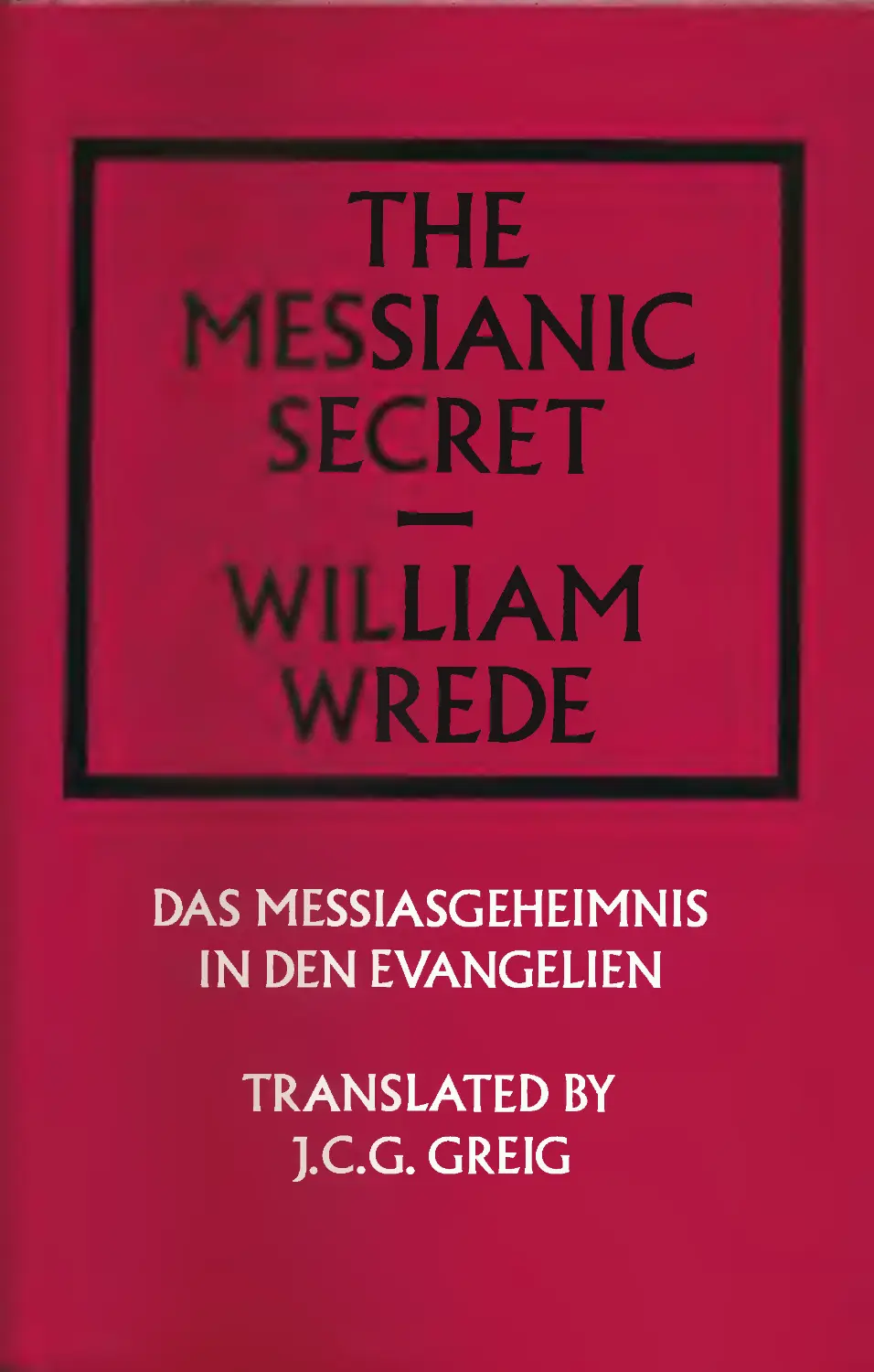
                    THE
MESSIANIC
SECRET
WILLIAM
WREDE
DAS MESSIASGEHEIMNIS
IN DEN EVANGELIEN
TRANSLATED BY
J.C.G. GREIG
THE MESSIANIC SECRET
by
William Wrede
translated by
J. C. G. GREIG
JAMES CLARKE & CO. LTD.
CAMBRIDGE AND LONDON
This translation first published 1971
© James Clarke & Co. Ltd., 1971
Printed in Great Britain
at the St Ann's Press, Park Road, Altrincham
CONTENTS
Translator’s Introduction	vii
Author’s Preface	i
Introduction	4
PART ONE	: MARK
Some Preliminaries on the General Picture of the
Messianic History of Jesus	ii
The Self-Concealment of the Messiah	24
Concealment Despite Revelation	82
Mark in Retrospect	115
PART TWO	: THE LATER GOSPELS
Matthew and Luke	151
John	181
PART THR	EE: HISTORICAL ELUCIDATION
The Concealment of the Messiahship up to the
Resurrection	2 i i
The Disciples’ Lack of Understanding	231
More on Mark and Luke	237
On the Further History of the Ideas	244
Appendices
i	On the Confession of Peter	253
ii	The prohibitions of Jesus	255
iii	The idea of education in Mark	261
iv	On the Prophecies of Suffering and Resurrection	264
V	On the Text of Mark 10.32	276
vi	On Mark 10.47	279
vii	Predecessors	280
TRANSLATOR’S INTRODUCTION
William Wrede
Wrede was born on io May 1859 at Biicken in Hanover. He
became an associate professor at Breslau in 1893, and full pro-
fessor in 1896. He died in office in 1906.
A radical by instinct, his methodology was self-consciously
worked out, as his 1897 book Uber Aufgabe und Methode der
sogenannten neutest amentlichen Theologie clearly shows.
For him New Testament theology is to be based not on the
canon, but on history. The relationship of the New Testament
documents to the “complex of tradition and history that lies
back of them” is a problem and the documents “are to be
studied not as literary witnesses to an ideological development
. . . , but as exponents of a stormy event whose actual un-
folding reveals itself in them as their presupposition”.1
Jesus’ life is known to us only through the tradition of the
Church and New Testament theology has to consider not just
Jesus and Paul, but the transition from Jesus to early Jewish
and Gentile Christianity and only then the work of Paul.
Such presuppositions as these are set to work in the book
we have before us, published in 1901 as Das Messiasgeheimnis
in den Evangetien.
The Messianic Secret
Wrede objects to the interpretation of Mark on the basis of
inadequate psychological surmise. The contrast between the
public nature of Jesus’ miracles and his injunctions to secrecy
in this Gospel requires some other mode of explanation. What-
ever modems may say, Mark is “wholly unaware” of the 1
1 G. Strecker, “William Wrede. Zur hundertsten Wiederkehr seines Geburt-
stages”, ZThK 1960/61, p. 71. The translation is by Prof. S. MacLean
Gilmour, and the summary of Wrede’s life and interests given here is
partly drawn from the article by Strecker.
viii	Messianic Secret
notion of a Jesus who, assuming messiahship at baptism, keeps
it secret for much of his ministry till, after the confession of
Peter, he introduces the disciples to the idea of a suffering and
dying Messiah.
Mark’s picture shows the influence of the faith of the early
Church at various points and is not neatly self-consistent.
In the Gospel, Jesus is portrayed as concerned to veil his
mission and the disciples are the recipients of revelations by
him which they do not understand. These two factors are
resolved in the picture of the Resurrection as ending the self-
concealment of the Messiah and giving the disciples their com-
mission to proclaim Jesus as Messiah to the world.
The idea of such a secret can be shown, from a study of the
other Gospels, to have developed variously, and above all to
go back to a period prior to Mark’s work as the earliest
Evangelist.
Wrede finds the theological source of the idea of a secret
about the messiahship in a contrast between what the Church
came to think of Jesus and how his life had been understood
during his ministry. According to him, because the Church
Cttne to think of Jesus after the Resurrection as Messiah they
сайре to explain lack of explicit declaration of his messiahship
by Jesus during his ministry by the suggestion that (neverthe-
less) Jesus had after all secretly revealed his messiahship.
The doctrine of the messianic secret is “the after-effect of
the idea of the Resurrection as the beginning of Jesus’ mes-
sianic office”. Further: “if this doctrine could have arisen
only at a time when nothing was known of any open claim on
Jesus’ part to be Messiah, this seems to be positive evidence
‘that Jesus actually did not represent himself as Messiah’.”2
It will be seen that it is important to decide whether Wrede
is right to suppose the doctrine has a theological starting-point
of this kind as well as to check his conclusion that such a
theology must involve a lack of messianic claims on the part of
Jesus.
Nevertheless we can hardly question the correctness of his
insistence that there must be a historical approach to the
2 op. cit., p. 77.
Translators Introduction	ix
Church’s tradition if there is not to be naive misunderstanding
of the perspective from which the Gospels were written.
Foreshadowed in his work are both form-criticism. and redac-
tion criticism.3 Foreshadowed too is the preoccupation of Ger-
man New Testament theologians with what we have come to
know as the Easter Event.
Alongside this sensitivity for literary form and forms, too, we
find a keen, pragmatic responsiveness to Religionsgeschichte
which, if in part reconstructed from the literature, is basic to
seeing it in perspective. The Christian community in its world
setting “served as a creative and formative agent in the trans-
mission of the Gospel tradition”.4 5
It might not be too much to say that, setting aside the
greater self-consciousness of modern hermeneutics—informed
as it is by the work of men like Dilthey and Collingwood—
Wrede’s methodology was not merely trend-setting its own
day but has remained determinative for New Testament work
right up to the present.
It is only reasonable, however, that the results procured by
his methods should have been more debatable than the
methods themselves.
The “Secret” since Wrede*
It is not necessary to undertake an exhaustive review of sub-
sequent literature in order to press home the continuing impor-
tance of Wrede’s work. But there is some value in discovering
what approaches derivative from him have been overplayed,
and which might have merited more attention. To this we now
turn.
A great danger in Wrede’s standpoint is that emphasis on
the theologising activity of the early Church may lead us to
picture such theologising as something autonomous in relation
to Jesus’ own theologising activity. This ought not to be so;
yet the mere fact that we have documentary material that
3 Strecker, op. cit., p. 78, has a useful summary of Wrede’s work on John,
which is relevant to this.
4 ibid., p. 85.
5 From this point on the Introduction is independent of Strecker’s article.
X
Messianic Secret
points to a Church theology, or cluster of theologies, through
which all our factual material about Jesus has already been
filtered will again and again tempt us to overlook the proba-
bility of theological continuity between his thought and theirs.
Item after item becomes a “creation of the Church”—which
it might well enough in some instances be—with little deference
to the creativity of Jesus himself. The objection can be carried
a stage farther back. Wrede was sensitive to Religionsgeschichte:
yet he and many after him have preferred the notion that the
“secret” was a theological bridge constructed by the Christian
community from the non-messianic life of Jesus to the Church’s
messianic understanding of that life; they have preferred this
to explaining the secret as an element in Jewish
Religionsgeschichte of which Jesus himself can have made use.
We had to wait for Sjoberg for a corrective to this, though his
view has not commanded wide acceptance.®
There is hope from another angle than that of Sjoberg’s work
that fresh attention will be paid to the place of Jesus’ ministry
in Jewish Religionsgeschichte and to the connection of Church
theotogismg with both. This hope derives from the recent pre-
occupation of certain New Testament theologians with the
vaScHty of the quest of the historical Jesus.
can be traced back to another emphasis of Wrede’s.
In stressing Marie’s theological inheritance he contributed to
the raising of doubts about the use of Mark for constructing a
life of Jesus.
On a different tack from Wrede, Albert Schweitzer made a
similar point in The Quest of the Historical Jesus (E.T., 19io).6 7
Now it is well known that after spending much energy
demonstrating the impropriety of constructing a life of Jesus
in the fashion of the older “liberals” Schweitzer uses material
in Matthew rather than Mark to help him outline a picture,
albeit not a full-scale biography, of Jesus as he sees him.
6 Erik Sjoberg, Der Menschensohn im athiopischen Henochbuch, Lund,
1946, 2nd Der verborgene Menschensohn in den Evangelien, Lund, 1955.
7 On p. 328®. of this work Schweitzer provides his own analysis of Wrede’s
“thorough-going scepticism” and compares it with his (Schweitzer’s)
“thorough-going eschatology” (often spoken of as “consistent eschatology”).
Translator’s Introduction	xi
Schweitzer’s Jesus interprets his life against the background
of Jewish eschatology, and the author is at pains to show that
three crucial items of Gospel narrative are recognised by Wrede
himself as ill to reconcile with a merely literary-theological (as
opposed to eschatological) understanding of Mark. These items
are Peter’s Confession, the Entry into Jesusalem and the High
Priest’s knowledge of Jesus’ messiahship.
Thus Schweitzer eschews old-fashioned biography of Jesus
while stressing (rightly) the difficulty of accounting for some
messianic material in the Gospels as nothing but the literary
or theological creativity of the early Church rather than some-
thing in Jesus’ historical situation. “It is difficult to eliminate
the 'Messiahship from the ‘Life of Jesus’ ... ; it is more
difficult still ... to bring it back again after its elimination
from the ‘Life’ into the theology of the primitive Church”8;
and later on the same page: “But how did the appearance
of the risen Jesus suddenly become for them a proof of His
Messiahship and the basis of their eschatology? This Wrede
fails to explain . . . .”
This fundamental question, stated so clearly by Schweitzer,
has rarely if ever received justice from succeeding generations
of radicals. Why should messiahship be the appropriate dignity
for the raised, any more than for the crucified, Jesus? Think
of the disadvantages to the Church in having to cope with
explaining that Jesus was a messiah at all, rather than some-
thing else!
Because Schweitzer’s preference for Matthew over Mark has
not seemed justifiable to many in the light of dominant trends
in source and form criticism, his picture of an eschatologically
conscious Jesus has not received the consideration it might on
other grounds merit. It is largely in the circle of scholars like
Buri and Werner that his “consistent eschatology” has been
developed further. Yet whatever its weaknesses may be, this
picture does help us to take seriously the continuity of Jesus’
thinking with that of his environment, and the continuity of
his followers’ theologising with his own.
By contrast form and redaction criticism, reinforcing
8 op. cit., p. 343.
xii	Messianic Secret
Wrede’s insight into the part played by the post-Easter Church
in the growth of the thought behind the Gospels, have some-
times seemed to erect a sort of iron curtain behind which the
life of Jesus must remain for ever veiled in mystery. This cur-
tain is the Easter Event itself.
Now recently in reaction to this scepticism scholars such as
Ernst Fuchs and J. M. Robinson9 have sought to replace the
iron curtain by something more diaphanous. It has been
suggested that while the old lives of Jesus were indeed on the
wrong track form criticism is not so radical but that it leaves
us with a modicum of material going back to Jesus. From this
material we can see him reacting to his situation in history,
producing a kerygma. We shall label this kerygma k1 and note
that there is debate about how far it contains an implicit
christology.
Now form-criticism often leads to the conclusion that the
Church affixed the christological label to Jesus first of all in
its kerygma, which was a post-Easter kerygma, and which we
shall label ka.
Part of the recent discussions on the historical Jesus has its
foem <m how far k1 and k2 are consistent with each other.
Heme the point that k1 may be implicitly christological.
Iti this discussion unfortunately the full force of the term
“christtrfogy” is sometimes lost. We can speak of it in k1 and
ka without remembering that it is not the same as soteriology.
Soteriology is a wider term. Yet modem theologians often mean
just that when they use the other. They read into “christology”
nineteen centuries of Christian soteriological connotations
foreign to the original Jewish subject-matter of christology, i.e.
discourse about a messiah for the Jews.
One example of this may be seen in the reinterpretation of
“the messianic secret” as a “son of God secret”:
At this point it will be enough to suggest that the reasons for
this secrecy are to be sought in the very nature and purpose
of Jesus’ ministry and of the Incarnation itself. To have
9 See the convenient summary in R. H. Fuller, The New Testament in
Current Study, SCM, 1963, pp. 33-67.
Translators Introduction	xiii
allowed the demons’ disclosure of his divine Sonship to go
unrebuked would have been to compromise that indirectness
or veiledness which was an essential characteristic of God’s
merciful self-revelation.10
A more direct example of the over-theological approach, this
time in the “new quest” of the historical Jesus itself, is to be
seen in the tendency to take for granted the presupposition of
access through a small quantity of the teaching of Jesus, under-
stood in terms of twentieth-century existentialism, to the Jesus
of history (not historiography), in the discussion of k1 and k2.
“New questers” (as they have been called) like Fuchs and
Robinson are so concerned with existential reinterpretation of
these kerygmas that they under-emphasisc the relevance to the
historical role of Jesus in first-century Palestine in their own
discovery of a continuity in early Christian thinking between
Jesus and the Church.
The plausibility of the argument in J. A. T. Robinson’s Jesus
and His Coming (SCM, 1957) may, for instance, hinge on
whether there really was anything in the first century that
swung the Church into an apocalyptic view of bis ministry in
the fifties. Or again, with a reappraisal of the debatable material
on the kingdom of God compatibility of the teaching of Jesus
with a Jewish messianic understanding of his ministry by him
is still worth looking into.
It should be evident that work on Jewish background is just
as relevant as an existential restatement of Jesus’ and the
Church’s message; indeed the one needs the other to comple-
ment it.
Hence Sjoberg must claim our attention.
It is convenient to preface our discussion of his work with a
brief statement on the study of the Enoch literature.
Archaeologists have not so far found among the Dead Sea
Scrolls those portions of 2 Enoch known as the Similitudes, Since
these speak of the Son of Man they have a bearing on the New
10 С. E. В. C ran field, The Gospel according to Saint Mark, CUP, 1959,
pp. 79. Cranfield appeals in particular to Bieneck’s term Sohnesgeheimnis
and to the latter’s book, Sohn Gottes als Christusbezeichnung def Synoptiker,
Zurich, 1951.
xiv	Messianic Secret
Testament. It has been argued that the Similitudes were probably
composed later than the time of Jesus and were not drawn upon
by him.11 Though not without some impressiveness, dependence
on the absence of material from a particular set of finds remains
a dangerous argument from silence. And Hindley’s attempt to
locate the reference to Parthians in a.d. 115-117 (cf.
Similitudes of Enoch, 56, 57), though plausible, is conjectural
and certainly not determinative as it stands.
Furthermore the present state of the Enoch material by no
means precludes a long oral and even written history for it,
whether in its extant form it is to be dated, with R. H. Charles,
in the first century b.c., or with Hindley in the second century
A.p.11 12 13
Given this preamble, it is interesting to note that while Sjoberg
concedes that there are several points of time under Roman
procuratorial rule in Judaea which would make an acceptable
background for the Similitudes, he still prefers 40-38 b.g. and
regards them as basically a literary unity.
On this literary and historical foundation he constructs his
own picture of the sort of eschatological figure the Son of Man
W90 m the circles that gave birth to the Enoch literature and
accepts that the term comes to be linked with that of Messiah,
however different in origin it may be.
Now (me feature of the Son of Man in Enoch is that though
he has been hidden from men, he is named before the Lord of
Spirits and is a pre-existent being. Sjoberg links the naming of
the Son of Man with ancient near-eastern patterns of kingship.
Further, “the thought of the divine secrets is central in
apocalyptic”1,3 and these secrets have been learned by the
“righteous” or the “elect”.
11 cf. Milik, Ten Years of Discovery in the Wilderness of Judaea, SCM,
1959, gives a general picture. J. C. Hindley, “Towards a Date for the Simi-
litudes of Enoch. An Historical Approach**, New Testament Studies, 14.4,
July 1968, 55iff., points towards a second-century a.d. date.
12 R. H. Charles, Apocrypha and Pseudepigrapha, Oxford, 1913.
13 Mowinckel, He That Cometh, Blackwell, 1956, p. 386, referring to
Sjoberg, op. cit., pp. iO4ff. Mowinckel’s discussion of “the Son of Man”
(pp. 346-450) is a helpful introduction to this complex idea.
Translator’s Introduction
xv
We may pause to note that among the Rabbis the “name” of
the Messiah was thought of as pre-existent, and the notion cir-
culated that he was to be kept hidden till the appointed time.14 *
Thus there is material in the Jewish tradition which would
have made a theology of hiddenness quite natural among those
discussing the Messiah, whether in relation to the “Son of Man”
or not. Formal proof of the pre-Christian currency of such
ideas may be difficult; but we should certainly keep our minds
open to their existence as a factor in the growth of Christian
thinking. And such ideas would have been of interest to mes-
sianic claimants themselves. There is gratuitous psychologising
in claiming that the mind of Jesus would never have woven
them into his own thinking—though it is just as unwarranted to
assume that it did.
Now, when Sjoberg deals with Jesus’ use of the “Son of Man”
terminology, he recognises that “ ‘the atmosphere about him is
differenf from that in the usual ideas about the Son of Man”16
and he thinks of Jesus adding a new element to the concept of
the Son of Man in the notion of that figure’s suffering, death
and resurrection.1® Also he “finds in the Similitudes a pre-
Christian foreshadowing of the pre-existence, incarnation, and
exaltation of the Son of Man”.17
Here we have a contrast which corresponds to the balance
that must be kept between the historical circumstances of the
ministry of Jesus and his indebtedness to the Jewish past (To
his indebtedness must, of course, be added that of the Church
which grew up in the Palestinian and related milieux).
Can we describe this balance more precisely than has so far
been done?
Jesus and his followers inherited a rich and diversified
apocalyptic tradition, to which at least Enoch material, if not
14 Mowinckel, op. cit., pp. 3041!., summarises the evidence. Wrede notes
references to the idea in the works of Justin Martyr.
16 Mowinckel, op. cit., p. 447, quoting Sjoberg, art. “Jesus Kristus” in
S.B.U.1.
16 Mowinckel, op. cit., pp. 448L
17 Fuller, The Foundations of New Testament Christology, Lutterworth,
1965, p. 40.
xvi	Messianic Secret
Enoch, belonged. This apocalyptic tradition had an eschatological
emphasis, and blended easily with other eschatological material
connected with the hope of a Messiah. It also contained the
notion of a “hidden” eschatological figure and of divine secrets
to be revealed to the righteous.
Now alongside this we have the fact that Jesus was crucified.
We also know that the Church came to speak of Jesus as the
Messiah, despite his crucifixion.
Further, alongside the crucifixion the Church placed the
Resurrection of Jesus. This item is more difficult than the
crucifixion to categorise. Hence its precise significance is often
obfuscated by references simply to the “Easter Event” as some-
thing which gave impetus to the preaching of Jesus as the
“Christ”.
What we do not know is the extent to which language about
the suffering, death and resurrection of the Son of Man on the
one hand, and about the secrecy of his messiahship on the other,
goes back to Jesus himself.
In our preoccupation with Wrede’s insight into the Church’s
tteofoguring of the ministry of Jesus, we may underestimate the
pdHihilify that at least the germs of this theologising can have
been pseeent in Jesus’ teaching.
This dot» not mean that we are pleading for a less radical
view of Jesus. Our view of Jesus is as radical as Schweitzer’s
consistent eschatology, though built on different premises.
Both factors mentioned can illustrate the point.
On one hand, the tradition of suffering martyrdom may have
conjoined with Jesus’ sense of impending crisis to produce
warnings of sufferings and death from him, but also hopes of
vindication.
On the other hand, a belief on his part that he might be the
Messiah would naturally enough make him seek to adopt the
extant theme of “hiddenness” or “secrecy” to his ministry.
These two possibilities can be stated without denying the
power of Wrede’s critique of Mark. But though the injunction
to secrecy (say) after the cure of Jairus’s daughter is absurd in
its context, as he rightly points out, it does not follow that the
idea of secrecy is nothing but ill-fitting theological explanation
Translator's Introduction	xvii
of how an “unmessianic” ministry of Jesus produced a
christology in the Church after the Easter Event.
Though neither of the possibilities we mention need be right,
there is just as much reason to explain the “messianic secret” by
one of them as to make it a post-Easter theology lacking their
basis in the traditions of Jewish eschatology.
In this connection generally, it is salutary to notice a revival
of interest in the background to the Son of Man terminology18
and perhaps even more to the point to take cognisance of a
recent reaction to the spate of contending sceptical assessments
of the primitiveness of Son of Man sayings in the Gospels.19
Finally, in the present context, notice must be taken of an
area of comparative studies which, though never decisive in
itself, can be illuminating.
We refer to the recrudescence of the idea of a hidden Messiah
in post-Biblical Judaism. This notion, known to the medieval
rabbis, was actually used by Sabbatai Zevi, a Jew from Smyrna
who in 1666 was the centre of a messianic movement.
The interest for us lies in the alleged accompaniments of his
messianic self-manifestation. While ultimately there was open
proclamation of his messiahship “with signs following” (!), this
came after a long period in which it was by obscure hints that
he sought to elicit from those around him this recognition of his
status. For instance he walked around carrying a fish in a
basket because an item of Jewish lore related this to the messiah-
ship. (Interestingly, too, he interpreted punishment from the
Jewish authorities as part of the sufferings of the Messiah!)
Joseph Kastein in his biography of Sabbatai Zevi speaks of his
“symbolic suggestions and secret communications to isolated
individuals here and there”.20
Now, even after the failure of his public manifestation, the
movement he started did not die out. Though under threat of
torture the “Messiah” apostatised to Islam, his followers
18 F. H. Borsch, The Son of Man in Myth and History, SCM, 1968.
19 cf. I. H. Marshall, * ‘The Synoptic Son of Man Sayings in Recent Dis-
cussion”, New Testament Studies, u.4, July 1966, pp. 3«yff.
20 J. Kastein, The Messiah of Ismir : Sabbatai Zevi, John Lane, The Bodley
Head Ltd, 1931, pp. 334®.
xviii	Messianic Secret
rationalised this by creating a theology, or christology, which
saw this “sinfulness” of the Messiah as part of the divine plan
for the taking of the burden of the world’s guilt upon him. It
was further argued that his followers too should conform to
other religions. Sociologically this was opportune in the light of
Jewish sufferings and enforced conversions in the post-medieval
period in Europe.
Sabbatai Zevi has variously been called a mystic, a neurotic
and a homosexual; but more than all these and despite them he
was a major phenomenon in the Jewish world. Above all, here
we have in comparatively recent times a sort of test case for the
study of the interaction of tradition, messianic history and
posterior theologising.
For one thing we see that a man who could procure a sub-
stantial following did so because he lived his life consciously in
tune with current Jewish messianic tradition, at least to a
degree.
Equally we see that where his doings stepped out of line
with such tradition his convinced followers set about reconciling
them with the framework of that tradition.
The secrecy motif was by then “dd hack” in Judaism, and
faj ooptoyment does not necessarily betoken charlatanry or
demtath; move to the point is the fact that it could be employed
effectively at all.
All this drives home the lesson that while the crucifixion of
Jesus called for an explanation, this explanation need not have
started in a vacuum or have been imposed as altogether foreign
matter on existing messianic traditions; further that there may
be good sociological reasons for the form taken by the explana-
tion; and finally that the motifs of suffering and secrecy could
go back to the ministry of Jesus itself, even if also adapted to
the crucifixion and its sequel. We have as it were a “portcedent”
in the career of Sabbatai Zevi and the perpetuation of his
movement!
It is indeed not inappropriate to ask how far the very pro-
clamation of the Easter Event might be the consequence rather
than the cause of a christological kerygma otherwise very hard
to explain.
Translators Introduction	xix
These observations are very tentative and we are fully aware
that the literature about Sabbatai Zevi is as much in need of
form, source and redaction criticism as are the Gospels. Nothing
more is offered than an instructive comparison.
Nevertheless from all we have previously said it would seem
proper to suggest that Wrede’s position cannot be normative
unless it can be clearly shown that the secrecy motif cannot have
belonged to Jesus’ ministry itself.
Recent Approaches
Cognisance must be taken briefly of some other contributions
to the debate.
Bousset saw in the motif an apologetic device to reconcile
history with the Gospel; H. J. Ebeling saw it as denying inde-
pendent importance to history and emphasising the kerygma of
the Church and the faith of the Christian; but others again see
it as “reflecting the basic theological structure of the history
itself (an abstraction which might or might not be consistent
with an approach through Religionsgeschichte}.
Burkill, like Bultmann, still leans heavily on Wrede’s original
position but also sees the secret as a positive attempt by Mark at
a theological interpretation of the hidden meaning of Jesus’ life
and death as those of the Messiah. Conzelmann and others see
it as Mark’s creation, in which a fundamental theological
principle is exhibited that displays the relation between history
and the Gospel in assessing the significance of Jesus’ person “as
the form and content of the Gospel require”. This refinement
of Wrede’s and Bultmann’s approach is further developed by
Glasswell.21
A Methodist scholar, Brian G. Powley, is at present working
on a detailed historical survey of the discussion to take account
of contributions not touched on by Glasswell, while broadly in
agreement with the view that “there is a secret of a kind in the
historical life of Jesus in that a Christology war implicit, not
explicit, in his preaching. Later, after the open confession of
21 See an unpublished thesis on the messianic secret by M. E. Glasswell, to
which grateful acknowledgement is made for the material from which this
little digest, with some changes, is made. Cf. also, for sources, H. Conzelmann,
An Outline of the Theology of the New Testament (fr. J. Bowden), S.C.M.,
1969, p. 138.
XX
Messianic Secret
Jesus’ Messiahship in the post-resurrection church and when
it became necessary to write a life of Jesus as the Messiah, the
implicit character of the Christology within the ministry was
re-expressed in restrospect in terms of a specifically Messianic
secret. Paradoxically, history is falsified in the interests of his-
torical verisimilitude!”22
Even if such a view should be thought not to do full justice
to the eschatological raw material outlined by Sjoberg as extant
in Judaism, it is preferable to psychological explanations of
the secrecy motif which suggest that Jesus was anxious not to
give a wrong (political) idea of his intentions or did not wish to
be taken for a wonder-worker.23
That a first-century Jew should switch the idea of messiah-
ship from a political to a spiritual pole is theoretically con-
ceivable. But such a divorce of sacred and secular is unusual in
inter-testamental Judaism. It is much more likely that since
for some reason the habit persisted of calling Jesus “Messiah”
even when his death had distinguished him from the expected
Messiah, this spiritualisation of the messianic idea was pro-
duced to help account for the discrepancy.
Such an approach has something in common with Wrede’s.
But here too the question remains why the habit of calling him
Memah began at all.
Scholan following Conzelmann may be looked on as com-
mitted to the view that so far as Mark is concerned “the
Christology is in the tradition, not in the redaction” and that
“the secrecy motif, far from being designed to heighten the
Christology, actually tones it down”.24 Be this as it may, we can
see why such toning down would seem necessary. After a.d.
66-73 an explicit use of the term Messiah would not meet with
Roman favour; also to risk such unpopularity would seem
absurd seeing that in retrospect Jesus’ career did not look very
messianic!
This is almost to have “hoist with their own petard” scholars
of the complexion just discussed. For standpoints derived from
22 Letter to the translator dated 27 June 1968.
23 See R. H. Fuller, The New Testament in Current Study, SCM, 1963, pp.
ggff., for a good summary of various views.
24 op. cit., p. 95.
Translators Introduction	xxi
Wrede normally stress that Jesus’ career was not indeed messianic
to start with. Now we are expanding Schweitzer’s question
about why there was a tradition of Jesus’ messiahship at all, to
read: why was there in the pre-Markan pericopes a christological
emphasis that (a) must not be expunged but (b) could be mini-
mised by suggesting that Jesus enjoined secrecy?
Was this christological emphasis after all Jesus’ own? Did the
crucifixion bring him up with a jolt? Or did Jesus, as Schweitzer
suggested, hazard all on a disaster that could be the prelude to
vindication? Or again was Jesus’ movement quite simply part
of the nationalist-religious movement of his day?
We can now see that those studies of Jesus’ connections with
contemporary nationalism which extend from the “eccentric”
work of Robert Eisler to the more soberly assessed writings of S. G.
F. Brandon are directly relevant to the theology of the messianic
secret.25 The theologising of the early Church’s writers is at least
partly the product of their own political and sociological
predicament.26
The mere fact that we cannot go behind the New Testament
sources to a coherent, chronological biography of Jesus docs not
exonerate us from showing that he did belong in a particular
setting in history, and first-century, Jewish, eschatologicalty
determined history at that.
Only if we are clear about this can we do justice to the
element of continuity between him and those early Christians
whose christological kerygma included only belatedly, accord-
ing to some, the motif of secrecy; for in other eyes this very motif
was there from the start.
J. C. G. Greig
25 S. G. F. Brandon, Jesus and the Zealots, Manchester University Press,
1967, is a useful starting point for study of this trend. Brandon sees Jesus*
immediate target as the Sadducean priesthood rather than the Romans, but
still has to place him squarely within the political ferment of his day.
26 See also J. C. G. Greig, “The Eschatological Ministry’’ in The New
Testament in Historical and Contemporary Perspective, Blackwell, 1965, pp.
99®-
AUTHOR’S PREFACE
For some time my particular attention has been claimed by
the Gospel tradition of Jesus as the Messiah. It has been engaged,
as I might also put it, by whether Jesus saw himself as Messiah
and so represented himself. But I prefer the first formulation.
The two questions can indeed by identified with each other
but in one sense they can also be separated.
For instance, one can imagine a very unfavourable evaluation
of quite clearly messianic materials in the Gospels, and yet also
a failure even then to settle the question of Jesus’ messianic
consciousness. Examination of the available tradition is, however,
the subject which immediately concerns us. In the pages that
follow, the reader will find a treatment of one of the variety of
problems it embraces. My intention is to supplement this with
further studies on the subject. I hope to introduce some new
points of view into the discussion of the problem I am now
broaching. For at present it is a non-starter in theological circles
and simply has not been handled as I am attempting to handle
it.1
I have called the work “at the same time a contribution to the
understanding of the Gospel of Mark”; and I do in fact put
some weight on the sub-tide. My original intention was to write
a special study on the plan of Mark. But the contents of this
would have been too much in alignment with the work on the
main theme for the separation to have been fruitful. My only
hope is that I have succeeded in so effecting the unification of
the subjects that everything said about the Gospel of Mark
really will be of value for the understanding of the main theme.
I have frequently been pained by the thought that my investi-
gation raises questions about so many things on which good,
pious people have placed all their trust. I have remembered old
1 The extent of my awareness of having had predecessors may be judged
from Excursus VII.
2
Messianic Secret
friends, kind listeners, children of God both known and unknown
to me, who might see my work. However, I have been unable to
alter anything here. We cannot change the Gospels; we must
take them as they are. If anyone wishes to call my criticism
radical on this account, then I have nothing against it. I rely
on the fact that things themselves are sometimes most radical
and that one can therefore hardly be legitimately reproached
for depicting them as they are. On the other hand, I reject the
charge of offering a “negative” criticism in the one reasonable
sense the word can have: my entire endeavour has at least been
the very positive one of illuminating a small but, as I believe,
important portion of descriptive history as well as I could.
My endeavour is to be open-minded towards objections. It
can be taken for granted from the start that much will require
correction. But the common complaint, that the Gospel tradi-
tion cannot be of later date to die extent I assume, will not
put me off. History teaches that after the earliest Gospels were
written down extraordinary changes in the picture of Jesus
still took place. I cannot imagine why previously it should not
have been so. No a priori judgement can be made on the value
of the Markan transmission, for we are entirely without the
xneam of checking it against other sources. It must therefore
be held possible that the oldest written material which tells us
of Jesus, and which came to have a dominant influence on
what came later, has incorporated much more than we could
desire of the secondary tradition that had already accumulated,
and much less of the good material. For the rest, I do not wish
to leave it unrecorded that my attitude towards other portions
of the Gospel materials, and particularly towards the “sayings”
of Jesus, is essentially different from that towards the elements
I am dealing with here. All in all I should like my readers to
observe the limits I have myself delineated in this work. The
subject frequently leads us on to questions of wider impact;
these I have tried to eschew as far as possible.
I should have been glad to forgo explicit debate with other
viewpoints, but it seemed necessary, to permit clear perception
of the position which has gradually become mine, which is one
of opposition to the usual critical treatment of the Gospels. I
Author's Preface	3
must beg forgiveness for quoting old editions of a series of
well-known works, these being the one form in which they
were available to me. The effect will doubtless be inconsiderable.
I do, however, regret having been unable to make more use of
the Handcommentar zu den Synoptikern in the form which
its worthy author has now given it. Oscar Holtzmann’s Leben
Jesu I unfortunately encountered only when my work was
already finished. This work, of course, generally champions the
very positions I have particularly challenged (cf., e.g., pp. 54г.,
57, 249ff., 273).
Some excursuses have been added in order to make the
presentation less cumbersome.
I have very frequently—and sometimes several times over—
given quotations verbatim. This was to study the reader’s con-
venience, but also to compel him to have before him a vivid
picture of the texts.
I am very grateful to Waldemar Lorenz, stud, theol., for
substantial help in correction of proofs and in the preparation
of the index.
W. Wrede
Breslau, June 1901
INTRODUCTION
Requisites for research on Jesus’ life
Historical criticism has carried out painstaking work on the
literary sources of Jesus’ history. Assuredly it has not lacked its
reward. Little may have been settled, but progress say since
Strauss’s Leben Jesu (1835) has been extensive and
unmistakable.
There seems to be a less substantial gain to record in the
primary task of making use of the sources for historical
purposes.
In individual particulars these last decades are, of course, the
period which, with its variety of fresh stimuli, has richly
augmented our scholarly resources. Many are the transmitted
sayings of Jesus that have come closer to being understood, and
many the standpoints dominating the Gospels that have been
more clearly opened up for us through our knowledge of the
historical background.
But the two decisive questions are still these: What do we
know of Jesus’ life? and—a question with its own independent
importance—What do we know of the history of the oldest
views and representations of Jesus’ Efe? The two questions can
also be subsumed in one: How do we manage to dissect the
Gospel tradition in these two directions: how do we separate
what belongs properly to Jesus from what is the material of the
primitive community?
Coming to the recent Eterature on Jesus’ Efe (in the widest
sense) with these questions in mind, one feels the onset of a
sense of disappointment. Looked at more closely, this impression
is seen to be in part the consequence of the unusual difficulties
that inevitably attach to the subject itself; and in part to be
attributable to the predominance of Eterary work on the
sources, with its frequent obscuring of our awareness about the
latest and chiefest undertakings of research. But in substantial
measure it also stems from a defective critical method.
Introduction
5
This seems to become obvious specifically at three points.
First of all, it is indeed an axiom of historical criticism in
general that what we have before us is actually just a later
narrator’s conception of Jesus’ life and that this conception is
not identical with the thing itself. But the axiom exercises much
too little influence. As a rule it is remembered only when certain
things shock us; which means essentially (i) where we find
strictly miraculous features, (2) where there are manifest con-
tradictions in the same source, and (3) where one report clashes
with another. Where such shocks do not occur we feel, without
going very deeply into it, that we are on firm ground in the
life of Jesus itself, that we are through with criticism when by
dint of work on the sources and reflexions on the subject we
have arrived at the oldest account.
There is no clarity of principle in this. I should never for
an instant lose sight of my awareness that I have before me
descriptions, the authors of which are later Christians, be they
never so early—Christians who could only look at the life of
Jesus with the eyes of their own time and who described it on
the basis of the belief of the community, with all the view-
points of the community, and with the needs of the community
in mind. For there is no sure means of straightforwardly deter-
mining the part played in the accounts by the later view—
sometimes a view with a variety of layers.
A second point is very closely bound up with this one. We
are in too great a hurry to leave the terrain of the evangelists*
accounts. We urgently want to utilise it for the history of Jesus
itself. In order to do so features that cannot be credited are
cut out and the meaning is worked out in such a way as to
become historically serviceable; that is to say, something which
was not in the writer's mind is substituted for the account and
represented as its historical content. There is extremely little
sensitivity to the tremendous precariousness of this procedure;
but above all no questions are asked about whether the
characteristic life which belongs to the account itself is
eliminated by it. Our first task must always be only that of
thoroughly illuminating the accounts on the basis of their own
spirit and of asking what the narrator in his own time intended
6
Messianic Secret
to say to his readers; and this work must be carried out to its
conclusion and made the basis of criticism.
Thirdly, psychology is to be taken into account. By no
means do I wish to speak here only of researchers—of whom
there are many in different camps—who exhibit for every
Gospel story such a precise knowledge of the historical cir-
cumstances and, specifically, such an intimacy with the inner
life of Jesus that one might well doubt whether one is listening
to a confidant of Jesus or reading a novel. I am also thinking
about the fortunately numerous scholars who demonstrate more
tact and reserve in this.
Psychology is all very well if it is a question of producing the
necessary connection between fixed points or if its service is
exploratory, where there is a strict check on the possibilities
and necessities deriving from established facts or even, for the
matter of that, from supposed facts. But scientifically psychology
fails to carry conviction if the crucial points are not themselves
determined or if there is a facile proffering of what may well
be in itself conceivable as if it were already the real thing.
And this is the malady to which we must here allude—let us
not dignify it with the euphemism “historical imagination”.
The scientific study of the life of Jesus is suffering from psy-
chological “suppositionitis” which amounts to a sort of historical
guesswork. For this reason interpretations to suit every taste
proliferate. The number of arbitrary psychological interpreta-
tions in literature of facts, words and contexts in the Gospels is
legion. Nor is it simply a matter of harmless superfluities. These
interpretations at the same time form the basis for important
structures of thought; and how often do people think that the
task of criticism has already been discharged by playing tuneful
psychological variations on a given factual theme!
I am by no means asserting that all work in this direction
has been entirely useless, but it seems to me to be an urgent
necessity that we should have done with subjective judgements.
The psychological treatment of facts is permissible only when
we know that they are indeed facts and even then we must
still call a supposition a supposition. Otherwise there is a blunt-
ing of our awareness that scholarship finds value not in emotive
Introduction	7
descriptions which afford the reader pleasure but only in strict
accuracy and certainty of knowledge; otherwise we will forget
that we must at least always be striving for these things and
that it is better to have a little real knowledge, whether positive
or “negative”, than a great assortment of spurious knowledge.
These reflections will appear somewhat presumptuous to the
well-disposed, and even more to the ill-disposed, reader as I
have done nothing to exemplify these maladies of criticism;
and they will seem pointless so long as I do not say what
observational basis I have for making these pronouncements.
Let my readers then consider my remarks to be a sort of motto
which I should like to prefix to the investigations which follow.
To be sure those who read them will not find here by a long
way everything I think I can offer by way of proof, but I hope
that from a series of examples they will be able to see what my
meaning is and that those in essential agreement with the
investigation will lend the seal of their approval to the motto.
The subject and the sources, with special reference to Mark
The question of the messianic self-consciousness of • Jesus
which is exercising modem scholarship is far from the thoughts
of the Gospel narrators; indeed for them it simply does not
exist at all. From the beginning of his life or of his work, from
his birth or his baptism, Jesus for them is objectively the
Messiah. This naturally implies a corresponding consciousness,
but the idea of this consciousness and of its genesis is not
present. It woud be a complete misunderstanding of the mind
of these writers to presuppose that they had any ideas about
the development of this consciousness.
On the other hand, the evangelists do offer us certain data
relevant to the other question of when Jesus was acknowledged
as Messiah or when he made himself known as such. If scholar-
ship can reach the stage of making any certain pronouncements
about Jesus’ messianic consciousness from this starting-point,
then it must manifestly be by way of inferences.
My intention in the following investigation is to subject these
allegations, together with whatever else is relevant to them, to
8
Messianic Secret
an examination. This, of course, is only a very provisional and
inexact paraphrase of my intentions.
In this undertaking we must refer to all four Gospels. I
would add to them the older extra-canonical Gospels of which
we have some fragments, were it not possible to say at once
that for the problem under consideration these have nothing
worth mentioning to offer. The canonical Gospels must be
considered separately. This is important.
With the great majority of modem critics I share the opinion
that our Gospel of Mark, or something extremely like it, lies
behind the two other synoptics. I naturally do not venture in
making this assumption to solve every individual literary
problem posed by the parallel portions of the three Gospels;
but despite continued contradiction of it, the main point seems
to me to be so well established that we may use it as the basis
for new ventures.1
If this thesis is correct and if the fourth Gospel must remain
out of account as a completely secondary picture, then the
whole burden of responsibility falls almost entirely on Mark in
regard to all questions touching the authentic story of Jesus and
m particular the cowse and development of his life. The
re&jbiHty or ureliability of Mark’s tradition in this connection
is essentially decisive for the reliability or otherwise of the
Gospel tradition as a whole. Mark must therefore stand in the
forefront of our investigation.
Matthew and Luke, however, are not on this account value-
less even where they themselves depend on Mark, nor of course
is John. To hold them valueless can be the approach only of
those for whom the question of the most primitive development
of the interpretation of the life of Jesus gets lost to view behind
the question of the real life of Jesus.
I am making no presupposition about the antiquity of Mark.
There can be no talk as yet of a proof that it was written before
a.d. 70. On the other hand, the usual arguments are also
1 cf. Wernle, Die synoptische Frage, 1899, which presents an excellent
summary of the results of standard critical works, besides making an inde-
pendent contribution to many questions; though, of course, it is not free of
some audacious judgements.
Introduction	9
hardly sufficient really to guarantee a later date. Indeed
researchers with essentially the same presuppositions now
champion this view and now the other.
In the same way, however, I am also leaving completely
open the question of the relationship of the Gospel to Peter. In
an investigation of the kind we are undertaking the intrusion
of such problems could only have a harmful effect. Everything
to do with the internal circumstances of the Gospel must first
be explored on its own account. Only afterwards can we ask
whether the result favours the tradition of a Petrine basis for
the Gospel or not.
As against this another presupposition must indeed be made:
namely that the Markan narratives are something essentially
other than records of Jesus’ life taken down on the spot. This
is to be sure a platitude, yet, on the other hand, there is nothing
platitudinous about it when one sees that in practice criticism
again mostly makes meagre use of this theoretically uncon-
tested thesis.
At best Mark wrote something like thirty years after the
events, and at best gave a free reproduction in part of his book
of what an eyewitness had reported to him of his reminiscences,
long enough before they were written down. It will suffice to
refer to the doublet in the feeding stories (ch. 6 and ch. 8) to
prove that he does not everywhere follow this eyewitness, if
indeed he follows him at all. Everyone who knows anything
about human tradition must admit that even when we make
these favourable assumptions the faithfulness and exactness of
individual reports becomes somewhat uncertain. If, on the other
hand, one looks at how the critics go on drawing quite assured
conclusions from the most inconsiderable and characterless
details and from the position of sentences and phrases in the
narrative, or from the appearance or absence of individual
words or concepts, one should by rights believe in a miraculous
process of transmission.
Yet another consideration is more to the point here and must
be compelling at least for all those who recognise only historical
standards in Gospel research. Mark actually has a large share
of unhistorical narratives in his Gospel. No critical theologian
10
Messianic Secret
believes his report on the baptism of Jesus, the raising of
Jairus’s daughter, the miraculous feedings, the walking of Jesus
on the water, the transfiguration, or the conversation of the
angel with the women at the tomb, in the sense in which he
records them. If the theologian sees facts behind such informa-
tion he is nevertheless compelled to grant that they have under-
gone a very substantial transformation and distortion, whether
in the mind of Mark or otherwise.
Can this knowledge have no consequences for the rest of the
Gospel’s contents? A real distrust of concrete portions of the
record naturally cannot have its basis here, nor should this
lead to its being expressed. But we are certainly warned force-
fully by the Gospel itself against a too ready confidence and
from the start are challenged to check its contents rigorously.
It is not a matter of indifference whether this is or is not
clearly grasped by those coming to the Gospel. To bring a
pinch of vigilance and scepticism to it is not to indulge a
prejudice but to follow a clear hint from the Gospel itself.
Part One
MARK
Some Preliminaries on the General Picture of the
Messianic History of Jesus
The prevalent view of the course of the events {according to Mark)
At his baptism by John, Jesus receives the Spirit and obtains
the testimony from on high that he is God’s son. With this,
according to Mark, Jesus’ life as Messiah begins.
Next to this fundamental event the decisive point is the con-
fession of his messiahship by Peter, 8.2 yff. In Jesus’ last period,
not long before he sets out on the decisive journey to Jerusalem,
there dawns on the disciples at Caesarea Philippi an understand-
ing they have not so far had; and one which in a sense they
ought not to have. For to begin with Jesus purposely veiled his
messianic dignity in secrecy. Even as late as the sending forth
of the disciples in b.yff. he does not commission the disciples to
proclaim him as Messiah, but rather authorises them only to
preach repentance and to drive out demons.
However, others had already recognised him as Messiah before
the disciples. These were the demoniacs. But it is specifically in
regard to them that he shows his unwillingness to be prematurely
considered Messiah. He regularly forbids them to proclaim him.
Other sick people too are the objects of a corresponding veto,
as Jesus is manifestly troubled that the broadcasting of his
miracles will compel him to lift the veil.
The dawning of messianic awareness on the part of the disciples
accordingly appears in fact as epoch-making in Jesus’ public
life. In this connection it becomes at the same time evident that
Jesus thought it important that there should be no forcing of
the correct evaluation of his person but that it should be allowed
to mature gradually in people’s minds.
в
12
Messianic Secret
But the moment of Peter’s confession has yet another meaning
too. From now on we have the announcement of Jesus’ suffering
and death (erxato didaskein, 8.31). From the course take by his
life and his activity Jesus recognised this bitter necessity. He
therefore now seeks to familiarise his disciples too with his
thought on that future. But that this should happen just then is
the result of his inability to be content with the mere ack-
nowledgement of messiahship: he is still obliged to set the dis-
ciples free from a representation of the Messiah which was
Jewish and materialistic in character. Although the disciples
have taken the big step forward from a view of Jesus which at
first was extremely inadequate (e.g. 4.13, 41; 6.52) to the dis-
cernment of his messianic vocation, yet it is only very slowly that
they are able to reconcile themselves to the new idea of a suffer-
ing and dying Messiah.
Even at this stage Jesus still keeps his secret from the people.
Directly after Peter’s confession he once more emphasises the
old veto (8.30). And after the Transfiguration he forbids those in
his confidence to retail what they have seen (9.9). However,
already before the scene at Caesarea Philippi the growing repu-
tation of the wonder-worker had evoked from the people all sorts
of views about him which testified to a somewhat high evalua-
tion of hnn (6.i4f.). Thus in the long run the secret could not
be kept within the narrow circle. Already in Jericho we find him
greeted with the messianic form of address by a blind man
(10.47). At the entry into Jerusalem (n.iff.) the people then
fete him as the promised messianic king. And now he accepts
this homage. Finally he ackowledges his messiahship before the
high priest in the most solemn and express manner (14.6 if.).
Above his cross is the inscription: “the King of the Jews” (15.26).
Something like this is the picture of the messianic life of
Jesus which the prevailing critical view finds outlined in the
Gospel of Mark, and which for this very reason forms the best
point of departure for our investigations.1
1	See inter alia the following treatments: Weisse, Die evangel. Geschichte
(1838), I, esp. pp. 529L; Wilke, Der Crevangelist (1838), pp. 630!!., Ritschl,
‘‘Uber den gegenwartigen Stand der Kritik der synopt. Evangelien”, Tilbinger
theol. Jahrbb. 1851, esp. pp. 513(1.; H. Holtzmann, Die synopt. Evangelien
(1863), esp. pp. 43iff., 484L (essentially identical with the treatment in the
Some Preliminaries on the General Picture
13
The picture was first obtained in a comparison of Mark with
Matthew. Some pages of Ritschl2 had a special influence here.
Ritschl showed that Matthew already speaks repeatedly of public
messianic recognition of Jesus before Peter’s confession (9.27;
[12.23]; 15.22; cf. 14.33), but nevertheless represents the con-
fession as a revelation; further that in part he omits Jesus’
injunction not to proclaim him as it is of no value for his view as
a whole, while in part where he retains it he allows it to be
disclosed to great crowds of people (8.4; 12.15,16) and so makes
an absurdity of it. In other words it is shown that Matthew
misconceives and disarranges a systematic and organised treat-
ment; but thereby too it is shown that Mark, which provides
this treatment, is the older Gospel.
But a further big step was immediately taken. The historical
course of events was, perhaps with some isolated exceptions,
found to be present in Mark’s treatment.
Does proof of this not in fact lie in the internal consistency of
the whole? Do not the events of Jesus’ history come alive only
as a result of this central position of Peter’s confession? Jesus
himself, the disciples, and die people in relation to him all now
exhibit movement and progress. The strongest bulwark for this
view, however, lies in the presentation of Peter’s confession itself.
The scene has been differently understood? Peter is said simply
to have given new force to a belief in Jesus’ messiahship which
had already been long in existence, and in contrast to the
people, who turn away from him, the disciples make a vow to
Einleitung in das Neue Testament, 2nd edn., pp. 367(1. and with material
to the same effect in Handkommentar I (Introduction to the synoptic Gospels);
also Lehrbuch der neutestamentlichen Theologie I, pp. 234-304; Weizsacker,
Untersuchungen uber die evangel. Geschichte (1864), esp. pp. io8ff., 468ft.;
Wendt, Lehre Jesu I, pp. 3ff. Baldensperger, Das Selbstbewusstsein Jesu,
2nd edition. Cf. also allusions in Schurer, Theol. Lit.-Ztg, 1892, col. 646;
Wernle, pp. ig6f.; Wellhausen, Skizzen und Vorarbeiten, VI, pp. 202ft., esp.
211. In the main point, the idea that the confession of Peter was deliberately
represented as the first recognition of the dignity and nature of Jesus, Hilgen-
feld is also relevant (Das Markusevang., 1850, pp. 56, 119; Die Evangelien,
1854, pp. 137!.), though he makes Matthew prior to Mark; cf. Strauss.
2	cf. previous note.
3	e.g. В. B. Weiss, Leben Jesu, 1st edn., II, pp. 264ft.; also Delft, Gesch.
des Rabbi J. von Nazareth (1889), p. .125; and to different effect J. Weiss,
Die Nachfolge Christi, pp. 31ft., cf. Excursus I.
Messianic Secret
4
remain with him. But the renewed prohibition after the con-
fession (8.30; 9.9) seems sharply to contradict this, and the close
connection of the prophecy of suffering and the confession as
well as the rapid sequel of the Transfiguration seem equally
clearly to give the confession scene the stamp of an epoch-making
event. Indeed even Matthew’s addition, that Jesus extols the
confession as a divine revelation and esteems the one who gives
utterance to it as “blessed”, has the aura of a surprising illumina-
tion. This scene by itself therefore seems, if it is to be taken at
its face value, to carry with it a strong proof that it was only
shortly before his journey to Jerusalem that Jesus’ messiahship
became public property/
In spite of all this, the impression that Mark has an
internally consistent and historically comprehensible overall pic-
ture will stand examination only as long as we ignore items of
evidence pointing in other directions.
Of course, such items of evidence must not be imported from
without—from ready-made opinions on the life of Jesus or from
other sources. Otherwise there is a confusion of the issues. We
arc concerned only with Mark’s own view and with a critical
analysis of what is to be found in the Gospel.
However, a prior question here requires elucidation. Did
Mark intend to represent the supposed development in Jesus’
messianic life, or did he describe it unconsciously and yet faith-
fully? One opinion or the other must here be embraced. It
may remain in doubt what significance the question had for
Mark in comparison with other interests, but we cannot assume
that all in all from the beginning to the end of his work he
consciously set forth such a development and then, notwith-
standing, could be constantly bereft of this consciousness.
Many critics have in this connection explicitly spoken of
Mark’s intention.5 Of more importance is the fact that this is
4	Even such scholars as would on the basis of their premises nourish some
doubts on the matter have recognised this in their own way. See Ewald,
Gech. Christus’ und seiner Zeit (1855), pp. 328, 336; Keim, Gesch. Jesu von
Nazar a II, pp. 545!!.
6	e.g. Ritschl, p. 515, Wendt, p. 3: “There may be arguments about the
historical accuracy of Mark’s view but no-one can deny that it really is there
in Mark and that he makes it play an important part of set purpose.”
Some Preliminaries on the General Picture 15
absolutely appropriate and indeed necessary from their stand-
point.
A Mark who with an abundance of unrelated elements blindly
drew a picture of an internal development in Jesus’ history is
practically unimaginable. Chance would have had to operate
and to shuffle everything into place and chance cannot achieve
that much. If in accordance with prevailing critical presup-
positions we suppose that Mark drew upon reminiscences of
discourses by Peter or conversations with him for the best of
what he provides, that is, that he himself in great measure con-
trived the order in which he presents his material, it would be
all the more completely incomprehensible that in writing down
his narrative he should have happened quite casually upon such
a self-consistent arrangement of numerous details.
Assuming this, cogent objections can, however, certainly
be raised against the view ascribed to Mark of the course of
messianic history.
First of all it is clear that in Mark a lot of things have to be
read between the lines if we want to establish that in it there is
a really comprehensible development.
On what account does Jesus continually forbid people to
Speak of his messianic dignity and his miracles? On what account
does he keep silence over against the disciples? That he wishes
to let them arrive at the right attitude towards him on their own
is a motive neither hinted at nor self-evident. On what acount
is the secret still to be kept from the people even after the event
at Caesarea Philippi? Mark is silent. In the same way we have
to conjecture that Jesus is hinting at his passion in order to
cleanse the disciples’ messianic belief from Jewish sediment.
Would one not expect occasionally a hint of such motives? Does
not the narrator give explanations in other connections, such as
that Jesus saw through the thoughts of his opponents or that he
chose the disciples so that they might be in his company and
that he might send them forth (3.14), or that Pilate discerned
the envy of the high priest (15.10), not to mention declarations
like 7-3ff. (on Jewish washings)?
It is of even greater concern that just where a connection
between certain themes would be extremely necessary this is
Messianic Secret
16
lacking. After the second feeding, the disciples seem farther than
ever removed from an understanding of Jesus; for they grossly
misconstrue his words about the leaven of the Pharisees and
have learned nothing from the feedings (8.15!?.). How then do
they quite surprisingly come to gain this great insight soon after
this, 8.27ff? This divergence has naturally been long in evi-
dence. In a narrator who perceives some of the significance of
this change, a hint would be opportune about whether there
was anything leading up to this insight or whether it came like
a bolt from the blue. For Mark is certainly not merely an arid
chronicler. Or does he write down nothing about it because he
tells us only what he knows for sure? Did he then learn so little
about this most important juncture from his teacher? Or are
we to delete the story of the feeding as unhistorical, together
with the subsequent misunderstanding of its meaning? To do so
would unfortunately not enable us to gain anything for the
understanding of how Mark looked at the matter.
Furthermore, how does the blind man of Jericho suddenly
come by knowledge of the Son of David? How did the secret
leak out from the circle of the disciples? How is the crowd able
to greet Jesus immediately afterwards, at the triumphal entry,
as Me«ah? The blind man’s apostrophe of Jesus certainly
seems marked out as significant when we are told that “many”
(of the disciples or of the accompanying people?—10.46)
admonished him to keep silence, but this makes it no clearer
whence his knowledge of the Messiah comes; and it is still very
much an open question if by that reference Mark really
intends to say that the public messiahship now begins. Why
does he not tell us so? After all, he notes in 6.14 that Jesus’
“name had become known”. But the act of messianic homage at
the triumphal entry is a completely isolated story in Mark. It
leads nowhere and there are no kinds of clearly discernible pre-
liminaries to it? The manifestation of Jesus’ messiahship is there-
fore still a mystery unless we again begin to read between
the lines. These points already give grounds for caution. The
narrative does not look like an intentional record of messianic
developments.
• cf. similarly B. Weiss, Leben Jesu II, p. 266.
Some Preliminaries on the General Picture 17
I would, however, add something positive to these negative
items and single out the following points7:
1.	If Jesus repeatedly commands sick people (I leave cases of
possession out of account here) to keep the fact of their healing
secret, he nevertheless frequently performs his miracles in the
full glare of publicity. Here there lies an inner contradiction in
Mark’s presentation, if there is otherwise a unity of thought
behind those injunctions. Were the public healings to begin at
a definite moment when these injunctions cease, then one could
speak of a change of habit on the part of Jesus, occasioned by
circumstances. In 2. iff. at least we do in fact already have a
cure before everyone’s eyes, but secret miracles recur as late as
5.43 and indeed even at 7.36 and 8.26. Special reasons will have
to be thought up for the worker of miracles behaving in one
way at one time and differently at another.8
The facts can be put this way: since many of the miracles
are public, the later prohibitions found after miraculous deeds
lose their point. But they also seem pointless for another reason:
those healed pay no heed to the prohibition (1.45, 7.36!.; cf.
5.xgf.)9—“the more he charged them, the more zealously they
proclaimed it”. According to Mark one would have to add that
tiie more they spread it abroad, the more he forbade it. This
has a less sensible ring about it.
This point naturally seems to have more bearing on Mark’s
context as something objectively conceivable than upon Mark’s
consciousness. It could perhaps be said that he simply did not
notice his idea of the late disclosure of the Messiah is here
imperilled—that he did not pursue the logic of his presentation.
This does not mean that he lacked all notion of the development
in question. Only, these particulars scarcely suffice. For nothing
is more obvious than that Mark understood the miracles as
manifestations of the Messiah. To this I shall later return.
7 cf. something similar in B. Weiss, II, p. 265 (but see Excursus I), and in
Delff, p. 124.
8 We leave out of account here the passage at g.igf.
® General remarks on the stir Jesus’ miracles provoked are relevant here
too, e.g. 1.28, в.54<Т.
18	Messianic Secret
2.	At the raising of Jairus’s daughter (5-35ff.) the admission of
Jesus’ three confidants is manifestly related closely to the pro-
hibition. The crowd is not to experience the miracle, but Jesus’
confidants can know it. If Jesus feared that once his miracles
were put on public display they could end up by betraying his
messianic dignity, he manifestly did not at that time wish to
withhold this knowledge from his confidants and indeed did
everything possible to call it forth. How does this accord with
the usual view that before Peter’s confession Jesus did not reveal
himself even to the disciples and only prepared the ground for
their recognition of him by his teaching? This question could
also have occurred to Mark if he really did hold the opinion
ascribed to him. But there is something else more important than
this.
3.	Naturally it has not escaped the notice of the critics that
the passages 2.10 and 2.28 are unfavourable to their view. Jesus
here calls himself “Son of man” and to all appearances makes
lofty statements about himself. For he claims both the right to
foigive sins and dominion over the commandment regarding the
Sabbath. If “Son of man” means the Messiah, then according
to Mark Jesus designated himself as such long before Peter’s
confession, and in the full glare of publicity at that.
It is interesting to see how criticism evades this conclusion.
We are told10 11 that the section 2.1-3.6 contains clear traces
of topical arrangement and is therefore of no use chronologically.
Consequently Mark will here have rearranged the chronology,
using the tide “Son of man” in anticipatory fashion. Thus the
passages do not contradict the late recognition of the Messiah by
the disciples.
Unfortunately an error lurks behind this deduction. By all
means let there be a topical arrangement involved here—the
suggestion has plausible reasons to commend it.11 This is an
extremely valuable insight for our assessment of Mark’s chron-
ology; but what is it supposed to prove about Mark’s own
10 e.g. Holtzmann, H. C., 1st edn., p. 84; Baldensperger, pp. 176L, 252Г
11 Well argued, for instance, in B. Weiss, Das Markusevangelium u. seine
synopt. Parallelen (1872), p. 22; Leben Jesu I, p. 46; and already by Hilgen-
feld, Die Evangelienf p. 130.
Some Preliminaries on the General Picture 19
view? The fact remains that Mark has inserted these pericopes
at a definite point in his developing narrative. Nothing is there-
fore explained by calling the two passages “erratic blocks”.
“Erratic blocks” of this kind are the very thing that are not
congenial for Mark, that is, for the pragmatism people find in
him. There are no problems if the narrator himself knows noth-
ing more of the historical developments he is to describe. If
this cannot be presupposed, then it becomes incomprehensible
that he should import data containing the unvarnished opposite
of his overall point of view; and it cannot be said, as some
would have it, that such small exceptions do not signify much.
What was to hinder Mark, who is supposed to have organised
everything so superbly, from bringing in these passages else-
where, or from suppressing the term “Son of man” in their
present position ? Only in one circumstance is the matter perhaps
capable of psychological explanation: if Mark were here tran-
scribing from a source. But what basis do we have for such a
hypothesis?
The very same factor tells against another explanation.
According to the recent view (in fact itself an old one, however),
the “Son of man” is originally supposed to have meant simply
“the man” (bar nasha). This would naturally make the passages
no longer usable as proofs for an earlier use of the messianic
title by Jesus.12 But this judgement is premature. Our primary
concern is with Mark, not with Jesus. The original sense of the
passage is completely immaterial here. The one thing that
remains established is that Mark is here speaking of the “Son of
man” in the same sense as he is everywhere. Accordingly the
difficulty remains the same as it was before.
But another approach remains open. Assuming the title “Son
of man” was to begin with an enigmatic—and deliberately
enigmatic—self-designation of Jesus, he could have used it from
the start.13 We cannot examine this popular theory here as an
12	Holtzmann, N.T. Theol. I, pp. 256, 2б$£.; Wellhausen, p. 203. Here
we find: “Therefore as the expression bar nasha in both these passages is
specified only through a misconstruction, the term simply does not occur
in Mark (!) as a self-designation for Jesus before Peter’s confession.” Cf.
our p. ??.
13	cf. Holtzmann, Synopt. Evang., p. 493. Weizsacker, pp. 429^.
B*
20
Messianic Secret
extra. But here we have only to ask how Mark looked at the
matter. I would not know what in his Gospel is indicative of
this view. Nowhere is there even a note telling us that people
were brought up sharply by this title and did not understand
it, or that Jesus chose it with a definite purpose in mind. From
the Gospel, as distinct from any theory about it, the reader
gets the impression only that Jesus at the beginning described
himself as the Son of man, and that he does the same later—
and more frequently—in the presence of his disciples—but also
in the presence of his opponents. In the later instances the
intention to conceal his real nature cannot at all events still be
presupposed by Mark. Are we to have recourse to the supposition
that Jesus—again, moreover, as Mark has it!—having once
disclosed his nature, retained the title for other reasons, and
that after the confession of Peter it has a different ring about
it? This may be conceivable but at this point we are manifestly
moving on to shifting sands.
I am not asserting that I have proven Mark 2.10, 28 incom-
patible with the writer’s presumed plan: there could indeed
be other possibilities, such as that Mark actually no longer
takes the title ho huios tou anthropou to be a messianic desig-
nation It is enough to point out that the critics have as yet
offered no explanation by which the passages may be clearly
reconciled with their view; and in this instance the burden of
proof lies on their shoulders.
There is not even any significance in the observation that,
apart from 2.10, 28, the use of the designation “Son of man” as
a messianic title begins at once with the proclamation of
messiahship at 8.27.14 That the term does not occur between
2.28 and 8.27 can very easily be the work of chance, and
dictated by the nature of the narrative material. It is equally
lacking between 10.45 and 13.26!
Moreover another saying comes to our aid. Jesus says in
3.27: “But no one can enter a strong man’s house and plunder
his goods, unless he first binds the strong man; then indeed he
14	Holtzmann, Neutest. Theol. I, pp. 249Ц Bruckner, “Jesus "des
Menschen Sohn’ ’’ in Jahrbb. f. prot. Theol., 1886, p. 267. Wellhausen,
Israelitische und jiidische Geschichte (1901), p. 387, also underlines this.
Some Preliminaries on the General Picture
21
may plunder his house.” For Mark this saying has the quite
definite meaning that Jesus has overcome the “strong man”,
i.e. Satan himself. There can be no two ways about this. Here
there is no messianic title; but does this mean that in represent-
ing Jesus as speaking in this way, the Evangelist intended to
ascribe to him a less strong statement about himself than could
be found in the use of a messianic designation? Did he, for
instance, think, because exorcists were also to be found in other
situations, that others besides the Messiah could overpower
Satan too? Certain it is, that according to the entire Gospel of
Mark Jesus quite specifically shows himself on earth as Messiah
by this very fact of his warring with the demonic realm and its
princes and of his conquest of them. This passage too comes
before 8.27.
4	. The instance of the “bridegroom” in 2.19-20 is quite
similar. For Mark this is necessarily a designation with a
messianic ring. But this passage is even more important in
another respect. “As long as they have the bridegroom with
them (the wedding guests) cannot fast. The days will come,
when the bridegroom is taken away from them, and then they
will fast in that day.” This is a prophecy of the Passion, not, as
we find ourselves repeatedly compelled to read, a “presentiment”
or a “gentle hint”,15 but something with all the trappings of a
prophecy. On account of Peter’s confession Mark is not supposed
to introduce anything of the kind thus early, the less so if the
prophecies of the Passion are not supposed to begin until 8.31.
This is why we here again run across the suggestion of chron-
ological dislocation, or the establishment of an older, unobjec-
tionable meaning, not to mention elimination of the saying on
critical grounds.16 All these ideas may be possibilities if we are
dealing only with the isolated passage, but contrariwise they
are as before violations of the author’s own presuppositions if
15	e.g. Titius, Jesu Lehre vom Reich Gottes (Neutest. Lehre von der
Seiligkeit I), p. 17.
16	c.f. inter alia Weizsacker, p. 475, Holtzmann, HC in loc., also Keim
П, pp. 364, 561; B. Weiss, Leben Jesu II, p. 279. In the explanations
frequent oscillation and uncertainty are discernible. Julicher’s method
(Gleichnisreden Jesu II, pp. i86ff.) of getting behind the transmitted saying
to the original seems to be challengeable.
22
Messianic Secret
our concern is with Mark’s notion of the course of history.
This earliest prophecy, however, is still “obscure”.17 Is this
the result of Jesus’ speaking figuratively? Every schoolboy can
see that Jesus is talking of himself and of his death. If we
really visualise the saying as being uttered, then we can under-
stand that for those who heard it little more obscure lay in it
than in any other prophecy so far as the context of the speech
goes. Why then is Mark supposed to be thinking of a specially
mysterious saying here? He is certainly not obliged by his view
of parables (4.1 if.) to do so. It is true that in 8.32 he notes
that Jesus “plainly” (parresid) announced his passion. But must
this be understood by way of contrast to 2.igf?18 The text in
question contains no hint that Jesus was not understood; and
parresia is capable of satisfactory explanation in other terms.19
We may add one thing more to this. Mark never declares
that Jesus began to disclose the way of suffering only then.
Matthew has, of course, understood Mark in this sense, as can
be seen from his apo tote erxato deiknuein in 16.21.20 But we
cannot make Matthew here the criterion for Mark Mark does
indeed also say erxato didaskein but we should not overlook
that in 10.32 we again have erxato autois legein ta mellonta
aiM sumbainein*1 In other words it is simply a question of the
periphrastic form of the verb with archesthai which is so fre-
quent in Mark and which recurs, for example, actually at 8.32
in erxato epitiman auto, referring to Peter.
From all this I conclude that, just as much by what he does
not say as by a series of definite statements, Mark shows he was
unaware of the view of history ascribed to him. His presentation
is altogether too confused to enable us immediately to gain a
clear picture. Accordingly the view supported by prevailing
criticism comes to grief.
1	T e.g. Holtzmann, Neutest. Theol. II, p. 287.
18	B. Weiss, Das Markusevangelium, p. 286; Holtzmann, in loc.; Wernle,
Zeitschr. f. nt. Wissensch. 1900, I, p. 45.
19	See below, p. 100.
20	Matthew also says in 4.17, apo tote erxato ho lesous kerussein, cf. 26.16
(contra Mk 1.14!., 14.11).
21	Matthew in the parallel merely has eipen.
Some Preliminaries on the General Picture 23
In the first instance, however, it is only their view of the
Gospel that is thus affected. The real course of events could,
notwithstanding this, correspond in main outline to what they
have in mind. Can Mark’s treatment not be purged of clashing
motifs? This would be an arbitrary procedure and not a
dependable solution. If from Mark itself no self-consistent
picture of developments can be derived, where will we find
ready to hand a view by which to judge him? Intrinsically it is
doubtless conceivable that behind the Gospel there lies a clear
plan which was distorted by a redactor in the same way as
contexts in the raw material behind the first Gospel were dis-
arranged by Matthew. Yet why must it be so? Even when we
have compared self-consistent reports with others doubt always
remains whether what is ostensibly consistent is really homo-
geneous and historically all of equal value. Of course, were
Peter’s confession in the critical sense an established fact from
the start, it would give us a criterion with which at least some-
thing could be done. Without closer examination, however, we
cannot straight away decide with assurance whether this item
really is worth more than a number of other reports which do
not fit in with it.
On the other hand, it would be extremely over-hasty so to
interpret Peter’s confession as to reduce it to nothing more than
the corroboration of a long-held insight. The critics are doubt-
less right in this: if this confession has been faithfully trans-
mitted in its essentials, then, quite apart from everything else
in proximity to it, and perhaps first combined with it by Mark,
nothing is more obvious than to see in it an event in the life
of the disciples.
The alternative has often been formulated: either devaluation
of the disciples’ confession or late recognition of Jesus’ messiah-
ship and his deliberate reticence during the main period of his
activity. But why must this be right? I draw only one provisional
conclusion from the character of the Markan account which
has been exhibited: that there is no more pressing need than to
subject his data to thorough critical examination.
The Self-Concealment of the Messiah
According to Mark’s account Jesus strictly and of set purpose
kept his messianic dignity secret even after the disciples’ con-
fession, into his very last period.
The prohibitions he addresses, with this in mind, to the most
diverse people are the first important object of our critical
reflections.
Among them we can distinguish as a specific class the pro-
hibitions addressed to the demoniacs. This is not because of
any special characteristics they might in themselves possess, but
because they are closely bound up with what we are told of the
peculiar capacity of the demoniacs for recognising Jesus as
Messiah and about their peculiar inclination to address him as
such.
Our historical assessment of the demoniacs’ recognition of
the Messiah is of basic importance for the way we evaluate
Jesus’ prohibitions. Hence we begin with an examination of
these accounts.
The demons? recognition of the Messiah
For this question we obtain the following material from Mark.
1.23-25: And immediately there was in their synagogue a man
with an unclean spirit; and he cried out, “What have you
to do with us, Jesus of Nazareth? Have you come to destroy
us?1 We know (pidamen\ v.i, oidd) who you are, the
Holy One of God”. But Jesus rebuked him, saying, “Be
silent, and come out of him”.
1.34: And he healed many who were sick with various diseases,
and cast out many demons; and he would not permit
(ouk ephieri) the demons to speak, because (hoti)2 . . .
1	This can hardly be understood as a question.
2	Not to be translated “that”; lalein, not legein is in the preceding
clause. The reason for his hindering them is being given.
The Self-Concealment of the Messiah	25
3.1 if.: And whenever the unclean spirits {pneumata) beheld
him, they fell down before him {prosepipton auto) and
cried out {legontes*. na legontd), “You are the Son of God”.
And he strictly {polia) ordered them not to make him
known.
5.6.: (The Gadarene Demoniac) And when he saw Jesus from
afar, he ran and worshipped him; and crying out with a
loud voice, he said, “What have you to do with me, Jesus,
Son of the Most High God? I adjure you by God, do not
torment me.”
9.20: (The epileptic boy) . . . and when the spirit saw him
(Jesus)3, immediately it convulsed the boy, and he fell on
the ground and rolled about, foaming at the mouth.
From these accounts we get the clearest notion possible of
what the narrator thought about these occurrences.4 Our first
task is to establish what this was.
Where Mark is concerned it is quite false to speak of the
demoniacs’ knowledge of the Messiah.5 Not the human beings
but the demons dwelling in them have this knowledge; it is that
of supernatural beings. And the object of their knowledge is
equally supernatural; it is not the human Jesus as such, but
the supernatural Jesus equipped with the pneuma—the Son erf
God. A direct rapport exists between him and them; it is not
tied to any earthly means of communication. Spirit comprehends
spirit, and only spirit can do so. For this reason, the idea that
Jesus’ messiahship was a secret is not to be found merely in
the command to be silent but is already independently present
in the circumstance that the demons know about him. Their
knowledge is a secret knowledge. But it is a self-interested
knowledge. For the bearer of the Spirit appears on the scene
as the enemy of the unclean spirit, and as a supremely powerful
3 Holtzmann’s explanation is correct, HC loc. cit., that the Messiah is
meant.
4 cf. on this subject generally the apt and weighty article by J. Weiss
in the Realenzkl. f. prot. Theol u, Kirche* Bd IV svv. ‘Damonen* and
‘Damonische*.
5 That statements about the spirit alternate with those about the sick
person does not contradict this.
26
Messianic Secret
and masterful enemy. With authority he commands them and
they have to obey him (1.27).
On this view the individual features in the story can be
quite naturally explained. The demon speaks in the sick person
and in his stead, and the community of feeling on the part of
the demons is expressed by his actually putting in a word in the
name of his fellows (1.24, ti hemin kai soi; ktl.). Jesus, too, for
his part, does not speak to the sick person but imperiously
addresses the demon itself. There is no need for the sick person
to know Jesus; he has only to look on him from afar for the
demon to become aware of his opponent (5.6, cf. 9.20) and
although he cannot but fear him, he is magically drawn to him,
pays homage to his power and names him by his human name.®
The fear derived from certainty of approaching ruin is clearly
emphasised by Mark, but equally strongly underlined is the
knowledge possessed by the demons as such. This is most strik-
ingly shown at 1.24; the demon does not merely express what
he knows but emphasises that he and his like possess this
knowledge (oidamen se tis ei).
The modem approach to the New Testament stories of
demons no longer finds offensive many things at which offence
war formerly taken. As the period to which the stories belong
has in principle the same outlook on what went on as had the
later narrators, as the exorcists were in their own mind dealing
with spirits, and as the sick themselves believed they were pos-
sessed, a whole crowd of phenomena which at first sight are
strange at once become explicable. It seems only natural for the
person who is to expel the demons—and so for Jesus—himself
to address the demon. That a story regards the words or cry
of the sick person as the utterance of the demon simply cannot
any more be a mark of its unhistorical character.6 7 That there
6 This last feature need not be a product of the demon’s understanding
but is in fact more probably a train of naive narration which does not stop
to ask if those who address Jesus already know him.
7 A particularly fine illustration is to be found in a statement of Cyprian’s
(de Demetr. 15) cited by Hamack (Medizinisches aus der altesten Kirchen-
geschichte in Texte u. Untersuchungen VIII, 4, p. 121; cf. esp. pp. 104-124):
“Oh, if you would hear the demons and see them at that moment when they
are expelled by us, adjured by us and tortured by spiritual scourges and
The Self‘C one ealment of the Messiah	27
is a change in the self-consciousness of the one possessed, and
that perhaps a dual consciousness makes itself felt, we rightly
consider comprehensible in the case of sick people who are
aware of a demon within them.
To desire to understand something before passing critical
judgements is good; and it is entirely correct to calculate that
in such a field things we do not as yet grasp are not on that
account impossible. Yet it almost looks as if we were moving
towards the blunting of sound critical sense, which is no less a
necessity than is an appropriate sensitivity of this other kind. In
the end we come to the point of unreflectingly accepting Jesus’
conversation with the demon of the Gadarene demoniac as a
veracious tradition and of regarding it as axiomatic that the
demoniac plays the part of the demon; and even of finding his
anxiety about the future well-being of the demon (5.1 off.)
“psychologically quite comprehensible”. The boundary between
what has stemmed from the narrator’s ideas and what is histori-
cally possible is, naturally, not automatically fixed. But in this
we also have a warning not to forget that those ideas are an
extremely fruitful soil for the flourishing of legend.
Be that as it may, the feature of the demons’ recognition of
the Messiah in Jesus is at all events seldom challenged in current
writing.8 * The older doubts® have almost completely died away,
and it is possible to find it stated that the feature is to be under-
stood psychologically rather than to be regarded as an objec-
tionable occasion for the ridicule of scholarly ingenuity.10
The critics naturally cannot take Mark’s items of information
in the sense they originally had. What do they put in their
place?
tormenting words . . ., and when they have to acknowledge the coming
judgement as they howl and groan with human voices and as a result of
divine power experience the blows and strokes of the whip.” The human
being cannot more completely vanish behind the demon than here.
8 The view we take of Mark’s plan will here have a substantial effect.
8 e.g. Strauss, Leben Jesu (1835) II, pp. ssff.; Leben Jesu fur das deutche
Volk (1884), pp. 447C; Baur, Das Markusevangelium (1851), pp. 5gf.; also
Wittichen, Leben Jesu in ufkundl. Darstellung (1876), p. 93; etc.
10 Wernle, Synoptische Frage, p. 125.
28
Messianic Secret
Here is what we find held to be the kernel of the stories. Those
who were mentally ill will have been disquieted by the presence
of the one who was pure and holy, and will have called on him
to leave them in peace. Thereupon, quite understandably, a
surge of power will have gone out from the pure personality
of Jesus, in all his intimacy with God, to take effect upon the
deranged psyches of the diseased.11 This view is a wholesale
abnegation of the object of scientific study and an illegitimate
restatement in the modern key of ethics. I need dwell on it the
less since here the central issue of recognition of the Messiah
vanishes.
In cold prose this means that Mark’s account must rather
simply be stating that on numerous occasions victims of hysteria
or people otherwise mentally disturbed addressed Jesus as
Messiah when he was still totally unknown as such.
One cannot but feel this is something essentially different
from what Mark is saying. Something is put in the place of
the knowledge possessed by the demon, and it is something very
different; nor is the person of Jesus any longer thought of as
supernatural. Furthermore we have to reckon with the fact, in
this presentation of the kernel, that many details of the narrative
are challengeable. It will, for instance, be readily admitted that
the mode of address used by the sick person is formalised
(1.24; 5.7); that at times it is based on a passage from the Old
Testament12; or that knowledge of Jesus’ name is improbable in
a sufferer, till then in isolation, on the eastern shore of the lake
(5.1); just as his appearance on the scene from a distant spot
is improbable. There may perhaps also be a desire to reduce in
number the many cases of which Mark knows. This I will not
have: it is characteristic of his account that he reports frequent
recurrence of the phenomenon. Hence this motif cannot be too
hastily set aside.
11 Innner, Theol. des N.T., pp. ugf., and, following him, Nippold, Zur
geschichtl. Wiirdigung der Rd. Jesu, Heft 8: Die psychiatr. Seite der
Helthatigkeit Jesu (1889) pp. 43, 50.
13 cf. I Kings 17.18, where the widow says to Elijah, “ti emoi kai soi, ho
anthropos tou theou; eiselthes pros me tou anamnesai adikias той kai
thanatosai ton huion той?” (LXX). Volkmar, Die Evangelien oder Markus
u. die Synopsis, 1870, p. 88.
The Self-Concealment of the Messiah	29
Now perhaps the following objection is raised first of all:
are these sick people really supposed to have grasped the idea
that the Messiah stood before them, long before the disciples
who were constant witnesses of Jesus’ deeds and were continually
under the powerful influence of his word? This sounds very
strange indeed. Yet this is not my starting-point. My question
is rather what presuppositions we must have in mind if the item
reported is to be psychologically comprehensible.13
It must doubtless first be assumed that Jesus through his
personality, behaviour, deeds or words, moved the minds of the
sick extremely strongly. They cannot come to address him as
Messiah by chance.
Something is being added to the account in this, and it is not
altogether an inconsiderable something. For Mark certainly
never thought of this. Impressions gained psychologically do not
come into the picture for him. This is as clear as may be in the
story of the Gadarene (Gerasene) demoniac. But even in the case
of the demoniac of Capernaum nothing is said about his being
excited by the powerful preaching of Jesus beforehand. If
exegetes so represent it, this is because they are not distinguishing
their own ideas from those of Mark. The assumption itself,
however, at least presents no difficulty: there is no reason why
the contemplation of Jesus’ intensive healing activity or fiery
preaching should not have made a special impression on the
sick. But anyone who thinks that much has thereby been
explained is not thinking psychologically. A vague agitation does
not explain why these people—again and again—form a par-
ticular opinion of Jesus which is shared by nobody else.
Hence a further assumption is called for: that these sick
people were specially inclined to be occupied with all sorts of
notions of a religious kind. Actually the idea that Jesus was
Messiah would even have to be regarded as a delusion on their
part if nobody else hit upon it.
But even with this little is gained. Even supposing the field of
13 For what follows see especially Braun “Die Damonischen des N.T.’s”,
Zeitschr. f. Theol. u. Kirche VIII (1898) pp. 494ft. This treatise, valuable in
many ways, is uncritical; the question is ignored, whether the view of the
evangelists plays a part in the accounts, though this view of theirs is itself
quite aptly indicated. Cf. also Weizsacker, p. 378.
30	Messianic Secret
religious emotions and ideas to be specially that of the mentally
disturbed, why must the victims express themselves always in
an opinion on Jesus’ personality? Just because, it is said, this
personality asserts itself so masterfully. But again, why is there
always the same definite judgement: “it is the Messiah” ?
A third presupposition is then necessary. The expectation of
a Messiah was in the air. Men’s minds were everywhere full of it.
This is certainly the impression created by the Gospels, and
they are given credence for it in this matter. I shall assume
here that this is correct. But manifestly this proves too much
for our problem. For the full force of a new objection is now
experienced: why have the hale and hearty, and especially the
disciples, been unable to bring themselves up to the pitch where
they could display the same knowledge? Was Jesus’ effect over-
powering only on those possessed ? Did his appearance not make
others excited? Did the thoughts of such others not move on
the religious plane? In these circumstances we still require to
find a cause for the special behaviour of the sick.
This has also been felt, and so the assertion has been made that
these people were bound to carry in them the idea of
the Messiah to an extraordinary degree. They “felt they were in
extreme torment; something uncanny weighed them down”.
Hence the idea of the Messiah in their case was “moving
on unceasingly towards its realisation”.14 As a result of Jesus’
coming on the scene it was then “triggered off like an explosion”.
There is nothing for it but to challenge this. Not just because
we do not know anything of it, but because it is quite improb-
able. Why did the other numerous invalids brought to Jesus
according to the Gospel feel it less than those who were in tor-
ment ? Why does none of them addresss Jesus as Messiah ? Why
are the demoniacs supposed to have been specially religious
people at all? For this is what we would doubtless have to
assume if the feeling of misery were thus to bring about the
intensification of religious yearning.
But there is yet another way out. We may remember that
there are infections on the mental plane, psychic epidemics. We
now make a fresh presupposition to the effect that the expecta-
14 Braun, p. 509.
The Self-Concealment of the Messiah	31
tion of the Messiah made its appearance among these sick
people as an epidemic.15
If only the sources had something to say about it! The
essential accuracy of their account is presupposed, and it is
assumed that they suppressed the things that mattered most. And
still it remains cause for wonderment that only the demoniacs,
and constantly they, move from the general expectation to cer-
tainty about the particular person, though he cannot have out-
wardly drawn attention to the idea of the Messiah when nobody
otherwise hit upon it. The stereotyped nature of the phenomenon
becomes properly comprehensible only if the view that “this
Jesus” was the Messiah spread by infection among the demoniacs.
But in this we have gaily swept away the basic presupposition
along with all the others. For so long as one does not credit
the notion of a secret link between the possessed it remains
obscure how in these circumstances the opinion of the sick about
Jesus could remain concealed from the public at large. But if
it did come out as public knowledge, then the disciples and the
people ought even to have given credence in accordance with
the murmuring, or rather screaming, of the spirits to whatever
presuppositions were theirs.
This debunking is almost too sweeping. But it was necessary
to show that psychology, to which an appeal so often is made,
is not and cannot here be helpful so long as our starting-point
in regard to the Gospel is the recurrence of these incidents. What
is alleged to be psychology amounts to an accumulation of partly
arbitrary and partly inconceivable assumptions called in to help
out in the emergency; and whether we somewhat vary this or
that formulation of them makes no odds.
The next approach is to whittle down the reports to some
extent. It is argued that in speaking of a regular phenomenon
Mark is going too far. But this popular method is of no avail.
Even just two or three instances of the phenomenon in question
are more than enough.
The only remaining possibility is that a single historical case
lies behind the phenomenon, and that this was worked on by
tradition or by the evangelist.
Braun, p. 510.
32
Messianic Secret
Perhaps there will be an appeal to the event mentioned in
Acts	as to the likelihood of the existence of some-
thing historical here after all. There, it is said, in the “we”—
passage (!), that a maid with a spirit of divination (pneuma
puthori) called out after Paul and his companions saying, “These
men are servants of the Most High God, who proclaim to you
the way of salvation.” This report I do not challenge, for all
the uncertainty about the degree of accuracy in the reproduc-
tion of the maid’s cry. But I stress that in its chief point it is
quite different in principle from the Gospel story, despite its
formal relationship to it. What the girl says about Paul and his
companions need in no respect be a statement drawn from her
inner self. It can perfectly well have been elicited by what she
heard about Paul and indeed from Paul himself. The circum-
stance remains of note to the narrator because like Paul he too
supposes her cry to be the utterance of a spirit. But the notion
that the apostle is the servant of the most high God and the
herald of salvation is Paul’s own claim; and it is the talk of the
town that he wishes to be such, but not a secret like Jesus’
messiahship in Mark.
Now the possibility that someone mentally diseased, like the
man from Capernaum, addressed Jesus as Messiah is, under-
standably, not by itself in doubt. On the other hand, it is a
well-known phenomenon that individual motifs of the narra-
tion drift from their original location into related stories. Pre-
cisely the miracle tales of the Gospels afford examples of this,1®
though other texts do so too. Thus an unhistorical multiplication
of a real incident is in fact quite conceivable.
However, there is no question here of a characterless repeti-
tion or an uninteresting detail that has become stereotyped.
The frequency of its recurrence, and especially the two general
descriptions (1.34, 3.1 if.), prove that to the narrator the point
counts for something, and this too at once becomes under-
standable on the basis of his overall view of the relationship
between demons and the Son of God.
The assumption that there is a historical kernel can then no
16 cf. e.g. Mk 5.35 and Lk 7.6; Mk 1.43 and Mt 9.30; Lk 5.14/Mk 1.44
and 17.14; Mk 6.i4f. and 8.28.
The Self-C once alm ent of the Messiah	33
longer be probable a priori. In it we have moved a long way
from the Markan account; not only have we set aside its own
specific meaning but we have also abandoned the idea of a
regularly recurring incident. But the decisive question can only
take this form; in what way can we best explain the entire
account in the Gospel? For what we delete also—and indeed
all the more—requires to be properly comprehended.
Here the “kernel” does little for us. We simply do not see
how the overall view of Mark is supposed to have been formed
from a real incident or how a typical and significant feature
could have grown out of an isolated peculiarity. By contrast
the idea or notion held by the narrator or by others who were
his predecessors does do a great deal for us. It explains the one
circumstance just as well as the many and the many as well as
the one; for if in Jesus’ encounter with the demons we are
dealing with the intercourse of supernatural beings, the idea
that the spirits know about him is already directly contained
in this. It does not even need to be deduced.
I therefore conclude that these features are to be deleted
from the real history of Jesus. Their very regularity is what
makes them suspicious and betrays their origin. If we are
anxious to find here a scanty remnant of history then we have
to support the Markan account at our discretion to make it
tolerable; but in itself it remains uncomprehended. If we give
up the history we leave the account entirely as it stands and
find in the supernatural view of the author—which indeed
amounts to what is historically impossible—a direct way of
understanding the whole.
Only one thing remains to be explained: what motivated
Mark, or someone like him, to delineate really sharply and to
emphasise the idea of the secret knowledge of the demons
about the Messiah in the history of Jesus, an idea which already
lies in his overall view of the relationship of the demons to
Jesus. Such a motivation was certainly necessary.
Here a definite supposition suggests itself. The contrasting
idea that Jesus was otherwise unknown as Messiah will have
been of importance in this. Nobody knew of his dignity, but
the spirits recognised him. If, as we already know from Mark
34	Messianic Secret
to have been the case, the former idea had an interest, so too
had this one. The text of the Gospel itself, indeed, put us on
this track. Mark does not merely represent the demons as
simply addressing Jesus as Messiah; he twice emphasises that
they know him (1.24, 34). This would make no sense if he did
not in the same connection have the contrast in mind that in
general Jesus was not known.
I am not saying that in this the process by which this
characteristic came into being has been clearly described. On
this subject one can hardly establish anything quite certain
and precise, as indeed will be true in many another doubtless
unhistorical feature. But the following would be a possibility.
First of all the story was told of how the demons were afraid at
the approach of Jesus, their enemy. This was an accepted idea.
But as the idea existed that Jesus’ messiahship was unknown,
it attracted attention that the demons constituted an exception.
This idea then became important and acquired a definite
character.
Whether Mark had yet another interest in the demons’
recognition of the Messiah than the one indicated will become
evident later.
The injunctions to keep the Messianic secret
I list the relevant passages together, arranged under five
headings.
1.	Prohibitions addressed to the demons
1.25: But Jesus rebuked him (eptimesen auto), saying, “Be
silent (phimotheti),17 and come out of him”.
1.34: and he would not permit the demons to speak, because
they knew him.
3.12 : And he strictly ordered them not to make him known.
17 The phimotheti is not in itself an indication that Jesus rejects the
messianic address, but simply suppresses the demon’s self-expression which
lies in its words. In 4.39 Jesus uses the same term in addressing the sea.
cf. B. Weiss, Markusevang., p. 62: Volkmar, p. 89, is not far short of the
mark in seeing it actually as a spell. Nevertheless, according to the parallel,
the evangelist seems to mean that Jesus is also repudiating the messianic
form of address by his use of the term.
The Self-Concealment of the Messiah	35
2.	Prohibitions following (other) miracles
1.43-45 (The leper): And he sternly charged him embrimesa-
menos), and sent him away at once, and said to him, “See
(hora) that you say nothing to any one; but (alia) go, show
yourself to the priest, and offer for your cleansing what
Moses commanded, for a proof to the people”. But he
went out and began to talk freely about it and to spread the
news . . .
5-43 (Jairus’s daughter): And he strictly charged them that no
one should know this.
cf. v. 37: And he allowed no one to follow him except Peter
and James and John the brother of James . . .
v. 40 : But he put them all outside, and took the child’s father
and mother and those who were with him, and went in
where the child was.
7.36	(The deaf mute): And he charged them to tell no one;
but the more he charged them, the more zealously (mallon
perissoteron) they proclaimed it.
cf. v. 33: And taking him aside from the multitude privately,
he put his fingers into his ears . . .
8.26	(The blind man of Bethsaida). And he sent him away to
his home, saying, “Do not even enter the village.” (v.i,
“and tell nobody in the village”.)18
cf. v. 23: And he took the blind man by the hand, and led
him out of the village; and when he had spit on his
eyes . . .
3.	Prohibitions after Peter’s confession
8.30	(directly after the Confession): And he charged them to
tell no one about him.
9.9	(after the Transfiguration): And as they were coming down
the mountain, he charged them to tell no one what they
had seen, until the Son of man should have risen from
the dead.
18 There are other variants too. The interpretation is in any event the
correct one.
Messianic Secret
36
cf. w. 2, 3: And after six days Jesus took with him Peter
and James and John, and led them up a high mountain
apart (kaf idian) by themselves (monous); and he was
transfigured before them . . .
4.	Intentional preservation of his incognito
7.24:	And from there he arose and went away to the region
of Tyre and Sidon. And he entered a house, and would
not have anyone know it; yet he could not be hid.
9-3of.: They went on from there and passed through Galilee.19
And he would not have anyone know it; for he was
teaching his disciples, saying to them, “The Son of man
will be delivered . . .”
5.	A prohibition to speak which did not
originate with Jesus
io.47f. (The blind man of Jericho): And when he heard that
it was Jesus of Nazareth, he began to cry out and say,
“Jesus, Son of David, have mercy on me!” And many
rebuked him, telling him to be silent; . . .
The passages in section 4 and 5 above actually do not con-
tain any prohibitions by Jesus. No explanation for their being
added will be necessary. It will be equally self-evident why the
passages both about Jesus’ confidants and about taking the
sick aside have also been introduced. Their features are
unmistakably connected with Jesus’ words of command; by
themselves they are enough to indicate that matters are at
issue which are not for the public ear. We are not therefore
to think of the isolation of the sick for their own sake, despite
the kat’ idian even in the account of the Transfiguration.
In numerous Markan miracle stories the command to be
silent is ineffective (2.iff.; 3-iff.; etc.). In the story of the
19 pareporeuonto might be regarded as implying that they did not actually
visit the inhabited territory, but went “alongside’* (para) it, by way of
justifying Wrede’s use of hinstehlen for Luther’s wandeln here. (Translator’s
adaptation of author’s note.) The English “passed through” is neutral and
does not require such justification. In the translator’s view Wrede is quibbling
in order to emphasise (legitimately enough) the element of secrecy, which is
patently present anyway in the next sentence.
The Self-Conce alment of the Messiah	37
Gadarene (Gerasene) demoniac even the demons are not asked
to keep silence after their messianic salutation. Rather do we
have (5.19) Jesus saying: “Go home to your friends, and tell
them how much the Lord has done for you, and how much he
has had mercy on you.”
The form of the commands is quite stereotyped. A peculiarity
of the passage in 9.9 is the remark about the Resurrection.
Otherwise, striking are points of two sorts.
1.	The commands are sharp and definite. The repeated use
of epitiman in itself characterises this stringency; the sense of
scolding or severe rebuke must be perceived in this. The polla
is in addition an especial mark of emphatic admonition. In the
story of the leper it will be proper to link this up with the
emotion of anger (emb rime same nos}. I simply don’t in the
slightest believe that it is to be explained from the peculiar
circumstances of this story, as has variously been attempted.
In Mt 9.30 the same term embrimasthai appears in the story
of the two blind men.
2.	Nowhere is a motive expressed for these instructions. This
is particularly noteworthy. Only in 9.30 is Jesus’ intention of
going through Galilee incognito accounted for by his teaching
his disciples about his passion. This point I shall to begin with
leave aside.
Exegetes have not reached a generally agreed exposition of
these passages and, one may add, have not reached an exposi-
tion which gives the impression of certainty. If one contem-
plates the particular and general explanations offered, an
extremely variegated picture is disclosed.20 This does not
exclude the possibility that one of them is the right one, but it
can also mean that no understanding at all has been arrived at.
First and foremost it must be reckoned extremely probable
that all the various commands in Mark have the same sense.
For every disinterested reader this is the first impression. The
continuous repetition of the feature is by itself enough to
press this upon one, but the lack of a motivation intensifies it.
Why would the narrator give no hints if he was thinking now
20	This is illustrated by Excursus II, to which the reader is referred for
the viewpoints alluded to in the text.
38	Messianic Secret
of one and now of another reason? What reader could guess
his opinion? Or did he sometimes no longer have any con-
sciousness of any reason? If so, then he ought in other instances
to be all the more explicit. That from start to finish he had
conceived of no reason is, however, an impossibility. One can
therefore only suppose that he assumed the reader would read
all these remarks with an idea which he did not first need to
communicate to him. The two sayings about the incognito of
Jesus (7.24, 9.30) are included in this. They sound too much
related to be separated from the prohibitions. On the other
hand, it may be questionable whether the rebuke by the “many”
in 10.48 does not have its own special significance. Con-
sequently it is the explanation which exhibits a unity of con-
ception that is most conclusive.
For this reason we must above all start from the fact that
everywhere the preservation of the messianic secret is contem-
plated. It is true that this is explicitly stated only in the com-
mands given to the demons and in the passage 8.30 and
perhaps 9.9. But what other meaning is to be attached to the
rebukes following the raising of the dead and the healing
miracles? The remaining passages make nothing more obvious
than that Jesus demands silence on the presupposition that
his mirade would at once permit a conclusion about what his
secret nature was, and his dignity. Thus at least the earliest
readers of the Gospel must have understood it, and thus Mark
himself and specifically Mark must have intended it. For after
all the miracles do count in Christianity in its most primitive
period as witnesses for the nature and meaning of Christ.
Quite certainly, however, the evangelist made no distinction
between his own viewpoint and a viewpoint of the contem-
pories of Jesus. I do not even need to appeal to the fact that he
as well as Matthew, Luke and John will have been of the
opinion that Jesus’ miracles encountered a general and fervent
expectation of the Messiah. Thus neither is it adequate to
represent each individual miracle as an isolated mystery with-
held from the crowd. Mark always reckons with the impression
the miracle-worker makes through his miracles. After the stilling
of the storm it is asked: Who is this who can do these things?
The Self-C once alment of the Messiah	39
Accordingly all those explanations at once fall to the ground
which can illuminate only individual passages. For they pre-
suppose a plurality or an alternation of motivations for the
prohibitions Jesus utters.
Jesus is supposed to have prohibited the demons from speak-
ing about his messiahship because he did not wish to be
acknowledged by such unclean mouths or in “unconventional”
fashion. It may be asked whether this is an explanation in
Mark’s mind at all. It certainly cannot be used for the prohibi-
tion that follows the raising of the dead girl, or the healing of
the deaf mute.
Just as improbable is the idea that here and there, say at
7.36 or 8.26, the prohibition has the purpose of repelling the
claims of the crowd on Jesus to perform miracles as he
wanted to have peace or wanted to devote himself to his
disciples. For the period when, according to Mark, Jesus lets
one miracle follow upon another a new explanation must
be found therefore, and for the homage of the demons perhaps
yet another.
Thus reasons of situation or locality are also hardly of
importance. In areas with a pagan population Jesus wanted to
remain concealed (7.24) and there too he commands the per-
son possessed to broadcast his experience (5.19)“; in Galilee he
performs miracles before all the people, friend and foe, and in
Galilee too he avoids the public, 9.30. Nothing is easier than
to conjure up reasons for Jesus’ proceeding this way or that in
one particular locality or another. But it is hard to prove that
Mark was aware of these reasons.
The somewhat more far-reaching view that Jesus shunned
the reputation of a wonder-worker in order not to be diverted
from his true calling or in order not to evoke a false and value-
less acknowledgement of a moralistic religious flavour again
does not fit the stories of demons any more than it does 8.30
and 9.9, quite part from the fact that a category like “moralistic
and religious” is less familiar to Mark than say to Klostermann
and B. Weiss, and that the wholesale performance of miracles
31 Неге I am presupposing that the usual explanation is the right one.
Sec below.
40	Messianic Secret
as reported by Mark is a strange proceeding if from one
wonder alone such consequences are feared.
A peculiar mode of throwing light on these prohibitions of
Jesus and one which moreover frequently goes together with
all sorts of possible views is characterised by arbitrary attempts
to tone them down. Jesus, it is said, wished that “not many” of
his miracles would be discussed. The view that he was the
Messiah was supposed not to be spread abroad “too much”;
Jesus had “a way of changing the subject” when conversation
turned on his messiahship. Nothing less than the real significance
of Mark’s observations is abandoned from the outset where
such attenuations are attempted and thereby, as will become
apparent, the understanding of Mark is also relinquished. The
attenuation will perhaps be comprehensible because Jesus’ say-
ings so seldom have results and are so often balked by his
own actions. It can thus appear that he did not mean them
all that literally. But we must strictly insist that Mark passes on
to us rigorous absolute commands and nothing else.
Moreover the critics who like to speak in this way are the
very ones who derive the regulative motivation for the com-
mands from Jesus’ most intimate feelings. Jesus is said to have
had an inner reluctance about speaking of his messianic dignity
and exposing it to the public either because he was not yet
clear in his own mind about whether he was the Messiah or
because he wanted to lock up the idea as a valuable secret of
faith—as something between him and his Father—in his inner
being.
This solution too affords little satisfaction. If Jesus were
uncertain of his messianic vocation then he simply could not
give prohibitions at all which do evoke the unjustified impres-
sion that he really is what he does not want to be considered
by the public.22 If he was certain of being or becoming the
Messiah and merely studious to preserve something sacred, then,
to begin with, many facts in the Gospel story cease to be con-
gruous. Passages like Mt n.27ff., where Jesus characterises his
dignity openly enough in relation to God, or like his answer to
the Baptist’s enquiry in Mt n.2ff., where nothing of the sup-
22 Thus already Bruno Bauer against Strauss.
The Self~Conce alment of the Messiah	41
posed reluctance is discernible, may here be left altogether aside
so as not to depart from Mark; but the entry into Jerusalem
must have been something Jesus wrung from himself by inner
conflict23—contrary to the accounts, for according to them he
himself has the staging of it, as he shows his old reserve still
even shortly before this incident. And the public miracles
become a riddle if in the case of some miracles he has such fear
that his secret would become known among the people; or
else we would have to give the prohibitions another motivation
here once again. Furthermore how can one get the impression
with these blunt and abrupt prohibitions that they are the
expression of the tender feelings which are supposed to be res-
ponsible for prompting them? And apart from the prohibitions
tangible evidence cannot be exhibited in the sources24 such as
would lead us to such a conclusion about Jesus’ frame of mind.
One thing at least is certain; Mark was completely unaware
of this motivation.
The most widespread view derives Jesus’ reserve from con-
siderations relating to his vocation. Above all much is said of
his educational aim. He is afraid of materialistic views of the
Messiah among his disciples if he gives them too early an idea
for which they are not yet mature. Above all he is afraid of a
political exploitation of his dignity, both in the case of the
disciples and in the case of the people, amounting to national
demonstrations and ultimately messianic revolution. For the
people and the disciples, it is said, did not have his idea of the
Messiah but the Jewish, that is a political, one.
Under the one designation of education we have here
actually a variety of things tied up. Materialistic ideas of the
Messiah such as the disciples are said to have are not of
necessity political and national ones and while in relation to
the disciples concern for the gradual and unadulterated
development of their inner life becomes the main concern, in
regard to the people Jesus seems to have thought less about
23 According to J. Weiss, Nachfolge Christi, p. 36, Jesus was pleased to
accept the homage at the Entry in quiet, sad resignation.
24 i do not regard as successful the attempts of J. Weiss, ibid., pp.
and in Jesu Predigt vom Reiche Gottes, pp. i66ff.
42	Messianic Secret
provision for their religious development than about the pos-
sible endangering of his own life’s work. Enough, however, of
this.
It is remarkable that most people so quickly act as if content
with this explanation. It seems to be regarded as something
axiomatic that Jesus had resort to silence if he nourished the
fears with which he is credited. But why should this be axio-
matic? Was there no other and more natural way? It seems to
me that it would have been a better way if Jesus had spoken,
at least to the disciples. Why does he not simply say that the
political messiahship is “no go” and that he has as little to do
with that as with their materialistic expectation? But be this
as it may there are at all events moments in Mark’s account
where the explanation simply breaks down.
The fact that up to the confession of Peter Jesus simply
shuts himself off from his disciples may be understood in this
way as can the repulse of the loud cries of the demons, and
even the continued preservation of the secret from the people
after Peter has spoken may not be all that much of an enigma.
But why did Jesus alter his behaviour at the entry into Jeru-
salem and why does he let himself quietly become the object
of a messianic ovation, and indeed not without some initiative
on hv own part? Nobody has yet properly explained this for not
even the assumption that word of Jesus’ messiahship got around
at that period is an adequate explanation for this attitude. This
would, after all, have been the best way of unleashing that
enthusiasm for political messiahship against which he is sup-
posed to have been so much on his guard.
It remains entirely obscure why once the Transfiguration is
past Jesus commands silence until his resurrection (9.9). An
educational intention can no longer be the dominant one here
and to avoid Jewish misunderstanding till the resurrection
would amount to a renunciation of the messianic claim in the
last resort for his earthly ministry. Our question is not
whether a special motivation renders the remark in 9.9 com-
prehensible, but we are concerned with how much what is
assumed can do by way of explanation of all the passages. In
the same way the excuse that the saying has been inaccurately
The Self-Concealment of the Messiah	43
transmitted or is not genuine is not to be sustained. It suffices
that Mark has it!
And once again we must think up a new explanation for the
prohibitions after the miracles. If we are to say that Jesus was
afraid of messianic demonstrations when he performed his
miracles and that this fear guided his actions, then he would
not on a single occasion have been able to do cures in front of
crowds, and as Bruno Bauer has said,25 he would have done
best to do absolutely nothing. That is to say, the prohibitions
are incomprehensible.
Not seldom another idea is also linked with the “educational
motive”. It is said that Jesus feared the Romans would
jeopardise his work were he known too early as the Messiah.
Taken by itself this notion is also dealt with by our last remark
on the miracles. But what, according to the accounts, can
lead to such an idea at all, if Jesus wished to be Messiah only
in the unpolitical sense? Would it be the fact that the Roman
authorities did not intervene against Jesus on their own
initiative but at the instigation of the Jewish leaders?
I turn again with a similar question to the chief point, the
supposed educational intention of Jesus. More important than
the fact that exegetes and critics have troubled themselves little
about obvious objections in this connection, seems in my view
the other fact that they have never asked themselves at all
whence they derived this idea.
There may well be doubts about whether a prophetic nature
like Jesus, with its inner self-assurance and decisiveness, and
with its consciousness of having a mission, and with its urge to
express the thoughts dwelling in his mind regardless of the
consequences, would be so constituted psychologically as to
confront men in the condescending manner of the pastor or
with the sophisticated approach of the educator. One may,
however, be permitted to suppose that gradually and in a very
natural way the picture of Jesus has undergone a sizeable
transformation into the pastoral mode, albeit a noble version
of the pastoral. But this consideration is certainly not going to
be followed up here. On the other hand, we cannot in any
25	Kritik der Evangelien, IV, p. 101.
C
44	Messianic Secret
circumstances avoid considering whether Mark offers us some-
thing relevant to an educational activity on the part of Jesus, if
Markan texts are being interpreted with this idea in mind. And
here I confess to having decided doubts.
The attempt has indeed even been made, to elevate the idea
of the education of the disciples into a dominant standpoint for
Mark26
But the attempt has not been successful, and it is actually
comprehensible only if one looks at the Gospel through very
modem eyes.
It goes without saying that there are many points in it
which can be easily associated with an idea of education: the
disciples are called, sent out, receive instruction and teaching,
parables are explained to them and they are permitted to hear
prophecies. But of a procedure such as would take account of
development and would lead from stage to stage or would
meet existing weaknesses half-way—that would in fact deserve
the name of education—nothing is to be seen. It can be sur-
mised only by those who consider it right to fill in the gaps
between the extant data with subjective notions of their own or
link up what the narrator has not linked up in any recognisable
way» The teacher is not necessarily the educator. The teacher
can almost be the opposite of the educator. Where do we find
passages in Mark which clearly delineate the educational point
of view? We find ourselves having to inflate every answer of
Jesus to a question of the disciples into a form of education.
It is necessary to overlook the fact that according to Mark the
form of speaking in parables which Jesus used was the very
thing not chosen in order to come to the aid of those of weak
understanding, and we have to forget that Jesus when his
disciples don’t understand him as a rule does nothing to make
himself comprehensible to them. All in all, concepts like “taking
26	Esp. Klostermann, Das Nfarkusevangelium, 1867, followed closely by
Zahn in his Einleitung in das neue Testament II. But the idea also has an
influence elsewhere. With little success, Haupt, Zum Verstandnis des
Apostolates im NT, pp. tries to demonstrate the existence of Jesus’
educational approach in individual parts of his sayings, without any special
reference to Mark. See Excursus III on the views of Klostermann and
Zahn.
The Self-C once alment of the Messiah	45
account of a development in their knowledge from within” and
“education for independent knowledge” fall outside the orbit
of Mark from the start. The only thing that can give the view
an appearance of correctness is that a development seems dis-
cernible in the disciples’ knowledge and that Jesus frequently
asks, “Have you not yet understood?” There will later be an
opportunity of showing that in both connections the explana-
tion is to be found in an entirely different quarter from the
idea of education. For the present I assert that the interpreta-
tion of the commands relating to the secret is not rendered
axiomatic by this idea because the idea is lacking in Mark.
But the same thing will also hold good if in the matter of
“Jesus’ educational intention” we are thinking of his fear about
the awakening of political messianic enthusiasm. Did Mark ever
think at all, or ever know anything, to the effect that Jesus
deliberately eschewed such a belief in the Messiah? The reader
will give a superior smile at the scepticism in this question, for
everybody makes use of this idea. But the question must be
opened up.
Let us imagine a reader of Mark who has never heard any-
thing of Jesus’ story. He will at once notice that the question
of messiahship is of importance, but that he should on the
basis of the Gospel hit upon the notion of a dual idea of the
Messiah, namely a spiritual one nurtured by Jesus and a
popular political one, is completely impossible. The narrator has
not touched upon it by any direct allusion; Jesus does not
express himself about it and blames neither disciples nor
people in this connection; to all appearances he does not
struggle either within himself or in relation to the outside world
against a false expectation of the Messiah. We do not notice
the people failing to come near Jesus on this account. If we
hear about a contrast between the views of the people and
Jesus’ own assessment of himself, this contrast none the less lies
only in the fact that the people take him to be Baptist returned
to life again, the promised Elijah or one of the prophets, that
is to say, not the Messiah. Can this all be understood if the
Evangelist, so far as the question of the messiahship is at issue,
is thinking of the opposition to the political view of the messiah-
46	Messianic Secret
ship as the mainspring behind the whole behaviour of Jesus.
He betrays such a variety of things to us, when all is said, for
example about his christological views and about the way in
which the opponents of Jesus thought. He regards it as necessary
to instruct his gentile Christian readers, even about Jewish
customs of purification (7-3ff-\ explicitly. And yet here he is
silent as if this contrast to the messianic expectation of the
Jews were self-explanatory!
The prophecy of the suffering and death of the Son of man
and the (seeming) disavowal of “Son of David” as a predicate
in 12.35 will be held up to me; as will also the entry on the ass
of peace and the matter of the tribute money.27 But here too
we are concerned only with texts interpreted by means of this
idea, and not about such as express it. I contest the necessity
and indeed the propriety of the interpretation, without wishing
to tackle the question comprehensively in this context.
I return to the suffering Messiah. The ass at the entry into
Jerusalem is not so much the animal of peace as the animal of
prophecy (Zech. 9). If, however, it really were supposed to
characterise Jesus, a symbol of his gentleness and humility would
still by no means be a symbol for the unpolitical Messiah. Mark
quite freely represents even the people as speaking on this
occasion of the “kingdom of our father David” which is coming
(11.10) and who will say that there he is only thinking of a
“chimera in the popular consciousness”? This becomes clear
only if in other directions the view of Mark under discussion is
already established; indeed not really even then: for how do
the people arrive at the view of Jesus as Messiah, if the ass
indicates that he wishes to have nothing to do with the popular
expectation? But even the teaching about Christ as David’s
Lord is in my estimation completely lacking in anti-political
bias. If the title “Son of David” is being challenged, it is very
much the question whether this happens because the title is
taken to be a perverse opinion on how the Messiah will come,
or because it is the source of a false and too low idea of the
origin of the Messiah: he is not David’s son but God’s son.
27	On "Son of David” and the tribute-money see, e.g., Holtzmann,
NT TheoL, I, pp. 242ft.
The Self-Conce alment of the Messiah	47
Certain it is that at a very primitive Christian period the
second view did exist. The Epistle of Barnabas (12.1 of.) proves
this.28 The story of the tribute money, finally, has (12.13!!.)
nothing to do with the messianic question. It deals with
whether Jesus will express himself as a patriotic Jew, i.e., in
anti-Roman fashion, in a question which could have been put
to any Jewish teacher on whom it was desired to play a trick.
There is also the positive point to add, that according to
Mark Jesus himself answers Pilate’s question if he is the “king
of the Jews” affirmatively—and without reluctance (15.2, cf.
15.9,12,18,26). For the su legeis must be an affirmative. Would
a narrator have recorded the matter thus, if he was constantly
imputing to Jesus the opposite of the Jewish popular expecta-
tion? If any title has a political complexion it is this one. We
may here compare the Fourth Gospel. This offers something of
the distinction presupposed, when Jesus does not wish to be
made king by the people and when he contrasts his kingdom to
every kingdom of this world (6.15, 18.33, 36f.). Let us leave
out of account whether this is any better from the standpoint
of history. But are we at liberty to expand Mark without
qualification on the basis of John? At all events it is significant
that in John Jesus does not answer Pilate’s question affirma-
tively. He evades it and emphasises the nature of his kingdom,
while assuredly claiming the title “king” after another question
0 8-33-37)-
But was Mark’s view obliged to be identical with the Jewish
idea of the Messiah ? Or was he obliged to have only one single
idea of the Messiah? We can say with confidence that neither
the one thing nor the other is necessary. In one essential point
at least he must have been conscious of a contrast with the
Jewish idea of messiahship and naturally he has also ascribed
this opposition to Jesus himself. This point is the suffering and
death of the Messiah. But the contrast between a glorious
messiahship without suffering and another with suffering and
indeed as a result of suffering is indeed something completely
different from the contrast between a spiritual and a national
political view in the usual sense. In the former ideas of
28 I hope to go into this in more detail elsewhere.
48	Messianic Secret
messianic machinations, agitation and revolution are just not
present at all, but here we are concerned only with this, for
on such an idea alone would it be possible for a fear on the
part of Jesus to be grounded, such as is used to provide the
motive for his efforts to remain incognito.
Whether Jesus himself had a consciousness of messiahship of
which an essential condition was the negation of the popular
expectation is again not to be settled here. Even should it be
the case it does not inevitably follow that Mark had thought
his way through into the real consciousness of Jesus. Supposing
the Gospel were written in the year 90—I am not asserting this
but merely putting it forward—far from Palestine, perhaps in
Rome, and by a Christian of unknown origin, why would this
Christian necessarily have to have a sense of the relationship of
Jesus’ idea of the Messiah to that of the Jews ? Other literature
affords us ample evidence that ideas about the nature of Christ
go beyond the bounds of all possible historical circumstances
for the life of Jesus.
Just like the view we have newly been discussing, so too the
opinion that the Jesus of Mark feared and fought against
materiahstic ideas of the Messiah and his kingdom leaves itself
Open: to question. To be sure he discountenances ambition and
the lust for power in his disciples and demands humble service,
but to Peter he promises (io.2gf.) as the reward for self-denial
material goods, and to the request of the brothers Zebedee for
places of honour he gives an answer which presupposes that
such positions of honour do exist (io.35ff.).
We now summarise the results of these observations. Exegetes
have been unable to explain Jesus’ command, which was
repeated again and again up to the very last, to keep silent
about his messianic dignity. For they have not been able to find
a likely motivation which is conceivable for the historical Jesus
and which can be applied to all the individual situations. In
this connection they have used views to interpret the Markan
accounts, possession of which by the evangelist has not, to say
no more, been demonstrated. Basically, however, they have
gone to little pains about Mark himself at all. It has been the
custom simply to leave him out of account and imagine one-
The Self-C once alment of the Messiah	49
self directly in the life of Jesus. But yet all the while this
information only comes to us from Mark,
This circumstance is, to be sure, no compelling proof that
the accounts about Jesus’ commands are unhistorical. But at
this point already it does seem very strange that the assertion
could be made that in the whole gospel story there could
hardly very well be more trustworthy information than this.29
And the suspicion here rather forces itself upon us that
they could be unhistorical, and then perhaps with this pre-
supposition of unhistoricity it might be possible to provide the
explanation which was not to be gained with a contrary
assumption.
And in fact the accounts are unhistorical, each and every one
of them.
In the first place this is clear in the resistance to the homage
of the demons. If the demons did not greet Jesus as Messiah
then equally he cannot have resisted their greeting. These
features fall to the ground with their presuppositions.
A second argument has already frequently been adumbrated.
The Gospel not only reports expressly that Jesus was widely
known as a wonder-worker and it docs not simply describe
numerous wonders in this sense. Even the miracle stories in
which the prohibitions are found themselves rest on this view.
The leper, Jairus, the deaf mute and the blind man only come
into contact with Jesus because his miraculous power is common
talk. This is therefore a presupposition on the basis of which
the prohibitions which follow the miracles can be criticised. If
Jesus considered his miracles signs of his messiahship then he
cannot have taken offence at the conclusion that he was
Messiah; that is to say, the prohibitions attached to individual
miracles become incomprehensible if, as everything seems to
suggest, they were otherwise meant in a messianic sense. If, on the
other hand, Jesus did not think at all that his miracles would
admit of conclusions about his messiahship the prohibitions
none the less again become incomprehensible, for (1) why does
2» Baldensperger, p. 243ft. Ewald had already expressed himself no less
strongly on the matter (Ewald’s Jahrbuch, I, p. 117) with the approval
of Holtzmann (Sy nopt. Evang., p. 432).
50	Messianic Secret
he light upon the idea of commanding silence in these particular
individual instances, an idea which otherwise he does not have,
and (2) how can he think it possible to render innocuous by
his prohibitions the extremely extensive publicity attaching to
his activity?
Thirdly, a series of questions arises from the miracle stories
themselves, where we find the prohibitions.
The healing of the leper (i.4off.) cannot be regarded as a
historical account by historical research, which does not
recognise miracles in the strict sense,30 and if we take away a
modicum of the miraculous by representing the sick man as
“gradually” becoming whole till he arrives at the priest,31 the
situtation is the same. Supported by the observation that
katharizein can also mean “to declare pure” some have of course
represented the healing as simply a declaration of purification
by Jesus (which would then be the basis of the account).32 But
it remains unclear what value is to be attached to a declaration
of purification which must still be followed by the proper pro-
nouncement of purification by the priest.33 The story would
thus first of all have to be cleared of this feature. However, one
way or the other the prohibition goes by the board. If the whole
story is later accretion resulting from the process of transmission,
so too is the prohibition. If the pronouncement of purifica-
tion is the kernel then the prohibition is senseless since the
question at issue is the public effect of the pronouncement of
purification.
I prefer, however, to leave criticism of the miracle stories
as such out of account and therefore only ask how the prohibi-
tions show up if the miracle itself has a factual basis.
Here first and foremost the story of Jairus’s daughter is very
clear. The death of the girl has become known and the mourn-
ing has begun round her. Jesus then accomplishes her resusci-
tation in the presence of the few witnesses, but could the miracle
30 Holtzmann, Handcommentar in loc.: “a sheer miracle of omnipotence”.
31 B. Weiss, L.J., I, pp. 475, 542.
32 Keim II, p. 174 (with the older Paulus as his precedent); Holtzmann
leans towards this view also.
33 Thus rightly also B. Weiss, p. 543.
The Self-Concealment of the Messiah
5i
be concealed from the crowd by removal of the people? Later
on everybody would inevitably see that the girl was alive and
would have to conclude that her resurrection was owed to Jesus
who had been fetched in as a wonder-worker. In consequence
a prohibition by Jesus would be completely without point and,
because it was completely pointless, from the historical stand-
point it is senseless.34 We may add that every view of the
prohibition meets with this objection.
Exactly the same has to be said of the healing of the deaf-
mute. Jesus simply could not in any circumstances have happened
upon the idea that he could hinder the healing coming to
public notice by isolation of the sick person and subsequent
instructions.
In the case of the healing of the blind man the command
not to go into the town does seem to promise more success for
in this way the blind man will be kept at a sizeable distance
from the people who brought him to Jesus but at the same time
he is sent to his own house. We must then ask if his house did
not lie in the town. Nothing is said of this; and the idea is
remote although exegetes readily shove it in.35 How then is
the sufferer to reach his house without going near the town and
how is he to remain concealed from the people in his house?
This too does not seem to have the air of historicity about it.
In the story of the leper, concealment of the miracle-worker
seems more conceivable, for here nothing is said of those known
and related to the sick person; and the instruction that he
should show himself to the priest and bring the prescribed
sacrifice for purification is in particular capable of bearing the
appearance of an effective means of diverting attention from
Jesus. For this and this alone will be the point of this demand:
Jesus, that is Mark’s Jesus, wishes to hide himself behind the
34 Bleek, in Synopt, Erkldrung der drei ersten Evangelien (1862), I, p. 403,
already with great honesty says that judging by the way in which it had
happened such an event in a place like Capernaum could on no account
have remained hidden. Then follows the feeble rider that it could perhaps
be meant that they should not simply go out of their way to broadcast it
far and wide. See also Keim, II, 471, and Holtzmann in loc.
35 e.g. B. Weiss, Leben Jesu, II, 238, Holtzmann in loc., but otherwise
and rightly B. Bauer, Krit, der Evangelien, III, 336.
c*
52
Messianic Secret
pronouncement of the priest.36 Of course for this very reason
Jesus’ procedure recounted here will lead to great consterna-
tion in another direction. Along with this it is worth mention-
ing that the prohibition is closely linked with a feature which
itself seems litte worthy of credence. The leper disregards Jesus’
words and broadcasts the miracle as if in defiance of him. This
is a peculiar way of behaving towards his benefactor, and is
certainly no testimony at all to the authority of Jesus. The
feature recurs, however, at 7.36 and there seems to be another
parallel when in 7.24 we read “And he entered a house and
would not have anyone know it; yet he could not be hid”. This
formula speaks clearly.
Fourthly, for all prohibitions occurring before the confession
of Peter the question must still be raised about what the evan-
gelist knew.
If all the evidence is not to be evaded then we cannot
simply say that according to Mark Jesus just kept quiet up
to this moment about his messianic dignity and that this in
any case agrees best with the meaning of the confession itself.
Mark does not say that Jesus kept quiet, but that he kept quiet
although he knew he was Messiah and that by specific actions
—namely the prohibitions—he intimated his intention of silence.
A knowledge of this conscious active silence which included
the messianic claim could not be transmitted without special
information. Whence did this information come if Jesus veiled
himself in silence? Perhaps from the disciples? Let us assume
that they were witnesses of the prohibitions. In this case the
idea that Jesus is Messiah has been thrust, and so credibly
thrust, upon them that it is no longer understandable why they
themselves stumble so late upon it, and the confession of
Peter in any event completely forfeits its spontaneity. According
to the usual presuppositions the disciples simply cannot be
regarded as witnesses at all. Whence then does Mark get his
knowledge? Whence does he get reports which truly presup-
36	The alia hupage ktl is the simple counterpart of the hora medeni meden
eipes. Legalistic tendencies are not to my mind in question. The eis
marturion autois means that the people are to have in the priest’s pro-
nouncement a declaration that the sick man is clean which will satisfy
them.
The Self-Concealment of the Messiah	53
pose even a knowledge of Jesus’ intention, a knowledge which
already includes recognition of his messiahship? After the con-
fession of the disciples Jesus must have given some kind of
formal instruction about a great number of his earlier miracles,
or those who were healed must have reported their experiences
to a sort of central office if only so that everything would indeed
get into the oldest gospel. There are critics who in similar cases
quiet their apprehensions by means of such notions. Most
of them will not give credit to this kind of tradition, but the
question is seldom raised by them how the material could be
reported at all which was in fact reported.
Perhaps something more apart from the arguments listed might
be acceptable. But I would rather not get myself involved in
the question of reasons for the fact that those who share Jesus’
knowledge grow a little in numbers in the course of the narration
and that the disciples ought not to have needed a repeated
prohibition any more at all.
Reports about Jesus’ prohibitions taken as a whole so far
as they are prior to the confession of the disciples consequently
show themselves to be untrustworthy for more than one reason.
There thus arises the insistent suspicion that the situation is the
same with the two that are left over. In the passage 9.9 such
suspicion must anyway make itself felt. Will a saying be historical
which only has its place in the story of the Transfiguration and
which moreover places in Jesus’ mouth foreknowledge of his
resurrection? I am not going any farther into this but in any
case the suspicion becomes a certainty when we discover Mark’s
view, for if history does not yield us the explanation, then this
must lie in Mark’s view. However, before we inquire into
Mark’s thoughts on the subject let us deal briefly with certain
other items of information which are closely related to what
we have been discussing.
Cryptic speech as a mode of concealment
Twice—when Jairus’s daughter is raised, and at the Trans-
figuration—we found Jesus’ intention of keeping his secret
expressed in the fact that he takes only his three most intimate
disciples with him. This also happens, however, in the agony
54	Messianic Secret
of prayer in Gethsemane. Is this feature perhaps to be judged
in similar fashion? Do these three confidants give in Mark’s
presentation of the scene the character of secrecy and mystery?
The question forces itself upon us in two further passages. At
the healing of Peter’s wife’s mother the two pairs of brothers,
Simon and Andrew, James and John, go with Jesus into the
house (i.29ft.). For Simon and Andrew this at once seems
comprehensible as the house is described as their own. That
James and John should be taken inside along with them is
certainly also not very remarkable. Just before this these two
have been called together with the other pair. Nevertheless the
narrator may have the idea that these four confidants are the
proper people to be present at a mysterious act of Jesus. At all
events there is absolutely no question of an invitation by Jesus
to accompany him.
In the same way an initiative on the part of Jesus is lacking
in the other case where he gives the same four disciples some
instruction. It is to them that, according to Mark, the great
eschatological discourse is spoken, 13.3b They prompt it by
their question about the moment of the destruction of the
temple, forecast by Jesus, and of the sign for the beginning of
the future events. But here it is striking that the narrator empha-
sises that the disciples had asked Jesus when they were alone
with him (koi’ idian). Are we then to class the eschatological
discourse as a piece of secret teaching?
We again hear something similar about the entire circle of
the disciples. In 7.14!!. Jesus speaks about what defiles and
does not defile a man and the disciples ask him about the
meaning of the parabole. But this happens, according to the
express intimation of Mark, “when he had entered the house,
and left the people”. After the healing of the possessed boy
they again asked him kat’ idian, “Why could we not cast it
out?” and here too it is noted in this connection (9.28) that this
was “when he had entered the house”. For the third time we
have it after the teaching he directs to the Pharisees about
divorce in 10.10: “in the house (eis ten oikian) the disciples
asked him again about this matter”. But for his part it is only
when he is “in the house” (en te oikia genomenos) on the
The Self-C one ealment of the Messiah	55
occasion of his last visit to Capernaum (9.33) that he puts the
question, “What were you discussing on the way?”37
In the early hours of the day following the healings reported
in i.23ff., Jesus leaves Capernaum and goes to a lonely place
(1.35). The motive for this seems indicated in the following
words: “and there he prayed”. But when Peter and his com-
panions then tell him that everybody is looking for him he does
not return, although presumably further blessings were desired
of his healing power, but he says (1.38), “Let us go on to the
next town, that I may preach there also; for that is why I came
out”. This has a very similar ring to the end of the following
story of the leper (1.45). Jesus enjoins silence on the sick man but
he spreads the news of the miracle abroad all the more. For
this reason, continues the narrator, “Jesus could not longer
openly enter a town, but was out in the country”. People
naturally then came to him there again from every quarter.
3.7 also tells us about a retreat by Jesus (anechoresen) when he
goes to the sea. This happens after the Pharisees and the
Herodians have made an attempt against him, 3.6. At the sea
he is besieged by great crowds of the people and he makes the
disciples keep a ship ready “because of the crowd, lest they
should crush him”. Actually he makes no use of the ship but
according to 3.13 goes up into “the” hills. Are these items of
information38 about attempts of Jesus to withdraw from the
crowd perhaps also connected with his effort to veil himself in
secrecy?
I have only posed questions and meant to do only that. A sure
assessment of these features is impossible in this context. It will
perhaps be allowed that many things here have a remarkable
air about them. But this does not take us very far. The search
for isolation and retreat, or confidential conversations with dis-
ciples, are items which have nothing intrinsically unnatural about
them and for which there may be many reasons. Hence it is
not necessary at all for Mark to be intending to convey any-
thing by such remarks. Furthermore these items of information
need not be all on the same level for Mark. It would at all
37	c.f. here also 7.24 kai eiselthon eis oikian oudena ethelen gnonai.
38	I am intentionally leaving out of account 6.31L
56	Messianic Secret
events be premature to dogmatise about their historical value.
But we shall do well to keep these things in mind, and we shall
return to them later.
There is, however, another point unmistakably connected
with the idea of messianic self-concealment, and on this histori-
cal judgement can be quite decisively pronounced. Let us there-
fore look into it more closely without further delay.
It concerns the peculiar indications given by Mark about the
reasons for Jesus’ parabolic mode of teaching. In the parable
of the sower here is what we find:
4*10—13: And when he was alone (kata monas), those who were
about him (hoi peri auton)39 with the twelve asked him
concerning the parables. And he said to them, “To you has
been given (dedotai) the secret of the kingdom of God, but
for (tois exo) those outside everything is in parables; so that
they may indeed see but not perceive, and may indeed hear
but not understand; lest they should turn again, and be
forgiven”. And he said to them, “Do you not understand
tips parable? How then will you understand all the
parables?”
There follows the explanation of the parable of the sower
afongride a series of sayings and two further parables. Then
follows the conclusion of the whole pericope, which is conceived
as a unit:
4-33f.: With many such parables he spoke the word to them, as
they were able to hear it; he did not speak to them without
a parable, but privately (kat* idiari) to his own40 disciples
he explained everything (epelueri).
In this text is expressed with perfect clarity the idea that Jesus
is veiling himself from the people by his teaching. In this sense
he speaks in parables and only in parables (v. 33) to the crowd,
intentionally offering them everything in this and no other
form—because it is an essential feature of this form to be
incomprehensible: it permits the audience to perceive something,
39	i.e. his entourage, cf. 3.34 (Holtzmann).
40	idiois is rendered “in his confidence” by Wrede (somewhat tentatively).
The Self-Concealment of the Messiah	57
to be sure, but in such a way that they do not grasp its
significance.
I need not provide substantiation for this exegesis anew, in
the light of Julicher’s excellent expositions41—the attempts to
mitigate the harshness of the idea that the form of the parabolic
mode of teaching is intrinsically obscure and obscurantist he
has already refuted in completely satisfactory fashion.
It clearly follows that the expression parabole is entirely
equivalent to “riddle” for Mark. Those who as expositors of
parables are interested in the way those of Jesus are handled by
the evangelists can certainly with some justification say that they
are considered as allegories. But in regard to the consciousness of
the Evangelists and to what is characteristic in their outlook
this is not the essential point, which lies rather in the fact that
we have to do with riddles in pictures.
The idea that Jesus conceals his teaching from the people by
parabolic language has its counterpart in what we are told about
the disciples. Mark makes a clear formal distinction between
an esoteric and an exoteric teaching of Jesus. It is in fact to
the disciples that the secret of the kingdom of God is given.
This is not to be explained, so far as the meaning of the Evan-
gelist is concerned, by suggesting that the disciples have already
proven by their allegiance to Jesus that they have been granted
some sort of understanding of the nature of the kingdom.43
The activity of the disciples is not the issue here, and “some sort
of understanding” of the nature of the kingdom is assuredly an
inadequate equivalent for to musterion tes basileias tou theou™
On the contrary the meaning of the sentence is that everything
has already been communicated to them, or at any rate what
constitutes the crucial core of all knowledge.
In line with this saying about the disciples the way the people
are treated can also be expressed by the sentence that “the
secret of the kingdom of God was withheld from them”.
41	Jiilicher, Gleichnisreden Jesu I2 esp. pp. 118-148.
42	Thus Holtzmann, HC in loc.
43	The error lies in Holtzmann’s consideration of a question which did
not trouble the Evangelist: what could the historical disciples have had
in the way of knowledge at that time? Mark is not thinking historically
here.
58
Messianic Secret
What is the secret of the kingdom of God?
It has been said to mean the mysterious nature of the kingdom
of God as the parables of Jesus have it (cf. the parable of the
sower which precedes the reference in the text), i.e. the doctrine
which is concealed in the parables of the kingdom of heaven.44
This interpretation is to be rejected. There is absolutely no
special relationship between the general statements of 4.10-12
and specific parables. Even if Mark had not reported a single
parable and if he had only given a general account of Jesus’
teaching in parables it would have been possible for him to
write in exactly the same way. For these statements are related
only to this idea of speaking in parables, and to nothing else.
The best proof of this is the word dedotai*5 This cannot be
be rewritten in the sense “To you it has been granted to learn
the secret enshrined in them, through the interpretation of the
parables. When Mt. 13.1т says humin dedotai gnonai ta
musteria tes basileias ton ouranon we do indeed have here this
idea, but it is not for nothing that Matthew says gnonai and not
for nothing that he says ta musteria; and he very sensibly pro-
vides the contrast ekeinois de ou dedotai.4* In Mark the implied
completion of such a gnonai is not merely arbitrary but also
destntys the splendid contrast of his text; for it is a poor contrast
to say “to yt>u it is granted to grasp the secret meaning of the
parables but to others everything comes in parables and obscure
talk”. Instead of this the Evangelist says, “You have received
clarity about what is most profound and most exalted: ‘those
outside’47 are groping in the darkness and so they should be”.48
44	cf. B. Weiss, Das Markusevangelium, and Mayer8 in loc.
45	Jiilicher, I, 124.
48 For the same words Lk 8.10 has the much less adequate contrast tois
de loipois en parabolais. Some sense can be got out of this text too (Julicher,
I, 127, and J. Weiss in Meyer, Lukas* in loc.). But the impression remains
that the two halves do not fit each other. The principle (J. Weiss) that
the more difficult reading is the more original cannot be applied here.
47 I cannot imagine why this expression is not to be understood literally
and spatially (J. Weiss, “Die Parabelrede bei Markus”, Studien u. Kritiken,
1891, pp. 298, 300—following Feine, Jahrbb. fur prot. Theol., XIV, 412E—
and also Julicher I, 122, who in my view does not here improve on his first
edition, p. 126). According to v. 10 Jesus is thought of by Mark as being
alone with his intimate friends. By contrast the others are in fact “outside”.
Mark could even have been thinking implicitly of a stay in the house, cf.
The Self-Concealment of the Messiah	59
The narrator does not say what the secret of the kingdom
of God is but he presupposes or allows Jesus to presuppose that
the concept is a well-known and a clear one. For us the content
and scope of the concept is in the first instance undefined. And
the genitive, tes basileias tou theou which follows upon to
musterion in this instance provides no delimitation such as
would not in any case be self-explanatory.* 48 49 For in my view
there is simply no longer any concrete picture of a kingdom of
God (basileia tou theou) here at all. The question whether a
present or future kingdom is intended hence has no point from
the start. In the same way we cannot speak here of the “nature”
of the kingdom. The expression is already entirely in the nature
of a formula, and hence is no more an elucidation than if we
were talking of the musterion tou theou or tes pisteds, or than
if we were speaking of the secret “of Christianity”. Without
this supposition one frankly obstructs one’s own comprehension.
For it must then necessarily be asked what the mysterious
element in the kingdom of God is, and to this no proper answer
can be found. The exposition would also naturally be open to
suspicion if it presupposed a completely unusual use of basileia
tou theou. But not a few passages are to be found in the Gospels
and Acts where the same formalised usage must be assumed.80
7.17ft. In the case of the leper, 1.40ft., it is usual to suppose such a stay even
although nothing directly is said about it. The question is not important,
but if we are to suppose that Mark was really making “Jesus speak” here
directly about the “unbelievers” in contrast to “the Christian community”
this would be a fault in style which I would not like to suppose his without
good reason.
48 J- Weiss champions the hypothesis in the above-cited treatise, p. 298!.,
cf. also Die Predigt Jesus vom Reich Gottes2 p. 45, that Mk 4.11a rests
on an older text still extant in Mt 13.11a (gnonai) and in Lk. I do not
consider this acceptable but am not going to take the matter up as I am
confining myself in this work to the text we have of Mark, as a matter of
principle. See further Julicher I, 129E
49 Observe the location of the genitive after dedotai, which makes it
unemphatic.
60 The parable of the steward, for instance, deals, according to the super-
scription in Mt 18.23, with the kingdom of heaven, but in no circumstances
can a view of the kingdom be derived from it. And Titius already in his
Jesu Lehve vom Reich Gottes (Neutestam. Lehre von der Seligkeit I) p. 179
rightly pointed to the fact that very often in Acts “the expression kingdom
of God does duty as a quite general and summary designation for the
content of the preaching of the Gospel”. Cf. for instance the expression
6о
Messianic Secret
The more exact sense of musterion as Mark conceives of it can
therefore be decided only in accordance with his total view. It
could be very appropriate to the subject to introduce here pas-
sages like Eph. 1.9, Col. 1.25 ff. 2.2 ff. inter alia as parallels
(J. Weiss, Studd. u. Kritt. 1891, p. 301; also B. Weiss in Meyer,
in loc.) and the pronouncement accordingly made that Christ
himself is the mystery. It is however a good thing to deal only
with Mark for a start. Here it turns out that in reality the whole
teaching of Christ comes under this heading. For if “those out-
side” receive everything “in parables”, if they therefore basically
cannot grasp anything of Christ’s teaching, then everything must
in fact have been in reality secret teaching!
I believe this judgement can be maintained with reference to
other passages. But it does not in the least exclude the fact that
for Mark certain things are the real core of the mystery and that
he has these preeminently in mind when he uses the word.
In this connection we have so far learned this much: that a
chief part of this mystery is to the effect that Jesus is the messiah,
the Son of God. If according to Mark Jesus conceals himself as
messiah, we are entitled to interpret the musterion tes basileias
tou theou by this fact. (Even Julicher Ip. 123 paraphrases the
dedotei as meaning that in Jesus they recognised the Messiah.)
In our text Mark expresses another idea too. This is related
to what we have been discussing, but, as we have already hinted,
is not to be identified with it. The point is that the disciples also
have an advantage over the people in that they are given an
exposition of the parables. Very naturally Jesus’ parables,
though actually in existence only because of the people, do
contain profound ideas* 51; these are disclosed to the disciples.
Now, this notion would correspond to the text of Matthew
(13.11). According to this the parables also, and especially,
contain secret teaching designed for the disciples.
It will be asked in what the mysterious element in the parables
consists. It is doubtful if Mark had any ideas about this or
regarded a particular content as secret doctrine.
Why should the teaching of the parable of the sower as the
legein (euaggelizesthai, kerussein) ta Peri tes basileias tou theou in Acts
1.3, 8.i«, 19.8.
51 Julicher, I, p. 126.
The Self-Concealment of the Messiah	61
evangelist presents it in the interpretation of which he is the
tradent, really be more mysterious than anything else otherwise
preached by Jesus? What is there specially mysterious about
the fact that the Word of God meets with varying success with
different people or that stupidity, thoughtlessness and worldliness
cheat people out of the fruit of the Word? That no satisfying
answer can be given to this, is significant in that it provides an
explanation of the evangelist’s meaning. The exegetes naturally
have a great deal to say about the “basic laws of the kingdom
of God”, and the like, which are revealed in the parable. But
this concept does not fit well with the Gospel, and in any case
the explanations given are not clear.
As I see it we have one very plain and therefore valuable
parallel in the already mentioned saying about what defiles a
man (7.1 yff.). There can be no doubt that here we have precisely
the same view as in the case under discussion. The disciples
ask Jesus about the meaning of the parabole and they receive
the explanation alone. It is necessary to take this along with
the fact that according to verse 14 the parable itself is spoken to
the people, and they are explicitly called upon to understand
it. I therefore again ask, why should the truth that all sorts of
evil that defiles a man comes “out of the heart of man”“for
such is the interpretation—be more secret than any moral saying
we like to mention that is to be found without pictorial repre-
sentation?
It is manifest that the author does not have in mind here a
definite thought content as the secret element for the sake of
which Jesus would spread the protective garment of parable
over his speech, but is quite simply deducing merely from the
form that because Jesus speaks in a parabolic and enigmatic
way he was therefore imparting something secret and intended
to do so.
It may perhaps be noted that one of the reasons for the
difference between the Gospel view of the parables and their
interpretation and that of the later allegories lies here. This
difference is, however, not entirely unimportant and has perhaps
been underestimated by Julicher. It is to be noted that the
interpretations of parables which we get in Mark and Matthew
are when all is said very simple and remain in the sphere of
62
Messianic Secret
obvious applications. It is also to be noted that only a few
interpretations are given, so that a special urge to interpret is
not in fact perceptible.53 So far as conformity to their own view
is concerned the evangelists are under no necessity to squeeze
anything special out of the parables. What they contain is
already secret doctrine. On the other hand, for the allegorising
Church Fathers it was a question either of the genuine acqui-
sition of a specially mysterious content or at least using an
ingeniously manufactured secret key which could give access
to a meaning in every single word that simply could not be
suspected to exist.
Mark’s report on Jesus’ teaching in parables is completely
unhistorical; this too does not need proving by me at greater
length. Jiilicher certainly was not the first to deny the historical
value of these items53 but his work has contributed best towards
the existence of a wide area of agreement on this point among
the critics.
Actually Mark’s view of the enigmatic character of speaking
in parables and of its aim to conceal runs directly counter to
the parables themselves as we find them in the Gospels, as indeed
it does to the very nature of parables, and to their natural
function of presenting things concretely, explaining them or
proving them. Mark’s view, however, ascribes to Jesus a pro-
ceeding the cruelty of which vies with its oddity and purpose-
lessness. For to make incomprehensible pronouncements with
the object of hardening other people’s hearts is cruel; to expect
this effect from such speeches—and from parables at that—is
peculiar and more than peculiar; and to desire to induce a lack
of receptivity which in reality is already there is purposeless.
In these circumstances we ought to give up looking for any
shreds of a genuine saying of Jesus in the text and even to give
52 Hamack on occasion remarks (on the gnostic book Pistis Sophia T.u.U.
VII, 2, p. 55) that the evangelists had already set exegesis on a false track
partly because they no longer understood the simple meaning of Jesus’
sayings and partly because they wanted to understand it * ’more profoundly”.
The second “partly” I would not endorse.
53 cf. e.g. Strauss, L.J. fur das deutsche Volk, p. 2540., and Bruno Bauer,
Kritik der Evangelien n, pp. 27iff., esp. 275 (where there are many things
well said).
The Self-Concealment of the Messiah	63
up continuing to distingish what was originally meant by genuine
material from the meaning transmitted in Mark. J. Weiss calls
v. 11—with certain qualifications—“certainly an original” say-
ing (from a context no longer preserved) and thus far Julicher
agrees with him.54 In this I see nothing but a judgement of
taste, of a kind frequently found in this field. The saying that
the secret of the kingdom of God has been given to the disciples,
or for the matter of that even that it has been granted to them
to perceive the mysteries, gives along with its opposite the most
precise expression to the evangelist’s view. Why it should there-
fore have a source other than just this view, to which the rest
of what Mark says is ascribed, is incomprehensible.
Matthew and Luke, of course, do have a common text over
against Mark, and this is therefore not to be understood on the
basis of Mark. They both say humin dedotai gnonai ta musteria
tes basileias ton ouranon (Lk tou theou). But what follows from
this? Certainly not that the saying is genuine; but at most that
both evangelists had a form of the saying before them which
was independent of Mark’s. But even this does not follow with
any kind of certainty. For the agreement of Matthew and
Luke can be explained in a completely different way; for
example, that in the earliest period one Gospel was corrected
from the other. For the sake of a word like gnonai and a plural
form it seems a dubious business to form such hypotheses. If
we try to comprehend the development of the saying of Jesus
transmitted by Mark, the assumption that it had a genuine
basis goes no further in providing the slightest alleviation of our
difficulty. For the view which appears in these words belongs
as a unit to the evangelist and his peers.
The view of Mark regarding Ле purport of Jesus’ mode of
teaching in parables55 did not emerge from reflection about Ле
contents of the parables before him, nor was it in any way
checked against existing parables; nor was it asked how this
view agreed with these were it applied even only to a few
examples. Not even special observations about the fact that
54 J. Weiss, Studd. u. Krit. 1891, pp. 302ft., Julicher I, p. 13011., 134; cf.,
however, p. 135.
55 In the remarks that follow I hope to make appropriate modifications
in Julicher’s view of the growth of this tradition (I, p. 146ft.).
64	Messianic Secret
the parabolic form was especially richly represented among the
sayings of Jesus constitutes a necessary presupposition for the
formation of the theory. It could have arisen also if only a few
isolated parables had been known to the tradition and even if
the tradition had reported in a quite indefinite way that Jesus
had talked a great deal in parables.
In such a body of tradition it was natural for the opinion
to occur that Jesus spoke so that he could be understood only
with difficulty or not at all, reflecting the view of such as had
gained no impression of Jesus’ parables through hearing them
for themselves or through direct reports of them. For the notion
that parables were riddles was a conception current at that
time.5* This starting-point for the view is therefore perfectly
obvious.
Now one could very well suppose that such an obscure way of
speaking on the part of Jesus appeared to be a difficult problem
and that questions were asked about the reasons for it, these
being then found in the hearers, the characteristic notion of the
point of speaking in parables, such as we have it before us,
being thus arrived at by reflection. But the process can also have
been somewhat different; and for my part I think it was.
We have become familiar with the view that Jesus considered
hit meaiahship a secret to be guarded scrupulously. Quite apart
from Ae parities, Aerefore, the idea existed that Jesus dili-
gently kept to himself the greatest thing he could have said.
Although it is not clear what this means for Mark, nevertheless
everything argues, as we have said, in favour of the notion that
the attitude towards speaking in parables is somehow or other
connected with this view. For in both circumstances Jesus
conceals the divine truth. If, then, this idea of Jesus’ veiling
of himself was already being fostered the notion that he spoke
in incomprehensible pictorial language might possibly be not
at all so odd and enigmatic. There was, so to speak, already a
locus for it in existence. Thus when he spoke in parables Jesus
would only be following a procedure which he also followed
56	References are in Julicher, e.g. pp. 44ft., 210. Justin understands
by parabolai Old Testament prophetic sayings. For example, in Dial. c.
Tryph., c. 52, en parabole is a synonym of kekalummenbs. In Ep. Barn. 17.2
en parabolais keisthai simply means the same as to lie concealed.
The Self-C once alment of the Messiah	65
otherwise anyway. Thus this very view explains why there was
a fastening on to the idea suggested by the expression parabole,
and also explains why something important was seen in this
idea and why it was followed out.
That speaking in parables was then considered as language
for the people (as distinct from the disciples) we can understand,
if again, as I shall here in anticipation assume, there already
existed the more all-embracing view that Jesus did indeed
reveal himself to his disciples but by contrast kept aloof from
the crowd. In this it will not even be necessary to emphasise
the special nature of this crowd, that is, the shamefulness of
their behaviour towards Jesus, nor to point to the “Jewish
people who in their hostility to the Messiah were out for his
blood”.57 This will become even clearer in due course. If this
motivation were to come into play at all, it would be in a
subordinate respect.
For this reason I do not think it felicitous to find the theory
of parables in the Synoptic Gospels labelled as a theological
justification of the actual failure which encountered by Jesus’
messianic appearance among his own people.58 The motif of
explaining this lack of success was not created by the theory.
On the basis of the usual view of the nature of the paraWes the
theory is a product of the overall view of secrecy in the life of
Jesus and of the different attitude of disciples and people to
this secret. It is completely explained by these motivations.
In Mark we found two closely related ideas: (1) that Jesus
spoke in parables, i.e. veiling his meaning to the people, but
openly to the disciples, and (2) that the parables remained
obscure to the people but were explained to the disciples. Which
idea is to be reckoned the original one and which the derivative ?
This cannot perhaps be established with anything like full
certainty, but it may be supposed that the former was the
original, for it provides an answer to the question why Jesus
57	Thus Julicher. In this he is thinking of the mepote epistrepsosin kai
aphethe autois of 4.12. This, however, is only a quotation and in 8.17ft. the
hardness of heart in the disciples is mentioned in terms very similar to that
of the people in 4.12, even if not, of course, in exactly the same terms.
58	Holtzmann, HC in loc.; also already Strauss, loc cit., 44the well-known
term ‘hypochondriac mode of reference’ on the part of the evangelist does
not meet the atmosphere well either”.
66
Messianic Secret
spoke in parables, whereas the other so to speak explains what
became of the teaching contained in the parables. But the
former question was naturally enough the starting-point. If it
was even said that the teaching in parables took place in order
to conceal Jesus’ doctrine from the people, then the second idea
could easily have arisen in connection with it. Even in the
parabolai, genuine teaching must after all lie hidden. But if it
had to be for anyone’s benefit it could be only for disciples.
Naturally, however, it had to be made available to them by
special interpretation, just because it was indeed given en
parabole.
Important for us is the critical finding which would already
be established for the development of the peculiar view in
question without this explanation, but which finds its positive
conclusion as a result of it. We discover that the idea of the
messianic secret goes beyond the miracles and the messianic
apostrophes by demons or disciples. And if here we are standing
so unmistakably on the terrain of the view later held by the
community, this reinforces earlier critical work all the more.
But how far removed from this view stands the historical life
of Jesus! Not an echo remains of the reaction which the hearing
of tfie actual parables of Jesus could and must have awakened.
If we wish to show what unhistorical ideas are possible in Mark
this point will always be an excellent example. Just for this
reason, however, one cannot content oneself with pigeon-holing
it with equanimity as historically worthless, but must learn
something from it for what we may make of other material.
Finally one other thing merits mention. In this text we find
both the remark that the disciples asked Jesus about the parables
when he was alone with them and the other remark that he
always gave them the explanation of the parables kat? idian.
In this case at least it is therefore clear that these remarks about
being alone are also an expression of the view of the evangelist
and are not a historical note. But the same thing can then be
readily said for the parallel passage 7.17 where Jesus is only
interrogated by the disciples once he has left the crowd and has
gone into the house.
The Self-Concealment of the Messiah	67
The Meaning of the Secret
In the history of Jesus we have so far found no motive which
provides us with a satisfactory and intelligible explanation for
his conscious concealment of himself as it is described in Mark.
But neither have we been able to establish any more clearly
that Mark found his explanation for the attitude of Jesus, which
equally delineated in many individual stories, in the conditions,
relationships and events characteristic of the historical life of
Jesus. I would go further and assert that a historical motive is
really absolutely out of the question; or, to put it positively, that
the idea of the messianic secret is a theological idea.
A relatively little-heeded passage provides us with the key to
this approach. For me at least it has undoubtedly been the
proper starting-point for getting to know this whole series of
ideas and to this extent I regard it as one of the most important
sayings written down by Mark. It is the command Jesus gives
after the Transfiguration, 9.9. “And as they were coming down
the mountain, he charged them to tell no one what they had
seen, until the Son of man should have risen from the dead”
From this saying it is deduced that the Transfiguration is
regarded as a sort of anticipation or preview of the resurrection
of Jesus, or as a prophecy of his return in glory, and in
this way the meaning of the saying is again explained/’ The
true meaning of the vision in which Jesus’ confidants partici-
pated would, however, have been discernible only after the
resurrection, and thus they were not to talk about it till then.
This interpretation of the event as a prophetic picture of
what was to come may not be wrong, but does it lead to clarity
about why Jesus gives an express command? If the meaning
of the Transfiguration was to be discerned only later then it
seems more or less harmless if people heard about it earlier.
Moreover, according to Mark, Jesus did speak directly for all
to hear in advance, about his coming in glory, 8.38, cf. 34.
Why then should the event on the mountain remain a secret?
There is, however, something else much more important
than this.
This view separates the command of Jesus from its parallels,
59 e.g. Holtzmann and B. Weiss (Das Markusevang, and in Meyer) in loc.
68
Messianic Secret
and provides it with a motivation of which one would not think
in any single one of the other cases. One cannot, however, get
away from the impression that this passage is of the same kind
as the others. Exegetes have again and again perceived this
too.60 This is to say that here too the issue must be the preser-
vation of the messianic secret. No exegete would ever have had
any doubts about this had not the command occurred with the
indication of a time-limit (“until the Son of man shall have
risen from the dead”). For the text itself does indeed speak
expressly of messiahship.
To be sure the story of the Transfiguration does show, as the
pseudo-Petrine epistle says,61 the megaleiotes, i.e. the glory or
majesty of Jesus; that is, it shows something supramundane
which has no place in the earthly life of Jesus. But here there
is no kind of contrast to the messiahship. This will become self-
evident as our investigation proceeds. But we hear quite expressly
about the messiahship when the voice from heaven cries, “This
is my beloved son; listen to him”. Whatever the appearance of
Moses and Elijah may mean, this testimony from heaven which
forms the conclusion of the scene at least can only be regarded
as a sort of interpretation of the whole affair, and it is axiomatic
that the commandment to keep silence about what has been seen
aifo embraces this that has been heard. It is then in fact clear
that the contents of this command basically coincide with those
of the others.
Why, then, should the addition of the resurrection hinder
us from thinking about the preservation of the secrecy of the
messianic title ? Only let us be bold in grasping the idea towards
which the matter is leading us. Our conclusion is that during his
earthly life Jesus’ messiahship is absolutely a secret and is sup-
posed to be such; no one apart from the confidants of Jesus is
supposed to learn about it; with the resurrection, however, its
disclosure ensues.
This is in fact the crucial idea, the underlying point of Mark’s
entire approach.
•° e.g. Weisse, I. 542. Even Holtzmann, despite the exegesis we have
mentioned, says very aptly in allusion to 8.29: the disciples are introduced
into the secret of the sonship of God.
61II Peter 1.16 on the Transfiguration reads: epoptai genethentes tes
ekeinou megaleiotetos.
The Self-C once alment of the Messiah	69
We need look no further for the explanation of all Jesus’
prohibitions. Even after Peter’s confession Jesus could have said,
“Tell nobody about me until I have risen”. He also reckons on
his being concealed up to this point of time in regard to the
demons. It is no more difficult to assume the frequent presence
of this idea in Mark than to find it once, and it is necessary to
presuppose it everywhere if the one case is of the same sort as
the others. For the rest, two further confirmations of this exegesis
will otherwise be found. For one thing it will prove itself by
its fruitfulness for the understanding of Mark; and then again
it will be possible to point to a closely related approach in which
specifically the resurrection has a meaning quite analogous to
what it has here.
All searching for such motives for Jesus’ reserve as might lie
in his personal attitude, and in the nature and intention of
his activity or the peculiar character of the situation at any
give time, is thus conclusively dismissed. The positive explana-
tion for the meaning of the secret sets the seal upon the criticism
which was practised in various attempts of this kind.
The unhistorical nature of the prohibition, however, becomes
manifest here once gain, against the background of the whole.
No one who is of the opinion that Jesus considered himself to
be Messiah will believe that while he was alive he became
known as such only to the disciples. Apart from anything else
this is true because his condemnation would then no longer have
anything to do with the Messiah. But if incautious and talkative
disciples blurted out the secret or if we suppose it to have been
divined by “impressions of Jesus’ activity” then in any event it
remains an enigma how he could have desired continuous con-
cealment at all. For the rest the phrase “until he should have
risen from the dead” tells us plainly enough that we are dealing
here with a “viewpoint” and not with history.
Here too, however, there is not a single historical instance42
—unless it be the prohibition immediately after Peter’s confes-
sion, which intrinsically has nothing specially against it—that
can be accounted the stimulus and starting-point for what the
62 Strauss mentions such a possibility I, p. 477. II, p. 86, 92, following J.
Weiss, Studd. u. Kritt., 1891, pp. 3iof., who, however, is willing to allow
the usual interpretation of the Markan text.
70	Messianic Secret
Gospel mentions. The emergence of a particular viewpoint is
made no whit the clearer where this lamentable assumption is
concerned, while again the one feature is just as easily compre-
hensible as all the others on the basis of this viewpoint.
Apart from the indirect motivation in 9.9 we have not found
any special motivation in the case of the prohibitions. This
fact could not but be striking, yet here it loses its noteworthiness.
If the Jesus who works and talks on earth simply wishes to
remain always in concealment, and if he makes absolute pro-
hibitions to this end, then there can be no question of any
special reasons. It is a matter of an overall, dominant view of
messiahship which to the evangelist seems so absolutely explicit
in what he has to say, and is so axiomatic to him that he does
not need to provide any detailed explanations.
But it will be asked how Mark can nourish this view when he
provides so many data running absolutely counter to it. At the
Entry into Jerusalem Jesus permits himself to be feted as Messiah,
the blind man of Jericho calls him “Son of David” and before
the High Priest he acknowledges in plain terms that he is Son
of God. And yet Mark is supposed to have thought that he kept
Ыв dignity secret until his death? I do not reckon this considera-
tion a vadid one; another is whether the idea is there at all;
and yet another, whether Mark sustains it consistently without
contradiction. What could not but clash in history may be held
together in thought. Such questions will be discussed later. For
the present it is enough that only our exposition of the passage
9.9 really does justice to it.
In Jesus’ teaching on talking in parables we encountered a
parallel to the concealing of the messiahship. As a result of the
exegesis of 9.9 another saying in the section of parables is now
clearly illuminated.
After finishing his exposition of the parable of the sower,
Jesus in Mk 4.2 if. says: “Is a lamp brought in to be put under
a bushel, or under a bed, and not on a stand? For there is
nothing hid, except to be made manifest; nor is anything secret,
except to come to light (eis phanerori).”
This saying, or, better, both these aphorisms, were certainly
not in any circumstances creations of Mark’s. But he does not
introduce them in this passage either with some degree of
The Self-C once alm ent of the Messiah	71
embarrassment or by laboriously holding discrete ideas together,
as if impelled not to permit such logia to perish, but in order to
express an idea which is important in the context. Mark did not
make an end of reflexion on the parabolic mode of instruction
with the verses dealing with the object of talking in parables
(4.10—13); the connectedness of the conclusion (w. 33^) is
enough to betray its cardinal role in the entire section.
In his book on parables Julicher62* makes verses 21 and 22
have a close bearing on the conclusion of the interpretation of the
parable of the sower. They are supposed to be a development of
what is said there about the yield of the good land, that is, they
are meant to demonstrate unweariedness in the producing of
fruit. “As one does not put a lamp below the bushel, but places
it on the lampstand (where it gives forth light all around), so
too the seed of the word of God must be sown on good ground
and bring forth abundant fruit.” Thus the fruits of faith are
what is to become “manifest” and come to light. This associa-
tion of ideas I find very unnatural.
The passage rather refers back to the idea that something
secret is being imparted in the parables. This is meanwhile
received only by the disciples, but some day—more plainly,
after the resurrection—they are to lift the veil from it and spread
it abroad. For every secret is secret only for a season. It urgently
seeks disclosure. Julicher’s objection, that the instruction to
spread the knowledge they had gained implies the crudest of
contradictions to 4.1 if. (where keeping the secret is actually
made a duty), thus proves to be a misunderstanding of the idea
behind the text.63 Rather is the saying a necessary complement
to the doctrine of the secret meaning of the parables, just as the
idea that after Jesus’ death the messiahship will become public
knowledge is a necessary complement to that which argues that
it is not previously public knowledge. Of course, if like the
usual exegesis we go no farther than the indefinite notion of a
later spreading of the knowledge that had been gained, then
e2aII, pp. 86, 92, following J. Weiss, Studd. u. Kritt., 1891, pp. 310E, who,
however, is willing to allow the usual interpretation of the Markan text.
®3 Even if in Mk (as in Mt 5.15 and Lk 8.16) the text contained an epi
luchnias tithesin, the present tense, emphasised by Julicher, in opposition
to B. Weiss, would change nothing in the future sense of the whole.
у 2	Messianic Secret
Mark’s idea remains only partly and vaguely known to us. It
amounts to Mark’s seeing the resurrection as the dividing-line
between two periods.
I have called Mark’s idea a theological one, thereby to express
the fact that it does not have the character of a historical notion
—whether this is understood as a historically correct notion or as
one conceived on a historical basis. However, the theological
nature of the idea becomes clear only when we ask how Mark
looked at the actual subject-matter of the secrecy. The shortest
answer and the one most important to us is that he conceives of
it as something completely supernatural.
This fact is established quite apart from the question of the
secret. It suffices to be reminded of some of the most important
data in the Gospel.*4
At the very beginning of the Gospel we have the extra-
ordinarily important and very clear story of Jesus’ baptism. I
must make the point in advance that Mark is seriously misunder-
stood when recent criticism so often*5 sees here the account of
a mere vision on the part of Jesus, i.e. a solely internal event.
This would hardly be the verdict if the critics themselves were
not » said on playing around with this idea in a historical
sesne.
Tobe sure Mark says of Jesus in i.io eiden schizomenous tout
owrmous ktl, but objective visions too can be “seen” and Mark
has not left us in the slightest doubt that his view of the event
is as objective as that of any other of the evangelists.** For
even a vision would not in that sense suffice for his approach. In
the continuation of the story the point to be made is that Jesus
really has obtained the Spirit—in 1.12 the Spirit drives him
84 The ideas that follow have for the most part often been expressed
already. Much of it is, for instance, in Volkmar. But reference may be made
especially to Hoekstra, “Die Christologie van het canonieke Marcus-
Evangelie” in Theol. Tijdschr., V, 1871, and the related treatise by Martin
Schulze, “Der Plan des Markusevangeliums”, Z. fur wiss. Theol., XXXVH
(1894), pp. 332ff., which contains numerous sound observations, though
naturally also much that is disputable in relation to Mark’s “plan”.
85 Otherwise, e.g. Holsten “Bibl. theol. Studien”, Z. f. wiss. Theol., 1891,
p. 408, for whom Mark did not intend to represent any optasia epouranios.
66 The nature of the event as conceived by Mark is not intrinsically
affected whether Jesus experienced it alone or in the company of the Baptist
and others too. The bald alternative, “an event perceptible to the mental
The Self-C once alment of the Messiah	73
into the wilderness. Consequently there must be a prior descrip-
tion—as is seldom denied—of the Spirit’s objective descent upon
him from heaven. Secondly, however, it is not said that ekousen
phonen ek ton ouranon but kai phone (egeneto) ek ton оитапоп;
the voice really resounded—from the opened heavens, to be
specific. This means that any right to insist on the eiden dis-
appears. Mark could also have written, as easily as the Gospel
of the Ebionites, kai hos anelthen apo tou hudatos, enoigesan hoi
ouranoi*7 In all this we are not saying that Mark is using eiden
casually. Such events in the higher sphere are indeed “seen”,
or the things “appear”, or one “hears” voices, but the events,
things or sounds are realities. The very same alternation
between the simple report of facts and the mention of seeing
or appearing is to be found also in the scene of the Transfigura-
tion, which for this reason alone cannot be a vision in the
usual sense, because Peter who is looking on takes an active
part in it/8
Accordingly Jesus at this baptism receives the Spirit objec-
tively and it needs no proving that the Spirit does not mean
“moral stimuli and powers” and the like, but that it is com-
pletely a supernatural dimension. But when the voice from
above then testifies to Jesus as the “Son of God” this can no
longer be merely a theocratic designation, no more can it be
an expression for God’s love for Jesus or for his human piety
but it is the appropriate designation for the supernatural nature
of Jesus which has come into being through his receiving the
Spirit.
As the story goes on it corresponds to the basic datum of
senses*’ and “an externally perceptible event” (Joh. Bornemann, Die Taufe
Christi durch Johannes in der dogmat. Beurteilung der christlichen
Theologen der vier ersten Jahrhunderte, 1896, p. 9) is here inadequate.
Mark would or could also use eidon of several people; cf. the eidon of the
Transfiguration, 9.9. But it does make a certain difference whether the super-
sensory event is or is not aimed at a definite public, however limited. In
the second case it simply becomes part of the general reality of the occur-
rence.
67 See Nestle, Novi Test. Graeci Suppiementum, p. 75. The passage
continues: kai eiden to pneuma tou theou, en eidei peristeras katel-
thouses ktl.
68 The comparison of the story of Saul’s conversion in Acts (chs. 9, «2, 26)
is instructive here Note, for example, the change in presentation in 9.7
and 22.9.
74
Messianic Secret
Jesus’ baptism. In the desert the Son of God has a personal
encounter with the devil (1.12L). His life is filled with the
struggle against diabolical powers. One might say that Jesus
encounters them bodily in a way possible only for somebody
who is not “man” but is a supernatural being. Here we perceive
that in the Gospel of Mark the demons9 recognition of him
is not anything special, but is simply in harmony with the
Christology of the Gospel as a whole. In the description of
Jesus’ miraculous power the case is no different. The Son of
God performs his wonders in the power of the Spirit. At the
Transfiguration a divine testimony once more resounds over
him. This witness can in fact only be given by God. Human
insight is not adequate to attain to this knowledge.
There would be inevitable astonishment if an author who
nourished these views were also to use the concept of the Son
of God in a way other than it is used in the story of the
Baptism. For he would be credited with thinking historically
and making historical distinctions. It is, therefore, a priori
improbable that the designation “Son of God” should some-
times, say in the mouth of the demons, 5.7, or of the high priest,
14.61, have a purely theocratic sense/9 Because it might be
рмШе in these passages, once isolated, to make do with this
meaning, this alone does not put us in a position to claim
certainty for it. We must rather suppose that if Mark once put
a meaning into the title which goes beyond theocracy, he was
compelled to retain the idea throughout.
The Gospel confirms this through two remarkable passages:
first, directly, by the account of the hearing before the high
priest, and then by the saying of the centurion beneath the
cross.
In the affirmative answer to this question if Jesus was “the
Christ, the Son of the Blessed” the high priest discerns
blasphemy—and therefore a crime punishable by death. The
blasphemy is usually thought to lie in arrogation to himself by
a puny, weak and powerless man of the highest dignity known
to Israelites, that of the Messiah sent by God. The tacit or
explicit assumption behind this is that if the blasphemy lay in
69 Thus Holtzmann, NT Theol. I, pp. 265L
The Self-Concealment of the Messiah	75
the pretension to divine glory and divine nature, Jesus like the
high priest would have been taking the title “Son of God” to
have a dogmatic, metaphysical sense and this is historically
an impossibility. But to argue in this way is as dangerous as it
is frequent. We must never say that if a particular item meant
one thing it would not match up with the history of Jesus and
that therefore it must mean something else. The meaning of the
item is rather the prior question at all times. What history can
make of it comes into consideration later.
Now, according to Jewish law it is only when the name of
God has actually been cursed or slandered that there is evidence
of a Gidduph, or blasphemy, where the punishment is stoning
and the judges rend their clothes. Thus the mere assertion of
messiahship does not, according to Jewish ideas, amount to
blasphemy. But it is not any easier to see how a Christian
author could find an instance of blasphemy here if he had
only the Jewish idea of Messiah in mind. For when all is said
the Messiah is not in Jewish eyes a divine being. On the other
hand, if Mark understood “Son of God” in a supernatural and
metaphysical sense, everything becomes quite clear. Jesus’
claim would then be tantamount to an infringement of the
divine honour—a blasphemous claim to equality with God.
Now if this idea of the Son of God is present in Mark anyway
and is therefore to be expected here too, we can no longer
doubt that he is putting the term into the high priest’s mouth
with the sense it has for the evangelist’s own Christian
faith.70
On the subject of the confession of the (Gentile) centurion
Mark records (15.37-39):
And Jesus uttered a loud cry (phonen megalen), and
breathed his last. And the curtain of the temple was tom in
two, from top to bottom. And when the centurion, who
70 This exposition should be compared with M. }оё1, Blicke in die
Religionsgeschichte zu Anfang des zweiten christlichen Jahrhunderts, II,
1883, pp. 64ff., and above all Brandt’s very readable discussion, Die Evang.
Gesch. u. der Ursprung des Christentums, pp. 62ft. It is particularly
remarkable that the following is Dalman’s judgement, in his extremely
instructive and competent book, Worte Jesu, I, p. 257, all too defective as
it unfortunately is in regard to a historical approach to the evangelical
D
76	Messianic Secret
stood facing him, saw that he thus (houtos) breathed his last,
he said, “Truly this man was the son of God!”* 71
Mark must mean here that the centurion perceived some-
thing marvellous which compelled him to make his confession.
The way in which the death took place overpowers him. Here
the narrator can—according to a well-known exegesis—only
have been thinking of the loud cry of the dying man or of the
tearing of the Temple curtain. To us it is all one. The matter
is a simple one of huios theou plainly appearing here too as a
metaphysical predicate. But it ought not to be said that the
centurion was recognising in Jesus a son of the gods or a
hero.72 It is, in terms of historical ideas an independent question
what was possible for the man.73 Even although huios theou
appears without the article Mark manifestly simply wanted to
say that this centurion was obliged to acknowledge the truth
of the Christian faith about Jesus and to testify to this truth
under the impact of the facts.74
In line with these remarks it can then no longer be doubtful
how Mark meant the designation Messiah or Christos to be
understood. For him it is no more a merely theocratic designa-
tradition: “Never could a blasphemy have been constructed out of the mere
dtita to the messianic dignity.” It then, of course, reads very feebly when
Ihdman goes on to find blasphemy in the saying about the sitting of the
Son of man at the right hand of God, 14.62. That according to the account
the affirmative answer to the high priest's question is the actual point that
constitutes the crime is not open to any doubt (see moreover Brandt, p. 66).
Joel and Brandt have also pointed to the fact that the Talmund has nothing
to say about a blasphemy on the part of Jesus but rather only about his
seduction of the people. Blasphemy just did not fit in with Jewish ideas. The
correct view is found, for example in M. Schulze, p. 359, independently of
these ideas: alone on the basis of the Gospel itself, indeed, one hits upon
it.
71 The text of verse 39 has many variants of which the most important
is the addition of kraxas after the houtos; cf. in this connection and
generally Brandt, pp. s66ff.
72 cf. e.g. Holtzmann in loc.
7S Luke, of course, sensed the impossibility. He makes the centurion
testify to Jesus’ having been a just (i.e. innocent) man, 23.47, *n connection
with Jesus’ words of farewell reported by him (23.46). That is, he translates
Mark “into ethical terms” (Brandt) and, which is more important, rational-
ises or, in Volkmar’s words, “prosifies”.
74 Brandt’s sceptical question whether Mark perhaps only wrote theos
I would therefore deny absolutely.
The Self-Concealment of the Messiah	77
tian and no less a description of the supernatural nature of
Jesus than the title Son of God. This must be emphatically
underlined because it is precisely to the designation Christos
that the misunderstanding is easily attached that Mark’s view
here is in line with historical reflexion. In historical reflexion
the judgement that this man is the Messiah is made in the
case of Jesus, no matter what other elements may enter in, on
similar lines in principle to that in the case of Bar Cozeba and
his like; namely as a result of the attitude of the personality in
question and in consequence of speeches and appearances, i.e.
from historical events. From such ideas the evangelist is far
removed. The repeated attempts75 to attribute to him a distinc-
tion between the concepts of Messiah and Son of God, and I
mean a distinction in terms of values, must be recognised as
false in principle.
There can be no question here of a proof from linguistic
usage, say from the connection of the two expressions in one
passage (14.61, 1.1), but if Mark ever identified the Son of
God and the Messiah he simply cannot have had an idea of
the Messiah inferior to the meaning of the term ‘Son of God’,
or to put it differently, from what Jesus was in his own eyes. It
may indeed be conceivable that Mark distinguished a false or
inadequate (Jewish) notion of the Messiah from the right one,
but for himself he could not speak of the Messiah without
attributing to the idea everything which for him was essential
in Jesus. Any other notion makes it necessary for Mark to be
thinking like a modem critic who painstakingly holds apart the
individual predicates and considers each intrinsically.
Let us here take a look at the confession of Peter. Justin
75 Here I give only some illustrations from presentations to which my view
of these ideas is in other respects closely allied. Hoekstra, on p. 153, thinks
that as Son of God Jesus was known before his death only to God and to
the demons but was also known to some men as Christ or son of David. M.
Schulze, on p. 358, finds it significant (as does Hoekstra) that the notion
“Son of God” is lacking at Peter’s confession, and reckons that only the
current (political) sense of the messianic title was meant. Volkmar, too,
distinguishes occasionally without saying why between ho christos and ho
huios tou theou (also ho hagios tou theou, 1.24), pp. 584 and 237. Dalman,
p. 225, derives the phrase huios tou theou in the evangelists, in the confes-
sions of the demons, from the fact that Jesus was in relation to these spirits
78	Messianic Secret
says76 that the disciples recognised Jesus kata ten lou patros
apokalupsin. Here he is dependent on Matthew, according to
whom Jesus answers Peter (16.17), “Blessed are you, Simon
Bar-jona: for flesh and blood has not revealed this to you, but
my Father who is in heaven”.
No one can be in any doubt about what Justin meant. But
Matthew formally traces back Peter’s knowledge to a super-
natural origin.77 Now Mark here simply has the bare pro-
nouncement of the confession, 8.29, “You are the Christ”. Its
meaning can therefore be determined more precisely only on
the basis of a general view of the whole. But it is therefore
clear that he must have conceived of the kind of knowledge
shown by Peter in the same way as Matthew. Peter can speak
in this way only in virtue of a supernaturally bestowed
knowledge. In another place Mark himself indeed says this:
“To you has been given the secret of the kingdom of God”.
The secret can always only be “given”. This is part and parcel
of his conception. For the contents of the secret surpass all
human thoughts. Against this may be measured how perverse
and foreign to the spirit of the evangelist is the assumption of
so many critics that here he was trying to describe the end-
product of preparations by Jesus and inner developments on
the part his disciples. For what in these circumstances could
education and human deduction and observation and cogitation
contribute here to knowledge?
One thing remains to be added. Even the teaching of Jesus
is involved in the superhuman character of his person. This
lies in the nature of the case. If teaching is an essential function
of this Messiah it will bear his stamp. But Mark has also made
this clear by definite pronouncements. Here again the saying
about the mystery of the kingdom of God belongs. But Jesus
less the Messiah than the one in whom God appears on earth. Dalman
regards the task of criticism as discharged if in such passages (cf. also
the high priest’s question) ho christos is substituted for ho huios tou theou,
76 Dialogue contra Trypho, c. 100.
77 With characteristic modernisation of the thought-content, Klopper,
“Der Sohn des Menschen in den synoptischen Evangelien”, Z. f, W. Th,,
189g, p. 172, says that Jesus is saying of Peter that his confession has come
about through divine direction of his religious consciousness.
The Self-Concealment of the Messiah	79
does bring this mystery, and, if he nevertheless withholds it
from the people, that which distinguishes its contents is the
fact that it is divine wisdom and divine knowledge. But we find
something similar in the evangelist’s remark in 1.22, that “he
taught them as one who had authority, hos exousian echon,
and not as the scribes”. Matthew has this saying after the
Sermon on the Mount, 7.29, and this circumstance determines
the tone which it normally has for us. We think of the direct,
original, prophetically powerful and prophetically certain mode
of Jesus’ speech in overpowering people’s minds and especially
of his ethical preaching. But Mark will not have thought of
this. In its context the saying yields a totally different impres-
sion. Volkmar rightly paraphrases the phrase hos exousian
echon in this way: “like someone in whom a supernatural
divine or demonic powered wells”. Because it is the manifestation
of such a divine power his preaching operates on the people
like something unheard of. It is in this sense that the people
cry out, kaine didache (1.27); and it is in this sense that they
consider his teaching and his power over the unclean spirits as
the effluence of one and the same power. It is in this sense that
Mark says that they were beside themselves with astonishment
about his teaching. It is characteristic that here Mark leaves
the content of the teaching indefinite. He is in fact not con-
cerned with its content here. But if one wished to understand
the effect reported by Mark in regard to content then one
would scarcely be able to find one’s way from the sayings of
Jesus reported in the Gospel, or at least would have to do so
only from a quite limited number of such sayings. For Mark’s
notion of Jesus’ mode of teaching did not grow out of the
impression made by transmitted sayings and discourses of Jesus.
More congenial to the Gospel would be the idea of the impart-
ing of divine truths such as were for Mark and the community
of his day the essential features of the Christian faith. I am not
saying that this notion is tangibly present in Mark. For good
reasons he could not express it absolutely explicitly in the
Gospel. But it does not seem to me either inappropriate or
impossible to read the text with a tacit consideration of what
was for Mark himself the “new” doctrine.
8о
Messianic Secret
Let us now sum up. It emerges that seen by itself Jesus’ being
and everything connected with it is in the nature of the case a
secret—not merely a secret of his consciousness but, so to speak,
an objective secret. Now it does not, of course, follow from this
in the least that this secret has to remain a secret for ever during
the earthly life of Jesus and that he is himself consistently
resolved on keeping it secret. Rather is this idea to be regarded
as quite incomprehensible, as far as we have so far carried the
discussion. Meanwhile let us merely establish that the conceal-
ment of the messiahship in Mark is accompanied by a
theological, non-historical view of the messiahship, is connected
with this view, and gains a particular meaning as a result of
this view.
My final question is, What sort of things are thought of
individually as the contents of the secret, or, more plainly, as
items to be kept secret? On this the following may be said.
Secret is in the first place the messiahship of Jesus or his
being Son of God.
Secret is the wonder-working which is the characteristic of
memahship and would betray it.
Secret is the whole teaching of Jesus because it is completely
hidden from the crowd.
Secret in particular is the meaning of the parables, as it is
only disclosed to the disciples, and even to them not without
interpretation.
These are specifications of varied scope and value. Moreover,
the notions of the secret of the person and the secret of the
doctrine in a certain sense overlap. For that Jesus is God’s son
can be, and actually is, also conceived as the content of the
teaching.
There is, however, still a special point deserving particular
mention.
Also secret in a pre-eminent sense is the necessity of Jesus’
suffering, dying and rising. This already follows from one of
the passages previously considered.
In 9.30 Mark says that Jesus finally wanted to hide his
presence in Galilee, and adds in verse 31 “for he was teaching
The Self-Concealment of the Messiah	81
his disciples, saying to them, ‘The Son of man will be delivered
into the hands of men, and they will kill him; and when he is
killed, after three days he will rise’ ”.
Here expositors do not normally grasp this idea as pointedly
as they might. We cannot in fact simply rest content with
Jesus’ wishing to be alone with his disciples, so that he could
dedicate himself wholly to them, and thus particularly prepare
them for the approaching suffering.78 Here it is not a question
of the teaching in general but simply of the particular content.
But if Jesus wishes to remain concealed because he is imparting
this teaching, which after all is what Mark says, the point lies
in the fact that this very teaching too and in a special sense is a
musterion. On this account it requires to be kept secret and can
have no witnesses. For this reason, therefore, Jesus is intent
upon preserving his incognito in Galilee.
This idea may strike us as very odd effect for we may object
that in order to discuss the secret of his suffering in the restricted
circle of his confidants Jesus required to withdraw himself with
his disciples only now and then, but that nobody would have
hindered him from doing this and he hardly even needed to do
it anyway. Nevertheless the narrator’s idea is that Jesus conceals
himself in Galilee because he is passing on to the disciples the
secret of his death and resurrection. We must, however, reject
every attempt to make this more historically imaginable by
reading between the lines, e.g. by the interpretation that Jesus
must have been afraid of being so besieged as not to have the
necessary time and leisure left over for the instruction of the
disciples. This attempt takes away from the peculiar character
of the idea before us.
It will be of value to supplement what this passage has so
far yielded. It is not hard, in the light of well-known early
Christian standpoints, to see that the suffering, dying and
rising of Jesus are considered as a distinctive mystery.
78 Bern. Weiss, Das Markusevangelium, p. 313,
Concealment Despite Revelation
In that part of the Gospel which follows Peter’s confession and
from which so far we have only drawn isolated features noth-
ing is so much in evidence as these very prophecies of suffering,
dying and rising; but in striking fashion Mark reports that
these prophecies were not understood by the disciples. What he
says must be squarely faced. Perhaps the reader can already
interpret them in accordance with the results of the last section.
Nevertheless I should like to examine them with as much atten-
tion to detail as for those features we have previously considered,
and rather to appear too pedantic in my criticism than too
light-hearted.
In themselves the prophecies are not of interest to us but
they do stand in closest connection with the remarks about the
disciples’ understanding; what we think of them is therefore
also erf importance for this and, as will appear, of no small impor-
tance. Thus they cannot be passed over.
The prophecies of the suffering, dying and rising of Jesus
Four statements are here of pre-eminent importance to us,
and though we cannot limit ourselves to them we shall place
them in the foreground.
8.31: And he began to teach them that the Son of man must1
suffer many things, and be rejected by the elders and
the chief priest and the scribes, and be killed, and after
three days rise again; and he said this plainly {parresid).
9.31 : for he was teaching his disciples, saying to them, “The
Son of man will be delivered into the hands of men, and
they will kill him; and when he is killed, after three days
he will rise”.
1 It is immaterial whether we translate by direct or by indirect speech.
The full parallelism to the two other passages is not impaired even in the
second case. Artificial is B. Weiss’s distinction in L.J. II, p. 290, Das
Markusevangelium, p. 350.
Concealment Despite Revelation	83
10.32-34: And taking the twelve again, he began to tell them
what was to happen to him, saying, “Behold, we are going
up to Jerusalem; and the Son of man will be delivered to
the chief priests and the scribes, and they will condemn
him to death, and deliver him to the Gentiles; and they
will mock him, and spit upon him, and scourge him, and
kill him; and after three days he will rise”.
To these may be added as a fourth passage 9.9.
In their mode of expression, most clearly related to these
statements are the passages 9.12 and 14.21, 41. Here too we
hear that the “Son of man” will “suffer much” or be “delivered
up”. In the two first passages the hint is given in the consonance
of the suffering with what Scripture prophesies. 10.38!., 45,
i2.6ff.,iof., 14.7!., 18 (prophecy of betrayal), 14.24,27,28
(prophecy of the flight of the disciples and of Jesus’ going
before them into Galilee), 14.30 (prophecy of denial), also come
into consideration.
How Mark conceived of these prophecies of Jesus it is not
hard to discern. It is a great error to think that Jesus did not in
this Gospel confront the possibility of death till after Caesarea
Philippi and then only as a “divine decree to which up to the
very last moment he would resign himself only with difficulty
and almost against his will”.2 Rather is the necessity of death
established for him from the start. This is already proven by
the saying about the mourning on the departure of the bride-
groom (2.19, 200). And everywhere afterwards knowledge of
this necessity appears as something absolutely certain, final and
complete. This demands special consideration but cannot do
away with the fact we have indicated.
And how could Mark even think in other terms? Jesus’
death, just like his resurrection, is a part, and an essential part,
of his messianic work. Mark indeed knows of a saving signifi-
cance for this death; he has the saying at the Last Supper
(14.24) and the saying about the ransom (10.45); but it can
be understood quite independently of these. A fortiori Mark
knows of a predestination in Jesus’ suffering, contained in
2 Wernle, Synoptische Frage, p. 200.
D*
84	Messianic Secret
Scripture. How can Jesus then know himself to be Messiah
without taking into account from the start the necessity of
suffering, death and resurrection? To be sure he could, if, as
modem science puts it, this necessity were indeed only a
necessity of the course of history. But who can take it upon
himself to explain the dei ton huion tou anthropou pathein? To
be sure Mark gives historical data about the enmity of popular
leaders and of the Pharisees, but these are only ways of designat-
ing the mode—in itself unimportant—for the accomplishment
of the divine decree even if as I see it these data turn out to
lack considerable clarity as a means of letting us grasp easily
the close of Jesus’ life.3 It is therefore unquestionably Mark’s
view that Jesus goes to Jerusalem because he wants to die there,
and this can be seen even in details of the account.4
If we were to suppose him to have seen things differently it
would be necessary to imagine the evangelist as a man stand-
ing right outside the community of his own day. For without
doubt this is how the community then looked at Jesus’ death
and at Jesus’ approach to his life.
One thing more can be added to this. The forecasts here
given by Jesus can only be considered as expressions of a
superhuman knowledge. They correspond to the events with a
precision possible only to prophecy. But a knowledge of this
kind docs not arise at a point in history through a concatenation
of circumstances but is the effluence of a higher nature and its
inevitable accompaniment. And just because this knowledge is
supernatural, its contents appear to be a secret.5
It at once follows from this that the details of the prophecies
are not without significance for Mark. The proclamation of
the suffering and dying is, of course, in the first instance quite
the most important thing, but it is in the details that the nature
of Jesus’ knowledge most clearly appears. A special significance
attaches to such individul prophecies when they are concerned
with facts which for the community involve something
3 contra Holtzmann, Neutestamentliche Theologie, I, p. 388.
4 Hoekstra, p. 176; M. Schulze, p. 370. I would refer to the latter’s
sound remarks on pp. збоЯ. generally.
5 See above,
Concealment Despite Revelation	85
irrational, for instance that Jesus could be betrayed by a
disciple, that a Peter denied him, and that the disciples one and
all took to flight. But the proclamation of the resurrection is
indissolubly linked with that of the suffering and dying. This or
that passage may have nothing to say about this, and equally
nothing to say about anything but this. Yet the actual idea
embraces both, for without the resurrection the suffering and
dying are inconceivable for an early Christian. This requires
emphasis, because the prophecy of the resurrection can easily
be measured against a somewhat different criterion from that
applied to the prophecy of his death. To suppress it is to change
the evangelists’ meaning.
How then do the critics deal with these accounts in the
Gospel?
In the most varied ways, it will be said, if their views are
sampled individually, yet nevertheless very similarly for all
that. For two things are common to all the manifold attempts:
subtraction and re-interpretation. It is improbable that Jesus
should have thrice spoken in such a stereotyped fashion as is
exhibited in the passages 8.31, 9.31, 10.33!.; and therefore the
evangelist will have multiplied the instances here only from
literary and rhetorical considerations, in order to create an
artistic symmetry or to give a particular tone to his
presentation.®
The original material can be found after Peter’s confession,7
but also at io-32ff.8, and why not at 9.31 too?9 “After three
days” is joyfully minimised,10 for it clearly cannot be an
authentic prediction, or else we hear of the “merely allusive”
prophecy of the resurrection.11 But others go even further and
delete the resurrection iself.12 For the historical Jesus cannot
6	e.g. J. Weiss, Reich Gottes, p. 171.
7	This is the most common view.
8	Wellhausen, Skizzen u. Vorarbeiten, VI, p. 211.
9	J. Weiss, p. 172.
10	Even B. Weiss seems disposed to this, L.J. II, p. 293. At all events on
8.31 (Das Markusevangelium, p. 285) he certainly says “after three days, i.e.
in a very short space of time”.
11	Titius, p. 25. Titius even considers this phrase “merely allusive” to be
in the category of “proof”.
*2 e.g. Weizsacker, pp. 569!., Keim II, pp. 563ГС., also Strauss, L.J. f. d.
deutsche Volk, p. 235.
86
Messianic Secret
have thought of this, and we find rather in the parousia prophecy
the true expectation of restitution. Hokten13 goes a step
further back and deletes the death as well as the resurrection.
Jesus can have reckoned only with suffering in the first instance,
and the remainder is an accretion upon the preaching of the
passion. Sometimes the expression of the necessity of the passion
is retained but it is often also dropped. It is almost the general
rule for the concrete detaik of the picture of the passion then
to be abandoned. They are modifications of the real course of
events and can easily be explained.
The reinterpretation к concerned with the necessity of suffer-
ing and death. By the course of hk activity and by the growing
hostility of his opponents and of the authorities Jesus was led
into considering the possibility of dying. Thus we have only
presentiments of Jesus to deal with. But others deny thk and
say that, if Jesus came to the conclusion that hk death was
probable in the light of the way things were goingr then it
must have become a problem to him in relation to hk messianic
consciousness; and the problem was not solved till he included
his death within that consciousness, and it became a religious
necessity for him—the God-ordained way of carrying out his
work.14 Here too a serious reinterpretation of Mark can be
noted. The difference is as great as that between the hktorical
approach of a modem theologian and the unhktorical one of
an old-fashioned theologian. From thk standpoint, moreover,
the preaching of the resurrection also becomes more acceptable.
Jesus could not stop at hk death without abandoning himself.
To be sure he will not have been able to speak in the terms of
the Gospel prophecy, but he must have uttered words of
triumph which have then been rephrased.15
Which, then, к the right opinion among all these different
ones?16 Thk it would be hard to decide. For in the end each
13 Holsten, Zum Evangelium des Petrus u. Paulus, pp. 151ft., esp. pp. 173ft.
Also “Bibl. theol. Studien”, Z. /. wissenschaftliche Theologie, 1891, p. 71.
14 This view was championed in particular by Baldensperger, but see also
Weizsacker, Unters. z. ev. Geschichte, pp. 475ft-, Holtzmann, NT Theol.
I, pp., s88f., 295, J. Weiss, p. 103.
is Holtzmann, I, p. 306.
i® I investigate some recent pronouncements on the subject in Excursus IV.
Concealment Despite Revelation	87
scholar proceeds in such a way as to retain in the transmitted
text what can be fitted into his construction of the facts and
his view of what is historically possible, but rejects the rest. In
this he is little concerned by the fact that the sayings more or
less lose the sense they had when they were handed down to us.
No doubt in all this some very proper ideas are given expres-
sion. That the prophecies of the passion are schematic and
contain things which Jesus cannot have known, and in
particular that Jesus cannot have prophesied the absolute
miracle of an immediate return to life, is manifest. But I fear
that this way we will never get beyond strongly subjective
judgements, and that we must change our critical methods.
Why did Jesus go to Jerusalem? Not in order to die there,
as the dogmatic view of the evangelist will have it. But also
hardly to fulfil a cultic duty, if he had to assume that in doing
so his whole activity and work would run the gravest of dangers.
A much better answer seems to be, that he came to Jerusalem
to work there, and to do so decisively!17 In this case the stay
in Jerusalem would have to be regarded as figuring in the
Gospels in a much truncated and attenuated form. But there
is in fact much to be said for this.1®
Yet if such was Jesus’ intention, he could not regard his
death as certain; the thought of it or of imminent suffering
might now and then occur as a possibility but it could not to
begin with have primary importance. Looking forward there
were more than merely the possibilities that afterwards became
reality. And Jesus believed in God, whose cause he was
championing.
Furthermore, the disciples are shown to be at sixes and
sevens and completely unnerved: they flee and do not at first
lf cf. in this connection Weizsacker, Apost. Zeitalter, p. 15. We might
here take the opportunity of remarking that the “Untersuchungen uber die
evang. Geschichte”, even quite apart from the standpoint taken up towards
the Gospel of John, cannot be reckoned as in any way a guide to the later
views of this scholar. Das Apost. Zeitalter, and later reviews, make it clear
that he has moved a long way from the standpoint he once held. But it is
not without reason that I frequently refer to the “Untersuchungen” in the
present work.
is Weisse, I, p. 429, already had something similar to say.
88
Messianic Secret
think of the possibility of his resurrection. This does not look
as if they had really been prepared by Jesus for what happened.
The occurrence of expected things can, of course, discomfit
people, but here to begin with every hope seems utterly
extinguished.
These and similar considerations may have much probability
on their side. At the same time I should not wish to take them
as my starting-point in an assessment of the prophecies. Here
the evidence is hard to come by. We cannot exclude mistakes
and one argument can easily be matched by another. At all
events it would be bold to assert that Jesus could never have
uttered premonitions of sufferings and even of death before his
last days, however difficult it is—and it is indeed very difficult—to
imagine that from a distant standpoint he arrived at a real
certainty about his death and at a messianic evaluation of the
matter, in which the idea gained such power as to fill his entire
consciousness.
We must hold on to the fact that the first and given object of
critical activity is not the possibilities of the life of Jesus but the
definite Gospel texts we have before us. But the form and
contents of these texts also speak a language that must not be
misunderstood.
They are simply a short summary of the passion story though
“in the future tense, to be sure”.19 In a saying like 10.32!!. this
must at once be conceded by everyone. There we hear of the
themes and dramatis personae of the passion story—high priests,
scribes, Gentiles, the death sentence, and the special pronounce-
ments of hostility against Jesus as the passion story actually
recounts them. “If it is to be told briefly the passion story
cannot be narrated more precisely than it is here.” But it is no
different in the simpler passages. 9.31 is a narrative too.
Delivery into the hands of men, being killed and rising again
after three days—these are the three main stages of the
historical record.
Now it is a fact which will also not be easily challenged by
the critics that an essential requirement of the primitive
19 Неге I can in substance only repeat what Eichhorn has done in Das
Abendmahl im NT (1898). But my remarks have a somewhat different point.
Concealment Despite Revelation	89
Christian community was to believe that Jesus himself had
known and told in advance about his passion and about his
resurrection too. Jesus did not merely have to suffer; he had
to will to suffer; every idea that he might have been surprised
by his death must be repelled. And if Jesus himself had pro-
phesied the resurrection, this was similarly an essential testimony
to its truth. Yet another means serving the same purpose lay in
the proof from Old Testament prophecy; but this other was
of no less value on that account.
Hence, simply because the community could not have a
picture of him that fell short of their own interests in matters
of faith (or even contradicted them), here too a correction in
the tradition about the life of Jesus would have to be made,
just as it was necessary, for instance, in the question of mis-
sionary activity, in the view taken of Judaism, in the expecta-
tion of the Parousia, in the matter of the unexpected fate of
the community (i.e. the persecutions) and in all sorts of con-
flicting views of the Messiah.
Thus the prophecies of death and resurrection also clearly
present themselves for our inspection. Luke 11.30 does not as
yet have the association of the saying about the sign of Jonah
with the resurrection; Matthew 12.40 does have it; and here
everyone takes it to be secondary. The synoptic saying about
the destruction of the Temple appears in John with the
impossible explanation that Jesus was speaking here of the
killing and resurrection of his body (2.21). Luke 17.25 has a
prophecy of suffering in the usual style which is lacking in the
other texts and in 24.6 he makes Jesus throw a backward
glance at a prophecy of suffering, a flashback unknown in the
parallels. Closely related to this is also the fact that he inserts
a verse into the story of the Transfiguration according to which
Moses and Elijah predict Jesus’ “departure” (exodos) in
Jerusalem (9.31), i.e. his death.
If accordingly we come upon these pronouncements in Mark
we may judge that here we have before us witnesses to and
products of this historical process. For the view is not worth
refuting that this process only began after Mark. And in regard
to their character the passages are quite clear. They are the
90
Messianic Secret
most exact formulation of the idea that Jesus had a precise
foreknowledge of the passion as it actually occurred. Accord-
ingly they belong to the category of primitive Christian
apologetics. That is, their existence is not that of material
presenting us with the actual life of Jesus. Thus we do not in
fact here need to set in train any reflections about what must
in general be reckoned as probable in the life of Jesus. It is
quite sufficient to come to a clear decision about the value of
these specific texts.
Criticism takes a different view. It finds a historical core in
the predictions of the passion. A closer inspection of this view
is therefore called for.
We come upon the “historical core” repeatedly. Generally
speaking it is incontrovertible that the idea has some justifica-
tion. But modem Gospel criticism deals with it in a way I
cannot allow to be scientifically justifiable.
It is suggested that an inner experience of Jesus’ such as a
vision lies behind the account of the Baptism; and the Tempta-
tion and Transfiguration stories are said to be in like case. The
demons’ knowledge of the Messiah is traced to the simple fact
that one or more mentally sick persons addressed Jesus. Stories
like that of the Feeding, or the Walking on the Water, or the
Stiffing of die Storm, or the Leper, are said to have arisen out
of the transformation of more simple and credible events.
Numerous sayings of Jesus, e.g. about the Gentiles’ share in
salvation, are reckoned to have taken the shape they have in
the Gospels by a transformation of their originals. This would
apply also to those many sayings about suffering and rising,
quite apart from other materials in which expansions or other
alterations may be more probable.
In this view there is obviously a peculiar overall picture of
Gospel tradition. This thorough transformation of its kernel
would certainly be one of the most important facts in the
history of Gospel tradition. But such an overall picture is not
produced because the “kernel” is always separately handled for
each individual case. Were such a picture indeed produced, we
would inevitably err in the process to some extent. For if at
every turn we are to assume the moulding of a vision or an
Concealment Despite Revelation	91
inner experience into an objective occurrence, or of a rather
trivial item into a miracle, and if we are always to be assuming
the same kind of moulding and changing of tone in numerous
sayings of Jesus that were in circulation, our explanations them-
selves become open to suspicion.
However, the following is in my opinion what chiefly
matters. In order to work with a kernel we have to find a
kernel. It amounts to this: that in a story open to challenge,
or in a saying, something is shown to exist which makes every
other explanation of the structure before us either improbable
or at least dubious. There must be something irreconcilable and
contrasting in it, pointing to a distinction between an earlier
and a later level, or something concrete and special which
cannot be grasped on the basis of current ideas. There can be
no better example of this than the prophecies of death and
resurrection such as 8.31, 9.31, 10.33!. Where, then, do we
find in these something concrete and individual which resists a
solution and might at any rate, like other sayings of Jesus,20 be
called enigmatic. Where is there an indication of different layers ?
We have before us the bare statement of the community’s view
and nothing else. The last recognisable trace of the original would
manifestly here have disappeared, and disappeared strangely in
each case, so that one can neither say what was transformed nor
how it is supposed to have been transformed. But it ought to be
feasible to give some account of both these factors, if it is desired
to establish anything on a firm basis at all. It is just not possible
to pass over these questions as lightly and with such indefinite
and unpalpable statements as we find being made by the
critics.
Or should we entirely abandon the sayings and only cling to
the idea that there is “a memory” of a quite definite moment
when Jesus will have spoken of these things? But these sayings
of Jesus in every conceivable circumstance, and to declare
one or a few situations historical is to make a judgement utterly
lacking in evidence, especially in a work like Mark’s, which
does not contain unhistorical material only at this point. Nor
am I excluding 8.31 from this. It is indeed most readily com-
20 I am presupposing a more rigorous use of “enigmatic” than is usual.
92
Messianic Secret
prehensible that the “memory” should have been discerned
especially here, because a certain pragmatism has been found
in Mark, This pragmatism has already been dismissed so far
as we are concerned, and will yet be even more decidedly dis-
missed; and we have recognised the emphasis on erxato as an
error. But this is not all. It does not indeed lie in the intrinsic
nature of such sayings, which are the expressions of an outlook,
that they should be tied to a particular part of the tradition.
Why then should we start from the supposition that matters
so stood? It may be supposed that only once the tradition was
fixed in writing were they assured of an established place. It is
therefore very probable indeed—I would go so far as to say
extremely probable21—that the three frequently quoted prophe-
cies were never connected with the confession of Peter, the
journey through Galilee or the departure for Jerusalem until
Mark was written. Those who enjoy abstract possibilities may
indeed say that alongside the possibility of premonitions of death
on the part of Jesus22 there is also the other possibility that the
view of the community blended with a historical memory or
attached itself to this. This we can concede. But at all events we
would not here be in a position to discern anything else beyond
this; for a memory is not really necessary to explain each
individual saying. It is, indeed, even improbable, because the
reminiscence would not have retained anything of the actual
words of Jesus.
Accordingly the usual critical treatment of these prophecies
is to be rejected. Criticism operates here as so often with a
quid pro quo, for it makes inferences which do not correspond
to what any of the evangelists thought; in completely arbitrary
fashion it constructs an original content for the sayings and by
assuming this kernel in no way eases explanation of the concrete
form of the sayings, but rather only raises the problem of how
this kernel could get lost as it developed.
The attitude of the disciples to the prophecies.
It has been said that the disciples only slowly reconciled
cf. Bruno Bauer, Kritik der Evangelien Ш, p. 50.
22 cf. above.
Concealment Despite Revelation	93
themselves to Jesus’ ideas about his death. Jesus exerts a great
deal of effort to promote their understanding and again and
again returns to this point, but they cannot immediately free
themselves from their old ideas, and right to the actual approach
of the end they fail to attain to complete clarity.25
This is not what the Gospel says. Indeed it contradicts a
presentation of this sort.
The prophecy is indeed often repeated. But there is no trace
of an attempt by Jesus to bring the alien idea home to the
disciples, nor will Mark have had it in mind. Rather does the
prophecy always confront the disciples unheralded and what is
in fact characteristic is the absence of any attempt to help the
comprehension of the disciples. For we do expect such an
attempt on the part of Jesus, considering that he must have
been concerned to make himself understood. If on the first
occasion when Peter wants to deflect him from the idea, he
may have been too irritated to think of explanations, thereafter
when he repeatedly comes up against the disciples’ lack of
comprehension, explanations are all the more conspicuous for
their absence.
It is just as wrong to speak of slowness of comprehension by
the disciples. Mark speaks only of lack of understanding, without
any qualification. Any progress there is only is registered
here, and by “slow” it is admitted shamefacedly that no progress
is demonstrable. If it might be said that the sons of Zebedee in
10.39 comprehend the preceding prophecy, which is into the
bargain the only indirect one, then equally Peter has already
somehow understood it in 8.32 when he opposes it, and yet in
9.10 and 9.32 it is still emphasised that what Jesus said remained
completely obscure to the disciples.
The last two passages may form the starting-point for further
observations. In 9.10 we read, “So they kept the matter to
themselves (ton logon ekratesari), questioning what the rising
from the dead meant”. 9.32 is exactly parallel: “But they did
not understand the saying, and they were afraid to ask him”.
Here the first words are usually explained with reference to
23 cf. e.g. Weizsacker, Untersuch. z. ev. Gesch., pp. 475, 478, 480, 486,
507, 546; also Zahn, Einl. in das NT II, p. «26.
94	Messianic Secret
Jesus’ preceding prohibition.24 This may not be impossible. But
to me it seems more probable that the saying about resurrection
is what is meant by logos. This saying, the special and important
one, did not escape them but they “kept it to themselves” (in
the sense of storing it in their minds)25 * and this is revealed by
their discussion. When Mark 7.3, 4, 8 speaks of “observing” or
“holding fast” (krateiri) the tradition (paradosis) this does not
require us to see in logos a word of command. And the close of
the verse strongly suggests that the saying about resurrection is
what is particularly in mind.
These remarks have often given occasion for the conclusion
that Jesus could not have spoken so plainly about the end of
his life as in the foregoing prophecies. We shall leave this con-
clusion aside, but the view of the passages on which it rests is
correct. Jesus speaks of his passion and resurrection in such plain
language that it is incomprehensible how there should be any-
thing incomprehensible in them! Just for this reason, conversely,
the attempt has again been made to make the failure to under-
stand comprehensible. This failure will simply mean that because
they were still always thinking of the throne of the Son of David
the disciples could not grasp the Messiah’s suffering and death
and could not make out as regards the resurrection how such
an event could occur so soon after the death.28 But this is not
what the text says. They ask each other what is, and what is
the meaning of, this saying about resurrection just used by
Jesus. They lack understanding of what is said, as Strauss rightly
says,27 or they hear what is said as if it were in a foreign
language. Nevertheless they hold on to it, one might also suppose,
in order to preserve it for a time when understanding would
dawn. Here let me quote the parallel passages to 9.32 in Luke
9.45: “But they did not understand this saying, and it was
24 See esp. B. Weiss, Das Markusev. pp. aggf.; c.f. Meyer and Klostermann.
25 ekratesas can be rendered “laid hold of the saying” or “kept the saying
to themselves”.
2e According to Weiss, J., Reich Gottes, p. 171, the failure to understand
is conditioned in Mk 9.31г by Jesus’ use of the term “Son of man”: a
manifest misunderstanding of Mark, as will become self-evident in the
further course of my argument.
27 Strauss, Leben Jesu, II, p. 313.
Concealment Despite Revelation	95
concealed from them, that they should not perceive it; and they
were afraid to ask him about this saying.” Here the failure to
understand is to all appearances traced back to a divine inten-
tion. This shows how far removed Luke was from the idea of
a lack of discernment comprehensible for good natural reasons.
It is true that Mark does not have this turn of expression, but
the Lukan text may confirm that he is thinking of a quite
genuine, crass agnoein.
In fact this is how the evangelist’s opinion of the disciples’
lack of comprehension is constituted. Those who tone it down
and provide explanations are abandoning the way it was under-
stood by him. This alone makes it clear that these sayings do
not have a historical character. They thus also throw a light
upon the foregoing prophecies. Conversely, again, the unhis-
torical character of these sayings proves nothing more intrinsi-
cally than their unhistorical character; for without the prophecies
they are left high and dry.
This, however, does not mean that we have attained to an
understanding of the matter. But we have found an outlook in
Mark which provides it. The idea of the messianic secret easily
suggests itself here. We have before us, if not this idea itself,
then at least one closely related to it. We may put it in this way.
Jesus does not indeed make a secret of his suffering and resur-
rection with his disciples, but it remains a secret to them. But it
is further tacitly supposed that afterwards, i.e., naturally, after
the Resurrection, the secret falls like scales from their eyes.
In this way the fact that the disciples show themselves so
obtuse certainly loses all its oddness. This trait becomes meaning-
ful and reasonable in Mark’s sense, for that human beings should
be stumped at the proclamation of a supernatural secret is quite
in order if otherwise they are not yet supposed to comprehend.
Given this result, let us look at two other passages closely
connected with the two prophecies in 8.31 and 10.33^
8.32f.: “And he said this plainly. And Peter took him
(proslabomenos) and began to rebuke him. But turning
(epistrapheis') and seeing his disciples, he rebuked Peter, and
said, ‘Get behind me, Satan! For you are not on the side
of God, but of men’ ”
96	Messianic Secret
The other prophecy has no sequel, but an introduction which
belongs here.
10.32: “And they were on the road (en te hodo) going up to
Jerusalem, and Jesus was walking ahead of them; and they
were amazed (ethambounto\ and those who followed were
afraid. And taking the twelve again, he began to tell them
what was to happen to him.”
First of all I shall consider the second passage. I do not
think it overbold to propose an emendation here28: the kai
ethambounto should be discarded; and it is perhaps conceivable
that the text originally ran: “Jesus was walking ahead, and
those who followed became astonished”. In any event the manu-
script reading cannot be sustained.
But even if we hold to it the main point is clear. In every
case there is the idea that the disciples were seized with astonish-
ment or surprise because they saw Jesus striding on ahead on
the way to Jerusalem. This observation cannot be a matter of
indifference. By the fact alone that the prophecy follows it is
obvious that there is not behind this the memory of an actual
scene. Arc we to suppose that the subsidiary features of the
scene, which, taken literally, are quite trivial, are historical if
its real content—the prophecy—is unhistorical? We are there-
fore to look for an idea of the author’s in the introductory words
and not merely a neutral record. But this is forced upon our
attention on its own account anyway.
When Jesus “walks ahead” on the way to Jerusalem this
Gospel means that he goes to the suffering and death com-
manded of him by God with courage and with a will.29 But
the behaviour of the disciples is in contrast to this attitude. They
are perplexed and they quake at the prospect of Jerusalem.
Manifestly there lies behind this a knowledge already theirs of
what Jesus is to encounter there. One might therefore say that
here the disciples display the understanding which they had
shown to be missing according to 9.10 and 9.32. However, it
28 cf. Excursus V.
29 B. Weiss, Das Markusev., p. 349: Jesus went ahead of them as usual (!).
Concealment Despite Revelation	97
would hardly be right to emphasize this.30 Here we must rather
recognise only a variant of the same notion. In the ethambounto
or ephobounto there is conflict and hesitation. They are unable
to follow Jesus willingly and easily. And this they would have
to do were they really to possess understanding, the true under-
standing of the divine necessity of his actions. Thus even here
the suffering Messiah really remains a secret to them.31
The narrator then links up the new teaching on suffering with
this expression of failure to understand. It axiomatically follows
from previous data that the twelve are set apart from the larger
crowd of Jesus’ entourage (which is to be understood by the
word akolouthountes') in order to learn this amazing teaching.
They have shown no better understanding than all the others
but they receive the disclosure in which the others are not to
participate.
This new teaching is just what shows how little the evangelist
is concerned with the fact that, by their behaviour, the disciples
have already betrayed a view of the aim of the journey to
Jerusalem which is quite in keeping with the facts. The sequence
of his thoughts here is that Jesus comes up against failure to
understand and therefore imparts teaching. This is correct. But
it was less clear to Mark than to the critical reader that the
reverse sequence, as we elsewhere find it, lies concealed in the
text, i.e. that the thambeisthai regarding Jesus’ boldness in walk-
ing ahead already involves a knowledge—only, not a discernment
—of the way of suffering. Otherwise he would not have brought
in the new teaching.
The other little scene (8.32f.) in question looks in itself very
lively. In form it seems to invite a description of the atmosphere
on the occasion, and many things can be said by scholars of an
artistic turn of mind about the shattering effect on the disciples
of Jesus’ disclosure concerning suffering, and about Peter’s pas-
sionate flare-up deriving from his intense love of Jesus, and
about the anger of Jesus who, having achieved a capacity to
30 Volkmar too wrongly emphasises it on p. 499: “They will have under-
stood it the third time.”
31 Even Keim, III, pp. sgf-, who regards 10.32 as “meaningful poetry”,
speaks here of the “mysterious Christ”.
98	Messianic Secret
rejoice in his suffering, felt this shaken and experienced a moral
perturbation.32
But if the preceding prophecy is not history, neither can this
section be history, since it is just an echo of the prophecy.
Is the designation of Peter as Satan incompatible with this?33
Is the historical Jesus the only one who can have spoken in
this way? In the parallel passage in Luke (g.2of.) the saying and
indeed the little scene in its entirety is omitted; the supposition
is that this harsh expression is a principal reason for the omis-
sion.34
But we cannot conclude from this that an early Christian
could not have put a saying about the great disciple which was
of this kind into the mouth of Jesus.35 If in 8.17 it is said of all
the disciples that their hearts are hardened and if this is not
a real saying of Jesus—in 6.52 moreover Mark himself says the
same thing—we have something very similar to this. The evan-
gelists were not so tender-hearted as we modems are. They do
not shrink from attributing extremely hard and blunt sayings
to Jesus. They are as much merited by blindness and lack of
faith as by wickedness.
Or is it supposed to prove the historical character of the scene
that it is not the disciples in general but Peter alone who is
thus blamed? But in that case it is still very much the question
whether Peter is in the eyes of the evangelist more a representa-
tive figure or more an individual. It is moreover very natural
that Peter is the person here rebuked, since it is the same Peter
who just previously has confessed Jesus to be the Messiah.
However, our conclusion above will be inverted; it will be
said that it is not the prophecy of suffering that makes this scene
suspicious but rather the lifelike character of the scene that
supports the prophecy, proving that here at least we have one
memory, however obscure, of a historical occasion. This would
32	Keim, II, p. 577.
33	See Wernle, Synopt. Frage, p. 198.
34	Wernle, p. 31.
35	B. Weiss, L.J., II, pp. 277ft., who does not touch on the scene itself,
would even attribute this very saying to Mark, who is of course, thereby
supposed to have expressed a profoundly true reflection on the significance
of the scene.
Concealment Despite Revelation	99
be worth considering, had the scene an individual character.
But this is not in fact so.36
Here we only have ideas of the evangelists that are already
known to us. Manifestly, too, Peter understood the point of the
prophecy here; his appearance presupposes this. And yet—
again this is the essential point—he did not understand it. For
otherwise he would not be able to oppose himself to what it
intimated. His thoughts are only human, when all is said
(phronei to ton anthropori); the evangelist will not have been
thinking here of his love for Jesus, but simply that a suffering
Messiah is an impossibility for Peter; divine things and secrets
(ta tou theou)37 remain alien to him. Thus Jesus angrily turns
his back on him and speaks the saying to him which seems to
be an interpretation of this gesture38: “Get thee behind me,
Satan!”39 As one who knows, he can indeed have no truck with
such an attitude and such obtuseness toward’s God’s decree.
But one thing more is to be noted. Here too the idea seems
to come through that Jesus himself enters upon the path of
suffering voluntarily and with an absolute courage, over against
such an uncomprehending attitude on the part of the disciples.
For “he said this plainly” (parresia) and here this could only
38	The individual truth of the scene has been strongly emphasised in
particular by Weisse, I, p. 531: anything said in defence of it is for him
superfluous. But here Weisse is depending simply on an impression and has
not understood the Gospel ideas under discussion, but presupposes moreover
that the narrator obtained his account directly from Peter’s mouth. Further-
more, that there is something quite similar here to what we have in the case
of the sayings about the disciples’ failure to understand, is an idea expressed
quite involuntarily by critics of widely varying approaches.
37	This is not to be explained in an “ethical” sense.
38	It is, however, quite plain that the opiso той corresponds to the
epistrapheis. Jesus, “brought” by Peter to this point, turns away from the
disciple who thus comes to stand behind him. With B. Weiss against Volkmar
and Klostermann I consider it certain that the epistrapheis in the text does
not mean that he turned round to Peter. The epi- refers to the disciples.
The saying will then point to Jesus’ indignation, though not so resolutely
as the strapheis in Mt 16.23. The opiso той thus corresponds to the situation
described.
39	I am not entirely clear about the meaning of satana. The usual reference
of it to the idea of temptation is not indeed unapt. For the text of Matthew
this sense is assured, on account of the explanatory skandalon ei emou (16.23,
cf. also 4.10). But there is no explanation in Mark. Might satanas be simply
a harsh curse?
1ОО
Messianic Secret
mean with courage and joy, fearlessly and with assurance.40 41
I think there is here a parallel in meaning to the idea that Jesus
walks on ahead courageously on the road to Jerusalem. Johan-
nine linguistic usage does indeed suggest in particular the sense
“unreservedly” for parresia*1 Even thus a sense to fit Mark
would be yielded: he spoke openly (what was secret); a con-
trast with previous veiled speech need not be thought of here at
all—nothing points to it. However, the word parresia in the
sense of frankness, confidence, and joy is in fact used often
enough about speaking42 and in this sense it yields a particularly
apt idea for this text.43
It is accordingly manifest that even this scene contains no
motivation that would not be easy to understand from Mark’s
ideas. It is completely typical in character. But if some residue
of historical material lies concealed in it, this would at all events
be lost so far as we are concerned.
From these considerations it follows that the context in which
the four specially emphasised prophecies occur is of precisely the
same quality as they are. Each time an attitude of the disciples
which makes them appear blind and uncomprehending in regard
to the divine secret corresponds to the prophecy. There is con-
scious planning in all this. But this tendency to plan—whether
it derives from a particular intention of Mark as an author, or
is merely evidence for the assertiveness of a particular viewpoint
and of an association natural to him—again confirms for us
that here we are confronted with the idea of the author or of
his time, but not with real history.
Here we must expand the investigation. The disciples lack
understanding precisely at the proclamations of death and resur-
rection. Should this receive special emphasis? Material is avail-
able for an answer to this question.
40 M. Schulze offers the same explanation (his p. 370).
41 e.g. Jn 7.13, 26; 10.24; >6 25, 29.
42 e.g. Acts 2.29, 4.13, 29, 31, etc. No emphasis need be placed on the
fact that in these passages the dative parresia is not used.
48 Nor would a third view emerge from Mark’s circle of ideas: that
Jesus prophesied these things absolutely openly, i.e. so that they would not
be misunderstood, and that this should then be understood in the
apologetic sense. This meaning does not fit Mark’s narrative well.
Concealment Despite Revelation	ioi
The disciples9 understanding in general: revelation and secret
According to the Gospel of Mark the disciples show themselves
throughout the story as incapable of understanding Jesus**
I set out here the passages in order to make plain what
meaning this idea has for Mark:
4.13: Do you not understand this parable? How then will you
understand all the parables?
4.40, 41 (the storm at sea): “why are you afraid? Have you no
faith?” And they were filled with awe, and said one to
another, “Who then is this, that even wind and sea obey
him?”
6.50-52 (walking on the water): For they all saw him, and were
terrified (etarachthesari). But immediately he spoke to them
and said, “Take heart, it is I; have no fear”. And he got
into the boat with them and the wind ceased. And they
were utterly astounded, for they did not understand about
the loaves, but their hearts were hardened (рердгдтепё).
7.18 (after the parabole on defilement, about the meaning of
which the disciples are questioning him): And he said to
them, “Then are you also without understanding? Do you
not see that whatever goes into a man from outside cannot
defile him . . . ?”
8.16-21 (following Jesus’ remark about the leaven of the
Pharisees and of Herod): And they discussed it with one
another, saying, “We have no bread.” (According to v. 14
they had only taken one loaf with them.) And being aware
of it, Jesus said to them, “Why do you discuss the fact
that you have no bread ? Do you not yet perceive or under-
stand ? Are your hearts hardened ? Having eyes do you not
see, and having ears do you not hear? And do you not
remember? When I broke the five loaves for five thousand,
how many baskets full of broken pieces did you take up?”
They said to him “Twelve”. “And the seven for the four
thousand, how many baskets full of broken pieces did you
take up?” And they said to him, “Seven”. And he said to
them, “Do you not yet understand ?”
44 Ritschl, Th'eol. Jahrbb., 1851, p. 517.
102
Messianic Secret
9<5f. (the Transfiguration): And Peter said to Jesus, “Master,
it is well that we are here; let us make three booths, one
for you and one for Moses and one for Elijah”. For he
did not know what to say, for they were exceedingly afraid
(ekphoboi).
9.19 (the father of the boy with the demon says that the disciples
were unable to drive the demon out): And he answered
them, “O faithless generation, how long am I to be with
you? How long am I to bear with you?”. . .
10.24 (on how hard it is for the rich to enter the kingdom of
God): And the disciples were amazed at his words, (cf.
v. 26.)
14.37-41 (the disciples sleep three times in Gethsemane): cf. v.
40, for their eyes were very heavy; and they did not know
what to answer him.
The saying about understanding the parables can only be
understood as a reproach.45 This is already shown by the parallel
remark at 7.18. One might ask whether there is not a contra-
diction here of the idea that the parables are riddles and that
the disciples regularly receive an explanation. Can something
which is obscure in itself be made gradually more accessible to
the understanding through the influence of instruction (cf. 7.18)?
Yet it might be possible to find an answer here. At all events
this question does not disturb Mark for a moment. He gives
expression to an idea which is important for him and it is all
one whether in doing so he is entirely consistent or not. In 9.19
it seems to me that the saying is addressed to the disciples but
not to the father of the boy, (1) on account of the autois which
directly precedes it and (2) on account of the beds pote pros
humas esomai, which properly fits only the disciples, and (3)
on account of the many parallels.
In all these passages we are manifestly given a definite idea
of the disciples’ attitudes. Their lack of understanding is shown
in relation to Jesus’ sayings but it comes into even greater
prominence when a mighty deed of the Lord might open their
eyes; then they are completely at a loss.
45 Thus Julicher, I, p. 215, contra B. Weiss.
Concealment Despite Revelation	103
When we are told at one time of lack of insight, at one time
of lack of faith and at another of astonishment and yet again
of fear, these are variants of the idea which are easily under-
stood. Knowledge and faith very nearly coincide for Mark.
Fear presupposes a lack of knowledge and so does astonishment.
The incapacity which the disciples demonstrate in expelling
demons has its basis in the fact that they had not yet learned
from Jesus what they ought to have learned.
Is it still necessary on top of this to point out that these
passages are so closely related to the tests of the disciples’ under-
standing after the prophecies of suffering that they must be
evaluated in exactly the same way as these? And is it necessary
to call to mind that sayings such as 4.13 and 7.18 have already
been recognised above as unhistorical and that other sayings are
completely dependent on the preceding narrative, which is con-
ceived as strictly miraculous, and that such sayings are thus at
once characterised as fabrications. To my mind it must be clear
to all without any special explanation that disciples of the kind
presented to us here by Mark are not real figures—disciples who
never become any wiser about Jesus after all the wonderful
things they see about him—confidants who have no confidence
in him and who stand over against him fearfully as before an
uncanny enigma and apprehensively discuss his nature among
themselves behind his back.48
Two passages, however, still require special emphasis: 6.50-52
and 8.16-21. For one thing they show us so splendidly what
Mark was able to give the disciples credit for, and it is in fact
much more important to gain a better knowledge of the author
from these passages than to delete them. For another thing it
is always especially valuable if we can even plainly say that
here we see how the author is making history out of his ideas.
And here this is in fact possible.
Volkmar repeatedly says47 that the evangelist is describing the
“stupidity” of the disciples. This is a harsh saying but it is
48 4.41, cf. in this connection also 9.32: “they were afraid to ask him”.
47 PP* 404, 409. Similarly Hoekstra, p. 165. What Volkmar has to
say, moreover, about the “Jewish” stupidity of the disciples is not well
said. Relevant material will also be found in Br. Bauer, III, pp. 141!.
104
Messianic Secret
relevant to the subject. In fact he attributes to them expressly
in 6.52 failure to understand, in that after the foregoing feeding
they still had not noticed that Jesus possessed miraculous
powers.48 For there is no other way of taking the passage. The
closing remark also says quite definitely that their hearts were
hardened. It is just as certain when, in regard to the leaven of
the Pharisees and of Herod, they think that Jesus had in mind
their lack of bread. One can picture the actual disciples and
attribute to them the idea that Jesus wanted to warn them not
to fetch leaven from “the” Pharisees or from Herod. In this
the other idea reappears: Jesus presupposes that they do not
trust him to provide bread, 8.17. In their hardness of heart they
have even forgotten both miraculous feedings completely, and
yet they must remember them in Jesus’ questions.49 How does
it come about that there is actually nobody really aware of the
fact that such things are to be read in our oldest Gospel?50
But that the evangelist himself is at work here is already
shown by 6.52, for by its very nature such a motivation is not a
matter of the process of transmission. The other passage shows
this even more clearly, for here Jesus’ conversation with the
disciples rests entirely on the preceding literary composition.
That is, it presupposes that two stories of feeding are told, and
makes a precise distinction between the two stories even to “the
48 cf. also at the second feeding the question (8.4) of how so many people
might be satisfied in the desert.
49 We gain an especially fine example of the apologetic art of B. Weiss in
the way in which in his L.J., II, pp. 234ft., he gets rid of this embarrassing
passage. He knows, for instance, that it is not just a question of a mere
misunderstanding. Jesus reminds the disciples of the miraculous feeding
“naturally not in order to bring them to see that in future they will not
need to attend to the getting of bread, because he is able to satisfy their
daily needs by miraculous power” but so that they might say to themselves
that he . . . will not trouble himself about the (outward) “things of which
they were thinking but must be speaking of spiritual things when he seems
to speak of those other ones” (236). In the end Weiss finds in the passage
“a remarkable (1) confirmation of the historicity of the miracle of the
feeding”.
50 How has this misunderstanding and its sequel arisen? This is not so
easy to indicate and yet critical judgement cannot be in doubt. It is useful
to remember this, if one should doubt that a section like the scene between
Jesus and Peter in 8.32f. could have been easily formed at a later period.
Concealment Despite Revelation	105
numbers”, and “indeed to the very nomenclature for the
baskets”51 (kophinoi, 6.43, but spurides in 8.8).
The material Mark provides for the description of the disciples
has not been exhausted in my review above. Thus passages such
as 10.13 might belong here, where the disciples ward off the
children, or 10.38 where Jesus answers the request of the sons
of Zebedee with the words “You know not what you ask”.
Certainly in the flight of the disciples in 14.50 at Jesus’s arrest
Mark finds the same attitude which he has depicted throughout
his Gospel. I may mention here also the passage in 14.293.,
where Peter and all the other disciples protest their constancy
in the teeth of the prophecy about their defection. Here we do
not have the motif of failure to understand but this passage too
is unfavourable to the disciples. As the reader knows that Jesus
will be proved right in his prophecy the disciples’ speech inevit-
ably seems to him foolish self-deception, not to say bravado.
There could be a similar idea in 10.39 but this is hardly very
likely.52
All such passages I have intentionally excluded in order to
keep to what is clear, that is, to the material which is as obviously
the expression of Mark’s viewpoint as it is unhistorical. The
mention of the flight of the disciples, for example, I might
regard as an authentic report, not indeed because there happens
to be written proof of it in Mark already (14-27) but for other
reasons. No justification will be necessary for my inclusion of
the account of the disciples’ sleep in Gethsemane among the
“clear” passages. Sleeping disciples such as those described by
Mark would to say the least be the worst guarantors for this
sublime scene. This description of the disciples is not to be
wondered at and there is absolutely no place for the objection
that it is incomprehensible, how in a time when the disciples
already enjoyed a higher reputation any one should have por-
51 Holtzmann in loc. It is furthermore quite wide of the mark and a
misunderstanding of the character of the passage for Holtzmann to say that
the verses perhaps served the purpose of educating, and that the complaint
contained in it will apply to those readers and hearers who cannot get
beyond the literal interpretation and framework of the story of the feeding.
62 There is more to be said for Volkmar’s opinion (p. 500) that here the
martyrdom of the sons of Zebedee is the underlying assumption.
I об	Messianic Secret
trayed them so unfavourably. If anyone for a moment enter-
tained the idea that Mark is ill-disposed towards the disciples,
he would soon dismiss it again. In the evangelist’s mind it is
actually no dishonour to the disciples that they behave as they
do, for during Jesus’ life, or shall we say during the period of
the secret, this is quite natural. At all events, the high esteem
in which the apostles came to be held is completely compatible
with this. For in so far as it is a question of their characters, it
is to the apostles at a later period that this applies, the apostles
who after the resurrection of Jesus no longer have any obtuseness
or blindness. What they later became is brought into the sharpest
relief by what they previously were. Alongside this another con-
trasting effect operates: their lack of understanding acts as a
foil to Jesus’ eminence and greatness.
There is furthermore an instructive early Christian parallel
to this portrayal of the disciples. The Letter of Barnabas in 5.9
reads:
and when for the purpose of preaching his gospel he chose
his own apostles from the worst type of sinners (ontas huper
pasan hamartian anomoterous)— since it was not his mission
to call saints but sinners—then it was that he revealed himself
as the Son of God.68
After reading this passage we should not be put out if there
should one day come to light a gospel in which all sorts of
sins were attributed to the disciples, for it is not at all probable
that Barnabas is here expressing a purely private opinion. Per-
haps for the matter of that the reproach of Celsus that Jesus
chose people of ill repute (epirretous) and the worst [ponerota-
tous) publicans and fishermen as apostles presupposes a tradition
of this kind too.54 At least I am not disposed to believe Origen’s
academic view that Celsus is perhaps in literary dependence on 53 * * *
53 Translator’s note. The translation of the text from the Epistle of
Barnabas is taken from that by James A. Kleist published by Longmans,
Green and Co., pocket edition, 1957.
Origen, Contra Celsum, I, 62, 63.
Concealment Despite Revelation	107
the Letter of Barnabas.55 Moreover there are items in the New
Testament itself which are more or less distantly connected
with the view of Barnabas. It is not by chance that Barnabas
quotes a saying which is reported precisely at the call of the
publican Matthew. The Gospel of Luke gives us a description
of Jesus’ friendship with sinners which indeed may very well
represent an intensification of older points of view. In the first
letter of Timothy (1 • 15) Paul has to call himself the “first among
sinners” but we do not have to explain Barnabas9 view here—
it is enough simply to emphasise the parallel with Mark.
Nothing again would be more false than to think because of
such strong forms of expression that the author held the apostles
in contempt.5® For the blame does not apply to the period of
their apostleship which alone comes under consideration for the
belief of Barnabas, but applies to their past. The exaggeration
which is given special emphasis in the sayings is actually no
greater than that of Mark in passages like 6.52 and 8.i6ff.,
but is simply in another sphere; in the light of these passages
we have just mentioned one might call the disciples in Mark
huper pasan anoian asunetbterous. Moreover this exaggeration
is characteristic, for such motifs have a certain tendency to
intensify and to harden. In Barnabas we at once perceive
the broad gulf that separates it from history; and if this
does not happen in Mark it is not because the gulf was any
narrower.
It will now have become plain that the Gospel of Mark
exhibits nothing in the way of progress in the understanding of
the disciples, and indeed that it is perverse in principle to look
for it here. It is therefore still an error in exegesis if one
explains the phrase oupo suniete by reference to a single declara-
tion by Jesus. For example, one cannot say that the oupo in
8.17 represents, over against 7.18, an intensification because the
disciples meanwhile had new opportunities again and again for
55	Origen says in ch. 63: hothen (i.e. from the katholike epistle of
Barnabas) ho Kelsos labon tacha eipen epirretous kai ponerotatous tous
apostolous.
56	Against this opinion of Hilgenfeld and Baur, who think of the twelve
as Jewish apostles, cf. J. G. Muller, Erklarung des Barnabasbriefes (1869),
pp. 144L, and also Hamack, Patr. apost. opp.t in loc.
E
Messianic Secret
108
practice in understanding Jesus’ mode of teaching.61 Already in
4.41 we read oupo echete pistin;~—in reality it is always a ques-
tion of oupo; during the period when the disciples lived together
with Jesus. The word might well already find a place in the
first chapter of the Gospel. It is expressed in the fact that the
disciples would unquestionably have recognised who Jesus was
from what they saw and heard of him had not their eyes been
holden.
It has thus definitively become clear that there can be no
talk of the education of the disciples in Mark,68 unless some-
thing is understood by it which can no longer appropriately be
called education. At every moment the relationship of the
disciples to Jesus’s disclosures is the same and at every moment
his reproachful astonishment at their behaviour is the same;
and according to Mark it must be so. But if this is true, then
he cannot be thinking that Jesus was gradually leading the
disciples on. We do, of course, find that the disciples at times
understand him again without difficulty. But this in turn only
proves that the view did not become dominant everywhere, and
since it was an artificial one this is perfectly natural.
I must, however, still make one point particularly clear.
The critics find the following progressive sequence in Mark.
First, general lack of understanding, then understanding of Jesus’
messiahship (S.ayff.) and from then on only a continuing incapa-
city to comprehend the nature of this messiahship, that is to
say the idea of suffering. Consequently the disciples’ behaviour
at the prophecies of the passion appear to be something out of
the ordinary, and this is the reason for the peculiar phenomenon
that lack of comprehension in relation to these prophecies
attracts far more attention to itself than do analogous features
found elsewhere in the Gospel.
57	B. Weiss, Das Markusevangelium, p. 275. On similar grounds we may
challenge what Holtzmann says on 8.17, that this intensified lack of receptivity
is a “preparation for their total lack of understanding for the prophecies
of the passion”. 4.41, 6.52, etc., simply cannot be merely “preparation” in
this sense too. Conversely, however, we should not expect to find in passages
like e.iyff: a preparation for Peter’s confession, “which gets its motivation
from contrast” (Hilgenfeld, das Markusevangelium, 1850, p. 56). The failure
to understand goes on.
68	cf. above.
Concealment Despite Revelation	log
But for Mark there is nothing extraordinary in the incor-
poration of the prophecies. The complete uniformity of all other
examples of the disciples’ comprehension can point only to a
single viewpoint which remains true to itself throughout. We
look in vain for a hint which might nevertheless point to this
progress of which we have spoken, and if it is perhaps not a
compelling argument to ask why the narrator does not ultimately
lead the disciples on to a recognition of the suffering Messiah,
if he ever did wish to show a progressive sequence, yet it can-
not be overlooked that the obtuseness of the disciples in the later
period does not come on the scene merely with the prophecies.
This is shown by passages like 9.5^ and 9.19.
But in the difficulty which the prophecies of suffering create
for the disciples is Mark not nevertheless thinking of a motif
which has not yet been under discussion, namely the Jewish type
of messianic expectation? In my opinion we find here rather
a justification of what was previously discussed at length59 on
the meaning of this Jewish messianic expectation for the Gospel.
Mark is completely silent about this expectation. This by itself
certainly does not give us the right to assert that he knew
nothing about a Jewish concept of messiahship at all. To this
extent there would therefore be absolutely nothing to say against
the view that the disciples are conceived as Jews and that they
are thinking of a Messiah in glory and power so that the idea
of a suffering Messiah is far from their thoughts. But it must
be recognised that this is not what is essential in Mark, if he
thought of it at all. What he has to say about the disciples’
failure to understand really does not sound as if it could be
explained by a rational motivation of this kind. We are not told
that the idea of a suffering Messiah was alien to them but quite
simply that they “did not understand the saying”, and where
it is not suffering but simply the resurrection that is under
discussion (9.10) we have exactly the same thing. The suffering
Messiah is in reality a secret in the same sense as the Messiah in
general. His miraculous power and his supernatural being and
the very uniformity of other descriptions of the disciples proves
it. The prophecy of suffering appears obscure and incomprehen-
see above pp. 45ft.
I IO
Messianic Secret
sible not from the standpoint of the real circumstances of Jesus’
life but from the standpoint of the dogmatic idea of a later
period which finds in the suffering and death of Jesus the para-
doxical divine decree. If one nourishes the idea that Jesus would
also have recruited disciples from the Gentiles then so far as
Mark is concerned they would fundamentally have taken up
exactly the same attitude towards the sayings of Jesus as did
his Jewish disciples.
It is essential to add something to what we have so far learned
about the disciples. It has been hinted but so far not appro-
priately emphasised that their persistent failure to understand
has a correlate. It corresponds, that is, to the continued revelation
the disciples receive, and contrasts with this.
The disciples are the constant companions of Jesus and thus
are necessarily the witnesses of his self-manifestation, in deed
and word. This by itself is naturally not enough to make it
clear how far the evangelist places value upon this fact. But
we have already found clearly expressed on many occasions the
idea that the disciples are receivers of revelation.
We find a summary statement of this in the saying in 4.11,
“to you has been given the secret of the kingdom of God”. In
this basically everything has been said. Prior to this saying the
narrator has actually done little to show how Jesus passes on
this secret to his disciples. In another author a verdict such
as this would in all probability seem strange but one cannot take
offence at it in Mark. His judgement does not in fact stem in the
first instance from consideration of isolated statements of the
revealing activity of Christ. Rather does it have the character
of a fully worked out overall view which can even be stated
before any individual instance is taken into account.
But naturally it is also recognisable in individual instances.
Relevant to this is the remark in the very same context that
Jesus was disclosing to his disciples incomprehensible parables.
Moreover the prophecies of suffering and rising plainly
are clearly distinguished as special revelations, both when Jesus
tries to remain concealed in order to impart them (9.30) and
when he directs them specially to the disciples and excludes
Concealment Despite Revelation	111
the people, as also happens with other sayings: 8.31, cf. 8.34;
10.32 ; 13.3. In the same way great miracles such as the stilling
of the storm and the feedings are characterised as intentional
manifestations of Jesus by the rebuke which follows them. Finally
we may remember that at the raising of Jairus’s daughter and
at the Transfiguration Jesus only admits his three confidants
and thus deliberately intends these men to see the mysterious
happenings. The Transfiguration is specifically thought of as a
sort of initiation into the secret. We have not yet mentioned the
information that Jesus bestows power over unclean spirits when
he sends out his disciples in ch. 6.7. According to 6.i2f., author-
ity to preach and the power to heal at all is to be thought of
alongside this. But this too is relevant here just as the failure
to heal the boy belongs to the chapter about the disciples’
failure to understand and about their unbelief, 9.19.
The circle of those who received the revelation is now nar-
rower and now broader in Mark. The following stages can
easily be discerned: Peter, the three, the four, the twelve, and
the wider entourage including the twelve, hoi peri auton sun tois
dodeka (4.10, cf. 3.32, 10.32). To be sure there is nowhere
mention of a special revelation for Peter, for in the scene at
Caesarea Philippi nothing is imparted to him—he simply makes
a confession. But it can hardly be doubted that even in this
respect the evangelist is placing him at the head of all the
disciples and the scene we have mentioned will have its basis
too in this idea.
It may be asked whether there is any indication in the
revelations of Jesus that the narrower or broader circle is in
his mind according as these revelations have greater or less
importance. Actually it is perhaps no accident that the three
confidants appear precisely where there is a miracle of such
dimensions as the raising of the little girl or at such a mysterious
event as the Transfiguration. Nevertheless the idea cannot be
followed through to its logical conclusion. At least I would find
myself incapable of showing why the eschatological discourse
is directed to the four disciples closer to Jesus but the prophecies
of suffering which are assuredly of no less importance are
directed to the twelve, and the instruction on the parables to
112	Messianic Secret
the broader circle.60 It must also be borne in mind that Mark
need not be behaving with the same freedom in all these
instances. In one place he may, but in another he may be
reproducing a tradition already to hand.
If then the revelations of Jesus remain concealed from the
disciples on account of their failure to understand, and if this
applies to Jesus’ confidants just as much as to the others, yet
this cannot imply that they have no meaning for them. Rather
does Mark wish us to understand that they did remain with
the disciples. To a degree they do become objectively their
property and have a sort of latent existence with them till the
time comes when the scales fall from their eyes—that is, till
the resurrection. At this moment the entire self-presentation of
Jesus becomes effective a posteriori. What could not be under-
stood is now known, and the knowledge is now spread and must
be spread. Thus despite all their blindness the disciples receive
from Jesus himself the equipment which they necessarily must
have if they are to be his witnesses and apostles. For this stand-
ing of theirs rests upon what they have themselves received
from him, and obtained from tradition.
Mark has not really expressed this idea in his gospel as far
as I can see, but he cannot have had any other than this. The
preferential treatment accorded to the disciples over against
the crowd, the esoteric instruction imparted to them, cannot
after all be something without purpose and effect and this is
what they would be if the evangelist were not constantly looking
beyond the period of blindness when he is dealing with them.
But once or twice the idea does shine recognisably through.
Apart from 4.13, the motif of lack of understanding recedes in
the section on parables. The disciples, for example, receive the
interpretation of the parables and the direct instruction is given
to reveal in the future what is at present secret (4.2iff.); and
even the ekratesan with reference to the saying about resurrection
which they did not understand, 9.10, seemed61 to point to the
60 In regard to the speech which follows the eschatological discourse, how-
ever, and in the context of the remaining motifs, it must be supposed that
this too is not a historical account.
61 p. 93 above.
Concealment Despite Revelation	113
notion that the confidants appropriate what it is most valuable
for them to have despite all their temporary incapacity.
Alongside the idea that the disciples receive the revelation
we have the other one, viz. that it is kept from the people. The
one idea is always given along with the other. We may never-
theless ask whether both have the same importance for Mark.
In my opinion the accent falls on the positive idea of the
disciples. The other is more than anything else a foil to it. If
there are to be special bearers of revelation then there must be
others who are excluded from the revelation. In the section on
parables this second element is naturally no less strongly
emphasised. But here there is also a special reason for this.
What is under discussion is the special parabolic mode of teach-
ing by Jesus destined for the people. Now it is certainly true
that we must include the idea of the concealment of the messiah-
ship from the crowd even where it is simply the preservation of
the secret that is under discussion.62 For the messiahship is not
to remain concealed from the disciples. Nevertheless here the
emphasis is laid again much more on the idea that Jesus does
not allow his secret to be disclosed at all, than on the idea that
he is specifically hiding it from the people—perhaps because
of its character. But it will not be due to chance that there is
little talk of lack of understanding and wickedness and hard-
ness of heart on the part of the crowd, in those topics where the
view is to be found.63
The result of all the investigations we have undertaken up to
the moment may be summarised as follows:
We can find in Mark two ideas:
(1) Jesus keeps his messiahship a secret as long as he is on
earth;
(2) He does, of course, reveal himself to the disciples in
contrast to the people, but to them too he remains in
his revelations incomprehensible for the time being.
62 cf. 34-81.
63 In this passage it may well become clear that it is right not to emphasise
the hostility of the Jewish people to the Messiah in explaining the theory
of parables, cf. p. ? .
114	Messianic Secret
Both ideas, which frequently overlap, have behind them the
common view that real knowledge of what Jesus is only begins
with his resurrection.
This idea of the secret messiahship covers a significant field
in Mark. It dominates many sayings of Jesus, numerous miracle
stories, and the entire course of the narrative as a whole.
Mark in Retrospect
The discussion up to now has had the purpose of developing the
view of the messianic secret as we have it in Mark as such. It
is, however, necessary to supplement this. It is appropriate to
refer to some questions which press themselves upon us in
investigating these contexts, and to draw some conclusions for
the Gospel of Mark more clearly than we have so far done.
The Confession of Peter in the Gospel of Mark
If we have rightly defined the idea of the secret messiahship,
it directly follows that Mark knew nothing of when Jesus was
acknowledged to be Messiah, and indeed that in the historical
sense he had absolutely no interest in this question. It is possible
that in the traditional material which he uses items are to be
found which can be evaluated in this connection and it is also
possible that elsewhere in Mark’s day such knowledge was
extant. It is further possible that in those parts of the synoptic
tradition which are independent of Mark there may be found
clues relevant to this question. But we are not concerned with
any of this here. We are only establishing the point that in the
messianic tradition as a whole which the earliest of the
evangelists provides and by which the two other synoptic
writers are conditioned in the main portions of their narrative,
a knowledge of this kind cannot be perceived.
We can thus demonstrate more clearly than by the intro-
ductory remarks that Peter’s confession at Caesarea Philippi
cannot have been thought of by Mark as the climax of a process
of development or as an epoch in the life of Jesus. Two facts
in particular have come to light which contradict this supposi-
tion. For one thing, the usual view that Jesus concealed himself
even from the disciples up to this moment has proved wrong:
rather do they participate long before this in the sublimest
E*
116
Messianic Secret
revelations. In these circumstances this confession has absolutely
no consequences as regards the behaviour of the disciples in
Mark. Their inability to comprehend Jesus is no less after the
event that it was before, and we may moreover remember that
despite this scene the Transfiguration beings us a new intro-
duction into the secret.
How then are we to understand the confession in Mark?
What significance did it have for him? I shall concentrate on
this question first of all.
If Mark really thought of the confession as something
extraordinary and new then it must be said that this view has
no influence upon his presentation as a whole; he would
describe an episode without having any notion of what it
actually means or without thinking through what conclusions
derive from its contents.
This is not intrinsically impossible. Matthew can show us the
same thing. In Matthew, that is, the scene actually does appear
with far greater clarity as a significant and solemn moment in
the life of the disciples than it does in Mark, for here we have
the eulogy of this recognition that Peter has pronounced and
the singling out for special consideration of the one who makes
the confession. Despite this it is certain that the Confession is
nothing new in Matthew, for already in the narrative of the
walking on the water Jesus has been designated as truly the
Son of God by the disciples, 14.33. Nor does it have a noticeable
influence on the presentation of the material which follows.
The individual pericope thus has its meaning only in itself. We
find something related to this when Matthew in 16.21 puts a
definite date on the prophecy of suffering (apo tote) and yet
anticipates this with the saying about the bridegroom being
taken away (9.15) and about the sign of Jonah (12.40).
Now it might well be said that Matthew is not an original
writer but is dependent on Mark, so that it is not therefore a
matter of wonderment that the narrative should be entirely
episodic in him; but something similar might well indeed also
be true for Mark. He could be reproducing traditional material
of one kind or another and would then have placed it in his
Mark in Retrospect	117
narrative as an individual piece not otherwise connected with
the rest of the material.
However, it is not at all probable that Mark intended to
report something so extraordinary here, for nothing in the
passage actually suggests this.
There is a great danger of involuntarily interpreting this
scene in the light of Matthew; it happens far too frequently.
But in explaining Mark it is necessary to forget absolutely that
a Matthaean account exists. Earlier on1 I have myself indeed
remarked that the content of the Confession in Mark is to be
understood by analogy with Matthew, i.e. that it is to be
regarded as just as supernatural as in Matthew. Nor do I take
back what I said, for it follows from all the premises of Mark.
But it is something entirely different to illuminate the Markan
account by the beatification of Peter which is pronounced in
Matthew by Jesus. Nothing seems to me to be more
characteristic of Mark than that his text is completely silent in
this regard. Would he be silent if it were a question of celebrat-
ing the Confession as a great deed on the part of the disciple ?
This is by no means the same as saying that it is a matter of
chance and of no significance that a disciple, and specifically
Peter, pronounces the Confession. The introduction to the scene
makes this clear. What was unknown to “men” who nourish
the less exalted ideas that he is John the Baptist or Elias or one
of the prophets can be expressed by Peter as the spokesman of
the twelve, because “the secret” has been given to him. But this
does not mean to say that in the Confession a merit or a decision
on the part of Peter is supposed to be described. For according
to the text Jesus evinces no joy or surprise at the confession. His
whole answer consists of the command not to speak about his
person.
Keim1 2 has already noted that with Mark (and Luke) “one
quite gets the impression that the Confession itself ought to be
censured as untimely or, as we find it put, ‘rebuked’ as such”.
In this Keim was on the right track. Mark’s account does not
1P- 78.
2II, 550. Keim then rejects this presentation of Mark as impossible, in
favour of Matthew.
118
Messianic Secret
merely maintain silence in regard to the makarismos by Jesus,
but suits it as little as a glove would suit a foot.3 It will also be
possible to attribute to Matthew a certain awareness of this. It
can hardly be an accident that he turns the astringent
epetimesen of Mark into the colourless diesteilato.
Apart from the introduction, the story in Mark is a complete
parallel to the stories of demons we have discussed and in my
view they must be understood accordingly. Like these stories
this one contains two motifs4: the declaration of the most
sublime knowledge of Jesus, and Jesus’ immediate intervention
to prevent the publication of this knowledge. It may moreover
be remembered how at the Transfiguration the heavenly voice
once again pronounces the secret and how there too the prohibi-
tion is attached.
If one considers these instances together one gets the impres-
sion that for the evangelist the essential feature in these tales
does not lie in their differences but in what they have in
common. That in one place the demon and in another the
disciple, or in another the voice from above, says what Jesus is—
this difference is hardly the main thing. These various entities
are indeed of the highest importance to the extent that
knowledge of what is otherwise known by no-one is in their
case understandable and natural, and especially to the extent
that they vouch for the truth of what has been proclaimed—in
the instance of the voice from heaven everyone feels this and
here it must be felt in a special way. But the most important
thing of all in so far as distinctions can be made here at all is
surely the content of the proclamation and Jesus’ parrying of
of it, in which discussion of this point is assuredly considered
“untimely”, even if not in the historical sense Keim will have
had in mind.
Thus I come to an exposition of this account which is entirely
at odds with the usual view. The logical opposite of the disciples’
3 The title “The Revelation of the Messianic Secret’’ given in Huck’s
Synopsis, section 8.27-33, is therefore quite wrong in so far as it is thought
of as applying in the first instance to Mark. The old Wilke (Urevangelist, 6)
puts it better in his list as “Jesus forbids his disciples to say that he is
Messiah’’.
4cf. especially 3.1 if.
Mark in Retraspect	119
recognition of Jesus is not their own earlier lack of recognition
but the failure of others to recognise him. Hence we are not to
suppose that the narrative here is telling us so much about a
moment in the life of the disciples as that it is telling us what
Jesus is and yet cannot be in public.
By this the scene does, of course, completely lose the primary
importance everywhere ascribed to it. Therefore those who
have their doubts about the rightness of the view should be
quite clear about how strongly an exegetical or critical tradition
can fetter the judgement, and how easily the impression made
by the Matthaean account operates here to this effect; and in
particular how very much the brevity and poverty of the actual
statements made by Mark contrast with the ideas discovered
here by exegetes and critics of the most varied kinds. For this
contrast is in fact a striking one. So much has been said about
the solemnity of the hour, the meaning of Peter’s act, the con-
tent of the recognition that has been achieved, and the mood
of Jesus and of the disciples; but little impression has been made
by the fact that Mark says nothing about all this. It is in no
sense my meaning that the historian is limited in every circum-
stance to the bare text of an unpretentious account. He has the
right to put some life into it by interpreting it, by setting it in a
larger framework of data, but this right is linked to conditions
which are not fulfilled here.5
I shall not touch upon the contradiction here that in this
passage Peter shows a knowledge which he or his like do not
otherwise betray. We cannot in any event contrive its
disappearance from the Gospel, whether the explanation given
is right or not. Mark, of course, never directly said of the
disciples that they did not know he was the Messiah or that
they did not understand he thought he was God’s Son. But if
they do not know who he is or what miraculous power is his it
comes to the same thing.
5 To gain an idea of how much individual interpretations differ from each
other—by way of proving how subjective the proceeding is—one may com-
pare, say, the discussions by Weizsacker, Untersuchungen, pp. 470®., Kloster-
mann, p. 176, Keim II, pp. 545ff., B. Weiss II, esp. p. 270, and J. Weiss,
Nachfolge Jesu, pp. giff.
120	Messianic Secret
Alongside the sense of the confession of Peter its position is
also to be kept in mind.
Emphasis is laid on the connection with the prophecy of
suffering and the proximity of the story of the Transfiguration,
and along with this on the fact that the prophecies of suffering
are thereafter constantly repeated. The implication is that the
evangelist is in this way indicating the significance of the
revolution in the relationship of Jesus and the disciples.
This too I naturally cannot concede. Even supposing the
confession of Peter stood in chapter 2 or chapter 12 and the
prophecies were scattered about in chapters 3-8 and 12-14 and
the Transfiguration was to be read in chapter 6, in my opinion
absolutely nothing would be changed in substance, that is, so
far as the idea Qi Mark is concerned. A story about demons
could be told just as well in chapter 12 or Jesus’ prohibition to
the leper could appear just as well in the story of the passion if
there were a place there for a miracle. The point of this is that
the historical consciousness of the evangelist would not take any
offence at such a change in order because his theological con-
sciousness would permit it. We have direct proofs for this: in
the prophecy oi suffering in 2.igf., in the saying in 4.11 that
the rrlysterion <A the kingdom of God has already been given
to the disciples, and even in sayings of a messianic type from
Jesus at the beginning of the Gospel. But the main proof lies in
the fact that the secret is the same during his whole life and
that the disciples have the same relationship to it throughout.
The usual critical view introduces a movement into the
narration of the Gospel which is not other than artificial. This
observation can also be made at another point. We are told
that there is an intensification of the contrast between Jesus and
his enemies in the Gospel of Mark but I can perceive little of
this. After the breaches of the Sabbath at the beginning we are
already told that the Pharisees and Herodians make an attempt
on Jesus’ life, 3.6. Has the conflict really become noticeably
sharper in the conversation on cleansing in chapter 7 or in
the disputations in chapters 11, 12? In reality, 3.6 already con-
tains such a strong pronouncement that it can only be sur-
passed by the inception of active hostilities; and this after two
Mark in Retrospect
121
breaches of the Sabbath which do not take place by way of
sacrilege but as a result of necessity and mercy. The reason is
plain for all to see. The evangelist considers the Pharisees and
their like to be the mortal enemies of Jesus from the start. Thus,
also from the start, their behaviour corresponds to this.®
Here I leave quite open the question whether Mark intended
to depict intensifications within narrower contexts—whether,
for example, the motif in 3.6 implies an intensification relative
to the data given previously about the behaviour of Jesus’
enemies. Even a narrator who has no view of an overall develop-
ment can introduce such intensifications for rhetorical purposes.
Here too it will be necessary to be cautious in our judgements
in Mark. For example, I might well have my doubts whether
he intentionally framed the third of those three well-known
prophecies of suffering, in 10.32!!, more precisely than the
previous ones.6 7
But in asserting that no ideas essential for Mark’s view under-
lie the series of different messianic narrative motifs we are
certainly not saying that this order of the incidents is purely a
chance one. It may be governed in some connections by the
actual course of history or by a sequence in the narratives
which had already become tradition. Nothing can, however,
be made of this without thorough examination. But in any
event the formation of the material will be essentially deter-
mined from another standpoint, which is the topical relation-
ship of the narratives or of the motifs of the narratives. Certainly
this standpoint must especially commend itself to all who will
have it that Mark was writing in accordance with what he
remembered of Peter’s preaching, for the assumption that we
have an exact chronology in Mark is not easily reconcilable
with this.
6 Basically even Holtzmann admits this when in the Handcommentar, 10,
he remarks that in 3.6 the point which is more fully characterised by 11.18
and 12.18 has been reached in anticipation.
7 Thus, e.g., Br. Bauer, Kritik dxer Evangelien, III, p. 50, Holtzmann»
Synopt. Evang., pp. 485, 491.
122
Messianic Secret
There is nothing new in the idea, and many valuable observa-
tions have been made about it long since.8 Nevertheless the
character of the Gospel with respect to this has hardly as yet
been determined to our complete satisfaction. It is easy to be
too ingenious in thinking out Mark’s procedure and too much
intentional symmetry can be discovered.9 But also the ways
the author was guided in regard to structure are not always
established with the necessary caution. For example, I raise the
question whether the evangelist really, as has been said,10 11 wants
to move forward from the great public activity of Jesus among
the people to his gradual withdrawal from this (6.14-8.26) and
further to the instruction of the disciples in the narrowest circle,
8.27-10.45. I do not deny that this impression can be gained,
but the question remains whether there is any considered view
of the course of the story underlying it and whether the impres-
sion is not simply a reflex of the fact that here and there
related materials of quite definite character are to be found
together. If in the section 8.27-10.45 Mark introduces
prophecies of suffering, sayings about discipleship in suffering,
about ruling and serving, and testimonies about the messiahship
of Jesus, then it is easy to understand that here in the section as
a whole the disciples are the recipients of teaching. But it is very
debatable whether the section is described in strict accordance
with the evangelist’s intention when it is called the “Section on
Discipleship”.11 For the decisive factor will be the content of the
teaching and of the narratives. If somebody had told the
evangelist that Jesus withdrew from the people before the
period of the Passion and dedicated his attention entirely to
8 e.g., B. Weiss, L.J., I, pp. 46®.
9 e.g., Br. Bauer III, pp. 46E, IV, p. 25, frequently Volkmar but also B.
Weiss loc. cit. The art of the author is found in among other things the
threefoldness of the prophecies of suffering in the section 8.27-10.45. But
why then does Mark introduce also many other prophecies of suffering
besides these?
10 B. Weiss, pp. 47f., Wernle, Synopt. Frage, p. 196.
11 In any case, here too the people are by no means absent; cf. 8.34,
9.145., lo.iff. (also Pharisees), 10.13, 32.46. In 10.1 Mark says expressly of
the ochloi: kai hos eiothei palin yedidasken autous.
Mark in Retrospect	123
the disciples then it may be supposed that this would have been
something new to him.12 13
I am, however, in danger of digressing here. We are con-
cerned simply with the fact that related materials in the Gospel
easily come to be connected up, and that motifs in the presenta-
tion which are important to the narrator accumulate in large
measure at individual passages in the Gospel, as if his imagina-
tion could not easily get beyond the themes he had already
touched on. The repetition of the prophecies of suffering
especially in chapters 8-10 has already struck us and also the
uniform characterisation of the disciples on this occasion. These
points are all the more instructive in that here it is in any case
a question of non-historical materials. It is well known that the
narratives in 2.1--3.6 are held together by the idea of the
hostility of the Pharisees. The arrangement in accordance with
subject-matter comes out most clearly in the juxtaposition of
the two stories about the Sabbath at the close of the section. A
clear example of arrangement by subject-matter is, further-
more, the linking up of the parables in chapter 4 together with
the fact that in chapters 11 and 12 one dispute follows
another.18 But it may perhaps be taken as certain that there
historical sequence is not the criterion. The two stories of feed-
ings come very closely one after the other. The stories of
demons, with die motif of demon recognition of the Messiah,
are repeated, be it noted in the first part of the Gospel. The
miracle stories chiefly appear in massive blocks. In the con-
cluding part of the Gospel the related passages on the question
about who is greatest and about future places of honour are
conjoined with the prophecies of suffering in chapters 9 and 1 o,
in very similar fashion. Twice in close succession Jesus and
children are the subject-matter of discussion.
12 There would, on the other hand, be a similar objection where Hilgen-
feld, Die Evangelien, p. 145, emphasises that in Mark the initially uniformly
favourable impression of Jesus* appearance on the scene develops, on the one
hand, into the hostility of the ruling parties and the lack of receptivity which
gradually emerges on the part of the people, and develops, on the other
hand, into the very gradually emerging receptivity of the disciples; cf. pp.
127, 129.
13 B. Weiss, I, p. 46.
124	Messianic Secret
The meaning of the association for the Gospel is not thereby
exhausted. For our purposes these hints suffice, that is, they
suffice to show that we need not lack an explanation for the
close proximity to each other of the Confession of Peter, the
prophecy of suffering and the Transfiguration and for the
introduction of so many prophecies of suffering.
As one might expect, these prophecies come just shortly before
the Passion itself just as the end of the story which is recounted
will have attracted to itself the prophecy of the end, that is
the Eschatological Discourse. The Transfiguration and the
Confession of Peter are closely related in substance and it is not
intrinsically difficult to understand a connection between the
statement about the Messiah and the statement about his suffer-
ing. But yet another special supposition presses itself upon us.
If concealment of the messiahship is demanded right up to the
resurrection then it sounds very much indeed like a motivation
when we find it said that the Son of man must suffer, die and
rise again. Because all this is yet to come no-one must yet speak
of the Messiah. Alongside the prophecies there then stand the
statements of the foolish disciples and thus we get the impres-
sion that while from then on the messiahship is indeed clear the
idea of suffering alone remains unclear.
Contradictions
As soon as the dogmatic idea connects up with the historical
presentation this leaves its trace behind. That is to say one can
always be prepared for contradictions in the narrative. We
know that here too such are not lacking. The public nature of
the miracles does not accord with the command to keep silence
about certain miracles. Over against the steps otherwise taken
to keep the messiahship secret we find quite open messianic
utterances of Jesus or items such as the messianic entry. The
prophecies of suffering which remained incomprehensible to
the disciples and are supposed to remain so are none the less
also understood by them again, and sometimes Jesus pre-
supposes this as something axiomatic, by his way of speaking.
Indeed we find such statements made to other people too even
although they are only intended for the disciples. For even the
Mark in Retrospect	125
disciples of John together with the Pharisees and the Jewish
authorities come to hear hints about the death of the Messiah,
2.igf., i2.6ff. In the same way the view of the parables is by
no means consistently worked out. Jesus replies en parabolais
to the accusation that he expels demons through Beelzebub and
his self-justification is, of course, supposed to be understood.
According to the parable of the wicked husbandmen, Mark
himself says in 12.12: “They perceived that he had told the
parable against them”.14
The people moreover are astonished at the dynamic new
doctrine of Jesus (1.22) and so may be supposed to have a mode
of coming to terms with it; and they too receive teaching with-
out illustrations, even though, on the other hand, everything
remains obscure to them. There must also be reckoned among
the contradictions the fact that the disciples sometimes use the
power they have received to expel devils successfully (6.13) and
sometimes appear powerless over against the demons (g.i8ff.).
Were it merely a question of failing to carry through the
view to its logical conclusion it would hardly be worth while
coming back to it, but in its principal element the contradiction
is so striking that we cannot get past it. How are we to explain
the fact that in the Gospel the activity and so the nature of
Jesus comes so much into the limelight and is so widely known,
if he is constantly concerned to conceal it?
The most obvious idea is that the evangelist has taken over
traditional materials in which the idea of the secret messiahship
was not present, and a few points do in fact admit of explanation
in this way. For example, this explanation is easily sustained
in regard to the entry into Jersualem. However, this way of look-
ing at it is by no means adequate, but a second and at the
outset a more important approach is open to us.
It is not hard to see that the idea of the messianic secret was
not simply capable of introducing contradictions by chance,
but that it was almost bound of necessity to evoke such. If in
fact the evangelist had strictly carried this idea through to its
logical conclusion and if his Jesus had really kept himself
14 There is naturally an echo here of the idea that a parabole really is
incomprehensible.
126	Messianic Secret
strictly concealed then Jesus’ life would hardly have been
worth relating for Mark.
So far as Mark is concerned, to write a life of Jesus did not
mean to give an account of something about Jesus but rather
quite simply to recount a life full of messianic manifestations.
The more an individual item was connected with the focus of
the whole affair, namely the messiahship, the more worthwhile
it was to be reported: and the less important it was by this
standard of measurement, the more it then became a matter of
indifference to the narrator. For there can be no doubt about
it that his objective was indeed to describe and demonstrate
Jesus as God’s Son through what he wrote. If then the
evangelist was unable and unwilling to confine himself to
imparting internal revelations destined for the disciples and if
he had to represent Jesus in action then he had to make him
turn even in his messianic activity and speech to those among
whom he had lived. In this, continuous contradictions were as
good as unavoidable. The Jesus who was at work in the outside
world and proclaimed himself there had, however, also to be
the actual subject of the story, for the Jesus who concealed him-
self could not really be open to description. Only one could
always add to any revelations, as if in a sort of footnote, that
what Jesus actually did he nevertheless did in secret. The pro-
hibitions and related features are footnotes of this kind, in which
the revelations of Jesus are, so to speak, half taken back again.
It is conceivable that Mark could have made even more frequent
use of them but real consistency was not possible here.
This knowledge that the idea of the messianic secret within
the life of Jesus is saddled with an inner contradiction is
significant for understanding Mark. Nevertheless it does not
sufficiently illuminate the facts in the Gospel by itself.
The most notable phenomenon is in fact not that Jesus comes
on the scene as a public and widely known miracle-worker at
all but that right alongside the idea of his wanting to remain
concealed is set the express indication that people acted
contrary to his prohibition and spread abroad his fame more
and more. We have already found this feature three times
(1.45, 7-36f., 7.24) or, more precisely, twice—for the third of
Mark in Retrospect	127
these passages runs somewhat differently. But it is nonetheless a
manifest parallel; though the deviation is of value, for it shows
plainly that the evangelist in no way intends in the first two
passages to delineate the ungrateful disobedience in the frame
of mind of the sick person who has been healed. In 7.24 indeed,
particular men are not under discussion. We are simply told
that “he entered a house and would not have anyone know it”.
Nevertheless there is added to this the phrase that “he could
not be hid”. Thus the evangelist is bluntly telling us that what
Jesus desired did not come to pass. He wanted secrecy and
only became all the more well known.
Now, of course, it is quite impossible to attribute to Mark
the view that Jesus’ prohibitions were not to be taken as
seriously and strictly as they sound.
On the other hand, the idea which a literal reading suggests,
namely that Jesus’ most characteristic intention was frustrated,
cannot be what Mark wishes to convey. We may even say that
the idea of the actual will of Jesus being crossed by men is a
notion which must have been insupportable to him with all his
presuppositions. Nor indeed is he by any means thinking that
Jesus’ secret had ceased to be a secret. Following the informa-
tion about broadcasting the miracles we get constant renewals
of the prohibitions. That is, the secret is sustained.
Finally, however, this is the very point where there is even
precluded the solution which would suggest that in the notes
in question we are concerned with a historical feature preserved
by the evangelist because it was actually there. These remarks
are indeed entirely tied up with the preceding prohibitions or
with the explanation, 7.24, that Jesus did not wish to be
recognised. Without these they would not be there at all. If then
it is the most characteristic view of Mark that Jesus was con-
cerned to keep his deeds and his person secret then what
follows can also represent only the most characteristic view of
Mark! And, without going any further, this is also demonstrated
by the recurrence of this feature, which shows that it is a
question of an idea of positive value to the author. Thus it is
completely inadequate to talk of an inconsistency necessarily
entering in, and establishing itself half against his will.
128
Messianic Secret
The interest Mark takes in this idea is also intrinsically very
understandable. To the miracles of Jesus there naturally attaches
of necessity the prestige and renown of the wonder-worker, the
more so if the miracles are thought of as revelations of his
greatness and power and if they are supposed to produce a
particular impression of him. There thus lies a recognition of
Jesus in the fact that his activity is broadcast. It testifies on his
behalf that the entire world learns what he can do and must
confess in amazement that “he has done all things well; he even
makes the deaf hear and the dumb speak”, 7.37. His glory
emerges from the fact that he wanted to remain hidden yet is
at once confessed. The simple reader of the Bible understands
the evangelist when he encounters in these remarks something
with a triumphant ring about it.
Let me introduce something else related to this. It might
easily be thought that the messianic apostrophe by the demons
or the messianic confession by Peter simply had the sense in the
mind of the narrator of being a motive for the command to
silence; but this is certainly not correct, when we consider that
on occasions such a confession of messiahship is reported with-
out a succeeding imperative, 5.7. Every confession of this kind
is a testimony for Jesus and thereby in the eyes of narrator and
reader he receives his credentials.16 For this reason both are
always important—the enunciation of the great truth and the
prohibition of its enunciation.
That odd contradiction of which we spoke remains, nor is
it by any art to be eliminated nor even only modified.
The evangelist has two contrasting motifs but in his con-
sciousness they do not clash. He expresses one, and close beside
it the other. The one is even necessary for the evocation of the
other. This juxtaposition is possible only if the narrator simply was
not aware of what conclusions for the historical picture must
be drawn from each of the two ideas by those reflecting on it.
That is, it is possible only if he is writing entirely differently
15 In Dalman, I, 229, I find the following correct remark on the divine
voice at the Baptism. “The evangelists tell us about it not because of the
meaning which the occurrence of such a divine voice might have for Jesus,
but in the sense of important testimonies that Jesus really was what his
disciples proclaimed him to the world to be*’. This accords with my view.
Mark in Retrospect	129
from what in the first instance we expect of him. Thus the
explanation in the last resort lies in the character of the author.
We must go into this more closely and not just for the sake
of these passages, for here we are only discerning the emergence
of a peculiarity of the narrator which we again find at many
other points.
Exegesis must appreciably modify its previous view of the
type of authorship that we have in Mark. This is a conclusion
from our investigation which requires to be established clearly
as such. Many of the ideas ascribed to Mark will again how-
ever, become more comprehensible if we try to form an overall
judgement on this point—though naturally only to the extent
that this is possible within the framework of this treatise.
Mark as an Author
Present-day investigation of the Gospels is entirely governed
by the idea that Mark in his narrative had more or less clearly
before his eyes the actual circumstances of the life of Jesus,
even if not without gaps. It presupposes that he is thinking
from the standpoint of the life of Jesus, and is motivating the
individual features of his story in accordance with the actual
circumstances of this life and in accordance with the actual
thoughts and feelings of Jesus, and is linking together the
events he describes in the historical psychological sense.
This is its criterion for the investigation and criticism of the
Gospel in particular. It does, to be sure, assume chronological
displacements and inaccuracies in matters of fact, alterations
in the wording of pronouncements ascribed to Jesus and even
an accretion of later dogmatic views. But everywhere it
operates with the psychological necessities and probabilities
which existed in the given situations for the persons taking
part. This is where it finds its motivation, supplementing the
information by the consequences which might naturally be
expected to follow from them, and so clothing the skeleton of dry
data with flesh.
This view and this procedure must be recognised as wrong
in principle. It must frankly be said that Mark no longer has a
real view of the historical life of Jesus.
130	Messianic Secret
In this I am not at all intending to pass judgement on the
historical character of the materials I have not examined.
These may be entirely disregarded here. What we have
inspected more closely is an adequate basis for our verdict.
It is axiomatic that Mark has a whole series of historical
ideas, or ideas in a historical form.
Jesus came on the scene as a teacher first and foremost in
Galilee. He is surrounded by a circle of disciples and goes
around with them and gives instruction to them. Among them
some are his special confidants. A larger crowd sometimes joins
itself to the disciples. Jesus likes to speak in parables. Alongside
his teaching there is his working of miracles. This is sensational
and he is mobbed. He was specially concerned with those whose
illnesses took the form of demon possession. In so far as he
encountered the people he did not despise associating with
publicans and sinners. He takes up a somewhat free attitude
towards the Law. He encounters the opposition of the Pharisees
and the Jewish authorities. They lie in wait for him and try to
entrap him. In the end they succeed after he has not only
walked on Judaean soil but even entered Jerusalem. He suffers
and is condemned to death. The Roman authorities co-operate
in this.
We may say that these will be the main features. To them may
be added indeed many a detail as to the miracles, the discourses
and the locations, and it may be possible to abstract features of
significance from them. But for Mark’s view and thus for his
presentation as a whole this is not of importance. For in these
questions of detail we are concerned not with actual factors
and dominant characteristics of history. In so far as these come
under consideration, almost all the ideas are quite general and
undefined. On no account can we say that with them a concrete
picture of his life is given. We only get the external framework
or as I see it a few trivial sketches.
But the real texture of the presentation becomes apparent
only when to the warp of these general historical ideas is added
a strong thread of thoughts that are dogmatic in quality.1® In
18 cf. also 7iff.
Mark in Retrospect	131
part they merge with the historical motifs and in part they
stand alongside and between them.
The person of Jesus is dogmatically conceived. He is the
bearer of a definite dignity bestowed by God, or, which comes
to the same thing, he is a higher supernatural being. Jesus acts
with divine power and he knows the future in advance. The
motives for his actions do not derive from human peculiarity,
human objectives and human necessities. The one pervasive
motive rather takes the form of a divine decree lying above and
beyond human comprehension. This he seeks to realise in his
actions and his suffering. The teaching of Jesus is corre-
spondingly supernatural. His knowledge is such as no man
can possess on his own account but he conceals it and conceals
his own being because from the beginning his gaze is directed
to the point of the whole story, i.e. the resurrection, which
is the event that will make manifest for men what is secret. For
he is known in the world beyond and already on earth he has
a link with that world when he proves his power to the spirits
or sees the heavens opening.
But the other main factors of the story are also theologically
or dogmatically conceived. The disciples are by nature
receivers of the highest revelation and are naturally and indeed
by a higher necessity lacking in understanding. The people are
by nature non-recipients of revelation, and the actual enemies
of Jesus from the beginning are as it were essentially full of evil
and contrariety and so far as men come into it bring about the
end but thereby also the glory.
These motifs and not just the historical ones represent what
actually motivates and determines the shape of the narrative in
Mark. They give it its colouring. The interest naturally depends
on them and the actual thought of the author is directed
towards them. It therefore remains true to say that as a whole
the Gospel no longer offers a historical view of the real life of
Jesus. Only pale residues of such a view have passed over into
what is a suprahistorical view for faith. In this sense the Gospel
of Mark belongs to the history of dogma.
Exegesis of Mark must therefore take this into account. For
in the last restort the formal nature of its presentation of history
132	Messianic Secret
rests on this. In this respect I shall single out only two features
as characteristic.
If one considers together the different portions of the account
one discovers that in general no internal sequence is provided.
Several stories are indeed often held together by the same
situation, by a chronological or other type of remark; smaller
sections complete in themselves can be isolated; and we even
get references back to something said earlier, such as in 6.52,
S.iyff. But on the whole one portion stands next to the other
with a piecemeal effect. There is naturally a connection, but it
is the connection of ideas and not of historical developments. It
could indeed be conceived that Mark might have given a sort
of historical life to the dogmatic or semi-dogmatic ideas which
he presents formally as historical motifs and that in his own way
he might have thought historically in them. For a painfully
naive author of antiquity this is, of course, extremely
improbable, and in any event Mark does not do it. We saw
that he did not establish any connection between the many
kinds of prohibition, the different prophecies about death and
resurrection and the various expressions of incomprehension on
the part of the disciples. In actual fact he did not think through
from one point in his presentation to the next.
It follows from this that we must not draw conclusions from
what he says which he has not himself drawn, or establish
connections which are not manifest. B. Weiss on one occasion
remarks17 on the statement in 6.14, according to which Jesus’
name was also known at the court of Herod, that this was the
result of the previous mission of the disciples which had directed
attention to Jesus in much wider circles. This remark certainly
does not merit special censure, for such connections are made in
dozens in the gospels, nor is the example specially glaring. But
it is all the more typical for that. At the bottom of such
connections there lies a false overall view of the type of author-
ship that we have in Mark. Not by a single syllable does he
indicate that he desires to see two facts brought into connection
which he happens to tell one after the other. For this reason it
is not legitimate to manufacture such a connection.
17 Das Markusevangelium, p. «13.
Mark in Retrospect	133
A second point concerns the individual accounts and this is
even more instructive. It is demonstrable that this author only
has a limited capacity for transposing himself into the historical
situation with which he is dealing. His presentations of material
are of the utmost brevity. Otherwise it would not be possible
for such strange things, which from a realistic standpoint are
quite inconceivable, to be found in the individual accounts.
There was no difficulty in seeing that the prohibition to speak
about the raising of the young girl could not be implemented.18
But Mark does not notice this. Here, however, the inconceivable
nature of the item is to an extent concealed whereas it lies
open to our gaze when, following upon the command to keep
quiet, the person healed spreads the news of his cure. Mark
does not ask himself what then becomes of the secret. A similar
point presses itself upon us in the passage 1.24-27. Jesus’ power
over the demons is marvelled at and this presupposes that those
who marvelled were witnesses of the preceding exorcism and so
also witnesses of Jesus’ conversation with the demon. But the
demon has cried out the secret of the holy God and according
to Mark noone was to hear this. One can gain the same
impression from 3.11, 12 and this has actually happened.18
Thus Mark seems very quickly to forget his own presupposi-
tions. According to 7.33 Jesus is alone with the deaf-mute but
in 7.36 we read: “and he charged them to tdl no-one; but the
more he charged them the more zealously they proclaimed it”.20
The second sentence shows that here the disciples are not
tacitly regarded as witnesses. It is certainly not they who pro-
claim the miracle. One expedient in dealing with this is to
suggest that the people who bring the sick man to Jesus (verse
32) are not to be reckoned with the ochlos from which Jesus
isolates him in verse 33. But these are the only people who can
be the ochlos if verse 33 is explained naturally—or at least they
must belong to the ochlos. For the text does only say “taking
him aside from the multitude privately”. In reality Mark has
18 cf. above p. 50Е
18 Hilgenfeld, die Evangelien, p. 131; but also Holtzmann, HC, p. 7:
the demons proclaim him Messiah before a great crowd.
20 Br. Bauer in his Kritik der Evangelien, III, p. 136, has already
emphasised this contradiction.
134	Messianic Secret
displaced the situation introduced at the start. To begin with
he is thinking of the sick man as being alone with Jesus. Then,
while he does hold on to the idea of isolation, as the prohibition
shows, he thinks of the others as being together with the sick
man without perceiving that the prohibition to the multitude
does not improve matters.
If one takes note of such features then even some earlier
expositions which at first sight might strike one as odd will seem
justified.
Mark in fact21 is not, in the story of the blind man at Bethsaida,
thinking that the man’s house lay outside the коте mentioned
in the text. According to 8.23 Jesus has led him out of the town
—consequently the town is regarded as his home. Thus we do
not here have any data to fill in which Mark does not divulge
to us but we have simply to learn that in the way he presents
his material he can overlook the simplest conclusions. The house
implies isolation. The town implies publicity. Therefore the
blind man is supposed to go into his house and not into the
town. This is enough for Mark. The further conclusion that the
house lies in the town is no problem to him.
In the same way it is enough for the evangelist when he says
that Jesus concealed himself in Galilee, 9.30. How Jesus began
to do this in the very act of going through Galilee he did not
consider. He even quite casually reports that Jesus came to
Capernaum, 9.33, on this journey, where according to his own
account he was best known. But there too isolation is quickly
established in that we are told that Jesus came “into the
house”. In the house he then places a child in the midst of the
disciples. How does this come about if he is trying to hide him-
self ? The child suits the idea, for Jesus is speaking about want-
ing to be great: but it does not suit the situation.
I would also draw attention to the fact that during the
journey Jesus does not go into the discussion of the disciples
about the question of who is the greatest but then at once asks
in the house, “What were you discussing on the way?” (verse
33). Mark does not consider it is possible to give secret instruc-
tion even “on the way”. “On the way” is to all appearances,
21 cf. p. 51.
Mark in Retrospect	135
however, the same for him as “publicly”. In the same context
we had the idea that Jesus altogether hides himself from the
world (9-3of.) in order to speak of the secret of his suffering,
dying and resurrection, to the disciples. We rejected the
supplementation by accommodating ideas22 and we adhere to
this. Mark is thinking quite simply that if a secret is to be
imparted people are to be avoided. But he does not notice that
the apparatus for the idea he has in mind—namely, travelling
secretly through Galilee—is too elaborate, not to say too
monstrous altogether.
In the individual tales the internal verisimilitude is in many
respects different. But it is not surprising that offence is most
obviously taken in those places where the ideas of the author
which we came to know find particular expression. Mark has
in fact absolutely no other purpose than to enunciate these
ideas in the story. He injects the dogmatic motif offhandedly
into the tale—and he can switch on those lights anywhere
he wants. He is little concerned with how it looks as a historical
feature in its environment. This is his procedure. Those who
understand it will, however, at the same time excuse him. Seen
from the historical standpoint Mark contains a whole heap of
bad, pointless features. If one regards as an idea what in fact
is an idea one frees him from this; that is to say, no weight will
be laid upon these. They will perhaps be regarded as under-
standable concomitants of a type of authorship which somewhat
gauchely tries to fashion history out of ideas.
As to what particularly concerns the idea of the secret, Mark
has expressed it most forcibly in the prohibitions, and, alongside
these, in a whole series of vivid ideas—whether he invented
these himself or found them already in his sources. As such, we
have become familiar with the idea of Jesus’ being alone with
his disciples and especially with his confidants; his secret
journeying; his withdrawal from the people into isolation; and
his visiting the house or sending sick people home to then-
houses. I refer also to the notes collected together earlier.23
That most of them belong to this context will no longer now
22 p. 81.
23 P-53ff-
136	Messianic Secret
require demonstration. We need have reservations only about
the fact that some individual instances of these features such
as the representation of withdrawal and of the search for
isolation or for the house are also on occasion given a less
idealised motivation: Jesus is burdened by the people or his
opponents are lying in wait for him.
By way of supplement we may mention here too the climb-
ing of the “mountain” or of “a high mountain”. At times this
does also seem to be relevant here. After Jesus in 3.12 has
pronounced the prohibition he climbs “the” mountain in 3.13
and here undertakes the choice of his disciples which is, to be
sure, solemnly conceived. This mountain is not to be sought on
the map. Indeed, exegetes also consider, on account of what
happens before this, that we are not to think of a single moun-
tain but rather of mountainous terrain, the uplands as opposed
to the seashore. But this is not the meaning of to oros. It is an
ideal mountain.24 25 The mountain or a mountain is always ready
to hand for Mark’s use when he needs it, just as is “a desert
place”—eremos topos—and just as is “the house” or “a house”.
Similar to 3.12 is 9.2, where by the mention of the confidants
and the emphasis on his being alone with them the mystery is
so strongly emphasised that Jesus led the disciples to a high
mountain.26 Behind this, of course, there may lie the idea that
a high mountain is the appropriate place for such a revelation
as the Transfiguration, rather than the idea of its being a lonely
place. But the two points bear on each other.
All these vivid ideas are scattered by Mark wherever and
however he chooses in his presentation. In this one can indeed
see very well how he operates. On occasion one also sees that
in the teaching of Jesus what is stamped as secret has nothing
particularly mysterious about it so far as content is concerned—
at all events no more than other material which is imparted to
everybody. An instance of this is to be found at 10.10 where
he speaks “specially” to his disciples about divorce, while he
24 Thus Volkmar, to whose discussion on pp. 240!!. I refer, without
appropriating every single detail of his.
25II Peter 1.18, en to orei to hagio—an apt explanation of “the mountain
(Volkmar, p. 462).
Mark in Retrospect
has already given utterance on the same theme previously to
the Pharisees. Here the idea of secret instruction has manifestly
become a mannerism.
Perhaps it may be permitted by way of appendix to discuss
here a few other isolated passages which become all the more
comprehensible at this very point, and which I would be loath
to leave out of account.
I refer first of all once again to the passage in 1.32!!. It is
uncommonly characteristic. Within short compass the two
motifs of secrecy and manifestation alternate three times:
(1)	verses 32-34, Jesus is known as a wonder-worker and
is mobbed; verses 35-39, he retreats into isolation and
into the neighbourhood (in verse 34 we already have the
prohibition to the demons);
(2)	verse 44, the prohibition to the leper; 45a, the leper makes
the news public;
(3)	verse 45b, the town is avoided and isolation is sought;
however, once again the crowd rushes to him.
Thus the one idea again and again changes into the other.
On the first occasion the matter is naturally somewhat veiled.
In verse 35 we have it that Jesus prayed in isolation and in
verse 38 he provides a motive for his departure into other
towns by saying that he has come in order to preach there too.
But the idea that he wants to hide himself from the public
nonetheless seems to me to lie plainly in the text. We may note
how the two ideas of retreat into isolation and looking for other
towns have their common element in this idea; how the say-
ing of the disciples (“all seek thee”, verse 37) precedes the
second notion; and how at verse 35 avoidance of the town and
the search for isolation recur. If we are thinking about Jesus’
prayer, this is to be looked upon as a motivation which is also
current in Mark even if not so much so as in Luke, and which
is inserted here as if in an apt place. And the saying about
Jesus’s vocation to preach elsewhere too, which indeed, on
account of the eis touto gar exelthon, can be recognised straight
away as the retrospective observation of people who came later,
is in my view meant only to be to the disciples a plausible
138	Messianic Secret
reason for Jesus’ failure to accede to their request, but leaves
open the idea that his real motivation lies in going where he is
unknown.
It is also worth noting that in 2.1 Jesus does again come
into Capernaum. Of course, the evangelist adds di’ hemeron
but this does not make it essentially more natural that Jesus
should again seek out the town which he has just avoided.
According to verse 39 Jesus is supposed to have visited the
synagogues of all Galilee in these “days”.
There is a second passage in 8.34: “and he called to him
the multitude with his disciples and said to them ‘If any man
would come after me let him deny himself and take up his
cross and follow me’ ”. Why does Jesus call upon the crowd
after the scene with Peter and direct such an admonition to
them? I am not aware of a satisfying explanation. The follow-
ing are my suppositions on the subject.
We have here a correlative to the phenomenon that Jesus
together with his disciples separates himself from the people
and then gives teaching of a mysterious character. The scene
containing the confession of Peter and the prophecy of the
Passion is thought of as a secret scene. Now just as it has
previously been let down through isolation the curtain is again
opened with the restoration of contact with the public. This
and this alone could be the meaning of the fact that the crowd
is mentioned. No success will attend our efforts to discover
something which made this speech seem to be the very thing
for the crowd. I quote Holtzmann. His view is that emphasis
on the readiness to suffer “as a precondition for any following
of him intended for the future” is easier to understand “in relation
to a larger circle of hearers some of whom still seemed disposed
to take the risk with him, than it would be in relation to such
as had already been initiated for a longer time”.26 This is said
on the supposition that Mark is here making a historical state-
ment but the idea of these being some who were disposed to
follow Jesus is absolutely remote. According to Mark what one
must rather say is that so far as its content goes the speech
simply does not suit the situation of the ochlos, for following
HC, in loc. Similarly B. Weiss, Das Markusevangelium, in loc.
Mark in Retrospect	139
Jesus and taking up one’s cross presupposes the idea of suffering
which is only for the disciples. Only, here Mark was not think-
ing of this. The explanation of the speech for the benefit of the
public is entirely in what lies before.
But if nothing has previously been said about the ochlos™
no considerations arising out of the situation are required in
order to put it in the picture in verse 34. The explanation given
is that as the disciples previously were on the road with Jesus
he must now be conceived of as being in a township, yet the
change of situation has no effect on the narrator!27 28 To be sure
Jesus “must” be thought of as being in a place where there is
no crowd if a historically possible situation is really being given,
but perhaps the passage does contain some challenge not to
forget this little “if” in favour of the “must”, entirely. In Mark
the same thing holds good for the crowd as for the house
and similar ideas: he always has them to hand when he needs
them. And the crowd is never far away as soon as he starts
thinking about the disciples.
We may in addition compare 7.14.29 Jesus enters into con-
versation with the Pharisees and some scribes on the subject of
handwashing (7. iff.) then he “again calls the crowd to him”
and lets them hear a parable. Thereafter he retires into the
house away from the crowd and we have the parable explained
for the disciples. Here we have the opposite of what was in the
previous context. But that “the crowd” appears is not much
less surprising than in 8.34. To be sure Mark is here thinking
of the fact that he has previously (6.53!!.) spoken of a crowd
(cf. the paling but the scene in 7.iff. is nonetheless an
independent one with a new situation. Manifestly it is only the
“parable” which rescues the crowd from oblivion because
parable and crowd belong together. If we have once understood
27 This seems to have struck Matthew as he represents the words about
imitating Jesus in suffering (16.24) as addressed explicitly to the disciples.
28 B. Weiss, in loc. Although Weiss has an explanation for the speaking
to the people he nevetheless notes that the unmotivated appearance of the
people is striking. “The reason Mark introduces the ochlos can . . . only (!)
lie in the fact that according to the apostolic source these sayings were
addressed to the crowd (ochlos) . .
2в See also 7.33.
F
140
Messianic Secret
Mark here then a serious literal interpretation of what he has
to say has a comic effect. The crowd has heard nothing of his
conversation with the representatives of the law and is then
given the opportunity of hearing a parable which relates to
something they have not heard, and with the parable alone
they must rest content, for its interpretation and significance
are again not something for them!
Thirdly a word about the passage with the story of the
Gerasene demoniac, in 5.19, 20. The request of the man who
is healed to be allowed to accompany Jesus is rejected by
Jesus. He merely enjoins him to tell his own people what the
Lord has done for him.
This passage previously seemed to us an exception from
Jesus’ usual practice, and this is how it is mostly understood.
The idea is that Jesus could have wished his deed to be
proclaimed in a heathen region in a way in which he did not
wish it to be among the Jews.30 This explanation is entirely
comprehensible but nevertheless gives the impression of being
a pis alter. What was to prevent Jesus’ reputation spreading
from this region into purely Jewish districts? This question
would have to be put from the angle of the usual view of the
prohibitions. From our standpoint the question obtrudes itself
whether this contradiction to what Jesus does in other circum-
stances is not far too harsh. Why does not the evangelist even
make it explicitly clear in the text, that here we are dealing
with a Gentile region?
Might we not suppose the seeming deviation from the other
prohibitions to be in reality a parallel? Jesus says, “Go home
to your friends and tell (apaggeilori) them how much the Lord
has done for you, and how he has had mercy on you”. In his
home and family knowledge of the benefaction is effectively
guarded. But the Gerasene now does something different: he
30 e.g., Ritschl, Theol. Jahrbiicher, 1851, p. 514, Holtzmann, HC, p. 8.
B. Weiss, Das Markusevangelium, p. 181, rightly says, “Here too Jesus is
not concerned about the broadcasting of his miracles of healing, which
according to 1.44 he does not wish’’. But the continuation is perhaps more
in accord with the modern taste for edification than with that of Mark: he
“only wishes to establish the accomplished healing as a blessing for the
family of the person healed’’.
Mark in Retrospect	141
does the same as the leper and the deaf mute (1.45, 7.36, cf.
7.24). “And he went away and began to proclaim in the
Decapolis how much Jesus had done for him; and all men
marvelled.” (Here it is Jesus, not “the Lord”!) The two
sentences naturally are not formally contrasted. And just
because we have so often found the “house” a place of secrecy,
it need not always have this sense. When all is said, even a
narrator who speaks without reticence of the broadcasting of
Jesus’ deeds could himself have placed in his mouth an invita-
tion to proclaim the miracle if he was motivated in a particular
way; for instance, if he wished to refer to a first sermon among
the Gentiles.31 But Jesus does not after all say that the demoniac
may go “to his house” and broadcast what had been done at
home. Thus to my mind the similarity to other passages where
we have oikos32 the undeniable material contrast between
Jesus’ command and the way in which the healed man behaves,
and the agreement into which this passage then enters with
the prohibition, are strong supports for the proposed interpreta-
tion. That Jesus refuses the man’s request will then have to
be understood in accordance with this. He does not want to
take him along with him for fear he might be betrayed by
him. There will be some sense in this feature and it stands in
contrast to the instruction to go into the house. What is com-
municated to those in the house no more excludes the idea of
secrecy than does the mention of mallon in 7.36.
Finally we may once again mention the particularly
characteristic passage in 7.24!.: “And from there he arose and
went away to the region of Tyre and Sidon. And he entered a
house,33 and would not have anyone know it; yet he could not
be hid. But immediately a woman, whose little daughter was
31	cf. Volkmar, p. 310.
32	Specifically with 8.26: “he sent him to his house”.
33	It would not be so completely impossible for the variant reading eis
ten oikian attested for D and Origen to be original here. The article could
easily have seemed inappropriate. 7.17 and 9.28 have similar oscillations in
the manuscripts between oikos anarthrous and with the article. Moreover
**the house” is not to be strongly emphasised. In these instances Mark is
not thinking, say, of a particular house; he is mentioning the house by
way of contrast to the road, as B. Weiss rightly says on 9.33, or just to
what is “outside”, in general.
142	Messianic Secret
possessed by an unclean spirit, heard of him, and came and fell
down at his feet . . . .” Although it might seem that Jesus
enters the house for other reasons84 and then wishes to conceal
his presence there, nonetheless it is the house itself that is
thought of as a hiding-place. One might then ask why a special
place of concealment is still necessary in an unknown land.
But it would then be pointed out by knowledgeable people that
according to 3.8 Jesus was known to many of the inhabitants
of Tyre and Sidon. It may, however, be asked what the use of
such a hiding-place would be if Jesus really wants to remain
hidden at all and yet cannot always remain there, or why he
hides here34 35 * when otherwise he does not hide. Moreover anyone
can perceive the faulty tie-up between the region of Tyre and
“a” house. In short, in this description of the situation Mark
is approximating to the style of the fairy-tale. One could tell
of a disguised Spanish prince in this manner, and of his journey
into French territory: there he went into a house because he
did not wish to be recognised, but nonetheless it was learned
that he was there and even a poor woman heard it and sought
him out.8*
In accordance with what we have suggested, the much-
lauded concreteness of Mark will also perhaps have to be
аявевед differently from usual.37 First of all it turns out that
many features reckoned as concrete motivations are in reality
motifs connected with the Markan point of view, and perhaps
similar things may be discerned in other points too. Many
interesting observations remain to be made in Mark. Precisely
34 B. Weiss in Meyer: in order to shelter there.
35 B. Weiss in Meyer answers that he wanted to dedicate himself to the
training of the weak disciples, and it is for this reason he is supposed to
have come to this region at all. Why then does the text tell us nothing of
this main idea? The journey into the region of Tyre is manifestly told
simply on account of the story of the Syro-Phoenician woman for apart from
this his stay in this Gentile district is a vacuum. Already by 7.31 Jesus is
again transferred to the Sea of Galilee.
3® On the passage in 10.47!» which does not fit this context well, cf.
Excursus VI.
37 J. Weiss, Reich Gottes, pp. 38f, is—to my great pleasure—certainly
more sceptical than most, and this applies with reference to Mark’s chron-
ology.
Mark in Retrospect	143
where the material I have treated is under debate we are
struck by a strong lack of concreteness, even if not always so
great as 7.24. It is not as if the other Synoptists were any more
concrete in the parallel passages. The distinction lies rather
here: through the plasticity of his remarks Mark stimulates
the demand for concreteness more strongly and yet leaves it
unsatisfied. A brief hasty word of Jesus’ or someone else’s and
a short remark on the impression it made; quick sudden changes
of location throughout and within individual scenes and
manifold changes in the environment of Jesus; the people or
the disciples now appearing and now withdrawing. The
psychological and other motivations which would be the pre-
condition for giving palpable shape to the events are lacking.
But it is not because they might be freely supplied that they
are lacking, but because they were not thought of at all. Thus
the appearance of Jesus and of the other persons in the drama
frequently gives the impression of something hasty, shadowy,
almost phantasmal. Naturally not for this reason alone. If an
exhaustive description were merited it would specifically be
necessary to show how the superhuman features of Jesus con-
tribute to this impression.
But the Gospel does also really contain much that is concrete.
Yet here the entire character of the writing warns us not to
regard concreteness too quickly and incautiously as a
characteristic of historicity. It may well be that Mark can
prove itself the oldest Gospel in relation to the others even as
a result of its greater concreteness. But this relative judgement
is of little significance for an absolute evaluation of Mark. A
document can have a strongly secondary and indeed even
quite apocryphal character and yet display a great deal of
concreteness. It is always a question of what form this concrete-
ness takes.
The view of the literary nature of Mark’s Gospel which I
have in several respects contrasted with the usual critical treat-
ment of the document corresponds to an extent with the view
taken in relation to another document, namely the Gospel of
John, by scientific criticism itself—I mean by unprejudiced
144	Messianic Secret
scientific criticism. It is worth while mentioning this because
it shows that here there is no unbridgeable gap in exegetical
and critical method and because it is possible to learn something
from the Gospel of John for our study of Mark.
When John makes Jesus say in 7.34, “you will seek me and
you will not find me: where I am you cannot come”, and
then makes the Jews ask, “Where does this man intend to go,
that we shall not find him? Does he intend to go to the
Dispersion among the Greeks and teach the Greeks?”, although
Jesus has already declared that he will go to him who sent
him, a great many people will regard it here as a coarse lack
of taste to represent by psychological means what is not capable
of representation. If the disciples of John are jealous of Jesus’
successes although they themselves declare they have heard their
master’s testimony about Jesus, which makes such jealousy
impossible (3.26), this is quietly accepted as something which
is not at all striking in the Johannine context. When the
evangelist tells us “some of them wanted to arrest him, but no
one laid hands on him” (7.44, cf. 7.30, 8.20) everybody knows
that such an absolutely unconcrete feature is not to be made
comprehensible by a consideration of the situation but has light
cast on it from the thoughts of the evangelist, according to
which Jesus is, on the one hand, constantly surrounded by
mortal hostility but, on the other hand, is protected until his
“hour is come”, in accordance with divine decree. And once
having recognised the nature of the Gospel of John, who would
be in a position to try to point to even just a mediocre amount
of progress in the disputations of Jesus, where there is in
fact no progress made at all? Who fails to see that John
is not concerned with thinking of the natural consequences
of his ideas? To be sure, much remains more difficult
to understand than it ought to be and therefore the
accent still does not always sufficiently fall, as it should if
justice is to be done to the author, on what he is trying to say
through these peculiar historical forms. But in principle this is
where the right answer is to be found.
From such peculiarities we can, however, really learn some-
thing of relevance for the study of Mark. I am naturally not
Mark in Retrospect	145
thinking of eliminating the difference between him and John.
It is undoubtedly a very great one. The “pale cast of thought”
which we find in the Fourth Gospel is not exhibited by Mark.
He is not concerned with a developed dogma nor does he
indulge as John does in polemics and apologetics. His naivety
is of a completely different sort: so far as the real background
for the history of Jesus is concerned, e.g. localities, his relation-
ship to the tradition is essentially different from that of John.
However, the relationship in principle is far greater than is
commonly supposed, simply because Mark too is already very
far removed from the actual life of Jesus and is dominated by
views of a dogmatic kind. If we look at Mark through a large
magnifying-glass, it may well be that we find a type of author-
ship such as is exhibited in John.
Concluding Remarks
Is the idea of a messianic secret an invention of Mark’s?
The notion seems quite impossible.
This can be seen from Mark itself. In it, the entire life of
Jesus is shot through with the various motifs of this idea. The
individual conceptions occur in a multiplicity of variants. In
them there is much that is unresolved. Material of this kind
is not the work of an individual.
This is clearly instanced when the contents are taken into
consideration. How would Mark come to introduce such an
idea into a tradition that knew nothing of it? There is no
discernible reason for his doing so. Historically speaking, the
idea cannot be fully understood just from Mark directly. We
find it there ready-made, and Mark is under its sway, so that
we cannot even speak of a Tendenz. But what is its origin?
We have to do with an idea which must have dominated fairly
large circles, even if not what one would necessarily call large
circles.
It is not thereby intended to deny Mark a share, and even
an important share in presenting this. Looking back we can
indeed easily see that much of what he says simply could not
have been transmitted to him, assuming unwritten sources to
146	Messianic Secret
lie behind it. A critical assessment which forgets this will have
to attribute to Mark a memory for the colourless which is
without parallel in the whole history of the world. Prophecies
of suffering of the kind with which we are concerned will have
existed before Mark. But the particular formulation of them
and the place where Mark introduces them could have been
transmitted at best in exceptional circumstances. It may
perhaps have been reported prior to Mark that Jesus often
retired with his disciples “to the house”, but it is impossible
that we should be dealing with a reminiscence of what was
actually heard when the narrator places Jesus “in the house”
for one saying while presenting him as addressing the crowd
for another. And how is this supposed to have been trans-
mitted to Mark : at which miracle Jesus pronounced the prohibi-
tion, at which one he forgot it, at which he was surrounded by
the crowd, and at which he was not? And so one could go on.
At least partially, the motifs themselves will not be the property
of the evangelist, but the way he concretely uses them is at all
events his own work and to this extent we can speak here and
Лете of a “Markan style”.38 The way traditional material and
Mark’s own are apportioned in individual circumstances will
also not be uniformly capable of being settled by a special
investigation. It has to be left as it is—an admixture.
This observation will be of service too for our assessment of
other features in the Gospel. There is a great deal in it which
could not by its very nature be transmitted, or could at best
be from an eyewitness who can also remember what is of no
moment. But Mark was not an eyewitness.
In concluding these observations on Mark let us remember
one item from Ле history of critical studies.
An older period of New Testament scholarship often spoke of
the Gospel of Mark having a mysterious character. We find
this already in Schleiermacher. He reckoned as specifically
belonging to this Ле taking aside of the sick and Ле manipula-
tions and application of material means in Jesus’ miraculous
381 find it, for example, in 7.24, because nothing definite at all is
mentioned to which the concealment relates.
Mark in Retrospect	147
healings.39 Then Strauss made many observations of a similar
kind. It was said that Mark liked the mysterious. The healings
of the deaf-mute, the blind man, or Jairus’s daughter were
regarded by Mark, so it was said, as mysteries and Jesus’
confidants were looked on as initiates in whose presence such
mysteries might occur.40 Keim says: “Mysterious as it is in none
of the older Gospels is this personality (of Jesus)”. He speaks of
a perishing humanity and an emergent deity in carnal form in
Mark, of the dubious perspective of a magic life, and points
to the enigmatic lonely journeys of Jesus and to “his incognito
as a matter not of necessity, but of choice”.41 Other scholars too,
such as Hilgenfeld,42 hint in this direction.43
Here, of course, we are dealing with only a few impressions.
For the subject has not really been examined and all those we
have named have not recognised Mark’s actual approach and
its context. But we have seen that the impressions were right.
And it is characteristic that they should have been experienced.
How does it come about that these critics betray a more correct
perception of the character of the Gospel than most of the
more recent ones?
They have looked at Mark with less prejudice because they
considered him the later evangelist, later at least than Matthew.
This gave them in relation to him a certain freedom in their
observations. One might almost add that the eyes of an
opponent are sharp-sighted. In Keim we can see in particular
how these things were looked upon, because weapons were to
be found there against a view which preferred Mark.
39 Schleiermacher, Einl. in das NT, p. 313, quoted in Strauss, Leben
Jesu f.d. deutsche Volk, p. 128 (I could not get hold of Schleiermacher.)
40 Strauss, L.J., II, pp. 74L, 137, cf. also 314; L.J. f.d. d. V., pp. 272, 420,
429, 443. Strauss includes the use of the formulae ephphatha in 7.34 and
Thalitha koum in 5.41 as ‘‘mysterious”, while (probably rightly) assuming
with many other exegetes that the foreign language was important for the
magic power of the formula.
41 Keim, I, pp. gof. (cf. the entire description, 97, 100; П, pp. 522!.; Ill,
PP- 39f )-
42 Hilgenfeld, Markusevangelium, p. 58. Die Evangelien, p. 149.
431 am not here taking scholars like Volkmar into account, but see
Excursus VII.
F*
148	Messianic Secret
Conversely it is easily understood why in this complex of
ideas all the many features that so strongly press upon us have
so little influenced the assessment of Mark in most recent times.
The view taken of the age of Mark in relation to the other
two synoptics and, in the absolute sense, even the acceptance
of a special relationship to Peter, has given a bias to considera-
tion of the Gospel, quite apart from anything else. Specifically,
however, the opinion regarding the plan of the gospel, once
embraced, has not been without its effect. However shrewdly
it may have been developed, and however important those
scholars who have accepted it may be, we can here assert that
it has constituted a serious hindrance for the understanding
of Mark. For it has led to many things being overlooked which
run counter to it but are important for the Gospel.
Schleiermacher already spoke of the Gospel’s tendency to
have an apocryphal character.44 We may leave on one side
precisely what he meant by that, but this much seems certain
to me: that if Mark’s gospel were to come to light for the
first time today from some tomb, this verdict on it would not
be passed only in an isolated instance and many of the features
bdongmg to it would be recognised without the slightest
difficulty, whereas at present a certain critical habit of mind
refuses to look at them at all.
Those who find essentially convincing the view of Mark
here expounded will probably be easily led to doubt the priority
of Mark in relation to Matthew and Luke. Wishful thinking
may support them in this. It would indeed be most highly
desirable that such a Gospel should not be the oldest. But
wishes never amount to arguments. Here I cannot essay a
proof; I am only expressing my view.
This much, but only this much, is correct. Certain supports
for according priority to Mark, and in particular the idea that
the line of development taken by the public life of Jesus is still
discernible there, have shown themselves unsound. But even
if these collapse sufficient props of better timber still remain.
To be specific, I agree with Holtzmann—and I may add also
« Keim, I, p. 100.
Mark in Retrospect	149
with Wernle—when Holtzmann remarks45 that the strength of
the Markan hypothesis really lies in the fact that the sequence
of the narratives in Mark underlies the sequence in Matthew
and Luke. Our investigation has done nothing to alter this at
all. Moreover, the next section will perhaps give us the
opportunity to show here and there that the perplexing
character of the Markan presentation is no reason for regarding
it as later than the Matthaean one.
45 Holtzmann, Einleitung in das NT2, p. 367.
Part Two
THE LATER GOSPELS
Matthew and Luke
Neither Matthew nor Luke is an original writer. Besides Mark
other sources or fragments of sources doubtless lie behind
them. This appears to make our task in regard to these Gospels
very complicated. We must at all events inquire into the
standpoint of the writers themselves. For it can be adequately
established that neither evangelist was simply a transcriber.
But can we ignore their sources? Is not what they have to say
about the idea of secret messiahship a question of independent
significance?
We do not, however, require to pursue this question. First
and foremost these sources and especially the so-called sayings-
source are not such clear and defined entities that we can
handle them as we can a Gospel that we have before us. It is
in fact very probable that the supposed collection of sayings
had a history of its own before it passed into the Gospels of
Matthew and Luke.1
The saying in Matthew n.25=Luke 10.21, “I thank thee,
Father, Lord of heaven and earth, that thou hast hidden these
things from the wise and understanding and revealed them to
babes”, reminds us of the idea that the disciples had been
allowed to participate in a disclosure of the divine secrets. It
has rightly often been set alongside Jesus’s answer to Peter’s
confession (Mt 16.17). If we count it as belonging to the sayings-
source this is justified from the standpoint of source criticism
from the moment the common sayings material in Matthew
and Luke is traced back to such a source at all. But where do
1 cf. Wernle, Synoptische Frage, pp. 23if., and Julicher, Einleitung in das
N.T., 3rd and 4th edns., p. 284.
152	Messianic Secret
we get our information that we are dealing here with an
original part of the sayings-collection, and not with a later
accretion, whether of older or more recent ancestry?3 And
unless we can decide about this, little has been gained for the
historical appraisal with which we are concerned.
However, the main point is that the whole of the sayings-
sections in both Gospels that are customarily attributed to the
sayings-source or are supposed to be special sources contributes
in any event only an extremely trivial amount of material for
our problem. Anyone can easily convince himself of this.
Thus we may content ourselves with Matthew and Luke as
we have them, but naturally take into account that the items
in them are not simply to be thought of as the expression of
their own views, for the very good reason that for the most
part they merely reproduce and rearrange material they have
taken over.
A primary question will then have to be how the Markan
material we have examined is treated in both Gospels. We can
ask this question because the historical material in Mark recurs
as a whole in them. Thus we can expect to gain here a direct
insight into the history of the approach which is of interest to
us. How far other questions come into consideration is some-
thing we cannot determine in advance.
Matthew
How, first of all, does Matthew’s account tie up with the
prohibitions of Jesus and with the other motifs in which the
idea that Jesus wishes to remain unknown finds expression in
Mark?
Matthew has preserved a series of these features. We find
the prohibitions in the story of the leper, 8.4, and the summary
account of Jesus’ healings in 12.16 (=Mk 3.12), in Peter’s
Confession (16.20) and in the descent from the Mount of the
Transfiguration (17.9) where we again find a period of time
laid down in connection with the resurrection.
There are, however, not a few deviations from this. Prohibi-
tions to the demons are lacking and the story of the demoniac
a Brandt, p. 537; Wernle, p. «32.
The Later Gospels: Matthew and Luke 153
at Capernaum disappears entirely. The prohibition of Mark
1.34 is missing, although the account in which we find it has
its parallel in Matthew 8.i6f. The prohibition in Mark 3.12
is directed to people who are healed in general, 12.16. Even
the hailing of the Messiah by the demons disappears in all
these passages. Nevertheless it is retained in the story of the
Gadarene demoniacs (8.29=Mk 5.7). But here Jesus’ instruc-
tions to the person healed (Mk 5.19!.) again has no
counterpart.
The story of Jairus’s daughter contains neither the prohibi-
tion nor the feature of the three confidants; in the concluding
verse, 9.26, we read, on the contrary, the remark “And the
report of this went through all that district”. The stories of the
deaf mute (Mk 7.3 iff.) and of the blind man (Mk 8.22ff.), in
which alongside the prohibitions we also find the isolation of
the sick people, have no direct parallels in Matthew at all.
Nevertheless we do also hear in the general description (15.2911.)
corresponding to the situation in Mark 7.3iff. of dumb
people who were healed; and further, Matthew 9-32ff. tells
us of the healing of a dumb person and i2.22ff. tells us of
that of a blind and dumb demoniac. On each occasion remarks
about the amazement of the people (15.31, 9-33, 12*23) are
added, but we hear nothing of keeping the matter secret. On
the other hand, we get a sort of substitute for the healing of
the blind man in the story of the two blind men in 9.27!!.,
which is reminiscent in the style of the narration of the other
healing of a blind person in Jericho, 2O.2gff.; but here the
secret is mentioned entirely in the Markan fashion. The two
blind men cry to Jesus, 9.27, “Have mercy on us, son of David”,
and thereupon he enters the house and the blind men follow
him there. In the conclusion, verses 3of., we read, “And Jesus
sternly charged them (enebrimethe autois), ‘See that no one
knows it’. But they went away and spread his fame through
all that district”.
The information that Jesus wanted to remain unknown in
the region of Tyre and later in Galilee, Mark 7.24, 9.30, is not
provided by Matthew although the context in which it stands
is again reproduced (15.2if., I7.22f.). Similarly the information
154	Messianic Secret
about his seeking isolation and the neighbouring towns, Mark
1.35-28, 45, does not reappear.
This review is sufficient to show that the idea of the messianic
secret no longer has the importance for Matthew that it has
for Mark. It will naturally be necessary to be very cautious in
making any judgements if we inquire about the reasons for
the omissions in detail. It cannot be overlooked that in his
narratives Matthew leaves out many other things too which
Mark offers.3 How stringently, for example, the stories of the
Gadarene demoniacs, Jairus’s daughter and the woman with
the issue of blood have been compressed! In the story of the
leper, after the prohibition we miss the proclamation of the
miracle by the person healed; in the light of other passages
one might well suppose that this feature would certainly have
been particularly congenial to Matthew. Thus the mere
endeavour to abbreviate does seem to have a big part to play
here too, yet it cannot be by chance that it is the prohibitions
and those features most closely related to them which are so
frequently sacrificed in Matthew. In the Markan account these
are primary motifs, the very points of the narratives. Matthew
would not pass them over if he had evaluated them in the
same way. In my view it is legitimate to make this kind of
assessment of the problem.
Most striking fa the behaviour of Matthew in those features
concerning the demons. Jesus’ struggle against the demons
fills an essentially smaller role in him than it does in Mark,
altogether. It is characteristic that while he may speak more
frequently than does Mark of daimonizomenoi he has much
less to say about daimonia and pneumata ak at hart a. What
Mark is able to tell us about Jesus’ encounters with the demons
and about the live utterances of the pneumata consistently
recedes into the background. In the story of the Gadarene
demoniacs the conversation about the name Legion is also
missing (Mk 5.9) and similarly much fa lacking in the story of
the epileptic boy (Mt 17.141!.).
8 In this I am assuming that Matthew does rest all the way through on our
Mark; it is well known that this is a disputed view.
The Later Gospels: Matthew and Luke 155
One might, however, almost think that Jesus’ prohibition
addressed to the demons was simply uncongenial and offensive
to him alongside the emphasis on their recognition of the
Messiah. Mention might be made specifically of the description
in i2.i5f. in this connection. Here Matthew says exactly as
Mark does, “and (he) ordered them not to make him (autori)
known”. But whereas in Mark the confession of the demons
“Thou art the Son of God” precedes, in Matthew we read
immediately before this “and he healed them all”. Thus Jesus’
command is directed to those many who were healed and of
demoniacs Matthew here says nothing at all. An indication
that here Matthew is secondary can be found apart from any-
thing else in the fact that the auton is less apt in his text than
it is in Mark.4 But if he then gives the command another
audience instead of simply leaving it out, then the whole thing
looks like an intentional correction. Did the words of the
demons and Jesus’ intervention against them seem strange or
perhaps fantastic to him? The idea suggests itself easily and
the supposition is not rendered impossible by the fact that in
the story of the Gadarene swine their address to the Messiah
is not deleted. But without going any further the preservation
of this feature is enough to make a judgement uncertain.
And Matthew has also greatly compressed the Markan account
in this passage. Thus the alteration could be explained even
without any special intention lying behind it. But it is certain
that the witnesses of the demons to Jesus and the emphasis on
their recognition of him and the prohibitions directed to them
no longer had any special value for Matthew.
The passage we have just touched upon is also important
in another respect. I am thinking here not of the palpable
contradiction lying in the fact that Jesus heals many people
and issues the prohibition to them all, as indeed he also enjoins
silence on the leper in front of the assembled ochlos (8.1). In
relation to Mark these are, of course, characteristics of the
secondary nature of the account.5 Nor has Mark offended so
4 Volkmar, p. «39.
5 This was already the view of Wilke and Br. Bauer.
156	Messianic Secret
manifestly against the probabilities in any passage, neither in
1.24®. nor in 3.12 nor even in 7.36.
But it is much more remarkable that here Matthew gives an
indication of how he understood the command. That is to say
that he finds even in this fact that Jesus pronounces it the ful-
filment of the prophetic word of scripture, and hence quotes
the passage in Isaiah 42.iff. (in I2.i8ff.): “Behold, my servant
whom I have chosen, my beloved with whom my soul is well
pleased. I will put my Spirit upon him and he shall proclaim
justice to the Gentiles, He will not wrangle or cry aloud, nor
will anyone hear his voice in the streets; he will not break a
bruised reed or quench a smouldering wick, till he brings justice
to victory; and in his name will the Gentiles hope.” This
scriptural quotation betrays to us the fact that Matthew here
has found in Jesus’ prohibition a proof of his unassuming
nature and quiet reserve, for however the other words of the
quotation are to be applied the nineteenth verse can only
relate to the prohibition, and this verse will also be the primary
point in the quotation which will have been responsible for its
introduction as a whole. The proof from scripture* is, however,
so artificial and forced that one might suppose it would not
have occurred to the author had he not already understood the
prohibition as a mode of thinking opposed to all vainglory. At
all events, here the meaning of the prohibition has been trans-
formed over against its Markan sense and amounts to an
abandonment of the original meaning. Whether Matthew
intended it so everywhere when he introduces it in Jesus’
miracles I leave aside for the present. My view is that the
quotation does not exclude the possibility that he was confusing
other issues. Interpretations of scriptural sayings which are so
welcome are made in one place and then again forgotten in
another. But the one clear instance suffices for us to recognise
in this point that Mark’s idea has already become strange to
Matthew. Neither is anything altered by the fact that Matthew
in the story of the two blind men incorporated features which
e Justin proves by the same quotation in a somewhat different text in the
Dialogue against Trypho, c. 123, that Jesus bore the names of Jacob and
Israel in prophecy and accordingly so too do the Christians.
The Later Gospels: Matthew and Luke 157
correspond so entirely to the Markan style. Here he has imitated
motifs which were familiar to him from his reading of Mark.
The conclusion of the tale seems specially to be based on the
conclusion of the story of the leper7 but in this he has not given
expression to a view which dominates his way of telling the
story.
In the prohibition after the Confession of Peter and after the
Transfiguration it may very well be that there is no thought of
Jesus’ unassuming nature. If we read the first passage we may
feel ourselves transported in spite of everything into the
thought-world of Mark. To be sure the prohibition is here
separated from the Confession by the blessing of Peter. Thereby
the striking contrast which in Mark lies in the proclamation of
the messianic dignity and the intervention of Jesus which
immediately follows it is completely obscured.8 But the prohibi-
tion itself with the text (16.20) “he strictly charged the disciples
to tell no one that he was the Christ” and its connection with
Jesus’ assurance that Peter had only been able to express such
knowledge by dint of divine illumination suggests the conclu-
sion that Jesus’ messiahship is a secret which first dawned upon
the disciples but remains veiled from everybody else just as
much as before. Only, Matthew cannot really have drawn this
conclusion if we look at his presentation as a whole. All that is
necessary has already been said about this. This passage there-
fore remains an isolated motif. Matthew would hardly have
written down the prohibition without having a prototype and
the same may be supposed of the saying after the Transfigura-
tion. In this Matthew will probably not have thought of the
messianic secret in the way Mark did but specifically only of
the isolated miraculous event (the horama of 17.9). This inter-
pretation naturally suggests itself less through the passage itself
than through the observations which fell to be made about the
relationship of Matthew to Mark in general.
What Mark says about Jesus’ teaching in parables can do
nothing to lessen the impression of a serious difference from
7 cf. especially on the enebrimethe autois 9.30) Mk 1.43, on 9.31 Mk 1.45,
and besides Mk 1.44 and 5.43 (B. Weiss, Das Matthaeiisevangelium u.
seine Lukasparallelen (1876) p. «54).
8cf. pp. n?f. above.
158	Messianic Secret
Mark. If here he does at least stand close to Mark it is none
the less relative to a particular point which does not permit us
to draw any conclusions in regard to his attitude as a whole.
This explanation of the teaching in parables could also have
been taken over by an author who would have systematically
expunged all Jesus’ prohibitions. Moreover it is not entirely
without significance that while Matthew does not entirely omit
the principal idea of Mark, that Jesus conceals himself through
the parables from the people, he does let it slip into the back-
ground behind the question of who shares in the interpretation
of the secrets contained in them, that is of the kekrummena apo
kataboles (13.35).
In regard to the other primary point, the matter is very
clear. In Matthew the attitude to the disciples is essentially
different from what it is in Mark.’
If in the chapter on parables the rebuke of the disciples on
account of their question, Mark 4.13, is wanting, this may be
of no significance, because a rebuke cannot follow, on account
of the way in which the question is framed. The disciples
appear, moreover, not merely as those who receive more, as
compared with the people, but also as those who are truly more
receptive and more full of understanding. Their eyes see where
those of the people are blind, and their ears hear, where those of
the others are hard of hearing. Thus here a saying is used (i3.i6f.)
which runs counter to this. For when we read “truly I,
say to you, many prophets and righteous men longed to see
what you see, and did not see it, and to hear what you hear,
and did not hear it”, this saying is telling us plainly that in
the beatitude which precedes we are dealing with the content of
what is seen and heard, but not as Matthew has it with correct
or real seeing and hearing in contrast to a merely external or
just apparent hearing and seeing.10
Thus at the end of the entire section on parables we find a
• Ritschl in the Theol. Jahrbb., 1851, p. 517, already said what matters
very well; cf. also Holtzmann, Synoptische Evangelien, p. 436, who, how-
ever, shows too much reserve in his judgement.
10 We find the correct sense in Lk io,«3f.
The Later Gospels: Matthew and Luke 159
note which expressly establishes the comprehension of the
disciples. In 13.51 Jesus asks, “Have you understood all this?”
and “they said to him, ‘Yes’ ”. After the saying about resurrec-
tion in 17.9 (=Mk 9.9) we hear nothing of the disciples asking
about the meaning of the expression (Mk 9.10). After the
so-called second prophecy of the Passion (Mk 9.31 =Mt i7.22f.)
we are not told that the disciples did not understand the saying.
On the contrary Matthew says “and they were greatly dis-
tressed”. Again the note before the third prophecy of the passion
about the astonishment or fear of Jesus’ followers at the entry
into Jerusalem (Mk 10.32) is entirely lacking despite clear
reference to the Markan text.11
The conclusion of the story about the storm at sea is very
characteristic. In Matthew it is not the disciples but “the men”
(Mt 8.27) who ask who this is whom the wind and the waves
obey. Whence do these men come? For to be sure only the
disciples have been witnesses of the miraculous power of Jesus’
word of command. Thus we have what is manifestly a correc-
tion. The case is similar when after the story of the walking on
the water, we have not merely the omission of Mark’s remark
that the disciples still did not understand about the loaves, but
also, in the parallel passage after the scene about Peter sinking,
we read further that “those in the boat worshipped him,
saying, ‘Truly you are the Son of God’ ” (14.33).
All these are completely convincing features, and we shall
therefore explain it similarly when in Matthew 20.20, not
the Zebedees but their mother on their behalf makes a request.
The request is too foolish for the two apostles themselves. That
Matthew has consciously altered the text here also emerges
from the fact that he does not carry the alteration to its logical
conclusion. For he lets Jesus continue exactly as in Mark 10.38:
“You do not know what you are asking” (plurals: ouk oidate
ti aiteisthe') (20.22). Against these things can be set features of
an opposite tendency. After the conversation about handwash-
ing Peter asks for the interpretation of the parable. Jesus says
11 cf. the en te hodo of Mt 20.17 which comes unexpectedly after the
preceding words, and in Mark the words esan de en te hodo anabainontes
ktl.
160	Messianic Secret
here too (Mt 15.16): “Are you also still without understand-
ing?” In the story of the storm at sea we do hear of the fearful-
ness and lack of faith on the part of the disciples, 8.26. When
Peter is in danger of going under, Jesus calls (14.31): “Oh,
man of little faith, why did you doubt?” Peter’s resistance to
the idea of suffering and death together with the description
of this disciple as satanas is preserved, 16.23. Even the mis-
understanding about the leaven of the Pharisees recurs, and
Jesus also utters here his oupo noeite (16.9).
All this, however, merely proves that Matthew was unable
entirely to erase the proofs of the weakness and incapacity of
the disciples which he found in his source. In this he shows the
superficiality of the later writer. That he has, however, a
different view of them from Mark’s in principle there can be
no mistake. Moreover it is precisely a text like that of the
leaven of the Pharisees which with particular clearness shows
us how Matthew has everywhere toned Mark down. The harsh
sayings that the hearts of the disciples were hardened and that
they have eyes and do not see are not there. The mild oligopistoi
of 16.8 is added by Matthew and at the end there follows a con-
ciliatory note: “Then they understood that he did not tell them
to beware of the leaven of bread but of the teaching of the
Pharisees and Sadducees”.12
Thus to be sure some momentary weaknesses in knowledge
do remain in the picture to the disciples, but these do not lay
too much to their charge.
The decisive alteration made by Matthew is immediately
comprehensible. Reflections on whether what Mark reported
was natural or unnatural certainly did not determine what he
had to say. Rather it was that the Markan picture was no
longer tolerable for his dogmatic assessment of the apostles. He
no longer recognises the sharp separation of the disciples before
the resurrection and of the later disciples. Mark’s picture must
then certainly have been debatable, in his eyes. One might
almost say that this development from Mark to Matthew had
12 We find something similar apart from 13.51 in also 17.13 (after the
conversation about Elijah).
The Later Gospels: Matthew and Luke 161
to come some time even if one cannot provide a point in time
for this necessity. Moreover here we see from a new angle that
the idea of a hiddenness of the Messiah on earth such as Mark
shows us had already worn very thin in Matthew. This accords
well with what we discovered about the prohibitions of Jesus.
Naturally I would not say it constitutes a new proof for this
point.
In another connection Matthew had no reason to alter his
predecessor’s pronouncements about the disciples. We expect
him to be more sensitive to everything concerned with their
special dignity, as recipients of revelation and accordingly their
separation from the masses, than to their lack of comprehension
and their stupidity; and so indeed it is. We should, of course,
make allowances for deviations of a minor character, from this
norm.
In the chapter on parables the preference for the disciples
compared with the people comes clearly into the foreground. It
can already be discerned in the disciples’ question. For in 13.10
they ask as if they already knew Jesus’ answer in advance,
“Why do you speak to them in parables?”18 Apart from this
no further discussion of this passage is necessary. Thus too
after the parable of the handwashing the disciples appear, as in
Mark, as the recipients of its interpretation (15.12,15). And
entirely in the Markan style Matthew prefixes a little intro-
duction of his own, even if it depends on what is said in his
prototype, to the explanation of his parable of the tares among
the wheat. Jesus sends the crowds away and goes into the house.
There the disciples then ask him for the interpretation.13 14
But otherwise too the private character of much especially
important instruction and revelation is expressly preserved with
its Markan emphasis. The disciples or confidants are alone
with Jesus at the Transfiguration (17.1), and on the occasion
of the question why the exorcism of the demon was not meet-
ing with success (17.19), as also at the prophecy of the Passion
13 Wernle, Synoptische Frage, p. 165.
14 In Matthew there is nothing blameworthy in this—despite 15.17.
l62
Messianic Secret
in 20.17 and the question about the last things in 24.3.15 We
may also mention that even the Sermon on the Mount is
regarded as instruction of the disciples. For according to 5.1,
when Jesus sees the crowds he goes up the mountain and then
the disciples approach him16 in order to receive his teaching.
This, of course, is again forgotten at the end of the sermon in
7.28.
But here above all the supplement to the Confession of Peter
must not be overlooked: the praise of the Confession and of
the one who makes it. Whether in its present text this material
belongs to the original Matthew I leave unsettled. Against this
I consider it probable that Matthew himself made the addition.
This is what most obviously comes to mind. An actual source does
not seem to me a probability because it would be remarkable—
this we can certainly say—that the entire scene should be told
in the Markan fashion, and only a single word adopted from
the second prototype. And at least without the Confession the
blessing cannot have existed. Neither can the idea of a supple-
ment by Matthew be the cause of a stumbling-block in
principle: otherwise one would have had to have learned
nothing of the numerous apocryphal words of the Lord which
must, when all is said, have been composed by somebody. The
Markan text itself had already said that the disciples knew
something which was not known to the crowd. Perhaps on
this basis Matthew is now throwing into relief the greatness of
the disciples through the new saying. If it does not originate
with Matthew it may none the less be taken as a true expression
of his most characteristic ideas, for that Jesus’s being in its
supernatural nature is not recognisable without more ado is,
of course, also his opinion.
Still more features could be collected from the gospel with
a view to an assessment of the disciples. Among them are many
15 The sayings about the path of suffering for the disciples are in Mt 16.24
similarly directed to the disciples. The deviation from Mk 8.34 was dealt
with on p. 139П. 27.
16 proselthon auto hoi mathetai, Matthew is very willing to say, even
although they were already together with Jesus. Proserchesthai is generally
used by him more often than in all the other New Testament writings put
together.
The Later Gospels: Matthew and Luke 163
indications of Peter’s more decided occupation of the fore-
ground there than in Mark.17 This is something that is well
known.
Even these thoughts about the disciples which stand so close
to Mark nonetheless again receive a somewhat different sense
from what they have in Mark through the overall context
in Matthew. We can indeed also speak in Matthew of a secret
teaching and on the basis of this we no doubt see particularly
clearly that the evangelist could still make something of the
notion that the messiahship of Jesus was not to be proclaimed,
16.20. However, the decisive factor is not so much the secrecy
as the special nature of the knowledge.
In Mark the secrecy of the revelations is essential. The whole
phenomenon of Jesus in its higher and true significance must
remain hidden. Matthew no longer has this idea. Only residual
traces of it remain. The secret occurs on occasion as a motif
of the narrative because the tradition did after all provide it.
Contrariwise for him a really dominant interest lies in the
idea that the disciples are the guarantors and representatives
of Jesus’ teaching and of the true understanding of his person.
For him this is expressed by the idea that Jesus gives them
what he withholds from the crowd. To this extent, therefore,
the secrecy is not the essential matter. To put it differently,
there is no idea of the difference between two periods, a period
of concealment and a period of revelation. Perhaps it is also
not a matter of chance that the saying about the revelation of
what is veiled occurs in Matthew, 10. 26 cf. 27, in a different
light from what it does in Mark. To be sure he does also speak
in that saying of a future manifestation by the disciples of
secrets they have received, but the emphasis does not lie on
the fact that what is secret is to be proclaimed. It is rather on
17 In 15.15 what Mk 7.17 says of the disciples is attributed to Peter.
Peter is also singled out in later accounts where the older one does not
mention him, cf. Lk 8.45 (ho Petros kai hoi sun auto) and Mk 5.31. Thus
too I understood the conversus dixit Simoni in the fragment of the Gospel
of the Hebrews regarding the rich young man (as against Harnock,
Chronologic der altchristlichen Literatur, I, 649). Furthermore Wernle in
Synoptische Frage, 166, 198, is wrong if he is seeking to confirm the value
of the accounts in Mark regarding the apostle by the fact that Matthew
reports much that is challengeable about Peter beyond what we find in Mark.
164	Messianic Secret
a bold and fearless preaching of what was learned in quietude.
This may, however, not be certain. At all events it is un-
mistakable that Matthew’s view of the disciples is none other
than the general view that the Church has of them as
the authoritative witnesses of Jesus’ life and the original
recipients and legitimate representatives of his teaching.
We have in general had nothing to say of the Christology of
the Gospel of Matthew. Nor does it need to be touched on
here. The waning of the idea of the secrecy of the messiahship
naturally does not mean that the picture of Christ turns out to
be more human or less metaphysical and supernatural than
in Mark. Here and there this impression might well arise but
it does not represent the real ideas of the evangelist. Nor does
this follow merely from the infancy narrative in the Gospel.
Luke
The third Gospel makes an appreciably different impression
from Matthew in the question we are discussing. There is
more variation than common material noticeable, both in places
where Luke agrees with Mark and where he deviates from
him. Thus, the idea soon makes itself felt that the governing
standpoints are to an extent different. Particular difficulty,
however, attends the attempt to establish the Lukan stand-
point. For the adoption of Markan features can as easily be
misunderstood as the passing over of others, and the highlights
which immediately throw both the one and the other into
relief are missing, in contrast to what we find in Matthew.
Just for this reason we also cannot limit ourselves to the actual
parallels with Mark; and if we are after all on the look-out
for Luke’s own point of view caution is enjoined for this reason
too, in a Gospel which depends in such large measure on
sources. To some extent we are helped by having in the Acts
of the Apostles a second work by the hand of the same author.
Where the two works show congruent points of view we can
in my opinion assume, with some caveats, that what we have
before us is the work of the author himself. At all events an
attempt to gain some understanding must be made.
The Later Gospels: Matthew and Luke 165
Here too, where perhaps it might especially be expected, I
am not taking into consideration special hypotheses regarding
sources. I am working only with the simple presupposition that
Luke had the Gospel of Mark before him and that he himself
also had some part to play in shaping his narrative. This may
be a shortcoming, but were I set on preparing a basis for my argu-
ments by coming to grips with recent critical views I should first
of all have to write a book on these by themselves.
I am beginning with a very clear and at the same time very
valuable point.
Mark’s idea demands that with the resurrection the secret of
the period of the earthly life of Jesus should yield to public
proclamation; but with this moment the disciples must gain
the knowledge which as witnesses of the earthly life of Jesus
they could not come by. In accordance with this one might
expect that Mark would have told, in his account of the resur-
rection, of the dawning of this knowledge or of an instruction
henceforth understood by them. Now this account of the
resurrection is lacking in what is its main item. Are we to
conclude that the lost ending of the Gospel actually contained
something of the sort? To my mind there would be far more
reason for this than for the postulate that the Markan ending
must have told of a restitution of Peter after his sin.18 But I
should not like to hazard any supposition whatever on this
subject-matter. So many sorts of considerations arise for an
early Christian in connection with the resurrection that it always
remains precarious to assert that he must have given clear
expression specially to this or that particular in his narrative.
It is, however, particularly valuable, starting from such
considerations, that the Lukan account of the resurrection
really does tell how the risen Jesus formally reveals to the
disciples by express instruction what once was veiled.
His rejoinder to the moving plaint of the disciples of Emmaus,
alleviated as this was only by a scarcely perceptible presenti-
18 Rohrbach, Die Berichte uber die Auferstehung Jesu Christi, 1898, 40.
R. also ventures the supposition (pp. s6ff.) that a saying related to
Mt 16.17-19 stood in the Markan ending.
166
Messianic Secret
ment, 24.25г., ran: “Oh foolish men and slow of heart to
believe all that the prophets have spoken! Was it not necessary
that the Christ should suffer these things and enter into his
glory?”19 He then demonstrates this to them from the
prophecies of the scriptures. But in this tale Jesus’s teachings
are closely connected with the course of the story and might
hence seem to be conditioned by it alone. For this reason, the
later scene (24.36-49), before the sayings about Jesus’s depar-
ture, is still more noteworthy from our angle.
In letting himself be observed and touched and in eating in
front of everyone Jesus has already provided here the assembled
disciples with the proof that he is the Risen One. Yet now he
harks back to the words which were previously incomprehensible
and expressly appeals to his prophecy to the disciples20 that
everything must be fulfilled in relation to him which is written
in the Law, the Prophets and the Psalms, and “opened their
minds to understand the scriptures”, which principally speak of
the suffering and resurrection of the Messiah. This teaching
thus does not serve directly to convince of the reality of the
resurrection, nor does it emerge from the related idea of the
future which opens out with the resurrection, as an indication
of the future task of the disciples or as the promise of the Spirit.
But its purpose is self-contained. It is the counterpart or simply
the supplement of the earlier attitude of the disciples. The riddle
is followed by the solution: the blind eyes are opened.
The same view is, however, also expressed in the parallel
account in the Book of Acts (1.3). The teachings in which Jesus
deals with ta peri tes basileias tou theou during the forty days
are assuredly to be understood in the first instance by analogy
with Luke 24,21 where naturally the perspective of the future (vv.
47ff.) also comes under discussion. The expression ta peri tes
basileias tou theou will again be meant formally, so that the
idea of the kingdom is not to be stressed.22 Thus in Acts 1.3
Luke is certainly not giving an empty definition behind which
19 The German follows Weizsacker’s rendering.
20 houtoi hoi logoi той hous elatesa pros humas eti on sun humin ktl.
21 cf. also Wendt in Meyer, 8th edn., in loc.
22 cf. pp. 59E above. I do not regard 1.6 as a reason to the contrary.
The Later Gospels: Matthew and Luke 167
he would have nothing more precise in his mind, but his
indefinite expression is an abbreviated statement of a quite
definite viewpoint.
Accordingly, here where we meet it for the first time the idea
of a second and higher period of teaching to the disciples which
comes to gain an intensified meaning in the story is unmistakeably
linked with the view we are tracing out.
The secret being dealt with here is the necessity of suffering
and dying. Hence it is no surprise that in the prophecies of
suffering Luke incorporates statements by the earlier evangelist
about the disciples in unattenuated form. Indeed he almost
outdoes them. The passage in Mark 9.10 after the saying about
the resurrection is naturally omitted by him, but contrariwise
in 9.45 after the “second” prophecy of suffering he says “but
they did not understand this saying, and it was concealed from
them, that (hind) they should not perceive it; and they were
afraid to ask him about this saying”. The idea of divine inten-
tion in this lack of comprehension must not be attenuated. In
the third prophecy of suffering,28 however, Luke indeed passes
over the introduction about Jesus’ going on ahead to Jerusalem,
but as if by way of substitution he refashions a remark of the
same kind as the previous one, 18.34: “But they understood
none of these things; this saying was hid from them, and they
did not grasp what was said”. This point, therefore, is completely
plain. But this does not establish that Luke shares Mark’s view
of the disciples in general. How do they appear in him apart
from the prophecies?
That here too they are distinguished from the people and
that they receive teachings from which the people remain
excluded is almost axiomatic. They are permitted to see what
many prophets and kings desired in vain to see (io.23f.). There
is no point in noting unimportant deviations from Mark which
also occur in this regard. We are only inquiring about Luke’s
view of the knowledge and faith of the disciples. 23 * * *
23 Here Jesus is hinting that the suffering, etc., is prophesied in scripture.
Sometimes Jesus’s prophecy of suffering emerges as an independent motif
alongside prophecy from scripture and sometimes both ideas are combined
in that Jesus gives effect to scriptural prophecy.
i68
Messianic Secret
If we take the Gospel of Luke entirely on its own, the impres-
sion we receive will, however, be an essentially different one
from what we gain from Mark. The foolishness and blindness
of the disciples is generally not a conspicuous feature of the
description. The comparison with Mark permits us to see this
more exactly.
Neither does Jesus here pass censure on perverted question-
ing about “the parables”, although the question of the disciples
(8.9) might give rise to such. The strongest proofs of lack of
comprehension in Mark cf. 6.52, 88.i6ff. do not recur. The
motivation, that the disciples slept in Gethsemane apo tes 1ирё$,
seems to make of their sleep an expression of excusable and
almost moving human weakness. 22.45. Luke has the disciples
and not merely the confidants of Jesus present on the occasion.
The triple sleeping is omitted. The sleep at the Transfiguration,
which Luke perhaps introduced after this prayer scene (9.22),
will not be intended merely on this account to express
any special blame of the disciples. Perhaps it is intended to
explain Peter’s foolish speech.24 In Luke the scene seems to be
understood as nocturnal. The account is missing according to
which Peter opposes the disclosure of suffering. It is hard
to dismiss the supposition that to have Peter addressed as Satan
was too much for Luke. But on this score alone the entire scene
need not have been deleted. Luke will have been more perturbed
by other things—for example, the disrespectful epitiman of
Peter, but above all by the complete lack of harmony between
the disciples and their master. The plight of the disciples in
Mark 14.50 is passed over by Luke in the same way. Is
there an adequate explanation for this in his idea that the
appearances of the risen Christ took place in Jerusalem? A
momentary flight was indeed not excluded by this. The corres-
ponding prophecy, i4.27f., is similarly completely absent and
not simply as might perhaps have been expected the saying
about preceding them to Galilee. The saying addressed to
Simon, which to an extent appears as a substitute, Luke 22.3if.,
has an essentially milder tone about it.
This is, of course, counterbalanced in Luke also. After the
24 Volkmar, p. 458!.
The Later Gospels: Matthew and Luke 169
storm at sea Jesus asks in 8.25, “Where is your faith?” and as
in Mark the disciples, full of fear and astonishment, ask “Who
then is this, that he commands even wind and water, and they
obey him?” Moreover the disciples remain incapable of exorcis-
ing the demon from the boy, despite their being endowed with
power over demons, 9.1, and the rebuke regarding this “faith-
less and perverse generation” could if need be refer also here,
9.41, to the disciples. It is, of course, improbable in my view
that this is so, for in the following saying, “Bring your son
here”, it is the father of the boy who is addressed. Luke was
not afraid to speak of the philoneikia of the disciples, 2.24.
But one can in particular say that the omission of what are
in fact the coarsest features in Mark, 6.52, 8.i6ff., cf. also 7.18,
proves nothing as they belong to the so-called “great omission”
of Luke, Mark 6.45-8.26. Now I certainly believe that Luke
knew this part of Mark too,25 and that he has also obtained
the saying about the leaven of the Pharisees in 12.1 only from
Mark; moreover that it is not at random that we find him
appending, instead of the miserable failure on the part of the
disciples to comprehend, only the short explanation of the
leaven, “which is hypocrisy”. This is, however, a disputed
question and the proof that Luke took offence at these remarks
in Mark cannot be adduced. After all we have said it will be
seen that the matter is not so clear-cut, of course, in Luke as it
was in Matthew. It will indeed also be necessary to take into
account that attenuations in particulars might very well be
conjoined with retention of the main point. It is precisely to
someone like Luke that we might credit the elimination of
much that was too crass out of considerations of comprehen-
sibility or from aesthetic considerations. However, it is possible
to gain a very strong impression that Luke no longer shares
Mark’s view of the incapacity of the disciples, and the reten-
tion of many features puts no difficulties in the way of this. In
this connection we may mention that in his own additions, as
far as I can see, he nowhere makes a point of emphasising the
weakness of the disciples. On the contrary, here we find a few
25	Wernle, Synoptische Frage, p. 5. Otherwise, e.g., B. J. Weiss in his
excursus on Luke 9.17, Commentary pp.
170	Messianic Secret
pronouncements of such a kind as Mark would scarcely have
written. For example, in 22.28 the disciples are the object of
the following eulogy: “You are those who have continued with
me in my trials”. Only this may not prove anything as I have
not shown that the saying is Luke’s own. Nevertheless the
saying of the disciples from Emmaus seems characteristic to me,
24.21: “but we had hoped that he was the one to redeem
Israel”. In this at all events it will again be possible to find
Luke’s own view.26 It seems to me that prior to the resurrection
Mark would not have characterised the disciples in this way.
If what we have so far said is correct in its essentials, then it
follows that in Luke Mark’s view of the disciples really lives
on only in one distinct point: they contemplate the suffering of
Jesus uncomprehendingly. But this requires clarification.
Already in that saying of the disciples at Emmaus, Luke lets
us see more exactly how he conceives of the disciples. They were
Israelites and therefore they shared Israel’s expectations. There-
fore their entire hope centred in the salvation and liberation of
the people. The Passion of Jesus must therefore have been
something strange and devastating to them.
We find a closely related idea in the book of Acts. In Acts 1.6
the disciples direct to Jesus the question, “Lord, will you at
this time restore the kingdom to Israel?” This question is not
asked in accordance with standpoint of the author, seeing how
in verse 8 in Jesus’ answer he indirectly provides a correction
to this particularistic idea. But he assumes that the disciples at
that time, in contrast to later, do think in this Jewish parti-
cularistic way.27 Here they are manifestly still oriented on their
old point of view despite the occurrence of the resurrection.
Why this should be so will become self-evident later.
The observation in Luke 19.11 has similarly emerged from
the same idea. Jesus approaches Jerusalem, the objective
always called to mind by Luke ever since 9.51,28 the objec-
tive both of his journey, and in truth of the whole story. The
26 cf. what follows.
27	c.f. my notes in the Gottinger gel. Anz., 1895, pp. 499L, as also Overbeck
und Wendt in loc.
28	9-53» 13’22» 18.31, ЧМ1» *8-
The Later Gospels: Matthew and Luke	171
proximity of the royal city of Jerusalem leads the accompany-
ing crowd to the opinion that “the kingdom of God was to
appear immediately”. This expectation is then the target for the
parable of the pounds. For the nobleman who travels into a far
country (before the dawning of the kingdom, 15) is for Luke
Jesus. Acts 1.6 is the passage that shows that the evangelist
(for certainly it is he who is speaking here) could have ascribed
the very same opinion to the disciples.
Thus Luke attributes to the disciples as Jews an expectation
of the Messiah which we may when all is said describe as
national and political. All the more is the fact to be emphasised
that he does not nourish the previously discussed view with
which it is customary to interpret all the Gospels.
He is not thinking any more than they are of a fear in
Jesus of encouraging worldly hopes, nor of concern lest false
enthusiasm be awakened in the disciples and in the people or
lest the eyes of the Roman authorities be directed towards Jesus.
I can find nothing that would point in this direction. But the
disciples behave precisely like the people and are completely
passive and patient in their waiting, although they go on
accompanying him in the hope that he will restore the kingdom
to Israel. Nor does their idea appear at all as the expression of
a carnal and unethical way of thinking. There is nothing
perverse in expecting doxa of the Messiah, and with the Messiah.
For Jesus too is in fact aiming at this. They simply don’t know
the way which leads to it.29 And this lack erf knowledge—
naturally alongside their wrong-headed particularism—is all it
amounts to. What the evangelist is trying to say is that their
expectation closes their minds to a divine secret. What we have
to emphasise is not the possible consequences of their ideas nor
the attitude of mind from which these ideas spring but rather
their limited insight and failure to recognise the divine plan of
salvation.
If we now compare this view with Mark the latter seems so
29 In Luke one might gain the impression that it is the suffering of Jesus
rather than the resurrection which he considers to be what is incompre-
hensible. He leaves Mk 9.10 out. In the prophecy in 9.44 the resurrection is
missing. Nevertheless the point we are making rests on uncertain grounds.
172	Messianic Secret
to speak to be historicised. By this I do not mean that Luke has
a historically correct view but simply that he has a historical
type of view. In Mark the suffering and rising of the Messiah,
like everything else is in itself concealed from the disciples by
dint of an inherent incapacity on their part to understand and
to believe. In Luke the incomprehensibility of the idea of suffer-
ing is conditioned by the historical situation of the disciples.
Nevertheless it is only a very half-hearted historicisation, for
the idea of the necessity of suffering and rising is still com-
pletely dogmatic and knowledge about it is not to be attained
through an understanding of historical contrasts and processes
or of personal developments on the part of Jesus but only
through revelation, through a knowledge of scripture such as
nobody could have had while Jesus was alive. What is said
about the impression made by the prophecies absolutely corres-
ponds to this. Even in Luke they do not sound as if it was a
question of a lack of understanding which might find its natural
explanation in their being accustomed up till then to a Jewish
messianic idea. They were not supposed to notice it. God him-
self hid it from them.80 Here too they only hear the sound of
the words. Their sense does not merely astonish them; they
simply cannot get any meaning out of them at all. But this has
a different aspect from what it has in Mark because, if we may
so put it, the nature of the disciples is presented in a different
way.
Naturally Luke did not attain his point of view by way of
reflection as if like modem exegetes he had asked how such
clear prophecies by Jesus regarding his suffering could have
remained uncomprehended and as if he had gone on to think of
the idea that the disciples as Jews must have been unreceptive
to the idea of the suffering Messiah. These are the circum-
stances in which their attitude would have to be described quite
differently, that is, rationally. On the other hand, it is clear
that in Luke’s presentation two things of different kinds are
fused. To begin with these had nothing to do with each other,
being on the one hand a general idea about the Jewish horizon
30 This seems a milder form of expression for the disciples than that used
in Mark.
The Later Gospels: Matthew and Luke 173
of the disciples and on the other hand the dogmatic idea of the
mystery of the Passion»
How does Luke stand in relation to the other main point,
namely the studied veiling of the messiahship by Jesus? Some
statistics are appropriate for this question also.
Jesus’ struggle against the realm of demons and devils comes
so strongly into the foreground in Luke that one might make
the attempt to outline his demonology in and for itself.31 Thus
the features of Mark relative to this field are here preserved
much more truly than they are in Matthew. The demoniac of
Capernaum occurs in 4-33ff. when the Messiah is hailed and
Jesus rebuts this. In the description in 4.40^ this demonic con-
fession of the Messiah is again formulated,32 and here Jesus
forbids the demons to proclaim “that33 they knew he was the
Christ”. In the description in 6.17-19 there is naturally no
repetition such as might be indicated by Mk 3.11, 12. The
reason for this may lie in the fact that Luke docs not in fact
desire to repeat it. Moreover 4.4if. are to an extent reminiscent
of this passage.
For the rest we find Jesus’ prohibition both in the story of
the leper and in the raising of Jairus’s daughter. Here the con-
fidants also appear. The command to be silent is, of course,
given only to the parents of the girl. If contrariwise there are
no equivalents for Mark 7.36, 8.26 and 7.24, this cannot be
regarded as particularly striking, as the entire stories of the
deaf mute, the blind man of Bethsaida and the Canaanite
woman again belong to the “great omission”, i.e. they are
missing. We must, of course, leave aside entirely the question
whether these verses played a part in making Luke decide to
leave the story out. The account in Mark 1.35-39 about the
31 Campbell, Critical Studies in St. Luke’s Gospel (I. The Demonology
of the Third Gospel) 1891. On this see J. Weiss, Theol. Lit. Ztg, 1892, cols.
64ft.
32 cf. 8.28 = Mk 5.7.
33 We find hoti—thal in Luke and not as in Mk 1 .^{—because. See
Volkmar, p. loof.
174	Messianic Secret
search for isolation and for different localities is esssentially
repeated in 4.42Й.34
No conclusion can be drawn from all this. In accordance
with it Luke might conceivably share Mark’s idea and equally
he can have taken over individual elements along with his own
unspoken bias which is not discernible to us, and perhaps done
so, indeed, even without a definite reflection on the reason for
Jesus’s behaviour. For in the parts mentioned he follows Mark
much more faithfully than does Matthew. The question arises
whether there are not definite indications pointing in the one
direction or the other.
The story of the Gerasene demoniac reveals an alteration.
Jesus’s command to the man who is healed has almost the same
wording as it has in Mark (Lk 8.39): “Return to your home,
and declare how much God (Mk: ho kurios) has done for you”.
But the continuation has nothing to say about preaching in
the Decapolis. Luke says “and he went away, proclaiming
throughout the whole city how much Jesus had done for him”.
It is hardly to be supposed that the evangelist had trouble
with the name Decapolis. It can scarcely have been unfamiliar
to him. We may supppose that he made the changes he did
because what Mark wrote did not seem to fit in with what
Jesus had commanded.
In the story of the leper, the disobedience of the man who
had been healed manifestly did not please him. The leper
proclaimed on all sides what he should have kept to himself.
Luke here replaces the Markan text by a neutral turn of
phrase, 5.15, “but so much the more the report went abroad
(diercheto') concerning him”. Thus in the passage we are dis-
cussing he could at least have wished to soft-pedal the dis-
obedience while reducing the Decapolis to “the whole city”.
But another idea may be more suggestive. Luke no longer
understood the negative sense of the command in Mark at all.
He was thinking of a real invitation by Jesus to spread abroad
what had happened. But preaching in the Decapolis was
something odd as Jesus had sent the sick man home. On this
account he speaks of a proclamation in the whole town. In this
34 cf. on Mk 1.45 the parallel in Lk 5.15L
The Later Gospels: Matthew and Luke 175
way the demoniac fulfils Jesus’ commission, only even more
adequately than Jesus had directly prescribed.35 36
But whatever one may say this deviation from Mark cer-
tainly does not permit us to make any special deductions. If
Luke found a contradiction between the command and the
behaviour of the man, yet the command in the negative sense
was at all events not offensive to him. Even if, as I believe, he
simply no longer understood the force of the command,
nevertheless nothing can be deduced from this regarding his
understanding of the other commands in Mark, for it can be
conditioned by the peculiar formulation in this special
instance.36
We may note an omission in the second passion prophecy in
Luke 9 43-45. The secret journeying in Galilee and the
studious concealment of Jesus is not reported there. Did the
geographical description not suit Luke’s purpose? This is hard
to imagine. At all events it is noteworthy that he entirely sup-
presses the idea of secrecy. Did it appear unnecessary to him
and therefore incomprehensible? The house in Capernaum
that we find in Mark 9.33 is also not mentioned. In all this the
context of the Markan tale is retained. First we have the
demoniac boy, then the prophecy, then the dispute of the
disciples.
Almost more striking is the alteration we find after the story
of the Transfiguration. Jesus’ command is missing, and instead
of it there are added to the story the following concluding
remarks (9.36): “and they kept silent and told no one in those
days anything of what they had seen”. In the phrase “those
days” Luke will have been thinking of the period up to the
resurrection as his prototype in Mark 9.9 led him to do. The
esigesan can be regarded as a reference to ton logon ekratesan37
in Mark. The first idea to suggest itself is that Luke no longer
knew why Jesus was supposed to have demanded silence.
35 Luke does not have the pros tous sous of Mk 5.19.
36 The case is similar when Luke no longer understands in the Markan
sense the instruction given to the leper to go to the priest, 5.14. For this
seems to follow from the use of the feature in the related story in 17.14.
37 The logon was then related by Luke to the prohibition.
176	Messianic Secret
Precisely if one presupposes that the Markan view was really
transparent to him and that he was familiar with it would one
be in a position to expect that he would have altered nothing
here. For it is essential for this view that Jesus desires the
secret. The silence of the disciples appears to be something
reported as if it did in fact take place.38
The account of Peter’s Confession exhibits a most remarkable
modification of the Markan text. Luke weaves together the
prophecy of suffering and the prohibition, 9.21. “But he
charged and commanded them to tell this to no one, saying,
‘The Son of man must suffer many things’,” etc. It has been
observed that Luke has the stylistic peculiarity of replacing two
of the principal clauses in his prototype, if these are bound
together by kai, through a main clause with a participle.39 But
here the question is how he can do it, in this instance. First of
all, a connection between the prohibition and the prophecy is
not at all easily perceptible, but for Luke it must exist. That
the eipon provides a basis for it is to be sure a correct sup-
position by most cxegetes. What then is the meaning of the
injunction to tell no one that he is the Christ of God for he
must suffer, die and rise?
The explanation is offered that by speaking stimulus would
be given to the excitation of impure political messianic ideals
in the people, but that Jesus wanted another kind of messiah-
ship.49 But apart from doubts already expressed who can really
take this meaning out of the sentence? Another way of filling
out the story runs thus: if by speaking, hopes were aroused in
the people, then this would run counter to the achievement of
the destiny of suffering decided upon by God.41 But this has an
artificial ring about it and is hard to support from other views
of the evangelist.
To my mind the only possible approach is the following.42
The time has not yet come when Jesus can stand there as the
38 cf. Volkmar, p. 459.
39	See ref. in Wernle, Synoptische Frage, p. 2iff.
40	Thus, for example, Holtzmann.
41	Thus, e.g., B. Meyer.
42	cf. especially Dalman I, p. 252; cf. also von Hofmann and J. Weiss
in loc.
The Later Gospels: Matthew and Luke 177
Christ of God. He must first suffer, die and rise. It therefore
will not do to proclaim him in the meanwhile as the Christ. We
may even so still say that premature proclamation would
produce a fake view in the people. Their error would consist
in their already expecting now the doxa of the Christ or even
in that the necessity for suffering would be overlooked. This
indeed would be something different from a fear on the part of
Jesus of dangerous demonstrations.
I am intentionally going into this in detail although the
matter has already been dealt with. A corresponding connection
between prohibition and prophecy was already indeed suspected
in relation to the Markan text.43
Here we have a confirmation of this supposition. But at this
point the main item is that Luke seems to betray a good under-
standing of Mark.
We can find a parallel to this passage in the account already
referred to which follows close upon it and introduces the
second prophecy of suffering, 9.43L Here Luke gives an intro-
duction which can only be ascribed to him. It serves the pur-
pose of connecting the story of the demoniac boy with the
prophecy. It runs:
(and all were astonished at the majesty of God). But while
they were all marveling at everything he did [that is, by
way of miracles], he said to his disciples, “Let these [sc. the
following] words sink into your [emphatic!] ears; for (gar)
the Son of man is to be delivered into the hands of men.”
Here, however, the dismal tone of the prophecy of suffering—
intimation of the resurrection is lacking—is certainly intended
to be in contrast to the bright mood of the crowd. ТЪе people
are full of admiration and hope.44
It is intended that the disciples should be differentiated from
the crowd by their perception of the fact that the worst is still
to come and things must first reach their nadir. Thus the joyous
mood of the crowd has the appearance of something premature,
43 pp. 1 2$f.
44 cf. Holtzmann, in loc.
178	Messianic Secret
or almost of an error. This is indeed closely related to what we
have in 9.2 if.
If then the entire passion drama is to run its course only
before the proclamation of the Messiah, then, as we have said,
this seems to be nothing other than the Markan idea that
the Messiah can only become public knowledge after the
resurrection.
Nevertheless the impression remains that Luke does not
merely allow this idea to fall into the background but that he
even does not have it at all, however closely related to it his
own view may be.
Clues to the idea that he is no longer able to come to terms
with the secrecy of Jesus cannot be overlooked. In this connec-
tion we may mention the fact that though he doubtless has
given his own presentation its peculiar colouring and gives
expression to certain motifs which are valuable to him in a
sufficiently recognisable manner, yet as far as I can see he never
introduces the secret into the story on his own account. Then
again we find positive features, where it is possible to recognise
his hand at work, pointing in the same direction. Two motifs at
least are not in my opinion without significance.
Luke’s placing of the scene in the synagogue at Nazareth (in
4.16-30) at the beginning of Jesus’ activity is programmatic.
Here Jesus reads out the words of Isaiah 61.if. regarding the
anointing for the messianic vocation and then goes on to say,
“Today this scripture has been fulfilled in your hearing”. But
this is nothing other than a messianic self-proclamation, and if
Luke in all probability made up this scene himself in so far as
it is at variance with Mark, and certainly thought of it as an
introduction determining the character of the presentation of
the story which follows, yet one gains the impression that here
he is doing something which Mark would hardly have done.
However many contradictions may be found in Mark along
with the idea of the secret messiahship, this is on a different
footing. It looks like a denial of the idea itself.
Perhaps then Luke has after all another idea of the relation-
ship of the people to Jesus. To be sure they do not appear in
possession of the knowledge that he is Messiah but they await
The Later Gospels: Matthew and Luke 17g
in hope that he will become this, though of course deceiving
themselves to the extent that they do not think of suffering and
a death sentence. To be specific, the remark in 19.11 (cf.
9.43L)45 k clear. This has a different aspect than if knowledge
about the messiahship was anxiously concealed from the
people.
Let us content ourselves here with establishing what the
conflicting impressions are. We shall see later whether we can
gain a clearer picture.
For the moment our results for the two Synoptics may be
summarised as follows.
Matthew actually has no further interest for us than that we
see in him how the Markan viewpoint disappears. Residual
elements of it there are in plenty but it no longer has any real
meaning to talk about Jesus concealing the messiahship. The
assessment of the understanding of the disciples is distinctly a
different one.
Luke stands decidedly closer to Mark. It does indeed no
longer seem to be for him either a live idea to talk about keep-
ing the messiahship secret, yet one does gain the impression
that he can still make something of this idea. His view of the
disciples is also a different one, and one which has become
more favourable to them, but it remains a fixed and important
idea that they lack understanding of the secret of the suffering,
dying and rising; the point of this idea, of course, again looks
somewhat different from what it does in Mark, just because
the basic view of the disciples is a different one.
Even in this overall result the investigation of Matthew and
Luke can only confirm for us the correctness of our critical
presupposition that Mark lies behind the two of them. In
Mark, to be sure, we certainly have no overall view free of
contradictions but we do have one which plainly dominates
45 Luke has the notion that Jesus was sustained right up to his sufferings
on the cross by the sympathy of the people or of sizeable crowds of the
people. Naturally the Jewish authorities are another matter, cf. besides 19.11
the following: 19.48, 20.45, 21.38, 22.2, 6, 23.27, 48 (though here perhaps
we are to think simply of grief, despite Sjr. Cur.). See also 19.37, 20.6,
23-2’ 5-
G*
Messianic Secret
180
the entire narrative. One has only to try to think of Matthew
here as the source of Mark and to imagine Mark enlarging
upon the fragmentary motifs of the Matthaean account, com-
pleting them and transforming them into a self-consistent
approach, in order to see the absurdity of the attempt. At all
events the relationship of Luke to Mark will not easily be so
regarded today. But we are indeed assuming that our Mark is
secondary as compared with a form of the Gospel such as Luke
might have used and that consequently to this extent it does not
stand prior to Luke. To my mind our investigation is not
favourable even to this view. Are we to suppose that features
like Mark 7.18, 24, 36 or 8.i6f., 26 which fit the rest of the
material so excellently were created only by an arranger of
Mark? In this we shall leave completely out of account
whether the view of the secret Christ can realistically be easier
conceived of than something old which disappears in the later
Gospels, or the other way round.
John
The view of Jesus in the Gospel of John is not characterised
by the concept of the Messiah. It is, of course, not without
significance for the Gospel. Apart from anything else polemics
against the Jewish church which pervade the Gospel from
beginning to end1 makes it important to the evangelist. He has
to show that his Messiah does not contradict what the Jews
demand of the Messiah or that deficiencies in this Messiah,
emphasised in relation to the fixed dogmas of messiahship, do
not in fact exist or are of no consequence. But for his own and
proper view of Jesus “Messiah” is no longer the exhaustive and
really apt concept. The only begotten Son of God, the Logos,
the Light of the World, the Bread of Life, the Bringer of Truth,
these are predicates which not only have special reference to
Israel but also give a meaning to the being and the work of
Jesus which no Jew had ever attached to the idea of the
Messiah. We may believe that already in Mark the originally
Jewish concept of the Messiah is in decline, but that the Gospel
of John in this connection is at an essentially different stage is
clear to every tolerably well-informed reader.
Shall we then expect to hear something about the messianic
secret in this work? Even if not, this Gospel would not on that
account move out of our sphere of interest. We will, of course,
put the question rather differently from the start than we did
for the Synoptics. Here it runs, Does Jesus keep his supra-
mundane being and the divine truth concealed or do both of
these actually remain hidden in his earthly life? If we come
across anything about these items then manifestly we are
dealing essentially with the same thing as previously.
1	cf. Weizsacker, Apostolisches Zeitalter, pp. and my notes in the
Gottinger Gelehrt. Anz., 1900, pp. iff. Julicher too in the new third and
fourth editions of his introduction has happily given very decided expression
to this point of view, pp. 3$5ff.
18а
Messianic Secret
The whole Gospel is, of course, so constituted that a priori
no one can think of looking for such an idea in it. What is the
activity and the speech of the Johannine Christ if not a con-
tinuous revelation? On his discourses, what he says to the
High Priest might be taken as determinative: “I have spoken
openly to the world ... I have said nothing secretly” (18.20).
From the beginning he tirelessly presents to the individual and
to the crowd, to opponents and to friends, the most exalted
secrets about his Father, himself and his relationship to his
Father. He represents it as his vocation to pass on what he has
received from his Father. But in what he does he provides
a complement to this. His deeds are the revelation of his doxa,
the visible emanations of his heavenly nature, the public
ratification of his claims, the text which his discourses expound,
We may add that there is no lack of a true knowledge of his
person. The Baptist does not stand alone in this; the disciples
also very quickly know that they have found the Messiah. The
Samaritan woman and her compatriots recognise him as the
saviour of the world (4.42) and Martha finds the same words
for confessing him as does Peter (11.27, cf. 6.6g).
Nevertheless the idea of the secret Christ—in the broadest
sense—is not unknown to John, and this is all the more
valuable in that here the Markan material no longer plays any
r&le. Almost all the concrete features of his presentation which
interested us have disappeared. We no longer hear anything
more of demons and their knowledge, we hear nothing of
miracles worked in secret or of isolation along with disciples
or confidants, of the heavenly attestation of the Son of God at
the Transfiguration,2 or of instruction about the speaking in
parables addressed to the people. Nor above all about the
menacing words in which speaking about the matter is for-
bidden. We do indeed again find the confession of Peter, but
it has a new meaning. It is a solemn promise of loyal attach-
ment to Jesus, 6.69. The Gospel of John also has its quota of
prophecies of suffering and resurrection, indeed a full quota,
but none of them is reminiscent of the peculiar contours of the
2	12.28 contains another statement than what we had in the Synoptic
passage.
The Later Gospels: John	183
prophecies in Mark. We do hear of speaking in parables, 16.25,
but in a quite singular way. Thus at most only three threads
connect the material in the one place with that in the other.
It is fortunate that we can complete the comparison with
Mark so diversely in the later Gospels. It is a valuable exercise
to trace how the concrete material in which the Markan view
is expressed is taken up by Matthew and Luke and altered, and
it is also valuable—more valuable of course—to find closely
related ideas in a Gospel where the question of how that
material is handled is completely different.
Even John reports on occasion that Jesus hid himself or
withdrew from the crowd. We may perhaps think at first that
these are the features which concern us. But they are the very
ones which have nothing to do with the idea we are looking
into. Jesus conceals himself or retires into isolation because he
meets with hostility but is not yet meant to die, 8.59 cf.
12.36, 10.39, I][-53- He withdraws to the mountains from the
people in 6.15 because he does not desire the outward dignity
of king which is to be pressed upon him. He withdraws from
the crowd (exeneusen, 5.13) because for the moment he does
not want their presence; it may be in order not to provoke a
tumult. It is possible that in such remarks there is some echo
from the synoptic data. But it is certain that here we are
concerned only with subordinate motifs in the narrative and
not with a theological idea.
Neither is it of any greater importance here that Jesus’ stay
in Galilee is characterised as an einai en krupto in 7.1, 3f. The
stay in Galilee appears in John as an exception. It required
special justification: “He would not go about in Judaea,
because the Jews sought to kill him”, and, we must add,
because his time had not yet come (7.1, 6 cf. 4.iff., 43ff.). In
this we certainly obtain a clear idea in a characteristic way of
how the scene in John is shifted and how his historical view is
conditioned by it. Judaea and Galilee have almost become mere
expressions for the idea of publicity and concealment. One can
furthermore easily see how the evangelist protects Jesus from
the reproach that he is a quack prophet by providing a certain
184	Messianic Secret
plausible ground for the stay in Galilee, and how at the same
time he in this way discharges his debt to the older tradition
which did place Jesus in Galilee.3 But the motivation proves here
too that he is not thinking of Jesus as having in any general
sense desired to conceal his nature.
At all events it is what we hear about the disciples that is
most important and clearest in the Gospel. Here some remarks
of the evangelist himself come into consideration, but even
more so do certain sayings of Jesus to the disciples.
Closely related to each other in the first instance are the
following passages.
2.22 : “When therefore he was raised from the dead, his
disciples remembered that he had said this (saying about
the luein and egeirein of the naos, i.e. of the somd}\ and
they believed the scripture and the word which Jesus had
spoken.”4
12.16: “His disciples did not understand this (the agreement
of Jesus’ entry with the prophecy in Zech. 9.9) at first;
but when Jesus was glorified (edoxasthe}, then they
remembered that this (what had been prophesied in Zech.
9) together with the homage accorded him at his Entry)
had been written of him, and had been done to him.”
20.9 (Account of the Resurrection): “For as yet they did not
know the scripture, that he must rise from the dead.”
In these passages it is unmistakably stated that a phase of
higher knowledge begins for the disciples with the resurrection
or glorification of Jesus. The last saying can be introduced here
because it manifestly dates the understanding of the scriptural
prophecy from the resurrection itself too.
3 cf. Baldensperger, Der Prolog des vierten Evangeliums, p. 120; Wernle,
Zeitschr. filr neutestam. Wiss., 1900, pp. 56L
4 Entirely in harmony with this, Justin, Dial, contra Tryph., c.107, says
in regard to the saying about the sign of the prophet Jonah kai tauta
legontos autou parakekalummena en noeisthai hupo ton akouonton hoti
meta to staurothenai auton te trite hemera anas t eset at. Matthew 12.40 still
has nothing to say about this. If we bring Luke in, who again does not as
yet have Matthew’s interpretation, we thus have three stages: Luke, Matthew
and Justin.
The Later Gospels: John	185
The second of these passages is the most important. The
two others would allow of the thought that the prophecies of
the resurrection naturally only become clear to the disciples
when they are fulfilled. The second saying does not admit of
an explanation of this kind. The messianic entry and the
messianic homage in connection with it stand in no more
special relationship to the glorification or resurrection of Jesus
than any other significant event in his life or any important
pronouncement. Here manifestly there lies behind the material
the general idea that certain facts of his history remained
obscure to begin with, even to the disciples, but after his victory
over death became clear and transparent.
Without going any further one can by dint of this idea
explain two other passages, although they say nothing about
glorification. After Jesus has called upon the traitor to go
about his business—“what you are going to do, do quickly”—
we read in 13.28, “Now no one at the table knew why he said
this to him”.
This remark is not illuminated by the situation in which it
occurs, for according to the preceding words and actions of
Jesus, by which the traitor is clearly designated, it was not
possible to misunderstand this summons. Neither is it altogether
adequate here to appeal to the misunderstandings which are
usual in the Gospel. Verse 29 is indeed followed by such a mis-
understanding entirely in the style that we find elsewhere:
“some thought that, because Judas had the money-box, Jesus
was telling him”—at night!—“buy what we need for the feast”
or that he should give something to the poor. But verse 28,
which is more general in tone, says still more. It emphasises
that what was said to Judas remained completely uncompre-
hended. Everything becomes clear if we may fill in the gaps by
saying that such important hints and prophecies of Jesus—for
his word is regarded as prophecy—had to remain obscure to the
disciples until the resurrection.
What is said to Peter at the feet-washing in 13.7 will be
explicable in the same way. “What I am doing you do not
know, but afterwards you will understand.” Jesus’ action has
a secret meaning. In all probability the evangelist was thinking
186
Messianic Secret
<A baptism in this connection. Together with other motifs the
sentence in verse io which runs “He who has bathed does not
need to wash,5 but he is clean all over” shows that water is no
longer as at the start of the story an insignificant means for the
service of humility constituted by the feet-washing but rather
signifies something. It points to “purification.”® This sense of
Jesus’ action will thus become manifest to Peter in the
future.
We can accordingly be in no doubt about John’s having a
view closely related to that of Mark in regard to the disciples’
recognition of Jesus. In this it is of value to note that he
expressly singles out the resurrection as the decisive moment in
time. This Mark nowhere did in statements about the disciples.
Nevertheless I have interpreted him in the light of this idea. If
further justification of it is required, I have given it here.
But the approach is not merely there. In a certain sense it
dominates the evangelist’s presentation. The farewell speeches
illustrate this with absolute clarity. They are the most char-
acteristic teaching to the disciples which the Gospel contains.
Everywhere they look to the impending revolution in the disciples’
lives. Thus it is only natural that the idea should be quite
particularly in the foreground here.
In the first instance I would single out the following three
utterances:
14.20:	“For in that day you will know that I am in my Father,
and you in me, and I in you.”
16.12:	“I have yet many things to say to you, but you cannot
bear (bastazeiri) them now. When the spirit of truth
(ekeinos) comes, he will guide you into all the truth.”
16.25:	“I have said this to you in figures (en paroimiais); the
hour is coming when I shall no longer speak to you in
figures, but tell you plainly (parresid) of the Fatherly.”
5	The ei me tous podas following nipsasthai is to be deleted.
e See further O. Holtzmann, das Johannesevangelium (1887) and H.
Holtzmann, HC in loc. The allegory was already perceived by the Church
Fathers.
The Later Gospels: John	187
The “day” or the “hour” is the moment hote ho lesous
edoxasthe. This moment, however, is thought of as the dawn-
ing of a new period. For the disciples will follow a period of
knowledge as the counterpart for the earlier period. If “now”
they will know, then previously they have not known; if now
they “plainly” will hear of the Father, then up till now they
have only heard obscure, unclear remarks about him.
But the evangelist makes his Jesus say that he does not wish
to say anything to the disciples for the present or that he is
veiling what he does say in enigmatic figures so that it will not
be comprehensible like proper speech. And yet this conceal-
ment and veiling does not appear as the real will or wish of
Jesus; it is in reality only something necessitated by circum-
stances. The weakness of the disciples is too great for them to
be able to pick up everything. His teaching is too overpowering
and heavenly to penetrate their earth-bound senses. Jesus’
taciturnity or reserve thus takes the form of a natural and
necessary pedagogical expedient. The real reason lies in the gap
between the capacity of the disciples and the transcendent
character of Jesus’ teaching.
The sayings quoted have been given an essentially different
interpretation. Before pursuing the idea in the Gospel I shall
come to grips with this approach.
Weizsacker7 has ingeniously developed the idea that the
evangelist makes Jesus at his departure hint at the teaching of
the Gospel of John itself, and in contrast to older apostolic
teaching. The Spirit is thought of as the source of new revela-
tion and it is precisely in the teaching of the Gospel that this
revelation is represented. The new knowledge is related to the
earlier knowledge of primitive Christianity and the first apostles
just as plain truth is to the veiled figure, cf. paroimia. So if
Jesus hints at it then it is to be authenticated from his own
mouth. Of course, it is not placed at all in a real contrast to
the older teaching. The connection with this and the prestige
of the original apostles is expressly maintained when their
7 Wcizsacker, A postol. Zeiialter, pp. 537^ and very similarly Wernle,
Zeitschrift nt. Wiss., 1900, pp. 6if.
188	Messianic Secret
testimony in 15.27е for the future is placed alongside that of
the Spirit.
This approach, which one might call montanist, and which
I shared myself for a long time, would be an insight of high
importance for the character of the Johannine presentation, if
it were right. But it is not right.
On the contrary, nothing reminds us that the teaching which
unveils the Spirit of truth is materially coincident with the
Gospel’s doctrine of Christ. This we shall discover. But
this is not to say that the teaching of the Gospel is set over
against an older, primitive apostolic view, even if only in the
sense that the plant is opposed to the bud or the manifest to
the veiled.
One could, of course, be tempted to find a confirmation of
the view in die very existence of the Gospel, in the fact that it
was written although there were already other Gospels in
existence. Would the author have written his work if the
Gospels he knew sufficed? We may in fact have serious doubts
about this. But we can draw no conclusions from it. We have
every reason for believing that he did not regard the difference
between his writing and earlier Gospels as would a modem
historian. Doubtless his own teaching stared back at him from
their words and inevitably he read this teaching into them. We
may think in this connection, say, of the sayings about the
“Son of God”. Only, the existing writings will not have expressed
clearly enough for him what lay on his mind, and what it was
especially necessary to say in the struggle of the community
against its rival, Judaism. But if he himself had taken greater
exception than I consider likely to the view of the older Gospels
as inadequate, defective or even offensive—and in isolated cases
this will sometimes have been so—yet he would not have to
identify this view with the original apostles’. If he could say of
the teaching of Christ “my predecessors have not yet presented
it on a high enough level”, then doubtless he could have said
the same thing too of the teaching of the apostles.
Let us therefore rest content with the farewell discourses.
8 ”. . . he (the parakletos) will bear witness to me; you also (kai humeis
de) are witnesses, because you have been with me from the beginning.”
The Later Gospels: John	189
They leave us in no doubt that Weizsacker’s opinion is erroneous.
In the first instance one might have expected the evangelist
to speak more clearly if he had had this distinction in mind.
Above all, no certain hint is given of the content of the new
knowledge as opposed to the old. A definite content would,
however, inevitably have been seen as new and a higher teaching
would necessarily have been consciously distinguished from an
inadequate rudimentary one. Should there not then at least be a
hint of the direction in which we are to seek what the disciples
could not for the time being bear, and what Jesus conceals in
paroimiai? Should not a contrasting formulation point in a
definite direction? Those who think that the evangelist would
not have been able to give such hints without acting out of
character do not know him well. In the statement we quoted
from 16.25 Jesus says, for example, that in future he will speak
openly peri tou patros. Is this a point at which it will be thought
that we have something that outdoes the apostolic teaching as
a result of later instruction through the Spirit?
But then Jesus promises the Spirit to those very disciples who
according to his own words are weak, immature and incapable
of full knowledge. They are to be led into all truth by the
Spirit. It is to mistake the historical style of the evangelist if
he is to be credited simply with passing over in this way the
historical situation which he himself has established, namely of
Jesus in conversation with his actual disciples before his death,
and with thinking of those as the object of instruction by the
Spirit who were not disciples but later and more advanced
followers.
True enough we frequently find in the Johannine speeches of
Jesus the picture of an age which is later than the primitive
apostolic period. Jesus himself is looking towards the great
church community in which the sheep from the fold have
already grown up together with those sheep scattered through-
out the world into one herd (cf. 10.16 and 11.52). In his fare-
well prayer he speaks expressly of those who become believers
through the word of the disciples and in this it is the generation
which follows the disciples that is in mind (i7.2off.). But in
these instances it is Jesus himself who indicates the gradation
i go	Messianic Secret
or distinction between the narrower and the wider field, between
the first generation and the one that follows it. The historical
standpoint of the speaker is to this extent not denied.
Frequently, of course, the situation is different. To be sure
the evangelist does speak at the same time to Christians of his
own period in so many sayings formally addressed to the dis-
ciples. This we may believe, for instance, when Jesus prophesies
about the hatred of the world which will be the lot of “his own”
(i5.i8ff.). Those who read the Gospel will experience it all
their days. It may perhaps be even clearer in the previous pas-
sage, 15.1-17. When Jesus demands mutual love and, specifi-
cally, when he emphasises “remaining” in him, in which the
danger of leaving him or of apostasy looms up, these are ad-
monitions which cannot be understood from the historical situa-
tion of the disciples, but only from the meaning they have
for the life and development of the community. But yet there
is not a real difficulty here either. It is axiomatic that the
disciples are in many things the typical representatives of the
community itself. Moreover, a remark like 16.2, where the dis-
ciples are told about exclusion from the synagogue, shows that
even in such sections the situation we have envisaged is not
forgotten. All cases of this kind, then, are something quite
different from the contemplation of the evangelist’s own day as
an age of the Paraclete, which is the assumption of the view
we have discussed.
No, the contrasts of veiled and open speech, or of teaching
first withheld and later imparted by the Spirit, are not to be
explained on the basis of consciousness of a progress in this
new age beyond the apostolic period. To believe it to be so is to
credit the evangelist with too much historical sensitivity for the
difference between the periods. The contrasts have grown rather
out of a general historical view of the disposition of the actual
disciples to Jesus and his teaching. If in 15.27 the disciples stand
alongside the Spirit to a certain extent as the historical principle
of the Christian discernment of the truth alongside the dynamic
principle, this tells us nothing? This is not cancelled out by the
• In Acts 5.32 we find something similar: hemeis esmen martures ton
rematon teuton kai to pneuma to hagion ktl.
The Later Gospels: John	191
fact that the disciples are thought of as the bearers of the Spirit
or even as the objects of its teaching activity.
The description of the disciples themselves in the farewell
discourses corresponds completely to the sayings of Jesus which
we have specially underlined. He tells them, “You know the way
where I am going”, but Thomas replies, “We do not know
where you are going; how can we know the way?” (14.5).
With reference to his unity with the Father, Jesus says, “Hence-
forth you know him (the Father) and have seen him”.10 There-
upon Philip shows his complete failure to understand through
his request, “Lord, show us the Father, and we shall be satisfied”
(14.8). For this saying is intended as a childish and foolish
question. It does not give voice to the demand for a theophany11
but to that foolishness which clings to the literal text for
words that have a spiritual sense and understands everything
in a material sense as though this were the proper one. If the
cases of lack of comprehension in the Fourth Gospel are rightly
understood then we need be in no doubt that Philip is thinking
of a completely crude “showing” such as is apt for everything
material. Immediately after this passage Jesus demands of the
disciples that they should believe that he is in the Father and
the Father in him, 14.11, and he adds that if they won’t believe
him, i.e. his word, then at least they are to believe on account
of his works.13 Thus their faith still seems to be pretty scant.
In 16.16 Jesus says, “A little while, and you will see me no
more; again a little while, and you will see me”. Thereupon
discussion begins among the disciples: “What is this that he
says to us?” The word mikron remains unclear to them, nor
are they able to make any sense out of “because I go to the
Father” no matter how adequately Jesus has often spoken to
them about it. “We do not know what he means”, they say,
and thus they must say, and accordingly must ask questions,
till “the day” comes when they will ask nothing more of Jesus,
16.23.
10	O. Holtzmann, p. 267, must be right in interpreting ap’ arti here as
“Already now” (rather than “henceforth”), cf. 13.19.
11	H. Holtzmann, in loc.
12	cf. the analogous statement to the Jews in 10.37L
ig2	Messianic Secret
Of course, at the conclusion of the discourses they suddenly
discover that Jesus is now speaking openly and comprehensibly.
They recognise that he knows everything and so it becomes
easy for them to believe that he has come from God, i6.2gf.
But it would be perverse to conclude from this passage that the
evangelist is seriously reckoning with a revolution in the
knowledge of the disciples directly before Jesus’ death. Nor is
it of any avail that in the farewell petition of 17.7 he makes
Jesus look back on this confession of the disciples. Here it can
only be a matter of a subordinate motif in the presentation, for
the evangelist does indeed say only too plainly that the illumina-
tion of the disciples is to be expected only after Jesus’ death.
And without going any further the continuation of the passage
in i6.2gf. proves that there is no change whatever in the view
about the period of weakness on the part of the disciples. Rather
does the last word rest with it. For Jesus at once remarks, “Do
you now believe? The hour is coming, indeed it has come, when
you will be scattered, every man to his home (eis ta idia\ and
will leave me alone”, 16.32. This naturally is possible only if
faith and knowledge have again been lost.
Thus the evangelist consciously describes the lack of know-
ledge on the part of the disciples, and in this way he throws
into relief the sayings about the coming teaching through the
Spirit. The disciples, to be sure, are as yet unable to bear
“much”. We must not be too astonished at the crude methods
used by the author in his description. His methods are mostly
crude where he is turning ideas into history.
What, then, did Jesus withhold from the disciples or veil in
obscurity during his life? Augustine’s answer was: cum Christus
ipse ea tacuerit, quis nostrum dicat: ilia vel ilia sunt? And more
recent exegetes such as Meyer and Bernhard Weiss have found
this answer an apt one. The historical approach to the Gospel
must, on the other hand, say that the evangelist has nothing in
mind other than was spoken by his Christ himself. To this
extent there need in fact be no compunction at all in asserting
that the prophecy of teaching through the Spirit of Truth and
all the related sayings refer to the teaching of the Gospel itself.
The Later Gospels: John	193
I am thereby ascribing to the Gospel of John a manifest
contradiction. Jesus refers to the future revelation and to the
imparting of information on a higher level than the disciples
have meanwhile experienced, and yet during his life he said
everything that was to be said. And this contradiction could not
in any circumstances be evaded by the evangelist if he was going
to postpone the unveiling of the truth to the disciples till the
time of the glorification at all.
The knowledge which the future brings must have to do with
what is highest and most important of all. But how could the
evangelist pass over that in silence ? This is indeed the very thing
he wants to put before his readers in his narrative and especially
in the speeches inserted in it. And if we look at the Gospel as
it stands, what is still supposed to be missing of the complete
teaching? Is there still something higher and more mysterious
than that the Son was with the Father, that he makes alive and
judges whom he will, and that he is one with the Father? Here
one is reminded of Mark. Mark had to make his Christ conceal
himself and yet everywhere he has to indicate how he revealed
himself as Christ. Otherwise he would have had little to tell.
John had to make his Christ postpone the fullness of the revela-
tion and yet he is obliged to make sure all the time that it is
pronounced by him down to the last detail, for otherwise he
would not need to write any Gospel at all. But the contradic-
tion is more direct in John. Here it is a logical necessity.
The concrete pronouncements of the farewell discourses fill
out this observation. To the statement that Jesus has already
said everything he still conceals, we can add. In accordance with
them that as yet he has said nothing in such a way that it would
be comprehensible.
To this situation corresponds the special indication of the
weakness of the disciples’ knowledge in the fact that the
prophecy of dying and coming to life again or of going to
the Father remains uncomprehended, 14.5; 16.5f.; i6.i6ff.;
16.28(32). Here we have mutatis mutandis the same thing as we
found in Mark and Luke. But alongside this point a great deal
of other content involving knowledge is touched on.
Philip does not understand that seeing the Father coincides
194	Messianic Secret
with seeing the Son; that is to say, the unity of Father and
Son is unknown to him, i4.8ff. That Jesus is in his Father and
the disciples are in him and he in them, 14.30, is assigned to
future knowledge. A time is coming when he will openly speak
of “the Father” and consequently at present he speaks in veiled
fashion about him, 16.25. Also according to 14.7, “if you had
known me, you would have known my Father also”, knowledge
of the Father has not up till then dawned on the disciples.
According to 16.30 they do indeed believe that Jesus proceeded
from the Father, but when in verse 32 he declares that this
belief is an ephemeral phenomenon, we must take it that his
proceeding from the Father is also in reality concealed from
them. After a whole complex of ideas, 14.23^, Jesus says that
he said this to them as long as he was still with them, but that
the Spirit will remind them of everything that he said, verses
25f.13
But these are hints which thus more or less encompass the
whole specific teaching of the Gospel. Made entirely openly,
it too nonetheless appears to remain completely concealed from
them.
Strictly speaking John’s idea seems to be present in various
forms. On two ocasions Jesus even completely suppresses many
things, 16.12. Then again he does indeed say everything, but
clothes it in enigmatic language, 16.25. Finally he tells every-
thing plainly—this notion is also there—but the disciples never-
theless fail to grasp it in their inherent lack of insight. Jesus
does indeed say in 15.15, “I have called you friends, for all that
I have heard from my Father I have made known to you”,
and this is to be held together with what has just been said
about the attitude of the disciples.14
The first of these ideas contains within itself the conclusion
13 tauta lelaleka humin par’ humin menon, 14.25 cf. 15.11, 16.1, 25, 33,
means simply in John that Jesus spoke in this way before his death to his
disciples. Such explanations of the evangelist about Jesus are also elsewhere
attracted even into the sayings of Jesus. For example, when he makes Jesus
pray at Lazarus’ grave he wants to assure us that the prayer is not a hint
of a humanity that would endanger the dignity of Jesus. Thus Jesus himself
has to say in the prayer (!): “I knew that thou hearest me always, but I have
said this on account of the people standing by . .	11.42.
14	For 1515 cf. also 17.6.
The Later Gospels: John	195
that after Jesus’ death something new, and materially new, will
yet be revealed to the disciples. Thus we would, however, also
have in this the idea that the age of the Spirit leads beyond the
older teaching. I have, however, already shown that a new
content of revelation is not in reality presented. It is therefore
wrong to emphasise this conclusion.
Here it is simply a question of variants, different modes of
expression for the same thing; and it can easily be seen that
each one of these ideas, when pushed as far as it will go and
carried through to its logical conclusion in forced and biased
fashion leads to propositions into which everything cannot be
fitted.
Thus one can even set against the idea that everything
remains hidden from the disciples statements contradicting it,
apart from 16.12; e.g. the direct statement in 16.27, “y°u have
believed that I came from the Father”. Indeed it is also com-
prehensible perhaps that the evangelist is not rigorously applying
the idea that the disciples had understood absolutely nothing.
For he has also shown these disciples in long discussion with
Jesus, and as his loyal adherents who recognise him for what he
is, and he deals in decided mildness with their shortcomings—
far more mildly than does Mark. However, it is still materially
important that here no division in accordance with content can
be undertaken. It is not possible to separate out any teachings
which might be regarded as accessible once for all to the dis-
ciples or any that would be permanently barred to them. One
might, to be sure, make the second point with some justification
in regard to the teachings about suffering and glorification. But
we gain this impression because the narrative, which has its
sights on the end and brings the disciples face to face with the
end, intrinsically necessitates emphasis on the enigma, and not
because there is something here intrinsically more difficult to
understand, which might be regarded as a more secret wisdom
than anything else.
Two individual twists to the idea remain to be examined.
The idea that the Spirit will remind them of everything Jesus
has said, 14.26, is actually more characteristic than the other
196	Messianic Secret
idea, that the Spirit will teach something new. This latter idea,
indeed, remains basically unfulfilled.15 Here most precise expres-
sion is given to the way in which the new knowledge and the
old teaching of Jesus belong together. Closely related is another
saying. The disciples themselves are supposed to remember in
due course that Jesus said everything, as it comes true, 16.4.
The evangelist has even given an example of this remembering
either through the Spirit or on their own account. Thus we can
understand the remark in 2.22, that when Jesus had arisen the
disciples “remembered” his saying about the destruction and
raising up again of the Temple. The parallel saying about the
entry into Jerusalem, 12.16—here too we find the word
emnesthesan!—could be relevantly cited here too, if the reminis-
cence did not here concern an event instead of a saying of
Jesus. Perhaps the peculiar formulation sometimes given to
Jesus’ prophecies can be brought into connection with this
“remembering”. In 13.19 we read in connection with the
betrayal by Judas (very much in the same vein as in connection
with Jesus’ departure in 14.2g1*) “I tell you this now, before it
takes place, that when it does take place you may believe that
I am he”. The second point concerns speaking en paroimiais.
It touches very peculiarly on what the Gospel of John has to
say about this. “I have said this to you in figures”, 16.25; where
then are these “figures” Jesus claims to have used? By way
of explanation for the statement reference is made to the pre-
ceding designation of God as the Father, verses 23 and 24.1T
This is an extremely forced interpretation; the name “Father”
for God certainly does not appear as a figure in John. On the
other hand, a connection with verse 16 can hardly be denied:
“a little while, and you will see me no more; again a little while,
and you will see me”. It must, of course, be admitted that the
contrast in verse 25b does not fit exactly (“the hour is coming
when I shall no longer speak to you in figures but tell you
15	We are naturally not meaning to say by this that the evangelist is not
thinking of anything definite at all in regard to the teaching through the
Spirit. He knows just as well as other early Christians that the Spirit imparts
illumination to the disciples (and to the community).
16	See 16.4.
17	B. Weiss in Meyer, 9th edn., in loc,
The Later Gospels: John	197
plainly of the Father33} as in verse 16 we were not talking about
the Father. The connection is not as yet rendered impossible on
this account and it is a probable connection, not only because
the admiration of the disciples finds such strong expression in
verses lyff. but especially because verse 28, where according to
the disciples we find “plain” speech, corresponds to verse 16.
But, of course, I do not mean that the content of verse 25
is thereby exhausted. What is at one and the same time most
certain, and of principal interest, is just the fact that this
explanation goes far beyond every individual motif in the con-
text.18 It is a question of a general characteristic of Jesus’ mode
of speaking with his disciples, and in this connection we must
not even be thinking exclusively of the cycle of farewell dis-
courses.19
The only thing in question is whether the evangelist thinks
he has imparted real “figures”. It would be debatable whether
he would not be able to speak of “figures” in the other instances
too. At all events it is indisputable that the phrase lelaleka en
paroimiais in no way hangs in the air.20 There are times when
the evangelist so words the sayings of Jesus that we notice an
avoidance of direct honest-to-goodness expression, and the inser-
tion of any motif which evokes discussion.
The example offered by the text itself illustrates this. In
verse 16 dying is not exactly the subject under discussion. The
pointed formulation of the two limbs of the saying has the
appearance of a paradox. In the “plain” speaking of verse 28
the mikron which puts the disciples out of countenance is lack-
ing. We no longer hear about “not seeing” but about leaving
the world. Perhaps we may even say that a particularly clear
picture is provided by the contrast “from the Father/into the
world, leaving the world/going to the Father”.
We get a similar saying in 13.33: “Little children, yet a little
while I am with you. You will seek me; and as I said to the
Jews, so now I say to you, where I am going you cannot come.”
18 cf. also B. Weiss in loc. (note on p. 534).
19 H. Holtzmann in loc.
20 cf. O. Holtzmann, p. 135, with whom, of course, I do not agree in
every particular.
198	Messianic Secret
In 7.33 (36) Jesus had indeed thus spoken to the Jews. The
reference to it could, however, be an indication that the evan-
gelist places a value on this form of the saying. This saying too
has something intentionally mysterious about it. This is just as
true of the saying Philip does not understand, “Henceforth
you know him and have seen him”, i.e. the Father, and even
more clearly true of the prophecy regarding the destruction and
raising up of the Temple in 2.19. For here the “figure” is clearly
set out by the evangelist’s explanation of it.
But here too we can confidently cite many a saying not
addressed to the disciples. For example, John must have per-
ceived that the speech is figurative in 12.32, in the saying “I,
when I am lifted up from the earth, will draw all men to
myself”. For again he attaches an explanation : “He said this to
show by what death he was to die”. For us some effort is
involved in order to find something enigmatic in such sayings.
For as a rule they are transparent to us at the first glance. But
this does not matter at all. An author who even calls the saying
hupagd pros ton patera (16.17) incomprehensible for the dis-
ciples has his own ideas about the obscurity of the speech and
these we must leave to him. It suffices therefore that he could
be aware that his Jesus in the Gospel really did again and again
utter mysterious sayings which were hard to interpret
This awareness, however, certainly was not of such a kind as
to make him sharply distinguish these sayings from others in
such a way that we might follow out the idea of a double mode
of speech, namely a plain and an enigmatic mode; but even
the very same turns of phrase can be treated as comprehensible
in one instance and opaque in another. The obscurity with
which he sometimes really does try to stamp the speeches of
Jesus is in his mind something that can be generally predicated
of Jesus’ mode of talking. But the ambiguous character of his
ideas does show itself again in the fact that according to other
sayings he could equally well put it that Jesus spoke so clearly
and plainly that everybody must have understood him.
The idea itself that Jesus spoke en paroimiais is one that the
author has obtained from existing traditions, and there need be
no doubt that it is an extension of the synoptic lalein en para-
The Later Gospels: John	199
bolais. But here it has entered into a new relationship, and of
this we shall have something to say later.
If the intimate disciples of Jesus show this weakness and
incapacity in comprehension, then other people in the story, and
especially the hostile Jesws, cannot possibly understand Jesus
correctly. This is not to say that the evangelist ascribes to them
a continual lack of understanding for this reason. I am merely
establishing that he does in fact ascribe it to them. The signifi-
cance of this is the very thing into which we must inquire.
For here the matter is much less clear than it was in the
instance of the disciples. In their case the two periods of under-
standing are distinguished. The glorification of Jesus makes their
earlier blindness a meaningful idea. The significance of this
turning-point is lost where the Jews are concerned. The idea of
the future and the time after Jesus’ death has here absolutely no
essential meaning at all. At most there is the thought of the
judgement which will then be the lot of unbelief. But it is
natural to suppose that the Jews retain their old attitude towards
Jesus.
Coming to the Gospel from outside it and looking at these
well-known misunderstandings in isolation one will perceive in
the first instance only a peculiar stylistic mannerism. In this the
main feature is that what Jesus means in a mental and spiritual
sense is taken literally. The “bread of life” is understood as
referring to outward food, and the freedom which comes with
the truth is understood in the social sense, 8.33, while the phrase
andthen gennethenai is understood of an actual birth, although
this interpretation ought to have been excluded already by the
andthen, which in John can only mean “from above”.21 In
this way there is introduced into the run of Jesus’ speeches a
21 The answer of Nicodemus in 3.4 which applies Jesus’ saying to an
actual birth does not in the least prove that anothen means “anew”, or
even that it is only to be understood ambiguously (H. Holtzmann in loc.;
O. Holtsmann, p. 207). For the evangelist makes Jesus the object of mis-
understanding elsewhere too, where his words exclude the possibility of
misunderstanding from the start. In 8.33, for instance, the Jews are thinking
of actual slavery although in 8.32 Jesus has said, “The truth will make
you free”.
200
Messianic Secret
sort of life which, of course, reveals itself to the first inspection
as a mere semblance of life. For the development of the ideas
is conditioned only slightly by the objections which Jesus en-
counters. Frequently he simply takes no notice of them and
quietly continues the course of thought on which he had already
embarked, for example in the conversation with Nicodemus.
But this does not exclude the possibility that for the evangelist
they are a rhetorical device.
This form certainly cannot be explained from the older Gospel
narratives, although the interpretation of the leaven of the
Pharisees in Mark is a misunderstanding of the same pattern
as we find in John. Thus one might almost happen upon the
idea that the author was more closely acquainted with dia-
lectical literature in which the speeches of the main character
arc interrupted by foolish objections of the other characters.
Now doubtless a mannerism is present here. But it is equally
certain that this has no merely stylistic significance. Hence we
will not have to look for its origin in familiarity with a literary
form. Manifestly the misunderstanding has the force of a
material characteristic, for the evangelist. It is also easy to con-
cede that the Jews’ lack of faith is exhibited in this. But is this
enough? Is it only the Jews who misunderstand Jesus? Must
there not be a connection between these features and what the
evangelist says about the defective power of comprehension on
the part of the disciples? In other words, is the “secret” not
expressed in them?
In a certain sense I should like to suppose this to be so. In
regard to the teaching of Jesus, Mark makes a definite dis-
tinction between the people and the disciples. This is made
clear when Jesus is alone with the disciples, but also by the
withholding of certain themes from the people. This distinction
cannot be made in John. The only thing we can allege is that
in the end we find that only the disciples receive any teaching.
Here we may have the influence of older presentations but in
addition we have to do with ideas which have in fact a special
import for the Christian community and for the disciples as
their representatives. For the rest Jesus actually speaks to the
“Jews” or even to more neutral persons in precisely the same
The Later Gospels: ^ohn	201
way as he does to the disciples, both as to form and as to
content. We have only to think of the prophecies of his death.
Neither is a greater difference in principle to be noticed so
far as the way in which the teaching is received may be con-
cerned.
If with the disciples an idea appears in the mode by which
they are instructed and in their corresponding attitude, this
same idea also seems to have its effect on the way in which
Jesus’ intercourse with others and especially with his opponents
is portrayed. That is to say, the general idea seems to be
fundamental, that during his earthly life Jesus proclaimed in a
mysterious, allusive form the superhuman truth which he
brought from heaven, and that he therefore remained uncom-
prehended.
We have already touched on examples of the use of obscure
sayings in relation to the Jews, 7.33, 12.32. But does there not
run through most of the speeches of Jesus something figurative
and mysterious? Jesus makes use of an allusive, ambiguous22
mode of expression which actually provokes misunderstanding,
as if deliberately. From this standpoint one may read a passage
like the story of the Samaritan woman in chapter 4 or the speech
on the “bread of life” in chapter 6. But do we not find the
same thing where there is no question of actual teaching? In
the story of Lazarus, for example, Jesus says, “This illness is
not unto death”. He is thinking of the illness while the disciples
are thinking of the recovery. He speaks of “falling asleep”
(koimasthai) so that by this both sleep and death can be under-
stood, or of the resurrection of the dead man so that with
Martha the idea of the final resurrection arises, while he himself
has in mind the miracle which immediately follows.23 Thus
what was said above seems to go further. Looking back on his
entire teaching, Jesus might say that he spoke en paroimiais.
Nevertheless considerations press themselves upon us which
run counter to this interpretation of Jesus’ mode of speech and
of the corresponding misunderstandings.
22 I am not here withdrawing what I said on p. 199. n.21.
23 11.4. nf., 23ft. Note: the verb corresponding to resurrection (anastasis)
here is anistanai, “rise again’’.
202
Messianic Secret
It naturally proves little that the ambiguous turns of phrase
are mostly elucidated very clearly and the misunderstandings
solved, by further statements of Jesus. In part the course of the
story itself brings this about, and in part an elucidation is in
place for the reader’s sake. For whether Jesus is speaking to
friends or opponents, in the Gospel he is also always speaking
to the reader.24
As against this, the following point is of importance. There
can be no question about it that John thinks of quite different
reasons being at work for the failure of Jesus’ opponents to
understand him (representing as they do in their attitude at the
same time the Judaism of the period, in its hostility to Christi-
anity) : different reasons, that is, from what we find in the case
of the disciples or other adherents. In 12.376:. he has expressed
himself more pointedly on this. There he quotes the saying
known from the Synoptics, in Isa. 6.9-10. They do not believe
because their eyes are blinded and because their hearts are
hardened. With this, however, is to be conjoined the idea that
unbelief is their guilt; it is wickedness, and they do not wish
to do the will of him who sent him, 7.17.25 All this naturally
displays itself also in their lack of comprehension and in their
false understanding, but then there arises the question how it is 34 35
34 Perhaps we may understand it in this way: in the passage in 16.16-33
which we have discussed above the disciples in the end reach the point of
hearing a pronouncement by Jesus in which the enigma has vanished. Or
does the author simply intend in a sort of aesthetic way to end the failure
to comprehend where the speeches finish?
35 It is notable that this saying has often been made the source of a
meaning of which the evangelist never thought at all, under the influence
of a well-known systematic theological approach. In 7.17 an epistemological
principle is found which it is alleged does violence to the Johannine resup-
position of the primacy of knowledge, which we find elsewhere in John. The
evangelist is supposed to be saying that whoever wants to be convinced of
the truth of Christ’s teaching must start from the ethical sphere and begin
by doing the divine will, cf. H. Holtzmann, HC on Joh.i, pp. 13, 18; NT
Theol., II, p. 363; J. Weiss, Nachfolge Christi, pp. 52E As if the evangelist
were occupied by the problem of the confirmation of religious truth! He
simply says that in the instance of the opponents of Jesus who do not
recognise his teaching as divine the reason lies only in the fact that it is
actually towards God that they are disobedient and have ill will. Accord-
ingly neither is there any reason for discerning in this saying “echoes of
the synoptic gospels”.
The Later Gospels: John	203
supposed that the allusive sayings of Jesus which are open to
misunderstanding really characterise the mysterious element in
his teaching; or are they simply the means by which the evan-
gelist can evoke the misunderstandings, that is, describe the blind-
ness and foolishness, of the Jews?
We do in fact gain the impression that the emphasis is on the
second possibility. But the first standpoint is not thereby excluded
and might well be present too. One comparatively clear example
will be sufficient to help us forward. If the saying in 13.33 is
addressed to the disciples as an instance of paroimia, why is it
not supposed to be such in relation to the Jews in 7-33f-> cf.
8.21? Outwardly the two standpoints are indistinguishable.
Furthermore I do not mean that John is here giving the
teaching of Jesus an enigmatic character in order to attribute
to him the intention of withholding his thoughts for the time
being. This may very well fit the case of the disciples but it does
not fit that of the Jews. Rather can he only have been thinking
of the idea that the enigma is an expression for the exalted
character and for the profundity of his teaching. It corresponds
to the sublime character of divine truth that it should become
known in mysterious sayings which are hard to understand.
In order to understand the matter as a whole, other things,
of course, still have to be taken into consideration too. As has
already been said, it is of the greatest importance for the evan-
gelist that Jesus should state his teaching and his claims with
the greatest of clarity. But in conflict with the Jews something
special must impel him to it. In 15.22, cf. verse 24, Jesus
himself says, “If I had not come and spoken to them, they
would not have sin”. The unbelief of the Jews and their ill will
becomes properly manifest only when they doubt his clear,
direct claims and reject and misunderstand them. For Jesus is
also misunderstood even where it is a matter of difficulty to
impute anything intentionally enigmatic to what he says. The
expression ho pempsas me for God is so usual in John and
appears everywhere to such a great extent as a fixed element
in his teaching language that it cannot very easily be calculated
to produce misunderstanding. Despite this, on occasion (8.26)
we find the assurance after this phrase “they did not understand
н
204	Messianic Secret
what he spoke to them of the Father”. In the same way the
term eleuthercrun is to be regarded in the spiritual sense (8.32)
as a term which was not coined first of all on account of the
misunderstanding or the enigma.
Thus we gain here an impression which is the exact opposite
of the earlier one. This one too has its own rational basis. The
more dazzlingly the sun shines, the more plainly can we see how
blind those eyes are which encounter none of its rays.
The matter is uncommonly difficult to grasp and reduce to
set formulae, but as I see it we shall do justice to the language
of the Gospel only if we give due place to all these motifs of
such varied sorts, even although in this or that individual pas-
sage they do not always manifest themselves at all. To this may
be added subordinate motifs. This is as much as to say that
the notion that Jesus was a bringer of the truth in obscure
form certainly does not appear in all its fullness or as an
unbroken whole, or as a clearly conceived idea. But it can
scarcely be denied that it does have its after-effects and influences
the entire material, forming a motif which alongside other
items lends some of its tone to the presentation as a whole.
Let us now summarise what has been said in the preceding
investigations. The Gospel of John reveals a standpoint closely
in harmony with that of Mark, and accordingly also offers some
confirmation of our interpretation of Mark. Its meaning for the
Gospel probably should not be overestimated but it does have
an essential significance. On no account is it to be understood
on the basis of the polemical apologetic and dogmatic tendencies
of the author. That it is all his own work is therefore quite
impossible. And it seems just as unthinkable that the mere influ-
ence of Mark or the other synoptists should have produced it.
For the mere relationship of the general ideas does not by itself
make literary dependence in the least likely. Rather would it
have to be the peculiar forms in which they appear in Mark or
his successors that would be taken over. But this is not the case,
unless in the most narrow sense.
The Later Gospels: John	205
Yet we must determine more precisely how far the agreement
with Mark goes.
At all events the idea is common to both writers that the
resurrection differentiates two periods for the disciples, that of
blindness and that of full knowledge.
Further, Jesus in some sense keeps his teaching hidden in
John too, or else imparts it in a way which hinders his hearers
from grasping it. But this to be sure is no longer the idea of
the secret Messiah in the Markan sense, the Messiah who
conceals himself. Such a view has to my mind disappeared, as
we see from the Johannine Christ’s openly appearing from the
start with the claim that he is God’s son. Contrariwise, what-
ever is relevant to it will be traceable to the influence exer-
cised by the special idea of Jesus’ speaking in parables. For it
does, of course, plainly and powerfully have its after-effects in
John and it is all one here that the word “paroimia” is used
only on rare occasions.
But then this idea is connected in another and closer way
with the idea of the incapacity of the disciples than it is in
Mark. According to the synoptic tradition the parables are
explained to the disciples; it is only for the people that they
remain “parables”. In John the enigmatic character of Jesus’
speech is related in a special sense to the disciples. Thus it
forms a supplement to the idea of the weakness of the disciples
and is in a sense its motivation. It is natural that Jesus is not
for the present understood, for he used obscure language. His
“plain” language will be comprehended later. Naturally the
reverse is also true. Jesus dispenses with plain teaching because
he lovingly and indulgently takes the weakness of the disciples
into consideration. In both circumstances we discover that the
picture of the disciples themselves does not have the harshness
that belongs to it in Mark.
The idea itself of speaking in parables has, however, under-
gone an inner tranformation. From the view that Jesus spoke a
certain part of his discourses, namely the well-known parabolai,
in order to veil his teaching in obscurity, the idea developed
that in relation to his disciples and otherwise he had been
obscure in his teaching. We might say that there has developed
2 Об
Messianic Secret
from the ‘‘subject53 about which the Synoptics make their pro-
nouncements, i.e. the actual speaking in parables on the
part of Jesus, a “predicate” in John, a trait of character for
Jesus’ mode of discourse on earth in general. John also may,
of course, have been thinking of actual speaking in parables in
his use of paroimia. After the picture of the shepherd and the
sheep there is a note by way of introduction to its interpreta-
tion, Ю.6, “This figure Jesus used with them, but they did not
understand what he was saying to them”. But the relationship
of obscure discourse to such figures as are otherwise represented
by the parabalai or the paroimiai has become completely loose.
So far as the evangelist is concerned, Jesus would speak en
paroimiais even if nothing of the sort existed at all. The start-
ing-point of the idea is thus as good as forgotten.
If we are justified in discovering this idea where the
disciples are not the subject of our inquiry one might never-
theless think that originally only the disciples were in mind,
and the more general idea would be only a later expansion.
My belief is, however, that this more general idea would
rather be the prior element. The original idea was that Jesus
spoke in figures, on earth. But we still find this idea where there
is no question erf the special audience of the disciples, though
in a comparatively indefinite and unimportant way, because
conflicting motifs push it into the background, or else it appears
only as a means to make it possible to sense the exalted, trans-
cendent character of Jesus’ teaching. On the other hand, it is
sharply delineated in the description of the teaching to the
disciples. The reason for this is that it encounters here the
other idea in the tradition, that the disciples are unable to
understand Jesus before his death. This idea has attracted to
itself the former one, combining with it thereby to give it for
the first time its real force.
This Johannine approach can easily be understood as a
recasting of the synoptic theory of the parables. The special
relationship of the parables to the people such as is assumed
by the Synoptics would subsequently become unclear or have
been omitted. It may be, however, that we must reckon with
the possibility that the idea of speaking in parables was
The Later Gospels: John	207
significant even earlier, without emphasising the people. The
Johannine view could then also have direct continuity with a
form of the idea which would lie even behind the synoptic
approach.
One further point seems in my view noteworthy where John
is concerned. It is striking that not merely sayings of Jesus but
also events in the story of his career, such as the entry into
Jerusalem in 12.16 or the feet-washing in 13.7, remain obscure
to the disciples in their higher significance. In a certain sense
this is indeed also the case already in Mark. We may think of
Jesus’s passion, death and resurrection. To be sure, the disciples’
lack of understanding is in the first instance delineated in
relation to the teaching Jesus gives of these things, but in this
is included the idea that the facts themselves are incomprehensible
to them. But let us leave Mark out of account here as his pre-
suppositions are in part different. At all events the phenomenon
is easily comprehended in John. The failure to understand the
sayings of Jesus is naturally the first item. But the life of Jesus
is in one respect so closely related to his sayings that the sharp
borderline between them disappears. The events mean some-
thing and to this extent they come into alignment with the
sayings. Like them, they are teaching. Hence it is quite natural
that those who experience them behave towards them exactly
as they do in relation to the discourses of Jesus.
Ignoring the peculiarities of John, we discover that in his
view of the disciples he stands closer to Mark than Matthew,
who obliterates the Markan viewpoint, and even than Luke,
who substantially circumscribes it. This correspondence
between Mark and John is of value, precisely because they are
two rather widely differing witnesses, and because the
characterisation of the disciples in John cannot be understood
on a Markan basis, or anyway not only on a Markan basis. It
proves we are dealing here with ideas that were operative in
broad circles of the Church.
Part Three
HISTORICAL ELUCIDATION
We must try to grasp the idea of the secret messiahship historically.
For up to now it has in itself been still a secret for us, and
one which will hardly disclose itself to the first quick glance.
What sense does it make to settle for the idea that Jesus did
not wish to be recognised until the resurrection and actually
was not, even by his most intimate disciples? We may look for a
dogmatic interest that could produce such an idea, or perhaps
inquire into the purpose ascribed to Jesus when his conduct is
understood in this way; but no answer is to be found in this
direction.
Altogether it is an obscure field we enter when we ask about
the historical context in which the idea arose.
Those who think they can accept as correct, without examinar
tion, this or that among the many messianic data of the Gospels
which happens to suit them or impresses them, and can judge
the other features accordingly, thus outlining the picture as a
whole, do at least have a certain basis for their investigations.
But I cannot join in this undertaking. The question if Jesus
considered himself as messiah at all and gave himself out as such
has not been answered with assurance up till now. Merely to
appeal to the plenitude of messianic material in the Gospels, or to
isolated stories which are perhaps in themselves above suspicion,
no more settles the matter than to have doubts on a priori
grounds. It is true that J. Weiss in agreement with many others
(J. Weiss, Jesu Predigt vom Reiche Gottes, p. 157), has recently
stated that no expert who has respect for the transmitted material
would dare to call in question the enduring “consciousness of
messiahship” on the part of Jesus. But whether the tradition
merits respect or not is tied up with the way it is constituted.
One thing only is clear. If Jesus really did know he was Messiah
and designate himself thus, then the genuine tradition is so much
interwoven with later accretions, that it is not entirely easy to
210
Messianic Secret
recognise. This has already been adequately proved by the
investigations undertaken above.
Here we may simply ask whether certain knowledge cannot be
derived by process of deduction from the view we have arrived
at, which elucidates this view; and whether we may not be able
to hit upon other clear views with which to link this one up
historically.
Here we are confronted first and foremost by the data in
Mark. But it was already noted that Mark did not think up
the view we are discussing. It remains obscure how restricted or
extended the area was in which the view was domiciled, but
we need be in no doubt that it had a history before it appeared
in Mark. We have therefore also to reckon with the fact that
in the story of Jesus’ life it did not everywhere exist in those
concrete forms exhibited to us by Mark.
I have consistently kept two ideas apart: first that Jesus hid
his messiahship and his being Son of God till the Resurrection
and secondly that he was not understood by the disciples prior
to this moment. It is particularly important for the present
investigation strictly to maintain this distinction.
It is in fact dear at once that neither of the two ideas follows
directly from the other. The first idea does not contain the second.
That is to say, it does not follow from the keeping of the
messiahship secret that the disciples do not understand Jesus.
Otherwise he would have to veil himself from them too. But
neither does the second idea necessarily lead to the first. For if
his self-revelation to the disciples does nothing to diminish the
lack of comprehension on their part he could remain unrecognised
altogether without keeping himself veiled in secrecy.
Accordingly the supposition arises that the two ideas somehow
have a different origin. At the same time their relationship is
decided enough to make it again seem improbable that as to
their origin they should have absolutely nothing to do with each
other.
The Concealment of the Messiahship up to the
Resurrection
From the start I wish to reject an idea which might perhaps
manifest itself in our examination of this topic.
We have encountered the idea of a secret teaching in a
variety of forms. And with some propriety everything might come
under this heading in so far as it may be possible to reckon as
the sum and substance of Christian teaching a messiahship or
sonship of God on the part of Jesus which is hidden from the
people, as someone like Mark conceives it. Ideas would there-
fore suggest themselves such as are evoked by the concept of
“secret teaching” in the history of dogma. Again and again
this predicate has served the purpose of legitimising a particular
teaching as the true one. No reflection is necessary in order to
see that such a tendency (Tenrf^nz) cannot be the starting-point
of our idea. Where the title “secret teaching” implies an
authentication, it is usually concerned with the recommendation
of a new teaching alongside a well-known and recognised one.
In the instance of Mark no public teaching with a different
content stands alongside the secret teaching. This is enough in
itself to make us reject the idea.
But where then are we to begin with an attempt at an explana-
tion? We have found the idea of the secret, or more plainly of
keeping the secret, in several forms. Here we may distinguish
three principal notions:
Jesus conceals his nature or his messiahship.
He conceals his teaching by talking in parables.
He keeps his teaching secret (without closer definition).
My assumption is that these notions belong together. This being
so, we must ask before we go any further what is the basic one
towards which the real explanation must be directed.
Here it seems clear to me that the notion of secret teaching
in the indefinite sense cannot be regarded as the starting point
и*
212
Messianic Secret
of the whole process. In Mark at all events it recedes very much
into the background, apart from the special idea about the
mysterious prophecy of the future destiny of Jesus, from which
it will hardly be thought proper to derive everything else. But
above all it is hard to understand how from this starting-point
the specific idea of the secret of the person of Jesus should have
arisen. If on the contrary this idea is the prior element, then it
is easy to proceed to the idea of secret teaching as soon as
teaching is regarded as a function of the messiah too.
But it is nevertheless worth considering whether the theory of
the parables is not the basis for the whole view. The advantage
in this explanation would lie in the fact that we would
immediately have a concrete motive for the formation of the
idea. The notion that Jesus had taught in parables was a datum
of the tradition; that he chose the language of parables in order
to conceal his ideas was almost necessitated in consequence of the
meaning of the word parabole.
Starting from the ready-made theory of parables we would
then be obliged to imagine something like the following sequence
of ideas. Jesus kept aloof from the people by dint of obscure
discourse. In this respect he naturally did not make an exception
of the main subject of the messiahship. Thus he concealed from
the people the fact that he was the messiah. He therefore forbade
discussion of this as soon as he was designated messiah.
No credence will be given by anyone to this train of thought,
nor is this only because there is nothing intrinsically necessary
about it. In the instance of Mark the theory of parables may be
thought of as in a sense a concomitant of the individual parables,
but the idea of veiled discourse is in no way detached from the
concrete forms of the parables. Are we then to assume that its
detachment was accomplished long before Mark and that in him
there is represented the original theory in its first shape alongside
the completely transformed idea? Such developments are indeed
by no means impossible. However there must be better reasons
than what we have here if we are to reckon with them, and
here certainly it is a far cry to the concrete form the idea
eventually assumed in Mark. (The prohibitions must be regarded
as the chief point for him.) There is one thing to add to this. If
The Concealment of the Messiahship	213
our view is correct, the idea of the moment of the resurrection
is essential for the prohibitions. The significance of this moment
cannot be grasped on the basis of the parable theory.1
Accordingly I regard Jesus’s messianic self-concealment in the
most direct and strict sense of the word as the real subject with
which we have to deal.
In this connection we may find it supposed that the explana-
tion is to be found in a messianic idea in Judaism.
There is also a Jewish background for the idea that the messiah
will exist for a period in concealment, and not merely in heaven,
which here would indeed mean nothing, but on earth. Do we
have here the predecessor of the Christian idea we find in Mark?
Even if the ideas were not wholly identical it might well be
important that Judaism had created such a way of looking at
the matter. The growth of an idea becomes more easily com-
prehensible if there is already extant a form into which its content
can be fitted.
The hidden Messiah in Judaism
The idea2 is clearly expressed in Justin. Trypho the Jew says
in the Dialogue, ch. 8:
But even if the Christ has already been bom and lives some-
where (kai esti pou) he is unknown, and does not even know
himself. Nor does he have any sort of power until Elias has
come, and anointed him3 and revealed him to everybody.
Similarly in ch. no Justin cites as a Jewish idea the notion
that even if the messiah had come nobody would know who he
is but that they would rather learn this only when he is made
manifest and appears in glory, hotan emphanes kai endoxos
genetai.
In Justin this view runs counter to the Christian assertion
that the messiah had already come. Judaism can concede the
1	What was said on pp. 6i?f. also supports these considerations.
2	cf. for what follows Gfrorer, Jahrhundert des Heils II, pp. аззЙ., Liicke
on Jn 7.27, Schtirer, Gesch. des jUd, Volkes^ II, pp. 531L (=2Ц pp. 447E),
Dalman, I pp. 247, 107.
3	cf. Dialogue ch. 49 where the Jew says ek de tou mede Helian eleluthenai
oude touton (Jesus) apophainomai einai.
214
Messianic Secret
possibility that he has already been born but it does not attach
the importance to this which the Christians do. Indeed it really
attaches no importance to it at all, for it cannot make anything
of this empty possibility. But the fulfilment of the hope begins
only with the moment when he appears in splendour and
sovereign power, or upon the arrival of Elijah, who is the sign
of his own coming.
A related idea is presupposed by the Gospel of John when in
7.27 the Jews say “When the Christ appears no-one will know
where he comes from.” The hiddenness of his origin appears as
a characteristic of the messiah. Also related is the rabbinic
theolvgoumenon that the messiah after he has been bom is again
removed from the scene before finally appearing as messiah.4
We do not know how old the idea attested by Justin is. We
must not forget that the very existence of a Christian belief in
the messiah will have very strongly activated Jewish scholarship
and speculation about the messiah. This warns us not to place
such ideas back in the pre-Christian era without further investiga-
tion. But it may be that this particular idea was already in
existence when Mark wrote. It may also be that it was known
fairly widely in Christian circles before Mark, however much it
may look rather like a piece of learned pedantry than like a
papular Jewish view. I myself cannot believe in any connection
with the Christian idea of the hidden messiah among these
presuppositions. For this view differs too much from the Christian
idea.
For a start, it is a hazardous approach to expect another
form of the Christian counterpart, namely a concealment only
prior to the baptism by John, the Elijah who belongs to the
messiah Jesus. Nevertheless the idea of the anointing and pro-
clamation by Elijah need not be reckoned absolutely as a
necessary feature of the Jewish view. This could have existed even
apart from that idea. But the decisive factor is that the hiddenness
signifies something completely different in each context. In
Mark the messiah intentionally veils the dignity of which he is
aware and also veils his activity which corresponds to this dignity.
In Justin we have to do only with a contentless “thereness” of
4 See Dalman in loc.
The Concealment of the Messiahship	215
the messiah prior to his appearing. He is unknown and this
means merely that he is in the first instance only “a man from
among men”5 of whom nothing is known. Characteristically it
is added that not even he himself knows of his destiny. In other
words this idea is nothing more than the shadow of the more
important notion of an incalculable and sudden appearing of
the messiah in glory; and it is certainly not improbable that it
arose only because this sudden appearance was on the one hand
an established idea and on the other hand the messianic dogma
had come into fashion that the messiah would be born in
Bethlehem as a child.® The idea then would represent a
connection and balance between the two notions. I am unable
to see how the Markan approach is in any sense to be explained
on this basis.
Contrariwise we now have a Christian approach the near
relationship of which to ours can hardly be denied. This is the
idea that Jesus becomes messiah only with the Resurrection.
The comparison presses itself upon us for the very reason
that the resurrection in both cases is the decisive item. But in
these circumstances negative consideration of the earthly life of
Jesus is closely related to this. On the one hand the conclusion
must be formed that Jesus during his earthly activity was as yet
not the messiah but on the other hand we have it that he did
not wish to be the messiah as yet and did not as yet count as
such. In the light of this the Resurrection is in the one instance
the revelation, and in the other the realisation, of the messiahship.
The impression that these ideas belong together is a strong one
from the start.
The point demands exhaustive consideration. Let us for the
sake of argument simply designate the idea that Jesus becomes
messiah only after his earthly life7 by the expression “future
messiahship”.
5	Dial. ch. 49.
6	See Schiirer, in loc.
7	It is a merit of Johannes Wc’ss to have championed particularly forcefully
this view of the messiahship. See Nachfolge Christi pp. 59®., Predigt vom
Reiche Gottes, pp. 158!., and also the Kommentar zu Lukas, pp. 637L (on
Lk 22.66ft.). Cf. further Brandt, Die evangelische Geschichte und der Ursprung
des Christentums, p. 478 (note), Dalman I p. 259, also Wellhausen, Israelit.
u. jiid. Geschichte, 1st ed., p. 318, 4th ed. (1901) p. 391, Holtzmann, NT
Theol. I p. 361, Jiilicher, Gleichnisreden П, p. 473.
2l6
Messianic Secret
The secret and the future messiah.
In his sermon at Pentecost in Acts 2.36 Peter says that God
has made the Jesus whom the Jews crucified bath Lord and
Christ. In this it is implied that this has been done through his
being raised from the dead. This saying quite by itself would
prove that there was in primitive Christianity a view in accor-
dance with which Jesus was not the messiah in his earthly life.
I shall avoid the expression “was not fully the messiah”. In his
earthly life, to be sure, Jesus lacks only one thing in order to
be the messiah: namely the sovereign dignity and power. But
this one thing is the whole thing. It is precisely what makes the
concept of messiah what it is, as Christianity received it from
Judaism. The Resurrection showed that Jesus from now on had
attained to this dignity and power, and did not merely show it,
but put it into effect. From now on therefore the messiah can
be expected. He exists and therefore he can come.
It has rightly been pointed out that Paul gives evidence of
having an analagous view. Jesus is “designated Son of God in
power” (Ro. 1.4) “by his resurrection from the dead”. It is all
one whether Paul was able to call the earthly Jesus too “Son of
God”. If he did, this would only derive from the fact that in his
premundane existence he already possessed the sonship, the
einai isa theo. In reality the one who became man has already
shed the existence which characterises the Son of God.8 And thus
according to Paul too he becomes something, as a result of the
resurrection, which as a man he in no sense was. The well-known
passage in the letter to the Philippians, 2.6ff., says this plainly too.
The human existence in which Jesus is devoid and empty of all
dignity and lordship that was his due is removed as a result of
his exaltation, and thereby he receives the name above all names,
that of “Lord”, but with it naturally also the substance, which is
lordship over everyone and everything.
The way the New Testament speaks of his future appearance
is also significant. We do not hear of his coming again, but simply
of his coming. In all the eschatological discourses of the Gospel
8 Sonship in the true sense depends for the Christians too on their abandon*
ment of their carnal life (Ro. 8.23). Only thereby are they conformed to
the “image of the Son’’, that is, to his mode of being (8.«9).
The Concealment of the Messiahship	217
nothing is said differently of the Christ than what is said of the
expected kingdom. The term is erchesthai? Further, parousia
does not mean “return” but always “arrival”. The wrong transla-
tion9 10 11 should be strictly avoided, in order not to eliminate an
important peculiarity of New Testament language. The entire
usage manifestly rests upon the idea that the “return” is the first
and only messianic appearance. Jesus has been there but the
messiah is yet to come. But this is not to say that he only becomes
messiah when he arrives. He has been messiah since the resurrec-
tion.
It is useful to remember the alteration introduced in the subse-
quent period. Justin already distinguishes everywhere between
a prote and a deutera parousia of Christ. The one is adoxos but
the other is endoxos.11 It is the double coming which is a distinc-
tively Christian doctrine over against Judaism. It too is of course
already found in Scripture. The two goats in Lev. 16 are the type
of the two parousiai, Dial. ch. 40. But even already in Ignatius
the new linguistic usage is observable, and by the phrase parousia
tou soteros his appearance in the flesh is understood. 12’13
These alterations in terminology are characteristic. However the
matter is not always entirely covered by terminology. The
terminology is to an extent secondary; the substance is what
matters. But this is already fully there, for example, in the Gospel
of John. Jesus is manifestly already the messiah in his historical
life. Whatever the future coming of Christ may mean,14 the fact
that he has come, appearing in the flesh, does not fall behind this
in importance. The verdict that he was the messiah is precisely as
necessary as the other, that he has revealed God and his truth and
has accomplished everything necessary for salvation.
9 Lk 17.30 apokaluptesthai,
10 This has also been the cause of trouble with the parousia of the Anti-
christ in st Thess. 2.8f.
11 Dial. ch. 49.
*2 Ad Philad. 9, See also the Preaching of Peter (cf. Preuschen, Antilegomena,
p. 54, fragment 9.
13 Justin uses alongside parousia also epiphaneia (Apol. 1.44) or phanerosis
tou Christou in this way. Moreover the transformation in usage is already to
be seen in the writings of the N.T., cf. e.g. epiphaneia in 2 Tim. 1.10.
14 1 Jn 2.28, parousia.
2l8
Messianic Secret
The development in the view of the messiah Jesus which we
here perceive, is very easily comprehensible.
The view that Jesus only becomes messiah after his death is
assuredly not merely an old one, but the oldest of which we have
any knowledge. Had the earthly life of Jesus been looked upon
from the start as the actual life of the messiah, it would have been
only with difficulty that, by way of supplement to this, the idea
could have been hit upon of regarding the resurrection as the
formal beginning of the messiahship and the appearance in glory
as the single coming of the messiah.
We may add here another consideration. Who was able to find
the essence of the messiahship realised even only partially in the
earthly life of Jesus, according to Jewish ideas? These Jewish
ideas were, after all, hardly capable of being stretched to the
point where an itinerant teacher and healer whose life gave no
signs of lordship and glory could be regarded as the real messiah.
The most that is conceivable is that the activity or personality of
Jesus might already have awakened during his lifetime the
question or presentiment, the hope or perhaps the belief that he
had been chosen by God to be the messiah. But once again this
would amply be as much as to say that as yet he was not messiah.
Those who regard Peter’s confession as a historical fact must
draw the same conclusion from this too. For at all events it
proves that despite all the preceding miraculous activity the
people until then found nothing in Jesus which was a compelling
indication of his messiahship, and even for the disciples, despite
all their veneration for their master, the same thing must have
held good for a very long time.
This oldest view of the messiahship of Jesus underwent more
and more change as time went on. The decisive factor in this is
not that the earthly Jesus was called messiah or that it was said
that God had sent the messiah. This would still be capable of
being taken to mean that he whom we can now expect as messiah
was there. But the whole thing is rather a question of the facts
of Jesus’ past life gaining a new emphasis and a different aspect.
Here the clearest example is the death of Jesus, an event which
originally must have represented the sharpest contrast to every
hope focused on Jesus. Those who regarded this death as a
The Concealment of the Messiahship	219
saving death thereby recognised that what was past and had
happened did not merely provide an earnest for future happenings
but really had already produced something of substance. Despite
what was said above, this is already true of Paul. To be sure it is
not right to say that in Paul yearning for the future came to
take second place to the perception of an already experienced
salvation and we should not say that he emphasises faith more
than he does hope.15 For there are other reasons for the emphasis
on faith, and it can be shown that all the pronouncements of
Paul on an already accomplished salvation do contain within
them an allusion to the future. But this much is correct, that
however much in his case too all thoughts are pressing towards
the end, his hope is based just as much on what God has done
in Christ, and on that past fact that he has died.
But alongside his death much else in the earthly life of Jesus
became significant and necessary and indispensable, whether it
was only an accretion that went along with reminiscence or was
already originally contained within that reminiscence. It is not
merely the endowment of Jesus with the Holy Spirit and his
supernatural birth which belong here but in the last resort the
miracles too,16 as the signs and testimonies of his power and
glory, together with everything which proved that prophecy had
been fulfilled in him. For the mere fact that a feature of his life,
even a subordinate one, had been prophesied, transformed its
quality.
Parallel to some extent with this growing significance of the
life of Jesus there went an occlusion of the first hope. Belief in a
directly imminent parousia, though not indeed in the parousia
itself, recedes into the background.
Thus the verdict that Jesus was the messiah more and more
gained a content of its own and an independent significance.
There arose a new and specifically Christian concept of the
messiah which cannot be sufficiently definitely distinguished from
the older one. It is a concept of a very complex kind. To a great
15 Thus Wellhausen. Israel u. jild. GeschA p. 319. The fourth edition adds
love to faith.
16 Even if already in Jesus’ lifetime they might be supposed to have
awakened thoughts about his messianic destiny, these were nevertheless
evaluated messianically in another sense, later.
220
Messianic Secret
extent it came into existence as a result of the fact that a plethora
of new predicates became attached to the inherited concept of the
messiah, as a result of which even the old predicates took on a
new look; or else it came into existence because anything essential
known about the life of Jesus, or regarded as known about it,
was attached to the concept of the messiah itself.
At all events the dating of the messiahship from the Resurrec-
tion is not an idea of Jesus’ but one of the community. Experience
of the appearances of the Risen One is presupposed in this. This
can be denied only by those who think it possible for Jesus to
have prophesied his immediate resurrection.
It seems equally clear to me, that Jesus cannot have spoken
of his coming as messiah in the way in which the Synoptics report
it. The pronouncements about the parousia regarding the Son
of man, which privately some would frequently like to get rid of
and others would just as frequently play as a trump card, do after
all quite plainly presuppose the 'Christian idea of the messiah.
Any Jew could to be sure speak of the coming of the messiah.
But there is a big difference if third parties so speak or if Jesus
himself is the speaker. The “coming” is after all a coming on
earth. But Jesus is speaking on the earth. Consequently the death
which removes him from the earth is included in these pro-
nouncements. The evangelists did not think about this. They
gave those sayings from their own standpoint after the death of
Jesus. Otherwise they, or at least Mark, would presumably have
all the more insisted, on the strength of them, that the disciples
did not understand Jesus. But here we come across an insur-
mountable difficulty. It does not come under discussion here at
all whether Jesus reckoned with the possibility or probability of
his death. The person who spoke thus was someone for whom
death was neither the one thing nor the other but was in the
normal course. It did not even require to be mentioned any longer
when it was under discussion. If Jesus is to be reckoned as having
spoken in this way, then he must have presupposed even for his
hearers that they were so familiar with the idea that they would
fill in the missing link without more ado. In the presence of his
judges, a threat by Jesus to come on the clouds of heaven might
yet seem comprehensible if his execution was a foregone conclu-
The Concealment of the Messiahship	221
sion. But the evangelists make Jesus speak in this way in other
circumstances too. Mark does so immediately after Peter’s con-
fession and despite the rejection of the idea of suffering on the
part of the disciples, 8.38, and Matthew does so even in the
discourse on the commissioning of the disciples in 10.23.17
Jesus’ belief in a future exaltation and a coming crowning with
messianic glory is not as yet demonstrated to be impossible by
this. It might be said that he did expect them on earth, say in
the form of a transformation,18 perhaps also that he later modified
this expectation in accordance with the historical circumstances,
by reckoning with the possibility of death prior to exaltation.19
The evangelists of course know nothing of either of these points
of view if we restrict ourselves to their actual words.
An essential difficulty for the supposition that Jesus gave him-
self out as messiah lies in the fact that we cannot easily indicate
what he meant by it. If the idea of a messianic proclamation in
the political, patriotic and revolutionary sense is excluded, what
then is the significance of the messianic claim? It is characteristic
of the way things stand that Wellhausen should have answered
this question as follows20: Jesus rejected all Jewish ideas of the
messiah. He directed men’s hopes and longings to “another ideal”
and one of a higher order. Only in this sense can he have called
himself messiah, that they were to await nobody else. He was
not the one they wanted, but he was the true one whom they
ought to want. I must admit that I cannot conceive of this at all.
A Jewish man living and working amidst his people substitutes
for the firmly established messianic concept something which
removes from it all its proper characteristics and privately trans-
17 The character of the pronouncements on the parousia and also that of
the prophecies of suffering throws light in passing on the term ho huios tou
anthropou which does indeed play a special part in both of them.
18 WeizsScker, Apostol. Zeitalter, p. 14.
19 Wernle, Die Anfange unserer Religion, p. 33.
20 Wellhausen, Israel, u. jild. GeschA p. 315. The fourth edition on p. 387
adds the following quotation: “If (as we really must, when all is said) we give
the word the meaning in which it was generally understood, then Jesus was
not the messiah nor did he wish to be him.” But this means dismissing
the possibility that he called himself messiah and, as is previously stated, gave
himself out as such to the disciples.
222
Messianic Secret
forms a theocratic, eschatological idea into a spiritual and
religious one such as was known to no Jew?
But now the simple, clear supposition may be thought helpful
here, that Jesus considered and designated himself messiah purely
“in the proleptic sense”. In this way, continuity with the Jewish
idea, that is, with the only one then extant, is guaranteed, a
spiritualisation of the then current ideas by Jesus seems at the
same time not to be excluded, and account is taken of the fact
that all the prophetic power of his preaching and all the moral
greatness of his appearance and all his healing activity were yet
not enough to make his appearance a messianic one.
The confidence with which this view is presented21 22 is not
however entirely comprehensible to me. The difficulty is simply
shunted on to another line, the psychological one.
A willing and acting messiah, a pretender seeking to call the
masses to a movement against foreign overlordship, might be able
to be certain that God would at the right hour place the crown
itself on his head. How can we imagine such a certainty in the
instance of Jesus, when he carefully avoids every such effect on
the masses? It is not that God is to give him blessing and support
in general, but a quite definite and unique honour and dignity.
How can he know this, that is to say, how can he believe it firmly
and with assurance?12 How, if he does no more than hope, can
he have made an explicit messianic claim?23 And this he would
no doubt in some sense have had to do if he is supposed to have
pronounced his confession before the high priest and received the
sentence of death as messiah. Nor is the matter made any easier
by the idea that Peter in his confession and the high priest in his
interrogation must have understood the messiahship “prolepti-
cally” too.24 Now, it is said that the yardstick of contemporary
psychology is no criterion for a religious personality like Jesus,
and we know little about how singular convictions arise in the
minds of the greatest figures in the history of religion regarding
21 cf. J. Weiss and Dalman.
22 Brandt p. 476ff. says that Jesus’ destiny as messiah can never have become
a complete certainty. But some uncertainty in relation to this assurance also
seems to shine through J. Weiss’ psychological explanations (Reich Gottes,
p. 156).
23 This also against Brandt.	24 J. Weiss, Dalman.
The Concealment of the Messiahship	223
their own vocation. And in the case of Jesus we can not forget his
“consciousness of Sonship”.
I am not going to pursue that at this juncture any further. We
cannot decide here almost in passing, as it were, whether Jesus
really considered himself to be the messiah. For this yet other
quite different standpoints are relevant. It was my intention in
these remarks to raise a question and thereby to indicate why
I am not here attributing the view to Jesus himself.
At all events the view of the evangelists is more easily dis-
cernible for us at this point too. What attitude do they take in
the development we have touched on above? My answer is that
here it is certainly not as yet definitively rounded off, but that
it is already tending towards such a definitive conclusion. That
is to say that while they certainly have nothing as yet to tell us
about a double coming, and the future appearance of the messiah
is everywhere the object of their thoughts, none the less the entire
life of Jesus is regarded as an emanation as well as a proof of
his messiahship, according to the circumstances. The suffering
and dying is a fixed and necessary predicate of the Son of man—
dei ton huion tou anthropou pathein. The receiving of the Spirit
or the miraculous birth in the later Gospels makes him messiah.25
The healings, the victories over the realm of the demons and other
wonders of a yet higher order are messianic deeds. And even in
the preaching, in the euaggelizesthai, just as in these, we see the
fulfilment of what scripture promises for the messianic era,
Mt 11.5, Lk 4. i8f. The forgiveness of sins together with the lord-
ship over the sabbath is a prerogative of the Son of man, Mk
2.10, 28. The Baptist is the prophesied forerunner of the messiah.
In short it is the life of the messiah which is narrated.2®
25 Wellhausen, Israel, u. jUd. GeschA p. 391, thinks that the beginning of
the messiahship was pushed back from the Resurrection first of all to the
Transfiguration, then to the Baptism and finally to the birth of Jesus. In my
view the Transfiguration was never considered in this light.
2e In this connection the logia which in very similar form speak of the
purpose, or of definite signs, of the “coming” of Jesus merit special attention:
Mk 2.17, 10.45 (c^ 1,24’ *8), Mt 5.17 {ouk elthon katalusai), 10.34, 11л9»
i8.ii, Lk 12.49, 19-ю» also 9-56 in T.R. and the Gospel of the Ebionites
(elthon katalusai tas thusias). Cf. Jn 5.43, 9.39, 12.46, 16.28, 18.37 etc«
it here a question of retrospective consideration of the life of Jesus?
224	Messianic Secret
Here we compare the oldest Christian witness, viz. Paul. How
does it happen that for him Jesus’ earthly life means nothing apart
from death and resurrection? and that he values it only as a
slave’s existence, Phil. 2, and as an emptying of a heavenly
mode of being? Why does the messianic material of our Gospels
leave no trace in him? Did it perhaps not yet exist in its main
outlines?
But as we have said the development in the Synoptic Gospels
is not yet rounded off, and just for this reason the question can
arise here whether our interpretation does not still need supple-
mentation. The demons, Peter and the voices from heaven say
that Jesus is the Christ or the Son of God. Does the messianic
predicate here have a future ring about it—“thou art the one for
whom the messianic glory is prepared” ?
The expressions themselves do leave the possibility open. Nor
would a real contradiction necessarily enter into Mark’s ideas so
far as this interpretation is concerned. A proleptic sense for the
messianic title would naturally look rather different in the instance
of an evangelist who is already aware of an actually messianic
earthly life of Jesus than it would in the mouth of Jesus or those
who lived along with him, where the messiahship would be
understood only in the sense of faith or of expectation. But why
should there be a contradiction in having Mark think of the
miracles and teaching, the suffering and the dying, as attributes
and conditions of the messiahship and yet dating the reception
of the actual dignity and power and of the appropriate mode of
being from a later moment? It could only be supposed that he
had grasped the original concept of the anointed in the sense of
the Lord and Sovereign in all its clarity. The miracles could also
very easily be thus represented as disclosing the messiahship and
even the descent of the Spirit could hold the meaninig which
we have assumed for it. It would be necessary to say that the
pneumo, creates the precondition for Jesus to act as befits the
messiah, equips him with the power of working miracles and
thus in fact makes out of a mere man something new and higher,
but does not as yet effect the realisation of the messiahship. The
appearance as Lord and King is still missing and thus the title too
could be related to the later moment. Jesus’ baptism would then
The Concealment of the Messiahship	225
in the case of Mark be the beginning of the messiahship in so
far as his nature is concerned, but the resurrection would be its
beginning in so far as a definitive dignity is at issue.
In favour of this proleptic approach to the messianic confes-
sions and testimonies may be cited the story of the Transfigura-
tion. If the Transfiguration is really a prefiguring of what is to
come, a glimmer of the coming glory in the earthly life of Jesus,
then the testimony from on high would naturally take on an
especially pregnant significance, if it also alluded directly to the
Resurrection by the predicate “Son of God”. It might further
appear meaningful that the secret of which disclosure was for-
bidden did not simply lie beyond human discernment so far as
its supernatural content is concerned, but also related to the
future. Secret knowledge and knowledge about the future have
indeed a natural relationship. Thus the point would arise, that
what only comes into being as a result of the Resurrection also
remains concealed till then. Such considerations could tell in
favour of the idea. But they do not amount to proofs and for the
present I cannot convince myself of the rightness of this exposi-
tion. Above all, in the Baptism, the idea that the predicate “Son
of God” is understood proleptically is decidedly remote. The
content of the idea already seems to be realised here just because
Jesus has become the bearer of the Spirit. Why then are the
pronouncements of the demons supposed to have the subordinate
futuristic meaning?
Moreover it is not very important how Mark the individual
author meant the messianic title in this respect. The view we
have discussed would indeed bring particularly close to each
other the two ideas of the future and the concealed messiah. The
second would in this instance simply include the first. But if this
is left out of consideration nothing is altered in the connection of
the ideas themselves.
How then is this connection to be defined? And how are we
to conceive of the emergence of the idea of the hidden messiah-
ship? With this we finally reach the main question.
The first supposition which struck me when I considered the
problem was to the effect that there might be an apologetic
226
Messianic Secret
tendency at work. Either the observation would have been made
in the community itself that testimonies for the messiahship of
Jesus were lacking in his earthly life, or it would have been
pointed out in hostile quarters that he simply had not been
known at all as messiah and had not declared himself as such.
To this the answer would then have been given that Jesus of
course was the messiah but that he himself commanded silence
about it for the time being, so that it was no wonder that nobody
knew him as such. This explanation would consequently have the
value of direct testimony.
I quickly abandoned this supposition. The way in which Mark
describes the concealed messiahship of Jesus at no point awakens
the impression that in this we are dealing with an apologetic
evasion. Now it is of course true that the original motive in Mark
could already have become unclear. Once there, the idea could
have developed further independently. However the supposition
is also intrinsically improbable.
In the community itself there can hardly have been this sort
of reflection about deficiencies in the transmission of material
regarding Jesus’ life. Observations about “the” tradition could
at all events only be made when this was available in finished
form, that is, as writings. But there is also little to be said for the
idea that this was the sort of objection made by opponents. A
Christian pronouncement challenging attack is not here in ques-
tion. But neither are we concerned with a point at which Christian
belief in the messiah was particularly vulnerable. Jesus had been
demonstrated to be messiah by the Resurrection. For his period
on earth his (real) messiahship was not even at first asserted.
What then was the point of such an attack?
Or was it simply necessary to give another sense to the apolo-
getic meaning of the idea, in order to hold on to it itself. In the
concealing of the messiahship up to the Resurrection is concealed
Jesus’s prior knowledge. Would this be the silent point? “Jesus
very probably knew in advance that the Resurrection would bring
him the messianic dignity; he only concealed it during his life-
time.” ? This is even less conceivable. This motive would rather
have found expression in direct prophecies by Jesus. The secrecy
would have been merely an evasion.
The Concealment of the Messiahship	227
No, the less a special motivation for Jesus is assumed if he
does so conceal himself, the less does the whole idea look like a
Tendenz. This is not unimportant and it is to be kept in mind
for what follows.
Certain it is, that the messiahship beginning with the Resurrec-
tion does not demand the idea of the concealed messiahship. It
does not necessarily exclude the possibility that Jesus called him-
self messiah on earth, but still less does it exclude the possibility
that the earthly Jesus simply was not thought of as messiah. As
against this the secret messiah in my opinion presupposes the
future messiah and thereby shows itself to be the later view.
Thus if the secret messiahship really is an idea of the com-
munity which arose after the life of Jesus I cannot see how it
should have arisen if everyone already knew and reported that
Jesus had openly given himself out as messiah on earth. Traditions
can assuredly be corrected and in the process even be transformed
into their opposite but in such cases a particular motive is usually
at work. But what would have prompted making the messiahship
of Jesus a matter for secrecy in contradiction to the original idea,
in other words simply denying in retrospect Jesus’ messianic claims
on earth?
Let us try to picture this supposition. The explanation could
probably be sought only in the idea that Jesus really revealed him-
self to the disciples alone. They received from him secret dis-
closures and thus to them too only the main thing was known,
namely the messiahship. Accordingly it was withheld from the
people. It would amount to the indirect self-disclosure of this
idea; and it would then have to have attained an independent
significance.
This development has little to be said for it. Let us suppose
that the starting point, this dogmatic separation of the disciples
and the people, is established. Let us also leave out of account
that Mark, where he speaks about the concealment of the messiah-
ship, certainly does not put the contrast between the disciples and
the people all that prominently in the foreground. But it remains
incomprehensible how if it actually existed the conviction should
have been so lightly set aside or disregarded that Jesus came
forward publicly with the messianic claim. It would not be
228
Messianic Secret
immaterial that he already wished in his lifetime to be what the
Resurrection showed him to be. Furthermore it is again important
(cf. p. 213 above) that the secret is supposed to be preserved
until the Resurrection. In accordance with the supposition under
discussion, which emphasises the concealment of the messiahship
from the people, the meaning would have to be that Jesus as a
result of the resurrection would now become manifest to the
people. This idea is not found and assuredly this is not by
accident. In itself it is inept; no early Christian thought27 that
the resurrection would bring a special revelation to the people.
Thus if the resurrection is regarded as the terminus of the secret
this tells against all the deductions we have taken into account.
For the resurrection forms the terminus not because of the crowd
but because now we have the event which is decisive for Jesus’
messianic being itself is.
Thus hardly any possibility remains other than the suggestion
that the idea of the secret arose at a time when as yet there was
no knowledge of any messianic claim on the part of Jesus on
earth; which is as much as to say at a time when the resurrection
was regarded as the beginning of the messiahship.
At that time, to be sure, the title messiah must really still have
had a futuristic sense—reckoned from the life of Jesus onwards.
Otherwise the secret messiahship could not have developed out
of the future messiahship, which is in fact what happened. It did
not merely arise after the future messiahship but out of it.
Naturally this would occur only once the original idea was
already materially losing ground, that is, when already in the
life of Jesus hints about his future standing, and characteristics
and utterances about his messiahship were being found. For this
is a further necessary presupposition which follows directly from
the idea of the secret itself. The concealment includes the idea
that there was something to conceal.
The carrying back of the messiahship into the life of Jesus was
a very natural process, but Jesus himself must have awaited the
moment of glorification. He must have lived for it. In his
activity too he must already have betrayed something of his
27 Acts logoff, says that God through the resurrection made Jesus manifest
“not to all the people” but “to us who were chosen by God as witnesses”.
The Concealment of the Messiahship	229
coming greatness and thus in a certain sense have been the
messiah. This above all was precisely the light in which his
life had to be regarded if the experience of the resurrection really
was the focal point of the ideas, and this it was. His previous life
was only worthy of the Easter morning if the splendour of this
day itself shone back upon it. But it was still plainly known that
he had only later become the messiah. Hence if in contemplating
his life one wished to say that he was the messiah there was just
as much motivation for going back on this in part. But the
tension between the two ideas was eased when it was asserted
that he really was messiah already on earth and naturally also
knew this but did not as yet say so and did not yet wish to be
it; and even if his activities were entirely adapted to the awaken-
ing of belief in his messiahship nevertheless he did everything
he could not to betray it for only the future was to be the
bringer of revelation.
In this it may have been important that the resurrection was
not regarded merely as God’s establishment of his dignity but
at the same time as the public intimation of this. It was the
phanerosis of doxa (Jn 21.1, 14; Mk 16.14). The revelation was
then axiomatically preceded by the secret or concealment. But
nothing certain can be said about this. However it will at all
events be noted that the idea of secrecy and secret knowledge
played a role in religion at that time in the most varied connec-
tions. It is doubly easy to understand how the idea we are
discussing came to be formed in such a period.
To my mind this is the origin of the idea which we have
shown to be present in Mark. It is, so to speak, a transitional
idea and it can be characterised as the after-effect of the view
that the resurrection is the beginning of the messiahship at a
time when the life of Jesus was already being filled materially
with messianic content. Or else it proceeded from the impulse to
make the earthly life of Jesus messianic, but one inhibited by the
older view, which was still potent.
Perhaps a difficulty will be found in the fact that Mark does
not content himself with suggesting that Jesus kept quiet about
his dignity, but rather reports that he diligently and strictly
forbade talking about it, and expressly took steps to prevent its
230	Messianic Secret
disclosure. However, even if one believed that Jesus did not
wish that disclosure, there is nothing odd about this powerful
expression of the idea. Moreover, in the idea of musterion there
usually lies the stimulation to discover the mystery. It may have
been the original idea that Jesus was not known as messiah, and
only the later idea that he wanted to be unknown.
What I have just been saying should be regarded as a tentative
solution. I am not asserting that I have provided a proof to
remove every obscurity. It may perhaps be reckoned that this
whole field of ideas is illuminated too little by written sources
for us to make any completely certain progress. Can we after all
say no more than that we are making an overall survey of the
possible modes of explanation ? I do not underestimate the aptness
of this question; but I do believe that my attempt has a good
solid basis in the strong similarity of the two ideas that we
have compared.
If my deductions are correct, then they are significant for the
assessment of Jesus’ historical life itself. If our view could only
arise where nothing is known of an open messianic claim on Jesus’
part, then we would seem to have in it a positive historical testi-
mony for the idea that Jesus actually did not give himself out as
messiah. But this question cannot be fully worked out here.
The Disciples’ Lack of Understanding before the
Resurrection
The idea that the disciples receive and accept the messianic
teaching has nothing obscure about it. Indeed, they vouch for
the teaching and the community has to hold to these guarantors
of it alone. This historical significance of the disciples as recipients
of Jesus’ teaching is here quite automatically and imperceptibly
transformed into a dogmatic idea for those who came later. If
Jesus had given secret instructions then the disciples were naturally
the only authenticated recipients. To this extent they are thus
already in the category of bearers of a secret knowledge. But why
then do they not understand Jesus?
Strauss on occasion hints1 that “the effort to illuminate the
superiority of Jesus and of the later Gentile apostles by contrasting
this with the failure of the twelve to understand” is here to be
taken into account. “Later Gentile apostles” do not belong here.
The contrast between Jesus and the twelve is a motif which may
indeed have a certain significance in the Markan presentation as
in that of John but the idea of not understanding is in no wise
itself illuminated by this. For we can see nothing to prompt the
invention of such a contrast.2
If we had only the Johannine form of the idea then perhaps
the supposition would suggest itself that here we are dealing only
with a consequence of the secret, for in John the lack of under-
standing corresponds to the obscurity of Jesus’ teaching, but in
1	Strauss, Leben Jesu fiir das deutsche Volk, p. 276. Strauss is concerned
in particular with Lk 24.21 and Acts 1.6.
2	Gfrdrer, Die heilige Sage II, pp. 278!. has given the following explanation
for the failure to understand the prophecies of the Passion. In the community
these prophecies were doubted, it being hinted that nobody learned of the
destiny awaiting Jesus from the disciples. To this the answer can be given
that the prophecies of Jesus remained at the time completely incomprehensible
to the disciples, an answer which justified the prophecies of the Passion and
lessened the force of the objection by coming half way to meet it. This is
very improbable, though Gfrdrer thinks a blind man could not but see it.
232	Messianic Secret
Mark the disciples lack discernment despite the most plain dis-
closures on the part of Jesus. But this view is the older, and not
simply because Mark is older than John. It is consequently not
to be explained in this way.
If there is any value in connecting what is less known with
what is better known then the indications are that we should be
thinking first of all about a parallel view in early Christianity.
Of course the parallel holds good only for the positive idea that
with the resurrection the knowledge of the disciples is reborn.
However this is indeed a necessary complement to the idea that
they were previously blind and foolish. The view I have in mind
is the idea of the imparting of the Spirit to the disciples.
In Acts we have the account of Pentecost. In what is called the
miracle of Speaking with Tongues it contains the idea that
Christianity is intended for all peoples. This theme in which we
must recognise a secondary formation from the Jewish legend of
the proclamation of the Law to all peoples is naturally not at
issue here at all. But the story does contain a second theme3
on to which the rest of the material only later attached itself.
As a result of receiving the Spirit the apostles are endowed with
the capacity of preaching the Gospel and this indeed occurs soon
after Jesus’ resurrection. The courage and enthusiasm, and the
convincing power of their speech, and, one may unreservedly
add (cf. parallels like Acts 10.46 and 19.6),4 their speaking with
tongues and prophesying, has its origin here. But this is not very
different from saying that the Resurrection brings a new under-
standing of the teaching and person of Jesus. That the Spirit is
the principle of higher knowledge is moreover a well-known view.
Of course, the book of Acts itself does not expressly state that on
the day of Pentecost there occurred an illumination of the disciples
about what they had earlier heard from Jesus, which became the
basis of their teaching. But the narrative of the book is only one
3 cf. on this duality in the account my note in the Gottinger gelehfte
Anzeige, 1895, pp. gosff. On the Jewish legend of the giving of the Law see
Gfrdrer, Jahrhundert des Heils, II, pp. ggoff., also Overbeck on Acts 2.iff.
and Spitta, Die Apostelgeschichte, pp. 27L
4cf. 2.17E
The Disciples' Lack of Understanding 233
form of the presentation of the “event of Pentecost”. Alongside
of it there can have been others which gave expression directly
to the idea we have in mind. That Luke has set this idea down
in another place—namely in his Gospel story of the Resurrection
—proves absolutely nothing. This would not be the first time
that in the same narrative two historical features that are
radically connected with each other have been placed side by side
as if they were referring to different things. Nor would it be the
first time that an idea should have split into two forms, the dif-
ference between which became sufficiently great to conceal their
original identity with each other. That the Pentecost account in
Luke is an idealisation has already been adequately shown by
scholars like Zeller and Overbeck.
Mere combination leads easily to this relationship of ideas.
But it is not a mere combination. Confirmation in the sources is
provided by the Gospel of John. This document itself effects the
link between the two ideas: it is the Spirit which after the
Resurrection creates the new knowledge the disciples come to
possess.
To be sure the significance of the Spirit is not exhausted by
this even in the Johannine Farewell Discourses. Neither are the
disciples themselves merely concerned with the comprehension
of the truth. They have to fight in and against a world filled with
hatred, and they require protection; they look forward to things
to come. Thus the Spirit will stand by them and will punish the
world and convict it and will also proclaim what is to befall
them, 16.13. But central to all this is still the idea that the Spirit
is the teacher of truth and the one who reminds of Jesus’ teaching
and so their enlightenment after the earthly lifetime of Jesus
appears to be a gift of the Spirit.
The story of the Resurrection in the Gospel thus corresponds
to the perspective of the Farewell Discourses. As soon as the Risen
One foregathers with the disciples he breathes upon them and
by his breath transmits the Spirit to them, 20.22. In consequence
their old weakness disappears and the day has come when they
no longer need ask any further questions. This is not in the Gospel
but it is a necessary conclusion. Thus for John Easter and Pente-
cost coincide. There is no point in crediting him with yet another
234	Messianic Secret
Pentecost. Even in 7.39 this was his meaning: prior to the
glorification of Jesus there is no Spirit, but it is this glorification
which brings the Spirit. In substance this view is older than that
of Luke. In Luke the imparting of the Spirit is to be sure still
plainly an effect of the Resurrection, but the link seems somewhat
loosened. That the teaching of the disciples in Luke 24 actually
already anticipates the story of Pentecost was not of course
appreciated by Luke.
What the Gospels record about the lack of understanding on
the part of the disciples acquires on account of this consideration
an increased significance. We see that it stands in closest con-
nection with another well-known and important view of primitive
Christianity.
Nor is the real explanation now far to seek for the tradition that
Jesus was not understood by the disciples during the period of
his activity. There is if we are not altogether mistaken a historical
background to this idea. Its basis lies in the real experience of the
disciples—naturally the one special experience, that the appear-
ances of the Risen One had evoked a sudden revolution in their
understanding of Jesus.
Intrinsically there can be no doubt about this fact. Throughout
their lives, the disciples regarded their experience of the
appearances as fundamental. It was fundamental for the faith
they preached, but it was also fundamental in the subjective
sense for the conviction they had acquired and for their conscious-
ness of it. But we can now also see straight away that this
historical experience of the disciples was held on to by the
community and left behind it a deep impression in the Christian
tradition. In this it is not simply a question of a memory of the
disciples as persons. If it is true to say that those who had
accompanied Jesus were soon esteemed as the qualified guarantors
and authorities for the faith, then there was also more in this than
a merely personal and historical interest in this decisive moment in
their lives. The reflex of this higher interest and the after-effects
of that experience in church tradition is the later picture of the
disciples lacking understanding. And there is nothing enigmatic
at all in the fact that in this the colours were not chosen sympa-
The Disciples3 Lack of Understanding 235
thetically and that by historical standards even a caricature of the
disciples resulted, as Mark and John each in his own way shows.
The transformation which comes with the Resurrection is all
the more perceptible the more harshly the blindness of the earlier
period was noticed; the light became the brighter in proportion
to the darkness with which the shadow was depicted. Naturally
the positive view of the acquisition of the new knowledge was the
first thing but the complementary idea regarding the previous
period underwent sharper delineation in the story. The individual
features in the story where this happened are as we saw absolutely
free inventions. It would therefore not be good to speak of a
historical kernel with reference to them. The procedure was
basically the same as in the prophecies of the passion: a solid
idea is concretely expressed and is bound up in manifold ways
with the materials in the transmission. The only difference is that
on the one occasion the idea has its roots in a historical event
and on the other occasion in an apologetic need on the part of
the community to believe.
Then under the influence of the existing view of the Spirit the
experience of the disciples itself also took on the form of suggesting
that the Spirit came upon them with the Resurrection. The idea
that the apostles were in a special sense bearers of the Spirit—Paul
is not silent on this by chance—naturally need not have arisen in
this way. But the dating of the receipt of the Spirit to the time
after the Resurrection of Jesus points back to the experience of
the disciples.
Moreover it is only natural that the disciples themselves would
have placed their earlier view in contrast with the enlightenment
they had experienced. How this may have happened is not told
us by any tradition. It is however necessary to broach another
question here. If the disciples dated a new knowledge from the
appearances, what was the content of this knowledge?
Awareness of having experienced an illumination is certainly
already comprehensible if they now recognised that the execution
of Jesus did not mean disaster but transition into glory. However
the form of the tradition leads in the first instance to another
idea. According both to Mark and to John the disciples are
not only blind in this respect but their understanding fails
I
236	Messianic Secret
in relation to the higher nature of Jesus as a whole. Best of all
would correspond to this the awareness that with the revelations
of the Risen One altogether a new view of Jesus had been
acquired. Or is the approach of those evangelists simply a sub-
sequent expansion and generalisation ? This would not be unthink-
able. However there is yet something else which seems to tell in
favour of the notion that the feeling of a new understanding
was not simply related to the passion and death of Jesus. If the
messiahship originally was dated from the Resurrection then the
idea clearly suggests itself that it was only then too that the belief
arose that Jesus was the messiah and that it was this very recogni-
tion of the dignity of messiah that was experienced as the content
of their illumination. With the explanation I have given of the
idea of the secret messiah, this supposition best accords. How-
ever the point must be made with due reservations.
Our investigation has confirmed that in keeping with their
origin the two differentiated ideas really are to be held apart.
The one is an idea about Jesus and it rests on the fact that Jesus
became messiah—so far as the belief of his followers was con-
cerned—with the Resurrection, and the other is an idea about
the disciples which rests upon the fact that they acquire a new
understanding of Jesus as a result of the Resurrection. But the
starting-point manifests itself in the end to be one and the same.
Both ideas rest on the fact that the Resurrection is the decisive
event for the messiahship and that Jesus’ earthly life was not to
begin with regarded as messianic. The extent to which the Resur-
rection is the focus of the entire presentation of the Gospels
becomes particularly clear as a result of these reflections.
More on Mark and Luke
How is the presentation of Mark related to the original form of
the approaches we have indicated? And how far is it already
distinguished from this form? This cannot be established with
certainty.
We may very well gain the impression that Mark thought of
both ideas as a unity, that is that even in drawing a picture of
the disciples’ lack of understanding he felt that the messiahship
had to remain a mystery prior to the Resurrection. But we can
hardly just assert this. The only thing certain is that the two
traditions have come together to some extent in Mark, and this
is made apparent at two points. The parables are not understood
by the disciples without being interpreted; and at the same time
the parables are the means for Jesus’ concealment of himself or
of his teaching. In the same way the prophecies of suffering and
resurrection remain a closed book to the disciples and they too
are at the same time a piece of intentionally secret teaching.
The contradictions in the Markan narrative are manifest (cf.
pp. 124 ff.). I think I have shown how natural it was for Mark
himself to introduce features into his narrative which did not fit
the idea of the messianic secret. Considerations about the way in
which the idea arose can only go further in making this more
probable than ever. My assumption is that it never existed with-
out contradictions for from the start something dichotomous
attaches to it. Jesus presents himself as messiah and yet cannot
reveal himself as such.
But even detailed investigation will be able to decide only
within limited measure how far we are dealing in the contradic-
tions with what Mark himself is responsible for. At all events
such investigations cannot yield a comprehensive answer by a
long way. In so far as we are dealing with traditional material
two standpoints may be distinguished.
A great deal of what now does not fit the idea of the secret
238	Messianic Secret
messiahship can already have been told in the very oldest tradition
essentially in this way, without the contradictions having already
existed then. I am thinking especially of the miracle stories. To
be sure it will have been narrated from the start that Jesus per-
formed miracles and therefore naturally public miracles. But
if to start with the miracles were not as yet erga tou Christou,
cf. Mt 11.2, that is, messianic works, naturally that contradiction
too was not present. The public nature of the miracles thus main-
tained itself simply in the tradition and the contradiction arose
first of all through their being later regarded as messianic, while
the messiahship itself was reckoned to be a secret.
Other material, however, is of such a form that it must be
attributed to a tradition which by reason of its origin is already
opposed to the idea of the secret Christ. The clearest examples
might be the entry into Jerusalem and the confession before the
High Priest. These stories make no bones about the public
messiahship of Jesus. Thus in Mark’s day and previously there
certainly was such a tradition in existence.
If accordingly it is with an admixture of alien material that
the idea of the secret messiahship is available, this qualification
nevertheless does not prevent its being preserved without adultera-
tion as an integral whole in Mark. But there is one feature in
which the incipient occlusion of the original conception is
betrayed. I am thinking of those remarks according to which
Jesus’ prohibition remained unheeded and his wish to remain
unrecognised did not achieve its object. May we not look upon
this as an idea which is a later accretion, and in which there
is already an intimation that the idea of a secret must yield to
the natural tendency of making the life of Jesus more and more
a clear mirror of his messiahship ?
Once again the Confession of Peter requires special considera-
tion here.
As we find this in the Gospel of Mark it does not constitute
any sort of contrast to the idea of the secret messiahship. The
messianic attestations and confessions can be divided into two
classes. The first rests on the idea of supernatural knowledge. To
this belong the divine attestations at the Baptism and the Trans-
More on Mark and Luke
239
figuration, the confessions of the demons and also Jesus* own
teachings. Here naturally attestation and proclamation are best
attuned to the idea of the secret. The others—we may think again
of the Entry, the confession before the High Priest, and even the
address “son of David” in the mouth of the blind man—do
not in themselves rest upon the supernatural presupposition but
impute the recognition of the messiahship to ordinary men and
accordingly simply exclude the secret. The confession by Peter
no doubt belongs in Mark’s eyes to the first class. This must be
our view because for Mark the disciples are in the dimension of
dogma: humin to musterion dedotai tes basileias tou theou.
But from another angle this scene stands in direct contradiction
to the view of the disciples. It contradicts their lack of comprehen-
sion elsewhere and will therefore hardly be a creation of Mark
himself. However, for Mark the contradiction is not more sur-
prising than many others. An item which seems to me to point
in the same direction is the information that the disciples already
know how to make use of the “(supematurally conceived) power
over the spirits” which is committed to them by Jesus at the time
of their commissioning in 6.13.
Consequently the Confession starts right between the two
differing principal ideas. It would be immediately comprehensible
were one to think of a variant of the actual Markan tradition in
the following form: that the messiahship was in general hidden
but that the disciples and especially Peter recognised the secret
which was given to them because they were to become trustworthy
witnesses of Jesus. The possibility must be reckoned with that
there was such a variant. There is no reason at all why the
disciples’ lack of understanding should everywhere have been a
concomitant of the veiling of the messiahship in the tradition.
What we are saying here is that this story does not as to actual
content militate against an explanation from a later period. The
formation could have a special motivation in the fact that Peter
was the first to recognise the Risen One.1 The projection of this
event on to the historical life of Jesus would perhaps be easily
understood in relation to a dogmatic view of the apostles.
Are we then to delete the account from the real story of Jesus?
1 Volkmar. p. 448.
240	Messianic Secret
There is a sort of dogma in the assertion that this account is
pretty well the most assured fact of what the Gospels recount. I
do not acknowledge this dogma. I even believe that if so much
related material turns out to be unhistorical then doubts are
extremely natural. We may add that the direct environment of
the scene, that is the prophecy of the Passion and what follows
it, is unhistorical but at all events the prohibition in this itself is
unhistorical, and furthermore that it hardly contains any content
of its own anyway. For if Peter makes his confession, this signifies
much less than if we were to hear the same thing from Philip or
James the son of Alphaeus. Peter just seems to be the chief apostle
in Mark and it would be quite natural that he would be the
speaker on such an occasion, even if we disregard the idea of
the preeminent significance of his vision of Christ. The confession
itself contains nothing peculiar. The views of the people about
Jesus which are known to the disciples—He is the Baptist or
Elijah or one of the prophets—are not made dependable charac-
teristics of a historical process just because they also occur else-
where, in the story of Herod (6.i4f.), and consequently present a
motif that has been variously used. It would be hard to prove
that this motif belonged in the first instance to the scene of the
GonfcMkm. It would not be at all impossible for these categories
applied by the people to Jesus to have arisen later. It would be
easy to understand the abrupt and hardly very natural-sounding
question of Jesus about what the people think, in relation to
the intention to provide a basis for the subsequent confession of
the disciples.
Proof of unhistoricity is, however, not hereby achieved. The
confession need not always have had that dogmatic supernatural
sense that it has in Mark. The prohibition could have come to
be attached later together with die following little scene too and
in favour of the account we have to reckon with the positive
point that a geographical item of notable peculiarity attaches to
the scene in that it is supposed to have taken place in the
neighbourhood of Caesarea Philippi.2 Our decision about the
2 Volkmar’s idea on p. 449 that the imperial town of Caesarea is connected
with Christ as the real basileus is a mere fancy. In passing we may note that
the geography of Mark requires coherent investigation.
More on Mark and Luke
241
scene will depend on how we evaluate this item, and how the
other reports about Jesus’ messianic claim and messianic recogni-
tion on earth are to be judged. As long as this has not been
clarified we do well to be reserved about our final judgment.
This is where we must return again to Luke. His position in
relation to the preservation of the messianic secret was left
unclarified above.3
We found some indications that he does not share the Markan
view and yet there was other material which again conveyed a
contrary impression. In particular the peculiar connection of the
prophecy of suffering with the prohibition which follows the
confession of Peter seemed to point to his relegating the proclama-
tion of the messiahship to the period after the resurrection too.
The solution to the difficulty might lie in the fact that in Luke
the idea of the “future messiahship” remains clearly preserved.
In Luke we found the statement that God had made Jesus the
Christ as a result of the Resurrection (Acts 2.36) but this
pronouncement is not an isolated one, it is connected with other
motifs.
It is not Luke’s view that Jesus appeared to his fellow country-
men on earth already in the dignity of messiah. He appeared
as a man authenticated by signs and wonders (Acts 2.22) and as
a wonder-worker and benefactor of his people (10.38) anointed
with the Spirit. The people could not but recognise in him a
great prophet in which God had visited his people (Luke 7.16).
Thus too he appeared to the disciples at Emmaus. For them he
is a prophet, mighty in deed and word before God and all the
people (Luke 24.19). On this, therefore their expectation was
naturally founded that he would be Israel’s redeemer, that is, the
messiah (24.21).4 But they do not have anything more than this
expectation and here the people are in the same situation for
3 Compare J. Weiss, Nachfolge Christi pp. 59ft. I am not going into Luke
at this point. I do not share J. Weiss’ view of the passage. He thinks
that Jesus in standing before the Sanhedrin was Son of God but not yet
Christ. I do not regard this distinction as feasible. (Compare the change
in 4.4. According to this passage too Jesus certainty is not Son of
God ‘‘because he is certain of the exclusive love of God”.
4 Compare Acts 1.6.
242	Messianic Secret
when, in the neighbourhood of Jerusalem, they regard the dawn-
ing of the Kingdom as directly imminent (19.11) the meaning is
that they are expecting Jesus to establish this Kingdom, that is,
to demand the dignity of messiah and to do the work of the
messiah.
But God’s will was otherwise. Jesus first had to suffer and
die and only then was he raised to the right hand of God as
leader and saviour (Archegos kai soter, 5.31) in order to grant
atonement and the forgiveness of sins to Israel.5 To be sure Luke’s
presentation too contains much of a different sort but this
sequence of thoughts is to my mind clearly there as such, nor does
the idea of the metaphysical sonship of God, as it appears in the
supernatural birth in the infancy narrative, have any influence
on it. On account of the agreements between the gospel and Acts
it is very probable, however, that here we are confronted by a
view of Luke’s own.
Accordingly it is easily explained how Luke could very well
find a meaning in the prohibitions of Jesus that he found in
his Markan model. The point of the messianic title accorded him
by demons or disciples may have been realised only at a later
moment. As tong as the suffering and dying are still to come it
therefore does not seem fitting in relation to the historical
circumstances to speak of his messiahship. A premature disclosure
to the people would only deceive them as to the prior darkness of
death which was to come. (Compare 9.43!.) This is like Mark
and yet it is not Mark himself for it does not reproduce at all
the general tendency to the concealment of the messiahship and
the keeping of it as a secret, and from the very fact that Luke has
frequently set aside the characteristic statements of Mark we may
deduce that it is not a live option for Luke.
If then the secret messiahship evolves from the future messiah-
ship we arrive at the conclusion that the later evangelist does
not merely exhibit the earlier view but also re-interprets the later
view in the light of it, in so far as he is able to get to grips with
it at all. I can find no difficulty in either regard. There is never
any reason for wonderment at the idea that later writings should
5 Неге I venture no opinion about the historical value of these Lukan
remarks.
More on Mark and Luke
243
offer what is older in substance. Thus if the Markan view was
indeed available to Luke it is quite natural that his understanding
of it should have accorded with those ideas that were most
peculiarly his and at the same time should have been a failure
to understand it.
1*
On the Further History of the Ideas
The actual idea of the messianic secret seems to have had only
a short history. Its scope was probably always limited. Already
in the synoptic successor of Mark it loses its original significance
and in John we met it no longer. I cannot point to it elsewhere
and the frequently cited logion: musterion emon emoi kai tois
huiois tou oikou той has hardly anything to do with our view,
either in relation to its origin or in relation to the way in which
it was later conceived.1
This fact cannot take us by surprise. It corresponds very well
with our interpretation. We are not dealing with an idea which
would have presented a dogmatic or apologetic value of its own,
but with a transitional idea. That Jesus, if he had been messiah,
would have shown himself and revealed as such was too natural
an idea for it to remain long suppressed. The more one already
considered him to be messiah while on earth the more it would
be incomprehensible why he should have hidden his light under a
bushel. The notion that Jesus concealed his teaching through
speaking in parables is, however, here to be excepted. We can
easily see that it should have maintained itself better than the idea
of the veiled messiahship. It was too firmly stamped into the
tradition that Jesus had taught in parables to be forgotten and
the concept parabole constantly prompted ideas of the obscure
and the secret.
The idea that the Resurrection is the dividing line between two
periods in the knowledge of the disciples did, however, also have
1 The text above is according to Clem. Al Strom. V, to, 69. We find it
somewhat differently in Hom. Clem. XIX, 20. Compare Nestle, N. T. Gr.
supplem. p. 90 and especially Ropes, Die SprUche Jesu, die in den kan.
Evang, nicht Uberliefert sind (1896) p. 94ft. Clement of Alexandria introduces
the quotation: ou gar phthonon (phesi) parengeilen ho kurios en tini
euangelid. In the main, however, the words are found in Symmachus,
Theodotion and the codices of the LXX text of Isa. 24.16 and this is where
they will belong.
On the Further History of the Ideas	245
a further history. Each in his own way, Matthew and Luke have
shown us how it could very soon be modified in the gospel narra-
tive at least as far as the lack of comprehension in the earlier
period is concerned, whether by elimination or by limitation. We
have already learned from John that no premature conclusions
are to be drawn from this. For he does represent the view force-
fully even though he may do so in a peculiar way. Already in
John too we find the idea of parables closely connected with the
idea of the disciples’ knowledge, and the same thing can
frequently be observed for the later period.
The development after the canonical gospels had been com-
pleted can only be adequately presented by a systematic investiga-
tion of the oldest literature of the church. For my purposes it
seemed possible to forgo this. When in what follows I therefore
still refer to a few noteworthy items it is far from my thoughts
that I am exhausting the subject.
First a word about Justin. Repeatedly, both in the Apology
and in the Dialogue, he states that as a result of Jesus’ teaching
the disciples arrived at a new insight after the Resurrection. Thus
this seems to belong to his established and operative thinking.
The two most notable statements are the following8:
Apology I, 50: (There precedes a quotation from Isaiah chs.
52 and 53.) Now after his crucifixion all his acquaintances
(gnorimoi) fell away from him after denying him but later
when he rose from the dead and had appeared to them and
had taught them to read the prophecies (tais propheteiais
entucheiri) in which it was prophesied that all this would
happen, and when they had seen him ascend to heaven and
had become believing and had received the power sent from
him thence to them and had come to every race of men—
then they taught this and were called apostles.
Dialogue against Trypho, c. 196: ... (The Apostles) who,
because they had fallen away from him when he was
crucified, repented—after he had risen from the dead and
2	Compare also Apology I, 67, and Dialogue, ch. 53. The passages are
collected in Hilgenfeld, Acta Apostolorum (1899) p. 198 and Preuschen,
Antilegomena p. 36.
246
Messianic Secret
after they had been convinced by him that he had already
{kai) told them before the Passion that he had to suffer these
things and had told them of the prophets and how these
events were proclaimed in advance by them. . . .
In the main these passages tell us nothing new but they
do not lack interest so far as small points of detail are con-
cerned. The apostasy of the disciples has the appearance of a
contrast over against the conviction they later obtained and so of
being the fruit of former lack of comprehension. The lack of
comprehension is at the same time regarded as unbelief3 and
guilt, and after the resurrection the disciples must atone for it.
The new conviction is supplied quite simply as the basis of their
mission in the world.4
The teaching of Jesus appears as a formal piece of instruction
amounting to a hint about how to read the scriptures properly.
The Preaching of Peter5 offers a variant yet similar presentation
when it traces back the faith of the disciples to a zealous study
of the scriptures.
In this we find everything which falls under the heading of
scriptural proof as the content of the new knowledge. Justin, on
the other hand, where the Lukan narrative especially can be
traced, limits the teaching in the references we have5 to what
was not understood prior to the Resurrection, that is, to the
necessity of the suffering; in this, he gives equal emphasis to the
3	Unbelief and doubt play a special role in the stories of the Resurrection
(Luke 24, Matthew 28.17, John 20.25). Especially characteristic is the spurious
Markan ending (16.14): ". . . and he upbraided them for their unbelief and
hardness of heart, because they had not believed those who saw him after he
had risen.” This point belongs to the economy of the resurrection stories.
Quite palpably cluelessness, diffidence, and unbelief must precede knowledge
and recognition of the Risen One, but this behaviour is thought of as the
continuation of the corresponding attitude before the Resurrection. (Rohrbach,
pp. 32f. could be making too much out of the agreement of various accounts
in this motif.)
4	cf. Dial. 53, Apol. T.50.
5	Fragm. 9 (in Preuschen p. 54 compare also von Dobschiitz. Das Kerygma
Petri p. 27): But we opened the Books of the Prophets which we possessed
. . . and found both his coming and his death and his crucifixion and all
the other sufferings . . . and what will happen after him was written up
there. Now when we realised this we believed God on account of what was
written about him (episteusamen to theo).
• Apol. I, 67 is indefinite.
On the Further History of the Ideas	247
prophecy of the Old Testament prophets and to Jesus’ own
prediction regarding which the disciples know nothing to the
extent that it remained obscure to them. This limitation is note-
worthy. Justin seems as yet to have known nothing of more
extensive teaching by the Risen One or else such teaching had no
significance for him.
Here it is the further extension of the original idea which must
be our primary interest.
Speeches of the Risen One were, as is well known, invented in
plenty in the first centuries of the church. Even the least of them
are concerned with instructions to the apostles regarding their
vocation—this too by way of continuation of what is already
incipient in the canonical gospels7 for actual doctrine. Material
of this kind was produced in all conceivable circles of the church.8
But the most remarkable phenomenon in this respect is
Gnosticism and I confine myself here to it.
The church Gnostic, Clement of Alexandria, writes in his
Hypotyposes9:
After the resurrection the Lord gave the tradition of knowledge
(gnosis) to James the Just10 and John and Peter, these gave it
to the other Apostles and the other Apostles to the seventy, of
whom Barnabas also was one.
7	Thus, for instance, the Preaching of Peter, Fragm. 7 in Preuschen (p. 53).
8	It may well be believed that a good deal of the secondary components
of the gospels were placed in the large vacuum after the Resurrection even if
they only became gospel narratives in a later period. In an earlier period this
gap was not as yet so much at one’s disposal but neither was it needed then
as the narrative of the earthly life of Jesus was not as yet all that rigidly
established. It is instructive to ask what materials one could imagine placed
after the resurrection in the gospels. For example, I should like to find a
place for instruction to the apostles there. In the same way, the eschatological
speech in Mark which the inner circle hear could very well be given so far
as its substance is concerned as a speech of the Risen One. In a Syrian
compendium of ecclesiastial law there has been handed down to us a Biblion
Klementos proton of which the further title in Greek runs hoi logoi, hous
meta to anastenai auton (ton kuriori) ek hekron elalese tois hagiois apostolois
autou, and in the disciples’ questioning about the end (John and Peter) peri
tou telous that is, in regard to all possible eschatological matters (e.g. the
semeia of the end, and the parousia of the devil) are answered by the Lord.
(Compare Lagarde, Reliquiae iuris ecclesiastici antiqui p. 8of., and Hamack.
Theol. Lit. Ztg. 1884, col. 340.)
9	In Eusebius, H.E. II, 1.
10	Clement confuses the Zebedees and the brother of the Lord.
248	Messianic Secret
If we leave aside the different units of tradition which are
mentioned there in this saying we have the most compact expres-
sion of the idea which must be regarded as the common property
of the widest gnostic circles and, in particular, naturally of the
heretical ones. It is well known how in gnostic tradition the
period of Jesus’ earthly sojourn after the resurrection expanded
from the forty days of Luke in Act 1.3 to eighteen months or,
as we also find alternatively, to 545 days or again to seven years
or twelve years and goodness knows how much longer.11 This is
where we can position the secret teachings allowed to those
disciples who were Jesus’ confidants by Gnosticism.11 12
We cannot say that the gnostic idea was the consequence of
the gospel presentation of an enlightenment of the disciples after
the resurrection. Mark may well have the idea of secret teaching
but apart from this teaching which he imparts in the gospel itself
he knows no other. John has the idea of an instruction which goes
beyond previous enigmatic language but neither does he wish to
legitimise any teaching which is new in substance; nor does
he really separate the disciples from the people for the reception
of a specific teaching. Luke has Jesus speaking with the disciples
in the forty days about ta tes basileias tou theou but to me it
seems to be a misunderstanding if we already find a hint here
of the idea of a “higher” teaching, that is, one going beyond the
teachings of the gospel.13 For as yet Luke has no authoritative
writings in front of him and hence could still let Jesus say every-
thing that was necessary in the period of his ministry. Over
against all this, Gnosticism shows something new to the extent
that it is governed by the tendency to naturalise a new doctrine
alongside a transmitted one and at the same time to make the
older subordinate to it.
One might even doubt whether this Gnostic view of the
teachings of the Risen One has any real relationship at all to the
view which we found in the gospels. Was it not simply natural
11 Compare on this Patr. apost. opp. ed Gebhardt etc. 1222 p. 138!., and
C. Schmidt, Gnostische Schriften in boptischer Sprache. T u. U. VIII,
1.2 S. 438f
12 On the Ophites compare for example Irenaeus, Adv. Haer I 30, 14.
13 This seems to be perhaps the idea of Weizsacker, Apost. Zeitalter, p. 21.
On the Further History of the Ideas 249
for Gnosticism to place the secret teaching after the resurrection
simply because there was an empty space here ?14 It would indeed
be conceivable, but an inner connection with the idea of the
gospels cannot be rejected out of hand. Even in the gnostic idea
the notion is latent that the disciples gained a higher insight
than they had till then—and this by dint indeed of the resurrec-
tion itself. This coincidence cannot be by chance. Thus Gnosticism
has made itself dependent upon an extant idea but at the same
time has made something new of it by making it serve its own
purposes. In origin it is not concerned with a Tendenz. An
experience of the disciples produced it and continuing interest in
the disciples as the authorities for faith kept it alive but Gnosticism
penetrates it with a Tendenz and now it becomes a means of
securing for its most characteristic ideas the authority of the
teaching of Jesus. In this the attitude and predicament of the
disciples themselves and the significance of the resurrection
become subsidiary matters for Gnosticism.
In gnostic circles, however, there was a particular form of these
teachings which rests on the characteristic ideas of the gospels
in a much more definite way and which therefore has a quite
special claim on our attention.
Here the classic document is the Pistis Sophia.15
In this book we find Jesus having discourse with his disciples,
male and female. Eleven years have already gone by since the
Resurrection and in the twelfth Jesus is imparting the sublimest
truths on the Mount of Olives to these confidants among whom
14 Origin c. Cels. VI p. 279 (compare Gieseler, Kirchengeschichte I3 p. 257;
Gieseler quotes from Spencer’s edition; in Delarue the quotation is in VI, 6
p. 633): lesous, hoti men elalei ton tou theou logon tois mathetais kat9 idian.
Kai malista en tais anachor esesin, eiretai; tina d’en ha elegen, ouk
anagegraptai, ou gar ephaineto autois graptea hikanas einai tauta pros tous
pollous. Ou de rheta. According to this passage in which the characteristic
utterances, especially of Mark, are still well understood, it would be conceiv-
able that other places too should have been chosen for the secret instruction
but it is quite natural that so far as I know no use has been made of them.
15 Compare for what follows Hamack, uber das gnostische Buch Pistis
Sophia, T. u. U. VII 2. (Here I am citing from this treatise as the text itself
is not accessible to me.) Hamack too has already frequently hinted at the
connection with the data in the gospels (see especially pp. 54ff., 6of.); here
I cannot accept each and every detail.
250	Messianic Secret
Mary Magdalene occupies the first place, and next to her John,
the spado1*
But his teaching is constantly related here to the earlier teach-
ing, that is, to the sayings set down in the gospels and in certain
circumstances even to features of the gospel story. Thus this book
respresents “as it were the draft of a second gospel” subsequent
to and superior to the old one.17 We naturally can hardly think
in terms of an exegesis of the sayings in the gospels here for,
with the well known arbitrariness of the gnostics anything that
is wanted is simply substituted. Formally the new teaching does
however appear as a sort of exegesis or more exactly as the
unveiling of previously enigmatic language for this is the constant
contrast: what Jesus once said in obscure sayings he is now saying
openly (en parresia or phaneros}. ‘Dixi vobis olim’ or ‘en parabole
olim’ and ‘dixisti olim en parabole’—these are the recurrent
formulae with which Jesus or his enquiring confidants begin their
discourses, but parabole is anything and everything in the sayings
of Jesus18—the saying about forgiving seventy times seven just
as much as, let us say, that about the mammon of unrighteousness
or about the reception of Jesus’ emissaries (Mt. io.i2f.). On
occasion it may well be that a distinction is even made in
what was said early between what is supposed to have been said
openly and what is supposed to have been said veiledly.19 But this
is without significance: all in all, the distinction between en
parabole and en parresia is that of formerly and now.
The special relationship with the Johannine idea is obvious.
Jesus also once says with the words of the Johannine gospel (16 v.
25, 29) that now is the hour, or the day, when he can speak
openly with the disciples “inde ab arche aletheias usque ad eius
finem” when he can speak to them face to face without parabole.
The presupposition of this mode of presentation is the authori-
tative significance of the old gospels. New teaching was
naturalised in the church from the start and indeed in a form
which assured its authority. The gospels themselves provide the
proofs of this but, in general, it is not necessary to place what is
ie Pp. igf13.	17 p. 12.
18 Furthermore, the text of the Old Testament is also speech en parabole
(P. 5°)-
1» P. 4. 9f-
On the Further History of the Ideas	251
new in contrast to something old. To this extent the situation
had now taken another turn. The tendency to introduce a new
teaching as the true and secret teaching of Jesus now necessarily
had to come to terms with the prestige of writings of repute. This
it does here either by reading the new into the old or conjuring
it out of it. But the particular form in which this happens and the
systematic relationship of the new teaching to the earlier is
explicable only from the fact that the old view of the enigmatic
character of the proclamation of Jesus potently survived after
the Gospels too. However much later than the Fourth Gospel
the Pistis Sophia may have come into being, it is hard to believe
that these ideas were only taken up again as a result of reading
the Gospel at a particular time. They must rather have been
received in a live tradition when gnosticism took possession of
them in this way.
Progress beyond John, too, is easy to recognise here however
much it might just seem as if the Johannine ideas were only being
taken really seriously here. In John there is after all still serious
treatment of the earlier and later elements in the actual life of
the apostles, and the Johannine lalein en paroimiais did not mean
that the predicate parabole was to be carried over simpliciter and
en bloc to all the transmitted teaching.
Moreover the Pistis Sophia is not the only Gnostic work in
which the contrast of the veiled and open speech of Jesus meets
us in this way. The idea iself is also expressed clearly in the
Gnostic works in Coptic edited by C. Schmidt from the Codex
Brucianus.20 Jesus’ teaching activity was limited during his earthly
sojourn to obscure communications the secret pneumatic sense
of which could not be grasped by the disciples. They first gain
an understanding of this when once again they crowd round him
after the resurrection in order to learn everything en parresia.21
What meanderings may we not observe at this very point in
the field of ideas which has been treated, in the first 100-150
years after Jesus?
Jesus speaks his lucid, straightforward parables without having
any other intention in mind than what is axiomatic for every
20 cf. also Hamack’s Bern., p. 54E, on the Valentinians.
21 C. Schmidt, Texte u. Untersuchungen VIII. i.«, pp. 436, 461!.
252	Messianic Secret
speaker. The first Christian to tell the story of his life, so far as
our knowledge goes, already makes us miss all understanding of
the significance of this mode of speech: the parables have already
become mysterious sayings for which a key is necessary. Yet he
and his successors are in no sense thinking of drawing from them
teachings higher than the other teachings of Jesus, as the rareness
of their interpretations alone indicates. In John the actual
parables have as good as disappeared and the enigmatic character
attaches in a certain sense to Jesus’s whole mode of teaching.
Finally, however, the entire transmitted teaching as we find it
in the gospels by then completed, takes on the stamp of the
parabole, the incomprehensible mystery, so that it can be slickly
shoved to one side.
Appendices
i
On the Confession of Peter (B. Weiss and J. Weiss)
(compare pages igff.)
In a certain sense the assessment of the critical position which I
have given on p. i3ff- agrees with the objectives raised against
it by, among others, Bernard Weiss in his Leben Jesu II, pp.
264!!. At all events he has very rightly said that the view of
criticism on the confession of Peter does not harmonise with
Mark’s own presuppositions. However, I had been led to my
second thoughts on the subject by very different considerations
from those affecting Weiss, and they have a completely different
significance. For the conclusion is not drawn by me that Jesus
was reckoned Messiah long before that moment.
The crux of the criticism levelled by Weiss lies in his utilisation
of the gospel of John. From John 6.14-15 (where it is desired to
make Jesus a king after the feeding) he reads a “catastrophe”,
a turning point in the life of Jesus1 and he then interprets Mark
8.27!!. according to John 6.66ff.: Jesus refuses to unfurl the
messianic flag and thereby he loses the sympathies of the people
but the disciples swear loyalty to him.
To found anything on this passage in John seems impossible
to me. Already by virtue of its connection with the miracle of
feeding it is suspicious. It is furthermore absolutely in the style
of the evangelist (18, 36!.) and by the clumsiness of its presenta-
tion it betrays the narrator who is far removed from the subject
matter of his narration. But Weiss himself gives the best critique
(II, p. 207): “Of course one hardly gets an inkling of the gigantic
proportions of the decision that lies in these words. Behind the
short, cold terms devoted by the fourth evangelist to this turning
point . . .” Indeed one does get no inkling and when Weiss adds
1 Similarly we have the earlier Weizsacker, Unters. Uber die ev. Gesch. p.
454. Johannes Weiss in his Nachfolge Christi, p. 36 also builds on this passage.
254	Messianic Secret
that what the evangelist goes on to say does show him to be
completely clear about the epoch-making significance of the event
it is rather the opposite that is the case. Everything that matters
has first to be extracted from the Johannine accounts even by
indemonstrable conjecture in order to arrive at the desired
pragmatism.
Furthermore, Weiss is in agreement with the usual view and
so is also affected by the scruples which are opposed to it to the
extent that even he considers it probable that Mark had thought
of the process by which the activity of Jesus develops and so of
the Confession of Peter along the lines of that view. But here he
soon goes far beyond Mark.2
Johannes Weiss8 in the same way considers it undoubted that
Jesus, long before the Confession of Peter, had been regarded by
the disciples and by the people as Messiah, but does not, however,
interpret the confession in Mark in relation to John 6.66ff. His
solution is that Mark 8.27!!. reports the first expression of a
conviction which had been long fostered. Psychological considera-
tions lead to the explanation. It is said that Jesus did not want
to give up for the public belief in his messiahship as something
tender and internal, and in Jesus’ question in 8.29 the long
withheld enthusiasm broke out for the first time among the
disciples. Here it is already disconcerting to ask why Jesus in that
case provoked the Confession if he had this reticence and why
similarly the disciples are reserved to that degree. But in general
explanations of this kind are premature as long as the accounts
are not critically examined. They are unable to provide real
knowledge.
2 Compare II. pp. 264(1., Das Markusevang. p. 283.
3 Nachfolge Christi, pp. $iff.
Appendices
255
II
The prohibitions of Jesus in regard to the secret, from
the standpoint of criticism and exegesis
(on page 34ff.)
Here my sole intention is to put together a series of statements
on these prohibitions.4 A good classification of the views is
not a practical proposition. I am therefore simply arranging them
according to authorship. There can be no question of complete-
ness nor can the diffusion of the individual exegeses be
indicated. Some repetitions are unavoidable.
Weisse, Evangelische Geschichte I:
From time to time Jesus is burdened with taking care lest
reports of his miraculous healings are given ‘‘far too great a
dissemination” (p. 341). On account of the many public miracles
and their success, neither the will to keep his miraculous power a
secret, nor even only the wish, can in any seriousness be pre-
supposed of Jesus, “nor did it any more accord with his ideas that
there should be an undisceming charlatan-like fanfare for them
—and these remarks may (!) in part (!) seem to point to this”
(p. 342). A principal cause (!) of his concern to keep the most
striking miraculous healings secret might lie in the fact that
Jesus did not always reckon on the success of a miracle and only
when he had done so took action (p. 363). The prohibition in 8.30
shows that Jesus did not want to acquiesce in fanciful Jewish
imaginings about the Messiah (p. 530). 9.9 can be looked on the
same way (p. 542f.).
Ewald, Geschichte Christus’ und seiner %eit:
Jesus even withheld the recognition that he was messiah. He
coveted no veneration for himself (p. 208). On 5.43 : he wished,
as always was the case elsewhere at that time, that “not much”
regarding his help should be said (p. 301).
4 Including the passages Mark 7.24 and 9.30.
256	Messianic Secret
Strauss, Leben Jesu 1835 :
The reason for the prohibitions is unitary. It lies in the wish of
Jesus not to permit the dissemination “to excess” of the view
that he was messiah. The synoptics do not seem to be thinking
of the awakening of the political messianic idea, rather do they
present Jesus’s reserve as a matter of humility (Matthew 12.19),
but they seem especially to presuppose that Jesus, if he was
recognised as messiah, would have had to fear the Jewish hier-
archy. Many prohibitions, however, and especially 8.30, can only
be explained if a later consciousness of messiahship is assumed.
As often as the idea that he might be messiah was awakened in
others and brought to his notice Jesus as it were took fright at
hearing that said loudly and definitely which on his own he
hardly dared to countenance, or about which he had only recently
got his mind clear (I, pp. 475-477). On 7.36 : the mysterious
element pleased Mark (II, p. 74f.).
Leben Jesu fiir das deutsche Volk :
8.30 shows that Jesus still regarded the people as too immature
to grasp the sense in which he wanted to be messiah, if it is
in other respects historical and not simply an invention to throw
into the limelight the modesty of Jesus in accordance with Isaiah
42.iff. (!) (p. 228). Of the demons Jesus had simply to ensure
that they did not call out that he was messiah “any more than his
modesty permitted” (p. 447).
Klostermann, Das Markusevangelium :
On 1.25, 34, and 3.12: Jesus did not want any testimony
from spiritual powers opposed to God and rejected it as repug-
nant (pp. 27, 29, 68). On i-43f.: Jesus performed his deed of
divine omnipotence on the leper only out of sympathy, that is,
not by way of vocation. Hence he does not wish on this account
a recognition of his person such as only his vocational activity
should awaken and therefore he wants the deed to be suppressed.
A recognition on the basis of this deed would have had no moral
and religious value (!) (p. 34). On 5.43 : Jesus wants no adora-
tion from the people which would transcend the stage of their
recognition of him at the time (p. 120). On 7.24: Jesus did not
Appendices	257
want to be brought to the point of extending his healing activity
to Gentiles (p. 157). On 7.36 : he meant the healing differently
from what the family of the deaf mute did, and hence feared
that they would speak of it as a proof of the power of the man
Jesus instead of letting it take effect on their religious and moral
life (!) (p. 162). On 8.30: the knowledge of the disciples did
not count in Jesus’ eyes as being full so far and hence (!) was not
reckoned as ready to be imparted (p. 176). On 9.30: Jesus
studiously avoided every contact with the people as he was only
concerned as yet with the explicit preparation of his disciples
for things that were to come (p. 196).
Bernard Weiss, Leben Jesu :
Jesus, who was reticent about direct testimony to his messiah-
ship in order not to encourage the revolutionary hopes of the
people, least of all wanted to be acknowledged as messiah from
such an unclean quarter as the demons (I, p. 466). He had always
only to ensure that those who were possessed did not constantly
call upon him as messiah and thereby give the excitement of the
people, which was already great enough, a turn that would be
fatal for his activity (II, p. 73). With the prohibitions in the case of
miracles, Mark wants to bring into the limelight the fact that
Jesus did everything in order to hinder his gaining the reputation
of a wonder-worker and thereby an escalation of the enthusiasm
of the people. In reality, however, the prohibitions in part have
a special aim (I, 44, 5.43) and in part they belong to a later
period when Jesus withdrew himself from activity among the
people and did not wish that the favours he had bestowed on
individuals (!) should encourage new claims upon his healing
activity (7.36, 8.26) (I, p. 477, 11, p. 238). On i.43f.: Mark did
not understand the prohibition rightly any longer and according
to him Jesus wants to avoid attention {Markusevang., p. 73).
Rather did he forbid the leper to behave as someone who had
been healed or even just to tell about his healing (!) before he
had satisfied the legal prescriptions (I, p. 542). On 5.43 : The
eye-witnesses are to tell nothing so that for the crowd it should
still appear that the girl had only been asleep (!). Jesus is avoiding
the repute of someone who raises the dead (I, p. s88f.). [As
258	Messianic Secret
to why Jesus should act otherwise at Nain, the reason he
could raise the youngster to life in public is similarly exactly
known to Weiss. He was about to enter on his great journey and
so was safe from claims on his miraculous activity (I, p. 562).]
On 7.24, in Gentile territory Jesus thinks he will remain
unknown. He goes there because he wants to withdraw from
actual activity among the people and consecrate himself to the
disciples who are in need of instruction (II, p. 251, compare
Markusevang.) p. 256). If Jesus is, to begin with, reticent about
the confession of his messiahship then this is simply a condescen-
sion of the true teacher who measures what is to be imparted in
relation to the capacity of his pupils to understand (I, p. 489).
At 8.30 Jesus commands silence, not because the people should
not (!) hear anything of what was always being spoken of in
those days (!) but because the proclamation of the messiahship
among the materialistic people would just arouse false hopes or
greater opposition or (!) because it would have entangled the
disciples with the people in an unfruitful conflict regarding the
nature and vocation of the messiah for which by a long chalk
they were not as yet fit (the first “or” Markusevang.) p. 283, the
second “or” in Leben Jesus II, p. 270).
Weizsacker, Untersuchungen uber die evang. Geschichte:
Keeping the secret has a different look here. In 1.44 Jesus, for
example, demands silence because in the healing of the leper
he has actually transgressed (!) against the prescriptions regard-
ing keeping one’s distance from these sick people. In 5.43 he
wants to be sure that attention has not been attracted. In 7.36
and 8.26 the situation is already such that the real safeguarding
of his person against ambush is now something that must be
thought about, making the keeping of the secret necessary in
certain cases (!) “But however easily such varied motifs may be
extracted in individual instances from the context the phenom-
enon as a whole does demand a general explanation”. [According
to this, Jesus always had two reasons where the prohibitions are
concerned (!)] The prohibition is less to be derived from a plan
than from a mood of Jesus: “If he wanted to be sure that
premature naming of the messianic name and the over-speedy
Appendices
259
(!) broadcasting of his fame would be avoided, nevertheless there
was at the same time in the first instance a certain underlying
diffidence with which he himself contemplated this progress of
his activity and the powerful signs . . .” (p. 366f.). To declare
oneself openly as messiah from the start meant either inviting
immediate defeat or initiating a revolution and placing himself
at its head (p. 425). On 8.30 : Jesus wishes to cut short every new
return of messianic expectations in the people but also wants to
hinder any clouding over of the right spirit of confession in the
disciples themselves (p. 473).
Holtzmann, Handcommentar I:
The commands in the case of the miracles have the same
motivation as those directed to the demons and therefore have to
do with the messiahship (p. 7). On 1.34: Jesus hesitates to
commit his cause to the deceptive element of the need for
miracles and belief in miracles which were to be found in the
crowd, who lived on their imagination. On 5.43 : the prohibition
is hard to understand if it is a question of nullifying a death
already noted by so many men as having happened. Otherwise
it is always the case in healings that Jesus does not want “much”
to be said about them. On 8.30: Jesus is afraid that impure
political messianic ideals will be awakened in the people. On
9.30 : Jesus visits Galilee “in the utmost secrecy”.
Baldensperger, Selbstbewusstsein Jesu\
As long as Jesus did not know what God would do with him
as messiah in the future he was most cautiously reserved about
the statement that he was messiah. A pedagogical motif to be
sure also obviously played a part (!) in his silence, for he wanted
to educate his hearers into a more spiritual conception of the
kingdom and to avoid possible political demonstration by them
and intervention of the Roman authorities (8.26-30, and
probably 7.36). Finally (after 8.27) the prohibition to say any-
thing was even just a preventive measure and no longer
founded on personal scruples. Previously, however, the idea
of educational intentions and political fears is inadequate. [Here
even B. expresses his doubts whether absolute silence about the
messiahship would have been the right educational method, as
2бо	Messianic Secret
the question of the messiah had for long been hovering on every-
one’s lips—and this is somewhat surprising after what had been
said earlier.] The main reason was rather of a personal nature:
Jesus was still in uncertainty so far as the externals of his messiah-
ship was concerned, and only in the knowledge of the necessity of
his death did he find the solution which set his mind at rest (pp.
243-247). The fact that he still makes prohibitions after the con-
fession of Peter has “perhaps” only “in the smallest measure” its
reason in a pedagogical motif “and perhaps most” in the idea
of warding off the worst before he came to Jerusalem (p. 263).
Bousset, Jesu Predigt in Ihrem Gegensatz zum Judentum (1892):
Against the pedagogical motif. We must beware of regarding
Jesus as taking account of pedagogical considerations to all that
great an extent. He would never have kept silence for reasons
of this kind about what it was necessary to say. “The reasons for
Jesus’ silence lie deeper. He was silent because on this point
everything was still evolving in him, and he carried his messianic
consciousness locked up in the innermost recesses of his heart as
a wonderfully mysterious premonition and a blessed secret.”
(p. I2Of.)
Johannes Weiss, Nachfolge Christi:
After Peter’s homage the Lord is taken possession of by that
peculiar excitement which overtook him whenever the demoniacs
addressed him as messiah. It looks as if at the moment when
this inmost secret of his soul is given voice by alien lips it made
him a stranger to it to some extent. He is terrified by it. He has
a peculiar defensive and parrying way of speaking about this
point because it is something so delicate. (Weiss brings proofs
for this from the saying of Jesus) (p. 31!.; compare 35 and also
Reich Gottes p. 166).
As a curiosity we may cite also a remark of Renan’s on the
prohibitions in relation to the miracles (Life of Jesus, 2nd edition,
German version, Berlin 1863, p. 246). According to him, Mark’s
informant was a burden to Jesus with his admiration and the
master often said to him “Don’t talk about it!” At times it
seems as if the role of wonderworker was unpleasant to him and
Appendices	261
that he sought to give as little publicity as possible to the miracles
which, so to speak, grew up around his feet.
Those who have patience to scrutinise these extracts must admit
that the impression is not a happy one. The sum of all the ex-
planations that have been examined is somewhat large and the
individual views are mostly of rather mottled hues. Presupposi-
tions which are only clear to their author are made in abundance
in them and there is no trepidation about providing maybe two
or three motivations for the same prohibition. The beginnings of
attempts to consider these features of the story in context are
present in some instances but they do not amount to a proper
examination. The writers are satisfied with interjecting casual
doubts and with psychological postulates and arbitrary corrections
of the transmitted text. Over against this there is a failure to
evaluate the features as components of the gospel in which in the
first instance they are present.
Ill
The idea of education in Mark according to
Klostermann and Za^n
(on pp. 44ff-)
According to Klostermann, Mark’s intention in his writing is to
describe the growth of the gospel to its present form as a public
force in the world or to describe the beginning of the gospel as
such. He chose his materials and steered his course accordingly
(p. 14, compare also what precedes this). Essentially in the same
sense Zahn says: by his narrative Mark wants to answer the
question how the gospel of Christ began and how it arose.5
Accordingly it is supposed that he primarily wished to describe
how Jesus carried out his vocation as a preacher and how he
5 I shall ignore the peculiar exegesis of the superscription in Mark 1.1
(arche tou euaggeliou ktl.) from which this idea is first acquired. In every
circumstance, the supposed intention of the evangelist must be tested against
the actual content of the gospel.
2б2
Messianic Secret
educated the disciples for their future vocation as preachers.
(Compare Einleitung in das N. T. II, pp. 222ff., 225, and for
what follows generally pp. 220-227.)
If Klostermann is assuming that the gospel of Mark is not a
colourless juxtaposition of random narrative elements but is a
writing which brings out definite points of view by means of its
content he is absolutely right and it is equally right to say that
the description of the disciples belongs to the most important
elements in the gospel. This does not prevent what Zahn (II
p. 218) has called “by far the most important work” on Mark
having absolutely misunderstood the gospel, as has Zahn too!
Zahn remarks that in the section 4.35-6.6 there is a soft-
pedalling of the connection with the apostles and their future
vocation which is supposed to be the dominant note in the section
3.13-6.13 (p. 225), and that in the final section 11.1-16.8 we
miss the predominance of the author’s idea of the material,
interest in the material itself predominating (p. 226L). This
amounts to an avowal that in more than a third of the material
the supposed aim of the author is not effectively carried through
at all. That alone gives rise to the suspicion that this aim is a
chimera. We may add that further sections of the gospel must be
laid in Procrustean bed if they are to be brought into any kind of
relationship with the “aim” at all. 2.1-3.6, according to Zahn,
shows “that Jesus came up against opposition again and again
among those who till then were the teachers of religion and drew
upon himself their deadly hatred as a result of his preaching,
attested as it was in his deeds, and especially as a result of the
proclamation of the forgiveness of sins and of his way of living
and teaching with its freedom from dismal asceticism and cere-
monial legalism” (p. 224). The italicised words make it plain
how the scholar here is far-fetched in his ideas of the “aim”.
Rather is it as clear as daylight that Mark is not here guided
by the intention of describing Jesus as a preacher. Elsewhere
again the idea of Jesus preaching does indeed have its importance,
for example in 1.16-45, hut to make this out to be the idea of
the section is possible only where there is bias.® Can it be that
6 In 1.45 every word is said to have been chosen deliberately: Zahn
mentions specifically erxato, kerussein, polla, ton logon (I).
Appendices	263
Jesus’s encounter with the demons had no essential and indepen-
dent importance for Mark in this section?
If then the notion of an overall plan for the book breaks down
then the idea that Mark wanted to describe the education of the
disciples for their future vocation has already thereby lost its real
force. But this idea itself is brought out just as forcedly and
arbitrarily.
3.13-6.13 are supposed to describe “how Jesus trained the
twelve to have the independence (!) of judgment and knowledge
required for their vocation” (p. 225). While his followers “... one
day express the opinion that by the passionate zeal with which
he gives himself up to his vocation he is making himself mad and
while his opponents declare that he is possessed (3.2 if. compare
v. 31), he declares those who nevertheless hearken to his words to
be his real relations . .	(3*31-35). This is where we ask: (1) at
whose behest are we in this section to lay all the weight on the last
verse, removing specifically from Jesus’s speech before his oppo-
nents in his own defence its independent meaning?; and (2) what
does 3.31-35 have to do with the independence of judgement and
knowledge which is necessary for the vocation of the disciples?
Here there is not even any special emphasis on the phrase
“hearken to his words” nor are even the twelve alone addressed.
(This standpoint does not even suit 4.1-34.) Where the judge-
ments of the people on Jesus are mentioned (8.27) “for the second
time, and indeed this time by the disciples in response to a
question of Jesus, they serve the purpose of emphasising the
independence of the discernment of faith to which Jesus by his
teaching and deeds has educated his disciples” (pp. 226). This is
quite gratuitous; mention of the people’s ideas is no pointer, as
these were also mentioned earlier “but”, he continues, “slowly,
and painstakingly the work goes on. If Jesus no longer has to
complain of them ‘Do you not yet believe?’ (4.40, compare
against this (?) 9.23f.), yet again and again there are still com-
plaints about their lack of insight (6.52; 8.17-21) and failure to
understand his ways (8.33; 9.32). . . . They still have a good
share of hardness of heart and of the unbelief and superstition
of their contemporaries (6.49-52 etc.).”
Here there is only a veiling of the fact that progress on the
264	Messianic Secret
part of the disciples is simply not demonstrable at all any more
that it is in the teachings of Jesus. Now this is hardly to the good
if Mark is supposed to be describing the education of the disciples.
Those who can say that later Jesus at least had no need to
complain “Do you still not believe?” and who for this appeal to
passages like 8.17, where we have the reproach for hardness of
heart, either have a peculiar idea of progress or do not understand
the gospel.
These samples suffice. Fuller treatment of the critical remarks
is to be found in the positive statements I have given in the text.
If I have leaned on the more tractable presentation of Zahn
nevertheless everything essential I have said holds good against
Klostermann too, and in his work one can moreover see even
better to what an extent Mark here is modernised.
IV
Some recent points on the prophecies of Jesus9
suffering and resurrection
(on pp. 86ff.)
It is appropriate to add here a few small illustrations to the
ideas expressed in the text on this theme. In this I again and
again return perforce to the beaten track of what is generally
said on the subject. Nevertheless it will not be useless to examine
concretely here and there how modem criticism comes to terms
with the material. I am not tackling the whole problem here
either. The choice of the views I discuss may have something
fortuitous in it but this will do no harm.
In his work on the self consciousness of Jesus Baldensperger
devotes a chapter on its own to Jesus’ ideas of suffering and
death and adds to it a detailed polemical argument with Holsten
(pp. i43ff.).
Here he declares, among other things, on p. 143 (note), that
the forecasts regarding Judas’ treachery and Peter’s denial simply
could not have been completely invented (it is conceded that
Appendices	265
there are elaborations); this would only be thinkable were there
an adequate motive for invention. We cannot but be struck that
Baldensperger himself looks no further for this motive. On p. 144
he even says: “Now the gospels do actually contain inventions
of the disciples.7 Thus in Matthew 12.40 we have the inauthentic
explanation of the sign of Jonah, and in John 2.19 we have the
misunderstood saying about the temple.” Thus there must have
been a motive for these inventions. This can only have lain in
the fact that the community was interested in the forecasting of
these things by Jesus. Is the same motive not “adequate” in the
case of the treachery of Judas and the denial? Did these events,
which in any case were difficult and offensive for the community,
not show up in another light as a result of the forecasts? Are
we just to set aside critical passages like Matthew 12.40 and
John 2.19 and learn nothing from them for the story, that is,
for the interests of the community from which they arose. Yet,
adds Baldensperger, “such explanations (as we have in these
passages) were only possible if real prophecies of Jesus of this kind
were available and generally recognised.” This is a bold assertion,
if otherwise that interest of the community really existed which
Baldensperger, in regard to John (compare e.g. 10.18), will not
anyway deny! Did the later community—we may again think of
John for example—only attribute its ideas to Jesus himself when
these already had their prototypes in him ? In short, here we do
not find a life-like view of the character of the gospel tradition.
“This hypothesis (that the communities projected their own
thoughts back on their master in the prophecies of suffering)
finally comes completely to grief in the other point, which is
certainly reliable,8 that the disciples would only have reconciled
themselves with difficulty to what Jesus had to say about what
lay ahead of him. “The more teachings they put into Jesus’
mouth, the more incomprehensible and unpardonable did their
narrow-mindedness become . . .” (p. 244). They do not come to
terms with them at all, that is, they simply do not understand
them. And apart from the parallels altogether the point at once
7 I would not speak of the “disciples” but of the “community”.
8 The original text has rather “assured” which Wrede takes to be a
misprint.
266
Messianic Secret
becomes dubious because tills has a queer ring about it in relation
to the clear words of Jesus. Baldensperger moreover traces back
to the disciples themselves “this admission of their lack of com-
prehension” and then presupposes that the view being combated
must trace back the invention of the prophecies to the same
source. As if there were not many things in the gospel which
cannot go back to the disciples and as if there were any necessity
to make the disciples testify here to their own incapacity!
On p. 161 there is a discussion of the prophecy of the resurrec-
tion. According to this, death and resurrection are indeed (in the
gospels) correlative concepts but yet it is to be doubted “whether
these were precisely the two ideas which in those hours stood in
the foreground of Jesus’ consciousness”. Rather, they were death
and parousia. It is to these that Jesus is pointing immediately
after the first proclamation of suffering (Matthew 16.27 and 28);
the resurrection is indeed often mentioned, but only briefly,
whereas Jesus dwells for preference on the idea of the parousia.
“Does not this provide sufficient proof that the resurrection does
not play a chief part in Jesus’ thoughts ?” It is, of course, conceded
that it is the link between death and parousia but nothing more.
This criticism brings no sort of historical certainty but neither
does it even lead to a clear presentation. Baldensperger passes over
the pronouncements of the gospels at a point which is none the
less of fundamental importance for them and does so in this case
consciously and on very weak grounds. For we do not understand
what is supposed to tell against the brevity in the references to
the resurrection, and the proof that death and parousia together
occupy Jesus is not produced from the gospels and cannot be
produced. For Baldensperger, however, it seems to be of no
account at all that he is thus altering the meaning of the gospels.
Indeed, he is even of the opinion (p. 162), that he has refuted
those who attack the prophecy of death on the basis of the
statements about the resurrection; for the statements about the
parousia presupposes the resurrection. What, then, is the position
regarding the prophecies that have been transmitted ? If alongside
the death of Jesus the parousia really did stand in the foreground,
then so far as the resurrection is concerned these sayings cannot
be correct. On the other hand Jesus is supposed to have “hinted”
Appendices	267
at the Resurrection (p. 162). Where do we find such hints, if not
in the transmitted sayings? Moreover, if Jesus is supposed to
have hinted at his resurrection then it almost seems more rational
to rest content with what the gospels actually say. This idea of a
Jesus who has a resurrection in view, but regards it almost as
a subsidiary matter or merely as “an intervening step” between
death and parousia is not a very probable one. For such resurrec-
tion is after all not an everyday occurrence.
From Holtzmann’s Neutestamentliche Theologie I cite an
extract which is also concerned with the prophecy of resurrection
(I pp. 305-309).
“Along with the historicity of the prophecy of death goes the
historicity of the prophecy of the Resurrection. If the death was
supposed to be a messianic death then it could not remain
a death . . .” “hence [ ?] we find the gospel tradition constantly
and surely offering a corresponding light side to the dark
side of the picture.” “Only such words of triumph, which at
once remove the sense of dejection, make it comprehensible that
the disciples for all practical purposes should pay no attention
to that prior reverse but could think of it only in connection with
the glory which follows, as an introduction hard to understand but
also more or less immaterial.” In the same way as the prophecy
of death, however, the “triumphant conclusion” is “modified and
specialised” in relation to the real events, for nobody was pre-
pared for an immediate revolution after the death of Jesus in
any way. (There follow proofs.) But these considerations affect
only the nearness of the Resurrection and not this itself. The
disciples at least had to believe of their Lord his resurrection on
the Day of Judgment. “Resurrection was the view of an existence
outlasting death which had been both exclusively and indispens-
ably provided by Jewish eschatology. . . .” “If from now on the
doctrine of resurrection stood fundamentally in the service of
messianism then it is immediately clear9 that above all the
messiah himself, if he was supposed to die, would all the more
assuredly rise again. . .
9 This I would doubt.
К
268
Messianic Secret
But against these statements there is something more than a
mere reservation to be expressed.
In the first instance it is not credible that the disciples should
have as good as neglected to hear the sayings of suffering and
dying or regarded them only as an immaterial introduction to the
prophecy of glory. This certainly contradicts the gospels but it
also contradicts the subject-matter and, finally even Holtzmann’s
own presuppositions. For the scene between Jesus and Peter, for
example, Mk 8.3iff., he regards as historical. According to Mark,
however, the prophecy of the Resurrection appears to be “hard to
understand” in just the same way: the proof is in Mk 9.10.
Why then is a difference introduced here which is unknown to
the gospels?
It is to be sure very plausible that the disciples, despite all the
indications, were not prepared for the immediate resurrection of
Jesus, and that hence a prophecy with this content may not be
historical. But why does Holtzmann not go further? There seem
to be just as good indications that the disciples altogether
despaired of Jesus’ cause after the catastrophe. Is this compre-
hensible if Jesus had spoken in advance of his glory in sayings of
triumph and in addition the disciples had grasped these particular
sayings especially well? Further, we miss definiteness in the
positive view which Holtzmann indicates. It is very strange that
here he takes into consideration the idea of the resurrection at
the Day of Judgement. It would indeed be nothing wonderful
that the disciples, if they believed in a resurrection at all, should
have grasped this idea from Jesus, but neither would there be any-
thing to distinguish Jesus and, above all, there would be nothing
to console them on the shipwreck of Jesus’ cause. And finally the
idea does not fit the tenor of the prophecies of suffering at all.
A prophecy which begins with the words “I must suffer and
die” cannot simply end with the words “but sometime—in the
end—I shall again come to life”. In these circumstances one
could only think of a resurrection that would come soon instead
of immediately but that a living man should have expected with
certainty something so unheard of—a resurrection before “the”
resurrection—seems to me not much less remarkable than the
limitation of the period to three days. As a result of this we are
Appendices	269
brought to the point of losing confidence in the whole picture
which Holtzmann presents.
Lastly: the prophecies we now have are supposed to be
remodellings of original “sayings of triumph”. These, if I under-
stand Holtzmann right, will have been sayings of a particular
mould and character. How does it come about that not even
the slightest hint has been left over of these prophecies in Mk
8.31 etc—for after all these are what we are talking about? How
could they completely disappear as the result of a process of
reconstruction when these were the very things which awakened
the attention of the disciples in special measure? I can find no
answer to this.
Rohrbach has expressed himself more briefly on the same
subject in his Die Berichte uber die Auferstehung Jesu Christi,
p. yf., but the little he has to say is characteristic.
He too points to the fact that Jesus’ followers were not in the
least prepared for the Resurrection after his death and he con-
cludes from this that Jesus cannot have previously expressed
himself about the Resurrection in such an unmistakably clear
way as is the case according to the gospels. But then he adds:
“On the other hand, of course, it will perhaps not be possible
to escape the assumption that the disciples in fact later reflected
on certain utterances of their master which in their subsequent
correct understanding of them already seemed to contain, and
may well even have contained, a hint of his triumph over death.”
“In the remarks of the narrator in Mk 9.10 and 32 ... it will
be appropriate to see a reminiscence of the fact that in this
matter the actual words of Jesus must have had a sense which
was not yet comprehensible to the disciples when they were
uttered.”
These statements are (compare the italics) so uncertain and
tortuous and at the same time so unsatisfying in substance that
the author would even have done better to say to the reader that
he could not manufacture a realistic picture of the process. We
can think of it in this way: Jesus’ utterances are so lacking in
clarity that in the first instance they are not understood and yet
the disciples keep hold of them and think on them after the
270	Messianic Secret
crucifixion and then relate them to the Resurrection (and who can
know or presume this was right, on those presuppositions?) but
then finally these well preserved sayings disappear completely!
In his treatise Des Menschen Sohn (Skizzen and Vorarbeiten
VI, pp. iSyff.) Wellhausen too has expressed his views on the
prophecies of suffering and especially on the four passages Mark
8.igff., g.gff., 9*3off., io.32ff. It is his intention to examine how
far these passages can be reckoned as evidence for the view that
Jesus actually applied the title “Son of man” to himself. But in
this he criticises the prophecies themselves.
The passages 8.13ft. and g.gff. Wellhausen will not reckon
as valid. Both pronouncements on the Son of man are in his
view, only unilaterally attested (Mark 8.31-33 is lacking in
Matthew10 and 9.9-1311 is lacking in Luke), and furthermore
the prophecy is strange to the disciples in g.3off. although they
must have already heard it twice before. But this passage again
is not presupposed in the fourth one in io.32ff. This, according
to Wellhausen, gives the impression that Jesus had made a
completely new disclosure and it has “most to be said for itself”
“on account of the good motivating quality of the journey to
Jerusalem and of the seemingly immaterial context” (Wellhausen
is thinking of Jesus hurrying on ahead and of the astonishment of
the disciples), the value of which Matthew and Luke had not
understood. The text, moreover, here too is not authenticated.
Jesus could not have forecast the future in such definite terms
that the disciples thereafter could have wondered at nothing
more (compare pp. 21 if.).
In someone of the stature of Wellhausen we may well be
amazed at this piece of criticism.
Let me present a counter-argument. The fourth passage cannot
be right for it presents a disclosure already made by Jesus as
something new. Mention of the journey to Jerusalem is visibly
a product of the idea of suffering itself or else this journey offered
10 The passage is not lacking in Matthew; Wellhausen manifestly only
wanted to say that the term “Son of man” is lacking in the parallel in
Matthew (instead of which we have auton with reference to “Jesus”).
11 Wellhausen calls Mark 9.9-13 “a manifest supplement”. But not to
Mark? Yet, if not to Mark, why then is it called a supplement.
Appendices	271
itself as something on to which the prophecy could automatically
be pinned and the immaterial remarks about Jesus pressing
onwards ahead and the astonishment of the disciples could
perhaps have been the work of an eye-witness who remembered
such trivialities, but not of a later evangelist. But even the passages
9-3off. and g.gff. cannot be reckoned historical for the failure of
the disciples to understand is incomprehensible after the teachings
which they have earlier received. 8.3 iff. has most in its favour
for here the prophecy appears most evidently as a new disclosure.
Here it is in connection with the striking and well attested event
of the confession of the disciples; here it is the indispensable
basis of the vivid scene between Jesus and Peter. That Matthew
passes over this passage12 need be no more significant than the
fact that in Luke the counterpart to g.gff. is lacking. For as
Mark lies behind both of them there is no need for confirmation
through them, and there may be definite reasons for their
omission.
To my mind this argument would be of much the same value
as that of Wellhausen. That is to say, no real conclusion is reached
by it; but the reason is to be found in its method.
Wellhausen remarks: “It is, to be sure, very likely that Jesus
frequently spoke about his premonition of death but this quad-
ruple, yet repeatedly individualised repetition in the tradition, is
only to be explained from hesitation about the context and about
the occasion when it occurred.” Is it only to be explained from
this? In reality this is neither the only explanation nor even
a remotely probable one. The presupposition that for one
and the same saying, the proper context of which Mark
still knew, gradually three further contexts were found, is
a remote one and the presupposition that one passage will
offer the right material has no necessity of any kind about it.
Wellhausen himself rejects the text but he leaves it at this
negative judgement. Had he asked what the text teaches, and,
instead of isolating the passage, had he subjected it to a compre-
hensive consideration such as is demanded by its homogeneity,
12 I am exploiting Wellhausen’s little mistake above only in order to
indicate that according to his view of the sources here he could set absolutely
no store on Matthew and Luke.
272	Messianic Secret
and had he established the view of Mark accordingly, then his
deduction would have turned out differently and he would hardly
simply have passed over the possibility that here we have to do
with products of community apologetics.
In his work on Jesu Predigt vom Reiche Gottes, Johannes Weiss
comes to speak about the prophecies of suffering, among other
things, on pp. 17 iff. The three well-known passages he declares
to be doublets of the tradition which for the sake of atmosphere
had been juxtaposed (?). Individually they bear many signs
of being ex eventu, but least so in 9.31 where in consequence
the original text will have been without much adulteration.
“Still more simple and probably more original” runs Luke 9.44 :
ho huios ton anthropou mellei paradidosthai eis cheiras
anthropon. Here [and in Mark 9.31] the word-play—“man” and
into the hands of “men”—tells in favour of originality. Mark
14.41 and 10.33 also depend upon this text. “With this form of
the pronouncements we alone have to do, from a historical point
of view.”
The emphatic juxtaposition of the prophecy with the confes-
sion of Peter, Weiss would like to set down to the account of
the PauHnist (?) Mark. “But as it appears even in the old
tradition13 the prophecy of suffering was directly attached to the
revelation of the messiah on the Mount of Transfiguration (Mark
9.3if.). And even Jesus’ words at the entry into Jerusalem in
10.33 only gain their full significance when we think of the mood
of messianic excitement in which the disciples accompanied him
to the capital and which he wants to stifle through them.” Thus
the prophecies of suffering appear as the only answer he allows
to their messianic faith.
This argument was written after Eichhorn’s treatise on the
Lord’s Supper. Unfortunately therefore we see that Eichhorn’s
discussion of the prophecies has made no impression on Johannes
Weiss.
If I am right, beginning and end are not in accord. Weiss found
doublets in the three passages but afterwards, 9.31^ and 10.33
13 I do not know the reason. Mark 9.31L does not come immediately after
the Transfiguration.
Appendices	273
seem to have historical value. However, this is a subsidiary point.
I feel I have to repeat here something I have already said.
Even Weiss treats it as an axiom that one of the passages must
be genuine. He has nothing to say on what certainty there is
that this should be so if I declare two other passages not to be
genuine and still find fault even with the third, nor has he any-
thing to say on why it is necessary to assume the multiplication
of something originally unitary, and he is another who does not
ask about the view that lies behind the passages. Let us take note,
however, of the literary critical remarks. Weiss assumes that the
prophecy of suffering existed in a multiplicity of forms and
therefore underwent a good deal of change. He practises a some-
what far reaching criticism on the sayings and speaks of a tradition
prior to Mark. How he is able in these circumstances still to risk
some kind of positive assertion on the original form of the
prophecy and to draw conclusions from it about the “Son of
man” (p. 173) I simply do not understand at all. Because certain
individual features are offensive the less offensive remainder is
now supposed to represent the original text or come near to it!
Why, for example, should this text not run, according to 8.31 :
dei ton huion tou anthropou polla pathein kai apoktanthenai
hupo ton archierednl In the end a few reasons could be mustered
for this too like what is supposed to recommend (Mark 9.31 and)
Luke 9.44. For this “word play” does not prove the slightest
thing as it is (1) questionable whether a word play is discernible
at all—the solemn title “Son of man” and not “man” is opposed
to “men”, and (2) even if there were such, someone later could
have made such a point just as well.
Finally14 Monsieur W. H. Weinel in his Die Bildersprache
Jesu in Hirer Bedeutung fur die Erforschung seines innern Lebens
(Festschrift fur B. Stade), has given utterance on Jesus’ expecta-
tion of his death. I shall mention only one of his remarks (p. 43
of the off-print).
14 Since this was written G. Hollmann’s book, Die Bedeutung des Todes
Jesu nach seinen eigenen Aussagen auf Grund der synopt. Evangelien has
appeared.
274	Messianic Secret
Prophecies of suffering and death may well be invented, he
thinks, but scenes of the profundity and psychological finesse
that we have in, for example, Matthew 20.20-28 and Mark
1 °.35-45 would simply have been beyond the reach of the people
who so crudely manufactured vaticinia ex eventu. “Those sensa-
tions which occupy Jesus most strongly come to the surface in
hours like these, out of the inmost and most secret life of his
soul, not drawn up consciously into the light of day but mounting
up directly into it. When men approach him, their hearts, full to
overflowing with extravagant expectations of glory, the dismal
thought involuntarily presents itself to him : ‘Can you also drink
of the cup that I am to drink ?’ When that woman comes to him
to anoint him with costly spikenhard, the symbol of gay joie de
vivre (?) the picture of a pale corpse emerges from the depths
of his dismal thoughts, a pale corpse which is embalmed with just
such spices in order to be placed in the grave, Mark 14.3-8.
These quite involuntary words can only be the invention of a
great poet or an actual experience.”
These words are the product of a really warm heart but they
are really defective as a proof. Yet Weinel seeks to produce a
proof in the scientific sense. I will simply show that he does not
produce it, and so for my part will settle nothing here regarding
the genuineness or lack of authenticity in these two hints of the
passion.
Whence does Weinel know that these are “involuntary” words
of Jesus in his sense? His remarks allegedly disclose to us an
insight into Jesus’ soul but in reality they lead us to a possibility
and nothing more than a possibility. Matters might well have
stood rather differently even if general difficulties in accepting
prophecies of this kind did not exist. But there are such difficulties
apart from anything else because other prophecies are so deeply
suspect. In this we may also remember that the impression of
psychological veracity is not seldom basically deceptive about the
character of an account. If anyone were to credit with psycho-
logical veracity the scene of Judas’s end as it is told in Matthew
27.3!!., in preference to many another story and call it impressive,
I would not contradict them. Nevertheless, it is demonstrable, and
I am not the only one to judge it so, that the whole scene is
Appendices	275
formed from Old Testament passages. The legend has indeed its
own logic or its own psychology. Accordingly, we are prompted
to ask whether Weinel’s view is the only possibility. At all events
it is clear that Weinel is attributing to his—ideal—opponents a
view which is a little crude and the refutation of which therefore
does not signify any victory. Who then will believe that the whole
scenes, Mark 10.35-45 an<^ must have been invented or
that, if so, they must have been invented as a totality in the event
that they should be the sole sayings on the Passion ? Does it not
happen elsewhere that such motifs find their way into scenes to
which they were originally alien?15 When the evangelists were
reporting sayings about the future glory, was the contrasting
idea of suffering, which after all they did indeed otherwise know
very well, beyond their reach? Is there any difficulty in imagining
that after Jesus’ death when the story of the anointing in Bethany
was told, which lay so near the end, the idea was formed that this
was like an anticipation of the anointing of the corpse of Jesus
and that a second step was then taken in making Jesus express
this thought himself? There are analogies enough for this. “Quite
a great poet” can be dispensed with here just as much as can an
experience, as to finding this conceivable.
Finally, everything here amounts to the fact that Weinel has no
proper view of the gospel tradition and therefore of the gospels or
else that he makes no use of such a view. If our norm is simply
the oldest text we have then we may easily adduce proofs. But if
the tradition (and every consideration points to this) had already
undergone a process of development—unfortunately almost
unknown to us, but of the highest importance—and prior to the
oldest text had already done so, here to a greater and there to a
lesser extent, and if this tradition is shot through with the most
varied strata of community views, then we may be sure the basis
is lacking for such confident judgments as those expressed here
by Weinel.
15 Compare, for example, how the idea of suffering in Luke 9.13 penetrates
into the story of the Transfiguration.
276
Messianic Secret
V
On the text of Mark 10.32
(on page 96)
Esan de en te hodo anabainontes eis Hierosoluma, kai en proagon
autous ho Iёsous, kai ethambounto, hoi de akolouthountes
ephobounto, kai paralab on palin tous dodeka erxato autois legein
ktL
For generations this text has offered difficulties of interpretation.
The manuscripts prove this. The Recepta kai akolouthountes
ephobounto is a correction of the reading represented by BG*L
hoi de akolouthountes ephobounta and accepted by most editors.
The hoi de was not understood. The omission of hoi de
akolouthountes ephobounto in DK a and b can be explained
in the same way.
Recent expositors are not at one in their interpretation. Many
(for example, Mayer and Volkmar) relate the ethambounto to
the disciples of Jesus as a whole. Some of them, so the supplement
to the text goes, are supposed to ha'Ve stayed behind on account
of their astonishment while others would stand in the relationship
of “those who followed” to him, of whom it would then be said
ephobounto. Another explanation has it that it is those disciples
of Jesus who were with him on the way who are concerned. Thus
others who were following Jesus and the disciples were afraid.
This explanation1® is doubtless to be preferred if the transmitted
text is correct because, among other things, if some of the disciples
stayed behind this could not remain unmentioned.
But this does not get rid of our surprise at the text. What
specifically does this contrast of ethambounto and ephobounto
amount to? Astonishment and fear can both be related only to
the fact that Jesus takes the road to Jerusalem. Why are the two
distributed this way between the disciples and the other followers?
Our answer must be, in order to intensify the effect. Only the
intensification is weak in the extreme, for a thambeishai about
ie Compare Klostermann pp. 2i6ff. and especially Bernard Weiss, Das
Markusevang, p. 350.
Appendices	277
something which awakens fears, such as the journey to Jerusalem,
is not far removed from fear, and to this the paraphrases of the
interpreter correspond (e.g. “consternation”). But furthermore,
the text leaves us quite in the dark about the different subjects.17
In the case of esan . . . anabainontes one might most naturally
think of the whole crowd going to Jerusalem. Then it would have
to be made express that the thamboumenoi are the disciples. But
an indication of the subject would also hardly be avoidable if
esan . . . anabainontes were to be limited to Jesus and the disciples
from the start. By the contrast hoi de ktl it is demanded. Stories
are not told as Mark here is supposed to be telling his.
But now there is still one thing more to be added. It is quite
obvious that the notions of going on ahead and following which
stand so close one after the other are correlative. This impression
is a strong one. As soon as the kai ethambounto is deleted the
idea becomes compelling. Ethambounto would then be an old
variant which penetrated into the text alongside the ephobounto.
It might well be asked whether the original term would not in
that case rather be ethambounto. If so, the following would be
the resultant overall sense: Jesus goes on ahead. This fills his
train of followers with astonishment. The thambeisthai here
would not contain the idea of fright but only that of perplexity :
they do not know why Jesus is going on ahead. Thereupon Jesus
takes the twelve out of the larger crowd of his following and
reveals the secret to them. This would be a good sequence. But it
is no worse if we read ephobounto. Here the contrast is very
illuminating between (courageous) going on ahead and fear which
is already expressing itself in (dallying) following. At all events
the idea that a fairly large crowd is thought of as accompanying
Jesus (cf. 10.1, 46) is on no account to be expunged from the text.
Others too have felt the emendation to be necessary. Wilke,
in Der Urevangetist, 1838, p. 485, considers kai ethambounto and
hoi de akolouthountes ephobounto to be a double gloss: this was
a too radical cure which in removing the difficulty also removed
the point. Hitzig, in Johannes Markus, p. 46, proposed hoi
de [ta] akolouthountes \kai\ ephobounto—quite in his style and
utterly impossible!
17	There is some good material about this in Klostermann.
278	Messianic Secret
The Old Latin codices ff2 simply read et pavebant sequentes
i.e. they omit kai ethambounto. Others, c and k, combine qui
sequebantur eum (ilium) with ethambounto and therefore do not
have ephobounto.1* From this I would draw no conclusions.
To conclude, we may mention Klostermann’s solution of the
difficulty. He still hears echoes of how Mark’s informant, one of
the twelve, that is, Peter told of this moment. He said “On our
way we came near Jerusalem” and the audience then knew that
by this “we” he meant only Jesus and his own companions,
including himself. He continued “Jesus himself went ahead of
us” and then the audience could easily think of all those under
the heading “us” who went around with Jesus as the narrator
did and it would be the same with the “we were confounded”.
But, when he then added “but those who followed us began to
be afraid”, they had to think of others among these followers than
the narrator and his companions. “Turning these first person
usages into the third person resulted in a mode of narration of
the (unclear) kind that our verse 32 now offers us”. Thus Mark
was unable to disengage himself from the “sequence and tone”
of his informant’s narratives.
This mode of explanation was developed by Klostermann into
a sort of method and elsewhere too it performs good service;
cf. tug, pp. 32 and 198.
This then is in fact a distinguishable element of precision in the
memory of the Evangelist. Years later Peter’s narration still echoes
in his ears with every “we” in such a way that in reproducing it
he stumbles over the wording! One almost feels like being angry
with him for his lack of skill, did he not show such a touching
dependence and faithfulness.
I should not mention these apologetic whimsies of a book
written in 1867 and perhaps no longer championed at every
point by its author had not Zahn19 recently in all seriousness
revived in part Klostermann’s ideas.
18	cf., besides Tischendorf, VIII, also Volkmar p. 420.
19	Einleitung in das N.T. II pp. 246ft.
Appendices
279
VI
On Mark 10.47/.
(cf. pp. ??)
“And when he (the blind man of Jericho) heard that it was Jesus
of Nazareth, he began to cry out and say, ‘Jesus, Son of David,
have mercy on me!’ And many rebuked him, telling him to be
silent; but he cried out all the more, ‘Son of David, have mercy
on me!’ ”
How are we to understand the “rebuking” in this passage,
which is attributed to the “many”? In my opinion we must
exclude the argument that it occurs in order to demonstrate that
the title Son of David is unsuitable for Jesus. There then remain
the two possibilities—the blind man is supposed to keep quiet
either because the messianic secret is not permitted to become
common property, or because he is detaining and burdening
Jesus by his requests and his cries.
The first impression certainly tells in favour of a parallel to
Jesus' prohibitions here. The expression epitiman occurs here too
and are we not reminded by the ho de polio motion ekrazen of
what is recorded about the leper and the deaf mute? (1.45, 7.36).
Were this exegesis necessary the passage would be hard to
understand for Mark. So far as the polloi are concerned from
whom the rebuke comes, we can think only of people from the
accompanying ochlos (verse 46), and Matthew does simply
designate ho ochlos as the subject, 20.31, cf. also Lk 18.39 (hoi
proagontes). In Mark to be sure the disciples too are previously
mentioned but if this was by way of distinction from the crowd
it would have been indicated by Mark. Bernard Weiss (in Meyer)
has this explanation: “Manifestly, premature disclosure of the
messianic secret is not wanted, as there is already an intention of
proclaiming him king, as son of David, when he enters
Jerusalem.” According to our view of Mark this mode of filling
in the gaps is not possible. But even apart from our view it is
anything but self-evident.
28о
Messianic Secret
There would remain only the view that Mark is not concerned
here with the origin of the command to be silent and that for
him no difficulty is occasioned by the fact that many people
know. It would be enough for him that the command and with it
the idea of the secret should be expressed at all. But it is in fact
this assumption that is extremely difficult, as elsewhere he pre-
supposes a knowledge of Jesus’ dignity in the ochlos least of all.
How he arrives at another view here would still be completely
unexplained. Even if one assumes he thought of the ochlos as
those around Jesus we do not reach a real understanding of the
point.
On these grounds, however, I believe that the passage has
nothing to do with the messianic secret. The nearest parallel
seems rather to be Mk 10.13. There the disciples ward off—the
expression again is epitiman—those who bring children to
Jesus, manifestly with the idea of not letting him be burdened.
Mt 15.23 has a similar ring about it too. The Canaanite woman
is not to be allowed to cry out behind Jesus and his disciples.
But it is really something different from sick people broadcasting
the news of the healing they have experienced, despite Jesus’
prohibition, when we find the blind man crying out “all the
more” after being warned.
VII
Predecessors
It is appropriate to say something about how far the characteristic
positions of the present work have been represented earlier in
literature. All those writings which I can mention here simply
as predecessors of mine did not become known to me till all the
main ideas of my investigation and the basic lines of my plan
were already established. On individual points I was then able
to learn much gratefully from them but equally have often
coincided independently with them where it is a question of
basic ideas held in common.
I am somewhat concerned to say this expressly, naturally even
Appendices	281
for my own sake, but not just on that account. It has some value
too for the subject-matter, that in certain ideas, such as, specific-
ally, the relationship of the messianic secret to the whole period
prior to the resurrection, several people have found themselves
on the same track.
D. F. Strauss I cannot list among my predecessors.20 In the
relevant questions his mode of research does not differ very
noticeably from the average usual one, being noteworthy at best
for its greater scepticism. His criticism does indeed show here
those qualities in it which are always to be esteemed—his great
shrewdness, his Teutonic thoroughness and his absolute integrity
—but it also shows its peculiar weaknesses—the atomistic mode
of considering things and the predominance of the dogmatic even
if it is in an antidogmatic interest (the question of miracles), the
limitation to negations or, which is the same thing, the lack of
a sense of tradition-history.
Even Brandt’s perceptive book, which is in many respects to
be highly valued, did not offer much to me in the main questions.
For example, on p. 475 he too values the prohibitions of Jesus
only as a proof for Jesus’ reserve in the utterance of messianic
claims.
On the other hand there is some justification, even if only
in a very limited way, for mentioning Bruno Bauer, but first and
foremost for referring to Volkmar and the Dutchman Hoekstra.
I am more concerned with Bauer’s Kritik der Evangelien und
Geschichte ihres Ursprungs (4 vols., 1850-52) than with his
Kritik der evangelischen Geschichte (2nd imp., 1846).
Bruno Bauer does not exist in the eyes of modem theological
scholars in the field of primitive Christianity, or if he does it
is only as a bugbear. I don’t remember ever having read anything
but reproaches and deprecations of him. The invariable descrip-
tion of his criticism is that it is “without foundation”. Nor is this
charge baseless. His criticism of the Pauline letters is indeed
without foundation. So too is his overall view of the rise of
Christianity and we may also call his criticism of the gospels
baseless to the extent that he altogether dispenses with the idea
30 cf. above pp. ooof.
282
Messianic Secret
of tradition and in regard to form and content turns the gospels,
or, better, the primitive gospel, into a free creation of the authors’
art, K. der E., IV, 31.
But this is not an evaluation of the whole man.21 At all events
Bauer was no commonplace scholar but an individuality and a
highly talented one at that. He was no mere artisan but an artist,
even if an idiosyncratic one, and if his passionate, wild, angrily
aggressive language is inevitably uncongenial to gentle spirits yet
others will find that there does lie a clear meaning behind all his
impetuous attitudes of turbulence and that he possesses the
central qualities of a stylist of significance. It is worth reading
the fourth volume of his Kritik der Evangelien, entitled “Die
theologische Erklarung der Evangelien”. In his polemics against
theological exegesis pages are to be found of which perhaps
Lessing need not have been ashamed.
There will always be something to learn from such a man,
even when he is mistaken, and especially in the criticism of the
Gospels, where he is standing on the shoulders of Weisse and
notably of Wilke, we can still learn from him today, no matter
how much may have become out of date and how much may
have been abortive from the start. His judgment on Strauss’s
Leben Jesu is unjust to the point of extravagance but he has
also said something really important about him and in my view
is in some respects his superior (as also is F. C. Baur in this
sphere). Strauss was never able to get away from dogma however
much he denied it but Baur really is free from dogma and there-
fore much more unprejudiced in relation to many phenomena.
But he also surpasses him in many particulars through the great-
ness of his vision and through his sense of the totality of the
gospel story. His extraction of the “primitive gospel account”
is to be sure mistaken although it can still perform the service of
drawing our attention to stumbling-blocks in the gospel accounts.
But I find his positive merit above all in the fact that he said
a whole host of apt or stimulating things about the inner logic
21 The characterisation of Bauer in the Realencyklopedie fUr protestantische
Theologie und Kirche by Waldemar Schmidt, 2nd edn., vol. XVII—in the
3rd impression the inconsiderably altered article is signed by Hausleiter—
does not go beyond the most meagre theological outline.
Appendices	283
of these accounts, about the relationship of individual items to
the narrative as a whole, about the inner structure of the
individual accounts and about the reframing of the oldest
accounts by Matthew and Luke.
The problem to which my work is directed was not recognised
by Bauer let alone solved. Indeed he vitiated it from the start
by rejecting passages like Mk 6.52, 8.14(1. (together with the
second feeding) and 9.32 from the authentic Mark. But he does
touch on the ideas I have expounded. This I can best demonstrate
if I set down here two particularly characteristic statements.
In K. der E., Ill, pp. 4iff., we read “Jesus must do these
innumerable miracles that cry out to heaven because in the
gospel view he counts as messiah—he must do them in order to
prove himself messiah: and yet nobody recognises the messiah in
him? Every Christian reader when he sees these miracles is
convinced that this man is messiah. Even the dullest reader under-
stands that these miracles have the purpose of showing this man
to be messiah, and yet nobody—nobody among the people—not
even the disciples themselves can be supposed to have been able
to come to the conclusion that this powerful worker of miracles
must be the messiah?”
We may add to this vol. IV, p. roof.: “In coming to speak
of Jesus’ command not to spread the fame of his miracles, and
of his command to the demons not to betray him, Strauss does
not notice that in these points of individual gospel pericopae he
has to deal with the turns of phrase of authors and that there-
fore the next question can only be that of the context in which
they stand, in relation to the composition of the whole to which
they belong, specifically the plan of the primitive gospel; in
his curiosity for theological material he hurries “on at once” and
casts his penetrating glance into the depths of Jesus’ soul in order
to discover its secrets.”
The dominant critical view today is close to Bauer to the
extent that he is greatly engrossed with a plan of the primitive
evangelist’s and in this accords the decisive place to the Confession
of Peter. The deviation of Matthew from Mark in the question
of the recognition of the messiah he judges in the same way as
Ritschl and his successors (see above, p. 11).
284	Messianic Secret
Volkmar’s book22 was again in the same way a surprise for
me. This researcher into the gospels is not disposed of by using
the label “Tubingen school”.
The sum total of what is false and impossible in his work is
great in things both great and small. Volkmar takes little account
of tradition and has an exaggerated interest in the creative power
of the “didactic poet” Mark.23 And he is not at all just to the
two other Synoptists where they are independent of Mark; he
treats very light-heartedly the question how what is supposed to
be a remodelling of Mark in these blocks of material could have
been affected by the remodellers. Moreover, he is as an exegete
of the gospels an allegorist and symbolist, over-shrewd in detecting
connections, rich in artifice and perceiving everywhere in Mark’s
presentation symmetry and well-calculated rhythm. It is a pity,
for thereby he has made access uncommonly difficult to the rich
content of his work. But it is only the “prosaic people” of whom
he likes so much to speak who are obliged to fret too much over
him in order to get something out of him. Those who on the
other hand “permit him his idiosyncrasies” and make allowances
for his fads and foibles will find a really original, honourable and
lovable man with whom it is richly rewarding to have spiritual
intercourse. Without a doubt Volkmar’s book is the most percep-
tive and shrewd, and to my mind altogether the most important,
that we possess on Mark. He has made an abundance of
sensitive observations on Mark himself as well as on the relation-
ship of the parallels24 to him. And in particular he knew, and
did not just on occasion note, but really did know that the
evangelists wrote the life of Jesus as members of the community
in which they lived, with all its ideas and interests. It is just
22 The complete title runs: Die Evangelien oder Marcus und die Synopsis
der kanonischen und ausserkanonischen Evangelien nach dem altesten Text
mit historisch-exegetischem Commentar (1870 edition. The 2nd edition, 1876,
has an addendum to this).
23 e.g. Mark is supposed to be the inventor of the expression ho huios tou
anthropou (following Daniel), p. 199.
24 A good example is Volkmar’s lay-out of the synopsis, to the extent that
he does not limit himself to the Synoptists but puts together everything we
have of gospels from the earliest period, including Justin’s remarks and as
circumstances demand also pericopae from Acts, the preaching of Peter, etc.,
and so directs our gaze to a wide range of developments.
Appendices	285
this that would have made him capable of giving us the truly
brilliant commentary on Mark, which despite such meritorious
learned works as those of B. Weiss and Holtzmann we still do not
as yet possess today, were it not that his wild and subjective
elaboration in great measure spoil his book. I would be glad if I
could contribute a little to the more ready accordance to Volkmar
of the place of honour which despite everything is his due in the
history of Gospel research.
Volkmar has given us no connected comment on the
“messianic secret” and did not trouble himself about the origin
of the idea. I even doubt whether by merely reading his book
anyone would come to pay any special attention to the idea. But
we must single out as his merit here that he was to my knowledge
the first to interpret Jesus’ prohibitions with the idea of the
Resurrection.25 In the same way I often have points of contact
with him in the ideas about the blindness of the disciples and the
esoteric teaching of Jesus. But I do not share his view of the plan
of Mark. It even greatly contributes in part to obscuring the ideas
I have followed out.
My relation to Hoekstra is similar to that in which I stand to
Volkmar. My attention was drawn to Hoekstra’s treatise “De
Christologie van het canonieke Markus-Evangelie, vergeleken
met die van de beide andere synoptische Evangelien”, which
appeared in the Theologisch Tijdschrift V 1871 (pp. 129-176,
313-333, 407-440) by the essay of M. Schulze mentioned on
p-??-
Both as an expositor and as a writer Hoekstra lags consider-
ably behind Volkmar, but he does look frequently and effectively
into the questions relevant here. Right is, however, mixed up
with a good deal of wrong so that what is right partly loses its
force. Untenable viewpoints drawn from the school of Baur and
fanciful symbolisms of the Volkmar type were not without their
25 cf. e.g. p. 112 on Kk 1.44. For me what was most striking—because I
found described in it, so to speak, the origin of my own view—was his
remark on verses gf., p. 457: “Here Mark gives almost expressly the key
to the understanding of this didactic image [the Transfiguration] and of his
whole gospel: all the glory manifested there is a musterion only understood
and thought of after the crucifixion.
286
Messianic Secret
influence on him, and much is distorted by the fact that he
regards Mark as the much later successor of Matthew, because
he has a more metaphysical and mysterious Christ. Some concrete
instances may give a rough idea of how to my mind approval and
rejection must here be shared out.
In Mark as in John Jesus is unknown as Son of God before
his death (cf. p. 171). Some individuals recognise him only as
son of David or Christ but apart from God only the supernatural
demons recognise him as son of God. Because of his Gnosticism
(!) Mark intentionally omits the supplement in Peter’s confession
in Mt 16.16, “the son of the living God”. Page 155 : Jesus accepts
the homage of the demons because it is his due, but keeps his
higher nature concealed from men. Page 165 : if the disciples are
such people as Mark describes them then they nowhere merited
being treated otherwise or better by Jesus than actually happens.
Jesus could not have chosen semi-idiots like them. Pages 3
324: as with the Gnostics (? cf. p. 326) the Markan Christ
proclaims a secret and new teaching. Page 325: Mark may
indeed say that Jesus teaches something new but he carefully
conceals it (!). Page 327 : the parables are the exoteric teaching
but Mark does not offer us all that many parables. Everything
conceivable, above all the miracles, are in fact regarded in Mark as
parables. Mark is not a miracle-monger or at least is one only
in the sense that the fourth gospel is. He does not evaluate the
miracles apologetically. What is essential about them is their
symbolical interpretation (!). Pages 33 if.: the secret teaching
is not for unauthorised ears: this is the essential meaning of the
passages in which Jesus forbids his miracles to be spoken about
(!). These might be said to be the ideas where I come closest
to Hoekstra.
Those who know the literature better than I do will know
whether there are yet others who have expressed similar points
of view. I might well easily find more material of the same sort
in Dutch literature, with which I am but inadequately
acquainted, say in Scholten or Meyboom. But I will hardly have
missed any piece of work which would make mine superflous.
INDEX
Acts of the Apostles, 166, 170, 216, 232
Luke and, 164, 242
apostles, choice of, 106-7
Augustine, 192
Baldensperger, W.,
Das Selbstbewusstsein Jesu by, 13П,
18п, 49П, 86n
Der Prolog des vierten Evangeliums
by, 184П
on prohibitions by Jesus, 259-60
on prophecies of the Passion, 264-7
Baptism of Jesus, 11, 72-3, 128П,
224-5, 238
critics on, 90
Bar Cozeba, 77
Barnabas, Epistle of, 106-7
Bauer, Bruno, 40, 155П
Kritik der Evangelien by, 43, 5in,
62П, 92П, Ю3П, 121П, 1Я2П,
133П, 281-3
Kritik der evangelischen Geschichte
by, 281
Baur, F. С., 27П, 1070, 282
Bieneck, J., xiiin
Birth of Jesus, 219, 223, 242
blasphemy, in Jewish law, 74, 75
Bleek, F., 5 m
blind man of Jericho, greets Jesus as
Messiah, 12, 16, 239, 279-80
Bornemann, J., 72П
Borsch, F. H., xviin
Bousset, W., xix, 260
Brandon, S. G. F., xxi
Brandt, W., 75П, 76П, 152, 215П, 222П
Braun, T., 29П, 30П, 3 m
Bruckner, 2on
Burkill, T. A., xix
Caesarea Philippi, messianic aware-
ness comes to disciples at (Mark),
11, 240
Celsus, 106
Charles, R. H., xivn
Christology
in preaching of Jesus, xix
of Mark, xx, 74
of Matthew, 164
church community, in John’s Gospel,
189-90
Church Fathers, 62
Clement of Alexandria, 244П, 247
Codex Brucianus, 251
Conzelmann, H., xix, xx
Cranfield, С. E. B., xiii
criticism, historical, axioms of, 5-6
Crucifixion of Jesus
and Messiah, xvi, xviii, xx, 12
centurion at, 75-6
Cyprian, 26n
Dalman, G., 75П, 77П, 176П, 213П,
214П, 215П, 222П
Dead Sea Scrolls, xiii
Delff, H. К. H., 13П
demons
recognize Jesus as Messiah, and are
forbidden by him to speak
(Mark), xiii, 11, 24-34, 49, 74,
128, 224, 239
critics and, 90
disciples given power over, 11, 111,
169, 239
but sometimes fail to expel, 102,
103, 111, 169
less important in Matthew, 152, 154
struggle by Jesus against, prominent
in Luke, 173-4
disciples
and prophecies of the Passion
(Mark), 92-100, 109-10, 138,
237
understanding of Jesus by (Mark),
101-14;
lacking before resurrection, 231-6
Matthew on, 158-60, 161, 162-3, *64
Luke on, 167-70, 179
John on, 184-7, 19°~5> 205
Index
288
Dobschiitz, E. con, 246П
Ebeling, H. J., xix
Ebionites, Gospel of the, 73
educational aim of Jesus
suppositions on, 41, 43-5
in Mark, 108, 122, 261-4
Eichhorn, J. G., 88n, 272
Eisler, R., xxi
Enoch literature, xiii-xiv, xv-xvi
Eusebius, 247П
Ewald, G. H. A. von, 14П, 49П, 255
existentialism, xiii
Fuller, R. H., xiin, xxn, xvn
Gadarene swine, 155
Galilee, stay of Jesus in
in Mark, 134, 138
in John, 184
Gethsemane, the agony of prayer in,
53-4, 168
Gfrorer, A. F., 213, 231, 232П
Gieseler, J. K. L., 249П
Glasswell, M. E., xixn
gnostic works, enlightenment of
disciples after Resurrection in,
247-52
Greig, J. C. G«, xxin
Hamack, A. von, 62П, 107П, 163П,
247П, 249л, 25m
Haupt, E., 44л
healing of the sick
Jesus commands secrecy about
(Mark), 17, 35, 37, 49-52, 55,
•»7> ’33-4. i4°->
prohibitions about, lacking in
Matthew, 153
Herodians, and Jesus, 120
high priest, the hearing before, 74-5,
238, 239
Hilgenfeld, А., 107П
Das Markusevangelium by, 13П,
io8n, 147
Die Evangelien by, 13П, i8n, 123П,
i33n« 147
Acta Apostolorum by, 245П
Hindley, J. C., xiv
Hitzig, F., 277
Hoekstra, S., 72m 77П, 84П, 103П, 281
Hofmann, J. С. C. von, 176П
Hollmann, G., 273П
Holsten, K. J., 72П, 86n, 264
Holtzmann, H., 560, 67П, 148-9,
176П, 177П
Die synoptischen Evangelien by,
12П, 19П, 49П, 121П, 158П
Neutestamentlichen Theologie by,
2ОП, 22П, 46П, 74П, 76П, 84П,
86n, 105П, 215П
Handcommentar by, i8n, 2in, 25П,
50П, 5m, 57П, 65П, 133П, 138,
140П, i86n, 19m, 197П, iggn,
202П, 259
Einleitung in das Neue Testament
by, 149П
on prohibitions by Jesus, 259
on prophecies of Passion, 267-9
Holtzmann, O., i86n, 19m, 197П,
199П
Huck, A., n8n
Ignatius, 217
Immer, A., 28n
Irenaeus, 248П
Jairus’s daughter, raising of
injunction of Jesus to secrecy about
(Mark), xvi, 50-1
admission of confidants to (Mark),
18, 53, 111
in Matthew, 153
in Luke, 173
Jerusalem, entry of Jesus into, 87, 96,
100
recognition of Messiah by people at
(Mark), 12, 16, 41, 42, 46, 125,
238, 239
in Matthew, 159
in Luke, 170-1
Jews
misunderstandings of Jesus by, 198,
199, 200, 203
views of, on Messiah, 12, 15, 41,
45-6, 109, 170-1, 214, 221
Joёl, M., 75П
John, Gospel of, 47, 89, 181-4
domination of dogma in, 143-5
Index
289
higher knowledge of disciples after
Resurrection in, 184-7, 190-5,
505
critics on, 187-90
Spirit and disciples after Resurrec-
tion in, 192, 233
enigmatic sayings of Jesus in, 196-
204
standpoint of, in harmony with
Mark, 204-5
Jewish idea of Messiah in, 214
John the Baptist, 214
Judaism, idea of hidden Messiah in,
xvii, 213-17, 218
Judas, words of Jesus to (John), 185,
196
Julicher, А., 64П, 71
Gleichnisreden Jesu by, 2m, 57,
58П, 59П, 6on, 63, 64П, 102П,
215П
Einleitung in das Neue Testament
by, 15m, 18m
Justin Martyr, 64П, 77, 78, 156П, 184П,
213, 214, 217, 245, 246, 247
Kastein, J., xvii
Keim, T., 14П, 2in, 50П, 85П, 97П,
117, 118, ngn, 147, 148П
kerygmas, xii, xiii, xviii, xix, xxi
King of the Jews, Jesus as, 12, 47
Kleist, J. A., io6n
Klopper, A. H. E., 78П
Klostermann, E., 39, 44П, 94П, ggn,
ugn, 276П, 277, 278
on prohibitions by Jesus, 256-7
on ideas of education in Mark,
261-2
Lagarde, P. A. de, 247П
Lucke, G. C. F., 213П
Luke’s Gospel, 164-79
Mark behind, 8, 14g, 165, 174, 179-
80
common text of Matthew and, 63
prophecies of death and resurrection
in, 89, 94-5, 98
friendship of Jesus with sinners in,
107
and Acts, 164, 242
future messiahship in, 241-3
Marshall, I. H., xviin
Matthew’s Gospel, 151, 152-64
preferred to Mark by Schweitzer,
x, xi
Mark behind, 8, 13, 116, 149, 179-80
common text of Luke and, 62
prophecies of death and resurrection
in, 89
confession of Peter in, 116, 117, ng
secrecy of Messiah worn thin in,
161, 163-4, 179
Mark’s Gospel
Wrede’s critique of, vii-viii, xvi
secondary material in, 2
lies behind Matthew and Luke, 8,
116, 149, 165, 174, 179-80
draws on Peter? 15, 123, 148
messianic history of Jesus in, 11-23
self-concealment of Messiah in,
24-81
concealment despite revelation in,
82-114, 231, 232
alternation of secrecy and manifes-
tation of Messiah in, 137, 141-2,
I93> 254
confession of Peter in, 11, 12, 13,
«3, 77» ”5-*4, *38-41
contradictions in, 124-9, *37
Mark as author in, 129-43, *37~8
John’s Gospel and, 143-5, *°4~5
messianic sercet not an invention
of, 145-6
‘‘mysterious” or apocryphal charac-
ter of, 146-8
lost ending of, 165
Messiah
Jesus as, for evangelists, 7
Jewish (political) views of, 12, 15,
41, 45-6, 109, 170-1, 214, 221
object of Mark to demonstrate Jesus
as, 126
John’s Gospel not characterized by
concept of, 181
hidden, in Judaism, 213-15
Christian concept of, 219
Messiah, secrecy of
injunctions by Jesus on (Mark), 11,
15’ 34-5’ 48
in part omitted in Matthew, 13
critics on, 255-61
Index
290
Messiah, secrecy of—contd.
a theological idea, not a historical
motive, 66, 73, 80-1, 124, 130-1
to last until resurrection, 68, 71,
95, 112, 124, 211-30
idea of, introduces contradictions,
125-6
alternation of, with manifestation,
in Mark, 137, 141-2, 193, 254
idea of, worn thin in Matthew, 13,
161, 163-4, *79
not introduced by Luke, 178
as transitional idea, 244
arising while resurrection is
regarded as beginning of
messiahship, 216-23, 228-30,
236
Meyer, B., 1760,
Meyer, H. A. W., 94, 142П, i66n,
192, 196П, 276, 279
Milik, J. T., xivn
miracles of Jesus
public nature of, vii, 128, 238
prohibitions of Jesus on (Mark),
50-2, 126-7
as attribute of Messiah, 182, 219,
«4> »S8
see olio healing of the sick
montaaist view of John, 187-8
mountains, withdrawal of Jesus to,
136, 183
Mowinckel, S. О. P., xivn, xvn
Muller, J. G., 107П
Nestl£, С. E., 73П, 244П
Nippold, F., 28П
Ophites, 248
Origen, 106, 107П, 249П
Overbeck, F., 170П, 232П
parables
in Mark, as enigmatic sayings,
explained to the disciples, not
to the people, 44, 54-66, 70-1,
80, 102, 112, 139-40, 212, 237,
244
inconsistencies in treatment of,
i*5
in Matthew, 158, 161
in John, 182, 183, 205-6, 252
Jesus speaks without, after resurrec-
tion (Pistis Sophia), 250
Paul, 32, 216, 219, 224
Pentecost, 232-3, 234
people
revelation of Messiah to disciples,
not to (Mark), 113, 131, 200,
227, 228
invitation to take up cross made to,
138-9
regard Jesus as Messiah (John), 182
as Baptist, Elijah, or one of the
prophets (Mark), 117, 240
as a great prophet (Luke), 241-2
see also parables
Peter
Mark draws on? 15, 121, 148
rebuked by Jesus, 97, 99
beatification of (Matthew), 117
at feet-washing (John), 185-6
Peter’s confession (of Jesus as
Messiah), 218, 224
in Mark, 11, 12, 13, 23, 77, 98,
115-24, 238-41
prohibition by Jesus after, 14, 35,
117, 118
in Matthew, 13, 78, 157, 162
in Luke, 176-7
in John, 182
critics on, 253-4, 283
Peter, Gospel to, 9, 68
Pharisees, and Jesus, 120, 121, 137,
139, 160
Pistis Sophia, 249-50
Powley, B., xix
Preuschen, E., 217П, 245П, 246П
prophecies of the Passion by Jesus
in Mark, 21-2, 82-5, 87-90, 121,
138
attitude of disciples to, 92-100,
109-10, 237
repetition of, 120, 121, 123, 124
in Luke, 167, 172, 175, 177
in John, 182
critics on, 85-7, 90-2, 264-75
prophecies of scripture, fulfilled by
Jesus, 219
in Matthew, 156
in Luke, 166, 178, 189,
Index
psychology, in interpretation of
gospels, 6-7, 222
Rabbis, and * ‘name” of Messiah, xv
Renan, E., 260
Resurrection of Jesus, viii
foreknowledge of, by Jesus (Mark),
35» 4*> 53> 67, 82, 83, 90
messianic secret to be kept until,
67, 68, 71, 95, 112, 124, 211-30
disciples* lack of understanding
before, 231-6
higher knowledge of disciples after,
*34> 244-5
not recognized by Matthew, 160
by express instruction from Jesus
(Luke), 165-6;
in John, 184-5, 186-7, 192-4
Mark and John agree on, 205
in Justin, 245-7
earthly sojourn of Jesus after, in
gnostic works, 248
revelation
to the disciples, not to the people
(Mark), 110-13, 115-16, 131
continuous (John), 182
Ritschl, А., 12П, 13, 14П, 10m, 140П,
158П, 283
Robinson, J. A. T., xiii
Rohrbach, P., 165П, 246П, 269-70
Sabbatai Zevi, xvi, xviii, xix
sayings of Jesus, source of, 152-3, 162
Schleiermacher, F. D. E., 146, 147П,
148
Schmidt, C., 2480, 251
Schmidt, W., 282П
Schulze, M., 72П, 76П, 77П, 84П, loon,
285
Schiirer, E., 13П, 213П, 215П
Schweitzer, A., x-xi, xxi
Sermon on the Mount, 162
Sjdberg, E., x, xiii, xiv, xv, xx
“Son of David’* terminology, 46, 77П,
239» 279, 286
“Son of God” terminology, 73, 74
75-7
in Mark, 116, 225, 286
in John, 181, 188, 286
used by Paul, 216
291
“Son of Man” terminology, used by
Jesus, xv, xvii, 18-20, 223
Spirit
received by Jesus in Baptism, 11,
72-3, 128П, 224-5, 238
will teach disciples (John), 189,
190, 191, 192
will remind disciples of everything
Jesus has said (John), 195-6,
233
at Pentecost, 232
imparting of, as effect of Resurrec-
tion, 233-4, 235
Spitta, F., 232П
Strauss, D. F., 27П, 40П, 62П, 65П,
85П, 94, 147, 231, 281, 282
on prohibitions by Jesus, 256
Bauer on, 282
Strecker, G., viin, ixn
Symmachus, 244П
Temptation in the desert, 74, 90
Theodotion, 244П
Tischendorf, C., 278
Titius, 2in, 59П, 85П
Transfiguration, divine testimony to
Messiah at
in Mark, 74, 225, 238-9
charge to secrecy after, 35, 53, 67
admission of confidants to, 53,
111, 116, 161
in Matthew, 157
in Luke, 89, 168, 175
in John, 182
critics on, 90
Volkmar, G., 28n, 34П, 72П, 76П, 77П,
79, 97П, 99П, 103П, 105П, 136П,
14m, 155, i68n, 176П, 239П, 240П,
276, 278
Weinel, W. H., 273-5
Weiss, B., 39, 7m, 99П, 102П, 192
Leben Jesu by, 13П, i6n, 17П, i8n,
2in, 51П, 82П, 85П, 104П, 119П,
122П, 123П, 157П, 253-4
Das Markusevangelium by, i8n,
22П, 34П, 58П, 67П, 81П, 94П,
дбп, io8n, 132П, 138П, 139П,
14ОП, 141П, 276П
Index
292
Weiss, В.—contd.
in Meyer, 142П, 196П, 197П, 279П
Das Matthaeus Evangelium by, 157П
on confession of Peter, 255-6
on prohibitions by Jesus, 257-8
Weiss, B. J., 169П
Weiss, J., 25П, 59П
Die Nachfolge Christi by, 13П, 4m,
ngn, 202П, 215П, 24m, 253,
254
Stud.u.Krit. by, 63, 6gn
Reich Gottes by, 85П, 86n, g4n,
142П, 176П, 20g, 215П, 222П
on prohibitions by Jesus, 260-1
on prophecies of Passion, 272-3
Weisse, С. H., 12П, 87л, ggn, 255,
282
Weizsacher, K., i66n, 258-g
Untersuch ungen Uber die evan-
gelische Geschichte by, 13П,
ign, 2in, ядп, 85П, 86n, дзп,
ngn, 253П
Apostolisches Zeitalter by, 87П,
18m, 1870, 221П, 2480
Wellhausen, J.
Skizzen und Vorarbeiten by, 13П,
ign, 85П, 270-2
Israelitische undjudische Geschichte
by, 2on, 215П, 2 ign, 221, 223П
Wendt, H. M., 13П, 14П, i66n, 170П
Wernle, P., 22n, 184П, 187П
Die synoptische Frage by, 8n, 13л,
27л, 83П, 122П, 15m, 152П,
i6in, 163П, 176П, ig6n
Die Anfdnge unsefer Religion by,
22m
Wilke, C. G., 12П, n8n, 155П, 282
Wittichen, К., 27П
Wrede, W., vii
approaches deriving from work of,
ix-xxi
Zahn, T., 44П, g$n, 278
on idea of education in Mark, 262-4
The Messianic Secret by W Wrede, which
after eighty years is still the point of
departure for all studies in the Gospel of
Mark and an understanding of the literary
methods of the Gospel writers, is now
available in English.
Writing at the beginning of this century,
Wrede was among the first to recognise
the creative contribution of the Gospel
writers. His work is thus the foundation
stone not only in the study of Mark,
about whom he still has much to teach us,
but also in the vexed area of the contri-
bution of the evangelists to the Gospel.
In this field Wrede’s work is still essential
reading, unsurpassed by the advances of
the Form Critics, the Redaction Critics,
whose work draws directly on his, and
even the more literary critics of the
present day.