/
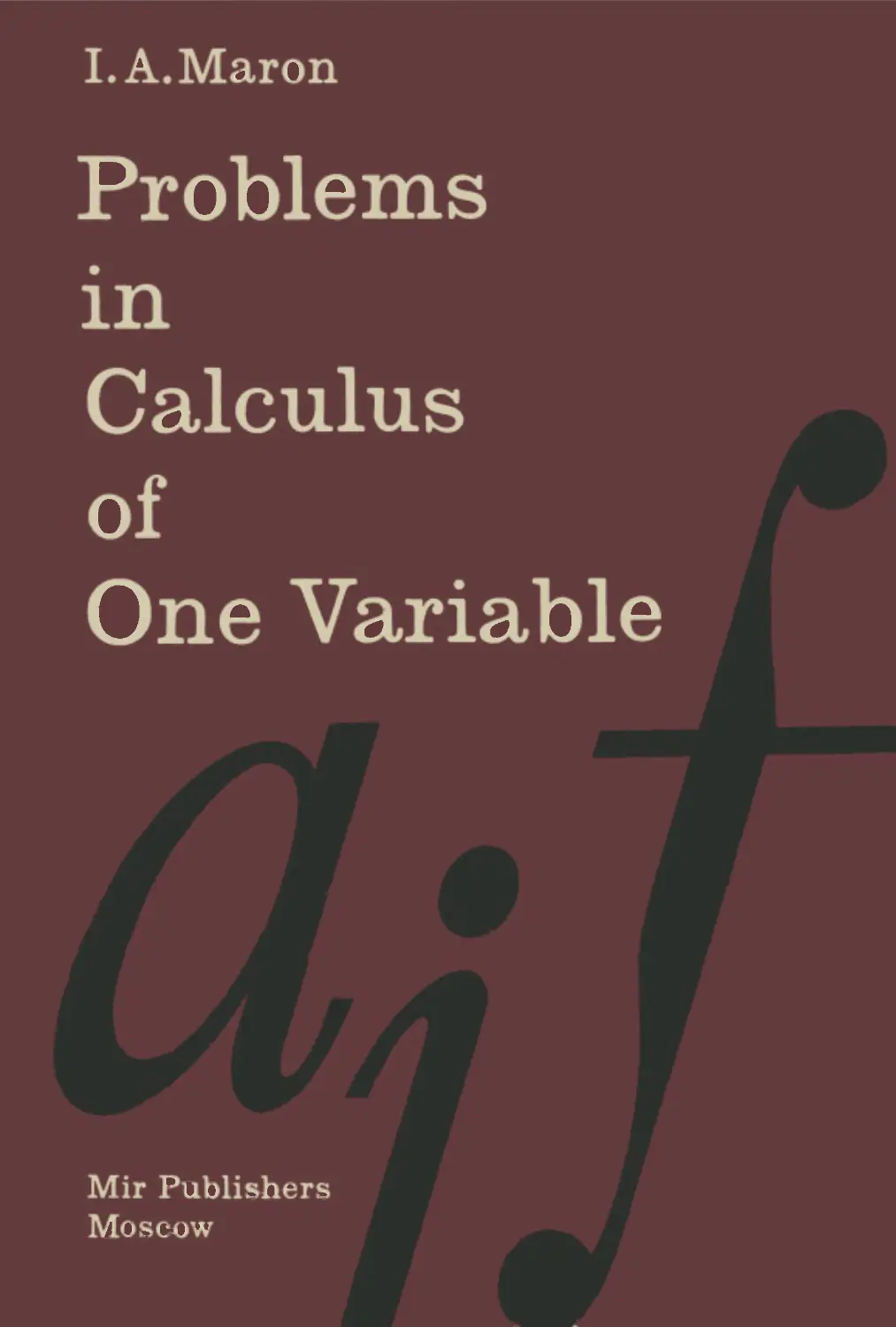


Author: Maron I.A.
Tags: mathematics

Text
                    - I
• ••
• - . . • -
••• >•- >
>•-»-•"

H. A. MAPOH
HHOOEPEHUHAJlbHOE
H MHTErPAJlbHOE
HCMHC/IEHHE
B nPHMEPAX H 3AHAMAX
OyHKUHH OflHOfl FIEPEMEHHOf)
M3flATEJlbCTBO oHAYKA.)
MOCKBA

I. A. MARON
Problems
in Calculus
of One Variable
(With elements of theory)
TRANSLATED
FROM THE RUSSIAN
by
LEONID LEVANT
MIR PUBLISHERS
MOSCOW

UDC 517=20
First published 1973
Revised from the 1970 Russian edition
Ha aneAUucKOM H3biKe
0223-200
041(01)-73

Contents
From the Author 9
Chapter I. Introduction to Mathematical Analysis 11
§ 1.1. Real Numbers. The Absolute Value of a Real Number 11
§ 1.2. Function. Domain of Definition 15
§ 1.3. Investigation of Functions 22
§ 1.4. Inverse Functions 28
§ 1.5. Graphical Representation of Functions 30
§ 1.6. Number Sequences. Limit of a Sequence 41
§ 1.7. Evaluation of Limits of Sequences 48
§ 1.8. Testing Sequences for Convergence 50
§ 1.9. The Limit of a Function 55
§ 1.10. Calculation of Limits of Functions 60
§ 1.11. Infinitesimal and Infinite Functions. Their
Definition and Comparison 68
§ 1.12. Equivalent Infinitesimals. Application to Finding
Limits 71
§ 1.13. One-Sided Limits 75
§ 1.14. Continuity of a Function. Points of Discontinuity
and Their Classification 11
§ 1.15. Arithmetical Operations on Continuous Functions.
Continuity of a Composite Function 84
§ 1.16. The Properties of a Function Continuous on a
Closed Interval. Continuity of an Inverse Function 81
§ 1.17. Additional Problems 91
Chapter II. Differentiation of Functions 93
§ 2.1. Definition of the Derivative 98
§ 2.2. Differentiation of Explicit Functions 100
§ 2.3. Successive Differentiation of Explicit Functions.
Leibniz Formula 107

6 Contents
§ 2.4. Differentiation of Inverse, Implicit and Parametri-
cally Represented Functions Ill
§ 2.5. Applications of the Derivative 115
§ 2.6. The Differential of a Function. Application to
Approximate Computations 122
§ 2.7. Additional Problems 126
Chapter III. Application of Differential Calculus to Investigation of
Functions 131
§ 3.1. Basic Theorems on Differentiable Functions .... 131
§ 3.2. Evaluation of Indeterminate Forms. L'Hospital's Rule 138
§ 3.3. Taylor's Formula. Application to Approximate Cal-
culations 143
§ 3.4. Application of Taylor's Formula to Evaluation of
Limits 147
§ 3.5. Testing a Function for Monotonicity 148
§ 3.6. Maxima and Minima of a Function 152
§ 3.7. Finding the Greatest and the Least Values of a
Function • • 159
§ 3.8. Solving Problems in Geometry and Physics .... 162
§ 3.9. Convexity and Concavity of a Curve. Points of
Inflection 166
§ 3.10. Asymptotes 170
§ 3.11. General Plan for Investigating Functions and
Sketching Graphs 174
§ 3.12. Approximate Solution of Algebraic and
Transcendental Equations 183
§ 3.13. Additional Problems 190
Chapter IV. Indefinite Integrals. Basic Methods of Integration .... 190
§ 4.1. Direct Integration and the Method of Expansion 195
§ 4.2. Integration by Substitution 199
^ 4.3. Integration by Parts 202
§ 4.4. Reduction Formulas 211
Chapter V. Basic Classes of Integrable Functions 214
§ 5.1. Integration of Rational Functions 214
§ 5.2. Integration of Certain Irrational Expressions . . . 219
§ 5.3. Euler's Substitutions 222
§ 5.4. Other Methods of Integrating Irrational Expressions 224
§ 5.5. Integration of a Binomial Differential 228
§5.6. Integration of Trigonometric and Hyperbolic Functions 230
§ 5.7. Integration of Certain Irrational Functions with the
Aid of Trigonometric or Hyperbolic Substitutions .... 237

Contents 7
§ 5.8. Integration of Other Transcendental Functions . . . 240
§ 5.9. Methods of Integration (List of Basic Forms of
Integrals) 242
Chapter VI. The Definite Integral 247
§ 6.1. Statement of the Problem. The Lower and Upper
Integral Sums 247
§ 6.2. Evaluating Definite Integrals by the
Newton-Leibniz Formula 256
§ 6.3. Estimating an Integral. The Definite Integral as a
Function of Its Limits 262
§ 6.4. Changing the Variable in a Definite Integral . . . 275
§ 6.5. Simplification of Integrals Based on the Properties
of Symmetry of Integrands 288
§ 6.6. Integration by Parts. Reduction Formulas .... 294
§ 6.7. Approximating Definite Integrals 301
§ 6.8. Additional Problems 307
Chapter VII. Applications of the Definite Integral 310
§ 7.1. Computing the Limits of Sums with the Aid of
Definite Integrals 310
§ 7.2. Finding Average Values of a Function 312
§ 7.3. Computing Areas in Rectangular Coordinates ... 317
§ 7.4. Computing Areas with Parametrically Represented
Boundaries 327
§ 7.5. The Area of a Curvilinear Sector in Polar Coordinates 331
§ 7.6. Computing the Volume of a Solid 336
§ 7.7. The Arc Length of a Plane Curve in Rectangular
Coordinates 345
§ 7.8. The Arc Length of a Curve Represented
Parametrically 348
§ 7.9. The Arc Length of a Curve in Polar Coordinates 351
§ 7.10. Area of Surface of Revolution 354
§7.11. Geometrical Applications cf the Definite Integral 360
§ 7.12. Computing Pressure, Work and Other Physical
Quantities by the Definite Integrals 367
§ 7.13. Computing Static Moments and Moments of Inertia.
Determining Coordinates of the Centre of Gravity .... 372
§ 7.14. Additional Problems 383
Chapter VIII. Improper Integrals 387
§ 8.1. Improper Integrals with Infinite Limits 387
§ 8.2. Improper Integrals of Unbounded Functions .... 397
§ 8.3. Geometric and Physical Applications of Improper
Integrals 409
§ 8.4. Additional Problems 415
Answers and Hints 418

In fond memory
of my parents
From the Author
This textbook on mathematical analysis is based on many years'
experience of lecturing at a higher technical college. Its aim is to
train the students in active approach to mathematical exercises,
as is done at a seminar.
Much attention is given to problems improving the theoretical
background. Therefore standard computational exercises are
supplemented by examples and problems explaining the theory,
promoting its deeper understanding and stimulating precise
mathematical thinking. Some counter-examples explaining the need for
certain conditions in the formulation of basic theorems are also
included.
The book is designed along the following lines. Each section
opens with a concise theoretical introduction containing the
principal definitions, theorems and formulas. Then follows a detailed
solution of one or more typical problems. Finally, problems
without solution are given, which are similar to those solved but
contain certain peculiarities. Some of them are provided with hints.
Each chapter (except Chap. IV and V) closes with a separate
section of supplementary problems and questions aimed at reviewing
and extending the material of the chapter. These sections should
prove of interest to the inquiring student, and possibly also to
lecturers in selecting material for class work or seminars.
The full solutions developed in the text pursue two aims: (1)
to provide lecturers with a time-saver, since they can refer the
students to the textbook for most of the standard exercises of a
computational character and concentrate mainly on the solution
of more sophisticated problems, thus gaining time for more rewar-

10
From the Author
ding work; and (2) to meet the needs of those who are working
on their own or following correspondence courses, providing a
substitute for the oral explanations given to full-time students.
The student will find the book most useful if he uses it
actively, that is to say, if he studies the relevant theoretical material
carefully before going on to the worked-out solutions, and finally
reinforces the newly-acquired knowledge by solving the problems
given for independent work. The best results will be obtained
when the student, having mastered the theoretical part,
immediately attacks the unsolved problems without referring to the text
solutions unless in difficulty.
Isaac Mar on

Chapter
l
INTRODUCTION
TO MATHEMATICAL ANALYSIS
§ 1.1. Real Numbers.
The Absolute Value of a Real Number
Any decimal fraction, terminating or nonterminating, is called
a real number.
Periodic decimal fractions are called rational numbers. Every
rational number may be written in the form of a ratio, — , of two
integers p and qy and vice versa.
Nonperiodic decimal fractions are called irrational numbers.
If X is a certain set of real numbers, then the notation x£X
means that the number x belongs to X, and the notation x^X
means that the number x does not belong to X.
A set of real numbers x satisfying the inequalities a<ix<iby
where a and b are fixed numbers, is called an open interval (a, b).
A set of real numbers x satisfying the inequalities a^x^b is
called a closed interval [a, b]. A set of real numbers x, satisfying
the inequalities a^x<b or a<x^.b, is called a half-open
interval [a, b) or (a, b]. Open, closed, and half-open intervals are
covered by a single term interval.
Any real number may be depicted as a certain point on the
coordinate axis which is called a proper point. We may also
introduce two more, so-called improper points, +°° and —oo infinitely
removed from the origin of coordinates in the positive and
negative directions, respectively. By definition, the inequalities —oo <
< x < + °° hold true for any real number x.
The interval (a — e, a + e) is called the ^-neighbourhood of the
number a.
The set of real numbers x > M is called the M-neighbourhood
of the improper point +00.
The set of real numbers x < M is called the M-neighbourhood
of t e improper point —00.
The absolute value of a number x (denoted |*|) is a number
that satisfies the conditions
I x I = —x if x < 0;
I x I =^ x if x ^0.

12 Ch. I. Introduction to Mathematical Analysis
The properties of absolute values are:
(1) the inequality |x|^a means that —a^x^a;
(2) the inequality \x\^a means that x^a or x^—a;
(3) \x±y\< \x\ + \y\;
(4) \x±y\^\\x\ — \y\\;
(5) |^|=|x||^|;
x
y
1.1.1. Prove that the number
0.1010010001...1000...01...
(6)
-tst(**°>-
n
is irrational.
Solution. To prove this, it is necessary to ascertain that the
given decimal fraction is not a periodic one. Indeed, there are n
zeros between the nth and (n+\)th unities, which cannot occur
in a periodic fraction.
1.1.2. Prove that any number, with zeros standing in all
decimal places numbered 10" and only in these places, is irrational.
1.1.3. Prove that the sum of, or the difference between, a
rational number a and an irrational number P is an irrational
number.
Solution. Consider the sum of a and p. Suppose a + P = y is a
rational number, then P = Y—a is also a rational number, since
it is the difference between two rational numbers, which
contradicts the condition. Hence, the supposition is wrong and the number
a + P is irrational.
1.1.4. Prove that the product a|J and the quotient a/[i of a
rational number a =^= 0 and an irrational number P is an irrational
number.
1.1.5. (a) Find all rational values of x at which y=V x*-+x + 3
is a rational number.
Solution, (a) Suppose x and y=Vx2-\-x-\-3 are rational
numbers. Then the difference y—x = q is also a rational number. Let
us now express x through q
y — x=V x*-\-x-\-3 — x=^q>
y'x* + x+3 = q + x,
x2 + x + 3 = q2 + 2qx + x\
X \—2q '
By a direct check it is easy to ascertain that q=£1/2.

§ 1.1. Real Numbers. The Absolute Value of Real Number 13
Prove the reverse, namely, y = \/rx2 + x + 3 is a rational number
if x= j , where q is any rational number not equal to l/2.
Indeed,
, = 1/^+7+3 = /j^ + feg+3-
/g4-2?» + 7g*-6? + 9 /(^-^ + 3)2 g2_y + 3 / _1_
K (l—2gr)2 r (1-2^)2 I 1—2(7| V 2
The latter expression is rational at any rational q not equal to 72-
(b) Prove that J/2 is an irrational number.
1.1.6. Prove that the sum j/3 + }/2 is an irrational number.
Solution. Assume the contrary, i.e. that the number [/3 + 1/2
is rational. Then the number
j/3 —j/2
1
Vs + V*
is also rational, since it is the quotient of two rational numbers.
Whence the number
K2 = l[(K3 + K2)-(/3-|^2)l
is rational, which contradicts the irrational nature of the number
V2 (see Problem 1.1.5). Hence, the supposition is wrong, and the
number j/3 + 1/2 js irrational.
1.1.7. Prove that for every positive rational number r satisfying
the condition r2 < 2 one can always find a larger rational number
r + h\h> 0) for which (r + hf < 2.
Solution. We may assume h<\. Then h2 < h and (r + /i)2<
<r2 + 2r/z + /i. That is why it is sufficient to put r2 + 2r/z + /i = 2,
i.e. ft=(2 —r2)/(2r+l).
1.1.8. Prove that for every positive rational number s satisfying
the condition s2 > 2 one can always find a smaller rational number
s —fc(fc>0) for which (s — kf > 2.
1.1.9. Solve the following inequalities:
(a) |2x —3|< 1;
(b) (x— 2)2>4;
(c) x2 + 2x—8<0;
(d) \x2 — 7x+ 12 | >x2 — 7x+12.
Solution, (a) The inequality |2a: — 3|<1 is eqivalent to the
inequalities
— 1 <2x — 3< 1,
whence
2 < 2x < 4 and 1 < x < 2.

14
Ch. I. Introduction to Mathematical Analysis
(d) The given inequality is valid for those values of x at which
x2 — 7x+ 12 < 0, whence 3 < x < 4.
1.1.10. Find out whether the following equations have any
solutions:
(a) |x|=a; + 5; (b) \x\=x — 5?
Solution, (a) At x ^0 we have x = x + 5. Hence, there are no
solutions. At x < 0 we have —x=-x-{-5, whence x = —5/2. This
value satisfies the initial equation.
(b) At x 1^0 we have x = x — 5. Hence, there are no solutions.
At x < 0 we have — x — x—5, whence # = 5/2, which contradicts
our supposition (*<0). Thus, the equation has no solution.
1.1.11. Determine the values of x satisfying the following
equalities:
(a)
X
1
x+\
X
1
JC+1 '
(b) \x2 — 5x + 6 | = — (x2 — 5x+6).
1.1.12. Determine the values of x satisfying the following
equalities:
(a) | (x2 + 4x + 9) + (2* —3) | - | x2 + 4x + 91 + | 2x — 3 |;
(b) |(x4 — 4) — (x2 + 2)| = |a:4 — 4 | — |x2 + 2|.
Solution, (a) The equality |a + 6| = |a| + |fe| is valid if and
only if both summands have the same sign. Since
x2 + 4x + 9 = (*+2)2 + 5 >0
at any values of x, the equality is satisfied at those values of x
at which 2x — 3^0, i.e. at * ^3/2.
(b) The equality \a — 6| = |a|— \b\ holds true if and only if a
and b have the same sign and \a\^\b
In our case the equality will hold true for the values of x at
which
xk
Whence
4>jc2 + 2.
x2 — 2> 1;
x
J/3.'
1.1.13. Solve the inequalities:
(a) | 3jc — 5 | — | 2jc + 3 | > 0;
(b) \x2 — 5*| > \x2\ — \hx
1.1.14. Find the roots of the following equations.
(a) | sin* | ^= sinx-\- 1;
(b) a:2 — 2 | a: | — 3=0.
Solution, (a) This equation will hold true only for those values
of x at which sinx<0, that is why wre may rewrite it in the

§1.2, Function. Domain of Definition 15
following way:
—sinjc = sinA;+1, or sinx = —1/2;
whence x = nk — (—1 )fejt/6 (6 = 0, ±1» ±2, ...)•
(b) This equation can be solved in a regular way by considering
the cases x ^0 and x ^0. We may also solve this equation
rewriting it in the form
j^; |2 — 2 | JC] 3 = 0.
Substituting y for \x\y we obtain
whence #, = 3, #2 = —1. Since y = \x\^0, the value y2 = — 1 does
not fit in. Hence
i.e. x-t —— ~"G, Xn —: o.
§ 1.2. Function. Domain of Definition
The independent variable x is defined by a set X of its values.
If to each value of the independent variable x£X there
corresponds one definite value of another variable yy then q is called
the function of x with a domain of definition (or domain) X or,
in functional notation, y — y(x)y or y = f(x)y or y = q>(x), and so
forth. The set of values of the function y(x) is called the range
of the given function.
In particular, the functions defined by the set of natural
numbers 1, 2, 3, ..., are called numerical sequences. They are written
in the following way: xl9 x2, ...,#„, ... or {xn\.
1.2.1. Given the function f (x) =(*+ l)/(x— 1). Find f(2x), 2/(x),
f(x2), [/W]2.
Solution.
M2*) = §±{; 2f(x)=2i±};
1.2.2. (a) Given the function
Show that at x19 x2£(—1, 1) the following identity holds true:

16 Ch. 1. Introduction to Mathematical Analysis
Solution. At x6(-1, 1) we have (1 — x)/(l + x) > 0 and hence
/ W + f (¾) = log i^ +log i^ = 1081}^¾}^¾. (1)
On the other hand,
f /" *l + *2 \ 1 n- 1 -f- ^^2 __ 1 1 + *iX2— Xx — X2 __
\1+*1*2/ ] i ^1 + ^2 l+#l#2 + *l+*2
1 + ^1^2
^ (1+Xi)(l+^) '
which coincides with the right-hand member of expression (1).
(b) Given the function f (x) = (ax-\-a~x)/2 (a > 0). Show that
f(x + y) + f(x-y) = 2f(x)f(y).
1.2.3. Given the function /(*) = (*+l)/(*3—1). Find /(—1);
/(a+1); f(a)+l.
1.2.4. Given the function f(x) = x3—1. Find
1.2.5. Given the function
3~*—1, — l<x<0,
f(x)= { tan (^/2), 0<* < ji,
x/(x2 — 2), ji<^<6.
Find /(-1), /(jt/2), /(2ji/3), /(4), /(6).
Solution. The point x = — 1 lies within the interval [—1, 0).
Hence
^ (—1) = 3- (~a)— 1 = 2.
The points x = n/2, x = 2n/3 belong to the interval [0, ji).
Hence
/ (ji/2) - tan (ji/4) - 1; / (2n/3) = tan (ji/3) - VJ.
The points jc = 4, x = 6 belong to the interval [ji, 6]. Hence
f (4) = 16^2 = T ' ^6) = 36-2 = 17 •
1.2.6. The function f (x) is defined over the whole number scale
by the following law:
2x3+l. if jc<2,
f(x)-{ l/(*-2), if 2<*<3,
2^ — 5, if x > 3.

§ 1.2. Function. Domain of Definition
17
Find: /(K2), /()/8), / (/log, 1024).
1.2.7. In the square ABCD with side AB=2 a straight line
MN is drawn perpendicularly to AC. Denoting the distance from
the vertex A to the line MN as x, express through x the area S
of the triangle AMN cut off from the square by the straight
line MN. Find this area at jc = V^2/2
and at x = 2 (Fig. 1).
Solution. Note that AC = 2 V2\
hence 0<*<2l/~2". If*<K"2,
then
S(x)==S^ AMN — x2.
U x> l/T, then
S(x) -4-(2/2
*)2 = _ *2 +
+4xV"2— 4.
Thus,
S(*) =
JK*
0<x
K2"<x
—x2\\x\/~2 —4,
Since |/2~/2 < j/T , S(|/"2"/2) = (l/2~/2)2 = V
S (2) = — 4 + 8 K~2~ — 4 = 8 (K~2~— 1).
Fig. 1
21/2.
Since 2 > J/2",
1.2.8. Bring the number a„, which is equal to the nth decimal
place in the expansion of j/2 into a decimal fraction, into
correspondence with each natural number n. This gives us a certain
function an = tp (ri). Calculate q)(l), cp (2), q)(3), q)(4).
Solution. Extracting a square root, we find ]/~2 =1.4142... .
Hence
q>(l) = 4; cp(2)-l; q>(3) = 4; cp (4) = 2.
1.2.9. Calculate/ (x) = 49/x2 + x2 at the points for which 7/jc + jc=3.
Solution. f{x) = 49/x2 + x2 = (7/x + x)2 — 14, but 7/x + x = 3, hence
/(a-)-9—14--5.
1.2.10. Find a function of the form f (x) = ax2-\-bx-\-c, if it is
known that /(0) -5; /(-1) =10; /(1)-6.
/(0) = 5=a-02 + b-0 + c,
/(-1)= I0^a — b + cy
f(l)=6 = a + b + c.

18 Ch. I. Introduction to Mathematical Analysis
Determine the coefficients a, fr, c from the above system. We have:
a = 3; & = — 2; c = 5; hence / (*) = 3a:2 — 2* + 5.
1.2.11. Find a function of the form
f(x) = a + bcx (c>0)9
if /(0)-15; /(2) = 30; /(4)-90.
1.2.12. Find q>[i|>(*)] and ip [cp (jc)] if
cp(jt) = x2 and ¢(#) = 2^.
Solution.
cp [l|) (*)] - [l|) (*)]2 - (2*)2 = 22*,
ty[y(x)] = 2'tix> = 2x2.
1.2.13. Given the function
Find f(3x); f (*3); 3/ (x); [f (x)]*.
1.2.14. Let
(3* at — 1 <x< 0,
f(*)=| 4 at 0<*< 1,
( 3x— 1 at l<x<3.
Find /(2), /(0), /(0.5), /(-0.5), /(3).
1.2.15. Prove that if for an exponential function y = ax(a>0;
a=£\) the values of the argument x = xn {n=ly 2, ...) form an
arithmetic progression, then the corresponding values of the
function yn = aXn(n= 1, 2, ...) form a geometric progression.
1.2.16. f(x)~ x2 + 6, cp (x) = 5x. Solve the equation f (x) = |cp (#) |.
1.2.17. Find /(*) if
/(jc-|-1) = jc2_3jc + 2 .
1.2.18. Evaluate the functions
f(x) = x*+l/x2 and q>(x) = x*+ l/x*
for the points at which l/jt + * = 5.
1.2.19. /(*) = #+1; cp(^) = x—2; solve the equation
l/(*) + cp(*)IH/(*)M<p(*)|.
1.2.20. A rectangle with altitude x is inscribed in a triangle
ABC with the base b and altitude /i. Express the perimeter P and
area 5 of the rectangle as functions of x.

§ 1.2. Function. Domain of Definition 19
1.2.21. Find the domains of definition of the following functions:
(^) = /^-1 + 1/6-^:
l
(a)
(b)
(c)
(d)
(e)
(0
(g)
(h)
(0
(J)
(k)
(x) = V x2—x—2 +
V xl — x—2
(;e) = l/sinx— 1 ;
VS + 2x— x*'
x
(x) = if log ^-^-;
(x) = log* 5;
(x) = arc sin —"^ log (4 — #);
(x) = —-i - + |/x + 2;
v ' log (1 — x)
(x) = log cos x;
W = afC C0S 4 + 2sin* :
(1) y = 1?f== ■
Solution, (a) The domain of definition of the given function
consists of those values of x at which both items take on real
values. To ensure this the following two conditions must be
satisfied:
x— 1 >0,
6 —*>0.
By solving the inequalities we obtain x^\; x^6. Hence,
the domain of definition of the function will be the segment [1,6],
(e) The function is defined for the values of x for which
log ^- > 0.
This inequality will be satisfied if
-^=^->l, or x2 — 5x + 4<0.
Solving the latter inequality, we find 1^^:^4. Thus, the
segment [1,4] is the domain of definition of the function.
(f) The function is defined for all positive x different from unity,
which means that the domain of definition of the function consists
of the intervals (0, 1) and (1, + oo).

20 Ch. I. Introduction to Mathematical Analysis
(k) The function is defined for the values of x for which
— 1 ^,.03. <1.
^ 4+2 sin x^
Since 4+2 sin x >0 at any xy the problem is reduced to solving
the inequality
? <1
+ 2 sin x ^
Whence
3^4+-2sinA;, i.e. sin*^ — 1/2.
By solving the latter inequality we obtain
— y + 2£ji<A;<-^ + 2fcn; (£ = 0, ±1, ±2, ...).
(1) The function is defined for the values of x for which
|*| — x > 0, whence |*|>jc. This inequality is satisfied at x < 0.
Hence, the function is defined in the interval (—oo, 0).
1.2.22. Find the domains of definition of the following functions:
(a) /(x) = j/arcsin(log2A:);
(b) f (x) = log2 log3 log4 x;
(c) f(x) = ± + 2™««* + -jJ=;
x y x—2
(d) f(x) = log\4-x*\;
(e) f (x) = Kcos (sin x) +-arc sin ~TX .
Find the ranges of the following functions:
(f) & = 2-cos3x ;
(g) y=TT^ -
Solution, (a) For the function f (x) to be defined the following
inequality must be satisfied
arc sin (log2 x) ^½ 0,
whence 0^1og2*^l and 1^*^2.
(b) The function log2 log3 log4 x is defined for log3log4x>0,
whence log4Jt>l and *>4. Hence, the domain of definition is
the interval 4<*< + oo.
(c) The given function is defined if the following inequalities are
satisfied simultaneously:
x=^0; —1<jc<1 and x > 2,
but the inequalities —l^x^l and x>2 are incompatible, that
is why the function is not defined for any value of x.

§1.2. Function. Domain of Definition 21
(e) The following inequalities must be satisfied simultaneously:
1 + x2
cos (sin x)^0 and
2x
<1.
The first inequality is satisfied for all values of x, the second,
for | #1=1. Hence, the domain of definition of the given function
consists only of two points #=+1.
(f) We have
cos3# = - y~
y
Since
2u 1
— l<;cos3#<;l, we have —1^ — ^1,
whence, taking into account that y > 0, we obtain
— y^2y— 1<# or y <#< 1.
(g) Solving with respect to #, we obtain
„_ i ± |/T=1^
The range of the function y will be determined from the relation
1 —4*/2>0.
Whence
1.2.23. Solve the equation
arc tan V x (x + 1)+ arc sin j/#2 + # + 1 = n/2.
Solution. Let us investigate the domain of definition of the
function on the left side of the equation. This function will be defined
for
x2 + #>0, 0<#2 + x+l<l,
whence #2 + # = 0.
Thus, the left member of the equation attains real values only
at #j=0 and #2 = — 1. By a direct check we ascertain that they
are the roots of the given equation.
This problem shows that a study of domains of definition of a
function facilitates the solution of equations, inequalities, etc.
1.2.24. Find the domains of definition of the following functions:
(a) y= r—< - ;
j/x2+2x + 3
(b) y = log sin (^-3) + /16-#2;

22 Ch. I. Introduction to Mathematical Analysis
(c) j/ = |/3 — # + arc cos ^-;
(d) ^ = log(l + a:) '
1.2.25. The function f (x) is defined on the interval [0, 1]. What
are the domains of definition of the following functions:
(a) /(3r>); (b) f(x-5); (c) /(tan*)?
Solution. The given functions are functions of functions, or
superpositions of functions, i. e. composite functions.
a) Let us introduce an intermediate argument u = 3x2. Then the
function f(3x2)=f(u) is defined if O^w^l, i.e. 0^3x2^l,
whence —1/|/"3<*< l/|/*3.
(c) Similarly: O^tanx^l, whence
fcrt<.x:< Ji/4 + fcri (£ = 0, ± 1, ±2, ...).
1.2.26. The function f (x) is defined on the interval [0, 1]. What
are the domains of definition of the functions
(a) /(sin*); (b) /(2*+ 3)?
§ 1.3. Investigation of Functions
A function f (x) defined on the set X is said to be non-decreasing
on this set (respectively, increasing, non-increasing, decreasing), if
for any numbers x19 x2£X, x±<x2, the inequality f (x1)^f(x2)
(respectively, f (xx) < f(x2), /(*i)>/(*2), f (xi) > f (*2)) is satisfied.
The function f (x) is said to be monotonic on the set X if it
possesses one of the four indicated properties. The function f (x) is
said to be bounded above (or below) on the set X if there exists a
number M (or m) such that f(x)^M for all x£X (or m^Lf(x)
for all x^X). The function f (x) is said to be bounded on the set X
if it is bounded above and below.
The function f (x) is called periodic if there exists a number
T>0 such that f(x + T) — f(x) for all x belonging to the domain
of definition of the function (together with any point x the point
x-\-T must belong to the domain of definition). The least number T
possessing this property (if such a number exists) is called the
period of the, function f (x). The function f (x) takes on the
maximum value at the point x0£X if f(x0)^f(x) for all x£X, and
the minimum value if f(x0)^f(x) for all x£X. A function f (x)
defined on a set X which is symmetric with respect to the origin
of coordinates is called even if /(—x) = f(x), and odd if /(—x) =
= -/(*).
In analysing the behaviour of a function it is advisable to
determine the following:

§ 1.3. Investigation of Functions 23
1. The domain of definition of the function.
2. Is the function even, odd, periodic?
3. The zeros of the function.
4. The sign of the function in the intervals between the zeros.
5. Is the function bounded and what are its minimum and
maximum values?
The above items do not exhaust the analysis of a function, and
later on their scope will be increased.
1.3.1. Find the intervals of increase and decrease of the
function f (x) = ax2 -f- bx-\-cy and its minimum and maximum values.
Solution. Isolating a perfect square from the square trinomial,
we have
fW=a{X + 2a) +-5—
If a > 0, then the function f(x) will increase at those values of x
satisfying the inequality x + b/(2a) > 0, i. e. at x >—b/(2a), and
decrease when x-\-b/(2a) < 0, i.e. at x <—b/(2a). Thus, if a > 0,
the function f (x) decreases in the interval (— oo, —— j and
increases in the interval (—b/(2a), +oo). Obviously, at x = — b/(2a)
the function f (x) assumes the minimum value
/min — /(^ 2a )
4ac — b2
4a
At a > 0 the function has no maximum value.
Similarly, at a < 0 the function f (x) will increase in the
interval ( — oo, —2~j and decrease in the interval (—b/(2a), oo); at
x = — b/(2a) the function f (x) takes on the maximum value
r r / b \ 4ac — b2
/max — / \2a) — 4a '
whereas it has no minimum value.
1.3.2. (a) Find the minimum value of the function
y=z 2>x2-\-bx— 1.
(b) Find the rectangle with the maximum area from among all
rectangles of a given perimeter.
Solution, (a) Apply the results of Problem 1.3.1: a —3 > 0, b=bt
c = —1. The minimum value is attained by the function at the
point x = — 5/6
_ 4ac — b2 _____ 37
#min— 4a ~ J2'
(b) We denote by 2p the length of the perimeter of the required
rectangle, and by x the length of one of its sides; then the area 5

24 Ch. I. Introduction to Mathematical Analysis
of the rectangle will be expressed as
S = x(p—x) or S = px—x2.
Thus, the problem is reduced to the determination of the maximum
value of the function S (x) = — x2 + px. Apply the results of
Problem 1.3.1: a = — 1 < 0, b = py c = 0. The maximum value is
attained by the function at the point x = — b/(2a) =p/2. Hence, one
of the sides of the desired rectangle is p/2, the other side being
equal to p — x = p/2> i. e. the required rectangle is a square.
1.3.3. Show that
(a) the function f (x) —x3 + 3x + 5 increases in the entire domain
of its definition;
(b) the function g(x) = x/(l + x2) decreases in the interval (1, +oo).
Solution. The function is defined for all points of the number
scale. Let us take arbitrary points xx and x2f xx < x2 on the number
scale and write the following difference:
f (x*)—f (xx) = (4 + 3x2 + 5)- (xl + 3x, + 5) =
= \X2 — *i) \x2 ~t~ xtx2 -\- xx -\- 3) =
= (x2 — x1)
*i + y*2)2 + -|-*?+3]-
Since x2 — xx > 0 and the expression in the brackets is positive
at all x1 and x2, then f (x2) — /(a:1)>0, i.e. f (x2) >/(^), which
means that the function f (x) increases for all values of x.
1.3.4. Find the intervals of increase and decrease for the
following functions:
(a) f (x) = sin x + cos x;
(b) tan(*+n/3).
Solution, (a) Using the familiar trigonometric formulas, we find
f(x) = V~2cos(x—ji/4).
It is known that the function cos a: decreases in the intervals
2nn ^ x ^ (2n + 1) ji
and increases in the intervals
(2ft— 1) rc < *< 2ftJi (n=0, ±1, ±2, ...).
Hence, the intervals of decrease of the function f (x) are:
ji/4 + 2ftn < * < ji/4 + (2ft + 1) ji (ai = 0, +1, ...),
and the intervals of increase of the same function are:
n/4 + (2ft—1) k^ jc^ n/4 + 2ftji (ft = 0, ± 1, ...)•
1.3.5. Find the minimum and maximum values of the function
/ (x) = a cos x-\-b sin x (u2 -\- b2 > 0).

§ 1.3. Investigation of Functions 25
Solution. The given function can be represented as:
f(x) = ]/a*-\-b2 cos (x — a),
where cosa = a/V a2+ b2y sin a = b/j/a2 + &2. Since |cos(x — a) )^ 1,
the maximum value of f (x) equals + l/"aa + &a (at cos (a:—a) — 1),
the minimum value of f (x) being equal to —j/a2 + fr2 (at
cos (x—a) = — 1).
1.3.6. Find the minimum value of the function
/(j0=3<*'-8>,+ 8.
Solution. We denote by cp (x) the exponent, i. e.
cp (*) = (** — 2)3+ 8.
The function f(x)=-3v(x) takes on the minimum value at the
same point as the function cp (x).
Hence
cp (x) = xQ — e>x* + \2x2 - x2 [(x2 — 3)2 + 3].
Whence it is clear that the function cp (x) attains the minimum
value (equal to zero) at x = 0. That is why the minimum value of
the function f (x) is equal to 3° = 1.
1.3.7. Test the function
f (x) = tan x + cot x, where 0 < x < ji/2,
for increase and decrease.
1.3.8. Given: n numbers Determine the value
of x at which the function
f (x) = (x—ax)2 + (x—a2)2 +...+ (x— anf
takes on the minimum value.
Solution. Rewrite the function f (x) in the following way:
f(x) = nx2 — 2(a, + a2+ ... +an)x+(ai + al+ ... +a2),
wherefrom it is clear that f (x) is a quadratic trinomial ax2 + bx-\-cy
where a = /?>0. Using the results of Problem 1.3.1, we find that
the function assumes the minimum value at x = —b/(2a)t i. e. at
x=(a1 + a2+ ... +aa)/n.
Thus, the sum of the squares of deviations of the value of x
from n given numbers attains the minimum value when x is the
mean arithmetic value for these numbers.
1.3.9. Which of the given functions is (are) even, odd; and
which of them is (are) neither even, nor odd?

26 Ch. I. Introduction to Mathematical Analysis
(a) /(x) = log(x+KT+T2);
(b) f (x) = log \=^x;
(c) f(x) = 2x3 — x+l;
(d) f(x) = x%±±.
Solution, (a) It can be seen that f(+x) + f(—x) = 0. Indeed,
f(+x) + f(--x) = \og(x + VT+*) + \og(-x+VrT+#) =
= \og(\+xi—xi) = 0,
hence, f (x) = — f (— x) for all x, which means that the function is odd.
(b) /(-^) = ^1^=^(1^)^ = -102¾.
Thus, /(—x) = — f (x) for all x from the domain of definition
(—1, 1). Hence, the function is odd.
1.3.10. Which of the following functions is (are) even and which
is (are) odd?
(a) f(x) = 4 — 2x* + sin2 x\
(b) f(x) = Vl+x + x2 — V\— x + x2;
(c) f(x) = Y=^;
(d) f(x) = s\nx + cosx;
(e) f (x) = const.
1.3.11. Prove that if f (x) is a periodic function with period T,
then the function f (ax + b), where a > 0, is periodic with period Tja.
Solution. Firstly,
f[a(x+T/a) + b]=f[(ax + b) + T] = f(ax + b)9
since T is the period of the function f(x). Secondly, let 7\ be a
positive number such that
f[a(x+T1) + b]=f(ax + b).
Let us take an arbitrary point x from the domain of definition
of the function f (x) and put x' = (# — b)/a. Then
f(axf + b) = f^ax-^+b)=^f(x)^f[a(x' + T1) + b] =
= f {ax' + b + aTx) = f(x + aTx).
Whence it follows that the period T^aTly i.e. Tx^Tja and
Tja is the period of the function f(ax + b).
Note. The periodic function f (x) --= A sin (oox + cp), where A, co, 9
are constants, is called a harmonic with amplitude \A\, frequency 0

§ 1.3. Investigation of Functions 27
and initial phase cp. Since the function sin* has a period 2k, the
function A sin(o)A: + (p) has a period T = 2n/(s>.
1.3.12. Indicate the amplitude \A\, frequency co, initial phase cp
and period T of the following harmonics:
(a) f(x) = 5s'm4x'y
(b) /(*) = 4sin(3* + Jt/4);
(c) /(x) = 3sin(jt/2) + 4cos(*/2).
1.3.13. Find the period for each of the following functions:
(a) f (x) = tan2x;
(b)f(x)=cot(x/2);
(c) f (x) = sin 2nx.
Solution, (a) Since the function tanx has a period ny the function
tan 2x has a period ji/2.
1.3.14. Find the period for each of the following functions:
4
COS* x\
(a) f (x) = sin4x-
(b) f(x) = \cosx
Solution, (a) sin4 x + cos4 x= (sin2 x + cos2 jc)2 — 2 sin2 x cos2 x =
= 1 — y sin2 2x -= 1 —j (1 — cos 4x) = T + -j- sin ( 4* + y ) ;
whence T = 2n/o) =-2ji/4 = ji/2.
(b) /(x)==|cosjc| = Kcos2a:==K(1 + cos2x)/2; but the function
cos 2.x; has a period T = n\ hence, the given function has the same
period.
1.3.15. Prove that the function f (x) = cosx2 is not a periodic one.
Solution. Let us prove the contrary. Suppose the function has a
period T\ then the identity cos (x + T)2 == cosx2 is valid.
By the conditions of equality of cosines for a certain integer k
we have
x2 + 2Tx + T2±x2 = 2nk.
But this identity is impossible, since k may attain only integral
values, and the left member contains a linear or quadratic function
of the continuous argument x.
1.3.16. Find the greatest value of the function
2
f(x) =
V2x*— 4a:+3
1.3.17. Which of the following functions are even, and which are
odd:
(a) f(x) = VJ\=x)2 + Vir+xf;

28 Ch. I. Introduction to Mathematical Analysis
(b) f(x) = x2-\x\;
(c) f(x) = xsm2x—x3;
(d) /(a:)=:(1 + 2*)2/2*?
1.3.18. Find the period for each of the following functions:
(a) f (x) = arc tan (tan x)\
(b) f(x) = 2cos^.
1.3.19. Prove that the functions
(a) f (x) = x + s\nx; (b) f (x) = cos Vx
are non-periodic.
§ 1.4. Inverse Functions
Let the function y = f(x) be defined on the set X and have a
range Y. If for each y£Y there exists a single value of x such that
f (x) =yy then this correspondence defines a certain function x-^g(y)
called inverse with respect to the given function y = f (x). The
sufficient condition for the existence of an inverse function is a strict
monotony of the original function y = f(x). If the function increases
(decreases), then the inverse function also increases (decreases).
The graph of the inverse function x = g(y) coincides with that of
the function y = f{x) if the independent variable is marked off along
the (/-axis. If the independent variable is laid off along the x-axis,
i.e. if the inverse function is written in the form y = g(x)y then
the graph of the inverse function will be symmetric to that of the
function y = f (x) with respect to the bisector of the first and third
quadrants.
1.4.1. Find the inverse to the function # = 3^ + 5.
Solution. The function y = 3x + 5 is defined and increases
throughout the number scale. Hence, an inverse function exists and
increases. Solving the equation y = 3x + 5 with respect to x we obtain
x = (y — 5)/3.
1.4.2. Show that the function y = k/x (k =/=0) is inverse to itself.
Solution. The function is defined and monotonic throughout the
entire number scale except x = 0. Hence, an inverse function exists.
The range of the function is the entire number scale, except # = 0.
Solving the equation y = k/x with respect to x, we get x = k/y.
1.4.3. Find the inverse of the function
y = \oga(x + Vx2+l)t (a>0, a^l).
Solution. The function y = loga (x + Vx2 + l) is defined for all xf
since Vx2 + 1 > \x\y and is odd [see Problem 1.3.9 (a)]. It increases

§ 1.4. Inverse Functions 29
for positive values of x, hence, it increases everywhere and has an
inverse function. Solving the equation
y=\oga(x + V^+\)
with respect to x, we find
a? = x+ V x2+U a-y= — x+Vrx2+l,
whence
x = -^{ay — a~y) = sinh (y \na).
1.4.4. Show that the functions
f(x) = x2 — x + 1, x> 1/2 and cp (x) = 1/2 + K* —3/4
are mutually inverse, and solve the equation
x2 — x+ 1 = 1/2 + K* —3/4.
Solution. The function (/ = x2—- x+ 1 = (a;—1/2)2+ 3/4 increases
in the interval 1/2 <;,*;< oo, and with # varying in the indicated
interval we have 3/4^#<oo. Hence, defined in the interval
3/4^ y<oo is the inverse function x = g(y)y x^ 1/2, which is
found from the equation
x2 — x + (l—y) = 0.
Solving the equation with respect to x, we obtain
x=g (y) = i /2 + Vy—m = <p (</)•
Let us now solve the equation
x2—.*+l = 1/2 +J/"* —3/4.
Since the graphs of the original and inverse functions can intersect
only on the straight line y = x, solving the equation x2 — x+\ = x
we find x=l.
1.4.5. Find the inverse of y = sin x.
Solution. The domain of definition of the function y = s\nx is
the entire number scale, the range of the function is the interval
[—1, 1]. But the condition of existence of an inverse function is
not fulfilled.
Divide the #-axis into intervals nn— n/2^.x^.nn-\-n/2. If n is
even, then the function increases on the intervals nn — n/2^x^
^nn + n/2; if n is odd, the function decreases on the intervals
nn—ji/2^ x^nn + n/2. Hence, on each of the indicated intervals
there exists an inverse function defined on the interval [— 1, 1].

30
Ch. I. Introduction to Mathematical Analysis
In particular, for an interyal — jt/2 ^ x ^ ji/2 there exists an
inverse function x = arc sin y.
The inverse of the function y = sin x on the interval mi — ji/2^
^x^nn+n/2 is expressed through arc sin y in the following way:
x = (— \)n arc sin (/ +/2ji (n = 0, +1, ±2, ...).
1.4.6. Find the inverse of the given functions:
(a) y = s\n(3x— 1) at —(jt/6+1/3) < *< (jt/6+1/3);
(b) # = arc sin (#/3) at — 3^x<3;
(c) y = 5l°zx;
(d) (/-2^-15.
1.4.7. Prove that the function y = (l—x)/(l+x) is inverse to
itself.
§ 1.5. Graphical Representation of Functions
1.5.1. Sketch the graph of each of the following functions:
(a) f(x)=x* — 2x2 + 3;
(c) f (x) = sin2 x—2sinx;
(d) f (x) = arc cos (cos x);
(e) f (x) = Ksin x\
(f) /(x^x'/iog*.
Solution, (a) The domain of definition of the function f(x) is the
entire number scale. The function f (x) is even, hence its graph is
symmetrical about the ordinate axis and it is
sufficient to investigate the function at x ^0.
Let us single out a perfect square f (x) =
= (x2—1)2 + 2. Since the first summand
(x2—1)2^0, the minimum value of the
function, equal to 2, is attained at the points
x = ±l (see Fig. 2).
The function f (x) decreases from 3 to 2 on
the closed interval 0^^:^1 and increases
unboundedly on the open interval 1 < x < oo.
(b) The domain of definition of the
function f (x) is the entire number scale. The
function f (x) is odd, therefore its graph is symmetrical about the origin
of coordinates and it is sufficient to investigate the function at
x ^0.
Since /(0) = 0, the graph passes through the origin. It is obvious
that there are no other points of intersection with the coordinate
Fig. 2

§ 1.5. Graphical Representation of Functions
31
axes. Note that |/(x)|<l. Indeed, (1—U|)2>0or 1+*2>2|*|,
whence
Since f(x)^0 at x ^0 and /(1) = 1, in the interval [0, oo) the
maximum value of the function f (x) equals 1, the minimum value
being zero (see Fig. 3).
Fig. 3
*- x
Let us prove that the function increases on the closed interval 0^
< *<! 1. Let 0 ^ #j < x2 ^ 1. Then
f(x2)-f(xl) =
£Xc,
ZXy ZXi£ ~\~ £XnX\ — ^X~y — ZX-±X2
\+xt \+x\
u+xt)([+xi)
*• (-^2 — -^1) 0 —XlX't)
>o
(\+xl)(\+xl)
and f(x2) > /(^).
Similarly, we can show that on the interval (1, oo) the function
decreases. Finally,
f (x) = 2x/( 1 + x2)< 2xi'x2 = 2/x,
whence it is clear that f (x) tends to zero with an increase in x.
(c) The domain of definition of the function f (x) is the entire
number scale. The function has a period 2n, that is why it is quite
sufficient to investigate it on the interval [0, 2jx], where it
becomes zero at the points x = 0; x = n\ x = 2n.
Writing the given function in the form
f(x) = (l— sin*)2— 1,
we note that it increases with a decrease in the function sin* and
decreases as sin* increases. Hence, the function f (x) decreases on
the intervals [0, n/2] and [3ji/2, 2n], and increases on the interval
>/2, 3jx/2]. Since f(n/2) = — 1, and /(3ji/2)=3, the range of the
unction is —!</(*) ^3 (Fig. 4).

32
Ch. I. Introduction to Mathematical Analysis
(d) The domain of definition of the function is the entire number
scale. Indeed, |cosa;|^1 at any xy hence, arc cos (cos*) has a
meaning. The function f (x) is a periodic one with the period 2ny
hence, it is sufficient to sketch its graph on the interval [0, 2jx].
But on this interval the following
equality is true:
x.
\ 2n—x,
0^ jk^ji,
ji ^ jc^ 2n.
Indeed, the first assertion follows
from the definition of the function
arc cosxy while the second one can be
proved in the following way. Let us
put x' = 2n—xy n^.x^2n; then
Flg- 4 0<^<jiand
f(x) = arc cos [cos(2jt —x')] =arc cos (cos a:') =x' = 2n—x.
Taking all this into consideration, we draw the graph (see Fig. 5).
(e) The function y = V sinx is a periodic one with period 2n;
that is why we may confine ourselves to the interval [0, 2ji]. But
x
Fig. 5
the function is not defined in the whole interval [0, 2ji], it is
defined only in the interval [0, ji], as in the interval (jx, 2n) the
radicand is negative. The graph is symmetrical about the straight
■2% .J.*- -% _JC
2% 2
2
2ic
JL<rr fa
2 K
-*~x
Fig. 6
line x = n/2, as well as the graph y = sin x (see Fig. 6). Here we
have an example of a periodic function which does not exist in
the infinite set of intervals.
(f) The domain of definition of the function is
0 < x < l and l < x < oo.

§ 1.5. Graphical Representation of Functions
33
Reduce the formula to the form
f(x) = xl/}°8* = xXoe*l0=l0.
Hence, the graph of the given function is the half-line #=10
in the right-hand halfplane with the point x
1.5.2. Sketch the graphs of functions
defined by different formulas in different
intervals (and in those reducible to them):
sin* at —jx^x<!0.
1 removed (see Fig. 7).
(a) y=
2 at
l/(x— 1) at
— 2 at x>0,
1/2 at x= 0,
— x3 at x < 0;
(c)y=x + V#; _
(d)y=2/(x+\fx*).
0<x<l,
1 <x<4;
(b)*/=
x
Fig. 7
Solution, (a) The domain of definition of the function is the
interval [ — it, 4]. The graph of the function consists of a portion
of the sinusoid y = smx on the interval —Jt^tf^O, straight line
x
Fig. 9
i/ = 2 on the interval (0, 1] and a part of the branch of the
hyperbola y= l/(x—l) on the interval (1,4] (see Fig. 8).
(b) The graph of the function consists of a portion of a cubic
parabola, an isolated point and a half-line (see Fig. 9).
(c) The function may be given by two formulas:
y=
2x, if x>0,
0, if x < 0.

34
Ch. I. Introduction to Mathematical Analysis
Thus, the graph of our function is a polygonal line (see Fig. 10).
(d) From (c) it follows that the function is defined only in the
interval (0, +oo), y being equal to l/x (x > 0). Thus, the graph
of our function is the right-hand part of an equilateral hyperbola
(see Fig. 11).
r-o
X
x
Fig. 10
Fig. 11
1.5.3. Sketch the graphs of the following functions:
(a) (/ = cosjc+|cosa:|;
(b) y=\x + 2\x.
i 2cosjc at cos x^ 0,
Solution, (a) cosa; + |cos*| = < q ^ C0SX<-Qt
Doubling the non-negative ordinates of the graph for the
function y = cos x (the broken line in Fig. 12) and assuming y = 0 at
37TX -1C S'1C
2 ^-"
Fig. 12
the points where cosx<0, we can sketch the desired graph (the
solid line in the same figure).
(b) The function |# + 2|* may be given by two formulas:
j (x + 2)x at x> — 2,
y=\ —(x+2)x at a:< —2.
Plotting separately both parabolas: y = (x+2)x = (x+1)2— 1,
and y = — [{x+ 1)2 — 1], retain only the parts corresponding to
the above indicated intervals. Drawn in a solid line in Fig. 13 is
the graph of the given function, the broken line showing the
deleted parts of the constructed parabolas.

§ 1.5. Graphical Representation of Functions
35
1.5.4. Sketch the graph of the function
y = 2\x —2j — | x+ l\ + x.
Solution. At x ^ 2
y = 2(x—2)- (x+l) + x = 2x—5.
At —l<x<2
y = -~2(x — 2)-(x+l) + x = - 2x + 3.
*- a:
Fig. 13
Fig. 14
Finally, at x <. — 1
y = —2(x — 2) + (x+\) + x = 5.
Hence, the given function can be rewritten in the following way:
5, *<—1,
y=l — 2x + 3, —1 <x<2,
2x—5, x>2.
Therefore the graph is a polygonal line
(see Fig. 14).
1.5.5. Sketch the graph of the function
y^2x—2~x.
Solution. Draw graphs for the functions
yl = 2x and y2 = — 2~x (broken lines in
Fig. 15), and add graphically their ordina-
tes. In doing so bear in mind that y2<y <
< y19 and that y2 tends to zero with an increase in x, whereas yx
tends to zero with a decrease in x (the solid line in Fig. 15).
1.5.6. Sketch the graph of the function
y = xs\n x.
x
Fig. 15

36 Ch. I. Introduction to Mathematical Analysis
Solution. Being the product of two odd functions yt = x and
y2 = s'mxy the function y is an even one, that is why we shall
analyse it for x^O.
We draw graphs for y±=x and y2=s'mx (the broken lines in
Fig. 16).
At the points where y2 = s\nx = 0y y = y1.y2 = 01 and at the
points where #2 = sinx = ± 1, y= ± yt = ± x. The latter equality
Fig. 16
indicates the expedience of graphing the auxiliary function y3 = — x.
Marking the indicated points and joining them into a smooth
curve, we obtain the required graph (the solid line in Fig. 16).
1.5.7. Sketch the graph of the function y = x(x2—1) by
multiplying the ordinates of the graphs yt=x and y2 = x2—1.
1.5.8. Graph the following functions:
(a) y = x/(x2 — 4)y (b) y= 1/arc cosjc.
Solution, (a) Since the function is odd, it is sufficient to
investigate it for x ^ 0.
Let us consider it as the quotient of the two functions:
yt = x and y2 = x2—4.
Since at x = 2 the denominator y2 = 0, the function is not
defined at the point 2. In the interval [0, 2) the function yx increases
from 0 to 2, the function y2 is negative and|r/2| = 4—x2 decreases
from 4 to 0; hence, the quotient f(x)=yjy2 is negative and
increases in absolute value, i.e. f(x) decreases in the interval [0,2)
from 0 to —oo.
In the interval (2, oo) both functions are positive and increasing.
Their quotient decreases since from 2^^^-^ it follows that
; X2 *1 0*1 x2) 0*1*2 + 4) ^ q
y* y* 4_4 xt-4 (4-4)(^-4) ^

§ 1.5. Graphical Representation of Functions
37
The indicated quotient tends to zero asx —►(», since u = -t—tt-i —■> 0.
The general outline of the graph is presented in Fig. 17 (three
solid lines).
(b) Denote yx = arc cos x. The domain of definition of this
function |#|^1. At x=\ we have yl = 0, hence, y=\/yl—> oo at
*~x
m
Fig. 17
Fig. 18
x—► 1, i. e. x— 1 is a vertical asymptote. The function yl decreases
on the entire interval of definition [ — 1, 1), hence y=\/yl
increases. The maximum value y1 = n is attained at x-= — 1.
Accordingly, the minimum value of the function is 1/jt. The solid line
in Fig. 18 represents the general outline of the graph.
Simple Transformations of Graphs
I. The graph of the function y = f(x + a) is obtained from the
graph of the function y = f(x) by translating the latter graph along
the x-axis by | a | scale units in the direction opposite to the sign
of a (see Fig. 19).
II. The graph y = f(x)-\-b is obtained from the graph of the
function y = f(x) by translating the latter graph along the #-axis
by \b\ scale units in the direction opposite to the sign of b (see
Fig. 20).
III. The graph of the function y = f(kx)(k>0) is obtained from
the graph of the function y = f(x) by "compressing" the latter graph
against the */-axis in the horizontal direction k times at k > 1 and
by "stretching" it in the horizontal direction from the r/-axis l/k
times at k < 1 (see Fig. 21).

38
Ch. I. Introduction to Mathematical Analysis
IV. The graph of the function y = kf (x) (k > 0) is obtained from
the graph of function y = f(x) by "stretching" it in the horizontal
direction k times at k > 1 and "compressing" it against the #-axis
(i. e. vertically) l/k times at k < 1 (see Fig. 21).
#=f(x^/^yy_zi
\a\ / \a\
ff-f&J
y*f(x)+b,b>0
'y> y=f(x)+b,b<0
±
01 Xn-d X
Fig. 19
Fig. 20
V. The graph of the function y= — f(x) is symmetrical to that
of the function y = f(x) about the x-axis, while the graph of the
function y = f( — x) is symmetrical to that of the function y = f(x)
about the y-axis.
U\ ^
<7 ^
y=f(\x\)
*- X
*~x
g-f# I
Fig. 21
Fig. 22
VI. The graph of the function y = f(\x\) is obtained from the
graph of the function y = f(x) in the following way: for x>0 the
graph of the function y = f(x) is retained, then this retained part
of the graph is reflected symmetrically about the */-axis, thus
determining the graph of the function for x<0 (see Fig. 22).
VII. The graph of the function y = \f(x)\ is constructed from
the graph y = f(x) in the following way: the portion of the graph

§ 1.5. Graphical Representation of Functions
39
of the function y = f(x) lying above the #-axis remains unchanged,
its other portion located below the x-axis being transformed
symmetrically about the #-axis (see Fig. 23).
VIII. The graphs of the more complicated functions
y^'kf (kx+a) + b
are drawn from the graph of y = f(x)
applying consecutively transformations I to V.
1.5.9. Graph the function
x
*g-m
0 = 3J/—2(x + 2.5) —0.8
by transforming the graph y = Vx.
Solution. Sketch the graph of the function
y= Yx (which is the upper branch of the
parabola y2 = x) (Fig. 24, a), and transform
it in the following sequence.
Sketch the graph of the function y = 3]/2x Fig. 23
by enlarging 3)/2 times the ordinates of _
the points on the graph of the function (/ = \ x and leaving their
abscissas unchanged (see Fig. 24, b).
Then sketch the graph of the function y = 3V — 2x which will
be the mirror image of the preceding graph about the (/-axis (see
Fig. 24, c).
y=3\/-2(x+2.5)-0A
*~x
*~x
-3 V2.5
id)
'0.8
2.2
0
*~x
Fig. 24
By shifting the obtained graph 2.5 scale units leftward and then
0.8 unit downward draw the desired graph of the function
y=3V—2(x + 2.5) —0.8 (see Fig. 24, d).
1.5.10. Graph the function (/ = 3cos#— V%s'mx by transforming
the cosine curve.

40
Ch. I. Introduction to Mathematical Analysis
Solution. Transform the given function
y = 3 cos x—V 3sinA: = 2j/3 f -J-y-cosjc—y sinx ) =
= 2K3"cos(jc + -J
Thus, we have to sketch the graph of the function
(/ = 2 K3 cos (x + ji/6),
which is the graph of the function y = 2 V 3cosjc translated by ji/6
leftward. The function has a period of 2ji, hence it is sufficient to
draw its graph for —ji^jc^ ji
(see Fig. 25).
Fig. 25
Fig. 26
The graph of any function of the form y = acosx + bs\nx, where
a and b are constants, is sketched in a similar way.
1.5.11. Graph the following functions:
(a) y-^i
(b) y-x*-9>
(c) ( x* + x+l, if -
y==) sin2*, if
( (x-\)/(x+l), if
(d) y = x+l/x;
(e) y = x2 — x3;
(f) y=zx-f- sin x;
(g) y= 1/cos*;
(h) #= 3 sin (2* — 4);
(i) y=2J/-3(x+1.5)-1.2;
-1 <*<0,
0^ jc^ jx,
n < x ^ 5;

§1.6. Number Sequences. Limit of a Sequence 41
MltaMBta^MM^^B^M^BMMdHaaalHrtMriMb
(j) y = |x»-2x-l |;
(k) y=\\x\ — 1 |;
(1) (/ = cos (sin x);
(m) (/ = | sin x | + sin x on the interval [0,3 k];
f 1 at x > 0,
(n) y = x2 sign xy where sign x = ) 0 at x= 0,
[ — 1 at x < 0.
1.5.12. The function y = f(x) is given graphically (Fig. 26).
Sketch the graphs of the following functions:
(a) y = f(x+ 1);
(b) y = f(x/2);
(c) #=|/(*)|;
(d) » = (|/(*)|±/(*))/2;
(e) 0H/MI//M.
$ /.£. Number Sequences. Limit of a Sequence
The number a is called the Z//m7 of a sequence xu x2, ..., xn>
...as n—►oo, a — \\mxn if for any e>0 there exists a number
N (e) > 0 such that the inequality |x„—a|<e holds true for all
n> JV(e).
A sequence which has a finite limit is said to be convergent.
A sequence {xn} is called infinitely small if lim.*^ — 0, and m/i-
nitely large if lim .^ = 00.
1.6.1. Given the general term of the sequence {xn}\
sin (nji/2)
X
n n
Write the first five terms of this sequence.
Solution. Putting consecutively n=l, 2, 3, 4, 5 in the general
term xn, we obtain
sin (Jt/2) ,
a: = —-—-—- = 1 *
*i — j — x»
sin (2jc/2)
2
sin (3jt/2) 1
_ bin ^ji/^j _n>
A2 2 U»
*3 =- 3 — 3 >
_sin(4jt/2) A
_ sin(5jt/2) _ 1
X& "" 5 "" 5 *

42 Ch. 1. Introduction to Mathematical Analysis
1.6.2. Knowing the first several terms of the sequence, write one
of the possible expressions for the general term:
( \ 2 A 12 11 H5-
^ T» 8 » 13» 18' 23;
(d) 1, -g", 2, -g", o, -j, 4, -g-.
Note. A knowledge of the first several terms of a sequence is not
sufficient to define this sequence. That is why this problem should
be understood as one of finding a certain simple inductive
regularity compatible with the given terms.
Solution, (a) Note that the numerator of each of the given terms
of the sequence equals the square of the number of this term plus
unity, i.e. m2+1, while the denominators form the arithmetic
progression 3, 8, 13, 18, ... with the first term a, =3 and the
common difference d = 5. Hence,
an = ax + d (n — 1) = 3 + 5 (n — 1) = 5n — 2,
thus we have
_wa+ 1
(b) Here the general term of the sequence can be written with
the aid of two formulas: one for the terms standing in odd places,
the other for those in even places:
j k at n = 2k—\t
Xn==\ 1/(6+1) at n = 2k.
It is also possible to express the general term by one formula,
which will be more complicated, for instance,
*-=^ [1-(-1)1++2(1 + (-1)1-
'n
1.6.3. Find the first several terms of the sequence if the general
term is given by one of the following formulas:
(a) jc„ = sin (azji/3);
(b) Jc„ = 2~ncos nn\
(c) xn=(l + l/n)».
1.6.4. Using the definition of the limit of a sequence, prove that
(a) lim xn=l if xn = (2n— l)/(2n+ 1),
(b) limxn = 3/5 if xn= (3n2+ l)/(5n2— 1). Beginning with which
n is the inequality \xn—3/5 | < 0.01 fulfilled?
Solution, (a) For any e > 0 let us try to find a natural number
Af(e) such that for any natural number n > iV (e) the inequality
\xn— 11 < e is fulfilled.

§ 1.6. Number Sequences. Limit of a Sequence
43
For this purpose let us find the absolute value of the difference
2n— 1
2/z+l
1
2/z+l
2n+r
Thus, the inequality \xn— 11 < e is satisfied if 2 . < e, whence
n> l/e—1/2. Hence the integral part of the number l/e—1/8 may
be taken as Af(e), i.e. N = E(l/e — 72)-
So, for each e > 0 we can find a number A/ such that from the
inequality n > N it will follow that \xn—11 < e, which means that
lim
2/z— l
1.
«-. 2/1+1
(b) Let us find the absolute value of the difference \xn — 3/5 J:
3/z2+l
8
5 (5n2— 1)'
5/z2—1 5
Let e > 0 be given. Choose n so that the inequality
8
5(5n2 —1)
is fulfilled.
Solving this inequality, we find
<e.
n ^ 25e^ 5 '
«>W'
8 + 5e
Putting
we conclude that at n > Af
\xn — 3/5 | < e,
which completes the proof.
If e = 0.01, then
N
*(t/'-2s )-^^)-8.
and all terms of the sequence, beginning with the 6th, are
contained in the interval (3/5 — 0.01; 3/5 + 0.01).
1.6.5. Given a sequence with the general term x„ = Q ~ . It is
known that limA:„=l/3. Find the number of points xn lying out-
n -*■ oo
side the open interval

44
Ch. I. Introduction to Mathematical Analysis
Solution. The distance from the point xn to the point 1/3 is
equal to
l_
Xn~T
19
3(9/2 + 4)
19
3 (9/z + 4)'
Outside the interval L there will appear those terms of the
sequence for which this distance exceeds 0.001, i.e.
19
>
1
whence
3(9/2 + 4) ^ 1000'
! ^ 18 988 7AO 7
1<1< -27- = 70327-
Hence, 703 points (^, x2, ..., a"703) are found outside the
interval L.
1.6.6. Prove that the number / = 0 is not the limit of a
sequence with the general term xn = (n2 — 2)/(2n2 — 9).
Solution. Estimate from below the absolute value of the
difference
ft2 — 2
2ft2— I
0
ft2 —2
2ft2 —9
At n ^ 3 the absolute value of the difference remains greater
than the constant number 1/2; hence, there exists such e > 0, say,
e=1/2, that the inequality
ni
2ft2 —9
0
>i
holds true for any n^3.
The obtained inequality proves that / = 0 is not the limit of the
given sequence.
1.6.7. Prove that the sequence
112 13 14
1,
2
Xn —
with the general term
1/n, if n = 2k — 1,
n/(n + 2), if n = 2k,
has no limit.
Solution. It is easy to show that the points xn with odd
numbers concentrate about the point 0, and the points xn with even
numbers, about the point 1. Hence, any neighbourhood of the point 0,
as well as any neighbourhood of the point 1, contains an infinite
set of points xn. Let a be an arbitrary real number. We can always
choose such a small e > 0 that the e-neighbourhood of the point a will

§ 1.6. Number Sequences. Limit of a Sequence 45
not contain at least a certain neighbourhood of either point 0 or
point 1. Then an infinite set of numbers xn will be found outside
this neighbourhood, and that is why one cannot assert that all the
numbers xn, beginning with a certain one, will enter the e-neigh-
bourhood of the number a. This means, by definition, that the
number a is not the limit of the given sequence. But a is an
arbitrary number, hence no number is the limit of this sequence.
1.6.8. Prove that lim*,.= l if *„ = (3"+l)/3".
1.6.9. Prove that limx„ = 2 if xn = (2/i + 3)/(n +1). Find the
number of the term beginning with which the inequality
|(2/i + 3)/(/i+l) — 2|<e, where 8 = 0.1; 0.01; 0.001, is fulfilled.
1.6.10. Prove that the sequence
i_i.iL-LZ.JL
T ' 2" * 4 * t* it* ir* • • ••
with the general term
f x-^rm if n is odd'
[-jut if n is even>
has no limit.
1.6.11. Prove that at any arbitrarily large a>0 lim^n = 0 if
xn = an/nl
Solution. Let a natural number k > 2a. Then at n > k
an a a a I a a a\ f a a a \
A2T = 7 " T' * "n~~\T "2" ' ' T J \k + l ' /2 + 2 ' # *~n J ^
<a.(i)--w(i)\
Since lim(l/2)" = 0 (prove it!), then at a sufficiently large n we
have: (-77) <—— and, hence, an/n\ < e, which means that
V 2 J (2a)k
Y\m(an/n\) = 0.
1.6.12. Test the following sequences for limits:
(a) x„=1/(2jx);
j 1 for an even /2,
^ ' n~~ \ \/n for an odd n\
. , 1 nn
(c) xtl = - cos —;
(d) xn = n[l-(-l)n].

46 Ch. I. Introduction to Mathematical Analysis
1.6.13. Prove that the sequence with the general term
xn=l/nk (k>0)
is an infinitely small sequence.
Solution. To prove that the sequence xn is infinitely small is to
pro\e that lim xn = 0.
n -* oo
Take an arbitrary e > 0. Since |jc„| = l/ft\ we have to solve the
inequality
l/n* < e,
whence n> y^l/s. Hence N may be expressed as the integral part
of j/Ife, i. e. N = E(j/TJb).
1.6.14. Prove that the sequences with the general terms
(a) xn = l=i=W , (b) *„ = ±sin [(2/i - 1) y]
are infinitely small as n—»-00.
1.6.15. Show that the sequence with the general term
jc„ = (—l)n2/(5f/n+l) is infinitely small as ft —00. Find a
number N beginning with which the points xn belong to the interval
(-1/10, 1/10).
Solution. Take an arbitrary e>0 and estimate \xn\:
,2 2 ° !
5 y u -\-l 5 y n 2 y n y n
That is why |x„|<s a; soon as n > 1/e3. Hence limxn = 0, i. e-
the sequence is infinitely small.
We take now 8=1/10. Since |#n|< l/{/n, xn will necessarily
be smaller than 1/10 if l/j/ft< 1/10 or n > 1000. Hence N may
be taken equal to 1 000. But we can obtain a more accurate result
by solving the inequality
I 1— 2 ^ l
|XBl~53/n+l l0'
It holds true at n >( 19/5)3 = 3.83 = 54.872. Hence N may be
taken equal to 54^1000.
1.6.16. It is known that if xn = a + ant where an is an
infinitesimal as n—►oo, then lim xn = a. Taking advantage of this rule,
n -*■ oo
find the limits:
_3*+i + sin(mt/4). , _2* + (-l)"

§ 1.6. Number Sequences. Limit of a Sequence 47
Solution, (a) xn = ^ ' = 3 + a„, where an = sin (" ' is
an infinitesimal as n—► oo, hence lim xn = 3.
n -*■ oo
1.6.17. Prove that lim {/^=1.
n -*■ oo
Solution. Let us prove that the variable y^n can be represented
as the sum l+a„, where an is an infinitesimal as n—»00.
Let us put i/n= l-\-an. Raising to the nth power we obtain
/i=(l+aJ»=l+/ian + 5^p^aJS+...+aS,
wherefrom we arrive at the conclusion that for any n > 1 the
following inequality holds true:
(since all the terms on the right are non-negative). Transposing the
unity to the left and reducing the inequality by n— 1 we obtain
whence it follows that 2/n > a2n or V2/n > an > 0. Since
lim K2/ft = 0, lim an also equals zero, i. e. an is an infinitesimal.
n -*> 00 n -*■ oo
Hence it follows that
lim \/n= 1.
/7 -*• 00
1.6.18. Prove that the sequence with the general term
x=3^n
n
is infinitely large as n—►oo.
Solution. Let us take an arbitrary positive number M and solve
the inequality
3 V" >M.
Taking the logarithm, we obtain
yiT>log,M, n>(\ogaM)\
If we now take N = E (log3 /W)3, then for all n>N the
inequality |*n|>/W will be fulfilled, which means that the sequence is
infinitely large.
1.6.19. Prove that
lim i/a= 1 (a > 0).
n -*■ 00

48 Ch. I. Introduction to Mathematical Analysis
§ 1.7. Evaluation of Limits of Sequences
If the sequences {xn\ and {yn\ are convergent, then
(1) lim (xn ± yn) = liin xn ± lim yn\
(2) lim (xnyn) = lim xn lim yn\
If x„ ^ (/„ then lim xn ^ lim */„.
1.7.1. Find lim xn if
( __ 3/z2 + 5/z + 4 . ,M _ 5/z3 + 2/z2—3/z + 7 .
_ 4^--4/1 + 3. ... _ l2+22+...+/z2.
(c; *« — 2/z3 + 3/z + 4; W ^- 5/z3 + /z+l
, x 1 + 2+...+/i
(e) ^»= ,,2 •
3 + -+4
Solution, (a) #„ = —^ — ,
1
/z*
lim (3 + 5//z + 4//z2)
lim xn = — -To \— = 3.
n-* * lim [ —.
n-+ go \n2
(d) Recall that
Hence
2 + A + -1
_ /1(/1+1)(2/1+1) _ 2/Z3 + 3fl2 + tt _ ^ /2 ^/22
*»~~ 6(5/z3 + /z+l) -6(5/i* + /i+l)~ , 6 , 6
30 ' ^ + ^
lim #„ = 1/15.
1.7.2. Find lim xny if
n -*■ cd
n -+ &>
( . ( 3/z2 + /z —2 \3. ... __ / 2az3 + 2az2+1
(c) *„ = j^5n; (d) *„ = {/n8;
(e) xn= yr^\ (f) *„ = ^6n + 3.
Sotetto/i. (a) lim (¾¾^
n -+ co
.. / 3n» + n —2 \ / 3n2 + n —2 \ / 3«2 + « —2
~«im» W«2 + 2/i+7j U«2 + 2n + 7j U«2 + 2« + 7
,,^, 4 +2/«+ 7//»* J VW 64

§ 1.7. Evaluation of Limits of Sequences 49
(c) In solving this example, and also the rest of the examples
of Problem 1.7.2, take advantage of the following equalities (see
Problems 1.6.17 and 1.6.19):
lim \/n—\ and lim {/a=l. (1)
n -* oo n -*■ oo
We have
lim xn = lim \/hn= lim {/5 lim y^nt
n -*■ 00 A2 -* 00 /Z -► 00 «-»-00
but from (1) it follows that lim {/^5=1 and lim {^/i = 1; hence
lim x„ = 1 • 1 = 1.
1.7.3. Find
.. ! 2ft3 , 1— 5ft2 \
/1 -»• 00
Solution. Summing the fractions, we obtain
_ 2ft3— 13ft2+ 3
X,l—10ft3 + 2ft2+15ft + 3-
Whence
,. ,. 2ft3—13ft2 + 3
lim x„ = lim ,n. o . ^ o . .r—
n -*■ oo /z -► oo
10ft3+2ft2+15ft + 3 5 *
Wote. If we put
_ 2ft3 _ 1—5ft2
Un — 2ft2_f_3; 2n— 5n-f-1 '
then the limit of their sum \\m(yn + zn) = 1/5, though each of the
summands is an infinitely large quantity. Thus, from the
convergence of a sum of sequences it does not, generally speaking, follow
that the summands converge too.
1.7.4. Find lim xn if
n -* oo
(a) Xn = V2n+3 — V"n—l\
(b) xn=Vn2-\-n+\—Vn2 — n+\\
(c) xn = n2{n— j/V + 1);
(d) xn= Yn2 — n3 + n\
, _ yrft1+T+^ .
(e; *„ — -^=,
(0 xH= 3/(T+T7-^(^ri7;
^ r ^ 1 —2 + 3 — 4 + 5 — 6+ . ■. — 2/¾.
™ Xn Vn^T~i + Vw=T

50 Ch. L Introduction to Mathematical Analysis
Solution, (a) xn = V^(Vr2 + 3/n—Vl — \/n)-* + oo as n —-* oo
since the second multiplier has a positive limit.
n2(n— V/z2 + l) —/z2
(c)*"~ i -„+1/>+T
(d) *„ =
1
= — n , —+ — oo as n —► oo.
/Z2
1
1 \2/3 / 1 \l/3
—0 -u-0 +1
It means, x„—► 1/3.
(e) Factoring out the terms of the highest power in the
numerator and denominator, we have:
x„ =
</n3+n_yn „./«( j/,+J._ j/JL
= n1/4 —f 7-=-
1.7.5. Find limx„ if
+ oo as n —► oo.
'n
n-*cn
(a) *» = , —— ; (b) *n = -37
/"/i+l+yT j/n3 —3/z2
(c) *„ - yi—n*+ n; (d) xn = -1 cos n* — g^y ;
_ 2n /i+l /i /i(—1)".
(e) ^« — 2/ia — 1 C0S 2/i — 1 l—2/i /z2+l '
~i""2""T""4 "I"' • '"»"2"
\l) Xn — j j j~~ •
J + y + 'g + '-'+^i
£ /.#. Testing Sequences for Convergence
Bolzano-Weierstrass* theorem. A monotonic bounded sequence has
a finite limit.
Theorem on passing to the limit in inequalities. If xn^yn^zn
and liin ;t„=lim zn = c, then \imyn = c too (c is a number,
+ oo or — oo but not oo).

§ 1.8. Testing Sequences for Convergence 51
1.8.1. Prove that the sequence with the general term xn =
= (2n—l)/(3n+l) is an increasing one.
Solution. We have to prove that xn+1>xn for any n, i.e. to
prove that
2/z+l 2n— l
3/Z + 4 ^ 3ra+l '
The latter inequality is equivalent to the obvious inequality
6tt2 + 5tt+l > 6m2 + 5n — 4.
Hence, xn+l > xn.
1.8.2. Given a sequence with the general term
Xn~ n\ '
Prove that this sequence decreases at n^ 10.
Solution.
__ 10"+* _ 10" 10 __ 10
'n+1 (n+1)! /i! n+1 »n+l'
Since —-r < 1 at n^ 10, then x„+1 < xn beginning with this
number, which means that the sequence decreases at n ^ 10.
1.8.3. Test the following sequences for boundedness:
(b) ^ = (-l)n^rT-sinn;
(c) zn = n cos jt/2.
Solution, (a) The sequence {#„} is bounded, since it is obvious that
0 < -tt^ < 5 for all n.
(b) The sequence {yn\ is bounded:
|^ J = 1(-1)^.^-I sin/1 |<-5r< 2.
(c) The sequence {zn\ is not bounded, since
12n I = \n cos nn \ = n.
1.8.4. Prove that the sequence
Y *° . Y xl . Y — *2 . • v xn-\
(a > 1, x0 > 0) converges.
Solution. Let us prove that this sequence is monotonic and
bounded. Firstly, xn<ixn_1 as
*» = a+Z-i<Xn-v

52 Ch. I. Introduction to Mathematical Analysis
Hence, the given sequence is a decreasing one. Secondly, all its
terms are positive (by condition a > 0 and x0 > 0), which means
that the sequence is bounded below. Thus, the given sequence is
monotonic and bounded, hence it has a limit.
1.8.5. Prove that the sequence with the general term
1 . 11 l
*B"~5+l + 52+l + 53+l + • ' ' + 5"+!
__ 1 _ 1 1 _ 1 \_
i.e. x1 r . , x2 — _ + -2 , x3 - t + , . +
5+1» 2 5+1 * 52+l » 3 5+1 ' 5^-1-1 ' 5a+l '
converges.
Solution. The sequence {#n} increases, since xn+1 = *„ + 1/(5^1 +1)
and, hence, #„+1 > xn. Besides, it is bounded above, since 1/(5"+ 1) <
< 1/5" at any n and
x —J-+ _!_ + _!—+ + _!_ <r
"~5+l^ 52+l ^ 53+l ^ " ' ^5»+l ^
/1.1.1. , 1 _ 1/5-1/5" + ! _ 1 /. Ml
^ 5 ^ 52_t~ 53_1~ # ' # ^5^^ 1 — 1/5 ~4\ 5»y^4-
Hence, the sequence converges.
1.8.6. Taking advantage of the theorem on the existence of a
limit of a monotonic bounded sequence, prove that the following
sequences are convergent:
/23 — 1
(a) xn
n
2
(b) Xn * 2\ 3\ n\ '
1.8.7. Prove that the following sequences converge and find their
limits:
(a) xx = V2\ xt = V2+V2;
:)^2+/2+7¾ .-J *„ = "/2+/2+...+/2;
*3
v "*"
/z radicals
2n
(c) *„ = +^;
(d) the sequence of successive decimal approximations 1; 1.4;
1.41; 1.414; ...of the irrational number j/"2;
(e) xn = n\/nn.
Solution, (a) It is obvious that xx < x2 < x3 <.. . < x„ <
<*„ + 1< • ••> i.e. the sequence is increasing. It now remains to
prove that it is bounded.

§ 1.8. Testing Sequences for Convergence 53
We have xn = V2-\-xn_x, n = 2, 3, ... Since x1 = j/2<2
x2 -- V2 + x1 < 1/2 + 2 = 2, *, = \/~2+x2< V2 + 2 = 2, . . .. Let it
be proved that xn_1<2. Then xn = ]/r2 + xn_1 < j/2 + 2 =2. Thus,
with the aid of mathematical induction we have proved that xn < 2,
i.e. the sequence is bounded. Hence, it has a finite limit. Let us
find it. Denote
lim xn = y.
n -*■ oo
Then, xn = V2Jrxn_1; raising to the second power, we obtain
%n == ** + Xn -1'
Passing to the limit, we can rewrite this equality as follows
lim 4 = lim (2 + ,^), or y2 = 2 + y.
n -*■ ao /i -* oo
The roots of the obtained quadratic equation are:
»i = 2; 0a = —1.
The negative root does not suit here, since x„>0. Hence, lim ^=^, = 2.
1 -* 00
(c) We have ny — 1 < E (ny) < ny or */ < < */. But the
sequences <# > and {y} converge, their limit being yy that is
why \\mxn = y.
n -* oc
(d) This sequence is non-decreasing, since each following term
xn+1 is obtained from the preceding one xn by adding one more
significant digit to the decimal fraction. The sequence is bounded
above, say, by the number 1.5. Hence, the sequence converges, its
limit being |/2.
(e) The sequence decreases monotonically. Indeed,
(/1+1)1 _ n\ _n\ nn __ nn
xn+i —(n+ijn+i ~ (/i+i)« ~~rTn ' (n+l)» ""(/i+l)" Xn'
nn
^inCe (n-L. \)n ^ *» Xn + 1 ^ xn*
Then, since xn > 0, the sequence is bounded below, hence lim xn
n -*■ oc
exists. Let us denote it /. Obviously, / = lim x„^0. Now let us
show that / = 0. Indeed,
n -+ oo
(»+i)-_ ^+iv=(1+±y>1+/l±=2.
/r1 \ n J \ n ^ ' n

54
Ch. I. Introduction to Mathematical Analysis
nn 1 1
Hence, < -j and xn+J<-^xn. Passing over to the limit,
we obtain
which, together with /^0, brings us to the conclusion:
/ = 0.
1.8.8. Find the limits of the sequences with the following
general terms:
x„ =
n
z„ =
n
» yj?+7i' " V^T~\ '
1 I 1
yn = -T7===r +
+ ... +
Solution. Let us prove that limx„=l. Indeed,
/z— }/"/i2 + .n
/z -* oo
*„-ll =
rt
lA/^+rc
1
V'/i2 + /i
* <JL.
V/i*+ /1(/1 + V n* + n) 2n
We can prove similarly that
Then,
lim 2n= 1.
/2 -»• 0»
{/«<
1 + '
jA/^+T }A/z2 + i
+ ...+
1 /i =
/2
On the other hand,
l
0n >
+
V~n* + n V~n* + n
+ ...+
AZ
Vn2 + n Vtf + n
= x
n'
v.
Thus,
n
xn<yn< zn> ljm *„ = lim zn= 1
n -*■ <x> n -* oo
and according to the theorem on passing to the limit in inequalities
lim yn=l.
n -*■ o©
1.8.9. Using the theorem on passing to the limit in inequalities
prove
lim {/a=l (a>0).
n -»• «o

§ 1.9. The Limit of a Function 55
1.8.10. Prove the existence of the limit of the sequence yn = a1/2n
(a > 1) and calculate it.
1.8.11. Taking advantage of the theorem on the limit of a
monotonic sequence, prove the existence of a finite limit of the
sequence
, , JL._L_i_ I _L
Xn "^" 22 32 /I2 *
1.8.12. Taking advantage of the theorem on passing to the limit
in inequalities, prove that
lim xn=l if xn = 2n(]/n2+l—n).
n -* qo
1.8.13. Prove that the sequence
x1 = Va\ x2---y a + V a;
x3
y a + yra + Va; ...; xn --= y a + Va + .. . +Va
^.
n radicals
(a>0)
has the limit b = (V*a+ 1 + 0/2.
1.8.14. Prove that the sequence with the general term
_ l 1 . , 1
xn — o I i "r 02 i o "T • • '"To/,
3+1 r 32 + 2 ^ ' ' ' l 3" + n
has a finite limit.
1.8.15. Prove that a sequence of lengths of perimeters of regular
2w-gons inscribed in a circle tends to a limit (called the length of
circumference).
§ 1.9. The Limit of a Function
A point a on the real axis is called the limit point of a set X
if any neighbourhood of the point a contains points belonging to X
which are different from a (a may be either a proper or an
improper point).
Let the point a be the limit point of the domain of definition
X of the function f(x). The number A is called the limit of the
function f (x) as x—+a, A— IIrn f(x), if for any neighbourhood V
x -* a
of the number A there exists a neighbourhood u of the number a
such that for all x£X lying in uy f(x)£V (the definition of the
limit of a function after Cauchy). The number A may be either
finite or infinite. In particular, if the numbers A and a are finite
we obtain the following definition.

56 Ch. I. Introduction to Mathematical Analysis
A number A is called the limit of a function f(x) as x—► #,
A = lim f (x), if for any e > 0 there exists a number 8(e) > 0 such
x -+ a
that for all x satisfying the inequality 0<C\x—a|<8 and
belonging to the domain of definition of the function f (x) the inequality
f(x) — A\<s holds true (the "e-8 definition").
If a=+oo, the definition is as follows. A number A is called
the limit of a function f (x) as x—► + «>, A= lim f (x), if for any
X -+ + 00
e > 0 there exists a number M(e) > 0 such that for all x satisfying
the inequality x>M(e) and belonging to the domain of definition
of the function f (x) the inequality \f(x) — 4 | < e holds true (the
"e-M definition").
The notation lim f (x) = 00 means that lim | f (x) \ = + 00. The
x -+ a x -+ a
rest of the cases are considered similarly.
The definition of the limit of a function after Heine. The
notation lim f(x) — A means that for any sequence of values of x con-
x -+ a
verging to the number a
(belonging to the domain of definition of the function and differing
from a) the corresponding sequence of values of y
has a limit, which is the number A.
1.9.1. Taking advantage of the definition of the limit after
Heine (i.e. in terms of sequences) and of the theorems on the limits
of sequences, prove that
t. 3*+l 1
Solution. Let us consider any sequence xl9 x2, ... satisfying
the following two conditions: (1) the numbers xt, x2y ... belong
to the domain of definition of the function f (x)=(3x+l)/(5x-\-4)
(i.e. xn^= — 4/5); (2) the sequence {xn} converges to the number 2,
i.e. lim xn — 2.
n -+ qo
To the sequence {xn) there corresponds the sequence of values
of the function
2>xx + 1 . 3x2 + 1
5*1 + 4 ; 5*2 + 4 ; ' ' ''
proceeding from the theorem on the limits (§ 1.7),
lim fix )= lim 3^+l = "'"(3^+l)=6±1 = _L
n™J(n' „"»5^ + 4 lim(5*„ + 4) 10 + 4 2'

§1.9. The Limit of a Function 57
Thus, independently of the choice of a sequence {xn\ which
converges to the number 2(xn^= — 4/5), the corresponding sequences
of values of the function f (xn) converge to the number 1/2, which,
according to the definition of the limit of a function, means that
,. 3x+l 1
I™ 57+4 = ^ •
Note. The definition of the limit after Heine is conveniently
applied when we have to prove that a function f (x) has no limit.
For this it is sufficient to show that there exist two sequences {xn}
and {xn} such that lim xn — lim x"n — a, but the corresponding
n -*■ oo n -*- oo
sequences {f(x'n)\ and {f (x„)} do not have identical limits.
1.9.2. Prove that the following limits do not exist:
(a) lim sin ——r; (b) lim 2l/x\ (c) lim sin x.
K -* I X i JC-+0 * -* CD
Solution, (a) Choose two sequences
1 2
xn = l-\ and xn = 1 + T.—r-T— (n = 1, 2, ...),
for which
lim xn = lim x'n=l.
n -*■ oo n -*■ oo
The corresponding sequences of values of the function are:
f (xn) = sin ,—-—r = sin azji = 0
and
£/'\ • 1 .4/1+1 • /n ,ft\«
/(*»> = sin T+27[(4HHR=T = sm -T" n = sin [2nn + T) = L
Hence,
lim / (x„) = 0 and lim f (x'n) = 1,
i.e. the sequences {/(#„)} and {/«)} have different limits, whence
it follows that lim sin ? does not exist.
(c) Choose two sequences, xn = nn and x'n = 2nn + ji/2 (n = 1,
2, ...), for which lim jc„= lim a^ = oo. Since
n -*■ oo /z -+ oo
lim sinx„= lim sin jt/z = 0,
1 -* 00 /2-+00
and
lim sin ^ = lim sin (2jw + ji/2)= 1,
n -* oo /z -*■ oo
lim sin x does not exist.

58 Ch. I. Introduction to Mathematical Analysis
Note. The above examples show that one cannot draw the
conclusion about the existence of the limit of a function proceeding
from the sequence of values of x of a particular form (for example,
proceeding from xn= 1 +2/((4^+ 1) n) in the item (a) of this
problem), but it is necessary to consider an arbitrary sequence xlt
x29 ..., xny ... having a given limit.
1.9.3. Proceeding from the definition of the limit of a function
after Cauchy (i.e. in the terms of ue-6"; "e-M", etc.), prove that
(a) lim (3x—8)-— 5;
X-+ 1
(c)"™, (1=^=°+oo;
(d) lim logax=oo (a> 1);
X -*■ 00
(e) lim arc tan x = ji/2;
X -»• 00
(f) lim sin x =1/2.
x -* n/6
Solution, (a) According to the "e-8" definition we are to prove
that for any e > 0 there exists 8 > 0 such that from the inequality
I*— 1|<8 it follows that |f (*) — ( —5)| = |f(*) + 5| < e.
In other words, it is necessary to solve the inequality
|3a: — 8 + 5| = 3|a: — 1 | < e.
The latter inequality shows that the required inequality |/(A:)+5|<e
is fulfilled as soon as \x—l|<e/3 = 8. Hence, lim (3a: — 8)=—5.
X -+ 1
(b) According to the "e-M" definition of the limit one has to
show that for any e > 0 it is possible to find a number M > 0
such that for all x > M the inequality
5*+1 5
37+9~~ 3"
<8 (*)
will be fulfilled.
Transforming this inequality, we obtain
5* + l 5
14
|3* + 9
3x + 9 3
Since x > 0, it remains to solve the inequality
14 ^ n
3*+9

§ 1.9. The Limit of a Function 59
whence
14 — 98
x>
\A On
hence M =
38
14 — 98
3e '
14 9g
Thus, for e>0 we have found M = —«— such that for all
values of x > M the inequality (*) is fulfilled, and this means that
*. 5# + 1 5
X -+■ + 00 I
Let, for example, 8 = 0.01; then M =—^^— = 463-^-.
(c) We have to prove that for any /C > 0 there exists 8 > 0
such that from the inequality
\x— 1|<8
there always follows the inequality
1
(I-*)2
1 >K.
(I-*)2
Let us choose an arbitrary number K > 0 and solve the inequality
1
Ky (**}
(l-*)2
whence
|l_x|<-L (K>0).
Thus, if we put 8 = --=-, then the inequality (**) holds true as
V K
soon as \x—1 | < 6, which means that lirn T. ^-= +oo.
K.+ i (a —X)
(d) We have to prove that for any K > 0 there exists M > 0
such that from the inequality x > M there always follows the
inequality \ogax>K. Let us choose an arbitrary number K > 0 and
consider the inequality \ogax> K. If we put aK = M, then at
x>M the inequality logaJc>/<' holds true. Hence,
lim loga*= +oo.
X -v + 00
1.9.4. Prove that lim cosjc does not exist.
00
1.9.5. Using the sequences of the roots of the equations sin (\/x)=l
and sin(l/x)= — 1, show that the function f (x) = s\n(l/x) has no
limit as x—>0.

60 Ch. I. Introduction to Mathematical Analysis
1.9.6. Proceeding from Cauchy's definition of the limit of a
function prove that:
(a) lim (3* —2)-1; (b) lim x~{ = 2;
K -+ 1 X -+ 1 V X— 1
(c) lim sin.x: = 0; (d) lim cosa:= 1;
K -+ 0 X -+ 0
(f) lim a*= +oo (a > 1);
X-+ + 00
(g) lim — = 0.
§ 1.10. Calculation of Limits of Functions
I. If the limits lirn u(x) and lim t;(a:) exist, then the following
x -* a x -+ a
theorems hold true:
(1) lim [u (x) ± v (x)] = lim u (x) ± lim v (x)\
x -+ a x -> a x -+ a
(2) lim [u (x)-v(x)] = lim u (x) • lim v (x)\
*-► a x -+ a x -+ a
lim U (x)
(3) lim ^r = \:a , , (limi;(*) =^0).
x-+ a
II. For all main elementary functions at any point of their
domain of definition the equality lim f (x) = f (lim x) = f (a) holds true.
x -+ a x-+ a
III. If for all values of x in a certain neighbourhood of a point a
(except for, perhaps, x = a) the functions f (x) and cp (x) are equal
and one of them has a limit as x approaches a, then the other one
has the same limit.
IV. The following limits are frequently used:
(1) lim ^= 1;
(2) lim(l + l/x)* = lim(l +a)'/a = e = 2.71828...;
x -+ oo a -* 0
(3) lim loga(l+x) = \ogae (a>0;a^l);
... ,. In (1+*) i
(4) lim / ' = 1;
<-*o
(5) lim -—- = In a (a > 0).
*-*0 x

§ 1.10. Calculation of Limits of Functions
61
1.10.1. Find the limits:
4a:5 + 9a; + 7 .
(a) lim
j 3a;6 + a;3 + 1 '
(c) lim
x+ 1
(e)
-1 V§x* + 3 + 3x '
,. J/"9 + 5a; + 4a;2 — 3
lim-—! ! ;
*^0
(g) lim
J/rFp7 — 3 V2x — 3
x-+2 i/x+6 — 2y3x—5 '
(i) lim
^3 — x2 — x_^_ \ ^
, x3 — 3a; + 2
a;3 + 3a;2 —9a;—2.
a:3 — x— 6
(b) lim
x-* 2
(d) lim 35—r (/? and </ integers);
*^ 1
JC* —1
(f) limK?°-'-2.
*-* 2
a:—2
(h) lim
*-*3
#■
(j) lim
l0g« -^+6-3]
yT+8 — K8a:+1
l1 VT^~x— VYx^l
Solution, (a) Since there exist limits of the numerator and
denominator and the limit of the denominator is different from zero,
we can use the theorem on the limit of a quotient:
lim (4a;5 + 9a;+7) n „
lim 4a* + 9* + 7_^i ^;=4+9+7
1-13^ + ^+1 lim (3*6 + x3+l) 3+1+1
= 4.
(b) The above theorem cannot be directly used here, since the
limit of the denominator equals zero as x—+2. Here the limit of
the numerator also equals zero as x —+2. Hence, we have the
indeterminate form -g-. For x=^2 we have
A;3 + 3^2_9a._2 (a;—2)(x2 + 5x+l) a;2 + 5a; + I
#3 —a;—6
(x—2) (a;2 + 2a; + 3) a;2 + 2a;+ 3 "
Thus, in any domain which does not contain the point x = 2 the
functions
tt x a;3 + 3a;2 — 9a;—2 , . . a;2 + 5a;+1
/(*) = V*-6 and <P(*>a* + 2*+3
are equal; hence, their limits are also equal. The limit of the
function <p(x) is found directly:
hence,
,. / v i- *2 + 5a;+ 1 15
hm<s>(x) = hmx2 + 2x+3 = Tl-,
,. ,,, ,. a;3 + 3a;2 — 9a:—2 15
hm /(*) = hm—,3--6— = n#
x-2 X-+2 x x ° X1

62 Ch. I. Introduction to Mathematical Analysis
■ - - — --
(c) Just as in (b), we remove the indeterminate form — by
0 J
transforming
lim -T=i=y = Urn (JL±M^+hzM =
*^_i 1/6^ + 3 + 3* *-*-! 3-3^
= lim V^x2 + 3 — 3x .
,--1 3(1—*) ~~lm
1.10.2. Find the limits:
(b) lim ()/9a;2H-1—3x);
* -* + OO
(c) lim 2^+3^+5^¾ ■
,^ + . VZx—2+]/2x—Z '
(d) lim (/2x«—3—5x);
X -* — 00
(e) lim x(l/V+l —*);
/fx ,. /"2*2+3 , ,. j/~2*2 + 3
(g) lim 52*/<*+3>.
X -*> OO
*3 a:2
Solution, (a) lim _-__._ 3_j-^
Here we have the indeterminate form oo — oo; let us subtract the
fractions
y I _x? ^ \ |. 2*3 + 4s2
x™ V3^2-4 3* + 2; ,™ 9*3 + 6*2-12*-8
= lim
2 + 4/* 2
QO
9 + 6/*— 12/*2 — 8/*3 9
Note. We see that in such examples the limit is equal to the
ratio of the coefficients at the superior power of x (provided the
polynomials are of the same degree).
/ux i- (}A9*2+i —3*) ,. 1 n
(b) lim — -f- -= lim r = 0.
A-+ + QO *-► + oo V 9*2+l+3*
(c) In handling such examples bear in mind that the function
f(x)=i/pn(x), where pn(x) is a polynomial of degree /2, tending
to infinity in the same way as the function *%/xn. This allows us
to single out the superior power of x and divide both the
numerator and denominator by this power of x. In the given example

§ 1.10. Calculation of Limits of Functions 63
the divisor is [/x\ then we obtain:
Iirn —-— — = lim —=——.— =
*-* + <» J/3a:—2+j/2x—3 *^ + oo |/"3 — 2/a; + j/4/x— 12/Jca + 9/x3
2
(d) Since the sum of two positive infinitely large quantities is
also an infinitely large quantity, then
Urn (V~2x2 — 3—5x)= lim \V2x2 — 3 + (—5x)] - + oo.
*-* — go a: -* — oo
(f) At a; > 0 we have yx2 = xt therefore
,. /> (2 + 3^) _ ,. * ^2 + 3/5^ _ jAT
,-1+. *(4 + 2/*) -,^ *(4 + 2/a:) - 4 '
At a: < 0 we have \/ ' x2 = —x and, hence,
H Vx*(2 + 3/x*) y --^2 + 3/^ ]/"2~
,"-» ^(4 + 2/^) ,_„ x (4 + 2/*) —'
/Vote. From this it follows, incidentally, that lim A *,~t3 does
*-«, 4a;+2
not exist.
lim 2x/(x + 3)
(g) lim 52*/<*+3> = 5*-°° =52 -25.
X -*■ 00
1.10.3. Find the limits:
(a) lim 3 JfZJ? o ; (b) lim 4 J±l ;
*-l j/26+x-3 v ; *-.-! *A+17-2 '
1 -4- ^/1 a? fey ^ |~ i
(c) lim *f ; (d) lim17 (jfe positive in-
«-♦-1 l + y x x-+o x
teger);
/ \ i- sin (a;—ji/6) . ,. cos a:
(e) '""^T 2cosx; f) llm 57==f =
x-jt/6 P o — ^COSA: *-Jt/2J/ (1—Sin a:)2
, v 1- 2 sin2 x + sin a;—1
(g) lim n : ., 5—: r-7 .
*-Jt/6 2sln *~3 SinA:+l
Solution (method of substitution), (a) Let us put 26 + x = 23.
Then x=^zs—26 and 2-^3 as x—+l\ hence
,. 2x — 2 ,. 2z3—54 ,. 2(2 — 3)(z2 + 3*+9)
lim , . = lim 5— = lim — ——i !—- =
x-+\ 1/2^ + X — 3 2-*3 * —3 2-3 2~3
= lim2(22 + 3z + 9) = 54.
2-3

64 Ch. 1. Introduction to Mathematical Analysis
(d) Let us put l+x=zk; then x=zk—1 and z—*1 as x—► ().
Hence,
lim Vl+X~l =lim _£z± * (see Problem 1.10.1 (d)).
x-+ 0 X z-+ 1 Z [ k
(e) Let us put x—ji/6--=2; then x = z + n/€> and z—► () as
x—^ji/6. On substituting we obtain
,. sin (a:—ji/6) «. sin z
hm —=± i—^- = lim —7== =
*-jt/6 V3 —2 cos x 2-> 0 K 3 — 2 cos (z+ ji/6)
1. sinz ,. 2 sin (z/2) cos (z/2)
= lim j——7= = 11m —-p= —- =
z - 0 V 3— V 3 cos z + sin z z^o2|A3 sin2 (z/2) + 2 sin (z/2) cos (z/2)
= lim r_ cos(2/2) =1.
2 - 0 y 3 sin (z/2) + cos (z/2)
1.10.4. Find the limits:
, , ,. 1 — cos x ,t, ,. tan a:—sin a:
(a) hm—3—; (b) lim -z ;
x^O x x-»0 A
/ v 1 - cos (nx/2)
(c) hm l ' '.
0 , .. , x ,. 1 — cos a: ,. 2sin2(A:/2) 1 ,. /sin (at/2) V 1
Solution, (a) lim —-5— = hm -^-; == T lim ) == T ;
*-0 * *-0 x l x-+0 \ XjL / z
., x f. tan a: — sin*: ,. sinA:(l—cos a:)
(b) hm ^ = lim ^—- =
V *-,0 *3 X-+0 COS*-**
,. 1 sin a: 1—cos a; 1
= lim s— = 77-;
^q cos a: x x1 2 '
(c) Let us put 1—x-=z. Then x=l—2 and 2—►O as x—► 1.
Hence,
cosyx cos^T-yzj sin^z ^
lim -j = hm - --= lim —"T-
Note. For a simpler method of solving similar problems see § 1.12.
1.10.5. Find the limits:
(a) limO + l/*)7*; (b) lim (1 +x)l'<3*>\
K -* 00 X -*> 0
(c) lim ^- ; (d) lim (1+ */*)«*;
. , ,. In (1+a:) /r\ i« e4x — 1
(e) hm * \ }; (f) hm -r—r;
x- 0 ^ ~~ * x-+0 ldn x
, ln(q+*)-lnq (fa) „ £^
... ,. In a:— 1
(1) hm
x—e
x -+ e *

§ /.//9. Calculation of Limits of Functions
65
Solution, (a) lim ( 1 H—W ^= lim
X -*■ co V X J x -> co
1 +
X
lim 1 +
Jt -> CO
= ?7;
, x ,. In (1+*) r
(e) hm * , ^ = In"
a: -* 0
3*—l
x->0
In (1 -\-x) x
3*—1
ln3*
(i) Put x/e—\=z\ then # = e(z-|-l); z —► 0 as x—>e. On
substituting we obtain
,. In x— 1 ,. In (x/e) 1 *. In (1 + z) 1
hm = lim , , ' == — Inn —-—— = — .
x-e X~e x^eeWe-{) e z^O Z e
1.10.6. Find
lim ( 1 +
( -* CO \
1 \*
x -* co
Solution, lim ( 1 + —) = lim
X ~ J X-> CO
* -► CO
a:2
l/x
ao
e° = l.
1.10.7. Find the limits:
(a) Hmn + *\<'-»'3/<'-'>.
(b) lim l n„, ,
X2 + 2x~l \(2*+l)/U-l)
K-y X
2x2 —3x —2
Solution, (a) Denote:
f(*) = 0+*)/(2 + *);
?W
\ — Vx
1—a:
lim/(x) = lini2^ = y;
x-*\
1- / \ i-i— V~x
lim q) (jc) == hm
x-*\
x-*\
\—x
2 '
But at finite limits lim/(^:) = A > 0, lim cp (#) = 5 the following
relation holds true:
x-*a
x-+a
lim (p (a:) lit f (x)
lim [/ (*)]* <*> = e*-** = eB ln ^4 = /1B.
X->Cl
Hence,
SV2 + ,
l+x\(l-K*)/(l-x)
2 V/2
/*■
/Vo/e. If in handling examples of the form lim [f (x)]v{x) it turns
x-+a
out that lim/(*)=! and limcp (x) = oo, then the following
x-*a
*-*a
3—3143

66 Ch. I. Introduction to Mathematical Analysis
transformation may be recommended:
lim [f {x)Y <*> = Ii.n {1 + [/ (x) — 1 }}* <*> -
x^-a x >q
'»» (p(x)U (x)-l]
= lim {[ 1 + (f (x) — 1)] »/<> ^)-1 >}* u> L/ u>-1J = ^-fl . (*)
t. 10.8. Find the limits:
(c) lim (1 +sin nx)coinx]
X--*- 1
(d) lim (51EL?) (a=^=kn, with /2 an integer).
Solution, (a) Let us denote:
^ = 1¾ <P(*) = 8*» + 3;
lim /(x) = lim^±-H=l;
lim cp (jc) = lim (8x2 + 3) = 00.
X-> 00 X-+ CO
Use the formula (*):
/2x2 + 3\8*2 + 3 ,im <P(*>L/U>-1]
2
f / v) _ 1 = 2x* + 3 — 1 = !
\\mv(x)[f(x)-\] = -\\m 2£f + 3) ==-8.
Therefore
lim 0 ,, - = e s.
*-,«, \2xM-5y
1.10.9. The function /(*) is given with the aid of the limit
Investigate this function and graph it.
Solution. Consider three cases:
(1) \x\y 1. Since in this case lim x2n --= 00, then
rt-»- 00
/M-l^T + llS-1-
(2) |x|<l. In this case liinA;2M = 0; therefore f(x) = — 1.
n -*■ c©

§ 1.10. Calculation of Limits of Functions
67
(3) x -=±1. In this case x2n=l at any n, and therefore f(x) = 0.
Thus, the function under consideration can be written in the
following way:
( 1 if |*| > 1
f (x)=) — 1 if |*| < 1
{ 0 if x = ±l
or, briefly, f (x) = sign (| x\ — 1) (see Problem 1.5.11 (n)).
The graph of this function is shown in Fig. 27.
1.10.10. The population of a
country increases by 2% per year.
By how many times does it increase
in a century?
Solution. If we denote the
initial number of inhabitants of a
given country as A, then after a
year the total population will
amount to
A+m2-(l + ^A-
Fig. 27
After two years the population will amount to ^(I + eq) • After
/ J \100
100 years it will reach the total of AI 1+Eg) » i.e. it will
have increased
l
l \5(>
1 + —
times. Taking into account that
1 \5l)
e.
lim ( 1 + — ) = e, we can approximately consider that (1+^
Hence, after 100 years the population of the country will have
increased e'2 « 7.39 times.
Of course, this estimation is very approximate, but it gives an
idea as to the order of the increase in the population; (the quan-
/ J \100 \
tity i 1 -t-gg) =7.245 to within three decimal places).
J.10.11. Find the limits:
, . i- cosx+4tanA:
(b) lim
2x2 + 5x—7
X--2
Zxi — x~2
vt
X
(c) lim r
V *-i Y2-x—\
2x* — 5a: 4- 4
(d) lim
X-> OC
5x2 — 2x~3 '

68 Ch. I. Introduction to Mathematical Analysis
(e) litn(Kje*+l— V& — 1);
X-> 00
1.10.12. Find the limits:
/ \ i- 1^+4 — 2 /ix p sin (1 —x)
(3) llin sin 5* ; (b) llm ,A , ;
x^0 sin oa: ^j y x_ \
(c) lim J*"1" a ; (d) lim tan 2x tan (a/4 — *);
. x .. tan3 x—3 tan x
(e) »01 :—: ^-.
*-jt/3 COS(*+Jl/6)
1.10.13. Find the limits:
(a) lim (1 + 4/x)* + 3; (b) lim e~*~X ;
(c) lim/2*"1 ; (d) lim (1 +3 tan2x)cot2*;
(e) lim (sin 2^)^2,. (f) lim ffejY;
x-JT/4 x-oo \ZX~T J /
(g) lim (tan ;c)tan 2*; (h) lim (sin x){a" x\
x-+n/2 x-*n/2
(fl Hm(i±S)<'-"*"->i
(k) hm—-—.
1.10.14. Find the limits:
, , i- arc cos (1—x) /u, ,. In tan x
(a) hm -^4 }- ; (b) hm ;
K-+0 V X X-+n/4 l COlX
(c) lim In (1 +asin x).
^0 sin x
§ I.I I. Infinitesimal and Infinite Functions.
Their Definition and Comparison
The function a(x) is called infinitesimal as x -> a or as a--+ oo
if lim a (a:) = 0 or lima (x) = 0.
x-*a x->cc
The function /(a;) is called infinite as a: -> a or as a*--oo if
lim/(A:) = oo or lim f(x) = oo.
x-*a x-+cc

§ 1.11. Infinitesimal and Infinite Functions 69
A quantity inverse to an infinite quantity is called an
infinitesimal.
Infinitesimal functions possess the following properties:
(1) The sum and the product of any definite number of
infinitesimal functions as x -+ a are also infinitesimals as x -> a.
(2) The product of an infinitesimal function by a bounded function
is an infinitesimal.
Comparison of Infinitesimals. Let the functions a(x) and P (x) be
infinitesimal as x -+ a. If
«. a (x)
where c is a certain finite number different from zero, then the
functions a (x) and P (x) are called infinitesimals of the same order.
If c=l, then the functions a(x) and P (x) are called equivalent;
notation: a(x)~$(x).
If ¢ = 0, then the function a(x) is called an infinitesimal of a
higher order relative to P (x), which is written thus: a (x) = o(P (x))>
and P(jc) is called an infinitesimal of a lower order with respect
to a (x).
If lim Qa/*L = c, where 0<|c|< + oo, then the function a(x)
^fl[PWlB
is called an infinitesimal of the nth order as compared with the
function P(x). The concept of infinite functions of various orders
is introduced similarly.
1.11.1. Prove that the functions
(a) /(*) = ^5 as *-*2»
(b) f(x) = (x—l)2sin3——r as x -+ 1 are infinitesimals.
Solution, (a) It is sufficient to find the limit
lim/W = lim-^Fc = 0.
* ► 2 * - 2 * r o
(b) Firstly, the function q>(x) = (x—1)2 is infinitesimal as x -+ 1;
indeed, lim (a:—l)a = 0. Secondly, the function
\p (x) ^= s'm3 ^-j; x =£ 1,
is bounded:
sin
3 1
1
< 1.
Hence, the given function f (x) represents the product of the
bounded function \p(x) by the infinitesimal (p(x), which means that
f (x) is an infinitesimal function as x -* 1.

70
Ch. 1. Introduction to Mathematical Analysis
1.11.2. Prove that the functions
4;
(a) f (x) = n n , „ as x —►
2x2 + 7
(b) f (x) = -^-2- as x —► oo
are infinitesimal.
1.11.3. Find
lim a: sin (l/x).
x - o
Solution. Since x is an infinitesimal as x—► () and the function
sin (l/x) is bounded, the product xs\n(\/x) is an infinitesimal, which
means that lim x sin (l/x) = 0.
x -* o
1.11.4. Compare the following infinitesimal functions (as a:—*0)
with the infinitesimal y(x) = x:
(a) /1(x) = tanx3; (b) f2(x) = i/s\n2x\
(c) /8 (*) = /9+^-3.
Solution, (a) We have
,. tan a:3 ,.
urn = lim
o
o
tan x{
X*
i. tan*3 ,. „
= urn —^— Inn a:2
0.
o
o
Hence, tanx3 is an infinitesimal of a higher order relative to x.
(b) We have
lim
x - o
3
V
sin- x
lim
x - o
/ sin2 x 1
= oo.
Hence, jj/sin2* is an infinitesimal of a lower order as compared
with a*.
(c) We have
r l l
,. ^9 + a: —3 ,.
lim ——! = lim
o
o ^9+^+3 6 '
Hence, the infinitesimals \/~9-{-x—3 and x are of the same order.
1.11.5. Determine the order of smallness of the quantity p with
respect to the infinitesimal a.
(a) p —cosa— cos2a; (b) P = tana— sina.
3 a
Solution, (a) p = cos a — cos 2a = 2 sin — a sin —.
Whence
lim -£-= Hm 2iinj(3a/2) sin (a/2)
a2
a1
3_
2 '
a - 0 ^ a - 0
Hence, p is an infinitesimal of the same order as a2, i. e. of the
second one with respect to a.

§ 1.12. Equivalent Infinitesimals 71
1.11.6. Assuming * —»oo, compare the following infinitely large
quantities:
(a) f (x) = 3*2 + 2* + 5 and cp (x) - 2*3 + 2x — 1;
(b) f(x) = 2x2 + 3x and cp (x) = (* + 2)2;
(c) / (*) = / x-\-a and cp(*)=j/*.
Solution, (a) The infinite function 3*2 + 2* + 5 is of a lower order
as compared with the infinite function 2*3 + 2*—1, since
3s2 + 2* + 5 _ ,. 3/*+2/x2 + 5/a:3 ^0
ffI 2x*-\-2x— 1 ," 2 + 2/jc2—1/x8
* -> OO — ' X -> CO
1.11.7. Prove that the infinitesimalsa=* and P=*cos(l/*)(as*—^0)
are not comparable, i. e. their ratio has no limit.
X cos (11' x\
Solution. Indeed, lim y-!—!-= lim cos (1/*) does not exist (prove
o x x -> o
it!), which means that these infinitesimal functions are not
comparable.
1.11.8. If a:—► 0, then which of the following infinitesimals is
(are) of a higher order than x\ of a lower order than x; of the
same order as *?
(a) 100*; (b) *2; (c) 6 sin*; (d) sin3*; (e) jj/tan3*.
1.11.9. Let *—► O. Determine the orders of the following
infinitesimal functions with respect to *:
(a) 2sin4*—*5; (b) j/sin2* + *4;
(c) /l + *3—1; (d) sin 2* —2 sin*;
(e) 1 —2cos(x+£); (f) 2 KsTfT*;
(g) TZTf; (h) tan* + *2;
(i) cos*—I/cos*; (j) ex — cos*.
1.11.10. Assuming the side of a cube to be an infinitesimal,
determine the order of smallness of the diagonal of the cube (d), of
the area of its surface (S); of its volume (V).
§ 1.12. Equivalent Infinitesimals.
Application to Finding Limits
If the functions a (*) and P (*) are infinitesimal as *—>a and if
a (x) ~ y (*)» P (*) ~ 6 (*), then
CL ix\ V (X\
lim u ;; = lim /; ' (replacing an infinitesimal by an equivalent one).

72 Ch. I. Introduction to Mathematical Analysis
If
then
If
lim f (x) = k, 0 < | k\ < oo,
f (x)a (x) ~ ka(x).
then
P(*)~y(*),
For two infinitesimal functions to be equivalent it is necessary
and sufficient that their difference be an infinitesimal of a higher
order as compared with each of the two.
Listed below are infinitesimal functions:
(a (a:) is an infinitesimal as x—►())
(1) sin a (x) ~ a (x); (2) tana (a:) ~ a (x);
(3) 1—cosa(x) — [a(Jc)]2/2;
(4) arc sin a (x) — a(x)\ (5) arc tana (a:) — a (a:);
(6) ln[l+a(x)]~a(*); (7) aa{x)— 1 ~ a (x) Ina
(a > 0), in particular, e*{x) — \ ~a(x)\
(8) [l+a(x)]p—1 -Pa (a:), in particular, '{/ l+a(x)—1~^2.
1.12.1. Prove that as ^—► ()
(c) sin }/ x V"7 ~y x2 + V7'.
Solution, (a) By formula (8) at P=l/2 we have
l
>^1+jc ^1+^ 2
(c) By formula (1) we have
sin y x V~x~y x V"x = x3/\
/ zr / zr*
whence sinl/ a:
1.12.2. Replace each of the following infinitesimals with an
equivalent one:
(a) 3sina — 5a3; (b) (1—cos a)2 + 16a3 + 5a4-f 6a5.

§ 1.12. Equivalent Infinitesimals 73
Solution, (a) Note that the sum of two infinitesimals a and |3
of different orders is equivalent to the summand of the lower order,
since the replacement of an infinitesimal with one equivalent to it
is tantamount to the rejection of an infinitesimal of a higher order.
In our example the quantity 3 sin a has the order of smallness 1,
(—5a3)— the order of smallness 3, hence
3 sin a + (—5a3) ~ 3 sin a ~ 3a.
(b) (1—cosa)2+ 16a3 + 5a4 + 6a5 = 4sin4-| + 16a3 + 5a4 + 6a5.
The summand 16a3 is of the lower order, therefore
(1— cosa)2+ 16a3 + 5a4 + 6a5— 16a3.
1.12.3. With the aid of the principle of substitution of
equivalent quantities find the limits:
, x t. sin 5a: /i\ I- 1 — cos a;
(a) llm in/i i a^\ (b) Inn
o in (1+4*)' ,_o ,_* '
/ \ r In cos * /JN ,. V~\ -\-x -\~x2—1
(c) hm 4 —; (d) hm ^^ ;
t x ,. sin 2x4- arc sin2 x—arc tan2*
(e) hm ^ =- ;
x -* 0 ox
,rv |. 3 sin x — x2 + x3
* ' ]"n0tanjc + 2siriaJC + 5*4 ;
, v 1- (sin a:—tan x)2 + (1 —cos 2a:)4-j- a:5 .
^' x ^ o 7 tan7 a:-h sin6 x-j-2 sin5 a: *
3/
(h) Hm sin K.lnd+3,) .
" " ° (arc tan }Ti f (/ ^ * - 1 )
,.x ,. 1—C0SA:+2sinA:—sin3*—x2 + 3a;4
(i) Inn 7—7. f———: n •
x ^ q tan3 a: — osin-xr-j-A: — 5a;3
Solution, (a) We have s\n5x ~5x\ \n(}-\-4x) ~ 4x (see the list
of equivalent infinitesimals on page 72). Therefore
.. sin 5a: ,. 5a: 5
, x ,. In cos a: .. In [ 1 -f (cos x— 1)]
(c) hm -47= = hin 7177 - =
*->o j/ 1 4-a:" — 1 *- 0 A '*
. f. cos a:—I A .. a:2/2 0
-=4 hm 3 = — 4 hm —V- = —2.
* -> 0 * * ^ 0 *
(d) From the list of equivalent infinitesimals we find:
|/ l+x + x2— 1 — (x-[-jc2)/2 ~ jc/2, sin4jc ~ 4.v.

74 Ch. I. Introduction to Mathematical Analysis
Therefore
hm -—-^—A = hm -7— = -?r.
,-.0 sin4* *-o 4* 8
(e) Using the list of equivalent infinitesimal functions given on
page 72 we obtain
sin 2x +■ arc sin2 x— arc tan2 x ~ sin 2x ~ 2x.
Hence,
,. sin 2*4- arc sin2 a: — arc tan2 x ,. 2* 2
hm o = Ilfn o- = t .
* ^ o ^ * - o ^ °*
(h) sin '\Z~~x~ \/~x\ ln(l + 3^) — 3.\r;
arc tan V!c~ V"x\ e5 ^ * —1 ~ 5 j/x;
,. sin j/xln (l+3x) ,. ?/-*- *
lun - / ' '—- = Inn
(arc tan y x)2 \e v —\) x ° l
3/: 5 *
1.12.4. Find the approximate values of the roots (/1.02 and
1^0994. Est imate the absolute error.
Solution. Use the approximate formula
Vl+x — 1 + x/2 (*)
(for x sufficiently close to zero). In our case
j/l + 0.02- 1+^== 1.01;
0.006
Vl —0.006 ~1 — 5i^ = 0.997.
To estimate the error we note that
i._(i^r+7_ i)=i. (*_ 2 j/t+^+ 2) =
^iu+i-2K^rr+i)=j(KrM-i)2^j(|)2=^.
Hence, the absolute error of the approximate formula (*) is esti-
X2
mated by the quantity —.
Using this estimate we find that the absolute error of the root
1/T02«1.01 is ^(-°^ = 0.00005, and the absolute error of
o
|/0.994 & 0.997 amounts to « (00u06)2 « 0.000005.
O
1.12.5. Prove that, as ,v—* 0,
3
(a) j/l+x-l * *;

§ J. 13. One-Sided Limits 75
(b) arc ianmx ~ mx\
3
(c) 1 — cos3.x;~ -^- sin2 x.
1.12.6. For x—>0 determine the order of smallness, relative
to the infinitesimal P(*)— x9 of the following infinitesimals:
(a) V~s\n2x + x*; (b) ^111 + ^,.
1 + y *
1.12.7. For x—*2 determine the order of smallness, relative to
the infinitesimal $(x)=x — 2, of the following infinitesimals:
(a) 3(x — 2)2 +2(jk2 —4); (b) ys'mnx.
1.12.8. Making use of the method of replacing an infinitesimal
with an equivalent one, find the following limits:
, , .. sin 3a /Uv ,. In (1 + sin 4x)
(*) lmi ln/U-^ *> <b) llm sin 5, , 5
o In (1+5*)'
x-> 0
esm3*_| arc tan 3a:
(c) Inn , /t , .—x-r; (d) lim ^-^\
x->0 ul (l + tan 2a:) ' v ; ^ 0 arc sin 2a
, x i- In (2 —cos 2a) /fx i- l/"l +sin 3^—1
(e) Inn . .,, . 0——rr; (0 »ni , ',. , ,—0-7-1'
*_>oln2(sm3x+l)* *->o ln(l+tan2A:)
, , ,. In (1 +2a: — 3jca + 4x3) /Vix ,. /1 -f-x1 — 1
(g) J™ ln(l-*+2*'-7W 5 <h> ,¾ 1-cos* •
1.12.9. Find an approximate value of the root j/1042.
§ 1.13. One-Sided Limits
A number A is called the limit to the right of the function f (x)
as x—+x0(A= lim / (#) = / (*0 + 0)) if for any 8>0 there exists
x ->■ x0 + 0
6 (e) > 0 such that for all x satisfying the inequality 0 < x — xQ < 6 (e)
and belonging to the domain of definition of the function f (x) the
inequality \f(x) — 4 | < e holds true. The limit to the left of the
function f (x0 — 0) as x—> x0 — 0 is defined in a similar way. If *0 = 0,
then we write simply x—* + 0 or x—► -—0 and, respectively, /( + 0)
and /(—0).
1.13.1. Find the one-sided limits of the functions:
| —2x + 3 ifx< 1,
(a) f (x) = I asx—> 1;
w ' w \ 3*-5 \lx> i
(b) /W = -jtEtT aS *~*1;

76
Ch. I. Introduction to Mathematical Analysis
, x e , v }f\ — cos 2x
(c) / (x) = - as x
X
(d) f(x) = 3 +
-0;
as x —► 1;
(e) f (x)=cos(n/x) as a:—► 0;
(f) /(*) = 5/(* —2)3 as a;-* 2.
Solution, (a) Letx<l. Then/ (*) = — 2x + 3. Hence, /(1-0) =
= lim f(x) = l is the limit to the left.
a: — I - 0
If a:>1, then f(x) = 3x — 5; hence,
/(1+0)- H111 /(*) = —2 is the limit
x - 1-+-0
to the right (see Fig. 28).
(c) f (x) =
j/~l—cos2a: 1^2 sin2*
^2|sinx|
AC
*-a?
but
sin a: =
J sin a:, if 0 < x < n/2,
) —sin a:, if —ji/2 < a: < 0.
Fig. 28
Hence,
/ (--0)= lim /(*)= lim ( —|/2
sin x
7^ sin x
= - 1/ 2,
/(+0)- lim f (*) = lim (/2
AT- +0 *-> + 0
X
= K2.
(d) The expression 1/(1—a:) tends to +00, when x tends to 1,
remaining less than 1, therefore
lim 7'/<i-*> = + oo, lim , , ',, = (), /(1-0)---^3.
* -> 1 -0 X-+1-0 1 + '
Further, as x—^1+0 we have 1/(1—a:)—►—00. Therefore
lim 71/^-^)=0,
jr-> 1+0
(e) Let us choose two sequences, {xn} and {a:^}, with the general
terms
respectively.
xn^Yn and X'n==2h~TT (n=1'2'"')

§ 1.14. Continuity of a Function. Points of Discontinuity
77
Then lim xn = lim x'n = 0 and
-► CO
lim f (xn) = lim cos 2nn = 1;
n -*■ x
n -*■ co
n -> co
Ai -> CO
TT
limf «) = lim cos (2n+ 1)- = 0,
n ~* qo
Hence, the function /(#) has no limit to the right at the point 0;
taking into account that f (x) is an even function, we conclude that
it has no limit to the left either (see Fig. 29).
x
Fig. 29
1.13.2. Prove that, as x—*1, the function
f(\—\x+l at 0<x < 1,
f{x)-\ 3x + 2 at 1 <x<3
has a limit to the left equal to 2 and a limit to the right equal to 5.
1.13.3. Find the one-sided limits of the following functions as
x—► ():
(b) f(x) = ef*;
sin x
(c) f(x) =
X
§ 1.14. Continuity of a Function.
Points of Discontinuity and Their Classification
Let the function y = f(x) be defined on the set X and let the
point x0£X be the limit point of this set. The function f (x) is said
to be continuous at the point x0 if lim f (x) = f (x0). The latter con-
dition is equivalent to the condition lim Ay(x0)= lim [f (x0 + Ax) —
-/(*o)]=0.
Ax -+ 0
Ax-+ 0

78 Ch. I. Introduction to Mathematical Analysis
wm i ..- . . .. .. . . .. _ _ .
The function f (x) is continuous at the point x() if and only if
f(xo-0) = f(xo + 0) = f(x{)).
The function f (x) is continuous on the set X if it is continuous
at every point of this set.
Points of Discontinuity of the First Kind. Let the point x{] be the
limit point of the domain of definition X of the function f(x).
The point x0 is called a discontinuity of the first kind of the
function f (x) if there exist the limits to the right and to the left and
they are finite. If f (xu — 0) = f (x{)+ 0)=^= f (xQ)t then xu is called
a removable discontinuity. Further, if f (x0 — 0)^ f (a:0 + 0), then xu
is a non-removable discontinuity of the first kind, and the d-ifference
f(x{) + 0) — /(*0 — 0) is called a jump discontinuity of the function
f (x) at the point xir
Points of Discontinuity of the Second Kind. If at least one of
the limits of f (*0 —0) and f(^0 + 0) is non-existent and infinite,
then point x0 is called a discontinuity of the second kind of the
function f(x).
1.14.1. Using only the definition prove discontinuity of the
function f (x) -^ 3x4 + 5r*-f 2x2-f-3a;-f- 4 at any x.
Solution. Let x0 be an arbitrary point on the number scale. First
find lim f (x):
X -> x0
lirn f (x) = Urn (3x* + 5x3 + 2x2 + Sx + 4) = 3jcJ + 5*„ + 2*5 + 3.v0 + 4.
*-* Xr
Then compute the value of the function at the point a*0:
f (*„) =-■ 3a J + 5x1 + 2x1 + 3x{) + 4.
Comparing the results thus obtained, we see that
•in f(x()) = f(xu).
x -* x0
Hence, the function f (x) is continuous at the point x0 by definition.
Since a'0 is an arbitrary point on the number scale, we have proved
continuity of the function for all values of x.
1.14.2. Given the functions:
[ -L(2x* + 3) for — oo < x< 1,
(a) f(x)=\ 6_5v for ! <x<3y
\ x — 3 for 3^a:<oo;
/m f/ x I ~2x* for *<3>
<b>>M = { 3x for ,>3;
(c)/W= l2X~"
2x — 3

§ 1.14. Continuity of a Function. Points of Discontinuity 79
Find the points of discontinuity (if any). Determine the jump
discontinuities of the functions at the points of discontinuity of the
first kind.
Solution, (a) The domain of definition of the function is the entire
number scale (—oo, oo). In the open intervals ( — 00, 1), (1, 3),
(3, 00) the function is continuous. Therefore discontinuities are
possible only at the points x=l, x = 3, at which analytic
representation of the function is changed.
Let us find the one-sided limits of the function at the point x-- 1:
/(1_0)= lim 4-(2^a + 3)--= 1;
*-> 1-0 b
/(1+0)- lim (6 — 5x)=l.
x^ 1 +0
The value of the function at the point x= 1 is determined by the
first analytic representation, i. e. /(1) = (2 + 3)/5 = 1. Since
/(1-0)-/(1+0)=/(1),
the function is continuous at the point x=\.
Consider the point x — 3:
/(3_0)= lim (6—5x) = -9;
x-> 3-0
/(3 + 0)= lim (x — 3) = 0.
x- 3 + 0
We see that the right-hand and the left-hand limits, though finite,
are not equal to each other, therefore the function has a
discontinuity of the first kind at the point x = 3.
The |ump of the function at the point of discontinuity is
/(3 + 0)-/(3-0)=0-(-9) = 9.
(c) The function is defined and continuous throughout the entire
number scale., except at the point #=3/2. Since 2x — 3>0 for
x > 3/2 and 2x— 3 < 0 for x < 3/2,
f(X) = i l at x>3/2>
\ — 1 at *<3/2.
Hence,
/(3/2 + 0)=1, /(3/2-0) = -1.
Therefore, at the point x = 3/2 the function has a finite
discontinuity of the first kind. The jump of the function at this point
/(3/2 + 0)-/(3/2-0) is equal to 1-(-1) = 2.
1.14.3. Test the following functions for continuity:
(a) l(x)=\ *
{ 1 furx = 0;

80
Ch. I. Introduction to Mathematical Analysis
(b) /(*)=sin(l/x);
(c)/w_{„in,.W£„M,.
| 4-3* for x <0,
(d) /(*)= j 2a + ;f f()r x>0.
(e) /(x) = arctan(l/*); (f) f (*) = (*' + l)/(x+ 1).
Solution, (a) The function is continuous at all points .t =^=0. At
the point x = 0 we have
/(0)= 1; iiin
sin x
,. sin* .
llill = 1.
-o
+ 0
Hence, at this point the function is continuous as well, which
means that it is continuous for all values of x.
>- x
Fig. 30
(b) The function is defined and continuous for all x^O. There
3re no one-sided limits at the point # = 0 (cf. Problem 1.13.1
(e)). Therefore, at the point # = 0 the function suffers a
discontinuity of the second kind (see Fig. 30).
(d) / (-0) = 4, and f (+0) = 2a; the equality / (-0) = /( + 0)-/ (0)
will be fulfilled, i. e. the function f (x) will be continuous at the
point x = 0 if we put 2a = 4, a = 2.
(f) /(__i_0) = /(—1+0)= lirn (#2 — #+1) = 3, i.e. both one-
X-> - 1
sided limits are finite and coincide. But at the point # = —1 the

§ 1.14. Continuity of a Function. Points of Discontinuity
81
function is not defined and, therefore, is not continuous. The graph
of the function is the parabola y = x2—x+ 1 with the point M (—1,3)
removed. If we redefine the function putting f (-1)=-3, then it
will become continuous. Thus, at x = — 1 the function has a
removable discontinuity.
1.14.4. Test the following functions for continuity:
(a) f (x) = E (x). It should be borne in mind that the function
E(x) is defined as the maximum integer n contained in the
number x, i. e. as a number satisfying the inequality n^x.
(b)
j 1 if x is rational,
\ 0 if x is irrational.
X(x) is called the Dirichlet function. For instance, X(0) = 1; X(—1/2)= 1;
X(K""2) = 0; X(n) = Oy etc.
Solution, (a) The function E (x) is defined throughout the entire
integral
value n
values. This function is
of the independent va-
3
-3 -2 -1
2
1
0
-z
-3
-t-*-
r
12 3 4
■*^x
-1
number scale and takes on only
discontinuous at every integral
riable, since E (n — 0) = n—1;
E (n + 0) = n (see Fig. 31).
(b) Let us choose an arbitrary
point x0 on the .xr-axis; two cases
are possible: (1) the number x0
is rational; (2) the number x0 is
irrational.
In the first case A, (*0)--=1. In
any vicinity of a rational point
there are irrational points, where
X(x) = 0. Hence, in any vicinity
of x0 there are points x for which
| Ay | = | X (x0) —- X (X) | = 1.
In the second case X (x0) = 0.
In any vicinity of an irrational point there are rational points
at which X(x)=l. Hence, it is possible to find the values of x for
which
\^y\ = \k(x0)-X(x)\ = l.
Thus, in both cases the difference \y does not tend to zero as
Ax—>0. Therefore, x0 is a discontinuity. Since x0 is an arbitrary-
point, the Dirichlet function X(x) is discontinuous at each point.
The graph of this function consists of a set of points with
irrational abscissas on the x-axis and of a set of points with rational
abscissas on the straight line #=1, that is why it is
impossible to sketch it.
Fig. 31

82 Ch. I. Introduction to Mathematical Analysis
1.14.5. Using the definition of continuity of a function in terms
of "e —6", test the following functions for continuity:
(a) f(x) = ax + b (a^=0);
| x2 if x is rational,
(D) J {X) = \ ,f . . . . ,
( —xl if x is irrational.
Solution, (a) Choose an arbitrary point x0. According to the "e — 8"
definition it is necessary to show that for any preassigned,
arbitrarily small number e>0 it is possible to find a number S>0 such
that at x — x0|<6 the inequality |/(a:) — /(*0)|O holds true.
Consider the absolute value of the difference
|f (x) — f(x0)\ = \(ax + b) — (ax0 + b)\ = \ax-\-b—ax0—b\ = \a\ \x—x0\.
Let us require that \f(x) — /(*0)|<e- This requirement will be
fulfilled for all x satisfying the inequality
a \\x—x0\ < e or | a: — x0| < e/|a| (a =^=0).
Hence, if we take 8^e/|a|, then at \x—#0|<8 the inequality
\f(x) — /(*0)l<e is fulfilled. Continuity is thus proved for any
point x = x0.
(b) Choose an arbitrary point x0. If {xn\ is a sequence of rational
numbers tending to x0, then lim f{xn) = xl. If {x'n) is a sequence
*/l ~* -"-o
of irrational numbers tending to x0, then lim f{x'n) = —x\. At x0=^0
x^->xti
the indicated limits are different and hence the function is
discontinuous at all points x =^=0.
On the other hand, let now x = 0. Find the absolute value of
the difference |/(*) — /(0)|:
\f(x) — /(0) | = | ±xa —0|=.*a.
It is obvious that x2 < e at |x| <|/"e. If 8>0 is given, then,
putting 6^ |/e and \x — 0 | = \x\ < 6, we obtain | A/(0) \ = x2 < e.
Hence, ?t the point x = 0 the function is continuous. And so, the
point x = 0 is the only point at which the function is continuous. Note
that the function under consideration can be expressed through the
Dirichlet function (see Problem 1.14.4 (b)): f(x) = x2[2l(x)—l].
1.14.6. Determine which kind of discontinuity the following
functions have at the point x = x0:
(a) /(*)=< *+2 i0TX<2'
\ x* — 1 for jc>2; x0 = 2;
(b) / (a:) = arc tan ^-^-, x0 = 5; (c) f(x)= l+2l/x; xa = 0;
(d) / (x) = tan x; xg = n/2;

§ 1.14. Continuity of a Function. Points of Discontinuity 83
(e) f(x) = V x — E(V x)\ x0----n2, where n is a natural number.
Solution, (a) Find the one-sided limits at the point x0 = 2\
/(2-0)- Hm (* + 2) = 4;
X-y 2-0
f (2 + 0)= lim (x*—1) = 3.
X* 2 + 0
Here the limits to the right and to the left exist, are finite but
do not coincide, therefore the function has a discontinuity of the
first kind at the point x0 = 2.
(e) The function E {V x) has discontinuities of the first kind at
every point x = n2, where n is a natural number (see Problem
1.14.4 (a)), whereas the function |/ x is continuous at all x^O.
Therefore the function f(x) = \/~x — E(V x) has discontinuities of
the first kind at the points 1, 4, 9, . . ., n2, ...
1.14.7. Test the following functions for continuity
ex—\
(a) f(x)
X
(b) f(x) = < x
I 3 for x = 0;
. f f eli* for x^=0y
(c) f (*) =
1 0 for x - 0;
(d) /(*)--= lim (sin*)*"; (e) /(^) = ¾^
(f) /(*) = £(*) + £(-*).
1.14.8. For each of the following functions find the points of
discontinuity and determine the jumps of the function at these
points:
(a) /w=x,_42x+l;
(b)/W = x + r^±||;
(c) f (x) ^ 2^-xl •
( — x for x ^ 1,
<d)^W=| 2 forx>l.
I X— 1 ^
1.14.9. Redefine the following functions at the point x = 0 so as
to make them continuous:
(a)/(x)-^;

84 Ch. I'. Introduction to Mathematical Analysis
(b) f(x) = *x2~3x
(c) f (x) =
(d) f(x) =
2x
vn~x— i
sin'2 a:
1 — cos x "
§ IA5. Arithmetical Operations on Continuous
Functions. Continuity of a Composite Function
If the functions f (x) and g(x) are continuous at the point x = x0,
then the functions
(1) f(x)±g(x); (2) f(x).g(xy, (3) IM {g{Xo) ^ 0)
are also continuous at this point.
If the function u = (p(x) is continuous at the point x = x0 and
the function y = f(u) is continuous at the point u0 = <p(x0), then
the composite function y = f [y(x)] is continuous at the point x = x0.
1.15.1. Test the following functions for continuity:
2xb — 8x2+ll
(a) f (x)
(b) f(x)
(c) f(x)
3 sin3 *+ cos2 x-\- 1
4 cos x — 2 *
a:3 cos x-\- x2 s\n x
cos (1/sin x)
Solution, (a) A function representing a ratio of two continuous
functions (polynomials in this case) is discontinuous only at points
for which the denominator becomes zero. But in our case
x* + 4*3 + 8*2 + 8x + 4 - (x2 + 2x + 2)2,
and since x2 + 2x + 2 = (x+ 1)2+ 1 >0 at any x, the denominator
never becomes zero. Hence, the function f (x) is continuous
throughout the entire number scale.
(b) The function f (x) suffers discontinuities only at points for
which the denominator equals zero, i.e. at points which are the
roots of the equation
4 cos x — 2 = 0 or cos x =1/2,
whence
x = xn = ± ji/3 + 2nn (n = 0, ± 1, + 2, . . .).
Thus, the function f (x) is continuous everywhere, except at the
point xn.

§ 1.15. Operations on Continuous Functions 85
(c) Just as in the preceding example, the numerator is
continuous throughout the entire number scale. As far as the denominator
is concerned, according to the theorem on continuity of a composite
function, it is continuous at points where the function w^l/sinx
is continuous, since the function cos u is continuous everywhere.
Hence, the denominator is continuous everywhere, except at the
points x = kn (k an integer). Besides, we must exclude the points
at which cos(l/sinx) = 0, i.e. the points at which l/sinx =
= (2p+\)n/2 (pan integer), or sinx = 2/[(2p +1)n]. Thus, the
function f (x) is continuous everywhere except at the points x = kn
2
and x = {— \)n arc sin n + nn (*» P. " = 0. ± !» ± 2, . . .).
1.15.2. Test the following composite functions for continuity:
(a) y = cos xn9 where /i is a natural number;
(b) y — cos log x\
(c) y = ]/r\/2 — cos2x.
Solution, (a) We have a composite function y = cosu, where
u = xn. The function y==cosu is continuous at any point u, and
the function u = xtl is continuous at any value of x. Therefore, the
function y = cosx" is continuous throughout the entire number scale.
(c) Here y = ]/1/2 — u2y where u = cosx. The function Kl/2 — u2
is defined and continuous on the interval [—J/2/2, ]/~2/2|, the
function w = cosx is continuous throughout the entire number scale.
Therefore, the function y = j/"l/2 — cos2 x is continuous at all values
of x for which
._. ( ji/4 + 2jxn^^^3ji/4 + 2jxn,
!cosx|<J/ 2/2, i.e. <j 5n/4 + 2nn<^x<^7n/4 + 2jin.
1.15.3. For each of the following functions find the points of
discontinuity and determine their character:
(a) y = -nrr7.—5» where u
w2 + w —2' x— l '
( x— 1 for x ^0,
(ft) 0 = «i»f where « = | x+1 for * < 0;
(c) // = -——T,, where w = tan,v.
4 i ls%
Solution, (a) The function
a — cp (a:) =
x—1

86 Ch. I. Introduction to Mathematical Analysis
suffers a discontinuity at the point x=\. The function
suffers a discontinuity at points where u2-\-u — 2 = 0, i.e. ux =— 2
and u2=l. Using these values of w, find the corresponding values
of x by solving the equations:
-2 = -^- 1=-L-
whence a: =1/2 and a: = 2.
Hence, the composite function is discontinuous at three points:
a;j — 1/2, x2=l, ^3 = 2. Let us find out the character of
discontinuities at these points.
Jim y = lim y = 0,
X -> 1 LI -* 00
therefore *a=l is a removable discontinuity.
lim (/= lim y = oo; lim #= lim# = oo;
x -> 1/2 u -■> — 2 x -> 2 « - 1
hence, the points a:, = 1/2, A:3 = 2are discontinuities of the second
kind.
1.15.4. Given the function f(x) = 1/(1—x). Find the points of
discontinuity of the composite function
y = f {f [f (x)]\.
Solution. The point x-—l is a discontinuity of the function
If x^=\, then
Hence, the point x = 0 is a discontinuity of the function
u=f[f(x)].
If jc=^0, a:^ 1, then
» = /{f[/W]} = HJ^ = '
is continuous everywhere.
Thus, the points of discontinuity of this composite function are
x = 09 a'=1, both of them being removable.

§ 1.16. Fund. Cont. on Closed Interval: Properties 87
§ 1.16. The Properties of a Function Continuous on a
Closed Interval. Continuity of an Inverse Function
I. The function f (x), continuous on the interval [a, b],
possesses the following properties:
(1) f (x) is bounded on [a, b]\
(2) f (x) has the minimum and maximum values on [a, b]\
(3) If m= min f (x), M = max f (x), then for any A satisfy-
a< x<6 a< * < 6
ing the inequalities ra^M^TW there exists a point #06[a, ft] for
which /(a'0) = /4.
In particular, if f(a)-f(b)<Of then we can find a point
c(a<c<b) such that /(c) = 0.
II. Continuity of an Inverse Function. If the function y = f(x) is
defined, continuous and strictly monotonic on the interval X, then
there exists a single-valued inverse function x = y(y) defined,
continuous and also strictly monotonic in the range of the function
1.16.1. Does the equation sin*—x-f 1 =0 have a root?
Solution. The function
/(*) = sin x—* +1
is continuous over the entire number scale. Besides, this function
changes sign, since /(0)=1, and f(3n/2) = —3ji/2. Hence, by
property (3) within the interval [0, 3ji/2] there is at least one root
of the given equation.
1.16.2. Has the equation xb—18*-)-2--=0 roots belonging to the
interval [— 1, 1]?
1.16.3. Prove that any algebraic equation of an odd power with
real coefficients
a0x2n + 1 + a1x2n+...+ a2nx + atn,x=Q (*)
has at Least one real root.
Solution. Consider the function
f (x) = a{)x2n M + a,x2n + ... +a2nx + a2n+v
which is continuous throughout the number scale.
Let, for determinacy sake, a0 > 0. Then
liin f(x)= + oo, and Urn f(x) = — oo.
X -> + oo x -> - co
Hence, we can find numbers a, b, a<b such that /(a)<0;
/(/?)>0. By property (3), between a and b there exists a number
c such that f(c) = 09 which proves that the equation (*) has at
least one real root.

88 Ch. I. Introduction to Maihematiral Analysis
1.16.4. Let the function f (x) be continuous on [ay b\ and let
the equation f(x) = 0 have a finite number of roots on the
interval [a, b]. Arrange them in the ascending order:
a < xl < x2 < x3 <. . . < xn < b.
Prove that in each of the intervals
\CL, X^jj {X^, ^2/> (^2» ^'.i)* * • • ♦ \^tn 0)
the function f (x) retains the same sign.
Solution. If the function changed its sign on a certain interval,
then we could find one more root of the function, which contradicts
the condition. To determine the sign of the function on any of the
indicated intervals it is sufficient to compute the value of the
function at an arbitrary point of the appropriate interval.
1.16.5. Given a function on the interval [—2, +2]:
\ x2 + 2 if —2 < x < 0,
f(x) = \ —(%2 + 2) if 0<x<2.
Is there a point on this closed interval at which f(x) = 0?
Solution. At the end-points of the interval [—2, +2] the given
function has different signs:
/(-2) = +6; /(+2) = -6.
But it is easy to notice that it does not become zero at any point
of the interval [—2, +2]. Indeed, a;2 + 2>0 and — (x2 + 2) <0
at any x; this is due to the fact that f (x) has a discontinuity at
the point x = 0.
1.16.6. Does the function
f (x) = x3/4 — sin jtJt + 3
take on the value 2^- within the interval [—2, 2]?
Solution. The function f (x) = xs/4 — sin nx + 3 is continuous
within the interval [—2, 2]. Furthermore, at the end-points of this
interval it attains the values
l
/(-2)=1-,- /(2)=5.
Since 1 < 2^- < 5, then, by property (3), withi-n the interval
[—2, 2] there exists at least one point x such that f(x) = 2-j
1.16.7. Show that the function
2X + 1 for — 1 < x < 0,
/(*)= I 2X for * = 0,
2X — 1 for 0 < x < 1,

§ 1.16. Fund. Cont. on Closed Interval: Properties
89
defined and bounded on the interval [ — 1, 1), has neither maximum,
nor minimum values.
Solution. In the interval [—1, 0) the function increases from 3/2
to 2 and in (0, 1] it increases from 0 to 1, it does not attain either
the value 2 or 0. Therefore the function is bounded but never reaches
its upper and lower bounds. This is because there is a discontinuity
at the point x = 0.
where n is an integer, the
1, never attaining the maxi-
*- x
1.16.8. Show that on any interval [a, b] of length greater than
unity the function f(x)=x — E (x) attains its minimum value but
never reaches its maximum.
Solution. In any interval |/i, /7+1),
given function f (x) increases from 0 to
mum. Hence, 0^/(x)< 1 for any
x. Since on the interval \ay b\ we
can find at least one internal
integral point n, then /(n) = 0 and
lim /(.v)-=l, but f(x)=^=\ for any
x -+ n — 0
x. It means that the function reaches
its minimum value but never
reaches its maximum. This is
because there is a discontinuity at the point x = n (see Fig. 32),
1.16.9. Prove that the function y = 2n + \/ x (n a natural number)
is continuous throughout the number scale, considering it as a function
inverse to y =x2n+1.
Solution. The function y = x2n+1 is continuous and increases from
— oo to oo over the entire number scale. Hence, the inverse function
x = 2,l+ ^/ y is defined for all y9 continuous and increasing. Denoting
the independent variable again as x, we find that the function
y = "+j/x possesses the required properties.
1.16.10. Prove that for any function of the form
n v2«+l
y = a0x
where ali% a., a
.2/2-3
+ a1x2n"l + a^n-3+ ... +a„* + a„+1,
(*)
']>
..., an, an+A are positive numbers, there exists
an inverse function increasing and continuous throughout the
number scale.
As is known, the functions x, x3, xb, ..., x2n+1 increase
the entire number scale. Then, since the coefficients
..., Ai+1) are positive, the function f(x)=a{ix2n+1-\-
... +a„x-{-an+1 also increases. Furthermore, it is
continuous. Therefore, for a function of the form (*) there exists an
inverse function increasing and continuous over the entire number
scale.
Solution.
throughout
cii (/ = 0, 1,
+ alx2n~l +

90
Ch. 1. Introduction to Mathematical Analysis
Note. This example establishes only the existence of an inverse
function x = g(y), but gives no analytic expression for it. It is not
always possible to express it in radicals. The problems of the
existence of an inverse function and of expressing it analytically should
not be confused.
1.16.11. Prove that there exists only one continuous function
x = x(y) (—oo < y < oo) which satisfies the Kepler equation:
x — ES\nx = y (0<e<l).
Solution. Let us show that y (x) is an increasing function. Let
xx < x2 be arbitrary points on the number scale. Then
y(x2)~y(Xi) = (^a — esiiiAT2) — (a:,—esin atJ =
= (x2—xx)— e (sin x2 — sin xt).
Estimate the absolute value of the difference ]sinjta — sinjcj:
siriA;2 — sin xx
1 = 2
sin
Xn X-\
COS
Xv ~t~ xx
sin
Xo X\
<r~ o I *2 xl I
^ 2
Xc
"^L I — V^2 -^1/•
Since 0 < e < 1,
e| sin^2 — sin*! | < (x2 — x1)y
whence
(x2 — x1) — E(s\nx2 — smxl)=y(xi) — y(xl)>0.
Since y (x) is a continuous function in the interval (---oo, oo), the
inverse function x is a single-valued and
continuous function of y.
1.16.12. Show that the equation
x3 — 3x+l-0
has one root on the interval [1, 2]. Cal-
-x culate this root approximately to within
two decimal places.
1.16.13. The function f (x) is defined
on the interval [a, b] and has values of
the same sign on its end-points. Can one
assert that there is no point on [a, b]
at which the function becomes zero?
1.16.14. Prove that the function
I x+ 1 at
fix) = ^ _x at
l<x<0,
0<x< 1
is discontinuous at the point x = 0 and still has the maximum and
the minimum value on [—1, 1] (see Fig. 33).

§ 1.17. Additional Problems 91
§ 1.17. Additional Problems
1.17.1. Prove the inequalities:
(a) n ! < (-y-J for a natural n > 1;
h 1 . A A 2az— 1 l
2" V2n f 1
1.17.2. Prove the inequalities:
(a) 202303 > 303202;
(b) 200! < 100200.
1.17.3. Solve the inequalities:
(a) ||x| —2|<1;
(b) 112 — 3x1—11 >2;
(c) (*—2)]/~x2+ 1 >x2 + 2.
1.17.4. Can a sum, difference, product or quotient of irrational
numbers be a rational number?
1.17.5. Do the equations
(a) | sinx\ — sin# + 3, (b) | tan*|-= tan#+3
have any roots?
1.17.6. Prove the identity ( x+^1 Y + f * '
= x\
1.17.7. Prove the Bernoulli inequality
(1+^)(1 +x2) ... (l + *„)> 1 + x}+x,+ . . . +xn9
where xly x2> ..., xn are numbers of like sign, and l+x,->0
(i = 1, 2, ..., n).
1.17.8. Find the domains of definition of the following functions:
(a) f (x) - }/V — x2;
(b) f(x)=ys\nV~x;
(c) / (#) =. |/— sin2 jia;;
(d) /(^)=-7^== and g(x) =
V\x\-x s yx—\x
(e) f(#) = arc sin (|x| — 3);
(f) / (x) = arc cos -— .
v ' ' v ' sin x
1.17.9. Are the following functions identical?
(a) /(*) = - and cp(x)= 1;
^b) / (jc) = log x2 and cp (#) = 2 log *;

92 Ch. I. Introduction to Mathematical Analysis
(c)f(x)=x and cp (x) ={V x)2\
(d) I(x)^ee\ and cp (a:) =sin2 #+cos2.x:;
(e) f(x) = log(x— 1) +log(jc — 2) and cp(*) = log (x— 1) (,v—2).
1.17.10. In what interval are the following functions identical?
(a) f(x)=x and cp (x) = 10lQg*;
(b) / (*) = 1/"! J/"*— 1 and cp (*) - Vx(x— 1).
1.17.11. An isosceles triangle of a given perimeter 2/? ^= 12
revolves about its base. Write the function V (x), where V is the volume
of the solid of revolution thus obtained and x is the length of the
lateral side of the triangle.
1.17.12. Investigating the domain of definition of functions>
(a) solve the inequality
V"x + 2 + Vx^5 > V^^x]
(b) prove that the inequality
log2-,(*-3)>-5
has no solutions.
1.17.13. The function y = s\gnx was defined in Problem 1.5.11 (n).
Show that
(a) | x | — x signx;
(b) x = |x | sign*;
(c) sign (sign x) = sign x.
1.17.14. Prove that if for a linear function
f (x) -~ ax-\-b
the values of the argument x — xn (n = 1, 2, . ..) form an arithmetic
progression, then the corresponding values of the function
y„ = f(x,t) (1 = 1, 2, ...)
also form an arithmetic progression.
1.17.15. Prove that the product of two even or two odd functions
is an even function, whereas the product of an even and an odd
function is an odd function.
1.17.16. Prove that if the domain of definition of the function
f(x) is symmetrical with respect to x=0y then f(x) + f(—x) is an
even function and f (x) — /(—x) is an odd one.
1.17.17. Prove that any function f (x) defined in a symmetrical
interval (— /, /) can be presented as a sum of an even and an odd

§ 1.17. Additional Problems 93
function. Rewrite the following functions in the form of a sum of
an even and an odd function:
(a) /(*)=-£±l; (b) y=a*.
1.17.18. Extend the function f(x)=^x2 + x defined on the
interval [0,3] onto the interval [—3,3] in an even and an odd way,
1.17.19. The function \x\ = x—E (x) is a fractional part of a
number x. Prove that it is a periodic function with period 1.
1.17.20. Sketch the graph of a periodic function with period
T --= 1 defined on the half-open interval (0, 1] by the formula y-—x2.
1.17.21. Let us have two periodic functions f (x) and cp (x) defined
on a common set. Prove that if the periods of these functions are
commensurate, then their sum and product are also periodic functions.
1.17.22. Prove that the Dirichlet function K(x) (see Problem
1.14.4(b)) is a periodic one but has no period.
1.17.23. Prove that if the function
f (x) —sin x + cosax
is periodic, then a is a rational number.
1.17.24. Test the following functions for monotony:
(a) f(x) = \x\; (b) f(x)=\x\ — x.
1.17.25. Prove that the sum of two functions increasing on a
certain open interval is a function monotonically increasing on this
interval. Will the difference of increasing functions be a monotonic
function?
1.17.26. Give an example of a non-monotonic function that has
an inverse.
1.17.27. Determine the inverse function and its domain of
definition if
(x if — oo < x < 1,
x2 if 1 <x<4,
2X if 4 < x< oo.
1.17.28. Show that the equation x2 + 2x+ 1 =— 1 + Yx has no
real roots.
1.17.29. Construct the graph of the function
y = f(x-l) + f(x+l),

94 Ch. I. Introduction to Mathematical Analysis
where
| k(\—\x\/l) at |x|</
fW= \ 0 at \x\ >/.
1.17.30. Knowing the graph of the function y = f(x), sketch the
graphs of the following functions:
(a) y = f*(x); (b)y=VHx)'> (c) £=/[/(*)].
1.17.31. Prove that the graphs of the functions y = \ogax and
y = loganx can be derived from each other by changing all ordinates
in the ratio 1:l/n.
1.17.32. Prove that if the graph of the function y-=/(*), defined
throughout the number scale, is symmetrical about two vertical
axes x = a and x = b (a<6), then this function is a periodic one.
1.17.33. Let the sequence xn converge and the sequence yn diverge.
What can be said about convergence of the sequences
(a) xn + yn\ (b) xnyn?
1.17.34. Let the sequences xn and yn diverge. Can one assert that
the sequences xn + yrn xnyn diverge too?
1.17.35. Let an be an interior angle of a regular n-gon (ai=3,
4, ...). Write the first several terms of the sequence an. Prove
that lima„ = jt.
1.17.36. Prove that from \imxn = a it follows that lim|A;J=|a|.
n -*■ oo n -» qo
Is the converse true?
1.17.37. If a sequence has an infinite limit, does it mean that this
sequence is unbounded? And if a sequence is unbounded, does it
mean that it has an infinite limit? Prove that xn = n{-l)H is an
unbounded but not an infinite function.
1.17.38. Prove that the sequence {a„}, where an is the nth digit
of an arbitrarily chosen irrational number, cannot be monotonic.
1.17.39. Prove that if the sequence {ajbn\ (bn>0) is monotonic,
then the sequence
fli + a2 + ♦ • ♦ + an
bi + b2 + • • • + K
will also be monotonic.
1.17.40. Prove the existence of limits of the following sequences
and find them.
(a) |/2, j/2 VI , V 2]/ 2 |/2

§ 1.17. Additional Problems 95
(b) xn = cnlVn\ (c>0, k>0);
(c) xn = atl/n, where an is the nth digit of the number ji.
1.17.41. Prove that at an arbitrarily chosen x the sequence
i—[tvq\ «s j:)ounc|ecj
1.17.42. Prove that the sequence
E (x) + E (2a-) 4- ... +f (nx)
has the limit x/2.
1.17.43. Prove that
lima*=l (a>0).
h -> 0
1.17.44. Given the function
Prove that
li:n f (x)= 1.
x - o
1.17.45. Let
pw=ff+ff-'+:::+£: <*. *<>;*.*<».
Prove that
oo, if n > m,
lim PM = | fl0/60, if n =-- m,
0, if n < m.
*-+ 00
1.17.46. Find the constants a and b from the condition:
(a) lim (-^-7-j ax—b) -= 0;
(b) lim (V'x2—x+ 1 — av — b) = 0.
X -> - 00
1.17.47. Sketch the graphs of the following functions:
(a) f{x)= lim ,V l+x"(*>0);
/2 -► 00
(b) /(*) = lim sin2"*.
/2-+-00
1.17.48. Prove that
lim [(1+ *)(l+x»)(l+*•)... (1 -1-^)) = -^ (|*!< 1).
/2-00 * *

96 Ch. I. Introduction to Mathematical Analysis
1.17.49. Can one replace infinitesimal summands by equivalent
infinitesimals in computing a limit?
1.17.50. Determine the order of smallness of the chord of an
infinitely small circular arc relative to the sagitta of the same arc.
1.17.51. Determine the order of smallness of the difference of the
perimeters of an inscribed and circumscribed regular n-gons
relative to an infinitely small side of the inscribed n-gon.
1.17.52. The volumetric expansion coefficient of a body is
considered to be approximately equal to the triple coefficient of linear
expansion. On equivalence of what infinitesimals is it based?
1.17.53. Does the relation log(l+x)^A hold true as x—>0?
1.17.54. Will the sum of two functions f(x) + g(x) be necessarily
discontinuous at a given point x0 if:
(a) the function f (x) is continuous and the function g(x) is
discontinuous at x = x0,
(b) both functions are discontinuous at x= x0? Give some examples.
1.17.55. Is the product of two functions f(x)g(x) necessarily
discontinuous at a given point x0 if:
(a) the function f (x) is continuous and the function g(x) is
discontinuous at this point;
(b) both functions f (x) and g(x) are discontinuous at x = xtt?
Give some examples.
1.17.56. Can one assert that the square of a discontinuous
function is also a discontinuous function? Give an example of a
function discontinuous everywhere whose square is a continuous function.
1.17.57. Determine the points of discontinuity of the following
functions and investigate the character of these points if:
(b) /(^) = 2-^-^,
(c) y(x) = x[l — 2X(x)]y where l(x) is the Dirichlet function (see
Problem 1.14.4 (b)).
1.17.58. Test the following functions for continuity and sketch
their graphs:
(a) y = x—E(x)\
(b) y = x2 + E(x2);
(c) y = (-1)^2);
(d) ^^l + pl^'

§ 1.17. Additional Problems 97
1.17.59. Investigate the functions f[g(x)] and g[f(x)] for
continuity if f(x) = signx and g(x) = x(l—x2).
1.17.60. Prove that the function
j 2x at —1<*<0,
fW = \ x + V, at 0<*<1
is discontinuous at the point x = 0 and nonetheless has both
maximum and minimum values on [—1, 1].
1.17.61. Given the function
( (x+1)2-^/1 " + 1/*> if x=£0,
Ascertain that on the interval [—2, 2] the function takes on
all intermediate values from f(—2) to /(2) although it is
discontinuous (at what point?).
1.17.62. Prove that if the function f (x): (1) is defined and mo-
notonic on the interval [a, b]\ (2) traverses all intermediate values
between f (a) and f(b), then it is continuous on the interval [a, b].
1.17.63. Let the function y = f(x) be continuous on the interval
a, 6], its range being the same interval a^y^ib. Prove that on
:his closed interval there exists at least one point x such that
f(x)=x. Explain this geometrically.
1.17.64. Prove that if the function f (x) is continuous on the
interval (a, b) and x19 x2, ..., xn are any values from this open
interval, then we can find among them a number £ such that
1.17.65. Prove that the equation x 2*=1 has at least one
positive root which is less than unity.
1.17.66. Prove that if a polynomial of an even degree attains at
least one value the sign of which is opposite to that of the
coefficient at the superior power of x of the polynomial, then the latter
has at least two real roots.
1.17.67. Prove that the inverse of the discontinuous function
^/ = (1+ x2) sign x is a continuous function.
4-3148

Chapter
2
DIFFERENTIATION
OF FUNCTIONS
§ 2.1. Definition of the Derivative
The derivative f (x) of the function y — f(x) at a given point x
is defined by the equality
f// \ i- Ay .. f (x+ Ax) — f (x)
f (x)= lini -ir-= lirn ——!—-^—^-^
Ax - 0 A* Ax - 0 *x
If this limit is finite, then the function f (x) is called differen-
tiable at the point x\ and it is infallibly continuous at this point.
Geometrically, the value of the derivative /' (x) represents the
slope of the line tangent to the graph of the function y = f(x) at
the point x.
The number
r /v\_ Hm f(x+Ax)—f(x)
1 + \x) — Ax-+ +0 Ax
is called the right-side derivative at the point x
The number
f>_(x)= Iim f(*+*x)-f(x)
Ax -- 0 A*
is called the left-side derivative at the point x.
The necessary and sufficient condition for the existence of the
derivative /' (x) is the existence of the finite right- and left-side
derivatives, and also of the equality f'-(x) = f+(x).
If ^(#) = 00, the function f(x) is said to have an infinite
derivative at the point x. In this case the line tangent to the graph
of the function y = f(x) at the point x is perpendicular to the
x-axis.
2.1.1. Find the increment Ay and the ratio -^- for the following
functions:
(a) y=]/'7 at x = 0 and A* = 0.0001;
(b) y = -rr a at x=l and Ax = 0.2.
X ~\~ x — 0

§2.1. Definition of the Derivative
99
Solution, (a) Ay = l/'x+Ax—Vx =1/0.0001 =0.01;
Ay _ 0.01 im
Ax-0.0001" 1UU*
2.1.2. Using the definition of the derivative, find the derivatives
of the following functions:
(a) y = cos ax\ (b) y = 5x2— 2x.
Solution, (a) Ay = cosa(x-\- Ax) — cos ax =
= — 2 sin (ax + y Ax J sin y x;
Ay
Ax
■2sin( ax + — Ax J sin— Ax
Ax
0 = lim TZ =
Ax - 0 ^x
2 lim sin(flJC + £. &x) lim
sin — Ax
Ax
— a sin ax.
Ax -* 0 V '2 / A.( -> 0
In particular, if a = l, then (/ = cosx and #' =—sinx.
2.1.3. Show that the following functions have no finite
derivatives at the indicated points:
(a) y = \/x3 at the point x=0;
(b) y=l/x—1 at the point x=l;
(c) y = 3\x\+l at the point x = 0.
Solution, (a) by = j/(x + Ax)3— j/x3.
At x = 0wehaveA^=^/A73> A^J/A**
Ax
Ax
1
I
. , =; hence, y' (0) = lim -, ,
/Ax2 * V ' Ax^q y Ax2
= oo
i.e. there is no finite derivative.
(c) At Ax>0 the increment of the
function Ay atx = 0 will be: A# = 3 (0+Ax) +1
lim ^ = 3.
Ax - + 0 ^X
X
Fig. 34
1 = 3Ax. Therefore
At Ax<0 the increment of the function Ay will be
Ay = — 3(0 + Ax)+l —1= — 3Ax,
hence,
lim A# = _q
Since the one-sided limits are different, there is no derivative at
the point x = 0 (see Fig. 34).

100
Ch. If. Differentiation of Functions
2.1.4. Investigate the function y = \\nx\ for differentiability at
the point x= 1.
Solution. At x= 1
l. e.
Ay = | In (1 +Ax) | — |lnl| = |ln(l + Ax)|,
a ii /i.am f ln(l + Ax) at Ax>0,
Therefore
Ax
^¾^) at A*>0,
_HLl!+M at Ax<0(
whence
Ay
Ay
lim -^=-)-1 and lim -r^ =—1.
A*- + 0
Ax
Ax-* - 0
Ax
Since the one-sided limits are different, there is no derivative.
Hence, the function y = \\nx\ is not diflferentiable at the point
x= 1 (see Fig. 35).
2.1.5. Find the average velocity of
motion specified by the formula
s = (t2 — 5t + 2) m
from ^ = 5 sec to t2=\5 sec.
2.1.6. Using the definition of the
derivative, find the derivatives of
the following functions:
Fig- 35 (a) y = x3\ (b) y-=\/x\
2.1.7. Investigate the function # = |cosj*;| for differentiability at
the points x = n/2 + nn (n an integer).
*-a?
§ 2.2. Differentiation of Explicit Functions
I. Basic Rules of Differentiation
(1) c'=0;
(2) (u±v)' = u'±v'\
(3) (cu)' =cu'\
(4) (uv)' = u'o + uv', the product rule;
(p =^=0), the quotient rule.
<5> (v =
U V — uv
55
Here c = const, and u and v are functions of x which have
derivatives at a corresponding point.
(6) If the function u = y{x) is differentiable at the point x0, and
the function y = f(u) is differentiable at the point u0 = q(x0), then

§2.2. Differentiation of Explicit Functions 101
the composite function y = f(y(x)) is diflferentiable at the point x0
and y'x(x0) = y'u (u0) u'x(x0)y the function of a function, or chain, rule.
II. Differentiation of Basic Elementary Functions
(1) (u"Y = nun~1u'\ (2) (s'mu)' = cos U'U';
(3) (cosu)' =— s'mii'ii';
(4) (tan *)'=-£-; (5) (cot u)' = - u'
cos2 u ' v ' v sin2 w '
(6) (In u)'--=•£;
(7) (a")' = a"lna-w'; 8) (e11)'=ettu'\
(9) (sinh j/)' = cosh w- #';
(10) (cosh j/)' = sinh u-u'\
(11) (arcsin 11)' = —f^= =— (arc cos*/)';
(12) (arc tan*/)' =-tt—2 = —(arc cot w)'.
2.2.1. Find */', if:
(a) */ = 5a:2/3 — 3a:5/2 + 2a:~3;
(b) y= 3 3-^= (a, & constants).
j/ x2 * j/ *
9^ in
Solution, (a) */' = 5.4 *2/3_1 — 3~^/>-i— 2.3a;-3"1 = -^= —
3 ~ 2
15 ,/-- 6
3 j/ jc
2.2.2. Find */', if:
/ \ 0 . 0 • /u\ sin *+cos*
(a) /y = 3 cos # + 2 sin a:; (b) (/ = - ! ;
v ' v ' > \ * v sin x—Cos *
(c) y = (x2+ 1) arc tan a;; (d) (/ = a:3 arc sin x.
Solution, (a) y' = 3 (cos a:)'+ 2 (sin a:)' = — 3 sin a:+2 cos a:;
7,v , (sin *4- cos *)' (sin x — cos x) — (sin x — cos *)' (sin x4- cos *)
(b) y =- ! — T-—"—"—^2 — ! =
v ' J (sin a:—cos*)J
(cos x— sin x) (sin x — cos x) — (cos x-\- sin x) (sin x-\- cos x)
(sin* — cos*)2
2
(sin x—cos*)1
(d) y' = (x3Y arcsin x+ (arc sin x)' xs = 3x2 arc sin x +
1 ♦
*3
VT
X
2
2.2.3. Find the derivative of the given function and then
compute the particular value of the derivative at the indicated value
of the argument:
(a) f(x) = l — i/tf+16/x at x=-- — 8;

102 Ch. II. Differentiation of Functions
(b) f(x) = (l— \flcYjx at x = 0.01;
(c) f(t) = (cos/)/(1-sin/) at t=n/6.
Solution, (a) f'(x) = —tt-x~1/3—16x"2 = 3-7= 5
Putting * =— 8, we obtain
2
f (-8)
3,/-8
16
(-8)2 ■
1
3 r —
3 \/ x
1
12'
/ \ f //\ _—sin / (1 — sin /)-|-cos2 t
(Cj J (t) — (l —sin/)2 ~~ 1 — sin t'
Whence /'(ji/6) = 2.
2.2.4. Taking advantage of the differentiation formulas, find the
derivatives of the following functions:
(a) */ = 2*3 + 3*-5; (b) # = j/7+-^ + 0.1*10;
V X
(c) y= v2_^ 1 ; (d) 0 = •
—»
. v cos cp+sin cp /fx 0 v- . 1
(e> ^ = l-Toscp ; ^ » = 2^ + ln^;
(g) f/ = ^(cos.v+sinA:); (h) y = g*+g*?n*.
2.2.5. Taking advantage of the rule for differentiation of a
composite function find the derivatives of the following functions:
(a) y = sin3 x\ (b) y = In tan x\ (c) y = 5C03X\
(d) (/ = lnsin(A:3+ 1); (e) y = arc sin [/1 —a:2 ;
(f) y = In5 (tan 3*); (g) y - sin21/1/(1=7).
Solution, (a) Here the role of the external function is played by
the power function: sin x is raised to the third power. Differentiating
this power function with respect to the intermediate argument
(sin x), we obtain
(sin3A:)sin * = 3sina x\
but the intermediate argument sin x is a function of an independent
variable x\ therefore we have to multiply the obtained result by
the derivative of sin x with respect to the independent variable x.
Thus, we obtain
yx = (sin3 x)sin x (sin x)x = 3 sin2 x cos x\
(b) ^ = (lntanx)tan,(tanx); = ^^ = ^;
(c) y'x = (5C0S *)'cos x (cos x)'x = 5C0S x In 5 (— sin x) = — 5C0S * sin x In 5;

§ 2.2. Differentiation of Explicit Functions
103
(d) y'x= [Insin (x* + l)]'Sin <*- + !) [sin (x3+ 1)]^ + 1 [x3+ l]'x =
= sin (J> + 1) ' cos (^+1)-3^2 = 3*2cot (x*+ 1);
(e) & - (arc sin y\=#)v— ([/"HT^ _,* (1 -x*\
1 1 , « * a:
2\' _
X
(_ 2x)=-
\x\\f\
(x¥*0).
V\—(\ — x2) 2 V~\— x2 \x\yi — x<
2.2.6. Find the derivatives of the following functions:
(a) (/ = (1 + 3x + 5x2)*; (b) (/ = (3 —sin x)3;
(c) y= jj/sin2x + 1/cos2 x\
(d) y =\/ 2ex + 2* + \ -\-\nb x\
(e) (/ = sin 3x + cos (jt/5) + tan Vx;
(f) (/ = sin (x2— 5a: + 1) + tan (a/x);
(g) (/ -= arc cos [/"* ;
(h) (/ -= arc tan (In x) + In (arc tan x)\
(i) (/ = In2 arc tan (x/3);
(j) y= m + /h^~
Solution, (a) (/' =4(1 + 3x + 5x2)3 (1 + 3x+5x2)' =
= 4(l+3x + 5x2)3(3+10x);
(g) </' =
(j) y' =
1
y x+Vx+v~x -
(K*)' -
i +
i
i
i
V\— x 2Vx 2V~x(\ — x)'
1 /,.1
= 1 +
2Vx+\rx\ zV* )\
2.2.7. Find the derivative of the function
2x
(/ = arc sin j-—5.
^ 1 + x2
We have
1 2 (1 -f-x2) —4a:2
2(1—x2)
2(1—x2)
Y
1
2x
1 (\+x*)* 1^(1—jc«>* (l-hjca> |l-*2|0+*a)
2\ >
1-j-x2
l. e.
0 =
l + xa
l + *a
at | jc | < 1,
at \x\ > 1.
At |#| = 1 the derivative is non-existent.
2.2.8. Find the derivatives of the following functions:
(a) (/ = sinh5xcosh(x/3);

104 Ch. II. Differentiation of Functions
(b) j/ = coth(tanx)— tanh (cot a;);
(c) y = arc cos (tanh x) + sinh (sin 6x);
(d) ^/ = sinh2 a:3 + cosh3 x2;
sinh ax
(e) u = •
v ' y sinh bx—cosh bx
Solution.
(a) y' = (sinh bx)' cosh y + sinh 5jc( cosh -|-j =
= 5 cosh 5a: cosh -3- + -3- sinh 5x sinh -5-;
(c) y' = / an ** - + cosh (sin 6x) (sin 6x)' =
V 1 — tanh2 x
1/cosh2 x
+
|^(cosh2 x— sinh2 x) /cosh2 x
+ 6 cos 6x cosh (sin 6x) = r-—h 6 cos 6x cosh (sin 6*).
2.2.9. Find the derivatives of the following functions:
(a) y = V^ltL^; (b) i/H"Wru) ("W>0);
K~~ l —x
^p^ sin3* cos2*;
(d) ^(yll^)**1.
Solution, (a) Apply the method of logarithmic differentiation.
Consider, instead of y, the function
z —
In If/1 = lni/"l^l(;c2+1) = ln|^|+4- In (x2+l) — ^\n\5 — x
Taking into account that (In | u\)' = u'/u, we have
/_ 1 , 2* 1 __ —24x3 +125x2 — 1 4a: + 75
21 ~~ a: +3(a:2+1)+ 15(5 — x)~~ 15a:(a:2 + 1) (5 — x)
But z' = (In I y |)' = y'ly> whence
T — 24a:3 + 125a:'2— 14a + 75
,_ 3 />(A:2+l)
V ^5—
y IJZ I/ 5/? 15x(x2-{-l )(5- a:)
(b) Suppose the functions u (x) and u(*) have derivatives in the
given domain of definition. Then the function
z = In y = v In u
also has a derivative in this domain, and
z' = (v In u)' = v' In u + v — .

§ 2.2. Differentiation of Explicit Functions 105
Hence, the function
y = eln y==ez
also has a derivative in the indicated domain, and
Thus,
y' = ezz' = yz'.
y' = uv (v' \nu-\-v— j =vuv~1uf +uv lnu*v'.
2.2.10. Show that the function y = xe~x*i2 satisfies the equation
xy'=(\—x2)y.
Solution.
y' = e-**'2—x2e-xt'2 = e-xi'2(l—x2)\
xy' = xe-*9'2(l—x*).
Hence,
xy' = y(l—x2).
2.2.11. Show that the function y = xe~x satisfies the equation
xy'=-(l — x)y.
2.2.12. Investigate the following functions for differentiability:
(a) y= arc sin (cos x)\ (b) y = y I—\/~\—x2.
Solution, (a) y' = ——os x' = —
sin x sin x
V\— cos2* /"sin2 x I sin x
Hence, y' — —1 at points where sin^>0; y'=\ at points where
sinx<0. At points where sin#=0, i.e. at the points x~kn
(k = 0y ±1, ±2, ...) the function, though continuous, is not
different iable.
(b) The domain of definition of this function is the interval
—1<*< 1.
v' = .r \ —7==-(-2*) at x=£0 and x=£± 1.
As x—*1—0 or x—►—1+0 we have y —»-+oo. Let us find
out whether the derivative y' exists at the point x = 0> i.e.
whether lim ^-t———— exists.
A x -> 0 Ax
1
Since V 1—Ax2—1 ~ — yAx2, then
as Ax—> + 0,
a*™o A* J™o Ax [ ~yj as Ax—0.

106 Ch. II. Differentiation of Functions
Thus, y'_ (0)=/= y'+ (0), which means that the function under
consideration has no derivative at the point x = 0, though it is
continuous at this point.
Note. There are cases of failure of existence of /' (x) and even of
f'+(x) and /1 (x) at a given point, i.e. when the graph of the
function has neither a right-, nor a left-side tangent at the given point.
For instance, the function
f . j a;sin (I/a:) at x =^=0,
nx}~) 0 at x = 0
\
is continuous at the point a; = 0, but does not have even one-sided
I.J.. • Af (x) l
derivatives, since ' = shit—.
* Ax Ax
2.2.13. Find the derivatives of the following functions:
(a) f(A:)-sinh(A:/2) + cosh(A:/2);
(b) f(x) = In [coshx}\ (c) f(x) = 2\fcoshx— 1;
(d) f(x)= arc sin [tanh a:];
(e) /(A:) = Kl+sinh24A:;
(f) f (x) = eax (coshbx+s'mhbx).
2.2.14. Applying logarithmic differentiation find the derivatives
of the following functions:
(a)^(cos^2_(b) y=Yx=£k->
(c) = V^-i
2.2.15.
£/ . COS2X
f(x) =
1 -f sin2 x '
show that
^(ji/4) —3/'(3i/4) = 3.
2.2.16. Show that the function
x — e~x*
y =
2xl
satisfies the differential equation
xy' + 2y = e'**.
2.2.17. Find the derivatives of the following functions:
(a) y = In cosKarc sin 3~2C (x > 0);
(b) y=v arc tan j/cos In3x.

§ 2.3. Successive Differentiation. Leibniz Formula 107
£ 2.3. Successive Differentiation of Explicit Functions.
Leibniz Formula
If the derivative of the (n—l)th order of a function y = f(x) is
already found, then the derivative of the nih order is determined
by the equality
y{n)(x) = [yl"-"(x)]'.
In particular, y"(x) = [yr (*)]', y" (x) = \y" (x)]\ and so on.
If u and v are functions differentiable n times, then for their
linear combination ctu + c2v (cly c2 constants) we have the following
formula:
(cxu + c2v)(n) = cxuKn) + c2v(n\
and for their product uv the Leibniz formula (or rule)
(uv){n> = u{n)v + nu^-uv' + n{"^l) u(n~2>v" +
n
+ ...+ uv(n) = 2 Cknu(n'k)v{k\
k = 0
n\
wnere u ~ uy v -v and Ln- 1.2.3...*~~£1 («-*)!
binomial coefficients. Here are the basic formulas:
are
(1) (xm)(n)=m(m— 1).. .(/w — tt + l)*1"-".
(2) (a*)(") = a*ln',a(a>0). In particular, (ex){n) = ex.
(3) (ln^r =(-1)-1 ^=^.
(4) (sinx)(n) = sin(jt + nji;/2).
(5) (cosx)(n)^cos(x + nn/2).
2.3.1. Find the derivatives of the nih order of the following
functions:
(a) y= lnx\ (b) y = ekx; (c) y = sinx\ (d) y= sin 5a:cos 2x;
(e) (/= sin a: cosx; (f) #= sin 3.x: cos2 x\ (g) # = ln (a:2 + a;—2).
Solution.
(a) ^ = 1=^-1-, /= (-1)*-«; y"'=\-2x-*y
j \\n-l In 111
£<«-.= —1-2-3x-«; ...; yin) =(-1)^1 (n—l)\ x-" = [—^—£—^-.
(c) y'=cosx=s\n (x + n/2)\
y" = cos (x + :ri/2) = sin (x + 2ji/2).
In general, if we assume that for a given n=k
/*>-sin (* + *£),

108
Ch. II. Differentiation of Functions
then it will turn out that
y(k + l) =CQS I x-^fclL j ==8111
n
(k+l)^ + x
Whence, by virtue of mathematical induction we conclude that for
any natural n
yw = sin (x + n^-
(d) y=^- sin 5x cos 2x
Therefore
_l_
2
sin 7x + sin 3a:
y(n) = ~
2
7"sin( 7* + /iyJ+3wsin(3* + fly
(g) y' = ^
2x+l
x2 + x—2'
To simplify the computations let us transform the obtained
function:
y
2x+l
(*+2) + (*-l)
x* + x—2 (x— l)(x + 2) a:—1 ' x + 2
Whence
^ = 1.2(Ar—1)-8+ 1-2(jc + 2)"3;
1 +^ = (^-1)^ + (^ + 2)-1.
^») = (—1)»-i(m—1)! [(a:— 1)"" + (x + 2)-"]
1 1
(x — !)" + (*+ 2)"
= (—I)""1 (A2— 1)!
Solution. Transform the given expression in the following way:
a , be — ad, , ,, ,
(cx-\-d)~l.
ax~\-b a be — ad
^ ex-\- d c ~*~c(cx-{-d) c
c
Whence
if = (-\)(-2)l2=^c*(cx + d)-\
y
/ft
(-l)(-2)(-3)b-^c3(cx + d)-\
i/(")==(_l)»rt!*£_^C»(CA; + C()-(» + l» =

§ 2.3. Successive Differentiation. Leibniz Formula
109
2.3.3. y = x/(x2 — 1); find y{n).
Solution. Transform the given expression
y =
X2 — 1
2
1 + '
_X-\- 1 ' X—1
therefore (see Problem 2.3.2):
( \)n n\
y o
l
(*+D
«+i i"
l
(£-1)^ + 1
2.3.4. Using the Leibniz formula, find the derivatives of the
indicated orders for the following functions:
(a) y = x2 sin x\ find y{2b)\
(b) y = ex(x2 — 1); find #(24);
(c) y = eax sin fix; find y(n).
Solution, (a) y(2b) = (sin a:• *2)(25) = (sin *)<2B) x2 + 25 (sin jc)(24) (x2)' +
H ^-(sin.x;)(23)(A:2)", since the subsequent summands equal zero.
Therefore
y
(25)
y
jc2sin (x + 25 j)+50* sin (* + 24 -j) + 600 sin (* + 23 y
= (a:2 — 600) cos x + 50* sin #.
2.3.5. Compute the value of the nth derivative of the function
3x4-2
x1 — 2x4-5
at the point x = 0.
Solution. By hypothesis we have #(*) (x2 — 2x-\- 5) = 3^: + 2. Let
us differentiate this identity n times using the Leibniz formula;
then (for n ^ 2) we obtain
0» (*) (x2 — 2x + 5) + /i^»-» (*) (2a:—2) + ^Lziiy<»-2> (*). 2 = 0.
Putting x = 0, we have
50<»> (0)-2^-^ (0)-+ n (n— \)y(n~2) (0) - 0.
Whence
y{nt (0)
4^-^
(0)
n(n—\){n_2)
* y
(0).
We have obtained a recurrence relation for determining the nth
derivative at the point x =^0 (n ^2). The values y (0) and y'(0)
are found immediately: #(0) =2/5;

110 Ch. II. Differentiation ol Fvwturns
,. , _ 3**-4x+19 19
y W- (*»-2*+5)' ; lJ (0)==25'
Then, successively putting n = 2, 3, 4, ..., find the values of
the derivatives of higher orders with the aid of the recurrence
relation.
For example,
y luJ~~ 5 *Z *25 5 5 125»
* ^- 5 125 5 " 25 ~ 625*
2.3.6. Find the derivatives of the second order of the following
functions:
(a) y = x]/l+x2; (b) y = ^1^ >' (c)*/=^-*2.
y \ — x1
2.3.7. Given the function
y = cfi** + c2xe2x + e*.
Show that this function satisfies the equation
/ —4^ + 4^ = e*.
2.3.8. Using the Leibniz formula give the derivatives of the
indicated orders for the following functions:
(a) y=xis\nx'y find yl20)\
(b) y = e~xs\nx; find y"'\
(c) */ = £*(3a:2 —4); find yln);
(d) #=(1-^) cos a:; find y(2n).
2.3.9. Using the expansion into a linear combination of simpler
functions find the derivatives of the 100th order of the functions:
/ \ 1 /u\ 1+*
(a) y = v2_Qv-j-o» (b) y
,2_3jc+2» v-/ * y-j—" •
2.3.10. Show that the function
y = xn [c1cos(\nx) + c2s\n (In x)]
(cly c2, n constants) satisfies the equation
*V'+ (1 —2«) xy' + (\ + n2) y = 0.
2.3.11. Prove that if f (x) has a derivative of the nth order, then
[f (ax + b)]{n> - a"f{n) {ax + b).

§ 2.4. Inverse, Implicit and Parametrically Represented Functions 111
—^—■^—11 —^^— ■— -■ ■ - — ■———■■■■I ■ ■ I -■!■. I I 1^—^^^1^^^^^^^»^^^^^^^—■ — I—^^———^^—^—^-M^^1^^——».11 ■—M^
# 2.4. Differentiation of Inverse, Implicit and
Parametrically Represented Functions
1. The Derivative of an Inverse Function. If a differentiate
function y = f(x)t a < # < b has a single-valued continuous inverse
function x = g(y) and yx¥=0 then there exists also
For the derivative of the second order we have
Y" yxx
(yx)3
2. The Derivative of an Implicit Function. If a differentiable
function y = y(x) satisfies the equation F (x, y) = 0, then we have
to differentiate it with respect to x, considering y as a function
of x, and solve the obtained equation zrF(x, y) = 0 with respect
to y'x. To find yxx the equation should be twice differentiated with
respect to xy and so on.
3. The Derivative of a Function Represented Parametrically. If
the system of equations
where cp(/) and if (f) are differentiable functions and q/ (/) =^=0,
defines (/ as a single-valued continuous function of x, then there
exists a derivative #* and
,/ __ &(*) _ J/£
q>/ (t) xt
The derivatives of higher orders are computed successively:
^, j&* = ^, and so on.
In particular, for the second derivative the following formula is
true:
//' — x'tyu—x'tty't
to)3
2.4.1. For the function
(a) y = 2x* + 3x? + x; find x'y;
(b) y = 3x—(cos#)/2; find x"yy\
(c) y= x + ex\ find ^.
Solution, (a) We have ^ = 6a;2+ 15a:4 + 1, hence,
-_JL — l
Xy~~ yx ~~ 6^+15^+1 •

112 Ch. II. Differentiation of Functions
(c) #i=l + e*. y"Xx = ex, hence,
, _ 1 » _ ex
xy~\jrex^ xyy- — {\jrex)3 •
2.4.2. Using the rule for differentiation of an inverse function,
find the derivative y'x for the following functions:
(a) y=i/x\ (b) y = SLtc sin Yx\ (c) y = In V\ +x2.
Solution, (a) The inverse function x = y3 has the derivative
xfy = 3y2. Hence,
,_!_!_ 1
Xy ^y 3 y xl
(c) At x > 0 the inverse function #=1/^—1 has the derivative
Xy^ev/Vew—I. Hence,
, l _ yw—i _ y~& _ x
y
2.4.3. For each of the following functions represented paramet-
rically find the derivative of the first order of y with respect to x\
(a) x = a(t — sin/), y = a(l — cost);
(b) x — ks'mt — sin&/, y = kcost+coskt;
(c) Jt = 21ncot/, y = tan t-\- cot t;
(d) ^ = ^, y = e~ct.
Solution, (a) Find the derivatives of x and # with respect to the
parameter t:
xt = a{\—cos/); y\ = asin t.
Whence
dy a sin t ./,, , n< ^
5= «(l-cos/)=^7^2^
, . dx — 2 cosec2 ^ 4
(c) 777 =
d/ cot / sin 2i»
<i# ,, 9 , 4. cos 2/
-~ = sec2 / — cosec21 = . , n.
dt sin2 2/
dr/ 4 cos 2/ sin 2t
= C0t2/ (WyV
dx 4 sin2 2/
2.4.4. The functions are defined parametrically:
(a) Jx = acos3/, (b) fx=/3 + 3/+l,
) */ = 6sin3/; \ r/ = /3 — 3/+ 1;
(c) \x = a (cos t + t sin /), (d) Jx = efcqs/,
t/ = a (sin / — t cos /); | y = e1 sin /.
Find for them the second derivative of y with respect to x.

§ 2.4. Inverse, Implicit and Parametrically Represented Functions 113
Solution, (a) First find y'x.
y't = 3b sin21 cos t\ x\ — — 3a cos21 sin t;
3b sin21 cos t b , . / . . /c. u . .. n \
^=-3acos^sin/=-^tan^ ('=* <2*+1)T).
Then we shall find yxx using the formula
» __ (y'xYt
yxx * »
xt
where
\i7X/t q COS2 t *
Whence
„ _ b t?
yxx a cos2 f (— 3a cos2 / sin /) 3a2 cos41 sin / *
(d) x't^e1 cos t—ex sin t — ef (cost — sin t);
yft = ef sin t + e% cos t = ef (cos t + sin /);
cos / +sin /
jy == ! '
vx cos t — sin t *
/cos / + sin A'
- __ (y'xYt = V cos/ —sin /// = 2
^** *; ei (cos / — sin t) et (cos / — sin t)3'
2.4.5. Find yxxx\
(a) a;--^"'; y = t3; (b) x = sec/; (/= tan/.
Solution, (a) First find
*;=— e"'; y't = 3t2y
whence
^ = -3^/^ = -3^-
Then find the second derivative
_^_-(^+^e3fel,(f+2)i
i/xx— ' — —e~t
xt
And finally, find the third derivative
yZ = <S4 = *nW + U\+X + *l=-&tit, + 3t+l)m
xt —e~l
2.4.6. Find the derivative yx of the following implicit functions:
(a) x? + x2y + y2 = 0; (b) lnx + e-v'x=cf
(c) Jt2 + */2 — 4jc— 10j/ + 4 = 0;
(d) x^ + t/^=a^.
Solution, (a) Differentiate with respect to x9 considering y as
a function of x\ we get:
3x2 + 2ju/ + *y +2yy' = 0.

114 Ch. II. Differentiation of Functions
Solving this equation with respect to y' find
/_ 3x2 + 2xy
y x2 + 2y '
2.4.7. Find y"xx if:
(a) arc tan y—# + # = 0; (b) ex—£y=#—#;
(c) x+ y--=ex~y.
Solution, (a) Differentiate with respect to #, considering y as a
function of x and determine y'\
y
(/'+1-0, whence y'=l±j£ = y-*+ l.
l + */2 * ' ' * y<
Differentiate once again with respect to x:
#" = -2#- y.
Substituting the value of y' thus found, we finally get
__ 2(1+^)
UXX „5
2.4.8. Find the value of y" at the point #=1 if
a;3—2#2#2 + 5# + #—5 = 0 and #|x=l= 1.
Solution. Differentiating with respect to xy we find that
3#2 — 4##2 — 4#2##' + 5 + #' = 0.
Putting # = 1 and # = 1, obtain the value of y' at #=1:
3_ 4_4^ + 5 + ^=0; #' = 4/3.
Differentiate once again with respect to x:
6*_4#2—8###'—8###' — 4#2#'2 —4#2##" + y" = 0.
Putting #=1; #=1 and #' — 4/3, find the value y" at #=-. 1:
6-4-f-^-3/=0, / = -8g.
2.4.9. Find #* for the following implicit functions:
(a) x + Vxy + y = a\ (b) arc tan(#/#) = \r\Vx2 + y2\
(c) e*sin#—e~y cos # = 0;
(d) ^ + ## = e; find #i at the point (0, 1).
2.4.10. Find y"xx of the following implicit functions:
(a) # =# + arc tan#;
(b) #2 + 5## + #2—2# + #—6 = 0; find #" at the point (1, 1).

§ 2.5. Applications of the Derivative
115
2.4.11. For each of the following functions represented parame-
trically find the indicated derivatives:
a sin t
(a) x^ {+b Cos t'
(b) ^ = ln(l + /2),
(c) x = t* + 2i
(d) x = e-f\
(e) x = 4 tan2 (//2),
(f) a: = arc sin (/2—
(g) x = arc sin ty
xx>
1).
C COS I c j ,
v 1+^ COS / * vx
y~t — arc tan/; find y'x\
y = P/3 — t; find y
y=- arc tan (2t + 1); find *//,
r/ = a sin t-\-b cost; find #/,
^/= arc cos 2t\ find */*;
y = V'l — t2; find ^.
2.4.12. Show that the function y = f(x), defined by the parametric
equations # = e'sin/, y = efcost, satisfies the relation y"(x + yf =
= 2(xy'—y).
§ 2.5. Applications of the Derivative
The equation of a line tangent to the curve of a differentiable
function y = y(x) at a point M(x0i y0), where y0=y(x0), has the
form
y—yo=y'(x0)(x—x0).
A straight line passing through the point of contact
perpendicularly to the tangent line is called the normal to the curve. The
equation of the normal at the
point M will be
1
y—y^ —:
y' (*o)
(X Xq),
x
y' (*o) ^ o.
The segments AT, AN are
called the subtangent and the
subnormal, respectively; and the
lengths MT and MN are the
so-called segment of the tangent
and the segment of the normal,
respectively (see Fig. 36). The lengths of the four indicated segments
are expressed by the following formulas:
AT ==
y'
AN--=\yy'\; MT =-
MN =-- | y | V\ + {y'f.
y_
y'
V\+(y'Y\
2.5.1. Write the equations of the tangent line and the normal:
(a) to the curve y = xs—3a;+ 2 at the point (2, 4);

116 Ch. II. Differentiation of Functions
(b) to the parabola y = 2x2—x + 5 at x = —0.5;
(c) to the curve y=x* + 3x2—16 at the points of intersection
with the parabola y = 3x2.
Solution, (a) Find the derivative at the point x = 2:
y' = 3x2-3y (/'(2) = 9.
The equation of the tangent line has the following form:
^-4^9(^-2) or 9x—(/-14 = 0.
The equation of the normal is of the form:
y—4 = — y(*—2) or * + 9(/—38 =0.
(c) Solving the system of equations
y = X* + 3x2—l6,
y = 3x\
we shall find the points of intersection of the curves
xl = — 29 x2 = 2, yl = y2= 12.
Now we find the derivatives at the points x =— 2 and x = 2:
y' = 4x3 + £>x, y' (—2) = — 44, (/' (2) = 44.
Therefore, the equations of the tangent lines have the form
(/-12=- 44(* + 2), #—12 -44 (x —2).
The equations of the normals have the form
0-12 = 1(^+2), ^-12 = -1(^-2).
2.5.2. Find the points on the curve (/ = x'3— 3x + 5 at which the
tangent line:
(a) is parallel to the straight line (/ =—2x;
(b) is perpendicular to the straight line (/ = — #/9;
(c) forms an angle of 45° with the positive direction of the x-axis.
Solution. To find the required points we take into consideration
that at the point of tangency the slope of the tangent is equal to
the derivative y' = 3x2 — 3 computed at this point,
(a) By the condition of parallelism
3jk2 —3 = -2,
whence xt = — l/j/3, x2=l/\/~3. The required points are:
^,(-1/^3,5 + 8/3/9), M%(UV39 5-8^3/9).

§ 2.5. Applications of the Derivative
117
(b) By the condition of perpendicularity
3x2 — 3 = 9,
whence x1 = — 2, x2 = 2. The required points: Mx(—2, 3), M2(2, 7).
2.5.3. Find the angles at which the following lines intersect:
(a) the straight line */ = 4—x and the parabola # = 4—x2/2\
(b) the sinusoid y = s\nx and the cosine curve y = cosx.
Solution, (a) Recall that the angle between two curves at the point
of their intersection is defined as the angle formed by the lines
tangent to these curves and drawn at this point. Find the points of
intersection of the curves by solving the system of equations
#=4 — x,
y = 4 — X2/2.
Whence
MAO, 4); Af2(2, 2).
Determine then the slopes of the lines tangent to the parabola at
the points Ml and M2:
y'(0)=0, y'(2)=-2.
The slope of a straight line is constant for all its points; in our
case it equals —1. Finally, determine
the angle between the two straight
lines:
tanq^ — l; cp1=450;
-l + 2_ 1 ,
1+2 ~~ 3 ;
q) = arc tan -5- « 18.5°. —I ' >_ > x
3 0
Fig. 37
tan cp2 =
2.5.4. Prove that the segment of
the tangent to the hyperbola y = c/x
which is contained between the coordinate axes is bisected at the
point of tangency.
Solution. We have y' = — c/x2\ hence, the value of the subtangent
for the tangent at the point M (x0, y0) will be
y_
y'
01»
i.e. Ox0 = x0T (Fig. 37), which completes the proof.
Whence follows a simple method of constructing a tangent to the
hyperbola y = c/x: lay off the ^-intercept OT = 2x0. Then MT will
be the desired tangent.

118 Ch. II. Differentiation of Functions
2.5.5. Prove that the ordinate of the catenary y = a cosh (x/a) is
the geometric mean of the length of the normal and the quantity a.
Solution. Compute the length of the normal. Since
y' = sinh (x/a)y
the length of the normal will be
MN = \y\ V\+(y')% = y V 1 +sinh2 (x/a) = y cosh (x/a) = y*/ay
whence y2 =a-MNy and y — Ya-MNy which completes the proof.
2.5.6. Find the slope of the tangent to the curve
( x = t2 + 3t —8,
\ y = 2P — 2t — 5
at the point M (2, —1).
Solution. First determine the value of t corresponding to the
given values of x and y. This value must simultaneously satisfy the
two equations
| /2 + 3/—8 = 2
\ 2/2 —2/-5 = - 1.
The roots of the first equation are t1 = 2; t2 = — 5, the roots of the
second equation tt = 2; t2 = — 1. Hence, to the given point there
corresponds the value t = 2. Now determine the value of the
derivative at the point M\
y U = 2 \xt)t = 2 \U+3Jt=2 7'
And so, the slope of the tangent at the point M (2, —1) is equal
to 6/7.
2.5.7. Prove that the tangent to the lemniscate p = aKcos20at
the point corresponding to the value 0O = ji/6 is parallel to the x-axis.
Solution. Write in the parametric form the equation of the
lemniscate:
x = p cos 0 = a j/cos 26 cos 0,
y = p sin 0 = a Ycos 20 sin 0.
Whence
a cos 6 sin 20 1 r pr^r . ~
xq = r = a V cos 20 sin 0,
J^cos2e
a sin 6 sin 26 . -./• ^7: n
y{) = + a J/cos 20 cos 0,
y cos 26
Xv (n/6) = — a Y 2, ye (n/6) = 0.

§ 2.5. Applications of the Derivative 119
Thus, the slope k-=— = 0. Consequently, the line tangent to
*e (n/6)
the lemniscate at the point with 0o = ji/6 and p0 = aj/ cos 20o =
= a/V 2 is parallel to the x-axis.
2.5.8. Find the equations of the tangent and the normal to the
following curves:
(a) 4 a:3— 3xy2 + 6*2 — 5xy — 8y2 + 9.x;+14 = Oat the point (—2, 3);
(b) x* + yb — 2xy = 0 at the point (1, 1).
Solution, (a) Differentiate the implicit function:
12a:2 —3y2 — 6xyy'+\2x — by—5xy'—16*/*/' +9 = 0.
Substitute the coordinates of the point M (—2, 3):
48 —27 + 36*/' —24—15+10*/'—48*/' + 9 = 0;
whence
0'= -9/2.
Thus the equation of the tangent line is
0-3=-y(* + 2)
and the equation of the normal
y-3-=^(x + 2).
2.5.9. Through the point (2, 0), which does not belong to the
curve y = jc\ draw tangents to the latter.
Solution. Let (x09 x*0) be the point of tangency; then the equation
of the tangent will be of the form:
y—xi = y'(x0) (x—x0)
y x0 = qxq (x Xq).
By hypothesis the desired tangent line passes through the point
(2, 0), hence, the coordinates of this point satisfy the equation of
the tangent line:
— Xq = 4#'0 (Z x0)\ oX0 O#o = U,
whence x0 = 0; x0 = 8/3. Thus, there are two points of tangency:
AM0, 0), 7W2(8/3, 4096/81).
Accordingly, the equations of the tangent lines will be
A 4096 2048 ( 8 \
0 = 0, */—sr--2T[x-j)'

120 Ch. 11. Differentiation of Functions
2.5.10. f (x) = 3xb— 15a:3 + 5x—7. Find out at which of the pointsx
the rate of change of the function is minimal.
Solution, The rate of change of a function at a certain point is
equal to the derivative of the function at this point
/^(^)=15^-45a:2+ 5 =15 [(a:2 — 1/2)2H- 1/12].
The minimum value of f (x) is attained at x = ±l/|/*2. Hence the
minimum rate of change of the function f (x) is at the point
* = ±1/1^2 and equals 5/4.
2.5.11. A point is in motion along a cubic parabola I2y=x3.
Which of its coordinates changes faster?
Solution. Differentiating both members of the given equation with
respect to t we get the relation between the rates of change of the
coordinates:
\2y't = 3x2-x't
or
iL — *L
xt *
Hence,
(1) at —2 < x < 2 the ratio y't:xt is less than unity, i.e. the rate
of change of the ordinate is less than that of the abscissa;
(2) at x = -±2 the ratio y\\x\ is equal to unity, i.e. at these
points the rates of change of the coordinates are equal;
(3) at x<-r-2 or x > 2 the ratio y\\xt is greater than unity, i.e.
the rate of change of the ordinate exceeds that of the abscissa.
2.5.12. A body of mass 6g is in rectilinear motion according to
the law s = — 1 + In(t+ 1) + (/ + 1)3 (s is in centimetres and /, in
seconds). Find the kinetic energy (mv2/2) of the body one second
after it begins to move.
Solution. The velocity of motion is equal to the time derivative
of the distance:
v(t) = st=j-L + 3(t+iy.
Therefore
0(1) = 12-1 and ^! = |(l2l)2-=468 4(erg).
2.5.13. The velocity of rectilinear motion of a body is
proportional to the square root of the distance covered (s), (as, for example,
in free fall of a body). Prove that the body moves under the action
of a constant force.
Solution. By hypothesis we have
v = s't=a,y s (a = const);

whence
§ 2.5. Applications of the Derivative 121
s^ =vt=a —7=- S/ = a-/2.
2Vs
But according to Newton's law the force
f = &s// (& = const).
Hence,
F = ka2/2 = const.
2.5.14. A raft is pulled to the bank by means of a rope which
is wound on a drum, at a rate of 3 m/min. Determine the speed
of the raft at the moment when it is 25 m distant from the bank
if the drum is situated on the bank 4 m above water level.
Solution. Let s denote the length of the rope between the drum
and the raft and x the distance from the raft to the bank. By
hypothesis
s2=x2 + 42.
Differentiating this relation with respect to /, find the
relationship between their speeds:
ZSSi = ZXXf,
whence
' _ s '
xt — — S/.
Taking into consideration that
s; = 3; * = 25; s-/252+ 42 « 25.3,
we obtain
xt =——25^—3 « 3.03 (m/min).
2.5.15. (a) Find the slope of the tangent to the cubic parabola
y = x* at the point x = ]/"3/3.
(b) Write the equations of the tangents to the curve y=l/(l+x2)
at the points of its intersection with the hyperbola y=l/(x-{-l).
(c) Write the equation of the normal to the parabola y = x2-[-Ax-\-\
perpendicular to the line joining the origin of coordinates with the
vertex of the parabola.
(d) At what angle does the curve y = ex intersect the #-axis?
2.5.16. The velocity of a body in rectilinear motion is
determined by the formula v = 3t-\-t2. What acceleration will the body
have 4 seconds after the start?
2.5.17. The law of rectilinear motion of a body with a mass of
100 kg is s = 2/2 +3/+1. Determine the kinetic energy (mv2[2) of
the body 5 seconds after the start.

122 Ch. II. Differentiation of Functions
2.5.18. Show that if the law of motion of a body is s^ae1 + be~l,
then its acceleration is numerically equal to the distance covered.
2.5.19. A body is thrown vertically with an initial velocity of
a m/sec. What altitude will it reach in t seconds? Find the velocity
of the body. In how many seconds and at what distance from the
ground will the body reach the highest point?
2.5.20. Artificial satellites move round the Earth in elliptical
orbits. The distance r of a satellite from the centre of the Earth
as a function of time t can be approximately expressed by the
following equation:
r —a
82
1 — e cos M —V (cos 2M — 1)
where M = ~p-(t — tn)
t = time parameter
a = semi-major axis of the orbit
e = eccentricity of the orbit
P — period of orbiting
/„ = time of passing the perigee1 ty the satellite.
Here a, 8, P and /„ are constants.
Find the rate of change in the distance r from the satellite to the
centre of the Earth (i.e. find the so-called radial velocity of the
satellite).
§ 2.6. The Differential of a Function.
Application to Approximate Computations
If the increment Ay of the function y = f(x) can be expressed as:
Ay = f(x + Ax) — f (x) = A(x) Ax + a (x, Ax) Ax,
where
lim a (x, Ax) =0,
Ax -> o
then such a function is called differentiable at the point x. The
principal linear part of this increment A(x)kx is called the
differential and is denoted df (x) or dy. By definition, dx = Ax.
For the differential of the function y = f(x) to exist it is
necessary and sufficient that there exist a finite derivative y' = A(x).
The differential of a function can be written in the following way:
dy — y' dx = f (x) dx.
1 The perigee of the satellite orbit is the shortest distance from the
satellite to the centre of the Earth.

§ 2.6. Differential of a Function 123
For a composite function y = f(u), u = y(x) the differential is
retained in the form
dy = f (u)du
(the invariance of the form of the differential).
With an accuracy up to infinitesimals of a higher order than Ax
the approximate formula Ay^dy takes place. Only for a linear
function y = ax-{-b do we have Ay=dy.
Differentials of higher orders of the function y = f(x) are
successively determined in the following way:
d2y=d(dy); dsy=d(d2y), ..., dny =d(dn'1y).
If y = f(x) and x is an independent variable, then
d2y = y" (dxf\ d»y - y" (dx)\ ..., dny = y(n) {dx)n.
But if y.= f(u), where u = y(x), then d2y = f (u)du2 + f (u)d2u, and
so on.
2.6.1. Find the differential of the function
y = ln(l+ e10x) + arc tan ebx.
Calculate dy at x-=0; dx — 0.2.
Solution.
(l+e10*)' (eb*y
dy
A _5g5*(2g5*—1) A
ax — l-f-giox ax'
\-t-el0x l-\-e10x
Substituting x = 0 and dx = 0.2, we get
5
dy\x=o; ^o.2 = y0.2-0.5.
2.6.2. Find the increment and the differential of the function
y = 3x3-\-x— 1
at the point x=l at A# = 0.1.
Find the absolute and relative errors allowed when replacing the
increment of the function with its differential.
Solution.
Ay = [3(x + Ax)3 + (x + Ax) — 1 ] — (3a:3 + * — 1) =
= 9x2 Ax + 9x Ax2 + 3A*3 + Ax,
dy = (9x2 + 1)A*.
Whence
Ay—dy = 9x Ax2 + 3A#3.
At x=l and A# = 0.1 we get
Ay—dy = 0.09 + 0.003 - 0.093,
dy= 1; Ay = 1.093.

124 Ch. II. Differentiation of Functions
The absolute error | Ay—dy | = 0.093, the relative error y~ y
^ rS~ 0.085 or 8.5%.
2.6.3. Calculate approximately the increment of the function
y^x* — 7x* + 8
as x changes from 5 to 5.01.
2.6.4. Using the concept of the differential, find the approximate
value of the function
y=fy 1¾ at *=o.i5.
Solution. Notice that from Ay = y (x + Ax)— y(x) we get
y(x + Ax) = y(x) + Ayy
or, putting Ay « dy,
y(x+Ax)^y(x) + dy.
In our problem let us put x = 0 and A# = 0.15. Then
= 1 j/72+*V._t-4) .
y 5 V \2 — x) " (2 + ^)2;
1 A l
0'(0)=-1 dy = — 1.0.15 = - 0.03.
Hence,
y(0A5)&y(0) + dy=l — 0.03 = 0.97.
The true value of #(0.15) = 0.9702 (accurate to 10"4).
2.6.5. Find the approximate value of:
(a) cos31°; (b) log 10.21; (c) j/33; (d) cot45°10'.
Solution, (a) In solving this problem we shall use the formula (*)
of the preceding problem. Putting x = jt/6, Aa: = ji/180, we compute:
y (X) = COS -g- = -g- ;
/ / \ • «n i
«/ W = —sm-g=-T;
cos31° = cos(£ + ^) «-^--^==0.851.
(c) Put a; = 32; Ax=l. By formula (*) we get
^/33^^32 + (^^=32-1=2 + -^== = 2 + ^ = 2.0125.
5^/32<

§ 2.6. Differential of a Function 125
2.6.6. All faces of a copper cube with 5-cm sides were uniformly
ground down. As a result the weight of the cube was reduced by
0.96 g. Knowing the specific weight of copper (8) find the reduction
in the cube size, i.e. the amount by which its side was reduced.
Solution. The volume of the cube v = x6y where x is the length
of the side. The volume is equal to the weight divided by the
density: v = p/d', the change in cube's volume Av = 0.96/8 = 0.12 (cm3).
Since Av approximately equals dv and taking into consideration that
dv = 3x2dx we shall have 0.12 = 3x52x Axy whence
0 12
Aa; = 0^= 0.0016 cm.
3 »25
Thus, the side of the cube was reduced by 0.0016 cm.
2.6.7. Find the expressions for determining the absolute errors in
the following functions through the absolute errors in their
arguments:
(a) y=lnx; (b) y = logx;
(c) y = sinx (0 < x < ji/2); (d)y = tanx (0 < x < ji/2);
(e) y =- log (sin x) (0 < x < ji/2);
(f) y = log (tan x) (0< x < ji/2).
Solution. If the function f (x) is differentiate at a point x and
the absolute error of the argument A^ is sufficiently small, then
the absolute error in the function y can be expressed by the number
ky = \y'x\ A*.
(a) Ay = | (In a:)' \x Ax = — , i.e. the absolute error of a natural
logarithm is equal to the relative error in its argument.
M
(b) Av = (\ogx)'Ax = -AXi where M = loge = 0.43429;
(e) Ay = | [log (sin x)]'\Ax = M\cotx\ Ax;
(f) Ay = \[\og(ianx)]'\Ax = ~^Ax.
From (e) and (f) it follows that the absolute error in log tan x
is always more than that in log sin x (for the same x and Ax).
2.6.8. Find the differentials dy and d2y of the function
y = 4xb — 7x2 + 3,
assuming that:
(1) a: is an independent variable;
(2) a; is a function of another independent variable.
Solution. By virtue of the invariance of its form the differential
of the first order dy is written identically in both cases:
dy = y' dx = (20a:4— 14x) dx.

126 Ch. II. Differentiation of Functions
But in the first case dx is understood as the increment of the
independent variable Ax (dx = Ax), and in the second, as the
differential of x as of a function (dx may not be equal to Ax).
Since differentials of higher orders do not possess the property
of invariance, to find d2y we have to consider the following two
cases.
(1) Let x be an independent variable; then
d2y = y" dx2 = (8(k3— 14) dx2.
(2) Let a: be a function of some other variable. In this case
d*y = (8(k3— 14) dx2 + (2(k4— 14*) d2x.
2.6.9. Find differentials of higher orders (x an independent
variable):
(a) y = 4-x2; find d2y\
(b) £/ = Kln2x — 4 ; find d2y\
(c) y = sin2*; find d3y.
2.6.10. y = In . .,; find d2y if: (a) x is an independent variable,
I ~f~ X"
(b) x is a function of another variable. Consider the particular
case when x = tan/.
2.6.11. The volume V of a sphere of radius r is equal to
y:rir3. Find the increment and differential of the volume and
explain their geometrical meaning.
2.6.12. The law of the free fall of a material point is s = gt2/2.
Find the increment and differential of the distance at a moment t
and elucidate their mechanical meaning.
§ 2.7. Additional Problems
2.7.1. Given the functions: (a) f(x) = \x\ and (b) cp (*) = |r* [.
Do derivatives of these functions exist at the point x=^0?
2.7.2. Show that the curve y = e\x\ cannot have a tangent line
at the point x = 0. What is the angle between the one-sided
tangents to this curve at the indicated point?
2.7.3. Show that the function
f(x) = \x—a | cp(A:),
where y(x) is a continuous function and cp (a) =^=0, has no
derivative at the point x = a. Find the one-sided derivatives /1(a) and
/+ (a)-

§ 2.7. Additional Problems 127
2.7.4. Given the function
f J A:2sin(l/A:) at x =^=0,
\ 0 at * = 0.
Use this example to show that the derivative of a continuous
function is not always a continuous function.
2.7.5. Let
/(*) = J **• if X^Xoi
\ ax + b, if x > a*0.
Find the coefficients a and b at which the function is continuous
and has a derivative at the point x0.
2.7.6. By differentiating the formula cos 3x = cos3x—3 cosx sin2 x
deduce the formula sin 3x = 3 cos2 x sin x—sin3 x.
2.7.7. From the formula for the sum of the geometric progression
1 ytl + 1
\+x + x*+ mmm+Xn=L_JL_ (X^l)
deduce the formulas for the following sums:
(a) 1 + 2^ + 3^+...+^-^
(b) 12+2^ + 3^+...+^^-1.
2.7.8. Prove the identity
cosx + cos3x + ... + cos (2n — 1) x = !!n. nx , x =?-- kn
v ' 2 sin x *
and deduce from it the formula for the sum
sin # + 3 sin 3x+ . .. +(2n— l)sin(2n— \)x.
2.7.9. Find y' if:
(a) y -f (sin2 x) + f (cos2 x)\ (b) y=--f(ex)e'{X);
(c) y = logcp {x) ^ (x) (cp (x) > 0; if (x) > 0).
2.7.10. Is it reasonable to assert that the product F (x)=^f (x)g(x)
has no derivative at the point x = x0 if:
(a) the function f (x) has a derivative at the point x0y and the
function <p(x) has no derivative at this point?
(b) neither function has a derivative at the point x0?
Consider the examples: (1) f(x)=x, g(x) = \x\;
(2) /(*) = |*|, g(x)= \x\.
Is it reasonable to assert that the sum F (x) = f (x) + g (x) has no
derivative at the point x — x0 if:

128
Ch. II. Differentiation of Functions
-3 1
(c) the function f (x) has a derivative at the point x0, and the
function g(x) has no derivative at this point?
(d) neither function has a derivative at the point x0?
2.7.11. Prove that the derivative of a differentiate even function
is an odd function, and the derivative of an odd function is an
even function. Give a geometric explanation to these facts.
2.7.12. Prove that the derivative of a periodic function with
period T is a periodic function with period T.
2.7.13. Find F'(x) if
X X2 xc
F(x) = 1 2x 3x2
0 2 6x
2.7.14. Find the derivative of the function y = x\x\. Sketch the
graphs of the given function and its derivative.
2.7.15. Suppose we have a composite function y = f(u), where
u^q)(x). Among what points should we look for points at which
the composite function may have no derivative?
Does the composite function always have no derivative at these
points? Consider the function y = u2y u = \x\.
2.7.16. Find y" for the following functions:
x2 sin (l/x)y x=£0,
0 at * = 0.
Is there /(0)?
2.7.17. (a) f(x)=xn; show that
(a) y = | x31; (b) y -
/(1)+^-+^+
+ ^1) = 2-.
1 n\
1! ' 2!
(b) f(x)=xn'1e1/x; show that
[/Wr»>=(-l)»y? (/1=1,2, ...).
2.7.18. y=x2e~x/a; show that
(-_l)»rt(fl
r (0) =
1)
a
/1-2
(n>2).
2.7.19. Show that the function y = arc sin x satisfies the relation
(l—x2)t/' = xy'. Find y{n) (0) (n > 2) by applying the Leibniz
formula to both members of this identity.
2.7.20. Prove that the Chebyshev polynomials
Tn {*) = 5^zi cos (n arc cos x) (n = 1, 2, ...)

§ 2.7. Additional Problems 129
satisfy the equation
(\-x*)T"n(x)-xT'n(x) + n*Tn(x) = 0.
2.7.21. The derivative of the nth order of the function e~x2 has
the form
(e-*2y'»=e-x2Hn(x),
where Hn(x) is a polynomial of degree n called the Chebyshev-
Her mite polynomial.
Prove that the recurrence relation
Hn+l(x)-2xH„(x) + 2nHn_1(x) = Q ("^J> 2, ...)
is valid.
2.7.22. Show that there exists a single-valued function y=y(x)
defined by the equation y* -\-3y = x, and find its derivative y'x.
2.7.23. Single out the single-valued continuous branches of the
inverse function x = x(y) and find their derivatives if y = 2x2—x4.
2.7.24. u = — \n-r^-\ check the relation -^-^ = 1.
2 1— v dvdu
2.7.25. Inverse trigonometric functions are continuous at all
points of the domain of definition. Do they have a finite
derivative at all points of the domain? Indicate the points at which the
following functions have no finite derivative:
(a) y = arc cos ^-; (b) y = arc sin —.
2.7.26. Show that the function y = y(x), defined parametrically:
x = 2t— \t , y = t2 + t\t\f is differentiate at / = 0 but its
derivative cannot be found by the usual formula.
2.7.27. Determine the parameters a, b, c in the equation of the
parabola y = ax2 + bx-\-c so that it becomes tangent to the straight
line y = x at the point #= 1 and passes through the point (—1, 0).
2.7.28. Prove that the curves yx = f{x) (f (x) > 0) and y2 =
= f(x)s'max, where f (x) is a differentiate function, are
tangent to each other at the common points.
2.7.29. Show that for any point M (x0, y0) of the equilateral
hyperbola x2—y2 = a2 the segment of the normal from the point
M to the point of intersection with the abscissa is equal to the
radius vector of the point M.
2.7.30. Show that for any position of the generating circle the
tangent line and the normal to the cycloid x=a(t — sin/),
y = a(\—cos/) pass through the highest {aty 2d) and the lowest
(at, 0) points of the circle, respectively.
5—3148

130 Ch. II. Differentiation of Functions
2.7.31. Show that two cardioids p — a(l-f-cosq)) and p =
= a (1—coscp) intersect at right angles.
2.7.32. Let y = f(u), where u = y(x). Prove the validity of the
equality
d*y = /'" (u) du3 + 3/" (u) du d2u + /' (u) d*u.
2.7.33. Let y = f(x)y where x = y(t); the functions f (x) and
cp(/) are twice differentiable and dx =^=0. Prove that
„ d2ydx—dyd2x
y*x ~ dx* »
where the differentials forming the right member of the relation
are differentials with respect to the variable t.
2.7.34. How will the expression
be transformed (where y is a twice differentiable function of a:) if
we introduce a new independent variable ty putting x = cost?
2.7.35. In determining an electric current by means of a tangent
galvanometer use is made of the formula
/ =k tan cp,
where I = current
k = factor of proportionality (depending on the instrument)
cp = angle of pointer deflection.
Determine the relative error of the result which depends on the
inaccuracy in reading the angle cp. At what position of the pointer
can one obtain the most reliable results?

Chapter
3
APPLICATION OF DIFFERENTIAL
CALCULUS TO INVESTIGATION
OF FUNCTIONS
§ 3.1. Basic Theorems on Different table Functions
Fermat's Theorem. Let a function y = f(x) be defined on a
certain interval and have a maximum or a minimum value at an
interior point xQ of the interval.
If there exists a derivative f (x0) at the point x0f then /'(a;0) = 0.
Rolle's Theorem. If a function f (x) is continuous in the interval
[a, 6], has a finite derivative at all interior points of this interval,
and f(a) = f(b)y then inside [a, b] there exists a point |€(a, b)
such that f (1) = 0.
Lagrange's Theorem. If a function f (x) is continuous in the
interval [a, b] and has a finite derivative at all interior points of
the interval, then there exists a point |g(a, 6) such that
f(b)-f(a) = {b-a)f®.
Test for the Constancy of a Function. If at all points of a
certain interval f'(x) = 0, then the function f (x) preserves a constant
value within this interval.
Cauchy's Theorem. Let y(x) and ty(x) be two functions
continuous in the interval [a, b] and have finite derivatives at all
interior points of the interval. If these derivatives do not vanish
simultaneously and cp (a) =^= cp (ft), then there exists £€(#, &) such that
i|?(6)-i|?(q) i|?'(E)
<P(*)'-<P(fl) cp'© •
3.1.1. Does the function f(x) = 3x2—1 satisfy the condition of
the Fermat theorem in the interval [1, 2]?
Solution. The given function does not satisfy the condition of the
Fermat theorem, since it increases monotonically on the interval
1, 2], and, consequently, takes on the minimum value at x = 1 and
;he maximum one at x = 2, i. e. not at interior points of the
interval. Therefore, the Fermat theorem is not applicable; in other
words, we cannot assert that /'(1) = /'(2) = 0. Indeed, ^ (1) = 6,
f(2)=12.
5*

132 Ch. Ill. Differential Calculus: Investigation of Fund's
3.1.2. Do the following functions satisfy the conditions of the
Rolle theorem?
(a) f(x) = \-V^ in [-1, 1];
(b) f(x) = In sin x in [ji/6, 5ji/6];
(c) /(*)= 1-|*| in [-1, 1].
If they do not, explain why.
Solution, (a) The function is continuous in the interval [—1, 1];
furthermore, /(-1) = /(1) = 0. Thus, two conditions of the Rolle
theorem are satisfied. The derivative f'{x) = —2/(3^/^) exists at
all points except x = 0. Since this point is an interior one, the third
condition of the theorem is not satisfied. Therefore, the Rolle
theorem is not applicable to the given function. Indeed, /' (x)^0 in
[-1. !]•
3.1.3. Prove that the equation
3*6+ 15*—8 = 0
has only one real root.
Solution. The existence of at least one real root follows from the
fact that the polynomial f(x) = 3xb+\5x— 8 is of an odd power.
Let us prove the uniqueness of such a root by reductio ad absur-
dum. Suppose there exist two roots x± < x2. Then in the interval
xiy x2] the function / (*) = 3x5 + 15*—8 satisfies all conditions of
;he Rolle theorem: it is continuous, vanishes at the end-points and
has a derivative at all points. Consequently, at some point \,xx < \ < x2,
f'(1) = 0. But /'(*)= 15(*4+1)>0. This contradiction proves that
the equation in question has only one real root.
3.1.4. Does the function f(x) = 3x2 — 5 satisfy the conditions of
the Lagrange theorem in the interval [—2, 0]? If it does, then
find the point g which figures in the Lagrange formula / (b)— f(a) =
=ra)(b-a).
Solution. The function satisfies the conditions of the Lagrange
theorem, since it is continuous in the interval [—2, 0] and has a
finite derivative at all interior points of the interval. The point £
is found from the Lagrange formula:
f ? fip /(0)-/(-2) -5-7 R
I (S) = b6= 0-(-2) =—2-= —b»
whence £ = — 1.
3.1.5. Apply the Lagrange formula to the function f(x)=\nx in
the interval [1, e] and find the corresponding value of £.
3.1.6. Ascertain that the functions f(x) = x2—2* + 3 and g(x) =
= x3 — 7*2 + 20a: — 5 satisfy the conditions of the Cauchy theorem
in the interval [1, 4] and find the corresponding value of £.

§3.1. Basic Theorems on Differentiable Functions 133
Solution. The given functions f (x) and g(x) are continuous
everywhere, and hence, in the interval [1, 4] as well; their derivatives
f'(x) = 2x — 2 and g'(x)-=3x2—1 4a:-f-20 are finite everywhere; in
addition, g' (x) does not vanish at any real value of x.
Consequently, the Cauchy formula is applicable to the given
functions:
/ (4)-/(D = HE)
S(4)-s(l) s'<ET
i. e.
11—2 2g —2
27 — 9 3g2— 14g + 20
(KS<4).
Solving the latter equation, we find two values of £:^ = 2 and
Of these two values only ^ = 2 is an interior point of the interval.
X2
3.1.7. Do the functions f(x) = ex and g(x)=r-—* satisfy the con-
1 ~j~ X"
ditions of the Cauchy theorem in the interval [—3, 3]?
3.1.8. On the curve y = x's find the point at which the tangent
line is parallel to the chord through the points /1(-1, —1) and
fl(2, 8).
Solution. In the interval [ — 1, 2], whose end-points are the
abscissas of the points A and By the function y = x3 is continuous and
has a finite derivative; therefore the Lagrange theorem is applicable.
According to this theorem there will be, on the arc ABt at least
one point M, at which the tangent is parallel to the chord AB.
Let us write the Lagrange formula for the given function:
/(2)-/(-i)=ns)[2-(-i)],
or
8+1 = 368.3;
whence
The obtained values of £ are the abscissas of the desired points
(as we see, there exist two such points). Substituting £, and %2 in
the equation of the curve, we find the corresponding ordinates:
U\ ~ bi = » » {)<L == b2 == * •
Thus, the required points are: /Wt(l, 1) and /W2(—1, —1), of which
only the former is an interior point on the arc AB.
Note. This problem can be solved without using the Lagrange
theorem; write the equation of the chord as a straight line passing
through two given points, and then find the point on the curve at
which the tangent is parallel to the chord.

134 Ch. Ill. Differential Calculus: Investigation of Fund's
i - — -- — —
3.1.9. Taking advantage of the test for the constancy of a
function, deduce the following formulas known from elementary
mathematics:
(a) arc sin x+arc cosx = ji/2;
(b) sin2x = (l — cos2x)/2;
(c) arc cos ., = 2 arc tan a; at 0 ^x <oo;
I ~y~ X~
(ji — 2 arc tan x at x^> 1,
2 arc tan a: at — 1 <x< 1,
— ji — 2arctanxat a;^—1.
Solution, (a) Let us consider the function
f (x) — arc sin x + arc cos x,
defined in the interval f—1, 1]. The derivative of the indicated
function inside this interval equals zero:
According to the test for the constancy of a function f (x) = const,
i. e. arcsinA: + arccosA: = C (—1<#<1).
To determine the constant C let us put, for instance, x=0; then
we have ji/2 = C, whence
arc sin a: + arc cos a: = ji/2 (—1 < x < 1).
The validity of this equality at the points a; =+1 is verified
directly.
(b) Let us take the function
f (x) = sin2 x + ^ cos2*
defined throughout the number scale: —oo < a: < oo. The derivative
of this function is everywhere equal to zero:
f {x) = 2 sin a: cos a;—sin 2a; = 0.
According to the test for the constancy of a function
sin2 x + -g- cos 2a: = C.
To determine C put, for instance, a: = 0; then we get 1/2 = C.
Wherefrom
sin2 x +y cos 2a: = —

§ 3.1. Basic Theorems on Differentiable Functions 135
'»■ "■ "' — '—^^^—^^— ■■■! —^- ■ ■ Ml — —^ .,1 1^—^^^^-^-^^—. ..».1—.. . . ■ ■ ■ M ■■■! . III III. I ^^———^- —^^
or
1 — cos 2#
sin2A: =
2
(c) Let us introduce the function
f (x) = arc cos . 2 — 2 arc tan xy
1 -J~ X
X — x1
<1.
determined along the entire number scale, since , , .,
to * 1 -f- X1
The derivative of the function f (x) is zero for all x > 0:
p / \ _ 1 —4x 2 4x 2 ^
According to the test for the constancy of a function
arc cos-J——- — 2 arc tan x = C at x > 0.
1 -j-x2
To determine C let us put, say, x = 1, which gives C = arccos0—
— 2 arc tan 1 =0.
The validity of the proved formula at x = 0 is verified directly.
Note. At x = 0 the function arc cos r—.—* has no derivative. At
1 -\-xz
x < 0 its derivative is
l— x2V 2
arc cos
l-h*2; i+x2'
which enables us to derive the formula
arccos ~ 2 =—2 arc tan x (x < 0).
The latter formula can be obtained on the strength of the fact
I—*2
l+JC5
that arccos , , v2 is an even function, and 2 arc tanx is an odd one.
3.1.10. As is known, (ex)'=ex for all x. Are there anymore
functions that coincide with their derivatives everywhere?
Solution. Let the function f (x) be such that f'(x)^f(x)
everywhere.
Let us introduce the function
V (x) =*-t®-= f (x) e
— X
The derivative of this function equals zero everywhere:
q/ (x) = f (x) e-x — e-xf (x) = 0.
By the test for the constancy of a function f(x)/ex = C} whence
f (x) = Cex.

136 Ch. III. Differential Calculus: Investigation of Fund's
And so, we have proved that the group of functions for which
ff(x) = f(x) is covered by the formula f(x)^Cex.
3.1.11. Prove the inequality
arc tanx2 — arc tan x1 < x2 — xlt
where x2 > xv
Solution. To the function f (x) — arc tan a; on the interval [xlt x2]
apply the Lagrange formula:
arc tan x2 — arc tan^ — . g2 (x2— xj,
where xx < \ < x2.
Since
0 < T+W < ! and -^2-^1 > 0,
then
arc tan x2 — arc tan x1 < x2 — x1.
In particular, putting xl =-- 0 and a;2 = x, we get
arc tan x < x (x > 0).
3.1.12. Show that the square roots of two successive natural
numbers greater than jV2 differ by less than 1/(2A/).
Solution. To the function f(x) = Vx on the interval [n, n+1]
apply the Lagrange formula:
/(n+l)-/(n) = l/n+l-|/"n =
l
2 IT
where /z < | < n + 1.
If n>N\ then | > A/'2, hence 1/(2 |/1) < 1/(2jV), whence
Kn+i—v'n< i/(2yv).
3.1.13. Using the Rolle theorem prove that the derivative /' (x)
of the function
,, v I x sin — at a: > 0,
f(x) = \ x
\ 0 at x = 0
vanishes on an infinite set of points of the interval (0, 1).
Solution. The function f (x) vanishes at points where
sin (jt/a;) — 0, n/x = kny x = 1/&,
/v :r= l, ^, o, . . .
Since the function f (x) has a derivative at any interior point
of the interval [0, 1], the Rolle theorem is applicable to anyone

§ 3.1. Basic Theorems on Differentiable Functions
137
of the intervals [1/2, 1], [1/3, 1/2], ..., [l/(k+\), l/k], ... .
Consequently, inside each of the intervals of the sequence, there is
a point lk, 1/(6-)-1) < lk< \/k, at which the derivative /'(£A)=0.
And so we have shown that the derivative vanishes on an infinite
set of points (see Fig. 38).
3.1.14. The Legendre polynomial is
a polynomial defined by the following
formula (Rodrigues' formula):
PnW
2nn\
1
dxn
2,
(.v2—1)" (n = 0,
« • • I •
Using
that the
the Rolle theorem, prove
Legendre polynomial Pn(x)
has n different real roots, all of them
found between —1 and -f 1.
Solution. Consider the function
f(x) = (x2—\)n = (x—l)n (*+l)".
This function and its n—1 successi
ve derivatives vanish at the points Fig- 38
x = ±:l (use the Leibniz formula for
higher derivatives of the product of two functions).
It follows from f(l) = f(— 1) = 0 that inside the interval [.-1, 1]
a point lx can be found at which /'(^) = 0, i.e. x = lx will be the
root of the first derivative. Now apply the Rolle theorem once again
to the function f'(x) on the intervals [—1, gj, [|x, 1]. We find
1 the function /" (x) has two more roots
11. Reasoning as before, we will show that,
, fhe (n—l)th derivative has (n— 1) more
1, 1], i.e. the function f(n~v (x) has all in
that besides + 1 and
on the interval [— 1,
apart from + 1 and —
roots on the interval [
all n+1 roots on the interval
1, 1], which divide this interval
into n parts. Applying the Rolle theorem once again, we ascertain
that the function f{n) (x), and hence, the function Pn (x) = ^n f(n) M»
has n different roots on the interval [—1, 1].
3.1.15. Check whether the Lagrange.formula is applicable to the
following functions:
(a) f(x) = x* on [3, 4];
(b) f(x)=--\nx on [1, 3];
(c) f(x)^4x* — 5x2 + x — 2 on [0, 1];
(d) f(x)=l/x'(x-l) on [-1/2, 1/2].
If it is, find the values of £ appearing in this formula.
3.1.16. Using the Lagrange theorem estimate the value ln(l-j-t?)

i38 Ch. III. Differential Calculus: Investigation of Fund's
3.1.17. Using the Lagrange formula prove the inequality
y-^— < In (1 + x) < x at x > 0.
1 j At
§ 3.2. Evaluation of Indeterminate Forms.
L'HospitaVs Rule
I. Indeterminate forms of the type -^-, —. If the functions f (x)
and g(x) are differentiable in a certain neighbourhood of the point af
except, may be, at the point a itself, and g' (^)=^0, and if
lim f(x)= lim g(x) = 0 or lim f (x)= lim g(x) =- oo,
x -»• a x -+ a x -► a x ~> o
then
,. f (X) r f (X)
lim /-4-r= lim ' v '
provided the limit lim ,. exists (U Hospital's rule). The point a
x - a 8 W
may be either finite or improper + oo or —oo.
II. Indeterminate forms of the type 0-oo or oo — oo are reduced
0 oo
to forms of the type -^- or — by algebraic transformations.
III. Indeterminate forms of the type l00, oo° or 0° are reduced
to forms of the type 0-oo by taking logarithms or by the
transformation [f(x)]vw = ePW*nf{x).
3.2.1. Applying the L'Hospital rule, find the limits of the
following functions:
eax — e-2ax ?/T+ 2*+l
(3) Um ln(l4-v) ; (b) lim r— \
*
(c) lim : ; (d) rn '"u-t-*; .
/ v i- sin 3*2 e]/*2— 1
^ ;'^0 In cos (2**- *); (f) ^mw2Trctan^_li-
Solution, (a) Here both functions f(x) = eax—e~iax and g(x)=
*=\n(l-\-x) are infinitesimals in the neighbourhood of zero, since
lim f(x)= 1 — 1 = 0; lim g(x)= In 1 =0.
x -► 0 * -> 0
Furthermore /' (x) and g'(x) exist in any neighbourhood of the
point x~ 0 that does not contain the point x- —1, and

§ 3.2. Evaluation of Indeterminate Forms 139
Finally, there exists a limit of the ratio of the derivatives:
,. /' (x) ,. aeax+2ae-2ax Q
Inn L-rrv=^ hm —' , ,— = 3a.
Therefore the L'Hospital rule is applicable:
eax_e-2ax aeaxA-2ae~2ax 0 ,*.
Inn , ,, ,—7-= hrn —7-^-.—-— = 3a. (*)
x-> 0 1"0+*) x -. 0 1/0+*)
Note. When the limit of the ratio is computed according to the
L'Hospital rule the result is usually written directly as shown in (*).
Whether the desired derivatives and limits exist is ascertained in
/' (x)
the course of calculation. In case the ratio of the derivatives ,) ;
again represents an indeterminate form, the L'Hospital rule should
be applied for a second time, and so on until the indeterminacy is
removed or until it becomes clear that the required limits do not
exist. Therefore, henceforward we write only the necessary
transformations, leaving to the reader the task of checking whether the
conditions of their applicability are fulfilled.
/kx v ^+^+1 r 2/(3 3/(1+2*)*) 4
(b) hm vr = hm '; vr -—-=-5-;
*--l /2 + jc + x *_>_i 1/(2 j^2 + *)+l 9
, x ,. sin 3#2 t. —6* cos 3x2 cos (2x2— x)
(e) Ilm i 77T2 7= llnl 71 ,,■ /0 a r-1 =
v/ K ^ 0 In cos {2xz — x) K _^ 0 (4*— 1) sin (2x2 — x)
r 1. cos 3x2 cos (2x2 — x) 1. x
= — 6 hm -: \ - hm . /0 a .
x - 0 4* — 1 x ^ 0 sin (2x2 —x)
The limit of the first factor is computed directly, the limit of the
second one, which represents an indeterminate form of the type -g- is
found with the aid of the L'Hospital rule:
~ y cos 3x2 cos (2x2— x) y x
~~~ x ™o ^171 x ™o sin (2x2 - x) ~~
= —6 • —r lim —; rr 77:-0 - =& —r-T = —6.
— 1 x _^ 0 (4*— 1) cos(2x2 — x) —1-1
3.2.2. It is known that, as x—>+oo, the functions xk (k > 0);
log^x; a* (a > 1) are infinitely large quantities. Applying the
L'Hospital rule, compare these quantities.
1 — l°g<ze
Solution. 1. lim -^f^= lim *. k_l = loggg Hm — = 0;
2. hrn -^= lim -^-=— = ...= lim -7-71—^ = 0.

140 Ch. III. Differential Calculus: Investigation of Fund's
Hence, the power function xk(k>0) increases more rapidly than
the logarithmic function \ogax(a> 1), and the exponential function
ax with the base exceeding unity increases more rapidly than the
power function xm.
3.2.3. Find the limits:
(a) lim (-. r); (b) lim (cot* ];
V x-> 1 \]nx X-{) x-> 0 \ x J
(c) lim ( —,-).
Solution, (a) We have an indeterminate form of the type oo— oo.
Let us reduce it to an indeterminate form of the type -x and then
apply the L'Hospital rule:
,./1 l \ r x—\—\x\.x r i — \/x
lim -: r = lim -7 m = 1™ '
*
l\\nx x— \ J x ^ j (x— 1) In x x ^ l In *+ 1 — \/x
,; ™! jc In AT-hJc— 1 ^ ™i lnx + 2""2-
3.2.4. Find the limits:
(a) lim xn\nx(n > 0);
x - o
<b) lim fin (1 + sin2 *) cot In2 (1+ x)].
x -> 0
Solution, (a) We have an indeterminate form of the type 0-co.
Let us transform it to —, and then apply the L'Hospital rule:
lim xn In x = . lim -^= lim __ y.w.1 = — — lim Jt" = 0, since rc>0.
ar -> 0 * -+ 0 * x -* 0 "* n * -+ 0
(b) We have an indeterminate form of the type 0-oo:
lim[ln (1 + sin**) cot ln«(I +x)] = limgig^ =
1
,. 1 + sin- x
= hm —
sin 2x
*-°2{l-{-tan2[ln2(l+x)]} ln(l+x) {-
\+x
sin x f. cos a:
lm , ,, ,—: = lim
0\n(\-\-x) K^0 1
1+jc
3.2.5. Find the limits:
(a) lim (l/x)sin*; (b) lim x1'1"^-1*.
x -* + 0 x -> i 0

§ 3.2. Evaluation of Indeterminate Forms 141
' ■ I .1 I | . | | ., . . I | ,— | ■ ■ - ——. ■— .1 .1 -..-^ -— - I ■ -,-.1-1- ^—^— !■■■■■ .--■■■_ ,,,. —
Solution, (a) We have an indeterminate form of the type oo°.
Let y-~=(\/xY'mx; then
\ny = sin x In (1/x),
lim Iny = lim sinxln(l/x) (indeterminate form of the type 0-oo).
x --► -f 0 x -> + 0
00
Let us transform it to — and apply the L'Hospital rule:
im In (/= lim -;—:—= lim —; = hm = 0.
Hence, lim y = e" = l.
x->-\ 0
3.2.6. Find the limits:
(a) lim (sinx)tan^; (b) lim**.
x -*■ rr/ 2 * -* 0
3.2.7. Compute
lim (tanx)cot*.
*-> + jt/2-0
Solution. Let us take advantage of the identity
(tan#}co*x =■ €co^x 'n *an x
but
i- 4. i i i- In tan x r Iny n
lim cot # In tan# — hm -r = lim - = 0.
X-++JT/2-0 *-++jt/2-0 tan x y=tan x -> + oo #
Whence
lim (tanx)cot* = e°= 1.
x->+jt/2-0
3.2.8. Ascertain the existence of the following limits:
7 x i. x2 sin (\/x)
(a) hm . ;
v ' sin a:
2 +2*+sin 2*
*-0 smx
(b) lim
v x^*(2x^-s'm2x)esmx
, , ,. tan x
(c) lim .
x - n/2 sec *
Can the L'Hospital rule be applied in computing them?
Does its formal application lead to the correct answer?
Solution, (a) The limit exists and equals zero. Indeed,
1. X"1 sin (l IX) i• x 1» i 1 r\ s\
im —. = hm —:— hm x sin — = l • 0 =■■0.
x^o smx x.+ osmx x-+o x
But the limit of the ratio of the derivatives does not exist. Indeed,
t. 2x sin (l/x) — cos (l /x) A ,. l
lim ^---1 --^ = 0 — lim cos —,
x->0 cos a: x_^q x

142 Ch. III. Differential Calculus: Investigation of Fund's
but limcos(l/A:) does not exist, hence the L'Hospital rule is not
x - 0
applicable here.
(b) The limit of the ratio of the functions does not exist:
,. 2 +2*4-sin 2a: ,. A , 2 \
* -> oc (2x+ sin 2x) ebin x ,.x\ 2*-|- sin 2x J
but lim e~sinx does not exist, since the function e~^'mx traverses the
X -> QC
values from \/e to e infinitely many times.
Now we will show that the limit of the ratio of derivatives exists:
,. 2-f 2 cos 2a
lim
x-> * [2 + 2 cos 2x~\- (2x-\- sin 2x) cos a| e
sm a
i; 4 C0S" X sin v
x -»• x
4 cos2 a + (2a-f sin 2x) cos a
= lllT] o—Ta , g-Mn* = Q
v^x2a'+4cos x -j- si n 2x *
since the function £-sinAr is bounded, and 6—— ^—=-^ —-+ 0.
2.v + 4 cos a* + sin 2x x - oo
Here cosjc, which vanishes for an infinite set of values of x, has
been cancelled out. It is the presence of this multiplier that makes
the L'Hospital rule inapplicable in this case, sine? it simultaneously
nullifies the derivatives of the functions being compared.
,, ,. tan x ,. sec2 x ,. sec a ,. tan a
(c) lim = lim t = lim , = Inn =...
* - jt/2 SeC X X-+JX/2 SCC X tan x x-+n/2 tan x i-jt/2 SeC X
Here application of the L'Hospital rule gives no useful result, though
there exists a limit:
,. tan x t. sin *cos x »• ,
hm = hm = lim sinx= 1.
X-+JT/2 sec x X-+X/2 C0S X Jt->.T/2
3.2.9. Using the L'Hospital rule find the limits of the following
functions:
, v ,. tan a: — a: /iv ,; 1 — 4 sin2(jiA-/6)
(C) llm x sin*'' (d) llm 1-x* '
x - o ^-sin a- * - i ' *
(e) lim arc sin cot (x—a); (f) lim (jx — 2 arc tan *) Inx;
x -+ a a x-* + oo
(g) lim (-V"""; (h) Iim(a'/*—l)x (a > 0);
«-> + 0 ^^ * -► ao
(i) lim (cos mx)n'xt; (j) Hm (2—~
# \ tan (jur/(2fl))

§ 3.3. Taylor's Formula: Approximate Calculations
143
(k>^(THi-iiTi)'
1
x -* 0
(o) lim x2
X ->• X
cosh
a:
(q) lim (lncot;t)tan*;
(1) lim^/|n<^-l>;
x - 0
(m) lim ——cot2 a: ; (n) lim
X -*■ co
(P) lim
x—;e2ln( 1 +
5
I
l/sin a
(r) lim
->o \2+V9-\-x
e"x2-\
x -> oo
2 arc tan #2— ji '
§ 3.3. Taylor's Formula. Application to Approximate
Calculations
If the function f (x) is continuous and has continuous derivatives
through order n— 1 on the interval [a, 6], and has a finite derivative
of the nth order at every interior point of the interval then at
x£ [0. b] the following formula holds true:
f(x)=f(a) + f'(a)(x-a)+r(a){^- +
+ f» (a) (^ +...+ f(n~l) (a) (X~T{~yl
3!
where
= a + 9 (*—a) and 0 < 9 < 1.
It is called Taylor's formula of the function f (x).
If in this formula we put a = 0y we obtain Maclaurin's formula:
f (x) = /(0) + f'(0)x + r (0)£+...+/<»-» (0),-^ +
2!
(/i-l)!
#
/2
+ /^)^, where £=e*. 0<6< 1.
The last term in the Taylor formula is called the remainder in
Lagrange's form and is denoted Rn(x):
n i \ f{n)[a+Q(x — a)] , .n
accordingly, the remainder in the Maclaurin formula has the form
D / x l(n)(0x) n
Rn(x)-l—nT-LXn.
3.3.1. Expand the polynomial P (x) =xb — 2x* + x*—x2 + 2x— 1
in powers of the binomial x—1 using the Taylor formula.
Solution. To solve the problem it is necessary to find the value
of the polynomial and its derivatives at the point x=l. The

144 Ch. III. Differential Calculus: Investigation of Fund's
relevant calculations are given below.
P(l)--0, P'(1) = 0,
P"(l)-0, P'"(l) = 18,
P(4)(l)-72, P(5> (1)= 120,
P(n) (x) = 0 (n > 6)
at any x.
Substituting the values thus found into the Taylor formula, we get
P(x) = tJ(*- U3 +tx(x- l)4 + ^(^-l)5;
P (*) = 3 (x— 1)3 + 3 (x— 1)4 + (x— 1 )5.
3.3.2. Applying the Maclaurin formula, expand in powers of x
(up to x9y inclusive) the function
f(x) = ln(l + x),
defined on the interval [0, 1]. Estimate the error due to deleting
the remainder.
Solution.
/(0) = ln 1-0.
The derivatives of any order of the given function (see § 2.3):
rw = (_irij^»f
/^(0) = (-1)^(1-1)1 (1=1» 2, 3, ...).
Substituting the derivatives into the Maclaurin formula, we get
In (1+*)=■*—y + y— • ••+ ^r + ^ioW.
where the remainder Ri0(x) in the Lagrange form will be written
as follows:
mo) (£) 9! XU)
R^M — iQj x = io!(i + iyox — io(i -f i)l° (o < £ < *).
Let us estimate the absolute value of the remainder Rl()(x)\ keeping
in mind that O^a:^ 1 and I > 0, we have
y10
l*io(*)| =
10(1+¾10
<1
^ 10*
3.3.3. How many terms in the Maclaurin formula should be taken
for the function f(x) = ex so as to get a polynomial representing
this function on the interval [—1, 1], accurate to three decimal
place ?
Solution. The function f(x)=ex has a derivative of any order
f(n) (x) - ex.

§ 3.3. Taylor's Formula: Approximate Calculations 145
Therefore, the Maclaurin formula is applicable to this function. Let
us compute the values of the function ex and its first n—1
derivatives at the point # = 0, and the value of the Aith derivative at the
point £ = 0*(0<e< 1). We will have
Whence
f(0) = no) = no) = ... =/"'-» (0)==i;
fin)^=el==eUm
where
R„(X) =■%-€»*.
Since, by hypothesis, |x|^l and O<0< 1, then
I Rn (X) | = -iiLll ee* < ' e< 3
Hence, if the inequality
4-< 0.001 (*)
is fulfilled, then the inequality
/?„(*)!<; 0.001
will be fulfilled apriori. To this end it is sufficient to take n^7
(7.1 = 5040). Hence, 7 terms in the Maclaurin formula will suffice.
3.3.4. At what values of x will the approximate formula
cosx^ 1—2T + 1T"
have an error less than 0.00005?
Solution. The right member of the approximate equation
represents the first six terms in the Maclaurin formula for the function
cos a: (the second, fourth and sixth terms are equal to zero; check it!).
Let us estimate RQ(x). Since (cosa:)(6) = — cosxy then
R« (*) | -
cos~6# „ ^ I x l6
6!
X6
6!
For the error to be less than 0.00005, choose the values of x that
satisfy the inequality
J4A < 0.00005.
Solving this inequality, we get |#|< 0.575.
3.3.5. Compute the approximate values of:
(a) cos 5°; (b) sin 20°,

146 Ch. III. Differential Calculus: Investigation of Fund's
accurate to five decimal places.
Solution, (a) Into the Maclaurin formula
X2 X* xin
COSX= 1 2T + "4] • • • + ( 0" pn)] ~^ ^2^ + 2
substitute x=n/36\ since
r2 rr2 r4 I f r2 \ 2
* 0.003808, 4-=1 4-) =2.4.10"«,
2! 2-362 ———. 41 G \ 2
we confine ourselves to the following terms:
cos a: « 1—;e2/2,
the error being estimated at
cos Qx
R* (x) I =
4!
X*
x\*
4!
< 2.5-10"6.
And 50, within the required accuracy
cos 5° = cos 1 = 1 —0.00381 = 0.99619.
«36
3.3.6. Compute the approximate value of /83 accurate to six
decimal places.
3.3.7. Prove the inequalities:
(a) x—x2/2 < In (1 + x)< x at x > 0;
(b) tanx> x + x3/3 at 0 < x < n/2;
(c) \+^x — ^<Vl+x<l+^x at 0<x<oo.
Solution, (a) According to the Maclaurin formula with the
remainder R2(x) we have
X1
ln(l+*) = *—2n + 6)a»
where 0 < |< #.
According to the same formula with the remainder Rs (x) we have
X2 , X3
ln(l-f*) = *—2~+3(1 + gi)3 ' where
#2 .^ i x3
0 < |, < x.
X2 A,
Since OM , fcv, > 0 and ^ . 6 3 > 0 at x > 0, it follows that
x—x2/2 < In (1 +x)< x.
3.3.8. Show that sin (a + ft) differs from sina + /icosa by not
more than /i2/2.
Solution. By Taylor's formula
sin (a + h) = sin a + ft cos a —^- sin £;

§ 3.4. Taylor's Formula: Evaluation of Limits
147
whence
/i2 h2
sin (a + ft)— (sina + /icosa) | = — | sinE f '
£ 3.4. Application of Taylor's Formula to Evaluation
of Limits
The expression
f{x) = f(a) + ^(x-a) + ^(x-ar+...+f^(x-ar +
1!
2!
AZ'
+ o(|x —a|")
is the Taylor formula with the remainder in Peano's form where
q(x) = o [\p (a:)] means that, as x—>ay the function cp (#) has a
higher order of smallness than the function ty(x), i.e. lim ?-^-t = 0.
In particular, ai a = Q we have
f(*) = /(0) + ^* +
/7 (0) .. , /" (0) „2 . . f{m (°)
1!
2!
X2 + . . . +
rt!
X"+ o(|;e|").
Peano's form of the remainder for Taylor's formula shows that,
when substituting the Taylor polynomial of degree n for f (x) in the
neighbourhood of the point a, we introduce an error which is an
infinitesimal of a higher order than (a:—a)n as x—+a.
The following five expansions are of greatest importance in
solving practical problems:
2!
sin x — x
cosa:= 1
_
"37
+ ...+(-1)--1
*2n -1
(2/1—1)!
+ o(x2");
x£
xq
X
In
2!+ir+---+<-1>"w+°(*2,,+,>;
{l + xy= l+ax + ^21x,+ ... + «(«-'> ■■n^~n+l)x,l + o(xn).
In (1 +x) = *—-f + -f- +•••+ (- l)""1 ^- + 0 (*").
3.4.1. Expand the function /(*) = sin3 a; — xle~x in positive
integral powers of x up to the terms of the fourth order of smallness
with respect to x.
Solution. We have
/(*)= \x— 4- + o(xi)
X'
1 -x + -y + o(x2)
= x2
.£_ + o (xb)—x2 + ** — -j- + o (x4) = *3 —|- x* + o(x4).

148
Ch. III. Differential Calculus: Investigation of Fund's
3.4.2. Expand the following functions:
(a) f (x) = x]/ 1— x2 — cosxln(l + *);
(b) f(*) = ln(l+sin*)
in positive integral powers of x up to the terms of the fifth order
of smallness with respect to x.
3.4.3. Applying the Taylor formula with the remainder in Peano's
.form, compute the limits:
, , f. 1 — V^ 1 -f- X2 COS X
(a) J™0 tSFS ;
<b) lim
[/\+3x — V\ + 2x
o
(c) lim
cos* — e
x*
-x2/2
x -> 0
Xq
/jv 1- ex sin x — x (]-\-x)
• (d) hm wT-1^—-.
a; -> 0
(e) lim
ex + e-x_2
x - 0
X'
Solution, (a) Retaining the terms up to the fourth order with
respect to # in the denominator and the numerator, we get
l — V l + x2
lim
x - o
tan4*
cos x i. 1—(1 +x2)1/2 cos x
= lim —' '
o
X*
lim
x -* 0
,+^+1/2(=^+^
1 —
*J
24
o(*5)
a:4
*4 +
= lim
x -* o
8
#■
4 _
24
x4 + o (a:4)
*«
= lim
*->. o
3 "i"
r
3 *
3.4.4. Expand the following functions in positive integral powers
of the variable x up to the terms of the indicated order, inclusive:
(a) f (x) = e2x~x* up to the term containing xb\
(b) In cos a: up to the term containing xG\
(c)
ex— 1
up to the term containing x*.
§ 3.5. Testing a Function for Monotonicity
Let a continuous function f (x) be defined on the interval [a, b]
and have a finite derivative inside this segment. Then:
(1) For f (x) to be non-decreasing (non-increasing) on [a, b] it is
necessary and sufficient that f (x) ^0(/' (x) ^ 0) for all x in (a, b).

§ 3.5. Testing a Function for Monotonicity
149
(2) For f(x) to be increasing (decreasing) on [a, b] it is
sufficient to fulfil the condition f (x) > 0 (/' (x) < 0) for all x in (a, b).
3.5.1. Determine the intervals of monotonicity for the following
functions:
(a) f(x) = 2x* — \nx;
(b) f (x) = 2x» — 9x- -
(c) f(x) = x*e-x\
x\\
2\x + 7;
18x4 20;
*»
n),
(Xj
(a<
then
> -^2/)
X, <
/'(*)
...,
(d) f(x) = \n
(e) f(x) = 4x» — 2\x2
(f) /(^) = ^4 5^.
Solution. The solution of this problem is reduced to finding the
intervals in which the derivative preserves its sign. If the function
f (x) has a continuous derivative in the interval (a, b) and has in
it a finite number of stationary points xl9 x2i ...
< x2 < . .. < xn < b)y where /' (xk) = 0 (k = 1, 2, ...,
preserves its sign in each of the intervals (a, jq),
(a) The function is defined at x > 0.
Let us find the derivative
f'(x) = 4x—l/x.
The function increases if \x—l/;t>0, i.e. x > 1/2.
The function decreases if 4a:—\/x < 0, i.e. # < 1/2.
And so, the function decreases in the interval 0 < x < 1/2 and
increases in the interval 1/2<a:<400-
(b) Evaluate the derivative
f (X) = 6*2 — 18* —24 = 6 (x2 — 3x — 4).
It vanishes at the points x = — 1 and * =4. Since /'(#) is a
quadratic trinomial with a coefficient at its highest-power term 6 > 0,
then p (x) > 0 in the intervals
(-oo,-l),(4, oo), and /'(*)< 0
in the interval (—1, 4).
Consequently, f (x) increases in the
first two intervals, whereas in
(—1, 4) it decreases.
(c) In this case the derivative
P (x) = (2x—x2) e~x vanishes at ft-" i >- x
the points x = 0 and x=2. In
the intervals (— oo, 0) and (2, oo)
the derivative /' (x) < 0 and the
function decreases; in (0, 2) the derivative /'(x)>0 and the
function increases (see Fig. 39).
3.5.2. Find the intervals of decrease and increase for the
following functions:

150 Ch. III. Differential Calculus: Investigation of Fund's
(a) f (x) = cos (n/x);
(b) f(x) = sin x + cos x on [0, 2jx].
Solution, (a) The function y = cos (ji/a;) is defined and differentiate
throughout the number scale, except at the point x = 0\
u = — sin — .
J x- X
As is obvious, the sign of y' coincides with that of the
multiplier sin (n/x).
(1) sm(n/x) > 0 if
2kn < n/x < (2k + 1) n (6 = 0, ±1, ±2, ...);
(2) sin (n/x) < 0 if
(26-J- 1)" < n/x< 2(k+ l)n.
Hence, the function increases in the intervals
_l J_
26+1 ' 2k
and decreases in the intervals
1 1
2* + 2' 2k-\-\
3.5.3. Investigate the behaviour of the function f(x) = 2sinx +
-ftanx—3x in the interval (—ji/2, n/2).
Solution. The derivative
r, , , c , 1 o (1—COS X) (1 + COS X — 2 COS2 X)
f (x) = 2 cos x A 5 3 = ——— =
' v ' ' COS2 X COS2 X
_ 4 sin3 (jc/2) sin(3x/2)
cos2 a;
is positive in the intervals (—n/2, 0) and (0, ji/2) and vanishes
only at x = 0. Hence, in (—k/2, ji/2) the function f (x) increases.
3.5.4. Prove that at 0<^^1 the inequalities
x—x3/3 < arc tan x < x — x'6/6
are fulfilled.
Solution. We will prove only the right inequality (the left one
is proved analogously).
The derivative of the function
X3
f (x) = arc tan x—x +
is equal to
f' l y\ 1 1 I £_ X (X 1 )
/ W— 1 + JC2 1 2 ~~ 2(1 + %2) '

§ 3.5. Testing a Function for Monotonicity 151
The function f(x) is continuous throughout the entire number
scale, in particular, it is continuous in the interval [0, 1], and
inside this segment /' (x) < 0. Therefore, f (x) decreases on the interval
"0, 1] and, consequently, for any point xy 0 < x^ 1, the inequality
/(*)</(0) = 0 or
a:3
arc tanx — x + ~a < 0
is fulfilled, whence
arc tanx < x — ~
x3
3.5.5. Prove the inequalities
x — r*/6 < sin* < x at x > 0.
3.5.6. Prove that for O^p^l and for any positive a and b
the inequality (a + b)p^ap-\-bp is valid.
Solution. By dividing both sides of the inequality by bp we get
a , \V ^f aV
or
(1+jc)^< 1+^, (*)
where x = -r .
b
Let us show that the inequality (*) holds true at any positive x.
Introduce the function
f (x) - 1 + xp— (1 + x)p\ x > 0.
The derivative of this function
1 l
/' (x) = pxP-1 — p (1 + x)p~ l -= p
xl~P (\+'x)i-P
is positive everywhere, since, by hypothesis, 1—p^0 and x > 0.
Hence, the function increases in the half-open interval [0, oo), i.e.
/(*)= l+xP — (\+x)P>f{0) = 0y whence 1 +xp >(1 + x)p, which
completes the prcof. If we put p=l/ny then we obtain
3.5.7. Prove that the function y = xb + 2x* + x increases everywhere,
and the function # —1—x* decreases everywhere.
3.5.8. Determine the intervals of increase and decrease for the
following functions:
(a) f(x) = x* + 2x — 5\ (b) f (x) = ln(l— x2);
(c) f(x) = cosx—x; (d) f(x) = -jx? — —;

152 Ch. III. Differential Calculus: Investigation of Fund's
(e> /(*) = !£; (f)/W = n-F-
3.5.9. Prove the following inequalities:
(a) tan*> x + x*/3, if (0 < x < jt/2);
(b) ex ^ \-\-x for all values of x;
(c) £* > £* at a: > 1.
3.5.10. At what values of the coefficient a does the function
f(x) = x3 — ax increase along the entire number scale?
?.5.11. At what value of b does the function
f (x) = sin x — bx + c
decrease along the entire number scale?
§ 3.6. Maxima and Minima of a Function
If a function y=f{x) is defined on the interval X, then an
interior point x0 of this interval is called the point of maximum of
the function f (x) [the point of minimum of the function f (x)] if
there exists a neighbourhood U£X of the point x0, such that the
inequality f (x)^f (xQ) [f (x)^f(x0)] holds true within it.
The generic terms for points of maximum and minimum of a
function are the points of extremum.
A Necessary Condition for the Existence of an Extremum. At
points of extremum the derivative /' (x) is equal to zero or does
not exist.
The points at which the derivative f (x) = 0 or does not exist are
called critical points.
Sufficient Conditions for the Existence of an Extremum.
I. Let the function f (x) be continuous in some neighbourhood of
the point x0.
1. If /' (x) > 0 at x < x0 and /' (x) < 0 at x > x0 (i.e. if in
moving from left to right through the point x0 the derivative changes
sign from plus to minus), then at the point x0 the function reaches
a maximum.
2. If /' (x) < 0 at x < x0 and /' (x) > 0 at x > x0 (i.e. if in
moving through the point x0 from left to right the derivative changes
sign from minus to plus), then at the point x0 the function reaches
a minimum.
3. If the derivative does not change sign in moving through the
point xQ, then there is no extremum.
II. Let the function f (x) be twice differentiate (that is /' (#0) = 0)
at a critical point x0. If f"(x0)<0, then at x0 the function has a
maximum; if /" (x0) > 0, then at x() the function has a minimum;
but if f" (x0) = 0, then the question of the existence of an extremum
at this point remains open.

§ 3.6. Maxima and Minima of a Function 153
III. Let f (x0) = f(x0) =...= f{n'1)(x0) = 0, but f{n)(x0)=£0. If
n is even, then at f(n) (x{)) < 0 there is a maximum at x0, and at
f(n)(x0) > 0, a minimum.
If n is odd, then there is no extremum at the point x0.
IV. Let a function y = f(x) be represented parametrically:
* = <p(0» y = y(t),
where the functions cp(/) and \p(t) have derivatives both of the first
and second orders within a certain interval of change of the
argument /, and cp' (/) =^0. Further, let, at f = /0
x|/(/) = 0.
Then:
(a) if i|/'(/0)<0, the function y = f(x) has a maximum at x =
= x0 = <p(t0)\
(b) if i|/(/0) > 0, the function y = f(x) has a minimum at a: =
= *o = <p fro);
(c) if i|)"(/0) = 0, the question of the existence of an extremum
remains open.
The points at which q/ (/) vanishes require a special study.
3.6.1. Using the first derivative, find the extrema of the
following functions:
(a) f(x) = ^-x* —x3 — 9x2 + 7;
(b) f(x)=x'— 8*3 + 22x2 — 24x+ 12;
(c) /(*) = *(*+1)3(*-3)2;
Solution, (a) The function is defined and differentiate over the
entire number scale. Therefore, only the real roots of the derivative
/' (X) = 3x3 — 3x2 — 18* = 3x (x + 2) (x—3)
are critical points. Equating this expression to zero, we find the
critical points: xx = —2, x2 = 0y *3 = 3 (they should always be
arranged in an increasing order). Let us now investigate the sign of
the derivative in the neighbourhood of each of these points. Since
there are no critical points to the left of the point x=—2, the
derivative at all the points x <—2 has one and the same sign: it
is negative. Analogously, in the interval (—2, 0) the derivative is
positive, in the interval (0, 3) it is negative, at x > 3 it is
positive. Hence, at the points xx = —2 and x3 = 3 we have minima
/(—2)^—9 and /(3) = -40-, and at the point x2 = 0,
maximum f (0) =-- 7.

154
Ch. III. Differential Calculus: Investigation of Fund's
(c) Just as in item (a), the critical points are the roots of the
derivative /'(#), since the function is defined and differentiable
throughout the number scale. Find /' (x):
f' (x) =--(x+l)*(x- 3)2 + 3x(x + 1)2 {x — 3)2 + 2x (x + 1)3 x
x(x —3) = 3(*-f 1)2(* — 3)(2x2— 3x— 1).
Equating this expression to zero, we find the critical points:
^ = -1, x2 = (3 -1/17)/4, jc, = (3 + |/T7)/4, x4 = 3.
Let us tabulate the signs of the derivative in the intervals
between the critical points:
Intervals
Sign of /' (x)
X < #j
—
Xi < X < x2
—
X2 < X < *3
+
X:i < x < x4
—
xA < X
H-
As is seen from the table, there is no extremum at the point
jc1== — 1, there is a minimum at the point x2, a maximum at the
point x3, and a minimum at the point #4.
3.6.2. Using the first derivative, find the extrema of the
following functions:
(a) f(x) = 3i/~x* — x2;
(b) / (*)= 3/(F=T7+ Vi^+W-
Solution, (a) The function is defined and continuous throughout
the number scale.
Let us find the derivative:
r"-'(}k-")
From the equation f'(x) = 0 we find the roots of the derivative:
x=± 1.
Furthermore, the derivative goes to infinity at the point * = 0.
Thus, the critical points are ^ = -1, x2 = 0, xs=l. The results
of investigating the sign
of the derivative in the
*~x neighbourhood of these
points are given in Fig.
F. 4Q 40. The investigation
g* shows that the function
has two maxima: /(—1) = 2; /(1) = 2 and a minimum / (0) = 0.
3.6.3. Using the second derivative, find out the character of the
extrema of the following functions:

§ 3.6. Maxima and Minima of a Function
155
(a) y = 2 sin x -f- cos 2x\
(b) f{x)^2xi — 15x2 — 84a:+ 8.
Solution, (a) Since the function is a periodic one we may confine
ourselves to the interval [0, 2n). Find the first and second
derivatives:
y' = 2 cos a: — 2 sin 2x = 2 cos #(1 — 2 sin x)\
y" = —2sinx—4 cos 2x.
From the equation 2cos x(\ — 2 sin x) = 0 determine the critical
points on the interval [0, 2n]\
xA = jt/6, a:2 = ji/2, #3 = 5jx/6, #4 = 3ji/2.
Now find the sign of the second derivative at each critical point:
y" (xc/6) = — 3 < 0; hence, we have a maximum # (ji/6) = 3/2 at
the point #, = ji/6;
j/" (jx/2) — 2 > 0; hence, we have a minimum y (ji/2) = 1 at the
point x2 = ji/2;
*y" (5ji/6) = — 3 < 0; hence, we have a maximum y (5jt/6) = 3/2
at the point #., = 5ji/6;
#" (3ji/2) = 6 > 0; hence, we have a minimum #(3^/2) = — 3 at
the point #4 = 3ji/2 (see Fig. 41).
*- j:
Fig. 41
3.6.4. Investigate the following functions for extrema:
Solution, (a) Though the derivative
f>(x\-l -2(^ <0),
' W"l 3(#>0)
exists at all points, except the point # = 0, and changes sign from
minus to plus when passing through the point # = 0, there is no
minimum here:
/(0) = 5>/(#) at -1 <#<0.

155 Ch. Ill. Differential Calculus: Investigation of Functus
This is explained by the fact that the function is discontinuous
at the point x = 0.
(b) Here the derivative /' (x) = 4x(x=£ 0) also exists at all points,
except at x = 0, and it changes sign from minus to plus when
passing through the point x = 0. Nevertheless, we have here a maximum
but not a minimum, which can readily be checked.
It is explained by the fact that the function is discontinuous at
the point x = 0.
3.6.5. Find the extrema of the following functions:
(a) I (*) =3jc4 + 8jc3_ 18a:2 +60 ;
(b) f (x) = Ve*2 — 1.
Solution, (a) Here it is simpler to find the extrema of the
function /^) = 3^ + 8^-18^ + 60. Since
/; (x) = \2x3 + 24a:2 — 36jc = 12* (x* + 2x — 3),
fl(x) = 12(3x2 + 4x —3),
the critical points are:
and the character of the extrema is readily determined from the
sign of the second derivative /i'(—3) > 0; hence, at the point xY =—3
the function f1(x) has a minimum, and the given function f (x)
obviously has a maximum /(—3) = —2/3, /i(0)<0; hence, at
the point #2 = 0 the function ft(x) has a maximum, and f(x) a
minimum /(0) = 5/6; /i(l)>0; hence, at the point x3=-l the
function f1(x) has a minimum, and / (x) a maximum /(1) = 50/53.
(b) In this case it is easier to find the points of extremum of
the radicand
ft{x) = e*-l9
which coincide with the points of extremum of the function f (x).
Let us find the critical points of f1(x):
f'l(x) = 2xex2; f[(x)=0 at the point x = 0. Determine the sign of
the second derivative at the point x = 0:
/;W = 2^(1+2^), /1(0)=2 >0.
Therefore the point x = 0 is a minimum of the function /5 (x)\ it
will also be a minimum of the given function f (x): f (0)=0.
3.6.6. Investigate the character of the extremum of the function
y = cosh x + cos x at the point x = 0.
Solution. The function y is an even one and apparently has an
extremum at the point # = 0. To determine the character of the

§ 3.6. Maxima and Minima of a Function 157
extremum let us evaluate the derivatives of this function at the
point x = 0:
y'^slnhx—sin x, y'(0) = 0;
yr, = coshx— cos x, y"(0) = 0;
y"' = slnhx + smx, y'"(0)=0;
#(4) = cosh;e + cos;t; yu> (0) = 2 > 0.
Since the first non-zero derivative at the point x = 0 is a derivative
of an even order, which takes on a positive value, we have a
minimum y (0) = 2 at this point.
3.6.7. Investigate the following functions for an extremum at
the point x = 0:
(a) y = cosx—1+^-^--, (b) y = cosx— 1 +^-.
X2
Solution, (a) y' =— sin a; + a:—^-; j/'(0) = 0;
y" = — cosx+l—x; /(0)=0;
y"' = smx—l; y'" (0)-- 1=^=0.
And so, the first non-zero derivative at the point a: = 0 is a
derivative of the third order, i. e. of an odd order; this means that
there is no extremum at the point a; = 0.
3.6.8. Investigate the following functions for extrema:
(a) f{x) = x*e~x2; (b) f(x) = s\n3x — 3sin*.
Solution, (a) The function f(x) = x*e~*2 is continuously
differentiate everywhere. Equating the derivative
/' (x) = 4x»e-x2—2xbe~x2 = x3e~x2 (4 —2/)
to zero, find the critical points:
xx = —V~2 ; x2 = 0; xs = |/2.
Compute the values of the second derivative at the critical points:
fff(x)=^\2x2e-x2 — 8x/ie-x2—\0xie-xZ + 4x*e-*2 =
= 2x2e-x*{6 — 9x2-\-2xA)\
/-(0) = 0; r(_l/2)<0; f (V2) < 0.
Consequently, at the points x^=—V2 and x3=Jr\/r2 the function
reaches a maximum f (±: [/"2) = 4e~2 — —. As far as the critical
point x2 = 0 is concerned, nothing definite can be said as yet, we
have to find derivatives of f (x) of higher orders (up to the fourth
order!). But this process is cumbersome, therefore we will turn to
the first sufficient condition of an extremum: let us find the signs

158 Ch. Ill. Differential Calculus: Investigation of Funct's
of the first derivative in the neighbourhood of the critical point
x. --=0-
/'(-1)<0; ni)>0.
Hence, at the point x = 0 the function has a minimum /(0) = 0.
3.6.9. The function y = f(x) is represented parametrically:
( x = y(t)=:tb — 5t:i —201 + 7,
\ y = q(t) = 4fi — 3t2—l8t-\-3 (—2 <t <2).
Find the extrema of this function.
Solution. We have
cp'(/) = 5/4-15/2 —20.
In the interval (—2, 2) q/(/)=^0.
Find \|/ (t) and equate it to zero:
^' (0 = 12^2—6^ — 18 = 0.
Whence tA = —1 and t2 = 3/2.
These roots are interior points of the considered interval of
variation of the parameter t.
Furthermore:
f (t) = 24/ —6; f' (— 1) = — 30 < 0, f (3/2) -= 30 > 0.
Consequently, the function y~f(x) has a maximum y=\A at
t= — l (i.e. at #=31) and a minimum y = —17.25 at / = 3/2
(i. e. at x = — 1033/32).
3.6.10. Find the maxima and minima of the following functions:
Ay
(a) f(x) = x*e-*; (b) f(X) = ^;
(c) f(x) = - x* ViF^W; (d) f (x) = ^^~r2;
(e) f (x) = 3/2x3 + 3x2—36x;
(f) f (X) = x2 In x\ (g) f(x) = x In2 x.
3.6.11. Investigate the following functions for an extremum at
the point x = 0:
(a) f(x) = smx—x\ (b) /(x) = sin;c—x + x*/3;
(c) f(x) = s\nx—x + ^ — -^;
| el/x, if x=£0t
<d> '<*> = {<>. if x = 0.

§ 3.7. Finding the Greatest and the Least Values o) a Function 159*
§ 3.7. Finding the Greatest and the Least
Values of a Function
The greatest (least) value of a continuous function f (x) on an
interval [a, b] is attained either at the critical points, or at the
end-points of the interval. To find the greatest (least) value of the
function we have to compute its values at all the critical points
on the interval [a, b], the values f(a), f (b) of the function at the
end-points of the interval and choose the greatest (least) one out
of the numbers obtained.
If a function is defined and continuous in some interval, and if
this interval is not a closed one, then it can have neither the
greatest nor the least value.
3.7.1. Find the greatest and the least values of the following
functions on the indicated intervals:
(a) f(x) = 2x3 — 3x2—\2x+\ on [—2, 5/2];
(b) f (x) = x2 \nx on [1, e\\
(c) f(x) = xe~x on fO, -foo];
(d) f(x) = ]f(l—x*)(l + 2x2) on [—1. 1].
Solution, (a) Find the derivative f (x):
I' (x) = 6x2 — 6x—l2.
side the indicated interval
consequently both of them
It vanishes at two points: xl = —\ and x2 = 2. They both lie in-
"-2 ^
must be taken into consideration. To find the extreme values of
the function it is necessary to compute its values at the points
Xj and x29 and also at the end-points of the segment:
/(-2) = -3, /(-1) = 8; /(2) = -19, /(1) = -161.
Hence, the greatest value is /(—1) = 8 and the least /(2) = - 19.
(b) Find the critical points: f (x) = x(l +2\nx). The derivative
f (x) does not vanish inside the given interval [1, e]. Therefore
there are no critical points inside the indicated interval. It now
remains to compute the values of the function at the end-points of
the interval [1, e]
/(1) = 0; f(e) = e\
Thus, /(1) = 0 is the least value of the function and f(e) = e2 the
greatest.
3.7.2. Find the greatest and the least values of the following
functions on the indicated intervals:
(a) f/ = sinxsin2x on (—oo, oo);

160 Ch. III. Differential Calculus: Investigation of Fund's
(b) y = arc cos x2 on [—/272, /2/2];
(c) y = x + V x on [0, 4].
Solution, (a) Represent the function y = sin x sin 2x in the form
cos x — cos 3x
y = 2 '
whence it is seen that the function is an even one and has a
period 2jx. Hence, it is sufficient to seek the greatest and the least
values among the extrema on the interval [0, jt]. Find the
derivative y'\
y' — y (3 sin 3x — sin x).
In [0, n] the derivative vanishes at the points
x, = 0, x2 = arc cos ——, x3 = arccos( 7=)» ^4^^-
Compute the values of the function at these points:
y(0) = y(n) = 0, y
arc cos -h
= 4-
3 V3 '
Hence, the least value of the function in the interval (—oo, oo)
is equal to —4/(3 J/3), and the greatest to 4/(3 /3).
3.7.3. The function
f(x)=ax + — (a, b, x>0)
consists of two summands: one summand is proportional to the
independent variable x, the other inversely proportional to it.
Prove that this function takes on the least value at x = ]/~b/a.
Solution. Find the roots of the derivative f (x) in the interval
(0, oo):
f'(x) = a-^ = 0
at x = V b/a (x>0). Since f" (x) = 2b/x* > 0 for any x > 0, the
function f (x) reaches a minimum at this critical point. This is the
only extremum (minimum) in the interval (0, oo). Hence, at
x = ]/b/a the function f (x) attains the least value.
3.7.4. As a result of n measurements of an unknown quantity
x the numbers xlt x2, ..., xn are obtained.
It is required to find at what value of x the sum of the squares
of the errors
f (x) = (x — xj2 + (x—x2)2 +...+ (x—xn)2
will be the least.

§ 3.7. Finding the Greatest and the Least Values of a Function
161
Solution. Compute the derivative
f'(x) = 2{x—x1) + 2(x—x2) + . . . + 2(x — xn).
The only root of the derivative is
X =
n
Then, for all x we have f" (x) == 2n > 0. Therefore, the function
f (x) has its minimum at the point
x
Xj -f- £2 "i" • • • r %n
n
Being the only minimum, it coincides with the least value of
the function (cf. Problem 1.3.8).
And so, the best (in the sense of "the principle of the minimum
squares") approximate value of an unknown quantity x is the
arithmetic mean of the values xly x2, ..., xn.
3.7.5. Find the largest term in the sequence
n*
a
n
az3H-200 *
Solution. Consider the function f(x) =
[1, oo). Since the derivative
X'
x3 + 200
in the interval
/' (x) =
x(400 — x3)
(x3 + 200)2
is positive at 0 < x < j/400 and negative at x > £/400, the
function f (x) increases at 0 < x < £/400 and decreases at x > jJ/400."
From the inequality 7 < ^400 < 8 it follows that the largest term
in the sequence can be either a7 or a8. Since a7 =49/543 > a8 =8/89,
the largest term in the given sequence is
a.
49
543*
3.7.6. Find the greatest and the least values of the following
functions on the indicated intervals:
(a) /(*) = Ttf
1-^-1-^ + 2 on [-2, 4];
(b) f(x) = V4 — x* on [—2, 2];
(c) f (x) = arc tan x—y In x on
(d)/(jc)=2siruc + sin2A' on
vr
U, y n
. |/3
6 -3148

162 Ch. III. Differential Calculus: Investigation of Fund's
(e) f(x) = x—2 In x on [1, e]\
(f)f(x)=l 2*2 + |2 for -2<*<0; 0<*<2,
^ 1 for * = 0.
§ 3.8. Solving Problems in Geometry and Physics
3.8.1. The force of a circular electric current acting on a small
magnet with the axis perpendicular to the plane of the circle and
passing through its centre is expressed by the formula
F =
where a = radius of the circle
x = distance from the centre of the circle to the magnet
(0< x< oo)
C--= constant.
At what x will the value of F be the greatest?
Solution. The derivative
F'{x) = C a2~2*2R/
has a single positive root x = a/V~2. This solves the problem.
Note. It often happens that reasons of purely physical or
geometric character make it unnecessary to resort to the differential
methods in investigating a function for the greatest or the least
value at the point under consideration.
3.8.2. Determine the most economical dimensions of an open-air
swimming pool of volume 32 m3 with a square bottom so that the
facing of its walls and bottom require the least quantity of
material.
Solution. Let us denote the side of the bottom by x and the
height by y. Then the volume V of the pool will be
V = x*y = 32, (*)
and the surface S to be faced
S — x2 + 4xy.
Expressing y through x from the relation (*), we get
S = x2 + \x — = xl H .
X1 ' X
Investigate the function thus obtained for a minimum in the
interval (0, oo):
S# = 2jc—-^; 2*-^ = 0; x = 4.
X2 X*

§ 3.8. Solving Problems in Geometry and Physics
163
The single point thus found will obviously yield the least value
of the function S, since it has no greatest value (it increases
unboundedly as x—► O and x—► oo).
And so, the required dimensions of the pool are: x~ 4 m, y ^2m.
3.8.3. Inscribe into a given sphere a cylinder with the greatest
lateral surface.
3.8.4. 20 m of wire is available for fencing off a flower-bed
which should have the form of a circular sector. What must the
radius of the circle be if we wish to have
a flower-bed of the greatest possible surface
area?
Solution. Let us denote the radius of the
circle by xy and the length of the arc by y
(see Fig. 42). Then
2O = 2jc + 0,
whence
y = 2(10 —*).
The area of the circular sector S = —
The derivative S'(#) = 10— 2x has a root x--=5.
Since the least value 5 = 0 is reached at the end-points of the
interval [0, 10], the obtained value
x = 5 yields the greatest surface area S.
3.8.5. It is required to construct
an open cylindrical reservoir of
capacity V0. The thickness of the material
is d. What dimensions (the base radius
and height) should the reservoir have
so as to ensure the least possible
expenditure of the material?
Solution. Figure 43 represents a
longitudinal section of the reservoir,
where the radius of the base of the
inner cylinder is denoted by x and
the height of the inner cylinder,
lg' by h. The volume of the bottom
and the wall of the reservoir
V = n(x + d)2d + n[(x + d)2 — x2]h = nd(x + d)2 + nh(2xd + d2). (*)
On the other hand, by hypothesis we must have
whence
V0 = nx2h
h

164
Ch. III. Differential Calculus: Investigation of Fund's
Substituting into (*), we get
TIX'
Now we have to investigate the obtained function V (x) for an
extremum at x > 0.
We have
2V0d 21V2 ?<* (x+d) {nx* — V0)
V (x) = 2nd(x + d)
x'<
xc
The only positive root of the derivative is the point x= y'Vjn.
This solves the problem:
h =
V^ = x.
3.8.6
straight
D
/
a
A factory D is to be connected by a highway with a
railway on which a town A is situated. The distance DB
from the factory to the railway is
equal to a, the segment AB of the
railway equals /. Freight charges on
the highway are m times higher than
on the railway (m > 1).
How should the highway DP be
connected with the railway so as to
ensure the least freight charges from
factory to town?
Solution. First, let us make a
drawing (see Fig. 44). It is absolutely
clear that the highway must also be
straight (a straight line is shorter than any curve connecting two
given points!). Furthermore, the point P cannot lie either to the
left of the point A or to the right of the point B. If we denote
the distance AP by x, it will mean that 0^ x^/.
Let the freight charges on the railway (per ton-kilometre) be k,
then the freight charges on the highway will be km. The total
freight charge A/ for transporting loads from D to A amounts to
x
B
Fig. 44
Hence, we have to find the least value of the function
f(X) = x + mVa* + (x — l)2, 0^.x
Take the derivative
m (x — I)
<X</.
/'(*) = ! +
Va2+(x — l)2 '

§ 3.8. Solving Problems in Geometry and Physics
165
a
It vanishes only at one point:
x = l . .
j/m2 — 1
If this point lies in the interval [0, /], i.e. if
I
a
Vni1 — 1
or
a
1,
then it yields the least freight charge (which is easy to check).
If the indicated inequality is not observed, then f (x) increases on
[0, I] and therefore the least freight charge is obtained at x = 0.
3.8.7. In constructing an a-c transformer it is important to insert
into the coil a cross-shaped iron core of greatest possible surface
area. Fig. 45 shows the cross-section
of the core with appropriate
dimensions. Find the most suitable x and
y if the radius of the coil is equal
to a.
3.8.8. If the source of current is an
electric cell, then the effect P (watts)
obtained by cutting a resistance R
(ohms) in the circuit is expressed by
the formula
E2R
(/?+/?/)*'
Fig. 45
where E is electromotive force in volts and Rt the internal
resistance in ohms.
Find the greatest effect which can be obtained at given E and Rh
3.8.9. A tin of a given volume V has the form of a cylinder.
What must be the ratio of its height h to diameter 2R so as to
use the least amount of material for its manufacture?
3.8.10. In a given cone inscribe a cylinder having the greatest
lateral surface so that the planes and centres of the base circles
of the cylinder and cone coincide.
3.8.11. Given a point (1, 2) in the orthographic coordinates.
Through this point draw a straight line so that it forms, together
with the positive semi-axes, a triangle of the least area.
3.8.12. Given a point M on the axis of the parabola y2--=2px
at a distance a from its vertex. Find the abscissa of the point
on the curve nearest to the given point.

166 Ch. Ill. Differential Calculus: Investigation of FuncVs
3.8.13. The expenses sustained in one hour's sailing of a ship
are expressed in roubles by an empirical formula of the form
a + bv'6, where a and b are constants for a given ship, and v is the
ship's speed in knots (one knot is equal to 1.85 km/hr). In this
formula the constant part of the expenses a refers to depreciation
and crew's upkeep, and the second term (bv3) to the fuel cost.
At what speed will the ship cover any required distance at the
lowest cost?
3.8.14. A trough is built from three boards of equal width. At
what slope should the lateral boards be placed to ensure the largest
cross-sectional area of the trough?
3.8.15. A tank with a vertical wall of height h is installed on
a horizontal plane. Determine the position of an orifice, at which
the range of a liquid jet will be the greatest if the velocity of
flow (according to Torricelli's law) is equal to V^gx, where x is
the depth of the orifice.
3.8.16. Two aircraft are flying in a straight line and in the
same plane at an angle of 120° to each other and with an equal
speed of v km/hr. At a certain moment one aircraft reaches the
point of intersection of their routes, while ihe second is at a
distance of a km from it. When will the distance between the
aircraft be the least and what is that distance?
£ 3.9. Convexity and Concavity of a Curve. Points of
Inflection
If /"(#)<0 (> 0) on an interval (a, fr), then the curve y = f(x)
on this interval is convex (concave), i.e. it is situated below (above)
any of its tangent lines.
If f"(x0) = 0 or does not exist but f (x0) does exist and the second
derivative f" (x) changes sign when passing through the point x0,
then the point (x0, f (x0)) is the point of inflection of the curve
3.9.1. Find the intervals in which the graphs of the following
functions are concave or convex and locate the points of inflection:
(a) y = x* + x* — 18a:2 + 24a:— 12;
(b) y^3x* — 8x3 + 6x2+l2;
(c) 0 = Tqbr.
(d) y = x + x*'*\
(e) y = 4\f(x—l)* + 20y(^=ly (x^i);
(f) 0-!^ (*>0);

§ 3.9. Convexity and Concavity. Points of Inflection
167
(g) 0 = *sin(ln*) (x> 0);
(h) y = 2 — \xb — 1|.
Solution, (a) Find the derivatives:
*/' = 4jk3 + 3;c2—36x + 24,
y"=12x2 + 6x — 36- 12(jc2 + -|-
3 ,
whence y" = 0 at x1 = —2, #2 = 3/2.
Hence, y" > 0 on the intervals (—oo, —2) and (3/2, oo); y" <Q
on the interval (—2, 3/2). The sign of the second derivative
determines the convexity or concavity of the curve in a given interval*
This enables us to compile the following table:
X
Sign of y"
Conclusion
x <— 2
+
Concavity
-2 < x < 1
Convexity
3
+
Concavity
Since the second derivative changes its sign when passing through
the points xx = —2 and x2 = 3/2, the points (—2, —124) and
3 1 \
Y , —8rg) are points of inflection.
(d) Find the derivatives:
*/'=l+|*2/a, y» =
10
9j/ x '
The second derivative is non-zero everywhere and loses its meaning
at the point x = 0. At x < 0 we have y" < 0 and the curve is
convex, at x > 0 we have y" > 0 and the curve is concave.
At the point x=0 the first derivative y'=l, the second
derivative changes sign when passing through the point x=0. Therefore
the point (0, 0) is a point of inflection.
(g) Find the derivatives:
y' = sin (In x) + cos (In x)y
n
In x
1 V 2
y" = — [cos (In x) — sin (lnx)] = -—sin
The second derivative vanishes at the points
^ = 0ji/4+*jif k = 0f ±1, ±2, ... .
The function sin(jt/4 — In*), and together with it y", changes sign
when passing through each point xk. Consequently, the points xk

168
Ch. ///. Differential Calculus: /nvestigation o) Functus
are the abscissas of the points of inflection. In the intervals
/g2fcjl-3Jl/4 g2/jJl + JT/4\
the curve is concave, and in the intervals
/£2fcjl + JT/4 £2fcJl+5JT/4\
it is convex,
(h) The given function can be written in the following way:
2 — (xb— 1), x> 1,
y =
2 + (a:5 — 1), x< 1.
Therefore
( —5a:4, x > 1,
y'^\ 5x\ x<l.
At the point x= 1 there is no derivative. Further,
it_\ -2(k3, x>U
y ""\ 20a:3, x< 1;
y" — 0 at the point # = 0. Hence, we have to investigate three
intervals: (—oo, 0), (0, 1), (1, oo).
Compile a table of signs of y"\
X
Sign of y"
Conclusion
x < 0
—
Convexity
0 < x < 1
+
Concavity
x > 1
—
Convexity
The point (0, 1) is a point of inflection, the point (1, 2) being
a corner point.
3.9.2. What conditions must the coefficients a, b9 c satisfy for
the curve y — ax*-{-bxs + ex2 -\-dx-\-e to have points of inflection?
Solution. Find the second derivative:
y"= I2ax2 + 6bx + 2c.
The curve has points of inflection if and only if the equation
6ax2 + 3bx + c = 0
has different real roots, i.e. when the discriminant 9b2 — 24ac > 0, or
3b2 — 8ac > 0.

§ 3.9. Convexity and Concavity. Points of Inflection
169
3.9.3. At what values of a will the curve
y - x4 + ax* + ~ ** + 1
be concave along the entire number scale?
Solution. Find y"\
y" ^ \2x2 + bax + 3.
The curve will be concave along the entire number scale if y" >0
for all values of x, i.e. when
4x2 + 2ax+ 1 >0 for all x.
For this it is necessary and sufficient that the inequality 4a2 — 16^0
be fulfilled; whence
<2.
a
3.9.4. Show that the curve y
tion lying in a straight line.
Solution. Find the derivatives:
x4- 1
has three points of inflec-
y
—*- —2*+l
(*--H)'2 '
,, 2r'M 6a;2 — 6a:-2
The second derivative becomes zero at three points, which are the
roots of the equation
x[i + 3x2 — 3x — 1 = 0,
whence
xx ---- — 2 — V 3", *2 - —2 + |/3", *, = 1.
Let us compile the table of signs of y"\
X
Sign of y"
Conclusion
— 00 < A' <
< - 2 - J/T
Convexity
-2— j/"3 < v<
<-2r Fl
_L_
i
Concavity
—2-l /"3 <
< A' < 1
—
Convexity
1 < x < oo
+
Concavity
________ ._j
Hence, ( — 2 — K3 ,
K3.-1
2+K3, 1+^-),(1, 1)
4 / * \ -■>■-> 4
are points of inflection. It is easy to ascertain that all of them

170 Ch. Iff. Differential Calculus: Investigation of Fund's
lie in a straight line. Indeed, the coordinates of these points satisfy
the relation -2-)^-1 =(l-^/4-1 a
3.9.5. Investigate the curves represented by the following
equations for convexity (concavity) and locate the points of inflection:
(a) y = x— V(x- 3)2;
(b) y = esin x (—Jt/2 < x < jx/2).
3.9.6. Show that the points of inflection of the curve y = x sin x
lie on the curve y2 (4 + #2) = 4jc2.
§ 3.10. Asymptotes
A straight line is called an asymptote to the curve y = f(x) if
the distance from the variable point M of the curve to the straight
line approaches zero as the point M recedes to infinity along some
branch of the curve.
We will distinguish three kinds of asymptotes: vertical,
horizontal and inclined.
Vertical asymptotes. If at least one of the limits of the function
f (x) (at the point a on the right or on the left) is equal to
infinity, then the straight line x = a \s a vertical asymptote.
Horizontal asymptotes. If lim f(x) = A, then the straight line
X -> ± 00
y=^A is a horizontal asymptote (the right one as x—> + °° and
the left one as x—► — oo).
Inclined asymptotes. If the limits
lim '— = kv lim [f (x) — k^] = bA
a:-* + oo x -*■ + oo
exist, then the straight line y = klx-\-bl is an inclined (right)
asymptote.
If the limits
/to
Y
X -+ — 00 X -* — 00
exist, then the straight line y — k2x-\-b2 is an inclined (left)
asymptote. A horizontal asymptote may be considered as a particular
case of an inclined asymptote at k — 0.
lim '-^- = k2 and lim [f (x) — k2x]=b<
3.10.1. Find the asymptotes of the following curves:
f\ Y iX X
(a) 0 = 7=3-; (b) y = -^rr+3x' (c) # = 7qT;
(d) # = t + 4,v2; (e) t/ = xeT; (f) y = %\n [e — J-
x 1 "* , v-/ » — . v/ » 2 V 3a;

§ 3.10. Asymptotes
171
(g) y = ]/r\ + x* + 2x; (h) y=}/\ +^sinl;
(i) y = 2\fl? + T.
Solution, (a) The curve has a vertical asymptote x = 3, since
1« i • ox
lm y = lim _o — + °°
^3T0 * -+ 3 q- 0 * ^
(the point x = 3 is a point of discontinuity of the second kind).
Find the horizontal asymptote:
im y= lim -33 = 0.
And so, the curve has a vertical asymptote x = 3 and a
horizontal one (/ = 5.
(b) The curve has a vertical asymptote #=1, sinep
lim (/= lim (-^4.3^)==-00,-
a:-> 1 - 0 x-+ 1 - 0 \*~~ * /
lim
x-+ 1 + 0
= 4- 00
(/= lim (-^ + 3^)= +
*_> 1 + 0 \x~l J
Find the inclined asymptotes:
*= lim £= lim (3+3\ = 3.
6= lim (r/—&#) =
*--> ± CO
3x
= lim
X -> ± CO
X—1
+ 3* — 3x ) = 3.
Thus, the straight line y=3x+3 is an
inclined asymptote (see Fig. 46).
(e) The curve has a vertical asymptote x = 0, since
Hg. 46
>-x
lim (/ = lim xel/x
x -* + 0 x -> + 0
(see Problem 3.2.2.).
Find the inclined asymptotes:
= lim
= 4~ °°
* =-
+ CO
b =
lim — = lim e1/x
-♦±00 *->■ ± oo
lim (a:^1^ — x) = lim
* -* ± CO X-»iOB ' M
e°= 1;
lim
e*—1
l/* = Z-*0 Z
= 1.

172
Ch. Ill. Differential Calculus: Investigation of Fund's
Thus, the straight line y = x-\-\ will be an inclined asymptote
oi the curve (see Fig. 47). Note that
liin y = lim xel/x = 0.
x _> _ 0 x -*• - 0
1
(f) The function is defined and continuous at e— ^- > 0, i.e. at
x < 0 and a: >
1
3<? *
Since the function is continuous at
every point of the domain of definition,
vertical asymptotes can exist only on
finite boundaries of the domain of
definition.
As x—*—0 we have
*~x
lim y = lim -£ In (e —
1 ,. In {e-\-z)
= —-=■ Inn —y—L-±
2 , 2
* Z-y + oo
3x
-•('—i)
Fig 47
As x --> 5- + 0 we have
(see Problem 3.2.2.), i. e. the straight
line a; = 0 is not a vertical asymptote.
lirn y =
x-+\/(3e) + 0
3_
2
lim
x-*l/(3*) + 0
x\nle-±) =
CO
i.e. the line #=l/(3e) is a vertical asymptote.
Now let us find the inclined asymptotes:
k
lim -7 = -9- lim ln(*-~^
2 ;
b= lim [^-^]=-o lirn x
X-*±cc
X-+ ±00
1
ln[«-£l-l
In 1 —
1
z *-*±ao
3xe
_1_
a:
3^
2
3e
J~~ 2e '
3;e 1
Hence, the straight line # = -9- — 2e is an inc'inec* asymptote
<see Fig. 48).
(g) The curve has no vertical asymptotes, since the function is
continuous everywhere. Let us look for inclined asymptotes. The
limits will be different as x—+ + 00 and x—>—-00, therefore we have
to consider two cases separately.

§ 3.10. Asymptotes
173
Find the right asymptote (as x-^ + oo):
u i- |^l + x2 + 2x ,. r *-+! +2
&, = hm -— ■—= lim :
*-► + oo a:-* + go
= 3;
6,= lim (^l + xi + 2x—3x) =
= lim [|/l+x2 —x|=- .„„
Thus, as a:—+ + oo the curve has an asymptote y = 3x.
lim -i±^=^- = 0.
*- x
*~ X
Fig. 48
Find the left asymptote (as x—■* — oo):
Fig. 49
* lim )^^8+ * |im "I^F+' + g' .
k0 — lim = lim ~L
« v v *
*-> — GO
X-+ — CO
6,= lim \\fl+x* + 2x—x\= lim '
o,
*-»• — oo
since both summands ([/l+r* and (—x)) in the denominator are
positive at x < 0.
And so, the curve has an asymptote y = x as x —■► — oo.
(h) The curve has no vertical asymptotes, since it is continuous
at #=^=0, and in the neighbourhood of the point # = 0 the function
is bounded.
Let us find the inclined asymptotes. We have
k = lim -7= lim
"i/'+i^T
*-»-±ao
X
X -»-±00
X
± 1-0=0.
Then
f 1 1 as x
l+T2sinT=s _ 1
1 as x —► + 00,
-»- — 00.

174 Ch. 111. Differential Calculus: Investigation of Fund's
Thus, the curve has two horizontal asymptotes: y ^=+ 1 and y = — 1
(see Fig. 49). The same result can be obtained proceeding from
symmetry about the origin and keeping in mind that the function
y is odd.
3.10.2. Find the inclined asymptote of the graph of the function
X1
y = -r~— as x—► oo and show that in the interval (100, oo) this
function may be replaced by the linear function y = x—1 with an
error not exceeding 0.01.
Solution. Find the inclined asymptote:
X2
k= lim —}—— = 1;
b= lim f r-^- am = —1.
X-»»QO
And so, the equation of the asymptote is y = x—1.
Form the difference:
8 = t4t-(*-1)
Hence, assuming
l+JC V ' 1+JC "
__ x2 -
for all a:> 100, we introduce an error of not more than 0.01.
3.10.3. Find the asymptotes of the following curves:
x2 Qx I 3
(a) y = ?—»" (b) y = xarc tanx;
a;—3
(c) y=x+(smx)/x; (d) y = In(4—a:2);
(e) y = 2x—arc cos—.
§ 3.11. General Plan for Investigating Functions and
Sketching Graphs
The analysis and graphing of functions by elementary methods
were considered in Chapter I (§§ 1.3 and 1.5). Using the methods
of differential calculus, we can now carry out a more profound and
comprehensive study of various properties of a function, and explain
the shape of its graph (rise, fall, convexity, concavity, etc.).
It is convenient to investigate a function and construct its graph
according to the following plan:
1. Find the domain of definition of the function.
2. Find out whether the function is even, odd or periodic.

§ 3.11. Investigating Functions and Sketching Graphs 175
3. Test the function for continuity, find out the discontinuities
and their character.
4. Find the asymptotes of the graph of the function.
5. Find the points of extremum of the function and compute the
values of the function at these points.
6. Find the points of inflection on the graph of the function,
compute the values of the function and of its derivative at these
points. Find the intervals of convexity of the graph of the function.
7. Graph the function using the results of this investigation. If
it is necessary to specify certain regions of the curve, calculate the
coordinates of several additional points (in particular, the x- and
^/-intercepts).
This is a very tentative plan, and various alternatives are
possible. For instance, we recommend the student to begin sketching
the graph as soon as he finds the asymptotes (if any), but in any
case before the points of inflection are found. It should be
remembered that in sketching the graph of a function the principal
reference points are the points of the curve corresponding to the extremal
values of the function, points of inflection, asymptotes.
3.11.1. Investigate and graph the following functions:
(a) y = x« — 3xi + 3x*— 5; (b) y = f/x— Vx+\\
(c) y=7rzi> (d) y ~x
x2 — 4 • v ' y x2
_1_
2
(e) y = x+\n(x2—1); (f) y = -^-sin2x + cosx;
(g) y = x*el'x; (h) y = arc sin \-^ .
Solution, (a) The function is defined and continuous throughout
the number scale, therefore the curve has no vertical asymptote.
The function is even, since /(—x) = f(x). Consequently, its graph
is symmetrical about the (/-axis, and therefore it is sufficient to
investigate the function only on the interval [0, oo).
There are no inclined asymptotes, since as x-^oo the quantity
y turns out to be an infinitely large quantity of the sixth order
with respect to x.
Investigate the first derivative:
y> = 6x5—\2x* + 6a: = £>x (*4 — 2x2 + 1) =Sx (x2— l)2;
the critical points are:
Since in the interval [0, oo) the derivative y'^0, the function
increases.

176 Ch. III. Differential Calculus: Investigation of Fund's
Investigate the second derivative:
y" = 3(k4 — 36*a + 6 = 6 (5x4 — 6x2 + 1).
The positive roots of the second derivative:
*, = 1/1/5, x2=l.
For convenience and pictorialness let us compile the following
table, where all the points of interest are arranged in an ascending
order:
X
1
y
y
y
0
0
()
s^5
(»■ I*)
+
+
1
1/5
93 -17
25 V5
0
-«/-
UV)
+
1
0
0
-4^
(1. oo)
i
!
+
-t-
i
2
23
On the right one more additional value of the function is
computed to improve the graph after the point of inflection.
Using the results of the investigation and the above table and
taking into consideration the symmetry principle, we construct the
graph of the function (see Fig. 50). As is seen from the graph, the
function has roots *= + #, where a « 1.6.
(b) The function is defined and continuous over the entire number
scale and is negative everywhere, since j/ x < / x-{-1.
The graph has neither vertical, nor inclined asymptotes, since the
order of magnitude of y is less than unity as x—* oo. Determine
the horizontal asymptote:
lim y = lim (j/x— ^/FfT) =
X-> ±<x> X-y ±00
= lim vt=—q , -—-x , = 0-
^•±«0 yx* + yx(x+\)+y(x+1>-'
Hence, the straight line r/^0 is the horizontal asymptote of the
graph.

§ 3.11. Investigating Functions and Sketching Graphs
177
The first derivative
l
y 3*/x* *A/(x-t\)*
becomes zero at the point x2 =—
l j/(*+l)2-j/*2
3 £/>(*+i)2
and infinity at
the points
*~x
*~x
Fig. 50
The second derivative
Fig. 51
y
l
1
1
1
2 [z/(x+ \f-y &\
3V 3 J f/xb 3V 3 /j/(*+l)5 9 j/[x(x+l)]5
does not vanish and is infinite at the same points x1=— 1, x3 = 0.
Compile a table:
X
y'
y"
-1
— 00
00
(-■-
■i)
—
i
1
2
0
16
l9^2
44
+
+
0
00
00
(0, oo)
+
1
1
1
y
■0.26
With the aid of this table, and of the asymptote y = 0 construct
the graph of the function (see Fig. 51).

178
Ch. III. Differential Calculus: Investigation of Fund's
(c) The function is defined and continuous over the entire axis
except at the points x=zk2. The function is odd, its graph is
symmetrical about the origin, therefore it is sufficient to investigate
the function on the interval [0, oo).
The straight line a; = 2 is a vertical asymptote:
2a:3 ■ • 2*3
lim
* _* 2 - 0 *2 —4
oo:
lim
x-2 + 0
+ oo.
Determine the inclined asymptote:
lim — = lim
2a:2
X-+ + oo
X
+ oo
X'
b= lim (y—2x) = lim
= 2,
8x
+ 00
+ 00
XL
= 0.
The curve has an inclined asymptote # = 2x, and
y—2x —
8x
X'
The first derivative
> 0 at x > 2,
4 1 < 0 at x < 2
{
r =
6a:2 (a:2 — 4) — 4a:4 2a:2 (a:2 — 12)
(a:2 —4)2 (a:2 —4)2
in the interval [0, oo) vanishes at the points
* = 0, x=2V^^3A6
and becomes infinite at the point x = 2.
The second derivative
„_ 16a:(a:2+12)
y ~ (a-2 —4)3
becomes zero at the point x = 0 and infinite at x = 2.
Compile a table:
y
i
l
X
v'
y"
0
— 0
+ 0
(0. 2)
2
00
00
(2, 2j/"3)
—
+
2 V3
0
3^3
2
(21/" 3 , oo)
+
+

§ 3.11. Investigating Functions and Sketching Graphs
179
Using the results of the investigation, sketch the graph of the
function (see Fig. 52).
(e) The function is defined and continuous at all values of x for
which x2—1>0 or |x|>l, i.e. on two intervals: (—oo, —1)
and (1, -f- oo).
-2
\i
/
/
/
-4
/
/
0
*~x
-1-V2
Fig. 52
We seek the vertical asymptotes:
Fig. 53
lim # = lim [#+ln(;t2—1)] = — oo;
a:-> —1—0 x-+- 1 -0
lim y= lim [x+\n(x2—1)] = —oo.
*-l+0 *->l+0
Thus, the curve has two vertical asymptotes:
#= — 1 and #= + 1.
Find inclined asymptotes:
k— lim —= lim
x-> ± cc X x-»±<x>
x+ln (x2—\)
lim
x -> ± oo
j | In (a:2-!)
' x
b= lim [y—x] = lim \n(x2—1)=+oo.
X -> ± 00 #-* ± OO
*- X
1,
Hence, the curve has neither inclined, nor horizontal asymptotes.
Since the derivative
exists and is finite at all points of the domain of definition of the
function, only the zeros of the derivative
x,= - \—V% *a=—1 + |/2"
can be critical points. At the point x2 = — 1 + |/2 the function is

180 Ch. Ill. Differential Calculus: Investigation of Fund's
not defined; hence, there is one critical point xx = — 1 — \ 2
belonging to the interval (— oo, —1). In the interval (1, oo) both the
derivative y' > 0 and the function increase.
The second derivative
y (*a—l)3 ^ '
hence, the curve is convex everywhere, and at the point xx =
= — 1 — ^2^ — 2.41 the function has a maximum
y (_ 1 — [/2)« — 1 —J/2 + In (2 + 2 J/2) ^-0.84.
To plot the graph in the interval (l,oo), where there are no
characteristic points, we choose the following additional points:
x=2\ y = 2 + \n3tt3A0 and *= 1.2; y = 1.2 + ln0.44 ^0.38.
The graph of the function is shown in Fig. 53.
(f) The function is defined and continuous throughout the
number scale and has a period 2n. Therefore in investigating we may
confine ourselves to the interval [0, 2n\. The graph of the function
has no asymptote by virtue of continuity and periodicity.
Find the first derivative:
y' = cos 2x—sin x.
On the interval [0, 2k] it has three roots:
Evaluate the second derivative:
y" = — 2 sin 2x—cos x.
On the interval [0, 2n] it has four roots:
x, = y, x2 = n + arc sin (1/4), x3 = ^-, x4 = 2n — arcsin(l/4).
Let us draw up a table of the results of investigation of all
critical points of the first and second derivatives (the table also
includes the end-points of the interval [0, 2ji]).
Since in the interval (0, -^-) the roots of the first and second
derivatives alternate, the signs of the second derivative in the
intervals between its critical points are indicated only for the last
three intervals.
The results of the investigation enable us to construct the graph
of the function (see Fig. 54).
(g) The function is defined, positive and continuous on each of
the intervals (—oo, 0) and (0, oo). The point x = 0 is a disconti-

§ 3.1 L Investigating Functions and Sketching Graphs
181
i x
0
I
1
Jl
6
ji
2
5ji
~6~
x.
x
2»
3jt
T
3ji
T
3ji
T'*4
(*4,2ji)
2ji
V
0
—2
0
8
0
>i
y
3 /"3
2
0
3^3
2
0
0
+
0
y
3)/3
4
nuity. Since (see Problem 3.2.2.)
el
lim y== lim x2el/x = lim 77 =
-♦+0 x-> +0 /-*+a>*
OO
/==
the straight line x=0 is a vertical asymptote. But
limy = lim x2eUx = 0.
x-+ - 0 a:-* - 0
There are no inclined asymptotes, eince the function y
has the second order of smalhiess with respect to x as x —
■-x2exix
•+■ oo.
X
Fig. 54
Let us find the extrema of the function, for which purpose we
evaluate the derivative:
y' = 2xe[/x — e{'x == 2e1'* (x— 1/2),
whence we find the only critical point #=77-.
Since for #===0
tf {X) = 2e'/*—f*'/*+ ^x = ±e>'x (2*2-2#+l)>0,

182
Ch. III. Differential Calculus: Investigation of Fund's
on each of the intervals of the domain of definition the graph of
the function is concave, and at the point x = 1/2 the function has
a minimum
y[-o
1.87.
2; 4 -
From the information obtained we can sketch the graph as in Fig. 55.
To specify the graph in the intervals (—oo, 0) and (V2, oo) the
following additional points are used:
x= — 1, f/ = e_1 ^ 0.37; x=l,
y = ezz 2.72.
(h) The function is defined and continuous
throughout the number scale, since at any x
\—x2
1+JCS
<1.
X
Fig. 55
Since the function is even, we may confine
ourselves to the investigation of the function
at x ^0.
As the function is continuous, the graph has no vertical
asymptotes, but it has a horizontal asymptote:
limr/ = arcsin (— 1)= —y.
The first derivative
l
y
/-
a-*2)
a\2
X
— 2x(\+x2) — 2x(\—x2)
(1+x2)2
1
X
4x
2\x\ (1+x2)2
(1+x2)2
is negative for #>0, therefore the function decreases.
The derivative is non-existent
at the point x=0. By virtue of
the symmetry of the graph about
the (/-axis there will be a maxi-
y
mum at the point (/(0) =
n
~2'

Notice that at the point x = 0 the
right derivative is equal to —1,
and the left one to + 1.
The second derivative is
positive:
„ . , _ 9 2(1+s2)2a:
y w—- (1+*2)4
8x
-i/
/ 0
it
\Z
\i
-^
it
~Z
Fig. 56
> 0 for all
x> 0.
X
(1+x2)3
Hence, in the interval (0, oo) the graph of the function is concave.
Also note that the curve intersects with the #-axis at the points
x = ± 1.

§ 3.12. Algebr. and Transcendent. Equations J83
Taking into consideration the results of the investigation,
construct the graph of the function (see Fig. 56).
3.11.2. Investigate and graph the following functions:
X4 ,, x X4
(a) y=]+x2 — -j\ (b) y = -^—^\
(c) y = ~ + ^- (d) y = -^rx\
(e) y=y^— i/x2—4;
(f) y = x* In (x +2); (g) y = x*e~*x\
\x arc tan— at x =^=0,
10 at x = 0.
§ 3.12. Approximate Solution of Algebraic
and Transcendental Equations
Approximate determination of isolated real roots of the equation
f(x) = 0 is usually carried out in two stages:
1. Separating roots, i.e. determining the intervals [a, P] which
contain one and only one root of the equation.
2. Specifying the roots, i.e. computing them with the required
degree of accuracy.
The process of separation of roots begins with determining the
signs of the function f (x) at a number of points x = aly a2 ...,
whose choice takes into account the peculiarities of the function f (x).
If it turns out that f (ak) f (ock+1) < 0, then, by virtue of the
property of a continuous function, there is a root of the equation
f(x) = 6 in the interval (ak, ak+1).
Real roots of an equation can also be determined graphically as
^-intercepts of the graph of the function y = f(x). If the equation
has no roots close to each other, then its roots are easily separated
by this method. In practice, it is often advantageous to replace
a given equation by an equivalent one
¢1 (*) = **«(*)•
where the functions ^ (x) and i|;2 (x) are simpler than the function
f(x). Sketch the graph of the functions y = ty1{x) and y = ty2(x)
and find the desired roots as the abscissas of the points of
intersection of these graphs.
The Methods of Approximating a Root. 1. Method of Chords. If
the interval [a, b] contains the only real root £ of the equation
f(x) = 0 and f (x) is continuous on the interval, then the first
approximation x1 is found by the formula
xi = a-TJn=W){b-a)-

184 Ch. Ill. Differential Calculus: Investigation of Fund's
To obtain the second approximation x2 a similar formula is
applied to that of the intervals [a, jcJ or [x19 b], at the end-points
of which the function f (x) attains values having opposite signs. The
process is continued until the required accuracy is obtained, which
is judged of by the length of the last obtained segment.
2. Method of Tangents (Newton's method). If f (a)f (b) < 0, and
f (x) and f" (x) are non-zero and retain definite signs for a^x^b,
then, proceeding from the initial approximation x0(x0£[a, b]) for
which f (x0) f"(x0)>0y we obtain all successive approximations of
the root | by the formulas:
y _ y t (*0) y -y f(*l) y __y / (*»- l)
*l-*0 ff{x^y X2-X1 f(Xiy ••• . Xn—*n-l f'(*„-l)*
To estimate the absolute error in the nth approximation we can
apply the general formula
*J<
f (*n) 1
mi
'n
where
/TZj = min |/'(#)|.
Under the above conditions the method of chords and the method
of tangents approximate the sought-for root from different sides.
Therefore, it is usual practice to take advantage of their combination,
i. e. to apply both methods simultaneously. In this case one can obtain
the most precise approximation of a root more rapidly and the
calculations can be checked. Generally speaking, the calculation of the
approximations xly x2, ... , xn should be continued until the decimal
digits to be retained in the answer cease to change (in accordance
with the predetermined degree of accuracy!). For intermediate
transformations we have to take one or two spare digits.
3. Iteration Method. The equation f(x) = 0 is first reduced to the
form x = cp (x) where | q/ (x) | ^ q < 1 (q = const) for a^x^b. Star-
ting from any initial value x0£[a, b]y successive approximations of
the root \ are computed by the formulas x1 = cp (x0), x2 = ^)(x1)y. . ., xn =
^=y(xn-i)- The absolute error in the nth approximation can be
estimated by the following formulas:
Xn | ^^ j I Xy, _ 1 X,
1 —Q
if the approximations xn_1 and xn lie on the same side of the root,
and
I b Xn I :^ J _^q I Xn-1 Xn |»
if the approximations xn_1 and xn lie on different sides of the root.

§ 3.12. Algebr. and Transcendent. Equations
185
3.12.1. Locate the roots of the equation
f(x) = x''i — 6x + 2 = 0.
Solution. Compile a table of signs of f (x) at some chosen points
X
— 00
~3
— 1
0
/to
—
+
+
X
1
3
+ oo
/to
+-
+-
From this table we draw the conclusion that the equation has
three real roots lying in the intervals (—3, —1), (0, 1) and (1, 3).
3.12.2. Determine the number of real roots of the equation
f(x)==2X + e* = 0.
Solution. Since /' (x) = 1 +ex > 0; f (— oo) = — oo; /(4-00) = + 00,
the given equation has only one real root.
3.12.3. An approximate value of the root of the equation f (x) =
= a:4—x—1=0 is ^=1.22. Estimate the absolute error in this
root.
Solution. We have f (x) -2.2153 — 1.22 — 1 = — 0.0047. Since at
jc= 1.23
f (x) = 2.2888— 1.23— 1 - 0.0588,
the root £ lies in the interval (1.22, 1.23). The derivative f (x) =
= 4x3—1 increases monotonically, therefore its least value in the
given interval is
m1 = 4xl.223— 1 =4x1.816—1 -6.264,
wherefrom we get an estimate of the error
f (~x) I 0.0047
X
nil
6.264
0.00075 < 0.001.
3.12.4. Solve graphically the equation
x log*— 1 = 0.
Solution. Let us rewrite the equation in the form
log x
X

186
Ch. III. Differential Calculus: Investigation of Functus
Here \f1 (x) = logx, ty2(x)= — . There are tables for the values of
these functions, and this simplifies the construction of their graphs.
Constructing the graphs y = \ogx and y = — (see Fig. 57), we find
the approximate value of the only
root f « 2.5.
3.12.5. Find the real root of the
equation
/W
X1
2x2 + 3*—5 = 0
*~x
with an accuracy up to 10~4:
(a) by applying the method of
chords,
(b) by applying the method of
tangents.
Solution. Let us first make sure
that the given equation has only
Fig. 57
one real root. This follows from the fact that the derivative
f'(x)=3x* — 4x + 3>0.
Then, from /(1)==- 3 < 0, /(2)- 1 > 0 it follows that the given
polynomial has a single positive root, which lies in the interval (1, 2).
(a) Using the method of chords, we obtain the first approximation:
xx = 1
-3
. 1== 1.75.
Since
/ (1.75) = — 0.5156 < 0,
and /(2) = 1 > 0, then 1.75 <£< 2.
The second approximation:
x8= 175 + ^^.0.25= 1.75 + 0.0850= 1.8350.
Since / (1.835) = -0.05059 < 0, then 1.835 < g < 2.
The sequence of the approximations converges very slowly. Let
us try to narrow down the interval, taking into account that the
value of the function f (x) at the point x2= 1.835 is considerably
less in absolute value than /(2). We have
/(1.9) = 0.339 >0.
Hence, 1.835 <l< 1.9.

§ 3.12. Algebr. and Transcendent. Equations 187
Applying the method of chords to the interval (1.835, 1.9), we
will get a new approximation:
*3= 1-835-0.^^69 • °-065= L8434-
Further calculations by the method of chords yield
x4 = 1.8437, xb= 1.8438,
and since /(1.8437)<0, and / (1.8438) > 0, then g« 1.8438 with
the required accuracy of 10"4.
(b) For the method of tangents we choose x0 = 2 as the initial
approximation, since /(2)=1 >0 and /"(x) = 6x—4>0 in the
interval (1, 2). The first derivative /' (x) = 3x2— 4# + 3 also retains its
sign in the interval (1, 2), therefore the method of tangents is
applicable.
The first approximation:
^==2-1/7=1.857.
The second approximation:
The third approximation:
x3 = 1.8439 - j, ^^ = 1.8438,
already gives the required accuracy. Here the sequence of the
approximations converges much more rapidly than in the method of
chords, and in the third approximation we could obtain an accuracy
up to 10"6.
3.12.6. Find the least positive root of the equation tan x = x with
an accuracy up to 0.0001 applying Newton's method.
3.12.7. Find the real root of the equation 2 — x — logx=0 by
combining the method of chords with the method of tangents.
Solution. Rewrite the left member of the equation in the
following way:
f(x) = (2-x) + (-logx),
whence it is seen that the function f (x) is a sum of two monoto-
nically decreasing functions, and therefore it decreases itself.
Consequently, the given equation has a single root J-.
Direct verification shows that this root lies in the interval (1, 2).
This interval can be narrowed still further:
1.6<£< 1.8,

188
Ch. 111. Differential Calculus: Investigation of Fund's
since
Then
f (1.6) - 0.1959 > 0; / (1.8) = — 0.0553 < 0.
/'(*) = -1-| log e; f'{x) = ±loge
and
/'(*)< 0; rW>0 over the whole interval [1.6; 1 8].
Applying to this interval both the method of chords and the
method of tangents with the initial point ,v0=1.6 we obtain the
first approximations:
^= 1-6 —(V?~!'6)//,(1:f)=1.6H-0-1559= 1.7559;
1 Ml .8) — r (1 .6)
x[= 1.6—^^=1.6 + 0.1540= 1.7540.
f (1-6)
Applying the same methods to the interval [1.7540, 1.7559], we
get the second approximations:
_ i yprrrn (1.7540— 1,7559) / (1.7559) _ . _,,,
X2~ l./ooy /(1.7540)-/(1.7559) ~ 1,/DD00'
x'2= 1.7540— !}};7!Si= 1-75557.
2 /(1.7540)
Since x2 — ^=0.00001, the root I is computed with an accuracy
up to 0.00001.
3.12.8. Using the combined method find all roots of the equation
f(x)==x3— ox + 1 = 0 accurate to three decimal places.
3.12.9. Applying the iteration method find the real roots of the
equation x — sin#=0.25 accurate to three decimal places.
Solution. Represent the given equation in the form x — 0.25 = sin a:.
Using the graphical method, we find that the equation has one
real root £, which is approximately equal
to x0= 1.2 (see Fig. 58).
Since
sin 1.1-0.8912 > 1.1 — 0.25,
sin 1.3 = 0.9636 < 1.3 — 0.25,
the root £ lies in the interval (1.1, 13).
Let us rewrite the equation in the
form
q>(x) = sin x + 0.25.
>- x
X
Since the derivative q/(#) = cos* in the interval (1.1, 1.3) does
not exceed cos 1.1 < 0.46 < 1 in absolute value, the iteration method
is applicable. Let us write successive approximations
xn = s'mxn_1Jr0.25 (n=l, 2, ...),

§ 3.12. Algebr. and Transcendent. Equations 189
taking x0= 1.2 for the initial approximation:
a:, = sin 1.2 +0.25 = 0.932 +0.25=1.182;
jc2 = sin 1.182 +0.25 = 0.925 +0.25=1.175;
x3 = sin 1.175 +0.25 = 0.923 +0.25=1.173;
x4 = sin 1.173 +0.25 = 0.9219 + 0.25 = 1.1719;
jc6 = sin 1.1719 + 0.25 = 0.9215 + 0.25= 1.1715;
x6 = sin 1.1715+ 0.25 = 0.9211+0.25 =1.1711.
Since #=0.46 and hence, t-^—< 1, we have £=1.171 within the
required accuracy.
3.12.10. Applying the iteration method, find the greatest positive
root of the equation
x* + x = 1000
accurate to four decimal places.
Solution. Rough estimation gives us the approximate value of the
root a:„= 10.
We can rewrite the given equation in the lorm
or in the form
x =
X =
1000 —a:3,
1000 1
X2 X »
or in the form
£=2/1000 — x and so on
The most advantageous of the indicated methods is the preceding
one, since taking [9, 10] for the main interval and putting
(p (x) = j/1000 —*,
we find that the derivative
cp' (x) ~1
3 [/ (1000 — x)2
does not exceed 1/300 in absolute value:
3 y 9902 JUU

190 Ch. III. Differential Calculus: Investigation of Fund's
Compute successive approximations of xn with one spare digit by
the formula
xn+1=l/\000—xn (n = 0, 1, 2, ...),
x0= 10,
x1 = ^XlOOO—10 = 9.96655,
x2 = j/1000—9.96655 = 9.96666,
x3 = j/1000 — 9.96666 = 9.96667.
We may put £ = 9.9667 with an accuracy of 10~4.
Note. Here, the relatively rapid convergence of the process of
iteration is due to the smallness of the quantity q. In general, the
smaller the q, the faster the process of iteration converges.
3.12.11. Applying the method of chords, find the positive root of
the equation
f (x) = x3 + 1. lx2 + 0.9*— 1.4 = 0
with an accuracy of 0.0005.
3.12.12. Using the method of chords, find approximate values of
the real roots of the following equations with an accuracy up to 0.01:
(a) (x— l)2 — 2sin* = 0; (b) e* — 2(l—x)2 = 0.
3.12.13. Applying Newton's method, find with an accuracy up
to 0.01 the positive roots of the following equations:
(a) *3 + 50*—60 = 0; (b) x3 + x — 32 = 0.
3.12.14. Using the combined method find the values of the root
of the equation
a;3—*—1=0
on the interval [1, 2] with an accuracy up to 0.005.
3.12.15. Applying the iteration method, find all roots of the
equation \x—5 In x = 5 accurate to four decimal places.
§ 3.13. Additional Problems
3.13.1. Does the function
j x if x < 1
f{x)=\\/x if *>1
satisfy the conditions of the Lagrange theorem on the interval [0, 2]?
3.13.2. Prove that for the function y = ax2 + $x + y the number I
in the Lagrange formula, used on an arbitrary interval [a, b], is the
arithmetic mean of the numbers a and b: £=?(a + fc)/2.

§ 3.13. Additional Problems m
3.13.3. Prove that if the equation
a^ + a^'1'1 + • • • +an_1x = 0
has a positive root xQy then the equation
na^x*-1 + (n— 1) a1xn"2 + .. . +an_x = 0
has a positive root less than x0.
3.13.4. Prove that the equation a:4 —4a:—1=0 has two different
real roots.
3.13.5. Prove that the function f (x) = xn + px-\-q cannot have
more than two real roots for n even and more than three for n odd.
3.13.6. Prove that all roots of the derivative of the given
polynomial f (x) = (x+\)(x—\)(x—2) (a:—3) are real.
3.13.7. Find a mistake in the following reasoning.
The function
| x2 sin (l/x) forx =^=0,
f(x) = \ 0 forx = 0
is differentiable for any x. By Lagrange's theorem
a:2sin — = x ( 2E sin-—cos —
x
whence
cos t- = 2| sin-r—x sin— (0 < £ < a:).
S fe x
As x tends to zero E will also tend to zero. Passing to the limit,
we obtain lim cos (l/£) = 0, whereas it is known that Tim cos (1 /x) is
l -* 0 x-+ 0
non-existent.
3.13.8. Find a mistake in the following deduction of Cauchy's
formula. Let the functions f (x) and y(x) satisfy all the conditions
of the Cauchy theorem on the interval [a, b]. Then each of them
will satisfy the conditions of Lagrange's theorem as well.
Consequently, for each function we can write the Lagrange formula:
f (b) -f (a) = /' (£)(&-a), a<l<by
<V(b) — y(a) = <p' (I) (b—a), a<l<b.
Dividing the first expression by the second, we obtain:
f(b)~l(a) = f'(j)(b-a) /'(E)
<p(&)-cp(a) <p'(£)(&_fl) <p'(£) '
3.13.9. Prove the following inequalities:
a b
(a) —- < In -r- < -r- if 0 < b < a,

192 Ch. III. Differential Calculus: Investigation of Fund's
(b) pyp-l{x—y)<,xP — yP<^pxP-l(x—y) if 0 < y < x and p> 1.
3.13.10. Prove that all roots of the Chebyshev-Laguerre polynomial
Ln(x) = e* £*(*"*-x)
are positive.
3.13.11. Prove that if the function f (x) satisfies the following
conditions:
(1) it is defined and has a continuous derivative of the (n—l)th
order f(n~1}(x) on the interval [xoy xn]\
(2) it has a derivative of the nth order f(n) (x) in the interval
(3) f (x0) = f (xj -...-/ (xn) (x0 < x1 < . . . < xn),
then inside the interval [x0, xn] there is at least one point J- such
that /(">(£)-0.
3.13.12. The limit of the ratio of the functions
,. e~2x (cos x + 2 sin x) ,. v 1 + 2 tan x
lim —77 —-.—- = hm e-*-X--
*_>*> e~* (cos x + sin x) x ^ ^ I-Manx
is non-existent, since the expression ,, , an* is discontinuous at
r 1-j-tan*
the points xn = nn + n/2 (n = 0y 1, ...), but at the same time the
limit of the ratio of the derivatives does exist:
i- [e-2-v(cos x-\-2 sin x)\' ,. —5e-*xs\nx 5 ,. ^
lim -7—77 1—:—nr-= "in —o—t~-—=-o hm e~x=^0.
*-* [e-*(cos* + sinx)] x_^^ —2e-xs\nx 2 x ^ x
Explain this seeming contradiction.
3.13.13. Prove that the number 0 in the remainder of the Taylor
formula of the first order
f(a + h) = f(a) + hf'(a) + ^f"(a + M)
tends to 1/3 as h—*0 if /'" (x) is continuous at a: —a and /'" (a)=^=0.
3.13.14. Prove that the number e is an irrational number.
3.13.15. Prove that for 0<a:<ji/2 the function f(x) — (smx)/x
decreases. From this obtain the inequality 2jc/jt < sin x < x for
0 < x < ji/2 and give its geometric meaning.
3.13.16. Show that the function f(x)=x + cosx—a increases;
whence deduce that the equation x + cosx = a has no positive roots
for a < 1 and has one positive root for a > 1.
3.13.17. Show that the equation xex = 2 has only one positive
root found in the interval (0, 1).

^ § 3.13. Additional Problems 193
3.13.18. Prove that the function
r/ x I -K-x-{-x2sm — for x =/=0.
f (x) = < 2 x ^
{ 0 for x = 0
is not monotonic in any interval containing the origin. Sketch the
graph f(x).
3.13.19. Prove the theorem if: (1) f (x) and cp (x) are continuous
in the interval [a, b] and differentiate inside it; (2) f(a) = y(a)\
and (3) f' (x) > cp'(*) (a < x<&), then f(x)><p(x) (a<x< b).
3.13.20. Show that the function f(x)= ax~t, has neither maxima,
' v ' cx + d '
nor minima at ad—be =^0.
3.13.21. In the trinomial x2 + px-\-q choose the coefficients p and q
so that the trinomial has a minimum at x = 3 and that the
minimum equals 5.
3.13.22. Test the function f(x) = (x—x0)"(p(x) for extremum at
the point x--=xQ, where n is a natural number; the function cp (x) is
continuous at x = x0 and (p(^0)^=0.
3.13.23. Given a continuous function
f(;t) = ((2—sinT)'*l at *^0'
t
0 at x = 0.
Show that f (x) has a minimum at the point x = 0, but is not
monotonic either on the left or on the right of x = 0.
3.13.24. Find the greatest and the least values of the following
functions on the indicated intervals:
(a) (/ = |#| for —1^#^1,
(b) y = E(x) for — 2<x< 1.
3.13.25. Do the following functions have the greatest and the
least values on the indicated intervals?
(a) f(x) = cosx for —ji/2 ^ a; < ji,
(b) f (x) = arc sin x for — 1 < x < 1.
3.13.26. Prove that between two maxima (minima) of a continuous
function there is a minimum (maximum) of this function.
3.13.27. Prove that the function
I x2 sin2 (1 /x) for x =/=0,
f{x)=\0 for x = 0

194 Ch. Ill. Differential Calculus: Investigation of Fund's
has a minimum at the point #0 = 0 (not a strict minimum).
3.13.28. Prove that if at the point of a minimum there exists a
right-side derivative, then it is non-negative, and if there exists a
left-side derivative, then it is non-positive.
3.13.29. Show that the function
(I/*2 (x>0),
(3a:2 (x<0)
has a minimum at the point #=^0, though its first derivative does
not change sign when passing through this point.
3.13.30. Let x0 be the abscissa of the point of i flection on the
curve y = f(x). Will the point x0 be a point of extremum for the
function y = f' (x)?
3.13.31. Sketch the graph of the function y = f(x) in the
neighbourhood of the point x=—1 if
/(-1) = 2, /'(_l) = _l, n-l) = 0f /'"(*) >0.
3.13.32. For what choice of the parameter h does the "curve of
probabilities"
y = 4~e~h2*2 (ft>0)
y n
have points of inflection x = ± a?
3.13.33. Show that any twice continuously differentiable function
has at least one abscissa of the point of inflection on the graph of
the function between two points of extremum.
3.13.34. Taking the function y = x* -\- 8x3+ 18x2 + 8 as an example,
ascertain that there may be no points of extremum between the
abscissas of the points of inflection on the graph of a function.
3.13.35. Prove that any polynomial with positive coefficients,
which is an even function, is concave everywhere and has only one
point of minimum.
3.13.36. Prove that any polynomial of an odd degree n^3 has
at least one point of inflection.
3.13.37. Proceeding directly from the definition, ascertain that
the straight line y = 2x+l is an asymptote of the curve y =
__ 2x4-t-s3+l
~~ JC3

Chapter
4
INDEFINITE INTEGRALS.
BASIC METHODS OF INTEGRATION
§ 4.1. Direct Integration and the Method of Expansion
Direct integration consists in using the following table of integrals:
(i
(2
(3
(4
(5
(6
(7
(8
(9
(10)
u" du
du
u
n + l
U
a" du —
In | u | -f C;
1
+ C (n ^=-1);
a" + C;
In a
\ cos udu = sin u + C;
\ cosh udu = sinh u + C;
f
du
cos2 w
= tan^ + C;
J ett du = eu + C;
\ sin udu = —cos u-\-C\
\ sinh udu = cosh u + C;
\ . " = —cot w + C;
J sin2«
\ ., ," ., = — arc tan— + C= arc cot —+ C\ (a > 0);
= arc sin— + C =—arc cos— + Ct (a > 0);
dw
V'
a" — w
du
Vu* ± a2
= \n{u + Vu2±a2) + C\
du
= i-ln
u2—a2 2a
u — a
u-\-a
+c
In all these formulas the variable u is either an independent
variable or a differentiable function of some variable. If
then
\f(u)du = F (u) -f- C,
U(ax + b)dx = ^F(ax + b) + C.
The method of expansion consists in expanding the integrand into
a linear combination of simpler functions and using the linearity

196 Ch. IV. Indefinite Integrals
property of the integral:
c n n f n N
2 a>ifi (x) dx = 2 at \ ft (x) dx 2 I <*t I > ° ) •
J i = 1 i = 1 J V = 1 J
4.1.1. Find the integral I = ( * + *"~ d*.
J V *
Solution.
= 5^2^ + 55^/2^-5^/.^ =
=^-+^+-3-^/.+0,-2^/.+0,==
= 2Kx(^ + |-l) + C.
Note. There is no need to introduce an arbitrary constant after
calculating each integral (as is done in the above example). By
combining all arbitrary constants we get a single arbitrary constant,
denoted by letter C, which is added to the final answer.
6x3-f x2—2*+l
2x—\
dx
dx.
4.1.2. /=f
J sirr x cos2 #
Solution. Transform the integrand in the following way:
1 sin2#+cos2# 1 1
+
sin4 x cos4 x sirr#cosz# cos4 a; sin4 x
Hence,
/ = \ —%- + \ . * = tan a:—cotx + C.
J cos2 # ' J sin4 x
4.1.4. /=5 tan^djc.
Solution. Since tan2 jc = sec2 a:—1, then
/ = \ tan2 xdx= \—£ \ dx = tanx—x + C.
J J cos2* J '
4.1.5. /=5 (*2 + 5)3dA:.
Solution. Expanding the integrand by the binomial formula,
we find
/= C(a;«+ 15x4+75x2+ 125) dx =-^ +-^ + ^-+ 125a: + C.
4.1.6. / = 5(3x + 5)17dx.

§4.1. Direct Integration and the Method of Expansion 197
Solution. Here it is not expedient to raise the binomial to the
17th power, since u = 3x-\- 5 is a linear function.
Proceeding from the tabular integral
f u18
\ u11 du = —-f C,
we get
l (3*+5)*s r
4.1.7. /=f dx
Vx+1— V~x '
4.1.8. I =^cos(nx+l)dx.
Solution. Proceeding from the tabular integral (4)
\ cos u du = sin u + C,
we obtain
/ = — sin (nx+ 1) + C
4.1.9. I = \ cos 4xcos Ixdx.
Solution. When calculating such integrals it is advisable to use
the trigonometric product formulas. Here
cos Ax cos 7x = y (cos 3a: + cos 1 Ijc)
and therefore
if If 1 1
I = Y) cos 3*d.x:-f y \ cos 1 \xdx~ -g- sin 3^ + ^ sin 11*+ C
/Vote. When solving such problems it is expedient to use the
following trigonometric identities:
sin mx cos nx = -^- [sin (m — n) ^ + sin (m + n) jc];
sinmxsin nx =y [cos(m—n) x—cos(m-)-ft)x\\
zosmxzosnx = — [cos(m— n)x + cos(m + n) x].
4.1.10. I = [ cos a; cos 2x cos 5.x: dx.
Solution. We have
(cos x cos 2x) cos 5x = -^- (cos a: + cos 3x) cos 5x =
= -j [cos 4% + cos 6x] + -T- (cos 2x + cos 8x).

198
Ch. IV. Indefinite Integrals
1 =
Thus,
l
i
+i
+i
cos2A:dA:+ \ cos4A:dA:+ \ cos6A;dA; + \ cos8A:dA:
+i
= g- sin 2a: + t^ sin 4a: + 757 sin 6a: + ^ sin 8a:-f- C.
24
32
4.1.11. / = f sin23A:dA:.
V
Solution. Since sin2 3a: = ~2 , then
/ = Y \ (1—cos 6a:) dx = -^a:—roSin6A: + C.
4.1.12. / = ^cosh2(8A:+5)dA:.
Solution. Since cosh2 u = "H- , then
/=^-J[l+cosh(16A:+10)]dA: = yA: + ~sinh(16A:+10) + C.
4.1.13./ = ^
Solution. I = \ -j
4.1.14. / = j 4^.2_|_ 25'
dx
;2 + 4x + 5 "
g(a:
:2 + 4x + 5
dAT
1
(*+2)2+l
= arc tan (a: + 2) + C.
4.1.15. I-\jx2+*+r
4.1.16. /=f d* ^.
J }/4 —9a:2
Solution. I = I -7===- = -5- I
d*
4...17. / = j^
ion. / = I
/4—9a;2
^4/9-
a:
2 =y arc sin y + C.
5o/w^
4.1.18. 1 =
x2 — 4a-
dx
=1
Solution.
dx
Y~5 — X2_4X
dx
dx
-J
d*
}^9 — (a;+2)2
= arc sin-~— + C.
4a; '
J 4 — *
4.1.20. /
2—4x
dx
C dx_
J 8-(^
(a;+2)2 4|A"2
In
2 V~2 + x+2
2Y"2 — (x + 2)
+ c.
J
10a-2 — 7 '

§ 4.2. Integration by Substitution 199
4.1.21. Evaluate the following integrals:
<a>f*-£+i3; (b) jf^;
, x f 3 — 2 cot2 a: , ,,. P 2 + 3x2 ,
(c) \ ^ ax; (d) \ -rnh—*:dx.
v 7 J cos2 x v 7 J xl (1 +x2)
4.1.22. Integrate:
(a) f fl^+HT? ^. (b) P cos 2,
v 7 ] y i ^ J cos*—sin*
(c) \ r^ <ix:; (d) Wsin5A:—sin5a)d;c.
£ 4.J2. Integration by Substitution
The method of substitution (or change of variable) consists in
substituting cp(/) for a; where cp (/) is a continuously differentiable
function. On substituting we have:
lf(x)dx=lf[<f(t))<p'(t)dt,
and after integration we return to the old variable by inverse
substitution t = 9-1 (x).
The indicated formula is also used in the reverse direction:
[ f [(P (t)] <p' (0 dt = [f (x) dx, where x = (p (t).
4.2.1. I = ]xVx—5dx.
Solution. Make the substitution
Whence
a:—5=t\ x = t2 + 5, dx=2tdt.
Substituting into the integral we get
/ = { (t* + 5) t -2t dt =2 ^t* + &2) dt =2 ^+l-~ + C.
Now return to the initial variable x:
.2.2. /= f
, 2(*-5)6/» 10(*-5)3/' r
dx
1 + e* '
Solution. Let us make the substitution l-|-e*=/. Whence
^ = /-1, x = ln(/—1), dx=dt/(t — \).

200 Ch. IV. Indefinite Integrals
Substituting into the integral, we get
dt
— r dx — c
t(t-\)m
But
1 __ 1 1_
t(t — \)~t—\ t '
therefore
/ = J^ —J^ = ln|*-l|-ln|*| + C.
Coming back to the variable x, we obtain
/^n^+c^-ino+^+c.
Note. This integral can be calculated in a simpler way by
multiplying both the numerator and denominator by e~x:
ln^ = x-ln(e*+l) + C.
4.2.3. I=\ —£±L=dx.
4.2.4. / =
V&x — 5)3
(a:2—l)dA:
(** + 3*a+l)arctan*a + !
Solution. Transform the integrand
(l — \/x*)dx
J [(*+!/*
)2+l]3rct3n(A:+l/A:) '
Make the substitution # + — =/; differentiating, we get
( 1 j- ] dx = dt.
Whence
dt
i
(/2+l)3rct3n^ '
Make one more substitution: arc tan t = u. Then
dt
/2+l
and
= du
/ = j£=ln|«| + C.

§ 4.2. Integration by Substitution
201
Returning first to tf and then to x, we have
/ = In | arc tan t\ + C = In
4.2.5. I=[ }^EZdx.
J *4
Solution. Make the substitution:
arc tan
«+t)
+ C.
Hence,
/--J ^4) if ^=-^/^^-1^-
Now make one more substitution: j/a2/2 — 1=2. Then laHdt
■■ 2zdz and
Returning to t and then to jc, we obtain
7 — q37s h^.
4.2.6. /=[,., dx
J a2 sin2 a;
Solution.
3a2*3
-|-fr2 cos2 a: "
1 =
dx
1
a2 sin2 x-\-b2 cos2 a: fr2
f !_
JT2Xan x
dx
-p-tan2A; + l
Make the substitution -7-tanjc = /; dt = -r 5—
b b cos2 x
cos2 a: '
Then
1
dt
1
Returning to xy we obtain
/ = -r arc tan f -|- tan x j + C.
4.2.7. / — j j/^1 +3 sinjccosjcdxr.
Solution. Make the substitution 1+3 sin a; = /, 3cosjcdjc = d/. Then
/ = ^^7d< = lJ<v,rff=^,|<v, + c = (l+3s4in *)4/a + C.
4.2.8. /
sin a: dx
J 7
COS A*

202 Ch. IV. Indefinite Integrals
4.2.9. /- l dx
(arc cos x)b }^\ — x2
dx
Solution, Make the substitution: arccosx^/; r = dt. Then
1^1 —**
/ = — f?=- (V5d/ = 4-'~4 + C = ; ^-r+C.
J /5 J 4 ' 4 arc cos4 a: '
4.2.10. /=f wi!±- dx.
4.2.H. /=f. *in.2? dy.
J 1 + sin2 x
Solution. Make the substitution:
1 + sin2A:= t\ 2 sin* cos a; dx = sin 2xdx -^ dt.
Then
1= C^==ln/+-C = ln(l + sina*)+C.
4.2.12. /- f '+lt! x dx.
J o-\-x mx
Solution. Substitute
3 + x In x — t, (1 + In x)dx = dt
and get
/ = fy = ln|f | + C = ln|3 + *ln*| + C.
4.2.13. Evaluate the following integrals:
,., $£•£»*; (b) J*.;
(c) 171=5; ,d) j^TP^'
4.2.14. Find the following integrals:
(a) j> yYzrx dx; (b) f ^igL.;
J J * V 1 + 1" *
(c) cos5 ArKsin #ck; (d) \ r x dx.
J J 1^1-^2
§ 4.3. Integration by Parts
The formula
J udv = uv— \ vdu
is known as the formula for integration by parts, where u and v
are differentiate functions of x.

§ 4.3. Integration by Parts 203
To use this formula the integrand should be reduced to the
product of two factors: one function and the differential of another
function. If the integrand is the product of a logarithmic or an
inverse trigonometric function and a polynomial, then u is usually
taken to be either the logarithmic or the inverse trigonometric
function. But if the integrand is the product of a trigonometric or an
exponential function and an algebraic one, then u usually denotes
the algebraic function.
4.3.1. / = ^ arc tan xdx.
Solution. Let us put here
w = arctanjc, dv = dx>
whence
dx
du = r-r^ I v = x\
I = I arc tanx<ix: = .x:arctan.x:— \ * *2 = a: arc tan a:—y ln(l-f;c2)-f-C.
4.3.2. /= \ arc sin xdx.
4.3.3. I = \ x cos xdx.
Solution. Let us put
u = x\ dv = cos x dx,
whence
du = dx\ v = s\nx,
1= \ xcosxdx = a: sin x—\ s\nxdx-= a: sin jc + cosx + C.
We will show now what would result from an unsuitable choice
of the multipliers u and dv.
In the integral \x cos xdx let us put
u ---- cos x\ dv = x dxy
whence
du -= — sin x dx; v = — x2.
In this case
/ — _ x2 cos x -f y \ x2sin # dx.
As is obvious, the integral has become more complicated.
4.3.4. /^(^3 \nxdx.

204 Ch. IV. Indefinite Integrals
Solution. Let us put
u = In x\ dv = x3 dxt
whence
j dx 1
du = — \ v = —
x 4
I = -rx* Inx—T \ x* — = -rx* lnjc—-7- \ x3dx ^-j-x^lnx—-^ x4 + C.
4 4 J X 4 4 J 4 16'
4.3.5. / = $ (x2 — 2x + 5)e-*dx.
Solution. Let us put
u = x2—2x + 5; dv = e~xdx,
whence
dw = (2a: — 2)d;c; u = — e~*;
/ = ^ (x2—2x+5)e-xdx = — e-x(x2 — 2x + 5) + 2 J (x—\)e~xdx.
We again integrate the last integral by parts. Put
#—l = w; dv = e~x dx,
whence
du = dx\ v = —e~x.
/1 = 2 J (jc—l)e"*dx=—2e-*(A:—1) + 2 J e-*dx= —2jot* + C.
Finally we get
/ = — e'x(x2 — 2a: + 5) — 2xe~x + C = — e~x(x2 + 5) + C.
Note. As a result of calculation of integrals of the form f P (a:) £fl*dA;
we obtain a function of the form Q(x)eax, where Q(a:) is a
polynomial of the same degree as the polynomial P(x).
This circumstance allows us to calculate the integrals of the
indicated type using the method of indefinite coefficients, the essence
of which is explained by the following example.
4.3.6. Applying the method of indefinite coefficients, evaluate
1= J (3x3—l7)e2xdx.
Solution. J (3a:3— 17) e2x dx= (Ax3 + Bx2 + Dx + E) e2x + C.
Differentiating the right and the left sides, we obtain
(3a:3— 17) e2x = 2 (Ax3 + Bx2 + Dx + E) e2x + e2x (3Ax2 + 2Bx+ D).
Cancelling e2x, we have
3x3— l7 = 2Ax3 + (2B + 3A)x2 + (2D + 2B)x+(2E + D).

§ 4.3. Integration by Parts 205
Equating the coefficients at the equal powers of x in the left and
right sides of this identity, we get
3 = 24; 0 = 2B + 34;
0-2D + 2B; — 17=2E + D.
Solving the system, we obtain
Hence,
4.3.7. Integrate:
/ = \ (x3+ l)cosxdx.
Solution. Let us put
u = x3 + 1; dv = cos x dx,
whence
du — 3x2dx\ a = sin a;.
I = (x3-\-l)s\nx—3 f x2smxdx= (x3 + l)sin x — 3/lf
where Ix = \ a;2 sin jc dx.
Integrating by parts again, we get
/x = — x2 cos a: + 2/2,
where /2= \ a: cos xdx.
Integrating by parts again, we obtain
/2 = x sin x + cos a: + C.
Finally, we have:
I = f (x3+l)cosxdA:=(A:3+l)sinA;+3A;2cosA:—6a: sin a:—6cosa; + C =
= (a;3 —6A:+l)sinA: + (3A:2 — 6)cosa:+C.
jVo/e. The method of indefinite coefficients may also be applied
to integrals of the form
[ P (x) sin ax dx, \ P (x) cos #a; dx.
4.3.8. / = J (a:2 + 3a; + 5) cos 2a: dx.
Solution. Let us put
\ (a;2 + 3a:+ 5) cos2xdx =
- (A0x2 + Axx + A2) cos 2a: + (B0a:2 + Bxx + B2) sin 2x + C.

206 Ch. IV. Indefinite Integrals
Differentiate both sides of the identity:
(x2 + 3x + 5) cos 2x = —2 (A0x2 + Axx + A2) sin 2x +
+ (2A0x+Al) cos2a; + 2 (B0x2 + B^x+B^) cos 2x+ (2B0x+B1)s'm2x=
= [2B0x2 + {2B1 + 2A0) x+(A, + 2B2)} cos 2x +
+ [—2A0x2 + (2B0 — 2A,) x-f (Bl—2A2)] sin 2x.
Equating the coefficients at equal powers of x in the multipliers
cos 2x and sin 2a;, we get a system of equations:
2B0= 1; 2(^ + ^)-3-, At + 2B2 = 5;
—2A0 = 0\ 2(B0 — Al) = 0\ Bl — 2A2 = 0.
Solving the system, we find
™o == ^» &0 ==z ~~2 ♦ **i == ~o" » i == "9"' 2 == "4"' 2 == "7" •
Thus,
J(x» + 3x + 5)cos2xdx=(y + |-)cos2x+^
4.3.9. / = f (3a;2 + 6x + 5) arc tan x dx.
Solution. Let us put
u = arc tan x\ dv = (3a:2 + 6a; + 5) dx,
whence
dx
\~x<
Hence,
/ = (x3 + 3x2 + 5a;) arc tan x— \ x .* 7" d^.
du = "TTT2'» y = x3 + 3a:2 + 5a:.
Single out the integral part under the last integral by dividing
the numerator by the denominator:
^^ + 3^ + 2j^-3.J^-f + 3^+21n(^+l)-3arctanA'+C.
Substituting the value of Ilt we finally get
/ = (A:3 + 3A;2 + 5A:.+ 3)arctanA:—a:2/2 —3a:—2 In (a:2+1)+ C.
4.3.10. Find the integral
/_ f e5*cos4A:dA;.
Solution. Let us put
ebx --= u\ cos Ax dx = dv,

whence
Hence,
§ 4.3. Integration by Parts 207
5ebx dx — du\ v~-j- sin 4x.
I — -r-ebx sin 4x —-j \ ehx smAxdx.
Integrating by parts again, we obtain
r* 1 5 f»
Ix — \ ebx sin Axdx^ — -t-£5*cos4a; + -j- \ £5*cos4A:dA;.
Thus,
I =
4
1 5/1 5 C \
I = — ebx sin Ax —T\ — j ebx cos \x + -j- \ e5* cos 4x dx J,
l. e.
/ =
4
[ = --ebx [sin 4x +-7-cos 4* J—-^/.
Whence
/ = jy£5* f sin \x + -j- cos 4x J + C.
4.3.11. / = f cos(lnx)dA;.
Solution. Let us put
^ = cos (In a;); dv = dxt
whence
d*
dw = — sin (In x) — ; 1; = x.
Hence,
/= cos (In #) dx = a: cos (In a;) + f sin (In Ar)dx.
Integrate by parts once again
u -= sin (lnx); di; = dx,
whence
dw = cos (In a:) —; v—x.
Hence,
/x — f sin (lnx)dx = xsin(lnA:)— \ cos (\nx)dx.
Thus
/ = [ cos (lnx)d.v = A:cos(lnA:) + A: sin (In x) — /.
Hence
1 =^~2 [cos Cn *) +sin Cn x)] + c.

208 Ch. IV. Indefinite Integrals
4.3.12. / = Cxlnfl + ^\dx.
Solution. Let us transform the integrand
ln(l+l) = lni±i = ln(x+l)-lnx.
Hence
/= \ a;In (x+ \)dx— {x\nxdx = Ii— /2.
Let us integrate /x and /2 by parts. Put
w = \n(x-\-1); dv = xdx,
whence
Hence
= ^ln(^+l)-|J(x-l)dx = ^ln(x+l)-|^ + y^ + C.
Analogously,
x\n xdx=Y^nx — -tx2 + C-
Finally we have
/ = ^ln(l+-i)^ = l(x2-l)ln(x+l)-^lnv+|+C.
4.3.13. / = j ^"^ [in (^+1)-2 in ,]^
Solution. First apply the substitution
Then
\+±=t.
dt = — -jf or -^ = --dt.
Hence,
The obtained integral is easily evaluated by parts. Let us put
w = ln/; dv = Vtdt.
Then
dt
du = Y'> v =■ "3 * 1^ •

§ 4.3. Jntegration by Parts 209
Whence
l
+ C.
'"4
_2
3
(-
jV* \ntdt=—± [jtVt In/ — ^Wtdi
= -\[itVt\nt-^tVt
Returning to x, we obtain
('+ir"-('+i)-4o+in+c-
ii±l^±i[2-3,„(l+i)]+C.
4.3.14. /= f sin x In tan#<ix:.
4.3.15. / = $ In (J/T^x + VT+lc) dx.
Solution. Let us put
u = ln (j/"l—# + J^l +x)\ dv = dx,
whence
du= r—= 7==( 7== H 7 )dx =
\f\—x+V\-\-x\ 2}f\—x 2V\+x)
1 V \— x— }^T+x dx 1 fl^x*— 1
== — • --—==—-—===. • —==z = — •'- - dx*
2 V\— x+V\ + x V\ — x2 2 xV~\ — x*
V= X.
Hence,
z J x y l — x2
= a; ln(l/" 1 — a: + V1 + x)—y a; + y arc sin x+ C.
Mrfe. In calculating a number of integrals we had to use the
method of integration by parts several times in succession. The
result could be obtained more rapidly and in a more concise form
by using the so-called generalized formula for integration by parts
(or the formula for multiple integration by parts):
[u(x)v (x) dx = u (x) vt (x) — uf (x) v2 (x) + u" (x) v3(x) — ...
...+ (— l)»-ia(»-» (x) vn (x) — (— l)""1 J u{n) (x) vn (x) dx,
where
vt (x) = ^v (x) dx\ v2(x)=\iv1(x)dx; ...; vn(x)=z^vn^(x)dx.
Here, of course, we assume that all derivatives and integrals
appearing in this formula exist.

210 Ch. IV. Indefinite Integrals
The use of the generalized formula for integration by parts is
especially advantageous when calculating the integral f Pn (x) cp (x) dx,
where Pn{x) is a polynomial of degree ny and the factor y(x) is
such that it can be integrated successively n-\-1 times. For example,
i
P„ (x) ekx dx = Pn (xf-^ - P'n (x) £*-!+...+
+ (-{)» ppwgL + c
gkx
\ £2 ^n W + • • • + kn + i 'n} (x)
+c.
4.3.16. Applying the generalized formula for integration by parts,
find the following integrals:
(a) ^(x» — 2x2 + 3x—l)cos2xdxi
(b) J (2x3 + 3x2 — 8x+ 1) /2x+ 6dx.
Solution.
(a) t(x3—2x2 + 3x— l)cos2xdx = (x3 — 2*2 + 3a: — 1)51^-
/o 9 /i . o\ I cos 2x\ , iCL ,* / sin 2x\ ^ cos 2% . .o
_(3x2_4x + 3)^ _J+(6a; — 4)(^ _J_6-j£- + C =
= *!!!?£ (2a:3 — 4a;2 + 3*) + £^ (6a:2 — 8* + 3) + C;
(b) J (2a:3 + 3x2 — 8a: + 1) K2aM^a: =
= (2a:3 + 3a;2 — 8x+l)(2*+6)3/' — (6r> + 6x—8)(2*y +
, no, , fiv(2* + 6)7'8 10(2^ + 6)9/2 r_
+ (12* +6)-^ 12 3.5.7.9 -*-C-
= ^2¾6 (2x + 6) (70a:3—45a:2- 396* + 897} + C.
Evaluate the following integrals:
4.3.17. \\n(x + Vl+x2)dx.
4.3.18. J Vx(\nx)2dx.
a o *,x f arc sin xd*
4.3.19. I —r .
4.3.20. f^**.
J sin3*
4.3.21. [3xcosxdx.

§ 4.4. Reduction Formulas
211
4.3.22.
4.3.23.
4.3.24.
4.3.25.
4.3.26.
4.3.27.
(a;3 — 2*2 + 5) e3x dx.
(1 + x2)2 cos x dx.
(x2 + 2x — 1) sin 3x dx.
(x2 — 2x + 3) \nxdx.
x3 arc tan x dx.
x2 arc cos x dx.
4.3.28. Applying the formula for multiple integration by parts,
calculate the following integrals:
(a) f (3*a + x — 2) sin2 (3a:+1) dx\ (b)
i
x2 — 7x+ 1
j/2x + 7
dx.
§ 4.4. Reduction Formulas
Reduction formulas make it possible to reduce an integral
depending on the index n > 0, called the order of the integral, to an
integral of the same type with a smaller index.
4.4.1. Integrating by parts, derive reduction formulas for
calculating the following integrals:
(c) ln=^(a*—x2)ndx.
Solution, (a) We integrate by parts. Let us put
whence
u = /—^n—2^ » dv = dx,
, 2n x dx
Hence,
1,1 ^ (x* + a'Y + 2fl J (*a + a2)w + 1 dX =
"~ (jc* -J- a58)" + "n J (^ + 0^ + 1 "" (x* + a3)" + »
whence
l
2na2f
' n + l 0,,,,2
x 2n — 1 1 ,
(2na* (x*-\-ay*+ 2n ' a2" n'

212 Ch. IV. Indefinite Integrals
The obtained formula reduces the calculation of the integral In+1
to the calculation of the integral In and, consequently, allows us
to calculate completely an integral with a natural index, since
/ C dx 1 , x . n
' i = \ -5-1—2 = ~ arc tan — + C.
1 J x2 + a2 a a '
For instance, putting az=1, we obtain
putting m = 2, we get
. C dx 1 x |3/
3== J (A:2 + a2)3"" 4a2 " (jc2 + a2)2-T" 4a2 2 ~~~
(b) Let us apply the method of integration by parts, putting
u =sin"~1 x\ dv = —-— dx.
cos™ x '
whence
du = (n—l)sinw_2.x;cos.x:<ir, v = , n—m , (m =^= 1)
v 7 (m— 1) cos'"-1 x v '•
Hence,
. sin*-1* n—1 C sin"-2 xdx
m
n, -m (m—1) cos"2-1* m—\ J cos™-2 a;
sin"-1 x n—1 , n
"~~(m—ljcos'*-1*-m —I n"2' 2~m \m< "•
(c) Integrate by parts, putting
u = (a2—a;2)"; dv = dx,
whence
dw = — 2nx(a2—a:2)"-1 dx; v — x.
Hence
ln==zX (a* — x2)n + 2n ^ x2 (a2 — *2)"-1 dx =
= x(a2—x2)n + 2n^ (x2 — a2 + a2)(a2 — x2)n'1 dx =
= x(a2—x2)n — 2nln + 2na2ln_v
Wherefrom, reducing the similar terms, we obtain
(1 +2n) In =x(a2—x2)n + 2na2In.v
Hence,
j __x(a2 — x2)n 2na2 f
n~ 2/z+l "»2/1+1 "-1'

§ 4.4. Reduction Formulas 213
For instance, noting that
we can find successively
= ± Ytf—x* + -j- arc sin -£ + C,
/3/2=f(a2_A;2)3/2dA; = i.(a2_x2)3/2+^.a2/i/2| and SQ Qn
4.4.2. Applying integration by parts, derive the following
reduction formulas:
(a) /„ = $ (\n x)"dx = x (\n x)"—nln_„
(b) In = ^x°(lnxrdx=?^^-^riIn_1 (a^-1);
(c) In=) xnexdx = xnex—nln-x\
(d) /n= ^ e^* s\nn xdx--=
e*x n in n
a2 + n2 v ' ' a2+ /22 w~2
4.4.3. Derive the reduction formula for the integration of /„ =
= \-—- and use it for calculating the integral /„=\-—-.
J sin" x to J sur* x
4.4.4. Derive the reduction formulas for the following integrals:
(a) In=\ tannxdx; (b) /„= J cot"**!*;;
(C) /B=r-^=.

C h a p t e r
5
BASIC CLASSES
OF INTEGRABLE FUNCTIONS
§ 5.1. Integration of Rational Functions
P (x)
If the denominator Q (x) of the proper rational fraction yr— can
be represented in the following way:
Q (X) - (x—a)k (x — b)1 ... (x2 + ax+ P)' (x2 + yx + \i)s...,
where the binomials and trinomials are different and, furthermore,
the trinomials have no real roots, then
P {x) __ A1 . A2 . I Ah __
Q (x) x—a^ (x—a)* ~r • • • ~r (x—a)* ^
"t"*—fc^x—&)2_r * ' # ~t~ (x—b)1^ " '
M^+A^ M2*+;V2 , M ,*+#,.
• " "T" x2 + ax + p ^ (^2_)_aA;_|_p)2 -T • • • I- ^a + cwc + p)r T"
^^ + 7^+(1-^ (*2 + yx+\i)2 "*" " " " M^ + Y^+H)5 ' ''
where
^1» **2> * ' * » ^1> ^2» * * * » ^*1» '* 1> ^2» '* 2» ' * * » *M» ^1» ^2* ^2» * ' *
are some real constants to be determined. They are determined by
reducing both sides of the above identity to integral form and
then equating the coefficients at equal powers of x, which gives
a system of linear equations with respect to the coefficients. (This
method is called the method of comparison of coefficients.) A system
of equations for the coefficients can also be obtained by
substituting suitably chosen numerical values of x into both sides of the
identity. (This method is called the method of particular values.)
A successful combination of the indicated methods, prompted by
experience, often allows us to simplify the process of finding the
coefficients.
If the rational fraction -yyy-y is improper, the integral part should
first be singled out.

5.1.1.
§5.1. Integration of Rational Functions 215
, _ i 15a:2 —4a: —81 ,
_ * (x^-3)(x + 4)(x—\)
Solution. The integrand is a proper rational fraction. Since all
roots of the denominator are real and simple, the integral will
appear in the form of the sum of three simple fractions of the form
15a:2 — 4a: — 81 A B D
{x — 3)(*+4)(jc— 1) a:—3 ' a+4 ' x — 1 »
where A, By D are the coefficients to be determined. Reducing the
fractions to a common denominator and then rejecting it, we obtain
the identity
15x2 - 4a:—81 = A{x + 4) (x— 1) +B (x—3) (x— 1) +
+ D(x-3)(x + 4). (*)
Comparing the coefficients at equal powers of x in both sides of
the identity, we get a system of equations for determining the
coefficients
A + B + D= 15; 3i4 —4B + D = —4; —44 + 35—12D = —81.
Solving the system of equations we find A = 3y B = 5, D-—7.
Hence,
= 31n|* —3| + 51n|x + 4| + 71n|*—1| + C =
= In | (x—3)* (x + 4)5 {x— l)11 + C.
Note. Let us use the same example to demonstrate the
application of the method of particular values.
The identity (*) is true for any value of x. Therefore, setting
three arbitrary particular values, we obtain three equations for
determining the three undetermined coefficients. It is most
convenient to choose the roots of the denominator as the values of x,
since they nullify some factors. Putting x = 3 in the identity (*),
we get A=3\ putting x = —4, we obtain B^=5; and putting ^:-=1,
we get D = 7.
5Am2m /=J(2 + *)(**-l)-
5-t n J \ OX" OX Z j
. I . O . I = \ rx 5 -p. CiX.
J x3 — xl — 2x
Solution. Since the power of the numerator is higher than that
of the denominator, i.e. the fraction is improper, we have to single
out the integral part. Dividing the numerator by the denominator,

216 Ch. V. Basic Classes of Integrable Functions
we obtain
a:4 —3a;2—3a:—2 , , a: + 2
--X+1 —
a;3 — a;3 — 2a: ~ ' x(x2 — x — 2)'
Hence,
, Pa:4 — 3a:2 — 3a:—2 . C. , 1W C {x + 2)dx
Expand the remaining proper fraction into simple ones:
a:+2 A B D
— ~ + ~—o +
X (x—2) (x-\~ 1) X ' a: — 2 ' # + 1
Hence
x + 2 = A (x—2) (* + 1) + Bx (x+ 1) + Da: (x—2).
Substituting in turn the values ^ = 0, x2 = 2, x3 = —1 (the roots
of the denominator) into both sides of the equality, we obtain
And so
= 4 + * + ln I xl—Tln \x~21—g-ln| jc-K- 1| + C.
Solution. Here the integrand is a proper rational fraction, whose
denominator roots are real but some of them are multiple:
x3 — 2x2+x=x(x—l)2.
Hence, the expansion into partial fractions has the form
2a:2 — 3a: + 3 A B , D
T~T"7Z n2~~r
x3 — 2x*+x x ' (a:—1)2 ' a:—T
whence we get the identity:
2x2 — 3x + 3 = A (x— 1)2 + Bx+ Dx(x—l) =
= (A + D) x2 + (—2 A — D + B)x + A. (*)
Equating the coefficients at equal powers of x we get a system
of equations for determining the coefficients Ay 6, D:
A + D = 2; —2A — D+B=—3\ /1-3.
Whence 4=3; B = 2; D = —1.
Thus,
'=3^ + 2 J^-J^SlnM-^-lnL-ll + C.

§ 5.1. Integration of Rational Functions 217
Note. The coefficients can be determined in a somewhat simpler
way if in the identity (*) we put ^=0; x2=l (the denominator
roots), and x3 equal to any arbitrary value.
At x=0 we get 3=A\ at #=1 we will have 2 = fl; at x = 2
we obtain 5 = A + 2B + 2D; 5 = 3 + 4 + 2D; whence D = — 1.
x dx.
5.1.6. / = [-£cdx
-3+l '
Solution. Since #3+1 = (*+1)(#2— x+l) (the second factor is
not expanded into real multipliers of the first power), the
expansion of the given fraction will have the form
x A Bx-{-D
+
X3+l JC+1 ' *2 — x+1 '
Hence,
x = A{x2 — x +1) + (Bx + D) (*+l) =
= (A + B)x* + (-A + B + D)x + (A + D).
Equating the coefficients at equal powers of x, we get
Thus,
. \ r dx . \ c x+\ , l i , , i i , i i
To calculate the integral
/1=f~/±+ rfr
1 J X2— #+ I
let us take the perfect square out of the denominator:
X2— X+ 1 = ^X— -jf +-J
and make the substitution a: — ^ = ^ Then
/i
=+In (/2 +4) + /3 arctan^L + C.
Returning to a;, we obtain
/x = y In (x2—x + 1) + j/T arc tan ^J- + C.

218 Ch. V. Basic Classes of Integrable Functions
Thus,
I=]-^TTdx =
= — y In |*+11+ -1 In (x2— *+l) + X^-arc tan ^=i +C.
5.1.7. /- C dx
(jca+l)(jca + 4) *
Solution. The denominator has two pairs of different conjugate
complex roots, therefore
l Ax + B Dx + E
+
(** + 1) (jca + 4) *a+l ' x2 + 4 '
hence
1 = (-4jc +- B) {x2 + 4) + (Dx + E) (x2 + 1).
Here it is convenient to apply the method of particular values for
determining the coefficients, since the complex roots of the
denominator (x = zti and x = ±2t) are sufficiently simple.
Putting x = i9 we obtain
35+34/ = 1,
whence A=0, S = -3-. Putting x = 2i, we obtain —3E — 6D/=1,
whence D = 0, £ = — -^-. Thus,
dx
(*2+l)(*2 + 4)
—!.f dx l r dx ~
- 3 J x*+\ ~~3 J x2 + 4 ~~
= -^ arc tan x—-^- arc tan -77 + C
3 6 2
* 1 Q / _ f (*+l)d*
°' J (*a + * + 2)(** + 4* + 5)'
f ;g4 + 4*»+lU»+12x + 8 ,
J (*2 + 2x + 3)2(x+l) "*'
Solution. Here we already have multiple complex roots. Expand
the fraction into partial fractions:
x* + Ax*+\\x2 + \2x + & _ Ax+B Dx + E F___
(jc2 + 2jc + 3)2(*+1) ~"-(x2 + 2x+3)2 ' x2+2x+3 + x+l '
Find the coefficients:
4=1; B = —l; D = 0; £ = 0; /^=1.
Hence,
, P^4 + 4a:3+1U2+12a; + 8 , __
'"J (^ + 2x + 3)2(^+D

§ 5.2. Integration of Certain Irrational Expressions 219
Calculate L = \ , 9 * \ nxet dx.
1 J (*2 + <
2*+3)2
Since x2 + 2x + 3 = (x + l)2 + 2, let us make the substitution
x-\-1 =--1. Then we obtain
. r t — 2 ,, __ c t ,. 9 c dt l___o/
1 J (/2 + 2)2 J (*2 + 2)2"r J(/2 + 2)2"" 2(/2 + 2) '2'
The integral
/,.f -
a2+¾2
is calculated by the reduction formula (see Problem 4.4.1):
. _ 1 t 1 r dt _ 1 t 1 , / r
'a-T/M^ + T J /2 + 2~ 4 /2 + 2+^17==5 }^"2
Thus
7i"- 2 (/2+2) 2(/2+2) 2}A~2 arCtaiV2 +C'
Returning to x, we obtain
/ ! f±j L_arrtan^±!-J C
li~ 2(x2 + 2£+3) 2(*2 + 2a;+3) 2 }TT> V~~2 "*"
We finally obtain
._ Pa:4 + 4a:3+11a:2+12a: + 8 , __
'-J (*2 + 2*+3)2(*+l) **-
= ln|x + 11—0/ a , o i ov 7=-arc tan^L- + C.
1 ' 2(x2 + 2x + 3) 2}^2 V^2
Find the following integrals:
e i in P5x3 + 9x2 — 22* — 8 ,
5.1.10. \ !—$—j dx.
5.1.11. J d*
(*+ 1)(*+ 2)2 (^ + 3)3-
dx
5.1.12. j ^2_4^+4)^2_4^+5) •
5#1,13# J(1+^)(1+JC2)(1+^)-
5114' 1(7
x3 + 3
+ 1)(*2+1)
d.*:.
£ 5.2. Integration of Certain Irrational Expressions
Certain types of integrals of algebraic irrational expressions can
be reduced to integrals of rational functions by an appropriate change
of the variable. Such transformation of an integral is called its
rationalization.

220 Ch. V. Basic Classes of Integrable Functions
I. If the integrand is a rational function of fractional powers of
( p-± E±\
an independent variable x, i.e. the function R\xtx<t*f ..., x^j ,
then the integral can be rationalized by the substitution x=tm,
where m is the least common multiple of the numbers qu q2, ..., qk.
II. If the integrand is a rational function of x and fractional
powers of a linear fractional function of the form ax , , then ra-
CX -j— u
tionalization of the integral is effected by the substitution
ax , , = tm, where m has the same sense as above.
cx-\-d
5.2.1. l=[x+Y*+¥~*dx.
Solution. The least common multiple of the numbers 3 and 6 is 6,
therefore we make the substitution:
x = t\ dx=^6tbdt,
whence
J /6(1+/2) J 1+;2
= 6 f /3 dt + 6 f ^^ = -| /«+ 6 arc tan t + C.
Returning to x, we obtain
3 - s/-
/ = y*3 +6 arc tan j/ x + C.
5.2.3. /=C (2*-3)2<^
J (2*-3)T+l
Solution. The integrand is a rational function of j/2.r—3,
therefore we put 2x—3 = /6, whence
dx = 3tbdt; (2x—3)2=t3; (2x—3)3=t\
Hence,
/ = ^^^ = 3^-^ + ^-1)^+3^^ =
= 3 -?■—3 -^- + 3 -£ —3/ + 3 arc tan f + C.

§ 5.2. Integration of Certain Irrational Expressions 221
Returning to x, we get
/ = 3
1 - l - l -
j-(2x— 3) 6—1(2*—3)6 ±(2x—3)2 —
5.2.4. /
— (2x—3)6 + arc tan (2*—3)6 J + C'
dx
5.2.5. 1 =
x)2 V 2 + jc
(2—x)2 V 2 +
Solution. The integrand is a rational function of x and the ex-
2TT, therefore let us introduce the substitution
K^ ~X /. ~ * /3
2 , x-h o , _—* >
+ x ' 2 + *
whence
Hence
X 1 +^3 > Z ^- 1+/3 » aX— (1 + /3)2 "*•
, i 2(i + /3)2/-12/2 / __AC^.~Aj_r
7 "~ * 16/6 (1 + /3)2 2J/8"4/2 + U
Returning to a:, we get
5.2.6. /= r dx
V (x— l)3(x+2)5
Solution. Since
V{x-\f (x + 2y = (x-l) (x + 2) Yt=[>
KX-L-2
-^7; therefore let
us introduce the substitution:
\f7+2_. x+2
V x-\ -<> X-\ ~l »
whence
— *4+2. 1 _ 3 . i o _ 3/4 .
A;"~/4_1'» x—[ — *4_i» x-rz — t* — l'
12/3
^ = //4 n2 ^*

222 Ch. V. Basic Classes of Integrable Functions
Hence,
,_c (/4—1)(/4—i) 12/3 dt __±C m___ ±_i_r
l~ J 3-3/4/ (/4-l)2 "~ 3J /2"~3/ + U
Returning to jc, we obtain
5.2.7. r
■■+
dx
(l—x) Vl— x*'
5.2.8. 1 3 .
J i/(*+l)M*-l)4
5.2.9. J (x—2) ]fl±Idx.
§ 5.3. Eater's Substitutions
Integrals of the form \ R{x,\f ax2-\-bx + c)dx are calculated with
the aid of one of the three Euler substitutions:
(1) V ax2 + bx + c = t ± xVa if a > 0;
(2) V~ax2 + bx + c=tx±\/"c if c> 0;
(3) V'axr+bx + ^=(x—a)t if
ax2-\-bx-\-c = a(x—a) (#—P),
i.e. if a is a real root of the trinomial ax2-\-bx-\-c.
5.3.1. /= f -**
J l+]/*2 + 2x + 2
Solution. Here a=l > 0, therefore we make the substitution
Vx2 + 2a; + 2 = f—*.
Squaring both sides of this equality and reducing the similar terms,
we get
2x + 2tx = t2—2,
whence
_ t2 — 2 , _/2 + 2/ + 2 ,
*~2(1+/)' 2(1 + 02
1 + K X + ~X ] Z-1 + * 2(1+/) 2(1+0*
Substituting into the integral, we obtain
f 2(1+0(/^ + 2/ + 2) , H/2 + 2/+2)d/
7 "" J (/2 + 4/ + 4)2(1 + /)2 ""J U+0P+2)*-

§ 5.3. Euler's Substitutions 223
Now let us expand the obtained proper rational fraction into
partial fractions:
/2 + 2/ + 2 A B D
(/+1)(/+2)2 t + { . t+2 ' (/+2)2-
Applying the method of undetermined coefficients we find: A =^ 1,
fl = 0, D = — 2.
Hence,
f /2 + 2/ + 2 ^, _f d/ of d/ _, ,, . | ,_2 ^
J (/+1) (/ -i-2)2af -JF+7 ^J (7+¾^ — in | r -+ i| + —+ c.
Returning to a:, we get
/ = In (x + 1 + )/> + 2* + 2) H A2 + C.
5.3.2. /= f 7-d*
J x+Vx*-xi-\
Solution. Since here c=l>0, we can apply the second Euler
substitution
V~x2 — x + l=tx—l,
whence
(2t-l)x = (t*-l)x*\ ^ = ^r;
/2-/+l^ ,,/--^ —r /
dx= — 2l—2-^dt\ x + Vx2— x+l
(/2-1)2 "*» ' ' ~ " * — *__i •
Substituting into /, we obtain an integral of a rational fraction:
dx _ C —2/2 + 2/ — 2 ,,
JC+ ^2._^+l-J /(/-1)(/ + 1)2^,
— 2/2 + 2/ — 2 __ .4 1.^1 D E
/(/-1)(/+1)2- / +/-_l+(/+l)2+/ + l •
By the method of undetermined coefficients we find
A=2; B = -y; D = -3; E = -y.
Hence
/_9 f ^. L f J? Q C dt 3 P d/ _
7-ZJ / 2 J/-1 ^J (/+ I)2 2 J/ + 1 ~
= 21n|/|—[ln| /-lJ + J^-A In |* + 1 | + C,
where / = -^+ + ^

224 Ch. V. Basic Classes of Iniegrable Functions
5.3.4. /-P xdx
nor
(Vlx — 10 — x2)3 '
Solution. In this case a < 0 and c < 0 therefore neither the first,
1Av>r the second Euler substitution is applicable. But the quadratic
trinomial 7x—10—x2 has real roots a =2, P = 5, therefore we
use the third Euler substitution:
1/7^—10—a:2 = V{x—2)(5-x) = (x—2) /.
Whence
5—*=(*—2)/2;
5 + 2/2 , 6/d/
v = —■ • n y = •
1 + /2 ' (1 + /2)2 '
(^-2)/ = (^-2)/ = -^.
Hence
'—5r^r-T^+2)*—J(-f+*)+c-
, , _ /"7a:— 10 — x2
where / — ~ .
a:—2
Calculate the following integrals with the aid of one of the Euler
substitutions:
dx
o.o.o.
5.3.6.
5.3.7.
x— T/V2 + 2a; + 4
]/"(2x—x2)3
5.3.8. \ <*+**+*?* dx.
VT+^
§ J.4. Of/ter Methods of Integrating Irrational Expressions
The Euler substitutions often lead to rather cumbersome
calculations, therefore they should be applied only when it is difficult
to find another method for calculating a given integral. For
calculating many integrals of the form
f R(x, V ax2 + bx + c) dx,
simpler methods are used.
I. Integrals of the form
l=\ / Mx+N dx
y ax2-\-bx-{-c

§ 5.4. Methods of Integrating Irrational Expressions 225
are reduced by the substitution ^ + -- = / to the form
/==M f idt +m f ^
where Mlt Nlt K are new coefficients.
The first integral is reduced to the integral of a power function,
while the second, being a tabular one, is reduced to a logarithm
(for a > 0) or to an arc sine (for a < 0, K > 0).
II. Integrals of the form
Vax2 + bx + c
dxy
where Pm(*) is a polynomial of degree m, are calculated by the
reduction formula:
r Pm^dx^^p ^ax bx— Kc dx
J Va*2 + foc + c m n J Vax* + bx + c V '
where Pm_1(x) is a polynomial of degree m—1, and K is some
constant number.
The coefficients of the polynomial Pm~i(x) and the constant
number K are determined by the method of undetermined
coefficients.
III. Integrals of the form
dx
(x—a1)m Vax2-\-bx + c
are reduced to the preceding type by the substitution
1
X #!=--.
IV. For trigonometric and hyperbolic substitutions see § 5.7.
5.4.1. / = f (x+3)dx
|A4x2-f-4*—3 "
Solution. Make the substitution 2.x: + 1 = /, whence
x = —— , dx = -^-dt.
Hence,
i rtf+sy* i ^^^i+Ain|/ + i/7^4| + c.
Returning to x, we get

226 Ch. V. Basic Classes of Integrable F uncttons
dx
5.4.2. / = f-7J^±4= dx.
5.4.3. /=1 * —x— __£Xt
J V *2+2x+2
Solution. Here /^(^:) = ^3—x—1. Hence,
pm-i (x) = Ax2 + Bx + D.
We seek the integral in the form
I = (A** + Bx + D)Vx* + 2x + 2 + K[-?=i 0 i0
J V x2 + 2x + 2
Differentiating this equality, we obtain
w f X ~~~ X I
= (2Ax + £) [/"a;2 + 2* + 2 + (Ax2 + Bx + D) *+1 +
7 j/> + 2*+2
+ -===
j/>-f-2;t+2#
Reduce to a common denominator and equate the numerators
xs — x— 1 = (24.x: + B) (x2 + 2.x: + 2) + (/l*2 + fix + D) (a: + 1) + K.
Equating the coefficients at equal powers of x, we get the following
system of equations:
2A + A=l, B + 4A + B + A=0;
2B + 4A + D + B = —l\ 2B + D + K = —1.
Solving the system, we obtain
Thus,
3 6 6; 2 J y>-}-2x + 2
where
/1=f——-: = f <** = ln(x+l + l/> + 2* + 2) + C.
1 J lA*2 + 2*+2 J V(x+ D2+l
5.4.4. /= JjAx2 —4x + 3dA:.
Solution. Transform the integral to the form
/ =
= f -x2~4x+JLdx = (Ax + B)V"4x*—4x + 3 + K f r_^
J y4jc2-_4A;+3 v t ^ J /4*»-<
4a: 4-3

§ 5.4. Methods of Integrating Irrational Expressions 227
Applying the method of undetermined coefficients, we get
dx
/-(^-1)^4,-4, + 3 + 1
-l)2 + 2
4 i r i ~ i 2
= (4- *—T ) j/*4*2 —4*+3 + 1 In (2*- 1 -|- jAx2 — 4%+3) + C.
5.4.5. f,9*3-3*2 + 2_^
J K3#2 —2#+l
5.4.6. ^]/rx2+x+ 1 d*.
5.4.7. /= f (*+4)/*
J (#-1) (#+2)2 ]/> + *+1
Solution. Represent the given integral as follows:
(# + 4)i# f #+4 <2a:
(x—1)(jc + 2)2 1/> + jc+1 J (#—l)(*+2)2 ^2 + ^+1
jc + 4
Expand the fraction 7 . T 0 2 into partial fractions
{x— 1) (# + I)
#+4 A B D
(#-1) (# + 2)2 #—1 ' (# + 2)2 ' # + 2
Find the coefficients
/ =
9 ' 3 ' 9 '
Hence,
5 2 5 1 d#
—1
(* + 2) J
|9(*-1) 3(a;+2)2 9(x+2)J W + x+l
5 f dx 2 f dx
f
9 J (*—1) j/"#2 + #+l 3 J (# + 2)2}A#* + #+i
5 C dx
9 J (*+2)/#* + #+1 '
The first integral is calculated by the substitution x—1=~7» the
second and the third by the substitution # + 2 = -.
We leave the solution to the reader.
e a o P*3 — 6#2+ll#— 6 ,
5.4.8. —- ^ — dx.
J }^#2+4# + 3
5.4.9. f3*3 + 5#*-7# + 9^
|^2#2 + 5# + 7

228 Ch. V. Basic Classes of Integrable Functions
5.4.11. f xdx
J (x-
2-3^ + 2)^-4^ + 3 '
5.4.12 ' dx
* J (*+l)3'/*a + 3* + 2 "
(x2—\)dx
V~\ + 3x2 + *4 "
5.4.13. J^fc^
§ 5.5. Integration of a Binomial Differential
The integral \^xm(a-\-bxn)p dx, where m, n, p are rational
numbers, is expressed through elementary functions only in the
following three cases:
Case I. p is an integer. Then, if p > 0, the integrand is expanded
by the formula of the Newton binomial; but if p < 0, then we
put x=tky where k is the common denominator of the fractions m
and n.
Case II. —£— is an integer. We put a + bxn = t*9 where a is
the denominator of the fraction p.
Case III. t—^— + p is an integer. We put a + bxn = t«xn, where a
is the denominator of the fraction p.
5.5.1. / = $ yic(2+V"x)2dx.
Solution. [ = ^ x3 \2+x2 ) dx. Here /7 = 2, i.e. an integer; hence,
we have Case I.
$
x3 (x + 4x2+4jdx= f (x3 + 4x6+4x3 )dx =
3 4- . 24 !±
= y-x3 +yja;6 + 3x3 +C.
2 / 2 \ -1
5.5.2. 1 = f x 3 (l+x3 J dx.
ri/i+yr
5.5.3. / = \ r - Jl dx.
J j!A2
Solution. I = \x 3 \l+x3 ) 2 dx.
tt 2 11 m+1 V 3^ V , .
Here m = — -j\ ^=3^ P = yJ ~~^~~" i = 1» 1,e- an
3"
integer.

§ 5.5. Integration of a Binomial Differential 229
^——■ ii ■■■! ^-^--^^^^-1 ■ '■■ ■ i ■■ ■ — ^1.., —i ■ - ^^— ■!■ ^^^^^^m^^— !■■ ■■■■ ■■■————»m—mmm^pi^^^—i^m
We have Case II. Let us make the substitution
- l --
1+x3 = f«; i_x *dx = 2tdt.
Hence,
5.5.4. 1= [x3 \2 + x* )4dx.
5.5.5. l=^xb\\ + x2)~ dx.
5.5.6. /- (V11 (l + A:4)~T^.
Solution. Here p = —^ is a fraction, ^^- = """,=— -^ also
r 2 n 4 2
A72-4- 1 5 1
a fraction, but—11—\-p = — y—-9" = — 3 is an integer, i.e. we have
Case III. We put 1 +x* = xH\ Hence
— 1 j __ tdt
4 0/J9. 1^4
(*2— 1)4 2(^2—l)
Substituting these expressions into the integral, we obtain
11
_JL tdt
/ = -4^-1)4(^)-4
_5_
4
4f(*._i).tf=_£+£-4+c.
Returning to a:, we get
3 /-
5.5.8.
*0+*/*■)••
5.5.9. {x3 (l + x2)1'dx.

230 Ch. V. Basic Classes of Inlegrable Functions
-7/-
5.5.11. \Yx y l + l/x*dx.
dx
5.5.12.
*Vx+V
§ 5.6. Integration of Trigonometric and Hyperbolic
Functions
1. Integrals of the form
I = [ s'mmxcosn xdx,
where m and n are rational numbers, are reduced to the integral
of the binomial differential
/2-1
I=^tm(l—t2) 2 dt, t = s\nx
and are, therefore, integrated in elementary functions only in the
following three cases:
(1) n is odd \^-k— an integer),
(2) m is odd (^-- an integer],
(3) m + n is even f^j—i~"S~" an integer).
If ai is an odd number, the substitution sinx—t is applied.
If m is an odd number, the substitution cosjc=/ is applied.
If the sum m + /z is an even number, use the substitution
tan x =t (or cot x =t).
In particular, this kind of substitution is convenient for integrals
of the form
[tannxdx Tor f cotnxdx} ,
where n is a positive integer. But the last substitution is
inconvenient if both m and n are positive numbers. If m and n are non-
negative even numbers, then it appears more convenient to use the
method of reducing the power with the aid of trigonometric
transformations:
cos2* =-0-(1 + cos2a:), sin2a; = -2-(1—cos2jc)
or sinxcosjc =y sin2^.

§ 5.6. Integration of Trigonom. and Hyperbolic Fund's 231
Solution. Here m = 3 is an odd number. We put cos x = t,
smxdx= — dty which gives
f -- - 3 -
/ = -j(l— P)t 3 dt = — 3/3 +y/3 + C==
== 3 jj/cos a: ( y cos2 x— 1 j + C.
5.6.2. / = \ . ft dx.
J sin6 x
5.6.3. / = f sin4xcos6 a:g(a:.
Solution. Here both m and n are positive even numbers. Let us
use the method of reducing the power:
/ = --1 (2sin#cos#)4cos2#dA:=o9 \ sin4 2a; (1 + cos2A:)dA; = /x +12.
The second of the obtained integrals is calculated by the
substitution:
sin2a: =t, cos2xdx =-^dt,
/2 = ^ f sin4 2a; cos 2a: ^=^ \ t4dt = -^ + C = ^s\nb2x + 0.
We again apply to the first integral the method of reducing the
power:
7l = "4 Isin4 2x dx = 1*28 J (* —cos4*)2 dx:ss
=i(x-Tsin4^+iI(1+cos8^^ =
=iex-^s[nAx+2ms]n8x+c'
And so, finally,
/ = ^^-iisin4x+^sinfe+3asln52;f+0-
5.6.4. / =
(* sin2 x ,
\ —s-aA:.
J cos6*
Solution. Here both m and n are even numbers, but one of them
is negative. Therefore, we put
tanA:=/; —^-=1 + /2; rr^-; = d/.
cos2 a; ' cos2 a:
Hence,

232 Ch. V. Basic Classes of Integrable Functions
5.6.5. / = \ C0S,X dx-
J sin2 x"
Solution. Here we can put cotA:=/, but it is simpler to integrate
by expansion:
J sin2 a; J \sin2 * ' J
=—cot a: — 2x-\--y- I (1—zos2x)dx =
cotx + ^ + ^) + C.
5.6.6. / = \ —t—.
J cos4*
5.6.7. /= f dx
J/sin11 x cos *
Solution. Here both exponents ( — -5- and —-^-) are negative
numbers and their sum —r-—y =—4 is an even number,
therefore we put
tan x = t\ —5- = dt.
COS?*
cos4* j/tan11* J j//11
=1
/ 3+/ 3 J d/ = — -|- / 3— -|/ 3+C =
3 (1 + 4 tan2*) ^
8 tan2 * ^tan^c
5.6.8. Find the integrals of tan a; and cot x.
Solution.
\ tan x dx = \ ^^ d# = — In I cos a: I + C:
J J COS * lli»
\ cot x dx = \ ^?^ dx = In I sin x I + C.
J J sin* ' ' '
5.6.9. / = \ tan7 xdx.
Solution. We put tanx =t, x = arc tan/; d^ = 7—^. We get
1+/'
/6 /4 /2 1
V-T + T-Tln(1 + /2) + C =
= -£- tan6 x—-j tan4 x + y tan2 a: + In | cos a: | + C.

§ 5.6. Integration of Trigonom. and Hyperbolic Fund's
233
5.6.10. (a) 1= J cot6 xdx; (b) 1== J tznsxdx.
5.6.11. / = f£25ffdx.
J sin3*
Solution. Here sin a; is raised to an odd power. Let us put
cosa: = t, — sin xdx = dt.
We obtain an integral of a rational function.
, fcos4 x sin* , P /4 j,
/ = j sin's ^ = -,)(1=7^-
Here, it is simpler to integrate by parts than to use the general
methods of integration of rational functions (cf. Problem 4.4.1 (b)).
Let us put
j* i t dt
u = t3; dv ■-
Then
Hence,
du = 3t2dt\ v~
(1—/2)2 '
1
2(1-/2) *
/;
2(1-/2)
+H
t2dt
1—/2
t'
2(1-/2)
/3 3
+4J
/2—l + l
1— /2
dt =
2(1-/2)
,.3,1 1+/
2"'+Tln T=7
+ C =
cos3 a; 3 , 3 .
tt-t-2 -^cosx + '-i- In
2 sin2 * 2 '4
1 + cos x
1 —cos x
+c.
5.6.12. /= Cs—d*.
J cos*
II. Integrals of the form j R(s\nx, cos#)<ix: where /? is a rational
function of sin x and cos a: are transformed into integrals of a rational
function by the substitution:
*
tan ( — j = / (—n < x < n).
This is so-called universal substitution. In this case
sin a:
2/
cos a:
x = 2 arc tan t\ dx
1 —/2 .
l + /2;
2dt
l+t
2 '

234
Ch. V. Basic Classes of Integrable Functions
Sometimes instead of the substitution tany = / it is more advan-
tageous to make the substitution cot-^-= ^ (0 < x < 2n).
Universal substitution often leads to very cumbersome calculations.
Indicated below are the cases when the aim can be achieved with
the aid of simpler substitutions:
(a) if the equality
R (—sin a;, cosjc)= — R(smx, cos x)
or
i?(sin;c, —cos*) == — R(s\nxy cosx)
is satisfied, then it is more advantageous to apply the substitution
cos x — t to the former equality, and sin x = t to the latter;
(b) if the equality
R(—sin x, —cos x) = R (sin x, cos x)
is fulfilled, then a better effect is gained by substituting tanx = t
or cot x=t.
The latter case is encountered, for example, in integrals of the
form j R (tanx)dx.
dx
5.6.13. / =
sin x (2+ cos x—2 sin x)
x
Solution. Let us put tan -?r = t\ then we have
2
2dt
1 =
1-4-/1
2t
l + '!
2+
\—V
\t
=s
t(f> — 4/ + 3) '
1 + /2 l + /:
Expand into simple fractions
l + /2
=4+A+ D
/(/-3)(/-1) t ' / — 3 ' /-1 '
Find the coefficients
A = b B=T' D =
l.
Hence
J~ 3 J t + 3 J;-3 J
dt
t—l
= 4ln|^| + 4lnU —3I—lnl^—M + c =
l
In
tan |
+ ■§-in
tan
In
, X
tanT
+ C

§ 5.6. Integration of Trigonom. and Hyperbolic Fund's
235
dx
5.6.14. /= f
0.0.lO. / == \ — /Ct 9 i\ •
J sin x (2 cos2 x— 1)
Solution. If in the expression
5+ sin x + 3 cos x
dx
1
/o 2 rr we substitute
sin #(2 cos2 a:—1)
—sinx for sin a;, then the fraction will change its sign. Hence, we
take advantage of the substitution t — cosx; dt =— sinxdx. This
gives
f* dt
Since
1 (2 — 2/2) — (l—2/2) 2 1
(\—t2)(\—2t2) (1-/2)(1-2/2) 1—2/2 1-/2»
then
dt
2/-
_^ 1 ,
l-/2""^
1+' T^2
1 — /}A2
= -^ In
1^2
1 -f Y~2 cos a:
1 — y~2 cos x
+ 4 In
--iln
1 — cys a;
1 + /
1
= -£= In
1 + cos #
1 + 1^2" cos x
1 — Y~2 cos a;
1-/
+ c =
+ ln
+ C =
, a;
tan-7r
+c.
c a to i \ sln * COS a: ,
5.6.16. /= \ ; dx.
sin a:-{-cos a:
Solution. Since the integrand does not change sign when sin a:
and cosx do change their signs, we take advantage of the
substitution
/ = tan a:; dt =
cos2 a; "
Hence,
/ =
tan2 a;-cos4 a; dx
(tanA;+l) cos2
Expand into partial fractions
/2
H
t2dt
(/+1) (/2+l)2'
_ A Bt + D Et + F
1 v i i "T" ,/2 1 1 ~T
(/-J- 1)(/2+1)2 /+1^ /2+l * (/2+l)2 *
Find the coefficients
^- 4 .
B =
1
4 '
D
4 »
1- F=-l
2 ' 2 '
Hence,
=41t
d/
1 C t—l
+ 1
j /2+l^+ 2 J (/2+1)2^

236 Ch. V. Basic Classes of fntegrable Functions
*tm fi ,„^—.—.mmm-^---«W—■—»m*m*m— n I n i»—.^.^^---^^---- mini ■■ —— ., n n.— in-i f, n . » ■ ■■ ^ 1 up . ■ . ,, .. ■ ..■■■■■■■i
4 J^l + *2 4 1 + '2
= -7-In I sin jc + cos* |—-^-cos a: (sin # + cosa;) + C.
5.6.17. I
C 2 tan # + 3 ^
J sin2 #+2 cos2 #
Solution. Dividing the numerator and denominator by cos2jc and
dx
substituting tanx=/; —— = dt. we obtain
0 COS2 #
dx
/== P 2tan#+3 ^ = f' (2 tan* + 3> 7o^7 =
J sin2 #+2 cos2 x J tan2 #+2
-ln(tan2A; + 2) + -^arctan^+C.
; V2 V2
5.6.18. /= C sin* rfx.
sin #
1 + sin #
Solution. This integral, of course, can be evaluated with the aid
of the universal substitution tan-7c-= /, but it is easier to get the
desired result by resorting to the following transformation of the
integrand:
sin x sin #(1 — sin x) sin #(1 — sin#)
l + sin# (1 +sin #)(1 — sin #) cos2#
sin # sin2 # sin # , 2
COS2# COS'5 # COS2 #
Whence
/ = \ smx dx— \ sec2 xdx+ \ dx = tan* + x + C.
J COS2 # J 'J cos # ■ '
5.6.19. 1= f—j-U-r-dx.
J cos4 # sin2 #
Solution. Here the substitution tanx = t can be applied, but it
is simpler to transform the integrand. Replacing, in the numerator,
unity by the trigonometric identity raised to the second power, we
get
, C (sin2#+cos2 #)2 . C sin4 #+2 sin2 # cos2 #-4- cos4 x ,
I = \ , . ,—- dx = \ ! 7———! dx =
J cos4 # sin2 # J CL.s4#sin2#
= \ sm/ dxA-2 \ —\—h \ • f = \ tan2x—^- + 2 tan x — cot x =
J cos4 # l J cos2# J sin2# J cos2# '
= ytan3A; + 2tanA; — cot x-\-C.

§ 5.7. Integrating Irrational Functions by Substitutions 237
III. Integration of hyperbolic functions. Functions rationally
depending on hyperbolic functions are integrated in the same way as
trigonometric functions.
Keep in mind the following basic formulas:
cosh2x — sinh2 a: = 1; sinh2x = -^ (cosh 2x — 1);
cosh2 x = ^ (cosh 2x + 1); sinh xcosh x = y sinh 2x.
If tanhy = /, then sinh x = ; cosh x = -r~pi»
x = 2Artanh/ = ln({-±j) (-1< t < 1); dx = ^-.
5.6.20. /=^ cosh2 x dx.
Solution.
r l li
I = \ y (cosh 2a: + 1) d^= -j- sinh 2a: -f —a: + C.
5.6.21. /= f cosh3xd^:.
Solution. Since cosh x is raised to an odd power, we put sinhjc==/;
coshxdx = dt. We obtain
/ = f cosh2 x cosh x dx - C (1 +t2)dt = t +y + C =
= sinh a: + -o- sinh3 x + C.
5.6.22. Find the integrals:
(a) \ sinh2 x cosh2 a: dA:; (b) \ . ,
+ 2 cosh x
§ 5.7. Integration of Certain Irrational Functions with the
Aid of Trigonometric or Hyperbolic Substitutions
Integration of functions rationally depending on x and ]fax2 + bx + c
can be reduced to finding integrals of one of the following forms:
I. $/? (typH* + q*)dt;
II. [R(t, Vp2t2-q2)dt;
III. \' R(t, VV' —pW) dt,

238 Ch. V'. Basic Classes of /ntegrable Functions
where t = x + —; ax2 + bx + c= ±pH2 ±q2 (singling out a perfect
square).
Integrals of the forms I to III can be reduced to integrals of
expressions rational with respect to sine or cosine (ordinary or
hyperbolic) by means of the following substitutions:
I. t— — tan 2 or t-= — sinhz.
P p
II. t = —secz or t== — cosh 3.
p p
III. t = — smz or t = — tanhz.
p P
.7.1. 1= [
<i*
J l/"(5 + 2* + X2)3 '
Solution. 5-{-2x + x2 = /i + (x-\-1)2. Let us put x+l=/. Then
/ =
V(5 + 2x + x2)3 J (4 + /2)3
We have obtained an integral of the form I. Let us introduce
the substitution:
2dz ,/-, , JO ^,/-^——7—s— 2
/ = 2tan2; d*=-i2L-; /4 + /2 =2/1 +tan2 z =
COS2 Z ' r i cos 2
We get
I =-- \ cos zdz =
t
1 . , ^ 1 tanz , n 1 2 . ,r>
— sin 2+ 0 = - - + C = -: +C =
4 4 ]/l+tan2z 4 ,/^ /*_
*+I r + C
5.7.2. /= f /*
J (x+1)2 Vx*+2x+ 2
Solution. a:2 + 2a: + 2 = (a:+1)2+1.
Let us put #+1=/; then
4 /5 + 2* + *
b
V> +1
Again we have an integral of the form I. Make the substitution
tf = sinhz. Then
dt = cosh z dz\ j/72+ 1 =Vl +sinh22 = cosh2.

§ 5.7. Integrating Irrational Functions by Substitutions 239
Hence,
t C cosh zdz C dz ,, . ^
/ = \ -7-r-j r— = \ . U9 = — COth Z + C =
J sinh- z cosh 2 J sinh2 z
/l+sinh2 2 . ^ }^T + /2 , - J^x2-f 2x + 2 , n
+ C = : [-0 = 7T1 1-^-
sinh 2 ' / ' x-\-1
5.7.3. 1 = \x2V^—\dx.
5.7.4. /==1 V^2+1 dx.
5.7.5. / = J l/"(JCa — l)sdx.
Solution. Perform the substitution:
x = cosh/; dx = sinh tdt.
Hence
I = J|/"(cosh2 /-1)3 sinh t dt = \ sinh41 dt =
C /cosh 2/- 1 X2
= -J- f cosh2 2/ d/ —j f cosh 2/ d/ +1- f d/ =
= j f (cosh4/+ l)d/—|sinh 2/ + -^-/ =
= 375 sinh 4/ —r-sinh 2t 4--^-t + C.
Let us return to x:
t = Arcosh x = In (x + j/xa — 1);
sinh 2/ — 2sinh / cosh t =2xV x2 — 1;
sinh 4/-2 sinh 2/ cosh 2/ = Ax ]/>—1 (2x2 — 1).
Hence
dx
Solution. We make the substitution:
x = sin2 /; dx = 2 sin / cos / d£

240 Ch. V. Basic Classes of Integrable Functions
and get
2dt
. _ r 2 sin / cos t dt C
J (1 + sinO /~s7 n21 — sin4^ J
1 + sin /
= 2 P-^rf/^tanZ 2-T + C =
J cos2 t cos t '
= 2}Tx _ 2 c==2(^-l) c
1^1 — x V~\— x VT^~x
5.7.7. I = ^V3 — 2x—x2dx.
5.7.8. / = C dx
(x2 — 2x+5)
2
£ 5.5. Integration of Other Transcendental Functions
5.8.1. / = \ -2^ dx.
Solution. We integrate by parts, putting
dx
u = In x\ dv =
x2>
5.8.2. / =
, d* 1
x x •
/ _ ^n * _i_ f ^ In x 1 r
1 r + )~x*— x t + c-
In x dx
V\ -x
ex dx
5.8.3. I-§(l+e%x)t .
Solution. Let us put: e* = tf; exdx = dt. We get:
i
Apply the reduction formula (see Problem 4.4.1):
'2 2(^+1) ^ 2 J l + <* '
/ = 2W7) + Tarctan^+C==2(i+^) + Tarctang,t + C-
5.8.4. /= fe-*ln(<?*+l)d*.

§ 5.8. Integration of Other Transcendental Functions 241
Solution. We integrate by parts:
u = \n(ex + 1); dv = e~x dx;
pX
du = -r-.—-dx; v — —e~x\
1 + ex ' *
/ = -e" In(1 +^) + ^^=- e-Mn (1+^) +J £±£=£<i* =
= —<T*ln(l+e*) + x—ln(l+e*) + C.
p ga arc tan *
5.8.5. / = 1 r~d*-
J (1+X2)T
roc i f a: arc tan xdx
O.O.D. / = I r .
Solution. Integrating by parts, we get
, , xdx
u = arc tan x; dv =
V\ + ** '
d"^TT^"; ^=^+^
,2 ^*
/=Kl+*2arctanA:---(Vl + x5 1+Jc2-
= |/l+x2arctanx — In(x + 1/"**+"!) + C.

242
Ch. V. Basic Classes of Integrable Functions
§ 5.9. Methods of Integration
(List of Basic Forms of Integrals)
No.
1
2
3
4
5
Integral
\ F [9 (x)]<p' (x) dx
\ f (x) 9' (x) dx
\ f (x) ty(n) (x) dx
J e*x pn (x) dx,
where pn (x) is a
polynomial of degree n.
r Mx-{-N
J x2 + px+q X>
p2 — 4q < 0
Method of integration
Substitution q>(x) — t
Integration by parts
\ f (x) <p' (x) dx= f (x) cp (#) — \ (p W /' (#) d#.
This method is applied, for example, to
integrals of the form \ p (x) f (x) dx> where
p (x) is a polynomial, and f (x) is one of the
following functions:
e*x'y cos ax; sina#; In x\
arc tan x\ arc sin x, etc.
and also to integrals of products of an
exponential function by cosine or sine.
Reduced to integration of the product
/(w) (x) 9 (x) by the formula for multiple
integration by parts
\f(x) (p(w) (x) dx = f (x) q><»-D (x) —
— f (x) <P("~2) (x) + /" (x) (p("-3> (*)—...
tii + (-l)»-i/(»-i)WipW +
+ (—1)" f /(w) (*) 9 W dx
Applying the formula for multiple
integration by parts (see above), we get
J e«* p„ (x) dx =
= e^
Pn (X) Pn (X) . p'/z (*) .
a a2 a3
+ ( 1)" ^ {X)
+c
Substitution
*+£-'

§ 5.9. Methods of Integration (List of Basic Integrals)
243
No.
Integral
Method of integration
"~J (x-
dx
+ 1)"
Reduction formula is used
x , 2/j — 3
/
n
(2n — 2)(x2-\-\)n~1 ' 2/1 — 2
/»-i
I
dx, where
QM
QW
is a proper rational
fraction
0(^) = (^-^1)^ (x —
— x2)m ... (x2 + px-\-
+ q)k ...
Integrand is expressed in the form of a
sum of partial fractions
P(x)_ Ax , A2
,2~r
Q(x) (x — xx) (x — xx)
(X X2) (X X2)
M^ + A/
+ ...4
B.
m
(X — X2)m
M2x+N2
^••*^x2 + px + <7^(x2 + px + ?)2
A^*+^ +...
(x2 + px + ?)*
8
m
r
where /? is a rational
function of its arguments.
Reduced to the integral of a rational
fraction by the substitution x = tk, where k is a
common denominator of the fractions
m
n
r
s
9
f
/?
x,
ax-\-b
/2
dx,
ex +<i
where /? is a rational
function of its arguments.
Reduced to the integral of a rational
fraction by the substitution
ax -\~b
cx-\-d
tn
10
Mx+N
Y~ax2 + bx + c
dx
By the substitution # + -- = / the integral
is reduced to a sum of two integrals:
Mx+N , mM C tdt
y~ax2 + bx + c
dx= M
Vat* +
m
+
+ #i
dt
Vat* +
m
The first integral is reduced to the integral
of a power function and the second one is a
tabular integral.

244
Ch. V. Basic Classes of Integrable Functions
No.
Integral
Method of integration
11
\ R (x, V^ax'1 -\-bx-\-c) dx,
where R is a rational
function of x and
j/ax'1 -\-bx-\-c
Reduced to an integral of rational fraction
by the Euler substitutions:
Vax2 + bx + c = t ± x \T~a (a > 0),
Vax2-\-bx + c=tx ± V^~c (c > 0),
Vax* + bx+c = t (x—xx) (4ac — b2 < 0).
where x1 is the root of the trinomial ax2-\-
+bx + c.
The indicated integral can also be
evaluated by the trigonometric substitutions:
* +
2a
<
f
* +
2a
<
x +
2a
<
Y b2-
Aac
2a
V b2 —
4ac
2a
V b2 —
Aac
2a
Y b2 —
Aac
2a
V 4ac-
-b2
2a
V 4ac-
-b2
2a
sin t
cos t (a < 0,
4ac — b2<0)
sec t
cosec t (a > 0,
4ac — b2 < 0)
tan t
cot t (a > 0,
4ac— b2 > 0)
12
PnW
Y~ax2 + bx + c
(iXy
where Pn (x) is a
polynomial of degree n.
Write the equality
f ,/:W^ =Q„-i (x) Va* + bx+c+
J y ax2 + bx -j- c
+4, dx .
J Y ax2 + bx + c
where Qn-i(x) is a polynomial of degree
n—1. Differentiating both parts of this
equality and multiplying by Vax'1-\-bx + c, we
get the identity
Pn (x) s Qn-1 (*) (ax2 + to + c) +
+yC»-iW(2fl* + *) + *.
which gives a system of n-\-\ linear
equations for determining the coefficients of the
polynomial Qn-1(x) and factor k.

§ 5.9. Methods of Integration (List of Basic Integrals)
245
No.
13
14
15
Integral
r dx
J (x—xx)m Vax*-\-bx + c
f xm (a + bxn)P dx,
where m, n, p are rational
numbers (an integral of a
binomial differential).
\ R (sin x, cos x) dx
Method of integration
And the integral
r dx
J V ax*+bx + c
is taken by the method considered in No. 10
(M = 0; N=l).
This integral is reduced to the
above-considered integral by the substitution
1
x-Xl- f
This integral is expressed through
elementary functions only if one of the following
conditions is fulfilled:
(1) if p is an integer,
(2) if is an integer,
(3) if \-p is an integer.
1st case
(a) if p is a positive integer, remove the
brackets (a-\-bxn)P according to the Newton
binomial and calculate the integrals of powers;
(b) if p is a negative integer, then the
substitution x = tk, where k is the common
denominator of the fractions m and ny leads
to the integral of a rational fraction;
2nd case
if —^- is an integer, then the substitu-
n
tion a-\-bxn = tk is applied, where k is the
denominator of the fraction p;
3rd case
tn 1 1
if \-p is an integer, then the
substitution a-\-bxn = xntk is applied, where k is
the denominator of the fraction p.
X
Universal substitution tan -^-=t.
If R (— sin a:, cos x)=—R (sin x, cos x),
then the substitution cos x = t is applied.
If R (sin x, —cosx)=—R (sin xy cos a:),
then the substitution sin # = / is applied.
If R (— sin x, —cosx) = R (sin xy cos*),
then the substitution tan x = t is applied.

246
Ch. V. Basic Classes of fniegrable Functions
No.
16
17
18
19
20
Integral
\ R (sinh x, cosh x) dx
\ sin ax sin bxdx
\ sin ax cos bxdx
\ cos ax cos bx dx
\ s\nm x cos" xdxy
where m and n are
integers.
\ sin^ x cos^ #d#
(0 < x < ji/2),
p and # — rational
numbers.
f fl (efl*) dx
Method of Integration
The substitution tanh -^—t is used. In
this case
sinh^=1_/2; coshx=l_t2;dx-l_i2.
Transform the product of trigonometric
functions into a sum or difference, using one
of the following formulas:
sin ax sin bx —
= — [cos (a—b) x—cos (a-\-b) x]
cos ax cos bx =
— — [cos (a — b) x-j-cos (a-{-b) x]
sin axcosbx =
=-y [sin (a—b) x-j-sin (a-{-b) x)
If m is an odd positive number, then apply
the substitution cos # = /.
If n is an odd positive number, apply the
substitution sin x — t.
If m-j-n is an even negative number, apply
the substitution tan x = t.
If m and n are even non-negative numbers,
use the formulas
. 0 1—cos2x 0 l+cos2#
sin2 x— - ; cos-x = ^
Reduce to the integral of the binomial
differential by the substitution sin x — t
f sinP xcos^xdx= [ tP (1 — *2)«'-1 dt
(see No. 14).
Transform into an integral of a rational
function by the substitution eax — t

Chapter
6
THE DEFINITE INTEGRAL
§ 6.1. Statement of the Problem.
The Lower and Upper Integral Sums
Let a function f (x) be defined in the closed interval [a, b]. The
following is called the integral sum:
n- l
/»= 2 f (£,•) Ax,-,
/=0
where a = x0 < #, < #2 < ... < xn_1 < a:„ = fr,
a*i = *i+i—*/; Ei€[*i.*i+J (* = o, l,...,n—l).
The sum S„ = 2 M^-Aa;,- is called the upper (integral) sum, and
/ = 0
/2-1
$/1=2^1^1 is called the lower (integral) sum, where M( =
/=0
= sup/(a;) [/72,-= inf f (a-)] for a:£ [#,., x/+1].
The definite integral of the function /(a:) on the interval [a, 6] is
the limit of the integral sums
b /i-i
^ / (x) dx = lim 2 f (h) ^xt when max | Aa:,- | —> 0.
If this limit exists, the function is called integrable on the
interval [at b]. Any continuous function is integrable.
6.1.1. For the integral
JX
j sin xdx
0
find the upper and lower integral sums corresponding to the division
of the closed interval [0, n] into 3 and 6 equal subintervals.

248
Ch. VI. The Definite Integral
Solution. Divide the closed interval [0, n] into 3 equal parts by
the points:
~ ji 2ji __
Xq — U, A| == q ) A2 — o ) X§ — 31-
The function sin* increases monotonically on the interval 0,
jt
and therefore for this interval we have mo = sin0 = 0, M0 =
= sin ^-= i—. The least value of the function on the interval
is mx=:sin-^- = -^-, and the greatest value is Mx =
n 2jt
3 ' 3
= sin-y=l- On the interval
monotonically and therefore
T2ji
It* n
m2 — sin ji = 0, M2 = sin -=- =
the function sin a: decreases
. 2ji V$
Since all Axk are equal to
ji
a
jt}A3
fe=o
2
0.907,
53 = ZMftA„ = f(i^+l+^)=^+l)-«2.86.
fe=0
When subdividing the closed interval [0, ji] into 6 equal intervals
TT TT TT s.TX
by the points x0 = 0y xl=ir, *8 = -=-, *3=-=-, *4 = -=-,
6 , -8 3 ♦ 'v3 — 2 ' "4"~ 3
*,
5ji
= — y x6 = ji, we find by analogy:
m0 = 0,
m* =
mn =
m.
ji
m,
mt
Jl
sin-^- =
0
Jl
sin 3 =
. 2ji
sin 3 =
. 5ji
sin -=- =
6
1
" 2 '
" 2 »
2 '
1
" 2 '
sin ji = 0,
Al0 = sin-^-= -=-
2 »
A>T . Jl
M1 = sin -=-
l/3
ji
M„ = sin -^---=1,
M
M,=
M,=
sin
•
sin
sin
ji
2ji
3 ~~
5ji
= 1,
/3
2
1
2 '

§6.1. The Lower and Upper Integral Sums
249
For this division we obtain
se = x (m° + mi + •' • + rnb) = -2- (1 + V%) s
As would be expected, the inequalities
1.43,
', 2.48.
ji
^ s« <! \ sin x dx <; SR <; S<
0
hold true (the exact value of the integral is equal to 2).
6.1.2. At what 6>0 does the relation
ji
n-l
\ sin xdx— 2 sm%k ^xk
n 1 = 0
< 0.001
follow from the inequality maxA^/<6.
Solution. Since sn < /„ < Sny then for the required inequality to
hold true it is sufficient that the upper and the lower integral sums
differ by less than 0.001:
0<Sn — sn< 0.001.
But
n—l n—l
S„—sn = 2 (Mi—m,) &xt < 6 2 (Mt—tn,),
1 = 0
1 = 0
where M( and mi are the greatest and the least values of the
function sinx on the interval [xh xi+1] (/ = 0, 1, ..., n—1). Assuming
TT
for simplicity that the point -=- is chosen as one of the points of
division and taking advantage of monotonicity of the function sin a:
on the intervals
0,
ji
and
ji
ji
, we obtain
/2-1
X(M,— m,) = 2 (sin ■£-— sinO ) = 2.
1=0
Consequently, the required inequality is satisfied if 26 < 0.001,
i.e. 5 < 0.0005.
6.1.3. Show that the Dirichlet function [see Problem 1.14.4 (b)]
is not integrable in the interval [0, 1].
Solution. In dividing the closed interval [0, 1] into a fixed
number of parts we must take into consideration, in particular, two
possible cases: (1) all points £,. are rational; (2) all points £,• are

250 Ch. VI. The Definite Integral
irrational. In the first case the integral sum is equal to unity, in
the second to zero. Hence, no matter how we reduce the maximum
length of subintervals, we always get integral sums equal to unity
and integral sums equal to zero. Therefore, the limit of integral
sums is non-existent, which means that the Dirichlet function is
not integrable on the interval [0, 1].
6.1.4. Find the distance covered by a body in a free fall within
the time interval from t = a sec to t = b sec.
Solution. A body moves in a free fall with constant acceleration g
and initial velocity a0 = 0. Consequently, the velocity at the instant t
is equal to the velocity increment within the time interval from 0
to /, i.e. v(t) = Av. For a short time period A/ the velocity
increment is approximately equal to the acceleration at the instant t
multiplied by A/. But in our case acceleration is constant,
therefore Av = gAt, and hence, v(t) = gty since A/ = /— 0 = /.
Let us subdivide the time interval from t=a to t — b into n
equal parts; then the duration A/ of each subinterval will be equal
to At= —— . We assume that during each subinterval of time the
n &
body moves uniformly with a velocity equal to its velocity at the
beginning of this interval, i.e.
v0 = ga,
b — a
v1=g\^a+l
v2 = g(a + 2
n
b— a
n
Vn-i = g
a + (n—l)
b — a
n
Whence we find the distance covered by the body during the /th
subinterval: Vi ~~ . The entire distance covered by the body is
approximately equal to
*«S» = -^(¾+ 01+ ---+^11-1) =
b — a
=—g
. t b — a . 0 b — a , , . 1N b — a
na+ 1 \-2 \- ... -f.(fi_l)
1 n l n ■ ' v ' n
b—anin — 1)
(b-a)g
a +
n2
With n increasing the distance covered can be evaluated more accu-

§ 6.1. The Lower and Upper Integral Sums
251
rately. The exact value of s is found as the limit sn as n —
s= lim sn= lim g{b—a) \a+\{b—a) (l —-M
n -* oc /i -► oo L ^ V w / _
= g(&—a)
=
«+y(&—a)
=f(fr2-
Since s„ is an integral sum
n- l
► oo:
■a2).
i = o
the distance s is an integral:
b b
s=?vdt=tgtdt==j[(b2--a2).
6.1.5. Proceeding from the definition, compute the integral
\ xdx.
0
Solution. By definition,
i /i-i
\A:dA: = lim 2 £/Axj as max Ax, —► 0,
n t = 0
where
U — x0 <^ x1 <i... <C xn — l, sf- £ [^j-, ^/+!J,
1. Subdivide the closed interval [0, 1] into n equal parts by the
points x{ = —(i = 0, 1, 2, ..., n).
The length of each subinterval is equal to Ax.- = —, and ► 0
& ^ ' /z n
as n —► oo.
Let us take the right-hand end-points of the subintervals as the
points g,-: \i = xi+1 = -^-—(i = Q, 1,..., n—1).
Form an integral sum:
/2-1
l+l 1
/« = S« = Z~i==i 0 + 2+...+/1) =
w(/i+l)
2/ia
i = 0
As /z —► oo the limit of this sum is equal to
lim
/l+l 1
2n
2 *

252
Ch. VI. The Definite Integral
Hence,
\ x dx = y .
2. Using this example, we will show that for any other choice
of points !,- the limit of the integral sum will be the same.
Take, for instance, the mid-points of the subintervals as £f-: J-,- =
'+T
(i — 0, 1, ..., n— 1).
n
Form an integral sum
n~l2i+\ _l=_l
" n ' 2n*
'.=E
2n
i = o
1+3 + 5+... +(2n—l)
2n2
2 '
Hence
lim In = -j'
n -*■ qo
6.1.6. Proceeding from the definition, compute the integral:
\xmdx (m =^-1, 0<a<b).
Solution. In this example the following points can be conveniently
chosen as points of division:
An L6, Xj LI
b_
a
_i_
n
, x( = a
b_
a
n
xn = a
a
n
--./7.
They form a geometric progression with the common ratio
^N n
q =
a
>1.
The length of the ith subinterval is equal to
kXi = aqi+1 — aqi=aqi (q— 1).
Therefore the maximum length of the subintervals equals max Axt =
n-\ 1
-a/'"1 (</-!) = a (4)
increasing n, since lim ¢ = 1.
a
and tends to zero with
n -*■ cc
Now let us choose the right-hand end-points of the subintervals
as lt: li = xi+l = aqi+l (i=0, 1, 2, ..., n— 1).

§ 6.1. The Lower and Upper Integral Sums 253
Form an integral sum:
/7-1 /2-1
i=0 t = 0
= am+1(q—l)qm [l+qm+1+ . .. +f-m«+i>] =
= fl«+i (^_ 1)^ ^1^ 1 = (6-+^ —a-+^) ^ ^jry.
Let us calculate the limit of the integral sum as max Ax,—► (),
t. e. as q—► 1:
Hm /„ = (bm+1 — am+1) lim qm J7"1 , = (bm+1—am+l) —L7 -
Thus,
b
[xmdx = -\-Abm+1 — am+1).
J m+l v '
6.1.7. Proceeding from the definition, compute the integral:
2
Cdx
J * '
l
Solution. Subdivide the interval [1, 2] into n parts so that the
points of division xt (i=0, 1, 2, ..., n) form the geometric
progression:
whence q= \/2.
The length of the rth subinterval is equal to
and so maxAxi = qn~1 (q— 1) —^0 as n—► oo, i.e. as q —► 1.
Now let us choose the right-hand end-points of the sub intervals
as the points |f-, i.e., £,- = #,•+, = qi+1.
Form an integral sum:
lim /„ = lim "^2"~ ~ln2.
n -*■ oo n -> oo —
since 2n—1~ — In2 as n—^oo.
n

254
Ch. VI. The Definite Integral
And SO,
\
dx , 0
— = ln2.
X
6.1.8. Evaluate the integral
$K25— x2dxt
o
proceeding from its geometric meaning.
Solution. The curve #=)/25—x2 is the upper half of the circle
x*-\-y2 = 25. The portion of the curve corresponding to the variation
of x from 0 to 5 lies in the first quadrant. Hence, we conclude
that the curvilinear trapezoid bounded by the lines x = 0\ x = 5;
(/ = 0, and y = \^25—x2 is a quarter of the circle x2 -\-y2 = 25; and
its area is equal to —j~.
Hence,
5
25ji
/= f J/25—x2dx =
o
6.1.9. Evaluate the integral, proceeding from its geometric
meaning:
/ = $(4*—l)dx.
6.1.10. Prove that
/ = f Vet1—x2dx = ^xVa2—x2+^avQ.sm^ (0<*<a).
o
Solution. The integral
X
I = J Va2—x2 dx
o
expresses the area S0AMx of the
portion of a circle of radius a lying in
the first quadrant (see Fig. 59).
This area equals the sum of the
areas of the triangle OMx and the
sector OAM.
q, xy X ■ /" 2 9
Fig. 59 *OMx = -2=-2Va-x>
*-x

§6.1, The Lower and Upper Integral Sums
255
The area of the sector
SqAM — o~ a2h
2
where sin / == —.
a
Hence,
Onj M —
a'
}OAM
-77-arc sin—,
2 a '
and consequently,
^Va2 — x2 + ^- arc sin —
2 r 2 "
a
6.1.11. Proceeding from the geometric meaning of the integral,
show that
2ji 1 i
(a) J sin3*<ix: = 0; (b) [ e~x2dx=2 \e~x* dx.
o
-l
0
Solution, (a) The graph of the function y = sin3x is shown in
Fig. 60. Let us show that the area situated above the x-axis is
equal to that lying below this axis. Indeed, let ji<x<2jx, then
x=n + x1 where O^jq^rc and sin3 x = s'm*(n + xl) = — sin3^.
Therefore, the second half of the
graph is obtained from the first one
by shifting it to the right by ji
and using the symmetry about the
jc-axis. Hence,
2jx
j s\n3xdx=0.
o Fig. 60
6.1.12. Given the function f(x) = x3 on the interval [—2, 3],
find the lower (sn) and the upper (Sn) integral sums for the given
interval by subdividing it into n equal parts.
6.1.13. Proceeding from the geometric meaning of the definite
integral, prove that:
ji
2jx
(a) \)s'm2xdx = 0\ (b) j cos3 x dx = 0;
o o
2 3
(c) J(2x+l)dA: = 6; (d) f [/9=^<& =-i^ .
1 -3

256 Ch. VI. The Definite Integral
6.1.14. Passing to the limit from the integral sums, compute the
integral
4
/ = ^ x3 dxy
l
by subdividing the interval [1, 4]:
(a) into equal parts;
(b) by points forming a geometric progression. In both cases
choose |f. as:
(1) left-hand end-points of the subintervals;
(2) right-hand end-points of the subintervals;
(3) mid-points of the subintervals [xh xi+1],
§ 6.2. Evaluating Definite Integrals by the
Newton-Leibniz Formula
The following is known as the Newton-Leibniz formula:
b
\f{x)dx=F (x) \b = F (6)-/7 (a),
a a
where F(x) is one of the antiderivatives of the function f(x), i.e.
F' (x) = f (x) (a<x</?).
6.2.1. Evaluate the integral
/— C dx
J \+X* '
1
Solution. Since the function F (x) = arc tan x is one of the anti-
derivatives of the function f (x) = 2 , using the Newton-Leibniz
1 ~p X
formula we get
1= \ . ,* „ = arc tan* 3=arctanJ/r3 — arctanl =
J 1 +x2 1
31 JI Jl
3 4 12*
l
6.2.2. Compute the integrals:
Z 4 z
(a) \ s'm2xdx; (b) \ -¾^dx; (c) \ r ■..
v 7 J w J sin3* w J vTiq_x2
0 _n_ 0 f
6

§ 6.2. Newton-Leibniz Formula
257
6.2.3. Given the function
J x2 for 0 < x < 1,
f{x) \ V* for l<x<2.
Evaluate \ f (x)dx.
o
Solution. By the additivity property of the integral
2 12 12
^ f (x) dx = j f (x) dx + j f (x) dx = j x2 dx + j \f xdx --=
o
o
0
I
3 2
• 1 T
3| r3X
o
<+Ufi_f 1,4,/2-,,.
6.2.4. Evaluate the integral
/ = \ | 1 —x\ dx.
Solution. Since
o
l—x
\ l — x for 0<*<1,
\ x— 1 for 1 <*<2,
we obtain, taking advantage of the additivity property of the integral,
\ | 1 —x\dx= \ (1 —x) dx-\- j (x— \)dx =
o 6 i
+
(*- l)2
o
2^2 l'
l
6.2.5. Evaluate the integral
/
X
dx,
where a < b.
b
Solution. If 0^a<&, then f(x) = -^- = 1, therefore \/(a;)<1*;=
a
=- b — a. If a<fr<0, then /(*) = —1 and ^f(x)dx = —b — (—a) =
a
b
= a—b. Finally, if a < 0 < b, then divide the integral ^ f (x)dx

258
Ch. VI. The Definite Integral
into two integrals:
b 0 b
\ f (x)dx = ^ f (x)dx + j f (x)dx=b—(—a).
o
The above three cases may be represented by a single formula:
B
-dx = \b\— a\.
Note. When evaluating integrals with the aid of the
Newton-Leibniz formula attention should be paid to the conditions of its
legitimate use. This formula may be applied to compute the definite
integral of a function continuous on the interval [a, b] only when
the equality F' (x) = f (x) is fulfilled in the whole interval [a, b]
[F (x) is an antiderivative of the function f(x)]. In particular, the
antiderivative must be a function continuous on the whole interval
a, b]. A discontinuous function used as an antiderivative will lead
o the wrong result.
6.2.6. Find a mistake in the following evaluation:
V3
0
dx 1 ,
TTF = T arc tan y
2x
where f -=■ arc tan -.—^-r
2 \—x2
13 =y[arctan(—1/"3) — arctanO] =
(x¥= 1).
jt
6 '
1+*2
Solution. The result is a pr/or/ wrong: the integral of a function
positive everywhere turns out to be negative. The mistake is due
l 2x
to the fact that the function -x-arc tan . 2 has a discontinuity
of the first kind at the point x= 1:
■X'
lim
1-0
\ , 2x n
-z- arc tan -! T = -r ;
2 1 — x2 4
lim
1+0
1 , 2x
77 arc tan 7
2 1 — xl
T"
The correct value of the integral under consideration is equal to
V3
1
dx
\+x
T = arc tan x
V3
0
= arc tan ]/" 3 — arc tan 0 = y .
Here the Newton-Leibniz formula is applicable, since the function
/1 (x) = arc tan x is continuous on the interval
0,
ji
F' (x) = f(x) is fulfilled on the whole interval.
and the equality

§ 6.2. Newton-Leibniz Formula
259
6.2.7. Find a mistake in the following evaluation of the integral:
ji
dx
dx
o
1 + 2 sin2*
J cos'2 jc + 3 sin2 x
0
ji
dx
cos2 x
l+3tan2x |/"3
arc tan (]/ 3 tan x)
ji
o
= 0.
0
(The integral of a function positive everywhere turns out to be
zero!)
Solution. The Newton-Leibniz formula is not applicable here,
since the antiderivative F(x) =
arc tan (J/" 3 tan x) has a discon-
>T
JI
tinuity at the point x = -7r. Indeed,
lim F (x)
lim
l
*-T-o
x -> —— 0
arc tan (K 3 tan x) =
V^
arctan(+oo) =
jt
2^3 »
1
lim F(x)— lim -7=- arc tan (K 3 tan#) ==
-f + o
n n ^3
}/~3
arc tan (—00) = —
jt
2 V~3 '
The correct result can be obtained in the following way:
ji
J cos2 # + 3 sin2* J
0 0
dx
0. cot2 # + 3 sin2*
0
= 7rr=- arc tan (Y 3 cot x)
1/3
it
JT
^3 *
It can also be found with the aid of the function F(x) =
= —y^r arc tan {V3 tan a:). For this purpose divide the interval of
0,
JI
and
ji
, jt
, and
integration [0, n) into two subintervals,
take into consideration the above-indicated limit values of the func-
jt
tion F (x) as x—►y + O. Then the antiderivative becomes a
continuous function on each of the subintervals, and the Newton-Leibniz

2-0
Ch. VI. The Definite Integral
formula becomes applicable:
ji
o
dx
cos2 x-\-3 sin2 x
T
0
JT
JT
T
V*
arc tan ([/ 3 tan a:)
T H—-f-= arc tan (|/~3 tan x)
) K 3
T
rs-
[(■_o) + (0-(-
2~
Jt
VT"
6.2.8. Compute the integral
JT
y l±~s2* ^
Solution, l/ 2—- = l/
2 cos2 #
= cos X
cos a:, O^a;^
ji
T »
ji
cos a:, y
^ a;^ ji.
Therefore
ji
JT
T
JT
.IV
1 + cos 2x
o
dx= \ cosxdx-\- \ (—cosx)dx
0 JT
_JT_
2
= sin a:
T + (— sin a:)
o
^ = (1-0) + (0-(-1)) = 2.
2
Note. If we ignore the fact that cos a: is negative in
and put
ji 1
/
1 + cos 2x
cos a;,
we get the wrong result:
ji
s
cosxdx = sin a:
= 0.

§ 6.2. Newt on-Leibniz Formula 261
6.2.9. Evaluate the integral
IOOji
/= \ V\—cos2xdA;.
o
Solution. We have
Vl—cos2a:=[/"2 I sin jc |.
Since | sin a: | has a period ji, then
IOOji IOOji
j \fl—cos 2x dx = j/2 \ \sinx\dx =
o o
ji
100 j/2 J sinxdA;=200|/2
o
6.2.10. Evaluate the integrals:
-I -2
^/=1tttW: (b)/=1^-:
-2 -3
JI 4
(c) 1= j sin2yd*; (d) / = j ■jqrr^
-ji o
2
5 . 1
sin
<e> / = 1-^7-. (f)/ = J-^;
* _L
ji
l l
(g) / = Jt5^^; <h) /=Jtt^;
o o
3
(i> '-Its
+ 1+ j/~5x+l '
o
ji
T
(j) /=^ [/cosa:—cos3xdx\
jt
2

262
Ch. VI. The Definite Integral
§ 6.3. Estimating an Integral.
The Definite Integral as a Function of /ts Limits
1. If f(x)^y(x) for a^Lx^ib, then
j f (x)dx<^i j <$(x)dx.
In particular,
a
if(x)dx <J|f(*)|dx.
a
2.
m
(ft—a) < \f (x) dx < M (b — a),
a
where m is the least value, and M the greatest value of the
function f(x) on the interval [a, b] (estimation of an integral).
3. If the function f (x) is continuous on the interval [a, 6], then
S/(*)<&=/(£)(&-a), a<£<&
a
(mean-value theorem).
4. If the functions /(x) and cp(x) are continuous on [a, 6], and
cp(x), in addition, retains its sign on this interval, then
b b
J / (x) cp (#) d* == / (£) J cp (#) d#, a < £ < 6
a a
(generalized mean-value theorem).
X u
5. -£;§f(t)dt = f(xy, ±^f(t)dt = -f(x)at each point x
of
continuity of the function f(x).
6.3.1. Estimate the following integrals:
JT
T
(a) l=W'3-\ x*dx\ (b) /= f -^dr,
T
o
Solution, (a) Since the function f(x) = )/3 + x2 increases mono-
tonically on the interval [1, 3], then m = 2, M = /30, 6—a = 2.

§ 6.3. Estimating an Integral. Integral as a Fund, of Its Limits 263
Hence, the estimation of the integral has the form
3
l. e.
2-2 < lV3 + x3dx^V~30'2y
l
3
4<5^3+^^<2[/"30^ 10.95.
(b) The integrand f(x) =
since its derivative
sin x
decreases on the interval
c, , . x cos x—sin x (x—tan x) cos x . ~
J (X) = 7, = t1 < 0.
' v ' X" X1
Hence, the least value of the function:
3 ]/"3"
its greatest value being
—/(t)
JI
M = fl$ =
Therefore
3 /~3 f n_ _jt
2ji
2 ^2"
Jl
T
sin a; , ^2 V2 ( ji
d* < — -=-
x ^ ji 13
ji
T
ji ji
T ' 3"
l. e.
0.22
8
ji
T
JT
^££^<;JCL«o.24.
6.3.2. Estimate the absolute value of the integral
19
C sin a:
J 1+5
10
d#.
Solution. Since |sinx|^l, for x^lO the inequality
Therefore
sin X
TT*8"
< 10"8 is fulfilled.
19
C sin* ,
io
< (19—10)10"8< 10-¾
(the true value of the integral «—10~8).

264 Ch. VI. The Definite Integral
6.3.3. Which of the two integrals
l l
[[^xdx, J x3 dx
0 0
is the greater?
Solution. As is known, \fx > x* for 0<x< 1. Therefore
l i
J V xdx > \^ x3dx.
o o
6.3.4. Prove the inequalities:
l l
(a) 0< f *i^L <|; (b) 1 < [e*dx<e.
0 ^ ' 0
Solution, (a) Since 0 < ~ _ < x7 for 0<x<^l,
j/1 + %8
then
0<f^=-<(Vd;t=4
1 _J_
0~~8 '
(b) Since for 0<*<1 there exists the inequality 1 < ex* < e,
then
l ) l
J dx < ^ ex* dx< J edx.
0 0 0
Hence the inequality under consideration holds true.
6.3.5. Prove the inequality
ji
0
c j n y f jr \
Solution. Since the function f(x)~ decreases on (0, -^-) [see
Problem 6.3.1 (b)], then for 0<x<j
c, v sin x . p [ ji \ 2
2
Hence, on this interval sin#>— x, therefore
2R
0- R sin x <^ g jt

§ 6.3. Estimating an Integral. Integral as a Fund, of Its Limits 265
and
Jl .T
2 ~ 2R
f e~Rsinxdx< f e"^x dx= — ~L
0 0
JT
*R
JT
n
2R
(1-*-*).
6.3.6. Prove that for any functions f (x) and g(x), integrable on
the interval (a, b), the Schwarz-Bunyakovsky inequality takes place:
$ / M g (x)
dx
b b
\ /2 (*) dx J g> (x)
a a
dx.
Solution. Consider the function
F(x) = [f(x)-Kg(x)]\
where X is any real number. Since F(x)^0, then
l[f(x)-kg(x)]*dx^O,
a
or
b
X2 f g2 (*) dx—2X \f(x)g (x)dx-{- f /2 (jc) d* > 0.
a
The expression in the left side of the latter inequality is a
quadratic trinomial with respect to X. It follows from the inequality that
at any X this trinomial is non-negative. Hence, its discriminant is
non-positive, i. e.
( b
\f(x)g (x) dxl — f f'2 (x)dx f g2 (x) dx^O,
Hence
a
b /" b b
^f(x)g(x)dx <j/ ^f*(x)dx ^g2(x)dx,
which completes the proof.
6.3.7. Estimate the integral from above
i
, (' sin x j
Solution. By the generalized mean-value theorem we have
C sin x ,
\ -n—> dx —
J 1+*-
sin
dx
l+x*
sin I arc tan x
i sin£(0<£< 1).

266
Ch. VI. The Definite Integral
Since the function sin a: increases on the interval [0, 1] then
sin J-< sin 1. Whence we get an upper estimate of the integral:
dx < —r- sin 1 « 0.64,
l+x*
It is possible to get a better estimation if we apply the same
theorem in the form
j
C sin x
dx
1
sin xdx
1
1-+-63 J " wv i+Ea
0
2- (1 —cos 1) < 1—cos 1 « 0.46.
6.3.8. Proceeding from geometric reasoning, prove that:
(a) if the function f (x) increases and has a concave graph in the
interval [a, 6], then
b
(b-a)f(a)<§f(x)dx<(b-a)fia) + f(b);
a
(b) if the function f (x) increases and has a convex graph in the
interval [a, b], then
b
(b — a)
f(a)+f(b)
<§f(x)dx<(b—a)f(b).
a
W
Solution, (a) Without limitation of generality we may assume
f(x)>0. Concavity of the graph of a function means, in
particular, that the curve lies below the chord
through the points A (a, f(a)) and
B(b, f(b)) (see Fig. 61). Therefore the
area of trapezoid aABb is greater than
that of the curvilinear trapezoid
bounded above by the graph of the
function, i. e.
\f(x)dx<S«A» = (b-ayna) + nb).
W
f(a)
0 a
Fig. 61
The inequality
b
■x
(b — a)f(a)< ^f(x)dx
a
is obvious.
i
6.3.9. Estimate the integral [\f\-\-x*dx using

§ 6.3. Estimating an Integral. Integral as a Fund, of Its Limits 267
(a) the mean-value theorem for a definite integral,
(b) the result of the preceding problem,
(c) the inequality ^T~+74 < 1 +^,
(d) the Schwarz-Bunyakovsky inequality (see Problem 6.3.6).
Solution, (a) By the mean-value theorem
i
/ = J yi+&dx = V\ + T\ where 0 < £< 1.
0
But
l < VT+T* < V%
whence
1 </<K2« 1.414.
(b) The function f(x) = V~l+xl is concave on the interval [0, 1],
since
™=~5^>0, °<*<i'
On the basis of the preceding problem we get
1< C V~TT&dx< l+^2^ 1.207.
0
1 1
(c) l<l = ^l+l?dx< j (l+£)d*= 1+-1- = 1.1.
0 0
(d) Put f (x) = yT+x*, g(x) = 1 and take advantage of the Schwarz-
Bunyakovsky inequality
lVl+x*dx =lVl+x*dx = I<y $(i+*«)d*.$ l*dx =
0 0 0 0
= l/"l^2"« 1.095.
6.3.10. Find the derivative with respect to x of the following
functions:
(a) F (x) = I In tdt (x > 0),
v
x
(b) F{x)= ] cos (/2) dt (x>0).
X

268
Ch. VI. The Definite Integral
Solution, (a) Write the given integral in the following way:
C Jf3 X9 X*
F {x) = \ \ntdt + J In tdt= $ In tdt— \ In tdt,
X2 c c c
where c > 0 is an arbitrary constant.
Now let us find the derivative F'(x) using the rule for
differentiating a composite function and the theorem on the derivative of
an integral with respect to the upper limit:
Fx (x) =
J In tdt
(*%-
Jln/d/
Lc
(x2)'x=\nx33x* — lnx22x =
= (9jc* — Ax) In x.
V
(b) F (x) = J cos (/2) di + S cos (/3) di =
1
x
V
— [ cos (I2) dt+ f cos (t*)dt;
F'(x) = -
X
C cos (/2) d/
X X
+
"V
= — COS -o 5 + COS*
X2 \ X2 J i 2 ]/"* *
f cos (t2)dl
== r* cos -3 +
(K*);»
r
2 j/"*
— cos a:.
6.3.11. Find the derivative with respect to x of the following
functions:
23 0
(a) F(x)=[-?iy-dt; Q>) F (x) = { VT+t*dt.
0 X
X
6.3.12. Find the points of extremum of the function/7 (x) = \ ^j-dt
in the domain x > 0.
Solution. Find the derivative
F' (x) =
C sin,
J ~T
d/
sin*
The critical points are:
x=nn (n =^ 1, 2, .. .), where sinx
0.

§ 6.3. Estimating an Integral, integral as a Fund, of Its Limits 269
Find the second derivative at these points:
#cos x—sin x
F" (x)
X
2
F" (nn) = — cos (tin) - — (— 1 )n ==£ 0.
v ' nn v ' nn v '
Since the second derivative is non-zero at the points x = nn
(n=l, 2, ...), these points are points of extremum of the function,
namely: maxima if n is odd, and minima if n is even.
6.3.13. Find the derivative of y> with respect to xy of the
function represented parametrically:
t> 3
x ■= j ]/ z In z dz\ y = j z2 In z dz.
VT
Solution. As is known, y'x = ML t
xt
Find x\ and */J:
jc;-(5^/^ln edz) (t% = / In/3-3/2 = 9/3 In/;
3
Vr 'v?
= (5 z* In zdz) {Vt)-t=-t\nVt—x— = -Uf t\nt\
\i/7" /i/7- 2 y t
whence
y; = f3 ln_^— - — 36/2 J/7 (/ > 0).
-4- Vt \nt
4
6.3.14. Find the limits:
K2 X
\ sin Vx dx \ (arc tan x)2 dx
(a) lim- » ; (b) lim r —;
X v 2
*-► + oo
(c) lim
6 /
f e2x2dx
o
a:2
Solution, (a) At a: == 0 the integral [s\n\^xdx equals zero; it is
o
easy to check the fulfilment of the remaining conditions that ensure

270
Ch. VI. The Definite Integral
the legitimacy of using the L'Hospital rule. Therefore
f sin V
*-x2
x dx
lim
0
x*
lim
x-+0
\ sin Y~x
_o
dx
(x2)
3x'
= lim
2xsinx 2
3%2
3 '
(c) We have an indeterminate form of the type—. Use the
L'Hospital rule:
/
lim
X \ 2
2
ex* dx )
o /
*-* + CO
0
dx
lim
*-* + 00
2 f ex* dx-e*1
o
== lim
*->• + CO
2 fe*2 dx
o
= lim 2-4—
*-> + oo eA -2x
= 0.
6.3.15. Find the derivative -j- of the following implicit functions:
dx
y
(a) [e~t2dt+[sin2 tdt=0\
o o
y
(b) f e'd*+ f sin/d* = 0;
o o
y
(c) C |/"3 — 2sin2ede + f costdt=0.
JT 0
JT
T
Solution, (a) Differentiate the left side of the equation with
respect to x, putting y=y(x):
y
d*
LO
^a:2
+
y
$sin>
fd/
Lo
(x% = 0;
^-/ ^ + sin2*2- 2a: = 0.
ax
dy
Hence, solving the equation with respect to -f , we get
dx
^.^—2xe+y2sm2x\
dx

§ 6.3. Estimating an Integral. Integral as a Fund, of Its Limits 271
(c) Differentiate the left side of the equation with respect to x,
putting y = y(x):
X
fl/3 — 2s\n2zdz
+
y
cos t dt
Lo
dy
dx
= 0.
y
Jx
Whence
* dx dx cos u
6.3.16. Find: (a) the points of extremum and the points of
inflection on the graph of the function
X
I = Ut—l)(t — 2)*dt;
o
(b) curvature of the line defined by the parametric equations:
nt2
X
a\/~n \
cos
o
t
2
nt2
y = a|/Ji^ sin-y
o
dt,
dt
(the Cornu spiral).
Solution, (a) The function is defined and continuously
differentiate throughout the entire number scale. Its derivative
/; = (x-1)(^-2)2
equals zero at the points xx = l, x2 = 2, and when passing through
the point x1 it changes sign from minus to plus, whereas in the
neighbourhood of the point x2 the sign remains unchanged.
Consequently, there is a minimum at the point ^ = 1, and there is no
extremum at the point x2 = 2.
The second derivative
I"x = 3x2 — 10* +8
vanishes at the points xt---^, *2 = 2 and changes sign when
passing through these points. Hence, these points are the abscissas of
the points of inflection.
(b) We have
if— nf2 , ,/— . nt2
xt — ayncos -^-, yt = ay nsin-^-,

272 Ch. VI. The Definite Integral
hence,
// - ML- tan — u - iM^L — ^~ni •
A'/ X/ a cos3
whence the curvature
K =
y
n
Vnt
2. a
11 +to')212
6.3.17. Prove that the function L(x), defined in the interval
(0, oo) by the integral
LW-tf.
is an inverse of the function ex.
Solution. Let us take the derivative
£'(*) = 7 (x>0).
Since the derivative is positive, the function y~L(x) increases
and, hence, has an inverse function
x=L~1(y).
The derivative of this inverse function is equal to
dx 1 __
Ty~Lr[x)~X'
whence it follows (see Problem 3.1.10) that
x = Cey.
To find C, substitute x -=1. Since
L(1) = 0, i.e. */U=l-0,
then
l=Ce0 = C,
which proves our assertion:
x=L-*(y)=ey.
6.3.18. Given the graph of the function y—f(x) (Fig. 62), find
X
the shape of the graph of the antiderivative I = (f(t)dt.
o
Solution. On the interval [0, a], the given function is
positive; consequently, the antiderivative increases. On the interval

§ 6.3. Estimating an Integral. Integral as a Fund, of lis Limits 273
o,
a
the derivative of the given function is positive; hence, the
a
T,a
the derivative
ly, the curve / = I (x)
curve / = I (x) is concave. On the interval
of the given function is negative; consequen
is convex, the point # —-|- being a point of inflection. The
interval [a, 2a] is considered in a similar way. The point ^ = 0 is a
point of minimum, since the derivative I'(x)=f(x) changes its
sign from minus to plus; the point x2 = a is a point of maximum,
since the sign of the derivative changes from plus to minus.
*~x
Fi°
62
The antiderivative I (x) is a periodic function with period 2a,
since the areas lying above and below the #-axis are mutually
cancelled over intervals of length 2a. Taking all this into account,
we can sketch the graph of the antiderivative (see Fig. 63).
6.3.19. Find the polynomial P (x) of the least degree that has
a maximum equal to 6 at x=\, and a minimum equal to 2 at
x = 3.
Solution. The polynomial is an everywhere-differentiable function.
Therefore, the points of extremum can only be roots of the
derivative. Furthermore, the derivative of a polynomial is a polynomial.
The polynomial of the least degree with roots x1 = l and x2 = 3
has the form a(x—l)(x — 3). Hence,
P'(x) = a{x— l)(x — 3)=a(x2 — 4jc + 3).
Since at the point x= 1 there must be P (1) = 6, we have
P(x)
JP' {x)dx + 6=a[ {x2 — 4*+3)djt + 6:=
l l
==a
2x2 + 3*—1
6.
The coefficient a is determined from the condition P(3)=2, whence
a = 3. Hence,
/>(jt) = x3 —6*2 + 9jc-| 2.

274 Ch. VI. The Definite Integral
6.3.20. Find the polynomial P (x) of the least degree whose graph
has three points of inflection: (—1, —1), (1, 1) and a point with
abscissa 0 at which the curve is inclined to the axis of abscissas
at an angle of 60°.
Solution. Since the required function is a polynomial, the
abscissas of the points of inflection can only be among the roots of the
second derivative. The polynomial of the least degree with roots
— 1, 0, 1 has the form ax(x2—1). Consequently,
P"(x)=a{x3—x).
Since at the point x = 0 the derivative P' (0) -tan60° = /3, we
have
X
P' (x) = j P" (x)dx + )/3 = a (£-£) + J/3.
0
Then, since P (1) = 1, we get
X
P{x)=^P'(x)dx+l = a[^-x^ + ^j+V3(x-l)+l.
1
The coefficient a is determined Jrom the last remaining condition
p(—i) = — l, whence a =— 7 ~ . Hence,
P(x)= y*7~l (3x5—10x3)+*]/3.
6.3.21. Taking advantage of the mean-value theorem for the
definite integral, prove that
l
(a) 3< \Vq + x2dx< 10,
o
JT
2 ,
<b)lf<J V l+Tsin*xdx<T V 4'
o
2ji
2n C dx 2jt
'C) 13 < J 10 + 3 cos x ^ 7 #
o
6.3.22. Using the Schwarz-Bunyakovsky inequality, prove that
f Y1 + x* dx < -*-=—. Make sure that the application of the mean-
value theorem yields a rougher estimate.

§ 6.4. Changing the Variable in a Definite Integral 275
6.3.23. Find the derivatives of the following functions:
X X2
(a) F (x) - f In t dt (x > 0); (b) F (x) = f j-.
1 _2_
x
6.3.24. Find the derivative -p of functions represented paramet-
rically:
/ In t
(a) x = j -^ dz, */ = j ez dz\
2 5
sin t VT
(b) x= \ arc sin zdz, (/= \ dz.
6.3.25. Find the points of extremum of the following functions:
x ti
(a) F(x) = \e 2(l — t2)dt;
l
x*
(b) f w-I^11*-
£ ff.4. Changing the Variable in a Definite Integral
If a function x = q(t) satisfies the following conditions:
(1) q>(t) is a continuous single-valued function defined in [a, p]
and has in this interval a continuous derivative q/(/);
(2) with t varying on [a, P] the values of the function x = y(t)
do not leave the limits of [a, b]\
(3) cp(a)=a and q) (p) = 6,
then the formula for changing the variable (or substitution) in the
definite integral is valid for any function f (x) which is continuous
on the interval [a, b]\
\f{x)dx=\f[y{t))y'{t)dt.
a
Instead of the substitution x = y(t) the inverse substitution
t = ty(x) is frequently used. In this case the limits of integration
a and p are determined directly from the equalities a = if>(a) and
p = x|;(fr). In practice, the substitution is usually performed with
the aid of monotonic, continuously differentiate functions. The
change in the limits of integration is conveniently expressed in

276
Ch. VI. The Definite Integral
the tabular form:
X
a
b
t
a
p
Vs
6.4.1. Compute the integral ^ [/~4—x2 dx.
Solution. Make the substitution jc = 2sin/, assuming that
3" ' ~3"_
the variable in a definite integral, since it is continuously differen
tiable, monotonic and
-4^^/^-^. The function # = cp(/) = 2sin t on the interval
satisfies all the conditions of the theorem on changing
And so,
x = 2 sin/; dx = 2 cos tdt\ V \ — x2 = 2 \ cost I ^=2 cos/,
since cos/>0 on the interval
Thus,
JX Ti
3 ' 3
Vs
n
3
3
J l/~4 —xadx = 4 J cos2tdt=2 J (l + cos20d/
-V3
JT
3
Jl
"a"
= 2
/ + ysin2/
T 4jt
JT
IT
f + K3
p l/ x2 4
6.4.2. Compute the integral \—^—dx.
2
Solution. Make the substitution
jc = 2sec/;
dx = 2-^-,dt\
cos21
x 1
2
4
t
0
T
On the interval
0 --
' 3
the function 2 sec t is monotonic,
therefore the substitution is valid.

§6.4. Changing the Variable in a Definite Integral
277
Hence,
JL
3
r yV—"4 , _ f /"4 sec2/-4 rt sin/
16 sec4/
• 2
cos2 /
d*
7X
3
== -j \ sin2 tcostdt
0
1 sin31
6.4.3. Compute the integrals:
VI
(a) {x2Va2—x2dx; (b) f
6.4.4. Compute the integrals:
dx
V(l + x2):i'
2
2
(a) £"»££_; (b) C
x ' J 6—5 sin x+sin2* v 7 J
dx
2 +cos # "
3
32
Solution, (a) Apply the substitution
sinjc = /;
cos x dx = dt\
X
0
ji
t
0
1
Jl
The inverse function x = arcsinn 0^ Ar^^for 0^£ ^ 1) satisfies
•all conditions of the theorem on changing the variable. Hence,
n
~2
1 =
cos xdx
dl
6—5 sin x-\- sin2 x J 6—5/ + /'
= ln
/ — 3
/-2
, 4
(b) Make the substitution t = tan-5-
x = 2 arc tan <, d# =
2"
2d/
1 + /2'
X
0
Jl
T
f
0
1
which is valid due to monotonicity of the function tan 4" on the

278
Ch. VI. The Definite Integral
interval
0,
JX
ji
2
— 1 2dt
0 2 + cos.*~~J 9 , 1~'3' l+'a
0 0 Z i
i 9 -J- rnQ v
d/
3 + /"
arc tan
}/~3 |/"3
6.4.5. Compute the integral
2 / + *
= -^= I arctan-Tr-r
1^3 V ^3
arc tan 0] =
ji
3 »/"3
Jl
4
dx
a2 cos2 #-f-/?2 sin2 a:
(a > 0, & > 0).
Solution. Make the substitution
tan a: = /,
cos2 x
dt,
Hence,
X
0
T
t
0
1
JT
C dx C dt _ j_ C dt
J a2 cos2 x-\-b2 sin2 x J a2 + b2*2 ^2 J a2
o
0 T. + '2
\ b . bt
o* a a
= -7 arc tan —
o ab a
If a^&=l, then -rare tan—=arc tan 1 =-^-, which exactly
coincides with the result of the substitution a = fr=l into the initial
integral
ji
4
JT
4
r i
J a2 cos2 a;
o
45 sf ^--
+ &asina* J 4 '
o
6.4.6. Compute the integrals:
iT
<■» 5^* <b> L-Fife
(c) \ r,\ dx.
3
3+3/(x-2)*

§ 6.4. Changing the Variable in a Definite Integral
279
JT
6.4.7. Compute the integral I=\
x sin x
1 -f-cos2 x
dx.
Solution. Reduce this integral to the sum of two integrals:
jt
2
JT
1 =
x sin x . . C
:os2x J
1 -fcos
.vsinx -
— ax
1 -|- cos2 x
= h + !■
To the integral
apply the substitution
x = n — /,
dx = — dt,
Then
JT
2
1.=
JT
JT
2
x sin #
1 -j-cos2 x
dx
x 1
JI
2
JI
/
Jt
2
0
JT
(jt — t) sin (ji —/)
1 -[-cos2 (jt — t)
dt =
(jt — t) sin /
1 +cos21
dt =
JT
2
JT
2
JI
sin /
1 + cos21
dt
n
2
I
t sin I
1 + cos2 /
df.
Hence
2
/ = /, + /,=
# sin # dx
JT
2
1 + cos2
si n M/
JT
2
1 + cos2/
I sin / d/
1 + cos2 t
Since the first and the third integrals differ only in the notation
of the variable of integration, we have
JT
/
f sin
= Jt3T+-c
tdt
cos2 t

280
Ch. VI. The Definite Integral
To this integral apply the substitution
a = cos/,
du = — sin t dt,
t
0
JI
T
u
1
0
/ = — n
O 1
1 0
cf«
\+w
JT-
^ at sin AT
Note. The indefinite integral \ t— — dx is not expressed in
ij I "f- COS X
elementary functions. But the given definite integral, as we have
shown, can be computed with the aid of an artificial method.
6.4.8. Evaluate the integral
f mo+x)
J l+x2 UX-
0
Solution. Make the substitution
# = tan/,
dt
dx =
cos21
2 / >
Hence,
X
0
1
/
0
JI
4
Jt
4
4
/
[* In (1+tan/) sec2 t
sec2 /
d/
i#ln(l + tan t)dt.
Transform the sum 1 +tan/:
n
/2~sin (/ -\
JT
1 + tan / = tan -j- + tan / =
cos /
Substituting into the integral, we obtain
JT
4
n
4
JT
4
I
- f -g-ln2d*+f Insin//+ -^-) df—fin cos/d/
= |/ln2
0
JT
4
0
JT
4
4 + flnsin [t + -j-) d/ — \ lncos/d/ =
JT
4
JT
4
= -y In 2 + f lnsin (t + -J-) dt— j In cos /d/ - -£- ln2 + /x- /,.
0 0

§6.4. Changing the Variable in a Definite Integral
281
Now let us show that /t=/2. To this end apply the substitution
ji
dt -- — dz,
t
0
Jl
T
1 z
jt
4
0
Jl
4
to the integral /2 = \ In cos tdt.
0
Then
4
I2 = — \ In cos (-^—z)dz = \ In sin
ji
~2
ji
— Z
dz =
4
Jl
4
\ In sin i-j' + z) dz~It.
Therefore
ji
/=-^-In 2.
Note that in this problem, as well as in the preceding one, the
indefinite integral I ". , 2 dx is not expressed in elementary
functions.
6.4.9. Prove that for any given integral with finite limits a and b
one can always choose the linear substitution x = pt + q (p, q
constants) so as to transform this integral into a new one with limits
0 and 1.
Solution. We notice that the substitution x = pt + q satisfies
explicitly the conditions of the theorem on changing the variable.
Since t must equal zero at x = a and t must equal unity at x = b
we have for p and q the following system of equations
a = p-0 + q,
b = p- \+q,
whence p = b — a, q = a. Hence,
J f (x) dx = (b — a) J f [(ft —a) t + a] dt.
a

282
Ch. VI. The Definite Integral
6.4.10. Compute the sum of two integrals
_2_
-5 3 ( / 2 \2
$e(*+5>2dx+3$ eV"*) dx.
-4
3
Solution. Let us transform each of the given integrals into an
integral with limits 0 and 1 (see the preceding problem).
To this end apply the substitution x =— t — 4 to the first
integral. Then dx =— dt and
-5 1 1
-4
0
Apply the substitution x = -0- + -0- to the second integral. Then
dx = -7r and
/,=
3 / 2 \2 1
i o
^d/.
Hence
3
^ + /, = - j^(/-1)2 dZ+j^'-^d/^O.
o o
Note that neither of the integrals \ e{x+5)2 dx and \e \
evaluated separately in elementary functions.
6.4.11. Prove that the integral
3 )
Jt
r> sin 2&x
\
dx
J sin a:
0
equals zero if k is an integer.
Solution. Make the substitution
x = n— /,
dx = — d/,
Then at k an integral number we get:
71 o
sin 2kx , C sin 2k (n—t) ,,
dx = — \ —r—p—:^ dt =
J sin(Jt —
X
0
ji
t
0
sin x
t)
JT
.1
-I
0
sin 2&/
sin/
dt.
dx is

§ 6.4. Changing the Variable in a Definite Integral
283
Since the definite integral does not depend on notation of the
variable of integration, we have
I = — /, whence I = 0.
6.4.12. Compute the integral
V3
2
dx
J x |/*1— x* '
2
Solution. Apply the substitution x = s\nt (the given function is
not monotonic), dx^costdt. The new limits of integration tt and
t2 are found from the equa-
tions Y = sinr; 2 =sin t.
We may put t1
n
and /0 =
ji
= -7T, but other values may
also be chosen, for instance,
<i = -g- and /2 =r-^-.
In both cases the variable
x = sin/ runs throughout the
1 y"3
*-*
entire interval
monotonic both on
jt
6"
(see Fig. 64), the function sin/ being
and
jt
"3
2jt_
3
5jt
~6~
Let us show that the results of the two integrations will coincide.
Indeed,
V 3
2
_1_
2
dx
V\ —x'<
Jl
3
Jl
IT
cos t di
sin t cos I
ji
T
ji
~6~
d/
sin t
In tan —
In
, i
tan —
2
ji
T__.
ji
~6~
ji
In tan —= In
12
2+T^3
/3
On the other hand, taking into consideration that cost is negative
on the interval -^-; -~- , we obtain
3 b

284
Ch. VI. The Definite Integral
r"3
dx
2n
3
5ji
T
cos t dt
dt
J x |/"l—xl J sin/(—cos t) J sin/
_l_ 5jt 2jx
T 6 3
In
tanT
, 5
= in = in — ' —
0 tan r u
53X
T
tanT
Note. Do not take ^ = -^-, ^2=^1 since, with t varying on
, the values of the function ;r = sin t lie beyond
2 ' 2
the interval 3 , g
the limits of the interval
6.4.13. Prove that the function L (x) defined on the interval
X
n i±
(0, co) by the integral L(x) = \ —possesses the following properties:
1
L{xlx2) = L{xl) + L{x2),
L(^=L(Xl)-L(x%).
Solution. By the additivity property
, , , C dt Cdt , f* dt
M*i*,)=] 7 = 3 7+3 T-
1 1 x,
Let us change the variable in the second integral
dt =xldzy
t
X,
2
1
Then
L (*,*,) = j-^ + j^ = L (xj + L (x2).
1 1
X
Putting here x1x2 = x3\ x2 = — , we obtain
L(x,)-L(x1) + L(j), i.e. L (I) =L(*,)~L(^).

§ 6.4. Changing the Variable in a Definite Integral 285
It is also easy to obtain the other corollary L\x n )—— L(x) for
any integral m and n.
Indeed, for positive m and n this follows from the relations
m
L\xn J =^mL\xn J , L(x)= til \xn
and for a negative exponent, from
L(1) = 0, L(x-l) = L(±}=L(l)-L(x) = -L(x).
Now, taking advantage of the continuity of the integral as a
function of the upper limit, we get the general property L(xa) = aL(x).
Note. As is known, L(x) = \nx. Here we have obtained the
principal properties of the logarithm proceeding only from its
determination with the aid of the integral.
3
6.4.14. Transform the integral J (x — 2)2dx by the substitution
(x — 2)2=^t.
Solution. A formal application of the substitution throughout the
interval [0, 3] would lead to the wrong result, since the inverse
function x = y(t) is double-valued: ^ = 2+1/7, i.e. the function x
has two branches: x1 = 2— [/" t\ x2 -=2 + V t. The former branch
cannot attain values x > 2, the latter values x < 2. To obtain a
correct result we have to break up the given integral in the following
way:
3 2 3
\ {x—2fdx = I (x— 2)2dx+ I (x—2)2dxy
0 0 2
and to put x = 2 — |/ t in the first integral, and x = 2 + K 1 in the
second. Then we get
2 0 4
^ = ^-2)^ = -j*^=, = lj|/7<tt = |-f
0 4 0
3 1 1
/t=j^-2)*d*=j'*^=.iJVrd/=i-.
2 0 0
Hence, / = — -(- —= 3, which is a correct result. It can be easily

286
Ch. VI. The Definite Integral
verified by directly computing the initial integral
\ (x- 2)*
o
2 dx
{x~2f
3
~y+3"-~3-
o
6.4.15. Compute the integrals:
dx
2x-\- V^+ 1 '
o
3
(<) '=Jt=SE75 (d) / = jK2x-x.rfr,
rrt 0
4
Jt
4
(e) /= j
sin x + cos #
3 + sin 2x
d.*:;
o
a
(0 i-l+Yhrx*** a>0;
b
2a
(g) / = jK2ax-^dx; (h) / = j_g-r.
o -T
6.4.16, Applying a suitable change of the variable, find the
following definite integrals:
(a)
dx
.1 ^+1+^+1)3
0
; (b) f-
J x
dx
o
+ Va2 — xki '
(C)
dx
J *(l+x4)
l
; (d)
V(a* + b2)/2
V (3a* + fc2)/2
X<ix
l/"^2 —a2)(&2 —*2) '
6.4.17. Consider the integral \ 4 2 . It is easy to conclude
-2
that it is equal to -j-. Indeed,
2
Jl
T
f* dx 1 , x
) 4+F = Tarctan 2
-2
2 ___]_
-2~" 2
Jl
T
ji
T
ji

§ 6.4. Changing the Variable in a Definite Integral
287
On the other hand, making the substitution *---= — , we have
dx
dt
-2 »
X
— 2
2
I
1
2
1
2
2
2
dx
d/
a7
4 + *s
-2
2
4/2+l
arc tan 2£
2
2
_I_
2
Jl
T
This result is obviously wrong, since the integrand , 2 > 0, and,
t —r~ X
consequently, the definite integral of this function cannot be equal
to a negative number —
. Find the mistake.
2ji
6.4.18. Consider the integral 1= I
o
dx
5 — 2 cos x
. Making the substi-
X
tut ion tan -K = t we have
2ji , 0
ax _
5 — 2 cos x~
2dt
(1+/2) 5-2
1—/:
0.
l + r2
o o x ~
The result is obviously wrong, since the integrand is positive,
and, consequently, the integral of this function cannot be equal to
zero. Find the mistake.
_2_
6.4.19. Make sure that a formal change of the variable / = #5
2
leads to the wrong result in the integral \ y/x2dx. Find the
-2
mistake and explain it.
6.4.20. Is it possible to make the substitution x=sec/ in the
l
integral I = J Vx*+l dx?
o
6.4.21. Given the integral \ V\—x2dx. Make the substitution
o n
x = smt. Is it possible to take the numbers jt and -^- as the limits
for /?

288
Ch. VI. The Definite Integral
6.4.22. Prove the equality
U "
\ f(x)dx = l[f{x) + f(-x)]dx
-a 0
for any continuous function f (x).
6.4.23. Transform the definite integral ]f(x)cosxdx by the
substitution sin^ = t.
2ji
o
§ 6.5. Simplification of Integrals Based on the
Properties of Symmetry of Integrands
1. If the function f (x) is even on [ — a, a], then
a a
\ f(x)dx = 2 [f(x)dx.
— a
2. If the function f (x) is odd on [ — a, a], then
a
5 /(*)d*--=0.
— a
3. If the function f (x) is periodic with period T, then
b b + nT
\f(x)dx= J f (x) dx,
a+ nT
where n is an integer.
l
6.5.1. Compute the integral J | a: | rfA:.
—i
Solution. Since the integrand /(a:) = |a:| is an even function, we
have
i i i ,
\ | a: I dA: = 2 ^ | jc | dx = 2^ xdx — x2 0 — 1.
-1 o
6.5.2. Compute the integral
o
C x* sin x ,
J "^+2"
-7
Solution. Since the integrand is odd, we conclude at once that
the integral equals zero.

§ 6.5. Simplification of Integrals
289
6.5.3. Evaluate the integrals
ji
(a) ^ f (x) cos nxdx;
— JT
JT
(b) ^ f (x)sm nxdx,
-JT
if: (1) f (x) is an even function; (2) f(x) is an odd function.
5
6.5.4. Calculate the integral \ * ^in2* «dx.
-5
5
jt
P sin 2a:
6.5.5. Compute the integral \ —/ ■ • 4 dx.
j cos ^~p sin x
JT
Solution. The integrand is a periodic function with period jt, since
sin 2(x-\-n) sin 2x
f(x + n) =
cos4 (x-{-n)-\-sin*(x-\-n) cos4x-f sin4 a:
= f(x).
Therefore it is possible to subtract the number ji from the upper
and lower limits:
JT
Jt
T
sin 2x dx
sin 2x dx
cos4 a: -4- sin4 x J cos4 #-f sin4 x
JT 0
.*T
T
o
tan .Kcfo
cos2 x (1 +tan4 a:)
Make the substitution
dt
t = tan^,
dx
cos4 x
2 v »
X
0
ji
T
t
0
i
JT
T
^ ^ cos2
1
tan x dx P
xd+tan4^)"""" J
o o
6.5.6. Prove the equality
2tdt
Y+T*
— arc tan t2
l
JT
o —T*
a
j cos xf (x2)dx = 2^ cos xf (x2) dx.
-a
Solution. It is sufficient to show that the integrand is even:
cos( — x)f [(—x)2\ = cosxf (x2).

290
Ch. VI. The Definite Integral
6.5.7.
Compute
V'2
Solution.
V~2
r 2x7 + 3x6— 10a:6-
-V'2
V~2
-V'2
the integral
2a:7 + 3a:6 — 10a:5 — 7a:3-
a:2 + 2
-7a:3—12a:2 + a
! + 2
-10a:6 — 7a:3 +,
a:2 + 2
V~2
:+{dx
-dx-\-
-12a:2+a:+1 -
!——ax.
—r
V~2
-V2
3a:2 (a:4 — 4) + 1
a:2 + 2
dx =
V 2
= 0 + 2 j [3(^-2^)+3^
0
= -rxb — 4 x3 + -7=- a re tan —F=r
5 |A1 |A2
VI
o
<ix:==
5 2 ]/^2
Tn calculating we expanded the given integral into the sum of
two integrals so as to obtain an odd integrand in the first integral
and an even integrand in the second.
6.5.8. Compute the integral
2
cos>x\n-r^-dx.
l —x
j_
2
Solution. The function f{x) = cosx is even. Let us prove that the
l -\-x
function q> (*) = In tzt~ is 0(*d:
. v t 1—a: , /l+#\-i « 1 + a: , N
Thus, the integrand is the product of an even function by an odd
one, i.e. an odd function, therefore
l
T
cos ;dn-r^ d# == 0.
1—X
2
6.5.9. Prove the validity of the following equalities:

§ 6.5. Simplification of Integrals
291
(a)
(c)
(d)
n 1 1
8 2 2
5 xs sin9 xdx-=0; (b) $ ecosxdx = 2 ^ecosxdx\
ji 1 0
8 2
ji
J sinmxcostt-xrdjc — O (m and tt natural numbers);
— JT
a
\ sinxf (cosx)dA; = 0.
-a
6.5.10. Prove the equality
h b
\jf(x)dx^\^f(a + b—x) dx.
a
Solution. In the right-hand integral make the substitution
x^=a + b—t, dx——dt9
Then we obtain
X
a
b
t
b
a
h
\f(a + b—x)dx=—\f{t)dt^\f(t)dt=\f{x)dx.
Note. The relation established between the integrals can be
explained geometrically.
The graph of the function f(x)y considered on the interval [a, b]9
is symmetrical to that of the function f(a-\-b—x)y considered on
the same interval, about the straight line x= "T . Indeed, if the
point A lies on the x-axis and has the abscissa x, then the point A\
which is symmetrical to it about the indicated straight line, has
the abscissa x'=a + b—x. Therefore, f(a + b—x') = f[a + b—(a+
-\-b—x)] = f(x). But symmetrical figures have equal areas which are
expressed by definite integrals. And so, the proved equality is an
equality of areas of two symmetrical curvilinear trapezoids.
6.5.11. Prove the equality
t i
\ f (x)£(t — x) dx=^g(x)f (t — x)dx.
o
0

292 Ch. VI. The Definite Integral
Solution. Apply the substitution t—x=z in the right-hand integral;
then we have
o t
-\ g(t-z)f (z)dz=\f (z) g{t-z)dz.
t 0
Jl Jl
T T
6.5.12. Prove the equality f sin^xd.*^ f cos™xdx and apply the
o o
obtained result in computing the following integrals:
Jl JX
T T
C cos2 xdx and f sin2 xdx.
o o
Solution. On the basis of Problem 6.5.10 we have
Jl Jl Jl
T T T
f sin"2 x dx = f sinm f y — xjdx = [ cos™ x dx.
oo o
Hence, in particular,
jt ji
T T
/— f sin2xdx = f cos2 xdx;
o o
add these integrals:
ji ji
T 2
2/= f (sin2x + cos2x)dx = f dx = ~;
o o
hence, I = -j.
6.5.13. Prove the equality
ji
ji ~2~
f f (sin x) dx = 2 ^ f (sin x) dx.
o o
Solution. Since
ji
Jl 2 JX
C f (sin x) dx = C f (sin x) dx + f / (sinx) dx,
0 0 JT
2

§ 6.5. Simplification of Integrals
293
it is sufficient to prove that
ji
ji
f /(sinx) dx = f f(s\nx)dx.
ji o
ji
2
In the left integral make the substitution
x = n — /,
dx= —dt,
X
JI
T
ji
t
JT
T
0
Then
JT
o
J /(siiiA;)d# =— 3 / [sin (jt— t)]dt =
ji
2
ji
T
ji
2
ji
2
= \ f (sin /) df = C / (sin x) dx.
o o
6.5.14. Prove the equality
ji
\ xf (sin x)dx = ^\f (sin x) dx.
0 0
Solution. In the left integral make the substitution
x= n — t,
dx = —dty
Then we obtain
ji o
\ xf (smx)dx = — j (ji— t)f [sin (n— t)]dt =
0 n
JT
X
0
t
JT
0
Jt
0
Whence
Jl JT
2 J xf(sinx)d*=:n; j f(sin #)d#,
0 0
which is equivalent to the given equality.
= ^ nf (sin t)dt —I tf (sint)dt.
o o

294
Ch. VI. The Definite Integral
6.5.15. Using the equality
sinf/i + ^-jx j
— = -h- + cos#+cos2a; + ..
+ cos nxt
2 sin
prove that
ji sin [ /1 + -^- I x
5
o
dx = n.
sin
6.5.16. Prove that if (p(A;) = y ^ + ^ cosAr + b! sin A;+a2cos2A;+
+62 sin 2a: + ... +an cosnx + bns'mnx, then
2ji
2ji
(a) J cp (a;) dA: = Jta0; (b) J cp (a;) cos kx dx = nak\
0 0
0
2ji
(c) j cp (jc)sin kxdx = nbk (k=l, 2, ..., rc).
0
§ 6.6. Integration by Parts. Reduction Formulas
If u and v are functions of a; and have continuous derivatives,
then
b b
j u (a:) vf (a:) dx = u (x) v(x) — ^v (x) u! (x) dx
or, more briefly,
j udv = uv a— ^ adw.
uv
1
6.6.1. Compute the integral \^xexdx.
0
Solution. Let us put
jc = w, exdx — dv\
du = dx\ v = ex>
which is quite legitimate, since the functions u — x and v = ex are
continuous and have continuous derivatives on the interval [0, 1].
Using the formula for integration by parts, we obtain
1
1
xex dx = xex
\ ex dx = e—ex
0
1.
0

§ 6.6. Integration by Parts. Reduction Formulas
295
JT
b
6.6.2. Compute the integral I=\ eaxs\nbxdx.
o
Solution. Let us put
u = s'mbx,
dv = eax dx;
1
du = b cos bx dx, ^ = - e?x.
7 a
1
Since the functions u = s'mbx, v = — eax together with their deri-
a
vatives are continuous on the interval [0, jt], the formula for
integration by parts is applicable:
n
/= — eaxs'mbx
a
ji
T
o
b
b »
a
eax cos bx dx =
o
jt
— I eax cos bxdx
o
Now let us integrate by parts the integral /t. Put
du = — bs'mbxdx,
dv = eax dx,
v = —eax.
a
Then
jt
T
I = — eax cos bx
a \ a
— b C
b A— \ eax sin bxdx =
o a J /
o /
ajt
= _Al_£l_i)_il/
ajt
T
a
a a
ai
b\e° + 1
a2
Hence
ajt
an
b
a2 + b2 ,b\e°+\J j _ b\e° +1/
a* l ~~ a? ' /_~ a2 + 62 '
In particular, at a = b=l we get
JX
\ ex s\nxdx = ~(en +0-
0
^ /
— * f •
a
62
a-
/.

296
Ch. VI. The Definite Integral
6.6.3. Compute the integral ^ \n3xdx.
l
Hi
4
6.6.4. Compute the integral \^sm\fx dx.
o
Solution. First make the substitution
X
dx
2tdty
X
0
ji2
T
t
0
ji
Whence
4
T
j sin J/"* d# = 2 ^ ts'mtdt.
o o
Integrate by parts the latter integral.
Put
sin/d/ = dir,
u = — cost.
Then
t = wy
du — dt\
ji
T
2$ ts'mtdt = 2
o
2
— /cos£
71 p
T + \ cos t dt
0 oJ
2 sin /
ji
T = 2.
6
l
C arc sin x
.6.5. Compute the integral 1= —r dx.
o
ji
6.6.6. Compute the integral \ x2s\nxdx.
o
6.6.7. Compute the integral In=^(a2—x2)ndxy where n is a na-
o
tural number.
Solution. The integral can be computed by expanding the integrand
(a2 — x2)n according to the formula of the Newton binomial, but it
involves cumbersome calculations. It is simpler to deduce a formula
for reducing the integral In to the integral In_v To this end let

§ 6.6. Integration by Parts. Reduction Formulas 297
— ■ ■■_■■■-■■■■ - I ■!! ■!■»■■■ II I -II I—T *" _|_
us expand the integral In in the following way:
a a
/n = J (a2 — a:2)""1 (a2—*2) dx = a2In_1 — $ x (a2 —a:2)""1 x dx
0 0
and integrate the latter integral by parts:
u = x; (a2—x2)n~x xdx = dv,
J_
2n
du = dx\ v =--^-(a2 — x2)n (n =^=0).
We obtain
a
In = aNn_1+-^x(a*-x*r\ao--^^{a*-x*)>>dx = a*In_1--^In.
0
Whence
I = a2 2n I
l» 2/1+1 '"-1'
This formula is valid at any real n other than 0 and —^.
In particular, at natural n, taking into account that
we get
/0 = j dx = a,
o
2„ + 1 2/i (2/1-2) (2/1-4) ... 6^4.2 aw + 1 (2/i)ll
* (2/i+l)(2/i—l)(2/i — 3)...5.3 (2/1+1)!!'
where
(2/i)!! =2-4-6 ... (2/i),
(2/i+l)!! = 1-3-5 ... (2/1+1).
6.6.8. Using the result of the preceding problem obtain the
following formula:
1 ^n 1 ^n n I I / 1\" ——— (2/1)1.'
3^5 7 + • • • -r V U 2/i + l "" (2/i+l)!l '
where C£ are binomial coefficients.
Solution. Consider the integral
l
/n^(l-rT
dx
(2/i)!l
(2/1+1)1!
o

298
Ch. VI. The Definite Integral
Expanding the integrand by the formula of the Newton binomial
and integrating within the limits from 0 to 1, we get:
In= J(l— x*)ndx
2\n Av —
= J (1—CJ!*» + CJix«-C»x«+ ... + (—l)"C»x*»)d* =
o
C\x3 , C\xh C\x>
X 3~+ 5
+ ... +
2n + l
which completes the proof.
6.6.9. Compute the integral
2n+l »
ji
2
Ji
T
Hm=\ s\nmxdx= J cos^tfd*
0 0
(m a natural number).
Solution. The substitution
sinjc = /,
X
0
JI
~2
/
0
1
reduces the second integral to the integral
2
m- l
m— l
#„= $ (1—sin2x) 2 cosA;d.x:=$(l—/2) 2 d<»
0 0
considered in Problem 6.6.7 with a=^\ and n =
m— 1
. Therefore,
the reduction formula
H
m
m— 1
m
H
m-2
(m =^=0, m^= 1)
is valid here, since

§ 6.6. Integration by Parts. Reduction Formulas 299
If m is an odd number, the obtained reduction formula reduces
Hm to
2
#i = j cosxdx= 1,
o
therefore
_(m-l)ll
"m~~ m\\ '
If m is an even number then the reduction formula transforms
Hm into
n_
2
//0=J dx = ^>
0
therefore
„ (m— 1) !! ji
6.6.10. Compute the integral
ji
/= [xsmmxdx
o
(ra a natural number).
Solution. Taking advantage of the results of Problems 6.5.14 and
6.5.13, we get
ji
ji ji 2
/ = \ xs\nm xdx = ^ \ smm xdx = n \ s\nm xdx,
o oo
which, taking into consideration the result of Problem 6.6.9, gives
ji2 (m—1)!! .f
n i --. -—-^- if m is even,
2 m\\
I = )xsmmxdx = \ (m_i)n
n JT ttj!— II
o n rr^- if #* is odd.
1 m!!
i
6.6.11. Compute the integral /n=}xm(\nx)ndx\ m > 0, n is a
o
natural number.
Solution. First of all note that, though the integrand f (x) — xm (In x)n
has no meaning at # = 0 it can be made continuous on the interval

300
Ch. VI. The Definite Integral
[0, 1] for any m>0 and n > 0, by putting f (0)=0. Indeed,
lim ^(lnx)^ lim \x~\nx) = 0
by virtue of Problem 3.2.4.
Hence, in particular, it follows that the integral In exists at
ra > 0, n > 0. To compute it we integrate by parts, putting
u =(\nx)ny dv = xmdx,
Hence,
l
, Minx)"-1 , xm+l
du = — — dx, v = ——r.
x m-\-1
In=\xm(\nx)ndx
xm+l (In x)n
m+1
1 2_r [xm(\nx)n-1dx =
o m +1 J v '
o
n
m-j-11"-1'
The formula obtained reduces /„ to In_1. In particular, with a
natural n, taking into account that
l
/0 = f xm dx 1
we get
o
/«=(-1)"
m+1 •
n\
(m+l)" + 1 '
l
6.6.12. Compute the integral Im%n=\xm(l — x)ndx9
o
where m and n are non-negative integers.
Solution. Let us put
(1 —x)n = u\ xm dx = dv;
du= — /2(1 —a;)""1 dx; v =
m+T*
Then
l
/...-lSnn-^];+sTT^+1(i--*)--^=^/.+t..-,.
o
The obtained formula is valid for all n > 0, and m^—1. If n
is a positive integer, then, applying this formula successively n
times, we get
n (n— 1)
I - n f -
1 m*n — m_j_ i1 "» + l.»-l —
— n (^- U- - .[/2 —(/2- 1)] ,
* * ' ~~ (m+l)(m + 2)...(m + /i) 7«+«-o*

§ 6.7. Approximating Definite Integrals 301
But
l
1
xm+n+l
' mA-n . n ^^ \ X (XX =
0
Hence,
/i (n— 1) (/z — 2).. .3-2-1
o m + /z +1
' m . n
m*n (m+l)(m +2)...(m +/i) (m+ /1+1) '
The obtained result, with m a non-negative integer, can be written
in the form
. mini
lm>n ~~(m+/z+l)! "
6.6.13. Compute the integrals:
i l
(a) J arc tan V xdx\ (b) J (# — \)e~xdx\
o o
ji
T
l
/ v i xax r>
\c) J iiH^; (d) j a: arc tan a: d*;
jx_ 0
4
l T
(e) \x\n(l+x2)dx\ (f) J ln(l +tanx)dx;
o o
Jl
T 16
(g) ^ sin 2a: arc tan (sin x)dx\ (h) J arc tan y J/- a;— 1 d#.
o 1
6.6.14. Prove that
l l
\ (arccos#)ndx = fl(-£ J 2— n(/2— 1) WarccosA;)""2^ (n> 1).
o o
6.6.15. Prove that if f" {x) is continuous on [a, &], then the
following formula is valid
$*/" (x)dx= [bf (b)-f (b)]-[af (a)-f(a)].
a
§ 6.7. Approximating Definite Integrals
1. Trapezoidal formula. Divide the interval [a, b] into n equal
parts by points xk = a-\-kh, where h = ^^, k = 0, 1, ..., n> and
apply the formula
b
^fQc)dxKb-^.[±f(X<)) + f(xl)+...+f(xn_1) + ±f(xn)].
a

302
Ch. VI. The Definite Integral
The error R in this formula is estimated as follows:
i^k^It^3, where M*= sup in*)i
lLn a<x<b
(assuming that the second derivative is bounded).
2. Simpson's formula. Divide the interval [a, b] into 2n equal
parts by points xk = a-\-kh, where h
a
2n
, and apply the formula
I f (x) dx
6n
{f(x0) + f(xin) + 4[f(Xl) + f(x3)+...
•"+f(xtu_l)]+2[f(xt) + f(xt)+...+f(xta_t)]\.
Assuming that /iv(a;) exists and is bounded, the error in this formula
is estimated in the following way:
i^y^r/.where ^4= sup \r(x)\.
180(2/1)
a<Cx*£b
f dx
6.7.1. Approximate the integral /=\—— using the trapezoidal
o
formula at n= 10.
Solution. Let us tabulate the values of the integrand, the ordi-
nates #,- = /(^)(^=0, 1, ..., 10) being calculated within four
decimal places.
*i
0.0000
0.1000
0.2000
0.3000
0.4000
0.5000
Using the
i
, C dx
/ = \ c
1 +*i
1.0000
1.1000
1.2000
1.3000
1.4000
1.5000
1
111 —
Vi 1+*,.
1.0000
0.9091
0.8333
0.7692
0.7143
0.6667
j trapezoidal formula,
1 ( 1.0000-
-j-0.5000 n
X'l
0.6000
0.7000
0.8000
0.9000
1.0000
we obtain
.Q0Q1 4-0.8
1 +Xi
1.6000
1.7000
1.8000
1.9000
2.0000
333 4-
l
v% \+xt
0.6250
0.5882
0.5556
0.5263
0.5000
0
+ 0.7692 + 0.7143 + 0.6667 + 0.6250 + 0.5882 + 0.5556
l
{- 0.5263) = ^ • 6.9377 = 0.69377«0.6938.

§ 6.7. Approximating Definite Integrals 303
2
Estimate the error in the result obtained. We have f" (x) =
(1+,)3-
Since O^jc^I, then |/"(a;)|<;2. Consequently, we may take the
number 2 as M2 and estimate the error:
!*l<!2^ = 6iT0<0-0017-
We calculated the ordinates accurate to four decimal places, and
the round-off error does not exceed -^-^— (1+9x1)== 0.00005 I more
precisely, ^-^ 9 = 0.000045, since the ordinates y0 and */10 are
exact numbers] . Thus, the total error due to using the trapezoidal
formula and rounding off the ordinates does not exceed 0.0018.
Note that when computing the given integral by the Newton-
Leibniz formula we obtain
l
-$
l + x
0
dx =ln(l+x)
l = In 2 «0.69315.
o
Thus, the error in the result obtained does not exceed 0.0007, i. e.
we have obtained a result accurate to three decimal places.
1.5
r» pO.ix
6.7.2. Evaluate by Simpson's formula the integral \ dx
0.5
accurate to four decimal places.
Solution. To give a value of 2n which ensures the required accu-
0 1 x
racy, we find fiv(x). Successively differentiating f(x) — e-^—, we get
/w(x)=£^ (0.000 1a;* —0.004a;3+ 0.1 2a;2 — 2.4a;+ 24) = ^ ^.^,
where P (x) is the polynomial in parentheses. On the interval
[0.5, 1.5] the function q>(x)—e°-lx increases and therefore reaches
its greatest value at x =1.5: cp (1.5) = e°-lb < 1.2. The upper estimate
of the absolute value of the polynomial P (x) divided by xb can be
obtained as the sum of moduli of its separate terms. The greatest
value of each summand is attained at a:=0.5, therefore
P(x)
X*
0.0001 0.004 0.12 2.4 24
A/ At At At A/
0.0002 + 0.016 + 0.96 + 38.4 + 768 < 808.
And so, |/iv(a;)| < 1.2x808 < 1000. Hence, the number 1000 may
be taken as Mv

304
Ch. VI. The Definite Integral
We have to compute the integral accurate to four decimal places.
To ensure such accuracy it is necessary that the sum of errors of
the method, operations and final rounding off should not exceed
0.0001. For this purpose we choose a value of 2n (which will
determine the step of integration h) so that the inequality
| /?|<y • 0.0001 = 5-10-6
is satisfied.
Solving the inequality
l5xlQ00
180(2/2)4
<5xt0"\
we obtain
2n > 19.
Let us take 2n = 20'y then the step of integration ft will be equal to
b — a __ 1
2n "~20
h
= ^ = 0.05.
A more accurate calculation shows that at 2n = 20
|i?|<3.5xl0"5.
If we calculate yt within five decimal places, i. e. with an error
not exceeding 10""5, then the error of the final rounding off will
also be not greater than 10-6. Thus, the total error will be less
than 4.5 xl0"5< 0.0001.
Now compile a table of values of the function y
jO.lJC
for the
values of x from 0.5 to 1.5 with the step /i = 0.05. The calculations
are carried out within five decimal places.
i
0
1
2
3
4
5
6
7
8
9
10
11
xi
0.50
0.55
0.60
0.65
0.70
0.75
0.80
0.85
0.90
0.95
1.00
1.05
OAxi
0.050
0.055
0.060
0.065
0.070
0.075
0.080
0.085
0.090
0.095
0.100
0.105
eo. IX,
1.05127
1.05654
1.06184
1.06716
1.07251
1.07788
1.08329
1.08872
1.09417
1.09966
1.10517
1.11071
m
2.10254
1.92098
1.76973
1.64178
1.53216
1.43717
1.35411
1.28085
1.21574
1.15754
1.10517
1.05782

§ 6.7. Approximating Definite Integrals 305
i
12
13
14
15
16
17
18
19
20
*i
1.10
1.15
1.20
1.25
1.30
1.35
1.40
1.45
1.50
O.Iatj
0.110
0.115
0.120
0.125
0.130
0.135
0.140
0.145
0.150
e0.lXi
1.11628
1.12187
1.12750
1.13315
1.13883
1.14454
1.15027
1.15604
1.16183
Vi
1.01480
0.97554
0.93958
0.90652
0.87602
0.84781
0.82162
0.79727
0.77455
For pictorialness sake we use the tabular data to compile the
following calculation chart:
i
0
1
2
3
4
5
6
7
8
9
10
11
12
13
14
15
16
17
18
19
20
x\
0.50
0.55
0.60
0.65
0.70
0.75
0.80
0.85
0.90
0.95
1.00
1.05
1.10
1.15
1.20
1.25
1.30
1.35
1.40
1.45
1.50
Sums
y-x
at i — Q and
t = 20
2.10254
0.77455
2.87709
at an odd t
1.92098
1.64178
1.43717
1.28085
1.15754
1.05782
0.97554
0.90652
0.84781
0.79727
12.02328
at an even i
1.76973
1.53216
1.35411
1.21574
1.10517
1.01480
0.93958
0.87602
0.82162
10.62893
Using Simpson's formula, we get
I .5
f ^^^^(2.87709 + 4x12.02328 +
0.5
+ 2 x 10.62893) = 1 • 72.22807 - 1.2038.

306
Ch.
VI. The Definite Integral
6.7.3. The river is 26 m wide. The table below shows the
successive depths of the river measured across its section at steps of 2 m:
X
y
0
0.3
2
0.9
4
1.7
6
2.1
8
2.8
10
3.4
12
3.3
14
3.0
16
3.5
18
2.9
20
1.7
22
1.2
24
0.8
26
0.6
Here x denotes the distance from one bank and yy the
corresponding depth (in metres). Knowing that the mean rate of flow is
1.3 m/sec, determine the flowrate per second Q of the water in the
river.
Solution. By the trapezoidal formula the area 5 of the
cross-section
26
S= [ydx?z2 y (0.3 + 0.6) + 0.9+1.7 + 2.1+2.8 + 3.4 +
Hence,
+ 3.3 + 3.0 + 3.5 + 2.9 + 1.7+ 1.2 + 0.8
Q = 55.5x1.3 ^72 (m3/sec).
= 55.5 (m2).
It is impossible to estimate the error accurately in this case. Some
indirect methods of estimation enable us to indicate approximately
the order of the error. The error in 5 is about 3 m2, hence, the
error in Q is about 4 m3/sec.
6.7.4. Compute the following integrals:
T
i* ci t**i v
dx accurate to three decimal places, using Simpson's
T
formula;
i
(b) ^e'^dx accurate to three decimal places, by the trapezoidal
o
formula.
6.7.5. By Simpson's formula, approximate the integral
1 .36
$ f(x)dx,
1.05

if the integrand
X
fix)
1.05
2.36
§ 6.8. Additional Problems
is defined by the following table:
1.10
2.50
1.15
2.74
1.20
3.04
1.25
3.46
1.30
3.98
307
1.35
4.6
§ 6.8. Additional Problems
6.8.1. Given the function
( \—x
Check directly that the function
at 0<*<1,
at l<x<2,
at 2<x<£3.
F(x) = \f(t)dt
o
is continuous on the interval [0, 3] and that its derivative at each
interior point of this interval exists and is equal to f(x).
6.8.2. Show that the function
I r=7 at °<X<1>
f(x) = \ 0 at x = 0
^ —1 at jc= 1
is integrable on the interval [0, 1].
6.8.3. Can one assert that if a function is absolutely integrable
on the interval [a, 6], then it is integrable on this interval?
6.8.4. A line tangent to the graph of the function // = / (x) at the
point x=a forms an angle -^- with the axis of abscissas and an
angle -r- at the point x = b.
b
Evaluate \ f (x)dxy if f (x) is a continuous function.
a
6.8.5. Prove that
X
[ E {x) dx = £ (*>(£(*)-'> + £ (x) [x—B {x)].
U

308 Ch VI. The Definite Integral
ji
C dx
6.8.6. Given the integral \ -r- =- . Make sure that the fun-
° J 1+ COSz X
o
ct ions
^ , v 1 y 2 cos x i r^ / \ 1 a tan x
r. (xy = —r=-arc cos—^== and r9 (#) = -7=^arc tan-7^=-
are antiderivatives for the integrand. Is it possible to use both
antiderivatives for computing the definite integral by the Newton-
Leibniz formula? If not, which of the antiderivatives can be used?
6.8.7. For f (x) find such an antiderivative which attains the given
magnitude y = y0 at x = x0 (Cauchy's problem).
6.8.8. At what value of £ is the equality \^e2xdx=e2^(b—a) ful-
a
filled? Show that
s -> 2 '
6.8.9. Investigate the function defined by the definite integral
X
F(x)=i\VT^T*dt.
0
6.8.10. Show that the inequalities
1
0.692 < J**d*< 1
0
are valid.
6.8.1L With the aid af the inequality x^s'mx^ —x fo<^<
2
^ Y \ show that 1 < \ ^-^ dx < y.
0
Xs
6.8.12. Using the inequality s'mx^zx—^-(x^O) and theSchwarz-
Bunyakovsky inequality, show that
JT
T
1.096 < [ Vrxs\nxdx< 1.111.
0
6.8.13. Assume that integrable functions px (x)y p2 (x), p3 (x)y pA(x)
are given on the interval [a, fc], the function p1(x) is non-negative,

§ 6.8. Additional Problems 309
and the functions p2(x)y p3(x), p4(x) satisfy the inequality
Prove that
b b b
I P* (*) Pi (x) dx<*\p% (x) Pi M dx^ J p4 (x) Pi (x) dx.
a
6.8.14. Let the function f (x) be positive on the interval [a, b].
Prove that the expression
a a
reaches the least value only if f (x) is constant on this interval.
6.8.15. Prove that
ji
1 "2
arc tan x
x
o o
dx == -r- \ -r—.dt.
2 J sin /
6.8.16. Prove that one of the antiderivatives of an even function
is an odd function, and any antiderivative of an odd function is
an even function.
6.8.17. Prove that if f (x) is a continuous periodic function with
a+T
period 7\ then the integral /= j f(x)dx does not depend on a.
a
6.8.18. Prove that if u = u(x), v = v(x) and their derivatives
through order n are continuous on the interval [a, 6], then
b
J uv{n)dx = [uvKn-X) — wV""2, + ... + (—l)»-i u{n~l)v] \ba +
a
b
+ (—1)"S u{n>vdx.

Chapter
7
APPLICATIONS
OF THE DEFINITE INTEGRAL
§ 7.1. Computing the Limits of Sums with
the Aid of Definite Integrals
It is often necessary to compute the limit of a sum when the
number of summands increases unlimitedly. In some cases such
limits can be found with the aid of the definite integral if it is
possible to transform the given sum into an integral sum.
1 2 n
For instance, considering the points — ,—,...,— as points of
n
1
division of the interval [0, 1] into n equal parts of length A*=— ,
for each continuous function f(x)y we have
lim —
n
n
00
7.1.1. Compute
>(t)+'(£)+--+K£)H'<*>*-
0
I- *
urn TT
n
n -*■ Co
ji . . 2ji , . . (n-
sm —hsin h . .. +sin —
\)n
Solution. The numbers in brackets represent the values of the
function /(.*:) = sin a; at the points
ji
Xf ,
1 n
_2ji.
*»-i
{n— 1) ji
n
subdividing the interval [0, ji] intorc equal parts of length A# = —.
tin
Therefore, if we add the summand sin — = 0 to our sum, the lat
n
ter will be the integral sum for the function f(x) = s\nx on the
interval [0, ji].
By definition, the limit of such an integral sum as n —► oo is the
definite integral of the function f (x) = sinx from 0 to n:
ji / . ji , . 2ji , ,.(/z
lim 7 [sin - + sin — +- . .. -+- sin
n
— 1) Jl , . till y
—-—hsin — =
/Z -♦• QO
.'I
I
= \ sin xdx =
o
cos a:
o
2.

§7.1. Computing the Limits of Sums
311
7.1.2. Compute the limit
lim
1 + l
+ ... +
n -*■ oo
/4/z2— 1 V\n2 — 22 ' '" ' V^n2 — W
Solution. Transform the sum in parentheses in the following way:
i
4-
1
V~4n2—\ ' V~4n2 — 22
— 1 ' {
n
+ -.-+7
V~4n<
ni
v—i
+
w
V'-{i
+ . •- +
/«-u
The obtained sum is the integral sum for the function f (x) =
= on the interval [0, 1] subdivided into n equal parts.
y 4 —x2
The limit of this sum as n—► oo is equal to the definite integral
of this function from 0 to 1:
lim
n -*■ oo
' + ^=^- + ...+^^)-
V\n2—\ /4n2 — 2»
l
o
, = arc sin -^
1 - 21
0~ 6
7.1.3. Compute
^/^+/^+/^+--- + /51
lim A
+ 3(/i-l)J
A2
Solution. Transform the given expression in the following way:
l+ /5+/5+---+/^
/5+/
+ 3(/1-1)
_3_
/2
/2
+
V
+
•••+/
1 +
3(/1-1)
The obtained sum is the integral sum for the function f (x) =
/—j—
= l/ -j—— on the interval [0, 3]; therefore, by definition,
lim -fl+ /-4,+ /+s+- ••+ /-TT7—
„_*«„ n V r «+3 r /i + 6 r n+3(« —
3 3 ,
= J }fT^cdx = ^(l + x)~Ydx = 2VT+x
0 0
1)
0
= 4-2==2.

312
Ch. VII. Applications of the Definite Integral
7.1.4. Using the definite integral, compute the following limits:
(a) lim
_L_ + _L_ + + _L
(^+(^ + 4+^+4+--- + ^+^
l+j/i+j/3+...+j/n.
(c) lim
n -* co
'/*
/j\ l* n f 1 . ^1 . 2jl 1 1 (n—\)n\
(d) hm - 1 + cos^ + cos ^+...+cos ^-2/-;
/Z -»• QO
(e) lim ai
n -* oo
2n
1 + '
(rc + 1)2 ' (/1 + 2)5
+ ...+
7.1.5. Compute the limit A= lim
/2-* 00
Solution. Let us take logarithms
(2n)2
n
In 4 = lim In -!—— = lim —
n-+cc
n
n~*-cc
n
In—f- In —[- ... + In
n
n
n
n
The expression in brackets is the integral sum for the integral
j \nxdx = (x\nx — x)
0
0
= -1.
Consequently, In A =— 1 and lim
V*
n-+cc
n
= e
-1
£ 7.2. Finding Average Values of a Function
The average value of f (x) over the interval [a, /7] is the number
1
\i
- j / (*) dx.
a
b
n
I 1 r> )
The square root \ [/W]2^*} of the average value of the
a *
square ol the function is called the root mean square (rms) of the
function f (x) over [a, b].
7.2.1. Find the average value |li of the function f(x)=p^x over
the interval [0, 1].
Solution. In this case
1 4-
li
3/
1—0
y xdx =
3x
1
0
_3^
4 '

§ 7.2. Finding Average Values of a Function 3j3
7.2.2. Find the average values of the functions:
(a) f (x) = sin2 x over [0, 2n];
(b) fW-pqn over [0,2].
7.2.3. Determine the average length of all vertical chords of the
hyperbola ^—fr^' over ^e interval a^x^2a.
Solution. The problem consists in finding the average value of
b
the function f (x) = 2y = 2 — V x2—a2 over the interval [a, 2a]:
2a
l r b
V = 2± \ -jVx2—a2dx
2b
a*
a
Vx2 — a2 — %r ln(*+ Vx2—a2) * =b [2 V3— In (2 + /3)].
2a
a
Jt
= - «0.637.
o
7.2.4. Find the average ordinate of the sinusoid y = sinx over
the interval [0, ji].
Solution:
ji
\x =— \ s\nxdx = cos x
^ jt J ji
0
Rewrite the obtained result in the following way:
JT
\x • jt = — • jt = \ sin x dx.
o
Using the geometric meaning of the definite integral, we can say
that the area of the rectangle with the altitude u = — and the base
° r ji
jt equals the area of a figure bounded by a half-wave of the
sinusoid y=smx, O^ix^n, and by the #-axis.
7.2.5. Find the average length of all positive ordinates of the
circle x2 -\-y2 = 1.
7.2.6. Show that the average value of the function f(x),
continuous on the interval [a, 6], is the limit of the arithmetic mean
of the values of this function taken over equal intervals of the
argument x.
Solution. Subdivide the interval [a, b] into n equal parts by the
points xi^a-\-i (/=0, 1, 2, ..., n).
11>

314 Ch. VII. Applications of the Definite Integral
Form the arithmetic mean of the values of the function f(x) at
n points of division jc0, xly ..., xn_x:
n — \
=/(^o)+n^i)+"-+/fa-i)= i Y*f(x).
/ = 0
This mean may be represented in the following form:
l "-1
^n = jzra^f(xi)Axh
t = 0
where
a b—a
AX: = .
1 n
The latter sum is the integral sum for the function f(x),
therefore
n-\ b
,im^=r~lim Y,! (xi) Axi = -n—^\ f ^ dx = ^^
i = 0 a
which completes the solution.
7.2.7. Find the average value of pressure (pm) varying from 2
to 10 atm if the pressure p and the volume v are related as follows:
_3_
pv2 =160.
Solution. As p varies from 2 to 10 atm, v traverses the interval
[4j/4, 4 j/T00]; hence
m
4(^100-1/4)
3/'
1UU
160u 2 do =
4/100 3
43/4
320
4(j/!^_j/^)
3/T
1
t; 2
0 *.— — 0 /■—— / o /■ — 5 ,—s y**-' t.oz aim.
4^4 ^20(^/10+^/2)
7.2.8. In hydraulics there is Bazin's formula expressing the
velocity v of water flowing in a wide rectangular channel as a function
of the depth h at which the point under consideration is situated
below the open surface,
t; = t;0-20K77l(A)2,
where v0 is the velocity on the open surface, H is the depth of
the channel, L its slope.
Find the average velocity vm of flow in the cross-section of the
channel.

§ 7.2. Finding Average Values of a Function
315
Solution. We have
0
20
dh = v0—jVHL.
E = E0 sin
—cos
2nt
0
= 0.
7.2.9. Determine the average value of the electromotive force
Em over one period, i.e. over the time from /=0 to / = 7, if
electromotive force is computed by the formula
T '
where 7 is the duration of the period in seconds, £0 the amplitude
(the maximum value) of the electromotive force corresponding to
the value /=0.257. The fraction -p- is called the phase.
Solution.
T
mZ=T~) SlU~ t==T^2n
o
Thus, the average value of the electromotive force over one
period equals zero.
7.2.10. Each of the two vertical poles OA and CD is equipped
with an electric lamp of luminous intensity i fixed at a height h.
The distance between the poles is d. Find the average illumination
of the straight line OC connecting the bases of the poles.
7.2.11. Find the average value of the square of the electromotive
T
force (E2)m over the interval from / = 0 to / = -9" (see
Problem 7.2.9).
Solution. Since
P P . 2n(
we have
L
2
0 0
L
2 l
cos
4nt
2
dt =
El
t
7.2.12. If a function f (x) is defined on
[0, 00), then its average value will be
b
\i = lim -r- \ f (x) dxf
b-*CO J
T . 4nt
sin
1 c-2
0" " 2
4jc ^"" T
an infinite interval

316 Ch. VII. Applications of the Definite Integral
if this limit exists. Find the average power consumption of an
alternating-current circuit if the current intensity / and voltage u
are expressed by the following formulas, respectively:
/ = /Ocos (co/ + a);
u = u0 cos (co/ + a + cp),
where cp is the constant phase shift of the voltage as compared
with the current intensity (the parameters co and a will not enter
into the expression for the average power).
Solution. The average power consumption
T
wm = lim 7fr \ /Ocos(co/-f a) w0cos(co/ + a + cp)d/.
00 o
Taking into consideration that
cos a cos P = y [cos(a + P) + cos(a — P)],
we will get
T
I u C
wm = lim -!=£ \ [cos (2co/ + 2a + cp) + cos cp] dt =
= ;Im 11ST f H~y-COScp^--2-coscp1
Hence, it is clear why so much importance is attached to the
quantity coscp in electrical engineering.
7.2.13. Find the average value jli of the function f (x) over the
indicated intervals:
(a) f(x)=2x2+ 1 over [0, 1];
(b) fix)—j over [1, 2];
(c) f(x) = 3* — 2*+ 3 over [0, 2].
7.2.14. A body falling to the ground from a state of rest
acquires a velocity v1 = ]^2gs^ on covering a vertical path s=s1. Show
that the average velocity vm over this path is equal to -± .
7.2.15. The cross-section of the trough has the form of a
parabolic segment with a base a and depth h. Find the average depth
of the trough.
7.2.16. Find the average value Im of alternating current intensity
over time interval from 0 to — (see Problem 7.2.12).
CO v '

§7.3. Computing Areas in Rectangular Coordinates
317
7.2.17. Prove that the average value of the focal radius of an
ellipse p = -;— , where p=—\ a, b are the semi-axes and e is
^ r 1 —e cos (jp r a
eccentricity, is equal to b.
7.2.18. On the segment AB of length a a point P is taken at a
distance x from the end-point A. Show that the average value of
the areas of the rectangles constructed on the segments AP and
a2
PB is equal to -^-.
7.2.19. Find the average value of the function
flx) = £22li
' v ' sin2 # + 4 cos2 x
. Check directly that this average, equal
over the interval
1
0,
T
to -£-, is the value of the function f (x) for a certain x = 1 lying
within the indicated interval.
§ 7.3. Computing Areas in Rectangular Coordinates
If a plane figure is bounded by the straight lines x=a> x =
= b(a<b) and the curves y=y1(x)i y=y2(x)> provided yt(x)^
^fM*) (a^x^b), then its area is computed by the formula
b
s=[ [y%(x) — y1(x)]dx.
a
In certain cases the left boundary x — a (or the right boundary
x = b) can degenerate into a point of intersection of the curves
y
0
! Wifc)
a,
-^-x
(a)
>~x
Fig. 65
y = y1(x) and y = y2(x). Then a and b are found as the abscissas
of the points of intersection of the indicated curves (Fig. 65, a, b).
7.3.1. Compute the area of the figure bounded by the straight
lines jc = 0, x = 2 and the curves y = 2x, y = 2x—x2 (Fig. 66).

318
Ch. VII. Applications of the Definite Integral
Solution. Since the maximum of the function y = 2x—x2 is
attained at the point x=l and is equal to 1, and the function
y =2*^1 on the interval [0, 2], we have
SJ$[2*-{2x-#))dx = ^-(*-%)
0 In 2 3 '
7.3.2. Compute the area of the figure bounded by the parabolas
x = —2y*, x=l — 3y2 (Fig. 67).
-.„,2
•y=2x~x
x
*-x
Fig. 67
Solution. Solving the system of equations
x = 2y2\
x=\-Zy\
find the ordinates of the points of intersection of the curves yt =— 1,
y2=l. Since 1—3y2 > — 2y2 for —1<*/<1, then we have
S= f [(1 -3y*)-(-2y*)] dy= 2 (y-
-1
yi
3
_4_
3"
7.3.3. Find the area of the
figure contained between the
parabola x2 ■— Ay and the witch
of Agnesi y = -—. (see Fig.
68).
Solution. Find the
abscissas of the points A and C of
intersection of the curves. For
this purpose eliminate y from
x2^y
Fig. 68

§ 7.3. Computing Areas in Rectangular Coordinates
319
the system of equations
whence
8
xl
= " or x* + 4x2 — 32-0.
a:2+ 4 4 '
The real roots of this equation are the points xt=—2 and
#2 = 2. As is seen from the figure,
8
on the interval
x2 + 4 ^ 4
[—2, 2]. (It is also possible to ascertain this by directly computing
the values of these functions at any point inside the interval, for
instance, at x = 0.)
Consequently,
2
S =
-2
8
+ 4
X x^
dx = [ 4 arc tan -^- — ttj
2
-2
2n
4_
3
7.3.4. Find the area of the figure bounded by the parabola
y = x2+l and the straight line x + y = 3.
7.3.5. Compute the area of the figure which lies in the first
quadrant inside the circle x2 + y2 = 3a2 and is bounded by the
parabolas x2 = 2ay and y2 = 2ax(a > 0) (Fig.
69).
Solution. Find the abscissa of the
point A of intersection of the parabola
y2 = 2ax and the circle x2 + y2 ■■= 3a2.
Eliminating y from the system of
equations
\ y2 = 2axt
x
Fig. 69
we obtain x2 + 2ax—3a2 = 0, whence we
get the only positive root: xA = a.
Analogously, we find the abscissa of the point D of intersection of the
circle x2 + y2 = 3a2 and the parabola x2 = 2ay\ xD = a\r2.
Thus, the sought-for area is equal to
a VI
Sz7= I [y*(x)—yi(x)]dx,
&
where y1(x) = 7r. j,(x) =
\V2
ax
2a
\ Vw
for O^x^a,
x2 for fl<x<aK2.

320
Ch. VII. Applications of the Definite Integral
By the additivity property of the integral
a aV~2
S=^iyWx-~^dx+ J [\^3a2-x2-^)dx =
o
V'2a
Z, () X
3 6a
a i * , r-FT-k « . 3a2 . x
+ I -^-K3a2— x2 + -^arcsin ._ a
0 I 2 '2 a Y 3 6a
3-1^^2"
a
2 V'2 n a2 , 3a2 ( . V 2 ?._ 1
3
a'
+
arc sin —7=— arcsin —T^r-
2 V H 1^3 |^3
X^-a2 + ^a2 =
6
V~2 , 3 . 1 . a
-^-+ y arcsin y ] a2.
Here we make use of the trigonometric formula:
arc sin a — arc sin P = arc sin (a V 1—P2— pj/l—a2) (aP > 0)
for transforming
arc si
»/*-
arcsin
VT
= arcsin (y — y .
3 1^3 J/" 3
. 1
= arcsin -^-.
-/
7.3.6. Compute the area of the figure lying in the first quadrant
and bounded by the curves y2 = \x,
x2 = \y and x2 + y2 = 5.
7.3.7. Compute the area of the
figure bounded by the lines y =
*+l> y = cosx and the tf-axis
-a? (Fig. 70).
Solution. The function
0 1 1C/2
Fig. 70
y=f(x)
( x+l if —l^x<0,
1 cos a: i
if
ji
is continuous on the interval
near trapezoid is equal to
I,
ji
0<jc<^.
. The area of the curvili-
ji
T
o
ji
2
+ sinx
JL 3
o l
5- f f(x)dx= f (x+ l)dx+ fcosxdx = (-^¥
-l -l 0
7.3.8. Find the area of the segment of the curve y2 = x6—xl if
the line x = 2 is the chord determining the segment.

§ 7.3. Computing Areas in Rectangular Coordinates
321
Solution. From the equality y2 = x2(x—1) it follows that
x2(x—1)^0, therefore either x = 0 or x^\. In other words, the
domain of definition of the implicit function y2 = x3—x2 consists
of the point x = 0 and the interval [1, oo). In computing the area
the isolated point (0, 0) does not play any role, therefore, the
interval of integration is [1, 2] (see Fig. 71).
Passing over to explicit representation y — -±xYx—1> we see
that the segment is bounded above by the curve y = xVx—1 and
below by the curve (/=—xVx—1. Hence,
2 2
S = ^ [* V"x—i — {—x Vx—l)] dx = 2\x Vx—l dx.
Make the substitution
x— l-/2,
dx=2tdty
Then
X
1
2
t
0
1
1
S=4^(t*+l)t*dt=4
o
5 + 3
l
o
32
15'
X
7.3.9. Determine the area of the figure
bounded by two branches of the curve
(y—x)2 = x3 and the straight line x=l.
Solution. Note first of all that y, as an Fig. 71
implicit function of x, is defined only for
x^O; the left side of the equation is always non-negative. Now
we find the equations of two branches of the curve y = x—x\^x,
y = x-\-x Vx. Since x^0, we have x + xVx^x—xVx, and
therefore
S= [(x + xV
x-
4 2
x -\-xYx)dx~2 \ x\/ xdx~-rX
o
o
4
"5"
7.3.10. Compute the area enclosed by the loop of the curve
y2-= x(x— 1)2.
Solution. The domain of definition of the implicit function y is
the interval 0^a;< + oo. Since the equation of the curve
contains y to the second power, the curve is symmetrical about the

322
Ch VII. Applications of the Definite Integral
x-axis. The positive branch y^(x) is given by the equation
y = y^(X) = \f X \X— 1 | =
K x_(l — x), 0^x< I,
V x(x— 1), x> 1.
The common points of the symmetrical branches yx (x) and y2 {x) =
~—yx{x) must lie on the x-axis. But y^(x) = \/rx\x—l\-=0 only
at *! = 0 and at x2= 1.
Consequently, the loop is formed by the curves y = \f x(l—x)
and y = — V x(\—x), 0^*^1 (see Fig. 72), the area enclosed
being
5=2f V"x(l — x)dx = 2 Ux2 —x2)dx = ^.
o
7.3.11. Find the area enclosed by the loop of the curve
y* = (x-\)(x-2r.
a" LJ2=X(X-1)
^■x
*^X
Fig. 72
Fig.73
7.3.12. Find the area of the figure bounded by the parabola
y= — x2 — 2x + 3, the line tangent to it at the point /W(2, —5)
and the y-ax\s.
Solution. The equation of the tangent at the point /W(2, —5)
has the form y + 5 = —6(x—2) or y = 7 — 6x. Since the branches
of the parabola are directed downward, the parabola lies below the
tangent, i. e. 7—6x>—x2 —2x + 3 on the interval [0,2] (Fig. 73).
Hence,
2 t
S= C[7 — 6*—(—x2—2x + 3)]dx=[(x2 — 4x + 4) <& = -§•

§ 7.3. Computing Areas in Rectangular Coordinates
323
7.3.13. Find the area bounded by the parabola y= x2— 2x+2,
the line tangent to it at the point 7W(3, 5) and the axis of ordi-
nates.
7.3.14. We take on the ellipse
a2 "f"
/,2
1 (a>b)
a point M (x, y) lying in the first quadrant.
Show that the sector of the ellipse bounded by its semi-major
axis and the focal radius drawn to the point M has an area
0 ab x
S = -77 arc cos — .
2 a
With the aid of this result deduce a formula for computing the
area of the entire ellipse.
x
Fig. 74
Fig. 75
Solution. We have (Fig. 74):
>OMAO ~ ^AOMB~\~^MABM
» ^AOMB- 2 ~2aXV a
x2;
a
a
SMABM = ^ydx = ^]^a* — t*dt = ^^ty^ — t* + a*arc&m^j
x x
—xVcl2 — x2 -\-a2 f-2-—arc sin —J
ji
ince -7T —
b_
2a
arc sin — = arc cos— , we obtain
a a
S ——
—x V~a2 — x2 -f ci2 arc
cos
X
a
Hence
ab
Sqmao — Saomb + SMABM + "2~ arc cos — .

324
Ch. VII. Applications of the Definite Integral
At x = 0, the sector becomes a quarter of the ellipse, i.e.
ab
ab jt
ab
-^ellipse = -2- arCC0S 0 = ~2 ' T = T K'
and consequently, Senipse = nab. At a = b we get the area of a circle
^circle = ^0-
7.3.15. Find the area bounded by the parabolas (/ = 4x2, y — -§
and the straight line y = 2.
Solution. In this case it is advisable to integrate with respect
to y and take advantage of the symmetry of the figure (see Fig. 75).
Therefore, solving the equations of the parabolas for x, we have:
x=±
VI
, x= ±3Vy.
By symmetry of the figure about the (/-axis the area sought is
equal to the doubled area S0AB0:
S — Z^oabo — ^
o
3Vy—^Vyj dy = 5 J Vydtj =
0
20 |/"2
3
7.3.16. From an arbitrary point M(x, y) of the curve y = xm
(m > 0) perpendiculars MN and 7WL(jc>0) are dropped onto the
coordinate axes. What part of the area of the rectangle ON ML does
the area ONMO (Fig. 76) constitute?
MlU=xm
&**e~**
*- x
X
Fig. 77
7.3.17. Prove that the areas 50, Sx, S2, 53, ..., bounded by the
x-axis and half-waves of the curve */ = £-"■* sin fix, x>0, form a
an
geometric progression with the common ratio q = e P.
Solution. The curve of Fig. 77 intersects the positive semi-axis
Ox at the points where sinpx=0, whence
Xn = —7T- , /1 = U, I, Z, ... •

§ 7.3. Computing Areas in Rectangular Coordinates
325
The function y = e~axs\n fix is positive in the intervals (x2k, x2k+1)
and negative in (x2k+li x2k+2), i.e. the sign of the function in the
interval (xn, xn+1) coincides with that of the number (—1)". Therefore
(/2-+- I ) JX (/2 4- 1 ) JT
sn =
p 0
\ \y\dx=(—1)" ] e~axs'mfixdx.
nn
nn
But the indefinite integral is equal to
e~axs'mfixdx = —
,-ctx
aa+p!
(a sin fix + P cos fix) + C.
Consequently,
(/14- 1) Jt
S„ = (-l)"+1
e-*x
a* + P
2 (a sin px + P cosP#)
13
/2Jt
3
( Vn + 1 re-a(«+l)jt/pp ( IJ/i+i ^a«Jt/3p( 1)"1 -a
a tP
P
a2 + P"
g-ann/Q (J I g-owt/0).
Hence
o -a(«+l)Jt/3
„ °k + i _£ — /j-ajr/3
5„ g-a/in/B
which completes the proof.
7.3.18. Find the areas enclosed between the circle x2 + y2-
+4i/— 11=0 and the parabola y= — x2 + 2x+\—2\f 3.
Solution. Rewriting the equations of the curves, we have:
(*-l)2 + (</+2)2=_t6,
y = — (x— If—2 V 3 + 2.
Consequently, the centre of the
circle lies at the point C(l,—2)
and the radius of the circle equals
4. The axis of the parabola
coincides with the straight line #=1
and its vertex lies at the point
fl(l, 2, —2/3} (Fig. 78).
The area Sabdfa ^ the smaller
figure is found by the formula
XD
2x+
SaBDFA— ] (#par — i/circle) "*»
*-3J

326 Ch. VII. Applications of the Definite Integral
where xA and xD are determined from the system of equations
J (x- 1)2 + (y + 2)* = 16, _
\y + 2 = -(x-\)*-2V3 + 4,
whence xA = — 1, xD = 3.
Hence,
3
= \[(—x2 + 2x+l—2V3) + (2 + VT6 — (x—l)2)]dx==
'ARDFA — J
-1
.^ + x2 + (3-2 ]/3) x + *Iy'i6—(*- 1)2 +
, 16 . x—1
+ Y arc sin -—
2
* = |L_8 /3" + 2 K 12 + 16 arc sin 1 =
= f —4K3" + |.ji.
The area of the second figure is easy to determine.
Note. The computation of the integral can be simplified by using
the shift x—1 = 2 and taking advantage of the evenness of the
integrand.
7.3.19. Compute the area bounded by the curves y = (x—4)2,
r/=16—x2 and the .xr-axis.
7.3.20. Compute the area enclosed between the parabolas
x = y2\ x=-^y2+l.
7.3.21. Compute the area of the portions cut off by the
hyperbola x2 — 3y2=l from the ellipse x2 + 4y2 = 8.
7.3.22. Compute the area enclosed by the curve y2={\—x2)3.
7.3.23. Compute the area enclosed by the loop of the curve
4 (y2 —x2) + x3 = 0.
7.3.24. Compute the area of the figure bounded by the curve
Yx +]/'ry =\ and the straight line x+y=l.
7.3.25. Compute the area of the figure enclosed by the curve
y2 = x2(l— x2).
7.3.26. Compute the area enclosed by the loop of the curve
x*-\-x2—y2 = 0.
7.3.27. Compute the area bounded by the axis of ordinates and
the curve x = y2(l—y).
7.3.28. Compute the area bounded by the curve y = x* — 2x3+
+ a:2 + 3, the axis of abscissas and two ordinates corresponding to
the points of minimum of the function y{x).

§7.4. Areas with Parametrically Represented Boundaries 327
§ 7.4. Computing Areas with Parametrically Represented
Boundaries
If the boundary of a figure is represented by parametric equations
x = x(t), y=y(t),
then the area of the figure is evaluated by one of the three for
mulas:
Art 0
S = — ^y(t)x'(t)dt\ S=[x(t)y'(t)dt; S = y [(xy' —yx')dt,
a a a
where a and P are the values of the parameter / corresponding
respectively to the beginning and the end of the traversal of the
contour in the positive direction (the figure remains on the left).
7.4.1. Compute the area enclosed by the ellipse
* = acos/, y=bs'mt (O^t ^2n).
Solution. Here it is convenient first to compute
xy' —yx' = a cost xfrcos/ + fr sin txas'mt = ab.
Hence
2,1 2ji
S = 7 (xy' —yx') dt = y \ abdt = nab.
0 0
2 2_
7.4.2. Find the area enclosed by the astroid (±\T+(^\3 = 1-
Solution. Let us write the equation of the astroid in parametric
form: x = a cos3/, y = a sin3/, 0^/^2k. Here it is also
convenient to evaluate first
xy' —yx' =a2 (cos3/-3 sin21 cos t -\- sin3 /-3cos21 sin t) =
= 3a2 cos21 sin2/.
Hence,
2jt 2ji
S = -i f (xy'— yx')dt=^a* f sin22/d/ = ^a2n.
o o
7.4.3. Find the area of the region bounded by an arc of the
cycloid x = a(t—sin/), y = a(l—cost) and the #-axis.
Solution. Here the contour consists of an arc of the cycloid
(0^/<2n) and a segment of the #-axis (0^x^2na). Let us
apply the formula 5 = — ^yx'dt.
a

328
Ch. VII. Applications of the Definite Integral
Since on the segment of the x-axis we have r/ = 0, it only
remains to compute the integral (taking into account the direction
of a boundary traversal):
0 2ji
5 = —$ a (I— cost)a(l— cost)dt=a2 $ (1— cos t)2dt =
2ji
0
2ji
=a1
0
1—2 cos/+ -^(1+cos2/)
dt — 3ica2.
7.4.4. Compute the area of the region enclosed by the curve
jc = asin t, y = bs\n 2t.
Solution. When constructing the curve one should bear in mind
that it is symmetrical about the axes of coordinates. Indeed, if we
substitute ji — t for ty the variable x remains unchanged, while y
only changes its sign; consequently, the curve is symmetrical about
the ;t-axis. When substituting n + t for t the variable y remains
unchanged, and x only changes its sign, which means that the
curve is symmetrical about the r/-axis.
x=asint
y^lsinZt
Fig. 79
Furthermore, since the functions x — a sin/; y = bsm2t have a
common period 2jt, it is sufficient to confine ourselves to the
following interval of variation of the parameter: 0^/^2ji.
From the equations of the curve it readily follows that the
variables x and y simultaneously retain non-negative values only
when the parameter t varies on the interval
0 -
v, 2
therefore at
0</<y we obtain the portion of the curve situated in the first
quadrant. The curve is shown in Fig. 79.
As is seen from the figure, it is sufficient to evaluate the area
enclosed by one loop of the curve corresponding to the variation

§ 7.4. Areas with Parametrically Represented Boundaries
329
of the parameter / from 0 to n and then to double the result
ji ji ji
5=2 J yx' dt = 2 ^ b sin 2/ x a cos i dt = 4ab \[ cos2t smt dt =
cos3 /
o
0
0
= — Aab
o
8
T
aft.
7.4.5. Find the area of the region enclosed by the loop of the
curve
* = -g-(6 —0; 0 = y(6 —*).
Solution. Locate the points of self-intersection of the curve. Both
functions x(t) and y(t) are defined throughout the entire number
scale —oo < / <oo.
At the point of self-intersection the values of the abscissa (and
ordinate) coincide at different values of the parameter. Since x=
= 3—y(/— 3)2, the abscissas coincide at / = 3+¾. For the
function y (t) to take on one and the same value at the same values
of the parameter /, the equality (3 + X)2 (3—X) = (3~X)2 (3 + X) must
be fulfilled for X =^=0, whence X = ±3.
B
*~ x
*-x
Fig. 80
Fig. 81
Thus, at ^ = 0 and at /2 = 6 we have #(/^ = x (/2) = 0, and
#(^) = ^/(/2) = 0, i.e. the point (0, 0) is the only point of self-
intersection. When / changes from 0 to 6, the points of the curve
are found in the first quadrant. As / varies from 0 to 3, the
point M (x, y) describes the lower part of the loop, since in the
3t x
indicated interval x(t) and y(t) = -=r- increase, and then the
function x(/) begins to decrease, while y (/) still keeps increasing.
Figure 80 shows the traversal of the curve corresponding to
increasing / (the figure remains on the left).

330 Ch. VII. Applications of the Definite Integral
In computing the area enclosed by the loop sought it is
convenient to use the formula
6 6
S=z~2yxy —yx)dt = Y) 24 dt=sT'
0 0
7.4.6. Find the area enclosed by the loop of the curve: x = t2\
t3
7.4.7. Compute the area enclosed by the cardioid: x =
= a cost (1 +cosf); y == asm t (1 +cos t).
Solution. Since x(t) and y(t) are periodic functions, it is
sufficient to consider the interval [—ji, ji]. The curve is symmetrical
about the x-axis, since on substituting — t for t the value of the
variable x remains unchanged, while y only changes its sign, and
i/>0 as / varies from 0 to ji.
As t changes from 0 to jt the function u = cost decreases from
1 to —1, and the abscissa x = au (1 + u) =a
first decreases from x
1,/ . 1\2
+ [u+2
= 2a to x
i = —7- and then increases
u-—- 4
2
to a:]u=_1 = 0. We can show that the ordinate y increases on the
interval (0^/^yj and decreases on the interval (-rr^ ^^ nr
The curve is shown in Fig. 81, the arrow indicating the
direction of its traversal as t increases.
Consequently,
ji ji
S = ± \(xy' — yx')dt==a2\(l+costydt==jna\
-JT 0
7.4.8. Compute the area of the region enclosed by the curve
x — cost, y = bs\n31.
7.4.9. Compute the areas enclosed by the loops of the curves:
(a) x=/2 — 1, y = t* — t\
(b) x = 2t — t2\ y = 2t2—P\
(c) x=t2; (/ = 1-(3-/2).
7.4.10. Compute the area of the region enclosed by the curve
x = acost; y = bs\ntcos2t.
7.4.11. Compute the area enclosed by the evolute of the ellipse
x = — cos3/; r/=—7- sin3/; c2=a2 — b2.
a > & b »

§ 7.5. The Area in Polar Coordinates
331
§ 7.5. The Area of a Curvilinear Sector in Polar
Coordinates
In polar coordinates the area of a sector bounded by the curve
p = p(cp) and the rays cpx =a and (p2 = P is expressed by the integral
S = -j jV(<P)d<P-
a
7.5.1. Find the area of the region situated in the first quadrant
and bounded by the parabola y2 = 4ax and the straight lines
y = x—a and x = a.
Solution. Let us introduce a polar system of coordinates by
placing the pole at the focus F of the parabola and directing the
polar axis in the positive direction
along the #-axis. Then the equation of
the parabola will be p =
, whe-
1 — cos(p
re p is the parameter of the parabola.
In this case p = 2a, and the focus F has
the coordinates (a, 0). Hence, the
equation of the parabola will acquire the
form p =i , and those of the
i I — cos (p
straight lines will become (p=-r- and
cp = -^-(Fig. 82). Therefore,
x
JT
Jl
*FABF
i I
n
T
4a2
(1 —COS (p)2
dep ■= 2a}
dtp
4 sin
4?
_JT_
4
Changing the variable:
COt 17 = 2,
dqp
2 sin2 (<p/2)
= dz>
we obtain
<p
ji/4
k/2
2
cot (k/8)
1
cot (Jt/8)
$FA
BF
d'
J (1+2^2=02 (COt -J+yCOt3y— 1—j)
or, taking into account that cot — = g^LI^ = 1 +K2,
5^ = 2* (l+i-^2).

332
Ch. VII. Applications of the Definite Integral
7.5.2. Compute the area of the region enclosed by
(a) the cardioid p = l+coscp;
(b) the curve p = acoscp.
7.5.3. Find the area of the regions bounded by the curve
p = 2acos3(p and the arcs of the circle p = a and situated outside
the circle.
2ji
Solution. Since the function p = 2acos3cp has a period T' = -o-,
the radius vector describes three equal loops of the curve as cp
varies between —ji and jt. Permissible values for cp are those at
which cos3cp^0, whence
ji . 2kn ^ ^ ji . 2/?ji
-^ + -^^ + -
(/5 = 0, ± 1, +2, ...).
Consequently, one of the loops is described as cp varies between
—-x- and -^-, and the other two loops as (p varies between y and
5ji i u i 7ji j 3ji ,
-g- , and between -g- and -^-,
respectively (Fig. 83). Cutting out the parts,
belonging to the circle p~ay we get
the figure whose area is sought.
Clearly, it is equal to the triple area
Smlnm-
Let us find the polar coordinates of
the points of intersection M and N.
For this purpose solve the equation
2a cos 3cp = a, i. e. cos 3cp = -=■ . Between
ji
Fig. 83
— -x- and
JI
only the roots
jt
and
ji
6 ~"*-T "~ ~ 9
9 (k=0) are found. Thus, the point N
is specified by the polar angle (px = — y, and the point M by cp2 -= -^- .
As is seen from the figure,
9
}MLNM
'OMLNO ^ONlNO
JT/9
Y \ 4a2 cos2 3cp dq> ^- \ a2 dcp
JT/9
a'
ji
+
6
-Jt/9
-ji/9
7.5.4._Compute the area of the figure bounded by the circle
p=3}/2 acosq) and p = 3asincp.
Solution. The first circle lies in the right half-plane and passes
through the pole p = 0, touching the vertical line. The second circle

§ 7.5. The Area in Polar Coordinates
333
is situated in the upper half-plane and passes through the pole
p = 0, touching the horizontal line. Consequently, the pole is a point
of intersection of the circles. The other point of intersection of the
circles B is found from the equation 3|/2 a cos cp = 3a sin cp, whence
B (arc tan 1^2 , a|/6). As is seen from Fig. 84, the sought-for area
*~s
Fig. 84
Fig. 85
S is equal to the sum cf the areas of the circular segments OABO
and OCBO adjoining each other along the ray cp = arc tan 1^2 . The
arc BAO is described by the end-point of the polar radius p of
the first circle for arctan}/2 ^(p^-£-» an^ the arc OCB by the
end-point of the polar radius p of the second circle for O^cp^
^ arc tan ]/~2 . Therefore
I cos2 cp dcp =-9-^2 (-7T — arc tan ]/~2
rr J/T
Socuo ~~~2a
arc tan K 2
arc tan V 2
9
\ sin2cp dcp = -j a2 f arc tan j/2
o
ft V2
Hence,
So^o + S0^o = 2.25a2(Ji-arctan|/2"-K2").
7.5.5. Find the area of the figure cut out by the circle p = ^3 sin cp
from the cardioid p = l-f-cos(p (Fig. 85).
Solution. Let us first find the points of intersection of these
curves. To this end solve the system
p = j/3 sinq), O^cp^rc,
p = 1 + cos cp,
whence q^ = y , cp2 = jx.

334
Ch. VII. Applications of the Definite Integral
The sought-for area is the sum of two areas: one is a circular
segment, the other a segment of the cardioid; the segments adjoin
each other along the ray cp = y. The arc BAO is described by the
end-point of the polar radius p of the cardioid as the polar angle cp
TT
changes from -75- to ji, and the arc OGB by the end-point of the
polar radius p of the circle for 0^ cp
Therefore
n
S =-^- \ 3sin2cpdcp+-2 \ (1 +coscp)2dcp
0 JT
_3
4
<P
sin 2qp
JT
T • 1
, 1 / . n ■ i <P i sin 2<r
+ -2-^<p + 2smq>+-jJH j-!-
TT
3
7.5.6. Find the area of the figure bounded by the cardioid
p = a(l— coscp) and the circle p = a.
7.5.7. Find the area of the region enclosed by the loop of the
folium of Dtscartes x3 -\-y* = 3axy.
Solution. Let us pass over tj polar coordinates using the usual
formulas x = pcoscp, j/ = psincp. Then
the equation of the curve is:
p3 (cos3 cp + sin3 cp) = 3ap2 sin cp cos cp,
*~z
or
P =
3a sin (p cos (p
cos3 (p-j-sin3 cp
3a sin 2cp
(sin(p-f cos(p) (2 — sin 2tp)
It follows from this equation that,
firstly, p = 0 at cp = 0 and at cp =
3ji
ji
Fig. 86
and secondly, p
ji
oo as cp
r. The latter means
4
2 '
and
that
the folium of Descartes has an asymptote, whose equation y =
=—x—a can be found in the usual way in rectangular coordinates.
Consequently, the loop of the folium of Descartes is described
as cp changes from 0 to y and is situated in the first quadrant
(see Fig, 86).

$ 7.5. The Area in Polar Coordinates
335
Thus, the sought-for area is equal to
jr
2
*OAO=:~2 \
0
9a2 cos2 cp sin2 cp ,
(cos3 i| + sin3 cp)2 ^*
Taking advantage of the curve's symmetry about the bisector
y = x, i.e. about the ray 9 = — we can compute the area of half
of the loop (from cp> = 0 to (p == -^-) and then double it. This
enables us to apply the substitution
tan cp = 2,
cos2 cp *
9
0
T
2
0
1
which gives
]OAO
9a2
4
1
0
cos2 cp sin2 cp
(cos3cp+sin3 cp)2
d(p = 9as
1
0
220f2
(l + 23)2#
Still new substitution
1+ 23
3z2dz
v,
dvt
z
0
1
V
1
2
leads to the integral
2
S - -to2 C iL -
1
az.
7.5.8. Compute the area of the region enclosed by one loop of
the curves:
(a) p=acos2(p; (b) p=asin2(p.
7.5.9. Compute the area enclosed by the portion of the cardioid
p =a(l —coscp) lying inside the circle p=acoscp.
7.5.10. Compute the area of the region enclosed by the curve
p = a sin (p cos2 (p, a > 0.
7.5.11. Compute the area of the region enclosed by the curve
p =a cos3 (| (a > 0).

336 Ch. VII. Applications of the Definite Integral
7.5.12. Compute the area of the portion flying inside the circle
p = --2=] of the figure bounded by the Bernoulli's lemniscate p =
=aKcos2(p.
7.5.13. Passing over to polar coordinates, compute the area of
the region enclosed by the curve (x2-\-y2)3 = 4a2x2y2.
7.5.14. Passing over to polar coordinates, evaluate the area of
the region enclosed by the curve x* + y* = a2 (x2 + y2).
§ 7.6. Computing the Volume of a Solid
The volume of a solid is expressed by the integral
b
V = \S(x)dx
a
where S(x) is the area of the section of the solid by a plane
perpendicular to the x-axis at the point with abscissa x\ a and b are
the left and right boundaries of variation of x. The function S(x)
is supposed to be known and continuously changing as x varies
between a and b.
The volume Vx of a solid generated by revolution about the
x-axis of the curvilinear trapezoid bounded by the curve y = f(x)
(f(x)^0)y the x-axis and the straight lines x = a and x = b (a<b)
is expressed by the integral
b
Vx = n j y2 dx.
a
The volume Vx of a solid obtained by revolving about the x-axis
the figure bounded by the curves y = y± (x) and y = y2 (x) [0 ^ yx (x) ^
<i/2(x)] and the straight lines x = ay x = b is expressed by the
integral
Vx = n\ {yl—y\)dx.
a
If the curve is represented parametrically or in polar coordinates,
the appropriate change of the variable should be made in the above
formulas.
7.6.1. Find the volume of the ellipsoid
*+£+£ = i.

§ 7.6. Computing the Volume of a Solid
337
Solution. The section of the ellipsoid by the plane # = const is
an ellipse (Fig. 87)
y
b2{i-w
+
X'
a'
= 1
/~ x2 / W
with semi-axes b y 1 g-; cy 1 ^ . Hence the area of the
section (see Problem 7.4.1)
S(x)=nby 1 -^- x c y \—^ = nbc[l —Af) (—a^x^a).
Therefore the volume V of the ellipsoid is
V = \ nbc I 1 —^2 j dx = ji
be
x
3a2
= -5- ji afrc.
-a a
— a
In the particular case a — b = c the ellipsoid turns into a sphere,
and we have Inhere =-z-na?.
x
ry
Fig. 87
Fig. 88
7.6.2. Compute the volume of the solid spherical segment of two
bases cut out by the planes x = 2 and x = 3 from the sphere
x2 + y2 + z2= 16.
7.6.3. The axes of two identical cylinders with bases of radius a
intersect at right angles. Find the volume of the solid constituting
the common portion of the two cylinders.
Solution. Take the axes of the cylinders to be the y- and e-axis
(Fig. 88). The solid OABCD constitutes one-eighth of the sought-
for solid.
Let us cut this solid by a plane perpendicular to the #-axis at
a distance x from 0. In the section we get a square EFKL with

333
Ch. Mil. Applications of the Definite Integral
Q
side EF = V a2—x\ therefore 5 (x) = a2 — x2 and V = 8 f (a4 — x2) dx =
o
16 ,
7.6.4.
a circle
altitude
dicular
Find
On all chords (parallel to one and the same direction) of
of radius R symmetrical parabolic segments of the same
h are constructed. The planes of the segments are perpen-
to the plane of the circle.
the volume of the solid thus obtained (Fig. 89).
Fig. 89
Fig. 90
Solution. First compute the area of the parabolic segment with
base a and altitude h. If we arrange the axes of coordinates as
indicated in Fig. 90, then the equation of the parabola will be
y — ax2 + h.
Determine the parameter a. Substituting the coordinates of the
point #(-f-, 0), we get 0 = a^--M, whence a=—\\ hence the
equation of the parabola is // = ^x'^ + h, and the desired area
L-C-
a a
S = 2[ydx = 2U—^2x2+h\dx=jah.
o o
Now find the volume of the solid. If the axes of coordinates are
arranged as indicated in Fig. 89, then in the section of the solid
by a plane perpendicular to the x-axis at the point with abscissa x
2
we obtain a parabolic segment of area S = -~-a/i, where a = 2^/==
= 2|//?2 —*2. Hence,
R R
S(x) = ~ VRt — x* h and V = f S (x) dx = J- h [ K#2—x2 dx = | nhR\

§ 7.6. Computing the Volume of a Solid
339
7.6.5. The plane of a moving triangle remains perpendicular lo
the fixed diameter of a circle of radius a: the base of the triangle
is a chord of the circle, and its vertex lies on a straight line
parallel to the fixed diameter at a distance h from the plane of the
circle. Find the volume of the solid generated by the movement
of this triangle from one end of the diameter to the other.
7.6.6. Compute the volume of the solid generated by revolving
about the x-axis the area bounded by the axes of coordinates and
_L _L _L
the parabola x2 -\-y2 =a 2 '
Solution. Let us find the points of intersection of the curve and
the axes of coordinates: at x = 0 y = a, at y = 0 x = a. Thus, we
have the interval of integration [0, a].
From the equation of the parabola we get y= \a
fore
2
X
2 J ; there-
a
a
V
0
2//v-
y2 dx
ji
a
a —x dx
o
o
a2 — 4a 2 x2 +6ax
JL A
— 4a2 x2 -\-x2) dx
15
7.6.7. The figure bounded by an arc of the sinusoid y = s\nx,
the axis of ordinates and the straight line y^\ revolves about
the */-axis (Fig. 91).
ky y-i
y^slnx
2
0
Fig. 91
it
2
*~-x
y=h2+2
a
Fig. 92
B
■>~x
Compute the volume V of the solid of revolution thus generated.
Solution. The inverse function x — arc sin y is considered on the
interval [0, l]. Therefore
V == ji I x2 dy = ji \ (arc sin y)2 dy.

340
Ch. VII. Applications of the Definite Integral
Apply the substitution arc sin y = t. Hence
y = s\n t,
dy = cos t dty
y
0
l
1 /
0
n/2
Jt
And so, V == jt \t2 cos t dt. Integrating by parts, we get y = n(n2~
o
8)
7.6.8. Compute the volume of the solid generated by revolving
about the x-axls the figure bounded by the parabola y = 0.25x2 + 2
and the straight line 5x—8*/+14 = 0.
Solution. The solid is obtained by revolving the area ABCA
(Fig. 92) about the #-axis. To find the abscissas of the points A
and B solve the system of equations:
y = ±-x2 + 2,
5*—8(/+14==0.
Whence xA=-^\ xB=2. In our case y1(x)==-j-x2 + 2 and y2(x) =
= (5/8) x + 7/4. Hence,
2
^="1 [Uix+7J-{ix2+2Y
1/2
g(a; =
891
1280
Jt.
7.6.9. Compute the volume of the solid generated by revolving
about the (/-axis the figure bounded by the parabolas y = x2 and
8x = y2.
•>
Solution. It is obvious that x2{y) = \ry^xx{y)=^~ on the
interval from the origin of the coordinates to the point of
intersection of the parabolas (Fig. 93). Let us find the ordinates of the
points of intersection of the parabolas by excluding x from the
system of equations:
y = x2,
y
8x.
We obtain (^==0, J/2 = 4. Hence, V = n\ (y—-|^ J d#== — ji.
o
7.6.10. Compute the volume of the solid torus. The torus is a
solid generated by revolving a circle of radius a about an axis
lying in its plane at a distance b from the centre (b^a). (A tire,
for example, has the form of the torus.)

§ 7.6. Computing the Volume of a Solid
341
7.6.11. Compute the volume of the solid obtained by revolving
about the x-axis the figure bounded by two branches of the curve
(y—x)2 = x3 and the straight line x=l.
7.6.12. Find the volume of the solid generated by revolving
about the line y== — 2a the figure bounded by the parabola y2 = 4ax
and the straight line x = a (Fig. 94).
Fig. 93 Fig. 94
Solution. If we transfer the origin of coordinates into the point
O'(0, —2a) retaining the direction of the axes, then in the new
system of coordinates the equation
of the parabola will be
(yf — 2a)2 = 4ax.
Hence y2 = 2a + V \ax (for the
curve OAB)f and y1 = 2a — ]/r4ax (for
the curve OCD). The sought-for
volume is equal to
V
ji ^ (y\
o
u
y\)dx = n \ [(2a +
o
32
+2\fax)2~ (2a—2 Vaxf] dx = ~na*.
Fig. 95
7.6.13. Find the volume of the solid generated by revolving about
thex-axisthe figureenclosed by the astroid: x = acos31; y = a sin31.
Solution. The sought-for volume V is equal to double the volume
obtained by revolving the figure OAB (Fig. 95). Therefore,
V = 2jt \tfdx.

342
Ch. VII. Applications of the Definite Integral
Change the variable
x = a cos31,
dx = — 3a cos21 sin t dt,
y = a sin319
Hence,
0
V = 2jtC a2sin6/( — 3a cos2 / sin/) d/==
X
0
a
i t
jt/2
0
JT
Jl
~0~
Jt
2
6jxa3
Using the formula from Problem 6.6.9
integrals, we get
sin7 tdt — \ sin9 t dt
o o
for computing the above
V = 6jta3
1 A. A A 6
7X5X3 9XTX
5
XT
32^
105
jia*
7.6.14. Compute the volume of the solid generated by revolving
one arc of the cycloid x = a(t—sin^), y = a(l—cost) about the
#-axis
7.6.15. Compute the volume of the solid obtained by revolving
about the polar axis the cardioid p = a(\ +cos (p) shown in Fig. 81.
Solution. The sought-for volume represents the difference between
the volumes generated by revolving the figures MNKLO and OKLO
about the x-axis (which is the polar axis at the same time).
As in the preceding problem, let us pass over to the parametric
representation of the curve with the polar angle cp as the parameter:
x = p cos (p = a cos cp (1 + cos cp),
y = psirnp —a sin cp (1 -fcoscp).
It is obvious that the abscissa of the point M equals 2a (the value
of x at cp =-0), the abscissa of the point K being the minimum of
the function x = a(l +cos cp)coscp.
Let us find this minimum:
j- = —a sin cp (1 +2coscp) =0,
<Pi=0; cp5
3
ji.
c. a
At cp1=0 we obtain xM = 2a, at q)2 = YJl» xk==~~t
a
4"'

§ 7.6. Computing the Volume of a Solid
343
Hence, the sought-for volume is equal to
2a 0
1/.-=: jt I y\dx—n \ y\ dx.
a
T
a
T
Changing the variable x = acosq> (1 + coscp), we get
y2 = a1 (1 + cos cp)2 sin2 cp,
dx = —a sin cp(l +2 cos cp) dcp,
X
— a/4
2a
<P
2jx/3
0
>
X
— a/4
0
1 ^
2a/3
ji
Thus,
o
V --= ji I a2 (1 + cos qp)2 sin2 cp [ —a sin cp (1 -f- 2 cos cp)] dcp
ji
ji
jt I a2(l +coscp)2 sin2cp [ — a sin cp (1 + 2 coscp)] dcp =
JT
n
jia3 \ sin3 q) (1 +coscp)2(l + 2 cos cp) dcp
o
l
= jia3 \ (1 —^2) (1 + u)2 (1 + 2u)du = -5- ita3 (w = coscp).
-1
7.6.16. Compute the volume of the solid bounded by:
& , y* z'
(a) the hyperboloid of one sheet -+¾ ^=1 and the pla-
d U t*
nes z =— 1 and 2=1;
(b) the parabolic cylinder 2=4 —£/2, the planes of coordinates
and the plane x = a\
(c) the elliptic paraboloid 2 = -^ +-^- and the plane z =/? (k > 0).
7.6.17. A wedge is cut off from a right circular cylinder of radius
a by a plane passing through the diameter of the cylinder base and
inclined at an angle a to the base. Find the volume of the wedge.
7.6.18. Compute the volume of the solid generated by revolving
the figure bounded by the following lines:
(a) xy = 4, x=l, x = 4, y — 0 about the x-axis;
(b) y = 2x — xi9 y = 0 about the #-axis;

344 Ch. VII. Applications of the Definite Integral
(c) y = x3, y = 0, x=2 about the (/-axis;
(d) y = sin x (one wave), y = 0 about the #-axis;
(e) x2—y2 = 4, y=±2 about the (/-axis;
(0 (y—a)2 = ax, x = 0, y==2a about the x-axis.
7.6.19. Find the volume of the solid obtained by revolving the
curve y2 = ^— about the x-axis.
7.6.20. Compute the volume of the solid generated by revolving
about the #-axis the figure bounded by the lines y = sin x and
2
y = — x.
7.6.21. Compute the volume of the solid generated by revolving
about the x-axis the curvilinear trapezoid bounded by the catenary
y = ^-yea -\-e a ) = a cosh— and the straight lines x1 = — c, x2 =
= c (c> 0).
7.6.22. Compute the volume of the solid generated by revolving
about the #-axis the figure bounded by the cosine line j/ = cosxand
9
the parabola y — K-^x2.
7.6.23. Compute the volume of the solid generated by revolving
about the #-axis the figure bounded by the circle x2-\-y2—l and
the parabola y2 = — x.
7.6.24. On the curve y = x3 take two points A and B, whose
abscissas are a= 1 and b = 2, respectively.
Find the volume of the solid generated by revolving the
curvilinear trapezoid aABb about the #-axis.
7.6.25. An arc of the evolute of the ellipse x = acost\ y = bs\nt
situated in the first quadrant revolves about the x-axis
Find the volume of the solid thus generated.
7.6.26. Compute the volume of the solid generated by revolving
the region enclosed by the loop of the curve x = at2> y = a(t—^
about the #-axis.
7.6.27. Compute the volumes of the solids generated by
revolving the region enclosed by the lemniscate (x2 + y2)2 = a2 (x2—y2)
about the x- and (/-axes.
7.6.28. Compute the volume of the solid generated by revolving
the region enclosed by the curve p = acos2(p about the polar axis.
r.i

§ 7.7. Arc Length of a Plane Curve in Rectang. Coord's
345
§ 7.7. The Arc Length of a Plane Curve in Rectangular
Coordinates
If a plane curve is given by the equation y = y(x) and the
derivative y' (x) is continuous, then the length of an arc of this
curve is expressed by the integral
l=^Vl+y'*dx
a
where a and b are the abscissas of the end-points of the given arc.
7.7.1. Compute the length of the arc of the
semicubical parabola y2 = x3 between the points
(0, 0) and (4, 8) (Fig. 96).
Solution. The function y(x) is defined for
x ^0. Since the given points lie in the first qu-
_3_
adrant, y = x 2. Hence,
y' = ±Vx and Vl+y'*=y 1 +
Consequently,
x.
I
0
2 4
xdx==ifHi+ix)2
"o
Fig. 96
=4(10^10-1).
7.7.2. Compute the length of the arc cut off from the curve
y2 = x3 by the straight line x = -3 .
7.7.3. Compute the arc length of the curve y= In cos x between
the points with the abscissas x=0> x=-j.
Solution. Since y'= — tan x, then |/l -\-y'2 = )f\ -f tan2 # = sec x.
Hence,
ji
T
1 I secx<ix:=lntan (-%■+ *
n
= In tan
8 *
0
ex + \
7.7.4. Compute the arc length of the curve y == In x_. from
x1 = a to x2 = b (b > a).

346 Ch. VII. Applications of the Definite Integral
7.7.5. Find the arc length of the curve x = —y2—— Iny between
the points with the ordinates #=1 and y = 2.
Solution. Here it is convenient to adopt y as the independent
variable; then
l l
and 1/1 + ,-= /(^ + ^ = 1,, + ^.
Hence,
K ~ "2 y 2y
1 1
_2_ 2_ _2_
7.7.6. Find the length of the astroid x3 -\-y3 =a3.
Solution. As is known, the astroid is symmetrical about the axes
of coordinates and the bisectors of the coordinate angles. Therefore,
it is sufficient to compute the arc length of the astroid between
the bisector y = x and the x-axis and multiply the result by 8.
3
( ~ ~\T
In the first quadrant y= \a3—x3) and y = 0 at x = a, y=x
21 X =■ -717 .
Further,
1 1
2 2 \-^r . _ 1 1/2 2 \-n-
|(fl3_x3 )2 (___^ - * .of. 0 r
and
y' = -n \a3—x3 J —t ) x 3 ^1 — * 3 \03 —*3
/
1/1+7"*= k 1+* n«3-^3;=^
Consequently,
/ = 8 j a3 x 3 ci* = 6a.
/ « \~3~
a 1 1
3/
9 '5
jVo/e. If we compute the arc length of an astroid situated in
the first quadrant, we get the integral
« j i_
^ a 3 x 3 dxy
0
whose integrand increases infinitely as x—»-0.

§ 7.7. Arc Length of a Plane Curve in Rectang. Coord's
347
7.7.7. Compute the length of the path OABCO consisting of
portions of the curves y2 = 2x3 and x2 + y2 = 20 (Fig. 97).
Solution. It is sufficient to compute the arc lengths /^ and l^B
since by symmetry of the figure about the
x-axis
1 = 2(Ioa+1ab)-
Solving the system of equations
x2 + y2 - 20,
y2 = 2x\
we find the point A (2, 4).
Find l>rA. Here
OA
y =
*~E
= \V2xy V\+y'*= j/i +}*.
Hence,
2
^ = .f |/i+4^^=^(ioj/To-i).
b
Since on the circle of radius K20 l^B is the length of an arc
corresponding to the central angle arc tan 2,
/r„-j/20arctan2.
AB
Finally we have
8
/=^L(10J/10— 1)+4}/*5 arc tan 2.
7.7.8. Compute the arc length of the curve:
(a) y = ——\ cut off by the x-axis;
(b) y =- In (2 cos x) between the adjacent points of intersection with
the x-axis.
(c) 3y2=x(x—1)2 between the adjacent points of intersection
with the j-axis (half the loop length).
7.7.9. Compute the arc length of the curve
between
# = l[xj/x2-l-ln(* + l/>-l)]
x= 1 and x = a+ 1.

348 Ch. VII. Applications of the Definite Integral
7.7.10. Find the arc length of the path consisting of portions of
the curves x2 = (y + 1)3 and y = 4.
§ 7.8. The Arc Length of a Curve Represented
Parametrically
If a curve is given by the equations in the parametric form x = x(t),
y = y(t) and the derivatives x'(t), y' (/) are continuous on the
interval [tl9 /2], then the arc length of the curve is expressed by the
integral
l = \Vx'Ht) + y'*{t)dty
2jt
= 2a n2.
o
where tx and /2 are the values of the parameter t corresponding to
the end-points of the arc (tt < /2).
7.8.1. Compute the arc length of the involute of a circle x =
== a (cos t + t sin /), y = a(smt — tcost) from / = 0 to t=2n.
Solution. Differentiating with respect to /, we obtain
x\ — at cos /, yt = at sin /,
whence Vxt2 + y't2 = at. Hence,
2jt
/ = \ at dt = 2—
o
7.8.2. Find the length of one arc of the cycloid:
x = a(t — sin /), # = a(l —cos /).
7.8.3. Compute the length of the astroid: x = acos3t9 y = asm3t.
Solution. Differentiating with respect to /, we obtain
x\ = -— 3acos2 /sin /;
y't = 3asin2 / cos/.
Hence
yx;* + y;* = V9a2 sin2 / cos2 / = 3a | sin / cos /1 = y | sin 2/1.
Since the function |sin2/| has a period y,
JX
T
I = 4 x y \ sin 2/ d/ = 6a.
o
/Vo/e. If we forget that we have to take the arithmetic value of
the root and put K^2 + ^2==3asin/cos/, we shall obtain the wrong

§ 7.8. Arc Length of a Curve Rep res' d Parametric ally
349
result, since
2ji
3a
o
3a
sin / cos t dt = y sin2 /
2ji
o
-0.
7.8.4. Compute the length of the loop of the curve x=V~3t2,
y = t — t*.
Solution. Let us find the limits of integration. Both functions
x(t) and y(t) are defined for all values of /. Since the function
x=V 3/2 >0, the curve lies in the right half-plane. Since with a
change in sign of the parameter /, x(t) remains unchanged, while
y(t) changes sign, the curve is symmetrical about the *-axis.
Furthermore, the function x(t) takes
on one and the same value not
more than twice. Hence, it follows
that the points of self-intersection
of the curve lie on the x-axis, i.e.,
at y = 0 (Fig. 98).
The direction in which the
moving point M (x, y) runs along the
curve as / changes from — oo to oo
is indicated by the arrows.
But y = 0 at /t = 0, /2, 8= ±1. Since x (t2) = x (t3) = \/"3, the point
(K"3, 0) is the only point of self-intersection of the curve.
Consequently, we must integrate within the limits fa = —-1 and /3=1.
Differentiating the parametric equations of the curve with respect
to /, we get #j = 2j/*3/, y\=\—3/2, whence
Fig. 98
Consequently,
Vtf + y? = 1+3/2.
/= jj(l+3/2)d/ = 4.
-i
7.8.5. Compute the arc length of the curve *=-g-, y = 2— —
between the points of intersection with the axes of coordinates.
7.8.6. Compute the arc length of the ellipse ^ + ^=1.
Solution. Let us pass over to the parametric representation of the
ellipse
x= a cos /, j/ = bsin/, 0^/^2ji.
Differentiating with respect to /, we obtain
x\ = — a sin /; y\ = b cos /,

350 Ch. VII. Applications of the Definite Integral
whence
Vx't2 + y? = Va2 sin21 + b2 cos21 = a \ 1 — e2 cos21
where e is the eccentrici-ty of the ellipse,
_ c _ V a1 — b*
a a
Thus
2ji T
I = a I Vl — e2 cos2 tdt = Aa\ V\ — e2 cos2 / d/.
0 0
t
The integral \|/"l—e2 cos2 tdt is not taken in elementary func-
o
tions; it is called the elliptic integral of the second kind. Putting
t = y—x, we reduce the integral to the standard form:
ji ji
T T
5 /1 — e2 cos2 tdt^l V\— e2sin2Tdx=£(e),
0 0
where £(e) is the notation for the so-called complete elliptic
integral of the second kind.
Consequently, for the arc length ot an ellipse the formula
l = 4aE(E) holds good.
It is usual practice to put e = sina and to use the tables of
values for the function
El (a) = Ex (arc sin e) = E (e).
For instance, if a =10 and fr = 6, then
V" 102 — 62 A 0 . rQ0
e = -—^ = 0.8 = sin 53°.
Using the table of values of elliptic integrals of the second kind,
we find / = 40£l(53°) = 40xl.2776«51.1.
7.8.7. Compute the arc length of the curve
* = t2, y=±-(t*-3)
between the points of intersection with the x-axis.
7.8.8. Find the arc length of the cardioid:
x = a (2 cos t — cos 2/),
y = a(2s\n t — sin 2/).

§ 7.9. Arc Length oj a Curve in Polar Coordinates 3M
7.8.9. Find the length of the closed curve
x = 4 \f2asm /; y = a sin 2/.
7.8.10. Find the arc length of the evolute of the ellipse
x = —cos3/, y=— c-r sin3/, c2=a2—b2.
a J b
7.8.11. Compute the arc length of the curve
x=(t2 — 2)sin/ +2/cos/,
(/ = (2-12)cos/ + 2/ sin/
between /1 = 0 and /2 = ji.
7.8.12. On the cycloid x = a(t—sin/); y = a(\ —cost) find the
point which divides the length of the first arc of the cycloid in
the ratio 1:3.
§ 7.9. The Arc Length of a Curve in Polar Coordinates
If a smooth curve is given by the equation p = p((p) in polar
coordinates, then the arc length of the curve is expressed by the
integral:
I = ) yp2 + pip2 dq>,
<p.
where (pt and cp2 are the values of the polar angle rp at the end-
points of the arc (cpj < cp2).
7.9.1. Find the length of the first turn of the spiral ot
Archimedes p = acp.
Solution. The first turn of the spiral is tormed as the polai angle
cp changes from 0 to 2ji. Therefore
2ji 2ji
I = \j\ra\2 + a2d^ = a\ Vy2+\dq
o o
= a [ji[/"4ji2 + 1 -f y \n(2n + V4n2 4- l)
7.9.2. Find the length of the logarithmic spiral p=aem(? between
a certain point (p0, cp0) and a moving point (p, cp).

352
Ch. VII. Applications of the Definite Integral
Solution. In this case (no matter which of the magnitudes, p or
p0, is greater!)
J Va2e2m'< + a2m2e2m'* dcp
/ =
<Po
= aj/l + m2
^ em'*dq)
= (3
^1 +
tw
m
emy — g«?01 =
va+
m'
m
p —Po
V\ +m2
A?Z
Ap|,
i.e. the length of the logarithmic spiral is proportional to the
increment of the polar radius of the arc.
7.9.3. Find the arc length of the cardioid p = a(l+coscp)
(a>0, 0<cp<2ji).
Solution. Here p'=—asincp,
j/"p'« + p2 =- K2a2(l+coscp) = K4a2 cos2 (cp/2) =
= 2a I cos
(9/2) | = | _
2a cos (cp/2), O^cp^rc
2a cos (cp/2), n ^ cp ^ 2k.
Hence, by virtue of symmetry
2ji
JX
/
= 2aJ
0
cos
<p
dcp = 4a \ cos ~ dcp = 8a.
o
7.9.4. Find the length of the lemniscate p2 = 2a2cos2cp between
the right-hand vertex corresponding to cp = 0 and any point with a
polar angle cp < -j .
Solution. If 0^cp<-j-, then cos2cp>0. Therefore
i/*o cT~ ' a V~ 2 sin 2cp
p = a|/2cos2(p; p<p = \ — T ;
V cos 2(p
Hence,
VV + P^ )/2a2(cos2q) +
sin2 2q) \ _ a V 2
cos 2q> y~~ yToTf^""
/ = a]/"2JFd<P
0
cos2(p
.v*\
d(p
o
V^l—2sin2(p
The latter integral is called the elliptic integral of the first kind.
It can be reduced to a form convenient for computing with the
did of special tables.

§ 7.9. Arc Length of a Curve in Polar Coordinates
353
<P
7.9.5. Find the arc length of the curve p == a sin3 y.
7.9.6. Compute the length of the segment of the straight line
p = a sec (cp—y J between (p = 0 and cp — y.
Solution, p' =asec(cp— y) tan ( cp—yj;
a sec cp—-^-
Vrpf + p;, = asec(cp—J) ]/l+tan2(cp-f
(The sign of the modulus in the function secfcp—yj is omitted,
since on the interval
is positive.)
0,
ji
this function
p=asln4^
I ~ a \ sec2 (cp
y)dq> =
4 JA3
a.
0
Fig. 99
7.9.7. Find the length of the closed
curve p = asin4y.
Solution. Since the function p = asin4 y
is even, the given curve is symmetrical about
the polar axis. Since the function sin4y has
a period 4ji, during half the period from 0 to 2n the polar radius
increases from 0 to a, and will describe half the curve by virtue
of its symmetry (Fig. 99).
Further, p^--=^ a sin3 (cp/4) cos (cp/4) and
Vp2 + 9^ = Va? sin8 (cp/4) + a2 sin6 (cp/4) cos2 (cp/4) - a sin3 (cp/4),
if 0<cp<2jx.
Hence,
2.T
JT/2
I = 2a \ sin3 (cp/4) dcp == 8a I sin3/d/ = ya (cp = 4/).
b 0
7.9.8. Find the length of the curve <P = y (p+l/p) between p=2
and p = 4.
Solution. The differential of the arc d/ is equal to

354 Ch. VII. Applications of the Definite Integral
From the equation of the curve we find -^- = - (I T j. Hence,
4 4
/=J/p24(1-p)2+ldp=j/T(p2-2+^+4)dp=
;-.f/(P+|)2* = i(?+'np)
2 I
7.9.9. Find the length of the hyperbolic spiral pcp=l between
3 A 4
¢1=4- and <Pa = y •
7.9.10. Compute the length of the closed curve p = 2a(sincp + cos(p).
7.9.11. Compute the arc length of the curve P = tt^-— from
r & * 1 + cos (p
<Pi = —2 to ^2 = -3--
§ 7.10. Area of Surface of Revolution
The area of the surface generated by revolving about the x-axis
the arc L of the curve y = y(x) (a^x^b) is expressed by the
integral
P = 2n \yV~l +y'2dx.
It is more convenient to write this integral in the form P = 2n [ydl,
L
where dl is the differential of the arc length.
If a curve is represented parametrically or in polar coordinates,
then it is sufficient to change the variable in the above formula,
expressing appropriately the differential of the arc length (see §§ 7.8
and 7.9).
7.10.1. Find the area of the surface formed by revolving the
222
astroid x3 + y3 =a3 about the #-axis.
Solution. Differentiating the equation of the astroid we get
whence
2-- 2 --
4x 3 +4^/ 3y' = 0,
y3
y =—j
x3

§ 7.10. Area of Surface of Revolution
355
1+^7=-7- Since the astroid is sym-
Then, Vl+y'2
* x" 1X
metrical about the (/-axis, in computing the area of the surface we
may first assume x^0y and then double the result. In other words,
the desired area P is equal to
P = 2x2n {yV\+y'2dx = 4n f \a*—x*JTa*x~'*dx.
0 0
Make the substitution
a3 —x3 = t2,
2 --
—y x 3 dx = 2tdt,
X
0
a
t
1
a3
0
fll/3
Then P=l2na3
1
0
12
t*dt=-?-na2.
0
7.10.2. Find the area of the surface generated by revolving about
the x-axis a closed contour OABCO formed
by the curves y = x2and x = y2 (Fig. 100).
Solution, It is easy to check that the 1
given parabolas intersect at the points 0
(0, 0) and B (1, 1). The sought-for area
P = P1-\-P2i where the area Px is formed
by revolving the arc OCB, and P2 by
revolving the arc OAB.
Compute the area Pv From the equation
x = y2 we get y = Vx and y'= Jy=z -
Hence, Fig. 100
1 1
P1 = 2jx j]/""x |/"l +±dx = 2n [^+1 dx =
0
0
ji
= 4H4x + l)
0
»(5^5-1).
Now compute the area P2. We have y~x2, yr = 2x and
1
P2 = 2n J *2 Vl + Ax2 dx.

356 Ch. VII. Applications of the Definite Integral
The substitution # = ysinh£, dx = -x cosh t dt gives
Arsinh 2
P, = f J sinh^cosh^d/ = ii(i-sinh«-/)|oArs,nh2=
0
= ^-55^(2 + /6).
Thus,
= ^^-3¾ in (2 + /5)-^.
7.10.3. Compute the area of the surface generated by revolving:
X2
(a) the portion of the curve y = — t cut off by the straight line
3
y = -K> about the (/-axis;
(b) the portion of the curve y2 = 4 + x, cut off by the straight
line x=2t about the x-axis.
7.10.4. Find the surface area of the ellipsoid formed by revolving
the ellipse — + T2"=l about the #-axis (a>fr).
Solution. Solving the equation of the ellipse with respect to y
for r/^0, we get
b r , b x
Hence
P = 2* f AK^^ /^?pp^ =
J a V a2 (a2 — x2)
-a
a
4nb Ci/"t> 7~^ j n / /i/*i o . arc sine'
^- f ]/"aa — e2*2 d* = 2jx a& f]/"l_ea +
o
—-— = — is the eccentricity of the
ellipse.
When b—>a the eccentricity e tends to zero and
arc sin e
i. dlC Mil C, t
hm —-—=1,
e - 0 8
since the ellipse turns into a circle, in the limit we get the surface
area of the sphere:
P = 4jiaa.

§ 7.JO. Area of Surface of Revolution 357
7.10.5. Compute the area of the surface obtained by revolving
the ellipse 4x2 + (/2 = 4 about the (/-axis.
7.10.6. An arc of the catenary
y = -j\eT+e~ a J = a cosh -£-,
whose end-points have abscissas 0 and x9 respectively, revolves about
the x-axis.
Show that the surface area P and the volume V of the solid thus
2V
generated are related by the formula P =—.
° J a
x r x
Solution. Since (/' = sinh — , we have V 1 + y'2 = cosh — . Therefore
X XX
P = 2n \ y V1 + y'1 dx = 2cm \ cosh2 — dx = — n \ a2 cosh2 — dx,
0 0 0
but
n \ a2 cosh2 — dx — n \ y2 dx = V>
0 0
hence, P =— .
a
7.10.7. Find the area of the surface obtained by revolving a loop
of the curve 9ax2 = y(3a—y)2 about the (/-axis.
Solution. The loop is described by a moving point as y changes
from 0 to 3a. Differentiate with respect to y both sides of the
equation of the curve:
18axx' = (3a — y)2 — 2(/ (3a — (/) = 3 (3a — y) (a — (/),
whence xx' =( a~y^a~y\ Using the formula for computing the
area of the surface of a solid of revolution about the (/-axis, we have
P = 2n [ x\/~l+x'2dy=2n C Vx2 + (xx')2 dy =
2>a 3a
b o
— y2)dy = 3na2.
7.10.8. Compute the area of the surface generated by revolving
the curve 8y2 = x2—x4 about the x-axis.
7.10..9. Compute the area of a surface generated by revolving
about the x-axis an arc of the curve x = t2\ y=—(t2 — 3) between
the points of intersection of the curve and the x-axis.

358
Ch. VII. Applications of the Definite Integral
Solution. Putting y = 0, find ^ = 0 and /2f8 = ±l/"3f and, hence,
^ = 0 and a;2>3 = 3. Whence it follows that the curve intersects
with the x-axis at two points: (0, 0) and (3, 0). When the
parameter t changes sign, the sign of the function (x)t remains
unchanged, and the function y (t) changes
its sign, which means that the curve
is symmetrical about the x-axis
(Fig. 101).
To find the area of the surface it
is sufficient to confine ourselves to
the lower portion of the curve OnB
that corresponds to the variation
of the parameter between 0 and
+ K3. Differentiating with respect
to ty we find
xt=2t\ y't = t2 — \
*~x
Fig. 101
and the linear element
Hence,
dl = Vx't2 + y't2dt = (l + t2)dt.
6
P = 2n\\y{t)\Vx? + y't2dt =
= 2ji j —-L(t2—3)(l + t2)dt = — ^n j (t* — 2t* — 3t)dt=3n.
0 0
7.10.10. Compute the surface area of the torus generated by
revolving the circle x2 + (y—b)2 = r2 (0 < r < b) about the x-axis.
Solution. Let us represent the equation of the circle in parametric
form: x = rzost\ y = b-{-rs'mt.
Hence
x\ = — r sin t\ y\=r cos t.
The desired area is
2JT
/> = 2ji$ (b + r sin t))/(— r sin tf + (r cos /)2 dt =
2Jt
= 2nr\ (b + r sin t) dt = An2br.
0
7.10.11. Compute the area of the surface formed by revolving
the lemniscate p = aj/"cos2cp about the polar axis.
Solution. Real values for p are obtained for cos2(p>0, i. e. for
— ^-<<p<-j (the right-hand branch of the lemniscate), or for
3 5
-j-k< (p^-j n (the left-hand branch of the lemniscate).

§ 7.10. Area of Surface of Revolution
359
The linear element of the lemniscate is equal to
dl = j/p2 + p,2dq) .= l/a2 cos2cp + fasin2(pYdq> =
' \ V cos 2cp/
ad(p
|^cos2(p
Besides, y = p sin cp = a sin cp|/"cos2cp.
The sought-for surface area P is equal to double the area of the
surface generated by revolving the right-hand branch. Therefore
jt
4
P = 2x2n[ydt = 4na* f j^ggjj? d(P = 2na» (2 -)/2).
J J y cos 2cp
L o
7.10.12. Compute the area of the surface formed by revolving
about the straight line x + y = a the quarter of the circle x2 + y2 = a2
between A (a, 0) and B (0, a).
Solution. Find the distance MN from the moving point M (x, y),
lying on the circle x2 + y2 = a2i to the straight line x-\-y = a:
MN =
x+ Va?—x2
a
V*
x+ Y az — x* — a
V?
since for the points of the circle that lie in the first quadrant
x-\-y^a. Further,
d/ = Ki+^^=/i+(7^=);
dx
adx
V~a<
x<
Hence,
P= 2jx
[ # + ]/~a2 — x2
a
adx
V~a* — xl
— V a2—x2 + x—a arc sin
x
a
a
o
na
V2
= (4 — jt).
*-x
7.10.13. Compute the area of
the surface formed by revolving
one branch of the lemniscate p =
=aj/cos2cp about the straight line _
¢ = -4--
Solution. From the triangle OMN Fi ln2
(Fig. 102) we find the distance MN g*
of an arbitrary point M of the right-hand branch from the
jt
axis of revolution cp =
MN = psin (-j—cp j =a|/"cos2cpsin f-5-—qp);

360 Ch. VII. Applications of the Definite Integral
then
dl= fld(p
V^cos 2(p
Jl/4
Therefore P = 2n \ a]/cos2cp sin (-:—w)—F=JL= = 2na2.
-Jt/4
7.10.14. Compute the area of the surface formed by revolving
Xs
about the #-axis the arc of the curve (/ = y between x =— 2 and
x --= 2.
7.10.15. Compute the area of the surface generated by revolving
one half-wave of the curve y = sin x about the x-axis.
7.10.16. Compute the area of the surface generated by revolving
about the (/-axis the arc of the parabola x2 — iay between the points
of intersection of the curve and the straight line (/ = 3a.
7.10.17. Find the area cf the surface formed by revolving about
the #-axis the arc of the curve x = ets'mt\ y — ^cost between
/=0 and / =y .
7.10.18. Compute the area of the surface obtained by revolving
t'3 t1
about the #-axis the arc of the curve x = -^-; (/ = 4—^- between
the points of its intersection with the axes of coordinates.
7.10.19. Compute the area of the surface generated by revolving
the curve p = 2asincp about the polar axis.
7.10.20. Compute the area of the surface formed by revolving
about the x-axis the cardioid
x = a (2 cos /— cos 2/),
y = a(2s'm t — sin 2/).
§ 7.11. Geometrical Applications of the Definite Integral
7.11.1. Given: the cycloid (Fig. 103)
x = a(t — sin /); y^a(1— cost); 0</<2:ri.
Compute:
(a) the areas of the surfaces formed by revolving the arc OBA
about the x- and (/-axes;
(b) the volumes of the solids generated by revolving the figure OBAO
about the (/-axis and the axis BC\
(c) the area of the surface generated by revolving the arc BA
about the axis BC\

§ 7.11. Geometrical Applic's of the Definite Integral
361
(d) the volume of the solid generated by revolving the figure
ODBEABO about the tangent line DE touching the figure at the
vertex B\ xy
(e) the area of the surface formed by jj
revolving the arc of the cycloid [see
item (d)].
Solution, (a) When revolving about —
the jc-axis the arc OBA generates a
surface of area Fig. 103
2JI
» .»
Px = 2n \ y dl = 2n \ a (I—cost) 2a sin y dt =
*^£
2JT
-8a2n 1 sin»-df-^2!
When revolving about the (/-axis the arc OBA generates a
surface of area
7T
Py = 2n \ xdl = 4na2 \ (t — sin/)sin ydf-f-
2JT
2JT
+ 4na2 \ (t — s\nt)s'm^dt = 4na2 \ (t — smt) siny dt = l€>n2a\
JI 0
(b) When revolving about the y-axis the figure OBAO generates
a solid of volume
2a 2a 2a
Vy — n\ {x\— x\)dy = n\ x\dy—jx ^ x\dy,
o oo
where x = x1(y) is the equation of the curve BA, and x = x2(y) is
the equation of the curve OB.
Making the substitution y = a(\—cost), take into consideration
that for the first integral t varies between 2k and ji, and for the
second integral between 0 and ji. Consequently,
TT
71
Vy = n j a2 (t—sin t)2 as'mtdt — n ] a2(t — sin t)2asmtdt
2jt
0
0
= na3 j (t — sin t)2 sin t dt
2n
nw
= Qn3as.
■ 0 0 0
J t2s\ntdt — l ^(1—cos2/)d/+J sin3/d/
_ 2 t 2ji 2ji
For computing the volume of the solid obtained by revolving
the figure OBAO about the axis BC it is convenient first to trans-

362 Ch. VII. Applications of the Definite Integral
fer the origin into the point C, which yields the following
equations in the new system of coordinates
x' = a(t — ji — sin t)\ y' = a(l —cos/).
Taking into account only the arc BAy we get
2a k
V = jt j x'2 dy' = na3 } (t — jt— sin /)2sin t dt.
0 2ji
Putting t — Jt = 2, we obtain
0 JT
V = — na3 \(z + sin z)2 sin zdz — na3 ) {z + sin z)2 sin z dz =
jt 0
= 5^ (9jx2—16).
(c) Making the above-indicated shift of the origin, we get
dl = 2a sin y | dt \ = — 2a sin y dt.
Therefore
2a Jt
P = \ 2nxdl = — 4jta2 \ (t—Jt— sin t) sin — dt =
0 2jt
jt
= Ana2 \ (z + sin z) cos y d2 = 4 ( 2jt — y ) na2.
b
(d) Transferring the origin into the point B and changing the
direction of the r/-axis, we get
x' = a(t — ji — sin t)> y' = a(l +cos/).
Putting t — n = zt we have
x' = a (z + sin 2), y' = a (1 —cos 2),
2 changing from —ji to ji for the arc OB A. Hence
ji
V = jc 5 a3(l — cos2)2(1 +cos2)dz==jt2a3.
-JT
JI JI
(e) P = 2n \ ydl = Ana2 \ (1—cos z) cos y dz -= y jia2.
—jt —jt
7.11.2. Find the volume of the solid bounded by the surfaces
e* = 8(2 —x) and x2 + y2 = 2x.
Solution. The first surface is a parabolic cylinder with
generatrices parallel to the r/-axis and the directrix z2 = 8(2— x) in the
plane xOz, and the second is a circular cylinder with generatrices

§ 7.11. Geometrical Applies of the Definite Integral
363
parallel to the z-axis and the directrix x2 + y2 = 2x in the plane xOy.
2
The volume V is computed by the formula V =} S(x)dx. S(x) re-
o
presents the area of a triangle whose base is equal to 2y and
altitude to 2z\
S(x) = 2yx2z = 4 \Z~2x-x1 /8(2- x).
Hence,
2 2
V = 5 4 Vx (2—x) 8 (2—x) dx - 4 /8" J (2 — x) |/*7 dx =
o
0
= 4/8 (|-2^3-|K
2 -^
256
15 '
Hz
II
y
f
+
b/
V
LH ( \
t
\
^--
j
7.11.3. Prove that if the figure S is bounded by a simple
convex contour and is situated between the ordinates yx and y2 (Fig. 104),
then the volume of the solid
generated by revolving this figure
about the #-axis can be expressed
by the formula
V-=2n\yh dyy y\—j ^ z \jj
yt
where
h=x2(y)—x1(y)y
x = x1(y) being the equation of the
left portion of the contour and —| >-&
x = x2(y) that of the right portion. "
Solution. Let the generating fig- Fig. 104
ure S be bounded by a simple
convex contour and contained between the ordinates yt and y2.
Subdivide the interval [yly y2] into parts and pass through the
points of division straight lines parallel to the axis of revolution,
thus cutting the figure 5 into horizontal strips. Single out one
strip and replace it by the rectangle ABCD, whose lower base is
equal to the chord AD = h specified by the ordinate yy its altitude
AB being equal to A*/. The solid generated by revolving the rectangle
ABCD about the #-axis is a hollow cylinder whose volume may
be approximately taken for the element of volume
/SV « ji (y-\- Ay)2 h—ny2h = 2nykyh + nh (A*/)2.
Rejecting the infinitesimal of the second order with respect to A#,
we get the principal part or the differential of volume
dV = 2n yh dy.
Knowing the differential of the volume, we get the volume proper

364 Ch. VII. Applications of the Definite Integral
through integration:
I/ = 2ji ^ yhdy.
Thus, we obtain one more formula for computing the volume of
the solid of revolution.
7.11.4. The planar region bounded by the parabola j/ = 2x2-f-3,
the #-axis and the verticals x=0 and x=l revolves about the
(/-axis. Compute the volume of the solid of revolution thus generated.
Solution. Divide the area of the figure into elementary strips by
straight lines parallel to the (/-axis. The volume AV of the
elementary cylinder generated by revolving one strip is
AV = n (x-\- Ax)2 y— nx2y = 2n xy Ax-\- ny (Ax)2y
where Ax is the width of the strip.
Neglecting the infinitesimal of the second order with respect to Ax,
we get the differential of the desired volume
dV = 2nxydx.
Hence
i i
V = I 2n xy dx = 2n \ x (2x2 + 3)dx = 4ji.
0 o
7.11.5. Compute the area of the portion of the cylinder surface
x2-\-y2=*ax situated inside the
sphere
x2 + y2 + z*=a2.
Solution. The generatrices of the
cylinder are parallel to the 2-axis,
the circle (x-f)2 +*/■ = £
serving as directrix (Fig. 105
>mmX shows a quarter of the sought-
fc for surface).
Subdivide the portion of the
circle shown in Fig. 105 into
small arcs A/. The generatrices
y passing through the points of di-
Fig. 105 vision cut the cylinder surface
into strips. If infinitesimals of
higher order are neglected, the area of the strip ABCD is equal to
CD- A/.
If p and cp are the polar coordinates of the point D, then
p = acoscp and CD =]/ a2 — p2 = asinq), and A/ = a- Acp, whence we

§ 7.11. Geometrical Applies of the Definite Integral
365
find the element of area:
Hence,
dP — a2 sin cpd(p.
p = 4 j a2 sin cp dcp == 4a2.
#
7.11.6. Find the area of the surface cut off from a right circular
cylinder by a plane passing through the diameter of the base and
inclined at an angle of 45° to
the base.
Solution. Let the cylinder axis
be the e-axis, and the given
diameter the x-axis. Then the
equation of the cylindrical surface
will be x2 + y2=a2, and that of
the plane forming an angle of 45°
with the coordinate plane xOy
will be y = z.
The area of the infinitely
narrow strip ABCD (see Fig. 106) will
be dP = zdl (accurate to
infinitesimals of a higher order), where dl is the length of the
elementary arc of the circumference of the base.
Introducing polar coordinates, we get
z = y = a sin cp; dl = a dqp.
Hence dP = a2s\nq)dq) and
Fig. 106
n
P = a2 j sin qp dcp = a2 [— cos cp]* = 2a2.
0
7.11.7. The axes of two circular cylinders with equal bases
intersect at right angles. Compute the surface area of the solid
constituting the part common to both cylinders.
7.11.8. Compute the volume of the solid generated by revolving
about they-axis the figure bounded by the parabola x? = y—l, the
axis of abscissas and the straight lines a: =-0 and x=l.
7.11.9. Find the area 5 of the ellipse given by the equation
Ax2 + 2Bxy+Cy2 = 1 (b = AC—B2 > 0; C > 0).
Solution. Solving the equation with respect to y, we get
__ — Bx — VC—bx1 . _ — Bx-\- V~C — bx*
C
C
where the values of x must satisfy the inequality
C — 6jc2>0.

366 Ch. VII. Applications of the Definite Integral
Solving this inequality, we obtain the limits of integration:
Consequently, the sought-for area is equal to
vT /F
S= J (y2 — yi)dx = -c j VC — 6x2dx-^-~.
-V
c_ °
6
7.11.10. Find the areas of the figures bounded by the curves
represented parametrically:
(a) x=2t — t2; y = 2t2 — t3;
(h\ —J—. _tJl — P)
\D) x—1+/2» y— 1+/2 •
7.11.11. Find the areas of the figures bounded by the curves given
in polar coordinates:
(a) p = asin3(p (a three-leaved rose);
(b) 0 = -j — ^(P^-TT
v ' r 1 — cos (p [4 ^- ^ \ 2
(c) p = 3sinq) and p = K3cosq).
4
7.11.12. Find the arc length of the curve y2 = — (2— x)3 cut off
by the straight line x = — 1.
7.11.13. Find the length of the arc OA of the curve
a2
y = a\n
a2 — x2 '
where 0(0, 0); A (-^ , aln-J-
2
7.11.14. Compute the arc length of the curve y2 = ~o(x—1)3
contained inside the parabola y2 = ~o--
7.11.15. Prove that the length of the ellipse
^ = 1^2 sin/; // = cos/
is equal to the wavelength of the sinusoid y = s\nx.
7.11.16. Prove that the arc of the parabola y = — x2
corresponding to the interval O^x^a has the same length as the arc of
the spiral p = P(p corresponding to the interval O^p^a.
7.11.17. Find the ratio of the area enclosed by the loop of the
curve y= ± fy— x Wx to the area of a circle the circumference
of which is equal to the length of the contour of this curve.

§ 7.12. Computing Physical Quantities 367
7.11.18. Find the volume of the segment cut off from the ellipti-
cal paraboloid |--f — ==# by the plane x = a.
7.11.19. Compute the volume of the solid bounded by the hyper-
x^ y2 z^
boloid —+ -^—T=—1 and the planes z = c and z = />c.
7.11.20. Find the volume of the right elliptical cone whose base
is an ellipse with semi-axes a and b, its altitude being equal to h.
7.11.21. Find the volume of the solid generated by revolving
about the x-axis the figure bounded by the straight lines y = x+ 1;
y = 2x-\-l and x = 2.
7.11.22. Find the volume of the solid generated by revolving
about the #-axis the figure bounded by the hyperbola ——-^=1,
the straight line 2ay—bx = 0 and the axis of abscissas.
7.11.23. Find the volume of the solid generated by revolving the
curve p = acos2q) about the polar axis.
7.11.24. Find the areas of the surfaces generated by revolving the
following curves:
(a) y = tan;n O^jc^^- ] about the #-axis;
(b) y = x l/ — (O^x^a) about the #-axis;
(c) x2 + (/2 — 2rx — Q about the x-axis between 0 and h.
§ 7.12. Computing Pressure, Work and Other Physical
Quantities by the Definite Integrals
I. To compute the force of liquid pressure we use Pascal's
law, which states that the force of pressure of a liquid P on
an area 5 at a depth of immersion h is P = yhS, where y is the
specific weight of the liquid.
II. If a variable force X = f(x) acts in the direction of the *-axis,
then the work of this force over an interval [xl9 x2] is expressed
by the integral
"■2
A = ^f(x) dx.
III. The kinetic energy of a material point of mass m and
velocity v is defined as

368
Ch. VII. Applications of the Definite Integral
IV. Electric charges repulse each other with a force F =
e,e
lc2
where ex and e2 are the values of the charges, and r is the distance
between them.
Note. When solving practical problems we assume that all the
data are expressed in one and the same system of units and omit
the dimensions of the corresponding quantities.
7.12.1. Compute the force of pressure experienced by a vertical
triangle with base b and altitude h submerged base downwards in
water so that its vertex touches the surface of the water.
Solution. Introduce a system of coordinates as indicated in Fig. 107
and consider a horizontal strip of thickness dx located at an
arbitrary depth x.
Assuming this strip to be a rectangle, find the differential of area
dS = MNdx. From the similarity of the triangles BMN and ABC
we have -^ = 4, whence MN = ^- and dS = -£dx.
h
h
Fig. 107
Fig. 108
The force of pressure experienced by this strip is equal to dP =xdS
accurate to infinitesimals of higher order (taking into consideration
that the specific weight of water is unity). Consequently, the entire
force of water pressure experienced by the triangle is equal to
h
h
P=\xdS^\x-
dx
— bh2
3
7.12.2. Find the force of pressure experienced by a semicircle of
radius R submerged vertically in a liquid so that its diameter is
flush with the liquid surface (the specific weight of the liquid is 7).
7.12.3. A vertical dam has the form of a trapezoid whose upper
base is 70 m long, the lower one 50 m, and the altitude 20 m.
Find the force of water pressure experienced by the dam (Fig. 108).
Solution. The differential (dS) of area of the hatched figure is
approximately equal to dS = MNdx. Taking into consideration the

§ 7.12. Computing Physical Quantities
369
similarity of the triangles OML and OAE, we find -^-- = x ;
whence ML = 20 — x, MN = 20 —x + 50 = 70 — x. Thus, dS = MNx
xdx=(70 — x)dx and the differential of the force of water pressure is
equal to
dP = x dS = x (70 — x) dx.
Integrating with respect to x from 0 to 20, we get
20
P=j (70jc — x2)dx=ll 333 1.
U
7.12.4. Calculate the work performed in pumping the water out
of a semispherical boiler of radius R.
7.12.5. A rectangular vessel is filled with equal volumes of water
and oil; water is twice as heavy as oil. Show that the force of
pressure of the mixture on the wall will
reduce by one fifth if the water is
replaced by oil.
Solution. Let h be the depth of
the vessel and / the length of the
wall. Let us introduce a system of
coordinates as shown in Fig. 109.
Since the oil is situated above the
water and occupies the upper half of
the vessel, the force of the oil
pressure experienced by the upper half
of the wall is equal to Fig. 109
h
*-U«*-j?.
h
The pressure at a depth x > -^- is made up of the pressure of the
h
oil column of height -^- and that of the water column of height
h
x—^, and therefore
dP(
h \ f h
2 Xy+^-y
ldx= ( x — -}r) Idx.
Consequently, the force of pressure of the mixture on the lower half
of the wall is
h
P* =
l{x — ^)dx^^-
h_
2

370 Ch. VII. Applications of the Definite Integral
The entire pressure of the mixture on the wall is equal to
If the vessel were filled only with oil, the force of pressure P on
the same wall would be
h
Hence,
P = ^ ] xldx ~ -j-.
0
16 5
7.12.6. The electric charge E concentrated at the origin of
coordinates repulses the charge e from the point (a, 0) to the point (6, 0).
Find the work A of the repulsive force F.
Solution. The differential of the work of the force over displace-
eE
ment dx is dA =F dx = -rdx.
X2
Hence
*-*$$-*a
a
eE
As b—* oo the work A tends to —.
a
7.12.7. Calculate the work performed in launching a rocket of
weight P from the ground vertically upwards to a height h.
Solution. Let us denote the force of attraction of the rocket by
the Earth by F, the mass of the rocket by mRt and the mass of
the Earth by mE. According to Newton's law
F = k
mRmH
x2
where x is the distance between the rocket and the centre of the
is
Earth. Putting kmRmE = K, we get F(x) = — , R^x<^h-{-R,
R being the radius of the Earth. At x=R the force F(R) will be
the weight of the rocket P, i.e. F(R) = P = -^2y whence K = PR2
and F(x)=?£-.
Thus, the differential of the work is
PR2
dA — F (x) dx = —2~ dx.

§ 7.12. Computing Physical Quantities
371
Integrating, we obtain
R + h
A =
R+h
The limit lim A (h) = lim -5—-r
h-+ a. h-+ a. K-f-n
f F(x)dx = PR2 f |
1
R + h'
= PR is equal to the work performed
by the rocket engine to achieve complete escape of the rocket from
the Earth's gravity field (the Earth's motion is neglected).
7.12.8. Calculate the work that has to be done to stop an iron
sphere of radius R rotating about its diameter with an angular
velocity (0.
Solution. The amount of required work is equal to the kinetic
energy of the sphere. To calculate this energy divide the sphere
into concentric hollow cylinders of thickness dx; the velocity of the
points of such a cylinder of radius x is ax.
The element of volume of such a cylinder is dV = 4nx]^R2 — x2dxf
the element of mass dM = ydV, where y is the density of iron, and
the differential of kinetic energy dK = 2ny($2x* VR2— x2 dx.
Hence,
0
7.12.9. Calculate the kinetic energy of a disk of mass M and
radius R rotating with an angular velocity co about an axis passing,
through its centre perpendicular to its plane.
7.12.10. Find the amount of heat released by an alternating
sinusoidal current
I = /0sin f y"*—-^)
during a cycle T in a conductor with resistance R.
Solution. For direct current the amount of heat released during
a unit time is determined by the Joule-Lenz law
Q = 0.24I2R.
For alternating current the differential of amount of heat is
dQ = 0.24ri(t)Rdt, whence
Q=0.24/? \l*dt.
In this case
T
Q = 0.24/?/g f sin:
*i
2ji
t — cp ) dt =
o
-0.12 tf/02
T_
2ji
sin
2rc
■<P
o
0.12/?77J.

372 Ch. VII. Applications of the Definite Integral
7.12.11. Find the pressure of a liquid of specific weight d on a
vertical ellipse with axes 2a and 2b whose centre is submerged in
the liquid to a level h(h^b).
7.12.12. Find the pressure of a liquid of specific weight d on the
wall of a circular cylinder of base radius r and altitude h if the
cylinder is full of liquid.
7.12.13. Calculate the work performed to overcome the force of
gravity in pumping the water out of a conical vessel with the vertex
downwards; the radius of the cone base is R and its altitude is H.
7.12.14. Compute the work required to stretch a spring by 6 cm,
if a force of one kilogram is required to stretch it by 1 cm.
§ 7.13. Computing Static Moments and Moments of
Inertia. Determining Coordinates of the
Centre of Gravity
In all problems of this paragraph we will assume that the mass
is distributed uniformly in a body (linear, two- and three-dimensional)
and that its density is equal to unity.
1. For a plane curve L the static moments Mx and My about
the x- and (/-axis are expressed by the formulas
Mx = ]ycU, My^^xdl.
L L
The moment of inertia about the origin of coordinates
L
If the curve L is given by the explicit equation y = y(x)(a^x^b)y
then dl has to be replaced by V\-\-y"*dx in the above formulas.
If the curve L is given by the parametric equations x = x(t)>
y = y(t)(t1^.t^.t2), then dl should be replaced by Vx'2 + y"*dt in
these formulas.
2. For the plane figure bounded by the curves y = y1{x)> y =-y2(x)>
y1(x)^: y2(x) and the straight lines x = a, x = b (a^.x^.b) the
static moments are expressed by the formulas
b b
Mx "=-2^ (yt — yl)dx; My^^xiijs — yjdx.
a a
3. The centre of gravity of a plane curve has the following coor-
Mv Mx
dinates: xc = -f~9 yc = —r, where / is the length of the curve L.

§ 7.13. Computing Static Moments and Moments of Inertia 373
My
The centre of gravity of a plane figure has the coordinates: xc = -^-,
yc=-f, where S is the area of the figure.
7.13.1. Find the static moment of the upper portion of the ellipse
a* ^ b*
about the #-axis.
Solution. For the ellipse
y dl = y VT+V2 dx = V yl + (yy'Y dx;
b2 b'1
since y2 --=b2 rx2 and yy' --= j x> we have
ydl= if b* —^x2 + ^-x2dx ==-\/~a2 — e2x2 dx,
u r a2 ' a4 a '
Va1 — b2
where e is the eccentricity of the ellipse, e =
Integrating from —a to a, we find
a a
Mx=^ f Yal — &x2dx = 2^Wa2 — eVdx =
a
-a 0
==— (aVa2—e2a2 + — arc sine J =b (b + — arcsinp).
In the case of a circle, i. e. at a = b, we shall have Mx = 2a2,
n ip arc sin e .
since 8 = 0 and urn =1.
e -0 e
7.13.2. Find the moment of inertia of a rectangle with base b and
altitude h about its base.
Solution. Let us consider an elementary strip of width dy cut
out from the rectangle and parallel to the base and situated at
a distance y from it. The mass of the strip is equal to its area
dS = bdy, the distances from all its points to the base being equal
to y accurate to dy. Therefore, dlx = by2dy and
h
1x = ^by2dy = -^-.
o
7.13.3. Find the moment of inertia of an arc of the circle x* + y2 = R2
lying in the first quadrant about the #-axis.
7.13.4. Calculate the moment of inertia about the y-axls of the
figure bounded by the parabola y2 =--Aax and the straight line x-~-a.
Solution. We have dIx = x'2dS, where dS is the area of a vertica
strip situated at a distance x from the #-axis (Fig. 110):
dS -^2 \y\ dx = 2 \/ Aaxdx.

374
Ch. VII. Applications of the Definite Integral
Hence,
a
/x = [ 4x2 Vaxdx = 4Va \ x2 & = ya4.
o b
7.13.5. In designing wooden girder bridges we often have to deal
with logs flattened on two opposite sides. Figure 111 shows the
cross-section of such a log. Determine the
moment of inertia of this cross-section
about the horizontal centre line.
x=a
^x
*~x
Fig. 110
Fig. Ill
Solution. Arrange the system of coordinates as is shown in the
accompanying drawing. Then
dIx = y2dSt where dS = MN dy=2xdy = 2 ]/'R2 — y2 dy.
Whence
h h
/, = 2¾ y* VW=f dy = 4 J f VW=y* dy.
-k 0
Substituting y = Rs'mt\ dy = R cos t dt; ^=0; t2 = arc sin (h/R),
we <;et
h arc sin (h/R)
jx = 4 f y2 VR2 — y2 dy = 4 [ R2 sin2 t-Rcos tR cos t dt =
0 0
arc sin (h/R) arc sin (h/R)
= 4R4 f sin21 cos2 / d/ = ^ [ (l—cos4t)dt =
0 0
= ^ arc sin 4-+ 4 (2ft2 — R2)VR2 — h2.
When h = R, we obtain the moment of inertia of the circle
about one of its diameters: I
4 '

§ 7.13. Computing Static Moments and Moments of Inertia
375
s'-kW
7.13.6. Find the moment of inertia about the #-axis of the figure
bounded by two parabolas with dimensions indicated in Fig. 112.
Solution. Arrange the system of coordinates as shown in Fig. 112
and write the equations of the
parabolas.
The equation of the left parabola is:
b2 ( a\
y2=:2a \xJi~t) • ^e eclua^on °f ^e
right parabola, y* = bl(± — x^.
For the hatched strip the moment
of inertia is
dlx = y2 dS = y2\MN\dy,
where
>~x
a
2a
\MN\ = xt-Xl = 2 [$-%? =
=a
4a
*yi
Hence,
b/2
j y2(a—T*y2
-b/2
b/2
dy = 2§y*(a-%yAdy =
b
ab*
30
7.13.7. Find the static moments about the x- and (/-axis of the
arc of the parabola y2 = 2x between x = 0 and x = 2 ((/>0).
7.13.8. Find the static moments about the axes of coordinates
v» ft
of the line segment -. +^-=1 whose end-points lie on the
coordinate axes.
7.13.9. Find the static moment about the #-axis of the arc of
the curve (/ = cosx between xx =—~ and x2 =-^-.
7.13.10. Find the static moment about the x-axis of the figure
bounded by the lines y = x2; y = y x.
7.13.11. Find the moments of inertia about the x- and (/-axis of
X
y
the triangle bounded by the lines # = 0, (/ = 0 and — + 4- = 1 (a> 0,
b>0).
7.13.12. Find the moment of inertia of the trapezoid ABCD about
its base AD if AD = a, BC=b and the altitude of the trapezoid
is equal to h.
7.13.13. Find the centre of gravity of the semicircle xl-\-if--=. a1
situated above the #-axis.
Solution. Since the arc of the semicircle is symmetrical about the
(/-axis, the centre of gravity of the arc lies on the (/-axis, i. e. xc = 0.

376
Ch. VII. Applications of the Definite Integral
To find the ordinate yc, take advantage of the result of Problem
7.13.1: Mx — 2dl\ therefore yc = — = —. Thus, xc = 0, yc = — .
na n
n
7.13.14. Find the coordinates of the centre of gravity of the
catenary y = — (ex + e~x) = coshx between /1(0, 1) and B(ay cosh a).
Solution. We have
dl=\/ 1 -\-y'1 dx= j/l + sinh2 x dx = cosh x dx
whence we find
a
I = \ dl = j cosh xdx = sinh a.
L 0
Then
a a
My= \ xdl= ^ x cosh xdx = x sinh x 0 — J sinh xdx =
L 0 0
= a sinh a — cosh a + 1.
Hence,
a sinh a—(cosh a—1) cosh a—1 , , a
xr = r-^ ' = a r-r = a — tanh -77-.
c sinh a sinh a 2
Analogously,
a a
Mx = I y dl = \ cosh2 x dx = y I (1 + cosh 2x) dx =
0
yc =
0
a sinh 2a
T+ 4
sinh a
I / . sinh 2x
a , cosh a
a a sinh 2a
o~T^ 4
2 sinh a
2 '
7.13.15. Find the centre of gravity of the first arc of the cycloid:
x = a(t — sin/), y = a(l— cos/)(0< t < 2n).
Solution. The first arc of the cycloid is symmetrical about the
straight line x = na, therefore the centre of gravity of the arc of
the cycloid lies on this straight line and xc = na. Since the length
of the first arc of the cycloid 1 = 8a, we have
2n
2ji
ye = | jy dl = ^2a2j (1 -cos t) sin ±dt = |j
L 0 0
sin3 -jrdt = -o-a.
7.13.16. Determine the coordinates of the centre of gravity of the
2 2 2
portion of the arc of the astroid x'6 +y'3 =a* situated in the first
quadrant.

§ 7.13. Computing Static Moments and Moments of Inertia 377
7.13.17. Find the Cartesian coordinates of the centre of gravity of
the arc of the cardioid p=a(l + coscp) between cp = 0 and y = n.
Solution. Let us represent the equation of the cardioid in
parametric form:
x — p cos cp = a (1 + cos cp) cos cp;
y = psincp = a(l + coscp) sin cp.
As the parameter cp varies between 0 and ji the running point describes
the upper portion of the curve. Since the length of the entire
cardioid equals 8a and
dl — Y (x',J2 + (y'y)2 dcp = 2aeos j-dcp (see Problem 7.9.3), we have
JT
1 ^ 1 P rr
xc = -j-\ydt>=zT-\a sin cp(l + coscp) 2a cos-^-dcp
o
ji
= 2a \ cos4 -^- sin -^- dcp = — — a cos5 ^-
., Z z o z
0
i 4
= -F-a.
o 5
Analogously,
JT
yc=zTa\xdl = 5; J fl cos V (! + cos cp) 2acos-|-dcp
0
2
= a \ cos cp cos3 y dcp = a \ ( 2cos6-^- — cos3 ~ ) dcp.
0 0
Putting -|- = f we get (see Problem 6.6.9)
yc = 2a \ (2 cosb t —cos* t)dt =4a^ —2ay = -^-a.
0
And so, xc = yc=-r .
It is interesting to note that the centre of gravity of the above-
considered half of the arc of the cardioid lies on the bisector of
the first coordinate angle, though the arc itself is not symmetrical
about this bisector.
7.13.18. Find the centre of gravity of the figure bounded by the
ellipse 4a:2 + 9#2 = 36 and the circle x2 -\-y2 = 9 and situated in the
first quadrant (Fig. 113).

378
Ch. VII. Applications of the Definite Integral
Solution. Let us first calculate the static moments:
3 3
o
0
dx =
3
I x\/~9^x*dx = 3\
b
M
x = -j\ (yl—yl)dx =
0
2 .1
o
(9-**) —^(9-*2)
9
d.x: =
x2+y2=9
_l_
2
5 — -g-x2 ) dx=5.
o
#
Fig. 113
The area of a quarter of a circle of
radius 3 is equal to -j , and the area of a
quarter of an ellipse with semi-axes a = 3
and b = 2 equals y , therefore the area
of the figure under consideration is
q 9jt 3ji 3ji
Thus,
xc —
4_
n
yc =
M
X
20^
3ji"
7.13.19. Find the centre of gravity of the figure bounded by the
_L _L _L
parabola x2 + y2 = a2 and the axes of coordinates.
7.13.20. Find the Cartesian coordinates of the centre of gravity
of the figure enclosed by the curve p = acos3q) (a > 0).
Solution. Since p^O in all cases, the given curve is traced
when cp changes from —y to y. By virtue of evenness of the
function coscp it is symmetrical about the polar axis and passes through
the origin of coordinates at cp = ±y.
Compute the area S of the figure obtained:
n
ji
S = 2xy \ p2dy = a2 \ cos6cpd(p =
o o
2 1x3x5 ji _ 5 2
U 2x4x6X 2 "32™ '

§ 7.13. Computing Static Moments and Moments of Inertia
379
Now arrange the axes of coordinates as shown in Fig. 114. Then
the parametric equations of the curve are
x — p cos cp = a cos4 cp;
y = p sin cp = a sin cp cos3(p.
The centre of gravity of the figure lies on the x-axis, i.e. yc = 0
by virtue of symmetry about the Ar-axis. Finally, determine xc\
a
2 \ xy dx
n
ji
*c =
0
2 2
8a3 P 8a3 P
-~- \ cos10 cp sin2 cpdcp = -=- \ (cos10cp — cos12(p)d(p
o
o
8a3
1X3X5X7X9 1x3x5x7x9x11 \ ji 21
(5/32)jia2 V2x4x6x8xl0 2x4x6x8x 10X 12J 2 ""40^"
X
X
Fig. 114
Fig. 115
7.13.21. Find the coordinates of the centre of gravity of the
figure bounded by the straight line y=—x and the sinusoid
y = s'mx {x^O) (Fig. 115).
2
Solution. The straight line y = — x and the sine line y = sin x inter-
sect at the points (0, 0) and (-^-, 1) . The area of the figure
bounded by these lines is
ji
2 \ , 4— ji
sinx #J a.x: = .

380
Ch. VII. Applications of the Definite Integral
Hence,
2
Xc =
Jt
~9~
0
sin2 x
jt-
dx
Jt
T
4— ji
= 4=^1 (Si"2jC~^ ^)^==
0
JI
\_ sin 2x
~2X T"
3jt2
xi
Jt
1
0
JT
6(4 —ji) *
n
Y
x si
Vt
0
nx— — x ) dx
ji
jt
4—ji
T
0
jesinjKdA;—
jt
T
8
JT (4 — jt)
rM*
JT;
0
12 —JT2
4—jt 3 (4 —jt) 12 — 3jx#
7.13.22. Prove the following theorems (Guldin's theorems).
Theorem 1. The area of a surface obtained by revolving an arc
of a plane curve about some axis lying in the plane of the curve and
not intersecting it is equal to the product of the length of the curve
by the circumference of the circle described by the centre of gravity
of the arc of the curve.
Theorem 2. The volume of a solid obtained by revolving a plane
figure about some axis lying in the plane of the figure and not
intersecting it is equal to the product of the area of this figure by
the circumference of the circle described by the centre of gravity of
the figure.
Proof. (1) Compare the formula for the area of the surface of
revolution of the curve L about the x-axis (see § 7.10)
P=2n^ydl
L
with that for the ordinate of the centre of gravity of this curve
L
Hence we conclude that
P = 2nlyc = l-2nyc,
where I is the length of the revolving arc, and 2nyc is the length
of a circle of radius yci i.e. the length of the circle described by
the centre of gravity when revolving about the x-axis.

§ 7.13. Computing Static Moments and Moments of Inertia
381
(2) Compare the formula for the volume of a solid generated
by revolving a plane figure about the x-axis (see § 7.6)
V=n^ (yl—yl)dx
a
with that for the ordinate of the centre of gravity of this figure
&
M
25
(yl—yl) dx.
Hence we conclude that
V = n • 2S yc = S • 2 nyc
where S is the area of the revolving figure, and 2nyc is the length
of the circumference described by the centre of gravity when
revolving about the x-axis.
7.13.23. Using the first Guldin theorem, find the centre of
gravity of a semicircle of radius a.
Solution. Arrange the coordinate axes as shown in
virtue of symmetry xc = 0. Now it remains to find yt
circle revolves about the *-axis, then
the surface P of the solid of
revolution is equal to Ana1, and the
arc length l = na. Therefore,
according to the first Guldin theorem,
Fig. 116. By
If the semi-
4na2 = na• 2nyc\ yc = 2—.
J V
x
7.13.24. Using the second
Guldin theorem, find the coordinates
of the centre of gravity of the
figure bounded by the x-axis and one arc of the cycloid: x =
=a(t — sin/); y = a(1 — cos t).
Solution. By virtue of the symmetry of the figure about the
straight line x = na its centre of gravity lies on this straight line;
hence, xc = na.
The volume V obtained by revolving this figure about the x-axis
is equal to 5n2a3 (see Problem 7.6.14), the area S of the figure
being equal to 3na2 (see Problem 7.4.3). Using the second Guldin
theorem, we get
V 5ji2a3 5a
yc==2nS~ 2ji.3jw2 ~~ ~6 '
7.13.25. An equilateral triangle with side a revolves about an
axis parallel to the base and situated at a distance b > a from the base.
Find the volume of the solid of revolution.

382
Ch. VII. Applications of the Definite Integral
Solution. There are two possible ways of arranging the triangle
with respect to the axis of revolution which are shown in Fig. 117,
a and b.
aV3
s=
The altitude of the equilateral triangle is h— 2
a2|/"3
, the area
. The centre of gravity 0' is situated at the point of
intersection of the medians and at a distance of b—
a }A3
from the
axis of revolution in the first cas.j, and fr+ a n in the second.
6
*~x
*~x
Fig. 117
By the second Guldin theorem
6 J
n
V,
2na* ]/"3
; (»+^)-
Jt
a2bV3
~~2~
a2bV3
a'
a'
+t
j and x = -j and
7.13.26. Find the centre of gravity of the arc of a circle of radius
R subtending a central angle 2a.
7.13.27. Find the centre of gravity of the figure bounded by
the arc of the cosine line y = cos x between x= -
the straight line y = Y'
7.13.28. Find the coordinates of the centre of gravity of the
figure enclosed by line y2 = ax3 — x4.
7.13.29. Find the Cartesian coordinates of the centre of gravity
JT
of the arc of the logarithmic spiral p = aer* from (p2 = —to cp2 = ji.
7.13.30. A regular hexagon with side a revolves about one of
its sides. Find the volume of the solid of revolution thus generated.
7.13.31. Using Guldin's theorem, find the centre of gravity of
a semicircle of radius R.

§ 7.14. Additional Problems 383
§ 7.14. Additional Problems
7.14.1. Find the area of the portion of the figure bounded by
the curves ym = xn and yn = xm (m and n positive integers) situated
in the first quadrant. Consider the area of the entire figure
depending on whether the numbers m and n are even or odd.
7.14.2. (a) Prove that the area of the curvilinear trapezoid
bounded by the x-axis, straight lines x = a> x = b and parabola
y = Ax3 + Bx2 + Cx + D can be computed using Chebyshev's formula
S = b-^
, a-\~b I b — a\ , /a4-b\ , /a-\-b . 1 b — a
(b) Prove that an analogous area for a parabola of the fifth order
y = f(x) = Axi-\-Bxi + Cx3 + Dxi + Ex+F
can be computed using the Gauss formula
s = 6-a
5/(^-/4^)+8/(^) +
+5Ka-r^+/36"a
5 2
7.14.3. Show that the area of a figure bounded by any two
radius vectors of the logarithmic spiral p = aem* and its arc is
proportional to the difference of the squares of these radii.
7.14.4. Prove that if two solids contained between parallel
planes P and Q possess the property that on being cut by any plane
R parallel to these planes equivalent figures are obtained in
their section, then the volumes of these solids are equal (Cava-
lien's principle).
7.14.5. Prove that if the function S(x) (O^x^h) expressing
the area of the section of a solid by a plane perpendicular to the
x-axis is a polynomial of a degree not higher than three, then the
h
volume of this solid is equal to V = -^- 5 (0) + 4S -^- + 5 (h)
6
h
2
Using this formula, deduce formulas for computing the volume of
a sphere, spherical segments of two and one bases, cone, frustrum
of a cone, ellipsoid, and paraboloid of revolution.
7.14.6. Prove that the volume of a solid generated by revolving
about the (/-axis the figure a^ix^b, 0^.y^.y(x), where y(x) is
a single-valued continuous function, is equal to
b
V = 2n ^ xy (x) dx.

384 Ch. VII. Applications of the Definite Integral
7.14.7. Prove that the volume of the solid formed by revolving,
about the polar axis, a figure O^a^cp^fJ^rt, O^p^p(cp),
is equal to
V = -~ \ P3 (<p) sin cp d(p.
a
7.14.8. Prove that the arc length of the curve given by the
parametric equations
x = r(t)cost + f'(t)sint,
(/,</</2)
y = — f"(t)sint + f'(t)cost
is equal to [f (t) + f" (t)]ft].
7.14.9. Find the arc length of the curve represented parametri-
cally
( t
C cos z , C sin 2 ,
x=)—dz> y=)—dz
1 1
between the origin and the nearest point from the vertical
tangent line.
7.14.10. Deduce the formula for the arc length in polar
coordinates proceeding from the definition without passing over from
Cartesian coordinates to polar ones.
7.14.11. Prove that the arc length l(x) of the catenary y —
= cosh x measured from the point (0, 1) is expressed by the
formula /(#) =sinh a; and find parametric equations of this line,
using the arc length as the parameter.
7.14.12. A flexible thread is suspended at the points A and B
located at one and the same height. The distance between the
points is AB —2b, the deflection of the thread is /. Assuming the
suspended thread to be a parabola, show that the length of the thread
at a sufficiently small y.
7.14.13. Find the ratio of the area enclosed by the loop of the
curve y =±( y — x Vx to the area of the circle, whose
circumference is equal in length to the contour of the curve.
7.14.14. Compute the length of the arc formed by the intersection
of the parabolic cylinder
(y + z)2 ~ \ax

§ 7.14. Additional Problems 385
and the elliptic cone
between the origin and the point M (x, y, z).
7.14.15. Prove that the area of the ellipse
Ax1 + 2Bxy + Cy2 + 2Dx + 2Ey + F = 0 (AC — B2 > 0)
is equal to
S = -77T , where A -=
A
B
D
B
C
E
D
E
F
{AC—B1)612
7.14.16. Find: (a) the area S of the figure bounded by the
hyperbola x1 — #a =---1, the positive part of the x-axis and the radius
vector connecting the origin of coordinates and the point M(x, y)
lying on this hyperbola.
(b) The area of the circular sector Q bounded by the #-axis and
the radius drawn from the centre to the point N (x, y) lying on
the circle x2 + y*— 1. Prove that the coordinates of the points M
and N are expressed respectively through the areas S and Q by
the formulas
x^=cosh2S, yM = s'mh2S, xN = cos2Q, yN = s')n2Q.
7.14.17. Using Guldin's theorem, prove that the centre of
gravity of a triangle is one third of the altitude distant from its base.
7.14.18. Let £ be the abscissa of the centre of gravity of a
curvilinear trapezoid bounded by the continuous curve y = f(x), the
x-axis and the straight lines x — a and x — b. Prove the validity
of the following equality:
b b
] (ax + b) f (x) dx = (a\-\-b) ^ f (x)dx
a
(Vereshchagin's rule).
7.14.19. Let a curvilinear sector be bounded by two radius
vectors and a continuous curve p = /(cp). Prove that the coordinates
of the centre of gravity of this sector are expressed by the
following formulas:
*p2 <p2
\ py cos (p dq> \ p3 sin cp dy
Y _ A <£j . ,. _ 2l. {li .
c ~ 3 <p2 ' yc ~ 3 cp,
\ p- d(p \ p2 dy
<pi <Pi

386 Ch. VII. Applications of the Definite Integral
7.14.20. Prove that the Cartesian coordinates of the centre of
gravity of an arc of the curve p = /((p) are expressed by the
following formulas:
<p2 <p2
\ pcoscp |/rp2 + p"2 dy \ p sincp ^p2-f-p'2cf(p
X = 2i • u _ J£j .
Xc <P2 ' yc~ <p2

Chapter
8
IMPROPER INTEGRALS
§ 8.1. Improper Integrals with Infinite Limits
Let the function f (x) be defined for all x^a and integrable on
A
any interval [a, A]. Then lim \ f (x) dx is called the improper
A-+ + CD a
integral of the function f (x) in the interval [a, +00] and is de-
noted by the symbol ^ f(x)dx. We similarly define the integrals
a
B +00
^ f (x)dx and ^ f (x)dx.
Thus,
— GO — 00
+ GO A
\ f (x) dx = lim ^ / (x) dx;
a /1- + 00 a
B B
\f(x)dx= lim \^f(x)dx\
-00 /1--00 ^
+ 00 C B
] f(x)dx= lim \f(x)dx+ lim \/C*:)dA;.
-CO /1--00 4 B- + CC £
If the above limits exist and are finite, the appropriate
integrals are called convergent; otherwise, they are called divergent.
Comparison test. Let f (x) and g(x) be defined for all x^a and
integrable on each interval [a, A], A^a. If 0^/ (x) ^g (x) for
00
all x^ay then from convergence of the integral \g(x)dx it fol-
00 00
lows that the integral \jf(x)dx is also convergent, and \^f(x)dx
a

388 Ch. VIII. Improper Integrals
X oo
\jg(x)dx; from divergence of the integral j f (x) dx it follows that
oo
the integral }g(x)dx is also divergent.
Special comparison test. If as x—*oo the function f(x)^0 is an
infinitesimal of order X > 0 as compared with —, then the integral
+ X
I
f(x)dx converges for X > 1 and diverges for A,<M.
Absolute and conditional convergence. Let the function f (x) be
00
defined for all x^a. If the integral j | f (x) j dx converges, then the
00
integral \f(x)dx also converges and is called absolutely convergent.
a
In this case
CD
CO
^ f (x)dx ^ j I f (x) \dx.
CO oo
If the integral \jf{x)dx converges, and \\f(x)\dx diverges, then
a
x
the integral j f(x)dx is called conditionally convergent.
a
The change of the variable in an improper integral is based on
the following theorem.
Theorem. Let the function f (x) be defined and continuous for
x^a. If the function x = q)(t)y defined on the interval a</<p
(a and P may also be improper numbers —00 and cxd), is monoto-
nic, has a continuous derivative q/ (t) =^0 and limq) (t) = a>
lim (p (t) = + °°» then
t > p - 0
CO [-i
\f{x)dx= \f{y{t))y'(t)dt.
a a
Integration by parts involves no difficulties.
8.1.1. Evaluate the following improper integrals with infinite
limits or prove their divergence taking advantage of their
definition.
JO X CO
g2 -CO 0

§8.1. Improper Integrals with Infinite Limits
389
Solution, (a) By definition,
oo A
f dx t. C dx ..
\ , q == lim \ = hni
J* In8* A_ + <Xi J xW x A_tt + X
1
2 ln2x
e2
e2
= lim
/¾ -*• + 30
1
1
8 2 In2 A
8
(b) By definition,
oo
0
[ dx _ v r_
j ^+2^+5-^^
-oo B
dx
2 + 2x + 5
4-* + GO J *
dx
+ 2*+ 5
(instead of the point x = 0 any other finite point of the #-axis may
be taken as an intermediate limit of integration).
Compute each of the limits standing in the right side of the
above equality:
o
lim
dx
B
dx
,. 1 , X+ 1
lim — arc tan
o l . i . n
B=Tarctany + T,
1™ 0,0,,-= lim -rrarctan-i—
>1 - + oo J *2 + 2* + 5 A^ 4 „ 2 2
o
00
Jl
0
4—^-arctany.
Hence,
oo
u
dx
Jl
a + 2* + 5 2 '
— X
(c) By definition,
00
i\xs\nxdx= lim [xs'mxdx
o ^ -> + - J
Putting w = a;, cfo = sin at^a; and integrating by parts, we get
lim
A -*■ + oc
f xsin
xdx= lim
a: cos a:
o
/¾ -> + oo
A
0
+s
cosat^a:
o
= lim (—A cos A + sin A).
A -> + oo
But the last limit does not exist. Consequently, the integral
00
J a:sin at^a; diverges.

390
Ch. VIII. Improper Integrals
8.1.2. Evaluate the following improper integrals with infinite
limits on the basis of their definition:
(a)
00
2
00
00
xdx
V(x* — 3)3 '
(b)
dx
x-\-x
3 »
(c)
QO
00
0
QO
x dx
l^(4x2+l)3 '
^IwUTIy <e> J 7
dx
2 — 6x+10 '
— 00
0
e xsin xdx.
oc
Solution, (a) By definition
A
x ax * • [ x ax « •
r - = hm r -= Inn
VV — 3)3 4 - + oo J »^(jca —3)3 a - +
2 2
oo
= — lim
/¾ -> + oo
1 (x2_3)-l/2 4
2 —1/2 2
I
^<42-3
— 1
= 1.
8.1.3. Prove that the integrals of the form
+ oo /;
^ e"pxdx and ^ e^*dx
— 00
converge for any constant p > 0 and diverge for p < 0.
8.1.4. Test the integral
00
dx
o
1 + 2x2 + 3x4
for convergence.
Solution. The integrand
/(*) =
1
1 + 2x2 + 3x4
is positive and is an infinitesimal of order A, = 4 as compared with
— as x—»-00. Since 4 > 1, the integral converges according to the
x
special comparison test.
8.1.5. Test the integral
00
C dx
J ^+sin2 x
1
#+ sin2 x
is continuous and posi-
for convergence.
Solution. The integrand f(x)--
tive for x^ 1.
As x—► oo the function f(x) is an infinitesimal of order X=l
as compared with —; according to the special comparison test the
integral diverges.

§ 8.1. Improper Integrals with Infinite Limits 391
8.1.6. Test the following integrals for convergence:
OC CO j
(a) [l^^±}ldx; (b) f {an%dx;
1 1 ' r
cc 00 1 CO
3-f-arc sin — . .
x * , v V arc tan x
x
, x V 2 + cos* , /ix \ x 1 , v \ arc tan x ,
(c) \ ^r-—dx; (d) \ 7— dx\ (e) \ dx .
W J Vx ' J \+x Vx V 7 '
1 r 2 ' r
8.1.7. Test the integral
OO
(x_|_ Yx+\)dx
oo
x2 + 2 i/x* + \
l
for convergence.
Solution. The integrand is continuous and positive for x ^1.
Determine its order of smallness X with respect to — as x—► oo;
since
x+ Vx+\ ^ l ! + r x + x*
** + 2 j/*+l * l+2 l/_L . J_
the order of smallness h=l. According to the special comparison
00
test the integral I 7 ——^y diverges.
J ** + 2j/** + i
8.1.8. Test the integral
GO
d#
/x(x—l)(x —2)
3
for convergence.
Solution. Since the function
f, \ l 1
/-(-7)(-4) •* /(-7
X
3 1
is an infinitesimal of order ^ = -^- with respect to — as x—► +oo,
<m X
according to the special comparison test the integral converges.
8.1.9. Test the integral
CO
7
for convergence.
2

392
Ch. VIII. Improper Integrals
Solution. The integrand is continuous and positive for x^2.
Determine its order of smallness with respect to — as x—» + 00:
)/ 3 +2a:2
1
x
n
35
X
V'-i
Since the second multiplier has the limit j/2 as a;—»- + 00, we
have ^ = -- < 1. Consequently, the given integral diverges.
8.1.10. Test the integral
00
I
1 —cos— ) dx
X
for convergence.
Solution. The integrand
f(x) = 1 — cos — = 2 sin2 —
v ' x x
1 \2
is positive and continuous for x^l. Since 2sin2 — ~2
r ^ X \ X
the given integral converges (by the special comparison test).
8.1.11. Test the integral
X
2 »
00
lne +{n-l)dx, n>0
n
for convergence.
Solution. Transform the integrand:
1
f(x) = \n
ex +(n—1)
n
= ln
1 +
_1_
ex -1
n
Since the function
n
is an infinitesimal as x—»-oo, then
fix)
1
—. In other words, lim -^^-
nx „ „ l/x
1
n nx ' x^„ i/x n
the special comparison test the given integral diverges.
8.1.12. Test the integral
—. According to
00
1 —4 sin 2a: .
a;3-)- y x
for convergence.

§8.1. Improper Integrals with Infinite Limits
393
1 A cjri Ov*
Solution. The function f(x) = 3 changes its sign together
x3-\- y x
with the change in sign of the numerator. Test the integral
QO
| 1 — 4 sin 2a:[
x*-\- y x
dx
for convergence. Since 3^- < ~ * and the integral
x3+V x X
00
QO
f 5dx ., . . , P I 1 —4 sin 2* I , n ,
\ -3- converges, the integral \ - 3 ' ax converges as well (ac-
I y x + y x
cording to the comparison test). Thus, the given integral converges
absolutely.
8.1.13. Prove that the Dirichlet integral
QO
/= f 5¾
. X
converges conditionally.
Solution. Let us represent the given integral as the sum of two
integrals:
00
Jl
T
00
, C sin x . C sin a; , , P sin* ,
I = I dx = \ dx + \ dx.
0 0 ji
ji
"2
smx
The first is a proper integral (since lim ==^)- Applying the
method of integration by parts to the second integral, we have
00
0
sinx
sinx
\ dx = \\m \ dx =
J X A -* co J X
JI
T
2
= lim
/¾ -> co
cos a:
a:
^ P cos x dx
T
00
ji
T
COS*
dx.
00
1 Cos x
But the improper integral \ ——dx converges absolutely, since
ji
2
CO
I cos #1^.1 ial - 1 , C dx
1—r^<-, and the integral \ -% converges.
0
ji

394 Ch. VIII. Improper Integrals
00
f* sin~#
Therefore, the integral \ dx converges.
o
Reasoning in a similar way it is easy to prove that the integral
\ £2HLdx also converges. Now let us prove that the integral
n
T
' sin x
dx diverges. Indeed,
X
n
2
| sin x | sin2 x 1 — cos 2x
but the integral
OC A 00
1 — COS 2x
, ,. 1 C dx IP cos 2x j
dx = l™^)T—2) —dx =
2x
Jl JT JT
T T T
QO
1,. t ^ 1 i ji If cos 2x .
JT
T
00
f* cos 2/t
diverges, since lim In A =oo, and the integral \ dx converges.
Jl
T
8.1.14. Prove that the following integrals converge
Ot QO 00
(a) \ sin (x2) dx; j cos (x2) dx; (b) j 2x cos (x4) dx.
0 0 0
Solution, (a) Putting x = Vt, we find
00 00
I sin (x2)dx = -7r 1 ^=-dt.
J 2 J / /
0 0
Let us represent the integral on the right side as the sum of two
integrals:
ji
oc 2 oo
sin ( j. f sin t _,, , f sin t ,.
—7=dt=\ —F=rdt+ \—^=rdt.
V t J V t J j^/
0 0 _JT_
2
The first summand is a proper integral, since lim -^5=- = 0. Let
*- + o K '

§8.1. Improper Integrals with Infinite Limits 395
us apply to the second summand the method of integration by
parts, putting
u = \jV U sin t dt = dv,
OO 00 00
00
sin t j. cos t
dt — ==-
1_ r cos tdt 1_ r cost dt.
n/2~2 J ,3/2 - 2 J ,3/2
Jt/2 ji/2 Jt/2
The last integral converges absolutely, since ' °3/a ^ —377-» and
6 I
QO
the integral \ —^ converges. We can prove analogously that the
JI
QO
integral ^ cos(x2)dx is convergent. The integrals considered are cal-
0
led FresneVs integrals. They are used in explaining the
phenomenon of light diffraction,
(b) By the substitution x2 = t this integral is reduced to the
QO
integral ^ cos (t2)dt. The latter integral converges as has just been
0
proved.
Note. Fresnel's integrals show that an improper integral can
converge even when the integrand does not vanish as x—►oo. The last
convergent integral considered in item (b) shows that an improper
integral can converge even if the integrand is not bounded. Indeed,
at x = l/nn (n = 0, 1, 2, ...) the integrand attains the values
± i/nn, i.e. it is unbounded.
8.1.15. Evaluate the improper integral
QO
dx
n natural number.
1
(l+x2)"'
0
Solution. Make the substitution x = taut, where 0^/<y. Then
n 1
x=0 at /=0, a;—* + oo as t—►-^—0 and x't = —27 =^0- Conse-
quently, by the theorem on changing a variable in an improper
integral
ji ji
oo "F T"
0 0 0
On changing the variable we obtain the proper integral which
was computed in Problem 6.6.9.

396
Ch. VIII. Improper Integrals
Therefore,
QO
0
dx
l Jl/2, /2 = 1,
) 1.3-5...(2/1-3) ji
— = < ,-^...(2/1-3) ^ -
(1+*)" \ 2.4-6...(2/1-2) ' 2 » ^ > ['
X
r a:2
8.1.16. Compute the integral I = \ . 4 dx.
o
Solution. Apply the substitution
*=!/*; dx = — (l/t2)dt\ t1 = oo9 t2 = 0;
X
X
J l+*4 ^"" J 1+1//« "J /4+1-
0 0 0
If another integral / is added to the right and left sides then we
get
X
2/
-I
! + <'
l + <<
X
d/
i//2+i
/a+i//2
od/.
o o
Make the substitution 2 = /-1//, (1 + l/t2)dt = dz. Then, as
/—►H-O, z—► — oo and as t—» + 00, z—»- + 00. Hence,
X
J =
dz
1
— X
0
,. C dz .,. C dz
B 0
z2 + 2 2
L" B
= ^=r lim arc tan -_ -\ 7=- lim arc tan —F=r =
2V2B-+-* V2 2^2 /1-. + 00 ^2
~ 2YT U + "2" J = 2YT #
8.1.17. Evaluate the following improper integrals:
X
X
(a)
in x
\+x
Tdx\ (b) \ e~x* x2m+1dx.
0 0
8.1.18. Compute the integral
X
-^3_^+1
7 ' ** + **+1 UX
accurate to two decimal places.
Solution. Represent the given integral in the form of a sum of
two integrals
N
x
/l
f />— Sa+1
jc5 + xa+l
^ /2""J *» + *«+1 ^
A'

§ 8.2. Improper Integrals of Unbounded Functions 397
——^^' ■'■ '■ ■■ ■■ ■!■■■ II I Ml I ■ ■■ !■■■■ ■■■■ ■'- I ' — ■ ■» I^.IIW!!! ■■!■■ m HI! ■ ■■IH.l. IM11HI— I !■ — ■■. 11^ 111 I ■■ ■ —————— ■ .11 | I ,■
Compute the former with the required accuracy, using Simpson's
formula, and estimate the latter. Since for x^l we have
then
l/"r3_v2 I 1 x3/2
0< V * ^ +/ <i—-=^-7/2
^ xb + a:2 +1 a:6 '
00
At iV=7 we get the estimate /2 < l X —^==- < 0.0031.
Computation of the integral
(V,3 _.,* + 1
1
by Simpson's formula for a step h = 1 gives
S, = 0.2155,
and for a step - = 0.5
Sn.= 0.2079.
'0.5
Since the difference between the values is 0.0076, the integral It
gives a more accurate value S05= 0.2079 with an error of the order
°^L6- 0.0005.
15
Consequently, the sought-for integral is approximately equal to
/ « 0.208
with an error not exceeding 0.004, or / = 0.21 with all true
decimal places.
§ 8.2. Improper Integrals of Unbounded Functions
If the function f (x) is defined for a^ix<b, integrable on any
interval [a, b —e], 0<e<fe — a and unbounded to the left of the
point b, then, by definition, we put
b fc-e
\f(x)dx= lim \ f(x)dx.
If this limit is existent and finite, then the improper integral is
said to be convergent. Otherwise it is called divergent.
Analogously, if the function f(x) is unbounded to the right from
the point a, then
b b
\f(x)dx= lim \ f(x)dx.
a e-+0fl + e

398 Ch. VIII. Improper Integrals
Finally, if the function is unbounded in the neighbourhood of an
interior point c of the interval fa, b]y then, by definition,
b c b
\f(x)dx = \f (x) dx + J f (x) dx.
a a
Let the function f (x) be continuous on the interval [a, b] except
at a finite number of points. If there exists a function F (x)
continuous on [a, b] for which F' (x) = f (x) except at a finite number
of points, then the Newton-Leibniz formula
b
\f(x)dx=F(b) — F(a)
a
holds good.
Sometimes the function F (x) is called a generalized antiderivative
for the function f (x) on the interval [a, b].
For the functions defined and positive on the interval a^.x<b
convergence tests (comparison tests) analogous to the comparison
tests for improper integrals with infinite limits are valid.
Comparison test. Let the functions f (x) and g(x) be defined on
the interval a^x<b and integrable on each interval [ay b—e],
0 < e <b—a. If O^f (x)^g(x), then from the convergence of the
b b
integral \jg(x)dx follows the convergence of the integral \>f(x)dx,
a a
h b
and j f (x) dx ^ ^ g (x) dx; from the divergence of the integral
a a
b b
^f(x)dx follows the divergence of the integral \^g(x)dx.
a a
Special comparison test. If the function f(x)^0 is defined and
continuous on the interval a^x<b and is an infinitely large
quantity of the order X as compared with -r—— as x—»b—0, then
U At
b
the integral \^f(x)dx converges for A, < 1 and diverges for X^l.
a
In particular, the integral
b
dx
I
a
(b—xy
converges for X < 1 and diverges for X ^ 1.
Absolute and conditional convergence. Let the function f (x) be
defined on the interval a^.x<b and integrable on each interval

§ 8.2. Improper Integrals of Unbounded Functions
399
/;
[a, b —e]; then from the convergence of the integral \^\f(x)\dx
a
b
follows the convergence of the integral \^f(x)dx.
a
In this case the integral \^f(x)dx is called absolutely convergent.
a
But if the integral \f(x)dx converges, and the integral }\f(x)\dx
a a
b
diverges, then the integral ^ f(x)dx is called conditionally convergent.
a
Analogous tests are also valid for improper integrals ^f(x)dx,
a
where f(x) is unbounded to the right from the point a.
8.2.(. Proceeding from the definition, evaluate the following
improper integrals (or prove their divergence):
(a)
dx
(c)
x i/\nx
dx
J j/~4x — x2 — 3 '
(b) \
0
Jl
T
■° dx
cos*
(e) \ fj= dx;
0
y*
(d)
(f)
dx
J V\l-x*\'
0
1
dx
\—x*'
0
Solution, (a) The integrand / (#) =
— is unbounded in the
x y \x\x
neighbourhood of the point x — \. It is integrable on any interval
[1+e, e]9 since it is a continuous function.
Therefore
i
dx
. , —=- = lim
J x r/ \nx 8->+o
d#
1+8
x t/\n x
= lim
8-++0
l3/w
x
1 fe^
= lim
8-+0
i 3
2 2
_4^1n»(l+e)
3_
2'
I
(b) The integrand [(%) = is unbounded in the neighbourhood
COS X
Jl
of the point x = -^- and integrable on any interval
n
0, J-8
as

400
Ch. VIII. Improper Integrals
a continuous function. Therefore
JT
0
Jl
— e
dx
cos x
= lim
+ o J
dx
cos a;
= lim In tan (4 + -7-) "8 = '*m 'ntan (■?■
e
"2"
= oo.
Hence, the given integral diverges.
(c) The integrand is unbounded in the neighbourhood of the points
x = 1 and x = 3. Therefore, by definition,
dx
dx
+
dx
V4x—x*—3 J J^x—x2 —3 J V'4x— x2 — 3
1 1 2
{instead of the point x = 2 we can take any other interior point of
the interval [1, 3]). Let us now compute each summand separately:
r dx
J J^X —X2
lim
dx
3 e- + o J 1^1—(x —2)2 e-> + 0
1 + e
lim arc sin (x—2)
2
1 + e
= lim [0 — arc sin (e—1)] =-^- ;
3-t
dx
= = lim ,- ===== lim arc sin (x—2)
-x2-3 6-. + 0 J jA-(x— 2)2 8_ + o
2
3-t
2
= ^ [arcsin(l-e)-0]=f.
Hence,
dx
"*■"-*■'
VAx— x2 — 3 2
ji , ji
= -77 + ^= n-
(d) The integrand /(*)
is unbounded in the neigh-
V\ 1 -i2
bourhood of the point x=l, which is an interior point of the
interval of integration. Therefore, by definition,
dx
dx
+
dx
V\ 1 — AT2 | J Y\ 1-X2| ' J V\\-&\ '
0 0 1

§8.2. Improper Integrals of Unbounded Functions
401
Evaluate each summand separately. If 0^^< 1, then
1 1 l-e
r dx r dx lirn r dx
= lim arc sin x
0
= lim [arc sin (1— e) — 0] =
JT
~2 '
If 1 < x<2, then
2 2
dx C dx
J/~|1-*2| J j/>-l
1 1
lim
dx
1 + e
Vx2—\
lim \n(x + l/~x2—l)
8-+ + 0
2
I +t
= lim [ln(2 + K3) —ln(l + e + |^(l+e)a—I)] = lnf2 + K"3).
8 -+ + 0
Hence,
o
. dx = " + In(2 + 1/3").
1^| 1 - x2 | 2
(e) Represent the given integral as a sum of three items,
dividing each term of the numerator by l/x3,
l l
3 '- -
*3 + i/ * — 2 l [ dx [ dx.
v =— dx = \ xl *'* dx + \ -^- — 2 l **
°/*3
a:
4/15
#
3/5 '
0 0 0 0
The first summand is a proper integral evaluated by the Newton-
Leibniz formula:
l
xl2/5 dx = ~xl^b
o
1 ___5^
o~~17'
The second and third summands are unbounded to the right of the
point x = 0. Therefore,
l i
C dx ,. f dx
J ^ir ~ .!!To J ^r
0 8
-= lim || x11'15
5 8-+011
1 _!^.
analogously,
l
i ax
i
^=li,?of^=Hmo"^2/5
e-* + 0 J * 8-+ + 0^
1 — A
~ 2 '
0

402
Ch. VIII. Improper Integrals
Hence,
*3+ l/x — 2
o
y x
= dx
5 15 0 5
17 + TT-2'T
625
187
(f) Represent the integrand /(^) = 7^7-3 in the form of a sum
of partial fractions;
/W
1
1
1
1 —x3 (1— *)(1 + x + x2) 3
l l
1 + x+2
1—x ' l+x+;e2J *
~, P it 1 f it , 1 f x+2 , c.
Then ] CT = T ] tz^ + T ] 1+7+^ <**■ Since
0 0 0
1-8
f *L = ii,„ f _^ =
lim In (1—x)
8-> + 0
1-e
0
= OO
the given integral diverges. There is no need to compute the second
summand representing a proper integral.
Note. Evaluation of the improper integrals from Problem 8.2.1
(a to f) can be considerably simplified by using a generalized anti-
derivative and applying the Newton-Leibniz formula. For instance,
3 3 s
in Problem 8.2.1 (a) the function F (x) = -j / In2 x is continuous on
the interval [1, e] and differentiable at each point of the interval
1 <x^ie, and F' (x) = f (x) on this interval. Therefore
dx 3 3/-7--t
J xj/lnx 2 v
X
'6_
2*
8.2.2. Proceeding from the definition, compute
improper integrals (or prove their divergence):
ia
(a)
2xdx
0
(x2 — a2)2/3'
2/JT
(b) f sin ±.^:
X X
2 »
0
the following
(c) cos
jt dx
T^x'(l-x)
2 »
(e)
0
-2
-1
dx
xyrx2 — \
(d)
dx
(f)
*/(4-x)»*
dx
x ln^ x

^ § 8.2. Improper Integrals of Unbounded Functions 403
8.2.3. Evaluate the following improper integrals:
-3 b
Solution, (a) Find the indefinite integral
j 7¾=H9 arc sin iH^^2)+c-
The function ^(^) = -^-( 9 arc sin-^ — xV§—a;2] is a generalized anti-
X2
derivative for f (x) = r on the interval [—3, 3], since it is
y 9 — x2
continuous on this interval and F' (x)=f (x) at each point of the
interval (—3, 3). Therefore, applying the Newton-Leibniz formula,
we get
3
x2 dx
.1 I'S
X
= y (9 arc sin -^-—x ]^9—x2 j
3 9
-3
(b) Transform the integrand
f (X) = i/ ?±i = 2 + * = 2 , *
M; } 2 — x Y*—*1 V* - x2 V* - a:2
The indefinite integral is equal to
v
|±i dx-2arcsin4 —/4—x2 + C.
2 — x 2
The function F (x) = 2 arc sin -^-— J^4—x2 is a generalized antideri-
vative for f (x) on the interval [0, 2], since it is continuous on
this interval and F' (x)=--f (x) on the interval [0, 2).
Therefore, applying the Newton-Leibniz formula, we get
2
f j/2±f djc = (2arcsinf-K4=^)|o2 = n + 2.
0
8.2.4. Test the integral j
_J * j/*
for convergence.
Solution. At the point x = 0 the integrand goes to infinity. Both
o 1^
integrals I 3* and I 3* diverge, since ^ = - > 1. Gonsequent-
J a: •/ a: ,J a: ■/ a:
-1 K 0 v

404 Ch. VIII. Improper Integrals
ly, the given integral diverges. If this were ignored, and the
Newton-Leibniz formula formally applied to this integral, we would
obtain the wrong result:
l
= -6.
_Jxy-x~\ yx)
1
-I
And this is because the integrand is positive.
8.2.5. Test the following improper integrals for convergence:
+ COS X
/ \ P ex j i_\ P sinx-\-cos.
(a) \ r -.dx; b) , .
V ' J l^l-cosx J l/\ — x*
dx.
y\-x»
0 0 v
Solution, (a) The integrand is infinitely large as x—> + 0. Since
V 1—cosx = |/2sin -£ ~ -^- x as x—► + (),
the integrand has the order ^=1 as compared with — . According
to the special comparison test the given integral diverges,
(b) Rewrite the integrand in the following way:
r , , sin x-j-cos x \
f (X) ^
This function is infinitely large as x—► 1, its order is equal
to A, = -=- as compared with -j , since the first multiplier tends
O 1 X
to 1 as x—>0. Therefore, by the special comparison test, the given
integral converges.
8.2.6. Test the following improper integrals for convergence:
P ln(l + ^) [VZ±L,
(a) \ ,in*——dx\ (b) \ , .-—— dx;
0
1
C
J £/ 16-*4
1 v
. v I cos a: d#
(c) 77=—— •
J v/x — sin #
0 ^
In (l + iA3)
Solution, (a) The integrand f(x) = ^-^- is positive in the
interval (0, 2) and is not defined at x = Q. Let us show that
lim f(x) = oo. Indeed, since
X-+ + 0
esin x— \ ~ s\nx ~ x, In (l + \/ xs) ~y/x* as x—*0,

§ 8.2. Improper Integrals of Unbounded Functions 405
we have
ln(l + $/F) r {/"? |f. 1
hm — . v = urn = lim -=-7== oo.
x-,o esmx-\ x-+o x x->ol/x*
At the same time we have shown that f (x) ~ » as x—► 0, i.e.
y x1
2
that f (x) is an infinitely large quantity of order ^ = -f < 1 as
compared with —. Consequently, by the special comparison test, the
given integral converges.
(b) Determine the order of the infinitely large function /(*) =
l/~x'2,\ j
= / — in the neighbourhood of the point x = 2 with respect
l/\6-x* s r f
to =—. To this end transform the expression for f (x):
fix)- V7rT~X yl"T1 1
yw^ic* i/4+~x* pr2+x y^^'x'
Hence it is obvious that the function f (x) is an infinitely large
quantity of order A, = y<l as x—»2. According to the special
comparison test the given integral converges.
COS X
(c) The integrand f(x) = -7-7= is unbounded in the neigh-
y x —sin*
bourhood of the point x = Q. Since
j/*— sin* yx (I—-;—] Vx
as a:—► + () the function / (#) is an infinitely large quantity of order
^=-7- < 1 as compared with — and, by the special comparison test,
the integral converges.
8.2.7. Investigate the following improper integrals for
convergence:
& 1 1
ex dx ,i x C xl dx
(a).! 7!=^; (b) J yjy=^?'
0 0 v
1 \
(c) f V CT dr> (d) j l-J + *° *'
b 0
1 #—sin* ' J etan *— l
0
0 0

406
Ch. VIII. Improper Integrals
8.2.8. Prove that the integral
l
o
. 1
sin —
— dx
converges.
Solution. For 0 < x ^ 1
0
. l
sin —
x
V*'
1
C dx
But the integral \ —~= converges, therefore, by the comparison
b
l
test, the integral \
o
sin (\/x)
dx also converges, and consequently
the given integral converges absolutely.
8.2.9. Prove the convergence of the integral
JT
I = [ In sin x dx
o
and evaluate it.
Solution. Integrate by parts, putting u = \n(s'mx), dx = dv:
T
lnsinxdA:=xlnsin x
ji
o
JT
( COS X j
— \ x -— dx =
J sin x
o
JT
Y
o
x
tan a:
dx.
x x
Since lim i =1, lim : = 0, the last integral is a proper
. n tsn x „ tan a-
x-> + 0
*->—o
one. Consequently, the initial integral converges.
Now make the substitution x = 2t in integral /. Then dx = 2dt;
x = 0 at /,=0; x = -^ at /2 = -^-. On substituting we get:
n/2 JT/4 JT/4
\ In sin xdA: = 2 J lnsin2/df=2 ^ (In 2 + In sin t + In cos/) df =
IJT/4
JT/4
JT/4
= 2nn2|"0" + 2 5 lnsin/dZ + 2 [ \ncostdt
0 0
JT/4
JT/4 jt/4
= yln2 + 2 f lnsin/d/ + 2 f In cos/d/.
0 0

§ 8.2. Improper Integrals of Unbounded Functions 407
In the last integral make the substitution t = n/2—z. Then
d/ =— dz\ / = 0 at zl=n/2\ t-=n/4 at z2 = n/4. Hence,
JT/4 JT./4 .T/2
2 \ In cos/d/™—2 \ In cos (-^-—z)dz = 2 I lnsinzde.
0 ji/ 2 ji/ 4
Thus,
JT./2 JT/4 JT./2
/ — \ In sin xdx = ^- In 2+ 2 \ In sin tdt + 2 I Insiii2d2 =
0 0 Jt/4
Ji/2
= J ln2 + 2 f In sin tdt = -J In 2 + 2/.
o
Whence
JT/2
/= \ \ns\nxdx=—-^- In 2.
o
8.2.10. Compute the integral
l
xn dx
= (a a natural number).
J ^1 -x'1
o
Solution. The integrand is an infinitely large quantity of order
k=-y with respect to ^ as #—*1—0. Therefore, the integral con-
verges.
Make the substitution x = sin t in the integral. Then dx^costdt,
x = 0 at / = 0, a:=1 at t = n/2. On substituting we get
1 ji/ 2 ji/ 2
l* x" d* f sin"/-cos / d/ f . „ , ,,
\ —r = I : = \ smn tdt.
J 1^1-** J cos' J
00 0
The last integral is evaluated in Problem 6.6.9:
jt/2 ( n~ 1 n — 3 1 jx
' I 0 • • .-0--0-1^ even,
. ., ,,, n n — 2 2 2* '
smn tdt= )
I /1—l /z —3 2 j,
I ~ * Z=2 ' • * T ' * °dd'
Consequently, the given integral is also computed by the same
formula.
8.2.11. Evaluate the following improper integrals (or prove their
divergence):
22 1
1' dx (' dx C 3*2 + 2
(a) J tifi; (b) J-j/^; (c) J w<**.
0 1 0

408
Ch. VIIJ. Improper Integrals
8.2.12. Compute the improper integral
i
In=\) xmlnnxdx (n natural, m>—1).
0
Solution. At n = 0 the integral is evaluated directly:
i
1
/0= xmdx =
x
m + l
m+]
o m + 1 *
For n > 0 integrate 1 n by parts, putting
u = In" x\ dv = xm dx\
du = n In""1 a:
dx
v =
We get
xm+l
m+1 '
n in + 1
n
m+ 1
xm \nn~l xdx^ —
n
m+1
' n-V
This gives a formula by means of which one can reduce /„ to /0 for
any natural n:
I = — n I = -4- "(a—1) / = __ K—^)nn\ ,
And finally,
(— \)nn\
(m+\y
n~~(m+\)n + 1'
8.2.13. Compute the integral
2.0
/ =
e~x dx
0.3
y2+x—x*
accurate to 0.03.
Solution. The integral has a singularity at the point x=2, since
2-\-x—x2 = (2—x)(l+x). Let us represent it as the sum of two
integrals:
2-e
'-I
e~x dx
e~x dx
0.3
J/2 + *—*a '
2-e
Now compute the first integral to the required accuracy, and estimate
the second one. For e^O.l we have
0</2<
0-1.9
dx
y^9 j y*=Tx
= 0.115 x4-e4 =0.153e4.
2-e

§ 8.3. Geometric and Physical Applies of Improp. Integr's 409
Putting 8 = 0.1, we get the estimate /2 < 0.028. Evaluation of the
1.9
. P e~xdx
integral
V2-{-x—x>
0.3
by Simpson's formula with a step h = 0.8 gives
S0#8 = 0.519,
and with a step ft/2 = 0.4,
S0.4 = 0.513.
And so, integral II gives the more accurate value, 0.513, with an
error not exceeding 0.001. Taking into consideration that integral /2
is positive, we round off the obtained value to
/«0.52
with an error not exceeding 0.03.
Note. By putting e = 0.01, we get the estimate /2 < 0.005, but the
computation of the integral
1.99
, f e~x dx
' l
0.3
y/2+X — X*
would involve much more cumbersome calculations.
8.2.14. Investigate the following integrals for convergence:
(a) f-^=; (b) L dx
J /"sin/ v ' J ex— cos x*
0 0
6
1 1 5
. . Ccos2xdx , ,* C tanxdx . x C s'mxdx
<c> JTT^; (d) j?1=; (e) ]yfTTWv
0 0 1
$ 8.3. Geometric and Physical Applications of Improper
Integrals
l
8.3.1. Find the area of the figure bounded by the curve y==
l +*2
(the witch of Agnesi) and its asymptote.
Solution. The function y= 2 is continuous throughout the en-
tire number scale, andlim y = 0. Consequently, thex-axis is the asymp-
tote of the given curve which is shown in Fig. 118. It is required
to find the area 5 of the figure that extends without bound along the

410
Ch. VIII. Improper Integrals
x-axis. In other words, it is required to evaluate the improper integ-
dx
CO
ral 5
-J
1 +X
t . By virtue of the symmetry of the figure about the
— 00
y-ax\s we have
CO
f
CO
dx
— CO
\+X
^ = 2
, * =2 lim arc tan x
= 2--^ = ji.
o z
8.3.2. Find the surface area generated by revolving about the
x-axis the arc of the curve y=e~x between x — 0 and x= + oo_
Solution. The area of the
surface is equal to the improper
integral
+ CO
S = 2ji f e-*Vl+e-ixdx.
Making the substitution e~x = t9
dt = — e~x dx, we get x — 0 at
Fig. 118
£=-1, x = oo at t = 0; hence
S=2ji (VTT^^=2n-^[/KrHi + ln(H-KT+73)]I =
0
= n[V 2+ln(l+J/ 2)].
8.3.3. Compute the area enclosed by the loop of the folium of
Descartes
x3-\- if — 3axy = 0.
Solution. The folium of Descartes is shown in Fig. 86. Let us
represent the curve in polar coordinates:
x^pcoscp; y = psincp.
Then p3cos3cp + p3sin3cp— 3ap2coscpsin cp = 0, whence, cancelling p\
we get
3a cos cp sin cp
p =
o •
cos3 cp-j-sin3 cp
Since the loop of the curve corresponds to the variation of cp between
0 and -k the sought-for area is equal to
ji
s =
S»+~tS£
Jt
9a2 r sin2 cp cos2 cp
3 cp + cos3cp)
r,d(p.
0

§ 8.3. Geometric and Physical Applies of Improp. Infegr's
411
To evaluate the obtained proper integral make the substitution
tancp = t;
QC A
-j- = dt; cp = 0 at ^ = 0, cp = -^ at t=oo. Thus we get
s=£f
9o^ P /2rf/ _ 9q2 |.
2 J (l + /a)2~ 2 'lln
/2d/ 3a2 ,.
r = ft lim
CO
(i + a
oo
1
l+/:
2 a
8.3.4. Find the volume of the solid generated by revolving the cis-
x'3
soid y1 == __ about its asymptote x=2a.
Solution. The cissoid is shown in Fig. 119. Transfer the origin of
coordinates to the point 0' (2a, 0) without changing the direction of
the axes. In the new system of coordinates
X = x—2a, Y = y the equation of the cissoid
has the following form:
V2_(X±2af
1 ~ -X '
The volume of the solid of revolution about
the axis X = 0, i.e. about the asymptote, is
expressed by the integral
V = jiC X2 dY = 2n f X2 dY.
= nJ
— CO
S
0
Let us pass over to the variable X. For this
purpose we find dY= Y' dX. Differentiating the
equation of the cissoid in the new coordinates
as an identity with respect to X, we get
2VT' =
3(X + 2a)2X — (X + 2a)3
X2
Fig. 119
2(X + 2a)2(X — a)
X2
whence for Y > 0 we have
Y' =
(X + 2a)2(X —a)
X2Y
(X + 2a) (X — a)
X2 V — (X + 2a)/X '
Hence,
V = —2n
(X + 2a)(X-a) dx
V-(X + 2a)/X
- 2a
Make the substitution (X + 2a)/X = — t2\X
t — oo. Then:
2a
2a at t = 0, X=0at
x:=—
1 + /2 '
dX =
(1 + /2)
X —a= —
3o + fl/2.
1 + /2 '

412 Ch. VIII. Improper Integrals
whence
00
y _ 9 P 2at2(3a + at2)4at dt
0
oo oo
f /2 f /4
0
Putting t = tanz, dt = sec2 zdz, we get ^ = 0 at z = 0, ^=oo at
z = jt/2. Hence,
JT/ 2 Jl/ 2
l/ = 48:rca3 \ sin2 z cos4 zdz+16:rta3 j cos2z sin4 zdz =
JT/ 2 JT/ 2
48jia3 J cos4 zdz— 48na3 ^ cos6 zdz +
0
JT./ 2 JT/ 2
+ 16jta3 J sin4zdz—16jt<z3 \ sin6zdz.
0
JT/2
Using the known formulas for the integrals J sin"#dA;,
JT/2
j cos^xdx (see Problem 6.6.9), we get
8.3.5. Prove that the area of the region bounded by the curve
y = =, the axis of abscissas, the axis of ordinates and the
V 1 —*2
JT
asymptote #=1 is finite and equals -y .
8.3.6. Prove that the area of the region bounded by the curve
u = rr7=-, the axis of abscissas and the straight lines x =-+-1 is
finite and equals 6, and the area of the region contained between
the curve y = ~2, the axis of abscissas and the straight lines x=±;l
is infinite.
8.3.7. Find the volumes of the solids enclosed by the surfaces
generated by revolving the lines y = e~x, x = Q, # = 0(0 ^# < -(- oo):
(a) about the x-axis,
(b) about the (/-axis.

§ 8.3. Geometric and Physical Applies of Improp. Inlegr's 413
- .-—~ . —.- . .
a:3
8.3.8. Compute the area contained between the cissoid y2 =
2a — x
and its asymptote.
8.3.9. Compute the area bounded by the curve y = e~2x (at x > 0)
and the axes of coordinates.
8.3.10. Find the volume of the solid generated by revolving, about
the x-axis, the infinite branch of the curve (/ = 2( ^) forx^l.
8.3.11. Let a mass m be located at the origin 0 and attract a
material point M found on the x-axis at a distance x from 0 and
tn
having a mass of 1, with a force F = — (according to Newton's
law). Find the work performed by the force F as the point M moves
along the x-axis from x=r io infinity.
Solution. The work will be negative, since the direction of the
force is opposite to the direction of motion, hence
A=\—^dx = lim \—^dx = — —.
r r
During the reverse displacement of the point M from infinity to
the point x = r the force of Newtonian attraction will perform
positive work —. This quantity is called the potential of the force
under consideration at the point x=r and serves as the measure of
potential energy accumulated at a point.
8.3.12. In studying a decaying current resulting from a discharge
"ballistic" instruments are sometimes used whose readings are pro-
00
portional to the "integral current intensity" g= \ I dt or the "inte-
00
gral square of current intensity" S=\^I2dt and not to the instan-
0
taneous value of the current intensity I or to its square /2. Here t
is time measured from the beginning of the discharge; I is
alternating-current intensity depending on time. Theoretically, the process
continues indefinitely, though, practically, the current intensity
becomes imperceptible already after a finite time interval. To simplify
the formulas we usually assume the time interval to be infinite in
all calculations involved.
Compute g and S for the following processes:
(a) I = I0e-kt (a simple aperiodic process); k is a constant
coefficient, which is greater than zero.

414
Ch. VIII. Improper Integrals
(b) I = I0e~kt sin co/ (simple oscillating process); coefficients k and a>
are constant.
Solution.
GO
(a)g= lue-Mdt= lim V-*'d/ = /0 lim
°* i4 -» oo »^ .,4 -* GO
0 0
/2
CO
/2e~2ktdt
0
26 '
,-/2/
= /0/*;
CO
/¾
(b) g= J /,,^-^ sin (dtdt= lim \/0e-*'sina>/d/ =
^4 -* oo
o
/o lim [(co cos o>/+ 6311100/)6-^- /o<D
c^ + A*/
GO
GO
o ar-f-fc2*
5- f Ile~2k1 sin2 co/ d/ = lim i I2e~2kt
J A -* co *J
0 0
1 — cos 2(0/
dt =
/2
— A lim
4* /1
GO
1 2 ,2 (k2 cos2co/ + o)^ sin 2cot)
>-2kt
0
4k (k* -f (02)
8.3.13. Let an infinitely extended (in both directions) beam lying;
on an elastic foundation be bent by a concentrated force P. If the
x-axis is brought to coincidence with the initial position of the axis
of the beam (before the latter is bent) and the {/-axis is drawn
through the point 0 (at which the force is applied) and directed
downwards, then, on bending, the beam axis will have the
following equation
y = -xt- e~a Ixi (cos ax + sin a | x |),
where a and k are certain constants. Compute the potential energy
of elastic deformation by the formula
GO
W = Ee\ {y"f dx (E, e const).
Solution. Find y"\
y
n
Pa"
e-ax [(cos ax + sin ax) — 2 (— sinax + cosax)-}-
-j-(— sin ax — cos ax)]
Pa3
e~ax (sin ax— cos ax).

§ 8.4. Additional Problems 415
Hence,
CO
w==P^e i e-mx(\__2smax(:osax)dx =
k2
0
P2aQEe
k2
1 2a
2a 4a2 + 4a2
P2a*Ee
4fc2
8.3.14. What work has to be performed to move a body of mass m
from the Earth's surface to infinity?
8.3.15. Determine the work which has to be done to bring an
electric charge e2=l from infinity to a unit distance from a
charge ex.
§ 8.4. Additional Problems
8.4.1. Prove that the integral
CO
dx
xP In? x
l
converges for p > 1 and q < 1.
8.4.2. Prove that the integral
CO
\^xp s\nxq dx, q¥=0
0
converges absolutely for —1 < (/?+l)/g < 0 and converges
conditionally for 0<(p+1)/(/< 1.
8.4.3. Prove that the Euler integral of the first kind (beta
function)
i
B(p, q)=\xP-1(\ — x)(i-ldx
0
converges for p > 0 and q > 0.
8.4.4. Prove that
T
lim -Tp- \ sin ax- sin $xdx=Q,
T -* co 1 J
if |a|=HP|.
8.4.5. Prove that
CO
/ = I £""*2-A;2/2 + 1<ix: == y (n natural).
0

416 Ch. VIII. Improper Integrals
GO
8.4.6. Prove that if the integral \ --^-dx converges for any posi-
a
tive a and if f(x) tends to A as x—> 0, then the integral
00
n(*x)-f$x)dx (a>0) p>0)
o
converges and equals /4ln(P/a).
8.4.7. Prove that
00 cc
e~ *x—e~Jx j ( cos ax — cos Bx , , 6
ax = — ax = In — .
x J x a
0 0
jt/2
t »
I 1 COS AT
8.4.8. At what values of m does the integral —dx con-
0
verge?
ji
f dx
8.4.9. Prove that the integral \ ^-.—rz converges if £< 1, and
fe J (sin a)* &
0
diverges if k^\.
00
I cjn x (1 -— cos x}
8.4.10. Prove that the integral \ *—^ dx converges if
0
0 < s < 4, and converges absolutely if 1 < s < 4.
8.4.11. Suppose the integral
-f CO
\f{x)dx (1)
a
converges and the function q>(x) is bounded.
Does the integral
+ CO
lf(x)(p(x)dx (2)
necessarily converge?
What can be said about the convergence of integral (2), if
integral (1) converges absolutely?
8.4.12. Prove the validity of the relation
f (x) = 2/ (ji/4 + x/2)—2/ (n/4—x(2) — x In 2,
X
where f (x) = — J In cos y dy.

§ 8.4. Additional Problems 417
Compute with the aid of the relation obtained
JT
/(it) = ~i lncos#^-
0
8.4.13. Deduce the reduction formula for the integral
JT
2
In= ^ \ncosx-cos2nxdx (n natural)
and evaluate this integral.

ANSWERS AND HINTS
Cha p ter I
p2
1.1.5. (b) Hint. Prove by the rule of contraries, putting 2 = -^-, where/? andq
are positive integers without common multipliers.
s2 —2
1.1.8. Hint. You may take & = ——.
2s
1.1.9. (b) x ^4, *<0; (c) — 4<x<2.
1.1.11. (a) x < — 1 or x^\. Hint. The equality is valid for those values
x 1
of x for which ——r^O; (b) 2^x<:3. Hint. The equality holds true for those
x-\-1
values of x for which x2 — 5a:-f-6^0.
2
1.1.13. (a) x < -=- or x > 8; (b) a: < 0 or 0 < x < 5. Hint. The inequality
a — b > \a\ — \b\ holds good when a and 6 are opposite in sign or when
a\ < b\.
1.2.4. b2 + ab + a2\ {a + ^ -\. 1.2.6. 4 /1+1; ^-4^ ; 2 |/"T0 —5.
1.2.11. /(*)= 10 + 5x2*.
1.2.13. /(3^) = lgH_L; /(^) = ^!±i.;
of/vi-ISfL+i. ^/^-12^ + 75^+15^+1
^ W- 2-x ' U{x)l ~ 8-12a: + 6^-^ '
1.2.14. / (2) = 5; /(0) = 4; /(0.5) = 4;/ (-0.5) = \-', /0) = 8.
1.2.15. Hint. Fromxn + 1 = xn + d it follows that yn + 1 = aXn+l = aXn + d = aXnad.
1.2.16. x=±2; ±3. 1.2.17. / (a:) = a:2 — 5a:+6. 1.2.18. / (x) ---- 23; (p (x) = 527.
1.2.19. a:<—l or a:^2. 1.2.20. P = 2b + 2 ( l --^ x; S = b ({--j-} x.
1.2.21. (b) (2, 3); (c) (— oo, —1) and (2, oo); (d) x = ^ + 2kn(k = Qt ±1,
±2, ...). Hint. Since sinA:^!, the function is defined only when sinA:=l;
(g) (-^, 2) and (3, oo); (h) [1, 4); (i) (-2, 0) and (0, 1); (j) --?L + 2fm<x<
< y+2*Jl(£ = 0, ±1, ±2, ...).

Answers and Hints to Ch. I
419
1.2.22. (d) The function is defined over the entire number scale, except the
points x = ±2.
1.2.24. (a) (—oo, oo); (b) (3 —2jt, 3 —ji) and (3, 4); (c) [—1, 3];
(d) (—1, 0) and (0, oo). 1.2.25. (b) 5<x<6.
r 3
1.2.26. (a) 2£ji<a:<(2£+1) ji (6 = 0, ±1, ±2, ...); (b)
-T- -1
1.3.3. (b) Hint. Consider the difference 2 %x
\+x\ \+x\
i JT TT
1.3.4. (b) It increases for —-—\-kn < x < — -J-fcnc (6 = 0, ±1, ±2, ...)
and decreases on the other intervals.
ji
1.3.7. The function decreases on the interval 0 < x^—- from -f-oo to 2 and
4
ji ji
increases on the interval — ^x < — from 2 to +°°-
4 2
1.3.9. (c) The function is neither even, nor odd, (d) even.
1.3.10. (a) Even; (b) odd; (c) odd; (d) neither even, nor odd; (e) even.
1.3.12. (a) \A | = 5, (o = 4, cp = 0, T=^-; (b) \A | = 4, co = 3, cp = -5-,
2ji 14 xx
T = -r- ; (c) |^4 | = 5, (0 = -^-, (p = arc tan — , T = 4ji. Hint. 3 sin — + 4cos -^- =
f x \ 3 4
= 5 sin ( 7>--f-cp ), where cos(p = -^-, sin(p = -=-. 1.3.13. (b) T = 2ji; (c) T = 1.
1.3.16. The greatest value /(1) = 2. Hint. The function reaches the greatest
value at the point where the quadratic trinomial 2a:2—4#+3 reaches the least
value.
1.3.17. (a) Even; (b) even; (c) odd; (d) even.
1.3.18. (a) T = n; (b) r = 6ji.
1.3.19. Hint, (a) Assume the contrary. Then
#+7+sin (x-\-T) = #+ sin x,
( T \ T
whence cos ( x-\—^-)= jT » which is impossible for any constant 7\
^ J 2sin"^-
since the left side is not constant; (b) suppose the contrary. Then
cos Y~x-\-T — cos Vx, whence either Vx4-T4- V~lc=2nk, or — =
j/x+r+y"*
= 2nk (& = 0, ±1, ±2, ...), which is impossible, since the left-hand members
of these equalities are functions of a continuous argument x.
1.4.6. (a) Xz=[-raT£smy. (b)* = 3siny; (c) x = yl°8 5 (y > 0); (d)* =
= ■; §££_=._-*£. (0 < y < 2 or 2 < */ < 00 .
i«q ,nil2L i^L n _-0_ . ,M 1 1 11.
1.0.0. (a^ 9 ' 9 ' 9 ' **•' ^ ' 9 ' "Z" * e" ' 7a > •••»
(c) 2; 2.25; 2~; 2^g
2/z + 3
1.6.9. Hint. The inequality
/i+l
— 2
< e is satisfied tor n > N =

420
Answers and Hints
/ 1 x
= £( -—1 ). At 8 = 0.1 the inequality is fulfilled beginning with /i=10, at
8 = 0.01 beginning with /1=100, at 8 = 0.001 beginning with /2=1000.
1.6.10. Hint. Verify that the sequence {#2«-i} tends to 1 as n—► oo,
and the sequence {x2n) tends to 0 as n—► oo.
1.6.12. (a) It has; (b) it does not have; (c) it has; (d) it does not have.
2 1
1.6.14. Hint, (a)|*„|<—; (b) |*J<— .
Ii* Ii*
1.6.19. Hint. For a > 1 put ^/a=\-\-an(an > 0) and, with the aid of the
inequality a — (\ -\-an)n > nan, prove that an is an infinitesimal. For a < 1 put
n /— 1 1
W a =-——(an > 0) and make use of the inequality — = ([-\-an)n > nan.
1 \J*rj Lt
1.7.1. (b) 1; (c) 0; (e) 1. 1.7.2. (b) 1; (e) 1; (f) 1.
1.7.4. (b) 1; (f) 0. Hint. Multiply and divide by imperfect of a sum, square
-±- 1
and then divide by n 3; (g) —^-; (h) 1. Hint. Represent each summand
of xn in the form of the difference
1 1 111 111
1X2 2' 2x3 2 3 ' ' ' ' /1(/1+1) n n-\-\'
which will bring xn to the form xn=\ —-.
to n n /z+1
1.7.5. (a) y; (b) 1; (c) 0, (d) ——-. Hint. The quantity— is an in-
4
finitesimal, and cos/13 is a bounded quantity; (e) 0; (f) -%■.
1.8.6. (b) Hint. The sequence is bounded due to the fact that /i!=^lx2x
X3x...X/i^2"-1 and therefore
*.<2 + l+(4),+ ...+ (l)""1=3-(4.)-l<3.
1.8.7. (b) 0. Hint. Take advantage of the fact that 2«±! = —?- < 1.
xn n + 0
1.8.9. //i/i/. For all /1, beginning with a certain value, the inequalities
— < a < n are fulfilled; therefore ,_ < £/ a < £//1, and lim 1//1 =
= lim ,_ = 1.
1.8.10. Hint. The sequence {yn\ decreases, since yn^\ — a2 = a2 X2 =
= J^G/„ > 1).
The boundedness of the sequence from below follows from a > 1. Denote
lim yn by b and from the relation yn + l= Vyn find b—\.
n -* oo
1.8.11. ////1/. Ascertain that the sequence increases. Establish the
boundedness from the inequalities
T<znz—n=z—r-— (*^2);
n2 /i(/i—l) /i — l /1

Answers and Hints to Ch. J
421
2n
1.8.12. Hint. Transform xn into the form xn = —-—
yn2 +1 + /1
and take
advantage of the inequalities
2/i
<
2n
2" + 1 Yn1 +1 + /2
< 1.
1.8.13. Hint. See Problem 1.8.7 (a).
1.8.14. //m/. Establish the boundedness of the sequence by comparing xn
with the sum of some geometric progression.
1.9.2. (b) Hint. Choose the sequences
-=— and x'n = (/2=1, 2, ...)
n n
and ascertain that the sequences of appropriate values of the function have
different limits:
l
i '
"n
lim 2Xn = + 00, lim 2 =0.
1.9.3. (e) Hint. Take advantage of the inequality
ji , / ji . \ 1
--—arc tan x < tan ——arc tan x =—
2 V 2 J x
(f) Hint. Transform the difference
1
sin*
sin x—sin
JI
(x > 0).
into a product and apply the inequality |sina|^|a
P 5 1
1.10.1. (d) —; (e) -^-; (f) — t^ . Hint. Multiply the numerator and de-
a
12
34
nominator by imperfect trinomial square (pX 10 — x+2); (g) ^; (h) logfl 6.
Hint, lim
x -+ 3 -
(J)j2-
loga
x—3
j^x + 6 — 3J
loga
lim
- x-+ 3
(^-3)0^ + 6 + 3)
*—3
loga 6; (i) y ;
1
1.10.2. (e) — . Hint. On removing the irrationality to the denominator divide
the numerator and denominator by x.
1.10.3. (b) 32. (c) -5-- HinL Put *= zl5» (f) °°- #^- Put "T
#=z;
ji
^ = -^--21 2
0 as a:
ji
2 '
(g) —3. //1/2/. Put sin;c = i/.
1.10.5. (b) e3 ; (c) g-1; (d) <"**; (f) 4; (g)
1.10.7. (b) -^-. 1.10.8. (b) 1; (c) —; (d) £>cot a.
1
a
(h) 2.
1.10.11. (a) i-; (b) -+ (c) i-;
(d) -g-; (e)0; (f) -1.
1.10.12. (a) ^; (b) -2; (c) -J ; (d) 1; (e)-24.

422
Answers and Hints
1.10.13. (a) e4; (b) -1; (c) 2 In a; (d) e3; (e) e 2 ; (f)e-J; (g) 1;
(h) 1; (i) 9; (j) 1; (k) a-p. Hint.
plX p$X ,. .. plct-fr X 1
lim — = lim e$*i L=a—0.
X-* 0 x x -* o x
1.10.14. (a) VJ~. Hint. Replace arc cos (1— x) by arc sin V2x—x2\ (b) l;(c)a.
1.11.5. (b) It is of the third order of smallness. Hint.
,. tana—sin a 1
a -> n a3 2
1.11.6. (b) They are of the same order; (c) they are equivalent.
1.11.8. (a) 100a; is an infinitesimal of the same order as x; (b) x2 is an
infinitesimal ol an order higher than x\ (c) 6 sin a: is an infinitesimal of the
same order as x\ (d) sin3 x is an infinitesimal of an order higher than x\
(e) v tan2 x is an infinitesimal of an order of smallness lower than x.
1.11.9. (a) It is of the fourth order of smallness; (b) of the first order of
smallness; (c) of the third order of smallness; (d) of the third order of
smallness; (e) of the first order of smallness; (f) of the order of smallness
— ; (g) of the first order of smallness; (h) of the first order of smallness;
(i) of the second order oi smallness. Hint. Multiply and divide the difference
3 f
cos a:— j/ cos a: by imperfect trinomial square; (j) of the first order of smallness.
1.11.10. The diagonal d is of the first order of smallness; the area S is of
the second order of smallness; the volume V is of the third order of smallness.
1.12.3. (b) 4; (f) 3; (g) i-; (i) 2. 1.12.6. (a) 1; (b) 2.
1.12.7. (a) 1; (b) y . 1.12.8. (a) A ; (b) 1 ; (c) -J ; (d) -J ; (e) -J;
(f) JL (g) _2; (h) 1. 1.12.9. 10.14. Hint. 1042=103 X (1+0.042).
1.13.1. (b) /(1-0) = -2, /(1+0) = 2-, (f) /(2-0) = -oo;
/(2 + 0)=+oo.
1.13.3. (a) /<-0) = y. /( + 0) = 0; (b) /(-0) = 0, /( + 0)=+oo;
(c) /(-0) = -1, /( + 0)=1.
1.14.2. (b) The function has a discontinuity of the first kind at the point
x = 3. The jump is equal to 27.
1.14.3. (c) The function is continuous everywhere; (e) the function has
a discontinuity of the first kind at the point x — 0; the jump equals ji. Hint.
arc tan (—00)= ——, arc tan (+oo)= +y .
1.14.6. (b) At the point a:0 = 5 there is a discontinuity of the first kind:
/(5-0)=--^-, /(5 + 0) = —; (c) at the point a-0 = 0, a discontinuity of the
first kind: /(-0)=1, /( + 0) = 0; (d) at the point x0 = -<r , an infinite dis-
2
continuity of the second kind:
/(t-°)= + - >(t+°) = ---
1.14.7. (a) At the point a: = 0 there is a removable discontinuity. To remove
the discontinuity it is sufficient to redefine the function, putting / (0)= 1; (b) at

Answers and Hints to Ch. I
423
the point x = 0 there is a removable discontinuity. To remove the discontinuity
it is sufficient to extend the function putting /(0)= 1; (c) at the point x = 0
there is a discontinuity of the second kind: /(—0) = 0, / ( + 0) = -j- oo; (d) at
JT
the points ^=(2/2 [-1)-^- (& = 0, ±1, ±2, ...), removable discontinuities, since
( 0 if I sin x I < 1,
/W=nlim (sin ,)'»=.[ lif'|sinx;=1;
(e) at the points x = kn (/2=--0. ±1, ±2, ...), discontinuities of the 1st kind,
since
, , | sin * | j 1 if sin x > 0,
sin a: ) —1 if sin a: < 0;
(f) at the points x = n — 0, ±1, ±2, ... removable discontinuities, since
f(x) = i -1 if x=n>
M ' 1 0 if x # /i.
1.14.8. (a) At the point #= 1 there is an infinite discontinuity of the second
kind; (b) at the point x = —2, a discontinuity of the first kind (the jump
being equal to 2); (c) at the point x = 0, an infinite discontinuity of the second
kind, at the point #=1, a discontinuity of the first kind (the jump being equal
to—4); (d) at the point x—\, an infinite discontinuity of the second kind.
1.14.9. (a) /(0)=1; (b) /(0) = --|; (c) /(0)=-^-: (d) /(0) = 2.
1.15.2. (b) The function is continuous on the interval (0, +oo).
1.15.3. (b) The function is continuous everywhere. At the only possible point
of discontinuity x = 0 we have
lim y=limw2=l; lim y = limw2=l; y I *=o = y I B = -i= J"»
*-* - 0 U -* 1 K -*■ +(\ U-+ — \
JT
(c) at the points ^==- + nn (/z = 0, ±1, ±2, ...) there are removable
discontinuities, since lim y — lim y — — 1.
Jl «->±cc
X -f
2
1.16.2. Yes. 1.16.12. 1.53. 1.16.13. No. For instance, the function y = x2
on the interval [ — 1, 1].
1.17.1. (a) Hint. Multiply the obvious inequalities:
V l-/i < —y~ I
V2(n-\)<
n 4- 1
i/ r fl+1
J^.l<-+.
/i_x fr- j t i * ^ 3 5 2/i— 1
(b) Hint. Let /1— -rXTXTX...X — ,
2 4 6 2n
D 2 4 6 2/i
3 x 5 7 " 2/1-t-1
2/7—12/t i
Then A < B since —— < r——7 and A2 < AB =-
2n 2/z+1 2/1+1"

424
Answers and Hints
1.17.2. (a) Hint. Extract the 101st root from both sides of the inequality
and reduce both sides by 1012.
(b) Multiply the obvious inequalities:
99 X 101 < 1002,
98 X 102 < 1002,
2 x 198 < 1002,
1 X 100 X 199 X 200 < 1004.
1 5
1.17.3. (a) — 3 < a < — 1 or 1 < x < 3; (b) x <— — or O v ; (c) the
inequality has no solutions, since it is equivalent to the contradictory system
x— 2 > 0, a:(4a:2 — a:+4) < 0. 1.17.4. Yes. 1.17.5. (a) No; (b) Yes.
1.17.7. Hint. Apply the method of mathematical induction. At /i=l the
relation is obvious. Supposing that the inequality
(l+*l)(l+*2) ... (l+*„-i)^5 l+*l + *2+ ---+^-1
holds true, multiply both its sides by 1+a:„ and take into consideration the
conditions 1+a:„>0, */•#„ > 0 (i=l, 2, ..., n—1).
1.17.8. (a) [1, +oo); (b) (2wi)2 < a:< (2/1+1)2 ji2 (/1 = 0, 1,2, ...);
(c) a:=0, ±1, ±2, ...; (d) (—oo, 0) for f (x)\ g(x) is nowhere defined;
(e) [-4, -2] or [2, 4]; (f) *=(2/i+l)y (/1 = 0, ±1, ±2, ...).
1.17.9. (a) No: cp (0)=1, and /(0) is not defined; (b) No: f (x) is defined
for all x 5= 0, and (p (a:) only for x > 0; (c) No: f (x) is defined for all x, and
(p (a:) only for x^0; (d) Yes; (e) No: f (x) is defined only for x > 2, and (p (a:)
for x > 2 and for x < 1.
1.17.10. (a) (0, oo); (b) [1, oo). 1.17.11. V = 8n (x — 3)i (6 — x), 3 < x < 6.
1.17.12. (a) x = 5. Hint. The domain of definition is specified by the
inequalities at+2^0, x — 5^0, 5 — a:^0, which are fulfilled only at the point
# = 5. Verify that the number a: = 5 satisfies the given inequality, (b) Hint.
The domain of definition is specified by the contradictory inequalities x — 3 > 0;
2 —a: > 0.
9 y nX _J_ /j — X fjX n~ X
1.17.17. (a) /W = ^ + T-£-^; (b) a*= '/ +" £ (see
Problem 1.17.16).
1.17.18. An even extension defines the function
(\ — j f(x) = x2-{-x for 0<a:<3,
VW-\ f{—x) = x* — xioT—3^x<0.
An odd extension defines the function
)=*2 + * for 0<a:<3,
(— x) = — a:2 + x for — 3 ^ x < 0.
1.17.21. Hint. If the function f (x) has a period Tlt and the function (p (x)
has a period 7\2, and Tl = n1d, T2~n2d(nlf n2 positive integers), then the
period of the sum and the product of these functions will be T = nd, where n is
the least common multiple ol the numbers nx and n2.
1.17.22. Hint. For any rational number r
~ . , x « , x f 1 for rational a:,
| 0 for irrational x.
But there is no least number in the set of positive rational numbers.

Answers and Hints to Ch. I
425
1.17.23. Hint. If wc denote the period of the function f (x) by 7\ then from
f(T)^f(0) = f(-T) we get
sin T-\~ cos aT = 1 = sin (— 7)-]-cos (— aT),
2n
whence sin 7 = 0, cos aT=\, and hence T = kn, aT = 2nn, a — — is rational.
R
1.17.25. The difference of two increasing functions is not necessarily a mono-
tonic function. For example, the functions f(x) = x and g(x) = x1 increase for
x^0, but their difference f (x)—g(x) = x—x2 is not monotonic for x^O: it
1
increases on
0.
and decreases on
1.17.26. Example:
_1_
2
00
y
_ J x if x is
~ \ —x if x
a: if a: is rational,
is irrational.
1.17.27. (a) x = -]r\n i±^ (—\<y< 1);
2 1 —y
(b)
( y for — oo < y < 1,
*=<( W for 1 <i/< 16,
I log2 £/ for 16 < y < oo.
1.17.28.//m/. The functions y=x2-\-
-f-2x-f-1 (x ^- l)and y = — \+V~x
(x^O) are mutually inverse, but the
equation y = x, i. e. x2-\-2x-{-1 =x has
no real roots (see Problem 1.4.4).
1.17.30. (c) Hint. If £ is the domain
of definition of the function / (x),
then the function y~f[f{x)] is
defined only for those x£E for which
f(x)£E. How the points of the desired
graph are plotted is shown in Fig. 120.
1.17.32. Hint. The quantity T = 2 (b — a) is a period: from the conditions of
symmetry / (a + x) = f (a — x) and / (b + x) = / (b — x) it follows that
/ [^ + 2(6-0)] = /[6 + (6 + j:-2fl)] =/(2fl-^) = /[fl + (a-^)] = /W.
1.17.33. (a) It diverges; (b) it may either converge or diverge. Examples:
xn n » \in
2
lim (*„*/„) = 0,
n
oo
V*
1
n
lim (£,,0,,) = 00
«
00
1.17.34. (a) No. Example: xn-=n\ yn = — n-{-\; (b) No.
1.17.35. an = n^n~ ' (/2 = 3, 4, ...). 1.17.36. //i/i/. Take into account
Iif
that | #„ | — | a | j ^| xn — a\. The converse is incorrect. Example: xn = (—\)n + \
1.17.38. Hint. The sequence an may attain only the following values:
0, 1, ..., 9. If this sequence turned out to be monotonic, then the irrational
number would be represented by a periodic decimal fraction.
a,
1.17.39. Hint. If the sequence ~ increases, then
'n
t>i bn + !
, i. e bn + iai< an + lbj (/=1, 2, ..., n),

426 Answers and Hints
whence it follows that
l>n + l(al + *l+-"+<*n) < an + l (^1 + ^2+- ..+&„).
and hence
"1 + ^2 + •• -+Q/I + 1 ^1 + ^2 + "-+fl/l_.
^1 + ^2+--- + ^ + 1 ^1 + ^2+.-.+^/1
0« + l (&I+&2 + .--+^)-^ + 1^1+^2+ ••-+««)
(^1 + ^2+..-+^ + 1)(^1 + ^2+---+^)
> 0.
1.17.40. (a) 2; (b) 0; (c) 0. 1.17.41. //i/i/. From the inequalities
1 E (nx)
nx— 1 < E (nx) ^nx it follows that x— 1 < x < ^.v.
v n n
1.17.42. Hint. From the inequalities
n n n
2 (kx— l)<^£ (kx) ^ 2 kx>
k=\ k=\ fe=l
it follows that
1
^ *t /* ~
1.17.43. ////2/. Take advantage of the fact that lim a n = lim y a =\ (see
l
Problem 1.6.19), lim a " =- --==1, and for a > 1, | h \ < — the
inert -*■ qc 1:— ,/~ tl
lim j/a
1
qualities a n — 1 < ah— 1 < a n — 1 take place.
1.17.45. Hint. Divide the numerator and denominator by xm.
1.17.46. (a) a=l; b = — 1; (b) a=l; ^=4-- #"*'. To find the coefficient
a divide the expression by x and pass over to the limit.
1.17.47. (a)
J 1 for 0<x< 1,
*{x)-\ x for x> 1.
(b)
0 for x 7= — + /iji,
f(x) = l £ (/1 = 0, ±1, ±2, ...).
1 for # = —-|-/ux
1.17.48. Hint. Take advantage of the identity
(1 — x)(l+*)(l+x2)...(l+x2")=l— a:2".
1.17.49. Generally speaking, one can't. For example,
lim ln(l + ^) + ln(l—jc)= ]im ln(l-x2)^ {
X - 0 X1 X -> o X2
and if we replace In (1 + a:) by x and In (1 — x) by —x we will get the wrong
result: lim x~x=0.
x-» 0 *2

Answers and Hints to Ch. I 427
1.17.50. — . Hint. If a is a central angle subtended by the arc under con-
ex
sideration, then the chord is equal to 2Rs'm — ~ Ra, and the sagitta to
a1
R(\—cosa)^ R-.
1.17.51. 2. Hint. The difference of the perimeters of a circumscribed and
inscribed regular /z-gons is equal to
on ( jt . jt \ _tana — sin a
2Rn tan sin — = 2nR ~ nRa2,
\ n n J a
ji
where a — —, and the side of an inscribed n-gon is
2R sin — ==2R sin a ~ 2Ra.
n
1.17.52. On the equivalence of (1-f-a)3—1 and 3a as a—*0.
1.17.53. No, log(\+x)--=ln^+x) ~~ as * —0.
1.17.54. (a) Yes. Hint. If the function cp (#) = /(#)+£(#) is continuous at
the point # = #0, then the function g(x) = y(x)— f (x) is also continuous at this
point; (b) No. Example: / (#) = —g(#) = sign x (see Problem 1.5.11 (p)); both
functions are discontinuous at the point # = 0, and their sum is identically
equal to zero, and is, hence, continuous.
1.17.55. (a) No. Example: / (x) = x is continuous everywhere, and g(#) = sin—
for x 7= 0, g(0) = 0 being discontinuous at the point # = 0. The product of these
functions is a function continuous at # = 0 since lim #sin — = 0; (b) No. Exam-
*-»• 0 x
pie: f(x) — — g (x) = < f r ~"~ _' both functions are discontinuous at the
J —1 for x < 0;
point # = 0, their product / (x) g(#)==—1 being continuous everywhere.
M7CC M r. , (/ v ( 1 if x is rational, ,„ .,
1.17.56. No. Example: f(x) = < , ., . . ,. , We may write
I —1 if x is irrational.
f(x) = 2\(x)—1, where X (x) is the Dirichlet function (see Problem 1.14.4 (b)).
1.17.57. (a) # = 0 is a discontinuity of the second kind, #=1 is a
discontinuity of the first kind; (b) #=1 is a discontinuity of the first kind: /(1 —0) = 0,
/(1 —H0) = 1; (c) (p (#) is discontinuous at all points except # = 0.
1.17.58. (a) # = /2 = 0, ±1, ±2, ... are discontinuities of the first kind:
lim y=l, lim y = y ^-=^ = 0. The function has a period of 1; (b) #= ± Y^ n
x-+ n-0 x-+ n + 0
(/1= ±1, ±2, ...) are points of discontinuity of the first kind:
y\ ,— = 2n.
The function is even; (c) x=±Vn (n=±\, ±2, ...) are the points of
discontinuity of the first kind; at these points the function passes over from the
value 1 to —1 and returns to 1. The function is even;
lim y =
Vn-V
= 2/1-
-l;
lim y
x-+Vn + G

428
Answers and Hints
(d)
y
x if | sin x | < —
y if | sin* | = -j
0 if | sin x | > —
ji , ji .
i.e. — t^-I-jt/z < x < —+ JI/Z,
0 0
i.e. # = ± t^ + jt/z,
ji , 5jx .
i.e. —+ Jift < a: < -7;—\-nn.
0 0
JI
# = ± —+ ji/z are discontinuities of the first kind.
D
1.17.59. The function f [g (x)] has discontinuities of the first kind at the
points x = —1; 0; +1. The function g[f(x)] is continuous everywhere. Hint.
The function f (u) is discontinuous at u = 0, and the function g (x) changes sign
at the points # = 0, ±1. The function g[/(#)| = 0, since f (x) attains only the
values 0, ±1.
1.17.61. Hint. Write the function in the form
x + 1 for — 2<x < 0,
f(x) = { 2° f0r x = 0>
(#+1)2 x for 0 < x<2.
Make sure that the function increases from —1 to 1 on the interval f—2, 0)
3
and from 0 to — on the interval [0, 2]. Apply the intermediate value theorem
to the intervals [—2,—1] and [0, 21. The function is discontinuous at the point
* = 0: /(-0)=1, /(+0) = 0.
1.17.62. Hint. Suppose e > 0 is given and the point \0£[a, b\ is chosen. We
may consider that
e< min [/ (x0) — f (a), f (b) — f (*„)].
Choose the points xx and x2, xt < x0 < x2 so that
/(*i) = /(*o) — e, / (*2) = /(*o) + e.
and put 6 = min(#0 — xlf x2 — x0).
1.17.63. Hint. Apply the intermediate value theorem to the function
g(x) = f(x) — x.
1.17.64. Hint. Apply the intermediate value theorem to the function f (x) on
the interval [xlt xn]t noting that
min [/ (*!>, ...,/ (*„)] < — [/ (xt) + / (x2) +...+/ (xn)\ < max [/ (xx)% ...,/ (xn)}.
Iif
1.17.65. Hint. Apply the intermediate value theorem to the function g (x) =
1
1
T'1
= 2X on the interval
x
1.17.66. Hint. At sufficiently large values of the independent variable the
values of the polynomial of an even degree have the same sign as the coefficient
at the superior power of x; therefore the polynomial changes sign at least twice.
1.17.67. Hint. The inverse function
x —
— V-y—\ for y < — 1,
0 for i/ = 0,
Vy—l for y > 1
is continuous in the intervals (—00, —1) and (1, 00) and has one isolated point
(/ = 0.

Answers and Hints to Ch. II 429
Chapter II
20
2.1.1. (b) — ~. 2.1.2. (b) y'=\0x—2. 2.1.5. ^, = 25 m/sec.
2
2.1.6. (a) i/' = 3a:2; (b) y'= ^. 2.1.7. The function is non-differentiable at
5 7
2 4 -—
the indicated points. 2.2.1. (b) y' = — -j ax 3 +-^bx 3 . 2.2.2. (c) y' =
1
2xarctan*+l. 2.2.3. (b) —9000. 2.2.4. (a) i/' = 6a:2 + 3; (b) y'
2 V
x
1 -3a:2 + 2a: + 2 .,. , 3 j/~x~+8 ]/~a:+2 /I/*.
=- + a9; (c) (/ =— ' ; (d) */' = — ^ ^
2a /a r ' V ' " (**-*+1)* • v"' * 6(*-2 y~x)
(e) ^-^(1^0^)71 i (f) ^ = 2^+1; (g) y' = 2e*cos*; (h) y'
x (cos x—sin a;)—sin a:—ex
_— _ _ #
1 2 1
2.2.5. (f) 30In4(tan3 x)-t—^\ (g)sin-7= . -.
w sin da: ves/ y\ x J3_
2(1—a:)
2
2.2.6. (b) y' = -3(3-sin*)acos*; (c) y'=. 2 C°** +— ££;
3 sin xj/sin2 a: cos3 x
/^ / 2e* + 2*ln2 5 In4 a: , 1 . x ,
(d) (/7= =4 ; (e) (/=3cos3a: r- sin -^- +
1 y 3^/(2^-2^ + 1)2 * 5 5^
H L^sec2/,; (f) y'= (2x — 5) cos (a:2 — 5a: + 1)--¾ sec2 — » (h) J/'=
2 ]/ A A A
= ,. H 1 h-rn—5; (i) (/' = 2 In arc tan—• • tt—;—^.
v l/i 4. In3 a: arc tan a: 1+x2 wv 3 a: 9+a:2
* v 1 -pin ^ arc ^an
0
2.2.8. (b) */' = . , ., ,. -sec2x-| . g . . . cosec2 a; (d) */' = 3a:x
sinh2 (tan a:) ' cosh2 (cot a:)
X (Asinh2x3 + coshA2.sinh2A2); (e) y' = esinh«g6x(acoshfljc+6)>
j x / 2 1 2a: \
2.2.9. (c) y'= ,/ a:2-j——^-sin3A:cos2 x[ - - ——~ + 3cotx — 2tanx ) ;
v v 1+a:2 \3x 1 —x 1+a:2 ' J
U+l)
(d) y' = (tan,) * (y In tan ,+¾).
2.2.13. (a) n*) = y (coshy + sinh-g-); (b) /' (*) = tanh *; (c) /' (a:) =
== j/coshx+l; (d) /'(^) = --1--; (e) /' (x) = 4sinh 4a:; (f) /' (*) = (a+&)efl*x
X (coshfo + sinhta) = (a + &)e(a + *>*.
2.2.14. (a) j/' = (cos x)s,n* (cos a In cos x— tan a: sin a:);
/ cos 3x
(b y = ..-- - ;
Ysin2 3a (1— sin 3a:)4
, , , 5a2 + a-24
(c) y = 1 1 T*
3(x-l)2 (X+2)3 (a+3)2

430
Answers and Hints
2.2.17. (a) y'
(b) y' = -
In 3 tan J^arc sin 3-2*
^81^-1 /"arc sin 3~2*
sin In3y-ln2x
5x l/cos* In3 x (1 + y cos2 In3 *)J/(arc tan */ cos In3 x)
1
JT
2.3.1. (b) knek*\ (e) 2""1 sin ( 2x + n^ ) ;
ji
(f) -j sin ^ + /1 2
+
+ y sin f 3^ + /1-j)+T Sin (5*+"y)-
2.3.4. (b) <?*(a:2 + 48a: + 551); (c) ea* i sin px
a«_^Lzl)a«-2p2+...
+ cos py
2.3.6. (a)
--'-"T^gr"---'^-]}-
L2
+
2a:2 + 3a:
(b)
(1 -f- 2x2) arc sin a:
3a:
(c) 2e-*2x
(\+x*)VT+#% v A l(i-*2)2'
(1—a:2)2
X (2a:2— 1).
2.3.8. (a) a:3 sin x—60 a:2 cos x— 1140 x sin x + 8640 cos x\ (b) 2e~x X
X (sinA: + cosA:); (c) ex [3a:2 + 6/ia: + 3« (n—1)-4]; (d) (—1)" [(4/z2 + 2/z +
+ 1—a:2) cos a:—4nA:sinA:].
2.3.9. (a) 100!
l(x
1
1
2)1°1 (a:—1)101J '
(b)
1x3x5x...X197x(399 — x)
Hint, r/ = 2(1 —a:)
2
_1_
-0-*)2
4 cos a:
2100(1— x)
201
2
2.4.1. (b) *lw = -(6+sinjc)8-
2.4.3. (b) y'= - cot til t; (d) y'=~ 2e-**
4t
(c) </'' ^
1
2.4.4. (b) y^-3 (/2+ 1)3 . vw ^-a/ C0S3 / •
2.4.5. (b) */'" = — 3 sin t sec21.
v ' ^ XXX
y
2.4.6. (b) #;
2.4.7. (b) y
y
vy'x
x
//
XX
X ' ' ' 'A. y 5
{ex—ey) (1— ex+y)
(d) y'x
VI
2.4.9. (a)
2.4.10. (a)
(c)-4^";
2g—2¾—y _
x + 2i/—2a'
2i/2+2
■« + «/
(c) </
4e*~y
*(x+y)
(b)
(d)
x—y
(b) m
256'
(c) -
2.4.11. (a)
(d) -1.
xx (e*-^+1)3 (x + y+\)*m
ex sin # + ^-^ sin x
ex cos (/ + ^-^ cos x '
csin/ ^ /
"~a(fc + cos0 ' ( ' 2";
(a cos / — 6 sin t) cos3 —
2/(2/2 + 2/+1)'
(e)
4 sin
/
«- v\
\V>
fe) -v^i-/2.
2 —/2 '
2.5.1. (b) 6a: + 2*/ — 9 = 0; 2a: —6*/+37 = 0.

Answers and Hints to Ch. II 431
2.5.2.(^,(-^, 5 + ^),^,5--^).
2.5.3. (b) (p = arc tan2J^2. 2.5.8. (b) * + */ — 2 = 0; y = x.
jr QQ 9 / C \
2.5.15. (a)T; (b) y=l, * + 2</-2 = 0; (c) y+-= __ ^+|.J;
(d) -5.. 2.5.16. 11.
2.5.17. 26,450. 2.5.19. s = at — ^-; v = a—gt; smax = s
a2
2jiqf
2.5.20. u = /•;= —— s'mM (l+2ecos M). 2.6.3. Ay « di/ = 0.05.
2.6.5. (b) log 10.21 » 1.009; (d) cot45°10' « 0.9942.
2.6.7. (c) Ay = \ cos a: | Ax; (d) Aj,= (1 +tan2 x) Ax.
2.6.9. (a) d2i/ = 4-*221n4(2x2ln4— 1)g!a:2; (b) d2ij=4 Inx 4 In3x ^
x2 y (In2 a: — 4)3
(c) d*y =—4 sin 2x dxA.
n*«n/x.j* 4(1+3a:4)j9 /ux j9 4(1+3a:4) . 9 4x j9
2.6.10. (a)d2y-= A Av> ^2; (b) d2y= — \ ^ ' dx2 — - 1dx2\
v ' y (1—a:4)2 v / ^ (1-^4)2 1 —a:4
4
in particular at # = tan /, d2y= ttt: d/2.
* cos2 2/
4
2.6.11. AV = 4:1/-2 Ar+ 4:1/- A/-2+ — jxAr3 is the volume contained between
o
two spheres of radii r and r-\-Ar\ dV = 4nr2Ar is the volume of a thin layer
with a base area equal to the sphere's surface area 4:xr2 and a height Ar.
2.6.12. As = g/A/-|—— g At2 is the distance covered by a body within the
time A/; ds=gt At = vdt is the distance covered by a body which would move at
a velocity v = gt during the entire interval of time.
2.7.1. (a) It does not exist; (b) it exists and equals zero.
2.7.2. 90°. Hint. Since
jex, x^0
y~\ e-*t x < 0,
/1(0) = -1, /; (0)=1.
2.7.3. /1(a) =-9 (a); f+(*) = <? W-
2.7A. Hint. For x 7= 0 the derivative
/'(*) = —cos ( — j+2*sin ( —
At a: = 0 the derivative equals zero:
Aa:2 sin -r-
f'(0)= lim aT^^0-
Thus, the derivative /' (a:) exists for all x, but has a discontinuity of the
second kind at the point x = 0.
2.7.5. a = 2a:0, b = — x\. 2.7.7. Hint. The formula for the sum of a
geometric progression represents an identity with respect to x. Equating the
derivatives of both sides of the identity, we get
1 + 2,+3^+-..+^-1= «*"+'-(n+l)*" + l .
(1—#)2

432
Answers and Hints
multiplying both sides of this equality by x and differentiating again, we get
11+2»*+ m«.f -■ - '+*-(" + ' )2 *"+(2";+2« -») *"+' -"*"+-
(1 — X);i
2.7.8. sin a:+ 3 sin 3x +... + (2/2 — 1) sin (2/2— 1) * —
_ (2/1-1- l) sin (2/i— 1)^— (2/¾ — 1) sin (2/1+1) x
4 sin2 x
//m/. To prove the identity multiply its left side by 2 sin* and apply the
formula 2 sin a sin P = cos (a — P)—cos(a + p). To deduce the desired formula
differentiate both sides of the identity and equate the derivatives.
2.7.9. (a) sin 2x [/'(sin2 x) — /'(cos2 *)]; (b) e* ^[exf (ex)+f (x)f (ex)\\
(c) iiw. 1 (P/ (*) . ln ^ (*)
\p (a:) " ln cp (a:) (p (x) ' In2 (p (a:) '
2.7.10. (a) No; (b) No; (c) Yes; (d) No.
2.7.11. Hint. Differentiate the identity f(—x) = f(x) or f(—x) = —f(x).
This fact is easily illustrated geometrically if we take into consideration that
the graph of the even function is symmetrical about the (/-axis, and the graph
of the odd function about the origin.
2.7.12. Hint. Differentiate the identity / (x+ T) = f (x).
2.7.13. F' (x) = 6x2. 2.7.14. y' = 2\ x\. 2.7.15. The composite function
f [(p (x)] may be non-differentiable only at points where (p' (x) does not exist
and where (p (x) attains such values of y(x) = u at which /' (u) does not exist.
But the function y = u2 = \x\2 has a derivative y' = Q at the point a:—0,
though at this point the function u = \x\ has no derivative.
2.7.16. (a) y" = 6\x\; (b) /=2 sin -— — cos-! j sin — at x ^ 0,
y" (0) does not exist, since y' (x) is discontinuous at x = 0.
2.7.17. Hint, (a) Verify that /<*>-! = C* (A? = 0, 1, ..., n) and take
advantage of the property of the binomial coefficients. (b) Designate: f(x) = un\
show that u'=(n—1) w„_j— w„_2 and use the method of mathematical
induction.
2.7.18. Hint. Apply the Leibniz formula for the /zth derivative of the pro-
X
duct of the functions u = e a and v = x2.
/ 0 at n = 2k
2.7.19. yW(0)={ [lx3X...X(26— 1)]2 at /2 = 26+1
I (k=\, 2, ...).
Hint. Differentiate the identity n — 2 times and, putting x = 0, obtain
y(n) (0) = (/2-2)2 yln~2> (0) (/1 ^ 2).
2.7.21. Hint. Take advantage of the definition
e~x2 Hn + 1(x) = (e-x2yn + l) = (—2xe-x2y»
and the Leibniz formula for the nth derivative of the product u~e~x2 and
,= -2,. 2.7.22. V^sj-rpry
2.7.23. xt[ , = ±V1 + V"!^ (-oo<i/<1),
*3.4 = ±VA^F^T (0<y<l),
** = 4xf(l-x?) ('= '' 2> 3> 4) f0r *'' * °' ±L

Answers and Hints to Ch. Ill
433
Hint. Solve the biquadratic equation xA— 2x2-{-y — 0 and find the domains
of definition of the obtained functions X{(y).
2.7.25. (a) xx = — 3; *2=1; (b) x= ±\.
2.7.26. Hint. Note that the function x = 2t — 11 |= i J* '^Jj' has no deri-
f X, X ^2:0,
vative at / — 0. But / — ■: * . therefore we can express y — t2 + /1/1 =
\ y , * < 0, p * '
2/2 / > 0 I 2x2 x>~0
. ' '""~ ' through a:: i/=< . ' ~"~ ' This function is differentiate eve-
0, t < 0 & y ( 0, x < 0.
rywhere. 2.7.27. a = c = — ; 6=-.--. 2.7.28. //m/. The curves intersect at the
4 2
points where sinaA:=l. Since at these points cosa#=0,
y'2 = f'(x) sin ax-\-f (x)acosax = f (x) = y[,
i.e. the curves are tangent.
2.7.30. Hint. For t ?= nn the equations of the tangent and the normal are
reduced to the form:
y = cot— (x — at)-\-2a\ y ——tan — (x — at),
respectively. For i = n(2k—1) (£=1, 2, ...) the tangent line (y — 2a) touches
the circle at the highest point, and the normal (x — at) passes through the
highest and lowest points; for t = 2kn (£ = 0, 1, ...) the tangent line (x = at)
passes through both points, and the normal (# = 0) touches the circle at the lowest
point. 2.7.34. -j—A-u. 2.7.35. The relative error 6 = -^-¾ -:—^-. The most
K dtl l * I sin 2(p
reliable result, i.e. the result with the least relative error, corresponds to the
value cp = 45°.
Chapter III
3.1.2. (b) Yes; (c) No, since the derivative is non-existent at the point 0.
3.1.5. l = e—\. 3.1.7. No, since g(—3)=g(3). 3.1.9. (d) Hint. Consider
the functions
2x
/(½) = arc sin 2 -)-2 arc tan x for | a: | > 1,
1 |~ J\r
2x
\~x2
g(x) = arc sin , , v2 —2 arc tan x for | x | < 1.
7 2 10-4- l/~S2
3.1.15. (a) £ = y; (b) t=^\ (c) 6= |/ ; (d) {t is not aPPH"
cable, since the function has no derivative at the point # = 0.
3.1.16. 1.26 < In(l-f-e) < 1.37. Hint. Write the Lagrange formula for the
function f(x)~\nx on the interval [e, e+1] and estimate the right-hand side
in the obtained relation: In (1 -\-c) = 1 -)--r- (e < £ < e-\-1).
3.1.17. Hint. Apply the Lagrange formula to the function f (x) = \n x on the
interval [1, 1+*]» * > 0, and estimate the right-hand side in the obtained
relation In (1+*) = -£ (1 < £ < 1-L-x). 3.2.1. (c) 2; (d) 0; (f) --1.
3.2.3. (b) 0. Hint. Represent cot jc—L = £zii£ILf; (c) ~. 3.2.5. (b) e1 = e.
x x tan x w 2

434
Answers and Hints
3.2.6. (a) 1; (b) 1. 3.2.9. (a) -i ; (b) In a— 1; (c) 2; (d) ^-^ ; (e) i ;
(f) 0; (g) 1; (h) In a; (i) e *; (j) —; (k) -1; (1) e; (m) 4";
1 , , a2 -—
7 '
-m2.
(q)
n
2
l;
(b) lna-
; (j)
(r)
2
—
-l;
*
l
2
3
(n)y; (o) ^; (p) e 30; (q) i; (r) ___ . 3.3.5. (b) 0.34201.
l
3.3.6. i/83 ^ 3.018350. Hint. ^83 = j/81+2 = 3(1+-^ -Apply the
binomial formula and retain four terms. '
3.3.7. Hints, (b) Write the Maclaurin formula for the function / (#) = tan*
with the remainder R4 (x); (c) write the Maclaurin formula for the function
i
/(^) = (1 +*) 2 with remainders R2(x) and R3 (x).
3.4.2. (a)/(*) = l*2-l*3_^6 + 0(A.6); (b) /w = x_^+£_£l +
+ g+o(*5)-
3.4.3. (b) -y; (c) -1; (d) 1; (e) 1.
3.4.4. (a) l+2*+*2_!^3_-|*4__L^5; (b)-J—g+J; (c) l-y +
+
*2 a:4
12 720*
3.5.1. (d) The function decreases on the interval (—oo, 0) and increases on
(0, oo); (e) the function increases on the intervals (— oo, — ) and (3,-j-oo)
and decreases on ( — , 3); (f) the function increases over the entire number
scale.
3.5.2. (b) The function increases on the intervals ( 0, — ) and ( ^- , 2jt
— , —
3.5.8. (a) The function increases throughout the number scale; (b) the
function increases on the interval (—1, 0) and decreases on (0, 1); (c) the function
decreases throughout the number scale; (d) the function increases on both
intervals (—oo, 0) and (0, oo) where it is defined; (e) the function decreases
on the intervals (0, 1) and (1, e) and increases on (e, -j-oc); (f) the function
decreases on the intervals (—oo, 1) and '(I, oo), increases on (—1, 1).
3.5.10. a<0. 3.5.11. b^i. 3.6.1. (b) The minimum is /(1)-:/(3) = 3, the
maximum /(2) = 4; (d) the minimum / f — )= — — . 3.6.2. (b) The minima
are f (±\)=V~3; the maximum /(0) = 2.
3.6.3. (b) The maximum is /(-2)= 160; the minimum /(0) = 2.
3.6.7. (b) The minimum is /(0) = 0.
3.6.8. (b) On the interval [0, 2jt]: the minimum is / f — )=—4; the
maximum /(-77-)=4- 3.6.10. (a) The minimum is / (0) = 0, the maximum / (2) = 4e~2;
/b) the minimum is /(-2) = -1, the maximum / (2)= 1; (c) the maximum is

Answers and Hints to Ch. Ill
435
( 5 \ 25 R /" 1
/ (0) = 0, the minimum / ( — )=— — 1/ — ; (d) the maximum is/ (±2) = — 1,
the minimum /(0) = 7; (e) the maximum is /(—3) = 3j/ 3, the minimum
/(2)=-)/44.
3.6.11. (a) There is no extremum; (b) there is no extremum; (c) the
maximum is /(0) = 0; (d) the minimum is /(0) = 0.
3.7.1. (c) The greatest value is /(1)=-1, the least value /(0) = 0; (d) the
greatest value is /( ± — ]= ■, the least value /(-(-1) = 0.
3.7.2. (b) The greatest value is y (0) = —, the least value y f ± -?-—)=—;
(c) the greatest value is 1/(4) = 6, the least value y (0) = 0.
3.7.6. (a) The greatest value is /(-2) = -, the least value /(3) = — — ;
(b) the greatest value is /(0) = 2, the least value /(±2) = 0; (c) the greatest
va
lueis //-4=r-W~-}-0.25 1n3, the least value/( ^3) = ^-0.25 In 3;(d) the
V K3/ 6 3
greatest value is /f — j = —-—, the least value /( — )=—2; (e) the
greatest value is /(1)=1, the least value /(2) = 2(1—In 2); (f) there is no
greatest value, the least value is /(0)=1.
3.8.3. H = R V2, where H is the height of the cylinder, R is the radius of
the sphere. 3.8.7. x = a s\naf y = a cos a, where a = 0.5 arc tan 2.
Hint. The problem is reduced to finding the greatest value of the function
5 = 4xy-J-\x (y—x) = 4a2 (sin 2a — sin2 a)
no
in the interval 0 < a < ~ . 3.8.8. Pmax = Tvj7T. at W = W£. 3.8.9. h = 2/?=
-jr—. 3.8.10. The radius of the cylinder base is r=—, where R
is the radius of the cone base. 3.8.11. The equation of the desired straight
line is -J-4—?-= 1-
2 ' 4
3.8.12. # = a — p for a > p and x = 0 for a^p.
3 /"IT 1
3.8.13. u= I/ -T7-. Hint. It will take — hours to cover one knot. The
V 2b v
appropriate expenses are expressed by the formula T= ' = \-bv2.
JX
3.8.14. (p = —. Hint. At the board width a the cross-sectional area of the
o
trough is equal to a2 (1-(-cos (p) sin (p. where (p is the angle of inclination of the
walls to the bottom.
h u V 2H
3.8.15. -7-. Hint. The point of fall of the jet is at a distance of from
2 F g
the tank base, where H— h — x is the height at which the orifice should be
located, v is the rate of flow; therefore the length of the jet is determined by
the expression
Y2gx y 2{k i X)=2 Vx(h-x).

436 Answers and Hints
3.8.16. After -r— hours the least distance will be equal to — km.
2v 2
3.9.1. (b) The intervals of concavity are ( — oo, — J and (1, oo), of
convexity (-^-, 1 ]; the points of inflection are (-^-, 12^=) , (1, 13); (c) the
intervals of concavity are (—j/~~3, 0) and (}/~3, oo), of convexity (—oo, —V^3)
and (0, V~3); the points of inflection are ( — V~3, — K^)> (0, 0), ( VX
——— 1 ; (e) the curve is concave everywhere; (f) the intervals of concavity are
3-V~5 3 +VI
(0, xx) and (x2) oo), of convexity (xly x2), where xx = e 2 , x2 = e 2 ; the
points of inflection are (xlt yx), (x2, y2), where
^-5-3 . _ 3 + K~5
3—j/"5\2 —Y~ /3+^5
2
J/i = 0 e » i/2= 0 e
2
3.9.5. (a) The point of inflection is (3, 3); the curve is convex for x < 3 and
vT>— 1
concave for x > 3; (b) the abscissa of the point of inflection x— arc sin - ;
. ( ji . V"5-A , . ( yf-\
the curve is concave in ( —— , arc sin - I, and convex in ( arc sin —- ,
31 '
2",
3.10.1. (c) y = 0; (d) x = 0; (i) y = 2x as x—>-+oo and y=—2x as
JIX
x—>-—00. 3.10.3. (a) # = 3, 1/ = x — 3; (b) y= ± — 1; (c)y = x;
(d) x=± 2; (e)y = 2*-ip
3.11.2. (a) The function is defined everywhere, it is even. The graph is
symmetrical about the (/-axis and has no asymptotes. The minimum is [/(0)--=1,
3 I V~3 23 \
maxima # (1) = ^(-1) = -^ . The points of inflection are ( i-^-, t^J; (b) the
function is defined in (— 00, —1) and (— 1, +00). The graph has a vertical
asymptote x= — 1 and an inclined asymptote y=x — 3. The minimum is (/(0)=0,
/ „v 256 TV, ■ ♦ f • fl f ( A 3296^
maximum (/(-4)=—=-. The points of inflection are I —6, ——— J and
2, 7yj)\ (c) the function is defined in (—00, 0) and (0, + 00). The graph
has a vertical asymptote # = 0. The minimum is yl --)=3. The point of inflec-
( V~* \
tion is ( — , 0 J ; (d) the function is defined in the intervals (—00, — 1),
(—1, 1) and (1, 00); it is odd. The graph is symmetrical about the origin, has
two vertical asymptotes x — ±1 and an inclined asymptote y = x. The minimum
is (/(^3)=+3-^-, the maximum (/(—)/" 3) = o~~~ • The point of
inflection is (0, 0); (e) the function is defined everywhere, it is even. The

Answers and Hints to Ch. Ill
437
graph is symmetrical about the (/-axis and has a horizontal asymptote (/ = 0. The
minimum is y (0) = ?/ 4, the maxima y (± Y2) = 2 ?/2. The points of
inflection are (±2, t/^)\ (f) the function is defined in (— 2, +oo). The vertical
asymptote is x =—2. The minimum is y (0) = 0, the maximum y (— 0.73)^0.12.
The point of inflection is (— 0.37; 0.075); (g) the function is defined everywhere.
The horizontal asymptote is (/ = 0 as x—►+ oo. The maximum is y I — ) = ( — J .
The points of inflection are (0, 0),
3-)/1 (3-Y^Y y-3-s\ (*+V~*
4 ' V 4 / /,V4,\4
(h) the function is defined and continuous everywhere. The horizontal asymptote
is (/=1. The minimum is (/(0) = 0, the point (0, 0) being a corner point on the
graph: (/'_ (0) = -^, y\ (0) = +y .
3.12.6. 4.4934. 3.12.8. ^=-2.330; x2 = 0.202; x3 = 2.128. 3.12.11. 0.6705.
3.12.12. (a) 0.27; 2.25; (b) 0.21. 3.12.13. (a) 1.17; (b) 3.07. 3.12.14. 1.325.
3.12.15. 0.5896 and 2.2805. Hint. To approximate the smaller root more precisely
write the equation in the form x = e°-8x-11 to find a more accurate value of the
larger root represent it in the form x = 1.25 (1 + ln x).
3.13.1. No. Hint. Show that at the point #=1 the derivative is
non-existent: /L (1)= 1; /; (1)=-1.
3.13.2. Hint. Check the equality /(b) — f (a) = (b — a) /' i^j^
3.13.3. Hint. Apply the Rolle theorem to the function f (x) = a^n -f-...
.. ,-\-an-i(x) on the interval [0, x0].
3.13.4. Hint. Make sure that the derivative /' (x) = A(xi — 1) has only one
real root, #=1, and apply the Rolle theorem.
3.13.5. Hint. The derivative /' (x) = nxn-1 + p has only one real root at an
even n and not more than two real roots at an odd n.
3.13.6. Hint. The derivative is a polynomial of the third degree and has
three roots. Take advantage of the fact that between the roots of the
polynomial lies the root of its derivative.
3.13.7. Hint. From the correct equality lim cos —=0 (0 < £ < #), where g is
x -> 0
determined from the mean value theorem, it does not follow that lim cos— = 0,
x -> 0 x
since it cannot be asserted that the variable £ attains all intermediate values
in the neighbourhood of zero as x—► 0. Moreover, £ takes on only such a
sequence of values E for which lim cos —=0 (£££).
3.13.8. Hint. The mistake is that in the Lagrange formula one and the same
point £ is taken for f (x) and (p (x).
3.13.9. Hint. Apply the Lagrange formula to the function \nx on the interval
[by a]\ (b) apply the Lagrange formula to the function zP on the interval [y, x].
3.13.10. Hint. With the aid of the Leibniz formula ascertain that the
coefficients of the Chebyshev-Laguerrc polynomial alternate in sign, the odd
powers of x having negative coefficients. Whence deduce that Ln (x) > 0 for
x < 0.
3.13.11. Hint. Using the Rolle theorem, show that inside the interval \x0, xn\
there are at least n roots of the first derivative, n — 1 roots of the second
derivative, and so on.
3.13.12. Hint. The L'Hospital rule is not applicable here, since the
derivatives, of both the numerator and denominator vanish at all points where the

438
Answers and Hints
»•1
factor sin* (which we cancelled in computing the limit of the ratio of
derivatives) vanishes.
3.13.13. Hint. Write the Taylor formula with the remainder R2:
f (a + h) = f(a) + hf (a) +-^- /" (a)+|f /'" (a + 6^).
Comparing it with the expansion given in the problem, get the equality
——!—r-— = — f" (a-f-Qi^) and pass over to the limit as h—* 0.
h 6
3.13.14. Hint. Prove by using the rule of contraries. Suppose that e==—,
q
where p and q are natural numbers, p > q > 1, and, using the Taylor formula,
get for n > p
f -! +Tr+-sr+ • • • +-a-+isri)r (f )e <° < e < i).
Multiply both sides of this equality by n\y and noting, that — n\ and
1+-7T+- --H r ^ are positive integers and ——- — < ——r < 1,
1 1! ' ' n\ J r n-\-\ \q J n-\-\ q
obtain a contradictory result.
3.13.15. Hint. Verify that the function
{ sin* <r!L
/(#) = <[ x ' "^ 2 ' is continuous on the interval
I 1, x = 0
Ascertain that the derivative f (x) < 0 is inside the interval.
3.13.16. Hint. Show that /' {x) ^ 0. Ascertain that
' w } < 0 for a > 1,
and take advantage of the fact that the function increases.
3.13.17. Hint. Show that the function f (x) =xex — 2 increases and has
opposite signs at the end-points of the interval (0, 1).
3.13.18. Hint. Show that the derivative
/' W=y+2x sin T_cos T {x*0)
3 1 1
is equal to — at the points x= — (^ = 0, ±1, ±2, ...), and to at
the points x = - , i.e. the derivative changes sign in any vicinity of the
origin.
3.13.19. Hint. Ascertain that the auxiliary function \p(x) = f(x) — (p (x)
increases.
3.13.20. Hint. Make sure that at all points of the domain of definition of the
function the derivative retains its sign if ad— be 7= 0. But if ad — bc — Q, i.e.
1
— = -7, then the function is constant. 3.13.21. p = —6, #=14.
c d
3.13.22. A minimum /(*0) = 0 if (p (x0) > 0 and n is even; a maximum
/(a-0) = 0 if (p (*0) < 0 and n is even; the point x0 is not an extremum if n
is odd. Hint. At an even n, in a certain neighbourhood of the point x0 the
function retains its sign and is either rigorously greater than zero or rigorously less
than zero, depending on the sign of (p (x0). At an odd n the function changes
sign in a certain neighbourhood of the point x0.

Answers and Hints to Ch. IV
439
3.13.23. Hint. For x 7= 0 f (x) > 0, hence /(0) is a minimum. For a: > 0
the derivative f (x)~2—sin 1 cos— is positive at the points x = -
xxx 2nn
and negative at the points x = ———-—. The case x < 0 is investigated ana-
(2/i+1)jt
logously. 3.13.24. (a) 1 and 0; (b) 1 and —2.
3.13.25. (a) The least value is non-existent, the greatest value equals 1; (b)
the function has neither the greatest, nor the least value.
3.13.30. Yes. Hint. Since /" (x) changes sign when passing through the point x0f
the latter is a point of extremum for the function /' (x).
3.13.31. The graph passes through the point M (—1, 2) and has a tangent
line y — 2 = —(x+1); M is a point of inflection, the curve being concave
downward to the left of the point M, and upward to the right of it. Hint. The
function f" (x) increases and changes sign when passing through x~ — 1.
3.13.32. h = —[-==.
0 \^2
3.13.33. Hint. According to the Rolle theorem, between the roots of the first
derivative there is at least one root of the second derivative. When passing
through one of these roots the second derivative must change sign.
3.13.35. Hint. The polynomial has the form aQxln -\- diX*"-2 -\- ... -\-an-xx2-{-an.
Polynomials of this form with positive coefficients have no real roots.
3.13.36. Hint. Take advantage of the fact that a polynomial of an odd degree
(and, hence, also its second derivative) has at least one real root and changes
sign at least once.
2a:4 + x3 + 1
3.13.37. Hint. Find lim
00
lJX
1
Chapter IV
4.1.2. / = jc3-f-Jc2 + 0.5 In I 2a:—1 |-f-C.
2 - 2 -
4.1.7. / = —- (a:-(-1) 2 -f— x2 +C. Hint. Eliminate the irrationality from the
denominator.
1 2x
4.1.14. / = — arc tan ~ + C.
10 5
4.1.15. f=~ arc tan -^±J+C.
^3 ^3
4.1.18. / = In I a:-1-3H- yx* + bx+\ \ + C.
4.1.20. /
l
2 /"70
1
=: In
y"\ox— Vi
Vwx -1- Vf
x — 3
+c.
4.1.21. (a) Tarctan-^- + C; (b) T (*-4) j/x+C;
2
(c) 3 tan x -f-
+2 cot x + C; (d)
x
-(-arc tan x-\- C,
4.1.22. (a) In (x+ V 1 +*2) + arc sin x + C\
2 1
(c) ---5-^+-=-:—-2-x + C; (d) — 0.2 cos 5*—xsin5a + C.
v In 5 5 In 2 1 » v / 1
(b) sin x — cos x-\-C\

440
Answers and Hints
4.2.8. /= — 2 Vcosx+C. 4.2.10. / = ~- (a:3 + 3a: + 1) 3 + C.
4.2.13. (a)0.75 ^/( 1 + In a:)4 + C; (b) ln|ln*| + C; (c) y arc sin-^=+C;
(d) — arctsn—+ C; (e) —2 cos Vx+ C; (f) -i In2 A:+ln | In a: |-{-C.
/ia
a
4.2.14. (a) — — (35—40a: + 14a;2) (1— a:)3 + C;
(b) A(lnA:-5)^l + lnx+C;
(c)
2 2 . 2
™T8in *
1
11
sin4 a: ) j/sin3 #+C;
(d) —-^(8 +4a:2 + 3a:4) yT=72+C.
4.3.2. A:arcsinA:+ ]/"l— a:2 + C.
4.3.14. —cos x In tan x-\- In
t3n ( —
+ C.
4.3.17. xln(r+ ^1 +a:2) — V\+x* + C.
3/-
4.3.18. ~ a: \/x
3 9
(In a:)2 — — In * + -g-
+ C.
4.3.20. —0.5
4.3.19. 2 |/"l +a: arc sin a: + 4 V I—a: + C.
4r- + cotA: ] -f-C.
sin2 x ' /
3*(sinx + cosA:ln3) , ^
4-3*21' l+(ln3)2 + C*
4.3.22. (I^_x2 + Ax + J|^3* + C.
4.3.23. (a:4— 10a:2 + 21) sin x + x (4a:2 — 20) cos a: + C.
,100,. 9a:2+18a: —11 . , 2a:+2 . 0 , ^
4.3.24. i-rr= cos 3a:-j ^—sin3x--}-C.
27
9
xc
4.3.25. [^.-x2+3x\ \nx — y + y — 3a: + C.
4.3.26.
a:4—1
arc tan a:
a:3 . x
4.3.27. —arc cos a: —
9
12 ' 4+^
VT^F+ c.
4.3.28. (a)
72
72
1
18a:2 + 6a:—13 . /C , m 6a:+1 ,~ , 9.
^ sin (6* +2) ^- cos(6x + 2) , 2
A'3 +
5
_|_i_x2_JC+C; (b) .|_(jc2__7jc+1) (2^+1)3 _JL(2a:-7)(2a:+1)3 +
27 -i-
+ 320 (2^+1)3+C.
4.4.2. (d) Hint. Apply the generalized formula for integration by parts and
express In from the relation thus obtained
/
e™ • n 1 , • x . "("— D / "'" /
/i ■- —r sin""1 a: (a sin a: — n cos *) -) r>— 'n- > r '«•

Answers and Hints to Ch. V
441
4.4.3. /„ = —7 M . w . r/„_2 (/1^2);
(/z — 1) sin"-1 x ' /7 — 1 n l v '
/,
4.4.4. (a) /w
1
COS X
2 sin2 a: ' 2
1
o"'l =
cos a; . 1 .
-(--77- In
tan^
+ C.
AZ— 1
2 sin2* ' 2
tan"-1*—/„-2; /i = —In | cos x |+C; /0 = a; + C;
(b) /,, = -^ cot"-1 *-/„_2; /1 = ln| sinx|+C; l0 = x + C; (c) /„ =
= — x"-1 V^a72"^ — ^-^a/„_2; /i=VV+a + C; /0 = ln|* + j/"^+a| + C
/ V ft*
Chapter V
x2 l
5.1.2. -—2x-\--r In
2 D
1
(*+l)3
5.1.5. 2 In | x—1 | — In | a: I
2
+ ^ln|*+2| + C.
x
+ C.
5.1.8.
— arc tan
(*~1)2
^+1—L arc tan (x + 2) + C.
V 7 3
3 V7
5.1.10. 5x + \nx2(x-i-2y \x — 2|3 + C.
5.1.11.
9x2 + 5(k + 68 . 1
In
(x+l)(x + 2)16
4(x + 2) (a:+ 3)2 ' 8
5.1.12. - — arc tan (* — 2) + C.
x—2
(x + 3)1?
+ C.
5.1.13. —
1
1 , 0+*)2
in
1
arc tan x—
6(1+*) ' 6 i—x+x1 l 2
1 , 2x— 1 . n
arc tan —^=- + C.
5.1.14.
jc+2
3^3
2 arc tan a: + In
Vx+l
+c.
5.2.2. 4^/x+6 £/*+24 ^*+24 In | y'*—1 | + C.
yv+w
5.2.4.
1 » 2/+1 , .
arc tan —i=-+ln
V"3
/3
+ C, where I
3 3
"•'• /*+i+c- 5-2-8- 4 KK; + c-
5.2.9. (l-y*J V\ — x2 —yarcsinx + C.
5.3.3. —2 arc tan ( l_L±£z^±i + \ ) + C.
+

442
Answers and Hints
II \/~ \ v2
5.3.6. -±-1 r2arcta
5.3.7.
x
x—\
n V —x
+ C.
V2x
■ + C.
5.3.8. <* + ^+^15 + C.
15
5.4.2. 5 Yx* + 2x 4-5—In (x+ 1+ ^a:2 + 2a:+5) + C.
5.4.5. 3X* +.* ~ ' V3xa-2x+l+C
o
5.4.6. ?^ti J/x2 + a:+1 +~ In | 2at+ 1 +2 J/V-j-x+l |-f-C.
4 o
5.4.8. 4" (a:2—14a:+ 111) j/> + 4a'-j-3- 66 In | a: + 2 + Vx- -p 4x + 3 |+C.
5.4.9. — (32x2 —20x—373) |/ ^ + 5*+7 H ' In 4a:+5 +
64 128/2
+ 2/~4a:2+10a:+14| + C.
5.4.10. V3* + 51X9 VV +2A:--|-arc sin —J-tt + C.
5.4.11.
8(* + l)2
J^a:2—4a: + 3
8
2arc sin
(*+U
1
x— J a:—2
5 4,2 2 /*+2 8*'+12*+7
5'4-,J* 15 K *+l (*+l)2 +c*
a:2+1 + 1/>+3a:2+1
« + C-
5.4.13. In
a:
+ C. ////i/. First make the substitution
,i —
t.
5.5.2. 3 arc tan y a: + C. 5.5.4. ~\^2 + a:
11 8 5
5.5.5. 1(1 + *») 3 -|-(1 + *2) 3 +1(1 +XS)~ + C.
5.5.7. Xl |/(l+</*)7-3 ^(i+*/*)* + C.
2 \ 9
5.5.8. 3 In
1 + j/x \ + f/x
+ C.
-o.\ 2
559 (l+^')'(3x«-2)
5.5.10.
/"l+x2 (2x2—1)
3a:3
+ C.
5.5.11. ^y^(i + 3/^)8H-c.
s / 1
5.5.12. — 1+ —
4 V x
4
5
_5^
9
1+-
C.
5.6.2.
1
x
1 ._ _ _ 1 . . 1
3 sin3 x 5 sin5 a:
+ C. 5.6.6. tanx + — tan3x + C.
3
5.6.10. (a) —cot a:+ —cot3 x—=- col5 x — x-\-C\
6 o
(b) 4" ^n2 x —1 In (1 + tan2 x) + C ---- \- tan2 x + In | cos a- | + C.

Answers and Hints to Ch. VI
443
5.6.12. —sin*—— sin3# + — In
1 -|- sin a:
r
sin x
+ C.
2 ( 1+2***t)
5.6.14. -7r=r arc tan V t= j + C.
Vl5
V\b
x
., 9 /2tanh-=-+l
5.6.22. (a) - 4-4-^-Zi + C; (b) -£=- arc tan I 74
8 32 >^3 \ 1^3
5.7.3. — 4- In (jc+ V^jc2 — 1)-|--4-jc(2jc2— 1> Vx^^l + C.
8
8
/ ^ l/V24- 1
5.7.4. In (x-Y- Vx* + l)~ +C.
a:+ 1
5.7.7. / = arcsin—^—j-C.
5.7.8. / =
2
*—1
■ + C.
+c.
4]/>--2a:+5
5.8.2. / = 4 /"l—x+2 1n(2 —*—2 1^1 —a:) — 2 (l -f- V\ — x) In x + C.
r « r , + (X, COS t ~\~ Sill t ,^,,
5.8.5. /-- eaf r-H h^, where / = arc tan a;.
a'2-\~ 1
Chapter VI
3 I jg
6.1.9. / = 4»—^—== 44 as the area of a trapezoid whose height is 5—1=4
and bases 4x1 — 1=3 and 4x5—1 = 19.
e * tn tn J 175 . 125 C ,* ] . 175 I 125
6.1.12. S_16T~—+—2; S,= 16T+—+ ^
'«
Q 7 1 Q
6.2.2. (a) 1; (b) -j; (c) -J. 6.2.10. (a) ^; (b)—lny;
(d) -j-— arc tan-^- ; (e) In 2; (f) 1; (g) arc tan e
(c) jx;
14
f; (h)Tg; (i)T5;
(J)y; (k) 2 • 6.3.1. (c) 3 < / < 5. //m/. M = /(0)=1, m =
= /(2)=1. 6.3.11. (a)Sl^
; (b) — V\+x*. 6.3.14. (b) ^-. 6 3.15. (b) ^ =
= — e-^sinx. 6.3.23. (a) In x; (b)
3
6.3.24. (a) y\
t
; (b) y'x-
dy
dx
tan t
x • — lnT *"'**- /2 •
6.3.25. (a) The maximum is at x=\, the minimum at x = — 1; (b) the
minima are at x = —2; 0; 2, the maxima at x= ± 1.
Jia4 V "3— ]/~2
6.4.3. (a) -— (substitution #=a sin 0; (b) o (substitution *:=tan I).
16
6.4.6. (a) yr2
9
^3
InltXl; (b) 2(^3-1); (c) 8 + Mjlji.
1+^2
2
sin
6.4.15. (a) 2 —2 1n2; (b) 0.2 In 112; (c)
ji
24
sin-g- sm^
; (d)|/"3—0.5 In (2 +

444
Answers and Hints
+ ^3); (e)0.251n3 (substitution sin x — cos x = t)\ (l)a3f~ — ^-
Jld2 JT ]
(substitution x = acos/); (g) -^- (substitution A: = 2asin2/); (h) ——[-— .
6.4.16. (a) -g-; (b) -^-; (c) — In p=? (substitution a:4 =/); (d)
^(substitution x2 = a2 cos2 t-\-b2 sin2 /).
6.4.17. The substitution x = —- will not do, since this function is disconti-
nuous at / = 0.
x
6.4.18. The substitution t = tan — will not do, since this function is
discontinuous at x — n.
6.4.19. Hint. The inverse function x=± V /5 is double-valued. To obtain
the correct result it is necessary to divide the initial interval of integration into
two parts:
2 _ o 2 _
\ y x2 dx = \ y x2 dx+\ y x2 dx
-2 -2 __ o __
and apply the substitutions x— — Y~tb in —2 < x < 0 and x=-f V~tb in 0 <
< x < 2.
6.4.20. It is impossible, since sec /^ 1 and the interval of integration is
[0, 1].
6.4.21. It is possible; see Problem 6.4.12.
a 0 a
0.4.22. Hint. On writing \ f (x) dx = V f (x) dx + \ f (x) dx, make the sub-
-a -a 0
stitution x — —t in the first integral.
l —l o
6.4.23. f / (arc sin t)dt+ f / (jt — arc sin t) dt+ f / (2jx + arcsin /) d/.
o l -l
Hint. Represent the given integral as the sum of three integrals for the
intervals: ( 0, — ] , (—, ~n~ )» (*~9~> 2jx j and substitute the variable: x ==
= arc sin/, x = n — arc sin/, # = 2jx-f-arc sin t respectively.
6.5.3. (1) If f (x) is an even function, then
Jt JT 7T
\ f (x) cos nxdx = 2 \ f (x) cos nx dx, and \ / (*) sin a: dx^O.
-JT 0 -JT
Jl 7T
(2) If / (a:) is an odd function, then \ f (x) cos nxdx--0, and \ / (x) sin nxdx=
-JT —JT
JT
2 \ f (x) sin /i d*.
0
6.5.4.0. 6.6.3. 6 —2e. 6.6.5. jt V 2 — 4. 6.6.6. jt —2. 6.6.13. (a) -5-- 1;
(b) -^-; (c) -J—Oji+i-ln-|-; (dj -J—1; (c) In 2—i; (f) In -|-;
(g) — 1; (h) "~3 2 ' 3-

Answers and Hints to Ch. VI
445
6.6.14. Hint. Integrate by parts twice, putting u = (arc cos x)n the first
time and w = (arc cos x)n~l the second time.
6.6.15. Hint. Integrate by parts, putting u = x.
6.7.4. (a) 0.601. Hint. Estimate | /1V (x) \ on the interval
2/z = 6; (b) 0.7462. 6.7.5. 0.96
6.8.1.
JI JT
T' T
and put
/ x— x2
F(x)
for 0<x<l,
y for 1 < *<2,
(^~?~Jr\ f°r 2<*<3*
Continuity is checked directly. The assertion concerning the derivative
requires checking only at the points x—\, x — 2.
6.8.2. Hint. Make sure that the function f (x) is continuous both inside the
interval (0, 1) and at the end-points ( lim f (x) = /(0) and lim /(^:) = /(1)).
*-* + o *->i -0
6.8.3. No. Hint. Consider the function
is rational,
is irrational on the interval [0, 1],
b
| 1 if X U
»W= -I if * i:
b
6.8.4. 1 —]/"3. Hint. \ /" (x) dx = f (b) — f (a).
a
6.8.5. Hint. Putting for definiteness x > 0 and
E (x) = n^x < n-\-l,
take advantage of the additivity of the integral
n
\ E (x) dx=\ E (x) dx-\~ \ E (x) dx-\-...+ \ E (x) dx-\- \ E (x) dx.
0 0 1 n-\ n
6.8.6. The antiderivative Fj (x) will lead to the correct result and F2 (x) to
the wrong one, since this function is discontinuous in the interval [0, jt].
X
6.8.7. F (x) = {/0-j- \ f(t)dt. Hint. Any antiderivative F (x) can be represen-
Xq
ted
in the form F (x)= \ / (t) dt -f-C. Putting x = #0, find C = i/0.
6.8.8.
1
x0
~ 2 ln 2& —2a '
6.8.9. The function is defined on the interval [ — 1, 1), it is odd, and
increasing; convex on the interval [—1, 0] and concave on the interval [0, 1];
the point [0, 0] is a point of inflection.
6.8.10. Hint. The function
( xx at 0 < a:^ 1
/ (x) - {
It at * = 0
i_
is continuous on the interval, it reaches the least value m = e e ^0.692 at
jc = — and the greatest value /Vi = 1 at # = 0 and at x—l.

446
Answers and Hints
2 sin x
6.8.11. Hint. Integrate the inequality —^ ^1.
^ JT x
6.8.12. Hint. Integrate the inequality
Vx sin x > 1/ x2 — — =x l/ 1—7t- at O^x^-^-
and write Schwarz-Bunyakovsky inequality
ji
2
V
ji
2
2
J J r 8 " 2 V'2
o '00 z ' c
6.8.14. Hint. Apply the Schwarz-Bunyakovsky inequality in the form
l"Vnx)-m
dx
a
v u
\f(x)dx\w)
dx.
6.8.15. Hint. Make the substitution arc tan x =
a
t
6.8.16. Hint. If f (x) is an even function, then F(x)=\f(t)dt is an odd
0
function, since
— X X
F(-x)= ^ f(t)dt = —^f(—z)dz = —F(x) (/ = —z).
0 ('
X
And if f (x) is an odd function, then F (x) =--\ f (t) dt is an even function,
since
-X
F(—x)= [ f (I) dt = — J f (—z) dz = F (x) (t
•*);
all the remaining antiderivatives have the form F (x)-\-C and, therefore, are
also even functions.
6.8.17. Hint. The derivative of the integral / with respect to a equals zero:
±L = f(a + T)-f[a) = Q.
Chapter VII
7.1.4. (a) In 2; (b) ^-(2^2-1): (c) A;
(d) 1;
<e> ~
7.2.2. (a)
_1_
2 '
1
(b) T + yln
o
1
•~o
7.2.13. (a) jlx =--^
35
7.3.4. -x-. 7.3.6. n , n
6 3 ' 2
jT 2j
0.283. 7.2.5. —. 7.2.10.—_
8 . . _ _ ._ 2/i 2/,
5 (b) |x=ln2; (c) ^=-^3+2. 7.2.15. y. 7.2.16.^.
2.5 .3 ., „ «« 8 ^o.o^ .o .* 1
15
m+\

Answers and Hints to Ch. VII
447
7.3.19. y. 7.3.20. —. 7.3.21. 2jt—(2 }^3") ln(2+|/"3"). 7.3.22. 0.75ji.
128 1 4 8 1 Ql
7.3.23. -=-. 7.3.24. — . 7.3.25. -^. 7.3.26. — . 7.3.27. -^-. 7.3.28. ^ .
15 o o 15 12 30
o
7.4.6. —. 7.4.8. 0.75jiafr. Hint. The curve is symmetrical about the coordinate
5
axes and intersects them at the points x= ±a, y= ±b.
o
7.4.9. (a) — . Hint. The curve is symmetrical about the #-axis, intersecting
1 o
\t twice at the origin at / = ± 1. The loop is situated in the second and third
o
quadrants; (b) — . Hint. The points of self-intersection ot the curve are found
ID
in the following way: y = tx (/), therefore 1/(/^ = /^(/1) = /2^(/2) a* *i # *2 and
8 lA^r
x(t1) = x(t2)1 only if x (t1) = x (/2) = 0, i.e. /j = 0; /2 = 2; (c) —-—.
7.4.10. 0.25jra6. Hint. The curve is symmetrical with respect to both axes of
coordinates and passes twice through the origin forming two loops. Therefore, it
is sufficient to compute a quarter of the desired area corresponding to the variation
ji
of / from 0 to — and multiply the obtained result by 4.
7.4.11. tt-t . Hint. The curve resembles an astroid extended in the vertical
oab
direction.
7.5.2. (a) — ; (b) —r- . Hint. The curve is a circle of radius — passing
Jl JI
through the pole and symmetrical about the polar axis, —9-=£ (j>*£-k-•
7.5.6. 2o*^-l V 7.5.8. (a) ^ ; (b) ^ . 7.5.9. «* (-jjj~ VT\
7.5.10. -5^- . Hint. The curve passes through the pole forming two loops located
symmetrically about the (/-axis in the first and fourth quadrants. It is sufficient
to calculate the area enclosed by one loop corresponding to variation of cp from 0
ji
to — and double the result thus obtained.
5
7.5.11. ^ itfl'2. Hint. The curve passes through the pole, it is symmetrical
about the polar axis and situated in the first and fourth quadrants. It is sufficient
to calculate the area of the upper portion of the figure which corresponds to
ji
variation of (p from 0 to — and double the result thus obtained.
7.5.12. *(!+£-!£).
9
JTfl!
7.5.13. -pr- . Hint. The curve is symmetrical about the coordinate axes and
2
intersects them only at the origin, forming four loops — one in each quadrant
(a four-leaved rose). Therefore, it is sufficient to find the area of one loop corres-
ji
ponding to the variation of cp from 0 to — and multiply the result by 4.
7.5.14. V~2 nd*. Hint. The curve is symmetrical about the axes of
coordinates and the bisectors of the coordinate angles; it cuts off equal intercepts on
the axes. The origin is an isolated point. It is sufficient to compute the area of

448
Answers and Hints
ji
one-eighth of the figure corresponding to variation of cp from 0 to — and
multiply the result by 8.
2
7.6.2. 9— ji. Hint. A plane perpendicular to the jc-axis at the point x will
o
cut the sphere along a circle of radius r= j/"l6 — x2, therefore the
cross-sectional area S (#) = ji(16— x2).
7.6.5. 0.5na2h. Hint. The area of a triangle situated at a distance x from
the centre of the circle is equal to h Y^a2 — x2.
7.6.10. 2n2a2b. 7.6.11. -=- (see Problem 7.3.9). 7.6.14. 5ji2a3.
7.6.16. (a) 2nab(l+Yr2j* (b) "Ta; (c) ~^obk%n. 7.6.17. —a3tana.
16 64 64 4
7.6.18. (a) 12ji; (b) - ji; (c) -g-ji; (d) ji2; (e)yji; (f) y na\
-el +jurc = —r-sinh \~
' 2 a
+ na2c. 7.6.22. ^(6^-1-51^3). Hint. The abscissas of the points of intersec-
TT/73 jt2
7.6.19. —. 7.6.20. -ttj
4
7.6.21. 4-Jia3 \ea
tion are: xx
n __ ji _ q 19
7.6.24.!?*. 7.6.25. ^
105a/?
2*
c2
Hint. Represent the evolute of the ellipse parametrically as follows: x = — cos3/;
y
nac
sin31, where c= Y a2 — b2.
/"21n(l-j-/"2)-y
7.6.26. 4™3. 7.6.27. -^=;
3 4 1^2
4 112
7.6.28. — Jia3. 7.7.2.
Hint. Pass over to polar coordinates.
eb—e-b
2,- - 27 • 7.7.4. In ^-^-. 7.7.8. (a) ^6+In (^2+^ 3);
a (a 4- 2)
g"— e~
JT JI
(b) 2 In (2-/"3). //m/. x1==-—; x2 = y ; (c)
2 ^3
7.7.9.
2
/ fi7 \ t Q
7.7.10. iof —+]/"5j. 7.8.2. 8a. 7.8.5. y. //wf. The curve intersects the
axes at tx = 0 and *2=iV 8. 7.8.7. 4 j/~3. 7.8.8. 16a. 7.8.9. 8na. //t/i/.
See Fig. 79. 7.8.10.
4 (a3 — b3)
ab
7.8.11.
ji
7.8.12. At t
2ji
the point
M
a
2ji j/"3'
3a
5 3
7.9.5. 1.5jta. 7.9.9. —-f In — . 7.9.10. 2 J^2 na.
ji
//m/. The curve p = 2 ^2 a cos ( (p—^- ) is a circle.
7.9.11
7.10.5. 2jt M +
f
p[ ^2+ In (1 + ^2)]. 7.10.3. (a)
4jX^V 7.10.8. -n
14.n
(b)
62ji
v ■ 3 w'
3 ' v~' 3 '
ji
7.10.14. (34 V\7 — 2)
9
56
7.10.15. 2ji [ V2+ln(l-|- 1^2)]. 7.10.16. yJW*.
2 l/~2
7.10.17.--4— ji(<?* — 2).
o
7.10.18. 29.6ji. 7.10.19. 4;r2a2. 7.10.20.
128
5
jia2. 7.11.7. 16a2 where a is

Answers and Hints to Ch. VII
449
the radius of the cylinders base. 7.11.8. 1.5jx. 7.11.10. (a)
_8_
l5;
(b)
50
1
1 , 1
— arc tan —
4 2
7.11.11. (a)
TCQ'
4 '
a
(b) ^-(3 + 4 /"2);
V2
(c) -L(5ji + 6 /"3). 7.11.13.-^-(2 In 3—1). 7.11.14.-^-(5^5-2^2).
7.11.17. 2ji
^3
15
7.11.20.
nabh
7.11.18. Tea'1 Vpq. 7.11.19. nab
4 ^3-6
-^-/ + ^
3c2 ^3
7.11.21. I2ji. 7.11.22. (-^-^—- ) nb2a. 7.11.23. — jta3
7.11.24. (a) ji
+ 2 in *±P
(^5-0) + (^2+1)
^5-1
9
_4_
27
; (b, ^(2.^13 +
(c) 2nrh. 7.12.2. ^-vR*. 7.12.4.^. 7.12.9. ^^°2 ,
v ' 3 4 4
1
7.12.11. nabhd. 7.12.12. Jird/r. 7.12.13. — ji/?"2//.
7.13.3. 0.25ji/?3.
1
1
7.13.7. Mx = -±(5 /"5—1); Mv = -|- ^5 + - In (2+^5). 7.13.8. Mx =
8
16
= .^)/^2 + ^: ^=-2-^ + 62. 7.13.9. l/"2 + ln(l+l/"2). 7.13.10.0.15.
7.13.11. lx = %\
_a*b
ly~ 12
7.13.12.
(a + 36) /i3
12
7.13.16. xc = f/r = 0.4a.
5a
7.13.19. xc = yc = -?r. 7.13.26. xc = RS-^-^\ yc = 0. 7.13.28. *r = ^; yr = 0.
7.13.29. x„ = —
0.2(2^-^) .
ji
~9~
#<
0.2a(e2*--2e*)
7.13.31. xc = 0; yc =
m — n
e* — e
4/?
3ji
7.14.1.
m — n
m-\-n
en —e
; 4
ji
y
m — n
8
7.13.30. 4.5jta:j.
if both m and n are
even; 2
m + /i
if both m and /z are odd;
m — n
m-\-n
m-\-n
if m and n are of different
evenness. Hint. The curves ym=xn and yn = xm have two common points (0, 0)
and (1, 1) in the first quadrant. The area of the figure situated in the first
l
quadrant is equal to
\ \x™-xT
0
dx
Depending on evenness and oddness
of m and n this figure is mapped symmetrically either about the coordinate
axes (m, n even) or about the origin (m, n odd). If m and n are of different
evenness, then the curves enclose only the area lying in the first quadrant.
7.14.3. Hint. Take advantage of the formula for computing the area in
polar coordinates.
7.14.4. Hint. Since the figures are of equal area, the function S(x) appear-
b
ing in the formula for the volume V= \ S (x) dx is the same and, consequently,
a
the values of the integrals are also equal.
7.14.5. Hint. The formula follows directly from Simpson's formula
h
j/(*)d* = -g- [/ (0) + 4/ (4)+/(/l)] •
0

450
Answers and Hints
for a sphere S(x) = n(r2— a:2); for a cone 5 (x) = ; for a paraboloid of
revolution S(#) = 2jip# and so on.
7.14.6. Hint. Divide the curvilinear trapezoid into strips &x wide and write
an expression for the element of volume AV = 2ji xy &x.
7.14.8. Hint. Use the formula for calculating the length of a curve
represented parametrically.
JI
7.14.9. In — . Hint. The point (/=1) nearest to the origin with a vertical
ji
tangent corresponds to t — —.
7.14.13. 2^-j|-. 7.14.14. V2- z. 7.14.16. (a) 0.5 In (x+y)\
ji
(b) ——0.5 arc sin x.
Chapter VIII
8.1.2. (b) lln2; (c) 1; (d) 1 — In 2; (e) ji; (f) 1.
8.1.6. (a) It diverges. Hint. ^I_J > — ior x > Ye— 1; (b) converges;
(c) diverges, //m/. > —^= ; (d) converges; (e) diverges.
y x y x
8.1.17. (a) 0. Hint. Represent the integral as the sum of two items:
CO 1 cc
\ ——r dx— \ ——7, dx+ \ ——r.dx . Make the substitution x = — in the se-
J 1 + ^ J 1 + ^ J 1 T x *
0 0 1
CO 1
cond summand and show that \ -7—t—5dx—- \ -—;—t dx\ (b) —.
1 o
8.2.2. (a) 9a3 ; (b) it diverges; (c) diverges; (d) 6^2; (e) -g-;
(f) converges for p < 1 and diverges for p^> 1.
8.2.7. (a) It converges; (b) diverges; (c) converges; (d) converges;
r i
(e) diverges; (f) converges. 8.2.11. (a) It diverges; (b) 2 V^ln 2; (c) —.
8.2.14. (a) It converges; (b) diverges; (c) diverges; (d) converges;
(e) converges. 8.3.7. (a) -^ ; (a) 2ji. 8.3.8. 3naz. 8.3.9. — . 8.3.10. -^.
8.3.14. mgR. Hint. The law of attraction of a body by the Earth is deter-
mo R*
mined by the formula f = ?2— , where m is the mass of the body, r is the
distance between the body and the centre of the Earth, R is the radius of the
Earth.
8.3.15. et. Hint. Electric charges interact with a force -—£-, where ex and e2
are the magnitudes of the charges and r is the distance between them.
8.4.1. Hint. Represent the integral in the form of the sum
+ oo a + co
C dx _C dx r dx
1 1 a

Answers and Hints to Ch. VIII 451
dt.
and apply special tests for convergence, taking into consideration that in the
first integral In x= ln[l + (#— l)]~x— 1 as x—► 1, and in the second integral
the logarithmic function increases slower for q < 0 than any power function.
8.4.2. Hint. Making the substitution xP=t, reduce the given integral to the
form ±— \ tq~x s'mldt. Represent the integral \ tQ~] sin t dt as the sum
o o
1 + GO
\ dt + \ dt, where a= 1 — , and show that the integral conver-
J t* J t* q
o i
ges absolutely for 1 < a < 2 and conditionally for 0 < a<i 1. Note that at
— 0 the integral is reduced to the conditionally converging integral
-f CC + X
f sin' j, j i P+l . , ,, j- • •* . f sin /
\ —— dt, and at = —1 to the diverging integral \ --^-
o 0
1/2
8.4.3. Hint. Represent the given integral as the sum \ xp~l(\—x)9~ldx-\-
o
j
-f- \ xP~l (1—x)Q~l dx and apply the special comparison test.
1/2
T
8.4.4. //m/. If | cc | t= | p|, then \ sin ax-sin pArdA: is bounded.
0
8.4.5. Hint. By substituting / = x2 the integral is reduced to the Euler
gamma-function.
8.4.6. HinL V^)-fmdxJ [MdxJ LMdxJfWdx^
J X J X J X J X
a aa aft aa
R (* f (x) A
— A In— +\ £-^ dx. Applying the generalized mean value theorem, show
CL j X
aa
that the last integral tends to zero as a —► 0.
8.4.7. Hint. Take the function f(x) = e~x for the first integral, the function
f(x) = cosx for the second and take advantage of the results of Problem 8.4.6.
8.4.8. It converges for m < 3 and diverges for m^3. Hint. Take advantage
x2
of the equivalence of 1 — cos a: and — as x—► 0.
ji
Ji 2
P dx C dx
8.4.9. Hint. Represent \ -as the sum of two integrals \ --{-
J (sin x)k J (sin xp
ft (sin x)k J (sin xr
o v ' o v '
ft
+ \ ; reduce the second integral to the first one by making the substi-
J (sin*)*
JT
T
tution x = jx— t and take advantage of the equivalence of sin a: and x as x—► 0.

452 Answers and Hints
jt
00 T
8.4.,0. HinL ^inX^-COS^dx==^^XQ~cosX)dx +
0 0
GO
4 \ —. dx. The integrand of the first summand on the right side is
J Xs
y
an infinitely large quantity of order s — 3 as x—► (). By the special comparison
test the first integral converges absolutely for s — 3 < 1, i.e. s < 4, and diverges
for s^4. The second integral in the right side converges absolutely for s > 1,
since the function sin #(1—cos a:) is bounded. But if 0 < s^l, the second
integral converges conditionally as the difference of two conditionally converging
00 cc
integrals f s21? dx and f sln*^cos * dx (see Problem 8.1.13).
1 JT
2 T
8.4.11. Hint. Integral (2) can diverge. For example, let
( 1, 2/ux<a:<(2/z4- i) ji,
<P'"A
f 1, 2/zjx ^ x <:
I — 1. (2/i H- 1) ji
< a: < (2/z4-2) jt.
CD CO
C sin # C sin a:
The integral \ dx converges (see Problem 8.1.13). But \ y(x)dx =
o o
GO CO
C I sin x I C
= \ i ! dx diverges (see the same problem). But if the integral \ f (x) dx con-
o a
cc
verges absolutely, then the integral \ f (x) (p (a:) dx also converges absolutely: if
a
| cp (a:) I < C, then \f (x) y (x)\ < C \ f (x) |, and it remains to use the comparison
theorem.
ji
8.4.12 Hint. Transform the integral f (x) into f (x)— \ In sin z dz by
the
JT
2
JI 2 Z
substitution (/=--2. Taking into account that sin 2 = 2 sin— • cos — , reduce
the above to the sum ot three integrals.
8.4.13. Hint. Putting w=ln cos x\ cos 2nxdx = dv, integrate by parts and get
T
if* sin x
the equality /,z = — \ sin 2nx dx, n ^ 0. Since
M J ' 2/i J cos v
o
sin 2/2a; = sin (2/z — 2) x-cos 2a,4- sin 2a-cos (2/2 —2) a:,

Answers and Hints to Ch. VIII
453
ln~2n
ji
o
sin (2/z
0. sin*.
2) * d*+
cos x
71
T
2
n
+ I sin (2n — 2) #-sin 2a: c?a: + 2 \ sin2#-cos (2/z— 2)xdx
o o j
Check by direct calculation that for n ^ 2 the second and the third summands
equal zero. Therefore, for n^2
T
/,, = — x- \ sin (2/2 — 2) a- dA: = /«-i.
n 2/i J cos * /z " l
o
.n
Since /, --
J sin
_ sin x , ji . . 1 ji . 2 1 ji ji
2x d* = -T we have /2= — — • -r-; /8 = .-. . — .—
cos X
2 4
3 2 4 3-4
JX
and by induction, In = (—\)n~lj-.