/

Tags: weapons military affairs



Text
                    DESCRIPTION AND INSTRUCTIONS
AUTOMATIC REVOLVER

ЙЕ11 Eg	gg leg
CONTRACTORS TO HIS MAJESTY’S WAR DEPARTMENT
THE ADMIRALTY, INDIA, THE COLONIES, — .
CHINESE NAVY,
ROYAL IRISH CONSTABULARY, DUBLIN POLICE, METROPOLITAN POLICE,
CAPE MOUNTED POLICE, LISBON POLICE,
V
London Depot: 78, SHAFTESBURY AVENUE, W.
Telegraphic Address: '
/	"ARMAMENTS, LONDON,"	“WEBLEY. BIRMINGHAM."
Telephone -479. Birmingham..	Telephone 3087, Gerrard, London..,
L WEBLEY & SCOTT, Limited,
81 TO 91, WEAMAN STREET,
J	-BIRMINGHAM
лг Дуегу & '“Joeeph, Printers, Birmingham. •. ,
RAL: 14681
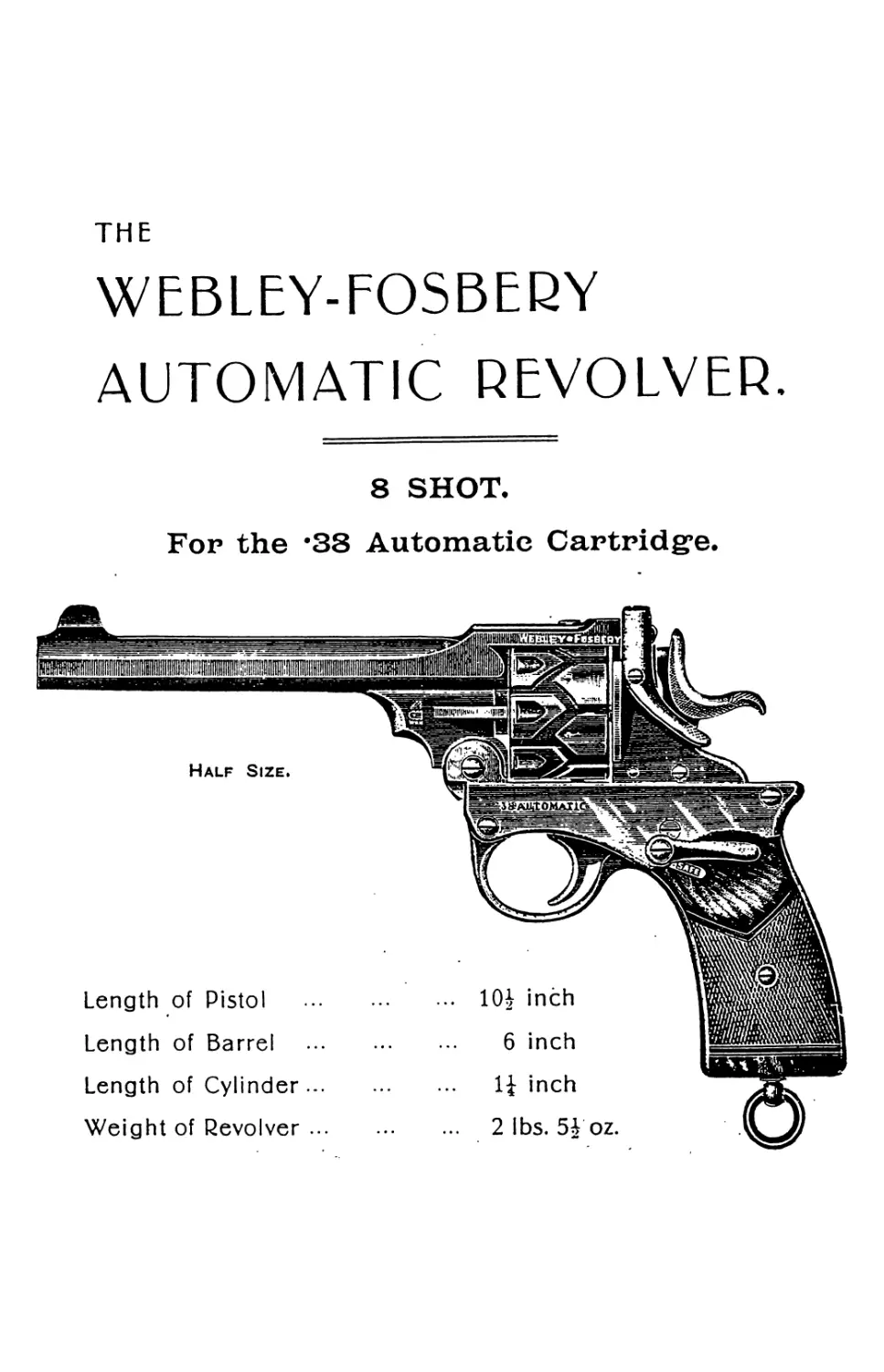
THE
WEBLEY-FOSBERY
AUTOMATIC REVOLVER.
8 SHOT.
For the *38 Automatic Cartridge.
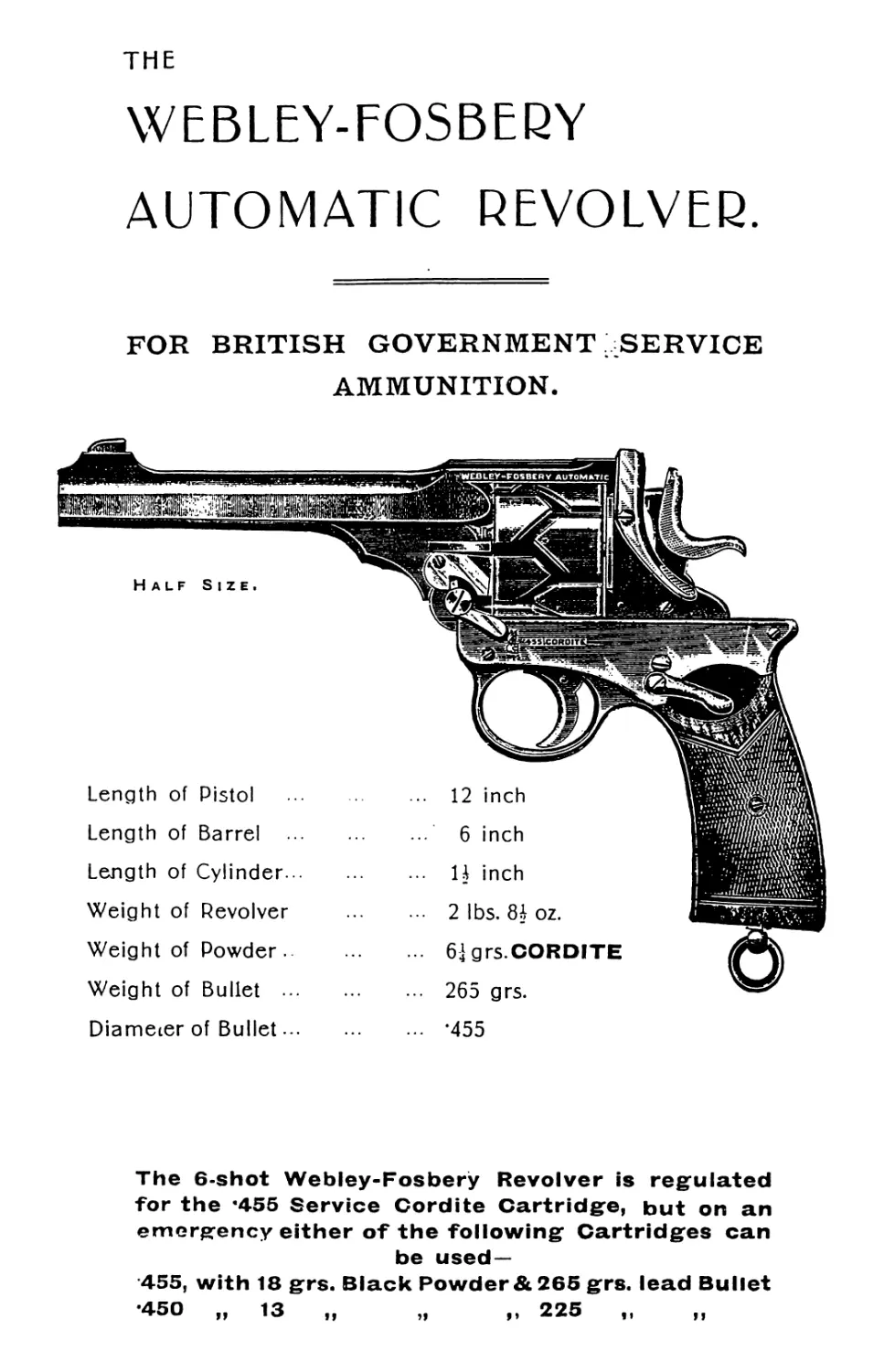
THE
WEBLEY-FOSBERY
AUTOMATIC REVOLVER.
FOR BRITISH GOVERNMENT' SERVICE
AMMUNITION.
MM
Half
Size.
Length
of
Pistol
inch
12
Length
of
Barrel
6
inch
Length
Cylinder...
of
inch
В
Weight
of
Revolver
• 2 lbs. 84
oz.
Powder.
Weight
of
6] grs.CORDITE
Weight
of
Bullet ...
• •• 265 grs.
Diameter of Bullet •••
. *455
The 6-shot Webley-Fosbery Revolver is regulated
for the *455 Service Cordite Cartridge, but on an
emergency either of the following Cartridges can
be used-
455, with 18 grs. Black Powder & 265 grs. lead Bullet
*450	,,	13	,,	,,	,, 225 ,i ,,
The “ Webley-Fosbery ” Automatic Revolver.
INTRODUCTION.
HE WEBLEY-FOSBERY is the result of several years’ experiments
to make an Automatic Revolver that can be fired as rapidly as any
of the Automatic Pistols now before the Public.
The mechanism is very strong and simple, and there is no difficulty
in loading, as it can be loaded in exactly the same manner as all Webley
Self-Extracting Revolvers, or the Patent Clip Loader can be empinyed.
by means of which the weapon can be discharged and re-loaded as
rapidily as any of the Automatic Pistols on the market.
It is provided with an efficient safety lever which can be put into
operation at either half or full cock, thereby permitting the Revolver to
be carried in the holster at full cock, or it can be carried at half cock with
or without the safety u on,” with perfect security : in the former case, after
removing safety, the firer has only ro pull the trigger as fast as be likes
six times, as the recoil of the pistol not only revolves the cylinder to a
fresh cartridge, but leaves the hammer at full cock: in the latter case it
would be necessary to put the hammer at fuli cock for the first siru the
same as in all Automatic weapons. The Revolver in other respects is so
like an ordinary one that there is nothing new for the firer to become
accustomed to: and the recoil being absorbed by the pistol itself, there is
little or no jump, and the grip of the pistol is in no way interfered with.
The Revolver is made in two sizes—one. the *455 6 shot, is specially
designed for the Service Ammunition ( 455 Cordite). The other, the ‘38
8-shot, is for the ’3S Colt Automatic Cartridge.
“WEBLEY-FOSBERY” REVOLVER.
DIRECTIONS FOR USE.
TO LOAD.—Press with the thumb the stirrup lever on left side
and depress the barrel; the rear of the cylinder will then be exposed and
the extractor operated and returned to its place. Fill the chambers and
reverse the movement of barrel; the stirrup will fly back and the load-
ing be complete, leaving the hammer at half-bent.
TO FIRE.—Cock with the thuirh and press the trigger.
AUTOMATIC ACTION.—After firing, the hammer will be
found on full cock and the Pistol ready for another discharge as soon as
the trigger ha.s been released. All six shots can be thus fired with good
aim in six seconds.
SAFETY BOLT.—T1 iis lies on left side of the Pistol, and when
put u on ” secures perfect safety, whether the hammer is half or full bent.
It operates by locking the recoiling part of the Pistol to the body in such
a position that the cock no longer rests on the half bent but is raised and
held back by the cocking stud. In putting the safety bolt “ on ” the thumb
of the left hand should be used to press it upwards while the finger clasps
the barrel and retract it. so as to assist the bolt in compressing the recoil
spring. In this manner the bolt can be put4’ on ” whether the hammer is
at half or full hem. It is always advisable when the Pistol is loaded, and
a shot not immediately required, to put on the bolt. If bolted, the Pistol
may safelv be carried at full cock. It is easier and quicker to throw oil'
the safety bolt than tn raise the hammer to full bent. When bolted, the
trigger is disengaged from the scar altogether, and consequently pressure
on the trigger. with the bolt on. does not affect the lock. As soon as the
bolt is thrown off by the thumb of the Pistol hand, the scar and trigger
again engage ami (he latter in position to fire.
If. after firing one or more of the six rounds, it is desired to fill up
with fresh cartridges, it is not necessary to lower the hammer, but the
safety bolt should be put on before opening the breech to load. This
secures safetv and involves no appreciable delay in firing, as the bolt is
easily thrown off.
When it is desired to rotate the cylinder for any reason, such as a
mis-firc from defective cartridge, it is necessary to operate the recoil
movement by hand : for this purpose, the stock being held by one hand,
the hammer may be pulled back, bringing with it the barrel and frame
and then released.
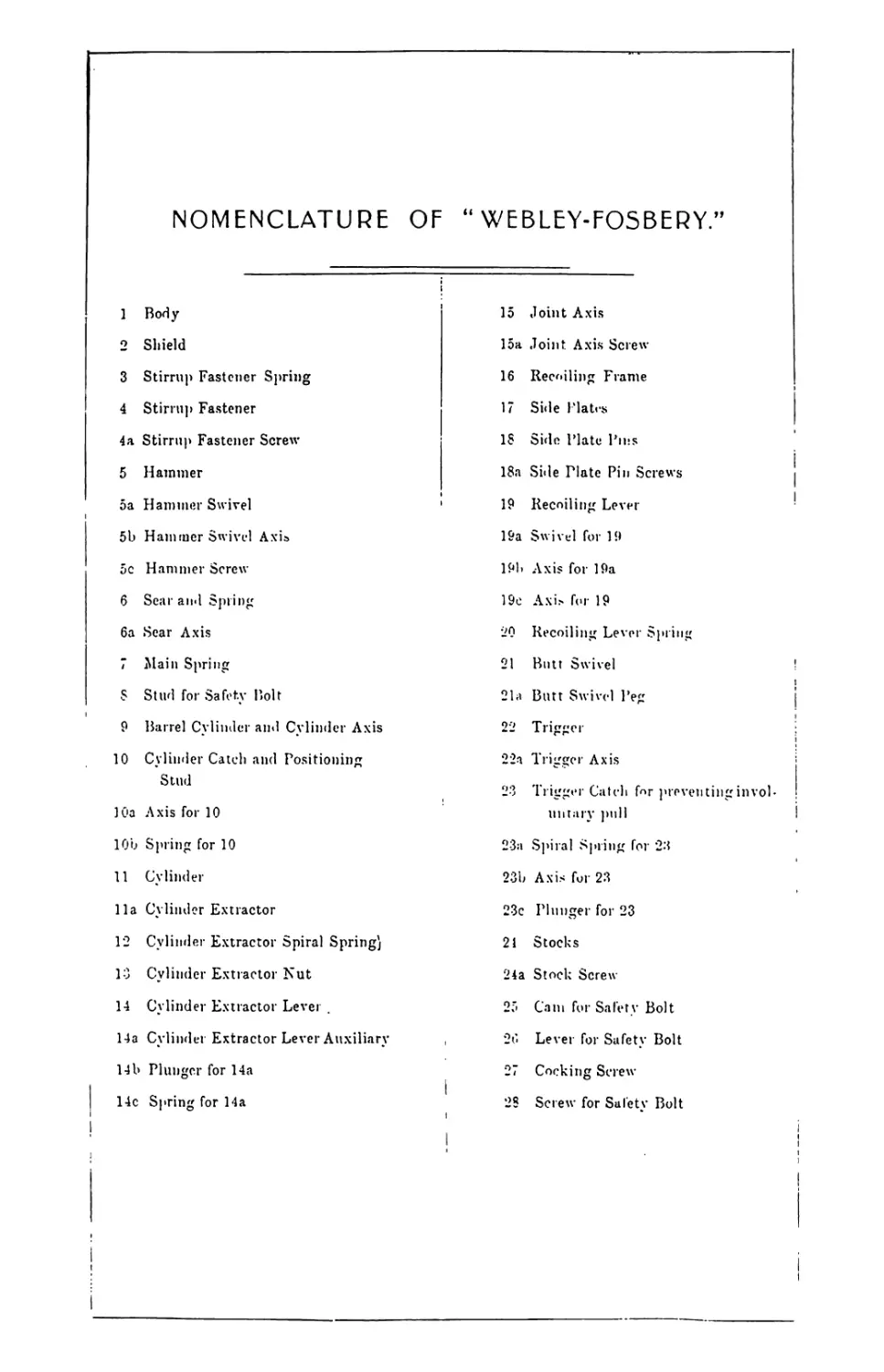
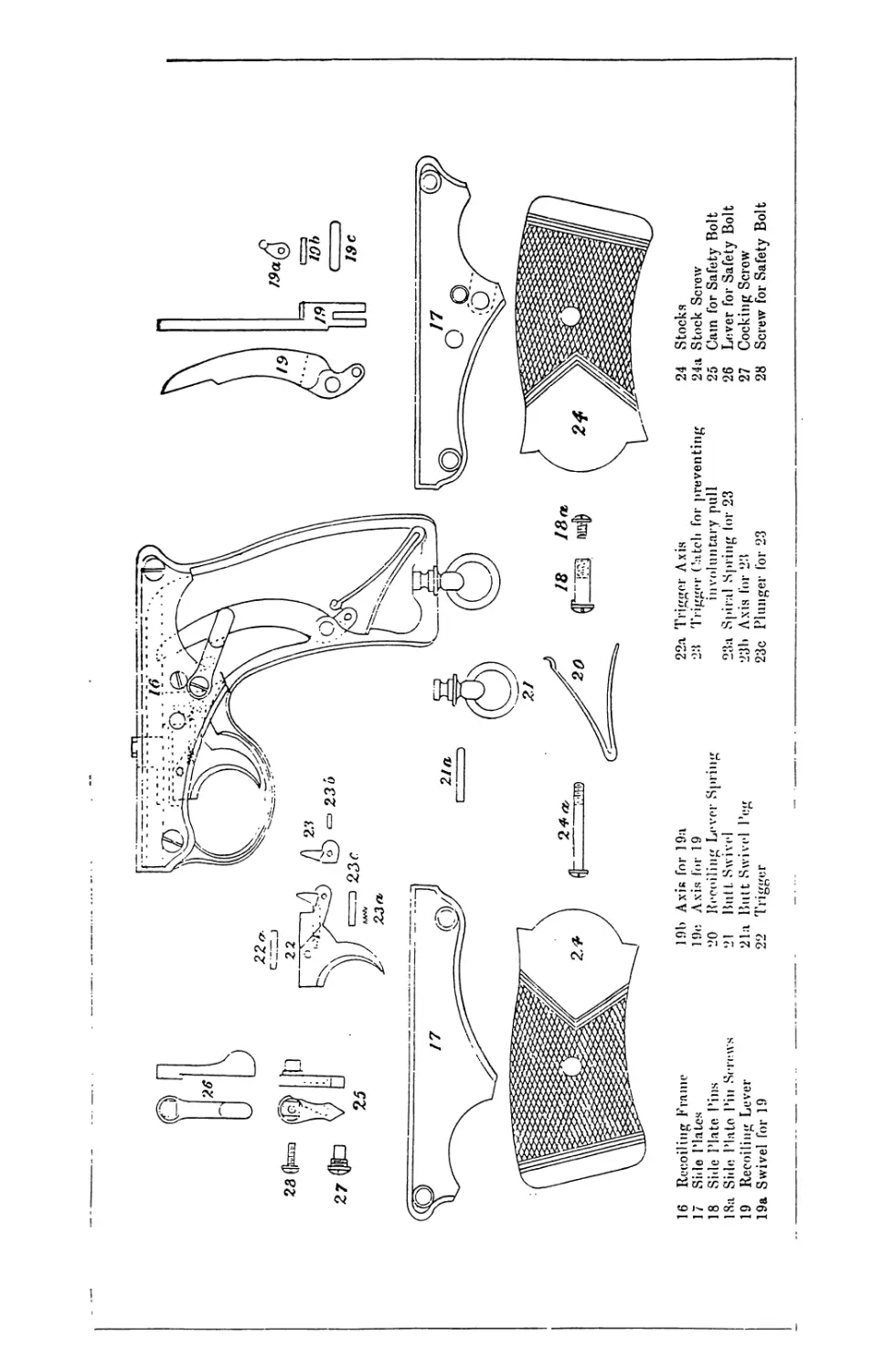
NOMENCLATURE OF “WEBLEY-FOSBERY.”
1 Body	15 Joint Axis
2 Shield	15a Joint. Axis Screw
3 Stirrup Fastener Spring	16 Recoiling Frame
4 Stirrup Fastener	17 Side Plates
4a Stirrup Fastener Screw	18 Side Plate Pins
5 Hammer	18a Side Plate Pin Screws
5a Hammer Swivel	1	1	19 Recoiling Lever
5b Hammer Swivel Axia	19a Swivel for 19
5c Hammer Screw	191» Axis for 19a
6 Sear and Spring	19c Axi> for 19
6a Sear Axis	20 Recoiling Lever Spring
7 Main Spring	21 Butt Swivel
8 Stud for Safety Bolt	21a Butt Swivel Peg
9 Barrel Cylinder ami Cylinder Axis	22 Trigger
10 Cylinder Catch and Positioning	22a Trigger Axis
Stud
	23 Trigger Catch for preventing invol
10a Axis for 10	untary pull
10b Spring for 10	23a Spiral Spring for 23
11 Cylinder	23b Axis fur 23
Ila Cylinder Extractor	23c Plunger for 23
12 Cylinder Extractor Spiral Spring)	21 Stocks
13 Cylinder Extractor Nut	24a Stock Screw
14 Cylinder Extractor Lever .	25 Cam for Safety Bolt
14a Cylinder Extractor Lever Auxiliary	i	26 Lever for Safety Bolt
14b Plunger for 14a	27 Cocking Screw
14c Spring for 14a	1 28 Screw for Safety Bolt
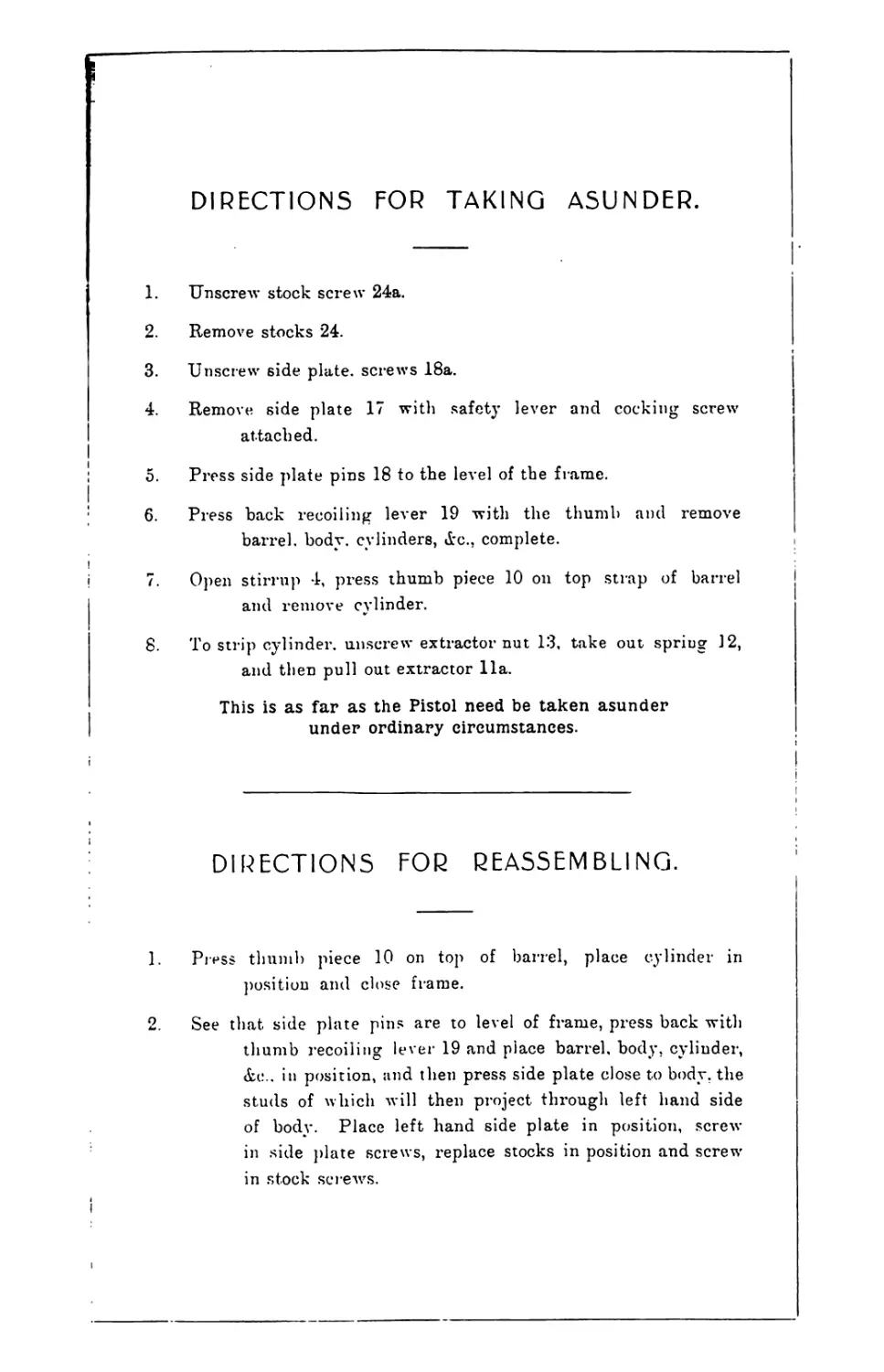
DIRECTIONS FOR TAKING ASUNDER.
1.	Unscrew stock screw 24a.
2.	Remove stocks 24.
3.	Unscrew side plate, screws	18a.
4.	Remove side plate 17 with safety lever and cocking screw
attached.
5.	Press side plate pins 18 to the level of the frame.
6.	Press hack recoiling lever 19 with the thumb and remove
barrel, body, cylinders, A’c., complete.
7.	Open stirrup 4, press thumb piece 10 on top strap of barrel
and remove cylinder.
8.	To strip cylinder, unscrew extractor nut 13, take out spring 12,
and then pull out extractor Ila.
This is as far as the Pistol need be taken asunder
under ordinary circumstances.
DIRECTIONS FOR REASSEMBLING.
1. Press thumb piece 10 on top of barrel, place cylinder in
position and close frame.
2. See that side plate pins are to level of frame, press back with
thumb recoiling lever 19 and place barrel, body, cylinder,
&c.. in position, and then press side plate close to body, the
studs of which will then project through left hand side
of body. Place left hand side plate in position, screw
in side plate screws, replace stocks in position and screw'
in stock screws.
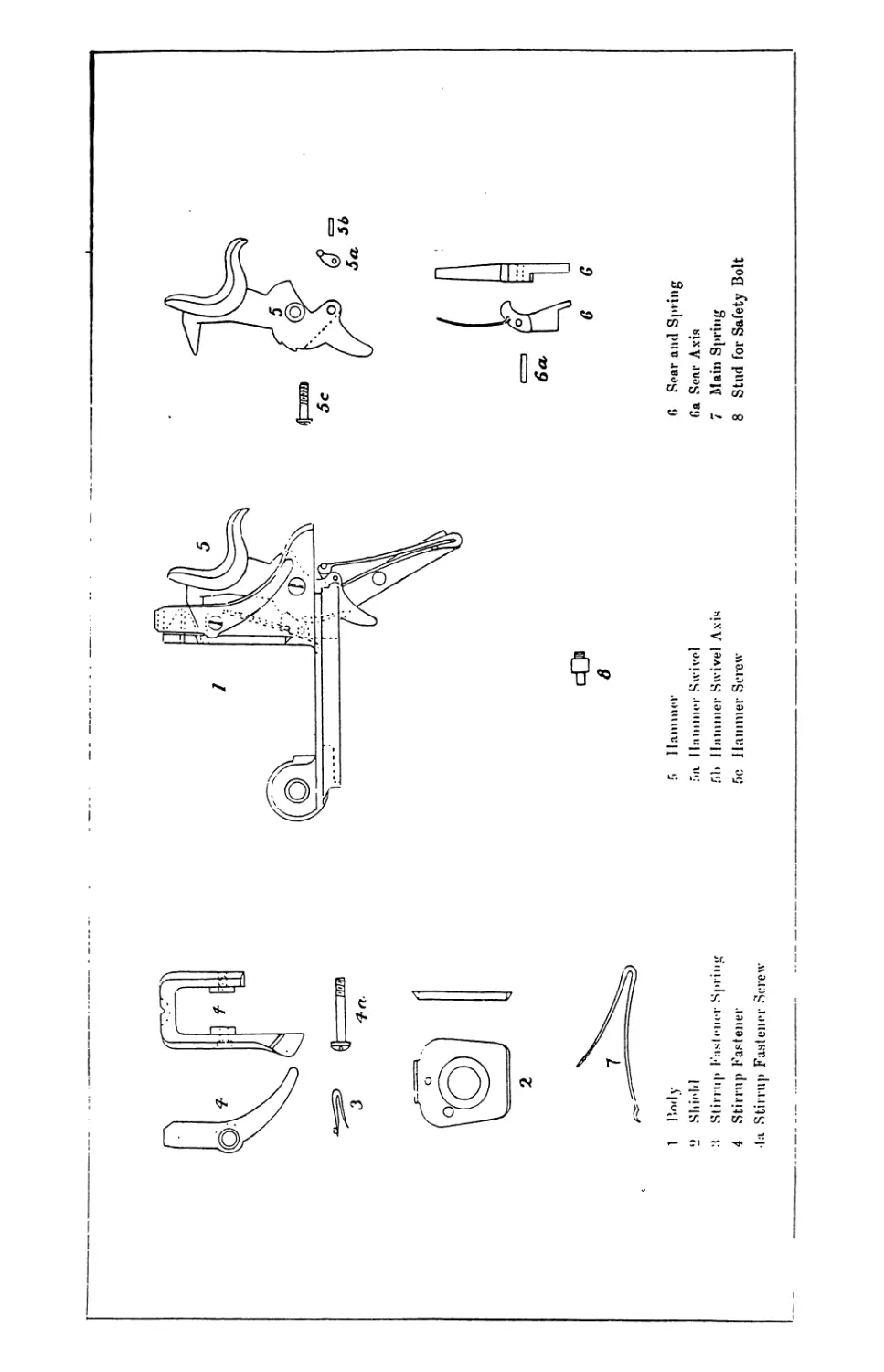
1	Body
2	Shield
3	Stirrup Fastener Spring
4	Stirrup Fastener
•la Stirrup Fastener Screw
cQ
8
5 llainmer
5a 11 :i in liter Swivel
5b Hammer Swivel Axis
5c Hammer Screw
6	Sear and Spring
6a Sear Axis
7	Main Spring
8	Stud for Safety Bolt
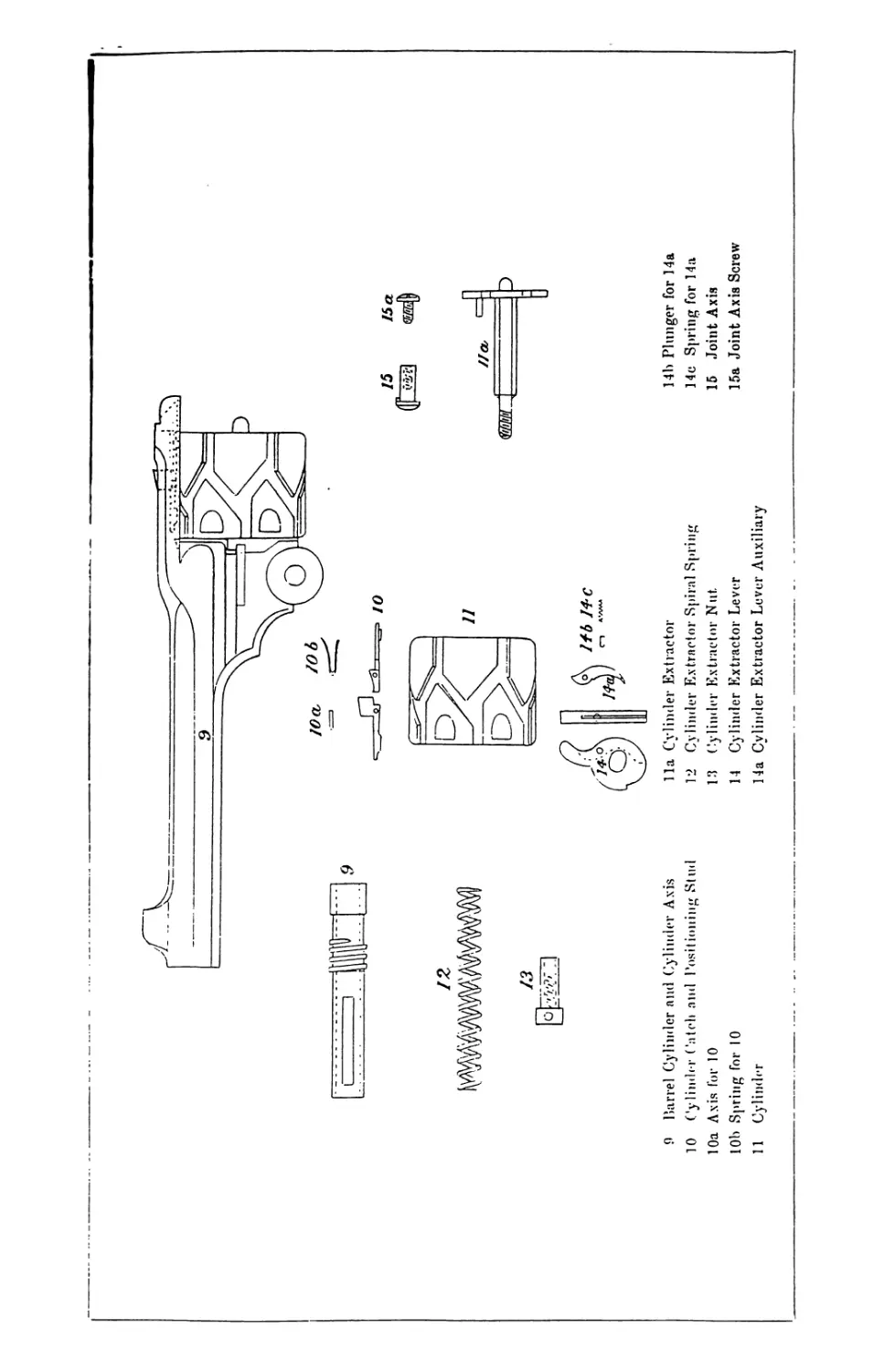
9	Barre) Cylinder and Cylinder Axis
10	Cylinder (’atcli and Positioning Stud
10a Axis for 10
10b Spring for 10
11	Cylinder
Ila Cylinder Extractor
12	Cylinder Extractor Spiral Spring
13	Cylinder Extractor Nut
14	Cylinder Extractor Lever
14a Cylinder Extractor Lever Auxiliary
14b Plunger for 14a
14c Spring for 14a
15 Joint Axis
15a Joint Axis Screw
16	Recoiling Frame
17	Side Plates
18	Side Plate Pins
18a Side Plato Pin Screws
19	Recoiling Lever
19a Swivel for 19
19b Axis for 19a
19c Axis for 19
20 Recoiling Lever Spring
21 Butt Swivel
21a Butt Swivel Peg
22 Trigger
22a Trigger Axis
23 Trigger (latch for preventing
involuntary pull
23a Spiral Spring lor 23
23b Axis for 23
23c Plunger for 23
24	Stocks
24a Stock Screw
25	Cam for Safety Bolt
26	Lever for Safety Bolt
27	Cocking Screw
28	Screw for Safety Bolt
SOME HINTS ON
Revolver shooting
IN COMPETITIONS.
By
Walter Winans.
EXTRACT from
“THE SPORTS OF THE WORLD.”
(Cassell A*. Company, Ltd.)
“ The writer disapproves of double action
revolvers in competitions, finding it almost im-
possible to make accurate shooting with them.
A word as to automatic pistols may perhaps be
ofuse. Messrs. Webley have produced a “Webley-
Fosbery” automatic revolver in both ’455 and
•38 calibre, which the writer prefers to any of the
automatic pistols that have yet come to his
notice, and. for rapid firing, even to any other
make of revolver. With it it is possible to fire
shots at the rate of one a .econd with approxi-
mately the same accuracy as with any single-
action revolver at the rate of one in two seconds.
In both cases a good shot should be able to put
most of his bullets into a two-inch bull’s-eye at
a 20 yards range.”
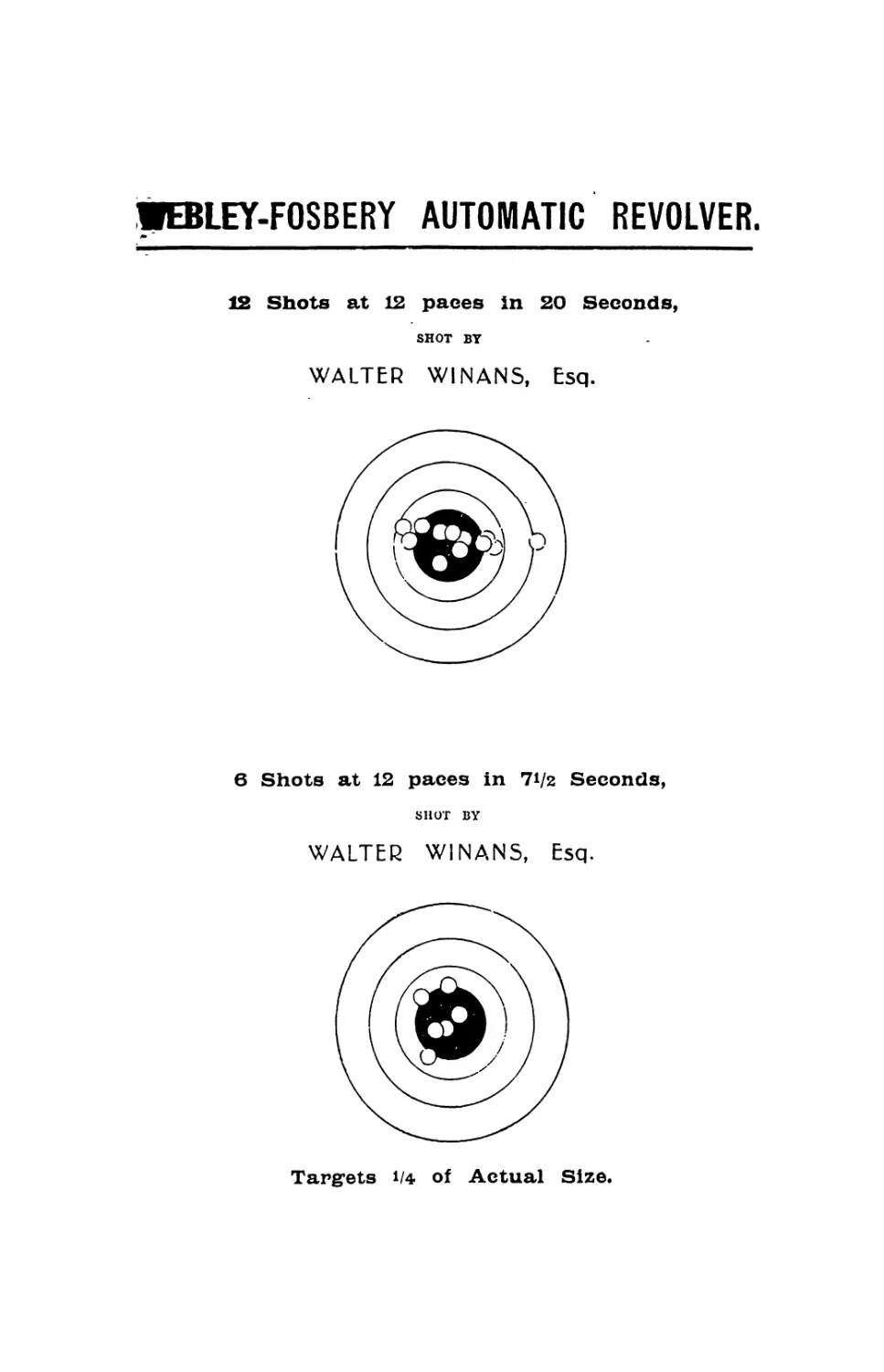
WEBLEY-FOSBERY AUTOMATIC REVOLVER
I*
12 Shots at 12 paces in 20 Seconds,
SHOT BY
WALTER WINANS, Esq.
6 Shots at 12 paces in 71/2 Seconds,
SHOT BY
WALTER WINANS, Esq.
Targets 1/4 of Actual Size.
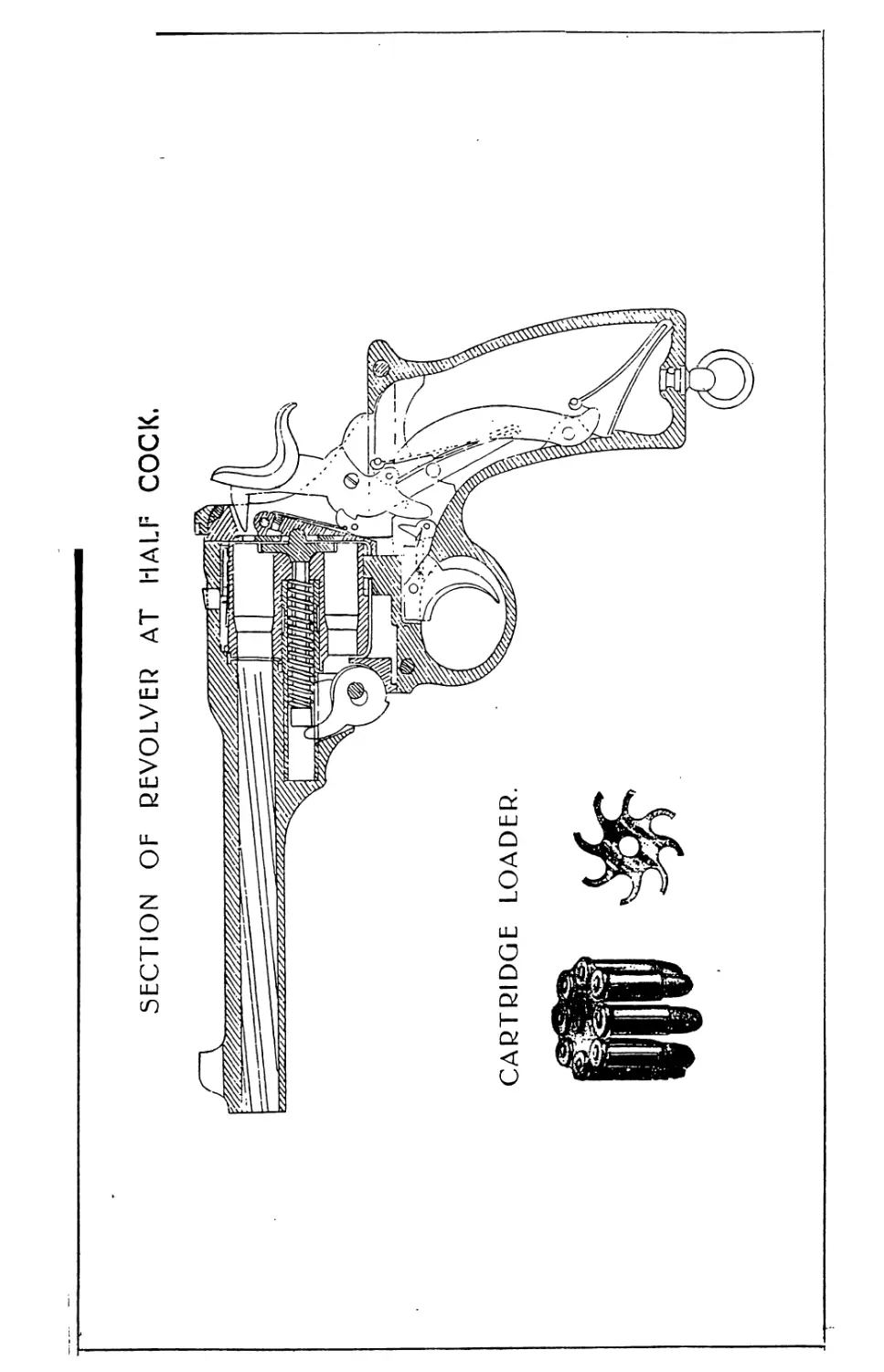
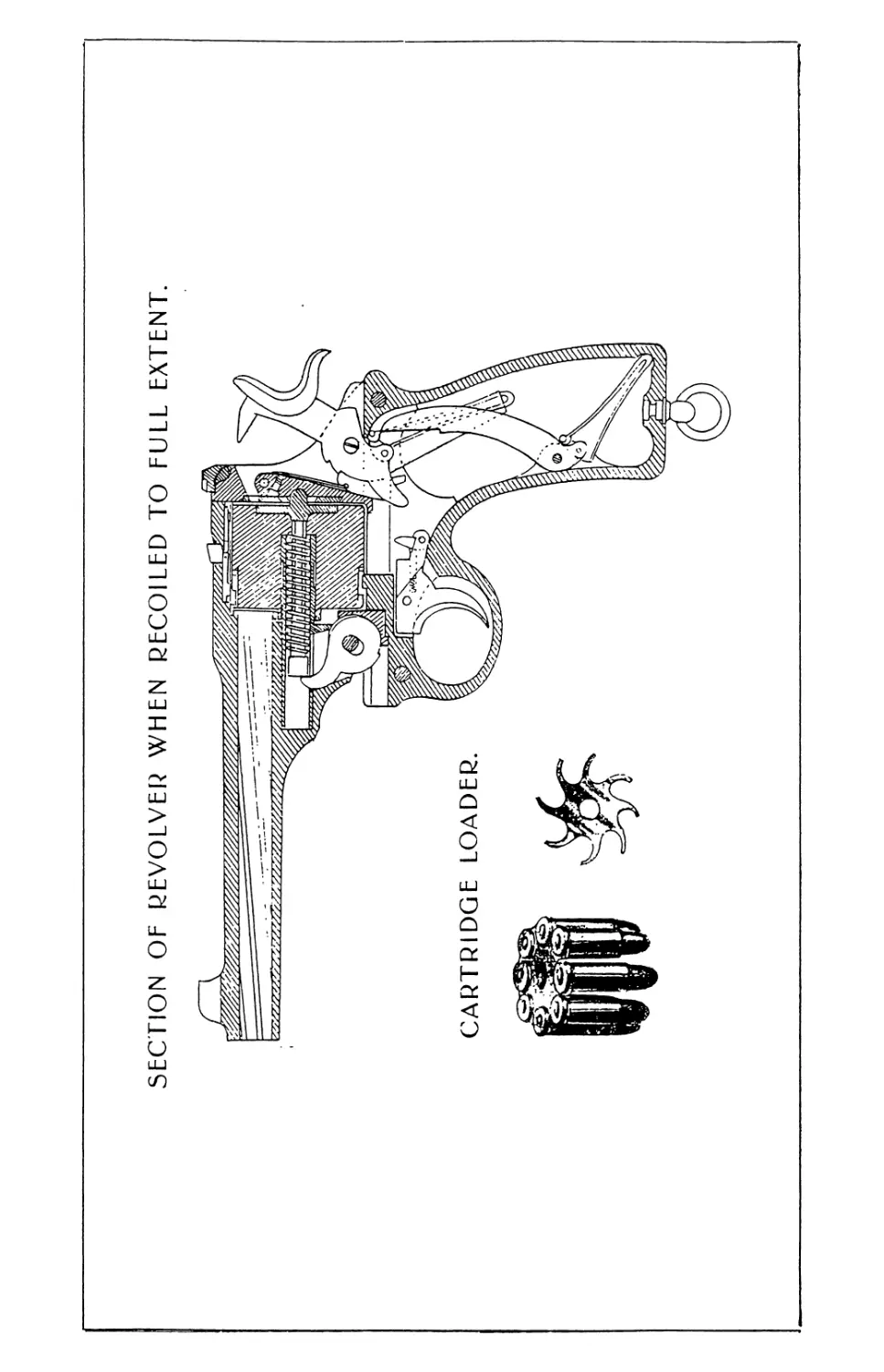
SECTION OF REVOLVER AT HALF COCK.
SECTION OF REVOLVER WHEN RECOILED TO FULL EXTENT.
Jhe Webley-yosbery Revolver.
PRESS NOTICES.
Extract from The County Gentlemen, July 20th, 1901.
During the past two or three years a great deal has been written
concerning the merits and demerits of various German automatic pistols.
We have said a good deal in favour of these weapons in our columns, for
there was much to be said for their ingenuity of construction and effective-
ness for the work their producers undertook to dr) with them. But we
always qualified our commendation of them by the expression of a hope
that English gunmakers should be able to utilise recoil in pistol or revolver,
as was shown in the German automatic weapons. We are glad now to be
able to state our belief that a new automatic revolver has been produced in
this country that it is thought can well stand comparison with any foreign
invention of the kind. We had an opportunity at Bisley last week of
seeing the Webley-Fosbery automatic revolver in usp at the ranges, and of
examining its construction, every facility being afforded by the firms
London manager, Mr. J. H. Harris, J.P., who was in charge at Bisley, for
testing the new weapon in any manner desired. The great advantage of
the Webley-Fosbery over other automatic arms is that it takes the service
ammunition, carrying a bullet nearly double the weight of pistols of the
Mauser type. No automatic pistol, of course, is fitted to shoot service
ammunition, and therefore that ability in the Webley-Fosbery strongly
differentiates it from any automatic pistol now in the market.
Rapidity of Fire.
The six cartridges carried by the Webley-Fosbery can all be discharged
with good aim in six seconds. We saw them discharged at the Bisley range
in the course of a competition in a little over seven seconds, so that we can
«juite believe the claim that six seconds are sufficient to aim and tire all the
six shots and get them all near the bull’s-eye on the target at revolver
ranges. In appearance the new revolver is very similar to an ordinary
service one, so that there is nothing new for the firer to become accustomed
to. The grip of the hand too is much surer, because most of the recoil is
absorbed by the pistol itself, which utilises it for revolving the cylinder to
a fresh cartridge with each shot, at the same time leaving the hammer at
full cock. Then there is on the left side of the revolver, just opposite the
thumb, an excellently designed safety bolt operating, whether the hammer
is half or full bent, by locking the recoiling part of the revolver to the
body, so that the cock does not rest on the half bent, but is raised and held
back by the cocking stud. This safety bolt is very easily manipulated, and
being equally effective whether the pistol is at full cock or not. it enables the
revolver to be safely carried though at full cock ready for action, for one
has only to push the safety bolt downwards with the thumb and the revolver
is ready cocked for the first shot. For the remaining shots, of course, it
automatically cocks itself. The loading is very simple. The stirrup lever
• on the left side has to be pressed with the thumb and the barrel depressed,
exposing the rear of the cylinder, when the extractor is operated and
returned to its place. After filling the chambers with the aid of a very
ingenious clip (the invention of Mr. Whiting, the works Manager), the
movement of the barrel is reversed, the stirrup flies back, and the loading is
complete. In loading, the safety bolt can be put on before opening the
breech, thus obtaining safety even during re-loading.
General Features.
The Mechanism, if simple enough, is very strong and very unlikely to get
out of order, a great desideratum-in a service weapon. The bullet being
heavier than that of any other automatic pistol yet produced must have the
greatest stopping power of any of the automatic pistol bullets, a considerable
advantage at close quarters. The length is I2in. and the weight 2lbs. 8|oz.,
and with 6| grs. of cordite it fires a bullet of '455 diameter weighing
265grs. The weight of the Colt automatic pistol again is 35ozs., the length
of the barrel being the same as that of the Webley-Fosbery, and the whole
length of the Colt 9in. Five shots per second is all that is claimed by the
makers of the Colt, and the capacity of its magazine is seven cartridges.
Altogether, therefore, it is believed that the Webley-Fosbery can compare
very favourably with any automatic pistol made. We, of course, had no
opportunity of submitting it to the sand or other tests which service
i	weapons are understood to be put through, but as it is very much of the
’	pattern of the present service weapon so far as outside appearance goes,
there can be little doubt that it can easily stand the same tests. And to
sum up its claims finally, we may draw attention to the consideration that
it is wholly of English manufacture—a point that in these days of foreign
importations is too often lost sight of.
Extract from The Broad Arrow : The Naval & Military Gazette,
July 27th. 1901.
Since the invention of the revolver pistol as a military weapon there has
been a good deal of dispute amongst military men as to its value and utility
as a Service weapon. However skilled in the usp of it in America—where
it originated—were its first users, it is certain that those who endeavoured
to manipulate it in the Crimean War and in the Indian Mutiny were not
altogether successful in scoring useful or valuable results. Indeed, at the
beginning of practice with it in the field those results were not in-
frequently more disastrous to the individual aimer than to the individual or
individuals aimed at. More careful attention and practice have now
remedied to a great extent these shortcomings, but still there is much to be
learnt regarding revolver practice and revolvers themselves. As to the
latter, they have for many years been of foreign make—German automatic
or American variations, or declared improvements of Colt’s first system.
The chief drawback to one and all of these was, and is, that they do not
take our Service ammunition. It is very satisfactory therefore to be now
able to record that an English made revolver is calling for notice which is
not fraught with this drawback, but takes the Service ammunition and
carries a bullet nearly double the weight of that used in pistols of the
Mauser type. This revolver is called the Webley-Fosbery, and. it is said,
will stand in favourable comparison with any foreign invention of the kind.
Wholly of English manufacture—a point which ought to tell at the present
time of so much foreign competition—it has shown its advantage over other
competitors at Bisley in quickness and correctness of firing. It claims that
six seconds are sufficient to aim and fire six shots and get them all near the
bull’s-eye on the target at revolver ranges. In appearance the Webley-
Fosbery revolver is very similar to the ordinary weapon, but the grip of the
hand is much surer. The mechanism and the loading are both very simple,
and consequently the weapon is very unlikely ever to get out of order. The
bullet, being heavier than that of any other automatic pistol yet produced,
must have the greatest stopping power—no small advantage at close
quarters. Altogether therefore the Webley-Fosbery revolver seems the one
destined to take precedence with British troops in the field to-day, in
preference to all foreign or other rivals.
Extract from COUNTRY LIFE, July 27th, 1901.
It was at the Bisley Meeting of 1900 that the writer first shot with the
Webley-Fosbery automatic revolver, but it was not by any means the first
time he had seen it. It seems to have been a case in which a most simple
and almost obvious device lias given endless trouble to bring to that
perfection which is assured before a weapon bears the imprint of the
Government revolver-makers. At Bisley last year the Fosbery seems to
have behaved somewhat differently in different hands. In that of the
writer it went well, and there never was any hitch in the mechanism. The
hitch that was said to have sometimes occurred still Jeft it a far more deadly
weapon than any other revolver whatever. It was said to skip a chamber
occasionally, and when it did this it became, in practice, a five-chambered
weapon instead of a six-shooter. That was the extent of the damage : but
even if no improvement had ever been possible, the rapidity of the tire of
its five chambers which was possible made it a most deadly weapon. Why
it should have taken so long to perfect it is hard to conceive. It seemed to
be a case in which a few hours would set the matter right, but it
evidently was not. For only now it is again challenging public approval.
This time also Bisley has been chosen to show the working of a weapon
that surprises by its simplicity as well as by the fact that this simple action
has never been resorted to before. It is one of those automatic weapons
that are worked by their own recoil, and possibly it may have been because
a great deal of misunderstanding about the value and nature of recoil has
been created by misleading literature that this weapon has taken so much
time to evolve into a perfect whole. But in this case it has not been
complicated by requiring recoil to perform two separate functions, as it is in
some of the automatic pistols. In some of these the barrel is allowed to
recoil a short distance for the purpose of unlocking the action at a period of
time after ignition when it is safe to unlock it—that is to say, it would riot
be safe to unlock the action by means of the first pressure on the gas acting
on the empty cartridge-case. If it unlocked, the natural consequence
would be as rapid an exit of the empty case as there is of the bullet, and
that would be distinctly unpleasant. So it happens that the unlocking of
the action and the ejection of the empty case are relegated to a distinct
period of recoil, and most exact measurements have had to be made to
ensure that, after the unlocking, there shall not be too much powder
pressure left in the barrel, and yet that there shall be enough to perform
the work required. But in the Fosbery revolver there is no occasion for
this division of labour, and no reason apparently for nice adjustment of
recoil work in regard to time. This is so, because recoil does not open the
breech ; it merely does the cocking, revolv s the chambers, or cylinder, one-
half a division, and compresses a spring which in its reaction revolves the
cylinder another half division, and brings the next chamber and the cap
exactly opposite to the striker. That is to all appearances a very simple
thing to do : but when the writer remarked on the simplicity to Colonel
Fosbery, the latter replied, “Try to make one.” That was over a year ago,
and the invitation has not yet been accepted, not because the writer’s view
of the simplicity of the whole affair has been in any way altered (and he
may say that he considers simplicity the soul of invention), but because he
has no intention now, or ever, of fishing in protected waters^
However, although no double duty is required of direct recoil, it was
possibly owing to the great energy of recoil that the weapon sometimes went
wrong in its early stages. The bullet is a heavy one, the barrel and the
cylinder are comparatively light and these are consequently recoiled at a
very rapid rate, and one which would be much more rapid but for the spring
the recoil has to compress.
The mechanism of the weapon is as follows: the handle is a separate piece
with an extension support for the action. In this support the action slides
back by the action of the recoil, and forward again by the reaction of the
spring which the backward movement has compressed. It is easy to under-
stand how the backward movement is made to cock the weapon and leave it at
cock when the action has been forced forward again by the reaction of the
compressed spring. It is not difficult either to see that if a stud is placed
on the handle extension or fixture, so as to catch in grooves in the cylinder
as it comes back, the latter will be revolved in any direction in which those
grooves are slanted. That is the principle of the revolution of the chambers
or cylinder. The grooves are cut like a V or a capital W, the V six times
repeated, or the W three. In order, then, that the cylinder may be revolved
one sixth of the complete revolution, the stud fixed in the handle must
follow each leg of the V and complete that figure. This it does ; the first
leg of the grooved V is driven over the stud by the backward movement of
the cylinder actuated by direct recoil. The second leg is completed by the
spring, compressed in recoil, driving the cylinder forward over the stud in
the second leg of the V. That completes the movement and leaves the
chamber to be fired exactly opposite the striker. It not only leavesit there,
but holds it firm, and yet it was just at this apparently simple point that a
year ago the Fosbery failed to give its inventor complete satisfaction. How.
or why, it occasionally jumped one chamber and placed the next but one,
instead of the next, opposite the striker is not known, but it did so. It was
a movement that appeared to be quite impossible, for it is necessary to
believe that the barrel and the action came back twice and went forward as
often under one shot—that is, that it was twice actuated by one recoil. The
most peculiar thing about it was that it only acted like this occasionally, and
this seemed to show that the bullet acting on the rifling might have some-
thing to do with overcoming some part of the backward action at times and
not at others. At any rate, there was enough in this to make careful
people think that the action of recoil was not always to be discovered by
theory and figures.
Leaving that unprofitable part of the subject (which we have had no
chance to examine on the weapon itself), it is much more satisfactory to turn
to the work of the now perfected revolver. This has been at Bisley at this
year's meeting, competing in the ordinary way against the other revolvers,
and in a class to itself. In shooting it one does not feel the same kind of
recoil as from other revolvers, but there is a shake which, although not
I unpleasant, is peculiar to this weapon.
The praise that has already been given to the automatic pistils will un-
questionably be extended to the Fosbery revolver. There are points about	j
it which are superior to any of the pistols, and the principal of these is the	<
much greater size of the bullet and the stopping effect a big bullet always
has. Probably the automatic principle is of vastly more importance in the
revolver than in the rifle. It has been questioned, at any rate, by some
military men whether the magazine even does not lead to wild shooting and
loss of ammunition, but no such statement would be of the smallest value
against the quickest possible method of firing the revolver. This weapon is
wanted for close distances; it has always been a slow weapon used as a
single action, and an inaccurate one used as a double action. The Fosbery
gives us the accuracy of the single action weapon with far more than the
rapidity of the double action, in which, as is well known, the trigger finger
has to do the cocking, as well as to revolve the cylinder.
It is said, and probably with truth, that an experienced man can shoot
this weapon six times in a second—of course this would be more or less
without alignment. As a good runner can cover 100 yds. in about 10 sec.,
it is clear that a savage rushing at a Fosbery armed officer could be shot at
six times while he was covering 10 yds. The revolver is not a weapon that
is intended to be accurate at a long distance. If the majority of men can
hit the figure of a man quickly at twenty paces, that satisfies them, but it is
vastly more easy to do it at ten paces ; so that to enable the shooting to
begin nearer, to make it safe to wait until the foe is half or a quarter the
usual distance oil before shooting begins, is the same in practice as an in-
crease of accuracy ; a diagram of 16 square inches at 10 yds. becomes 64
square inches at 20 yds., and it becomes 256 square inches at 40 yds. That
means that at 10 yds. one has sixteen times the chance of hitting as at 40
yds. There must be very many cases in which that would represent the
difference of effectiveness between the new Fosbery revolver and the old
double.action weapon. The bore of the new revolver is *455—that is, it
takes the Service bullet of 265 gr. It is 12 in. long, barrel 6 in., weight
2 lb. 8A oz. and it takes either black powder or cordite—6| grs. of the
latter.
Extract from The Spouting Goods Review, August 15th, 1901.
For a lorn: time past, occasional mention has been made in these columns
of the Webley-Fosbery automatic revolver, and now that it has finally been
perfected, a description of what is practically a new departure in the manu-
facture of small-arms, will be followed with interest. The weapon is the
outcome of a long series of experiments directed to secure a combination of
some of the advantages of automatic pistols with the qualities possessed
by the ordinary service revolver In any double-action revolver the cylinder
rotating and the hammer rising by the pull on the trigger secures a mechani-
cal rapidity of fire, whereas in tin* Webley-Fosbery those actions are per-
formed automatically through the instrumentality of recoil.
The revolver is of the Webley self-extracting type, with dropping barrel,
and the loading of the cylinder is conducted in the ordinary way. The
mechanism cannot be intelligibly described without the aid of diagrams, and
we must therefore leave an exact delineation until we can present these aids
to accuracy. The cylinder and barrel are mounted so as to be capable of a
backward and forward travel upon a kind of platform. Of course the oper-
ations due to recoil take place so rapidly that they are a little difficult to
follow with the eye. On the fall of the hammer the moveable barrel, cylin-
der, &c.. are again in position : the backward energy of the recoil immediately
slides them rearwardly, the pressure being taken up by a long limb pivotted
inside the stock, which is called the recoiling lever. Through the lever
passes a pin encircled by a coiled spring, and the backward travel serves to
cock the hammer and also to coinpress the spring. The cylinder and barrel
are then returned and carried forward, under the action of the spring-actuated
recoiling lever, aided by the rebound from the recoil frame at the back of
the stock, to again slide back by the force of the recoil on firing the next
shot. Roughly as we have sketched these motions we think the principle
has been made clear. It remains now to explain the revolution of the
cylinder. An extension of the trigger-guard passes upwards through the
body of the revolver and is, of course, firmly fixed, by which we mean that
it is in no way under the influence of the recoiling parts. A projection is
formed on this extension, and is called the cylinder rotating stud. A glance
at the cylinder shows a peculiarly shaped recess formed all round it, and it
will be seen that the rotating stud, projecting from the body, must take into
this recess. Now, when under the pressure of the recoiling lever the cylin-
der slides forward, it is obvious that this motion can only be accomplished
by the recess accommodating itself to the fixed stud. If the cylinder were
also fixed the forward motion would be impossible, as the form of the groove
or recess necessitates a rotary movement. At the moment of firing, the
cylinder being in its forward position, the stud lies at the extremity of the
straight portion of the recess nearest the hand of the shooter. Immediately
afterwards the cylinder flies back under the influence of recoil, and is revolved
until it comes to rest with the stud in position at the front. Under the in-
fluence of the spring-actuated return movement a further rotary motion then
takes place bringing the stud to the back and the cartridge into position to
receive the blow of the hammer Thus the necessary rotation is automatic-
ally imparted, half by the forwaid, half by the return travel of the recoiling
parts.
A very efficient safety-bolt is fitted which lies on the left side of the
pistol. It operates by locking the recoiling to the stationary part of the
pistol in such a position that the cock no longer rests on the half bent but
is raised and held back by the cocking-stud. The bolt to be placed at safety
is simply pressed upwards, the barrel being lightly retracted meanwhile to
get the boh easily home against the pressure of the recoil spring. The safety
can be put on when the hammer is at half or full cock, and a- it is very
easily operated and absolutely sure, should be used whenever the pistol is
loaded, and there is no immediate intention of firing. In using the pistol it
is of course necessary to cock before the firs* shot, after which the hammer
is automatically thrown back, and the cylinder revolved su that all the
chambers may be discharged in succession as quickly as the trigger can be
pressed and released. If it is desired to reload before all the six rounds
have been fired. It is not necessary to lower the hammer, but the safety
bolt should be put on before opening the breech.
The rapidity and ease with which this new pistol can be manipulated will
undoubtedly gain f<»r it the favour of revolver sinus generally, and the fact
that the recoil instead of being exerted on the arm of the user is profitably
expended on the mechanism of the pistol is a very great point in favour of
the new weapon. We long ag«» concluded that non-automatic revolvers and
automatic pistols presented such points of dissimilarity that attempts to
compare them were a waste of time. The strong points of the one were the
weak points of the other, and the test of relative efficiency really depends
upon the purposes to which the arms are to be devoted. The Webley-Fos-
bery brings the revolver nearer to the magazine pistol in the matter of rapid
firing, while one at least of the newest automatic pistols is looked to to
challenge comparisons in the matter of stopping power by weight of bullet.
Thus it may be that the old discussion will revive on new lines. Definite
conclusions on these wide issues must, in our view, remain to be decided
rather by experience than by opinion, but in any case Colonel Fosbery and
Messrs. Webley and Scott are alike to be congratulated on the production
of on entirely new weapon possessing undoubted merit, in the working out
of which very considerable ingenuity and great mechanical skill has been
displayed.