/


Author: Maistre S. Lewis C.
Tags: english english grammar english language
ISBN: 0-582-40396-0
Year: 2002


Text
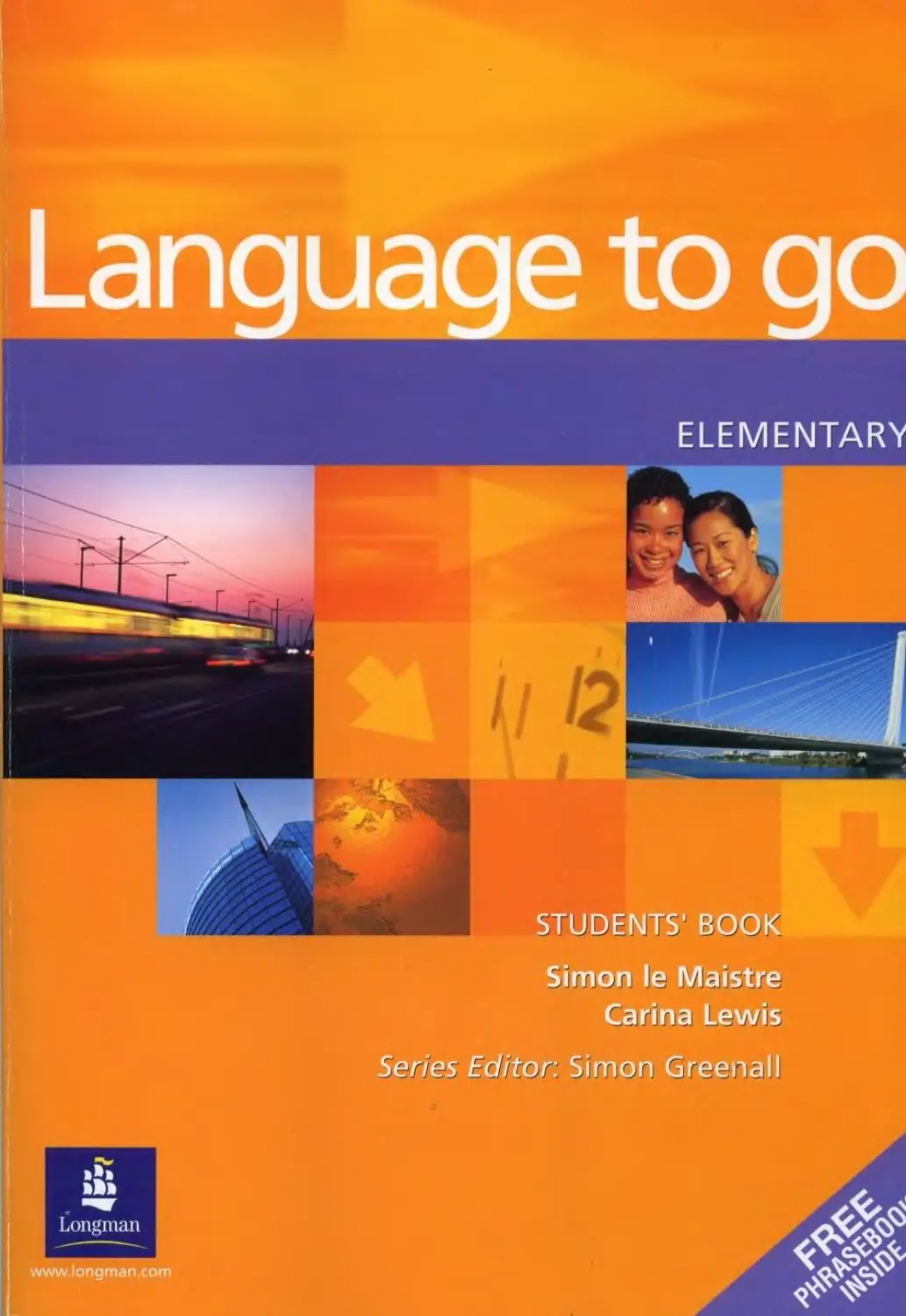
                    Language to go
ELEMENTARY
STUDENTS' BOOK
Simon le Maistre
Carina Lewis
Series Editor. Simon Greenall
Longman
www.longman.com
	Lesson 1 Meeting people page 4	I Lesson 11 Interesting places page 24
	Language to go: Introducing yourself Vocabulary: Personal information Reading: E-mails Function: Greetings Grammar: To be: am, is,are Get talking: Introducing yourself	Language to go: Talking about places you know Vocabulary and speaking: Adjectives to describe places in a town Reading: Heal places by real people Grammar: There is/are Get talking and writing: A review of a special place you know
	Lesson 2 Personal details, please* page 6	Lesson 12 The weekend page 26
1	Language to go: Asking and answering: personal information Vocabulary: Everyday objects Listening: Buying by phone Grammar: Plurals; What is/are ...? Get talking and writing Roleplay: Buying by phone	Language to go: Talking about how often you do things Vocabulary and speaking: Everyday activities Listening: Free time activities around the world Grammar: Adverbs of frequency Get talking: Class survey on weekend activities
	Lesson 3 Round the world pages	Lesson 13 Office. . or living room? page 28
	Language to go: Asking about nationalities Vocabulary and speaking: Nationalities and countries Reading and listening: Quiz: Are you international? Grammar: To be (questions and negatives) Get writing and talking: Class quiz	Language to go: Telling someone* where things are in a room Vocabulary: Furniture in an office/living room Listening: Moving in Grammar: Prepositions of place Get talking: Describing and drawing a room
	Lesson 4 Favourite things pageio	Lesson 14 Family расезо
	Language to go: Talking about people and favourite things Vocabulary Free time activities Listening: People talking about their favourite things Grammar: Possessive adjectives and possessive's Get talking: Finding out people's favourite things	Language to go: Talking about what your family/friends are doing Vocabulary and speaking Family Reading: Headers' letters Grammar: Present continuous for now Get talking: Information gap: Spot the difference
Lesson 5 Celebrations page 12	] Lesson 15 In a cafe page 32
Language to go: Talking about family occasions Vocabulary and speaking: Activities: verbs and nouns Reading: A letter to a penfriend Grammar: Present simple (positive)	Language to go: Ordering food and drink in a cafd Vocabulary and speaking: Food and drink Listening: At the Liberty Cafd Function: Making requests
Get talking: Roleplay: In a cafd
Get talking and writing: Describing a special/typical day
Lesson 6 The modern world page u
 Language to go: Talking about ways of communicating
Vocabulary and speaking: Activities: verbs and nouns
Listening: Communication and technology
Grammar: Present simple (questions and negatives)
Get talking: Finding out if you are an Internet person
Lesson 16 Job skills PAGE 34
Language to go: Asking about job skills
Vocabulary: Activities at work
Reading: Changing Jobs
Grammar: Can for ability
Get talking: Interview for a career change
Lesson 7 Travelling pagei6
Lesson 17 Memories расезб
Language to go: Saying what you take on holiday and how you travel
Vocabulary and speaking: Objects you take on holiday; transport
Reading and vocabulary: Travelling with Tim Hall
Grammar: А/an, some/any
Get talking: Making travel plans
Language to go: Talking about childhood memories
Vocabulary and speaking: Question words
Listening: Two friends play 'The Memory Game'
Grammar: Past simple of be: was, were
Get talking: Playing 'The Memory Game'
	Lesson 8 The collectors page is	I Lesson 18 A week in the life of. .? pagess
*	Language to go: Talking about possessions Vocabulary and speaking: Objects that people collect Reading: The biggest Garfield collection Grammar: Have got Get talking: Quiz and discussion: Are you a collector?	Language to go: Talking about your week Speaking and vocabulary: Everyday activities Reading: A week in the life of... a theatre manager Grammar: Past simple regular verbs (positive and negative) Get talking: Discussing what you did last week
	Lesson 9 Top sports PAGE 20	I Lesson 19 Love at first sight page4o
1	Language tc g >: Talking about sports you like/hate Vocabulary and speaking: .Sports Listening: Sports in Canada Grammar: Verbs + -ing Get talking: Class survey on sports	Language to go: Telling a story Vocabulary and speaking: Common irregular verbs Listening: Love story Grammar: Past simple irregular verbs Get talking and writing: Re-tell a love story and write a letter
	Lesson 10 Shopping PAGE 22	Lesson 20 Life and times page 42
1	Language to go: Shopping for clothes Vocabulary and speaking: Clothes and sizes Listening: A conversation in a department store Function: Asking for information in a shop Get talking: Roleplay: Shopping for presents	Language to go: Asking questions to find out about people’s lives Vocabulary and speaking: Verbs and nouns: important events in life Reading: All about Julia Roberts Grammar: Past simple (questions) Get talking and writing: Interviewing your partner and writing an article
> Information for pair and group work page 84 > Practice section page 90 > Grammar reference page 110
Lesson 21 Quiz show page 44	I Lesson 31 Culture shock page64
Language to go: Asking for and giving measurements
Vocabulary and speaking: Numbers
Listening: A TV quiz show
Grammar: Questions with How + adjective
Get writing and talking: Roleplay A TV quiz show
Language to go: Giving advice to visitors
Vocabulary and speaking Social etiquette
Listening: Advice to Japanese business people visiting UK/USA
Grammar: Should for advice
Get talking and writing Giving advice to foreign visitors
Lesson 22 Sweet and savoury page 46	Lesson 32 Party time! page 66
Language to go: Talking about food you like	Language to go: Making suggestions for social arrangements
Vocabulary and speaking: Countable and uncountable nouns	Speaking and vocabulary: Money verbs
Listening Three people talk about food they like	Listening: A meeting with a party organiser
Grammar: Expressions of quantity	Function: Suggestions
Get talking: Questionnaire: Sweet or savoury?	Get talking: Roleplay: Planning a party
Lesson 23 Big plans page 48	I Lesson 33 At the movies page 68	|
Language t go: Talking about future plans Vocabulary and speaking Verbs/nouns describing changes in life Reading. Stress free Grammar: Going to for future plans Get talking: Talking about your plans	Language to go: Talking about movies Vocabulary and speaking Movies Reading: Readers' favourite films Grammar: Say and tell Get talking and writing: Describe and review your favourite film
Lesson 24 It's on the right page so
Lesson 34 Would you like the menu? page 70
Language to go: Asking and giving directions
Vocabulary: Parts of a public building; American English
Listening- A hotel guest asks directions
Grammar: Prepositions of movement
Get talking: Roleplay: Giving directions to a visitor
Language to go: Ordering food and drink in a restaurant
Speaking and vocabulary: Restaurant words
Listening: Ordering in a restaurant
Grammar: Would like/like, would prefer/prefer
Get talking: Roleplay: In a restaurant
Lesson 25 Hot and sunny page 52
Lesson 35 Island life page 72
Language to go: Describing climate and lifestyle
Vocabulary and speaking: Weather
Reading City Breaks Boston
Grammar. Linking words, because, so. but, although
Get talking and writing: Describing what to do in your area
Language to go: Asking people about their practical experience
Speaking and vocabulary: Practical activities
Reading An application form
Grammar: Present perfect for experience
Get talking: Interview: Selecting someone to live on an island
Lesson 26 A new year page 54
Lesson 36 Hard work page 74
Language to go: Talking about memorable times
Vocabulary and speaking: Dates
Listening: A radio programme about 1999
Grammar: Time prepositions: in, on, at
Get talking: Talking about important events in your life
Language to go: Describing jobs
Vocabulary and speaking: Activities at work
Reading: Nine to five
Grammar: Have to/don't have to
Get talking: Discussing different jobs
' Lesson 27 Requests page 56	[ Lesson 37 Excuses excuses page 76
Language to go: Asking for things and giving a response	Language to go: Making excuses
Reading and speaking: Quiz How polite are you?	Vocabulary and speaking: Parts of the body; illnesses
Vocabulary: Everyday requests	Listening: A conversation on the phone
Function: Permission and requests	Function: Making and accepting apologies
Get talking and writing: Roleplay: Making requests	Get talking: Roleplay: Making excuses
Language to go: Comparing places in your country Vocabulary and speaking: Adjectives to describe places Listening: A radio interview: 'New Zealand's Favourite Place' Grammar- Comparatives Get talking: Choosing a ’C ty/Region of the year'	Language to go: Making predictions Vocabulary and speaking: World issues Reading. Brave New World predictions Grammar: Will for predictions Get talking: Discussing predictions for the year 2050	1
Lesson 29 The best food in town page во	Lesson 39 Long life page so
Language to go: Describing restaurants Vocabulary: Adjectives to describe restaurants Reading Restaurant reviews Grammar: Superlatives Get talking: Choosing a restaurant to go to	Language to go: Talking about how long people do things for Speaking and vocabulary: Expressions of time with for and since Reading Life begins at 65! Grammar: Present perfect, how long/for/smce Get talking and writing: Interviewing and writing about your partner	в
Lesson 30 On the phone page 62	Lesson 40 The perfect job page 82
Language to go: Taking and leaving messages Vocabulary and speaking: Telephones Listening: A ph me conversation Function: Telephoning Get talking: Roleplay: Leaving a mesaage	Language to go: Discussing what makes a good job Reading and vocabulary Family lunches, beds and bars ... Vocabulary and listening A radio programme What workers want Function. Giving opinions, agreeing and disagreeing Get talking: Discussing what you want at work
> Recording scripts page 120 > Practice section answer key page 125
3
Personal information
Greetings
To be: am, is, are
Introducing yourself
Meeting people
Vocabulary
1 Look at the form forInternet cafe chat
room. Put the words in the correct box.
Reading
2 Read the e-mails and put them in the correct
order. Write the numbers in the boxes.
doctor student single Poland
businessman/woman learning English
films the USA married Brazil
music sport
| Subject______
□
> Hello, Vanessa. My name’s Marek and Im |
interested in English. I’m a businessmanfrom
Poland. My brother’s married to an American
woman. They’re doctors. I’m in San ^anc^c0 I
with him for one month. Tell me more about you. j
! | 6 | To Vanessa
]_Й I To Vanessa
] Subject
S andl’m t9ai?’ ^neSSa- '’m 30 years °,d
S on 5 h 4in9 an lnternet caf® rd
S on 5th Street too! Where are you? □
3 Look at the photo on page 89. Where are
Marek and Vanessa?
4
1
Language focus
Grammar focus
4 Write the responses.
Use these expressions.
And you. Bye. Hi.
Fine, thanks.
Example:
a: Nice to meet you.
в: And you.
1	a: Hello,
в:_________________
2	a: How are you?
в:_________________
3	a: Goodbye,
в:_________________
5	a) ES Listen and check your answers.
b) Listen and repeat.
Practice
6	In pairs, practise the expressions.
Example:
a: Nice to meet you.
в: And you.
7	Look at these sentences from e-mails.
I'm a businessman.
My name's Vanessa.
He's married.
They're doctors.
I	'm (am)	single.
He/She/lt	's (is)	from Brazil.
You/We/They	're (are)	doctors.
8	Ш Listen and repeat.
Practice
9	Complete these sentences from e-mails.
Example: Hello! My namei. Justine.
1	I from France.
2	I married and I have two children.
3	They students.
4	Anna . interested in sport.
5	Michel . _ interested in learning English.
6	We in the UK. Please e-mail me.
J I 6 | To Marek
I Subject
> Hi My name’s Vanessa. I’m a doctor in
razil but | m on holiday in San Francisco
the USA. I am interested in learning
Enghsh. Please write to me (in English')
! | 8 | To Marek
| Subject
10 Write an e-mail about you. Write your name,
country, job and interests.
Example: My name’s...
Get talking
11 Introduce yourself to other people in the
class. Find someone to write e-mails to.
Example: My name's Juan and I'm interested
in music.
> Hi Marek. Thank you for your e-mail.
I’m 28 years old and I’m an English
student in Brazil. I’m single and I’m
interested in sport and films. Now I’m in
an Internet cafe on 5th Street.
Language to go
D
Г I'm single and I’m interested in films.
My brother's single and he's interested in films too!
> GRAMMAR REFERENCE PAGE 110
> PRACTICE PAGE 90
5
LESSO
Vocabulary
Grammar
Language to go
Everyday objects
Plurals; What is/are...?
Asking and answering: personal information
Personal details, please!
Vocabulary
Write the number from the catalogue next to
the correct word.
Listening
4 Ш Listen to a customer buy a present on
the phone. Tick (✓) the correct information.
watch	 mobile phone	 camera	 briefcase		notebook	 laptop	 bag	 diary
calculator		battery 1
wallet		pen
dictionary
2 CQ Listen to the words from Exercise 1 and
mark the stress.
0
Example: battery
5 Listen again and correct the mistakes.
Grammar focus
3 Look at the plural form of the nouns and
complete the table.
a camera - two cameras
a diary - two diar/es
a watch - two watches
Singular	Plural
a wallet	wallets
a watch
a dictionary
a pen
a battery
a briefcase
Presents
IPerfei
Prese
*
_____
2
Grammar focus
Look at the question form of the verb be and
complete the table.
What's your surname? Hanson.
What are your initials? T P.
Singular		‘s	your credit card number?	0729 9456 3128
Plural	—	they?	1 is a watch and 2 is a battery.
7 Ш Listen and repeat.
job?
your job?
What's your job?
initials?
your initials?
What are your initials?
Practice
8 Write the questions.
Example: job
What's yourjob?
1	surname
2	initials
3	e-mail address
4	address
5	postcode
6	work and home phone numbers
7	presents
Get talking and writing
9 Choose two presents for yourself from the
‘Perfect Presents’ catalogue.
Student A: Phone Student В to buy the present.
Student B: Write the information on the form.
Now change roles.
Language to go
A:	What's your name?
B:	My name's Bond.
James Bond.
A: What's your number?
B: 007.
> GRAMMAR REFERENCE PAGE 110
> PRACTICE PAGE Э0
Nationalities and countries
To be (questions and negatives)
Asking about nationalities
Round the world
Vocabulary and
speaking
Are YOU
1 Write the nationalities in
the box next to the correct
country in the table.
Chinese Brazilian
British French Polish
American Turkish
Japanese Russian
Country China Japan Germany The USA Russia Argentina Brazil Spain Poland Ireland Turkey The UK Greece France India	Nationality Chinese German Argentinian Spanish Irish Greek Indian
Leisure and Entertainment
1 Jazz is / isn’t French.^
The tango is /.isn’t Argentinian.
Judo and kendo lire / aren't Chinese.
Л L
3
Food and Drink
1 Paella is a) Italian b) Spanish c) French.
Sashimi and sushi are a) Greek b) Japanese c) Russian.
3 Bigos is a) Irish b) Turkish C) Polish.
2
2 In pairs, test your partner.
Example:
a: France
в: French	>
Reading
3 Read the quiz and (pircie)the
correct answers.
Listening
4 Ш Listen and check your
answers to the quiz.
8
Grammar focus
7 Complete the questions and answers.
5 Look at these sentences and complete the
tables of the verb be.
Jazz is/isn't French.
Judo and kendo are/aren't Chinese.
Is J К Rowling British?
a) Yes, she is. b) No, she isn't.
Are Elton John and George Michael American?
a) Yes, they are. b) No, they aren't.
Negatives
I	I	'mnot	British.
He/She/lt	___________ American.
We/You/They	.	_ ______ Chinese.
Questions Are	you	American?	Short answers Yes, I am. No, I'm not.
	she (he/it)	British?	Yes, she /-} •	. No. she
—	they fwe/you)	Chinese?	Yes, they ЗГ'г. . No. they 3 Yer •
Note: 'm not = am not
isn’t = is not
aren't = are not
Practice ~
6 Rewrite the sentences to make them true.
Example:
J К Rowling is American. X (British ✓)	*
J < Rowliwg Isw't Ara.eri.caw. She's bri.ti.sh.
1	Pizzas are Greek. X (Italian /)
2	He's American. X (Canadian /)
3	Baseball is Spanish. X (American ✓)
4	You're Brazilian. X (Argentinian ✓)
5	Seville oranges are French. X (Spanish ✓)
6	She's English. X (Irish ✓)
Example:
She I the USA?
a: Is she front the IXSA?
Yes.
в: yes, she us.
Get writing and talking
8 In groups, write a class quiz. Use the quiz in
Exercise 3 to help you.
1 Group A: Use the information on page 84.
Group B: Use the information on page 87.
2 Find a partner from the other group and ask
and answer your quiz questions.
LESSO
Vocabulary Free time activities
Grammar Possessive adjectives and possessive's
Language to go Talking about people and favourite things
Favourite things
Listening
Vocabulary
1
Tick (✓) the
words in the box which
you can see in the photos above.
a market ✓ ashop a film - a newspaper41
a restaurant' a TV programme a magazine^
a book a museum a sport
3 Ш Listen and find out
what these people like.
Match each person to one
of the photos above. Write
the number of the photo
next to the name.
2 Put the words from Exercise 1 in the correct
column in the table.
to read
to go to
to watch
a shop .
David Щ
 Min |Y|
10
Practice
6 Complete the sentences with a possessive adjective or's.
Example: (they) Their favourite restaurant is the Hard Rock Cafe.
1	(I)______name’s Rachel.
2	This is (I)___friend.
3	(she)name is Ana.
4	(we)_______favourite shop is Zara.
5	John and Sue are (we)____friends.
6	John likes films. (He)__favourite film is Terminator.
7	(Sue)______favourite books are Animal Farm and Dracula.
8	Who are (you)friends?
9	What is (they)favourite activity?
Grammar focus
4 Look at the sentences and
complete the table.
Get talking
/
7 Do the questionnaire about your favourite things.
1 Add five more things from Exercise 1. Answer the questions
about you.
1	It's my favourite shop.
2	Her favourite market is
Borough Market.
3	Its food hall is excellent.
4	Their favourite is Burger
King.
5	Tim's favourite is the Greek
restaurant in our street.
2 Ask two students about their favourite things and complete
the questionnaire.
Example: What's your favourite fi-lm.?
3 Tell the class about your questionnaire.
Example: Sarah's favourite film, is 'Casablawca'.
Note: Tim's favourite not the-
favourite of Tim.
5 Complete the rules with his,
her or their.
Use for two or more
people or things.
Use	for a woman.
Use__________for a man.
> GRAMMAR REFERENCE PAGE 110
> PRACTICE PAGE 91
11
LESSON
Activities: verbs and nouns
Present simple (positive)
Talking about family occasions
Celebrations
Vocabulary and speaking
1 Look at the photos on these pages of
important celebrations. Where are they?
Reading
4 Read Amy’s letter to her
Japanese pen friend, Fumino,
about Thanksgiving. Correct
the statements below.
Kovembee 21
Ле*б weah eZs Tkankagwing. Thea vs am. important
natconal hehrtay 1л the. It SA whch. we Celebrate. an.
the. fourth. Thursday in November Tueeyone. гл mg
fmvlg eats all tag - Tloveit!kly mothergets up
lunch. Zget up at aJhrut бел o'clock and help mg
mother <л the. krtchan All our family usually Came,
for lunch. IhJe have lunch. at one. o'clock and than,
play grumes Tr\ the. afternoon. my father watcher
foetlmll an. tjulswtsim My mothergoes fee a walk
Here is a photo of our ТЬалкддмгд lunch. lady ear
eat-».
drink \
go
visit J
give
get up
a)	salsa, to music, with someone
b)	a friend, your family
c)	at eight o’clock, in the morning
d)	for a walk, to bed, to the temple
e)	lunch, dinner, food
f)	ice cream, pizza, sushi
Example:
My mother gets up at-seven-o’clock, X six
1	My father cooks lunch.
2	I get up at eight o'clock.
3	We have lunch at two o'clock.
4	My father goes for a walk.
5	My mother watches football on television.
2 Match the verbs on the left with The groups
of nouns on the right.
1
2
3
4
5
6
7	cook	g) cola, beer, water
8	play	h) a present, money
9	dance i) a game, cards, an instrument
3 In pairs, describe the celebrations in the
photos 1-3. Use the vocabulary from
Exercise 2.
Example:
At Thawk.sgl\/Lrvg they eat a special Lucwch.
Orv New year's £>ay ...
At CarrviA/aL ...
12
Practice
6 a) LXJ Look at the table for the pronunciation
of the third person -s. Listen and repeat.
visits	goes	watches
b) Listen to more verbs and write them
in the correct columns in the table.
7 Read the sentences about Fumino’s New
Year’s Day in Japan. Underline the correct
forms of the verbs.
Example: We get up/gets up at six o'clock.
1	My father go /goes for a walk.
2	I visit/visits my friends in the morning.
3	My mother cook/cooks lunch.
4	My father drink / drinks sake.
5	We eat /eats a special fish dish, called osechi.
6	My brother usually watch /watches television.
7	Our parents give /gives us money.
8	I play / plays cards with my parents.
I Grammar focus
8	Read and talk about two celebrations.
5 Look at the sentences from Amy’s letter.
Complete the two rules below for the present
simple.
Student A: Turn to page 84.
Student B: Turn to page 87.
I get up at about ten o’clock.
She cooks lunch.
My father watches football.
We have lunch at one o'clock.
1	We add_______to the verb with he/she/it in the
present simple positive.
Get talking ...
9 In pairs, describe a special (or typical) day.
Example: My special day is PS December. I get
up at rviwe o'clock.
Example: eat -► eats
cook -»___________________
play -----------
2	We add -es-to do, go and verbs which end in
-ch, -ss, -sh, -x.
... and writing
10	Write a letter to a pen friend and tell them
about your special (or typical) day.
Example: do -> does
go ---------------------
watch -+__________
Note: Look at the way the verb have changes:
We have breakfast at ten o'clock.
He has breakfast at ten o'clock.
Vocabulary
Grammar
Language to go
Activities: verbs and nouns
Present simple (questions and negatives)
Talking about ways of communicating
The modern world
Are you an Internet person?
Do you use the Internet ?
a)	no
b)	yes
Do you a bank
account
a) on the phone?
b) on the Internet? □
Do you to music
a)	in cafes?
b)	on the Internet?
c)	on your phone?
Do you books
a) on the phone?
b) on the Internet? □
c) in a shop?
c) in a bank?
Do you a hotel
a) on the phone?
Do you new
people
a) at work?	□
Vocabulary and speaking
2 In pairs, say if you prefer to do things in
person, by phone or on the Internet.
1 Match the sentences below with the pictures
A-C in the questionnaire.
1	They have meetings in person. Д
2	He studies on the Internet.
3	She's on the phone.
3 Complete the questionnaire about people and
communication. Use the words in the box.
buy use meet contact book
do have listen
14
Listening
4 Ш Listen to Philip Scholes, an expert on
communication and technology. Which two
pictures in the questionnaire in Exercise 1
does he talk about?
5 Listen again and complete the statements
with the percentages in the box.
| 68% 70% 65% 98%~[
1		of Europeans contact friends by e-mail.
2	__of Europeans contact friends by phone.
3	__of Europeans look for hotels on the
Internet.
4	__of Europeans don't want to do a
course on the Internet.
Grammar focus
к
6 Look at these sentences and complete the
rules in the table.
Do Europeans book hotels on the Internet?
They don't book online.
How does your company find its information?
It doesn't use the Internet.
Practice
6^
8 Complete the questions and answers.
Example:
a: How do you buy books?
в: On the Internet. I dow't bucjj (not buy) books
in shops.
1	a:at school?
в: No, they(not study) German.
They study English.
2	a: When?
в: In the evening. She(not listen)
to music in the morning.
3	a:?
в: Yes, I do but I(not use) the
Internet to buy things.
4	a: Where?
в: I (not meet) new people in
bars. I meet them at work.
5	a:?
в: No, he(not have) a bank
account.
6	a: How?
в: I(not contact) friends by
e-mail. I use the phone.
Get talking
Negatives 1		buy books online.
(You/We/They)	(do not)
He		meet people on the
(She/It)	(does not)	Internet.
9 Find out if you are an Internet person.
1	In pairs, do the questionnaire on page 14.
2	Now look at the key to the questionnaire.
What kind of person are you/your partner?
Questions 	you use the Internet?	Yes, 1 do./No. 1 don't.
	she have a bank account?	Yes, she does./No, she doesn't.
An’
Mostly a)
You are a phone
person.
It is important
for you to do
things quickly.
Mostly b)
You are an
Internet person.
You like
computers and
technology and
use the Internet to
make life easy.
Mostly c)
You prefer to
do things in
person.
It’s important
for you to see
people.
7 Ш Listen and repeat.
Do you
Do you use
Do you use the Internet?
Does he
Does he have a
Does he have a bank account?
Language to go
[A: Do you use the Internet?
8: No, I don't.
> GRAMMAR REFERENCE PAGE 111
> PRACTICE PAGE 92
15
LESSON
Vocabulary Objects you take on holiday; means of transport
Grammar А/an, some/any
Language to go Saying what you take on holiday and how you travel
Travelling
Vocabulary and speaking
ПННННН!
1 Write the numbers of the objects next to the words on the list.
2 Look at the photo of
-fhingslv fake, on
walking beef's
umbneUa
map
ewimmwig faunk5
•fowsl
pfaasebaot
^uiale. bark
books fa 'fea^
camera
film
alarvn dock-
personal sbece-a
6PS
cteAteafA
wtas <Via^e5
TRAVELLING
with Tim Hall
Reading and
Tim Hall, a photographer
for travel guide books.
vocabulary
In pairs, discuss the
questions:
1 Where do you think he
goes on holiday?
2 What five things in
Exercise 1 do you think
he takes on holiday? What
two things do you think he
doesn’t take on holiday?
3 Do you think he travels by
plane, by bus or by train?
I always take: a camera and a
credit card. An alarm clock is
3 Read about Tim Hall and
check your answers to
Exercise 2.
4 Complete the examples
from the text.
I always travel_____plane
from England ...
On holiday I travel_____
train ...
I never travel_____bus ...
important because I get up early
to take good photos. I also take
some sweaters - it can be cold
at that time of the day! And I
take some books to read.
I never take: a personal stereo
because I like listening to the
people when I'm in a different
country. I don't take any guide '
books because they're very
heavy I
I always travel: by plane from
England to my destination. On
holiday I travel by train, because
I haven't got a lot of money.
I never travel: by bus because
it's slow and it isn't
comfortable.
16
5 Tick (/) the means of
transport you can see above,
bus О tram Ц train Q
bicycle Q car П plane |__________ boat О
taxi Д underground (UK)/subway (US) О
6 Ask your partner these questions.
1	How do you travel on holiday?
2	How do you travel in your town?
Grammar focus
7 Look at the examples and complete the
grammar rules for a, an, some and any.
I take a camera.
An alarm clock is important.
I take some books.
I don't take a personal stereo.
I don't take any guide books.
Do you take any books?
We use_____ ____or____ _____when we talk
about one thing (singular).
We use__________when we talk about more than
one thing (plural), but the number is not
important.
We use__________with plural negatives and
questions.
Note: an alarm clock. We use an before a vowel sound.
8 a) f 11 Look at the sentences in Exercise 7.
Listen to the pronunciation of a, an, some,
and any.
b) Listen again and repeat.
Practice
10 Make plans for travelling to the places in the
photos.
1 For each of these places, choose:
•	five things (from Exercise 1) that you want
to take with you.
•	how you want to travel from your home.
•	how you want to travel when you are on
holiday.
9 Complete the sentences with a, an, some
or any.
2 In pairs, decide what to take to each place,
and how to travel.
Example: I always take a towel.
1	Do you take_______umbrella?
2	Peter usually takes____CDs.
3	I don't take_____books.
4	Do you have______credit cards?
5	Martha wants to buy____sunglasses.
6	I always take____alarm clock.
7	Greg never takes_______phrasebook.
8	My brother always takes______sweaters.
A: I usually travel by car
and take some CDs!
8: What?
Language to go
> GRAMMAR REFERENCE PAGE 111
> PRACTICE PAGE 93
Vocabulary
Grammar
Language to go
Objects that people collect
Have got
Talking about possessions
The collectors
California, USA, have got 3,000 Garfield
souvenirs. Garfield is their favourite
comic-strip character and their house
is like a Garfield museum.They've got
posters, toys, comics, clothes and
ornaments in every room.They started
Jim Davis created Garfield in 1978
and now 220 million people read the
comic. However, Jim Davis hasn't got a
cat because his wife doesn't like them.
The biggest
Garfield
collection
Vocabulary and speaking
In pairs, make a list of things which people
collect.
2 Say which words you can see in the photo.
T-shirt toy poster photo album
postcard plate mug picture
ornament
Reading
3 Read the text about Garfield. Complete
the sentences with words from the box.
220 million Jim Davis
Garfield Mike and Gayle
1	is a comic-strip character.
2	collect Garfield souvenirs.
3	writes Garfield.
4	people read the comic.
18
Grammar focus
4 Look at these sentences and
complete the table.
Mike and Gayle have got 3,000
Garfield souvenirs.
They've got posters, toys and comics.
Jim Davis hasn't got a cat.
8
Get talking
Talk about things you
collect.
1 Answer the questionnaire
'Are you a collector?'.
Positive l/You/We/They	've (have)	got	3,000 souvenirs. a toy.
He/She/lt
	(has)
Negative l/You/We/They	(have not)	got	any toys. a cat.
He/She/lt
	(has not)
2 In pairs, talk about your
collections/special things.
Example:
a: Have you got a collection,?
в: yes, I have.
a: What have you. got?
в: Kooks.
a: How ncan,y books have
you. got?
в: Five hundred.
ARE YOU A COLLECTOR?
Questions	you	—	any toys?	Yes, I have. No. I haven't.
—	she			Yes, she has. No, she hasn't.
Note: We use have got when we talk about possession.
What do you collect?
Tick (/) or cross (X).
How many
Practice
5 Ш Listen and repeat.
1 I've got five photo albums.
2 He's got 50 postcards.
3 Have you got a photo collection?
4 Yes, I have.
5 No, I haven't.
books	□
CDs	□
photos	□
ornaments □
mugs	□
plates	□
toys	□
posters	□
postcards	□
pictures	□
Others:______________________
6 Underline the correct form of have got.
Example: My friend have got/ has got 2,000 Star Wars toys.
1	Have got/ Have you got a T-shirt from Disneyland?
2	I've/ I's got a good collection of books.
3	a: Have you got any interesting ornaments?
в: Yes, I've got/1 have.
4	We haven't / hasn't got a Garfield plate.
5	Have you / You've got any photo albums?
6	She's got / She's a special mug from Poland.
7	a: Have you got any postcards from Australia?
в: No, I haven't got /haven't.
8	He's/He've got a poster of Michelle Pfeiffer.
II hat special things have you got in your
house?_____________________
Why are they special?
Language to go
: How many postcards have you got?
: I've got 600!
> GRAMMAR REFERENCE PAGE 111
> PRACTICE PAGE 93
19
Vocabulary
Grammar
Language to go
Sports
Verbs + -ing
Talking about sports you like/hate
Top sports
Vocabulary and speaking
Listening
1 Write the sports in the box next to the correct
verb.
tennis jogging basketball walking
volleyball cycling aerobics football
skiing golf swimming karate
4 Look at the chart about popular sports in
Canada. In pairs, discuss the percentage of
people you think do each sport. Write the
sports on the chart where you think they go.
walking jogging basketball cycling
swimming aerobics
2 Say which sports you can see in the photos.
3 Say which sports are popular in your country.
5 Ш Listen to a TV interview about the report.
Check your answers to Exercise 4.
Grammar focus
7 a) Look at the verbs in the box in Exercise 6 and put them in
the correct order.
don,'t like
b) Look at the examples and complete the rule.
I like football, (noun)
I like playing golf. (verb+-/ng)
The verbs hate, love, like and don't mind are followed by a
or a_________+ -ing.
Get talking
9 Find the most popular
sports in your class.
1 Write five more sports on
the notepad below.
2 Ask other students in the
class about their favourite
sports. Mark one point for
each person who likes the
sport.
Example:
A: t>o you. like swlrvuwikvg?
в: yes, I love It.
(1 point)
Practice
8 Complete the dialogues. Use the correct forms of the words
in brackets.
Example:
a: What sports do you like doting (like/do)?
в: I don’t really like sports but I dow't wiltxol swlmm.lvva (not
mind/swim).
1 a: Do your parents do any exercise?
в: Yes, my father(love/play golf) and my mother
___________(like/walk).
2 a: Do you like jogging?
в: No, I(hate/jog). I think it's boring. What
about you?
а: I love it!
3 a: Do they(hate/do) any sports?
в: Yes, they(not like/play football). They're not
very good at it!
4 a: Do you(like/do aerobics)?
в: Yes, I do. I go to a class at work.
5 a: Does he(like/ski)?
в: Yes, he(love/it). He goes every weekend.

3 Tell the class which of the
sports in your list scored
the most points. What is
the most popular sport in
your class?
> PRACTICE PAGE 94
21
'"’ЧвЧИИ»
LESSO
Vocabulary
Function
Language to go
Clothes
Asking for information in a shop
Shopping for clothes
the table with the words in the box.
I medium small large
1 In pairs, discuss these questions.
Do you like shopping for clothes?
Where do you buy your clothes?
Do you like shopping with friends or alone?
Find these clothes in the picture.
shirt		T-shirt		trousers
skirt		shorts _	sweater 2
jacket		suit		trainers
shoes		boots		coat
Size conversion table
			—
		 Women	IO		I4
American	8-I0	I0-I2	I2-I4 |
European	40	42	44
Men British/American	38	40	42
European	48	50	52
22
Listening
4 Ш Listen to a conversation in a department
store. Underline the correct answer.
The customer wants:
1	a sweater in small/medium / large.
2	shorts / trousers / a skirt in size 12.
3	a blue / green / red skirt.
The coat costs:
4	£100 / £500 / £1,000.
Language focus
Say what information the questions ask for.
Write the words in the correct place.
price colour size other
Have you got this sweater in large? Have you got these trousers in size 12? What size are you?
How much is it/are they? How much is this/are these?
Have you got this watch in blue? What colour do you like?
Can 1 help you? Can 1 try it on?	other
Note: Look at the shop assistant's responses:
Here you are.
Yes, of course.
No, sorry.
Practice
6 Look at the table in Exercise 5 and complete
the shopping expressions.
Example: Shirt in small?
Have you got this shirt lw small?
1	Help?
2	Suit in large?
3	Here.
4	Try it on?
5	Colour?
6	Bag in brown?
7	No.
8	How much I pens?
9	Coat in medium?
10	How much / diary?
7 Ш Listen and repeat.
How much is it?
Can I try it on?
Can I help you?
Have you got it in blue?
10J
In pairs, practise the shop dialogue below.
Choose one item of clothing to buy.
Example:
а: Сал I help you.?
в: How much Is this suit?
Get talking
9 In pairs, read the information and roleplay the
conversation in the shop.
1	Student A: It is your birthday and you want to
buy some presents for yourself. Look at the
photos on page 84 and decide what you want
to buy.
Student B: You are a shop assistant in the
department store. Look at page 87 for the
items you have and the prices.
2	Tell the rest of the class what you bought.
> PRACTICE PAGE S4
23
Vocabulary
Grammar
Language to go
Adjectives to describe places in a town
There is/are
Talking about places you know
Interesting places
Vocabulary and speaking
1 Complete the sentences about Portobello Market.
3 In pairs, describe the photos
of Portobello Market. Use
the adjectives in Exercise 2.
friendly delicious cheap busy interesting
Reading
Example: Tourists go to Portobello Market because it's rrvteresti.rvg.
1	The clothes are. For example, you can buy a shirt
for £1.
2	The people are. They always talk to you.
3	I love the street food. It's.
4	It's on Saturday. There are lots of people.
2 Match the adjectives on the left with the opposites on the right.
1 cheap—
2 busy
3 big
4 friendly
5 interesting
6 good
a) unfriendly
b) bad
c) quiet
d) expensive
e) small
f) boring
4 Read about Portobello
Market. Are the statements
true (T) or false (F)?
1	There's a big museum. О
2	There's a market on
Thursday.
3	There aren't any cafes. О
4	The music in the
Market Bar is good. Q
http7Avw4v.realplaces.com.uk
@ Y*hooI UK & Ireland @ Products for Mac ф Microsoft Internet Exp lor er Q Microsoft Outlook Express Microsoft Office @ Microsoft (§) Apple
Mill
s
2.
s
‘Real places by real people’
к	J
Don't listen to the travel agents.
Listen to the people who live there.
If
9
I
I
Portobello Market
by Simon Bean,
London W11.
I love Portobello. It’s one of
London's main tourist
attractions. There aren't any
big museums but there’s an
interesting market on Friday
and Saturday. You can buy
everything from fruit and
vegetables to cheap
clothes, CDs and books.
Are there any good places
for food? Yesl There are lots
of cheap cafCs on Golborne
Road. My favourite is the
Portuguese cafe. You get
good coffee and delicious
cakes there.
There are some good
restaurants and the bars
are always busy at the
weekend. I love the Market
Bar because the music Is
good and there's a friendly
atmosphere.
Grammar focus
5 Look at the sentences and complete
the rules.
There's an interesting market.
There are some good restaurants.
There aren’t any big museums.
Are there any good places for food?
Yes, there a re./No, there aren't.
Positive
We use there +
We use there +
+ singular nouns.
+ plural nouns.
Negative
We use there + isn't + singular nouns.
We use there +____________+ plural nouns.
Questions
We use Is + there ...? with singular nouns.
We use+ there ...? with plural nouns.
Practice
8 In pairs, look at two different pictures. Ask
questions to find six differences in the
pictures.
Student A: Look at the picture on page 84.
Student B: Look at the picture on page 87.
Example:
a: Is there й big hotel?
в: No, there isn't.
Get talking ...
9 Ask your partner about a special place they
know. Make notes.
Ask about:
•	the shops
•	places to eat and drink
•	things to do.
Example:
a: Are there any cheap cafes?
в: yes, there иге.
... and writing
6 Look at the picture and complete the
description.
10 Write a review of your partner’s special place
for the ‘Real places’ website. Use the
information from Exercise 9.
2
3
Example: people
There ore some peo-pie.
4 cheap hotel
5 good cafes
6 interesting shops
a small bar
market
museums
7 а) Ш Listen and check your answers.
b) Listen again and repeat.
Language to go
A: Are there any
good cafes here?
B: „Mb.,.,,..
> GRAMMAR REFERENCE PAGE 112
> PRACTICE PAGE 95
25
Vocabulary
Grammar
Language to go
Everyday activities
Adverbs of frequency
Talking about how often you do things
The weekend
Vocabulary and speaking
Complete the texts 1-3 with the words
in the boxes.
go to the beach go to church meet friends
2 In pairs, match the texts 1-3 to the photos.
Talk about which activities in Exercise 1 you
like doing.
1	On Sundays I go to аИкгоИ in the mornings.
After that I and it’s good to
talk about the week. I sometimes
and swim in the sea.
| go to the gym stay in watch a film
Listening
3 UJ Listen to the radio programme about
free time activities round the world. Find the
photo that each speaker describes.
2	On Saturday mornings I like doing exercise so I
. In the evenings we
with the family and we
_______________on television.
go for a drink get a takeaway work late
3	I on Friday nights because I
want to finish my work before the weekend.
I then in the bar near the
office. I don't have time to cook so I
on the way home.
Speaker 1_______
Speaker 2_______
4	Listen again and underline the correct
statements.
1	Hiroko often stays in / works late on Fridays.
2	She usually goes for a drink/to a restaurant.
3	She never cooks /gets a takeaway.
4	Marcelo always goes to the gym /to the
beach on Sundays.
5	He sometimes eats /cooks lunch in the Old
Town.
26
12
Grammar focus
5 a) Write the adverbs of frequency in the
correct place on the scale.
often always sometimes never usually
100%
b) Look at the sentences. Then underline the
correct words to complete the rules.
I often work late on Friday.
We always go to the beach.
It is always busy.
The adverb comes before /after the verb.
The adverb comes before/after the verb be.
c) Choose the correct adverb of frequency to
complete the question.
7 Complete the sentences about your weekend.
Example: I never go to the gym on Sun-days.
1
2
3
4
5
I usually on
I always on
I never on.
I often on.
I sometimes on
Get talking
Find out what people in your class do at the
weekend.
1 Ask other people in your group what they
usually do. Use the vocabulary in Exercise 1 to
help you.
Example:
a: I>o you meet -friends at the weekend?
в: yes.
a: How o-fren.?
в: Always.
2 Complete the table below with the information
you learn.
Example: asff always go to a restaurant
on, Saturdays.
How do you stay in?
Practice
6 Complete the sentences with a verb and the
adverb of frequency in brackets.
Example:
a: What do you do on Saturday mornings?
в: I usually go to the gym. (usually)
1	a: My boss late on Fridays.
Do you? (often)
в: No, never. I for a drink with
friends, (always)
2	a: Do you usually go out on Saturday night?
в: No. The bars busy, (usually)
3	a: How do you
______________a takeaway?
в: I a takeaway on Sundays,
(sometimes)
4 a: I in on Saturday nights. Do
you? (never)
в: Yes, I a film at home.
(sometimes)
3 Tell the class about your survey.
> GRAMMAR REFERENCE PAGE 112
> PRACTICE PAGE 95
27
Furniture in an office/living room
Prepositions of place
Telling someone where things are in a room
Office ... or living room?
Vocabulary
2 a) Count the syllables in the words from Exercise 1.
Then complete the table.
1 Write the numbers in the
picture next to the correct
words in the box.
sofa____
lamp____
bin____
plant___
cupboard
calendar _
computer
desk -4
bookcase
chair___
printer___
telephone
armchair _
stereo____
□ bi, A. plflrvt lamp chair desk	□ □	□ □□	□ □□
b) Practise saying the words with your partner.
28
13
Listening
3 CD Listen to Christine telling the men where
to put the furniture. Underline the correct
answer in this statement.
She is/isn't sure about where she wants the
furniture in her new office.
4 Listen again and tick (✓) the items of furniture
in Exercise 1 which they talk about.
Grammar focus
5 Look at the sentences and say where the ball
is. Write the prepositions next to the correct
pictures.
Put the desk in front of the window.
I'd like the computer on the desk, please.
There's a stereo in the cupboard.
Put the armchair opposite the desk.
2 above
3 under
Practice
6 Look at the picture of the room in Exercise 1
and correct the prepositions.
Example:
There’s a sofa -opposite-the door X rzxt to
1	The telephone's in front of the desk.
2	There's a bin next to the desk
3	I've got the stereo on the cupboard.
4	There's a plant in front of the sofa.
5	The printer's next to the desk.
6	There's a cupboard above the bookcase.
7	I've got my favourite armchair next to the desk.
8	There's a calendar opposite the sofa.
7 Look at the picture of the room in Exercise 1.
In pairs, ask and answer questions about the
following items.
Student A
bookcase
lamp
plant
calendar
Example:
Student В
books
bin
armchair
computer
a: Where's the desk.?
в: It's Lrv -frorvt erf the wlrvdow.
a: Is there a -plarvt ort the table?
в:	there Is.
a: Has she got the cupboard rvext to the door?
в: No, she hasrv't. It's wrvder the bookcase.
Get talking
8 Draw a plan of your office or living room and
give it to your partner. Do not draw the
furniture.
4
1	Student A: Describe your room.
Student B: Draw the furniture in the
correct place.
2	Change roles.
I
6 ___________
> GRAMMAR REFERENCE PAGE 112
> PRACTICE PAGE 96
29
LESSO
Vocabulary
Grammar
Language to go
Family
Present continuous for now
Talking about what your family/friends are doing
Family
Vocabulary and speaking
Reading
Look at the Simpson family tree and
complete the sentences.
brother father aunts grandfather
daughters children husband son
wife sisters parents mother uncle
3 a) Look at the picture of the Simpsons. Who
do you think is happy watching television?
b) Read the letter to check your answers.
4 Read the letter again and mark the statements
true (T) or false (F).
1	Bart doesn't like the television
programme.
2	Homer wants to be in Moe's bar. [____।
3	Marge is happy because her
sisters are staying.
4	Lisa wants to talk to the family. О
Example: Marge is my wife.
Readers’
Letters
Your T
Maggie
7
8
9
10
11
12
We have three.
My are Maggie and Lisa.
My is Bart.
Gram pa is my________
Homer is my.
My are Selma
and Patty.
Bart is my.
My are Homer and Marge.
Marge is my.
I've got two,
Selma and Patty.	_/	-
My mother hasn't got any brothers fу >
so I haven't got an. TrfA
Grampa is my.
Lisa
Draw your family tree and describe it to
your partner.
My favourite Simpsons
programme is ‘A Night at
Home with the Family’. I love
the moment when the family
are sitting on the sofa together
and they are watching
television. Bart’s very happy
because he’s sitting on
everyone and is watching his
favourite programme. But his
parents and his sisters aren’t
so happy...
... Homer isn’t happy because
he isn’t talking to his friends
at Moe’s Bar. Marge isn’t
happy because her sisters are
staying and they’re smoking
in her kitchen. Maggie isn’t
watching television because
she’s looking at Bart. And
Lisa ... is she enjoying herself?
No, she isn’t. She’s very
unhappy because the family
aren’t talking - they are just
watching television!
C BROWN, LIVERPOOL
30
Grammar focus
Look at the sentences and complete
the rules.
He's watching his favourite television
programme.
They're smoking in the kitchen.
Maggie isn't watching television.
Is she enjoying herself?
No, she isn't./Yes, she is.
We use the present continuous to describe what
is happening now.
We make the present continuous with:
+ verb + -ing.
6 Look at the spelling rules for the -ing form
and complete the examples.
1	watch -» watch ing
talk —►_________
2	have -» having
smoke ->
3	sit -> sitting
get -*__________
TV favourites ...

Practice
7 Ш Listen and find out what the Cormack
family are doing. Complete the sentences.
Example: Mr Cormack's gettlwg и.р .
1	His wife.
2	His son.
3	His daughter__
4	Mr Cormack____
5	The children__
8	Complete the sentences. Use the correct form
of the verbs in brackets.
Example: It's eight o'clock. Are you, getting up?
(you/get up)
1	a: What are you doing?
в: I breakfast, (cook)
2	a:coffee? (drink)
в: No, I'm not. It's tea.
3	a: Where? (you/go)
в: To work.
4	a: Who to? (she/talk)
в: Her mother.
5	a: What are they doing now?
в: They football, (play)
6	a: Are you watching 'The Simpsons'?
в: No, I a film, (watch)
Get talking
9	In pairs, look at two different pictures. Ask
questions to find five differences.
Student A: Look at the Cormacks on page 85.
Student B: Look at the Cormacks on page 88.
Example:
a: Is the son watching TV?
в: No, he isn't. He's ...
Language to go
A: What's your brother
doing now?
B: He's doing his
homework.
> GRAMMAR REFERENCE PAGE 112
> PRACTICE PAGE 96
31
LESSON
Function
Language to go
Vocabulary Food and drink
Making requests
Ordering food and drink in a cafe
In a cafe
Vocabulary and speaking
Language focus
1 Write the numbers from the picture of the cafe 5
next to the food and drink on the menu below.
2 (TJ Listen to the dialogues in a cafe and
complete the prices on the menu.
3 You have S8. Choose what you want to eat
and drink from the menu. How much does it
cost?
Listening
Look at the sentences and complete the table
with will or can.
I'll have a coffee, please.
We'll have a small tea with lemon.
Can I have a large coffee?
I We	'll (	)	have a coffee.
—	I	have a tea?
4 Ш Listen to two friends order lunch from
the menu.<^jrcie)what they order.
Example:fa))coffee b) tea
1	a) an apple b) a banana
2	a) a cheese and tomato sandwich
b) a chicken and tomato sandwich
3	a) tea with lemon b) cola
4	a) a cheese sandwich
b) a ham sandwich
6 a) Listen and(^ircie)the polite requests.
Example:
Can I have a chicken sandwich? fa)) b)
1 I'll have a cola.	a)	b)
2 We'll have a coffee.	a)	b)
b) Listen and repeat the polite requests.
Liberty Cafe
Sandwiches: 1 chicken (with lettuce) ham (with lettuce) cheese (with lettuce)	$5.50 $5.95 $		Hot drinks: tea with lemon coffee with crea hot chocolate	Small $_	 im Small $1.60 Small $1.70	Large $1.80 Large $	 Large $2.00
Extra: tomato	$0.50	Cold drinks:	cola/juice	$
Cake: chocolate	$		Fruit:	apple/banana	$
Practice
7 Look at the dialogues and underline the
correct form.
Example: Can I/1 can help you?
1 a: Are you ready to order?
в: Yes, I/ I'll have a chicken, lettuce and
tomato sandwich.
a: Anything else?
в: Yes, can I have/to have a cola, please?
2 a: Can I /you take your order?
в: Yes, can I have /have I a tea?
a: Small or large?
в: Large, please.
a: Is that all?
в: No, I'll have /1 want a piece of banana
cake, please.
3 a: Good morning.
в: Good morning. Can I/1 can have a coffee
with cream?
a: Yes, here you are.
в: And I/ I'll have an apple, please. How much
is that?
8 In pairs, practise the dialogues from
Exercise 7.
Get talking
9 Roleplay a situation in a cafe.
Student A: You are a waiter/waitress in a cafe.
Turn to page 85.
Student B: You are a customer. Turn to page 88.
Go to the different cafes to find the food and
drink on your card. How much does it cost?
Language to go
: Can I take your order?
: I'll have a large coffee,
please.
> GRAMMAR REFERENCE PAGE 113
> PRACTICE PAGE 97
Vocabulary
Grammar
Language to go
Activities at work
Can for ability
Asking about job skills
Job skills
Vocabulary
Complete the sentences. Use the verbs in
the box.
Grammar focus
5 Look at the sentences in Exercise 4 and
complete the tables for the forms of can.
repair read drive manage sing
speak type design
Positive l/You/He/She/ Negative We/They	—	drive a car.
Example: I want to desi-диу a website for
people to book online.
1	It's important to maps correctly.
2	My job is to_____tanks when they don't
work.
3	In the evening the guests_______karaoke.
4	I need to________German to some of our
guests.
5	I  cars and tanks.
6	Our receptionist can_______60 words a
minute.
7	I	a team of 20 soldiers.
Look at the people in the photos. Who would
say	each sentence in Exercise 1 ?
1	Аилу_____	5 ________
2		6
3		7
4	________
Reading
Read the ‘Changing Jobs’ web page and
complete the sentences about Amy and Gary.
1	likes the new job.
2	doesn't like the new job.
4 Read the text again and complete the
sentences with Amy or Gary.
1	can speak French.
2	can't understand the guests.
3	can drive a car.
4	can't read maps.
5	can't sing.
Questions
and short 	you type?	Yes, I can. No, I can’t.
answers
J8 Start | I 23 & IS & Outbox • Outlook Ехрг...| Document!-to etia
34
6	a) ш Listen to the pronunciation of can.
I can speak French.
I can't sing.
Can you speak German?
Yes, I can.
No, I can't.
b) Listen again and repeat.
7	Ш Listen and underline the form you hear.
Example: I can /can't read a map.
1	He can /can't design a website.
2	She can /can't repair a car.
3	Can / Can't you type?
4	We can /can't speak French.
Practice
161
..-'’’Vw
8 Write complete questions and answers
with can/can’t.
Example:
a: You I read map?
a: Ся/v you. read a rvuap?
1	a: You I drive tank?
2	a: You / type?
3	a: He / speak French?
в: Yes.
в: yes,, I caw.
в: No.
b: Yes.
в: Yes.
Get talking
Interview your partner and complete the
‘Changing Jobs’ form.
КЗ
E>-	J	a	al Я ® &
Mail	Flint	Edit Discuss Copsmic Translate Messenger
V|	11 Links”
HE CAREER CONSULTANTS
Gary Hampton is a
hotel manager
from Leeds and is
married with two
children. Can Gary
become the
perfect soldier?
Changing Jobs
Administration
Type
Speak a foreign language
Repair a photocopier
I T (Information Technology)
Write a computer programme
Design a website
Repair a computer
Business
Manage a company
Write a business plan
Manage your time
Arts / Entertainment
Dance
Sing
Play an instrument
Which career is good for your partner?
Does your partner agree with your advice?
‘It’s cold, it’s six o’clock in the morning, we’re in the
middle of a forest, but I actually quite like this job.
I can drive a car but it’s difficult learning to drive a
tank. I can also repair cars which is useful, because we
sometimes have problems with the tank. The only
problem is that I can’t read maps, so I think at the
moment we’re lost!’
cfianglng|ob
[Unknown Zone
> GRAMMAR REFERENCE PAGE 113
> PRACTICE PAGE 97
35
Vocabulary
Grammar
Language to go
Question words
Past simple of be: was, were
Talking about childhood memories
Memories
Vocabulary and speaking
1 Complete the questions with the correct
question word.
How much Where When How
How many Who What
Example: How wiawtj telephone numbers
can you remember?
1	is your best friend's birthday?
2	is your best friend's telephone
number?
3______________________old is your best friend?
4______________________is your passport or identity card
now?
5	does a litre of milk cost?
6	are the actors in your favourite
television programme?
2 In pairs, ask and answer the questions in
Exercise 1 to see if you have a good memory.
Listening
3 Ш Listen to two friends play ‘The Memory
Game’. Tick (/) the questions they ask.
1	Best holiday?
2	Best friend at school?
3	First girlfriend?	Q
4	First English lesson?
4 Listen again. Underline the answers they
give to the questions.
1 Greece I Germany
2 14/16
3 Ana I Emma
4 14/16
Grammar focus
5 a) Look at the sentences and complete the
table for the past simple of the verb be.
I was sixteen years old.
We were young.
There wasn't a lot to do.
There were beautiful beaches.
l/He/She/lt		(+) wasn't (-)	fourteen years old.
There		w 	H	a lot to do.
We/You/They		(+) weren't (-)	young.
There		(+) 	(-)	beautiful beaches.
b) Complete the question forms with the past
simple form of be.
How old you?
Where__________your best holiday?
6 CO Listen and repeat.
a: Was it a good holiday?
в: Yes, it was.
a: How old were you?
в: I was ten.
a: Were the beaches good?
в: Yes, they were.
36
it from?
Practice
Get talking
7 Complete the dialogues
with the past of be.
Who ... your beet friend
at echool?
What... he/ahe
interested in?
What ... your favout
subject at echool?
Who ... the teachert
What... your beet
present?
Who
Where... your best
holiday?
Who .... with?
wwvxov
WERE A CHILD
What... your
favourite food?
What... your favourite
drink?
What... you interested in?
What... your most
important possession?
Where ... your first
echool?
... it a big school?
When ... your first
English lesson?
How many people .
your class?
Who ... your first
girlfriend / boyfriend?
How old ... you?
Example:
a: Was it a good holiday?
в: No, it wasn't.
8 In groups, play ‘The Memory Game’. Take
turns to throw a coin and to ask and answer
1	a: When______the first World Cup?
в: It in 1930.
a:it in Greece?
в: No, it. It___________in Uruguay.
2	a: Who_______the actors in Casablanca?
в: They Humphrey Bogart and Ingrid
Bergman.
a: And, in the film,they in love?
в: Yes, they, but they___________
married.
3 a: Where the Olympic Games in
2000?
в: They in Sydney.
a: How many different sports there?
в: There 37, I think.
questions. Use the ideas to help you.
Example:
a: Where was your best holiday?
в: It was In Tenerife.
c: Who were you with?
в: I was with my family.
Language to go
Г
 A: What was your favourite subject at school?
B: Well, it wasn't English or maths. It was sport!
> GRAMMAR REFERENCE PAGE 113
> PRACTICE PAGE 98
37
Everyday activities
Past simple regular verbs (positive and negative)
Talking about your week
A week in the life of ...?
Speaking and vocabulary
Complete the sentences about the woman in the
photo. Use the verbs in the box.
call finish study talk want to start
arrive clean
1	I stix.dtj Spanish in the morning because
I work in Spain.
2	I my friends on my mobile and we meet
for lunch.
3	I leave home at 3.30 p.m. and____________work at
4.00 p.m.
4	The theatre staff at 5.00 p.m.
5	I to people all night.
6	We close at 1.00 a.m. and we the
theatre.
7	I work at 2.00 a.m. and take a taxi home.
In pairs, describe a typical day for you.
Use some of the verbs in Exercise 1.
Reading
3 Read the article and decide if the
statements are true (T) or false (F).
1	Martine relaxed on Monday.
2	She talked to the American guests
on Tuesday.
3	The new girl started work on
Tuesday.
4	There was a show on Wednesday. Q
5	On Wednesday she finished work
at 2 a.m.	Г
A week in the life of ...
a theatre manager
by Martine Andrassi (Manager of the Centre Theatre in Sydney)
Monday Free at last! It was a busy weekend at
work so I stayed in because the theatre was
closed. I didn't want to go out so I cooked
dinner and watched a movie on video.
Tuesday A busy day on the phone! I called
New York about the MTV Music Awards.
I asked the organisers about the numbers
of American guests. Then I talked to the
manager of Raffles Agency in Bondi about
a new dressing room assistant.
Wednesday The music awards show - very
busy all day! Imogen, the new dressing
room assistant, arrived at 5.00 p.m.
The Awards started at 7.30 p.m. and I think
everything was OK. I didn't have time to
talk to people and I didn't finish work until
3.00 a.m.
38
18
Grammar focus
Look at the examples of the past simple
regular verbs and complete the rules.
I called New York.
The new girl arrived.
I didn't have time.
1 We make the past simple positive with
infinitive +
2 We make the past simple negative with
__________+ infinitive (without to).
Note: Look in the Phrasebook for a list of irregular verbs.
Look at the table of spelling rules and
complete it.
Regular verb call talk arrive dance study try	Past simple called
	arrived
	stud/ed
6 a) £EJ Look at the table. Listen to the
pronunciation of -ed in the past simple.
Practice
Look at the lists in Martine’s diary and
write complete sentences.
Thursday
finish, югггк at Z a m. S
clean, fat X
1	Cook Жпп.е/Г x
2	calA mcthex /
3	ivztidt a movie, X
Thursday
Examples:
J
Friday
f Sfe/dy Spanish. s
2	- start work at 4. р.щ
3	the, new concert portxs arrive-
4	tadcto mustciane S
Sfaish. Mrt at 2am. x
She finished work, at a a.wv
She didn't clean her flat.
1__________________________________
2__________________________________
3__________________________________
Friday
1__________________________________
2__________________________________
3_____________________
4__________________________________
5__________________________________
b) Ш Listen to more verbs and put them in
the correct column.
visited	called	watched
Get talking
8 Talk about what you did last week.
1	Think about what you did last week. Use the
verbs in the box to help you.
cook arrive stay in watch call want to
start finish clean study visit work
talk play
2	Tell your group what you did. Find other
students who did the same as you.
Example: I cooked dinner for friends on
Friday.
Language to go
LA: You watched TV all weekend!
B: No, I didn't. I studied English.
> GRAMMAR REFERENCE PAGE 113
> PRACTICE PAGE 98
39
Common irregular verbs
Past simple irregular verbs
Telling a story
Love at first sight
Vocabulary and speaking
1
meet someone 5 ____
go to her house _
give presents _
leave her house _
In groups, number the pictures in the correct
order to tell the story.
Write the letter of the picture next to the verb
in the box below. Some of the verbs match
with more than one picture.
fall in love_______
buy her flowers _____
say 'no' ___
see him with her _____
Listen to the real life love story about
Tom and Jane on the radio. Check your
answers to Exercise 2.

СЁПЭ
40
Grammar focus
4 a) Look at these examples of verbs with
irregular past simple forms.
Example: have -> had
think -> thought
Now look at the recording script on page 122
and write the irregular past simple of the
verbs.
meet give,
fall______ say
go  leave _________________
buy see____________________
come________
b) Look at the rule and complete the example.
We make the negative of the past simple with
didn't + infinitive {without to).
Example: (see) He her.
(not He-didrdt-sawher.)
Get talking ...
6 In pairs, look at the pictures on page 40 again
and retell the story. What happened to Jane
next? Use the verbs in Exercise 1 to help you.
... and writing
7 Imagine you are Jane. Write a letter
to a friend and tell him/her
what happened.
Practice
5 Look at the picture on the right and complete
the story about Violet. Use the correct form of
the verbs in the boxes.
go fall meet
Violet wewt on holiday to Italy. She
(1)a waiter called Giovanni at a local
restaurant and she (2) in love instantly.
be say think give come
He (3)very romantic and (4)
her flowers and (5)he loved her. Violet
(6)home two weeks later) but Giovanni
didn't come with her. She (7)_______about him
every day.
see go not love leave
One month later she (8)England and
went back to Italy. She (9)to the
restaurant and (10)Giovanni with
another woman. He (11)Violet.
Language to go
I met him in the
supermarket. We fell
in love at first sight!
>Fp
> GRAMMAR REFERENCE PAGE 114
> PRACTICE PAGE 99
41
Vocabulary Verbs and nouns: important events in life
Grammar Past simple (questions)
Language to go Asking questions to find out about people's lives
Life and times
make do
be start/finish get move
have become
1
2
Reading
з
Read the article about Julia Roberts
and match the dates to the events.
1967
1984
1986
1993
1995
she got divorced
she made her first film
she moved to New York
she was born
she got married
Why is she famous?
American TV / cinema
actress. Starred in
Pretty Woman, Notting Hill
and Erin Brockovich.
vocabulary and speaking


Look at the photo on the right. Who is
this actress? Tell your partner what you
know about her.
Match the verbs in the box with the
correct nouns.
Example: be born, an actress, 30 years old
1
2
3
4
5
6
7
8
a driving test
married, a job, divorced
to university, on holiday, abroad
school, university, work
house, flat, to the USA
famous, an engineer, an actress
a son, a daughter, a baby
a film, a cup of coffee, money
an English course, an exam,
42
Grammar focus
Look at these questions. Complete the table.
Did she always want to be an actress?
No, she didn't. / Yes, she did.
When did she get her first job?
In 1984.
20 J
6 a) QQ Listen to check your
answers to Exercise 5.
b) Listen again and repeat.
Ask your partner questions
to complete the information
about Kate Winslet.
Question word	Auxiliary	Subject she	Verb want	Clause to work with animals?
When	—	she	make	her first film?
Practice
Write the questions for the answers.
Example: When diol she be&owie aw actress?
She became an actress when she was 17.
1 Who for?
She worked for 'Click' modelling agency.
2 ?
No, she didn't go to university.
3 When?
She moved to New York in 1984.
4 ?
Yes, she got married to Lyle Lovett.
5 When?
She got divorced in 1995.
Student A: Turn to page 85.
Student B: Turn to page 88.
STAR INTERVIEW!
• When was she born?
Julia was born in Georgia,
USA, in 1967.
• Did she always want
to be an actress?
No, she didn't. She wanted
to work with animals.-
• So, did she go to
theatre school?
Yes, she did. She left high
school when she was 17
and started theatre school.
• When did she get her
first job?
In 1984 she moved to
New York and got a job as a
model. She worked for 'Click'
modelling agency.
• What about love?
Did she meet anyone
special?
She got married to Lyle
Lovett in 1993 but, sadly, it
didn't work.They got
divorced two years later.
• When did she make
her first film?
She acted in her first film,
Blood Red, with her brother
in 1986. She got her first
Oscar nomination for
Steel Magnolias when she
was 22 years old.That was
just the start...
Get talking ...
8 Interview your partner for an
article about their life.
1 Prepare questions to ask
your partner. Use the
vocabulary in Exercise 1.
2 Interview your partner.
... and writing
9 Write an ‘All about ...’
article with the information
from your interview.
Language to go
LA: When did you get married?
B: In 1983,1989,1993 and 1997!
> GRAMMAR REFERENCE PAGE 114
> PRACTICE PAGE 99
Vocabulary
Grammar
Language to go
Numbers
Questions with How+ adjective
Asking for and giving measurements
Quiz show
Vocabulary and speaking
1 Write the numbers.
Example: five 5_
1 fifteen __________
2 twenty-five
3 fifty __________
4 one hundred
5 two hundred and five
6 two hundred and thirty-five
7 one thousand and fifty
8 one thousand, two hundred
9 seventy-five thousand
10 one hundred and five thousand
Note:
We write: 7.5 (not •ТЛ). We say: seven point five.
We write: 7,500. We say: seven thousand, five hundred.
3 [JJ Listen to the TV
quiz show presenter.
How much can you
win for each
question? Complete
the list.
4 Practise saying
numbers.
Student A: Say the
question number.
Student B: Say the
prize money.
Example:
a: Number y-.
в: £2,±25.
Win a
Million!
1
2
3 £75
4 £100
5 £550
6
7 £2,125
8
9 £7,500
10 £14,000
11
12 £51,000
13 £100,000
14
15 £1,000,000
2 Listen and repeat.
5
Listening
In pairs, look at the quiz questions and (circle;
the correct answers.
Ж
I2
How high is Mount Kilimanjaro?
□ 5,895 m	□ 6,895 m
В 3,050 m	Q 2,050 m
I3 How fast is a cheetah?
i It can run:
; Q I02km/hour	Q Il2km/hour
в 62 km/hour	Q I42 km/hour
14 How long is the River Nile?
Q 6,650 km	Q 8,650 km
В 1,650 km	Q 4,650 km
6 DQ Listen to the quiz show and check your
answers to Exercise 5.
21
Grammar focus
7 Look at the questions from the quiz show. Then look at the
pictures and complete the questions 1-3 with the correct
adjective from the box.
1 How____________is Cape Town from Cairo?
2 How is an African elephant?
3 How is Lake Baikal?
9 In pairs, use the questions
from Exercise 8 to have a
quiz.
Student A: Look at the
information about Australia on
page 85. Ask student В the
questions in Exercise 8 about
Canada and write down the
answers.
Student B: Look at the
information about Canada on
page 88. Ask student A the
questions in Exercise 8 about
Australia and write down the
answers.
Get writing ...
10 Prepare a television quiz.
Student A: Turn to page 85.
Write the questions and three
more possible answers for
each question.
Student B: Turn to page 88.
Write the questions and three
more possible answers for
each question.
Practice
... and talking
8 Make questions with How ...? to find out information about
Canada and Australia.
Canada
1	Hudson Bay / deep?
2	CN Tower in Toronto I high?
3	Grizzly bear / fast?
4	Vancouver from Montreal I far?
5	Mackenzie River / long?
Australia
1	Uluru (Ayers Rock) I high?
2	Kangaroos / fast?
3	Murray River / long?
4	Sydney from Darwin I far?
5	Koala bears / heavy?
11 You are on a television quiz
show.
Ask your partner your
questions. How many did they
get right?
Language to go
9 A: How far is the top of the mountain
from here?
B: Only 3,429 metres.
> GRAMMAR REFERENCE PAGE 114
> PRACTICE PAGE 100
45
Vocabulary Countable and uncountable nouns
Grammar Expressions of quantity
^^Language to go Talking about food you like
Sweet and savoury
Vocabulary and speaking
In pairs, describe the photos of people’s
shopping. Use the words in the box.
chocolate biscuits crisps ice cream
wine cakes bread butter coffee
sweets cheese tomato ketchup cola
Write the words from Exercise 1 in the table.
Sweet	Savoury
chocolate	cheese
Listening
46
Grammar focus
Look at the rules and write the words from Exercise 1 in
the correct column in the table.
Countable noun: we can count it - one biscuit, two biscuits,
ten biscuits.
Uncountable noun: we can't count it - some butter
(not one-butter—ten-butter-s).
Countable biscuits Look at the table and complet many, or a lot of.		Uncountable butter e the rules below with much,
How many cakes do you eat? Not many. 1 don't eat many sweets.	Do you buy much white wine? No, not much. 1 don't have much butter on my bread.
1 buy a lot of crisps She eats a lot of chocolate. Yes, a lot.
22
Get talking	.Ji
Do the ‘Sweet or Savoury?’
questionnaire below.
1	Complete the first column
with the names of other
foods.
2	Interview your partner and
complete the questionnaire.
Decide if they are a sweet
or savoury person.
Example:
a:	you buy chocolate?
в: yes.
a: How m.uch chocolate do
you. buy?
в: Not m-uch.
SWEET OR
SAVOURY?
1	We use with countable nouns in questions and
negatives.
2	We use with uncountable nouns in questions and
negatives.
3	We use with countable and uncountable nouns in
positive sentences.
Practice
Underline the correct form in the sentences.
Example:
a: How much / many biscuits do you eat?
в: Not much / many.
1	a: Do you eat much /many crisps?
в: Not much /many. I like sweet things.
2	a: Do you eat much /many butter?
в: No, but I eat a lot of /many / much bread.
3	a: Do you drink much /many cola?
в: No, not much /many, but I drink
a lot of/ much / many coffee.
4	a: Are there much /many cakes in the cupboard?
в: I don’t know. There were a lot / much / many yesterday.
5	a: How much / many tomato ketchup do you put on your fish?
в: A lot/ Much / Many. I like ketchup.
6	a: There isn't much / many ice cream in the fridge.
в: Really? How much /many did you eat last night?
Language to go
A: Do you eat much chocolate?
B: Yes, a lot.
> GRAMMAR REFERENCE PAGE 114
> PRACTICE PAGE 100
47
Vocabulary
Grammar
Language to go
Verbs and nouns describing changes in life
Going to for future plans
Talking about future plans
Big plans
Vocabulary and speaking
Grammar focus
1 Complete the sentences about the couple in
the photos with the correct form of the verbs
in the box.
earn build retire change
1 At the moment, we a lot of money
as computer consultants.
2 We want to our lifestyle and move
from the city to the countryside.
3 We want to a new house.
4 Our parents want to to the
countryside when they are 65.
6 a) Look at the sentences and complete
the rule.
We're going to build a house.
We aren't going to get stressed.
We use am/is/are ++ infinitive
to talk about future plans.
b) Complete the question forms for going to.
1 What they____________do?
2 a:  you build a house?
в: Yes, we are. / No, we aren't.
2 Match the verbs on the left with the groups
of words on the right.
1
2
3
4
5
to leave
to give up
to learn
to go
to lose
3 Choose five things you want to do from
Exercises 1 and 2. Tell your partner.
a) weight, your wallet, money
b) to cook, to sing, to dance
c) to China, abroad, shopping
d) school, university, a place
e) smoking, drinking, chocolate
Reading
4 Read the article ‘Stress free’ about Simon
and Emily. Answer the questions.
1 Did they live in the city or the country before?
2 Did they like it?
3 Do they live in the city or the country now?
4 Do they like it?
5 Complete the table about the differences
between Simon and Emily’s life in the city
and in the country.
City	Country
succoessfu-ljob	/vo electricity
Simon and Emily Wilkinson, Atlanta. Georgia.
A successful job, lots of money, a beautiful flat in
the city. Most of us dream of these things but
for Emily and Simon of Atlanta, Georgia, all
this was not enough. They had everything, but they
weren’t happy living in the city. They wanted to
change their lifestyle so they gave up their jobs as
computer consultants, left their house and bought
some land in the Cumberland Mountains. Life is very
different. There’s no electricity, no shower for
washing, no supermarket to buy food, but the husband
and wife team love it and they have big plans.
So what are they going to do?
‘First we’re going to build a house. After that we’re
going to have lots of vegetables in the garden to eat.’
And are they going to work in the future?
‘We’re going to earn money by offering holidays to
business people who need to escape the stress of the
city, but this time we aren’t going to get stressed.’
48
23
7 Ш Listen and repeat.
learn English
to learn English
I'm going to learn English.
work
to work
aren't going to work
We aren't going to work.
Practice
8 Complete the sentences about Simon and
Emily’s plans.
Example:
Emily and Simon I not change jobs again.
Emily arvd Simon, nrew't goiwg to chnwge
Jobs agaiw.
1	What I they I do next year?
2	Emily / lose weight.
3	Simon / give up smoking.
4	They I not earn much money.
5	They I retire to the countryside.
6	They I go abroad?
7	They I not leave the Cumberland Mountains.
8	Emily / learn to cook meals for a lot of people.
Get talking
9	Talk about your plans.
1	Look at the notes. Tick (/) the plans which are
true for you. Add two more plans to each list.
(\)exl tux>_ weeks
Сеток dinner
do my homework
go to work,
go to a. restaurant
IXJexb six months
give. up smoking
op abroad
change mg job
bug new clothes
we
move house
get married
have a baby
learn something new
2	In pairs, talk about your plans.
Example:
a: Are you. goirvg to cook, diwwer rvext week?
в: yes, but I'm wot goiwg to cook dlwwer
every day!
Language to go
Й’’ A: Are you going to
have children?
HL B: No, I'm not!
> GRAMMAR REFERENCE PAGE 114
> PRACTICE PAGE 101
49
Vocabulary
Grammar
Language to go
Parts of a public building; American English
Prepositions of movement
Asking and giving directions
It's on the right
Vocabulary
Write the words on the hotel
plan.
gift shop car park toilets
ground floor lift corridor
first floor basement stairs
a) Look at these different
British and American words.
British American
b) Match the British and
American words with the same
meaning.
British
American
1	lift —a) movie theater
2	toilets — b) elevator
3	car park	c) hall
4	cinema	d) restroom
5	corridor e) parking lot
24
Listening	Practice
3 Listen to a guest asking for directions at
reception. Underline the correct answers.
1 The guest wants to go to the
restaurant / Red Lounge.
2 She takes the stairs/lift.
3 It is on the first floor/ second floor.
Grammar focus
Match the expressions below for giving
directions with the pictures A-F.
Look at the hotel plan and complete the
directions from reception.
1 a: Excuse me. Where's the restaurant?
в: There are two, sir. The nearest one is on the
first floor. Go to the first floor, come
the lift. Turn, go
the corridor and turn. You'll
see it on the left.
a: Thank you.
2 в: Can I help you?
a: Is there a gym here?
в: Yes, madam, it's on the third floor. Come out
of the lift and turn. Go the
cinema and then turn. The gym is on
the.
3 a: Where's the parking lot?
в: Sorry, sir. Could you say that again?
a: The parking lot.
в: Oh, the car park. Yes, go .	 the gift
shop and take the lift. Go to the
basement. Come	the lift and
you'll see it you.
6 Now listen and check your answers.
Get talking
Ask and give directions in a hotel.
Student A: Look at the hotel plan on page 86.
You are at reception. Ask directions for the gift
shop, gym, Red Lounge and Room 104 and write
them on your map.
Student B: Look at the hotel plan on page 89.
You are at reception. Ask directions for the
swimming pool, bar, Green Lounge and
restaurant and write them on your map.
1 It's on the left/right/in front of you. A
2 Turn left/right, ...	_
3 Come out of the lift, ...
4 Go along the corridor, ...
5 Go up/down to the first floor, ...	__
6 Go past the gift shop, ...	__
8 Choose two places in the building you are in
now. Ask your partner for directions.
Language to go
Г A: Excuse me, where's
the restaurant?
B: Go up to the
thirtieth floor and
it's on the left.
> GRAMMAR REFERENCE PAGE 115
> PRACTICE PAGE 101
51
Vocabulary
Grammar
Language to go
w

Weather
Linking words: because, so, but, although
Describing climate and lifestyle
Hot and sunny
City Breaks... Boston
A perfect weekend break in summer or winter.
'Summer (June 21-Sept 20)
Vocabulary and speaking
1 Look at photos 1-4 of Boston, USA.
In pairs, describe the weather. Use
the words in the box.
Although it is very hot in Boston in the summer, the city
is usually very quiet because many Bostonians go to the
beaches in Cape Cod or the lakes of Maine. Summer is
also the time for festivals in the countryside, so don't
miss the outdoor concerts, live jazz festivals and the
4 July celebrations. Wear T-shirts and shorts because it's
usually 20-35°C.
it's cloudy it’s windy it's sunny
it's raining it's snowing it's hot
it's cold it's warm it's freezing
Winter (Dec 21-Mar 20)
2 Say which photo is winter, summer,
spring and autumn (fall in American
English).
Winter is very cold in Boston, but it is only three months
of the year. It snows in December and January so you can
go skiing and snowboarding. In the evening you can
watch American football on TV, sit in front of the fire and
eat 'New England Clam Chowder', a delicious fish soup.
1 Do you have summer and winter, spring
and autumn (fall) in your country?
2 Which is your favourite season and why?
Grammar focus
5 a) Look at the pairs of sentences.
Reading
3 Read the article ‘City Breaks ... Boston’. Find
three things you can do in summer and three
things you can do in winter.
4 Say if you want to go to Boston in the
summer or in the winter. Tell your partner.
Winter is cold but short.
Although winter is cold, it's short.
Is the meaning the same or different?
You can go skiing in December because it snows.
It snows in December, so you can go skiing.
Is the meaning the same or different?
b) Read the article again and underline
examples of but, although, because, so.
52
25
Practice
7 Complete the sentences about you.
6 Look at the sentences about Boston in the
spring and autumn (fall) and underline the
correct linking word.
Example: It's warm and sunny but/ because / so
sometimes it snows and rains.
1	The baseball season starts in spring although /
so/but you can watch games at the Fenway
Park stadium.
2	Take an umbrella because / although /so it
rains a lot.
3	It's usually warm in spring but/so /because
take a coat because / so / although
sometimes it is windy.
4	Although / So / But it sometimes rains in
autumn, people like walking in the mountains.
5	People wear sweaters but/because /
although it starts to get cold.
6	So / Because / Although it is autumn, some
days are hot but/ so / although some people
; go to the beach.
к 7 The trees are very beautiful in autumn
because /so / but people go to the
countryside to take photos.
Example: I love s-prlrvg because I start going
to the beach.
1	Although I like, I don't like
2	I don't like_	, so I
3	I don't mind but I hate
4	I hate because.
Get talking ...
8	Talk about what you can do where you live.
1 People from an English-speaking country are
coming to live and work in your area. In
groups, describe the weather and what you
can do in each season.
2 Present your ideas to the class.
... and writing
9	Write an e-mail to the English speakers
coming to your area. Tell them about the
climate and lifestyle.
> GRAMMAR REFERENCE PAGE 115
> PRACTICE PAGE 102
53
Vocabulary and speaking
b) Now say these dates.
1
2
In pairs, look at the pictures of
important events in 1999. What are the
events? Do you remember them?
a) Look at the date on the photo:
POSTAGE
2/8/02
PAID
тымо
We say:	We write:
the 31 st of December	31 st December
December the 31st	December 31 st
31/12/99 (UK)
12/31/99 (US)
DISPLAY UNTIL:
25-2-02
January 23 2OO\
JearT>aVe,
How are. you? I know
3 CO Listen and check your answers.
54
26
Listening
4 Listen to people talking on the radio
about 1999. Write the number of the picture
(in Exercise 1) next to the name of the caller.
Dave ____] Jennifer О George О
Listen again and match the date on the left to
the event on the right.
1 31/12/99
2 August 11th
3 November/
December
Grammar focus
a)	repairing computers
b)	watched the fireworks
in Sydney
c)	saw the eclipse
6 Look at the sentences and complete the
headings in the table with at, on and in.
It was on Wednesday, at 11 o'clock in the
morning.
We went to see the celebrations on 31st
December.
In November and December, I spent most of my
time in the office.
Practice
Complete the sentences with in, on, or at.
Example: What happened 1л. 1999?
1 My daughter was born six o'clock
1st January.
2 What did you do December 31st?
3 I went to a party the evening. It was
brilliant.
4 I got married February 14th,
St Valentine's Day.
5 I started my new job Monday,
21st October. I hate it.
6 I always go on holiday August.
7 Did you move house 2000?
8 What did you do the weekend?
Get talking
8 Talk about important times in your life.
1 Think about five important times in your life
and why they are important. Make notes.
2 Tell your partner what you did and when.
Example: I left school lw Ju.we, 2.001. ... I got
wtnrrled owj«wu.«ry 1st.
Language to go

November (months) 1999 (years) the evening	11th August (dates) Monday (days) Christmas Day	ten o'clock (time) the weekend Christmas/Easter lunch (mealtimes)
LA: When did you meet your wife?
B: At exactly 9.15 in the evening, on Monday,
21st August, 2000.
> GRAMMAR REFERENCE PAGE 115
> PRACTICE PAGE 102
55
LESSON
Vocabulary
Function
Language to go
Everyday requests
Permission and requests
Asking for things and giving a response
Requests
Reading and speaking
Do our quiz ancl find out bow polite you are.
1 You want to use your friend's phone.
What do you say?
a)	Could I use your phone?
b)	Where's the phone?
2	You can't hear what your friend
says on the phone. What do you say?
a)	Say again.
b)	Could you say that again?
3 You want a taxi. What do you
ask the hotel doorman?
a)	I want a taxi.
b)	Could you call a taxi, please?
4 How does the doorman reply
to question 3?
a)	Yes, of course.
b)	Yes, I could.
5 You ask the hotel
receptionist'Could I pay
by credit card?'. How does
she reply?
a)	No.
b)	Sorry, I'm afraid we only
accept cheques.
6 You ask a business client to
tell you a good restaurant.
What do you say?
a)	Tell me about a good
restaurant.
b)	Could you recommend a
good restaurant?
7 You're having dinner with
friends and you want some salt.
What do you say?
a)	Could you pass the salt,
please?
b)	Salt, please.
a)i|od Xjsa = 8-z aji|0d = g-tz aji|od iou = £-1
eg 'ez'qg'qs'etz'qg'qz'BL
•jsmsub 13sjjo3 цзеэ joj ruiod auo sjods :sj9msuv
8 You want a pen but you
don't have one. What do you
say to the waiter?
a) Could I borrow your pen?
b) Give me your pen.
1 Look at the pictures in the quiz ‘How polite are you?’.
1	What do you think the people are saying?
2	Are you usually polite in these situations?
3	Are there any situations when you are not polite?
2 Do the quiz and compare your
answers with your partner.
56
27
Vocabulary
Practice
3 Underline the correct verb to use in each
phrase. Look at the verbs in the quiz to
help you.
Example: use / take the phone
1	call/ask a taxi
2	demand /pass the coffee
3	tell/ recommend a good restaurant
4	say /tell something again
5	pay /sell by credit card
6	call / borrow your friend's car
7	pay /accept a cheque
Language focus
4 Look at the requests from the quiz and
complete the rules.
Could I pay by credit card?
Sorry, I'm afraid we only accept cheques.
Could you call a taxi, please?
Yes, of course.
1	We use+ I + infinitive (without to) to
ask for things.
2	We use 	++ infinitive
(without to) to ask other people to do things.
3	To say 'Yes' we use Yes, sure, or
4	To say 'No' we use Sorry, and
and give a reason.
5	Ш Listen and repeat.
1 a: Could you pass the coffee, please?
в: Yes, of course.
2	a: Could I borrow your pen, please?
в: Sorry, I'm using it.
3	a: Could you recommend a good restaurant?
в: Yes, the Gold Star's not bad.
a: OK, thanks.
4	a: Could I pay by cheque, please?
в: Sorry. I’m afraid we don't accept cheques.
6 Make the requests polite using Could I...?
or Could you...?
Example: Give me your pen to use!
C-oocld I u.se you.rpewz please?
1	Pass the wine!
2	I want to borrow your car.
3	I want to pay and I’ve only got a credit card!
4	Say that again!
5	Tell me about a good restaurant.
6	I want to use your mobile phone.
7	Give me a coffee!
8	Tell me the way to the Tower Hotel.
7	Match the answers to the questions in
Exercise 6.
a)	Sure. Red or white?	±
b)	Yes, I said my name is Sara.
c)	Sorry, I'm new around here.
d)	Yes, of course. Visa or Amex?
e)	Sorry, I'm going to the airport so I need it. _
f)	Yes, sure. Press the green button to call. __
g)	Yes. It's down this street on the left.
h)	Yes, of course. Milk and sugar?
8	m Listen and check your answers to
Exercises 6 and 7.
Get talking ...
9	Make some requests to your partner.
Student A: Turn to page 86.
Student B: Turn to page 89.
... and writing
10 Write a note to another student, making a
request. The other student must write a note
to answer you.
> PRACTICE PAGE 103
57
Vocabulary
Grammar
Language to go
Adjectives to describe places
Comparatives
Comparing places in your country
2 Underline the adjective which does not go with the noun.
North and south
Vocabulary and speaking
Look at the photos from New Zealand’s North Island
and South Island.
1	Is the north of your country different from the south?
If so, how? Tell your partner.
2	Do you want to live/work/study in the north or the south?
Why? Why not?
Rotorua
Example: People: friendly / interesting / empty / unfriendly
1	cities: cosmopolitan / dangerous / historic / delicious / busy
2	weather: hot / dirty / dry / wet/ cold
3	beaches: clean / dirty / crowded / empty / modern
4	countryside: flat/small/quiet/beautiful/mountainous
In pairs, describe the
pictures of New Zealand.
Use the adjectives from
Exercise 2.
58
Listening
4 ш Listen to
three people
talk about their
favourite place in New Zealand. Does each
person talk about the North Island or the
South Island? Write N or S.
Speaker 1
Speaker 2
Speaker 3
Listen again and match the places on the left
with the descriptions on the right.
1 Auckland
2 Marlborough
3 Queenstown
a)	dry, home of white wine,
near mountains
b)	wet, exciting, shops open
seven days a week
c)	modern, big, close to
interesting historic places
Grammar focus
6 Look at the sentences and complete the rules
in the table.
28
7 S3 Listen and repeat.
bigger
bigger than
It's bigger than here.
more modern
more modern than
It's more modem than here.
Practice
8 Complete the sentences.
Example:
The south of Italy I hot I the north.
The south of Italy Is hotter thaw the worth.
1	Chicago / expensive I New Orleans.
2	New York / cosmopolitan / Dallas.
3	The south of France I dry / the north.
4	The north of Italy I wet I the south.
5	The south of Poland / mountainous I the north.
6	Brasilia / modern / Rio.
7	The north of Russia I cold I the south.
8	Holland / flat / Germany.
It's bigger and more modern than the
other cities.
The climate is drier.
It’s wetter than other places.
It’s more exciting than other places.
Get talking
9 In groups, choose two places in your country
to enter the ‘City/Region of the Year’
competition.
	Adjective	Comparative
1 syllable	clean nice	cleanerthan nicer
Ends with 1 consonant + 1 vowel + 1 consonant	big flat wet
		flatterthan

Ends with У	friendly dry dirty	friendl/er than
		dirt/ег than
2 syllables or more	cosmopolitan modern exciting mountainous	more cosmopolitan than

		more mountainous than
Irregular	good bad	better than worse than
1 Think about climate, people, countryside, food
and drink, prices, free-time activities and
culture.
2 Decide which place should win:
First Prize________________
Second Prize________________
3 Tell the class which city/region won the
competition and why.
Language to go
A: Why do you think the north is better
than the south?
B: Because I live there!
> GRAMMAR REFERENCE PAGE 116
> PRACTICE PAGE 103
59
ggggpRiBlM
Vocabulary
Grammar
Language to go
Adjectives to describe restaurants
Superlatives
Describing restaurants
"he best food in town
Vocabulary
1 Describe the restaurants with the adjectives
in the box. Write the adjective under the
photo.
famous popular comfortable romantic
friendly busy quiet expensive slow
quick old small big cheap
2 Put the adjectives from Exercise 1
in the correct column, according to the
stress. Listen and check your answers.
□ stow c^uclc. k. old big checrp	□ □	□□□	□ □□
60
Reading
Practice
3 Read the reviews of the three restaurants and
match them to the pictures in Exercise 1.
5 Complete the conversation. Use the
adjectives in brackets in the superlative form.
1 _________________
This place in Pushkin Square, Moscow, is the
busiest and most popular fast food restaurant
in the world, it’s part of a chain of 57 restaurants
In Russia which serve around 150,000 customers
a day. Although they don’t have the cheapest
prices, they do have the quickest service.
This is the smallest restaurant in the world.
It has only one table and takes two people at
a time. People come from all over the world to
this 19th century villa to sit in front of the fire
and enjoy the friendliest service, the best local
food and wine and possibly the most romantic
atmosphere of any restaurant in Italy.
3 ___________________
It is the biggest and the most famous restaurant in
Hong Kong. Built in 1977, more than 30 million people
have eaten at one of the 4,300 tables on the three boats.
The oldest boat is called 'Tai Pak' and famous guests
include John Wayne and Queen Elizabeth II. Here you
can choose from over 100 different seafood dishes.
Example: Which is±h£ worst (bad) restaurant
in town?
a: Where is (1)(good) restaurant
to go on a Saturday night?
в: Well, (2)(famous) is Arzak.
The food is good but it's expensive.
a: What about the new French cafe in the
square?
в: That's definitely (3)(romantic)
place but it's also (4)
(expensive). How much money do you want to
spend?
a: Not that much. Where's (5)
(cheap) good place in town?
в: How about Hua? It's (6)
(popular) Chinese restaurant in town. It's not
(7)(comfortable) but it's
definitely (8)(busy) on a
Saturday night.
6 In pairs, look at the table and compare three
restaurants.
Grammar focus
4 Complete the table. Find the superlative
forms in the restaurant reviews in Exercise 3.
	Adjective	Superlative
1 syllable	old small quick cheap big	the oldest
Ends with У	noisy busy friendly	the noisiest
2 syllables or more	comfortable famous romantic popular	the most comfortable
Irregular	good bad	the worst
Example: Нкя has the	rr— 		HUA	ROMA	BURGER HOUSE
	Г 5	4
service.	Q^ck service	4	2
Food quality	4	5	3
Atmosphere
Price —	$$$ 1 $$$$$ I		$ 1
(1 - bad, 5 = excellent)			—	1
Get talking
7 Look at the photos of the restaurants again.
In groups, decide which one to go to and give
your reasons.
Language to go
Г A: Where's the nearest place to eat?
B: That restaurant there, but it's also the worst.
> GRAMMAR REFERENCE PAGE 116
> PRACTICE PAGE 104
61
LESSON
Vocabulary
Function
Language to go
Telephones
Telephoning
Taking and leaving messages
On the phone
Vocabulary and speaking Reading
Match the words in the box
with the photos A-E.
pager ___
text message ___
area code ___
answering machine ____
mobile phone (UK)/cellphone (US) A
4 Read the advice on using telephones.
Write the headings Answering and Calling in the
correct place (above 1-4 or 5-8).
Complete the sentences.
text take a message put you on hold
call you back leave a message
Directory Enquiries (UK)/lnformation (US)
Phone Etiquette
Everyone knows how to use the
phone, right? Wrong. In today’s
world, phone skills are essential.
70% of communication is not what
you say, but how you say it.
1	Don’t ring before 7 a.m. or
after 9.30/ 10 p.m.
2	Say ‘hello’, give your name then ask
for the person you want to speak to.
3	When you leave a message, give
your name again and your number,
if necessary.
4	Thank the other person at the end
of the call.
In pairs, discuss the questions.
1	Do you like answering machines/voicemail?
Why? Why not?
2	Do you like leaving messages?
Why? Why not?
3	Do you have a mobile phone? Do you text
people?
5 The correct way to answer is ‘hello’.
‘Yes’ is rude.
6 The caller wants to speak to a person
who is not there. Say ‘sorry’ and offer
to take a message.
7 Repeat the caller’s message to
check it is correct.
8 Make sure you have the caller's
number.
London 020
Edinburgh 0131
62
30
Listening
5 ш Listen to the telephone conversation and
complete the message.
Telephone message
Caller's Name:.........................
Message: Please call Q Person will call back | |
Number:................................
Language focus
6 Look at the telephone conversation below.
Write the number of the advice from
Exercise 4 next to the telephone expressions.
(You can use a number more than once.)
5 Hello.
Hi, this is Tom. Can I speak to Sue?
Sorry, she isn't here at the moment. Can I
take a message?
Yes, please. Could you ask her to call me
back? It's Tom.
Call Tom. Has she got your number?
It's 01632 895506.
___ So that’s 01632 895506.
___ Thanks very much. Bye.
Practice
Underline the correct form.
Example:
a: Can I speak to Emily?
в: Yes, I am / This is Emily.
1	a: Can I speak to Pippa?
в: Sorry, she not/she isn't here at
the moment.
2	a: Hello.
в: Hi. This is /1 am Pete. Can I speak
to Frances, please?
3	Has she got/Has she your number?
4	a: Can I take a message?
в: Yes, could you ask her to
call me back/call back me?
I
8 In pairs, have a conversation on the phone.
1 Student A: Turn to page 86. Write what the
caller says.
Student B: Turn to page 89. Write what the
person answering says.
2 In pairs, read your conversation. Student A
calls, Student В answers.
Get talking
9 In pairs, call your friend and leave a message.
> PRACTICE PAGE 104
63
Vocabulary
Grammar
Language to go
Social etiquette
Should for advice
Giving advice to visitors
Culture shock
2 In pairs, describe the pictures.
Which of these things do you
do in your country?
Vocabulary and speaking
1 Match the phrases in the box with
the pictures.
shake hands __
arrive on time i
take your shoes off _
give a present __
kiss __
wear a suit __
bow ___
use first names _
Listening
Grammar focus
з Listen to a businesswoman give her
Japanese colleagues advice on living and
working in the UK or the USA. Tick (/) the
good ideas.
1	Arrive on time.
2	Use first names on first meeting.
3	Take a present for a friend when you
visit their house.
4	Take your shoes off when you enter
their house.
4 Look at the sentences. Complete the rules.
You should arrive on time.
You shouldn't take your shoes off.
Should we bow?
Yes, you should. I No, you shouldn't.
We use_______________+ infinitive (without to) to say
it's a good idea.
We use_______________+ infinitive (without to) to say
it’s a bad idea.
64
5	Ш Listen and mark the stressed words.
□ □
Example: Should I wear a suit?
1	Should I take a present?
2	Yes, you should.
3	Should you use first names?
4	No, you shouldn't.
6	Listen again and repeat.
Practice
7	Complete the quiz with should or shouldn’t and(£ircie)the
correct answers. Check your answers on page 86.
Ш1[!
31
Get talking ...
8 Give advice to some foreign
friends coming to visit your
family.
1 Make notes.
Л •*|i (i 4 4 i r F F F F F if
UuUUUuU

Culture Quiz

1	Should you wear a suit and tie to meet a new client
in Saudi Arabia?
a) No, you. b) Yes, you should.
2	you give a Russian six flowers?
a) Yes, it's lucky, b) No, it’s unlucky.
3	Someone gives you a present in Japan.you
open it:
a) immediately? b) later?
4	In Germany you use your boss's first name
because it is not polite.
a) True, b) False.
5	you use your right or left hand to accept a
present in Muslim countries?
a) Right, b) Left.
6	When you are invited for dinner at a friend's house in
the UK, you arrive more than 15 minutes late,
a) True, b) False.
7	'You have a meeting in room 4 because it is
unlucky.' This statement is true in which country?
a) Mexico, b) China, c) Poland.
2 Tell your group the advice
you are going to give.
What advice is the same?
What advice is different?
... and writing
9 Write an e-mail to your
friends giving your advice.
Language to go
Г A: Should I take a present?
B: No, you should give it to me!
> GRAMMAR REFERENCE PAGE 116
> PRACTICE PAGE 105	f
Vocabulary
Function
Language to go
Money verbs
Suggestions
Making suggestions for social arrangements
Party time!
Speaking and vocabulary
2
buy
afford
2
Match the verbs on the left with the
sentences on the right. Complete
the sentences.
In pairs, discuss the questions.
1	What kind of party is in each photo?
a birthday party___
a fancy dress party____
a leaving party___
2	Do you like parties?
3	When did you last go to a leaving party
or a fancy dress party?
4	How do you celebrate your birthday?
3
pay
4
cost
5
rent
6
spend
a)	The meal__________£30.
How much did it___________?
b)	I'm going to bu.^ a new dress for the party.
I want to bu.fcj a present for you.
c)	Can you__________that dress? It's very expensive.
I can't to go out. I haven't got any money.
d)	John's going to for dinner on your birthday.
He'll by credit card.
e)	I usually	a lot of money on clothes.
We are going to	£500 on the party.
f)	I want to _ a car for the weekend.
He’s going to	a house in the countryside.
66
32
Listening
Practice
з Ш Listen to a professional party organiser
talking to a client from an advertising
company. They are discussing an end-of-year
party. Tick (/) the things they talk about.
drinks Q	date of party CZ
place C	number of guests |
music C	food
4 Listen again and underline the correct
answer.
1 The party is at the Sheraton Hotel /the office.
2 They want to drink champagne / wine.
3 They want karaoke / a DJ.
Language focus
5 Look at the expressions used for making
suggestions.
Suggestions
Shall we rent the room at the Sheraton?
Let's have it at the office.
How about having a fancy dress party?
How about the food and drink?
Responses
Well, we can't really afford it.
Yes, that's a good idea.
No, I'd rather have a smaller party this year.
Yes, the food was great last year but...
Underline the correct expressions.
1 a: Let's going /go out for dinner on your
birthday.
в: No, I’d rather have / to have a party.
a: But we can’t afford it.
в: OK. How about inviting / invite some
friends round for dinner?
a: Yes, that / that's a good idea.
2 a: Shall we having / have a fancy dress party?
в: No, I don't really like them.
a: How about getting /get a DJ?
в: Yes, that's a good idea.
a: Let's ask/to ask James to do it.
8 In pairs, practise the dialogues in Exercise 7.
Get talking
9 In groups, plan a leaving party for someone at
work or college. You can afford to spend
£500. Look at the costs below.
	PARTY PLANNER	Tick (/) here
	. Location At the office	£0 Hotel	£150
	j Food Snacks e.g. crisps, cheese, sandwiches	£75 Buffet	£150 Formal Dinner	£275
	Drinks Champagne	£250 Beer	£75 Wine	£100 Soft drinks e.g. cola, juice £50
	Music DJ	£100 Karaoke	£50
	Entertainment	Photographer	£75 Games	£100 Celebrity guest	£300
	Total:
6 а) Ш Listen and repeat.
a: How about having a party?
в: Yes, that's a good idea.
a: Shall we have it at the office?
в: Let's have it in a nightclub.
Language to go
b) In pairs, practise the suggestions and
answers.
A: It's your birthday. Let's have a party!
B: I'd rather have a present!
> GRAMMAR REFERENCE PAGE 116
> PRACTICE PAGE 10S
67
Movies
Say and tell
Talking about movies
G
At the movies
Vocabulary and
speaking
Reading
1 Match the film reviews to
4 Read the article about memorable moments in film history.
Underline the correct answers to the questions.
the photos.
1 Which film does Mariana like?
Star Wars / Casablanca.
2
'The best romantic film in the
history of cinema. A classic
black and white movie.
2
3
4
5
6
Why? The actor/ The special effects.
Which film does Magda like?
Star Wars / Dr No.
Why? The scenery/ The actor.
Which film does Tomas like?
Dr No / Casablanca.
Why? The story/The director.
‘Another fast and exciting
action movie.’
3
Q Best science fiction film everJJ
4
I‘It makes everyone laugh.
A comedy for the family;
2 Say in which photos you
can see:
1 an actor
2 an actress
3 special effects
4 mountain scenery
3 In pairs, discuss the
questions. Use the
vocabulary in Exercises
1 and 2.
1 What type of film do you
like?
2 Who's your favourite
actor/actress?
3 What was the last film you
saw at the cinema?
4 What's on at the cinema at
the moment?
‘What, in your opinion, are the most memorable
films in cinema history?’ That is the question we
asked our readers ...
‘I think Star Wars is one of the best science fiction films.
The special effects are fantastic and the story is interesting.
I can’t remember the name of the actor but I love the scene
when Luke fights Darth Vader.’ Mariana, Brazil
‘I love James Bond films and my favourite is Dr No. It was the
first 007 movie and although the beginning is quite slow, the
end is excellent. Sean Connery is the best James Bond actor
and he always will be.’ Magda, Poland
68
33
Grammar focus
Practice
5 Look at the sentences. Then underline the
correct words in the rules for say and tell.
Mariana said she really liked Star Wars.
She said that she loved the special effects.
Tomas told us he loved Casablanca.
He told us that black and white films were
his favourites.
1	There is no object after say/tell.
2	There is always an object after say/tell.
3	We use the present/past after said and told.
6 Complete the sentences. Use the correct form
of say or tell, and the verb in brackets.
Example: Tomas told me that heloved (love)
the music in Casablanca.
1	Magda____ _ that she	(love)
James Bond films.
2	She me that Sean Connery
(be) a good actor.
3	She______that Dr No(be) her
favourite Bond film.
4	Tomas us he(like) black and
white films.
5	He his favourite film (be)
Casablanca.
6	Mariana John that the special effects
in Star Wars(be) fantastic.
Get talking ...
7	Make notes about your favourite films.
Д/лиъг. а/ ^Ьпъ.
Actor/ Actrt&S:
Vvf-ed&r:
SfuicceuC .•
Mu/Slo:

8	Ask three people in your class about their
favourite film. Then tell the others.
... and writing
9	Write a short review for your favourite film.
Language to go
I A: Steve said he liked James Bond because of the
action.
Я В: He told me he liked James Bond because of the
beautiful actresses!
> GRAMMAR REFERENCE PAGE 117
> PRACTICE PAGE 106
69
Vocabulary
Grammar
Language to go
Restaurant words
Would like/like, would prefer/prefer
Ordering food and drink in a restaurant
Would you like the menu?
Speaking and vocabulary
Look at the menu and the wine list. Complete
the sentences using the words in the box.
In pairs, ask and answer the questions.
1	How often do you go to restaurants?
2	What's your favourite restaurant? Why?
Describe the pictures above using the
words in the box.
salt pepper olives waiter customer
menu wine list knife fork spoon
wine glass
bill house red/white starter side dish
dessert main course
Example: The soup is a starter .
1	The Salmon Ritz is a.
2	The mixed salad is a______.
3	The fruit salad is a
4	When you pay the	, there is a 10%
service charge.
5	The cheapest wine is the
70
34
Listening
8 (Circie)the correct answers.
4 Щ Look at the menu and wine list. Listen to
two people ordering and tick (/) the food and
drink they want.
5 Listen again and match the name of the dish
with the description.
1 Salmon Ritz
2 Salmon Savoy
3 Salmon Plaza
a)	salmon with tomato sauce,
black olives and pepper
b)	salmon with pepper sauce,
fresh tomatoes and olives
c)	salmon with green olive
sauce, tomatoes and
pepper
Grammar focus
6 Look at the key. Write a or b next to the
sentences.
Key:
a = what you usually like
b = what you want now/in the future
1	Do you prefer red or white wine? я
I prefer red wine.
2	Do you like olives?
Yes, I do. I like black olives.
3	Would you prefer mixed salad or
vegetables?
We'd prefer salad.
4	What would you like?
I'd like the Salmon Savoy.
Note: I'd like = I would like
I'd prefer=I would prefer
Practice
7 а)Ш Listen and tick (/) the sentences
you hear.
1	a) I like some cheese.
b) I'd like some cheese.
2	a) Do you like black coffee?
b) Would you like black coffee? ,_
3	a) I prefer red wine.
b) I'd prefer red wine.
b) Listen again and repeat.
Example: Would you like to see the wine list?
a) No, I don't like wine.
(KjiNo, thank you.
1 Do you prefer black or green olives?
a) I'd prefer black.
b) I prefer black.
2	Are you ready to order?
a)	Yes, I like soup for my starter.
b)	Yes, I'd like soup for my starter.
3	Would you like some coffee?
a)	Yes, I'd like an espresso.
b)	Yes, I love espresso.
4	Can I help you?
a)	Yes, I'd like a table for four.
b)	Yes, I like a table for four.
9 Complete the restaurant conversation.
Example: Table for two?
Would you. Like я table
for two?
a: Order?
в: Yes, the salmon.
a: Starter?
в: No.
a: What drink?
в: House white.
a: Dessert?
в: No. Bill, please.
Get talking
10 You want to take your business/study
colleague to dinner in a smart restaurant.
Student A: You are a waiter/waitress.
Students В and C: You are customers in the
restaurant. Use the menu on page 88.
Language to go
LA: Would you like the bill?
B: No, thank you!
> GRAMMAR REFERENCE PAGE 117
> PRACTICE PAGE 106
71
Island life
Speaking and
vocabulary
1 Look at the photo and tell your
partner if you would like to live
there.
2 Read part A of the ‘Adventure
TV’ advertisement and answer
the questions.
1 What does the TV company
want?
2 Would you like to do this?
Why/Why not?
3 Look at part B. Match the
problems with the activities.
4 Look at part C. Match what they
give you with the activities.
Practical activities
Present perfect for experience
Asking people about their practical experience
ADVENTURE TV
These
Mulkinney is a North Atlantic island.
Nobody lives there. We are looking for
30 people to survive on the island for
a year. We want to see how people live
when they are not in the modern world.
___2 are the problems you
have on the island:
There are...
1)	no food shops
2)	no houses
3)	no schools
4)	no clothes shops
So we need people to ...
a)	build houses
b)	grow vegetables
c)	make clothes
d)	teach children
(CJ We give you ...
1)	eight chickens and two cows
2)	a laptop
3)	a video camera
4)	a guitar
So we need people to ...
a)	play an instrument
b)	use a video camera
c) look after animals
d) use a laptop
Reading
5 Read Andrew Ho’s application form.
Tick (/) the correct boxes.
Name: |~Andrew Ho
A9e: I 34 |
1	Have you ever lived abroad? YES | , NO [ _|	1.........
Details: I’ve lived in Greece. 1 cooked for large groups in a
hotel, and I went camping at the weekend. I think that the
experience is useful for Mulkinney.
2	Have you ever taught children? YES l NO R
Details: I haven't, but I’ve taught adults. I don’t think it’s
very different.
3	Have you had any experience with animals? YES__________j NO |
Details: I haven’t worked on a farm but my family has had a
lot of pets. I think I’m good at looking after animals.
35
Grammar focus
Get talking
6 a) Look at the sentences from the application
form. Then answer the questions.
Have you ever taught children?
I've taught adults.
(I have)
I haven't worked on a farm.
(I have not)
My family has had a lot of pets.
8 Choose another person to go to Mulkinney.
1 Tick (/) the activities on the form which you
have done.
2 Interview two students in your class and tick
(/) the activities which they have done.
Example:
a: Have you ever grown vegetables?
в: Yes, I have.
1 Is he teaching adults now? yes /no
2 Do we know exactly when he taught adults?
yes /no
b) Complete the rules for the present perfect.
1 We use the present perfect to talk about
experience when the time is/is not important.
2 We make the present perfect with____________or
+ past participle.
Note: The past participle of regular verbs is: verb + -ed.
A list of the past participles of irregular verbs is in the
Phrasebook.
Practice
7 Complete the conversations with the correct
form of the present perfect.
Example:
a: Have they ever used (use) a video camera?
в: Yes, they have.
1 a:you ever____________(write) a diary?
в: Yes, I  .
2 a:she ever(teach)
children?
в: No, she , but she
(look after) her younger brother.
3 a:they ever___________(look after)
animals?
в: No, they___.
4 a:______you ever (play) the
piano?
в: Yes, I . I(play) the guitar
as well.
5 a:______he ever(grow)
vegetables?
в: Yes, he____. He grows potatoes every
year.
grow vegetables	You	Student 1	Student 2
look after animals
build a house
teach children
make your own clothes
use a video camera
write a diary
go abroad
Language to go
> GRAMMAR REFERENCE PAGE 118
> PRACTICE PAGE 107
A: Have you ever made
your own clothes?
B: Yes, I have.
73
Vocabulary
Grammar
Language to go
Activities at work
Have to/don't have to
Describing jobs
Hard work
Vocabulary and speaking
In pairs, discuss the question.
What job would you like to do and why?
Complete the job descriptions. Use the correct forms of
the words in the boxes.
drive to work arrange meetings work in a team
A personal assistant
I work in an office with five colleagues
so we (1). My boss
tells me who he needs to see and I phone
clients to (2). Next
year I'm going to get a company car so I
can (3).
Reading
4 Look at the photo of a pizza
delivery man and answer the
questions.
1 Which of the activities in
Exercise 2 do you think he
does in his work?
2 What other activities do you
think Marcus does in his work?
Read the article ‘Nine to five’
and check your answers to
Exercise 4.
meet clients travel give presentations
A sales manager
I love my job because I (4)
to different countries. I use a laptop to
(5)to clients about the
company. I enjoy talking to different people
so I like (6)
make decisions serve customers work long hours
A shop assistant
I (7)	.I work from
8 a.m. to 8 p.m., six days a week.
I (8)	and help them
choose what clothes to buy and what
size to get. I don't like my job because I
can't (9)- I just do
what my boss tells me.
In pairs, say which activities from Exercise 2 you do in
your job, or want to do.
So you think my job is simple?
You take the pizza from the
shop, drive around town, go
back to the shop and repeat.
Unfortunately, it isn’t that easy.
I don’t earn much per hour so
I have to work long hours -
sometimes I start at 3 p.m. and
finish at 2 a.m. I drive about
80 miles a night and I have to use
my own car because the company
doesn’t give me one. Another
problem is the tips. Customers
don’t have to give me extra
money, but with no tips I don’t
earn much. When I finish driving,
1 have to serve customers in the
shop with the other workers. And
my boss? Does he have to meet
74
Grammar focus
Look at the sentences from the article and
underline the correct words in the rules.
I have to work long hours.
He has to sit'vn his office.
Does he have to meet the customers?
Yes, he does. No, he doesn't.
Customers don't have to give tips.
1 We use have to (or has to) + infinitive when
something is / isn't necessary.
2 We use don't/doesn't (or have to) + infinitive
when something is / isn't necessary.
/ Ш Listen and repeat.
have to
have to serve customers
I have to serve customers.
have to
Does he have to
Does he have to meet clients?
36
Practice
8 Write complete sentences. Use the correct
form of have to.
Example: What / do / in your job?
What do you have to do yourjob?
1	We / meet clients.
2	I / not / serve customers.
3	What I your boss / do?
4	He / give presentations.
5	You / travel? Yes / do.
6	You I work in a team? No I not.
7	They I not I work long hours.
8	You I wear a suit?
Get talking
Look at the list of jobs and write one more
you want to do. Complete the table with
activities people have to/don’t have to do in
these jobs.
the customers? No, he doesn’t. He just has
to sit in his office and answer the phone
before he goes home at 6 p.m. After
reading this, I hope you will be nice to the
drivers who deliver pizza to your house!
Do you want to be a ...? shop assistant	Have to ...	Don’t have to ...
doctor
politician
personal assistant
teacher

In groups, order the jobs from 1-6 in order
of preference. (1 = the best, 6 = the worst).
Tell the other groups your reasons.
Language to go
A: Do you have to make decisions in your job?
B: Yes, I do. Er, no I don't. Well, yes ...
> GRAMMAR REFERENCE PAGE 118
> PRACTICE PAGE 107
75
Vocabulary Parts of the body; illnesses
Function Making and accepting apologies
Language to go Making excuses
Excuses, excuses
Vocabulary and speaking
1	Write the words in the box next to the
parts of the body in the pictures.
back hand foot head eye arm ear
throat leg stomach nose mouth
2	In pairs, practise the words in Exercise 1.
Student A: Point to a part of the body.
Student B: Say the word.
3	Write the letter of the person in the
picture next to the illnesses below.
Example: 'I've got a headache.' Ь
1	'I've got a sore throat.'
2	'I've hurt my back.'
3	'I've got a stomachache.'
4	'I've got a temperature.'
5	'I've hurt my arm.'	____
6	'I’ve got a cold.'	____
7	'I’ve got a cough.'	____
4 ГХЗ Listen and tell your partner what the
illness is.
5 Test your partner on the names of illnesses.
Student A: Point to a part of your body and mime
an illness.
Student B: Say the illness.
76
37
6 Ш Listen to Tony tell his boss why he can’t come to work.
Put the excuses he gives in the correct order.
He’s got a cold.
He's hurt his back.
x He's got a cough.
He's got stomachache.
Language focus
7 Look at the sentences and complete the table with the
expressions in italics.
I'm (really) sorry, but I'm not feeling very well. I've got a
headache.
Don't worry./That's OK.
I'm afraid I can't come to work. I've got a temperature.
What a pity!
8 □П Listen and repeat.
sorry cold
I'm sorry, but I’ve got a cold.
Pity!
What a pity!
Practice
9 Match the apologies 1-5 to
the responses a)-e).
1 I'm afraid I can't come to
class because I’m not
feeling very well.
2 I’m sorry, but the train
was late.
3 I’m really sorry, but I've
broken the plate.
4 I'm afraid I can't come to
work today, I've got a
temperature.
5 I'm sorry, but I can't play
football today. I've hurt
my leg.
a)	What a pity! How did
you hurt it?
b)	That's OK. I'll tell you
what we're going to
do and you can study
at home.	i
c)	Don't worry, it wasn't
expensive.
d)	That's OK, nobody else
is here yet.
e)	Don't worry! Take
some aspirin and stay
in bed.	___
Get talking
10 In pairs, make excuses.
Student A: Turn to page 86.
Student B: Turn to page 89.
Apology I'm (really) sorry, but	Explanation	Accept apology Don't worry!

	I've got a temperature.

Language to go
Г A: I'm afraid I can't come to work. I've
got a sore throat and I can't speak.
B: What a pity!
: GRAMMAR REFERENCE PAGE 118
> PRACTICE PAGE 108
77
Vocabulary
Grammar
Language to go
World issues
Will for predictions
Making predictions
a)	Mark the stress on the
words in the box.
□
Example: technology
politics transport space
climate population
economy communication
b)	Ш Listen to check your
answers.
4 In pairs, discuss which of
these things has changed
the most in your lifetime.
Reading
Read Arthur C Clarke’s
predictions for the future.
Which ones have already
come true? Tell your partner.
E8e Edit View Favorites Jools Help
^*** r **	»	I I 7 Ц I
Вик FcTwatd Stop Rofreth Home
Apdoti |tf] Http//www.bravenewwofld com uk
1 We will have satellite TV. English
will become the main world languag
used in satellite TV programmes.
Vocabulary and speaking
Match the words on the left to the examples on the right.
1	Economy		a) United Kingdom - 56 million people
2	Transport	x	•— b) money, bank
3	Space	c) cloudy, rain, hot
4	Politics	d) car, aeroplane, bus
5	Population	e) the moon, Mars, a space station
6	Communication	f) phone, satellite, e-mail
7	Climate	g) government, president, The White House
Match the words (1-7) in Exercise 1 to the photos.
2 We will have newspapers on
computers. People won't use paper
and we will get our information fror
TV screens.
3 We will have e-mail around the
world. People will have friends from
all over the world and not just in
their own country.
78
38
Grammar focus
Practice
6 a) Look at the website in Exercise 5 and
complete the sentences.
1	We go on holiday in space.
2	People live in cities.
3	What happen in the future?
b)	Now complete the rule.
We use(not) + infinitive (without to) to
make predictions about the future.
c)	Look at these sentences and decide which
is more natural - a) or b).
a)	I think we won't have satellite television.
b)	I don't think we'll have satellite television.
a) Listen and tick (/) the words
you hear.
8 Complete the sentences about the year 2050.
Example:
The population of the world I not increase.
The -population, of the world worv't Increase.
1	Where / people / go on holiday?
2	I / not think / people I go on holiday in space.
3	You think / computers I listen to instructions?
4	I think / everyone / speak English.
5	The climate in the UK I not be hotter.
6	You think / technology / cost less?
7	I think I transport / be cheaper.
8	The world economy / be stronger.
Get talking
1 a) I will	□	b) I'll	□
2 a) I won't	□	b) I want	□
3 a) will	□	b) we'll	□
4 a) they	□	b) they'll	□
b) Listen again and repeat.
Make predictions for an Internet discussion
group.
1 A website on the Internet asks you to send in
predictions for the year 2050. In groups,
discuss your predictions for the topics below.
u * a ® ® &
Print	Discuss Copetnic Translate Messenger
3] Go I Links
ke
ibout
0.
climate
transport j
economy
4 People won't live in cities. They will live
in small, independent communities in the
countryside.
5 The population will increase to 6 billion and
then will get smaller. By the end of the 21st century,
only a few million people will live on Earth.
6 People won't work in offices. They will work at
home and communicate with computers.
7 We will have automatic cars with no drivers.
Cars won't use gasoline.
4 politics )
clothes J
work J
^communication J
economy J
climate
holidays J
Example: In, 2.050, -people will work ten, hours
я week.
2 Change groups and discuss your predictions.
jlish
nguage
is.
Language to go
aper
n from
the
> from
in
8 We will use technology to make healthier food.
9 We will go on holiday in space. There will be
hotels on space stations as well as on the moon
and Mars.
Some of these have already come true. What will
happen in the future? Please e-mail to
J predictions@newworld.com.uk
LA: In 2050, English will
still be the language
of international
communication.
В: I hope not!
> GRAMMAR REFERENCE PAGE 119
> PRACTICE PAGE 108
79
Vocabulary
Grammar
Language to go
Expressions of time with for and since
Present perfect: how long/for/since
Talking about how long people do things for
Long life
Speaking and vocabulary
1 Look at the photos in the article. In pairs,
discuss the questions.
1 How old are the people in the pictures?
2 When you are their age, will you:
- have a job?
- live somewhere different?
- study?
3 What do you think you will you be
interested in?
2 Match an expression on the left with a similar
expression on the right.
1 over ten years
2 New Year's Day )
3 ages
4 a couple of months
5 midday
a)	1st January
b)	two months
c)	twelve noon
d)	more than ten years
e) a long time
3 Say which expressions from Exercise 2 are:
1 a point in time
Example: twelve rvoorv
2 a period of time
Example: two m.orvths
Reading
4 Read the newspaper article about the three
women in the pictures. Match the women with
their jobs and ages.
Dodo--.	singer
Carmen 4'- tennis player
Omara	model
70 years old
72 years old
86 years old
Life begins at 65!
A Omara Portuondo
▲ Carmen Dell’Orefice
◄ Dodo Cheney
Today, not all people over 65 think
they’re old. People stay younger for
longer. Three women who are examples
of this philosophy are Dodo, Carmen and
Omara. What do they do and how long
have they done it?
Dodo Cheney is an 86-year-old tennis
champion. She has played tennis for
more than 70 years. Now she plays in
competitions for people over 75 and she
has won over 285 matches - more than
Pete Sampras.
Carmen Dell’Orefice is 70 years old
and she has been a model since she was
13. Her career started 57 years ago when
a photographer saw her on a bus and
asked to take her photo. Today she still
works for the Ford modelling agency.
Cuban singer Omara Portuondo is
one of the most popular jazz singers in
the world. She has sung in clubs and
cabarets for over 50 years and was on
the 'Buena Vista Social Club’ album.
Now she is 72 years old and is still one
of the star singers at the famous
Tropicana Club in Havana, Cuba.
80
Grammar focus
5 a) Look at the examples and answer the
questions.
She has played tennis for 70 years.
1	When did she start playing tennis?
2	Does she play tennis now?
We use the present perfect for actions that
started in the past and continue now.
Note: She's played is the contracted form of She has
played.
b) Underline two more examples of the
present perfect in the text.
c) Look at the questions and answers.
Complete the rules with for or since.
How long has Dodo played tennis?
For more than 70 years.
How long has Carmen been a model?
Since she was 13.
1	We use__________with a period of time.
2	We use_________with a point in time.
Practice
6 Write sentences using the present perfect
and for or since.
Example: She started playing tennis 70 years
ago. She plays tennis now.
She's ptayed tercels for y-o years.
1	He started teaching football 48 years ago.
He teaches football now.
2	I started playing jazz in 1950. I play jazz now.
3	I have a dog. I bought him in 2001.
4	He started dancing when he was twelve.
He dances now.
5	She paints. She started painting two years
ago.
6	She started a new job on 10 January.
She works there now.
7	We started English lessons last year. We
study English now.
8	They live in Australia. They moved there
eight years ago.
Get talking ...
7 Look at the table. How long have you done
these things for?
1	Complete the table about yourself.
2	Interview your partner and complete the table.
Example:
a: Where do you Live?
в: Madrid.
a: How Lorvg have you Lived there?
в: SLrvce
	You	i 1 Your partner
Where / live?
How long ...?
Where / work?
How long ...?
What 1 study?
How long ...?
What / interested in?
How long ...?
What/favourite possession?
How long...?

... and writing
8 Use the table to write an article about your
partner.
> PRACTICE PAGE 109
Vocabulary
Function
Language to go
Work
Giving opinions, agreeing and disagreeing
Discussing what makes a good job
The perfect job
Speaking
In pairs, ask and answer
the questions.
1	Are the people in the
photos at home or at
work?
2	Would you like to
work/study in a place
like this?
3	Which of these things
would you like to have at
work/college/school?
Reading
Read the article and
match the words in the
box to the companies.
Family lunches,
beds and bars..
Employees don’t want just high
salaries every year and pensions
when they retire. Now they
want to enjoy work. So, bosses
are making it more fun to go
to the office than stay at home:
 British Airways has got its own village
 Somerfield supermarket have even got
an Internet dating agency so that their
employees can find love in the office!
with a shopping centre, cafes, a
supermarket and a gym for employees.
 Other companies have creches for
young children, sofas, flowers and games
rooms to make the workplace more
 Saatchi & Saatchi has got a pub where
cafe dating agency
gym supermarket pub
shopping centre
Vocabulary
Match the words from the article to the definitions.
1	British Airways (an airline):
oaft_________________________
2	Somerfield (a supermarket):
3	Saatchi & Saatchi
(an advertising agency):
1
2
3
4
5
an employee
salary
pension
boss
colleague
a
a
a
a
a)	a person you work with
b)	a place for children aged 0-5
c)	an organisation (for example, British Airways)
d)	a person who works for a company
e)	money you get after you retire (in old age)
6 a company
7 a creche
f) money you earn from working
g) a manager (informal)
82
Listening
4 m Listen to a manager and a psychologist
talk about what employees want at work.
Who talks about the things below? Write M
for Manager or P for Psychologist.
1	sofa, cafe, creche
2	dating agency
3	high salary
4	friendly colleagues
5	good boss
Language focus
40
3	a: I don't working for an international
company is very important.
в:agree. I think people like
working for big companies because they
usually get a better pension.
4	a: I think people want long holidays. Do you
__________?
в: No,.
I think they want more money.
5	a: I a comfortable work environment
is important.__do you?
в: I agree.
6	a: Money is more important than a good boss.
в: No, I. Money isn't everything.
Write these headings at the side of the table.
Get talking
Asking for opinion Disagreeing
Giving opinion Agreeing
Asktwg -for opinion	What do you think? Do you agree?
	In my opinion ... I think... (people work hard) I don't think...
	That's true. Yeah. Yes, I agree.
	No, I don't think so. Yes, ... but (some companies are doing too much). No, I disagree. I don't agree.
Practice
6 Complete the dialogues with expressions
from Exercise 5.
1 a: I thi-wk. a bar at work is expensive for
the company.
в: Yes,colleagues sometimes have
good ideas when they have a drink together.
2 a: In employees want a
high salary.
в:true. Money is very important to
some people.
Talk about conditions at work. Your boss
wants to know what his/her employees want.
1	Look at the list and choose the five most
important things for you.
2	Number them (1-5) in order of importance and
think about your reasons.
1 = very important 5 = less important
3 In groups discuss your ideas. Agree on the top
five and number them in order of importance.
Your ideas Group ideas
How important is:
a good boss?
a bar?
a high salary?
an international company?
a pension?
a creche?
a gym?
How important are:
long holidays?
good colleagues?
Other:
□□□□□□□ □□□□	□□□□
Language to go
A: I think a gym at work
is a good idea.
В: I agree!
> GRAMMAR REFERENCE PAGE 119
> PRACTICE PAGE 109
83
Information for pair and group work
Lesson 3, Exercise 8, Group A
Use this information to write your quiz.
Leisure and Entertainment
Chess is Indian.
Samba and Bossa Nova are Brazilian.
Food and Drink
Guinness is Irish.
Pitta bread and kebabs are Turkish.
Famous People
Asterix and Obelix are French.
Andre Agassi is American.
Lesson 5, Exercise 8, Student A
Read the information about Rami from Syria.
Complete the sentences with the correct form of the
verbs. Then tell Student В about Rami's day.
get up drink eat cook
Rami's special day is Eid.
We___________at five in the morning.
We special sweets in the morning.
My mother lunch.
We special coffee in the afternoon.
Lesson 10, Exercise 9, Student A
Lesson 11, Exercise 8, Student A
84
Information for pair and group work
Lesson 14, Exercise 9, Student A
The Cormack family
Lesson 15, Exercise 9, Student A
You are a waiter/waitress. Your teacher will give
you one of the menus below.
The Vegetarian Cafe
Sandwiches: cheese (with lettuce) $3.00
Extra: tomato	$0.60
$3.25
$1.50
$1.75
Cake: chocolate
Cold Drinks: cola
Fruit: apple
Costa Lot Cafe Sandwiches: ham (with lettuce) Extra: tomato	$5.85 $1.20
Cake: chocolate	$4.50
Hot drinks: tea	$2.50
Cold drinks: apple juice	$3.50
Jo’s Snackbar
Sandwiches: chicken (with lettuce) $2.00
Hot drinks: coffee
Cold drinks: cola, juice
$0.65
$1.00
$1.00
Fruit: apple/banana
Lesson 20, Exercise 7, Student A
Write the questions for 1-3 about Kate Winslet. Ask
Student В your questions. Student В will ask you
questions 4-6. Answer, using the information you
have.
Kate Winslet
Questions:
1	When I have I first baby? ?
2	When I start theatre school? ?
3	Go abroad in 1984?	?
Information:
4	London / age 11
5	no university
6	met husband / Morocco
Lesson 21, Exercise 9, Student A
Information about Australia
Uluru (Ayers Rock) is 868 m high.
Kangaroos can move at 48 km/hour.
The Murray River is 2,600 km long.
It is 3,157 km from Sydney to Darwin.
Male koala bears are between 8 and 14 kg.
Lesson 21, Exercise 10, Student A
Write the quiz questions. Make three more possible
answers for each of the questions. Ask Student В
your questions. How many did they get right?
85
Information for pair and group work
Lesson 24, Exercise 7, Student A
You are at reception. Ask Student В directions for:
•	the gift shop
•	the gym
•	the Red Lounge
•	Room 104
Lesson 27, Exercise 9, Student A
PART ONE Ask Student В for the following:
•	recommend a good restaurant
•	use their mobile phone
•	borrow their pencil
•	pay by credit card
•	call a taxi for you
PART TWO Respond to Student B's requests. You
can only say 'yes' three times.
Lesson 30, Exercise 8, Student A
Write what the caller says in the conversation on
the phone.
в: Hello.
a:_______________________________
в: Sorry, he isn't in at the moment. Can I take a
message?
a:_______________________________
в: Has he got your number?
a:_______________________________
в: So, that's 570983.
a:_______________________________
в: No problem. Bye.
Lesson 37, Exercise 10, Student A
Make these phone calls to Student В and make
excuses.
A1 You've got a headache and you don't want to
go to work. Phone your boss.
A2 You want to watch a football match tonight but
your boyfriend/girlfriend wants you to go to the
cinema. Phone him/her and make an excuse.
A3 Your manager wants you to go out for dinner
with a client, but you want to go to your best
friend's party. Phone your manager and make an
excuse.
Answer these phone calls from Student B.
B1 You're an English teacher. A student phones to
say they can't come to your English class.
B2 You're a manager and your employee calls to
say they cannot come to an important meeting.
B3 Your friend phones to say they cannot help you
move house.
Lesson 31, Exercise 7
Culture quiz
Key: 1b 2b 3b 4a 5b 6a 7b
86
Information for pair and group work
Lesson 3, Exercise 8, Group В
Use this information to write your quiz.
Leisure and Entertainment
Sumo is Japanese.
Roulette is French.
Food and Drink
Sauerkraut is German.
Cognac and Champagne are French.
Famous People
Madonna is American.
Mick Jagger is British.
Lesson 5, Exercise 8, Student В
Read the information about Charlene from Jamaica.
Complete the sentences with the correct form of the
verbs. Then tell Student A about Charlene's day.
eat listen get up drink
Charlene's special day is Independence Day.
We at seven in the morning.
We a fruit called ackee and saltfish for
breakfast.
My father white rum.
I to the music in the street.
Lesson 10, Exercise 9, Student В
Lesson 11, Exercise 8, Student В
87
Information for pair and group work
Lesson 14, Exercise 9, Student В
The Cormack family
Lesson 15, Exercise 9, Student В
You are a customer. Your teacher will give you one of
the cards below.
1 Food: cheese and lettuce sandwich Drink: orange juice	5 Food: cheese, lettuce and tomato sandwich a banana
2 Food: chicken and lettuce sandwich chocolate cake	6 Food: ham, lettuce and tomato sandwich Drink: cola
3 Food: ham and lettuce sandwich Drink: coffee with cream	? Food: chicken, lettuce and tomato sandwich Drink: tea with lemon
Lesson 20, Exercise 7, Student В
Student A will ask you questions 1-3 about Kate
Winslet. Answer, using the information you have.
Write the questions for 4-6 and ask Student A your
questions.
Kate Winslet
Information:
1 first baby / in 2000
2 theatre school I in 1986
3 yes/ the US / in 1984
Questions:
4 When I move / London? ?
5 Go to university?	?
6 Where / meet / husband??
Lesson 21, Exercise 9, Student В
Information about Canada
Hudson Bay is 128 m deep.
The CN Tower in Toronto is 535 m high.
A grizzly bear can run at 56 km/hour.
It is 3,694 km from Vancouver to Montreal.
The Mackenzie River is 4,000 km long.
Lesson 21, Exercise 10, Student В
Write the quiz questions. Make three more possible
answers for each of the questions. Ask Student A
your questions. How many did they get right?
Lesson 34, Exercise 10,
Students В and C
Starters	Soup of the day Tuna salad
Main course	Steak and chips Spaghetti Carbonara Chicken in white wine sauce
Side dishes	Green salad Greek salad Mixed vegetables
Dessert	Fruit salad Selection of cheeses
88
Information for pair and group work
Lesson 24, Exercise 7, Student В
Look at the hotel plan below. You are at reception.
Ask Student A directions for:
•	the swimming pool
•	the bar
•	the Green Lounge
•	the restaurant
Lesson 37, Exercise 10, Student В
Answer these phone calls from Student A.
A1 You're a manager and your employee phones
you because they are ill.
A2 Your boyfriend/girlfriend phones to say they
cannot go with you to the cinema tonight.
A3 You're a manager. Your employee phones to
say they cannot have dinner with an important
client.
Make these phone calls to Student A and make
excuses.
B1 You can't go to your English class because you
have a temperature. Phone your teacher.
B2 You want to buy a cheap flight but it leaves on
the same day as an important meeting at work.
Phone to make an excuse not to go to the
meeting.
B3 Your friend wants you to help them move
house but you don't want to. Phone and make an
excuse.
Lesson 27, Exercise 9, Student В
PART ONE Respond to Student A's requests. You
can only say ’yes’ three times.
PART TWO Ask Student A for the following:
•	recommend a good hotel
•	use their computer
•	borrow their car
•	book some cinema tickets for you
•	pass a dictionary
Lesson 30, Exercise 8, Student В
Write what the person answering the phone says.
в:______________________________
a: Hi, this is Tom. Can I speak to Matthew, please?
в:______________________________
a: Yes, could you ask him to call me back?
в:______________________________
a: No. It's 570983.
в:______________________________
a: Thanks. Bye.
Lesson 1, Exercise 3
89
Practice
1 Meeting people
2 Personal details, please!
Vocabulary: personal information
1 Match the greetings with the responses.
1	Hello!	a) Fine thanks.
2	Nice to meet you!	b) Bye.
3	How are you?	c) And you.
4	Goodbye.	± d) Hi!
2 Find ten more ‘personal information’ words
(three jobs, three countries, three hobbies and
one more word for marital status).
c	V	G	и	0	P	S	c	u	I	P	A
E	R	M	и	Q	Z	u	0	D	R	0	L
F	M	U	s	I	C	0	A	D	N	L	M
S	A	X	A	U	I	Q	W	A	F	A	0
G	R	H	J	X	s	T	U	D	E	N	T
I	R	U	V	В	M	E	A	0	N	D	p
						Y	R	C	Y	T	F
(S	I	N	G	L	EJ

Y	E	R	P	Q	E	J	L	T	R	U	I
F	D	S	C	В	N	S	P	0	R	T	L
P	A	В	R	A	Z	I	L	R	Y	0	M
S	D	c	V	R	T	H	0	P	S	z	S
В	U	s	I	N	E	s	S	M	A	N	X
Grammar: to be: am, is, are •
3 Underline the correct form.
p: Hi! My name'm//s/'re Paola. (1) I 'm /'s/'re
married to Juan and we have three children.
Here's a photo. (2) Jorge'm / 's/'re a doctor and
(3) Isabella and Arantxa 'm / ‘s /are students.
(4) They'm/ 's/'re interested in music and (5) I
'm / 's/'re interested in learning English. And you?
m: Nice to meet you, Paola. (6) I 'm / 's/'re Marek
and this is my friend, Javel. (7) We'm /'s/ 're
from Poland. (8) I 'm /'s / 're a doctor and
(9) Javel 'm /'s / 're a businessman.
Vocabulary: everyday objects
1	Underline the word which is different.
Example: dictionary wallet briefcase
1 notebook	diary	pen
2 laptop	calculator	bag
3 bag	briefcase	watch
4 laptop	mobile phone	pen
5 camera	wallet	bag
6 dictionary	diary	camera
Grammar: plurals; Whatis/are...?
2	Write the plurals of these words in the table.
watch notebook mobile phone laptop camera
bag battery briefcase diary calculator pen
wallet dictionary
-s	-ies	-es
cameras
3 Look at the answers and write the questions.
Example:
a: What's telephon,e kwtwiloer?
в: My work number is 7492 1598.
1 a:?
в: My name's Barnard.
2 a:?
в: M P.
3 a:?
в: My first names? Matthew Peter.
4 a:?
в: CA13 4XV.
5 a:?
в: 3, Bridge Street, Cambridge.
6 a:?
в: I'm a businessman. I work for an IT company.
7 a:?
в: MPB@alloallo.com.uk
90
> For more exercises, go to www.language-to-go.com
Vocabulary: nationalities and countries
1	Complete the sentences with the correct
country or nationality.
Example: Is he British? (from the UK)
1	I'm________. (from Ireland)
2	Are you from____________? (French)
3	I'm______________. (from the USA)
4	They're____________________. (from Argentina)
5	I'm not Polish, I'm____________. (from Russia)
6	We're_______________. (from Japan)
Grammar: to be (questions and negatives)
2 Read the information about Carmen and
Mehmet and correct the sentences about them.

Name	| Carmen Diaz Garmendia |

Nationality	| Spanish	|
Job	| Doctor	|
E-mail address	| Diaz10@santandina.com [
Hge	| 55	|
Married	| Yes (Jos6: doctor)	|

Interested in	| Films, sport	|


Name	| Mehmet	|
Nationality	| Turkish	|
Job	| English student	|
E-mail address	| Met39@warmail.com.uk |
Hge	I 29	|

Married	| No		|
Interested in	| Music, sport	|

Example: Carmen 4s-a student. X Lsn/t
1	Carmen and her husband aren't doctors.
2	Mehmet is a businessman.
3	Carmen isn't married.
4	Mehmet and Carmen are interested in books.
5	Carmen and Mehmet are French.
3 Complete the dialogue with the verb be.
m: Carmen, яге you from Spain?
c: Yes, I (1)	. Where (2)you
from?
м: I (3)Turkish, from Istanbul.
c: Mehmet, what (4)you interested in?
m: Music. And you? (5)you married?
c: Yes, I (6). My husband (7)a
doctor. What (8)your job?
м: I (9)an English student.
Vocabulary: free time activities
Across
1 You go to a to see beautiful old
objects. (6)
5 Language to go is a. (4)
6 For example: tenwis, football. (5)
8 You watch a on TV. (9)
9 You can go to a street to buy food and
clothes. (6)
Down
2	Harrods is a famous British. (4)
3	For example: Hello, Marie Claire, Vogue. (8)
4	For example: The Times, The Herald Tribune. (9)
5	You go to a to drink beer or whisky. (5)
7 Casablanca is a famous. (4)
Grammar: possessive adjectives and
possessive's
2 Complete the sentences with these words.
her their our your their 's his my
's its 's his
Example:
a: Is that Julian's car?
в: Yes, his car is the blue one.
1	What's David favourite sport?
2	a: I like English food but it is not
favourite.
в: What's favourite food? French?
3	I like REM.music is really good.
4	a: We live in the UK but children are at
university in the USA.
B: Yes,favourite city is Seattle.
5	a: Is Paul sister an artist?
в: Yes, she is.pictures are in the Tate
Gallery.
6	a: What's John favourite restaurant?
в:favourite is Bella Napoli.
pizzas are excellent.
For more exercises, go to www.language-to-go.com
91
Practice
5 Celebrations
6 The modern world
Vocabulary: activities: verbs and nouns
Vocabulary: activities: verbs and nouns
1 Underline the word in each group which
doesn’t match the verb.
Example: cook dinner/ food/ice cream
1	dance salsa / with someone /an instrument
2	eat sushi / water / pizza
3	play a present / cards / a game
4	go for a walk/to bed /to music
5	give money / for a walk / a present
6	visit to bed / your family / a friend
7	get up in the morning /at 10 a.m. / to bed
8	drink beer/water/ice cream
Grammar: present simple (positive)
2 Complete the sentences about the weekend
with the correct form of these verbs.
cock eat drink go visit dance
get go play
Example; I cook. dinner every night.
1	On Sunday mornings she for a wall^in
the country.
2	On Saturdays we football.
3	My parents to the market on Sundays.
4	At the weekend, she up at twelve
o'clock.
5	They salsa on Friday evenings.
6	I my family every month.
7	My sister sushi all the time.
8	He wine at the weekend.
3 Look at the pictures of Jess and Pete’s
Christmas and complete the sentences.
On Christmas Day, after
breakfast, we give our
presents to each other.
I (1)lunch in
the morning. At about
three o'clock we
(2)lunch with
my parents.
In the evening Jess, my
girlfriend, (3)
TV and I (4)
cards with my parents.
We (5)to bed
at about eleven o'clock.
1 Underline the verb which goes with the nouns.
Example: use/do the Internet and the phone.
1	meet/buy books and food
2	meet/book new friends
3	speak to / buy your doctor and your friends
4	use / book a hotel and a holiday
5	listen to / do an English course
6	have /buy a bank account and a credit card
7	speak to/listen to music
Grammar: present simple (questions and
negatives)
2 Make the sentences negative.
Example: We use the Internet every day.
We don/t use the I/vter/vet evertj datj.
1	I buy new books on the Internet.
2	Nicole speaks to her friends by e-mail.
3	She meets new friends in Internet chat rooms.
4	They listen to music in cafes.
5	Ryan has a bank account on the phone.
6	He books holidays in a travel agent's.
7	I want to do an English course on the Internet.
8	Jim does a computing course with a private
teacher.
3 Insert the missing word.
Example: you use the Internet?
1	they book hotels on the Internet?
2	he do a German course with a private teacher?
3	When you speak to your friends?
4	Marianna meet new friends at school?
5	Where you meet people?
6	What they buy on the Internet?
7	Trevor buy music in a shop or on the Internet?
8	Sarah and Nicky study French?
92
> For more exercises, go to www.language-to-go.com
Practice
8 The collectors
Vocabulary: objects you take on holiday; means
of transport
1 Find the transport words.
Example: inart train,
1	rac 	5	uwbyas
2	xiat 	6	oabt
3	yclbice 	7	nelpa
4	ramt 	8	sub
Vocabulary: objects that people collect
1 (^irclg)the correct definition.
Example:
A book for photographs.
1	You drink out of them.
2	Children play with them.
<aj)photo album
b) pictures
a) mugs b) plates
a) ornaments b) toys
3	Artists paint them. a) posters b) pictures
2 Write a list of the items in the pictures. Use a,
an or some before the word.
4 You can wear this.
a) a T-shirt b) a poster
Grammar: have got
2 Write two sentences about each picture using
the correct form of have got.
Example: Не/toy: He's got a toij.
He/book: He hasn/t got a book..
1	He/book:_____________________________________
He/ n e wspa pe r:___________________________
2	She/mug:____________________________________
She/plate:___________________________________
3	They/poster: _______________________________
They/photo album:____________________________
Grammar: a/an, some/any
3 Complete the dialogue with a, an, some or any.
Example: Do you have an, alarm clock?
a: So, you are going to Scotland next week. Do you
have (1)walking boots?
в: Yes, I do.
a: Do you have (2)sweaters?
в: Yes.
a: Don't buy (3)umbrella because you
can take mine.
в: Oh, thank you.
a: It's a good idea to take (4)camera.
Do you have (5)maps?
в: Three! I'm going to buy (6)guide
books when I get there.
3 Complete the questions with the verb have got.
Example: He / any photo albums?
Has he got an,ij -photo albums?
1 Joanne / a poster of Brad Pitt?
2 You / a favourite mug?
3 Marie and Paul / any collections?
4 They / a car?
5 He / a big house?
6 She / any ornaments?
> For more exercises, go to www.language-to-go.com
93
9 Top sports
10 Shopping
Vocabulary: sports
1 Find eleven more sports.
s	W	1	M	M	1	N	G	W	V	L
A	К	s	к	1	1	N	G	A	0	C
В	A	s	к	E	T	В	A	L	L	Y
1	R	N	A	E	E	L	1	К	L	C
L	A	G	T	A	N	A	N	1	E	L
L	T	1	G	0	N	0	G	N	Y	1
A	E	R	0	В	1	C	S	G	В	N
1	0	L	L	S	S	D	0	C	A	G
N	A	E	F	0	0	T	В	A	L	L
G	Q_	0	G	G	1	N	.0	J	L	W
2 Write the sports from Exercise 1 in the correct
column in the table.
Use a ball	No ball
tfiAALS	JogglAg
Grammar: verbs + -ing
3 Look at the information about Tara and Steven
and write sentences about what they like/don’t
like. Use the verbs go, do or play.
	Tara	Steven
Love	skiing	karate
Like	aerobics	volleyball
Not mind	swimming	football
Not like	jogging	basketball
Hate	golf	cycling
Example: Тага Loves golAg skuAg.
1 Tara _________________________________________
2 Tara__________________________________________.
3 Tara___________________________________________
4 Tara _________________________________________
5 Steven _______________________________________
6 Steven _______________________________________
7 Steven _______________________________________
8 Steven _______________________________________
9 Steven _______________________________________
Vocabulary: clothes
1 Find the clothes words.
Example: ritsh shi-rt
1 uoserrts	6	itsu
2 kitrs	7	rinserta
3 srotsh	8	eshos
4 retaews	9	otobs
5 ketiac			10	atoc
Function: asking for information in a shop
2 Put the words in the correct order.
Example:
1 you I help can?
С-яа I help ijou.?
2 green have in you it got?
3 you are size what?
4 it can on try I?
5 it much is how?
3 Match the questions in Exercise 2 to these
answers.
___ a) Yes, the changing room's over there.
___ b) I'm a size twelve.
___ c) It's $80.
___ d) No. We've only got it in black.
i e) Yes. I like this shirt.
94 > For more exercises, go to www.language-to-go.com
Vocabulary: adjectives to describe places in
a town
1	Write the opposite of the adjectives.
Example:
This restaurant is very busy at the weekend. X
1	The clothes in Guccio are very cheap. A shirt costs
over £50.
2	People in cities like London are very friendly and
never talk to you.
3	I think English food is bad.
4	My house is very quiet at the weekends. There are
lots of people.
5	There's a really boring film on at the cinema. Do
you want go?
6	That watch looks cheap. How much is it?
7	His English is very good so talk slowly.
Grammar: there is/are
2 Look at the map of this town and write
sentences about it.
Example: restaurants
There are some restaurants.
Vocabulary: everyday activities
1	Complete the conversations. Match the
sentences 1-8 with the responses a)-h).
1	Jane wants to watch that film on TV.
2	Do you want to go for a drink?
3	I get a takeaway every Friday.
4	How often do you go to the gym?
5	On Saturdays I go to the beach.
6	I want to stay in.
7	In my office, we always work late.
8 I often meet my friends in the centre of town.
__ a) Good idea. I don't want to go out again.
__ b) When I want some exercise.
± c) What channel is it on?
__ d) Fish and chips or Chinese?
__ e) And do your friends usually arrive on time?
__ f) Do you go swimming in the sea?
__ g) What time do you get home from the office?
__ h) OK. Look, there's a bar over there.
Grammar: adverbs of frequency
2 Put the words in the correct order.
Example: never we go beach to on the Mondays.
We r^ever go to the beach on Mondays.
1	often do how stay you in?
2	you*takeaway sometimes do get a?
3	no get a never I takeaway.
4	am always I late.
5	it busy is often?
6	usually meet Sundays on friends they.
1 museum?
2 big restaurant
3 good bar
4 cinema
5 hotels?
6 markets
3 Insert the adverb in the correct place.
always
Example: It is busy on Friday, (always)
1	I meet my friends at about nine o'clock, (usually)
2	I go to the gym. (never)
3	He works late several times a week, (often)
4	I am happy to get a takeaway, (always)
5	They are quiet after school, (often)
6	My family stays in once a week, (usually)
For more exercises, go to www.language-to-go.com
Practice
13 Office ... or living room?
14 Family
Vocabulary: furniture in an office/living room
Vocabulary: family
1 Look at the picture and find eleven more items
from the office in the word square.
s	В	0	U	G	X	Y	D	L	0	0	X
M	В	К	(S_	T	E	R	E	£)	V	M	N
M	0	Q	D	E	S	К	W	F	0	C	В
s	G	E	P	L	A	N	T	V	F	0	В
0	C	0	C	E	A	X	К	C	T	Q	С
F	P	C	u	P	В	0	A	R	D	J	X
A	R	M	c	H	A	I	R	Q	U	Q	z
W	Y	в	0	0	К	C	A	S	E	L	A
N	P	R	I	N	T	E	R	Z	F	A	E
V	C	A	L	E	N	D	A	R	R	M	S
Q	D	В	I	N	Z	Y	M	X	P	P	Q
M	W	Q	U	C	Y	0	C	w	J	H	J
Grammar: prepositions of place
2 Look at the picture of the office and complete
the sentences with these words.
on opposite above on next to in under
in front of next to on
Example: The telephone's_okv the table.
1	I've got a sofa the window.
2	There's a table the sofa.
3	I've got a computer the room.
4	There's a bin the door.
5	I've got the printer the desk.
6	There's a calendar a plant.
7	The armchair's the sofa.
8	There's a lamp the cupboard.
9	I've got the printer the computer.
1 Put these words in the correct category.
brother father aunt grandfather daughter
children husband son wife sister parents
mother uncle grandmother
Grammar: present continuous for now
2 Complete the table with the -ing form or
infinitive.
dance	dni'vcii'vg	sit
watch				having
		talking	go	—
get					swim
study	—			doing
		using	Play
give	—	smoke	—
3 Complete the sentences using these verbs.
take drink sit wear stand talk stand
Example: This is a photo of my family. Izwi sta/vdl/vg
next to my brother and sister.
1	The woman on the left is my mother. Look, she
a glass of champagne.
2	My brother and sister next to me.
3	That's my grandfather. He a suit and he
to someone on his mobile phone.
4	My grandparents next to my mother.
5	My father isn't here - he the photo.
96 > For more exercises, go to www.language-to-go.com
Practice
Ь in a cate
16 Job skills
Vocabulary: food and drink
1 (^ircigtthe odd word out in each part of the
menu.
Menu	Hot drinks coffee tea cola chocolate	Fruit apple banana cheese lemon
Sandwiches	Cold drinks	Cake
chicken	milk	chocolate
cheese	chicken	banana
(tea)	juice	tomato
tomato	chocolate	lemon
Function: making requests
2 Rewrite the sentences.
Example:
Can we have two teas with lemon?
(will) We'll have two teas with lemo/v. please.
1	Can I have a chicken sandwich?
(will)__________________________________
2	Can I take your order now?
(will)__________________________________
3	We'll have two large coffees, please.
(can)___________________________________
4	I'll have an apple, please.
(can)___________________________________
5	Can the children have cola?
(will)__________________________________
6	I'll have a cheese sandwich with extra tomato,
(can)_____________________________________
3 Complete the conversations in a cafe.
1	a: Are you ready to order?
в: Yes,a chicken sandwich with no
tomato.
a:else?
в: .have a large cola?
2	a: Good morning,a tea, please?
в:you are.
a:is that?
в: $1.75.
3	a: I the chocolate cake, please.
в: Is that all?
a: No,an apple too, please?
Vocabulary: activities at work
1 Tick (/) the nouns which go with the verbs.
	a song	a car	people	a letter
to type				/
to sing
to manage
to repair
to design
to drive
Grammar: can for ability
2 Look at the information and complete the
sentences using can/can’t + verb.
	Felix	Sabrina
drive a car	/	X
read a map	X	/
design a website	X	X
manage a company	/	/
type 60 words per minute	X	/
speak a foreign language	X	/
repair a computer	X	X
Example: Felix oarv drive a car.
1	Sabrina a car.
2	Sabrina a map.
3	They a company.
4	They a website.
5	Felix 60 words per minute,
but Sabrina.
6	Felix a foreign language.
7	They a computer.
3 Complete the questions and answers.
Example:
a: Can you s^eak. a foreign language?
в: Yes, I can. French and German.
1	a:	a car?
	b:	No, I can't. I ride a bicycle.
2	a:	Can she play an instrument?
	b:	Yes,	. She plays the piano.
3	a:		football?
	B:	No, he can't. He's really bad at ball games
4	a:		a website?
B: Yes, they can. They love computers.
5 a: Can he read a map?
в: No,. He always gets lost.
>For more exercises, go to www.language-to-go.com
97
18 A week in the life of ... ?
Vocabulary: question words
1 Complete the question words.
Example: When. was your first English lesson?
1	W is your English teacher?
2	W is your English school?
3	H о are you?
4	H m people are in your
English class?
5	H m is your coursebook?
6	W are you interested in?
2	Match the questions in Exercise 1 to these
answers.
__ a) $11.50.
__ b) I'm twenty.
__ c) Oxford, England.
1 d) Mrs Robinson.
__ e) Studying English.
__ f) Sixteen.
Grammar: past simple of be: was, were
3 Underline the correct form of the verb be.
1 a: Where was/ were your best holiday?
в: It (1) was /were in Greece five years ago. I
(2) was / were with my boyfriend and we
(3) was / were very happy.
2 a: When (1) was/were your first English lesson?
в: It (2) was /were in 1999. There (3) was / were
twelve people in my class and my teacher
(4) was/were Australian.
3 a: Who (1) was/were your best friends at school?
в: Gemma and Paula. There (2) was /were a group
of girls at school and Gemma (3) was / were the
first one to talk to me. We (4) was /were good
friends then and are still good friends now.
4 Rewrite the sentences in the past simple.
Example:
Who is your English teacher?
Who was tjoitr English teacher?
1	My school is in Scotland.
2	My friends aren't on holiday.
3	They are at work.
4	I am good at cycling.
Vocabulary: everyday activities
1 Match the verbs with the nouns.
1	to	call----—a)
2	to	want to	b)
3	to start/finish \ c)
4	to	arrive	d)
5	to	clean	e)
6	to talk	I f)
7	to study	g)
the house
English
do something
work at six o'clock
to a friend
at the cinema on time
a friend
Grammar: past simple regular verbs (positive and
negative)
2 Write the negative form of the sentences.
Example: He arrived at the party late.
He didn't arrive at the •parttj late.
1	We wanted to go to university.
2	Lessons started at 8:30 in the morning.
3	My friends studied French.
4	Tony watched French films.
5	I played football every Wednesday.
3 Complete the letter using the past simple.
Dear Aunt Chrissie,
I атх/ed (arrive) in Cambridge last Monday and
it is excellent. My degree course (1)
(start) on Tuesday.
I (2)(stay) in on Wednesday night
and (3)(cook) dinner for a friend. We
(4)(not study) - we (5)
(talk) about the course.
On Thursday I (6)(watch) some
friends play football. I (7)(not play)
because I (8)(not have) my boots.
On Friday I (9)(not want) to stay
in so 1 (10)(visit) some other people
on my course. We went to a nightclub but I
(11)(not dance) - you know me!
1(12)(call) you last night but you
weren’t at home. Speak to you soon.
Love,
Martin
5 What are you interested in?
98 > For more exercises, go to www.language-to-go.com
Vocabulary: common irregular verbs
1 Complete the verb table.
Infinitive to go to have	Past simple went	Infinitive to see to fall to meet to give	Past simple did left
	came said

to think to buy
	—

2 Match the beginnings with the ends.
1	My friends came
2	Ian gave
3	I fell
4	We went
5	I met
6	I thought
7	He said
8	She bought
Aa> me a present.
b)	on holiday in France.
c)	about it for a long time.
d)	to my party.
e)	'thank you'.
f)	in love with him.
g)	some beautiful flowers.
h)	some lovely people.
Vocabulary: verbs and nouns: important events
in life 1 Complete the crossword. 1 to	an actress (6)				e			2
				C		3
2 to	house (4)		4		о
о io	a	course u/ 4 to	a	new job (5) 5 to	a	cup of coffee (4)
	6			6

6 to	a child (4) 7
/ to	mameo (d)
Grammar: past simple (questions)
2 Complete the questions using the past simple.
Example: When / she / make her first film?
When, did she rvtake her -first -film.?
1 When / he / get married?
2 Where / they / go to school?
Grammar: past simple irregular verbs
3 She / go to university?
3 Look at the pictures of Stephanie yesterday.
Correct the sentences to make them true.
4 Why / you / move house?
Example:
She-tefi-home at 7.30. X
didn't Leave
1 She didn't go to work.
5 You / live in Dublin?
6 When / they / have a baby?
7 Who / she / work for?
2 She didn't drink a
cup of coffee.
3 She ate a sandwich
at work.
4 She didn't meet
Ann at lunch time.
5 She bought some
flowers.
’ . 7 She didn't give
Eve a present.
6 In the evening
they went to a
restaurant.
3 Complete the questions about David Beckham,
a famous English footballer.
Example: Where did he live when he was a child?
In Leytonstone, London.
1 start playing for Manchester United?
He started as a trainee in July 1991.
2 play in the 1998 World Cup?
Yes, he did.
3	score his first international goal?
On 26 June 1998, against Colombia.
4	get married?
July 1999.
5	get married to?
Victoria Adams, from the pop group, Spice Girls.
6	have a son or a daughter first?
They had a son, Brooklyn.
> For more exercises, go to www.language-to-go.com 99
Vocabulary: numbers
1 Complete the numbers with the correct word.
Example: 3,220: three thoizsawd. two hundred flwd
twenty
1 324: three and four
2 8,605:six hundred
3 2,179: two one hundred
seventy-nine
4 636: six hundred-six
5 1,345: one thousand,hundred and
6 12,389: twelve thousand,
and eighty-nine
Grammar: questions with How+ adjective
2 Underline the correct adjectives.
Example: How deep/high is the Empire State
Building?
1	How far/ long is Moscow from St Petersburg?
2	How fast/deep is Concorde?
3	How long /heavy is the Mississippi River?
4	How high / deep is the Atlantic Ocean?
5	How far / high is the Eiffel Tower?
6	How deep / heavy is a hippo?
3	Match the questions in Exercise 2 with the
correct answers.
__ a) 324 m
__ b) 4,200 kg
__ c) 3,780 km
__ d) 2,179 km/h
__ e) 8,605 m
1 f) 633 km
4	Write the questions for the answers.
Example:
How high is the Еи/uplre State bu.lldlnvg?
The Empire State Building? It's about 350 m high.
1 ?
My office is about 750 m from the station.
2 ?
I'm about 65 kgs.
3?
My car? Its top speed is about 140 km/h.
4?
The swimming pool is 50 m long. It's Olympic size.
5?
This river? It's not very deep. We can walk across.
Vocabulary: countable and uncountable nouns.
1 Are these items of food and drink countable (C)
or uncountable (U)?
Example: chocolate 14.
1	cheese___	5	butter
2	wine___	6	cola _
3	biscuits_	7	bread
4	sweets___	8	cakes
Grammar: expressions of quantity
2 Look at the pictures. Are the sentences true (T)
or false (F)?
Example: There aren't many sweets. E
1	There aren't many biscuits □
2	There are a lot of crisps.	□
3	There's a lot of wine.	□
4	There isn't much cola. О
5	There's a lot of cheese. О
6	There isn't much chocolate. П
7	There aren't many cakes. П
8	There's a lot of bread. П
3 Complete the sentences with much, many or
a lot of.
Example: How n/ux.c.h ketchup is in the bottle?
1	How cheese have you got?
2	I haven't got coffee.
3	Are there biscuits?
4	There's ice cream in the fridge.
5	I don't eat crisps.
6	She always eats sweets.
7	How wine is there in the cupboard?
100
> For more exercises, go to www.language-to-go.com
Practice
В Big oians
24 It's on the right
Vocabulary: verbs and nouns describing changes
in life
1 Match the beginnings of the sentences 1-8
with the ends a)-h).
1 He wants to build a house.
2 I want to retire because
3 Last year I earned
4 She left school
5 I want to give up smoking
6 My parents learned to dance
7 I don't want to change my lifestyle
8 She lost weight ...
_ a) £65,000.
__ b) twenty cigarettes a day.
__ c) I'm 65.
__ d) ... about 5 kg in the last month.
__ e) because I don't like change.
__ f) when she was 18.
__ g) salsa when they went to Cuba.
i h) because they are expensive to buy.
Grammar: going to for future plans
2 Rewrite the sentences with going to + verb.
Example: I don't want to buy a new house.
(build) Гил- golnvg to bixil-d я wew house.
1 Emily finishes school this year.
(leave)___________________________________
2 We don't want to stop work until we're 70.
(retire)__________________________________
3 Amanda has got a new job - £60,000 a year.
(earn)____________________________________
4 Brian likes smoking. He doesn't want to stop.
(give up)_________________________________
5 My parents want to visit foreign countries.
(go abroad)_______________________________
3 Complete the sentences with the correct form
of the verb be + going to.
a: Are you goirvg to go to the USA this year?
в: Yes, I (1). Sally and I (2)go
next month.
a: Who (3)you stay with?
в: I (4)stay at my aunt's in Boston.
a: (5)she take you
sightseeing?
в: No, she (6). She and my uncle
(7)stay at my house in the UK.
a: (8)they go sightseeing?
в: Yes, they (9). They want to visit
London.
Vocabulary: parts of a public building; American
English
1 Look at the map of a building. Write the
American place names in British English.
Example: 1 LL-ft
2	5
3	6
4	7
Grammar: prepositions of movement
2 Put the sentences in the correct order to make
directions from the car park to the toilets.
a)____ Come out of the lift and go along the corridor.
b)____ Turn right.
c)____ OK, go up the stairs from the car park to the
ground floor.
d)____ Turn right and you'll see the lift in front of you.
e)____ The toilets are in front of you.
f)	i Excuse me, where are the toilets, please?
g)____ Take the lift to the first floor.
h)____ Turn left, go past reception and go along the
corridor.
3 Look at the map and write the directions from
the toilets on the first floor to the car park.
a: Excuse me, where is the car park?
в: OK. Ajo якоиуд the c-omdor flwd tucrw Le-ft;.
flyvd ijok'LL see the с-ягрягк Lwfrowt of ijok.
> For more exercises, go to www.language-to-go.com
101
zo A new увзг
Vocabulary: weather
Vocabulary: dates
1 Find the weather words.
Example: -Q- usnny sumvvy
1 Write the number next to the dates.
1 yndiw 5 oth
2 gniiainr 6 gnieefrz
3 uodlcy 7 dole
4 ngiwons__________8 mawr
Example: first 1st
1 second		nd	7 tenth		th
2 third		rd	8 twelfth		th
3 fourth	_th	9 thirteenth		th
4 seventh	_th	10 fifteenth		th
5 eighth		th	11 twentieth	_th
6 ninth	th	12 thirtieth		th
2 Match the dates 1-9 with the dates a)-i).
1	1/4/00(UK) —	a)	16th of December
2	15 Feb			 b)	1st of April 2000
3	4/10/02 (US)	c)	5th of August 2005
4	3 Jul	d)	Fourth of October 2002
5	May 13	e)	31 st of January
6	5/8/05 (UK)	f)	10th of April 2002
7	01-31 (US)	g)	Fifteenth of February
8	16 Dec	h)	Third of July
9	4/10/02 (UK)	i)	Thirteenth of May
Grammar: time prepositions: in, on, at
Grammar: linking words: because, so, but,
although
2 Make sentences about Sochi, a holiday town
near the Black Sea. Match the beginnings of the
sentences 1-6 with the ends a)-f).
1	Autumn is cold and wet
2	In winter it is warm because
3	It often snows in the mountains near Sochi so
4	Summer is warm and sunny so
5	Although there are a lot of nightclubs,
6	People swim in summer,
1 a) but it is also very beautiful.
___b) there are a lot of tropical plants.
___c) although the sea is very cold.
___d) from October to May you can go skiing.
___e) they all play the same music.
___ f) Sochi is next to the sea.
3 Write the time expressions in the table.
r: 2005 Wednesday dinnertime
New Year's Day the evening October
Saturday the weekend 21st February
12 o'clock the morning
On
12th i>e&en/tber
3 Complete the sentences with but, so, because
or although.
Example: Sao Paulo is very hot in summer so a lot of
buildings have air conditioning.
1	September in Italy is hot, it can also
rain a lot.
2	Many British people go abroad in the winter
it's cold and grey in the UK.
3	the south of Spain is hot and dry, the
north of Spain is wet and green.
4	It's always hot in Brazil_ people love
going to the beach.
5	Bring a coat_don't bring an umbrella
it doesn't rain much.
4 Underline the correct preposition.
Example: They went on holiday in / on October.
1	They got married on /in 1999.
2	He started his new job at /on Monday 8 May.
3	She studied English in/atthe afternoon.
4	He went swimming in/atthe weekend.
5	I got the train at/on one o'clock.
6	She moved house in/on November.
7	They had a baby at /on Wednesday.
8	He finished his university course in /on 15 June.
9	My family go out together in/at the evening.
10	I met my husband on /in July, 1969.
102 > por more exercises, go to www.language-to-go.com
Vocabulary: everyday requests
Vocabulary: adjectives to describe places
1 Underline the word in each group which
doesn’t match the verb.
Example:
to recommend a sweater/a film /a school
1	to repeat speaking / an expression / yourself
2	to use a machine /a pen /a cup of coffee
3	to call a taxi /a phone/a friend
4	to pass someone a car/a book/a glass
5	to book a table/a taxi /the receptionist
6	to pay for the meal / by credit card / a present
7	to borrow your mother/a car/a book
Function: permission and requests
2 Complete the questions 1-6 and match them
with the responses a)-f).
1	Could I	borrow a pen?
2	Could		recommend a good film?
3	Could			use your phone?
4	Could	call a taxi for me?
5	Could			book a table for six for this
	evening?
6	Could			borrow your red sweater?
__ a) Sorry, I'm afraid we're fully booked.
1 b) Sorry, I'm afraid I've only got a pencil.
__ c) Sorry, it's dirty at the moment.
__ d) Yes, of course. Who do you need to call?
__ e) Yes, The Matrix is excellent.
__ f) Yes, of course. What time do you want to
be collected?
3 Complete the dialogues.
1 a: C-onLd I book two tickets for the show tonight?
в: Sorry, I'm (1)it is sold out. What
about tomorrow?
a: Yes, that would be fine. Could (2)
pay by credit card?
в: Yes, of (3). What's the number?
a: 2353 8932.
в: Could you (4)that again?
a:	Yes, (5). 2353 8932.
2 a: Could (1)recommend a good French
restaurant near here?
b:	Yes. Chez Pierre on Fenton Street is very good.
a: Excellent. (2)you book a table for
two at eight this evening for me?
в:	Yes, (3)course.
3 a: Could I use the phone?
в: I'm (1)someone is using it at the
moment.
1 Match the adjectives with their opposites.
1	hot -----
2	dry
3	clean
4	empty
5	dangerous
6	flat
7	historic
8	good
9	beautiful
a)	ugly
b)	cold
c)	modern
d)	mountainous
e)	wet
f)	safe
g)	dirty
h)	crowded
i)	bad
Grammar: comparatives
2 Find the mistakes and rewrite the sentences
about Sao Paulo in the south and Recife in the
north of Brazil.
Example: It's-dryer in Sao Paulo than Recife.
It's drier lw Sao PaixLo thaw Recife.
1 Sao Paulo is more cold than Recife.
2 Recife is more smaller than Sao Paulo.
3 The metro in Sao Paulo is the more crowded than
in Recife.
4 Accommodation in Sao Paulo is the most
expensive than in Recife.
5 The population of Sao Paulo is biger.
6 I think the lifestyle in Recife is gooder.
3 Rewrite the sentences using the adjectives.
Example:
Tokyo is more modem than Paris.
(historic) Parts Is more historic, than, Tok.tjo.
1	The north of Italy is more mountainous than the
south.
(flat)_______________________________________________
2	Poland is colder than Brazil.
(hot)________________________________________________
3	England is wetter than Spain.
(dry)________________________________________________
4	The food in Italy is better than the food in England,
(bad)__________________________________________________
5	Small towns are usually safer than big cities,
(dangerous)____________________________________________
6	Japan is smaller than Russia.
(big)________________________________________________
For more exercises, go to www.language-to-go.com
103
Vocabulary: adjectives to describe restaurants
1 Find thirteen more adjectives you can use to describe restaurants.	E	P		0	M	A	N	T	I	Q
	R	0	M	c	C	H	E	A	P	Q
	S	P	I	0	L	D	X	E	J	U
	T	u	К	M	S	S	P	A	T	I
	к	L	0	F	I	C	E	D	0	C
	F	A	M	0	u	S	N	A	Q	К
	E	R	L	R	A	L	S	E	U	A
	P	E	E	T	R	0	I	В	I	G
	S	A	S	A	E	w	V	F	E	N
	D	R	T	В	R	0	E	Q	T	S
	S	M	A	L	L	N	В	U	S	Y
	F	R	I	E	N	D	L	Y	P	R
Grammar: superlatives
2 Complete the world records.
Example: The biggest (big) hotel in the world is the
MGM Grand in Las Vegas.
1 (long) hotel swimming pool is 541 m at
the Hyatt Regency Cerromar Beach Resort in
Puerto Rico.
2(large) department store in the world is
Macy's in New York. It is 198,500 m2.
3(expensive) hotel room is the ten-room
Bridge Street Suite at the Royal Towers of Atlantis
in the Bahamas. It costs $25,000 a night.
4 The Grand Hyatt Shanghai in China is
(tall) hotel in the world.
5 The Hotel Everest View in Nepal is
(high) altitude hotel in the world at 3,962 m.
3 Use the information in the table to write
sentences about the three hotels.
	The Mirador	The Rosary	The Manor
Price (double
room per night)	$300	$200	$100
Number of rooms	50	80	75
Comfort guide	*****	****	***
Good food guide	***	**	*****
Example: (cheap) The Мямк Is the cheapest.
1	(expensive) _______________________________________
2	(big)______________________________________________
3	(small)____________________________________________
4	(comfortable)______________________________________
5	(good food)________________________________________
6	(bad food)_________________________________________
Vocabulary: telephones
1 Match the words 1-8 with a)-h) to make
telephone expressions.
1	a text
2	directory
3	an area
4	an answering
5	a mobile
6	to take/leave
7	to put
8	to call
Function: telephoning
a)	enquiries
b)	code
c)	someone on hold
d)	message
e)	someone back
f)	machine
g)	a message
h)	phone
2 Complete the dialogues with these sentences.
has she got your number?
It's 4960008.
she's not in at the moment.
Could you ask her to call me back?
Can I speak to Janine, please?
Hi, this is Angus.
Can I take a message?
Could I leave a message?
1 a: Hi, this Is Awgixs. Is Amy there?
в: Sorry, (1).
a: (2)?
в: Yes, sure.
a: Can you ask her to call me?
в: Yes, (3)?
a: Yes, she's got it. Thanks.
2 a: Hi, it's Alex. (1)?
в: Sorry, she's at work. (2)?
a: (3)?
в: Has she got your number?
a: No. (4)_______
в: OK. Bye.
3 These words are missing from this telephone
conversation. Put them in the correct place.
a your in her to can this has me
this
a: Hi,/is Pete. Can I speak Mary?
в: Sorry, she's not at the moment. I take message?
a: Yes, please. Could you ask to call back? It's Pete.
в: She got number?
a: No. It's 01632 960 009.
в: OK. Bye.
104 > por more exercises, go to www.language-to-go.com
Vocabulary: social etiquette
1 Match the verbs 1-4 with a)-d) to make
expressions.
1 give	—	a)	your shoes off
2 wear	b)	hands
3 take	c)	a suit
4 shake	— d) a present
2 Write the expressions from Exercise 1 under
the pictures.
1 	2
3 	4
Grammar: should for advice
3 Look at these ideas and write sentences about
what you should/shouldn’t do in the classroom.
• listen to your teacher	• speak your own
• talk on your cellphone	language
• do your homework	• eat food
• work hard	• speak English
• arrive late	• arrive on time
Vocabulary: money verbs
1 Find the money verbs.
Example: yub buij
1	ayp 	4 forfda
2	tner 	5 enspd
3	csot _____________
2 Complete the sentences using the verbs from
Exercise 1.
Example: I really want to buij that jacket.
1 It's too expensive. I can't it.
2 I could for it by credit card.
3 How much does it?
4 How much money do you on clothes?
5 I want to a car for the weekend.
Function: suggestions
3 Put the words in the correct order.
Example: about going shopping how?
How about golnyg shopping?
1	I afford really can't it.
2	cinema let's to the go.
3	stay rather at I'd home.
4	rent shall a we video?
5	going on about holiday how?
6	idea that's yes a good.
4 Two friends are planning a birthday surprise for
a friend. Complete these dialogue with the words.
going inviting let's about give ask
afford have rather
Example: you, should listen, to ijour tea&her.
1 _________________________________________________
2 _________________________________________________
3__________________________________________________
4 _________________________________________________
5 _________________________________________________
6 _________________________________________________
7 _________________________________________________
8 _________________________________________________
a: How about goln,g to a restaurant?
в: I'd (1)go to a bar.
a: (2)buy her a present.
в: Shall we (3)her what she wants?
a: I'd rather (4)her a surprise.
в: How (5)buying her a new camera?
a: Well, we can't really (6)it.
в: Well, OK. But let's (7)a party.
a: How about (8)John?
> For more exercises, go to www.language-to-go.com
105
Vocabulary: restaurant words
1 Put these words in the correct category.
krnfe bill spoon salt starter menu
dessert main course customer pepper
fork waiter
used for
^eatina,
starter
parts of
a meal
something we
put on food
5	My favourite a is Brad Pitt. (5)
7	I like a films like Gladiator. (6)
9	(and 7 and 8 down) Old films are in b
a w not colour. (5, 3, 5)
10	(and 11 across) Computers are needed to make
s e. (7, 7)
Down
1	The s in Out of Africa is beautiful. It
was set in Kenya. (7)
2	A c makes me laugh. (6)
3	Go to 4 across.
5	My favourite a is Julia Roberts. (7)
6	Love Story is excellent. It is a r film. (8)
7	Go to 9 across.
8	Go to 9 across.
Grammar: would like/like, wouldprefer/prefer
2 Put the words in the correct order. Who would
say them? Write C for customer or W for waiter.
Example: you are order ready to ? W
Are tjou. readtj to order?
1	have bill can please I the?	_
2	would what to you like drink?
3	I prefer I'd water please.
4	help I you can?
Grammar: say and tell
5	you a like dessert would?
2 Underline the correct word in the sentences.
Example: She said / told she liked shopping.
1 He said /told me he went to the cinema every
weekend.
2 I said/ told that I rarely went to the cinema.
3 Tara said/told Elizabeth that she loved
swimming.
4 Elizabeth said/ told that she hated sport.
5 I said / told Joanna that I was doing an English
course.
6 Joanna said /told me she didn't want to do a
course.
7 She said /told she was very busy at the
moment.
8 Pete said /told that she worked too hard.
9 He said /told me his favourite actress was Julia
Roberts.
10 They said/ told they didn't like action films.
6 like I'd a for please two table.
3 Match the questions 1-7 with the correct
responses a)-g).
1	Can I help you?
2	Do you prefer red or white wine?
3	What would you like to drink?
4	Would you prefer red or white wine?
5	Are you ready to order your main course?
6	Do you like chicken?
7	Would you like some coffee?
___ a) A glass of wine, please.
___ b) Yes, I do.
i c) Yes, we'd like a table for four.
___ d) I prefer red.
___ e) Yes we are. I'd like the chicken.
___ f) Yes, please. Black, please.
___ g) I'd prefer the red please.
106
>For more exercises, go to www.language-to-go.com
Vocabulary: practical activities
Vocabulary: activities at work
1 Match the verbs 1-7 with the words a)-g).
1	look after	a)	fruit, vegetables
2	use	 b)	children, English
3	build	c)	animals, children
4	make	d)	a digital camera, a laptop
5	teach	e)	a house, a town
6	play	f)	clothes, a plan
7	grow	g) a game, an instrument
Grammar: present perfect for experience
2 Complete the verb table.
Infinitive to play to use to look after to teach to have to build	Past simple placed used	Past participle platject used
	—	made
	grew	gone/been
	did	—
	—	written
3 Correct the mistakes in the present perfect.
Example: I-has-never played the piano. X have
1	Tyrone has teached English to children.
2	I has looked after my nephews.
3	We have grow some apples.
4	Mary have made a beautiful dress for me.
5	Has Dylan built a new house? Yes, he've.
6	They have never have a dog.
4 Complete the questions in the present perfect.
Example:
a: (use a laptop?) Have ljok u-sed я laptop?
в: Yes, I have. I've got one at home.
1	a: (have pets)____________________________________
в: No, I haven't. I don't like animals.
2	a: (look after children?)
в: No, he hasn't. He's only 16.
3	a: (go to Madrid?)____________________________
в: No, but he went to Barcelona last year.
4	a: (give you a present?)__________________________
в: No, she hasn't. I don't expect one.
1 Underline the word in each group which
doesn’t match the verb.
Example:
travel to work / to the office /to a decision
1	arrange meetings / presentations / clients
2	give a presentation / a talk / long hours
3	work long hours / clients / short hours
4	drive to work / a presentation / to a meeting
5	meet clients / customers / a meeting
6	make decisions/a customer /money
7	work in a team / with clients / a presentation
8	serve a customer / a client / a decision
Grammar: have to/don't have to
2 Complete the sentences about the three jobs
with the correct form of have to/don’t have to.
Then match each paragraph (1-3) with a picture.
1	I have to work long hours. Sometimes I work for
36 hours without a break. I (1)_(not)
give presentations but I (2)meet
patients. I usually see between 80 and 90 a day.
(Picture_)
2	He (1)travel round the country. He has
a car and does about 1,000 km a week.
(2)he use the phone? No,
his assistant (3)arrange meetings with
companies. (Picture_)
3	What (1)I do? In my job
you (2)get up early and serve
customers. I have 40 or 50 regulars who always
shop with me. My wife and I (3)work
as a team because the stall is too busy for one
person. (Picture_)
> For more exercises, go to www.language-to-go.com 107
37 Excuses, Excuses
Vocabulary: parts of the body; illnesses
1 Look at the picture and complete the
2 Find the illnesses/problems.
Example: He's got а (о I c d) cold.
1	I've got a (g h о u c ).
2	He's got a(ahcheeda).
3	My hand (s t u r h ).
4	She's got a(mpertutaeer).
5	My father's got (h а с с к b a e).
6	I can't speak. I've got a Irsoe trhaot)
7	He's got a(mostacchhea).
Function: making and accepting apologies
3 Make and accept excuses.
Example:
Sorry I not come to work / headache
I'n/i somj, but I аяиЛ аоил-е to work, because
I've got я hefldfl&he.
1	Afraid I not come cinema / temperature.
a:____________________________________
Pity!
в:____________________________________
2	Sorry I not help / hurt back.
a:____________________________________
Worry!
в:____________________________________
3	Sorry / not talk / sore throat.
a:____________________________________
OK!
в:____________________________________
38 Big issues
Vocabulary: world issues
1 Complete the sentences with these words.
economy space climate population
communication transport politics
Example: Business is going well, so the
eoorvoHA-ij is strong.
1	in the UK is expensive, especially
trains.
2	NASA wants to build a station in.
3	China has the world's biggest with
over a billion people.
4	technology like mobile phones and the
Internet is faster and cheaper.
5	I don't like. Governments never do
what they say.
6	The is getting much hotter and wetter.
Grammar: will for predictions
2 Put the words in the correct order.
Example: will hotels space be in there
There will be hotels lw s.f>ac,e.
1	not will climate the change.
2	smaller cities get will.
3	you be where will year next?
4	he think doesn't will he be here.
5	won't use people transport public.
3 Look at the table and complete the predictions.
In the year 2069
World population	7 billion
Strongest economy	China
International language	Spanish
Politics	One world government
Most popular transport	Flying cars
Example: In 2069, the world population will be
T- bill low. (be)
1	China. (have)
2	Many people. (speak)
3	In politics, there. (be)
4	Most people. (drive)
108 > por more exercises, go to www.language-to-go.com
Vocabulary: expressions of time with for and
since
1 Write these time expressions in the table.
March two veaw ages three o'clock
over a month Tuesday 17 July a long time
a couple of months 1980 a week
For	Since
two years	March
Grammar: present perfect: how long/for/since
2 Complete the questions in the present perfect.
Example: How long / he / be in his job?
How long has he been in his job?
1 You / have / your jacket / for a long time?
2 How long / she / live there?
3 How long / they / be on holiday?
4 They/know/you/for ages?
5 He / study English / for a long time?
6 How long / we / be married?
3 Complete the sentences in the present perfect.
Example: She's been on the phone for hours, (be)
a)	He English for two months, (study)
b)	She in the same house in France all
her life, (live)
c)	We for 25 years, six months, and two
days exactly, (be married)
d)They away for two weeks, (be)
e) I this jacket since Christmas. It was a
present, (have)
f) No, they me long - only since last
week, (not know)
4 Match the answers a)-f) in Exercise 3 to the
questions 1-6 in Exercise 2.
Example: 1 _e_
2_ 3__ 4	5_ 6_
Vocabulary: work
1 Write these words in the table.
an office an employee a salary a pension
a boss a colleague a gym a creche
People	Money	Places
		an office
Function: giving opinions, agreeing and
disagreeing
2 Put the conversations in the correct order.
1		 a) No, I disagree. Weather is important. For
example, in hot countries, people sleep in
the afternoon.
___ b) No, I don't think so. People work hard in hot
and cold places. In my opinion, the weather
is not important.
i c) In my opinion, people in cold countries work
harder than people in hot countries.
___ d)Yes, but they also start work earlier and
finish work later.
2	 a) I prefer working from home to working in an
office. What do you think?
___ b) That's true, but it's nice to get out of the
house.
___ c) Yes, but you have to travel to the office and
that takes a long time.
___ d)No, I disagree. I like working in an office and
meeting different people.
3	Rewrite the sentences with the words given.
Example: I think that a good boss is very important.
(opinion) In ил-у opinion, a good boss is very
important.
1	Money is the most important thing. Do you agree?
(think?)?
2	a: Employees want good pensions.
в: Yes, I agree.
(true)__________________________________
3	Our boss is horrible. What do you think?
(agree?)?
4	I don't think money is everything,
(opinion)___________________________________
5	a: A good company should have a good drinks
machine.
в: No, I don't think so.
(disagree)______________________________
> For more exercises, go to www.language-to-go.com Ю9
Grammar reference
L6SS0? I
To be: am, is, are
To be (questions and negatives)
Long form	Short form
I am	I'm
he is	he's
she is	she's
it is	it's
we are	we're
you are	you're
they are	they're
I’m a doctor.
She's interested in music.
They're married.
Plurals: Whatis/are ...7
• Add -s to most nouns:
a wallet	two wallets
a book	two books
• Add -es to nouns ending in -ch, -sh, -s and -x:
a watch	two watches
a bus	two buses
• Nouns ending in consonant + -y, change у to i and
add -es:
a dictionary	two dictionaries
a story	two stories
Questions Am I ... ? Are you ... ? Is he/she/it ... ? Are we ... ? Are they ... ?	Short answers
	positive Yes, you are. Yes, I am. Yes, he/she/it is. Yes, we are. Yes, they are.	negative No, you aren't. No, I'm not. No, he/she/it isn't. No, we aren't. No, they aren't.
Negatives
long form I am not you are not he/she/it is not we are not they are not	short form I'm not you aren't (you're not) he/she/it isn't (he's/she's/it's not) we aren't (we're not) they aren't (they're not)
Am I French?	No, you aren't.
Is Elton John American? No, he isn't.
Are you happy?	Yes, we are.
She isn't English.
We aren't Spanish.
CNote: Both short forms for negatives mean exactly the same:
we aren't = we’re not
• Questions
What is/What's ... ? + singular noun:
What is your address?
What's your name?
What are ... ? + plural noun:
What are your initials?
Possessive adjectives and possessive's
• Possessive adjectives
Subject pronoun
I
you
he
she
it
we
they
Possessive adjective
my
your
his
her
its
our
their
What’s your name?
My name's Rachel.
Her favourite shop is Harrods.
Our favourite book is Dracula.
• Use possessive's with names:
This is Sarah's favourite film.
This is the favourite film of Sarah.
David's eyes are blue.
The eyes of David are blue.
110
Grammar reference
Present simple (positive)
•	Use the present simple to talk about routines and habits:
I get up at seven o'clock.
He watches television.
They read books.
•	Form:
l/You/We/They eat
He/She/lt eats
•	Third person singular spelling rules
- Most verbs add -s in the third person singular:
He plays football every day.
- Add -es to do and go, and verbs ending in -ch, -sh, -s
and -x:
She does.
He watches.
- Verbs ending in consonant + -y, change у to i and
add -es:
She studies.
fNote: have -> has
I have lunch at one o'clock.
\^She has breakfast at seven o'clock.
Lesson 6
Present simple (questions and negatives)
Questions	Short answers
	positive	negative
Do 1 work?	Yes, you do.	No, you don't
Do you work?	Yes, 1 do.	No, 1 don't.
Does he/she/it	Yes, he/she/it	No, he/she/it
work?	does.	doesn't.
Do we work?	Yes, we do.	No, we don't.
Do they work?	Yes, they do.	No, they don't.
Negatives
А/an, some/any
•	Use a or an when you talk about one thing (singular):
I take a guide book and an umbrella.
•	Use some when you talk about more than one thing
(plural), but the number is not important:
И/e always take some books.
•	Use any with questions and piural negatives:
Have you got any credit cards?
Jack doesn't take any books on holiday.
/'Note: Use an with a singular noun which begins with a vowel
sound: an alarm clock and an umbrella (but a university and a
^uniform, because these don't begin with a vowel sound).__________
Have got
Positive	Negative
I've got a toy.	1 haven't got a toy.
You've got a toy.	You haven't got a toy.
He/She/lt's got a toy.	He/She/lt hasn't got a toy.
We've got a toy.	We haven't got a toy.
They've got a toy.	They haven't got a toy.
Questions	Short answers
	positive	negative
Have 1 got a toy?	Yes, you have.	No, you haven't.
Have you got a toy?	Yes, 1 have.	No, 1 haven't.
Has he/she/it	Yes, he/she/it	No, he/she/it
got a toy?	has.	hasn't.
Have we got a toy?	Yes, we have.	No, we haven't.
Have they got a toy?	Yes, they have.	No, they haven't.
long form	short form
1 do not work.	1 don't work.
You do not work.	You don't work.
He/She/lt does not work.	He/She/lt doesn't work.
We do not work.	We don't work.
They do not work.	They don't work.
Do you listen to music?	Yes, I do.
Does he have a bank account? No, he doesn't.
I don't meet people on the Internet.
She doesn't listen to music on the Internet.
I've got five photo albums. (= I have got)
He's got a cat. (= He has got)
They've got some souvenirs. (= They have got)
I haven't got a collection.
Has he got a camera?
She hasn't got any photos.
И/e haven't got any postcards.
Have they got any pets?
Grammar reference
Lesson 9
Verbs + -ing
•	Use verb + -ing or a noun after these verbs: like, love,
hate and don't mind:
I like jogging.
He hates swimming.
We don't mind aerobics.
Does he like sports?
She loves tennis.
Do you like playing football?
They don't like golf.
Lesson 10
Asking for information in a shop
•	Use how much to ask the price of something:
How much is that jumper?
How much are the shoes?
•	Use Can I to ask permission to do something ...
Can I try on the green jacket?
... and to offer to do something for someone:
Can I help you?
•	Use this, that, these, those to indicate things:
near	far
singular	this	that
plural	these	those
I like those shoes.
How much is this shirt?
Lesson 1 1
There is/are
•	Use there is/there's + singular noun:
There is a cinema.
There's a museum.
There isn't a theatre.
Is there a cafe? No, there isn't.
•	Use there are + plural nouns:
There are some cafes.
There aren't any cinemas.
Are there any schools? Yes, there are.
Lesson 12
Adverbs of frequency
•	To ask about frequency, use How often ... ?:
How often do you go to the cinema?
How often does Mary visit you?
•	Use adverbs of frequency (never, sometimes, usually,
often, always) with the present simple to say how often
something happens:
I often work late.
She usually goes to a cafd.
Peter doesn't often watch TV.
We sometimes get a takeaway.
Do they always go out on Saturdays?
S' Note: Adverbs of frequency go before the main verb but afterthe \
verb be:
John often runs after work.
l It's always noisy.	,
Lesson 13
Prepositions of place
•	Use prepositions of place (in, on, next to, opposite, in
front of, above, under) to say where things are:
There's a computer on the desk.
Is there a ball under the table?
The stereo isn't in front of the window.
Lesson 14
Present continuous for now
•	Use the present continuous to describe what is
happening now:
Bart's watching his favourite programme.
I'm not talking to my friends.
We're enjoying the programme.
They aren't drinking coffee.
Are you reading the letter?
•	Form: subject + be + verb + -ing
Positive I'm working. You're working. He's/She's/lt's working. We're working. They're working.		Negative I'm not working. You aren't working. He/She/lt isn't working. We aren't working. They aren't working.
Questions	Short answers
Am I working? Are you working? Is he/she/it working? Are we working? Are they working?	positive Yes, you are. Yes, I am. Yes, he/she/it is. Yes, we are. Yes, they are.		negative No, you aren't. No, I'm not. No, he/she/it isn't. No, we aren't. No, they aren't.
112
4
Grammar reference
• Spelling rules
- Add -ing to most verbs:
I'm playing.
- Verbs ending in consonant + -e, take away e and
add -ing:
The sun's shining.
- Verbs ending in a consonant + a vowel + a consonant,
double the consonant:
He's sitting down.
-I’m cleanning.
It's rainning.
Lesson 15
Making requests
•	Use will or can to ask for things in a cafe:
I'll have a tea, please.
We'll have two chicken sandwiches.
Can I have a coffee, please?
Lesson 16
Cantor ability
•	Use can/can't + infinitive to talk about your abilities:
/ can speak French. Fean to speak French.
He can’t drive.
They can read maps.
Can she ride a bike? Yes, she can.
Can we design the website? No, we can't.
Lesson 17
Past simple of be: was, were
Positive I was You were He/She/lt was We were They were		Negative I wasn't You weren't He/She/lt wasn't We weren't They weren't
Questions	Short answers
Was I ...? Were you ...? Was he/she/it ...? Were we ...? Were they ...?	positive Yes, you were. Yes, I was. Yes, he/she/it was. Yes, we were. Yes, they were.		negative No, you weren't. No, I wasn't. No, he/she/it wasn't. No, we weren't. No, they weren't.
We were young.
They weren't at work.
Were you happy?
There wasn't a lot to do.
There weren't many people to see.
Was there much to do?
Q Note: The past simple of there is/are is there was/were.
Lesson 18
• Form:
Positive
Negative
Question
Short answers
subject + can + infinitive
subject + can't + infinitive
Can + subject + infinitive
Yes + subject + can
No + subject + can't
Note: Can/Can't do not change in the third person singular:
He can sing.
He cans sing.
Past simple regular verbs (positive and negative)
•	Use the past simple to talk about completed actions in
the past, often with a time expression (yesterday, last
Monday etc.):
I called New York on Monday.
They didn't stay.
She studied in London last year.
• Form:
Positive	subject + past simple
Negative	subject + didn't + infinitive
• Spelling rules
- Add -ed to most regular verbs:
talked visited watched
- Add -d to verbs ending in consonant + -e:
danced arrived
- Verbs ending in consonant + -y, change у to i and
add -ed:
studied tried
113
Grammar reference
Lesson 19
Past simple irregular verbs
•	Many verbs are irregular and have irregular past simple
positive forms (see the list in the Phrasebook):
/ often fall in love.
He sometimes buys
her flowers.
We meet Sue every
Tuesday.
I fell in love last week.
He bought her flowers
yesterday.
We met Sue last Tuesday.
Questions with How+ adjective
•	Use how + adjective to ask questions:
How long is the River Nile?
How far is New York from Boston?
How heavy is an elephant?
• Form:
Positive	subject + past simple
Negative	subject + didn't + infinitive
^Note: The irregular past simple form is only used in positive
sentences. The negative and question forms use the infinitive:
Frank didn't see Mary at the party.
Frank didn't saw Mary at the party.
Did you give her a present?
\JJid you gave her a present?_______________________________________
Losson 20
Past simple (questions)
•	Form: Did + subject + infinitive?
Did you watch the film?
Did she want to be an actress?
Did they see you?
Countable and uncountable nouns
•	Some nouns are countable: we can count them and they
have a plural form:
one biscuit, two biscuits
•	Other nouns are uncountable - we can't count them and
they do not have a plural form:
butter two butters
ketchup throe ketchups
•	Use a singular verb with uncountable nouns:
Bread is good for you.
Cheese tastes nice.
•	Use many with countable nouns in questions and
negatives:
How many biscuits are there?
There aren't many sweets.
•	As with the present tense, you can use question words
(who, when, where etc.) with past simple questions,
using the form:
question word + did + subject + infinitive.
Who did she talk to?
When did they leave?
What did you say?
•	Use much with uncountable nouns in questions and
negatives:
How much wine is there?
There isn't much milk.
•	Use a lot of with countable and uncountable nouns in
positive sentences:
There’s a lot of cheese.
There are a lot of apples.
•	Short answers:
Did she talk to you?
Yes, she did./No, she didn't.
Did they go on holiday?
Yes, they did./No, they didn't.
Going To for future plans
•	Use going to to talk about future plans:
I’m going to go to Australia.
He isn’t going to go to work.
She's going to get married.
Are they going to have a party?
We ’re going to learn to cook.
114
Grammar reference
• Form: be + going to + infinitive
Positive I'm going to have a party. He/She/lt's going to have a party. We/You/They're going to a party.		Negative I'm not going to have a party. He/She/lt isn't going to have a party. We/You/They aren't going to have a party.
Questions Am 1 going to have a party? Is he/she/it going to have a party? Are we/you/they going to have a party?	Short answers
	positive Yes, 1 am. Yes, he/she/it is. Yes, you/we/ they are.		negative No, Im not. No, he/she/it isn't. No, you/we/they aren't.
Prepositions of movement
•	Use prepositions of movement (up, down, along, past,
out of etc.) to describe where people and things move:
I went past the car park.
She's going down to the basement.
•	You can use prepositions of movement to ask for and
give directions:
Come out of the lift and turn left.
Do I go along Market Street to get there?
It's on the right.
•	Use but and although to express opposite ideas:
I watched the film. I didn't like it.
I watched the film, but I didn't like it.
Tom was scared of water. He learnt to swim.
Although he was scared of water, Tom learnt to swim.
(Note: You can use although at the beginning of a sentence but
you can't use but at the beginning.
>n 26
Time prepositions: in, on, at
•	Use time prepositions to say when things happen:
I was born on 11 June.
I saw him at six o'clock.
They went to Turkey in May.
•	Use in with:	months, years, in the morning, in the
afternoon, in the evening
Use on with: days, dates, on Christmas Day,
on New Year's Day, on St Valentine's
Day
Use at with: times, at Christmas, at Easter, at
breakfast, at lunch, at dinner
I met him in 1995.
His lesson was in the morning.
My course starts on 1 July.
Her birthday is on Christmas Day.
They always talk to each other at breakfast.
I'll see you at eight o'clock.
•	Don't use a preposition with these words: yesterday,
today, tomorrow, last week/month/year:
Bob went to Paris yesterday.
l/l/e saw him last year.
Linking words: because, so, but, although
•	Use linking words to join two sentences.
•	Use so and because to explain the reason for an action:
It was very hot. I went to the beach, (action)
It was very hot, so I went to the beach, (reason for
action)
I went to the beach because it was very hot.
Permission and requests
•	Use could to ask for permission to do something:
Could I make a cup of coffee? Yes, sure.
Could I borrow your car? Sorry, I'm afraid not.
Could I open the window? Yes, of course.
•	Use could to make requests:
Could you call a taxi, please? Yes, of course.
• Form: could + subject + infinitive
Could I pay by credit card?
Could I to borrow that book?
Could you-e4osing the door, please?
115
Grammar reference
Lesson 28
Comparatives
•	Use the comparative form of adjectives with than to
compare two things:
It's bigger than my town.
The climate is drier than in England.
•	There are two common irregular superlatives:
good -> best and bad -> worst:
That restaurant has the best seafood in town.
This restaurant has the worst service.
/'Note: Use the preposition in with the following phrase:
the smallest in the world
the smallest of the world______________________________
• It is also possible to compare two things without than:
Which is bigger, France or Spain? France is bigger.
Lesson 30
• Form:
- One syllable ending in a vowel: add -r:
large -> larger
- One syllable ending in a consonant: add -er:
cheap -» cheaper
- One syllable ending in consonant + vowel +
consonant: double the consonant, add -er:
fat -» fatter
- Two syllables ending in -y: change у to i, add -er:
heavy heavier
- Two or more syllables: use more + adjective:
beautiful -♦ more beautiful
Telephoning
• Use This is ... to tell someone your name on the
telephone.
This is Bernie. I am Bernie.
Note: You can use speaking in two ways on the phone:
1	To add to your introduction:
(This is) Bernie speaking.
2	To confirm who you are:
A: Could I speak to Bernie, please?
V B: Speaking.
Lesson 31
•	There are two common irregular comparatives:
good -» better and bad -> worse:
The beer in Belgium is better than the beer in the UK.
The pollution in New York is worse than in Boston.
Lesson 29
Superlatives
•	Use the definite article and the superlative form of
adjectives to compare three or more things:
This is the smallest restaurant in the world.
It’s the cheapest meal you can buy.
Shoulder advice
•	Use should and shouldn't to ask for and give advice.
Use should to say something is a good idea, and
shouldn't to say it's a bad idea:
Should I bow? Yes, you should.
You shouldn't take your shoes off.
• Form:
Positive	subject + should + infinitive
Negative	subject + shouldn't + infinitive
Question	Should + subject + infinitive?
Short answers	Yes + subject + should. No + subject + shouldn't.
• Form:
- One syllable ending in a vowel: add -st:
large -» largest
- One syllable ending in a consonant: add -est:
cheap -» cheapest
- One syllable ending in consonant + vowel +
consonant: double the consonant, add -est:
fat -» fattest
- Two syllables ending in -y: change у to i, add -est:
heavy heaviest
-Two or more syllables: use the most + adjective:
beautiful the most beautiful
Lesson 32
Suggestions
•	Use let's, shall we? and how about? to make
suggestions:
Let's go out for a meal.
Shall we have a party?
How about having some champagne?
•	Form:
Let's + infinitive
Shall we + infinitive?
How about + verb + -ing?
116
Grammar reference
Lesson 33
Say and tell
•	The past tense of say is said:
She said that she enjoyed James Bond films.
•	The past tense of tell is told:
He told me that he loved this film.
•	Always use an object pronoun (me, you, him, her, it,
us, them) with told:
He told Mary that Julia Roberts was his favourite
actress.
They told us that they liked Bond films.
They told-that they liked Bond films.
•	Never use an object pronoun with said:
She said that she loved Dr No.
She said me that she loved Dr No.
•	The main verb should be in the same tense as say/tell:
She says that Sean Connery is a good actor.
She said that she loved the special effects.
He tells me that Dr No is his favourite Bond film.
He told me that he liked black and white films.
Note: You can leave out that:
They told us they liked Bond films.
She said she loved Casablanca.
Lesson 34
Would like/like, would prefer/prefer
•	Use like and prefer to talk about the things you like in
general:
/ like salmon.
He likes going to the cinema.
И/e prefer red wine to white.
She prefers reading to watching TV.
like/prefer + noun/verb + -ing
Positive I like He likes	tomatoes, swimming.
I prefer He prefers	vegetables to meat, shopping to working.
Negative I don't like He doesn't like	tomatoes. swimming.
Questions Do you like Does he like	coffee? trying new food?
Do you prefer Does he prefer	tea to coffee? sitting near the window?
would like/would prefer + noun/to + infinitive
Positive I'd like We'd like	a new car. to leave now.
I'd prefer We'd prefer	a hot drink, to eat out.
Negative I wouldn't like We wouldn't like	a new car. to leave now.
Questions Would you like Would they like	some olives? to order now?
Would you prefer Would they prefer	some soup? to sit near the window?
• Use would like and would prefer to say what you want
on a particular occasion:
I'd prefer the pepper sauce, please.
Would you like a glass of water?
He'd prefer to go skiing than sailing.
We'd like to watch a really good film.
f Notes: • Using prefer indicates a choice between two things. '
• Prefer is not usually used in negative sentences.
I • Would is usually shortened to'd in positive sentences. >
117
Grammar reference
Present perfect for experience
• Use the present perfect to talk about your and other
people's experiences. The time that the experience
happened is not important:
I've seen the Taj Mahal. (I've seen = I have seen)
(= at some time in my life. It doesn't matter when.)
John has never worked on a farm.
(= never at any time in his life up to now.)
/Note: You often use the present perfect for experience with ever
and never.
I Have you ever met him? No, I've never met him.
• Form:
Positive	subject + have / has + past participle
Negative	subject + haven't I hasn't + past
participle
Question Have / Has + subject + past participle ?
Short answers Yes + subject + have / has.
No + subject + haven't / hasn't.
See the list of irregular verbs in the Phrasebook.
fNote: The verb go has two past participles: been and gone. Look A
at the difference:
Jackie's been to Mexico, ('s been = has been)
(In her life she has visited Mexico.)
Jackie's gone to Mexico, fs gone = has gone)
\JShe’s in Mexico now.)у
Have to/don't have to
•	Use (don't) have to to express obligation and necessity:
/ have to work very hard.
He doesn’t have to meet any customers.
Do you have to use a computer at work?
•	Use don't have to to say that it isn't necessary:
I don't have to get up early today - it's Sunday.
(I don't go to work on Sunday.)
•	Form:
Positive subject + have/has to + infinitive
Negative subject + don't/doesn't + have to +
infinitive
Question Do/Does + subject + have to +
infinitive?
Short answers Yes + subject + do/does
No + subject + don't/doesn't
/Note: In short answers use the auxiliary verb do not have.
Do you have to work late?
Yes, I do. Yos, I have.
\No, I don't. No, I haven't
Parts of the body: illnesses
•	Use have got with illnesses
the body:
I've got a cold.
He's got a sore throat.
She's got a temperature.
I've got a cough and a cold.
and have hurt with parts of
He’s hurt his arm.
I’ve hurt my back.
She's hurt her arm.
I've hurt my leg.
Making apologies
•	Use the present continuous to talk about how you or
others are feeling ...
I'm sorry, but I'm not feeling very well.
She's feeling a lot better today.
... and to make excuses:
I can't come to work today because I'm looking after
my baby brother.
CNote: Use possessive adjectives with parts of the body:
I've hurt my leg. I've hurt the leg.
• Use have to to say that something is necessary:
/ have to get up early every day.
(My work starts at 7 a.m.)
118
?
Grammar reference
И/77/for predictions
• Use will and won't to make predictions about the
future:
We'll go on holiday to the moon.
We won't have satellite television.
I think we'll use the Internet more.
I don't think there will be hotels in space.
Will the population of the world increase in the future?
Do you think we'll fly private jets instead of driving cars?
•	Form:
Positive subject + will ('ll) + infinitive
Negative	subject + will not (won't) + infinitive
Question	Will + subject + infinitive ?
Short answers Yes + subject + will
No + subject + won't
Giving opinions, agreeing and disagreeing
•	You can use the expressions Do you agree? and I agree
or I don't agree to tell people how you feel and to ask
for their opinions:
I think we should reform our prisons. Do you agree?
Yes, I agree. Yes, I'm agree.
No, I don't agree. No, I'm not agree.
•	You can also express your opinions with I think and
I don't think:
I don't think people take enough exercise, do you?
I think people don't ...
Do you think we get enough fresh air?
No, I don't think so.
No, I don’t think it.
(Mote: When using think with will /won't, be careful of the
negatives and short answers:
I don't think I'll go. I think I won't go.
\Do you think we’ll survive? Yes, I do. Yes, I will.
Present perfect: how long/for/since
•	Use the present perfect to talk about actions or states
that started in the past and continue now:
I've lived here for a long time.
(I came here a long time ago, and I still live here.)
We've known each other since 1992.
(\Ne met in 1992, and we still know each other.)
Note: We often use the present perfect with how long, for and A
since:
How long have you had your dog?
I've had him for two years.
yJVe had him since last March.у
•	Use for to talk about the length of time:
for ages, for five years, for an hour
•	Use since to say when the action started:
since last week, since I was a child, since November
119
Recording scripts
1 Meeting people
Exercise 5
Example:
A:	Nice to meet you.
B:	And you.
1	A: Hello.
B: Hi.
2	A: How are you?
B: Fine, thanks.
3	A: Goodbye.
B: Bye.
Exercise 8
I'm a businessman.
My name's Vanessa.
He’s married.
They're doctors.
2 Personal details, please1
Exercise 2
1	battery
2	watch
3	camera
4	mobile phone
5	laptop
6	bag
7	calculator
8	dictionary
9	briefcase
10	wallet
11	pen
12	diary
13	notebook
Exercise 4
S = Salesman C = Customer
S: Good afternoon, Perfect Presents, Mark
speaking, how can I help you?
C: I'd like to order some presents from the
catalogue.
S: OK, sir. I just need to ask you a few
questions first. What's your surname?
C: Hanson. That’s H-A-N-S-O-N.
S: And what are your initials?
C: TP.
S: P P?
C: No, T for Thomas, P for Peter.
S: OK, and what’s your address?
C: 8 Kent Road, Bath.
S: And your postcode?
C: SN8 4LD.
S: That's SN8 4LD. And, ur, what are your
presents?
C: Number 1, number 2 and number 3.
S: Sorry sir, what are they?
C: No 1 is a battery, number 2 is a watch and
number 3 is a camera.
S: OK, a battery, a watch and a camera.
C: Oh no. Two batteries please.
S: OK. Two batteries. Can I take your credit card
number, please?
C: Sorry?
S: What's your credit card number?
C: Ummm.... It's ... 0729 9456 3128.
S: And for our information, sir, what's your job?
C: I'm a doctor.
S: And what's your e-mail address?
C: It’s tp@hotmail.com.uk
S: OK. Thanks very much.
C: How long ...
Exercise 7
job?
your job?
What's your job?
initials?
your initials?
What are your initials?
3 Round the world
Exercise 4
W = Woman M = Man
W: OK ... Leisure and entertainment ... oh, OK,
jazz isn't French, it's American, and the tango
... mmm ... the tango is Argentinian. And
judo and kendo aren't Chinese. They're
Japanese.
M: So ... food and drink ... the answer to
number 1 is b. Paella is Spanish - yes - and
the answer to 2 is also b. Sashimi and sushi
are Japanese. OK ... and the answer to 3 is
c. Bigos is Polish.
W: And now famous people. Is top model Gisele
Bundchen German? No, she isn’t. She's
Brazilian. OK ... and is J К Rowling British?
Yes, she is. And are Elton John and George
Michael American?
M: No, they aren't. They're British.
4 Favoutite rhing;
Exercise 3
MAR = Margarita D = David
MIN = Min J = Jose
MAR: I love eating out in restaurants. My
husband Tim's favourite is the Greek
restaurant in our street. The children?
Their favourite is Burger King!
D:	My wife and I always like to read about
the international news. Our favourite
newspaper is The Herald Tribune.
MIN: I'm from Korea, and I love Harrods,
because I can buy everything I want
there. Its food hall is excellent. It’s
expensive, but it’s my favourite shop.
What's your favourite?
J:	The markets in London are excellent!
There's so much variety. My favourite is
Camden Market, but my sister is different
- her favourite market is Borough Market.
5 Celebi aliens
Exercise 6a
visits
goes
watches
Exercise 6b
1	drinks
2	dances
3	gives
4	eats
5	plays
6	gets
6 The mcciem woria
Exercise 4
P = Presenter PS = Philip Scholes
P: Today we have Philip Scholes, an expert on
communication and technology in the
modern world. Philip, do people still contact
friends by phone or is it now Internet,
Internet, Internet?
PS: Well, ur, 68% of Europeans contact friends
by e-mail but 98% also use the phone.
P: And travel? Do Europeans book hotels on
the Internet?
PS: 70% of Internet users search for
information about hotels. They look, but
they don't book online. People use the
phone or go to the travel agent's in person.
P: What about school? Do Europeans want to
study on the Internet?
PS: Only 35%. 65% want to be in a class with a
teacher. They don't want to do a course by
computer.
P: And how does your company find its
information?
PS: Easy ... it doesn’t use the Internet. We use
the phone.
Exercise 7
Do you
Do you use
Do you use the Internet?
Does he
Does he have a
Does he have a bank account?
7
Exercise 8
I take a camera.
An alarm clock is important.
I take some books.
I don’t take a personal stereo.
I don't take any guide books.
Do you take any books?
g The collecTor
Exercise 5
1	I've got five photo albums.
2	He’s got 50 postcards.
3	Have you got a photo collection?
4	Yes, I have.
5	No, I haven't.
Exercise 5
P = Presenter CB = Carol Braithwaite
P: ... And finally, a new report from the
Canadian Fitness Institute, the CFI, shows
that Canadians need to get more exercise.
Carol Braithewaite, you're a sports
psychologist, do we really hate sports?
CB: Well, Canadians don’t hate doing sports but
we're not very active. The President of the
CFI said that 64% of Canadians need to be
more active to be healthy. For example, only
21 % of us go to a gym and do aerobics.
120
Recording scripts
I What the report shows is that men and
j women like different sports. Men like going
I jogging and playing golf. Overall, 33% of
Canadians go jogging but men also prefer
' team sports, such as basketball and
volleyball. However, only 17% of us play
them. Women don't mind playing team
games but they love doing aerobics and
going swimming and cycling. In total, 57%
of Canadians go swimming and 55% go
cycling.
P: So what sport do Canadians like the most?
CB: That's an interesting one. Canadians don't
like doing sport in general but they love
walking. A massive 86% of Canadians say
walking is their favourite sport.
I' b' i'f I
Exercise 4
A = Assistant C = Customer
A. Can I help you?
C: Yes, have you got this sweater in large?
A- No, sorry, madam. We've only got it in small
or medium.
C OK ... mmm ... What about these trousers?
Have you got these trousers in size 12?
A: No, sorry. Sold out, I'm afraid.
C: Oh! I like that skirt.
A: What colour do you like?
C Have you got it in red?
A: Sorry, we've only got blue at the moment.
C: What a lovely coat! Have you got it in black?
A Yes. Here you are, madam.
C: Can I try it on?
A Yes of course.
C’ Thanks.
С. I love it. How much is it?
A' That's £1,000.
C £1,000? No, thank you!
Exercise 7
How much is it?
Can I try it on?
Can I help you?
Have you got it in blue?
Exercise 7
1	There's a small bar.
2	There isn't a market.
3	There aren't any museums.
4	There's a cheap hotel.
5	There are some good cafes.
6	There aren't any interesting shops.
Exercise 3
P = Presenter H = Hiroko M = Marcelo
P: This morning in 'Life Round the World' we
look at how people in different countries
spend their weekends. We've got some
visitors with us in the studio today. Hiroko,
you're from Kyoto in Japan, aren't you?
H: Yes.
P: And do you stay in on Friday nights?
H: No, never. I often work late and then I
usually go for a drink with my friends.
There's a good bar near the office.
P: What do you eat?
H: I never cook on Fridays because I'm usually
tired. I go home and get a takeaway from an
Udon stall.
P: What's Udon?
H: Oh, it’s a delicious soup with vegetables.
P: Mmm! And onto our next guest ... Marcelo,
where are you from?
M: I'm from Brazil.
P: And which is your favourite day of the
weekend?
M: I love Sundays. I usually go to church in the
morning. In the afternoons my wife and I
always go to the beach for a walk. We often
meet friends there.
P: On the beach?
M: Yes, it's the place where everybody goes. It's
always busy on Sundays.
P: Mmm.
M: After that, I sometimes go to the Old Town
and have lunch.
P: How often do you go out on Sunday nights?
M: Well, we usually stay in.
P: And Giulia, what do you do at the weekend?
i3 Office oi livina room?
Exercise 3
C = Christine RM = Removal man
RM1: Where do you want all this furniture,
madam?
C: OK, put the desk over there in front of ...
in front of the window ... no ... put it next
to the door ...
RM2: Next to the door?
C:	Hang on, no, put the desk in front of the
window. I want to use this room as my
new office, you see. Yes, that looks fine.
And I'd like the computer and printer on
the desk, please.
RM1: On the desk?
C:	Yes, next to the telephone ... Perfect.
RM2: And where do you want the sofa?
C:	In front of the desk. No ... next to the
door ... yes, that's right ... next to the
door over there.
RM1: Next to the door?
C:	Yes ... under the calendar. That’s perfect.
RM2: And this table?
C:	In front of the sofa and put the big plant
on the table. Actually no ... put them both
next to the sofa.
RM2: Next to the sofa? Are you sure, madam?
C: Yes, next to the sofa. And that armchair,
put that next to the cupboard ... there’s a
cupboard under the bookcase ... hold on,
no, put the armchair opposite the desk ...
and be careful ... there’s ... there's a
stereo in the cupboard.
Exercise 2
C = Customer W = Waitress
C1: How much is a chicken sandwich?
W: $5.50.
C2: The ham sandwich. How much is that?
W: $5.95. Tomato is an extra 50 cents.
C3: How much is the cheese sandwich?
W: $5.00.
C4: That cake looks delicious. How much is it?
W: Only $4.85.
C5: How much is a small tea?
W: $1.50.
C6: A large coffee, please. How much is that?
W: $1.95.
C6: And how much is a cola?
W: $1.20.
C7: Those apples look good. How much are
they?
W: $1.25.
Exercise 4
C = Customer W = Waitress
C1: Excuse me, can we have a large coffee, a
banana and a chicken and ...
C2: Ur ...
C1: ... yes, a chicken and tomato sandwich.
C2: But, um, ...
C1: And I'll have a small tea with lemon and a
ham sandwich. No tomato. How much is
that, please?
C2: Sorry, I don't work here. There's the
waitress.
W: Are you ready to order?
Cl: Yes, I'll have a coffee please.
W: Small or large?
C1: Large, please.
W: Anything else?
C1: Yes. A chicken and tomato sandwich and a
banana.
W: OK. And ...
Exercise 6a
Example:
a Can I have a chicken sandwich? {polite)
b Can I have a chicken sandwich? {rude)
1 a I'll have a cola, {polite)
b I’ll have a cola, {rude)
2 a We'll have a coffee, {rude)
b We’ll have a coffee, {polite)
Exercise 6b
Can I have a chicken sandwich? {polite)
I’ll have a cola, {polite)
We'll have a coffee, {polite)
Exercise 6
I can speak French.
I can't sing.
Can you speak German?
Yes, I can.
No, I can't.
Exercise 7
Example:
I can't read a map.
1	He can't design a website.
2	She can repair a car.
3	Can you type?
4	We can't speak French.
121
Г7 |
Exercise 3
L = Liam R = Robbie
L: Your turn, Robbie.
R: OK ... holidays.
L: Yes ... Where was your best holiday?
R: Well, it wasn't Scotland last year. ... I think it
was Greece.
L: How old were you?
R: Ur, I was sixteen years old.
L: Why was it good?
R: Well, I was with my family. We were on
holiday together for the first time. There
wasn't much to do but it was hot and there
were beautiful beaches. I loved it!
L: Yeah, it sounds good.
R: OK. Your turn.
L: Yes ... um ... first love!
R: Right. Who was your first girlfriend?
L: Well, that’s easy, it was Emma.
R: What? Your wife Emma?
L: Yes, that's right.
R: Really! How old were you?
L: Oh, we were young. She was about thirteen
and I was fourteen.
R: And now you're married! So when’s your
anniversary?
L: I can’t remember.
Exercise 6
A:	Was it a good holiday?
B:	Yes, it was.
A:	How old were you?
В:	I was ten.
A:	Were the beaches good?
B:	Yes, they were.
Exercise 6a
visited
called
watched
Exercise 6b
1	studied
2	started
3	finished
4	wanted
5	arrived
6	cleaned
7	talked
'9 Love at Lrat sight
Exercise 3
Two years ago Tom met Jane at a party. She
was beautiful, intelligent and rich.
Every day he went to her house. He bought her
flowers but she wasn't interested. He gave her
expensive presents but she still wasn't
interested. He even asked her to marry him but
she said 'No'.
That day Tom left her house very upset. When
Tom came home he cried and cried and didn't
think he could love another woman. He thought
about Jane all the time.
Six months later he met a woman called Sue.
Tom fell in love immediately. Sue was everything
he wanted and she wanted him. He knew it was
the real thing and he stopped thinking about
Jane.
One day, Tom and Sue went out in their
expensive new car. Jane saw them from her
house. At that moment, when she saw him with
another woman, Jane finally fell in love with Tom
... but he didn't love her any more.
. . ? ! . . . '
Exercise 6
Example:
When did she become an actress?
1	Who did she work for?
2	Did she go to university?
3	When did she move to New York?
4	Did she get married?
5	When did she get divorced?
Exercise 2
Example:
five
1	fifteen
2	twenty-five
3	fifty
4	one hundred
5	two hundred and five
6	two hundred and thirty-five
7	one thousand and fifty
8	one thousand, two hundred
9	seventy-five thousand
10	one hundred and five thousand
Exercise 3
There is one million pounds to be won. Answer
question one correctly and you get £25 and for
question number two you get £50.
If you get to question number six, you get
£1,050. Move on to number eight, and you will
win £3,750.
Answer eleven questions correctly, and you win
£25,500! And if you are intelligent enough to
answer fourteen questions correctly you will win
an amazing £500,000!
And if you ...
Exercise 6
P = Presenter C = Contestant
P: So question twelve is for £51,000. If you get
the answer right, you’ll have £51,000. If you
make a mistake you walk away with
£25,500. OK. Take your time. How high is
Mount Kilimanjaro in Tanzania? Is it ...
A: 5,895 metres, B: 6,895 metres, C. 3,050
metres or D: 2,050 metres?
С: I think it's A.
P: You said A and now you have £51,000. Well
done! OK, the next question is question
thirteen, and it’s for £100,000. How fast is a
cheetah? Is it ... A: 102 kilometres per hour,
B: 112 kilometres per hour, C: 62 kilometres
per hour, D: 142 kilometres per hour?
C: I'm not sure about this one. I know they're
fast but I just don't know. I think it's B: 112.
P: Well, you had £51,000. You said В ... and the
correct answer is B, so you have now got
£100,000. OK ... question fourteen. For
£500,000. The question is, how long is the
River Nile? Is it ... A: 6,650 kilometres,
B: £8,650 kilometres, C: 1,650 kilometres,
D: 4,650 kilometres?
С: I think it’s A.
P: Yes! YOU - HAVE - WON - FIVE -
HUNDRED - THOUSAND - POUNDS!
Exercise 4
P = Presenter L = Lorraine M = Melanie
T = Tim
P: Latest statistics suggest that we're
becoming a nation which loves sweet food
... we went along to our local supermarket to
see if it's true ... So Lorraine, are you a
sweet or savoury person?
L: Sweet, definitely... I can't live without
chocolate.
P: So how much chocolate do you eat?
L: A lot. I probably eat some every day.
P: And how many biscuits do you eat?
L: Oh, not many biscuits. I'm a pure chocolate
person ... oh and chocolate ice cream as
well - I eat a lot of that ... and chocolate
cakes.
P: OK ... Melanie, Lorraine eats a lot of
chocolate. Have you got a sweet tooth?
M: I don’t eat many sweets, really. I’m more a
cheese and wine girl.
P: You've got a lot of red wine here, but do you
buy much white wine?
M: No, not much.
P: And I see you've got a lot of bread here -
how much bread do you eat?
M: A lot. I love bread but I don't have much
butter on it ... just the bread.
P: And Tim, what about you? Are you a sweet
or a savoury person?
T A bit of both. I eat a lot of biscuits but I
always buy a lot of crisps too. I love them ...
oh and ketchup too, tomato ketchup. I have
it on everything, including my crisps.
Exercise 7
learn English
to learn English
I'm going to learn English.
work
to work
aren't going to work
We aren't going to work.
Exercise 3
R = Receptionist G = Guest
R: Can I help you?
G: Where's the Red Lounge, please?
R: Go along the corridor, past the gift shop.
You'll see the lift in front of you. Go up to the
second floor. Come out of the lift and turn
right. The Red Lounge is on the left.
G: OK, I think I’ve got that. Thanks.
R: Not at all.
122
Recording scripts
Exercise 6
R = Receptionist G = Guest
1	G: Excuse me. Where's the restaurant?
R: There are two, sir. The nearest one is on
the first floor. Go up to the first floor,
come out of the lift. Turn right, go along
the corridor and turn left. You'll see it on
the left.
G: Thank you.
2	R: Can I help you?
G: Is there a gym here?
R: Yes madam, it’s on the third floor. Come
out of the lift and turn left. Go past the
cinema and then turn right. The gym is on
the right.
3	G: Where’s the parking lot?
R: Sorry, sir. Could you say that again?
G: The parking lot.
R: Oh, the car park. Yes, go past the gift
shop and take the lift. Go down to the
basement. Come out of the lift and you'll
see it in front of you.
9g A <	;  '
Exercise 3
1	The second of August, oh two.
2	January the twenty-third, two thousand and
one.
3	The fourteenth of March.
4	July the fourth, oh one.
5	The third of November.
6	The twelfth of April, two thousand and two.
7	The twenty-fifth of February, oh two.
8	The sixteenth of January.
Exercise 4
P = Presenter D = Dave
J = Jennifer G = George
P: Time to 'Think About The Past'. Remember
1999, the last year of last century? We want
to know where you were and what you did in
1999. So, on line one we have Dave from
Oxford. What can you remember, Dave?
D: Well, not very much. No seriously, I went to
Sydney to see my family. On 31 December,
we went to see the celebrations in the
centre. It was like a big party and at twelve
o'clock they had these incredible fireworks
and music. I'll never forget that!
P: Yes, that was good, I remember watching it
on TV. Thanks very much for your call, Dave.
And on line two we have Jennifer. Where
were you in 1999, Jennifer?
J: I was in England. I remember trying to watch
the eclipse in August. I bought the special
glasses and I didn't go to work. It was on a
Wednesday, at about eleven o'clock in the
morning, and we all looked at the sky but we
couldn't see anything because it was cloudy.
It was very disappointing.
P: Yes, I remember that too. It was on
11 August, wasn't it? Well, maybe next time,
Jennifer! Thanks for your call. And George on
line three?
G: Well, I remember making a lot of money. I'm
a computer consultant. In November and
December I spent most of the time in an
office repairing computers so they worked
for the year 2000. Everyone was very
worried about their computers around the
millennium and then nothing happened!
P: Yes, I was one of those worried people.
Thanks for calling George ... and coming
up next on SFM, the latest news and
weather ...
Exercise 5
1	A: Could you pass the coffee, please?
B: Yes, of course.
2	A: Could I borrow your pen, please?
B: Sorry, I'm using it.
3	A: Could you recommend a good restaurant?
B: Yes, the Gold Star's not bad.
A: OK, thanks.
4	A: Could I pay by cheque, please?
B: Sorry, I'm afraid we don’t accept cheques.
Exercise 8
1	A: Could you pass the wine, please?
B:	Sure. Red or white?
2	A: Could I borrow your car, please?
B:	Sorry, I'm going to the airport so I need it.
3	A: Could I pay by credit card?
B:	Yes of course. Visa or Amex?
4	A: Could you say that again, please?
B: Yes, I said my name is Sara.
5	A: Could you recommend a good restaurant?
B: Sorry, I'm new around here.
6	A: Could I use your mobile phone?
B: Yes, sure. Press the green button to call.
7	A: Could I have a coffee, please?
B: Yes, of course. Milk and sugar?
8 A: Could you tell me the way to the Tower
Hotel?
B: Yes. It's down this street on the left.
Exercise 4
R = Reporter S = Speaker
R: Once again it's 'New Zealand's 'Favourite
Place' competition and I'm here in
Wellington, the capital, to ask people which
place they want to win. Tell me ... which is
your favourite place?
S1: Auckland. There are about one million
people there so it’s bigger and more modern
than the other cities and the shopping is
great. And here in the North Island you're
close to interesting places like Rotorua
where you can learn about traditional Maori
culture. People in the South Island say
we're not very friendly but that's true for all
big cities.
R: ... and for you, North Island or South Island?
S2: I want the province of Marlborough to win.
The climate is drier in the South Island so
it's a good place to grow wine, especially
white wine. It's also close to the Southern
Alps. It's more mountainous than the North
Island - you can go walking in the Mount
Cook National Park and not see another
person for days.
R: Tell us about your choice.
S3: I want Queenstown to win. It's wetter than
other places in New Zealand but more
exciting because you can do any adventure
sport you want and the shops are open
seven days a week. This town in the South
Island is where they invented bungee
jumping in the 1980s. It can get very
crowded with people coming from all over
the world but there’s always a good
atmosphere.
Exercise 7
bigger
bigger than
It’s bigger than here.
more modern
more modern than
It's more modern than here.
Exercise 2
famous
busy
quiet
friendly
comfortable
popular
romantic
expensive
Exercise 5
W = Woman M = Man
W: Hello.
M: Hi, this is Tom. Can I speak to Sue?
W: Sorry, she isn't here at the moment. Can I
take a message?
M: Yes, please. Could you ask her to call me
back? It's Tom.
W: Call Tom ... Has she got your number?
M: It's 01632 895506.
W: So that's 01632 895506.
M: Thanks very much. Bye.
Exercise 3
W = Woman M = Man
W1: OK, that's the end of my talk. So, any
questions?
M1: Yes, I want to ask about meetings. When
should we arrive?
W1: Good question. For business appointments,
you should definitely arrive on time or
possibly five minutes early.
W2: Should we bow when we meet people?
W1: Well, greeting people in the UK or the US
is a little different. It's not important if
you're young or old ... you shake hands
with everyone. Also, you shouldn't use first
names. Wait until they call you by your first
name and then you can do the same.
М2: What about invitations? What should we do
when we visit someone's house?
W1: I'm glad you asked that question. When
you go to someone's house for dinner, you
should take a bottle of wine or a small
present. But there's one big difference
from Japan ... you shouldn't take your
shoes off. I did that on my first visit and I
was the only person in the room with no
shoes.
123
ecording scripts
W3: So what should we wear?
W1: For formal business meetings, you should
wear a suit. For social occasions, you can
ask your host. They're usually very friendly
... I know, I married one!
Exercise 5
Example:
Should I wear a suit?
1 Should I take a present?
2 Yes, you should.
3 Should you use first names?
4 No. you shouldn't.
2 P,
Exercise 3
PO = Party organiser C = Client
PO: Hello, nice to see you again. So, you’re
having another end of year party. Do you
want to do it the same as last year or do
you want to make some changes? How
about having a fancy dress party? We've
got some good offers on at the moment.
C: No, I'd rather have a smaller party this year
... we can't really afford a big one at the
moment. Um ... can we look at how much
we spent last year and then we can decide
together what to do?
PO: OK. First things first, where do you want to
have it? Shall we rent the room at the
Sheraton again?
C: No, let's have it at the office this time. We
don't need to pay for somewhere when
we’ve got the Levine Suite, you know ...
where we have the conferences.
PO: Yes, that’s fine. So how about the food and
drink?
C: Yes, the food was great last year, but let’s
have the wine and not the champagne this
time. Ur, we can't really afford the
champagne.
PO: And how about the music? This year we
have a special karaoke offer. Are you
interested?
C: Yeah, let’s do that. Um ... how much does
it cost?
PO: I'm sure we can give you a good price.
What do you want to do about ...
Exercise 6a
A: How about having a party?
B: Yes, that's a good idea.
A: Shall we have it at the office?
B: Let’s have it in a nightclub.
Exercise 4
W = Waiter C = Customer
W: Good evening sir, good evening madam.
Would you like a table for two?
Cl: Yes, please.
W: And what would you like to drink?
C1: Can I see the wine list please?
W: Yes, sir. Do you prefer red or white wine?
C1: I prefer red.
W: Then I can recommend the house red, sir.
C1: Fine.
W: Are you ready to order now?
C2: Yes, but what’s the Salmon Ritz?
W: That's very good ... it’s salmon in a pepper
sauce with tomatoes and olives.
C1: Mmm! And the Salmon Savoy, what’s that?
W: That's delicious. Do you like olives?
C1: Yes, I do.
W: Well, it's salmon in a green olive sauce with
tomatoes and pepper.
C2: And could you tell me about the Salmon
Plaza?
W: Ooooh, that's our speciality - salmon in a
tomato sauce with black olives, topped with
pepper. Lovely!
C1: OK. I really like olives so I'd like the Salmon
Savoy.
W: And madam, what would you like?
C2: I'd like the Salmon Ritz.
W: And would you prefer mixed salad or mixed
vegetables?
C1: What are the vegetables ?
W: Tomatoes and olives.
C1: I’d prefer the mixed salad.
W: Any starters? We've got a lovely soup
with ...
C1 + C2: ... tomatoes , olives and pepper?
Exercise 7
1 I'd like some cheese.
2 Do you like black coffee?
3 I'd prefer red wine.
36 Hatd work
Exercise 7
have to
have to serve customers
I have to serve customers.
have to
Does he have to
Does he have to meet clients?
3/ Excuses, excuses.
Exercise 6
T = Tony R = Roger
Monday
T: Can I speak to Roger please?
R: Speaking.
T: Roger, I'm really sorry but I'm not feeling
very well. I’ve got a bad cough and I can't
come to work today.
R: OK. Don't worry. Let me know if you can’t
come in tomorrow.
T: OK. Bye.
Tuesday
T: Hello, Roger, it’s Tony. I'm afraid I can't come
to work today. I've got a cold and I've got a
temperature too. I’m just going to stay in
bed, I think.
R: That's OK. Hope you get better soon.
Thursday
T: Roger, Tony here. Listen, I'm sorry but I've
got a stomachache.
R: What a pity!
T: Yeah, I think it was something I ate. It's
probably just a 24-hour thing.
R: OK. Um, give me a ring tomorrow and let me
know how you are.
Friday
T: Roger ...
R: Tony ... let me guess, you've hurt your back
and you can't move.
T: How did you know?
R: Relax, Tony ... stay in bed ... take as long
you want. In fact, don't come back on
Monday. You've lost your job. A client saw
you yesterday on your mobile ... at a hotel
on holiday.
Exercise 8
sorry	cold
I'm sorry, but I've got a cold.
Pity
What a pity I
38 The tuwie
Exercise 3b
Example:
technology
politics
transport
climate
population
economy
communication
Exercise 7
1 I'll
2 I won't
3 will
4 they'll
Exercise 4
P = Presenter PS = Psychologist
M = Manager
P: With us today we have Nina Hooper, a
professor of psychology ...
PS: Hello.
P: ... and Matt King, a manager of an
advertising company ...
M: Hello.
P: Matt King, as a manager, what do you think
is the most important thing for the perfect
job? Do you agree that it's still money?
M: No, I don't think so. A lot of bosses are
making offices like homes. They have sofas,
cafes, crdches ... and I think people work
hard when they feel relaxed.
PS: Yes, but some companies are doing too
much. For example, I think a dating agency
in the office is crazy! I don't think office
relationships work.
M: That's true.
PS: In my opinion, employees still want a high
salary and a good pension when they retire
That’s more important than games rooms
and bars at work. Employees do like a good I
working environment, of course, but at the
end of the day, they want the money. |
M: No, I disagree. The employees I talk to all I
say the most important things are friendly I
colleagues and a good boss.	I
PS: Let's agree to disagree on that! I
124
Practice section
answer key
3 1 'm 2 's 3 are 4 're 5 'm 6 'm
7 're 8 'm 9 's
1 1 pen 2 bag 3 watch 4 pen
5 camera 6 camera
2 -s; cameras; notebooks; mobile phones;
laptops; bags; briefcases; calculators; pens;
wallets
-ies: batteries; diaries; dictionaries
-es; watches
3 1 What is your name/surname?
2 What are your initials?
3 What are your first names?
4 What’s your postcode?
5 What's your address?
6 What’s your job?
7 MPB@alloallo.com.uk
3	'!
1 1 Irish 2 France 3 American
4 Argentinian 5 Russian 6 Japanese
2 1 Carmen and her husband are doctors.
2 Mehmet isn't a businessman.
3 Carmen's (is) married.
4 Mehmet and Carmen aren't interested in
books.
5 Carmen and Mehmet aren't French.
3 1 am 2 are 3 'm 4 are 5 Are 6 am
7 's 8 ’s 9 ’m
4 ravoiinie rnings
1 Across: 1 museum 5 book 6 sport
8 programme 9 market
Down: 2 shop 3 magazine 4 newspaper
5 bar 7 film
2 1 's 2 my; your 3 Their 4 our; their
5 's; Her 6 ’s; His; Its
1 1 an instrument 2 water 3 a present
4 to music 5 for a walk 6 to bed
7 to bed 8 ice cream
2 1 goes 2 play 3 go 4 gets 5 dance
6 visit 7 eats 8 drinks
3 1 cook 2 have/eat 3 watches 4 play
5 go
1 1 buy 2 meet 3 speak to 4 book
5 do 6 have 7 listen to
2 1 I don't buy new books on the Internet.
2 Nicole doesn't speak to her friends by
e-mail.
3 She doesn't meet new friends in Internet
chat rooms.
4 They don't listen to music in cafes.
5 Ryan doesn't have a bank account on the
phone.
6 He doesn't book holidays in a travel
agent's.
7 I don't want to do an English course on the
Internet.
8 Jim doesn't do a computing course with a
private teacher.
3 1 Do they book hotels on the Internet?
2 Does he do a German course with a private
teacher?
3 When do you speak to your friends?
4 Does Marianna meet new friends at
school?
5 Where do you meet people?
6 What do they buy on the Internet?
7 Does Trevor buy music in a shop or on the
Internet?
8 Do Sarah and Nicky study French?
7 Travelling
1 1 car 2 taxi 3 bicycle 4 tram
5 subway 6 boat 7 plane 8 bus
2 2 an umbrella 3 a camera
4 some swimming trunks
5 some books 6 an alarm clock
7 some travellers' cheques 8 a film
3 1 any 2 any 3 an 4a 5 any
6 some
8 The coHectors
1 1 a 2 b 3 b 4 a
2 1 He hasn't got a book. He's got a
newspaper.
2 She's got a mug. She hasn't got a plate.
3 They haven't got a poster. They've got a
photo album.
3 1 Has Joanne got a poster of Brad Pitt?
2	Have you got a favourite mug?
3	Have Marie and Paul got any collections?
4	Have they got a car?
5	Has he got a big house?
6	Has she got any ornaments?
9 lop sports

(SZ	W	I	M	M	I	N		W	V	L
A	[Kl	<s_	к	I	I	N	G)	A	0	[Cl
Ф	A	s	к	E	n	В	A	L	и	Y
I	R	N	A	E	E	L	I	К	L	C
L	A	G	T	A	N	A	N	I	E	L
L	T	I	A	0	N	0	G	N	Y	I
(4	,eJ	R	0	В	I	C	_S)	[gJ	В	N
I	0	L	L	S	Id	D	0	C	A	Id
N	A	E	(d	Q	Q	T	В	A	L	_L)
G	(J_	0	G	G	।	N	G)	J	U	w
2 Use a ball: tennis; basketball; football; golf;
volleyball
No ball: jogging; swimming; skiing; aerobics;
karate; walking; cycling
3 1 Tara likes doing aerobics.
2	Tara doesn't mind going swimming.
3	Tara doesn't like going jogging.
4	Tara hates playing golf.
5	Steven loves doing karate.
6	Steven likes playing volleyball.
7	Steven doesn't mind playing football.
8	Steven doesn’t like playing basketball.
9	Steven hates going cycling.
10	Shopping
1 1 trousers 2 skirt 3 shorts 4 sweater
5 jacket 6 suit 7 trainers 8 shoes
9 boots 10 coat
2 2 Have you got it in green?
3 What size are you?
4 Can I try it on?
5 How much is it?
3 2 d 3b 4a 5c
11 Interesting places
1 1 The clothes in Guccio are very expensive. A
shirt costs over £50.
2	People in cities like London are very
unfriendly and never talk to you.
3	I think English food is good.
4	My house is very busy at the weekends.
There are lots of people.
5	There's a really interesting film on at the
cinema. Do you want to go?
6	That watch looks expensive. How much is
it?
7	His English is very bad so talk slowly.
2 1 Is there a museum?
2	There's a big restaurant.
3	There's a good bar.
4	There isn't a cinema.
5	Are there any hotels?
6	There are some markets.
12 The weekend
1 2 h 3d 4b 5 f 6a 7g 8 e
2 1 How often do you stay in?
2	Do you sometimes get a takeaway?
3	No, I never get a takeaway.
4	I am always late.
5	Is it often busy?
6	They usually meet friends on Sundays.
3 1 I usually meet my friends at about nine
o'clock.
2	I never go to the gym.
3	He often works late.
4	I am always happy to get a takeaway.
5	They are often quiet after school.
6	My family usually stays in once a week.
125
Practice section answer key
2 1 under 2 in front of 3 in 4 next to
5 on 6 above 7 opposite 8 on
9 next to
1	Men: brother: father; grandfather; husband;
son; uncle
Women: aunt; daughter; wife; sister; mother;
grandmother
Both: children; parents
2	dance - dancing; watch - watching;
talk - talking; get - getting; study - studying;
use - using; give - giving; sit - sitting;
have - having; go - going; swim - swimming;
do - doing; play - playing; smoke - smoking
3	1 's drinking 2 are sitting
3 ’s wearing;'s talking 4 are standing
5 's taking
'0 In <3 Caffe:
1	Hot drinks - cola; Cold drinks - chicken;
Fruit - cheese; Cake - tomato
2	1 I'll have a chicken sandwich.
2	I'll take your order now.
3	Can we have two large coffees, please?
4	Can I have an apple, please?
5	The children will have cola.
6	Can I have a cheese sandwich with extra
tomato?
3 1 I'll have; Anything; Can I
2 Can I have; Here; How much
3 'II have; can I have
1	to type - a letter; to sing - a song;
to manage - people; to repair - a car;
to design - a car; to drive - a car
2	1 can't drive 2 can read 3 can manage
4 can't design 5 can't type; can
6 can't speak 7 can't repair
3 1 Can you drive 2 can 3 Can he play
4 Can they design 5 he can't
I 7
1 1 Who 2 Where 3 How old
4 How many 5 How much 6 What
22c 3b 4 f 5a 6 e
3 1 1 was 2 was 3 were
2	1 was 2 was 3 were 4 was
3	1 were 2 was 3 was 4 were
4	1 My school was in Scotland.
2	My friends weren't on holiday.
3	They were at work.
4	I was good at cycling.
5	What were you interested in?
12c 3d 4 f 5a 6 e 7b
2 1 We didn't want to go to university.
2 Lessons didn't start at 8:30 in the morning.
3 My friends didn't study French.
4 Tony didn't watch French films.
5 I didn't play football every Wednesday.
3 1 started 2 stayed 3 cooked
4 didn't study 5 talked 6 watched
7 didn't play 8 didn't have 9 didn't want
10 visited 11 didn't dance 12 called
1 to go - went; to have - had;
to come - came; to say - said;
to think - thought; to buy - bought;
to do - did; to leave - left; to see - saw;
to fall - fell; to meet - met; to give - gave
22a 3 f 4b 5h 6c 7 e 8g
3 1 She went to work.
2	She drank a cup of coffee.
3	She didn't eat a sandwich at work.
4	She met Ann at lunch time.
5	She didn't buy any flowers.
6	In the evening they didn't go to a
restaurant.
7	She gave Eve a present.
1	Across: 3 do 5 make 6 have 7 get
Down: 1 become 2 move 4 start
2	1 When did he get married?
2	Where did they go to school?
3	Did she go to university?
4	Why did you move house?
5	Did you live in Dublin?
6	When did they have a baby?
7	Who did she work for?
3 1 When did he 2 Did he 3 When did he
4	When did he 5 Who did he 6 Did they
1 1 three hundred and twenty-four
2	eight thousand, six hundred and five
3	two thousand, one hundred and
seventy-nine
4	six hundred and thirt^six
5	one thousand, three hundred and forty-five
6	twelve thousand, three hundred and
eighty-nine
2 1 far 2 fast 3 long 4 deep 5 high
6 heavy
3 2 d 3c 4 e 5a 6b
4 1 How far is your office from the station?
2 How heavy are you?
3 How fast is your car?
4 How long is the swimming pool?
5 How deep is this river?
1 1 U 2 U 3 C 4 C 5 U 6 U 7 U
8 C
21F 2T 3F 4T 5F 6F 7F
8 F
3 1 much 2 much 3 many 4 a lot of
5 many 6 a lot of 7 much
12c 3a 4 f 5b 6g 7 e 8 d
2 1 Emily's going to leave school this year.
2 We aren't going to retire until we're 70.
3 Amanda's going to earn £60,000.
4 Brian isn’t going to give up smoking.
5 My parents aren't going to go abroad.
3 1 am 2 are going to 3 are; going to
4 'm going to 5 Is; going to 6 isn't
7 are going to 8 Are; going to 9 are
1 2 first floor 3 corridor 4 toilets
5 cinema 6 ground floor 7 car park
22c 3 h 4 d 5g 6a 7b 8 e
3 Suggestions
OK, go along the corridor and turn left. Take
the lift to the ground floor.
Come out of the lift and turn left. Go along
the corridor and go past reception. Turn right
and go down the stairs and you'll see the car
park in front of you.
1 1 windy 2 raining 3 cloudy 4 snowing
5 hot 6 freezing 7 cold 8 warm
2 2 f 3d 4b 5 e 6c
3 1 Although 2 because 3 Although 4 so
5 but; because
1 1 2nd 2 3rd 3 4th 4 7th 5 8th
6 9th 7 10th 8 12th 9 13th 10 15th
11 20th 12 30th
22g 3 f 4 h 5 i 6c 7 e 8a 9 d
3 In: 2005; the evening; October; the morning
On: 12th December; Wednesday; New Year's
Day; Saturday; 21st February
At: dinner time; the weekend; 12 o'clock
4 1 in 2 on 3 in 4 at 5 at 6 in 7 on
8 on 9 in 10 in
1 1 speaking 2 a cup of coffee 3 a phone
4 a car 5 the receptionist 6 a present
7 your mother
2 2 you (e) 3 I (d) 4 you (f) 5 I (a)
6 I (c)
3 1 1 afraid 2 I 3 course 4 say 5 sure
2 1 you 2 Could 3 of
3 1 sorry
1 2 e 3g 4 h 5 f 6 d 7c 8 i 9 a
2 1 Sao Paulo is colder than Recife.
2	Recife is smaller than Sao Paulo.
3	The metro in Sao Paulo is more crowded
than in Recife.
4	Accommodation in Sao Paulo is more
expensive than in Recife.
126
Practice section answer key
5	The population of Sao Paulo is bigger.
6	I think the lifestyle in Recife is better.
3 1 The south of Italy is flatter than the north.
2	Brazil is hotter than Poland.
3	Spain is drier than England.
4	The food in England is worse than the food
in Italy.
5	Big cities are usually more dangerous than
small towns.
6	Russia is bigger than Japan.
E	Ф1	a	0	M	A	N	T	1
R	0	M	A	(C.	H	A	A		A
S	p	1	£)	L		X	E	j	u
T	и	К	IV	S	s	P	A	T	1
к	L	0	F	1	c	E	D	0	c
T	A	M	0	U	rs	N	A	A	A
E	u	L	R	A	L	S	E	и	A
P	E	E	T	R	0	1		1	G)
S	A	S	A	E	yv	V	F	E	N
D	R	T	В	R	0		Q	u	S
	M	A	L	J9	N	fB	U	S	Y)
	R	1		N	D	L	Д)	P	R
2 1 The longest 2 The largest
3 The most expensive 4 the tallest
5 the highest
3 1 The Mirador is the most expensive.
2	The Rosary is the biggest.
3	The Mirador is the smallest.
4	The Mirador is the most comfortable.
5	The Manor has the best food.
6	The Rosary has the worst food.
12a 3b 4 f 5h 6g 7c 8 e
2 1 1 she's not in at the moment.
2 Could I leave a message?
3 has she got your number?
2 1 Can I speak to Janine, please?
2	Can I take a message?
3	Could you ask her to call me back?
4	It's 4960008.
3 A: Hi, this is Pete. Can I speak to Mary?
B: Sorry, she's not in at the moment. Can I
take a message?
A:	Yes, please. Could you ask her to call me
back? It’s Pete.
B:	Has she got your number?
A: No. It's 01632 960009.
B: OK. Bye.
3".	shOCL
1 2 с 3 a 4 b
2 1 shake hands 2 give a present
3 wear a suit 4 take your shoes off
3 1 You shouldn't talk on your cellphone.
2	You should do your homework.
3	You should work hard.
4	You shouldn't arrive late.
5	You shouldn't speak your own language.
6	You shouldn't eat food.
7	You should speak English.
8	You should arrive on time.
1 1 pay 2 rent 3 cost 4 afford 5 spend
2 1 afford 2 pay 3 cost 4 spend 5 rent
3 1 I can’t really afford it.
2	Let's go to the cinema.
3	I'd rather stay at home.
4	Shall we rent a video?
5	How about going on holiday?
6	Yes, that's a good idea.
4 1 rather 2 Let's 3 ask 4 give 5 about
6 afford 7 have 8 inviting
1 Across: 4 science 5 actor 7 action
9 black 10 special 11 effects
Down: 1 scenery 2 comedy 3 fiction
5 actress 6 romantic 7 and 8 white
2 1 told 2 said 3 told 4 said 5 told
6 told 7 said 8 said 9 told 10 said
1	Used for eating: knife; spoon; fork
Parts of a meal: starter; dessert; main course
People: customer; waiter
Something we put on food: salt; pepper
Other: bill; menu
2	1 Can I have the bill, please? (C)
2	What would you like to drink? (W)
3	I'd prefer water, please. (C)
4	Can I help you? (W)
5	Would you like a dessert? (W)
6	I'd like a table for two, please. (C)
3 2 d 3a 4g 5e 6b 7 f
1 2 d 3 e 4 f 5b 6g 7a
2 to play - played - played;
to use - used - used;
to look after - looked after - looked after;
to make - made - made;
to teach - taught - taught;
to grow - grew - grown;
to go - went - gone/been;
to have - had - had;
to do - did - done;
to build - built - built;
to write - wrote - written
3 1 Tyrone has taught English to children.
2 I have looked after my nephews.
3 We have grown some apples.
4 Mary has made a beautiful dress for me.
5 Has Dylan built a new house? Yes, he has.
6 They have never had a dog.
4 1 Have you had pets?
2	Has he looked after children?
3	Has he been to Madrid?
4	Has she given you a present?
3 b H
1 1 clients 2 long hours 3 clients
4 a presentation 5 a meeting 6 a customer
7 a presentation 8 a decision
2 1 1 don't have to 2 have to (Picture B)
2 1 has to 2 Does; have to
3 has to (Picture C)
3 1 do; have to 2 have to
3 have to (Picture A)
uses
1 Across: 1 foot 3 hand 4 ear 7 stomach
Down: 2 throat 4 eye 5 arm 6 back
2 1 cough 2 headache 3 hurts
4 temperature 5 backache 6 sore throat
7 stomachache
3 1 A: I'm afraid I can't come to the cinema
because I’ve got a temperature.
B: What a pity!
2 A: (I'm) sorry I can't help but I've hurt my
back.
B: Don't worry!
3 A: (I'm) sorry I can't talk but I've got a sore
throat.
B: That’s OKI
38 Big issues
1 1 Transport 2 space 3 population
4 Communication 5 politics 6 climate
2 1 The climate will not change.
2	Cities will get smaller.
3	Where will you be next year?
4	He doesn't think he will be here.
5	People won't use public transport.
3 1 China will have the strongest economy.
2	Many people will speak Spanish.
3	In politics, there will be one world
government.
4	Most people will drive flying cars.
39 Long lite
1	For: two years; ages; over a month;
a long time; a couple of months; a week
Since: March; three o'clock; Tuesday; 17 July;
1980
2	1 Have you had your jacket for a long time?
2 How long has she lived there?
3 How long have they been on holiday?
4 Have they known you for ages?
5 Has he studied English for a long time?
6 How long have we been married?
3 a) 's studied b) 's lived
c) ’ve been married d) They've been
e) 've had f) haven't known
42b 3d 4 f 5a 6c
40 The perfect job
1 People: an employee; a boss; a colleague
Money: a salary; a pension
Places: an office; a gym; a creche
2 Dialogue 1: (1c) 2b 3a 4d
Dialogue 2: 1a 2d 3c 4b
3 1 What do you think?
2	(Yes,) that's true.
3	Do you agree?
4	In my opinion, money isn't everything.
5	(No.) I disagree.
127
Pearson Education Limited
Edinburgh Gate, Harlow
Essex CM20 2JE, England
and Associated Companies throughout the world
www.language-to-go.com
Language to go is a trademark of Pearson Education Limited
© Pearson Education Limited 2002
The right of Simon le Maistre and Carina Lewis to be identified as
authors of this Work has been asserted in accordance with the
Copyright, Designs and Patents Act 1988.
All rights reserved; no part of this publication may be reproduced,
stored in a retrieval system, or transmitted in any form or by any
means, electronic, mechanical, photocopying, recording or otherwise,
without the prior written permission of the Publishers.
First published 2002.
Set in 10/13pt Neue Helvetica Medium and 10/13pt Univers Light
Printed in Spain by Mateu Cromo, S. A. Pinto (Madrid).
ISBN 0 582 40396 0
Author acknowledgements
The authors would like to thank the Longman team and our fellow
writers on the Language to go project for their help, encouragement
and support. In particular, we would like to mention Bernie Hayden,
who provided useful and entertaining feedback, Fran Banks for her
meticulous and patient editing and Judith King for keeping the whole
team in check.
We are also grateful to friends and colleagues at International House,
London who have provided inspiration, support and kindness. In
particular we would like to thank Roger Hunt for encouraging us to
work on the project, Matthew Barnard, Glynn Jones and Jeremy Page.
On a more personal note, Simon le Maistre would like to thank Emily
Wilkinson for her patience and constant support. Carina Lewis would
like to thank Andrew Anderson for his patience and continual
encouragement, which were invaluable while writing was in progress!
Publishing acknowledgements
The publishers would like to extend thanks to the freelance editorial
team. We are indebted to Bernie Hayden, Senior Development Editor
for the whole series and Project Manager of the Elementary and
Pre-Intermediate levels, for his outstanding contribution to Language to
go. Special thanks are due to Fran Banks for all her excellent work as
editor. We would also like to acknowledge with thanks Kenna Bourke
for her writing of the Grammar reference.
The publishers and authors are very grateful to the following people
and institutions for reporting on the manuscript:
Wendy Abu-Saad, The New School of English, Cambridge; Steve
Baxter, UK; Phyllis Vannuffel, ITS Hastings; Rolf Donald, Eastbourne
School of English; Sarah Bailey, Lexis Institute del Idioma; Malaga;
Helen Hadkins, British Language Centre, Madrid; Stephanie Oliver,
International House, Milan; James Tierney, The British Council, Milan;
Anne Vernon James, IFG Langues, Paris; Philippa Dralet, Le Comptoir
des Langues, Paris; Celso Frade, Evoluta Idiomas, Sao Paulo; Jennie
Kober, Anglo English School, Hamburg; Nicholas Miller, Elvis Language
School, Prague; Jodi Bennett, The Language House, Prague; Shaun
Wilden, Akcent, IH Prague; Andrzej Antoszek, College of English/The
Catholic University of Lublin, Poland; Patrycja Baran, College of
English/The Catholic University of Lublin, Poland; Adam Kunysz, The
Catholic University of Lublin/A1 School of Foreign Languages, Poland;
Maria Eugenia Batista, Brazil; Christopher Reakirt, The New School of
English, Cambridge.
We are grateful to the following for permission to reproduce copyright
material:
Guinness Publishing Limited for an extract on the biggest Garfield
collection in the world, published in Guinness World Records 2000.
Designed by Linda Reed & Associates.
Series design by Steve Pitcher.
Cover design by Juice Creative.
Illustrated by: Gary Andrews, Andy Baker (Debut Art),
Rowan Barnes Murphy, Kathy Baxendale, David Downton, Noel Ford,
Mike Foster (The Maltings Partnership), Paul Hampson, Peter Lubach,
Gillian Martin (The Art Market), Nicole Onslow (С II A), Chris Prout,
Tony Richardson (The Wooden Ark), Debbie Ryder, Sue Tewkesbury,
Geoff Waterhouse (Just for Laffs).
Picture research by Sally Smith.
We are grateful to the following for permission to reproduce copyright
photographs:
Allsport for 20 (middle right), 21 (left, right); Anthony Blake Photo
Library for 8 (middle left), 70 (bottom right); Art Directors and Trip for
52 (top right), 58 (bottom right), 78 (middle left bottom); Aspect Picture
Library for 12/13 (top), 34; Corbis Images for 8 (middle right, top), 10
(top group: top left), 20 (middle left), 42 (bottom left), 60 (bottom left),
63 (bottom right), 78 (middle left), 80 (bottom right), 82 (bottom right),
Greg Evans Picture Library for 10 (bottom group: bottom middle), 46
(top left), 49 (bottom left), 58 (bottom left); Getty Stone Images for 10
(bottom group: bottom left), 12 (top left), 20 (far left, far right), 39, 46
(bottom left), 59, 66 (middle left, bottom right), 70 (top left), 72
(bottom), 73, 74 (top right, middle left); 75 (bottom left); Ronald Grant
Archive for 19; 30/31 (all); Robert Harding Picture Library for 38 (left),
58 (top right), 72 (top), 74 (bottom right); Hutchison Library for 78
(group: top left); Image Bank for 53 (bottom right); Image State for 10
(top group: top right, bottom group: bottom right), 10/11 (top), 17 (top
left, middle right), 35, 45 (top left, bottom left), 52 top left; Impact
Photos for 12 (bottom right), 53 (bottom left); Katz Pictures for 50, 78
(bottom right); Kobal Collection for 69 (middle right); Moviestore
Collection for 42 (top right), 68 (bottom), 69 (top, bottom right), 78
(group: bottom); Network Photographers for 67; Pictor International for
10 (bottom group: top right), 58 (top left); The Photographers Library
for 46 (left group: top right), 54 (top left), 60 (top left), 82 (top right);
Popperfoto for 8 (bottom right); Graham Porter for 66 (top right);
Powerstock Zefa for 24 (top right), 26 (bottom right), 54 (bottom), 55
(top), 63 (top left); Redferns for 80 (bottom left; Retna for p24 (bottom
left), Rex Features for 18, 29, 43 (top right); Science Photo Library for
78 (group: middle right, middle left top, top right); Solo per Due for 60
(bottom right); The Stock Market for 26 (top right); Tony Stone for 4
(middle bottom); Topham Picturepoint for 17 (bottom left); Travel Ink fa
26 (left).
Front cover photographs left to right: Powerstock Zefa; Powerstock
Zefa; Pictor; Corbis Stock Market; Image State; Photo Disc.
We have been unsuccessful with our trace for the copyright holders of
the image of Dodo Cheney on page 80; any help with this would be
appreciated.
The following photographs were taken on commission for Pearson
Education by:
Gareth Bowden for 10 (top group: middle top); Trevor Clifford for 4/5
(all), 6/7 (all), 8 (bottom left), 10 (top group: bottom left), 16 (all), 46
(right group: all), 48, 49 (top left), 62 (all), 82 (top left), 84 (all), 87 (all),
89 (all); James Walker for back cover photographs of the authors.
128