/


Tags: service manual electrical engineering electronics maintenance
Year: 2004
Similar



Text
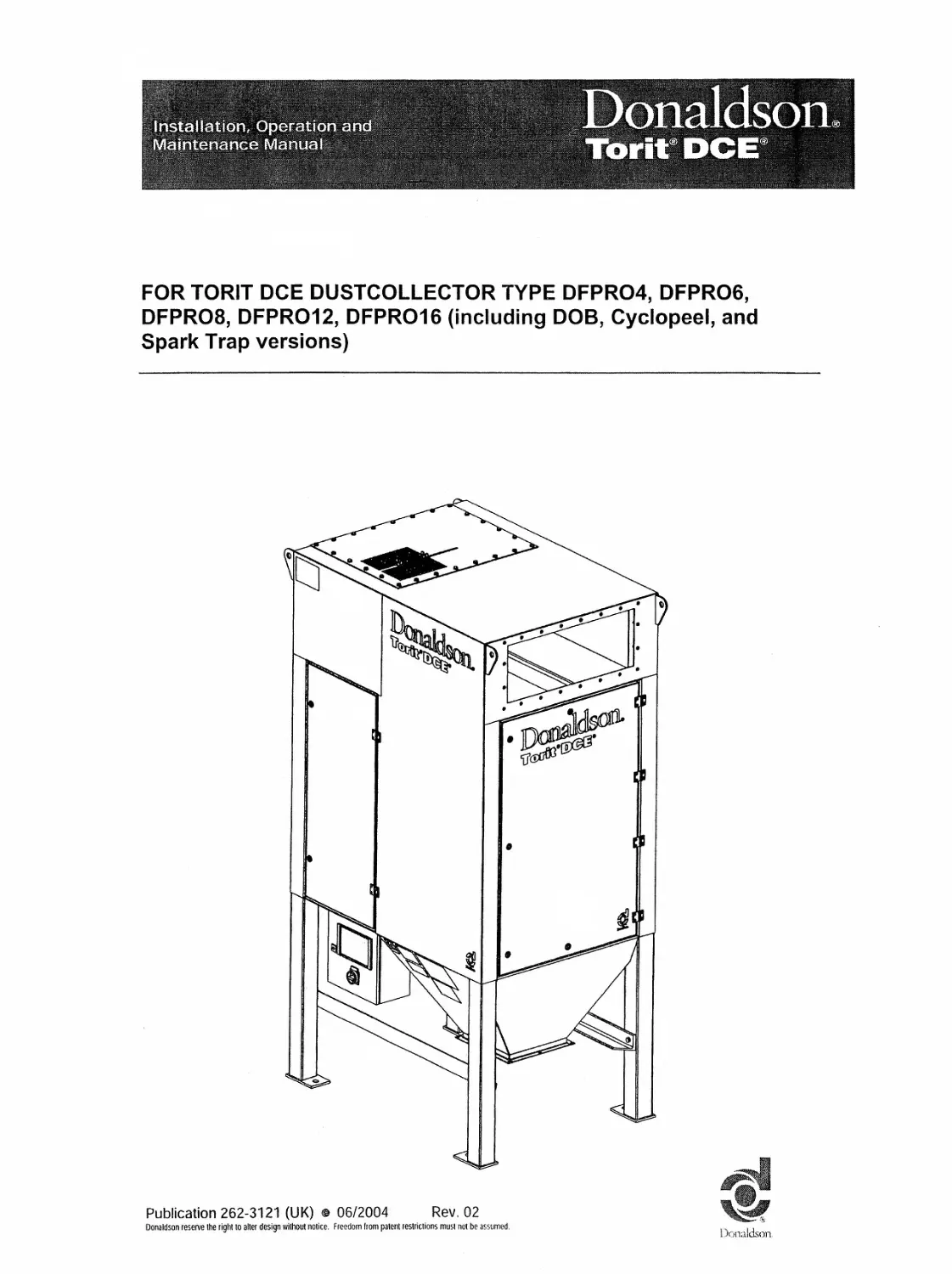
                    FOR TORIT DCE DUSTCOLLECTOR TYPE DFPRO4, DFPRO6,
DFPRO8, DFPRO12, DFPRO16 (including DOB, Cyclopeel, and
Spark Trap versions)
Publication 262-3121 (UK) © 06/2004 Rev. 02
Donaldson reserve the right to alter design without notice. Freedom from patent restrictions must not be assumed.
Donaldson
Installation, operation and maintenance manual
DFPRO 4-16
Donaldson
IMPORTANT
PLEASE READ THIS MANUAL CAREFULLY BEFORE INSTALLATION
THIS MANUAL SHOULD BE READ IN CONJUNCTION WITH THE RESPECTIVE PRODUCT
MANUAL AND CIRCUIT DRAWINGS SUPPLIED WITH THE DUST COLLECTOR
EXPLANATION OF SYMBOLS USED

---------------------------------—---—
- 2 -
Installation, operation and maintenance manual
DFPRO 4-16
Donaldson
TABLE OF CONTENTS
1.	SAFETY RECOMMENDATIONS............................................................4
2.	INTRODUCTION......................................................................5
2.1	Product information............................................................5
2.2	Function.......................................................................5
3.	Prior to INSTALLATION.............................................................6
3.1	Location.......................................................................6
3.2	Required tools and equipment...................................................7
3.3	Delivery and inspection........................................................7
4.	Installation......................................................................7
4.1	Unloading and transport to location............................................7
4.2	Installation and assembly......................................................8
4.2.1 Pre-separators..............................................................8
4.2.2 Fan Set.....................................................................8
4.2.3 Fan box.....................................................................9
4.2.4 In-and Outlets..............................................................9
4.2.5 Platform....................................................................9
4.2.6 Control Box................................................................11
4.2.7 Dust disposal system.......................................................11
4.2.8 Compressed Air Connection..................................................11
4.2.9 Electrical connection......................................................12
4.2.10 Duct connections and	damper valve.........................................12
5.	START-UP CHECKLIST...............................................................12
6.	OPERATION SCHEDULE...............................................................13
7.	SERVICE..........................................................................14
7.1	Dust Removal..................................................................14
7.2	Change of filter Elements.....................................................15
7.3	Diaphragm valve...............................................................17
8.	TROUBLE SHOOTING GUIDE...........................................................19
9.	Spare Parts......................................................................21
10.	Contact addresses................................................................22
11.	CE DECLARATION...................................................................23
LIST OF FIGURE
Figure 1:	Typical Installation View........................................................................5
Figure 2:	Operational Schematic............................................................................6
Figure 3:	DFPRO8 with cyclopeel pre-separator..............................................................8
Figure 4:	Position of fan box..............................................................................9
Figure 5:	Fan box outlet grid..............................................................................9
Figure 6:	Top view........................................................................................10
Figure?: Front view........................................................................................10
Figure 8:	Installation Quick release dust disposal system.................................................11
Figure 9:	Damper valve position...........................................................................13
Figure 10:	Dust removal for quick release dust disposal system............................................15
Figure 11:	Balance pipe pack..............................................................................15
Figure 12:	Exchanging Filter Element......................................................................17
Figure 13:	Diaphragm Valve................................................................................18
- 3 -
Installation, operation and maintenance manual
DFPRO 4-16
Donaldson
1 SAFETY RECOMMENDATIONS_______
_
This manual contains specific precautionary statements relative to worker safety in appropriate
sections. To avoid dangerous situations we give you the following advice:
sFN
HHJ Refers to special information on how to use the dust collector most efficiently.
CiD Refers to special information directed towards preventing damage.
/J—S Refers to special information designed to prevent injury or extensive damage.
a)	The dust collector has been built in accordance with state-of-the-art standards and
recognised safety rules. Nevertheless if not handled carefully, it may put people at risk, or
also cause damages.
b)	The dust collector must only be used in technically perfect condition in accordance with its
designated use and the instructions set out in the operation manual. Any functional
disorders, especially those affecting the safety, should therefore be rectified immediately.
c)	Make sure to give proper training to operators before start-up.
The dust collector is designed exclusively for use in accordance with the scope of
delivery, drawing(s) and the specification sheet.
d)	The dust collector is not designed for applications with combustible materials involving a
potential dust explosion risk (e.g. buffing lint, paper, wood dust, aluminium and
magnesium).
e)	It is not allowed to put lit cigarettes or any burning object into the hood or ducting of any
dust collection system;
f)	Regular maintenance is important for a good performance of your dust collector.
A prudent user of Torit DCE equipment should consult and comply with all relevant Fire
Codes and/or other appropriate codes when determining the location and operation of
dust collector equipment.
A hand-operated supply-disconnecting device is necessary for each incoming electrical
supply in accordance with EN 60204-1.
g)	To prevent accidents the access to the fan wheel must be impossible during operation.
Refer to EN 294.
h)	Disconnect all power before servicing. All electrical work must be done by a qualified
electrician according to local codes.
i)	All exposed conductive parts of the electrical equipment and the dust collector shall be
connected to the protective bonding circuit (refer to EN 60204-1).
j)	Shutoff and bleed-off compressed air supply before doing any service work.
Installation, operation and maintenance manual
DFPRO 4-16
k)	The dust collector cannot be used in a potentially explosive atmosphere (according A TEX
directive 94/91 EC), unless stated otherwise on the nameplate of the unit and scope of
delivery.
2 INTRODUCTION
1.	Lifting lugs
2.	Controlbox
3.	Torit DCE Control Board
4.	Dirty air inlet
5.	Clean air chamber door
6.	Dirty air chamber door
7.	Compressed air connection
8.	Disconnector for electrical power
9.	Lifting profiles
10.	Dust disposal
Figure 1: Typical Installation View
2.1	Product information____________________________________________________________________
The dust collector is used for the collection of airborne dust and particulate. Whether in answer to the
problem of air pollution, or as part of a manufacturing process, the dust collector provides highly
efficient, continuous, on-line dust collection.
The filter elements are the heart of the dust collector. These filter elements help ensure that only
cleaned air is returned to the plant environment.
Technical and field supports are available from your local Torit DCE Representative or Distributors to
answer your questions.
2.2	Function__________________________________________________________________ ____________
During operation, contaminated air enters the dust collector through the dirty air inlet area and passes
through the filter elements.
Dust is collected on the outside surface of the filter elements. The filtered air flows through the centre
of the filter elements into the clean air chamber, where it exits through the clean air outlet and can be
recirculated into the environment.
To ensure the optimal performance of your dust collector it is necessary that the filter elements are
cleaned automatically and sequentially.
During the filter cleaning sequence, the timer energises a solenoid valve, causing the corresponding
diaphragm valve to send a pulse of compressed air through the filter elements (from the inside
outward), removing the collected dust from the outside surfaces of the filter elements.
The dust falls through the hopper into the dust disposal system.
Another important part of the collector is the damper valve integrated in the clean air plenum. It has
two functions: regulating the airflow and protecting new filter elements.
- 5 -
Installation, operation and maintenance manual
DFPRO 4-16
Donaldson
When installing a filter unit on site, different locations have a different static pressure in the incoming
ductwork. The damper valve can be adjusted so the airflow at the unit inlet is always ideal for that
particular dust collector. Please contact your Donaldson representative to find out the best values for
your installation.
When new filter elements are installed it is necessary to reduce the airflow through the filter media.
This way the dust will not penetrate the media and can be cleaned off as described above. After the
elements are conditioned the damper valve can be placed back to its original position.
Operation
1.	Dirty air inlet
2.	Filter element
3.	Hopper
4.	Clean air outlet
5.	Manifold
Filter element cleaning
6.	Diaphragm valve with built on solenoid valve
7.	Tube sheet
8.	Air pulse
9.	Dust (falling)
Figure 2: Operational Schematic
3 PRIOR TO INSTALLATION
You should ensure all persons carrying out work on the supplied equipment follow any
relevant recognised standards or codes and are competent to do so. Areas requiring
competent person include:
•	Lifting and erection
•	Electrical installation, inspection and maintenance
•	Pneumatic installation, inspection and maintenance
3.1	Location______________________________________________
The dust collector should be located with consideration for:
•	emptying the dust disposal (item 11, fig. 1)
•	shortest runs of inlet and outlet ductwork
•	radius bends on elbows as big as possible
•	easy access to electrical and compressed air connections
•	convenience of maintenance.
-6-
Installation, operation and maintenance manual
DFPRO 4-16
Consult the technical specification sheet and drawings for the dust collector weight and
dimensions.
For calculating for foundation or supporting structure consider the following factors:
•	the weight of the dust collector
•	the material being collected
•	and all auxiliary equipment
•	live loads
•	for outdoor installation snow and wind loads
3.2	Required tools and equipment
•	Crane/Fork lift
•	Slings/ Clevis Pins and adequate lifting equipment
•	Standard tools (e.g. screwdrivers, wrenches, etc.)
•	Drill
•	Pipe Sealant
Delivery and inspection
3.3
The dust collector is normally shipped by truck as a completely mounted dust collector and
should be checked for any damage that may have occurred during shipping. Compare the
parts received against the packing list. If there is damage or parts missing, notify the delivery
company and your local Torit DCE representative.
Parts shipped loose with the delivery (depending on your order):
•	Dust disposal system
•	Transition pieces
•	Fan set (if not pre-mounted)
•	Fan box
•	Silencer
•	Platform
•	Spare parts
•	Anchor bolts
•	Cyclopeel
•	Hardware/Sealant
The collector comes with a can of paint with the colour the unit is painted in. Use it to touch up
scratches and dents on the bodywork.
__________________4 INSTALLATION
4.1 Unloading and transport to location
Before unloading remove all packing and strapping.
• A crane is recommended for the unloading, transport and installation of the dust collector.
/Г* *\ Chains or slings with an adequate safe working load must be used. Refer to the collector
nameplate for weight of equipment supplied by Torit DCE. The chains must be long enough to
ensure that the lifting angle between diagonal chains is not greater than 90°. When using a
forklift the forks must be of a suitable length and adjusted to ensure a stable lift.
-7-
Installation, operation and maintenance manual
DFPRO 4-16
Donaldson
•	Possibly a forklift can be used. If using lifting profiles (item 10, fig. 1) pay attention not to hit the
optional quick release dust disposal system.
•	Using plumb line and/or spirit level, line up the unit both horizontally and vertically using shims
under the legs where required.
4.2 Installation and assembly
Anchor the dust collector to the foundations.
If one of the following equipment is ordered and not mounted please follow the according
instructions.
4.2.1 Pre-separators
All pre-separators are no add-on options. They have to be ordered together with the dust
collector.
a)	Cyclopeel
The Cyclopeel is shipped loose and has to be mounted on the dust collector according following
mounting instructions, (see figure 3)
The isolation foam on the cyclopeel side of the clean airside of the unit is shipped loose and has to
be applied when the cyclopeel is mounted.
b)	Spark trap
The spark trap is pre-mounted on the dust collector.
c)	Drop out box
The drop out box is integrated in the dust collector.
4.2.2 Fan Set___________________________________________________________
If the fan set is not pre-mounted, place and anchor on the foreseen position.
When installing your fan:
• Rotate the fan wheel before and after installing into the fan housing to assure proper
clearance.
• Check the rotation of the fan wheel (direction of the arrow).
-8-
Donaldson
Installation, operation and maintenance manual
DFPRO4-16
4.2.3 Fan box____________________________
The fan box is shipped loose and has to be mounted on the unit according following mounting
instructions.
The outlet position can be changed by swapping the grid and the closing cover before
mounting the fan box.
Figure 5: Fan box outlet grid
4.2.4 In- and Outlets
If not pre-mounted, mount the in- and outlets as shown on the specific drawings.
4.2.5 Platform_____________	______ ______________________
The platform is shipped loose and has to be mounted on the unit according following mounting
instructions:
Platform fully galvanised.
Max allowable point load (on surface 200x200 mm): 1500 N
Max allowable load: 200 kg/m2
Grate: 30x30 mm
Self-closing door
-9-
Donaldson
__________________________________ Installation, operation and maintenance manual
DFPRO4-16
Step 1: Mount frames 1 and 2 (optional) on supports on unit and on legs (item 4) (14 x
M 12x35) (figure ‘Front view').
Step 2: (optional). Connect frame 1 and 2 to each other (24 x M 10x35) (figure ‘Front
view’).
Step 3: Mount walking grid (item 5) on the frames with normal fastening (1 fastener -item
10- near each corner) (figure ‘Front view’ + detail).
Step 4: Mount ladder (item 6) on frame (8 x МЮхЗО) (figure ‘Front view).
~ rv
Ladder is shown at 270°, it can be mounted at 90°.
•	Step 5: Mount guardrails (item 7) on frame (56 x МЮхЗО) (figure ‘Top view’)
•	Step 6: Anchor the platform and the ladder to the foundation
1	.Frame service platform
2	.Frame inspection platform
6.	Ladder
7.	Guardrails
Figure 6: Top view
1.	Frame service platform
2.	Frame inspection platform
4.	Leg
5.	Walking grid
6.	Ladder_____________________________________________
Figure 7; Front view
- 10 -
Installation, operation and maintenance manual
DFPRO4-16
Donaldson
4.2.6 Control Box
The control box is factory mounted on the dust collector, according to our standards (except
when specified by order).
All the instructions related to the controls are mentioned in a separate manual (e.g. 262-3103-
UK for Torit DCE Control Board).
4.2.7 Dust disposal system______________________________________________
a)	Quick release dust disposal system
If the system is shipped loose it has to be mounted on the unit according figure 5.
b)	Other systems
Other available dust disposal systems (container, screw conveyor, etc...).
4.2.8 Compressed Air Connection
•	Compressed air pressure must be between 6 and 7 bar.
•	Be sure that all compressed air components are adequately sized to meet the maximum
system requirements of 45 Nliters per pulse at 7 bar supply pressure (= design pressure).
•	It is a requirement that adequate precaution is taken to avoid exceeding this pressure.
Relief, safety valve is required if the connected supply can exceed this pressure. A label is
also attached to each manifold indicating manifold design details.
•	Compressed air supply must be both oil and moisture free.
•	The piping should be installed to provide a fall in the directions of the airflow to assist in
the drainage. A blow-down cock should be provided at the lowest point of the installation.
•	Purge compressed air lines to remove debris before connecting to the manifold.
•	Connect the compressed air supply line to the compressed air connection of the dust
collector (item 8 fig. 1)
•	Use thread-sealing tape or pipe sealant on all compressed air connections.
- 11 -
Installation, operation and maintenance manual
yy	DFPRO 4-16
Donaldson
• A compressed air shut-off valve, a filter/water separator with automatic condense drain, a
pressure regulator with gage must be installed on the compressed air supply line. Locate
these components for convenient service, in the immediate vicinity of the dust collector.
£ *> Alternative cleaning gases should be assessed before use to ensure explosive atmospheres
are not introduced.
4.2.9 Electrical connection
Amperage and voltage information is shown on the nameplate ratings of the fan motor. Over
amperage of motor will cause damage.
If the fan is not pre-mounted, connect the fan motor to the control box according wiring diagram.
Connect the main power to the control box according the wiring diagram included in the control
box.
Check the rotation of the fan wheel (direction of the arrow on the fan housing). If the fan is
running in the wrong way, it will deliver only approximately 40 % of its rated air volume.
Lock out all electrical input power and interchange any two wire leads (3 phase only) on the
output side of the motor starter to reverse fan rotation.
4.2.10 Duct connections and damper valve
Connect::
•	Fan and dust collector
•	Inlet
•	Outlet if needed
All connections have to be sealed properly.
If not integrated in the unit it is ABSOLUTELY NECESSARY to install a damper to adjust the
airflow.
There are 2 different kinds of standard damper valves. The smaller dust collectors with a fan until 3
kW integrated will have a damper valve (sliding gate) in the roof. The dust collectors with a bigger fan
integrated or mounted on the roof will have an integrated damper valve with access via the clean air
chamber door.
Both damper valves can be adjusted by unfastening the bolts so the valve can be slided. Please make
sure to fasten the bolts afterwards. An opening of 50 % is a factory pre-setting.
4.2.11 Anti-static earthing
It is particularly important on collectors having anti-static filter elements that the earthing post
(located adjacent to the earthing location sticker) is properly connected to earth, using the brass
screw provided, to prevent any static build-up.
5 START-UP CHECKLIST
•	Follow all steps before first start-up and when the dust collector is not been used for a
long period.
•	For daily use follow steps 1, 2, 4, 5 and 7.
1.	Check that the outlet of the fan is free of debris before starting.
2.	Make sure the dust disposal system is properly installed under the hopper.
- 12-
/Ы Installation, operation and maintenance manual
DFPRO4-16
Donaldson
Too much airflow can cause electrical failure of the fan motor or dramatically reduce the life of
the filter elements.
3.	With new filter elements the damper valve wingnut should be positioned at the 50% marking,
(figure Damper valve position)
4.	Check if the access doors are closed.
5.	Switch main power on and press switch ‘on’.
6.	Check the airflow with a pitot tube and a micro-manometer in the ductwork and adjust the damper
valve to the desired airflow.
In case of an integrated damper valve, switch the fan off before opening the access door to
increase!decrease airflow.
7.	Turn on the compressed air supply. Adjust to 6.5 bar of pressure with the compressed air regulator.
Do not increase compressed air pressure beyond 7 bar as component damage may result.
The cleaning cycle only starts when necessary. For customised settings see the controller manual.
6 OPERATION SCHEDULE__________ '	*
To ensure a good performance of your dust collector follow the checkpoints mentioned below
according the timetable.
No.	Checkpoint	Type of control	Recommended action	Day	Weeks
					2	4	8	26
1.	Control board	Visual check alarm light (illuminated)	See trouble shooting guide in Control manual	X
2.	Dust disposal system	Check contents of dustbin(s)	If % full, empty dustbin (see chapter 7.1)	X
3.	Fan set	Excessive noise	See trouble shooting guide chapter 8	X
4	Clean air chamber	Emission : dust carry over in clean air chamber	See trouble shooting guide chapter 8		X
. ia.
Installation, operation and maintenance manual
DFPRO 4-16
Donaldson
No.	Checkpoint	Type of control	Recommended action	Day	Weeks
					2	4	8	26
5	Damper valve	Check position of damper valve	Wingnut at 50% when the elements are new; at 100% when the elements are conditioned		X
6	Controls settings	Check settings of both potentiometers (pulse time 100 milliseconds, interval time 10 seconds) on the control board (see separate manual)	Interval time normally to be set at 10 seconds. Pulse time 100 milliseconds.		X
7	Filter/regulator	Oil and/or water is in the reservoir	Switch off and bleed compressed air prior servicing. Clean oil/water separator. Check compressor.		X
8	Diaphragm valves	Noise of escaping air is produced	See trouble shooting guide chapter 8			X
9	Doors	Visual check gaskets	Replace gaskets if necessary			X
10	Connecting ducts	Check for leakage	Repair if necessary				X
11	Dust collector and platform	Check damage, strength and corrosion	Repair or replace if necessary					X
12	Filter element	Preventive replacement of all filter elements (see chapter 7.2)	Unless otherwise specified in the scope of delivery every 2 years.
7 SERVICE ___________________
/*\ • Disconnect electrical power before servicing.
•	Shut off and bleed compressed air supply before servicing any compressed air
components.
•	No welding should be performed inside without fire protection.
•	Avoid contact or exposure to dust during servicing or maintenance.
7.1 Dust Removal
Do not let the dustbin overfill. It can cause poor dust collector performance.
Turn off the dust collector and empty the dustbin on a regular base (recommend to empty the dustbin
when 3/4 full).
The bin can be installed and removed as shown below:
- 14 -
Installation, operation and maintenance manual
DFPRO 4-16
Donaldson
1. Lift the handle
2. Remove and empty the bin
3. Install the bin
4. Push handle completely down_______________________________________________
Figure 10: Dust removal for quick release dust disposal system
If plastic bags used a pressure balance pipe is recommended. If shipped loose it has to be mounted
according figure 7.
1.	Socket
2.	Hose clamp
3.	Pressure balance pipe
4.	Rubber sealing
5.	Plastic bag
6.	Elbow balance pipe______________________________________
 Figure 11: Balance pipe pack
A hole is already predrilled in the back of the hopper for the connection. If the system is installed to
remove the bin from the back (0° position), a hole (dia 28.5 mm) has to be drilled on the opposite side
of the hopper. The predrilled hole has to be closed.
/*\ Where the dust has self-heating properties, it is important to remove any deposits in the dust
container to reduce the risk of an explosion
In case of a spark trap: don't forget to empty it. Use a vacuum cleaner through the access
cover on the spark trap.
7.2 Change of filter Elements__________________________________
(see figure ‘Exchanging filter element’)
-15-
Installation, operation and maintenance manual
DFPRO4-16
Donaldson
All filter elements should be changed at the same time.
Dust laden filters may be heavy and difficult to handle. Provide appropriate means of access
to replace filter elements safely in case no platform is installed.
1.	Open the dirty air chamber door by using the delivered key.
2.	Remove filter element cover by unscrewing the wing nut counter clockwise. Set cover aside.
3.	Rotate the filters to break the gasket seals between the filter element and the tube sheet (see
figure ‘Operational schematic’) and dump any loose build up dust off of the top of the filter element.
Slide the filter element along the yoke and out of the dust collector.
The genuine Torit DCE filter element is the only replacement filter that will provide the
high level of performance that you expect from your investment in the Torit DCE Dust
collector.
• Do not drop the new filter element on the floor or any other hard surface. Damage to the
filter element will occur, resulting in leakage.
It is necessary to clean the dust off of the tube sheet all around the opening to ensure a
positive seal of the filter gasket.
4.	Slide the new filter element along the yoke with the gasket end facing inward toward the clean air
chamber.
5.	Reinstall the cover and screw the wing nut clockwise onto the yoke. Tighten securely, to prevent
leakage, by hand, do not use any tools to achieve this.
If the gasket is damaged the cover has to be replaced.
Lack of compression of the filter gaskets can cause leakage.
If the door gasket is damaged, it has to be replaced.
6.	Clean the gasket of the dirty air chamber door.
7.	Close the dirty air chamber door by using the delivered key.
- 16-
Installation, operation and maintenance m a n u a I
DFPRO 4-16
Donaldson
1.	Dirty air chamber door
2.	Filter element
3.	Cover
4.	Yoke___________________________________________________
Figure 12: Exchanging Filter Element
7.3 Diaphragm valve__________
Valve disassembly and reassembly
Depressurise valve before making repairs.
/К
Z-i-Д To avoid damage to the valve body, DO NOT OVERTIGHTEN PIPE CONNECTIONS. If
Teflon tape, paste, spray or similar lubricant is used, use extra care due to reduced friction.
- 17-
Installation, operation and maintenance manual
DFPRO 4-16
Donaldson
Depressurise valve. Proceed in the following manner:
1.	Remove bonnet bolts and valve bonnet.
2.	Diaphragm assembly is now accessible for cleaning or replacement. Replace diaphragm assembly
if worn or damaged.
3.	Reassemble in reverse order of disassembly paying careful attention to exploded views provided
for placement of diaphragm assembly.
4.	When replacing diaphragm assembly be sure marking "THIS SIDE OUT" on diaphragm assembly
faces valve bonnet and that bleed hole in diaphragm assembly is in alignment with cavity in valve
body and bonnet. The external contours of the diaphragm, body and bonnet must all be in
alignment.
5.	Replace bonnet bolts and tighten in a criss-cross manner. Torque bonnet bolts (4) 7 ± Newton
meters.
6.	After maintenance operate the valve a few times to be sure of proper opening and closing.
1.	Retainer clip (*)
2.	Coil
3.	Washer spring
4.	Bonnet bolts (4)
5.	Sol base sub assembly (torque to 20 Nm)
6.	Silencer (*)
7.	Spring (*)
8.	Core assembly (*)
9.	Valve bonnet
10.	Marking "THIS SIDE OUT" on diaphragm assembly to face valve bonnet
11.	Diaphragm valve (*)
12.Bleed hole in diaphragm assembly must be in alignment with cavity in valve body and bonnet. The
external contours of the diaphragm assembly, body and bonnet must be in alignment.
13.Valve body
(!) Place conical spring end on top
(*) Parts included in the diaphragm repair kit
Figure 13: Diaphragm Valve
- 18 -
Installation, operation and maintenance manual
DFPRO 4-16
Donaldson
8 TROUBLE SHOOTING GUIDE
Please consult other manuals if necessary (e.g. controls, fans...)
/*\ Disconnect all power and compressed air supply before services.
TROUBLE	POSSIBLE CAUSE	REMEDY
A. Fan does not start	1. Not wired correctly. 2. Proper wire size not used for motor	Check and correct internal motor wiring for proper connections for your voltage (see Wiring Diagram) Rewire per national and local electric codes for proper wire size.
B. Fan set starts, but does not	1. Incorrect overload protection is	Check for proper motor
keep running	installed 2.	Dust collector doors are open or not closed tight 3.	Hopper open to atmosphere 4.	Damper valve not adjusted properly 5.	Electrical circuit fuses	overload protection. Reset or replace if needed for proper value. Tighten doors securely (see figure 1) Install dust bin under hopper and seal securely Check airflow in ducting for proper requirements. Adjust the damper valve until the proper airflow is achieved. Do not attempt to run without inlet ducting attached, (see chapter 5) Check if the supply circuit has sufficient power to run all equipment
C. Excessive noise/vibration of the fan this happens it should be rectified at once	1.	Dust deposit on the blades 2.	Worn blades 3.	Worn bearings	Clean the blades The fan wheel has to be replaced The bearings has to be replaced
D. Dust emission	1.	Filter elements installed improperly 2.	Filter element damage, dents in the end caps, gasket damage or holes in pleated media 3.	Doors not airtight	Check that gaskets on the filter element(s) are firmly pressed to the tube sheet (the wing nuts of the filter elements should be fully tighten by hand). Replace the filter elements, (see chapter 7.2) Tighten doors securely and check sealing
E. Insufficient airflow	1. Fan wheel rotating wrong way	Check fan rotation. Refer to rotation sticker on fan housing (gee chapter 4.2.2)
- 19-
Installation, operation and maintenance manual
DFPRO 4-16
Donaldson
TROUBLE	POSSIBLE CAUSE	REMEDY
E. Insufficient airflow	2.	Openings not properly sealed 3.	Outlet is restricted 4.	Filter elements plugged : a.	Lack of compressed air b.	Pulse cleaning not energised c.	Dust disposal system is too full or	Check doors, that they are closed and tightened securely (see figure 1). Also check hopper area that openings are closed off and that the hopper dust disposal is installed. Check outlet for blockage. Remove material or debris that is blocking the outlet. Check compressed air supply for 6 bar minimum. Increase pressure at maximum 7 bar. Refer to the trouble shooting guide from the Control manual Clean out dust disposal system
(continued)	plugged	as described in chapter 7.1
F. Excessive noise of a	d.	Hopper full of dust or plugged e.	Slide gate valve (if fitted) closed under hopper f.	Filter elements need to be replaced 5. Solenoid valves/diaphragm valves are not functioning a.	Solenoid valves/diaphragm valves are leaking compressed air b.	Pulse control printed circuit board has failed or is out of adjustment 1. Failure on the diaphragm valve	Clean out the hopper Open slide gate cover under hopper Replace the filter elements (see chapter 7.2) Check for debris, obstruction, valve wear or diaphragm failure by removing the diaphragm cover on the solenoid valves. Also check for solenoid leakage damage. If diaphragm valves or solenoid valves are damaged replace it or replace damaged part(s). Refer to Operating manual of the Controls. Check for debris, obstruction,
diaphragm valve		valve wear or failure by removing the diaphragm cover. If the diaphragm valve is damaged, replace it or replace damaged part(s).
-20-
Installation, operation and maintenance manual
DFPRO 4-16
Donaldson
9 SPARE PARTS
Item N?	Part number	Description	 -
2 Hg. 2	262-5112	Torit DCE filter element Ultra-Web®	see scope of
2 Пд. 2	262-5115	Torit DCE niter element Ultra-Web® FR	delivery for type of
2 Пд. 2	262-5116	Torit DCE niter element Fibra Web®	niter element
2 fig. 2	262-5117	Torit DCE niter element Torit-Tex™	installed in your
2 Пд. 2	262-5125	Torit DCE niter element Thermo-Tek™	dust collector
6 Пд 2	262-0139	Diaphragm valve 1”
Пд 10	262-0087	Diaphragm valve repair kit
6 fig 8	726-1996	Cover
/	262-2564	Key door locks
/	262-2612	Key controlbox
/	AD1000279	plastic bag for balance pipe pack
/	262-2569	Door gasket	Length to be speeded
In order to maintain the original collector specification and to ensure the same level of safety,
only genuine spare parts should be fitted.
Г~Т\
I w»1
I «♦»’ KWC I
I WW IKSk. I
E-£J When ordering parts, give model number and serial number of dust collector, description and
quantity of parts desired
-21 -
Donaldson
Installation, operation and maintenance manual
“dFPRO 4-16
10 CONTACT ADDRESSES
Donaldson Europe B.V.B.A.
Torit-DCE Products
Interleuvenlaan 1
В - 3001 Leuven (Heverlee)
Belgium
Tel.(gen): + 32 (0)16 383 811
Tel.(sales) : +32 (0)16 383 970
Fax : +32 (0)16 383 938
Donaldson
Torit-DCE Products
Humberstone Lane
Thurmaston
Leicester LE4 8HP
United Kingdom
Tel. +44 (0) 116 269 6161
Fax:+44 (0)116 269 3028
E-mail: IFS-europe@emea.donaldson.com
-22-
Installation, operation and maintenance manual
DFPRO 4-16
Donaldson
__________11 CE DECLARATION
/и к J
' - 7	EC DECLARATION OF CONFORMITY
(Machinery directives 89/392/EEC and 91/368/EEC)
Manufacturer:	Donaldson® Europe B.V.B.A.
Interleuvenlaan 1 - B-3001 Leuven, Belgium
Desci iption of the machinery: Dust Collector
Brand:	Donaldson torit DCE
Type:	DFPRO
Description: see attached scope of delivery
The undersigned, authorised by Donaldson Europe NV, certifies that the machine described above,
provided that it is installed, maintained and used in accordance with the instructions for use and the
codes of practice, meets the essential safety and health requirements of the "machinery" Directive and
the following stipulations and standards:
-	Machinery directives 89/392/EEC and 91/368/EEC
-	Low voltage directive 73/23/EEC
-	EN 60204-1 (ed. Oct. 92) safety of machinery. Electrical equipment of machines - General
requirements
-	Pressure equipment directive (97/23/EC)
-	Electromagnetic compatibility Directive 89/336/EEC
And the essential principles of the following standards
-	EN292-1/-2 (ed. Sept 91) Safety of Machinery
-	EN294 (ed. Jan.93) Safety of Machinery - Safety distances to prevent danger zones being reached
by upper limbs.
IMPORTANT! Read the Operation and Instruction Manual before using this machine. If you
require additional copies contact your local Donaldson Torit DCE representative.
The machinery must not be put into service until the machinery into which it is to be incorporated has
been declared in conformity with the provisions of the above mentioned directives.
Signature:	Date: 13 June 2005
Name: Jos Dottermans
Position: Business and Product Development Director IFS
- 23 -