/














































































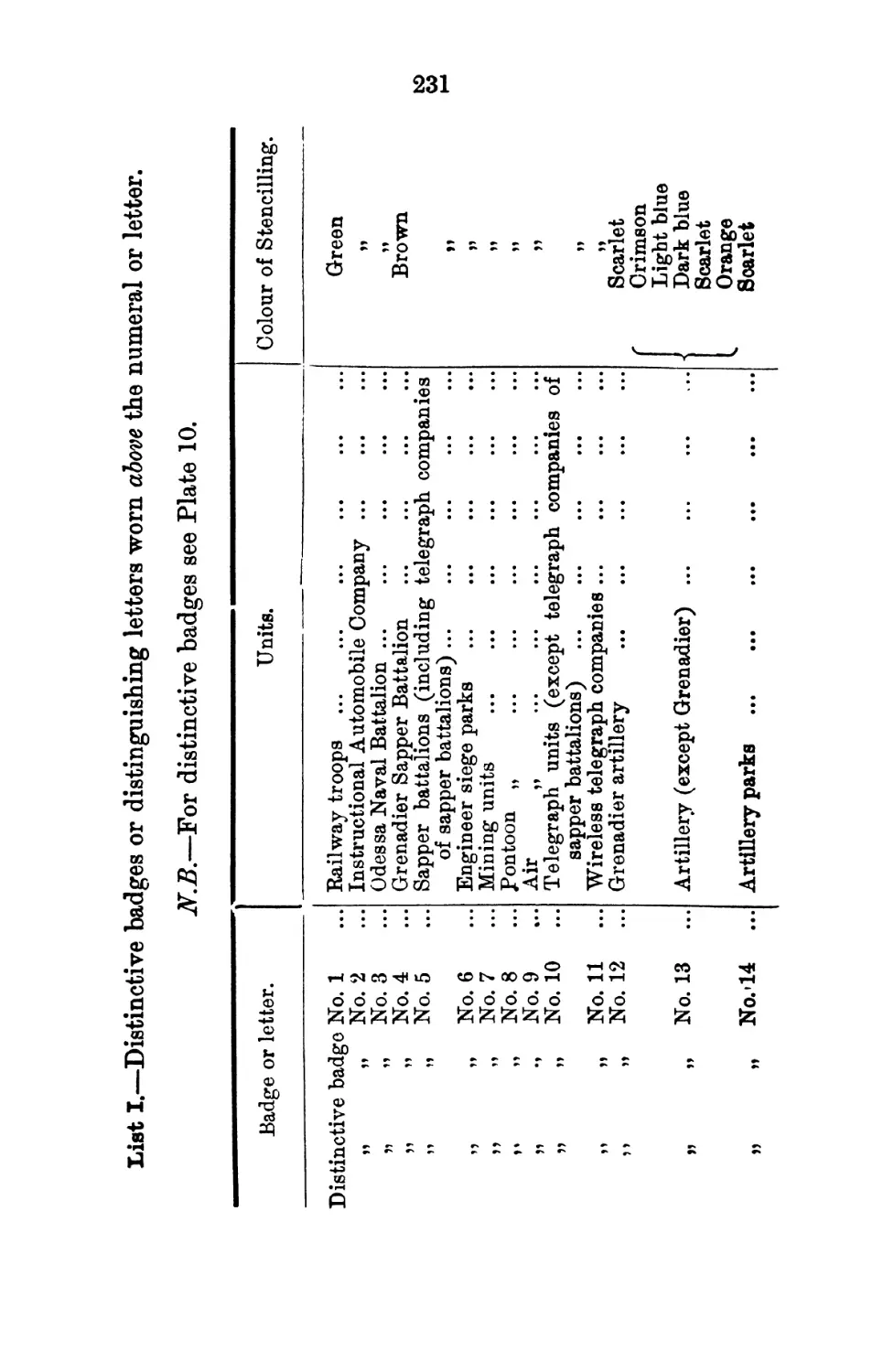
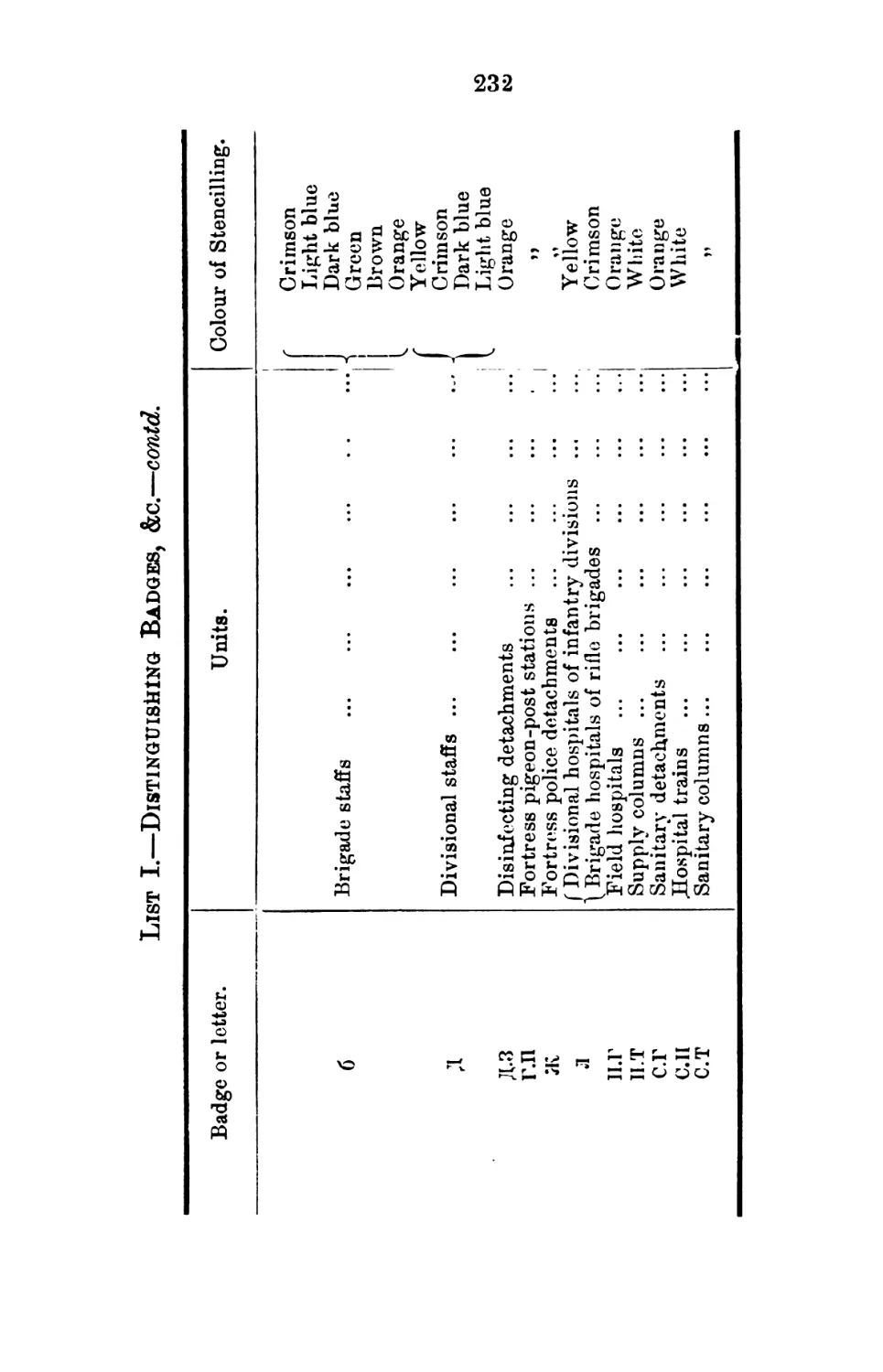


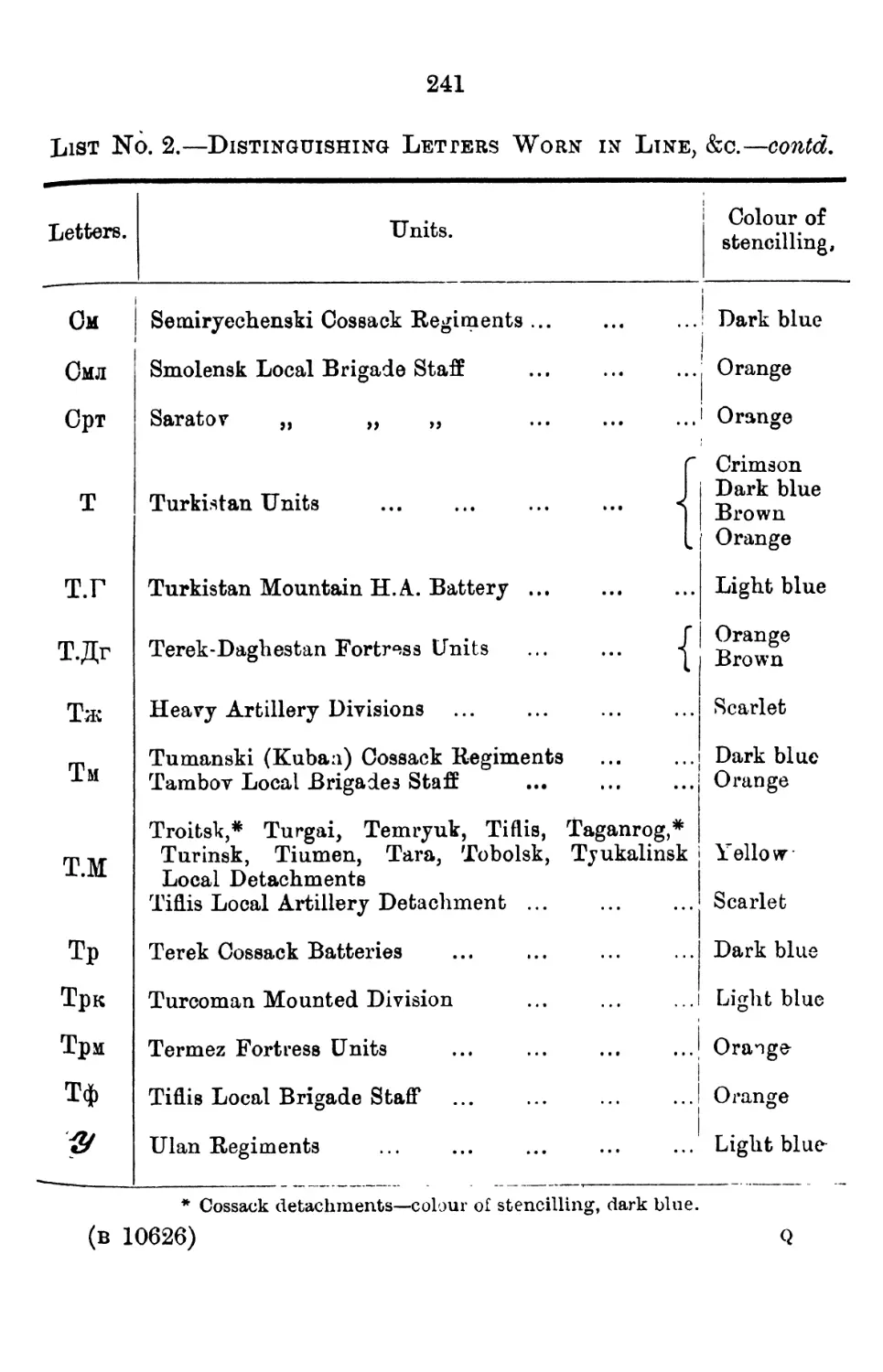

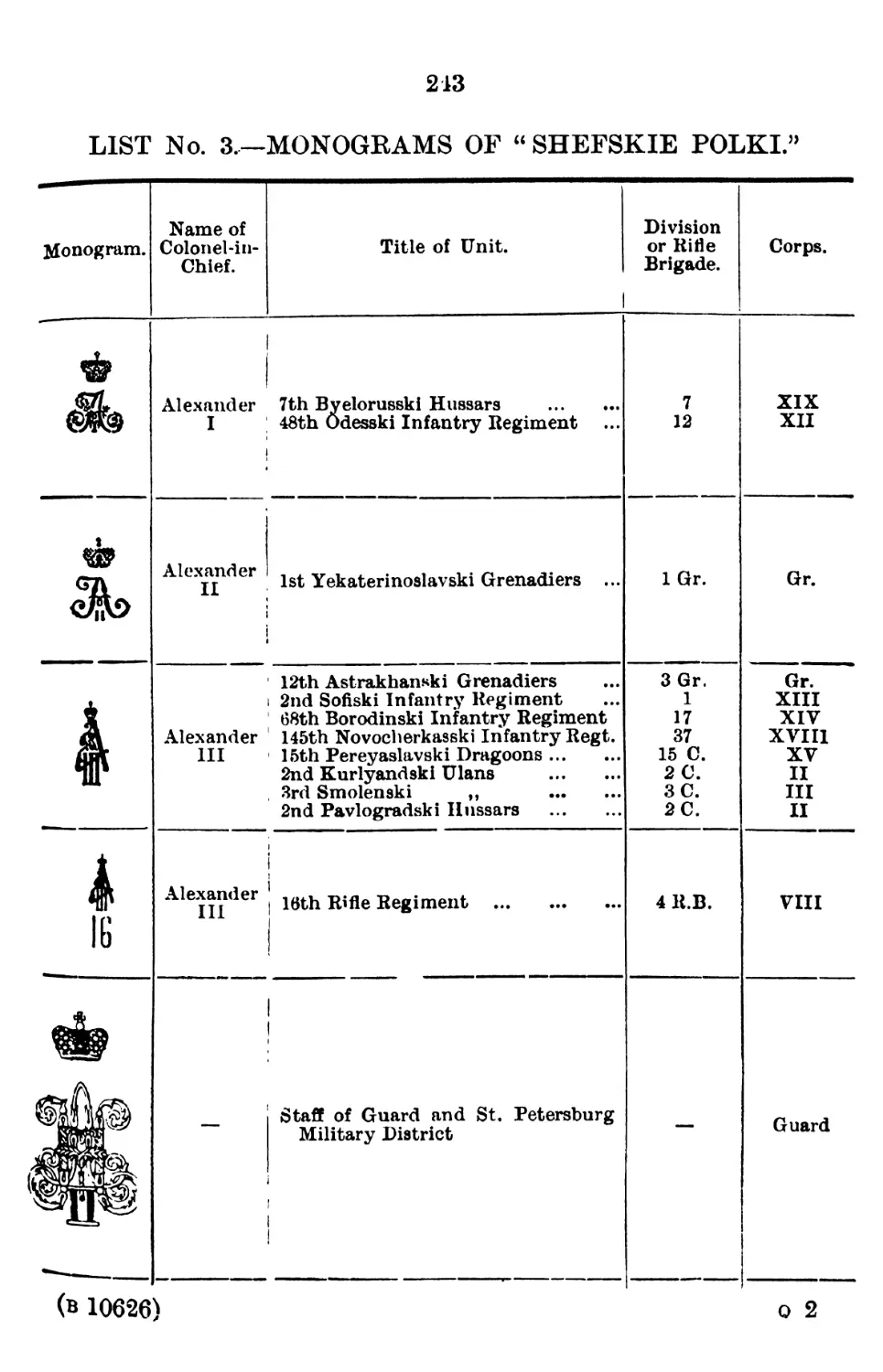






























Tags: weapons military affairs military equipment army russian army
Year: 1914


Text
                    dbook of the Russian Army 1914
HANDBOOK
OF THE
RUSSIAN ARMY.
SIXTH EDITION.
GENERAL STAFF, WAR OFFICE.
1914.
(Corrections published in Russian Army Orders up to
the end of 1913, are included in this Edition.)

iii
PREFACE.
Since the last edition of this handbook was published in
1908 the Russian army has passed through a stage of re-
organization. The so-called “reserve formations,” which
were to all intents and purposes first line troops, have been
abolished and in their place have been created six new army
corps, bringing the total number of army corps up to 37.
Various other changes have been introduced to render the
higher units homogeneous and thus simplify mobilization.
The artillery has been re-armed, a division of howitzer
artillery has been added to each army corps, and seven
divisions of heavy field artillery created. The infantry and
cavalry have been equipped with machine gun detachments.
A new law of military service has been published.
Other important changes are impending. Russia has
decided to form several new army corps, a reorganization of
the artillery into 6-gun batteries instead of 8-gun is believed
to be in progress, new cavalry regiments are to be raised,
and the organization of the air services is being completed.
It is also probable that a change will be made in the terms
of service, in order to retain the contingent which has com-
pleted the present term of service with the colours till the
new contingent has received sufficient training to be able to
take its place in the ranks. The effect of this last change
will be to increase the peace establishment of the Russian
army during the winter and spring months by some
400,000—500,000 men.
The establishments of the Russian army have not been
published since 1910. The figures given in this handbook
are based on those published in 1910 and on unofficial
sources ; they should be taken as approximately correct
only,
(в 10626)	A 2
iv
CONTENTS.
PAGE
Chapter I.—Law of Military Service—Recruiting ...	7
„	II.—The Administration and Organization
of the Army in Peace... ...	...	18
„	III.—The Organization of the Army in War 24
„	IV.—Infantry ...	...	...	...	...	39
„	V.—Cavalry .............................. 53
„	VI.—Artillery ...	...	...	...... 62
„	VII.—Technical Troops.................... 77
„	VIII.—Special Corps and Departments and
Educational Establishments...	...	90
„	IX.—Medical and Veterinary... ...	...	100
„	X.—Transport, Supply and Intendance ... Ill
„	XI.—Tactics ............................ 125
APPENDICES.
PAGE
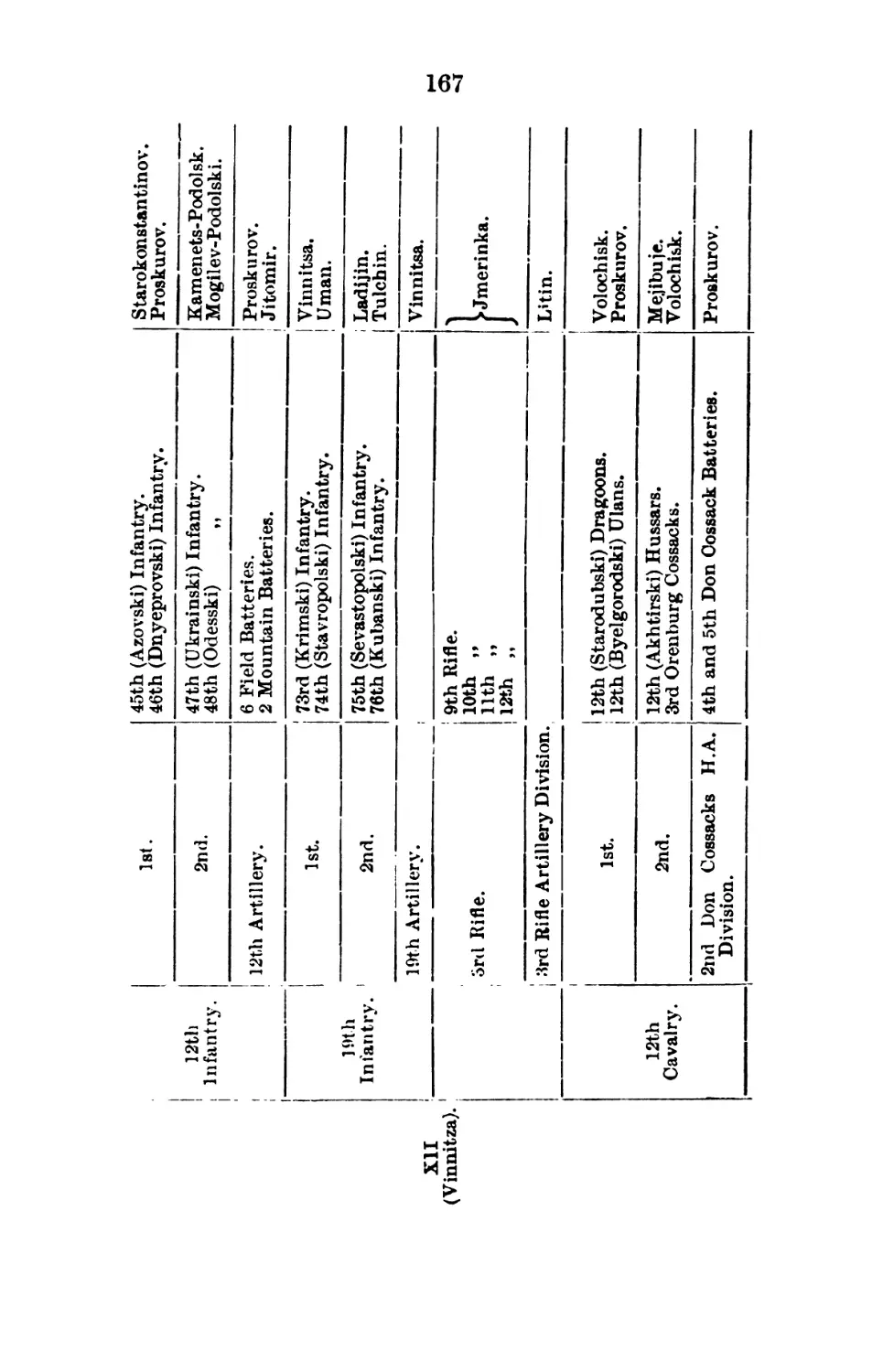
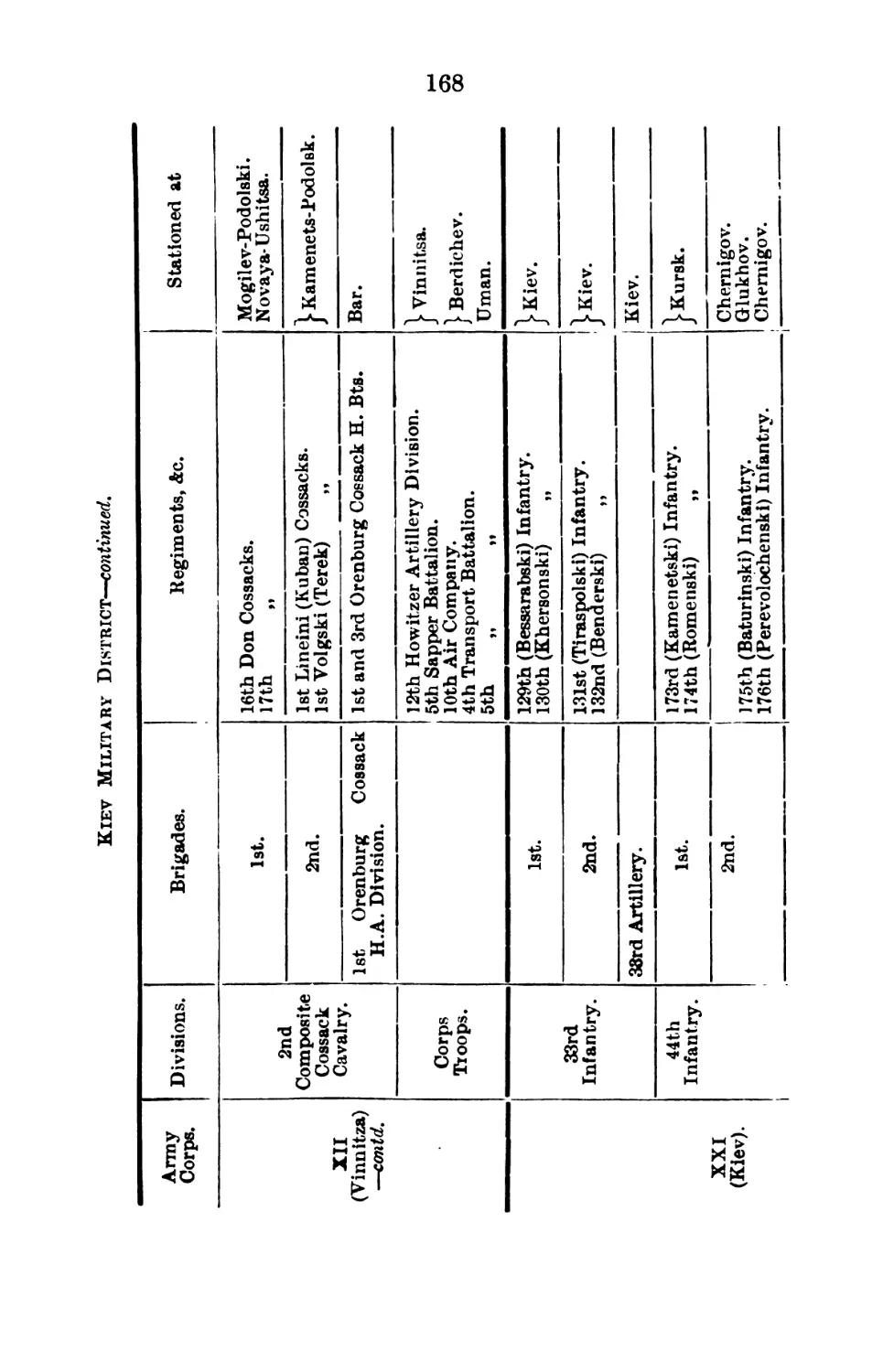
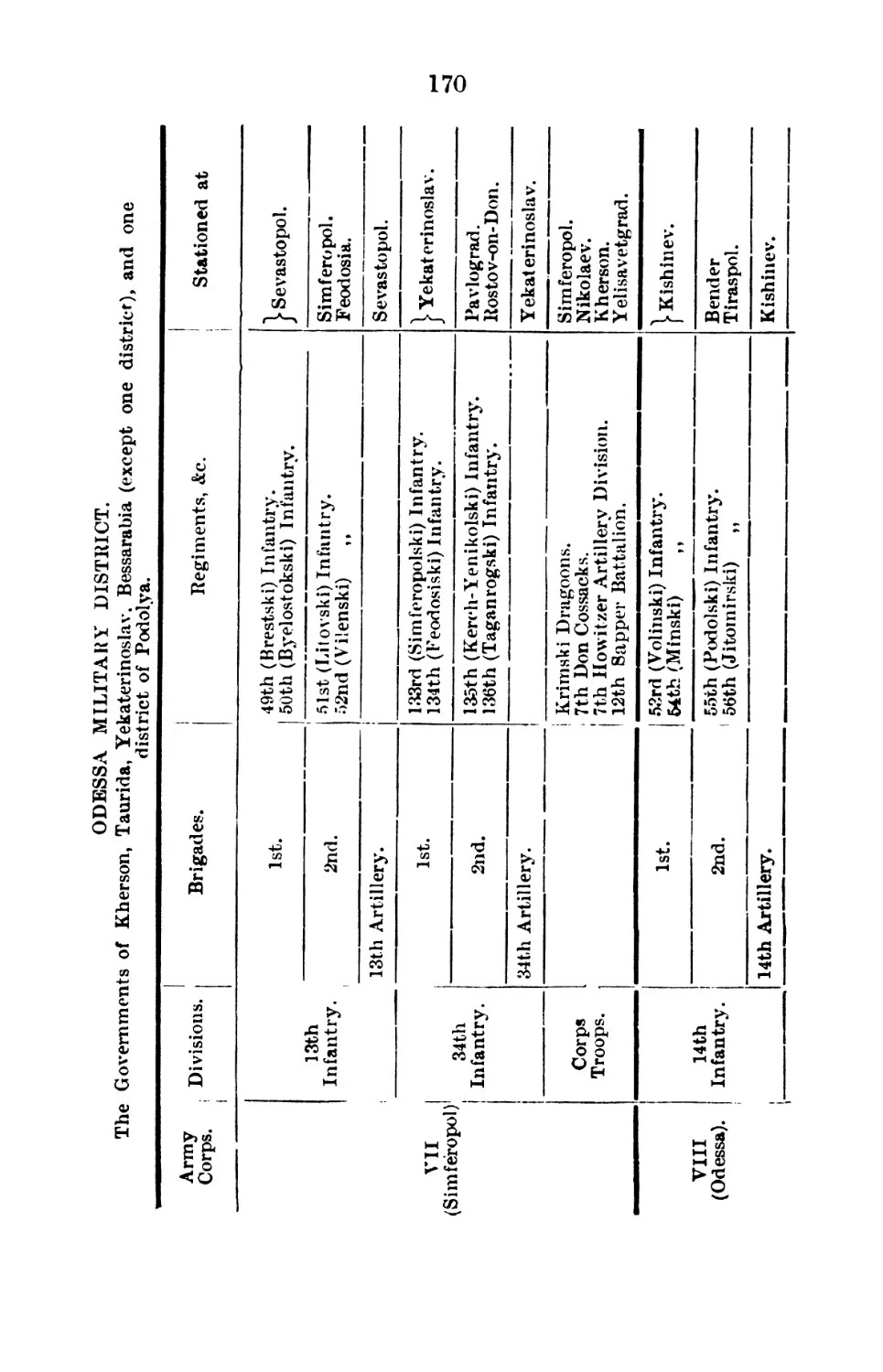
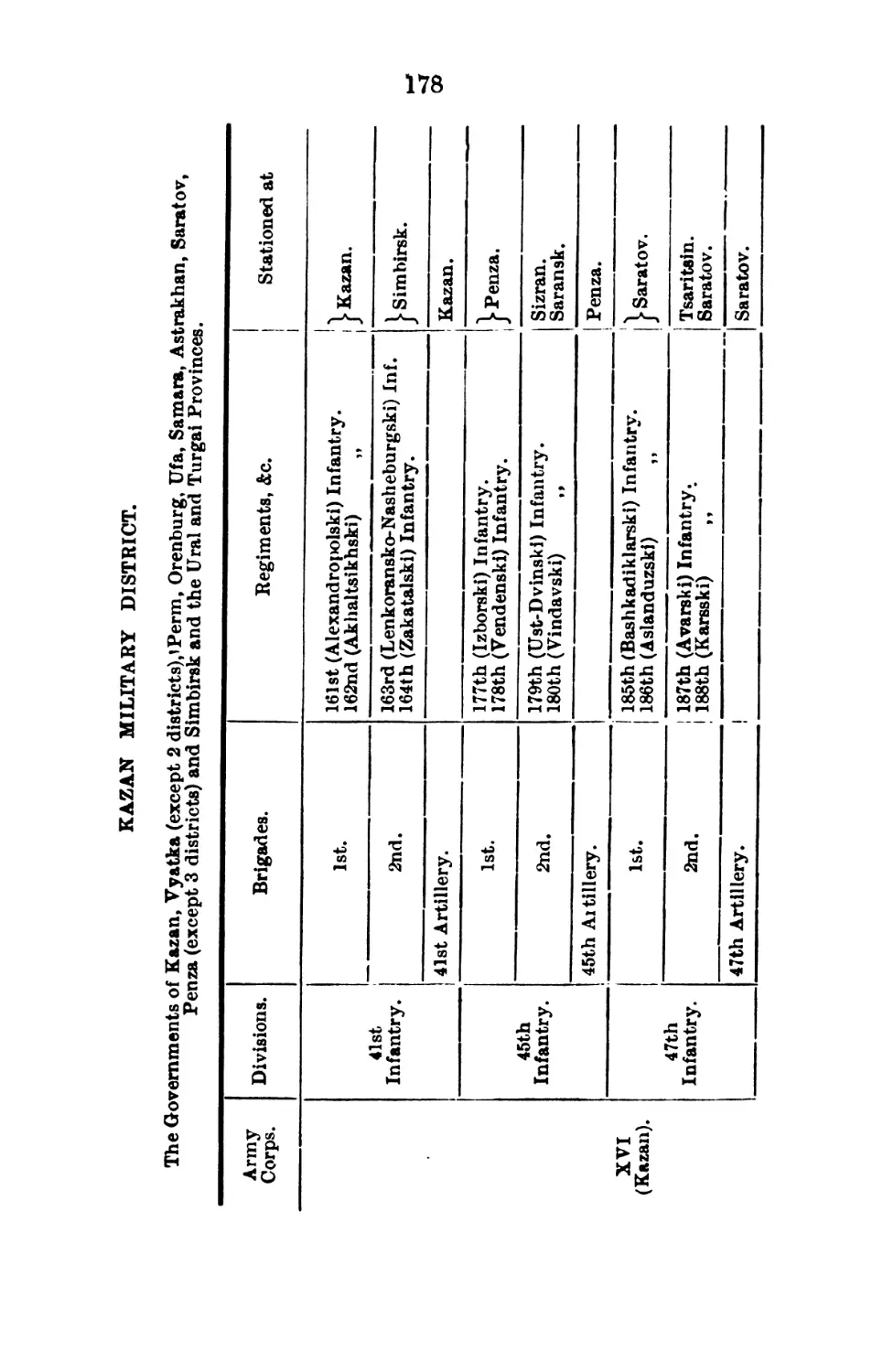
I	.—Peace Distribution of the Field, Cossack and
Fortress Troops ...	...	...	...	145
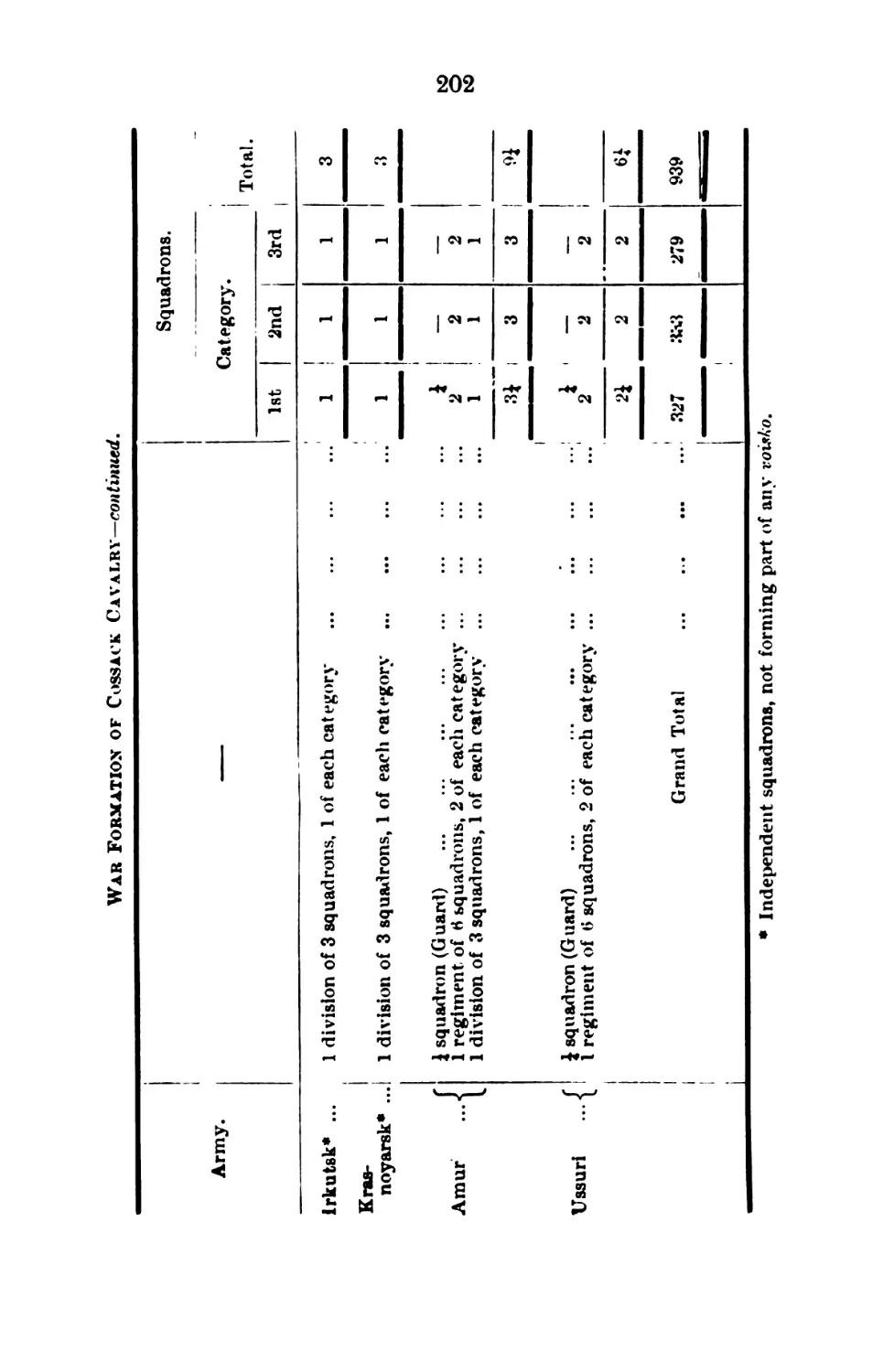
II	.—War formation of Cossack Cavalry ...	...	199
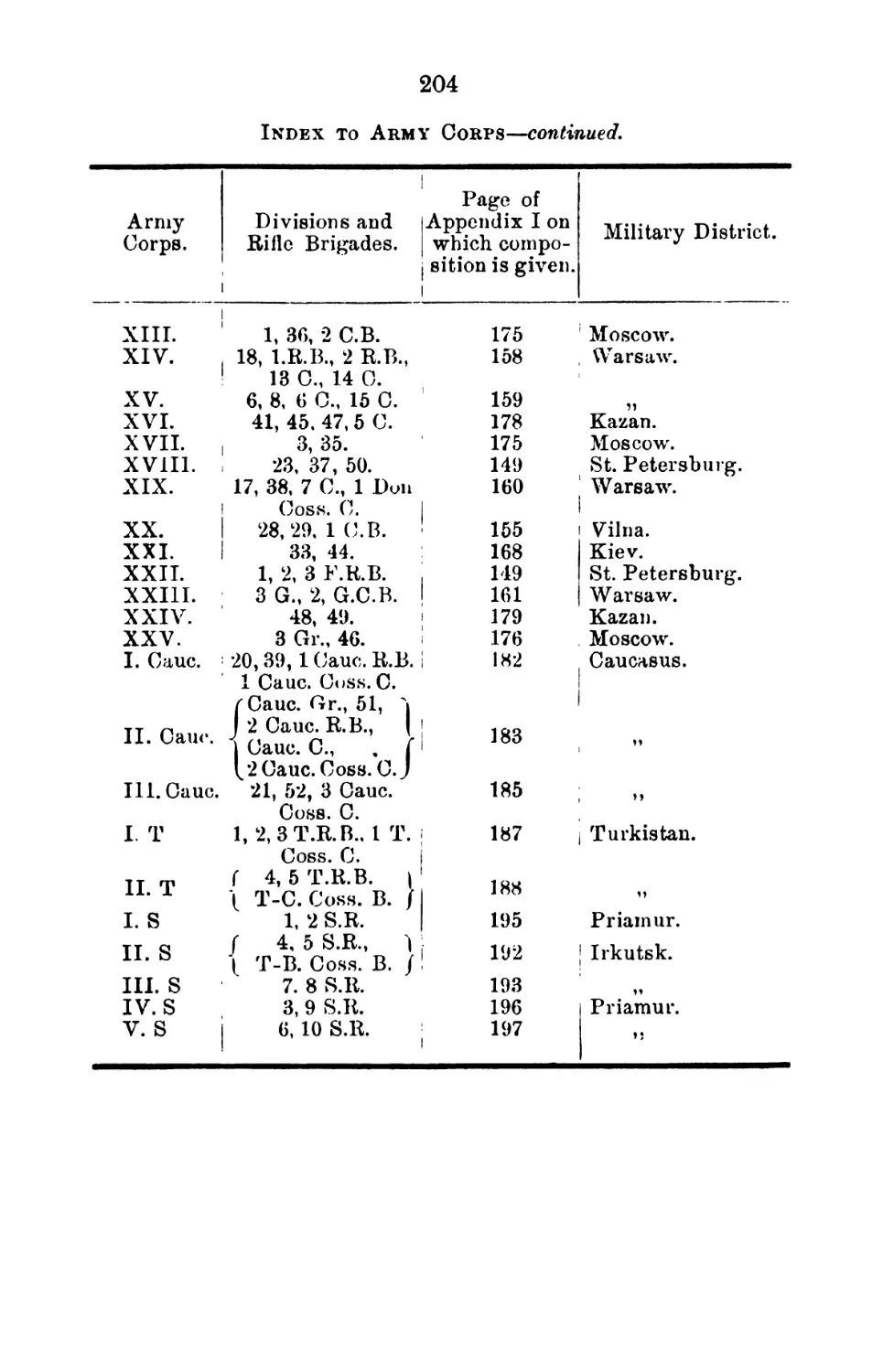
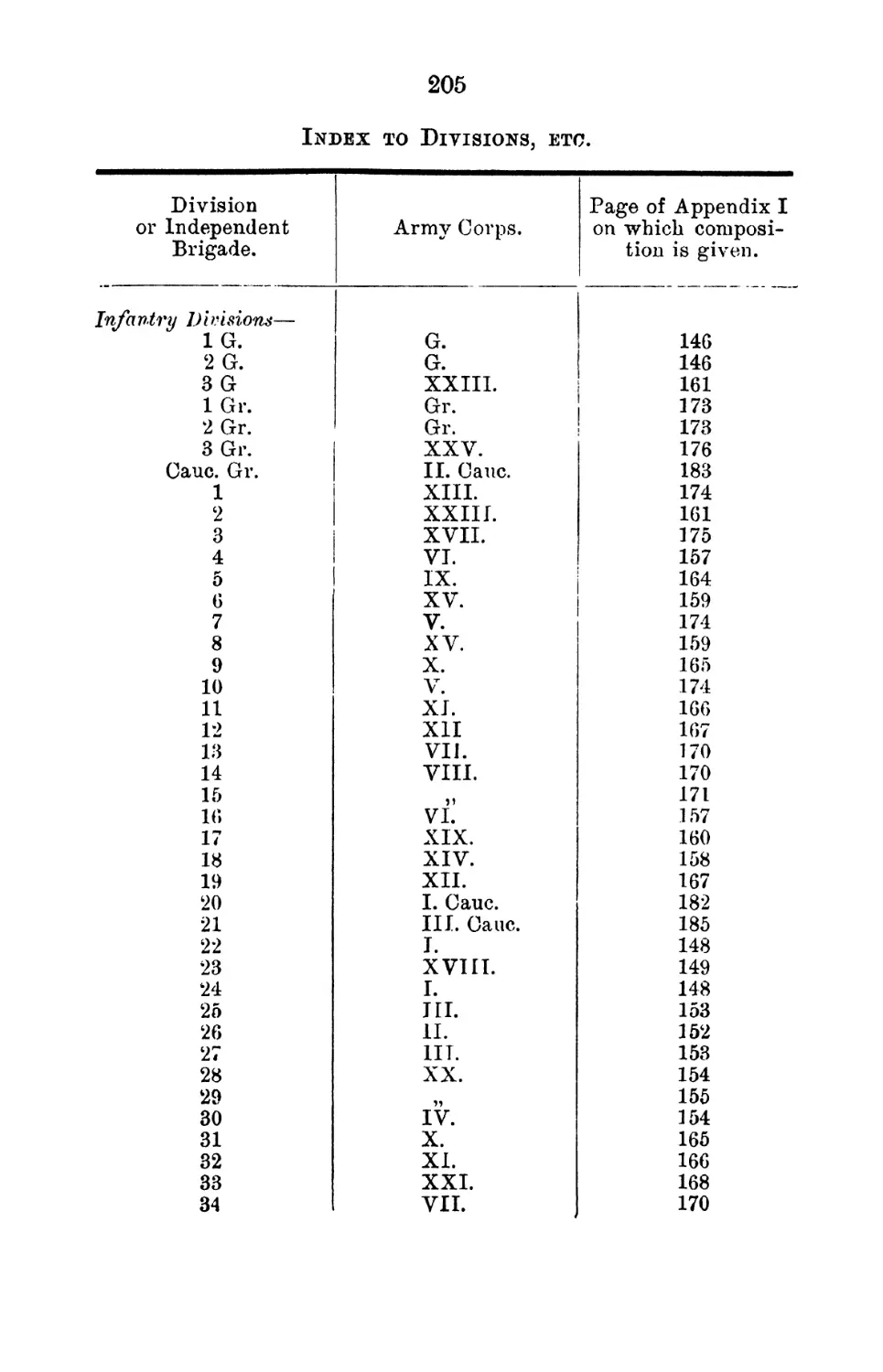
III	.—Index to Army Corps, Divisions, and In-
dependent Brigades ...	...	...	...	203
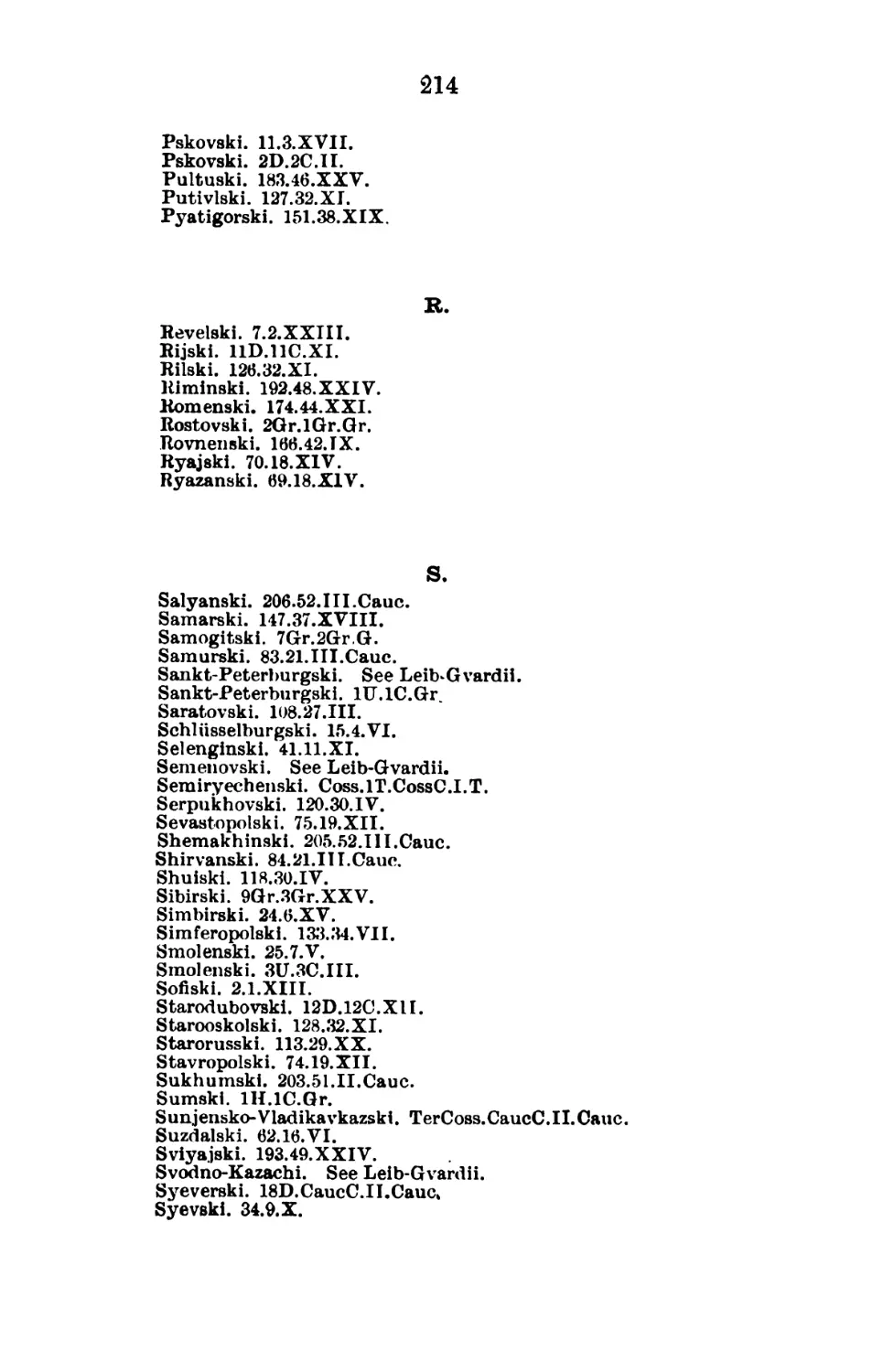
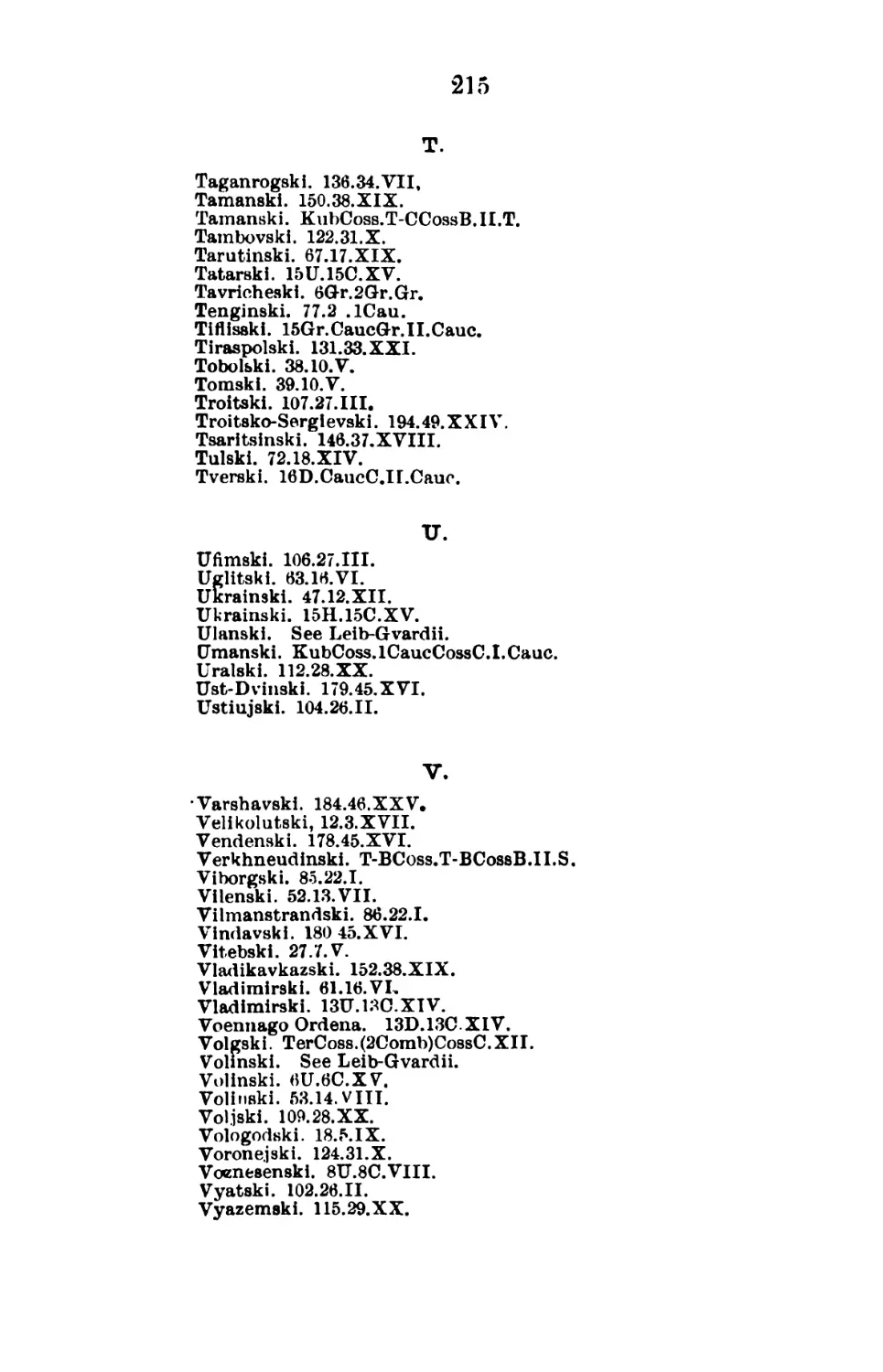
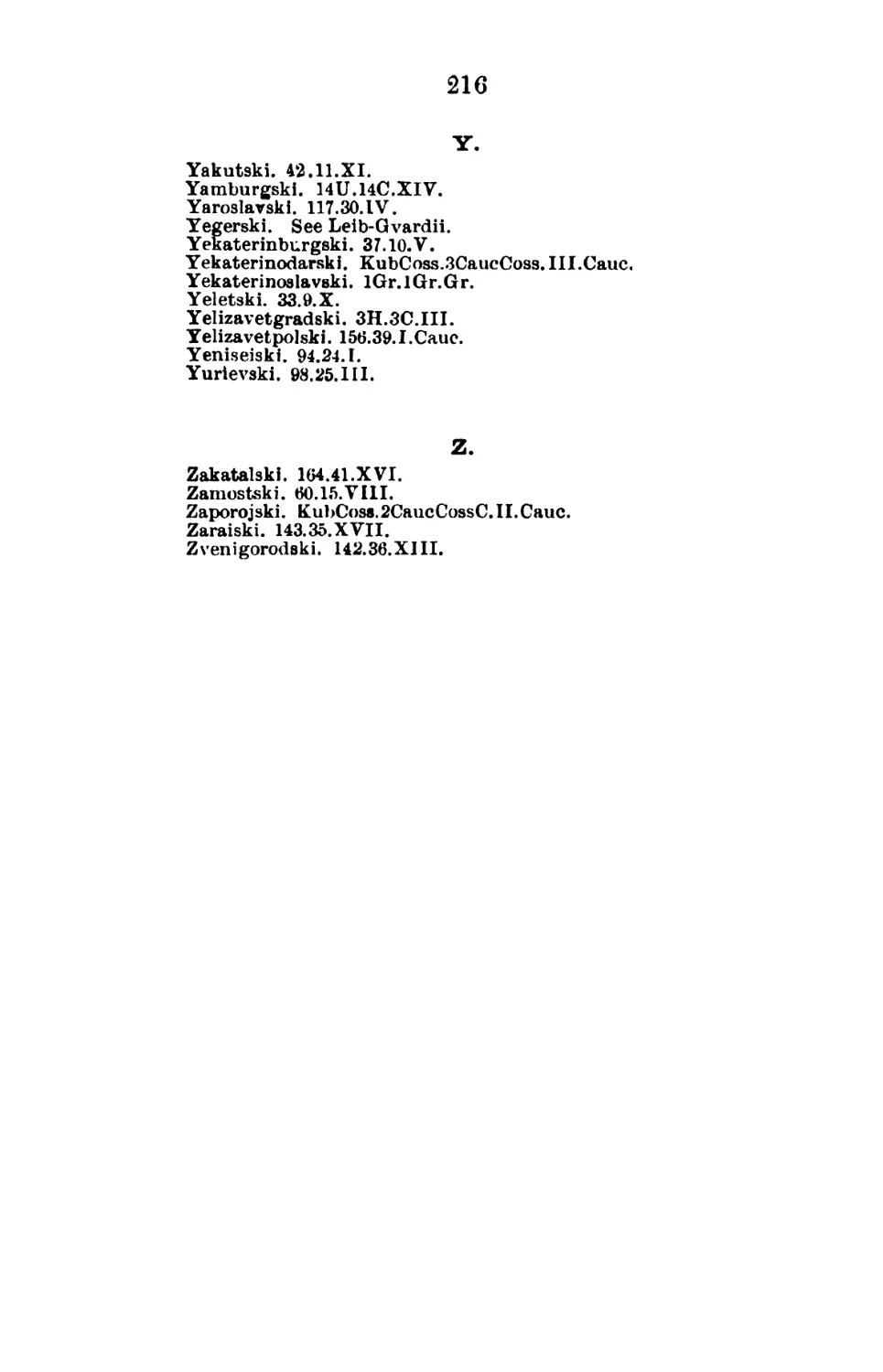
IV	.—Alphabetical list of the titles of Russian
regiments ........................................ 208
V	.—Classified list of fortresses ........ ...	217
VI	.—Distinguishing marks on field service dress
of Russian army ...................... ...	...	219
VII	.—Military hierarchy and titles.............. 251
VIII	.—Particulars of field and siege guns in Russian
army ...	...	...	...	...	...	254
IX	.—Table of entrenching tools carried by units
in the field ..................................... 257
X	.—Establishments.............................. 259
XI	.—Morse telegraphic and signalling codes	...	294
XII	.—Russian alphabet and English equivalents ...	299
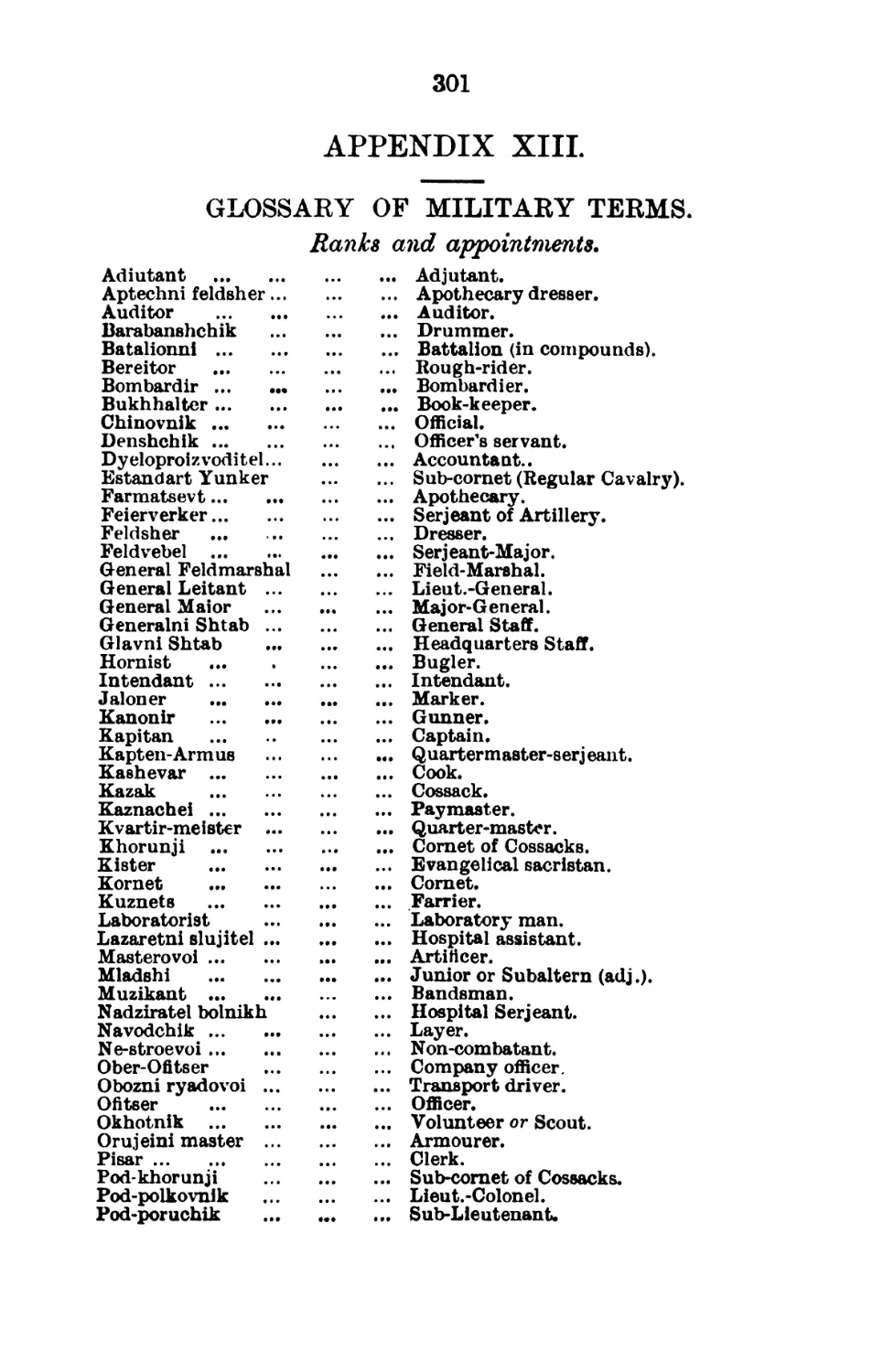
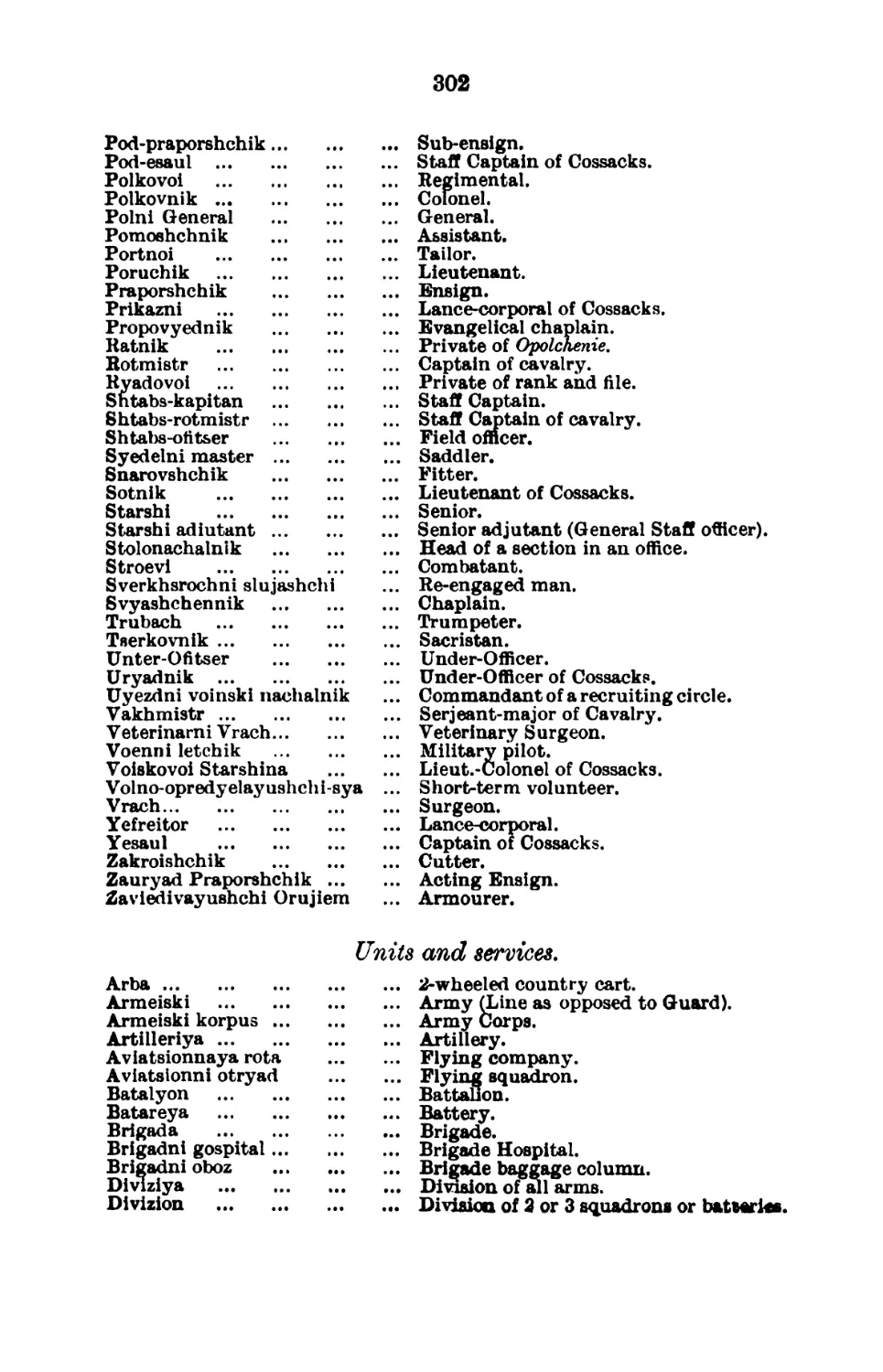
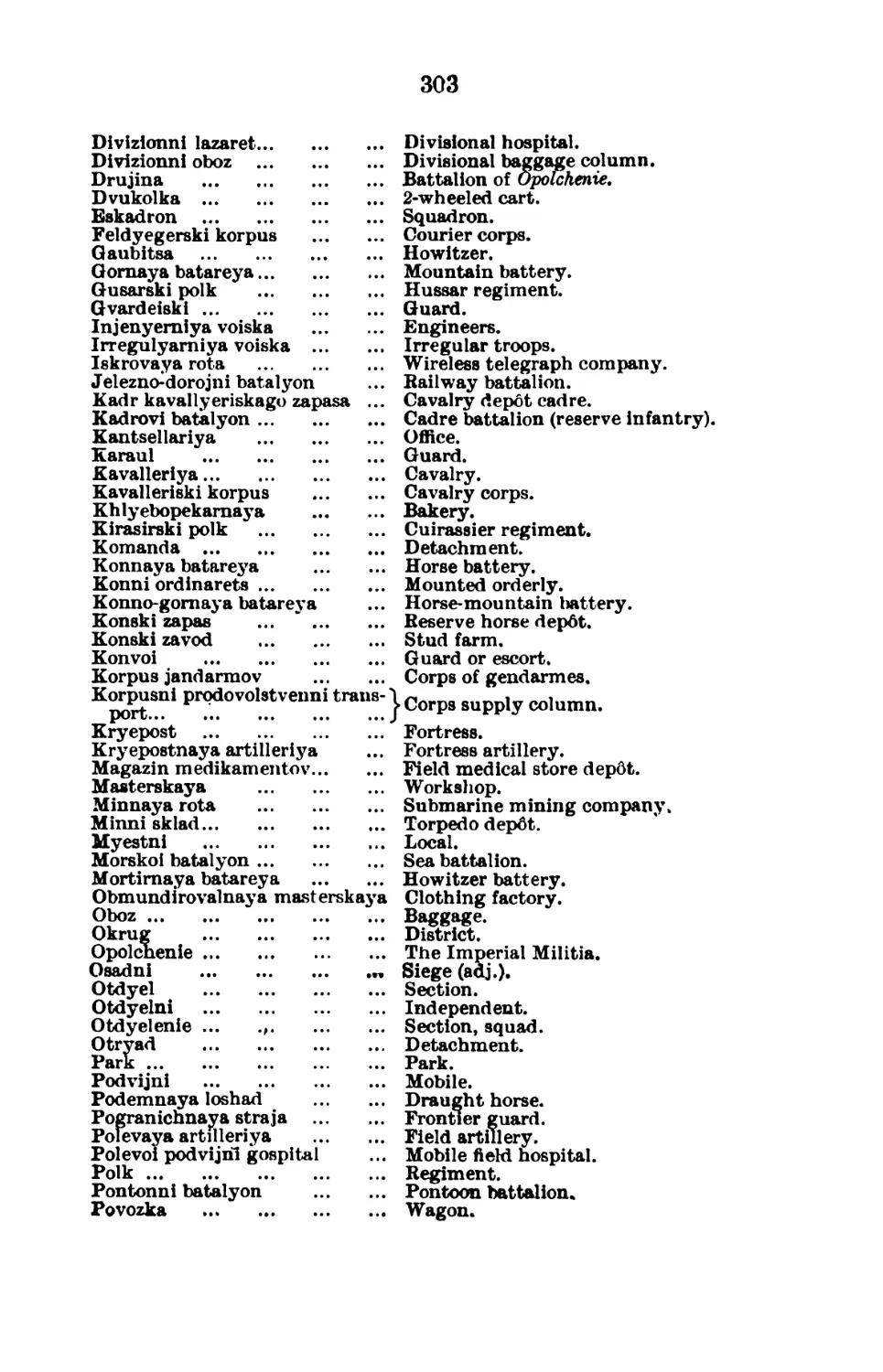
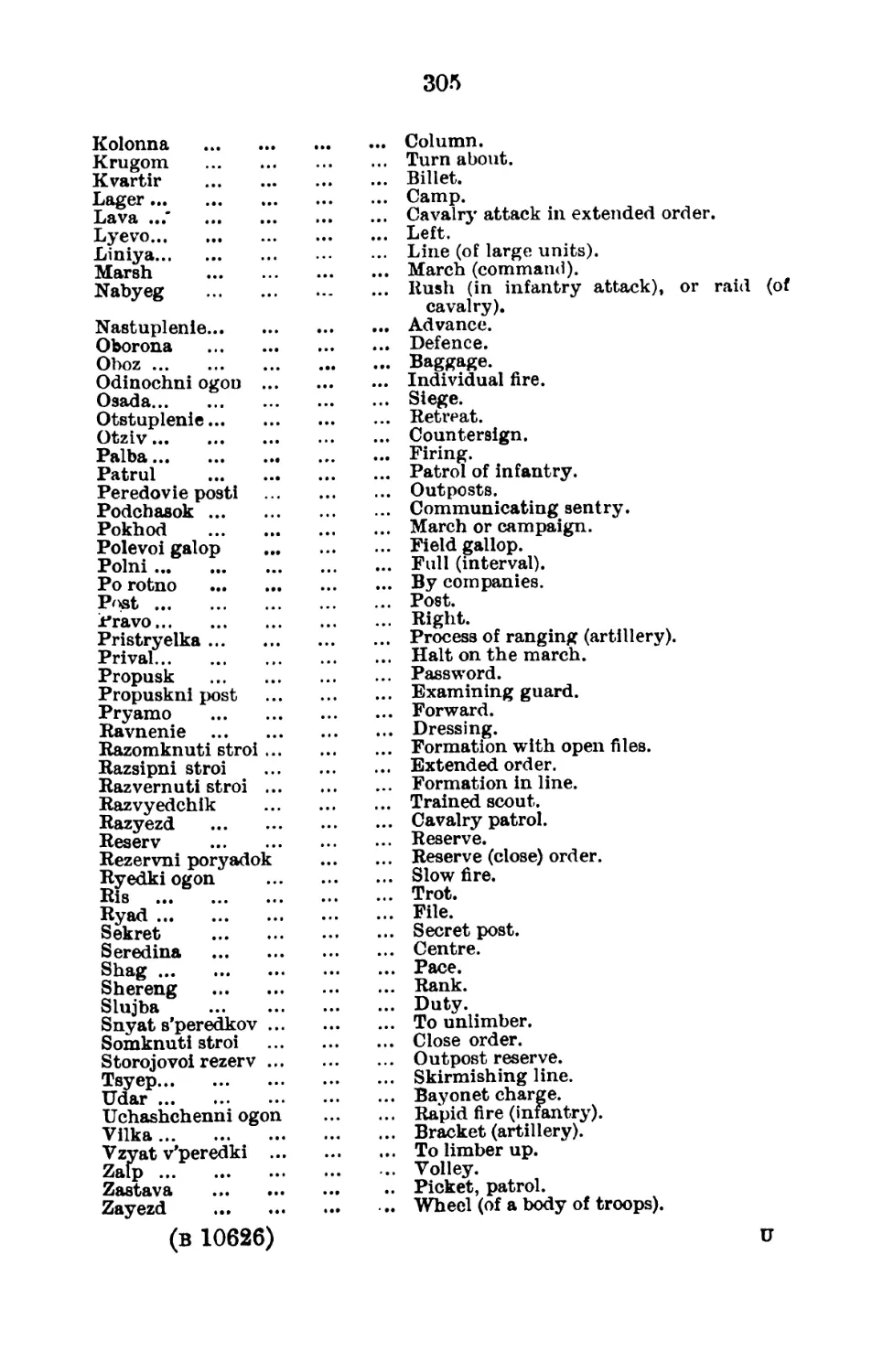
XIII	.—Glossary of military terms	...	......... 301
XIV	.—Conventional signs on military maps in Russia	308
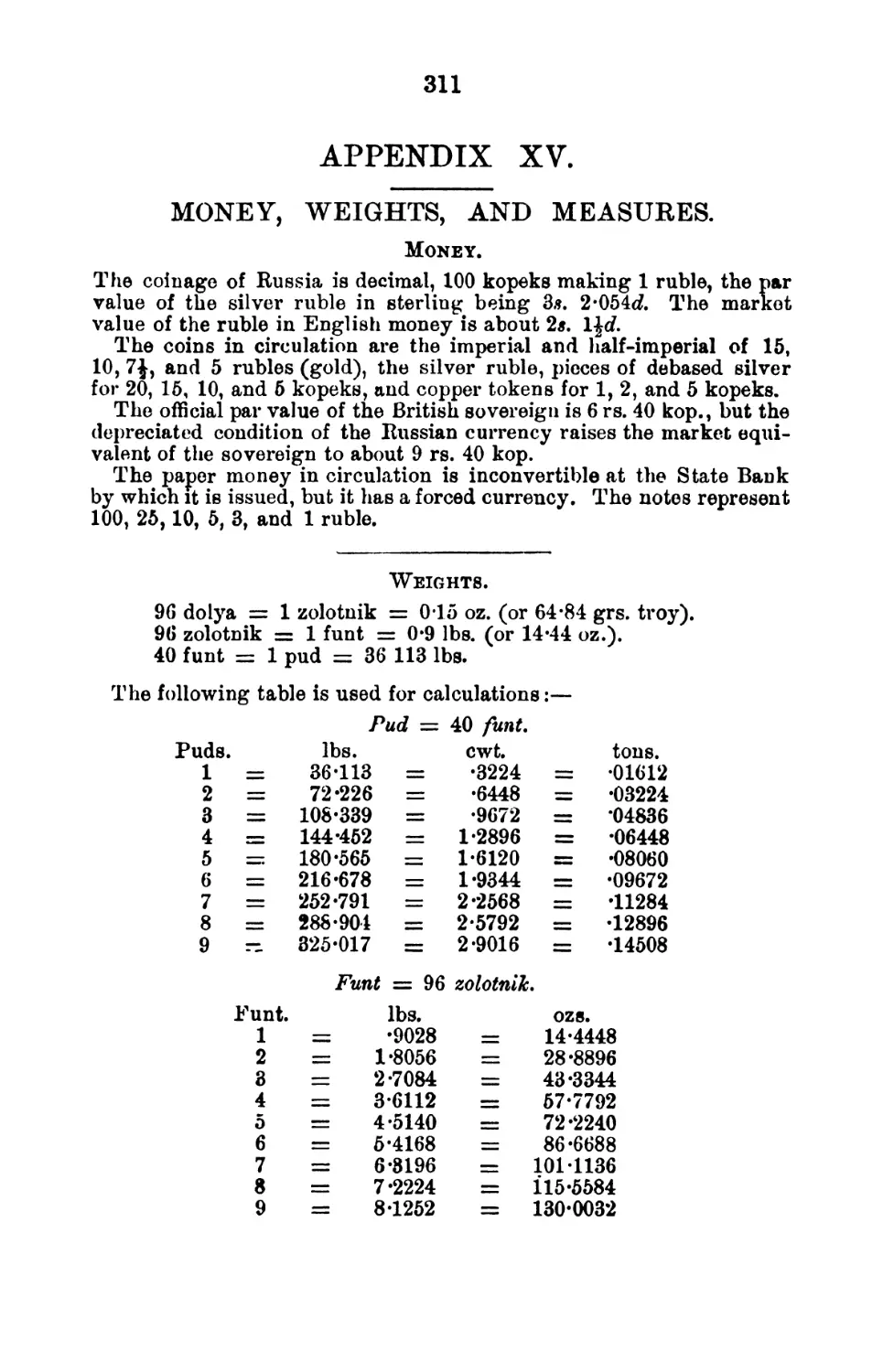
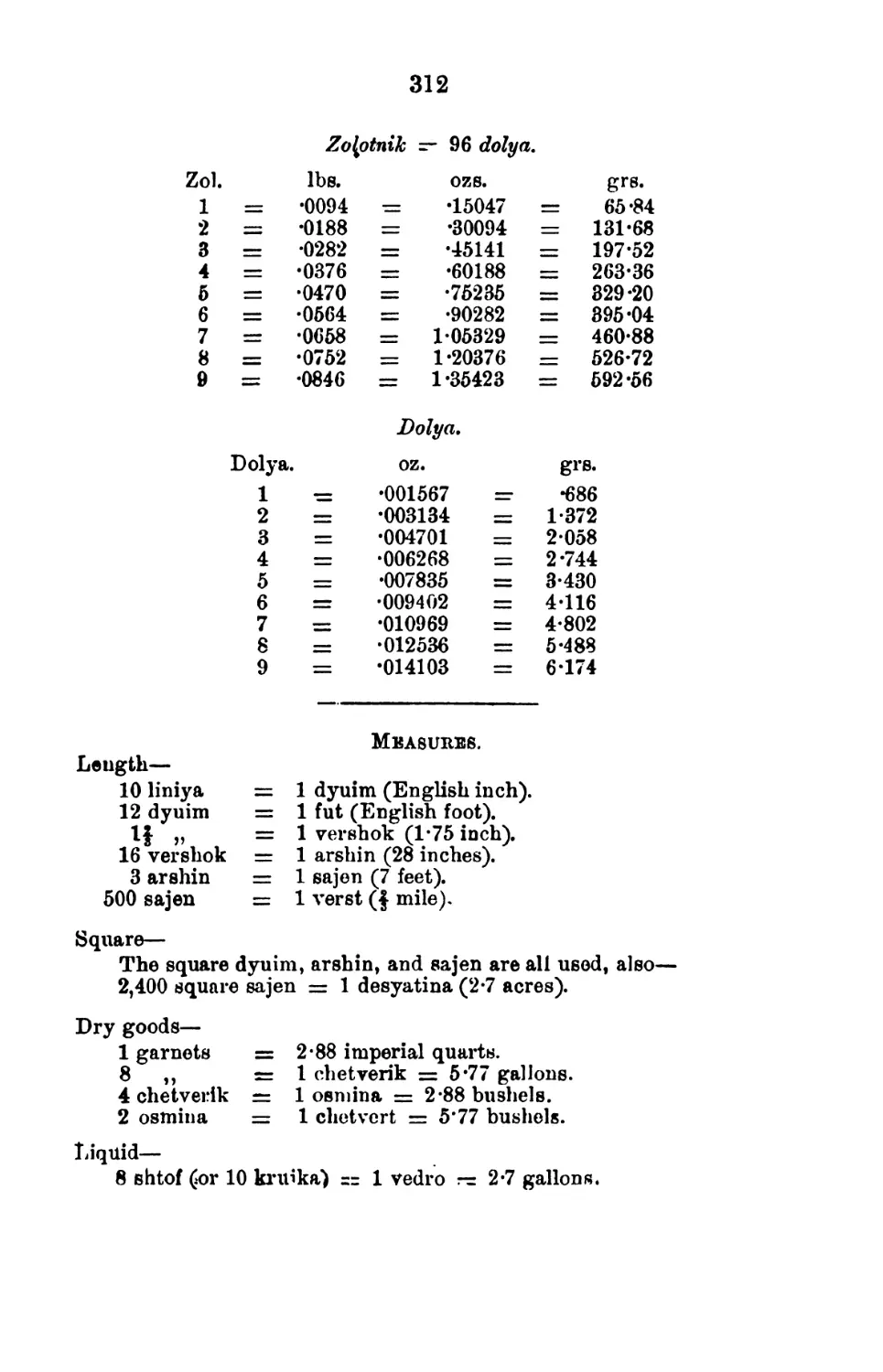
XV	.—Money, weights and measures... ...	...	311
Index ......................................... 313
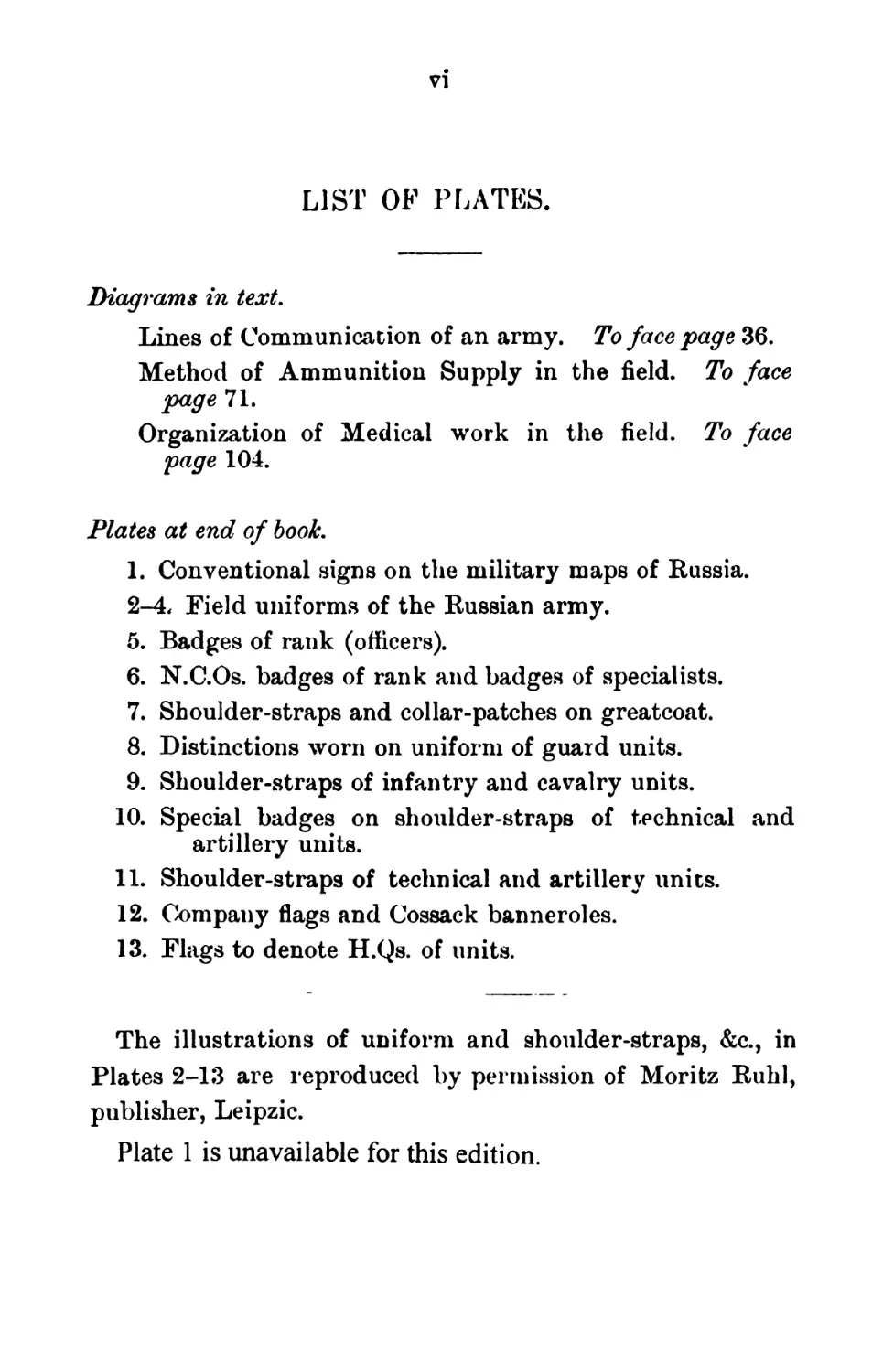
LIST OF PLATES.
Diagrams in text.
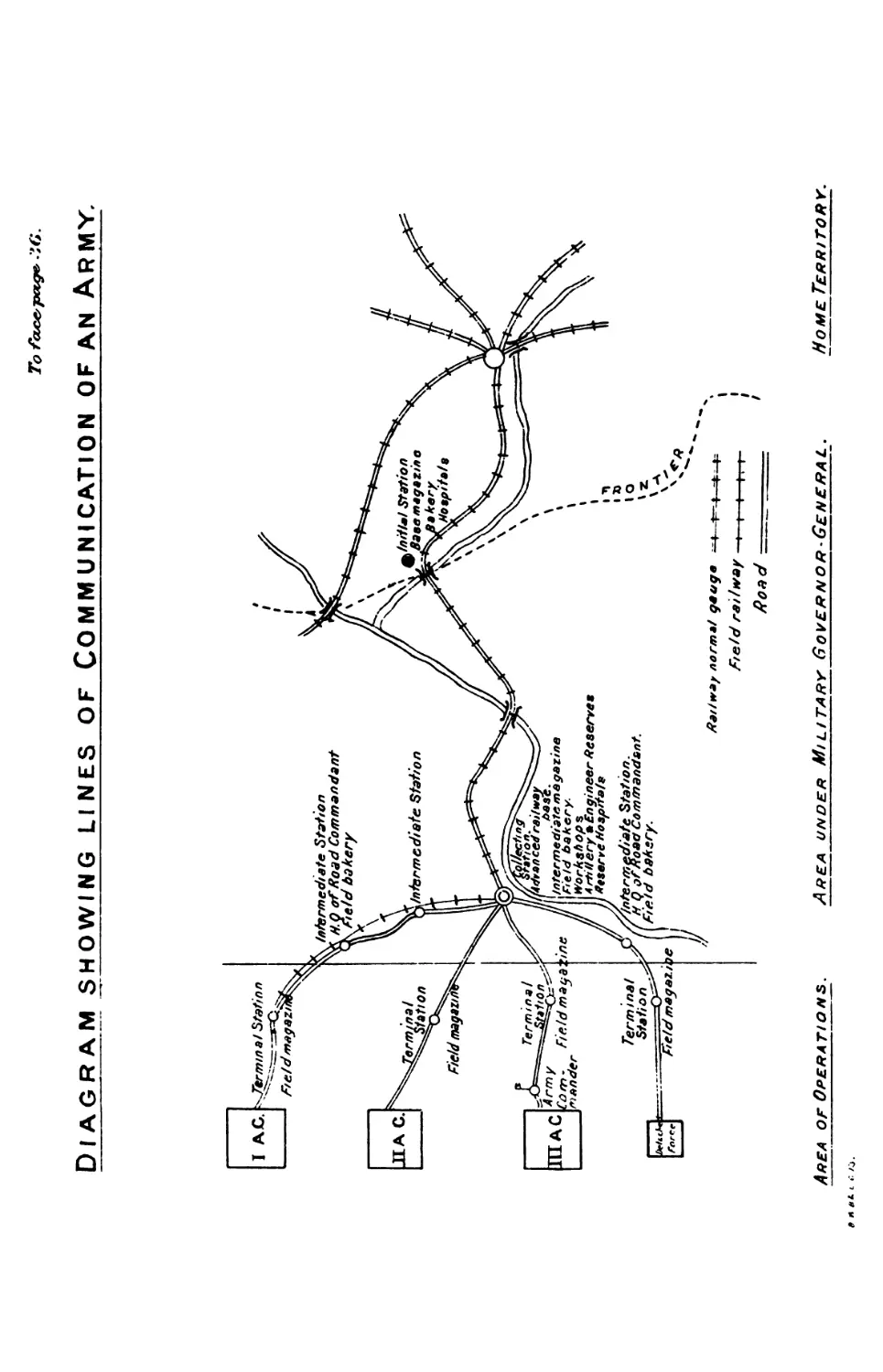
Lines of Communication of an army. To face page 36.
Method of Ammunition Supply in the field. To face
page 71.
Organization of Medical work in the field. To face
page 104.
Plates at end of book.
1. Conventional signs on the military maps of Russia.
2-4. Field uniforms of the Russian army.
5.	Badges of rank (officers).
6.	N.C.Os. badges of rank and badges of specialists.
7.	Shoulder-straps and collar-patches on greatcoat.
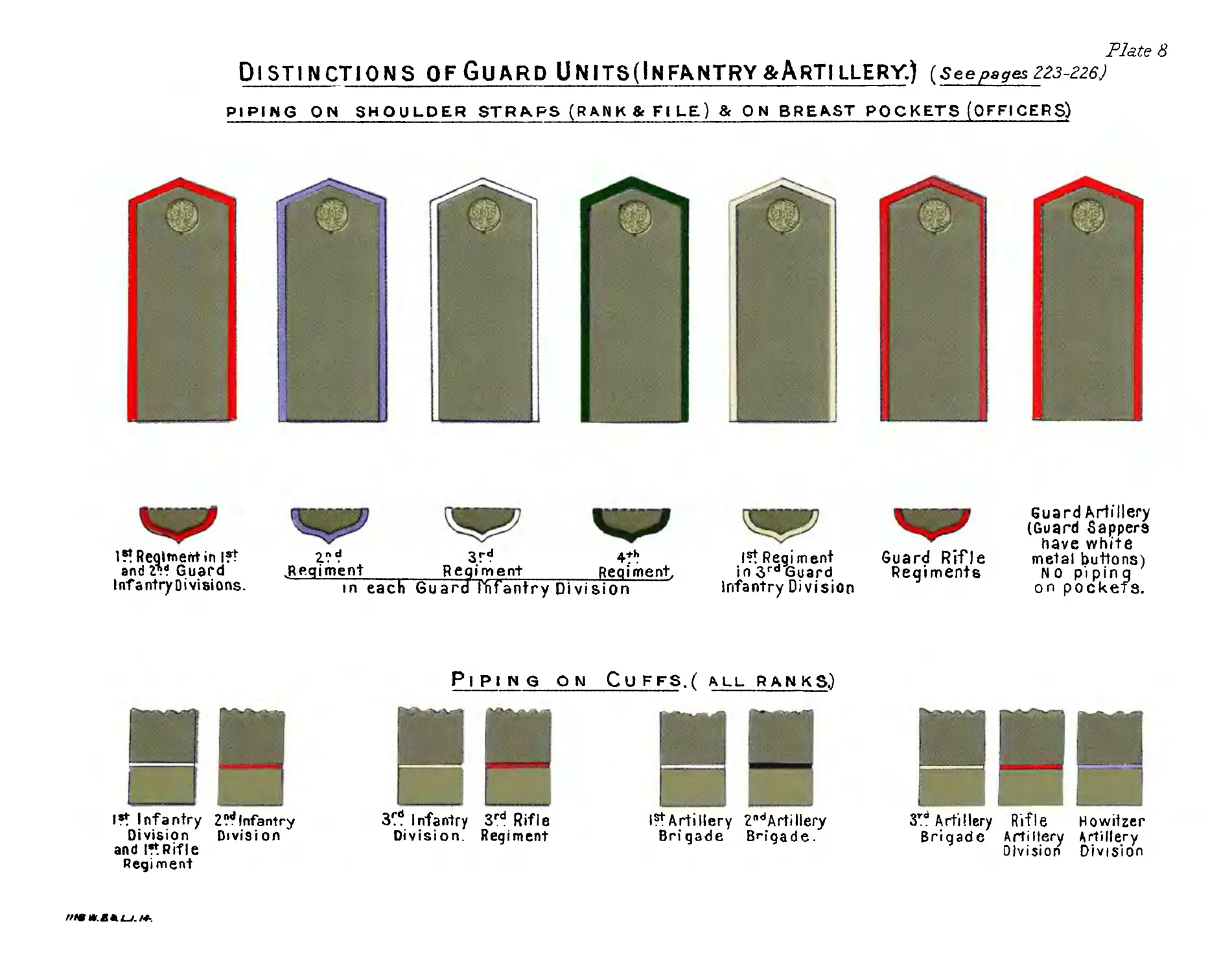
8.	Distinctions worn on uniform of guard units.
9.	Shoulder-straps of infantry and cavalry units.
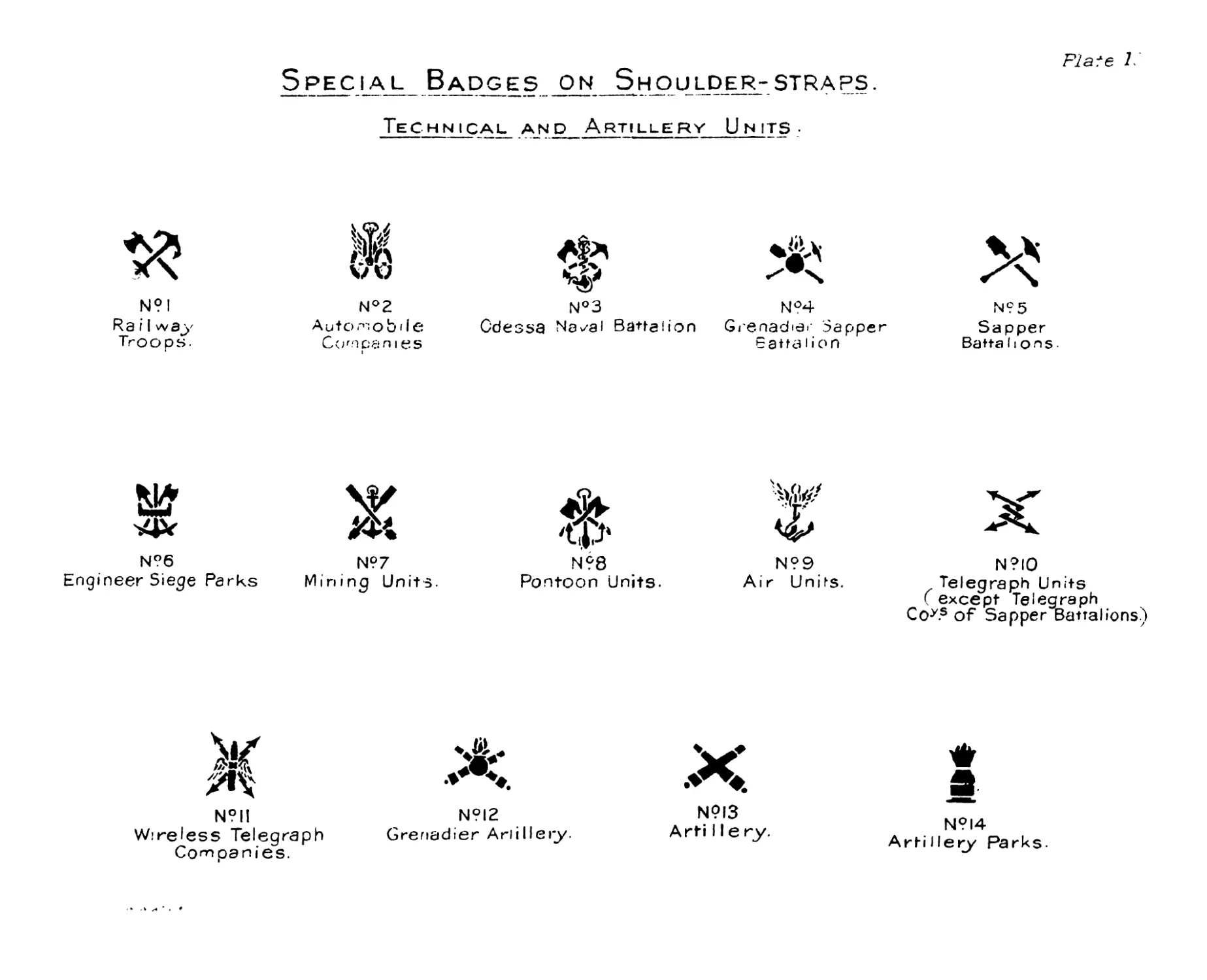
10.	Special badges on shoulder-straps of technical and
artillery units.
11.	Shoulder-straps of technical and artillery units.
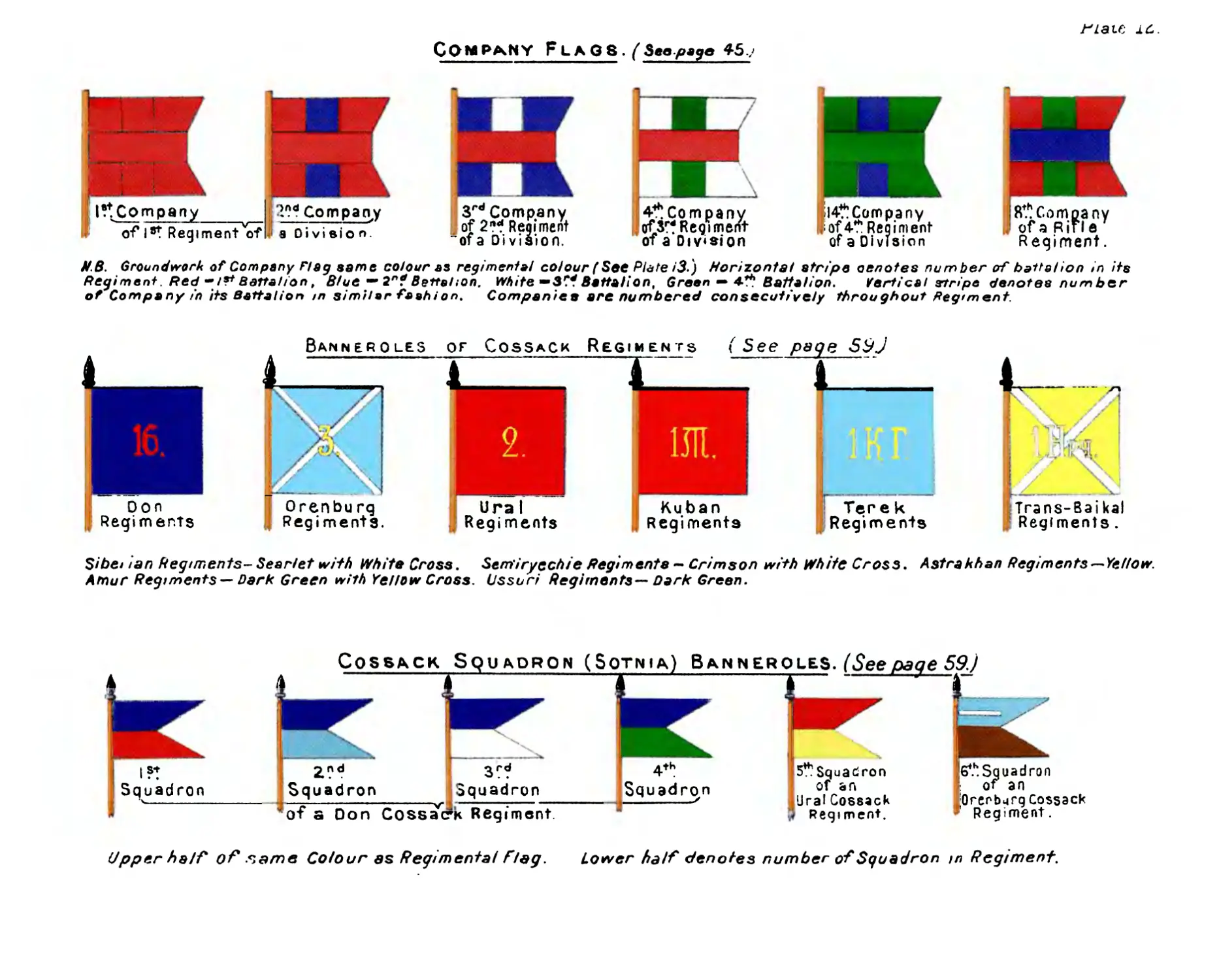
12.	Company flags and Cossack banneroles.
13.	Flags to denote H.Qs. of units.
The illustrations of uniform and shoulder-straps, &c., in
Plates 2-13 are reproduced by permission of Moritz Ruhl,
publisher, Leipzic.
Plate 1 is unavailable for this edition.
HANDBOOK
OF THB
RUSSIAN ARMY.
CHAPTER I.
LAW OF MILITARY SERVICE—RECRUITING.
The land forces of the Russian Empire consist of the
Standing Army {postoyanniya. voieka) and the Opolchenie or
Imperial Militia.
The Standing Army comprises—
(i)	The regular army and its reserve (zapas\ forming the
regular troops (regulyarniya voiska);
(ii)	The Cossack troops ;
(iii)	The Alien troops (inorodtet).*
Liability to service.—Military service in the Russian
Empire is based on the decree (ukaz) of 14th January, 1874,
which, as amended by decrees of later date,! enforces
universal liability to personal military service throughout
the whole of the Russian Empire, with the following excep-
tions :—
(a)	The inhabitants of the Grand Duchy of Finland pay
an annual “ contribution to the Imperial Treasury
* These are the Daghestan horse regiment and the Oset and Turkoman
horse divisions. The Oset horse division consists of conscripts, the
Daghestan regiment and Turkoman division of volunteers (see page 9).
t The laws of 27.rt.88, 1.2.93, and 6.7.12.
8
in lieu of personal service,” which, from a sum of
£400,000 in 1909, increases annually by £40,000
till the maximum of £800,000 is reached in 1919.*
(6)	The Cossacks, who occupy Crown lands in return for
military service, serve under special regulations (see
pages 10-11).
(c)	Mohammedans of the native population of Trans-
Caucasia and of the Kuban and Terek provinces
pay a military tax instead of serving personally,
except such as volunteer and enlist in the Oset and
Daghestan cavalry or local militia. (The Christian
natives of these populations serve under the same
conditions as the Russian population of the Empire.)
(d) The Samoyedes in the Government of Archangel,
the native population of Turkistan, and of five small
coastal districts in Eastern Siberia, and certain
foreign tribes in the Governments of Astrakhan,
Orenburg, and Stavropol, are exempted altogether
from liability to personal military service.
Liability to service begins with the 21st and ends with the
43rd year of a man’s age.
Service in the Standing Army.—Service with the colours
lasts for 3 years in the infantry and artillery (except horse
artillery) and for 4 years in all other arms and services.
Colour service counts from the 14th January following the
date when the annual contingent joins (between October
and November).! The period of service in the Reserve
(zapcut) is 15 years for those who have served 3 years with
the colours, and 13 years for those who have served 4 years.
The Reserve is divided into two classes, as follows :—Those
who have served 3 years with the colours serve 7 years in
the 1st class reserve and 8 in the 2nd class; the remainder
serve 7 years in the 1st class and 6 in the 2nd class. The
♦ In future Finland is to be required to pay an additional contribution to
the Russian Government towards the cost of quartering Russian troops in
the Grand Duchy. The annual amount of this contribution, which will be
paid in equal instalments on the 28th May and the 28th November, is fixed
for the vears 1914-23 at 2,894,740 Finnish marks (about £114,750).
f It is proposed to increase the period of colour service by 3 months,
and to retain the men till April, by which time the last-joined contingent
will be fit to take their place in the ranks.
9
2nd class is upon mobilization utilized chiefly for the forma-
tion of second line units and other services upon the lines of
communication.
Reservists are liable to two trainings of not more than
6 weeks each during their period of service in the 1st class
of the reserve.
Volunteers.—Persons who fulfil certain conditions as
regards education may enlist as “short-term volunteers”
^volnoopredyelyayiLslichiesya). This is the class on whom
the Russian army mainly relies for the supply of reserve
officers on mobilization. They join between the 28th June
and 14th July in each year, and serve 18 years—2 years
with the colours and 16 in the reserve. The period of
colour service may be reduced to 18 months* in the case of
individuals who pass an examination for promotion to ensign
(praporshch.ik'j at the end of their first year’s service. Short-
term volunteers are allowed to go to the reserve after
15 months’ service, and return for 3 months’ service in the
following training season, or to complete their 18 months’
colour service without a break. They are permitted to
choose the arm and, as far as possible, the unit in which
they wish to serve.
Other “ volunteers ” (okhotniki) consist of three classes—
(1)	Men of 18 years of age and over, who wish to join
before they reach the conscription age ;
(2)	Men who have been previously excused service (if
under 30 years of age) ;
(3)	Men who have been permitted to postpone their
service on account of family reasons.
They are permitted to choose the arm in which they wish
to serve. Unless they have educational qualifications, they
serve the full period of colour service. +
The only units in the Russian army recruited on a volun-
tary basis are the Daghestan horse regiment and the
Turkoman Horse Division. The men of the former receive
* See page 15 as regards short-term volunteers of medical or veterinary
education.
t The provision permitting men to volunteer before reaching the con-
scription age was only introduced in 1912. It is expected that in future
many men will avail themselves of the new regulation» and thus reduce the
average age of men serving in the ranks.
10
25 roubles and of the latter 30 roubles a month. They
bring their own horses on joining and provide their own
food and forage. Government supplies only a rifle and
ammunition.
Exemptions.—Men granted exemptions for family reasons
are divided into four classes, Class I being excused service
in the standing army altogether, except in the case of Jews.
The other three classes are taken successively if required to
complete the annual contingent—Class IV being first taken,
then Class III, and lastly Class II. If only a portion of a
class is required, recourse is had to lot drawing. Those of
Classes II to IV not taken for the annual contingent are
enrolled in the 1st Category of the Opolchenie. Exemptions
of Class I are enrolled in the 2nd Category.
Service in the Opolchenie.—The Opolchenie, which is
liable to be called out only in time of war by Imperial
Decree, comprises all men not serving in the Standing Army
fit to bear arms from the 21st to the end of their 43rd year,
and is divided into two categories. The 1st Category may
be used to strengthen or complete the standing army, or to
form special militia units, and includes all men up to their
43rd year who have served in the standing army, and all
those men who have not been taken for the annual con-
tingent but who are fit for active military service, except ex-
emptions of Class I. The four youngest classes of the
category last mentioned are kept under military control on
special lists, and are liable to two trainings of six weeks
each, if required. The 2nd Category comprises persons dis-
charged from active units or from the reserve owing to
unfitness for service as combatants, but who are still capable
of bearing arms, and also men granted exemptions for
family reasons in Class I.
To facilitate the formation of militia units, small cadres
of N C.Os., detached from the active army, are attached to
the staffs of circle commanders.
Conditions of service of Cossacks. —Cossacks serve under
special regulations. They provide their own clothing, arms
(except rifle and lance), equipment, and horse. Service
begins on the completion of the 20th year1, and lasts for
18 years, divided into three periods. In the preparatory
11
class {prigotovitelni razryad} the men remain one year,* and
are trained in their stanitsas or settlements. In the “field
class ” (stroevoi razryad) the Cossacks remain 12 years, daring
the first four of which they serve with the 1st Category
regiments, battalions, or batteries of their Voisko or army.
For the next 4 years they belong to the 2nd Category
regiment, &c., and are on furlough (na Igotye) in their homes,
but must keep their equipment and horses ready for service.
For the last 4 years they belong to the 3rd Category
regiment, &c., and are only bound to keep their equipment
ready. Men of the 2nd Category are called out during their
second and fourth years in that category, for a period of four
weeks’ training. Those of the 3rd Category are called out
for training only by special order of the War Minister.
Finally, the last five years of a Cossack’s service are passed
in the “ reserve class ” (zapasni razryad\ which is only drawn
upon in war.t In addition, all Cossacks fit to bear arms,
up to any age, may be called upon to serve in the levee en
masse. The various Cossack Voiska have large funds for the
equipment of their troops, which they administer themselves.
The Ural Cossacks serve under slightly different rules.
Recruiting.
(1)	Men.—The interior of the Empire, i.e., that portion of
it which has an almost entirely Russian population, is
divided into 208 “principal recruiting districts” (uyezdi),
each of which is again subdivided into several recruiting
subdivisions (prizivniye uchastki). These recruiting districts
correspond in number to the 208 infantry regiments of the
active army, but the system of recruiting is only partially
territorial. { The one fixed rule is that not more than
25 per cent, of the recruits received by a unit must be of
non-Russian origin. The 25 per cent, are recruited from
* Except Cossacks of the Ural Voisko, who remain two years.
t The 18 years’service of the Irkutsk and Krasnoyarsk Cossacks is divided
as follows :—1 year in the preparatory class, 9 years in the line class (of
which 3 are in actual service and 6 on furlough), and 8 years in the
reserve class.
I Roughly, units quartered in the interior of the Empire receive about
30 per cent, of recruits from their territorial recruiting district, 15-25 per
cent, from the “ subsidiary recruiting districts,” and 55-45 per cent, from
other recruiting districts where the population is Russian.
12
“ subsidiary recruiting districts,” in which the population is
either non-Russian or scanty. The subsidiary recruiting
districts embrace the Baltic Provinces, Poland and the
Western frontier region generally, certain regions in the
Volga basin, and Caucasia. The four principal recruiting
districts of an infantry division are grouped together, ana
to them is affiliated its artillery. Jewish recruits are dis-
tributed, and none are sent to the Guard. Rifles, cavalry,
horse artillery, engineers, and the Guard and Grenadier
corps are recruited from the whole Empire.
The number of men required to complete the army and
navy is fixed by the legislature each year on the recom-
mendation of the Ministers of War and Marine, and is pro-
mulgated by an Imperial Decree.
Contingents consist of those men who have completed
20 years by the preceding 14th January, so that the ordi-
nary conscript is between 21 and 22 years of age when he
joins the colours. The annual conscription takes place each
year between the 14th October and the 14th November ;
but, to suit local conditions in certain districts, it may
commence as early as the 28th September, and in others
may end as late as the 28th November. In time of war the
annual contingent may be called out earlier by Imperial
Decree. Service is reckoned to begin from the 14th January.
Recruiting is carried out by recruiting committees, which
are of two kinds—the district (uyezdni) committee and the
government {gubemski) committee. The law of 1912 in-
creased the proportion of military officers on these commit-
tees. The same law, which came into force in 1913,
introduced general conscription throughout the Empire,
instead of conscription by subdivisions (uchastki). Pre-
viously each subdivision was called on to furnish a quota of
the annual contingent, and it frequently happened that
classes with a claim to exemption for family reasons were
called out in one subdivision and not in another. Under
the new regulations the Minister of the Interior decides,
from the lists furnished to him by the committees, what
categories of conscripts it will be necessary to take in
each year to complete the annual contingent, i.e., only men
without claim to exemption, or, if men with such claims are
required, w-hat classes or what percentage of a class, in cases
where the whole class is not required.
13
A certain proportion of those not taken are inscribed on
waiting lists, and should the classes called out prove insuf-
ficient to fill the annual contingent, a supplementary con-
tingent is called up at the beginning of March.
Jews are borne on separate lists, and the place of a
Jewish absentee is filled by a co-religionist who would other-
wise be exempt.
The minimum height is 5 ft. 0| ins.
The annual contingent for the army and navy in
1911 was fixed at 455,000 men, of which 10,000 were
required for the navy, and 14,500 for the frontier guard,
the remaining 430,500 being required for the army.
The number of men available for enrolment was 1,296,461,
from which total 574,066 were deducted on account of—
(1) exemptions for family reasons of Class I; (2) men
considered wholly unfit for the active army and transferred
to the 2nd category of the Opolchenie ; (3) absentees. The
remaining 722,395 were subjected to the usual examination,
and only 435,413 were actually enlisted, the shortage
being 19,587*
In the same year there were taken in addition 16,500
Cossacks and 100 Oset Mahommedans.
A large addition to the annual contingent will probably
be made shortly, to provide for the new army corps to be
raised (see footnote on p. 21).
(2)	Non-commissioned officers.—N.C.Os. are selected from
the ranks ; hitherto great difficulty has been experienced in
inducing a sufficient number ui men to re-engage on the
expiry of their term of colour service, so as to provide the
required proportion of experienced N.C.Os. Accordingly
new regulations were issued in 1911, increasing the pro-
portion of re-engaged N.C.Os. and offering greater induce-
ments to men to re-engage.
By these regulations the existing grades of re-engaged
N.C.Os. were termed “ 1st class,” with the rank of
* The 1913 contingent was taken under the new regulations, which
are expected to produce a great improvement. The scale of exemptions
has been revised, and it is hoped that the strengthening of the military
element on the recruiting committees will prevent the waste that formerly
occurred by the enlistment of large numbers of men who have to be sub-
sequently discharged as physically unfit, and that the increased penalties
will reduce the number of absentees. It is expected that the new law
will produce over-25,000 more men than the old law.
14
sub-ensign {podpraporghchik}, and a new or 2nd class was
introduced.
The full complement of the 2nd class is fixed at 24,000, of
whom 3,600 were to be enrolled in 1911, and 6,000 each sub-
sequent year till the class was complete. The number of
the 1st class serving at the end of 1912 was 28,500.
When the provisions of the new regulations are completed,
the proportion of re-engaged N.C.Os. will be 6 per company,
squadron and battery, of which three will be 1st class and
three 2nd class.
On mobilization a considerable number of the 1st class
would be required to perform the duties of officers.
The inducements held out to re-engaged men are increased
pay and allowances, bounties on completion of a certain
number of years’ service, pensions, medals and orders, and
the right to a post in government employ on transfer to the
reserve.
The education of N.C.Os. is carried out in the instruc-
tional detachment (uchebnaya komanda) formed in units for
this purpose. Re-engaged N.C.Os. of the 2nd class before
promotion to the 1st class must pass a course in schools,
which are formed in each Division. They are then promoted
as vacancies occur.
The instructional detachment is formed in each unit (e..g.y regiment
of infantry or cavalry, brigade or independent division of artillery)
from the 1st March to 15th November. It is commanded by a
captain, assisted by a varying number of subalterns as instructors
(each instructor should have not more than 30 men to instruct), and
is supervised by a field officer. It takes no part in the ordinary
manoeuvres and training of its unit, except that it may take part in
large manoeuvres as an organized company.
Men wishing to join receive 2 mouths’ preliminary instruction
in their companies, and have then to pass an entrance examination.
The subjects of instruction are musketry, gymnastics, tactics, map-
reading, religion, reading, writing, and arithmetic.
An examination must be passed at the end of the course.
The schools for the instruction of re-engaged N.C.Os. are formed
in each division from 14th October to 14th June. The instructors
are appointed by the divisional general. The subjects of instruction
are the various regulations, musketry, tactics, topography, organiza-
tion and the law of recruiting, fortification, military law, and arith-
metic. An examination takes place at the end of the course.
In addition, N.C.Os. receive special instruction in their units.
The various grades of N.C.Os. are given in Appendix VII.
(3)	Officials (chinovniki).—The various officials of the
Russian army (yoennie klassnie ckinovniki) are civilians.
16
They must have passed 6 classes of a primary school or
qualified in an examination similar to that required for
entry to a military school.
Appointments as paymaster (kaznachei), accountant
{dyeloproizvoditel po khozaistvennoi chatti), and quarter-
master (polkovoi fcvartirmeister), require no further qualifi-
cation, and these posts are mostly filled, on the nomination
of the commanding officer, by men who have completed
their obligatory service as clerks.
An order of 1913 permits retired officers to become officials
of the Intendance department in peace time.
Surgeons are graduates of tne Military Academy of
Medicine or of the medical school in some provincial
university.* The veterinary surgeons are graduates of the
Military Veterinary Institute. Both these classes serve as
short-term volunteers. They join between 28th December
and 14th January in each year and, after 4 months’ service
in the ranks, may be promoted at the discretion of their
commanding officer to the rank of official in their special
department, in which rank they serve 16 months and may
then be discharged to the reserve.
The armourers (zavyedivayushchi orujiem) are trained in the
technical schools at government arms factories.
For the various grades of official, see Appendix VII.
(4)	Officers.—The officers are recruited from the Corps of
Pages or military schools, 20 in number.! Previous to
1910-11 these were divided into “ military ” and “ yunker ”
schools, of which the latter were originally intended for the
training of volunteers who wished to become officers, and
were inferior in standard and tone to the military schools.
They have now been transformed into military schools
with the same course and conditions as regards posting
on completion of course as the original military schools.
The regulations for entry still vary however, and tend to
* See page 33, “ Handbook of the Medical Services of Foreign Armies:
Part IV—Russia” (1910), for further details.
t 11 for infantry, 2 for Cossacks, 3 for cavalry, 3 for artillery, 1 for
engineers. A fourth artillery school is projected at Kiev and will be com-
menced in 1914. Hitherto the two existing artillery schools (the third,
at. Odessa, was only opened in the autumn of 1913) have been unable to
supply sufficient officers for the artillery. It is also proposed to establish a
second до ginger school at St, Petersburg for 340 cadets.
16
continue the social cleavage between graduates of the old
military schools and the former yunker schools.
The military course at infantry, cavalry, and Cossack
schools lasts 2 years, but the former yunker schools retain
for the present a preliminary general educational course of
1 year for those who have not passed the 7 classes of a
secondary educational establishment (gimnazia) before join-
ing. The military course at engineer and artillery schools
lasts 3 years.
A large number of officers receive their preliminary
education in cadet corps, of which there are 29.
The Corps of Pages, entry to which is open only to those
of high social rank, combines the functions and courses both
of a cadet corps and military school.
Graduates of the military schools are divided after the
final examination into three classes according to their conduct
and general and military educational attainments. The
1st class, if of the requisite social standing, may join the
Guard as sub-lieutenants (podporuchiki) or cornets {korneti),
or if posted to the Line, may join with a year’s seniority.
The 2nd class join the Line without ante-dating. The 3rd
class join the Line to serve as under-officers for 6 months,
after which they are promoted to the rank of officers on
recommendation of their C.Os.
Reserve officers.—Reserve officers are either officers who
have served in the standing army as such, or candidates
selected from men of superior education who have served as
short-term volunteers (see page 9). The number of reserve
officers is at present inadequate, and there is a great
deficiency in the number required for a general mobilization.
A number of places would have to be tilled by re-engaged
N.C.Os. of the 1st class (podpraporshchiki).
Officering of the Opolchenie.—In peace time a list of
persons suitable for employment as officers in the Militia in
case of mobilization is kept. The higher appointments,
including the commands of companies, squadrons, and bat-
teries, would be filled by retired officers of the army ; the
junior officers would be recruited from such former N.C.Os.
of the army as are possessed of certain educational
attainments.
Promotion of officers.—The general system of promotion
in the Line is as follows: The average officer obtains his
17
commission at the age of 21. He obtains his first two steps
automatically, to lieutenant (poruchiky* after 4 years’ service,
to staff captain (shtabs-kapitany* after 4 years’ service as
lieutenant. Four years’ service in this last rank qualifies for
promotion to captain,* but a vacancy as company, squadron,
&c., commander must be awaited. Thus a regimental officer
who is lucky may become captain in 12 years. The rate of pro-
motion varies much in different regiments, in spite of frequent
transfers. There is among the staff captains and captains
an undue proportion of men who are too old for their work.
From captain onwards promotions are partly by seniority,
partly by selection. By new regulations introduced in 1912,
55% of promotions from captain to lieut.-colonel will be by
seniority, 35% will be accelerated promotions (of which 10%
are reserved for graduates of the Imperial Nicolas Academy)
and 10% will be promotions for distinguished service.
Similar principles govern promotion from lieut.-colonel to
colonel.
Officers of the Guard have two important privileges. A
Guard officer transferring to the Line joins his new unit in
the rank superior to that which he held in the Guard, and,
secondly, as the rank of lieut-colonel does not exist in the
Guard, officers are promoted direct from captain to colonel.
Officers of the General Staff are borne on a special list
and have special rules as regards promotion. Tney have
lately lost their privilege of a step in rank on passing out of
the Imperial Nicolas Academy.
Retirement of officers—The following are the ages for
retirement for various appointments and ranks :—
Army corps commanders .......................... 66
Commanders of	infantry	divisions	...	62
„	„	cavalry	„	...	60
„	.,	infantry	brigades	...	60
„	„	cavalry	„	...	58
,.	„	infantry	regiments	...	58
„	„	cavalry	„	...	56
„	„ batteries ...	... 56
Other field officers ...	...	... 56
Other officers .........................55
To be qualified for promotion to next higher rank an officer
must not be within 2 years of the retiring age for that rank.
* Or corresponding rank» (See Appendix VII.)
(в 10626)	В
18
CHAPTER II.
THE ADMINISTRATION AND ORGANIZATION OF
THE ARMY IN PEACE.
Administration.
The supreme command of the military forces of the
Empire is vested in the Emperor, and the principal channel
through which his orders are promulgated to the army and
carried into effect is the War Office (War Ministry).
The War Office comprises—
1.	The Imperial Headquarters (including a staff, a chancery, and
the Cossack bodyguard).
2.	The Military Council.
3.	The Supreme Military Court of Appeal.
4.	The Chancery of the War Minister.
5.	The General Staff.
6.	The Headquarter Staff.
7.	The Intendance Directorate.
8.	The Artillery Directorate.
9.	The Military Technical Directorate.
10.	The Military Educational Establishments Directorate.
11.	The Military Judicial Directorate.
12.	The Military Sanitary Directorate.
13.	The Quartering Directorate.
14.	The Army Veterinary Directorate.
15.	The Remount Directorate.
16.	The Alexander Committee for the Wounded.
17.	The Selection Board.
Al the head of the War Office stands the War Minister He is
responsible to the Emperor alone, and reports direct to him on all
matters concerning the Army. He has, however, no immediate
financial control.
The Military Council (Voenni Sovyet) is the supreme body for
deciding questions of a legislative or economical nature. The War
Minister is ex officio President of the Council; and the other mem-
bers, 24 in number, are appointed by the Emperor. They are usually
retired or unemployed officers of very high rank.
19
The General Staff (Generalni Shtdb) deals with military opera-
tions and all matters immediately affecting them. It comprises
6 branches—
(a)	The Branch of the Quartermaster-General of the General
Staff, which deals with Imperial defence, military operations,
military history, fortresses, and intelligence.
(6)	The Military Communications Branch.
(c)	The Military Topographical Branch.
(d)	The Organization and Training Branch.
(e)	The Mobilization Branch.
The Headquarter Staff (Glavni Shtab), which deals with matters of
a routine nature, comprises—
(a)	The Branch of the Adjutant-General (Dejurni-General).
(b)	The Pension and General Service Branch.
(c)	The Cossack Branch.
The Military Technical Directorate (formerly called the Engineer
Directorate) deals with all technical matters, including Aeronautics
and Railways.
The duties of the remaining directorates are sufficiently explained
by their titles.
Inspections.—The Inspector-Generals and Inspectors are directly
under the War Minister. They are six in number, viz.:—
The Inspector-General of Cavalry.
The Inspector-General of Artillery.
The Inspector-General of Engineers.
The Inspector-General of Military Educational Establishment.
The Inspector of Railway Troops.
The Inspector of Musketry.
The office of Inspector-General of Infantry was abolished in 1909,
and the appointment of an Inspector of Musketry created in its place.
Infantry is inspected by the General Officers Commanding Military
Districts.
The Military Districts (Voennie okrugi).—The territory
of the Empire is divided into 12 military districts and
one separate province under general officers of high
rank. These districts are subdivided for recruiting and
mobilization purposes into 22 local brigades, which again
are subdivided into a number of recruiting districts. The
commanders of these local brigades also command such dep6t
and local troops as are stationed within their territory.
The army corps and such units as are not included in army
corps are directly under the orders of the Military District
Commander. A special staff is provided for each fortress to
command all the troops in it.
(в 10626)	в 2
20
The military districts and their headquarters are:—
St. Petersburg.	St. Petersburg.
Vilna.	Vilna.
Warsaw.	W arsaw.
Kiev.	Kiev.
Odessa.	Odessa.
Moscow.	Moscow.
Kazan.	Kazan.
Caucasian.	Tiflis.
Turkistan.	Tashkend.
Omsk.	Omsk.
Irkutsk.	Irkutsk.
Pri-Amur.	Khabarovsk.
The province is—
Don Territory.	Novo-Cherkassk.
The distribution of the troops in each is given in Appendix I.
The general in command of a military district is usually
styled “Commander of the troops ”(komanduyushchi vois-
kami), but in the St. Petersburg military district he is
entitled “Commander-in-Chief of the troops of the Guard
and the St. Petersburg military district,” in that of Warsaw
he is also Governor-General, in that of the Caucasus he
is also Viceroy and Ataman of the Cossacks of the Caucasus,
in Turkistan he is also Governor-General of Turkistan and
Ataman of the Semiryechie Cossacks, in the Omsk military
district he is also Governor of the Steppe Provinces and
Ataman of the Siberian Cossacks, in the Irkutsk military
district he is also Ataman of the Trans-Baikal Cossacks, in
the Pri-Amur military district he is also Ataman of the
Amur and Ussuri Cossacks. He has a personal staff
and is assisted by a District Military Council, composed of
the Assistant to the Commander of the District, the heads
of the Departments of the District Staff, and a member
nominated by the War Minister. He has civil as well as
military powers, and is directly under the War Minister.
The District Headquarters comprise the following
departments :—
The District Staff (containing 3 sections, the Quarter-
master General’s, the Adjutant General’s, and that
of the Commander of Military Communications).
The Intendance Department.
The Artillery Department.
The Quartering Department.
The Medical Department.
The Veterinary Department.
21
The Inspector of Engineer troops of the district is attached
to the Headquarters or the district.
The duties of these in peace correspond closely with those
of an army in war as described on pp. 25-29.
Local brigades.—These are commanded by lieutenant-generals or
major-generals, who have a staff comprising 2 officers, and usually a
lieutenant-colonel to assist in the preparation of mobilization. They
command, subject to the Military District Commander, all local,*
disciplinary and escort* troops in their territories, and, in time of war,
depot battalions. They are assisted by the commandants of
recruiting districts or circles (uyezdi).
District commandants (yoinskie nachalnikz) are colonels or lieutenant-
colonels. They exercise command over the local troops in the town
where their headquarters are, and over the escort troops in their
districts. They are members of the Government or District
Recruiting Committee. They keep the registers of reservists and
are responsible for mobilization in their districts and for the
provision of the stores, clothing, and equipment necessary for the
depot battalions to be formed in their districts.
Organization.
Army Corps.—There are at present 37+ army corps of the
active army, viz., Guard, Grenadier, I to XXV, 1st to 3rd
Caucasian, 1st and 2nd Turkistan, 1st to 5th Siberian.
These include all the infantry and cavalry divisions (except
the 11th Siberian Rifle Division) with their attached artillery
and all rifle brigades except the 6th Turkistan.
With few exceptions the troops take the field in the same
order of battle in which they stand in peace, and a separate
description of the peace organization is therefore un-
necessary.
Peace strength, and establishments.—On the 1st October,
1913, the Army consisted of :—J
1,284 battalions of infantry.
511 squadrons of cavalry.
327 sotnias of Cossacks.
* See page 48.
t It is reported that Russia has decided to form four new army
corps, two in Europe, one in the Caucasus, and one in Asia; but no details
have yet been published.
J Including the lYontier Guard, but not including local troops, escort
detachments, and certain Train cadres.
22
440	batteries of field artillery.
43		H	mountain ,,
30	J,		horse	„
11.	Я		horse mountain artillery.
39	n		Cossack artillery.
75	J)	,5	howitzer „
24			heavy	„
39 battalions of sappers.
9 pontoon battalions and 1 pontoon company.
16 battalions and 1 company of railway troops.
7 wireless telegraph companies.
2 air battalions and 9 air companies.
3 flying companies.*
The peace establishments
taken approximately as :—
for the various arms may be
Infantry................... 811,000
Cavalry ................... 133,000
Artillery ...	...	...	209,000 (3904 guns).
Engineers ...	...	...	59,000
Auxiliary services ...	88,000
1,300,000 +
Staff and Staff Duties.—Every staff of an infantry or
cavalry division or independent rifle brigade and of all units
larger than a division has at its head a Chief of the Staff, an
officer of the General Staff, who superintends generally the
work of all departments of that staff. In all cases a body of
General Staff officers and adjutants is placed under him in
order to carry out the staff duties. The departments which
are not directly under the Chief of the Staff are those
of the artillery, engineers, intendance, pay, and control, but
the working of them is superintended by him.
* A flying company will eventually be formed in each military district.
t To this must be added between November of each year ana the follow-
ing April the strength of the annual contingent (see footnote on page 8).
In September and October also the peace strength is increased by the
reservists called up for a course of training. In 1914 nearly 500,000 regular
reservists will be called up for training.
23
The staff proper of an army corps is divided broadly into
the Quartermaster-General’s and the Adjutant-General’s
departments, and, that of an army into these and various
other branches, including a department of the General of
Communications. The Quartermaster-General’s department
is officered entirely from the General Staff, and that of the
Adjutant-General from staff-adjutants,* while officers of both
branches are employed in the Communications’ Department.
General Staff officers are recruited exclusively from officers
who have passed the Imperial Nicolas Academy. These, after
appointment to the General Staff, form a separate corps, from
which they are detached only for periodical training with
troops before each step of promotion.
Broadly speaking, the duties of General Staff officers are
those connected with the movements and operations of the
army, intelligence and reconnaissance of the enemy, and
reconnaissance of the theatre of war.
Staff adjutants, in addition to performing staff duties of an
administration and routine nature, are also largely employed
as aides-de-camp to general officers, &c.
Uniform of general and staff officers.—General and stall officers wear
on manoeuvres and in the field, service dress as described on page 51
with blue breeches with a red stripe. The distinguishing marks of
a general are his shoulder-straps (see Plate 5), the broad red stripes
(lampas') on his breeches (see Plate 4) and the red lining of his great-
coat. Officers of the staff are distinguished by their shoulder-straps
(see Plate 5) and by the white cord aiguillettes which they wear.
The wearing of aiguillettes on manoeuvres and in the field is, how-
ever, optional.
* Not to be confused with “senior adjutants” of the General Staff.
24
CHAPTER 1IL
THE ORGANIZATION OF THE ARMY IN WAR.
In war the army comprises the following :—
Field troops (poleviya voiska).
“ Reserve’’ troops (rezervniya voiska).
Depdt troops (zapasniya voiska).
Fortress troops (kryepostniya voiska).
Local troops (myestniya voiska).
The Imperial Militia (gosudarstvennoe opolchenie).
The field troops comprise the units of the standing army,
brought up to war strength by calling up the reserves.
The cadres of “ Reserve ” troops maintained in peace were
abolished in 1910, but on mobilization reserve divisions will
probably be formed from the surplus reservists of the 1st
class and the youngest of the 2nd class. (See page 34.)
The depOt troops are formed on cadres detached from the
units of the standing army, and are filled up by men of the
reserve who are not required for the mobilization of the
active units, by recruits, or by men of the four youngest
classes of the Militia. They serve to keep the units of the
standing army up to full strength in time of war.
The fortress and local troops are used in war for garrison
work only.
The Militia has already been mentioned ; in time of war it
forms independent units for home defence.
I.	The Field Army.
As in the armies of other great European powers, the
army corps is the unit upon which the organization of the
Russian field army is based, and practically the whole of
the units composing it are included in army corps. A
25
number of army corps grouped together form an army ;
where circumstances require it, several of these armies may
be grouped together under one command and may then be
termed a group of armies.
The Commander-in-Chief of the armies in the field is
directly responsible to the Emperor alone, from whom
he receives general directions for the conduct of the
operations. His Chief of the Staff, a general or lieutenant-
general, has under him the three branches of the staff, viz.,
the Quartermaster-General’s Department, the Adjutant-
General’s Department, and the Railway Department. The
duties of the Quartermaster-General and Adjutant-General
are practically the same as is described for an army on
pp. 27-28. The latter has under his orders the Judge-
Advocate-General, the Commandant at Headquarters, and
a printing office, &c. At the head of the Railway Depart-
ment is a general officer, who exercises supreme control of
the railways in the theatre of war, distributes rolling stock
and railway personnel, orders repairs and new construction,
and allots the lines to the armies. In the last-mentioned
matter he submits his proposals, through the Quartermaster-
General, to the Chief of the Staff.
Nothing is laid down as to the number of armies which
would be placed under a commander-in-chief. The number
would, however, probably not exceed three or at most
four.
Assuming that there are three armies under the Com-
mander-in-Chief, the total strength of the staff is 56 officers,
27 officials, 308 N.C.Os. and men, 139 horses, 61 carriages.
Armies.—The army in the field is divided into a number
of armies under commanders of armies.* Directly under the
Chief of the Staff of an army are the three departments
of the—
(a)	Quartermaster-General.
(6)	Adjutant-General.
(c)	General of Communications.
* The direction of a Russian army in the field is at present governed by
regulations issued in 1890 (Polojenie о polevom upravlenii voisk). These regu-
lations were not however strictly followed in the campaign of 1904-5, and
a committee has been sitting since 1912 with a view to their revision.
26
And directly under the Commander of the Army are the
departments of the—
(tZ) Intendant.
(e) Inspector of Artillery.
(/) Inspector of Engineers.
(g) Chief Field Paymaster, and
(Л) Chief Field Controller.
The above eight are the principal departments, but there
are also the following secondary departments and officers or
officials:—
Under the Chief of the Staff:—
The Chancery of the Staff.
Under the Adjutant-General* :—
The Field Hospital Department.
The Field Medical Department.
The Plenipotentiary of the Red Cross Society.
The Judge Advocate-General.
The Commandant at Headquarters.
The Chaplain-General at Headquarters.
Under the General of Communications :—
The Lines of Communication Department.
The Road Department.
The Postal and Telegraph Department.
The Transport Departmen t.
In European Russia the personnel of the staff of an army is fur-
nished by the staff of the military district of the Empire in which the
army is formed, the Commander, Chief of Staff, Commanders of the
Artillery and Engineers, Chief Intendant, &c., taking over the same
functions in the field army, and their assistants taking their places
in the peace districts. But this does not apply to a remote theatre of
war, such as Manchuria or Turkistan.
The Commander of an army has supreme command not only of the
troops composing his army but also of such districts and govern-
ments of the Empire as may be specially placed under him. He
is directly responsible to the Commander-in-Chief, and receives his
orders and directions from the latter through the Chief of the Staff.
Very extensive powers are given to him in respect to rewards, punish-
ments, Ac.
The Chief of the Staff, a lieutenant-general or general, is the chief
confidential adviser of the Army Commander, is made acquainted with
* But see footnote page 104 with reference to the Director of Medical Services.
27
all his plans, and in. case of death or illness takes his place, even
though generals senior to him are serving in the army, until the
Imperial pleasure is known. He has to collect all the information
required to arrive at an exact appreciation of the military and admin-
istrative situation, to learn the ideas of the Army Commander as to
the general manner in which affairs should be conducted, to take
the measures necessary for carrying those ideas into execution, to
subdivide business among the branches, and to ensure its punctual
execution. He also supervises the work of other branches not
directly under him, so that matters may go smoothly. The Chief of
the Staff is present at all official interviews between the Commander
and the heads of departments. The points on which he must possess
information are divided into two categories. In the first, i.e., those
on which he must have detailed information, are included—(1) effec-
tives of men and horses; (2) stations and movements of units;
(3) state of the transport; (4) geography of the theatre of war, and
maps ; (5) strength, positions and movements of the enemy ; (6) posi-
tions and movements of other armies or allied troops; (7) number of
sick; (8) position of medical establishments; (9) means of transport
for the sick; (10) state of the lines of communication ; (11) means of
transport on those lines; and (12) strength of the reserve of horses.
To the second category belongs information which need bo general
only, viz.: as to the distribution and resources of the supply magazines
and artillery and engineer parks, the state of the arms and ammuni-
tion in possession of the troops, and the condition and armament of
the fortresses.
The Quartermaster-General, a major-general of the General Staff,
is the immediate assistant of the Chief of the Staff in all questions
relating to operations. He takes the place of the latter in case of
death or illness, and is the immediate superior of all officers of the
General Staff or Corps of Topographers employed with the army
staff. The department is divided into 4 sections, namely, operations,
records, reconnaissance, and topography, in charge of each of which
is a field officer of the General Staff, with another officer of the same as
his assistant. In the operations section are worked out all matters
concerning the operations and distribution of the troops, the issue of
countersign and parole, and communications with co-operating or
allied armies. The records section conducts correspondence relating
to the personnel, services, and employment of all the General Staff
Officers with the army, draws up reports upon actions or operations,
and keeps the staff diary. The reconnaissance section collects all
information as to the enemy and the theatre of war, provides spies
and guides, and supervises war correspondence. The topographical
section collects topographical details, directs topographical work,
and issues maps to the troops.
The Adjutant-General, a major-general, is the immediate assistant
of the Chief of the Staff in all matters concerning the personnel and
organization of the army. He is also chief of the sanitary service,
and has at his disposal all the resources of the medical establishments.*
* See pages 104-106
28
His staff is divided between the Adjutant-Genoral’s office and the
Medical Chancery. The former is divided into 3*sections—inspection,
administration and rewards. In the inspection section are worked
out all matters relating to the personnel of the troops, casualties,
transfers and appointments, pay, matters concerning the Commandant
at Headquarters and the Chaplain-General, military police, army
orders not concerning matters dealt with by the Quartermaster-
General’s department, and reports. The administration section
attends to the supply of material, horses, and ammunition, the
disposal of captured material, &c., and complaints. The rewards
section attends to all recommendations for honours and rewards.
The Commandant at Headquarters, a major-general, assists the
inspector of hospitals in establishing dressing stations, and in
arranging for the transport of the wounded. In other respects his
duties are similar to those of the Commandant at Headquarters of
an army corps.
The General of Communications of the Army, a major-general,
superintends all matters concerning the establishment and working
of the lines of communication of the army. The station commandants
and the lines of communication troops are under him. He also takes
up the civil administrations of occupied portions of the enemy’s
territory.
He has under him the following Departments :—
(a)	The Lines of Communication Department;
(b)	The Road Department, which deals with the material
organization, construction and repair of those lines of road,
rail, river or canal, which form the communications of the
army. It has at its head a major-general, and is divided into
8 sections (working, technical and accounts);
(c)	The Postal and Telegraph Department;
(d)	The Transport Department, with a major-general at its
head, whose duties are to distribute the convoys on the lines
of communication and to supervise their personnel and
duties.
At the head of the Artillery Department is the Inspector of
Artillery of the Army, a lieutenant-general, who is the adviser
and assistant of the Commander of the Army in all matters
concerning his arm. In action he may be called upon to take
command of masses of guns. He is entrusted with the supply of
ammunition, arms, and artillery material, and has under his orders
all artillery dep6ts and technical establishments.
At the head of the Engineer Department is the Inspector of
Engineers of the Army, a lieutenant-general, whose authority extends
over the engineer troops, staff, establishments, and depots placed
under the Commander of the Army. He arranges for the supply of
engineer stores to the troops and fortresses, and directs all en-
gineering operations in the theatre of war. He commands all engineer
troops not attached to army corps, divisions, &c.
29
>
The duties of the Intendant, the Chief Paymaster, and the Chief
Controller require no explanation.
The working of the Field Hospital, Field Medical and Veterinary
Departments is explained in Chapter IX.
For the establishment of the staff of an army see Appendix X.
The composition and strength of an army in war must obviously
depend upon local circumstances, and nothing can be laid down upon
the subject, but for a campaign against a great military power a
strength of about 5 army corps per army, in addition to a proportion
of troops not included in army corps, and the necessary line of
communications troops, appears to be accepted.
The following may be taken as the normal composition of an army
in the field :—
3-5 Army Corps.
1-2 Cavalry Corps.
1 Division Heavy Artillery (3 batteries).
1 Wireless telegraph company.
1 Squadron Field gendarmerie.
Parks, trains, hospitals, &c.
liemount depdt.
Pontoon battalions, siege parks, or other special technical units may
be added in certain cases. The organization of the air services for
an army is not definitely known. A detachment of aeroplanes and
possibly an Air Company will form part of an army in the field.
Army Corps.—An army corps is commanded by a general
or lieutenant-general, who has 2 aides-de-camp. The
Chief of the Staff is a major-general or colonel, who has
under his orders 2 senior adjutants (1 of them a General
Staff officer), 1 field and two other officers of the General
Staff for special duties, an officer of the corps of topo-
graphers, and an officer in charge of the whole baggage of the
corps staff, besides 8 clerks and 2 lithographers.
No exact distribution of duties among the various officers of the
corps staff is laid down, but the general duties of the Chief of the
Staff are to work out the details of (D personnel of men and horses ;
(2) distribution of all units, issue ot orders; (3) supply of ammu-
nition ; (4) number of days’ ration ; (5) state of the transport;
(6) topographical details and maps; (7) news of the enemy;
(8) operations of co-operating bodies of troops ; (9) connection with
the lines of communication; and (10) the numbers of sick, and also
to have general information upon (a) distribution and condition of
the medical establishments of the corps; (A) means of transport for
sick and wounded; (c) distribution and contents of the depots of
supplies under the Corps Intendant; and (d) distribution and
contents of the artillery parks belonging to the corps.
Directly under the Chief of the Staff of an army corps are the
Corps Engineer, the Commandant at Headquarters, and the corps
staff escort.
30
The commander of the sapper battalion of the corps should become,
when his battalion is broken up into companies upon mobilization,
the Corps Engineer, and command all the engineer units attached to
the army corps.* Ho superintends all engineering work and the
supply of entrenching tools, and has an engineer officer at his
disposal.
The Commandant at Headquarters has general charge of all the
police duties of the corps, and under him are placed the gendarmerie
and the baggage of the corps staff. He sees to the cleanliness of the
camps, the posting of guards for and the billeting of the corps staff,
controls sutlers and private carriages, takes precautions against spies,
finds guides, and collects stragglers.
The Inspector of the Artillery of an army corps, a lieutenant-
general, is directly under the Corps Commander for discipline, &c.,
but in technical matters is under the Inspector of Artillery of the
Army. Under his direct orders are all the units of the artillery nob
allotted to divisions, and all the artillery parks of the corps. The
artillery units placed under the orders of divisional commanders are
subordinated to him in technical matters only. In action he takes
command of all batteries massed for a specific purpose by order of
the Corps Commander, and is at all times responsible for the supply
of ammunition. He renders returns to the Chief of the Staff as to
the expenditure of ammunition and losses in artillery personnel and
horses. He has a staff of two adjutants.
The Corps Intendant, who is either a military officer or an official,
has, in general, charge of the supply to the trooops and departments
of the army corps of food, clothing, and cash.
Under him are the divisional intendants, and the supply and store
magazines and dep6ts which may be placed at his disposal by the
Army Intendant or the Intendant of Line of Communications.
The duties of the Corps Surgeon, Corps Veterinary Surgeon,
Corps Controller, and Corps Paymaster require no explanation.
To each corps is attached a permanent court-martial composed of
1 major-general or colonel as president, 2 field officers as temporary
members, 1 secretary (official), 1 officer candidate, and 1 clerk. To
the court is attached a procurator’s branch, composed of 1 colonel as
military procurator and 1 officer candidate.
The escort of the corps staff consists of half an independent
squadron of Don Cossacks of 2nd or 3rd Category, numbering 1
officer, 3 senior and 3 junior under officers, 1 trumpeter, 1 lance-
corporal, 60 Cossacks and 68 horses.
The transport, including the treasury, consists of 16 1-horse carts,
24 2-horsa wagons, and 1 cooking cart, with 1 N.C.O. and 37
drivers.
The telephone stores approved for an army corps staff include the
material for 5 stations, and 15 versts (10 miles) of wire. They are
carried in two 2-horse 2-wheeled carts.
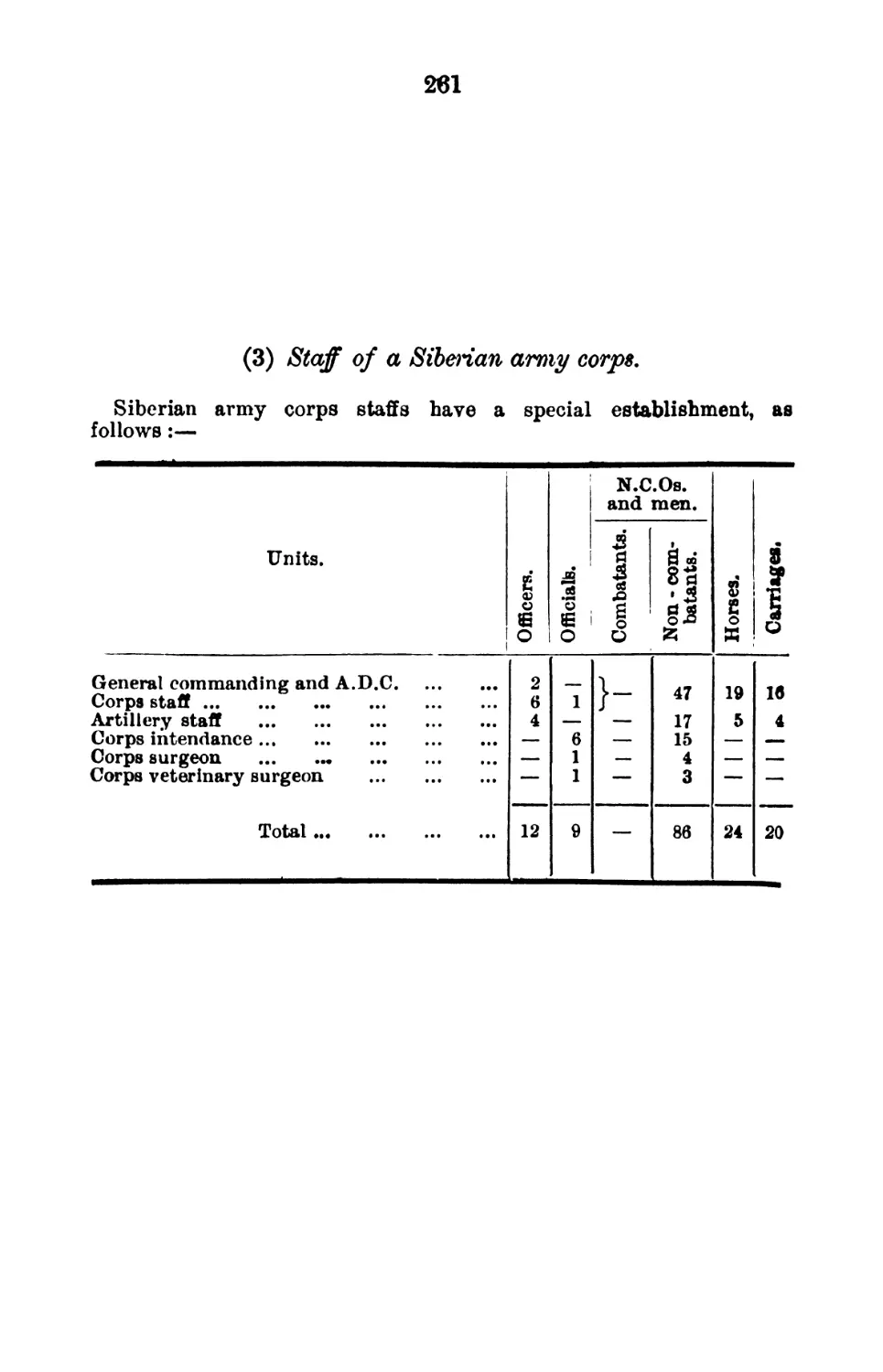
The strength and composition of an army corps staff is given in
Appendix X.
* See page 78.
31
The strength and composition of an army corps varies as
shown in Appendix I. Its normal composition is 2 infantry
divisions (with their artillery), 1 cavalry division, 1 division
of howitzers, 1 sappei' battalion and the necessary adminis-
trative troops.
Of the European and Caucasian troops, the Guard, III, VIII, XII
and I and II Caucasian corps have in addition a rifle brigade. The
XIV corps is composed of 1 infantry division and 2 rifle brigades,
the XXII of 3 rifle brigades. The XVI and XVIII corps have 3
infantry divisions.
The Guard, XIV, XV, XIX, and II Caucasian corps have 2 cavalry
divisions each. The V, XIII, XX, and XXIII have a brigade of
cavalry only. The VII, XXII, and XXIV have a varying number of
squadrons less than a brigade, while the I, IV, XVII, XVIII, XXI,
and XXV corps have no cavalry at all beyond the Cossack escorts of
corps and divisional staffs.*
It is probable that certain of the cavalry divisions would
be formed into cavalry corps and become independent upon
the commencement of operations.
Some corps have, in peace, heavy artillery divisions,
pontoon battalions, wireless telegraph and air companies.
These would form Army troops in war.
Asiatic corps have a special composition. The two Turkis-
tan corps have 3 and 2 rifle brigades respectively. Siberian
corps have 2 rifle divisions. All these corps are weak in
cavalry.
The Russian army corps formed in the war of 1904-5 varied very
considerably in composition, and were frequently split up for some
temporary purpose. Lately the tendency as regards European corps
has been to re-group them with a view to uniformity.
The war establishment of a normal army corps in European
Russia is given in Appendix X. It may be taken
roughly as 46,000 of all arms, and its fighting strength as
28,000 rifles, 3,500 sabres, and 120 guns. That of corps
differing from the normal can be calculated from the estab-
lishments of the units composing them.
Cavalry corps.—Cavalry corps are not maintained in
peace, and their strength and composition in war is not laid
down. It may be assumed to be 2 cavalry divisions with a
staff and a cavalry corps supply column.t
* Divisional cavalry may be furnished in war by 2nd line category
Cossacks.
t See pages 115, 291.
32
Infantry Divisions.—An infantry division is commanded
by a lieutenant-general, who has a staff of 1 colonel as chief of
the staff, and 2 senior adjutants, one an officer of the General
Staff. The remaining officials of the staff are the Divisional
Intendant and his assistant and the Divisional Surgeon.
The duties of the staff of the division are parallel to those
of the staff of an army corps.
To each divisional staff is attached an escort detailed from
one of the independent Don Cossack squadrons, of 2nd or
3rd Category, and consisting of 1 officer, 2 under-officers,
20 Cossacks, and 22 horses. From this the escort for the
baggage column is detailed.
The baggage, &c., of the divisional staff is carried in 1 two-
horsed wagon and 5 one-horsed carts, with 6 drivers and
9 (1 spare) horses.
The telephone stores approved for the staff of a division
include 19 versts (12§ miles) of wire and 9 stations complete,
carried in 2 two-horsed carts.
If the division be not included in an army corps, its staff
is increased by an engineer officer, a divisional controller,
and 5 non-combatants.
The staff of a Siberian rifle division differs slightly from
the above. A Veterinary Officer takes the place of the
Intendant, there is no Cossack escort, and the transport
consists of 11 two-wheeled carts.
The war establishment of infantry divisions of the active
army is given in Appendix X. It may be taken roughly as
20,000 of all arms, and its fighting strength as 14,000 rifles
and 48 guns.
Cavalry Divisions.—A cavalry division is commanded by
a lieutenant-general. His staff includes 1 colonel as chief and
two senior adjutants, one a General Staff officer, 3 officials (i.e.
divisional intendant and assistant, and divisional surgeon),
and a Cossack escort of 1 officer and 22 N.C.Os. and men.
The transport consists of 1 uryadnik in charge, 8 (6 in
Cossack divisions) drivers, 7 one-horse (5 in Cossack divisions)
and 1 two-horse carriages, 10 draught horses (8 in Cossack
divisions), and 22 horses of the Cossack escort.
If the division be not included in an army corps, its staff
is increased by a divisional controller, with 3 non-
combatants.
33
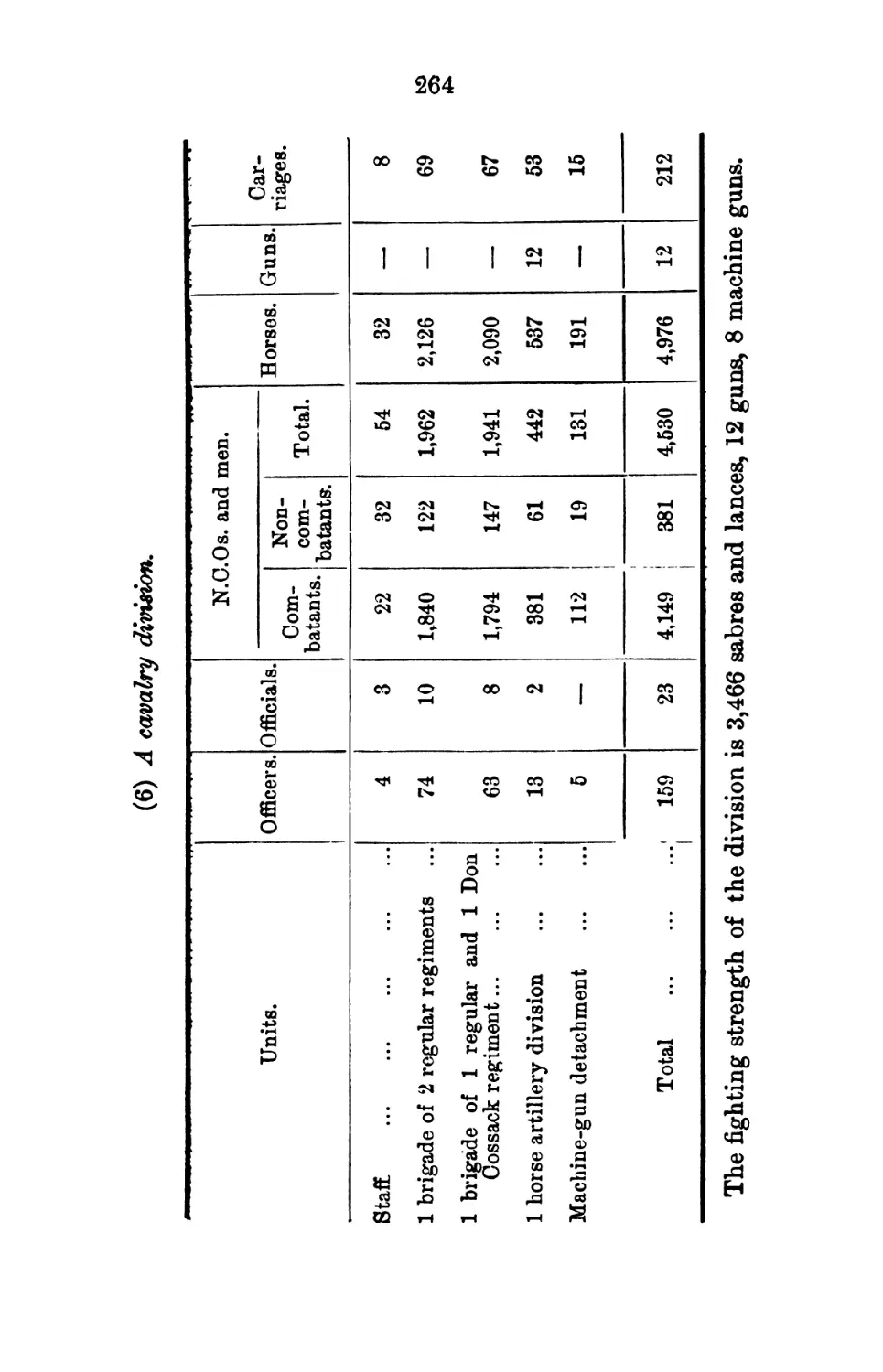
The composition of cavalry divisions varies. The com-
position and war establishment of the usual type are
given in Appendix X. Its strength may be taken roughly
as 4,500 of all arms, and its fighting strength as 3,500 sabres
and 12 guns.
Infantry Brigades.—An infantry brigade consists of a
staff and two regiments. In both peace and war the sphere
of action of the brigade commander is limited, and as a rule
the divisional commander deals with regiments, &c., direct.
In the field, the brigade commander is frequently detailed
to command a zone of the fighting line, or a detachment.
The staff of an infantry brigade consists of a major-
general (lieutenant-general in the Guard) commanding,
with a war staff of 1 brigade adjutant, 1 driver, and 1 clerk,
whose baggage is carried in a one-horse cart and on a pack-
horse. In peace time the brigade commander has no staff.
The war establishment of a brigade is about 8,000 of all arms
(7,000 rifles).
The staff of a rifle brigade consists of 1 major-general
commanding, 2 General Staff officers (a colonel and a
captain),* 1 surgeon, and 12 N.C.Os. and men, with 2 two-
horse wagons, 2 drivers and 4 horses. For war establish-
ment of a rifle brigade, see Appendix X.
Cavalry Brigades.—A cavalry brigade is commanded by
a major-general and has a staff of the same strength as
that of an infantry brigade.! It consists of two regiments,
either both regular, or one regular and one Cossack, or
both Cossack. The establishments of brigades of each type
are given in Appendix X.
Cavalry brigades have practically the same establishment
in peace and war.
* Rifle brigades in war will probably also include a Brigade adjutant, in
charge of administrative services, an officer in charge of communications
and another for special service.
t The staff of an independent brigade has 1 officer and 3 non-combatants
additional, as well as 3 more carts, drivers, and horses.
(B 10626)	C
34
II.—Reserve Troops.
On mobilization 38 reserve divisions will probably be
formed from surplus reservists as follows :—
8 in St. Petersburg district.
6 „ Kiev district.
2 „ Odessa district.
10 „ Moscow district.
5 „ Kazan district.
1	„ Caucasus district.
1	„ Omsk district.
2	„ Irkutsk district.
3	„ Amur district.
The composition of these divisions will be similar to that
of regular divisions. They would be used for internal
defence. There is no lack of trained men, but serious
difficulty would be experienced in finding a sufficiency of
officers, non-commissioned officers, and in supplying these
units with medical and other administrative services.
Difficulty will be experienced in the formation of reserve
artillery units. It is doubtful if there are sufficient guns ;
there will be no officers available, as active batteries are short
of their proper complement; all horses will have to be pur-
chased and trained.
There would also be some delay in horsing and equipping
the Cossacks of the 3rd Category.
Those regular units, in connection with which reserve
units will be formed on mobilization, have an increased
establishment of officers and, it is believed, of re-engaged
N.C.Os., to assist in their formation.
Ill, IV, V.—Dep6t, Fortress, and Local Troops.
The organization of the Depot and Fortress troops is given
in Chapters IV to VII. The organization of the Local troops
is described in Chapter IV.
35
VI.—The Imperial Militia.
The Opolchenie, or Militia, forms the third line of defence,
and it is stated that provision has been made for the forma-
tion of the following units :—
Field Troops—
Infantry, 640 battalions.
Cavalry, 80 squadrons.
Artillery, 80 batteries.
Fortress troops—
Infantry, 40 battalions.
Artillery, 10 battalions.
Sappers, 5 battalions.
The 640 battalions are formed in brigades (not regiments)
of 8 battalions, and divisions of 16 battalions, or 40 divisions
in all. The 80 squadrons form 20 regiments, of
4 squadrons, and 1 regiment is attached to each of 20 divi-
sions. The 80 batteries form 40 regiments of 2 batteries
each, or 1 regiment per division. As their designation
implies, the remaining troops will be employed for the
defence of fortresses only.
There are over 1,000,000 men in the Opolchenie who have
received some military training,* but the difficulties attending
a general mobilization of the reserve divisions which have
been referred to above apply with increased force to
the Opolchenie, and although it would no doubt be useful
for home defence, no great military value would attach to it
except after a prolonged period of embodiment.
Estimated fully mobilized strength.—The following is
an estimate of the total number of trained men in
Russia :—
The estimated number of fully trained men in the Opolchenie is about
670,500. These are men who have passed through the standing army and
deserve, and are 38 to 43 years of age.
(в 10626)	c 2
36
Total
5,962,396
Organization of the Lines of Communication in War.
The duties of the Chief of the Railway Department of the
Staff of the Commander-in-Chief have been described on
page 25.
Under his directions in so far as concerns railway matters
only are the Generals of communications (nachalnik
voennikh soobshchenii) of the armies, who are dealt with on
pages 26-28.
It remains to describe the organization of the lines of communica-
tions themselves. They are divided into stations (etapi). On road
lines these are at most *25 versts (16j miles) apart; on railway lines,
at all important junctions, and at entraining and detraining stations,
and also so that troops travelling may always be supplied with a hot
meal every 24 hours ; on water lines, at embarking.and disembarking
points only. They are classed as initial stations (nachalni etap),
terminal stations (golovnoi etap), collecting stations (sborni etap), or
intermediate stations (joromejutochni etap). Initial stations are at the
* Included in this figure are 670,451 of the Opolchenie, i.e., fully trained
men who have passed through the standing army and the reserve. The
remainder are surplus reservists. Other men in the Opolchenie who have
passed direct to the 1st Category, and the 2nd Category of the Opolchenie,
are not included.
To fa^page
Diagram showing lines of Communication of an Army.
Area of Operations.
Area under Military Governor-General.
Home Territory.
A Hi. l
37
commencement of a line of communications, terminal stations are the
advanced bases which move forward behind the army, collecting
stations are formed to regulate movement on long lines of communica-
tion, and intermediate stations are points for the rest and supply of
troops and convoys.
At each station is a field officer as commandant (etapni komendant).
Staffs are provided according to the importance of the station,
stations being divided into three classes.
Lines of road are divided into sections, each under a Road
Commandant (nachalnik etapnavo uchastka), a major-general, who is
the superior officer of the Station Commandants.
Governors may be appointed for the temporary civil administration
of occupied hostile territory, and are under the Chief of the Lines of
Communication Department.
Lines of Communication troops are furnished by reserve or militia
units.
Movement of troops by rail:—A Russian troop train consists of
about 35 4-wheeled wagons.
The following table gives the approximate number of trains
required for various units :—
Infantry regiment ...................................... 6
Cavalry „	  5
Field or Horse battery ................................. 2
Artillery brigade (48 guns)............................. 9
Howitzer division ...................................... 3
Artillery park.......................................... 2
Artillery park brigade ................................. 7
Sapper battalion (with section of Field park) .......... 5
Pontoon company ........................................ 3
Railway battalion ...................................... 2
Transport battalion..................................... 3
Wireless company ....................................... 1
Mobile field hospital................................... 1
Cavalry corps supply column ............................ 6
Thus an Infantry Division would require 48 trains, as follows:—
Staff 	 Divisional baggage and sanitary division 4 regiments infantry	 Artillery brigade 	 „ park brigade			3 5 ...	24 9 7
48
38
A Cavalry Division requires 24 trains:—
Staff and transport 	 4 regiments (24 squadrons)	 2 Horse Artillery batteries		1 ...	20 3
24
An Army Corps (less cavalry division) requires about 114 trains:—
Staff 	' 2 Infantry Divisions	 1 Sapper battalion (with section of Field park)... Howitzer Division 	 Corps Supply Column			2 ...	96 5 3 8
114
39
CHAPTER IV.
INFANTRY.
General organization.—The infantry consists of (a) Guard,
Grenadier and Line regiments, (6) Rifle regiments, (c) Kuban
(Jossack Plastun battalions, and (c?) Local infantry detach-
ments. In war there are formed in addition dep6t (zapasni)
battalions,and battalions of the Opolchenie or Imperial Militia.
(a) Guard, Grenadier and Line Regiments.
There are 236 regiments in all, viz.:—
J 2 Guard regiments.
16 Grenadier regiments.
208 Line (Аттегекг) regiments.
The 12 regiments of Guards are distinguished by titles
only, e.g., “ The Preobrajenski Regiment of Guards.” The
Grenadier regiments are numbered from 1 to 16 and the Line
regiments from 1 to 208, each regiment bearing the name
of some city, province, or river of the Empire, and many
bearing, in addition, the name of their honorary colonel,
thus, “ 82nd Daghestanski (Grand Duke Nikolai Mikhailo-
vich’s) Infantry Regiment.”
A regiment consists of 4 battalions of 4 companies each
and a non-combatant company, 17 companies in all.
The battalions in a regiment are numbered from 1 to 4,
the companies being numbered in regular sequence through
the regiment from 1 to 16. The non-combatant company
bears no number. The regiments are organized permanently
in divisions of two brigades of two regiments, the regiments
and divisions being numbered in regular sequence through-
out the army. Thus, the 16th Infantry Division comprises
40
the 61st, 62nd, 63rd, and 64th Regiments. Regiments are
commanded by colonels, battalions by colonels or lieutenant-
colonels, and companies by captains. Company commanders
are not mounted. They are, however, encouraged to ride at
manoeuvres and on service, mounting themselves at their
own expense.
Peace and war establishments.—The approximate peace
and war establishments are given in Appendix X. Roughly
a company in peace consists of 100 men, and in war of about
240, and has 3 or 4 officers in peace and war. A battalion
consists of about 450 men in peace and 1,000 in war. A
regiment in peace is about 1,900 strong, and its war strength
is 79 officers, 7 officials, and about 4,000 men (3,500 rifles).
In peace, however, certain divisions on the German and
Austrian frontiers, on the Black Sea coast, on the Turkish
Asiatic frontier and in Siberia have an increased effective
approximating closely to the war establishment.
The following special detachments form part of each
infantry regiment:—
(a)	The machine-gun detachment.
(6)	The communication detachment.
(c)	The scout detachment.
Machine-?un detachment.—The detachment is organized
as a company and is divided into sections each of 2 guns.
It has 8 guns in war, but at present only 2 or 4 in peace.
Three to six men per company are picked annually from
the last joined contingent and specially trained. Officers and
N.C.Os. are trained with an instructional machine-gun
detachment. All machine-gun detachments attend annual
practice camps which last for 15 days.
The detachment is commanded by a captain with
subalterns for two of the 4 sections. The remaining sections
are commanded by N.C.Os. Each gun has a detachment of
1 N.C.O., 7 men and 2 drivers. The war establishment
consists of 3 officers, 102 N.C.Os. and men, 70 horses and 24
vehicles (see Appendix X).
Armament.—The gun is of Maxim automatic pattern and takes the
rifle ammunition. The muzzle velocity is 2,854 f.s. and the sights are
graduated up to 2,084 yards.
Several types of carriage for the gun are in use at present, but the
type which will probably eventually be used by all units is the
41
Sokolov equipment, iu which the gun on a low wheeled platform is
parried in a cart drawn by 2 horses. The platform has 2 wheels,
12} inches in diameter, and when taken out of the cart can be dragged
along on these either by a horse or 2 mon. When preparing to fire,
2 folding legs are unstrapped from the trail and form with the latter
a tripod stand. The gun can also be tired as it stands, without using
the legs.
The gnu is provided with a shield, 15} inches high by 21 inches
wide. The weight of the gun without the shield is 97J lbs., of the
shield 16 lbs.
It can be rapidly adapted for pack transport in case the cart is
unable to proceed further.
The other mountings in use are the “ Vickers 1910,” which is only
slightly different from the Sokolov equipment, and the tripod mount-
ing of 1904 (without wheels).
Equipment.—The men of the machine-gun detachment carry carbines
slung on their backs instead of rifles, and a kinjal (curved dagger)
instead of a bayonet. One bandolier is worn and 3 infantry ammuni-
tion belt-pouches.
The Zeiss range-finder has been adopted for use with machine-gun
detachments.
Uni form.—Men of machine-gun detachments wear crimson braid on
the cuffs of their F. S. dress (see Plate 6).
Tools.—See Appendix IX for tools carried by a machine-gun
detachment.
Ammunition.—The cart on which the machine-gun is carried has at
the rear 2 lockers, each containing a metal cylinder holding 4 belts of
250 rounds each. These cylinders are taken out when the gun is
taken off the cart and can be dragged or rolled along the ground by
means of ropes attached to handles at each end of the cylinder.
Additional belts can be caried in the body of the cart. The ammuni-
tion carts carry each 18,000 rounds (40 belts of 450 each).*
Communication detachment. +—This consists of the
mounted orderlies (1 N.C.O. and 12 men), 4 signallers, and
21 telephonists (including 1 N.C.O.). It is commanded by
an officer, who is mounted, and has two 2-horse carts for the
material. The telephone equipment consists of 9 instruments,
1 central exchange for 6 lines and 10 versts (6f miles) of
wire carried on drums of 1 verst (1,200 yards) each.|
In each company 8 men are trained as signallers. Two
men per regiment are trained as cyclists. In war these
cyclists are formed into detachments for communication
between units and the brigade and divisional staff.
♦ Or 72 belts of 250 rounds each.	t See also pages 82-83.
t In addition, regiments usually have a good deal of extra telephone
and signalling equipment, purchased privately, and the establishment given
above is often exceeded, the use of telephones being very extended in the
Russian army. It may in fact be taken that the actual strength of the
communication detachment is usually 50-60 men.
42
Scout detachment.—Four men per company are trained as
scouts, and they are usually grouped under command of an
officer and used as a separate body for reconnoitring. They
are specially selected particularly for their physical qualities.
In Manchuria in 1904-5 the scout detachment was employed
for any particularly hazardous operation, and several scout
detachments were often grouped together for a particular
purpose.
Four cyclists are included in the scout detachment.
Infantry scouts wear green braid on the cuffs of their F.S.
dress (see Plate 6).
Regimental transport.—Each company has a 1-horse ammunition
cart, 1 two-horse baggage wagon, 1 one-horse cart for stores, and
1 field kitchen (two-horse). On each ammunition cart are carried
20 zinc boxes, each with 300 rounds ammunition, or 6,000 rounds.
The transport of a battalion staff consists of 1 one-horse cart for
officers’ baggage, 1 one-horse medical store cart, and 1 four-horse
ambulance wagon.
The transport of an infantry regiment is divided into two lines,
and is composed as follows :—*
1^ Line—	Carriages.	Horses.
1st echelon of company ammunition carts 8		8
Medical store carts		...	4	4
Wagon, with stretchers, &c.	1	2
Ambulance wagons		...	4	16
Officers’ baggage (1 cart per battalion)	...	4	4
„	„ (regimental staff)	1	2
Cooking carts (1 per company) ...	... 17	34
Telephone carts 		2	2
Spare horses		... —	7
Totals 		...	41	79
2nd Line—
	Carriages.	Horses.
2nd echelon of company ammunition carts 8		8
Regimental ammunition carts	8	16
Company baggage wagons ...	... 16	32
„	„	carts 		... 16	16
Regimental baggage wagons	...	5	10
н	M	cart 		1	1
Spare horses		...	8
Totals 		54	91
Grand totals	... 95	170
In command of the transport is an officer with 1 sergt.-major and
5 N.C.Os. All these are mounted.
* Not including the transport of the machine-gun detachment.
43
Arms and equipment.—
Officers—Officers of all arms carry a heavy curved sword (shashka)
and revolver. The new field service equipment for officers (introduced
in 1912) is similar to our Sam Browne belt. It consists of a belt with
two slings, sword frog, revolver holster, field glass case, case for
whistle and haversack, all of brown leather. The revolver is worn
on the left side, the field glasses and haversack may be worn right or
left as preferred.
Officials, sub-ensigns, sergeant-majors, regimental buglers, mounted
orderlies, and transport under-officers are also armed with swords
and revolvers.
The revolver is of 3-line calibre, with 7 chambers, of two patterns ;
triple action for officers, single action for rank and file; calibref
•299 inch; weight, 1*74 lbs.; charge of smokeless powder, 12*34
grains; weight of bullet, 108 grains; muzzle velocity, 902 f.s.; the
point of the bullet is flattened to produce smashing effect. It is worn
in a leather case on the waistbelt, and is secured by a cord passed
round the neck. Officers may use Colt or Borchardt-Luger automatic
pistols instead of a revolver.
Six pairs of field glasses per company are carried by non-
commissioned officers. Mounted orderlies carry compasses.
Rank and file.—Buglers and bandsmen are armed with sword-
bayonets and revolvers ; non-combatants with hatchets.
Combatant non-commissioned officers and men arc armed with the
“ 3-line ” rifle, 1891 pattern,* which has been resightedf and adapted
for new pointed ammunition. It has a quadrangular bayonet which
is always carried fixed, bayonet scabbards being left behind on
service.
The principal data of the rifle are as follows:—
Rifle—
Weight with bayonet ...
Total length with bayonet
,.	„ without bayonet
Calibre ...................
Number of grooves
Twist of grooves
Breech action..............
Contents of magazine ...
... 9| lbs.
... 5 ft. 8 ins.
... 4 ft. 3J ins.
... 0*299 in.
... 4.
... 1 in 31-7 cal.
... Straight bolt.
... 5 rounds.
* 7 per cent, of the rifles with the troops were renewed in 1913, 13 per
cent, will be renewed in 1914 and 20 per cent, in 1915, and subsequent years.
The old rifles thus withdrawn may be fitted with new barrels and become
available for the Opolchenie.
t The resighting is unlikely to be entirely completed in all districts until
the end of 1915. All units of the standing army in European Russia, how-
ever, are armed with the resighted rifle.
44
Ammunition—
Total weight of cartridge
Material of cartridge case
Powder charge...............
Material of bullet (pointed) ...
Weight of bullet ...........
Initial velocity ...	.......
Rifle sighted up to ........
... 361 grs.
... Solid drawn brass.
... 46*5 grs.
... Lead with nickel and
copper coating.
... 148 grs.
... 2,826 f.s.
... 3,000 paces.
The rifle has no cut-off, but can be used as a single loader when
the magazine is empty. The smokeless powder used is a pyroxylinc
preparation in yellowish tablets.
The supply of ammunition carried is, per regulation, as follows :*—
	Per Rifle.
Carried by the man		120 rounds.f
In the regimental S.A.A. carts 		66	„ J
In the artillery parks			69
In the local parks 		...	164	„
Total 		419
The personal equipment consists of a waistbelt of buff leather
supporting a pouch for 30 rounds on each side of the clasp, and the
Linnemann tool on the right side in a case, handle downwards. A
bandolierS, holding 30 rounds,] is carried over the left shoulder under
the rolled greatcoat, and a reserve pouch,§ holding 30 rounds, is
suspended by a strap over the right shoulder and fastened to the
waistbelt on the left side.
Suspended over the right shoulder, and hanging in rear of the loft
buttock, is a waterproof canvas kitbag, containing two shirts, one
pair drawers, two pairs foot cloths, one towel, one pair mitts, 3 days’
provisions as shown on page 117, materials for cleaning the rifle,
cloth for repairs, soap, housewife, and drinking cup. (The Guards
have instead of this a knapsack of older pattern.) One sixth
portion of a shelter tent of grey-green waterproof canvas is strapped
to the left side of the kitbag. The aluminium water-bottle^f with cup,
and the oval bronze mess-tin are also suspended over the right
shoulder, and lie on the top of the kitbag. The greatcoat is worn
rolled en bandouliere over the left shoulder, a spare pair of boots
* See also page 71.
t In the war of 1904-05 this number was increased to from 165 to 210
rounds when going into action in circumstances admitting of replenishment,
and up to 240 rounds when replenishment was difficult. The extra rounds
were carried in bandolier, pockets and kitbag.
t 59*7 rounds if the N.C.O's. rifles be included.
Not carried by N.C.Os.
60 rounds is its full capacity.
Weight empty, 10 ozs.
45
in a bag being strapped on to it, and the hood rolled up in it. The
total weight carried by the infantry soldier in marching order is about
56j lbs., including 120 rounds. The shelter tent consists of 6 sheets,
3 poles in two pieces each, 10 ropes and 8 pegs. The sheets are
about 8 feet square, and the whole equipment is divided among six
men.
Each regiment has a colour, which is carried cased by the 1st
Battalion. It is about 50 inches square, in black, white and orange,
and bears the St. George’s Cross with the Imperial cypher, and the
double eagle. Each regiment also has a camp colour, 50 inches x
35 inches, of the regimental colour (according to its number in its
division) and with the regimental number in black.
To facilitate direction, dressing, &c., each battalion and each
company has a flag. Those of battalions have three horizontal
stripes of black, orange, and white, with the number of the battalion
on the central stripe. Those of companies are red, blue, white, and
dark green, according as the regiment is the 1st, 2nd, 3rd, or 4th, of
the division, and have a vertical and a horizontal stripe forming a
cross in the centre. The horizontal stripe is red for the 1st, blue for
the 2nd, white for the 3rd, and dark green for the 4th battalion of
each regiment; the vertical stripe, red, blue, white, and dark green for
the 1st, 2nd, 3rd, and 4th companies of each battalion respectively.
These flags are carried on the bayonets of the markers. See
Plate 12.
For entrenching tools carried, see Appendix IX. i
It is intended to issue searchlight projectors to all infantry regi-
ments. It is not yet known what the pattern will be.
Uniform.—See page 50.
(6)	Rifles.
The rifle regiments of the Russian Army consist of—
4 Guard rifle regiments, forming the Guard Rifle
Brigade.
20 rifle regiments (Nos. 1 to 20), forming in regular
sequence the 1st to 5th Rifle Brigades of the Line,
of 4 regiments each.
12 Finland rifle regiments (Nos. 1 to 12), forming in
regular sequence the 1st to 3rd Finland Rifle
Brigades.
8 Caucasian rifle regiments (Nos. 1 to 8), forming in
regular sequence the 1st and 2nd Caucasian Rifle
Brigades.
22 Turkistan rifle regiments (Nos. 1 to 22), forming in
regular sequence the 1st to 4th Turkistan Rifle
Brigades, of 4 regiments each, and the 5th and 6th
Turkistan Rifle Brigades, of 3 regiments each.
(N.B.—All the above regiments have 2 battalions each.)
46
44 Siberian rifle regiments (Nos. 1 to 44), of 4 battalions
each, forming in regular sequence the 1st to 11th
Siberian Rifle Divisions.
Establishments.—The war establishment of a Siberian
rifle regiment is the same as that of an infantry regiment
(see Appendix X), with the exception that the system of
transport is different, as there are 382 drivers and 437 horses
(including 43 spare). In the Irkutsk and Pri-Amur
districts Siberian rifle regiments have mounted scout
detachments. The peace establishment is much higher and
approximates closely to the war establishment.
The peace and war establishments of companies in
2-battalion rifle regiments in Europe are the same as those
of infantry regiments. Each regiment has a detachment of
6 mounted orderlies (1 N.C.O. and 5 men). A machine-gun
detachment of 8 guns forms part of each regiment. It
is believed that rifle regiments have at present only pack
equipment for machine guns. Four men per company are
trained as scouts.* The communication detachment is similar
to that of an infantry regiment but of half the strength.
Finland rifle regiments have 6 cyclists per regiment, who
are armed with revolvers.
The war establishment of a 2-battalion rifle regiment is
given in Appendix X.
Transport.—The following is the transport for a rifle regiment of
2 battalions in Europe:—
	Carriages.	Horses;
1st Line—• 1st echelon of company ammunition carts 4		4
Medical store carts			 2	2
1-horse cart with stretchers		 1	1
Ambulance wagons			 2	8
Baggage of regimental staff		 1	2
„ battalion officers...		 2	2
Cooking carts				 9	18
Riding horses			... ... 		1
Spare horses			... ... —	4
Totals ...		 21	42
♦ In Turkistan rifle regiments the scouts are mounted, and are increased
to 5 per company. They are foimed in a detachment commanded by an
officer.
47
2nd Line—	Carriages. Horses.
2nd echelon of company ammunition carts 4	4
Regimental ammunition carts ........... 4	8
Company baggage wagons ................ 8	16
Regimental baggage wagons ............. 2	4
Company baggage carts.................. 9	9
Telephone cart ........................ 1	1
Riding horses ......................... —	3
Spare horses........................... —	4
Totals................. 28	49
Grand totals .......... 49	91
For a Siberian rifle regiment and Turkistan rifle regiment the
transport consists of the following 2-wheeled carts, all drawn by
1 horse, except the field kitchens, which have 2 horses.
	Siberian rifle regt.	Turkistan rifle regt. (2 bns.).
Company S.A.A. carts	32	16
Battalion „	„	16	8
Medical carts		4	2
Ambulance carts 		16	8
Carts for sanitary material...	4	2
Field kitchens			17	9
Telephone carts			2	1
Company baggage carts	48	24
Officers’	„	„	10	8
Regimental „	„	15	6
Carts for entrenching tools ...	8	4
Company carts			17	9
Supply carts		176	—
	365	97
Uniform and equipment.—See pages 43, 50-51 and Appendix VI.
(c)	Cossack Infantry.
Organization.—The Kuban Cossack voinlco furnishes 18
battalions of infantry (termed plastun battalions), numbered
from 1 to 18, of which only Nos. 1 to 6 are maintained in
peace, Nos. 7 to 12 being of the 2nd, and Nos. 13 to 18 of the
3rd Category. The 6 battalions maintained in peace form
the Kuban Plastun Brigade, which belongs to the 1st
Caucasian Army Corps.
48
Uniform and equipment.—The uniform is the same as for
the Kuban cavalry regiments (see page 58), with the
battalion number in dark blue on the shoulder-straps, and
black tops to their sheep-skin caps. The armament and
equipment are as for other infantry.
(d)	Local Infantry.
Organization.—The local infantry is, as its name implies,
intended for local duties only, such as the guarding of
factories and magazines, and in chief towns of recruiting
circles, where there is no garrison. It is organized in small
detachments, varying in strength from 48 men to 3 officers
and 511 men. There are 107 such detachments of regular
and 20 of Cossack troops. They have the same establishment
in peace as in war.
The “ escorts ” (konvoiniya komandi) are maintained for
the guarding and escort of prisoners and convicts. There
are in all 530 escorts (503 in Europe, 27 in Asia), with a
total strength of 11,738 men.
The local infantry and escorts are organized for
administration into local brigades, of which there are 22.
Uniform and equipment.—As for infantry, but the men have only
one ammunition pouch. The initial letter of the locality followed by
M (Myestni = local) is stencilled in yellow on the shoulder-straps
(see Appendix VI).
No transport is provided in peace or war.
Depot Infantry.
Formation and organization.—A dep6t battalion is formed
on mobilization for each infantry or rifle regiment with the
object of preparing drafts to make good the wastage in war
of the active units at the front.
The battalions are formed at previously designated points,
generally in the territorial district of the corresponding active
regiment. Those of each army corps are grouped in a brigade,
called “ The Infantry Dep6t Brigade of the . . . Army
Corps.” A Commander for each brigade is nominated in time
of peace and prepares the plans for the formation of his
brigade. His staff is formed on the issue of the order to
mobilize. The staff consists of two combatant staff officers, a
medical officer and 10 non-combatant rank and file.
49
A battalion consists of 4 companies, each 250 strong. In
special circumstances the number of companies may be
increased up to a maximum of 8.
Vacancies created by wastage in a regiment at the front
are filled on the requisition of the headquarter staff in the
field by the despatch of “ marching companies ” (marsheviya-
roti), 250 strong, from the most conveniently situated depot
battalion, but preferably from the depot battalion of the
regiment to be reinforced.
Establishments.—A battalion consists of a permanent
instructional cadre and a varying effective of men called up
for training. The establishment of a 4-company battalion is
given in Appendix X.
The officers and N.C.Os. of the permanent cadre are
detailed from the corresponding line regiment. The officials
and rank and file of the permanent cadre are reservists
whose names are enrolled on a special list in peace time.
The varying effective is obtained from ensigns of the reserve
and reservists of the regimental territorial district.
Uniform and equipment.—As fur the corresponding units of the
active army.
Complete war equipment is held ready in peace.
Imperial Militia Infantry (Opolchenie).
Organization.—It is stated that provision has been made
for the organization of 640 battalions (drujini) of militia
infantry, which will not be formed in regiments, but in
brigades of 8 battalions and divisions of 2 brigades, and that
these will be called out in two categories, 320 battalions
(20 divisions) in each. Forty battalions of fortress militia
infantry, 20 of each category, will also be called out.
No cadres are maintained in time of peace, but from 1 to 3 re-
engaged non-commissioned officers, detached from the active army, are
attached to each circle commandant’s staff to look after the mobilization
equipment.
Strengths.—Each drujina is composed of 14 officers, 3 officials, 957
combatant and 26 non-combatant non-commissioned officers and men,
with 32 transport horses, 10 horses for men of the battalion to be
employed as mounted orderlies, and 16 carriages.
(B 10626)	D
50
Uniform, armament, and equipment.—The uniform will vary in colour
according to the u Government ” in which the battalions are formed,
the only regulation being that all the men of a battalion must be
uniformly clothed, and that red shoulder-straps are to be worn.
The clothing will probably be the national long-skirted coat, wide
trousers, long boots, and peaked cap with the Militia cross in front.
It is intended that the various ranks should be armed as in the regular
infantry, but at present Berdan rifles and Smith and Wesson
revolvers are substituted for the small-bore weapons.* Mounted
orderlies have cavalry swords and revolvers. Men armed with rifles
carry 84 rounds; with revolvers, 18. Government supplies for each
man a cap badge, a waistbelt, 2 pouches for 30 rounds each, arms, and
ammunition, also drums and bugles, and for each battalion 32 shovels,
16 axes, 6 pickaxes, 6 mattocks, 320 Linnemann spades, and 80 small
axes. All the rest of the clothing and equipment is found by the
communes.
Transport.—The transport for each battalion consists of 16 2-horse
wagons, 1 for office, &c., 1 for staff baggage, 2 for ammunition, 1 for
artificers’, &c., tools, 1 for medical stores, 6 for supplies, and 4 for
company baggage.
GENERAL NOTE ON UNIFORM.
The Russian army adopted in 1913 a universal field
service dress of grey-green or protective (zashchitnaya)
colour, which is worn on all occasions. On ceremonial occa-
sions a coloured plastron (latskan) is added to the F.S. blouse
and coloured stripes to the trousers, and a fur cap is worn
instead of the F.S. cap. The Guard, cavalry, Cossack and
horse artillery units, however, still retain their separate full
dress uniform in addition to the F.S. uniform.
In this handbook descriptions of uniform will be confined to the
field service dress. The principle followed will be to describe in this
chapter those parts of the uniform which are common to all branches
of the service and to note any particulai' differences in the chapter
dealing with the arm concerned.
The distinctive marks by which the arm and unit to which a man
belongs may be recognised are given in Appendix VI These dis-
tinctions are:—
(a)	In the Guard, the coloured piping on the collar, cuffs, and
shoulder-straps.
(6)	In all units, except the Guard, the numerals, cyphers and
badges worn on the shoulder-straps.
(c)	In aU units, the colour of the coloured side of the reversible
shoulder-straps and of the patches on the collar of the great-
coat.
(d)	In cavalry and Cossack units the colour of the stripe on the
breeches.
* See footnote, page 43.
51
All officers wear a single-breasted jacket of grey-green cloth
with 5 buttons of the same colour, either of stamped leather or of
metal. The jacket has two side and two outside breast pockets, and is
made loose enough to allow of a thick woollen waistcoat being worn
underneath it. The collar is 1| inches high and is fastened with two
hooks. Officers of Guard regiments wear coloured piping on the flaps
of the breast pockets and on the cuffs. Badges of rank are worn on
the shoulder-straps
The rank and file wear a blouse (rubakha) of similar colour. Its
pattern is that of the blouse commonly worn by the Russian peasant,
without pockets. The soft standing collar, If inches in height,
buttons at the side over the left shoulder. Shoulder-straps worn
by the rank and file are reversible, one side being coloured and the
other of the same colour as the blouse. The former is worn upper-
most in peace, the latter on service and on manoeuvres. On both
sides (except in Guard regiments') are stencilled numbers, letters
and cyphers, which provide the best means of recognising the
unit to which a man belongs (see Appendix VI). In Guard regiments
the grey-green side of the shoulder-straps is plain with coloured
piping.
The trousers are of similar colour and material to the jacket, except
in the cavalry and artillery, and are cut very loose and tucked inside
the long boots, which are of soft leather reaching to the knee.
The forage cap is of grey-green (doth with a peak of the same
colour. All officers and the rank and filo of mounted units wear a
chin-strap fastening outside. The chin-strap buttons are of metal on
the officers’ caps, and of grey-green leather on those of the rank and
file. The national cockade of orange, black and white is worn on the
cap-band by all units.
The greatcoat of the rank and file is of heavy greyish-brown cloth,
and reaches to half-way between knee and ankle. It fastens with
buttons and hooks, is cut very loose, and is gathered in by a strap
and buttons in rear at the waist. There is a patch of coloured cloth
on the collar, which turns down, and the shoulder-straps are of the
same colour as those on the jacket in peace. A sheepskin coat,
reaching to the knees, is worn under the greatcoat in the winter.
The hood (bashlik') is of camel’s hair cloth, with long ends which
can be rolled round the neck. On the march, with the greatcoat in
wear, the hood hangs on the man’s back, and the ends are crossed
over the chest and tucked under the waist-belt.
The officers’ greatcoat is of blue-grey cloth.
The colours of the collar-patches on the greatcoat in the infantry
run in agreement with the consecutive numbering of the regiments,
in regular sequence in each division, viz., red, blue, white, dark green,
according as a regiment is the first, second, third or fourth in its
division.
Foot cloths are worn instead of socks.
Cloth mitts are worn in winter.
The men are provided with flannel cholera belts.
(B 10626)	D 2
52
Distinctive marks of rank (common to all arms).—*
Officers (see Plate 5).
An officer’s rank is indicated by his shoulder-straps and the
badges on them.
The badges of rank are :—
Sub-lieutenant...................... Two stars.
Lieutenant ......................... Three stars.
Staff-captain ...................... Four stars.
Captain............................. No stars.
For the above the shoulder-straps, which are of cloth of the same
colour as the shoulder-straps of the men and stiffened inside, are
covered with two strips of gold or silver lace showing a strip of the
cloth in the middle and round the edges. On the shoulder-straps are
borne the same number and cypher as on the men’s shoulder-straps
in addition to the badges of rank.
Lieutenant-colonel ...	...	... Three stars.
Colonel............................. No stars.
For field-officers the shoulder-straps have three strips of gold or
silver lace showing two strips of cloth in the middle.
Major-General	...	............. Two stars.
Lieutenant-General ................. Three stars.
General............................. No stars.
Field-Marshal	.................. Crossed batons.
The shoulder-straps of general officers are of scarlet cloth
completely covered, except at the edges, with gold lace.
Non-commissioned officers (see Plate 6).
The rank is indicated by stripes of braid or tape on the shoulder-
straps, as under:—
Sub-ensigns {podpraporshchiki'). a stripe of gold lace down the
middle of the shoulder-strap.
Sergeant-majors, a broad stripe of dark orange braid across the
shoulder-strap.
Senior under-officers, three . f d k	tape across
Junior under-officors, two f the shoulder-straps.
Lance-corporals,one	)	1
Re-engaged N.C.Os. of the 2nd class wear in addition a narrow
strip of dark orange braid across the upper ends of the shoulder-
straps.
Snort-term volunteers (see page 9) wear a twisted cord of the
national colours (orange, clack, and white) round the edges of the
shoulder-straps.
53
CHAPTER V.
CAVALRY.
Regular Cavalry.
Organization.—The regular cavalry consists of :—*
4 regiments of Guard cuirassiers, of 4 squadrons each.
1 regiment of horse grenadiers (Guard), of 6 squadrons.
23 regiments of dragoons ; 1 of the Guard, 20 of the
Line (Nos. 1 to 20), 1 Littoral {Primorski) Regi-
ment, 1 Crimean Regiment; all of 6 squadrons
each.
19 regiments of Ulans ; 2 of the Guard, 17 of the Line
(Nos. 1 to 17) ; all of 6 squadrons each.
20 regiments of hussars ; 2 of the Guard, 18 of the Line
(Nos. 1 to 18); all of 6 squadrons each.
1 regiment of Daghestan horse, of 6 squadrons.!
1 division of Oset horse, of 2 squadrons.
1 division of Turkoman horse, of 2 squadrons.^
The regiments of the Guard have titles only—thus, “ The
Guard Hussar Regiment, the Emperor’s” ; while those of
the Line have numbers and territorial names, and the
majority also the name of their honorary colonel—thus,
“ 1st Sumski Hussar Regiment (King Frederick VIII of
Denmark’s).” Regiments are commanded by colonels, half-
regiments (divisions) by lieutenant-colonels, and squadrons,
which are divided into four troops, by captains.
With the exception of the 20th Finland Dragoons and of
the Crimean regiment, all the above are permanently
included in cavalry divisions or brigades (see Appendix I).
* It has been decided to raise another 26 regiments of regular cavalry. It
is reported that 6 of these will be raised in 1914.
f Practically irregulars, recruited from Mahommedan volunteers.
t Irregulars, but included here for convenience.
64
Establishments.—The peace and war establishments are
practically the same. A squadron consists of about 150 men.
The war establishment of a 6-squadron regiment may be
taken as 1,000 of all ranks, and its fighting strength as 850
sabres. For details see Appendix X.
In each cavalry regiment there are two groups of specially
trained men. One consists of 16 selected men (razvyedchiki\
under an officer, who are trained in scouting, reconnaissance,
long distance rides, &c. The other is a detachment of two
officers and 16 men, specially trained as pioneers in the
destruction of railways and telegraphs and in the establish-
ment of telegraphic and signalling communication.* The
latter detachments have as yet only been formed in the
regiments of the Warsaw and Vilna Military Districts, but
the measure will soon be extended to all regiments.
Cavalry scouts wear a stripe of dark orange braid down
the centre of the shoulder-strap. Pioneers wear a special
badge on the sleeve (see Plate 6).
Machine-run detachment.—A machine-gun detachment of
8 guns of similar pattern to those of the infantry forms part
of all cavalry divisions. In peace the detachment is attached
to one of the regiments in the division.
The guns are in carts similar to those used in infantry detachments,
but the carts have 4 horses instead of 2. The ammunition is carried
on pack animals instead of in carts, and the whole of the detachment is
mounted. The war establishment is given in Appendix X.
Men of the detachment will be armed with revolvers. Swords will
be carried on the saddle.
Men of machine-gun detachments wear crimson braid on the cuffs
of their F.S. dress.
Uniform.—See page 51 for a description of the F.S. coat
and blouse and cap. .Regular cavalry wear grey-blue breeches
with narrow stripes of various colours, and high boots with
spurs. For distinctive marks on the uniform, see Appen-
dix VI.
The Oset division wears the same uniform as Terek Cossacks,
with letters Oc on the shoulder-straps.
* Every year 1 officer ami 2 men from every regular and Cossack
regiment are sent to the nearest railway battalion for a 4 months’ course of
instruction. Upon their return they act as Instructors to a regimental
class of 20 pupils, which goes through a course of one year.
55
The Daghestan Regiment has light brown Circassian frocks piped
with white, and with red shoulder-straps with letters Дг; breeches,
grey-blue. No girdles are worn. The head-dress is a Cossack
busby with cockade and wliite top. Officers also have a light brown
forage cap with white band and piping.
The Turkoman division wears red Turkoman gowns, yellow
shoulder-straps with letters Трк, yellow waistcoats, dark trousers
and girdles, and black sheepskin Turkoman caps.
Armament and Ammunition.—The whole of the Russian
regular cavalry is armed with the sword, rifle, bayonet and
lance, the last being carried by the front rank only. The
sword is curved, ana its blade is 34| inches long. It weighs
2 lbs. 4| ozs., and is carried in a leather scabbard lined
with wood and weighing 1 lb. 8f ozs., the rings being on
the convex edge, so that the sword is carried edge to the rear.
There is a scabbard for the bayonet on the outside of the
sword scabbard.
The rifle is carried slung across the back, muzzle upwards,
the butt being behind the right hip The (3-line) rifle is
similar to that of the infantry, and takes the same cartridge.
Its principal data are :—Length, 4 feet 0| inch without,
and 5 feet 5'5 inches with, the bayonet; weight, 8 lbs. 3’5 ozs.
without, 9 lbs. with, the bayonet. Otherwise it is identical
with the infantry rifle.
The lance is lOf feet long, of hollow steel, weight about
6 lbs. ; it is provided with a loop at the toe to enable a
horse-holder to carry 4 or 5 lances when mounted.
Swords and revolvers, of the same pattern as in the
infantry, are carried by officers, sergeant-majors, trumpeters,
dismounted combatants, transport under-officers, and all
non-combatants, instead of the rifle and bayonet.
Every man armed with a rifle carries 45 rounds on his
person, 24 more are carried in regimental transport, and
164 in the local parks, 233 per rifle in all. Men armed with
revolvers carry 6 rounds.
Equipment and Saddlery.—The sword-belt is worn over
the right shoulder, and the sword, carried edge to the rear,
is suspended to it by two very short slings. The waistbelt,
of brown leather, supports two pouches for 20 rounds each,
one carried on each side of the buckle.
The saddlery consists of a bridle with bit, a head-collar with
T-bit and head-rope, a saddle with felt panels, iron arches, and
two leather girths, a leather numnah, two wallets on the saddle, and
56
two saddle-bags carried on the numnah in rear of the saddle. The
corn sack is carried in front of the saddle, with its ends pushed into
the wallets, and over it is the rolled cloak with hood, outside of
which the entrenching tool is strapped on the off, and a picket post
on the near side. The man’s kit, reserve provisions, shackles, and
spare horse shoes are packed in the two saddle-bags. The horse’s
blanket, a canvas water-bucket for every second horse, and the
man’s mess-tin are carried in rear of the saddle.
The weight of the officer’s light saddle is from 16 to 18 lbs., of the
officer's ordinary saddle 27 lbs., and of the saddle of the rank and
file 37f lbs.
The weight of the cavalryman’s clothing, equipment, arms, and
saddlery is 137 lbs. The horse carries about 20 stone in all.
Standard.—Every regiment has a standard, very similar to an
infantry colour, which is taken on service and carried by the
1st Squadron.
In each squadron 13 pairs of field-glasses are carried by non-
commissioned officers and scouts. All officers, N.C.Os. and scouts
carry compasses.
Pioneer detachment and entrenching tool».—Each squadron is supplied
with 20 Linnemann spades and 20 small axes, which are carried on
the saddle in leather covers, and, in addition, in the squadron baggage
are carried two large axes. Also 1 axe per squadron is carried in
the regimental transport. In the cavalry regiments stationed in
the Warsaw and Vilna Military Districts special pioneer detachments
have been formed of 2 officers and 16 men each. These are provided
with a proportion of light telegraph equipment, including 2 telegraph
instruments, 2 telephones, 2 heliographs, 2 signalling lamps, &c.,
carried in a one-horse two-wheeled cart, certain stores for demo-
litions, including 280 pyroxyline cartridges, 14 toothed and 3 ordinary
crowbars, 14 sledge hammers, 3 shovels, &c., carried in 2 one-horse
carts and on 6 pack-horses. This measure will probably be extended
to the remainder of the cavalry, but at present the regiments
stationed in other districts have only 1 one-horse cart for engineer
stores, which includes 20 pyroxyline cartridges, 2 crowbars, and a
few other stores and tools.
Supplies.—See page 119.
Transport.—The transport of a cavalry regiment of 6 squadrons in
the field consists of—
Regimental baggage, 1st line—
6 squadron baggage
3 ammunition*
1 medical store
1 veterinary store
1 office store
1 C.O.’s baggage
6 cookings carts, 2-horse.
2 ambulances, 2-horse.
2 pack-horses with engineer and veterinary stores.
3 spare horses.
* 6,000 rounds in each.
51
Regimental baggage, 2nd line—
6 l-horse carts for squadron baggage.
1 l-horse cart for the chaplain and his stores.
1 l-horse cart for officers^ baggage.
5 2-horse wagons for supplies and artificers’ tools.
2 spare horses.
Total for cavalry regiment of 6 squadrons—
1st Line—21 carriages, 34 horses.
2nd Line—13 carriages, 20 horses.
Regiments in the Vilna and Warsaw Districts have 3 l-horse carts
and 6 pack-horses in 1st Line baggage additional.
Cossack Cavalry.
Organization.—The following table shows the number of
regiments and squadrons furnished in peace and war by
the various Cossack armies ; see also Appendix II. * * * § **
Army.	Peace.					War.
	Regiments of 6 squadrons.	Regiments of 4 squadrons.	Regiments of 3 squadrons.	Independent squadrons. ♦	Total squad- rons.	Regiments of 6 squadrons.	Regiments of 4 squadrons.	Independent ! squadrons.	Total squad- rons.
Don			17	2t	—	6	116	54	__	36	360
Kuban 		11	—	—	41	70	33	—	4t	202
Terek 		2		2	2$	20	8	4	2§	66
Astrakhan	—	1	—		4i	—	3	i	12J
Orenburg	4	2**	—	3*	35	16b	2**	3	107
Ural 		2	11	—	2Ц	18	6c	3d	1	49
Siberia 		3	—	—		18|	9	—		54|
Semiryechia ...	—	1	—		4t	—	3	।	121
Trans-Baikal ...	4	—-	—		24|	9	—-		54J
Irkutsk		—	—	—	I	1	.. —	—	ЗЦ	3
Krasnoyarsk	—		—	1	1	—	—	з|	3
Amur 		——	—	—		3i	1	—	3ij	91
Ussuri 		—	—	—	2J		1	—		i_	<>1
Total	43	7	2	26	318	137	i 15	57	939
* Included in the “ independent squadrons” given above are the com-
ponents of the Guard Combined Cossack Regiment, which consists of:
Ural 1 squadron, Orenburg 1, Siberian J, Trans-Baikal Astrakhan J,
Semiryechia j, Amur J, Ussuri J. Total, 4 squadrons.
t Guard regiments, “ The Emperor’s” and “ The Ataman,” raised to
6 squadrons in war.
I 1 division of 2 squadrons at Warsaw and 2 Guard squadrons, which,
with the Terek squadrons, form a regiment (Imperial Escort).
§ Guards. (See Note §.)	|| A division of 3 squadrons.
One of these forms part of Guard Combined Cossack Kegiment.
** Nos. 5, 6.	a. No. 2.	b. Nos. 1 to 4, 7 to 18.
c. Nos. 1, 3, 4 to 7.	d. Nos. 2, 8, 9.
58
In time of peace only the so-called 1st Line Category
Cossack regiments are maintained and, except as mentioned
below, they are numbered in each army from 1 upwards, the
Guard regiments bearing no numbers. To each of these
corresponds, generally speaking, a regiment of 2nd and
another of 3rd Line Category, which are embodied upon
mobilization. Except in the Don voisko, no Guard
regiments of 2nd or 3rd Line Category will be formed. The
2nd Line Category regiments are as a rule numbered in
sequence to those of the 1st Line Category, the 3rd to those
of the 2nd. Thus in the Don voisko the 1st to 17th are 1st
Line, 18th to 34th, 2nd Line, and 35th to 51st, 3rd Line
Category regiments. The 52nd is a mixed 2nd and 3rd Line
Category regiment of men who have served in the two
Guard regiments. The 1st, 18th, and 35th Regiments are
recruited from the same district, and form a so-called
“ chain ” (zveno), and so on in succession. The Kuban, Terek,
and Trans-Baikal regiments are not numbered in sequence,
but bear names and the number of the category to which
they belong—thus, 1st, 2nd, or 3rd Taman (Kuban) Cossack
Regiment, of which the 1st alone is maintained in peace.
For details of war formations, see Appendix II.
Establishments.—The peace and war establishments are generally
similar to those of regular cavalry. For details see Appendix X.
Cossack regiments have specially trained scouts, and those in the
Vilna and Warsaw Military Districts pioneer detachments, as in the
regular cavalry. See page 54 as regards machine-gun detachments.
Uniform.—Cossacks, except Caucasian Cossacks (i.e. Terek and
Kuban regiments), wear a F.S. blouse and forage cap* as described
on page 51, and wide blue-grey trousers with broad coloured stripes
varying in each army (voisko). High boots without spurs are worn.
The various distinctive marks on the uniform are described in
Appendix VI.
Caucasian Cossacks wear the long Caucasian frock (cherkesska)
open on the breast, reaching below the knees and with four cartridge
pockets on each breast, loose trousers and high boots. The head-
dress is a conical sheepskin cap. A hood (bashlik) is worn, and a
black felt sleeveless cloak (burka) instead of a greatcoat. Except in
full dress, complete freedom as to the colour of the cherkesska and
head-dress is allowed, but on service a cherkesska of dark-grey or
some similar inconspicuous colour would be worn.
The shoulder straps on the coat are light blue in the Terek, and
scarlet in the Kuban regiments.
* Except Ural, Amur, and Ussuri Cossacks, who wear a sheepskin cap
(рараАЛа), which may be of any natural colour except black or white.
59
Arms and ammunition.—The Cossack sword is of much the same
pattern as that worn by the regular cavalry, and is carried in
the same manner, but has no guard. It weighs 1 lb. 15| ozs., and its
scabbard 1 lb. 3| ozs. The length of the blade is 34J inches, and
of the whole sword 40J inches. It is suspended to a belt over the
right shoulder, except in the Kuban and Terek Cossacks, who
wear it on a waistbelt, to which is also attached a dagger (JcinjaV).
The Cossack rifle takes the same ammunition as that of the regular
cavalry, but has no bayonet, consequently the bayonet scabbard on
the sword scabbard is also wanting; otherwise the two rifles are
practically the same. The rifle is carried slung over the right
shoulder, i.e., the opposite shoulder to regular cavalry.
Every man. armed with a rifle carries 60 rounds, 30 in a bandolier
pouch slung over the left shoulder, and 30 in a belt pouch.
The lance is 9 feet long and weighs about 7 lbs. The stave is
painted black, and there is no pennon. Cossacks, however, are now
being equipped with the same lance as regular cavalry. It is carried
(on active service as well as in peace) by the front rank of all
Cossacks, except those of the Kuban and Terek.
Equipment and saddlery.—The equipment is the same as in the
regular cavalry, except as regards the method of carrying the
ammunition.
The saddlery is different to that used in the regular cavalry. The
bridle (except in the Guard) is a simple bridoon with a single rein.
The saddle is a simple tree with a padded valise placed over it, the
whole resting on four felt numnahs with a leather cover over them.
Two saddle-bags are attached to the rear arches. Cossacks other
than Kuban and Terek carry the rolled greatcoat and hood strapped
in front of the saddle. The latter carry the folded “ burka” on top
of the saddle-bags, in rear of the saddle. The man’s kit is carried
in the saddle-bags and in the valise on the saddle.
The weight of the Cossack’s clothing, equipment, arms, and
saddlery is 92 lbs. The horse carries about 245j lbs. in all.
Banneroles.—Cossack regiments (except those of the Guard) and
the Turkoman division have banneroles ito mark the position of
commanders of regiments and those of squadrons, the former being
always carried with the regimental commander, the latter on the
right flank of the squadron. The former is a square of 35 inches side,
the latter swallow-tailed, 22j inches broad, 35 inches to the tips of
the tails, and 15 inches to the head of the fork. The regimental
banneroles are the same colour as the shoulder straps (scarlet for
Kuban and Siberian, dark blue for Don, light blue for Orenburg and
Terek, crimson for Ural and Semiryechia, yellow for Astrakhan and
Trans-Baikal, and dark green for Amur and Ussuri Cossacks). The
Siberian, Orenburg, Semiryechia, and Trans-Baikal Regiments have
a white and the Amur a yellow St. Andrew’s cross on the bannerole,
and all have the regimental number in the centre. The upper half
of the squadron bannerole is the same colour as that of the regiment,
and in the centre is a white or yellow band if the regimental ban-
nerole has the St. Andrew’s cross. The lower half is—for the
60
1st Squadron, scarlet; 2nd, light blue ; 3rd, white ; 4th, dark green :
5th, yellow ; and 6th, brown. (See Plate 12.)
Pioneer detachment and entrenching tools.—As in the regular
cavalry.
Supplies.—As in the regular cavalry.
Transport.—The transport of a Cossack regiment of 6 squadrons
consists of—
1st Line squadron and regimental baggage as in a regular
regiment;
2nd Line baggage—6 1-horse squadron carts ;
1 staff officer’s baggage 1-horse cart;
4 2-horse wagons ;
with the same modifications as in the regular cavalry for regiments
in the Vilna and Warsaw Military Districts.
The transport of 4-squadron regiments is proportionately weaker.
DepOt Cavalry.
Regular Cavalry Depdts.
Organization.—Corresponding to each cavalry regiment
there is a cavalry depdt squadron which in peace trains
remounts for it and in war forms a depot for the regiments
in i-he held.
Of these squadrons, 65 in number for Guard and Line,
61 are grouped in depdt regiments, and three in the
Caucasian Depot Division. The depdt squadron of the 20th
(Finland) Dragoon Regiment is not included in a line depdt
regiment.
The Guard Depdt Regiment has 10 squadrons, and is not
brigaded.
The Line Depdt Cavalry Regiments are brigaded as
follows :—
1«< Depfa Cavalry Brigade.—Regiments 2, 4, 6.
4nd Deptit Cavalry Brigade.—Regiments 1, 3, 7.
Zrd DepCt Cavalry Brigade.—Regiments 5 and 8, and the
Caucasus Depdt Division.
Each of the above depdt regiments has six squadrons,
except the 7th which has nine. The Caucasus Depot Division
has three squadrons only.
The 1st Brigade is under the Moscow military district,
the 2nd Brigade under the Kazan, the 3rd under the Kiev
military district (except the Caucasus Depdt Division which
is under the Caucasus district).
61
The Littoral Regiment has a separate depdt formed both
in jxjace and war.
The units of dep6t cavalry are under the Army Remount
Department, the chief of which superintends their work and
training and inspects them.
On mobilization, each Guard and Line Depot squadron
forms two marching squadrons and a dismounted detach-
ment. The marching squadrons are sent after the regiment
as soon as possible. Subsequent drafts of reserve men and
horses are sent to join as required.
Establishments.—The establishments of the various depot units in
peace and war are given in Appendix X.
Uniform, armament and equipment—Similar to that of regular
cavalry. The depot squadrons formed in war will wear the same
uniform as their regiment.
Cossack cavalry depots.
Organization.—For each group or “chain” of three regi-
ments of 1st, 2nd, and 3rd Category, there is formed on
mobilization a dep6t squadron, which makes good losses in
men and horses in all the regiments affiliated to it. There
will be in all 18 Don squadrons (including 1 for the two
Guard and the 52nd Regiments), 11 Kuban, 4 Terek,
1 Astrakhan, 6 Orenburg, 3 Ural, 3 Siberian, 1 Semiryechia,
2 Trans-Baikal.
Establishments.—Each squadron will be composed of 3 officers, 222
combatant and 2 non-combatant non-commissioned officers and men,
224 in all, and 222 horses.
Uniform armament, and equipment.—As for the corresponding
Cossack regiments.
Imperial Militia Cavalry.
Organization, &c.—It is stated that, on the Imperial
Militia being called out, 80 squadrons will be formed, which
will be grouped in 20 regiments of 4 squadrons each. Each
squadron will have 155 men and 158 horses.
Uniform.—The F.S. dress will be similar to that of cavalry of the
line with the militia cross on the front of the forage cap.
Armament, equipment, and ammunition.—As in the regular cavalry,
with the exception that Berdan rifles and Smith and Wesson
revolvers are substituted for the small-bore weapons.* Men armed
with rifles carry 36 rounds, those with revolvers 18 rounds.
Training.—The Imperial Militia cavalry is liable to be called out
for training, but in practice never is.
* See footnote, page 43.
62
CHAPTER VI.
ARTILLERY.
The artillery which accompanies the armies in the field
consists of :—
(a)	Field and Mountain Artillery ;
(b)	Horse and Horse Mountain Artillery ;
(c)	Field Howitzer Artillery ;
(<Z) Heavy Artillery.
(a) Field and Mountain Artillery.
Organization.*—The field and mountain artillery consists
in peace and war of the following units :—
3 Guard field artillery brigades,+ numbered 1st to 3rd.
4 Grenadier field artillery brigades, numbered 1st to 3rd
and Caucasian.
52 Line field artillery brigades, numbered 1st to 52nd.
11 Siberian rifle artillery brigades, numbered 1st to
11th.
1 Guard rifle artillery division + of 3 field batteries.
5 Rifle artillery divisions, numbered 1st to 5th, each of
3 field batteries.
3 Finland rifle artillery divisions, numbered 1st to 3rd
Finland, each of 2 field and 1 mountain battery.
2 Caucasian rifle artillery divisions, 1st and 2nd Caucasian,
each of 3 mountain batteries.
* It has been decided to re-organize the Russian artillery. The ’normal
brigade, which at present contains 48 guns and is organized in twoidivisions
of three 8-gun batteries, will probably give place to a brigade of 54 guns
organized in three divisions of three 6-gun batteries. It is stated that
batteries will still be commanded by lieut.-colonels. The change was
probably commenced in 1913, but no details are yet available.
t The 1st Guard Artillery Brigade and the Guard Rifle Artillery Division
are horsed with chestnuts, the 2nd Guard Artillery Brigade with browns
and the 3rd with blacks.
63
6 Turkistan rifle artillery divisions, 1st to 6th Turkistan,
the 1st of 2 field and 1 howitzer battery, the 2nd,
3rd and 4th of 2 field and 1 mountain battery, the
5th of 2 field batteries, and the 6th of 1 field and
1 mountain battery.
1 independent Siberian mountain battery.
The normal brigade consists of 2 divisions, each of 3 field
batteries. The 12th and 32nd artillery brigades (Kiev
military district) and the 1st, 2nd, 4th, 6th, 8th, 9th and
10th Siberian rifle artillery brigades have, in addition, a 3rd
division of 2 mountain batteries. The 3rd Siberian Rifle
artillery brigade consists of 1 howitzer division (3 batteries),
1 heavy artillery division (3 batteries) and 1 mountain
artillery division (2 batteries). The 20th (Kiev), 51st and
52nd (Caucasus) artillery brigades have 1 division of 3 field
batteries and 1 of 3 mountain batteries.
The above artillery brigades (normally 48 guns) are allotted
to the infantry divisions bearing corresponding numbers, and
the rifle artillery divisions to the corresponding rifle brigades.
The independent Siberian mountain battery is allotted to the
11th Siberian rifle division.
The artillery of each army corps is, for technical training,
placed under the corps inspector of artillery, a lieutenant-
general ; in other respects each artillery brigade or rifle
division is directly under the commander of the infantry
division, or rifle brigade, to which it is allotted.
Brigades are commanded by major-generals, divisions by
colonels, batteries by lieutenant-colonels. Batteries are
divided into half-batteries, and into four numbered sections.
In each battery 29 men* are trained as scouts, observers,
telephonists, and signallers, and 11 of them are mounted.
Artillery scouts wear a strip of dark orange braid down the centre
of the shoulder-strap. Signallers wear a badge of forked lightning on
the sleeve. Bombardier observers wear a strip of dark orange braid
across shoulder-strap at top and bottom. Bombardier layers wear a
strip of dark orange braid across shoulder-strap at top and down
centre of shoulder-strap. (See plate 6.)
A field battery consists of :— '
Firing battery—8 guns, 8 ammunition wagons, 2 telephone carts.
First line wagons (batareini reserv)—8 ammunition wagons.
Transport—1st line, 1 reserve store wagon, 1 field kitchen ; 2nd
line, 6 two-horse supply and baggage wagons, 1 one-horse
cart.
* в scouts, 3 observers, 12 telephonists, 8 signallers.
64
A mountain battery consists of 8 guns (drawn by 6 horses each or
carried on 6 or 7 pack animals each), 80 pack animals with ammunition,
5 one-horse ambulance carts, 1 field kitchen, and 128 pack animals
with baggage and supplies.
Establishments.—-A field battery at war strength may be taken
roughly as 6 officers and 270 rank and file, a mountain battery as
6 officers and 300 rank and file. For details see Appendix X.
In peace only 4 guns are maintained, but the majority of the
field batteries near the western frontier,* and all those in Asia, have
in peace 8 guns, the number of horses maintained in some being as
many as 145. In most of the batteries in Asia the number of men
maintained in peace is the same as the war footing, and a fifth, or
reserve, section of 46 men is maintained in peace and war. Similarly,
the mountain batteries in Asia have in peace an increased
number of pack horses for both guns and ammunition boxes—e.g., the
Turkistan batteries have each 152 horses with 8 guns, and
18 ammunition boxes.
Uniform.—The F.S. blouse, forage cap, boots and great coat are as
described on page 31. Field artillery wear dark green trousers and
mountain artillery black leather breeches (chamber?). Drivers wear
buckled spurs.
For distinctive marks on the uniform, see Appendix VI.
Armamen/.—Field batteries are armed with a Q.F. gun of 3-in.
calibre 1902 model with steel shield and panoramic sight. All
batteries in the Turkistan Military District, it is believed all in the
Omsk and Irkutsk Military Districts, and many of the batteries in the
Caucasus Military District were still armed in 1913 with an earlier
model (1900) without shield.
Mountain batteries havea2-95-in.Q,.F.gun(1909 model) of Sclmeider-
Danglis pattern. The gun is intended primarily for draught by 6
horses, but is also adapted for pack transport by 6 or 7 horses (accord-
ing to whether the shield is a separate load or not).
Details of the above guns are given in Appendix VIII.
Ammunition.]—The ammunition carried for the field gun is as
follows:—
Per gun
With the battery—8 limbers with 36 rounds
each, 8 wagons at 88 rounds each = 992 ...	124
With 1st line wagons—8 wagons at 88...... 88
With 1st park of artillery park brigade—34
wagons at 92 = 3,128 ...................... 65
With 2nd and 3rd park of artillery park
brigade—68 wagons at 92 =₽ 6,256 ......... 130
407
* Of European units, the 3rd Guard, 2nd, 4th, 6th, 8th, 11th to 13th, 16th
to 20th, 25th to 28th, 30th to 32nd, 38th, 39th, 43rd and 51st artillery
brigades; the 1st to 5th Rifle Artillery Divisions, and the Caucasian Rifle
Artillery Divisionshave 8 guns in peace.	t See also pages 71-72.
A mountain battery has 80 pack animals carrying 12 rounds each
= 960 or 120 per gun. In the mountain artillery park 128 pack
animals carry 12 rounds apiece = 1,636 or 96 per gun.*
Armament and equipment of personnel.—Serjeant-majors, senior
under-officers and trumpeters carry swords and revolvers ; scouts and
transport drivers carry curved daggers and carbines ; other ranks
curved daggers and revolvers. Meu with carbines wear one ammuni-
tion belt-pouch. The kits of mounted men are carried in their saddle
bags; those of dismounted men in canvas knapsacks on the carriages.
The greatcoat, mess tin, waterbottle, haversack, and tent cloth are
carried by dismounted men as in the infantry, by mounted men as in
the cavalry..
Telephone equipment.—6 instruments and 12 versts (8 miles) of wire
in each battery.
Entrenching tools.—Sec Appendix IX.
(6) Horse and Horse Mountain Artillery.
Regular Horse Artillery.
Organization.—The regular horse artillery consists of :—
1 Guard horse artillery brigade of 5 batteries.!
23 line horse artillery batteries, numbered 1 to 23.
3 horse mountain divisions, 1st, 2nd, and Caucasian,
each of 2 batteries.
1 Turkistan horse mountain battery.
The 1st and 2nd divisions of the Guard H.A. brigade are
attached to the 1st and 2nd Guard Cavalry Divisions. The
3rd battery of the Guard H.A. brigade is attached to tho
Independent Guard Cavalry Brigade (XXIII A.C., Warsaw).
The 23 line H.A. batteries are organized in 12 divisions,
numbered 1 to 12, each division consisting of 2 line batteries,
except the 8th, which has one line and one Don Cossack
battery.J
The divisions are attached to cavalry divisions, and usually
bear the same numbers as the cavalry divisions to which
they are attached.
A. division is commanded by a colonel; it has a staff as
for independent field artillery divisions (see Appendix X.)
Batteries are commanded by lieutenant-colonels and are
divided into 3 numbered sections.
* According to some authorities there are LOO rounds j>er gun with the
battery and 120 in the park.
t A 6th battery, the Don Cossack battery of the Guard, also forms part
of this brigade.
t See p. 67 for Cossack batteries.
(в 10626)	e
66
The 1st Horse Mountain Division is attached to the
Ussuri Cavalry Brigade (1st Siberian A.C.), the 2nd forms
part of the IX A.C. (Kiev), and the Caucasian Division is
attached to the Caucasian Cavalry Division (II Caucasian
A.C.).
Establishments.—The war establishment of a horse battery may be
taken roughly as 5 officers and 220 rank and file, of a horse mountain
battery as 5 officers and 250 rank and file. Six guns and 6 ammuni-
tion wagons are maintained in peace.
A horse artillery battery consists of:—
Firing battery—6 guns, 6 ammunition wagons, one telephone cart
First line wagons—6 ammunition wagons.
Transport—1st line, 1 reserve store wagon, 1 ambulance wagon,
1 medical cart, 1 field kitchen; 2nd line, 5 two-horse supply
and baggage wagons, 2 one-horse carts.
A horse mountain battery consists of:—
Firing battery— 6 guns, 6 ammunition wagons, 1 pack animal with
telephone equipment.
First line wagons—6 ammunition wagons.
Transport—61 pack animals, 1 field kitchen.
Uniform.—F.S. blouse, forage cap, and greatcoat are as described on
p. 51. Horse artillery wear blue-grey breeches and boots with spurs
as in the cavalry. Horse mountain artillery wear black leather
breeches.
For distinctive marks on the uniform, see Appendix VI.
Armament.—Horse artillery batteries are armed with the same gun
as field batteries, ibut the equipment is somewhat lighter and fewer
rounds are carried. For details, see Appendix VIII.
Horse mountain batteries have the same gun as mountain batteries
Armament and equipment of personnel.—Scouts and transport drivers
carry swords ana carbines; all other ranks swords and revolvers.
N.C.Os. and men carry the sword on the saddle.
Entrenching tools.—See Appendix IX.
Supplies.—As in the cavalry
Telephone equipment.—6 instruments and 12 versts (8 miles) of wire
in each battery.
Ammunition.—
per gun
With the battery ... 6 limbers at 24.
6 ammunition wagons at 72 = 576	96
With battery reserve 6	„	„	72	72
No special provision of ammunition is made in the parks for horse
batteries. Horse mountain artillery have a park similar to 1 hat of
mountain artillery.
67
Cossack Horse Artillery.
Organization.—Horse artillery batteries are furnished by
the various Cossack armies as follows :—
Army.	Peace.	War.
Don (Guard) 	 Don (Line)		 Kuban 	 Terek 	 Orenburg	 Trans-Baikal 	 i Total 		1 7 5 2 3 2 I	1 21* 5 2 Gf
	20	39
The Line batteries are numbered in each army from 1
upwards ; those of the higher numbers, formed in war only,
are batteries of the 2nd and 3rd Categories. The batteries
existing in peace are formed in divisions of 2 batteries each
and attached to cavalry divisions in the same way as the
regular batteries.
Establishments—The war establishment is approximately the same
as that of a regular horse battery.
Uniform.—Similar to that of other CoEsaeks, according to the voisko
to which they belong, but the coloured side of the shoulder straps and
patches on the great coat collar are as in the remainder of the
artillery. The stencilling on the grey green sides of the shoulder
straps is dark blue. See p. 58 and Appendix VI.
The Don Cossack Guard battery wear piping as in the other Horse
Artillery of the Guard.
Armament.—As in the regular batteries.
Armament anti equipment of personnel.—As in the regular batteries,
except that Cossack swords are worn.
Entrenching tools, supplies, and transport.—As in the regular
batteries.
• Nos. 8 to 14 are of 2nd, 15 to 21 of 3rd Category.
f Nos. 4 to 6 are of 2nd Category.
j Nos. 8 and 4 are of 2nd Category
(в 10626)	в 2
68
(c) Field Howitzer Artillery.
There are 35 howitzer (mortirnie) divisions of 2 batteries
each, viz., Guard, Grenadier, Nos. 1-25,1st to 3rd Caucasian,
1st to 5th Siberian. They are attached to the Army Corps
corresponding to their number. There is also 1 independent
howitzer battery attached to the 11th Siberian Rifle Division.
There are thus 75 howitzer batteries in all, including the
howitzer division of the 3rd Siberian Rifle Artillery Brigade
and the howitzer battery of the 1st Turkistan Rifle
Artillery Division (see p. 63).
Each division consists of a staff and two batteries and is
commanded by a colonel. Batteries are commanded by
lieutenant-colonels, are numbered in each division, and are
divided into 3 numbered sections. Six men per battery are
trained as scouts, observers, and signallers and are mounted.
There are in addition 12 telephonists per battery.
A howitzer battery consists of:—
Firing battery—6 guns, 6 ammunition wagons, 2 telephone carts.
First line wagons—12 ammunition wagons.
Transport—1st line, 1 four-horse reserve store wagon, 3 section
one-horse carts, 1 field kitchen ; 2nd line, 6 two-horse supply
and baggage wagons, 28 one-horse carts.
Establishments.—The war establishment of a howitzer battery may
be taken roughly as 5 officers and 240 rank and file. For details, see
Appendix X.
Uniform.—As in the field artillery, with the number of the
division and Mp. on the shoulder-strap ; Siberian batteries have
the number of the division and C6. Mp, and Caucasian batteries have
number and K. Mp. (gee Appendix VI).
The uniform of the Guard Howitzer Artillery Division is
similar to that of the Guard Rifle Artillery Division, but with light
blue piping instead of red (see Appendix VI).
Armament.—A 4*8-inch Q.F. field howitzer (1909) of Krupp pattern
was recently adopted. It is improbable that all the batteries are yet
armed with this howitzer and a 4-8-inch Q.F. Schneider howitzer is
known to be in use, and possibly other patterns also. Details of the
Krupp and Schneider howitzers are given in Appendix VIII.
Ammunition.—	Per howitzer.
With the battery ...	6 limbers at 14	.......|
6 ammunition wagons at 34 f
With battery reserve 12	„	„	34	68
116
In addition 360 rounds per gun is carried in the park. About
30 per cent, of the ammunition carried is shrapnel.
Armament and equipment of personnel and telephone equipment.—As in
the field artillery.
69
(d) Heavy Artillery.
Organization.—There are 7 divisions of Heavy Artillery,
viz, 1st to 5th and 1st and 2ц<1 Siberian. They are attached
to Army Corps as follows :—
1st division to XX	A.C.	(Vilna district),
2nd	„	to XIX	„	(Warsaw	„	),
3rd	„	to XVII	„	(Moscow	„	),
4th	„	to XXI	„	(Kiev	„	),
5th	„	to XIII	„	(Moscow	„	),
1st Siberian division to II Siberian A.C. (Irkutsk district),
2nd „	„ to I „	„ (Pri-Amur „ ).
Though attached to army corps in peace the heavy
artillery divisions are intended to form part of the army
troops in war.*
Each division consists of 3 batteries of 4 guns each. There
are thus 24 batteries of heavy artillery in all, including the
heavy artillery division of the 3rd Siberian Kifle Artillery
Brigade (see page 63).
Eatablishments.—No establishments have yet been officially published.
A reliable German source gives the establishment of a battery as
4 officers and about 200 rank and file (see Appendix X).
A heavy battery consists of:—
Firing battery.—4 heavy guns or howitzers, 4 ammunition
wagons, 2 telephone carts.
First line wagons.—8 ammunition wagons.
Transport.—1st line, 1 four-horse reserve store cart, 1 field
kitchen ; 2nd line, 6 two-horse supply and baggage wagons.
Лrmament.—The 1st and 2nd batteries of each division are armed with
6-inch howitzers and the 3rd battery with 4’2-inch guns.
The weapons adopted are known as the 6-inch howitzer (1910),”
and the “ 42-line gun ” respectively. All the batteries have not yet
received the new weapons, and some have old 6-inch siege howitzers
and 4-2-inch siege guns of 1877 pattern. With these old guns the
platform is carried separately and takes over an hour to erect. They
are not, in fact, field guns at all. Details of the above are given in
Appendix VIII.
* It is reported that it has been decided to equip each army corps with
a heavy division which will form an integral part of the corps in peace and
war. The army troops will then contain no artillery.
70
Ammunition:—
guu howitzer
With battery—4 ammunition wagons at 20 ... 20	20
With battery reserve—8 ammunition wagons
at 20 ................................... 40	40
With park—Howitzers, 28 wagons at 40=1,120 —	140
Guns, 10 wagons at 75 = 750 ... 187	—
247	200
Uniform, equipment, фс.—As for other artillery. The number of the
division followed by Тж. (Тж. Об. for Siberian divisions) is worn on
the shoulder straps (see Appendix VI.)
Field Ammunition Parks.
Artillery parks in peace are no longer maintained, with
the following exceptions :—
(a)	Field artillery parks in the 1st, 2nd, 4th, 5th, 6th, 9th
and 10th Siberian Rifle Artillery Brigades. Only
the first 3 of these are horsed in peace.
(6)	Field howitzer parks in the 1st, 2nd, 4th, and 5th
Siberian Howitzer Divisions, and in the howitzer
division of the 3rd Siberian Rifle Artillery Brigade.
Only the first of these is horsed in peace.
(c)	Mountain artillery parks in the 1st, 2nd, 3rd, 4th, 6th,
9th, and 10th Siberian Rifle Artillery Brigades.
Only those of the 1st, 2nd, and 4th are horsed in
peace.
(c?	) Six horse-mountain artillery parks, 2 for each of the
horse-mountain artillery divisions.
(e)	Heavy artillery parks in the 2nd Siberian Heavy
Artillery Division, and the heavy artillery division
of the 3rd Siberian Rifle Artillery Brigade. Only
the former is horsed in peace.
On mobilization, an artillery park brigade of 3 parks is
formed for each artillery brigade and a park for each indepen-
dent artillery division.
A park division of 2 parks is formed for the howitzer
divisions.
The local artillery parks, of which one is formed for each
army corps, form the second line of supply. They are fed
To face page 71.
METHOD OF AMMUNITION SUPPLYIN THE
Л
О


ГЯООРО !" ACTION.
J
ЙЕЗЕЯУЕ.
V f
$
F—--------------
Supply by 5.4.Л. carts with regiments л
wagons of battery reserve.
4J
/20
/28
Company and
battalion
5. A.A. Carts.
Battery or
divi sionat
battalion
S .A.A. Car/в .
к
Л
66
88

Supply by if.park of ar
park brigade.

<0
cu	/^fpark .
*__________ __________________________________<?<? &
k
<ъ
J
|	2nd & 3rd park.	46 /30
4	H~~ H H7ZZZZ2ZH
<D	Supplies brought up by rail by
requisitioned transport.
Local park.
///6	1.8./3.
Note When the nearest local park is more
than 4 marches distant, the parks are
divided into 3 echelons instead of 2 (see
page 7/ )
71
from the Army Artillery Reserve Park or direct from field
ammunition dep6ts (see page 72).
Establishments.—See Appendix X. Parks which carry mixed
ammunition are divided into 3 sections, of which tho first carries rifle
and the other two artillery ammunition. The howitzer and mountain
parks which carry only gun ammunition are divided into two sections.
Uniform.—As for other artillery. See also Appendix VI.
Armament.—Serjeant-majors and serjeants carry swords and
revolvers; other ranks curved daggers and carbines.
Ammunition Supply.
All the artillery parks of an army are under the orders of
the Inspector-General of Artillery of the army.
When a collision with the enemy appears probable, one of
the parks of the artillery park brigade joins the rear of the
fighting column, while the 2nd and 3rd parks follow at the
head of the 2nd line transport column.
At the commencement of an action the park brigades are
divided into echelons : into two, when the nearest local
artillery park is not more than 4 marches distant, into three
when it is at a greater distance ; the first echelon (one park)
is placed two to three miles in rear of the fighting line, the
second echelon (consisting in the former case of 2 parks,
in the latter case of one) about one march in rear, and the
third (if the local park is more than four marches away) half
way between the second echelon and the local park.
The commander of the artillery park brigade remains with
the commander of the artillery brigade in action. The
artillery brigade commander fixes the place for the 1st park
and the park brigade commander the place for the 2nd and
3rd parks. Echelons of ammunition supply are linked by
orderlies or telephone.
Infantry.—The 16 one-horse ammunition carts will
accompany their companies as far forward as possible, and
will be filled from the 8 two-horse battalion carts, which are
under an officer in a central position a short distance in rear.
The battalion carts are filled from the 1st park of the
artillery park brigade, two to three miles in rear.
Artillery.—An artillery brigade is fed in action by
ammunition from the wagon bodies which are drawn up on
the left of the guns. Five or six hundred yards in rear and
to a flank of each battery are the 8 gun and 8 wagon limbers.
72
A short distance further in rear the 8 remaining battery
wagons are grouped together in two divisional reserves of 24
wagons each.
Empty carts and wagons sent back from the fighting line
are refilled and sent forward again. In urgent cases full
wagons may be sent forward from the 1st park, but no
interchange of wagons is allowed between the echelons of
the parks. Sections are sent forward from the second
echelon to the first, empty their loads and return again to
their own parks. To expedite the issue of ammunition,
echelons may form temporary depots by unloading the
whole or part of their ammunition at the places where they
are placea.
The artillery parks will be fed by the local parks and
the latter by the Army Artillery Reserve Park or by the
depdts, the ammunition being conveyed in requisitioned
transport if no line of rail is available.
Rear Services of Artillery in the Field.
No cadres exist for these in peace ; they are formed on
mobilization.
The Army Artillery Reserve Park formed for each army
consists of 192 ammunition wagons and sel ves to keep up
communication between the parks and the field ammunition
depdts.
Its personnel, &c., comprises 2 officers, 4 officials, 1,448 combatant
and 74 non-combatant non-commissioned officers and men, 1,258
horses, and 199 carriages.
The Field Ammunition Depdts (sldadi ognestryelnikh
pripaeov).—These are organized in such numbers as the
Commander-in-chief may determine, on the advice of the
officer commanding the artillery. They are under the
immediate orders of the chief of the artillery parks of the
army, and keep the artillery and local parks supplied with
made-up ammunition.
Each ammunition depot has an establishment of one officer.
5 officials, and 40 non-combatants.
The First Artillery Reserve.—Every army operating in the
theatre of war is provided with a “ first artillery reserve ”
(peredovoi artilleriski zapas) to furnish the troops of that
army with artillerymen, artillery horses with their harness
73
complete, guns, artillery wagons, and small arms, but not
with ammunition.
It is divided into four sections:—(a) The administrative staff of
1 officer, 6 officials, 30 non-combatants, and 10 horses; (b) The
personnel section with a fixed cadre of 5 officers, 7 combatants, and
2 non-combatants, and a variable establishment equal to 10 per cent,
of the personnel and 5 per cent, of the horses forming part of the
artillery of the army; (c) The artillery material section with 5 per
cent, of the guns and ammunition wagons, and 10 per cent, of the gun
carriages, stores, and harness of the artillery of the army ; (d) The
small arms section with a reserve of small arms.
The First Artillery Reserve and the ammunition depdts
are formed at the main base of operations, and are termed
depdts of the 1st Line. If, in the course of the campaign,
the army advances too far from these, new depdts are formed
at the intermediate bases. The material required for this
purpose is supplied by the district artillery depdts {okrujnie
artilleriskie skladi), where a supply sufficient for this purpose
is maintained in peace.
The transport of the material from all these depots to the
army in the field may be effected either by rail, steamer, or
requisitioned or hired wheel transport, in which last case
special parks are formed for the artillery.
Mobile Laboratories (podvijnaya laboratomaya master-
xkaya).—Six mobile laboratories are mobilized by the district
artillery depdts as follows :—No. 1 at St. Petersburg, No. 2
at Brest-Litovsk, No. 3 at Kiev, No. 4 at Kremenchug, No. 5
at Bobruisk, and No. 6 at Alexandropol. They are intended
to prepare and alter the ammunition required for the field
troops or siege train, and are established for this purpose at
the ammunition depdts. They have no cadres in peace, the
personnel and material being furnished by the district
artillery depdts. Additional laboratories are formed as
required for an Asiatic theatre of war.
The establishment of each is 2 officers, 2 officials, 115 men, 31 horses,
9 carriages.
Mobile Artillery Workshops (podvijnaya artilleriskaya
masterskaya).—These are mobilized at the same points as the
mobile laboi'atories. They consist each of an artillery and a
small arm section, and are intended to repair the damaged
guns and small arms of the army. They are established at
points where material and arms requiring repairs accumulate.
74
The requisite material is supplied to them from the depdts
at the base of operations, and they execute only those more
important repairs which are beyond the power of the artificers
attached to the different corps. They have no cadres in
peace, the men and material required to form them being
furnished by the district artillery workshops.
The establishment of each is 2 officers, 4 officials, 157 men, 116 horses,
27 carriages.
Depot Artillery.
The only depdt artillery unit existing in peace is one depdt
horse artillery division of 2 batteries. It is stationed at Orel
in the Moscow Military District and is attached to the 2nd
Independent Cavalry Brigade (XIII A.C.).
On mobilization it is believed that one depdt battery
would be formed for each active artillery brigade, and one for
each independent artillery division.
Imperial Militia Field Artillery.
Organization and Strength.—It has been stated that on the
Imperial Militia being called out, 80 batteries will be formed
ana combined into 40 regiments, each of 2 batteries. One
regiment is to be attached to each of the 40 infantry
divisions.
Each battery will have 6 officers, 174 combatant and 19 non-com-
batant* non-commissioned officers and men, 144 horses, 8 guns
8 ammunition wagons, and 5 other carriages.
Uniform.—As in the regular field artillery, with the militia cross
or badge on the cap, and the number of the regiment on the shoulder-
strap.
Local Artillery Detachments.
Local Artillery Detachments exist at Kremenchug,
Moscow’, Tiflis, Vyerni, and Omsk. Nothing is known as
to their strength, composition, or armament. They are
probably of no military value.
Fortress Artillery.
Organization.—The fortress artillery consists of :—
The brigades, regiments, battalions, and independent com-
panies enumerated below, which are named after the fortress
in which they are stationed, and are numbered within that
fortress if there are more than one. Battalions are usually
of 4 companies each. The units are :—
75
1 Fortress and Class.	Brigades.	Regiments.	Battalions.	Companies.
Kronstadt, 1		 ...!	1	2	6 ,	24
St. Petersburg		—	1		1
Sveaborg, 2	—		2 j	10
Viborg, 3		—			1	1	4
Kovno, 1 ...			—	—	6 I	24
Ust-Dvinsk, 3 ...	—	—	1	5
Libau* 		—	—	1	2
Osovets, 3			1	—	2	8
Lomja 			[ —	1	2
Warsaw*				 1	'		4	: 16
Novogeorgievsk, 1	—	1	—	6	. 24
Brest-Litovsk, 1...	—		5	20
Ivangorod*			—	1 —	3	12
Sevastopol, 2	—	—	2	8
Kerch*		—	—	—	1
Ochakov, 3			1			—	1	5
Bender ...	—	—	—	1
Kars, 3 		—	—	3	12
Mikhailovsk (Batum), 3 *	—	—	2	| 7
Alexandropol	—	—	1	1 1
Terek-Daghestant			—	—	—	4
Turkistan			—	—	—	3
Kushk, 3		—	—	, 1	3
Kerki	—	—		1
Termes 		—	—	—	1
Vladivostok, 1 ...	2	4	15	! 60
Nikolaevsk, 3	i		1 		1 		i 2
Total	1 3	1 6	1 62	261
* Libau, Warsaw, Ivangorod, and Kerch are no longer classed as
fortresses; Mikhailovsk is said to have been dismantled, but still retains
status of a fortress. Part of their garrisons of fortress troops will be
transferred to the fortresses now under construction at Grodno and Revel-
Porkala (Fortress of Peter the Great) and the remainder will probably be
incorporated in the new field units now believed to be in process of
formation.
t Garrisoning the posts of Khodjal Makhi, Khunzakh, Veden, and Akhti.
76
Establishments.—The peace and war establishments vary consider-
ably. (See Appendix X.)
The Vladivostok battalions are maintained on a war footing.
On the “ higher peace strength ” are the Nbvogeorgievsk, Osovets,
Kronstadt, Sveaborg, Sevastopol, Viborg, and Kushk battalions.
On the “peace strength” are the Kovno and Ust-Dvinsk
battalions.
On the “ lower peace strength ” are the Brest-Litovsk, Ochakov,
and Kars battalions, and Terek-Daghestan companies.
In each fortress there is maintained a separate staff for all the
fortress artillery and other artillery services belonging to it.
Siege artillery is no longer maintained in peace, and would be
formed as required in war. The following are some of the types of
siege artillery guns and howitzers which would be used :—
6-inch gun (1904).
8-inch light mortar.
9—meh ,,	,,
The following of 1877 type are also still in use :—
6-inch mortar.
42-inch gun.
6-inch gun of 120 puds (about 2 tons).
6-inch gun of 190 puds (about 3 tons).
8-inch gun.
In defence works, in addition to the above siege guns, are mounted
also:—
6-inch fortress howitzer (1909) of Schneider pattern.
8-inch heavy mortar (1877).
8-inch gun (1877).
57 m.m (2|-mch) anti-storm Q..F. gun
11-inch mortar.
10-inch gun.
G-inch Q..F. gun.
Uniform.—As in the field artillery. For badges, &c., on the
shoulder-straps, see Appendix VI.
Armament and equipment of personnel.—As in the infantry, but the
men have only one pouch, and carry bayonet scabbards on active
service
Imperial Militia Garrison Artillery.
Ten battalions will be formed in war, each with 24 officers,
and 1,308 combatant and 8 non-combatant non-commissioned
officers and men.
77
CHAPTER VII.
TECHNICAL TROOPS.
The technical troops in Russia consist of : sapper bat-
talions, which include sapper and telegraph companies;
wireless telegraph companies; pontoon battalions; air
troops : railway troops and automobile companies ; field and
siege engineer parks ; and fortress engineers.
These will be dealt with under the following headings :—
(a) Field engineers, viz: the sapper companies of
sapper battalions, pontoon battalions, and field and
siege parks.
(&) Communication troops, viz : the telegraph companies
of sapper battalions and wireless telegraph
companies.
(c)	Air troops.
(d)	Railway troops, and automobile companies.
(e)	Fortress engineers.
(a) Field Engineers.
Organization.—These consist of :—39 sapper battalions,
г.е. one for each corps of the active army, usually bearing the
same number as the corps to which they belong, and 2 extra
Siberian sapper battalions.
9£ pontoon battalions, viz., 1st to 7th and 1st and 2nd
Siberian (all of 2 companies) and 1 Turkistan pontoon
company.
Engineer field parks, formed in war only.
4 engineer siege parks, viz., 1st (XX A.C., Vilna district),
2nd (XXI A.C., Kiev district), Caucasian (I Cauc. A.C.) and
Siberian (I Sib. A.C.).
78
Sapper battalions have 3 sapper companies, except the
Guard sapper battalion, which has 4. Each sapper battalion
has in addition 1 or 2 telegraph companies, and a searchlight
section.
Battalions are commanded by colonels, companies by
captains.
In war, the sapper battalions are split up. The 1st and
2nd sapper companies, each with a light bridging train,
are allotted to the infantry divisions of the army corps.
Headquarters, with the 3rd sapper company, one telegraph
company, and the searchlight section, become army corps
troops. The extra telegraph company, in battalions which
have two, is allotted to one of the armies as army troops.
Pontoon battalions and siege parks are in peace attached
to various army corps. In war they would be allotted to
armies as required.
No cadres are maintained in peace for engineer field parks
but the transport is held ready in store.* In war they
would be formed from reservists, and a section of a field park
would join each army corps. It forms a mobile reserve of all
engineer material for the army corps, and is also drawn on
when necessary to supplement the entrenching tools carried
by the troops.
Establishments.—See Appendix X.
Uniform and equipment.—As in the infantry ; dismounted men wear
the same knapsack as infantry of the Guard, and mounted men wear
the same personal equipment as drivers of the field artillery.
Sapper battalions and companies have camp flags similar to those
of infantry (see page 45). The battalion flags have 3 horizontal
strips of white, orange and black. Company flags are brown with a
* Previous to 1910 small cadres were maintained in peace, and the fol-
lowing were the parks in existence:—
1st Field Park	St.	Petersburg	 4	sections.
2nd ,,			Vilna 	6	,,
3rd ,,			Kiev		6	,,
4th ,,			Warsaw 	 7	,,
5th ,,			Odessa 	3	,,
6th ,,			Moscow 	7	„
Caucasian ,, 	Caucasian	4	,,
Turkistan ,,	Turkistan	4	,,
Omsk			Omsk 	 1	section.
Irkutsk ,,	Irkutsk		3 sections.
Pri-Amur 		Pri-Amur	2	M
Total
47
79
vertical stripe, which is red in the 1st company, blue in the 2nd white
in the 3rd, green in the 4th, yellow in the 5th. Battalion and company
flags have the same special badge and lettering on thefn, as on the
shoulder straps (see Appendix VI), except the Guard Sapper Battalion.
For distinctive marks on uniform, see Appendix VI.
Armament.—Dismounted men carry rifles and bayonets. Each man
carries 30 rounds.* Mounted N.C.Os. have revolvers and swords,
other mounted men swords only.
Entrenching tools.—The following tools are carried by the men of
sapper companies and pontoon battalions :—
	—	Sapper company.	Pontoon battalion.
Light shovels		100	140
Light axes 		70	80
Combined pickaxe and mattock	30	48
Augers		4	8
Carpenters’ chisels 		8	16
Tracing tapes, 70 feet			4	«
Cross-cut saws			4	8
Engineer equipment and transport—Sapper battalion.—Each sapper
company has, in addition to the tools carried on the men, 20 shovels,
24 light and 32 heavy axes, 10 light and 8 heavy combined pickaxe
and mattock, 2 crowbars, 2 cross-cut saws, 100 sandbags, sets of
carpenters’, wheelers’, joiners’, smiths’ and blacksmiths’ tools, ropes
and cables, nails and other stores for bridging, 800 detonators,
720 lbs. pyroxiline and other stores for demolitions, and numerous
other stores. A company has 4 telephones and 10 versts (6f miles)
of wire.
The 1st and 2nd companies have each a light bridge park, sufficient
to construct a bridge of 23 yards length for all arms.f
The searchlight section of a sapper battalion has a searchlight with
a tower carried on a 6-horsc wagon, a generator carried on a 4-horse
wagon, and 6 1-horse carts. The searchlight is believed to be
70 cm. in diameter. No details are known.
The following is the transport of a sapper battalion:—
(a)	Headquarters, 3rd Company, and Searchlight Section.—1 officers’
cart, 1 S.A.A. cart, 1 4-horse ambulance, 1 medical and
1 sanitary store cart, 8 2-horse supply wagons, 1 company
* 30 rounds per rifle are carried in addition in the Company S.A.A. carts.
There is no special reserve provided in the parks for the sappers, and they
would have to draw on the infantry reserves.
t According to one good authority .the 3rd company has also a light
bridge park.
80
supply cart, 2 field kitchens, 12 engineer store carts, and
1 6-horse wagon, 1 4-horse wagon and 6 carts for the search-
light section.
(b)	Sapper Company with an Infantry Division*.—1 S.A.A. cart,
4 supply and baggage 2-horso wagons, 1 supply cart, 1 field
kitchen, 12 engineer store carts, 6 4-horse wagons with
bridging park.
Pontoon battalion.—In addition to the tools carried by the men,
a pontoon battalion carries 20 shovels, 20 heavy axes, 16 combined
pickaxe and mattock, 8 crowbars, 44 end sections and 12 middle
sections of pontoons, 8 trestles, 2 anchor boats and all the necessary
tools and stores for bridging, 400 detonators, 200 lbs. pyroxiline and
other tools and material for demolitions.
A pontoon battalion has 4 telephones and 10 versts (6J miles) of
wire.
The principal dimensions of the Russian pontoons are :—
—	Length.	Breadth.	Depth.	1 ! Weight.	Total buoyancy.
	ft. in.	1 ft. in.	1 ; ft. hl.	! lbs.	lbs.
End sections 		14 1	6 2J	2	5	758	10,364
Middle sections		11 ft	CM eo	2	5	j 722	I 9,967
A pontoon made up of two end sections will, with a load of
10,040 lbs., be immersed to a depth of 15 inches, with one of 11,917 lbs.
to a depth of 20 inches, and with 18,418 lbs. to 27 inches. It is laid
down that the limit of immersion to be observed is 20 inches, when
used as supports of a bridge, and 15 inches when the pontoons are
employed for ferrying purposes.
A pontoon battalion can construct 233 yards of normal bridge.
The time occupied under favourable conditions in bridging an
ordinary stream by the whole battalion is as follows:—By booming
out, two hours ; by bays, one hour; and by swimming, half an
hour
The transport of a pontoon battalion consists of:—
96 six-horse wagons with bridging material (56 with pontoons,
32 with material for roadway, 2 'with ribands, &c., 4 with trestles and
2 with boats); 6 two-horse wagons (2 with instruments, 2 smithies,
2 for reserve material); 1 telephone and 1 explosives cart; 2 S.A.A.
carts, 1 four-horse ambulance wagon, 1 medical and 1 sanitary store
cart, 4 battalion and 10 company supply and baggage two-horse
wagons, 3 field kitchens.
Details of the technical equipment and transport of the Turkistan
pontoon company are not available, beyond that telephone stores,
81
explosives for demolitions, reserve entrenching, and smiths’ tools are
carried in 12 one-horse carts, and ammunition, supplies, baggage, &c.,
in 32 one-horse carte.
Secticn of a field park.—A section of a field park carries 1,200 sapper
shovels, 1,500 small shovels, 150 light, 120 heavy, and 200 small axes,
350 small, 150 light, and 50 heavy combined pick-axe and mattock,
12 crowbars, 200 sandbags, a reserve of carpenters’ and smiths’ tools,
of bridging material, 800 detonators, 600 primers, 4 telephones,
4 heliographs and other signalling material.
The above is carried in 51 one-horse carts.
Siege engineer park.—A section of a siege park carries 2,500 sapper
shovels, 400 heavy axes, 800 light and 300 heavy combined pick-axe
and mattock, 100 cross-cut saws, 2,000 sandbags, a large quantity of
various tools, stores for mining work, 3,000 primers, 1,600 detonators,
3,600 lbs. of pyroxiline, 25 telephones, and 50 miles of wire.
The above are carried in 216 one-horse carts, 6 of which are for
telephone equipment.
Each section has, in addition, 72 three-horse wagons.
(6) Communication Troops.
Organization.—These consist of—
50 telegraph companies of the 39 sapper battalions*
(see page 78).
7 wireless telegraph companies, viz., 1st to 4th, Caucasian,
1st and 2nd Siberian. +
In peace the telegraph companies form part of sapper
battalions, and the wireless telegraph companies are attached
to certain army corps.
In war one telegraph company is allotted to each army
corps, and one or two to each army in the field ; a wireless
company would be allotted to each army.
In war a telegraph company consists of 2 air-line and 2
cable sections. A wireless telegraph company consists of
2 sections.
Establishments.—See Appendix X.
4 The Guard, 2nd, 4th, 6th, 11th, 14th, 19th, 1st Turkistan, and 1st, 4th,
and 5th Siberian sapper battalions have 2 telegraph companies each. The
others have 1 each.
t It is believed that the material for the equipment of another 7 com-
panies is held ready.
(B 10626)	F
82
Telegraph equipment and transport.
Telegraph company.—(a) Each Air line section of a telegraph company
has 4 sets of telegraph instruments, 2 heliographs, 2 lamps, 6 tele-
phones, 5| miles of telephone wire, and all material necessary for the
erection and maintenance of 25 versts (16$ miles) of air-line. The
material is carried in 30 one-horse carts, viz. :—4 with telegraph
stations, 2 for visual signalling stations, 2 for telephone stations,
20 for materials and tools and 2 for reserve material.
(b) Each cable section of a telegraph company has the same telegraph,
telephone and visual signalling equipment as an air-line section and
all material necessary to lay out and maintain 25 versts (16f miles) of
cable. The material is carried in 22 one-horse carts, viz. :—4 with
telegraph stations, 2 for visual signalling stations, 1 for telephones,
13 for laying out cable each with 2 drums (1 verst each) of cable, and
2 for reserve material.
The total transport of a telegraph company is :—
30 carts for stations (16 telegraph, 8 visual, 6 telephone).
74 carts with material (44 for air-line sections, 30 for cable
section).
1 cart with stores.
16 two-horse baggage wagons (4 per section).
4 two-horse supply wagons (1 „	„	).
4 field kitchens	(1 „	„ ).
Wireless telegraph companies.—A company consists of 2 sections,
each with 3 stations, and apparatus for 1 reserve station. Stations
have a range of 150-250 versts (100-150 miles) and require 30-45
minutes to erect. Each station is carried on 3 carts, and each section
has also a spare cart. There is no spare cart for the reserve station.
Each station has 1 cart for petrol and tools, and there are 3 with the
headquarters, making a total of 13. These carts are all two-horsed.
The total transport of a company is :—
40 two-horse carts with stations and tools.
2 S.A.A.	(1 per section).
1	medical.
1	sanitary store.
2	officers’ baggage
1	office
2	ambulance (1 per section).
57 baggageand supply (26 „	„ , 5 with
headquarters).
2	field kitchens (2-horse).
>► one-horse carts.
Means and system of communication in the field.
The following is a brief recapitulation of the apparatus
available in the various units for telephonic and telegraphic
communication in the field :—
83
I
Telephones. Telegraph.
Infantry or rifle regiment...............;	9
Battery of artillery....................... 6
Staff of infantry division or independent 9
brigade
Staff of army corps.........	...	...	5
Telegraph company of army corps—	।
Cable sections....................... 12
Air-line sections ................... 12
8
1’4
10
8	33|
8	831
1Ц
In addition there are available the 13 mounted orderlies
and 2 cyclists of each infantry regiment (see page 41) and
the visual signalling equipment carried in units.*
The general principle is that communication runs from
senior to junior. Exception arises in the case of infantry
and artillery brigade commanders, who have no telephone
equipment at their disposal.
Thus regiments keep up communication with their
battalions, the brigade commander and the neighbouring
units, infantry division H.Q. with regiments, direct or
through the brigade commander, and neighbouring units,
army corps H.Q. with their divisions by means of the cable
section and with the rear services by means of the air-line
companies.
* Visual signalling is comparatively little used in the Russian army.
(в 10626)	F 2
84
The telegraph companies of an army* serve to keep up
communication with the various army corps, and the wireless
telegraph companies to keep up communication with other
armies, detached forces, the cavalry, &c.
(e) Air Troops.
Organization.—The air troops in Russia consist of 14 air
companies, (yozdukhoplavatel/niya roti) viz. :—The Brest-
Litovsk Air Battalion of 2 companies, the 3rd to 6th and
9th to 11th air companies, the 1st Caucasian air company,
the Siberian Air Battalion of 3 companies, and the 4th
Siberian Air Company; and 3 flying companies^avtatezcmmya
roti), the 1st at St. Petersburg, the 2nd at Sevastopol and
the 3rd at Kiev.
The air companies are attached to army corps in peace
except the Brest-Litovsk battalion (Brest-Litovsk fortress),
the 3rd Company (Sveaborg fortress), the 6th (Osovets
fortress), the 11th (Novogeorgievsk fortress) and the
Caucasian (Kars fortress).
The organization of the air services is not yet complete.
As aeroplanes become available, a flying company will be
formed in each military district to contain flying squadrons
[aviatsionnie otryadi), of which one of 12 aeroplanes and 6
pilots will be formed for each army corps, and also in several
aistricts an extra flying squadron, destined to form part of
the army troops in war.
As the flying companies are formed, they will absorb such
air companies as are not required for the fortresses. Thus
the 7th Air Company has been already absorbed in the 3rd
Flying Company and the 8th in the 2nd Flying Company.
* During the war of 1904-05 two mounted telegraph units, styled
“telegraph squadrons/’ were formed for service in Manchuria, and the
measure may be adopted in future campaigns. They are intended rapidly
to establish telegraphic, telephonic, and visual communication between the
Commander-in-Chief of a group of armies in the field and his several armies,
while on the march or in action. A squadron is attached to the staff of the
Commander-in-Chief or of an army and is placed under the Quartermaster-
General concerned. It is divided into 2 telegraph-telephone sectionsand
1 visual section, and may have either wheel or pack equipment. Its
personnel is selected from the cavalry, either regular or Cossack, of the
active army. The strength of a telegraph squadron in Manchuria was
4 officers and about 100 rank and file. It could establish 4 telegraph,
8 telephone, and 4 visual stations simultaneously, and carried 16-20 miles
of wire.
85
Most of the air companies include a flying section equipped
with aeroplanes, all have got balloons and several have
dirigibles.
Russia was believed to possess about 350 aeroplanes at the
end of 1913, chiefly monoplanes of the Nieuport type and
Farman biplanes. It is reported that 1,000 aeroplanes have
been ordered for delivery in the years 1914-16.
Uniform.—Officers of air units wear a special badge on the
shoulder-straps. It consists of an eagle holding a propeller and
sword in its claws.
(d) Railway Troops.
Organization. —These consist of—
Bns.			Cos.	Military District.
	1st Railway Regiment ...	2	8	St. Peters-
1st f	’2nd „ battalion ...	1	4 '	ourg
Railway <	3rd ,,	,,	1	4	► Vilna
Brigade [	6th „	,,	1	4 .
	4th „	„	1	4	Warsaw
	5th ,,	,,	...	1	4	Vilna
2nd I	f 7th ,,	„	...	1	4 '
Railway Brigade 1	L 8th ,, .	„ 1st Caucasian Railway	1	4 .	► Kiev
	battalion	1	4
	2nd Caucasian Railway battalion		 1st Siberian Railway	1	4 .	► Caucasus
	battalion		 2nd Siberian Railway	1	4	Irkutsk
	battalion			1	4
Trans- f 1st Trans-Amur Railway
Amur | Railway J Brigade ’	Regiment 	 2nd Trans-Amur Railway	2	8	> Pri-Amur
	Regiment 		2	8
(Frontier	3rd Trans-Amur Railway
Guard)	Regiment 		2	8 J
86
The 1st Railway Regiment is under the Palace Com-
mandant, the other battalions under the military district
commander as regards discipline and for technical training
under the Chief of Military Communications of the Head-
quarter Staff, who is also Inspector of Railway Troops.
The duties of railway troops in war are to supplement the
existing railway system by means of normal gauge or hasty
field lines ; to repair and destroy railways and to carry out
their technical working in the theatre of war.
Railway battalions and field railway parks are allotted to
armies as required.
In peace they may be employed on construction work as
for instance on the Kars—Sarikamish line, or in the working
of existing lines ; thus the 1st Railway Regiment works
the St. Petersburg—Gatchina section, and the Kovel—
Vladimir—Volinsk line is used as a military instructional
railway, while the 2nd Siberian Railway Battalion works
the Khabarovsk—Alexandrovsk harbour railway.
The Trans-Amur Railway Brigade has a special
instructional battalion.
An Officers’ Railway School is in course of construction at
Kiev.
Establishments.—See Appendix X.
Uniform and equipment.—As in sapper battalions. Combatants
are armed with rifles; engine drivers, stokers, and guards carry
revolvers.
Railway units have battalion and company flags as for sapper
battalions.
Engineer etpiipmenl.—A company has, besides surveying instru-
ments, artificers’ tools, and all stores necessary for construction and
traffic service, a number of tools, including ‘299 shovels, 35 picks, 39
hammers, 70 crowbars, &c., and telegraph apparatus for 6 stations.
Galvanic, blasting, surveying, and bridging stores are carried for the
battalion. For the transport of a portion of these, 2 two-horsed
wagons per company are provided, but the bulk of the stores would
have to be brought up by rail.
Field Railway Parks are organized either for mechanical or horse
traction. The Park unit consists of 66 miles of line with 60 engines
and 320 trucks, or, for horse traction, 1,800 trucks and 6,‘200 horses.
A field railway train usually consists of 10 trucks, and carries 59 tons;
a train with horse traction of 80. trucks, and carries 196 tons. It is
estimated that 5 kilometres of line for horse traction can be laid a day
and 4 kilometres for mechanical traction.
Animal traction only was used in the war of 1904 -5.
87
Automobile Companies.
There is an Instructional Automobile Company in
St. Petersburg, consisting of—
(a)	Headquarters (4 officers, 2 officials, 17 other ranks).
(b)	The company (3 officers, 19 N.C.Os. and 21 other
ranks as permanent staff, 10 N.C.Os. and 80 other
ranks attached for the course).
(c)	The Officers’ Course, 150 officers.
(d)	Workshops (1 officer, 25 other ranks).
Its duties are to train officers and men from the railway
or other troops in service with mechanical transport, to
study the use of mechanical transport and carry out
experiments.
Automobile companies have recently been added to certain
of the railway battalions, but no details are known.
88
(e)	Fortress Engineers.
Organization.—The following are the units available :—
Fortress.	Sapper companies.	Submarine mining companies.	River mining com- panies.	I Telegraph detach- | ments.	J Pigeon stations.
Kronstadt			1	2		1	___
Sveaborg...	" -	1	—	1
Viborg ...	—	1	—		——
Kovno	1	—	—	1	1 1
Ust-Dvinsk	1	1	1	1	1	1	—
Libau* 		—	—		 1	1 1	1 —
Osovets		1	—	—	1	1
Warsaw*... 		1	—		 1	1	1 1
N ovogeorgie vsk	।	2		_2 |	1	, 1
Brest-Litovsk ...	...'	1	—		1	1 1
Ivangorod* 	I	1	——	— !	1	1 1
Sevastopol			1	2	—	1	1
Kerch*		—	1	—	—	—
Ochakov ...	—	1	—	—	1
Kars 		1	—	—	—	—
Michailovsk* 		1	—	—	—	—
Vladivostok 		4+	4+	— |	1 Coy.	1
Nikolaevsk			1	—	1	1	I —
	17	13	3	12 and 1 Coy.	8 I
♦ See footnote, page 75.
f Forming battalions.
89
The Vladivostok fortress engineers are formed into a
brigade, the staff of which consists of 3 officers and 5 rank and
file.
In war the above sapper and mining companies are
doubled with the exception of those at Ust-Dvinsk and
Vladivostok.
Establishments.—The peace and war establishments of the various
units are as given in Appendix X.
Units at Vladivostok and Nikolaevsk are maintained permanently
at war strength.
Uniform.—As in the sapper battalions. For distinctive marks on
the shoulder-straps, see Appendix VI.
Arms and equipment.—As in corresponding field units.
Engineer equipment.—This forms part of the engineer equipment of
the fortress, and is not specially laid down.
DepOt Engineers.
Organization.—Upon mobilization 4 depdt sapper
battalions will be formed. Each depdt battalion will consist
of 4 sapper companies, 1 submarine mining, and 1 telegraph
company.
A depdt engineer technical battalion is formed upon
mobilization by the electro-technical company existing in
peace.* It is mobilized under special arrangements.
Strength.—The dep6t sapper battalions have each a permanent cadre
of 17 officers, 2 officials, 248 combatant and 29 non-combatant rank
and file, and 12 horses, and a variable effective of 17 officers and
1,650 rank and file.
Uniform, equipment, фс.—As in active sapper battalions.
Imperial Militia Engineers.
Organization, &c.—It is stated that on mobilization 20
militia sapper companies, grouped in five battalions, will be
formed.
Each battalion will number 20 officers, 3 officials, 948 combatant
and 30 non-combatant and non-commissioned officers and men,
36 horses, and 16 carriages.
Uniform.—As in the active units, with the Militia cross on the
forage cap.
* The electro-technical company forms part of the Electro-Technical
School.
90
CHAPTER VIII.
SPECIAL CORPS AND DEPARTMENTS AND
EDUCATIONAL ESTABLISHMENTS.
The Frontier Guard.
The Frontier Guard forms a portion of the armed strength
of the Empire, but in peace is under the Ministry of
Finance. It forms a cordon on the land and sea frontiers
to prevent smuggling and the passage of the frontier by
unauthorised persons. In Manchuria it is employed in
guarding the railways.
There are 8 Frontier Guard districts, viz., 1st to 6th in
Europe, 7th in Central Asia, and the Trans-Amur Frontier
district. Each district contains a number of brigades, and
in some cases independent detachments, as under :—
91
—	Establishment.
	Officers.	Rank and File.
		Mounted.	Infantry.
1st (St. Petersburg) District. 4 brigades (1st to 4th) and 1 (White Sea) de- '	115	405	1,844
tachment 2nd ( Wind) District. 5 brigades (5th to 9th) 		176	2,205	3,952
3rd (Warsaw) District. 6 brigades (10th to 15th)		213	2,646	i 6,011 |
1th (Kiev) District. 5 brigades (16th to 20th)		171	2,205	3,359
bth (Odessa) District. 4 brigades (21st to 24th) and 1 (Kerch) detach-1	124	1,134	2,238
ment 6M (Tiflis) District. 5 brigades (25th to 29th)	1	175	2,374	5,212
7th, (Tashkent) District.* 2 brigades (30th and 31st)		 1	68 1	! j 1,370	989
Total		1,042	12,339	23,605
and 212 native aowars
A brigade is divided into 3 or 4 sections ; a section is
divided into from 3 to 5 detachments ; a detachment is
divided into from 3 to 6 posts. To each of these is allotted
* The Tashkent District contains the Trans-Caspian and Arau Darya
Brigades.
The Trans-Caspian Brigade watches 1,160 miles of frontier. It is divided
into 5 sections, containing in all 20 detachments, and finds garrisons for
67 posts and 2picquets. Its establishment consists of 37 officers, 865 mounted
men, 127 voluntarily enlisted native sowars, and 555 infantry.
The Amur Darya Brigade watches 530 miles of frontier, it is divided into
4 sections, containing in all 15 detachments, and finds garrisons for 51 posts.
Its establishment consists of 31 officers, 505 mounted men, 85 voluntarily
enlisted native sowars, and 434 infantry.
92
a portion of the frontier or coast-line to watch. In the
former case the posts are in two lines, one on the frontier,
the other about 5 versts (3J miles) from it, the latter serving
as a support in the former. In addition to the posts on all
roads, &c., crossing the frontier, constant patrols along it
keep up communication between the posts. An accurate
knowledge of the country on both sides of the frontier is one
of the first objects for the frontier guards to attain.
A brigade stationed upon a land frontier is usually
organized in 4 companies and 4 squadrons ; a coast brigade
in 5 companies and 1 squadron.*
The corps is officered by transfers from the active army.
The men are in part recruited, in part transferred from the
active army.
It is stated that in war time each brigade in Europe and
the Caucasus will furnish 1 frontier cavalry regiment of
4 squadrons, and 1 frontier infantry battalion of from 2 to
4 companies ; and that each district will furnish 1 frontier
division.
The Trans-Amur Frontier Guard is organized in 3
detachments (otryad). There are 6 infantry regiments
(55 companies), 6 cavalry regiments (55 squadrons), 4 or
6 horse mountain batteries and 1 sapper company. Their
total strength is about 20,000 men.t
Uniform and equipment.—The Frontier Guard wear a F.S. dress as
for other arms, with grey-blue trousers. The coloured side of the
shoulder-straps is green, with the number in yellow, followed by
к fw' cavalry and П for infantry. The patch on the collar of the
great-coat is blue with green piping. The men are armed and
equipped as regular infantry, artillery, or cavalry, according to the
branch they belong to.
Field Gendarmerie.
In time of peace 7 cadres of field gendarmerie are main-
tained, named Guard and 1st to 6th, which expand to full
squadrons on mobilization and are attached for police duties
to the armies in the field.
Etiablixbmentf.—See Appendix X.
* The coast brigades also possess a number of small armed steamers.
t By the treaty of Portsmouth the number of railway guards in Manchuria
was limited to 15 per kilometre. As the total length of line is 1,717 '5 kilo-
metres, the total number permissible is 25,760.
93
Uniform and armament.—F.S. blouse and blue-grey trousers.
White cord aiguillettes are worn. For distinctive marks on shoulder,
straps, see Appendix VI. Ser jean t-majore aye armed with sword and
revolver, other N.C.Os. and men with carbine and curved dagger.
Disciplinary Units.
There are 7 disciplinary battalions, of 2 to 6 companies
each, 3 independent companies and 1 independent detach-
ment. They are named after the towns in which they are
stationed. Men are sent to serve in them by sentence of a
military court.
Odessa Sea (Iforskoi) Battalion.
This corps performs duties in transporting troops by sea,
and conducts the instruction during ppace of other corps in
the technical details of the service. Detachments of officers
and men from all units stationed in the Odessa Military
District are sent to go through instruction with the battalion.
It is divided into 2 companies, 1 technical and 1 “ rowing.”
There is also an instructional detachment and an engineering
school.
Strength.—11 officers, 2 officials, 272 combatant and 13 non-
combatant non-commissioned officers and men.
Uniform.—Rowing company, as sailors of the fleet; technical
company, F.S. dress with dark-green trousers. Shoulder-straps and
patches on greatcoat are red with O.Mp.
Armament and equipment.—Men are armed with cavalry rifles,
serjeant-majors with swords and revolvers.
Technical equipment.—The battalion is in possession of a number of
boats and other marine stores.
Amu-Darya Flotilla.
The Amu-Darya Flotilla, which is used to maintain com-
munication on the Amu-Darya, is under the Commander of
the Turkistan Military district. It consists of 6 paddle
steamers, and a number of barges, &c. The establishment
is 13 officers and about 400 rank and file.
94
Caucasian Native Militia.
This permanently embodied militia is recruited by
voluntary enlistment from among the natives, who serve
in their own localities only, and for purposes of police duty
and suppressing insurrection. The units and strengths are
as foiiows :—
		N.C.Os. and men.			1
Units.		1 Д	to		1 1 !
	CO s О	£ £	Non- i ba tar		co о co
		C	E	^1 о	5
	о	( О	§	1	H	1 s
Kuban Permanent Militia |	i
(1 squadron)			1	72	1	73	73
Daghestan Permanent Militia
(8 squadrons)			3	183	—	183	186
Kars Permanent Militia
(8 squadrons)			6	318	—	318	324
Batum Permanent Militia ;
(1 squadron)		1	2	106	—	106	108
Batum Permanent Militia 1			1
(2 companies)			4	212	"	"	1	212	—
Sukhum Permanent Militia
(1 squadron)		!	—	170	— i	j 170	170
Total 	I	16	1,061	1	1,062	861
The Terek Permanent Militia was abolished in 1910, and
in its place was formed, for a period of 5 years, the Terek
Police Guard (okhrannaya straja) of 7 officers and 510 N.C.Os.
and men.
The uniform and equipment are most varied.
In war large additions to the above might be made.
Field Post.
The postal establishments in the field comprise the Central
Field Post Office, the Field and Reserve Field Post Offices,
the Field Telegraph Control Stations, and the Field Posting
95
Stations (or “ Flying Post ”). The Central Field Post Office
(55 employes) arranges for the sorting and despatch on
receipt of correspondence to or from the post offices or units
within its sphere of action. Of the Field Post Offices (20
employ6s), one is attached to army head-quarters, and one to
those of £ach army corps, and one Reserve Field Poet Office
(11 employes) is provided for every two army corps to meet
the wants of divisions or detached corps, or to be stationed
at important points on the lines of communication. Relay
posts (9 employes) are established along lines of road
communication at distances of not more than 16£ miles apart,
and provide horses for the postal relay service.
The personnel is furnished by the Imperial Postal and Telegraph
Department, the material is kept stored ready in peace, and the horses
are furnished by the horse conscription. The postmen are armed
with dragoon swords and revolvers.
Corps op Military Topographers.
This corps, which is under the General Staff and which
executes all military topographical, survey and cartographic
work, is composed of :—
(a)	Military topographers of the rank of officers and
officials who have received a special education in the
military topographical school. The course at this
school lasts 2 years, with a supplementary course of
1 year, which is not obligatory. The entrance age
is from 17 to 25.
(6)	Officers who have passed the survey section of the
Imperial Nicolas Academy and completed a 2 years’
course in geodesy at the astronomical observatory
at Pulkova are transferred to the Corps of Topo-
graphers as “ geodesists.”
In addition, officers of the active army who undergo
a special course at the military topographical school may be
attached to the Corps of Topographers for topographical
work.
The corps consists of about 150 officers and 150 officials.
Uniform.—Military topographers wearaF.S. uniform with light blue
breeches. The patch on the great coat is black with light blue piping.
Aiquillettes are worn
96
Courier Corps {Fddyegerski Korpus).
The Courier Corps consists of trustworthy, experienced, and
intelligent officers and N.C.Os., who are employed as couriers
in carrying important despatches, or as orderlies at head-
quarters.
In war, to the staff of the Commander-in-Chief of the armies in the
field are attached 8 officers and 8 non-commissioned officers, to that of
each army 4 officers and 4 non-commissioned officers of this corps.
Each courier is provided with a pass giving him a right to
horses, &c., without payment, and all station commandants
are bound to do all in their power to facilitate the journeys.
For this purpose, depdts of post-horses, carriages, drivers, &c.,
are formed at all stations on the roads leading from the
army to the nearest railway station, and these horses, &c.,
may only be used by officers employed in the courier service.
The horses are provided by the chief of the lines of
communication in conjunction with the chief of transport of
the army.
Reserve Horse Depots.
To ensure an adequate supply of horses in war, a general
horse dep6t is formed upon mobilization which contains a
reserve of 10 per cent, of the number of horses in the field
armies. It is divided into sections of from 300 to 400 horses
which are named after the localities in which they are
quartered. The horses are obtained by requisition, and for
each section a personnel of 1 officer and 165 men is detailed.
From these sections, reserve horse depdts are formed for
the field armies as required and forwarded to such points as
the staff of the field army may determine.
Each dep6t has a staff composed of 5 officers, 3 officials, and 18 men,
and is divided into divisions of 300 to 400 horses, for each of which a
personnel of I officer and 165 men is provided. The divisions are
divided into sections of 100 horses, which may be distributed as
required.
The men of the reserve horst! dep6ts wear the uniform of the
4th regiment of an infantry division, with Кон. Зап on their
shoulder-straps.
97
Pay Department.
The highest authority of the Pay Department of an army
in the field is the chief field paymaster of an army, an
official of the 2nd class, who is directly under the commander
of that army, and who has at his disposal a staff of officials
and clerks of his department. The duties of the chief pay-
master are to supervise, through his assistant, the issue of
cash from the chief field treasury, and to superintend the
expenditure by the subordinate paymasters of the cash in
their treasuries. In addition to the chief field treasury,
treasuries are maintained for each army corps and each
detached portion of the army, and are administered by the
paymasters assistants.
For immediate payments, field treasuries are supplied
direct with cash by the Minister of Finance, who also settles
the amount each treasury is to be credited with on its
formation. All forms of account are settled by him in
consultation with the Control Department. The chief field
treasury renders accounts to those authorities ; all other
treasuries render accounts to the chief field treasury.
Sums allotted to the army commander for the use of the
army are credited to the chief field treasury, and are drawn
upon—at head-quarters, by the chief field paymaster ; else-
where, by treasuries as thereto authorized by him.
Treasuries are also empowered to receive contributions and
taxes levied in the theatre of war, and regimental and
private funds for custody.
Control Department.
The highest representatives of the Control Department
are officials of the 2nd Class of the chin, who are placed
under the army commanders. They are the assistants of the
army commanders in the supervision of the regular and
economical employment of the resources placed at their
disposal, and their duties are to supervise all expenditure in
the various departments, to verify the contents of treasuries,
to collect information as to prices obtaining in the theatre of
war, to criticise proposals for expenditure of money, to verify
all accounts and contracts, to see that the audit regulations
(в 10626)	(J
98
are complied with, &c. Under the chief controller of the
army are the controllers of army corps and of the Military
Districts of the theatre of war.
The chief controller of the army has at his disposal a staff
of officials and a temporary audit committee, by which all
accounts are finally passed. He distributes the control
duties among the officials at his disposal. He has the right
of calling for all information and documents concerning the
matters in which he has jurisdiction from heads of depart-
ments of the staff, from corps commanders, and from those
of independent divisions, and from the civil authorities in
the theatre of war. On malpractices or irregularities being
discovered, he reports the same to the heads of departments
or units concerned, and if these do not agree with his opinion,
he reports the matter to the commander of the army,
supporting his opinion by evidence, documentary or other-
wise. He reports all his proceedings to the Imperial
Control Department, and carries out the directions given by
the latter.
The duties of a corps controller are, in general, as regards
his army corps parallel to those of the chief controller of the
army, and he is placed under the orders of the latter for
control duties, as well as under those of the corps com-
mander.
In addition to inspecting accounts and treasuries, field
control officials have the right of verifying the contents of
all stores, magazines, and depots, but only in the presence of
the officials in charge of them, and after receiving authority
from the military superiors of those establishments.
Educational Establishments.
The cadet and Military schools for the preliminary
training of the officer have already been mentioned on
page 15. The following are the academies and schools for
higher military training :—
(a)	Academies :—
The Imperial Nikolas Military Academy.
The Mikhail Artillery Academy.
The Nikolas Engineer Academy.
99
The Academy of Military Law.
The Intendance Academy.
The Military Medical Academy.
All the above are at St. Petersburg. The first-named
corresponds to our Staff College and all officers of the
General Staff must have passed through it. It also includes
a Survey Section. The course lasts 3 years. The courses
at the other academies usually last 2 years with supplement-
ary courses of 6 months to one year in some cases.
(b)	Schools :—
The Musketry School
The Cavalry School
The Gunnery School all at St. Petersburg.
The School of Gymnastics j
and Fencing	J
The Aeronautical School, at Gatchina, near St.
Petersburg.
The Aviation School of the Committee for
Strengthening the Fleet, at Kacha, near
Sevastopol.
The Electro-Technical School, at St. Petersburg.
Schools of Oriental Languages at Tiflis, Tashkent
and Vladivostock.
A Railway School, in course of construction at
Kiev, will be completed in 1914.
(в 10626)
g 2
100
CHAPTER IX.
MEDICAL* AND VETERINARY.
MEDICAL ESTABLISHMENTS IN PEACE.
In peace there is no medical corps in the Russian Army
existing as a unit by itself. Each combatant unit has a
small medical personnel belonging to it, the medical establish-
ment for a regiment of infantry of 4 battalions, for example,
being 1 senior and 4 junior surgeons, 1 senior and 12 junior
dressers, 1 apothecary dresser, 14 dresser pupils, 1 hospital
sergeant, and 3 hospital orderlies, all non-combatants. Each
unit has its own hospital, that of an infantry regiment of
4 battalions numbering 84 beds, of 2 battalions 42 beds, of
a 6 squadron cavalry regiment 30 beds, of a battery 8 beds
and of a sapper battalion 28 beds. In addition there are, in
certain of the larger garrisons, station hospitals (posloyannie
voennie gospitali) for more severe cases, with beds for from
150 to 800 men, and to these a medical personnel varying
from 4 to 18 medical officers, with the necessary subordinate
personnel is attached. In the smaller stations and in those
where only reserve and local troops are stationed there are
local hospitals (myestnie lazareti) each with from 50 to 350
beds, which are organized upon the lines of the station
hospitals.
From the above, as cadres, are formed all the medical
units required on mobilization, the extra medical personnel
being taken from the reserve, and the drivers supplied from
the reserve of the cavalry.
* For further information, see “Handbook of the Medical Services of
Foreign Armies: Part IV, Russia ” (1910).
101
MEDICAL ESTABLISHMENTS IN WAR.
(a) Regimental,
Each unit in the field has a medical personnel with the
requisite stores and transport attached to it. The scale of
beds in a regimental hospital (voiskovoi lazaret) is as
follows :—
Infantry—For each battalion........ 4
Cavalry or Cossack Regiment ...	... 6
Artillery brigade ...	........ 6
Independent artillery division.... 4
Independent battery ........... ...	2
Sapper or pontoon battalion ....... 4
Independent pontoon company...	...	2
Air company ...	  ...	2
Taking an infantry regiment as an example, the medical personnel
is the same as in peace, except that there are 20 junior and company
dressers, and no dresser pupils. The material comprises stores for a
hospital of 16 beds, and in addition, each dresser carries a dresser’s
knapsack for first aid, and 32 stretchers are provided. The medical
transport.consists of 4 one-horse carts for medical stores, 1 two-horse
wagon with stretchers, &c., and 4 four-horse ambulance wagons.
At least 4 men per company are trained as stretcher-bearers, and
when so employed wear the Ked Cross badge on their left arm, but
otherwise take their places in the ranks. On mobilization the number
of bearers in each unit is raised to 4 per stretcher by the employment
of reservist musicians, hospital servants and other nou-combatants.
The medical arrangements in other units are of a similar nature.
In action the regimental medical personnel form advanced
dressing stations, to which the wounded of the regiment
are brought in, and in which their wounds are attended to
and first aid is applied. When troops are halted, a regi-
mental hospital is organized.
Uniform.—Surgeons wear F.S. coats as described on page 51 and
dark green trousers. Their shoulder pieces are narrower than those
of an officer and have silver lace.
They wear the same equipment as officers.
(b) Sanitary Sections.
To each infantry division in the field is attached a
“ sanitary section ” (sanitarni otdyel), which forms part of
102
the divisional train, and consists of 1 “ divisional hospital ”
(divizionni lazaret), including a bearer company, and 2 “mobile
field hospitals ” (podvijni polevoi gospital).
The “ divisional hospital ” corresponds to the British
“bearer division, field ambulance,” “the mobile field hospital”
to the “ tent division, field ambulance.”
Divisional hospitals.
Organization.—The duty of the divisional hospital in action
is to form a main dressing station, to search for and bring
in the wounded from the field or the advanced dressing
stations to it, and to co-operate with the troops in dispatching
the wounded to the field hospitals told off to them. The
main dressing station is marked by day by two flags (one
national and the other bearing the Red Cross), and at night
by a red lantern.
Establishment.—1 divisional surgeon commanding and 4 other sur-
geons, 5 feldshers, the overseer (smotritel) (a combatant officer, who
commands the bearer company), his assistant (an official), >24 non-
combatant medical subordinates; a bearer company of 217 N.C.Os.
and men, and 39 transport N.C.Os. and men—280 N.C.Os. and men in
all, with 78 horses and 27 carriages.
Uniform and arms.—The uniform worn by the men is the same as
that of the infantry. For distinctive marks on shoulder straps see
Appendix VI. The transport drivers have hatchets ; the remaining
personnel is unarmed. Except the transport drivers, all wear the Red
Cross badge on the left arm.
Equipment.—Each hospital is supplied with 1 special and 50
ordinary stretchers, 10 boxes each with 200 sets of bandages, 50
lanterns, and 50 bandaging knapsacks (1 of each per stretcher), 4
dressing tents, 2 operating tables, medical stores, food, &c., &c.
Transport.—The vehicles consist of 8 four-horsed ambulance
wagons, '3 one-horsed medical store carts, 15 two-horsed store
wagons and 1 four-horsed store wagon for the heavy parts of the
tents.
Rifle brigade hospitals.
Organization and establishment.—To each rifle brigade which
includes artillery is attached a sanitary section, which forms
part of the brigade train and is styled a “rifle brigade
hospital.” Its duties are as described above for a divisional
hospital.
103
Its establishment is 1 brigade surgeon commanding and 3 other
surgeons, 1 hospital overseer, commanding bearer company, with 1
assistant (officials), 21 non-combatant medical subordinates, a bearer
company of 141 N.C.Os. and men, and 32 transport N.C.Os. and men
—194 N.C.Os. and men in all, with 56 horses and 25 carriages.
Uniform and arms.—As given above for a divisional hospital.
Equipment.—The stores carried are similar and proportionate in
quantity to those carried in a divisional hospital.
Transport.—The vehicles consist of 8 two-horsed ambulance
wagons, 15 two-horsed store wagons, and 2 one-horsed medical store
carts.
Mobile Field Hospitals.
Organization and establishment.— The mobile field hospital
forms the 3rd Line of medical assistance, and each affords
accommodation for 10 officers and 200 men. In action their
position is selected by the divisional surgeon, and to them
are brought the wounded from the main dressing station.
After an action they are emptied and follow their division
as soon as possible. In action they are marked by flags, as
for a main dressing station.
The strength of each is 5 surgeons, 1 other official, 1 overseer and
his assistant, 10 feldshers, 97 N.C.Os. and men (including 28 for
transport), 53 horses, and 24 carriages.
In addition to the 2 mobile field hospitals included in
the sanitary section of each infantry division, each active
infantry division mobilizes 2 mobile field hospitals for
general duty and 4 “ reserve ” hospitals. Their composition
is precisely similar to that of the others, and they are dis-
posed of as required by the staff of the army to which they
are attached.
In addition to the brigade hospital 1 mobile field hospital
is attached to each rifle brigade. A rifle brigade mobilizes
in all 4 hospitals, viz., 2 mobile field hospitals and 2 reserve
hospitals.
Field Dispensaries.
The field dispensaries supply the divisional and field
hospitals with all the medical and surgical stores they
require. Seven in all are mobilized, and they are distributed
as required. Each is provided with a supply equal to 4
months’ requirements, and has a personnel of 3 officials
and 33 non-combatants. Transport is provided only when
required.
104
Bed Cross Society.
The Red Cross Society is a semi-military organization
which is financed and administered by private enterprise,
but has an official status. In time of war it assists and
supplements the army medical services, primarily upon the
lines of communication, but when necessary and possible at
the front also. It is in some measure subordinated to the
army medical services, and its directors maintain close touch
with the directing staff and the surgeons of the aimy. It
organizes “flying detachments,” which work on the field of
battle in conjunction with the army medical services, hospital
railway trains, temporary base hospitals, and other services.
The formation of a new grade of 1st class reservists, to act
as medical orderlies of the Red Cross in war, was authorized
in 1912. Soldiers selected will undergo a special course of
4 weeks’ training in their last year’s colour service under
arrangements made by the Red Cross Society. It is believed
that a cadre of 7,000 will thus be formed eventually.
Uniform.—F.S. blouse and light grey-blue breeches. Shoulder-
straps of grey-green colour (no coloured side) with Red Cross
badge on them, and a white brassard on left sleeve.
Medical Service with the Field Army.
As in the British Army, the medical service with the field
army is divided into the medical personnel attached to the
various units, the “ divisional hospitals,” which correspond
to our bearer divisions, and the mobile field hospitals,
which correspond to our tent divisions. On the lines
of communication are the reserve (immobile) field hospitals,
the sanitary convoys, the detachments of weakly men,
the hospital railway trains, and the field medical store
depots. In the home territory are the station, fortress, and
local hospitals. The military medical service is aided and
supplemented by the Red Cross hospital establishments.
The chief of the medical service with an army in the field
is the Adjutant-General of that army,* who exercises his
♦ In the war of 1904-05 the medical services were withdrawn from the
supervision of the Adjutant-General and placed under the “Director of
Medical Services” (nachalnik sanitamoi chasti агтгг), a new appointment.
This combatant officer, a lieutenant-general, was immediately subordinate
to the Army Commander. His duties, mainly administrative, embraced
the organization of the evacuation services, the supply of medical stores, &C-,
and the general supervision of the entire medical service.
To face page I04-.
diagram to show organization of
MEDICAL WORK IN FIELD.
(See text, pages IOI-IO8.)
Troops in action.
About About About
I mile. I/Л? miles.
Line of advanced dressing stations. (Regimental).
(Regimental ambulance wagons).
Main dressing station. (Divisional hospital).
A
(Divisional hospital ambulance wagons).
l... ' i
2. Mobile Field hospitals.
Collecting point of zk field evacuation committee.
О	.
Medical establishments Medical establishments
of field zone.	of L.of C. evacuation
—_	zone.
Interior evacu-
territory. and paid for by
Government.
*ше w.a.a lb.13.
105
functions as regards the medical and sanitary service through
four subordinate heads of departments, the Military Sanitary
Inspector, the Veterinary Inspector, the Inspector of Field
Hospitals, and the plenipotentiary of the Red Cross Society.
The duties of tne Military Sanitary Inspector of the
Army ( Voenno-sanitarni in&pektor Armii), who is at the head
of the Field Sanitary Department, are to superintend all
sanitary and disciplinary measures for the preservation of
the health of the troops, to watch over the treatment of the
sick and wounded and see that a proper selection is made of
cases for evacuation, to take measures for the supply of
medical stores to all medical establishments, and to supervise
the medical personnel of the army. Under his orders are
the Surgeon-General of the Army, the surgeon in executive
charge of army headquarters, and a reserve of medical
personnel. The sanitary inspectors of military districts of
the theatre of war and the chief surgeons of corps are under
his direction, although he does not interfere with the
details of their work, and the field dispensaries are moved
and distributed by him. He maintains close relations with
the medical department at Headquarters (home), and reports
to it all measures he has taken, all the requirements of the
medical service, and the sanitary state of the troops. He
keeps up close communication with the Inspector of
Hospitals for affairs concerning the interior economy
of the hospitals, with the plenipotentiary of the Red Cross
Society for matters concerning the medical work of that
society, and with the medical inspectors of military districts
for the treatment of the sick sent to the rear. He furnishes
the Adjutant-General with detailed statements of the
requirements in medical personnel, the requirements in
stores, the special sanitary measures to be taken, and the
selection from a medical point of view of sick and wounded
for evacuation.
Under the immediate orders of the Sanitary Inspector is
the Surgeon-General of the Army, a medical officer, who is
responsible for medical as opposed to administrative matters,
«•e., the general care for tne health of the army, treatment,
selection of patients for evacuation, indent for medical
stores, &c.
The Inspector of Field Hospitals {Inspektor Gospitalei
Лгииг), who is at the head of the Field Hospital Department,
106
is a military officer, usually a major-general, whose authority
extends over all the hospitals of the army, but not over
regimental medical services. He supervises the supply to
all medical establishments of the stores, instruments and
personnel required by them. At his disposal is a reserve of
medical personnel, and under him are the chiefs of all local
hospitals and evacuation committees. He communicates with
the Sanitary Inspector and the Red Cross plenipotentiary
regarding matters which involve co-operation of this society
in the case of the sick and wounded, with the chiefs of the
lines of communication and road departments for the
organization of the transport of the wounded, and with the
intendant of the army for the supply of the provisions, &c.,
to medical establishments from the intendance magazines.
He submits to the Adjutant-General detailed plans for the
measures to be taken to enlarge permanent hospitals and
provide extra mobile and reserve field hospitals, the dis-
tribution of mobile hospitals, the provision of hospital stores
and supplies, the replenishment or augmentation of personnel,
the formation of sanitary stations, detachments of weakly
men, rest houses, lines of communication, hospitals and sani-
tary and hospital trains on the railway, and for the evacuation
of the sick and wounded in general, and carries those
measures, after approval, into execution.
The plenipotentiary of the Red Cross Society has at his
disposal all the resources in personnel, material, and money
supplied by the Red Cross Society for the assistance of the
sick and wounded in war. He keeps up close communication
with the Inspector of Hospitals and the Sanitary Inspector,
and receives from them information as to how he can best
afford assistance.
He inspects all the establishments belonging to the society,
reports to the A.djutant-General as to their condition and
contents, and informs the headquarters of the society at
home of any further requirements.
The chief surgeon of an army corps is the adviser in
sanitary matters of the corps commander, and initiates all
measures to preserve the health of the troops. He reports
to the Surgeon-General of the Army. He supervises the
supply of medical, &c., stores to the medical establishments
of the corps and the disposal of medical stores captured from
the enemy. Before an action he takes measures for the con-
107
centration at dressing stations of a sufficiency of personnel
and stores, and supervises their working and the removal of
the sick to the hospitals designated for the purpose. He
directs the operations of such portions of the establishments
of the Red Cross Society as are attached to the corps, and
has the right of transferring medical personnel or establish-
ments from one unit to another if necessary. In some cases
he has an assistant, styled the corps sanitary officer, who is
responsible for the supply of transport, personnel, &c., and other
administrative matters, but has nothing to do with treatment.
The chief surgeon of a division is the immediate head of all
medical establishments attached to that division. While he
is directly under the orders of the divisional commander, he
carries out, in medical matters, the directions of the chief
surgeon of the corps. He selects the points at which field
hospitals are to be established, and ensures their being
emptied and made available again as soon as possible. He
supervises the medical personnel and takes measures to keep
its numbers complete, and frequently inspects the hospitals
and their accounts and books. He has under him a sanitary
inspecting officer who relieves him of routine administrative
work.
Medical Service ox the Lines of Communication.
The medical service on the lines of communication is
superintended by the same authorities as that with the field
army, namely, the Inspector of Hospitals and the Sanitary
Inspector, and the evacuation service is specially attended
to in the evacuation section of the Adjutant-General’s
department.
Detachments of from 60 to 200 weakly men (slabosilnaya komanda)
are formed along the line of communications as required, and com-
prise convalescents, sickly men, and slightly wounded, &c., who do
not require hospital treatment. They are placed under the super-
vision of the chief surgeon of a hospital, and for discipline are under
an officer who has the powers of a company commander.
Reserve field hospitals.*
These are established at points on the lines of communication as
may be required, 240 of them in all being maintained. They have
no transport, their personnel and stores being forwarded by rail or on
requisitioned carriages.
* See page 103.
108
Their composition is similar to that of a mobile hospital, less the
transport personnel, and each has 5 surgeons, 4 officials, 80 N.C.Os.
and men, and 4 sisters of mercy
Military Sanitary Transport Units ( Voenno-sanitarni transport).
These are formed for the transport of the wounded and sick from
the battle-field to the rear, and are disposed of as required by the
staff of the army. They are classed as “permanent ” or “ temporary.”
The former provide accommodation for 150 sick and wounded, but the
vehicles maintained in peace provide only for 100 men in wagons and
5 on pack transport. The remainder of the transport is obtained by
purchase, hire, or requisition.
’ The proportion of “ permanent ” units is laid down as one to each
infantry (or rifle) division and one to every two rifle brigades.
41 Temporary ” units are formed as required.
The establishment consists of 2 medical officers, one of whom is in
command, 1 administrative official, 1 sub-ensign in command of the
personnel, 4 feldshers, 28 medical orderlies, clerks, &c., and 108
transport N.C.Os. and drivers.
The transport consists of 2 carts with medical stores, 14 G.S. carts
for stores, &c., 50 ambulance carts, 22 hired carts, 2 field kitchens, and
10 pack animals for carrying sick; total, 90 vehicles, 115 horses.
Ambulance railway trains {Voenno-sanitarni poyezd).
Ambulance trains are provided for the evacuation of sick and
wounded from the theatre of war. A proportion of them are placed at
the disposal of the Adjutant-General at the Headquarters of the
Commander-in-Chicf for the use of the armies, and the remainder are
held at the disposal of the Headquarters staff at home. The
Adjutant-General distributes the trains allotted to him among the
armies, and in each army the trains are under its Adjutant-General.
The trains are provided partly by the State, partly by the Red Cross
Society, and partly by private enterprise.
Instead of sending fully-equipped ambulance trains to the front,
“cadre” trains will be sent. These will consist of carriages to
accommodate the medical personnel, a limited number of carriages
specially fitted for the transport of severely wounded cases, and a
number of wagons carrying medical and surgical equipment, as well
as the fittings required to adapt goods vans for ambulance purposes.
“ Cadre ” trains will be of two kinds: (a) for use between field
hospitals and reserve hospitals on the lines of communication; in this
case each cadre train will form with adapted goods vans three
temporary ambulance trains, each to carry 500 wounded ; (5) for use
between hospitals on the lines of communication and the home
territory. These will consist of corridor passenger carriages ; each
cadre train will form two ambulance trains, to carry 400 men each.
109
Evacuation Service.
The evacuation service is under the Sanitary Bureau of
the Adjutant-General’s Department of each army. The
territory in rear of each army is for this purpose divided
into three zones, termed the field, lines of communication,
and interior, zones, the latter within the confines of the
Empire ; in each is established an evacuation committee, and
in the two former a collecting point. The localities in which
these are formed are determined in the two former cases by
the Adjutant-General of the army, in the latter by the Head-
quarters Staff, from which authorities the committees also
take their orders. Each field or lines of communication
committee consists of a colonel or major-general as president,
a field officer as assistant, a surgeon, an officer nominated by
the road department of the staff, the commandant of the
station where it is established, a representative of the
Red Cross Society and a staff of personnel as members.
Committees in the interior are similarly composed. A
collecting point has a staff of personnel attached. The
duties of the committees are to arrange for the collection of
the wounded and sick at the collecting point, their classifica-
tion as transportable or non-transportable, their supply with
food and clothing, their transport to the rear, and the pro-
vision of the personnel to accompany them. The collecting
points are under the committees and the latter work in
close connection with the Red Cross Society.
VETERINARY.
The highest veterinary authority in the field is the
Veterinary Inspector of each army. He is placed immedi-
ately under the Adjutant-General,* and has a staff of
3 veterinary surgeons and 11 other non-combatants. The
Chief Veterinary Surgeon superintends all veterinary
measures in the army, and the remainder of the veterinary
personnel, in addition to assisting him, has also to perform
executive duties with the headquarters Staff.
* In 1904-05 he was placed under the Director of Medical Services.
110
An army corps has a corps veterinary surgeon, and each
unit is provided with one or two veterinary officials or a
veterinary dresser or both, according to the number of horses
belonging to it, as detailed for the various arms and units ;
in the transport of each is carried a supply of veterinary
stores.
In the field three classes of horse infirmaries are maintained
viz :—(I) Regimental, for cavalry regiments, field artillery,
and park brigades, &c.; (2) Administrative, for divisional
trains and transport columns, &c. ; (3) Station, upon
the lines of communication. The first two categories of
infirmary are formed by, and remain with, their units.
First aid is given on the battlefield, dressing stations being
organized for the purpose. Cases requiring lengthy treat-
ment are transferred to a station infirmary. These are
maintained at the rate of one per army corps, and
accommodate 100 horses each. Each has a staff of veterinary
personnel besides the men detailed from the various units to
accompany the sick horses.
Veterinary surgeons have no special titles, and only rank
according to their class in the chin.
Uniform.—Veterinary officials wear a F.S. uniform similar to that
of a cavalry officer; but the shoulder-pieces are narrower and have
silver lace.
Ill
CHAPTER X.
TRANSPORT, SUPPLY, AND INTENDANCE.
Regimental transport.
In regimental transport (polkovoi oboz) are carried such
stores, &c., as are indispensable both at each nightly halt
and when engaged with the enemy. As regards the distri-
bution of stores it is classified as (a) company, squadron, or
battery transport, and (6) regimental (or battalion) trans-
port. Also, when the enemy is near it is divided as regards
command and sequence in the marching column into 1st
and 2nd Line. The 1st Line transport of a unit, comprising
all that is requisite for battle, immediately follows it; the
2nd Line transport of all units, which corresponds to our
“ train ” and carries supplies and stores, marches in rear of
the whole column. For examples of the composition of 1st
and 2nd Lines, see pp. 42, 56.
In company, &c., transport, are carried the personal kit
of officers and men, and such stores, &c., as are constantly
required by a unit; in regimental transport, the general
stores of the whole unit, and the personal kit of the regi-
mental or battalion staff. Cattle and spare horses also
accompany regimental transport, which is commanded, in
the infantry by the commander of the non-combatant com-
pany, in the cavalry by an officer specially detailed, and in
other arms, &c., by a N.C.O. The regimental transport of
infantry, cavalry, parks, gendarmerie, medical units, and the
staffs of armies or independent army corps is divided into
sections, that of other units is not so divided.
As an instance, the composition of the sections of the transport of
an infantry regiment is given below:—
1st Section ... 1st Line transport.
2nd ,,	... S.A.A. carts not in 1st Line.
3rd	,,	... Company baggage of 1st and 2nd battalions.
4th	„	...	„	„ 3rd and 4th „
5th	... Regimental baggage, spare horses, and cattle.
112
The regimental transport of cavalry regiments and independent
battalions (infantry and engineers) is divided into 2 sections ; the
1st Line transport forms the 1st Section, the 2nd Line the 2nd
Section.
The supplies carried in regimental transport are, in the case
of infantry and artillery, replaced from the divisional train.
Cavalry fill up from the corps supply column direct. Engineer
units carry an increased quantity of supplies in regimental
transport, being, like cavalry, unprovided for in the divi-
sional train.
Divisional and Brigade Trains.
Organization.—In time of war each infantry division has a
divisional train (divizionni oboz), and each rifle brigade has a
brigade train {brigadni oboz) The train carries stores and
supplies for the infantry, artillery, and artillery parks of the
division or brigade, but engineers carry the corresponding
supplies, &c., with their battalion transport. Cavalry have
no divisional or brigade trains.
The divisional and brigade trains have been instituted in
order to ensure unity of command over all that baggage, &c.,
of the division which is not included in the regimental trans-
port or in the parks, to ensure a constant and systematic
replenishment of all stores and supplies expended, and to
serve as a link of communication between the troops and
the nearest sources of supply. In the trains are carried:
(a) Permanently, a proportion of supplies as shown on p. 119,
such proportion of the entrenching tools as is not frequently
required and would burden the troops if carried by them,
and a reserve of boots and harness, (6) temporarily, such
stores as the commander of the division or brigade may
order to be excluded from the regimental transport in order
to increase the mobility of the troops.
The stores and supplies carried in the trains are divided
into two categories : (a) those belonging to regiments and
other units ; (6) general stores.
A train is divided into two sections; viz., the stores and supplies
section (prodavolvstrenuo^veshchevoi otdyet), and the sanitary section,
(sanitarni otdyel). Tho first named comprises the carriages carrying
the stores, &c., of the train itself, carriages with the entrenching tools
and other stores temporarily excluded from the regimental transport,
из
carriages with supplies to replace those expended from regimental
transport, and the reserve of horses to make good losses in artillery
and other draught horses. The sanitary section (see p. 101) consists of
one divisional hospital and two mobile field hospitals. If artillery or
engineer parks are attached to an infantry division, their carriages,
with the corresponding stores, join the divisional train and form
separate subsections.
The stores and supplies section is divided into five subsections.
In each of the first four is carried one day’s supplies for all units and
part of the one day’s reserve of preserved vegetables; in the Sth
Subsection are the entrenching tools, reserve of boots and harness for
regiments and batteries, two days’ preserved meat, the baggage of the
staff of the train, stores temporarily excluded from regimental trans-
port and the reserve of horses. Each subsection is a separate sub-unit
and carries its own supplies and stores.*
The object of the subdivision of the train is to permit of a fraction
of it, carrying one day’s supplies for the whole division or brigade,
being brought up to the troops daily when the enemy is near, while the
remainder of the train remains at a safe distance.
If an infantry regiment with one or two batteries be detached,
the corresponding vehicles with supplies, tools, and boots may be
detached from the train and may join the regimental transport of the
detachment.
In a Siberian rifle division the stores and supplies section of the
train is included in the establishments of regiments, &c., and the train
consists of a sanitary section only (3 mobile and 3 reserve field
hospitals).
No cadres are maintained in time of peace, but each divisional
staff keeps a list of the officers to be employed with the train in war.
The commanders of the sections of the trains are taken from the
active list, those of subsections from the reserve. The carriages,
equipment, &c., are kept in peace by the regiments to which they
correspond in war, those of the 5th Subsection in special intendance
depots.
The subsections are mobilized by the regiments, &c., in charge of
their stores, and are then sent to the collecting point of the train. The
men are detailed by the General Staff through the circle commandants,
and are usually men of the oldest classes who have served as transport
drivers or as cavalry soldiers. Horses are obtained by conscription.
An escort of a few Cossacks is always detailed from the half-
squadron of Cossacks attached to the staff of the division; but
guards, &c., are furnished by the personnel of the train itself. Ina
divisional train the Cossack escort consists of 1 uryadnik and 15
Cossacks, in a rifle brigade train of 1 uryadnik and 12 Cossacks.
Under exceptional circumstances, a special escort may be detailed by
the commander of the division.
* Brigade trains being much smaller, all the personnel is supplied from
the oth Subsection.
(в 10626)	н
114
Divisional trains are commanded by colonels, brigade trains by
captains. Train commanders are placed immediately under the division
or brigade commander.
Establishments.—See Appendix X.
Uniform and arms.—The uniform is the same as that of the infantry
For distinguishing badges on the shoulder straps see Appendix VI.
N.C.Os. and buglers are armed with cavalry sword and revolver;
transport drivers have hatchets only.
Material, supplies, <fc.—The carriages in use are 3-horsed lightened
wagons of 1876 pattern, and 2-horsed wagons of 1884 pattern, l-horse
carts are mainly used east of Lake Baikal, and would probably be
largely used in Central Asia.
The supplies carried are calculated for 18,200 men. Boots, 22 pairs
per company. Harness, 23 artillery and 10 transport sets. Horse
reserve, 5 horses per regiment and battery.
Corps supply columns.
Organization.—A corps supply column (korpusni prodovol-
stvenni transport) forms part of every army corps ana cavalry
corps for the following purposes ; (a) regular and systematic
replacement of supplies carried in the divisional trains ;
(b) the immediate replenishment, when necessary, of supplies
and forage in the regimental and battery transport of cavalry
and horse artillery ; (c) the replacement of forage for all the
horses of the corps. It consists of (1) carriages with the
baggage, &c., of the column staff; (2) carriages with forage
and supplies to replace those taken from the divisional train
and from the regimental transport of cavalry, horse artillery
and Cossacks. It is divided into four sections ; in each of
the first three is carried one day’s supplies and one day’s
oats for all units of the corps ; in the fourth section, a
reserve of one day’s preserved meat and vegetables for
cavalry and horse artillery, and the baggage of the column
staff. Each section is a separate sub-unit and carries its own
stores, &c.
In time of peace, vehicles and stores are in charge of the
corresponding units or staffs, or are stored in special depots.
No cadres of personnel or horses are maintained in peace
and the method of providing these is the same as in the case
of the divisional trains. Columns are commanded by
colonels or lieutenant-colonels. In the field, orders for the
116
supply of troops from the corps supply column emanate from
the corps intendant, but a corps commander may permit
his division commanders to direct requisitions being made
upon the column commander direct. It is the duty of the
corps staff to keep the corps intendant posted as regards the
location of units, and commanders of units posted as regards
the whereabouts of the corps supply column. As regards
the method of replacing supplies, see p. 120.
Establishments.—The establishments are given in Appendix X.
When an army corps has more than 2 infantry divisions or 1
cavalry division the strength of the column is increased propor-
tionately.
Uniform.—As for divisional trains.
Half of the men are equipped with axes, the remainder with shovels.
Supplies, $c.—The supplies and forage carried in an army corps
column are calculated for 40,000 men (biscuit, groats, salt, tea,
sugar), and for 4,000 men of the cavalry division (one day’s reserve
of preserved meat and vegetables only. A cavalry corps column
carries supplies for 8,000 men and forage for 7,200 horses.
In addition to supplies and forage, columns carry a proportion of
medical and veterinary stores, smiths’ and other tools, and spare
harness and parts of vehicles.
Transport Troops.
Transport battalions.
Organization.—Transport troops furnish, or at least form
the nucleus of, the general transport in rear of the army
and upon the lines of communication, and are placed under
the General of Communications of the army to which they
are attached ; they do not, as in other armies, furnish cadres
for all the transport columns of the army. They carry
supplies from the rear to the corps supply columns, from
the factory to depots and magazines, and from one magazine
to another, carry to the army clothing and artillery, engineer,
medical, and general stores, and evacuate sick and wounded.
A proportion of them may be allotted to army corps,
divisions, or detachments.
The transport troops maintained in time of peace consist
of
European Russia and the Caucasus.—
5 cadre transport battalions, Nos. 1 to 5, each of 4
companies.
1 Caucasian cadre transport battalion, of 2 companies.
(в 10626)	ii 2
116
Asia.—
1 Kushk cadre transport company.
1 South Ussuri cadre transport company.
Upon mobilization, the 6 battalions in Europe and the
Caucasus expand into 22 battalions, each company forming
a battalion. The battalions are numbered from 1 to 20 and
1st and 2nd Caucasian. Each battalion consists of a battalion
staff and 5 transport columns ( Voennie transports), which may
be composed either of two-horsed, three-horsed, or four-horsed
carriages or of pack animals.* The South Ussuri and Kushk
companies each expand on mobilization into a battalion of 5
transport columns. No special scale of transport is published
for troops in other parts of Asia, but it is probable that
country carts (arbas), and camels and ponies as pack animals,
would be utilized.
Establishments.—The peace and war establishments of units are
given in Appendix X.
Supplementary transport battalions.
Should the number of columns mobilized by the transport
troops prove to be insufficient, supplementary columns are
formed at the discretion of the army commander or
commander of the military district. No peace cadres are
maintained, but they are to be organized in battalions
numbered from 23 upwards, similarly to those maintained
in peace, and their establishments are the same.
Supplementary columns may be military or requisitioned,
and a battalion may be formed of military columns alone, or
of requisitioned columns alone, or of both combined. For
military columns the rank and file are taken from the
1st Category of the Opolchenie. Requisitioned columns are
formed of personnel, horses, and carriages hired or requisi-
tioned for a period or job.
Supplementary columns may be composed of the usual
two, three, or four-horsed carriages, or of arbas and other
carriages drawn by horses or oxen, or of pack camels.
* Little progress has been made in Russia at present in the use of
mechanical transport for military purposes, owing to the lack of good roads.
Some automobile companies have, however, been formed, and are attached
to railway units, see page 87.
117
Establishments.—The establishments of supplementary columns with
arbas and other carriages drawn by horses or oxen, and with camels,
are given in Appendix X.
Uniform.—As for other train units. See page 114 and Appendix VI.
Arms.—Sergeant-majors, senior under-officers, and buglers have
cavalry swords and revolvers; other combatants and non-combatants
have cavalry rifles and bayonets.
Supplies.—A. column with wheeled carriage can carry about four
days’ biscuit and groats, eight days’ salt, ten days’ tea and sugar for
10,000 men, and three days’ oats for 1,600 horses. A column with pack
carriage transport the same proportions of supplies for 4,000 men and
6,000 horses.
Rations and forage.
The officer is entitled to the same ration as a private
soldier, with the addition of 1 lb. of meat and about half a-
pint of brandy.
The daily scale of rations for a soldier in time of
war is :—
Biscuit ..........
Groats
Fresh meat
Salt .............
Vegetables
Butter or fat
Ground meal
Tea ..............
Sugar ............
Pepper ...........
Total...
1 lb. 9’2 oz. (or 2 lb. 4 oz.
of bread).
3*6 oz.
14 4 oz. (or 10’8 oz. of
preserved or salt meat).
1*65 oz.
9 oz. fresh (or *6 oz. dried).
*	75 oz.
*	6 oz.
*	07 oz.
*	9 oz.
*	025 oz.
.	..	2 lb. 8*2 oz.
In addition to the above, a fixed daily allowance of
*27 pint spirits, vinegar, and *027 pint citric acid may be
issued to tne troops by order of corps commanders.
The troops are always provided with a hot meal daily,
whether on the march or halted, by means of the field
kitchens which form part of the 1st Line transport of each
unit. Each army corps staff, cavalry corps staff, company,
squadron and battery has 1 field kitchen. An army staff has
4 kitchens; the Commander-in-Chiefs staff has 1 kitchen.
lift
The field forage allowance for each horse is :—
Oats ......................12-3 lb.
Hay ..........................13 5 lb.
This allowance is slightly reduced when horses are being
conveyed by rail.
Supplies in the field.
The following tables show the number of days’ supplies
and forage which are carried in the field, the various food-
stuffs, and in what proportion they are carried in the various
lines of supply :—
g о S.	§ <r> bj CD Cb < cd 04 £ P cr CD* 0>	!? 3 co < & s cd g>	<Z> c 04 po	A 8	о 8 £ Б‘ 04 s e*	co £	Groats		Food-stuff.
I		z	Z		z	z
Co	CO	»—•	co	co	1	CO	j	On man or saddle.	Ы s>
to	to	1	to	to	СЛ	to	to	In regimental transport.	intry a
	J-*	to		►Й-	4^		>й>	In divisional train.	3 p- £
co	1	1	co	co	CO	co	co	In army corps supply column.	d artill
I—» to	о	CO	H-» to	»—• to	I—» to	w to	о	Total days.	lery.
co	co	H-*	co	co	1	co	1	On man or saddle.
Ci	co	to		Ci	<£>	Ci	Ci	In regimental transport.	Engii
co	1	1	CO	co	co	co	co	In army corps supply column.	cd a> co
>-» to	о	co	to	»—• to	1—‘ to	w to	&	Total days.
co	co	)—1	co	co	1	co	1	On man or saddle.	О co
to	to	1	to	to	СЛ	to	to	In regimental transport.	kvalry: artil
co	k—I	к—1	co	co	co	co	co	In corps supply ; column.	ind ho lery.
00	о	to	oc	X	X	X	cn	| Total days.	3 CD
611
120
Forage.
Cavalry.—1 day’s oats on horse, 3 days’ oats in corps
supply column.
Artillery.—1| day’s oats on horse or carriage, 3 days’ oats
in corps supply column.
Transport.—3 days’ oats and 2 days’ hay on horse or
carriage, 3 days’ oats in corps supply column.
Fuel is either issued in kind to the troops, or an allowance
is made in lieu.
Supplies in the field may be drawn from :—
(1) The local resources of the theatre of war, by means of
direct cash purchase or requisition. This method
is always to be resorted to when possible, and cash
purchase is preferable to requisition.
(2) From magazines, movable or fixed, formed in the
theatre of war by the Intendance Department. This
method of supply is resorted to when local resources
are deficient or cannot be utilized. When the
magazines are upon the line of march of the troops,
the latter draw their supplies direct from the
magazines. When this is not the case, supplies are
carried from the magazines to the troops by means of
regimental transport, divisional trains, corps supply
columns, and transport battalions.
Every man carries 3 days’ rations in his kit bag or saddle
bags. This is termed the “ knapsack reserve ” and is divided
into two portions. One portion, consisting of 1 day’s rations,
is termed the “ expense reserve ” ; the remaining two days’
rations are termed the “ inviolable reserve” (emergency ration).
When the troops cannot live upon the country, the supplies
carried in regimental transport are drawn upon. If the
regimental transport is not available, the expense reserve is
consumed, and replaced as soon as possible. The emergency
ration must not be touched except by order of the com-
mander of the troops. These restrictions upon the
consumption of the haversack reserve do not exclude its
periodical turnover in order to ensure the biscuit being
fresh, and regimental officers are held responsible that it is
always fresh and eatable.
121
As already explained, further supplies are carried in the
2nd Line of the regimental transport. The supplies carried
by the troops form the 1st Line of food supply. The
divisional trains form the 2nd Line. They follow the troops
at a distance not exceeding a day’s march. They fill up direct
from a magazine, if available and near enough to permit of
the column not being separated from the troops for more
than 24 hours ; otherwise they fill up from the corps supply
column, which forms the 3rd Line of supply. Nothing is
laid down as regards the distance in rear of the troops at
which the corps supply column marches ; it fills up from the
nearest magazine or from the columns of the transport
battalion, as may be directed by the corps intendant.*
In time of war, the troops will be supplied with meat from
herds of animals which will be collected for each army on
mobilization under arrangements made by the intendance of
the military district affected. Each herd will consist of 250
to 300 head of cattle, or, if of sheep or pigs, in the proportion
of 6 sheep or 4 pigs to 1 head of cattle.
A “ field expense ” herd will be formed for each army
corps, a fortress herd for each fortress, and reserve herds of
the number required for each army. Each herd will be
superintended and driven by 34 non-combatant rank and file
to be drawn from the reserve on mobilization, under an
officer. Cattle should be between 2 and 12 years of age and
they should not be driven more than 14 miles in one day.
Meat may be issued to units on the hoof, or fresh, or salted
by the Morgan method. The strength of the expense herds
will be maintained by local requisition, or by drafts from
the reserve herds, which latter must contain 2 days’ meat for
the whole army.
Stationary magazines are formed on the lines of communi-
cation and in the theatre of war generally, under the orders
of the intendance department, and from them the field
supply formations replenish theii' supplies, certain magazines
being told off to each unit by the intendant of the army.
On the march, intendance officials are sent ahead to collect
supplies or take possession of any abandoned by the enemy,
* So stated in the regulations. But as the transport battalions are under
the orders of the General of Communications of the Army, the respective
functions seem to require co-ordination.
122
and they make arrangements for the formation of magazines.
Magazines are filled either by requisition in the district, by
contract, by purchase, or by supplies sent from home or from
foreign countries, or by a combination of all these methods.
Intendance.
The Intendance Department arranges for the supply of
food, forage, clothing, equipment, and cash to the army, and
consists of a personnel of officials and non-combatant men.
At the head of the supply service of an army is the Intendant of
tho Army (intendant armii^ whose duties are, in general, to provide
for all its requirements m provisions, clothing, money, and other
intendance supplies. In addition to a staff, he has at his disposal a
reserve of intendance officials, clerks, &c., to provide for the formation
of magazines and depots. The Intendant submits to the army
commander his plan for the supply of the army, showing what
quantity of supplies are required for it, the places and dates at which
they must be furnished, the quantities in hand, arranged for, or still to
be provided, the amount which can be furnished by the theatre of war,
the measures proposed for obtaining supplies, the means of transport
required for intendance purposes, and all other statistics and data
which he considers of use. The supply of clothing, &c., is arranged
for by the intendant in conjunction with the War Ministry, and only
such articles are purchased by him on the theatre of war as can be
obtained there cheaper than from home. The intendant designates the
points at which magazines are to be formed and the method by which
they are to be filled, basing his decisions on statements received from
the Quartermaster-General as to the distribution of the troops and
their proposed movements, and in conjunction with the General of
Communications he arranges for the supply of troops, &c., on the
lines of communication. It is to the latter also that he applies for
transport for his stores. On the basis of the reports furnished by
corps and divisional intendants as to the amount of supplies in
possession of the troops and in the magazines specially placed under
their orders, he makes general arrangements for the replenishments
of the supplies of the troops. He is bound to inform the intendance
department at Head-quarters (home), the heads of departments of the
army staff, and all intendance authorities under him of the measures
taken by him, and to see that all supplies provided by government,
or obtained locally by requisition, are delivered in the magazines in
good condition, in the proper quantity, and at the stated times; that
proper arrangements are made for their receipt, safe custody, and
issue ; and that all intendance supplies and stores captured from the
enemy are properly applied to the use of his own army, he controls
the working of all intendance authorities under him, inspects tho
123
magazines and depots when necessary, either in person or by a
deputy, collects information as to the resources of the country and
the prices current, and, in the case of requisitions being ordered, he
prepares plans for the distribution of the territory to units, and for
the extent and method of collection of the supplies to be requisitioned,
the places where they are to be delivered, and the prices to be paid. The
sanction of the army commander must be obtained before requisitions
are made. In the event of troops being fed by the inhabitants he
fixes the prices to be paid as compensation.
The Intendant at Army Head-quarters is the executive official for
the supply of all ranks attached to the army staff.
The Intendant of the army corps (Korpusni intendant') is directly
under the orders of the corps commander, and his main duty is to
insure the troops having at all times their full supplies of provisions
and forage. He reports the supplies in hand (with the troops, and in
the magazines and convoys placed at his disposal) to the intendant of
the army, and from him receives instructions as to how they are to be
replenished. If the latter cannot issue instructions in time, the corps
intendant takes measures for the supply from local resources on his
own initiative, reporting what he has done to the corps commander
and the army intendant, and he also reports to the former all
instructions he receives from the latter. He collects information as
to local resources and prices. He supervises the divisional intendants
and sends intendanco officials with the advanced portions of the corps
to collect supplies, &c., He arranges for the transport of the supplies
from the magazines to the troops. As regards captured supplies,
requisitions, supply of the troops by the inhabitants, inspection of
magazines, and receipt and issue of stores and supplies, his duties are
the same, within his own sphere, as those of the army intendant. He
receives from the troops requisitions for clothing, equipment, and
cash, and reports them to the army intendant, upon which the latter
informs him whence these are to be drawn. He furnishes to the
corps controller lists of all the establishments under him, the accounts
of which have to be checked, and statements of all financial
transactions exceeding 5,000 rubles (£500). At the end of the
campaign, or yearly, he draws up an account of all the intendance
operations conducted by him, and submits it, through the corps
commander, to the army intendant.
The Divisional Intendant carries out the orders of the divisional
commander and the corps intendant as to the supply of the troops of
his division, and his duties are generally the same for the division as
those of the corps intendant for the corps. He makes daily reports
to the divisional commander and corps intendant of the supplies in
hand, and of any difficulties experienced in supply matters. He
distributes supplies to the troops, and in extraordinary cases arranges
on his own responsibility for their provision locally. When the
division is on the march, he accompanies its most advanced troops to
gather information as to the resources of the country, and to collect
Rupplies and make other arrangements for feeding the troops
124
Field bakeries.
The number of field bakeries to be attached to each army
is laid down in the plan of mobilization, and they are
administered by the intendant of the army or by his deputy.
They may be either mobile or stationary. In the first case
they accompany the troops; in the second they are established
at points upon the lines of communication.
A mobile field bakery has an establishment of 3 officials, 198 bakers,
79 two-horse wagons, 178 horses, and a proportion of transport
personnel. The material consists of 11 sections, each section consist-
ing of 2 portable iron ovens. Sections can be detached from the
remainder of the bakery if necessary. Four batches of bread can be
baked daily, each oven turning out from 1,516 to 1,624 lbs. of bread.
At this rate the whole bakery can provide daily from 14,800 to 15,810
nortions, or approximately sufficient for an infantry division.
125
CHAPTER XI.
TACTICS.
INTRODUCTORY.
The Russian Field Service Regulations (ustav polevoi slujbi)
of 1912 and the manuals for the various arms* lay down the
formations and the tactical principles in use in the Russian
Army. These are generally similar to those of the other
great European armies, and in this chapter it is proposed to
give only a broad outline of Russian tactics, based on the
above official regulations and on reports by British officers
who have recently attended Russian peace manoeuvres ; and
to give in detail such points as march and battle formations,
system of outposts, arrangement of billets, camps and
bivouacs.
The Russian soldier, though brave and enduring, is by
nature slow, and the standard of education of the nation is
lower than elsewhere in Europe. The best educated men
serve as short-term volunteers, qualify as soon as possible
for the rank of officer and pass to the reserve. The re-
engaged N.C.Os., who are the main assistants of the company
officers in training the personnel, have the same character-
istics as the rank and file. The result is that initiative is
lacking both in the soldier and in the leaders of the smaller
* e.g. Infantry Drill (stroevoi pyekhotni ustav), 1908 ; Cavalry Drill (stroevoi
^avaleriiski ustav), 1912 ; Instructions for Field Artillery in battle
(Nastavlenie dlya dyestviya polevoi artillerii v boyu), 1912,
126
fire units. The experiences of the Russo-Japanese war
showed that the regimental officer too had generally not
realized the extreme importance of the principle of the
initiative and of offensive action. Consequently the main
effort of Russian training at the present time is to instil
these principles into all ranks, and the introduction to the
new Field Service Regulations lays down: “ Offensive
action is the best method of obtaining our object; only thus
can we seize the initiative and force the enemy to do what
we wish.” “ Every commander and private must display
individual initiative in accordance with the situation . . .
without waiting for the order of his superior commander.”
It remains to be seen how long the national character will
take to assimilate and apply these principles.
Other causes to which the Russian defeats in Manchuria
may be largely attributed were lack of mutual co-operation,
insufficient fire preparation in the attack, the misuse of
reserves, and the continual splitting up of tactical units.
The new Field Service Regulations lay great stress, both
in the introduction and throughout the various chapters, on
the principle of mutual support; the principle of preserving
units intact is also insisted on to a greater extent than in
previous regulations. Observers at recent manoeuvres have
commented on the lack of fire preparation, and it is doubtful
if the bloody repulses in Manchuria have quite eradicated
the tradition on which Russian infantry have been trained
in the past, which is expressed in Surovov’s maxim : “ the
bullet is a fool, the bayonet is the lad.”
As regards reserves, it is laid down that a large general
reserve is to be retained in the hands of the Commander, to
co-operate with the section of the front line which is to deal
the decisive blow, but portions of this reserve may be used
to reinforce sections of the firing line or to oppose a hostile
enveloping movement. The danger of this, leading to
sections of the firing line looking for direct reinforcement
from the general reserve, which may thus be frittered away
before the moment for decisive action arrives, was strikingly
exemplified in the Manchurian battles.
On the whole, however, the regulations of 1912 mark a
great advance, but the improvement in actual training will
probably be slow, owing to the low educational standard
already remarked on.
127
The following approximate frontages are laid down for the
various units in fighting formation :—*
Battalion, about 1,200 yards.
Regiment	„	2,400	„
Brigade	„	4,800	„
Division	„	2 miles.
Army Corps „	3-4 miles.
Infantry.
Paces of infantry.
The normal quick step of the Russian infantry is about
120 paces to the minute, and the length of the pace is from
28 to 35 inches. No cadence or length of pace is fixed for
the double step.
Formations of the company.
A company may be formed in close order (somknuti stroi),
with open files (razomknuti stroi), or in extended order
(razsipni stroi). The term “ line ” (razvemuti stroi) is applic-
able to either of the two formations first named. When
files are open, the interval between them is one pace, or as
may be ordered. From 4 to 6 men (2 or 3 files) form a
group (zveno) ; from 2 to 4 groups form a squad (otdyelenie) ;
from 2 to 4 squads form a section (vzvod) ; and from 2 to 4
sections form a company (rota). Sections are commanded
by officers as far as available ; squads by serjeants or other
N.C.Os.; groups by the oldest soldiers.
The company may be formed as follows :—
(i)	In line, no interval between sections ;
(ii)	In company column, at 5 paces distance ;
(iii)	In column of squads ;
(iv)	In column of fours ;
(v)	By sections (po vzodno) ;
(vi)	In fighting formation (boevoi poryadok).
* These frontages were in the 1904 regulations given as :—
Battalion, 400 yards.
Regiment, 1,000	,,
Brigade, 1,200	,,
Division, 2,400	„
Army Corps, 2 miles.
128
When a company is formed “ by sections,” the sections are
disposed in one line, or in two lines, or in echelon at such
distances and intervals as may be ordered by the company
commander. Each section may, at its commander’s dis-
cretion, be formed in line in close order or with open files,
in two ranks or single rank, or in column. In the absence
of any special order by the company commander the sections
are formed in two lines with intervals and distances of
about 40 paces, Nos. 1 and 2 sections in 1st line, Nos. 3 and
4 in 2nd line.
A company when extended may have some of its sections
in the firing line and the remainder in reserve, or the whole
company may be extended. The frontage allotted to it must
be proportioned to the task which lies before it, the ground,
and its numerical strength. For a company at war strength,
the average frontage, not including patrols, is from 250 to
300 paces. This is styled the “company fighting zone”
(rotni boevoi uckastok), and the sections in the firing line
form the section zones of the company zone.
Formations of the battalion.
The formations of the battalion are : (i) Reserve column ;
(ii) Column of route ; (iii) “ By companies ” ; (iv) Fighting
formation.
In reserve column, each company is in company column ;
two companies are in first line at 3 paces interval, the other
two are in second line, covering the first at 10 paces distance.
In column of route each company is in column of squads or
column of fours. The formation “ by companies ” is similar
to the formation “ by sections,” given above, for a company.
Unless otherwise ordered by the battalion commander the
companies are disposed in two lines, at intervals and
distances of about 100 paces, the 1st and 2nd companies in
first line.
The fighting formation of a battalion consists of the com-
panies told off to the “ company fighting zones ” (see above)
and the companies forming the battalion reserve, or all the
companies may be allotted to the company zones. The space
occupied by the battalion is termed the “ battalion fighting
zone.” The extent of front varies with the number of
129
companies in the fighting line, reckoning at 250-300 paces
per company.
The battalion reserve is placed either in rear or in rear
and to a flank of the company zones, at such a distance from
them that it may be able to render timely assistance without
suffering needless loss. It may be disposed as a whole or in
several portions.
Formations of the regiment, brigade, and division.
The only close order formation laid down for a regiment
is reserve order (rezervni poryadok). In it the battalions are
formed in reserve column, and are placed in two lines, the
1st and 2nd usually in first, the 3rd and 4th in second line.
The interval between battalions and the distance between
lines is 20 paces. The battalions in second line cover those
of the first.
Several regiments may be drawn up as may be ordered.
If no special order on the subject is issued, two, or three
regiments are placed abreast of one another, each in reserve
order, at intervals of 40 paces. Four regiments are drawn
up in two lines, the 2nd Brigade in rear of the 1st, each
regiment in the formation given above.
The fighting formation of a regiment consists of one or
more battalions told off to fighting zones, and of one or more
battalions told off as regimental reserve, or all the battalions
may be in the fighting zones. Battalions in reserve are in
reserve order or formed “by companies.”
To the fighting zone of a brigade one regiment or both
regiments may be told off. If one only is so allotted, the
other forms the brigade reserve, and is drawn up in reserve
order.
The same principles obtain in the case of a division.
Infantry in attack.
The principles laid down in the regulations for the
infantry advance against a position are very similar to those
of other armies. Deployment takes place at 2,500 to 3,000
yards from the enemy’s position, and advance thereafter is
by a series of successive lines. As seen on manoeuvres these
lines often follow one another at close distances (under 200
(в 10626)	i
130
yards) ; the original extension is usually 3 to 4 paces. As a
general rule there is as little firing as possible up to 800
yards from the position.
In order to facilitate the advance of the firing line, a good
fire position should be occupied by a company or battalion
somewhat in advance, and to a flank. This unit, termed a
“ rifle battery ” (rujeinaya batareyd), keeps up a heavy fire
upon the enemy until masked.
Volleys are still used up to 1,400 yards at special objects
and sometimes at closer ranges. The following is the
definition of ranges for the old and new (pointed) bullet:—
Middle or
effective.
Close or
“powerful.”
Distant.
Old bullet ... 2,260-1,150 paces. 1,150-350 paces. 350-0 paces.
New „ ... 2,650-1,400	„	1,400-500	„	500-0 „
The regulations lay down that attacking bodies entrench
when necessary ; but this is not practised on any manoeuvres
that have been witnessed by British officers.
The bayonet charge should commence at about 50 paces
from the enemy’s position. When the attacking infantry
cannot reach this point by dint of rushes or crawling, it must
advance across the open from the last fire position. The
advance is ordered and the men rush forward, cheering and
firing while on the move. The advance to the charge may
also be carried out without firing, if so ordered by the section
commanders. When within 50 paces of the enemy, section
commanders order the charge and run in, followed by their
men, who cease firing and cheer.
The charge may be executed by the firing line alone, or by
the company reserve alone, or by both in conjunction. In
the second case, the reserve moves up as near to the enemy’s
position as possible and charges when within 50 paces of it.
The firing line assists with its fire, and when the reserve
commences to charge joins in it. In the third case, the
company commander points out the object of the movement,
gives the direction, and orders the reserve to move up to the
firing line by rushing or creeping. The further procedure
depends upon the distance from the enemy. If he is within
50 paces, the charge is made direct; if not, by advancing to
within 50 paces, as already described.
Hand-grenades are to be used in the assault.
131
Infantry in defence.
The principles laid down are generally in accordance with
those of our own manuals. The most noticeable point is that
Russian infantry, when acting on the defensive, are trained
to rise and deliver an assault on the attacking troops as soon
as the latter apporach to within about 50 yards of the
position or commence the assault. On manoeuvres the two
forces, attackers and defenders, charge through the intervals
of each other’s lines and then continue advancing till
ordered to halt.
Machine guns.
Machine guns in the Russian Army are organized in
detachments {komandi\ a detachment of 8 guns being
attached to each regiment of infantry and division of
cavalry. The fighting unit is, however, the section of
2 guns, and it is laid down* that only in exceptional cases
should more than 2 guns be grouped together, while single
guns may on occasions be used. With infantry, sections are
usually allotted to battalions or to a portion of the firing
line, but the commander of the section is to be given only
general directions and to retain liberty of action within the
limits of his task.
Only under very exceptional circumstances should machine
guns be withdrawn from the unit (regiment) to which they
belong.
In attack, the machine guns accompany the first troops
deployed and assist in driving in the enemy’s advanced
troops and seizing supporting points for the further advance.
Generally in the attack they are to be pushed well to the
front and used with great boldness.
In defence, it is laid down that they are to be distributed
to sweep approaches or points such as a bridge or defile.
They should seldom be placed in redoubts or positions
likely to draw the hostile artillery fire. A proportion may
be retained in reserve for emergencies.
♦ titroevoi ustav pulemyetnikh koinand, 1913.
(в 10626)	i 2
132
Machine guns with cavalry will be used either in pairs, or
not more than four together. The fire of 2 machine guns is
considered to be equivalent to that of a squadron. These
guns may be used up to 2 700 yards’ range for delaying
action, but their greatest value is held to be at short ranges.
Cavalry.
Paces.
The paces of the Russian cavalry are :—
Walk (shag), 5 to 6 versts (3$ to 4 miles) per hour.
Trot (rzs), 12 versts (8 miles) per hour.
Canter (manejni galop), same speed as trot, for school
purposes only.
Gallop (galop), 17 versts (10$ miles) per hour.
Field gallop (polevoi galop), 24 versts (16 miles) per
hour.
Charge, at the horse’s utmost speed.
Squadron formations.
The squadron is divided into four troops (vzvod) of about
18 files ; a troop is told off in sections (otdyelenid) each of
3 files. A squadron may be formed :—(i) In line ; (ii) in
squadron column (vzvodnaya kolonna) ; (iii) in line of columns
of threes ; (iv) in column of sixes (kolonna po shesti), of
threes (po tri), by files (ryadami) or single file (po odnomu) ;
(v) in extended order.
Formations of the regiment.
A regiment usually consists of 6 squadrons, divided into
two divisions (divizicm). The formations of the regiment
are :—(i) Line; (ii) line of squadron columns ; (iii) reserve
column, i.e., line of squadron columns at 7 paces interval;
(iv) column of troops ; (v) double column of troops at close
interval; (vi) column of route, i.e., by sixes, threes, &c.
Signals.
Signals are made with the drawn sword and headgear,
or on service with the hand instead of drawn sword.
133
(i) The sword lifted vertically above the head is a pre-
paratory signal; (ii) changes of pace or direction and halts
are signalled by the commander making the movement him-
self with drawn sword held above his head ; (iii) the sword
waved over the head to right and left—extend ; (iv) a motion
as if to sheath the sword: for a squadron—form squadron
column ; for a regiment—form line of squadron columns :
(v) Headgear circled round head—collect round commander ;
a troop—in line ; a squadron—in squadron column ; a regi-
ment—in reserve column ; (vi) Headgear lowered towards
right stirrup—dismount ; (vii) The lowering of the sword
which has been raised above the head marks the completion
of a movement.
,The new training regulations are alive to the importance
of developing initiative and resolute action in all ranks.
The trooper is encouraged to ride by himself, and “ he must
be prepared to fight dismounted with his rifle in his hand
as well as any infantryman.”
The earlier regulations devoted much space to drill forma-
tions and complex evolutions. These have now been
reduced to a minimum, and the general principle of move-
ments is that the troop follows its leader without special
command.
The fighting formation of the squadron will, as a rule,
consist of two or three troops extended in line, and one or
more in reserve.
It is laid down that cavalry attacking cavalry may start
at the trot in extended order ; at 400 yards from the enemy
they should break into a gallop and at 100 yards into the
charge, at the same time closing their ranks.
In an attack on infantry, the first echelons should be in
single rank extended while the rear echelons may be in two
ranks in open order.
An attack on artillery will be carried out preferably in
two extended lines about 300 yards apart, the first in single
and the second in double rank.
The “lava,” or swarm, formation, formerly used in attack
exclusively by the Cossacks, is now adopted for the regular
cavalry. The “ lava ” will generally be formed mounted.
In the squadron it consists of a wide extension of two or
three troops, often in a crescent form, with a reserve (the
mayak) 100 to 200 paces in rear. Single squadrons will
134
usually form the a lava ”—in exceptional cases the regiment
may do so. The “ lava ” is used to disorganize an enemy
prior to an attack, to hinder him in effecting reconnaissance,
to screen a manoeuvre, to delay a hostile advance, in the
pursuit and envelopment of the enemy, or to break through
his outposts and disturb his rest. Fire from the “ lava ”
may be delivered individually mounted, but it is now con-
sidered preferable to dismount part of the “ lava ” to fire.
While mounted action is held to be the principal means
of fighting employed by cavalry, great importance is now
attached to dismounted combat when the nature of the
task involved, or the terrain, renders mounted action in-
sufficient or unsuitable. But to fight with the whole body
dismounted is considered to be exceptional.
When cavalry fights dismounted, a mounted reserve is
always detailed. The remainder of the force may go into
action either “ normally ” or “ reinforced.” Normally, two-
thirds of the men fight on foot, the rest remain mounted
and act as horse-holders. When “reinforced” action is
ordered, only one man in six is kept back to hold horses,
all the men dismount and lances are laid on the ground.
When strong fire action is required and the danger of
attack on the horses is small, Cossack cavalry may dis-
mount the whole of a troop except one man. Horses are
tied in pairs, the bridle of each animal being passed ovex*
its head, under the girth of the other horse, and then drawn
up tight on the cantie. On going into action dismounted
the rank and file fix bayonets. (The Cossack slings his rifle
just before charging, and draws his sword.)
The troop is the fire unit, and may occupy a front of 35
to 70 yards ; depth cannot be expected, nor is a dismounted
reserve usual. Wider extension is permissible than with
infantry.
The attack must be carried out speedily ; the trooper’s
ammunition does not admit of a prolonged fire fight, and
fire is to be opened at as short range and as unexpectedly
as possible. Individual fire will be usual, but reserves in
close formation may fire volleys. The ultimate aim of the
attack is to get to close quarters with the bayonet. In
defence, however, when time is to be gained, fire may be
opened at long range to oblige the enemy to deploy. The
duty of the mounted reserve is to guard the led horses, and
135
to deal with any counter attack by hostile cavalry. The led
horses will usually be disposed in several groups.
The necessity for cavalry to act by night, either mounted
or dismounted, is foreseen {e.g., in night marches to effect
a surprise). The plan of operations in such a case must be
of the simplest nature. If rifle fire is resorted to, volleys
only will be employed.
The main duty of the Russian cavalry is held to be “ to
co-operate with the other arms in order to achieve the
common object in view.” The idea, formerly prevailing, of
independent action has been set in the background and the
employment of cavalry in large masses is exceptional.
Nothing definite is laid down regarding the subdivision
of the duties of cavalry into independent action and the
service of protection. The Field Service Regulations state,
however, that several divisions may be placed under one
commander for some special mission, but add that recon-
naissance over a front of more than 30 miles by divisions
under one commander is attended with great difficulties.
The cavalry allotted to an army corps* for protective duties
may be divided between the infantry divisions or used in
one body. In the latter case one squadron (or sotnia) must
be left to each division.
As a result of the experiences in Manchuria, some new
paragraphs on cavalry raids have been added to the Field
Service Regulations. These state that the conditions of
success lie in secrecy and rapidity of movement and the
energy and ability of the commander. They should only
be undertaken in the intervals between the main operations,
or when the cavalry is so greatly superior to that of the
enemy that a portion can be spared without jeopardizing
the successful fulfilment of the other duties of cavalry.
Artillery.
Field and mountain batteries of 8 gunst are divided into
2 half-batteries (polu-batareya) commanded by officers, and
these each into 2 sections (vzvod). Horse and howitzer
batteries of 6 guns are divided into sections only.
* Probably one regiment.
t A6-gun organization will probably be adopted shortly.
136
For action, a battery is divided into a firing line, com-
prising 8 guns and 8 ammunition wagons, a “ battery
reserve,” comprising the remaining ammunition wagons,
and 1st line transport of one store cart, an ambulance if
available, the field kitchen, and the spare men and horses.
All other carriages join the 2nd line transport.
An ammunition wagon is brought up alongside each gun
and the limbers are only drawn upon as a last resort.
The tactical unit of the Russian artillery is the division
{divizion) of 3 or 2 batteries.
In addition to the divisional staff there are added to it
for manoeuvre 3 to 4 orderlies (1 from each battery and
1 from the battery reserves). 1 mounted scout, and 1 dis-
mounted observer, both detailed from the batteries.
The chief features of the tactical handbook for artillery
are : the emphasis laid on the necessity for care in recon-
naissance before and during action ; the importance
attached to observation and intercommunication ; the very
distinct limits laid down as to the authority and duties
of the various commanders, and the use of mountain artillery
in conjunction with infantry.
The Russian battery commander is provided with 11
mounted and 18 dismounted scouts, observers and signallers.
When action is probable, the artillery division commandei*
sends off “ advanced artillery patrols,” composed of parties of
officers and scouts from the batteries unaer his command.
A patrol consists of 6 to 8 men. These patrols may work
with the advanced guard, and it is laid down that their main
duty is to locate and occupy good observation points as soon
as the advanced guard deploys to cover the arrival of the
main body.
The communication service is arranged by the adjutant of
the division. Great use is made of telephones, but the
regulations insist on the necessity of having alternative
means of communication.
The functions of the various leaders in the chain of
artillery command, and their course of action in various
contingencies, are strictly defined. Thus, the C.R.A. must
get precise instructions from his G.O.C. as to the task of the
artillery, general locality in which it is to deploy, the
moment when fire is to be opened, the further positions to
be occupied if conditions warrant, &c., and, in prolonged
137
fighting, instructions as to employment of the artillery at
night.
Guns will be detailed to accompany the infantry attack
and, when available, mountain artillery will fulfil this duty.
These guns will engage hostile artillery and machine-guns,
which immediately cover the approaches, they will destroy
obstacles in the way of their infantry, and will oppose any
counter attack.
Three types of artillery position are utilized: open,
semi-covered, and covered. Semi-covered positions are
those which become revealed as soon as fire is opened.
Covered positions are preferred, as they confer freedom of
action.
As a rule the artillery will come into action in line or
echelon ; but two tiers of fire may be used when the ground
permits, and howitzers especially will be used in a second
line. No more batteries will be brought into action than
suffice for the purpose in view. Fire will usually be
delivered in short and rapid bursts ; slow firing will
continue during the intervals, and ranging will then be
checked. The artillery will not hesitate to fire over
advancing infantry; and will continue such fire up to the
last possible moment. Artillery observers will be detailed
to accompany the infantry, and will report when the latter
are about to be endangered by the fire of their own guns.
The infantry must find means of indicating their position to
their artillery by flags or otherwise.
Artillery action at night is provided for in the
regulations. The operations will often consist merely in
taking up and organizing a position in the dark with a view
to opening fire at break of day. Artillery will usually fire
at night to prevent the enemy’s reserves from reaching the
point of attack. Guns will only fire at night when most
careful preparations to secure effective fire and the safety of
their own troops have been made by day. When a position
is to be occupied in the dark, it will be minutely reconnoitred
in daylight, and the gun positions, observation points and
approaches will be indicated clearly by marks or lanterns
screened from the enemy but visible at night. Great
importance is attached to the arrangements made for
communication at night, both within the batteries and with
the observers in front. In defence at night guns may be
138
placed to fire on the approaches which the enemy may be
expected to use. The employment of dummy batteries
using grenades to give flashes is recommended to confuse the
enemy. Searchlights are mentioned as advantageous, but
no indication is given as to how they should be employed.
Horse artillery will, as a rule, fire from behind cover only
when its cavalry is acting dismounted. In defence, care
must be taken not to reveal the position of the guns by
opening fire prematurely.
Marches.
The marching pace of Russian infantry is slow, but it
must be remembered that the roads in Russia are usually
very bad. The following data for calculating marches are
given in the Field Service Regulations :—
Infantry—2| miles an hour and 13^-16j miles per day.
Cavalry—3|-5|	„	„	20—26|	„
Transport—2	„	„
Infantry halt for 10 minutes each hour, and in marches
exceeding 10 miles for a half-way rest of 1 to 3 hours.
Cavalry marching independently make a short halt 2 to 3
miles from the start. No long halt is usually necessary in
the case of cavalry.
Transport is divided into “ regimental ” (1st and 2nd
lines), “ divisional ” (3rd line) and “ corps.” When collision
with the enemy is probable, ammunition, telephone and
ambulance carts follow immediately in rear of their units ;
the remainder of the 1st line transport follows massed in
rear of the column. The 2nd line transport follows in a
separate column, arranged in the order of units but with all
ammunition vehicles at the head. The divisional and corps
transport are in a separate column about a march in rear.
The regulations say that as a rule not more than one
division should march by the same road.
The following intervals are maintained on the march :—
Between	companies and a company and machine-gun detachment	10 paces.
>>	battalions, squadrons and batteries	25	n
	regiments and artillery divisions	75	n
H	brigades 		100	n
	divisions, not less than	200
139
Engineers Artillery	Cavalry	Infantry
The depth of marching columns is as follows :—
Unit (with 1st line transport). Paces.	2nd line transport. Paces.
Company...	...	...	...	...	80	——
Battalion, in column of sections or
fours ...	...	...	...	...	350	—
Machine-gun detachment 	 150	—
Regiment of 4 battalions and machine-
gun detachment ...	...	... 2,030	620
Rifle regiment of 2 battalions and
machine-gun section...	...	... 1,180	600
Brigade ...	...	...	...	... 4,140	1,300
Rifle brigade ...	...	...	... 4,870	2,400
Division (without artillery) ...	... 8,370	2,700
(Squadron, in threes ...	...	...	235	—
„	in sixes 	 135
Regiment, in threes 	1,410	120
„	in sixes 	 810	—
Brigade, in threes ...	...	... 2,900	320
Division (with machine-gun detach-
ment) ...	...	...	...	... 6,150	650
f Battery, field or howitzer ...	...	690 j „ horse ...	...	...	...	610	90
	95
J „ mountain ...	...	...	650	—
] Division of field artillery 	2,170	330
i	„	howitzer artillery	... 1,460	250
(	„	horse artillery ...	... 1,270	250
f Sapper company		 |	„ battalion (less telegraph com- pany)	 1 Telegraph company I Pontoon battalion 		120 410 1,000 2,200	180 540 180 2,885
Divisional train of infantry division...	3,220	—
Divisional train of cavalry division ...	1,050	—
Brigade train of rifle brigade		2,370	—
140
Protection on the march.—The strength of the advanced
guard varies from | to | of the force. It includes cavalry,
machine-guns, and engineers. When the strength of the
advanced guard is greater than 2 battalions, artillery is
detailed.
In the case of several columns marching on parallel roads
each details its own advance guard.
The distribution laid down in the Field Service Regula-
tions for an advanced guard to a division is best shown by a
diagram:—
Ш ф ttS л Of	SF
farva&e
A.—Patrols.
B.—Advanced parties.
C.—Vanguard.
D.—Flank detachments.
E.—Advanced guard.

eoor
The vanguard and flank detachments contain infantry and
cavalry. When a collision with the enemy is expected, the
flank detachments have machine-guns, and are of sufficient
strength to enable them to act decisively against the enemy’s
flanks.
When the column is smaller than a division the arrange-
ments are less elaborate. In the case of an infantry
regiment (4 battalions) or a cavalry brigade (12 squadrons)
the vanguard and flank detachments are omitted. A column
of 2 battalions or 6 squadrons only sends advanced parties
to a distance of effective rifle fire (1,200 yards). A company
or squadron protects itself by patrols only.
141
The principles laid down for the action of an advanced
guard commander on meeting the enemy are simple. He
shall
(1)	Ascertain as accurately as possible the strength and
composition of his force; its position or the direction
of its march,
(2)	and in accordance with the circumstances—
(a)	attack, or—
(b)	cover and ensure the deployment of the main
body.
Outposts.
The protection of a force halted may be carried out
according to the distance from the enemy, strength of the
force and character of the ground, by outposts (storojevie
otryadi), by separately detailed piquets (zastavi), or sentry
posts (polevie катаи1г). Sometimes detached observation
posts (noblyudotelnie posti") are also employed.
In the first two cases the main body must be protected
from artillery fire. If sentry posts only are detailed, their
task will be to protect the main. body from effective
rifle fire.
A regular system of outposts (storojevie otryadi) is detailed
when the enemy is within a distance of one march (or
farther, if the enemy is exceptionally enterprising), and
when the troops requiring protection are not less than one
regiment of infantry (4,000 men). Outposts consist of one
or more outpost companies, and, when there is more than
one outpost company, of an outpost reserve (storojevoi reserv).
Outposts consist of infantry and machine guns, and cavalry
is added to watch the intervals between two systems of
outposts if these are not in touch, to furnish detached posts
for important points at a distance from the outpost line, for
intercommunication, reconnaissance, and carrying reports.
From a troop to a squadron of cavalry may be detailed for
each battalion of infantry.
The commander of the outposts divides the front into
company sections of 1 to 2 versts (| to 1| miles), and details
any detached posts necessary.
The company commander divides his section into piquet
sections, not exceeding 4 in number. Each piquet (zastava)
142
is of a minimum strength of a section of infantry with two
troopers. One piquet in each company section is called the
chief piquet (glavnaya zastava), and acts as a support to the
others.
Each piquet sends forward sentry groups to a distance of
about 600 yards. These consist of not less than 7 men,
including the commander. In difficult country, to watch
dead ground or important points, small hidden posts (secret i)
of not less than 3 men may also be sent out.
Sentry groups post a sentry (chasovoi) and a second man
(podchasok), who assists the sentry and communicates the
result of his observations to the remainder of the group,
who are posted a short distance in rear. No man of a sentry
group is allowed to go to sleep.
Patrols (dozori) are sent out from the piquet to keep up
connection or reconnoitre, or to see that the sentry groups
are vigilant. In the former case their strength is from 2 to
5 men, in the latter 2 men.
The outpost reserve is posted about 1 mile in rear of the
piquets.
When the enemy is at some distance, or the whole force
is less than a regiment, separate piquets are sent out, which
are supported in case of need by the inlying piquet
(dejurnaya chast) of the force itself. Forces of less than a
battalion send out separate sentry groups only, of a minimum
strength of 9 men.
A countersign (otziv) and a password (propusk), both
beginning with the same letter of the alphabet, are adopted,
the former the name of a town, the latter that of some
military object. The countersign is communicated only to
officers, or N.C.Os. performing officers’ duties, and com-
manders of piquets and patrols ; the password is given to all
troops on outpost duty.
On a patrol being challenged by another or by a detach-
ment, and asked for the password (Kto idyot? shto propusk?),
it replies by asking for the countersign (shto otziv ?).
Only general rules are laid down for the action of outposts
if attacked, but no piquet must quit the section allotted to
it without the order of its commander, no outpost company
without the order of the commander of the outposts, and no
line of outpost companies without an order from the com-
mander of the whole force.
143
Billets and Bivouacs.
The regulations as to the occupation of billets and bivouacs
are similar to those contained in our regulations. Billets
are to be preferred if the military situation permits, as it
renders reconnaissance more difficult for the enemy, espe-
cially for his flying craft.
A unit is always detailed to be in readiness in case of
attack {dejurnaya chast). Its strength should be in an
advanced guard j to in the main body not more than y5
of the whole force.
The following is the method in which bivouacs are arranged
in the various arms :—
Infantry.—A company bivouacs in company column ; men
immediately behind the piles of arms.
A battalion bivouacs in reserve column or in line of
company columns. The officers bivouac in rear of the rear
company.
The bivouac of a regiment consists of the bivouacs of the
various battalions placed according to the ground, with the
machine gun detachment’s bivouac between battalions ; the
regimental staff, band, and transport in rear.
Cavalry.—A squadron bivouacs in squadron column or in
line ; the front of each troop is 35 paces.
The horses are fastened heads inwards to the picket rope,
a rank on each side ; the picket rope is perpendicular or
parallel to the front, according to the slope of the ground,
the arms and saddlery being laid down in rear of them.
The men bivouac in rear of their arms.
A regiment bivouacs in reserve column with 5 paces dis-
tance between the picket lines of squadrons. The officers’
bivouac and their horse lines are formed in rear.
Artillery.—A battery bivouacs in line with the guns
limbered up at half interval (12 paces). In rear of the guns
are drawn up in two lines the ammunition wagons and
store wagons.
In rear again, and perpendicular or parallel to the front,
according to the slope of the ground, are stretched two
picket ropes, to both sides of which the horses are fastened,
heads inwards.
The harness, arms, and kits are placed in rear of the outer
lines of horses, and the men’s bivouacs are formed outside
of all. Forage is placed in the centre of the bivouac.
144
In bivouacs of all arms, mounted services are placed in
rear of the infantry. The artillery is placed between the
units of the other arms or in rear of them, but the gun
parks are always in front of the general line. The intervals
between battalions, regiments, and batteries are from 25 to
40 paces. For mounted arms, the places must be so chosen
that the horses in going to water do not have to pass through
the bivouacs of other troops. Artillery parks bivouac in the
same manner as a battery, and transport in one or several
lines with 30 paces distance, the horses on lines in front of
the wagons and the men in front of the horses. Six paces
front is reckoned for each carriage, and an interval of
15 paces is left between every 10 to 15 wagons.
The following shows the approximate space occupied in
bivouacs by various units: -
Paces.
	Front.	Depth.
Company	...				 20	80
Battalion, in reserve column ...		 45	210
„	in line of columns of	sections ... 110	100
Machine gun detachment		 85	120
Squadron, in column of troops		 35	120
„	in line		135	35
Regiment, in reserve column ...		275	200
Field battery		 95	160
Horse „				 80	190
	or 100	150
Howitzer battery				 70	220
Sapper company				 80	95
Telegraph company 		... 260	185
Wireless telegraph company ...		150	180
M	m	column of
sections ... 70		265
Pontoon battalion 			250	330
145
APPENDIX I.
PEACE DISTRIBUTION
OF T1IE
FIELD, COSSACK, AND FORTRESS TROOPS.
Shown by Military Districts.
Except where otherwise stated :—
An infantry regiment consists of 4 battalions.
A rifle	,,	,,	2	,,
A cavalry	„	„	6 squadrons.
A field artillery brigade consists of 2 divisions of
3 batteries of 8 guns.
A howitzer, horse, or horse mountain artillery division
consists of 2 batteries of 6 guns.
A heavy artillery division consists of 3 batteries of
4 guns.
A mountain battery consists of 8 guns.
A sapper battalion consists of 3 sapper companies and
1 telegraph company.
A pontoon battalion consists of 2 companies.
A railway	„	„	4	„
A transport	„	„	4	„
(в 10626)	к
ST. PETERSBURG MILITARY DISTRICT.
The Governments of St. Petersburg, Arkhangel, Olonets, Novgorod, Pskov, Estlyand, Liflvand (except 1 district),
Vitebsk (3 districts), Smolensk (5 districts), Tver (6 districts), Yaroslav (4 districts), Vologda (3 districts), and the
Grand Duchy of Finland.
Personal Guard of the Emperor,
Stationed at
Imperial Escort (1st and 2nd Squadrons, Kuban Cossacks ; 3rd and 4th Squadrons,^
Terek Cossacks) (a) ..........................................................S	Tsarskoe Selo.
Composite Infantry Regiment (2 battalions) (Л)	...............................J
Palace Grenadier Company .....................................................St. Petersburg.
Army Corps.	Divisions.	Brigades.	! Regiments, &e.	| Stationed at :	о
	1st Guard Infantry.	1	1st. i	2nd. 1	Preobrajenski. Semenovski. Izmailovski. Yegerski.	| St. Petersburg. j- St. Petersburg.
		1st Guard Artillery.		St. Petersburg.
	2nd Guard Infantry.	1st.	Moskovski. Grenaderski.	j- St. Petersburg.
		2nd. 2nd Guard Artillery.	Pavlovsk i. Finlyandski. 1	j> St. Petersburg. St. Petersburg.
(з 10626)	к 2
Guard
(St. Peters-
burg.)
3rd Guard Infantry.	J see XXIII Army Corps—	Warsaw Military District.
	Guard Rifle Brigade.	1st Guard Rifle. 2nd „ 3rd „ 4th „	У Tsarskoe Selo. St. Petersburg. Tsarskoe Selo.
	Guard Rifle Artillery Divi- sion.		Stryelna. i
1st Guard Cavalry.	1st.	Kavalergardski.* Konni.*	j | St. Petersburg.
	2nd.	Kirasirski Yevo V.* Kirasirski Yeya V.*	I Tsarskoe Selo. | G achina.
	3rd.	Kazachi Yevo V. (c). Atamanski (c). Svodni Kazachi (rf).*	1 J-St. Petersburg.
	1st Guard H.A. Division.		St. Petersburg.
2nd Guard Cavalry.	1st.	Konno-G ren ad ersk i. Ulanski Yeya V.	Stari Peterhof. Novi Peterhof.
	2nd.	Dragun ski. Ilusarski.	Stari Peterhof. Tsarskoe Selo.
Notes.—(a) Under the Commandant of the Imperial Headquarters.
(b)	Under the Palace Commandant. This regiment is composed of drafts from units as follows :—From
the Guard and Grenadier Corps, 3/8ths ; from line and ride regiments, 5/8ths.
(c)	Don Cossacks.
(d)	The Composite Cossack Regiment consists of 1 squadron Ural, 1 squadron Orenburg, a half-squadron
Siberian and a half-squadron Trans-Baikal, and of a troop each of Astrakhan, Semiryechie, Amur,
and Ussuri Cossacks.
* 4 squadrons.
St. Petersburg Military District—continued.
j Divisions. 1		Brigades.	।	Regiments, &c.	•		Stationed at
Guard (St. Peters- burg)— contd.		2nd Guard H.A. Division.		St. Petersburg.
		Independent Guard Cavalry.	(see XXIII Army Corps—Warsaw Mili- tary District.)
	Corps Troops.		Guard Howitzer Division. Guard Sappier Battalion (5 cos.). Guard Field Gendarmerie Squadron. Guard Reserve Cavalry Regt. (10 sqdns.).	Pavlovsk. У St. Petersburg. Krechevitsski Bks.
I (St. Peters- burg.)	22nd Infantry.	1st.	j 85th (Viborgski) Infantry. i 86th (Vilmanstrandski) Infantry.	Novgorod. Staraya Russa.
		2nd. i	1 87th (Neishlotski) Infantry. | 88th (Petrovski)	,,	1	00 Arakcheev Bks. Gruzino.
		22nd Artillery.	I	i	Novgorod.
	24 th Infantry. i	1st.	93rd (Irkutski) Infantry. 94th (Yeniseiski)	,,	У Pskov.
		2nd. I	95th (Krasnoyarsk!) Infantry. ! 96th (Omski) Infantry.	j Yuriev. ' Pskov.
		24th Artillery.		1 Luga.
	Corps Troops.		1st Howitzer Artillery Division. 1st Sapper Battalion. 7th Pontoon ,, 1st Wireless Telegraph Company.*	। Muraviev Bks. Borovichi. ! Ust Ijora. j St. Petersburg.
XVIII (St. Peters- burg.)	23rd Infantry*.	1st.	89th (Byelomorski) Infantry. 90th (Onejski) Infantry.	J Revel.
		2nd.	91st (Dvinski) Infantry. 92nd (Pechorski) ,,	Revel. Narva.
		23rd Artillery.		Gachina.
	37th Infantry.	1st.	145th (Novo Cherkasski) Infantry. 146th (Tsaritsinski) Infantry.	St. Petersburg. Yamburg.
		2nd.	147th (Sainarski) Infantry. 148th (Kaspiski) ,,	Oranienbaum. Novi Peterhof.
		37th Artillery.		Selischinski Bks.
	50th Infantry.	1st.	197th (Lyesnoi) Infantry. 198th (Alexandro-Nevski) Infantry.	Sveaborg. Vologda.
		2nd.	199th (Kronshtadtski) Infantry. 200th (Kronsh lotski)	Kronstadt.
		50th Artillery.		Luga.
	Corps Troops.		18th Howitzer Artillery division. 18th Sapper battalion.	Luga. St. Petersburg.
XXII (Helsing- fors.)		1st Finland Rifle.	1st Finland Rifle. 2nd	,, 3rd	,, 4th	Abo. У Helsingfors. Ekenes.
		1st Finland Rifle Art. Div.		Helsingfors.
			1	1
W.T. stations at St. Petersburg and Viborg.
149
St. Petersburg Military District—continued.
Army Corps. ।	i Divisions.	Brigades. i 2nd Finland Rifle.	Regiments, &c. 5th Finland Rifle. «th 7th Sth	Stationed at St. Mikhel. Fredrichshavn. } Viborg.
XXII (Helsing- fors)— contd. 1		2nd Finland Rifle Art. Div.		Viborg.
	1	3rd Finland Rifle. 3rd Finland Rifle Art. Div.	9th Finland Rifle. । 10th 11th 12th	f Tavastchus (tempy. L Nikolai st ad). f Rikhimyaki (tempy. 1 Kuopio). f Lakhtis (tempy. t Vil manstrand). Kouvola. Tavastehus.
	Corps Troops.		20th (Finlyandski) Dragoons. Orenburg Cossack Division (2 squadrons). 22nd Howitzer Artillery Division. 22nd Sapper Battalion.	1 Vilmanstrand. 1 Helsingfors. 1 Miza Pela. | Helsingfors.
Troops not in- cluded in Army Corps.	1	I i	6th Field Gendarmerie Squadron. 3rd Air Company. 1st Flying Company. 1st Railway Regiment (2 bns.). St. Petersburg Local Brigade (41 sub-dis- tricts ; 3 local detachments and 42 escorts).	i Helsingfors. Sveaborg. ; St. Petersburg. St. Petersburg. i
I
Kronstadt (1st class)
St. Petersburg
Sveaborg (2nd class)
Viborg (3rd class) ,♦-
i Vologda Local Brigade (28 sub-districts,
13 local detachments and 33 escorts). ।
Disciplinary Battalion (6 companies). i Medvyed.
i
FORTRESS TROOPS.
... 1 fortress artillery brigade (2 regts, of 3 bus.).
1	,,	sapper company.
2	,,	mining companies.
1	,,	telegraph section	(1st class).
1	,,	engineer depot.
1 artillery depot.
... 1 fortress artillery company.
... 2	,,	,, battalions (10 companies).
1	,,	mining company.
1	,,	telegraph section (2nd class).
1	„	engineer depdt.
1	,, artillery l>at tai ion (4 companies).
1	„	mining company.
VILNA MILITARY DISTRICT.
The Governments of Vilna, Kovno, Kurlyand. Vitebsk (except 3 districts), Mohilev, Minsk, Suvalki, Grodna
(2 districts), Chernigov (n districts), Liflyand (1 district).
Army Corps.	Divisions.	Brigades.	Regiments, &c.	Stationed at
<		1st.	101st (Permski Infantry. 102nd (Vyatski) „	} Grodna.
	26th.	2nd.	103rd (Petrozavodsk!) Infantry. 104th (Ustyujski) Infantry.	Grodna. Avgust о v.
		26th Artillery.		Grodna.
		•	1st.	169th (Novo-Trokski) Infantry. 170th (Molodechnenski) ,,	У Vilna.
II	I [	43rd.
		2nd.	171st (Kobrinski) Infantry. 172nd (Lidski)	j Grodna. I Lida.
(Grodna).		; 43rd Artillery.		, Olita.
		1st.	2nd (Pskovski) Dragoons. 2nd (Kurlyandski) и Ians.	1 Suvalki. * Kalvariya.
	; 2nd Cavalry.	2nd.	2nd (Pavlogradski) Hussars. 2nd Don Cossacks.	Suvalki. Avgustov.
	i	’ 2nd H.A. division.	3rd and 4th H.A. Batteries.	i Suvalki.
	Corps ; ' . Troops. •		2nd Howitzer Artillery division. 4th Sapper battalion. 3rd Pontoon battalion. 5th Air Company.	' Vilna. • Grodna. Ko vria. Grodna.
152
Ill (Vilna).	25t.h Infantry.	1st.
		2nd.
		25th Artillery.
	27th Infantry.	1st.
		2nd.
		27th Artillery.
		5th Rifle.
		5th Rifle Artillery division.
	3rd Cavalry.	1st.
		2nd.
		3rd H.A. division.
	Corps Troops.

97th (Lifliyandski) Infantry.
98th (Yurevski) Infantry.
99th (Ivangorodski) Infantry. 100th (Ostrovski) Infantry.	Dvinsk. Vitebok.
	Dvinsk.
105th (Orenburgski) Infantry. 106th (Ufimski)	,,	Vilna.
107th (Troitski) Infantry. 108th (Saratovski) Infantry.	У Vilna.
	Vilna.
17th Rifle. 18th „ 19th „ 20th ,,	>Suvalki.
3 batteries.	Suvalki.
3rd (Novorossiski) Dragoons. 3rd (Smolensk!) LJlans.	Kovna. Vilkovishki.
3rd (Yelizavetgradski) Hussars. 3rd Don Cossacks.	Mariampol. Vilna.
5th and 6th H.A. Batteries.	Kovna.
3rd Howitzer Artillery Division. 3rd Sapper Battalion. 4th Pontoon Battalion. 2nd Wireless Telegraph Company. 9th Air Company.	Keidani. Vilna. Olita. Vilna. Lida.

153
Vilna Military District—continued.
Army Corps.	Divisions.	Brigades.	Regiments, &c.	Stationed at
IV (Minsk).	30th Infantry.	j 1st.	1 I	117th (Yaroslavski) Infantry. 118th (Shuiski)	,,	Rogachev. Slonim.
		2nd.	119th (Kolomenski) Infantry. 120th (Serpukhovski) „	J-Minsk.
		30tb Artillery.		Minsk.
	40th Infantry.	. .	157th (Imeretinski) Infantry. •	158th (Kutaisski) Infantry.		j- Bobruisk.
		2nd. I	159t h (Guriski) Infantry. 160th (Abkhazski) Infantry.	|	Mogilev. Gomel.
		40th Artillery.	‘	I	Nesvij.
	Corps Troops.	i i	4th Howitzer Artillery Division. 2nd Sapper Battalion. 3rd Transport Battalion.	Mohilev. Bobruisk.
	1 1 28th 1 Infantry. |	1st.	! 1	1	109th (Voljski) Infantry. 110th (Kasmki) „	J- Shantsi.
		2nd.	| I	!	111th (Donskoi) „ 112th (Uralsk i)	,,	Kovna. Olita.
		28th Artilleiy.	|		Shantsi.
		i 1st.	|	113th (Starorusski) Infantry. 114th (Novotorjski) Infantry.	Libau. Mitava.
154
XX (Riga).	29th Infantry.	2nd.	115th (Vyazemski) Infantry. ! 116th (Maloyaroslavski) Infantry.	i } Riga.
		29th Artillery.		i Riga.
		1st Independent Cavalry.	19th Arkhangelogorodski Dragoons I 16th Irkutski Hussars.	i Mitava. । Riga-
I	Corps Troops. ।		I 20th Howitzer Artillery Division. . 1st Heavy Artillery Division. I 20th Sapper Battalion. I 1st Pontoon	,, ! 2nd ,,	,, • 2nd Transport ,, 1st Engineer Siege Park (sections 1 to 4).	Riga. J* Dvinsk. J’Kreslavka. Dvinsk.
1 I Trooops not included ; in army corps.	1 i		| 1st Field Gendarmerie Squadron.	1 I 4th Air Company.	| I 1st Railway Brigade (2nd, 3rd, and 6th 1 ! Railway Battalions). 1 5th Railway Battalion. Vilna Local Brigade (27 sub-districts; 27 escorts).	 1 Minsk Local Brigade (34 sub-districts ; 1 34 escorts).	' Disciplinary Battalion (2 cos.).	! Vilna. Kovno. Baranovichi. Polotsk. • Bobruisk.
155
Vilna Military District— continued.
FORTRESS TROOPS.
Kovno (1st class)..........
Libau (till lately 1st class)*
Ust-Dvinsk (3rd class) ...
6 fortress artillery battalions (24 companies).
1	,,	sapper company.
1	„ telegraph section (1st class).
1	M	engineer depdt.
1	„	artillery battalion (2 companies).
1	„	telegraph section (2nd class).
1	,,	engineer depdt.
1	,,	artillery battalion (5 companies).
1	,,	sapper company.
1	,,	mining company.
1	„	engineer depdt.
1	„ telegraph section (2nd class).
156
* Libau was deprived of the status of fortress in 1909.
WARSAW MILITARY DISTRICT.
The Governments of Warsaw, Lomja, Plotsk, Kalish, Petrokov, Kveltsi, Radom, Lyublin, Sy edicts, Grodno
(except two districts), Volinya (Kovel and Vladimir districts).
Army Corps.	iDivisions.	Brigades.	Regiments, &c.	 Stationed at i
VI (Byelostok).	4th Infantry.	1st.	13th (Byelozcrski) Infantry. Uth (Olonetski)	,,	J* Lomja.
		2nd.	L5th (Schlisselbur^ski) Infantry. 16th (Ladоjski) Infantry.	Zambrov. j
		4th Artillery.		Lomja.
	16th Infantry.	1st.	61st (Vladimirski) Infantry. 62nd (Suzdalski)	,,	Osovets. Monki.
		2nd.	63rd (Uglitski) Infantry. 64th (Kazanski) ,,	Sokolka. Byelostok.
		16th Artillery.		Volkovisk.
	4th Cavalry.	1st.	4th (Novotroitsko - Yekaterinoslavski) Dragoons. 4th (Kharkovski) Ulans.	Graevo. Byelostok.
		2nd.	4th (Mariupolski) Hussars. 4th Don Cossacks.	Byelostok. Shchuchin.
		4th H.A. Division.	7th and 8th H.A. Batteries.	Byelostok.
	Corps Troops.		6th Howitzer Artillery Division. 10th Sapper Battalion.	। 1st Transport ,,	Lukov. Ostrolenka. Byelsk.
Warsaw Military District—continued.
Army Corps.	1 Divisions. !	Brigades. 1	Regiments, Ac.	।	Stationed at
XIV (Lyublin).	18th Infantry.	1st.	69th (Ry az an ski) Infantry. 70th (Ryajski)	,,	Lyublin. Syedlets.
		2nd.	|	71st (Byelevski) Infantry. 72nd (Tulski)	Novo-Alexandriya. Ivangorod.
		18th Artillery.	i	i	Ivangorod.
		i 1st Rifle.	I	1st Rifle. ! 2nd „ 3rd !4th „	!	>Lodz. J
		1st Rifle Artillery Division. |		Lodz.
		2nd Rifle.	1 5th Rifle, j 6th „ 7th „ ;8th		Radom. Kyeltsi. Chenstokhov. Petrokbov.
		2nd Rifle Artillery Division.	I	Radom.
	13th Cavalry.	1st.	13th (Voennago Ordena) Dragoons.	| 13th (Vladimirski) Ulans.	|	Garvolin. Novo-Minsk.
		2nd.	| 13th (Narvski) Hussars.	1 । 2nd Orenburg Cossacks.	j	Syedlets. Warsaw.
		1st.	14th (Malorossiski) Dragoons. 14th (Yainburgski) Ulans.	1	Kalish. Pinchov.
158
XV
(Warsaw).
14th Cavalry.	2nd.
	12th H.A. Division.
Corps Troops.
6th Infantry.	1	1st. i
	1 2nd.
	6th Artillery.
i 1 1 8th i Infantry. i	1st.
	2nd. 1
	8th Artillery.
6th Cavalry. 1		1st.
	2nd.
	6th H.A. Division.
। i 15th Cavalry.	1st.
	2nd.
	14th (Mitavski) Hussars. 14th Don Cossacks.	Chenstokhov. Bendin.
	21st and 23rd H. Batteries.	Warsaw.
	14th Howitzer Artillery Division. 8th Sapper Battalion.	Ivangorod.
	21st (Muromski) Infantry. 22nd (Nijegorodski) Infantry.	Ro.jani. Ostrolenka.
	23rd (Nizovski) Infantry. 24th (Simbirski) ,,	Ostrov.
		Ostrov.
	29th (Chernigovski) Infantry. 30th (Poltavski)	„	J- W arsaw.
	31st (Alexeevski) Infantry. 32nd (Kremenchugski) Infantry.	Skernevitsi. Warsaw.
		Warsaw.
	6th (Glukhovski) Dragoons. 6th (Volinski) Ulans.	Ostrolenka. Tsyekhanov.
	6th (Klyastitski) Hussars. 6th Don Cossacks.	J*Prasnish.
	10th and 12th H.A. Batteries.	Tsyekhanov.
	15th (Pereyaslavski) Dragoons. 15th (Tatarski) Ulans.	} Plotsk.
	15th (Ukrainski) Hussars.	1 3rd Ural Cossacks.	I i	Vlotslavsk.
Warsaw Military District—continued.
Army Corps. XV (Warsaw)— contd.	District. 15th Cav. contd.	1 Brigade. 10th H.A. Division.	j i	Regiments, &c. 20th and 22nd H.A. Batteries.	Stationed at Vlotslavsk.
	Corps Troops.		15th Howitzer Artillery Division. 15th Sapper Battalion. 3rd Wireless Telegraph Company.*	J Warsaw.
XIX (Brest- Lltovsk).	17th Infantry.	1st.	65th (Moskovski) Infantry. 66th (Butirski)	,,	Kholm. Zamoste.
		;	2nd.	67th (Tarutinski) Infantry. 68th (Borod inski) ,,	Kovel. ( Vladimir-Volinsk.
		17th Artillery.		j Vlodava.
	38th Infantry. ।	1st.	149th (Chernomorski) Infantry. 150th (Tamanski)	„	I Brest-Lit ovsk. Kobrin.
		2nd.	151st (Pyatigorski) Infantry. 152nd (Vladikavkazski) Infantry.	1 Kartuz-Bereza. Brest-Litovsk.
		38th Artillery.	Prujani.
	i 7th । Cavalry. 1	1st.	7th (Kinburnski) Dragoons, 7th (Olviopolski) Ulans.	Vlad i in i r- Vol insk. i Grubeshov.
		2nd.	7th (Byelorusski) Hussars. 11th Don Cossacks.	j У Vladimir-Volinsk.
160
(в 10626)
		7th H.A. Division.	| 13th and 14th H.A. Batteries.	Vladimir-Volinsk.
	1st DonCossack Cavalry.	1st.	1 9th Don Cossacks. 13th Don Cossacks.	Krasnik. Zamoste.
		- ,	10th Don Cossacks. zna-	15th Don Cossacks.		J* Zamoste.
		1st Don Cossack Artillery • 6th and 7th Don Cossack Batteries. Division.	|		Zamoste.
	Corps Troops.	i	19th Howitzer Artillery Division. 2nd Heavy Artillery Division. i 19th Sapper Battalion.	J- Byela. Brest-Litovsk.
XXIII (Warsaw).	3rd Guard Infantry.	1st. 2nd.	Litovski. Kexholmski. i St. Peterburgski. Volinski.	} Warsaw. 	o j* Warsaw.
		3rd Guard Artillery.		Warsaw.
	2nd Infantry.	1st.	5th (Kalujski) Infantry. 6th (Libavski) ,,	j- Novogeorgievsk.
		2nd.	7th (Revelski) Infantry. 8th (Estlyandski) Infantry.	Pultusk. Yablonna.
		2nd Artillery.		Zegrj.
* W.T. Station at Brest-Litovsk.
Warsaw Military District—continued.
A riny Corps.	Divisions.	Brigades.	।	Regiments, &c. 	i	Stationed at i
XXIII (Warsaw)— i contd.		Independent Guard Cavalry.	Ulanski Yevo Velichestva. (irodnenski Husarski, 3rd Guard H.A. Battery.	j- Warsaw.
	Corps Troops.		23rd Howitzer Artillery Division. 9th Sapper Battalion.	Gura-Kalvariya. Warsaw.
Troops not included in Army Corps/			Kuban Cossack Division (2 squadrons). 2nd Field Gendarmerie Squadron. Brest-Litovsk Air Battalion (2 cos.). 6th Air Company. 11th Air Company. 4th Railway Battalion. Warsaw Local Brigade (32 sub-districts ; 22 escorts).	Warsaw. Brest-Litovsk. Osovets. Novogeorgievsk. Yablonns.
162
(в 10626)
FORTRESS TROOPS.
Warsaw (1st class)*	... 4 fortress artillery battalions (16 cos.).
Novogeorgievsk (1st class)	1	,,	sapper company. 1	„	telegraph section. 2	,,	engineer depdts. ... 6	,,	artillery battalions (24 cos.).
Brest-Litovsk (1st class)	2	,,	sapper companies. 1	„	telegraph section. 1	,,	engineer depot. 2	river mining companies (one for the Vistula and one for the Narev). ... 5 fortress artillery battalions (20 cos.).
Ivangorod (2nd class)*...	1	,,	sapper company. 1	,,	telegraph section. 1	„	engineer depot. ... 3	,,	artillery battalions (12 cos.).
Oso vets (2nd class)	1	,,	sapper companv. 1	,,	telegraph section. 1	,,	engineer depot. ... 2	,,	artillery battalions (8 cos.).
Lomja 		1	,, sapper company» 1	„	telegraph section. 1	,,	engineer depot. ...	1	,,	artillery battalion	(2 cos.).
* Warsaw and Ivangorod have been abolished as fortresses, but the troops have not
yet been allotted elsewhere.
163
KIEV MILITARY DISTRICT.
The Governments of Kiev, Kharkov, Kursk, Chernigov (except 5 districts), Poltava, Podolya (except 1 district),
Volinya (except 2 districts), and 1 district of Bessarabia.
Army Corps.	Divisions.	Brigades.	Regiments, &c.	Stationed at
IX (Kiev).	5th Infantry.	1st.	17th (Arkhangelogorodski) Infantry. 18th (Vologodski) Infantry.	Jitomir. N ovograd- Volinsk.
		2nd.	19th (Kostromski) Infantry. 20th (Galitski) Infantry.	j-Jitomir.
		5th Artillery.		; Jitomir.
	42nd Infantry.	1st.	165th (Lutski) Infantry. 166th Rovnenski) Infantry.	J-Kiev.
		2nd.	167th (Ostrojski) Infantry.	Cherkassi. 168th (Mirgorodski Infantry.	Kiev.
		42nd Artillery.		Berdichev.
	9th Cavalry.	1st.	9th (Kazanski) Dragoons. 9th (Bugski) Ulans.	Jitomir. Byelaya Tserkhov.
		2nd.	9th (Kievski) Hussars. 1st Ural Cossacks.	Vasilkov. Kiev.
		9th H.A. Division.	16th and 17th H. Batteries.	Jitomir. 1
	Corps Troops.		9th Howitzer Artillery Division. 2nd Horse M.A. Division. 6th Sapper Battalion (5 companies). I 6th Pontoon Battalion. 4th Wireless Telegraph Company.*	Byelaya Tserkhov. ►Kiev.
X (Kharkov).	9th Infantry.	1st.	33rd (Yeletski) Infantry. ! 34th (Syevski) ,,	У Poltava.
		35th (Bryansk!) Infantry. 2na-	36th (Orlovski)		У Kremenchug.
		Oth Artillery.	1		Poltava.
	31st Infantry.	1st.	121st (Penzenski) Infantry. 122nd (Tambovski) ,,	J* Kharkov.
		2nd.	123rd (Kozlovski) Infantry. 124th (Voronejski) ,,	У Kharkov.	Ci J	O’
		31st Artillery.	1 i	Byelgorod.
	10th Cavalry.	1st.	: 10th (Novgorodski) Dragoons. । 10th (Odesski) Ulans.	Sumi. Akhtirka.
		2nd.	I 10th (Ingermanlandski) Hussars.	। | 1st Orenburg Cossacks.	Chuguev. Kharkov.
		3rd Don Cossack Artillery Division	2nd and 3rd Don Cossack H. Batteries. I	J- Chuguev.
	Corps Troops.	i	10th Howitzer Artillery Division. । 7th Sapper Battalion.	j	Byelgorod. Kharkov.
* W.T. stations at Kiev and Jmerinka.
Kiev Military District—continued.
Army Corps.	Divisions.	Brigades.	Regiments, &c.	Stationed at
XI (Rovno).	llth Infantry.	1st.	1	41st (Selenginski) Infantry.	। 42nd (Yakutski)	,,	Dubno. Kremenets.
		2nd.	1 	।	43rd (Okhotski) Infantry.	I 44th (Kamchatski) Infantry.	'	। J* Lutsk.
		llth Artillery.	,	i	I	Dubno and Lutsk.
	1 1 • 32nd I Infantry.	1st.	125th (Kurski) Infantry. 126th (Rilski)	,,	I	Rovno. Ostrog.
		2nd.	127th (Putivlski) Infantry. 128th (Starooskolski) Infantry.	1	Rovno. 1 Izyaslavl.
		32nd Artillery.	3 Field and 2 Mountain Batteries. 3 ,, Batteries.	* Rovno. । Ostrog.
	1	1st.	llth (Rijski) Dragoons, llth (Chuguevski) Ulans.	Kremenets. Dubno.
Uth Cavalry.		2nd.	llth (Izyumski) Hussars. 12th Don Cossacks.	Lutsk. ' Radzivilov.
	i	llth H.A. Division.	18th and 19th H. Bts.	Dubno.
	1 Corps Troops.		llth Howitzer Artillery Division. 21st Sapper Battalion. *	। By elay a Tserkhov. 1 Rovno.
991
1 1 XII (Vinnitza).	12th Infantry.	1st.	45th (Azovski) Infantry. 46th (Dnyeprovski) Infantry.	Starokonstantinov. Proskurov.
		2nd.	47th (Ukrainski) Infantry. 48th (Odesski)	,,	Kamenets-Podolsk. Mogilev-Podolski.
		12th Artillery.	6 Field Batteries. 2 Mountain Batteries.	Proskurov. ; Jitomir.
		1st.	73rd (Krimski) Infantry. 74th (Stavropolski) Infantry.	Vinnitsa. Uman.
	19th Infantry.	2nd.	75th (Sevastopolski) Infantry. 76th (Kubanski) Infantry.	i Ladijin. Tulchin.
		19th Artillery.		Vinnitsa.
		3rd Rifle.	9th Rifle. 10th „ 11th „ 12th „	^Jmerinka.
		j 3rd Rifle Artillery Division.		L’tin.
	12th Cavalry’.	i 1 1st.	1 112th (Starodubski) Dragoons. j 12th (Byelgorodski) Ulans.	Volochisk. Proskurov.
		2nd.	12th (Akhtirski) Hussars. । 3rd Orenburg Cossacks.	Mejibuje. Volochisk.
		2nd Don Cossacks H.A. Division.	4th and 5th Don Oossack Batteries.	Proskurov.
Kiev Military District—continued.
Army Corps.	Divisions.	Brigades.	Regiments, &c.	Stationed at
XII (Vinnitza) —contd.	2nd Composite Cossack Cavalry.	1st.	16th Don Cossacks. 17th	Mogilev-Podolski. Novaya-Ushitsa.
		2nd.	1st Lineini (Kuban) Cossacks. 1st Volgski (Terek)	„	У Kamenets-Podolsk.
		1st Orenburg Cossack H.A. Division.	1st and 3rd Orenburg Cossack H. Bts.	Bar.
	Corps Troops.		12th Howitzer Artillery Division. 5th Sapper Battalion. 10th Air Company. 4th Transport Battalion. 5th	У Vinnitsa. } Berdichev.	oo Oman,
XXI (Kiev). 1	33rd Infantry.	1st.	129th (Bessarabski) Infantry. 130th (Khersonski)	,,	J* Kiev.
		2nd.	131st (Tiraspolski) Infantry. 132nd (Benderski)	,,	J Kiev.
		38rd Artillery.		Kiev.
	44th Infantry.	1st.	173rd (Kamenetski) Infantry. 174th (Romenski)	„	J* Kursk.
		2nd.	175th (Baturinski) Infantry. 176th (Perevolochenski) Infantry.	Chernigov. Glukhov. Chernigov. ।
44th Artillery.
Corps
Troops.
Troops
not
included
in Army
Corps.
		Nyejin.
	21st Howitzer Artillery Division. 4th Heavy Artillery Division. 14th Sapper Battalion (5 companies). 5th Pontoon Battalion. 2nd Engineer Siege Park (sections 5 to 8)	Kursk, j- Kiev.
	3rd Flying Company. 3rd Field Gendarmerie Squadron. 3rd Depdt Cavalry Brigade. 5th ,,	„ Regt. (6 squadrons). 8th „	„	„	(6	„	). Caucasian Depot Cavalry Regiment (3 squadrons). 2nd Railway Brigade (7th and 8th Rail- way Battalions). Kiev Local Brigade (34 sub-districts and 33 escorts). Poltava Local Brigade (25 sub-districts and 25 escorts). Kharkov Local Brigade (26 sub-districts and 26 escorts). Disciplinary Battalion (4 companies).	J-Kiev. Kharkov. Balakleya. N ovogeorgie vsk. Armavir (Kuban Territory). Kiev. Dubno.
ODESSA MILITARY DISTRICT.
The Governments of Kherson, Taurida, Yekaterinoslav. Bessarabia (except one district), and one
district of Podolya.
Army Corps.	Divisions.	Brigades.	j	Regiments, &c.	Stationed at
		1st.	49th (В restski) Infantry. | 50th (Byelostokski) Infantry.	j-Sevastopol.
	13th Infantry.	2nd.	i 51st (Litovski) Infantry. 52nd (Vilenski) ,,	Simferopol. Feodosia.
13th Artillery.				Sevastopol.
VII |	lst*			133rd (Simferopolski) Infantry. 134th (Feodosiski) Infantry.	j* Yekaterinoslav.
	34th Infantry.	2nd.	135th (Kerch-Yenikolski) Infantry. 136th (Taganrogski) Infantry.	Pavlograd. Rostov-on-Don.
		34th Artillery.		Yekaterinoslav.
	Corps Troops.	1	. __	I Krimski Dragoons. 7th Don Cossacks. j 7th Howitzer Artillery Division. 1 12th Sapper Battalion.	Simferopol. Nikolaev. Kherson. Yelisavetgrad.
VIII (Odessa).	14th Infantry.	1st.	53rd (Volinski) Infantry. 54th (Minski) ,,	У Kishinev.
		2nd.	55th (Podolski) Infantry. 1 56th (Jitomirski) ,,	Bender Tiraspol.
।			14th Artillery.		Kishinev.
170
VIII —contd.	15th Infantry.	1st.	57th (Modiinski) Infantry. 58th (Pragski)	„	Kherson. Nikolaev.
		2nd.	59th fLyu bl inski) Infantry. 60th (Zamostski) ,,	j» Odessa.
		15th Artillery.	j ।		Odessa.
		4th Rifle.	13th Rifle. 14 th „ 15th „ 16th „	> Odessa.
		4th Rifle Artillery Division.		Odessa.
	1 8th Cavalry.	1st.	1 	j	8th (Astrakhanski) Dragoons. 8th (Voznesenski) Ulans.	j	Tiraspol. Byeltsi.
		2nd.	!	8th (Lubenski) Hussars. 8th Don Cossacks.	Kishinev. Odessa.
		8th H.A. Division.	15th H.A. and one Don Cossack Batteries.	Kishinev.
	Corps Troops.	i							 1 8th Howitzer Artillery Division.	{ • llth Sapper Battalion (5 cos.). Odessa Sea Battalion* (2 cos.).	Odessa.
Troops not included in Army Corps.		1 1	4th Field Gendarmerie Squadron. 2nd Flying Company. Odessa Local Brigade (30 sub-districts, 1 local detachment, and 31 escoits). Disciplinary Battalion (6 cos.).	Odessa. Sevastopol. Kherson.
♦ This battalion is intended to provide technical assistance in the embarkation and disembarkation of troops
Odessa Military District--continued.
FORTRESS TROOPS.
Sevastopol (2nd class).... 2 fortress artillery battalions (8 cos.).
1 2 1 1 Kerchf (3rd class) 	 1 1 Ochakov (3rd class) 	 1 1 1 Bender 	1	,, sapper company. ,,	mining companies. „	telegraph section (2nd class). „ engineer depdt.	r-• ,,	artillery company. ,,	engineer depdt. ,, artillery battalion (5 cos.). ,,	mining company. „	engineer depot. ,,	artillery company (to expand in war to 3 cos.).
t The fortress of Kerch has been abolished, but its troops have not yet been allotted elsewhere.
MOSCOW MILITARY DISTRICT.
The Governments of Moscow, Smolensk (except 5 districts), Tver (except 6 districts), Yaroslav (except 4 districts),
Vologda (except 3 districts), Kostroma, Vladimir, Nijegorod, Ryazan, Tambov, Voronej, Orel, Tula, Kaluga,
Penza (3 districts), and Vyatka (2 districts).
Army Corps.	Divisions.	1 Brigades.	!	Regiments, Ac.	Stationed at
Grenadier (Moscow).	1st Grenadier.	1st.	1st (YekaterinoslavskD Grenadiers. 2nd (Rostovski) Grenadiers.	Moscow.
		2nd.	3rd (Pernovski) Grenadiers. 4th (Nyesvijski)	„	У Moscow.
		1st Grenadier Artillery.		Moscow.
	2nd Grenadier.	1st.	5th (Kievski) Grenadiers. 6th (Tavricheski) ,,	^Moscow.
		2nd.	7th (Samogitski) Grenadiers. 8th (Moskovski)	,,	Moscow. Tver.
		2nd Grenadier Artillery.		Pavlovskaya.
	1st Cavalry.	1st.	1st (Moskovski) Dragoons. 1st (St. Petersburgski) Ulans.	Tver. Rjev.
		2nd.	1st (Sumski) Hussars. 1st Don Cossacks.	J Moscow.
		1st H.A. Division.	1st and 2nd Howitzer Batteries.	Tver.
	Corps Troops.		Grenadier Howitzer Artillery Division. Grenadier Sapper Battalion. 6th Don Cossack Independent Squadron.	Moscow. Boyorodsk.
173
Moscow Military District—continued.
Army Corps.	Divisions.	Brigades.	Regiments, £c.	Stationed at
V (Voronej).	7th Infantry.	1st.	25th (Smolensk!) Infantry. 26th (Mogilevski) ,,	j* Voronej.
		2nd.	27th (Vitebsk!) Infantry. 28th (Polotski) ,,	j* Tambov.
		7th Artillery.		Tambov.
	10th Infantry.	1st. 1		 37th (Yekaterinburgski) Infantry. 1 38th (Toljolski) Infantry.	yNijni Novgorod.
		j	2nd.	39th (Tomski) Infantry. ( 40 (Kolivanski) ,,	Kozlov. Morshansk.
		10th Artillery.		Nijni Novgorod.
		' 3rd Independent Cavalry. 1	I 16th (Novoarkhangelski) Ulans. 1 17th (Novomirgorodski) ,,	Voronej. Novokhopersk.
	Corps Troops.	1	( 5th Howitzer Artillery Division. 1	I 23rd Sapper Battalion.		Serpukhov Morshansk.
	1st Infantry.	;	. f	| 1st (Nevski) Infantry. ;	lsl-	2nd (Sotiski)		Roslavl. Smolensk.
		<>т л	1 3rd (Xarvski) Infantrj’. ;	1 4th (Koporski) ,,		j* Smolensk.
		। 1st Artillery.	'		Smolensk.
XIII (Smolensk).		1st.	141st (Mojaiski) Infantry.	i 142nd (Zvenigorodski) Infantry.	у Orel.
	36th Infantry.	2nd.	143rd (Dorogobujski) Infantry. 144th (Kashirski) Infantry.	j’Beyansk.
		36th Artillery.		Karachev.
		2nd Independent Cavalry.	17th (Chernigovski) Hussars. 18th (Nyejinski)	,,	Orel. Yelets.
		Depot, H.A. Division.	2 batteries.	Orel.
	Corps Troops.		13th Howitzer Artillery Division. 5th Heavy Artillery Division. 13th Sapper Battalion.	Gjatsk. Bryansk. Smolensk.
	1 3rd Infantry. i	1st.	9th (Ingennanlandski) Infantry. 10th (Novoingermanlandski) Infantry.	Kaluga.
		2nd.	llth (Pskovski) Infantry. 12th (Velikolutski) Infantry	} Tula.
		3rd Artillery.		Kaluga.
XVII (Moscow).	! j 35th j Infantry.	1st.	137th (Nyejinski) Infantry. 138th (Bolkhovski) ,,	j- Ryazan.
		2nd.	139th (Morshanski) Infantry. 140th (Zaraiski)	,,	: Yegorevsk. ’ Skopin.
		35th Artillery.		Ryazan.*
	1 Corps j Troops.		1 17th Howitzer Artillery Division. 1 3rd Heavy Artillery Division. | 17th Sapper Battalion.	1 Kolomna. I Vyazma. j Saraisk.
* 3 batteries, Kolomna.
175
Moscow Military District—continued.
Army Corps.	Divisions.	Brigades.	Regiments, &c.	Stationed at
XXV (Moscow).	3rd Grenadier.	1st.	9th (Sibirski) Grenadiers. 10th (Malorossiski) Grenadiers.	^Vladimir.
		2nd.	11th (Fanagoriski) Grenadiers. 12th (Astrakhanski) ,,	Moscow.
		3rd Grenadier Artillery.		Rostov.
	46th Infantry.	1st.	181st (Ostrolenski) Infantry. 182nd (Grokhovski) ,,	Yaroslavl. Ribinsk.
		2nd.	183rd (Pultuski) Infantry. 184th (Varshavski) ,,	Kostroma. Shuya.
		46th Artillery.		Yaroslavl.
	Corps Troops.		25th Howitzer Artillery Division. 25th Sapper Battalion.	।	Serpukhov. Staritza.
Troops not included in Army Corps^			1st Depdt Cavalry Brigade. [ 2nd Depot Cavalry Regiment (6 sqdns.) ( 4th 16th	„ 2nd Reserve Cavalry Brigade, fist	,,	,, S 3rd l7th	Voronej. Ostrogojsk. Novo-Pokrovskee. Borisoglyebsk. Tambov. Sizran. Kirsanov. Tambov.
ts
К
Moskow Local Brigade (43 sub-districts
and 42 escorts).
Tambov Local Brigade (39 sub-districts
and 39 escorts).
Smolensk Local Brigade (42 sub-districts
and 42 escorts).
Yaroslavl Local Brigade (27 sub-districts
and 27 escorts).
Disciplinary Battalion (4 companies.)
Voronej.
KAZAN MILITARY DISTRICT.
The Governments of Kazan, Vyatka (except 2 districts),iPerm, Orenburg, Ufa, Samara, Astrakhan, Saratov,
Penza (except 3 districts) and Simbirsk and the Ural and Turgai Provinces.
Army Corps.	Divisions.	Brigades.	Regiments, &c.	! 1	Stationed at
XVI (Kazan).	41st Infantry.	1st.	161st (Alexandrojiolski) Infantry.	' 162nd (Akhaltsikhski)	,,	|	j* Kazan.
		2nd.	163rd (Lenkoransko-Nasheburgski) Inf. 164th (Zakatalski) Infantry.	j-Simbirsk.
		41st Artillery.		тг	0° Kazan.
	45th Infantry.	1st.	177th (Izborski) Infantry.	| 178th (Vendenski) Infantry.	। J- Penza.
		2nd.	179th (Ust-Dvinski) Infantry. 180th (Vindavski)	Sizran. Saransk.
		45th Axtillery.		1 Penza.
	47th Infantry.	1st.	! 185th (Bashkadiklarski) Infantry. | 186th (Aslanduzski)	,,	| Saratov.
		2nd.	! 187th (Avarski) Infantry. • 188th (Karsski)	,,	Tsaritsin. Saratov.
		47th Artillery.	i	Saratov.
(в 10626)	М 2
5th Cavalry.	1st.
	2nd.
	5th II.A. Division.
Corps Troops.
48th Infantry.	1st.
	2nd.
	48th Artillery.
1st.
XXIV
(Samara).
49th Infantry.	2nd.
1	49th Artillery.
Corps Troops.
	5th (Kargopolski) Dragoons. 5th (Litovski) Ulans.	Kazan. Simbirsk.
	5th (Alexandriski) Hussars. 5th Don Cossacks.	Samara. Saratov.
	9th and 10th H.A. Batteries.	Samara.
	16th Howitzer Artillery Division. 16th Sapper Battalion.	Penza. Kazan.
	189th (Izinailski) Infantry. 190th (Ochakovski) Infantry.	Samara. Ufa.
	191st (Largo-Kagulski) Infantry. 192nd (lliminski) Infantry.	j> Orenburg.
		Samara.	Jp
	193rd (Sviyajski) Infantry. 194th (Troitsko-Sergievski) Infantry.	Vyatka, j Perm. ।
	195th (Orovaiski) Infantry. 196th (Insarski)	„	Yekaterinburg. Zlatoust.
		Perm.
	1st Independent Orenburg Cossack Squadron. 2nd Independent Orenburg Cossack Squadron. 24th Howitzer Artillery Division. 24th Sapper Battalion.	Orenburg. Kustanai. Orenburg. Samara.
Kazan Military District—continued.
Army Corps.	Divisions.	Brigades.	Regiments, &c.	Stationed at
Troops not included in Army Corps.			1st Astrakhan Cossacks (2 squadrons).* Kazan Local Brigade (27 sub-districts, 1 detachment, and 27 escorts). Saratov Local Brigade (21 sub-districts and 21 escorts). Perm Local Brigade (21 sub-districts, 22 detachments, and 22 escorts). Orenburg Local Brigade (11 sub-districts, 8 detachments, and 11 escorts). Ural Province Local Brigade (3 sub- districts and 3 detachments). Turgai Local Brigade (3 sub-districts and 4 detachments).	' Orenburg Cossack Local Brigade (3 de- tachments). Disciplinary Detachment.	Astrakhan, Orenburg.
Attached to 6th Cavalry Division.
180
COSSACK RESERVE TROOPS.
Orenburg Cossacks.	2nd Category.	3rd Category.
7th to 12th Regiments Orenburg Cossacks 	 4th to 6th Orenburg H. Batteries	 13th to 18th Regiments Orenburg Cossacks 		36 squadrons. ...	18 guns.	36 squadrons.
Ural Cossacks. 4th to 7th Regiments Ural Cossacks 	 8th and 9th Regiments Ural Cossacks (4 squadrons) ... Astrakhan Cossacks. 2nd Regiment Astrakhan Cossacks		 3rd	„	„	,,			24 squadrons. 8 4	4 squadrons.
DON PROVINCE.
1st to 6th Cossack Independent Squadrons.
Cossack Reserve Troops-
Don Cossacks.
18th to 34th Regiments Don Cossacks ..............
35th „ 52nd ,,	,,	,,	............
7th „ 36th Don Cossack Independent Squadrons ...
8th „ 14th „	„ H. Batteries ................
15th „ 21st „	„	„	............
2nd Category,
102 squadrons.
30 squadrons.
42 guns.
3rd Category.
108 squadrons.
42 guns.
CAUCASUS MILITARY DISTRICT.
The Governments of Tiflis, Baku, Erivan, Yelizavetpol, Kutais, Stavropol and the Black 8ea ; the Kuban, Terek,
Daghestan, Kars, and Batum Provinces and the independent districts of Zakatali and Sukhum.
Headquarters—Tiflis.
Army Con>s.	Divisions.	Brigades.	Regiments, drc.	Stationed at
1st Caucasian	20th Infantry.	1st.	77th (Tenginski) Infantry. 78th (Navaginski) „	1 Akhaltsikh. Akhalkalaki.
		2nd.	79th (Kurinski) Infantry. 80th (Kabardinski) Infantry.	j* Kars.
		20th Artillery.	3 field and 3 mountain batteries.	( Akhaltsikh and 1 Akhalkalaki.
	39th Infantry.	1st.	153rd (Bakinski) Infantry.	1 154th (Deibentski) Infantry.	J Alexandropol.
		2nd.	155th (Kubinski) Infantry.	[ 1 Sarikam{8h 150th (Yelizavetpolski) Infantry.	| J&ankami8£u
		39th Artillery.	| Alexandropol.*
		1st Caucasian Rifle.	1st Caucasian Rifle.	11 Tiflis 2nd	,,	,,	J 1 3rd	,,	Yelizavetpol. 4th	,,	„	Gori.
1Т1П18).
182
1st Caucasian Rifle Artillery
Division.
1st Kuban Cossack Infantry
1st.
1st
Caucasian
Cossack
Cavalry.
2nd.
1st Caucasian Cossack H.A.
Division.
Corps
Troops.
1st.
Caucasian
Grenadier.
2nd.
Caucasian Grenadier Art.
1st.
51st
Infantry.
2nd.
51st Artillery.
* 3 batteries, Djelaus.
	Gombori.
1st to 6th Kuban Cossack Infy. Bns.	Yekaterinodar. Various.
1st Kubanski (Kub.) Cossacks. 1st Umanski ,,	„	Karakurt. Kars.
1st Khoperski (Kub.) Cossacks. 1st Gorsko-Mozdokski (Ter.) Cossacks.	Kutais. Olti.
2nd Kuban Cossack H. Batt. (Saikamish) and 1st Terek Cossack H. Batt.	j* Akhalkalaki.
1st Caucasian Howitzer Artillery Division. 1st Caucasian Sapper Battalion. | Caucasian Wireless Telegraph Company.! 1 Caucasian Engineer Siege Park.	Ardahan. ^•Tiflis.
13th (Yerivanski) Grenadiers. 14th (Gruzinski)	,,	Manglis. Byeli Klyuch.
15th (Tiflisski) Grenadiers. 16th (Mingrelski) Grenadiers.	j-Tiflis.
	Tiflis.
201st (Potiski) Infantry. 202nd (Goriski) ,,	j* Kutais.
203rd (Sukhumski) Infantry. 204th (Ardahano-Mikhailovski) Infantry.	Sukhum. Batum.
5 field and 3 mountain batteries.	Kutais and Gori.
t W.T. stations at Tiflis and Kars.
183
Caucasus Military District—continued.
Army Corps.	Divisions.	Brigades.	Regiments. Ac.	I 1	Stationed at
2nd Caucasian (Tiflis).		2nd Caucasian Rifle.	1 1 5th Caucasian Rifle. I 6th 7th 8th	j»Erivan. Alexandropol. Djelal Ogli.
		2nd Caucasian Rifle Artillery Division.
	Caucasian Cavalry.	1st.	! 16th (Tverski) Dragoons. 17th (Nijegorodski) Dragoons.	Tsarskie Kolodtsi. Tiflis.
		2nd.	18th (Syeverski) Dragoons. 1st Sunjensko - Vlad ikav к azski (Ter.) Cossacks.	Alexandropol. j* Khan Kendi.
	2nd Caucasian Cossack Cavalry.	1st.	1st Chernomorski (Kub.) Cossacks. 1st Poltavski (Kub.) Cossacks.	Djelal Ogli. Kinakiri.
		2nd.	1st Labinski (Kub.) Cossacks. 1st Zaporojski (Kub.) Cossacks.	Yelenendorf. Kagizman.
		2nd Caucasian Cossack Artillery Division.	1st Kuban Cossack Battery. 5th	Erivan. Kinakiri.
	Corps Troops.		2nd Caucasian Howitzer Art. Division. 2nd	,,	Sapper Battalion. Caucasian Transport Battalion.	Djelal Ogli. } Tiflis.
184
3rd Caucasian (Vladikav- kaz).	21st Infantry.	1st.
		2nd.
		21st Artillery.
	52nd Infantry.	1st
		2nd.
		52nd Artillery.
	3rd Caucasian Cossack Cavalry.	1st.
		2nd.
		3rd Caucasian Cossack H.A. Division.
	Corps Troops.
Troops not included in Army Corps.
81st (Apsheronski) Infantry. 82nd (Dagestanski) ,,	Vladikavkaz. Grozni.
83rd (Samarski) Infantry. 84th (Shirvanski) Infantry.	Yekaterinodar. Pyatigorsk.
3 batteries Vozdvijenskaya.	Vladikavkaz.
205th (Shemakhinski) Infantry. 2U6th (Salyanski) Infantry.	Deshlagar. Baku.
207th (Novobayazetski) Infantry. 208th (Loriski) Infantry.	Khan-Shura. Khasav-Yurt.
3 field and 3 mountain batteries.	Khan-Shura and Kusari.
1st Yekaterinodarski (Kub.) Cossacks. Oset Horse Division (2 squadrons).	Yekaterinodar. Stavropol.
1st Kizlyaro-Grebenski (Ter.) Cossacks. Daghestan Horse.	j Grozni. 1 Khan-Shura.
3rd Kuban Cossack, H. Battery. 2nd	Maikop. Mozdok.
3rd Caucasian Howitzer Art. Division. 3rd	,, Sapper Battalion.	Pyatigorsk. Vozdvijenskaya.
5th Field Gendarmerie Squadron. 1st Caucasian Bailway Battalion. 2nd »>	>»	»» Caucasian Air Company. Vladikavkaz Local Brigade (14 sub-districU and 8 detachments). Tiflis Local Brigade (14 sub-districts and 2 detachments).	Tiflis. Tiflis. Kars. Kars.
Disciplinary Battalion (4 companies).	Y ekaterinograd.
185
Caucasus Military District— continued.
COSSACK RESERVE TROOPS.
Kuban Cossacks.
7th to 12th Kuban Cossack Infantry Battalions
13th „ Ibth
11 Kuban Cossack Cavalry Regiments ...........
11
2nd Category.
6 battalions.
66 squadrons.
3rd Category.
6 battalions.
66 squadrons.
Terek Cossacks,
4 Terek Cossack Cavalry Regiments
4 „
21 squadrons.
16 squadrons.
186
FORTRESS TROOPS.
Kars (3rd class).................
Mikhailovsk (Batum) (3rd class)* ...
Alexandropol ....................
4 posts in Daghestan.............
4
3 fortress artillery battalions (12 companies).
1	—’----------------
1
2
1
1
engineer company.
,, depot.
artillery battalions (7 companies).
sapper company.
engineer depdt.
artillery company.
,, companies.
* Has been abolished as a fortress, but troops not yet allotted elsewhere.
TURKISTAN MILITARY DISTRICT.
The Provinces of Trans-Caspia, Sir Darya, Fergana, Samarkand, and Semiryechie, and the Department
of the Amu Darya. * * * §
Headquarters—Tashkent.
Army Corps.	Divisions.	Brigades.	Regiments, &c.	Stationed at
1st Turkistan (Tashkent).		1st Turkistan Rifle.	1st Turkistan Rifle. 2nd 3rd 4th		►Tashkent.*
		1st Turkistan Rifle Artil- lery Division.	2 field and 1 howitzer battery.	i Tashkent.!
		2nd Turkistan Rifle.	5th Turkistan Rifle. 6th 7th 8th	Samarkand.	2j Charjui.t Skobelev.g
		2nd Turkistan Rifle Artil- lery Division.	2 field and 1 mountain batteries.	Skobelev.
		3rd Turkistan Rifle.	9th Turkistan Rifle. 10th 11th	„ 12th	j* Termez. Kerki. Samarkand.
i	'-----------------------------------------------------------------------------------------------------------------------------------------------------------------------------------1
* 1 battalion of 1st Turkistan Rifle Regiment on detachment at Karalinsk, Perovsk, Chimkent, and Aulieata.
I battalion ef 2nd Turkistan Rifle Regiment on detachment in Semiryechie.
t Howitzer battery at Vyerni.
t 1 battalion on detachment at Petro-Alexandrovsk.
§ 8th Turkistan Rifle Regiment has 1 battalion at Andijan and 2 companies at Kashgar.
Turkistan Militart District—continued.
Army Corps.	Divisions.	Brigades.	Regiments, &c.	Stationed at
1st Turkistan —contd.		3rd Turkistan Rifle Artil- lery Division.	2 field and 1 mountain batteries.	|	Termez.
	1st Turkistan Cossack Cavalry.	1st.	2nd Ural Cossacks. 4th Orenburg Cossacks.*	| 1st Semiryechie Cossacks.	!	Samarkand. Kerki. Katta Kurgan.
		2nd.	5th Orenburg Cossacks (4 sqdns.).	j 6th	,,	„	„	I	Tashkent. Skobelev.
			Turkistan Horse Mountain Battery.	1 2nd Orenburg Cossack H. Battery.	I	Samarkand. Kerki.
	Corps Troops.		1st Turkistan Sapper Battalion (5 cos.). j Turkistan Pontoon Company.	|	Tashkent. Termez.
2nd Turkistan (Aakhabad).		4th Turkistan Rifle.	13th Turkistan Rifle. 14th 15th 16th	^Merv.f J-Kushk.
		4th Turkistan Rifle Artil- lery Division.	2 field batteries, 1 mountain battery.	Merv.
		5th Turkistan Rifle.	17th Turkistan Rifle. 18th 19th	^-Askhabad.J
		5th Turkistan Rifle Artil- lery Division.		Askhabad.
		Transcaspian Cossack Cav* airy.	1st Tamanski (Kuban) Cossacks. 1st Kavkazki (Kuban) Cossacks.	Kashi (near Askha- bad).§ Merv.ll
			Turkoman Irregular Horse Division (2 sqdns.).	Kashi.^J
			4th Kuban Cossack H.A. Battery.	Kaakhka.
	Corps Troops.		2nd Turkistan Sapper Battalion (5 cos.). Kushk Transport Company.	Merv. Kushk.
Troops not included in Army Corps.	।		Disciplinary Company. Turkistan Local Brigade (15 districts, 4 detachments, 8 escorts).	Tashkent.
		[ In Semiryechie— j 6th Turkistan Rifle. I	20th Turkistan Rifle. 21st 22nd	Vyerni.** Djarkent. К opal, ft	co
		: 6th Turkistan Rifle Artil- lery Division.	1 Held and 1 mountain battery.	Vyemi.
		: Siberian Cossack Cavalry.	1st Siberian Cossacks. 2nd	j-Djarkend.tt
* 1 or 2 squadrons at Termez, 1 squadron at Petro-Alexandrovsk, 1 squadron Nukus.
t 13th Turkistan Rifle Regiment has 1 battalion in Persia, 14th Turkistan Rifle Regiment has 1 battalion at
Sarakhs,
t 18th Turkistan Rifle Regiment has 2 companies at Krasnovodsk, 1 company at Fort Alexandrovsk and
1 company at Chikishlyar, 19th Turkistan Rifle Regiment has 1 battalion in Persia.
§ 3 squadrons in Persia.
I 1 squadron at Kushk, 1 squadron at Pul-i-Khatun, 1 squadron at Takhta Bazar. 51 1 squadron in Persia.
♦♦ 1 company at Pishpek, 1 company at Narin.
it 1 company at Bakhti, 1 company at Sergiopol, 1 company at Lepsinsk.
tt 1st Siberian Cossack Regiment has 1 squadron at Koldjata and 1 squadron at Vycrni, 2nd Siberian
Cossack Regiment has 2 squadrons at Kuldja, 1 squadron at Bakhti and 1 squadron at Narin.
Turkistan Military District—continued.
COSSACK RESERVE TROOPS.
Semiryechie Cossacks.
2nd Semiryechie Cossacks
3rd Semiryechie Cossacks
2nd Category.
4
3rd Category.
4
190
FORTRESS TROOPS.
Kushk Ord class)
Tashkent ...
Samarkand
Skobelev ...
Termez
Kerki
... Fortress Artillery Battalion (3 companies).
... 1 company, Turkistan Fortress Artillery.
••• 1 »» »» »» »»
... 1
... 1 company, Fortress Artillery.
OMSK MILITARY DISTRICT.*
The Governments of Tobolsk and Tomsk and the Akmolinsk and Semipalatinsk Provinces.
Army Corps.	Divisions.	Brigades.	Regiments, <&c.	I 1	Stationed at
	Uth Siberian Rifle.	1st.	41st Siberian Rifle (4 bns.).	i 42nd	„	1	N ovo-N ikolaevsk. Tomsk.
		2nd.	43rd Siberian Rifle (4 bus.).	I 44th	„	„	1	У Omsk.
		llth Siberian Rifle Artil- lery.	3 batteries at Novo-Nikolaevsk.	Omsk.
			Siberian Independent Howitzer Battery. ,,	,,	Mountain „	J* Tomsk.
	Troops not included in the 11th Siberian Rifle.		3rd Siberian Cossack. 4th Siberian Sapper Battalion.	Zaisan. Omsk.
			Omsk Local Brigade (18 sub-districts, 24 detachments, and 8 escorts). Disciplinary Company.	Omsk.
COSSACK RESERVE TROOPS.
Siberian Cossacks.
4th to 6th Regiments, Siberian Cossacks ...
7th to 9th „	„	„
Irkutsk and Krasnoyarsk Cossack Divisions
2nd Category.
... 18 squadrons.
2
3rd Category.
18 squadrons.
2
* A considerable part of the troops in the Omsk Military District is on detachment at Kobdo.
IRKUTSK MILITARY DISTRICT.*
Governments of Irkutsk and Yenlssel and the Yakutsk and Trans-Baikal Provinces.
Army Corps.	Divisions.	Brigades.	Regiments, Ac.	Stationed at
2nd Siberian (Chita).	4th Siberian Rifle.	1st.	13th Siberian Rifle (4 battalions). 14th	„	„	j- Chita.
		2nd.	15th Siberian Rifle (4 battalions). 16th	Dauriya. Stryetensk.
		4th Siberian Rifle Artillery.	4th Siberian Rifle Field Artillery Park. 4th Siberian Rifle Mountain Artillery Park.	\ Peschanka (near J Chita).) Nerchinsk. to
	5th Siberian Ride.	1st.	17th Siberian Rifle (4 battalions). 18th	,,	1 Berezovka	(near J Verkneudinsk).
		2nd.	19th Siberian Rifle (4 battalions). 20th	Berezovka. Troitskosavsk.
		5th Siberian Rifle Artillery.	6 batteries. 5th Siberian Rifle Field Artillery Park.	Berezovka.
		Trans-Baikal Cossack Cav.	1st Verkhneudinski (T.B.) Cossacks. 1st Chitinski (T.B.) Cossacks. 1st Argunski (T.B.) Cossacks.	Troitskosavsk. Chita. Tsurukhaitui.
		Trans-Baikal Cossack H.A. Division.	1st and 2nd (T.B.) Cossack H. batteries ; latter at Troitskosavsk.	Tsurukhaitui.
(в 10626)
	Corps Troops.	2nd Siberian Howitzer Artillery Division. 2nd „	„	Park. [jBerezoxka. list .. Heavy Artillery Division.	А"“?*Ьа (near
		1		1	V11 Iva/. i ^Berezovka. | Peschanka.
			2nd Siberian Sapper Battalion. 2nd	,,	Pontoon ,, 4th	,,	Air Company.
3rd Siberian (Irkutsk).	7th Siberian Rifle.	1st.	25th Siberian Rifle (4 battalions). 26th	} Irkutsk.
		2nd.	27th Siberian Rifle (4 battalions). 28th	Irkutsk.
		7th Siberian Rifle Artillery.		Irkutsk.
	8th Siberian Rifle.	1st.	29th Siberian Rifle (4 battalions). 30th	Achinsk. Krasnoyarsk.
		2nd.	31st Siberian Rifle (4 battalions). 32nd	Г"	 '	—	CD Krasnoyarsk.	oo Kansk.
		8th Siberian Rifle Artillery.	8 batteries: 6 field and 2 mountain.	Krasnoyarsk.
	Corps Troops.		Irkutsk Independent Cossack Squadron. Krasnoyarsk ,,	,,	,, 3rd Siberian Howitzer Artillery Division. 5th Siberian Sapper Battalion. 2nd „ Wireless Telegraph Coy.	Irkutsk. Minusinsk. Nijneudinsk. Irkutsk.
Troops not included in Army Corps.			1st Siberian Railway Battalion. Irkutsk Local Brigade (7 sub-districts, 7 detachments and 9 escorts/ । Disciplinary Battalion (4 companies).	Verkhneudinsk. V erkhneudinsk.
* A large force from this district is in Eastern Mongolia.
f 3 field batteries at Dauriyaand 2 mountain batteries at Nerchinsk.
Irkutsk Military District—continued.
COSSACK RESERVE TROOPS.
О
Trans-Baikal Cossacks.
2nd Verkhneudinski (T.B.) Cossacks...
2nd Chitinski (T.B.) Cossacks......
2nd Argunski (T.B.) Cossacks.......
2nd Nerchinski (T.B.) Cossacks
3rd and 4th (T.B.) Cossacks H. Batteries
3rd Verkhneudinski (T.B.) Cossacks ...
2nd Category.
6 squadrons,
в „
6
6
12 guns.
3rd Category.
6 squadrons.
PRI-AMUR MILITARY DISTRICT.
(в 10626)
(Amur, Littoral, Kamchatka and Sakhalin Provinces.)
Headquarters at Khabarovsk.
Army Corps.	Divisions. ।	Brigades.	j	Regiments, &c.	| Stationed at j	i	।
1st Siberian. (Vladivos- tok) 4	1st Siberian Rifle. I	!	1st. I	11st Siberian Rifle Regt. (4 battalions). 2nd „	„	„	(4	„	).	Razdolnoe. Nikolsk.
		j	2nd. i ।	3rd Siberian Rifle Regt. (4 battalions). 4th	„	„	„	(4	„	).	Shkotovo. Vladimiro- Alexandrovskoe.
		i 1st Siberian Rifle Artillery. ।	1 1st Siberian Rifle Field Artillery Park. I 1st Siberian Rifle Mountain Artillery | Park. I.	Nikolsk, t Shkotovo.	yi Barabash.
	2nd Siberian Rifle.	j	1st.	5th Siberian Rifle Regt. (4 battalions). 6th	,,	,,	,,	(4	,,	)•	Nikolsk. Razdolnoe.
		2nd.	7t.h Siberian Rifle Regt. (4 battalions). 8th	„	„	„	(4	„	).	Novokievskoe. Barabash.
		2nd Siberian Rifle Artillery.	8 batteries. 2nd Siberian Rifle Field Artillery Park. 2nd Siberian Rifle Mountain Artillery Park.	Razdolnoe.J Razdolnoe. Zaisanovka.
t 3 field batteries Shkotovo, 3 field batteries Vladimiro-Alexandrovskoe, 2 mountain batteries Nikolsk.
j 3 field batteries Barabash, 3 field batteries Razdolnoe, 2 mountain batteries Zaisanovka.
Pri-Amur Military District—continued.
Army Corps.	Divisions.	i Brigades.	’	Regiments, &c.	Stationed at
1st Siberian (Vladivos- tok)—cont.		Ussuri Cavalry.	Primorski Dragoons. 1st Nerschinski (T.B.) Cossacks. Ussuri Cossack Regiment (2 squadrons).*	Razdolnoe. Grodekovo. Khabarovsk.
		1st Horse Mountain Art. Division.		Spasskoe.
	Corps : Troops.		1st Siberian Howitzer Artillery Division. 1st Siberian Howitzer Artillery Park. 2nd Siberian Heavy Artillery Division. 2nd Siberian Heavy Artillery Park. 1st Siberian Sapper Battalion. Siberian Air Battalion (3 cos.). 1st Siberian Pontoon Battalion. 1st	,, Wireless Telegraph Co. Siberian Engineer Siege Park. South Ussuri Transport Co.	j* Spasskoe. j* Nikolsk. Spasskoe. Iman. Nikolsk. Spasskoe. Nikolsk.
1	3rd | Siberian ' i Rifle. j i 1 1	1st.	9th Siberian Rifle Regt. (4 battalions). 10th	„	,, (4	„	).	J* Vladivostok.
		2nd. i	11th Siberian Rifle Regt. (4 battalions). 12th	„	„	„ (4	).	J* Vladivostok.
		3rd Siberian Rifle Artillery.	8 batteries: 3 howitzer, 3 heavy, 2 mountain. 3rd Siberian Rifle Howitzer, Heavy and Mountain Artillery Parks.	Vladivostok.
<a>
4th Siberian (Vladivos- tok)	9th Siberian Rifle.	1 1st.	I 1	33rd Siberian Rifle Regt. (4 battalions). 34th	„	„	„ (4	„	).	У Vladivostok.
		2nd.	1	35th Siberian Rifle Regt. (4 battalions). 36th	,,	„	„ (4	„	).	} Vladivostok.
		1 9th Siberian Rifle Artillery.'	Я batteries : 6 field, 2 mountain. 9th Siberian Rifle Field and Mountain Artillery Parks.	У Vladivostok.
	Corps Troops.		4th Siberian Howitzer Artillery Division. 4th Siberian Howitzer Artillery Park. 6th Siberian Sapper Battalion.	J> Vladivostok.
5th Siberian (Khabaro- vsk)	6th Siberian Rifle.	1st.	21st Siberian Rifle Regt. (4 battalions). 11 W{tAieV 22nd „	„	,, (4	,,	). l/^iKoisK.
		2nd.	23rd Siberian Rifle Regt. (4 battalions). ' 24th	„ (4	„	).	J- Khabarovsk.
		6th Siberian Rifle Artillery.	। 8 batteries. 6th Siberian Rifle Field and Mountain 1 Artillery Parks.	| Khabarovsk.f 1 Iman. 1
	10th Siberian RiHe.	1st.	37th Siberian Rifle (4 bns.). 38th	} Blagovyeshchensk.
		2nd.	39th Siberian Rifle (4 bns.). 40th	Khabarovsk. Nikolaevsk.
♦ This regiment expands to 6 squadrons on mobilization by the addition of 2 squadrons 2nd Category and
2 squadrons 3rd Category.
t 3 field batteries Nikolsk, 3 field batteries Khabarovsk, 2 mountain batteries Iman.
Pri-Amur Military District—continued.
Army Corps.	Divisions.	Brigades.	।	Regiments, Ac. । 		 				Stationed at
5th Siberian —contd.	10th Siberian Rifle Artil- lery.		8 batteries. 10th Siberian Rifle Field and Mountain | Artillery Parks.	J Blagovyeshch ensk. *
	Corps Troops.		5th Silurian Howitzer Artillery Division. . 1 5th „	~ Park. 3rd Siberian Sapper Battalion. 7th ,,	,,	м	> Spasskoe.
Troops not included in Army Corps.			2nd Siberian Railway Battalion.	i Disciplinary Battalion. । 1 Local Detachment, 2 escorts. 1	Krasnaya Ryechka (near Khabarovsk). Anuchino.	н CO 00
FORTRESS TROOPS.
Vladivostok (1st class) ... 2 fortress artillery brigades of 2 regiments (15 bns.).
I 1 1 1 1 Nikolaevsk (3rd class) ... 2 1 1	, mining battalion (4 cos.). , sapper battalion (4 cos.). ,	telegraph company. ,	artillery depot. ,	engineer depot. ,	artillery companies. , telegraph section (1st class). , sapper company (with a telegraph detach- ment).
1	„ river mining company.
* 3 field and 2 mountain batteries, Blagovyeshchensk ; 3 field batteries at Khabarovsk.
APPENDIX II.
WAR FORMATION OF COSSACK CAVALRY, ARRANGED BY
CATEGORIES, FIELD UNITS ONLY.
Army.	—-	Squadrons.
		Category.			Total.
		1st	2nd I ‘	1	3rd i
Don	...< r 1 Kuban	2 Guard regiments of 6 squadrons	 17 regiments of 6 squadrons, Nos. 1 to 17 	 6 independent squadrons, Nos. 1 to 6		 17 regiments of 6 squadrons, Nos. 18 to 34	 30 independent squadrons, Nos. 7 to 36		 18 regiments of 6 squadrons, Nos. 35 to 52		12 102 6	102 30	108	199
	2 Imperial Escort squadrons	 1 division of 2 squadrons		 11 regiments of 6 squadrons; 1st Yekaterinodarski, 1st Lineini, 1st Poltavski, 1st Tamanski, 1st Kavkazski, 1st Chernomorski, 1st Umanski, 1st Zaporojski, 1st Kubanski, 1st Labinski, 1st Khoperski 11 regiments of 6 squadrons ; 2nd Yekaterinodarski, &c.		 11 regiments of 6 squadrons ; 3rd Yekaterinodarski, <fcc.			। 120	132	108	360
		01	£ 1 1	66	SI 1	1 !
		i 70	1 66	66	202
War Formation of Cossack Cavalry—continued.
Squadron.
Army.			i	Category.			Total.
			1st 1	2nd	3rd
Terek	.-i 1 I	2 Imperial Escort squadrons	 4 regiments of 6 squadrons ; 1st Voljski, 1st Sunjenko-Vladi- kavkazski, 1st Kizlyar-Grebenski, 1st Gorsko-Mosdokski	 4 regiments of 6 squadrons ; 2nd Voljski, 	 4 regiments of 6 squadrons ; 3rd Voljski, &c		2 i 24	।	24	I — 1 16
			26 j	24	16	66
Astrakhan	**	J squadron (Guard) 	 1 regiment of 4 squadrons, No. 1		 1 regiment of 4 squadrons, No. 2		 1 regiment of 4 squadrons, No. 3			I 1 4 i	11*1	4	j __________
				4	4	1 12}
Orenburg..		1 Guard squadron		 4 regiments of 6 squadrons, Nos. 1 to 3		 2 regiments of 4 squadrons. Nos. 4 to 6		 2 independent squadrons, Nos. 1 and 2		 6 regiments of 6 squadrons, Nos. 7 to 12	 6 regiments of 6 squadrons, Nos. 13 to 18		1 1 24 8 2	I 1 I z i — 36	36
			35	!	36	36	107
200
f 1 Guard squadron		 1	2 regiments of 6 squadrons, Nos. 1 and 3	 P i	I 1 regiment of 4 squadrons. No. 2 	 vrai	... s	regiments of 6 squadrons, Nos. 4 to 6		i 1	1 regiment of 6 squadrons, No. 7 ...		 (	2 regiments of 4 squadrons, Nos. 8 and 9	1 i J squadron (Guard) 	 	 J 3 regiments of 6 squadrons, Nos. 1 to 3		 owe	...< g regiments of 6 squadrons, Nos. 4 to 6		 w 3 regiments of 6 squadrons, Nos. 7 to 9		 J squadron (Guard) 	 	 Semi-	1	1 regiment of 4 squadrons, No. 1		 ryechie... J 1 regiment of 4 squadrons, No. 2		 1 regiment of 4 squadrons, No. 3		 f | squadron (Guard) 	 Trans.	। 4 regiments of 6 squadrons ; 1st Chitinski, 1st Verkhne-Udinski, ±Га РяПгя! 4	1st Nerchinski, 1st Argunski 	 * * J 4 regiments of 6 squadrons, 2nd Chitinski, &c	 (	1 regiment of 6 squadrons, 3rd Verkhne-Udinski			1 12 4	18	00 05 Illi
	17	18	J4	49
	1 1 So	18	18
	18J	18	18	54J
	J 4	4	1 1 r
	41	4	4	_12j
	1 2 24	24	all 1	!
	24g	24	6	54J
to
War Formation of Cossack Cavalry—continued.
Army.	 - 	( 1st	Squa Category 2nd	drons. 3rd	1 Total. 1
Irkutsk* ...	1 division of 3 squadrons, 1 of each category 			1	1 ! 1	1	3
Kras- noyarsk* ...1 Amur Vssuri i 1 i	1 division of 3 squadrons, 1 of each category 	 1 squadron (Guard) 	 1 regiment of H squadrons, 2 of each category	 1 division of 3 squadrons, 1 of each category 	 i i squadron (Guard) 	*.	 1 regiment of 6 squadrons, 2 of each category	 1 Grand Total		' f 1	C*3 I IC 1	1	1	3
			- 2 1	2 1	1
			3	3	i	2L
		2‘ ' 1		2 1	1
		2i	2		2
		327	333	279	939

* Independent squadrons, not forming part of any voisko.
202
203
APPENDIX III.
INDEX TO ARMY CORPS, DIVISIONS, AND
INDEPENDENT BRIGADES.
The first table shows the composition of Army Corps by
Divisions and Independent Brigades; the second table
shows to which Army Corps each Division or Independent
Brigade belongs.
For abbreviations, see Appendix IV.
A l iny Corps.	Divisions and Rifle Brigades. 			 i	Page of Appendix I on which compo- sition is given.	Military District.
	f	1 G.	"I
G.	4 2G., G.R.B. }	146	St. Petersburg.
	11 G.O., 2G.C. J
Gr.	( 1 Gr., 2 Gr. 1 1	10.	f	173	Moscow.
I.	к	J 22, 24.	148	St. Petersburg.
II.	26, 43, 2 C.	152	Vilua.
III.	25, 27, 5 R.B., 3 C.	15o
TV.	30, 40.	j	154
V.	7, 10,3 0. В. 1	1	174	Moscow.
VI.	4, 16, 4 0.	157	Warsaw.
VII.	13, 34.	170	Odessa.
VIII.	14, 15, 4 R.B., 8 0.	171
IX.	5,42, 9 0.	164	Kiev.
X.	9, 31, 10 0.	165
XI.	11, 32, 11 0.	166
	Г12,19,3 В.В.Л
XII.	1 12 0.	1 j 2 (Ooinb.)	167	>>
	V, Coss. 0.	„
204
Index to Army Corps—continued.
Army Corps.	1 Divisions and Hille Brigades. 1 i		1 Page of Appendix I on which coinpo- i sition is given, i	Military District.
XIII. XIV. XV. XVI. XVII. XV1I1. XIX. XX. XXI. XXII. XXIII. XXIV. XXV. I.	Cauc. II.	Cauc. Ill.	Cauc. I. T 11. T I.	S II.	S III.	S IV. s V. s	1 * 1 I	1, 36, 2 C.B. 18, I.R.B., 2 R.B., 13 C., 14 0. 6, 8. 6 C., 15 C. 41, 45. 47, 5 C. 3, 35. 23, 37, 50. 17, 38, 7 C., 1 Dun Coss. C. 28,29. 1 (LB. I 33, 44. 1, 2, 3 F.R.B. . 3 G., 2, G.C.B. 1 48, 49. 3 Gr., 46. >0,39,1 Cauc. R.B. 1 Cauc. Coss. 0. 'Cauc. Gr., 51, '| 2 Cauc. R.B.,	| Cauc. C.,	. 11 2 Cauc. Coss. C.J 21, 52, 3 Cauc. Coss. 0. 1, 2, 3T.R.B.. 1 T. i Coss. C. 4, 5 T.R.B. | 1 T-C. Coss. B. /1 1, 2 S.R.	| 4, 5 S.R.,	1 : T-B. Coss. B. j 7. 8 S.R. 3, 9 S.R. 6, 10 S.R. i	175 158 159 178 175 149 160 155 168 ,	149 1	161 ।	179 J	176 1	182 183 185 187 188 195 I	192 193 196 197 1	Moscow. , Warsaw. Kazan. Moscow. St. Petersburg. j Warsaw. i Vilna. Kiev. St. Petersburg. Warsaw. Kazan. Moscow. Caucasus. 1 Turkistan. Priainur. Irkutsk. Priamur. и
205
Index to Divisions, etc.
Division or Independent Brigade.	Army Corps.	Page of Appendix I on which composi- tion is given.
Infantry Divisions—
1 G.	G.	146
2 G.	G.	I	!	146
3 G	XXIII.	161
1 Gr.	Gr.	173
2 Gr.	Gr.	I	173
3 Gr.	XXV.	176
Cauc. Gr.	II. Cauc.	183
1	XIII.	174
2	XXIII.	161
3	XVII.	175
4	VI.	157
5	IX.	164
6	XV.	159
7	V.	174
8	XV.	159
9	X.	165
10	V.	174
11	XI.	166
12	XII	167
13	VII.	170
14	VIII.	170
15	J,	171
16	VI.	157
17	XIX.	160
18	XIV.	158
19	XII.	167
20	I. Cauc.	182
21	III. Cauc.	185
22	I.	148
23	XVIII.	149
24	I.	148
25	III.	153
26	II.	152
27	HI.	153
28	XX.	154
29		155
30	IV.	154
31	X.	165
32	XI.	166
33	XXI.	168
34	VII.	170
206
Index to Divisions, etc.—continued.
Division or Independent Brigade.	Army Corps. 1	Page of Appendix I on which composi- tion is given.
Infantry Divisions—
35	XVII.	175
36	XIII.	175
37	XVIII.	149
38	XIX.	160
39	I. Cauc.	182
40	IV.	154
41	XVI.	178
42	IX.	164
43	II.	152
44	XXL	168
45	XVI.	178
46	XXV.	176
47	XVI.	178
48	i	XXIV.	179
49		179
50	XV11I.	149
51	11 Cauc.	183
52	HL „	185
1 S.	I. 8.	195
2 S.	I. 8.	195
3 s.	IV. 8.	196
4 S.	II. S.	192
5 S.	II. s.	192
6 S.	V. s.	197
7 S.	III. 8.	193
8 S.	Ill 8.	193
9 8.	IV. S.	197
10 8.	V. s.	197
11 8.	—	191
Rifle Brigades—	G.	147
i	XIV.	158
2	XII.	158
3		167
4	VIII.	171
5	III.	153
1 F.	XXII.	149
2 F.	»» ,	150
3 F.	• •	150
1 Cauc.	I. Cauc.	182
2 Cauc.	П. „	184
207
Index to Divisions, etc. — continued.
Division or Independent Brigade.	Army Corps.	Page of Appendix I on which composi- tion is given.
Rifle Brigades—
1 T.	I. T.	187
2 T.	I. T.	187
3 T.	I. T.	187
4 T.	II. T.	188
5 T.	II. T.	188
6 T.	—	189
Cavalry Divisions—
1 G.C.	G.	147
2 G.C.	G.	147
1 0.	Gr.	173
2 C.	II.	152
3 c.	in.	153
4 C.	VI.	157
5 C.	XVI.	179
6 C.	XV.	159
7 C.	XIX.	160
8 C.	VI11.	171
9 0.	IX.	164
10 0.	X.	165
11 0.	XL	166
12 C.	XII.	167
13 0.	XIV.	158
14 0.		159
15 0.	XV.	159
Cauc. C.	II. Cauc.	184
1 (Don) Coss. C.	XIX.	161
2 (Comb.) Coss. C.	XII.	168
Г Cauc. Coss. C.	I. Cauc.	183
2 „	,.	..	II. „	184
3 „	<•	HI.	185
1 T. Coss. C.	I. T.	188
Cacalry Brigades—
’ G.	XXIII.	162
1	XX.	155
2	XIII.	175
3	V.	174
T-C. Coss. B.	II. T.	189
Sib. Coss. B.		189
T-B. Coss. B.	II. s.	192
208
APPENDIX IV.
Alphabetical Index of the Titles of Russian
Regiments (including War Formations).
After the title of each regiment is given, in the order mentioned
its number «and the division and the army corps to which it belongs.
Abbreviations.
G.	=	Guard.
Gr.	=	Grenadier.
Cauc. = Caucasian.
T. = Turkistan.
S.	=	Siberian.
C.	=	Cavalry.
D.	=	Dragoons.
U.	=	Ulans.
H.	=	Hussars.
B.	=	Brigade.
I.	=	Independent.
Coss.	=	Cossacks.
Kub. Kuban.
Ter. =: Terek.
T-B. = Trans-Baikal.
T-C. = Trans-Caspian
A.
Abkhazski. 160.40.1V.
Akhaltsikhski. 162.41. XVI.
Akhtirski. 12H.12C.XII.
Alexandriski. 5H.5C.XVI.
Alexandro-Nevski. 198.50 XVIII.
Alexandropolski. 161.41. XVI.
Alexopolski. 31.8.XV.
Amurski. Coss.—,5S.
Apsheronski. 81.21.III.Cauc.
Ardahano-Mikhailovski. 204.51.II.Cauc.
Argunski. T-BCoss.T-BCossB.lI.S.
Arkhangelogorodski. 17.5.IX.
Arkhangelogorodski. 19D.1ICB.XX.
Aslanduzski. 186.47.XVI.
Astrakhanski. 12Gr.3Gr.XXV.
Astrakhanski. 8D.8C.VIII.
Astrakhanski. ICoss.—.XVI.
Atamanski. See Leib-Gvardii Atamanski.
Avarski. 187.47.XVI.
Azovski. 45.12.XII.
209
В.
Вак in ski. 153.39.1.Cauc.
Bashkadiklyarski. 185.47.XVI.
Baturineki. 175.44.XXI.
Benderski. 132.33.XXI.
Bessarabski. 129.33.XXI.
Bolkhovski. 138.35.XVII.
Borodinski. 68.17.XIX.
Brestski. 49.13.VII.
Bryansk!. 35.9.X.
Biigski. 9U.9C.IX.
Butirski. 66.17.XIX.
Byelevski. 71.18.XIV.
Byelgorodski. 12U.12C.XII.
Bvelomorski. 89.23.XVIU.
Byelorusski. 7H.7C.XIX.
Byelostokski. 50.13.VII.
Byelozerski. 13.4.VI.
C.
Chernigovski. 29.8.XV.
Chernigovski. 17H. 21СВ.ХШ.
Chernomorski. 149.38.XIX.
Chernoinorski. KubCoss.2CaucCossC.IT.Cauc.
Chitinski. T-BCoss.T-BCossB.U.S,
Chuguevski. 11U.UC.XI.
D.
Dagestanski. 82.21.III.Cauc.
Dagestanski (konni). —-.3CaucCossC.Iir.Cauc»
Derbentski. 154.39.1.Cauc.
Dnyeprovski. 46.12.XII.
Dragunski. See Leib-Gvardii.
Dorogobujski. 143.36.Х1П.
Dvinski. 91.23.XVII1.
Donskoi. 1U.28.XX.
E
Erivanskh 13Gr.CaucGr.II.Cauc.
Estlyandski. 8.2.ХХШ.
F.
Fanogoriski. UGr.3Gr,XXV.
Feodosiski. 134.34.VII
Finlyandski. See Leib-Gvardii.
Finlyandski. 20D.—.XXII.
(в 10626)	О
210
G.
Galitski. 20.5.IX.
Glukhovski. 6D.fiC.XV.
Goriski. 202.51.2Cauc.
Gorsko-Mozdokski. TerCoss.lCaucCossC.LCauc.
Grenaderski. See Leib-Gvardii.
Grenaderski Astrakhanski. See A.
Grenaderski Fanagoriski. See F.
Grenaderski Erivanski. See E.
Grenaderski Grnzinski. See G.
Grenaderski Kievski. Sec K.
Grenaderski Malorossiski. See M.
Grenaderski Moskovski. See M.
Grenaderski Mingrelski. See M.
Grenaderski Nesvijski. See N.
Grenaderski Pemovski. See P.
Grenaderski Hostovski. See R.
Grenaderski Samogitski. See S.
Grenaderski Sibirski. See S.
Grenaderski Tavricheski. See T.
Grenaderski Tiflisski. See T.
Grenaderski Yekaterinoslavski. See Y.
Grodnenski Husarski. See Leib-Gvardii.Grodnenski.
Grokhovski. 182.46.XXV.
Grnzinski. 14Gr.CaucGr.II.Cauc.
Guriski. 159.40.IV.
H.
Husarski. See Leib-Gvardii Husarski.
I.
I meritin ski. 157.40. IV.
Ingermanlandski. 9.3.XVII.
Ingermanlandski. 10H.10C.X.
Insarski. 196.49.XXIV.
Irkutski. 93.24.1.
Irkutski. 16H.1ICB.XX.
Ivangorodski. 99.25.III.
Izborski. 177.45.XVI.
Izmailovski. See Leib-Gvardii.
Izmailski. 189.48.XXIV.
Izyumski. 11H.11C.XI.
J.
Jitomirski. 56.14.VI 11.
K.
Kabardinski. 80.20.1.Cauc.
Kalujski. 5.2.XXIII.
К am chatski. 44.11.XI.
Kamenetski. 173.44.XXI.
Kamski. 110.28.XX.
Kargopolski. 5D.5C.XVI.
211
Karsski. 188.47.XVI.
Kashirski. 144.36.Х1П.
Kaspiski. 148.37.XVIII.
Kavalergardski. See Leib-Gvardii.
Kavkazski. KubCoss.T-CCossB.II.T.
Kazachi. See Leib-Gvardii.
Kazanski. 64.16.VI.
Kazanski. 9D.9C.IX.
Keksholmski. See Leib-Gvardii.
Kerch-Yenikolski. 135,34. VII.
Kharkovski. 4U.4C.VI.
Khersonski. 130.33.XXI.
Khoperski. KubCoss.lCaucCossC.ICauc.
Kievski Grenaderski. 5Gr.2Gr.Gr.
Kievski. 9H.9C.IX.
Kinburgski. 7D.7C.XIX.
Kirasirski. See Leib-Gvardii.
Kizlyaro-Grebenski. TerCoss.3CaucCossC. III. Cauc
Klyastitski. 6H.6C.XV.
Kobrinski. 171.43.11.
Kolivanski. 40.10.V.
Kolomenski. 119.30.IV.
Konni. See Leib-Gvardii.
Konno-Grenaderski. See Leib-Gvardii.
Konvoi Yevo Velichestva. Imperial Escort Squadrons (Coss.)
Koporski. 4.1.XIII.
Kostromski. 19.5.IX.
Kozlovski. 123.31.X.
Krasnoyarski. 95.24.1.
Kremenchugski. 32.8.XV.
Krimski. 73.19.XII.
Krimski. D.—.VII.
Kronshlotski. 200.50.XV1II.
Kronshtadt ski. 199.50.XVIII.
Kuban ski. 76.19.XII.
Kubanski. KubCoss.lCaucCossC.I.Cauc.
Kubinski. 155.39.1. Cauc.
Kurinski. 79.20.I.Cauc.
Kurlyandski. 2U.2C.II.
Kurski. 125.32.XI.
Kutaisski. 158.40.1 V.
L.
Labinski. KubCoss.2CaucCossC.II.Cauc.
Ladojski. 16.4.VI.
Largo-Kagulski. 191.48.XXIV.
Leib-Gvardii Atamanski. GCoss.lGC.G.
Leib-Gvardii Dragunski. GD.2GC.G.
Leib-Gvardii Finlyandski. G.2G.G.
Leib-Gvardii Grenaderski. G.2G.G-
Leib-Gvardii Grodnenski Husarski. GH.GICB.XXI1I.
Leib-Gvardii Husarski. GH.2GC.G.
Leib-Gvardii Izmailovski. G.1G.G.
Leib-Gvardii Kazachi. GCoss.lGC.G.
Leib-Gvardii Keksholmski. G.3G.XXIII.
Leib-Gvardii Kirasirski Yevo V. G.1GC.G.
Leib-Gvardii Kirasirski Yeya V. G.1GC.G.
(в 10626)	о 2
214
Pskovski. 11.3.XVII.
Pskovski. 2D.2C.II.
Pultuski. 183.46.XXV.
Putivlski. 127.32.ХГ.
Pyatigorski. 151.38.XIX.
R.
Revelski. 7.2.XXIII.
Rijski. 11D.11C.XI.
Rilski. 126.32.XI.
Riminski. 192.48.XXIV.
Romenski. 174.44.XXI.
Rostovski. 2Gr.lGr.Gr.
Rovnenski. 166.42. IX.
Ry^jski. 70.18.X1V.
Ryazanski. 69.18.X1V.
S.
Salyanski. 206.52.111.Cauc.
Samarski. 147.37.XVIII.
Samogitski. 7Gr.2Gr.G.
Samurski. 83.21.III.Cauc.
Sankt-Peterburgski. See Leib-Gvardii.
Sankt-Peterburgski. lU.lC.Gr
Saratovski. 108.27.III.
Schliisselburgski. 15.4. VI.
Selenginski. 41.11.XI.
Semenovski. See Leib-Gvardii.
Semiryechenski. Coss.lT.CossC.I.T.
Serpukhovski. 120.30. IV.
Sevastopolski. 75.19.XII.
Shemakhinski. 205.52.111. Cauc.
Shirvanski. 84.21.111.Cauc.
Shuiski. 118.30.IV.
Sibirski. 9Gr.3Gr.XXV.
Simbirski. 24.6.XV.
Simferopolski. 133.34.VII.
Smolensk!. 25.7.V.
Smolenski. 3U.3C.III.
Sofiski. 2.1.XIII.
Starodubovski. 12D.12C.XU.
Starooskolski. 128.32.XI.
Starorusski. 113.29. XX.
Stavropolski. 74.19.XII.
Sukhumski. 203.51.II.Cauc.
Sumski. IH.IC.Gr.
Sunjensko-Vladikavkazski. TerCoss.CaucC.il.Cauc.
Suzdalski. 62.16.VI.
Sviyajski. 193.49.XXIV.
Svodno-Kazachi. See Leib-Gvardii.
Syeverski. 18D.CaucC.II.Cauc»
Syevski. 34.9.X.
215
т.
Taganrogski. 136.34.VII,
Tamanski. 150.38.XIX.
Tamanski. KubCoss.T-CCossB.II.T.
Tambovski. 122.31.X.
Tarutinski. 67.17.XIX.
Tatarski. 15U.15C.XV.
Tavricheski. 6Gr.2Gr.Gr.
Tenginski. 77.2 .ICau.
Tiflisski. 15Gr.CaucGr.II.Cauc.
Tiraspolski. 131.33. XXI.
Tobolbki. 38.10.V.
Tomski. 39.10.V.
Troitski. 107.27. III.
Troitsko-Sergievski. 194.49.XXIV.
Tsaritsinski. 146.37.XVIII.
Tulski. 72.18.XIV.
Tverski. 16D.CaucC.II.Cauc.
U.
Ufimski. 106.27.III.
Uglitski. 63.16.VI.
Ukrainski. 47.12.XII.
Ukrainski. 15H.15C.XV.
Ulanski. See Leib-Gvardii.
Umanski. KubCoss.lCaucCossC.I.Cauc.
Uralski. 112.28.XX.
Ust-Dvinski. 179.45.XVI.
Ustiujski. 104.26.11.
V.
•Varshavski. 184.46.XXV,
Velikolutski, 12.3.XVII.
Vendenski. 178.45.XVI.
Verkhneudinski. T-BCoss.T-BCossB.II.S.
Viborgski. 85.22.1.
Vilenski. 52.13.VII.
Vilmanstrandski. 86.22.1.
Vindavski. 180 45.XVI.
Vitebski. 27.7. V
Vladikavkazski. 152.38.XIX.
Vladimirski. 61.16.VI,
Vladimirski. 13U.13C.XIV.
Voennago Ordena. 13D.13C.XIV.
Volgski. TerCoss. (2Comb)CossC. XII.
Volinski. See Leib-Gvardii.
Volinski. 6U.6C.XV.
Volinski. 53.14.VIII.
Voljski. 109.28.XX.
Vologodski. 18.5.IX.
Voronejski. 124.31.X.
Voenesenski. 8U.8C.VIII.
Vyatski. 102.26.11.
Vyazemski. 115.29.XX.
216
Y.
Yakutski. 42.11.XI.
Yamburgski. 14U.14C.XIV.
Yaroslavski. 117.30.1V.
Yegerski. See Leib-Gvardii.
Yekaterinburgski. 37.10.V.
Yekaterinodarski. KubCoss.3CaucCoss. III.Cauc.
Yekaterinoslavski. lGr.lGr.Gr.
Yeletski. 33.9.X.
Yelizavetgradski. 3H.3C.III.
Yelizavetpolski. 156.39.1.Cauc.
Yeniseiski. 94.24.1.
Yurievski. 98.25.111.
Z.
Zakatalski. 164.41.XVI.
Zamostski. 60.15.VIII.
Zaporojski. KubCoss.2CaucCossC.il.Cauc.
Zaraiski. 143.35.XVII.
Zvenigorodski. 142.36.XI II.
217
APPENDIX V.
CLASSIFIED LIST OF FORTRESSES.
The following are the chief Russian fortresses grouped by frontiers.
The class of each is shown in brackets after it. Those without
a number are unclassed and of secondary importance.
Gulf of Finland and Baltic Coast—
Kevel-Porkala (Fortress of Peter the)
Great)*	 Sveaborg (Helsingfors) (2) Viborg (3) 	 Kronstadt (1)		 Ust-Dvinsk (Dunamund) (3) Libau*		 St. Petersburg 	 Western Frontier— Kovno (I) 	 Grodno* 	 Novogeorgievsk (1) Brest Litovsk (1)	 Ivangorod*	 Osovets (3)	 Lomja		 Zegrj*		 Bender			... HSt. Petersburg District.) d ••• | (Vilna District.) ... (St. Petersburg District.) -(Vilna District.) " ►(Warsaw District.) ... (Odessa District.)
Black Sea Coast— Sevastopol (2)		 Ocbakov (3)	 Kerch	 Mikhailovsk (Batum) (3)t	...^►(Odessa District.)
Turkish Frontier— Kars (3)		 Alexandropol (depdt fortress) ...	1 (Caucasus District.)
♦ Considerable changes have taken place recently in the Russian scheme
of fortification» especially on the Western frontier. The defences of Warsaw
are being razed to the ground; Ivangorod, Libau, Zegrj and Kerch are no
longer considered as fortresses. On the other hand, Grodno is being deve-
loped into a first-class fortress, and the fortress of Peter the Great, Revel-
Porkala, which will be finished in 1918, is designed as a defensive line in
advance of Krondstadt, Viborg and Sveaborg to close the approaches to
St. Petersburg from the sea.
t Batum is said to have been dismantled, but still has the status of a
fortress.
218
Central Asia and Afghan Frontier—
Kushk (3)......................
Turkistan...................
Kerki.......................
Termez .....................
>(Turkistan District.)
Pacific Coast—
Vladivostok (1)
Nikolaevsk (3)
(Pri-Amur District.)
The following places, which are unclassed, are also fortified, but
many of them are mere fortified posts
Kiev (depdt fortress) ...
Dubno ...............
Dvinsk (depOt fortress)
Yevgenievsk .........
Karadagh ............
Khunzakh ............
Khodjal Makhi........
Preohrajensk ........
Veden ...............
Georgievsk ..........
Gunib ...............
Akhti ...............
Alexandrovsk ........
Krasnovodsk .........
Askhabad ............
Merv ................
Chikishliar .........
Tashkent ............
Ura Tiube ...........
Namangan ............
Kokand ..............
Aulieata.............
Khodjend ............
Samarkand ...........
Chinaz ..............
Kliuchevoi ..........
Chust ...............
Makhram .............
Petro Alexandrovsk
Andijan ...
Skobelev ...
Chimkend
Perovsk ...
Djarkend ...
Bakhti
Karakol ...
Narin
Zaisan
J* (Kiev District.)
(Vilna District.)
(Caucasus District.)
► (Turkistan District.)
219
APPENDIX VI.
The Distinguishing Marks on the Field Service Dress
of the Russian Army.
A description of the field service dress is given on page 50.
The unit to which an officer or man belongs can best be
ascertained, in the case of Guard units, by the coloured
piping on the collar, cuffs, and shoulder-straps ; in the case
of all other units, by the distinguishing marks on the
shoulder-straps.
There are also certain additional guides which may be
useful aids in determining the unit to which an individual
belongs ; these are the colour of the shoulder-straps of the
greatcoat (which is the same as the coloured side of the
reversible shoulder-strap of the blouse), the colour of the
collar patches on the greatcoat, and, in the case of cavalry,
the coloured stripe on the breeches.
These various distinctions are given in this appendix in
four Tables, viz. :—
Table A—The shoulder-straps of greatcoat and collar,
patches on greatcoat.
Table В—The stripe on breeches of cavalry units.
Table C—The piping, buttons and braid worn by Guard
units.
Table D—The distinguishing marks on shoulder-straps
of all units, except Guard.
TABLE A.
The Shoulder-straps of the Greatcoat and of the Collar Patches
on the Greatcoat. (See Plate 7.)
Unit.	Colour of shoulder-strap.	Colour of collar-patches.
Infantry— Guard regiments	 Grenadier regiments fist brigade in Line regiments J «ach division. ! c	2nd brigade in each division. Rifle ... Artillery and Engineers		 Cavalry— Guard	 Line	 Cossacks 	 Train 		Red	Л ’ ye]jow	 1st regiment of each division, Red r>Afl	i ’2nd	„	„	„	Blue Kea	И 3rd	„	„	„	White B]ue	4th „	„	„ Green Crimson	j Dark green, crimson piping. Scarlet	I Black, scarlet piping. Same as stripe on breeches (see p j page 221), with or without I coloured piping. Same as stripe on breeches (see Generally same as shoulder- below), with dark green or 1 > straps, but there are many 1 white piping in dragoon regi- : exceptions. i ments, dark blue in lancer regi- 1 ments, and no piping in hussar i | regiments.	' )  Varies with voisko (see page 222) Varies with voisko (see page 222). I	Blue	!	Blue. i	।
TABLE В.
The Stripe on Breeches of Cavalry Regiments.
Guard cavalry.—See page 225.
Line cavalry.
Colour of Stripe.	Dragoons.	Lancers.	Hussars.	। Other regiments.
Scarlet 	 Crimson 	 White 	 Yellow 	 Blue	 Rose		 Orange 	 Light green	1st, 9th, 19th 3rd, 10th, 15th to 18thf 5th. 13th 7th, 8th, 20th 6th, 11th, 12th 2nd 4th 14th	1st, 5th, 9th, 16th 15th, 17th 3rd, 7th, 11th 4th, 8th, 12th, 13th 2nd, 6th, 10th, 14th			I (Crimean regiment* ( Daghestan Horse 5th to 8th, 13th to 15th, 18th	— 1st to 4th, 9th to Littoral Dragoons 12th, 16th, 17th	Turkoman Horse 1	Division 		i		 1 ।
* Broad stripe. Officers have broad white stripe with scarlet line,
f 17th Dragoons have broad stripe.
to
to
Cossack cavalry:—The colour of the stripe on trousers, of the shoulder-strap on greatcoat
and collar-patches of the greatcoat varies according to the voisko. Cossacks of the Caucasus
(Terek and Kuban voidcos) wear a special dress (see p. 58).
Voisko.	Stripe on trousers.	Shoulder-strap of greatcoat.	Patch on collar of greatcoat.
Don						 Scarlet	I	1 Blue, scarlet piping	Scarlet
Ural	Crimson	Crimson	Crimson
Orenburg	|	Light blue	i Light blue	i Light blue
Astrakhan	4 Trans-Baikhal	| Irkutsk and	f Krasnoyarsk	J	Yellow i	Yellow i	Yellow
Amur	Yellow	Dark green, yellow piping	Dark green, yellow piping
Ussuri	Yellow	Yellow, dark green piping	Yellow, dark green piping
Siberian	Scarlet	Scarlet I	t	Scarlet
Semiryechie	Crimson	Crimson	Crimson
222
TABLE С.
The Piping, Buttons, and Braid on Officers’ Field Service Dress and on N.C.Os.
and Men’s Field Service Blouses for Units of the Guard. (See Plate 8.)
Unit.	Guard Infantry Units.
	Officers.		N.C.Os. and Men.
	Piping on the flap of the breast pocket.	PiDine on ! Shoulder- cu#s. stra₽ batons, IHCLSLl»		Braid strip on upper edge of blouse at the breast ' opening.	Braid on	I ! Piping on shoulder-
					straps.
		1
1st Guard Division— Life Guard Preobrajenski	Scarlet	! White	I Yellow	Scarlet	1 White	I Scarlet.
Regiment. Life Guard Semenovski	Light blue	(straight) (		Light blue	(straight)	Light blue.
Regiment. Life Guard Ismailovski	White			White		White.
Regiment. Life Guard Yegerski Regi-	Dark green			Dark green		Dark green.
ment. 2nd Guard Division— Life Guard Moskovski	Scarlet	Scarlet		Scarlet	Scarlet	Scarlet.
Regiment. Life Guard Grenaderski	Light blue	(straight)		Light blue	(straight)	Light blue.
Regiment. Life Guard Pavlovski	White			White		White.
Regiment. Life Guard Finlandski	Dark green	»»		Dark green	♦ >	Dark green.
Regiment.
223
Officers.
Unit.	Piping on the ( flap of the । breast pocket.	Piping on | cuffs.
3rd Guard Division—	]	।
Life Guard Litovski Regi- ment.	Yellow	Yellow (straight) } > 1
Life Guard Keksgolmski Regiment.	Blue ।
Life Guard St. Peter- burgski Regiment. Life Guard Volinski Regi- ment. Guard Rifle Brigade—	White
	Dark green j
Life Guard 1st Rifle Regi- ment.	Crimson	White (straight)
Life Guard 2nd Rifle Regi- ment.	♦♦	—
Life Guard 3rd Rifle Regi- ment.	i	” 1	Crimson (straight)
Life Guard 4th Rifle Regi- ment.	1	i	— i	i	i
Guard Infantry Units.
	N.C.Os. and Men.
Shoulder- strapbuttons, metal	Braid stripe on upper edge of blouse at the breast opening.	Braid on cuffs.	Piping on shoulder- straps.
White i »»	Yellow Blue	Yellow (straight) ♦»	Yellow. Blue.
	White		White.
	Dark green		Dark green.
Yellow White	Crimson ♦ >	White (straight)	Crimson. ♦>
Yellow ! 1	♦ ♦ 1	Crimson (straight)	»♦
224
(в 10626)
Guard Cavalry and Guard Cossack Units.
Unit.	Officers. f	N.C.Os. and Men.			| All ranks.
	Piping on I cuffs.	*	Shoulder-strap buttons, metal. White Yellow White Yellow White Yellow >> White Yellow White »» Yellow White »>	Braid on cuffs. 1 1 Biue (pointed) Dark green (pointed) »» Azure blue (pointed) Scarlet (pointed) ♦ » Azure blue (pointed) White (pointed)	Piping on shoulder-straps.	Stripe on breeches.
Her Majesty’s Kavalergardski Regiment. Life Guard Konni Regiment ,,	„ His Majesty's Cui- rassier Regiment. Life Guard Her Majesty Empress Marie Fedorovna's Cuirassier Regiment. Life Guard His Majesty's Lancer Regiment. Life Guard Her Majesty Empress Alexandra Fedorovna's Lancer Regiment. Life Guard Mounted Grenadier Regiment. Life Guard Dragoon Regiment ... ,,	„ His Majesty’s Hussars Regiment. Life Guard Grodnensk; Hussars Regiment. Guard Field Gendarme Squadron ,, Reserve Cavalry Regiment Life Guard Cossack His Majesty's Regiment. Life Guard Atamanski Regiment... ,,	,, Composite Cossack Regiment.	.Blue (pointed) >> Dark green (pointed) >» Azure blue (pointed) Scarlet (pointed) Azure blue (pointed) White (pointe i).			Scarlet Yellow Blue Yellow Blue Dark green t 9 9 ? Scarlet Azure blue White	Scarlet. Yellow. Blue. Scarlet. Yellow. White. Scarlet. 99 No stripe. ♦»	»» 99	99
225
Unit.
Life Guard 1st Artillery Brigade
м	,,	2nd
»»	»»	3rd	n ,,
Guard Rifle Artillery Division ...
„ Howitzer ,,
„ Horse Artillery Brigade...
6th Life Guard Don Cossack Battery
Life Guard Engineer Battalion
	Guard Artillery (including Guard Cossack Artillery) and Guard Engineer Units.
	Officers.		N.C.Os. and Men.
	Piping on cuffs.	Piping on lower edge of collar.	Shoulder-strap buttons, metal.	Braid on cuffs.
••	White (straight) Black (straight'' Yellow (straight; Crimson (straight) Light Blue (straight) Black (pointed) White (straight)	Scarlet »» »* »» >> >»	Yellow 9» 9» 9 » 9 9 99 . 99 91	White (straight)	b® Black (straight) Yellow (straight) Crimson (straight) Light blue (straight) Black (pointed) White (straight)
227
TABLE D.
The Distinguishing Marks (shifrovka) on Shoulder
Straps of all Units, except Guard.
I	.—These distinguishing marks consist of one, or a
combination of two, of the following :—
(a)	The numeral indicating the number of the unit to
which the wearer belongs, followed in some cases
by a distinguishing letter or letters denoting the
region or the branch or arm of the service to which
the unit belongs. If the unit has no number, as in.
the case of local troops, the distinguishing letter or
letters only are used. For further particulars see
pages 228 and 229 (III, IV, and V).
(6)	A monogram (venzel\ in place of the numeral, in the
case of regiments which have a member of the
Imperial family or some foreign monarch as their
Colonel-in-Chief {shefslcie ро1кг). See list No. 4,
page 243. This includes all infantry of the
Grenadier Corps, except the 4th, 7th and 10th
Grenadier regiments, which wear instead of a
monogram the initial letters of their titles (see
pages 245, 246, 247).
(c)	A distinctive badge in the case of artillery (crossed
guns), engineer and technical units, or a distinguish-
ing small type letter in the case of staffs, hospitals,
transport and other auxiliary units.
See page 228, III and IV and also List 1
(page 231).
II	.—Colour of Distinguishing Marks on Shoulder-straps—
Officers.—The distinguishing marks are embroidered or
fastened on.
The only distinction of colour is that officers of mounted
units have the distinguishing marks of the opposite colour to
that of their metal equipment (г.е., gold, if their buttons are
silver and vice vers<T). Officers of other units have the
distinguishing marks of the same colour as their metal
equipment.
'в 10626)	p 2
228
Officers of units of which the Emperor, Empress, or
Tsarevich, are Colonel-in-Chief, wear their Chief’s
monogram in the same colour as their metal equipment,
whether they belong to dismounted units or not.
Officers wear the same shoulder-straps in peace and war.
Bank and file.—The rank and file have reversible
shoulder-straps, one side of which is coloured, the other of
grey-green colour. In peace the coloured side is worn
uppermost, and the distinguishing marks are stencilled on
them in yellow, except in the case of white, yellow or dark-
blue shoulder-straps, when the stencilling is in scarlet. In
field service dress the grey-green side is worn uppermost
and the colour of the stencilling indicates the arm or
department, to which a man belongs ; thus :—
Colour of stencilling. |
Yellow
Crimson ...
Light blue
Dark blue...
Scarlet
Orange
Brown
Green
White
Black
Arm or branch of the Service.
Infantry (except Guard) and divisional hospitals
of infantry divisions.
Rifle regiments. Rifle artillery divisions, divi-
sional and brigade hospitals of Rifle units.
Cavalry (except. Guard) and Horse zlrtillery, and
Horse* Mountain artillery batteries.
Cossacks.
Artillery (except Horse artillery, Fortress art-
illery, Rifle artillery divisions^ and Cossack
batteries).
Staffs of army corps, Fortress artillery and
fortress staffs, field hospitals and sanitary
units.
Engineer units.
Railway troops. Instructional Automobile Com-
pany, Odessa Naval Battalion.
Supply and Transport units (including Hospital
trains).
Intern lance.
III	.—The numeral.—The numeral (tsifra) indicates the
number of the unit to which a man belongs, except in the
case of Corps, Divisional and Brigade Staffs, when the
number is that of the Corps, Division or Brigade. All
numerals are Arabic, except in the case of Corps Staffs,
when Roman numerals are used.
IV	.—The distinctive badges.—The distinctive badges
(spetsialni znaki) (see Plate 10), are worn above the
229
distinguishing numeral or letter, except in the case of a
few special units (e.g., the Instructional Automobile
Company) which have no distinguishing numeral or letter.
V	.—The distinguishing letters.—Distinguishing letters
in small type (maliya Uteri) (e.g., 6, worn by Brigade Staffs)
are worn above the distinguishing numeral or letter. An
alphabetical list of these is subjoined. (List No. 1.)
Distinguishing letters in large type (bolshiya Uteri) or
with the initial letter in large type (e.g., Гв = Guard), are
worn alongside and after the numeral, or, where there is no
numeral, in the same place as the numeral would be. Ad
alphabetical list is subjoined. (List No. 2.)
VI.—The application of the system of distinguishing
marks.—A reference to the examples given in Plate 9 will
make clear the system of distinguishing .marks. Thus in
the 1st example the colour of the stencilling (yellow)
indicates an infantry unit. The numeral 84 gives the
regiment, and as the Russian regiments are numbered in
sequence according to the division they belong to, by
dividing by 4 the number of the division maybe ascertained,
in this case the 21st. The title of the regiment may be
ascertained by reference to the order of battle. The man
belongs to the 84th Shirvanski Regiment of the 21st
Infantry Division and III Caucasian Army Corps.
(N.B.—In the case of cavalry regiments, the number of
the regiment is usually the same as that of the cavalry
division of which it forms part. Thus the Ш Cavalry
Division contains the ls< Dragoons, 1^ Ulans, ls£ Hussars,
and Ш Don Cossacks.)
In the 2nd example the colour of the stencilling (yellow)
again indicates infantry. A reference to the first of the lists
given below show’s that л means a divisional hospital
(lazaret), and the number is the number of the division. The
man, therefore, belongs to the divisional hospital of the 8th
Infantry Division.
In the 3rd example a reference to the second of the lists
given below shows that 1I.M stands for one of either of the
following : St. Petersburg, Petrozavodsk, Povyenets, Pudoj,
Pinega, or Pavlodar Local (Myestni) Infantry Detachments.
There is no means of ascertaining by the shoulder-strap
to which of these the man belongs, the letter II being the
same for all of these.
230
In the 4th example the colour of the stencilling (crimson)
indicates a Rifle unit. A reference to the first of the lists
given below shows that 6 means a Brigade Staff. A
reference to the second list shows that Ф means a Finland
unit, and the numeral gives the number of the brigade. The
man, therefore, belongs to the staff of the 2nd Finland Rifle
Brigade.
N.B.—The following Cossack units have no distinguishing
marks on the shoulder-straps :—
Independent units of the Ural Cossack voisko.
The Amur Cossack Division.
List I.—Distinctive badges or distinguishing letters worn above the numeral or letter.
N.B.—For distinctive badges see Plate 10.
Badge or letter.	Units.	Colour of Stencilling.
Distinctive badge No. 1			Railway troops 				Green
99	9»	No. 2	Instructional Automobile Company	...	... ...	99
		No. 3	Odessa Naval Battalion		А А Л	... ...
99		No. 4	Grenadier Sapper Battalion	...	... ...	Brown
	99	No. 5	Sapper battalions (including telegraph companies
			of sapper battalions)		• •.	• • • • • •	19
		No. 6	Engineer siege parks 		• • •	• • • • • •	>9
99	у 9	No. 7	Mining units			• • •	• ее	.ее	99
9»		No. 8	Pontoon „			.. .	 e e	• • a	99
9)	•9	No. 9	Air	,,			...	• . • ...	99
9,	9»	No. 10	...	Telegraph units (except telegraph companies of
			sapper battalions) 		• • •	••• ...	99
99	99	No. 11	...	Wireless telegraph companies ...	• • •	••• ...	99
	99	No. 12	...	Grenadier artillery					Scarlet
							r	Crimson
							Light blue
>9	99	No. 13	...	Artillery (except Grenadier) ...	. •.	... ...	-9	Dark blue
							Scarlet
							u	Orange
	99	No.'14 ...	Artillery parks 		• ••	a a a	• a a	Scarlet
to
co
List I.—Distinguishing Badges, &c.—contd.
Badge or letter.	Units.		Colour of Stencilling.
6 Д Д.З Г.П Ж Л П.Г 1I.T С.Г C.1I C.T	Brigade staffs 	 Divisional staffs	 Disinfecting detachments		 Fortress pigeon-post stations	 Fortress police detachments 	 (Divisional hospitals of infantry divisions ... \ Brigade hospitals of rifle brigades Field hospitals 	 Supply columns	 ...		 Sanitary detachments 	 Докрйа! trains ...	...		 Sanitary columns		'..J	4 -4	Crimson Light blue Dark blue Green Brown Orange r	Yellow Crimson Dark blue Light blue Orange »> Yellow Crimson Orange White Orange White n
232
233
List No. 2,—DISTINGUISHING LETTERS WORN IN LINE
WITH AND AFTER THE NUMERAL OR IN PLACE
OF THE NUMERAL.
Letters.	Units. i			Colour of Stencilling. i
A	Amur Cossack Regiment Staffs of Amur Local Brigades		...	Dark blue Orange
А-Д	Amu-Darya Flotilla ...		...	Yellow
Ал	Alexandropol Fortress Units...			Orange
A.M	Armavir,* Akhta, Akhalkalaki, Ak - Alexandropol, Akmolinsk, Atbasar, drovsk Local Detachments		Tyubinsk, Alexan-	Yellow
Apr	Argunski (T.B.) Cossack Regiments		...	Dark blue
Б.Л	Brest-Litovski Air Battalion „	Fortress Troops			Brown Orange Brown
Б.М	Belebei, Birsk, Berezov, Bodaibinsk, Biisk, Barnaul, Balagansk, Batalpushinsk,* Local De- tachments			Yellow
Бнд.	Bender Fortress Units		j-	Orange
		r Warsaw Fortress Units		Orange Brown
В		,,	Local Brigade Staff - „	District Staff		Orange
* Cossack detachments—colour of stencilling dark blue.
236
List No. 2.—Distinguishing Letters Worn in Line, &c.—contd.
Letters.	Units.	Г 1 j Colour of i Stencilling.
3.M	Zmyeinogorsk, Zakansk, Local Detachments	I Yellow
3n	Zaporojski Cossack Regiments	Dark blue
3-0	Siberian Cossack Brigade Staff	i Dark blue
И	Intendance	' Black
Ив	Ivangorod Fortress Units ...	...	...	{	Orange ' Brown
И.М	Jjev, Irbit, Irgiz, Ishim, Local Detachments	Yellow
	Irkutsk Cossack Regiment	Dark blue
Ир	„	Local Brigade Staff	...	...	...	1 „	District Staff...	...	...	...	j	Orange
		Yellow Crimson Light blue
к 1	Caucasian Units	...	...	...	...	•! 1 1 1	Dark blue Scarlet Orange
1 1	I	. Green
Кб	1 Kuban Cossack Regiments ...	1  Dark blue
к. 1	Kiev Local Brigade Staffs	...	...	...	*1 „ District Staffs ...	...	...	...	j	i 1 Orange
кг	1 Mountain H.A. Parks...	! Scarlet 1
к-г	Kizlyaro-Grebenski (Terek) Cossack Regiments ...	| Dark blue
Кз	Kazan Local Brigade Staffs ...	...	...	1 „ District Staffs ...	...	...	...	J	Orange
* Cossack detachments—colour of stencilling, dark blue.
237
List No. 2.—Distinguishing Letters Worn in Line, &c.—contd.
Letters.	।	Units.	Colour of Stencilling.
	Kargopol, Kern, Kazan, Kotelnich, Kungur, Krasnoufimsk, Kamishlov, Kustanai, Kars,	i 1
K.M.	Kurgan, Kainsk, Kuznetsk, Kokchetav, Karakalinsk, Kansk, Kamensk,* Konstantinov,* Local Detachments	Yellow
	Kremenchug Local Artillery Detachment ...	Scarlet
Ков	Kovno Fortress Units	 ...	...	{	Orange Brown
Kp	Kronstadt Fortress Units ...	...	...	{	Orange Brown
Крк	Kerki Fortress Units ...	Orange
Крн	Krasnoyarsk Cossack Division	Dark blue
Ken	Caspian Flotilla	Yellow
Kpc	Kars Fortress Units ...	...	...	...	Orange Brown
Крч	Kerch Fortress Units...	...	...	...	{	Orange Brown
Кш	Kushk Cadre Transport Company		White
	,, Fortress Troops	Orange
Л	Labinski (Kuban) Cossack Regiments	Dark blue
Лб	Libau Fortress units ...	...	...	...	Orange Brown
Лм ——			Lornja Fortress units ...	Orange
* Cossack detachments—colour of stencilling, dark blue.
238
List No. 2.—Distinguishing Letters Worn in Line, &c.—contd.
Letters.	Units.	Colour of Stencilling.
Л.М	Lodeinopol, Lugansk, Lbishchensk, Letijansk,
	Lenkoran, Lepsinsk, Labinsk,* Local Detach- ments	Yellow

Лн	Lineini (Kuban) Cossack Regiments			Dark blue
M
(Preceded by init ial
letter of
region, and in case of	Local troops (appearing elsewhere in this list	Yellow
	according to alphabetical order of letter denoting	Dark blue
local Artillery	their region)	Scarlet
Parks
by a numeral.)
M.M	Mezen, Malmij, Menzelinsk, Maikop, Mozdok, Mariinsk, Minusinsk Local Detachments	Yellow
i	Moscow Local Artillery Detachment	Scarlet
Mu	Minsk Local Brigade Staff ...	Orange
Mp	Howitzer Divisions	Scarlet
Me	Moscow Local Brigade Staff ...	...	...	"1 „ District Staff...	...	...	...	J	Orange
Mx	Mikhailovsk (Batum) Fortress Units	...	{	Orange Brown
H	Novogeorgievsk Fortress Units ...	...	Orange Brown
Hk 1	Nikolaevsk Fortress Units ...	...	...	Orange Brown
* Cossack detachments—colour of stencilling, dark blue.
239
List No. 2.—Distinguishing Letters Worn in Line, &c.—contd.
Letters.	Unite. ।	Colour of Stencilling.
H.M HP Нрч 0 Об Од Ом О.М Ос О св Оч П	Nolinsk, Novorossisk, Nakhichevan, Novoniko- laevsk, Nijnechirsk,* Novocherkassk, Local Detachments Narev River Mining Company Nerchinski (T.B.) Cossack Regiments Orenburg Cossack Regiments „ Local Brigades Staff Transport Battalions and Companies Odessa Local Brigade Staff ... „ District Staff... Omsk Local Brigade Staff ...	...	...	1 „ District Staff ...	...		 j Okhta, Olonets, Onega, Osinsk, Orlov, Okhansk, Orsk, Ordubat, Olti, Omsk, Orenburg,* Local Detachments Omsk Local Artillery Detachment	 Osetinski Mounted Division ... Osovets Fortress Units	...	...	... Ochakov Fortress Units	...		 { St. Petersburg Fortress Troops		 „	Local Brigade Staff...	... „	District Staff...	Yellow Brown Dark blue Dark blue Orange White Orange Brown Orange Yellow Scarlet Light blue Orange Brown Orange Brown Orange
* Cossack detachments—colour of stencilling, dark blue.
240
Lieo? No. 2.—Distinguishing Letters Worn in Line, &c.—contd.
Letters.	Units.	Colour of Stencilling.
Пл	Poltavski (Kuban) Cossack Regiments Poltava Local Brigade Staff ...	Dark blue Orange
II.M	St. Petersburg, Petrozavodsk, Povyenets, Pudoj, Pinega, Prokhladnensk,* Pavlodar, Local Detach- ments	j Yellow 1
Пр	Permanent Local Brigade Staff	l Orange
Прм	Primorski Dragoon Regiment Staffs of Pri-Amur Local Brigades ... „	„	,, Military District	Light Orange
P.M	Rostov* Local Detachment ...	Dark blue
c	Rifle Artillery Divisions	Crimson
06	Siberian Units...	...	...	...	...	Crimson Dark blue Brown Orange
Св	Mixed Cossack Division Staffs	Dark blue
0-B	Sunjensko-Vladikavkazski(Terek)CossackRegiments	Dark blue
Свб	Sveaborg Fortress Units	...	...	...	{	Orange Brown
Свс	Sevastopol Fortress Units ...	...	...	{	Orange Brown
C.M	Sestroyetsk, Slobodskoi, Sarapul, Solikamsk, Sterlitamak, Suraj Local Detachments	Yellow
♦ Cossack detachments—colour of stencilling, dark blue.
241
List No. 2.—Distinguishing Letters Worn in Line, &c.—contd.
Letters.	Units.	Colour of stencilling,
Cm	i | Semiryechenski Cossack Regiments ...	I Dark blue j
0мл	Smolensk Local Brigade Staff	j Orange
Орт	Saratov „	„	„			1 Orange
T	Turkistan Unite	...	...	...	...	Crimson Dark blue Brown Orange
Т.Г	Turkistan Mountain H.A. Battery ...	Light blue
Т.Дг	Terek-Daghestan Fortress Units ...	...	Orange Brown
Тж	Heavy Artillery Divisions	Scarlet
Тм	Tumanski (Kuban) Cossack Regiments ...	...I Tambov Local Brigades Staff	Dark blue Orange
Т.М	Troitsk,* Turgai, Temryuk, Tiflis, Taganrog,* Turinsk, Tiumen, Tara, Tobolsk, Tyukalinsk j Local Detachments Tiflis Local Artillery Detachment ...	Y ello w Scarlet
Тр	Terek Cossack Batteries	Dark blue
Трк	Turcoman Mounted Division	...	...	...i	Light blue
Трм	Termez Fortress Units	...	...	...	..J	Orange
Тф	Tiflis Local Brigade Staff ...	...	...	...1	Orange
		—		1 Ulan Regiments	Light blue
* Cossack detachments—colour о£ stencilling, dark blue.
(в 10626)	Q
242
List No. 2.—Distinguishing Letters Worn in Line, &c.—contd.
Letters.	Units.	Colour of Stencilling.
У	Ussuri Mounted Brigade Staff	...	...	... Ussuri Cossack Division	Light blue Dark blue
y-Дв	Ust-Dvinsk Fortress Units ...	...	...	{	Orange Brown
У.М Ум	Urjum, Uralsk, Yst-Medvyeditsk,* Yryupinsk,* Ust-Labinsk,* Ust-Kamenogorsk Local Detach- ments Umanski (Kuban) Cossack Regiments	Yellow Dark blue
	Finland Units...	Crimson
X	Khoperski (Kuban) Cossack Regiments	Dark blue
Х.М	Kholmogori Local Detachment	Yellow
Хр	Kharkov Local Brigade Staff	Orange
ч	Chernomorski (Kuban) Cossack Regiments	Dark blue
ч.м	Cherdin, Chelyabinsk Local Detachments ...	Yellow
Чт	Chitinski (T.B.) Cossack Regiments	Dark blue 1
Ш.М	Shenkursk, Shostka, Shadrinsk Shusha, Shema- kha Local Detachments
э.т	Electrotechnical Company ...	Brown 1
Ю-У	South Ussuri Cadre Transport Company ...	। White
я.м	Yaransk, Yalutorovsk, Yakutsk Local Detachments	Yellow
Яр	Yaroslav Local Brigade Staff	i , Orange
* Cossack detachments—colour of stencilling, dark blue.
213
LIST No. 3,—MONOGRAMS OF “ SHEFSKIE POLKI.”
Monogram.	Name of Colonel-in- Chief.	Title of Unit. 1	Division or Rifle Brigade. 1	Corps.
	Alexander I	7th Byelorusski Hussars		 48th Odesski Infantry Regiment	7 12	XIX XII
tip <3^9	Alexander II	1st Yekaterinoslavski Grenadiers ...	1 Gr.	Gr.
	Alexander III	12th Astrakhanski Grenadiers i 2nd Soflski Infantry Regiment 68th Borodinski Infantry Regiment 145th Novocherkasski Infantry Regt. 15th Pereyaslavski Dragoons	 2nd Kurlyandski Ulans		 3rd Smolensk!	,,		 2nd Pavlogradski Hussars 		3 Gr. 1 17 37 15 C. 2 C. 3C. 2 C.	Gr. XIII XIV XVIII XV II III II
4 IB	Alexander III	i i । 16th Rifle Regiment 		4 R.B.	VIII
gag	1	1 1 Staff of Guard and St. Petersburg Military District i 1 1 1	—	Guard
(в 10626)
о 2
244
List No. 3.—Monograms of “ Shefskie Polki ”—continued.
Monogram.	Name of Colonel-in- Chief.	Title of Unit.	Division or Rifle j Brigade.	Corps. ।
Ф «Д'	Alphonse XIII of Spain	7th Olviopolski Ulans		1 7 C.	XIV
	Empress Alexandra Feodorovna	21st Siberian Rifles 	 5th Alexandriski Hussars 	 Krimski Mounted Regiment		<5 Sib. 5 C.	VSib. XVI
sb <3)	Grand Duke Dmitri Konstan- tinovich	16th Mingrelski Grenadiers 		Cauc. Gr.	II Cauc.
a 3>	Giand Duke Dmitri Pavlovich |	llth Fanogoriski Grenadiers		3 Gr.	Gr.
dr 8	i Katharine the • Great	81st Apsheronski Infantry Regt. 6th Glukhovski Dragoons 	 1st Zaporojski (Kuban) Cossack Regt.	21 6 C. 2 Cauc. C.	Ill Cauc. XV II Cauc.
X	Grand Duke Konstantin	15th Tifliski Grenadiers			Cauc. Gr. i	II Cauc.
I
245
List No. 3.—Monograms of “ Shefskie Polki ”—continued.
Monogram.	Name of Colonel-in- Chief.	Title of Unit.	Division or Rifle Brigade.	Corps.
& ж	Tsar Mikhail Feodorvich.	13th Erivanski Grenadiers (except one company).*	i Cauc. Gr.	1 II Cau.
sb Ж.	Grand Duke Mikhail Alexandro- vich	2nd Rostovski Grenadiers 		1 Gr.	Gr.
ew	Grand Duke Mikhail Nikolaevich	6th Tavricheski Grenadiers 	 Caucasian Grenadier Artillery Bde.... 1st Caucasian Rifle Regiment	 9th Siberian Rifle Artillery Bde. 1st Kuban Cossack Regiment	 1st Kuban Cossack Battery 	 1st Kuban Cossack Infantry Bn.	2 Gr. Cauc. Gr. 1 Cauc.R.B. 9th Sib.R.B. 1 Cauc. Coss. C. 2 Cauc. Coss. C.	Gr. II Cauc 1 Cauc. IV Sib. I Cauc. II Cauc. I Cauc.
Л» & (Malo- Rossiski)	Nil.	10th Malorossiski Grenadiers		3Gr.	Gr.
w 1	Empress Marie Feodorovna	11th Siberian Rifle Regiment	 2nd Psovski Dragoons		 11th Chuguevski Ulans			3 Sib. . 2 0. 11 C.	IV Sib. II XI
* One company wears the monogram of the present Tsar Nicolas II (see page 246).
246
List No. 3.—Monograms of “ Shefskie Polki continued.
Monogram. i	Name of Colonel-in- Chief. । !	Title of Unit.	1 Division । or Rifle Brigade.	i 1 Corps.
(Nesvijski)	Nil.	4th Nesvijski Grenadiers 		1 Gr.	Gr.
£ ж ii	Nikolas I	llth Sapper Battalion		—	VIII
Й; 15.	Nikolas I of Montenegro	15th Rifle Regiment 		4 R.B.	VIII
cks чы>	The Tsar (Nicolas II)	13th Erivanski Grenadiers* 	 65th Moskovski Infantry Regiment... 84th Shirvanski Infantry Regiment... 1st Siberian Rifle Regiment	 17th Nijegorodski Dragoons		Cauc. Gr. 4 21 1 Sib. Cauc. C.	II Cauc. XLV III Cauc. I Sib. II Cauc.
Ш	Grand Duke Nikolai Nikolaevich	9th Sibirski Grenadiers	 13th Rifle Regiment!	 8th Astrakhanski Dragoons		3Gr. 4 R.B. 8 C.	Gr. VIII VIII
ifi 6	Grand Duke Nikolai Nikolaevich	6th Sapper Battalion 		—	IX
* Tsar's company only. Remainder of regiment wear monogram of Tzar Mikhft
Feodorovich (see page 245).
t The 13th Rifle Regiment wears also its number under the monogram.
247
List No. 3.—Monograms of “Shefskie Polki”—continued.
Monogram.	Name of Colonel-in- Chief.	Title of Unit,	Division or Rifle Brigade.	Corps.
	Grand Duke Peter Nikolaevich	Grenadier Sapper Battalion		—	Gr.
&	Peter I of Servia	14th Olonetski Infantry Regiment...	4	VI
	Peter the Great	i ! 9th Ingermanlandski Infantry Regt.	3	XVII
1	Peter the Great	1st Moskovski Dragoons			1C.	Gr.
в (Samogitski)	Nil	7th Samogitski Grenadiers 		2 Gr.	Gr.
j	ок 1 iW’fr	Emperor Ferdinand of Bulgaria	54th Minski Infantry Regiment	14	VIII

248
List No. 3.—Monograms of “ Shefskie Polki”—continued.
Monogram.	1 Name of Colonel-in- Chief.	Title of Unit.	Division or Rifle Brigade.	Corps.
X	1 King of Greece	1st Nevski Infantry Regiment	I	XIII
SEP 3	The Tsarevich Alexander Nikolaevich	5th Kievski Grenadiers	 14th Grusinski Grenadiers 	 51st Litovski Infantry Regiment ... 206th Salyanski Infantry Regiment 12th Siberian Rifle Regiment	 16th Tverski Dragoons	 1st Trans-Baikal Cossack Battery	2 Gr. Cauc. Gr. 13 52 3 Sib. Cauc. C. 3 Cauc. Coss.	Gr. II Cauc VII III Cauc IV Sib. II Cauc. Ill Cauc.
a	King of Rumania	18th Vologodski Infantry Regiment	5	IX
ж	King Christian IX of Denmark	18th Syeverski Dragoons 		Cauc. C.	II Cauc.
	Duke of Oldenburg	67th Tarutinski Infantry Regiment...	17	XIV
«Ь ^^аИГ	Emperor Franz- Joseph of Austria	12th Bielogorodski Ulans 	 i	12 C.	XII
249
List No. 3.—Monograms of “ Shefskie Polki ”—continued.
Monogram.	Name of Col onel-i ii- Chief.	Title of Unit. L—	-	-	Division or Rifle Brigade, i i	Corps. 1 1
He-1	Prince Prederich Leopold of Prussia	6th Libavski Infantry Regiment	2	XXIII
ЭМ,	Duke Prederich of Meck- lenburg	8th Moskovski Grenadiers 		2 Gr.	Gr.
vjp	King Prederich Wilhelm IV	3rd Pemovski Grenadiers 		1 Gr.	Gr.
	King Frederick VIII of Denmark	1st Sumski Hussars 		1 C	Gr.
Ф ж —		King of Saxony	4th Koporski Infantry Regiment ...	1	XIII
£1) ’ 			Grand Duke Lud- wig Victor of Austria	39th Tomski Infantry Regiment	0	V
250
List No. 3.—Monograms of “ Shefskie Polki ”—continued.
Monogram.	Name of Colonel-in- Chief.	Title of Unit.	Division or Rifle Brigade.	Corps.
	King Victor Emmanuel 111	5th Litovski Ulans 	j i	5 C	XVI
<5?	Emperor Wilhelm 11 of Germany	i 1 85th Vihorgski Infantry Regiment 13th Narvski Hussars	 i	22 13 C.	I	1 | XIX 1 1
sb Sig	Emperor Wilhelm T	5th Kalujski Infantry Regiment ..J 1	2	XXIII
	King of Wirtem- burg			 10th Novgorodski Dragoons		10 c
251
APPENDIX VII.
MILITARY HIERARCHY AND TITLES.
Thb grades of combatant officers, with the corresponding grades in
the British Service, are as follows, the figures placed after each being
those of the class of the “ chin ” or scale of relative rank to which
they belong, and in which every Government servant has his assigned
position:—
(a) Generali.
General Feld marshal
Polni General ...
General-Leitnant
General-Maior ...
(a) General Officers.
I Field Marshal.
II General.
Ill Lieutenant-General.
IV Major-General.
(b) Shtabs-Ofitseri.
Polkovnik ................ VI
Pod-polkovnik..........1
Voiskovoi Starshina ...J
(6) Field Officers.
Colonel.
Lieutenant-Colonel of {соЙкТ
(c) Ober-Ofitseri
Kapitan.........
Botmistr........
Yesaul .........
Shtabs-Kapitan
Shtabs-Botmistr
Pod-Yesaul
Poruchik........
Sotnik .........
Pod-Poruchik ...
Komet
Khorunji........
Praporshchik
(c) Company Officers.
Major of
Captain of
'Begular Infantry, Artillery,
and Engineers.
Begular Cavalry.
^Cossacks.
[ Begular Infantry, Artillery,
J and Engineers.
] Cavalry.
t Cossacks.
Lieutenant of
Sub-Lieutenant of Begular Infantry, Artil-
lery, and Engineers.
Cornet of Cavalry.
Cornet of Cossacks.
Ensign (in the Beserve only).
The following are the titles of the various ranks which are used by
subordinates in addressing them :—
General 		... Vashe Visokoprevoskhoditelstvo (Your High Ex-
Lieutenant-General Major-General ... Field Officers ... Other Officers ...	cellency). У Vashe Prevoskhoditelstvo (Your Excellency). ... Vashe Visokoblagorodie (Your High Honour). .. Vashe Blagorodie Your Honour).
252
The various grades of N.C.Os. are as follows:—
(a)	Pod-praporshchik
Estandart-Yunker
Pod-Khorunji .........
Zauryad-praporshch ik
(b)	Feldvebel............
Vakhmistr ............
(c)	Starshi-Unter-Ofitser ...
Starshi-Feierverker
Uryadnik..............
Mladshi Unter-Ofitser
Mladshi-Feierverker ...
Polkovoi-Barabanshchik
Polkovoi Hornist
Batalionni-Barabanshchik
Batalionni Hornist . ...
Shtab-Trubach.........
... Sub-Ensign of Regular Infantry, Artil-
lery, and Engineers.
... Sub-Comet of Regular Cavalry
... Sub-Comet of Cossacks.
... Acting Ensign (Sergeant-Major or Under-
Officer).*
... Sergeant-Major of Regular Infantry
Artillery, and Engineers.
... Sergeant-Major of Cavalry and Cossacks.
... Senior Under-officer! of Regular In-
fantry, Cavalry, and Engineers.
... Senior Sergeant of Artillery.
... Under-Officer of Cossacks.
... Junior Under-Officer^ of Regular In-
fantry, Cavalry, and Engineers.
... Junior Sergeant of Artillery.
... Regimental Sergeant Drummer.
... Regimental Sergeant Bugler.
... Battalion Drummer.
... Battalion Bugler.
... Regimental Trumpeter.
Of these five latter ranks, the holders may rank either with senior
under-officers or with junior under-officers. The quartermaster
serjeant (J£apten~Armu3) has no separate rank, but is an under-
officer.
The various grades of rank and file (ryadovoi) are :—
Yefreitor ...
Bombardir Navodchik...
Bombardir Laboratorist
Bombardir ............
Prikazni.............
Barabanshchik.........
Hornist .............
Trubach...............
Muzikant ............
Ryadovoi.............
Kanonir ...
Kazak
... Lance-Corporal of Infantry, Cavalry, and
Engineers.
... Bombardier Layer.
... Laboratory Bombardier.
... Bombardier.
... Lance-Corporal of Cossacks.
... Drummer.
... Bugler.
... Trumpeter.
... Bandsman.
... Private of Regular Infantry, Cavalry, or
Engineers.
... Gunner.
... Cossack.
A private addressing a N.C U. prefixes the title “gospodin” (Mr.),
“gospodin feldvebel.”
* This rank was abolished in 1912, and retained temporarily only for those
who held the rank at the time.	•
t Corresponding to Sergeant in the British service.
$ Between Sergeant ana Corporal in the British service.
253
The officials employed in the Russian Army are civilians, and, in
common with all Government officials, rank according to their standing
in the chin. The army officials (yoennie klastnie chinovniki) belong to
one or other of the following categories:—
1.	Svyashchenniki ..............
Glavni Svyashchennik Armii
Korpusni Svyashchennik
Divisionni Svyashchennik ...
Svyashchennik.............
Propovyednik..............
2.	Intendantskie Chinovniki
... Chaplains.
... Chaplain General.
... Corps Chaplain.
... Divisional Chaplain.
... Regimental Chaplain
... Evangelical Chaplain.
... Intendance Officials.
These have no special names for the grades, which are only denoted
by their class numbers in the chin. The higher in tendance officials
are often military officers.
3.	Vrachi..............................Surgeons.
These also have no titles, but are classed from the III to the IX
Class, the Surgeon-General of the Army having III Class rank, a
senior surgeon (starshi vrach) doing regimental duty, VIII Class, and
a junior surgeon (mladshi vrach) so employed, IX Class.
4.	Veterinamie vrachi..................Veterinary Surgeons.
As for Surgeons. The regimental veterinary surgeon of a line
cavalry regiment has IX Class rank.
5.	Artilleriiskie chinovniki...........Artillery officials.
These rank from V Class downwards.
6.	Injeniemie chinovniki ..............Engineer officials.
As for Artillery officials.
7.	Farmatsevti.........................Apothecaries.
As for surgeons, but the highest have only V Class rank.
8.	Voenno-uehebnie chinovniki ......... Officials of the Military Edu
cational Establishments.
Polko’de chinovniki ...................Regimental	officials.
Dyeloproizvoditel po khozyaistvenni
chasti (X Class)..................Accountant.
Auditor (X Class) ...................Auditor.
Chinovnik dlya obucheniya muzikantov
(XII Class) ...	.............Bandmaster.
APPENDIX VIII.
PARTICULARS OF FIELD AND SIEGE GUNS IN RUSSIAN ARMY.
3" Q.F.	Schneider- Danglis 2-95" Q.F. Gun (1909).	।	4 *8" Howitzer.		|	Heavy Artillery.
Field Gun (1902 model). 1		Krupp (1909).	Schneider.	6" Howitzer.	42 line Gun.
Gun...	Г Weight with breech me- chanism 4 Length 	 Weight with gun carriage... Length of recoil		 Means of controlling recoil .. Muzzle velocity		 Maximum rate of fire Extreme range	 Maximum elevation and de- pression Traverse		cwt. qrs. lbs. 7	3	12 90" cwt. qrs. lbs. 20	3	0 40—42" Hydraulic buffer and 6 springs on car- riage. Spade and brake 1930—1960 f.s. 10 rounds per minute 7,0o0 yds. t 16° 40'—6° 2° 45z each way	cwt. qrs. lbs. 3	3	0 49" cwt. qrs. lbs. 12	0	27 Hydraulic buffer and springs. Spade 1250 f.s. 7,000 yds. 36°— ? 2|° each way	cwt. qrs. lbs. 9	1	11 67" Hydraulic buffer and springs. Spade 1100—600 f.s., 5 different charges 7,700 yds. Ц 41°-3°	cwt. qrs. lbs. 8	2	23 57" cwt. qrs. lbs. 26	0	1 44" Hydraulic buffer and springs. Spade 960 f.s. 8 rounds per minute 42°—0°	cwt. qrs. lbs. 16	0	13 60" 1100—600 f.s., 5 different charges 4 rounds per minute 7,700 yds.	cwt. qrs. lbs. 16	0	13 126" 1900 f.s. 10 rounds per minute 11,000 yds. |
254
Shield H.E. Shell	f Height	 < Weight	 1 Thickness 	 Protection for ammunition wagons f Weight	 t Charge	 Г Weight		1 0 -2" J Armoured	* Shield for protection of ammunition numbers. 14 -3 lbs. 1 -3 lbs.	•117" 50-5 lbs 10 ’8 lbs. trotyl	50’26 lbs.	90J lbs. 19 lbs. trotyl	4 ’5 lbs. trotyl
Shrap-		14-28 lbs.	14-3 lbs.	50’5 lbs.	50 ’26 lbs.	1 Details not	Details not
nel	tNumber and size of bullets	260, 43 per lb.	280,41 per lb.	550,24 per lb.	550	[ known	known
	Panoramic sight 		Yes cwt. qrs. lbs.	Yes	Yes cwt. qrs. lbs.	—	Yes cwt. qrs. lbs.	Yes
	Weight behind traces (gun and limber) Weight behind traces (wagon and limber) Wheel track 			38	1	12J 38	0 4J 5' i	Gun and car- riage form 6 loads, 230-265 lbs. each§ Pack ammu- nition ani- mals carry 12 rounds each, weightof load, 245 lbs.	46	1	18 58|" 1	i 1	48	1	13	48 cwt.
255
* Gun has a shield ; no details known.
t T. and P. fuze up to 22 secs. Extreme graduation, 6,066 yds.
I For Horse Artillery these weights are 32 cwt. 3 qrs. 14 lbs., and 31 cwt. 1 qr. 1 lb.
§ Loads are—(1) barrel; (2) jacket and breech block; (3) cradle, drag-shoe, and pole; (4) carriage with axletree;
(5) rear portion of mounting with w heels ; (6) gun and ammunition shields.
0 Limit of T. and P. fuse, 30 secs.
The following table gives the principal data of the siege guns and mortars, so far as known
— —	Guns.					Mortars and howitzers.
	4‘2-in.	6-in. of 120 puds.	6-in. of 190 puds.	6-in. (1904).	8-in. light.	8-in.	8in. (1877).	9-in.	9-in. light.
Length 		147 in.	128 in.	132 in.	180 in.	136 in.	56 in.	90 in.	63 in.	69 in.
Weight 		2,8891b.	4,333’5 lb.	7,022’2 lb.	7,300 lb.	6,614 lb.	cwt. qr. 22 2	cwt. qr. 64	2	cwt. lb. 32	16	cwt. qr. lb. 33 3 18
Weight of ring shell ...	36-8 lb.	73’34 lb.	73-34 lb.	—	?	—	172 lb.	—	—
Bursting charge, &c. ...	1-35 lb.	315 lb.	3’15 lb.	—	?	—	7’7 lb.	—	—
Weight of shrapnel shell 		16'78 lb.	77’8 lb.	77’8 lb.	90'25 lb.			180-5 lb.
Weight of common steel shell 		—	—	83’45	90-25 lb.	211*6 lb.	180-5 lb.	—	307 lb.	335 lb.
Initial velocity		1,798 ft.	1,400 ft.	?	—	p	—	?		?
Extreme range for common shell		9,566yd.	7,933 yd.	9,800 yd.	13,200 yd	—	4,000 yd.	6,250 yd.	4,400 yd.
256
APPENDIX IX.
(в Х0626}
TABLE OF ENTRENCHING TOOLS CARRIED BY UNITS IN THE FIELD.
Unit.	Portable.				Carried (in carts or on packs).
	Small shovel.	Small axe.		Small mattock.	Sapper shovels.	Axes.		Mattocks.		Crowbars, average weight, 9 lbs.	Cross-cut saws.
		1 Infantry. I		Cavalry.			Light.	Heavy.	Light.	Heavy.
Company of infantry			140	30			1 30	16	8			6		 1	tO •••	Qr
Infantry machine-gun detachment 	 Company of a depdt infantry battalion	35	8		! 8	8	• ••	4	8		...
(250 R. and F.)			50	75	•••	75	...	• ••	• a.	...	...	...	...
Squadron of cavalry or sotnia of Cossacks	20	...	20	1	2	2	...	...	• ••	...	...
Cavalry machine-gun detachment 	 Battery of artillery*—	28	...	8	i —	6	।	24	6	• ••	...	...
Field	...			...	...	...	...	40	I		...	16	4	4
Howitzer, 6" and 4‘8,/ howitzers 			...	...	...	30	•••	18	...	12	3	3
,,	12 cm. howitzers			...	...	...	43	...	25	...	25	2	4
Horse				...	...	...	24	...	18	...	12	3	3
Mountain			...		...	16	...	16	32	...	4	4
Horse mountain			...	...	•••	12	...	12	24	...	3	3
Heavy field 			...	...	...	20	...	12	...	8	4	4
Note.—In addition, in all units, staffs, establishments, Ac., there will be on charge for the transport rank and
й file, for one-half of the men, sapper shovels; and for the other half, light axes. When there is an odd number a
77 surplus light shovel will be on charge. These tools must not be reckoned in the number of which 5 per cent, are
renewed each year ; they are kept in store and not used for any work in peace.
• Reserve batteries carry half these numbers.
Table of Entrenching Tools—continued.
		Portable.					Carried (in carts or on packs).
Unit.			Small axe.		44	GO	Axes.		Mattocks.		ф g co S JO	co
		4)			1	о					ев о	1
		Small sh<	Infantry,	Cavalry.	Small ms	Sapper si	Light.	Heavy.	Light.	Heavy.	Crowbar? weight	Cross-cu1
Artillery park— Field 	 Howitzer	 Mountain	 Heavy field 	 Sapper company 			 Air-line section of telegraph company	 Cable	,,	„	„	„		 Pontoon company	 Transport battalion, or auxiliary wheeled transport 	 Auxiliary transport of hired camels 	 Battalion of opolchenie 	 Sotnia ,,	,,		 Battery ,,	,,				• •• • • • • • • • TOO 18 15 73 32 20	70 35 31 40 80	• •• 20	30 18 16 24 32	24 18 12 18 20 io 32 16 16 2 32	11 9 12 9 • •• • •• 20 8 2	56 • • • 10 18	• •• 8 • •• • •• • •• 16 4 12 • ••	16 12 12 18 8 8 8 • • • • •• • •• 8	to: to to to : : : to to to to to	2 2 2 2 8* • •• 4* •	•• •	•• •	• • ”4	to oi OD
* 4 portable.
269
APPENDIX X.
ESTABLISHMENTS.
All peace and war establishments are now treated as
secret by the Russian General Staff. The establishments
given below are based on those given in the last published
edition of Svod Shtatov (1910). They should not be con-
sidered as absolutely accurate, but the changes which may
have taken place since the establishments ceased to be
published are not believed to have been of very great
importance.
I. Staffs.
(1) Staff of an army.
Units.	Officers.	Officials.	N.C.Os. and men.	Horses.	Carriages.
Commander, Chief of Staff, and personal staff 		10	1			6
Quartermaster-General’s Department	19	2	22	—	13
Adjutant-General’s Department 		9	7	24	—	17
General of Communications* Department	4	3	12	—	6
Field Staff Chancery			5	9	20	—	11
Intendance Department			—	^8	32	—	11
Inspector of Artillery’s Department	12	5	39	—	8
Inspector of Engineers* Department	_7	3	28	—	6
Field Pay Department			I 3	6	—	2
Field Control Department 		j -	i 7	12	—.	4
Field Hospitals Department		i 1	9	24	—	7
Field Medical Department 		—	10	31	—	9
Field Veterinary Department			1			4	13	—	2
Lines of Communication Department	1 7	3	27 I	—	6
Road Department			6	11	44	—	10
Post and Telegraph Department 		—	20	25	—	9
Transport Department		5	6	24	—	8
Field Judicial Department 		2	—	2	—	1
Commandant at Headquarters			8	2	389	—	32
Printing Section		—	2	17	—	—
Chaplain’s Secretary, &c		—	1	1	—	5
Total		95	124	772	394	171
(в 10626)
в 2
260
(2) Staff of an army,corps*
Units.
General commanding, &c............
Corps staff.............
Corps engineer ...................
Commandant at Headquarters ..
Corps staff escort................
Artillery staff ..................
Corps intendance..................
Corps surgeon ....................
Corps veterinary surgeon
Corps controller..................
Corps paymaster...................
Corps court-martial (excluding tern
porary members) ..................
Transport.........................
3
8
2
1
1
3
34
4
2
1
13
20
4
3
8
15
4
2
68
13
20
4
3
8
15
Total ...................22
12
37
1
68	153 j
38 62 34
221 I47t 41
* A corps acting independently has a largely increased staff, which com-
prises 45 officers, 56 officials, 373 N.C.Os. and men, 185horses, and82 carriages.
t In addition, about 40 riding horses for officers and officials.
261
(3) Staff of a Siberian army corps.
Siberian army corps staffs have a special establishment, as
follows:—
N.C.Os.
and men.
Units.
2
6
4
General commanding and A.D
Corps staff.................
Artillery staff ............
Corps intendance............
Corps surgeon ..............
Corps veterinary surgeon
17
15
4
3
19
5
16
4
6
1
1
Total ...
II. Higher Formations.
(4) A normal army corps.
Units.	Officers.	Officials.	N.C.Os. and Men.			Horses.	Guns.	Other carriages.
			Com- batants.	Non- com- batants.	Total.
Staff 		22	24	68	153	221	147	—	41
2 infantry divisions		780	140	35,432	3,666	39,098	8,506	96	2,400
1 cavalry division 		159	23	4,149	381	4,530	4,976	12	212
1 howitzer division		13	3	491	68	1	559 I	470	12	133
1 sapper battalion, including tele- graph company		26	5	1,027	-310	1,337	365			214
1 corps section of an engineer field park	 		1	—	17	61	78	58			51
1 corps supply column 		6	—	13	637	650	1,209	—	536
Total		1,007	195	41,197	5,276 j	46,473	15,731	120	3,597
262
Fighting strength, 28,360 infantry rifles, 3,466 sabres and lances, 120 guns, 72 machine guns.
(5) An infantry divition.
Units.	Officers.	Officials.	N.C.Os. and men.			Horses.	Guns.	Other car- riages.
			Com- batant.	Non- com- batant.	Total.
Staff 		5	3	22	33	55	31	-	6
2 infantry brigades		320	28	15,472	708	16,180	1,048	—.	478
1 artillery brigade*		43	5	1,451	189	1,640	1,417	48	168
1 artillery park brigade 		14	7	771	89	860	1,011	—	261
Divisional train			8	27	—	814	814	746	—	287
Total		390	70	17,716 1	1,833 1	19,549	4,253	48	1,200
* 6 batteries. A few brigades have an additional division of mountain artillery.
263
The fighting strength of an infantry division organised as above is 14,180 infantry rifles,
48 guns, and 32 machine guns.
In peace an infantry division consists of a staff, 2 infantry, and 1 artillery brigade, and in Siberian rifle
divisions, 1 artillery park. Its strength varies; according to establishment, a division as above would
number in peace 327 officers, 34 officials, 8,362 combatant and 402 non-combatant N.C.Os. and men,
with 24 horsed guns and 619 horses, but the strength actually serving with the colours is usually from
7,500 to 8,000 of all ranks.
(6) A cavalry division.
Units.	Officers.	Officials.	N.C.Os. and men.			Horses.	Guns.	Car- riages.
			Com- batants.	Non- com- batants.	Total.
Staff 		4	3	22	32	54	32	—	8
1 brigade of 2 regular regiments	74	10	1,840	122	1,962	2,126	—	69
1 brigade of 1 regular and 1 Don Cossack regiment		63	8	1,794	147	1,941	2,090	—	67
1 horse artillery division 		13	2	381	61	442	537	12	53
Machine-gun detachment 		6	—	112	19 1 1	131	191	——	15
Total 		'	159 1	23	4,149	i 381 i	4,530	4,976	12	212
264
The fighting strength of the division is 3,466 sabres and lances, 12 guns, 8 machine guns.
(7)	A rifle brigade.
Units.	Officers.	Officials.	N.C.Os. and men.			Horses.	Guns and machine guns.	Car- riages.
			1  Oom- j batant.	Non- com- batant.	1 Total. । 1
Staff 		3	1	-	12	12	4		to о	OS СЛ
4 rifle regiments of 2 battalions ...	140	20	7,668	384	8,052	548	32	236
1 rifle artillery division 		21	2	724	88	812	701	24	83
1 rifle artillery park		4	1	257	24	281	333	—	85
Brigade train		1	7	—	337	337	295	—	116
Total 		169	31	8,649	845	9,494	1,881	—	522
Fighting strength, 7,080 rifles, 24 guns, 32 machine guns.
266
(8)	Cavalry brigades.
Units.	Officers.	Officials.	N.C.Os. and men.			Horses.	Carriages.
			Combatants.	Non-com- batants.	Total.
Staff			2	__	-- -	2	2	2	1
2 regular regiments 		72	10	1,840	120	1,960	2,124	68
Total 		74	10	1,840	122	1,962	2,126	69
Staff			2				—	2	2	2	1
1 regular regiment 		36	5	920	60	980	1,062	34
1 Don Cossack regiment	25	3	874	85	959	1,026	32
Total 		453	8	1,794	1 147	1,941	2,090	67
Staff			2					1 2	2	2	1
2 Don Cossack regiments	50	6	1,748	; i7o	1,918'	2,052	64
Total 	1	52 1	6	1,748	172	j 1,920	2,054	65
The above may be taken as typical, but there are
numerous variations, caused by varying strengths of Cossack
regiments, &c.
267
III. Infantry.
(9)	Company, battalion or regiment of the Guard or Line.
* 3,546 rifles, including the machine-gun detachment, not including the
mounted orderlies.
To the above figures there are certain exceptions, the Guard
regiments having stronger bands than the others, and the regiments
in the Caucasus having a different organization of their transport,
which gives them 174 non-combatants, 4,048 non-commissioned
officers and men of all ranks, 179 horses, and 99 carriages. In peace
also, certain divisions on the German and Austrian frontiers, on the
Black Sea coast, and on the Turkish Asiatic frontier have an increased
effective approximating closely to the war establishment.
268
The following is an analysis of the war establishment of an
infantry regiment:—
(1) Officers—
Regimental and battalion commanders	5
Officer in charge of administration ...	1 (lieut.-colonel)
Staff officer			1 (lieut.-colonel)
Regimental and battalion adjutants ...	5
Company commanders		16
„ officers			46
Other officers 		5* —	79
(2) Officials—
Doctors 		5
Chaplain		1
Accountant			1 —	7
(3) N.C.Os.—f
Serj.-Majors {feldfebel)		17 (1 per coy., 1 with non-com- batant coy.)
Quartermaster serjeants (kaptenarmus)	19 (1 per coy., 1 pay serjeant, 1 quartermaster serjeant,	1 armourer ser- jeant)
Senior under-officers 		69 (4 per coy., 5 with trans- port)
Junior	„			226 (14 per coy, 1 with scouts, 1 with mounted orderlies) — 331
♦ i.e.y Commander of transport and non-combatant company, commander
of scouts, officer in charge of arms, prosecutor on regimental courts-martial,
and paymaster. The officers of the machine-gun detachment are taken
from the company officers.
t It is not known if the extra N.C.Os. for the machine-gun detachment
are surplus to these figures.
269
(4) Rank and file—combatant—
Lance-corporals (ye/m/or) 	 Privates, (without arms) 	 „ (with „ )	 Mounted orderlies			320 240 (cooks, officers’
	2,896 12	servants, &c.) 3,468
(5) Drummers	 Bugler 	 Band		 		33 1 35	(1 with Head- quarters) (with Head- quarters) 69
(6) Rank and file—non-combatants— Clerks 	 Dressers (feldshers'), medical	 „	veterinary	 Others Transport drivers			10 22 1 29* 106f	168
(7) Horses (exclusive of officers’ chargers and machine gun detachment)— Riding 	 Transport			21| L70§
♦ г.е., 7 hospital orderlies, 1 chaplain's orderly, 1 armourer, 2 tailors,
18 artificers.
t Not including drivers of the machine-gun detachment.
I 13 for mounted orderlies, 1 for headquarter bugler, 2 for commander and
serjeant-major of non-combatant company, 5 for N.C.Os. with transport.
§ Including 15 spare.
270
(11)	Infantry machine-gun detachments.
	Peace.			War.
	8-Gun.	4-Gun.	2-Gun.	8-Gun.	Lr 4-Gun.
Officers.
Captain			1	1	1	1	1
Subaltern 		2	I 1	—	2	1
Total		3	2	1	3	2
Other combatants.
Serjeant-Major			—	—	—	1	1
N.C.Os		4	4	3	11»	6*
Corporals and Privates 		30	18	9	80f	42f
Total		34	22	12	92	49
Non-combatants.
Armourer 		1	1	1	1	1
Shoeing smith			1	—	—	1	1
Transport drivers		2	2	2	8	6
Total ...		 ।	4	3	3	10	8
Total of all ranks	38	25	15	105	59
Horses.
Officers’ chargers 		3	2	1	3	2
Riding horses			3	4	3	20	11
Draught horses			10	4	2	47J
Total		I 16	10	6	70	40
Vehicles.
Machine gun carts Q2-horsed^	—	—	—	8	4
Ammunition carts Q2-horsed)		—•	—.	8	4
Supply, &c., carts 		—	—	—	ело QO	6§
Total		1 — '	* —		24 |	14
* i.e., 8 (4) commanding guns, 2 (1) commanding sections, 1 quartermaster-
serjeant (commands transport).
tt.e., 7 men and 2 drivers for each gun, 3(2) bAtmen, 2 cooks, 3(2) men
with spare horses.
t Including 6(4) spare. In Turkistan and Siberia 4 extra horses.
§ г.е., 1 with tools and stores, 1 with spare parts. 1 officers’ cart, 4 (2) section
baggage and supply carts, 1 field kitchen. All these are l-horse carts,
except the field Kitchen. In Turkistan and Siberia there are 8 extra carts
for supplies and forage.
271
(12)	A 2-battalion rifle regiment.
Officers, 35; officials, 5; N.C.Os., Д67; combatant rank and file
(including 17 bandsmen), 1,750; non-combatants, 88f; horses, 97f ;
carriages, 49.*
(13)	A Siberian rifle regiment.
See Appendix X (9) and page 46.
(14)	A Cossack plastun battalion.
Peace.—33 officers; 4 officials; 736 combatant and 90 non-com-
batant N.C.Os. and men, total 826; 12 horses.
War.—22 officers ; 4 officials ; 737 combatant and 87 non-combatant
N.C.Os. and men, total 824; 52 horses; 25 carriages.
(15)	A 4-company depfit battalion.
Banks.	Permanent cadre.	Varying effective.
Officers		 		8	6
Officials 		2	—
N.C.Os. and men—
Combatant			100	1,000
Non-combatant		38	—
Horses			7	—
Vehicles 		6	—
* Turkistan rifle regiments have a differe nt transport system. Bee p. 47.
IV. Cavalry.
(16)	Regular cavalry squadron or regiment.
——	Peace.				War.
	Squadron.	। 4-squadron regiment.	6-squadron regiment.	Daghestan Regiment.	Squadron.	4-squadron regiment.	6-squadron regiment.	Daghestan Regiment.	| Oset division.	Littoral Regi- ment.*	Turkoman division.
Officers 	 Officials	 N.C.Os. and men— Combatants	 Non-combatants 	 Total N.C.Os. and men ... Horses 	 Carriages			4 to 6 —		37 5	’	24 4	! 4 to 6	30 6	36 5	24 4	11 3	37 ,	7	о	Ю i	to
	153 to 157f 8	705t 72	l,008§ 73	644 50	149 to 151t 5	629t 45	920§ 60	860 86	282| 37	; 9i9§ j 193	273 14
	161 to 165	777	' 1,081	694	154 to 156	674	980	946	319	1,112	287
	148 i	585	905	705	152 3	713 26	1,062 34	1,035 33	294 10	1,188 158	292 — •
* In peace the Littoral regiment has two officers and 107 combatant N.C.Os. and men additional, 26 non-combatant
N.C.Os. and men, 196 horses, and 58 carriages fewer.
f 143 sabres.	t 577 sabres.	§ 859 sabres.	| 269 sabres.
273
The 'following is an analysis of the war establishment of a
6-squadron Cavalry regiment:—
(1)	Officers.—1 regimehtal commander, 3 staff-officers (lieutenant-
colonels, of whom one is in charge of administration), 1 adjutant,
1 paymaster, 1 officer in charge of arms, 1 prosecutor on regimental
courts-martial, 6 squadron commanders, 22 squadron officers.
Total 36.
(2)	Officials.—2 medical officers, 1 veterinary officer,} 1 accountant,
1 chaplain. Total 5.
(3)	Non-commissioned officers.—6 squadron sergeant-majors, 24 senior
under-officers, 48 junior under-officers (G of these are not mounted),
8 quartermaster sergeants (1 per company, 1 pay sergeant, 1 with
quartermaster, these last two are not mounted), 1 transport N.O.O.
Total 87.
(4)	Rank and Jile.—19 trumpeters, 48 lance-corporals (ye/mtors),
720 privates, 46 officers’ servants and orderlies. Total 833.
(5)	Non-combatants.—4 clerks, 9 medical and 7 veterinary dressers
(feldshers'), 1 chaplain’s orderly, 2 armourers, 36 transnort drivers.
Total 60.
(6)	Horses.—Officers and officials 76, N.C.Os. and men 932,
transport 54. Total 1,062-
I A second veterinary officer lias now been added to most regiments.
(в 10626)	s
274
(17) Cavalry machine-gun detachment.
N.C.Os. ;
and men. i
И
Ф
Ш
О
Commander of detachment ............
Section commanders
Orderlies and trumpeter.............
Serjeant-major .....................
Gun commander and 10 mounted men
per gun.............................
8 4-horse carts with guns ..........
2 drivers per gun...................
8 pack-horses per gun ...
1 range-finder per section .........
Quartermaster-serjeant..............
Artificers, officers’ servants, &c.
Field kitchen, spare parts, tool and
baggage carts.......................
Spare horses .......................
3
1
88
16
5 I 112
	.	1	—
——	4	—
—	3	—
—	1	—
	88
——	32	8
——	__	—»
—	24	—
-. .	4	—•
1 !	1	—
11»	11	—
7	8	_7f
1	14
19	191	15
* i.e., 1 smith, 1 armourer, 1 cook, 1 caterer, 5 officers’ servants, 2 feldshers.
t i.e., 1 field kitchen( 2-horsed), 1 tool cart, 2 carts with spare parts,
1 officers’ cart, 2 baggage carts.
(18) Cossack cavalry.
(в 10626)
			Peace.							War
Unit.			and com- >8.		and non- tants.	.C.Os. en.				and com- jS.		and non- itants.	1 N.C.Os. d men.		£
	e Ф	OQ 3 1	ogl 1	OQ £ ogf	"O	OQ Ф	e Ф	:ials	00 Й О Й5.'	•	GO Ogg,		И Ф	SP
j	о €	Q £		46 8	ев 0 о *	§	Q c	6	4 65,4 6 8		5 й 0	§
	о	0				я	0	0	я 1	to 1		я	0
	3		141		144	140	3		144		149
Squadron in a regiment 		to	—	to	} 3{	to	to	to	—	to	} 5{	to	|154	3
	6		146		149	144	4		149		154
Don Guard regiment of 6 (peace 4)	36	5	587	93	680	563	35	5	868	101	969	1,057	33
squadrons
Guard Combined Regiment 		28	6	651	88	739	622	28	5	584	81	665	736	25
Imperial Escort (Kuban and Terek)	25	3	, 525	66	591	1,135	25	4	717	86	803	1,617	25
Regiment
Don Line regiment of 6 squadrons	44	3	868	97	965	931	25	3	874	85	959	1,026	32
Kuban or Terek regiment of 6 squadrons Astrakhan regiment of 4 squadrons	34	5	868	102	970	932	22	5	868	85	953	1,014	32
	32	3	579	75	654	630	15	' 3	588	62	650	694	24
Trans-Baikal regiment of 6 squadrons ...	41	4	922	86	1,008	994	21	1 4	866	221	1,083	1,145	154
Don independent squadron 		5	—	145	12	157	154	3	—	145	12	157	163	5
Kuban division of 2 squadrons 		11	2	291	30	321	334	11	1 2	291	32	323	353	10
Amur regiment (8 squadrons peace,	28	5	435	67	502	505	24	1 3	873	220	1,095	1.151	154
war)
о»
Unit.
Amur division of 3 squadrons (war
only).
Ussuri division (2 squadrons peace; in
war a regiment of 6 squadrons)
Irkutsk squadron (in war a regiment of
3 squadrons)
Krasnoyarsk squadron (in war a regi-
ment of 3 squadrons)
Orenburg, Ural, and Siberian regi- (
ments of 6 squadrons	I
Orenburg, Ural, and Semiryechia J
regiments of 4 squadrons X
Peace.
18	3	292
6 — j 133
6 — ' 89
875
439
439
War .
443	95	538	569	?
216
43
43
1,091 | 1,158
482 ! 543
I
। 482	543
154
have practically the same establishments in peace and war as Kuban regi-
ments. A Siberian regiment has, however, 10 extra officers in peace.
have practically the same establishment in peace and war as Astrakhan
regiment.
to
With the exception of the Kuban 2nd Category regiments, for which cadres of 12 officers, 1 official, 26 non-
combatants, and 12 officers’ horses each are kept up, there are no cadres for the 2nd or 3rd Category regiments;
but it will be remarked that the peace establishment of officers is in most cases greatly in excess of the war
establishment, and the furloughed officers are available, so that there would be no shortage at any rate for the
2nd Category regiments. The 2nd and 3rd Category regiments have four or five non-combatants fewer than is given
above.
217
The following is an analysis of the war strength of a 6-squadron
Don Cossack regiment: —
(a)	Officers.—1 regimental commander, 1 adjutant, 1 paymaster,
1 officer in charge of administration, 1 officer in charge of
arms, 20 squadron officers. Total 26.
(b)	Officials.—1 medical officer, 2 veterinary officers, 1 accountant.
Total 3.
(c)	N.C.Os. and men (combatant").—6 serjeant-majors, 40 senior
N.C.Os., 40 junior N.C.Os., 19 trumpeters, 72 lance-corporals
(prikaznie), 1 N.C.O. in charge of transport, 696 Cossacks.
Total 874.
(d)	N.C.Os. and men (non-combatant).—28 officers’ servants,
8 medical and 7 veterinary feldshers, 4 clerks, 2 armourers,
1 farrier, 35 transport drivers. Total 85.
(e)	Horses.—53 for officers and officials, 922 for N.C.Os. and men,
51 transport (44 draught, 2 pack, 5 spare). Total 1,026.
Other 6-squadron Cossack regiments have only slight differences
from above.
Officers 	 Officials	 N.C.Os. and men— Combatant	 Non-combatant 	 Total N.C.Os. and men 	 Horses					1
© о ©	00 © »-*	© © ©	09 © м	Guard regiment of 10 squadrons.	Peace.
1,044	00 © ЬЭ	770 92		Line regiment of 9 squadrons.
© © о	СЛ © Ф	630 64	© сл	Line regiment of 6 squadrons.
оэ Ф 00	09 00	оэ 2	»-» 09 ф	Caucasus division of 3 squadrons.
1	1	11	ьо tc	Dep6t brigade staff.	Peace and war.
ю	©	180 11	1 Сл	Marching squadron.	War.
1	00 о	Ф 09 сл сл	1	Dismounted depGt detachment.
>—» 00	о	сл ©	СЛ 00	20th Dragoons DepOt Squadron.
© 09	© ф	00 © сл	1 “	Littoral Dragoons >Dep6t Section.
(19) Cavalry dep6t units.
8Z5
279
V. Artillery.
(20)	Field and mountain artillery.
Officers
Officials
N.C.Os. and men—
Combatant ...
Non-combatant
Total
Horses ..............
Guns ................
Ammunition wagons ...
Carriages............
1
2
3
3
1
1 241 253
10	26	67
11 267 320
* t.e., a division attached to a Guard, Line, Finland, Caucasian or Turkistan
rifle brigade.
280
(21)	Regular horse artillery.
-	Peace.			War.
	Horse battery.	Horse mountain battery.	Staff of horse mountain division.	Horse battery.	Horse mountain battery.	Staff of horse mountain division.	.
Officers		 Officials		 N.C.Os. and men— Combatant	 Non-combatant 	 Total N.C.Os. and men ...' Horses		 Guns	 Ammunition wagons Other carriages 		5 158 15	5	3 2	5	5	co
		185 38	2 6	190 26	194 55	1 23
	173 179 6 6	223	8	216	249	24
		167 6 6	3	263 6 12 12	286 6 12 1	35 14
To provide for the administrative services, the senior battery in each
diviaion has 2 officials, 3 non-combatants, and 2 horses attached to it in
peace and war.
281
(22)	Cossack horse artillery.
Peace.
War.
Officers
N.C.Os. and men-
Combatant...
Non-combatant
Horses ............
Guns.............।
Ammunition wagons ।
Other carriages	...'
Total N.C.Os. 11
and men ... fl
1 5 1		7	5	10	6	5	5	5	5	5
167	181	133	181	169 ;	209	181	255	181	238
18	30	20	29	16	32	28	32	27	57
186	211	153	210	185 	1	241	209	287	208	295
139	162	120	185	,169	292	249	328	225	323
6	6	4	6	6	6	i 6	6	6	6
	2	2	6	2	12	1 12	12	12	12
' •••	• • •	• ••	...	...	12	12	12	12	37
Batteries in Turkistan are on a higher peace establishment
(approximately 200 men and 300 horses).
Small cadres are kept up in peace foi' the 2nd and 3rd Category
batteries of the Don and Orenburg armies. In the Don Guard,
Kuban, Terek and Trans-Baikal batteries a reserve section of from
30 to 50 combatants is included in the war strengths. Batteries
of the 2nd and 3rd Categories have three non-combatants fewer than
those of the 1st.
282
(23)	Howitzer division.
Battery.—Peace'. 5 officers; 165 combatant and 13 non-combatant
nou-commissioned officers and men, total 178 ; 89 horses; 6 howitzers ;
3 ammunition wagons; 1 carriage. War: 5 officers; 210 combatant
and 24 non-combatant non-commissioned officers and men, total 234 ;
225 horses; 6 howitzers; 18 ammunition wagons; 41 carriages.
Staff of division.—Peace: 3 officers; 3 officials; 1 combatant and
20 non-combatant non-commissioned officers and men, total 21;
6 horses. War: 14 horses and 13 carriages additional to peace
strength.
(24)	Heavy artillery division.
No establishments have been officially published. The following
is taken from a reliable German source.
Heavy battery (war strength)—4 officers, 181 combatant non-com-
missioned officers and men, 22 non-combatant non-commissioned
officers and men ; total 203 rank and file; 156 horses.
Staff of a division—Probably approximate to that of a field howitzer
division (see above). The division staff includes in addition a
special technical detachment with portable searchlights, observers,
telephonists and scouts.
(25) Artillery paries.
	Officers.	Officials.	N.C.Os. and men.			Horses.	S.A.A. carts.	Ammunition wagons.	Other carriages.	Ammunition carried.
			Combatant.	Non-combatant.	Total.					Small arm.	Shell.
Park			4	1	257	24	281	333	24	34	27	336,000	3,128
Staff of park brigadef ... Park brigade of three	2 ।	4	—	17	17	12	—	—	6	—	——
parks 		14	7	771	89	860	1,011	72	102	87	1,008,000	9,384
Mountain park 		3	1	219	50	269	240*	—	—•	2	——	1,536
Howitzer park 	 Heavy artillery park ... j	4	1	140 No de	19 tails к	159 nown.	171	—	30	16	—	2,160 1.870X
* 128 pack horses carry ammunition (12 rounds each), 69 carry baggage and supplies.
t The staff of a park division is probably similar to that of an independent artillery division (see page 279).
t 1,120 for howitzers, 750 for guns.
283
284
(26)	Fortress artillery.
Turkistan battalion—Staff, peace and war, 3 officers, 5 non-com-
missioned officers and men. Each company in peace, 4 officers, 162
combatant, 4 non-combatant non-commissioned officers and men ; in
war, 4 officers, 212 combatant, 4 non-combatant non-commissioned
officers and men.
Termez and Kerki companies, in peace and war—5 officers, 212
combatant, 9 non-combatant non-commissioned officers and men.
The Nikolaevsk companies are maintained at war strength. They
number in all, 10 officers, 2 officials, 784 combatant, 58 non-combatant
non-commissioned officers and men, 46 horses.
The following table shows the peace and war strength of a fortress
artillery battalion of 4 companies, and of a company in a battalion :—
Fortress artillery battalion of 4 companies.
—	1	Peace.						i War. 1
	Company.			Battalion.			Company.	Battalion.
	1 Higher peace strength.	Peace strength.	Lower peace strength.	Higher peace strength.	Peace strength.	Lower peace strength.
Officers 		i 4	4	‘ 3	17 17			13	6	25
N.C.Os. & men— Combatants Non-Combatants	212 2	1162 2	112 I 1	850 650 8	8 1		450 8 1		I32?	1.310 10
Total N.C.Os.| and men	j	214 i	164	113	858 658		458 ;	329	1,320
285
(27)	Field engineer units.
Peace.
—	Sapper company.	Guard sapper bat- talion.	Sapper battalion of 3 sapper and 1 tele- graph company.	Pontoon battalion.	Turkistan pontoon company.	Siege park.
Officers 		! 4	35	22	13	10	2
Officials 		! 		2	2	2	2	—
N.C.Os. and men— Combatant 		123	999	486	248	250	4
Non-combatant	1	53	।	30	27	34	26
Total			124	1,052	516	275	284	30
Horses 		—	17	14	12	8	—
The peace establishments vary, some of the units in Asia being
maintained practically at war strength.
Officers	 Officials	 N.C.Os. and men— Combatant ... Non-combatant Total 	 Horses	 Carriages						1
tO CD •4 to	03 O’	271 80	O’ CD	H.Q., 3rd sapper com- pany and searchlight section.	Sapper battalion.
ЬО CD 00		to 03 03 00		Sapper company with infantry division.
to 2 Ci to	s	Ci tO to o<	Cl	1 Pontoon battalion.
СЛ О	03 00	250 78	to о	| Turkistan pontoon company, i
СЛ O’ 00	oo	17 61	1 H*	Section of field park.
tO CD 00 O1 oo Ci	8 00	03 to Ci to		Siege park.
War.
286
287
(28)	Telegraph companies.
	Peace.		War.
		1	Telegraph Company.	Wireless Company, j	Telegraph Company.	Wireless i Company.
Officers 		3	10	9	10
Officials 		—	i 2	—	2
N.C.Os. and men:—			i
Combatant		1	1 253	187	280	187
Non-combatant		1	21	162	147
Total		254	207	442	334
Horses			——	12	177	187
Carriages		—	8	129	108
288
(29)	Railway troops.
—	1st Railway regi- ment.*	Bailway battalion.		Trans-Amur rail- way battalion.*
		Peace.	| War.
Officers 		61	35	25	38
Officials 		4	5	3	2
N.C.Os. and men— Combatant	1,684	812	1,045	1,946
Noncombatant			58	40	74	17
Total			1,742	852	1,119	1,963
Horses 		48	10	113	?
Carriages		24 i		44	?
* War establishments. The peace establishments are the same, except
that the 1st Kailway regiment has 7 non-combatants, 20 horses, and 8
carriages less.

(93901 я)
* The Nikolaevsk sapper company has a strength of 8 officers, 279 combatant and 20 non-combatant N.C.Os.
men, 105 horses
Horses 	 Carriages		Total N.C.Os. and men ...	N.C.Os. and men— 	 Combatants 	 Non-combatants			Officers 	 Officials 		i
1 1	8?	co co to	1 to	j Cadre detachment.	Fori sap]
1 to	§	to CD	1 СЛ	Company.	:ress per.
1 to	§	206 14	1 о	Kronstadt, Sveaborg, Libau & Sevastopol Companies.	Fortn | S.M.	Peace.
1 to	§	121 11	1 a:	Others.	s
1 w	to 8	233 ; 17		River M. company.
1 1	8	i -s	1 1 1Й»	1st class.
1 1	»—‘	о	1 co	2nd class.	le- Ph ich- nts.
1 1	to	co 5^	1 to	Half company.	Fortr sapp
1 to	to СЛ	s CO Oi	| 1 ел	Company.*
1 00	cd CO to	CO сл О to	eo8	Vladivostok Battalion.	M to • to
1 to	к СЛ	211 14	1 5	Kronstadt, Sveaborg, Sevastopol cos.
1 to | 1 00	133 689	122 ' 640 11 ! 49	98 I 9	Other companies. | Vladivostok	i Battalion.	'ortress S.M.	War.
«IS	§	233 24	Ь-		River M. company.
1 1	8	00 I-I <x>	1 ж	1st class.	1 	j	Tele- graph detach- ments.
1 1	00	Сл	1 co	2nd class.	,
1 1	1	96 996	i kS « J	Telegraph company.	j
(30) Fortress engineers.
683
290
VII. Auxiliary Units.
(31)	A Field Gendarmerie squadron.
	Peace.		War.
	Guard cadre.	Line cadre.	G uard squadron. ;	Line squadron.
Officers 	 N.C.Os. and men— Combatants 	 N on-combatants Total N. C.Os. and ) men	... J Horses 	 Carriages		5	3	8	10
	66 9	36 9	115 24	163 26
	75	45	139	189
	88	23	120 5	170 5
291
(32)	Divisional and brigade trains.
Infantry
division.
Rifle brigade of
I 4 regiments.
I_________________
i
Officers			7	1		1 1
Officials			3	24	54	1	6
N.C.Os. and men 		315	499	561 i	143	194
Horses		554	192	171	239	56
Carriages 		210	77	75 i	91	25
(33)	Corps supply columns.
Army corps column.—6 officers ; 13 combatant,* 637 non-combatant
non-commissioned officers and men, total 650; 1,209 horses; 536
carriages.
Cavalry corps column.—6 officers; 13 combatant,* 420 non-com-
batant non-commissioned officers and men, total 433; 794 horses;
327 carriages.
• Cossack escort.
(в 10626)
T 2
(34)	Transport battalions.
——	Peace.			Battalion staff. .	War.
	2 company bat- talion.	4 company bat- talion.	Cadre company.		Column with			Column with pack transport.	I Battalion of i 5 columns.*
					2-horse ! wagons.	3-horse wagons.	4-horse wagons.
Officers 		9	21	5	1	3	3	3	3	16
Officials		3	3	2	2	2	2	2	2	12	co bO
N.O.Os. and men—
Combatants		190	378	95	—	13	13	13	7	65
Non-combatants 		12	21	7	10	227	173	279	205	1,405
Total N.O.Os. and men ...	202	399	102	10	240	186	292	212	1,470
Horses		40	80	40	4	406	435	511	362	2,559
Carriages			20	40	40f	2	183	131	116	—	1,812
Load per carriage in puds 		—	—	—•	—	25 to 27	—	40 to 43	—	—
* With 4-horee wagons. Shown as an example.
t 1-horse carts.
(35)	Supplementary transport battalions.
—	Krb&s.			Other vehicles drawn by oxen or buffaloes.		Camels.
	2-horse.	2-oxen or buffaloes.	4-oxen or buffaloes.	2-oxen or buffaloes.	4-oxen or buffaloes.
Officers 		3	3	3	3	3	2
Officials 		2	2	2	2	2	1
N.C.Os. and men—
Combatants 		13	13	13	13	13	15
Non-combatants 		272	341	184	289	184	50
Total 		285	354	197	302	197		to
						co
Horses—						co
Biding		16	16	16	16	16	8
Draught for supply wagons or pack
Draught for baggage wagons or pack ...	|	481	——	—	—	—	—
Draught spare
Total horses 		497	16	16	16	16	8
Animals 		—	643	643	535	643	262
Carriages—
4-horse		—	—	—•	——	—	—
3-horse		—	—	—	—	—	—
2-horse		229	—	—	—	—	—
Total carriages		229	306	153	255	153	—
Load per carriage, or pack animal, in puds	20 to 21	15 to 16	30 to 32	18 to 19	I 30 to 32	10 to 10}
294
APPENDIX XI.
RUSSIAN MORSE TELEGRAPHIC AND SIGNALLING
CODES.
Rusiian.	Equivalent.	Symbol.
295
Russian Мовзе Telbgbapeiio and Signalling
Codes—contd.
w •	1 XvL18Sl£lIl •	। 1	Equivalent.	Symbol.
T	T	Bob
У	и	• • МММ
Ф0	F	< ♦ —м e
X	KH	• • • 4
Ц	TS	МММ • шшл •
4	CH	МММ МММ МММ •
in	SH	МММ МММ МММ МММ
Щ	SHCH	МММ МММ • МММ
ъ b	MUTE	мм • • мм
Ы	I	ММ • МММ MMI
ъ	YE	•	• МММ •	•
Ю	YU	• • мм МММ
я	i	YA 1	• МММ • мм
296
Special Symbols.
Imperial telegram..
Government tele-
gram
Service ..........
Private ..........
Foreign
Calling up........
Commence message
Wait .............
Number
Urgent ...........
Words
Midnight to midday
Midday to midnight
Understood...
Not understood
New line .........
Correction........
End...............
Receipt ..........
Telegraphic numerals and stops as in Western Europe.
297
The signalling’ alphabet is the same as the telegraph
alphabet, with the following exceptions:—
Alphabetical.
Call-up .................
General answer
Annul: not understood : re-
peat ..................
Full-stop or semicolon
Comma ...................
Numeral 5 ...
Numeral 7 ...
Both flags held up.
	Code.
Call-up 	 General answer Annul: not understood : peat 	 Infantry Cavalry Artillery 	 Machine-guns Firing-line		... One flag held up. re-
Reserve (or art. limbers) ... •	•
Patrol or group Advance 	 Retire To the right „ left 	 Halt	 The enemy		... • • •
298
Our shell are over ...				... .	•	(AB)
n	H	H	short...	... .——.(AN)
	H		right...	... • — 			 (AP)
H	M	H	left ...	... < — . — (AL)
я	П	n	range	... • —. .	 (AA)
Special for cavalry.
To call up horse-holders ... — • — — • (KN)
Special for artillery (for giving orders from, observing
station).
Commence firing1 ............. —	—
Increase rate of firing	... —— —— • —
Decrease „	,,	... —- — • •
High burst................ • • — •
Low „	...............— • • —
Distribution wide.........	. • • •
narrow ... —
Goniometer................ • • —*
Numerals ...	...	... As per alphabetical
system.
299
APPENDIX XII. (*)
THE RUSSIAN ALPHABET.
Roman.	1 |	Italic.	Equivalents.
A a	А а	а
Б6	Б б	b
В в	В в	V
Г г	Гг	g (Ю1
Д д	Дд	d
Е е	Ее	е3
Ж ж	Жж	j’
Зз	Зз	z
И и	И и	i
Й й	Й й	?
I i	It	i
К к	К к	k
Л л	Л л	1
М м	М м	m
Н и	Ни	n
О о	Оо	0
(*) As g in gate.
(2) Transliterated as ye at the commencement of a word.
(3) Pronounced soft.
(4) At the end of a word, after ы or i, it is mute and is not
transliterated.
300
The Russian Alphabet—contd.
Roman.	Italic.	Equivalents.
Il П	П п	Р
Pp	Р р	Г
Cc	С с	8
Tt	Т m	t
У у	У у	U
Ф ф	фф	f
X х	Хх	kh1
Цц	Цц	ts
Ч ч	Чч	ch2
Ш ш	Ш ш	sh
Щ щ	Щщ	shch3
Ъ ъ	Ъ ъ	mute4
Ы ы	Ы ы	i
Ь ь	Ь ь	mute4
Ък	И п	ye
Э э	Ээ	e
Ю ю	Ю ю	У*
Я я	Я я	ya
0 о	6 е	f
V v	Vx	i
(’) As ch in loch.
(8) As ch in church.
(3) As shch in parish-church.
(4) Omit in transliteration.
301
APPENDIX XIII.
GLOSSARY OF MILITARY TERMS.
Ranks and appointments.
Adiutant 			 Adjutant.
Aptechni feldsher...		 Apothecary	dresser.
Auditor 			 Auditor.
Barabanshchik		 Drummer.
Batalionni 			 Battalion	(in compounds).
Bereitor 			 Rough-rider.
Bombardir			 Bombardier.
Bukhhalter			 Book-keeper.
Chinovnik			 Official.
Denshchik			 Officer’s	servant.
Dyeloproiz voditel...		 Accountant..
Estandart Yunker		 Sub-cornet	(Regular Cavalry).
Farmatsevt			 Apothecary.
Feierverker			 Serjeant	of Artillery.
Feldsher		 Dresser.
Feldvebel 			 Serjeant-Major.
General Feldmarshal		 Field-Marshal.
General Leitant ...		 Lieut.-General.
General Maior		 Major-General.
Generalni Shtab ...		 General	Staff.
Glavni Shtab		 Headquarters	Staff.
Hornist		 Bugler.
Intendant			 Intendant.
J al on er				 Marker.
Kanonir 			 Gunner.
Kapitan 			 Captain.
Kapten-Armus		 Quartermaster-serj	eant.
Kashevar 			 Cook.
Kazak				 Cossack.
Kaznachei			 Paymaster.
Kvartir-meister ...		 Quarter-master.
Khorunji 			 Comet	of Cossacks.
Kister				 Evangelical	sacristan.
Kornet 			 Comet.
Kuznets 			 Farrier.
Labor atorist		 Laboratory	man.
Lazaretni slujitel ...		 Hospital	assistant.
Masterovoi			 Artificer.
Mladshi 			 Junior	or Subaltern (adj.).
Muzikant 			 Bandsman.
Nadziratel bolnikh		 Hospital	Serjeant.
Navodchik			 Layer.
Ne-stroevoi			 Non-combatant.
Ober-Ofitser		 Company	officer.
Obozni ryadovoi ...		 Transport	driver.
Ofitser				 Officer.
Okhotnik 			 Volunteer	or Scout.
Orujeini master ...		 Armourer.
Pisar			 Clerk.
Pod-khorunji		 Sub-comet	of Cossacks.
Pod-polkovnik		 Lieut.-Colonel.
Pod-poruchik		 Sub-Lieutenant.
302
Pod-praporshchik........
Pod-esaul ..............
Polkovoi ...............
Polkovnik...............
Polni General ..........
Pomoehchnik ............
Portnoi ................
Poruchik ...............
Praporshchik ...........
Prlkazni ...............
Propovyednik ...........
Ratnik .................
Rotmistr ...............
Ryadovoi ...............
Sntabs-kapitan .........
Shtabs-rotmistr ........
Shtabs-ofitser .........
Syedelni master ........
Snarovshchik ...........
Sotnik .................
Starshi ................
Starshi adiutant........
Stolonachalnik .........
Stroevi ................
Sverkhsrochni slujashchi
Svyashchennik ..........
Trubach ................
Tserkovnik..............
Unter-Ofitser ..........
Uryadnik ...............
Uyezdni voinski nachalnik
Vakhmistr...............
Veterinarni Vrach.......
Voenni letchik .........
Voiskovoi Starshina
Volno-opredyelayushchi-sya
Vrach...................
Yefreitor ..............
Yesaul .................
Zakroishchik ...........
Zauryad Praporshchik ...
Zaviedivayushchi Orujiem
Sub-ensign.
Staff Captain of Cossacks.
Regimental.
Colonel.
General.
Assistant.
Tailor.
Lieutenant.
Ensign.
Lance-corporal of Cossacks.
Evangelical chaplain.
Private of Opolchenie.
Captain of cavalry.
Private of rank and file.
Staff Captain.
Staff Captain of cavalry.
Field officer.
Saddler.
Fitter.
Lieutenant of Cossacks.
Senior.
Senior adjutant (General Staff offi
Head of a section in an office.
Combatant.
Re-engaged man.
Chaplain.
Trumpeter.
Sacristan.
Under-Officer.
Under-Officer of Cossacks.
Commandant of a recruiting circle.
Serjeant-major of Cavalry.
Veterinary Surgeon.
Military pilot.
Lieut.-Colonel of Cossacks.
Short-term volunteer.
Surgeon.
Lance-corporal.
Captain of Cossacks.
Cutter.
Acting Ensign.
Armourer.
Units and services.
Arba..............
Armeiski .........
Armeiski korpus ...
Artilleriya.......
Aviatsionnaya rota
Aviatsionni otryad
Batalyon .........
Batareya .........
Brigada ..........
Brigadni gospital ...
Brigadni oboz
Diviziya .........
Division .........
... 2-wheeled country cart.
... Army (Line as opposed to Guard).
... Army Corps.
... Artillery.
... Flying company.
... Flying squadron.
... Battalion.
... Battery.
... Brigade.
... Brigade Hospital.
... Brigade baggage column.
... Division of all arms.
... Division of 2 or 3 squadrons or battaries.
303
Divizionni lazaret.........
Divizionni oboz ...........
Drujina ...................
Dvukolka...................
Eskadron ..................
Feldyegerski korpus
Gaubitsa ..................
Gomaya batareya............
Gusarski polk .............
Gvardeiski.................
Injenyemiya voiska
Irregulyamiya voiska ...
Iskrovaya rota ............
Jelezno^dorojni batalyon
К ad г kavallyeriskago zapasa .
Kadrovi batalyon...........
Kantsellariya .............
Karaul ....................
Kavalleriya................
Kavalleriski korpus
Khlyebopekamaya
Kirasirski polk ...........
Komanda....................
Konnaya batareya
Konni ordinarets...........
Konno-gomaya batareya
Konski zapas ... * ...
Konski zavod ..............
Konvoi ....................
Korpus j and arm о v
Korpusni prodovolstvenni train
port...
Kryepost ..................
Kryepostnaya artilleriya
Magazin medikamentov...
Masterskaya ...............
Minnaya rota ..............
Minni sklad.................
Myestni ...................
Morskoi batalyon...........
Mortimaya batareya
Obmundirovalnaya masterskay
Oboz........................
Okrug ......................
Opolchenie..................
Osadni ......................
Otdyel ....................
Otdyelni ..................
Otdyelenie ...	............
Otryad .....................
Park........................
Podvijni ...................
Podemnaya loshad
Pogranichnaya straja .......
Polevaya artilleriya .......
Polevoi podvijni gospital
Polk........................
Pontonni batalyon
Povozka ....................
.. Divisional hospital.
.. Divisional baggage column.
.. Battalion of Opolchenie.
.. 2-wheeled cart.
.. Squadron.
.. Courier corps.
.. Howitzer.
.. Mountain battery.
Hussar regiment.
.. Guard.
.. Engineers.
.. Irregular troops.
.. Wireless telegraph company.
.. Bail way battalion.
.. Cavalry depot cadre.
.. Cadre battalion (reserve infantry).
.. Office.
.. Guard.
.. Cavalry.
.. Cavalry corps.
.. Bakery.
.. Cuirassier regiment.
.. Detachment.
.. Horse battery.
.. Mounted orderly.
.. Horse-mountain battery.
.. Beserve horse depdt.
.. Stud farm.
.. Guard or escort.
.. Corps of gendarmes.
8‘J Corps supply column.
Fortress.
Fortress artillery.
Field medical store depdt.
Workshop.
Submarine mining company.
Torpedo depdt.
Local.
Sea battalion.
Howitzer battery.
Clothing factory.
Baggage.
District.
The Imperial Militia.
Siege (adj.).
Section.
Independent.
Section, squad.
Detachment.
Park.
Mobile.
Draught horse.
Frontier guard.
Field artillery.
Mobile held hospital.
Begiment.
Pontoon battalion.
Wagon.
304
Prodovolstvenno-vyeshchevoi Г Supply and stores section of a divisional
otdyel \ baggage column.
Prodovolstvenni magazin ... Commissariat depot.
Pulemet ...............
Pulemetnaya komanda ..
Pyekhota ..............
Rezervniya voiska......
Rota...................
Sanitarni otdyel.......
... Machine-gun.
... Machine-gun detachment.
... Infantry.
... Reserve troops.
... Company.
f Sanitary section of a divisional baggage
1 column.
Saperni Batalyon.......
Sklad..................
Skorostryelnoe orudie ...
Sotnya ................
Stroevaya loshad.......
Stryelkovi polk .......
Svodni ................
Sy enopressovalnya
U ch ebnaya komanda
Ulanski polk ..........
Upravlenie.............
Uyezd .................
Vyeshchevoi sklad.......
Voisko ................
Voennaya mukomolnya...
Voenni okrug ..........
Voenni sud..............
... Sapper battalion.
... Depdt (store).
... Q.F. gun.
... Squadron of Cossacks.
... Troop riding horse.
... Rifle regiment.
... Combined ; provisional.
... Pit for preserving forage.
... Instructional detachment.
... Ulan regiment.
... Administrative staff.
... Recruiting circle.
... Clothing depdt.
... Army of Cossacks (in pl. “troops”).
... Military flour-mill.
... Military District.
... Court-martial.
Voyenno-telegrafnaya rota ... Field telegraph company.
Voyenniya soobshcheniya ... Lines of communication.
Vozdukhoplavatelni batalyon ... Air battalion.
Vyuk..........................Pack load.
Vzvod.........................Section of a company troop, &c.
Zapas.........................Reserve.
Zapasniya voiska..............Depdt troops.
Zveno.........................Group (infantry).
Terms used in drills dec.
Arierguard ...
At aka.......
Avangard ...
:::
Byegli ogon...
Blvachnf kvartir
Boevqi poryadok
Chasovoi
Chasti ogon...
Distantsiya...
Dozor........
Dozorni
Flang........
Front........
Galop...
Glavni karaul
Glavniya sila
Interval
Karaul
... Rearguard.
... Charge.
... Advance guard.
... Double step.
... Bivouac.
... Rapid fire (artillery).
... Close billet.
... Fighting formation.
... Sentry.
... Rapid fire (inf antry).
... Distance.
... Patrol.
... Scout.
... Flank.
... Front.
... Gallop.
... Main body of outposts.
... Main body,
... Interval.
... Guard.
305
Kolonna 	 Krugom 	 Kvartir		 Lager	 Lava ...'		 Lye		 Liniya	 Marsh		 Nabyeg 		... Column. ... Turn about. ... Billet. ... Camp. ... Cavalry attack in extended order. ... Left. ... Line (of large units). ... March (command). ... Rush (in infantry attack), or raid (of cavalry).
Nastuplenie	 Oborona 	 Oboz	 Odinochni ogon ... Osada	 Otstuplenie	 Otziv	 Palba	 Patrol		 Peredovie post! Podchasok	 Pokhod 	 Polevoi galop Polni	 Po rotno 	 Post	 Pravo	 Pristryelka	 Prival	 Propask 	 Propuskni post Pryamo 	 Ravnenie 	 Razomknuti stroi ... Razsipni stroi Razvernuti stroi ... Razvyedchlk Razyezd 	 Reserv		 Rezervni poryadok Ryedkiogon Ris 	 Ryad	 Sekret		 Seredina 	 Shag	 Shereng 	 Slujba		 Snyat s’peredkov ... Somknuti stroi Storojovoi rezerv ... Ж₽::: ::: ::: Uchashchenni ogon Vilka	 Vzyat v’peredki ... Zalp	 Zastava 	 Zayezd		 (в 10626)	... Advance. ... Defence. ... Baggage. ... Individual fire. ... Siege. ... Retreat. ... Countersign. ... Firing. ... Patrol of infantry. ... Outposts. ... Communicating sentry. ... March or campaign. ... Field gallop. ... Full (interval). ... By companies. ... Post. ... Right. ... Process of ranging (artillery). ... Halt on the march. ... Password. ... Examining guard. ... Forward. ... Dressing. ... Formation with open files. ... Extended order. ... Formation in line. ... Trained scout. ... Cavalry patrol. ... Reserve. ... Reserve (close) order. ... Slow fire. ... Trot. ... File. ... Secret post. ... Centre. ... Pace. ... Rank. ... Duty. ... To unlimber. ... Close order. ... Outpost reserve. ... Skirmishing line. .	... Bayonet charge. ... Rapid fire (infantry). ... Bracket (artillery). ... To limber up. ... Volley. ,	.. Picket, patrol. .	... Wheel (of a body of troops). U
306
List of Abbreviations.
Roman.	Italic.	Signification.	English Equivalent.
Ари.	арм.	armeiski х	army
Арт.	арт.	artilleriski	artillery
Б. Бат.	б. бат.	batalyon	battalion
Батар.	батар.	batareya	battery
Вр. Бриг.	бр. 1 бриг. J	brigada	brigade
Воен, телегр.	воен, телегр.	voyenno-	military
		telegrafni	telegraph
Гв.	Гв. (гв.)	gvardeiski	guard
Гор.	гор.	gomi	mountain
			(artillery)
Грен.	грен.	grenaderski	grenadier
Див.	див. (див.)	diviziya	division
Драг.	драг, (драг.)	dragunski	dragoon
Жанд.	жанд.	jandarmski	gendarme
Жел. дор.	жел. дор.	jelyeznaya	railway
Зан.		doroga
	зап.	zapasni	depdt (adj.)
Ипж.	инж.	injenyerni	engineer
Кав.	кав.	kavaleriski	eavalry
Каз.	каз.	kazachi	Cossack
Кон.	кон.	konni	horse (artillery)
Кръ.	кръ.	komandir	commander.
Kpin.	крп>п.	kryepostni	fortress
Л. Лб.	л. лб.	leib	bodyguard
Мор.	мор.	mortirni	howitzer (adj.)
М±ст.	мтьет.	myestni	local
Ор. Оруд.	ор. оруд. (оруд.)	orudie	gun
Ос. Осад.	ос. осад.	osadni	siege
307
Boman.	Italic.	Signification.	English Equivalent.
11.	п.	polk*	regiment*
Пол.	пол.	polevoi	field
Понт.	понт.	pontonni	pontoon
Пр.	пр.	prikaz	order
Птр.	птр.	patronni	cartridge (S.A.A.)
Пул. ПЪх.	пул. П1ЬХ.	pulemetni pyekhotni	machine gun (adj) infantry
ПЬш.	ПТЪШ.	pyeehi	field (artillery)
Р.	Р-	rota	company
Рез.	рез.	reservni	reserve
0. Сот.	' I сот. J	sotnya	f squadron I	(Cossack)
Сап.	сап.	saperni	sapper
Отр’Ьлк.	стртьлк.	stryelkovi	rifle
Упр.	У*Р-	upravlenie	staff
Шт.	шт.	shtab	staff
Э. Эек.	эск.	eskadron	squadron
* Also used for pontonni, polevoi, and park.
(в 10626)
и 2
308
APPENDIX XIV.
CONVENTIONAL SIGNS ON THE TOPOGRAPHICAL
MILITARY MAPS OF RUSSIA.
(See Plate 1.)
1.	Trigonometrical’point.
2.	Topographical point.
3.	Verst post (stone).
4.	,, (wooden).
5.	Cross (stone).
6.	„ (wooden).
7.	Isolated buildings and houses.
8.	Forester’s lodge.
9.	Woodkeeper’s lodge.
10.	Inn (stone).
11.	,, (wooden).
12.	Toll house.
13.	„ bar.
14.	,, picquet and cordon.
15.	Quarantine.
16.	Monastery (stone).
17.	Church (stone).
18.	Chapel „
19.	Mosque „
20.	Monastery (wooden).
21.	Church (wooden).
22.	Chapel „
23.	Mosque ,,
24.	Churchyard.
25.	Factory.
26.	Water mill (stone).
27.	м (wooden).
28.	Saw mill.
29.	Windmill (stone).
30.	,, (wooden).
31.	Lighthouse (stone).
32.	,, (wooden).
33.	Posting station.
34.	Telegraph station.
35.	Harbour on the sea.
36.	„ a river.
37.	Railway station, 1st class.
38.	„	,,	2nd	,,
39.	„	„	3rd	„
40.	„	м	4th	„
41.	Turnpike.
42.	Ruins.
43.	Wells.
44.	Mineral water.
45.	Direction of current.
46.	Hidden rocks.
309
47.	Whirlpool.
48.	Ford on foot.
49.	,, mounted.
50.	Bridge	(stone).
51.	M	(wooden).
52.	M	of rafts.
53.	,,	of boats.
54.	Ferry.
55.	Springs and unnavigable streams.
56.	Navigable river.
57.	Unnavigable canal.
58.	Navigable canal.
59.	State frontier.
60.	Government and military district boundary.
61.	Circle (uyezd) boundary.
62.	Railway under construction.
63.	,, in working order.
64	1
ф/ >Chauss£e with trees.
66.	„ w ithout trees.
67.	Posting road with trees.
68.	,, M without trees.
69.	Road with drains.
70.	,, without drains.
71.	Small common roads.
72.	Footpaths.
73.	Winter road.
74.	Fascine road.
75.	Projected road.
76.	Line of telegraphs.
77.	Earth bank.
78.	Causeway.
79.	Dry wood.
80.	Swampy wood.
81.	Dry bushes.
82.	Swampy bushes.
QQ 'Ч
> Upland meadow .
85. Water meadow.
86. Meadow with bushes.
87*	"	" hillocks.
88.	Morass.
89.	„ with reeds.
90.	Flat sand traats.
91.	Sand tract with hillocks.
92.	Separate group of trees.
93.	Woods cleared.
94.	Orchard or fruit garden.
95.	Vegetable garden.
96.	Vineyard.
97.	Rocks.
98.	Mountains.
99.	Water.
(i)	Sluice.
(ii)	Rocks above water.
100.	(i) Sandbank.
(ii)	Inundation.
(iii)	Islands.
101.	Towns and places generally.
310
Exira conventional signs, used for map of Asiatic
Turkey,
1.	Vilayet.
2.	Sandjak.
3.	Kaza.
4.	Fortress.
5.	Walled town.
6.	,, village.
7.	Headquarters of police.
8.	Fort.
9.	Fortified bridge or port.
10.	Cossack village.
11.	Monastery.
12.	Large village or colony.
13.	Ruins or nomad camp (large).
14.	Small village.
15.	Settlement or nomad camp (small).
16.	Stud farm.
17.	Frontier post.
18.	Custom house.
19.	Posting „
20.	Lighthouse.
21.	Small harbour.
22.	Large ,,
23.	Telegraph office, international.
24.	,,	„ local.
25.	Caravanserai.
26.	Railway.
27.	Post aiid caravan road.
28.	Country and bridle paths.
29.	Stream.
30.	River.
31.	Lake, salt marsh, cape, island, and gulf.
32.	Mountain range.
83. Isolated hill.
311
APPENDIX XV.
MONEY, WEIGHTS, AND MEASURES.
Money.
The coinage of Russia is decimal, 100 kopeks making 1 ruble, the par
value of the silver ruble in sterling being 3л. 2-054<Z. The market
value of the ruble in English money is about 2«. l|d.
The coins in circulation are the imperial and half-imperial of 15,
10, 7|, and 5 rubles (gold), the silver ruble, pieces of debased silver
for 20, 15, 10, and 5 kopeks, and copper tokens for 1, 2, and 5 kopeks.
The official par value of the British sovereign is 6 rs. 40 kop., but the
depreciated condition of the Russian currency raises the market equi-
valent of the sovereign to about 9 rs. 40 kop.
The paper money in circulation is inconvertible at the State Bank
by which it is issued, but it has a forced currency. The notes represent
100, 25,10, 5, 3, and 1 ruble.
Weights.
96 dolya = 1 zolotnik = 045 oz. (or 64-84 grs. troy).
96 zolotnik = 1 funt = 0-9 lbs. (or 14-44 oz.).
40 funt = 1 pud = 36 113 lbs.
The following table is used for calculations:—
Pud = 40 funt.
Puds.	lbs.	cwt.	tons.
1 =	36-113	=	-3224	=	•01612
2	=	72-226	=	-6448	=	•03224
3	=	108-339	=	-9672	=	•04836
4	=	144-452	=	1-2896	=	•06448
5	—	180-565	=	1-6120	=	•08060
6	=	216-678	=	1-9344 =	•09672
7	=	252-791	=	2-2568	=	•11284
8	=	288-904	=	2-5792	=	•12896
9	~	325-017	=	2-9016	=	•14508
Funt = 96 zolotnik.
Funt.	lbs.	OZ8.
1 =	•9028	=	14-4448
2	=	1-8056	=	28-8896
8	=	2-7084	=	48-3344
4	=	3-6112	=	57-7792
5	=	4-5140	=	72-2240
6	=	5-4168	=	86-6688
7	=	6-8196	=	101-1136
8	=	7-2224	=	115-5584
9	=	8-1252	=	130-0032
312
Zolotnik — 96 dolya.
Zol.	lbs.		ozs.			grs.
1		•0094		•15047	—	65-84
2	zzz	•0188		•30094	—	131-68
3	—	•0282	—	•45141		197-52
4	—	•0376	—	•60188	zz	263-36
5	—	•0470		•75235	—	329-20
6	—	•0564	zz	•90282	zzz	895-04
7	—	•0658	—	1-05329	—	460-88
8		•0752	—	1-20376		526-72
9		•0846	zz	1-35423	—	592-56
Dolya.
Dolya.	oz.	grs.
1 =	•001567	=	-686
2	=	•003134	=	1-372
3	=	•004701	=	2058
4	=	•006268	=	2-744
5	=	•007835	=	3-430
6	=	•009402	=	4-116
7	=	•010969	=	4-802
8	=	•012536	=	5-488
9	=	•014103	-	6-174
Length—
10 liniya
12 dyuim
4 „
16 vershok
3 arshin
500 sajen
Measures.
= 1 dyuim (English inch).
= 1 fut (English foot).
= 1 vershok (1-75 inch).
= 1 arshin (28 inches).
= 1 sajen (7 feet).
= 1 verst (| mile).
Square—
The square dyuim, arshin, and sajen are all used, also—
2,400 square sajen = 1 desyatina (2*7 acres).
Dry goods—
1 garnets
8 „
4 chetverik
2 osmina
Liquid—
8 shtof (or 10 krinka) == 1 vedro -2-7 gallons.
2-88 imperial quarts.
1 chetverik = 5’77 gallons.
1 osmina = 2-88 bushels.
1 chetvert = 5'77 bushels.
313
INDEX.
A.
	PAGE
Abbreviation e— used in military works and orders	...	306
„ on military maps	...	308
Academies		 ...			98
Adjutant-General— department of, at headquarters ...	19
,,	in army corps	20
duties of, in field army ...	27
Adjutants, staff...	23
Administration of army	... 18-21
Advanced guard			...	140
Aeroplanes	...	...			... 84, 85
Age for retirement, of officers...	17
Air-line section of telegraph company	81,82,83
Air troops— aeronautical schools	99
air companies 		... 84,85
flying companies ...	84
flying squadrons ...	84
Alphabet, Russian 		...	299
Ammunition— amount carried by ammunition parks ... 64, 66,	68, 70, 283
„	„ cavalry	55
„	„ Cossacks	59
„	„ field batteries	64
„	» heavy „	...			70
,,	,, howitzer batteries ...	68
„	„ infantry	...			44
„	„ mountain batteries ...	65
»	„ sappers			79
supply, graphic of...	71
Ammunition parks— establishment of ...	...	283
organization of	70
position of. during an action	71
314
Amu-Darya Flotilla
Armament (see under various arms)
Army—
organization of, in field ...
staff of, in field .......
Army Corps—
composition of, in peace ...
,, in war
establishment of, in war ...
fighting strength of, in war
index of .................
staff of, in peace........
„ in war
Artillery, field—
ammunition supply
armament of personnel ...
bivouacs
brigade, composition of ...
„ staff of ...........
depdt units, formation of...
equipment of personnel ...
establishments
gun, description of
guns, number of, in peace
inspector of, of army
„ of army corps
local detachments...
organization of ..........
rear services of
tactics
uniform
Artillery, fortress—
armament of personnel ...
establishments of ...
organization of
siege guns in use ...
uniform
Artillery, heavy—
ammunition supply
armament ...
establishments ...	... .
organization
uniform
PAGE
93
	 24-29
...	25-29, 259
.........31
........	31
.........262
.........	31
.........	203
.........	23
29-30, 260, 261
.. 64,71,283
.......	65
........	144
........	63
.......	279
.......	74
.......	65
.......	279
.......64,254
.......	64
........	28
.......	30
.......	74
.......	62
.......	72
135-138
..	51, 64, 219
.......	76
........284
.......	74
.. 76, 256, 257
.......76,219
.......70,283
.......69, 254
.......	282
.......	69
.......70,219
315
	PAGE
Artillery, horse—
ammunition supply		 66
armament ...	66,264
Cossack horse artillery ...		 67
establishments	280, 281
horse mountain batteries ...		65,	66
organization		65,	66
tactics	...				 138
uniform 	 Artillery, howitzer—	... 66,67,219
ammunition supply	... 68,71,283
armament ...	68,254
establishments		 282
organization		 68
uniform Artillery, mountain—	68,219
ammunition supply	... 65,71,283
armament ...			64,254
establishments		 279
Horse Mountain Artillery		65,	66 	62,	63
organization
uniform	64,219
Attack, infantry in the		 129
Automobile companies	 B.	87, 116
Balloons	...				 85
Banneroles, of Cossack regiments		 59
Battalion, formations of		 128
Batteries, field ...		62,	65
Billets ... Bivouacs—		 143
dimensions of for various arms ...		 144
rules for Bridging equipment—	143-144
of pontoon battalions		 80
„ sapper	„		 Brigade—		 79
artillery, composition of			 63
cavalry	,,	„ ...	...	...		 33
,, establishment of		 266
formations of 			 129
index of independent brigades ...	206, 207
infantry, composition of ...		 33
rifle			33, 265
316
с.	PAGB
Cable section of telegraph company		81,82,83
Cadet corps ...				 16
Cavalry (see also under Cossacks)—
ammunition		 55
armament ...		 65
bivouacs	143, 144
brigade, composition of ...		 33
„ establishment of		 266
corps, composition of		 31
„ supply column 	 divisional cavalry ...	115,291 	31,135
equipment...		 55
establishments 		272-278
lance		 55
machine gun detachments		 54
pioneer detachments		 54
raids		 135
saddlery 			 55
scout detachments	54
standards ...		 56
tactics	...	...	...			132-135
transport ...		 56
uniform ...			... 54,219-221
weight carried by horse ...		 56
Characteristics of Russian soldier 			 125
Coinage ...		 311
Colours, regimental and company, of engineers		78,79
„	„	„	of infantry		 45
Columns on march, length of ...		 139
Committees, recruiting		 12
Communication detachments, of infantry regiments	...	41
„	system and means of, in field		82,83
„	troops			 81-88
Communications, lines of—
diagram of			 36
medical service on			 107
organization of		36,37
Company, formations of			127-128
Composite Infantry Regiment			146,147
Conditions of service ...		 8-11
Contingent, annual, statistics of		 13
Control department ...	...				 97
Conventional signs, on Russian maps	308-310
Cossacks—
artillery		 67
cavalry 			 57-60
317
Cossacks—	PAG в
conditions of service infantry war formation of cavalry Council, military Courier Corps ... Court-martial, permanent, of army corps Cyclists	 			10,	11 	 47,48 	 199-202 	 18 	 06 	 30 	 41,	42, 46, 83
D.
Daghestan horse, conditions of service in Depdt troops— artillery cavalry 	 	 Cossacks engineers ... formation of, on mobilization infantry Defence, infantry in the		 Dirigibles, contained in air companies Disciplinary troops 	 Dispensaries, field 	 Districts— commandants of recruiting military recruiting	 Divisions— artillery ...		 cavalry ...		 formations of index of ... infantry ...		 Drill, terms used in ...				 9-10 	 74 	 60, 61, 278 	 61 	 89 	 24 	 48, 49, 271 	 131 	 86 	 93 	 103 	 21 	 19-21 	 11,12, 21 62,63,65,68,69 	 32, 33, 264 129 205-207 	32,263 	 304,305
E.
Education of N.C.Os	 Educational establishments ... Engineer field parks 	 „ siege ,.......... Engineers — field	...	... fortress 			 14 	 98 77,78,81,286 ... 77,78,81,285,286 	 77-81 	 88-89
318
PAGE
Entrenching tools—
carried by field park	...	...	...	...	...	81
a >> siege ,,	...	...	...	...	...	81
,,	„ units in field, table of ...	...	257-258
Equipment (see under various arms).
Escort troops ...	...	...	...	...	...	...	48
Escort of army corps staff ............................   30
„ of divisional staff ...	...	...	...	...	32
Establishments, peace (see also under various arms) ... 21, 22
„ war „	„	,,	259-293
Evacuation service ...	...	...	...	...	...	109
Exemptions from military service ...	...	...	...	10
F.
Field army, organization of ...		 24-29
„ post				 94
Finland, contribution in lieu of service		 7,8
Flying companies		 84
„ squadrons				 84
Forage, amount carried		 120
Fortress artillery		 74-76
„ engineers		 88-89
Fortresses, classified list of		 217-218
Frontages in war		 127,	129, 134
Frontier guard ...		90-92
G.
Gendarmerie, field ...	...	...	...	...	...	92,93
General staff—
at headquarters ...	...	...	...	...	...	19
duties of, in peace...	...	...	...	...	...	23
„ in war..............	...	...	.......26,27
promotion of ...	...................... ...	17
uniform ...	...	............................ 23
Generals, uniform of ...	...	......... ...	...	23
Glossary of military terms ...	...	...	...	301-305
Grades of officers, officials, N.C.Os. and rank and file 251-253
Guard—
distinctions of uniform of ............... 50,	219, 223-226
equipment of, different from line regiments ........... 44
Guns—
field, particulars of ...	............... 254-255
siege „	„	............................ 256
319
н.
Headquarter, staff Hierarchy, military Horse, artillery (see under Artillery, Horse). Horses, replacement of, in field Hospitals— divisional ... mobile field reserve rifle brigade	...	...		 Howitzer artillery (see under Artillery, Howitzer).		PAGE 19 251-253 ... 61,96 ...	102 ...	103 ...	103 102,103
I. Identification, means of	...		 Imperial militia (see under Opolchenie). Infantry— ammunition		 armament ...		 brigade, composition of 	 bivouacs communication detachment cyclists depdt units...		 	 equipment ... establishments machine-gun detachments marching pace of ... organization rifle regiments 	 tactics		 telephones ... tools	...		 transport	 uniform 	 Inspector-generals		 Inspector of hospitals ...	...		 Instructional automobile company „	detachments 	 Intendance, duties of ...	...	...	... Intendant- Army		 Army corps		 Division 		40 • • • •	• • •	• • •	• • • • • • • • •	• • •	• • •	• •	219-230 ... 44,71 43 33 143,144 41 41,42,46 48 ... 48-45 , 46, 267-271 ... 40,41 127,138 39 45,46, 47 127-131 ... 41,83 ...44,257 42, 111 50, 51,219 19 105,106,107 ...87,229 14 122-123 26,122,123 ...30,123 ...32,123
320
J.
PAGE
Jews, special provisions with regard to service of ...	10,12,13
Judge-advocate-general ...	...	...	...	...	26
Kitchens, field........................................     117
Lance
Lava formation...
Lines of communication—
medical service on...
organization of
Local brigades ...
„ detachments
55
133,134
...	107
... 36,37
... 19,21
48
M.
Machine guns—
armament of personnel ...	... 41,54
description of 		... 40,41
detachments, cavalry 		54
„	infantry	... 40,41
„	rifle regiments	46
distinguishing mark on uniform			41
establishments 	 		270, 274
range finders ...			41
tactics	131,132
transport		270, 274
Maps, conventional signs on ...	308-310
Marches	 		138-140
Marching companies ...	49
,, pace	 		...	138
„ squadrons ...			61
Measures, Russian	311-312
Mechanical transport		...87,116
321
Medical service—	PAGE
ambulance train" ...	108
establishments	101
hospitals (q.v.)	102-103
reorganization in war	101-109
Red Cross Soviet у ...	104
regimental establishments	101
uniform	...	101
iVIilitary council	18
,, districts	... 19, 20
„ service, law of	... 7-10
,, terms, glossary of	301-305
Militia, Caucasian native	91
„ Imperial (see under Opolchenie). Mobile laboratories	73
Monev ...	...	311
Non-commissioned officers—
education of
grades of ...
re-engaged...
selection of
Numbers available in peace
„	„	,• war
14
252
. 13. 14
.. 13. 14
22
36
Odessa Sea battalion ...	...	...	...	...	93
Officers—
appointment of badges of rank 	 education of grades, titles of of Opolchenie promotion of reserve of ... retirement of uniform		 16 	 52 	 16,16,17 	 251 	 16 	 17 	 9,	16 	 17 	 60,51,219
(B 10626)	N
322
	PAGE
Officials—
appointment of		14,	15
grades of ...		 253
intendance...	15. 253
medical	...	...	15, 2o3
veterinary ...		 15,	253
Opolchenie—
armament ...		 50
artillery		74,	76
cavalry		 61
infantry		 49
officering of		 16
service in ...		 10
strength of in war		35,	36
Orderlies, mounted		41,	83
Outposts, system of ...		 141,	142
Pages, corps of...	...	...	...	...	...	...	16
Parks, artillery...	...	...	...	...	...	... 70-72
,, railway ...	...	...	...	...	...	...	8G
Pay Department in	field	...	...	...	...	...	97
Peace establishment, total, of Bussiairartny...	...	...	22
Pioneer detachments, of cavalry ...	...	...	...	54
Plastun battalions ...	...	...	...	...	...	47,48
Pontoons, dimensions of	...	...	...	...	...	80
Pontoon troops—
equipment... ...	...	...	...	...	...	80
establishments ...	...	...	...	...	285,286
organization ...	...	...	...	.......77,78
transport ...	...	...	...	...	...	...	80,81
Postal arrangements in field	...	...	...	...	...	94, 95
Promotion of officers ...	...	...	...	...	...	17
Protection (see under Advanced Guards and Outposts).
Q.
Quartermaster-General—
branch of general staff ...	...	.19,23
of an army in the field ...	...	...	27
323
R.
	PAGE
Railways—
department, chief of movement of troops by rail		 25
	37
Railway troops—		 86
armament ...
equipment			 86
organization		 85
park	86
uniform		 86
Range-finders of machine-gun detachments...		 41
Ranges, definition of, for old and new bullet		 130
Hank, badges of		 52
Rank and file, grades of	...	...		 252
Rations ...		 117
Recruiting—
committees...		 12
districts	...	11,12,21
procedure ...		 11-13
statistics		 13
Red Cross Society		 104
Regiment, formations of the ..	129
Regiments, list of titles of ...	208-216
Remounts, supply of ...		60,	96
Reserve -
divisions		 34
first artillery		72,	73 	 96
horse depdts
park, army artillery*		 72
service in		 8,9
troops		 34
Reserve formation	128,129
Reserves, tactical employment of	126
Reiolver .	..	...	43
Rifle, details of	43
Rifle regiments (see also under infantn )
establishments	...	... 46,265.271
organization	... 45,46
transport ...		46,47
324
S.
	PAGE
Saddlery, cavalry ,, Cossacks Sanitary sections Sapper battalions Schools (see also page 99) -• military N.C.Os	 Scouts— artillery cavalry infantry detachments	.. 55, 56 59 101 . . 77-79 15 14 63 51 42
mounted scouts of Turkistan and Siberian regiments .. 4G
Searchlights —
infantry	45
section of sapper battalion Service— liability to ... reserve standing army voluntary ... Shefskie Polki, monograms of Shoulder straps, distinguishing marks on Signals, in cavalry Signalling— code... visual Staff- Army in the field ... ,,	corps in peace „	„ war		 cavalry division ,, brigade college (Imperial Nicolas Academv) commander-in-chief in field duties infantry division ... ,, brigade .... military district Siberian army corps Strength, estimated fully mobilized	78, 79, 80 .. 7-11 8 8 9 243-250 219-250 132,133 294-298 ... 41,83 25-29,259 23 29, 30, 260 32 33 .. 17, 99 25 ... 22,23 32 33 ... 20,21 261 36
325
Supplies—
columns, corps
magazines ...
number of days carried
system of
Sword
PAGK
... 114, 115, 291
120,121
........	119
118-124
43, 55, 59
T.
Tactics—
advanced guards		 140-141
artillery		 135-138
attack		 129,	130
cavalry		 132,	135
defence		 131
flank guards		 140
frontages	.127,129,134
general	125,126
infantry	127-131
machine-guns	131, 132
marches		 138
Technical troops		 77-89
Telegraph code ...		 294
Telegraph companies—
equipment ...		 82
establishments		 287
organization		 81
trans]>ort ...		 82
Telegraph squadrons ...		 84
Telephones (see also page 83)—
army corps ...		 30
artillery		 65
cavalry	56
infantry		 41
„ divisions ...		 32
engineers ...		79,	82
Tools (see under entrenching tools).
Topographers, corps of military		 95
'Trains - -
armament ...		 114
brigade	112-114
divisional		 112-114
sanitary		 101,102
uniform	114,228
326
PAGE
Trains, number required for various units ...	...	...37,38
Trans-Amur railway brigade ...	...	...	...	... 86,86
,, frontier guard ...	...	...	...	...	92
Transliteration of Russian alphabet ...	...	...	299,300
Transport (see also under various arms) —
classification of ...	...	...	...	...	... Ш
mechanical ...	...	...	...	...	87,116
position on march...	...	...	...	...	111,138
U.
Uniform (see also under various arms) —
distinctive marks on	...	...	...	...	219-250
general note on ...	...	...	...	...	.. 50,51
V.
Veterinary —
arrangements in the field... ...	...	...	109,110
officials ...	...	...	...	...	...	15,253
Volunteers—
“shortterm” ...	...	...	...	...	.	9
„	distinctive badge worn by ...	...	52
other than short term ...	...	...	...	...	9
W.
War establishments ...	...	...	...	...	259 -293
,, Minister ...	...	...	...	...	...	...	18
,, Office ...	...	...	...	...	...	18
Weights and measures... ...	...	...	...	311,312
Wireless, telegraph companies ...	...	81,82,287
v
YeJ reitors
252
Infantry Officer.
Infantry Officer,
in great coat.
6. w В л L-.f 14.
Plate 2.
Private of Infantry.
N.C.O. of Infantry
in great coat.
Plate с
General.	Officer of Guard Infantiy	Private
(^Semenov, RegT) Guard Infantry.
ШВ- w.B & L.l.H
Plate 4
of Cavalry.
Cavalry
Officer.
IH9 W-B A L.I.I+.
Plate б-
Badges of Rank etc. (See paqe 52.)
Officers Shoulder-straps.
Field - Marshal.
General.
Lieut-General.
Major-General.
Colonel of
General Staff
Lieut- Colonel
(of Infant^)

Staff-Captain
(9Ф Dragoons)
Captain
( Is? Yekaterinoslarski
Grenadiers)
Ensign of
Reserve
(Sappers)
Sub-Ensign
(Infantry.)
Plate 6
N.C.O? Shoulder-straps.
Sergt-major.
Senior
under officer.
Special Badges.
Short Term
Volunteer
(
о t
Cava Iry
Scout
Г Of Guard Lancer
Regiment.)
Bombardier
layer of Field
Artillery
Bombardier
observer of
Field Artillery.
Ji*.
Junior
under-officer.
Guard	units
Badges worn on Sleeve,
Scout
detachment
( Infantry)
Macntne-qun pioneer ....	_ . .	.
detachment detachment. ArtilleryTelephonist.
Plate
Shoulder-straps and Collar patches on Greatcoat. (Seepages 219,220,222.)
CAVA LRY.
INFANTRY AND ARTILLERY.
The shoulder-straps vary in colour; Dragoon Regiments
have white or dark-green piping, Lancer Regiments blue
piping, Hussar Regiments no pi pi n g. Th er collar- patches
are usually the same colour as the shout der-straps^but
there are many exceptions.
COSSACKS.
The shoulder-straps vary according to the V01SKO; the
collar patches are the same colour as the shoulder-straps.
Iet Regiment.	2?^ Regiment.,
of each Infantry Division.
ЗГ* Regiment	4?! Regiment,
of each Infantry Division.
Rifle Regiment.
Field Artillery
( Sappers similar to Artillery
but with white metal buttons
instead of yellow)
Don
Cossacks
Ural
Cossacks
Orenberg
Cossacks
Plate 8
Distinctions ofGuard Units(Infantry&Artillery.) (seepagesz^-zze)
PIPING ON SHOULDER STRAPS (RANK & Fl LE) & О N BREAST POCKETS (OFFICERS)
Guard Rifle
Regiments
l*!Regitnerrtin i?t
and W Guard
InfantryDivisions.
£nd	3r<^
^Regiment___________Regiment
in each Guard ffifantry
4+ь
_____Regiment
Division
l?t Regiment
in 3rd Guard
Infantry Division
Guard Artillery
(Guard Sappers
have white
metal buttons)
No piping
on pockets.
Piping ом Cu ffs.( all ranks)
IT* Infantry
Division
and IT* Rifle
Regi ment
- BB BBB
2?dlnfantry 3C? Infantry 3rd Rifle	I^Artillery 2ndArtillery 3ra Artillery Rifle Howitzer
Division	Division. Regiment	Brigade Brigade.	Brigade Artillery Artillery
Division Division
Mate .9
Shoulder Straps ofInfantry&CavalryUnits.
Special Badges on Shoulder- str a ps .
Technical and Artillery Units •
Pla^e 1.
№l
Ra i I way
TrOOpS.
N?6
Engineer Siege
Parks
№2
Automobile
Companies
М/
№7
Mining Units.
№11
Wireless Telegraph
Companies.
№3
Odessa Na^al Battalion
№4
Grenadier Sapper
Battalion
N?5
Sapper
Batta lions
N?8
Pontoon Units.
N?9
Air Units.
№12
Grenadier Ariillery.
№13
Arti 11 e ry.
Telegraph Units
( except Telegraph
Coy.s of Sapper Battalions.)
№14
Artillery Parks.
Platell.
Shoulder-straps of Technical & Artillery Units-
8th Siberian
Rifle Artillery
Brigade*
5** Rifle
Artillery
Division.
ЗГ^ Howitzer
Artillery
Division.
2n.d Heavy
Arti llery
Division-
Kovno
Fortress
Artillery.
2^ Horse
Artillery
Division.
22™* Park
Brigade
Don
Cossack
Artillery
Division.
riatf: 1C.
Company Flags. (Seepage 45?
MB. Groundwork of Company Flag same colour аз regimental colour f See Plate t'3.) Horizontal stripe cenotes number of battalion in its
Regiment. Red-if* Battalion t Blue — 2”* Bsttal:оп, White Battalion, Green — 4t** Battalion. Vertical artripe denotes number
of Company in its Battalion m similar Pashion, Companies are numbered consecutively throughout Regiment.
Reg
Trans-Baikal
Regiments.

Sibe* tan Regiments- Sear/et with White Cross. Sem'iryechie Regiments — Crimson with White Cross. Astra khan Regiments —Yellow.
Amur Regiments — Dark Green with Yellow Cross. Ussuri Regiments— Dark Green.
2nd
Squadron
Cossack Squadron (Sotnia) Banneroles. (See page 59)
3??
Squadron
of a Don Cossacrk Regiment.
4th
Squadron
5**? Squadron
of an
Ural Cossack
Regi ment.
6*.h. Squadron
or an
Orenburg Cossack
Regiment.
Upper half of same Colour as Regimental flag.	Lower half denotes number of Squadron m Regiment.
fla.te 13
Cavalry Division. H.Q
Rifle Brigad
Cossack Division.H.Q.
Reg
IV.
7
--------------«-----I
 f a di vi si о n<
Rad in /?Г Regiment oj
B/ue in гп.<!
White in 3”*
Green in 4*
Crimson in Rifle Regiments.