/

























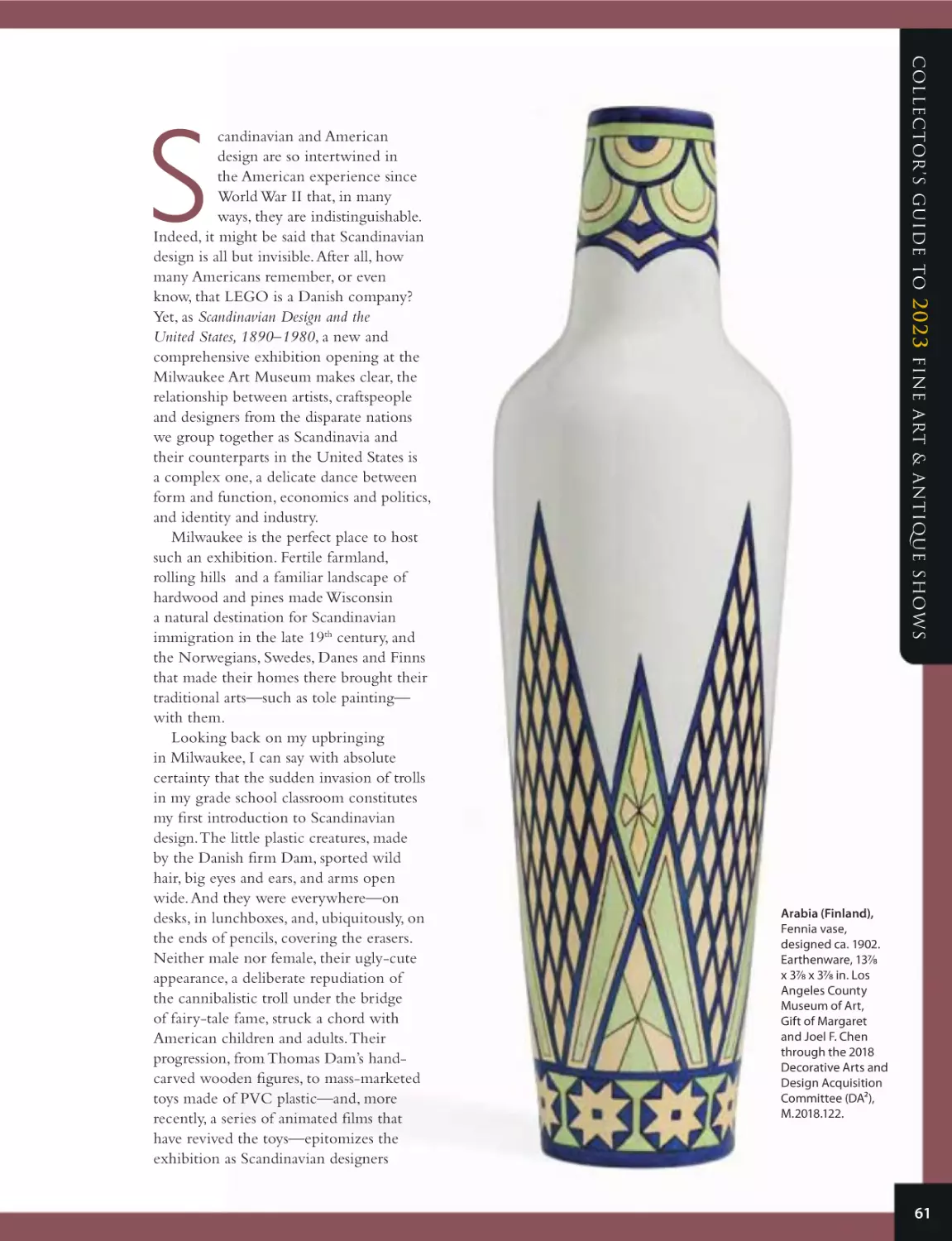

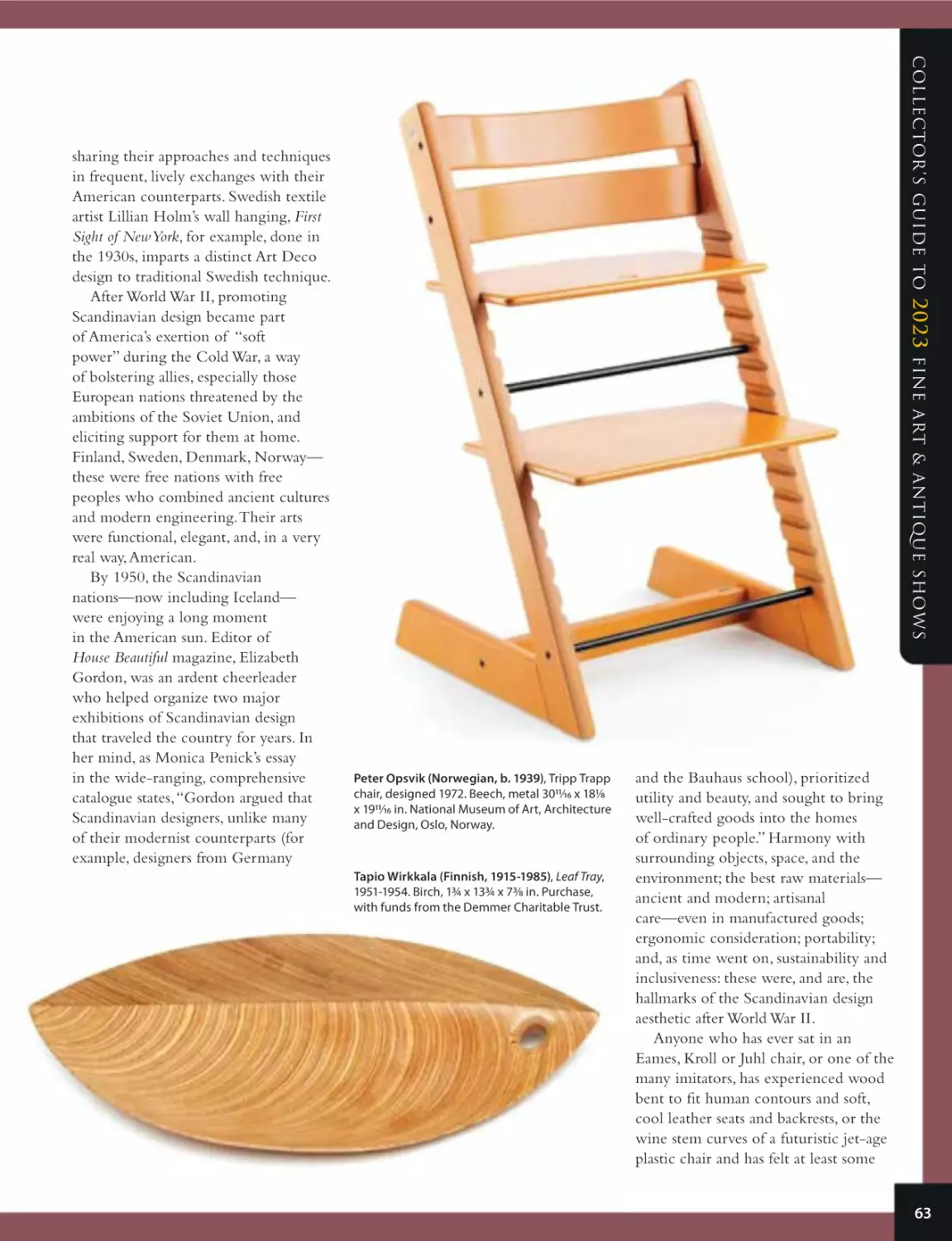

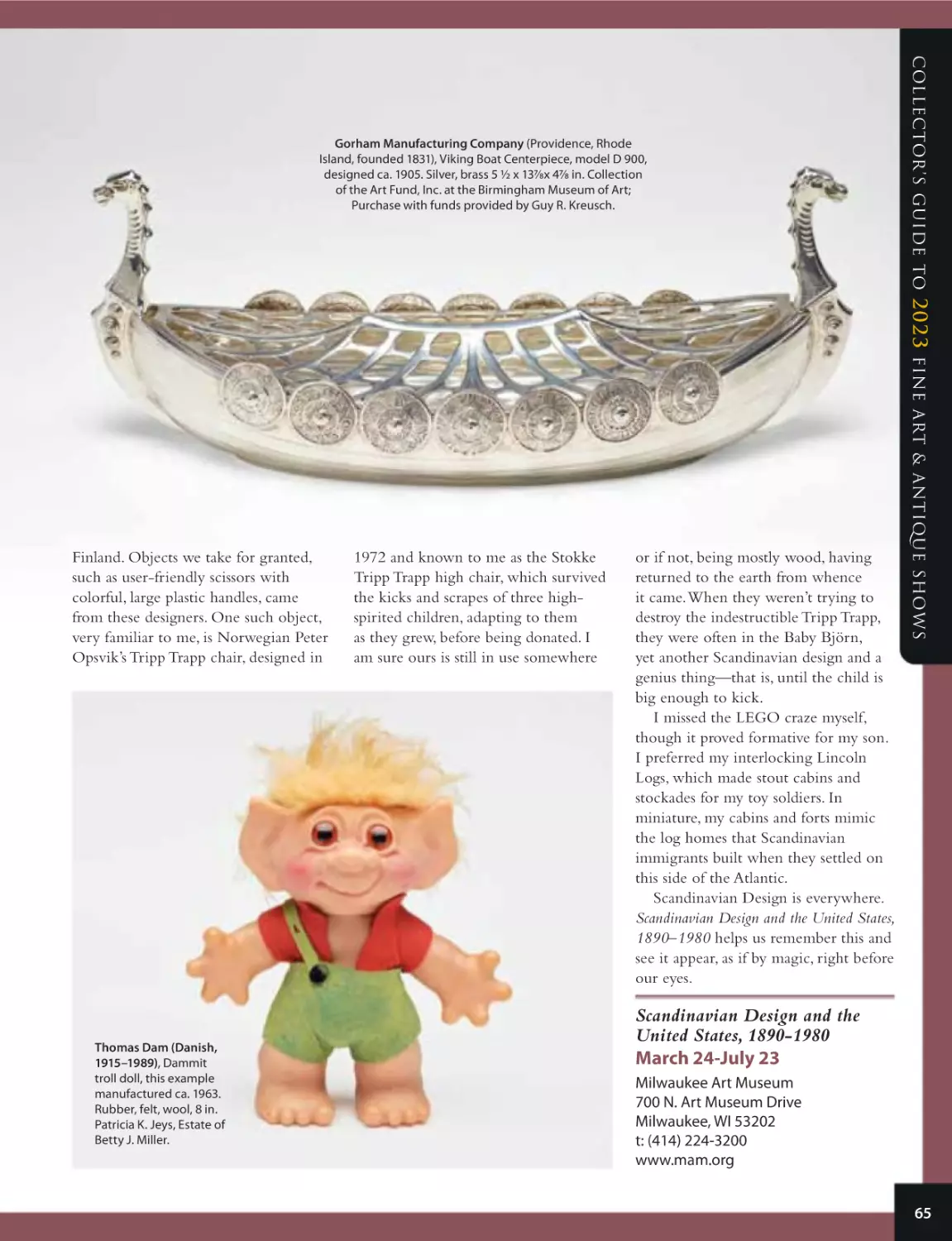
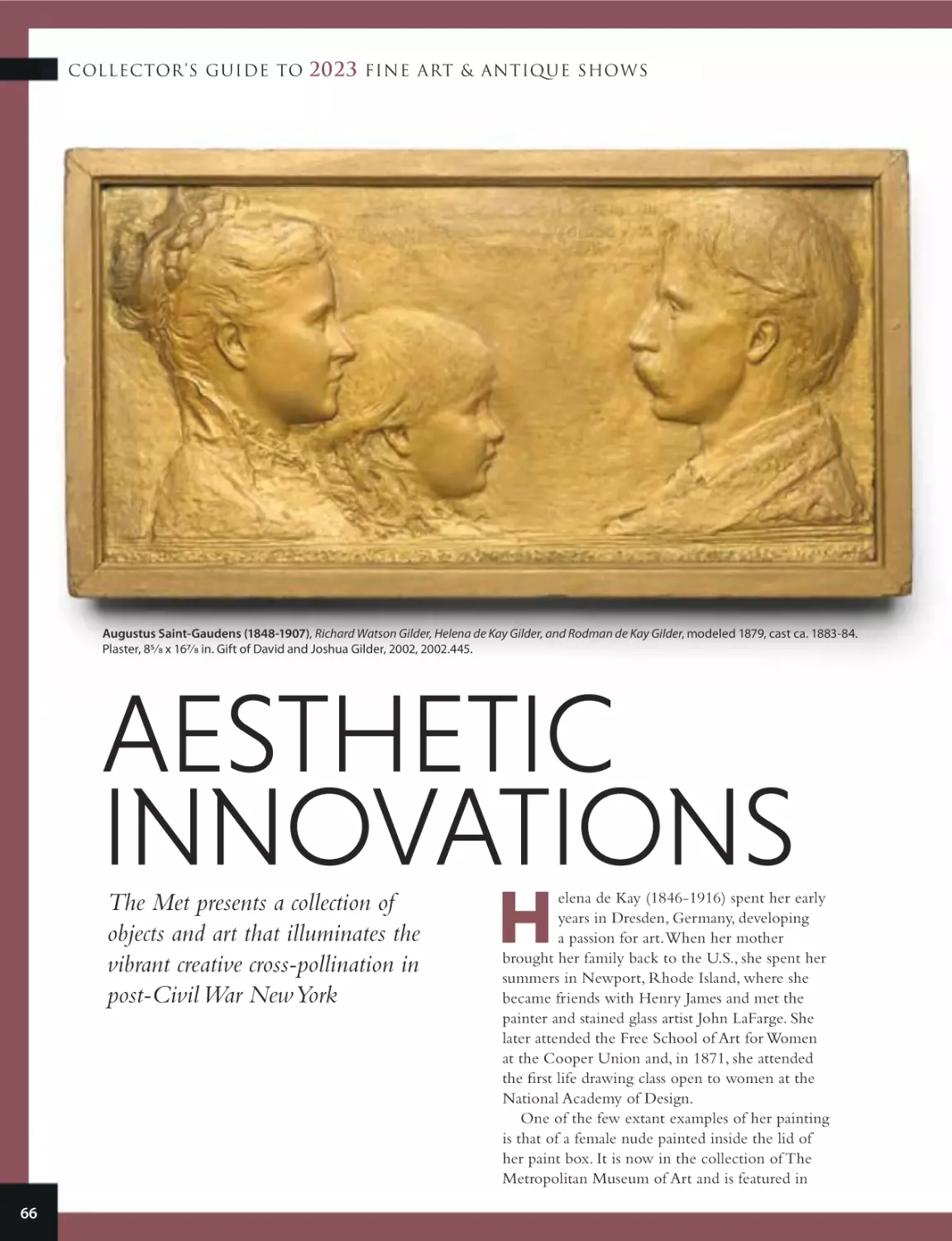




















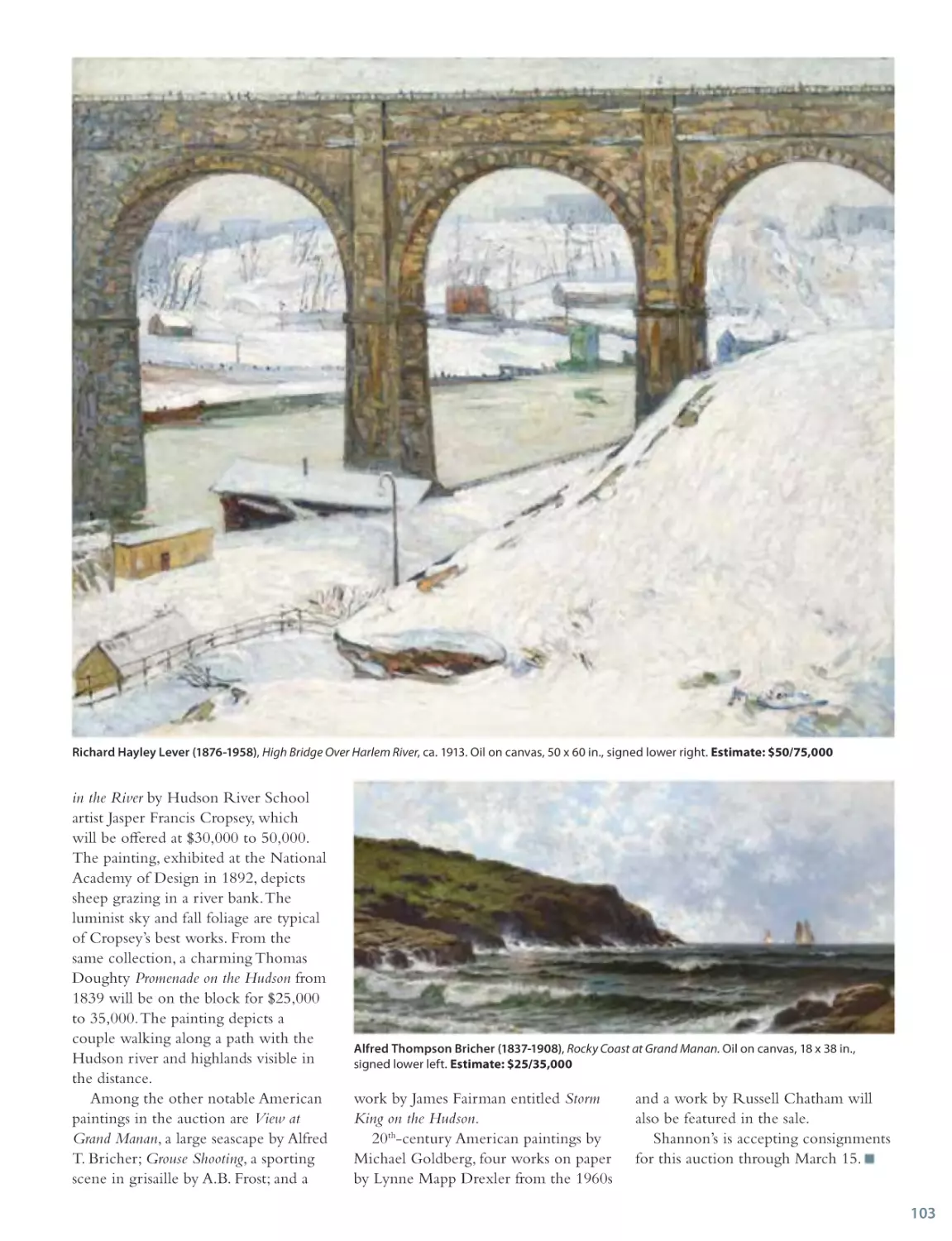

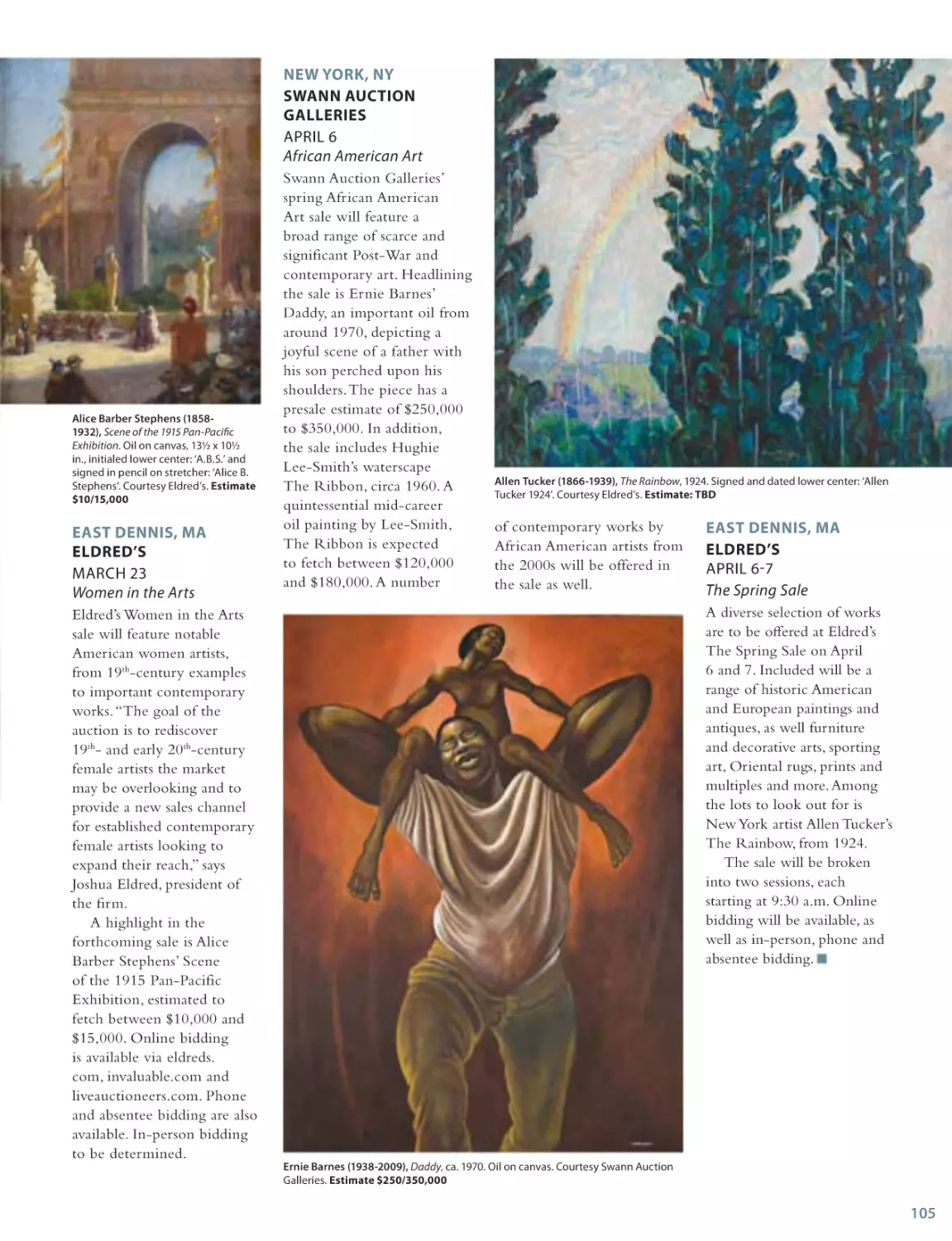
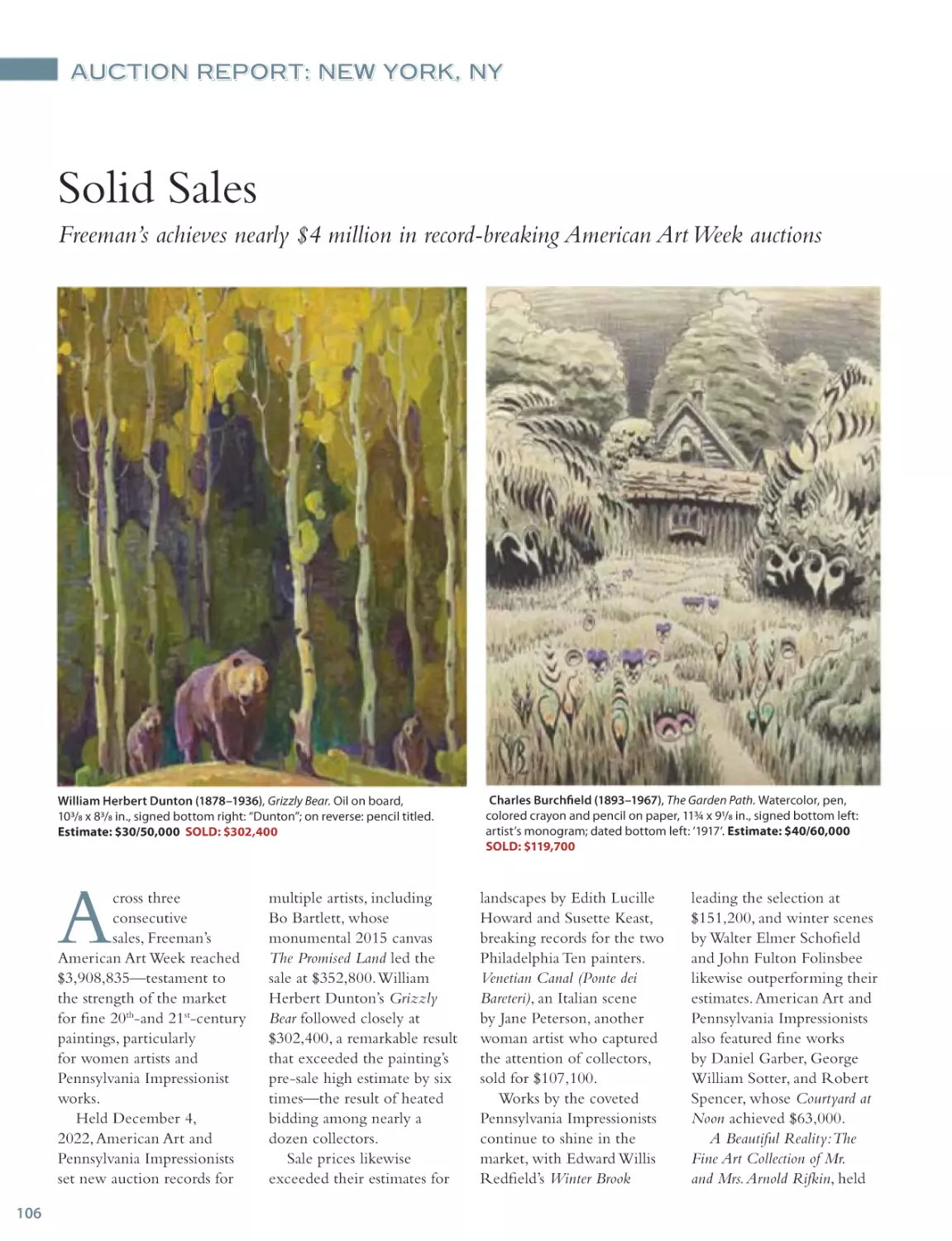
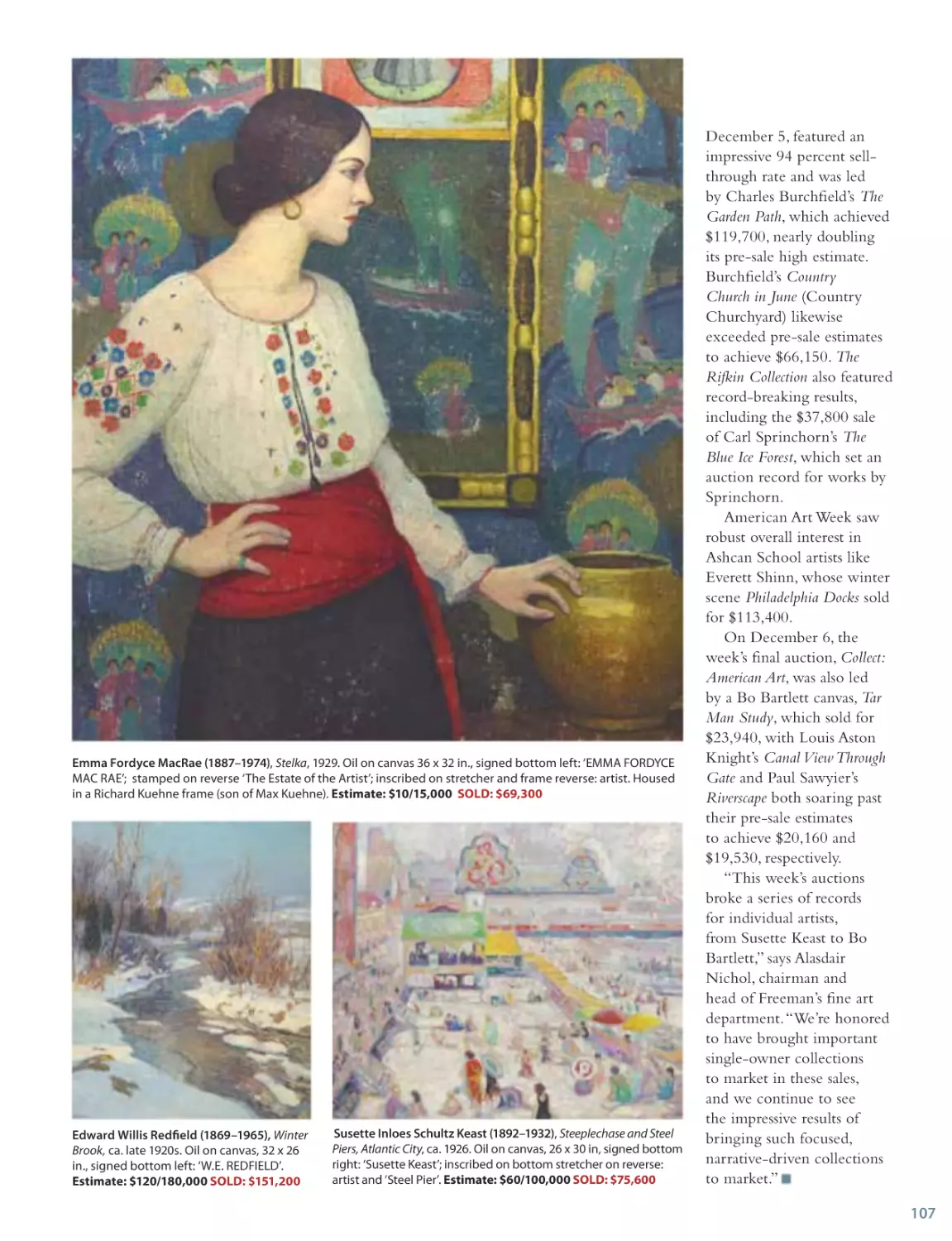



Text
INSIDE: FINE ART & ANTIQUE SHOWS • JOSEPH STELLA • NEW YORK ART WORLDS • THE WOLF FAMILY COLLECTION
ISSUE 68
March/April 2023
G LOUCESTER , M ASSACHUSETTS
Richard Hayley Lever (1876-1958), Gloucester Harbor from Pilot’s Hill
“Cape Ann [is] a region steeped in creative labor,
whose own modesty and classic provincial indifference to self-promotion may have sometimes
deprived it of its full recognition within the wider
circles of American art.”
- Kristian Davies, Artists of Cape Ann
James Jeffrey Grant (1883-1960),
Street Scene in Gloucester
VOSE GALLERIES
238 Newbury Street
Boston MA 02116
617.536.6176
LLC
www.vosegalleries.com
Now Inviting Consignments of
American Art for Our June 4 Auction
CONTACT
Raphaël Chatroux
267.414.1253
americanart@freemansauction.com
ILLUSTRATED
Carl Clemens Moritz Rungius (1869–1959)
Tundra (detail)
$150,000-250,000
freemansauction.com
24 00 Ma rk e t S t Ph il a de lph ia PA
LETTER FROM
THE PUBLISHERS
MARCH/APRIL 2023 Bimonthly
PUBLISHER: Adolfo Castillo
EDITORIAL/CREATIVE acastillo@AmericanFineArtMagazine.com
PUBLISHER: ADVERTISING/ Wendie Martin
ART COMMUNITY DEVELOPMENT wmartin@AmericanFineArtMagazine.com
FOUNDER Vincent W. Miller
Curating Your Year
of Historic Fine Art!
EDITORIAL
INTERIM MANAGING EDITOR Michael Clawson
mclawson@AmericanFineArtMagazine.com
EDITOR Sarah Gianelli
sgianelli@AmericanFineArtMagazine.com
ASSISTANT EDITOR Alyssa M. Tidwell
Welcome to the March/April issue! We are excited to bring to you the
complete Collector’s Guide to the 2023 Fine Art & Antique Shows.
Beginning on page 57, this comprehensive section will help you plan your
year with our curated list of the best shows across the country. We invite
you to review our directory of the most significant shows of the year and
read about each of their individual specialties. One thing we have learned
about historic American art is that our readers are interested in education,
and there is a renaissance of buyers looking for the perfect historic painting
to complement their growing collection. This show guide will provide a
path for you as you make travel plans for the spring, summer and fall ahead.
These shows are truly a museum-like experience. The difference is that at
a show you can actually purchase the art that you admire most, a piece that
might be in your family for generations to come. We know that the average
collection remains together for 40-plus years, so curate your collection
carefully. The historic art being sold at these events that we cover—and
often attend—are rare, special and valuable. Our writers are experts in their
unique field of historic art, and you can rest assured you will finish this
magazine with even more exceptional knowledge about the art we cover.
Each month we bring the best museums, top galleries and dealers, and the
leading auction houses to you. We know the journey of historical American
art is an adventurous one and sometimes difficult to navigate.
In this issue we have a six-page feature on Lynne Mapp Drexler, a
historic abstract expressionist whose works are a concentration of vivid
color and floral expression. Our preview of New York Art Worlds (1870-1890)
at The Met starts on page 66 and explores what it was like living in the art
world during that era through both decorative objects and fine art. As you
can imagine, American impressionism was at its height during this time and
the art is stunning. Most importantly, don’t miss our galleries and auction
previews in this issue. Springtime represents rebirth, and there are many
amazing historic paintings and sculpture coming to market and on display
during these coming months! Enjoy!
Best Regards,
Wendie Martin & Adolfo Castillo
Publishers
YOUR ALL-ACCESS PASS!
Scan this QR code to start listening to
The American Art Collective podcast!
On the Cover
Joseph Stella (1877-1946), Dance of Spring (Song of the
Birds), 1924. Oil on canvas, 43⅜ x 22⅜ in. Kemper Museum
of Contemporary Art, Kansas City, Missouri, Bebe and
Crosby Kemper Collection, gift of the Enid and Crosby
Kemper Foundation, 2003.03.01. Photo by James Allison
Photography, 2013.
4
ASSISTANT EDITOR Chelsea Koressel
SANTA FE EDITOR John O’Hern
CONTRIBUTING PHOTOGRAPHER Francis Smith
EDITORIAL & EMAIL Casey Woollard
TRAFFIC COORDINATOR cwoollard@americanartcollector.com
ADVERTISING (866) 619-0841
SENIOR ACCOUNT EXECUTIVE Lisa Redwine
lredwine@AmericanFineArtMagazine.com
SENIOR ACCOUNT EXECUTIVE Anita Weldon
aweldon@AmericanFineArtMagazine.com
SENIOR ACCOUNT EXECUTIVE Constance Warriner
cwarriner@AmericanFineArtMagazine.com
SENIOR ACCOUNT EXECUTIVE Michael Bright
mbright@AmericanFineArtMagazine.com
SPONSORSHIPS & MAJOR ACCOUNTS Skye Fallon
sfallon@AmericanFineArtMagazine.com
TRAFFIC MANAGER Jennifer Nave
traffic@AmericanFineArtMagazine.com
MARKETING
SOCIAL MEDIA Robin M. Castillo
ENGAGEMENT MANAGER social@AmericanFineArtMagazine.com
PRODUCTION
ART DIRECTOR Tony Nolan
PRODUCTION ARTIST Dana Long
PRODUCTION ARTIST Lizy Brautigam
SUBSCRIPTIONS (877) 947-0792
OFFICE MANAGER Emily Yee
service@AmericanFineArtMagazine.com
ACCOUNTS RECEIVABLES SPECIALIST April Stewart
astewart@AmericanFineArtMagazine.com
ADMINISTRATIVE ASSISTANT Bianca Martos
& MARKETING COORDINATOR bmartos@AmericanFineArtMagazine.com
Copyright © 2023. All material appearing in American Fine Art
Magazine is copyright. Reproduction in whole or part is not permitted
without permission in writing from the editor. Editorial contributions
are welcome and should be accompanied by a stamped self-addressed
envelope. All care will be taken with material supplied, but no
responsibility will be accepted for loss or damage. The views expressed
are not necessarily those of the editor or the publisher. The publisher
bears no responsibility and accepts no liability for the claims made, nor
for information provided by advertisers. Printed in the USA.
American Fine Art Magazine, 3260 N. Hayden Rd. Ste.201,
Scottsdale, AZ 85251. Telephone (480) 425-0806. Fax (480) 425-0724
or write to American Fine Art Magazine, P.O. Box 2320, Scottsdale,
AZ 85252-2320. Single copies 11.95. Subscription rate for one year
is $45 U.S. To place an order, change address or make a customer
service query, please email service@AmericanFineArtMagazine.com
or write to P.O. Box 2320, Scottsdale, AZ 85252-2320.
POSTMASTER: Send all address changes to
American Fine Art Magazine, PO Box 2320,
Scottsdale, AZ 85252-2320
AMERICAN FINE ART MAGAZINE
(ISSN 2162-7827) is published 6 times a year
by International Artist Publishing Inc.
CANADA
American Fine Art Magazine
Publications Mail Agreement No. 42330013, Return Undeliverable
Canadian Addresses to Asendia, Inc.
P.O. Box 400 LCD 20, Thornhill, Ontario, Canada L3T QH2
Application to mail at periodicals postage prices pending at
Scottsdale, AZ 85251 and additional mailing offices.
www.AmericanFineArtMagazine.com
PIETER J.L. VAN VEEN
(American 1875-1961)
Rolling Hills, base region of the Olympic Mountain Range, Washington circa 1934
Signed lower right: P. vanVeen
Oil on canvas
25 x 30 inches
Four Decades of Art Advisory Services
Working with Private Collections and Museums
Specializing in American paintings from 1840-1940
A.J. KOLLAR FINE PAINTINGS, LLC
1421 East Aloha Street
Q
Seattle, WA 98112
Q
(206) 323-2156
Q
www.ajkollar.com
Contact us to receive our catalogue of American paintings
By Appointment
Q
Private Art Dealers Association
Q
Independent Appraiser of American Art
EDITOR’S LETTER
A Journey Through Time
T
ulips, crocuses and irises aren’t the only signs of spring. Another
herald of the season is the sheer number of fine art shows that
start to populate the calendar and the country. There are numerous
blue chip events throughout the year, but as the days warm into
summer, these shows—both historic and contemporary—take on a
more breezy feel.
The mountains thaw; seaside towns on the East Coast are in
full swing and plein air festivals abound. In this issue you will find
an entire section dedicated to the 2023 fine art shows. Features by
leading industry experts explore the historical connection between
decorative objects and fine art; previews of museum exhibitions delve into that relationship
and a calendar of this year’s not-to-miss events are all within this comprehensive guide.
I am particularly excited about this edition’s breadth and the new territory we venture
into in its pages. We have a feature on once little-known artist Lynne Mapp Drexler who has
captivated collectors in recent years as her works started soaring past modest auction estimates
into the millions. Another piece dives into the largely lost art of the 1915 World’s Fair. With
museum previews on Joseph Stella, sculptor Adaline Kent and others, this issue is especially
full of stunning imagery—the kind of art that likely turned you into an aesthete and collector
of fine art. We hope you enjoy the visual experience as much as you do learning about these
intriguing artists, their work and lives, and the intellectual consideration of their place in the
greater context by our team of talented and knowledgeable writers.
Enjoy the journey!
Find us on:
Sarah Gianelli
Executive Editor
sgianelli@americanfineartmagazine.com
6
American Fine
Art Magazine
CollectArt
@artmags
AmericanFine
ArtMagazine
Hughie Lee-Smith, The Ribbon, oil on canvas, circa 1960. Estimate $120,000 to $180,000.
African American Art
April 6
Nigel Freeman • nfreeman@swanngalleries.com
Download the App
104 E 25th Street, NYC • 212 254 4710 • SWANNGALLERIES.COM
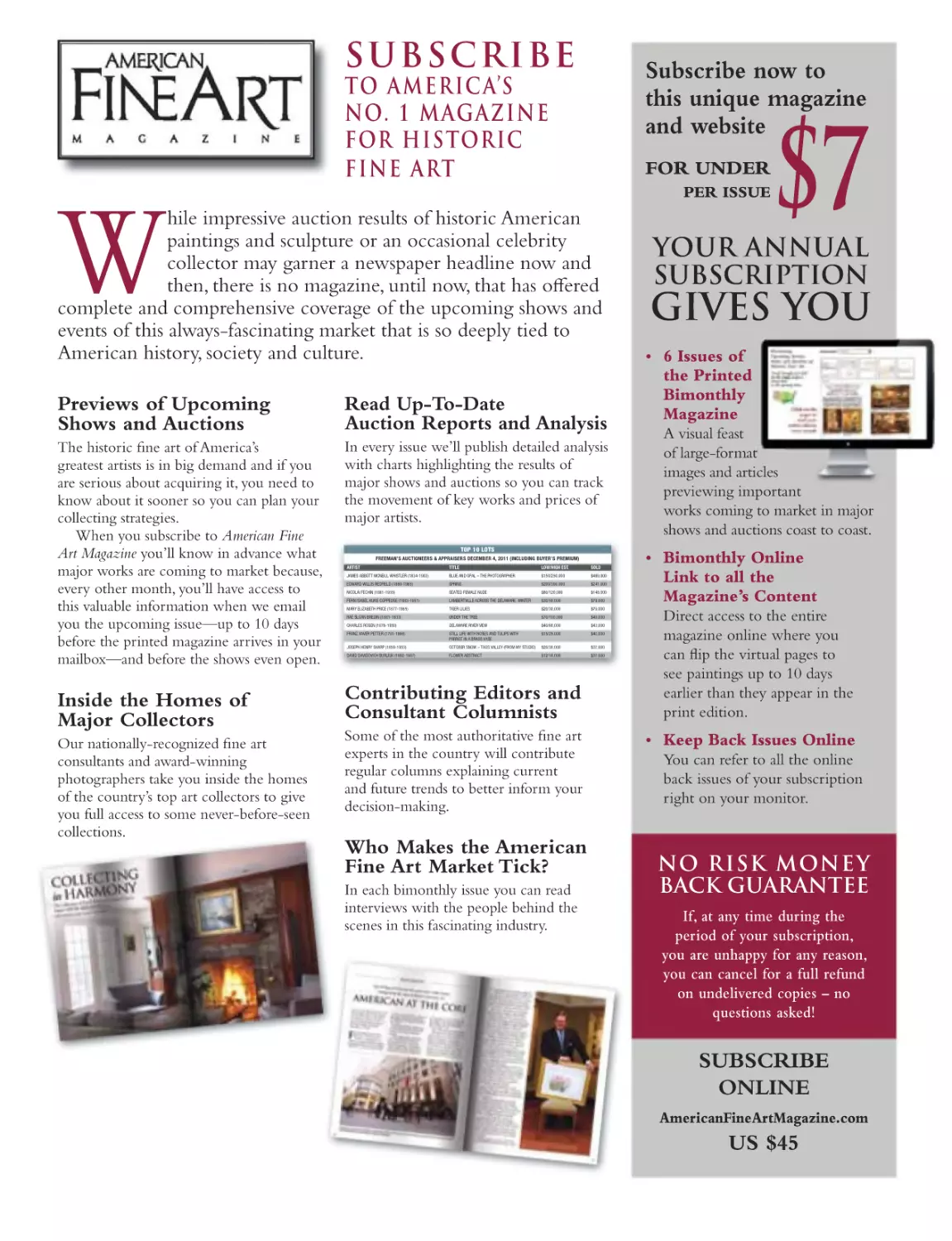
S U BS C R I BE
Subscribe now to
this unique magazine
and website
TO A MERIC A’S
NO. 1 MAGAZINE
FOR HISTORIC
FINE ART
$7
FOR UNDER
PER ISSUE
W
hile impressive auction results of historic American
paintings and sculpture or an occasional celebrity
collector may garner a newspaper headline now and
then, there is no magazine, until now, that has offered
complete and comprehensive coverage of the upcoming shows and
events of this always-fascinating market that is so deeply tied to
American history, society and culture.
Previews of Upcoming
Shows and Auctions
Read Up-To-Date
Auction Reports and Analysis
The historic fine art of America’s
greatest artists is in big demand and if you
are serious about acquiring it, you need to
know about it sooner so you can plan your
collecting strategies.
When you subscribe to American Fine
Art Magazine you’ll know in advance what
major works are coming to market because,
every other month, you’ll have access to
this valuable information when we email
you the upcoming issue—up to 10 days
before the printed magazine arrives in your
mailbox—and before the shows even open.
In every issue we’ll publish detailed analysis
with charts highlighting the results of
major shows and auctions so you can track
the movement of key works and prices of
major artists.
Inside the Homes of
Major Collectors
Contributing Editors and
Consultant Columnists
Our nationally-recognized fine art
consultants and award-winning
photographers take you inside the homes
of the country’s top art collectors to give
you full access to some never-before-seen
collections.
TOP 10 LOTS
FREEMAN’S AUCTIONEERS & APPRAISERS DECEMBER 4, 2011 (INCLUDING BUYER’S PREMIUM)
ARTIST
TITLE
LOW/HIGH EST.
SOLD
JAMES ABBOTT MCNEILL WHISTLER (1834-1903)
BLUE AND OPAL – THE PHOTOGRAPHER
$150/250,000
$469,000
SPRING
$200/300,000
$241,000
NICOLAI FECHIN (1881-1955)
SEATED FEMALE NUDE
$80/120,000
$145,000
FERN ISABEL KUNS COPPEDGE (1883-1951)
EDWARD WILLIS REDFIELD (1869-1965)
LAMBERTVILLE ACROSS THE DELAWARE, WINTER
$30/50,000
$79,000
MARY ELIZABETH PRICE (1877-1965)
TIGER LILIES
$20/30,000
$79,000
RAE SLOAN BREDIN (1881-1933)
UNDER THE TREE
$70/100,000
$49,000
CHARLES ROSEN (1878-1950)
DELAWARE RIVER VIEW
$40/60,000
$43,000
FRANZ XAVER PETTER (1791-1866)
STILL LIFE WITH ROSES AND TULIPS WITH
PARROT IN A BRASS VASE
$15/25,000
$40,000
JOSEPH HENRY SHARP (1859-1953)
OCTOBER SNOW – TAOS VALLEY (FROM MY STUDIO)
$20/30,000
$37,000
DAVID DAVIDOVICH BURLIUK (1882-1967)
FLOWER ABSTRACT
$12/18,000
$37,000
Some of the most authoritative fine art
experts in the country will contribute
regular columns explaining current
and future trends to better inform your
decision-making.
Who Makes the American
Fine Art Market Tick?
In each bimonthly issue you can read
interviews with the people behind the
scenes in this fascinating industry.
YOUR ANNUAL
SUBSCRIPTION
GIVES YOU
• 6 Issues of
the Printed
Bimonthly
Magazine
A visual feast
of large-format
images and articles
previewing important
works coming to market in major
shows and auctions coast to coast.
• Bimonthly Online
Link to all the
Magazine’s Content
Direct access to the entire
magazine online where you
can flip the virtual pages to
see paintings up to 10 days
earlier than they appear in the
print edition.
• Keep Back Issues Online
You can refer to all the online
back issues of your subscription
right on your monitor.
NO RISK MONEY
BACK GUARANTEE
If, at any time during the
period of your subscription,
you are unhappy for any reason,
you can cancel for a full refund
on undelivered copies – no
questions asked!
SUBSCRIBE
ONLINE
AmericanFineArtMagazine.com
US $45
National & International
Galleries and Features
Regional and
Independent Artists
Destination Art Fair of the West Returns to
Reno Tahoe, Doubles in Size
Join us in the High Sierra for a city to lakeside
celebration of fine art, bespoke furniture, sculpture,
music, short film, and more.
Ongoing Live Music
Awards Program and Gala
‘After Burn’ Market & Sculpture Walk
Short Film Programming
First Nations, Indigenous Peoples Pavilion
Apply to be an exhibitor
www.rtiashow.com | @rtiashow
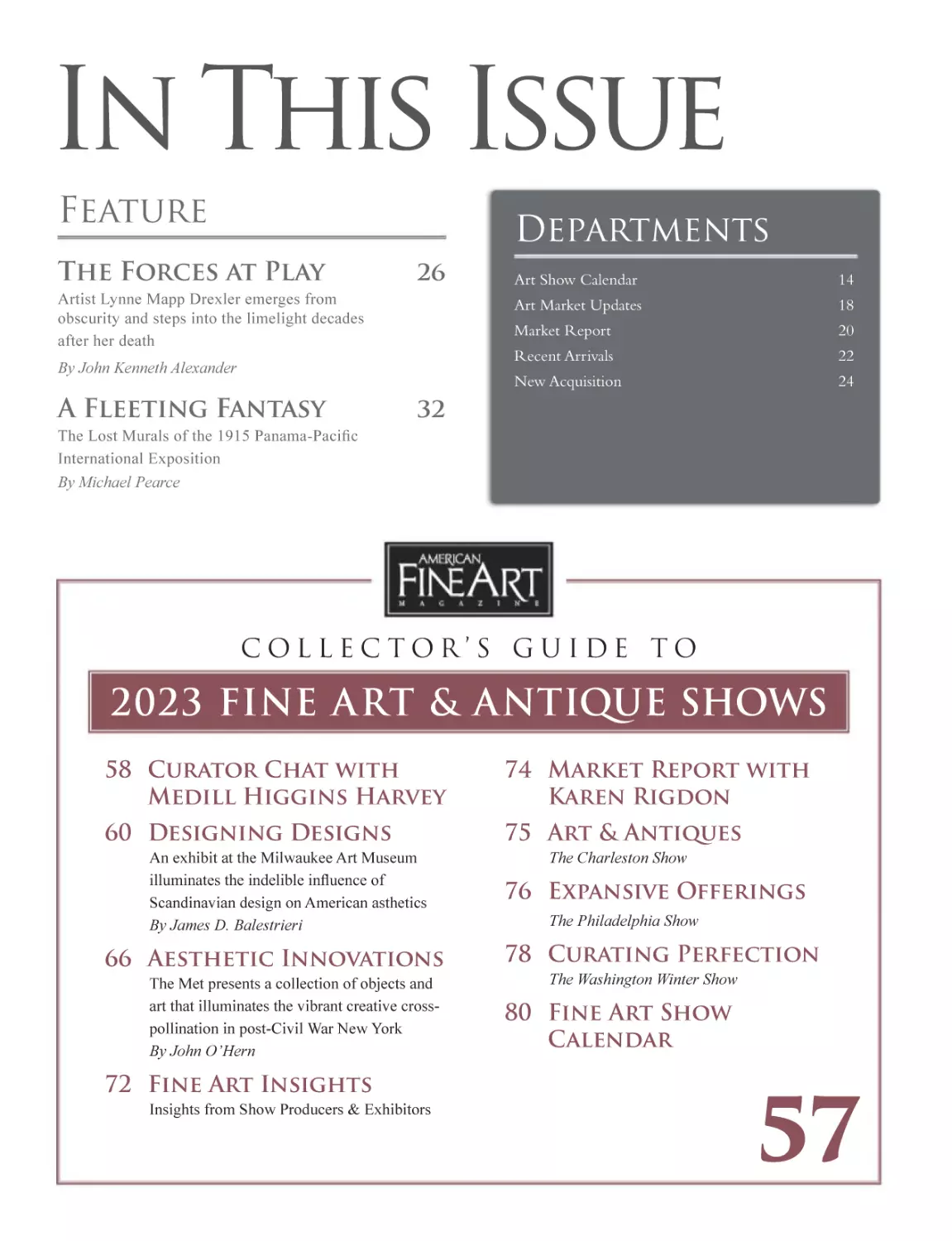
In This Issue
Feature
Departments
The Forces at Play
Artist Lynne Mapp Drexler emerges from
obscurity and steps into the limelight decades
after her death
By John Kenneth Alexander
A Fleeting Fantasy
Art Show Calendar
14
Art Market Updates
18
Market Report
20
Recent Arrivals
22
New Acquisition
24
7KH/RVW0XUDOVRIWKH
3DQDPD3DFL¿F
International Exposition
By Michael Pearce
COLLECTOR’S GUIDE TO
2023 FINE ART & ANTIQUE SHOWS
58 Curator Chat with
Medill Higgins Harvey
74 Market Report with
Karen Rigdon
60 Designing Designs
75 Art & Antiques
An exhibit at the Milwaukee Art Museum
LOOXPLQDWHVWKHLQGHOLEOHLQÀXHQFHRI
Scandinavian design on American asthetics
By James D. Balestrieri
66 Aesthetic Innovations
The Met presents a collection of objects and
art that illuminates the vibrant creative crosspollination in post-Civil War New York
By John O’Hern
72 Fine Art Insights
Insights from Show Producers & Exhibitors
The Charleston Show
76 Expansive Offerings
The Philadelphia Show
78 Curating Perfection
The Washington Winter Show
80 Fine Art Show
Calendar
57
MARCH/APRIL 2023
American Fine Art Magazine is unique in its concept and presentation. Divided into four major categories, each
bimonthly issue will show you how to find your way around upcoming fine art shows, auctions and events so you
can stay fully informed about this fascinating market.
Gallery Shows
Previews of upcoming shows of historic
American art at galleries across the country.
38 Joyous Color
A virtual exhibition currently on view at
Hawthorne Fine Art presents the artwork of
Rhoda Holmes Nicholls
Museum
Exhibitions
Important exhibitions upcoming at key
museums from coast to coast.
40 A Natural Bridge
Joseph Stella at the High Museum of Art
46 A Modernist Maverick
Adaline Kent retrospective at the Nevada
Museum of Art
Event Report
50 Orientalism in the
Occident
Themed group exhibition at the Denver
Art Museum
Coverage of all the major art fairs and events
taking place across the country.
90 Cut, Cast, Carved
and Coupled
54 A Lifetime of Devotion
The Bruton Sisters’ at UCI Langson Institute
and Museum of California Art
Annual American Art Conference
Auctions
Previews and reports of sales at the
most important auction houses dealing
in historic American art.
104 Joint Auction Previews
Maine, Massachusetts, New York,
North Carolina
Reports
106 Solid Sales
Previews
94 Go West
Scottsdale Art Auction Session I and II sale
98 The Spirit of America
Sotheby’s sale of The Wolf Family Collection
102 American Vistas
Shannon’s Fine Art Auctioneers’ Spring 2023
Fine Art Auction
Freeman’s American Art and Pennsylvania
Impressionists sale
108 The Allure of Americana
Sotheby’s Art of the Americas sale
110 Stellar Results
Christie’s 19th Century American Art and From
Peale to Peto: American Masters from the
Pollack Collection
11
MARCH 30 - APRIL 2, 2023 I PIER 36, NYC
299 SOUTH STREET, NEW YORK, NY 10002
FIND THE UNDISCOVERED
GET TICKETS: BIT.LY/AENY23-RWAG-VIP-COLLECTOR
DESIRES // SOO KIM
SINCE 1969
AUCTIONEERS & APPRAISERS
John Marshall Gamble (1863-1957) Wild Lilac - Santa Barbara, Oil on canvas, 20" H x 30" W, $20,000-30,000
Consign Today
California & American Fine Art
Tuesday, May 9, 2023
Consignment & Auction Inquiries: fineart@johnmoran.com
Scan this code with your phone
to learn more about this sale
A family-owned auction house delivering both world-class service and results for over 50 years.
Auctions
•
Private Sales
•
Appraisals
145 East Walnut Avenue, Monrovia, CA 91016 | www.johnmoran.com · info@johnmoran.com · (626) 793-1833
the Best Fairs, exhibitions and Events Coast to Coast
ONGOING
Object Lessons in American Art
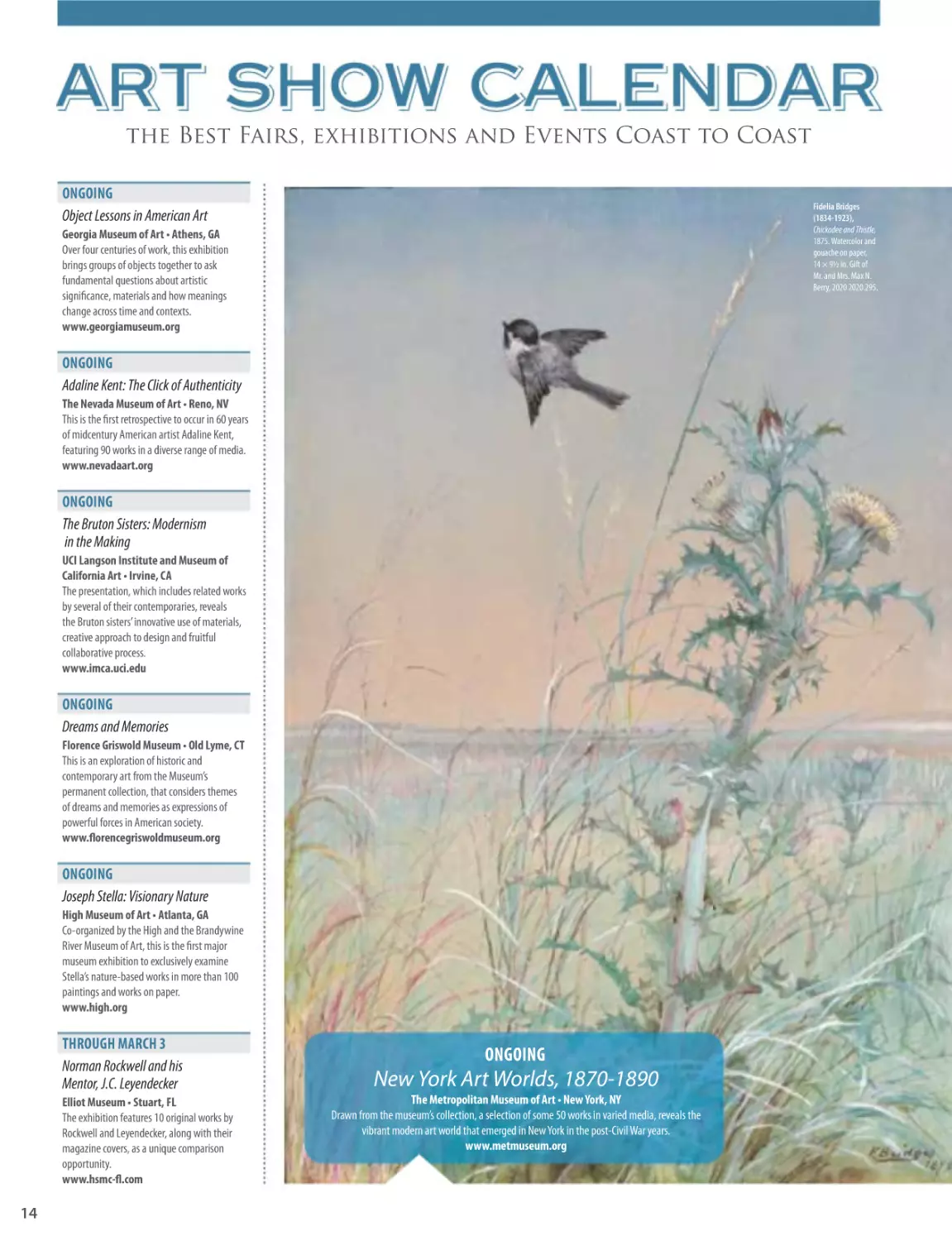
Fidelia Bridges
(1834-1923),
Chickadee and Thistle,
1875. Watercolor and
gouache on paper,
14 × 9½ in. Gift of
Mr. and Mrs. Max N.
Berry, 2020 2020.295.
Georgia Museum of Art • Athens, GA
Over four centuries of work, this exhibition
brings groups of objects together to ask
fundamental questions about artistic
significance, materials and how meanings
change across time and contexts.
www.georgiamuseum.org
ONGOING
Adaline Kent: The Click of Authenticity
The Nevada Museum of Art • Reno, NV
This is the first retrospective to occur in 60 years
of midcentury American artist Adaline Kent,
featuring 90 works in a diverse range of media.
www.nevadaart.org
ONGOING
The Bruton Sisters: Modernism
in the Making
UCI Langson Institute and Museum of
California Art • Irvine, CA
The presentation, which includes related works
by several of their contemporaries, reveals
the Bruton sisters’ innovative use of materials,
creative approach to design and fruitful
collaborative process.
www.imca.uci.edu
ONGOING
Dreams and Memories
Florence Griswold Museum • Old Lyme, CT
This is an exploration of historic and
contemporary art from the Museum’s
permanent collection, that considers themes
of dreams and memories as expressions of
powerful forces in American society.
www.florencegriswoldmuseum.org
ONGOING
Joseph Stella: Visionary Nature
High Museum of Art • Atlanta, GA
Co-organized by the High and the Brandywine
River Museum of Art, this is the first major
museum exhibition to exclusively examine
Stella’s nature-based works in more than 100
paintings and works on paper.
www.high.org
THROUGH MARCH 3
Norman Rockwell and his
Mentor, J.C. Leyendecker
Elliot Museum • Stuart, FL
The exhibition features 10 original works by
Rockwell and Leyendecker, along with their
magazine covers, as a unique comparison
opportunity.
www.hsmc-fl.com
14
ONGOING
New York Art Worlds, 1870-1890
The Metropolitan Museum of Art • New York, NY
Drawn from the museum’s collection, a selection of some 50 works in varied media, reveals the
vibrant modern art world that emerged in New York in the post-Civil War years.
www.metmuseum.org
Premier Auction March 24 & 25, 2023
Featuring:
Martin Johnson Heade, Twilight in the Tropics, 1876, signed, oil on paper on board, 6-3/4 x 13-7/8 in.
George Inness, Durham Connecticut, 1879, signed, oil on canvas, 18 x 26 in.
David Johnson, View from West Point, 1867, signed, oil on canvas, 38 x 60 in.
and many others
nan@brunkauctions.com
www.brunkauctions.com
828-254-6846
ART SHOW CALENDAR
N.C. Wyeth (18821945), Chadds Ford
Landscape with Barn,
c. 1915/1920. Oil on
canvas, 25 x 30 in. “W”
scratched into paint
in lower right corner.
Courtesy of Somerville
Manning.
APRIL 27-30
Auctions
at a Glance
FEBRUARY 24-26
Winter Enchantment Sale
APRIL 15-15
Session I & II
Thomaston Place Auction Galleries •
Thomaston, ME
www.thomastonauction.com
Scottsdale Art Auction • Scottsdale, AZ
www.scottsdaleartauction.com
The Philadelphia Show
Philadelphia Museum of Art • Philadelphia, PA
This annual show features around 50 of the leading exhibitors in the
U.S., specializing in fine art, design, antiques, Americana, folk art,
ceramics and much more, that span the 16th to the 21st-centuries.
www.thephiladelphiashow.com
MARCH 2
Spring Sporting Art Auction
Leland Little Auctions •
Hillsborough, NC
www.lelandlittle.com
MARCH 23
Women in the Arts
THROUGH MARCH 5
Edward Hopper’s New York
Whitney Museum of American Art •
New York, NY
The exhibition will take a comprehensive
look at Hopper’s life and work through his
city pictures, from his early impressions
of New York in sketches, prints and
illustrations, to his late paintings.
www.whitney.org
MARCH 5-MAY 28
Near East to Far West: Fictions of
French and American Colonialism
Denver Art Museum • Denver, CO
This exhibition features more than
80 artworks, and explores the many
ways that the style and substance of
French Orientalism in the 1800s directly
influenced American artists.
www.denverartmuseum.org
MARCH 17-19
The Charleston Show
Charleston Festival Hall •
Charleston, SC
Now in its second edition, the Charleston
show features 30 exhibitors from the
United States, England and Europe
showcasing antiques, contemporary and
traditional design, fine art and jewelry.
www.thecharlestonshow.com
MARCH 24-JULY 23
Scandinavian Design and the
United States, 1890–1980
Eldred’s Auction • Dennis, MA
www.eldreds.com
Milwaukee Art Museum •
Milwaukee, WI
In more than 180 objects, this is the first
exhibition to examine the extensive
design exchanges between the United
States and the Nordic countries during
the 20th-century.
www.mam.org
APRIL 6
African American Art
MARCH 24-AUGUST 13
Evelyn Hofer: Eyes on the City
High Museum of Art • Atlanta, GA
In more than one hundred vintage prints
by photographer Evelyn Hofer, this
retrospective focuses on urban capitals
during a period of intense structural,
social and economic transformations after
World War II.
www.high.org
THROUGH MARCH 26
We Are Made of Stories: SelfTaught Artists in The Robson
Family Collection
Smithsonian American Art Museum •
Washington D.C.
This exhibition chronicles the rise of
self-taught artists in the 20th-century in
110 artworks by 43 artists, despite wideranging societal, racial and gender-based
obstacles.
www.americanart.si.edu
APRIL 19-22
The Wolf Family Collection
Sotheby’s • New York, NY
www.sothebys.com
APRIL 27
Fine Art Auction
Shannon’s Fine Art Auctioneers •
Milford, CT
www.shannons.com
Swann Auctions • New York, NY
www.swanngalleries.com
THROUGH MARCH 26
Norman Rockwell Drawings:
1914-1976
THROUGH APRIL 1
Joseph B. O’Sickey: Exhibition &
Sale
Norman Rockwell Museum •
Stockbridge, MA
This exhibition features studies and
drawings for many of Rockwell’s most
noted works, and is accompanied by a
catalogue published by Abbeville Press.
www.nrm.org
Wolfs Gallery • Cleveland, OH
This exhibition and sale, on behalf of
the Cleveland Institute of Art, contains
major unseen works all in the colorful and
exuberant style for which O’Sickey is so
well-known.
www.wolfsgallery.com
MARCH 30-APRIL 2
ArtExpo New York
APRIL 25-MAY 7
Boston Design Week 10th
Anniversary
Pier 36 • New York, NY
Now in its 46th year, this popular
event hosts more than 200 innovative
exhibiting galleries, publishers, dealers
and artists from across the globe, and
showcases contemporary work of over
1000 artists in a variety of materials.
www.redwoodartgroup.com/
artexpo-new-york/
Various Locations • Boston, MA
This annual event occurs in various
locations, including virtual platforms, and
features programs, guest speakers, tours
and panel discussions by design-oriented
businesses, museums and organizations,
to name just a few.
www.bostondesignweek.com
In every issue of American Fine Art Magazine, we publish the only reliable guide to all major upcoming fairs and shows nationwide. Contact our editorial assistant,
Chelsea Koressel, at ckoressel@americanfineartmagazine.com, to find out how your event can be included.
16
painting and antiquities from such artists
as John Singleton Copley, Frederic Edwin
Church, Mary Cassatt, Childe Hassam,
Robert Henri, Winslow Homer, Edward
Hopper, John Singer Sargent, Marsden
Hartley, John Marin and Georgia
O’Keeffe.
An Exciting Lineup
John Singer Sargent (1856-1925), Madame Ramón Subercaseaux,
ca. 1880-81. Oil on canvas. The Fayez S. Sarofim Collection.
Masterworks
on loan at MFAH
The Museum of Fine Arts, Houston
has announced a partnership with
the Sarofim Foundation, in which
masterworks from the collection of the
late Fayez S. Sarofim will be displayed
across the museum’s gallery buildings.
Included in Sarofim’s collection, amassed
over nearly six decades, is a superb
selection of American art, European
The Hispanic Society Museum &
Library—dedicated to the preserving,
studying and exhibiting of art and culture
of Portuguese and Spanish-speaking
countries and communities—has
announced phase one of its reopening
with a robust 2023 exhibition schedule.
Programming will focus on the
commemoration of Joaquín Sorolla’s
centennial, Jesús Rafael Soto’s centennial
and Pablo Picasso’s semi-centennial. The
Hispanic Museum & Library is currently
undergoing a major upgrade of three
landmark buildings and restoration of the
Audubon Terrace in order to maximize
the organization’s resources, afford the
ability to better serve the surrounding
community and increase the institution’s
ability to welcome partnerships
and collaborations with local and
international partners. The HSM&L will
reopen its Main Court, Upper Terrace
and the iconic Sorolla Gallery, Vision of
Spain (1912-1919) in March 2023 as part
of the commemoration.
The Hispanic Society Museum & Library, Sorolla Gallery, Vision of Spain (1912-1919).
18
A rendering of the Raclin Murphy Museum of Art, opening in fall 2023.
Notre Dame to Open
New Museum
After nearly two years of research and
design, the University of Notre Dame will
unveil its new Raclin Murphy Museum
of Art. The new museum expands upon
the university’s esteemed Snite Museum
of Art of Notre Dame, which will
remain open until May 2023. The Raclin
Murphy Museum of Art is set to open in
November and will move to an entirely
new building in the University’s arts
district, serving as both an entrance to the
campus and as a welcoming community
partner. The project has been designed as
a 132,000-square-foot complex that will
“host the Museum’s renowned collections,
dynamic exhibitions and engaging
programs.”
George Voronovsky
at High Museum
The High Museum of Art in Atlanta,
Georgia, presents the first major museum
exhibition of work by Ukrainian
American artist George Voronovsky. “Born
in a small village in eastern Ukraine in
1903,Voronovsky immigrated to the
United States after World War II and
began working in the rail industry in
Philadelphia. Employed as a train car
cleaner and upholsterer for many years,
he eventually retired to Miami Beach
in the early 1970s, where he turned his
room in South Beach’s Colony Hotel into
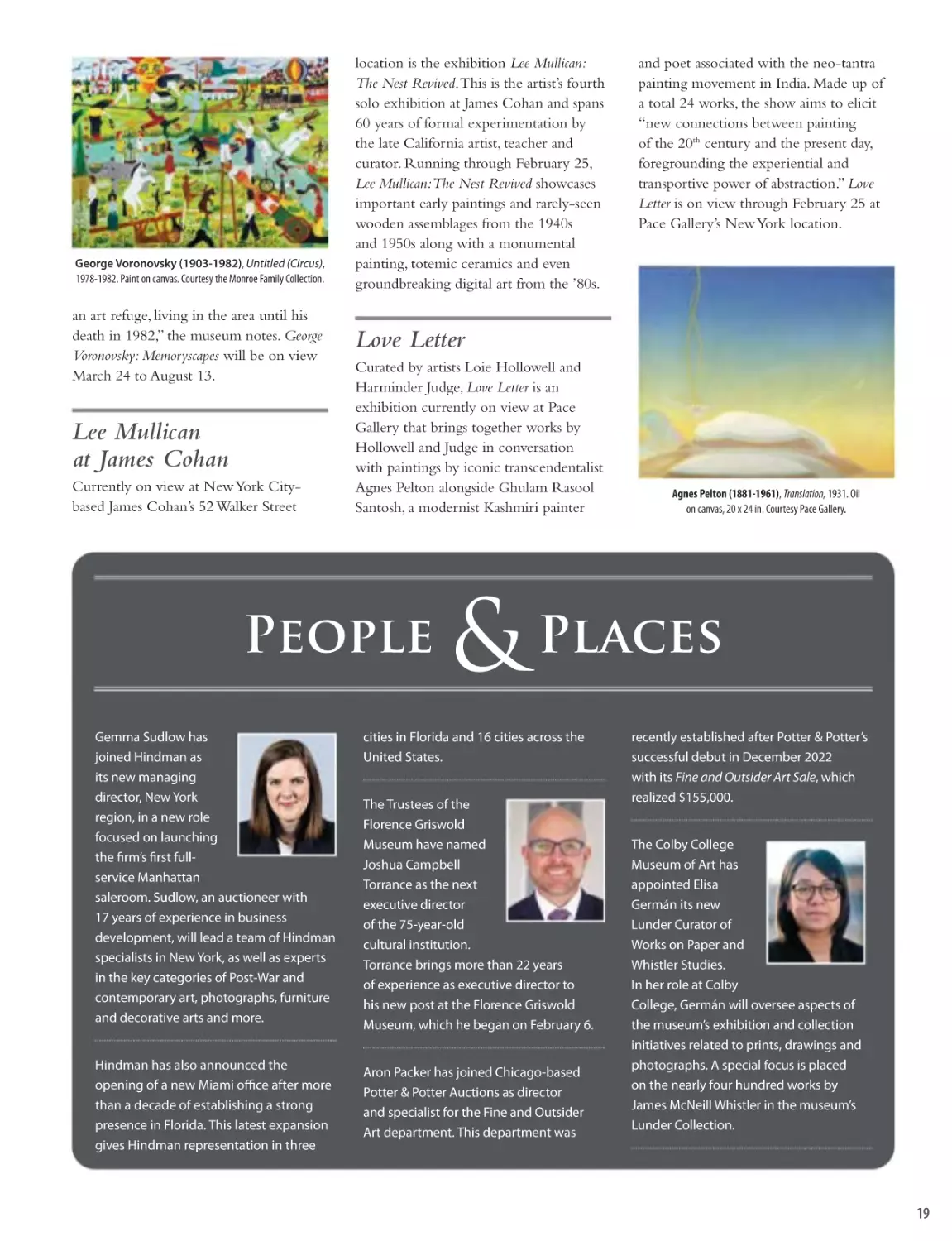
George Voronovsky (1903-1982), Untitled (Circus),
1978-1982. Paint on canvas. Courtesy the Monroe Family Collection.
an art refuge, living in the area until his
death in 1982,” the museum notes. George
Voronovsky: Memoryscapes will be on view
March 24 to August 13.
Lee Mullican
at James Cohan
Currently on view at New York Citybased James Cohan’s 52 Walker Street
location is the exhibition Lee Mullican:
The Nest Revived. This is the artist’s fourth
solo exhibition at James Cohan and spans
60 years of formal experimentation by
the late California artist, teacher and
curator. Running through February 25,
Lee Mullican:The Nest Revived showcases
important early paintings and rarely-seen
wooden assemblages from the 1940s
and 1950s along with a monumental
painting, totemic ceramics and even
groundbreaking digital art from the ’80s.
Love Letter
Curated by artists Loie Hollowell and
Harminder Judge, Love Letter is an
exhibition currently on view at Pace
Gallery that brings together works by
Hollowell and Judge in conversation
with paintings by iconic transcendentalist
Agnes Pelton alongside Ghulam Rasool
Santosh, a modernist Kashmiri painter
People
Gemma Sudlow has
joined Hindman as
its new managing
director, New York
region, in a new role
focused on launching
the firm’s first fullservice Manhattan
saleroom. Sudlow, an auctioneer with
17 years of experience in business
development, will lead a team of Hindman
specialists in New York, as well as experts
in the key categories of Post-War and
contemporary art, photographs, furniture
and decorative arts and more.
Hindman has also announced the
opening of a new Miami office after more
than a decade of establishing a strong
presence in Florida. This latest expansion
gives Hindman representation in three
and poet associated with the neo-tantra
painting movement in India. Made up of
a total 24 works, the show aims to elicit
“new connections between painting
of the 20th century and the present day,
foregrounding the experiential and
transportive power of abstraction.” Love
Letter is on view through February 25 at
Pace Gallery’s New York location.
Agnes Pelton (1881-1961), Translation, 1931. Oil
on canvas, 20 x 24 in. Courtesy Pace Gallery.
& Places
cities in Florida and 16 cities across the
United States.
The Trustees of the
Florence Griswold
Museum have named
Joshua Campbell
Torrance as the next
executive director
of the 75-year-old
cultural institution.
Torrance brings more than 22 years
of experience as executive director to
his new post at the Florence Griswold
Museum, which he began on February 6.
Aron Packer has joined Chicago-based
Potter & Potter Auctions as director
and specialist for the Fine and Outsider
Art department. This department was
recently established after Potter & Potter’s
successful debut in December 2022
with its Fine and Outsider Art Sale, which
realized $155,000.
The Colby College
Museum of Art has
appointed Elisa
Germán its new
Lunder Curator of
Works on Paper and
Whistler Studies.
In her role at Colby
College, Germán will oversee aspects of
the museum’s exhibition and collection
initiatives related to prints, drawings and
photographs. A special focus is placed
on the nearly four hundred works by
James McNeill Whistler in the museum’s
Lunder Collection.
19
MARKET REPORT
WHAT WE’RE HEARING FROM GALLERIES AND
AUCTION HOUSES ACROSS THE COUNTRY.
THOMAS B. PARKER
Director
Hirschl & Adler Galleries
A combination of lingering
Covid concerns, an uncertain
economic forecast and the
ongoing dominance of
contemporary art over the
secondary market has resulted in some
headwinds for historical American art.
Still, as has always been true, top quality,
correctly priced works of art, invariably
find a buyer. Crucially, this market enjoys
support not just from private collectors,
but from institutional buyers as well.
They tend to be buyers whose motives
transcend speculative interest and resist
fleeting trends in the marketplace. They
are attracted by established artists, proven
quality and stable values—things we used
to assume were a given, but not necessarily
in recent years.
We have seen a notable uptick of
20
interest in works from the
1930s and early 1940s, an
era in American cultural
history with parallels to our
own. Tumultuous times
are often the crucible for
powerful visual expression.
For instance, social realist
paintings seem to resonate
with today’s political tensions, general
angst and sense of change. In particular,
magic realism, a close cousin of surrealism,
is enjoying renewed interest from
collectors. Well-known artists George
Tooker, Louis Guglielmi and Paul Cadmus
are actively sought-after as well as lesserknowns James Guy, Jules Kirschenbaum
and Clarence Carter. Even more exciting are
the women associated with this movement
like Honoré Sharrer, Gertrude Abercrombie,
Dorothea Tanning and others.
We are particularly excited about a
German American artist named Winold
Reiss (1886-1953), a “jack-of-all-trades”
who brought a distinctively modern
sophistication to American painting,
interior design, commercial illustration,
furniture design and public murals. He’s
perhaps best known for his innovative
portraiture, particularly his acclaimed
Native American portraits from the 1920s.
But he also played an outsized role in the
Harlem Renaissance movement, led art
schools in both New York and Woodstock,
and imbued numerous restaurants, train
stations and other public spaces with
his refined and highly stylized form of
art deco. He was recently the subject
of a major exhibition at the New York
Historical Society in the fall of 2022 which
introduced Reiss to an ever-widening
audience.
HIRSCHL & ADLER GALLERIES
41 East 57th Street, 9th Floor
New York, NY 10022
www.hirschlandadler.com
African American Art
and Artists
Now through May 28, 2023
This exquisite portrait of singer and
actress Ethel Waters by Luigi Lucioni
is featured in the current exhibition
and is an important piece
in the Permanent Collection
of the Huntsville Museum of Art.
Huntsville, Alabama | hsvmuseum.org
Luigi Lucioni (1900-1988), Portrait of Ethel Waters, 1939, oil on canvas,
32 x 25 in. Museum Purchase
Late Winter Gallery Auction
Saturday, March 18 at 12 noon Central time
Jack Lorimer Gray (1927-1981) Newtown Creek
canvas 26 x 40 inches
SoulisAuctions.com
|
8 1 6 . 6 9 7. 3 8 3 0
Thomas Hart Benton and the Art of the American ballad.
&WTIGMEPSǺIVMRKSJTIRGMPWMKRIHPMXLSKVETLWMRWTMVIHF]
the artist’s love of American ballads and folklore. Frankie and
Johnnie PEVKIJSVQEXPMXLSKVETLJVSQ
IHMXMSRSJ
|
dirk@soulisauctions.com
Insights into historic American artwork newly available
from galleries and dealers around the country
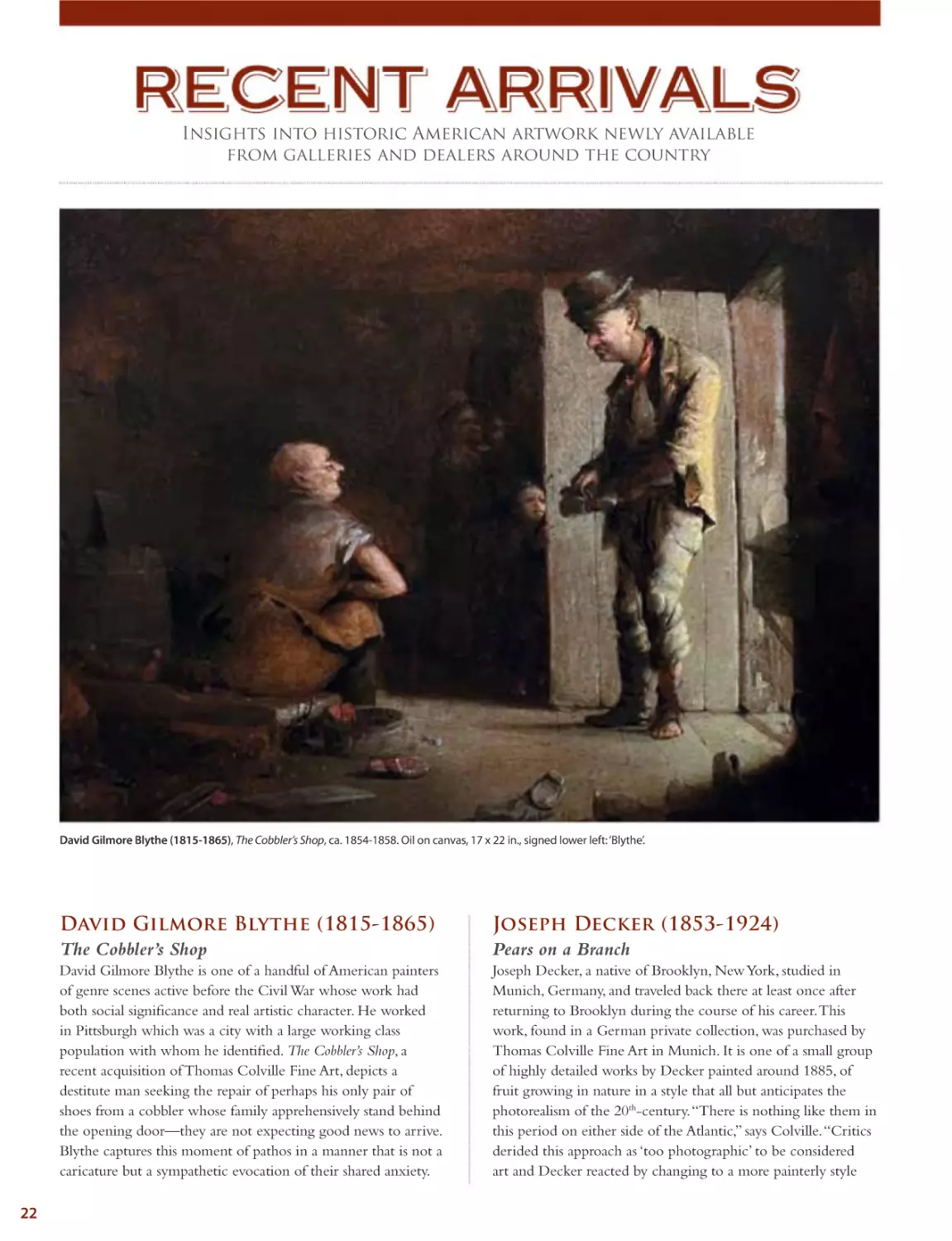
David Gilmore Blythe (1815-1865), The Cobbler’s Shop, ca. 1854-1858. Oil on canvas, 17 x 22 in., signed lower left: ‘Blythe’.
22
David Gilmore Blythe (1815-1865)
The Cobbler’s Shop
Joseph Decker (1853-1924)
Pears on a Branch
David Gilmore Blythe is one of a handful of American painters
of genre scenes active before the Civil War whose work had
both social significance and real artistic character. He worked
in Pittsburgh which was a city with a large working class
population with whom he identified. The Cobbler’s Shop, a
recent acquisition of Thomas Colville Fine Art, depicts a
destitute man seeking the repair of perhaps his only pair of
shoes from a cobbler whose family apprehensively stand behind
the opening door—they are not expecting good news to arrive.
Blythe captures this moment of pathos in a manner that is not a
caricature but a sympathetic evocation of their shared anxiety.
Joseph Decker, a native of Brooklyn, New York, studied in
Munich, Germany, and traveled back there at least once after
returning to Brooklyn during the course of his career. This
work, found in a German private collection, was purchased by
Thomas Colville Fine Art in Munich. It is one of a small group
of highly detailed works by Decker painted around 1885, of
fruit growing in nature in a style that all but anticipates the
photorealism of the 20th-century. “There is nothing like them in
this period on either side of the Atlantic,” says Colville. “Critics
derided this approach as ‘too photographic’ to be considered
art and Decker reacted by changing to a more painterly style
Above: Joseph Decker (18531924), Pears on a Branch, ca.
1885. Oil on canvas, 5¼ x 13
in., signed lower right.
Left: Benjamin West (17381820), Master Copley And His
Elder Sister, ca. 1777. Ink on
paper, 45⁄8 x 7¾ in., signed
lower left: ‘Benj.n West’; titled:
lower center.
for the rest of his career. There are not more than eight or 10 of
these tightly painted works by him known today and the largest,
and most ambitious example, also of plumbs on a branch, is on
view in The National Gallery of Art in Washington, D.C.
Benjamin West (1738-1820)
Master Copley And His Elder Sister
This work, recently obtained by Thomas Colville Fine Art,
depicts two young children seated closely together with a
gameboard on a table in front of them. The girl wears a dress
with sash and a wide-brimmed hat with ribbon and bow; the
boy wears his hair in long bangs and is looking at the game
pieces on the table. The crest rail of a chair is partially visible
behind him to the right. The sister is Elizabeth (Betsy) Copley
(1770–1866), John Singleton Copley’s eldest child who later
married Gardiner Greene of Boston. Next to her sits her
younger brother, John Singleton Copley, Jr. (1772–1863), who
as an adult remained in England, becoming the first Baron of
Lyndhurst. In this drawing, Betsy appears to be wearing the
same dress she wears in John Singleton Copley’s large group
portrait, The Copley Family, ca. 1776-77, now in the collection
of the National Gallery of Art, Washington, D.C.
Thomas Colville Fine Art
111 Old Quarry Road • Guilford, CT 06437
(203) 453-2449 • tlc@thomascolville.com •
www.thomascolville.com
23
NEW ACQUISITION
Henry Ossawa Tanner
NORTON MUSEUM OF ART
I
n efforts to diversify their collection,
the Norton Museum of Art based
in West Palm Beach, Florida, has
acquired an important work by Henry
Ossawa Tanner (1859-1937), the
first African American artist to gain
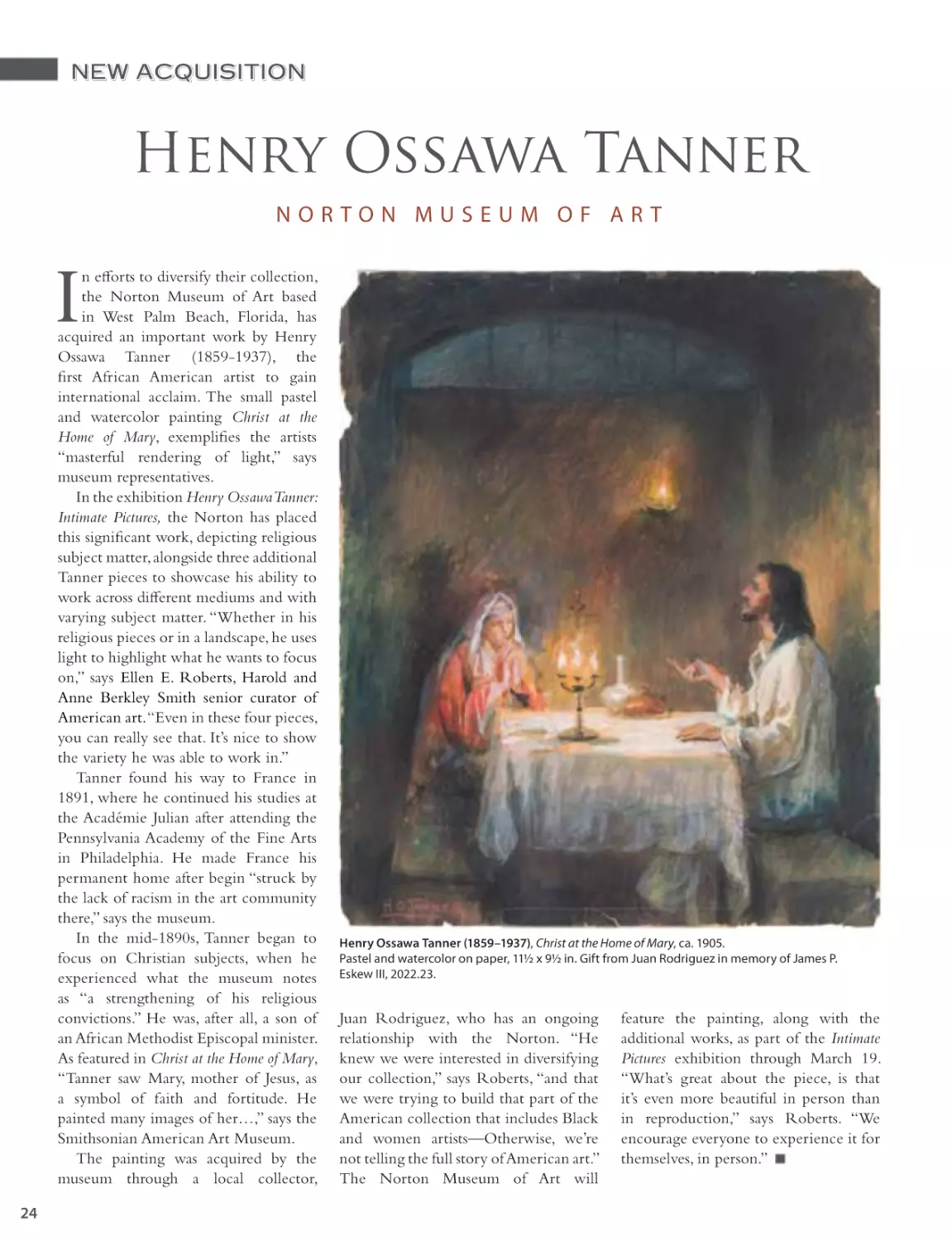
international acclaim. The small pastel
and watercolor painting Christ at the
Home of Mary, exemplifies the artists
“masterful rendering of light,” says
museum representatives.
In the exhibition Henry Ossawa Tanner:
Intimate Pictures, the Norton has placed
this significant work, depicting religious
subject matter, alongside three additional
Tanner pieces to showcase his ability to
work across different mediums and with
varying subject matter. “Whether in his
religious pieces or in a landscape, he uses
light to highlight what he wants to focus
on,” says Ellen E. Roberts, Harold and
Anne Berkley Smith senior curator of
American art. “Even in these four pieces,
you can really see that. It’s nice to show
the variety he was able to work in.”
Tanner found his way to France in
1891, where he continued his studies at
the Académie Julian after attending the
Pennsylvania Academy of the Fine Arts
in Philadelphia. He made France his
permanent home after begin “struck by
the lack of racism in the art community
there,” says the museum.
In the mid-1890s, Tanner began to
focus on Christian subjects, when he
experienced what the museum notes
as “a strengthening of his religious
convictions.” He was, after all, a son of
an African Methodist Episcopal minister.
As featured in Christ at the Home of Mary,
“Tanner saw Mary, mother of Jesus, as
a symbol of faith and fortitude. He
painted many images of her…,” says the
Smithsonian American Art Museum.
The painting was acquired by the
museum through a local collector,
24
Henry Ossawa Tanner (1859–1937), Christ at the Home of Mary, ca. 1905.
Pastel and watercolor on paper, 11½ x 9½ in. Gift from Juan Rodriguez in memory of James P.
Eskew III, 2022.23.
Juan Rodriguez, who has an ongoing
relationship with the Norton. “He
knew we were interested in diversifying
our collection,” says Roberts, “and that
we were trying to build that part of the
American collection that includes Black
and women artists—Otherwise, we’re
not telling the full story of American art.”
The Norton Museum of Art will
feature the painting, along with the
additional works, as part of the Intimate
Pictures exhibition through March 19.
“What’s great about the piece, is that
it’s even more beautiful in person than
in reproduction,” says Roberts. “We
encourage everyone to experience it for
themselves, in person.”
LY N N E D R E X L E R
Raucous Green, 1965, oil on canvas, 48 x 36 inches. Provenance: Lynne Drexler Estate
JKFA
J. K E N N E T H
F I N E
A R T
Representing the art of Lynne Drexler since 2015
ϲϲϴEWĂůŵĂŶLJŽŶƌŝǀĞ͕WĂůŵ^ƉƌŝŶŐƐ͕ϵϮϮϲϮͮϴϬϮͲϱϰϬͲϬϮϲϳͮǁǁǁ͘ũŬĞŶŶĞƚŚĮŶĞĂƌƚ͘ĐŽŵ
Lynne Mapp Drexler (1928-1999), Violet Sunlight, 1962. Oil on canvas, 32 x 49⁄ in.
THE FORCES
T
here has been a major cultural
shift and a growing interest
concerning artists who have
been historically marginalized within
the canon of American art. A great
number of artists continue to be
ignored by collectors, brokers, gallerists
and institutions alike. In the 20th
century alone, many talented and welleducated artists remain conveniently
26
tucked away in the shadowy back-pages
of art history. In their time, many of
these lesser-known artists were a part of
significant art movements, exhibited in
influential galleries and well-connected
to more famous artists.
Not too long ago, this was the case
for Lynne Mapp Drexler (1928-1999).
Drexler’s legacy as a painter languished
in obscurity, not only in her lifetime,
but also, tragically, for years after her
death. While the reasons for Drexler’s
name having been omitted from the
annals of art history are complicated,
one overriding factor has remained
constant for her and other women of
the abstract expressionist era.
Like other talented artists who were
trained by the era’s finest teachers,
Drexler was a member of the New York
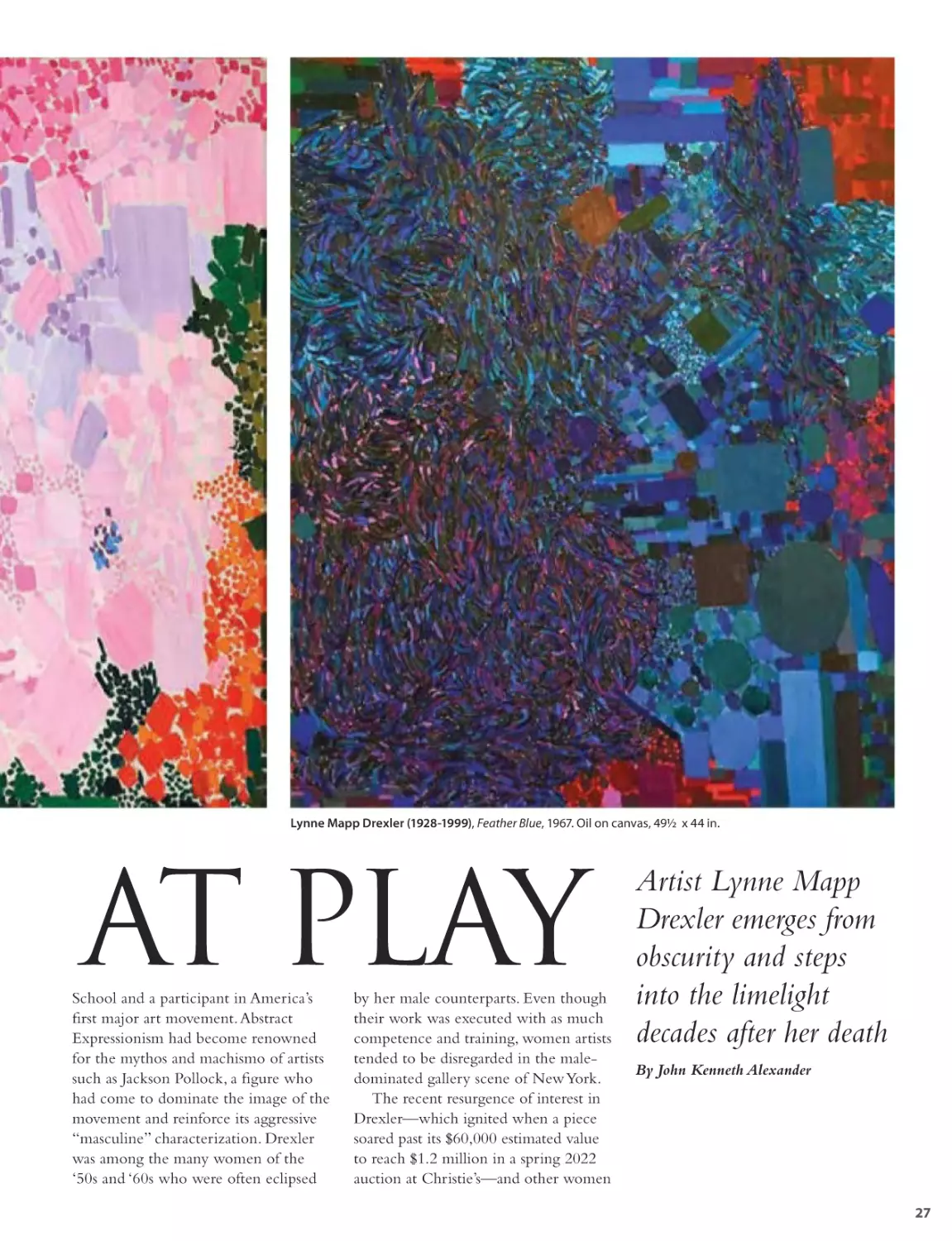
Lynne Mapp Drexler (1928-1999), Feather Blue, 1967. Oil on canvas, 49½ x 44 in.
AT PLAY
School and a participant in America’s
first major art movement. Abstract
Expressionism had become renowned
for the mythos and machismo of artists
such as Jackson Pollock, a figure who
had come to dominate the image of the
movement and reinforce its aggressive
“masculine” characterization. Drexler
was among the many women of the
‘50s and ‘60s who were often eclipsed
by her male counterparts. Even though
their work was executed with as much
competence and training, women artists
tended to be disregarded in the maledominated gallery scene of New York.
The recent resurgence of interest in
Drexler—which ignited when a piece
soared past its $60,000 estimated value
to reach $1.2 million in a spring 2022
auction at Christie’s—and other women
Artist Lynne Mapp
Drexler emerges from
obscurity and steps
into the limelight
decades after her death
By John Kenneth Alexander
27
Lynne Mapp Drexler (1928-1999), Untitled, 1959. Gouache on
paper, 19½ x 24 in.
Lynne Mapp Drexler (1928-1999), Untitled, 1959. Oil on paper,
9 x 12 in.
like her has brought many of these
artists out of the shadows with a new
sense of discovery and appreciation.
“I’ve always felt deeply within myself
that I was a damn good artist, though
the world didn’t recognize me as such.
I wasn’t about to play their game,” the
artist said in “Lynne Drexler: A Life in
Color,” a film by Roger Amory.
Born in the Tidewater region of
southeast Virginia in 1928, Drexler
moved to New York in 1955 to pursue
her career as an artist. Like many
artists of her day, she studied under
Hans Hofmann in both his New York
and Provincetown schools. Drexler’s
other renowned teacher was Robert
Motherwell at Hunter College. Her
training from Motherwell, along with
Hofmann’s lessons on color theory,
would set the foundation for Drexler’s
28
Lynne Mapp Drexler (1928-1999), Stumps, 1968. Oil on canvas,
47¾ x 35½ in.
approach to painting. Her swatch-like
patterns and vivid array of colors are
quite distinctive when compared to
her contemporaries of the abstract
expressionist genre.
Many of Drexler’s early collectors
became enthralled with her work long
before the frenzied atmosphere of
the current art market that surrounds
it. The fact that she was completely
unknown to them was irrelevant once
they became captivated by the brilliant
colors of her palette, and the thoughtful
intent by which her brushwork, shapes
and patterns were placed within
her picture plane. Drexler’s story
also resonated with many would-be
collectors. Devoted fans of Drexler’s
work have marveled at her longoverdue recognition and admiration
from the fine art establishment.
Collectors Rick and Sue Miller
attended Drexler’s first solo exhibition
held in California in 2015, 16 years
after her death. “The manager of the
Drexler estate was going to be at the
exhibition to talk about Drexler’s
work and answer questions,” Sue
recalls. “I became intrigued by her
story and wanted to know more about
her—I wanted to know more about
her upbringing, her education, under
whom she studied, how she progressed
from her early work to her later work.”
The fact that Drexler had been
overlooked as an artist based on her
gender was not lost on Sue. “As an artist
myself in the early ‘60s, I understood
the frustration of not being accepted as
a legitimate artist simply because of my
gender,” she shares. “I’m very excited
to see her work now being appreciated
Lynne Mapp Drexler (1928-1999), Green gage I, 1959. Oil on canvas, 14 x 17½ in.
and her name being recognized.”
The Millers continue to be
important collectors and champions of
Drexler’s work.
Like many other women, Drexler
encountered multiple obstacles in her
search for gallery representation in
gender-biased atmosphere of the New
York gallery world. While galleries were
courting her husband, painter John
Hultberg, Drexler would face the insult
and indignity of being completely
ignored or belittled.
As the mid-1960s approached, the
movement of Abstract Expressionism
entered its decline, eventually being
replaced by Pop Art and, shortly
thereafter, Op Art. Drexler was
already making her own transition
away for the movement by applying
her signature style to a new series of
visionary abstract paintings. Many
of her abstract paintings created just
after 1962 are clearly inspired by the
landscape with the concepts of musical
elements helping to guide the pictorial
arrangements. Music, especially opera,
had come to help define Drexler’s
creative expression.
“I was not on the political fast
track,” said Drexler about her
experience in New York in the Roger
Amory documentary. “I cannot make
friends for gain.”
Eventually, unsatisfied with the
male-dominated art system and art
politics of New York—Drexler finally
moved permanently to Monhegan
Island, Maine, in 1983. Well known
29
Lynne Mapp Drexler (1928-1999), Untitled, 1961. Crayon and watercolor on paper, 19 x 25 in.
Lynne Mapp Drexler (1928-1999), Purple Nude, ca. 1957. Oil on canvas, 18 x 24 in.
30
for its summer art colony, Monhegan
Island has a unique history and
eccentric character. In sharp contrast
to New York, the winter population
of Monhegan Island is roughly 65
people—practically cut off from
civilization. The ferry makes the trek
to the island only twice a week in the
dead of winter. The Drexler house is
situated beneath Lighthouse Hill, with
the cemetery and her gravestone not
too far away. The lone house seems like
an island unto itself, staring out across
the field to the other houses in the
distance and to the sea, beyond that.
It is amid this solitude where Lynne
Drexler chose to call home.
Drexler became an integral member
of the year-round island community.
Of the island, the Monhegan Museum
notes, she said, “There is no isolation
in a place like this—impossible to find,
Lynne Mapp Drexler (1928-1999), San Pablo Bay, 1964. Oil on canvas, 30 x 40 in.
but solitude is respected.”
The remoteness and solitude of the
island would impact her work. Her
paintings of those times often reflect
everyday life such as views from her
windows, interior views of her house
and even chores such as hanging
laundry. The still life also became
an important subject in Drexler’s
repertoire, often floral arrangements
peppered with dolls from her collection.
“I sell enough here to make a
living off of. I am not rich—but
I have what I want,” the Monhegan
Museum has documented. “As long as
I have food, heat, roof over my head,
food for the cat, and paint I am happy.
Oh, and Jack Daniel’s.”
“Many artists seem to be
inexplicably linked to a locale where
their creativity came into its fulfillment,
such as Monet in Giverny;Van Gogh
in Southern France; Gauguin in the
South Pacific,” state Rick and Sue
Miller. “As a collector of Lynne’s work,
we felt it altogether fitting and proper
to make a pilgrimage to Monhegan
Island to better understand what
drove her inspiration and creativity.
We were immediately immersed in the
natural beauty of the island. Walking
the paths and trails, stepping into what
she might have seen and observed
from an artist’s perspective, it truly
became a pilgrimage to understand and
appreciate her portfolio of art created
over a span of so many years.”
Drexler’s connection to the island
also had a profound impact upon her
spiritual life. Perhaps this is one of the
most important aspects of Drexler’s
amazing story, career and legacy. In
an essay published in John Fowles
and Nature: Fourteen Perspectives on
Landscape, Drexler wrote, “I came to
believe in myself and my own inner
resourcefulness. Living here revealed a
strength and depth in me I didn’t know
I had. When you live here you learn
to see who you really are.You are very
close to nature, and nature clarifies
you to yourself. At night I feel a sense
of awe in the way the black ocean
stretches out to meet the black sky, and
I’m aware of what it means to live in a
universe. Everything here is reduced to
essentials. I’ve forgotten how to act on
shore. On shore is the false reality. Here,
is the true reality.”
John Kenneth Alexander has represented
Lynne Drexler since 2015 and is the
director of J. Kenneth Fine Art.
31
Main exhibit palaces of the [Panama-Pacific International Exposition] with Marina District neighborhood in foreground, 1915.
Image courtesy of Bancroft Library, University of California, Berkeley.
William de Leftwich Dodge (1867-1935), Atlantic and Pacific (center panel), 1914. Oil on canvas, without decorative borders: 146 x 559½ in.
Image courtesy of de Young Museum, San Francisco.
A FLEETING
Fantasy
The Lost Murals of the 1915 Panama-Pacific
International Exposition By Michael Pearce
F
orty years before Disneyland was a twinkle in Walt’s
eye, the spectacle of the 1915 Panama-Pacific International
Exposition in San Francisco overwhelmed the masses
and crowds with a wonderful world of shimmering towers,
light shows and glittering parades. Attendees of the spectacular
World’s Fair arrived at a splendid site filled with magnificent
pavilions built upon 635 acres of seafront thrusting into the
32
Bay. A brochure advertising the event boasted of spending $50
million on lavishly decorated buildings—housing exhibitions
worth another $50 million.
The drama of hundreds of sculptures and friezes decorated
travertine courts and colonnades. Immense murals were the
focal point of the sheltered ceilings of the dreamy palaces, and
nine enormous but fine fountains set the thematic tone—joy,
Frank Brangwyn (1867-1956), The Four Elements Fire I – Primitive Fire, Exhibited at the court of Abundance, Panama-Pacific Exposition.
Courtesy of the Herbst Theatre at the San Francisco War Memorial and The Master’s Light Photography.
energy, life, play and youth, centered on
tradition, pragmatism and order. The
exposition would shape the future of
painting and sculpture in California and
cement a popular American enthusiasm
for murals that would last until 1939.
The extravaganza was organized as
a celebration of the completion of the
American-built, continent-crossing
engineering marvel of the Panama
Canal, but it was also a stimulus
to San Francisco’s revival from the
33
Frank DuMond (1865-1951), Study for The Westward March of Civilization: Arrival in the West, 1913. Oil on canvas, squared in pencil, 32 x 100 in.
ruins of the 1906 earthquake which
demolished much of the young city
with fire and fury. In the aftermath of
the 7.9 quake, an inferno burned for
four days, incinerating 80 percent of
the many wooden buildings. Rubble
from the ruins was scraped into the
bay to create land from sea, and some
of which is said to have become
foundations for the exposition’s cleared
lot, transforming a swamp into “a
garden of trees and flowers, a city of
fantasy,” according to Jeanne Redman
of the Los Angeles Times. Fairytale gems
of romantic construction literally rose
from the ashes of the wrecked city.
Effusive, and exhausting the lexicon
of superlatives to describe the fantastic
exposition, Redman continued, “It is
the vivid realization of vague dreams. A
dim city, with towers of ruby, amethyst
and emerald wrapped in mist, or a city
of the flashing white of sunshine and
the glitter of gilt domes, softened by
the fog that rolls in from the sea. Surely
this is the land of illusions, and yet it is
real.” A 435-foot-high Tower of Jewels
was decorated with 135,000 suspended
pieces of cut and mirrored Czech glass,
which caught the sun in a glittering
display of color, sparkling against the
bright skies of floodlit night, when
wonderful lightshows transformed the
sky and buildings into ethereal visions
William de Leftwich Dodge at work on Atlantic and Pacific. Image courtesy of Pryor Dodge.
34
of wonderland.
Opening day saw 200,000 attendees
and nearly 19 million people visited
during the course of the year. In The
Innocent Fair, a 1961 documentary film
remembering the exposition with clips
from an archive of silver nitrate film
shot in 1915, narrator Walter Johnson
recalled, “It was the most wonderful
thing that ever happened to San
Francisco.”
The fair’s magnificent buildings,
more palaces than pavilions, were
themed as celebrations of American
accomplishments in fine arts,
education, social economy, liberal arts,
manufacturing, industry, machinery,
transportation, agriculture, agriculture
(food products), livestock, horticulture,
mines and metallurgy. Henry Ford
showed a complete automobile assembly
line. Newly invented infant incubators
were demonstrated in use, saving the
lives of newborns beneath the gaze of
an enthusiastic audience. A stunt pilot
flew loop-the-loops at night, with flares
attached to the wings of the plane before
losing his life in a fiery crash. Elaborate
displays showing the achievements of
all the states thrust home the idea of
American excellence and success. Horses
and cars raced for extravagant purses.
But the art was the star.
Nine artists were chosen to paint
for the great palaces: Childe Hassam,
Charles Holloway, Arthur Mathews,
Robert Reid, Milton Bancroft, Edward
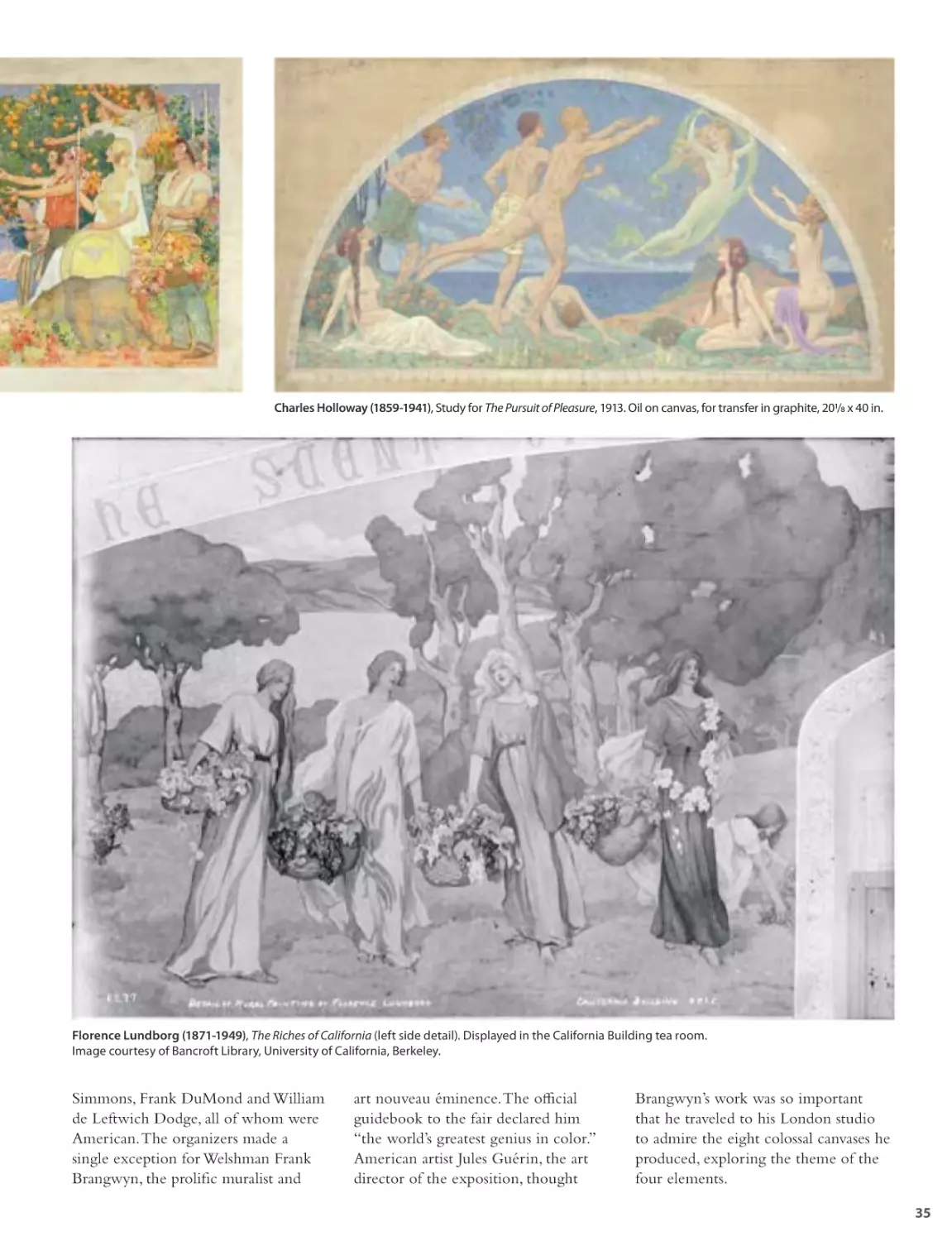
Charles Holloway (1859-1941), Study for The Pursuit of Pleasure, 1913. Oil on canvas, for transfer in graphite, 201/8 x 40 in.
Florence Lundborg (1871-1949), The Riches of California (left side detail). Displayed in the California Building tea room.
Image courtesy of Bancroft Library, University of California, Berkeley.
Simmons, Frank DuMond and William
de Leftwich Dodge, all of whom were
American. The organizers made a
single exception for Welshman Frank
Brangwyn, the prolific muralist and
art nouveau éminence. The official
guidebook to the fair declared him
“the world’s greatest genius in color.”
American artist Jules Guérin, the art
director of the exposition, thought
Brangwyn’s work was so important
that he traveled to his London studio
to admire the eight colossal canvases he
produced, exploring the theme of the
four elements.
35
Brangwyn’s paintings were loaded
with crowds of figures and exaggerated
the profusion of nature’s abundance,
but there was little of the artificial
posturing of mannerism. Brangwyn
used the vertical canvases to compose
great, dramatic images that explored
the burdens and benefits of labor. They
were the dominant decorative feature
of the lavish Court of Abundance, a
Moorish-Gothic architectural fantasy
dominated by a tall tower overlooking a
formal garden enclosed by long arcades.
Two 22-feet-wide roundels
completed the Court of Palms. Hassam’s
was a rigid, formulaic decoration which
did little to show off his skill as a loose
master of impressionist light. (His
achievements were on full display in a
post-exposition exhibit in the Palace
of Fine Art in a showing of more than
100 of his paintings and drawings.)
Holloway’s The Pursuit of Pleasure was
a lovely composition of fluid figures in
sensual and light work.
The dreamy Palace of Fine Art was
certainly the most popular architectural
achievement of the festival. A lagoon—
all that remained of the reclaimed
swamp—separated it from the rest of
the exposition, lending it an aura of
distinguished exclusivity. Beside the
water, the great dome of a rotunda
supported by eight lesser domes was the
centerpiece to 1,000 feet of glorious
curving arcade wrapping the palace.
Carefully placed trees and bushes
sheltered sandy paths and cast dancing
shadows onto the warm travertine
of this architectural fantasia, which
provided the scenography for settings
of romantic dances by white-clad,
flower-scattering maidens and the arrival
of burly heroes in boats. The arched
ceiling of the dome was decorated
with beautifully curvaceous baroque
spectacles by Reid, two depicting the
birth of European and Oriental art, and
two of art’s inspiration and idealism.
Historic photos show Reid working
on these vast sentimental images of
beautiful women personifying art,
wreathed in garlands of flowers. These
were alternated with the “four golds of
California”—wheat, metal, citrus fruit
and poppies. Inside the Palace, a lavish
series of 117 galleries contained an
exhibition of international art so great
that Redman wrote, “…it would take
the average visitor, working 12 hours a
day, 30 days to cover the pictures.” It was
“the most comprehensive exhibition of
American art in the country’s history.”
Interior of the Tower of Jewels showing William de Leftwich Dodge’s Atlantic and Pacific mural beneath the arch.
Autochrome image courtesy of Pryor Dodge.
36
Robert Reid standing in front of a mural, ca. 1900. Robert Reid papers, ca. 1880-ca. 1930. Archives of American Art, Smithsonian Institution.
Bancroft painted 10 murals decorating
the ends of high passageways in the
colonnade of the Italianate Court of
Four Seasons: Festivity, Winter, Harvest,
Summer, Fruition, Autumn, Seed Time and
Spring. The two largest, Art Crowned by
Time, and Man Receiving Instruction in
Nature’s Laws were directly below the
beginning of the span of the grand
central arch.
Simmons’ immense panels for the
triumphal arch were graceful mixtures
of the renaissance revival’s neo-classical
figuration with celebratory American
history painting, surpassed only by the
spectacular symmetry of Dodge’s vast
Atlantic and Pacific, which now fills a
lobby wall in San Francisco’s de Young
Museum, celebrating the triumphant
meeting of East and West when the
two oceans were joined by the Panama
Canal. DuMond’s The Westward March of
Civilization, now in the city’s Asian Art
Museum, rejoiced in anthem-singing
representative figures of the arts, science
and religion, from Greece, Egypt,
Europe—and Atlantis—meeting on the
Pacific coast. Both painters featured
whip-cracking ox-drivers, the tractormen of pre-mechanical farming.
Besides the great achievements of
the fair’s palaces, murals decorated
the national and states’ pavilions.
Brangwyn’s student Edward Trumbull
distinguished the Pennsylvania Building
with his Penn’s Treaty with the Indians,
and The Steelworkers. The Netherlands
Pavilion was graced with Hermann
Rosse’s The Arts of Peace. A pioneering
woman among the field of male
muralists, Florence Lundborg painted
the glory and summer of The Riches
of California, spanning the interior of
the California Pavilion, a harvest scene
of nature’s bounty topped with an
inscription from Theocritus reading,
“All breathes the scent of the opulent
summer, the season of fruits.”
The city of San Francisco possesses
the Hassam and Mathews murals but
keeps them in storage and they have
not been seen for a century. Brangwyn’s
murals are the glory of the Herbst
Theatre at the San Francisco War
Memorial. Bancroft, Simmons and
DuMond’s paintings were destroyed
when the exposition was demolished.
Unlike the other buildings, which
were constructed in the temporary
wood and plaster of theatrical sets,
designed to last for only a year, the
Palace of Fine Arts was constructed
in steel and concrete to safeguard the
lavish collection of paintings, etchings
and sculptures from the perils of
fire—still a freshly horrific memory
to the citizens of the brave city. It was
so beautiful that it was preserved after
the close of the event, then completely
rebuilt between 1964 and 1974, largely
thanks to the inspiration of Johnson’s
nostalgic documentary which showed
it in an abandoned state of ruined
disintegration. Sadly, Reid’s wonderful
paintings were lost to the elements
as the Palace decayed. The haunted
decoration and shell of the building
remains on its original site in the San
Francisco marina, where the ghastly
functional interior is now used as a
sterile performance venue and coldly
austere convention hall. Treasure was
lost forever when the murals were
destroyed—but the memory of these
glorious paintings lived on in the hearts
of the millions who saw them. John
Walter, President of the San Francisco
Art Association, wrote, “The Exposition
had literally created tens and thousands
of lovers and students of art.”
37
GALLERY PREVIEW: NEW YORK, NY
Joyous Color
A virtual exhibition currently on view at Hawthorne Fine Art presents the artwork of
Rhoda Holmes Nicholls
Through March 28
Hawthorne Fine Art
New York, NY
575 5th Avenue, 14th Floor
New York, NY 10017
t: (212) 731-0550
www.hawthornefineart.com
Rhoda Holmes Nicholls (1854-1930), Portrait
of a Woman. Watercolor on paper, 13 x 10 in.
(window), 17¼ x 14 in. (mat), signed lower right:
‘Rhoda Holmes Nicholls’.
C
onsidered one of the finest
painters at the turn of the 20th
century, artist and educator
Rhoda Holmes Nicholls painted
figures, landscapes, seascapes and
more—rendered in delicate washes,
energetic brushstrokes and a highly
tuned sense of light and shadow.
An online exhibition at Manhattanbased Hawthorne Fine Art features
a dozen works by Nicholls in oil,
watercolor and gouache landscapes, as
well as portraiture and figurative works.
Additionally, the show places particular
38
Rhoda Holmes Nicholls (1854-1930), Italian Woman and Child. Oil and graphite on paper, 9 x 6¾ in.
(window), 16 x 13½ in. (mat), signed: ‘Rhoda Holmes’ and inscribed lower right: ‘Venice’.
emphasis on the Venetian scenes for
which the English-born artist is well
known.
“Nicholls was an ambitious and
internationally recognized artist who
excelled in both oil and watercolor,”
says Megan Bongiovanni, research
associate at Hawthorne Fine Art. “In
Italy, she was elected a member of the
Roman Watercolor society, which was a
rare honor for a woman. She exhibited
widely, including in numerous annual
Rhoda Holmes Nicholls (1854-1930), Reclining Lady with Dog. Watercolor on paper, 12¼ x 15½ in. (window), 13 x 16¼ in. (mat), signed lower right: ‘Rhoda
Holmes Nicholls’.
Rhoda Holmes Nicholls (1854-1930), Woman Waiting in Doorway, Venice. Oil on
paper, 8 x 71/8 in. (sight), 83/8 x 75/8 in. (actual), signed lower left: ‘Rhoda Holmes’.
exhibitions at the National Academy of Design and the
Pennsylvania Academy of the Fine Arts. Her work was
so admired that she became a sought-after instructor at
the Art Students League and as head of the watercolor
department at William Merritt Chase’s Shinnecock
School on Long Island.”
Bongiovanni continues, “We are excited to share a
few early works by Nicholls, which were executed in
Italy prior to her marriage to the American artist Burr
Nicholls and subsequent move to the United States in
1884.”
The oil and graphite on paper, Italian Woman and Child,
as well as the oil on paper Woman Waiting in Doorway,
Venice, are notable examples of Nicholls’ refined ability
to capture scenes of Venice. “She captured women in
their daily life amid the architectural detail and exquisite
sunlight so unique to the Italian city,” Bongiovanni adds.
“A watercolor sketch entitled Basilica di Santa Maria
della Salute,Venice, includes color notations by Nicholls
which provides a glimpse into [her] working process.
Other highlights such as Portrait of a Woman and Reclining
Lady with Dog reveal Nicholls’ skill with the watercolor
medium.”
Joyous Color:The Art of Rhoda Holmes Nicholls (18541930) is on view at www.hawthornefineart.com through
March 28.
39
MUSEUM PREVIEW: ATLANTA, GA
A Natural Bridge
Atlanta’s High Museum of Art presents an extraordinary selection of works by the
unparalleled Joseph Stella
Through May 21
High Museum of Art
1280 Peachtree Street, NE
Atlanta, GA 30309
t: (404) 733-4400
www.high.org
T
he pioneering modernist
painter Joseph Stella (18771946), was born in Italy and
immigrated to New York in 1896 when
he was 18. He is perhaps best known
for his paintings of the Brooklyn
Joseph Stella (1877-1946), Spring (The
Procession), ca. 1914-1916. Oil on canvas, 755/16
× 403/16 in. Yale University Art Gallery, gift of
Collection Société Anonyme, 1941.692.
40
Joseph Stella (1877-1946), Red Flower, 1929. Oil on canvas, 57½ x 38¼ in. Crystal Bridges Museum of
American Art, Bentonville, Arkansas, 2006.102. Photo by Dwight Primiano.
Joseph Stella (1877-1946), Tree of My Life, 1919. Oil on canvas, 84 x 76 in. Art Bridges, Bentonville, Arkansas, purchase. Photo © 2018 Christie’s Images
Limited.
Bridge. In 1912 he wrote, “I was
thrilled to find America so rich with
so many new motives to be translated
into a new art. Steel and electricity
had created a new world. A new
drama had surged from the unmerciful
violation of darkness at night, by the
violent blaze of electricity and a new
polyphony was ringing all around with
the scintillating, highly colored lights.
The steel had leaped to hyperbolic
altitudes and expanded to vast latitudes
with the skyscrapers and with bridges
made for the conjunction of worlds.
A new architecture was created, a new
perspective.”
At about the same time as his iconic
Brooklyn Bridge, 1919-20, he painted
the extraordinary Tree of my Life, an
exuberant paean to nature. The painting
is included in the exhibition Joseph Stella:
Visionary Nature at the High Museum of
Art in Atlanta through May 21.
Stephanie Heydt, the museum’s
41
Joseph Stella (1877-1946), Capri, ca. 1926–1929. Oil on canvas, 17¼ x 14¼ in., private collection. Photo © Christie’s Images / Bridgeman Images.
42
Joseph Stella (1877-1946), Flowers, Oil on canvas, 74¾ x 74¾ in. Phoenix Art Museum, Arizona, gift of Mr. and Mrs. Jonathan Marshall, 1964.20.
curator of American art and head
curator for the exhibition, writes,
“Much of his emotional and spiritual
life centered on his relationship with
nature, and the exhibition offers the
unique opportunity to revisit Stella
through this lens. He was an incredible
draughtsman, and his drawings rival
those of the old masters, but he also
delighted in experimentation. His style
ranged from abstraction to realism
to the archaic with such unexpected
results.”
Reminiscing about the inspiration for
the painting, Stella wrote, “A new light
broke over me. One clear morning in
April, I found myself in the midst of
joyous singing and delicious scent…
of birds and flowers ready to celebrate
the baptism of my new art, the birds
and the flowers already enjewelling the
tender foliage of the newborn tree of
my hopes, Tree of My Life.”
Tylee Abbott, head of the American
art department at Christie’s and a
former contributing editor to this
magazine, comments, “There comes
a moment in any great artist’s career
when they shake off their influences
and their past to come up with
something truly groundbreakingly
original. And that’s precisely what we
have with Joseph Stella’s Tree of My
Life.”
The complex centrality of Tree of
My Life echoes his Brooklyn Bridge
paintings. It’s vibrant palette and that
of his Red Flower, 1929, contrast with
his intimate flower studies done in
MUSEUM PREVIEW: ATLANTA
43
Joseph Stella (1877-1946), Dance of Spring (Song of the Birds), 1924. Oil on canvas, 433/8 x 223/8 in. Kemper Museum of Contemporary Art, Kansas City,
Missouri, Bebe and Crosby Kemper Collection, gift of the Enid and Crosby Kemper Foundation, 2003.03.01. Photo by James Allison Photography, 2013.
44
Joseph Stella (1877-1946), Flower Bud, undated. Colored pencil and metalpoint with incised lines on white wove paper, 223/8 x 27¾ in. Harvard Art
Museums / Fogg Museum, gift of an Anonymous donor, 2008.271. Photo © President and Fellows of Harvard College.
metalpoint, colored pencil and crayon
such as Flower Bud. He commented on
his profound spiritual connection to
nature, writing that his wish was “that
my every working day might begin and
end, as a good omen, with the light, gay
painting of a flower.”
Stella had read the poems of Walt
Whitman in Italian before he arrived in
New York. The critic Irma Jaffe wrote,
“The immigrant community’s freedom
from Victorian patterns of respectable
behavior and middle-class refinement
coincided with those Whitmanesque
concepts of democracy that
conditioned the thought of progressives
of that period.”
The city became overwhelming
for Stella and he often returned to
Italy for rejuvenation. In 1917 he
moved to Brooklyn and trod the
streets where Whitman had walked. He
wrote, “Brooklyn gave me a sense of
liberation. The vast view of her sky in
opposition to the narrow one of NEW
YORK, was a relief—and at night, in
her solitude, I used to find, intact, the
green freedom of my own self.”
Like Whitman, Stella found the
ineffable and the spiritual in the vitality
of the city but sought it out more
simply and joyfully in nature.
The exhibition was organized by
the High Museum and the Brandywine
River Museum in Chadds Ford, PA,
where it will travel in June.
MUSEUM PREVIEW: ATLANTA
45
MUSEUM PREVIEW: RENO, NV
A Modernist Maverick
Adaline Kent’s quest to sculpt infinity
Through September 10
Nevada Museum of Art
160 West Liberty Street
Reno, NV 89501
t: 775-329-3333
www.nevadaart.org
By Meg Daly
I
t’s always exciting when an
underappreciated artist gets her due.
Such is the case with Adaline Kent
(1900-1957), the subject of an extensive
retrospective, Adaline Kent: The Click of
Authenticity, at the Nevada Museum of
Art. Like too many women artists, Kent’s
name has been overshadowed by male
peers such as Mark Rothko and Clyfford
Still. The exhibition seeks to redress the
past and position Kent as a key figure in
modernist art.
The museum has devoted an entire
floor to Kent’s creations. Featuring
approximately 90 pieces, Kent’s entire
oeuvre is explored. She worked in a range
of media, including drawings, original
pictures incised on Hydrocal (a plaster
mixture), sculptures and a collection of
terracotta.
Nevada Museum of Art CEO
David Walker notes that this is the
first retrospective of Kent’s work that
demonstrates her unique contribution to
figuration, abstraction and surrealism on
the West Coast in the United States. “Her
work is a vital part of our regional history
and has been overlooked for far too long,”
Adaline Kent (1900-1957), Presence, 1947.
Magnesite, 42¾ x 17¾ x 7¼ in. Collection of San
Francisco Museum of Modern Art; gift of the
Women’s Board and the Membership Activities
Board. Image courtesy of San Francisco Museum of
Modern Art.
46
Adaline Kent (1900-1957),
Never Fear, 1948. Incised Hydrocal
with pigment, 22½ x 9 x 8 in.
Private collection. Photo credit:
M. Lee Fatherree.
Adaline Kent in studio, working on Night Club,
1930. Courtesy of Adaline Kent Family.
Adaline Kent (1900-1957), Lighthouse for Birds,
1956. Terracotta (two pieces), 31¼ x 8 x 7½ in.
Collection of Adaline J. Hilgard. Photo credit:
Ron Jones.
Walker says. “The exhibition and the
catalog it inspired will be a remarkable
contribution to the scholarship and
recognition of this exceptional, midcentury artist.”
The exhibition is accompanied by a
fully illustrated catalog edited by Apsara
DiQuinzio, the museum’s senior curator
of contemporary art and organizer of
the exhibition.
DiQuinzio highlights Kent’s
philosophical approach to artmaking.
According to DiQuinzio, Kent’s use of
the infinity symbol, “can be understood
as a fusion of her interests in time, space
and nature.”
The infinity symbol hovers above
peaks in the Hydrocal painting Song; it
echoes through the abstract sculpture
Dark Mountain and it weaves through
the delicate assemblage in Finder.
“For Kent, the infinite was
the wellspring of the growth and
knowledge that led her to the discovery
47
Kent was particularly inspired by
movement and often infused motion
into her work. “To me, skiers, dancers,
trapeze artists provide pleasure
comparable to that of sculpture—
an idea of form in space, space in
form,” Kent wrote in a passage in her
extensive art journals. “The feeling of
space and movement seem to be the
essence of our time.”
In Lighthouse for Birds Kent imagines
a respite for birds in motion. Art
historian Alexander Nemerov writes
poetically about Lighthouse in the
catalog. “[The sculpture] offers no
beacon, only a promise, a sign of light
without the light itself, manifest in clay:
a roosting spot, a haven, a gathering
place among the restless migrations.
It reveals to us our mortality and the
place of that mortality in the universe,
our fate to be swung round with the
Adaline Kent (1900-1957),
Finder, 1953. Magnesite (two
pieces), 70 x 40 x 12 in. Los
Angeles County Museum of
Art; gift of Galen Kent Howard
Hilgard in memory of her
sister. Ellen Kent Howard.
Photo: Digital Image © [2022]
Museum Associates / LACMA.
Licensed by Art Resource, NY.
of her truth,” DiQuinzio says.
Born in Northern California in
1900, Kent was the daughter of a
noted conservationist and a suffragette.
As a young Vassar graduate, Kent
studied with Ralph Stackpole in San
Francisco and with Emile-Antoine
Bourdelle in Paris, where she lived for
several years before finally returning
to the Bay Area in 1929. She was part
of San Francisco Bay Area’s celebrated
mid-century art cohort, along with
Charles H. Howard, Madge Knight,
John Langley Howard, Robert
48
Boardman Howard, Henry Temple
Howard and Jane Berlandina. Her
work was exhibited at the Museum of
Modern Art, the Whitney Museum of
American Art and the Bienal de São
Paulo, among other notable venues.
Inspired by her upbringing, Kent
reveled in being outdoors. She and her
husband skied and hiked in the Lake
Tahoe region, which was a source of
artistic inspiration for Kent. DiQuinzio
observes that Kent’s Hydrocal painting,
Wellspring, “reads like an abstract mental
map of a High Sierra lake.”
Adaline Kent (1900-1957), Dark Mountain, 1945.
Hydrocal with incised lines and egg tempera,
33¾ x 12½ x 8 in. San Francisco Museum of
Modern Art; purchase. Photo courtesy of San
Francisco Museum of Modern Art.
Adaline Kent (1900-1957), Wellspring, 1945. Tempera on incised Hydrocal, 14 x 16 ½ in. Museum of Art and Archaeology, University of Missouri; gift of the
Betty Parsons Foundation. Photo courtesy of Museum of Art and Archaeology, University of Missouri.
rocks and trees, pebbles orbiting in the
fantastic scheme.”
Kent championed the advent
of modern art. She celebrated the
departure from art norms that she and
her peers were undertaking. “Modern
art is the expression of our time,” she
wrote in her journal. “It differs from
earlier art because of new knowledge.
It brings out new horizons. Artists
themselves, from the beginning, carry a
constant—the need to create a personal
truth. As a person lives in his time, he
[sic] must share the ideas that make up
that time.”
Kent was not only interested
in producing fine art. She enjoyed
creating decorative pieces such as
lamps for Yosemite National Park’s
iconic lodge, the Ahwahnee Hotel.
In 1948 she was commissioned to
make a sculpture for Thomas Dolliver
Church’s Donnell Ranch garden.
The garden came to be known as
a masterpiece of modern landscape
design that famously featured the first
kidney shaped pool. Kent’s sculpture,
Island, resembles a reclining figure and
includes passageways underwater for
swimmers.
Sadly, Kent was killed in a car crash
in 1957. But her joie de vivre can still
be felt. The Nevada Museum of Art
retrospective gets its title from a poem
in Kent’s journals entitled, “Classic
Romantic Mystic.” The poem invokes
“beings independent of their deceptive
ordinary appearance.”
“Freed from the trappings of
convention,” Kent wrote, “I want to
hear the click of authenticity.”
MUSEUM PREVIEW: RENO, NV
49
MUSEUM PREVIEW: DENVER, CO
Orientalism in the Occident
A sweeping new exhibit at the Denver Art Museum explores how the style and substance of
French Orientalism influenced American artists and their representation of the American West
March 5-May 28
Denver Art Museum
100 W. 14th Avenue Parkway
Denver, CO 80204
t: (720) 865-5000
www.denverartmuseum.org
By James D. Balestrieri
N
ear East to Far West: Fictions
of French and American
Colonialism at the Denver
Art Museum, places the art of the
American West—in particular the art
of the American Southwest—in an
art-historical context embracing aims
of empire, representational fictions of
Orientalist exoticism, and otherness.
As this exhibition makes plain,
Orientalism applies to the Occident
as well, to Indigenous peoples in the
Western Hemisphere in particular
who were equally exoticized and
othered. Additional themes speak to the
attractions and traps of places presented
throughout history as picturesque
and adventurous elsewheres—Joseph
Conrad’s “dark places of the earth.”
The exhibition is brilliant in its
simplicity, and while there are hints
of the same themes in Brian Dippie’s
1987 book, “Looking at Russell”,
which takes some time discussing the
influence of Eugène Delacroix and
other European artists on Charles
M. Russell, nothing approaching the
subject in depth has, to my knowledge,
been attempted up to now.
Colonization has to have some
moral justification that usually takes the
form of enlightening the benighted,
civilizing. The bald truth—rapacious
exploitation—plays poorly. But in
50
Eugène Fromentin (1820-1876), Bab-el-Gharbi Street in Laghouat (La Rue Bab-el-Gharbi à Laghouat),
1859. Oil on canvas; 557/8 x 40½ in. Musée de la Chartreuse, Douai, France, 148 ancien dépôt. © RMN
Grand Palais/Art Resource, NY.
some strange version of Stockholm
Syndrome, conquerors almost always
find themselves in the thrall of the
conquered. Myths of “noble savages”
and reports of wondrous, forbidding
landscapes draw artists, scientists,
entrepreneurs, adventurers; their
images, reports, and experiences, in
Henry Farny (1847-1916), Mesa Village, ca. 1891. Gouache on paper; 15 x 93/8 in.
Denver Art Museum: The Roath Collection, 2014.374.
turn, enthrall viewers and influence
everything back home from
architecture to fashion to food. Then,
as happened in the late 19th century,
there are those who inevitably aver
that whatever is good or noble about
the Indigenous, the colonized, couldn’t
possibly be of their own making.
Rumors abounded of “white Indians,”
lost tribes of Israel, survivors of Atlantis,
creating civilizations that have since
tumbled into decadence, though why
this is so is always a little vague. For
some, the Welsh prince, Madoc, created
the Mississippian culture, and Viking
Gerald Cassidy (1869-1934), Cui Bono?, ca. 1911. Oil on canvas; 93½
x 48 in. Collection of the New Mexico Museum of Art: Gift of Gerald
Cassidy, 1915 (282.23P). Photo by Blair Clark.
Leif Eriksson discovered America, not
Columbus, as if the place had a big
“Vacancy” sign on it. The continent
was—and continues to be—a tabula
rasa for crackpot, jingoist theories.
Into this maelstrom, in France and
America, art stepped. And you have to
keep in mind that art, at least EuroAmerican art, was searching for new
inspirations, new subjects, and new
things to see so there could be, as John
Berger wrote, new “ways of seeing,”
and new facture for artists.
Organized by the Denver Art
Museum’s Director of the Petrie
Institute of Western American Art, Dr.
Jennifer R. Henneman, the exhibition
reveals itself when you consider the
paintings in pairs.
Set Eugène Fromentin’s 1859 oil,
Bab-el-Gharbi Street in Laghouat (La
Rue Bab-el- Gharbi à Laghouat),
depicting an Algerian street, side-byside with Henry Farny’s 1891 gouache,
Mesa Village and you will see striking
similarities. Each gives the viewer a
sense of oppressive heat and of the
consequent indolence of the people,
few in number next to the ziggurat
constructions of the dwellings. Perhaps
51
Alphonse-Étienne Dinet (1861-1929), Man in a Large Hat (Homme au Grand Chapeau), 1901. Oil on canvas; 15¼ x 10½ in. Musée d’Orsay and Cité
nationale de l’histoire et de l’immigration, Paris: MAAO 9720, LUX 527. © RMN-Grand Palais/Art Resource, NY. Photograph by Daniel Arnaudet.
52
Gerald Cassidy (1869-1934), Midday Sun, North
Africa, 1920s. Oil on canvas; 64 x 51½ in. Private
collection. Photography courtesy Denver Art
Museum.
Catharine Carter
Critcher (18681964), Indian
Mystic, ca. 1924. Oil
on canvas; 22 x 18
in. The Peterson
Family collection.
Courtesy Loren
Anderson
Photography.
without meaning to do more than
document these respective places at
a particular time of day, the paintings
hint strongly at lost and more vigorous
and glorious pasts. The birds overhead
in Bab-el-Gharbi Street in Laghouat may
well be vultures, indicating a people
and culture in decay, while shadows in
both works suggest places heading into
eclipse, waiting to be reanimated by
Western pluck and assiduity.
Piercing eyes wreathed in white
draperies in Alphonse-Étienne Dinet’s,
Man in a Large Hat (Homme au
Grand Chapeau), 1901, and Catharine
Critcher’s 1924 oil, Indian Mystic, lead
us to words like “inscrutable,” and
“timeless,” which have everything to do
with our fantasies and projections and
little or nothing to do with the lives
of the subjects portrayed. In Gerald
Cassidy’s paintings, the 1911 Cui Bono?
(Latin for “Who benefits?,” which no
doubt asks who stands to gain from
changing this man’s life in a New
Mexico Pueblo) and the 1920s work,
Midday Sun, North Africa, the same artist
works in an Orientalist/Occidentalist
tradition; these paintings—of the prince
in the pueblo and sheik in the souk—
immediately lead to phrases like “innate
nobility” and “natural aristocracy,” again
trading on our projections.
Cui Bono? Who benefitted then
from the projections, stereotypes,
and fantasies of exoticism and the
marginalization of the Other in North
Africa and the American West? Who
benefits now? My answers to these
questions, the exhibition suggests, may
say more about me and my relationship
to history—history as a scholarly
practice as opposed to history as fact—
than they do about the subjects of the
works, or even the artists themselves.
If Edward Said, author of the seminal
work on the subject, Orientalism, were
here, he would say I should let Others,
other than me, answer those questions
for themselves.
MUSEUM PREVIEW: DENVER, CO
53
MUSEUM PREVIEW: IRVINE, CA
A Lifetime of Devotion
An exhibition focuses on the Bruton sisters’ legacy
and their role as pioneers in the advancement of modern art in California
Through May 6
Langson Institute and Museum
of California Art
University of California, Irvine
18881 Von Karman Avenue, Suite 100
Irvine, CA 92612
t: (949) 476-0003
www.imca.uci.edu
B
rought together by leading
expert and guest curator
Wendy Van Wyck Good on
the overlooked Bruton Sisters, is
the first group exhibition of their
artwork in more than 50 years. The
Bruton Sisters: Modernism in the Making
traverses Margaret, Esther and Helen’s
most active years of production, and
the significant impact they had on
the California art scene from the
early 1920s through the late 1950s.
Esther Bruton (1896-1992), Rabbit Hunt, 1929.
Gold leaf, aluminum leaf and eggshell mosaic
on wood screen, 62 x 57 in. Courtesy Annex
Galleries and the estate of Madalyn and Philip
Johnson, © Bruton Family Archive, courtesy of
Barbara Carroll.
54
Imogen Cunningham (1883-1976), The Bruton Sisters, Artists, 1930. Gelatin silver print, 8 x 10 in. ©
2022 Imogen Cunningham Trust.
On view now at the University of
California, Irvine, Langson Institute and
Museum of California Art (IMCA), the
exhibition examines 19 of the artists’
dynamic pieces in relation to another
12 pieces from their contemporaries,
mostly woman artists, to “get a better
sense of how they fit in with the
modernist art movement at the time,”
says Good.
She continues, “There are a couple
of main themes were trying to get
across. One is [the sisters’] creativity
with materials. They were always
experimenting with different mediums:
mosaic, oil painting, prints. They did
everything and pushed the boundaries
with everything they tried. Another thing
that’s important, is these women had
these really long careers in which they
worked independently but there’s a big
element of collaboration. They worked
together, helped each other and were able
to achieve so much. Like when creating
large scale public art, they had this
amazing support system. The last point,
is they were very interested in making
what they called ‘a living art’ or art that is
beautiful but has a useful purpose.”
While all three sisters had some
cross over in choice of medium—they
all dabbled in printmaking—they did
have distinct, individual interests and all
maintained an evolving modernist style.
Margaret (1894-1983) for example,
the oldest, was a very accomplished
modernist painter and was driven to
create portraits before moving onto
frescos and mosaics. In show piece Taos
Woman, “you can see the modernist
elements coming to the forefront,”
says Good, “but her work became
Margaret Bruton (1894-1983), Taos Woman, 1929.
Oil on canvas, 24 x 21 in. The Buck Collection
at UCI Jack and Shanaz Langson Institute and
Museum of California Art. © Bruton Family Archive,
courtesy of Barbara Carroll.
increasingly more abstract, with more
blocks of color, and more flattened
appearance of the canvas, breaking
things down more into shapes.”
Esther (1896-1992), the middle
sister, is best known for her murals. “In
1935, for example, Esther designed a
series of circus-themed murals for the
Cirque Room at the Fairmont Hotel in
San Francisco and executed the work’s
laborious application of gold leaf with
the help of Margaret,” the museum
notes. “One of Esther’s most widely
acclaimed projects, the murals are still
on view at the hotel today.”
For the exhibition, visitors will see
Esther’s “living art” pieces like Rabbit
Hunt, a gold leaf trifold screen depicting
a Native American rabbit hunt rendered
in a modernist style. The piece is one of
a pair. “These two screens are some of
her most revered works. Beloved by the
art critics,” Good remarks.
The youngest sister, Helen (18981985), was known for her mosaics for
the Works Progress Administration,
such as Woman with Turquoise Bracelet.
She also produced engaging prints like
The Party—a party scene from the artist
community boarding house known
as the Stevenson House in Monterey,
California. “All of the people in the
print can be identified as their friends
and fellow artists,” Good notes. “And
the three women dancing are the three
sisters. They were known for including
each other in their work.”
While quite prolific, the Bruton sisters’
legacy has been largely overlooked for
several reasons: they were never big on
self-promotion; their public works have
either been destroyed or painted over;
not living in the epicenter of the modern
art movement (New York) and an overall
discrimination of women in the arts.
However, their legacy does live on in
exhibitions such as this one. “It represents
a lifetime of devotion to art—their main
passion,” says Good. The artworks will
also be displayed among archival materials
that Good discovered in her research.
Helen Bruton (1898-1985), The Party, circa 1925. Linoleum block print, 10 x 13 in. The Buck
Collection at UCI Jack and Shanaz Langson Institute and Museum of California Art. © Bruton
Family Archive, courtesy of Barbara Carroll.
55
COLLECTOR’S GUIDE TO
2023 FINE ART &
ANTIQUE SHOWS
F
ine art and antique shows hold a significant place in the marketplace. It is
where national and international galleries have the opportunity to increase
their exposure and broaden their collector base. No matter how we have
adapted to—and even flourished during—pandemic-imposed isolation, I think
we’ve all learned that’s there’s no substitute for in-person interactions and the deeper
connections that result from them.
These events provide a platform for dealers and exhibitors to meet existing and
potential clients face-to-face and to essentially bring a scaled-down version of their
galleries to collectors. Professionally, these networking opportunities are invaluable,
but let’s not forget that community has a lot to do with it too. It takes a tremendous
amount of work and significant financial investment to transport art of this quality
to and from the multiple fairs these galleries travel to, year after year.
It’s a niche market in which the world’s leading dealers in fine art operate. I have
an inkling that a major draw is also seeing fellow art dealers that have long since
become friends and with whom they share an utmost appreciation for art. What
better feeling than being amongst your people?
We have enjoyed creating our Guide to the 2023 Fine Art & Antique Shows and
exploring the connection between historic American art and the decorative arts
which, given all the fairs that combine the two, clearly exists. You will read about
museum exhibitions that explore this relationship, hear from The Met’s curator of
decorative arts, show exhibitors and producers, as well as industry experts on the
state of the market. The section concludes with a comprehensive calendar of the
2023 art fairs, from contemporary to classic, highlighting the events we think you
will be most interested in attending.
H A PP Y COLLEC TING!
57
COLLECTOR’S GUIDE TO
2023 FINE ART & ANTIQUE SHOWS
CURATOR CHAT
W E A SK LE A DING MUSEUM CUR ATOR S A BOUT
W H AT’S GOING ON IN THEIR WOR LD
women to work as artists and artisans
transformed the making, selling,
consumption and viewing of art in
the United States. It was a period of
tremendous artistic innovation marked
by cross-cultural exchanges facilitated
by global travel and trade.
Medill Higgins Harvey
Ruth Bigelow Wriston Associate Curator of
American Decorative Arts
Manager of the Henry R. Luce Center for the
Study of American Art
American Wing
The Metropolitan Museum of Art
1000 Fifth Avenue, NYC 10028
www.metmuseum.org
What is your area of expertise in the
field of decorative arts?
My curatorial responsibilities include
American silver, metalwork, jewelry,
and mid-19th century furniture. I have
a particular interest in the American
decorative arts of the 19th century,
which offer fascinating insights into the
social, political and cultural history of
that era—a dynamic period of profound
change during which immigrant
craftsmen, a burgeoning middle class
with increased disposable income
and leisure time, new commitments
to providing greater public access to
art, and increasing opportunities for
58
Do you have a personal favorite
item in the American Wing?
I cannot choose a favorite—that would
be akin to having a favorite child. I do,
however, have special affection for the
Tiffany & Co. Magnolia Vase, which was
a centerpiece of Tiffany’s display at the
1893 Columbian Exposition in Chicago.
For most visitors it is a difficult object
to love. As they learn more, look closely,
and can revel in its artistry and technical
virtuosity, I find people come to share
my enthusiasm. Created as an expression
of national pride and a representation
of the United States, the design refers
to various regions of the United States:
pinecones and needles symbolize the
North and East; magnolias, the South
and West; and cacti, the Southwest.
Representing the country as a whole
is the ubiquitous goldenrod, fashioned
from gold mined in the United States.
The team at Tiffany & Co. devoted
years working to master enameling
techniques and to find a way to create
matte enamels that would naturalistically
represent the colors and textures of the
magnolia blossoms. It is an artistic and
technical tour de force.
What is the most satisfying aspect
of your job as a curator?
Acquiring a work of art that has a
transformative impact on the displays
and narratives we share with our
visitors is one of the most satisfying
and rewarding aspects of my job. The
process of thinking wholistically about
our collections, identifying a work of
art that will amplify and enrich our
holdings, sharing the research and
thinking that leads one to advocate for
the acquisition with museum colleagues
and donors, and successfully bringing
that work into the galleries is always a
great thrill. The way new juxtapositions
change how you see and experience
works of art is endlessly satisfying.
How is The Met rethinking and
reframing their exhibitions and
collections today? Can you provide
an example?
At The Met, and specifically in the
American Wing, we are expanding
the scope of our collections and the
narratives we explore. In recent years,
the American Wing has increased its
holdings of works by Latin American,
Native American, Black and female
artists. New members of the curatorial
staff , and collaboration with a
broad range of diverse individuals
and communities are integral to
complicating and diversifying the stories
we share about American art. One
example of the way we are rethinking
and reframing our collections is an
initiative called Native Perspectives.
Native artists, authors, community
members, curators and historians have
been invited to write labels and provide
audio content responding to 18th- and
19th-century Euro-American works
in the American Wing’s collection.
Offering a multiplicity of voices and
COLLECTOR’S GUIDE TO
2023 FINE ART & ANTIQUE SHOWS
Tiffany & Co., The Magnolia Vase,
1893. Silver, gold, enamel and
opals, 307⁄8 x 19½ in. Gift of Mrs.
Winthrop Atwill, 1899 (99.2).
perspectives, the contributors present
alternative narratives and broaden
our understanding of American art
and history.
What are you working on now?
Currently, I am working on a project
that is a great highlight of my career.
It is an exhibition and publication
called Collecting Inspiration: Edward
C. Moore at Tiffany & Co. The show,
originally scheduled for 2020, was
postponed because of the COVID-19
pandemic and will open in 2024. The
book to accompany the exhibition
was published in 2021. It explores the
story of Edward C. Moore, the creative
leader who brought Tiff any & Co. to
unparalleled originality and success
during the second half of the 19th
century. A silversmith, designer and
pioneering collector, Moore sought
out exceptional objects from around
the world to be used as inspiration
for himself and his staff at Tiff any. The
exhibition will juxtapose and prompt
dialogues between the silver designed
under Moore’s direction and the
works of art from his collection, which
range from Greek and Roman glass to
metalwork from the Islamic world and
Japanese textiles and baskets. It promises
to be a revelatory and beautiful
exhibition thanks to the amazing group
of colleagues at The Met who have
contributed to realizing this project.
59
COLLECTOR’S GUIDE TO
2023 FINE ART & ANTIQUE SHOWS
Lars Kinsarvik
(Norwegian, 1846-1925),
Drinking Horn, 1890.
Birch, 13 x 18½ x 5½ in.
Vesterheim NorwegianAmerican Museum.
DESIGNING
DESIGNS
By James D. Balestrieri
60
An exhibit at the Milwaukee Art
Museum illuminates the indelible
influence of Scandinavian design
on American aesthetics
COLLECTOR’S GUIDE TO
S
2023 FINE ART & ANTIQUE SHOWS
candinavian and American
design are so intertwined in
the American experience since
World War II that, in many
ways, they are indistinguishable.
Indeed, it might be said that Scandinavian
design is all but invisible. After all, how
many Americans remember, or even
know, that LEGO is a Danish company?
Yet, as Scandinavian Design and the
United States, 1890–1980, a new and
comprehensive exhibition opening at the
Milwaukee Art Museum makes clear, the
relationship between artists, craftspeople
and designers from the disparate nations
we group together as Scandinavia and
their counterparts in the United States is
a complex one, a delicate dance between
form and function, economics and politics,
and identity and industry.
Milwaukee is the perfect place to host
such an exhibition. Fertile farmland,
rolling hills and a familiar landscape of
hardwood and pines made Wisconsin
a natural destination for Scandinavian
immigration in the late 19th century, and
the Norwegians, Swedes, Danes and Finns
that made their homes there brought their
traditional arts—such as tole painting—
with them.
Looking back on my upbringing
in Milwaukee, I can say with absolute
certainty that the sudden invasion of trolls
in my grade school classroom constitutes
my first introduction to Scandinavian
design. The little plastic creatures, made
by the Danish firm Dam, sported wild
hair, big eyes and ears, and arms open
wide. And they were everywhere—on
desks, in lunchboxes, and, ubiquitously, on
the ends of pencils, covering the erasers.
Neither male nor female, their ugly-cute
appearance, a deliberate repudiation of
the cannibalistic troll under the bridge
of fairy-tale fame, struck a chord with
American children and adults. Their
progression, from Thomas Dam’s handcarved wooden figures, to mass-marketed
toys made of PVC plastic—and, more
recently, a series of animated films that
have revived the toys—epitomizes the
exhibition as Scandinavian designers
Arabia (Finland),
Fennia vase,
designed ca. 1902.
Earthenware, 137⁄8
x 37⁄8 x 37⁄8 in. Los
Angeles County
Museum of Art,
Gift of Margaret
and Joel F. Chen
through the 2018
Decorative Arts and
Design Acquisition
Committee (DA²),
M.2018.122.
61
COLLECTOR’S GUIDE TO
2023 FINE ART & ANTIQUE SHOWS
Lillian Holm (Swedish, 1896-1979), First Sight of New York hanging, ca. 1930s. Linen, cotton, wool,
viscose rayon, 82 x 641⁄8 in. Collection of the Flint Institute of Arts, Flint, MI; Gift of Mrs. Lillian Holm in
memory of Ralph T. Sayles, FIA 1965.14.
labored to maintain and project ideals
of handcraftsmanship while taking
advantage of mass production for
export to an America that was open to
their ideas and products.
In the 1890s, however,
Scandinavian-American immigrants
sought acceptance as Americans.
Through their arts, especially
when they were presented at the
Columbian Exposition in Chicago
in 1892 and other world’s fairs, they
projected an aesthetic of handmade
simplicity, aligning themselves with
Colonial American silversmiths
like Paul Revere and functionally
beautiful furniture makers. Further,
they stressed their positive role in
62
the settling of the frontier, asserted
themselves as “modern,” and reminded
other Americans that they were
white Protestants, as the Founders
had, for the most part, been. As
well, this aesthetic dovetailed nicely
with the homegrown Arts and
Crafts movement, a reaction against
manufactured goods that advocated
the handmade and the natural.
The earthenware Arabia (Finland)
Fennia Vase, designed circa 1902, is
an excellent example of the image
Scandinavian designers and companies
labored to broadcast.
The Scandinavian campaign
distanced them from the Italians and
Eastern Europeans who were streaming
into the States in large numbers and
creating unease about a potential loss of
“Americanness” to new demographic
realities. It is no surprise, perhaps, that,
at the same time, a theory took hold
that made Norseman Leif Eriksson the
discoverer of America, centuries prior
to the Italian Christopher Columbus.
Eriksson did spend some time on what
is now Newfoundland, but setting
aside the myriad historical problems
with both Columbus and Eriksson as
“discoverers,” the salient point is that
the idea also influenced design in the
form of a Viking Revival or dragestil
(“dragon style”). In Milwaukee’s Juneau
Park, above Lake Michigan, there is
a statue of Leif Eriksson—twin to
another in Boston—a statue I visited
many times as a child, sometimes with a
pocketful of plastic Vikings and knights.
Norwegian Lars Kinsarvik’s 1890
Drinking Horn, hand-carved of birch
wood for the World’s Fair and the silver
and brass Viking Boat Centerpiece,
designed around 1905 and marketed
by Providence, Rhode Island’s Gorham
Manufacturing Company tell the story
of politics enlaced in design and visual
culture.
My own Viking mania led me to
purchase a spoon for my mother’s
collection. Looking at it now, I see
dragestil as periodic rather than as
a one-off art and design-historical
moment. Adorned with armorclad warriors and ships with dragon
figureheads, even the company name
“Finn Pewter Norway” is stamped
inside the image of a rune stone on
the back. That the spoon is made of
pewter, a material long associated
with Colonial America, should not be
overlooked, bringing us back as it does,
full circle, to the aims of ScandinavianAmericans in the 1890s.
Scandinavian designers rapidly
embraced modernism in the early
20th century, grafting it onto their
aesthetic in the areas of architecture,
textiles, metalwork, glass, ceramics,
and woodwork, especially furnishings,
COLLECTOR’S GUIDE TO
2023 FINE ART & ANTIQUE SHOWS
sharing their approaches and techniques
in frequent, lively exchanges with their
American counterparts. Swedish textile
artist Lillian Holm’s wall hanging, First
Sight of New York, for example, done in
the 1930s, imparts a distinct Art Deco
design to traditional Swedish technique.
After World War II, promoting
Scandinavian design became part
of America’s exertion of “soft
power” during the Cold War, a way
of bolstering allies, especially those
European nations threatened by the
ambitions of the Soviet Union, and
eliciting support for them at home.
Finland, Sweden, Denmark, Norway—
these were free nations with free
peoples who combined ancient cultures
and modern engineering. Their arts
were functional, elegant, and, in a very
real way, American.
By 1950, the Scandinavian
nations—now including Iceland—
were enjoying a long moment
in the American sun. Editor of
House Beautiful magazine, Elizabeth
Gordon, was an ardent cheerleader
who helped organize two major
exhibitions of Scandinavian design
that traveled the country for years. In
her mind, as Monica Penick’s essay
in the wide-ranging, comprehensive
catalogue states, “Gordon argued that
Scandinavian designers, unlike many
of their modernist counterparts (for
example, designers from Germany
Peter Opsvik (Norwegian, b. 1939), Tripp Trapp
chair, designed 1972. Beech, metal 3011⁄16 x 181⁄8
x 1911⁄16 in. National Museum of Art, Architecture
and Design, Oslo, Norway.
Tapio Wirkkala (Finnish, 1915-1985), Leaf Tray,
1951-1954. Birch, 1¾ x 13¾ x 73⁄8 in. Purchase,
with funds from the Demmer Charitable Trust.
and the Bauhaus school), prioritized
utility and beauty, and sought to bring
well-crafted goods into the homes
of ordinary people.” Harmony with
surrounding objects, space, and the
environment; the best raw materials—
ancient and modern; artisanal
care—even in manufactured goods;
ergonomic consideration; portability;
and, as time went on, sustainability and
inclusiveness: these were, and are, the
hallmarks of the Scandinavian design
aesthetic after World War II.
Anyone who has ever sat in an
Eames, Kroll or Juhl chair, or one of the
many imitators, has experienced wood
bent to fit human contours and soft,
cool leather seats and backrests, or the
wine stem curves of a futuristic jet-age
plastic chair and has felt at least some
63
COLLECTOR’S GUIDE TO
2023 FINE ART & ANTIQUE SHOWS
Eliel Saarinen (Finnish
1873-1950), Study for the
Festival of the May Queen
hanging, Kingswood
School, 1932. Watercolor,
gouache and pencil on
paper, image: 26¾ x 235⁄8 in.
Cranbrook Art Museum.
the competence and confidence those
chairs are meant to inspire.You might
almost think you have something to say
about art.
Finnish artist Tapio Wirkkala’s Leaf
Tray, handcrafted from laminated birch,
won the Grand Prix at the Milan
Triennial of 1951 and was named House
Beautiful’s “Most Beautiful Object of
1951.” Gordon’s encomium on Leaf Tray
in the catalogue includes the following
words, which, lionizing as they are, set
limits on Scandinavian design, limits
that Scandinavian artists would come
to resist: “Here is something lovely as a
work of art, as handy as a kitchen stool.
Here is simplicity, the eloquence of
understatement, art that knows when
to stop.”
The elegant shape of Wirkkala’s
Leaf Tray, and the hole at one end—
presumably for a leather loop with
64
which to hang the tray, transforming
utility into art—reminds me of yet
another spoon, a fishing lure I bought
at one of Milwaukee’s ethnic festivals
and folk fairs, where people in the garb
of their homelands speak the language
of their homelands, sing their songs,
and sell their food and wares. The
spoon, my spoon, is also leaf-shaped,
fashioned of a thick, polished brass
alloy that has never tarnished in half a
century. The red and black stripe along
one side is enameled and has never
chipped. My lure has two holes, one
that leads to the line and rod, the other
that connects to the hook. I do use
it—it is a fish-catcher—but when it is
not in my tackle box, I hang it from
my shelf of angling books, as decor,
memoir, art. I can’t recall the company
name, but I bought it at the Finland
booth at the folk fair. The sleeve reads,
in Finnish, “Kuusamo Uistin,” or “Lure
from Kuusamo,” a town in Lapland,
destroyed in fighting between the Finns
and Nazis, that makes fishing lures to
this day, lures that look good and last.
As artisans in the United States
absorbed the hands-on approaches of
Scandinavian designers, Scandinavians
in the Unites States made major
contributions to the architecture
and decoration of buildings such as
the United Nations and influenced
everything from home and office
furnishings to auto design. At the
Kingswood School for Girls on the
campus of the Cranbrook Academy
of Art in Michigan, for instance, Eliel
Saarinen’s 1932 Festival of the May
Queen hanging adorns the dining
hall, combining a light, plain weave
characteristic of Norwegian weaving
with a design that marries a folk subject
with modernist geometry.
After 1960 or so, artists from
Scandinavian nations began to feel
that their own countries had swung
too far in the direction of industry,
and that Americans, particularly
in California, were more open to
artistic aims and experiments. At the
same time, and into the 1970s and
beyond, ecological concerns, new
interest in the relationship between
education and environment, and calls
for products to take users, especially
users with disabilities, into account,
drew Scandinavian designers in new
directions. The ubiquitous symbol for
access to those with disabilities was
designed by Danish student Susanne
Koefoed in 1968 at a design seminar in
Thomas Dam (Danish,
1915–1989), Dammit
troll doll, this example
manufactured ca. 1963.
Rubber, felt, wool, 8 in.
Patricia K. Jeys, Estate of
Betty J. Miller.
1972 and known to me as the Stokke
Tripp Trapp high chair, which survived
the kicks and scrapes of three highspirited children, adapting to them
as they grew, before being donated. I
am sure ours is still in use somewhere
or if not, being mostly wood, having
returned to the earth from whence
it came. When they weren’t trying to
destroy the indestructible Tripp Trapp,
they were often in the Baby Björn,
yet another Scandinavian design and a
genius thing—that is, until the child is
big enough to kick.
I missed the LEGO craze myself,
though it proved formative for my son.
I preferred my interlocking Lincoln
Logs, which made stout cabins and
stockades for my toy soldiers. In
miniature, my cabins and forts mimic
the log homes that Scandinavian
immigrants built when they settled on
this side of the Atlantic.
Scandinavian Design is everywhere.
Scandinavian Design and the United States,
1890–1980 helps us remember this and
see it appear, as if by magic, right before
our eyes.
2023 FINE ART & ANTIQUE SHOWS
Finland. Objects we take for granted,
such as user-friendly scissors with
colorful, large plastic handles, came
from these designers. One such object,
very familiar to me, is Norwegian Peter
Opsvik’s Tripp Trapp chair, designed in
COLLECTOR’S GUIDE TO
Gorham Manufacturing Company (Providence, Rhode
Island, founded 1831), Viking Boat Centerpiece, model D 900,
designed ca. 1905. Silver, brass 5 ½ x 137⁄8x 47⁄8 in. Collection
of the Art Fund, Inc. at the Birmingham Museum of Art;
Purchase with funds provided by Guy R. Kreusch.
Scandinavian Design and the
United States, 1890-1980
March 24-July 23
Milwaukee Art Museum
700 N. Art Museum Drive
Milwaukee, WI 53202
t: (414) 224-3200
www.mam.org
65
COLLECTOR’S GUIDE TO
2023 FINE ART & ANTIQUE SHOWS
Augustus Saint-Gaudens (1848-1907), Richard Watson Gilder, Helena de Kay Gilder, and Rodman de Kay Gilder, modeled 1879, cast ca. 1883-84.
Plaster, 8⁄ x 16⁄ in. Gift of David and Joshua Gilder, 2002, 2002.445.
AESTHETIC
INNOVATIONS
The Met presents a collection of
objects and art that illuminates the
vibrant creative cross-pollination in
post-Civil War New York
66
H
elena de Kay (1846-1916) spent her early
years in Dresden, Germany, developing
a passion for art. When her mother
brought her family back to the U.S., she spent her
summers in Newport, Rhode Island, where she
became friends with Henry James and met the
painter and stained glass artist John LaFarge. She
later attended the Free School of Art for Women
at the Cooper Union and, in 1871, she attended
the first life drawing class open to women at the
National Academy of Design.
One of the few extant examples of her painting
is that of a female nude painted inside the lid of
her paint box. It is now in the collection of The
Metropolitan Museum of Art and is featured in
2023 FINE ART & ANTIQUE SHOWS
the exhibition, organized by Sylvia Yount,
Lawrence A. Fleishman Curator in Charge
of the American Wing, and Thayer Tolles,
Marica A.Vilcek Curator of American
Painting and Sculpture.
The museum notes, “Drawn from the
museum’s collection, a selection of some 50
works—paintings, sculpture, watercolors,
illustrated books, and decorative objects
including painted tiles, stained glass, and
textiles—reveals the vibrant modern art
world that emerged in New York in the
post-Civil War years, laying the groundwork
for today’s international cultural capital.
These objects, made by New York–based
artists or exhibited in the city, highlight late
19th-century aesthetic innovations and trends,
while also revealing leading American artists’
roles as experimental tastemakers, organizers,
exhibitors, and collaborators.”
While women were allowed into life
drawing classes at the League in 1871, male
models were obliged to wear a loin cloth
in life drawing classes at the Pennsylvania
Academy of the Fine Arts (PAFA). In 1886,
Thomas Eakins (1844-1916), a teacher
COLLECTOR’S GUIDE TO
its exhibition New York Art Worlds, 1870-1890
which runs through October 29.
De Kay was a key figure in the burgeoning
art world of New York. She married Richard
Watson Gilder, a poet and editor of Scribner’s
and The Century magazines. After their
marriage in 1874, they purchased a carriage
house near Union Square which they later
called “The Studio” where artists and actors,
writers and musicians gathered and met
collectors and patrons. She was among the
founders of the Art Students League, and
with Augustus Saint-Gaudens and others,
formed the Society of American Artists.
Saint-Gaudens (1848-1907) created a
plaster low relief titled Richard Watson Gilder,
Helena de Kay Gilder, and Rodman de Kay
Gilder, which was modeled in 1879. The
museum notes, “Between 1877 and 1880,
Saint-Gaudens completed around twenty
informal, low-relief portraits of artists and
friends, many of whom were part of his
intertwined social and professional orbits.”
The intertwined lives of artists and
patrons, collaborations among artists and
new movements in art are at the center of
Charles Ethan Porter, (1847-1923), Bouquet of Roses, ca. 1880. Enamel on porcelain, 4¼ x 8⁄ in. Partial and Promised
Gift of Charlynn and Warren Goins, 2019, 2019.601.5.
67
COLLECTOR’S GUIDE TO
2023 FINE ART & ANTIQUE SHOWS
Thomas Eakins (1844-1916), The Artist’s Wife and His Setter Dog, ca. 1884–89. Oil on canvas, 30 x 23 in. Fletcher Fund, 1923, 23.139.
68
COLLECTOR’S GUIDE TO
2023 FINE ART & ANTIQUE SHOWS
Louis Comfort Tiffany (1848-1933), Squash Window with Pebbles, 1885–90. Glass, beach-worn quartz, lead came, 24 x 24 in.
Purchase, Sansbury-Mills Fund and Anonymous Gift, 2015, 2015.707.
at PAFA, removed the cloth to illustrate an
anatomical point in a class attended by women.
He was dismissed from the institution.
His painting, The Artist’s Wife and His Setter
Dog, circa 1884 to 1889, was purchased by
the museum in 1923. Eakins, known for the
unrelenting realism of his portraits, portrays
Susan McDowell Eakins in his studio with their
dog Harry. Light from a skylight illuminates the
model in the relative dark of the studio. The
museum notes, “In this haunting work, Eakins’s
wife wears an Empire-style gown and sits in
an eighteenth-century chair with a Japanese
picture book on her lap—accessories that
symbolize the artist’s aesthetic ideals.”
The New York cultural elite, infused with
an American nationalism, began to give way to
artists of the New Movement who were more
cosmopolitan. The Aesthetic Movement, which
began in England, stressed that art should be
beautiful rather than a vehicle for moral and
allegorical teachings.
Prominent among the American proponents
of the movement was Louis Comfort Tiff any
(1848–1933) whose extraordinary Squash
Window with Pebbles, 1885 to 1890, is in the
exhibition.
New York artists in the period of 1870
to 1890 often worked together in studio
buildings and held salon-style gatherings such
69
COLLECTOR’S GUIDE TO
2023 FINE ART & ANTIQUE SHOWS
John La Farge, (1835-1910), Autumn Scattering Leaves, ca. 1900. Watercolor and gouache on paper, 18 x 13 in.
Gift of Jacqueline Loewe Fowler, 2020, 2021.14.20.
70
COLLECTOR’S GUIDE TO
as those at the Gilder’s studio. The museum
explains, “Between 1877 and 1887, members
of the Tile Club—among them Edwin Austin
Abbey, William Merritt Chase, Winslow
Homer, and Augustus Saint-Gaudens—
gathered informally to paint ceramic
tiles and promote artistic lifestyles. The
professionalization of women’s roles in the
New York art world—from students at work
to observers of modern life—is represented in
paintings by Louis Lang, Helena de Kay (later
Gilder), and Edith Mitchill (later Prellwitz).
The exhibition also explores how artists—
including Cecilia Beaux, Charles Ethan Porter,
and Elihu Vedder—merged artistic production
with commercial endeavors in porcelain
plaques, Christmas card designs, and illustrated
books to reach broader audiences.”
Vedder (1836–1923) produced an edition
of the Rubáiyát of Omar Khayyám : the
astronomer-poet of Persia in 1884, containing
56 “accompaniments” to the text and, in
the limited edition, a stamped leather cover
featuring his “cosmic swirl of life”, an
Helena de Kay (1846-1916), Paint box with nude study, ca. 1871. Oil on
wood, 2¼ x 9⁄ x 5⁄ in. Gift of Mary and William de Kay Pappenheimer,
in celebration of the Museum’s 150th anniversary, 2019, 2019.442.1.
2023 FINE ART & ANTIQUE SHOWS
Elihu Vedder (1836-1923), Rubaiyat of Omar Khayyam: The
Astronomer-Poet of Persia, 1884, 17⁄ x 15⁄x 2⁄ in. Houghton
Mifflin & Co. (Boston and New York), Thomas J. Watson Library.
example of his commitment to the Aesthetic
Movement.Vedder described the cosmic swirl
as the “gradual concentration of elements
that combined to form life; the sudden pause
through the reverse of the movement which
marks the instant of life; and then the gradual,
ever-widening dispersion again of those
elements into space.”
Helena de Kay Gilder’s friend John LaFarge
(1835–1910) often produced designs for stained
glass windows in watercolor which could
emulate the transparency of glass. His Autumn
Scattering Leaves, circa 1900, is a study for an
unrealized window. LaFarge designed a window
for the Gilder’s home. When the couple moved,
the window was removed and mounted as a fire
screen that appears in the exhibition.
Through October 23
The Metropolitan Museum of Art
1000 Fifth Avenue
New York, NY 10028
t: (212) 535-7710
www.metmuseum.org
71
FINE ART SHOW INSIGHTS
“Fairs are crucial for gaining new clients and visiting with existing
ones. If they don’t come to us, we must go to them.”
– Ashley Templeton, Guarisco Gallery senior associate
E X HIBITOR S A ND SHOW PRODUCER S TA LK A BOU T
THE VA LUE OF FINE A RT FA IR S IN THE M A R K ET
Gladwell & Patterson has exhibited at the Palm Beach Show
for over a decade and each year our trip to sunny Florida is
the highlight of our exhibition calendar. The show offers us
the opportunity to bring fresh artworks from our London
gallery to our existing American clientele and to meet
new collectors. The show has always been a huge success,
with our most notable sales including paintings by Sir
Winston Churchill, Gustave Loiseau, Norman Rockwell and
Montague Dawson.
– Gladwell & Patterson owner, Glenn Fuller
72
Art, antique and jewelry shows facilitate a marketplace
bringing together domestic and international exhibitors
showcasing items spanning every genre, juxtaposing many
periods and movements all in one place all at one time.
The Palm Beach Show Group preserved throughout the
pandemic but in a scaled-back way. Fortunately for us,
with the timing and location of our event in Palm Beach,
Florida, we were able to produce the 2021 Palm Beach Show
despite COVID-19. In order to adhere to social distancing
and mask requirements, we limited the number of
exhibitors and attendees, but the show’s success proved the
much-appreciated importance of live and in-person events.
– Scott Diament is the founder and
CEO of the Palm Beach Show Group
COLLECTOR’S GUIDE TO
For more than 35 years, Rehs Galleries has been participating in art fairs and art
and antique shows throughout the country. Over the years, certain shows have
proven to be more successful than others; among them are The Newport Show,
Antiques + Modernism Show, and those run by the Palm Beach Show Group. The
latter includes their Palm Beach, Los Angeles, Baltimore and Naples shows. Today,
it is important for most galleries to exhibit at fairs to broaden their client base in
areas where they do not have a physical location. These shows allow dealers to
meet and talk with new and existing clients. They also allow collectors to see the
quality and condition of the works a specific dealer offers and compare them to
other works at the show. That is normally a good thing for those dealers who are
very selective about the art they buy and sell.
– Gallery owner, Howard Rehs
2023 FINE ART & ANTIQUE SHOWS
The Palm Beach Show is an
opportunity that lets us share our
expertise and the sheer breadth and
variety of items we carry. We run a
relationship-driven business and see
that our clients’ attraction to art is
deeply personal. Art is difficult to
connect to and comprehend online.
At the show, we get to interact with
our clients, both old and new, who
are equally excited to see us and
these masterpieces in person. Lastly,
since the pandemic we’ve seen Palm
Beach Show newcomers tap into the
vibrant art culture that makes the city
so special. We cannot wait to interact
with new clients who might walk into
our booth for the first time; we are
sure they will be as mesmerized by
our collection as we are.
-Rebecca Rau, owner of M.S. Rau
From the earliest artisanal fairs and pilgrimages dating back to the Greeks and
Romans, to the first ever fair specifically for art in 1460, through the French
Salons of the late 1700s and 1800s, to the creation of the first modern art fairs;
Art Market Cologne in 1967 and Art Basel in 1970, art fairs have drawn the
curious, the collectors and the commerce to sustain and grow. At their height,
pre-pandemic, there were more than 300 art fairs globally each year. Like
many others, the Boston International Fine Art Show was forced into hiatus due
to COVID-19. We only relaunched a live show in October 2022 and happily,
we are now planning our 25th Anniversary show in October 2023. We believe
there will always be live art fairs. People love the excitement, the interaction
and the networking. Whether or not you are in the mood to make a purchase,
an art fair offers the opportunity to discover new artists and genres, speak with
experts in the field, and share your knowledge and enthusiasm with others. A
virtual fair might be interesting and convenient, but it lacks all of the human
interaction of a live fair.
– Co-producers Robert Four and Tony Fusco
73
COLLECTOR’S GUIDE TO
2023 FINE ART & ANTIQUE SHOWS
MARKET REPORT
W H AT W E’R E HE A R ING FROM GA LLER IES, AUCTION
HOUSES A ND MUSEUMS ACROSS THE COUNTRY
Karen Rigdon
Vice President
Fine Silver & Objects of Vertu, Furniture & Decorative Arts
Heritage Auctions
Decorative Arts are selling well and
finding their ways into homes of all
generations. Rather than hurting the
auction industry, the health crisis of
the last years has stirred new interest
as we have leaned into a more insular
lifestyle. Time at home caused many
to reappraise their surroundings from
furnishing to collections. Some refined
their interiors, some decluttered storage
areas or started collections. No matter
the impetus, all resulted in both buying
and selling. Simultaneously many
shops were closed or had limited stock,
which pushed customers online where
the entire world could be studied and
sourced. As supply issues raged, we
were seeing more material consigned
than ever before, and we increased
the number of Decorative Arts sales,
adding monthly auctions. With more
74
opportunities and material available
clients became increasingly comfortable
buying online and subsequently gained
confidence in bidding at auction as they
learned to research archives and interact
with auction experts. I cannot overstate
the impact of these factors, which
nearly doubled Heritage Auction’s sales
in 2021.
We continue to see high demand
for the best of the best, whether Tiffany
Studios lamps, Gilded Age silver or
American Studio Pottery. Last spring a
Tiffany Studios Dragon Fly lamp sold
for $275,000, a very strong result for a
table lamp, and earlier a Tiffany & Co.
Silver Goblet Cup sold for $300,000, a
top result for American silver. We also
have seen regained interest in categories
such as fancy flatware servers, which may
be a result of a return to entertaining,
even if on an intimate scale.
It is not unusual for a client that
is a solid collector in one venue to
suddenly expand into other categories,
which may have to do with access to
archives and experts in all areas. We
see a great deal of cross-over buying
at Heritage, for example a solid coin
collector may jump into the Art
Nouveau category. What was not
expected but certainly welcomed are
those who have started buying at the
top of the market. The most exciting
instance was the purchase of a Paul
Revere, Jr. spoon for $32,500 which set
a world record. It was purchased as the
first piece for a new collection.
Heritage Auctions
2801 W. Airport Freeway, Dallas TX 75261
www.ha.com
Art & Antiques
The Charleston Show presents a quality collection of art, antiques, jewelry and more
2023 FINE ART & ANTIQUE SHOWS
March 17-19, 2023
The Charleston Show
Charleston Festival Hall
56 Beaufain Street
Charleston, SC 29401
t: (330) 606-8226
www.thecharlestonshow.com
N
ow in its second year, The
Charleston Show brings
together 30 exhibitors from
across the United States, England
and throughout Europe, showcasing
fine art and antiques, contemporary
design and jewelry. From mid-century
furniture and folk art, to traditional
and contemporary art, the show is
building steam in the Charleston, South
Carolina, area and beyond.
Exhibitors at the 2023 event include
Rehs Galleries, David Brooker Fine Art,
James Butterworth Antique American
Wicker and many others.
A preview party takes place
the evening of March 16 at 7
p.m., benefitting the Drayton Hall
Preservation Trust. “This gala opening
event provides an opportunity to
support the collections and preservation
of the historic estate as well as a chance
for a first look at the antique show’s
offerings,” according to the event
website. A VIP reception begins at
6 p.m.
The Charleston Show will be open to
the public Friday, March 17, through
Sunday March 19. To view a full list of
exhibitors and purchase tickets, visit
www.thecharlestonshow.com.
COLLECTOR’S GUIDE TO
EVENT PREVIEW: CHARLESTON, SC
An example of the many treasures one can explore at The Charleston Show.
Additional examples of art, antiques and furniture at The Charleston Show.
75
EVENT PREVIEW: PHILADELPHIA, PA
Expansive Offerings
The Philadelphia Show returns with its premier offerings of fine historical
art and antiques in a museum setting
April 29-May 1
The Philadelphia Show
Philadelphia Museum of Art
2600 Benjamin Franklin Parkway
Philadelphia, PA 19130
www.the philadelphiashow.com
A
fter reaching a landmark 60th
anniversary last year, The
Philadelphia Show returns to
the grounds of the Philadelphia Art
Museum’s East Terrace on April 28
with an expanded roster of exceptional
exhibitors.
Firmly established as a premier
destination for museum-quality art and
antiques, this year’s event will feature
more than 40 leading dealers of fine art,
The Philadelphia Show takes place on the grounds of the Philadelphia Art Museum
collectible design, antiques, Americana,
folk art, ceramics, porcelain, silver,
jewelry, textiles and decorative arts.
The Philadelphia Show welcome several
Edward Hopper (1882-1967), Oaks at Eastham, 1936. Watercolor on paper, 20 x 28 in., signed lower
right: ‘Edward Hopper’. Courtesy of Betty Krulik Fine Art
76
new exhibitors to the event, joining
longstanding and returning galleries, to
showcase works spanning from the 16th
to the 21st centuries.
While remaining true to its focus
on American art, many galleries will
also present important European and
Asian works.
Regular, returning participants
of the fair include Jeffrey Tillou
Antiques, Ralph M. Chait Galleries,
S. J. Shrubsole, Olde Hope, Kentshire,
Lillian Nassau LLC, Moderne Gallery
and more. The show is excited to
welcome new and returning exhibitors
A La Vieille Russie, M. Hanks Gallery,
Old Print Shop, Susan Teller Gallery
and Thistlethwaite Americana.
In recent years, The Philadelphia Show
has made a commitment to welcoming
dealers who specialize in works created
by underrepresented artists.
“Since 1988 I’ve owned and operated
M. Hanks Gallery, specializing in African
American art, and held many shows in
my own gallery and participated in other
art fairs across the country but this is my
2023 FINE ART & ANTIQUE SHOWS
J.O. Osborne, View of New Brighton, Pennsylvania, 1850. Oil on canvas, 32 x 46 in., signed: ‘J.O.
Osborne/September/1850’. Courtesy of Kelly Kinzle Antiques
COLLECTOR’S GUIDE TO
Ronald Joseph (1910 – 1992), The Family, ca.1936-40. Oil on canvas, 34 x 28 in.,
signed. Courtesy of Clarke Gallery
first time exhibiting at the Philadelphia
Show,” says Eric Hanks, founder of M.
Hanks Gallery. “I’m excited to be a
part of this show because I relish every
opportunity to share my enthusiasm for
and experience with this genre of work,
but also because one artist whose work
I’ve shown for many years, Meta Vaux
Warrick Fuller (1877-1968), is originally
from Philadelphia. She created a relatively
small but impressive body of work that
has failed to attract the attention and
appreciation that it deserves in part because
she is Black and in part because she is a
woman. Everyone attending the show will
benefit by learning more about this and
other artists whose works I’m planning to
bring and seeing up close some of the best
examples of artwork they created.”
In addition to the artists featured
here, other highlights include pieces by
Morris Blackburn, N.C. Wyeth, Willard
LeRoy Metcalf, Jacob Lawrence, Charles
White, Pegge Hoper, Stephen S. Pace,
Ben Shahn, Susan Catherine Waters and
many more.
The fair will also feature special inperson and live programming leading up
to, during and after the event for adults
and children alike, and a curated loan
exhibition, Faces in the Crowd, which
celebrates faces in a post-pandemic world.
Relocating to the Philadelphia
Museum of Art, a location that better
serves the show’s distinguished audience
of collectors, designers, industry experts
and tastemakers, has proven to be a
beneficial move, having amplified both
the number of fair attendees and sales in
2022. “We are proud that The Philadelphia
Show supports the Philadelphia Museum
of Art’s Education Department and
outreach to our community,” says show
chair Ellen Caplan. “The show is a place
where both seasoned and entry-level
collectors are welcome to discover and
purchase works of art. We hope visitors
see our show as a destination in which
they may educate themselves about
different genres of art and design and
learn more about collecting from our
very knowledgeable dealers.”
The Philadelphia Show opens with
a preview party on April 27 and runs
through April 30.
77
EVENT PREVIEW: WASHINGTON D.C.
Curating Perfection
The Washington Winter Shows sees record-breaking sales over the course of a
weekend of exquisite fine art and antiques, and engaging programming
D
rawing roughly 2,500 visitors
to the Katzen Arts Center at
American University over the
weekend of January 13, sales at the 2023
Washington Winter Show exceeded those
achieved at any recent show to date.
According to the producers of the
event, this year’s most popular categories
were ceramics (in particular Delft, Asian,
English and European), furniture, midcentury pieces, silver, paintings, small
precious objects, rugs and jewelry. They
saw many collectors making purchases
across multiple dealers and eras ranging
from the 18th- to the mid-20th century.
“Much like the show itself, the buying
was eclectic covering a wide spectrum
of themes, interests and periods,” says
executive director, Jonathan G. Willen.
The theme of this year’s show,
Curating: From Classic to Contemporary,
was brought to life by half a dozen
“master curators” through a series
The Washington Winter Show was held at the Katzen Arts Center at American University and opened
with a special preview night celebration.
of lectures, panels, discussions and
book signings over the course of the
weekend. Aldous Bertram, the inaugural
Fine art and antiques spanning centuries were in abundance at this year’s event.
78
artist in residence, masterfully captured
this year’s theme through a curated
collage bridging past and present from
collectible antiques to contemporary
with various touch points of the
exhibition. Ken Fulk, the engaging
keynote speaker at the Lecture &
Luncheon, took guests on a journey
into his world of exceptional design
from homes and hotels, planes and
parties to restaurants, bars and beyond.
The Show continued into a
weekend full of inspiring and insightful
panel discussions The Design Panel,
moderated by Tori Mellot of Frederick
Magazine with designers Robin Henry,
Laura Hodges and Nestor Santa-Cruz,
shared their methodologies for working
with clients that have collections from
classic to contemporary and tricks on
how to curate personal objects into the
most beautiful spaces.
Saturday continued with a look
into the world of Bunny Mellon with
COLLECTOR’S GUIDE TO
a special lecture by this year’s loan
exhibit partner, Oak Spring Garden
Foundation. The lecture was a mix of
personal stories from her grandson,
Thomas Lloyd, and an insider’s look at
Bunny Mellon’s ongoing legacy and
incredible collection from Sir Peter
Crane, president of the Oak Spring
Garden Foundation.
The final day of the Washington Winter
Show began over savory waffles and
chilled mimosas hosted by the talented
Aldous Bertram, the inaugural artist in residence, masterfully captured this year’s theme through a
curated collage.
and witty Jane Scott Hodges of Leontine
Linens. Hodges shared her secrets for
setting the perfect table, creating the
most inviting and comfortable bedrooms
and—most importantly—how to have
fun doing it. One of her most inspiring
tips shared during her lecture, “The
Art of Living With Linens,” is to look
around your house for small treasures to
add to your table. In her words, “Your
table top is not just for dishes, linen and
cutlery! Setting the perfect table should
be a reflection of you and the process
should bring you joy.”
Additional weekend highlights
included “Booth Chats” by Carole
Pinto of Carole Pinto Fine Arts and
Paul Vandekar of Earle D.Vandekar of
Knightsbridge as well as an insightful
lecture hosted by presenting sponsor
PNC Private Bank exploring the
latest steps from industry experts in
protecting fine art investments and
generational antiques.
Visit www.washingtonwintershow.
org for updates on details about the
2024 event.
2023 FINE ART & ANTIQUE SHOWS
Many of the leading art and antique dealers from the U.S. and beyond had a presence at the 2023 Washington Winter Show.
79
C OL L EC TOR’ S G U IDE TO 2 02 3
FINE A RT & A NTIQUE SHOWS
MARCH 17-19
MARCH 23-26
APRIL 13-16
The Charleston Show
Palm Beach Modern +
Contemporary
Expo Chicago
Charleston Festival Hall
56 Beaufain Street
Charleston, SC 29401
www.thecharlestonshow.com
Now in its second year, The Charleston
Show brings together 30 exhibitors
from the United States and Europe
showcasing the best period to midcentury furniture, traditional and
contemporary art and ceramics,
jewelry, folk art, oriental rugs,
silver, prints and maps, garden and
architectural antiques.
West Palm Beach, FL
www.artpbfair.com
One of the highlight’s of the
contemporary art fairs of the
winter season, Palm Beach Modern
+ Contemporary (PBM+C) brings
together world-class art presented by
an internationally acclaimed group
of galleries. As an added bonus, the
art fair coincides with the worldrenowned Palm Beach International
Boat Show.
Chicago, IL
www.expochicago.com
Entering its 10th year as a leading
international art fair, Expo Chicago, the
International Exposition of Contemporary
and Modern Art will host 170 leading
international exhibitors presented
alongside one of the highest quality
platforms for global contemporary
art and culture. The exposition draws
upon the city’s rich history as a vibrant
international cultural destination, while
engaging the region’s contemporary art
community and collector base.
PATRONS BROWSE THE WIDE VARIETY OF
OFFERINGS AT THE PALM BEACH SHOW
80
COLLECTOR’S GUIDE TO
APRIL 20-23
Art Market San Francisco
San Francisco, CA
www.artmarketsf.com
2023 FINE ART & ANTIQUE SHOWS
Art Market San Francisco, the Bay
Area’s longest running art fair, features
contemporary works from 85 top
galleries from around the world and
a program of Public Projects curated
by AMP’s Artistic Director, Nato
Thompson. Art Market’s 11th edition,
now under the leadership of fair
director Kelly Freeman, will be a
platform for the vibrant, experimental
and inclusive strength that defines the
Bay Area’s thriving arts community.
APRIL 25-MAY 7
Boston Design Week
Boston, MA
www.bostondesignweek.com
The 10th annual Boston Design Week
features 80-plus in-person, virtual and
outdoor events citywide, including the
annual Design Week Awards on Friday,
May 5th. This 12-day design festival
offers renowned guest speakers, panel
discussions, exhibitions and more,
hosted by design-oriented businesses,
universities, museums, non-profit
organizations and professional societies.
Most events are free of charge with
registration, and all events must be open
to the public.
JULY 13-16
Hamptons Fine Art Fair
Southampton, NY
www.hamptonsfineartfair.com
The Hamptons region has long been
recognized as a Mecca for the creation
and patronage of fine art. Currently
over 1,500 artists reside in the region.
This annual, well-curated, high-caliber
art fair celebrates this epicenter of
creativity and was created specifically
for art-enthusiastic Hamptonites, but
any contemporary art collector will
appreciate its offerings of international
and closer-to-home blue chip art.
APRIL 28-30
The Philadelphia Show
Philadelphia Museum of Art
2600 Benjamin Franklin Parkway,
Philadelphia, PA 19130
www.thephiladelphiashow.com
The Philadelphia Show features nearly
50 of the leading exhibitors in the
U.S., who specialize in fine art,
design, antiques, Americana, folk art,
ceramics, porcelain, silver, jewelry,
textiles and decorative arts that span
the 16th to the 21st-centuries.
THE PHILADELPHIA SHOW TAKES PLACE ON THE EAST TERRACE OF THE PHILADELPHIA ART MUSEUM
DURING THE LAST WEEKEND OF APRIL. PHOTO COURTESY OF VISIT PHILADELPHIA.
81
2023 FINE ART & ANTIQUE SHOWS
AT THE 2022 AMERICAN ART FAIR D. WIGMORE FINE ART SHOWCASED: ILYA BOLOTOWSKY (1907-1981),
CENTENNIAL, 1949. OIL ON CANVAS 42 X 50 IN., SIGNED: LOWER RIGHT; TITLED ON REVERSE ON ARTIST LABEL.
COLLECTOR’S GUIDE TO
MAY 13-16
The American Art Fair
Bohemian National Hall
321 East 73rd Street,
New York, NY 10021
www.theamericanartfair.com
The American Art Fair focuses on American
19th and 20th-century works with more than
400 landscapes, portraits, still lifes, studies
and sculpture exhibited by the nation’s
premier specialists and galleries including
Debra Force Fine Art, Thomas Coleville
Fine Art, D. Wigmore Fine Art,Vose
Galleries, Graham Shay, Avery Galleries,
Questroyal Fine Art and others.
82
Santa Fe Convention Center
201 W. Marcy Street
Santa Fe, NM 87501
www.oldwestevents.com
2023 FINE ART & ANTIQUE SHOWS
Brian Lebel’s Old West Shows
and Old West Auctions are held
annually in January in Mesa,
Arizona, and June in Santa Fe, New
Mexico. Consisting of a weekend
dealer show and sale, along with
an exciting, live Saturday night
auction, both events showcase the
best authentic cowboy, Indian and
western art, antiques and artifacts
available for sale. Both events draw
dealers, collectors and artists from
around the country and beyond in
a lively, colorful, art-filled display.
COLLECTOR’S GUIDE TO
JUNE 23-25
Brian Lebel’s Old West
Show and Auction
ON THE BLOCK AT BRIAN LEBEL’S OLD WEST SHOW AND AUCTION AT THEIR JANUARY EVENT IN MESA, ARIZONA:
EANGER IRVING COUSE (1866-1936), THE PIPE MAKER. OIL ON BOARD, 12 X 16 IN.
JULY 14-16
JULY 27-30
AUGUST 1-4
Art Santa Fe
Seattle Art Fair
Intersect Aspen
Santa Fe, NM
www.redwoodartgroup.com/artsanta-fe/
Seattle, WA
www.seattleartfair.com
Aspen, CO
www.intersectaspen.com
Seattle Art Fair, founded by the late Paul
G. Allen, is a one-of-a-kind showcase
for the vibrant arts community of
the Pacific Northwest, and a leading
destination for the best in modern and
contemporary art. Working alongside
Beneficiary Partner Seattle Art
Museum and the fair’s dedicated Host
Committee, the Seattle Art Fair brings
together the region’s strong collector
base, the region’s top museums and
institutions and an array of innovative
public programming.
Intersect Aspen presents an art and design
fair taking place each summer, in
person at the Aspen Ice Garden. While
fabulous in the winter months, Aspen
in August is especially spectacular, and
the perfect time to host this special
gathering, bringing together a selection
of outstanding galleries, collectors,
curators and art professionals.
A boutique art fair, Art Santa Fe
presents modern and contemporary
art and design from 60 leading
international galleries and emerging
artists in an elegant gallery-style
space. The fair closes out the annual
Santa Fe Art Week, a nine-day festival
featuring a myriad of art experiences
and events, openings and shows, art
talks, workshops and art walks at some
of Santa Fe’s finest galleries, cultural
museums and attractions.
83
COLLECTOR’S GUIDE TO
2023 FINE ART & ANTIQUE SHOWS
JULY 29-30
The Newport Show
Newport, RI
www.thenewportshow.com
Last year The Newport Show
celebrated 25 years of bringing
beautiful vintage and antique
fine art, fashion, jewelry and
furniture to art collectors. The
show is a beloved highlight of
the Aquidneck Island summer
season. In addition to offering
a variety of materials to
collectors, The Newport Show is
also a fundraising event for the
Newport Historical Society
and Boys & Girls Clubs of
Newport County.
84
AUGUST 10-13
SEPTEMBER 7-10
SEPTEMBER 8-10
Art Market Hamptons
Art on Paper
The Armory Show
Water Mill, NY
www.artmarkethamptons.com
New York, NY
www.thepaperfair.com
New York, NY
www.thearmoryshow.com
Art Market Hamptons showcases
museum-quality design, cutting edge
contemporary art and compelling
gallery presentations to a dedicated
community of New York City and
Long Island East End collectors. The
celebrated fair is the highlight of
the Hamptons summer season, and
a cultural cornerstone produced in
partnership with the region’s leading
art institutions.
Coinciding with Armory Art Week, Art
on Paper, New York City’s celebrated,
medium-driven fair brings together
100 galleries featuring top modern and
contemporary paper-based art. The fair’s
ninth edition will showcase unique and
powerful projects with a focus on can’tmiss performances highlighting the
creative potential of paper.
A cornerstone of New York’s cultural
landscape since its founding in 1994,
The Armory Show brings the world’s
leading international contemporary and
modern art galleries to New York each
year.
COLLECTOR’S GUIDE TO
2023 FINE ART & ANTIQUE SHOWS
AUGUST 4-7
The Nantucket Show
Nantucket Boys and Girls Club
61 Sparks Avenue
Nantucket, MA 02554
www.thenantucketshow.com
The Nantucket Show presents a
carefully curated selection of
dealers from across the U.S. and
abroad exhibiting a diverse range
of contemporary and traditional
fine art, antiques and decorative
objects. Exhibitor specialties
include American, English and
European fine furniture, midcentury modern furniture, antique
oriental rugs, ceramics, silver,
antiquities, prints and maps, folk
art, jewelry, ceramics, books, garden
antiques and nautical antiques.
WAYNE, PENNSYLVANIA’S THURSTON NICHOLS GALLERY SPACE AT THE 2022 NANTUCKET ANTIQUES SHOW.
85
COLLECTOR’S GUIDE TO
2023 FINE ART & ANTIQUE SHOWS
OCTOBER 20-23
Boston International Fine Art Show
The Cyclorama, Boston
Center for the Arts
539 Tremont Street
Boston, MA 02116
www.fineartboston.com
Boston Center for the Arts—a 15,000 square
foot circular venue under a domed skylight—
will house 40 galleries showcasing the full
spectrum of fine art from historic masters to
contemporary artists. With an emphasis on
historic American art from the 18th through
the mid-20th-centuries, the show has recently
introduced contemporary art section featuring
juried up-and-coming and mid-career artists.
86
COLLECTOR’S GUIDE TO
2023 FINE ART & ANTIQUE SHOWS
AUGUST 31-SEPTEMBER 3
Baltimore Art, Antique &
Jewelry Show
Baltimore Convention Center
One West Pratt Street
Baltimore, MD 21201
www.baltimorefallshow.com
The Baltimore Art, Antique &
Jewelry Show offers collectors
the most all-inclusive buying
platform from experts across all
disciplines. Enjoy an impressive
diversity of collections including
furniture, American and European
silver, major works of art, Asian
antiquities, porcelain, Americana,
antique and estate jewelry, glass,
textiles, contemporary fine crafts
and more.
SEPTEMBER 14-17
OCTOBER 12-15
Reno Tahoe International
Art Show
The San Francisco Fall Show
Reno, NV
www.rtiashow.com
The Reno Tahoe International Art Show,
which ran for the first time in 2022
at the Reno-Sparks Convention
Center, presented interior designers,
architects, consultants and collectors
with a wide array of new and better
fine arts and furnishings at prices
untouched by a pressured market. The
RTIA show showcases local talent
alongside independent artists, national
and international galleries in a lively,
sophisticated exhibition filled with
beautiful art and creative design, set off
by live music performances, on-floor
Talks and ongoing hospitalities.
San Francisco, CA
www.sffallshow.org
The San Francisco Fall Show features
approximately 50 dealers from across
North America and Europe, offering
for sale an extraordinary range of fine
and decorative arts from around the
world representing all styles and periods,
including furniture, silver, ceramics, glass,
jewelry, rugs, textiles, paintings, prints,
photography, books, sculpture and more.
The four-day show offers the opportunity
to immerse yourself in the world of
great art and antiques with special
programming each day.
87
COLLECTOR’S GUIDE TO
2023 FINE ART & ANTIQUE SHOWS
NOVEMBER 3-5
Art San Diego
San Diego, CA
www.redwoodartgroup.com/
art-san-diego/
Art San Diego is a boutique art fair
that presents 60 leading international
galleries and emerging artists,
immersive experiences and curated
artist talks. Special programming
provides a dynamic experience for
attendees, offering opportunities
to view and interact with works
by preeminent international artists,
experience leading museums “outside
the museum walls,” and enjoy
exhibitions that showcase the thriving
art and design landscape of San Diego
and beyond.
NOVEMBER 9-13
Salon Art + Design
New York, NY
www.thesalonny.com
Salon Art + Design, produced by
Sanford Smith + Associates, is a
curated fair presenting the best vintage,
NOVEMBER 1-5
The Art Show
New York, NY
www.theartshow.org
The Art Show brings together
the country’s top galleries to
showcase incisively curated
exhibitions of both historical and
contemporary works. The fair’s
intimately scaled presentations
provides its audience with a wide
scope of cultural experiences,
meaningful interactions, and
illuminating exposure to
phenomenal artwork.
88
modern and contemporary design
enhanced by blue-chip 20th-century
art. The Salon will feature over 50
leading art and design galleries from all
over the world, spotlighting the trends
of collectible design.
DECEMBER 5-10
Art Miami
Miami, FL
www.artmiami.com
Art Miami, one of the country’s
foremost contemporary and modern
art fairs, annually showcases the most
significant artworks of the 20th and
21st-centuries in a “can’t miss” event
for collectors, curators, museum
professionals and art enthusiasts.
Distinguished for its quality, depth and
diversity, Art Miami features investment
quality paintings, drawings, design,
sculpture, NFTs, video art, photography
and prints from leading international
galleries during Miami art week.
DECEMBER 6-10
Red Dot Miami
Miami, FL
www.redwoodartgroup.com/red-dotmiami/
Red Dot Miami is a gallery-only
contemporary art fair that takes place
during the widely-attended Miami Art
Week. The fair features site-specific
installations, ongoing collaborations
and commissioned events and special
programming in the midst of a dazzling
display of contemporary art.
DECEMBER 6-10
Spectrum Miami
Miami, FL
www.redwoodartgroup.com/
spectrum-miami/
While sister fair Red Dot Miami is
geared toward established galleries
and artists, Spectrum Miami shines a
spotlight on independent career artists,
studios, younger galleries and emerging
artists who are pushing the boundaries
of contemporary art in exciting and
meaningful ways.
COLLECTOR’S GUIDE TO
DECEMBER 7-9
Art Basel Miami Beach
Miami Beach, FL
www.artbasel.com/miami-beach
Wilmington, DE
www.winterthur.org
The Palm Beach Show
West Palm Beach, FL
www.palmbeachshow.com
The Winter Show
New York, NY
www.thewintershow.org
Washington Winter Show
Washington, DC
www.washingtonwintershow.org
Intersect Palm Springs
Palm Springs, CA
www.intersectpalmsprings.com
JANUARY-FEBRUARY 2024 (DATES TBD)
Delaware Antique Show
2023 FINE ART & ANTIQUE SHOWS
Thousands of art dealers, artists,
collectors and art aficionados will
enjoy modern and contemporary art by
masters of modern and contemporary
art, as well as emerging stars, from 283
galleries from 38 countries at Art Basel
Miami Beach, the only international
Art Basel experience in the U.S. Also,
the popular Conversations discussion
series returns with 35 speakers across
nine panels, exploring the evolving
global art scene.
LA Art Show
Los Angeles, CA
www.laartshow.com
FOG Design+Art
PHOTO CREDIT: SCOTT RUDD PRODUCTIONS, INC.
San Francisco, CA
www.fogfair.com
Art Palm Beach
West Palm Beach, FL
www.artpalmbeach.com
89
EVENT REPORT: NEW YORK, NY
Collectors, Kenneth Woodcock, Ofelia García and Ferris Olin in conversation during the panel called “Collectors on Collecting the Work of Women
Artists” at IAC’s 27th annual American Art Conference.
Cut, Cast, Carved and Coupled
Initiatives in Art and Culture’s Annual American Art Conference brought top experts
together for a deep dive into the past, present and future lives of women artists
H
eld in November, 2022, Cut,
Cast, Carved and Coupled,
Initiatives in Art and Culture’s
27th Annual American Art Conference
continued IAC’s exploration of women
in American Art—as artists, teachers,
patrons, gallerists, scholars, curators and
subjects. Three avenues of approach
emerged as central to the conference’s
discovering, or rediscovering, those who
by virtue of sex are often overlooked
and underrepresented in art history or,
having achieved significant recognition
during their day, fell into obscurity,
whether relative or absolute. The
90
first was media, including techniques
traditionally viewed as “feminine.” The
second was strategies women employed
to be able to pursue their work in a
male-dominated space and society. The
third was the role of institutional and
individual collectors in helping these
artists achieve recognition.
In terms of media (and by way of
“cut”), Shannon Vittoria, assistant
curator of American painting and
drawing at The Metropolitan Museum
of Art discussed the engravings of
Mary Nimmo Moran and the Craze
for “Little Media.” Contemporary
Native artist Carla Hemlock referenced
the cloth, bead and woodwork
and Indigenous lens she uses to
craft artwork from cradleboards to
quilts, forms addressing historical
events, contemporary issues and the
Haudenosaunee worldview.
By way of “cast” and “carved,”
Kirsten Pai Buick, professor of
art history at the University of
New Mexico, explored the marble
neoclassical work of expatriate
sculptor Edmonia Lewis. Karen Bearor
considered I. Rice Pereira’s exploration
of light and space in her 1940s-1950s
Sylvia Yount, curator of the American Wing at The Metropolitan Museum of Art leading a private curatorial tour for attendees of IAC’s annual American
Art Conference at the museum.
Dorian Bergen, president of ACA Galleries and Lisa Koenigsberg, president and founder of Initiatives in Art and Culture at a luncheon and
program sponsored by ACA at the Gallery.
91
trailblazing glass constructions, works
embodying techniques she would draw
on in her 1960s Lapis oil paintings
which were of such large scale they
could not be realized in glass. Joyce
Pomeroy Schwartz (Founder/President
of Works Of Art For Public Spaces,
Ltd.), documentary photographer
and author Lynn Gilbert, and Maria
Nevelson (Founder, Louise Nevelson
Foundation, Inc.) spoke about the
sculptor’s interior assemblages,
architectural public artworks and iconic
appearance, which was as crafted as
was that of Georgia O’Keeffe and
underscored the bold aesthetic of her
work. With respect to metal and wood,
frame historian Suzanne Smeaton
addressed O’Keeffe’s involvement in the
design of both wood and metal frames
and in finishes of silver, black, and
white, and in a form radically divergent
from her unadorned “clamshell” frames.
In terms of strategy, Lisa Peters and
Angela Fraleigh explored women’s use
and adaptation of traditional visual
vocabularies to create subversive
alternate narratives. Lisa N. Peters
discussed independent allegorical
works, maintaining that Edith Mitchill
Prellwitz, Ella Condie Lamb, Louise
King Cox, Mary Lizzie Macomber and
Ella Ferris Pell either knew one another
or knew of one another, and achieved
acceptance in a male-dominated art
world in part thanks to the covert
nature of allegory. Artist Angela
Fraleigh discussed her rearrangement
and repurposing of the visual language
of Western art history in her subversive
and layered figurative paintings which
through alternative narratives reveal
contemporary attitudes.
Other strategies employed by
women to pursue their art were
explored by Julie Aronson, curator
of American painting, sculpture and
drawing at Cincinnati Art Museum,
who considered the lives of painters
Elizabeth Boott Duveneck and
Elizabeth Nourse and sculptor Bessie
Potter Vonnoh, each of whom navigated
challenging circumstances to make
successful careers as professional
artists. The greater freedom enjoyed
by expatriates was further explored
by Amanda C. Burdan who observed
that there were specific strategies that
expatriate women developed, including
forming artistic households, establishing
networks of friendship, and opting
against marriage and children.
Education was another strategy
available to the more fortunate.
Elisabeth (Lisa) Hodermarsky,
curator of prints and drawings at Yale
Gallerist Debra Force; Whitney Museum curator Barbara Haskell; Peg Alston, whose gallery specializes in works by African American artists; and Christine
Berry, co-founder of Berry Campbell Gallery, during their panel called “Women and Movement: Women and the American Art World.”
92
Collectors Elaine Melotti Schmidt and Steven Alan Bennett, who created The Bennett Prize in 2018, in conversation with Fred Hill, co-owner of Collisart, LLC.
University Art Gallery presented a case
study of women who were able to
pursue art school and higher education
in order to further their careers,
exploring the achievements of women
artists who have graduated from the
Yale University School of Art over the
past 150 years.
Collectors, both individual and
institutional, were and are key to
bringing work by women artists to
the fore. Anna O. Marley and Brittany
Webb, curators from the Pennsylvania
Academy of the Fine Arts, moderated
a conversation with collectors Ofelia
García, Ferris Olin and Kenneth
Woodcock about the evolution
and focus of their collections, their
relationships with institutions and the
ways they contribute to a sustainable
future for women in the arts. Timothy
Peterson and Richard Gerrig, who
have collected art together for over 30
years, argued, in referencing their own
holdings of art by women, by artists of
color, and from the LGBTQ community,
that if people judged art based on the
fundamental question “Do we want to
live with this work?,” essentially every
collection would be diverse.
Committed to promoting women
figurative painters and their work,
Steven Alan Bennett and Elaine
Melotti Schmidt, themselves collectors
of figurative paintings of women by
women, recounted their journey to
establishing the $50,000 Bennett Prize
for Women Figurative Realist Painters.
Gallerist Debra Force of Debra
Force Fine Art moderated “Women and
Movement: Women and the American
Art World” in which panelists Peg
Alston (Peg Alston Fine arts), Christine
Berry (Berry Campbell Gallery), and
Whitney Museum of American Art
curator Barbara Haskell discussed
changes in the perception of and
market for women artists and explored
the causes. The panel also explored
the role of women collectors in the
resurrection of women artists and in
the rise of contemporary women artists.
Most important, they sought to address
the question: “Will the work of women
artists eventually be absorbed in the
overall realm of American Art, with
gender no longer being a differentiator
or will the exploration of women’s
endeavors in American Art always have
‘A Room of One’s Own’.”
EVENT REPORT: NEW YORK, NY
93
AUCTION PREVIEW: SCOTTSDALE, AZ
Go West
The Scottsdale Art Auction brings major works from the Southwest to bidders in Arizona.
April 14-15
Scottsdale Art Auction
7178 E. Main Street
Scottsdale, AZ 85251
t: (480) 945-0225
www.scottsdaleartauction.com
M
ore than 400 works of
art will be offered at the
Scottsdale Art Auction, taking
place April 14 and 15 in Scottsdale,
Arizona. The sale is right at home
amid Arizona’s natural beauty and
rich history relating to the Old West,
Southwest and cowboy culture. The sale
will take place across the street from
a large cowboy-shaped sign with the
city’s motto: “The West’s Most Western
Town.”
“We are very excited about this
year’s sale because we have some
major works that should thrill bidders,
including some important work from
Taos Society of Artists members Eanger
Irving Couse, Oscar E. Berninghaus
and Joseph Henry Sharp,” says auction
partner Brad Richardson. “The sale
has both contemporary and historic,
and it’s split down the middle at about
50-50 for both. The historic material is
especially exciting because we have a
nice variety of artists.”
Highlights in the sale include two
major Berninghaus paintings: The
Hunters, Taos, estimated at $750,000
to $1.25 million, and Home Seekers in
Indian Country, estimated at $100,000
to $150,000. Major Berninghaus pieces
are rare to the market, but when they
do come up interest runs high.
The Couse works, Indian Boy
and Brave Looking at a Blanket (est.
$400/600,000) and Taos Love Call
(est. $300/500,000), are also stunning
examples from another Taos Society of
Artists member. Sharp will have two
pieces in the sale: Houses Where the
Penitentes Live (est. $100/150,000) and
Adobe Village (est. $40/60,000).
The auction frequently has several
Frederic Remington works in the sale,
and this year is no exception with an
illustration piece from an 1898 issue
of Harper’s Monthly. The gouache and
John Clymer (1907-1989), Welcoming the Trade Boat, 1978. Oil on canvas, 30 x 60 in., signed and dated 1978 lower right, and signed and titled verso.
Estimate: $300/500,000
94
Eanger Irving Couse
(1866-1936), Indian Boy and
Brave Looking at a Blanket.
Oil on canvas, 50 x 59 in.,
signed lower left. Estimate:
$400/600,000
Joseph Henry Sharp
(1859-1953), Houses
Where the Penitentes Live.
Oil on canvas, 20 x 30 in.
Estimate: $100/150,000
95
E. Martin Hennings (1886-1956), Bow Hunter. Oil on canvas, 14 x 14 in. Estimate: $60/90,000
ink work features the character SunDown Leflare and has a colorful title—I
Was Geet Up Un Was Looking at de
Leetle Man. It’s estimated at $70,000 to
$100,000.
Another piece of illustration comes
from Harvey Dunn, whose Esau in
Search of a Home will be offered at
$28,000 to $38,000. The painting
96
comes from a 1911 issue of the Saturday
Evening Post. Other illustrators who
became fine artists include Charlie
Dye, Tom Lovell, John Falter and John
Clymer, who will have two magnificent
pieces available, Welcoming the Trade Boat
(est. $300/500,000) and Wood Smoke
Tales (est. $250/450,000).
The sale will have several important
maritime paintings, with one highlight
coming from Montague Dawson. His
Clearing Skies, The Sobraon is estimated
at $35,000 to $50,000. It shows the
Sobraon, an English ship making an
annual journey to Australia.
Leon Gaspard, who painted in
the Southwest but also in Russia and
Eastern Europe, will have two paintings
Eanger Irving Couse (1866-1936), Taos Love Call. Oil on board, 34 x 46 in., signed lower right.
Estimate: $300/500,000
available to bidders: Peasant Woman (est.
$30/50,000) and Winter in Siberia (est.
$30/50,000). Before he started painting
in America, Gaspard traveled to Siberia
to paint, including one time he went
with his wife on their honeymoon.
Other artists represented in the
sale are Frank Tenney Johnson, Gerard
Curtis Delano, Wilhelm Kuhnert,
William R. Leigh, Robert McCall,
Edgar S. Paxson and three landcape
works by Edgar Payne, the California
impressionist whose work is closely
tied to Canyon de Chelly in Northern
Arizona.
The Scottsdale Art Auction will take
place over two sessions. Bidding will
take place live, but also via phones,
internet and absentee bidding.
Olaf C. Seltzer (1877-1957), Untitled, 1912. Oil on canvas, 20 x 30 in., signed and dated 1912 lower
right. Estimate: $50/75,000
AUCTION PREVIEW: SCOTTSDALE, AZ
97
AUCTION PREVIEW: NEW YORK, NY
The Spirit of America
Sotheby’s presents a truly extraordinary collection of American artistry from the Colonial
period to 20th-century Modernism with the unveiling of The Wolf Family Collection
April 19-22
Sotheby’s
1334 York Avenue
New York, NY 10021
t: (212) 606-7000
www.sothebys.com
O
ver the course of four days and
seven sales, Sotheby’s will bring
1,000-plus lots to auction that
include American art, sculpture, furniture,
decorative arts and 20th century design
with highlights that include pieces by
William Merritt Chase, Winslow Homer,
Marsden Hartley, Louis Comfort Tiffany
and Frank Lloyd Wright, among many
others.
“The Wolf Family Collection is
comprised of a remarkable breadth
of exceptional works of fine and
decorative arts, with extraordinary
examples of paintings and watercolors,
sculpture, early American furniture,
silver, Chinese export porcelain, design,
and jewelry,” notes the auction house.
“In its impressive totality the collection
embodies the spirit of American artistry,
design, and craftsmanship, spanning the
18th through 20th centuries.”
Estimated to realize in excess of
$50 million, The Wolf Family Collection
will be offered at Sotheby’s New York
beginning this April constituting one of
the largest and most significant private
collections of American art to ever
come to auction.
The sale series will launch with a
season-defining Evening Sale, The Spirit
of America, showcasing a selection of
the collection’s top masterworks in fine
art, sculpture, furniture, Chinese export
porcelain, silver and 20th-century
98
William Merritt Chase (1849-1916), In the Studio, 1892. Oil on canvas, 29 x 23½, signed lower left:
‘Wm. M. Chase’.
design.
“Few collections so seamlessly
bridge the currents of American art
across centuries as does the Wolf
collection, which, through this carefully
selected group of paintings and
sculptures, articulates a unique story
of American history from Colonial
America through the 20th century,”
says Kayla Carlsen, Sotheby’s head of
American Art.
The American paintings from
The Wolf Family Collection represent
quintessential works from a range of
periods, subjects and styles spanning
the history of American art, from
Winslow Homer (1836-1910), On the Beach at Marshfield, 1872. Oil on panel, 13¼ x 21½ in.
Jasper Francis Cropsey (1823-1900), Spouting Rock, Newport, Rhode Island, 1856. Oil on canvas laid down on panel, 25 x 37 in., signed lower right:
‘Cropsey’; dated lower right: ‘1856’.
99
Frank Lloyd Wright (1867-1959), Window from the Avery Coonley Playhouse, Riverside,
Illinois, ca. 1912. Opaque and clear glass, copper-plated zinc cames, original oak
frame, 24 x 383/8 in.
18th-century portraits to 19th-century
landscapes to 20th-century modernism.
The centerpiece of the collection
is Chase’s masterpiece of American
painting, with portrait highlights by
John Singleton Copley and Gilbert
Stuart—founding members of the
American art scene in the 18th and
19th centuries—as well as depictions
of the American landscape, including
Hudson River School paintings
by Sanford Robinson Gifford and
Worthington Whittredge. European
influences representing the cultural
interchange that took place in that era
are embodied in works by Homer and
John La Farge, with work by American
modernists Maurice B. Prendergast
and Charles Demuth highlighting
the technical, cultural, and artistic
achievements of the 20th century.
Painted in 1892, In the Studio depicts
Alice Gerson, Chase’s wife and favorite
subject, in the artist’s summer studio
100
Greene & Greene, monumental lantern from the entry of the
Robert R. Blacker House, Pasadena, California, ca. 1908. Iridized
and opalescent glass, mahogany, ebony, abalone, copper,
fruitwood and silver inlays, drop: 23 in.
during their first summer living in
Shinnecock Hills—an eclectically
decorated space that inspired him
creatively while also serving as a vibrant
social space for Chase. This portrayal of
Chase’s wife holding prints effectively
pairs his artistic and personal lives in
a single dynamic image. The success
of In the Studio lies in Chase’s ability
to combine his affinity for detailed,
beautiful interior subjects with his
talent for illustrating tender portraits of
loved ones.
On the Beach at Marshfield was among
a group of paintings which hung in
Homer’s “Kettle Cove” cottage in
Prout’s Neck, Maine. Homer moved
from New York City to Prout’s Neck
in 1884, inspired by the raw beauty
of the Maine coastline and produced
many of his notable seascapes from
the cottage where this painting once
hung. Following the artist’s death in
1910, On the Beach at Marshfield (and
The Sand Dune, the related sketch)
descended into the collection of his
brothers, Charles S. Homer, Jr. and
Arthur B. Homer, who identified the
scene as Marshfield, Massachusetts. This
painting relates to an illustration that
Homer produced for the August 17,
1872, issue of Harper’s Weekly entitled
On the Beach—Two Are Company, Three
Are None. Both the Harper’s Weekly
publication and this painting are
emblematic of Homer’s preoccupation
with summer beach subjects and his
affinity for capturing the serenity of the
sea.
Additionally, a carefully curated
selection of important bronzes in The
Wolf Family Collection surveys the finest
offerings of American sculpture by the
most renowned artists of the late 19th
and early 20th centuries and is among
the most impressive private holdings
of American sculpture ever assembled.
As with the broader collection, the
Paul Manship (1885-1966), Indian Hunter and His Dog, 1926. Bronze, 23¼ in.
American bronzes span various
geographic regions and historical
periods in a manner that presents a
comprehensive study of American
history through sculpture. The range of
the collection includes multiple works
by Paul Manship and Augustus SaintGaudens, offering a unique perspective
into their practices.
In June of 1925, prominent
Minnesota-based banker and patron
Thomas Cochran commissioned a
fountain in the artist’s hometown St.
Paul, with Manship collaborating with
the architect to install Indian Hunter
and His Dog as the focal point of the
Cochran Memorial Park fountain. This
subject recalls John Quincy Adams
Ward’s earlier execution of this theme
in The Indian Hunter (which is also part
of the Wolf collection). The reunion
of Ward and Manship’s respective
renditions of the Indian Hunter subject
shows how closely Manship studied
his sculptural predecessors. Manship’s
Indian Hunter and His Dog applies
Native American subject matter in
an art deco style, bringing a classical
hunting figure into the 20th century.
Manship was so pleased with his
rendition of Indian Hunter and His Dog
that he issued a reduction and cast
several smaller versions of the original
work, of which this work is a part of
that group.
AUCTION PREVIEW: NEW YORK, NY
101
AUCTION PREVIEW: MILFORD, CT
American Vistas
Shannon’s brings rare works by quintessential historic and 20th-century American artists
to the market in their Spring 2023 Fine Art Auction
April 27, 6 p.m.
Shannon’s Fine Art Auctioneers
49 Research Drive
Milford, CT 06460
t: (203) 877-1711
www.shannons.com
O
n April 27, Shannon’s will
present their Spring 2023
Fine Art Auction, featuring
roughly 200 lots that include numerous
examples of blue chip American Art.
The American Impressionist
category includes an exceptional 50
by 60-inch Richard Hayley Lever
(1876-1958) entitled High Bridge Over
Harlem River, created circa 1913. This
large canvas is elegantly framed in
an impressive, custom Lowy frame.
The package is ready-to-hang and an
undeniable show-stopper in the auction
gallery. This fresh-to-the-market
painting is being offered from a private
Connecticut collection of American
paintings.
From the same collection, is a
bucolic landscape by J. Alden Weir
called Summer in Connecticut - The
Old Barn at Branchville. Weir lived
in Branchville and is famous for his
impressionistic renderings of rural
Connecticut. He was also a founding
member of the famed American
Impressionist group “The Ten.” The
painting has a high estimate of $18,000,
while Sunshine in the Hills, another large
work painted by Richard Hayley Lever
during his time in England, painted
during the artist’s time in England, is
expected to achieve somewhere in the
vicinity of $70,000.
Other leading lots, include Bend
102
John Fulton Folinsbee (1892-1972), Mule Barn, 1928-1929. Oil on canvas, 24½ x 30 in., signed lower
right. Estimate: $30/50,000
Thomas Doughty (1793-1856), Promenade on the Hudson, 1839. Oil on canvas, 16½ x 24 in., signed
and dated on stretcher. Estimate: $25/35,000
Richard Hayley Lever (1876-1958), High Bridge Over Harlem River, ca. 1913. Oil on canvas, 50 x 60 in., signed lower right. Estimate: $50/75,000
in the River by Hudson River School
artist Jasper Francis Cropsey, which
will be offered at $30,000 to 50,000.
The painting, exhibited at the National
Academy of Design in 1892, depicts
sheep grazing in a river bank. The
luminist sky and fall foliage are typical
of Cropsey’s best works. From the
same collection, a charming Thomas
Doughty Promenade on the Hudson from
1839 will be on the block for $25,000
to 35,000. The painting depicts a
couple walking along a path with the
Hudson river and highlands visible in
the distance.
Among the other notable American
paintings in the auction are View at
Grand Manan, a large seascape by Alfred
T. Bricher; Grouse Shooting, a sporting
scene in grisaille by A.B. Frost; and a
Alfred Thompson Bricher (1837-1908), Rocky Coast at Grand Manan. Oil on canvas, 18 x 38 in.,
signed lower left. Estimate: $25/35,000
work by James Fairman entitled Storm
King on the Hudson.
20th-century American paintings by
Michael Goldberg, four works on paper
by Lynne Mapp Drexler from the 1960s
and a work by Russell Chatham will
also be featured in the sale.
Shannon’s is accepting consignments
for this auction through March 15.
103
JOINT AUCTION PREVIEWS: EAST DENNIS, HILLSBOROUGH,
NEW YORK, THOMASTON
THOMASTON, ME
THOMASTON PLACE
AUCTION GALLERIES
FEBRUARY 24-26
Winter Enchantment Sale
A remarkable selection
of rarities and fresh-tomarket offerings will be on
the auction block during
Thomaston Place Auction
Galleries’ three-day Winter
Enchantment Sale, including
paintings and sculpture, estate
jewelry, antique and modern
furniture, folk art and more.
“This sale offers an
intriguing and diverse
inventory, with items ranging
from [the] 17th century to
the 21st century, and items
to appeal to all collecting
tastes,” says Thomaston Place
owner and auctioneer Kaja
Veilleux. Among several
important American works
in the sale are watercolor
and graphite work titled
Study for Island Geese by
Jamie Wyeth; a 1965 offset
lithograph in four colors
titled Shipboard Girl by
Roland Clark (1874-1957), Pintails. Watercolor, signed and dated. Courtesy Leland
Little Auctions. Estimate $3/5,000
Roy Lichtenstein; and Andy
Warhol’s Campbell’s Soup
(Cream of Mushroom) 1968
limited edition serigraph.
HILLSBOROUGH, NC
LELAND LITTLE
AUCTIONS
MARCH 2
Spring Sporting Art Auction
Roy Lichtenstein (1923-1997), Shipboard Girl, 1965. Offset lithograph on white
wove paper, printed in four colors (yellow, red, blue black), 31½ x 25½ in., signed
lower right margin: ‘RF Lichtenstein’. Courtesy Thomaston Place Auction Galleries.
Estimate: $30/40,000
104
Leland Little Auctions’
Spring Sporting Art Auction
will offer rare decoys and
sporting art, including a
fantastic pre-1900, Harkers
Island Egret decoy out of
the Guthrie family (Harkers
Island, North Carolina).
Among the painting
highlights during the March
2 sale is Pintails, a 1929
watercolor by Roland Clark
(1874-1957), depicting a
flock of pintails taking flight
above wetlands. The artist is
best known for his dry points
and etchings, so viewing and
obtaining watercolors by
Clark can be quite rare. The
piece is estimated at $3,000
to $5,000.
NEW YORK, NY
SWANN AUCTION
GALLERIES
APRIL 6
African American Art
Alice Barber Stephens (18581932), Scene of the 1915 Pan-Pacific
Exhibition. Oil on canvas, 13½ x 10½
in., initialed lower center: ‘A.B.S.’ and
signed in pencil on stretcher: ‘Alice B.
Stephens’. Courtesy Eldred’s. Estimate
$10/15,000
EAST DENNIS, MA
ELDRED’S
MARCH 23
Women in the Arts
Swann Auction Galleries’
spring African American
Art sale will feature a
broad range of scarce and
significant Post-War and
contemporary art. Headlining
the sale is Ernie Barnes’
Daddy, an important oil from
around 1970, depicting a
joyful scene of a father with
his son perched upon his
shoulders. The piece has a
presale estimate of $250,000
to $350,000. In addition,
the sale includes Hughie
Lee-Smith’s waterscape
The Ribbon, circa 1960. A
quintessential mid-career
oil painting by Lee-Smith,
The Ribbon is expected
to fetch between $120,000
and $180,000. A number
Allen Tucker (1866-1939), The Rainbow, 1924. Signed and dated lower center: ‘Allen
Tucker 1924’. Courtesy Eldred’s. Estimate: TBD
of contemporary works by
African American artists from
the 2000s will be offered in
the sale as well.
EAST DENNIS, MA
ELDRED’S
APRIL 6-7
The Spring Sale
A diverse selection of works
are to be offered at Eldred’s
The Spring Sale on April
6 and 7. Included will be a
range of historic American
and European paintings and
antiques, as well furniture
and decorative arts, sporting
art, Oriental rugs, prints and
multiples and more. Among
the lots to look out for is
New York artist Allen Tucker’s
The Rainbow, from 1924.
The sale will be broken
into two sessions, each
starting at 9:30 a.m. Online
bidding will be available, as
well as in-person, phone and
absentee bidding.
Eldred’s Women in the Arts
sale will feature notable
American women artists,
from 19th-century examples
to important contemporary
works. “The goal of the
auction is to rediscover
19th- and early 20th-century
female artists the market
may be overlooking and to
provide a new sales channel
for established contemporary
female artists looking to
expand their reach,” says
Joshua Eldred, president of
the firm.
A highlight in the
forthcoming sale is Alice
Barber Stephens’ Scene
of the 1915 Pan-Pacific
Exhibition, estimated to
fetch between $10,000 and
$15,000. Online bidding
is available via eldreds.
com, invaluable.com and
liveauctioneers.com. Phone
and absentee bidding are also
available. In-person bidding
to be determined.
Ernie Barnes (1938-2009), Daddy, ca. 1970. Oil on canvas. Courtesy Swann Auction
Galleries. Estimate $250/350,000
105
AUCTION REPORT: NEW YORK, NY
Solid Sales
Freeman’s achieves nearly $4 million in record-breaking American Art Week auctions
William Herbert Dunton (1878–1936), Grizzly Bear. Oil on board,
103/8 x 83/8 in., signed bottom right: “Dunton”; on reverse: pencil titled.
Estimate: $30/50,000 SOLD: $302,400
A
cross three
consecutive
sales, Freeman’s
American Art Week reached
$3,908,835—testament to
the strength of the market
for fine 20th-and 21st-century
paintings, particularly
for women artists and
Pennsylvania Impressionist
works.
Held December 4,
2022, American Art and
Pennsylvania Impressionists
set new auction records for
106
multiple artists, including
Bo Bartlett, whose
monumental 2015 canvas
The Promised Land led the
sale at $352,800. William
Herbert Dunton’s Grizzly
Bear followed closely at
$302,400, a remarkable result
that exceeded the painting’s
pre-sale high estimate by six
times—the result of heated
bidding among nearly a
dozen collectors.
Sale prices likewise
exceeded their estimates for
Charles Burchfield (1893–1967), The Garden Path. Watercolor, pen,
colored crayon and pencil on paper, 11¾ x 91/8 in., signed bottom left:
artist’s monogram; dated bottom left: ‘1917’. Estimate: $40/60,000
SOLD: $119,700
landscapes by Edith Lucille
Howard and Susette Keast,
breaking records for the two
Philadelphia Ten painters.
Venetian Canal (Ponte dei
Bareteri), an Italian scene
by Jane Peterson, another
woman artist who captured
the attention of collectors,
sold for $107,100.
Works by the coveted
Pennsylvania Impressionists
continue to shine in the
market, with Edward Willis
Redfield’s Winter Brook
leading the selection at
$151,200, and winter scenes
by Walter Elmer Schofield
and John Fulton Folinsbee
likewise outperforming their
estimates. American Art and
Pennsylvania Impressionists
also featured fine works
by Daniel Garber, George
William Sotter, and Robert
Spencer, whose Courtyard at
Noon achieved $63,000.
A Beautiful Reality: The
Fine Art Collection of Mr.
and Mrs. Arnold Rifkin, held
Emma Fordyce MacRae (1887–1974), Stelka, 1929. Oil on canvas 36 x 32 in., signed bottom left: ‘EMMA FORDYCE
MAC RAE’; stamped on reverse ‘The Estate of the Artist’; inscribed on stretcher and frame reverse: artist. Housed
in a Richard Kuehne frame (son of Max Kuehne). Estimate: $10/15,000 SOLD: $69,300
Edward Willis Redfield (1869–1965), Winter
Brook, ca. late 1920s. Oil on canvas, 32 x 26
in., signed bottom left: ‘W.E. REDFIELD’.
Estimate: $120/180,000 SOLD: $151,200
Susette Inloes Schultz Keast (1892–1932), Steeplechase and Steel
Piers, Atlantic City, ca. 1926. Oil on canvas, 26 x 30 in, signed bottom
right: ‘Susette Keast’; inscribed on bottom stretcher on reverse:
artist and ‘Steel Pier’. Estimate: $60/100,000 SOLD: $75,600
December 5, featured an
impressive 94 percent sellthrough rate and was led
by Charles Burchfield’s The
Garden Path, which achieved
$119,700, nearly doubling
its pre-sale high estimate.
Burchfield’s Country
Church in June (Country
Churchyard) likewise
exceeded pre-sale estimates
to achieve $66,150. The
Rifkin Collection also featured
record-breaking results,
including the $37,800 sale
of Carl Sprinchorn’s The
Blue Ice Forest, which set an
auction record for works by
Sprinchorn.
American Art Week saw
robust overall interest in
Ashcan School artists like
Everett Shinn, whose winter
scene Philadelphia Docks sold
for $113,400.
On December 6, the
week’s final auction, Collect:
American Art, was also led
by a Bo Bartlett canvas, Tar
Man Study, which sold for
$23,940, with Louis Aston
Knight’s Canal View Through
Gate and Paul Sawyier’s
Riverscape both soaring past
their pre-sale estimates
to achieve $20,160 and
$19,530, respectively.
“This week’s auctions
broke a series of records
for individual artists,
from Susette Keast to Bo
Bartlett,” says Alasdair
Nichol, chairman and
head of Freeman’s fine art
department. “We’re honored
to have brought important
single-owner collections
to market in these sales,
and we continue to see
the impressive results of
bringing such focused,
narrative-driven collections
to market.”
107
AUCTION REPORT: NEW YORK, NY
The Allure of Americana
Sotheby’s Art of the Americas auction tops $4.5 million cementing
the strength of the category in the marketplace
O
n January
18, Sotheby’s
presented their Art
of the Americas sale in New
York City. The sale featured
works from many categories,
including major landscape
pieces from some of the
most iconic artists to paint
in North America.
Of the 47 lots, 33 sold,
topping out with John James
Audubon’s (1785 – 1851)
stunning piece White-Headed
Eagle, which went to the
highest bidder for $756,000,
just shy of its upper estimate.
Audubon studied
his subjects with the
scrutinizing eye of a scientist
and this attention to detail
can be seen in the intricate
John James Audubon (1785-1851), White-Headed Eagle, ca. 1828. Oil on canvas laid down on Masonite,
26½ by 39½ in.Estimate: $600/$800,000 SOLD: $756,400
Asher Brown Durand (1796-1886), Lake Hamlet (Passing Shower), 1855. Oil on canvas, 40 x 60 in., signed and lower
right: ‘ABDurand 1855’.Estimate: $400/600,000 SOLD: $491,400
108
feather-work and accurately
rendered claws, but he also
demonstrates his skills as a
landscape painter. WhiteHeaded Eagle was likely
completed in 1828 and
one of many paintings that
Audubon showed to the
American public in order to
advertise his naturalist book,
Birds of America. Until 2015,
the piece remained within
the same family
since 1840.
Asher B. Durand’s
highly anticipated colossal
landscape Lake Hamlet
(Passing Showers) did not
disappoint, achieving
$491,400, smack dab in
the middle of its estimate
range. A friend and mentee
Albert Bierstadt (1830-1902), Mountain Out of the Mist, ca. 1889. Oil on
canvas, 26¼ x 36 in., signed lower left: ‘Bierstadt’. Estimate: $300/$500,000
SOLD: $428,400
Frederic Remington (1861-1909), Broncho Buster, copyrighted 1895;
cast ca. 1899. Bronze, 22 in., inscribed on the base: ‘Frederic Remington’;
numbered within the first initial on the base: ‘49’; inscribed on the base:
‘The Henry-Bonnard Bronze Co Founders. NY. 1899’, inscribed along the
base: ‘Copyrighted by / Frederic Remington 1895’; numbered beneath the
base: ‘49’. Estimate: $300/$500,000 SOLD: $428,400
of Thomas Cole, Durand
was a prominent member
of the second generation of
Hudson River School artists
and Lake Hamlet (Passing
Shower) is a quintessential
example of his atmospheric
style and why he remains so
highly sought after.
Right on its heels were
Frederic Remington’s
Broncho Buster and Albert
Bierstadt’s Mountain Out of
the Mist, both of which sold
within their estimated values
at $428, 400.
Bronch Buster was
Remington’s first sculpture.
Based on one of the artist’s
illustrations, the bronze
depicts a cowboy taming
a horse, and has earned
a place as a true icon of
Western art. Iterations can
be found in the collection of
The Metropolitan Museum
of Art, the Art Institute of
Chicago and other esteemed
institutions.
Mountain Out of the
Mist is Bierstadt at his best,
depicting the majesty of
the Rocky Mountains
enshrouded in wispy
clouds, its commanding
grandeur balanced by the
peaceful river scene in
the foreground. A tireless
subject for Bierstadt and
endless source of inspiration,
the artists spent more than
30 years capturing the
splendor of the Rockies,
and its representation of the
American West.
Other auction highlights
include works by Francis
Augustus Silva, Alfred
Thompson Bricher and
William Trost Richards,
among many other works of
historic American fine art.
TOP 10 LOTS
SOTHEBY’S, ART OF THE AMERICAS, JANUARY 18, 2023 (INCLUDING BUYER’S PREMIUM)
ARTIST
TITLE
LOW/HIGH EST.
SOLD
JOHN JAMES AUDUBON
WHITE-HEADED EAGLE
$600/800,000
$756,000
ASHER BROWN DURAND
LAKE HAMLET (PASSING SHOWER)
$400/600,000
$491,400
ALBERT BIERSTADT
MOUNTAIN OUT OF THE MIST
$300/500,000
$428,400
FREDERIC REMINGTON
BRONCHO BUSTER
$400/600,000
$428,400
FRANCIS AUGUSTUS SILVA
BEDLOE’S ISLAND, NEW YORK HARBOR, LOOKING NORTH
$200/300,000
$226,800
ALFRED THOMPSON BRICHER
MISSISSIPPI RIVER (DUBUQUE, IOWA)
$120/180,000
$214,200
MARIA OAKEY DEWING
ROSE GARDEN
$200/300,000
$189,000
CORNELIUS KRIEGHOFF
HORSE DRAWN SLEIGH PASSING A CABIN
$30/50,000
$189,000
TOM LOVELL
THE ABANDONED DREAM
$100/150,000
$126,800
WILLIAM TROST RICHARDS
NEW JERSEY COAST
$100/150,000
$113,400
109
Stellar Results
Two American-themed sales at Christie’s bring in more than $8.8 million in sales
B
ack-to-back
Christie’s sales on
January 19 in New
York City saw incredible
results for American artists
across several categories.
The double-header sales
were 19th Century American
Art and From Peale to Peto:
American Masters from the
Pollack Collection. Both sales
had sell-through rates higher
than 92 percent.
Many of the top
highlights came from the
19th-century sale, including
the top overall lot: Martin
Johnson Heade’s Fighting
Hummingbirds with Pink
Orchid, which was estimated
at $400,000 to $600,000.
Bidding shot well past those
estimates and finally closed
at $945,000. The work
Martin Johnson Heade (1819-1904), Fighting Hummingbirds with Pink Orchid, ca. 1875-90. Oil on canvas, 16¼ x 14
in. Estimate: $400/600,000 SOLD: $945,000
playful fishing scene with
eight children. It sold for
$819,000, nearly triple its
high estimate of $300,000.
Western painter
and sculptor Frederic
Remington had two
major bronzes sell well
over estimates: Broncho
Buster (est. $250/350,000)
sold for $478,800 and
The Rattlesnake (est.
$150/250,000) sold for
$390,600. Both bronzes
were low cast numbers, and Broncho
Buster was even a lifetime cast.
Landscape images also performed
strongly, including pieces by Winslow
Homer, James McNeill Whistler,
Thomas Moran, Albert Bierstadt and
many others.
From Peale to Peto: American Masters
from the Pollack Collection featured
a mixture of still lifes, portraiture,
maritime paintings and landscapes.
“We were thrilled to see two
sales of rare and important works,
fresh to the market, and carrying
thoughtful estimates, produce
such strong results,” says Tylee
Abbott, the head of American art
at Christie’s. “There was intense
interest throughout the day, with
many longstanding collectors taking
part, as well as institutions, and an
influx of new collectors many of
whom participated via the Internet.
Christie’s is proud to have achieved
a number of record prices including
a record for the first professional
woman artist in America, Sarah
Miriam Peale; a record for Titian
Ramsey Peale; and a record for John
George Brown’s masterpiece A
Thrilling Moment.”
John George Brown (1831-1913), A Thrilling Moment, 1880. Oil on canvas, 24 x 40 in.
Estimate: $200/300,000 SOLD: $819,000
James McNeill Whistler (1834-1903),
Howth Head, Near Dublin, 1900. Oil on panel,
7¼ x 105⁄8 in. Estimate: $200/300,000
SOLD: $239,400
TOP 10 LOTS
19TH CENTURY AMERICAN ART/FROM PEALE TO PLATO JANUARY 19, 2023 AUCTION (INCLUDING BUYER’S
PREMIUM)
ARTIST
TITLE
LOW/HIGH EST.
SOLD
MARTIN JOHNSON HEADE
FIGHTING HUMMINGBIRDS…
$400/600,000
$945,000
JOHN GEORGE BROWN
A THRILLING MOMENT
$200/300,000
$819,000
FREDERIC REMINGTON
BRONCHO BUSTER
$250/350,000
$478,800
FREDERIC REMINGTON
THE RATTLESNAKE
$150/250,000
$390,600
WINSLOW HOMER
FALLEN TREE WITH MINKS
$200/300,000
$277,200
JAMES MCNEILL WHISTLER
HOWTH HEAD, NEAR DUBLIN
$200/300,000
$239,400
THOMAS MORAN
VENICE, SUNSET BEHIND SANTA MARIA
$150/250,000
$214,200
WILLIAM J. MCCLOSKEY
ORANGES IN TISSUE PAPER
$120/180,000
$189,000
WILLIAM BRADFORD
LOCKED IN THE ICE—WAITING IT OUT
$70/100,000
$189,000
WILLIAM HOLBROOK BEARD
BEARS PICNIC
$20/30,000
$151,200
111
Index
March/April 2023
Artists in this issue
Audubon, John James
108
Critcher, Catharine Carter
53
Holloway, Charles
35
Redfield, Edward Willis
Barnes, Ernie
105
Cropsey, Jasper Francis
99
Holm, Lillian
62
Remington, Frederic
Bertram, Aldous
79
Cunningham, Imogen
54
Homer, Winslow
99
Saarinen, Eliel
64
Bierstadt, Albert
109
Dam, Thomas
65
Hopper, Edward
76
Saint-Gaudens, Augustus
66
Blythe, David Gilmore
22
de Kay, Helena
71
Joseph, Ronald
77
Sargent, John Singer
18
Bolotowsky, Ilya
82
de Leftwich Dodge, William
32
Keast, Susette Inloes Schultz
Seltzer, Olaf C.
97
Brangwyn, Frank
33
Decker, Joseph
23
Kent, Adaline
46
Sharp, Joseph Henry
95
Dinet, Alphonse-Étienne
52
Kinsarvik, Lars
60
Stella, Joseph
40
102
La Farge, John
70
Stephens, Alice Barber
105
Bricher, Alfred Thomas
103
Bridges, Fidelia
14
Brown, John George
111
Doughty, Thomas
26
Lever, Richard Hayley
103
Tanner, Henry Ossawa
24
34
Lichtenstein, Roy
104
Tiffany, Louis Comfort
69
54
DuMond, Frank
Bruton, Helen
55
Dunton, William Herbert
106
Lundborg, Florence
Bruton, Margaret
55
Durand, Asher Brown
108
Burchfield, Charles
106
107
Vedder, Elihu
71
101
Voronovsky, George
19
23
Nicholls, Rhoda Holmes
38
West, Benjamin
102
Opsvik, Peter
63
Whister, James Mcneill
50
Osborne, J.O.
77
Wirkkala, Tapio
63
110
Pelton, Agnes
19
Wyeth, N.C.
14
96
Porter, Charles Ethan
67
5
J. Kenneth Fine Art (Palm Springs, CA)
25
John Moran Auctioneers, Inc. (Monrovia, CA)
13
98
Folinsbee, John Fulton
83, 95
MacRae, Emma Fordyce
51
Chase, William Merritt
Couse, Eanger Irving
105
Manship, Paul
Farny, Henry
94
Tucker, Allen
68
51
Clymer, John
35
Eakins, Thomas
Cassidy, Gerald
104
109, 110
Drexler, Lynne Mapp
Bruton, Esther
Clark, Roland
107
107
Fromentin, Eugène
Heade, Martin Johnson
Hennings, E. Martin
111
Advertisers in this issue
A.J. Kollar Fine Paintings, LLC (Seattle, WA)
Art Expo New York (New York, NY)
Boston Design Week (Boston, MA)
Brunk Auctions (Asheville, NC)
Debra Force Fine Art, Inc. (New York, NY)
Dirk Soulis Auctions (Lone Jack, MO)
Freeman’s (Philadelphia, PA)
Huntsville Museum of Art (Huntsville, AL)
112
12
2
15
1
21
3
21
Philadelphia Show, The (Philadelphia, PA)
Reno Tahoe International Art Show (Reno, NV)
Scottsdale Art Auction (Scottsdale, AZ)
Shannon’s Fine Art Auctioneers (Milford, CT)
Swann Auction Galleries (New York, NY)
Vose Galleries (Boston, MA)
Cover 3
9
Cover 4
17
7
Cover 2
April 28–30, 2023
April 27 Preview Party
East Terrace of the Philadelphia Museum of Art
A La Vieille Russie
M. Hanks Gallery
Arader Galleries
Moderne Gallery
Avery Galleries
Lillian Nassau
Diana H. Bittel Antiques
The Old Print Shop
Philip Bradley Antiques
Olde Hope
Jeff R. Bridgman
American Antiques
Peter Pap Rugs
Marcy Burns
American Indian Arts, LLC
Francis J. Purcell
Ralph M. Chait Galleries
HL Chalfant Fine Art and Antiques
Clarke Gallery
Dixon-Hall Fine Art
Dolan/Maxwell
Gemini Antiques
Barbara Israel Garden Antiques
Kentshire
Kelly Kinzle Antiques
Betty Krulik Fine Art
Glen Leroux
Bernard & S. Dean Levy
Nathan Liverant and Son
Janice Paull
James Robinson
Schmidt/Dean
Schwarz Gallery
S. J. Shrubsole
Elle Shushan
Silver Art by D & R
Somerville Manning
Spencer Marks
Susan Teller Gallery
Thistlethwaite Americana
Jayne Thompson Antiques
Jeffrey Tillou Antiques
Earle D. Vandekar of Knightsbridge
For further information on programming: thephiladelphiashow.com
Dealer List as of December 2022. Images, top to bottom: Willard LeRoy Metcalf, Boothbay, Maine, 1904, Oil on canvas, 26 x 29
inches, Signed lower right: W. L. Metcalf ‘04, Courtesy of Avery Galleries; Morris Blackburn, Still Life with Blue Pitcher, c. 1942,
Oil on canvas, Courtesy Dolan Maxwell; N.C. Wyeth, Chadds Ford Landscape with Barn, c. 1915/1920, Oil on canvas, 25 x 30
inches, “W” scratched into paint in lower right corner, Courtesy of Somerville Manning; Susan Catherine Waters (1823–1900),
New Jersey, Portrait of a Full-Length Standing Boy with Dog, Courtesy Olde Hope, Inc.
Scottsdale Art Auction
April 14 th & 15 th, 2023
Estimate: $750,000 - 1,250,000
35" x 40" Oil
Oscar Berninghaus
(1874 - 1952)
A UCTIONING O VER 400 W ORKS OF I MPORTANT
A MERICAN , W ESTERN , W ILDLIFE AND S PORTING A RT
S TILL O NLY 17% B UYER ’ S P REMIUM !
VISIT W W W .S C O T T S D A L E A RT A U C T I O N . C O M TO REGISTER
COLOR CATALOGUE AVAILABLE $40
For more information please call (480) 945-0225 or visit www.scottsdaleartauction.com
SA AS CRTOTAUT SCDT IAOLNE
7176 MAIN STREET • SCOTTSDALE ARIZONA 85251
• 480 945-0225
•
WWW . SCOTTSDALEARTAUCTION . COM