/
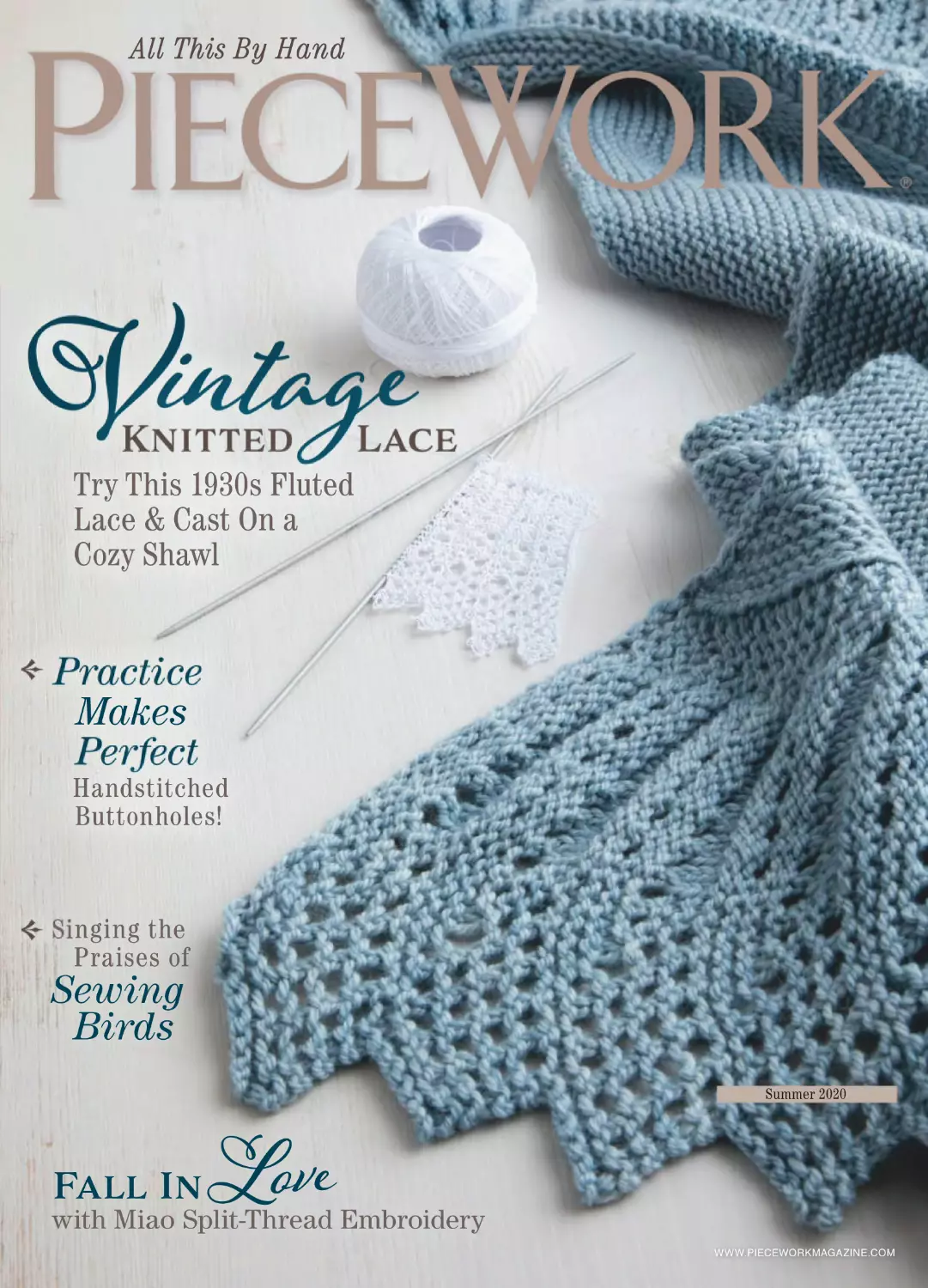






Text
                    All This By Hand
All This By Hand
nging the
Praises of
Sewing
Birds
Makes
Fall In Love
with Miao Split-Thread Embroidery
Try This 1930s Fluted
Lace&CastOna
Cozy Shawl
Handstitched
Buttonholes!
Summer 2020
WWW.PIECEWORKMAGAZINE.COM

KnittingTours.com is part of the Irish Tourism Group,
Trusted tour operator, members of ACTA, ASTA & ETOA
10 Night Aran Islands, Donegal & Causeway Coast (Ireland)
P.S Check out our website for more tours!
www.KnittingTours.com
Toll Free: 1800 913 1135
Info@knittingtours.com
• 11th Jul 2020
• 12th Sep 2020
This amazing 10 night tour includes Studio Donegal, the stunning Slieve League Cliffs,
& Glencolmcille Folk Village. Tour Northern Ireland’s Causeway Coast and visit the
Giant’s Causeway, Dunluce Castle, Belfast City and Titanic Belfast. A highlight will be
two nights on Inis Mór, one of the famous Aran Islands!
Also Included:
Hotels, Sightseeing
Tours, Entrance
Fees, Meals, Craft
Demonstrations and
Knitting Workshops!
Workshops with Edel McBride, Lisa Sisk from This is Knit &
Una McDonagh on Inis Mór!
Please contact us
for 2021 dates
Tour Dates:
Read What Our Customers Say
Search KnittingTours.Com Reviews!

INSPIRING THROUGH EXPERT
KNOWLEDGE SINCE 1974
Master the Art of
Needle Lace Making
Step by step, this frustration-free guide presents
detailed, row-by-row drawings and photos that
clearly show the threads’ placements to help you
learn quickly. Designed with beginners in mind,
40 different lace patterns teach the entire process,
from creating the pattern to examples of how to
use your finished lace.
978-0 -7643-5869-2 | softcover | $24.99 | January 2020
Intentional Thread
978-0 -7643-5743-5 | hardcover | $39.99
Threads Around the World
978-0 -7643-5650-6 | hardcover | $24.99
Weave Leno
ISBN: 978-0 -7643-5101-3 | hardcover | $24.99
Organic Embroidery
978-0 -7643-5613-1 | softcover | $24.99
Knitting for Little Sweethearts
978-0 -7643-5627-8 | hardcover | $28.99
AVAILABLE WHEREVER BOOKS ARE SOLD

PieceWork is the only magazine for those who adore historical
knitting techniques, embellished clothing, stunning quilts, amazing
embroidery, and exquisite lacework—all made by hand.
YOU WON’T FIND ANYWHERE ELSE
SUBSCRIBE NOW AT pieceworkmagazine.com/pw-sub
Needlework
DON’T
MISS OUT
on a Single
Issue!
PRINT & DIGITAL
Includes 4 new PieceWork
issues per year, both printed on
new high-quality paper and as
digital downloads. Plus access
to decades of past issues!
DIGITAL ONLY
Includes PDFs of 4 new
issues per year. Plus access
to decades of past issues!
OR
CHECK OUT OUR NEW SUBSCRIPTION PACKAGES
All This By Hand
All This By Hand
tagnse
Sewing Roll
Sewing Roll
S a ned Glass
Stained Glass
NoeDe
Notre-Dame’s st
Lost
w
Ses
Window in Stitches
Numbe s
Numbers
n
Virginia Woods Bellamy’s
ed
e
g
Patented Number Knitting
Stitch a
Housewife
Housewife
I
C
E
L
A
N
D
I
C
E
M
B
R
O
I
D
E
R
Y
•
H
A
A
P
S
A
L
U
L
A
C
E
•
R
H
O
D
E
S
S
T
I
T
C
H
|
W
I
N
T
E
R
2
0
1
9
W
W
W
.
L
O
N
G
T
H
R
E
A
D
M
E
D
I
A
.
C
O
M
P
I
E
C
E
W
O
R
K
M
A
G
A
Z
I
N
E

S UMMER
2020
P IECEW ORK
1
10 A Stitch in Time:
Herringbone Stitch
The origin of the herringbone
stitch, a member of the cross-
stitch family, dates back
centuries. Learn how to execute
this versatile stitch, long used to
embellish hems, seams, patches,
and more.
Deanna Hall West
14 Methods of Multicolor
Knitting: Fading
Traditions?
Traditional knitting texts offered
more than one way to work
colorwork. Explore how pre-
1960s knitting manuals taught
two-color knitting and why
certain techniques have fallen
out of favor.
Olle-Petter Melin
18 Beak Performance:
The Sewing Bird
Hear the call of a once-popular
vintage sewing accessory. In the
nineteenth and twentieth centuries,
sewing birds kept one’s needles
sharpened and were a must-have
tool for the home sewist.
Franklin Habit
22 Of Buttons, Buttonholes,
and Samplers
Bridging the divide between
the functional and decorative,
handsewn buttonholes possess
a charm all their own. Discover
more about the evolution of
the buttonhole.
Susan J. Jerome
28 Buttonhole Sampler
Practice making your own hand-
stitched buttonholes. With this
inviting sampler, learn how to
make four classic buttonholes
plus eyelets.
Deanna Hall West
Contents
PIECEWORK | VOLUME XXVIII, NUMBER 2 | SUMMER 2020
28
18
34 Carrying and Protecting
Little Ones: Native
American Cradleboards
Busy parents around the globe
have found different ways to keep
babies protected—physically and
spiritually. Read about the stunning
cradleboards that were created in
several native North American
traditions to swaddle and secure.
Beverly Gordon
40 A River of Calm: The
Split-Thread Embroidery
of Tai Lao Xing
Excerpt from Every Thread a Story:
Traditional Chinese Artisans of
Guizhou Province
Meet Miao artisan Tai Lao Xing,
master of the split-thread
embroidery technique. Using
fine silk threads, Laoxing works
traditional Miao stories and
symbols into colorful designs.
Karen Elting Brock, Linda
Ligon, and Wang Jun
44 Ars Canusina Embroidery
from Italy: The Story of a
Land and Its People
Learn how a “thousand-year-old
Romanesque legacy” and
twentieth-century needlework
came together in an Italian
embroidery tradition. Discover
the roots of this embroidery
technique still practiced today.
Jeanine Robertson
48 An Ars Canusina
Table Center Cloth
Stitch your own Ars Canusina–
inspired project, featuring motifs
that call to mind architectural
details found in Italian woodwork
and stonework. This stunning
piece will delight your guests for
years to come.
Maria Neroni and Silvana
Fontanelli, Consortium Ars
Canusina
Continued on page 2
Photo by Matt Graves
Photo by Franklin Habit
Photo by Joe Coca
40

2
P IECEW ORK
WWW.PIECEWORKMAGAZINE.COM
Don’t miss out!
Visit pieceworkmagazine.com
for even more needlework
content! You’ll find needlework
news and blogs and our
submissions calls and
contributor guidelines.
Departments
3 Notions
Letter from the Editor
4 By Post
Letters from Readers
6 Necessities
Products of Interest
8 Tapestry
ReMitts: Upcycling Wool to
Feed Hungry People
Ann Massie Nelson
72 The Last Word
Recommended Books
54 The Hat in the Latrine:
Unraveling the Secrets of
Eighteenth-Century Life
in Cape Breton
Uncover the remains of a long-
lost hat found in a latrine at the
Fortress of Louisbourg. Follow
along as the author reconstructs
the history of this knitted cap and
regional textiles from this era.
Dr. Annamarie Hatcher
58 Uncovering Norse Textile
Techniques: Greenland
Garments Inspire a
Contemporary
Clothmaker
Explore sewing techniques
preserved in Norse textile
fragments. The author
investigates how historical
garments were sewn and re-
creates her findings using her
own handspun, handwoven cloth.
Sarah Wroot
64
48
64 Fluted Lace Shawl
A 1930s knitted-lace edging
provides the springboard for an
exploration of knitting vintage
patterns at a larger gauge.
Cast on and knit along.
Carolyn Wyborny
Photos by Matt Graves

S UMMER
2020
P IECEW ORK
3
®
EDITORIAL
EDITORIAL DIRECTOR Anne Merrow
MANAGING EDITOR Laura Rintala
EDITOR Kate Larson
ASSOCIATE EDITOR Elizabeth Prose
TECHNICAL EDITORS Lori Gayle, Deanna Hall West,
Mary Polityka Bush
COPY EDITOR AND CONTRIBUTING EDITOR Trish Faubion
PROOFREADER Nancy Arndt
CONTRIBUTING EDITORS Nancy Bush, Susan Strawn
CREATIVE
ART DIRECTOR Charlene Tiedemann
PRODUCTION DESIGNER Mark Dobroth
PHOTOGRAPHY Matt Graves
STYLING AND ILLUSTRATIONS Ann Sabin Swanson
FOUNDERS Linda Ligon, Anne Merrow, John P. Bolton
PUBLISHER John P. Bolton
MEDIA SALES Sommer Street Associates
DIRECTOR OF MARKETING Haydn Strauss
CONTACT US
Subscribers: For subscription information, call (888) 480-5464, email
support@longthreadmedia.com, or visit www.pieceworkmagazine
.com. Please allow six weeks for processing address changes.
Shops: If you are interested in carrying this magazine in your store,
email sales@longthreadmedia.com.
For questions about purchases made on the website, please check out
our live chat feature or click the Contact Us link located on the website.
Contact us: For advertising information, call Sommer Street Associ-
ates at (888) 480-5464 ext. 705, email sales@longthreadmedia.com,
or visit www.longthreadmedia.com. For editorial inquiries, email
piecework@longthreadmedia.com. Visit the PieceWork website at
www.pieceworkmagazine.com.
VISIT US ON THE WEB
www.longthreadmedia.com
www.pieceworkmagazine.com
PieceWork® (ISSN 1067-2249) is published quarterly by Long Thread
Media LLC, 311 South College Avenue, Fort Collins, CO 80524; phone
(888) 480-5464. Periodicals postage paid at Fort Collins, CO, and addi-
tional mailing offices. All contents of this issue of PieceWork are copy-
righted by Long Thread Media LLC, 2020. All rights reserved. Projects
and information are for inspiration and personal use only. PieceWork
does not recommend, approve, or endorse any of the advertisers, prod-
ucts, services, or views advertised in PieceWork. Nor does PieceWork
evaluate the advertisers’ claims in any way. You should, therefore, use
your own judgment in evaluating the advertisers, products, services,
and views advertised in PieceWork. Reproduction in whole or in part is
prohibited, except by permission of the publisher. Subscription rate is
$29.99/one year in the U.S., $39.99/one year in Canada, and $49.99/one
year in international countries (surface delivery). U.S. funds only.
POSTMASTER: Please send address changes to 311 S. College Ave.,
Fort Collins, CO 80524.
Notions
Necessity is certainly the mother of
invention, and skillful needleworkers of all
types learn to ease in, let out, and make do.
Whether knitter or crocheter, seamstress or tatter,
all textile pursuits have their own dilemmas and
(sometimes controversial) solutions.
I love exploring the heady mix of problem-solving
versus tried-and-true needlework rules across
cultures and time. In this issue, Susan J. Jerome’s
article on handsewn buttonholes highlights this push/
pull of innovation and tradition so well. Buttonholes
were to be practiced, perfected, and judged; samplers
might serve as a résumé for marriage or work.
However, Susan also explains how buttonholes
continued evolving and the wonder of a modern
sewing machine.
And I think many of us are equally interested in the
techniques and traditions that were left behind. Sarah
Wroot looks to the makers of medieval Greenland for
guidance on her handstitched garment seams. Olle-
Petter Melin offers us four methods of multicolor
knitting and good reasons that we should learn and
use each one.
Read about handsewn buttonholes and start your own sampler on page 28.
Photo by Matt Graves
Today’s makers can look to historic needlework as
a reservoir of knowledge and experience. However,
there are other lessons, too. We can look at the
past and see that traditions and textiles are always
changing, that traditions can be lost, and that learning
about the makers that came before us allows us to
carry their work forward into the future.
Kate Larson
Editor
How did they do that?

4
P IECEW ORK
WWW.PIECEWORKMAGAZINE.COM
From Our
Readers’ Hands
The Winter 2019 issue grabbed my attention the moment I saw
the Virginia Woods Bellamy’s Butter fly Wrap to Knit [by Susan
Strawn, page 54]! I knew immediately that I had to make one
myself. My version is also known as “Plan B,” when you realize
you will not have enough dusty pink yarn to finish the project. I
used a fingering-weight wool and silk yarn and finished off the
two front squares
with a speckled
white yarn. I added
a finger loop to each
point, which keeps
the shawl in place
and acts almost
like an open sleeve.
Thank you for the
pattern. Next, I will
knit A Weldon’s
Shetland Shawl to
Knit on Page 60.
Linda Pfeffer
Via email
Paper Dress
Until I saw Beverly Gordon’s article [“A Most Valuable
Fabric: Crepe Paper in the Early Twentieth Century,”
page 10] in the Spring 2020 issue of PieceWork, I knew
nothing about the popularity of crepe paper in the early
1900s. I wonder if my great-aunt, who was a dressmaker,
used it in some of the ways described in the article.
Elizabeth Sadak Holic (1891–1976), known by me as
Aunt Betty, owned a dressmaking shop in Chicago,
Illinois, from the 1920s to the 1950s. Family stories tell
that she made very elegant gowns.
When I began kindergarten in the late 1940s, my
favorite dress was lime and dark green. Around that
time, Aunt Betty presented me with a six-inch crepe-
paper version of the dress. She had stitched it onto a
piece of brown corduroy. I kept that dress for years,
hoping that it wouldn’t be damaged. Finally, I had it
framed to protect it.
Anabeth Placko Dollins
Via email
Corrections
PieceWork Winter 2019, “Trimmings:
Mary Elizabeth Greenwall Edie’s
Knitted-Lace Samples” by Frances H.
Rautenbach, page 7.
Lace No. 8
The pattern is a 14-row repeat, and
not a seven-row repeat as stated.
Also, Rows 3 and 10 should read as
follows:
Row 3: *K2, yo, k4, k2tog; rep from
* to end.
Row 10: *P2tog, p4, yo, p2; rep from
* to end.
Knitted Bedspread
Row 1 should read as follows:
Row 1 (RS): [P2tog] 4 times, *[yo,
k1] 7 times, yo, [p2tog] 8 times;
rep from * to last 15 sts, [yo, k1] 7
times, yo, [p2tog] 4 times.
By Post

S UMMER
2020
P IECEW ORK
5
Send your comments, questions, ideas, and high-resolution images of items you’ve
made from instructions or inspired by projects and stories in PieceWork to piecework@
longthreadmedia.com with By Post in the subject line. Letters may be edited for length
and clarity.
Norma Kraemer of Deadwood, South Dakota, finished Mimi Seyferth’s
Danish Nattrøjer Socks to Knit (Summer 2019, page 33) after a recent trip
to Denmark and Norway. While in Copenhagen, she got to see the paint-
ings shown in Mimi’s article [“Sock Knitting during the Golden Age of Danish
Painting,” page 26] and was surprised how many more paintings at the
National Gallery of Denmark depicted knitters.
Note: I traveled with Norma (and a group) and while she was the only
one brave enough to start knitting the socks on the trip, we were all
impressed with Mimi’s article and pattern.
A special thank you to former PieceWork Editor Jeane Hutchins for
helping me share the articles with the tour participants.
Laurann Gilbertson
Chief Curator, Vesterheim Norwegian-American Museum
Via email
2020 hits celebrating our 50th year of
independent specialist art & crafts publishing
www.searchpressusa.com

6
P IECEW ORK
WWW.PIECEWORKMAGAZINE.COM
Necessities
Beekeeper
Stitch in vintage style with FripperiesMP’s Bee
Skep and keep your floss and threads accessible
and tidy. Each one is crafted from local hardwoods.
www.retromanticfripperie.etsy.com
Maker’s Mark
With a stroke of the
ergonomically designed
Hera Marker from Clover,
mark your next sewing
project—no messy ink
residue to rinse out later.
www.clover-usa.com
Magnetic Minder
Clasp a Kit-tea Cat Needle Minder by Grandma
Girl Designs onto your work in progress. Each one
offers the purrfect resting spot for your working
needle and floss. www.grandmagirldesigns.etsy.com
Heirloom
Stitches
Skacel kept traditional
knitters and crocheters
in mind when design-
ing their HiKoo Merino
Lace Light. Available
in three classic colors,
this fine yarn shows off
lacy stitches beautifully.
www.skacelknitting.com
Nature’s
Palette
The local flora of Vermont
and natural dyestuffs from
more temperate climates
color the hand-dyed floss
from The Felting Studio
of Neysa Russo. Shown
in cotton and available
in silk and wool, too.
www.thefeltingstudio.com

In scenic Decorah, Iowa
Folk Art School
Vesterheim
he Na ona
Norweg an Ame can
Museum
er tage Center
Add the marvelous
Norwegian sjonaleist
repertoire!
And learn it from
a Norwegian
Register at vesterheim.org or call 563-382-9681.
100% Silk Lace Weight Yarn
www.treenwaysilks.com
toll-free 1.888.383.silk (7455)
Hand-dyed for you. Choose from 109
luscious colors or 17 natural-dye colors.
ZOLA
S UMMER
2020
PIECEW ORK
7

ReMitts
Upcycling Wool to Feed Hungry People
ANN MASSIE NELSON
Tapestry
Personal Threads
Mittens are made from discarded, 100 percent wool sweaters, and each pair is unique. ReMitts has raised more than $366,000 in ten years of operation.
Photos by Ren Patterson
Wisconsin, area. In 2019 alone, ReMitts sold more
than 2,200 pairs of mittens and raised almost $77,595.
ReMitts operates out of the lower level of a church,
and about twenty-five volunteers serve year-round to
make mittens for display in November and December.
St. Vincent de Paul, one of the charities that benefits
from the proceeds, donates wool sweaters that either
do not meet the criteria for sale (stained or holey, for
example) or have not sold in their stores. The 100
percent wool sweaters are laundered in hot water and
dried at high temperatures at a laundromat.
Making Mittens
Volunteers cut apart the fulled sweaters and discard
the unusable parts—seams, collars, and portions of the
fabric that are worn. They save the buttons for later
embellishment and store the fabrics according to color.
To make a pair of mittens, the volunteers choose
a pattern or texture for the mitten top, then search
I
t all began with a personal challenge: take
$100 of seed money and see how much
good you can do. The year was 2009,
and oncology nurse Janet Tupy, who had not
sewn since high school, was inspired by a
pair of felted wool mittens she found in a gift
shop. She enlisted a couple of friends to help,
located a pattern, and spent $100 on wool
sweaters at a thrift store. Their goal was to
raise $1,000 for local food pantries by making
and selling felted wool mittens. That first year,
they raised $4,000 and ran out of mittens.
Fast forward eleven years, and ReMitts has raised
more than one-third of a million dollars, with the
proceeds going to food pantries in the Madison,
8
P IECEW ORK
WWW.PIECEWORKMAGAZINE.COM

for fabrics with complementary colors, textures,
and weights for the balance of the mitten—the
palm, fingers, and cuff. Most of the mittens are sized
for women, but some are sized for men and children,
as well.
Using the pattern pieces, volunteers cut out the
mitten components and then cut linings from stretchy,
new polyester fleece. Volunteers then assemble all
of the mitten parts into a kit for other volunteers to
machine sew the kits at home.
Back at the workshop, the sewn mittens are hand-
finished with buttons and tacks at the cuffs, examined
for quality, tagged for sale, and stored until the sell-
ing season. A pair of mittens may be obtained for a
$35 donation, with cash and checks going directly to
the food pantries. ReMitts retains a tiny portion of the
income (less than 2 percent) for laundering the sweat-
ers and purchasing the lining material.
A variety of retailers, coffee shops, and restau-
rants display ReMitts mittens on handmade display
racks. In exchange for a small amount of space and
employee time to collect the money, the retailers gain
goodwill and support for local food pantries. ReMitts
also participates in several local art fairs during the
holiday season.
Many of the volunteers serve one day a week at the
workshop, cutting apart sweaters, making kits, and
hand-finishing mittens. The workshop builds cama-
raderie, not unlike an old-fashioned quilting bee,
according to Tupy. Other volunteers sew at home and
rarely come to the workshop. Volunteers are encour-
aged to do what they enjoy most.
In 2009, there were very few resources for upcy-
cling mittens. Today, an internet search yields
patterns and video tutorials for making similar mit-
tens. Tupy, now retired from nursing, would like to
see people in other cold-climate communities dupli-
cate ReMitts to raise money for their own local
food pantries.
Start with $100 and see how much good you can do.
For more information about ReMitts, visit their
website, www.remitts.org, or check them out on
Facebook at www.facebook.com/remittsmittens.
ANN MASSIE NELSON sews, knits, writes, and produces videos in
Madison, Wisconsin.
Fabrics from two to four sweaters are combined to make ReMitts
upcycled mittens.
Machine sewing is done at home. Volunteers work one day a week at a
workshop in space donated by a local church.
Each pair of mittens is hand tacked and embellished with buttons.
S UMMER 2020
P IECEW ORK
9

because it is reversable. Needleworkers used this
stitch in English crewelwork of the mid-seventeenth
century, American crewelwork of second half of the
eighteenth century, and American samplers of the
nineteenth century.
The herringbone stitch was used extensively to
adorn seams and to appliqué additional patches,
laces, and cigarette silks to the inner-patched areas
on American and English crazy quilts. While the many
iterations of herringbone stitch appear in beautifully
embroidered textiles, it has also been used for hem-
ming clothing. This versatile stitch continues to appear
in modern-day samplers, crazy quilting, crewelwork,
surface embroidery, needlepoint, and shadow quilting.
Vary the height, spacing, and angle of the legs to
create this Herringbone-Stitch Sampler, using the
stitch illustrations as guides.
A Stitch in Time
Herringbone Stitch
DEANNA HALL WEST
T
he herringbone stitch belongs to the
large cross-stitch family and has many
aliases—Mossoul, Russian, Russian
cross, catch, Persian, witch, fishnet, and plaited
stitch. The most commonly used name appears
to be herringbone, with the basic completed
stitch resembling the backbone structure of
the herring fish, commonly found in the North
Atlantic Ocean and possibly pointing to the ori-
gin of this name.
History records the herringbone stitch was in use
by the 1500s, although it was probably used earlier.
English samplers and blackwork patterns of the six-
teenth and seventeenth centuries employed this stitch
The herringbone-stitch sampler was designed and stitched by Deanna Hall West. Design size: 25⁄8 by 45⁄8 inches (6.7 x 11.7 cm). Materials: Wichelt
Linen, 32-count, Ivory; DMC Cotton Floss, #312, 334, 336, 3325; Offray Ribbon, 3⁄8 inch (9 mm) wide, Dusty Blue; and John James Needle, tapestry
size 26. Note: Deanna used 2 strands of floss for all stitching.
Photos by George Boe. Illustrations by Ann Sabin Swanson
10
P IECEW ORK
WWW.PIECEWORKMAGAZINE.COM

Getting Started
The herringbone stitch is an evenly spaced, elon-
gated variation of a cross-stitch and is worked from
left to right, keeping the lengths and spacing of the
legs even and angled legs parallel within a row. Use
the sewing method if you hold the fabric in hand or
use the stab method if you use an embroidery hoop
or frame. This stitch can be worked on either plain or
evenweave ground fabrics. Use a sharp needle when-
ever piercing plain fabric and a tapestry needle for
evenweave fabrics and for threading or tying addi-
tional threads upon the basic herringbone stitch.
To keep this stitch even and neat on plain fabric, mark
two parallel lines with chalk or a water-soluble marker.
Space these lines closer or wider apart, depending
upon the effect desired. On the back of the ground fab-
ric two parallel lines of backstitches will appear for a
closed herringbone or running stitches for the open her-
ringbone. To create a vertical row of stitches, simply turn
the fabric 90 degrees. Frequently, a small compensating
stitch (Figures 4, 5, 6) is used to begin and end a row of
herringbone stitches. This creates a more balanced, more
compact-looking line design.
To end a stitching thread, it is best to bury the
thread by splitting the running or backstitches on the
back of the fabric or by splitting the actual ground
fabric threads. Do not weave the stitching thread tail
through the stitches on the back because eventually
these tails unwind!
You can use many types of threads, including cotton
floss, silk floss and threads, yarn, pearl cotton, metallic
threads, and even narrow silk ribbon. When using mul-
tiple strands, keep the individual threads as parallel as
possible (called railroading) to produce the best fabric
coverage and appearance.
Herringbone Variations
You can use the herringbone stitch for lines,
bands, borders, fillings, backgrounds, solitary
stitches, and clothing trim. It can also be used as the
foundation for many gorgeous interlacing stitches
and ribbon insertions. This versatile stitch has numer-
ous variations: open (Figures 1, 2); closed or shadow
(Figure 3); double or Indian herringbone (Figure 4);
tied (Figure 5); threaded (Figure 6); double threaded
(Figure 7); ladder filling (Figure 8); foundation for
Key
1 Open herringbone, #336 (Figure 1).
2 Closed herringbone, #312 (Figure 3).
3 Open herringbone background, (top to
bottom) #334, 312, 336 (Figure 2).
4 Tied herringbone, base line #334, tie
#3325 (Figure 5).
5 Tied herringbone, base line #312, tie #336
(Figure 5).
6 Open herringbone, #334 (Figure 1).
7 Open herringbone, #336 (Figure 1).
8 Open herringbone, #334 (Figure 1).
9 Double-threaded herringbone, #312 and
336 (Figure 7).
q Threaded herringbone, base #312 and top
3325 (Figure 6).
w Solitary herringbone, top row #3325,
middle row #334, and bottom row #312
(Figure 11).
e Double-laced herringbone, base #312, top
#3325 (Figure 4).
r Ladder herringbone, backstitches #336,
lacing #3325 (Figure 8).
t Three-trip herringbone, 1st row #336, 2nd
row #334, and 3rd row #3325 (Figure 10).
Herringbone Stitch
r
7
1
8
2
9
3
q
4
w
5
e
6
t
S UMMER
2020
P IECEW ORK
11

15
4
8
3
6
3
27 61
11
0
12
8
5
1
or
Figure 1
3
2
2
Figure 2
1
1
6
14
15
10
11
6
7
2
3
Figure 3
=Compensating stitch
Note interlacing
Start with blue thread
Figure 4
or
1
2
3
4
5
6
7
8
9
10
Figure 5
Figure 6
Figure 7
Two Threads In One Needle
Ribbon
Figure 8
12
PIECEW ORK
WWW.PIECEWORKMAGAZINE.COM

ribbon insertion (Figures 8, 9); multiple-trip her-
ringbone (Figure 10); and, infrequently, as a single,
isolated stitch (Figure 11). These are just a few of the
many intriguing variations. Plus, simply varying the
height, width, and angle of the legs can drastically
alter the final herringbone appearance.
The closed or shadow herringbone stitch is used
to create a heavy, braided-look line or border (Figure
3). When this variation is stitched on the back of fine,
semitransparent fabrics, such as organdy, batiste, or
lawn, shadow-work quilting is created. When medium-
to dark-colored threads are used, a much lighter, more
muted color appears on the front surface of these
fine fabrics. When a double backstitch is alternatingly
stitched across a motif such as a leaf, berry, or stem
on the fabric surface, a herringbone stitch is auto-
matically formed on the back side. I find it easier to
stitch the alternating backstitches on the front fabric
surface than to stitch the herringbone stitch on the
back because my results seem to have a more evenly
stitched and better appearance.
For the double- or multiple-trip herringbone
stitches, two or more contrasting colors or shades of
the same color highlight the woven or interlacing effect
of these variations, creating a very dramatic look. The
multiple-trip herringbone stitch can be worked in two
different ways: One, stitch one complete row on top of
the other as in Figure 10; or two, stitch each succeed-
ing row under the previous row on the way up and over
the previous row on the way down.
The tied herringbone can also be worked in a cou-
ple of different ways: One, using a sharp needle work
a short straight or other stitch through the fabric at
the points where the legs cross (bottom illustration
of Figure 5); or two, work a coral knot, lazy daisy, or
other stitch over the crossing points and not through
the fabric (top illustration of Figure 5).
This barely touches the surface of the many
variations on the herringbone stitch. Have fun experi-
menting with the stitch variations, color combinations,
and stitch placements.
DEANNA HALL WEST is PieceWork’s needlework technical editor;
she previously was the editor of The Needleworker magazine and
has been in the needlework publishing and design industry for
over thirty-five years.
Ribbon
Figure 9
Figure 10
Figure 11
111
444
Stitching Order: Green, Pink, Blue
S UMMER
2020
PIECEW ORK
13

floats,” as this method is practically the only
one proposed in knitting manuals published
since 1960.
Each of the students, women between fifty and
sixty-five years old, brought handknitted samples to
class, as requested. However, the samples the students
brought to the first lesson demonstrated that no one
had used any multicolor-knitting method consistently.
None had been taught multicolor knitting or learned
from a manual. Instead, they had tried to find a satis-
factory result. Perhaps their dissatisfaction with their
knitting was their main reason for joining my class.
In the past, knitters who could not learn techniques
such as multicolor knitting from a more experienced
Methods of
Multicolor K nitting:
Fading Traditions?
OLLE-PETTER MELIN
I
n Stockholm, during the autumn of 2018, I
held classes on multicolor knitting, focus-
ing on four methods of using two yarns per
row. These techniques are sometimes called
stranded knitting because of the long “floats”
of unused yarns that occur on the reverse
side of the knitted fabric. Students needed to
master at least one method of multicolor knit-
ting before joining the course and were asked
to bring a sample to the first lesson. I had
anticipated that most of them would use the
technique I call “stranded knitting with parallel
A few textiles from Kate Larson’s collection that incorporate multicolor knitting. From left: Child’s mitten from Kihnu, Estonia; stocking from Kihnu,
Estonia; Kate’s handspun mitten inspired by a damaged mitten at the Norsk Folkemuseum; and Kate’s handspun jumper inspired by textiles at the
Shetland Museum and Archives.
Photo by Kate Larson
14
P IECEW ORK
WWW.PIECEWORKMAGAZINE.COM

knitter might turn to knitting
manuals of the day or simply
create their own technique as
they were able. For example,
a knitter determined to cre-
ate Weldon’s Gentleman’s Hose
in Highland Check would find
these instructions for the two-
color stranded colorwork:
Highland check: This is
executed entirely in plain knit-
ting, changing the colours as
instructed; the colour not in
immediate use is passed along
the back of the work from stitch
to stitch, so both wools are con-
tinually moving. You must be
careful not to get them tangled,
and also do not knit too tightly.
With this guidance, our
nineteenth-century knitter
would have possibly done as
my students did in the absence
of further instruction—the best
they could.
Searching for Multicolor-Knitting Techniques
In my master’s thesis for my degree in Textile
Sciences, I searched and analyzed the instructions
for multicolor knitting using more than 600 knitting
manuals published between 1900 and 2016 in North
America, Great Britain, and the Scandinavian—or
more precisely the Nordic—countries. Of all the manu-
als I researched, only 30 percent included instructions
for multicolor knitting.
The analysis produced two main revelations.
One was that although the earlier group of knitting
manuals—those published between 1900 and 1960—
covered four methods of multicolor knitting, with
each manual typically presenting only a single method,
only the stranded method with parallel floats was
mentioned in the manuals published between 1960
and 2016. This means that the three other methods are
in peril of becoming lost traditions. This discovery is
unfortunately supported by the knitting manuals that I
have since studied.
The second realization was that the different meth-
ods seemed to have been clustered in different regions
and perhaps represented different traditions in dif-
ferent geographical areas. One of the hypotheses I
put forth in my thesis was that
knitting manuals mirror the
local and temporal traditions
at the place and time of their
publication.
On the public, or recto, side
of the knitting, the four meth-
ods of multicolor knitting
are practically indistinguish-
able. Their differences, apart
from their appearance on the
reverse—or verso—side, lie
in the character of the fabric
they produce. Since the four
methods structure the yarns
differently along each row, the
fabric produced has differ-
ent degrees of thickness and
elasticity and, perhaps, vary-
ing degrees of durability. All of
these qualities combined make
the fabrics more or less suit-
able for outdoor or indoor use.
In practice, several histori-
cal garments that I have inspected show that knitters
have sometimes used different methods in the same
garment, as well in combinations. For example, a knit-
ter might use stranded knitting with parallel floats but
protect occasional long floats with a bound method.
Four Multicolor Knitting Methods
The four methods I discuss here do not have names
in most vintage manuals, but each in its own way dis-
cusses the yarn that is being knitted and the yarn that
is trailing. To be able to discuss the four different
methods, I have designated them based on my analysis
of the trailing yarn (Figure 1).
There are two stranded methods, in which the trail-
ing yarn floats on the reverse side of the knitting. I
distinguish between them as “stranded knitting with
parallel floats” and “stranded knitting with rotated
floats.” The other two methods are bound methods
Gentleman’s Hose in Highland Check, a multicolor
knitting pattern that appeared in Weldon’s Practical
Needlework , Volume 11 in the late 1880s.
Figure 1
Stranded knitting Bound knitting
Trailing yarn straight
Parallel floats
Woven binding
Trailing yarn rotated or twined Rotated floats
Twined binding
Olle-Petter uses a naming system based on what happens to the
trailing yarn.
S UMMER
2020
P IECEW ORK
15

The parallel-floats technique is a stranded
method in which both yarns are held parallel in a
consistent relationship to each other as they change
places when the pattern calls for a new color.
This method is persistent in the manuals from all
researched areas during the whole period. With
this method, there is a risk of “yarn dominance,” in
which the stitches made by one of the yarns seems
to stand out more. This only happens when using
stranded knitting with parallel floats and is most
prominent when the color changes are closely situ-
ated. It occurs because one of the yarns will always
be pushed underneath the other yarn when they
cross, which makes it produce a slightly taller stitch.
The rotated-floats technique is a similar method,
but there is no risk of yarn dominance, as the yarns
are rotated in the same direction at each color change.
This results in both yarns alternately being treated
to the same pressure. This method—mostly used in
American manuals—is often described as, “Drop the
old yarn and pick up the new yarn over the dropped
one.” Alternately, the instructions might be to pick up
the new yarn under the old yarn. The direction doesn’t
matter if one is consistent, and the yarns will rotate.
The main argument against this method of rotated
floats is the buildup of twist in the yarn supply. This
is a problem shared with twined knitting and can be
resolved in the same manner (see page 17).
Twined binding is the technique underlying what
we now know as twined knitting, recently revived due
to an archeological find in Falun, Sweden, in 1975.
Twined knitting seeks to resuscitate the old knitting
of the Swedish province Dalarna and has four tradi-
tional constraints: 1) Both yarns in your right hand; 2)
the new yarn is always brought forward over the old
yarn; 3) the yarns must be twined between stitches;
and finally 4), one is compelled to use Z-plied yarn.
The scope of twined binding is broader: You rotate
the yarns between stitches; however, choice of direc-
tion is optional but must be consistent. Choice of ply
direction in the yarn and which hand holds both yarns
are yours. Twined binding creates a hardwearing, tight
material that is practically impervious to wind and rain.
Woven binding seems to have been used mainly
in the British Isles but has largely disappeared from
knitting manuals after 1960. A few designers and
authors still promote it. This method entails knitting
every second stitch under, and every other stitch
over the trailing yarn, thus weaving in the trailing
yarn with the knit stitches. This creates a robust
and resilient material with its own special elasticity.
Mary Thomas’s Knitting Book has a good descrip-
tion of how to execute woven bindings. She adds,
“Weaving [the trailing yarn] is particularly practical
in large patterns as it secures in position the travel-
ling yarn on the back, which might otherwise catch
and drag the fabric.”
Four Types of Multicolor Knitting
Left: Recto (right-side); Right: Verso (wrong-side)
Left: Recto (right-side); Right: Verso (wrong-side)
Left: Recto (right-side); Right: Verso (wrong-side)
Left: Recto (right-side); Right: Verso (wrong-side)
16
P IECEW ORK
WWW.PIECEWORKMAGAZINE.COM

where the trailing yarn is closely integrated with the
knitted fabric. I differentiate between the bound meth-
ods by calling one “twined binding” and the other
“woven binding.”
Fading Traditions?
Tradition has been defined by Professor Edward
Shils as a creation of human action, thought, and
imagination that is passed on through at least three
generations. There is no doubt that the methods of
multicolor knitting can be claimed to be traditions.
The assertion is substantiated both by their inclusion
in published knitting manuals since 1850 and their uti-
lization in knitted garments in museum collections.
Traditions can’t, however, survive by some force of
their own. Living traditions are always the products
of people who work to uphold them. If any tradition
loses that support, it becomes at first estranged, then
obscure, and eventually lost.
As my research of the instructions for multicolored
knitting has shown, the manuals published after 1960
largely fail to present any other method of multicolor
knitting than stranded knitting with parallel floats. I
don’t know why this has happened. Pattern books of
historical multicolored knitting do not divulge with
which method the originals are knitted. No manuals I
have examined so far explain how to knit with three,
or more, yarns per row, although the Eastern European
textile traditions, from the Baltic to the Balkan coun-
tries, abound with such multicolored patterns.
Bound methods of multicolor knitting, seldom
put forward by knitting manuals, are probably more
durable than stranded methods, which are quicker
and may appear to be easier to master. However,
every method has its advantages and disadvantages
regarding durability, stability, and protective quali-
ties against the cold and wind. If knitters, authors,
and designers explore a wider variety of multicolor
knitting techniques, we could preserve knitting tra-
ditions that I believe carry their own and different
functional purposes.
RESOURCES
Thomas, Mary. Mary Thomas’s Knitting Book. London: Hod-
der and Stoughton, 1938. (Reprint: New York: Dover Publica-
tions, 1972).
Shils, Edward. Tradition. Chicago: University of Chicago
Press, 1981.
Weldon’s Practical Needlework, Volume 11. London: Weldon
& Co., circa 1888.
MR. OLLE-PETTER MELIN studied Textile Sciences at the University
of Uppsala after his retirement in 2013. He has been a knitter dur-
ing his spare time for most of his life and also enjoys cooking for
his family. Read his full thesis on multicolor-knitting instruction
in English at www.tinyurl.com/y8qwgytj.
In a Twist?
If you are knitting with the rotated-floats or twined-
binding techniques, the yarns are rotated as you
work, but at different intervals. When twining, the
yarns are rotated between stitches, but they are
only rotated at color-changes when knitting with
rotated floats. In both cases, twist is built up in the
yarns between the knitting and the yarn supply.
To remedy this, you can tie a slipknot with both
yarns around both balls of yarn held together.
Then, let them hang free so that gravity will un-
tangle the twist. Repeat this regularly—possibly at
the end of every round. When untying the slipknot,
make sure that the bight (the bend in the loop)
points upward and away from you, before you lift
the loop off to the right. This way, you’ll avoid a
knot in the yarns.
S UMMER
2020
P IECEW ORK
17

Beak Performance
The Sewing Bird
FRANKLIN HABIT
T
o sew by hand is to wish for more than
two hands, as anyone who has consid-
ered picking up a pincushion with her
teeth will attest. The use of a clamp to help
hold the fabric taut is wonderfully convenient;
and no clamp does it with more charm than the
sewing bird.
Charles Waterman of Meriden, Connecticut, received
a patent for the “Ladies’ Sewing Bird” on February
15, 1853. Sewing clamps were known well before this
date and were by no means exclusive to Europe and
America. What Waterman claimed as his innovation
was a device in the form of a “feathered bird on the
wing, bearing a burden upon its back.” The burden was
an emery ball for sharpening needles, an “indispensable
Sewing birds from the collection of Franklin Habit.
Photos by Franklin Habit unless otherwise noted
accompaniment of the sewing bird,” the position of
which, “is here appropriate in every respect.”
The bird’s appeal is evident from the thousands
that survive, some with Waterman’s patent notice
on one wing. Others were produced by imitators
or by innovators who added refinements, such as
a soft cushion under the chin, to which the worker
could pin fabrics too delicate to clamp in the beak.
Variations are innumerable. Some sources count
four molds known for casting the upper part of the
Waterman bird, three for the lower part, and at least
twelve different designs for the screw. Examples
from as late as the 1920s are found in materials from
silver to tin, along with hybrids that sometimes result
from “repairs” by dealers who combined disparate
fragments into a single specimen.
I first saw (and coveted) a sewing bird in the 1913
classic The Mary Frances Sewing Book, or Adventures
18
P IECEW ORK
WWW.PIECEWORKMAGAZINE.COM

A Patent for Sewing Birds
“Charles Waterman, of Meridan, Conn. Letters Patent
No. 546 – Dated Feby 15th
1853.
The schedule referred to in these Letters Patent and
making part of the same
To all whom it may concern:
Be it known that I, Chas. Waterman, of Meridan, New
Haven, Co. Ct., have invented a new and original design
of the instrument known as the “Sewing bird”, which de-
sign is fully represented by the accompanying drawings.
Fig: 1. Is a side elevation of the instrument
Fig: 2, a top view of the same representing a bird on
the wing bearing a burden upon its back.
It is a settled principle of taste in all works of De-
sign that the highest degree of beauty is attained
where the useful and ornamental are properly blended
or combined.
The burden borne upon the back of the bird is in fact
the emery ball and while it is an indispensable accom-
paniment of the sewing bird its position is here appro-
priate in every respect.
The bird is handsomely feathered and the whole in-
strument neat and ornamental.
What I claim is the design herein represented by the
feathered bird upon the wing, bearing a burden upon
its back.”
S UMMER
2020
P IECEW ORK
19

Among the Thimble People, part of Jane Fryer’s didac-
tic series for future housekeepers. The heroine’s
instruction in sewing is overseen by her grandmother’s
sewing bird, who had first been called into service in
preparing her grandmother’s wedding dress.
I now have two sewing birds in my collection, and
it’s the cheaper of these—in pressed tin—that touches
my heart. The lower cushion (which would have been
attached to the base, below the bird’s head) is long
gone, leaving only a nub. And the metal base itself is
warped from years and years of tugging fabric and
pulling thread: a sober reminder of the drudgery of
hand sewing done from necessity.
FRANKLIN HABIT writes prolifically about the needle arts both
online and in print. His current projects include quarterly knit-
alongs for Makers’ Mercantile/Skacel Yarns and The Dolores
Collection (based on his popular character, Dolores the Sheep)
with WEBS. He teaches thousands of knitters each year in the
United States and abroad at events both large and small. For
more about him, visit www.franklinhabit.com.
A clamp attaches each sewing bird to a table’s edge.
Sewing bird featured in The Mary Frances Sewing Book, or Adventures
Among the Thimble People (1913).
Collection of Franklin Habit
20
P IECEW ORK
WWW.PIECEWORKMAGAZINE.COM

www.brownsheep.com
Spinning A Tradition of Quality
Brown Sheep
Company, Inc.
MITCHELL, NEBRASKA
Brown Sheep Company is
celebrating 40 years of making wool
yarns in the U.S.A. with attention to
detail every step of the way.
Fun Stuff for Fiber Arts
Waxed Linen Thread
Basketweaving Materials
Seat Weaving Supplies
Royalwood Ltd.
517 Woodville Rd.
Mansfield, Ohio 44907
800-526-1630
www.RoyalwoodLtd.com
WE WELCOME
new contributors in every issue!
Whether it’s a technique, project, article, or just
an idea you’d like to know more about, tell us about it . . .
Find links to our Calls for Submissions and
Editorial Guidelines at www.pieceworkmagazine.com
(see bottom of the page)
Email support@longthreadmedia.com with
the subject line “PieceWork Sub Call List” to get
new Calls for Submissions in your inbox
Send your questions and ideas to
piecework@longthreadmedia.com
Now’s your chance!
Send us the projects and articles you want to see in PieceWork!
DISCOVER CHINA’S ETHNIC MINORITY
TEXTILE ARTISANS AND THEIR WORK
This gorgeous new 2-book boxed set includes:
Every Thread a Story: Traditional Chinese Artisans of Guizhou
Province and The Secret Language of Miao Embroidery.
Available April 2020 • $49.95
Order your copy now at ThrumsBooks.com
S UMMER
2020
PIECEW ORK
21

Of Buttons, Buttonholes,
and Samplers
SUSAN J. JEROME
Sampler, early nineteenth century; silk embroidery on linen foundation; H × W: 15.2 × 11.5 cm (6 × 41⁄2 in.);
Bequest of Gertrude M. Oppenheimer; 1981-28-192.
Photo by Smithsonian Design Museum
22
P IECEW ORK
WWW.PIECEWORKMAGAZINE.COM

I
n 1877, S. Annie Frost introduced her
book The Ladies’ Guide to Needle Work,
Embroidery, etc. with these words: “There
is no occupation so essentially feminine, at
the same time so truly ladylike, as needlework
in every branch, from the plain, useful sew-
ing that keeps household and person neat and
orderly, to the exquisite, dainty fancy work that
adds beauty to every room.” She was echo-
ing sentiments found in other publications of
the century, including Godey’s Lady’s Book, of
which she was soon to assume control with the
January 1, 1878, edition. Sewing had, for many
centuries, been divided into two categories: the
necessary and the decorative.
But in the nineteenth century, the sewing machine
and other technological advances replaced the need
to hand sew the family clothing, bed linens, and
other textiles. Still, middle- and upper-class women in
America considered the needle arts, plain and fancy,
to be an obligatory part of their responsibilities as
wives, mothers, and homemakers. The samplers of
the previous generations, demonstrating a school-
girl’s sewing abilities—often with alphabets, numerals,
and moral poetry—were replaced by a wide variety of
fancy-work projects including Berlin work, crocheted
and knitted garments, and even theorem painting,
offered in mass-produced magazines and books. But
alongside these more fortunate women, others sewed
to survive and support their family. “The Trials of a
Needlewoman,” by T. S. Arthur (1809–1885) and seri-
alized in Godey’s 1854 editions, begins “Needlework,
at best, yields but a small return. Yet how many thou-
sands have no other resource in life, no other barrier
thrown up between them and starvation!”
Seamstresses sewed up the gowns designed and
cut by a well-paid dressmaker. Women worked at
home sewing gloves or making buttons as part of
large cottage industries. Buttonhole samplers reveal
a combination of reasons for taking up needle and
thread, where usefulness combines with imagination
to produce something more. As Rozsika Parker wrote
in The Subversive Stitch, “The situation of embroi-
dery is more elusive. When women paint, their work
is categorised [sic] as homogenously feminine—but it
is acknowledged to be art. When women embroider,
it is seen not as art, but entirely as the expression of
femininity. And crucially, it is categorised as craft.”
Today we might discuss the question of whether
Detail of sampler inscribed “KM12” and “KM18” with a variety of buttonholes and other sewing techniques. Sewing Sampler (USA) (1957-180-37),
early nineteenth century; cotton; H × W: 13 × 69 cm (51⁄8 × 273⁄16 in.); Gift of the estate of Mrs. Lathrop Colgate Harper; 1957-180-37.
Photo by Smithsonian Design Museum
S UMMER
2020
P IECEW ORK
23

buttonhole samplers, or their more-numerous cousins
the darning samplers, could be described as art, folk
art, or craft.
Buttons and Buttonholes
Before there could be buttonhole samplers there
had to be buttonholes—and the buttons to fit through
them. The oldest button discovered is thought to be
roughly 5,000 years old. Made of shell, it was found in
what is now Pakistan.
Buttons probably were ornamental before they
became practical. Exquisite buttons made from many
different materials can be found in numerous museum
collections. Only the wealthy could afford the richly
ornamented buttons, which were often made from
costly materials, on their fashionable dress.
Clothing historians agree that buttons with button-
holes started to be used around the thirteenth century,
a time when European clothing began to conform to
the contours of the body. Buttonholes developed to
replace the loops previously used to close garments.
The use of buttons and buttonholes grew through
the centuries, beginning with men’s clothing. As time
passed, changes in technology meant that more but-
tons could be made from cheaper materials. Wood,
bone, and the precious metals and gems from which
buttons had been made began to fade from common
use. The cultural and technological changes spurred
Detail of sampler embroidered with buttonholes, overcasting over deflected element, and cross-stitches. The initials “M.N.” (not shown) and date are sewn
in red floss. Sewing Sampler, no country of origin, 1824; cotton, silk; 16.5 × 33.7 cm (61⁄2 × 131⁄4 in.); Bequest of Gertrude M. Oppenheimer; 1981-28-201.
Photo by Smithsonian Design Museum
24
P IECEW ORK
WWW.PIECEWORKMAGAZINE.COM

and other sewing around the slit that has been fin-
ished with the buttonhole stitch. The maker included
her initial, date, and a crest also worked in red.
(Accession #1980.62.2) These two buttonhole sam-
plers are examples of the “plain, useful sewing” being
combined with the “dainty, fancy work” described by
Miss Frost in 1877.
The American sampler at FAMSF, categorized as
a sewing sampler, contains a variety of sewing tech-
niques including buttonholes, hem stitches, tabs,
knot stitches, hooks and eyes, button sewing, and
needle-lace fillings. It is definitely sewing made to
keep “household and person neat and orderly.” The
maker embroidered “KM18” and “KM12” at either
end, suggesting that the work was completed in
1812. Like the earliest dated samplers, this one
measures 51⁄8 × 271⁄8 inches (13 × 68.9 cm). Ten but-
tonholes run along the bottom. (Accession number
1957-180-37, Object ID 18417895)
Examples of buttonholes combined with a vari-
ety of sewing techniques appear on textiles that
functioned as exercises for those learning to sew.
Public schools became well established in the nine-
teenth century, and by the turn into the twentieth
century, part of the curriculum included home eco-
nomics, cooking, and sewing. In June 1905, Miss Ida
Blandin, in a column in Bloomington, Illinois’s The
Weekly Pantagraph, described her work in an Illinois
school district that included teaching “sewing sam-
pler work.... Pupils made samplers by hand in school
which show all the different kinds of stitches and sew-
ing used.” Interestingly, Miss Blandin taught both girls
and boys these basic sewing skills.
The Historic Textile and Costume Collection at the
University of Rhode Island has a number of sewing-
sample books. Glued or taped to each page is a sample
of a sewing technique, sometimes finished as a minia-
ture pair of lady’s drawers or a waistband. Here, too,
we find examples of a student’s efforts to make the
perfect buttonhole by hand.
Automating Buttonholes
The first American sewing machine to stitch a
buttonhole was patented in 1854 by Charles Miller
of St. Louis, Missouri. (Patent No. 10609 issued
March 7, 1854) Others, such as Henry Alonzo House
(1840–1930), worked to perfect an automatic button-
hole machine. By the time I took mandatory home
by the Industrial Revolution contributed to the produc-
tion of the inexpensive, mechanically produced metal
buttons now seen on many Victorian garments. The
growth of the middle class and other social, economic,
and political issues all affected clothing styles. Buttons
became indispensable: they make garments fit, close
smoothly and stay closed, and can be decorative as
well as functional.
Buttonhole Samplers
According to the Victoria and Albert Museum
(V&A), which has more than 700 needlework sam-
plers, the origin of our word “sampler” is from the old
French essamplaire or Latin exemplum, both meaning
an example. In one of their feature articles on the V&A
website, they say, “Before the introduction of printed
designs, embroiderers and lacemakers needed a way
to record and reference different designs, stitches
and effects.” The band style of early samplers from
the 1600s, long and narrow in shape, suggests that the
housewife or seamstress embroidered a line of alpha-
bet, fancy stitching, or designs as if she added a line to
a poem.
Buttonhole samplers don’t contain the elegant
scenes, alphabets, and pious poetry found in young
girls’ fancy sewing, now called schoolgirl samplers. A
young woman preparing for a job as a domestic ser-
vant or seamstress could use a buttonhole sampler as
a résumé, demonstrating her sewing abilities.
Today, one finds few examples of buttonhole sam-
plers in museum collections. These utilitarian textiles
weren’t saved and proudly displayed as the schoolgirl
samplers were. Buttonhole samplers accessible online
include six at the Cooper Hewitt Smithsonian Design
Museum in New York. These all date from the nine-
teenth century, with three identified as European, two
with unknown origins, and only one from the United
States. A small sampler from England has ten highly
decorative, white silk buttonholes surrounding “MJ
1846” worked in red silk. The linen ground measures
only about 71⁄2 inches (19 cm) square. (Accession num-
ber 2008-31-9, Object ID 18727649)
The collection at the Fine Arts Museums of San
Francisco (FAMSF) includes a similar buttonhole
sampler dated 1832 and identified as German. This
small linen square (5 × 51⁄4 inches [12.7 × 13.3 cm]) dis-
plays twelve white buttonholes, each decorated with
designs in drawnwork, chain stitch, French knots,
S UMMER
2020
P IECEW ORK
25

The Historic Textile and Costume Collection at the University of Rhode Island holds a series of small notebooks that contain sewing exercises made
between 1907 and 1919, most complied by Lucy H. Pierce. She taught at the Technical High School in Providence, Rhode Island, after 1909. This
sample (URI 1950.01.103) requiring a student to handsew three buttonholes includes, “Make this exercise a 50 minute test.” By 1920, Lucy was
the director of the Rhode Island Household Arts Teachers’ Association.
Photo by Susan J. Jerome
26
P IECEW ORK
WWW.PIECEWORKMAGAZINE.COM

economics (for girls only) in middle school in the late
1960s, handsewing was limited to hem stitches and
button sewing. No fancy sewing. No samplers. The but-
tonholes were made on a machine with an attachment.
Now, if you are lucky, a few clicks on a computer will
sew the perfect buttonhole every time.
RESOURCES
Arthur, T. S. “The Trials of a Needlewoman.” Serialized in Godey’s
Lady’s Book, Philadelphia, 1854.
Bolton, Ethel Stanwood, and Eva Johnston Coe. American
Samplers. Princeton, New Jersey: The Pyne Press, 1973.
Unabridged reprint of material published by The Massachu-
setts Society of The Colonial Dames, 1921.
Edmonds, Mary Jaene. Samplers & Samplermakers. An Ameri-
can Schoolgirl Art 1700–1850. New York: Rizzoli and the Los
Angeles County Museum of Art, 1991.
“Embroidery—a history of needlework samplers.” Victoria and
Albert Museum. www.vam.ac.uk
Detail of the notebook sample (URI 1950.01.103) on opposite page.
Photo by Susan J. Jerome
Frost, S. Annie. The Ladies’ Guide to Needle Work, Embroidery,
etc. New York: Henry T. Williams, 1877.
Parker, Rozsika. The Subversive Stitch. Embroidery and the
Making of the Feminine. New York: Routledge, 1989.
Schoelwer, Susan P. Connecticut Needlework. Women, Art, and
Family, 1740–1840. Middletown and Hartford, Connecti-
cut: Wesleyan University Press and The Connecticut Histori-
cal Society, 2010.
Swan, Susan Burrows. Plain & Fancy. American Women and
Their Needlework, 1700–1850. New York: A Rutledge Book/
Holt, Rinehart and Winston, 1977.
SUSAN J. JEROME is collections manager at the University of
Rhode Island Historic Textile and Costume Collection. She earned
her MS degree from the University of Rhode Island, Department
of Textiles, Fashion Merchandising and Design. Prior to continu-
ing her education, she worked for a number of years at Mystic
Seaport Museum. She lectures on topics of fashion history and
needlecraft; works as a textile and quilt conservator; and is a con-
sultant to museums and historical societies. An avid
textile-enthusiast, she is happiest when writing, talking, and
doing all things textile.
S UMMER
2020
P IECEW ORK
27

Buttonhole Sampler
DEANNA HALL WEST
Photos by Matt Graves. Illustrations by Ann Sabin Swanson
28
P IECEW ORK
WWW.PIECEWORKMAGAZINE.COM

w Interfacing, iron-on, lightweight, 4 × 6 inches
(10.2 × 15.2 cm), 1 piece
w Embroidery scissors with small sharp points
w Pins
w Magnification
Design size: 47/8 × 37/8 inches (12.4 × 9.8 cm); Finished
Sampler Size: 65/8 × 55/8 inches (16.8 × 14.3 cm)
INSTRUCTIONS
Note: Begin all stitching with an away-waste knot.
To keep the ground fabric from raveling, hand
whipstitch or machine zigzag the raw edges. Center
and cross-stitch the alphabet, using two strands of the
floss over 2 × 2 fabric threads. Center the interfacing
under the buttonhole area with its adhesive side facing
the wrong side of the fabric. Using the ivory sewing
thread, securely baste the interfacing to the fabric
around the periphery, then make a large “X” from cor-
ner to corner and a vertical and horizontal grid pattern
with the lines about 3⁄4-inch (1.9 cm) apart. Do not
Two different buttonhole stitches are used in this
sampler—the regular buttonhole (Figure 1) and
the tailor’s buttonhole (Figure 4). Although both use
the word buttonhole in their name, the latter stitch is a
different entity entirely with a very different stitching
procedure and, therefore, does not belong to the large
buttonhole family.
MATERIALS
w Wichelt linen, 32-count, Ivory, 11 × 11 inches
(28 × 28 cm), 1 piece
w DMC embroidery floss, 6-strand 100% cotton thread,
8.7 yard (8 m)/skein, # 221 Very Dark Shell Pink,
1 skein
w Coats & Clark thread, Bold Hand Quilting, 175 yard
(160 m)/spool, Ecru #S922-B8-8020, 1 spool
w Sewing thread, Ivory and Light Blue, 1 spool each
w John James needles, tapestry size 26 and quilting/
between size 7
w Needlework stitching frame, 8 × 8 inches
(20.3 × 20.3 cm), plastic snap-on
Cross-stitch (over 2)
Star Eyelet
Buttonhole Eyelet
Buttonhole Placements
S UMMER
2020
P IECEW ORK
29

Buttonhole #2
Use tailor’s buttonhole ( )
and straight stitches.
Long vertical straight
stitches covered by
horizontal straight stitches.
Buttonhole #3
Use tailor’s buttonhole ( ), backstitch ( ),
colonial knot ( ), chain ( ) and
straight ( ) stitches.
Buttonhole #1
Use buttonhole ( ) and straight ( ) stitches.
Buttonhole #4
Use buttonhole ( ),colonial knot ( ),
lazy daisy (
) stitches.
30
P IECEW ORK
WWW.PIECEWORKMAGAZINE.COM

permanently adhere the interfacing to the back of the
design fabric at this time.
Note: Use the quilting/between needle and a
single strand of quilting thread for all of the but-
tonhole stitching. This particular thread twists
easily and quickly into tight coils during stitching.
Frequently drop the needle/thread to allow the thread
to unwind.
Referring to the overall chart for placement, stitch
the basic buttonhole of each of the four buttonhole
areas without embellishments, trimming away the
interfacing close to the stitches after each basic but-
tonhole is completed. Steam-adhere the interfacing to
the ground fabric on the wrong side.
Stitch and complete the buttonholes as follows:
Stitch buttonhole #1 using the buttonhole (Figure 1)
and straight stitches.
Stitch buttonhole #2 using the tailor’s buttonhole
(Figure 4) and straight stitches.
Stitch buttonhole #3 using the tailor’s buttonhole
(Figure 4), backstitch, straight, colonial knot
(Figure 5), and chain stitches.
1
246
357
Figure 1
Buttonhole Stitch
1
3
hole
Figure 2
Pulled Buttonhole Eyelet Stitch
1
3
5
9
7
11
13
15
Figure 3
Star Eyelet Stitch
Deanna Hall West’s stunning sampler is a great way to practice handstitched buttonholes.
S UMMER
2020
PIECEW ORK
31

WANT MORE
NEEDLEWORK PROJECTS?
Stitch
a New
Classic
FROM LACE KNITTING, TATTING,
CROSS STITCH, AND MORE
INSPIRED BY TRADITIONAL
NEEDLEWORKERS!
Single patterns and our
favorite pattern collections
are available online in the
PieceWork pattern shop.
GET STARTED ON YOUR
NEXT PROJECT TODAY!
shop.longthreadmedia.com
needleworkpatterns
G
e
o
r
g
e
B
o
e
A MEDALLION OF FRISADO DE
V
STYLE LACE TO STITCH
Carolyn Wetzel
Originally published in PieceWork,
May/June 2018
dl ktt
needleworkpatterns
G
E
O
R
G
E
B
O
E
dl
WELDON’S IRISH LACE SHAWL TO KNIT
Carolyn Wyborny
Originally published in PieceWork,
Spring 2019

Carrying and Protecting
Little Ones
Native American Cradleboards
BEVERLY GORDON
Salish mother. Photographed by Edward S. Curtis, circa 1910.
Photo courtesy of the Library of Congress Prints and Photographs Division
34
P IECEW ORK
WWW.PIECEWORKMAGAZINE.COM

B
abies are considered precious in every
culture—they are, after all, the way we
carry our lineages into the future—but
practices of caring for them vary consider-
ably. One of the challenges that all people face
is how to hold and transport such helpless
beings. In modern society, we primarily turn
to technological solutions: collapsible strollers
and plastic carriers that can be used in and out
of cars. For eons, however, simpler solutions
prevailed. Most commonly, little ones were
wrapped and tied to their mothers’ bodies. This
arrangement provided physical and emotional
security for the baby and kept the mother’s
hands free to carry out everyday tasks.
In some cultures, the carriers were more than
practical; the wrapping cloths were painstakingly and
lovingly adorned. Native American cradleboards var-
ied stylistically across North America and through
time but were part of a long tradition where babies
were encased in carriers covered with elaborate
beadwork and embroidery. The carriers represented a
considerable investment of time and creative energy
and a wide array of designs and techniques. Despite
the fact that babies would quickly outgrow their car-
riers, they were honored and protected in this way.
What Is a Cradleboard?
While there were many tribal variations, the most
common carrier in native North America was the cra-
dleboard. (This might also be called a cradle, baby
board, baby basket, or, incorrectly, papoose). The con-
struction consisted of a rigid frame made of wood or
basketry fibers that served as the backing for a bag-like
container that held the baby. She was well protected
—kept tightly swaddled (laced-in) and calm, resting
on soft padding. In winter, she might be further sur-
rounded with fur. A top hoop or roll bar safeguarded
her head and also offered shade. She enjoyed the bright
colors of the embroidered wrappings and board cov-
erings and the hanging adornments her mother might
have added as amusements and spiritual protectors.
While a baby usually looked out at the world from
the cradleboard on the mother’s back, the carrier’s
rigidity also meant she could be propped up against
Apsáalooke (Crow) woman and baby, photographed by Edward S.
Curtis, 1908. The beadwork on this cradleboard is done in the lane
stitch. Note how the wrappings can be lashed more or less tightly,
depending on the size of the baby. The wrappings can also be drawn
around the head for extra protection.
Photo courtesy of the Library of Congress Prints and Photographs Division
a tree or even hung safely from a branch. Once she
became more active, she might be secured with her
arms free, but by the time she was weaned or highly
mobile, she had probably outgrown this carrier.
Despite the short time it was used, a cradleboard
was considered vital to the child’s development. Many
felt its design mattered greatly; if it were made and
ornamented well, it could help ensure the spiritual
well-being of the baby. Materials were selected with
care, and before the baby was even born, the father
might select a certain type of wood and carve the
frame. (Cradleboards constructed from basket materi-
als were usually made by a female relative.) When the
baby was first placed in the finished carrier, the family
often held an honoring ceremony.
Ornamentation
While the earliest images of cradleboards indi-
cate that they were adorned with dyed porcupine
quills, the tradition is strongly associated with
beadwork. Once seed beads were readily avail-
able as trade goods in the nineteenth century, they
S UMMER
2020
P IECEW ORK
35

quickly prompted creative exploration. Techniques
depended on regional style; beads were usually
strung on thread and couched down on a backing
fabric, though there were recognizable variations in
the way they were handled. In the eastern woodland
spot-stitch style (learn more in “Bandolier Bags,”
PieceWork Spring 2020), the thread was caught after
every few beads and couched in curvilinear lines.
In the style that was more common in the Great
Plains, the strung beads were allowed to “float” before
being couched down in parallel rows. This latter
technique has been widely known as the lazy stitch,
although the less pejorative term lane stitch is now
preferred. The resulting geometric patterns frequently
totally covered the cloth surface.
Cradleboards & Cultural Shifts
When traditional lifeways were disrupted—when
native people were forced onto reservations or
taken to boarding schools where “Indianness” was
Ka'igwu (Kiowa) Native North American, Great Plains
cradleboard, Great Plains (44.620), circa 1900.
Photo by RISD Museum, Providence Rhode Island
Apsáalooke (Crow) Native North American, cradleboard (17.017), circa
early 1900s. (Detail.)
Photo by RISD Museum, Providence, Rhode Island
36
P IECEW ORK
WWW.PIECEWORKMAGAZINE.COM

Kootenai baby carrier (10/1082), Idaho, circa 1880. Created using
wood, deer hide, wool, glass beads, silk, dentalium, and conch shells.
106x39x8cm(411⁄2x15x3inches).
Photo by the Smithsonian Museum of the American Indian
systematically destroyed—the cradleboard tradition
began to die out. The form remains a powerful symbol
of traditional values, however, and there is some-
thing of a revival in indigenous communities. They are
proudly displayed at powwows, tribal, or intertribal
gatherings where traditional lifeways are celebrated.
Where do contemporary cradleboards come from?
Some older examples are passed down through fami-
lies. Others are newly made as welcoming gifts that
reinforce the child’s family and cultural identity. To
encourage this, there are now internet videos and
classes explaining how to make cradleboards follow-
ing particular tribal traditions. There are offerings, for
example, on Navajo-, Kiowa-, Miami-, or Shoshone-
style boards. In 2015, there was a Kickstarter
campaign to fund Ojibwe-style cradleboard-making
classes in Minnesota. Typically, these instructions
focus on the supporting structures and ways to
secure the babies; it is assumed that those who want
to incorporate beadwork will have developed that
skill already.
If there is no one in a family to make a cradleboard,
it is also now possible to buy one, either in-person
from an individual native entrepreneur or online from
Etsy or a commercial producer such as the Canadian
company Native Bebe. These modern examples don’t
usually incorporate beadwork or represent the kind of
intense labor seen in the older cradleboards.
At the opposite extreme is the kind of artwork
created by Lakota artist Thomas Red Owl Haukaas.
His fully beaded cradle designs build upon but also
transcend tribal tradition. Each is named and holds
a pointed message. In “Interconnected” (2007), for
example, three turtles on each side represent the
grandparents embodied within the child; seen from a
distance, the turtles form DNA spirals. In “Economic
Conundrum” (2010), scattered birds represent differ-
ent reactions to economic downturn.
When traditional lifeways were
disrupted—when native people
were forced onto reservations or
taken to boarding schools where
“Indianness” was systematically
destroyed—the cradleboard
tradition began to die out.
S UMMER
2020
P IECEW ORK
37

Haukaas explains that while beadwork was tradi-
tionally women’s work and the maternal aunt would
have been the one to make a cradle, Lakota gender
roles were turned upside down in the twentieth cen-
tury, and cultural guardianship is what matters now.
He has not only made many cradles for family mem-
bers, but also mentors younger beadwork artists to
ensure that the tradition continues to thrive.
Native American cradleboards have long served
symbolic and utilitarian purposes. The many hours
that would go into creating and embellishing the car-
riers points to the great esteem and love in which
babies have been held. We can both marvel at the
artistry in the needlework and appreciate why the
carriers are so highly valued as family heirlooms and
cultural touchstones.
RESOURCES
Bibby, Brian. Precious Cargo: California Indian Cradle Bas-
kets and Childbirth Traditions. Novato, California: Marin
Museum of the American Indian, 2004.
BEVERLY GORDON is a writer and artist committed to helping
people appreciate both the material and inner, intuitive worlds.
She is professor emerita in Design Studies at the University of
Wisconsin-Madison, where she taught textile history and mate-
rial culture for thirty years. She is the author of numerous books
and articles, including Textiles: The Whole Story–Uses, Meanings,
Significance (2011) and Shaker Textile Arts (1980). Learn more at
www.beverlygordon.info.
Salish mother and baby, photographed by Edward Boos in 1907. This cradleboard shows
curvilinear beadwork motifs on fabric that was fitted around and completely covers the frame
and the bag that the baby is slipped into. Strands of beads hang from the frame.
Photo courtesy of the Library of Congress Prints and Photographs Division
38
P IECEW ORK
WWW.PIECEWORKMAGAZINE.COM

SHUTTLE TATTING:
Create exquisite lace with only 2
simple implements—a shuttle and
a ball of thread. Learn the basic
steps of shuttle tatting: chains,
picots, rings, joins, hiding ends,
the reverse order double stitch,
and double and triple picots with
step-by-step instructions.
lt.media/shuttle-tatting
Tatting
WORKSHOPS
Join Georgia Seitz and learn the basics and beyond of tatting!
NEEDLE TATTING:
Create exquisite lace using just a
tatting needle and thread. Learn
the basic steps of needle tatting:
selecting needle and thread sizes,
chains, picots, rings, joins, spirals,
and even Josephine knots with
step-by-step instructions.
lt.media/needle-tatting
View all of our streaming workshops at
learn.longthreadmedia.com
90+ VIDEOS AND
27+ WORKSHOPS
All available
online!

A River of Calm
The Split-Thread Embroidery of Tai Lao Xing
KAREN ELTING BROCK, LINDA LIGON, AND WANG JUN
PHOTOS BY JOE COCA
The following is excerpted with permission from
Every Thread a Story: Traditional Chinese Artisans
of Guizhou Province, published by Thrums Books,
2020. For more information, see page 43.
— Editor
Every Thread a Story is a tribute to
ethnic minority artisans of China’s
Guizhou Province. It is also a tribute
to the heritage craft traditions and
techniques passed down through the
generations of their families.
A split-thread mystical beast featured on a baby carrier. Red is the most common color for embroidery in the Shidong region.
E
mbroidery artisan Tai Lao Xing lives in
a peaceful village overlooking a broad
valley where rice paddies stretch in
a patchwork across the hillsides. Mountains
loom in the distance as they do everywhere in
Guizhou. Climbing a stone path from the val-
ley floor up to Laoxing’s home, you may pass a
water buffalo getting a rinse-off in the village
spring; you may wander by a shrine embel-
lished with offerings to the ancestors; you will
see tall wooden homes topped with rows of
curving clay tile and bundles of corncobs
40
P IECEW ORK
WWW.PIECEWORKMAGAZINE.COM

Laoxing is an award-winning Miao artisan, specializing in the intricate
technique of split-thread embroidery.
drying over doorways. The musk of old stone and
a moist haze hang in the air, making it all feel a
bit otherworldly.
In the valley below on the Qinshui (Clear Water)
River, egrets drift from bank to bank over the calm
flow of water. Fishermen moor their boats to wooden
posts as they have for centuries. The Qinshui has long
been a significant river of commerce for the Miao. For
hundreds of years, the nearby port city of Shidong was
a key trade center and a link to the expanding cities of
China downriver.
Development continues today as construction
of new homes and businesses crowds the edges of
Liangsan, showing signs of increased prosperity.
The newly constructed guesthouse of Mr. Long—the
helpful fellow who guides us up the hill to Laoxing’s
home—accommodates city dwellers from Kaili City
and other urban areas who come for a back-to-nature
experience, one where they can pick their own vegeta-
bles in the organic garden, fish in the nearby pond, and
rest in the quiet and calm of the country. In their hikes
in the hillside villages, perhaps they’ll buy embroi-
dered cloth.
A BETTER LIFE
Laoxing grew up in a village just over the hill from
where she and her husband, Long Guang Mo, live now,
where they’ve worked the fields, raised a son and
daughter. At sixty-five, Guangmo still tends the paddies,
but it is Laoxing’s income through her master-level
embroidery that supports the family. It was impor-
tant to her that her children have better, easier lives
than she and her husband lived. “I didn’t want them to
repeat my life,” she says. Laoxing had no formal edu-
cation, is illiterate, and is proud that income from her
embroidery has paid for both of her children’s uni-
versity educations. Her daughter is married and lives
with her husband and child nearby in the county. Her
son and his wife are well established in Longli County,
near Guiyang, the capital of Guizhou.
As an eight-year-old girl, Laoxing learned to embroi-
der from her mother. Mastering the basic satin stitch
was first—a series of flat stitches running parallel to
each other that provide a solid filling for a motif or
shape. And then she learned split-thread embroidery
(poxian xiu), which is the same technique as satin
S UMMER
2020
P IECEW ORK
41

stitch except that the thread is first divided, or split,
into several thinner threads before the embroiderer
begins filling in the motif. Split-thread work requires a
level of precision and skill beyond all other techniques.
In the past, the women in every family in the area
made split-thread embroidery; the Shidong region is
well known for this specific style. Liangsan Village
won the top prize for split-thread embroidery from
2006 to 2008 in provincial competitions; Laoxing won
the individual top prize in the 2006 competition. The
embroidery is judged for both quality of design as
well as technique. Laoxing says that fewer and fewer
women do this labor-intensive work now, but with
clear pride, she has continued the tradition, and has
excelled. She’s taught her daughter and her daughter-
in-law the split-thread technique. Young girls in the
village continue to ask her to teach them all the skills
of this tradition, so she is not worried about the tech-
nique dying out completely. When asked how she came
to be such an excellent split-thread embroiderer, she
says with a gentle smile, “A calm mood,” a necessity
for stitching prize-winning embroidery, a sentiment
echoed by many Miao embroiderers.
Laoxing is known in the region for her excellent
work, and Miao who live along the river and want
high-quality, split-thread embroidered jackets (jiake),
order specifically from her. She charges a minimum of
50,000 yuan (about $7,000) for one jacket, but a jacket
can cost as much as 100,000 yuan (about $14,000). She
says the Miao along the river are wealthier than other
branches of Miao and can afford these prices. Her
turban, worn by all the women in the area, is called a
toujin (in Putonghua, tou means head and jin means
towel or scarf) and the style in which it’s wrapped
around their heads signifies they come from the rich-
est of the Miao branches.
Without stopping, she will work for about one year to
complete a split-thread embroidered jacket. However,
she’s made sixty jackets in the last eleven years or so.
Most embroiderers will take two or three years to make
one. Laoxing says, historically, split-thread embroidery
is done in the low agricultural season when a woman’s
hands are the softest, most tender, and the thread won’t
snag, unlike during the busy agricultural season when
women have to help their husbands in the fields and
their hands become rough and calloused. Fieldwork
limits their opportunities to embroider. Laoxing no
longer has to work the fields with Guangmo, so she can
devote all of her hours to embroidery, producing a tre-
mendous volume of festival jackets.
Miao embroiderers apply split-thread work primarily
to jackets and baby carriers. Women wear clothing with
only satin-stitched motifs for daily wear, but for festi-
val and ceremonial dress, they sport highly embellished
jackets made with split-thread embroidery. With meticu-
lous stitch work, embroiderers transcribe traditional
Laoxing made the orange jacket for her daughter to wear the first time
she met her in-laws. Orange is not a traditional color, but one she likes
to use frequently.
Split-thread embroidery in colorful silks.
42
P IECEW ORK
WWW.PIECEWORKMAGAZINE.COM

Miao stories and key symbols onto rectangular panels
that they attach to sleeves, fronts, and collars of their
festival jackets. These are loose-fitting, woven overjack-
ets dyed with indigo (landian) and beaten with pig’s
blood or egg white to achieve a customary sheen. Baby
carriers are one of the most valued pieces to embellish
with split-thread work: in addition to their practicality,
the motifs embroidered across the center panel rep-
resent ancestors, folk heroes, and the natural world
believed to have a spiritual power to protect the babies
wrapped inside, keeping them healthy and safe.
POXIAN XIU (SPLIT-THREAD
EMBROIDERY)
Laoxing plans the whole design of a jacket before
she begins embroidering. First, she draws and
cuts out a paper design and attaches it to the cloth
panel. Sometimes she draws directly on the cloth.
Embroiderers have more freestyle opportunities with
satin stitch, but with the split-thread technique, they
use patterns.
She always uses silk thread, colored with synthetic
dyes. In the past, women would have reeled their own
silk and colored it with natural dyes. Now, Laoxing
buys her thread in the county market. The predomi-
nant color is red, but sometimes blue is used as well.
Left and Center: Laoxing splits her thread ten times. She cuts a length of floss and splits it by gently pulling on several strands of silk,letting it
unravel, and gingerly separating the strands into individual threads. The thread has to be split six times to be considered split-thread work, and
the finest work is split up to twelve times. Right: She inserts the threaded needle through a plastic pouch containing a lubricant made of steamed
Chinese honeylocust tree seeds. This coats the thread, so it’s smoother and easier to manipulate.
Every Thread a Story:
Traditional Chinese Artisans
of Guizhou Province
By Karen Elting Brock, Linda Ligon, and Wang Jun.
Loveland, Colorado: Thrums Books, 2020. Hardbound, 160
pages, $34.95. ISBN 9781733200394. www.thrumsbooks.com
S UMMER
2020
P IECEW ORK
43

Ars Canusina
Embroider y
from Italy
The Story of a Land and Its People
JEANINE ROBERTSON
T
he Countess Matilda of Canossa
(1046–1115) led an extraordinary
life. When she was young, her
father was murdered, and she was kidnapped and taken to Germany, where she grew
up; years later, her husband was murdered. She hosted a reconciliation between Pope
Gregory VII (1015–1085) and the Holy Roman Emperor King Henry IV of Germany
(1050–1106) at her castle in Canossa; she led military actions during one of which she
marched on Rome with her army and liberated the Castel Sant’Angelo for Pope Vic-
tor III (1026–1087). She governed her own vast lands, which spanned much of central
northern Italy, the greatest territory between the northern lands of the Holy Roman
Emperor and the southern lands of the Papal State, an unusual activity for a woman
during this period. She was crowned Imperial Vicar and Vice-Queen of Italy in 1111 and
founded many churches, hospices, and monasteries. In 1645, her remains were placed
in St. Peter’s Basilica in Rome in a tomb made for her by the artist Gian Lorenzo Ber-
nini (1598–1680) at the request of Pope Urban VIII (1568–1644); she is one of only six
women to be buried in the Basilica. Countess Matilda became a legend.
“. . . To embroider a piece of Ars Canusina
means to produce an object of art that
bears a twofold tradition, that of the twen-
tieth century born from the genius of Maria
Del Rio and that of the thousand-year-old
Romanesque legacy. It also means confront-
ing oneself with a local identity, that of the
Emilian territory, genetically inscribed in the
motifs themselves and in the creativity of its
artisans: it is the story of a land and its val-
ues that become interpreters of a timeless
custom. . . .”
— Blu Nautilus, Event Planning Association,
December 2018
Countess Matilde di Canossa (1046–1115) wearing a gold hat and
veil, red cloak and blue gown (from a miniature in the “Life of Matilda”
manuscript by Donizone), illustration from Historical Costumes from
the 13th
– 15th
Centuries by Camillo Bonnard, Volume 1, 1832.
Photograph © DEA / Biblioteca Ambrosiana / De Agostini; Getty Images.
44
P IECEW ORK
WWW.PIECEWORKMAGAZINE.COM

In 1915, Dr. Maria Bertolani Del Rio (1892–1978)
was one of the first women in the Kingdom of Italy to
study medicine and surgery; she graduated from the
University of Genoa’s school of medicine and wrote
her thesis on achondroplasia, a bone-growth disorder
that causes disproportionate dwarfism. To further this
study, she began working at the San Lazzaro Psychiatric
Institute in Reggio Emilia. She married Aldo Bertolani
(1883–1961), who would later become the director of
the institute. Her work led her to a newly formed proj-
ect of the institute, the Antonio Marro Colony-School,
a boarding school for mentally handicapped children
named for Antonio Marro (1840–1913), a noted sociolo-
gist and psychologist. She would eventually become the
school’s superintendent, and she remained in that posi-
tion until her retirement in 1952.
The purpose of the school was to look after and
educate children who had been admitted for psychi-
atric care or who were abandoned by their families.
Boys learned various trades and girls were taught
embroidery and other textile arts. Because the study
of local history was one of Maria’s passions, in the
1920s, she had designs sketched from the stonework
and architecture of Matilda of Canossa’s castle and the
surrounding churches. Putting these sketches together
with many Romanesque and Carolingian designs
found on Matildic codexes (the Countess Matilda of
Canossa was responsible for many important docu-
ments, including her biography completed within her
lifetime), Maria produced a book in 1935 called Ars
Canusina [Art of Canossa].
In 1932, the Antonio Marro Colony-School was
asked to exhibit works of local tradition in a national
exhibition. At that time, Maria merged
her two fields of interest: her work with
the children and the historic designs
she had been collecting. With the help
of the school art teacher, Giuseppe
Baroni, she created patterns for embroi-
dery. Beautiful embroideries stitched
by pupils of the school with the assis-
tance of a few expert embroiderers
won a gold medal at the exhibition. The
works produced at the school were
marked with a monogram depicting the
letter “M,” which contained the noble
Canossa coat of arms and the Reggio
Emilia municipal coat of arms. Although
the school closed down after World
War II (1939–1945), enthusiasts of Ars Canusina con-
tinued the artisan activity, which became a means to
earn income. Artisan works using the designs of Ars
Canusina were not limited to embroidery; other tech-
niques included leatherwork, ceramics, woodwork,
ornamental ironwork, embossed metalwork, sculpture,
and painting. The name Ars Canusina, which Maria
trademarked 1948, is now owned by the Municipality
of Casina, which started the Ars Canusina Consortium
in 2007 for those already earning with Ars Canusina,
granting them rights to use the trademark.
Bronze Bust of Maria Bertolani Del Rio
by Carmela Adani (1899–1965) located
at the Sarzano Castle in a room dedicated
to her, Casina, Italy.
Photo by Silvia Perucchetti
Canossa Castle. Canossa, Reggio Emilia, Italy.
Photo by Giorgio Galeotti and courtesy of
Wikimedia Commons
Arch design (top, left) sketched from an archway in the parish church
in Guastalla, Italy. One of the sketches included in the 1935 publication
Ars Canusina.
Photo by Maria Neroni
S UMMER
2020
P IECEW ORK
45

Wool shawl embroidered with cotton floss. Shoots with leaves and stylized blue bird. The
decorative motif is liberally interpreted from the Matildic Gospels in the Morgan
Collection, New York, USA. Figured in plate 6 of the Album Ars Canusina, 1935.
This blue flower is embroidered with silk floss on
antique linen fabric. It is part of the same sampler as
the previous photo.
Photos this page by Silvia Perucchetti
Ars Canusina Embroidery
Ground fabric choice is based on the end product, with a
preference for the color ecru. The choice of thread is relat-
ed to the choice of fabric: embroidery floss or coton à broder
for lighter fabrics and pearl cotton sizes 5 or 8 to create a bas-
relief effect on heavier fabrics. Silk thread gives a lovely sheen
to the flowers.
The principle stitches are the parallel rows of stem stitches
used to fill the internal parts of larger motifs, four-sided stitch,
knotted stitch, and various filling stitches. The combination of
these stitches, their variations, and many other traditional sur-
face embroidery stitches together with the choice of harmonious
colors and their various shades creates the characteristic style
of this embroidery technique.
Motifs are broken down into categories and have a multitude
of stitches that can be used to execute them. The characteristic
“Canusina ribbon” is filled with rows of stem stitch in shades of
the same color in a variety of different combinations; for exam-
ple, light to dark to light, light to dark, or vice versa; gradients
can be mirrored or asymmetrical—the possibilities are unlimit-
ed. There are linear stitches or combinations of stitches to em-
bellish hems; common motifs include stylized leaves, flowers,
fruits, intersecting and meandering vines, shoots and branches,
animals, birds, plaits, and geometric designs.
—
Jeanine Robertson
Ars Canusina is not simply a game
of combinations to entertain arti-
sans: it requires rigorous study,
knowledge and experience that
are handed down and evolve with
time. The method involves a spe-
cial design that results from the
diligent use and understanding of
Romanesque geometric logic, and
solid principles that lie in the har-
monious redevelopment of the motif
and an originality respectful of tra-
dition. A rigorous logic, study and
learning of Romanesque historic-
ity must therefore be matched by
creativity, originality and genius,
breathing new life into motifs with
an ancient flavour.
— Ars Canusina, Sapere, saper fare
[Ars Canusina, Knowledge and
expertise], 2016.
46
P IECEW ORK
WWW.PIECEWORKMAGAZINE.COM

Table runner embroidered with no. 8 pearl cotton on linen. The design is
taken from a carved bas-relief doorjamb from the ancient parish church
St. Mary’s of Castellarano circa 1100, Reggio Emilia, Italy.
This sampler of flowers is embroidered with silk floss on antique linen.
The repertoire of twelve flowers is taken from the embossed silver binding
of the miniato codex 0.IV.1 in the capitulary archive of the Cathedral of
Modena, Italy, and is figured in plate 9 of the Album Ars Canusina, 1935.
For Ars Canusina to become what it is today,
three elements needed to connect: the extraordinary
Countess Matilda of Canossa; Maria Bertolani Del Rio,
a forward-looking doctor willing to be engaged not just
with medical knowledge but also with the lives of chil-
dren with needs; and an opportunity to exhibit works
of local tradition in a national exhibit. A final thread
runs throughout—a love of striking architecture.
FURTHER RESOURCES
Bertolani del Rio, Maria. Ars Canusina. Bologna, Italy: Ratta
Cesare, 1935 (text in Italian; available today as part of a dig-
ital album: Ars Canusina tra ieri e domani [Ars Canusina
Between Yesterday and Tomorrow] available from the Con-
sorzio Ars Canusina; see listing below).
Carriero, Roberto, Maria Neroni, and Maria Marisa Strozzi. Ars
Canusina. Sapere, saper fare [Ars Canusina. Know, Know
How to Do]. Modena, Italy: CDL, Finale Emilia, 2016 (text in
Italian with a historical and technical summary in English).
Consorzio Ars Canusina: info@consorzioarscanusina.it
Reggio Ricama racconta l’Ars Canusina [Reggio Ricama Tells
the Ars Canusina Story]. Reggio Emilia, Italy: Reggio Ricama,
Italy, 2003 (text in Italian and English).
Il Ricamo Canusino nei 20 anni di Reggio Ricama [Canusina
Embroidery in the 20 Years of Reggio Ricama]. Reggio Emilia,
Italy: Reggio Ricama, 2010 (text in Italian and English).
Motti, Rea Silvia, ed. “Il Ricamo Canusino.” Quaderni dell’Ars
Canusina [Canusina Embroidery. Ars Canusina Notebooks].
Comune di Casina, Commissione Ars Canusina, Casina, Italy,
1999 (text in Italian).
JEANINE ROBERTSON lives near Vancouver, British Columbia, Can-
ada. She has been researching Italian needlework for twenty
years, has translated many Italian needlework instructional books,
and is the coauthor of a book on Sardinian embroidery. Visit her
blog at www.italian-needlework.blogspot.com.
Table center with beasts and ribbon with leaves. Embroidered with pearl
cotton no. 8 on linen. The design comes from a twelfth-century illuminated
letter in the collection of the Mantua Municipal Library, Mantua, Italy.
Photos this page by Silvia Perucchetti
S UMMER
2020
P IECEW ORK
47

An Ars Canusina
Table Center Cloth
MARIA NERONI AND SILVANA FONTANELLI, CONSORTIUM ARS CANUSINA
This stunning table center cloth will have your dinner-party guests complimenting you for decades to come.
Photos by Matt Graves unless otherwise noted. Illustrations by Ann Sabin Swanson
48
P IECEW ORK
WWW.PIECEWORKMAGAZINE.COM

Of the stitches used in Ars Canusina embroidery,
the principal one is the stem stitch. Along with its varia-
tions, the stem stitch is embroidered in parallel rows to
form the Canusina ribbon or bisciolina (small snake).
The main feature of this continuous ribbon is the char-
acteristic shading effect that the threads provide: the
lightest thread row can be stitched on the inside center
or on the ribbon’s outside edge. A knotted-line stitch
is used to emphasize the ribbon’s edge and to out-
line some motifs. The filling stitches in Ars Canusina
embroidery are also traditional ones, including the
Rodi (Rhodes), princess, and sabbiolino (little flecks
of sand) stitches (these are straight stitches) to more
complicated ones.
This project uses the unique, historical, and visu-
ally stimulating embroidery style of Ars Canusina,
which is based on the art of the Early Middle Ages
during the time of Matilda of Canossa (1046–1115).
The inspiration for this specific design was taken from
a portion of an arch carved in bas-relief in the ancient
Pieve of Guastalla, a provincial town in the Italian
province of Reggio Emilia.
The design was created by Maria Bertolani Del
Rio (1892–1978), who started the Ars Canusina crafts
movement around 1921, and is recorded in the album
Ars Canusina, a collection of designs printed in 1935.
Ars Canusina designs have appeared in woodwork,
stonework, glasswork, inlaid ceramics, and wrought
ironwork, as well as embroidery. This table center
cloth with its double-leaves design is characteristic of
this embroidery style.
In Ars Canusina embroidery, the choice of materi-
als is fairly restricted. Typically, ecru-colored fabrics
are used, although white fabric is used for white-
on-white needlework. Embroiderers coordinate the
thread with the choice of fabric—embroidery floss
for lighter fabrics or size 8 or size 5 pearl cotton for
heavier fabrics. Silk floss adds shine for embroidering
flowers. Although the threads are usually in natu-
ral colors, no color is excluded as long as it works
with the fabric color. It is also important to balance
the lightest thread color with the darkest one to give
the embroidery an overall depth. The Canusina rib-
bon color can include up to four or five shades of the
same color family.
The Consortium Ars Canusina
On July 6, 2007, the consortium, created by the Mu-
nicipality of Casina (thanks to the financing of the GAL
Antico Frignano and Appennino Reggiano), was set up to
further develop and promote the fine artistic craftsman-
ship of Ars Canusina, inspired by the Reggio Emilia’s Ro-
manesque style. Today’s Ars Canusina is nourished by
research, innovation, dissemination, protection, develop-
ment, and recovery of socio-cultural traditions. The goal
is enhancement of the specific cultural identity of the re-
gion by safeguarding its distinctive artistic style.
Although the 1935 Ars Canusina album was reprint-
ed in 1992 by the Municipality of Casina, it has been out
of print for a long time. Today, it has reemerged as a digi-
tal album, Ars Canusina: Between Yesterday and Tomor-
row. The DVD includes the original volume, illustrating
this almost century-old story, and presents some of the
current artisans.
In 2016, the Consortium Ars Canusina published
the book Ars Canusina: Sapere, saper fare [Ars Ca-
nusina: Know, Know How to Do] with the text in Ital-
ian and an introduction in English. Copies of both
the book and the DVD may be requested by emailing
info@consorzioarscanusina.it
Ars Canusina is a registered trademark.
S UMMER
2020
P IECEW ORK
49

The outer border in Ars Canusina embroidery is
also important. The four-sided stitch, along with its
variations, is used frequently and adds a touch of
elegance to the border. The four-sided stitch can be
combined with additional stitches and techniques
(e.g., hemstitching) for more dramatic and heavier
visual effects. Ars Canusina embroidery can embellish
table and bed linens, church vestments, bookmarks,
inserts for tops for boxes, and clothing.
M ATERIALS
Zweigart Edinburgh, 36 count, 100% linen evenweave
fabric, 27 × 27 inches (68.6 × 68.6 cm), 1 piece of Cream
Anchor Pearl Cotton, size 8, 100% cotton thread, 85
yard (77.7 m)/10 gram (0.4 oz)/ skein, 1 skein each
of Terra Cotta Light #336, Terra Cotta Medium Light
#337, Terra Cotta #339, and Ecru Very Light #926
John James needles, tapestry size 22 and embroi-
dery size 7
Embroidery hoop, 6 inches (15.2 cm) in diameter
Sewing thread, Cream
Finished sizes: Table center cloth, 231⁄2 × 231⁄2 inches
(60.0 × 60.0 cm); embroidery design, 18 × 18 inches
(46.0 × 46.0 m)
I NSTRUCTIONS
Table Center Cloth
Embroidery
Note: Use the tapestry needle for the sabbiolino
and four-sided stitches and the embroidery needle for
all remaining stitches.
Transfer the design to fabric, using your preferred
method; the “prick and pounce” technique was used
for the sample.
To begin stitching the five parallel rows of stem
stitches (Figure 1) for the Canusina ribbon of the cen-
ter motif, mark a very light pencil line in the middle
of all the ribbons and stem-stitch this center row with
50
PIECEW ORK
WWW.PIECEWORKMAGAZINE.COM

Ecru Very Light thread, starting and stopping at the
folds of the ribbons and the leaves. Proceed with the
second rows, running parallel along the two sides of
the first row, using Terra Cotta Light thread and nest-
ling the rows of stitches together. Always work on the
right side of the embroidery already done by turning
the work. Stitch the third rows, each running parallel
along the sides of the second rows, using Terra Cotta
Medium Light thread.
Note: It is important to keep the tips of the leaves
well pronounced. To achieve this, stitch the last stitch
in the one direction and then turn the work, and catch
a single thread of the ground fabric immediately next to
the last stitch and then continue stitching. In this way,
the first stitch of the new direction is on top of the last
stitch of the previous direction. Outline the ribbon and
the bottom and single leaves with the knotted-line stitch
(Figure 2). Work left to right, catching two threads of
ground fabric and then wrapping the thread clockwise
around the needle, slightly tightening, before finally
completing the stitch, using Terra Cotta thread.
Note: The veins of the “filled” leaves are not
stitched until after all of the sabbiolino stitches have
been completed. Work the outlines of the “empty
leaves” with the stem stitch. Work the veins of the
“empty leaves” in stem stitch, using Terra Cotta
Medium Light thread. Complete the “filled” leaves
with the sabbiolino stitch (Figures 3 and 4), using the
embroidery hoop, Terra Cotta Medium Light thread,
and the tapestry needle. Note the orientation of these
stitches. Work the sabbiolino stitch over 4x4 fabric
threads, stitching from left to right and right to left
and from top to bottom. Turn the work and continue
working the sabbiolino in the same pattern, but off-
setting the stitches with the previous row. Note: On
the reverse side of the work, the diagonal thread must
always have the same directional slant. Embroider the
veins of the “filled leaves” in stem stitch, using Terra
Cotta Medium Light thread. Stem stitch the outer bor-
der ribbon, starting from the outside using Terra Cotta
Figure 2
1
2
3
4
5
6
7
8
9
10
11
12
13
14
15
16
17
18
19
20
21
22
23
24
25
26
27
28
Figure 3
Compensating stitch
Row 1
Row 2
Row 3
Figure 1
Note how stitches nestle together. Stitch ahead six threads and back two threads.
Turn fabric 180 degrees.
S UMMER
2020
PIECEW ORK
51

thread and work two rows per color, progressing
toward the central motif. Note: There is no knotted-
stitch edge on this ribbon.
Hem Preparation
Trim the embroidered fabric to 243⁄4 inches (62.9 cm)
square with the design centered. Measure in 3/8 inch
(1 cm) from trimmed edge and withdraw one fabric
thread on all four sides. Measure 2 inches (5 cm) from
outer-most embroidery on all sides and remove one
ground-fabric thread; do not remove the thread all the
way to the fabric edge (Figure 5). Skip four ground-
fabric threads toward the trimmed edge and remove
another ground thread; again do not remove the thread
all the way to the fabric edge. Note: These withdrawn
Table Center Cloth
Pattern may be photocopied for personal use.
threads must intersect at the corners. The four-sided
stitch (Figure 6) is worked over this channel, using
Terra Cotta Medium Light thread and the tapestry nee-
dle and stitching from right to left. Embroider around
all four sides.
Finish Mitered Hem
Working from the back of the fabric, fold the cor-
ner and pin. Fold the fabric again with right sides
together, and with sewing thread, overcast with small
stitches up to the outer withdrawn ground-fabric
thread (Figure 7). Open and trim corner (Figure 8) to
1⁄2 inch (1.3 cm); press.
Turn right side out, fold the fabric to the outer
withdrawn-thread line (Figure 9), fold the fabric on
52
P IECEW ORK
WWW.PIECEWORKMAGAZINE.COM

Figure 9
Figure 7
Figure 8
20
17
18 11
125
6
2
19
15
169
103
7
8
13
14
4
1
Figure 6
Figure 5
Figure 4
the second withdrawn-thread line and using the sew-
ing thread, baste in position. Secure the folded hem
with small overcast stitches, using the sewing thread
and catching two ground-fabric threads below each
space between the four-sided stitches and two threads
of the hem. Repeat for the remaining sides.
Finishing
Wash and press the finished embroidery facedown
on a terry towel to avoid flattening the stitches.
MARIA NERONI is the artistic director, historical consultant, and
designer for the Consorzio Ars Canusina, of which she is a
founding member. She curates the exhibition events that the
Consortium puts on in the area. On a solid basis of studies in
design and art history, she has accumulated an in-depth artis-
tic education. For many years, the Ars Canusina has occupied
a privileged place on her intellectual and artistic path.
SILVANA FONTANELLI is a founding member of the cultural
association Reggio Ricama, for which she was an embroidery
teacher; she later embarked on her own independent
research path. She discovered Ars Canusina embroidery in
1990 when she met Nora Martinelli Villa, a former teacher at
the Antonio Marro Colony-School and master embroiderer of
Ars Canusina. She has profoundly studied Ars Canusina
embroidery for almost twenty years.
Photos by Silvana Fontanelli
Over 4 x 4 threads.
S UMMER
2020
P IECEW ORK
53

me to calculate needle size. Then I examined
the construction of the hat: its shaping with
decreases, the finishing at the top, and how the
band at the bottom was purled on the right side.
Then I began the process of finding a suitable
yarn and finally knitting many prototypes until
I was satisfied with the final result. The entire
process of analysis and reproduction took about
two months, and throughout the experience,
I felt that I was bridging the distance between
myself and that long-ago knitter, making a con-
nection across hundreds of years through
knitting. Maybe we would have been friends.”
The trail of artifacts left behind in Fortress of
Louisbourg outlines the changing styles originating in
the two mother countries that controlled the colony.
We know that the hat was lost in the latrine sometime
between 1730, when the hospital opened, and 1758,
when the French left the fortress. It was unearthed
in 1959, over 200 years later, during an exploratory
dig. If the archaeological investigation had been more
The Hat in the Latrine
Unraveling the Secrets of Eighteenth-Century Life in Cape Breton
BY DR. ANNAMARIE HATCHER
W
e will never know how the hat
ended up in the latrine, but we can
be thankful that it did, because the
organic ooze that surrounded the textile pre-
served it. The well-preserved hat has allowed
us to open a small window on life in the French
colony of Louisbourg in the middle of the
eighteenth century, when the hat was lost in
the communal privy. The latrine was a five-
holer in the hospital, the hat was a handspun,
handknitted cap, and the rest is history.
The French colony of Louisbourg was established
on Isle Royale (Cape Breton), Canada, in 1713 for
France to control the productive cod fisheries of
the surrounding ocean and to serve as a center of
commerce. Over the next forty-five years, an impres-
sive, well-fortified colony developed, and it was
named after the reigning French king, Louis XIV. It
was the site of many battles, and it flipped between
British and French control several times before being
abandoned by the British in 1768. A massive recon-
struction commenced in 1960 with a labor force
relocated from closed coal mines. In 1961, the Right
Honourable John G. Diefenbaker announced: “The
Fortress of Louisbourg is to be restored partially so
that future generations can thereby see and under-
stand the role of the Fortress as a hinge of history.
The restoration is to be carried out so that the les-
sons of history can be animated.”
The Fortress of Louisbourg is now one of Canada’s
national historic sites and the largest reconstruction
project in North America.
Barbara Kelly-Landry has been animating spinning
and knitting practices at the Fortress of Louisbourg for
the past thirty years and has a special affection for the
hat in the latrine.
“As an experienced knitter, I was commis-
sioned to analyze and eventually reproduce a
usable copy of the artifact hat. I began with the
basics, literally counting stitches and rows under
a microscope, which along with yarn size gave
me a good idea of the gauge, and that allowed
Photo courtesy of Parks Canada
54
P IECEW ORK
WWW.PIECEWORKMAGAZINE.COM

detailed, other items found in the same soil layer might
have helped to narrow the time frame. Further detec-
tive work was accomplished by an analysis of the
fiber and style of stitching that formed the hat. Over
the years that archaeological work occurred at the
Fortress, 5.5 million artifacts were collected, stored,
and studied. The collection is one of the largest in the
world representing the French colonial era. For years
the archaeology/artifact conservation department
worked with various artisans to produce usable repro-
ductions from some of the iron, ceramic, and wood
artifacts. The head archaeologist, Andrée Crépeau,
also commissioned a textile artist to reproduce the hat
in the latrine so that the reproduction could be used by
the Fortress of Louisbourg costume department. They
hoped to bring the artifact to life so costumed inter-
preters could wear it and show it to visitors.
Textile artifacts are not nearly as common as
are those made of wood or clay because they don’t
preserve easily. Interestingly, rich spots to find well-
preserved textile artifacts are natural bogs and
constructed latrines. Wool survives well in those
environments because of the scarcity of aerobic bac-
teria (which require oxygen) and the mildly acidic
conditions. The practice of adding lime to the contents
of a latrine to lessen unpleasant odors might have irrep-
arably degraded the wool artifact because the alkaline
chemical neutralizes the acidity. Although the wool
in the hat does show signs of scale removal on the
outside of the fibers, the remaining yarn is in remark-
ably good condition. If lime was added to the hospital
latrine, it appears that it did not impact the preser-
vation of the hat. A nearby underground stream may
have diluted any added lime if it was used. This under-
ground flush also dyed the hat a rich brown because of
the iron and tannins dissolved in the stream water. The
hat was probably a natural sheep color when originally
lost in the latrine. Little time or effort was spent on
coloring utilitarian garments for the working class in
the eighteenth century!
Unlike the tricorn normally worn by men of all ages
in Louisbourg, the hat in the latrine had a sensible and
functional use. The tricorn was a fashionable acces-
sory but not practical in the windy, cold climate of Isle
Royale. It was stylish, colorful, and originally designed
for a wearer living in a warmer climate. Men who
spent a lot of time working outdoors usually sported
more practical headwear. The knitted hat deposited in
The main parade ground in the Fortress of Louisbourg. The fortress was restored beginning in 1961.
Photo by Wildnerdpix/iStock / Getty Images
S UMMER
2020
P IECEW ORK
55

the latrine was neither stylish nor colorful, but it did
suit the weather in Louisbourg. It was knitted from
natural, undyed handspun yarn. It fit the head tightly
with the hem doubled around the ears for warmth and
to prevent losing the hat in windy weather. A dock-
worker, fisherman, or sailor could count on such a
hat in winter or summer, and perhaps it was originally
owned by a man in one of these jobs. According to the
journal of Charles Knowles after the winter of 1746,
warm clothing of all sorts was a necessity at all times
of the year. “Words are wanting to represent the sever-
ity of the weather. Causes great suffering and misery
among the troops,” he wrote.
So what can we deduce about the hat and maybe its
wearer? The style is similar to the English “Monmouth
hat,” which was commonly worn in nearby New
England. The hat used handspun yarn, which could
have been spun with either a spinning wheel or a
drop spindle. If the yarn was spun in Louisbourg, it
was most likely made with a drop spindle. Although
commonly used in France during the first half of the
eighteenth century, spinning wheels were not imported
to Louisbourg. The hat is obviously the work of an
experienced spinner and knitter. The yarn was con-
tinuous, with no breaks or knots. The spinning is fine,
even, and not overtwisted. The yarn is two-ply, spun
S and plied Z. In modern yarn terms, it would likely
equate to a fine sock yarn. The knitter, who may not
have been the same person as the spinner, displayed a
similar high level of workmanship. The hat was really
A map of the Port and Fortress of Louisbourg in 1751, when it returned to French control.
Collection of Archives nationales d'outre-mer
The re-created latrine hat, shown here in commercial yarn. Are you a
PieceWork subscriber? Find Barbara Kelly-Landry’s pattern on our website
www.pieceworkmagazine.com!
Photo by Matt Graves
56
P IECEW ORK
WWW.PIECEWORKMAGAZINE.COM

a work in three parts: the band, which was purled
on the right side so that when it was turned up, the
knitted side would show; a gradual series of stacked
decreases with knitted rows between; and decreases
that closed the top of the hat.
The style of the hat in the latrine reflects a pattern
that is easily demonstrated and explained verbally. A
hat intended for a working man was likely knitted by
an illiterate woman or man who couldn’t read a pat-
tern. Knitting hats such as this one would be a skill
that was taught verbally and by example. For this rea-
son, no written patterns for so many of our historic
knitted garments existed for centuries. This is also
why the accompanying pattern for this historic hat had
to be developed through detective work by an experi-
enced spinner/knitter and careful examination of the
artifact. As you knit this hat from your own handspun
yarn, spare a thought for the man or woman who origi-
nally made it over 200 years ago and the man on the
shores of Isle Royale whose head benefited!
Yarn Production at the
Fortress of Louisbourg
If the latrine hat was made in the Fortress of Louis-
bourg, the yarn would have been spun using a drop spin-
dle rather than a spinning wheel. Many hours examining
thousands of pages of documents have led historians
to the conclusion that there were no spinning wheels
in use in the colony during the time of French occupa-
tion (1713–1758).
The documents that led researchers to this conclusion
include thousands of inspection reports related to com-
mercial cargo. Importation of a spinning wheel from the
Old Country would have been prohibitively expensive,
and the fabrication of one in the colony was problem-
atic. Manufacturing in French colonies was against the
law during this period, so the inventive residents found
a way around the restriction using an older technology
to spin wool from their sheep. Drop spindles were easy
to fashion from any leftover building materials and were
perfectly legal as they were not considered to be instru-
ments to aid manufacture. As was common at that time,
many working-class immigrants already possessed the
skills required to effectively use a drop spindle.
Dressed as an eighteenth-century French servant,
Barbara Kelly-Landry has been telling these stories at
Fortress Louisbourg since 1984. She finds that visitors
connect to the colorful story of the hat in the latrine.
She recalls the visit of a ten-year-old girl from the Amer-
ican Midwest during the summer of 2017. Slightly bored
with the excursions of her older companions, the young
girl was drawn to the processes of spinning and knit-
Barbara Kelly-Landry demonstrating drop spindle.
Photo by Annamarie Hatcher
ting that led to the production of the latrine hat. She
followed Barbara around the Fortress for most of the
day and learned to spin by copying her actions. The en-
thusiasm of this budding historian was contagious, and
soon she was interpreting the use of the drop spindle
to visitors.
RESOURCES
Hatcher, Annamarie. “The Hat in the Latrine: Unraveling the
Secrets of 18th
Century Life in Cape Breton.” Spin Off, Fall 2018.
Johnston, Andrew John Bayley. Louisbourg; Past, Present, and
Future. Halifax, Nova Scotia: Nimbus, 2013.
Moore, Christopher. “Commodity Imports of Louisbourg,” Manu-
script Report, no. 317. Parks Canada: Ottawa, 1975.
Phillips, Christopher John Brooke. “A Monmouth Cap for the
Battle of Agincourt.” Knitting Traditions, Spring 2012.
Pulliam, Deborah. “Gunnister Man’s Knitted Possessions.”
PieceWork, September/October 2002.
DR. ANNAMARIE HATCHER is a Nova Scotian by birth and a
Cape Bretoner by choice. She has a PhD in zoology from the
University of Western Australia and has lived and worked in Aus-
tralia, St. Vincent, and Canada. Her spinning journey started
forty-five years ago and has kept her sane through several chil-
dren, moves, and career changes.
A version of this article appeared in Spin Off Fall 2018.
— Editor
S UMMER
2020
P IECEW ORK
57

Uncovering Norse
Tex tile Techniques
Greenland Garments Inspire a Contemporary Clothmaker
SARAH WROOT
A garment recovered from the Norse settlement Herjolfsnaes provides an opportunity to study
the textiles of nearly forgotten inhabitants of Greenland. Nørlund no. 42, Museum No. D10584.
Photo from Woven into the Earth, used with permission from Aarhus University Press
58
P IECEW ORK
WWW.PIECEWORKMAGAZINE.COM

Herjolf Bårdson left the crowded Norse
settlements of tenth-century Iceland
and founded Herjolfsnaes, a seaport
on the fertile southern coast of Greenland. By
1300, Herjolfsnaes had become a community
of more than 300 farms, but life was becoming
difficult as the climate cooled and local Inuit
raids increased. By 1500, the Norse settlers had
disappeared, leaving behind their buildings and
their dead, buried in their clothes for lack of
shrouds and coffins. In 1920, after many reports
of clothing, bones, and other objects washing
into the sea, Danish archaeologists began exca-
vations to rescue and preserve what remained.
Sarah spun, wove, and stitched a small wadmal sample from Icelandic sheep’s fleece to experiment with the techniques she read about in Woven
into the Earth. Icelandic wool consists of a long, wavy hair coat and a soft, crimpy fine coat. The warp yarn at left was spun from the long outer
coat, known as tog, while the bobbins of white yarn are spun from the undercoat, known as þel (pronounced “thel”).
Photos by Matt Graves unless otherwise noted
As a handspinner wondering how my ancestors in
northern Europe spun wools and other fibers, I soon
realized that historic textiles are the best and often
the only source of information. Even a small frag-
ment of fabric can provide information about the
type of fiber used and how it was prepared and spun,
while larger pieces reveal weave structures and pat-
terns. Garments tell us even more, so I cherish my
copies of Woven into the Earth and its companion
volume, Medieval Garments Reconstructed, books
that contain detailed descriptions of garments pre-
served in a Norse graveyard in southern Greenland.
Woven into the Earth includes pictures of the gar-
ments, the fabrics, analysis of the fibers used, and
the spinning and weaving techniques. The books also
contain information about how the garments were
sewn, which is why I turned to it for help with my first
handspun, handwoven garment.
S UMMER
2020
P IECEW ORK
59

Sewing Materials from Norse Greenland
The Norse garments were made of vaðmál/wad-
mal, a twill fabric handspun and woven from the
fleece of their multicoated sheep. The warp was spun
from the long outer coat, while the softer underwool
was spun for weft. I spun and wove a small sample
to investigate its character and how the stitches that
interested me might have looked when first worked; it
proved to be a thick, relatively stiff fabric that seems
very harsh for wear next to the skin.
Bone, wood, or antler sewing needles were used
to stitch the fabric with a two-ply thread roughly 1/25
th
inch (1 mm) thick, spun from selected hairs. The
thread is thicker and stiffer than modern sewing
thread, and the fibers projecting from the handspun
allow it to grip the fabric where smooth threads
would simply slide out. The stitches of the recovered
garments are generally small,
1
/20
th
to 1/5
th
inch (1.5 to
5 mm) long, and often decorative if visible in the fin-
ished garment.
Sewing Techniques
Seam allowances are rarely more than 1/4 inch
(7 mm) wide and are neatly finished with overcast
stitches or bound with some form of applied edging.
Those time-consuming edgings were necessary; the
soft weft slid easily off the relatively smooth warp
Handspun sewing thread for Norse-inspired stitching.
The recovered garments show lines of singling, faintly visible along
the cut edges.
Photo from Woven into the Earth by Else Østergård, used with
permission from Aarhus University Press
of the wadmal sample I made to investigate the
characteristics of the fabric and thread.
Edge Stitching
Cut edges such as hems were often edged with
singling, a line of stitches partially buried in the fab-
ric and invisible on the right side. After singling, some
form of band was usually worked directly onto the
fabric to decorate and protect the edge. I found that
bringing the end of the singling thread over the edge of
my fabric held the edge effectively even if a band was
not applied.
Neckline Seam
Necklines and other similar edges were turned and
held in place with one or two lines of neat stitches; the
seam allowance was then bound onto the main fabric
with even, tight overcast stitches.
Twined Seam
This Norse seam appears to have been sewn from
the right side, but that’s not essential. The basic seam
was sewn with a neat running stitch before overcast-
ing the seam allowances together. While overcasting,
the Norse stitchers twined two more threads around
each overcast stitch. The twining threads remain on
one side of the seam allowance.
60
P IECEW ORK
WWW.PIECEWORKMAGAZINE.COM

Neckline seams on natural wool. One sample is worked in two shades of
pearl cotton. A second sample is worked with yarn pulled from the fabric.
Twined seams worked on natural wool fabric with three colors of
pearl cotton.
Worked on my sample of wadmal, the twined seam resembles the
overlock stitch created by a serger.
Singling worked on natural wool fabric from Dor Mill. One sample is
worked with glossy pearl cotton in a contrasting color. A second sample
is worked with yarn pulled from the fabric to create a texture that is
virtually invisible from a distance.
Left: Singling stitches partially buried in the cloth as shown in the book
Woven into the Earth. Right: Bringing the singling thread to the edge of
my work held it well.
Illustrations by Sarah Wroot
Using twining in addition to a simple running stitch creates a secure and
decorative seam finish.
S UMMER
2020
P IECEW ORK
61

Sarah’s handspun, handwoven jacket started her search for seaming techniques. She says, “Applying separately woven inkle bands to the seams left
them stiff, so I simply overcast tightly, trusting the Norse women’s technique and my handspun thread to hold the cut edges.” Sarah used wooden
tablets (left) to experiment with tablet-woven edges.
62
P IECEW ORK
WWW.PIECEWORKMAGAZINE.COM

Tablet-woven
Band Edging
This piece of wadmal is edged with a band woven
using four tablets, each threaded with two strands
of handspun thread. The band weft is the same
thread on a needle. After each turn of the tablets,
the weft passes through the shed, through the fab-
ric, under the fabric, and back to the original edge
of the band. Passing the weft in this way works a
flat band sewn to the fabric by the weft.
Learn by Doing!
This was my reasoning when I decided to make
a lightweight, unlined jacket from my handspun,
handwoven wool fabric. I didn’t sew, let alone make
clothes, but I needed something to prove to myself
and others that my fabric was fit for purpose. I chose
Pattern 23, Man’s Coat, Afghanistan, in Dorothy
Burnham’s Cut My Cote, and I signed up for a sew-
ing workshop to find out how to turn the sketch in the
book into pattern pieces.
I brought home a garment with all cut edges serged,
the structural seams sewn, and a wonderful plan to
cover the seam allowances with silk bands woven on
my inkle loom—decorative and functional! I wove
many yards of band and had covered all the main
seams before realizing that the stitched inkle band
stiffened the seams too much.
I alternated ripping out hours of sewing with
reading Woven into the Earth to find out how ear-
lier garment makers had dealt with this problem. I’d
trimmed the serger stitching off the wide seam allow-
ances before adding the inkle band, which meant the
cut edges were now free to ravel. I needed to deal with
this quickly. My garment fabric was much finer and
lighter than wadmal, and the remaining seam allow-
ance too narrow for singling.
The garments in Woven into the Earth suggested
that I could simply secure the cut edges with a tight
overcast stitch. I took the thread over the two seam
allowances pressed together, then wove the needle
through the outer surface of the fabric to conceal that
side of the stitch, as I did not think my novice stitches
would be neat enough to display for all to see.
I’m very happy with the result—and I am very
grateful to the Norse women of fourteenth-century
Greenland, who showed me what was possible. They
live on in the work of our hands.
RESOURCES
Burnham, Dorothy K. Cut My Cote. Toronto: Royal Ontario
Museum, 1997.
Fransen, Lilli, Anna Nørgård, and Else Østergård. Medieval Gar-
ments Reconstructed: Norse Clothing Patterns. Translated
by Shelly Nordtorp-Madson. Aarhus, Denmark: Aarhus Uni-
versity Press, 2011.
Østergård, Else. Woven into the Earth: Textiles from Norse
Greenland. Aarhus, Denmark: Aarhus University Press, 2004;
second edition, 2009.
Natural Dorr Wool: available from Dorr Mill at www.dorrmill
store.com and from www.maiwa.com.
SARAH WROOT and her husband arrived in Canada’s Cowichan
Valley in 2017 after forty years in the United Kingdom, and
roughly half the household goods was composed of her fiber
equipment and allowable fiber stash. But some has become
handspun, handwoven fabric and, much to her surprise,
sewing thread. Sarah records some of her explorations
(including the tiny piece of vaðmál in this article) at
www.wroot.blog.
S UMMER
2020
P IECEW ORK
63

Fluted Lace Shawl
CAROLYN WYBORNY
Carolyn used a vintage knitting pattern designed for fine, firm thread to knit a soft DK-weight shawl.
Photos by Matt Graves
64
PIECEW ORK
WWW.PIECEWORKMAGAZINE.COM

In my ongoing explorations of vintage knitting pat-
terns, I have been investigating how heavier-gauge
knitting yarns impact vintage stitch patterns originally
shown in very fine, firm yarns. I wanted to try a com-
plicated edging in a heavier, softer yarn to create a
dramatic statement.
Knowing that this project would be all about
the edging, I needed one that would size up beauti-
fully. When I saw “Knitted Lace, Fluted Design with
Eyelets” from the September 1931 issue of Needlecraft
Magazine, I knew it would be the perfect candidate
for this venture into a DK-weight shawl. This edg-
ing is particularly interesting because it incorporates
short rows in addition to alternating stockinette and
reverse-stockinette sections to produce a more ruf-
fled appearance than the edgings I find in my usual
Weldon’s Practical Needlework wanderings.
Lace Edgings & Traditional Shawl Styles
A traditional Shetland shawl commonly has three
sections: a central section surrounded by a border and
framed by an outer edging. However, knitters have
long adjusted this traditional recipe to simplify shawls
made for daily use or to accommodate a fancy element
as I have here. I skipped the border section for this
design but still created a very traditional piece with a
garter-stitch center and attached lace edge.
In my previous Shetland-style shawls, I felt that
the center garter section could be improved by going
down one or two needle sizes to make the garter fab-
ric align better with the border or edging, so this shawl
uses a smaller needle for the garter section and a
larger one for the edging.
Easing the border design around the point of the
center triangle required some additional thought.
Typically, a single repeat of the lace-edging pattern
is centered on the point of the shawl. In finer-gauge
yarns, simply skipping half of the decrease stitches
that connect the lace edge to the body provides
enough ease to do the trick. However, in an almost-
worsted-weight yarn, this method left visible gaps in
my prototype, and the edging curved to one side and
would not block straight.
To eliminate the gaps, I used three special repeats
of the edging centered on the point in a pattern using
the German Short Row Double Stitch technique. The
main edging pattern uses its short-rows in a surpris-
ing and delightful way; without wrapping or any other
Carolyn’s shawl begins with a traditional garter center and finishes with an applied vintage-lace edging.
S UMMER
2020
P IECEW ORK
65

attempt to close the gaps created by short-rows, the
pattern creates intentional eyelets that become part of
the lace pattern.
Although this large shawl makes a dramatic visual
statement, it is only moderately challenging to knit.
Polwarth Silk, a lovely, plump DK-weight yarn from
Lisa Souza Dyeworks, is the perfect choice for a cozy,
drapey shawl.
MATERIALS
w Lisa Souza Dyeworks Polwarth Silk, 85% polwarth
wool/15% tussah silk, DK weight, 400 yard (366
m)/4.8 oz (136 gram) skein, 2 skeins of Blue Steel
w Needles, size 7 (4.5 mm) and 9 (5.5 mm) circ 32
inches (80 cm) or longer to accommodate the num-
ber of sts
w Spare circ 32 inches (80 cm) in same size or smaller
than main needle (if not using interchangeable
needles)
w Stitch markers
w Tapestry needle
Finished size: 58 inches (147.3 cm) wide and 25
inches (63.5 cm) high in center, after blocking
Gauge: 18 sts and 38 rows = 4 inches (10.2 cm) in garter
st using smaller needle, after blocking. Achieving the
exact gauge is not critical for this project, but a differ-
ent gauge will affect the drape and finished size.
Visit pieceworkmagazine.com/abbreviations/
for terms you don’t know.
SPECIAL STITCHES
AND TECHNIQUES
German Short Row Double Stitch
You can find several videos and online tutorials for
this technique on the internet.
Slip 1 st purlwise with yarn in front, bring the yarn
up in front and over the right needle to the back, pull-
ing firmly so that both legs of the slipped st are drawn
up onto the top of the right needle, creating a double
stitch. Keeping tension on the yarn to preserve the
double stitch, continue in pattern. When you encoun-
ter the double stitch on the following row, work both
its legs together as k2tog.
Icelandic Bind-Off
K1, *return stitch on right needle to left needle;
insert right needle purlwise into first stitch on left
11
9
7
5
3
1
Fluted Eyelets Center
konRS;ponWS
ponRS;konWS
k2tog
yo
sl 1 pwise wyb
p2tog on WS (last edging st tog with 1 body st)
German short row double st
BO1st
st rem on right needle after last BO st
Key
11
9
7
5
3
1
Fluted Eyelets
Charts may be copied for personal use.
66
P IECEW ORK
WWW.PIECEWORKMAGAZINE.COM

needle and knitwise into second stitch, draw front loop
of second stitch through first stitch and knit it, then
drop both first and second sts from left needle. Rep
from * until 1 stitch remains, then fasten off last stitch.
SPECIAL NOTES
I recommend interchangeable circular needles for
this project because the center section can be left on
the cable portion of the needle until the final bind-off.
In the transition section, the k1f&b increase cre-
ates a “pip” at the base of the second stitch. In order
for the “pip” stitch to appear as the second stitch in
from the edge, the increase at the beginning of a row is
worked as k1f&b, and the increase at the end of a row
is worked as k1f&b, k1.
Because the body of the shawl is worked with a
smaller needle than the edging, the live shawl stitches
can become stretched when joined to the edging
stitches. The wool/silk blend used here can accommo-
date the stress, but if you substitute a less firmly spun
wool yarn, you may want to work the final row of the
body’s transition section using the larger needle to
ease the transition and avoid breakage.
You may find it easier to work the final bind-off
using the smaller needle.
INSTRUCTIONS
Body
Garter triangle
Make a slipknot and place it on the smaller needle.
Next row: Yo, k to end—1 st inc’d.
Rep the last row until there are 151 sts on the nee-
dle—75 yarnover edge loops along each side. Do not
break the yarn. Place the sts on the spare circ needle
or remove the tips of the interchangeable needle and
leave the sts on the cable portion.
Transition
Note: Stitches from the edge of the garter triangle are
simply placed on the needle, not picked up and knit.
Using the smaller needle and beginning where the
working yarn is still attached, insert the needle tip
from front to back into each of the first 75 yarnover
S UMMER
2020
P IECEW ORK
67

edge loops along one side, place marker (pm), pick up
1 st from base of CO st from front to back, pm, then
insert needle tip from front to back into each of the
last 75 yarnover edge loops—151 sts mounted “back-
wards,” each with its leading leg behind the needle.
Next row: Slide sts to the end of the needle where
the yarn is attached and use the working yarn to k
all sts normally through their front loops to twist
them—151 sts.
Set-Up Row 1: K1f&b, knit to 1 st before first m, k1f&b,
sl m, k1 (center st), sl m, k1f&b, knit to last 2 sts,
k1f&b, k1 (see Special Notes)—4 sts inc’d.
Set-Up Row 2: K1f&b, knit to last 2 sts, k1f&b, k1—2
sts inc’d.
Rep the last 2 rows 3 more times, using the larger
needle for the last row if desired (see Special Notes)—
175 sts.
Hold the piece so the edge with the working yarn
is on the right, and move the stitch markers as fol-
lows by easing the markers underneath the sts into
their new positions: move the first marker 2 sts to the
right, and the second marker 3 sts to the left—6 sts
between markers; 85 sts before first marker and 84
sts after second marker.
Edging
If you have not already done so, change to the
larger needle as the working needle now.
Use the cable or knitted method and working yarn
to CO 29 sts onto the left needle.
Next row (WS): K28, p2tog (last new st together with 1
body st after it), turn work—29 edging sts; 174 body
sts with 84 sts on each side of 6 marked sts in center.
First side
Work Rows 1–12 of Fluted Eyelets chart 21 times,
joining 1 edging st to 1 body st at the end of WS Rows
6, 8, 10, and 12 as shown—90 body sts and 29 edging sts
rem; all body sts before first marker have been joined.
Center
Work Rows 1–12 of Fluted Eyelets Center chart 3
times (see Special Stitches and Techniques for German
Short Row Double Stitch), joining 1 edging st to 1 body
st at the end of WS Rows 8 and 12 as shown—84 body
sts and 29 edging sts rem; all center section sts have
been joined.
Second side
Work Rows 1–12 of Fluted Eyelets chart 21 times
as for first side—29 edging sts rem; all body sts have
been joined.
With WS still facing, pick up and knit about 1 st
for each garter ridge along the edge of the transition
section, knit across 151 held sts from spare needle or
cable (place a smaller needle tip on the cable before
working sts), pick up and knit about 1 st for each gar-
ter ridge along edge of transition section, then pick
up and knit 28 sts from CO row of edging. Note: This
pick-up is to neaten the top edge; it is not critical to
have exactly the same number of stitches picked up
on each side.
BO all sts using the Icelandic Bind-Off method (see
Special Stitches and Techniques).
Finishing
Wet-block gently into a wide triangle shape, pulling
out the points of the edging, but without pulling too
hard in order to preserve the ruffled effect of the flut-
ing. Weave in ends.
CAROLYN WYBORNY’S family was traditional, in that all the
women did needlework, and she’s been crocheting, knitting,
and tatting since she was very young. Carolyn works as a soft-
ware engineer for a large high-tech company but spends
most of her free time knitting and coding up knit and crochet
designs. She lives west of Portland, Oregon, with her husband,
children, and several pets.
“Knitted Lace, Fluted Design with Eyelets” was published in the
September 1931 issue of Needlecraft Magazine.
68
PIECEW ORK
WWW.PIECEWORKMAGAZINE.COM

YOU ASKED FOR IT...
The ultimate
spinning retreat
is coming!
Learn from some of the country’s most
accomplished fiber arts teachers, connect
with fellow spinners from around the
world, and appreciate the natural
beauty and historic surroundings
of the Colorado Chautauqua.
SEPTEMBER 17-22, 2020
All accommodations, lunches, dinners, classes,
materials fees, and evening events are included.
Tickets
are limited!
RESERVE YOUR
SPACE TODAY
Purchase tickets at spinoffretreat.com

70
P IECEW ORK
WWW.PIECEWORKMAGAZINE.COM
Retail Shop Directory
ARIZONA
Fiber Creek
Suite 123
1046 Willow Creek Rd
Prescott, AZ 86301
(928) 717-1774
fibercreekprescott.com
CALIFORNIA
Lacis Museum of
Lace & Textiles
2982 Adeline St
Berkeley, CA 94703
510-843-7290
lacis.com
Babetta's Yarn & Gifts
4400 San Juan Ave #20
Fair Oaks, CA 95628
(916) 965-6043
babettasyarnandgifts.com
Dharma Trading Co
1805 South McDowell Blvd
Petaluma, CA 94954
(435) 259-8404
dharmatrading.com
Needlecraft Cottage
870 Grand Ave
San Diego, CA 92109
(858) 272-8185
needlecraftcottage.com
Cardigans Yarn and Fiber
3030 State St
Santa Barbara, CA 93105
(805) 569-0531
cardigansyarnandfiber.com
COLORADO
LambShoppe
3512 E 12TH AVE
Denver, CO 80206
(303) 322-2223
thelambshoppe.com
Lambspun of Colorado
1101 E Lincoln Ave
Fort Collins, CO 80524
(970) 484-1998
lambspun.com
IOWA
Blue Heron Knittery
300 W Water St
Decorah, IA 52101
(563) 517-1059
blueheronknittery.com
ILLINOIS
Starstruck Cat Design
3130 Meridian Parke Drive,
Suite M
Greenwood, IL 46142
(317) 889-9665
starstruckcatstudio.com
Fine Line Creative Arts
Center
37W570 Bolcum Rd.
St Charles, IL, 60175
(630) 584-9443
fineline.org
INDIANA
Tradins Post for Fiber Arts
8833 S 50 West
Pendelton, IN 49286
(765) 778-3331
tradingpostfiber.com
KENTUCKY
LSH Creations
1584 Wellesley Dr.
Lexington, KY 40513
(859) 321-7831
lshcreations.com
MASSACHUSETTS
Another Yarn
15 Cambridge St
Burlington, MA 01803
(781) 570-2134
anotheryarn.com
WEBS - America's Yarn Store
75 Service Center Rd
Northhampton Rd, MA 01060
(800) 367-9327
yarn.com
MAINE
Belfast Fiber Arts
171 High St. Ste 8
Belfast, ME 04915
(207) 323-5248
belfastfiberarts.com
Grance Robinson & Co
208 US-1
Freeport, ME 04032
(207) 865-6110
yarnandneedlepoint.com
MICHIGAN
Woven Art
325B Grove St
East Lansing, MI 48823
(517) 203-4467
wovenartshop.com
Tawas Bay Yarn Co
1820 East US 23
East Tawas, MI 48730
(989) 362-4463
tawasbayyarn.com
Stitching Memories
5401-3 Portage Rd
Kalamazoo, MI 49002
(269) 552-9276
stitchingmem.com
Maple Row Stock & Wool
1059 Cline Rd
Sherwood, MI 49089
(517) 741-7434
Timeless Stitches
112 N Evans St #3
Tecumseh, MI 49286
(517) 423-0808
MINNESOTA
Yarn Harbor
4629 E Superior St
Duluth, MN 55804
(218) 724-6432
yarnharborduluth.com
Ingebretsen's
1601 E Lake St
Minneapolis, MN 55407
(612) 729-9333
ingebretsens.com
Stitchville USA
12945 Ridgedale Dr
Minnetonka, MN 55305
(952) 474-1700
stitchville.com
Darn Knit Anyway
423 Main St S
Stillwater, MN 55082
(651) 342-1386
darnknitanyway.com
MONTANA
Camas Creek Cottage
338 S Main St
Kalispell, MT 59901
(406) 755-YARN
camascreekcottage.com
Beads Yarns & Threads
2100 Stephens Ave #109
Missoula, MT 59801
(406) 543-9368
NORTH CAROLINA
Heelside Farms
508 Sedgewood Rd
Four Oaks, NC 27524
(919) 934-2427
heelsidefarms.com
Yadkin Valley Fiber Center
129 Church St.
Elkin, NC 28621
(919) 260-9725
yadkinvalleyfibercenter.org
Yarn And More
4104 S Virginia Dare Trail
Unit 21
Nags Head, NC 27959
(252) 715-2244
yarnandmoreinc.com
NEBRASKA
Plum Nelly
731 W 2nd Street
Hastings, NE 68901
(402) 462-2490
theplumnelly.com
NEW HAMPSHIRE
Elegant Ewe
75SMainSt#1
Concord, NH 03301
(603) 226-0066
elegantewe.com
NEW JERSEY
Woolbearers Yarns
90 High St
Mount Holly, NJ 08060
(609) 914-0003
woolbearers.com
NEW YORK
Spinning Room of Altamont
190 Main Street
Altamont, NY 12009
(518) 861-0038
spinningroom.net
Fiber Kingdom
137 E Broadway
Salem, NY 12865
(518) 854-7225
fiberkingdom.com
Fiber Arts in the Glen
315 N Franklin St
Watkins Glen, NY 14891
(607) 535-9710
fiberartsintheglen.com
OREGON
For Yarn's Sake
11767 SW Beaverton Hillsdale
Highway
Beaverton, OR 97005
(503) 469-9500
foryarnssake.com
Acorns & Threads
4475 SW Scholls Ferry Rd
#158
Portland, OR 97225
(503) 292-4457
acornsandthreads.com
Twisted
2310 NE Broadway St
Portland, OR 97232
(503) 922-1150
twistedyarnshop.com
PENNSYLVANIA
Needle & Thread Design
2215 Fairfield Rd
Gettysburg, PA 17325
(717) 334-4011
needleandthread.biz

S UMMER
2020
P IECEW ORK
71
Brown Sheep .................................................. 21
Irish Tourism ....................Inside Front Cover
Royalwood ...................................................... 21
Sapori & Saperi Adventures .........................7
Schiffer Publishing ...................... Back Cover
Search Press.......................................................5
The Felting Studio of Neysa Russo ............7
The Fiber House ............................................ 71
Thrums Books ................................................ 21
Treenway Silks ..................................................7
Vesterheim Folk Art School..........................7
Wisconsin Sheep & Wool Fesitval ........... 21
Advertiser’s Index
SOUTH CAROLINA
LoftyFiber
127 NE Main St
Easley, SC 29640
(864) 810-4747
loftyfiber.com
UTAH
Desert Thread
29 E Center St
Moab, UT 84532
(435) 259-8404
desertthread.com
Needlepoint Joint
241 25th St
Ogden, UT 84401
(801) 394-4355
needlepointjoint.com
VERMONT
Six Loose Ladies Yarn &
Fiber Shop
287 Main Street
Chester, VT 05143
(802) 875-7373
sixlooseladies.com
Vermont Yarn Shop
858 East Hill Rd
Plainfield, VT 05677
(802) 454-1114
WASHINGTON
Sheeps Clothing
3311 W Clearwater Ave, STE
B120
Kennewick, WA 99336
(509) 734-2484
aknottyhabit.com
Blizzard Yarn & Fiber
6924 NE Fourth Plain Blvd
Vancouver, WA 98661
(360) 991-5350
blizzardyarnandfiber.com
WISCONSIN
Sutters Gold N Fleece
9094 Co Hwy O
St Germain, WI 54558
(708) 805-1650
suttersgoldnfleece.com
Sow's Ear
125 S Main St
Verona, WI 53593
(608) 848-2755
knitandsip.com
WYOMING
Ewe Count
819 Randall Ave
Cheyenne, WY 82001
(307) 638-1148
ewecount.com
Grand Loop Yarns & Fibers
2522 Mountain View Dr
Cody, WY 82414
(307) 250-8499
grandloopyarns.com
The
Fiber
House
The Fiber House
146 Coffeen Ave
Sheridan, WY 82801
Vendors for Schacht, Ashford,
and Kromski wheels and looms.
Supplies for all fiber arts needs.
Individual and group classes.
See our website for more.
(877) 673-0383
thefiberhouse.com
UNITED KINGDOM
George Weil & Sons
Old Portsmouth Rd
Peasmarsh, Guildford GU3 1LZ
01483 565 800
georgeweil.com
CANADA
Stitchers Muse Needleart
99 Commercial St
Nanaimo, BC V9R 5G3
(250) 591-6873
thestitchersmuse.com
A podcast about all things spinning,
stitching, and weaving by ha nd.
COMING SOON
the long thread
PODCAST
Hosted by Co-Founder Anne Merrow. Created by
the makers of Spin Off, PieceWork and Handwoven.
longthreadmedia.com
Sales representation for Long
Thread Media is provided by
Sommer Street Associates.
Contact them directly for
advertising and magazine
standing order opportunities.
sales@longthreadmedia.com