/


Author: Fady A.
Tags: language learning arabic language arabic simplified principal w.r taylor collection
Year: 1951


Text
iio
MICROFORMED
iiV
Pi'lESORVATIDN
vis
DATE^0r7.*r
Digitized by the Internet Archive
in
2007
with funding from
IVIicrosoft
Corporation
http://www.archive.org/details/arabicsimplifiedOOupsouoft
kk
Arabic Simplified."
CONTENTS.
(Full Index will be found at end of Lessen 200).
PART
I.
Introductoru.
12.
4-
The Arabic Verb, Past Singular.
Interrogative and Negative,
14.
Hamza, Madda, etc. ^^
Pronominal Affixes.
16.
Non-joining
I.
5.
Triliteralism (3 radicals).
7-
Vowels, Figures,
etc.
8.
Definite Article,
t^
9.
Letters of Prolongation and
Diphthongs. ^-^
\^
10.
Solar and Lunar Letters.
II.
Wasla,
etc.
^^
^
11.
Eye, Voice, and Ear Ex.
22.
Type-form J«»
Nouns of Agent and of Object.
Verb jlT Past Tense.
Omision of copula.
Personal Pronouns (for forming
sentences) Exam, paper.
25.
Singular of ^j\^\
26.
Ta Marbuta &
18.
Verb, past du
19.
Construct-State.
Alif Maqsura.
&
1
Transliteration
Tenses, "Moods,''
21.
24.
17.
20.
Revision of
;
&
31.
E.V.
32.
^3jM
{V
etc.
E. Various.
and Negative by
by J
of Prohibition. Comparative
.Table of j.^;5^i^
34.
Pronominal
35.
Passive, Past
&
also
Present Future).
^jvdlb i>J^*
affixes.
Present.
Dual and Plural of the same.
36.
27.
28.
Future Particles.
Introduction to 3 Moods.
37.
Other Tenses.
38.
39.
Subjunctive ^j^adl'
40.
Conversation Exercise
29.
;
39*
Examination paper.
&
E.
The
^>3
Six Forms.
Selections
Commandments.
from
III
The Noun.
50.
51.
Examination Paper.
E. V. & E. God's Attributes.
Gender.
Regular Plural, Masc.
52.
Case.
44.
54.
45.
Ditto in Construction, etc.
55.
46.
Regular Plural, Fem.
56.
Ancient Declension.
Demonstrative.
Relative Pronoun.
47.
Dual.
57.
Agreement of
58.
Assimilated Adjective.
59.
Noun
60.
Examination Paper.
42.
48.
49.
50.
,
Dual
in Construction.
Broken Plural J^i
Broken Plural JUI
m
and
Examination Paper.
PART
E. V.
41.
^
33.
Verb TO BE
(
i^^
plural.
Examination paper.
PART
23.
letters.
characters, vowels,- signs
all
Adjs.
of Superiority.
^^
PART
61.
E. V,
&
62.
Noun
Noun
of
63.
Some Derived Nouns with Broken
IV.
Time and
Place.
of Instrument.
64.
Quadrisyllable Plural JpIa* etc.
65
Broken
E. V.
&
I
i
J-,^^^"
Conj.
II.
Conj.
III.
V.
Conj. IV.
J.i
E. V.
&
'""''
}
}
>U-
Weak "
Verb.
Doubled Verb.
Hamzated.
106.
107.
95.
VI.
Derived Conj. (Surd).
>
1
>
Quadriliteral Verbs.
Reading Exercise.
Popular Story.
Exam. Paper.
"Weak'' Verbs.
117.
Conj.
118.
Conjs. VII.
119.
Conj, X.( Hollow).
120.
Examination Paper,
121.
E. V.
>
Exam. Paper.
113.
114.
Derived Conjugations.
E. V.
115.
116.
^i,i
Newspaper Exercise.
123.
Derived (Hamzated).
— Proverbs.
Simile Verb — Ya.
Simile Verb — H'au.
112.
\il
IV. (Hollow).
&
E.
&
VIII.
(Hollow.)
— Salutations.
122.
109.
III.
3*^1
"Ten Commdts."
E.
Conj. X,
Q-
io8.
110.
&
I
96.
99.
104
105-
Conj. IX.
100.
Intro, to "
\
92.
98.
Conj. VI.
102.
103.
E. V.
94.
PART
lOI.
90.
91.
93-
'^^
^-
yi\
Conj. VII.
^^-^^ ^'"}
Exam. Paper.
t.
"Lord's Prayer."
E.
}
\
Si.
X
Examination Paper.
use.
USE A LEXICON.
Derived Conjugal ions.
^.cU
So.
«^-
70
forms and
its
^Jii
Paradigm of I— IV.
Reading Exercise.
Exam. Paper.
79.
HOW TO
etc.
77-
78
Masdar;
— Proverbs.
E.
I
74-
75-
68.
69.
g;
72.
73-
Broken Plurals JTU and J^lj*
Tri-syllabic Broken Plural.
Reading Exercise.
Plural
PART
71.
67.
66.
E. Scripture.
Plurals.
>
&
E.
Hollow
—
Wau and
Defective Verb.
124.
Defective (Subj. and Juss.)
125.
Doubly
126.
Doubly Weak (Hnmza).
Weak
fLafifJ
127.
Derived Conjs. (Defective).
128.
Nun
129.
Verbs of Wonder;
Ni^mn and lU'sa.
Examination Paper
Ya.
130.
of Corroboration.
PART
31.
E. V.
&
E.
VIL
All Broken Plurals.
More Proverbs.
132
>
136
All the plural forms.
PART
V.
&
VIIL
138.
^lU and
139.
Collectives.
140.
Examination Paper.
Irregulars.
Derived Nouns, Particles,
etc.
E. Sfiras.
147.
Numerals.
Nouns
148.
Syntax of Numerals.
141.
E.
142.
All Derived
143.
Diminutive.
144.
Relative Adjective.
146.
Intensive Forms.
149
150
PART
— 200.
A
PART
X.
Lessons 151
Exercises
IX.
A
NEW
Preps. Conj. Interjections,
Syntax.
complete Syntax
in
Arab
style.
Reading Book,
1—50 (paged from
A
:}
other end, Arabic style).
ARABIC TEXTBOOK
(Extmcts from a Review by Professor R.S. McClena^han M.A., LL.D., Principal of
College of Arts and Sciences, American University, Cairo).
This volume
is
one of the best,
if
not the best, published for
and business men desiring a concise
but sufficiently elaborated text, and thoroughly reliable for acquiring
a knowledge of usable Arabic.
the use of missionaries,
officials,
"The make-up of the book is such as to please the eye and
not to leave with the student the sense of weariness which frequently
results from the use of poor paper unsuitable type, or a complicated
a rangement. The index is a valuable contribution.
,
ij
I
*'The author has been for over 20 years a resident in Cairo.
the
official,
He
Azhar University, and with that
the man on the street, and the fellah,' and is
familiar with the Arabic of the
recognized as an authority on the subject".
'
^'ARABIC
A Review by
the Kev. Prof.
SIMPLIFIED"
James Robertson,
D.D., LL.D.,
Emeritus Professor of
Semitic Languages in the University of Glasgow.
"Mr. Upson has undertaken a difficult task, as anyone who has
attempted to teach Arabic can testify, and he has succeeded. The
task is to give the student not only a competent knowledge of the
laws of the language, but also tLe power to use the language as a
living tongue Avith a literature.
"ARABIC SIMPLIFIED
and
claims to be a 'practical'
grammar
makes good the claim. It is practicable, in the sense that it
leads the student on by a smooth path, step by step, in a course of
200 lessons, till the Avhole ground is covered. There are exercises at
every stage, with well selected vocabularies.
The student is
stimulated, by the question and ansAver form of the lessons, to solve
difficulties, and he is made to feel sure of himself by revision of
it
work, test questions, and periodical Examination Papers
" The lessons are evidently drawn up by a practical educationist, keenly alive to the difficulties felt by the learner and skilful
in overcoming them. They also show an accurate acquaintance Avith
the Avhole extensive and somewhat perplexing field of Arabic
Grammar.
The introduction, from the very first, and constant
explanation of the Syntax, and the presentation of the laAVS of the
language from the point of vicAV of the native grammarian, are
features bej'ond
"And
it
all
may
praise
Avith confidence
be said that,
if
the student will
patiently go through this course, following the prescribed conditions,
his Avork from time to time for examination by the
Teacher, he will be no mean Arabic scholar, and fit to acquit himself
successfully in any sphere in Avhicli he may be called to use the
language."
and submitting
MICROFORMED
BY
PRESERVATION
SERVICES
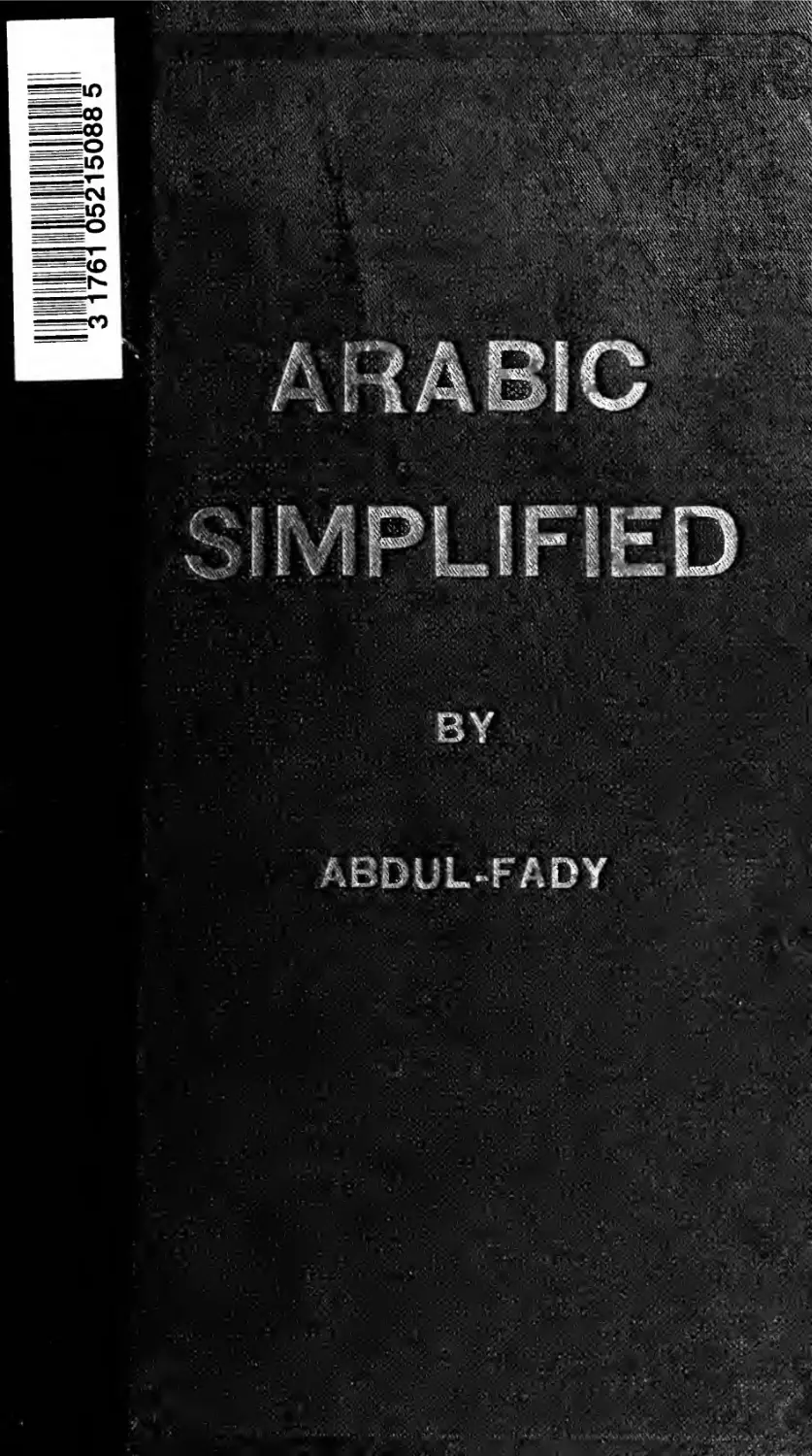
ARABIC SIMPLIFIED
A PRACTICAL
GRAMMAR
WRITTEN ARABIC
of
in
LESSONS
200
With Exercises, Test-Papers and Reading"-Book,
BY
ARTHUR
T.
('Abdul-Fady
UPSON
al-Qahirany)
Literary Superintendent Nile Mission Press,
Author of
"ARABIC AMPLIFIED,"
etc.,
Editor of
"AL-BAREED AL-MISRY,
and Publisher of over 350 Arabic Books and Pamphlets
upon the system of
THE REV.
J.
C
Wilcox,
iM.A.,
——
Author of "Hebrew Simplified."
523168
REVISKD EDITION.
2.
School of Simplified Study,
19-21
Ludg-ate
Hill,
London, E.G.
4.
S
.
S- S(
%
First Edition
1916
Second Impression
Third Impression
Second
(of first nine lessons only)
(five lessons only)
Edition,, revised throughout
Printed at The
Nile Mission
-
1919
-
-
1921
Press,
ar Sharia Manakh, Cairo.
1917
-
Foreword to First Edition.
During the year
1908, the author
had the good fortune
to
be
enrolled as a student of the Rev. John C. Wilcox's new and then
comparatively unknown course of ''Hebrew Simplified," and the
thought passed through the minds of both that possibly sometime
system might be found suitable for the teaching
of Arabic. Nothing was, however, done at the time.
in the future this
Meantime the School of Simplified Study,
had produced
Ltd.,
similar courses in other subjects, e.g., "Greek Simplified," "Logic
Simplified," "Latin Simplified," etc. For the
no
In
Hebrew course alone
than a thousand students had been registered.
less
May
and was glad
to
was sent
England on medical advice,
occupy himself by writing a number of these
1915 the writer
to
lessons, at the suggestion of the author of the original system.
It should be clearly understood that my collaborator, Mr. Wilcox
only responsible for the Interrogative Method employed, as I take
full responsibility for selecting the matter and writing the book.
is
Friendly critics of this new order of arrangement are invited
examine the Table of Contents, also the Index. A certain amount
of repetition will be found in the earlier lessons, for to a practical
to
educationist, as
virtues.
Some
is
the author, recapitulation
students
may
is
the chief of the
turn to the complete table of Alphabet,
Vowels, Figures etc, Lesson 16; others should content themselves
with what is given out to them.
There are 200 Lessons in this course, which should cover the
ground required by students for both Elementary and Advanced
Exams, no other grammar being required.
It will be found that after the first few lessons the exercises
more interesting and longer, and the subjects more varied
while the Reader contains selections from books and newspapers.
are
;
Since this course
study being
of our
differing
is
intended to be a practical one, the subject
"Modern Written Arabic,"
colloquials to
those
who have made
we
leave
the
a special study of
spoken dialects, but all words given in the text or in the exercises
will be found to be in practical use to-day
this is a strong point.
Our aim is to teach the Student, whether missionary, military,
educational, or commercial, to read, e.g., a daily newspaper.
:
for
This course is absolutely "COPYRIGHT," and may not be used
any person other th^n the original, duly registered student.
'ABDUL-FADY,
FOREWORD
2nd
to
Owing
to a combination of circumstances (partly political) over
had no control,
purpose,
many
I
have
now
entirely re-written Lessons
of the illustrations and examples from
written in 1919-20 (in
^r/:z&/c)
but not yet published.
being similar to that followed in
to that work,
A
edition
"A A,"
which should be studied
(in
which
I
have
151-200 using, for the
my "ARABIC AMPLIFIED"
The
order of Lessons 151-200
the present will be a capital introduction
"ARABIC SIMPLIFIED"
Arabic) after
good many other improvements have been introduced.
May,
A, T, U.
1921.
ADVICE
To The Student
(1)
Answer
(2)
Train "Eye, Voice and Ear" simultaneously
all
exercises in writing, even those intended for "self-correction".
aloud in the open
if
(3)
possible.
(4)
air.
:
this
can be
done by reading
Get your pronunciation corrected by
Let him give
DICTATION
Imitate, to a certain extent, the Oriental
easiest
:
way to master Arabic Syntax
Revise back work, and re-revise
!
is
from the
a native sheikh,
exercises.
custom of memorising aloud.
to learn
many
Most important.
illustrative sentences.
The
Lesson
What
1.
are these signs
They form
f
2.
word He-struck, which
is
pronounced
The pronoun
"he"
is
"understood," not written, in the Arabic verb.
How
is
this
word
up ?
consonants and
built
different
three
corresponds to the
above
It
4.
?
the Arabic
dha-ia-ba ^with the accent on the first syllable.
Of
3.
^
1.
its
letter a.
consonant, which
it
Its
one vowel.
sign
always
is
....."T....
and
/o//o?^;s in
The vowel
is
written
pronunciation.
here occurs three times.
What
is the name of this vowel ?
Fatha (to be pronounced with a roughly aspirated h, which
we have indicated by a dot under it, and which is somewhat
It is also somewhat like a deep
like hh or doubly strong h.
sigh.
Be sure you do not run the / and h together, making
th: note Fat is the first syllable and ha the second.
What is the power of this Fat-ha ?
It is like a in bad, and is one of the three short vowels.
In
some countries
it
is
a
little
heavier, like a in father
:
in
India more like u in cut.
5.
How many
consonants are there
Name
6.
What
like the*
It is
we have
little
jO
Dad
^
Ra
r
C^
Ba
b
Dad
d in hand and good, only
the
th
in
but
thee,
affects the Fat-ha after
AW or O.
7.
Do
(In India
?
No.
z,
it
and
an aspirated
more strongly
giving to
a hard
stronger,
It is
It is
this
o?,
a
pronounced
so hard that
it
almost the sound of
as in "Ramazan").
consonants always preserve the forms here
Arabic letters change their form with their
these three
given
it is
1
is
it
d.
by rolling the tongue against the palate.
it,
Three.
d
indicated bya dot under the
like
}
power
the approximate sound of the
is
word
in thts
—6—
position in a word, because even printed books are, so to
speak, in "script" character, and most of the letters joined
and "running on". But
Dad
is
always
^
Ra
„
„
^
Ba
,.
„
e^
\
N.B.— When Ba
previous
letter
8.
it
with in aword
Medial lettet.
is
it
a
is
end of a word can be joined
the
L^-^ The ra
form
final
cannot ever join the
is,
when
i.e.,
;
when it is separated from others;
when it is an Isolated letter.
{
takes
it
i.e.,
to the
of
is
which follows
letter
left.
He-struck Da-ra ba
w>^^
Why
first
have we put the
What
v^^
because Arabic, like other Semitic languages
:
read from right to
To show
10.
it
the order of the consonants in
is
Dad, Ra, Ba
9.
when
that
so that letter does not have a special final form.
What
is
/
\
at the
such a shape that
it,
when it begins a word;
when it is an Initial letter.
<
that
it
vowel
in Italic
has the accent, which
are the dots used for, one over
is
.'*
but very slight.
Dad and one under Ba
?
They are the distinguishing marks of these consonants, which
Arabic
letter-
haste, often obscures the
shapes
cannot, therefore, be read without them.
writing, the scribe,
of the
when
in
these
individual letters;
identified
by means of the
can,
In
always
however,
be
dots.
Vowels are hardly ever written, except in
two books,
the
Qur'an and Bible, but the dots are indispensable.
There are no
capitals in Arabic.
•o-
Self-Test Paper
1.
2.
What
What
is
1.
a Fat-ha
is its
power
(l
?
Where
3)
:
(l
:
is it
placed
}
(l
2).
:
4).
(Compare your written reply with
the section in which the correct answer
Revise
more thoroughly.
to be found.
it
and,
if
necessary, learn
exercises for correction except the
replies
to Test Papers,
Do
is
not send
which we have
marked "To be returned for correction". So in all future lessons.)
N.B. Students must vowel their exercises for the first year.
)
—7—
Lesson
1.
the verb-form for "He-struck"
If
changed
into "She-struck"
By placing
2.
ta (t) after
da-ra-ba
^j-^
She-struck
da-ra-bat
^I^y^
Because
^
and
-J is
is
is-fhe
new
sign
the Sukun, and
What
is
isolated
its initial
final
is
denotes that the
But
6.
We
is
->
?
;
forms are usually elongated ones.
....?.....
over the ta
?
very occasionally written
letter
over which
sign
its initial
....v.....
i.e
,
with
.>
placed has no vowel
adjacent letters
occur in Arahic.
i) ?
form
have seen
to
it is
Two sukuvs on
closes that syllahle.
Kaf and
becomes
ha
ta
is this
name
Its
to
form.
I would not ordinarily he allowed
What
be
?
and therefore
5.
^
the use of su-kun (pronounced su-koon,
the Italian u
It
ha in
and
isolated
What
when
ha
it
it.
the ha been shortened form
why has
But
It is
4.
O
the letter
v'p' how can
is
?
He-struck
The
3.
2.
is
represents our letter K, as in keep.
it
j
item 2 above) that the separate form for
(in
Can
as an initial letter.
be shortened to
->"
as an initial
the isolated form for
?
Yes, certainly, and several others act similarly.
{He
wrote
She wrote
In fh)
7.
The
we have Ta
Ka-ta-ba
Ka-ta-bat
as a Final,
short connecting link
^zS
{a)
^xI-S
{hj
and also
as a Medial.
which unites
a
Medial form
predecessor should be noticed.
We
may
represent
it
thus
:
^J^
X,
2,
^
to its
:
—
8.
But are not medial ta and ba confusing
dots over
9.
—
8
Is
it
and ha has one under
?
No
:
two
it.
any English word or name which
there
since ta has
will give us the
pronunciation of Ka-ta-ba?
Yes
;
take the word Canada.
syllable, but not
first
not say Ca-nada,
10.
Are other
Yes
:
There
enough
still less
make
to
pronounced
is
liiie
strong consonant
(i)
2b.
—Translate
we
is,
however,
sounded with such a
that
is,
write
it
fat-ha
the
and thus
a)
is
^^^
d).
:
(2)
to
Arabic (from memory)
She-struck.
(3)
He-wrote.
(4)
She-wrote.
2.
And what
2.
3.
Write the names of these
4.
What combinations
(il
N.B.
that
.?
v«^^
'
What
What
1.
is
it
(Do not mix d with
like doraba.
He-struck.
Self Test
same way
Ca-na-da; there
;
do
Simply Canada.
— Read aloud from the right, and turn into English
<.r ^^-
Exercise
dad
like a short o (though
pronounced
Exercise 2a.
the
as
We
a long vowel.
ii
Canada.
one point about the fat-ha, when
is
.
three-letter verbs stressed in the
da-ra-ba
sounded
a slight stress upon the
is
is
a
Sukun
?
sign represents a
<2S
j.^
— After doing Exercise
Sukun
^
The
text of the lesson, in
Exam, paper
7
is
to
(2
?
letters
are these
?
:
it
denote
?
(2
:
4).
3).
:
:
<^
L^- C-o
2a from memory, do 2b from memory
and then, by comparing the
corrects the other.
does
results,
it
will
be seen that one
answers to Self -Test papers are in the
the section
whose number
be sent up for correction.
is
given.
There
will be
similar exam, papers at the end of Lessons 13, 20, 25, 30, 40, etc.
—
—
9
Lesson
PAST SING
1.
2.
How
she-struck
?
By adding
the letter ta
How
(2 :l)
meaning
O
can we readily turn he-struck into
Thou (m)
Thou (f)
I
VERB.
of
turn the form for he-struck into one
we
did
:
3.
(m &
f)
didst strike
„
>
By adding the same letter ta in
each case and by changing the
)
vowels.
\
„
struck)
?
^*-1
^o^'I
o^l
^^'^
'/'^l
y
da-rab-tu
I
N.B.— Read from
the
da-rab-ta
Thou strikedst.
da-rab-ti
Thoustrikedst.
struck.
(fern.)
right to
left.
This
is
da-raba
da-ra-bat
He
She struck.
struck.
Note that
essential.
Past Tense of the Arabic verb may often be represented
English by either the Past or the Perfect Tense. (Details in L.
/
3.
What
Accent.
is
the Rule for Arabic
Accent
1
in
53).
?
The following rules must be memorised just here
(a) The Arabic accent falls principally upon the long voweL
:
of the word,
the letter of prolongation (which will be ex-
viz.,
plained later) thus «—^u5 kitab has
by
....."....
thus,
receives the
If^_more
ta.
the
accented
shown
ta
than one long vowqU the la^cm^
greatest accent.
Thetwo_Diph thongs
(q
:
5)
are
accented like long vowels.
(b)
The
vowel
is
fact
of the
causes
pronounced
that
(c)
(d)
when
and
be accented;
to
student
the
e.g.,
must
C^jy^
necer
say
the final vowel is omitted he will say
newspaper reader-aloud) darabt^
The Shadda
If
consonant
dara^tu,
da.r^b-tu because,
(like a
consonant under the sukun having no
all
is
also accented (8
:
4, 5).
the vowels are short, as in kntaba, the
first
one
is
slightly accented.
If
we examine forms 3, 4 and
What are ihey
presented.
"i
5
we
shall find
two new features
—
We
We
1st.
2nd.
5.
What
is
see a
— ;—
see
--
10
—
shape) below the
(a fat-ha in
(almost a
comma
line.
shape) above the
in
Fat-ha shaped sign written below the line
this
It
is
the short vowel
it
is
always placed
like
i
i
beloiv
in tin.
name
Its
the line
is
What
the sign
is
placed above the line
.....^....
the short vowel u (00) called
It is
}
Kasra. Since
cannot be confused
it
with Fat-ha (the short a) which always stands above the
6.
line.
line.
?
Damma, and pronounced
as
in bush.
7.
After reminding ourselves that the Sukun
we can now
of
— As
its
heart.
It is
9.
But
This
is a
to
verb
the
Learn
FROM THE RIGHT
is this
^
rakiba,
and means "he
the kasra in the centre
last vowel,
10 Write out
all
Some
I
II.
rode
by
;
noting
it
in
He-struck, etc.
?
rode, or mounted."
Because this verb takes two
verbs take a
damma
as the centre
Every past verb takes fat-ha as
first
_anyhp w.
the (singular) persons of
thou (fem.) didst
r
:
thou didst
^
j
rakibat
rakib-ta
rakib-ti
rakib-tu
syllable
j
vowel for the past tense.
/
proper
accent
pronounced
why
learn these five forms by
very important as well as a very easy matter.
fathas and a kasra.
and
we must
persons (singular),
Take care
What
Past Tense. Singular Number of the
the vowels of each verb remain constant for each
item 2 above.
8.
Voice,
(See item 2 above for the forms).
Regular Verb.
N.B.
^
read the whole of the verb-forms which con-
stitute the Active
^
— — has no sound,
r
:
she-rode
rakiba
he-rode
what order are the signs written in Exercise 3a ?
then b, after that go back and
The body of the K, then
In
t,"^
stroke the headpiece of the k, (downwards), then the dott,
then add
all
the voweZ-marks from right to
left,
—
—
li
Exercise Sa, Read aloud, transliterate* and translate, covering
(J1»«a!L3
i^i^C^
c^j
o-j
V«-J
Exercise
(l)
He
(4)
Thou
(6)
(Second
wrote.
(2)
line)
He
ridden). (8)
ride). (10)
She wrote.
hast
(fern.)
rode (has ridden).
She rode (has ridden).
(12)
He
didst strike.
(15)
She
Self Test
struck.
(7)
(13) I struck.
written.
rode, (or
I
have
hast ridden (didst
(14)
Thou ffem).
Thou (masr),
struck.
3.
1.
What
2.
Write out the rules for Accent
3.
What
concludes
letter
is
nounced
all
the sign for a
but one of the forms of the Past
}
(3
:
is
it
A
character.
(3
}
:
2).
3).
What
is
it }
How
is
it
pro-
6).
needed.
really
if
1
:
(i.e.,
writing Arabic in
The student should only
racters).
Arabic
(3
Damma
Note on Transliteration,
time
hast
(Third line)
(ll)
correct.
have written (wrote).
Thou
(9)
Tense, Singular of the Active Voice
*
I
(5)
hast ridden.
(fern),
Then
Thou (m)
(3)
written.
Thou
didst strike.
r J
C^l ^W
Translate to Arabic (covering 3a.)
3b.
v_^--J
o53
Li^j
J
t^ y-^
j^^
O-X-J)
(Jl^AlIJ;
(3b).
essential
transliterate
Roman
for
cha-
a short
But in translating from English to
that he write
"Relief Nib"
is
in
the
proper Arabic
the best for this purpose in
England, but an "Arabic nib" (not the native reed) should
be used in the Orient. After a few more lessons he should
try
weak reed
customed
It
is
from
abstain
to
to the
He
altogether,
as
it
is
a
become
ac-
Arabic character, and should use nothing
else.
lean upon.
to
difficult,
transliteration
in
will very
soon
Egypt, where these lessons are printed, to
obtain sufficient specially marked types with which to transliterate
;
the only reason for attempting
it
at all is to partially
supply the place of the teacher of pronunciation.
get a sheikh with
whom
If
you can
to practise reading (and DICTATION)
never use anything but the Arabic character.
*— 12
—
Lesson
4.
IJSlTERROaATIVE,
1.
What
The
2.
the
is
This
3.
it
What
it
can
13.
What
is
is
-
-
)
/
•
.
^
(not otherwise)
below).
be explained fully
will
thus
alif,
da-ra-ba
J
may
a.
hamza and fat-ha
and it then always
1
it
In that
a
he struck
'
-
-
".
^
•
be the
initial
composed
new
a
of
be negatived
past tense
this negative particle
is
before
?
How
1
J
U
it
Mim (meem)
its
joined to an
verb form
:
it is
with the Present
(!« coll.
*^''"
placed
be
causing any alteration
I
?
can be placed
1
Yes.
ka-tab-tu
Have
Ama
Did
I
)
J
I not written
ka-tab-tu
not4=td^
^
^
Kj(L\r^
.?
also).
its
before
words.
a negative sentence without
before
have not written
Ma
used with
Ka~ta-bat l^-'j^^
She wrote / ^^'
'^\{<^^^
sentence without disturbing the order of
also
This
and she -did -not -write.
have seen that the Interrogative
it
can
1
letter,
for she-wrote
She did not write
a positive
letter
?
ma
always placed before
Ma-ka-ta-bat
Can
With
she -did -not -write
the negative panicle
Give the Arabic
We
§ 5
below).
the Past Tense injvjilhig-
7.
(see
(without hamza) written from below (see 2 above).
negative
6.
I
linked to a
is
it
j
a verb in the
By putting
It
is
written over the
is
It
become
she wrote
alif,
form
The hamza
the sentence.
With the hamza
of a word (see 10
5.
its
special use has this Alif?
Lesson
How
3).
:
lengthens the preceding fat-ha to a long vowel,
did he strike
a-da-ra-ba
4.
cases save where
all
when
letter,
commences
in
in
one of the signs for Interrogation
is
?
i
?
form
its
preceding
case
form
is its
is
of the Arabic Alphabet
first letter
(This generality will be modified in I2
^4/^/.
What
etc.
1
'-V-^
*"
^^*
l"
''-VVf
^"^^
'
I
J
C^xI-^Cil
the Lam,
How
9.
very
letter looks
Wliat
8.
or L.
do they
differ
preceding one
much
an Alif
?
Initial letter, is ^)
?
joined to
its
an
whereas
;
like
form when an
Its
The lam can be
-
13
The lam is
stroke; also, when a
following letter as well as
its
can only be joined
its
alif
preceding.
alw^ays written
thick
final letter,
Thus
of a lam
combination
this
in
:
we
\B
initial,medial and
lengthens
it
get
to
downwards with
three
a
form.
its
possible forms
But this combination does
final.
not occur in any actual word.
10.
Give a word containing an alif-hamza and a lam.
He
11.
Now
a
word containing
This
not.
ate (a-ka-la)
is
U
etc.
(The lam,
alif is
Exercise
i.e.
which
is
^t
i
0^
^
translate
Turn
4b.
Has he
(m) eaten
t
(6) I
eaten.?
(4)
(2)
(2)
(3)
then the
first,
then correct by
(f)
did not ride.
(9)
4b.
u^l C\
J<ll
ocfCV
•c^rrJ
Has she
Hast thou
(7)
(f)
by
.?
Did she
not
4a.
not eaten?
not eaten
Did she not
not write. (11) Didst thou
Self Test Paper
:
into Arabic, correcting
didst not strike.
(1)
written
Qur'an
%
\
?
is
in the
U
'^<\ C V
ride
or
generally used with the
sometimes so used
the down-stroke,
Read aloud and
0.
(l)
is
= No,
3 la
alif.
written athwart).
4a.
Exercise
I
lam before the
a
the Negative
Present Tense though
Jf
(5)
strike
write.?
eat.?
(12)
(3)
Hast thou
Didst thou
?
(lo)
No;
(f)
not
Thou (m)
No; she did
(8)
I
did not eat.
4.
Give an Arabic Interrogative sign. What is its position?(4:I-3)
What particles negative Arabic sentences? (4:46,11).
How does an alif differ from a lam? (4: 8,9).
-
-
14
Lesson
5.
TRILITERALISM.
What
1.
one of the chief characteristics of the Semitic group
is
of languages
— (Hebrew, Arabic,
etc.)
?
Tri -literalism. This signifies that the words are built up around
three*
Root
letters
by prefixing, affixing and
or Radicals,
and by changing the vowels so as
inserting other letters,
to express variations of meaning
conveyed by the Root
*
letters.
Tense of a verb of Active Voice.
What
2.
Past Tense
arising out of the idea
all
This we have seen in the Past
verb form
(3
:
2).
Active Voice always
the
in
contains these three Root letters and no other letters
form for the 3rd Person, Singular, Masculine.
Ka-ta-ba
1
He
J
^^/^
1
-^\
wrote, or, has written
Aka-la
He
And
3.
are the
Nouns
also built
Alifis, a frequent one).
The
^
up from these three Root
Yes: by vowels alone, or by vowels and additional
which
?
:
-
/
has eaten
ate, or,
Thus
This
is
why we
letters?
letters (of
teach the verb
before the noun.
S-lun
Battle, or fighting
qita-lun
a book, a writing
.^^
kita-bun
,
,
y^
He
ate
'^
}
|
^j^^^
^^
^.,j^^
y.
tt
wrote
l^i:<^
s—>U_b
r
J
a writer
(
katii-bun
We see
first
letter
He
^^-<^
^
^.^-.J)
-
(For the lengthening of
this
a see Lesson
6).
(
here some
Root
^^rlS"*^
•
new
signs and letters.
What
is
this
new
}
Qdf and represents our Q. This guttural consonant is pronounced with a vowel by contracting the throat.
Say Kaf first naturally, then with a short a sound and contracted throat, like the cawing of a crow. Qaf is pronounced
Qof or Qawf because the letter Q is one of those strong letters
which alter the sound of the fat-ha (Compare 2 lo).
It is
the letter
:
*
Occasionally there are four
a Quadriliteral one. See
later.
root
letters
and the root-verb
is
tlien
called
—
What
It is
new
the
is
sign
or
?
Pamma
the short vowel
-
15
which can only
written double,
occur at the end of a noun.
How
pronounced
is it
?
Un, shorter than Oon.
Like u
N sound
But where does the
come from
This practice of adding an
thus doubled
name
and poetry.
or in
What
is
It is
?
sound when the
which has
double-u sign called
it is
in the
the
word without
10.
wn.'
1
with nun sound").
Nominative Case (as also those having
damma). (See 6 6
:
alif
Sao
Qara'a he read. (Here
Write out the
five
third radical).
it is
Read aloud and
Exercise
To Arabic
(1)
(4)
Has
(7)
A
she
Self Test Paper
(i)
What
(2)
How
(3)
What
is
not killed
(8)
She
translate to English
(2)
?
I
(5)
J
:
5a).
(have eaten).
ate
Did
kill
I
(3)
Tanwin
is it
Pamma
?
(5
pronounced
ndn-ation and
when
:
?
is it
8).
(5
:
6).
employed
?
(5
Food.
Fighting.
(6)
?
read.
5.
the
and when
is
Cj\ji
(afterwards correcting by
Hast thou (f) read?
book.
\j
J
w.^.
oh.
with hamza.
person forms of
Exercise 5a.
two cases with tanwin).
for the other
Give another verb containing
j5
is
never used with the Definite Aiticle, and every word
is
the single
'
vowel
reading the newspaper
in
naming
(Practise
The Tanwin rjamma (meaning 'A Damma
It
last
confined to reading the Qur'an
is
never pronounced
conversation.
is this
N
called ISun-ation (noon-ation) from the Arabic
Nun. Nun aiion
for N,
push.
in
;
7).
:
—
i6
—
Lesson
6.
TANIVIN.
\l^_TransJJleraifiU:Jie^_r^^
2.
3.
Why
have we put a mark over the a here
To show
it is
How
we
are
the long
Ex
:
"
it
long and not short, since
a
= hd-hun ^^{ but
"prolonging"
What
It
is
Tanwm Damma,
Damma
a
is
a
it is
jukun and
^
is 7iot
,
once more
vowel
(or short
alif is a/w;a2/s /o/ig
distinguish this from
head, in which alif carries hamza
4.
in kataha.
?
when followed by
gate
is
I
?
and not the short one
a,
know when
to
fat-ha in each case
)CThe
Ki-ta-bun tjiljT
;
ra'sun,
Ihng
alif.
?
u) written twice,
placed over
the last letter of a
5.
word (as in this word gate), and in hook
l).
The
name
§
means "A Damma with ^ nun sound." (5:3).
Are there any other tanwins ?
Yes the two other short vowels can be used in the same way,
i.e., doubled over the last letter.
Thus we get
:
Tan win Damma
v>U-^ Ki-f^-bun
Tan win Fat-ha
Tanwin Kasra
Have
Ki-if^7-ban
^'J^^-f
(Note the added
Ki-^^-bin.
V^*-5^
these three tanwins any practical use
Yes.
The presence
noun
is
indefinite
clinable noun,
(1)
The
"
(2)
The
"^
i.e.
;
?
of either of the tanwins denotes that the
e.g., a
man, a book.
Also that
over an
I
for a Masculine noun)
Object of a verb
Case.
The
a de-
that a noun is the Subject of the
sentence=^The Nominative Case.
denotes that a noun
(3)
it [is
capable of taking all three cases.
denotes
(
alif here).
the Direct
is
= The
Accusative
(See 9 below).
denotes the Indirect
Object
(governed
by
a
Preposition, for example).
N.B.— A
single
damma,
native, Accusative,
fat-ha or kasra indicates the
or Genitive,
Nomi-
case of the Definite Noun, as
the tanwin vowel does of the Indefinite Noun.
What
English
of
y-> 8.
this sign
is
J,
When
When
will a
is
it
"A man
When
it
It is
the letter Jim (jeem), which
G
in
Egypt.
man, ra-ju-lun J>- j and
in
the subject of a sentence, as
wrote a
will a
letter".
Man
is
in the
sentence,
man
noun take the tanwin fatha (over an
as, for
"A man
—The order
\XlS
wrote a book"
is
Read aloud and
Exercise
To
6b.
translate
(5)
(7)
She did not read a book
Self Test
1.
2.
When
is,
in the
;
,^lS
ra-ju-lun (2)
first,
verb
kataba (1)
but the
Noun
put in the
is
correct by 6b.
Arabic, afterwards correcting by 6a.
wrote a book.
Has he written a book ?
Did a man write a book
(3)
?
alif)
^\>-j
usually that of the Verb
Exercise 6a.
I
Its
example, "a book" in the following
may be placed first, for emphasis. (The
Singular when it precedes its subject).
(i)
in the sentence
Nominative Case.
ki-ta-ban (3)
N.B.
is re
?
the Direct Object of the action of a verb, that
is
form
initial
form
the
is
is "^^^-j
Accusative Case,
10.
The
its final
noun take the tanwin cjamma
form therefore
9.
?
-
but pronounced hard
found
it >. is
77
17
(2)
a
book.
(6)
He has
A man
(8)
Didst thou not strike a
(4)
?
She wrote
not struck a man.
read a book.
man
6.
How
can the Fat-ha become a long vowel } (6 3).
is a Tanwin Fat-ha, and what letter always accompanies it with the Masculine noun (6: 6).
In what case is a noun which has a Tanwin Fat-ha } (6 6),
:
What
.?
3.
?
:
—
-
i8
Lesson
1.
Let us classify the characters met with, and a few others.
Power
Separate
a
Final
Medial
I
)
I
Name
Initial
Alif
I
b
(^
4^
<^
i
Ba
t
C^
L-^
^
^
Ta
j
C
G^
^
^^"^
""
C
C
^
^
""
^^
CI
r^
^^
^
^^^
J
J
J
^^
<J
O^
(^_^
J
^
^
Pad
q
^
k
kh
1
^
3
Qif
tfj
(3
td
r
r
Kaf
tJ
(JL
i
J
Lam
(^
"^
^
^^"^
m
Ha
(^
(or
Hha)
is
the ch in loch\
2.
7.
What
(a)
a
it
-
may be
Fat-ha
?
(b)
Damma
We have
.?
the only three short vowels there are
with a sound
";, Kasra
We
i
„
as in tin
„
u
„
as in bush
only used one of the three long vowels,
have used the only three tanwins there are
Tanwin pamma
the un sound
:
as in patch
„
fat-ha lengthened by an alif as in a book (kitdh)
3.
is
practised with an educated Scotchman.
vowels have we used
We have used
....r.....
Kh
heavy h from the back of the mouth.
:
viz,,
the
V^*4
—
—
Tanwin Fat-ha
;"" the in
sound.
The Arabic numerals (from
4.
u
>T
^ A
^-
to 12)
I
may be
is
r
1
placed to the
left
qi-ta-lun— battle, or fighting tJ^^
(2)
ki-ta-bun— book ^^[iS hook (accus
r
(3)
a-ka-la— to eat (he-ate) ^^
(4)
uk-lun— food
(5)
qa-ta-la— to
(6)
ra-ju-lun— a
(7)
da-ra-ba
(8)
ka-ta-ba
(9)
ra-ki-ba
of the unit
ma-li-kun— king dll^
A
U
qa-la-mun— pen
^1
kill
'
(he killed) ^jl5 ja-ma-lun— camel
*^
man
J>.j
man
a
(accus-.)
>
J*V
^
"^o^j
— to strike (he struck) <—»^
— to write (he wrote) y^tS
— to ride (he rode)
qa-ra-a—
L*5^j
to read (he read)
\j
—A
2.
Test Paper to be returned. Translate
He struck a camel.
7. Did she kill a man
Did she read a book ?
8. Didst thou (m) ride
3
Hast thou (m) written a book
Exercise 7
:
5.
Thou (f hast not written
Have I not written
6.
A man read
4.
>
:)\i[:>S
>
1.
:
7.
(1)
(10)
easily learnt
1
V
Observe that the "tens" figure
figure, as in English!
Vocabulary
-
the an sound (Note the alif here).
\
TanwinKasra
19
)
1
a book.
.?
a book.
9.
10.
11.
12.
Jr'j
v> — ^J
?
Thou (f) hast struck a man.
Have I not eaten 1
Have you ridden a camel?
I
have not ridden a camel.
-S.— Practise writing, transliterate, and then translate:
^V
?
°^^*»
—
jr'j
3^'
:
—
20
—
Lesson
8.
DEFIISITE ARTICLE.
Has Arabic an
1.
Yes
Article
?
the Definite Article only,
:
or case in
itself,
prefixed.
It is
because
it is
a particle
which has no number, gender
noun
a part of the
composed of an
which
to
and a lam
alif
it is
Jl
Give an example
2.
ra-ju-lun, a
But
3.
What
The Tanwin Damma
1st.
are they
?
always does,
has disappeared. It
cannot exist with the Article prefixed, since the tanwin
it
marks the
indefinite.
The lam has dropped its sound, but
'"-.
It has introduced a new sign
2nd.
3rd.
written obliquely.
What
is
Tashdid
not
its
form.
like a small
W only
the sign of Tashdid called Shadda-
It is
?
the act of doubling the pronunciation of the letter over
It is
which
act of
is
man
ar-ra-ju-Iu, the
the Article has introdaced three changes.
for
4
man
this sign is placed,
wheth er in_a verb or_a^ioun
doubling (or intensifying)
is
The
.
called tashdid, but the sign
called a shadda.
How
does this happen
way
In this
:
-
?
the shadda
suktin of the first of the
=
two
a sukun
letters
-J-
a vowel, that
is,
the
and the vowel of the second
coalesce together.
In
5>-^
ra,
and
I
I^J
1
1
the Zam of Jl
then, secondly
—
j'
finally the
assimilates
we
two
think of
r's
itself, first
it
of
all,
and pronounce
coalesce and
we
write
it
to the
it
as
^>- }^
leaving the lam standing in writing, but marking the pronunciation
6.J
^
Do
by
--T.....
(Be sure to grasp this point).
these S changes always
take place
when
prefixed, viz., 1st.
The dropping
The dropping of the sound
of the tanwin
2nd.
of the lam,
3rd.
Writing of the shadda
}
the Article
;
and
is
—
No
only the
:
21
—
always takes place, whilst the 2nd and 3rd
1st
only occur before one-half of the Arabic
7^\
How many
has
It
What
are the 14,
What
be given
we
Solar letters do
already
is
the Arabic for sun,
new
forms.
gives
reason that the
are the
and
Sh,
S, of
name
and
of
full
letters
shams happens
fj>>^ sun
forms are
be of that
to
class.
?
:
Final
Medial
Initial
Name
S
i^^^
(_j-u
A4*
^Vi»
Sin
A
Sh
(^^
A
"^
Shin
What
is
A
(_^
the middle letter in this
^^
word sun ?
Recapitulate the various forms of the * (Lesson
M
13.
and three
to the solar letters for the curious
last letters in
which the
A
12.
its
^j*»*-i
Separate
Power
#
^
^
^
7).
Mim
Give examples of words containing the Mim.
JJ
?
Their
Ta
and contains two new
first letter
first
letters.
this?
It is
It
called
know ?
Ra
Dad
What new word
What
suiiiin,
later).
sham-sun
11.
al-kitdp, the book.
I
which receive a shadda but no
Lam
10.
other 14 have a
(The remaining 14 are called Lunar
letters.
will
The
Article.
upon the /aw, thus ^llSJ
names
?
so that the doubling shadda will be required over 14
sukiin
Solar
9.
has the Arabic Alphabet
them when prefixing the
of
8.
28,
letters
letters.
Qa-la-mun, a pen. 'i^l^* an
office,
study
Li^ camel.
:
22
14.
Learn the word for ''hea.d"ra'sun
by
make
sukftn but that does not
Also learn the verb "to break"
Read aloud and
Exercise 8a.
o>
i,:4"l
(l)
sun
(2) the sun
ra.
broke.
(r)
(v)
\j
up the English
er*-^ (^) u-*^
'
Uj o^>l
man.
a
Did
(6)
:
(0
SUj
(a)
Cr?
(8)
:
head
it
(4)
the head;
the sun
(5)
ffemj strike a head?
Hast thou broken a pen
(7)
?
No
(9)
;
A
an eating, i. e. much) do) Have I broken
No; thou hast not broken the pen. (12) The
head. (13) Did the man break a pen at (in) the
ate food, (or
the pen?
man
"silenced"
'H^TcSf (u) j<j\
(3) a
did not strike a head.
man
V
c:>y. C
vir^ (^o
(femj struck
it
'jS he
{i)o'h
I
is
the vowel long as in
translate, covering
Translate to Arabic
8b.
A
J
The hamza
Y^'i :i.y-ri (\ .) s^i jV: jH (^)
{\
fe
S^•
Exercise
U:
(a)
;i.;;.rc V
(o) ^^1
I
t^-:>)
(j- \j
(ll)
struck a
office
?
(14)
No
;
he did not break the pen
(15)
A man
struck
a camel.
Self Test
(1)
(2)
8.
What is a Shadda ? (8:4).
What change invariably accompanies
Article to
(3)
How
is
any noun
(8
:
the prefixing of the
3).
the Article prefixed to a
word begining with a Solar
letter? (8: 6-8).
(4)
Where
is
the tens figure in Nt In
a similar practice
?
(7
:
what language
4).
N.B.-^Please observe the following rules
Cl)
Answer
(2)
Constantly
all
home
revise.
exercises in writing.
is
there
—
23
—
Lesson
How many
How many
9.
letters are there in the
Arabic Alphabet
of them are Consonants (that
is letters
?
28.
which must
be accompanied by a vowel in order to be pronounced
All of them
:
?
are sometimes used as
three of them, however,
"Letters of Prolongation".
3.
Which
are the three "Letters of Prolongation" (that
prolong vowels, making a short vowel into a long one
The first one and the last two of the Alphabet.
III)
Separate
Medial
Final
is,
which
?
Mama
Initial
Wau
Ya
4.
Why
and
are these
Because
the
like a large
5.
wau has
Ya, easy ones to
damma
practically
remember
one form only
whilst the ya
;
two
diacritic points written
like
below
j
it
is
the only letter with
is
Pronounce the name
it.
ou in house.
Are there only 3 vowels in Arabic ?
There are also two diphthongs, one being ay, formed by
fat-ha and ya, and the other au, formed by fat-ha and wau.
A
^
I
ay
like ai in
diphthong requires
paid
;
and jl
au, like ou in house.
sukun over the
a
"letter of prolongation."
Give examples of these Diphthongs.
A> .*'
f
\
<uu^
I
<^>«A
^^*
7.
Wau and
letters
?
wau
Thus
6.
two
to distinguish
Which
sai-fun
a
J
sword
r
thau-run
\
a bull
\
f
J
are the only
)
.
since fC
^
follows the
,
^
heterogeneous
follows the
^ heterogeneous
.
/
three short vowel sounds
may
possible
in
What
1
may accompany alif to make long a Damma (u)
may accompany wau to make long u and Kasra (i) may
accompany ya to make long (= ee). Then there are the two
Arabic
Fat-ha
?
letters
they accompany
(a)
;
;
i
diphthongs mentioned.
—
8.
Why
are these
three
24
—
sometimes
letters
called
of
letters
Because they are used to prolong the sound
prolongation?
of the vowel attached to the immediately preceding consonant.
9.
Examples
:
^-^
=
ba
^
=
bu
=
bi; while
v--»
;
while
u
=
ba
;
while
j»
=
bu
^j
=
bi
and the two diphthongs
iai*
10.
Do
=
f^
No
?
bau
homogeneous
(is
^
)•
>>
>)
>>
{S
'»
"
'»
"
Learn
mwrsa^/wTi missionary.
^^y»
U by,
Exercise 9a.
li.
Exercise
words: uy*'j rasu-lun,
these
by me,
(J
bi,
To
English
aisurjuui9b.
i
To Arabic
A man
(4)
J
J
li,
li
to
to)
.—-'.
".'
^
apostle or messenggr,
(joined to the next word)
me.
(1) '^;J)v^') i'.(o) 'j^s*'
-^j' (o
:
(2)
An
apostle rode.
(3)
Did the apostle (messenger)
apostle (messenger) did not ride.
the bool^ with a pen
to,
:
wrote to me.
wrote a book.
homo-
is
it.
only lengthens
I
(i)
=
^>
each prolongs (only) the vowel that
;
geneous (akin) to
->
and
;
these three letters of prolongation lengthen any preceding
vowel
11.
bay
:
?
(6)
A
missionary
ride.?
Didst thou
(5)
(fern.)
The
write
-
-
25
Leseon 10.
SOLAR & LUNAR LETTERS.
1.
2.
Into
what two equal classes are Arabic
The
Solars and the Lunars.
Why
are they so
Only because
solar
In
(
first letter in
the
Qamar-un
what way
is
a Solar letter
The sound
Lam
:
ash-sham-su
^-^*
-'^
article
sun
^ •^a
sham-sun
LT*'^
to
first
a
letter
words beginning with a
article
its
moon
-11
^
qa-ma-ru
there any
the
falls
be
to
5).
''*^\\
do we prefix the
The moon
Is
sun happens
of the al coalesces into the sound of
Lunar letter? By giving the
lam takes a sukun).
5.
^^^
?
of the
>
al
10).
j^9
)
The sun
How
:
the Article prefixed to words beginning with
the solar letter (see 8
4.
(see 8
?
?
8— lo).
:
whilst in the other class
letter
for 7noon
named
divided
letters
(Revise 8
value
full
>>
(i.e.
the
\
qa-ma-run ^
way
reason for this different
Lunar letter ?
Lunar letters are of such
of prefixing the
article to the
Yes
:
the
require
lu/v4
a nature, that
is
to
say they
such a shaping of the channel of utterance, that the
enunciation of the
Lam
in the article is helpful in re-adjusting
the organs of utterance in preparation for the lunar letters.
al-qa-ma-ru
easy
is
3\-shani-s\i
-o„„„.-..
IS never found
But
is
6.
What
is
the
\t^
is
/
-^
a
«|
«
1
>
I
J
"-^
|>
^^
. .*^'^
easier to pronounce
other reason for this difference in prefixing the
Article to Solars
The Lam
1
>^
ash-sAam-su
While
'/T
*
and Lunars
;
i.e.
what about the (lingual)
Lingual, and therefore
fellow tongue-forme(J letters
;
it
solars?
easily coalesces with
^
t*^
.^A^i
^
'^
dad
and with
§ad
(j^
this
///
is
;
it
On
the sharp th of the
it
more
gives a broad sound to
its
like
s»
(t,
etc.,
th)
:
etc.
word "think", or "thousand", which is
The sad is a very strong 5 almost like
dM does).
vowel, as
Lam
hand the lingual
the other
sin (j^
{J^
O
ta
JIj
sometimes lisped making
ss
shin
Dental (or teeth-formed) letters
its allied
tha
(Note that
^
-
26
cannot coalesce with
Lunars, for they consist of Gutturals, Labials and Palatals, and
the shaping of the channel of utterance by throat, lips and
palate forbids such coalescence.
7.
What
It is
8.
is
the
What
the
new
Fa and
9.
In
Fa
like in
like the Qaf,
As
a
when
To form
the
the letter (^
(^
bi
= by me
a
Diphthong
What
3rd.
is
li
(J
more curved.
3
Fa
be used
?
its
f
homogeneous
= to me.
a
after
heterogeneous
another
way
in
=
a sword
which a Ya
At the end of a word,
if it is
is
used
?
preceded by a fatha,
without dots and, being pronounced exactly like an Alif,
Alifrhaqsura which means ''shortened
in
Lesson
17,
vowel
takes a Sukiin
saif-un
10.
is
Letter of Prolongation following
vowel kasra ^^
2nd.
?
?
A
how many ways can
1st.
form
which however,
CJl
CJ
= sword
saif
corresponds to our F.
letter is the
Somewhat
<^^
letter in
J
i
ila
=
alif."
to, ui^tq
is
it is
called
To be explained
'
27
Learn the verb Jl*
Exercise 10a.
he-l
d and conjugate
*
u>-:ii
(3)
(4)
L>u\
(S)
f:
like qlaraba.
it
and read aloud
Transliterate, translate
(I)
(2)
-
ash-sham-su
The sun
ar-ra-su-lu
The
ar-ra-ju-lu
The man
al-ba-bu
The
al-qa-la-mu
The pen
:
apostle
gate
(6)
o';,i
al-wa-ra-qu
The paper
(7)
CH:;i'i
al-qi-ta-lu
The
(8)
v>
al-mur-sa-lu
The missionary
(9)
'^\x\\
at-ta-gi-ru
The
(10)
Li';ji
as-sai-fu
The sword
Note:
The accent
Exercise 10b.
Self Test 10.
falls
upon the long vowel,
if
one
is
merchant
Translate the English of Exercise lOa to Arabic.
(On papers 9 and
lo).
Which
2.
Why
3.
What vowels
4.
Place the Article before a word beginning
are the letters of prolongation
are they so
(b)
trader,
present.
1.
and
fighting
named
?
letter.
(9:7,
Give examples.
are Iwmogeneous to
with a Lunar
?
'
to
(10 3,4).
j
8).
(9
and
:
8).
to (S
(a)
^
?
(9
•'
^o).
with a Solar
—
Lesson
1.
What
What
As
3.
to
diacritic point),
we
t
t
p'
^
What
It
?
letter transliterated
allied
is
it
wasla.
^^^^
new
this
is
Ghain, a letter
is
It
11.
the Arabic for a youth
is
ghu-la-mun
2.
—
-
28
awkward
St
in
pronunciation.
same form (without
the
them
will give
?
form and
in
another of
by gh
its
together.
C-
*Ain
C^
Ghain
gh, or ghr
Ghain ?
represents a gargling sound from the throat similar
the sound of the
is
made by an
r roughly
and well down
not be connected with the English
g,
in the throat.
to that
It
must
being just a "gargle."
The %in can
really only
may
emit a guttural a from the bottom of the throat,
try to
be learnt from a Jew or Arab, but you
while lightly holding the "apple" of the throat by the fingers.
Students within reach of the Orient must diligently practise
phonetics, with the assistance of an educated native friend.
4.
Write
Arabic "A
in
man
struck a youth."
ghu-la-man,
5.
Why
i*%
has
Because
it
is
before
that J
is
^ '
'* *
A^n
>^
Why
write
?
i-
(See Lesson 6
:
its
Article to a word,
a Lunar.
We
sign
is
5, 6).
"The man struck the youth,"
the Arabic
a Solar and
that
we must
is,
note
then write the sentence
t * ^
J^j*'
V^^
^^
7.
da-ra-ba
the Direct Object of the verb, and so
we can
we prefix
Before
U>1^
a tanwin fat-ha.
'
6.
become
ra-ju-lun
has
darab
U^p-
(youth) in 4 above lost
>
and become
ar-raj-ul ul-ghu-lima.
>
^^il'
?
its
tanwin fatha,
—
—
29
Because the tanwin cannot exist with the Definite
denotes the indefinite.
it
What
It is
is
the
the sign
...'....over
Wa§la
that
;
the alif (in 6 above)
a sign written
is
the alif
commences
the alif
has no vowel of
tion
word only)
a
above an
show
to
?
own, and that for
its
then
What
(when
its
pronuncia-
takes the last vowel of the preceding word, as in the
it
cing al begins a sentence,
it,
alif
that in that place
transliteration of the following Exercise iia.
9.
Article, sine
it
is
If
the
commen-
obvious that nothing precedes
has no wa§la, but a simple fat-ha only.
it
does the word wa§la mean
?
A>.
Wa§la
colloquial for Ai.^^^ a
is
the vowel preceding
To
Exercise Ita.
l*^^
to the letter following.
it
(We avoided
the exercise.
word meaning a
it
link, for
it
This
seen
is
V^^
ra-ju-lun
J>-j
}V;ii
da-ra-ba
(i)
SL»
ul-ghu-lama
(2)
da-ra-b
ar-rajul
V>i'
(3)
J''
%^
A man
To Arabic
(5)
3:;t.
man
kill a
killed
man
The man
(2)
Did the
(4)
?
(6)
:
struck a youth.
the bull
(4)
'^1^
3V-;i
(l)
in
in Ex.9a).
English:
ghu-la-man
Exercise lib.
links
a camel.
(6)
struck the youth.
bull kill the
The man
did not
kill
man
?
(3)
(5)
Did
The
the camel.
Self Test 11.
(1)
What
(2)
Give
is
all
a wasla
?
(ll
:
8).
the four forms of the letters
Ain and Ghain,
(it
i3^
—
—
30
—
Lresson 12,
1.
What
2.
But what
3.
What
the Arabic for earth
is
new
the
is
sign
that Alif
is
first letter
Needless to say,
it
^
j
\
The Hamza
.....t
?
we mean an
bearing a hamza.
alif
a consonant, for Arabic
is
we say
Alphabet, for when
letter of the
first
the
?
Ardun
?
Hamza
the use of the
really the
is
It
is
hamza.
vowel-marks
are not reckoned as letters.
4.
When
When
have we seen that the
is
it
simply a
5.
A
Thus:
without a hamza.
show
alif
And
that the
hamza
not the
is
hamza
superfluous
is
alif is a
consonant.
customary not
Thus
What
does this signify
That every
is
Is the
:
viz., Alif,
But these
letters
letters
No
:
alif,
is
'
the
:
same
the
written, is to be understood
when beginning a
as
:
J
'
it is
sentence.
?
Wau, Xz.
^
,....r.....
is
3
which can receive
or
„...'„...
or
"";;""
given or no.
the
Arabs
that the
'
it
Hamza
call
when
in the
beginning a word.
supports these three weak
?
it is
better to say that the three
support the strong
In
J
must be usually within a word, except
Can we then say
It
the Article
hamza found only with an alif ?
can accompany the three letters which
*'Wcak",
Yes
?
?
merely to show that the
is
with a vowel (with
\
attached to the
is
used as a Consonant
it
case of an
9.
it,
object
an alif-hamza whether the hamza
No
8.
to write
v^r
book, ki-tabun
superfluous in that case
if its
?
and stands
Prolongation
alif there is
and the hamza, though not
I,
can be used as a vowel
of
But does not the very fact that a vowel
letter
6.
alif
Letter
what way
is
the
Hamza
hamza
weak
letters are
used to
!
a
consonant
?
can take a vowel, and can play the part of a consonant in
shaping, by a
movement within
the throat, the channel of
utterance for the flow of the vowel sound.
)
\
—
10.
We may
have
Where
the
is
Usually
hamza placed
6^^1^6671
How can we
By
^
when used with
11.
31
?
and
the vowel-sign
a kasra,
it
its
but sometimes
letter:
can stand over the
understand the use of the hamza
letter.
?
writing "a nice house" phonetically as "a-nais-haus" and
then "an ice house'* as "an'ais-haus" noticing the hiatus (or
breathing) between an and
ice.
This "breath"
"hamza." C.F. the bad pronunciation of "Mr.
a breathing pause
and say
" Mister -
Since the verb generally precedes
12.
the consonant
Owen" by unedu-
people; they say Miste-rowen, whereas the educated
cated
make
is
its
Owen'
subject,
ana the feminine
singular ends in sukun, what happens before the sukun of the
noun, seeing that two sukuns cannot occur together.?
The
sukfin is replaced
by kasra
/a
Z^^.j^"
struck the book" C-illSsH
most
in
Thus "she
cases.
/a This
not «w>u^' C^\
is
tinguishable from 2nd fem., sing., by the sukOn v-^u^H
The preposition
such a case replaces
in
^j*
>
fat-ha but this
Exercise 12a.
cXf\ o;
is
exceptional.
To English
::^V'-^ (r)
yy
To Arabic
She struck the man.
(2)
The sun
(3)
I
j:
>> ^-/ll
^(.Suii
(fem.) struck the
man.
wrote from the house.
(6)
(7)
She did not write
(5)
tl^e bpojc,
i
(j^
(from the man).
(r) >:,!!
ju>>
The sun struck the book {verb first).
Did the sun strike the youth ?
Did she (it) not strike the youth >
(4)
sukun by
* ,
Thus J^J^
:
(i)
its
J-'
:
u:ifi\ siTxiri; (y)
Exercise 12b,
i
dis-
r/i
^i>
{^)
(
\
Lesson
Commence by
Where
is it,
—
32
—
13.
hamza.
revising Lesson 12 on the
and where only
is
it,
Hamza.
Hamza sometimes
that the
stands quite alone without any support from a vowel-letter
When
it is
Examples
of letters.
3.
word, and then
last in the
it
?
written in the line
is
:
'^
advent
maji-*un
a part
juz-'un
^>
the part
-J^^
a thing
shay-'un
''^
the thing
CJ^S
beginning
bad-'un
the beginning
*jUI
Can
the hamza,
at the
Yes
the tanwin
v^'>
when
it
thus found
is
?
above four examples
damma.
they
Case,
^^X
coming
then, take the tanwin
end of a word
as in the
:
the
If
(to
the left) where
it
has
these words are used in the Accusative
take tanwin fat-ha
over
the
alif,
and, in
the
Genitive Case, tanwin kasra.
On
prefixing the Definite Article Jl this tanwin
by the single short vowel,
examples on the
4.
Can
the
Yes we
:
1st.
like
any other noun, as
replaced
in the four
right.
of the three short vowels
hamza take any one
get various results
using the
is
alif as a
prop
1
:
I
:
^^-sound;
I
a-sound and t^e-sound.
2nd. with J or (^ as a prop, j w-sound, ^ /-sound.
3rd. after
an Alif in certain words, such as
(desert) the plural of
which
method of writing
mid-way up, because
is
the
hamza
t:i^>«^
word Sahara
(Deserts).
not written above the Alif but
Note the
this
after
this alif is lo)uj (a long vowel).
at h.
it,
Alone, at end of a
:
it is
Sah-ra-a.
word i u-sound ^ i-sound (no fat-ha here).
:
:
33
Give other examples of the use of the hamza.
ba-'u-sa
ba-'i-sa
sa-'a-la
bi'-sa
akha-dha (he took)
(head)
ra'-siin
Pronounce these aloud, learning the meanings of two only.
6.
But
why has
Because
the
always drops
it
hamza
and
the medial ya in §4 (2nd)
to sit
upon;
dots
its
when
it
§5
no points?
becomes
a prop for
grammarians
in fact, the A^rabic
call
it
the "seat" (kursy) for the hamza.
May
hamza and
the
longation
(a)
After
?
vowel be followed by a
its
Certainly
here are two examples
;
hamza with damma, take wau
mas-*ul (responsible) J^**-.^
(b)
It
letter of pro-
or
:
Jj^--*
After hamza with kasra, take ya, la'im, base, (adj.)
may
^p
be noted here that adjectives are reckoned as nouns
and given tanwin.
8
Why did we omit hamza with fat-ha.?
We will show this separately. Hamza
written over an
letter of
But can
prolongation
I
may
such
write
Then what
alif.
two
It
}
other without the
hamza
9.
How
after this
is it
together
alifs
double
is
;
very
:
sign, or, in a
few
written and what
is it
called
hamza ever marked
:
words
'
in
in
^a\
English books
}
Great Britain by a short hyphen, as in the
re-in force, re-appear,
the diaeresis
'^
(Be careful to pronounce
al-Qur-an); he believed, a-ma-na
Yes sometimes
cases, with the
word which means "prolongation".
:
the
are
?
written with a slightly curved slope; thus,
Is
we
alif.
It is
:
occasionally
but the only thing
called a "Madda", a
thus
of course
that we usually write one alif over
hamza
Examples al-Qur'an (Koran) j' y^
10.
Yes
?
It is
it
is
be the homogeneous
Alif.
be found in special words
concerned with just now
the
be
will
with fat-ha
will
and
j_l thus, reinforce,
in
America by the use of
reappear,
J
To English
Exercise 13a.
^
>
(
^^"J
01^1
<5 1
w)
Note that
-i
means
Faith in (by)
-
:
3* (^)
o:.4l ^ jJI ^^^
I)
34
62/
(
^.^'J
t) ^^ii^
\
V
0:^1
iman
-
To Arabic
He
I.
^ of Christ.
(3)
(6)
Coming of Christ.
From the beginning.
(juz')
I
(9)
Hast thou
of the Qur'an.
(2)
He
in the
Christ.
(
J
I
(v)
^I ^^
\\) jl
"believe m".
4A) l>
jU
^-s^'Jb
j'i:
billahi
I
:
believed in the Qur'an.
Advent
(a) /ju!
we say
Faith in Christ (the Messiah) bil-Masih
Exercise 13b,
I
I-
In English
or in.
God
jic
I.
He
did not believe in the
believed in God.
(5)
(4)
Hast thou not believed
(7) In the beginning.
(fern.)
(li)
I
believed in
(12)
God ?
From
the
in Christ
(8)
(lo)
(believed) in
believe
did not believe in a thing).
She believed
?
Faith in
A section
nothing
beginning,
(lit.
she
believed in Christ. *(Note that Maji' (here) equals the-coming-^?/,
the absence of the article will be explained in Lesson
EXAM. PAPER
(Send for correction, with
A. To English
oXJ
L.df:;r
I.
The sun
3. I
5.
13.
full address).
:
S-')\l
B. To Arabic
19.)
(0)
O^VjfjL^
(y)
{-<)
'^'ife
(r)
:
struck the man.
2.
did not believe in anything.
Did you not
kill
the camel
?
4.
6.
She did not write the book. [man.
She took the sword from the
Faith in God.
Lesson
1.
How
14.
-
-
35
—
pron. affixes.
does Arabic differ from English in the use of forms for
(You, me, us, etc.) ?
some Personal Pronouns
—
Arabic has Pronominal Affixes,
pronouns may be
and Verbs.
2.
Give the
five singular
Pronominal
i)
i=ee
(m.
1st
person
N.B.
3.
thee
f.)
as
(f.)
^
ka
ha
hu
thee (m.)
her
him
2nd person
letter is this
The Ha, which has
which the
Nouns,
Affixes, for Obj. case, etc.
3rd person.
— These Affixes must be read from right to
What new
to
Prepositions,
'J
ki
&
me
words
to affix to
— such
united
left.
?
sound
the
of
the
ordinary English
aspirate H.
Separate
yi
4.
Medial
W
^4
A
What
to thee (m)
to thee (f)
strikes
That the
J
one as curious here
only once keeps
from right
How
to left,
To supply
kasra
(N.B.
commencing with
are these forms used
la-hu
to her
to
(in
to-me) and in the
—Read the forms in §4
3rd. masc.)
}
the lack of the verb To Have, in Arabic.
the following
examples
There being no verb,
La-hu'akh-un
To him [there
= He has
it
cannot govern
a brother
a brother
permanent
signifies
1
is]
him
?
its
other four forms takes a fatha.
(a).
h
to the preposition
la-ha
la-ka
la-ki
me
in
ha
J
li
to
6.
Initial
Give examples of the Affixes when joined
to:
5.
Final
/
in
Accus
^
^
r"'
<!
^
:
!!
(\)
J used
as
possession.
'
36
(h).
La-hd ukht-un
To
her [there
is]
—
She has a
sister
To me
=
(d).
}
I
is] a mother
mother
have a
[there
A -It- shay
-
'un
Have 1 a thing ?
= Have 1 anything
N.B.— The
square
Can
the
but the
Alj^J*
It is
9.
J
^
What
case
^it^^
What
:
So
^
words within them
the
^^^ prince has
madina
Why
What
AljJ^iJ °Ja»
What
case
Exercise 14a.
is
To English
Ol:pl cJcj Ja
^
re
(c. /.
case
shay-un?
(a)
.?
is this
?
or
'
J*
form
Lesson 4
is
v->l)
:
.?
:
4).
Why?
^^trd}\\
Why?
-
>^
C
(r)
01
(i)
dil
I
A
14b.
.?
(hal).
V"^
ExercisQ
not
Yes:
?
a mother.
Mention one particle for making sentences negative
'i^l.
Jl
will turn these sentences into an interrogative
ma
are
in other lessons.
-^>*.^l
is
not Accus.
^A
11.
(t)
?
Either of the Interrogative Particles
10.
Jl
of possession be prefixed to nouns with
alif is lost.
Nom
^^
brackets denote that
expressed in English.
8.
(r)
Li umm-un
(c).
7.
:-l
a sister
Translate your English back to Arabic.
-
-
37
Lesson
AFFIXES —
I.
Transliterate the Arabic
meaning
Its
2.
is
t
(contd.)
jvki..^
Sultan,
Emperor, or King.
is
What two new
The Ta,
word
15.
letters are here introduced
T; and
a strong
ISIuii
?
which has an
N
sound.
].
ta
^
za
The
ta
tawny and
-i^
allied to za-b, a strong Z.
1
1
(hard)
z (strong)
O
n
—
N.B.
is
J.
an
niTAch
J^
makes
explosive
L>
the fat-ha sound like
in
zhd.
is
It
heavier than the simple z (zain).
Medial) be confused with the
the diacritic point
:
aw
sound sometimes transliterated
Nun
Will not two of the forms of the
No
"""
^
-^
beneath
in the
We
now
will
Initial
above
is
(the Initial
and Medial Ba
?
in the case of the
case of the Ba) --- and
and the
Nun, and
->
give the plural forms of the Pronominal Affixes
beneath the corresponding singular forms.
2nd Person
istPerson
3rd Person.
Sing
r
'cf
Plural
N.B.
na
kun-na
us
you
kum
you
(f.)
— Read from right to left and
What
letter is
always found
Affixes, both in the singular
The Ha
(See 14
:
2) hu,
in
and
(m.)
learn by heart.
the 3rd Person
in the plural ?
hi hum, hun-na.
;
r
hun-na
hum
them (f.) them (m.)
Pronominal
-386.
And what
letter is
inseparable from the second person Prono-
minal Affixes, both Singular and Plural
The Kaf
7.
What
is
They
ka, ki
:
kum, kunna.
;
the case of these affixes
are accusative
how
Our
9.
genitive in
vJ
is
sultan
=
The
of the king
= his
father.
vJjlLl**'
if
affixed
God = God's
king's name.
»y.
^^J
the
of
him
the father
'
and
his apostle,
apostle. ^ililH
(Explained in detail in Lesson
are, in
it
^
<^j**'j
c. f-
But where are the nominative pronouns
These
broke
our sultan
llJlLl-*/
>\>
= the
I
?
sultan of us;
CJ/-^j the apostle of
name
<i^S
struck her
S^*^ with 3^ou
Exs. of gen.
<il
joined to a verb and genitive
l^ ^^ she
Exs. of a ecus,
But
if
?
noun or preposition.
to a
8.
?
19).
?
Arabic, the real pronouns, being subjects of
*
*i
10.
sentences,
etc.,
we,
etc.
N.B.
^»'
I,
they are given detached, separate words, as
Details in Lesson 25.
— The following words take alif-kasra
at the
ment of a sentence, but wasla when linked on
word.
^J^
to
commencea,
preceding
That wa§la indicates that the preceding vowel
is to
be
linked in pronunciation.
<^>
daughter
AliJ
or 'wff"e I'^^'A^
^
name
^
,
^*J
son
two(fem.) jlVin
two
J* J
(m.)
jlj^J
N.B. In our vocabularies and in many places (but not in full reading exercises)
shall also, as soon as
we may drop the grammatical tanwin un.
We
possible, dispense loith transliteration,
II.
Note that
<w>l
father has not a wa§la.
before the pron-affix. U^>
'
A
missing
her father, ^y,
'
j
is
supplied
thy father.
)
—
12.
when accurring
J'}
of
Omar, omits
its
in
Ahmad
genealogies, as
alif,
To English
Exercise 15a.
39
thus
j*.^ u*.
5*1
J
(v)
SiU'^W
(a)
t;;r^oKt
(w)
^ of ^; ^
(r)
Y>C\{i
(0)
>
(^)
Have they
(2)
We
(3)
Have you (f.) a
sister
(4)
Have
?
(5)
She has (To-her
(6)
Have you
(7)
They
(8)
We
(9)
The King's name.
(10)
She
(it)
He
(12) Is
Self Test
(1)
(2)
a
have a son.
I
a sister
(m.)
have
ate
(m.)
'kl
:
(1)
not
. ^
i^J^J
41.
To Arabic
"''^^
(j*.
:
^J^dAi^y,!
Exercise 15b.
son of Zaid, son
son (whether not to them a son
(To-us [there
is]
a son).
.?
(To me
[is
there] a sister)
[there is] a father
a
?
?
and mother,
king?
have a king and a prince.
an
emperor.
with her mother.
took her with him.
your son with you
(f.) ?
15.
Write out the Singular and Plural Pronominal
What
is
the difference between the
Affixes. (15:4)
first letters
of v' and j\
—
Lesson
I.
16.
—
40
revision of characters.
Let us learn the whole Alphabet
Translit:
Detached
m order.
Final
It
'
b
^
Also vowels, signs,
Medial
t^
1
'
^"f-
Hamza
{^^
C.^
^*
^
O
C-v
X
J
Ta
ttj
(J^
^
*
Tha
(or g)
^ ^ ^
"^'
•''"^
(or hh)
7-
rc
^C
>-
Ha
kh
r-
rc
:7C
>-
Kha
d
(>
tX
t>
iX
Dal
^
^
J
J
J
J
J
Ra
t
th
J
Ij
u
sh
J
AAA
L^ L^
L^ LJ^
Ba
*
Zain
Sin
A
etc.
Name
Initial
^,
^
''^^^
^^^
ohin
1^^'^)
§(orss)
(_jO
(^^
^'
^
d(ordd)
i_>
(^
^
i>
t(ortt)
J?
Ja
la
]?
Taw
z(or2;h)
J?
Ji
li
j?
Zhaw
gaj^
—
—
41
5t
St
P
P
^
X
C*
f
Li
C-i
A
S
Fa
q
l3
^3
A
S
Qof
k
Ci)
td
C
r
Kaf
lJ
(Jl
i
]
Lam
^
^
^
Mim
-^
^
^
*
*
•
g\i (or
ghr)
1
m
M
O O
n
h
w
2.
Give
^/ze
Ain
Ghaiii
^""
l^
VA
^
A
^
Ai
^^
^
Wau
^)
^l
^l
^
^?r
Alif
Ha
vowels and diphthongs.
Damma
Tanwin Damma
Long
u
Long
a
LQ^g
i
j
'
Tanwin Fat-ha
Tanwin Kasra
Diphthongs
3.
0^/ier
82(7715.
Madda
Wa§la
(one
:
—
Fat-ha
I
..,.1...
'y
""^'""Kasra
ai (5
Hamza
;
ao
(full
^
j
powers of consonant)
alif written across)
(for linking
i
*"
I
^
words)
Siiadda (for doubling or strengthening)
-
Sukun
•
(rest or silence) also called
Jasfma
—
4.
The Figures
t
r
1
M
sr
>>
>^r
—
:
V
A
42
\\
>
n u
)
Note the curious fact that numbers run from
left to right as in
Enghsh c.f. 1917, > ^ \ V
N ^ Y S.
1921,
The mwi erica! order and values of the alphabet
:
>v
;
(i.e.
the use of
the Arabic consonants as figures) will be found at the end of
our course.
is
It
withheld from the student at
avoid distracting attention.
the
Hebrew names
the
119^^
7-
Which
(S
stage to
But those
of the letters forming the sub-headings of
Psalm (English
characters
this
who wish may compare
^ T
Bible) with
J 3
^ ^
77
this order
^
of
Arabic
^
are the six letters which cannot be joined to the letters
following them.?
Medial,
Initial,
Medial,
Initial,
Final.
Separate.
Final.
Separate.
I
I
J
To
these
has the
we may add
alif
Vocabulary
Day
the double letter lam-alif, which always
written athwart the lam.
16.
Memorise
iyaum)
carefully.
^^>
(ddr)
religion
or,
judgment
Islam
I
(sa-ldm)
Peace
Vizier,
abode
51
^^^
i.e.,
Minister
(loazir)
Egypt
(
Misr )
j-AA
letter, epistle
(risnfa)
<\^^j
bread
ikhubz)
(din)
al- Islam) ^5^-*)^
'
<j.
gold
(dha-hah)
w^*^
>.
-
43
—
Lesson 17.
TA MARBUTA & ALIF MAQSURA.
1.
Does
No
in
its
form
final
many
forms of the
of the
written
is it
shown
two
letters
One
letters.
Now
A
?
this
nouns (not quite
word
that this
takes the two dots of the
<
o l^»'
is
the
is
letter
Feminine Gender and can be
a separate
is mr//z,
How
is
of the masculine
J^j
It
all
there are special forms of
:
the sign
2.
conclude
this
o
which
generally
is
affixed to very
because while
all,
used for woman).
is
the Feminine ending
taO. Thus Cj Ibna-tun
?
(daughter).
I
But, in speaking or in newspaper reading this tanwin is always
dybpped as
/ibna.
/
where
it is
only a case-ending, and the word
Similarly
Ao-X*
Mohammed was
Note
tribe).
madina
Compare
The common word
:
3.
But
is
**
a corruption of the above
then the
t
is
is
*
I
}
the antecedent of the Construct State
sounded (Explained
The daughter
Qabila (a
AI>J
not the t-sound sometimes heard
Yes, when. the word
also <l.^5
(city
for ''girl" (also, daughter) is
.
hint 0>.)
pronounced
e.g. al-medina
(a city)
buried).
is
of the judge
in 19
:
lO).
Ibnat-ul-Qadi
The
prophet's city
Madinatun-Nabiyi
The
tribe of Coreish
Qabilatu-
^'A/i\
h}}
Quraish
The
prophet's word
Kalimat-unNabiyi
'
The
prophet's letter
(epistle,
message)
The chapter
4.
of
"The Cow"
Risalat-
un-Nabiyi
'JiaLj
Surat-ul-Baqara ^jV^ ^J^*"
How do we distinguish this use of the t from the ordinary
We call this o ta marbuta (which means tied-up ta).
ta
?
'
—
5.
What
is
special
name ?
/
^
6.
the long
is
(in other
i
7,
dots does not
its
make
not homogeneous to the kasra)
is
is
a second
?
alif.
The
first alif
can be called
Alif mamduda = extended alif (this comes from a root meaning
"to stretch out"
compare "madda" from the same
The ya without
dots
alif),
,,0^
words
not that the work of Alif
Exactly, so this
'^
written without
under a
our surprise, acts as "prolongation" to the fat-ha.
but, to
But
-
the other letter that has a distinct form
The (5 which when
/
44
and
is
is
root, 15
:
il).
then called "Alif maq§ura" (shortened
only used at the end of nouns.
Give examples of Alif maq§ura.
to.
Guidance
hudan
the guidance
al-huda
L^:^|1
fever
al-humma
j.s;i
a youth, lad,
fatan
when
mata
^-\
to,
.?
(interrog)
towards
iia
characteristic
Both are used
9.
il
j^
%la
upon, on
What
^
common
is
at the
to I
^
and
?
ends of words and both are invariably
preceded by a fat-ha.
the fat-ha sometimes written "upright".?
Yes this is the mark which shows that an
Is
;
alif of
prolongation
It is quite common in
is to hQ pronounced, though not written.
Al-Qur'an which had not, originally, the vowels written, to fix
the pronunciation.
the "upright fat-ha"
pronounced
used.
in the
The vowel-marks were added later, and
showed where the long fat-ha was to be
It is not now much
absence of the alif
The following
!
are
its
chief examples
The Compassionate One
ar-Rah-man
the heavens
as-sama-wat
:
0^^ J
v-ji^M»J
)
—
(demonst
that, those
these (demonst
this,
but
45
:
*S
hadha ha-ulai
)
— but he
lakinnahu
lakin,
life
(Quran spelling)
hayatun
life
(modern spelling)
hayatun
prayer (Quran spelling)
§alatun
prayer (modern spelling)
salatun
Exercise
dl;ljiidiii
dha-lika, ulaika
:
'ki-
J 7 a.
?
f
jjft
^ Jilt
o:;ji-
'i
Exercise 17 b.
I.
Did you see the lad on the mountain
3.
Did he take his book with him
4.
Yes, he took
5.
What
6.
His name
7.
Has
8.
Yes, he has a father, mother, brother and
is
this
it
2 Yes,
I
?
and rode (mounted) a camel.
that lad's
is
?
name
?
Zaid the son of
Mohammed Ahmed.
young man a father and mother.?
sister.
saw him.
46
Lesson
18.
DUAL & PLURAL.
Return to the verb forms of the Past Tense, and learn the
Dual and Plural.
Dual
Plural
\)
'JM^^
Singular
J^a
^
j^!^^
\j"
i":,
What have we
here in these Plural and Dual forms
new Person-forms,
that
included in the verb
:
endings
is,
?
Eight
to distinguish the persons
viz,
&
they
they (m)
(f)
a
you
they
two
you
two
r
you
(f)
c-
we
(m.
&
f.)
We
observe here that Arabic has three numbers Singular for
Note that
One, Dual for Two, and Plural for More than Two.
there is no dual for the first person, the plural being used.
:
Write (and memorise) ^-5
Ox
,^-
^\
J.
Is
i'lS
the Alif at the
No,
to break.
it is
end of
not pronounced
'j*
j'^ pronounced
only function seems_ta_b£-tO-show
E. g., when the pronoun
affixed, as in "they struck her", the alif is omitted
;
its
the absence of any affixed pronoun
''her" is
t
:
-
47
Exercise 18a.
^
^
*
.. -•
^
d^JL:J-l ?
^oJ^\^^
*|^
o^r-
.-
^
^^
l>:J" IjJl^I
{\
Exercise 18b.
1.
Did you
2.
Did they
And
3.
strike the
and killed
it
to
take your sword with you
(pi.)
camel with the sword
?
Yes;
we took
it.
Yes they struck
;
it.
did your son go with them
my
?
Yes; he went with them
?
town.
4.
To your town
5.
What
6.
Did they take bread with them
is
Yes
?
name
his
to
;
My
?
my
town.
name
son's
?
is
Ahmad.
They took
it,
and
ate
it.
TO STUDENTS.
(I.)
It
has come to
instructions
my
knowledge that one or two students have misunderstood the
and are translating
very serious error,
most important
i.
half.
answered in full, both
(2.)
N.B.
e.
''From Arabic to English" only.
to discard
Please
Ex
:
A
let it
idiom, of fundamental importance.
is
a
one-half oi every exercise and that the
be understood that every ExercUe mvst be
and Ex
Thoroughly master Lesson 19
This
as
:
B.
it
deals with a characteristic Arabic
A.T
U
-
-
48
Lesson
NOUJS/S
1.
What
19.
CONSTRUCTION.
IJSl
one of the chief peculiarities of Arabic
is
with other Semitic languages
The way
which
in
?
places two nouns side by side in order to
it
express such ideas as possession, material, cause,
2.
Give an example of
How
possession.
to the
is
will the single idea of possession in reference
man"
the
>
the-sword-of the man.
'»
What have we
is
<^^
What
It is
is
it is
first
word has
not mdefinite,
said to have
happened
called
is
independently
;
i. e.
it
lost its
alone
Sword
it is
(alone)
tanwindamma;
sword
?
joined to the second noun,
stand
cannot
It
expresses nothing completely.
it
?
has become defined.
"One-annexed-to."
the
Arabic
The man's sword.
to this first noun,
said to be "annexed", since
which
How
?
*
Let us examine carefully.
?
saif-un; but the
therefore, here
4.
here
^^-^^"^
(J^y*
^
-)
Arabic
in
written, for instance, in
saif-ur-ra-ju-li
3.
effect, etc.
this simple juxta-position so as to express
two nouns, sword and man, be formed
"The sword of
common
in
It
can
only be explained as generally requiring, as in this case, our
English word "of".
we do
not write the
But
Because the
noun
defined by
its
What
term
cJu-«
is
is
by
employed
Why
article.
considered to be
juxtaposition to J>-J^
genitive as governed
5.
first
"the-sword-of".
first
noun can be translated by
So the
which
is
not
?
sufficiently
then put in the
"of."
to express the dependent state of the
^rs^ of two nouns thus linked together, a state which requires
the English
word "of"
to
be supplied to convey the sense of
incompleteness entailed by the form of the
The
first
noun
is
first
noun
?
said to be in the "Construct State (form)" or
in a State of Construction, as
it is
"built into" its
second noun.
:
49
-
Jj^J^t***
^
6.
Why
not
has J>-^ in
tanwin
a
damma
tanwin kasra
Because
?
(governed by "of" understood) Or
7.
8.
"A
book's
man's sword".
name"
^V.jT 'L\
Some Arabic Grammarians
may be
it
— "a
Possessive Case
and
Case
Genitive
said to be in
s^^ ^^
"Everything"
name
give the
the
in
is
it
(ra-julin)
Oblique Case to every
noun not directly Nominative or Accusative.
So
the Genitive Case
the Dative Case
the Ablative Case
r
thai
^1;
\
they call
^^^
9.
I
Then how many cases
shall
we say
|
>
Oblique Cases.
J
there are in Arabic
?
Nominative = Subject of the Verb
Accusative = Direct Object of Transitive Verb
Genitive or Oblique = Governed by of", or
_,
Three cases
,,
other Preposition, etc,— or "Possessive"
10.
How
The
N.B.
do we^peak of the two nouns in construction
first
one
is
11.
the Antecedent and the second the Consequent.
The Antecedent,
Definite Article
!
See
in ordinary cases,
Article
does not need the
§4.
Does the Consequent more often than
It
?
not,
have the Definite
}
may do
so,
but only if
into the Construct
it
State.
is
already definite before being put
In the
phrase <—»b^JI
J*kl
the^
people-of-the-Book, al-kitdb was originally definite, therefore
its
only change, as a consequent,
inative Case
is
that
it
replaces
>
^
12.
Exs.
The-people-of-the-house.
The man's
The
family.
king's children.
origin of the universe.
>•
%
^-^r'' J'^'
J'^J' J*'
p^\
^'
The
Nom-
by Oblique Case, as shewn by the kasra.
•
SS/ j
*
•
OJ^^ J^
I
>
^
-sols.
Suppose the consequent
It
a Proper
is
take no article unless
will
Noun
?
be one of those few names
it
e
possessing
already
^ V,
the
^^
3re often nunated as
so
(then
(Lesson 52
^^j} c-jCj
as
article
:
8)
^
w»uS
upon
They broke
The sun
I
its
case,
upon
i.e.
its
=
Its
?
J^J
J^j"
c/*^
'^^*\\ "C''
May
head
One
?
'
noun be
Certainly
:
struck one of the king's children.
I
wrote to one of the king's children.
the
(at
same
^ >j
4l-.*A)i
of a
man"
time) the
-So.
Noun
1
J>-
'
-^^
1
J
^^.JJ^Jlj
must the student avoid
;
name
^3
^*'J'
That of "thinking English" resulting
of "the
^^^
V->-^ r^^^"^"
here are four examples.
wil,*)!
We went to the house of the tribe's chie^
article to the antecedent of a
'
diUi ^Vjl-i^i
I
error
t**
j ^j^^Js\ Z^^j^a J*
of the king's children.
What common
^
A
J.
<-*
?
^
16.
*
^w^jla^
(wUXaj Ilxl-S
the consequent of one
antecedent of another
''^
'
"King-of-the-kings, and Lord-of-the-lords." V^*.*J**^^
15.
^i^^
?^^' Jf^
^
strike his
^3jr^
f^
J^^*-^-'
with your pen.
Did the sun
vowel depends,
place in the sentence.
have seen Mt. Hermon.
We wrote
Egypt
Gelert's grave.
the man's pen.
struck the man's head
of
\
Does the Antecedent always take damma
of course,
names not
foreign
)
J* The people
j-aa
For a Celtic example see Bedd Gelert
14.
Real Arabic names
^^r**
^JiI^S
'
J
'
u-.^.>
?
in the prefixing of the
in Construction.
but of "a man's
^\ x^
'
name"
U-j
Think not
^\
I/.
Note the names of mts
y=
51
—
Wales, Pennines,
etc. in
etc.
In
Bettws-y-Coed, Bwlch-y-Deufan, Pen-y-Gant;
Jl c.f.
To English
Exercise 19a.
9m
Welsh
etc.
:
CX 1^
^^
jj')V\aCj-^\\ (v
}o^
"i
^ ^
dlufiCj
To Arabic
Exercise 19h.
(s.
:
1.
The-day-of-judgment.
2.
The-abode-of-peace
3.
The Emperor's
4.
The-Sultan-of-Egypt.
5.
The-gold-of-the-Vizier (the Vizier's gold).
6.
The-religion-of-Islam (Mohammedanism).
7.
Hast thou (m) taken the
8.
Hast thou (m) eaten the king's bread
9.
No
;
I
The King's
11.
Did you go
12.
I
jSI.B.
Dar-es-Salam
vizier's
pen
?
1
it.
letter.
to the
to
Dar-es-Salam
.?
Sheikh's mountain (Hermon).
Memorise the examples found
to
(E. Africa).
son.
have not eaten
10.
went
;
in this lesson if possible.
Arabic what the pons asinorum (Euclid
1:5) is to
It is
Geometry.
—
-
52
Lesson 20.
EXERCISE IN TRANSLITERATION.
A. Arabic to
B.
Roman
Roman
(Transliterate Ex. i8. A.)
characters.
characters back to Arabic.
Correct by
EXAMINATION PAPER
To
20.
be answered without assistance, and sent up for correction.
(Give student's name, address and number.)
Translate to English
A.
?o-'
:
cUll
(v)
ys^p-j^!
(a)
^I^IaIIaij^ju
J
^11
(e)
>i:l
oi<n
He
(2)
The-people-of-the-scripture [are] in Dar-es-Salam.
believed in the Quran.
(3)
Has
(4)
Didst thou write the book with the man's pen
(5)
The sun
(6)
Did she not
(7)
Did she believe
(8)
Have you
(9)
Did she
?
struck a youth.
(PI.)
t
in a
book
[any] food
write the letter
.''
?
?
(10)
The-day-of-[the]-judgment.
(11)
I
believed in God's book from the beginning.
(t2)
I
struck
C.
LI (a)
(1)
ride
What
is
a
[off]
the youth's
madda and what
head with the swora.
is
(r)
'(.SU!l3jVjfp>-|
'^
:
the prince a city
J
(r)
%
Translate to Arabic
41)
^
jlkl'^
B.
A.
a wasla
?
t
—
-
53
Lesson
EAR EXERCISE.
EYE, VOICE &
1.
How
is
word
the
a)
pronounced
^
ildhun in reading or
It is
21.
il
ah
speaking, and means a god or
in
—
form <^\
deity. It lias a plural
'a-li-hatun (deities).
-^
2.
How
do we write
<l^
al-ila-hu, but in
I
like the
How
Allah
written
is
which
4Jiii
it
correctly
and
u,
is
fat-ha
mean
a contraction of
it
a)*^
it
\
It
.
?
has a
begins a sentence.
upon the
practise saying Ol-lawh though
word
is
-
?
very broad and
is
awful, and this re-acts
the
what does
ahh.
Only Deity.
the
Allah pronounced
when
i.e.,
two lams coalesce, as shown by the shadda
alif the
The middle
is
?
pronounced;
takes a simple fatha when
The word means GOD,
How
when
!
do Moslems write the word Allah
After the
But
"
?
speaking, omit the final vowel
English word ah
wa§la here, but
4.
'
" the god, or the deity
pronounce the h by aspirating after the upright fatha,
still
3.
?
like
still
transliterate
preceded by a kasra,
as, for
aw
in
we must
fatha also, so
first
we
pronounced
is
it
allah.
example,
from a prefixed preposition, then (and only then) the word
is
much
lighter,
1
and
5
3
Example:
ji
preposition
meaning
a«.i-'
sounded almost
is
like the short fatha.
-
al-Hamdu
1
^'to" is
lillahi (Praise to
prefixed
and joined on
place of the alif-wa§la, but not separatel}'
for the Arabic never writes three
falls
upon Inh but
the sentence, to
Exercise 21 A.
(a)
I
lightly so.
make
the
"Eye, Voice and
he Arabic Order
is,
shown
The J
in the
in writing,
lams together. The accent
N. B.
PAUSE
God).
We
omit the
last vowel
of
(like Quran-readers).
Ear" Exercise: —
usually,
"Verb before
the Subject,"
but occasionally the subject precedes, for EMPHASIS.
(b)
Prepositions govern nouns in the oblique case (with kasra).
(c)
Now
read aloud (with careful enunciation) and memorise.
f
^V
(e)
54
Keep on day
after day for 15 minutes at a time, long after
you have passed on to lessons 22-30. Memorise, memorise
The secret is BEAD ALOUD. You 77iust do that.
!
wal-hamdu
J^iTI 3 &\
Ls
—
iufr
—
I.
Bismillahi
2.
*Abd-ullahi
3.
Kataba
rasul-ullahi risala.
^
4.
Kataba
rasul-ullahi risalatan ila *abd-il-malik.
^
5.
Ba'atha rasul-ullahi risalatan ila-1-maliki wa wazirih.
V
6.
Kataba
rasul-ullahi
il-wazir.
^j'^l
^
^
V
''
wa
lillah.
4j(^
ra-sul-ullah.
JIaj
risalatan
dlljl ^"1 Jl
4jil
Jj**. j j
4jii
ilUj^il J^^j1^I_j
4Jjl
Jj-*'^
7.
Ba*^atha rasul-ullahi kitaban ila-bn^l-malika.
8.
Ba-'a-that il-malikalu kitaban ila rasul-illah.
9.
Qata'al-waziru ra*sa rasul-il-malik.
10.
Yadullahi ma*al-Jama^a.
9
ic-Li-l
L^I-f
.»
V^
—
bi-qalam-
ila-bn-il-maliki
ilUj
\
jil
J)
—
—
\
Exercise 2lB. Re-translate to the Arabic of 21 A.
name of God and Praise to God
2. The servant
(slave) of God (Abdallah) and God's Apostle. 3. The Apostle
of God (i.e. Mohammed) wrote a letter. 4. God's Apostle wrote
a letter to the king's servant (slave).
5. The Apostle of God
sent a letter to the king and his vizier (minister). 6. The Apostle
of God wrote a letter to the king's son with the Vizier's pen.
7. The Apostle of God sent a book (or a writing) to the queen's
son.
8. The queen sent a book to the Apostle of God.
9. The
I.
In the
!
wazir cut off the head of the king's messenger.
is
10.
God's hand
with the company. (A tradition commending unity of action).
,
55
Lesson 22.
THE MODEL FORM.
For what technical purpose
This root
names
the form J«i used
is
in the order of its letters
for the 1st, 2nd,
and 3rd
«
J
supplies "model"
J
letter of
?
any root so that we
can speak of them technically.
Thus the
1st root letter of
And
2nd
And
2.
3rd
„
This root in
any verb
is
named
its
M
„
,,
its
„
„
,,
„
„
„
Past Tense, Singular and Plural,
memorised perfectly before the student proceeds
Dual
Plural
l-5
(Fa)
f-
(Ain)
J (Lam)
must now
be
farther.
Singular
%a
1:L's
rii
Give the Transliteration.
Sing
Dual
:
fa-'a-la
fa- a-lat
fa-'al-ta
:
fa*a-la
fa-*a-la-ta
fa-'al-tuma
Plur
:
fa-'a-lu
fa-*al-na
fa-*al-tum
fa-'al-ti
fa-'al-tu
fa-*al-tunna
fa-*al-na
Explain the constructive use made of the three radicals
They form a basal
We may
" Type-root " (or
add some of the
get a ''form" (which
upon
we add an
=
"^U
we should
call in
this
form.
We
to
it,
etc.
and thus
Algebra a formula) and
of
its
verb.
form'll'lfrli
23).
w>0
a clerk,
and
be upon the form (or measure)
because each one inserts an
)
2) to
i
can then make hundreds of
(See Lesson
murderer are both said
radical
:
Alif to the fa of the root and get a
"one doing" (doer).
words on
J)l5 a
servile letters (49
all verbs,
*
form we build our derived words. Thus, for example,
this
which
Model) for
\
alif after
the ^i
(
or
first
- 565.
Is the "
It
"
Model form
can be used for
all
to think is Conj.VlII
some,
is
used for verbs,
?
parts of speech, thus
on form
on the form
etc.
J*:il
we say
that
^l\\
and we say that J**>-hand-
J^«>
Vocabulary 22.
The man
"man"
(masc.) ar-rajulu
J^J^
(the race), al-insdnu
(jl*»*i*j
the girls, al-bandtu
Ol-J
the lesson, ad-darsu
{j^J^^
Exercise 22a.
To English
I
\
I
what
why
there
mddhd
?
?
liU
'iU
limddhd
is
not
IrV
but (rather), hal
:
I^^O
V
(t)
SrAJ^V-.VfSl'All
(r)
V
(o)
Ci;
'o=:'i
-0
ri;pt J;
^_}^\':;'\\^f3'>%\'S^
(v)
fdUiljuliU
(a)
"Ij
—
To Arabic
Exercise 22b.
-
57
:
1.
Has
2.
Yes, he has a daughter.
3.
Has he
4.
Did the Prince's daughter open the door
5.
No, but the
6.
Did they open
7.
Did the Sheikh's children
8.
Why
9.
Where
the Prince a daughter
a son
;
he has no son.
woman opened
[is]
kill
it.
the Prince's son
?
?
the prince's daughter
[is]
?
it.
Yes; they opened
it ?
did they do that
His daughter
10.
No
?
?
1
with her mother.
SOME Useful Adverbs, Etc.
d
when
i]i>
when
here
there
where
?
where
how
^e//
1.
.?
T'^sf
What
to
do
(interrog:)
a'
Paper
:
'^
:)
is
then {conj:)
also,
6
r
iS.
again
made
of the
radicals of the root
4).
from memoiy ^ni Singular and Plural.
2.
Write
3.
Similarly L>^i? (18:
out,
(conj:)
S*
22.
special use
(22
(interr:)
very, (much)
(relative)
(interr
?
l)
(22:3)
\m\
:
:
58
Lesson 23.
NOUNS OF AGENT AND OBJECT.
I.
How many
Parts of Speech are there in Arabic
Three.
?
o
2.
What
The Verb
J->ll
al-fil
The Noun
IS
al-ism
The
Particle
can
/*^i
includes
sp
al-harf
(ism) the Arabic Noun, include
?
Substantive, Adjective, Numeral, Personal,
Demonstrative and Relative Pronoun, and Participle.
It
3.
How many
1st.
the
Classes of Participles are there
The Noun
pronounced
2n.
The Noun
is-mul-fa*il
Give examples of
one-whc-strikes
i.e.
ul
^
:
>u
fa-'il
one-who-kills
one-who-writes
:
a writer, clerk
one-who-d wells
an inhabitant
\
:
to
j
one-silent
silent {Adj.)
J
to kill
ka-tib
tjir
to write
sa-kin
D^i'-
to dwell
come,
be present
1
si-kit
to
Noun
that each
of
alif after the fa
be
What do we
Agent
is
silent
observe?
3 s.m.)
and placing a kasra under the
word. Using the form J*>
we say
:
—
(
§ 3
)
in Ism-ul-fa'il
by adding
'ain
The verb forms
(Noun of Agent) upon the form UU. This
Tyord used above
-:<-
formed from the three
Radicals of the simple verb (Past Tense,
Participle
$.^
ha-dir
Let us analyse the above words.
an
do
to
\
"Present!'* (roll-call)
We observe
of Agent.
/
one-who-is present
5.
51;
qa-til
a murderer
Noun
\
(^^
to strike
one-who-does:
a doer, labourer
^ ^
\\
'*'
-^
r.
da-rib
a striker
I
f^^
\^''
J
Active Participle or
this
^ ®
\^V\\
k
J
of Object, or Passive PaxticijileJ
pronounced is-mul-maf
4.
Two.
?
of Agent, or Ac|i.Ye Participle,)
its
of the
Active
last is the
:
:
::
:
'
:
59
6.
Give examples of the Passive Participle or Noun of Object.
one-killed
a victim
}
written
a scripture
madh-kur
a-thing-chanted
a psalm
maz-m<ir
:
found
a-thing-hated
kl
^
to
:
mak-ruh
distasteful
one shown mercy
^
to:
Mr
a-thing-understood:
understood
V.
to dislike
•/
to
show mercy
rrj*
^
)
to find
6^
>
marhum
"
P
mention
to chant
Or pipe
mau-jiid
present here
w':-^
to write
mentioned
above-mentioned
"late
"
f>
mak-tub
:
3^
to kill
maq-tul
1
>
to understand
maf-hum
r*'
)
JO
that-is-known
"of course"
to
")
ma*-lum
)
to be ig-
which-is-unknown
unknown
]
thing-notorious
to divulge,
make public
Analyse the above Arabic v^ords
To form
Fa
this participle,
fatha,
mim
the
Noun
of Object
which shows the
verb (3rd masc past) and
The end
of the
etc., just like
sufferer of the action,
with fatha before the radicals of the
of the root) and a
radical.
i.e.,
ul).
place the letter
triliteral
and deduce our
(in col. 3)*
forming the Passive Participle,
rule for
(ism ul-maf-
(the
^
mashhur
one famous
3*r
norant of
maj-hul
=
e
7t
'&
know
wau
a
sukun over the
first
radical
of prolongation after the second
word takes the tanwin damma or
for all participles and all
any other noun,
adjectives are nouns in Arabic.
8.
Why
are these Participles given
may
In order that the student
book.
to
rule
But the form of rendering,
which-is-known"
N.B.
above
etc.,
to a
across them.
page or
them thus
viz.,
is
2 pages.
into his
"one-killed",
need not be copied out
show how the meaning
One form
in a tabular form.?
:
it is
note"that-
only given
reached from the Participle-form.
Fill
up with other examples as you come
-
60
-
Exercise 23a.
^ >.
0^ ^o
•:
}^ r-.f
^
/
I:*
I
'^^^®
--'0
^
^
^
^
Exercise 2Sb.
1.
Have
2.
Yes; the lesson
3.
Is
4.
Yes
5.
Is the
6.
Not
;
he
is
9.
very well understood.
at all (or, No).
His book
life is
is
very
We know
fine.
What
:
6).
?
(have known) nothing about
unknown (=He's
is
a mystery).
its
name
?
Its
name
is
the Universe".
What did he write about
He wrote about everything.
.?
Is
?
writer of that book famous
His
?
present with us here. (See 24
"The Origin of
8.
is
the judge's clerk present here
him.
7.
the girls understood their lesson
{lit.
the book printed on paper
.''
What
10.
t
Of
he wrote about
course.
it })
-
—
6i
Lesson 24.
"VERB TO BE".
1.
Is
there a "Verb to Be" in Arabic
Yes;
by
called
2.
Does the
It
their
alif of
The
3.
:
sing
jo
wau
Now
v^rau
!
this
some
In
damma shows where
re-appears, an example
"Reversion to Type."
jo
Tense of
for the Past
it
.?
Remember
the place of
in
is
disappears, in others a
scientists call
are
past tense and classified thus).
:
has been, while in the present tense
what
verbs
all
prolongation cause any difficulty
alif of
"persons'* the
of
masc
he was, (since
causes certain permutations or changes.
point:
it
jO
called the verb
it is
?
Dual
Plural
Singular
^
\)\<
{^."^
C-l?
°Jr
6^
kunna
kanu
kanata
kana
kanat
kana
kuntunna
kuntuma
kuntum
—
l^'
kunta
kunti
'0:^
kunna
kuntu
e
4.
How
do we explain the second person
This
is
only in the third person that the
above.
It is
alif, in
the others
Add
we assume
Arabic
consonants.
does
Take
but shortened, and
is
homogeneous
the
the
to
is
wau
?
out the
we write
Hollow Verb, Lesson
is
replaced by
be present and reason
J^>
/
not pronounced in Arabic.
not allow
wau.
to
wau
Z^ and we get
the pronoun
sukuns together, which
words,
w^'S
etc.
explained (and easily memorised) by remembering §2
a
long vowel
wau and we
it
get the
i.e.,
two
In other
before
two
same sound,
sZ^lS remembering that
damma
when we
get to
(More of
I15).
this later
5-
But
the Arabic
is
-
62
Verb jo
used as in the English
Not exactly; we do not generally use
What
6.
In
often takes
place
its
its
present tense.
?
Semitic languages the Subject and Predicate are written
but the Copula "is"
is
This makes no
not written.
for the student very quickly uses the^oriental
Example:"! [am] writing
"I" (see
Lesson
v--^rlj
and katib
25),
l>
is
I- U
"am"
is
not written at
[am] killing
Thou
nice
[is]
The Pasha
[is]
the separate pronoun
or,
:
(i.e.,
in
it
while the copula
"writer'',
all.
a
thou
[art]
^
a dweller
III
\3
J>
"bonhomme")
a good (pious)
(Words not expressed
is
[am] a murderer
dwelling
[art]
The man
or, I
;
'
difficulty,
form of speech.
the-one-who-is-writing, but
can also be read simply "writing" or
I
?
^-*
C^>
w^^U ^>-J
man
'
\
H^^^ J^J^T
Arabic are put into square brackets; those in round
brackets are explanatory words.)
7.
What
The
of the adjective in the last example
rule of Syntax concerning Adjectives is
follows
Substantive
its
case, being defined
tanwin
8.
9
?
if it
and
by
J^
is
No;
(in Arabic) to the
Present only.
Important Rule of Syntax:
used
in
a sentence,
it
we
In the past
When any
causes the predicate
The man was honourable
Examples:
The woman was honourable
Thou wast near
was
They had bread ( = there was bread
is
Subject here, not Predicate.
^.
'-^-•i
to
them)
is
cjamma
^
^
^Ul ^y \{j
to the village
one
j^ j ^^
•*
far (off)
N.B. "Bread"
(if
^^i^r* *'^*''
•
jO
use
its
^^^j^
^
?
part of the verb
expressed) to take fat-ha, while the subject retains
I
or receiving
is,
does.
this
is
substantive
its
omission of the Copula apply to the Past Tense
Does
jo
same gender, number and
of the
when
The Adjective
:
^
->.
.
»
JU'O
^
•
^
Z^'^S
Z^S
>\
^t
O^
'.
)
-63
^X^
The word
10.
when
means
literally
it
feminine form of the verb, but when
Word") which
as in
Home
Masculine, then
is
Exercise 25
on page
c,
means LOGOS ("THE
it
may
it
"a word," takes a
take the Masculine,
65.
Self Test 24.
1.
Write out (from memory) the Past Tense of
2.
What happens
Vocabulary
to the
9'
j^i
^p-i^
owner, sahib
To English
Exercise 24a.
J^VjT^'^
:
3).
6).
Jikj
The queen
J^
glory,
O men.
thanks, shukr
J^^
^^^^^jA)l
(r)
,'c>:.°!fLX>
(e)
:
(
I
'\
is.)
To Arabic
Exercise 24b.
majd
generous
(a)
>.?A!'kjl
)
(24
:
(v)
c>I
^ ll5^
Jj^j
4S
( I
Arabic?
in
(24
24.
Jesus, Yasuhi
4A)I
copula "is"
o^
[is]
J^^^>
:
good
(
2
)
God
(
3
)
The
lesson
[is]
(4)
The
writer
is
(
5
)
[Is]
(
6
)
Jesus
(
7
)
Where have you
(or, a
good
one).
generous.
[is]
understood.
[well]
known.
The-owner-of'the-book famous
the
is
(3)
We were
(9)
Glory
(10)
Thanks
Son
(or,
[be] to
of
?
God.
been,
O men
?
have-been) with God's Apostle (messenger).
God.
to the prince.
I
-
64
-
Lesson 25. personal pronouns.
1.
What
word
the Arabic
is
for a Personal
Dainir which forms
>)>J?
its
plural
Pronoun
Remember
j\c^
Pronouns and Adjectives are treated as Nouns
2.
?
that all
in Arabic.
What
is
They
are generally called "Separate" or ''separable" Pronouns,
the case of the Personal Pronouns
because they stand
alone
?
separate
as
These
words.
are
Nominative Case, being Subject of the sentence.
3.
Give the Separate Pronouns.
\
a'
r'
Ci
'c/4.
Memorise, reading the
Roman
transliteration
(Ana is pronounced ana, not
huwa, hiya
Pronouns
right
Singula?'
from
to
left
ana).
— anta, anti — ana.
:
huma, antuma.
Dual Pronoutis
Plural Pronouns
hum, hunna antum, antunna nahnu.
How do we express the Accusative and Genitive Cases ?
By the use of the Pronominal affix (See Lesson 14 and 18
:
5.
—
—
:
:
6.
Two
Interrogative
^^ and
Pronouns may well be learned here these are
:
Each
i^.
is
of suitable number.
Exs:
Who
art
usually followed by a personal pronoun
(Revise here 24
:
7.
is
What
is
What
is
What
is
6)
thou?
•
Who
5)
.#
the writer?
thy
name
?
the chief purpose of
man
the origin of the universe
The word
j'^^i
(fem.
-^J^^J)
expression "so-and-so".
is
As an
^.
?
?
used as the equivalent of our
Adj.
^^
may be
used.
-
65
-
EXAM. PAPER
25.
(To be sent up for correction).
A. To English
j9.
To ^m6/r.
1.
C.
She
is
a
good
(pious)
was near my
woman.
village.
2.
I
3.
My
4.
You
5.
Did you know the murderer and the victim
6.
Where
village
is
near the town.
are a nice ("hail-fellow-well-met")
is
my
book
(J^J^'^*'* O''^
?
?
Explain the difference between
v^j;^
man.
Why
»*i^*
J*"
J'
O^
and
the difference in the case of <-i>^^
Exercise 25c.
(Correct at home).
Exercise 25d.
Translate to Arabic
St.
John
I
:
I, 2.
-^
-
66 --
Lesson 26, pjlkH
1.
What
two chief divisions of tense-forms
are the
The Past and
the
And
Present-future.
Arabic
in
?
whilst Past tense-
forms can be used for any past action, whether represented in
English by Simple Past (Preterite) Tense or by "Perfect" Tense,
can be used both for an action
the Future tense-forms
to
be performed
in the future
(i.e.,
still
our English Future Tense);
and for an action already in progress and continuing into the
future (that
And
is
English Preseiif Tense).
to say our
so the Arabic Future forms
we
will designate as "Present-
Future." As a rule the Arabic "Present- Future" form expresses
a Present
Tense, and
employed
prefix will be
call this the
for
2.
it is its
we
shall see,
that an additional
later,
to represent a
Future Tense.
But the absolutely sure
Imperfect Tense.
Al-MuMri'u
original Arabic one,
jV^^I
^
Give the Present- Future Forms (Singular) of the Model-form.
He
do
will
She
will
Thou
do
(m.) wilt
do
yaf-*a-lu
0-i
3
m
taf-'a-lu
'y^
3
f.
2 m.
taf-'a-lu
^
Thou
(f.)
will
do
I
3.
f*
Some
name
What do we
wilt
do
taf-*a-li-na
notice here
Tense, they come before
to
say,
it
is
atives";
atives."
an
affix
I
in
Present-Future forms.
finished
is
its
the verb root
and p
verb form
:
ist
Past
That
places the
whilst the action
not in the past but in the future (or continuing from
present into future) places
form.
follow
in the
which
formative person-mark after
that
3^1
f.
}
That whilst the person-forms
is
2
af-'a-lu
the action
^
its
person-mark before the
full
verb
may thus be called "AfformFuture (and Present-Future) may be called "Preform-
Past Tense person-marks
(It
should be noted, however, that
as well as a prefix).
in taf^alina there is
4.
Give the Singular of
We
He
67
^Ull
of ^^»
to
hinder or prohibit.
follow the Model-form J.i, J«> precisely.
(does or) will prohibit
yam-na- u
3
m.
tam-na- u
3
f.
*:U
2
m.
t^uJLi:
2
f.
She
„
Thou
(m.) dost or wilt prohibit
tam-na-*u
Thou
(f.)
tam-na-'ina
M
»>
»»
»>
>>
\
•
I
5.
Mention a few verbs for conjugating on
to gather
;»*k
«>-
to
open
to raise
»* j*
»• j
to
go
r^^
r^
to praise
6.
Why
the past
r
am-na- u
(do) or will prohibit
model.
this exact
to appoint
'jjii
and present-future side by side
J*>.
That
?
plan followed in the dictionary, and the student
is
is
the
from now
henceforth to take a separate page in his vocabulary note-
book for every variation of the type-root
as a
new
"form", and every
new
root
J*ii^
J*i that
we
give
must be entered thus
:
$J^^'
Meaning
^"•'
to raise
open
to
to ask
What
U is
is
^' "
J
is
his
name
?
<i^^i
U
^ t
JL
\^\
the difference between iST^
used (intern) before a noun,
What
e
p:.'.Ai
}
7.
C'
t^>\-
1^1"^
and
U (Intern)
?
before a verb. Examples
What
hinders
?
^ ^iU
:
—
68
SOME ADVERBIAL PREPOSITIONS.
N.B.
— These are really (Antecedent) Construct Nouns in Accusative Cose.
consequent
is,
between.,
with,
at...
^y
behind...
above...
behind...
beneath..
before...
in front of...
J»>
after...
The
of course, in the Genitive.
Jls-
\Ka
\
But when they are used as Adverbs, not Prepositions, and stand alone, then
the final vowel of most of
where
(reL adv.)
them
damma
below
j^*>
To English
Exercise 26a.
is
(adv.)
J^V
,Jy
t^.Jl^i'
(v)
;oji'^y
(r)
jt ;>;*Jir
(a)
y:::.3>t0l
(r)
'di^i'JiC
(t)
cib.,
o>:)Vl 'oi"
To Arabic
Exercise 26b,
(w)
:
1.
He opens
2.
The queen
3.
Entrance
[is]
5.
What
What
the hindrance
6
The boy
7.
I
8.
Thou
(f.)
9.
Why
do you
10.
(adv.)
:
Of.
4.
above
am
the door (gate) in front of the house.
raises the sword.
forbidden.
hinders you?
[is]
(youth)
going
Under
(or,
I
[is]
.-'
praised (commended).
go) to
my
house.
goest to thy house.
(f.s.)
the earth.
not open the door
?
:
—
09
-
Lesson 27,
DVAL AND PLURAL.
Give the
2.
rest of
of J^Aj^
^ jl^ll
Plural
Dual
^
—
Ox"
JaJ
Singular
'>i
Give the transliteration of the Dual
S.m.
yaf-'a-ldmj
S.f.
:
2.m.
taf-'a-ldny
i:
f.
Note
taf-'a-ldny.
The
the resemblance between 3rd Feminine, and 2nd person.
2nd Dual
(
like 1st Singular
and Plural
)
is
Common
to both
Masc. and Fem.
3.
Transliterate the Plural
2.m. taf-'a-luna
4.
af-'a-lu
6.
taf-'al-na
2.f.
1.
Note
If
:
;
:
I
naf-'a-lu
shall do.
we
:
shall do.
(with two exceptions),
(l)
the third person uses
(2)
the second person uses J throughout,
(3)
the difference between m.
in
Arabic there
verb preceding
subject
yaf-'al-na
he will do.
:
the verb precedes
No
S.f.
naf-'a-lu.
Note the similarity of the three following
yaf-'a-lu
5.
S.m. yaf-'a-liina
:
is
its
.>
&
its
subject does
is
an important
subject
quite near to
may
it)
it
f.
pi.
(both in 3rd
take the plural,
&
2nd).
etc.
}
RULE OF SYNTAX: A
be inflected for gender
(if
the
but takes Singular number only.
Learn these examples by heart
The women went
out
The
pupils study
The
girl-pupils study
-ll^lll
Z^of^
)
-
70
>
The
Do
girls
they
attend (go to) the school
(f)
understand the meaning
of their lessons
?
They do not understand
their (its)
meaning.
Write out ^>-
7.
to collect, in full
:
.-.^
*^^
Ov^-*^
^
^e
cr'
.9e//
Tes^ 27.
(1)
Write out the Plural of
(2)
Write some examples
V-J^^
(27
:
7).
of the Rule of
Syntax
{ij
:
6).
Exercise 27a.
-
dU^ji
r*l:.;
V,, dll
G
bljf '^»Vrl
;
_-^
0^
(^)
( ^
at"
Exercise 27h.
of
(3).
When they see us, we will go to them.
They (f.) write a book and are ignorant
Then they (f.) praise their work
(4).
We will
that.
(5).
How
(6).
I
will collect their books, all of them.
(7).
I
know
(8).
We
(9).
Do
(l).
(2).
(Sing.
(10).
its
meaning.
!
prevent them
(f.)
wilt thou prevent
all
my
from [doing]
them
(f.) }
lessons.
will ask thee
(f.)
about thy lessons.
the girls understand their (its) meaning.?
Fern, pronoun to represent the Broken Plural of inanimate
The
girls [do]
understand their meaning.
object)
^
—
-
-
71
Lesson 28,— future.
1.
How may we
To
distinguish Future
Time
Tense
the ordinary Present-Future
one of two prefixes
:
?
either the letter
(
(j*-
al-mudari*
2.
cJ>^**
It
L>j-*
mean
or the separate
;
may
be paraphrased as "soon."
probably abbreviated from the old word <^^^ which
is
*'in
the distant future."
Give the tense with future meaning, "He will swim."
•
r
^^
-
\^
Give similarly, the Quranic phrase
concerning unbelievers
who
know
stop their ears
word
is
now ("They
shall
j^^Xa^ \^j.^
Aa) (w5^-w
/ lO'
are
c
I
«
..
AA or fatha
fatha verbs
or kasra
with the
Enter up the following
in
'^ain
.?
\»\ A*>
which do not take
of the Present-Future tense.
your vocabulary-book under those
sow
ty^-6JJ
>^
to fascinate, charm, bewitch
to transcribe (a Ms.)
or, to
•
Give a few.
given in Lesson 26:
to
^
.«^
These are verbs on the form
damma
<^
.1a»
r
^
What
This
later," etc.)
seldom met with outside the Qu'ran.
^J.A>^ c-3^^
5.
is
?
denotes "in the future," and
now denotes
3.
prefix
saufa.
What do (^ and
^
we
with fatha, which
a prefix only and forms a part of the verb
word
)
abrogate (supersede a law)
•
—
72
to
make (manufacture)
to
pardon (forgive)
to
overcome
c^.
cr-
to intercede
be useful to
to
6.
Apply the Forms of Lesson 23
This
quite
is
feasible to the student, but
formed may be
"artificial,"
propose
therefore,
to
common
show how
modern use of
and not heard
indicate
to
expressions in quite
meaning
to these verbs.
it
We
in actual use
most
several
use.
some words thus
useful
:
we
actual
give the etymological
was derived, but also the technical
the word.
Noun
Modern meaning
Etymologically
of
A. or Obj.
Verb
^
victorious city "
(the word
"the
corrupted to CAIRO)
a chapter or verse which super
sedes (a former one)
a verse
•',*(;
an-overcomer
a victor
4>T
abrogated (by a
y
the-one-over-
coming
(f)
abrogating
A>
later
•
abrogated
c.-'
one)
^^
a maker, manufacturer
manufactured
(artificial)
manufactures
(reg. fern, plu.)
a magician, a sorcerer
a person
Z^
bewitched
e
one-making
thing-made
things-made
Olc^l^>«
C"
a-charmer
>-
one-charmed
"f^
useful, beneficial
benefitting
thing-sown, crop
sown
-^
t/yy
V'
—
—
73
Vocabulary 28.
.
A^U-
to hear
— :>C^
coming
an hour
P/. of
Juc-
(Look
Exercise 28a.
ears," will
in
Lesson
dlJt yJ.>Sj,
SiftU Ju.
U r^,^ J
•5
come
I
li
I
i' VI j/dl;j
<^l*
LV.
(^SCli
(
(
1
^|.:«!
I
''^ J
)
I
"
thy two
I
^^.j^Air
V
Li^--
1^"!)^,^ is
( \)
^*:^^
I
(r)
dXA''i.4j^j^^^^^^^
(^)
)
A^^
48.)
(r)
VJJ
.
.
i-ii
(fern.)
any unknown word, but
at 2bb. for
. ^
/^^^L
^A ^^
(0)
SlJii ;^A»l2ll oU/::^''^
\ VI c«
<^j.J<^
^Jl CjS
"/•UI
llA
^lill
(v)
(a)
c>"
^^
(a^^
Exercise 28b.
1.
Their gods (deities) will not benefit them
2.
I
3.
God
forbids (prevents) their prayer to their gods.
4.
God
listens to the prayer of
5.
Thy
ears hear a
6.
They
7.
The manufactures (manuf:
will
come
will
to
you
after
[later on].
an hour.
His servants.
word behind
thee.
ask thee about the gods (deities, or
articles)
idols).
of Cairo are few,
but
they are useful.
(
Put
"
few "
in fern. sing,
i.e.,
Gender) are thought of SiS fern.
8.
The
9.
The judge resided here
10.
verse
I
sing,
because inanimate things
and thus
tlie
predicate
is
(
Neuter
fem. sing.)
was abrogated.
The crops (sown)
in
in front of the prophet's house.
Egypt are very good,
:
—
74
—
Lesson 2^Q.—"M00Dsr
I
what "Mood"
In
The verb
studied in Lessons 26-28
"Mood
the
What
is
are there
Subjunctive, ex.
(b)
Jussive
(c)
Energetic (or Emphatic).
"In-order-to go"
3.
What
a
Moods
are these
Each
of
importance
little
Verb).
and Jussive has
may be compared with the
The kasra
each of the three cases of the Noun.
in
damma and
Noun, and
Weak
1
of the Indicative, Subjunctive
not used with the Verb,
the
to us at this stage,
I28(i.e. after the
called in Arabic
distinctive vowel-mark, wiiich
vowel used
is
is
"Go."
"Verily he will (surely) go."
be postponed until Lesson
"States."
go."
(Command) "Let him go!"
the last-mentioned
will
may
he
"that
;
(Imperative formed from the Jussive).
it
made.
?
(a)
As
Nothing has
a simple direct assertion has been
;
Moods
other
Mood, or
in the Indicative
of Simple Assertion" (as in English).
been conditioned
2.
the verb already studied?
is
its
place being taken by the sukun
the fatha, however, are used in both
the very Arabic
word for Nominative Case
Verb and
is that
for
Indicative Mood, similarly, the term for Objective Case is that for
Subjunctive Mood.
Learn the following table
English
Name
Vowel
Arabic
:
Name
English
Name
Vowel
Arabic
Name
>
Subjunctive
>
Nominative
f
Indicative
9J> J'
^
-
Accusative
..'...
>
.
«
Jussive
5.
We
Genitive
{ij^
said in Lesson 26 that the
Present-Future (Imperfect) Tense
<'
Proper Arabic name for the
is
9-^
^''
means "that-which-resembles," and here we
viz.,
while the Past Tense
declinable,
vowels
i.e.,
/„..''.....*..
resembles the
can
it
as
Noun
the
;
is
see
Now
this
how
resembles,
it
Indeclinable, this Present
word
Tense
is
be declined by the use of the case-
Noun can be
declined by
-'...
but Past Tense always ends in fatha,
so
it
-
-" 75
6.
How
By
can
P-j ^^^
J
I
Tense be negated
the simple negative particle
ever upon the case-vowel.
?
which has no
>
"He
Ex.
effect
what-
will (does) not ask."
'jUv
7.
^^Ul
What
is
the Past
which
is
an Active Participle meaning *'that-which-passes".
Self -Test 29.
Tense called?
called
(al-Madi)
.
(l)
Give
(i)
Explain and
a list of
Arabic Moods, or States (29
:
i, 2).
statement that "The imperfect
illustrate the
Tense resembles the noun
in its
declension" (29
:
5).
X
>
inform (Conj. IV) jy^^ j^>-
to
It is
^
to
reap
Exercise 29a.
^
UO ^r ^/j1
jiV^
vsji'pj'i
;t
arj/>4^
(r)
(a)
'^;iJtoii;:.v
(r)
(w)
ci^:>i
(0)
Exercise 29h.
(1)
(2)
(3)
Why
do they not ask him?
They do not look at me.
They (two) do not know
[the teacher,
(4)
(5)
[prayer.
The pious woman offers
Where hast thou (f)been
(6)1 was dwelling (f) in Cairo.
7 ) Is the man pious (good) ?
(8 ) Tiie man was good.
(9) They (two) hear and do
(
nothing (not a thing).
?
(10) They sow and
(but) do not reap.
"
-76Lesson 30.
SUBJUNCTIVE.
I.
Revise the Introduction
we know when
to the
c-)^^:ll
Moods
in
Lesson
How may
28.
verb as "Man§iib" (Subjunctive)
to write the
?
There are certain particles which affect the verb in this particular manner. A very full list of particles with their governing
The following nine Sub-
actions will be studied later on.
junctive particles are to be memorised now.
Meaning
Action
Particle
(
Present-Future, takes subjunctive after
ji
to (that)
order to
»»
»>
»»
»>
>»
in
»»
>»
'»»
»»
>»
»>
M
l>
>>
f'
>»
>>
M
>>
>»
t>
Subjunctive but distinctly future negative
not
Subjunctive but with negative force
in
Subjunctive
=
Answers the
Subjunctive
2.
it
*^
jl J
particle
d\
'S
J
v^^
(in future)
b'
i'Si
order not
lest
"
What
if
6i>
in that case
?
^^ = j i^J^?-
until
Give particular examples of their use.
(a)
ji
is
the
word which can be paraphrased "that"
has the meaning of desire to do
"to".
It
Learn
this
phrase ^^-^J. u'
may go)L^*il jl
to visit
(b)
-X;jl "I
you" (= that
^1
means
I
-^^J^
(or,
doing) an action.
(he wishes to go,
wish to go"; ^j^j^
visit you).
or simply
i.e.
J^\j^
that he
"I
wish
Note the paraphrase.
"not," but in the future.
The
present "not"
is
V
which has no influence upon the Present Future.
^•-^>^j'^ w^*-^> >'
^Jj^
=
J'
>
=
He
does
not,
j' 0^^»
i
and he
=
it
will not
will
not
go
in the future".
happen
that...
—
—
77
-
Another example Jt^*^ ^3^- o' ^^® miser
^
:
(c)
J and
and
are both parts of ^^^j
^J
^1
(Palmer gives ^^
yi-l "that
will never
be
liberal.
affect the verb alike.
God may pardon
thee": but this
must be distinguished from lam-ul-amr, the lam of command
See Less: 32
Let
:
4— which
God pardon
order to visit you.
(d) ^1^ (lest) is
^1 w^r^*-
thee)i3;^jl
When
these particlesare used
compounded
^
of
'
J and
the verb in the Subjunctive, while the
(e)
The
six or seven only
first
Conjugate j-S
3,
l>^
or -^J*yj\
<w>
'
that he
may
dll
<wl
apocopates the verb thus
j
came
I
m
not used^
is
'
yiJ
so the O' places
> negates
it.
are important (at this stage).
eat (as in
^3
j
L
I
S^^y )
yi-jija-ji
.y\^
4.
ir
jl
I^K
^KlTjIjrirjl
irjl
Compare the Indicative in Lesson 26. What do we observe
(a) Change of (Jamma case-vowel to fatha, in all the singulars
but one, and in the first person plural, (b) The rejection of the
.''
U and j
in
2nd Sing. Fem. and
and 3rd Masc.
genders
(c)
The
etc.
Plural.
are
retention of the
J
be found that
will
It
sufficiently
in all the duals,
and the 2nd
numbers,
the
indicated without the nun.
in 3rd
and 2nd Fem.
PI.,
as being
absolutely necessary to distinguish the gender.
5.
For further
^
9 %
practice, he wishes that he
;^o^ol
•^e^
^ ^i y
^2^Uir jl I^Uir jl
of
J*A»* jl
^
X-
e^
may do
ot^^o^o^
%ir
of
jl
-^X
^o^of
J^J^^o'
^ , 9 ^
^*ir
.
t
%
jt J*ir jl
^0 J
• ^
6.
Examples of
It
good
is
s-^*->
U
'
78
-
the paraphrase of
for
M
j
^^^ij jl '^1
:
I
you that we go (= Our going
j:^>-
It is
good
for
me
to go.
is
(for
good
me
to
'^j\.^
for you).
go
=
that
e
I
go
= my
going).
This word
(
equivalent for "thank you"
^^>\^ is the
^ j\J>^^jS
"
word used
May [God]
in the
increase
thy good").
7.
Always use J
order to"
(eat), or
Self Test 30.
l^^Air
^
(f)
(30
:
^^J
or
as in "Vf
'
G^
Ssj
^i*-
express " in
to
"for the purpose of " (eating).
What
is
the difference between
(See
i^:*-^'
2.c.)
jl
and
6, 7).
Exercise 30a.
^^
'J-^^ $;i
^
l/ji=='^_
^;!
-^'
J<iji'-^J (0
(n)
VI (a)
^^
^)
l^^j.*-a.^
jl
(t)
Exercise 30h.
.
2.
"
Lest ye enter into temptation".
4.
"
To
I.
I
wish to
3.
I
have food
5.
Jesus
came
6.
"The
miser will ne^^er be generous".
7.
We
8.
"That they should not worship
9.
They have gone
10.
N
He
B,
eat.
to eat.
[in order] to
do not wish
wishes to
(=
to (that
good
for you".
save man.
we)
visit
(Proverb).
you to-day.
(lit.
bow down
to} God."
to (in-order-to) visit her.
that he
may)
visit
Before answering Exam. Paper 30
of page 81.
fast is
you always.
learn
the
phrases
at
the
head
—
—
79
EXAMINATION PAPER
To English
:
V
(r)
^r^jfjJ'o't^iliC
(o)
^ 'oiJ
(V)
4^
dU> V/;^_
B.
ro AraUc
30.
V
^^\^]| j^'^*J^
jT>!l
(a)
:
order] that the writer
(1)
[In
(2)
The charmer (magician)
(f)
may
write her name.
will fascinate
(charm) the queen
of Egypt.
wish to know the name of a hook, please.
(3)
I
(4)
The "People
(5)
Do your
(6)
I
(7)
This
(8)
The miser
(9)
They have gone
(10)
wish to
Thou
is
of the Scripture" are in Egypt.
children go to school
(fern, pi.)
visit
you
(sing:) continually.
from the favour of
art
Answer
my
Lord.
will never be liberal.
to (in order to) eat.
from Egypt, we are from the tribe of Quraish,
and they are from Al-Hind
C.
?
these questions
(India).
^^^-^^
:
(1)
State the rule for formin g the
(2)
Form
botti
Noun
of Object (Pass. Part).
-y
Active and Passive Participles (giving) their
meaning) from the verbs
;«*^
7^->
^»
s
:
—
—
80
Lesson
*'Eyc, Voice,
:
31.
Ear"
Exercise.
Memorise one or two sentences at
then keep up the whole. Sentences I 4 are
the opening ones of the Quran, 5 and 6 the **Creed".
Rules as before (see Lesson
a time, day by day
2l).
—
;
4JOI
Exercise Sib.
1.
2.
In the
To Arabic
name of God,
J^-J A*^^
:
the Compassionate, the Merciful
Praise [be] to God, the Lord of the Worlds
4.
The Compassionate, the Merciful
The Owner (Ruler) of the Day of Judgment.
5.
I
6.
And Mohammed
3.
—A
bear witness that [there
[is]
is]
:
no Deity but God.
the Apostle of God.
7.
I
believe (have believed) in
8.
I
believe (have believed) in
God alone.
God and His
Apostles, and His
Scriptures.
9.
10.
Hast thou read Chapter "The Opening One" 1 Yes, I have.
there found in Chapter "The Cow" an abrogater and an
abrogated [verse].? God knows {lit. God is more-knowing).
Is
,
-
8l
—
ADVERBIAL PHRASES.
Had
jcT
been
it
Except for (had not)
^
Of thy favour (plr^ase) cUU^ki
^1
Of
S*^
his favour
^^i
For ever (after neg. never)
i
J)
Instead
I
Continually
In spite of
Immediately
»v5j
Exactly
/Ja«)
ill
...
For example
Sfc>
Sometimes
Lesson 32.
1.
of...
/•^j^l
Revise the Introduction to Moods in Lesson
"
Mood
It is
let
of
that
them
Command "
or Jussive
It
— " Let him go
generally has the particle
the
J
her go
let
!
it.
This lam takes kasra, and the verb
apocopated,
(i.e.
the
in the
!
of the Jussive
prefixed to
nun rejected)
is
?
which expresses the idea
go!.''
What
29.
2nd Sing.
is
then
Fern., all the
Duals, and the 2nd and 3rd Masc. Plural.
2.
Why
Plural also
Because
3.
retention
What happens
is
off
from the 3rd and 2nd Feminine
.?
its
The vowel
4.
nun not cut
the
is
there
is
no nun, as
in 3rd
masc. sing.
majzum
or
marked by jazma
(29
:
4).
Give the 3rd Person Sing, Dual and Plural of
Mood
of
N.B.
they
(f)
I
go
let
!
must go
!
LauJ
.."ifciJ
them go
"let," in this case,
(f)
this Jussive or
Command.
{J^AX^
Let them
.'*
then replaced by sukun, or jazma, and the verb
is
said to be
if
necessary to show the gender.
is
let
!
them
(2)
v^JLI
(^Jifci:!
go
let
her go
!
let
him go
I
has almost the meaning of "must",
they must go
!
they
(2)
must go
1
she must go
!
he must go
I
82
5-
This lam, called in Arabic "lam-ul-amr"
mand, usually takes kasra (we
But suppose
it is
said)
the lam of
i.e.
com-
and apocopates the verb.
preceded by Li (then or ther efore)
1 ?
a ^
It
may then be marked by
sukun, thus
A'oife.— Carefully distinguish
"in order to",
6.
then
in
May
the Jussive take all persons
Yes,
all.
Lesson 30 7 and
2c.
:
?
word "Jussive"
the
X
him go ^^* J-wU
let
from the other lam, meaning
it
which we learned
(We have used
:
accustom the
to
student to this old-fashioned Latinised word in case he should
ever be asked to define
When we
Better to call
it.
J^O.
epigrammatic wisdom
for
we
"Knock, and-it-shall-be-opened to-you"
write this form.
passive), 'j-^^
which Arabic proverbs are famous)
many
Lesson
Give
;
193.
but they will receive detailed attention in
A
common
really
Txliij^
J
every-day one
^^'j^
SYNTAX,
J (not)
is
(he did not open
.
9b^A\
a*-^- ^
• I
—
ev
9.
Surely
But
it
is
shall find.
particles causing the verb to be
the persons of
all
J^j^J (second verb
^*j»>
J>^J
'^r^^ seek, ye
Are there any other
Yes,
8.
f
use a conditional sentence, (especially in condensed
takes three words in Arabic
7.
it
it
cannot mean "he did not open"
does mean that
!
Learn
s
}
this curious rule
:
The
particle
J not only negates the action of the verb but also converts
the present to past time.
(In
Hebrew
they did not go
c.f.
=
'
r
(J
«l
^•**»>"
J ye did not ask
vav conversive).
J***^
^*
>•%-
me
^
ci^**' ^^
^^
(c./
34
:
6).
-
83
-
e
10.
Give
all
the persons of
Tj^'
"let
him go out"
^
»
>•.
•
^^j ^^:
u'^j^^ ^j^y-
^
^\"
t>v
II.
Can
the Imperative be formed from the 2nd Person Jussive
Certainly, that
how
is
derived.
it is
also the preformative
Remove any
and supply
1
an
?
and
particle
vowelled
alif
as
needed (but with a wa§la when preceded by other words in a
sentence).
We
then get the Imperative thus
:
^
"
.• ^
«
c-^
^.,,
12.
Why
the
damma
over the
Because verbs having a
for the alif of
Exercise 32
alif in
damma
the Imperative.
?-j>
in
P-
i
^.
?
;l^Jl
damma
take a
All others take kasra.
a.
oCufjI 5/io 'jp\ ^'>_
-^
>
0^
liQ
s
^
I
N.B.
A.
I
;LVi
For the sequence of tenses
J
%^ XC jl 3^.V
in (2) see
next page.
I
^$
' ^i
I
^
-
-
84
Exercise 32h.
1.
Why
2.
Because
3
him that the Sultan v^as wishing it (that).
Did he not ask them? No: he did not ask them anything
because he did not know that the Sultan was there
4.
What
5.
him ?
did not come
He said "Seek me and you
did the vizier (minister) not go out to visit the Saltan
(see Lesson 34, page 89)
?
they did not inform
(present).
did the Sultan say
when he found
that his minister
to visit
'I
6.
am
always
me"
find
his
meaning was
here'.
Did the two princes understand
never understood
(or,
it.
meaning? No; they
his
they did not understand
at
it
all).
A SIMPLE 8T0EY
Exercise 32c.
jl
Translate to English, then back to Arabic.
by
^1313 ^^^'^ A^J^
^'**"''
0^*"*
^^l ^-^*\ i^} ^r^ Cr*
^}6 ^
jT U3 J\{^ j>.3
J C 3u S^".
(I)
y
he wished
(3) for laisa see
Sequence of Tenses.
He
did not
One
know
1;
I
[>0 :j^YcJ\
3 15
(2) who.
Lesson 36).
oVi
^"-*
'>;•
V
I
<)
J
lift
'^1
d(!i3^.ii*
/jjt ;>• '^ 3
els' IjCi
d\i ^'^^vi .v3i5
'l\
-
^
Carefully note the Sequence here.
that the Sultan
was wishing
^,J
"past continuous"
double past.
(or,
^
(jlUi*-)! (j
'
A»)^
I
conveys the idea of
past imperfect), and there is no need
past verb followed by a present
for the
5f
-85Lesson 33
THE PROHIBITIVE V
What
I
is
which
the negative form
The
prohibitive
verb,
which
particle
V
la
/or6^(is the action
=
"
do
"^
:
"Go not
(f.)"
^'-^> >
of simple Negation, which, as
la
Thus: "He
This particle
•
Distinguish
called the "la of prohibition".
from the
must precede the
not,"
then put in the jussive, ormajzmn.
is
must not go" l^^ij,
is
?
carefully
it
we have shown,
does not affect the case-vowel of the verb.
2.
Give the prohibitive of
f"
y
"to knock".
they
they must not knock
(f.)
let
'c»-V
do not knock
do not knock
(f.Pl)
Is
there
any other
Yes, one more
Id yet to
—a
not knock
don't knock (m).
(f.)
(hardly necessary)
second persons, and the
are the
Let no-one
person.
first
let
V
knock not
(PI.)
not knock
The most frequently used
plural of the
4-
not knock
^'-.^
let us
3.
^
»
iV
be learned
particle
which
is
•u^
know
}
used with a noun to deny
its existence in totality.
There
is
\\h\i\'^
no deity but God.
^^>
no strength and no power
but in God.
There
^
is
There's no harm to you.
5.
In
what case
(a)
Always
is
the
in the
noun negated by
Accusative
6.
We
will now show
moods by means of
three side
(b)
;
a solitary exception to the rule
Id
?
generally without tanwin,
we learned
the similarity
and contrast of the three
a comparative table.
by side we have
at the beginning.
(In
order to get the
to alter the usual native
of tabulating the tense; so read
down the column).
method
!
~
86
tf^
Jussive (he did not eat) Subjunctive (that he eat)
Indicative (he eats)
y'""-
'^^
'^^)
y'
"'
1- 'jr ir
oA5
3^1 ji
'
>
- >
%
i.
'^i^iv;
'>^^'.v
^5-
1.--)
<
i^rir"!
3
P.
Exercise S3a.
/
^
jl l_^l!
(^)
V L*°X V
(r)
3':j.JLjf
J)\ V!
V3 'J> V
(a)
4)J
V
(v)
'Sl^ 'Ji
V
(a)
sS'j
ill
VI
j^
a,
A^I3
*
-
^
I
- ^
V(i)
Exercise 33b.
1.
Let them ^w^ go
2.
Let not go except one only
to the city.
!
==
Let only one go
4.
Do
Do
5.
They do
not
6.
There
is
no power and no strength except
7.
There
is
no deity but God.
8.
No harm
3.
not knock on the door
not open the door,
to
know
you
(
!
O my
mother!
everything.
=
Cheer up
).
in
God.
-
-
87
Lesson 34.
1.
Revise the Pronominal Affixes already studied (Lessons
2.
To what are these Pronoun-marks
14-15).
?
(1)
To
(2)
To'rSSsf then they are genitive (construct) "of him"^.e.
(3)
To
prepositions
then they are "governed by the Prep."
;
verbs; then they are in the direct Accusative case,
the object to the verb, as
3.
affixed
Show how
S
o >
^
^
some
of) is united to
r:
from them (m.)
(f.)
(or,
Pronoun forms.
>
from them
i.e.
he struck her.
^« from
the preposition
these affixed
y»^^
his.
>
from them two
>
•
from him
from her
e
o
^
•
O^-t'
from thee
from thee (m.)
(f.)
from you two
from thee (f.) from thee(m.)
from me
from us
What
noticeable here
is
The
preposition
and
the
^1
first
requires, like the verb, a
^J^
me
^5-^.
resented by the shadda,
5.
Is this true
Yes
;
or before,
6.
Does
This nun, which in this case
•
is
j
and
^ft
as for
;
damma:
7.
2nd
per.
(away from,
pi.
or, off
from).
efix the preposition
Plural
V
,
^\
%
wau and
homogeneous
ye struck me).
to the affixed
Dual
7}
i^
on becoming
?
past adds a
thus (J^*.I)^^
rep-
in the presence of,
j-^l
either of the verb-forms alter its vowelling
the
is
}
example
united to an annexed pronoun
Yes
it
called the "nun of precaution.'*
of any other prepositions
they end in
if
nun between
person sing, affixed pronoun, thus, he struck me,
and, from
j-'a
?
pronoun s.
Singular
r*
/»
Us;,
—
-r
>•
J.
—
—
r
\
—
88
8.
In
which person
is
made
a change
?
In the third person; for a prefixed kasra or ya causes the hu,
hum
9.
we
take a kasra, so
etc. to
kum
not change the
get bihi, bihim,
etc.,
but
Prefix (J (in or within) in the
—r
dl.i-r
\^<^
L
It
the shadda
come from
(in the 1st Sing.)
Another example; the word j^*X«^
prolongation.
of mu^allim (teacher) in the
Nom. and
When we
my
Accusative
the
nun of
wish
)
we
to
say
**
teachers "
beside
How
^^
(s)
1^^-J>,
(jl-^J.
me ^^^*- (l^V)
means
^^
on, or
a letter of
the plural
Accusative.
whether Nom.
or
removal of
Mu^allimiya.
^A**
do we prefix
*^ala
(
of tJ
denote the coalescence
to
^
Give other examples of the pronoun
my two hands
j>*>*>* in the
^
and the vowelling of the second
or J^*!*^
(j\^«^
of the two ya's
is
find the construct state causes the
ya with fatha after placing shadda
12.
and not merely
fatha, being a consonant
^
?
represents the pronoun (^ which coalesces with the
and takes
II.
—
!
Where does
does
same way.
,V
lu.
it
etc,
-^i)
written as
^
but (accus. or obi.) iS^i
"^^ ^^"^ ^<^\!^^ (^i^^"*")
and
(J
'^
upon and
(J'
means
to,
unto, or "in the
Both stand as separate words before nouns
but both may be prefixed to the Annexed Pronouns which are
then of course in the oblique case (Indirect Object). The ya
direction of".
is
then dotted, making the diphthong
S>1
-
—
ai.
Lw
r;ji
^
a'l
)
-
-
89
EXAMPLES OF AKHA WAT
INJS/A.
N.B. Certain particles (called "Sisters of Inna") have, upon the
Subject and Predicate, an effect exactly the opposite of kana
and
its sisters;
^j^aL*
in
^.
^
"^r
place the Subject in the Accusative
they
i.e.
and leave the Predicate
which the man§ub (accus:)
As though
he, you...
But
...
I,
thou
Perhaps he, I ...
hope that he,
\
After studying
J
Lessons
become
*>
the affixed pronoun.
o
Verily he, thou
J.<J
cUjlS;!
In
the above wil!
J^v5
is
Learn these examples,
(j^j^
That
\^\W\
CT* ^^
he,
Because
she
...
...
he, they.
" thinking orientally "
on Syntax 151— 200 (and
The words— that, because etc.— are
clearer.
useful
for our exercises now.
Exercise 34a.
ii'
,1*
cS-'^
dV>
V^UU
^:^lf (^)
^'^i'tilj^'^U (r)
(y)
^
"5CI.. iJfcill.
r
1
J^>j|i
J
^>i j^^l«JL>i li
15"
(r)
g
(t)
:;5l>r'^i;n;^, (o)
Exercise 34b.
I.
My
2.
Have you
3.
As though
4.
Why
5.
Because you did not see
6.
They did not come
7.
They
8.
I
9.
They took her from me.
10.
sins were
took
heavy upon me.
got nothing
I
it
(lit.
Is-there-not with thee a thing.)
were (am) about to go with you
did you prevent
(f.)
?
to
me from
my
hands.
me.
went-away from me.
from them (m.)
Truly she
is
a pious
woman.
entering
?
;
-
90
-
Lesson 35. the passive.
1.
What
verbs use the Passive
?
The Passive can only be formed from
can only form the Passive
—
sitive
2.
:
wO
if
we
,
e.g., I4A.I5
He
are sure that U*
she was killed.
How is the Passive formed from the usual Triliteral Verb ?
For the Passive of the Past Tense (or Preterite) give to the
radical a
damma
of the four radicals takes
damma
radical before the last a kasra, and to the
instead of fatha
3.
tran-
is
^
JiXli
killed her,
We
Transitive verbs,
How
;
was
thus JlJ he
from the Quadriliteral Verb
The same way.
The
first
first
killed.
?
instead of fat-ha, and the penultimate takes kasra. Thus^^^-j-
he translated
if
the earth
verbs,
the
it.
is
j^j
distinction
reader can generally
of
(In
tell
much used
not so
is
was
translated".
^j)l\ ^^'Jj
^'^[
and quadriliteral
In both the tnTiteral
shaken.
the vowelling only.
in
!
"it
the Passive from
Active
the
unvowelled newspapers,
etc.,
lies
the
by the context. The Passive, however,
as in English, for
it
more usual
is
employ one of the derived covjugdtions (Lesson
72)
to
with a
passive signification).
4.
Give the Sing, Dual and Plural of J^>
^
-s
/
^19
l:JL-5
>
^il5
1
O
Q:
Form
We
CJ^9
9
the Passive of the Present-Future.
give to the Servile letter
(
•>,
St
the penultimate radical a fat-ha, thus
.0
}
etc.
)
J*ji»>
a
damma and
to
he will be killed;
>
».^*^
it
will
be
(
or, is
)
written.
(
Of course many verbs
already have a fat-ha over the penultimate radical, then no
change.
In
apy c^se, the distinguishing feature
is
the
damm^
-
91
over the
Native printers, when printing an unvowelled
ya.
book, can sometimes insert just this
6.
sentence
is really
Give the
full
initial
damma
if
the
ambiguous.
Pres-Future Passive.
^ ^•Z
.4)
1:
7.
Can
formed
a Passive Jussive be
Yes;
let
J*y
Also with
him be
we say
J
killed
J*<»^
!
.?
'j**^
This
etc.
is
quite usual
J he was not killed.
Self -Test 35.
(i)
Give the Past Passive of v^IJ^
to write (35
(2)
The Present Passive
(35
Exercise S5a.
&
of the
same
:
:
4).
6).
b.
CaJi 4^>.Uol55'
(v)
c4V^ '*^C» IJ^» 3^
(r)
'
oJl^i
(A)
"^"^
'
(1)
They
(2)
In order that I
(3)
Was
(4)
The book was
(5)
The door
(6)
His blood
(7)
Was
(8)
Yes, she
will
may
owner of
the
the
be-shown-mercy
is
(i.e.
forgiven).
serve, not be-served
the house murdered
?
written in Arabic.
open.
will be shed.
owner ( f )
was
killed.
of the house killed
.?
(ministered
to;.
92
Lesson 36.
NEGATIVE OF
1.
"TO BE".
verb meaning "he-is-not"
Is there a
Yes, the verb
means
laisa,
^^Jj.'
?
"it-is-not," or **he-is-not," or
"there-is-not," or even simply "not," according to the context.
2.
Can
it
be declined
?
Yes, in Past Tense only, though strange to say,
the Present!
Its
it is
used for
formation would be better understood after
we
learning the changes of the Hollow verb, but
introduce
it
its meaning is akin to the verb negatived by a
which we learned in Lesson 32. Write it in full.
here because
particle
'^
'j^
i^0yJ
>>44fcJ
r
}
LJ
Note that while ^J-' may mean
meaning
the other persons the
are not.
How
By
"it-is-not" or "there-is-not," in
is
more personal
limited to a
Lasta, thou art not; laisu, they are not; lasnd
negative.
4.
»
could
we express
prefixing
"he-z/;as-not," etc.
J to the pres-fut. of the
verb
To
Be.
Remember
this strange fact, already leaint, that the particle
gives a negative past
or
5.
we
(Note disappearance of the ya before sukun).
any other verb.
meaning
to the
J
always
Imperfect Tense of this
Example jT u J he did
Give the ordinary Pres-Fut. of "To Be,"
i.e.,
not eat.
he
is
or will be, etc.
^ > -
ju^^r
^.
J>;$:r
j^j^i
;
0&
^
l[ij$fr
Oj-
Before memorising this verb, compare what we have said in
Lesson 24
Notice the
:
4,
as to the past tense
wau and
the
damma
J^O
in the
and the
above
letter
wau.
pres-fut. tense.
93
6.
Give the same apocopated by
>
Note that
>
'^
J (he
was
not, etc)
^^
be fully studied when we come
will
this
Hollow Verb (Lesson
Suffice
115).
it
to say, here, that
the sukun of jaztn (apocopation) falls upon
(
nun
in
this case
then
)
the
when
the final radical
wau disappears, leaving
homogeneous representative (damma)
7.
to the
to
mark
its
its
place.
Students more advanced, or with more time to spare,
may
write out Jy»^ J^5 (to say) exactly like U^^J. 6^'
8.
But
is it
not possible to express the
the Past Tense
9.
'
10.
What
is
is
Because
is
an alternative way.
the special effect of laisa upon the Predicate
The Predicate
Why
Yes, that
?
same idea with md and
of laisa
the Predicate
laisa
(Sisters of
is
}
always man§ub.
mansub and
not the Subject
}
one of several verbs called akhawdt kdna
is
Verb To Be) which have the same action as kdna.
Here revise 24
9 very carefully and contrast akhawdt inna
:
Examples:
Akhawdt kdna
(Lesson 34--page
86).
Thy brother
is
not sick
Akhawdt inna
Truly thy brother
j
]
is
sick
J
Akhawdt inna
)
But he
)
is
^^i J' 4f^
sick
Akhawdt inna
As though she [were]
.J, \'S}
sick
Akhawdt kana
She is not sick
Akhawdt inna + akhawdt
But he
is
not sick
A^Ai
}
ft
(..^rfAtAl
kd?ial
AJ
j
-;•
ll
uT^
<^
Self Test 36.
2.
I.
94
Write out the verb
laisa in full (36
Write out the verb kana apocopated by
English meanings (36
i
3).
,
and give the
6).
:
(after learning phrases
Exercise 36a.
:
on
p. 97).
Exercise 36b.
1.
2.
3.
4
5.
6.
Was. your boy
at the
Yes, and the boy did not attend {or, was not present)
yesterday, and will not attend tomorrow.
Where
8.
No, his brother
9.
10.
?
Because his mother was ill.
Was she not ill yesterday ?
7.
*
mosque-school *to-day
No, he did not go to-day to the mosque-school.
Why was he not there to-day ?
is
his brother
is
?
Is
he sick also
.?
not sick, but has gone with
some of the
children (boys) to the city.
To distinguish this word kuttab from the word kitab, note the shadda.
They have not been
And
in the
kuttab this afternoon.
they will not be there tomorrow.
—
-
95
-
Lesson 37.
OTHER TENSES.
1.
Are there any other tenses
combining
in
w^i
(b)
s^^y
(c)
v-^-^ -^ jv5
(d)
w^^-^i
.
2.
.
Thus we say
tenses, similarly to English.
(a)
:
he went.
^»
he has gone.
he had gone (before
O^
)
he was going, he used
to go.
'>
\ ''.\
w**^ ^^
(e)
Yes; Arahic gives facility
(or states)?
0^1
he will have gone.
Let us tackle the second of these.
s
The
particle
placed before the past
-^>
English "perfect" meaning, though
She has gone
often not found.
i^^.> Ji
3.
How
By
is
(Do not attempt
prefixing
jO
-A?
yZ^*^>
it
is
They have gone
.
-^ by
itself).
?
to the verb plus
-^*
and the meaning
is
the action had taken place (before something happened).
the principal verb
the
it
Arabic
in the older
to translate
the pluperfect formed
tense gives
and the auxiliary
O^
that
Both
are fully declined in
the Past Tense.
They had gone
They
'^f*^
^^^
(f.)
»
You
(m.)
You
(f.)
-
^
.
»
«
^
He
had gone
w**i>
-^*
Jo
She had gone
Jl^->*.5 -A> »J^>
Thou hadst gone
Jl^-.^^
Thou(f.)„
I
-^^
I)
^_x"»-'
„
>
We
4.
-^^
0'
.
-
>>
had gone
Could we say "He was in the habit of going " 1
Yes this is one of the meanings covered by (d) above.
In the Moslem Ahadith (Table-talk of Mohammed) there is a
large section of the traditions devoted to "What the Apostle
of
God used
to
do".
J^i
^
he used to say
96
J«aj^
jO
he used
to do.
Let us learn the last-mentioned, conjugating the Past Tense
of the auxiliary kana, but the Mufjari^ of the Principal Verb.
They used
to
do
He
They used
to
do
She used
You
used to do
You used
to
do
We used to do
5-
used to do
to
do
Thou
usedst to do
Thou
usedst to do
I
used to do
Write out *'He will have gone".
"He will have gone" (before you get there, e.g.,) is expressed
by the Present-Future tense of kana (see Lesson 36 5) with
the past tense of the required verb and the particle qad.
:
y
-
Ther
have
will
|^>S
^;/s 1,^/sC,
gone
will
gone
You
(f) will
have' " \l\Z •. • <•^-.»^-X>(J^»j:K)
have
;^.
gone
We
It
will
6.
As, J^^i^O^^
7.
Before
Jii^
to
He
will
^
*X)
=^3;^^;
jj^J
She
will
Thou
Thou
I
mean "he was going
forms
'I
>
.'- ^
have
"
^^^^j; ^^ ^^J
sZ^^^
have gone
in this w^ay
:
"He
-X>
jjp
1
will be
so
J^Ji;^**
keep,
its
is
nowadays
(about) to do".
preserve) also
The verb
J^
^^^
(b),
means
j^>-
note that the verb
to
memorise,
i.e.,
to attend, or arrive at
verbal noun jjja^- attendance (arrival).
Self -Test 37.
1.
y
have
(f) wilt
out Exercise 37 (a) and
preserve in mind.
a place,
>^
>
>
y> Uj^J,
C^**3 Sb J^J^i
have gone
wilt
shall
means "he was doing,"
(to
s«-»*.5
having gone."
v^rriting
)a.k>-
have gone
gone
be construed and explained
in the state of
used
;»/^
have gone U-.*.>
may
0^^.
a
They (f) will have
You (m)
IaJ
Write out the Compound Tense "He had eaten".
"He will have eaten". (37 5).
2.
Similarly
3.
What do you
(37
:
3).
:
observe
is
common
to both.
?
{c.f.
3
and
5).
Vocabulary
97
-
37.
USEFUL ADVERBIAL PHRASES.
yesterday
ij^*^
or (j^
^\
^^Ji ^>»
from to-day
since the beginning ^Jull
from the
'
morning
in the
evening
JLL^
Ci>
by daylight
Jj*^i ^>»
first
in the
by night
•mi -f"
fore-noon
j|ia)l
after- noon
Jj,Iall
tomorrow
J**
Jui
after
tomorrow
Exercise 37a.
Oj^ l-Jj^ cJai^ A5
<*!• aJLc* ^5^1 :)U
4^jj^
Jiifti'i-M,
jif
A^
(t)
Ju*bii
(o)
j^'5't
j/ JuH
I
Exercise 37b.
1.
The pupil had memorised
2.
All
the
pupils
had
his lesson before the teacher's arrival.
memorised
their lessons
before
their
teachers' arrival.
3.
They
(lit.
will learn
their lessons
by heart to-morrow afternoon
after-the-noon).
have learnt many lessons.
4.
[By] to-morrow
5.
The above-mentioned student
I
shall
(or, student referred to)
was
going to do his lessons by night, but his teacher forbade him.
6.
From
the
beginning (the
first)
their lessons accurately (exactly),
the students used
to
learq
-
98 --
Lesson 38.
THE SIX FORMS
1.
Is
al-Mudari* of the verb always vowelled with fat-ha like
No:
neither does the past always take three fat-has.
early as Lesson 3
There are
(See also 23:6).
some
2.
of
What
^J
we introduced
six actual
with a middle kasra,
forms; we
learn
will
them now.
are the six actual?
Since there are three vowels and the past
for
As
middle vowel (the
its
the present-future
and
last not
it
sible.
Three of
six actual are
take either one
being changed), while
take any one of the three for
would seem that there are
vowel,
to
may
first
may
these, however,
3x3=9
its
middle
theoretically pos-
do not actually occur.
shown below, with examples
The
:
>
open
to succour
>
to serve
to
be generous
a-.
Non-existent
'y^.
^r»n-*»iricf^nf
iNUn-CAlalCIll
3^
Non-existent
3^.
0^
to
3;»
y*
y
'y
understand
^
to consider
3.
How
can one
This
is
a
little
tell
U^/^J>
which of the
perplexing at
this information
six
first,
•y-.
y
forms will be taken
?
but the dictionaries supply
about every verb.
Some
lexicons print
it
in
:
—
full,
thus
(Others, this
way)
(Others, again)
The
point
to
open
to
open
to
open
a,
rtl>
a
7^*
is
given in
meaning
the
is
and also a fat-ha
in full),
^*:^s^
example.
^iJ
exactly the same,
glance that the probable
formed from
J^.^-
You
.
find
the Past
and damma
it
is
always
Take another
You can
root of jamila
triliteral
belongs to the class of
it
in al-Mudari'.
(the girl is pretty).
I
some
as in
full,
that the verb ^*» takes fat-ha in the Past, (that
shown
that
^r
jcZi
whether Al-Mudari*
is,
lexicons, or a fatha, or an
viz.,
—
99
see at a
is
a verb
marked J*^J*f" which shows
Damma Damma verbs, damma
in
in the Present.
Damma Damma
What
kind of verbs take
None
but those expressing qualities
distinction at once).
I
(Learn this important
quite possible there
is
It
}
may be
a verb
with same radicals (but with fatha) meaning something
else,
>
but
J*>"
(with
damma) must
take
damma
in the Pres,-Fut.
therefore, necessarily, expresses a quality
pretty".
for this
(Now
enter up a page or two pages of your vocabulary
one form, recording
Lesson 26
:
all
6 for Fat-ha Fat-ha.
classification
;
and
case "to be
in this
/zot^
new
verbs
The importance
new words, according
of all
hardly be over-emphasized).
shown
as
More examples
of
in
clear
to "forms", can
:
>
to
be easy
>
to be difficult
What
will
>^ ^
^
to
be generous
to
be rough
>
^^-^j
kinds of verbs take Fat-ha Fat-ha
Turn back
It
J^
J^.
to lesson 26
:
5
-
?
and analyse those examples given.
be seen that the second or third radical
guttural or ha ^
is,
in
each case, a
In other words, such a throaty consonant
almost always takes fat-ha.
learn the past
O^^
Enter up
all
your examples and
and the present with the English meaning.
^
100
6.
Note on
d[
and
with the Past to
mean
of doubt),
is
is
b'^
The
'i[
particle
{in not an)
6'
is
if in the Present-Future (but with a
used
shade
used similarly but implies probability, and so
often best translated by "when."
Continue revision
Recapitulation.
Lesson
42,
of
with more grammar
From
previous lessons.
rules, the
student will feel the
need of constant revision of vocabularies.
Self -Test 38.
1.
What vowel
expressing qualities
2.
What
(Muddri)
the Imperfect
in
(38
?
verbs take fat-ha
?
:
is
taken by verbs
4).
(26
:
5
and 38
:
5).
Exercise 38a.
\j^ Ji^\
'yi\ ij^dJiAp i;.Ui
'^l '^, (1)
V^O^'JiVf jli
(v)
ly>'H S-}V-:>\
(a)
^yjjr^:^^i;^"ii:^^^^
^
jjJI
'i.) 'Ai::i'
(r)
•Vi J J (1)
i
Exercise 38.
matter
difficult for
you (hard on you)
1.
Is this
2.
The matter
3.
[It is]
4.
And
5.
The student did not succeed
6.
The
is
to attend before the lesson.
to gather [up] his
price of
books
after the lesson.
yesterday.
books has been (was) raised
8.
Man was created weak (Qui'an).
When the earth is shaken (Qur^an)
9.
God
7.
10.
We
is
?
easy for him (upon him).
on the pupil
i.e.
not an oppressor (Qur'an).
will gather our disciples
bv night.
a
(n)
good
deal.
by earthquake-
—
lOl
—
Lesson 39.
THE SIX CLASSES (Contd).
I.
What
verbs take J«i>3**
Verbs
like
?
^^*> ^^»
partly of (a) transitive verbs such as
and
aid (with victory),
Examples of
(b)
"verbs of motion"
Examples of
(a) Transitive
o^ip-
to create
•^i--
j-i.P
to kill
^*^i
to write
w^-.-j
^> 0^ ^^
to serve (as a slave)
2.
Give
examples
present).
-**•»
to enter,
-^^
run
to
bow down
worship)
to sit
down
(fatha in past, kasra in
These are not quite so easily
classified,
student can learn them as he comes across them.
to serve (as a servant)
to
sit,
or
sit
down
3
iA^.
^^
to strike
a^
in §2, learn
shew mercy
to
understand
know
know
y-^.'J-
^ J*i ^j^
-• verbs (fat-ha
.'
'
-
in the present).
the past and present-future together,
to
:
to take captive
Examples
to
;
hear
to bear witness,
testify
to
Examples
to bear, carry
to
but the
7
have ascertained both.
to
Ir^'
f^Oj (w) 0>^
Give examples of
As
^A
enter.
J^-^ j^'^
in
to
(in
to succour, or
(b) Verbs of Motion
go out
verbs
of
go
consist
\^\^^:>\o
to
.
j«^^ j«'
to see
They
are a very large class.
^A*i. j-^*
to
keep
when you
—
•— 102
4.
Are there
Only a few.
';:
verbs
::"
The
?
mentioned
first
>
To
sound verbs.
The student
examples
•
r
''
w»**^ ^^^>-
consider, or estimate
will gather
example from
the only
is
of this
form when he studies
"Assimilated Verbs" (Lesson II3) the wau of which disappears
in the present tense.
5.
To
inherit <^ J ^ <—^JJ
Does the vowel taken by the Mudari' influence the Imperative
Four out of these
Yes, in one case.
and
kasra,
with a
to
pronounce
The Imperative should be written
wa§la when preceded by other words, but when standing
is
alone, a kasra
is
The
is
fifth
case
kasra.
written,
— open
There
from
course,
of
are,
listen
is
^-*J
expresses
it
no imperative needed.
forms,
derived
its
!
and as
to be generous,
^y
|»j^
7cI*J
!
the existence of inherent qualities there
(
?
forms have fat-ha or
vowel supplied
in all these cases the
Imperative
the
six
" act
e.g.
generously").
The
one
last
The vowel used
damma.
worship
!
to
-^
(serve)
•
in
it
will be seen
that in
every
Present-Future or the Jussive the middle vowel
part of the
come
and
^a*>. j^^
is
!
pronounce the Imperative
is
'
X«>
thou wilt serve (worship)
'
•
.
>-
thou wilt enter
zf
thou wilt go out
1
J^"^*
> >
get out
!
Are there any Prepositional Verbs
Yes,
them
"to
to
certain
Arabic verbs
worship
:
but
J
'
''
thus^^
he went out from
...
he listened to him.
-^?«**'
take special
prepositions
Thus,
bow down
-^s*-*
to "
after
means
anyone,
i.e.,
^
He worshipped God.
^>^**'
i.e.,
If;
" to
'.
(Tj^
?
to represent certain significations.
bow down"
is
he
^
'
left.
Similarly j^
<*- he heard him
he brought
{lit.
(^)
came with)
t-
^
Ol ^^^
her.
—
/.
NOTh
also
He
Vocah.
to
brought
came with
He
—The
39
Passive by
become
verb made
r
?!
C^
}
^^
rJ^
L>
J*
> \\\
l'" ."He arrested)
the thieves ) l/'-?'^*'' l>
U^
Vocabulary
39.
by
a
may
preposition
preposition.
^^^ decided upon
rZ/^^*
were arrested
Clrt
L/*.**
SOME PREPOSITIONAL VERBS.
J
worship
to prohibit a thing
^>«-^
'c>
^
to listen to
Ji'c:-
to grant to
>^
to trust in
to decide
transitive
She was brought
'
'T;
j
decided
upon a matter
to
-
means of the sd^mt" retained''
(//7. )
her)
103
upon
>'r5=
to bring (a thing)
to bring
(^.e.,
<--»
come
with)
V*
to fulfil (duties, etc.)
to
doubt concerning
to
be able
v-j
(J
Jp
to attack
Jp
I
^J
.
^li
dii
jjJ
IL'**
Exercise 39a.
'^'C)f'4.;:•^(^)
d Ji>.3"4jil
I
jiuV
I
(
V
;>L)I
)
V^t:^
*y.
(t)
l^»
40*4
•/ (r)
j-JflAJljl
(0)
Exercise 39b.
1.
We testify
2.
Who
3.
He
4.
is
?
did not listen to their
speech.
"The world knew him
Serve
God
8.
"God
is
9.
to.
The camel was brought
6.
7.
10.
to
alone
him.
Get out
God
at
and they-
Him...."
once
!
preserve you
(salutation).
not".
!
a spirit,
who worship
Their speech was not
listened
5.
to you.
the sorceress
;
.
—
104
Lesson 40.
Follow these rules with the following short
literal meanings of words and phrases, with
the helps given, reading from right to left. (2) Gradually learn by heart the
Conversation
(^)
Exercise.
colloquial dialogue.
Study the
I.
idiomatic meaning of single phrases, rather than single words and then, as soon
as possible, drop the use of transliteration and also of the literal word-by-word
rendering (which
The
is
really neither English nor Arabic).
(3)
Read
aloud.
(4)
N.B, Sounding the final
proper idiomatic English.
last line gives the
case-vowels, this becomes a written exercise; dropping them, a colloquial one.
r
••
-Jju^ Aa«u^ -^jV*
ya shaikh, sa'id, Naharuk
sheikh, happy {be\ Thy -day
Good morning Sheikh
mubarak, sa'id, Naharuk
happy [be]. Thy -day
O
blessed,
Good morning,
4JO
thy
abadan
al-haqq
'alaik
You
with safety
Goodbye
cow
thy
Lie
C
alaina
ma
boy.
?
tabi'a
li
me, that thou
wish to
'1-an 'alaiya
The
an turid Hal
sell,
sell
Dost thou wish
me
your cow
Al-Haqq
me
Sahih
time
True,
right's against
now
I'm wrong
Never mind
!
to
Do you
Nothing against us
!
ya
bni
0- my -son
[is]
are you
baqaratak
la
No, never.
C
as-salima ma*
Bow
V
No, never
are wrong.
state ?
How
Well, thank God.
against thee. The right
J^i
•
haluk? Kaifa
al-hamdu-lillah. Taiyib,
praise -be -to- God. Well
Jbl
•
r
'
ail
JUJ-I
this
True,
Revision of the Six Classes, Lessons 38, 39.
Passive Pres.
Passive Past
.^»
>
&
>
>
"
J
^J-^l
v>
'•
—
^»
—
•
r
>i
^>«i
"
y
r
V/^^.
V^-'
.
X
-^
,
^^ •"
^^
J^l
J^
•
'
r
"
•>
^^^
(^
^
f'
•:;
»
^
>
%'.
1
s^*^^
^
•
^
"Ul
•
•
.r*'
>
^0
r.
/ , .'
-^
1
V^-*-*;
«^ •^
>
>~*
*
^
.
''
a
>
^
"-^
^^.
^^.1
V'
.>
.
.
> >
1
y^
&
c^-
• >
.
"
.
\
>
•
^'^'-i
>
.
Perfect
o>.
-
&'
cr
-'
Imperfect
^0
•
•>
.
^
>
Imperative
•
^
^w>^
^
•
}
105
EXAMINATION PAPER
(B).
N.B.
I.
—
number your answers, write clearly, and
send up for cori^eclion, with full name and address.
Copy
the questions,
Give examples of
What
is
J.
verbs.
::.
the Imperative Masc. Sing, of "to
come
in"
Give
?
other examples of similar vowelling.
Write three or four lines
either (a) ta
II.
marbuta or
what you know about
(b) alif maqsilra.
Translate to Arabic:
Why
did you not prevent them from entering
They
will
Why
wast thou
have
The Apostle
In the
name
of
left
(f)
I
am wrong
There
is
?
before the teacher comes.
not present yesterday
God used
to say
~
.?
"Praise be to GOD."
of God, the Compassionate, the Merciful.
Good morning, sheikh
III
tellingj
;
good morning, boy (my
son).
this time (now).
nothing
in
my
Translate to English
hands.
:
^)
c
^
(r)
4A)
'jjrLf'jr(i)fj;:Vj
,0/'
(v)
^
iU.U
N.B.
(^)
(a)
Please space out your lesson hours to as to allow for Revision of earlier lessons.
—
io6
Lesson
*'Eyc, Voice
^
f
—
41.
and Ear."
^
"i
i
*
<r
.7
e
e
I
^ ^
*
The Rules
for this exercise are given in Exs. 2i and 31.
1.
Ana-rrabbu ilahuka... La yakun laka alihatun ukhra amami.
2.
La
ta§na* laka timthalan
manhutan wa
ma
fil-mai
min
tahti-l-'ardi.
La
§uratan-ma (pron.
la
tamma) mimma fissamai min fauqu wa ma
fil-'ardi
tasjud
min tahtu wa
lahunna
wa
la
ta'bud-hunna lianni ana-rrabba ilahaka ilahun ghaiyur...
3.
6.
La
tantiq bismirrabbi ilahika batilan liannarrabba la yubri-u
man nataqa bismihi batilan.
La taqtul. 7. La tazni. 8. La
The English of above,
1.
I
verif literally translated.
[am] the Lord thy God... there shall not be to thee other gods
in front of
2.
tasriq.
Do
not
of
what
Me.
make
[is]
to thee
any carved image nor any picture whatever
in the
sky from above and what
from below and what
[is]
in the water
Bow not down to them Serve them
thy God am a jealous God--!
3.
not
[is]
in the earth
from under the earth.
!
because
the
I
Pronounce not the name of the Lord thy God, vainly
!
Lord
for the
Lord does not acquit whomsoever has pronounced His Name
vainly.
6.
Kill not
I
7.
Conimit not adultery
!
8.
Steal not
(
—
—
107
Lesson 4:2.— gender.
1.
The Gender, Number and Case
of the Arabic
Noun
(incl.
Rel.
Pron. and Adj.) will occupy Lessons 42—60.
2.
Remember
that the
noun includes
(a)
Substantive, (b) Pronoun,
(Personal, Rel., Demonst., Interrog, etc.)
3.
How many
Genders are there
Really only two
there
:
is
;
(c)
Adjective,
etc.
}
no Neuter Gender
in Arabic, its place
being practically taken by the Feminine (Ex. 28b 7 note). There
:
are,
however, a few words (including certain Dual Pronouns
and
1st
Person Singular and Plural) which
upon as
4.
How
either Masculine or Feminine,
are the genders specially denoted
The Masculine
j
Gender.
?
Mudhakkar ;
<y<*
this
form
mim
is
the Feminine
is
;
the
word following
are Feminine
The Arab grammarians
Let us take the
Names of women
A>
wife)
:
Exs.
Fem.
(ii)
latter first.
Sister,
A
I
^ZAC'
J"^
by
'A'isha (or Ayesha,
— M's
^ • •
/Cj*
:
daughter, jAi>- pregnant;
Names of countries and towns
^y/j^
{i.e.
:
^
Z^{
Fem. by
Words feminine by
A4.UU (his daughter) ^-^j,j
mother,
(i)
by ^^^
Wo7'ds which can only he female appellatives
(b)
(c)
the Feminine form, but
divide the Feminine into
signification are of four classes
favourite
by ^
?
by form or sound) and
(i.e.
meaning).
(a)
it is
in the dictionary
not always shown.
What words
-iaAi
marked
iliz^W^a^/?, occasionally
separate
5.
called
is
Common
•'^'^
J>^
•
i.e.,
may be looked
Exs.
etc.
sZ^p^
'
etc.
:
(Dear) Egypt; A^^S^Ji
(j^y Tunis; J^jr^ Algiers;
-^^
>»Lil
aS^>
'
Mecca
(the honoured).
(Damascus, or Syria).
;
—
Double members of the body
(d)
_
,,
Exs.
:
eye
C)^
shoulder; 0^' ^^ 0>^ ear;
(or,
spring of
hand; ^^^J
^^^
Are any other words regarded as feminines
Yes, three classes
?
"Broken Plurals" being treated as feminine singular
(a)
neuter),
we speak
of
leg
pi5 foot.
f^jS arm;
foot)
(or,
6.
—
io8
o-AJ^=*"
l/^' immortal
souls,
:
(i.e.
and give the
adjective a feminine singular termination to agree with "souls".
The names
(b)
etc
)
(c)
of the letters of the /Alphabet (such as fa, 'ain,
are treated as feminine.
There
is
also a
"Feminine by common
house (or residence)
sun (but J**
Which
(a)
^o
(j^A)
war ^^^^>-'
the present
7.
usage.''
;
moon
is
Almost
all
soul;
Vj^O
A
in ©
The word
(b)
as
,
<>^
ju
war;
fire.
?
Aj
^^^^
A>*--^
But just one or two proper names, or
end
{cf.
Exs.
a chapter;
A»j^^ a (female) striker;
a garden;
^ j>-
earth; j*>- wine;
by Termination"
ojj^
jb
j wind;
o
be
to
useful of these are
well;
j^\
U^->
words ending in
word;
a
The most
Masculine)
are "Feminine
words said
of about thirty
list
vowel
a picture;
A*^
a (female) sheikh.
titles,
Talha ^^^>' successor,
a
j>-
oi
i.e.,
men happen
to
Khalif (Caliph).
must, in that case, be masculine.
Those ending in a
s ervile
*^i
as
^^
j*>-
red;
^\j^
^
grandeur;
(c)
Exs.
-ii^'*^
desert;
Those ending in
(^*"^
Salma;
*ij-X^ a virgin
;
^^^\
(adj.) white.
(J'
^^^-^-J*-
remembrance; ^^> fever;
most
(J J
I
(female); {Sj^?
beautiful
(adj.) first
;
c^^A^ greater
(f).
—
8.
What
It
the feminine of ^>-^
is
needs no feminine, as
J^?-l
of
J>^_5 (one, adj.)
(in
-X>
feminine of
stands, for
it
is ci-^^^^
1
19
of... (c.f.
:
15) takes the place
thus:
of the girls OllJi ^^J?-^
One
of
J'->^>'
»
(About Damascus
One
One
z**.^''
of the ladies,
them
of
^^
0^-^-**»»i
iS-^^^
(fern.) (^*'-^'^],
)
u>Cil^jV>,l
(
J, 'J\) ii(L
^1^1)1
The
in construction.
o
One
them (masc.)
a vague expression
it is
which cannot be used
>
Exercise 42a.
(some one).
Construction) one
but
—
log
Lf L Coy/, V.II
G. j^ °J iV
'(.111
I
jyj)
'oV dj'i
!
3^
(V)
Ci/
(a)
'^'-^i^''
dlli
Si's-
(r)
,
Exercise 42b.
1.
My
2.
Where
3.
Is
4-
It is
little
daughter wishes
has seen
it
is
like Cairo
?
It is in
Syria
(lit.
Country of Syria).
?
a garden in the desert.
5.
But the sun
Is
7.
The Khalifa
8.
picture.
Damascus
6.
in
its
Damascus, because she
to visit
intense there.
is
the desert red or white
}
The
desert
(Prince of Believers)
is
yellow.
was dwelling
there,
i.e.
Damascus.
How
was
that
?
That [was] because Damascus was
his city,
''
—
—
no
Lesson 43.
1.
Given the Masculine, how do we form a Feminine from
The commonest way
remember our
to
is
^
we
get
So from
^^-^^
2.
Can
this rule
Certainly
as
S^JT
able
3.
Is
a
:
it is
the smallest
4.
A-11^
sick
(f.)
^
^^^*i
So y»J)l\
(f.)
(f.)
;
Adjectives
is
common
that
Firstly,
the
to the
are
(Comparison of Adjectives, Lesson
radical
is
preceded by
once be recognized.
the form
^l-**
,
that
alif,
all
59)
Is there
not another
greater and
(m.)
honour-
(S
makes iSj^*^^
makes (Jj
(f.)
in §3
the
j'
See Lesson
59.
?
upon the form
that
J^^^
is
j«i
to say, the first
may
all
not at
upon
that the first radical takes (Jamma,
is,
J«i
?
or,
Secondly, the Feminines are
a
x.-l:>
s
the greatest?
even though the form
and, after the final radical, alif maq§ura
5.
^S\
the smallest, (m)
Masculines
(or, col-
A^^li*
noble,
<'*Ij-^
examples given
;
few examples, such
a
first
(S are
and from
call)
(f.)and j»' another (m.) iSj*^^ another
What
wise
and
iSjy
the
and
aL"IJ
greater,
'
thus
oyi^
and
(f.)
we must
get 4Ss-U queen
^^
from
learnt
good
Feminine of
on the form
the greatest
first
;
(f.)
^*^>j*
(f.);
there
Yes
be applied to (what we
big
we
lady-doctor;
we have already
;
;
'^^*' Note also
physician, doctor
but of course
it,
vilL*
prophetess
i-.x»
doctor)
loquially,
i to
(given in Lesson 17) that the
rule
each preceded by fatha.
from
add
it ?
is affixed.
I-
'
with a quite different meaning
?
Yes, this word always represents one of two things, a colour
or a physical defect.
Thus
j*^
'
red,
l?J J
'
blue,
^^^
^
Ill
The feminine
blind.
on the form
is
we
-^'j^^*
get the feminines
Are there any
^"^^i that
is,
after the last
affixed the servile termination
of the three radicals
red;
The madda
(Lesson 58 :4b.)
6.
is
is
^^JJ
Thus
-^i
blue: '^^^^ blind etc.
not always shown.
Common Gender nouns
?
There are over a score of words with masculine or feminine
adjectives,
so that
we say they
i'^^
way (Quranic word)
are "either Mas. or
condition
state,
heaven
Vl*l*
finger
peace (after war)
tcI
road,
i\^\
Exercise 43a.
*-^33
z^)^^
way
O^ y>'^ "^ J^s
l5j«^
^ 0\J^
3*
—
jjli^ll c-^UT^I
—
^ij Jul)
^^ (^Ir^l
Fem."
c>}^**
1
Exercise 43h.
1.
Do you
2.
Yes her name
3.
Fatima
4.
The owners
(f.)
know
:
is
a
is
the blind virgin t
Mariam and she
little girl
but 'A'isha
of the largest
Mohammed Aly and
is
the most beautiful
the smallest
is
girl.
girl.
(grands magasins) are
stores
Son.
5.
Write [down] the major premise and the minor premise.
6.
Will there be peace after this war
OJ V^
stores
better^
more beautiful
If
?
God
will.
owners
introduction (to a book)
^^**»>
'
premise
(in logic)
—
Lesson
How many
1.
Three:
How
4:4:,— number.
numbers has the Arabic noun
?
Singular, used for one only; Dual, for two, usually
which are
for things
2.
—
112
in pairs; Plural for three or more.
the Plural formed
is
?
There are two principal ways; either
(a) by adding a special
by breaking up the word and
more servile (i.e. weak or "servant") letters
suffix to the singular, or (b)
introducing one or
among
'
making boys; and
The
first
(Compare,
radicals.
its
(b)
in English, (a)
changing man
called the Regular Plural
is
animate beings
the second
;
is
adding
s to
boy,
to men).
and
mostly used for
is
called the Broken Plural
and
is
generally (though not always) used for inanimate things.
The Regular
Plural
the Broken Plural
and
is
one of the
is
extremely simple because so invariable
may be "broken"
in
many
We
Arabic study.
difficult sections of
;
different ways,
shall
give a few examples and illustrate the use of servile letters in
Lesson
Plurals of Derived
49.
Nouns
in
Lessons 62
— 67.
State the rule for Regular Masculine Plural.
3.
THE RULE.
From
endings, tanwin,
etc.
noun remove special case-
the singular
and add j^ una,
for
the
Nominative
Case, or Oi ina, for either of the (Accusative or Oblique Cases.
as
Example
:
peasant
'
^
'ry^^
is
and peasants (nom)
s ^
accusative
plural
*
o):^^^ Similarly
U^^-^y and
Is this distinction of
4.
of the Plural
y
and
)^^^
and
also
its
J-^j*
nom.
(mis-
^v-x-*- j»
^y jy-i
.?
cusative for all cases,
get Cx^y^*
'
cases always observed in the formation
In the written language
-
(evangelist) forms
the other cases (jt^j^*^*
^t-^ many, takes j^
i
^
U^*"^* and
>
^f*
sionary, or "one-sent") gives Oji^^
Similarly
is
•
(^.yrf*
it
is,
but the colloquial uses the Ac-
and drops the fat-ha of the nun, so we
*
0>^** J*
*
Uiv-"^^^
•
uy*^^
—
5.
But
I
thought there were three cases
There are three cases
two special forms
6.
for those "Imperfectly Declined"
Plural
What
r-
this sign
is
?
is
an example of the
we
"Plural"; just as in English
by PL, so
plural
to
In
Arabic we use
in
a
single-?-
to the
accusative
is
when
(see 52
latter.
word "Plural"
(Note that when the
quoted;
quite easy
is
it
the sentence requires
Arabic dictionaries the word following the
all
word preceding
7).
:
which here means
represent the
given, only the nominative
is
change
plural of the
7.
^^
abbreviation of the word
an
is
!
Declined Nouns", but only
in ''Fully
The Regular Masc.
It
—
113
-r
is
it).
the
it.
Enter these additional examples in the Note Book.
Use two
or
three pages for "Regular Masculine Plural", and give the three
columns.
Meaning
An
A
aviator
Plural
ojjLU
i
oy-C)
peddlar
^
J
">
y
A pickpocket
A
tlL^i
'^'
teacher
An
A
Singular
inspector
'J^-
>r»
worker
j^JU
Absent
^
•'('
^^^
>^\.
Entering
\
>
r.
\
>
v.-
Leaving
h^
Defeated
Useful
A
winner
'C>
^;ju
—
.
-- 114
—
Exercise 44a.
>
'
'*•".>.-'
'
pUjVl
—
^
<^.» ^AA^I Jli,
— ——
^
L<ji^l
^
(j^Vi
-J
(r)
«jj>-'^^
(o)
—f
(Jrvf-!>yi
>^ T^ ^
-
-^
JUjrjp^.^l«U
(s)
Exercise 44b.
1.
Aviators are very useful in the present war.
2.
But
3.
Yes, sometimes one of them
4.
Some
many
of
them were
killed.
is killed.
of the workers are absent in spite of the presence of
the inspectors.
5.
Not
all
the fellaheen are entering the war.
("Entering"
is
governed
in
Accusative Case by
but,
laisa,
as a
Participle, itself governs /tarb in the Accusative Case)
Many
6.
7.
One
of them are quiet and doing their work.
of the ladies
and came there
is
living
among them
for she
in order to visit the sick
is
a doctor
woman.
heard that she was a princess, or an "honourable.'*
8.
I
9.
Her work
9on<Jition),
is
honourable, in
any case
{lit.
upon every
"
.
—
Lesson 45.
1.
How
—
115
MASC, PL.
(Constr).
do we place the Regular Masc. Plural
To do
we
this,
first
in
of course,
is,
in
wau
or ya, while
This applies
in the Genitive.
a pro-
equally whether the consequent be a substantive or
nominal
Examples
affix.
:
jU*jAJl
the school teachers
with the town inspectors
O^.^t**
they took their victims
The
3.
Ojr^^
"my teachers
in the case of
accusative of the antecedent
^
is
always used
(for
*"
I''
and -A^ and we get
1 '' -^
^^a**^
carefully 34:10-12).
When
should the student use Regular Masculine Plural
,
(c.f.
For vroper names of men. This only applies to
Arabic names such as Muhammad, Aly, etc. and
speaking of three or more persons thus named
be used
(b)
(as
:
c.f.
Examples
^'^::^>-
do),
in
:
©
and
if
ends
in
the feminine
then the Reg. Masc. Plu. cannot
from
the verbs, -
from
^-
an oppressor;
used when
namesakes)
if
lil>' (br. pi.)
they can
make
their
they denote rational beings.
^j^^^a
These words are
title,
Khalifa (Caliph), which takes 4
lit.
^n\£>
*
few
Participles derived
feminine
«>
a
is
(i.e.
(Not often found).
however, the proper name, or
o
?
real, original
(a)
jjJ*>»JI the Mohammeds.
\JjJ^»m
euphony);
(J
ending
-^^y^
placed over,
is
as in
If,
C*
?
two ya's accordingly coalesce and a shadda
^
^^
r^fr^'^-* -5"^
our teachers are going inside (entering)
the
,
jl)lj
(ji*^^*
i'^t'i^
your teachers are good [fellows] (nice men)
What happens
^
i.
j\^^
the prince's murderers
2.
?
apocopate the Plural of the antecedent by
removing the nun, leaving the word ending
the consequent
Construction
^j
^^
Js.^^
y^ y
^
participles of the
it
'^a
j>Jlk from
Moslem;
^believers;
^'
^
-
'
it.
(J^*'J^ ^sinners.
Fourth Conjugation, to come
in
Lesson
76'
—
-
116
Relative Adjectives ending in {S (this will be explained
(c)
in detail in L: 144, sufficient to
say here that from
we form ^^^/ Misriy an Egyptian, by adding
shadda, which ya
j'.:h:f
The
last
preceded by a kasra).
is
Egypt
j^a.A
a ya and a
Other examples
:
Syrians
A
Syrian
Chinese
A
Chinese
Japanese
A
Jap
Christians
A
Christian
tr-r
directly derived from 7x**-.J'
the Messiah. In
word
is
%S'S'.
Writing the Accusative Case of the above four examples note
that 3 ya's are pronounced,
and two
Some Comparatives and
(d)
with one shadda.
written,
Superlatives
:
>
i;^^
<r<i\
Certain Intensive
(e)
These are used
to
Forms
denote
''
T-
more excellent
r-
the greatest
(L: 146), such as
j\.*»
aviator, then
i.e.
" ^^
c-Lj
who
for one
J
J^S
J
and
a pickpocket.
LiiJ
J**^^
See 44:7 for the
always-flying
is
who
is
These take
is
i.e.
professional
always-hawking-for-sale,
very similar.
^-.51
-kj
their Plural in
j^
saint, takes j^***^
-A'
Are there any special instances
.''
and
^js,^
and (jw)
rule. (But, as a
matter of
fact,
-W
Yes; the following special
words take the regular masculine plural apparently subject
no
'
a peddlar, and similarly Jl-i5 one whoisalways-snatching,
i.e.
4.
used of one
^
".
very-much-so" of any quality or
"always-at-it" of a person's occupation.
word
J^**
'
j^>
to
everyone of them has another
plural form sometimes used with a different meaning, so that
this use of the regular plural is to
show
a
special meaning).
—
worlds
Quran)
(in
117
—
J_y*^^^
r
universe
Oy^\
^
son
r-
year
sons, children
JviC'
ijf^
\
>
years
N.B.
Oy-^
*^
The word
takes the fem.
pi.
is
(in
form), so
often
O'jl--'
Exercise 45a.
•:
noun
a feminine
(46:3).
.^•^
AI-*»
'j^-Jp\'j,Jy^°M
{))
j<Jl«li L.J jS Juki
(r)
I
«.^
i
"
J-fn^'^r**'*
" > f ,
"^
^
">
>
>
\
^.^
*
it '
•
*^
/
(*t^*l^ J^-V*-*-* l/L-^j-^^' l^*'.
\
V'^;
Exercise 45h.
1.
The Prince (or Commander)
of
the Believers
(i.e.
the
Khalifa) has gone out.
2.
The
3.
Praise be to God, the Lord of the worlds (Sura
4.
Are
5.
The Japs dwell near
6.
Do
of
(true) believers in
all
Christians saints
Egypt
Go out in
Some of
9.
The children
are
my
Christians.
many.
I
:
l).
to the Chinese.
for the
(peasants)
fellahin
teachers.
the path of God,
the
are
?
not insult the fellaheen
8.
7.
Egypt
O
"Holy War").
some of them
[command of Moses.
Muslims
Syrians are Muslims,
!
(viz.,
and
of Israel dwelt in Egypt,then
went out of it
at the
-
-
ii8
Lesson 46.
1.
How
The
is
the Regular
or adds sZy
O^
if
no
ex.
-
*
cases, the Accusative
Fem.
pl.
substitutes
C>\S j>-
^ ^ J^-
nouns defined (by the
Which words
Almost
(a)
Note.—U
all
will take this
its
:
^ AU*^
^ "^f^-^
«^u«^«
^
'
'^t-**-^
*
(c)
alif
Proper names
is
Pl.
J^^
^J^^ ^0^^
^
v^VI>.
ending in iS ^^^t*^
maqsOra
Fem.
:
Language
The
takes
2
O^j^-^ ry^^
Quran)
Some words
.?
0^»*i«* r-
.
a!?-
^<^^ ^.L
^>
(b)
is
the other
fem: by adding
Garden (Paradise)
(of
it
7).
will take the Reg.
Other examples from Fem. Nouns
Verse
for
but
by construction) of
(Revise 42
its
fem
'^^ J^^-"^
Believers
CS\ dtin
article or
o
in
i->lU.«>«
Many
a vowel,
»
C»uJi
:
a masculine, forming
Teachers
dt for the
Regular Feminine Plural
words ending
the Reg, Masc. PL, then
Ol
and the Oblique.
course lose the tanwin. C^LJ'
2.
?
plural
Nominative Case and
a^w7i for the
two
Feminine Plural formed
feminine
regular
fem. pl.
OU
r-
Ail
OUl
7^
4il
^ u^^
fever.
written as a ya, forming yat-un.
of
Zeinab
Fatima
women
(if
real Arabic)
c.->Uajj t-
w^-^J^j
^ J
4
"-;
OLi>li
*-
i^UU
7-
A few foreign Masculine words! (This appears strange,
but the Reg. Fem. Pl. is available for miscellaneous words)
(d)
gentleman; Mr.
pasha (Turkish)
stable
<^\9^\ ^^^
O^^C
O^l-wU,^^
^?"'j^
7-
7-
7-
l^Cj
J^Lju^^
j
-
A few
(e)
names
3.
119
other items, not yet studied
of the letters, the
names
of the
Are there any special exceptions
Yes
make
the following
:
C
Words endin g
e.
verbal_ nouns, the
cj.
months
etc.
?
adding O^
slight alterations before
heaven
mother
year
sister
the second radical bears a sukun,
If
;
in
altered
is it
?
m iddle
and having a sukun over the
o
radical replace this sukun by a suitable vowel
when taking
the reg. plural ending.
A>«
.^» >
>
K>
J^'^^J^
a
chamber
darkness
oC\j^?r ^\j*^
a
blow
a village
Can
a fem. plu.
Yes
:
when
it
noun be placed
in construction
is
Mothers of the Faithful"
(
dlU'v:^
6.
Xft
O'^J'^y^^
company
the
in
or,
made
Thus the Prophet's wives were
remove the tanwin.
" with
t
the antecedent the only change
dlluil
or
of
the
)
Cj\
Oy
king's
'
is
to
called
,
sisters,"
is
c
Give an example of a feminine plural as Consequent.
si
:y^4")^
Vocabulary
46.
1
lie
mother of the
r
Enter up and learn
words given
in this
and
Note that the Singular, Plural and English
previous lessons.
meaning must
all
sisters, of the £
he learned together
;
with verbs, the Past, Present
and English must be learned together.
Note the Masc. numeral
in
C»L»
»>
j
(Explanation
later).
'JU
Principal
Self-Test 45.
^-i-O
(*
(^i-O
director
(l) State the rule for
IjJ^
(2)
out,
reg.
masc.
pi.
j^Ja
placing a reg. mas.
the antecedent of the construct state (45
Write
m
:
pi.
noun as
l).
from memory, the classes of nouns using the
(45
:
3)
Also the exceptions
(45
:
4),
~
120
Self-Test 46.
a
If
construction)
fern.
plu.
what happens
noun become the antecedent (in
to
(46
it ?
5).
:
Exercise 46a.
^
'^'V/
f
^''
^°''
*'*'.
*!..
l'*
*^^^
^
^
^-.^
**
^
y
*
^•<c
^
Exercise 46h.
1.
2.
Where can my daughter study
the languages of the world
Languages are studied at the
(The verb taught", being Conj.
*'
II,
is
avoided here).
3.
The
4.
And
5.
All the mistresses are present to day, and the clerks
6.
The
mistress (teacher) of .the school has four
all
of
them are pupils
pupils
know
(lit.
verses of the chapter.
7.
8.
little girls.
in her school.
[absent.
are-keeping-in-meniory
(Word used
for
10.
)
(f.)
are
well the
Chapter of Qui 'an).
The pupils (f) entered the school four years ago.
[the Believers ".
The Muslim girls are believers in God.
The wives of the Prophet Muhammad are the Mothers of
The wicked servant (slave) will be beaten with many blows
**
9.
?
school.
girls'
and the
faithful servant with
few blow§.
—
121
—
Lesson 47.
What
It is
is
Number
the Dual
?
a special form used to represent two of a kind, such as a
The Dual
pair, or a couple.
and
2.
dual.
to
How
is
is
common
to all Semitic
languages
Greek.
the Dual formed in Arabic
?
General Rule — didd j' to the Singular for the Nominative Case.
Since most feminine nouns end in
Dual of the Fem,
jlli)
1
will
What
happens
Bide for
if
is
in jll
is
easy to see that the
For example
O
^
a daughter,
Needless to say, the tanwin must be
two daughters.
dropped, as there
3.
end
it
©
no tanwin whatever
the noun
is in
the other cases
cases— add J;v
the other two
in the Dual.
?
form
to the Singular to
the Dual of either of the Accusative or the Oblique Cases.
Note the diphthong ai of aim.
4.
Give examples of
M. Nominative
F.
Nominative
M. Accusative
F.
Accusative
M. Oblique
all
these in tabular form.
two men
one
man
two women
one
woman
Iwo men
one
man
one
woman
\^
two women
with two
"^,
•^J'
men
^X?/ j V.
^
>'^
F.
Oblique
with two
women
yj"
Y
^
C
1^"^
with one
man
with one
woman
Memorise the following short vocabu ary
^
two ears
a
^jIjS
hi
^
T
•
\
•>»
:
t
\
two nations
two eyes
two languages
two masters
two mistresses (teachers)
two days
two nights
(jULI
two months
two years
olli^
jll*l«>i
—
6.
122
any similarity between the Dual of the Noun and Verb ?
compare the Past with the separate and affixed Pronouns
Is there
Yes
:
and Al-Mudari*^ with
Affixed Pronoun
Nominative
the
(see
Lesson
Separate Pronoun
29).
Verb
(Al-Madi)
1-'-'
'-^'
.
C::lr^
Nom
Al-Mudari' of Verb.
A
good deal of similarity
verb
especially in the second person.
throughout,
alif
and also
of
Noun
of Agent.
be found between the dual
will
and the dual separable
(Past)
:
pronoun
(Personal)
Notice the special use of
that the
between
difference
Dual and the Plural Masc. Prons. consists
the
in the extra alif
possessed by the former: this interesting point applies equally
pronouns and
to the separate
to the
pronominal
Revise
affixes.
Lessons giving the Dual of the Pronoun and Verb.
7.
What
This
the use of the particle
is
is
^
in our exeicise
.''
and sometimes cannot be
a conjunctive particle
trans-
ay
**^x.U means "then,
lated.
frequently preceded by
matter
"As
:
'
is
the
in the
titles.
(^>»V1>
literally
OUi
(j^l/J
'
:
-"^'^^^
him
to a
^
4).
^
is
^
noun in construction
means "Presence"; but
it is
}
always
East as a polite prefix to people's names and
Thus we say (abruptly)
0*;.,,
we say
politely
gentleman Z^
to
(See 32
which means "as for" or "in the
word S^ii> prefixed
word which
a
used
of
him hear"
for the sick child, [well] he died yesterday".
Whaf
It is
Example
of..."
\a
let
'
/^-.-i^'
^^
but
"h--^^-^
o
pronunciation of
it)
we wish
speak
^
render
to a
presence. In translation
"
Hadratak
by "thou" or "you".
better
to
o^^>- Similarly we never say
thou, but dX^^a.>- thy
English we had
if
"
(colloquial
6.
Why
is
-
123
shaikh in the Oblique Case
Because such Arabic
while the
name
titles
?
as o^a>- are vowelled as antecedents
consequent of the Construct
(or ofifice) is the
His Greatness the Sultan of Egypt
State.
greatness-of the-Sultan-of
Egypt ^^4
is
rendered— The*'
jlk\.^i^laP. The-Majesty-
of-the-King d\ij\ i)^^ means, His Majesty the King.
10.
A more
formal style of address
CiiJi L.>-^^
r
Exercise 47a.
^^\''\
I
:s\»\
(j^v_:l^ i:*
oLlk§
:
oljr_^ii
uUL^
formed by placing s,^>\^
and releasing
in construction with 43M>- etc.
'^. oCkL
is
A-Is^ I'^t.
'
r
''
l'^:.
-rj^
Ui
Ijis-
jli,
'a1
^
""•
'h.):\
".^K
L^(^
'•'
^JS ^Jj
'J
4^.
as:
<i.lli'
y
jS^Vl
^
jJ'jl^
£ln
'{^
{
y\
*"«>
(t)
*.
(o)
^
;>'^
(v)
Exercise 47b.
5.
Did you leave your town [on] two nights ?
Yes and previous to that I had not been out of it for
two years.
Whoever has two eyes, let him see.
Whoever has two ears, let him hear.
The mother of the two children is very ill, as for the two
6.
The language
I.
I.
3.
4.
:
children [they are] well.
7.
8.
of the two nations, Egyptian and Syrian,
one (i.e., the same).
Sheikh So-and-so has two pretty daughters. (See 25 7).
His Highness (or Greatness) the Sultan received (i.e.,
is
:
audience) the two great
(i.e.
high) Ministers.
in
!
—
;
:
—
—
124
Lesson 48. dual.
1.
How
To
a
is
in the
Dual placed
Noun
Example
the 7iun,
is
noun
place a Dual
in construction
?
we remove
in construction as antecedent
as
o^lxH^
"two parents", ai^M
is
J
"the child's two parents"; di>ali%
.^rJT
^
'jllj
write to
^
your parents.
2.
What are the two alifs in the first example ?
The first one is all that is left of the mark
removing the
while the second one
nuriy
marking the
after
^'
This needs careful pronunciation:
definite.
The
walida-1-walad.
Dual
part of the
of the
is
accusative
be :—
would
oblique
or
walidai-1-walad.
3.
Give an example of the Dual Feminine Construct
"The governess went
out of the
Har^m (women's
H. H. the Sultan's two daughters." (Caution
of "Sultan"
part of the normal
is
quarter) with
— the nun at the end
word and not
to
be confused
with the dual)
3a.
Why
Because before wa§la the sukun has
(here kasra) to
4.
make pronunciation
But suppose the singular noun has a
and similar cases
In that
Thus:—Two
What
alif
The
is
virgins
Two
(j'^jljip5.
done
original
^'
Similarly
writes
writes
(Revise 12:
possible.
is
changed
into wau.
^^y j9t,^
case of alif maqsura, or in the case of long
1
be restored
OLv>-
stick, or
two
I2J.
like -iIj^a
in
forming the dual
a youth, restores the ya, and forms
o^^Jl^
?
ending
difficult
u'^'j***^ and
radical must
l^c a
sentence
(nom.) J^j^ji^ and (Ace. or Oblique)
deserts
in the
in this
be replaced by a vowel
to
hamza
the
which was originally wau
thus
^\
there a kasra at the end of
is
stafi",
staffs.
two fevers
(c.f.
restores
^>-
its
its
dual
0^^*i
original wau,
a fever, restores
its
and
ya and
the Reg. Fem. Plural 46:2b.)
-
125
6.
t:
^
What happens
to
^
These two words are actually
wau,
a final
Two
^>
(jVJt
u^^^j
brothers,
Is
^
>.
fathers
used like
7.
(
c.f.
46
:
\
to
and
a father,
1
*)
r-
to be restored,
"
mean
3 for plural of "sister".
Pronoun
.?
and "you two"
is
UZ»
At
>
Lesson 25:3 and revise the table
8.
What
"They two"
point turn back to
this
in full:
Note that the dual pronouns are
— Singular,
Common
are the affixed dual pronoun-terminations
C*
These are
and
l^^
both
Common
'-^^
^'•'
>iV ^'^i J j;r*
3.
^
u^Si-^Vi
c.:^ li /saJf Cr
Exercise 48b.
1.
?
u^-^:y O^Sj^
;>_;;^i^'>^ljtjUC;rjUi
2.
Gender.
^
'^ W'^j'
Dual,
Gender.
Exercise 48a.
J».iii
two
two parents"), and jij*-^
Certainly; since pronouns arejiouns in Arabic.
Plural.
54:2).
(c.f.
abawani (which can be sometimes be
there a Dual Personal
is Uifc
?
having originally had
defective,
which has
a brother
\
\
(r)
l^
i
(r)
if,
I
(t)
aVj^^K C^'^J^iL}
You two [are] good men.
The two women are very
As for the two princesses,
sick; their disease
— one of them
is
— one
of
is
(v)
fever.
virtuous,
and
the other wicked.
4.
About
two sons of the queen,
and the other ignorant.
the
ligent
know everything about
that,
because
5.
I
6.
two ministers.
Has His Highness the Sultan a son
The two sons of the Sultan are big.
7.
}
I
them
is
intel-
sat with the king's
He
has two sons.
—
broken plural.
Lesson 49.
Nouns not taking
I.
a
Regular Masc. or Regular Fern. Plural are
said to have a "Broken Plural
'
!
A
"Broken Plural" means a
by "breaking into
2.^What
They
"
Why
".
plural
this
name
are servile letters
?
formed out of the singular
and inserting one or more
it"
servile letters.
?
by forming derived words
are those that serve a root
and are collected together
—
—
126
one Arabic word
in
you asked me for her' ; ^jS,
l^Jj^xlU
being the 2nd Person Plur.
Past with the nihi of precaution and the ya showing the object
Not
me.
will be
all
these letters will be used in Broken Plurals, others
used to form Derived Nouns (Lessons
Derived Conjugations (Lessons
3.
How many
Over
thirty,
for this
4.
we
but
a
More
double lesson.
May any
do
and also
72-95).
Broken Plural are there
different forms of
shall
62, 63)
few
will
Singular take any Plural
Two
at a time.
come
in
?
will suffice
Lessons 64
— 67.
?
No; most forms of singular are restricted to one or two plurals
and note that it often happens that the existence of a second
;
plural
5.
form indicates an additional meaning.
Note the forms
:
<i*i
J,il
Juil
<l.Ail
These four are called "Plurals of Paucity"
i.e.,
ihey
used of persons and things not exceeding ten in number
This special
meaning
(of "a
does
^jS
(a lesson) take
The word
^jS
being a
How
on
its
first
middle
two
with the
formula we lay down
"Nouns
(3-10).
nuuiy,
one for few.
^jj.^ for Plural
triliteral
1
noun and having a sukun
wdu in the plural and vowels
homogeneous damma. Using
letter takes a
letters
this
he
feu^) only holds provided the
word has two or more plural -forms, one for
6.
may
Approximate Rule
the
the
:
of the singular form '^*i generally form their plural
either on the form Jj*i or else on the
form
jUi
I
.
This
approximate, not absolute; but some hundreds of words follow
is
it.
—
/.
1
Give examples on the Form
Meaning
Meaning
Singular
Plural
^0 ^
tji
hearts
plates
houses
stars
money
letters
months
wars
souls
kings
i^
breasts
To
N. B.
What do we
all
lJjL«
7-
is
it
diU
in jj«i
Many
take
in
J.i
%
»
.
have singular
true that not all singulars in
>
take a plural in tl^ai
page while
be omitted.
words with plural
and conversely
note-book the
at the top of the
at the foot or
learn from
the
may go
jj*i
any remarks may go
That not
u
robbers
get this table into the vocabulary
Large-Hand Form
J»j,
Singular
Plural
sins
lessons
8.
—
127
tJl".!
I
Lesson 50.
(In continuation of the subject).
1.
Of what nouns
The
is
JIV)
the plural-form
I
singular three-letter form
before
its first letter
and
inserts
(
J*>
an
)
?
takes an alif-hamza
alif of
prolongation after
o
its
2.
second
letter.
This produces a word on the form
Give examples of j^«*
I
t)^*«
t
^
—
cO
—
I2H
thoughts
rivers
works
verses of poetry
^
J^
tribes (Israel)
forms, diagrams
tjCsCil
J<'-'-
burdens,
e
times
loads
}
verbs,
flowers
deeds
>3
0^
}
papers,
pens
leaves (of tree)
wealth
children
l^w^l 1.>G
friends
Why
two separate columns
Because the words
the second
etc.,
column
conditions
1
states
J
days
one (right-hand) forming
their singular actually
(left-side)
which duly form
it
?
in the first
Juil have
plural in
gates
-1^
ti»>l
nobles
3.
>
tjc^i
acts
on the model Ji^
"
has words such as
their plural
singulars are of various forms.
their
thought s"
on the same form, but whose
Keep
the two separate, but
boldly label each with the model form.
The memorising
of
all
some lessons
the student must expect
others.
4.
Why
are four
little
The
three
was
originally a wau.
to
of
list
at
words
what
Jl']*
c-;lj
difficult
and
grammar
than
rules,
words quickly.
words marked with an asterisk
Because they are a
dency
to require longer
some students are stronger
Also,
while others memorise a
take time, and
the words given will
Jti-
?
to follow
at
first
have each an
alif
glance.
which
show
a curious ten-
scientists call ^'reversion to type",
and the wau
In the plural they
re-appears, followed by a new servile alif. To recapitulate,
the singular J j ^ takes a new alif before mim and one after
r
—
wau, and thus we get
In the
5.
case of
—
amwdU
^}^^A^
wau
the
^ y^
129
Similarly the others.
reverts to ya
Thus we have
!
Put the new
first
have
But the two ya's coalesce and so we get"^U
j.L_>
I.
will interest
It
considerable
supposed
"
to
alif
and the new intermediate
the student to
progress
be one of the most
"
Plural and Meaning together.
This
\
days.
plurals,"
at
q\J^
a time
but always Singular,
bit)
is
*
and you
i^j" ^Jl
Learn a few words
^
now made
broken
difficult parts of
shay'an fashay'an (bit by
iliL^i iiicJi
that he has
towards grasping
The-tongue-of-the-angels."
Exercise 50a.
know
alif
m
most important.
(Royal Children).
iJ^Jl :>*yV
> .« * .^
?
Ui;r^
'j^iU Vj
^'•^w^i
I;
jlVi'i
^V iJ/jr ^Hy
^
(rA=*''^'
/;Yr:*^
jl'^lVl
^^-^u^i
j*
.(i)
^^
(o)
Exercise 50.
1.
Do
2.
They
royal children study in their houses, or do they go to
their teachers
3.
?
live (dwell) in castles (palaces), not in houses.
And
the castles [have] gardens in
their
two banks
(sides) are
many
which are
trees
;
rivers,
their leaves
and on
(i.e.
the
leaves of which) and their blossoms are of pretty forms.
4.
Are kings' children's thoughts
actions like our actions
?
They
like
our thoughts and their
are just (exactly) like our
children.
5.
Who
are their friends
the nobles.
?
Their friends are
all
from [among]
—
130
—
EXAMINATION PAPER
50.
Carefully copy the questions, answer fully, allowing sufficient time, but without
external help, write clearly ; then send up with name and address.
I.
(l)
Give the Plurals of aviator, more excellent, a month, a
language, a pupil, darkness, " this one,"
"that one", a burden, a thought, work, a star.
plate, a year, a
Give the third Commandment.
Write
out the Alphabet in its regular order.
(3)
To English
(2)
II.
:
dj^^i x>\
J
I
j^a{\ irl^J oLi-s
t)
Oi»^ ^A53
<ij,^
^\
V)
^u:<« err
III.
A)
(6)
Our teachers were going out.
The two evangelists are not very intelligent.
The believers (m) and believing-women shall enter the
Garden (Paradise).
They did not strike her with many blows.
That Moslem gentleman has two wives (women).
Many Moslem women are ignorant but the two mentioned
(7)
Your two brothers have come
(l)
(2)
(3)
(4)
(5)
(f)
are not ignorant.
to see
you
;
they are with
your parents.
(8)
The two sons
N. B.
—
A.
to Papers
of our prince are well-known.
good percentage of marks should be obtained,
51,
etc.
The
translation
*''
fo
Arabic"
most important part and must never be omitted.
is,
in
be/ore
going on
every Exercise, the
Write
clearly.
-
—
131
Lesson
51.
"Eye, Voice and Ear."
""^^^ '^^
'*'-'
s
y
e^
* > >
-^
^
^
V
%
%
3.
Name is King of kings and Lord of lords.
And all His works (actions) are noble and generous.
God begat not and was not begotten.
4.
As
5.
And
6.
Heaven and
1.
2.
His
for
His children, they are those-who-believe
as for His days (age) [there
is]
no limit
earth pass away, as for His
Him.
in
to them.
word
it
shall not
pass away.
7.
His great throne
is in
8.
And
the-footstool-of-His-feet.
NOTES
2,
:
the earth
is
heaven.
—
The
adjs. are fern, (neuter)
because of the ''broken plural."
5.
The verb ?i;a/a(i(:/ loses its wau, but not in passive(Lesson
Had-dun means " a limit " (See 33 4).
6.
Zdla
8.
" Footstool " is a "
Noun
"His two feet"
dual in construction (Lesson 48).
3.
:
Rules
is a "
hollow verb
is
of this Exercise
" like
:
kdna (Lesson 36
:
5).
of Place " (Lesson 62).
— See
21, 31
and
41.
tl3).
—
-
132
Lesson 52 and 53.
CASE.
1.
How many
Three
cases are there in Arabic
Nominative
:
object),
(
the subject
and Genitive (the indirect
?
Accusative
),
Some
object).
the direct
(
authorities,
however, call the third case Oblique, to cover Dative,
2.
What words
Nouns
etc.
originally, almost all declinable except
are,
pronouns
:
Particles are indeclinable.
What nouns
(a)
?
in verbs, the Present is inflected, the Past is not. (See 29
:
3,4).
3.
are "declined"
etc.
are //^declinable
?
Pronouns, although a sub-section of Nouns, are not dec-
linable
;
^
words ending in
(b) all
(alif
maq§ura) are quite
indeclinable.
4.
What happens
It
He
5.
is
A
notable example
We
saw
We
went with
a well-behaved
;
in
tell
;
and we
case, the
1
meaning
call these " Imperfectly
marians (fond of Latin terms)
(a)
U^ ^i
words)
to distinguish
Others
call
^-^3
^
^»
X«
ll
jlil
li^i^i
?
Are there any words partly declined
Yes
^i^ ^> j*
:)
there are often declinable
any
^
I
youth (Ace:)
the case
to speak,
^
a well-behaved youth fOblg.)
Then how can you
panying, and,
7.
:
a well-behaved youth (ISIom
By the context
6.
1
same case-form throughout, being, so
retains the
immutable.
an indeclinable noun
to
call
is
adjectives accom-
usually clear.
?
Declined."
Some gram-
them "Diptotes" (2-case-
them from the "Triptotes" (3-case-words).
them "Nouns of the 2nd. Declension".
Mention some nouns "imperfectly declined," or 2nd Declension.
Those on the form J«il Note that J*i
^*)
(1)
Nouns
of colour, as
(2)
Nouns
of physical defect, as 7-^^
(3)
Comparatives
etc.,
'
I
comprises
white
as jjai
I
'
more
lame;
excellent.
:
8.
(b)
133
-
Mention some other "two case nouns"
Feminine of
Noun
the
of Colour
Also there are two broken plurals
(58
etc.
in
-i
:
Dul:).
white.
\ IJa**
4)
Do
I.
2nd
not trouble to
them, as plurals, today, but note examples of each.
learn
^
(diptotes, or
C\i
=
^JliS'
T-
—
'
Then "^
There
is
prophet, plural
a
-^
Uj^I
>^>U^
->
-i^yi poor.
Khalifas,
\ lil*-
intelligent ones.
canon law.
divines, or doctors of
I
also an adjective of the form
anbiya'u.
jU^^
All the above have but two case-forms
angry.
f'j^y
for Nom.,
and
^j>^^4 for the other cases.
(c)
Paul
(d)
Examples
Most foreign Proper Names.
;
y^ Mary
^aIj-^ Abraham
;
^.^^j^
y^l Jesus;
Joseph
Broken Plurals on the forms
Four-syllable
while
;
f'
indefinite.
These
will
j''^:^ prizes;
j^j^ Egypt.
J^^^J J^^y
be studied in Lessons 64
Meanwhile we give one or two examples »^rl^
mosques;
;
^)^>
offices
;
- 6.
Jl> l*->»
^f^ ^^ capitals (of countries).
But
note that "when defined, they are fully declined.''
(e)
9.
The Regular Masculine and Fem. Plurals (cf. 44 5 etc.)
Wherein consists the imperfect declension of these diptotes ?
Examine them and observe the complete absence of tanwin
:
(except in the Regular Feminine Plural),
first
point
the second
;
shown by
single fatha
a
,
ivritten alike.
single
in other
is
damma,
words
RULE
while
— learn
the
if
this as the
Nominative
both the other cases
the Accusative
and
is
use the
the Genitive are
But note that this would be altered
prefixed to these nouns, or
10.
that
if
Ji
were
they were placed in construction.
Nouns "imperfectly declined'' have only two cases
shown by damma and fatha respectively, and they take
no tanwin; but they are fully declined when made definite,
:
written,
whether by the Article or by being placed in construction with
nouns already defined.
J
Giye examples,
IT.
(to
134
-
be copied, and memorised),
We
went
to
many mosques
(Gen.)
Ij^l^Js^^J^
We
entered
many mosques
(Ace.)
IjCS
**^
Divines-of-mosques(constr.)are intelligent
We
saw a lame man
We passed
12.
may
That
it
More
fruit
^//^.
Ji>Hr>«
Q>.i
/^.'^
^
J*"
man
(Obi.)
come
with)
prefix Jl
to
^-^^^
^j^^'
Tj^' ^?"J
TTj^^ j^J*. ^Jj*
more
^.5
fruit.
was brought (was-come-with. 39
But suppose we
UJki
*
^Iac-
(Ace.)
by a lame
bring
4
I
^J
:
yCS
7).
these nouns
J^lt
1
(
I
^ U
^
J^Ji)
1
not to foreign
names, of course)?
In that case a great
or by
change happens.
construct state" are no longer diptotes but
**
fully declined three-case nouns.
definite
We entered
We
Let us prefix Jl
Jl
become
to the
above
with additional examples showing broken plurals
diptotes,
made
Nouns defined by
by being placed
the
in construction to defined nouns.
mosques fAcc.)
J>.Lrjl l:l^S
r*
^
went
to the
mosques
The doctors-of-the-mosques
The doctors
are intelligent >^^ac
of Cairo mosques are intelligent
We
saw the lame man
We
passed by the lame
man
K^n^
la.fi
»>•
';
I
!>.
\^ }^
"-r'
(Gen.)
"
^\
A\ UJ^S
I^JlI
•>•
j(H\
(Ace.)
**
J>.lirjl
^G^e /I
iTj^*^' J*" J^'
\ [Ji.^
\
C^lfc-
l.»jla>
^'
Jj*
o
in the
I
synagogues of the Jews.
did not go to their schools
Exercise 53,
.5^^
^.^-^;'j^>«
Translate above sentences from memory.
memorise them.
J
J
I
I
If
/*>•
li-
wi^i
j
"
I
I
possible,
—
-
135
Lesson 54.
ANCIENT DELE NSW N.
1.
What was
supposed
It is
I
2.
the ancient
method of declension
to
date).
^ and (^ (Vowel-points are of more recent
Do any nouns
Yes;
'f'\
five
do
still
so,
this ancient
form
etc.
first
48
(c.f.
^
four of these.
:
We
6).
Nom.
Ace.
t
a^'
%
f
A;l
iJU
(-
i-
%
• x
With
t
J.'
in the
and
^
I
article. Indefinite.
vi
^»
\
L>S\
^
fjl
(
^}
>,.\
^Ni
.^1
^
Ace.
-
^
^
?^>
^(^1
%
Gen.
.&-
How
is
ji declined
?
a word complete in
The meaning
is
are all
.r>.
^\
fully decline
Let
.
Nom.
It is
and
which re-appears
ol
:^.3(JJ
0^
^1 father;
Ch\
:^5
^
,-»i3lil
Oen_
now
will
^
\
With pronouns.
In construct.
0^
^
These are
"in construction'.
defective, the missing letter is wau,
Dual
?
father-in-law, ji possessor; ^i mouth.
^j»^
brother;
keep
when
us deal with the
3.
?
have been expressed by the three long vowels
is
present, not missinj?.
is
"the possessor-of, or owner-of," and therefore
onhj used in construction.
J,
wau
the
itself,
>
Nom. JUji Wealthy man.
Its
plural
•
!
^
is
j^> and
(C_)^
-
J-^i jjS doers of favours.
4.
What
If
J
about the word
which
it
is
and Gen. J
;
is
also
>^
^
<Ji
^i
usual, with the affixed
its
With pronouns
Nom.
J,
(jyj^>
But
is
But, as a matter
etc.
pronouns
etc., to
employ
With
With a noun
'4
^i
in § 2.
Indef.
article
?'
iM
'ii^
?'
y
}'
may
cilj be confused with "in me, in thee"
not (J
i
r
Gen.
5-
Nom.
an older form, and this follows the ancient rule
:
Ace.
?
nothing to remark, for
^
Li
of fact,
mouth
i
is
r-
Ace.
Thus
used, there
is
*
136
Yes; but the student can distinguish by the context.
?
Arabic
has a few cases of identity of spelling with distinction of
meaning, but English has many more!
6.
Give further concrete illustrations of Lessons 53 and
They
sat with the
Another
polite
poor people
man came
(j'UI
^ ^3*^>'
to the castle of the Sultan of Egypt.
The "owners
of
Some people
studied in schools
work"
s^iyill
54.
(i.e.
business-men) studied in
;j*j^^^ ci
°
.
offices.
'j**^-)^ c/''^-''
>
Some people
studied in the schools (j*j' J^J^(JJ^**'j:>^L!l
Some people
studied in the schools of rhe missionaries.
I
do not
strike
my
father or
my
brother because
wish that anyone strike his father or his brother.
(j^*i
^
>
-'
^-j
God does
not
:
Exercise 43a.
to
-
137
Arabic
2.
The people of this city are very poor.
The whole of the people of this poor city
3.
She dwelt
1.
in a
white house with a lame
are intelligent.
girl,
and they had
a black slave.
4.
5.
6.
Istruck
AbuZaid on his mouth. (AbuZaid was a famous scamp.
Abu Zaid was not a virtuous man.
One of them came to the palace (castle)
the fellaheen" (a playful
7.
The Chancellor
8.
I
was
visiting
of
title
of the late Sultan of Egypt).
Al-Azhar Mosque
His Reverence
of the " Father of
(lit.
is
named Abul-Fadl.
Virtue) Prof.
Mohammed
Abul-Fadl, Chancellor of the sacred Al-Azhar.
9.
10.
What I hear from my father I say (tell) to my brother.
He has shewn me a favour (lit. He is an owner of favour,
merit, against me),
Exercise 54b.
|
j^
4I' ii 4:,
aj| ^j^^ U|
^^*
*
^
^ \.^
*****
***
-»
^^
g^ jl'i!f U
lc;: l\i}{\ iiSi^\
^_^
•
^
^^
^
c^u j^ji o2"
or
-
138
-
Lesson 55.
Apply
What
The
real
2.
or
Demonstr: Pronoun
is 1^
Dual
j/i
are right
By adding
;
first,
and
"that",
is
OU
y'i
i^))4^
'i
Nom. Case.
oi"
Cj}
(4)c5^
'^
Other Cases.
the
word
Mas.
Fern.
^S
"and
this
given above
is
(i.e.,
1
IJ^
,JIA»
»-;
Other Cases.
for " that
one" (intermediately
and you get
iJlS
The
.
cases seem to be as with dAJS in
Now,
J
the
word
for " that
in the singular
one"
and the
'd;ir
some
13
the one near).
OV'*
5.
or
Nom. Case.
^
-
o
and dllS
l-\*
e.g.,
that"?
hardly used alone.*
jl>
^
Now the word
Add U to ii
thus:--
Mas.
the declension of "this"
H^,
4.
declined
demonstrative particle, such as
a
)
Fern.
very useful words are formed,
Give,
^
Singular
But one thought there were two words,
You
3.
Demonstrative and Relative.
to the
the Demonstrative Pronoun (djLi >l
is
Plural
H\
"Case"
the rules of
alif
?
other numbers and
(5).
(distant)
?
Add
i!
but interpose
then becomes defective
aii
Nom.
iJL-
airVji
distant)
alif.
Case.
'dii.
Other Cases.
6.
What
A
is
a Demonstrative Adjective
?
Demonstrative Pronoun used adjectivally
must he followed hy the Definite Article; as >^l;^l
book" and
o^I'»*^Ji
vil^Vjl
(without the article) Oy-*
* It
is,
y
means "those
^^5" Vj
I
in
;
I
'
every case
J* means
believers";
"Those
it
"this
whereas
[are] believers."
however, the foundation pf the Egyptian Coll: Denionstratives,
da, de^
7.
How
can we
Partly
(a)
tell
139
—
the Demonstrative Pronouns
by observing the absence
and the presence of the tanwin; thus
a
[is]
book"
dil'Vji "
vl-.j
Those
?
the definite article
of
Ua
'i->'J3
"this (thing)
women ".
[are]
we may need to say "Those [are] the people"
^_^UI^M}*; and as this sentence may read (simply) "These
Since
(b)
people " in Arabic,
we may (and do
usually) insert a suitable
detached personal pronoun, which makes the meaning clear.
Thus we
lit.,
[are]
V
^-i*
"This,
N B.
it [is]
the
book"
But which detached pronoun do we use
One which
the honourable visitor
Exercise 5oa.
2.
I.
These-two
3.
He
'J^li
i.e.
people (indef.)
I
"this is the book."
[are] the
4.
5.
That lady
6.
This
l^/b
An ^'1
is
'
'-.'.
o yi*jl
,
:
* ©J*
(chapters).
two chapters mentioned
gentleman)
jl^^^^l ^jU*
«' ^^
V.
(f).
These two suras
(or, this
These
in the book.
the famous writer.
[are] nice people.
[is]
is
merciful and generous.
the noble lady.
That youth (boy) does not obey
his parents do not love* him.
* his
7.
JC-Si j,
I
JCn^ ^'J'
8
father
jl)'j_,JI j^'^*
(0
C
(t)
J>-V^/.ll
3
f
'''^^
j/^£ji i^)l<li
and
w>-l
and mother, so
\
Exercise oab.
^U»l
(^ *Nj*
?
jli^jjl
'
is
u^^J^
agrees in number and gender.
These two persons are the guests
This
—
the people,
These ones, they are the people.
0C:_5CJI
8.
These
say,
are Conj. IV. Verbs.
(Lesson
oUr*
*
4,"^i'p.
76).
(r)
—
—
140
Lesson 56.
I.
How
We
the Relative
is
Pronoun formed
have already (Lesson
Demonstrative Pronoun
shown
55)
is
,c':>
(uj-^j^^
?
that the feminine of the
Now,
.
)
to
form Masc
of the
:
Relative Pronoun we take that Demonstrative Pronoun, prefix
J
to
and then add
it
means "who"
alladhi which
Mas.
Fern.
Thus we get
also.
and
or "which,"
Dual
Plural
Fern.
the article
fjj\
thus declined
is
I
:
Singular
Mas.
Fern.
as.
Nom.
ii>" c-
ill
:i!l
Other Cases.
What
(a)
is to
The
be noted here
?
fact that three of the
but the other
above have a lam with shadda,
including the four dual forms,
five,
Sound
written lams beside the shadda.
Egyptian Colloquial Arabic
for in
to
(b)
lU
illy,
shadda
the
carefully,
these forms are reduced
all
(who, or which, Masc., Fern., Sing., PL,
That, except in the Dual, there
have two
is
etc.).
no difference marked
between the Nominative and the other cases.
If (_^JJI
means who
By saying "who,
=
or which,
Similarly,
Thus, "the
his."
man who,
"the
how do we
man whose
—
his-horse etc.
"the lady who, her-horse"
in the history of
write whose
horse
'\$i^>-
is
lost"
J^JI
(JJ\\
(Those interested
etc.
may compare,
languages
?
old-fashioned
in
English, the usage "John his book " for "John's book."
"The gentleman whose
Write:
Transpose
write
Note
(^j-^
" with
thus
it
whose son
4l>l
:
.
account of
(J*-^'
)
to
V- A^O-U*'
this long example,
.
"
in
son
"
I
hid
J
ij^-o
/C-ii^
which "who...
my
school with.'»
at
who, with^his son
3re widely separated.
all thei?' sin, I
was
then
JuJl
their
"And
",
wickedness
those who, on
face from this city." (Jer.33:5).
)
q
"
Whom
I
Whom = who,
serve."
A/»i>-l ^j!i
serve him."
"The lady whom
"Behold, he
6.
How
-
141
whom
I
Thus we
him.
get " who,
^
know"
f^* J^
thou lovest
do you explain I^I^Uj
is
^^il
'
sick"
SjlJl
'
J-^
{Ja-\^»
^*< ^^^
But you have Written her, not them
Yes;
not only so,
RULE
Recapitulate the
rational
8.
is
is
Feminine Singular
The broken
:
means who,
the
meaning
1
learnt.
!
treated as Feminine Singular,
Do you remember
^^»
^11
but
'^j*
'
j^^j-^^
"The lessons which, them I learqt"=The lessons which
/.
I
or whosoever, while
i.e.
and
of /^*
=
U
of
plural
also.
a non-
Neuter. C.f.
/<2
:
6.
U
that which, or, what.
Both are sometimes interrogative, sometimes
relative.
Exercise 56a.
wish
1.
I
2.
Whom
3-
I
4.
I
5.
to take
one of your children who are
do you wish
to take
who was ill yesterday.
know a man [who] does not believe in God. (Ex: S/d-Notei).
Have you been-into one of the Egyptian houses, which are
will take the child
in the small
hamlets
.?
7.
went-in with those two ladies
These two men are the famous
8.
"
6.
at school.
1
I
The path
Exercise 56b.
of those to
(^- -jf j^ -^j^
^* U.y jls' ^^
I
whom
j^ii
a) jli
r4">;
J:^
whom you
saw.
(s.)
writers.
thou bast-been gracious."
^^^^'^\ ^^^\ j'-T ^J',
U
o^iUi
(r)
j^^
^f JJji
ji y^'ji jCjCsui
I;
>^^
;;:•
(
^
"^"^
(v)
'Jus
C"^)
01 j,^/
di:>j
^^
^
u* :})J}\
o'j*
(V)
—
142
—
Read aloud and
Exercise 56c.
f^
study.
ST
V^\ ^
^.
.-^
-W P
J3(i.'
y^^'
d
til
/^ir^i iiaiis
=?
oj.'iv^ii A^f
'
Ui
'-'
Translation.
56d.
my father, mother, and brothers say to me and I
obey them. If my father says 'Give me [some] bread,' I give him
If my brother says to me 'Give me
(i.e. pass to him) bread at once.
All my brothers obey my father and
water,' I give him at once.
My brothers and I love obedience, and (so) we obey
mother.
I
hear what
We
Father and Mother.
from them^t>. any wish of
we hear
(listen to) their
Parents
never disobey
theirs).
They
(lit.
contravene) any word
love us very
words and act upon them.
love children
who obey
but the one
them,
disobeys the wish (wishes) of his parents
is
only
my
father
is
doing).
So
far as
and mother but also
my
who
beloved by no-one.
People much dislike the boy whose parents do not
actions are (what he
much because
know what
concerns myself,
teachers.
t
his
obey not
-
143
-
Lesson 57.
RULES for AGREEMENT
RULE A
ADJECTIVES.
The Adjective agrees with
:
attached, in
RULE B
of
Noun
a
Noun
is
defined in any way,
Adjective must be defined by the
article.
A*^
of the great king
(^j^-^'
its
y
"
>
^xj
{il J-^^*^
^
is
^-aV
i^.n
i^'^^'n
•
In this 6th sentence " hard "
But
>
••''"'
of the poor \
a hard one (f.) J
a predicate.
^
j\*$^lidJVjl
The condition
(
**
^^i^^^y^^zS
of Mo?es
Servants of their gracious Lord
[is]
T*^J
j^.*^" cilLli Z^C>
~^
The mighty Book
people
^^
^^
great house of the king
The house
it is
attached
its
Her great house
The
which
to
Number, Gender and Case.
When
:
ihe
y
not an attached adjective but
gender agrees with that of the
subject).
Suppose the antecedent of a construct noun has an ordinary
adjective attached to
RULE C
it,
as in the second sentence
above
The Antecedent and Consequent nouns
:
struct state
must not be separated by any adjective;
desired
qualify
to
the
antecedent
by an
adjective must be placed after the consequent
?
con-
in
if
it
that
adjective,
:
is
can generally
it
be distinguished by the vowelling.
The
)"
child's noble
The noble
He
countenance
cJb^lll jl^H ^'U^
child's
vJd
dwelt in the peasant's small house
N.B.
^; J
I
T-^Hil
-ill SS
1
J^Ju
J
J *^^
This particular sentence might also be construed " in the
house of the small peasant
3.
I
countenance
",
but the sense
is
against that.
Supposing there are two antecedents connected by "and''
In that case,
mark
this
?
Supplementary Rule for old-fashioned
''good" Arabic (often disregarded nowadays) ;—
—
RULE D
Place the
:
antecedent in construction in the
first
ordinary way, and the second
"if or "her",
The mercy and
etc.,
—
144
construction with the pronoun
in
as consequent.
blessing of God.
(The mercy of God and His
The power and
the
wisdom
of God.
1
books and pens.
pupil's
(The books of the pupils and
By
the child's
their pens).
book and pen.
Suppose
That
be in apposition
Its
Noun;
any
in
May one
Yes
no
is
difficulty.
Ex.
What
is
the use of the
meant
"evil".
the-best-of "
-^S*
Muslim."
is
Jv-c-
state,
is
^c
'iJy V.
similarly placed
its
"un"
its
l'
I
to
place.
'^^
Ja
'
jf
•
T
^*
"i^
-^
«.^^^'a^11' *!
-^
?
owner of
Oy^^
to
Ex.:
stores
^*"^ <j^ap-
"ijood,''
and
^i
as
mean, respectively,
The
best of creation
kings' speech" a^>^.
is
he-who leaves
his brother
^1. V;
from
^rv->- ?
as the antecedent of the construct
etymological meaning
its
'
> 0^.
is
to be distinguished
"and others") and
prefix
adjudged
now very much used
in construction,
"The worst Muslim
'(.v'J.il 'o'Xi
but
is
meaning
are
" the-worst-of."
J^ " The-best-of-speech
il^ljl
How
and
They
'"
and %t
^a.>-
similarly
antecedents of nouns
7.
words
originally a substantive,
\y^^
the
^^j*-\^
^>. was
**
I
7^
•\'
He
:
and houses.
6.
is
^^
<^
-^
1
/
<C^
1^'
antecedent have more than one consequent
that
;
great.
is
\V if
1
dJill
-^
of these people are great.
'
"understood."
J
of these people
The works
:
it is
^ "S
^
retains
it
I
^
,
^
V*^
"^
)
this one, the king).
The business
lit
^li"ll
"
case,
"^
hs\
l°^'^^)i5<' i
^ V
i
V'
since the Demonstrative
the son of this king.
is
flit:
5.
to its
^
"
J
case-vowel cannot be written, so
He
\''
Demonstrative Adjective intervenes
a
not a barrier,
is
"
J
\
(By the book of the child and his pen).
4.
^if "k'
•
J
(The power of God„and His wisdom).
The
"
'aL^'
)
blessing).
is
"other-than,"
(c.f.
local usage corresponds to the
or the prefix used
in
Logic
^y^^^
English
— "not-" or "non-."
Is
the
The
8.
But
145
Quran created or uncreated
voice of
why
is
my
?
conscience was unheard.
JLp marked with a fat-ha
Because the predicate of jlf
man§ub (24:9)
:
in
Construct State) but upon
assistant
(or the sisters of (j^
all
(for this
always
is
)
1
found that he
1
found him non-useful
is
?
falls,
always Genitive of
the antecedent j\c
was useful
is
in the last sentence
other words the action of kdna
not upon the consequent at
My
-
(^ V*'*)
non-useful
\^'^* J^^)
(useless).
(;^;*'^
^^* sS-^"^^
J^y ^^
/|^ ) /*
^>
^»
>^
'
^^
^-^^^
^"-J^^-J
Exercise 57a.
2.
The Lord is King (Emperor) of land and sea.
Wine is the mother of vices (Broken PI. explained
3.
Rivers of living water will flow from him.
1.
4.
5.
6.
7.
God is un-create, but man is a created
The student was non-industrious (was
in L. 66).
[being].
not industrious).
The
is the king of [all] speech.
Upon you be peace and the mercy and blessing
king's speech
of God.
Exercise o7b.
^!lUn*^l7J'l
(r)
^J^
(f)
jjU^'^'i
(t)
y?- *•' ->T
3Md^Sy\
'js^
^^'i
/.
i:iy,) ^1
dJi;
'
'*V
dpi
Xw/j '^il
1^
(i)
d>
(v)
—
—
146
READING EXERCISE.
Ex.
57c.
**
*
tf
-^
^
**
*
^
*
"
^
-^
^^
s—
-*
A
verif literal translation :
There was with Halim (He had) a nice faithful dog [whicV] (I) the son-ofAnd he used-to-send him
his-brother (his nephew) had given to him.
constantly to the market to buy (2) bread so the dog goes (3) and comesThen in one of the days (One day)
with (brings) the bread in a basket.
Halim wrote a paper to the baker and put it in the basket. So the dog took
that basket in his mouth and went to the baker, who took the basket from
his mouth and put the new bread in it.
And while the dog was returning (4)
to the house of his master, another dog saw (5) him and walked with
him. Then that dog smelt the bread, so he took from the basket one loaf.
So the first dog sprang upon him, and all the dogs that were in the street
^a;. 5?f/.
;
heard him, and attacked him, and ate
When
the dog
saw
(6)
that,
all
the bread that [was] in that basket.
he took his empty basket and returned to the
house of his angry master.
Grammatical Notes
(I)
N.B.
The
:
Relative of an INDEFINITE noun
alladhi contains the article
.^.
continuous action.
see"
is
a weak verb,
vowels frpm
this
'
!
c
f.
Ex. 56b,
(3).
is
not written,
(2) Suhjiinct:
(4) Pres. partic. predicate of
(I
^«///7.
probably because
(3)
(5)
In the Present,
and
(6)
"To
have purposely omitted a few of the unimportant
School Reader
" Story).
—
147
Lesson 58.
1.
a^.1[\ 'kA^)\
What
/Adjective Assimilated to the Participle.
It
means
that,
does this
and
is,
therefore,
quite rightly called the Active,
rather than "Present," Participle; but
verb
is
"to-be so
and
so,"
it
is
a
other form
if
little
meaning of the
the
far-fetched to use the
We
Active Participle for ''one-doing".
for the adjective
it
?
is
Jc U represents
quite logical to say that the Active Participle
ont-doing,
mean
so long as the verb is a transitive one,
therefore, use
from such verbs,
but the
some
Arab
Grammarians feel that there is some similarity between
One-who-is and One-who-does, hence "Assimilated" Adj.
2.
Give some examples from the Intransitive Verb
Meaning.
to
f/
be generous
mighty, great
to
be mighty
to
be beautiful
to
be brave
to
be firm
0-^
hard
What do we
notice in the above examples
That from the Intransitive Verb-form
very often moulded upon the form
other forms,
e.g.
L«i
?
J*j
an
adjective
the last three shewn.
Adjectives on the torm
IS
but maij take certain
Give examples from the verb-form J*J
(a)
>
^ > ^
brave one, brave
firm,
Yf
o>
to be noble
a
4.
Verb.
one-noble
beautiful, well
3.
Meaning.
Adjective.
one-generous, generous
U^
ui
glad
to
be glad
cheerful
to
be cheeful
annoyed, depressed
to
be annoyed
"
—
148
>
and
for its Feminine,
(b) Jiii taking:
^'^•i
entirely used for
words representing colour or
Plural,
JǤ
is
defect.
lame
dumb
one-eyed
E
cross-eyed
c
^
deaf
r
blind
(c)
Taking
form
j^l*!
tfiV
hungry
&^
11-
J^
Z
Jy'r
much time upon
not spend
Feminine takes
Its
.
j^i
and not very important now.
feminine with
I
—
A;^\«f
(
as
The
0^*i with tanwin damma, and,
5.
3>1
c
thirsty
Do
r^>
But
fact
t)Cik't
is
rather intricate,
is,
it
is
sometimes
in that case (only), takes
m co//;
Are there any miscellaneous examples
Yes; any adjective, from a
it
Jiiti
iJ^.i
is
a
usual).
.''
triliteral verb,
which happens
to
take a form other than that of the regular Active or Passive
Participle (but with similar meaning)
elderly
U-
V^^
good
dead
( tl:^>»
or)
is
classified here.
to
grow old
to
be good
to die
c^'S\>
ou
wounded
to
wound
c>
victim
to
murder
3^'
-
—
149
^0 ^
6,
It is
not possible to form a
Yes and
;
J^^JL
J^
^aI
^
from C»u for example
^s>^\
?
means "dying," but C*** and ^;^ mean "dead".
means "pressing closely" but
Similarly ^jH*^
^J*J?
"narrow".
In other words, the participle (N. of Agent) describes temporary
action, but the assimilated adjective denotes
permanent
state.
Exercise 58a.
When we
road,
went out of our house, we saw two blind men
and they immediately followed
'Have mercy on us
for "
We
told
(
said to them
(
The merciful
them
)
that
57:8) the whole of the blind, deaf,
great city, which
is
(starving) and the
tliirsty,
them
(i. e.
full
them
is
(in their
shewn mercy."
is
'
impossible to assist
lame and others
[why] there
as
for the
no number
(
in
this
hungry
33:4
to
)
But the matter was great
eyes) and they said, "
neither generous nor noble:
generous' "
shall be
it
in the
shouting and saying,
of them; while
they are innumerable).
(grievous) to
us,
ah well
(in
any
Sir,
case),
you are
'God
is
*
Exercise 58b.
«
iii5
.
'S-'j*
'^^
,^A^
jV
lu'^jl
jV^i 3jl>-^°A^
\^ J^^SttI^'S ">o^I3 J^*'» 'r-^^ CuLi
*
The usual phrase
to dismiss a beggar.
^-^^j
'
w*
^*t**
jl j^s^M ^j^c'V] u«!
150
Lesson 59.
NOUN OF SUPERIORITY.
How
1.
The
a
the Comparative denoted
is
adjective being a noun,
noun;
it
is
Does the Noun
2.
"Noun
called the
For the Superlative see
its
8— li
?
comparative iform
is
of Superiority"
naturally
U^k'*:!
^A
i
below.
of Superiority take any special form
?
formed upon J** from adjectives which have been
derived from triliteral verbs, that is to say, before the first
Yes;
it is
I
radical, prefix
\
and vowel the
letters of prolongation,
are alike they coalesce,
the fatha
is
If
etc.
rest as above, discarding
the second
and
third radicals
and we use a shadda;
thrown back on
any
in that
case
to the first radical.
)U
learned
more learned
>
great
greater
miglitier, greater
mighty, great
iiV
r
more
virtuous, distinguished
(better)
more
\
distinguished, virtuous
^S
good, beautiful
beautiful
t
ugly
uglier
more
glorious
glorious
more
intense
intense
sweeter
(
1
In the last
1
sweet
li
example the wau undergoes a
reverting to (j which can carry no vowel
Can we
\*
"
permutation/'
itself.
say, in Arabic, "sweeter ^/lan"
"•
Yes; we translate "than" by
sweeter than honey.
The
^^^
and say
[^c-
a^ ^A>
'J-
1
preposition min governs the following
noun
4.
with tanwin kasra
in the oblique case,
or a bingle kasra
How
-
151
J-^ has
if
J-»Ji has the definite article.
if
"
would you say "redder, or whiter, than
we have
Since
learned a form J*i
physical defect,
it
of colour or
as a form
i
?
clear that adjectives denoting these
is
qualities are already on the
form
Take some such word
and form
comparative
SZ.
so
\»\\
ferent plan.
its
tanwin,
we must adopt
a dif-
as Ji)^J^ strong, or intense
more intense
and then say
\
two
in - the - matter - of- redness.
5.
how can we condense that long phrase ?
Into one word. The ma§dar (verbal noun, or noun
But
is
[6.
used with tanwin fatha
(i.e.
adverbially) to express this.
redder
=
stronger as-to-redness
whiter
=
more as-to-whiteness
deafer
=
intenser as-to-deafness
Can
the comparative be formed from Derived
Theoretically, no
We
useful."
from
For example
learn
word
this
!
is
of action L:68)
^Ki
\
is
Verbs
?
the 4th Conj.
=
" to
Lesson ^^ that the V.N. of Conj
in
Then
olJl
the phrase
or)
"
He
is
be
IV
more useful
than she*,"-becomes
t^JL*
( 5 JL^li
As
this
rule is completely disregarded in
a
matter of
fact,
o:>Ul
f.S
modern Arabic, and one of the commonest phrases
This
Also
"
is
more useful than
Then they
in-hardness."
S .-.J
(the hearts)
!x.i
I
j
1
*
It is
t §6
^J
interesting to note that in English
" than
her,''
is less
because her
is
[are]
SjUi-
To-day, people would say
diJS
that
\S
1
.
*•/•
is
j^b\
lj;i»
like stones, or stronger
.aJ
(AI-Qur*an 2
similarly to
we
jf>
^
^a-
1
].
:
69).
t
say "than she [is}" but, in Arabic
Obh'que case governed by the preposition min.
in^portant, and n^ay be passed over for thQ present, if desired,
'
~
7.
the form J*i
Is
Yes; wiien
say
\Jp[i
Uj
*.,*
How, otherwise
A
1
"aind
jj/b
Thus even
mav be made by
as the antecedent to a ^'Construct
'
I
J^^
J^i "Mohammed
I
than Fatima.'*
placing the form
Noun"
[is]
the-best-of-men "
^ *
according
gender,
to
thus,
ti^'x.^
'-»
and
is
women." But we may a/so say
the best of
way
this
prettiest of
more usual now. fj^^\ J*^
is
my
0>^^
wives.
I
J
I
^*u>*
-"
9.
A
curious variation
the use of
is
-^
greatest of
"The Prime
"
10.
He
Minister attended"
But, in general,
In a
word,
it is
what
the best, or most distinguished
Can
this
(a)
It
forms
is
j^ljaiNI u^>-J^
:
(see
Ex
I
Ex.
(Qur'dn).
y^"*"
S^^
1
j^
(c.f.
it
(Revise 45:3d);
Ji Vi^l JlV^H The
\
^^y-ap^
French);
e.g.
we
Ex: J^iM'
:
33).
?
(jj<Si
\
(Jj»^
Revise carefully Lesson 43
possible to give
quite
Brokea Plural
"
^^^^
Jo)*^! the gentlest, or kindest.
feminine in A«i)
its
" the smallest school."
(b)
^
vary according to gender and number
major (greatest) premise
It
;
^^
in construction.
\
and get y'i^\
I
^^^
lj'^
?
— The comparative defined
ui
'
.
^Ji**.*l
the superlative
is
prefix the definite article to
11.
^0 3^^'
the chief of the Muslims."
is
e
-J,
t^^x\ M<,kil j:*
^Q
'^J^S
them did it"
»
X*
"^
*
j^S
.^
for
*
"The
\
the best of eatables,
I
^
j\0
^
-»
lu
"Hind
^
Jk.^i
\
**5
but this
;
-
,
example
in Plural, as
^
might vary
Hind.
prettier than
?
sort of superlative
Jl?-^
Fem. we
for the
(a girl) is better
Mariam(Marv) was
J* J!^»^S
(^
'
?
can be used.
.•
;^-* 0''
J*'^
8.
invariable
\
—
152
i^ ->aJ
^
:
the
l^jjJ
\
3, 4.
a regular plural,
it
\
thus
:
sometimes takes a
most distinguished men,"
—
12.
What
are the
^
(a) that
main things
^^
''
^
153
to
means
—
remember from
"greater than"
this lesson
and
is
?
invariable;
-^^^ ^ ^
*
^^5^*^1
(b) that the superlative
absolute by defining
it
with
is
and
al,
the
this
comparative made
superlative varies
as to gender, etc.
To English
Exercise 59a.
UJ
:
lV._^
oV/UfV-jJ>C
(r)
^^ ^'y ^»
(e)
eik! J
I
Aljt
I
J>':!i^'J'.:/-'^j'-^^s::i'jl<'
lj/;/;5'l'jVll;l
To Arabic
Exercise o9h.
1.
Honey
2.
What
3.
In
is
is
(^)
'JL^I'^I
(v)
(a)
:
sweeter than sugar.
the best of eatables
any case (anyhow,
lit.
?
on every condition)!
am
stronger
than she.
4.
And Fatima
5.
She
6.
7.
8.
9.
10.
is
the-strongest-of-us-all.
stronger than Hind, and gentler (nicer) also.
This is the greatest of the matters mentioned.
[kings.
is
Alexander (Iskander) the Great was the most glorious of
God is greater.
I am more pleased
(glad) now.
This child is more industrious (stronger as-to-industry)
than that one.
)
-
154
-
EXAMINATIOjS paper
A.
00.
Translate to English.
.'r^^_;l^
_% J
J
i-VjS
(t)
^
(e)
jSCj -jui.
1
pSbCji
'.l.i
dujl
I
j.^lr'
a^r^5iuv>
J^ L;ui j^U*j^
1
B.
1.
When
2.
Who
3.
*'He
4.
5.
6.
7.
8.
9.
C.
(A)
( s
Translate to Arabic.
will there
10.
be peace after
the Caliph
is
Believers,")
.
j^ ^^'i
(V)
whom
now
this
(Khalifa)
war ?
"The Prince
(or
?
thou lovest
is
sick."
The two princesses, whose abode (mansion) we saw, have
come home.
Salma is my first and most beautiful wife.
We have been to many mosques.
The girl went back to ask her brother.
Her brother was. with Abu Zaid.
Fatima
is
Yes, she
prettier than
is
Mary.
the prettiest of
all
the girls.
Questions.
1.
2.
of the
What words are Feminine
What is the Rule for Agreement
.''
of Adjectives
-
155 -^
Lesson
EYE, VOICE
81.
AND EAR.
Memorise the following Scripture verses, one
on, Arabic proverbs and other useful sentences
Later
at a time.
be
will
set.
'cuV^iSLSlldlOC
\j%^
^Ac V^3 ^^1
dl^.:;: 3
(r)
^i^
(o)
db'^ij di.i:l? (v)
Literal Translation
And
1.
(To be compared with the references given).
:
as ye wish that the
with them thus
If
2.
ye remain
my
(c.f.
(or,
Luke 6:31).
abide,
— U3e Past Tense after jj^) in Me, and
speech (word) abide
wish and
is
it
yours
people do with you, do ye also
(c.f.
John 15:7).
3.
The Lord
4.
The Lord shine *with His
unto-thee
peace
As
6.
lift
for
24).
face upon thee and be-merciful-
up His face upon
me and my house
:
and grant thee
thee,
— we
will
serve
15).
As thy days, thy
A
:
(26),
(Joshua 24
7.
you and guard you (Numb. 6
(v.25).
The Lord
5.
*
bless
ye shall (may) ask what ye
in you,
rest [shall be].
"hollow" verb having middle radical
>v/.
(Deut. 33
(L. 115).
:
25).
the
LORD
-
-
155
Lesson 62.
PRIMITIVE AND DERIVED NOUNS.
i.
What
One
is
a Primitive
that
in
verbal root.
triliteral
number, the commonest examples are
^^5 heart
What is a Derived Noun
One which is derived from the
'^'^ sword
ji[ camel ^j-^ neck.
(j^j^ horse
.'*
(j^
3.
?
derived from the usual
is 7iot
These are but few
2.
Noun
j^ to study, we get
How many
<*«
usual verbal root
j-U a place for study,
e.f/.
from
a school.
i.e.
kinds of such nouns are derived from the root
There are eleven given below; but not
one root.
;
The first
all
?
come from
of these
eight are practically in order of importance.
(1)
Noun
of Agent, or Active Participle J^l^ (Lesson 23).
(2)
Noun
of Object or Passive Participle J^*a^ (Lesson 23).
(3)
Noun
of Place
(5)
Noun
Noun
of Quality, or Assimilated Adjective (Lesson 58).
(6)
Noun
of Superiority, or Comparative (Lesson 59).
(7)
Noun
of Colour or Defect (Lesson 58
(8)
Noun
of Excess, or Intensive
Ox-
(4)
(9) (10)
and Time,
"^•^^ etc. (also of
of Instrument, on forms
and
(11)
Nouns
What
Its
is
purpose
is
to
show where,
e.q,
^-X^
-place
where writing
The
is
Mim
Noun
the purpose of the
derived from
is
done,
146).
of Species (142
(See Lesson 68
and Time
i.e.
an
to write
is
the
name
:
6)
9).
t
was done:
and shows the
office,
either the place or time of sunsetting,
Farthest West)
:
or when, the action
^1^
63).
4b).
;),
:
of Place
or Sunset, (But <^j-^ for"sunset"is
5.
:
(Lesson
But
^j^
either
West,
result is generally where, not so often when.
may be
(lit.
etc.
Agent (Lesson
of Unity (139
and of Action formed with
4.
Jl*i^
"Abundance").
more
i,e,
colloquial)
^^\^J^
of ^Morocco.
Give examples using the form J*a4 the place of doinr/.
-
,.^1^^
office
to write
store
to store
altar
to slay-
synagogue,
conference
6.
157
1
1:4
to gather
J
go out
exit
to
place of killing,
assassination
to kill
Give examples of the alternative form
taking kasra (and a few
damma)
J*a-«
used for verbs
in their pres-future.
to sit
mosque
to
home
dwelling
west or
sunseet
to stay, (as guest)
)
,
eastt, or
bow down
to set (sun)
J
1
to rise (sun)
sun rise /
to put
a place
^—
7.
Examples of the
Al«i^ (incl.
third form
law-court
to rule
school
to study
printing-press
to print
kingdom
to rule
Noun
of Abundance).
.>
grave-yard
lighth
[hthouse,
(o? 7Vy.
(a
1
minaret)/
/^--
*
presbytery
*
..
grave
*
(fire
*
(an elder
,L;
)
\^^La
A>.0
^.^
)
These three are examples of Nouns of Abundance derived from Nouns,
=^ Place
where
that thing
.t
^
is in
abundance
e g.
aJ^[^ Den of Lions.
*
i
e,
3
)
-
TS8
SOME NON-SOUND VERBS.
(to
to
be learned now,
b>it
studied later in their proper section).
com
to
to
walk
to
throw
(he)
there
wish
to will,
J;\ J^'
y^
-'
it
come
^^
y
to
was found
is
say
it
was
it
was related
(is)
said
Exercise 62a.
1.
2.
3.
Are you able
With
to (can
all ease.
you) print books
Do you wish books
Some
of
store,
and some are
them are
your press
at
for the school
?
}
and some of them
for the office
for the
for another place.
4.
Well; send me some of them before sunset.
5.
Those two books are not with us
6.
The king and queen
7.
When
kingdom.
rule in their
Conference gather
will the Presbyterial
Language "Academy?''
(
now.
(in stock)
Verb a^^'
>
And
VIH means,
Conj.
to assemble).
8.
They
Exercise
sat
down behind
the entrance of the cemetery.
6:2b.
'X^^k:.
''.I
.o^,|^>.o^^
.
o.-'lt
c-^jO
(
Li5 ^^kr j
J
V'^
>
1
^"^
^^ ^
J
j^ir
1
V
-^'
1
1
*"
( s
/
\
u.w>-
(t)
S'il Uifr CJ jC 1:<J1 il;B
(o)
yji '^4.) ^/;ln '^VJ I'j
1-3
I
?
l^^*j
3^;^'J
0^0
d^JlJ
o
I
1
i_^i»;
I
:
'^^' '^'i^_
^
-
the
J-
(v)
^
i>--U 'S^'JJ l^wi?-
(a)
-
-
159
Lesson 63.
NOUN OF INSTRUMENT
V^\
r'
This denotes the instrumenS or
I.
action
is
c>5nL»^
,
done.
Now
the most
by means of which the
tool,
common word
which takes the plural c>S L5w
but that word
When
primitive noun, not a derived noun.
for knife
it
is
is
is
a
desired to
derive a noun of instrument from a verb, that can only be done
upon certain forms, which are
2.
Give
a
l«^ jL*A4 and
few examples upon the form
,l^AA
*iA.*A
l«i^
^
a
file
a milk-pail
a hand-press
iX.
to
file
tjk
to
milk
'u^.
scissors
3.
Give
a
a
iTu
-
-^
to cut, trim
few examples upon the form
key
a plough
JUu
c^^
to
open
^'>.
to
plough
to
weigh
to
blow
to
saw
to
sweep
a balance
6-
bellows
a
to squeeze
'^'y.
saw
^
dj3
^i
^-^0
.
Also upon
a
<KrJ^
broom
L.isC^
a pen-case
o^
to trim (a pen)
'J;
a ruler
to lule (paper)
%
a fan
to fan
1
^
^
y/j
—
-- l6o
5.
What becomes
It
of the
disappears
wau
accordance
in
PERMUTATIOISI :—
essential to the
most cases
Change
*
6.
Where
this
of the verb jjjj
amounts
same
to the
to
is
7.
JU
which forms
marks
>•
In
—
:
voivel."
?
understand the Hollow Verb
Passive in ^^»
how
is
was
(it
said); the kasra
supplied to suit
are they distinguished
it.
,,
,,
Excercise
?
a ISIoun of Agent (or Object) of a Derived Verb, only.
„ 2Vo?^;io/P/aca or r?7?2e,
„
<*
from the Primitive
(Triliteral)*
Noim of Instrument.
To Arabic
63a.
1.
Patience
2.
This saw
3.
I
4.
to
is
are the three vowels taken by a prefixed mim, to form a
Derived Noun, and
^
its
as saying
this rule
thrown back one radical and a ya
What
which
harmonise with the strong
This important rule will help us
JjAi
etc.)
form of the word, and change the other."
we again meet with
shall
RULE OF
great
the
"Retain that (vowel,
weak consonant
the
with
?
:
is
is
the
key of
relief.
useless, haven't
you another with you
?
will ask the carpenter for another saw.
The
place (site)of the Vizier's assassination was near the city.
5.
Bring the bellows,
6.
She
left
girl,
and blow the
fire.
her books in the press at the school, but she took
her ruler with her.
Exercise 63b,
*
To English
:
Tj^
'
^^-"-^
j^^^^
But as the Noun of Place from a Derived verb has no separate form,
>
^ on the same form as the Passive Participle (88
:
10).
(s)
it
takes
—
I6i
—
Lesson 64.
Quadrisyllable Plural JpU.»
1.
How
in
of Place.
?
simple— "Break the word
quite
then the consonant before the
alif,
of sukOn
2.
Noun
do we form the Plural of the Derived Noun learned
Lesson 62
It is
for
and the
first
in halves
alif
consonant after the
Give some examples of
by inserting an
takes a fatha instead
alif
takes kasra.
this rule.
offices
tic-
libraries
U^
assemblies
'^-
T-
^»- ^
^ ^
law-courts
sermons
3.
What becomes
7;
of the final
o
in
the second
example
?
dropped, because this plural contains four syllables only,
It is
Ma-ka-ti-bu;
additions are dropped out.
name
Thus
Makatib.
colloquially
This plural thus gets
of Quadrisyllable plural, from
infer that
fow (or
it is
all
unnecessary
European
its
which we can
at
once
used for words which, in the Singular, possess
more) consonants
:
otherwise we should not have the
material to form four syllables.
4.
But where
is
the tan win
^
This form of plural takes no tanwin
to
5.
;
it is
therefore analogous
Proper Names, which are called Imperfectly Declined.
Has
Yes
it
;
it
anything else
in
common
with Proper
and Oblique both end
defined (either
by
in
affixed
fatha (cf Lesson 52:8)
What form
lc;U^
?
is
is
But when
Pronoun, or by Definite Article)
fully declined.
6.
Names
has only two cases (when Indefinite), so the Accusative
the type for similar
the form for such plurals,
examples
}
it
is
—
7.
How
do we form plurals of Nouns of Instrument
three forms
on form
^l5s^
8.
—
I62
in
Lesson
The one
.
Noun
just as the
J^Ia^
and third form
63, the first
JI*a«
in
of Place; exs
will be treated in
•",1=1:5
an arch
\^
>'7^
How may we
By
this
a coin,
)
money
J
a rabbit
a jewel
a temple
a star
a
inn, hotel
a finger
Lesson
^
diagram
all after
JpU*.
*^
N>
^^
^^ly.
the
first
l^V
^i''/'
of these
which
*^
is
odd words
?
commonly used
for
mim.
servile
^t'e
consonants?
four (see 3 above) quince
r-
y^-r J^j^--
your Vocabulary Book several pages for the plural
in
Put the form
head of the page.
the
at
the (attested) examples you
come
across.
Enter up
Take
3rd page for the odd words (para. 8 above) and label
Example
of a heading in Note-Book
an
a
13.
plural,
Directions as to Note-Book.
Take
12.
65.
thumb
show the vowelling
Suppose the word contains
Drop
IJ.
^jl^* and
!
ear of corn
words not having the
10.
:
>
ilil^
'y.^-
\\
the
their plural
Give examples of odd words which take the four-syllable
because they contain four consonants
9.
Of
?
Example
>
I--
— J^^*^
k::
office
file
of another heading
Form
:
-*
:
*
jewel
* *
«'"*''
^/"^f^
all
(say) the
it.
-
163
Exercise G4a.
1.
If I
had (Had
schools of the world
all the
2.
3.
had) much money
I
would
visit
(have visited)
;
And see all the mosques and lawcourts and libraries.
Do you not wish to visit the printing-presses also
?
4.
Yes,
5.
[Will]
I
wish to
visit the largest presses also.
you not
visit the
Alexandria lighthouse and stay
the chief dwellings of that city
in
.?
will look into the matter [the day]-after-tomorrow.
6.
I
7.
Is
more useful than the
the scissors
useful than the scissors
8.
I
It is
knife, or the knife
more
.?
said that one of the hotel guests (dwellers in hotels)
some years ago
throw some jewels and
(since years) used to
and they
have now been found under the arches of the old temples.
[for the children to dive for];
coins in the Nile
Exercise 64b.
ij^J
jVj^l
1
^^ UiJ
Vocabulary
^O
^—jlJa'Jl
cnSClJ
I
1
cnSCU
i
jjjl jl ij^jl
^
Monday
WiJ
Saturday
^
1
Sunday
64.
Thursday
Friday
I
^5^
;:
J^i
,
>
^
I
C^x.^'
>
a
Tuesday
»j
Wednesday
-Us ^^^,^
I
I
"i;
(t)
U>
( V)
ji.V
r^-
—
—
l64
Lesson 65.
QUADEISYLLABIC PLURAL.
Form
What happens
1.
to the
u^Vaa
form j^^^
word Cj\j^
the Sing., as in the
See our Rule of Permut: (63
tion to a
2.
•
How
As
do we show the form
except that
in 64,
5).
if
a
there
is
plough
Change
which
is
a long vowel in
?-
the letter of prolonga-
kasra
;
thus
Z^ jl^
}
we now add
a ya to lengthen ihe 3rd
Thus ^^^'^
syllable.
3.
:
to suit the vowel,
(_$
etc.
But u'Ja-* has a kasra with
mini,
its
and our plural form has
a fatha; what happens.?
See our Rule again
has
to
!
Here fatha
be written, thus
*
has no longer any "raison
for
wau
part of the form, so fatha
is
We
.
then observe that the ya
d'etre", since
it
was only substituted
which has now disappeared; we,
to suit the kasra,
therefore, return to the original wau, which also takes fatha
here.
The
changed
^ain
to
ya
has a kasra in the type-form, therefore the
to
becomes mawazin
4.
be homogeneous to
(j
yy
it,
alif is
and the plural of mizan
balances.
Give examples of tabulation of
Form
this
form
in the
Note-Book.
LpCi>«
Singular
Plural
a key
a
plough
a balance
5.
Can other words beside
Certainly,
the
such as contain
have a weak
Noun
of Instrument take a plural in
four (or more)
letter after the third
consonant.
consonants and
Examples
:
165
'cM^
o^isC"
sultan
cn^Cu^
knife
^ ^ ^
>
CnrC
devil
poor(wretched)
>
commentary
box
•
teaching
doctrine
trunk (elephant)
W^^
'f^'-
j
^
week
',_,(-!
)
1
praise (hymn)
V^^"'
^
'yS(J.^ sparrow
6.
Can
a spring, source
Noun of Object cV^' <*-' take this plural ?
when the Noun of Object is used substantively.
the
Yes,
maktub
is
Thus
if
intended to denote "a thing written", the plural form
for "writings" is makatib.
Note, however, that this
N O.
^^x.rl5C«
Refer to Lessons 23
& 28
sometimes uses the Reg. Fcm.
a
M.S.
on N. of O.
Plural.
<^^^S^*
a subject
a
psalm
expense
7.
Let us return
shown
is
They
in
to (64:4,5) the cases of the i.ouns wiiose plural
Lessons 64 and
65,
and give some examples.
struck him with knives
,,
„
,,
,,
their knives
„
,,
,,
,,
the knives
(with)
many
By
The
case,
first
that
is
Cy^^ j^t
sentence gives an indefinite noun in the oblique
the second
the third
all
proofs (evidences).
is
shows one defined by
its
affixed
pronoun and
defined by the definite article.
said in 52
:
8,9
Carefully compare
about "Imperfectly Declined Nouns "
under which heading the Quadrisyllabic Plural comes.
—
(Construe thus "
Exercise 6oa.
1.
What was
(The word yaum
2.
The
—
i66
The
the subject of your sermon last
subject
was what
Sunday
my
subjects of
"
)
?
Adverbial (Time) Accusative here, therefore takes
is
?
fatlja).
sermons are always taken from the
Injil (Gospel).
3.
4.
5.
Yes (Quite <=o) but what
which you preached about
;
are the doctrines
(lit.
teachings)
in (during) the past weeks ?
Sometimes, "Christ in the Psalms'*, for example; and
sometimes "Christian Evidences"; and at other times, " The
Life and Death of Christ."
But for (Had it not been for) my poverty, I would have had
there
(lit.
was
to
me) many commentaries,
for they are very
useful to the preacher.
6.
(Perhaps) Let-us-hope-you will be able to buy them yet
(later) in spite of
7.
your poverty.
On Wednesday morning
I
take the subject of the
shall
devils, then, in-evening, the subject of the poor-fellows
were brought
8-
to Jesus
and trusted
Then, on Saturday morning,
than
Exercise
"Ye
in
who
and worshipped Him.
are more-valuable (better
many sparrows."
6'5b.
.
4>d
I
OlijV)
((
^_
CVl J l^ oVj^ll Mii)
^Jc^'3
Vp J
"^^
^JJ
i
((
^^^>IIJ^
ol-S^))
ijj>-
\
lrlJ>
;.-^''ji
J J
i
((
I
'^* C.
))
^sCJ J "I (r)
oUjVi
\>^-^^
1
^'^'
cn^llrll b)
(t)
-
i67
-
Lesson 66.
Plural
|}^*y and
Forma
J^U*
^
1.
-^
Are there any nouns of the form J^U (Active
take Quadrisyllabic Plural
Yes, and they act upon
letter of a
?
the Rule:
it
to
occurs as the second
if alif
wau and form
the four-syllable
(Not geneially used for rational beings).
plural.
2.
word, change
Participle) that
Some examples
jtf-ly
of
J^'y
y?
a rule
r,ru
a prize
'fy'^
a table
a factor
a ring, seal
a
stamp
.c-^,''^
a benefit
a
mosque
'i-'^
^w.''
3.
Can
thunderbolt
'aIcX.^
accident
incident
''i:f.
)
i
there be a form
>1>
or
From
l,;u
a thought
>u
J^^'y
Certainly, on condition that there
^ain
a side
middle radical, as well
is
as
a
weak
after the
letter after the
first
radical.
the nature of the case this cannot apply to the Passive
Participle,
which commences with a
cr^
y
servile
.>
a
dictionary
law (natural)
a spy
»
^1
^>-
shop, beershop
cri^'y lantern
>
a law (civil)
mim
>
^^y\^
(65
:
6).
~
4.
->i»-i
How
does the plural form J>^*^ originate
RULE
(weak
the
5.
Feminine Nouns having
:
after
letter)
weak
a
•'.'>
in the singular a
immediately after the
letter
get
j!^l>^
a virtue
an island
3;'i-.
a vice
a church
a sacrifice
^
^z-
few (fem.)
a letter
6.
we
for
a fact, truth
newspaper
good
hamza
•
a miracle
;rt>
long vowel
J^^^*^
poem
epistle
thus
alif;
a tribe
i^:.
?
the second radical, substitute
Give some examples of
ii>
-
i68
^^»
jTU^
<iCj
'Jir
a creed
1
belief
/
a major sin
.
tidings,
a
"/jli>
gospel
The above forms must be
minor
sin
o^i^
entered at the head of pages in the
Vocabulary Book and plenty cf space allowed forthefiist
and the
mentioned
last
:
as other examples are discovered
and authenticated, they should be entered up, and
EXAM. PAPER
Give the Plural
also Dual
if
(or Singular)
possible.
learnt.
66.
of the following thirty nouns,
In every case give the
English meaning.
Fully vowel, and send up for correction, with Exam. PaperTO.
WV^—**•
(•A)
Ov3ji
w*^l
*^''
<-.^
Ol^^I*^*
(^__>*^
Ci\
j»\
'J^
^^^'"^'^
AX.-^-^
y"^
j^
^jU«
\^A ^A
Co
j^*l>
j^-^^^
A^lSs^A
I
\-»^^
^
^^"^
o-aC-v.?
C)j'.>-
o'v^
'
(JV.**"
Ja.C'ljA
c^j*^^ ^_^)^j^
^
crj-:^
I
j'>^' c?^
—
—
i69
Lesson 67.
1.
What words
take their plural on the form
This being a tri-syllabic plural,
it
Jui
?
used by singulars con-
is
taining three consonants, which are usually
Note the tanwin
2.
;
plural nouns,
on
form are
this
strong
letters.
fully declined.
Give some tabulated examples.
tiu
man
t!t^.
mule
s.
^^-
t)r^
camel
tic.
rope
tiu
mountain
town
jJl)
a sea
-Sti^.
o;-
?'/
">.
generous
"Jr
dog
small
wind
By
a
^^l;
%^
big
":,cr
»
3.
What
class of
words take
Some singulars having
1
way
J
a
letter
Note the tanwin
second radical.
road
their plural in
prolongation
of
apostle
->^>
•
page
But the word
is
not
*^^r**^
;
<-Jy
;
ship
l>t^
not on this form.
is
but the motive in
means a page,
such words as
^'U
^
«U,^>c^
1
It
A>-
city
newspaper
4.
the
Uz^
book
'i'.
^ ^
after
case also.
in this
^>J^
path
w
J«3
^-l-^*
thus 'cj\^^
it
giving
it
to
show
takes a different plural.
^^iJ^ (fem. form)
^n^L
is
may
that
when
Further,
take a plural upon
—
Is
170
—
tkere a plural form ending in alif with
hamza
?
Yes, there are two, but both of them end in the long
hamza
written after
The
L. 13:4).
it.
first
Note that the three radicals take no weak
but
add a long
alif aftei' the three.
/^5
^li^
-iCiClV
^
i^
.r.
(finan.)
Ally(by treaty
What
i^
is
-^
>t
ignorant, stupid
1 vr^
>x:x^
D.D., "Savant."
'&
^17*^
poet
>u
the other pkiral form ending in long alif with
Af^ila'u
1
active Qualities),
intelligent
stranger
6.
between them
wise
weak
^UU
fu^ala,u.
old
merciful
poor
letter
(with
^
.
noble
-ii^ai
-^^A-i
is
(Used for
alif
which prefixes an alif-hamza
hamza
?
before the fir st radical.
%
oi.
intimate!
near
j
prophet
(.
^al
rich
^^i^i-
physician
»
strong
i.
a
^1^1
wretch 1
a rascal
^
^
J
precious,
)
dear
j
-',.
^liil
intense
pure
a friend
-
7.
What
is
important'about
and
-^vU*
t
-^Ia**
'
?
That both these Plural Forms, while undefined, are diptotes,
or two-case words. Note the absence of tanwin.
But when
defined, either
by the
article, or
can be marked. (Compare 64
8.
What
is
^^Ui
1
used for
:
5
by construction,
and 65
:
all
the cases
7)
.?
Principally for words from "defective" roots,
(i.e.,
ya) also for words with 2nd and 3rd radicals alike.
ending
in
To English
Exercise 67a.
171
:
^
I
I
> ^
t}^
0'
r*
\J^
(JL->I) Ol'^^^ljl^'^Jr^^^^J^I 0^^»
J^J
^fc' jC<J Ij
^di.^^ C\
To Arabic
Exercise 67b.
( ^(.l'/')
*G'^ jUjl J
(0)
^\'Jl\\
*
:
1.
Let us hope that the Allies will win this war.
2.
Intelligent
men
^V (0
''
incline to the Allies; as for the ignorant
ones, they are less inclined to them than the wiscTnen.
3.
and newspaper-proprietors incline
Poets, savants,
to
our
Allies.
4.
But for the English ships, the Germans had succeeded
in
the present war.
5.
The poor and
the small are generous
;
as for the rich
and
great, [they are] miserly.
6.
There-are-found (there are)
spies; they attend
in the
land of Egypt very
the churches, shops (bars)
many
and other
assemblies (meeting-places).
7.
Christians say that apostles are not always prophets.
Vocabulary
67.
"''
^^j^
miserly
Germans
(
^.
^ \J^
Allemagne) jUV
•
7-
^'"
to incline
j^^^a
^s.
JU
•
I
person
^\>J^
I
-r
(^ja^>^
-
—
172
Lesson 68.
THE MASDAR jJ.^1
I.
What,
strike"
The
Arabic, corresponds to the English Infinitive "To
in
?
indexes
dictionary
person
the third
singular
in
the
past and present tenses, and shows, in English, the words
"To
strike." Strictly speaking,
however, the English
not of the past or present tenses, but of a third word
tion
which
always given next, and the meaning of which
is
To
The-act-of-doing (Verbal Noun).
Now
But
word V^r^ takes the tanwin
the
why have yow
That
always quoted
is
Arabic
very like
is
Lord"; Arabic
placed
"I
What
verbal noun called
is this
Have we
the
Almost so
up
the
same
is
(l)
is
"To
(c.f.
is,
in
•
Accusative.
II
:g
U.-laC'
b^
l^sUci
Cognate Object).
?
verb,
it is
looked
and as most Arabic mouns
the "source'' of everything.
is
A
Grammar
?
called the "Gerundial Infinitive"
"gerund" partakes of the nature
parsed like a noun, and the Gerundial Infinitive
in infinitive form.
king"^To
erring
.
waited patiently for the
:cf. "I
origin or source, for
English
in Meiklejohn).
gerund
wrong.
in
it is
we have what
;
of a verb but
a
and
as a noun,
lexicons in the
a great fear",
are derived from verbs,
is
is
^
b^^ V^^^i V^^
Accusative ^{j-^
Also Luke
Accusative.
in the
it
in the
Hebrew here
upon as the "source" of the
(look
'-
"ihe-act-of-striking."
the
in
jXa^ Ma§dar, which means
4.
-
.
waited a waiting",— the word "waiting" being
"Then they feared
3.
given<*-->^r^
>
.
the "absolute," or the adverbial form, and the verbal
is
noun
means
verbal noun and
fact, a
strike
-
^
#=
>
I.
a transla-
is
strike the king
err is
human,
Exs.
is
in
"It is
wrong
to strike
wrong^Striking the king
to forgive divine"
human, the-act-of-forgiving
Ma§dar would be used
(l)
is
divine.
each of these cases»
= The
is
act-of-
In Arabic, the
-
173
5-
But
is
the form of the
Ma§dar always J*^
No, there are over thirty forms,
most important.
6.
What ma§dar
I.
is
Some
we
like
v^^ ^
learn a few of the
will
of the others are quite rare.
used for transitive verbs
J«i and this happens to be the most
?
common
of
all
ma§dars.
to strike
'U
to kill
^
to
understand
to eat
^0
i.
to take
-
7.
to
make
to
say
Other important
ma jdars— ILJ«^
'X
to disbelieve
to
be beautiful
to
know
CLi
'i^.
^0
to
'?-
>•
mention
to preserve
IV.
J** For Intra nsitiv<s verbs in
to
be ashamed
to thirst
J'
4
SCi
iVu'o
to
be glad
u>
to
be sick
u>
>.
like-
rj'
LT'j'
i?4
V. J^«* Verbs denoting
-
movement
or
the lack of
it.
> >9
to fall
to enter
-
to
go out
to
ascend
to
descend
to
be tranquil
to
be silent
r>.1
"
>
>
^j^
^0
-
**»
to sit
to set (sun)
VI.
*^)^**
to
\3f'
comes from J*^ which denotes
qualities.
be rough
%»
>
ytr
to be easy
^.r
to
be
»
difficult
>
to be
to
be cool,
VII. ^il*^
^^
sweet (water)
damp
nr
\
y
LU' J_
usually denoting qualities.
^9
to
be safe
o ^
to
be charming
to
be eloquent
to intercede
-
175
often used for office, trade, etc.
VIII. ^f«?
>^^:<:'
to write (as clerk)
>>
'^r
^
to trade
to
iX
worship (serve)
il«i
IX.
^ -
X.
to
show mercy
to
be plentiful
^!^
'4
Gq
to dissolve
GG'j^
to get excited
6i;ci
Which
I
Is
are the most important
IV J«i
J**^
there a
There
^^-
'ir
uSU
>'
.
9.
-
r'-'
to shine
8.
*
is
V
like the
one which
in
Noun
form
of Place
is
"i^
coming but the
coming.
y^^
•
'
act of
'^^*
(
^
like
it,
}
but the meaning
is
(Advent) means not the p/ac^ of
It
J-e-
^(J^-^^-*^
is
called
"Masdar Mimi."
with >).
P
to see
to
'&
.?
different; for'example
J*^
>
ul
VI ^yi VII aIU
J^«3
masdar
^3'^^
come
'J.
M.
to
know
to will,
10.
wish
Note that one or two
These
4d jnA
^j".
*[ii
Weak Verbs have
will be studied after the
been introduced above.
Sound verb (Lessons 101—130).
—
II.
-
176
Give examples of the use of the ma§dar, governing
The ma§dar may be used
(a) In
an Active sense
was surprised
There
either actively or passively.
:
^
<f C
Zeid
at his killing Zeid.
in genitive with
Here
J
thus:
someone"
-^
if
>
~
<0
1
j
^» C^-?tC
That he would give them leave
Passive sense
*W^l5
*J
C^-^tC-
•.>•
^^
-y
w/
•
msan
"being killed" but
go
to
to enter
was surprised
J^>-IxHj
^
0.0
12.
Disjunctive. What does
When
there
any
is
\
;^
o\^\
^^
ti\
mean
l>
;
tvith
thus Ubl
his killing her."
i^i
^,
V
-
t
of confusing the pronoun of
possibility
may
.
"d
— ob\
U
i!
i!
^
use a Disjunctive
0^ "f cf
<X3 means "his killing him; UbI 4.3
Note the Accusative Case.
may sometimes
as in the verse of Sura
-^*j
^U^
\S "^P
Li
This disjunctive pronoun
(J^-^t^
>^^|
^^^
?
^
for the latter.
may be used
and
--
C^^->S'
ji
<^_y
^
J
the agent with that of the object, one
Pronoun
j^
b
>
^a
^^j^^^
being-beaten
at Zeid's
^^ ^
ful
j^
/^^I
:
being-eaten is not lawexcept to the priests
''Its
^j
^^ j*\
^w^U-wlj
^
I
to place
i.e.,
used actively).
{i.e. it is
That he would not order them
(b) In a
<•
does not
(his killing)
<i-^
"killing
^
.
1->j^
however an alternative construction,
is,
!
—
.
I
noun
a
worship
I
Jfe,
^o'
"^/i^e
be used for emphasis
do we serve
;
" also in
Myself.
Exercise 68a.
Write out and learn the nouns of action given above
are carefully chosen as being in frequent use.
much
time,
If this
:
they
takes too
learn one -half oi the examples given on each form.
(Perhaps the most notable feature of
this
Arabic Course
is
the umhlenesx of
every illustrative word, which has been deliberately planned by the author.
Exercise OSb.
^ ^j'' 03 J" f
HaiTin el-Rashid.
1^4
i
.
cni.
^
I
i
J (3^
J>C^Ai
Ij
\^A
^
L-A^t^j
I
y
^
^"^ ^a)
^
y
To Arabic
;
!xa3
:>l-^*i
'^^i::^>»
cn^^j
slJo
jlLl^
j
^n-:^
^
.y
^j^lk^j ^^j'-^ aG
(The above are *'known" words
Exercise 68c.
J^^l Oj-*
cj-^-
^» J Jj^i^
..^
lo
I
}/
1
cAb
revise them),
^
j^^
-^^^i
^»^
J^^^l-J
^J
^.
^^
:
and most cultured of
kings {lit. greatest in scientific and ordinary knowledge). Also
his city, Baghdad, was the handsomest of the cities of the
East at that time. Al-Rashid himself, who is the one so often
referred to in "Arabian Nights" (^z^. lOOl Nights) had a great
share of eloquence and of knowledge of philology; probably he
was the best sultan the Moslems had, for he prohibited vice
and inculcated virtue.
Haiun al-Rashid was one
Now
it is
of the greatest
related of this "Prince of Believers'* that he took from
poor, and
upon great and small
the rich to give to the
that
great blessings
alike.
he bestowed
many
Although there were no schools, presses or daily papers
those days, as at the present time, yet poets and
had no difficulty in committing
memory, without writing it down.
(professors)
learned
their
in
men
poetry to
«
-
178
Lesson 89.
USE OF LEXICON.
I.
Which
are the servile letters
?
^oi
The whole
which
What
2.
"Ye asked me
is
for
it",
used
are
letters) of a root to
U
meaning of
the
servile.
weak)
combination
in
\^^^-*.2
ma> be
the use of the servile (or
is
They
word
of the letters in the
letters
with
?
(strong
radicals
the
form derived verbs, which we shall study
from Lesson 72 onwards, and also nouns derived from verbs.
3.
How
cjn the derived verb be reduced
Take
the
word ^••y
^
(he honoured me), (a)
pronoun, with the linking nun.
affixed
preliminary alif-hamza, which
Conjugation
4.
IV.,
left
is
—
^
do we find the meaning of the derived verb
Take
the Dictionary
and look up the root
below
it
it,
and we ultimately
the
trace
find
the
away
the
mark of
the distinguishing
is
and what we have
and having found
Remove
take
(b)
How
tJ
5.
to its original radicals?
IV
and
II
^y
^
J
(•
•
?
under Chapter
III
to
•
-^
Conjugations
show honour.
Give further examples.
(a) j^-^^-^'-^^
remove the
root left
(b)
alif
(c)
Oy
is
Take
^
from the
to
.^aI^*)
from which
and the original
understand,
Here jj comes
centre,
off,
leaving
-^
"It-was-rolled-away"
away, leaving
"to roll
and get
servile letters --1 (see §1 above)
J^--*^,
zj^-^
off the plural una,
z j^^ which
away", upon the form
is
then
\
and
finally the
long
j ^
Here only the
a quadriliteral
J.^*i (to
be studied
J
root
in
comes
meaning
96
97)-
•
'
*>
Removing
>j^^)^r
(d)
keeping the
disciples" (from
6.
May
the pronoun
for this also
ta,
which we
-UL**
left
t;9-
example, the word
O
which
see
a strong
is
^^y Uj
^^^
iS
we have
"to
make
pupil, or disciple).
a servile letter act at other times as a radical
removing the 3
7.
mean
to
Yes, and then of course (for the time being)
for
sign, but
a quadriliteral verb,
is
from the lexicon
find
-^^J a
and the plural
first
tri-literal
Take
strong.
is
it
?
they-are-asking-me.
we have
(^
left
Ju*
Here,
to ask,
For another example,
verb.
5 (d).
What
The
(a)
words
the order of the
is
in the lexicon
placed
triliteral root is
first,
?
and, in good
lexicons
such as Hava's or Wortabet's, either of which we recommend,
it
marked by an
is
To
asterisk on the right side.
its left is
always shown the vowelling of the Mudari*^ and, farther on, the
(Hava uses two
ma§dar.
to a
word being
may be
but different vowelling
Then
the
(d) After
II
the
one of which refers
specially Syrian).
(b) Possibly there
(c)
sorts of asterisks,
:
another verb with the same radicals
that
would be shown
Conjugation J«^
lOth Conjugation
participles, or rather,
Noun
of
any); the
(if
(
if
any
next.
III,
IV
'
etc., if
look out
)
Agent and Noun
used.
for
the
of Object
if
they form specially useful words or phrases.
(e)
Lower down,
the Derived
c^lSs^ at the foot of
8.
A
fairly
student
from
full
is
the
Nouns may be shown,
for
^-^I-S
dictionary
recommended
for the
fuller
elementary
Wortabet's Arabic-English, which can be piocured
American Mission
Press,
Syria,
Beirut,
American, C.M.S., or Nile Mission Press Book-shops
A
example
and more excellent one
Press, Beirut.
is
or
the
at Cairo.
Hava's (SJ.) of Catholic
Most scholars use the
latter.
It
has not been
—
—
i8o
New
obtainable (except secondhand) for some years.
£
••
I
5
••
now obtainable
edition,
of Nile Mission Press, Cairo.
Please note that the student has no expensive grammars to
9.
buy, for the present course, bound up, comprises a complete
Arabic Grammar, including
a
new and
original Syntax,
in
addition to Reader, Exercises, and Examination Papers.
10.
Lane's eight-volume lexicon,
(Williams and Norgate),
is
formerly
or
five
guineas
six
useful for very old Arabic, such as
the Qur'an and Traditions, but quite unnecessary for practical
work.
Arabic.
Some
will,
The
Jesuit
plus carriage)
For English
11.
(_5^r^«'
is
It ip,
a
one
need an
;^j^j-J
summary
'
Arabic Dictionary
V j^
'
(3 vols,
£
2
10
••
in
••
of all others,
— Arabic Dictionaries,
the best
is
"The Modern'*
by Elias Anton, 80 piastre?, and the next best Ab-
Get an Arabic Gospel from Bible Society.
carius (Beirut).
12
later on,
from now, assumed that the student can search his own
dictionary for
new words.
Exercise 60.
The
diclionaiy
may
be consulted for help in reading the following exercise,
which may then be re-translated
^JJ
I>.|
I
JaV Ij J5^ J
o\
I
^li^
Ji5S
-
<>«Judi
J-^^^
to Arabic,
"yj^
3'-^-U
J^ J
I
VI
4il
Air
C-'jJ ^:^.>
I
y^
S;
Li^f
^i
I
—
u
1
<i^
<":•
-
l8i
-
Reading Lesson 70, ^ dd^^^Cj"* ^
" ^ ^
^
5V
jl LiT jG]
jt I'liil'^
jklkft
ii
>^Jlj
r
ir-MUJl
^iil '^jI:!
'^-i
^
J^
(
.
St.
<*»
John
"j jlII
mT
(J
^
I
I-18.
:
A^*«^
N
J^
.
A—
3^1)f jir.
LI3
.
4L2r
*
1>JL3-I
\
:
-^-^*'
''
r
S
°
I
,>ij i'/J
<,tf
U3
^f>-
r
U^*>. /,^
l?-j»^ ojl-lj
)
<i\A
,v§
:
EXAMINATION PAPER
70.
A. To English
j^^U
c-V«J' o::^! -tl^-^
(s)
iU^.V
(r)
il^lj
O^li
(
J5.
^1
)
^^fll
c^^^..
Jii^lSy^Ull
(t)
:^^
(C)
t^i-::.J
To Arabic:
1.
She put the psahii-books
2.
This prize
3.
I
4.
Another man came
5.
These people are poorer than
6.
Are poor people
7.
Every man has two ways before him, but one of them only
is
8.
C.
^1
.^i^i^
may
the
is
(can) not s.tiike
way
of
in
one of her boxes.
the greatest of all the prizes.
my
father,
my
brother, or
those.
better than rich ones
?
life.
That he would give them leave
to enter.
(l)
Write out the Alphabet
(2)
Give the Singular or Plural and meaning of the
where possible.
''
(^ ^^^
my mother
to the castle of the Sultans.
If
in the usual dictionary order.
a Derived
lT^^^ "(^J" o>^^
Noun, give
j^^
^y^
its
following,
root also.
Vj^^^
r^'^^
-
i83
-
Lesson
71.
SOME ORIENTAL PROVERBS.
"
olJ.il'
WJ
ill
> •
o\J^\
A.SC-
(y)
<ii>GClV^r_,
(r)
;7-^a)
I
^"U!
T-lli^
^
Va^^/>ilrj:;^!:^'\5;ui
Vj
sjjti^i
Encjlisli
1.
Tramlaiion
Patience
3.
The
The
4.
Patience
5.
The
6.
One
2.
7.
8.
9.
is
Li^
I
^-o-
Lrl<!i!
(o)
(v)
(a)
:
beautiful
man
God is
(/. e.
a virtue).
keeping of the tongue.
safety of
[lies,
fear of
the beginning of wisdom.
is
I
(t)
or
is]
in the
the key of relief.
intelligent eats to live, the ignorant lives to eat.
thing by [ another] thing
minds me of a story").
is
remembered
(
"That
re-
Whoso striveth, findeth. Note the two Past Tenses after
Writing (correspondence) is half seeing (e. e. half a visit).
Information is not like eye-witness (= "See for one-self")
Notes
^
:
(3)
^Ij
is
often used for beginning, or source :<il^
Hollow verb
=
(5)
^*\
(7)
Note the past tense with continuous meaning.
(8)
The two masdars
(9)
The word ^i
cr«
is
N.B.— Learn one proverb
a
is
is
Masdar Mimi.
to live.
are those of Conjugation III (Lesson 74).
used for "news".
a day, but keep up the back ones.
—
i84 r-
Lesson 72.
DERIVED CONJUGATIOyS
1.
How many
are there
Derived
There are fourteen
used,
;
found
is
Write
Verb
word, or two, illustrating some of
in the
grammar-book but not met with again
the conjugations in
all
marking
of the Triliteral
but the last five of these are infrequenly
in fact, the solitary
them
2.
Conjugations
?
off the
full,
!
with one example of each,
unimportant ones.
Meaning of Example
Example
Form
Special Use
No.
^ > ^
to be good, beautiful
to
to
make
Trans: or In trans
Intensive, or Cans:
better
keep peace with
to
cause
to
become
to sit
Prepositional.
J:
Reflexive of
'o^
Passive of
be cut off
to
consider good
to
be very red
to last
rough
long
VI
VII
VIII
I.
IX
Asking, or Considering
X
^0
-.
tJui^
J^'^l
'
to be very
vu
etc.
Colour
^
V
I.
Reflexive of
be red
III
1,
11.
Reciprocal.
to separate onself
to
j;u
3-' IV
Causative.
o-^Vi
better
II
-a
to be reconciled together
to
I
:
»
A
•
1
J^rJ^l
yA
rX
XI
XII
XIII
^0 ^0
to have
a liump in front
XIV
^e
to lie
on a couch
Jd'J
XV
iS5
Reckoning the ordinary simple J*-* as
jugations talie consecutive numbers.
study those up to X, but the
QXote
3.
-AW
What
A
is
-
becomes
in II
Write ^^Lll of
".0
.-^
radical,
in
may be
left).
II. }
emphasising
place
of
to
break
—This
to
it
Exs. ^r-^
one.
bits
and reaUy
^
'V:
to
cut,
shadda must be carefully
were written y^*^
it
l^
the
omitted.
-?^
r--J
Note
to cut to pieces.
enunciated as though
4.
shall systematically
the distinguishing feature of Class
making two consonants
4a?
We
our tables are read Arabic fashion— riglit to
shadda over the middle
to break,
last five
the Derived Con-
I,
and J^y^
.
.
b'.ir
^/j:^
'IT
&jr
Cf
\fS
5
What difference is
^"i^ and II yi^?
observable between the Past Tenses of
Comparing with Lesson
ference
6.
is
18, it will
I
be noticed that the only dif-
the presence of the carefully enunciated shadda.
Give (Al-Mudari^).
Here again the shadda makes the only difference, except that
the kaf takes a fatha, and the servile letter a (Jamma.
7.
Write the Jussive
(^jj^i)
and from that deduce the Imperative.
isi<:i lilies
153
'j^
"
'
-
186
-
Imperative.
r
8.
For further practice,
Ac*
iSj-
St
.
J
f^M'
»
'Vo fi'acA
Past.
UU
id^
''"'
0'-°'
^
Pip sent.
^'^-'''
Do
"
Prohibitive.
nol teach
!
;
^;:u'v i;:u-v
d;/
•
^i'v
Sf
-^H
Imperative.
9.
Are the Derived Conjugations much used
Very
iiuich
^
cU
'A^
Z^}-
7
?
so; especially in Colloquial Arabic
Exercise 72a.
\ ^
o ^-^'^
^
I
^
^
.'
1
t«
•
V,
•
*-^
I
-^
^-^
t
-^
-1
^t I"
I
E.vercise 72h.
"Go ye
them
and make disciples of
then,
in the
name
:
:
of the age.
nations,
and baptize
of the Father, and of the Son, and of the
Holy Ghost and teach them
manded you and
all
lo,
Amen".
I
am
to
observe
with you
all
all
that
I
have com-
the days unto the end
Lesson 73.
How
I.
The
> .Ul ^
do we form
from Conj.
II. ?
original formula for the Ismiil-Fa*il Trom the triliteral verb
cannot apply here
RULE:
(for
where should we place the
alif
?).
any derived conjugation, take the 3rd.
In the case of
Masc. Sing, of al-Mudari^( Active) and exchange the pronomi.
nal
tan win,
^it*
a dual
since
Is
Jpli)
noun. Thus, from
is a
a teacher
fem.
(
*UA.*^
J.«)^
).
get
This takes
OlJ.**
and
U^-^i.*^
we
^^aa one-bringing-forward, or presenting.
^
formed
Lesson 35
First revise
quadriliteral since
-is
=
replace the end vowel by
and the regular plurals
(jC^^**
the passive of
which
.-*i
I
one-who-teaches
Similarly
2
damma, and
prefix for mini with
written
it
:
like the triliteral
Remember
2,3.
equals J*«^
*
^«5
that really
Then
Pronounce
it
J*5
the passive
-
>
?
J*i
like
is
is
l*«3
>
^**^
oUi'
IJ
.>-/
0-^'
u.
3.
The Passive
of the Imperfect
>^l
Pronounce
the fatha).
this
Tense
o
P-jUaii
(
c.
/.
35
:
5
noting,
1
U*i>
0>
Uil
IjiaJ
o ^o
4.
«
formed from
How is J^*«J
RULE" The Noun of Object
I
is
^**l^
Conj.
II
of any
?
derived
conjugation
formed from the 3rd Masc. Sing, of the Present Passive by
— i88replacing the
from
that
is
^
we
wedonotalwayswsetheN.
we have
partly because
^J^
get
of O.,
its
Noun
^«^
'
i*>«
distinguish the
to
tQ-acher'\iuhen unvowelled.
N.B. For the Plural of such participles, see 45
5.
Is
Ma§dar (Noun
the
of Action) of the
different from that of the simple
The Masdar
Quite different.
with
the
to
faih:i
first
II.
verb
masdar of
.
i.^
is
?
a
ation before the final radical, which gives us
i^
3 (b).
formed by prefixing
is
and inserting
radical
:
derived conjugations
triliteral
of
(one-taught),
formed from Conj. V.
a N. A.
of agent
put-forward, or
e.g.,
^LjO (=one learning, or taught) and also
N. of O. from
fa
ya of prolongU*jw
.
Thus
the
«-
^a*j
the
act-of-teaching, or (as
r-
r
Thus
and the case-vowel by tanwin.
he-is-put-forward,
/-^\
ahea^J. If
by
-j,
con-
it is
0.
ventionally used) teaching or doctrine. Similarly
fSAi
the
is
act-of-putting-forward, or presentation.
There
is
in
having
to
clarify
A^A^)
second form in
a
^^^
-
As can be
or,
clearing,
conventionally, to clear up, liquidate
or liquidation.
^^
From
differs
it
^^
Thus from
instead of ya of prolongation.
(
seen,
to
)
we
get
name,
<-^w>
verb
may
^
..'
the
of
act
naming.
Occasionally
take the second form as in
it is
much more
What
(a) An
is
generally used for
act of praising
Intensive
meaning
is
action); (c)
Denominative,
II
lie',
**to
i.e.
speak
to''
to
deny
;
in
ya.
?
often given to the primitive verb
i.e.
the verb
is
0-^
to
"to declare to
to believe (a statement).
73-
;
be
^
hardly comes under either of the above-
Study the following table before working Exercise
;
do the
formed from a noun
Declarative, or Estimative, eg. <^Jo
(d)
God, but
weak verbs ending
specially denoted by Conjugation
At other times the factitive meaning (causing
(b)
a
4?^-.^)
strong
a
—
2
^^'^ ;13
189
—
2 ;^
^^-;
\
\1
'>
sb
y-^
^_^
CD
"ID
o
•S
'S
O
A«—
l/i
(U
V
•g
G
•4-*
ii
.5
o
o
^
4->
'O
O
^1.^
''V
VO
O
•4-)
I
<
O
3
o
.-9
'a
4->
2
a
-4-*
3
3
3
3
2
-4-J
'5
V4-,
2
^-^
XS
cu
>>
4^
a
TJ
2
o
')^'
l4i
O
O
•4-1
O
•4-1
o
t**.
-;^,
':;!j
2
:A'
(fl
4>
c«
a
b/)
M-)
o
?^
0)
"c^
QJ
4-I
a
bfi
o
o
en
0)
tM
i<
o
c
\*'i
O
<u
3
o
O
c
v-a
^
=
^
Oi
w
ui
(U
rJ
CTi
1
S
o
a;
-2
,»_,
c
-*-•
*-»
"^
D
f-
t:
3
<j
^
a't
^«t
bZ)
h£.-J
c c
13
D
>
3
I'.l
u
<u
-4-»
R3
o
3
'c3
c
v»:3
,
.5
2?
3
•4-»
as
\*3
Jr^
u
0)
o
TO
i*
wj
'Zl
fJ
Kfi
•i
tj
.22
-^3
U
<
\*«x\*'i
c
a
o
,'^*'i
\*-i
J
*-
)
IQO --
Exercise 73a.
(
=
Sign
"^\
U^tj.
)
^.
l^!-i^j lj>^
61:^
( N
'
losc- j_p_j'.'4iiirj
jl'l L,G<:!il
J>
?
jI-IjJ
Exercise
I
dllr
o\
(y)
ill's
(t)
\)^.^^^^^
(V)
'.il
J ji^ j
jju) °j
I
(^)
73b.
1.
And
2.
AndGod spoke
3.
That-which
to
those
who
disbelieved, and denied our signs.
to
is in
Moses
a
speaking
(i.e.
earnestly, or,much).
the heavens and the^arth offered praise
God.
4.
That is— that God sent-down the scripture
5-
It
in truth.
(He) came with (by) truth and confirmed the sent-ones
(i.e.,
God's messengers).
6.
God
sent
7.
He
8.
It is
God,
9.
We
were not able
10.
The
it is
down
the best of conversation, (^the Traditions).
that forms you.
the Creator, the Originator, the
to believe that
Former
(painter).
good-news.
Ministry (Cabinet) issued an official denial of the
rumour
that the king
iVo/e— Students able
Arabic"
first.
to
had been murdered.
do so should now translate "English
to
But both portions must be done in every case.
Official (adj.)
^••^J
to issue
jA»^
1
:
-
191
Lesson 74.
Coiijug^ation
1.
How
the
is
III
Conjugation indexed
VUij
''
2.
If
It
3.
III.
in the
Jc-^
5ic^lA4
Lexicon
?
3^1^
"
^ "
^..^
means
v^^I-5
what
"he wrote,"
the
is
meaning
of
s^O
means "he corresponded with" (someone).
Al-M^di:
OV^^
>/r^^
I'^rir'
Al-Mudari* of the same
.•,J*L>o
/;*-.)*
l>o
:
/jLol^o
,/jlJ*l5>J
,^l>o
,^^ l>vj
cXJlsCr
>^\<s
irt
Al-Amr
^x
Crir
There
verds:
usually no need to write out 'the Jussive of "Sound"
is
the "Verb
it is
weak
in its final character"
whose Jussive
will receive special attention).
6.
How
There
do we form
a
is
the tense§
the sukiin
Noun
of
Jcliil
good deal of
J\
from
III
similarity
}
between
the difference being that in
;
(in the
Agent
is
shadda) and
J^»^-*
in
III
II
7.
What
i5
the
masdar
in all
the stress falls
upon
upon the long
(compare with J*a4
a correspondent, J.5l^ a controversialist,
S<^\.^ an assistant.
For the
of J^L*
^
plural,
and
III
II
see
j
thus
C.^>-^^*
45:3
(b).
a
alif.
u-^>
The
0^>»
debater,
)
—
—
192
There are twj;som2 verbs make
we
to J^^AA thus
get
^'^'
ma§dar by adding
their
oversight, watching (See also 71:8)
but others in 3^ii take Jl«? thus Jll? to fight with, takes
fighting;
ally
and
one verb
^Umay
examples given
in
^^^
takes
(p. 194),
Occasion-
use both ma§dars, as will be seen from the
Lesson
75. In the
has a conventional meaning of
inter-related,
contention
Jl3
students
its
case of
JU-
each ma§dar
own. Lessons 74 and 75 being
study Lesson 75
before Exercise 74.
Exercise 74 B.
'JiC
y
uil
'J (^_ °J.
5"
( \
1> ^ J>'
(«)
CJ\ 4)J^U
(a)
-C
^0_,-
0,
Wf
j^;i«!x^C'jiV
\^:^
y^^ 3V^1 Q; cnJisCj iscj '^Vi
ill
Cil'i
jj;l
(V)
S/ C;1
(a)
liUj
(O
Exercise 74 A.
(i)
Everyone who contravenes the law
(2)
Fight (war) a severe fighting (war).
Accompany (f) thy sister to the house.
Bless me. O my father.
Purify me. then I shall be pure.
(3)
(4)
(5)
(6)
(7)
(8)
(9)
is
(will be) punished.
Assist him, you (fern, sing.).
No, rather assist him yourself.
I do not understand why you (f.)
correspond wiih this
wicked man. Explain to me.
Why do you associate with him yourself, then ?
-
-
193
Lesson 75.
I.
J^U
Give the passive of
(Refer to Lesson 73
and
2
:
63
c./.
5).
:
'A^y
0%>
>
^
;»
-b^
'
>
\
Give the passive of
'Uil
3.
From
the above, form the
As with
II
so here
:
Noun
replace
the Noun. This N.O.
of Object
by
-j^
/»
c^^
and add the tanwin of
not used much, for VI
is
^\
is
reflexive to
III.
and the same end can be served by using the noun agent of VI.
Ex. of the N.O. s^J^\i>^\
4.
The
a
=
The person addressed.
significations of Conj.
table,
which
are best expressed by
Ill
show,
will
at
the
s?me
means
how
time,
of
the
far
derived verb differs from the primary verb, and also which of
the
two masdars
ulary
is
used by any individual verb.
has been carefully selected, and
the
The vocab-
derived
verbs
should, therefore, not only be ledgered up, but adttaUy learnt
5
The grammarians give
(a)
three chief significations:—
Attempt or Effort— "Wq attempt to perform the primary ac-
upon someone;
tion
this often involves reciprocity.
(b) P?-e/)oszY/o?ia/— converting
indirect
ahsorhinrj the preposition, so to speak.
(c)
direct
See exs.
See exs.
(a).
object,
by
(b).
Qualitative— s.hoviiug the quality in acting towards some-
one.
(This
use
of
III
only occurs
denotes a quality. See exs.
6.
to
when
In the following table carefully learn the
verb, as
it is
the primary
verb
(c).
more important than
meaning
of the derived
that of the primary verb-
—
194
^A
o
^
5
o
tt)
<D
0)
'bJc
OS
4)
O
u
1)
^
>
^
>
4-1
jaj
"tfl
o
o
o
O
O
3
^^
\13
.•'^
\lf>
;:;:j
:t-
\^
;>
o
N-^
O
O
;^V>
s
^•
:v> \"S
C
•
^
o
o
•J
M^
n
O
O
_3N
V
;-.^)
o
mA
r'-s
i-^
c
o
o
J3
.s
c
o
b£
o
4-1
1^
.*->
C
bc
O
o
.3
:j
4^"
\'^
.O
o
o
O
o
0?.
^^
o
h£
cd
ro
^
bX)
c
u
o
o
53
t:
c
o
r-^
>,
—a oa
(/)
D
03
(/i
QJ
bC
CD
(D
b£
^
;::
o
t/J
<u
W)
4—'
3
w
a
-o
o
^
o
"'"'
'^-^
A
4^
c
o
'-^
t/3
(-1
§
t/i
^"3
1^
>.
4-»
4-1
C3
^ O
x:
"5
^
0-)
^
C
D
O
^
o
C
"co
a;
'o
!
o
Jaft
^
o
f-l
c u
s^
>^
bX)
3
o
;m
OJ
o
J
An
interesting case
is
-
195
i! jl^ to bless,
^ j,
from
to
kneel (camel)
Exercise 75 A.
1.
Every contravention
2.
They fought
3.
The
4.
I
5.
Disputing
6.
They watched
will be punished.
a great fight
(Holy War).
was seen coming from the house.
thief
wish to discuss with you the subject of the present war.
is
the source of quarrelling (fighting).
the
army
O mother!
intensely
Assist me,
O
(
an intense watching),
7.
Bless me,
8.
The student was punished on-account-of
father!
simple contra-
a
vention.
9
10.
Then he went
This tribe
is
to his father'§
house
ask assistance.
to
(amount) of
notorious for the quantity
ences and contention (litigation) between
its
differ-
followers.
Exercise 75 B,
i;.uLiU
V
(s)
(S^\A^\/1»(>.
(y)
^11
(r)
jljJI^
Aj
Aiiu^L
jl^i
Lrl
I
^S^A
^f^^z.
<i.>l>cj
I
(0)
y
;a,_j-i
(J.
'
^L
<J
ijri^
^i-
-^ ^- ^,
'
^i
1
iy.ji
^f^
(^)
^;
^ V)
1
—
—
196
Lesson 76.
Conjug'ation IV.
1.
What
The
the distinctive feature of IV.
is
meaning
factitive
we
2.
to
tlie
verb, though, in the
gives a
example which
shall use, this signification is not so easily perceived.
^^^
Trace the derivation of
^^
to
I.
be
and
safe,
with 'peace," while
means
originally
local,
may
>** IL. to deliver, and also to salute
Jl-^
to
III.
make peace
"to "surrender oneself"
modern meaning
''Isldui." It
3.
?
prefixed alif in the past tense, which generally
also
" to
mean
become
**to
(to
S.^^
with.
God) hence the
a Muslim."
i. e-,
profess
to
surrender up".
Write Al-Madi of Aslama.
-0
jxi
\;x^\
-^0 ^0
^0 ^
t
CUI
l:.UI
-i.
'
-i.
l:Xl
'::::X.i
Al-Mucjari':
>
^
>
\J^
C>\jL.^i^
^
-I
—
-p
Al-Amr:
UWhat
is
The Rule
noticeable about the vowelling
for
prefix takes
IV Present-Future
damma
is
:
"The
.?
servile
while the ^Ain of the root
pronominal
(in
this
takes
a
case,
lam) takes kasra".
Rule for IV Imperative
:
"The prefixed
alif
hamza-
fatha (which must be actually written) and the middle radical
has kasra, as
in
the Present-Future.
)
—
7.
8.
"to believe",
^J^\
learnt now.
How
the
As
is
before,
Noun of Agent of IV formed ?
we mould it upon the 3rd Person,
replacing -i
a
Muslim
;
—
be studied in Lesson lo8 but
will
may be
197
by
/•
^>-
^y>^^^A possible
and of course writing
,
an informant, reporter
^^-^
;
^a/i^^-m
a
to
Study Lesson 77 before working Exercise
English
ixX.
V
I
sJii
\
^J.
^-^"-^
jVl ji
'
!>*
^^VJ-*'
'\'^
dC tA
1.
Evil
2.
Lead
3.
I
to 45
A. and
:
r- )
3 (b).
B.
<5:^"'
'JCJ dl.
\
ijZ. UJ
I
j l-UjrV
^'iH vjl^
G
iJlfl
To Arabic
company corrupts good manners
Exercise 76 A.
76,
:>')
4,>"
S-V
benefactor
:
ij'iU-
1
^>^*^^
be thrown back upon
For the Plural of Derived Participles, refer again
To
thus
:
a believer; *^^^ a lover. (In the last ex-
ample a shadda causes the kasra
Exercise 76 B.
:
Singular, Present,
^j*^
;
Imp
its
(
\
(y)
iJ'
('^)
°y\
(a)
:
(character).
us not into temptation.
am Jehovah,
thy God,
who
brought-thee-out from the
land of Egypt.
4.
5.
6.
And
For
His
I
do good
to
thousands of them-that-love-me.
Jehovah will
Name vainly.
Honour thy
father
not acquit him
and thy
who has spoken
mother that thy days may
be long on the earth.
7.
They expelled
with
the informant, but did not punish him.
—
—
198
Lesson 77.
I.
To form
i
hat
\^
the Passive of
jg
I
formed as
IV
Past,
what must we remember
really a quadriliteral verb, therefore
in 35
:
2
passive
is
3.
\
o
o
Write the Passive of the Present-Future of
jU
^
-V
I
u^
7U
/O
its
?
^
h-
o
^
-V
IV,
,5nj
J lV.<;
oy
v^
r
Form
the Passive Participle (N.O.) from the Pres. Future Passive.
Replace the servile ya by -* thus from
J
missionary;
4.
How
is
I
reformed;
r^^-»^^
Ma§dar formed
the
comes
to send,
aU>»
/•^p^^
we
y
one
\'^
and
with kasra
5.
How
By
can
its
this
this rule
:
a
X in
forming the Ma§dar
alif
between
lam, and vowelling the preliminary alif-hamza
thusJl*5[
;
i.e.,
?
from the 3rd Masc. Past by inserting a long
^ain
sent,
raised.
Conj, IV. agrees with VII, VIII, IX and
its
get
^^\ A_f
\
be easily remembered
All forms (VII,
X
o^Z>-\
?
etc.)
which
in
the Preterite
begin with a supplied hamza form their Noun of Action by
inserting a long alif before the last radical.
6.
What must
It
a hamzat-qafa,
is
write
7.
But
be remembered about the hamza of IV.
if
'Jl**^-'
;»-^->^
I
NOT a
wa§la.
but always
l>lw.>-i
}
Therefore we can never
*1^
the verb already has an alif as in
1
aU
'
''he
raised up"?
:
—
add
In that case,
i*li[ raising
,
s
—
199
as "compensation" for the second alif -JExs
dwelling:
giving of rest:
^5-'j[
(This will be studied under the
What
This
are the chief significations of this form
is,
in
Lesson
II/).
?
"par excellence", the factitive or causative conjugation
iV^oi^/is
but those under (b) are
causing-to-be, etc.)
(making-to-do,
from
Hollow Verb
^iU[ killing.
and have various significations: the
commonly used
to
mean
"to
last
Copy
become".
and
two are
learn,
leaving plenty of room for fresh examples.
Meaning
of
IV
Meaning
IV.
diUI
destroy
to
I.
to bring in
to cause to
Jyi
^
8
God)
^
V
"
reform
bring forward
(b)
From
Isiouns
sin
to face towards
Yemen
to be in the morning
(to become)
be sound
to
know
:>
"
?,
0-=^
to
be present
t
-A^-
%.
'".
^)
to
t.
^3
to
handsome
- >^
inform
commit
J>
i.
^0
•>-
•-•
1
to be good,
sound,
7-
1.
^0
to
go out
to alight
do good
make
>^
to share
.
-'
to
to enter
t
to associate (partners)
(with
to be corrupt
a.J
to
go out
send down
to
-
-'/
^Ji\
(a person)
to corrupt
iiu
to perish
t
--.
to
I.
Factitive:
(a)
to
of
>0^
"^
\
sin,
fault (noun)
'j^)
Yemen
cV>
mornir.g
(S.
^i:>
Arabia)
^0/
(nomO
f.
to be in the evening
(to
.become)
evening (noun)
^\^A
—
—
200
EXERCISE
every day,
was
I
77,
my
Said one of the
sending
in the habit of
(used to send)
servant,
polite-ones,
^-j^o
'^\
Aim
And on one
he brought
with him,
to the native stores
days
of the
which are
in the market.
--
t:
had reformed some
that one of the
of the sinners,
beneficent,
And
two another person.
informed me
the
>
if *
'^
<^
l:il)_Ju
y
'
for fighting.
[those]
who had been punished,
0>0
our city
in
;
o
--
>
CnJ AJ \ri^J^'j>^lQ'y3
6-
They-said:
And
"Possible".
is
the reform of
sinners
possible
They
of
>
o
I
o
^
said,
from
their friends.
Where they
them.
'How
rf
will
that'7.
Which corrupted
them.
putting
them
into
And
\
their lovers,
-o
if
"May God
is
the "Reformatory"
be
^
r
>
destroy them
And by
will
said,
>
>
And by sending-them- And which
far
r
\
said to
I
?
a'^
By taking them out
the evil company.
^J,
y
^
•
>
-'
bless the benefactor",
I
said
under observation.
—
—
20t
Lesson 78.
TABLE OF CONJS I- IK
I.
There
amount
a certain
is
and IV marking these
notice, later, that V.
off as a class
by themselves.
II., III.,
We
shall
and VI. form another class having many
features of similarity, and VII., VIII.,
We
between Conjs.
of similarity
and X. form another.
Forms
give the table (or Paradigm) of
—IV.
I.
To be
copied and studied.
PAKnCIPLES
Masdar
PAST
Passive Act.
No.
W^
\'i
etc.
Present-Fut.
Passive Active.
Imper.
Passive Active
I.
Waj
V«AJ
II.
III.
^
t
IV.
>•
2.
Here are examples worked
^^
To be memorised.
out.
^
'j^'^J<:'J<::^J^'Js^
liiS
/^>-
-
1A>
o
»
--^ijlrc^Jk
^*
Li
^
o
^
^
V\
o
.
0^
I
^
0'^
I
\
o-fc
r'
3.
These
details are
numbers are
all
easily
that are needed; the other persons
formed
in
and
accordance with the usual rules
(already learnt).
This table
is
Exercise 78
ry
B.
I
one
:
Tj^*
To Arabic:
to
be really well learnt, not merely "noted".
A. Translate
^ j^
t^-^
to
English
^y
:
'(J^^
^ir^-^
AjU-j
(•^?^**^
One-honouring; wriring; praise; separate!;
he-was-honoured
;
one-praising; honour!; honoured; honour.
— ^202 —
Lesson 79.
READING EXERCISE
(from
"Magani-1-Adab"
Vol.
II.)
-p
>j-UlJ^
uk^'^'l^W-^' o"
of-the-iich^of-Isfjahan
i
came-to-the-door-of-a-man
It is said that a
^
>
liJo^ 1) lli
4i
and said to
And-asked some-thing
for God.'
And-the-man-heard-him
his servant
^-
^
beggar
'
^
•
say to Ruby,
^
and Jewel,
to say to Jewel
tell
Amber,
oi
>
.
--
.
"God open upon
his
^ -
^
and Diamond
and Turquoise,
So he raised
>
tell
and Coral say to
thee.'
two hands
to
and Ruby say
Turquoise,
heaven
••
O Mubarak
this beggar,
to
tell
Diamond,
Coral,
And heard him
the asker,
aisCj
And MikaU
'^\<.f'3
Say
to IsrafTl
And
t<5» the-state
-oMiis- way.
•
that he
to Gabn'iil
O
Lord,
y>^^^ 'y^k^^^^^'^M^^'^'A'^A
And
Kikail
"
this miser,
Say
he says
to Mikail
•
Dirdail say to Kikail
say to Dirdail
I
visit,
and the beggar went
And
Israfil tell 'Israil,
The merchant was ashamed,
THE BEGGAR AND THE
MISER.
Translation of Lesson 79.
J.
It is
rich
came
said that a beggar
men
of Isfahan,
and asked something, "For God's sake."
The man heard him, and
Amber
tell
Turquoise to
tell
Ruby
Diamond
to tell
Coral to say to this beggar:
tell
"O Mubarak,
said to his servant,
Jewel to
to tell
door of a man, one of the
to the
to tell
"May God bestow
(goods) upon thee."
But the beggar heard him, so he raised his hands to heaven
and said "O Lord,
Kikail to
tell
Gabriel to
tell
:
tell
Mikail to
tell
Dirdail to
Israfil to tell 'Izrail to visit this miser".
tell
merchant was thus put
The
shame and the beggar went on
to
his way.
2.
NOTES.
(1)
jJ
After
is
d[ not j
used the particle
these particles causes the subject to be
(2) "Isfahan'' is a
diptote (Lesson 52
(3)
The phrase
(4)
"Mubarak" has no tanwin
(5)
The
miser, of course,
servants.
may
(6)
"for God's sake"
not,
;
is
:
either
of
^j^^a
6-8),
common
it is
but
'
in the East.
defined because "vccalive"
made up
names
the
of imaginary
These useful names of precious stones may, or
be learnt just now.
"Turquoise"
a carruption of the
is
word
faiiuz,
possibly
through the Turkish.
(7)
"May God bestow upon
(8)
^j
(9)
(10)
is
a
thee," means, "I myself cannot".
Quranic abbreviation of ^{j
Gabriel, Mikail
etc.,
The beggar quoted
my
Lord.
are diptotes.
the two intermediate
names
to
rhyme
with "miser", but the last two are the actual names of the
Moslem "Angels
3.
N
B.
All
of Death".
Reading Exercises
The
??? 2/6-^
curse
was thus a bad one.
be pronounced
tnemorise short (complete) exercises
if
a/o?/f/.
possible.
Also,
—
—
:204
EXAMINATION PAPER
A.
To English
80.
:
-^
(
B.
To Arabic
;>:^ Vi)l
)
djjCii
-
J.:J.^
(r
CJic- Ijji. lyU-
(i
'/^^'j'
'ill
iJ'jC
Lead me not
2.
We can
3.
"I
4.
(Write out) the Third
5.
Ask, from the carpenter, the keys of the trunks.
6.
I
7.
The
8.
I
9.
"And
teach them to observe
10.
"And
those
do
do good
into temptation.
this deed, but with difficulty.
to
thousands of them that love me."
Commandment
in full.
put the commentary-books in one of
my
boxes.
very strong now.
allies are
wish to see some dictionaries.
who
C. Discuss ten of these
J^
(v
:
1.
^^
^
1-11
^r
^^
<J
J
all
that
I
have commanded you''
disbelieved, and denied our signs".
words
:
-^ ^
«o«
1—
^
X
.
•
"
^
>«^.
^
^rc
\
\
J
I
^
tf.
—
Lesson
81.
AND EAR" EXERCISE.
"EYE, VOICE,
"The Lord's Prayer".
^V
l^^J
^i;;
rX. byi
jAPij
l-J
•
y_/-^
l-ja^l
'
llilijT
NOTES
(1)
v^
^
from
is
Accusative*^'
^
^^^^J
(3)
OQ
Radical
(4)
/jSs^J
(5)
c-^U-j
^
...
not <w
^
-^-^
— Lesson
jo
A>cJl J
2).
'
—
-X-^b This will
...
not used elsewhere.
c^I^ ij
jl
(Lesson
Imp. of ^j^ Conj.
(7)
:
construction, the accent
is
placed in the
come
in Less.
180.
'*to
come" (Weak Final
124).
Jussive of
is
}p
54
the Jussive of the verb
is
(6)
is
alif (see
in
it
the Jussive of Conj. V. (Lesson 82).
is
is
when
only when in construction,
vocative,
(2)
(Heavenly) Father," to distinguish
(without madda) but
'
thrown upon the
The
"
used, alone, for
is
dilj
1
11.
116).
See Diet.
Lesson 12/
:
3.
For case of these nouns, see page
89.
—
:2o6
—
Lesson 82
V
Conjugation
1.
(^^^
of
^^>*
"to talk, to speak".
ll^S^^J
2.
P-jUll
i^-:j "he talks".
Of
r'^lj-i
,
4.
What
is
specially noticeable in 2 and 3
Previously
we have found
course, the case-vowel,
Form J^Ull
As
(c.f.
'^ain
j^\^^.
^-•A,^v._i
?
of the verb maksur, or
vowel
fatha except, of
is
Conjugation VI.
in
Lesson
84).
Sy^
from
^^1^
usual, take the 3rd Sing, of the Mudari*^ tense and'substitute
^^We thus get^iSCl*
What
The
is
noticeable here
fact that the
radical
a speaker; /-Xil^ one-advancing (leader)
^^ O a
a learner;
jt-^*I^
6.
the
kasra, but here each
marked by
5.
(^^S^O
vll^.«15^0
j
'^i
•
3.
l-».A.S<0
{c.f.
Noun
y^
-^^ remembering.
.?
of
Conjugation
polite person;
Agent takes
VI.),
a kasra
under
its
middle
even though both Pres.-Fut. and
Imperative take fatha.
7.
Is
the Passive of V. used
Not very often
:
because we use
e,g.
'I
?
we do
not say
'\('
••
U^ it-was-said
^x$^_j
;
JU)
"
it
.
it is
said.
was spoken",
—
We
^^y
He
example:
'
example
can, however, find an
whence
tuwufifi,
- ^
:--
..
.
medicine was studied «Ja)
Sdf-Test
.
(l)
^J
studied medicine
^
thus written
^«^^
:
^y
in
to
cause to die,
he died (the usual written word). Another
'
-
—
207
^
>
>
^*r
'
:
The
science of
\
The Passive
^ y\
:
^«r
1
"
*
of
^j^-*^'
is
Note the vo welling.
82.
What
is
the point in the vowelling of the Present
of Conjugation V. that students usually mistake (82
:
Tense
4).
> ^"^^
(2)
Conjugate
"he advances" (82
>-^-j
:
2).
Exercise S.2B.
-
-
-
'
^
^
,
- ^
.
_^2^
Jiiii
(i)
Exercise 82 A.
{\)
"Then,
when thou
causedst-me-to-die,
watcher against them".
(2)
"And, whosoever
whosoever
is
is
is
just,
sanctified let
thou
wast
(Quran "Table Chapter").
filthy, let
him be
let
him be
him
sanctified
^
defile himself still,
justified
still".
still,
the
and
and whosoever
(Rev. 22
:
II).
(3)
"The Lord Jehovah (GOD) hath given me the tongue of
(4)
"The favour
the learners" (Isaiah 50
=
(5)
"the
Whoso
first
is
to the
:
4).
one who precedes" (Arabic Proverb
one gets the
credit").
learns while-small advances when-big. (Lesson 194
will explain
that
^
apocopating two verbs).
may
act
as
a
jazmating particle,
—
—
-
208
Lesson 83.
What
remarkable about Conjugation V.
is
The
fact that the
fixed
ta.
This
type-form
and
Also,
11.
There
many
cases, V. acts
servile ta of
Conjugations
French "se"
to the
in
is
(
"to
Meiklejohn and others point out that
Thus from
and from
self"
2.
=
I
11.
II.
me" we
defiled
"it
=
remembered.
this
Meaning of V.
to sanctify oneself
to defile oneself
remember
to learn
(V.
is
this idea
"opened
even
itself".
"I defiled myself";
get V.
said to be ^
reminded my-
"I
jU^
to
II.)
:
Meaning of
Conj. V.
Ij^JZ
np
II.
Conj.
II.
to sanctify
'u¥
to defile
to
remind
to
teach
T'
>
51
to
be cut
is
oneself ") and
it
we have
"he reminded me", comes Y.
Give examples of
to
do
we say "The door opened"
in English, for
in ^'se lavei" to
Greek a "Middle Voice" which
by the Reflexive
translated
usually
— this
but with a pre-
II.
primarily, the sign of theJReflexive,
VIII., is itself
and may be compared
wash one -self.
like that of
very important, for in
is
as the Reflexive of
v., VI.,
is
?
''
to cut in pieces
in pieces
V
to
be smashed to bits
to
come forward
j^^y^i
to
break
to put
to bits
forward
to train, chastise
to be polished, polite
to
to suffer
'f-^
cause
to suffer
O'il
7'
1
\
i
to delay oneself
>lr
--
to
become
to
be courageous
justified
5?
i
ir'
to delay, put
back
^ i
^ «
to justify
to
encourage
t:
>'
,'
— 209 —
A
few examples of Denominative
to
embrace Christianity j-^*-
to
be Arabicized
3-
<^
to call oneself prophet,
to
prophesy
to be named(i?e//
f
Conj, II.)
(jijUa^
Arabs
,»
V.".
'^-*/'
A
prophet
A
name
(
^^J
•
VV
|
(c,
Christians (Nazarenes)
of^j^^j
to take a body,
4.
1
/
force,
of V. formed
As usual, we form
it
Thus from
1*7
*"^>
A>
Flesh,
become incarnate
How is the Ma§dar
)
body
1
J**:*-
j
?
from the Singular Past, but in this case
we simply substitute damma for the fatha of the middle radical.
5
we
get
„
„
o""-^
,.
„
„
aJc/)
„
^Ssii
„
,.
? j^"^^
"
P^r^^
Exercise 83
act of learning
Ji«r
sanctification
c^-^^
advancement
rashness
(For missionaries).
a.
1.
A man came
2.
been converted viz, become a Christian.
His conversion took place after the coming of the English
to Egypt.
3.
4.
(forward) to
And after that he made
He says that his wife
me and informed me
that he
had
great progress in religion.
is
now
suffering from the effect of
sickness.
5
God
\
willing
we
and she
will visit her
shall learn to write, in
one of the schools.
Exercise 83
h.
j^^i^
i^
JaJ.5s..J^1
UIxaT
(j^j*
^*
Ir
*^^
j^<tk>-
-y^^
^^
j V U^ U*
1
-Xjw
©^aIj" (ju
"/•J^^r
dU i
at 1^.
o|_
(t)
J
(r)
JjL
(t)
-X*)
—
210
Lesson 84.
Conjugation VI.
I.
What do we
notice on comparing VI. with
That the Past Tense
III
?
declined very similarly, the only dif-
is
erence being the prefixed
\i^y
ta.
V"^
^^
.
PuH
a garment,
(backwards and forwards).
-"
.
••
,
^C/
iU"
'iU"
2.
Is
there any distinction between
Present and Imperative
Yes
;
and
III.
VI< observable in the
?
exactly like that between
under the middle radical
in
111.
and V.
II.
becomes
viz.,
that the kasra
a fatha in VI.
Give Al-Mudari^
^
rtJ 1.^1)*
7^
/Jl^^ar
I-^sIj
Al-Amr.
QU
5.
Toioww Ism -id- faSL
the
7??77?i
with
They two
damma
Compare
TaUaT
ii:
L>-
lessons 74 and 82, then add
to the 3rd Sing, past as usual.
(jWUil* \^
are being reconciled.
>>
6.
The
Passive,
(a)
The Past Passive
rule for the Quadriliteral passive
becomes necessarily changed
to
followed (35
The Present Passive
for
_)
is
:
3)
J^jiJ
The
but the alif
i^^
etc.
etc.
by substituting-)
on the form
wau.
tj
L/.?:^^
(/>)
is
is
etc.
changed from the Present Active
thus fromJJlAl)
we
get
ITUjj: j^ArUl)
.
(c)
From
Let us continue the table of Lesson
ity
between
IL,
and
III.
IV.
Observe the similar-
78.
Prksent-Fut.
PAST
Passive Active
Passive Active
No.
;?'-
,"'-'''
^
^ > >
?--->
^^}
^
^.>
^
3?-"-
'ur
5^.>^
thus
(conversation).
Imper.
Passive Active
^i^'>
:
and now between V. and VI.
;
PARTICIPLES
Masdar
^1
gives us J^nill
pulled from side to side, reciprocal
«w>^Utl4
7.
\
this the substitution of
'ur
v^
^»/
-^^
^
>>
>U: .yKc^
V.
^^
VI.
>>'
Examples
^
,3:^->
?'
A>- ^^>
3^
8.
How
is
w
^
5;
^
^'>
-
\
Examine
'
ji
^*I ^^*i -^-L
(j*
-^
literally translated,
take one (some)."
of the
first
It is
"one
then
^jkio
'
"That we
"That some (one) of us not
upon
depends
their
respective
But always translate "one
^%i
another" by
They helped one another
When
*^
specially to be observed that the case
we helped one another
(a)
not incorpo-
the other) instead of God."
reads.
and second ^Ja^
place in the sentence.
other," or,
it
when
VI.
?
take not one another (one of us
Very
'irU
D-V
"
of the verb
the sentence ^i
^ ^--
>>
^-^
"ITUT
meaning
V.
r^«-
-
\
the phrase "one another" written,
rated into the
^ —
7.-
?"
.
>>
the reciprocal
=
L.^»>
l^*)
Uja*) O-Xc-L*
Jic-U
^^^'Om^
meaning
^«;
is
need not be repeated, thus
(
or ^c-U
the
Thus,
)
Note two things
\
:
expressed by Conj\ VI.
:
"They lorgot one another" U^^»> l-^Ur
(b) Also, after prepositions, the
word ^<jneed not be repeated
"They two went out together"
1.«^,J2a>
"The men went together"
^.^^Vj
^a IV^»>-
""Ha^S^}^ LJfc i
Lesson 85.
1.
Give some examples, showing the growth of Conj. VI. from
(We
give the vocabulary in 3rd Sing., but
the subject of the verb
Meaning of VI.
Reciprocal
(a)
must be Dual,
the action
III.
to fight with
in;
to dispute with
be mutual rivals
;3)C.j
to dispute together
J'Ai"
to dispute with
to discuss together
cT-C
to discuss
to vie with
converse tog
correspond tog:
[JlsCr
to
agree together
jsiy
to
be
reconciled
together
'^Ur
(b)
to be blessed,
'ty/^
(God)
sick-
consecu-
yij
tively
be consecutive
(a)
III.
are the uses of
Just
as V.
and only
(Revise
is
j'A-
to
••
...
'^i
...
ViL»
converse wnth...
...
make peace with
to bless
J'l^
...
(anyone)
to elevate
...
iX
'JiV^
...
agree with
d%
'iJ.\;
Jl-
1
7>'y
(tradition)
What
to
?^
0^j^«
ness
to
...
with
to write to
J^-
to be exalted (God)
(d) to fall
to
C^iid
:
to
to feign
••
to collide with
to collide together
(c)
III,
...
V^lki
to
mutual,
:
to dispute together
to
is
Plu., or Collective).
Meaning of
VI.
to fight together
2.
if
III.
3^^^"
*'*
the Reflexive of
differs
my remarks
from
in 83
it
:
(in
i).
II.
so VI.
is
the Reflexive of
form) by means of a prefixed
ta.
speaking
(b) In
153 :4(c) thus"
(c)
May God
There
How
^''^-* ^^^
'
damma
Past),
c.f.
83
:
sentence Ex. 77.
of pretending the
idea
J*Lf^ to pretend ignorance.
is
"the leaves
of sequence;
fell
one
days following (successive).
?
middle radical (Singular
for fatha of the
4 closely.
Thus from ^li^r we
A .^Ua;
,,
C.f. last
the
do we form the ma§dar of VI
Substitute
^"Y
J
get j^llir demonstrating (or pretending).
A ^V^}
„
~
y
4.
one
also the idea
is
form for the OPTATIVE,
this
be exalted"!
A still more common
after the other".
3.
God, we use
The example given conveys
action.
id)
of
-
213
-^
J"f3
yy
„
^j\X^
„
„
^^^
„
-
a mutual collision
sequence
in
chain of authority
(tradition).
Cj^*^ mutual deceit( Title of Sura 64).
J^^^ mutual understanding.
Give examples of the use of VI.
I
kept him
off,
so he kept himself aloof
At the coming of the thief, the
watchman pretended to be blind.
They feigned ignorance
The two mutually
>
'^
ij'1
-"
is
has opened stores
"-
J"^^^
-v^
^T*^-^"
i
^.^^^'^
^y
'jl^l^
'
jy JU"
^\S.S
the result of misunderstanding
The Co-operative Society
^J
U^!a^
forgot their difference
'
\^3
\.
/^
*^
Seven successive days
This
^7
of the matter
God, Most High, sent down His book
>'^'
f n
-
r"-
^
7
Aj-Xc-U
-Vc-U-ts
^j-^
-(
^
(*^i
'
4!
1
*^*r^
'^^^^ ^-^
\^
\
\^^,
/
—
214 -*
Exercise 85 B.
-:
}
ssX^ J^j^i
I
L^a^J ji-x^^U:J
J.c^
cnJ^Wllqj,
fi>Vk:i
UC£
o^^lfl
\
\j^
1.
(
to
English
The two contracting
contract
2.
Arabic
[lit.
^^k>-
(n)
^>.
(r)
jlVjLs
1
(r)
oOV ::^WU
(t)
°J
JaSLir ^Lll
Exercise 85 A.
I
pV'j
i
(v)
iirst).
parties
came
(attended)
to sign the
conditions of the contract).
Some mutual misunderstanding
occurred between the two
sides (parties).
3.
The two
4.
The
5.
"That
6.
''Be
7.
"And
8
"Then
sides did not understand one another.
leaves of the tree
is
one
after another.
the day of mutual deceit" (Qur'an Chap. 64).
ye reconciled with
God"
the stars of heaven shall fall (successively)".
Peter
sequence"
9.
fell
{i.e,,
began relating
in order.)
The consecutiveness
(
them
in
information
is
explaining
)
to
(Acts 11:4).
(authority) of this
respected (accepted) by the narrators [of traditions].
;
-
-
215
Lesson 86.
I.
What
(a)
remarkable about Conjugation
is
That
formed from
it is
by which
to
(b)
That
the form
it is
^^ prefixing a nun, also an
3*^
pronounce
alif
it
which
commonly used
is
(This
the passive, especially in Colloquial.
Write out Al-Madi
2.
Also
^
4.
l--^-!j (Conj.
is
VII, of
^0
^--J
)
>?
Suppose the
first letter
In that case the radical
and
a
found
shaddahe
with
of the primary verb
nun and the
written,
(
^^J
is
servile
I)
thus
sufifix
thus;
U5v^ and
jj_
nun'^
is
nun would coalesce,
example, but not
a possible
in the classics), just as the ta
with the pronominal
O
of
^SC- and
with
t'
thus
J^^-^
the
\^[
Conjugate
^^xi
-
o
coalesces
of
^^^
Verily we.
''
^ ^0
5
instead of
important).
of the Type-form.
^^0
3.
J^^Ji^
Vll.
I
to
^0
be cut
(off), in
Al-Mudari^
-
(jUkiir
£
>l
6.
Can
...
''^Ui
there be any Imperative to this form
Yes, because in
some of
?
the verbs the passive
meaning shades
—
—
2l6
" to
Thus from J^j^^
off into the active.
spend) we get <^j-^\ to go away, depart.
we
lease",
get
^^\
to
be
dismiss "
to
(or,
From ^j^
"to re-
depart.
let go, to
o
From <^j^^ we
^3^2^
7'
How
ly^^ai!
I
does VII assimilate to IV
etc.,
and
JcUn
9.
Give a few examples of the
Take ^jWll and
prefix
j-^^-«
before the final radical,
Uij
of
Pray without ceasing
thus—
V and
Lesson
c.f.
in
JC»i5
77
I
:
5,
U^j^a!)
:
I
c-lWxJl
;
c^IWajI
:
^Aji^'U
V0^ ."^^/^^^
"
,
.ti
'"-nJ
'^
'
J^-
/•-
^i
•
separated from his father
78.
insert a long
'^-'°.
necessary for you to visit
Cfji' mV".*" *'
."^^^
7^
^.^^-^ ^
me after the pupils leave
-C^
The boy was grieved at being
?
I
(cutting-off)
It is
VI
as usual ^-iy-^l* ^lLl.«
/»
accordance with the Rule mentioned
alif
from
differ
Al-Mudari^ (second radical)
8.
^**l
aw^ay".
^j-^'
In the vowelling of
In
"Go
get as Imperative:
V—
"M
ef;^'
'
"•
"
^>
Exercise 86a.
3-^i;
u
^i
Exercise 86b.
I.
j3^* 1^1'^
ju^
^^^-!
''^^^^
'
}^^ cr|^ V^^J ^^^
'
(Consult Lesson 87.)
The Assembly-of-the Nation (National Parliament) has been
completely divided on account of the split-up of the Cabinet
(Council of Ministers)
and the Party of the "Right" has
become separated from
the
of the Opposition,
Government and joined
and there resulted from
that a great upset
The passenger was plunged
(overturning, revolution).
2.
(immersed)
breaking-up of the ship.
in the sea at the
the Party
- 217 Lesson 87.
I.
Give a vocabulary of VH. showing the derivation from
Meaning of VII.
Meaning
VII.
>''.5:j'i
to
be broken
to
be cut (cut
to
be divided
;li;j
off)
to
of
I.
I.
I.
'/^
break
'^
to cut
to divide
'c^;to
be opened
to
to
be defeated
to defeat (a foe)
to be collected )
to join
i
to collect
ipolif: to annex)
open
1
C"
j
^
to be split
to split
-'
be put to rout
to
to let oneself
to put to rout
^u;
be led
-j:
to
be put out
to
be locked (bolted)
to
go away
to
depart
-
^-0
toextinguise
(fire)
jUl
1,
IV.
to lock, or bolt IV.
jlk;!
note about
to
JL
send off
to give vent to (water)
likJ
>».
i
and the next one mentioned seem
it
^C;
lead (trans.)
to dismiss
What do we
That
to
"
.
to burst forth ( water) 1
to explode (powder) /
2..
1
'r'3*
to
be derived from
IV. Conj. verbs.
3
Is
there any
Yes,
(a)
usually
(b)
for
As
way
to assist the search for the radicals of
Verbs with
initial radicals
take VII. but rather
VIII.,
j J j
I
to
3
'do
I
not
or else V.
there are but few verbs having ta as
VlJ
iS
j«aJ
take heed, as VUl. form of
first
O
radical,
not Vll. of
look
<^
!
—
4-
The following may be added
Are there any
Yes,
We may
now add ^^^
dAft
the
Have any
j
0^
^
C«
"What
is
the Imperative only
Yes, three
verbs
and J^* come
4!
I
has
only
the
perhaps, in
meaning
A-.i±>
Preterite.
j^W
in
Defective Verbs.
:
d-^^W JUil
?
Lesson 36 that ^j^
in
"hoping that"; similar
only
to this lesson
really Defective verbs
we learned
Tense.
5
218
to
^c
I
This
"^U
"May God
ilie
sense
also
Dual
lyu
has
this likely to be."
?
OU give or bring
Plural
of
heal him."
!(e.g.,
the coffee)
d^^come
These may be regularly declined thus
!
Past
Feminine
Cju
:
Masculine
ou
^^u
^
Ou
'ju
i*_,iu-
>
^'
\fx»
Exercise 87
a-
I.
The enemy was
2
"Bring your proof,
3.
"Come unto Me". "Come unto
4.
The Turks allowed themselves
severely routed
if
(///.
"a routing").
ye are truthful" (Qur'an).
the waters"
to
{PL of ^U
be led into the war in
spite of the will of the nation.
5.
These goods are explosible
6.
"God
and
is
a spirit,
in truth they
(liable to explosion).
and those who
worship Him,
in
spirit
must worship".
Exercise 87 b
^'/l
,1:1 Jij/^u
Jijj'^u iJryVf
1
(t)
.u Jn^u ^M^^.U
1
1
.
(^:
(^)
-j,^Lesson 88.
Conjugation VIII. J«li
>
-^«
Slil
l':Ui\
9
-
,-0
--
O
uuii
^0
—
-,
1
2.
How
does
VIII. differ
from
(a) In VII. the servile letter
(b) In VII.
is
3.
it
preceded the
placed between the
Conjugate
first
VII.
?
was nun
first
in VIII.
;
radical
and second
it is ta,
in VIII. the servile letter
;
radicals.
to think.
j^-^J
cJ>Lii\ Ij^-il
tl;^^C3l^
^^SCli
OjSC:^*^ cJ^^:i
—
O^l'il
4.
c-jUaJI
tense of
J.»--i'l
C>^5Clil
he works.
jSU:i
j^l;^:-'^
jSuif^
^
—
^;':^;
w
5.
using
^^^J«?
'J^j
6.
As
with
letter
7.
Can
;»-^J
II., III.
and
etc.
prefix
%
to abstain.
^l
'Ai^-'
WUl'L'^l from
Form
.0
'e'
VIII.
take the Imperfect Tense, remove the servile
^ thus j>^-Iaa j,»i:i^ ^ll^>»
there be a Passive to VIII
Yes, to some verbs, not
all.
?
W^
it is
borne,
it
is
possible,
'
'
—
8.
Can
—
^20
a preposition be used with VIII. as with
Sometimes a preposition materially aids
of
tion
wich
Passive, just as
its
I. ?
VIII. in the
39:6 on
(Revise here
I,
forma-
Prepositional Verbs, also learn Vocabulary 39; then see
Top
of page 103, and revise the note on the Passive of Prepositional
Thus
Verb).
^
^11a
4;.c
«U^
Z^».1.1a
"It
\
was abstained from"
^
Tiie use of
9
it
is
(will be)
How
is
J^*aJ
then
I
formed
shewn
Passive
the
" ^^
^
it)
®
^
Similarly [^^ ji^-^i
'-^-^l.
?
in
<'-^
possible of occurrence,
For the use of
a preposition
This matter
looked-into
is
l>
was abstained from
:
'^o
"i
thought about"
^^
1
{lit
^
^
be begun l^U*!***
will
"ihe
Take
it; "
means, "I abstained from
I
\
}0
and
§7
^II^J
I
prefix ^
:
thus
J*--^
thing abstained from".
'the
with Passive Participle compare
J>«-* ^ ^*-J
l^-.*
:
*-^^
'
•
,
Those borne-testimony-to ^^ :>^^Jt
The One worshipped (bowed-to) ^
woman
The
10.
trusted
Form jJ^li
Turn back
and X.
in
of
to
in
forming
its
:
4
-
How
is
the
\X^
ma§dar by inserting an
final radical"
:
Noun
sounded by
formed from
of Place
measure as
J^^ili
^1
and
J^^Ai'
|ir*-^
(63
Self -Test 88.
(a)
Form
(b)
Write
:
7,
f-jUll
of ^5^-3
1
^
footnote.)
^
from j5s-3
(88:4).
Derived
alif-kasra.
;**I^i
^
Jc-UII ^**1
prolonga-
to those
this applies
is
alif of
^ 0>
^^^ Same
S^ln.*
"IV. agrees with VII, VIII, IX.
Conjugations whose Past Tense
11.
Relied on
Jj^ ^*ll
U-^i
Lesson 77
tion before the
l^^
:>^>^^^\
—
Exercise
A
88.
at
-
'
-
:
->
.
-'»>
^
^
^li^Vl
0-
,
oUU*
^
^'c. iy*::j:"
Exercise
1.
I
88.
B
^
1
'A;
(^)
Curjo'^i oi^_/j
(v)
^e
}
} »
have abstained from intoxicating drink (wine) and smoke,
"We
"
two years.
Smoking
=
jli--y!
^^- or
Cni-^:!!
were [in the habit of] working with trouble and
travail night
3.
(o)
:
a period of
2.
((.C.U)
\
^
Q
^U Ji:± J
,
j
"If tb.ere
and day."
be anyone
who does
not wish to work, then let
him
also not eat."
4.
''Abstain from every likeness (appearance) of evil."
5.
"That they abstain from the defilements of
6.
"The sleep of
7.
"...
8
"Then
the worker
and commanding
let
all
this also to
Verily
notice).
we
sweet."
that foods-be-abstained-from."
the perfect ones of us think this,
thought (think) a thing
9.
is
ipJ.)
idols."
to the contrary
then
God
and
if
ye
shall reveal
you."
are God's
and unto Him do we return (Obituary
))
)
—
2it
—
Lesson 89.
1.
What
are the chief significations of verbs in VIII.
}
of I { = "to do it for one's self."
(b) Sometimes the meaning is Reciprocal like VI. ( = to do it
(a) VIII. is really the Reflexive
one another.")
(c) Occasionally the Reflexive meaning passes into the Passive,
especially with verbs that do not take Conj. VII.
to
2.
These significations are
(a) to
write one's
(j>.fj.
name
subscription
(
intrans
oP]
(individually)
3^J
to look for, await, expect
one another
to be reconciled
from
>-l
>^'
to bear, suffer
(b) to fight
3>
:
to twist (a thing)
to
occupy one
w o.a.
o. a.
'Si
J^
'P
to look at, see
to carry (a load)
to fight
'C-il
(in)
to think
to think
to differ
)
to prohibit
(Jl)oii!
to turn one's self
work
:
cr^
to abstain (personally)
to
to separate (trans
to gather (trans
:
:
:;r
to write
list)
to separate one's self
to gather
classified in the following table
one another
3y\h
'4i%i
to be reconciled w. o, a.
'qIU
LiliiiJ
to differ
from
'jui
o. a.
''&
(c) to
be raised (to
to raise
rise)
to benefit (trans
to be benefitted
:
—
\
to be aided, victorious
-^\
to
to be filled
to be extended
to aid, give victory
il\
fill
to stretch out (trans.)
j^
%:
jT.
-
-- 223
Changes
3.
^J^
Explain the form of
If
the
first
is
i?
This
.
.1?
:>
may
to
'
unite with the
be driven
occasionally happens with
4.
and
fja
:>
or
the
first
This
.
:>
or
j^':>\^
first
the servile
Self Test 89.
i or
I.
^r^'jjl
radical be
O
Look
Its
off.
i
is
j the
Meaning
O
with the
O
157
ii.1
to
O
clear
to recline
to take (VIII).
'
^
The same coalescence
it
"Ul^l
first
is
radical
:
4).
>'^
J»-J
C^''l
.^
LsC-1,
''si.\
changed
if
to
that be
and forms C) or C^
2.
:>
^^\
Explain fJiLL? (89
\
ilts
:
3).
The word
Meaning
to connect with.]
to be coramuni- \
to agree tog
to coincide
to trust (rely)
to
^J
as
Find.
The word Look
under
ail
of
or C^
Difficult to
be spacious
become
Jo
of
of the verb, and
cated (news). J
'^j
t
or
I?
^Ja
?
be stored up.
to
Explain ^j^%\ (89
to be united
to
the Zj
distinct, as >JiL^I to collide.
unites with
Words
•^'i
where
as in c^jJUl
may unite (coalesce)
as
under
:
throng together (mtn).
to
radical be ^
Suppose the
Then
^
may remain
I?
Explain "^"^3^
If
5.
the
to be agitated
very broad consonants), the thin
all
written, Ex.
Or
'
of VIII.
radical of the original verb be ^»^
(which are
becomes
O
the
in
\
,
>-i
\
upon
be kindled
to fear
>"J
God
>3<^-J
an
j-i
Hours may be saved by memorising this table which really belongs to Lessons
Verbs commencing with ivau (and in one case with hamza)
113 and 114.
coalesce the wan with the ta of Conj. VIII. and write ta with shaddu.
—
To Arabic
Exercise SO A.
:
1.
These goods are inflammable
2.
We
work
What
4.
The
is
(liable to catch
Kingdom
for the extension of the
Coptic Church
3.
~
224
God
of
in the
(Nation).
that prevents
it
fire).
prices of
women's work
war time
in
?
eatables and drinkables have risen, on
all
account of the war.
5.
6.
What do you think will be
Do not ask the-like-of this
the result of the present
war
question, because no-one
?
knows
that but (except) God.
7.
Pa)-^
no attention
because he only pretends
person
to that
being-religious.
8.
By examination
9.
I
(trial)
man
consider (think reckon) that
judgments and therefore
To English
ExBrcise 89 B.
v/l -V-!
^^.
'ill
OJ^f
is
^'A^^^^^^
^1 dii'i
^til,
N.B.
honoured or degraded.
is
L'si
from
I
girl to
(rash) in her
be hasty
do not depend upon what she says.
:
oS//" q1
-jj.'«
^JjUl
oCJl
j::.Tr jl^
(0
Li
S/
(i)
^ViilcOl'i Jl oii'r
Si
(v)
S/ '4;^
>Lii:i 4;V
^..^^
IV.
S';S\
to
il*
insult or
>
:j
degrade;
>3
means "man,"
its
fem.
ol^JI
and
indef.
.
^^»i
-
fem.
-^^J
..
I"'
l\^
'
—
225
—
EXAMINATION PAPER
A
Translate to Arabic
90.
:
your stores that are liable to explode
1.
Have you any goods
2.
"Let not your hearts be agitated, ye believe in God, then
in
?
believe in me,"
was wishing
to
be present with you to-day.
3.
I
4.
The enemy's army was defeated
5.
Be patient and wait
6.
It is
7.
I
do not think we have any inflammable goods
8.
I
do not know what were the subjects of his sermons
said that this
Sunday
9.
in the
What was
:
yesterday.
for patience
is
a virtue (handsome).
has become a Mohammedan.
woman
at present.
last
Coptic Church.
Khutba
the subject of Friday's
in the
mosque
?
B. Translate to English
KySJ\ '^y'ii jCiy'i
jjjii ^juT
ju/i Ji
C-
Answer these questions
!:Jj
I
V
ill
3^"J
(r)
y uT *jl5C"
(0)
J^ jisCjj"! i;
(v)
jb
:
1.
Which
is
2.
Which
chiefly expresses the Passive
3.
Which
for Reciprocity
the chief Derived
?
Form
Give
for expressing Intensity
}
illustrations.
?
—
—
226
Lesson
91.
EYE, VOICE, & EAR.
Having,
is
Lesson 41, learned selections from the Commandments, the student
now given the whole section, Exodus 20 I-17 as an optional memory exercise,
in
:
j^J.
4l
^a;.-
dAAl
^j___,^
«-
dlol J oil
r-i ju«i_5
jl Ui (j"^ ^^*A..r V_j ^^i. Jbc
^jlji^c^llill
^U \^\ jW;
U "il
j jV d[i\y\
^^
^
z'
*:^r
J:^b
i^i
u
V
cSJll
J.Xl
J
A:;Vl
J
j
"^
.
^^jVi c.^'
»L"^l cjj^i Ai:Jl
^. ^^^, V ^}\ jV S^WL dlil
i
^
ji
diii^ ej^U OA.-- <*id *)IJI ^^Jl Ul_5
dil i*^ cU:-.^^^ dl:J_j iJA.^^ dA:LI_j
jp 3 ^^<''j
ij-i'j^i
J
^w
ejji
z**-*^
j*y
* dAAi
<i-w
^
ji
Lesson 92.
Conjugation IX
1.
For what verbs
is
Conjugation IX. used
For verbs expressing
2.
Memorise
fixed colours
and
?
defects. Revise 58 4 (b)
:
this short vocabulary,
to
become white
to
become black
to
become red
l/*--,
white
U^;i
black
-^-
red
..>-
,0
"^
•
become crooked
to
3
yellow, pale
1
to turn pale
to lose
one eye
Infiect
j^^ Ho
r:>^l
crooked
jy
one-eyed
redden.
l;i;
-e
^^
/
o
^' •
^^
.)
^^^0^-0
I
J
D Jj<
4.
But where do the two
j 's
come from
in
2nd and
1st
persons
?
Simply from unloosing the two coalesced consonants, so
speak.
a
This
sukiin, thus
only necessary
is
icJien the final
doing a\yay with the shadda.
"Doubled Verb" (so-called "Surd"),
^
5.
;
I
fled
O jj*
;
she touched 0->»
The Imperfect (Note
the shadda)
in
;
to
radical has to bear
We
shall study the
Lesson 102
thou touchedst
:
he
fled
j;^*-*-^
:
^^(
'^^0
^
.^
j\j^
6.
The Imperative (where
feasible)
CJ.j^
.i:
:
i.9
^U
i.^1
'Ui
—
—
Is there a
7.
Passive to IX
228
—
?
Naturally there can be no Passive of practical use, and no
Noun
J^lxl
paleness
1
would you
which
II
is
she blackened
9
;
on measure
Redness (inflammation)
I
jl^^
Use
^^
:—
3*^-*
pale;7-^«^ crooked.
Jl^
How
other parts are
^^\ Reddening
I
jjitOj*
8.
The
of Object.
tt^^j^}
;
j'j*-'^
on measure
'
Ja*^J
crookedness.
translate "to inake white, to whiten".?
factitive or causative.
it
white
<^;*
^^**'
<*
it,
He made
Note that many Arabic colours are simply substantive names
of well-known objects
word
(
)
is
thus
3o^
scarlet,
often formed from
it
^^
A^' :j
Wfj^
(j7*^
Scarlet Fever
;
is
really the Persian
though the Relative Adjective
kermes;
for cochineal
Lesson 144
;
^>:-w>a;) violet
by adding
thus;
(^
u-
^>
coffee-colour.
Exercise 92 A.
1.
When
she heard this news her colour faded (she turned pale)
for fear of their striking her.
2.
As
observed her paleness but they did not
for them, they
know
the reason for
your sins be as
3.
If
4.
Her
face
[snow.
it.
scarlet,
they will become white like the
was reddening for-shame during-the-time-of her
standing (while she stood) before the judge.
Exercise 92B.
^:?Ui
1
^Xa
\
l^}y J ^.i J %:J>' ^jIa
f/^j
J^^
(
Lesson 93.
Conjugfation X.
1.
The form
of Conjugation X.
Uil*^
is
prefixing three servile letters to the
2.
The Past Tense
of ^^^1^
\
first
which
>0
of the radicals.
inquire"
*'to
0-0
•
0x0
^0
>0
r
formed by
is
"to ask to understand'*,
^^ 0-0
/.
1
•
'
-
oL
0-0
ii^^A
3.
^*^*»\ "to seek knowledge, to ask information".
Imperfect of
00^
-
-
00
0-
-
-
^
> lO"
—
4.
Imperative of Ji*l*^
"to ask forgiveness"
I
0-0
^
5.
yl*-*.*^
1
The Noun
With
.A«-wwtf
1
1
Agent
of
as in IV., Vlf., VIII.,
/•
y-"-;
(ij'
?
and with a kasra before
final.
0-0
Thus
:
jA«I^.«
temporary husband
j>6l*«.«
6.
one-asking-pardon
The Ma§dar
00
there be a Passive
many
divorced wife.
*>0
1
act of asking forgiveness; jl«.>:j;>»
00
A^a-^-J inquiry; aU^cI^J employing,
approval;
Can
to legalise return to
-00
1
Yes,
one-who-approves
?
JUaI^ examples jliil^
00
7.
^j^*«=^I*««
;
utilisation.
?
verbs of Conj. X. have a transitive signification.
The Passive Past follows the rule of "Penultimate radical
taking a kasra", but, as in IV., VIII., etc. the alif takes a
damma and in this case, the ta does also. It (he) was approved
;
>o
)0
>
It
was drawn
out, extracted
>
8.
The Passive
of al-Mudari*:
'-
-
>
^/—
>
^^>^^l Notice
the fatha.
The Passive
g.
Compare
d£>
J-^aI^J
A
Exercise 93a.
Participle
= that which is to
I
on the form
Uil^^*
be met, hence, the "future'
recapitulatory Exercise.
%
Oil.
^
^^>tl*w«
is
--
sli
.
Ui\
dLii'.i
'S'
^
--
(
y
ilir,
^
Exercise 9Sb.
"And
will
give thee the request of thy heart.
the Lord, and trust upon
To English
Exercise 93c.
oUii
i
isij_j (DjSfl
Him, and He
Deliver thy
said
approve
3.
it
:
"If
^3\1
\
l^;i W^^.
^V C^"^
''i-^
that
there
They
is
^<:^
they approve (approved) his
GOD MOST HIGH
in the future",
"Then know
to
will cause-to-act".
thought (idea) but they did not approve
So he
way
:
Exe rcise 93d. To Arabic:
The king inquired whether
1.
2.
He
delight thyself (enjoy-thyself) with the Lord, and
will
said
:
it.
{i.e. I
"If
hope) you will
God
will".
no deity except God, and ask
forgiveness for thy sin and for the believers im) and the be-
lieving-women".
4
In the
book
of "lOOl Nights" there are
sharp 'mustahiir
who was married
many
to
a
stories
divorced
about a
girl
on
condition that he would divorce her again next morning,
but
fell
in love
with her (became attracted to her) so did
not divorce her; consequently her
father were enraged.
first
husband and her
;
-
231
-
Lesson 94.
Conjugation X. (Contd.)
What
1.
are the chief
meanings of Conjugation X.
(a)
To
consider the object to be
(b)
To
ask for the action
•••
happen
to
(c)
;
Memorise the following derived verbs
2.
Meaning of X.
(a) to
to
consider good,
to consider heavy (a bore)
to consider great,
proud
to consider
etc.)
(Various).
:
Meaning
X.
approve
to be
good,
(e.g,
?
of
I.
to
be good
to
be heavy
to
be big
to
be important
to
be strange
to
be small
to
be lawful
I.
^00
>
important
-0
to consider strange
^0
^0
^o consider small,
contemn, despise
^
^
to consider (make) lawful
^y
^0^0
(b) to ask
to ask
pardon
news
yi«I-u»
J\.
to meet,
make
1
y^\
to expect to receive
to
>Z.1aM
1
use of
to ask permission
to
inform
-
'>-'
to receive
to do,
^
j'-'-
to forgive
make
t-o
(J^ ll^
1
to give leave
oOl
-0
to ask one's presence
to attend at
^
(c) to
extract
to be
worthy
N.
3.
B.— Make
^-
^0
to
a^
1
(of)
go out
to be
incumbent
J^
quite sure of sections (a) and (b) as being of great importance.
Form ^-^^1 from ji
I:*.
I
to ask permission.
-
—
232
Write the hamza over the kursy
you get
4.
then act as in 93
(.t.)
jUlL-^l asking-permission,
From aUi^
-'
Compare
and
1
7-I
^a-^
asking-to-be-excused.
or,
^
^
Lessons 77
'jalil
and 117
7,
:
not being feasible, compensation
uprightness, straightforwardness,
To English
Erercise 94 a.
6 and
:
is
An
13.
:
made by
'k>-\
additional alif
thus
o
<4Uj::**»I
j\.^\ rest, restfulness.
:
iji^'^aLl
oi^Ii)V(4i.°£L
I
V>l^>::_;>y!6l
vJl^^\.*JIlu>»
I
-Xid
jaJ
-X^i
1
0^0
^.>
t
.
1
^ja;>c^
jA+ia.>-
1
i'O^^:;
•
®
1
-^
t
,*I**»i
^>
'
Jl^-^^"
—
•
t
I
-"l
-^"^
-•
-^
^
ij^c-
Jl^
.5/^1)
I
""
0-
j\j:1>cm>
"
To
h,
{y)
^
^^un
^
i
!xJ
J^
(
t
)
(0)
Arabic.
1.
The Sultan gave them
2.
The labourer
3.
Inasmuch as
;
Hit.
received them) a great reception.
surely deserves his hire (wage.)
I
(Since
person referred
attendance
(Y)
^o-»t:--
i>
>*-^ JH^H*---^
Exercise 94
*
(n)
it
to,
was
I
I)
was surprised
at the
presence of the
have inquired about the reason of his
said to
me
(I
was
told)
that he did not
ask permission to attend.
4.
The judge has commanded
the attendance of the witnesses
to-morrow.
5.
We
6.
Don't
are ready for every (any) service.
make much
trouble.
of this matter,
for
it
is
not worth your
-
233
-
Lesson 95.
The Paradigm (Table)
I.
Derived
of
Conjugations
VII.
— X.,
with Examples.
MUDARI«
PAliriCIPLES
jjUI
PAST
No
Imper.
Passive Active
Passive
Active.
Passive
Act.
-
'Ul
^i;
^
VI I.
-
^0 }
t!rc»i
Forms
°J^}
VIII.
^.^
5^'
^00
C
IX.
.CO
0;0 ^
^0
X.
e
--
.
lil^l
.
Exs:
1
Vil
•l:::°;i
^i^
^
VIII.
>
--0
-
>0
•j^'2,1
2.
Study
^
^
1
i
^.>
I)
Then
'''-''
> ^
-».^-^ ^ "
-'
^^-0
j/*.x^*
X.
^Ui^ji ^4.*^->
your lexicon.
<i
IX.
-O^O
^
Newspaper Exercise with
the following
*oV JIiaJ
- >1
'>.
-0
-0
=^^..-'
^
^*j UG; ^^y
correct by
page
of
235.
--0-0O.J
-^
1
the aid
^ij
j^«-x^:.^J
I
liV^I
1.
..
>
ao
-O
--
>
--
'^\^
K
0-
^
,
•
-^
^O
1®
,
"^
''
I
;t^
r
r
—
234
-
Lesson 98.
QUADRILITEEAL VERB.
1.
We now
The same form
used, but the lam
is
the ordinary Quadriliteral verb
2.
3.
How
How
take up the Qiiadriliteral verb.
do we get Quadiiliteral Verbs
(a)
By
(b)
By repeating
(c)
From nouns
(d)
By expressing
a bi-literal
?
of
sound (Onomatopoeia);
more than three
''he
letters
;
uttered the formula
learn the examples
"(Rare),
:
.>
vy^
away
to
shake (the foundations)
to
cause to quake (earthquake)
to
whisper sedition
^>
>
to wail (usually, for the
dead)
}
make
to gird
say that
J.lj«i
>
to
.?
inserting an extra letter in a triliteral root;
Copy and
to roll
expressed
We
doubled.
is
on the form
is
is it
a disciple
(
(someone)
(
/
to prove,
-X-.^LJ'
i2aJL.i
.
r
»
9^>
)
)
\
-^
>
->
\d^^ Jj
demonstrate
^
to translate, interpret
(
^'^ J
"
9
^
)
• "To -
to
pronounce the words
...
( <w
1
^;
)
-'
to say the formula
4.
How
(^Ai
-U>J
I)
can Al-Mudari^ of the Quadriliteral best be studied
By comparing
the
••
Triliteral
have shown
Compare
Verb
(in 73
J^ ^^
with
it
:
to
2) that the
with
III.
of
has great similarity, since
we
Al-Mudari^
which
rt^^ro
it
?
of
either
II.
or
former are really Quadriliterals.
5.
How
is
the Imperative formed
Like
?
III.,
the rest on the ali!
being replaced here by the rest on the jazmated (sukdned)
*^°/
6.
translate
The Noun
i««
and
IS^^
whispering
roll
^j^J, prove
!
^"^ J^'^
interpreter;
7.
We
c.f.
is
8.
gave
Conj
Does the
note also
q.
of Triliteral verb (73
employ
to
a Derived
last
(^u_j
can
bi-literal
^yS
one-
^j^j^il slJ^^ jOl^
But the more usual thing
(see next Lesson).
Noun
to the
"^'Jj
of Object
1
Yes, but
book.
earthquake;
'^-^-^-j
translation;
a ta marbiita
to^lil
J'^ j will also be found.
best find the Quadriliteral
v^re
See 2 above.
for
2).
mumbling, we gather that we add
But the form
How
:
a translated
The Ma§dar. By observing
AaJ<a:>
10.
Form
remark apply
(^>-j^*
a-V^^
targumdn, corrupted in Egypt to dragoman,
Lesson 35 the Passive of J^lj thus
in
II.
is
Compare
OWy^ explosives (Neiit.Pl.)
:
substitute for mulargim
III.
also (^^**'^^ one-
one-proving;
Cf J\*
(Satan);
mumbling. An ex of inanimates,
A
!
Similar to that of IL and
Agent?
of
,,^j
r j=^-^
!
letter.
For
Look under
(a)
Verb
Lexicon)
the Triliteral root,
sounds are classified under the
to glitter, sparkle
(in
(whence
oj\
^
The
(b)
first Iv^^o letters,
a pearl), see
?
thus:
^
Exercise 9ob.
ENGLISH
The
The employees
(officials)
of
EXERCISE
matter of the fighting, for they had heard
that the
{lit.
arrived to them) that morning
two armies, the Turkish and the English, had fought together
Sinai peninsula
(///.
so anxious for
it
with
^5.
dispersed exactly at noon, being interested in the
that they
all their effort,
a boy had
like-island).
in tlie
ceased, although people
began to inquire from every authentic source
were
;
but
time passed and they were tired of waiting, when behold
come carrying many
Special edition).
Then news had
copies of the supplement to the newspaper
They advanced upon
{i.e.
him, making inquiries, and their faces
reddened with joy at the pleasing news, and they showed (there appeared upon
them) signs of excitement and enthusiasm.
—
;
Lesson 97.
1.
What
of the Quadriliteral
Verb
JUjir with ta prefixed to the original form (Quad.
(^)
3*^
'with /vas/^a prefixed, and
J^-*^
We
Lesson
said in
similarly treated
\VnA)
may
example
This
q6,
that
of Triliteral
II.
:
be compared to IX:
form
Conj.
I
may be
csn these derived forms be
.?
^< j=^\
is
last
II.),
second lam doubled Qw2id.\\\).
Quadriliteral
similar to J^^r {?>. J««jir
is
J>^*^i
\\\t
?
with a nun inserted and kasra prefixed.
'
compared with
3.
Forms
(a)
(c)
2.
are the Derived
(c),
it
(the
)
V. of Triliteral
Jl^-^*^
'
to
VII,
its
solitary
crowd) gathered together.
may now be
dismissed.
Give some examples of Quadriliteral
II.
lui;"
(a)
0-^
to put on, or
to
wear
y'^l^.LA) J^klJ*
a girdle
be demonstrated
quake
to
be shaken, or
to
be shaken, shake
to
U*-^*
J^' 'J
f'j^'J
to be translated, interpreted
4.
c-jl^Jl can be v^^orked-out
Thus:^*^-j, 0*-^'
^^\
it
How
is
the
^^
6.
r>
^\
intelligent
comparison of V.
fatha over the ha, not kasra. Ex:
he v^ears a girdle.
formed with kasra jUil* ^M.!^
is
Ma§dar formed
The Masdar
by
w^^^^
sparkles. J^W:^)^
But, as in V. Jc-Uil
5.
i^^-^^
1
of Quadriliteral
11.
would be
J«^*^"
Examples
> 9^^
Four frequently-used-verbs on the form
Vl«ii (/e.
Quad
:
III):
:
N. Agent
Masdar
Impel
^11
-
Present
:
Past
Meaning.
r to come to nought,
j cease to exist,
V fade away
^
to shudder,
to be tranquil
o^^J
^.'°^
'
,x
'^\^o
--0
^
^
to shrink
(with aversion).
.-.1
c
s^:^i
7.
What
be specially noted about this table
is to
(a)
Three things
(b)
Two
tive
shiver
things to be
which
"Doubled
Exercise 97
(or Surd)
f^:>(f^>^
Exercise 97
1
In
Verbs
o
C/'^^l
y
The
b.
;
?*
;
pupil
jUai'
;
J^^i!'
after
^'
.
the Impera-
:
Lesson 103 on
and the two ways of forming the
the case of
To English
^^
^^^^
only (not memorised)
?20^6f/
and jllljpl mean
a.
:
be better understood
will
Verbal Noun.
oJ Up
be learned
to
?
j
^^^^
to
tranquility, or,
be tranquil, both
peace of mind.
:
'
-^^j
^
^'^
"^
"'^^^3
y
^r*'^^
^^j^^A
^
^
^^
y
began
to wail bitterly as
though he was
not wishing to prove his diligence by completing his lessons.
Our
friend
{lit.
(shining) girdle,
(probably)
(teacher)
with
it
it
the one mentioned)
had been given
Mohammad.
the other
and boxing.
was wearing
a polished
so he began to sparkle brightly, as though
to
him as
a gift
He commenced
(boy) and
at last
to
from his professor
rival
^
and out-do
the matter ended in fighting
MEADI^G EXERCISE
1
Removed-his-clotlies,
'a1
"UaJ
9
*
98,
"
A
on-a-day-of-snow,
black-one once,
i,-'
>
Andit-wasand-rubbing-with-it-his-body,
said-to-him,
and began-taking-the-snow,
In-the-hope
become-white,
Why-do-you-iub-your
He-said,
that-I,
body-with-the-snow,
'a!
)^ J
d
^^
Then-a-wise-man-came-and-
O this-onc,
Don't-trouble-yourself,
Jlij'^^.iC^'
said-to-him,
that-thy-body-blacken-
increases-not-except-in-
and
it
blackness,
that-the-wicked,
is-able-to-coriupt,
the good,
for-it-is-possible
the-snow,
This (story) Themeaning-of-it-is.
0^ ^ ^
Over-the reforma-
(he cannot,)
and-as-for-the-man
tion-of-the-wicked,
he-has-not-power,
thegood-one,
THE ENGLISH.
A
black
began
man once removed
to take the
said to him.
'That
I
snow and rub
"Why
may become
and said
to
his clothes
his
on a snowy day and
body with
it.
Someone
do you rub your body with the snOw
Then
white," he said.
a wise
?
man came
him, "So-and-so, don't fatigue yourself, for though
thy body blacken the snow yet
it
only increases in blackness
itself."
The meaning
but the
is
:
The
evil
man can
good man cannot reform the
corrupt the good
evil one.
one,
—
-
239
-
Lesson 99.
POPULAR STORY FOR READING EXERCISE.
^i)1
;jSiiii
ji^u
Jii
>_,*ii »^/i
.
''j_J^^H.
J;li 3^:2.1 j1
This popular story, found
in all
(-'j-i
jSri^ Ji>"
L- v j^V JC
1
Egyptian collections,
carefully studied with the lexicon.
^
^
'"
\
A certain
^jl
is
j1
to be
number of vowels
(only) have been supplied, to gradually accustom the student to
reading the newspaper, which
grammatical notes
<^^3
r^ =
^p^\
(see 25
Jl»; a
modern Egyptian
-A>
unpointed.
To be
give a fexo
studied in 122, 123.
/i/era%, "Hearing and obeying". (Very frequent).
:
7).
silver
twenty years.
coin=one
dollar.
(Explained in Lesson 148
the Imperative of -^1 (Lesson 104:4).
^->-\
We
:
Jaci ^^ji These are Conj. IV.
<-^ jj^lfr
is
Conj. IV. (to be studied in Lesson
107).
:
1,2).
~
240
—
EXAMINATION PAPER
A.
To
English
100.
:
SiJ'dii'i ••> \I^z ';:J\
V j 'V
^:;- Ir
ui;
1
U J dlj i '^
aIj
CJ
'^j^^r
^'^ J
I
4ji
i
j
1
y;:^
^
^0 -
o
C>
^.--^
••,.
l
(v)
(r)
^
"^
2r* 'j1-*-*
(e)
:-/^ioiy,r.i,^j;-ir'Sl (V)
/>'.
To Arabic
1.
The
2.
And
stars
I
am
were shining
his disciples
eating,
3.
:
in the
sky (heaven).
were plucking the ears
and they were rubbing them with
the
Lord thy God who
(of corn)
and
their hands.
brouo.ht thee out of the land of
Egypt, and out of the house of slavery (bondage) thou shalt
,
have no other gods before Me.
4.
Hallowed be thy Name
Forgive us our
sins, as
we
for-
give those-that-sin against us.
that thy days
may be long
5.
Honour thy
6.
But for a misunderstanding between the two parties the
on the
father
and mother,
earth.
conditions of peace would have been agreed upon before.
7.
8.
9-
The book was translated by one of the best of the translators.
You cannot prove that statement.
He went to the carpenter and said 'Bring (to) me the
bedstead'.
C.
Give the Arabic Singular, Dual and Plural of
:
— week— month — year— father— mother— brother^— sister
— newspaper — library — book — church — house — dog — cow —
dav
piule.
*
Plural of this
word not yet studied
(but used once in Ex. 56
c).
—
Lesson
101.
GENERAL INTRODUCTION TO WEAK
1.
how many
Into
The two main
classes are Aiabic verbs divided
^^ J*?
Jl*-
B.
^.Consists of verbs (whether
are devoid of
have
own
their
j^^ (Not-Sound)
J^i^
(a)
?^-<>t^
Not -Sound.
triliteral
sub-divided into
is
(a)
Correct or Regular: which allows
shall study
j^^^-*
Muda^af (doubled)
c-AcUa>«
wau and
ya.
Under
we
(b)
JL^» Mitlidl (Assimilated
>
le.
:
hamzas as
wau
or
ija.
Mahmuz (hamzated
verb)
I
with 2nd and 3rd radicals alike.
shall
wau
have
•
or ya as 1st radical.
Ajwaf (Hollow)— ^m;/
or ya or alif in the middle.
^j^li Ndqi^ (T>QiQQ{\ve)—wau or ya or alif at the end,
2.
and
.-o
^y^ \
it
radicals,
{Mn^fall^'Neak) consists of verbs containing the weak
ll*«
(b)
we
Letters,
special rules.
also doubled-letters, but does not contain
Under
or quadriliteral) that
Hamza, Doubled Radicals, and Weak
for all of these
B.
?
Jl*- J«3 Sound (or "strong") te.
classes are A.
from defect; and
free
VERB.
often "drops
off'*,
The above complete
and
to
and
learn, straight off, all
learn
in that sense, is defective,
list is to
be turned back
whence
be used as a general introduction
to for reference.
the
It
is
not essential to
Arabic technical terms; you will
them, with their meanings, in the course of Lessons
102—127.
But the divisions and sub-divisions must be fully
grasped (under the English names, for the present).
3.
Why
not call the
"Irregular"?
Sound Verb "Regular", and
— Because
the
"Non-Sound"
regular laws, though suffering
4.
Non-Sound
verb also follows
some changes of
Let us show these classes more graphically.
the
form.
243
-
J
V
4irf
vm
<
§
Q
»5
'TS
i
a
a
»
«4>7
g
PJ
C3
(4
j:3
o
rt
i^
T3
>y
ki
•S"
3
J5
rt
T3
^
4)
CS
-3
ei
N
P3
V
.M
§
.^
;.4
,
T3
u
^
N
£
-
"O
oj
1
'
^
R]
JTJ
N
E
(U
2
>,
^
^
<x
*-»
-
S
^
y3
•_•
73
>
J
T3
05
N
s
s
3"
C«
X
c
rC
13
'O
01
2
Xi
-a
c
>
T3
<U
tn
33 M
rt
(U
Q
^
• •«
Q
?S
^
1-1
1
1
>j
2
u
(/)
c
0)
-s
«
*5>
H-]
J-7
<4-l
u
(U
TJ
u,
^
1
f
(A
U
tC
M
rt
<u
^
- Hi ^
Lesson 102
a
*
DOUBLED VERB.
1.
2.
What
is
^^
I
the origin of the Doubled, or "Surd" Verb.
A simple
When are
=
^J^a
two radicals contracted, and when separated
the
They
are contracted
when
sign,
but opened out
when
Inflect the
Thus Ju
verb with three fathas.
triliteral
Thus
noun- Affix).
3,
Lk^U'j
J<^
?
the third radical carries a vowel-
has a sukun,
it
he extended
;
before a Pro-
(e.g.
0:>-U
I
extended.
Preterite of J^
e
iT-U
Ia.
-0
o
loJU
4.
O-U
What happens
RULE.
the
first
If
5.
.^-X^ji
in the
Present Tense (ex.
the third radical
radical
back upon the
of
we
^
.5JU
r
is
he runs away)
vowelled (here by
damma)
not-vowelled, the second throws
first,
get
is
'[Ai
and coalesces with the
-X^)^
Imperfect Tense of
third.
and
and
for jjij
y^
^o think, suppose.
i
jl)
its
?
but
vowel
Thus instead
for ^Ja^»)
^
cja*)
> ^
•r!i
u^-^i
,Ui
•)Ulir
\\r'A
:-^Uir
^
,^
^
io flee, rui
I
away.
--
dij^^
u'j^
}i
^^j^^i
--
U'j>
-
244
^JaP to
bite.
OjUi*
^-^4A«0
jl^»)^
jl^-o
^«J
J^'
u^'
u^6.
What
difference
made
is
in the
Imperative
?
>
Instead of
^^
and
the
formal
:>X*
1
jy
1
and ^J^s-j we write
<
j
Jl.o
the fatha, in this case, being a contrivance to avoid
two sukuns coming together.
7.
Why
is
there no alif-kasra
?
Because f'jl^H has thrown back
vowel on
its
to
and consequently, there being no sukun
radical,
extra alif
is
needed
to assist to
pronounce
it
the
first
no
there,
!
*->
.0
^'^
li.
ijJU
-I
•
1
1
-\4
.d
iS'j
^ ^
^''
k-J
t^-x^.
*
But note that ^-U
8.
Is
WUil
Yes
it
;
9.
1
is
regular
?
follows the usual rule, except that the second and
;
jU
instead of
What ma§dar may be
Various forms
the
sometimes used.
jlU instead
radical coalesce.
third
jjli
^1
l^'-
->
:
^U
of '^
is
jU
instead of
?
opinion, thought
commonest form
;
uj^lk jjjli jj'^C*
^^(a Similarly
taken
11^
J«i as
:
JCj
flight.
Perhaps
Exercise 103
1.
a.
What
is
To Arabic
your
^
245
:
Lord of the worlds
about the
thought
?
(Sad Chapter).
2.
And
3.
And
ye thought an evil thought (see 6 below).
they think about
God
other than the truth (untrue
thoughts) ("Family of Imran").
4.
Then
5.
And
I
fled
from you when
verily (assuredly)
I
I
feared *you (Poets Chapter).
consider
him
*
to
be one of the liars
("Stories" Chapter).
6.
And
that he punish the hypocrites (m)
and polytheists (m) and polytheists
and hypocrites
the thinkers of
(f)
(f)
GOD
thoughts of evil ("Victory" Chapter).
7.
Say
*:
''Flight will not profit you,
if
ye have fled from death
("Confederates" Chapter).
*
These are Hollow verbs (Lesson
t
This verb has the particle of asseveration
verily or assuredly,
Exercise
lO.J b.
and
To English
is
115).
used after j^
J which means
(see 128
:
10).
(from Al-Quran).
cnJl*^
V^-^k Li
(n)
»VJ jU '^iiUj
(y)
t/j,
\
I
jj:
l^i« 4i
jyJi.^
(r)
i5Si<jrj.'4luv ji^j
(0)
I
L)
Lesson 103.
I.
Form
This
the Subjunctive of the
is
regularly formed
Doubled Verb
e.g.
;
from
J-^^
J
?
3 to indicate, show.
Viol
VI- ol
j
C)4r
I
J-^) (J
i
J
2.
Does
the
sukun separate the radicals
Decidedly
so, ivhen the real
would disappear; since
radical
sound J^^
for,
as
is
it
happen
0} ^
is
t.
j
1
?
manifestly
we have shownbefore J
=
'
JJ
is
difficult to
•
If it
were
never allowed
in Arabic.
'
^
> -
Vi
VI-
VI0,,0
.
But Wright
°J
^j,
J
•^'
says,
"In the Jussive the second radical
vowel upon the
its
first,
with the third, in which case the doubled
takes a supplemental vowel",
he
iijr
,
frequently throws back
What
1
used; for otherwise one
two sukuns would come together, which
Jj
to
Jussive
in the Jussive
^
means
is
— In
the
ic.f.
102
:
Doubled
7io^-?//i
and combines
letter necessarily
6 on the Imperative).
Verb the Jazmatlng
particles (governing the Jussive) are often used with the Subjunctive, i.e.
How
is
the Subjunctive
is
Exs
used instead of the Jussive.
the Passive formed.?
(a) In the Preterite
^^U»'
•
(
<•
i to blame)
r
.
.0
>>
—
:
247
(b) In the
Imperfect ^jl-t^H
o—
^ 0>
A A •
*-
''
.
^ 0>
^
A A
u
^
How
In
I
A
A .-
•
-->
•"*
A
•
.
verb pronounced colloquially
ya with sukiin
Is it
A
•^
allowable
difficulty is
;
C^j^^*
overcome
interpolated between the verb and the
is
Compare
affix.
"i
Thus ^> he passed
Observe how the vowelling
pronominal
5.
"to deceive").
every case without separation.
passed.
a
^c-
j^-i;r
this
is
(
^'
. '^
^'
4.
i
I
:
-
to ivrite
it
^i-^*
in this
we extended,
way
vi\{h.
U
.5-1*
?
Wright, late Cambridge Professor of Arabic, quoted words
thus
Goeje (Leyden) have not disallowed
Ojj*
is
and De
with approval, and Robertson Smith
written
because
longer, as in
easily pronounced, but,
is
it
^-^^^
'
one says
In preaching,
it.
one says ^j^ j-^-^-
when
word
the
I continued.
'
Most
>
correspondents
examples of
6,
Memorise
now
this in *^Uj *u.J
this
vocabulary
Ju
to stretch
pour
to
lower
Taking
fat ha
There
^ij
Jl
For example
several
:
in the Imperfect.
to
knock
3^-^
to
count
L'>
to sprinkle
'5
to smell (a)
j^
Lpj
to cease
to
C-i-S^
draw, drag
to exert oneself
j>-
-^>-
:
^
to love, like
are
^^^ ^i^-
damma
Doubled Verbs taking
to
write
J
A
r
to
touch
^j^*
Taking kasra
to smell (b)
to err
to kneel
>
to
cease
-"a
to tighten
^Ji>-
to
be sound
-^
?t^
—
To Arabic
Exercise 103a.
1.
2.
3.
:
"And on him I bestowed vast riches".
"And when (if) the earth was spread out".
"And he took hold of the head of his brother dragging
him
4.
—
248
"He
to him".
said,
We
will
strengthen
thy
with thy
fore-arm
brother".
5.
"What
6.
"And He withheld men's hands from
7.
"Revile not those
think ye of Christ?''
without) God,
enemy)
Exercise 103b.
whom
lest
you".
they call on beside (apart from,
they revile
God
despitefuUy (as an
in their ignorance".
To English
h/j^i^^^A
cX^>-^3
(n)
Oa.:>',Vllir,
(r)
^j^Vj J^V_^
(r)
'y^^^iiLjlJ
(t)
>
4
^^
J ©^
dUl
<J>.\
^^"J
1
J
.
jyliJ liC
(0)
ACTIVE Voice and Passive Voice.
1.
"Active Voice"is called by some ^^^I^^'Jl^U A^.llJ«ill = the
verb whose agent (subject)
2.
"Passive Voice"
= the verb whose
3.
is
is
known. By others ajXhJJ ^J.1
similarly called J^>ii'
agent(subject)is unknown.
"Subject" of a Passive Verb J^li^*'l^
The above
will
= *U.C'U
=
beunderstood after Lesson
Jj^>ci! J*iil
Or J^^>^U ^J*'
"Deputy
169, etc,
Agent".
on Syntax.
!
-
-
249
Lesson 104.
HAMZATED VERB.
1.
In
It
2.
how many ways may
may have
a
hamza
as
In verbs with hamza- fa
RULE: A
/^>»jl ''I believe,'^
}>
IT'
is
Examples
vowel.
?
radical) what
(p. 242).
the general rule?
is
(ie.
with sukun)
when preceded by
changed
to the letter
homogeneous
becomes j^l
^j*^^
belief for jUri^
and ^^
is
'
'
to the
written
we
Similarly,
a
write
^ > ^ t^
Ieat,iox
note that since
\5'
'
is
The advanced
11.
net
alif of
1
the alif of prolongation and
3.
be hamzated
second, or third radical
{i.e. first
and jUj^
^
1
first,
hamza
silent
vowelled hamza
a verb
student may, however,
prolongation, to change
then to write madda
conventional custom.
Similarly, ya of the Imperative.
Conjugate
fo take captive.
^^*>
Ij
j
I3-
>^.^\
-a
^-
'^r-*
^
is
it
to
but a
u»
^^
^
^^
^
l;'^i
f^>Jli
j^^L
;j^b
1'^ G
J'
^jUj
J" u
vr
u^i;
i>9
.l;°
<>-c
l;*
r
i;°.
^•^1
-V/lj
'-JvriJ
—
t5^
v-i.
;'
4-
any exception
there
-
250
above
to the
rule
?
In the Imperative of three verbs the
altogether:
5.
Form
ij->>- -X?-
take
!
'j^ j* command!
one eating
\
weak
with the Passive of the Mudari^?
RULE of PERMUTATION (63
to our
harmonise with the vowel
to
letter
Thus
the distinctive feature required".
Examples
r
;
hoped-for;
J>*
(a)
to order j>
1
;
to eat
;
Cp VU
<
-^i
r-
oj^ U
;
Fatha
to take
(a)
Kasra
Imperfect
in
1.
"Then
2.
"And
the
Eden
to dress
from what
cat
is
permitted.
-^
'
to
be safe
^j^
to take captive j-^
'
%
;
to regret
^-^
'
set-before (brought forward to) you' (Luke 10
Lord God took
"Of
tree of the
it
all
and keep
Adam
it. And
(the
the
8).
Lord God commanded
Adam (the man)
the trees of the garden thou mayest freely eat: but of the
knowledge of good and
To
:
man,) and put him into the garden of
evil,
thou shalt not eat of
day that thou eatest thereof thou shalt surely
Exercise 104a.
an eatable
To Arabic:
Exercise 104a.
saying,
:
initial
1.
0->^';
to permit
:
he
Imperfect: to hope
in
1,
(b)
will
(it)
is
*
»
damma
1
He
^^^* (having
'
VU
official
Verbs taking
"Change
that vowel
if
ji
°
M c
d^p
subordinate
*"*
'•^
5)
:
food will he iaten.
-Ic'
'^
U
Vocabulary:
I
from the
^**1
»
r
^
w>-*
^•*
(J^J^*
the
J5"^ y^
i
1
hamzj)
J^ili
of
*
U
^l«Lii
Similarly
taken.
thus
:
safe.
/r*^
^
;
^
What happens
Refer back
8.
eat!
JS
madda
one hoping
J^i
;
^
7.
>^o
placed across the other, forming
alif is
-^Waking; JS
the
rejected
is
Ji^U»l ^J\
The one
6.
radical
first
"^J
English:
;'^ u VjS^ \
'{-r
u ill
die".
:^
(Gen
^-^^
2
;
it
;
for in the
15-17).
^^ IjlSCi (\)
»_-.v °-,^x\i viT ^ivi L'\\
I
-
5SI
-
Lesson 105.
I.
We
come now
may
take
it
Fatha as
Damma
The
What vowels
haniza as middle radical.
?
J
in
l*j
^-j
,,
7
Kasra
2.
to the
^
„
J
C» to inquire
^^)
Lo
to
be brave
"
^"^ -
to despair
^^)
Mudari'^ of "to despair''
jl**; l-J
(JV.*-
U)
^0^
V-:
>
|Ia*»
U)
>
3.
The Imperative
0^0
J
of 'Yo
«.sA:"
>^a
Uj
There
1^1
.t:o
LI
however, another form of
is,
times met with, in which the
al-Mudari^ and al-Amr.
^^
ask!
its
hamza
in
hamza
Example
(We may
J^
drops
n^i
S/Li
tliis
simply dropped out of
is
of the latter
:
briefly note here that ^^Ij
al-Mudari^ and makes ,^ j ^^j
beggar;
jlj
^b
however forms
which,
The Passive
6.
What becomes
Revise our
a/t/
difficulty
one-despairing
5.
The
no
gives
is
J
L.]»
he
is
its
;
RULE
becomes
of
asked, or responsible.
-^*-i
asked (about
Noun
PERMUTATION
ivau to suit the
125).
the
in
same way)
it).
of object
?
once more (104
(Notice the kursy =
form of writing the word).
etc. It will
damma. Thus Jj ^^^
without dots, on which the hamza
see,
(from jij not
roaring
IcUil
of the alif-hamza in
to
^\^ one-asking, or a
thus
"j^'^
some-
particular verb
be studied under the "weak-ending verb" 122—
WUii
U
11
may
sit,
stoo),
:
6).
or JjL^a
i.e.
a
?/a
as in the second
7.
What form
It
many
J ^^
request
;
and J'^** a question]
Exercise 105
"Ask
To Arabic
b.
and
of me,
despair
"And Saul
(Ps. 2
;
jii 1^1 oi;;jj tijui (v)
:
shall give thee the heathen for thine
(l
:
me and
Sam. 27
:
not search for
:
"For everyone who asketh taketh."
5.
"Ask thy
father,
elders,
6.
"Ask him, he
7.
"Then
it
to the
then they will
will
(Luke
II
10).
:
then {so that, Subj.) he will inform thee,
tell
thee" (Deut
speak for himself" (John 9
said to the
woman, 'Has God
eat of all the trees *of the garden'
(Haqqan -
yet
26).
4.
and thy
me
l).
the speech of the desperate (despairing) [goes]
wind" (Job 6
for thy
8).
despair of
will
(any more)."
And
I
S/ lii
and the uttermost parts of the earth
possession."
*
^b
;
Important.
at this stage.
3r J. 9r^ \;
^C:
inheritance,
3.
*^) villainij
depression (or "dumps").
i:!:!
2.
—
of i\Ia§dar:
Revise Lesson 13
1.
of the verb (But there are
verbs mahmuzatul'^ain (having the ^ain hamzated).
Examples
8.
?
depends largely upon the vowel
not
\
Ma§dar take
will the
?
"
This collective will be explained
in
Lesson 139
:
7,
:
32
:
:
3
:
7).
2l).
truly said,
(Gen
Verily, or truly).
:
l).
Do
not
-
-
25^
Lesson 106.
I.
Give exs
of
:
hamza
Meaning
as third radical (marking important verbs)
Masdar
rass:?res:
Imper
Passive
*
K^
v.
to create
^
*
to read
*
to
fill
r;
'-^1
';.!
K o>
*-
Past
Present
4
^ o^
t
-
1-
l'^\j
!>.
cSj»
'a'
1>.
ij
^X'
5t
':>''
^;i
fc
^U'
> ^
to
l.k
be slow
to
make
4^0
a
^
__,
mistake
*
I.
to
'U^^
.-0>
%
begin
What do you observe
That there are fatha-fatha, kasra-fatha, and other verbs.
(b)
That the kursy of the hamza
(d)
The Pass Pres
over
Do
writes
it
of
it
(lit.
Form WUll
much time now over
again in
tiie
to miss) is
,,^1
Con j
f,-om
dots; then there
6.
It
over a kursy.
because of the preceding
the table, as
t
J^«iil
^1
no
is
will be noticed
practice, kept
up
of the verb in
IV.
:
;
its
full,
'J^^
Tiie
Ik:^
meet
verb for
usual
\
homogeneous ya kursy (with no
difficulty, ^i^5 7-
^^C*
here that
for a
shall
i
from ^J and
maqruun, read
we
Derived Conjugations of hamzated
Note that the kasra requires
^?y>*
alif,
hamza
Learn the four verbs marked*.
"to sin"
Form
its
ha.
not spend
verb.
:
to the pre.
writes
:
homogeneous
6).
:
The Passive Past always
some
5.
is
(c)
fat
4.
?
(a)
ceding vowel (105
3.
above table
in the
^(^j 15 a reader.
^U
ywam/w'^^M, filled.
we
are
now discontinuing
the
hundred lessons, of conjugating parts
giving sing, dual, plural, mas
,
fern., etc.
'
-254 Such special assistance was deliberately given
We
things".
7.
What happens
*
able to save our space somewhat.
hamza
to the final
word "prophet"
of the
and
U'
from
derived
is
e-^
- ,^
now be
will
"simplify
to
is
on the form
L«^
?
but the
^
hamza has coalesced with
the ya; so instead of writing ^^-^
an-NahVii we write ^^^' an-Nabiyu. The plural of ^^ has been
learnt in
8.
Lesson 67
6 with words derived from final ya.
:
Give examples of words not losing
^i^*^i
Qur^an ^j^j
evil (written in
1^
anything, something
(Its
plural
is
a diptote)
.
^^^^-^
with enjoyment ("to your health")
5.
What happens
The
is
"^»»\
(Lesson
get
'^J
'
Compare
the verb
To English
Exercise 106a.
jX3\i (r)
132).
To
:
to
As
is
the
Arabic
in the
two radicals are
groan
;
^ groan.
Cf^^
';
dv^^iir^j (o ucj
of thy
Lord who
2.
Eat and drink with enjoyment.
3.
He
I
?
°A
'a' (^)
^.iii diu':^
:
name
said, "Verily
^^
r
thrown forward, and
iV* ^JCr^J '>^(^) j^'-c^ii" '4
Exercise 106b.
Read
'
'
(From al-Qur'dn).
:
jAi (0) iS^^ ;^r 3sCj
1.
j
I
prayer -leader
/•U'^
alike (from ^1 to walk ahead) the kasra
we
^j^
r-
'^^i-**-*
with the plural of
plural form
hamzi.
their original
am
created.
appointing you as-a-leader to the
people".
4.
And
5.
Then,
likewise
if
revealed
we appointed
thou
to
art
tliee,
in
ask
Scripture before thee.
to every
doubt
those
prophet an enemy.
concerning what we have
wlio
[were]
reading
tlie
-
-
255
Lesson 107.
1.
Returning
"Surd'' (doubled) Verb, can all the usual
to the
Derived Conjugations be obtained frjm
Yes
is
it ?
but IX will seldom be found, (because the third radical
;
already doubled
if
:
second and 3rd were alike
The cognate
trebled).
just as in
radicals are separated
The Ma§dars
I.
of Conjs.
III.,
IV,
The
would be
before sukun
and X.
VII., VIII.,
separate the two, in order to insert the necessary
2.
it
alif.
table of Conjuf^ations with useful examples.
ja-.ll
Jj-ill^-l
>Uli.J
^^ Ull
^^'1
^' Ui
f^J
Jje-^
^il
i!^
ST'
Ju
iS;
5=
I
,
^
t.
;ii
'&^.
:^c
:-^
'^c
b-^'
-'
l;.
5;
J^^
2
L'l-
3
i-'i
4
>
1.!
5
'i^'
tCj
:Af
^C-,'
L'U
3^-'
6
7
^'%
-U^^
8
''L\
••
J
->
The English
supply
;
4,/
What
Take
;
V. to be verified
be unloosed
3.
To extend
I.
:
is to
out
;
VIII. to
4.
are
;
be done with so
II.
II
verify
;
contact with
III.
;
;
IV. to
;
Vil. to
?
and V. and memorise them, because they are
II.
10
X. to request supplies.
many forms
and V- Note the
and V. so regular
like
rest.
?
doubling one of the two original "Surd"
Because the
effect of
radicals
to separate those
is
111
VI. to be in mutual contact
extend
the ordinary strong Conjs.
Why
II.
>
two
in
all
parts of the verb, in
other words, to regularise this forni. Refer to 72 and 83.
—
5
Why
are the N. of A.
VII, and Vlll.
Because their
?
a.
'4U H ^rjil
;»iu.*j
y^^J^
Exercise 107
We hear
ing)
b.
(/vY
:
•
means of
this
iptl**.^
3i.V.
^'J^
di
c^'
There arrived
U^*!J O'jl-i^
to us) that tlic
transport,
Command-
a quantity (portion)
War
Office,
they
he asked of soldiers and equipments (accessories such
and other things
(j»\
and so on).
the present there have joined the i^imy of Occupation in
many
reinforcements, arriving from other countries, until (so that)
for any thing.
after their arrival by a
{lit,
(prepared)
an intensifying non-expected) and a great battle took place, only
attack.
The army has
great praise.
ready
camp
few days, the war became unexpectedly more
preserving ^taking upon ourselves)
firing),
is
Tliey have also prepared for tliem a great
we were
quick
'
(up to)
country
Then
/•^?t^^
:
G.O.C. (General Officer
number of men and
'^i^^j
;"jc>=U3
After investigating the request at the
all
iWj
sv/ V;^
has been said that the army extends from sea to sea and
intense
VI.,
vowels cannot be
distinctive
;U.Vjl '^;l ^3'^"'
sent to ask to be supplied with a
As-far-as
it
jSli^Vl
% Or
reinforced him with
as
III.,
the radicals.
RE -TRANSLATE TO ARABIC
of munitions.
i
in Conjs.
^^^l\ J^
>3ML
Ol'^lil
-
and N. of Object alike
shown without separating
Exercise 107
256
As
the policy of defence not that of
several armoured trains and
for the
"Maxim guns" (cannon
Ministry of Communications,
-
-
it
has deserved
-
257
-
Lesson 108.
DERIVED CONJS:
1.
Let us speak
2.
What
And
3.
is Coiij.
Conj.
How
first
Ill
IV
HAMZATED VERB
of
of the verb mahmuz-ul-fd.
of
of the
j^
?-It
is
j^ from
same ?— It
is
j-"
are these to be distinguislied
By examining
Example:
J^lill ^m\^
from }
>
'
'
^
?
j-\^ilj c-j^^ll
-X>-1
to
reproach
J
to
cause pain
1
^
y
;
J y^
;
;
J>'i^-*
'J
^ ^^
c-X>-i j-«
-^'^J,J
/»1a|,
;
^^Ui
>U)I^^J
JA^II J^.ill^.l
^^'
^^\
1.
J..il
r>n
J..!^i
fy.ll
1
°J
tji-rc-
f?
1
1
1
La'/)
2,
-'-'','.>
iJ
'J
<_ii^.
J
0^
6
^>v
^>->
^
^
u.
iuri
:;.U
in
'-{:
'>- i>
-^
S>tlA
.x^:a
>:rt.
>-
^
i>>
5.
Lh^
>
:«^
J>cL
6.
^
s?-
>
^-0
?-
>
'-V
8.
""
^0
-••1
8.
i-0
jiUJ.
ji
10
li**.!^
Ji
To
place in trust (^^I>i to be sociable^^ to write a book
~*
* <
^ ^ ^>
,
Learn J^^» callsr - to- prayer (^^^^ sufferer ; ^ ^* painful.
'^*
5.
"'
1^}
Jbil
-\>tjj
'
ii;:,!
4.
4.
'o-^
t.-
Ua
i^n.
3.
»
i
.
',
Learn also
j^'>
y
a conference, which
on the same form as J^*ii' ^^ (See
Self-Test 108. Translate these N's of
a believer; asking to be
excused
63:
7,
Agent
;
a
is
Noun
footnote,
:
of Place being
and c/ ^I^).
an author; delayed
a suffering
woman.
;
—
258
—
Lesson 109.
I.
Mahmuz-UL-*AIN verbs use some derived forms
f
J^aU ^J >uti
jJlwall
only.
jUl
.sill
^^•»
Jjj^f^l
aU>
%
V^^i
"(%
•.'ci
r>
•^^
Jj.^^
c^*!'
r^-li
fi
^
>t
LI
f
Ju
cji ^**»r
Li
a.u :uj:
;>'i-
3v;-
IIa^^
JUli
;D-.CJo
j»
2.
llX^
In
aie Conjugations
there
II.
,w.
>^ll)^
r^.'
Where
is
!
6,
1^0
^0
a possible
^
ui
1
II.,
VIL, X.?
example J
U
to
ask nuirh, but
is
it
not
important. Examples from VII, and X. are not in ordinary use.
3.
Why
are there not
more
.^
Because of the awkwardness
in
pronunciation of the inter-
mediate hamza, and the fewness of Conj.
4.
Which
^^
is
of the above should be
to suit, is
used of food
memorised
^yJ'
J^Ur
;
^^^^
annual gathering
augur good, ^Az.\
to
bode
ill,
(of
to
person;
and ^V^\
wound healing (edges coming
r^T^
to
?
(or climate) suiting a
used of everybody asking everyone else
times used of a
verbs of this class.
I.
is
Ji-l*-i
some-
together) while
a
society).
Also
be pessimistic.
Note the spelling of these words; the hamza
written alone
is
after the long alif in Al-Madi, also in VI.
5.
Vocab:
'
J'
'
— to congrat.
to
prophesy
L-^^r
U*
to
to acquit
^
j^ to reward
commence
'-^->'
(Add
Uo
to cure
these top. 259).
»
5-
-
Verbs Mahmuz-ul-Latm are frequently met with.
to take refuge
to hide
to
be
one
self
Ur,J
warmth
\^
to hide (a thing)
VIII.
filled
to seek
6.
259
X.
lo
accuse of error
to
inform
Pa.V special attention to Conjs IL, IV.
iki
n
\i^\
miss aim
to sin,
and
VIII. in this table.
^ii
t^ui
jJU-il
11
p
3
^Vi
J^.ill^^J j-^iiy-i
^>II
Jj<!il
f>il
J..<ft|
2.
•
i
>
u,
2.
sUuV.
\^
3ir
!ibC/
J^.
ui<:i
^ir
'lis-
1-1
3.
4.
> >
eir
til.
5.
6.
-/
M-\
t
%
Wi'
^j:.>.
1
\"
-0
11:.
•
—
-
i..",
J/--1
%'j1J.
1
8.
10
Exercise 109a.
1.
To Arabic ;—
bility
;
being-filled
;
taking-refuge; pessimism
assembling; beginning
;
congratulation
;
;
suita-
acquittal;
he-was-rewarded.
2,
Also :— suitable
filled; a
Exercise 109b.
;
congratulator
;
one-requited
beginner; hiding oneself
;
;
optimistic.
refugee
;
one
—
—
260
—
EXAMINATION PAPER
A. Translate to English
1
10.
:
»>
o
'iS^c^'>vL\
c>j:<l
oOll"
^(.Qi iruiii
i2.i
(»^e-^=-j-. «.SC_i;*
I
^^^^"^..ijlJlGLWl^^J,
'>^l
'41
S'^'l
(y)
(v)
(t)
(y)
^. Translate to Arabic:
1.
Ask
2.
The school
3.
I
4.
Ask pardon
5.
(Write out The Fifth Commandment).
6.
The
7.
The two women were prophesying about
believe in
the
is full
GOD
(has filled); then
for thy sin,
girls ran
Kingdom
away
of
God
let
and
(fled)
[women.
for the believers
from
their teacher
9.
Those two ladies merit (deserve) your
As
and believing
(f).
the extension of
God.
Thus
(so)
us begin.
and His Apostle.
8.
10.
C.
these two sheikhs where they are from.
loved the world.
praise.
thcfugh he were 'engaged (busy).
Give Second Person, Dual,
(a) Preterite,
verbs: to stretch, deserve, be
filled,
and
(b) Present, of the
write a book, abstain, think.
—
—
261
Lesson
EVE, VOICE,
111.
ASD
EAR.
Arabian Wisdom.
^^Li
A>-^i^
s^^kij
j^lii
:
c-^yi
^J j_^^i i')ir
(•\
0^4:11
(a
C;l^.Vlj^U3l
Translation of aboie
1.
Rest of body
[is
to
:
be found]
in rarity of
Rest of soul in fewness of sins
Rest of heart
in scarcity of
food
;
;
anxiety
;
Rest of tongue in paucity of speech.
2.
Knowledge
3.
Two
is
a tree,
and action
are never satisfied,
its fruit.
the seeker of
knowledge and the
seeker of wealth.
and
4.
In haste
5.
A
6.
Three things please the heart (we should say the eye)
A
regret,
in
consideration safety.
than a slip of the tongue.
slip of the foot is safer
{i.e.
7.
is
the river)
and greenness
metrical rendering,
license" j«^n oj3^I>).
—
(i.e.
:
water
garden) and a pleasant fate.
the terminal sukun being "Poetical
"Three things
send
away
grief
—
greenness, and water and a pleasant face."
8.
Paradise
is
under the
feet of
mothers {said of training children).
-*
—
262
Lesson
weak
the:
1.
We
come now
3**^'
to
112.
verb.
What
^*^"
does
*\1ha
mean?
^
By comparing
^lic-l
be
to
107
:
hence
sick,
What
to contain a
The
"letter of sickness."
2.
U«^ will be found to be the Participle of
2
— those
^
with j
or
J
or
^
in the
with J
or
^
as
JIjU
(b)
<-^j>-^
—with
(c)
/>a5U
—
3.
and
"weak" verbs
^/^r/'o?
be added
to
weak
2.
Verbs with second and third both weak.
:
7 with 75
resemble) takes
lation)
third both
meant by the word JLU
Compare 74
its
:
ma§dar
in
:
;
?
and note
5,
?
radical.
Verbs with
is
^
??/z(ic?/e.
1.
What
,»-
as j^rs^ radical.
There are two supplementary classes
first
and
**Sick" (weak) letters are j
are the three possible classes of
(a)
UJI _i
called
letter
j[l*
that
\t[*
(Conj.
(resemblance,
=
III.,
to
or assimi-
so these verbs are called "Assimilated" or "Simile"
verbs because they resemble the Sound Verb.
4.
In verbs
Ya verbs
Verb.
cr
having
ija
as
first
radical,
— what happens
?
are inflected in almost all their forms like the Strong
For example
>\
U
^U
^jJj
to
despair
(of), (in
105
:
>
Jju«
IL)
2).
.0'
/ji**» l^j
1.0"
cb
l;
'*
1.
CJ
5.
The Noun Agent
is
^C
both of which are regular.
and The Noun of Object "^/^-»
-
6.
263
Passive also regular
Js the
Yes, in the Past
-
?
from j^^ we should have got j^^
;
had been Transitive,
but, as a
matter of
fact, the
few
if
the Past
initial
ya
verbs are mostly Intransitive.
f.
In the Imperfect the Passive requires
damma
then what would happen to the second ya
By our
RULE
over-rules the
^My
thus,
8.
laZ
*'to
Exercise 112
1.
2.
Do
PERMUTATION
"o
:
(63
weak consonant, which
The same
.
Vocabulary
of
is
:
over the
( i.e.,
first
the radical)
wau
then changed «o
applies to the Imperative
:
^mj
a.
To Arabic
^
easy"
:
not despair of the mercy of God.
Verily after travail
4.
Our crops
5.
After long
are
is
ease.
fruits.
mildewed
trial
this year.
(experience)
I
did
not find
(1 13
:
4)
climate suitable.
The Annual Conference
I
;
be awake."
Let us pick the ripe
7.
?
the strong vowel
5)
"to ripen," ^^j^ "to be dry," j^^^ "to be
3.
6
ya,
will
meet
in the city of Cairo,
congratulate you sincerely on your safe return.
Exorcise 112
b.
To English
:
^1 <:^j°^°_^uv
\jLl J^J^
Ji«,
(n)
j[
(y)
J^\
(r)
l:itjj\»
(t)
:%'M'\j^\°] \,LijLivla«
(c)
^^^''
(v)
"iiOl'jV^l
i:_!l
<JU. i:v
aJ*
<»j^
s'A"'^'
^'^^-^
\
the
—
—
264
Lesson
113.
ASSIMILATED VERBS IN
1.
Are Verbs with j regular,
A
few are regular,
We must
rules.
like those with ^^
like the ya
refer to
of the Six Classes on
j (^^\^ Jll.)
the others have special
verbs,
Lessons 38 and
page
?
and the Revision
39,
under Lesson
104,
40.
^^ "^ .^ \
2.
Firstly, take the fourth line
(page 104)
Assimilated Verbs
it ?
A
in
like
j
very few, and these are regular.
\^>
Ex:
\^i
are there
to
be un-
four,
namely
\)j
^j
1)
:
wholesome.
3.
XfA
\9.sii
4.
This form
^j..al> '^J.oi
,
Uaj
\iA
to
l^ij
What happens
All
as
to
is
not used in j
Ui
That leaves
Ud ai.d
U^>
:
.
?
verbs on this form reject the wan
t/;aw
shewn
in the
promise
following table
> ^
Aft}
J.C'
\«d
UjJj
^
p jl^ll and
in
:
-
-Xc-j
to give birth
>
to find
to be
to connect, arrive
to describe
>
to arrive,
5.
What
That
^
its
we say about
Uij "**i
to
in
(^^5
Lesson 39
be found
and that the wau always disappears
to be in
in
in
good
- "
_5
:
4
^_JKiJ
^^3 J
?
Assimilated Verb,
pjUaii
to inherit
condition
-
(».ji^ v»j!^) iwjiv^
to stand, stop
few examples are
to swell
.
incumbent
^ ^ ^
come
did
j-»^'
to trust, confide
6.
Does
Verbs on
th5s
wau
also reject the
l«i^ "1*3
form are
-
265
?
niostiy regular; e.g,
fear
'^^V^j ";i^
exceptions in
7.
The following
pain.
in
^^i^ the wmi
(In
7.
§
be
to
J
eight verbs in
they take fatha in Mudari^
J^^l J?'^^^
replaced by
is
two
mention
shall
Ud and
U^j
etc.,
J^l^
We
;
although
l*i
Ui.-
ya).
yet drop the initial wau.
e '
pi
P
to be spacious
upon
to trample
^
r»i
C-
y". ^
>".
U4 ^>'.
It
place
to put,
^
«
ji
to let alone
to fall
ir-'
h^
i-
,
j^j>
j-^i
to give, grant
•
*
to restrain
8.
to
why have you marked
But
let,
alone
let
L^^
off the
two verbs
*
?
These may be omitted, as not much used.
9.
Why
the Past of p.5j
is
Because the verb
10.
is
put in brackets
only used
Let
What
outstanding facts will simplify this lesson
me
•••!
<c.jij.
he
lets
him
••
he leaves him alone).
(or,
That these verbs are
quite regular in
Passive
Derived Coniugations.
Lesson
(c) all
;
their
&
51 E. V.
?
(a) all Preterite
first letter is
This was
to
:>^>-
c./.
;
found
^^
.
^:'
.
trusted-in
Is
No
there
it
;
mon
;
^ij
finding
(i.e.
3).
present)
e. r/.
;
trusting
^y^*^^ given, granted
;
:
Ai
also
ij/*y
inherited.
any special form
may
;^nj
(J^ij standing
?
>^^
c^jj^>«
,
;
be
(Turn back to
weak.
and revise and re-learn sentence
E.
(6) all
;
Are the Participles (Nouns of Agent and Object) regular
Quite
12.
Present and Imperative,
^c^
expected since only the
11.
in
?
for the
Masdar
}
take various forms including
UU j
'
^
^j
ecclesiastical
standing: f-yj falling, happening
;
l*j
but J^«i
endowment;
.o^Vj giving
com-
is
^yj
birth.
)
—
13,
But a great
it
many
by adding
o
and compensate
of the verbs drop the ^
thus
:
—
266
confidence
k'sa
a gift
"k^f^
;
;
<J
for
j weight
;
^
ii^ attribute
<l^ connection
;
take the
ever,
Exercise 111
form
\^
To English
a.
:
—
tliese
;
j jj
;
4^1,1
^^
i>j^'
down your burdens
2.
His throne
3
Had he been
U?^
^^
I
o^ } ^
^
•
J.C-
"J
U^^y*
jJi.
J
47
°J
( t
4jil
Vj J ^
here.
'
(
C
(
A
)
)
[earth.
(seat) extended (covered) the heavens and the
relying on
have given her
4.
and
^*jjVu^-5^'^ ^*!^
*^^
Ixij")
Put
^^j
may, how-
:
-,^
1.
last three
Man's nature
is
all
(felt
confidence in) her he would
she asked of him. {A
I
dm follows
lau).
inherited from his fathers.
6.
[his death.
God did not beget and was not begotten.
He did not promise her that she would inherit anything after
7.
It
5.
is
incumbent upon us
confidence
8.
I
found
it
in
him
to
accept his word and to have
entirely.
placed on the chair.
9 There is no-one in the house at present.
10. Not every city is as it is described in the books,
—
—
26;
Lesson
1.
Derived Forms .—
What
Neither in j verbs or
to deliver (childbirth)
2.
Conjugation
Vl^j
to join to
3.
No
III.?
_j
Conjugation IV.?
of Conjugation
verbs
in (^
X^^
to cause to join
l-^J^
r^^^i
to
^jl
l^^^> 3"^'-^
are regular, except the necess-
4-
What
up,
^
5.
becomes
.1
%^i
- to
in
IV.
?
w^^jl
to necessitate
-^jj-j
>
These undergo
a
in 63
to
Past,
Coiij.
f'-^j'
^Jt
f'
:
^^^
5).
in
ia?^^
but
permu-
wake
C'jUall
difficulty.
^^5^-
y^J-'^)
<-ii>y
^^^^i
Conjugation VM?.
Any
Arabic we have-^
ko be hon^,J^> y
I
to
be found
verbs on form J«IdJ curiously change the j or ^^ to
O and then coalesce
with the servile: thus
(Turn back to the special
Conjugation
The
j'
difficulty in VIII.?
Yes, JL:^
8.
verbs
explain
have easy circumstances j^y^ ^-1'
depend (upon)
In Colloquial
7.
i/a
'
clear,
^^'-^J
cause to exist
to
'
^f,
J^ J
^jl^l (See Rule
JilJ
-^^1
^^^^
Conjugation V. and VI.?— No
to hesitate,
6.
^
of Conjugation IV.
tation of the ya in
make
e.rs.— to
:
to leave, deposit
Vl.^jl
cause to despair
-^J
special remark.
— PTaw verbs
to cause to arrive
there any difficulty.
is
-^'^^i
ary permutation in the ma§dar
^^"•^il
II.?
^^
J^^^i
aI^^Ij;*
1
114.
X —What
on page
happens
usual permutation of
to deposit (in care),
list
wau
223,
to the
7c»kr
1
and memorise
wau
in
1
<^:>yl^i
it).
al-Ma§dar?
after kasra.
UU^l**.
"VaA
{^"A
^<>:>^1^\
-
268
ask to stop
to
\^
U-^X**
I
^uA
4^«.) e-A5 A*-*
I
to seek to procure (import)
awaken
to
9.
J^Ui ^\
get
-k23^^
^
—
The only change
VIII, Jx:>i
10.
agreeing
words
whence we
;
:
and
in
^^>
J^->«
trusting
;
J-^:>»
Other
connecting.
^f\^l» humble; ^-^^^« midwife.
J^^aII ^*-I
Like ^'^l^'
|t-*^l
^y deposited
11.
IV. of(j verb,
arousing, ^^^>» necessitating; ^^^>» wealthy
-^
useful
is in
Is
jos.-ll
Yes
c- :>
;
that
^*-i
is
but changing, of course, the kasra to fatha,—
;
aAc-JaI^ agreed upon (c\ry/'Sound" Tradition).
on the same form as
Ja^Jili ^*^i
so with Derived Conjugations
63
(c. /.
:
7
fjUi
.
:
5),
f^^M a public depository.
Table of Conjugations of Assimilated Verb
II
)X^.\
and 108
Jj.il^J jeUll^J^
(
j
)
^.Ll,
p
^•^1
<1^.
Jjel'
.
fy.ll
uWli
M
I.
a}
\r
3'.1
^;3
i;i
Xi
%
'Cr;
^
>
>
^
2.
3.
>
4-
5.
y.
p'.
6.
8.
-0
10
—
-
269
Lesson
115.
HOLLO W VERB.
'»
1.
lijVVl
Ui)l
What
Why
so called
(a)
?
and means hollow, or concave.
'
letter
j or^^ or
'
"drops out"
Explain the theory of the changes
The
^^^^ mean
?
Because the weak
3.
does the word
on the form J-*
It is
2.
e
three classes are
Medial Wau.
named
in the Jussive, etc.
in the Preterite.
after the letter taken in the Present,
Revise Lesson 24
:
3,
4 and apply
it.
9 >
\)^
vij
LJi;
ca;
a;
ib)
The same theory
Medial Ya.
jl^
(to
become)
to
^^
be from
/^^
but instead of
avoid two sukuns together we drop the
IrM.
J^-><i?
We
applies here.
*
O^a^^
to
>.. •
ya,
and get ^^^^
o jl*^
IM
Jl^
assume
jl*^
x'
i;°,
(c)
Medial Alif.
«—Jl?- to fear,
IJU
from
«—*^^
gives C^x>-
1
feared.
UU
A>-
,A>.
r
Lii
4.
But
I
do not see any difference between classes
See ^l^i'
(a) is
Cj\
ib)
j^^i but
(c)
is
[h)
^Ul^
and
(c)
;
5.
What
is
the fundamental
That a weak
RULE deduced
from
3 (a) (b)
and
(c)
?
always drops out when followed by a
letter
jazmated consonant (one bearing sukun).
6.
What happens
?— The
with the Passive
the original radicals (see also f'O
passive
would have
been
J
letters
to sell, similar to
J**
;*—
but
>
being
j^^
)
the
permutation
a
takes place, and the kasra and ya are written
J
j
— J-d
also
;*^>
0}
^fui and sZ^^
^zXS
~
^
was betrayed.
I
(Some allow c^l^
«••
7.
Any change
Yes
;
the
Jc-Ui
in
weak
^-^i
letter is
replaced by hamza
;
JJ^i a speaker%*^l5
saying (adverbial expression to introduce
^.
A>.S,1,
becoming
;
j-
V***
The feminine
8.
Any change
(a)
we
A>».|
(^b sleeping
From v^*
What form
^^
but
f'^-^-^
is
^^ S^^
(/.e.
03/^
;
chaste);
possible
j^-^
^ .•
death; <^ y^ fear;
.
;
^j!^^
to ?/a
;
written
uy^
blamed.
thus
;»---*
sold;
'-^^^^tr^ articles sold,
?
Jy
a saying;
act of going, or pace
"
is
to-be-feared, venerable
V^'
does the ma§dar take
;
dying.
feared, fearful.
Generally j*^ but not always.
of selling
C^ U
^1
f^^^*'
Oj^
;
thus <}^
©
Middle ya verbs change the long wau
;
speech; "^l^
a
A>l.
t^^U- afraid
write j^^-« guarded
and from Ob9,
;
regularly formed by
J^iiii
in
Jos^ measured
(c)
going
Middle wau verbs drop one wau
033^'^
(h)
is
).
^
'^.'^i
repentance.
;
^y
^)
or
^
sleep
;
act
^y
—
-
-
2/1
Lesson
We
^«i»
according to the medial
Very well
feet tense.
in
how
;
The answer
is
;
jj&i yuqivalu
Show
that
yaqidu just as
written
when
its
is
by
J^i
the form
a vowel
?
yaqwulu
hypothetical passive
yuqdlu.
JUj^
three classes :—- Medial waii, ya,
0^
alif,
}^
(a)
u y\
lie
says,
(b)
»«^Jo
he
sells,
(c)
O^^^
becomes
J
J^aj^
becomes JU) Passive
*i
>
>
A
he fears,
one of these only
Inflect
^''
J^A3^
the hypothetical form
actually
is
for the
this
il
why do you say
but
Imper-
letter of their
the sukun of the fa replaced
is
but that becomes jya
2.
Hollow Verbs range themselves
said in the last lesson that
in three classes
118.
(he sells)
:
•
0"
;t—.X)
J;V
(^*-Jo
jl*-a.r
^^*rl^
.Jo
;•
^Jo
;t--Jo
4.
Why
has the middle
Revise our
RULE
:
letter
disappeared from the Fem. Plural
"When
then the long vowel before
the third radical receives a
it
is
changed
?
sukun
into a corresponding
short one because a shut syllable cannot admit a long vowel"
(
ie,,
two sukuns mav not occur together
Turn back
us for the
to 115
:
3
and very carefully
!
).
revise.
This prepares
most important section of the Hollow Verb, ^^'j^^
(jazmated, or jussive).
93 (Lesson 36
:
really grasped,
6).
One example was worked
There
is
no
out on page
difficulty at all if this
and many examples be analysed,
RULE
be
!
272
5
"He did not say":
Inflect
'JA/
'lA^i^
%k^
'^^f
,M
NOTE on
lam
yaJnai,
same form
Some
as above.
— shorten lam yaliun
in eight instances only
of the
rj>^
poets— and Al-Qur'an
still
J
further,
and write
f
<-A)^
6.
J
he was not
iJ
I
j
Imperative of the same
1
was
not.
:
> >
Jy
'v;^
7.
"He
Jussive of (c)
did not
^
--
J
fear.'
*»
e
.Jli
8.
^^^^
Imperative —
"Fear!"
-
uu
^iU
9.
Jussive of (b)
"He
did not
^\^
sell."
°
r,«-.-Lj
^
^•^
10.
Imperative
0^
II.
:
i
J
r
"Sell."
I'
Jussive of Passive
:.
:
"He
(it)
was not
UCr
i
t^X)
J
'
/
UD
sold."
ca?.
^'-/
C-^
i.Q-
L^-
(^,
cr-r
erf
)
—
12.
Give a short
list
—
273
Hollow Verbs
of
in frequent use
> -
>U) aU
to sleep
to venerate v-jI^
e^l*
JLo Ju
to obtain
to adorn
lT
J-
to live
to be fitting
O'J
to guard
i^U
to die
^Jl) iS^
to
j^-tAi jl-»^
<^^J*
**-i?^
blame
V^'-
'r"^
>^
to be
on
^A<^^''A<r
tlie
point of
-^^i -^
to increase
-^ _/
^'
to repent
)
«^
t^—>*Jj
Exercise 116 A.
became afraid
of not selling (lack of sale of) the books.
1.
I
2.
Guard (Hold) your tongue
you betray
it, it
;
if
you guard
it,
it
guards you,
if
betrays you.
bought books and sold them again, but the sales were small.
3.
I
4.
He was
not one of the blameworthy ones
who betrayed
their country.
5
I
6.
It
fear that that person has not repented sincerely
{lit.
3.
true
repentance).
was
(is)
said that the Khalifa
Harun
the
Wise one night
did not sleep, so he arose and said to Ja^far, "Get up and go
with
7.
It
me
to visit the city."
was said
of General
{lit.
Leader) Jouhar that he lived
honoured and died regretted.
Exercise 116 B.
^:5CJ
"dl;
I
^^
U- '<iL^ o\J^ dl;
J.M.
U
°^. U;
a::i^
jj
U o> J\
( \
dl; llj Jii^
( y)
I
1
—
274
—
Lesson
117.
DERIVED CONS, HOLLOW VERB.
1.
Does
Hollow Verb
the
conjugations
?
~ No,
only
in IV.. VII., VIII., X.,-z
2,
-."'.^^
will
upon
&
IL, III, v., VI.
-
"
i
to outbid another
^
^ ^
^
'
to adorn oneself
K A
-''.
to be dissimilar
I
.
U)
i
principles
Weak
^
I-'.
U9l^.o
to be white
letters
I
I
,
^i
.-'O ^
wa-.X)
may
^
UJo
1
oppose
to
marry
u
-?j'
JU-^i '^ J
by a
^U ^'^X^_ ^jti
to exceed the
I
wfl-o
I
y^'
bounds
to be black
bO
j*.-
'
:>*-> ^
be inferred from these examples
marked with shadda
weak.
(or followed)
to
l-^j
,^0
•*
,
consonant with shadda
(b) In general,
•Ai
->
:.>
1-j
u
to straighten out
*
r*''
L
^"
(a)
!
-
-^
(at auction)
(IX.)
(II.
& V.)
?
or followed
undergo no change
by
;
undergo no change when preceded
letters
letter of
prolongation (in.,VI
& Ma§dar II.)
Give the jussive of one example each of medial wau on
III, v., VI.,
5.
-i'"-
>^l >'
which examples must be memorised.
IX.,
'"
'^t^ ^^i
come
What
the
all
do so by giving examples of both wau and ya verbs
to cause to be-
4.
-r"".!
i
>-^'J
.
in
Prove that statement by examples upon the other forms
We
3.
-f*
i
>
in
e.,
from the strong
differ
Now
.1?
IX.
i_j„)
jjU:^
J
J
^jv^i
give one example of Conj. IV. ^*i
I
he raised up, trans.
:
(or,
I
i
cjj^
i
(Compare 76
he stayed, intrans.
IL,
cyi
:
(i
3).
)
r'
Gi;1
11.1;
15
i
I'^i
/
What
is
observable here
The occurence
..
t
of our fundamental Rule (115
:
5)
"Weak
drops out when followed by consonant with sukun."
letter
J
7-
What
0/0
^^
comes from
>
-
^ y^i
?
^^^^ (76
c.f.
>
.
^
>
.
o^-A
-0
—
275
does ^jWl come from
>
.\o
;
.
JU-A)
:
4 and II6
>
2).
:
>
^
(J
("';
('I
L
r:
8.
pjii of the same.
^ * "..0
.i-
r
^r^
^^»
11. ;
10.
the effect of the sukun
1^^; J
I
9.
Watch
The Passive
:
(a)
Ui
I
Indicative (he will be raised).
/^U UT
O
1
.•^U IL
—
r
^
>
....
)U uT
05»A liT
')
,«ju
(J
U\A
aU'»
f'^
was not
(b) Jussive (he
J
0^
i_j'^.
>^lS"
P'lLi^
(J
|,\
formed fromp-jUai' thus
^A^l is
removing
J^iil
\\
(J
J
restful
^^ j'
12,
>i"
o
r-*>
J^Ull
J
<f
_.
11.
raised).
^1
;
j^^^ prolonging
C^^-»
;
:
—
obeyed
;
insulting;
^\aa
;
:
c^ staying
Z^-^
^Sa making permanent
r-^^ obedient
raised;
;
;
;
Jj.
j'
\^ beneficial.
Ji> removed;
^Cm brought back.
fatal
jl^
insulted;
—
—
~
276
e
13.
Should not the Masdar take the form
It
'jot
of
>•
U
|»l3
from the
I
the two silent alifs one
adding
o
—
^'^
act-of-raising; or staying;
:
*^^l
5iUl insult
obedience
making permaneni;
^j^
Is
;
o:>lil
Ul
/•
to
avoid
—
killing;
'^^l
removing
"^^
j>\
benefit (to others)
management,
repetition; 6:>'^[ will; o^-^i
14.
and
get vl5[
,j
<uld|
A^lls»l
and
'
and compensation made by
deleted,
is
we
latter
^
<iiy lengthening;
;
j*^*
t
,-
not of
I
be the Masdar of
A ^^\ would
should; but
Jl«i|^ ?
;
;
o ^U-l
direction.
there any instance of a verb on this IV. form in which the
weak
letter is treated as a
.--0
(to
"The Glory of God
to
is-lacking-to
them" (Rom.
lacking to him
(Subject
is
anyone) thus
be lacking
(Subject of the sentence
is
is
3
:
:
23)
is
(=he
is
J
destitute of
it)
1
/
the one from
"wanting" (N. of Agent of Conj.
To
]
a^)
ijai)
This root 3>^
Exeroise 117.
an accented consonant)?
(i.e.
I
Yes; jj^^
Wisdom
strong one
I
^
'
\
^..''
*^,
"]
^^'
*'^-
<-^y^JJ«
which we get the
coll
j\^
l).
English, and vice versa
c>3
^1>''''o>'-o,
^
^""f <'0*^
:
ixJiA r»U3l oA^
(n)
i.ioSu;yij^^i
(Y)
iJldl
A^lUl '.:v^
(t)
i'lj J
(0)
o
'/ Vui
UUi
c^lLTi^j^ C« 3^^
^Ikr j
1
1
li|^
y-'vj^«-v>3:^^
(V)
-
-
277
Lesson
CONJS: VIL &
I.
118.
VIII.
(HOLLOW).
Give as an example of Conjugation VIL Hollow,
oneself be led
— "to
".
^ -0
^ ^0
~.
.
1
\/AZ
r>\i;
1
1
0^0
-0
^
2.
Supposing a passive of VIL, were
written
Since
form
let
...
^^
1
how would
possible,
it
be
?
J.*aJ
its
takes
I
passive
(if
passive
its
(if
any)
\^
any) thus :—
'
in
J«aj
i
—
Or even
.^U) J
would
-^-^J
^0jjjii)
^0
.
* -
..
-v.>uir
^.lAir
(Jlr
-0
1-
^Uli
NOTE— There being
but few transitive hollow verbs, there are
o
few taking Conj
trodden
4.
If
down
the Jussive
jSZ
:
VIL One other example
is
e/
"^^
^^ ^^
(crops).
is
.-^a-^)
».
••
-V^-^j
etc.,
'j^Uj
JcUn
5.
J^«ili ^^'j
6.
What becomes
give the Imperative
'UJ
<^*-«^
of
in this
the
alif
c5?
case are alike
of the
verb
:
:
U
-Xa)
:>\aLa tractable.
when
inserting the
usual alif before the third radical to form the ma§dar.?
It is
permutated
to ya
because the preceding vowel
o
Thus ^La^
7.
is
kasra.
o
I
tractability
VIII. ^i:> jj to increase,
;
(j-'t-^
^
being trampled upon.
be augmented (see 89
:
5).
—
(j^^jl
Ij^oj
2/8
—
C-'iiS"
->
0:>bjl
:>bj
._;^^jl
(wJ^^j
O ^ O
l;^^
8.
Passive of
'.
-".
°
«w^^^ J
jll>-
1
to choose,
^n.^
I
is
occasionally heard.
>
>
\
t
^r^^
>
o
,»
>
9.
>
>
Give ^jl^l of jl.>3^
to
be adorned.
0^0-10.
The
Jussive being tj:>j etc.
oo3i
11.
what
is
the Imperative
?
Ji^3j
i^;i:>3
Why
the shadda in the Feminine Plural of 9 and 10
That
is
u->3j
?
caused by the coalescence of the radical nun of the
verb and the nun (affixed pronoun-mark) of feminine plural.
12.
Give the Passive of
^^j^
P-jUall
(Jussive)
Jj^ J
'0 >
•0
>
^ji:^
jj
^0
^
"y.^Y'
r
13-
J^*iii
14.
The Ma§dar
>Ll>.
(^*A.lj
1
Icljjl ^**.i
?
choice,
arealike
According
option
;
^^'y
to rule.
r^ y
Exs
:
^lo*;l increase
J^-^
^U*>«
^iJjl comfort;
;
.^lllC'l
custom,
-
279
—
Lesson 119.
CONJUGATION X. (HOLLOW).
I.
^\\ ^lliof ^V^J to
^^^
be upright.
--0
-^-«
U^I**»
2.
^1
J^.^*J
//
^.
I
of jbL.1 to consult.
^;,lil
;
>:
>
.
f y^-
•
i
.^
-v^X<U»
^
3-
4-
^jUll of
*>
^
of
^' fjUii
Jj***^
^
to derive benefit.
jUi.-!
-
..
>
.
,^Ui*«l
to
^0 ^
^0
^0
^0 ^
answer (prayer, request,
etc.)
^ '^
^^
-
I"
^
^..
c^
5-
^^
cjj^l
o
jl^".«<l
to scorn
(compare with
3 above).
o
*"
"
"
\
I
^'
-
**
-
-
(jr-*-^;i
^Vl
of
yU:^l
o
-
l^
t
C>^1^
c>^ ^
to
^
\
L5-tf^'
6,
t
answer (prayer, request,
etc.)
^0
V.«.A^%.«^
-
I
'
28o
7.
Jc-Ull ^^1
— Examples
?
^aI^a upright
:
benefit; ^„^>^L^a answering
8.
Jj«ili
j^**l ?
Govt
to
)
the
Is
No
of
masdar similar
;
a
possible
c-lLTl*-.^
to that of VII.
consultation
ojl-lI.*.ul
or prayer)
Is
A>l>tlw^
;
similar lo that
is
it
ic-lLl-*
;
there a verb (as
sound one
(i,e.
I
;
X^kl^A receiving
;
despising.
c>\^I^>«
jCLI^a one-consulted ("Adviser"
:
^Ul*.^ profited
;
request)
(a
Agent of IV. and X. with
ness
10.
Examples
scoffed at
but
;
—
;
Ai^ijX^Z^A
9.
•
—
;
power,
we found
t^^ answered
c-lL^^^
;
and VIII
of
IV.
VII.
and
i)l?cI--«
;
^i^ impossible.
?
(contrast the
VIII).
I
prayer
4.*
answer
U:**.
(to
I
Nouns
upright-
a request
ability,
in IV.)
treating
an accented consonant)
1
its
weak
(see II7
:
letter as
14).
o
Yes;
The
^
root idea
example
sound
:
catechise or examine (legal enquiry,
^>^1j^\ io
—
is
that of asking for an
answer (^l^>-) Another
o
«^^4.^l4*»l
(^^1 a^I**-
Exercise 119 B.
etc.)
I
^
to
a.»^2Ia*»
To English
(See
p. 281).
consider correct.
The masdars
'
:
Ja5 A^^^^-i
Wr^"
'f^^ ^*^^J
are
Exercise 119
a.
To Arabic
1.
Be tranquil
2.
How
3.
She made show
(fern
:
)
:
(see
-
page
280).
fear not, because thy friends are safe.
are the dead raised
as
28l
?
though (pretended that) she did not find
Note
the weight short (deficient).
— verbs like
wajada can
take two objects, both in Accusative Case).
4.
It is
not in
my
power, nor in the power of others, lo-grant
(the-granting-of) your request.
5.
His Excellency the Adviser did not grant
said that the matter
6.
my
request but
was impossible.
They requested her presence, and interrogated
her,
but she
did not consider-right (approve) their interrogation of her,
so she did not answer them with with a single word
EXAMINATION PAPER
A.
To English
(at all).
120.
:
i:y% i^vji^
^
ui
:>(^
*
~
^
ijT q\ *^^^' fi^y ly &»
J
(0)
llJ
(V)
;>, 'o^q
(A)
:'^UI j'^Ce-Vl
dll'jl
(N)
I
:
0^
B.
>
5t^.
^-
282
-
;J-.^,0-.
To Arabic
1.
She did not
2.
Despair not of the mercy of God, because He
3.
You cannot
find in her father's
find
house more than eight coins.
very merciful.
is
any person exactly as he
is
described
by
others.
4.
We
blamed thee because thou
5
It is
said that the house was sold at a small price.
6.
The
children of Israel were punished because they did not
obey God but opposed
7.
"Awake thou
didst
(
masc
:
)
not visit us.
his prophets.
that sleepest,
and
arise
from the dead, and
Christ shall give thee light."
8.
We hear that the
the
but,
Q.
We
10. Is
C.
Army
G.O.C. (General Officer Commanding) of
of Occupation sent to ask for re-inforcements,
in spite of all that,
will
weigh
it
he was badly defeated.
in the balance.
not the plough more useful than the sword
Give the Imperative Plural, Masc
meanings
of these verbs
:
:
and Fem
:
}
and the English
)
Lesson
EYB:,
Reply
(Coll
:
(jC-.:^
)
<-A,
121.
voice & EAR,
L^
Salutation
"Sj^
^'
)
U^^*
(Welcome
(Salaam
U>-j>
!
dl^U.^Jl
!
(Kind Inquiry)
(When
Jli-I
eating)
^V>
l:*4*^*Uair
(Thanks)
diljaj ^^SCil
Uu*
(To one eating)
^ jt-.^
(Feast-day)
dLi iJjL
4jil
^!'
^1
(Congratulation)
(Weddings)
c>:Jl«
(Recovery)
-J^^
?^lij^>
dll.ilpjLfr4jijui-i
(Arrival)
'i-^tJI
(Birth
-».,ja>.
J.C4i
Jui-I
o^^)
^S^-^.i'^^
(Condolence
(New Year
(Long Life
!)
(Thank you)
(Good bye)
^,j«:i!)
i:JI
^Ij)
dXli^ ^1^
4il
'^j^ J^^
ii^A^^JI
»>•
Lesson 122.
1.
Why
verb so called
is this
Naqi§
and the verb
;
is
defective in the sense of any of
much
better
name
Into
what classes can
this
short,
its final
But
off."
it is
tenses being missing.
its
:~
used by some
is
come
to
name because
given this
'The Verb Weak of Ending." (This
2.
^aJ
being weak, has a tendency to "drop
radical,
A
?
the Active Participle of a verb
is
be defective
710^
- ^iUI Jxill
;>-
Vl
U«^^
constr. expl. in 148
verb be divided
i*AJl
^
:
16).
.''
Four, according to the classes of verbs given in Lesson 39.
^a
Meaning
Example
Type-Form
^l^'-l
jjj
(a) to call, invite
(c) to run,
(d) to
J
throw
(b) to
J" J"-^
endeavour
(J^. c/"
j'i^.;>
be hidden
any on
there
3.
Is
4.
Any on
Uij
Uaj
UJ
?
— No
U*5 ?
— JjHl J^r^
only example given and that
5.
^^^
Give
;
is
:
"^^ ^^
magnanimous"
vC-^
5
l>^
:
jC'Ji
(a)
s:>
^
^(^:>
J^'
fj"-^
U'
(b) of
the
^'^^ \^^
^
J
is
very seldom met with.
of each of the above verbs
dj^^
and 113:5.
see 39
^c-^
^» J,.
^J
•J
^o
throw
c-^
:
^ •
[Iaj
L>.j
o*-'
^
ci-.
[:,.j
-
^—
>
-
285
of (i-J j/u» to run (Note
(c)
•
(J^
»
>
K^^
VJ^
»***»
1
^
—there are very few on this form).
^x
.
r-
^0
i::c.
^0 ^
X-
^^ to be hidden.
(d) of ^3i2
g'i
.'.
L^
r.
u::^;.
ui^
6.
What
is
specially observable about the above tables
That when the weak
(i)
sukiln)
alif
on adding the pronominal
maq§iira of both (b) and
wau^
viz, (a) to
(ii)
is
radical
(third)
(b)
and
radical
is
damma
in (d) a
;
thus C^o:> C^* j sZ^*^
being formed direct from the fern sing,
7.
What form
Always
will the
weak
(See Lesson 127) but long
8.
Is
(a)
its
the
weak
place
:
In the
alif
Nom
shown by tonM;m
thus
(c)
:
:
and Obi
A^asra
The missing
Jii-^i^^in^j^i
The
Jbeminine
is
weak
the fern,
dual
(c)
where
past,
:
;
:
cases,
Noun
it
^U-
thus
letter
:
UU-
radical
,cljji
o
c.
/.
also.
it
of
?
is
©I
^j
,>-
Agent
(_^.5UI1
;
the
thus
i
?
omitted and
^l-*
f\
^
f^^^
LpL-^ L«I j Lc>l
y
:>
y
restored in the definite
is
fully-declined
is
y
y
Deiined
the
and
before an affixed pronoun
But the Accusative retains the weak
(b)
supplied,
dropped there
radical dropped in forming the
Indefinite
radical
radical take in the Derived Conjs.
except in the 3rd. sing
(j
is
it
:
is
also,
;
weak
this
third fern. sing, of (a) (b)
dropped
and the
(c) to ya.
dropped out altogether, but
in the
with
(
return to the original leUer,
That before the wan of the masc. plural
(m) That
jazmated
is
the alif of (a)
affix,
(c) all
?
;
Redeemer.
}^^^
^^^'-^ \^^- ^
-
-
286
Lesson
1.
What
The
noteworthy about the passive of the past Of ^j^LII
is
fact that the
wau replaced by
it is
2.
123.
weak
radical ya
The reason
ya.
preceded by a kasra (63
restored,
for the latter
and the weak
obvious, for
is
5).
:
U^ and
Give the passive of
is
^j
u^.
cnc^
,c-:>
>
>
>
r^^p :>
r
c;-t
.^c^:>
^
1^^
il/,
>
r-t^^
l-L*.>«
3.
How
(a)
From
verbs
coalesces with
we
j^c^J^^
'^
^'si%M
3'
(b)
4.
formed
whose
>
>
AS
?
radical
final
wau,
is
long wau of the form,
the
get ^c^J.4
invited,
called.
this
From
verbs with final
pjl^U
of
3^
a the long
with the final ya, and the
^*^ thrown-down
get
y^^
ll:v to
;
^^-.^ built
kneel (like
and instead of
Also ^>- j*
wau
hoped
permutated
is
damma
to kasra
jr;i;.
is
'
to be noted here
There
is /io alif
A'
?
aiter the final
lt;a^^
thus
etc).
;i=
't
;^-
;
ya
).
'o<4
{i)
for;
to
{^^^ gathered (fruit
^i^Ji^ Ip:>
ii-_,V
What
radical
pardoned.
to coalesce
we
>
J
J^»iil ^J\
is
^
>
^:^
of the masc. sing.
287
In
Ui)
2nd
fern, sing,
}'
'^y
(m) In 3rd and 2nd masc.
result that the niasc.
6.
c-
J
^
*
of ^5C->^
I
and
becomes
pi.
one wau
is
omitted, with the
those two cases.
fern, are alike in
to wcH^p (like
(J^j
(X
^» ^.. ^' j )
iCi
<!;
L>
What do you notice here
What the weak radical
7.
•
?
ya
is
dropped from the 3rd and 2nd
masc. plu, but retained in the feminine.
8.
of
f'j\^\
^^ J.. ^^ )
,
L^^
to ba
^a^..
pleased (like
(^a:^-
)
^
^J-
J*"
J-"
o^-^j,
What
9.
(
/
(
a
)
)
is
obser\ed here
t
That the fatha of
and the
(iii)
There
{iv)
[n the
diphthong
is
alif
changes
Ui)
That the ya of 2nd fem.
fatha,
(
^^
sing,
maqsura drops
forms
a
diphthong with the
out.
an exactly similar one in 3rd and 2nd fem. plu.
3rd and 2nd masc. plural the
wau forms
a wau-
(au).
v) The student should
now spend some
contrasting the three types presented
10.
^
^^ to
Give the passive (the same for
(i.e.
time comparing and
in
...1
and
.
and
three classes).
all
>
jl'-^Li:-
jLi^_
- 9 >
.0
K
.;_._).
288
11.
What do you
We
observe
observe that the passive
fatha verbs,
The
reasofi
Is
is
?
very similar to the active of
is
for the similarity of the permutations
maq§ura
No, various forms are taken
.
that the
;
Ma§dar
^U j
?
hope
;
^\^':>
call, petition;
good pleasure.
L^ J
;
is
J
each case.
in
there any special form for the
jA^ pardon
the reason
(§ 8 above), but distinguished by the servile
final letter is alif
12.
What
?
Vocabulary 123,
(a)
kneel
to
-
>
(b)
to
hope
to
grow
L^
^J^
^^j>.
to give to drink ^^'J
^^
to flow, run
u^«" l/^
to
be pleased
to
be ashamed ^'iii
Exercise 12B
1.
3.
4.
6.
c!^_>"
J^l
'>
3>.
y
to
approach
to
pardon
Ui
lit
to pluck, gather
^^^
^^?*
to build
^-.j^
^)
to
weep
L^-Vi
to fear
L^^-
to perish
to
c^-'H.
remain
L>^i
L>
•
(.5^-^
l5-*
(JH
a,
The mind grows like the plant.
As for her, she knelt on her knees, and prayed
to
God.
Let both of them (113 9) grow together until the harvest.
And when he found one pearl, great of price, he went and
:
sold
5.
f^j
^Jp j
to meet, find
2.
r
to raid
-
A^-ij
to suffice
(c)
l^-
j^V
all
he had and bought
The
gazelle said
that
which
It is
clear to
Creator
is
I
:
hoped
{lit.
it.
'That which
for
I
despised saved me, and
(requested) destroyed me.'
not hidden from) owners-of-minds that the
Almighty.
Correct by Eaercite 123
b.
(on page 291.)
'
—
—
289
Lesson 124.
I
in the Subjunctive.
Give examples of each of these three types
»:^
y-^
>9 -
:^^
}0 ^
cnSs^o
u^^-^
l^^-t'
U^^
<)
L>^-^
1-
0.
.
U^^j
L^'i (^)
".
-
",
»
'•
^"^ J
^J
2.
L^->
By comparing
(O
the three types together
that the vcau of (
fatha,
or
I
and the
)
other distinguishing
without any difficulty
{ii) that in the
the dual),
the
nun
(Hi) the retention of the
Why
is
Because
mark
)
both take
of the subjunctive,
apocopated, as always happens
is
;
nun
agrees with 30
in fem. plu.
the vowel of the subjunctive not observable in (
alif
maq§ura
after
is,
:
all,
a
form of
6 with 52
Give the Jussive of the same three verbs
>0 X
>• -
>^.
'^^.
)9 ^
}% -
y'f
^^
'^
the
;
carry any vowel (compare 1/
4.
of (<-j
:
masc. plu. (also in the 2nd f em. sing, and in
with the subjunctive
3.
?/a
we observe
^>'*
>• ^
-:
^^
^'^<.
>^
"^
>'.^
—
alif,
:
4
(c).
?- ) ?
and cannot
4).
:
:
^
>
}
'.
^
j.^
-
>
• ^
C.^
i^'
:^i
:
,
—
—
290
dl:
dl.
en.
\^z
cn>
ic:
LsC:}
dij
fr
dij
*»
,
-
''0
U^^7
,• '.
r-.*.
^:^j»
'-
0)f J
5.
Wliat
is
the great distinguishing feature of the Jussive
;u'
6,
i>7
ij^
=
the deletion of the
Give the Imperative of the same
tliree
>o
weak
?
letter.
verbs
:
>
:::>i(a)
>
<:
d{,
.0".
I
(b)
.
1
Now
recapitulate Ismul-FcVil (l22
:
U^jj
(c)
d.lV
(a)
iJi;
(b)
8).
^-
CTi:
oL-s^i J
8.
OLr
"^1
A-.4^1
"the
c>l J
J
coming things" or "the coming ones."
Ks\
c-^i
'^
'cJi:ri\
9.
'
y
^
y
Weak Verbs
Exercise 124
used
40, for
revise 122
examples
— 124.
a.
Write the Arabic, Sing, and
of the following verbs
flow, pardon,
Exercise 124
J^'S/lDef:
y
Then
in Scripture.
Indef
^
LfVl
Oi
Missionary students should study Isaiah ch.
of
(c)
b.
;
Plu.,
to
fear,
be pleased, throw,
Correct 124
a.
Masc. and Fem., of
UUII ^J^
weep, kneel, be ashamed,
call, build.
by classifying under
§
7, a, h, c.
iJxerctse 124.
(J
'
•^'
J
Translation
To be studied with
^ LT^'^y o^
'
""iS" ij-^
the Lexicon,
'>'^'^.
h ^'^J ^^
^j*
'^
'
:
Hon grew old and weak and had no longer
any power over the wild beasts, and so he wished to scheme
He pretended to be sick and took
for himself in order to live.
refuge in one of the caves. Whenever one of the wild beasts
came to visit him he killed and ate him inside the cave. One
day a fox came to him and he stayed in the door-way and
saluted him saying "How are you, O King of the Beasts ?"
The Lion said "Why do you not come in 'Father of the little
fortress?'" The Fox said "Sir, that is exactly what I had
decided to do until I saw many foot-marks coming into the
cave, but I do not see even one foot-mark coming out again."
The meaning of this story is that a person should hot rush
Once upon
a time a
into a matter without taking time to consider
nick-name given
Exercise 123
b.
to the
Fox
is
(After Lesson 123
an allusion
— page
it.
(The Arabic
to his sagacity).
288),
'C.{/\p.^^^yl/^^
(N)
•
What
Lesson 125.
"DOUBLY WEAK Verbs"?
are
Verbs whose radicals contain two weak
e.
i.
letters
i.
a ivau
e.,
and
(There are also a very few examples of verbs trebly weak,
a ya.
One example
consisting of hamza, wau, and ya.
be
will
given at the end of this lesson),
How
do Arab Grammarians classify these verbs
They
class
jjjX«
(a)
Exs
them as
^Ji*aS
(Lafif-joined)
Exs
to guard,
:
to
We shall,
126,
(a)
has
and also
its
its
ya
wau
keep
.
-
(^y^j (S^^
'v>
••
*
1
of treating classes (a)
its
wau
an Assimilated verb
J^
^1)
^Jj
and
quite strong
(c
f.
Lesson
Defective verb (124
"
'^^
f^^^^
:
(b)
lr>
ir>
1
13)
4).
b>
c^>
-'»
t
^'•^.>
::::,>
••
^
of ^^y.>^
>
^
^y
*7o he stvoncf^
:
Cy
Ijoy
Vf
>
U:jy
—
<
'^.y
r'-/
^
•*
?
;
^^p'
i;>
^lli
J^.
^
c;.>
=
;
study the classes of verbs containing
in the Jussive as a
o
of
jc-^ui
as
to ya
— having wau and ya apart)
;
ya defective, but
its final
Class (b) loses
:
(Sj\ (Sj^
be adjacent, to follow closely
Lesson
in
thus
ijj^^ (Sj^
hamza and one weak letter.
What, in brief, is the method
Class
4.
up
^)jAa IJ&A] (Lafif-Separated
(b)
having wau adjacent
i.e.,
be strong
to
3.
<JaA\ (wrapped, or complicated)
to fold
:
?
~m6.
Aj>rjl of ^^^^
^)o
C_,kr
01 >w
>1
0'
^
e ^
;»',
I',
Mj
A
-
C .kr
^
>1
.k;
fJ>II
of
c$y
(^y.
0^
X
^ ^
U
l/^iT
^/J
0^
e ^
J ^iu
8.
^Vl
Ol>j
l',ll
^M
C/JI
L$yj
O
iVyl
CJJ
9
Let us
now
^
to Class (b) which are Assimilated and
Give the Past, comparing with 122.
turn
also Defective.
•^
e
'y.
l3j
IJj
Ji
S5''*-..
»-'
^ e -^
0^3
-;'.'
0J3
0^:*J
U'^
l:J
:'->
LJ'j
r^-
U
10.
For the pjUall one example of ^3'j>^
will
suffice.
Because the lexicon shows that they are formed
u2r
i.ir
Why
alike.
1*1)
L.
3'
?
II.
When
the servile letter
is
deleted to form the Imperative will
there be only one letter in the verb
That
so
is
;
but a ha
sometimes
is
u^
12.
Learn both ways
affixed.
Li
What happens
It is
?
inflected exactly as
of the present tense the
^"J^
two
(<»)
weak" verb
to the "trebly
^j
"to take refuge"?
1
except that in the
,
first
form a madda (see 104
alifs
c/i.-
person
:
3).
A-
-
--
^3^
—
u
if
or,/
Exercise 125
I.
God
the
/
3//
a.
save the King
Queen
!
3.
(
=
[Long]
^
live the King).
Success to our native land
the air used to take refuge in
its
it (this).
and your families
will 'out,*
Exercise 125
>"
Jlj
and
7,
O
ye
who have
[against] a fire
6.
2.
4.
!
branches.
with him, but did not overcome him.
follows
Long
The
5.
live
birds of
She wrestled
Another chapter
believed, guard yourselves
whose
fuel is
men.
8.
Truth
will not be suppressed.
b.
'^jtU
(e)
L^uVl Ji ^/ir
'^<:Ji^\ \) ly-T^ii'l ^r) t
(V)
:
*Ol
'jjA>
'j^'S^
<A>
o;ir (0
(^)
^^'"^
—
What
1.
—
295
Lesson 126.
"DOUBLY WEAK"
are the other
Those containing a hamza, and also
three types
;
and are also "hollow"
fa,
of lessons 104
and
Those
like \jst
(c)
Those
like
What
JCJ
to turn
I
Hollow
verb,
I
come
(*!>l!l
J
and J^ C
^1
for
^jl
1
,
.
^^*^jj:>J} ^3^^\ o' ^^I
to return
What happens
to the
middle ya
parts are
shown
>wi
^>
;
e
.
and
\
?
C^\
»
is
and
etc.,
'
JIT
'^^
^^j^ and the Imp
\\jLi
in this table, to
*
^.j
:
-t
;
\^S iK^ with middle wau
Ci middle
which
(^ j is
'
^Nl
,ra.
j^^i
»1-
-tlJ
"J:
^y-
uu
^^
uu
>
-^^'i^
^.iJ
^-
v'lj
^
dr
^^
--
n
^ >
,
»
u
U
*u.
added
(see
below)
^.Ul
f^^ll
J^ll
^M
^p.
v-
a'-
-
*c^
iSJ.
i^
.Li
*U)
^
J
.
^,
>
K\t.s
^
*l^
_^
^
*L^„
t^V.
,
Their chief
alif.
tM\
^-i
^--
i
f
e ^
-
I
1
JI"
weak verbs with hamzated lam
These are of three sub-divisions
i:U-
C^\
is
'
similarly treated.
is
^
Agent are
of
(j^^^J j^*^)-
to refuse
115).
-^^
"to turn, or return,"
I
hamzated
a
^^=rO'
j^-f-'J
the second
present being ^—>j^|, the jussive
The Nouns
J^l
which have
are of
they accordingly follow the laws
;
to
Lesson
>
J
They
or ya.
are-the principal parts of <-Jj^;,V^
(c./.
\^^
;
to return to their lessons.
3rd masc. being
dj^j
3.
AV
The
The
wau
a
115.
(b)
They refused
2.
3/ji d
(a) like
verbs?
*
^^^
lib
!
—
4.
While the above
'^^^
use,
^ ^>-
more
will
fully
290
—
be generally su^cient,
on account of
and also the tendency
its
give the verb
I
exceedingly
to error in spelling
common
it
:^W(l)
\j\
U^
LTi:
ki;
li
^
Zjt
u
e
^
U'::
r-^
:
C'jljall
0^.
(^)
'J".
'J"
'JT
^o?^
^,U1 (^)
^,>ll
>
^^
c;^'
>
t^
:^-yi
(.)
>
ens-
-7
This imperative
5.
Is
the passive
Yes
;
as
it
is
^,
is ?io^ wsec?,
1.^
JUT
(87
5)
being substituted for
^\
in actual use, similarly to
a preposition, the
Thus :— She was brought
i^
:
^
1
it.
?
a Prepositional Passive, only understandable
when read with
used.
U.
t
mas':, sing,
l^
Hell was brought (Qur'an)
i^^>.
they
^^,
^^>-
is
invariably
were brought
:
;
:
—
See the passive of
fainted
or
6.
X.^ls-
;
we may use
any
there
Is
Yes, one
:
I'^l.'i^.'^c.l
really Irregular
cover,"
is
as
:
(
lit,
:
Jp-
aJ.^
^ti
he
"was covered over her")
dLi
(c./.
Verb
with
Well done
ilj^j
).
!
?
much used
as
any
in the language.
ought, by the rules, to form pjUaii thus ^^1^ but,
as a matter of fact,
ing f^j
-
she fainted
and that one
to see,
(^\)
"to
^^Js-
^JlI
297
is
rejects that alif-hamza altogether, form-
The
instead,
The Imperative
it
Preterite
not used
;
^\j
is
^j
similar to
J^\ being used
instead.
(Indicative)
"
^
jj^^
0^^.
jl^.J''*
Jy
ovy
^J
—
C^V
c^'.l
and Passive)
(Buhj.
^
^
•
J^>ci' ^y,aj!S\
^ >
>
'
ky.
-
>
.>
—
iSJ
>
^i
iVy
cy.y
^^
{Jussive)
=
f3>il
- •
'v;.
'Vy
k'J
^
k'y.
Kj
^^
J
''
"^^
J
,>
{Imp, not use d):
'
^
O'P
1
jl
^
^
Ijj
k'->
•/J
(••;>
—
7,
What
It is
It
^
is
J/**
used with I
used
1
U
a.
mean
"I
wonder,"
To Arabic
you wish
Then she
When
another,
:
2) to
happen
will
saw
her,
reached the king, and he said
and look
at
her
;
if
see her,
you do not bring
servant
the
or, Is
possible
it
I
thus,
:
wonder
?
e.
<7.
?
:
(Past, c.f. 61
said, If
?
Interrogative Sentences
in
Have they met one
do not know what
4.
^ j.
All these affictions will turn to good,
2. If
3.
O, to
principally
SyG
Exercise 126
1.
—
the specially idomatic use of
is
I)
298
{Hi.
God
will.
come with me.
come-with) him you
to you.
he went running, until he
to him,
O my
master,
come
when she
so the king went in to her, and
saw him she screamed and swooned.
5.
Creator of heaven and earth and of
all
things visible and
invisible.
6.
Then bring ye
7.
They
said,
[position]
a sura of the like of
it
!
("It" refers to Qur'an).
'Hast thou come to us to turn us from that
which we found our fathers
in ?*
And Pharaoh
...
me every knowing magician
To English
said 'Bring ye to
Exercise 126
b.
(sorcerer)'.
:
4il
il^ jj J^k\
J[ 5jy
^[JJ
-
4i^j^>_
l; -jj:«-
% o
^,
.
U«GI U'fr U'i^j
Ce
^^^
ol^
^
L- "(J 'o\
^
.
\
- • ^
^^0
•
(n)
®
°vjui (r)
1.
> ^
LuJii Uli^l IJIJ (Y)
—
—
299
Lesson 127.
DERIVED FORMS OF 'DEFECTIVE:
jjU\
^u.
t^ui
>Uyj
J^.Ail^l
9
3
^H\
Jj<^l
Jj*ii|
r-^il
v-
f>i'
5-
<Jua
2.
(/^/
.1^
j^
>^r
sh
J^*
,3^
c^'jtfi..
r
c5jlH
UjyT
<ii
c^Olr
3.
J3I
jVi
4
i^-
,i?
5.
>
M
^3 J
O^J
^
o
.5^-1
."%
.%
^v
^
0-
I.
ci-^V
e
•
>
J
6.
0^
>
^ e
'>^-
->o
>
(^^. ;>.^i
observe in the above table
(a)
That the past
(b)
This
(c)
The noun
alif
copated
of all the Derived
^I>i
8.
JvLi
10.
^0
j>j
What do you
?
forms ends
in
maq^iira becomes ya in the present,
f^
and
apo-
is
and imperative, leaving kasra
in the jussive
7.
cr^''
c^'^'
-o
;
of agent ends in tanwin-kasra, as a substitute
which should have borne tanwin-
for the apocopated ya
(Jamma;
(d)
The noun
which
(e)
is
indeclinable
The ma§dar
(See 73
:
Ma§dars
having fatha, takes
of object,
of
5). III.
II.
;
substitutes alif for the
IV., VII., VIIL,
The Ma§darof V. and
(f
)
Some
I
maq§ura,
(Defective) always takes the form
weak
^
;
letter
(c./.
X. are similar to one another
the servile alif the weak letter becomes
substituting
alif
hamza
VI. apocopates the
c.f.
JLiT
74
:
:
7).
after
(revise 77:4,5)
ya of .\-^
[S^ J
Jl_^ and /J'^J^
of the pseudo-passives are not usable
(e.
g. VII).
—
2.
300
Useful examples of jliCil^-.!
^J"^*
a prayer-place
—
(c./ 63
Vocabulary,
to eat
noon-meal
to take supper
cj"^^
ij^
(^-^^-^
(^-^
Six-"-
iy^
come consecu-
n"
u"
^
^
to curve
^
lS-^^I
end
to be decided,
pray
to
to clarify
(^^•*^
c^*^
to
comfort
to
pay attention
(5
>. c^>
»
-^0
-
^0
—
L>^y
J> J^^
tively
:
—
^
^\ j\.) ^\ j
to mutually agree
to
^^
(to)
i^S) (Jl^^
Ju
;
to cry
^ -0
-
:—
to deliver, save
iS^*"^ lS^'^
^
are
etc.)
including words in the table
to be transfigured
ll)
:
a school chapel).
ie. g.
^>t-I> a curve, or bend (railway,
3-
:7foot,and88
^izij) ^^^-^^
aloud
(S
"^^"^
iS '^^
'
7-
to imitate
to
be disclosed
1>cIj
,
1^
^O ^
to be guided
(by God)
^^-r„
to be content (with)
^I>sj ^i-'^
^
go far
(research)
-
to seek to
^
.
.
''
..
v
~;(s
"
••
..
to execute
'
1
to fulfil (a
}.^
«^***5^
is
'
to
show
^.«.<^
to please
intended to be an exercise
students are not expected to memorise
takes
much
vow)
^0^0
to consider rich,
Exercise 127
1
c5-^-^J
(J^JLJ (J^-^*"
0-0
4.
>
to blandish
c^^-^-lc^*-^;
to take possession
to dispense with
"
^0
time,
do one paragraph.
all
in
Weak
Verbs;
the words.
If it
Exercise 127.
(Isaiah 40
c->J
lilc
I
I
j-^
J
Ji^S-
Dli
^^
I
^j V>*V„ ^^j ^ W^ ^"-^
/yl*-3
.
.^^U jr\5
^^^^
1-17).
\
>..
iX
:
-
301
.
]a^->- «w/*;3I^«)
I
J
05
'Cjy^ /JSC"
^::c ^^J
I
l;^
U-ua-..w»
.
<
a1c>
'rr^
/T^*-^
j"^
\
A^.
'Ji v.
.
I
:>y'.j>
^^^l
Al^'-
j JU^«-^'
ji V'l. 'ci^""^'! J jca'ii Jt,li
A^-
y
^^
u^*^^^**^i
^ 3^
^^
OUi'jJ
J
^;*^i-^
l«>
c^ ^j
j^^'
il^-J
^ji^ ^itj\
-
>o
^b;^.
•
oy/j ^^-j^i
^
"^"t^
;.i'y
—
302
—
Lesson 128.
NUN OF CORROBORATION.
1.
Having now completed our study
(o^*)
of the accidence or inflection
sound and non-sound verbs,
of both
stud)^-— before completing
Syntax
—
(j^)
Broken Plurals and of Derived Nouns.
there remain two lessons, the
first
we have
all
But, before
which
of
to
the remainder of
is
doing
this,
will be occupied
with the "Nun of Corroboration,'* and the second with "Verbs
of Praise and Blame."
2.
What
It is
is
this
Nun
of Corroboration (^>3l) oi^Ul
a letter affixed to the verb to render
it
thus can often be translated by "verily,"
should then be prefixed to the verb
translate
it,
"never," or "not at
all "
<?
more emphatic, and
the lam which
or, if
translated "verily," the
is
When
nun may be rendered, "surely."
j^
used in the negative,
In Lesson 29
:
2
(c), I
called
Emphatic) Mood, that
this state of the verb the Energetic (or
The
being the usual term employed by European writers.
Arab Grammarians do not speak
study
jl5"1:II
of
any "mood," but simply
(This Arabic word
as a sub-section of the verb
jy
*
is
ma§dar of
the
etymologically
3.
What
jS^\
jS'i'
II.,
to affirm, or corroborate,
and only
if
jS/
but usually written
parts of the verb can have ai^bl
Only the ^jUil
ative,
Conj.
(incl.
jy
is
is
).
affixed
Jussive of Prohibition)
special emphasis
and
?
and the Imper-
required, as after the use
of an oath.
4.
What two
It
in
forms
may have
a
may
this
nun take
?
shadda and fatha ly jJsJ "he
which case the nun
is
said to be
^*
will surely strike,"
heavy
(
consist of a single nun with sukun, which
is
)
;
called
or
'*kJ^
it
may
jy
light
nun.
5.
How
is it
affixed to the verb
?
The verb always (except as
jiS^yJ\
jy
but the apocopated
in 6
weak
before sukun, naturally gets back
and
verb,
8)
takes fatha before
which has
its letter
now
lost a letter
that the sukun
—
303
*
has yielded to fatha
What happens
(a)
an
If it is
to
alif
;
t,
it
remains
also
thus from A^-^^**
we
of plural,
etc.,
Do
The
"light
we
jLlSvo
but an
get
jUxI^"
all.
write ^-^^^^-J
nun cannot be used
this
before
nun
thus
;
damma
because the
and
?
jLj;5vj
get
alif is inserted
dropped before
sufficient indication of the plural,
is
not throw at
left,
is
we
instead of j_^-.JSwJ
(d)
>
from
;
is
The wau
(c)
vr
J
any barrier between the radical and nun
The feminine nun
(b)
O^
thus
to avoid 2 sukuns.
after the long alif, etc., in
dual, etc.
7.
What vowel
precedes J^fji^\dy
Usually fatha, but in 8
8.
What happens
(b)
to the defective
wau-damma
takes
(a) It
and
(a)
?
we
find
damma, and
verb taking fatha
for the plural
jjl^
kasra.
in ^ jUll
retaining
its
fatha over the second radical.
Ya-kasra for 2nd fem. sing
(b)
on second
9.
How
is
—
y
cX^
retaining
its
fatha
radical.
jyJ\
^iJdl
:
vowelled
Usually with fatha, but
}
it is
given kasra in the dual and in the
feminine plural, both of which we have noticed above.
10.
What
vowel
its
lam which usually accompanies
the
the lam of qasam (oath) to
It is
11.
is
Learn
is
this
mean
1
.0
>
.?
Observe that
"verily."
fatha, not kasra.
example
:
—
^Va\\
:J
.
it
'> > .A
.
3>3 i>J
^
.
.J
Oj^'
12.
And
these
>
0^
(a)
:
i
y^S
>
(b)
...:ll
>v,
o>
.
>
.
" >
-
304
-
TJRAlSlSLATION.
Exercise 128
It is
:
related that a worshipper once started to pray
;
he got as
words "Thee do we worship," the thought then came
was worshipping sincerely, but he heard an
inner voice [lit. a voice sounded inside) "You are a liar, you
only worship created beings."
He repented and separated
himself from other men and once more started to pray.
This
time when he reached as far as the words "Thee do we worship,"
he
the voice sounded "It is a lie, for you worship your wife"
pray.
arose and divorced his wife and once more began to
When he got as far as the words "Thee do we worship," the
voice sounded "You lie, for you only worship your wealth"
he bestowed his wealth (gave it away as voluntary arms) and
once more started to pray. When he reached the words " Thee
do we worship" the voice sounded "It is a lie, for you worship
your clothing"
he arose and gave it away except that which
was indispensable. Once more he started to pray, and this
far as the
to
him
that he
;
;
;
time
when he reached
"You are
"Thee do we worship" the
you are sincerely worshippGod knows best [whether the story be
the words
voice sounded
ing this time."— Anyhow
right, for
true or not].
Jl
Uj CU riJ J
I
'Lic'l
4i
I
P-^
^' <:>•
J ili^T'^j^ Ul "^^
I!.)
i V U
li
^j
j:.J-x^ j
I
IV.
^^^ "^A:*
"^s^y
^-^ ^^1^
^^
-
—
305
Lesson 129.
VERBS OF PRAISE & BLAME, AND WONDER.
1.
What
are the
is
""^S
2.
JUi
^JlJI
'"*JJIj
I.
Only two
of each
^^
feminine
good"
meaning
What
^J<a
blame.
with the sukiin as shown
but
and the word
;
the verb expressing approbation
;
:
not otherwise inflected.
is
ijli which
is
word
the
?
"how good
(or
?
to censure, or
"IS
"Ijo
are there
usually written
3.
Now we know
the ma§dar of
How many
is
called in Arabic
first
A
is").
is
^«5
it
may
It
means, "he
take a
second verb with similar
quite indeclinable.
is
verb expresses censure
.?
o
1j^) which takes
be
4.
trajislated,
What
Rule
JU-^ but no
"how bad
This verb
other inflection.
An
is."
occasional alternative
rules govern the use of these verbs
should either have the article or be
which has
or
it,
This subject
is,
it
may be
in
iC»
is
?
Tlie subject or (agent) of the veib
i.
may
'y^>
or
"JiJ
construction with a noun
word U before another word.
the
Nominative Case.
of course, in the
y
Exs
Good
:
Bad
Rule
If
2.
is
is
what you have done
an indefinite noun
and
Accusative,
is
called
This accusative, tamyiz,
One example
"Zaid
Rule
3.
is
it
The
subject of
4.
^
be
now
is
good as-a-man."
fem, dual or plural
Rule
"He
is
»>
io.f.
^o^j
59
and^^^^
Jb
Ka
'^
f^Jo
must be put
explained
fully
(
U
"^.J
I
an understood
Jb
good man,
a
Jl^^j
followed by
:
"^1.5^^
used, this
j^^jn to
will
will suffice
Sterling translates
it
^ j J,!^
the slave, Zaid
:
3
is
"fJ*>
pronoun.
Lesson
in
)
Zaid"
in the
-^
;
j
177.
^^ J "^
I
render
in the
masc.
but
4, 5).
may
itself
0^^}^^^y^,
•
combines with
be
-^* «^J^ ^siljj
it
^)L«5 U«*
11
—
5.
What
else
be studied in this lesson
to
is
—
306
Verbs of Admiration or Wonder
6.
How many measures
jV^l (a; II
Two
:
7-
I
Measure
Most
I,
are there
^
>^»^l
,
'
jl«d
?
^Ji
4,
— can any verb
triliteral
?
take this form
verbs can
active
:
?
certainly
those
UJ
in
expressing qualities, but not those signifying colours, because
the form for colour
8.
What
is
function
is
of this measure, c./ jJs>'\ j^>-\
U
by the word
is fulfilled
?
This word
an indefinite noun which takes the place of subject, for
the verb
How
J.»d
I
generous
governs the following noun
is
Zaid
in the accusative.
Ujj
!
^
9.
C«
How
beautiful
How
good (goodly) he
How
gentle (kind) she
How
excellent his father
How
is
is
the view
Measure
is
is
I
^
I
AlJU
l^ikj
i
is
oli
!
?
—
That
is
U
%,
'\^ U
I
!
used
II.
^klj
!
^^
0^0 ^
l^i
1
G
I
T*
1
C«
I
and the
Imperative,
o
thing-wondered-at
10.
<:^,.^>c«lll is
How
generous she
How
good (goodly) he
How
wise they are
How
excellent Zaid
How
strong his father
Can
the verb of
inserting
jlS
is
put in the genitive after ^^
l^
!
is
*
excellent was Zaid
Form
!
e
^
^ ^iCi-
<^,
!
wonder express wonder
in
e
I
Jb _^ *Lla5
!
is
5
\,
!
!
is
>
I
^3
between
3"*^^'
L
O^^U
in the past
and J^i
I
t,
^j^Jil
f—Yes by
;
Thus
;
How
,
—
Exercise 129
1.
O Jehovah
name
O
2.
To Arabic
a.
And
of
the
up
lifted
Hosts
Lord
(i.e.
And how
How
How
!
God
will save
them
as a standard) over his land.
He
is
(Zech. 9
!
in that day, as a
How
crown
good He
is
!
16, 17).
:
his lot (luck)
had he
died,
glory as Alexander the great had.
4.
Al-Hariri said in praise of the dinar
5.
And do
'How
who have been
not count those
[i. e.
Thy
sweet are thy dwelling places,
happy would have been
God
is
as the stone (jewel) of the
rather,
beautiful
glorious
!
their
having as much
of
how
(Lord) our Lord (God)
flock his people,
3.
:
in all the earth
Lord
—
307
precious
it is
!'
killed in the path
"Holy War") as dead, rather [they
are] alive
with their Lord.
6.
The Professor was
tutors
Exercise 129
^^.-io>
and guests attended.
b.
To English
:
jaiSC^Vjo G ^5^rj ^^
I
1
^^'^c^j uj*^*^
^
^>«
:
4I
J
jL/ji
J>^^
oCo y
I
U^iz.:^
^J^
:
it is
the antecedent of the Comtruct.
''^^
<!i:^ jiiL
J
}^'^
NOTES on (i) — (a) ^r-l "^»" c^" ^"^y used
(b) We have before remarked that the vocative
when
crowd of
invited to a banquet which a
IbJj^^'
ill*-
G
(r)
^^5
(t)
ijD
V
I
'
^
.^
(^)
before the definite article ^\
is
See l8o
:
placed in the Accusative
3 (6).
-
308
—
EXAMINATION PAPER
A.
To Arabic
:
1.
Said the Khalifa
2.
Repent
3.
You must
4.
It is
6.
When
"Get up and go with
me
take supper with
pay attention
How
:
me
to visit the city.*
and ask forgiveness of God.
!
true that the
5.
130.
to
man
related the story to me, but
I
did not
it.
excellent that
the girl
to-night.
man
is
!
she cried out and
heard Hasan's story,
swooned.
7.
She came
8.
Sell
;
as for him, he did not come.
what thou
hast,
and give
to the poor, then
come and
follow me.
B,
To English
:
oi:^^°l
S^\ '^V ''4'J'l
iso
C.
--
^
o
-i,
(r)
^ ^
Jt.^.Ccijp'OjAj
(V)
Give the Noun of Agent (Jplijl^i) both masc. and
fern,
(sing,
and
plural)
L^^^J
and meaning, from the following verbs
(J
ci-?^
f^^
->^->
V^"
:
—
PART
F//.
309
—
-Lesson
131.
ORIENTAL PROVERBS.
1.
Knowledge
man
to a
is
in the breast
like a
2.
The testimony
3.
Man
crown
is
sun
in the sky,
and
'brains*
to a king.
of actions
(consists) of his
like the
better than the testimony of men.
is
two smaller [organs], his heart and
his
tongue.
people acted justly the judge would
4.
If
5
Actions are only [reckoned] by intentions (= "Take the will
rest.
for the deed").
6.
Do
(
=
not level the hjgh with the low, but the low with the high
down
*'Don't level
but level up").
7.
A
8.
Cut your coat according
promise
is
a debt to the freeman.
to
your cloth,
{lit.
According
to
the size of your bed stretch your foot).
9.
10.
"Impossible with
Most
fire
men
is
possible with God."
comes from small sparks ("Despise not small things").
JUJl
l:>\l^
j^ '^^^ JUilt ;:>l^
^131 7-l^V ^IJI
iJwJl_jl
^Ul DUVl
(y)
(t)
Icl
(e)
JUL >l^l jL J. ^\}\ JUI ,U H
(A)
dl)ip^jjudlj:1^3 !^
Jc
(a)
rjj>
Jj^^ ^^^^A
i\ xj^
^
J\:}\
^s^)\
Jama
(v)
(\«)
—
—
310
Lesson 132.
MORE BROKEN PLURALS,
1.
In
Lessons 132
we
student's time,
by
— 138,
which may be sub-divided
shall study the rest of the
We
the "Broken Plural."
four measures J«d
U»i Jl«i
I
of Paucity," because they
said
and
I
may
measures taken
Lesson 49
in
i)L*i
to suit the
are called "Plurals
I
be used for things numbering
numbers
three to ten, provided that a second form exists for
above
2.
Which
Jl*5
3.
ten.
no second form, then the
of these has been studied
in
I
If
Lesson 50
this vocabulary, Singular
Learn
-^^
I
iJL«5
and Plural
and
Uxd
together.
A>0
\
>v >y
foot, leg
one does for both.
first
?
that leaves us Jii
;
that the
5
:
>>**
^>
month
I
Form
face,
«*
palm
4.
It
Jo
of
will
hand
'^
^^
1
Jo
>-
0^
letter (alphabet)
^^ot:
eye
t^
^c:^\
/Jo
\
soul
%
J-.i
hand
page
>o t
oU
bucket
-
"^
1
•>
tongue
t
:.
^'
fore-arm
V«i
'
/^>0
-
cn^
cnc-l
^j^
line
1
be observed that the words on the right have their
singular on the measure
JUi and one on
l«d
but two
of
the others are
on
Ui
o-i.
5.
How
Jb
is Jo
I
explained
has really lost a
(Lesson 144) thus
a
"weak" one,
it
letter,
Is^'^l
is
tanwin kasra when
defined, thus
?
^^^i}
which
is
manual
;
restored in the attributive
the
restored letter being
represented in the plural of "hand" by
indefinite^
but
(their hands).
it
is
written in full
when
6.
How
do you explain
The second and
cJl.S
What
is
(palms)
I
becomes lJl5
\
the next measure to be learnt
There are very few nouns using
could (and often do) take j^jii
^^0
youth
^^^0
What about
oT^ldoes
S^
L^*
Is
/^U-^J
I
—
AX-i
this plural,
and
all
of these
instead.
^
^f.
f'
A>
a
- >
.
youth
"(.%
?
make
not, itself,
the third measure
a plural
;
olJ^ or
^
a)l*5
more used
1
rays (of
arms, armour
a place
used for
All
a deity
shoes
"^li:-
^-
\^,
5
an example
^^
^
j;
medicine
-i
.^
/>>
^U.
'
it.
— Very much more.
?
wing
un)
is
'^C-J
bed, bedstead
building
^
.
»>>
brother
.
^^
9.
?
"doubling"
# -
\r\
woman
8.
?
third radicals being alike,
takes place and kJaaS
7.
-
311
Xa':^^
a loaf
I
(^Pj
answer, reply
1
question
valley
10.
What happens
^l-^>
^
we saw
as
it is
11.
as an
Take
in
permutated
What
plural
is
is
to the final letter of the last four singulars
example of the others
Lesson 123— ^x.
to
hamsa, but
noticeable in
all
^1
;
?
this last letter is really
to build
in the plural
it
;
in the
ma§dar
reverts to ya.
but one of the above
?
That
this
used for singulars having a long vowel as penultimate.
,
-
-
312
Lesson 133.
^0}
I.
Our next measure
Because
Turn
to 58
Then
learn the following
:
is
^
and
>^*i
fern.
blue
9
crooked
^0
By our Rule
Exception, the yaovercomos the
Whence do we
entirely
'^c^
from singulars
^u^'
damma and
forms
in
<)L«i
thus
a copy (of book)
Thus
its
d
canal
^^c.
suspicion
knee
duration, period
sentence
pearl
•^'1
dynasty, power
a drop, point
r'
t)3'^
Li;
lecture, or
throws
"
fatha
^^\
fT
IT:,
.)^A> -X'
1
aJ
its
1/
^^
,v>
nation
<Ja>-
^^!a>-
^.-^.
chamber
i^^\
Ud
the Friday mosque-sermon, on dropping
radical,
^Y ^^y ^^
^^\
get the plural measure
back upon the second
'>i
?
should become
^^)
>
green
(white)
I
\
:>^-a.i
red
^>'
the plural of ^Jcl\
,.0
>
black
&
bald
Almost
I
^
palsied
3.
Ui
(or
:
'o-V
is
on
and defect
4 (b) andTevise the examples given.
leper
What
?
consists entirely of nouns of colour
it
adornment) whose masc. sing,
2.
Why
easily learnt.
is
l*d
picture
chapter
opportunity
J_,^
'-ir-,
r}
aU^
^-^
>
0^^
313
«>-
4.
But
to
of the measure il«3
a!j"^
is
mean
nation or "power"
Powers)
is
an exception
5.
The
^
^^'
fi^'
next plural form
singulars
manner
in
4.ii
is
j
Is
it
usually take
analogous
maxim
u^
-4
;
Others do not
why
;
The Arab grammarians
and they are
^•;.'.
pond, pool
Some European grammars now
plurals,
Yes
tii
"r^.
needle
tale, story
\iA ?
for plural.
l«d
wise
:
to
a piece
of life
division
forms
*^0^ ^ village.
/T
Ij*^
;
0«
..
(5^
service
6.
There are a few others
to the rule.
^^^'^^
^
now used
1
^ ^
VJ' r ^jy
word,
this
;
(^^n-50 Jjii^ The Great
ie.q.
••0,
'^^-'.
No
?
give
\*i
-;r-.
and
Ui as plural
?
correct, as
we
not real
"Collectives,"
these
call
shall
shew
Lesson 139
in
:
3.
Lesson 134.
1.
In
lesson
this
aLj^
;
"A.iA
and
we
shall
a)Lj»3
learn
the
first
first
two have, for
plural
in
measures
common
beside
?
^
their distinctive use
is
for Jc-UII
-,-*-l
for participles of three generally sound radicals, used as
descriptive adjectives
participles having a
2.
new
Have they anything
.
the appearance of their forms
The
three
Some examples
labourer
of
;
while
weak
illji is
entirely reserved for active
final letter,
wau
or ya.
(See 122
:
8).
a)l*3
y\i
guilty
f'
A>
treasurer
seller
6J^
student, seeker
scribe
ul
r-r
Lii'u
IJir
3.
But
J"
(seller)
I)
Yes, but
has a hamza
plural of Jol^ (written X.*-
^
4.
?
permutated ya, from
a
it is
-
314
Study these examples of
^^.jo
iU
Similarly,
the
a chief) is o^l**»
"^.
<l«i
j'3
adulterer
>
raider
judge
sinner
shepherd
1
pastor
J
archer
£'
jr.
governor
inviter, caller
)
propagandist
J
if
>
.!>
naked
'su
rebel
if
>
A>
5,
But
how
ol^J on the measure
is
Remember
that
pis was wau,
(in
6.
Is
the plural) the
^c-ol
little
monkey
o^y^'r
it
^
letter is written alif in
may be
a cat
and
ya, Ja^^^izS
that of
S^c^
Instead of writing
.
U^i much used
indeed, but
;
Ic-^
weak
the third measure,
Very
a
—
was
final radical
its
Al«i
A-^ai
each case.
?
y ^ ^
Examples
noted.
<JL^i 7-
;
:
l^j
A^
-r
M
:>J
Li elephant.
Lesson 135.
I.
What
is
characteristic of the measures
\a and
Both are plurals of the Noun of Agent Jdill
former
is
much
less
used than the
latter.
Jl«i
^1
Examples of
but
the
U
e>t,\
asleep
^
absent
c
u
worshipper
-be**
*.
kneeling
T'
'^-
—
2.
315
-
Examples of JUi
'^\^
ruler
4
reader
^,ur
r^-
infidel
^L^J^
artisan
leader
deputy, (MP.)
)
V
U
""^
servant
rL
workman
t]i^
>u
* >•
y^>
visitor
3.
How
'^l^J
->
do you account for the
comes from
^>
is
> " ^
^
chiefly used
participle" (see 58
5.
Examples
of
the last letter being
5)
;
(to
med.
letter
being wau
be deputy) the med. being
wau
;
;
^
characteristic
is its
for adjectives
:
hamza
';.
\»i what
is
"'jlk';
?
^15 (to lead), the
^y:ij^\)
Our next form
It
^
^^aj
„
4.
'^.'
>
^?
last four
i^? (to read),
„
<^
overseer
?
"assimilated to the passive
on some such form as
L*3
l«J
^
thrown down
^
wounded
(in wrestling)
killed
Stung
i.
V'l
hired
••
dead
6.
j^^^sC
Measures
They
All«i
and
^o\j^
ii^«j
:
what of these
merely intensive "supplements"
:
-
^^11
© jlic?- r- ^:>c:»-
J>
drowned
are omitted by the best native
Examples
LS^y
prisoner
J°r
drunk
sick
to Jl*3
stone
;
?
grammarians as being
and J^*j 67 and
<>«^^C'-r-
49.
"Ic paternal uncle.
-
-
316
Lesson 136.
1.
We
come
to plural
ij%i and
j%i
.
measures affixing
What
That the four words
plural
2.
il*^
in
all
is
the
learnt
first
in
alif
and nun.
These are
thing to note about j^Ui
?
Lesson 132 as forming one
take another in j^l«i
Give examples of these and of others.
^
wall (inclosing)
brother
large fish
youth
^
woman
rod, stick
«>
fire
^
1
'j^
u'"^)
crown
f^^
}*
youth
eagle
^
neighbour
^.U
0'-^^
^
raven, crow
y
3.
Is
there any difference between ^^>-[
Yes
4.
;
2j>-\
means brothers
Give examples of
;
(jlj>-i
,-'.
V^^
^^id ji^>-l
?
brethren (of a community).
j'^ni
monk
horseman
trJi
brave
tr-/*
Si^
lamb
J^
,1^
intimate, friend
cross
,..^A>^
^'
blind
What
C^.^23
boy
Lu
young man
black
5.
rod, stick
is
town, country
noticeable about the last two
:>j^\ takes the plural
= country
of the blacks)
Sij^M
1;
}
for colour, but also (ji^^«*
and ^C'\ takes
^^
and
(Sudan
jL^
317
6.
i..-.
We
conclude this lesson with jL«i which
syllabic plural.
What
The shadda upon
is
observable
is
a form of quadri-
?
and
the ya in both singular
Exs
plural.
:
chair, throne
concubine
»y
wilderness
ll\j^
i*l*^ a
7-
upper chamber
J,
derived from
is
ifra^/,
a familiar household
Ou^W China, Oriental
word;
is
it
trays being of porcelain.
Lesson 137.
1.
We
have
all
but finished our measures of "Broken Plural."
There remain a group of three which have much
viz
2.
3.
(Ji^(Jt*i and
:
JU^
JUd
(b) a special
form as
How
explained
L|jut
The singular
is
like
in the
alif
4.
Examples
(6)
is,
on the feminine form
which coalesces with the
z/a
alif to
avoid ,^
and
(b)
servile
c f.
LVl
its
"he lives,"
angles, is
\j\j)
:
cCu
orphan
'ij^
present, gift
A)L«d
which writes
distinct in the plural,
(But the sing, of Cljj
of both (a)
^ll)
gifts.
that
a
is
is
maqsura as long
sin
finally Ull-i
?
<)-X*
singular but
which avoids ^V:
bl^*
in
but the lam of the root
ya
and then
common,
ordinary form, clearly showing the origin, as
(a)
is
,
in
(a)
J-.
sorrowful
J'>
virgin
t^ji-^
e ^
gift,
offering
—
flock, subjects
calamity
i%
desert
CiO*^ \y^^
drunk
/jisC'
:
-3i85.
What is known
of Jl«i
?
/v?
It
appears to be a variation of jr*i for the two words
lazy,
6-
and jl^^C/ intoxicated
used for
a "distributive
one,"
unique.
or,
What
(a)
as
which may take
numeral"
Certain words of the measure
-il
in the
^>i
and one or two others
.>c^
which the tanwin kasra
Three very common
triliteral
is
—
It
is
"one by
?
as
all
either.
^ .^1^
case of
JUi
singulars form their plural in
letter for
(h)
;
-0 ^
j^LS
(^^^^
;
and of
of these have a
'i%«5
weak
a substitute.
nouns
IJ
\^
1
and
(j^ j
^
also adopt this plural without any obvious reason.
7.
Examples
:
collar-bone
night
a claim
f)
(b)
t5'>'^
0^
-"
jg
y}
judicial opinion
JUI
people
>'.
(a)
3li
a virgin
Ji.
a desert
jUw9
C^^^
1^0
land, earth
8.
What
is
the specially intricate point here
That the tanwin kasra
is
Tiie defined
the ya.
pare 122
above
is
:
.?
observable only
and Oblique cases of the
noun
Indefinite,
is,
in
the Nominative
the Accusative writing
of course, fully declined.
Com-
8 but note this difference— that the plural in
quadrisyllabic
Indefinite.
JQil
jaii
Case.
Jd
'Nom
ag
Ace
jg
Obi
if
^
:
:
ij
J
-
319
Lesson 138.
SUPPL. TO QUADEISYLLABIC.
I.
What words
(a)
use the measure illUs
Many words which came
originally, even
from foreign sources, as ^L**
the Persian
;
(b) substantives
more than four
more than four
letters
centuries ago,
a professor, or teacher,
I
and adjectives generally,
many
(c)
;
if
relative adjectives,
from
of
if
when
of
letters.
Cassar
professor
Pharaoh
pupil
A>-
giant, tyrant
1
J
philosopher
U:>-
A>-
deacon
4*w^L.v*^
angel
The
is
.0^'
^
Nubian, Berber
What
metropolitan
bishop
tj^\
Moor
2.
^
!
C?;/.^.
bishop
peculiar about this measure
addition of
©
?
to the usual quadrisyllable
form, and
the
A*
consequent
inflexion
/^^//
many grammarians
:—
which
-
to exclude
it
from
causes
the quadrisyllabic,
plurals, v^hich are diptotes.
3.
Is
^\
there a "Plural of Plural"
Yes, there are quite a number
places
O^t"^
^
:
'1^
?
note the following varied ex
r r
hands
sayings
names
(see 136
:
6)
k''-
'
CC
ifUl.1
c
r
:
—
What
the
is
called
It is
name
When
name
of the final form
c^t,4^\,P>llA Ai,.^
"measure," and
—
320
9'j-J^^
cJ^-^"^
?
Now
means
Ai-.-»^
means
a
"form" or
"the last of the plurals.'^
applied to the real "Plural of P)ural," the reason for the
is
obvious
now
however, used
is
it
;
in a
general
way
t^
denote what Europeans call the Quadrisyllabic Plural, whether
5.
Can
Yes
the "Plural of Plural" have a regular- ending
;
the regul3.r feminine one,
way, road cl>l?^L
^
7-
,jj^
Tiuis
:
^
^>
-r
?
Mention a few quite irregular plurals (from obsolete
Obsolete, or
Plural
Meaning.
Real Sing:
fictitious
Sing:
Obsolete
Aa^
Lip
))
b^b
mouth
))
"^oi;
tu
.c
water
>>
)>
:.it
mother
man, person
—
>
sings., efc.)
^
.1"."
Fict
J-./i
woman
'^IJ
it
gold coin
:
ll>"
5)
li'^i
carat
govt, office,
i'l^
))
Exercise 138^ on the Broken Plural
coll.
poems.
:
(1)
Enter up every measure on a distinct page of Vocabulary
(2)
Take
note-book
a
;
some
require several pages.
mixed selection of singulars and plurals
above order) and
test yourself.
take two or more plural forms.
(not in the
Note the singulars which
-
321
-
READING EXERCISE.
i
jl
J
I^pU !^^U ol5^j 3^V^
TAe above was
*^^V 3 3^,^ J jV
(J^^ (J[
'
set at
London Univ
'
\^^
:
TRA.NSLATION.
Exercise 138
:
Al-Rashid's was one of the best of reigns and the fullest of
events
and
the most
covering the greatest extent.
part of
regents.
and
the world
No
legists
writers,
history
levied taxes
and the owner
of
(doctors of canon law)
upon the greater,
Egypt was one
many
Be used
gift
was himself
to
and
Quran-readers, judges,
lift
him up
a distinguished
classes
at the
door
bestow upon every one of them
and poetry and sound of
was respected by
of his
savants, poets
boon-companions and singers as gathered
most abundant
also he
He
other Khalifa gathered so
of Al-Rashid.
the
and beneficent, besides
maojnificent
taste
to the highest rank
man, a
;
poet, relator of
and discrimination, and
and masses alikeY^'S'om Original
!)
—
—
322
Lesson 139.
THE COLLECTIVE.
1.
What
A
the
is
meaning
"noun of plural"
means
of the expression
there
:
another
is
"like-plural" (semi-plural)
name
which
2.
What
forms
may
a
is
the collective take
(see 7 below).
?
l*dand
\iA
;
which
used for express-
"noun of unity" can be formed
There are three principal ones
^
^^>.
each of these expressions
;
denotes a "collective," but the latter one
ions from
^\
*>-
l-^i
Some gram-
.
marians (not the best) even classify these among the "Broken
(Possibly
Plurals."
of
3.
them
Take
in
the
Lessons 132 — 137.
first
\^
Upon
\»i
„
Now
Ja\j signifies
we
:
6).
find
-X&j
a deputation
„
>A>.
servants, retinue
people
>^i>
;
"One
arriving" as an envoy, but any
which has altogether
make up
a deputation
a collective idea
mounted person
or passenger, but
Similarly
the collective sense.
about
forms of plural, but aJ^
^.^l:^
v_^j
number
^^
\j is
j caravan, has
a servant,
not one of them.
is
True,
!
(delegation),
Also
it,
^c
and
;
these cannot honestly be called plurals
of single arrivals will not
a single
But see 133
two.
Upon measure
sheep.
some students have noticed my omission
has several
This word
is
reserved for the collective idea of "household staff," or "retinue."
4.
The measure
L*^
?
^^d.5 flour, or fine powder,
form were
is
But
is
adding
there not
I
But even
classified as a plural form, there are only
examples :— A^c^ slaves and
5.
a collective.
a
to singular
sort of
}
Yes
^j^^>-
this
this
two useful
donkeys.
collective (or plural)
;
if
formed by
applies principally
to
the
Noun
Intensity (Lesson
ol
ilU^rJUj>» camel-driver;
form
6.
is
What
This
adding
\^
7.
,i«
What
o
^
is
to the
^.1
it
A*
is
^
collective.
insects,
is
to
the attributive
Thus
attributive.
-IJUL-u- 7-
:
Moors
f'Tlc-l^
trees,
fruit,
?
vegetables,
etg.
no plural but have a collective «?- <J^
kind be required
This singular
is
called
^
,
o-a?-^1'
A single one
Meaning
Collective
is
:
affixed to the
^o>\
Meanin^g
Collective
figs
:P
bees
apples
5^
ants
••
^0
when
say here that
which
usual to form a "collective" plural by
a single article of that
Single
booksellers?
*i^f--^
the *'Noui\ of Unity," or Individuality"
birds,
that
to
it
watchmakers
;
generally require
if
as in
ya-shadda of the
meant by
means
it
|
This
JlV* radish-seller.
the collective plural of the attributive in
long word
a
\\
the ending in
be studied in 144. Suffice
is
^U^tir-
JUi workman
?-
often used in the colloquial dialects.
is
is
illii
146)
-
roses
ostriches
^'
"...
ILj
trees
ducks
reeds,
pomegran.
8
If,
in
we
paragraphs
learn that
I
5
and
may be
6,
adding
By remembering
and
§
that
§ 5
I
forms a
collective
to "things in
trees
and
how
in
shall
§
/
we
'^
refers to
6 to the relative adjective, as
Unity applies
leaves of
0)3
the sign of a simjle one,
distinguish between the uses of
'
pigeons
sugar-cane
the intensive form
j j^
;
groups" such as
while the
JU
Noun
trees, birds, etc.
of
SHEADING LESSON.
(
^^i?
J
^Klij
^^-r"
ij>li
^J,
L^;?^i^*
Vb
The
jO l^^W^i'^>l Ji;> JUUI
L>U^I
>^;ir^^V
(n)
cnU^lJl jl5^ (r)
xjj^ii;Lil
^.^;i>i ji;^.
\^^.j ^\A^j
TRANSLATION.
Exercise 140.
1.
^^:^^
nights are pregnant, they bring forth wonders (The usual
form of
this
proverb
is
—"bring
forth every sort of wonder").
Previous Sultans have had a splendid record (lit. have been
owners of white hands) in encouraging benevolent enterprises.
There are many examples, e. g. they
God have mercy upon
them
took to visiting the hospitals and refuges in their king-
2.
—
—
dom
;
distributing valuable presents
and orphans.
among
the sick,
wounded
were extremely sad at
their deatlis for they were an example to all kings and rulers.
The whole of the students struck work and left the institutions
3.
of learning
In truth, their subjects
and joined themselves to the mob in the streets,
and unemployed workmen, etc.
pedlars, booksellers, labourers
When
.
the head-masters of the schools issued orders to return
they refused to return and passed a resolution,
was necessary to continue the strike, and
secondly, it was incumbent to send a deputation of the
inhabitants to have the honour of interviewing the ministers
to their lessons,
firstly,
that
it
in their offices.
EXAMIISATION PAPER
A.
Translation to Arabic
Two women had
140.
:
each a child but one died, and the mothers
They came
then quarrelled (disputed) over the remaining one.
to the
prophet David
who decided
(upon him be peace)
(sentence) for the elder
woman, but
(greater)
as they
still
disputed he sent them to his son Sulaiman (upon him be peace)
whom
to
me
they related their story.
A
a knife."
Sulaiman then
"Cut the living boy into two halves,
But the younger (smaller) one cried
but give the other
woman my
"Take him
is
for he
(The above
B.
To English
*^i
3 Ol^^
j
I
is
^>i^
not cut him at
So he said
all,
to the smaller,
thine."
:
^^-4 ^ ^-^
w
What do you know
^U
said,
each mother one half."
out, *'Do
share."
''Bring
one of the various oriental versions of a well-known story).
oi;;iil Li^Aoj
C.
to
said,
him and then he
knife was brought to
^
^^<p^
V*
^"^
y^^A^
\
-X>.V "IJ
Cil>i;^>3'^;<j^
of the following
(^^^^ Jl^I
^^
'ilj>c,^
JUlII ol/»^
(s)
(r)
:
l5^^' ow 3
olJ^U ^Cl
o^^J
i^^^Cj:
f^>'
Lcj
3^
A^l ^Ij
—
326
Lesson
—
141.
EYE, VOICE & EAR.
\^
^
^ "^
-1**''
^\
Suratul-Fatiha (the Opening)
In the
name
^'''''
"^
'^
>
:
of God, the Very-Merciful, the Merciful.^
Praise to God, Lord of the
Worlds
!
—The
Very-Merciful, the
Merciful — Ruler (King) of the Day of Judgment — Thee do we
worship, and Thee do
path — The path
we beg
help
—Guide
whom Thou
of those
Not those angered with
to
us to the straight
hast been gracious to
—
— Nor the erring ones.
U'l
O )AAM
fr'J
Suratun-Nas (People).
(This
In the
Say,
I
people
is
Chapter
name
1
14 of Al-Qui'an,
l.e,
the last one).
of God, the Very-Merciful, the Merciful.
take refuge in the Lord of the people
— The
God
of the people
— The king of the
— From the mischief
of the
— Who whispers in people's breasts
— And from the jinn and men.
whisperer, the withdrawer
*
Note that Tlakman
+
The whisperer
is
is
t
rather stronger than Ilaherm, a point overlooked in
Satan,
who withdraws at
the mention of God).
-
-
327
Lesson 142.
OTHER DERIVED NOVNS.
1.
Which
Nouns have we
of the Derived
(a)
jJ^J\ Noun
(b)
Ji^Ui
(c)
J^«aJ) ^^\
(d)
(jUjl^'j jlSCil^l Nouns
(e)
o^rCSol
62
(f)
7
:
of
Noun
^
Agent (Lesson
Noun
— see the
y VI ^1 Noun
23).
of Patient, or Object (Lesson 23).
of
of Place
and Time (Lessan
62).
Abundance = Place where an object
abundance
in
?
of Action (Lesson 68).
^1 Noun
found
is
so far studied
(Sufficient
words marked with
examples were given
in
asterisks).
of Instrument (Lesson 63).
OS;
(g)
J^ixJl
(h)
JcUk^L
Noun
.^^i
of Superiority (Lesson 59).
A^^JI
<i^|l
— This includes among
ciple" (Lesson 58
of J-i
I
for colour
"Adjective assimilated to the Parti-
and defect 58 4
:
its
measures that
b).
o
(i)
2.
o-b-^l
What
(a)
Noun
^-u.1
other Derived
o^Jl
^**»l
Nouns
"Noun
lit.
(b) p-^^i ^oj\
of Unity
lit.
— a single object (139
are yet to be studied
of Once,"
"Noun
i.
:
7).
?
doing the action once.
e.
of Kind, or (Species)," expresses
^
manner
of doing the action,
(c)
^l'(^^I^J
this
noun
/iY.
"Noun
included
is
of Vessel" ^.r.'
in the
being the same (Revise 63
(d)^^'JI ^J^\
(e)Lwlll^^l
(Lesson
lit.
lit.
144).
Noun
:
milkpail.
of Instrument,
its
But
measures
2).
"the Diminished
"Noun
^\k
Noun" (Lesson
143).
of Attribution" or Relative Adjective
i^A*5ol
^\
328
Noun
lit.
—
of How-ness,
this is the real Abstract. (Lesson
145
4^lpl i;^^
(g)
Note that
"Form
//Y
and
(e)
^\
first,
(d)
e.
g.
"^
<i
freedom
;
5—7.
:
of Exaggeration" —Intensive (146).
are derived from other nouns, not directly
from verbs.
3.
Taking S^J'
^j'^ means
— give an illustration
'act of striking"
affix
;
of
to
I
its
this
r>.
A)j^
act of striking o?ice."
sitting-down once"
dying once
Aj^/«
4.
Is that a
It is
not universal
on the form
;
;
formed by adding
5.
fj
Similarly
a single flight
to affix S
but
from the derived conjugations
to the
word
;
}
^1
I
the
masdar
o^Jl
from the
tri-literal
ma§dar, whatever
act of turning round
that case,
"act of
l>\t one draught
;
to the
aTUiI
But suppose the ma§dar already has
In
0^
lJ<»»
one session.
-K^ly-
;
U«i
I
;
RULE —
general
from oUll
ma§dar and
/^>
-
you get
use.
oJ<^\j
I
its
verb
is
always
measure
it
;
is
thus
a single turn.
?
(one),
may be
written
e.g.
d-U'j <A\i\ (a single stay).
6.
What
To
c^yJl ^^1
used
for.?
express the manner of doing the action
was
7.
is
killed in a
bad way,"
What form does
Always
*^**
Arabic name
thing
y.:5
(in
y.M
no
this
lit,
"Noun
other.
is a little
^
^^
UxJ
llJ
"he
"he was killed an evil killing."
of
Kind" (Manner) take
Thus
confusing
*^^-^
;
it
manner
?
of dying.
The
does not refer to a kind of
the sense of "a sort") but to a '^manner of action"
dMLZej
We
will kill
you by the worst form of murder.
"
-
-
329
Lesson 143.
THE DIMINUTIVE
'1^'ji ^-"^
^
"
I
\
1.
How
the Arabic Diminutive formed
is
By adding
a
?
ya-sukun after the second
vowelling that second
letter
word and
letter of the
with fatha, and the
with
first
9,}
0.
Example
(Jamma.
If
2.
a
little
there are four radicals, a kasra
How
(a) to
3.
\^ ^
the Diminutive used
is
is
is
taken by the third and so on.
express smallness or fewness OU^^. j^ a few coins
(b)
„
insignificance \<^^y^ a petty poet
(c)
„
nearness
Form
What
UJ
j>^^\
the diminutives of^^ftj
is
-il
^^.a,^ ^l>c-.*^
All, except (a)
name
form
6.
of
etc, remain as they were,
be thus "diminished"
God
;
and sub-
wau) are changed hack
?
;
(b)
L»3
*^
How
How
is
compounds formed
the diminutive of
from
4jil
first
J<^
Suppose there are
off the last.
From
From
4il Jc^-.t
is
?
^*j^ we
live letters
\>-
.?
and leave the other alone
half
a quadriliteral singular
As shown above.
Cut
^
words already accidentally on the
(c)
thus the diminutive of
8.
i
,
indeclinables, such as personal pronouns
Follow the rule with the
7.
and
before forming the diminutive.
What nouns may
the
I
L->Ij
?
stituted letters (such as alif in place of
to the oricjinal
;
^G>6i^l and
iSJ^"^ ^^y-^
^rv.*,^
;
before the dawn.
./ws^
deduced from these examples
That feminine endings,
5.
^«*
on the measure
?
These are respectively © j^^ j^j
4.
man,
get
(t^^j^
?
1^ we
get
-r j^'a-^
;
—
9.
What
done
is
in the case of a
The diminutive
formed
is
-
330
broken plural
from
direct
?
the singular
the plural
if
;
of the diminutive be desired, the rational beings
males)
(if
take the regular masculine plural, while the females, and also
Oj'^t^J and
regular feminine plural. Examples
'
> ^
<^V^^j:> also OUj^I-j (small books).
10.
Nouns which
are defective words
:
?
— Go back to the original
^ of
in the
;
case of ^y}
to omit the alif,
as well as to restore the wau.
should be learnt
:
my
brother
little
Words
Suppose
it
little sister
'
v--^)
Aijj^jj
To
"little
occurs after the
Thus wi-^-J
!
o
(r)
is
the diminu-
is
way
of sneering at
similarly called,
leaflet").
((
^
o
:
^0
LcU:>.Vl il^Ji
ii
/fi
^rV-*
Ul
--
/fUfr
'^-0^
di uTiik diiiitC ^js di;. oi;;yx
0^
The
ya of
not confuse this with
(a favourite
O^^O^^^
''5-
:)(>
Do
His paper
a;
:
little sister.
<>^^^^ a small sun.
thus
English, then back to Arabic
(Last two words=Society).
— >u
;
(used in contempt).
a rival newspaper-writer
Exercise 14S^
my
'
^\
;
?
diminutive of
contempt,
The following
?
coalesces with that ya.
<P
^-^
we have
little girl
*^-->^>
;
;
of prolongation
letter
tive of V^'^'j^
^^1j
^-^
;
son
little
with the diminutive
o
a
diminutive
Then
^> my
metaphorically feminine
These take
12.
tlie
--
RULE
11.
take
non-7'ationals,
tlip
- >
lam-alif in the last
word
is
the end of a line of poetry.
in
-
331
-
Lesson
The Relative
1.
What
is
L^ll
How
^\
is it
(
L'-
'
r^-^')
-^r^
(Noun of Attribution), also
(N. B. Distinguish
formed
Ya-shadda
i^
jg
Egypt.
v-j^*«lJi
«^^wJ^«
from
affixed
the
to
primal
noun
iSj^
as
it,
ft--^/
^^l«j
th6
^
.
Suppose the original word has
remove the
I
(^ is
show some
to
an Egyptian
Note that the vowel before the
In that case,
?
?
special relationship to
3.
Adjective.
the Relative Adjective called in Arabic
relative noun.
2.
144.
;
^oa
from
always kasra.
o
before affixing [^
nine relative adjective be wished, re-affix the
but
;
l
if
a femi-
after the
^
Study the following table :—
Meaning of Relative
Rel.
Fem. Rel.Masc
Original
scientific
Meaning of
Original.
science
.^
sun
solar
religious
Ur.?
Nazarene
^
Turkish
tsC
Meccan
religion
Nazareth
Turkey
Makka (Mecca)
'-
s:;»^i
Basran
vulgar (slang)
Pertaining to M.
<r^^ii
I.UI
i/>
ul'-'/l
&
Medina
2aitun-ite (native of
Zaitdn)
!>>-
Basra
common
people
"The 2 Harams"
(Mecca and Medina)
Zaitftn
(
a place)
1
4.
Looking
(the
what has happened
at the table,
two holy
The mark
Mecca and Medina)
cities of
of the dual (or of the plural)
attributes derived
is
from names of places
;
cf. Zaidaniy, Midaniy.
lost a letter
That must be restored
5,
in all the
?
dropped before form-
Suppose the original word has
48
{c.f.
wordj^/-'
to the
This must not be confused with
ing the relative adjective.
5.
-
332
:
6) or
?
replaced by wau, which,
following examples, makes up the iMrd radical.
^^
A>5;
A>-
-^
'
\3\
manual
hand
Jo
<S3\
blood
sanguinary
i
paternal
father
^1
brother
fraternal
**
y
'"
J-
son
filial
annual
\^
AjLwtf
year
a:.^
Isi-^
language
linguistic
of-slave-origin.
Omaiyid
6i
slave-girl
*
Suppose the original word has
That 1$
is
rejected
result, there is
by one
letter
(J
when adding
no change
;
only as in [f-
^^y
•
the relative [$ so that, in the
rel
(living), the first
fatha and the second changed to wau
7.
If
*
the original has
This
is
nameof
(See 143
^
the origin of the
the tribe
:
3, 4).
,
this is
changed
word "Omeyyad"
was BaniUmaiya <.l
The
^,=
But,
^j^y
:
;
ya
is
if
preceded
marked with
iSj-f^ (vital).
to
wau
if it
occurs as 3rd
in histories of the Khalifas.
children of the
little
usual relative adjective for things Islamic
is
The
slave girl
^^^'.-.l
or 4th
is
8.
From nouns ending
'l'^*>t^
is
^[^\
Noun ending
j^ii
take
(5 ^^15
we
get
or
"^ "
^^^^
j^j^
second,
primary) but ^J
10.
How
Restore the noun to
J^^
fJoA
J
:
;
but (j^U a judge,
may
-^
*^j^I^*
it is
i ^
^j'
secondary (compare
end, limit.
apocopated.
?
^
and form from
singular,
its
ignorant ones, ri-*l.^
religious rites,
very
'
'*
l^y^^
from
fi'^^l,
from plural nouns
from
get
the fifth or sixth letter
If it is
Is^ j-"^
•
we
V
From
4).
the second or third letter, thus
prophetical
%*
From
Alham(b)ra
:
^
if it is
([^^7^
48
(r./.
heavenly.
ls3^^
to wau,
it
^
wau
to
-^^^^i-l
ij or
in in
These change ya
from
giving
—
^'
changed
and from
C^j^j^*--^
similar
alif-madda
in
usually
is
youth, (Jj^^j but in long words
Thus from (A^^^ we get ^^^^^
apocopated altogether.
The hamza
9.
^*
(thus from
letter,
j^
.
;
from
Note that
that
Thus
!
J?-lw-« ^-X>c*w.»
;
from
in really old, classical
Arabic the Relative Adjective was always formed from the
singular.
(N. B.
In
Modern Colloquial Arabic, exactly the
reverse is the case).
proper name
11.
{e g.
If,
however, the plural had become a
of a tribe, etc.) of course
(Companions of Mohammed)
it
had
^ jl^
from
j\^'>^
Two
interesting exceptions to the above rules
from
-^l*-^^
(the city)
and ^^j.
from
to stand, thus
^^
'
are
(the
:
^^^'>^
province),
both in South-West Arabia.
12.
This Relative Adjective
is
of books, patronymics, etc.
of extremely frequent use for titles
Exercise 144
ULi
I
-
334
31k;
p
-
a.
\:y^
I
^r^ v
1
9^ *
1
i^ui
r. .
r^jj
1
icl'>.
j
(n)
c-
U
•
^"^J^i]
Exercise 144
1.
b.
iUU
A*^j H4
To Arabic
dli i Jlc^JI
LkijlTo Aj^Uft iT.fa
:
Abbasid Dynasty the scope of
Arabic Literature {lit. Arabic morals, or polite books)
extended very greatly, and various sciences were propagated,
such as (lit. of) religious, moral (or, literary), linguistic,
In (During) the rule of the
mathematical, medical, philosophical, historical, and so on,
2.
[both] those which the savants (doctors) of Islam originated,
and those which they translated from foreign languages.
Abraham left the pagan religion in which he had been born
and brought up and embraced the true, divine religipn, and,
after him by centuries, there appeared Jesus of Nazareth (lit.
the Nazarene ) who is (was) the founder of the Christian
religion and who explained to us in the prophetical books
Then,
all the references to the Messiah who was to come.
after other 600 years, the Arabian Prophet arose and instituted
the Islamic religion.
Note
:
A./.^i
Arabic Books
when
not religious
"Moral or polite," whence
the language,
is
(
often called
i.e.
literature.
i^lH
J*'' 3*^''
C»u>
"The History
v''^^
3:r^.
^T^.^"
)
of
are
:>
I
often
called
polite-books of
Arabic Literature"
-
-
33S
Lesson 145.
1.
How
o&mpound expressions
the Relative Adj. formed from
is
Usually from the former half of the word
we
get
_j^\
2.
but use commonsense, for
|^X*j
Abu
i
^j
The following
from
:
tlie
^.J***
former half of
Bakr, will not give us Bakr-ite but "paternal"
are exceptional
Hanifite
(seci)
Medinan
(or-ite)
Abu
<A^I>.
Fianifa
(tribe)
^ l^S
4.
ei'^^'JJ
What
names
It is
is
—
Li^^y
the termination <-
so
—
(^
as well as colloquially for trades, etc,
Meaning
Singular
J^^
a mystic
M
orthodox
Can Relative
Yes
^J
;
\^j^
c
result
get ^j*-^
is
(adj)
From
O?^ J an
ri
a
6).
Singular
So-
artisan
'J---
-^
bookseller
}
sometimes curiously "abstract." From
and
abstract noun of quantity.
ness."
:
tentmaker
<
bazaar-
?
Meaning
Coll.
i^U
:
in
often used for sects
adjectives be formed from particles
and the
we
is
(See 139
heterodox M:
5.
heard
oriental cities
and
colloquial,
the
upper, lower.
frequently
a collective of the relative in
Coll.
in
{jy^^
more native quarters of
in the
>
Spirit
commonly used
very
15
a fruiterer
li
1
ti->
^
spiritual
^1
^
Medina
Quraish
Note that
!
note for future reference.
;
Quraish-ite
3.
?
A.^-j
From
substantive
(subst.)
^-jz-j
A--*-.^'
"HoW-much-ness"=
we
get
<-a-.:
substantivity.
"how-
From
^::
adjective \-ii^j adjectivity.
From ^^^^>-
particular,
;
-
336-
-^>i7
or special,
<^^^>-
^
From
particularity.
What
Ci
i-^U substance or essence (but colloquially, salary
6.
What
is
really the
meaning
of
is
il
?
!)
L>c*^l
Christianity, (as a system, not a collective to denote adherents)
similarly aJI ^aIJI
7.
(Moslem word
Other expressions useful
from
„
<w-»j
.,
J3^ J
„
Lord
^t;^)'»
„
A-j^>j
Lordship
<J^?-j
manhood
ijOl
humanity
„
^^^'^ understood
i^^]
L^jl
or
^•.''
"!."
,,
i
;
get
man
human being
(jlJl
it)
Judaism.
to philosophers, etc.
we
a deity,
4jl^
for
J
„
'^:*-^('^^
divinity
I
understand ableness
intelligibility
I
„
^1^
„
-X>-
.,
1
jl^'
plural
Lju^
one
„
being possible
8.
Is
U^
Ja.>«
there
\
ISC
^
,.
balance
<ol
uniqueness
possibility
freedom
iJU
JC» wealth
„
»
:7
„
^ tree
plurality
finance
/balance-sheet,
^r^L^
r*
I
budget
any other way of forming the abstract
}
>
Many
centuries ago the ending
from the Hebrew
JIjjI
or the
Oj
I
came
Aramaic
Zj^\
a few much-used words having this ending
Deity,
Cjy.S
Godhead
;
priesthood,
mightiness.
0^-»^l>
O^Jl^
,
humanity
;
into Arabic either
;
.
There arc now
among them Cj^pH
O^SC-L kingdom
crucifixion (a ("optic term)
These words are masculine
in Arabic.
;
;
Cj^ j^>-
-- 337
-
Lesson 148.
Ii\ TENSIVE
FORMS Wl^Jl^;
1.
What
is
the origin of the Intensive
They come,
shadda over
added
2.
What
with an
e.g.,
it,
after the
to the primitive signification, as will
the ti/pe-form of the
is
J^
^t*t
an extra
3.
alif
Taking
I
(the
Then
^^^'
added
jc-lj
(Active
second radical and
the idea of (a) intensiveness, or (b) habit,
There are several. Jl^d
J^*
?
originally, from the verbal adjective
Participle) but,
a
Forms
to the
the form Jl«i
Noun
iilLJl iL-»^)
referred to above)
Also
ordinary form).
'^ICmiu
give examples of the two uses
Habit (Profession)
baker
3^>
a glutton
perfumer
jili
great liar
aviator
(
?
;
there are the forms <]l*3 etc. (having
(b)
tithe-collector
be seen below.
of Intensity
common one
is
U«i-«
:
J^U
(a) Intensive
jl.«i
J/1
JiTi
'v-^^J^
->
'jCl^
very learned
—
jlll
very grateful
j^sCi
:LiJr'
,^;
^
very daring
tailor
l}t:^
porter
builder
4.
What
Some
a
5.
is
the
it>
chatterbox
of the
two columns
verbs have an intensive form J^*i
few use
What
meaning
very patient
both, as the
of j^mi
and
'I^
y)
in (a)
;
?
some use
Jli?
;
but
examples show.
U»5
The most common example
of
tlie first is
ly^-^ "most holy"
—
:
(only applied to Deity)
useful words ^^)
'"J:»
-
338
of the second there are the following
;
a great
very truthful, veracious (Joseph's
6.
Give examples of the extra
A
great traveller \K>-^j
Here we have the
found affixed
7.
to
some
Exercise 146. A.
man
form JU3 but
mim
JI^a.« honourable
;
P'ully
writer)
(e.g.
it
of the other forms given in
Give examples of the forms with
Jl Juk loquacious
;
l)Xa
(intensive)
l
affixed to the
I
drunkard
a
(Distinguish from (3>^-J^)
title).
a learned
;
^SC-
drinker;
;
!^
<a^C'
may
also be
2-
:
c>SC-*.>» poor, miserable.
vowel the following passages:
-r^llJlJli
c-jl^ ^jii
^.
Answer
Jly J$^ Uj
to the
above
:
to
*
aLa)
^)\^ JUi J5^ Uj
be carefully studied
^Ik
C
[5a]
Jly
JS""^
f.j
*
(r)
<Ui) (^jlii
:
;
>Ll!l Jli (r)
J'uiJ^^J
Translate the above with the aid of the lexicon.
}
Lesson 147.
,rHE NUMERAL
NOTE —
I.
147 and 148 are difficult lessons
':>J^]\
students
;
Write the cardinal numbers from one
Masc
Fern:
to ten
Fern
:
may
take extra time.
:
Masc:
:
5
(i;
6
• ^0
©
A>
^0"
7
••
«
v":
jUJj
*
1'"
8
j^-w
2
di'>[
"
J
S^9
^
^Ic
d J-»l^
2.
How
As
are the cardinals
substantives
place
*C
I
;
^:>jJ\
;
But
Yes
that
is
;
not
iT,
ji
a7-
1
treated in Arabic
jiUc'*^!
is
;
^jJi*Ji
X ^V
I
in construction, Jb-
Feminine
numbers from three
in the opposite
marians
to think that
is
3
^
1
?
in
form
1
is
method being
which
will then
J^Vj
^]
used for
V
to
gender
ten
!
A*)jl must,
inaccurate.
to
be put
^^^ -^'-^
that. (c./. 42
:
8)
?
but one of the greatest curiosities of Arabic
that
«
apposition" to it,— thus
"in
unusual, the usual
thus
>
>
:>j-X*^jl
but
'J-
10
in construction to
in the plural genitive
3.
.>'
~ -0
supposing they followed the thing-numbered
but this
cannot be placed
t^X
ItSit
9
would be placed
:;jJ»JI they
^jl
^
^
<
^ -^
take
is
the fact
the thing-numbered
This has caused some gramin that case,
The RULE
stands
be masculine,
in
Arabic :—
'
^j-AiTj
I
(j-5C^ ^J^J
/The
I
*N.B.
— Many students
make
to
ask yourself of what gender
was
How
How may
this rule
illustrative
How may
jU
;
the original singular).
construction
in
^ LJ
Accus.
Memorise
''several" be translated
word
for this
(Note that
It is
o a^j
^
J
men," and "8 women."
©
/^
;
—
^^
^
placed
it is
.a.*-;
which means "a
i
important to remember that jl:l*
1
in construction
^».^^) -^«j
aA*
are sometimes written
<JC*
i*>l*
;t*^)
^U ^ \J ^i
:
?
"4
4.*.^)
;
few," namely, "from three to ten"
numerals
?
.?
••
just as the
Ex
:
be best remembered
examples.
a special
is
thing-
(In Broken Plurals
in its original 6'/;f^MZrtr.
it
when
declined
is ij\*l
"The opposite gender of the
a slip here.
numbered" means opposite
There
7.
[gender] of
nor to eleven and twelve which are compounds of them).
By
6.
the opposite
is
two,
Nom. and Gen.
5.
nunrber
(But this does not apply to one and
the thing-numbered."*
4.
--
340
jUH
«i^-**)
-
follow the rules
of the Dual (Lessons 47, 48).
8.
Write the Cardinals from
II to 19.
^
6
j-^^ /WW ."^
.C
A^^:^
o^lC'^J>-l
15
j-^^
-^
^:«t
U)
i-
'
II
16
^
.
o ^
-''
;.
''
.C
.0
.
.'..
'
1
~
?•
•
^
•c-
^
ft
can these compounds (13— 19) be memorised
By remembering
:>j-V«Ji (j-'^^'
that while
as in
§ 3,
Why
1
Because
the
first
yet the o^ic-
with the thing-numbered),
wise.
<J*!A*
13
^
-o^^
How
12
^
o
9.
i
*
17
A*^-;>»
I
is
half
.
?
of the
:>ja«JI
••
word
is
^& j (agreeing
But note that II and 12 are other-
and
2 are.
These compounds
for
10.
^Ic
How
The
1
-
greatly contracted in the colloquials, eg.
they say in Egypt ^l*oi
do we write 21 (one and twenty)
jj^cj(jU*l
«4^)
''
several, '^
C3^^3'^^3
'
and united by the word
"One and twenty,"
^f-
can be similarly treated
Give the tens from 20
'
•''
^.
but in Algeria (J^\S)\
?
units are written before the tens,
''and''
11.
U*
are-
34i
U\*^**i
thus j^^^-^ j
;
^0^
70
ji^
Cf.^-?
-
8o
uy'^'
90
'.'"\
UUjjl
CnJl^*
^
»
—
—
12.
What
is
^
-
j^*^i
cn«uj
)
peculiar to the tens
regular masculine plural
14.
iTU
is
15.
What
mi
:
a)
O
it,
all
60
have two
U
but not inflected as
to case,
^^
<I'l-«
is
(
il^)
Ex.
147.
1^*3 J
^ ^
4
-^
oV
remarkable about the cases of numerals 13
Copy
-
Olli^^
this without vowels, (b)
c^xSCv***
J
^
<4C.jl
*«
^
"Christ fed 5000 with
1
tjJ
7-
1
of the
modern books.
are quite indeclinable
(a)
:
the spelling
-^
\^J^ <Si\
^
X
5
— 19
}
o
^
They
cases.
?
peculiar to the Qur'an, but aIa
is
40
'
but being on the form of the
declined as
is fully
Arabic Bible and of
. >'0^,
o^«> J
}
cjender,
Their plurals are
to gender.
30
cni**»
— they, like
But what of mi'a-tun (coll
alf,
20
-^
50
1000
That, like
^ ^
100
'^l-
That they have only one
13.
<«Jaj
to 100, etc.
(J^^*-
'
etc.
^
l^-r*
vowel
it,
(c)
memorise
\1^^ rt^l^\
.
^^_~
V—i
^
it.
'
loaves and 2 iishes and they took up
of the fragments (pieces) 12 baskets full."
1
-
-
342
Lesson 148.
t.
What
(a)
is
peculiar to the syntax of the numerals
Numerals
3
— ID
and are therefore
(b) II
(c)
2.
3.
the accusative of ^ja«Ji
is
but
I77» 178,
Ja— c
We
S,
leaves the 99 sheep (lambs)
^jj>-
I
of
^
C^LJJ
jlJ-
^
^^l-
i^:>ll«
first
i*)C«
Cr
4ji
I
ti
\
Uj j
I
l^
ninth
,.'^^
^
-
oi
''
-
n
S>Lc-
r}^
observed
.
^
^
in this table
That, excepting for
"first,"
form, whereas
J""*
1
is
^Lj
''
1'
^
'\^a\^
fifth
tr-i^
?
each ordinal
is
really the
from Jjil thus Jjl which becomes
the fern, of ^\-il
J
^0
fourth
;;^tu
^
jju
^
;»^0
J-
Ul«
:)ji
third
W-lill f^*jS
Jii
z"
''
^'
is
^l>.
-i
/J'
-
eighth
As
A».!i
L;ir
second
l*A.
;»)
J
^'
tenth
4, 5.
J3I
^-
5
What
:
"first" to "tenth."
rJ---
5.
in 59
it
\j <^^x.]
V?-
seventh
fully
it
100 years
is
Write the ordinal numbers from
sixth
?
:
ix*-.
200 camels and 2000 donkeys
4.
jl
'^^
C-**-
study
shall
A«)
^\>- j^ii^jG>-
— 99
1 1
illustrative sentences
created the world in six days
The century
of
we have already had one form
Memorise the following
He
cf. again Jt>-j
:
in the singular genitive
^jJi*Ji
called in Natiu (Syntax)
God
it
— 99 take the indefinite singular accusative
But what
in
place their ^jJ^*Jl in the plural genitivo,
"in construction" to
100 to 1000 place
It is
?
Jj
is
Noun
j
so the fern, of
I
on the simple
of Superiority
hence
Jj
Jjl JsJ^'
I
/io^
Jj'
6.
But what of ^^l**
There
the
^
another form il--» which
is
one
first
is
most used (though
In forming fractions,
7.
What
we may say J^rU)
in co//.
'
'^%
Fern
:
11-
17th
"S
^c
:'-,.rr
i8th
^^
';,^l;
19th
>'
^
>^
ijC'iSth
^_lft
'^1'; 14th
A*.lj
- ^
C~' <^u
^
X
'_,i^;;^.i^i5th
^
Ji^-^-^j j^* 22nd
8.
How
are
As 22nd
ordinals higher than 22nd formed
all
;
^.
e.
^c^iL-
lOth
wiU
"the-
?
"the third-and-twentieth" j/t^*)*j
seven-and-fortieth"
j^j jVlj
'Vj
nth
jlTiith
^^
,
,-
l$i\^
>'-
ol'
-o>
J3^ic.ji^:>U jj^icj^:>U 21st
^.
Masc
:
;>
03^:^^ 20th
Oij^f
?
'jLt'
-'
^
> *
on the regular form, but
take *'one-sixth" ^v-A^ from ij^J^
we
Masc
^
^
is
are the ordinals from llth. to 2lst., etc.
Fern
y
-
343
£-''
I
Note that ordinals are
usually defined, and then they are declinable. Those given in
(II
§
7
— 19 only) are indeclinable because undefined.
e
9.
But o^jtS'
Yes
;
is
there
is
of 20, 30, etc,
10.
it is
But look out for the
not regarded as
What supplementary
(a)
!
no difference between the cardinal and ordinal
article.
Does the ordinal numeral agree with
Yes,
11.
the cardinal for ''twenty"
^-Xj^
a
its
^jj^*«
number, but
Numeral adverbs, such as once,
to write o^>
"kk^
classes of numerals are there
twice,
adverbs, are written in the accusative.
is
?
"one time,"
O^ ^j»
"twice"
etc.
an adjective.
?
These, being
The most
etc.
usual
way
But ;^'JI 1^\
(142
:
may be used
3)
344
-
Another numeral adverb much used
(b)
ments, proclamations, discourses
accusative of the ordinal thus
bl*
thirdly; l^tft tenthly
is
ij\
>fc>^*
of Conj.
fourfold, square
j^\:)l J*Ajl
(Compare
How
Fractions formed
are
with
Fractions
with plural on
a fourth
;
^Ij j
jl-lcl AjL)
kasra or
needed)
=
13.
•
1
(s)
A
half
I
of"
is
J^ll,
"
;
'ki
"per
j[li^\
- Computation
form
jUl* two-thirds
;
eJt^ar
«)
j
;
either with
i.e.
,
;
J«d
^j^'J^ a sixth
;
more used.
^^
jV
Its
plural
(if
ilJl,
.
^
and hundreds are J>UI
;
of Triangles
-
}^
OUUJi
90% =
jL:
Ji/U
Triangles
- li
^^3^^ ^*'^*
jl^c-i
the plural of
"per mille"
0'*
il^'-f
Tithes =
units, tens
'LIp
j^^^
annum"
^
^)
^lli^l
the
^-^^^ a fifth
is
used; thus
Fractions are called ^^-o
fractions
are on
"Percent" = aLJI
.
Also ^I'U-
But for large denominators, the expression
^Ui-I
i;ll«j'i:;l7-^^j
;
the former being
three parts out of twenty.
In Arithmetic
Quatrains of
a third
^*!^* three-fourths
^l^
.
.'
Thus j^l*
i
nine-tenths.
"part
O-* ^!?V
JQ
damma,
is
Triliteral verb =^
The
denominators
small
I2lhly.
roughly spelt in English
Cl^ll^lj^^i
Omar Khayyam,"
thus, "i??/6o?'z/^/ of
I*
triangular;
triple,
the Quadriliteral verb ^^^t^^i J»a!1
;
five-sided, ef seq.
12.
^L^
^\^1a octagonal.
;
j
;
^"-^
^
gives us
II.
Ul* secondly
iithly ;^1<^
**
The J^iil ^^1
announce-
in public
firstly;
^It^^lV
;
"
killings.
expressed by the indefinite
.
(c)
two
in the dual, c>-l^-5
;
f--^^,
dj^}
and decimal
"per mensem'*
;
i^ll^ Trigonometry
«,<«
c-^U^
;
•
Squares
OU^
14-
How
is
345
the numeral defined
?
The numeral becomes defined
(a)
When
as
iwjVlJlV^II
A
(b)
state
the numeral
it is
is,
--
in the
:
defined by Jl
numeral may precede a definite noun in the construct
and be defined by construction
men =
(c)
Sometimes the numeral and
4
men
JCs-'^JI
^ j'
the four of
;
0^jl1::kJI (oLli]l
The following
{i.e.
nouns
as other
adjectivally, in apposition to its noun,
the
(d)
same ways
*-lu)
is
its
noun
both
have the
article
Jl *^ with the seven chosen maidens.
the modern usage
article prefixed to the
Ol Jrv->-
(
numeral only).
^-1* ) Jl
But Wright
(II
-V>.
:
^
244)
suggests that this arose from the case-endings being omitted
in
modern
which
writing,
usually unvowelled.
is
the article outside a bracket, to imply that the
have put
I
words
w^ithin are
looked upon as a single expression.
(-A)jJ*-l
15.
45Ca;)JI
This usage
the
"Chemin de
Fer,"
rose-water (from ^ j j!l -^U
the Indian d^ate
[^-^-^^
(^jji-l s^^j*)
J
\
*Llai)iJ
1
the tamarind
(/i^.
^\X'2^\
^^^
1
{{S^>-^\
^^U
fj^) J
blessedness
I
the
to-the-
^^y^\ the youth-little-of-experience.
noted in these examples of Lki] As\^\
That the ''construction"
able to
4dQ?Vl verbal construction, as
the-strange-of-race
pure-of-heart jCx>.Vl
to be
I
The student should now be
^-^1.3
is
J
:>jjljl
also
Ij^dl
noble-of-disposition
What
JCJI^lj)
and ^^JO^
)
Verbal Construction.
grasp the syntax of
17.
similarly explained.
similar to the compounding of phrases such as
is
JUl«lJi the capital invested (from
16.
is
is
verbal, not real,
the
?
antecedent
—
346
—
being, in every case, an adjective, and the article prefixed to
it
being placed there after the annexation has been constructed,
so to speak.
18.
Think
of the phrase as a
compound,
(c.f. %
Quadrisyllabic plurals are formed for the following
The
early part of the
The middle
The
month
month
part of the
latter part of the
J^l
ji^\
month
**
iTIj
I
Ja--»lj
I
15).
:
*^'
Exercise 148.
Copy
it,
the following without vowels, then insert the vowels in red ink, correct
then translate to English
:
finally translate
back to A rabic.
^61 s>^ JSVl
'> alii
I
'cj'
'>^°i 6'
^
:
—
—
347
"
Lesson 149.
THE PARTICLE ^)A
I.
We
have already learned many of the
more
We
be studied.
to
particles, but
there are
had, perhaps, better revise in order
as the recapitulation will be beneficial.
Prepositions are
(a)
(b)
Inseparable
by,
J
to (sometimes,
"^
C» (^
l]
like,
^1
or ^iT
of oaths) 4ilj
into,
concerning,
from, from, on behalf
from, (see Lesson 34
to,
unto
Z.>-
up
to,
:
of.
for
'3-5
^a^ and ^^).
as far as.
except.
*l\
over,
Ji/^jJ
or
JlI.*
(in
above, upon, against,
j-Vi
with, or before
some books Ju
)
etc.
(i.e.
since.
in front of).
*^ or
"»!•
Accusatives of nouns, used in construction
68.
I
X5
Ju> etc. F'or further
We may
add
v-->j
is
with.
as
prepositions
examples revise the table on page
which governs the noun (which
subject!) in the genitive
sign
!
:—
of,
'^U
By God
man.
as (jC«i^l5^as (or, like) a
^ away
Separable.
(b)
for).
(all particles
Separable
*y
;
with.
in,
in,
Inseparable
—
c-->
jj
(c)
:
(a)
S jLc^
•^
Jl>
1
©jLi^
Oj
more eloquent than an expression" uya
''Perhaps a questioner
may say"
(i. e.
Someone may
is
the
"Many
\^
ask)
a
^^J
2.
-
348
Adverbial Particles. The number of these
tion the really important ones, omitting
is
great
we
;
men-
will
some already studied
^0
not at
^^S^
ail
whilst
\
nay rather
IA$Ot>
thus
l^
not yet
(with jussive)
only, but
f^Ixj
.
tnat
L
^"^ yes (after neg:)
®
^
.
IS, I.e.
whence
ry
1
liy^
lo,behold(^^)lil
1
not (Qur
v^^
1
behold
lo,
\^^^A
j|
:)
^^
i]l>
there
only
dlSJS^
likewise
affirmation
3.
How do you explain
We
^
J[
C».l)
much used
is
Z^
-^-l
3
^
^)
•
'
•
(J^
as a particle of
when
when hypothetical
such words as
truly,
verily
1
J^ -^
precedes
jl
(see
§ 9).
damma)
(with
?
explained on page 68 that words given in Vocabulary 26
nouns used as prepositions and vowelled with
as construct
fatha, can also be nsed as adverbs
and are then vowelled with
damma and
a*j
beneath"
cheques
4.
J which
Also after
the subject.
wherever
'
attached to the predicate
it is
;
\^
at all, ever
Note the lam-fatha
whither ^'^
JaS
But
if
;
to
are indeclinable
^y
''above"
;
;
exs
C^l>-
:
"yet"
;
C^
"where", ^jj^"^
is
"from
ry*
written on
prevent fraud, and means "no more", "only."
these words are used as prepositions
?
Then, as we have shown, they take fatha and govern their
noun
5.
in the genitive case.
But suppose
IJ
(>>
it is
-X«i^
needed
to use
them before a verb
(and several others) can take an affixed
"cushion" before the verb, which
thus
^^ilU-XiTi
^"ftSljlj*))
6.
What
other
}
—
"after
j\.*j»\
I
go"
C^:>.£
is
as a
not affected by them
may
(This
Clxj
U
whilst
I
also
was
;
be written
travelling.
compounded adverbial expressions can be formed
1
9
A.n
Adverb
genitive.
of
Time compounded with
il
places
ij^
in
the
Several very frequent expressions are thus formed.
:
—
349
^»3
at that time
then
at that time,
n
-
>
9-
after that, afterwards
J^J.*
at that
day
before that, previously
^-5
at that
hour
^Vi
accusatives
not at
(with neg
all
:
\>%
gratuitously
)
1#0
decidedly (no escape)
(he) alone
0-A>-J
(they) alone
and
^^^p5^»«i
one time (occasion)
;>-
(another) time, occasion Ij^U
used tomean* one time. ..another time...".
means, on the contrary,
I)
Cairo to Alex, and vice versa.
8.
Q'.
UjI;
Ij^L? are thus
The Conjunctions
:
-^1
perhaps
j^j
(she) alone
oj\j
except, but
illi-'^
Name
or, vice versa.
/j^SCl*!
Ij
j i
j-Xl5s.*^
oj^Ult^
Vl jl
the principal conjunctions, accord-
ing to the order of -Arabic grammars.
y-.H:
We
have used
°^sCl
these
all
difference between
:
\\
:
°/l
li
:
',
:
but the student should notice the
;
^ which
is
simply "and",
— and
.i
which
denotes order, and has often the meaning of ''then."
Since both conjunctions and adverbs are classified as peptides
in Arabic,
it is
(and un-Arabic) to distinguish one from
difficult
I
the other.
In fact,
while others call
it
Wright
classifies
Jj
as usually an adverb,
a conjunction.
o
9.
S[
is
a Quranic
word meaning "when",
or since
(Conj.)
>0 ^
*(^I)
^
J
^1
Since
we have been
I
have seen them. jlcV
justified
by
used before verbs, but
faith," --
j jV
1
etc.
Ij
\j
/j^^ -^
Note that j
'
before nouns.
i|
jV
"Since
etc.
are
—
means
KA^
"either,"
iSPj
i.;l
"either the
)
and
y>
i;i
man
or his wife".
.
i
)
)
ol5
.
and
J
''had
}
are
li^ (j^^ "had
10.
(jl j)
:>jij:^^i "I
The
Interjections:
nouns
compounds
of
was wishing
that
particularly before
as
is
tf\
called
and
"
i.*
\xS\ "lament". Ex:
have been inflected
from
far
it!
ty^^ J^^ IV
O^^ "how
'•
had
Cil
l^n^i^
C---5
*•
^
I
even"...
\
is
o*"
'
".
as
" alas "
O
the atrocity
we may add
;
prayer "
to
!
C^lJ^ jll^
"0
ClU.!
that
God
!
OC*
^
the "call to prayer" by
is in
in
(^^! "Would
LiU- "
before
^-^- ^Vi'
I
Also
"How
had been a
forbid !"
and ^1 "ugh"! *4^ (with finger on
(or.
lips)
colloquial corruption of this
is
oC^*-Ji
wide
that..."! as in
bird, then
^-^
flown away
The Egyptian
(as little as),
meaning
ij?
Lesson 87
come
far!
V
son.
©ll^t^^^l j
in
"^1
precedes. This form of speech
the difference between them".
Ojai
*
it
"j
sometimes shortened,
is
Article,
come! " the special use of which
j^^^J' thus
is
noun which
after the
"even"
it is".
usually
letters
interjection
O my
C
^^
(when)
had been possible
t
must be used before the Definite
takes
^3
it
1^1
condition
"but for",
Begging
The commonest
^^
SI *'if
=
V*^t
it.
with
request
j thus
jl j^^l
non-existent
not been thus".
O Mohammed,
-^^ \
;
a
been, then"; but jlS^t
mimimum
the
state
it
it
supposes
•'^M;;jJ
1^1
generally used with the
is
it
;
or else
or,
I
"either he or thou";
the hypothetical particle
is
.
followed by j
is
past tense and always
J
—
350
Never
!
Silence
*\
).
!
II.
Then
there
is
0*^4]!
a stone falling
(jlc-
;
(onomatopoeia)
J***
I
-
351
Noun
of Sound.
^ixL
is 4.;A>
w^y ^S
((
^U
^*.i)l
))
l^^
Jail
^;;_^
oUlj
*
J^j
jA
/"j^
^^
5njI
^^'^- ^"^^
^ 0^j[\
ftr-^-^^
iiAiil ^-x.4j j^[z.]\
pU? Lj
^^
150.
-^""'-^
en*]!
^\y
(Jj'^
J^"^ r*^'
_^\
L^U
J>-.5
9'^ -^
<->^-
*Jl^ 1^ V^r'^O^
Jl^ ^jMj ^"^ ^r-^
((
NOTES
sound of
are, of course, not subject to rule.
i.^]U- ^c. jIc-
•
^U
:
These Nouns of Sounds
a crow's croak.
BEADING LESSON
4JI
Exs
^^li
*^-^
^^ y^^
^^*
^.^^^^
fiU^c.
c^Ai
»
:
1.
Abu Nawas was
2.
His
first effort
a witty poet of Rashid's reign.
read
"My
poetry
is lost
on you as a necklace on
(black) Khalisa^
3.
His second attempt read,
"My
poetry shines on
(is
adorned by)
you as a necklace shines on Khalisa".
4.
There
is
that this
a smart 'play on words' in the remark of the bystander
was poetry which "saw (shone) best when
(letter *ain)
were plucked out".
its
eyes
-
352
-
EXAMINATION PAPER
A.
Vowel the following and Translate
150.
:
^J^\j y\}^\
oJc^lj <*1
^IjJI J,i-
^Ir^ilJ^l^l Dj^I
S.
Translate to Arabic
1.
I
you, but perhaps
it
will
I
days of next (coming) month,
2.
We
do not wish
1)1^^^
it
*uJ
I
^
iJUj
(n)
J
.U j!
(r)
i!U
(o)
ju«;
:
cannot say exactly when
visit
c>v*:J
jU-:
0}i
to
to
if
will
be possible for
come on one
God
me
of the early
will.
pay the amount of the subscription
your monthly magazine
does not arrive; the last number
(
(^-^c- )
aI^
is
)
because
here (found)
but the tenth and the eleventh did not turn up (reach
3.
us).
That poor fellah has not yet sold more than three-fourths
^kJ
of his cotton
4.
to
The Messiah
said to his
twelve disciples at that time
Freely (gratuitously) ye have received (taken), freely give.
He
5.
also said
There
will
"Repent
ye,
and believe the Gospel".
be more joy among the angels of
God
one sinner repenting than over 99 righteous who
no repentance.
C.
Translate, to
EngUsh, Exercise
146.
over
need
-
-
353
NAHU
ARABIC
FIFTY LESSONS.
IN
Lesson
1.
what two parts
Into
The nominal
Inflexion,
word
is
(SYNTAX)
151.
Arabic Grammar nominally divided
is
^^^^ which
means,
literally,
and _^^ pronounced Nahu, or Syntax. But
this latter
division
into
is
very often used to denote
the author of
GRAMMAR,
in general,
ARABIC SIMPLIFIED has followed
^j^
orientalists in declining to totally isolate
practical study.
Hence
master the remainder, and, above
fall
into
the
and
best
^
from
in
the student has already studied some
of the most important rules of syntax in Lessons
to
?
all
I
— 150.
But,
that those studied shoiild
their correct relative position,
Syntax must now be
systematically studied as a whole, and in the Arabic order.
2.
But
why need we study
in
order
Oriental
example, did not write his second volume
True, but that
was very
The
my aim
Prof. E. H. Palmer,
If
at
is
for
Oriental order!
German
quite different—I
of
want
THINK ORIENTALLY.
necessity for this
Arabic
Wright,
largely translated from the
Caspari, and, in any case,
the student to
in
?
may be
best
shown by
a quotation
froiii
Lord Almoner's Reader and Professor of
Cambridge, who says on
we analyse Arabic sentences by
syntax we shall find them
full
p.
287 of his
the
rules of
of anomalies.
But
if
grammar
:
European
we
discard
our preconceived notions as to the concord of substantive and
adjective, nominative case
from an
and
3.
ARABIC
and
point of
verb, etc,
vieiv,
we
and look
shall find
at the question
them consistent
logical".
What
is
the special Oriental order of Lessons
151— 200
.?
)
Definition of
354
—
Nahu
The Sentence and
Parts
its
*^>»
Indeclinable and Declinable
OR Uninflected and Inflected
Indefinite
v^Oh
|
_^J^ ^V=^
ON
^j ^^IsCji
ox
and Definite
<&^J.Ij
11
00
l^'^\
oY
^^
oWy^i
nominatives
'
Accusatives
Genitives, etc.
^
Appositives
Sequents)
(or,
Imperfectly Declined Nouns
ol ^il
v»
oU^i^i
Ar
^\^\
Ao
^
L«
A^
Subjunctive and Jussive Particles ^^j^^lj^^^^yH
^^
Verbs of Wonder etc
^o
<-lr^^^
/•iS'j ^-xilj
^.^^xli
Classification of the Particles
(Examples of Parsing
4.
*
11
^-^ ^
I
The above
table should
JUl
ciji-i
c-^[;CJ
now be memorised
ili^l
in order to give
a ''bird's eye view" of the order of the subjects dealt with.
It
has been prepared, with great care, from cUlU ^1 (most
famous of
Arabic grammarians)
all
of the most capable
commentary
modern Syrian
of ^Ll^
^lx*vjjl
and
writers) with reference to the
^1 on cUiU ^i and more recent works.
N. B. Memorise the Arabic terms rather than the English
5.
How
do Arab grammarians define Sarf and Nahu
The following
is
* I
(two
j>-3UI
definition,
quoted from
!
?
my ARABIC AMPLIFIED,*
essentially a "native" definition.
have here quoted many of the examples which I had already given in
wiiich had been previously vtrritten though not published.
Arabic Amplified,
-
Literal translation
initial,
Nahu
medial or
— Sarf
355
-
final characters of
the Rules by which are
is
known
the Rules by which are
is
the
words, as single words,
known
characters of words, ivhen compounded
the states of the /?ia/
(i.e.
when
in sentences
or phrases).
6.
may be memorised)cil^ j ill) ^j
(This example of exposition
From Sarf we
hamsa
learn that the
of
and must be marked by fatha and the
mim
Accusative,
Exercise 151.
(see
But from
has a sukun.
i.
e.
i
'
Nahu we
*jS
I
is
\
(not wa§la)
1
ra with kasra while the
learn
why
IjJ
and
tS
are
from the influence of the Transitive verb.
To be
translated to English, then back to Arabic
Reader).
Lesson 152.
THE SENTENCE AND
1.
What
It
is
is
meant by
What
A
word)
(a
PARTS
?
a single expression indicating meaning,
words j|
2.
\^
ITS
is
and
i^l?-
A^AS^or
and
Jo
each of the
j
(sentence)
il?-
e. g.
?
compound expression conveying complete information,
as
^
the sentence Jijjtl>3.
Of what may an Arabic sentence be formed
Of two words
verb and
a
or
more
noun, as
:
e.g.
of
Jo j iX>-
two nouns, as
?
i*;?-
^^11
or of a
and as the verb and implied
(understood) pronoun in
,
356
Jis-1
;
or of a particle
and two nouns
^
as
jC^\
L:?-
4.
There are three parts of speech
5.
What
A
verb
itself)
4
and
6.
1
What
A
is
and noun, as j^Si
ji or particle, verb
that
and
in relation to
,li
—
.
j-^ -^3
?
which indicates meaning independently
to
and Ti
-
\
Verb, Noun, Particle.
:
the Arabic definition of a verb
is
rf
(i. e.
time (Past, Present or Future) as
in
'^?
I
are the distinctive features of a verb
verb can receive
(?.<r.
?
be affected by) certain special particles
such as the Subjunctive (Na^b-ating) and Jussive (Jazm-ating)
also
particles,
it
can take Ji and
O
take affixes such as
7.
j and
j
What
the definition of a
A
is
noun
is
that
What
it
and the feminine
can
^»
the ^^ of 2nd. fern,
noun
?
which indicates independent meaning without
relation to time, as
8.
of the Agents,
also the
or
and ^5^*« also
^v-
Ju^ and
are the distinctive
iSC*
marks
and
of a
It
can take the prepositional
it
can also be ''annexed" (placed
^]
noun
)
?
particles, also Jl
in
also the tanwin
:
Construct State) and can
be a 4ji -VI_^ Subject of a sentence,
that-which-is-predi-
lit.
cated-to).
9.
Translate the Arabic definition of a particle
A
particle indicates
meaning but not
?
in itself (i.e.
used independently of verb or noun) Exs
:
U
^
and
it
i
cannot be
It is
dis-
r
tinguished by the absence of the distinctive features of verb
and noun.
Exercise 152.
(See READER).
)
-
357
-
Lesson
153.
^TENSES OF VERBS
1.
How many
Three
^->-3^
distinct tenses (or states) lias the verb
^lii
:
J-i)l
Past
c-jUkl^
;
resembler) and
the
(///.
?
y^\
Imperative.
2.
Then
jjS\
not called a
is
Certainly not
moods and
tive,
In fact, the three so-called
tenses.
is
headed
the expression
often used.
How
It
O
"Tenses of the Verb,"
^^>-
'.a
Verb"
?
of the agent (doer)
sZ^^- C-—)^=^
also the
Jl^^l?-
of feminine ^^\.>-
said that
is
^^li' indicates
may be used
j^lll
:
—
The
historic past
to
denote
either
"actions actually
{c.f.
when
They
it
Give
details.
^
:
the Greek Aorist
which represents an act completed
at
and English
Preterite)
some past time
;
as to
was completed must be determined by the context.
sat
down
God spoke
(b)
not
is
aLJI
Uill
completed, or mentally conceived as completed."
(a)
Jl^>l
\«i!l
calls these ''Divisions of the
^li' distinguished
is
By the
^a'J\
(Indica-
Declension of the Verb
l»Jilic>-;iy>l
Ua]I 'k:AJ\
The Arabic
(in respect to time)
4-
moods
Subjunctive and Jussive) are called ''States"
Even
O
?
Arabic knows nothing of the European idea of
;
while the chapter
3.
Mood
to
The English
moment
to table
Moses
"perfect"
S-Atlll
Ai' \^Ji^>-
lS^J"^
— representing
^^
)^
an act
of speaking, has been completed.
which,
at
the
-358%
Those
whom
to
thou hast shown favour
N.B.
Verily
N
-^5
(l)
plus
-^5
jo
to the preterite.
(c)
An
optative
I
(
the line of prophecy in the seed of Jacob.
gives the sense of the English pluperfect
''But
had slipped them
it
therefore future
benedictions and the
God have mercy on
God
J/-'^'
as a particle of (J-^^ (assurance) assures the perfect.
we have placed
B. (2)
'
ilj^s? i:;/0
us by your presence
You have honoured
vl^*^*'
^-r-^
)
...
meaning
prayers, curses,
in
like'^
'^'
her
perpetuate your existence
The Sultan— God
j\Sj
^^A» Si
-J-i-ii
him—
preserve
^^
*^!^>-
W-*^J
P-h]
<AJI
jlU^JI c^
'-—
May God
^l
'^^
curse you!
May God
they
be exalted above whatl
associate " with Him J
N.B. This optative tense
(d)
.
negated by
is
die— may God forbid
—
^
^
^'
^-7
not
^
-
^^
rt^^^i sZ^a bi
you were
A
continuous meaning; as in sayings of current value.
to
The sheikh
An
...
4i)i
03j^^^^ ^Ai\
agreed
said (says)
^^
(*^*-)^'
action performed by the very act of speaking.
you
this (on the instant)
I
sell
I
[agree, now, to]
*
Wright suggests
God
(are)
...
^) L?
JC^-
U
If
The commentators have
(e)
,^
^-«i
give
it
to
that the use of
has already done
it
to him,
i-^*
you
«w J <^x..Lcl
^lil here may signify "If
o;-
for him.
^x*)
it
be as
I
wish,
Athanasius and Gairdner speak
of this use of ^^U' as the action being "mentally conceived as completed".
—
5-
Why
P-jUaW
is
Because
Man
359
-
usually called
(
in
English
the Imperfect
)
generally indicates an uncompleted action.
it
God
arranges,
;-X^^ 4i)lj
disposes
jJi^ o^*^y
God knows
6.
7.
(a)
What
distinguishes
it
should be capable of receiving the negative particle
may be used
denote
to
By
it
J
one knows
;
or,
in
or
<~^
of a^S^lll
U
O^
as
^^
as
:
'
and ^1
— i^J^ ^\J
— ^}
''^
.
(N.B. This
it
U (not yet)
The Greek and Latin
Li
a:>J
Uj
And no
the
"^—i ^j** Your
(ii)
^rv-:i-
J
by the use of
future
The
U
I
will
particles of <_^^>
\y^^s j
or
Lord
|j
did not hear what
J
not
is
with the ordinary one
(Jazmated)=he's not
[d)
iO
Pas/ Tense when preceded by
you said <tXjy^ ^J\
V
will die.
give to you and ye shall be satisfied,
as
\*
jj Truly the days
'^liVl
^l> ^^aJ ^^j-XT
(j^ji
limited to
is
It
CA.il also
the present only?
as ^^xl
what land he
Future Tense.
(i)cr'
mean
to
:
:
^^
be restricted
the use of
are passing
(c)
letters
Present Tense, as
can
^'
^j'^laii
always commences with one of these four
How
(h)
'i'i
It
C'j Uall
?
:
much used
to
day; do not confuse
^^-^ IJ when he comes.
yet come).
Imperfect, with
o^
^^
H
!
—
He (upon him be
It
8.
It
9.
i!l>
(
j»i-^)J^^)
jo
d^
Oj^^
does the Imperative denote
?
denotes a request for the performance of an action.
Has
It
prayers and peace) used to say*
used to be there
What
—
36o
any distinctive mark
it
must be
meaning
Imp
r/6/e to
often does take
:
To
Exercise 153.
jj and
take -^o^xll
command
of a
?
or request.
-^-'^-^l
oy
contain
the
does not follow that the
(It
but
must
it
it
must be able
to
do
so).
English, then back to Arabic.
Lesson 154.
INTERJECTIONAL VERB.
1.
If
a
word has
the meaning of a verb but shews none of the
distinctive signs of a verb,
It is
V^W ^J\
called J«i
^\
what
is it
which some
called
proposed
have
English "Nominal verb", but Sterling calls
I
agree with the latter; some call
"Quasi-verb", but
name only — Ism
2.
(a)
What
(j^U
classes
;^J\
J«5
Examples
God
How
^.I^
is
is
"Adverb with the
to call
it
by
it
"Semi-verb" or
its
proper Arabic
?
has a past-tense signification.
Far be
:
ought
divided into
it
it
(from me)
be said
the difference
wide
is
ive
call in
fi'l.
is it
forbid that
Great
it
to
and Wright, "Interjection with verbal
function of a verb",
force".
t
"-^Vt*^
dlli Jlx^
!
j
Ol^^*
ju^
!
the difference between
a technical abbreviation of
be God's benedictions and peace.
I
}^^
them
A.lc
Or, roughly,
<i)l
!
'^-^tHH
l^
"God
Upon him
bless him."
O^^^
(the prophet)
(b)
ugh
(c)
j»\
So
3.
U^
f-jlja*
li
!
be
let it
dear
formed on
-i-^^L^ (by usage) or
i-i^W^
are all
a definite
JV
What
is
this
;
but there
^-^^^-^
:
Be quiet
!
<^
triliteral
:
j>\
!
j^ ^^
JU
on the form
J^3 Catch him
form are said
(by rule)
to
be
connection between
Merely that the
latter is
declinable
Exs
:
J-^*-
!
'^^*^^
NOUN OF SOUND 0^]i ^J
the
?
one kind of y\ J«* ^J\
is
model from the regular
After him
Examples upon
^
'«i)l
^1
)
and
<1jj^]\ ^s^
considered as a sub-section of the
former, for treatment.
5.
(a)
(6)
Give examples of the two classes of
Sounds addressed
0«^i
^^--^
to animals, etc.
To sheep
^^
To camels
Jl>
Imitations of various noises (onomatopoeia).
Sound made by
a falling stone
Sound. made by
a
These are
Exercise 154.
all
!
e>\
!
verb can be formed a
!
Wonderful
c^_5
C>^\
!
Are the above
The above
4.
,
^^\ has an imperative signification Exs
J.*3
Mind
-
has a present signification
^*^\
Oh
i
361
^jU
crow
^Jlc-
\jX^^ being subject
To English and back
to
no
rule.
to x^rabic.
Unimportant,
^
—
^62
—
Lesson 155.
DECLENSION AND INDECLENSION
1.
How
do you define
vowel of
word
2.
(as,
(or
change
then said to be
is
the opposite of
is
<^j**
^l^^il
the retention
viz,
particle
is
then
is
Uninflected.
"jj.-^^
Can the verb be declined
The
in the
or governing
a regent,
unchangeableness) of the ending of a word, which
is,
where as the noun
as well as the
in origin,
is,
^^a
noun
?
but parts of
it
in general, <~^j^ but parts of
it
are
^j^a
are ^->«
.
always quite ^^-^
State what parts of the verb are indeclinable.
^111
to
5.
The word
the
is
«-UJl
is
The Arabic verb
4.
^^^j^a
word caused by J-*U
(Indeclension)
said to be
3.
a
a particle).
e.(j.
Then what
A'^]\
and
(declension or case-inflection)
^j<;^y\
final
's^^iJpVl
is
J--^also j»Vl
^S^]\ jy
(see
;
butP-jUll
Lesson
is
is
What
meaning of ^^a
the literal
Thus
"Firmly-built."
Arab grammarians
"Built on fatha."
whereas
r^^^\
Vj*^
in
Tttijl
N.B.
nun of feminine
;
declinable.
?
translating the expression of the
^ ^^a
we may roughly render
The Arabic
means the
^.a whenattached
128), or to the
otherwise ^j^^i
is
only
state of
^^
means
which *^x5
is
it
the sign fatha
a
symbol.
Upon what
363
-
"buili" (what does
it
take)
{(i)
Txxi))^^-^ (takes fatha) ordinarily as
w--->
(6)
^^\
6.
(c)
7.
(a)
^j^^^
is
^ ^^
when attached
o_^J)\ ^c- ^^A attached
Upon what
jj5v^}l ^c-
is
j*Vl
to a
"built"
^^^ when
rtxiii^
(c)
j^-)i O-X?-
nom. vo welled pronoun, as uxx-S
?
totally
^ ^^
as (V^-^i
l^::5^l
case of a
What
wau
9'
weak verb
^c-
as
j^^ when attached
Turning
strative,
to the
NOUN,
(3) relative,
(6) interjection
sound,
Is
there
They
2nd person,
(•j'
its
[weak] ending)
j^'
about p-jUU
The indeclinable nouns
10.
of plural, or ya of
in the
1x5^^1
(jj>s^])^c^^^ when attached
txIaJI
the
unattached as JI^Sn^Ij/^xSs^i
<^^>- ^c- ^J^A (upon the suppression of
in the
(in
(upon the suppression of the nun)
case of the alif dual, or
8.
of the plural as l^-.xJ
^^ when attached to a nun of corroboration as ^x>s^l
(b)
fij^l
wau
attached to nun of feminine
sound verb) and also when
(d)
to the
?
(8)
to
feminine ^^^^j'^^^iy -Ll^l
to -V-^"
which noun
^s
^^'
is "^:^ ?
are (l) the personal pronoun, (2)
(4)
noun of condition,
with verbal force (Lesson
some adverbs,
(9)
numerals from
any assignable reason
are said (by
^^i^t^
ivhy these
Arab grammarians)
demon-
(5) interrogative,
154),
(7)
noun of
13 to 19.
nouns are mahny
to
be
^^a
like
?
the
particle because of strong similarity to the particle.*
The alleged similarity varies in each case, and would be considered by
young student —at this stage— "far-fetched," but when he studies ARABIC
AMPLIFIED, in Arahic^ he may see as the Arab mind sees.
*
N.B.
the
-
-
364
Lesson 156.
{
1.
What
2.
How many
are
THE DECLINABLE
CASES
called in Arabic
^^'
kinds of
Vj*^'
)
vL?^)*'
?
fl?^'
and what are
their signs
an
expressed
are there,
e
^j
Nominative;
damma
....^...
„..*...
Thus
3.
What
4.
Which words
(a)
j^
Genitive;
sign
The
.?
:
Vj^l
letters
O
O'^
father-in-law;
but not
/
when
These are
sign
fj^'
^
•
J1;U^
father
r—
:
ex-
Jussive,
its
j
^
?
in construction to
:
..."..
vowels.
^^"^ ^^1
(5
take letters for their ^\jC'y\
The Five Nouns,
v«o^
its
is
original
its
;
the original signs of
are the other signs
t^^-o^..
sign *^!M^
original
I^^' Accusative
:
pressed, (j^^^ or
sign
its
(^
'
of
brother
first
;
V
J mouth; and
1
possessor (see Lesson
_«:>
(ir^
54).
ib)
The Dual ^li\
(c)
Regular Masculine Plural (>J.^^ jjS^^a Attached to this are
as d^:^^
and
cn^^c-
several similarly constructed words, as
possessors of minds.
Also (>Jl*)lOj
But more particularly the
id)
5.
The Five Forms
Is
there
still
The verb
(*j^
by
^j>^-^l i
of
*^*^^
decades^
lord
the
of
^-«^ 03j^'^
'
worlds.
^^^^ Oyy^^
^^ J^l ili^VI of the Imperfect of the verb
any other "sign of inflexion"
weak-ending
<^j>-
^IJ^I j^y
in
J_$\
c_3-\>-
j>- *^IJJ^iJ«A]i
?
is
(suppression of the
they did not weep,
ij^ j
i
:—
said to
weak
show
letter) as
he did not consent.
its
in
—
—
Lesson 157.
.{
1.
What
2.
lit.
in
d^5s.:]l
means ignorance
^^'
(a)
^^.«l'jo^:)l
)
?
used for the
is
classes of
these are
;
words
of these
knowledge,
How many
(c)
meaning
quite literally
Seven
3.
the
is
Taken
4i/»ll
INDEFINITE AND DEFINITE
or indefiniteness
definite.
are there
?
Personal Pronoun, (b) Proper Name,
Demonstrative, (d) Relative
Noun
(e)
defined by Jl
(f)
Noun
construction with one of the above, (g) Specified Vocative.
The Pronoun >.^^'l
into
two main classes
Into
jjUi
:^
That which
is
5.
How
It i5
is
is
apparent,
J^^i-'
j^*-^^\ sub-divided
u'
whereas
J-*^-^-^-«
separate.
?
according to case (parsing) into:
Pronouns of nominative case only, as
(b)
Pronouns common
^j
?
^*^
(a)
1
divided
expressed, as
i.e.
\^1a annexed, and
divided into
classified,
L$'*J^
is it
j\.Z.^^ jy.^
past tense, 3rd person, as
jjUi
classes
implied pronoun supposed to be understood in
j\,lJx^ is the
4.
how many
and
to accusative
^
That common
6.
Into
(a)
Nominative as
(b)
Accusative as (^0' and ^L'"
to
1
and
o
in
\^
C^ C^ C^
cases, as (^ in
"^^U-
<^_5
<
nominative accusate and genitive, as U in
what two classes
^^'
^-
and genitive
in ^.> j <^AjS
(c)
^ ^-
is J-^aiJ^i
j*^^U\\ sub-divided
and C^\ and ^* and branches
?
(see
Lesson 25)
anddUj and branches
(see 68 :I2)
The j
;
and
in
common
it IS
oy
called \^Ji\
is
f^\j^
-
366
to the verb, as
^^-i
most of jj Ol^^l as
nun of precaution
the
^^>J^^
^"^
^^^-
lS"'^'"^
and ^-iJ but not
^^^
3*'
to
^^
we say ^d(^l«]
UV
and construe ^3 Ui
Self-test 157. Translate
8.
l:^* U.
j
Lesson 158.
PROPER NOUN'
{
i«)^ is a
1.
-X*.^i
name placed
and
'^>-«
How may
Into
it
may
It
four classes,
(a)
Compound
else
may
Simple, which
:>jA.*
-^i
:
it
^y
(b)
a verb
be classified
As regards meaning
show
Compound
surname
the antecedent
it is
and
As
*
to
Compare
usually
divided into
or epithet; this
is ^>
I
or
^'
^
fully
as
j> as <l^yj^>-
^
-^-^
subject, as ^Jyl
its
(a)
is
title,
v_^ji^'
-^--^J'
(d)
Pre-
t\.->-
as-^^j^)'.
(c)
j^-**'
which must
in -^--^J'
a construct
-^jj^^
noun of which
which includes
all
\^
precedence ^_^Lm must follow
during the
?
?
not covered by the foregoing, as
4.
indicating an
is
;j>-y
^y
either respect or disrespect as
(b) *L^-S
X^
indicating the whole genus.
(in construction) (Jl^^^
dicated ^^l-^l
How
^>^
(a)
was imperfectly declined with fatha before
it
being used as X^ ex
3.
be either
be classified as regards derivation
declined, unless
(c)
)
given) to denote a specified thing, as
^^-^ X^
individual, or (b)
2.
(or,
1«)1
its
noun, as
-^--^J'
j^^»*
the extraordinary expressions by which children were labelled
Commonwealth
in
England;
e.g.
"Praise-God Barebones",
-
-
367
Lesson 159.
^DEMONSTRATIVE
1.
What
The demonstrative
How many
b
masr
s.
O^^
and
forms has
:
(j:>
o^ or (J
or
that
is
which denotes
as '-^
sign,
and
-ij'-^
it ?
dual fem
C>y
noun of sign)
{lit.
by means of a peceptible
a certain thing
2.
^^
ojl-i^>
the definition of
is
ojUVl ^^1
^
'-^j'
:
jb
fem*:
s.
and
dual masc
^^:>
l>
(common), also
for plural
:
for place.
3.
How
do we get the word ^)i
with or without
is
desired to denote that which
^
while
forms, as
4.
What
It is
is
Can
Yes,
* found
called '^--^'
going
)
is
may
or
(J
afar off as
or
^^
'>
if
it
and <-^U>
be used with the other
it is
^
in
and
^-^
is
^
commonly
used with the verb
used,
^^ U
or
as in
0-^
,
U^>
i<^^ hayigy, he
to come).
^
be used instead of
i5 ^
when more than one person
examples
Exercise 159,
i^
^^y
the
is
be affixed to
J
alone (without
(In colloquial
5.
J may
i)
?
in
As
is
being addressed, (see
j^j^li
usual
the
Exercise back to Arabic.
student
is
required to translate the
-
-
3-68
Lesson 160.
^THE RELATIVE
1.
J^y.1
a specified
after
2.
that
(lit.
it
;
which
object by
How
is
Into
^"^
is
J^^yi divided
special,
The former has
(J^^iS^^ sing
;
connected)
is
means
sentence
this
Jj^>^jil
noun used
a
is
)
denote
to
of a connecting sentence mentioned
called a
<^i^
?
and tjj^Z.A common.
special forms for
and
jlJ^)! j^illl
numbers and genders, as
their other case, dual ;(J^lc/y^'
plural.
3.
Mention J^A-lii "common"
^^
to
is
common
either,
/U
ever one rises. Jl
means
4.
What
^j-^**^
<^3
e.
^f:^*i
is
I
;
I*
admire
to
non-rationals
all
(or,
it
;
(^'
pleases me) which-
also reckoned as a relative
^y^ CT'^
(^-X3i
are the rules of
The connecting
i.
rationals
to all
^^^1
relatives.
aI*^)!
clause must be \j^>-
'^^'>-
(narrative
clause,
informing) and must contain a pronoun which agrees in
number,
gender,
etc.
with the relative.
This
pronoun
called ^'U)i
5.
Give examples of the use of
-x!"!*]!
a:Ju;
Exercise
160.
Arabic
to English,
and back
U
to Arabic.
Jiij-I
(1)
is
-
-
369
Lesson
161.
^DEFINED BY THE ARTICLE.
1.
2.
How
?
It is
prefixed to a noun already
as
o
:
Can
To
3.
does J! define a noun
^Ji
this article
^) j\.^i
ojAi
be prefixed
few only jU*Jl
a
<wJu*^
:
known
or previously mentioned,
4
proper names
to
there
^**'V*'
no
is
rule.
(jl*«i
ill
is
understood
to
mean
<J/un^
A
noun
OU£>«
Jj^y.1
to
:
defined by
''
is
construction "
nouns
one of the defined
tw>^«ii
Jl)
annexation
'
^^^\
:
becomes defined
it
{ VOCATIVE.
5.
The mere
I
by
J^ju
for
it
is
To
o
annexed
above-mentioned,
:
itself,
iS^V-l\
ojUi Vi
viz.
^1
by which
may
define an
as,
}
which then loses
its
tanwin as
evident that some definite person
intended here.
Exercise 161.
being
act of addressing a definite person
otherwise undefined noun,
^^AC-b
A*)
jLil
^^1 )
{ BY CONSTRUCTION. i^UVL
4.
?
have the meaning of "the whole genus".?
J^ ever
Does
Yes
<"
^Z^ni
cJ^I )
Jl^
English, then back to Arabic.
is
—
-
370
Lesson 182.
oUy^l NOMINATIVES. )
{
(
We
here
Subject and Predicate ^>^lj
I
commence
new and
a
which really follows Lesson
programme
1.
What
It
2.
in 151
:
Which
or
^^^'^
we take up consecutively
(a)
^jl^l being-about-to;
How
do you define ^i^'j
\mSS
It is
is
4.
Can
a predicated
defined as
^>^'
is its
and
uj and
its
its
we
A^
sisters;
sisters; (d)
that
;
What
u:-.li
is
^Wj
^
and
— Second,
the Deputy Agent.
J-*'^^ or jy^^>
0-X>cii the-spoken-about.
^\
CjSz^
very
common
\x.SS
is
what-is-related about
in
called
Arabic.
?
Such
a sentence,
\^ ^^ Nounal Sentence.
;
it
may be
indefinite only
an adverb or prepositional phrase, thus precedi?ig
and
s[;»l
Jjrvil
J
it.
l-V:-.il
should be a definite noun
as'^J^^^-^-^
its
\x^
are the conditions of
is
(b) verbs of
shall return to
noun not affected by any
predicate, or
composed of
^>-
ju
?
(governing words) of which
these two nouns, alone, form a sentence
7es, indeed
5.
J3j^)
(
the agent, and Third, JpU)I ^)\i
Jff-liJl
3.
(c)
T^y
After that long interlude
sisters.
?
(j^y^
or
its
j^f^3
noun
CA^^j* we deal with
are the principal
is
(N.B. Continually refer to the
156.
3).
iX-I) with
First
)
very important sectionv-.>^»iij«.J^l
are the possible cases of a
may be 9^^^
i-XxJ.1
;
vlj^ fcb
J^Li
there's a
if its
l-^J.)
remedy
^
for every disease; or
J^^l
in
6.
What
is
J
meaning
The word means
preceded by an interrogative as
is
IxJ.)
of
^
"the beginning,"
always put
is
It
it
>
^y^j
the
if
the
in
a described-noun,
A>l«
What
(1)
it
IS
a 'Ka^ not a
^i^i
There
may be
will,
meaning, as
-^^'
in
"The age
be
^:t- a
(is
may be
Knowledge
is
j^k]
pronoun
9.
sentence
:
.
l-X:J»l
sentence,
a
of a slightly
different
two days" O^jl
jf>Ji\
%-X)
o >-\
l*u5C.Jl
:
in
breasts jjJu^ll
J
i*)l
what special condition must be
?
pronoun
in the
:
^^^ ^^^
a phrase, as
a
as in
:
remorse
(contained)
is
must contain
callediijij
.
(consists of only)
praying)
invariably observed
It
given above
a singular, dual or plural noun, which should,
result of laziness is
When
^j-^j»
of course, be sentences
j^\ may
The
8.
originally a substantive
but in the instance
way, agree with
The king prays
(3)
It is
it.
are the conditions of j^>^^
in the ordinary
(2)
head of the sentence.
...
J3 (^Xc
7.
or
nominative case on account of the
absence of any word governing
<^ji^y
-
3;i
to link
sentence
*
Must ^i^l be single
?
^S>
it
to the subject; this link is
oJ^\
,^^\
the
-Li>lj
is
the
—
No:
10.
may
it
Must
consist of several
attributes,
etc; as
always precede J^>-^
t-^--il
Not invariably; but the subject must precede
cases
(a)
If
ih)
If
any ambiguity,
is
one of the
is
naturally
If
-A>^'
is a
observed,
sentence
(c)
11.
If
^i^l
jUI
as
as
a sentence
verb as
/•I*
-^
S>jA^
of which
restricted by
is
When may
When
it
-Xj^j
^\
When
it is
is
its
as
l^'-l^
May
I.
U^^j
-
>
subject
its
•
7^-il \^\
1
subject in these cases
t}y^\ ^y\
:
C*ii
a
(.Jj-5
:
<^-*
<«vU
:
jUI JSOj IjS
man
(interro-
JU
(^-^1p
:>^j>-
J^O
a mistake
contains a pronoun referring to something in ^>^l
jU'
(j for
it is
evident that
:
if
we
said ji>AJ!jj
^>-lv^ of what
either the subject or the predicate be omitted
i-X::^il
:
^)^Ja]\^j>\
stumble and every
the hearer would not understand
12.
'^^ verbal
the agent J^U)1
a prepositional phrase, as
l-^xJ»l
\^
one of the "commencing" words,
is
Every steed makes
When
nouns of
reverse order be
becomes
ji'
as
the Predicate precede
(-A>^l)
those which
i.e.
the
(for if
j
IjA^
(c)
ij^l-^^^
(interrogatives, or
the sentence obviously
gatives, etc.) as
(b)
are definite,
•^"^
^J
The Prtdicate must precede
((/)
when both
"commencing" words,
commence
condition),
(c)
following
:
there
it
in the
must be suppressed
in the
?
?
following cases.
l^^U>
(a)
after '^^
(/>)
When
(c)
It
and [^)
a j-A^^
MAY
The
Had
if
may
)
predicate
<LI l.<^
the context
(or,
to
is
:
as
it,
clear,
^i J (y») 3^jl
Ac-li^j
that
^^**,
thus s^lj*
(
j^.
is
instead
be the reply to C-'i ^-^-^
omitted after ^ji
is
Zeid not been J^5s.-X^
perished
V^r^
(^^)
used to allude
is
be omitted
of (Joi^j> In
II.
as
But for Zeid,
I
(
j^^)
^IJ ^^^ present,
had perished).
Also
in
I
had
one or two
other un-important places (See a more advanced grammar).
Lesson 163.
^GOVERNING PARTICLES
1.
What do you mean by
?T^'^-51
(from
?t:w5
^i:lj I-uii ^1^1
)
^^J\y^\
to abrogate, or cancel) are verbs
which change the declension, or
affect the
and
particles
meaning
of the
subject and predicate.
2.
Why
We
do we study them here
leave OUy_y.l
for a
?
little,
to
study such sentences b&-
cause they are bastd upon the original J^^3
Examples
3.
(a)
,
{b)
Of what
:
we
three kinds are
Verbs which
(Lessons
shall ring the
make
changes upon 7^1^
sentence.
X^.?tii
?^l^!
first
noun f'^y and the second ^^^l*
163, 164).
Particles which
(Lessons
the
iJx-.^
make
165, 166).
the
first
<^y^l.*
and the second
f'^j*
-- 374
(c)
4.
Verbs which turn both nouns into Direct Objects, (Lesson
The verbs
If l^:i-lj
(i)
(2) ij
5.
-
of (a) are of two kinds,
j^Kana,
what are they
167).
?
and'slsters.
jUii Jl*il to be dealt with in Lesson 164.
Name
jo
the verbs which are
?^^i he was, or
acted,
CJj>'\
the
in
morning (modern meaning,
he became).
^j>6^l
he was, or acted, at noontide (he became).
Jk
„
„
in the
shady time (he remained).
„
„
in the
evening (he became).
„
at night (he
i-
^^^
I
Ol)
Jij
T-r
U
L*
,,
stayed the night).
he ceased not.
he
left
not
off.
dAiJil^he desisted not from.
'^iU he relinquished
a\:>
6.
he became.
jC^
not.
^
II
U
whilst he remained.
||
^^^\'^\ Jl«5V)
Are not these verbs called
O^ and
its sisters
and
nominative alone
their
^j^ he
is
not.
Defective Verbs
are called <.^l^ in the sense that with
a
?
them
complete sentence cannot, usually,
be made.
7.
Can they
Yes
;
ever be used as
here are examples
the heaven
and
'^Ij J^«^'
^j)i\j CJ\j^\
the earth remained,
i.e.
^^b
existed.
U
as long as
J^
o^ There
-
was
8.
Do
O^d}
^--^
2vas rain.
If
there be
any
praise. jlS"^
the other tenses of these verbs act
I
U j^^what
be was.
to
same way as the past tense
IjS
-
375
L^^JL:
Ij C^lJ^' Qj*
^J
Certainly
?
^ Be whose
upon the nouns
in the
:
son thou wilt, but get
politeness.
Q.
What
(1)
there special about
is
^jJ^ has none but past tense (though
past at all
(2)
The
!
predicate of
Am I not
Does God not
(of this
J'j
and rj;
11.
What
is
is
by the use of
meaning
NOT
is
very often changed from Accusa-
^
as in
r^^-^ J,
etc.
group)
etc.
J'jr;
^
:
?
suffice his servant
Are ^0 and J'j
imperfect
^j^
your Lord
v^
its
).
tive to oblique
10.
^j-i-'
is
?
©i-^ *^l^3
always accompanied by
always preceded by
l«
(
4Jji
"^^
^j^
I
l» ?
=
as long as)^
preceded by the negative of preterite or
1
.
^>^
ja "tj^i^
meant by ^))^\ Oylli'
^wjJj Oy--^l^ are four parts
work done by ^j^
itself
1^^ 1^ u meaning
l^t>
;
which occasionally perform the
:
these are
U*
^^^1
O^j. Uj ^j
jj^
as,
-
-
376
Lesson
VERBS OF APPROXIMATION ^.jUHjUlV
^
(OR,
1,
What
i.e. it is
to
happen";
express hope of
Jl*»i
Then why
When
are they all called
its
**i
two or more things are
taking place
:
jUii Jl^l
name
of
^^AixJl
a
classified together the
the one
is
sort of
"government by the majority"— the verbs of the
transferred to both^^\ this usage
more numerous than the
class are not
3-
"about
^^jZ}\ u\^\ express an ar^?m/ beginning.
III:
2.
under
collected together
?
f-V^-Ji
:
are
jUil JUsi express approximation (or near approach) to the
4,
action,
II
Imminence)
of verbs
three classes
this title
I:
164.
Mention some
Class
of
iijUll
I.
His breathing
the
— dbjlj
v^^as
II.
May God
Class
^Ujl
May
heal him
III.
93 j^"^
Noah began
be
^^^'^ j' <*Aa>\ Zj:yO
Cj^^ ji
!
(^>
c.f.
d^jJiW
to
Z^^y
j'
^ ^'^
V-^l
!
\-J^"*ilj
'^^-^3
J«>-J
9j^
l>^d ^Jo
an ark
poet began to chant
Moses began
oly.1
^^'^
>
The
more used.
.^15^
to die
it
—
to build
third, but
,
address the people
for^^ll and
first
verbs of these classes.
about to cease
The woman was about
Class
chief
called
is
^i)l
,._^.«-lll
^
^^i
^^J)e>\^
r-y
?'
J^
>
jz\z}\
-A>-1
i^j* ^^^
4-
But
do not understand
I
verbs which
where
The
is
make
you say
(as
if
all
5.
Are
these verbs
is
case of \^f^^3
of them, of
a verb in
jO
P'jUall
The guest
will scarcely arrive
P'jl»^l
^^
^^
(wJL.-»Ia)l
^Ds^^
there particular about
^^^
is
occasionally used with a pronoun, since
hope he
will
[}«!
come
!
thus
which
(jlS"
and <^^y may
is
I
^j^^
?
What
resembles
these are
J^^^^ jL^iVl
e.g.
which the chief are
be used in
closely
3)
The same phenomenon may
^J^^
these verbs confined to
all
No: four
6.
in the
:
?
takes the place of the second noun.
be observed
in 163
the subject 9-j^j* and the predicate
the predicate
predicate of
:
-
377
i»
^^^
its
meaning
^t j\i!l*«c
(^r^ '^
)
^^
J' *^*-^
Lessons 165—166.
PARTICLES RESEMBLING VERBS
I.
We
come now
known
to us as
to Class B, this
V'j=*"'-9 o|,
consists of particles already
but also called J*aH) i^.iil cJjji-^
because they have the meaning and government of verbs.
They
from
are said,
by native grammarians,
verbs by reversing their government",
i.
.."instead of .....If this be a fair explanation,
it
to
e.
be "distinguished
their subject
and not
has
far-fetched,
solves the curious Arabic problem of the reversal of cases
in the
following typical sentences.
:
; :
-
378
J^:>1\
\^>^^
2.
JUVl
Mention
O J oj
^^;>0 but, yet; j>^
3.
What
is
They
that...!;
though
^
no
may
and the second
be
?
j^>-j U:--«
9^^
it
(adj.)
then called jj
(it is
which
making
sentence,
^
is
the
the
noun or subject
^>-
called jj
Give other examples.
J dl; V.
1^ J JU
iil
I
.
How
do you distinguish jl from jj
That
is
a technical point
are usually given.
/.
as
haply, perchance,
upon the original
J
5.
jO
;
the action of these particles
act
of innci)
if
O
noun ^y,a:^
first
4.
that,
ol5^
Ol^llil
truly, or verily
C^J would
;
jj
is
(a)
After the word
The
When
i.e. (i)
(It
(first
LU
j!
oi:U
2 examples)
?
upon which long detailed instructions
chief points are
used
JU
The accused says he
(b)
^^I.
at
will be
the
or
is
meaning
derivatives
innocent
is,
commencement
its
:
•-(^^ ^>j /tfO.)
Jja^
"Verily", truly, or certainly.
of a sentence, as
observed that l^J
is
shortened to
^^
i^J
)
jy-^^ ^J
^
l>ft-i t'j
:
-
-- 379
(ii)
I
By God, he
J is used
When it (with
HI. Either
J
\
(b) After
its
answer
as the
lij,
(/io^
ii^
!
<ijlj
j^^^-
)
(i^l^l
to a condition
*^i
UTl^
*H
s-li
UJ
)
Ex
:
cJ^J^
thought Zeid absent, behold he was approaching.
I
means
that these particles
shadda and written thus
point
will
Thus the
^;;5CJ
reads '3*'^ Vl'
Suppose U
action
N.B,
this
may
is
JU
d^'
^Jli>
it
he lightened of their
had
in
\Jk1^a
of
j
the original
\f}^
nUn
g,
,|
is
noun
becomes
mukhaffafa
rt
A^
is
there then
any governing
1]
I
nun-
'
but with the
affixed to the particle,
action of the particle
U
?
^ j Uj But the important
do NOT govern the noun, which
original j^>-_$
A^
mean
(j^^ O
therefore retain the case
J^UdU
The
:
that in that case they
is
sentence.
7.
^[
allowable
is
uj O'js^ c-ii^ S& what does
It
^1
brother!
nouns) can be replaced by a ma§dar.
or j'
O
After
(a)
6.
my
is
:
'
I
clause (videJvi-i)
askedhini, being convinced of his generosity<*;\»^A-x«;J Jj<dL
(iii)
//.
a subordinate
to introduce
is
suspended
restrictive as well as suspensive.
if
V*
be suffixed.
'
—
8.
What
V
This
the
is
khabar
its
for its
^^
9.
is
the
la
the absolute negative.
It
9'j^j*
but
it
Why is
4il "^j "<ij
it
makes
ism'^j^'^
its
has more drastic action than
V means
«5^>*
O^J
impossible to say
V
All
Other examples
man
(ji-'
:
sharper than Truth
this,
V No
deity what-
in either
action
is
:
^^ Ja5
v-^llSOl^^
^
case
suspended
1
The
lesson
May
the
Yes,
we
it
is
;
J^J
vI^J^^I
(j
I
^
there
^
3^J
^
1a..*--«V
has to be repeated,
V^
.
.
:
no sword
is
A^-' J>-^^j^^
indefinite, or is separated
and
its
from^
"^
^
special
.V
A.ly
nor Zaid
is in
the house.
neither difficult nor long.
V
be omitted
often omit
^-^^ from
jy^
^^-'^
^^laJ
Ji^"^-9 <,^^*^^j^]|^V Neither
write
^^^-^^ (J
at all is in the house."
Suppose the noun of ^is not
Then,
Jj
negates the whole genus "man"
means, "no
tacitly
11.
which negates the
is existent.
Because
10,
V
iilJI
jj CJy-^
last of
not only accusative but singular and indeclinable
^h^s
{(J-1-*)
ever
i.e.
which was given as the
^jJ^I
called
is
whole genus,
and
^
word
—
38o
of
?
the sentence ^^^-^
^
^i
^
^nd
(^^>^- Compare ^^-^^ "no more," or "only," usually
written on cheques.
12.
What
the
is
meaning
The
derivation of
now
to
mean
pleased
me
>^A.*I
may
which
it is
-
-
38i
of
U^^
[^^
"especially."
"no equal," from whence
^*^^'
u^^3 ^jaW ^-^^
it
comes
The
tribe
but especially their prince.
be parsed in more than one way, knowledge of
not required of the elementary student.
is
Lesson 167.
1.
We
said that there were three
the
first
^'^
being two classes of verbs
i.e.
other the verbs of approximation, etc
the third
and
y
ij>-'j
^^
But
why do
the native
O^
the second kind
assimilated to verbs Y'Ij^-'j jj
*
and the
was the
we now come
to
which, being doubly transitive
verbs, transmute ^>^ij UxJ.) into
2.
;
4^'j>-b
particles
last
^i^lj U;-ll
affecting
two direct objects.
grammarians
The name has no connection with
call Ihese verbs «»-j>y.3U^*l
"hearts" but merely with
"thinking"; most of the verbs of this class have to do with
considering, thinking, estimating, supposing,
be called "VERBS OF
Thre are
(a)
They may
MENTAL ACTION."
really three sub-classes, of
based upon ^a^ij
etc.
which the
first
two are
lAI-ll
— ^^^ Apj
O}^^^ — A^J iSJ^^
Verbs of probability jUc>-Jl
c33 ^^**.>-j
^
(b)
Verbs of certainty
(c)
Verbs of change Jj^^i)!
JU^^b
t.
e/^i? -^^JJ J^-5 (S^J
(J>*^0 -^—**-^-?J*^3"^'-3'-^J'3
^^J^J^^
J
3.
—
382
Examples
of their governing action.
Original
Jit
if
jPcaU
from
(j^U»
j^>^
„
„
Orig:
j^lilp^^Ull
„
„
one of these verbs
If
B.
usual one,
it
Abu Hanifa
He
used the
What
make
I
^r^^?Bll
CajJp
a direct,
(to)
^Dl
^^jl
in a sense different
from the
with^^lj he held,
^^ ^^^\ jl^
^^Ij
^J
J)^j^i) Jj>tJI Juii verbs of change.
li-^
IjlSC^ l^Jl i^1
a crutch
^j*^^i
li^-^^
C>!a)l
^^3
/^-^J
Q-^J
J
L^j -^^'
be verbs "requiring two objects which were
to
(We
J<f^3 \^^1^
and one an indirect
the
ii.:?-
ablution with rose-water.
of the verbs
gave
The
(
:>j^l
to
staff as
NOT originally
was
li^U?
the clay into pottery
These are said
6.
it
/le/c?
Give examples of
made
Cj^>-^
(doctrinally).
be allowable to
We
j>^\
cnliU
used
is
lJus»
may only need one object. Thus
was convinced
5.
comes
Orig:
N.
4.
this
winner a
As
a
object).
^T
prize.
sulta^n pres^ented,the^she^kh}
Three-object verbs.
should say, in English, one
'^^^
'j^^^
^:^^^
^^, ^^^,^,
supplement
to this section
we
will
mention some verbs taking three objects.
0-X>-j
These are
Examples
:
^a>-j >->-Ij
l^LLu iJbj |JU^
We showed Mohammed
God
will
to them.
show them
[that]
Cjj
UIj
(^jIj
i-^^
IJjjI
Zaid was going away.
their actions [to be] objects of remorse
^liT'^ CJ^j^..>-
^\^\
-Ujl
^^^y^
—
"
- 383was informed
I
my
that
UU-
[was]
friend
i
may be
absent. (Note that this
for jl
and
may
^^^
its
N.B. See Lesson 169
of a verb
now
l^
c>-^i-^
t:
•
.
•
O' ^-^^
'
take the place of one object).
^\j
Jff'liil
4
:
^
written
w^
(^^.-^
for the "retained object"
in the passive,
Lesson 168.
^(oWy^»
1.
We
It
now resume OUjijll
will
is
JcU]l The Agent,
like,
What
JcIa)\
is
is
first
Noun
of
N.B,
leave
like"
:
<Ji-i iU-
?
Participle)
ma§dar may precede J^^"\
:
^
These are
i-AxJ.'
J^ull
Agent JpUll ^^\ (Active
.
^
^>^'j
action, as ^A)i\ yj2>-
or assimilated adjective, or even a
as in the following
was
noun preceded by an active verb, or the
a
meant by the phrase "or the
In certain cases a
class
denoted by
is
and denotes the doer of the
What
J^U)l)
Nominatives. "
"
the
be remembered that the
The second
2.
THE AGENT
.
.
.1
.
.
tricky sentences
them and pass
on.
^^
^ >
>
r
.
.
^
^
,
>
and favourite "problems,"
3.
(a)
Summarise (and
learn) the six rules of Jc-Ull
may be
J^Ull The Agent
be a personal pronoun
be masc. or
(b)
O
(c)
(d)
If
Agent
the
If
as
and
(as in
sing,,
w>^^
),
and
'^^^
separated from
is
If
or
If
may
may
not take the
^^^^*M«-^i
fern. sign.
is
allowed, as
fiXiff
a "broken plural*' either
is
either
is
allowed, as JU-j '^r^
Jl>-Jl Cj>jJa>'
Agent
the
N,B.
N.B.
in
or
iZ^A^ or
the Agent
case
may
by one word or more,
verb,
its
only a metaphorical feminine,
l
in either
it
and fj» j^LJ
If
i
verb.
dual or plural.
may
is
its
either an expressed noun, or
the verb
it
and
feminine, the verb normally takes the feminine
is
Agent
>,
(/)
fj*
the
^«»> r
(e)
fern.,
-
384
I-
is
dual or plural the verb must be singular
Distinguish from
Hebrew usage
which ^i^l
is
a verb
^jj^^
as
in this case.
Distinguish from that "nounal sentence" j^^j
2.
;
l-Xx-^
J^Xju!! But, in this latter case,
c
jy>ll)l
is
not called a Jc^U at
all
verb; in other
words the sentence
(j^SiUI jli
a verbal sentence.
is
but a ^-^-^ whose
is
j^
is
a
a noun sentence, whereas
Many young
students
fail to
get this cleared up.
4.
What
its
(a)
is
the rule about the position of J^U)! with regard
uyji* (Accusative)
The Agent precedes
its
i
object, as
<>lxJS
^U.xll
J^
to
(b)
But
if
there
is
-
385
pronoun relating
affixed to the agent a
to the
object, then the object precedes the agent, thus
(c)
Similarly
if
JpU^i
a
is
uy^
noun and
is
merely a conjunctive
pronoun, the pronoun precedes the agent (merely becanse
\^ ^j-^.j^
cannot be separated from the verb) as
it
*^j^
*
fj-*^'
Lesson 169.
^ DEPUTY-AGENT
1.
2.
What
is
the difference
The deputy agent
is
voice, or the like.
It is
between the agent and deputy agent?
a noun preceded by a verb in the passive
called
JpWI
What
meant by 'or the
is
The verb may
J^Ullw'
^^^
^^}\
place of
as in
w^'U )
J^lill
like"
I
:
because
v)
it
takes the
^\ Vir^ ^
ZJ>\
?
(occasionally) be replaced by a
masdar
by a
or
noun of object (passive participle) Jj*iiL-*l as j^^'J^'^j^C*^^
from which we gather that
which means
3
What was l^U'
Originally
uW
4.
(i)
^*^j
(*v
also
I
^-^Ij
^^^"^
^
^U
as,
>
<^^j^
Jb
j
originally?
^^^'
^^
I
we get
from which we get
A^Uil
«w>^
WUII ^ll
follows the rules of Jplill
and gender;
*^!A^
^j^ ^j^^
an object, thus 3^J^ \yj
Give the rules of
JtUll
j^tS\ ^5"^
oljli
>
C-A>.
:
^UH jl.>-
with respect to number
:
jlJuJl
C^^j^^
*rir^
(ii)
386-
Jc-UJI^lj may (occasionally) be a ma§dar, as y.*^Ajlx-Sc^^-J
,j»*^
*
^;^--*
^A-**'
or a prepositional phrase, as ^\'j^
was seen
(iii) If
there
objects
others
to
was
;
^^
or an adverb, as o'*a«j
y
j*^^
•
ij>
*^a.AjI <w^j^-^
'-
the matter
J^'^
Zaid was passed by.
(originally)
more than one
object, the first of such
becomes the deputy-agent; then what becomes
In Arabic,
?
they were.
we
say ^lU-
^
• j:^^
^^ The
rest
of the
remain as
But English grammarians call the second "retained
object."
Ciii
S.
A
N.B.
^j^'i\
1/Ui
'ji;^\
- foU
JJ.VI '^^uii '(.iU:i jji.*)
sentence composed of verb and agent, or of verb and
deputy agent,
is
called
<^ ik^r
Lesson
170.
4 ACCUSATIVES OL^ll')
I.
Give
a list of the Accusatives in the order in
which we propose
to treat them.
The Direct Object
<\
<3*W J>«^'
Absolute (or Cognate) Accusative
Accusative of Cause or Reason
Accusative of Time or Place
Accusative of Association
J^'
(^!)
^^ Jj«ii'
V Oy'^
<•-•
J^'
-
-
3»7
Accusative of ''Exception"
Accusative of "State"
JU-I
Accusative of "Specification"
JaJI
etc.
{'^ i,*l;^^/'j) (^^Ui
Specialisation
^Uoi- ji
Vocative,
2.
Are
^^^IL.11
any others
tiiere
?
There are two already studied
:
^^
o[.
and JS jk^ and words
See Lessons 185-8
apposition to accusatives (sequents).
in
on
All the above are nouns but
;»»'jdl
governed by subjunctive particles
we must
not omit the verb
s_>w»^i^l for it also is
said to
be ^j^aI*
3.
Define
A>
Jyj^} the Objective.
A.
jyA\
is
noun denoting the person
a
upon which
(or thing)
the action has fallen (the verb being in the active voice) as
J^\
<w^Ul
same thing
passive
4.
A)
It
may
as
o
:
^1^
*--»yl
J^Wi
In regard to
V^
the verb
but in the case of
J^«iil
Is
He
;
^j^
4>
changed from active
is
the verb remains
J^^ill
always an expressed noun
be a j*lU
^>»1
as in «w>llxJl
\
me
:
I
mean him
to
active
?
J or an
X^j^ or a disjunctive pronoun, as
sent none but
w^l; denoting the
attached pronoun,
(5^^|,^|,
\*j
himself, or,
I
\
'
z^^'
«G
I
refer to that
very thing.
5.
If
the verb takes two objects,
the usual procedure
thus A)'
dcS^\
is
to
and both are attached pronouns,
detach one and
make
it
disjunctive,
6.
(a)
Should the object precede or follow the agent
The
If
may
object
^j\
(6)
vJl^xJl
^f
as
^xJI
or
c->ll>JI
one of them
restricted by
(d)
The agent must precede
iJu*
^'
to
7,
object must
May an
Yes
come
A^U^ ^^^'
as
it,
deputy
-
Because
first if
may
its
any case of ambiguity
which
tell
by the
is
agent from
order.
the agent has a pronoun referring
verb
?
precede even
agent cannot do so
in the latter
tell
as,
J'*"'^
object precede
an object
;
must precede the
must precede,
it
the object in
we must
tht form of the word,
The
U'^
Since we cannot
I
^J
it
U^^i
If
as
^,
^f^y}
an attached pronoun
is
(c)
is
?
often either precede or follow, as,
one of the two
other,
(e)
-
388
— Why
its
verb
;
but an agent or
?
case they would not be verb
&
agent at
all
*
but^>-^
i-^I*«
and the sentence would be turned
Lesson
171.
^ABSOLUTE ACCUSATIVE
I.
What
It
ma§dar written
strengthen
Exs
(a)
The
:
it
\{y^
first
jikLi J^ill
)
jlkliJ^Mli
is
a
is
into^j*-^^ il^^
(it
may
C^y^
kind
is
:
after a verb
from a cognate
root, to
also be used to express kind, or number)
U^JJi
L;^
w^llLll (j-jJb
called (strengthening
•^\y)
as in
:
(b)
That which expresses kind or number
Can
Yes; by
aTjU
its
(d)
d^*^
its
(e)
What
denotes
its
synonym l^Vl
U-^
adjective,
its
„
)
its
'^l
demonstrative,
O^
-^J^'
©^^
pronoun,
by
(h)
manner ^j>
its
number
^
Ai^Jli
or
JS"
^-j
JUi^P
*^
A
as
iJ:l
^
dll
V
•^^^'
UO*
'
—
crosslegged.
^^-^
him with-a-whip.
with the ma§dar, as
<x^l
:
J.11
Jj«>»*
Jf
ijli 5li
the verb of
which
lost sight of.
^V* Jr^ Steady
1-k^
?
*^ j^'v21^**»W
^^j^
»^-^^
in construction
:
has been omitted, or
=
explica-
^'
Give some examples of isolated ^y^f^
>l^
[Oy^
^*^j*
'i^^ Ijlli)
'^y
lf^>-'
else
„ its instrumentAll lasl*»j-»*'Cy^I struck
(g)
3.
^^^y
(a)
(c)
(f
called
ma§dar be replaced by any thing
the
(b)
is
^j^;*^* JJ-^"
tive) as C>r j^:>
2.
-
389
!
Uc^ dB .-^Jl Ji
Lesson 172.
^ ACCUSATIVE OF
I.
What
does
^•>r^ Jj**^'
a).i>-V
J^«iii
(which
is
CAUSE aUV J^l ^
denote
?
sometimes called
meaning) denotes the cause
(z.e.
4)
JjmL' with the same
the motive) of the ac*^*on, as
—
^!j*
li^».
I
fled /or /ear.
390
^J C^\y^\
L:>1"
4l
my
chastised
son for correction (training).
2.
What
It
must be placed
in the accusative
following two conditions are
the
same
verb,
of action, as
3.
But what
It
Oyi^ being
are the conditions of 4^^ >
fulfilled,
indefinite,
(i)
a
^^
?
when
j-^«a*
the
not of
agreeing with the verb as to agent and time
(ii)
\^ ^jj
(the visitor
meant by a
is
and be
accusative
means "a ma§dar
^J^*
being the one
who
loved).
jX^^
and other
of emotion," such as love, fear
motives which determine men's action.
4.
Why
should
Because,
5.
But,
if
it
if
it
be a ma§dar "not of the same verb"
were from the same verb,
which
in the genitive.
came
to time
AJ
to the well for water,"
and
water.
agent,
i«l!^
he sat down
(a)
What
is
When
it
is
him
cannot be accusative,
J^ail'
Thus, since you cannot say
•-v.*
i.e.
in the genitive thus
6.
would be called
the conditions of question 2 are not fulfilled
In cases in
"I
it
?
nil
^*w He
the rule as to
quite indefinite,
^1
sl^>>- 1
^^^
came
ZJ'*>-
—
it is
put
to the well to [get]
knowledge
being indefinite
i. e.
^J|
<ill.x.B
fjMkp-
he went to make wealth.
?
without either J' or construct case,
placed in the accusative, as
out-of-charity.
tl*
placed
is
not agreeing with JU*>- as
••U
travelled to get
its
it
being an exterior object,
Jt^J
to write.
?
^y<'i& U'J^
rared in-honour of the visitors.
\
<\ Ijl**.^^ »l:^kc.l
K^jXS CJ^iJ the city
we gave
to
was deco-
(b) If
J' without construction, the genitive
defined by
"more usual"
The
preferred) as
(i.e.
accusative
In the construct
used, as
l\^j0 s^UlV)
(«U)i
to please
state,
3^^^ij*
4jy
is
^^
repro-
!
either accusative or genitive
cJjii ^l^^jf*
Jlill
^\j^ ^"^
•—*j^^
said to be
is
seldom used, one solitary instance
is
duced by most of the books
ic)
—
391
or
Jlill
may be
^J^ ^.j*
tX^jPi\^} zJiXaj
gave alms from desire
I
God.
Lesson 173.
^ACCUSATIVE OF TIME & PLACE
1.
What
It
Jl^klA
2.
I
This
N. B.
1M.J
being
^Jai\
to denote the time or place in
was performed,
action
X-t
noun used
a
is
Jj-ili
A.i
is
(jaI^^
Jj»A»
jUj
may
J
wl*-L>
prayed
I
at
night
also be called <JJ^ Adverb,
c-ijU while
be either fjA^'^
means
whereas
^l
as
which the
walked a mile.
a
may
O J^' )
"specified,"
^^
^^
is
or^^^What
as
means "vague,"
called joC*
is
o-^
'
meant by these terms
?
came yesterday
;
A?-jUI ^t>-
as
Oy^
I
O^iU
I
travelled for a
period.
(jA^
of place
is
a defined area,
whereas ^1\ consists of the
<-^j
^^*^j
JUj
as -X>*^l in
six directions:
c>xj -^^j <iy
-X^»^xi <J
Jl^L^
L
3-
What
the rule as to
is
-
392
being accusative or genitive
c-^^laH
(a)
All adverbs of time can be accusative;
(6)
Of
the adverbs of place only
accusative, as
\^'^^
(c)
The (jA*^ adverb
(d)
Quantities
4.
What may
j'.^IaIi
jXaW
(6)
SjUVl
(c)
<JuaJ'
(d)
^J^Jl as (^U i*>
5.
Is
Some
or
as ;fJ!
are
•J^J^S*'^
^^r*
of place must
be
put
inthe genitive,
are placed in accusative, as
9^
as iJl>
Jl^laLLl
j:.Jt.^
as ^^^y» OjlalJl
O^laH
the "vague" ones can be
as
5v^ 0/-»
.
take the place of L^JkW
(a)
^1
\^3
OU^i'
?
^1
meaning
and
"j^lW
meaning
d«i lu^
5^i^I^ t*j
''Oy
declinable or indeclinable,
j-J^r^al*
non-adverbs,
j>tJi\ ^jIIp "jC^
i.e.
<^j^a.U
or
c-i^"»>»
^^
these are those that can be used as adverbs
e.g.
you may
^y^
say
Others are f^j->^l*j^ indeclinable, being only used as adverbs
or the like
Ja* AlLi
U
{i.e.
;
^
with ^y) as
also U-Jo
as
:
(^^^-
Jy
^'^
:
l^>
C^^
'
while
^
I
'
was
'*
-^•i
-^^ as
sitting.
o
N.B. Note the use of the accusative, and of the genitive after
6.
Revise vocabulary
26,
page
68.
y
-
393
-
Lesson 174.
ACCUSATIVE OF ASSOCIATION
{
1.
What
is A«^
shows
in
A^«ii jij
,
Ex:
2.
(a)
or A.j>.l^li jij the
Irvil'
wau
Leave the
tjj\
Under what conditions can '^
It is
when
only accusative
it
This j
done.
is
;
it
called
fool to his fate. Literally
it
(to) fate.
J^*iil be accusative
.?
cannot be joined— by a copulative
conjunction— to what precedes
(ie.\n) the morning.
is
ivith
of association.
Leave the deluded one with
reads,
)
(wau) meaning,
a special j
what association the action
^-^-^Ij
J^l
Uj^\
noun preceded by
a
It is
<*-
-^^-^>-'
it
;
t^^W^
OjiL
I
travelled with
P-j^^b -^IJ ^j^ Zaid walked
along the new road.
Now
in
it
is
quite evident that
^;l^)l
did not walk with Zaid, as
-U^j "^IJiS^ ^^^^ ^"^ Mohammed walked together,^Zaid
walked with Mohammed.
In
I
-Aj^
jj C^-l/« there
is
no copulation,
for,
to copulate,
the
attached pronoun must be repeated, thus \:)3 w' C^^J^ land
^
>
Zaid walked; whereas \\:)3 C^^/^ is read, I walked with Zaid.
.
(6)
When
.
the form of the verb requires
more than one
doer, the
ordinary conjunction must be used and both agents take the
nominative, as ^^cj
(c)
In certain
is
J>
j
ll-5l
cases— with conjunctive meaning— either
of the
two
allowable (but the accusative here would be rather weak)
—
V
—
3-
Is
'*-«-«
much used
J^*ii'
In the poets,
example occurs
in the
Strange to say,
it
Aruh-waiyak,
—
?
seldom found, and only one rather doubtful
is
it
394
Quran 3t:\5^3
v5
re-appears in Egyptian colloquial ij^j
go with ihee=lit.
I
Jj*\ I^«^^
I
r-j;'
go and thee (disjunctive
pronoun).
Lesson 175.
{
I.
EXCEPTION
^Jilw^il is written in
it is
a
JIl^ll )
some books
s-ull-i^^i
noun mentioned after one of
the most
common
is
five or six particles (of
^[) excepting
judgment on what has preceded, as
disease there
The
2.
When
Oyl wij^ ^b JxJTo
every
i(
*^
^[.
J^^-^
^j^i
examples,
also,
}
.
has three separate classes:
The preceding sentence
all
noun from the general
remedy except death.
must ^^JL^ll be accusative
meaning— then
(6)
a
this
which
trees fruited except a figtree.
^ix*J»l by ^j
(a)
is
the act of excepting;
is
must be accusative, as
^^^-IL*.!!
\\_)
both affirmative and complete in
r^^L Ojj»
i\
I
in the
above
passed by the people,
but Zaid.
The preceding sentence
then
^J.Il*vll
may be
is
negative and complete in meaning,
put in the accusative, or be
made
a J-^
Appositive (see Lesson l88) and take the case of the preceding
word, as
(
jl^Jljl
)
O^'^llVl
0^: L.<1>lll ^L-
.
(tf)
The preceding Sentence
lined according to
incomplete--then
is
what
Jj
3.
What
V
^
)
,*
j\.'^
or
though
(as
^'^
u
particles other than
Either
dec-
).
C-)
'
Two classes — (l)
(l)
!
is
required by the preceding clause,
is
whether nominative, accusative or genitive
were not present
^*l*«il
(Jj'^3 j)-^
(jj-»*
are there
^'^
may be
Upj ^U-
l-^U-j
(2)
•
?
put into construction with j^IJL.ii
Since both are nouns, either one takes that case that would
have been taken by ^IJLai
0^11
What
The
l/v-^ ^^3^
has happened here
^*^-^
(
^llwil
;
adverbial preposition.
(2)
UU-j
I-Xpj
^U-
may
as
J
^^
/*-"^>y
?
itself
which may be
^}
4Uli ^_A^ ^^—
:
^^l*«il
special case of
(or iSj^j
by
-b JSCJ
after
has been
being now
— very
See
transferred
in the genitive
roughly
— looked
j^'^
to
governed
upon
as an
p. 65).
be regarded as prepositions, in which case
.
the usage
is
similar to that in the case of
^^
Or, as verbs, governing in the accusative, as
If
preceded by
U
«
as r^^3 '-^(•j^-l L'^
\'^ij
(an "extra") the accusative
'-^^ ^^'^\
is
\J
.
necessary:
—
Lesson 176.
{
1.
Jli-I
is
STATE
JlJ-l
noun which denotes the
a
)
of the agent (or the
state
object) at the time of the occurrence, as
The prince came
riding
cribed)
example JU-' ^?-lv^
agent
the
is
J^r^^'
J^^'
one whose state
(the
but, in the
^;^.>o^l
^'•^' ^^
'j
^^^
Quote the information correctly
In the first
^-^
"
is
des-
second example, the
object jl;^^i
2.
Jli-'
Is
It is
definite or indefinite, primitive or derived
usually an indefinite derived noun
above examples.
Occasionally
it is
pronoun (construct. state) as tij^j
oJ^j
3.
(a)
may
It
C^>i
'UjI)
I
God
believe in
reciprocity
defined by annexation to a
I-Xj^
*U«>
^
„
(c)
„
„
arrangement
(c£)
„
„
metaphor
4.
when
go by yourself.
,^^:>]
alqne.
^-)
qualified
by
Ll^
(
J^J»i
:
Llj
^- l^i
^xJ-iJ"
a descriptive adj
;
and
this use of
it
is
U-^j
:
U-'l
)
Does JU-i occur as a sentence
Yes, often
i]
:
:
Lj 'CjS^
if
^j-^j Uij.5 AXio
price
{[))
(e)
adjective) as in the
(i.e.
be a primitive noun in certain special cases
when denoting
?
:
Jrv-i^l
\:>j
^Ui^Vl
L jS^
\:>j
C-*^^-^!
/>^J6^
^Ul
Ij^^
dUyl
.jU
Ij'
?
very
good idiomatic Arabic.
-Wroccurs as a narrative sentence
it
nected with Ji>-^
(
/
)
The
Jli-I jlj
Zaid came to
(u)
An
(m)
J^»-i
of "Ml," as
This J^'j may be
i^lU ^-l)ij 1)J
The
jj with an attached
or,
left their
they went
J^l
his
rose
1
I
when
rose, the
Is
(or other)
hand on
I
his
pronoun,
head
j^b
lT
-X5
and
^^
6-V>^
<^)i
sI^J.«>
^r*'^^
iSs.-^
^'j
y*-?
^ y^
j
the thousand.
a preterite verb, as,
had
the sun
risen
^j-.*-l)i
JI^«U^
J3j
^^i
or,
sun having already risen,
and that of JU-l
^A^
Yes, they must agree
number and gender
;
as U;J--^
^
name given
to a
of a preceding
jlrj\>« 2I
O^^U
177.
{ SPECIFICATION
commonly
of Jl^i
?
Lesson
,
jj^
home, thousands of themeJ^i >j A^^^-^c^* '^^j^
there any relation between the
^t^-^
.j^
.
(J^J
as,
j^^
was young
away from home by
with
j'j
J^U
^LJ ^j^uJlj vlX^j
orator spoke whilst sitting
They
:
while the sun was rising.
learned that while
I
I.
ja>)j*
must be con*
it
"understood" pronoun in a verb of P'jUail as
Aly came with
5.
wau
special
me
by a copula
but
arrived whilst people were asleep
I
(iv)
w>L^
\j^ ^^
y^t-^'i\
}
called in English "Specification,"
is
the
noun which discloses the more exact meaning
noun or phrase having more than one meaning.
-
398
-
That preceding noun or phrase
S^
Mohammed was
<J\^
matter
2.
59:4.
5).
of-soul
Mohammed was happy
of-origin
What two
kinds of
may be
Ja.-C
of weight, measure, area,
I
aLj
etc.
a
They purchased
We
have
He owns
The
earth
it
is
We
made
^
c^LS
was planted with
I.
j^^*
\>XC'
jj^^^^
\^\>^tS
in-riches)
j
the earth break out in-springs
^l "
:
^j2^
'>•
^^^
^'^-^
'J
we gave two
;
Other examples
trees
kilo.
'jj\^i
iSLi
-
\
I
Ui^^-Xl
\^^b
l^^ji
\>\^>-
Question
is
"
^cXi^
flii"1l^2o
"^
called ^^^-IHJa-^c of relation
in
j^^j*
:
distinguish from Fr.
qa§aba of land
Zaid is richer than I
Zaid is greater than
{lit,
:
twenty she-camels
other kind
This kind of
I
thirty horses
examples of
The
a
applied to nouns
^'^•>-
measure of capacity
understood,
-kJ^^A.^
is
Examples
bought two kailas, corn
is
^>U
?
-^ This
number,
^l^i -X^^
lineage)
have the weight of a mithqall
in-respect-to gold (= of gold)/
We
3.
jy
(substance).
Jrv--C
(=
^^
-^--^
expressed, or (b)
i?^iA.«
(a)
l*«Ai
are there
Instead of -U^A-« some say
called Ol-Xii
the
clears
in-respect-of-soul,
Mohammed was happy
Jn.*ll
(a)
(c.f.
may have more than one
happy,
^—4'
word
inference, but the
example
called -A-^' For
is
^-^j^
*
^'S^l J -^
u^J^^
'
^0^
How
I
399
-
brave was Napoleon as-a-man
was the youngest of them \
the least of them in-age)J
But
is
Yes
;
Oi-^]l
truction
more usual
not
it
(
Jr^^c
^il^^lj
to
^
{-
-
\
^^ |^V^'
(lit
4.
^^^^
Oj^y.
>^?-j
say
v^*^
<l>-
(^-^-^
1*1
^
^^
^^"^<^
^-^
•
rather than
is
often expressed either by placing in cons-
)
or
by the use of
rjA
Lesson 178.
^SPECIFICATION OF NUMBER
1,
This sub-section
is
students) that
takes a separate lesson.
it
so important
studitd in Lesson 147.
with Lesson 177
:
4,
for
But most of
its
form of O^ji'
a
>^c )
(and so tricky to inattentive
we show
Here,
it is
^-X«)i
it
vi^as
close connection
Jr^--x
^
but
can
not be used with the numerals.
2.
Sunmarise the rules as
(a)
Nos.
3
— 10 and ^>
plural, as
(b) In the
required;
(c)
to *^U?V1 construction, etc.
(several) put their
A*j2> -X«i
^^.i'
%\Ji
^U
:
in
JUj
genitive
i*> jl
two instances of lOO and 1000 genitive singular
\>-^
11—99 place
J
their
I
:
illustrative
is
iTU
t^kjl
the accusative singular, as might
jrv.-c in
have been expected from 177
An
:
Ja.^
:
example, given
2.
in
\j>t.'^\
^jj-^il
and
other
—
—
books, might
U^^
Or
3.
:
is
dual
I
and
etc,
where we say
to
and
11
Examples
3— 9 will
(c)
10
JU
be, in
:>j-V«il
j!:s'
but where are
What
and
I
i:>-j
-X>-ij
man)
a
— and
:
:
J^u)l
also
gender,
when
^Ij ^lc<
:
2
^^i
?
— except
the
for 2
of
o-^>ij ojla*-^
JUj
(
i.c,
S^Ip
o^l^
>«-.**
,
:
exs
not
but
it
is
the rule as to
*
:
of
21,
-^^'j
J^
A»^^
'i---'
compounded
is
y^>-^ yiS'
show no gender
10,
this equally
figure
units
^j^^==^>S'
single
AjjU-
as
Multiples
•
^j-Aj«li
Note that
the
to
O^^J
O^'-^^
^^.^ssiP
numbered.
:>3^i!S
)
jij
'^^
distinction
^
i'i.
5.
J^;
Gender?
12,
when compounded,
(d) ^j^^y
4*^;^
only used as an adj. (following not preceding,
2 agree with the thing
W)
is
— lOOO,
are the Rules as to
applies
22
3
w^ O-^'
,
used.
is
What
AiU) *L%« C^U-IaT
<L*^ lj.5c^i j^j t^x.S
j^^:>
The above covers from
in colloquial
(a)
AXp-.i^w twill 9
the following
"One'*
4.
memorised here
well be
JLC'J.p-]^
—
400
*^«-»^.
Since *Wa> means "a few, not less than three, nor more than
nine/'
it
follows the rules of the numerals 3—9.
--I.
,
.
1^
.
"It"'
—
-
401
Lesson 179.
^ORDINAL NUMBER ^j^^'
1.
What
is
the special form taken by the ordinal
That of the Noun of Agent
agreeing
The
2.
"2
3.
in
gender with
it is
Those vrho say
that
God
On what measure
is
is
^Jj^'
the
Does the ordinal agree with
does, as
What
is
Exs.
.
it
is
:
first
a descriptive adjective,
third.
its
noun
an adj
t^y
?
5.
:
in
c.f.
^^
:
The compounds il— 19 take ^i^ (m)
:
being defined by J^
/;t^-J'
and the decades
or
o^^
N. B. J3y^^
is
with
(f)
;
if
?
defined,
8).
>^ 'jibi ji s>> Vjui ji s>p
The decades and
^U5s.Jl
?
'obi 4iUl
the rule as to the compounds,
the units are declinable (see 148
(6)
?
a third of three [gods] are infidels.
fully explained in 148
it
}
noun.
its
and moon) have no
^Ijl ^LiSCJI
(a)
as
(sun
Naturally
4.
J^U
moons"
J.j»iil
^-^^^
their units are united
by j
,
<oU:i
as
the cardinal, ojy«i*!i the ordinal,
'i^uii
^
5-
considered to be an addendum to the section on number
is
why do we
3
has two uses
and requires
How many
But,
—
^jl
I
of
5
is
in the accusative ^-^-^ l^*j^
it
has to be genitive, as
means
easily
dist
annexed
is
:
from
A^I^ax-*2(1
;
This
servants.
He
is
(a)
5 puts
is
all,
called
Jl^J.^ juX'^
;
common
poor, give
is
it
many."
"several, or
have several horses
I
many
\f>-
is (b)
5
S
?
not interrogative at
colloquial Ji^j^^ AjJapi^A^^
\ff^^
interrogative,
For how many piastres did you pur-
l/ j^ y
(^-^^
Very
ask the
?
used to possess
How
'k^[^Al^\
called
be put
(informative) and
'^IJ^>-
5 when we
:
?
first is
to
S.-)
The second use
:
the
;
noun
its
kinds"
9'y
preceded by a preposition,
if
chase this
Exs
instead of
dirhams have you
\j^>C^)^j\^\
(b)
^^y 5
say
"How many
question,
(a)
—
4C2
him
a
in
S
Egyptian
few
piastres.
A^«l^ix**'i
its
noun
in accusative,
(in construction) to its
noun which
but
is,
therefore, in the genitive,
6.
In o^y)\
is
means
a
word
^
o
"lots
of," or
4^JJ J-*^
^
Cj*
provide
own
It
its
^v^
food.
somewhat similar
"how many
Cj}^ Many
to
S
.
a"...
a beast [of burden] cannot
)
—
—
405
Lesson 180.
^THE VOCATIVE
1.
(_^^lli'
such as
noun mentioned
a
is
to attract the
l>^
2.
The vocative
3.
What
{!)
(S)
O
(,^)
(4)
(5)
is
^j}
o:>yaJiA
of eight classes
^i
IJ^
In
*'-93
^JH^'i
:
L^l?
:
a^ap L
^^t*-?
^„ l? ^i
^
^1^)
?
:
this takes a single
damma
(-ir^'^
*
-^^''^^i
Indefinite but intended (specified)
construction
j^^Jw* b
!
:
:
jLid
:
as
^U*-t
L
b
this takes fat-ha, as
o^^^A* jd^lj><> Indefinite and unspecified, as (the cry of a
blind
man)
This
is
c-il-^ll»
iS^t^.
"^'"
^^J
<-x^ Semi-construction
>>^' (J ^^^^
^^.
Voc. of the Defined by Ji
word
O
\
some man take my hand.
indefinite accusative.
accusative.
is)
:
ye lovers of justice
<^Ua^
owner's attention as ^' -^^ u
particles are
X^ Proper name
as
after a special vocative particle
the Rule for each class of vocative
is
(_^iuii
(^^1:11
(^1
or
<j^'
with
A-.-.ll]l
O
*
U
:
this also is placed in indef.
(any) well-doer.
if
is
the noun has the article the
used, as
:
{7)
The Sacred Name may be
404 -written
<A)I
b
but more usually
"l^llt
't-
and
is) <—;'
1^*
or
V.)
I
have special forms.
/»'
6^
'
^CALL
One
it
2.
HELP
<;l;x^Vl
What
are
its
one he
is
three forms
4*Ul^ill
is
Sometimes
(j)
Sometimes
It
'O
is
Call for
by J as
followed
I
help;
J
?
I
one called upon from the
to distinguish the
called to the aid of, as
(2)
What
)
generous ones [give alms].
U) Preposition
3.
FOR
can be best remembered as marked by
O
\ or oUJ I and
181.
of the sub-sections of (^^l-i'
J^.^J.] L
^
^
Lesson
1.
Either C^>
U^5
as
only, as
>i^J.] L
i-^jlkl.]
u
^y
:
\i
^y
b
,_^>t«dl
a form (similar to the above) to express admiration, as
is
s^UU
l>^
or at
its
O
what water
colour,
etc.
!
to
express admiration at
its
sweetness,
<^ ^>t«xii = the one admired.
{ ix)i )
4
4)j;]i
ticle
as
is
lamentation, and has a special form the original par-
being
d^-^j
^j
^j
O
with
o\
usually affixed to the
poor boy
!
But
I)
is
name apostrophised
also used,
in
that case
-
5.
there
is
(jJ,S
Ij
What
no special
O my
liver
as ^J--^
suffix,
!
(c./.
<^jxll
(b)
It
(c)
It
may
may end
retain
in
may end
Hebrew
the
in
I
its
U
my
[the ligfht of]
idea of bowels
I
?
^^
and
Oy*^>-^j
eye
= emotions).
name lamented
original form as
(to imitate
the
O
b
the long-drawn wail) as
of pause (also imitative) as
ouJ^-.-:>-ij
Husain, lamented on the Feast of Muharram, was the
N.B.
slain
grandson of Mohammed,
Note
— In colloquial, we say
(
What
is
O dear, O
dear
!
f^^^^ }
the opposite of ^-^^Ji
whereas
out,'*
»U**'i 'j
^^^^^
is
^:^^)1
^S-j\,]\
is
a
chopping
more especially the vocative.
for
^^
three forms are possible to the
(a)
6.
-
405
Fatima J^^^i
;
for
which
is
off of the
For ^^^[^ b
Ibrahim we say
ojj^
a "broadening
end of a word,
we say
t-I^ b
:
Ij^
Lesson 182.
1<
What
»-Kco/i
ing.
is
the difference between
(incitement to action)
is
^i^t-Vl
and
j'i:>6:)l
the opposite to
jk-^^*^'^
warn-
Both are examples of the Arabic accusative dependent
on an unwritten verb. Ex
:
of (l)<*-^llj-X^*)l
Keep covenant and guard conscience
means. Beware of the
Thee
In
2.
I
how many ways can
By mentioning only
{2)
The thing warned
{3)
The one cautioned and
Beware of
Beware
How
is
the
is
<^S>L]\^
It is
is
(2)
means,
JLu;VljL*V)
jX>.\
iJLl illjl
the one warned, as
=
against, as -l^Vl
also the thing
lies
of innovations
?
i!U =
J.S)i\
warned
ji^-l iJl,
and
against, as
v—^-XSCJlj
iJU
C'l*iA>:Jij
i!lj|
not learn
I
jX^\
the case explained in the last two examples
explanation
What
lJC[
warning be uttered
The elementary student need
I.
(honour).
warn.
(1)
3.
ilb^^
lion,
means i*i!l_5a^i»)lc,!j
.^
The
this.
'official'
:
equals
iJl/'
CjJ^CIh ji^
Ij 'jl-^
\
i!U
^>^l^X:^Vi
the official explanation of the
phenomenon
of an accusative
occurring where one might have expected a nominative in
apposition, etc.
^J
iipon
Cj^
<-^j*^'
Ex
but an
:
^UjS
i772/9/?c<:/
governing
it
Vj*^
0^
we might have expected
verb (either -V^^i
in the accusative.
or
(^^'
)
acts
The sentence then
^^V^CvL^' -^^'
reads
-
407
u^
)
'^^e
—
I
-
the Arabs
mean
are
generous.
2.
This
called (j^Ua-?-^'
is
C>jy
V
^LxJVI
^U«
specialisation.
(j^^?)
(- All God's prophets are
Other examples
We,
Thess. 4
I
:
poor).
:
Cri^-}^ ^^^:=="^^
15
are the most liberal
{i.e. on their guests)
the Arabs,
any who spend
of
specialise (refer to) the
I
of prophets, have nothing to be inherited from us
company
3.
j^ We,
(
End
of
)
^|J^
)
'
U^
'<
.^ >^J\^<^ A\
^ '^
^
-^
'
ol^^ili)
Lesson 183.
OU^A^I )
^ GENITIVES
1.
Nouns
the Genitive Case (oU?^^i^li
in
of two kinds
( i )
(ii)
The
(
i
)
signs
signs
The
The
five
)
^re
(preps, are
<^^
called^ ^^3J>^Uai^
of two
in construction.
is
the genitive indicated
OU^aJI
are
usual kasra,
reg. fern,
(ii)
;
Those which form the complement
By what
<^J3J^
;
Those governed by prepositions
nouns
2.
or
pi.),
letter i^
nouns.
as
?
:
when
4jil)
the
1^1.1
noun
:
in (a) the dual,
is
singular, (and
when
it is
C>ll.*^JJ Ji
(b) reg. m.asc. plural,
Exs. of these are found
in this
sentence
(c)
:
the
:
^^^
relatives,
(iii)
Fatha
He
and
(
the needy,
What
)
:
resumed
is
j^^* (J ^j^«4
Lesson
Jl
added,
is
as
etc.,
are the chief prepositions
?
which we dealt with
^\>.
in
3.
The most ordinary
(see
if
Also UU-j Ucj
j^j
J.i«j
Lesson 175
4.
nearer
parents,
to
dwells in Egypt.
j^' ^3j>-
^>j
Give
Jac-^
imperfectly declined nouns, as
in
But kasra
3-
(^^^IjiJ
C>>^^^b
iS^3
—
4o8
149)
uses of the above are familiar to the student
the foUowing^
;
may
also be
memorised
if
Instead of
This
is
him
<-^
from God
Get away from
me
^-^.
JlLp ^>*
<il
^^
!
ii*
^i^i
(Endorsement of cheques) [Pay] Sayidl j^^lj^^l J| -^
^
Ahmed and charge to my account
J
^
Have
Sit
they asked about
down
at
my
right
me
^^
?
hand
soul shall not makel
satisfaction for another J
cT
On
tradition]
Abu Huraira
We
the authority
thank God for His mercy
At the time of Abu Bekr
^
^ ^
.
o^
<J
4-^
J^;
^?-^
jJa^\ ^j-i
For the soul of the departed
of
J*
^^-c ^^^j-^^'
One
[A
^**
^J
1
I y J^
i\
^--^ ^'
J
<*>J
J^
J^>
-^i*
ij}
V
^
%(-
^
j^
«^ J^
^n
And we
Of
preferred
some
—
to others
There
this
is
man among
and)
JU a^I Ij*
.^,
.
./•«-.
O") y^-
O"^-
/
like a lion
-^^
He
created the worlds!
from everlasting
/
t-vji
;.
^-^^' "^^
morning
See also Lessons 197
^j^-^^
C*i^^ l5
^S Vj
slept until the
^'-^"^3
Jac-^U-^
neither a learned nor a great
An eye for an eye
a toofh for a tooth
I
^^ ^t^*i
killed for their crime
people
is
(Ja»i
«U^i(l^
very great importance
They were
He
409
.
\\
O
..
^^'^
(J
U
^
/hc
^
-i
.
l^
;^L^a]l ^^s>- C^s.
— 198 on the Particle.
Lesson 184.
ANNEXATION
{
T.
What
are
"Nouns
The antecedent
What
(ii)
3.
are the
*UiiU)
are these
^'-^-^^^
<^
is
wVi
Real construction, as
4l^Vi Verbal
1
may
Those residing
<l^i^
.?
has the force of an implied preposition, thus
be taken to
in Cairo
watch of gold
T-y
as^)^j^jU»
construction,
two kinds distinguished
aJiJ^\ 4U>i(
r-y
A
cJUail the annexed, and the consequent
two kinds of
*^^Ji-l <^\^i\
How
(i)
Construction" called, in Arabic?
(ascription) of the one to the other.
4-^5
(i)
is
)
^Uail the one annexed-to. Arab grammarians speak of a
*'J1
2.
in
AJUVl
(
mean
7-^^
D^U)iy-j
^jJi <'^aJ^\
l«*
j
o^u)l jlSsJ**
v_^^ apU
—
In
(ii)
*UiaA)Ln
'^i^ as
iilj?
<*U)i
j(|
,
—
410
OWali
usually,
derived adjective
*^^
ci i" ^^^
fC
^^j V-^^ ^^^ ^^^ who struck Zaid.
old,
a
0^_^l
tall of stature,
J)^j\^
is
There
days of
is
no implied
and that
of dual, as
preposition in this form of construction.
4.
What
(i)
are the rules of LLii-l iil^^l
^Uaii
(iii)
tanwin, as
its
must be deprived of
It
Verbal Construction
5.
What
(i)
(ii)
are the
^^cS^fj
plural
J' (but note the
same as
from
distinction
U
wia)l
in this point).
^
:
A^j
AdUVl
are the rules of iJaAJl
and
<WI
nun of masc.
also loses the
It
(ii)
loses
i^^Ji-l iiU?2(l
but
oUali here
is
a derived adjective.
ejUall may, in verbal construction only, retain J' in certain
(iii)
cases, viz (a)
The
dual or reg. masc.
dwellers in Egypt are safe
noun
itself
of race
6.
if it is
already defined by
(i.e.
the alien)
noun
nexed
to a
J
03^
as,
itself
j^\
Jl,
(6) if
j^^l j^a^
cf
important of these are given on
fully.
A
though
not,
C>^
Ua*^
few others require
which
is
(jl*j|
M^i^
JS"^
p. 68.
(Vocab-
26).
OjC J5^ means
.W
by
(Revise page 345).
The most
Revise care-
Cj^s,
meaning
or (^^*i ^Ul or
TS^
^>-I
while dj-*>^l cj^^^ means jj-^*^
niay mean^Ui^joiw
an-
(c) if
defined
to be 'in construction in
always, in form;
to a
as ^j-*^' ^ij*^^ thestrange
to a third
^*^^
^a-S L.11
annexed
it is
Certain nouns only occur in construction.
N.B.
or
or
as in
s^->^ the benevolent, or
annexed
J^V^' C^^J^
;
pi.
(^^••^
^(_^^'(j^*f
X^^
;
-
-
411
JUi >
{ isCdl .U
7.
What
there peculiar to iSCdl s-U <^U>
is
the first personal
Examine
pronoun
the following
^Li(^-\?-i one of
He
is
one of
These
From
?
budaya,
me
difficult,
How
We
something
is like
rule
:
I0-I2 on p. 88
!
(^l^^ for
which would be
(^'-^*
like hudai.
(j^ d\
about that ending
say that
What
We
JVi
Truly
it is
annexed
to (J
my honour is my
s^Ul
IjI'Ia
cJo^\
the
vowels are
alif.
^jli-l
^^ JUllJ^oj^^
to the lack of
life.
as in (^Lac- ?
in (j
dX^j^ jj„ci
about ^^Ull and
say
owing
N.B.
easily seen
it is
implied owing to the difficulty of vowelling the
10.
we
say that Ot>ji-' the vowels, are ojI^a implied or under-
What
We
own
do we parse the ordinary noun when
stood, as in (J^t^
9.
judge
^^
iS"
and from Lesson 34
guidance,
my
^X** -^' j^
euphony requires the avoidance of
that
8.
my
^^
;
:
teachers
leave the student to deduce his
(_$i-^
stick
danghters
are they that love
these examples
my
(^Uac-
my two
my
the annexation to
i!l
euphony
CJS^J>-\
(lit.
the vowels are implied
heaviness)
This "implied vowel" parsing
is
if
ya take (Jamma.
called {SJ'^"^'^
Vv^^
-
—
412
Lesson 185.
J/J )
{ APPOSITIVES (SEQUENTS)
1.
Is
the Appositive a
Precisely; >oU]l
word
I
"in apposition" to a preceding
the appositive,
is
2.
What
literal
3.
j^'
followers, Sequentia.
under J-^Ji
/y-^' ^^^^^
Some grammarians, however, make
I
C-*JI
I'eal
of
what two kinds
attribute,
(ii)
j^xJl
**
noun which
causal"
attribute,
L^lJ^li C^^-j^
denotes
i>y\ s^^i
U-jJij
^r -^
I
whose form
We
^ J^j'"^
the
is
it
T^^s
garden
beautiful
1
J
saw the youth whose!
face is comely J
^
^^
{
^^^ whose
itself).
affair is strange.
These two boys whose
mother was handsome.
^
(
-
'-
,
u
j^, \^^;_^
|
^
>'
'^-^
in
follows
does not qualify the preceding noun
\j^\
d\^
ir^ oUJI
^
y -.
entered
V^jo,
quality
a
something having connection with the noun which
Exs
it
examples:—
were introduced to two noble men
it
shall
is it?
the
qualifies
We
(observe that
five
do not agree with them.
follows; as in the following
iJ>JI
-^j^ corrobora-
<-^^ explicative appositive, which we
Commencing with
(i)
is
adjective, cjikc- conjunction,
substitute.
J-^
by adding
find
^\y
of
it.
are the four kinds of ^)j^\
^jo descriptive
tive,
meaning
?
declined with a similar
declension to that of the noun which precedes
Note that the
word
^
C/^^
jj
.^| ^.J
-^
L^
-
4.
What
Usually
Object
But
usually
is »J^«JI
it
is
may
it
?
a derived noun,
V3^^
'
-
413
Noun
as
J^
®^ Attribute as
ma§dar (used
also be a
JJ^ ^j^ trustworthy witnesses
of being turned
a descr.
into
Agent v*jU>
of
or
J^j-*^
when
a
5.
;
or the
word ji owner,
good pious man
What
= ^^
are the rules of
Cjy^
sZ^^\ agrees with
or
indefiniteness,
(6)
in
gender,
(c)
in
number, as c/jL^li
as
{d) in case,
What
^x*j1
as,
C^I
it
.*
it
)
or a
»'U- this
man
ji tJU^
J>-j
follows, in definiteness
j\^2\^
.
cJl-^'^^
|[;>l';
:
Alj^jl^ iiL**
Ai-l^ Sl^l
^J^
They
I
passed by two noble
are real believers.
<^J^
^^Jl J>JI
agrees with
or indefiniteness, but
agrees with
Jp-j
q^^ y
are the rules of
capable
J>-j)
which
^y,aj6\
tJU?
as /i-ili
^y^
or possessor (5^*
7t!U»
J^'
^y^^' w»Jl
(a)
generals; (j^JL^^.
6.
(
it is
(jy^^
as
demonstr. qualifying a definite noun, as 1-^ J>-J'
came
as
as, a descriptive adj.) as
(but only
adj.
/-*'
or of
it
its
preceding noun as to definiteness
qualifies the
as to gender
^
as
—
FOLLOWING
noun, and
—
These two boys whose
1
many
J
are
faults
Remember,
I
8.
man whose
passed a
N. B.
>>
^_^-J^-'^
girl is
man whose
Remember
i
^.-7-
meaning of a
Other examples of
This
>
i
in this connection,
practically the
7.
—
414
^
.
u
that
.
has the
J'
•
u
i
-^xrr^
^„
.
i
<-^
and
status
relative pronoun.
C^»l)l
honourable
AxJoJ
A)uI?liJl
1>-J|
s-U-
ancestors were honourable
that a C^«>
Ai^
also a
is
attribute.
Lesson 186.
{ CONJUNCTION
I.
What
Jac-
uence and
is
is
whereas
O^-^^^ <Jis.^ will
There
very
is
The Arabic
little in
<J**J^)1
^kc-
the connexion of seq-
to us, in English, as the
common between
definition of
Conjunction,
be treated under the heading of
Ji^uA.)!
between which and the noun
particle,"
treat here,
^JAs.c-
often called
well-known
which we
v-ibJi
the difference between
is
and the so-called O^-Ji
This
^*]1 )
;Jaw
it
J-^-j'
the two.
is
that Ja«)l
follows
is
a
is a
^>\r
"conjunctive
or conjunction.
Note that some of these are disjunctive, others copulative.
415
2.
Name
the conjunctions.
II
Disjunctive.
I
Copulative,
or
and
either (one of two)
and then (order)
but
then (after interval)
but rather
even, until (limit)
(in
general)
A
r
not
3.
Examples, for careful study,
to
show the
use of the above
particles.
Success [comes] from knowledge and manners^:>^ij .Dl^Uclll
Zaid and
He
Mohammed
insulted
me and
Zaid arose, then
The savants
I
-U^j
arose
^U
Si^'j
struck him
Mohammed
(doctors of law)
entered and then the princes.
All
men
We
stayed a day or so
die,
Did you, or your
raise the
This or that
.UiVl
even prophets
.?
fathers,
heavens
|
J
p^^
T
T
(This, or rather that)
^i* U U
Either this one or that one
Khalid did not come
but his brother
is
)
here /
^^
the bow, not the sword
IT*
I
'^\
C^ -^^^^^
i*<:^t'^il-
.1
"^=^'
Fear not thy enemy but rather thy brother
Take
l-i^
^-
iJ\>-l
J>
ilj-^i^^J:^
(^^IV
lj>^2\
V
J>-
:
—
4.
4i6
—
Mention the chief rules of the use of conjunction
(l)
Noun should be coupled
If
the
is
to noun, verb to verb, sentence to
Exs
sentence.
God's
;
Kingdom
of heaven
ye believe and fear [God]
and earth
He
you your
will give
o
^jyr /^^^ Jl ^y^^
rewards.
(2)
To make
conjunction
an
with
'^**^ 0^3
pronoun
implied
j\j:^A ^A-w» or with the attached pronoun, as
(3)
the suitable detached pronoun must
first
We
V^::^\s^j
To
and our company
left
This
is
^
^^-^
between me and thee
In the case of
J
be added, as
^^^j=*-
:
as,
^S^\
dllp-Vj
For me and thee
(4)
etc.
couple a pronoun with one governed by a preposi-
tion, repeat the preposition, as
'
six.
"neither
...
nor,"
the
second^
J^V
requires
^ii Vj
Neither this nor that
'"^
l-X*
V
Lesson 187.
4 CORROBORATION ^y^\^
I.
What
is
^y^\
J-SjlJl is a
word.
It is
^^^*^
-^y
A)
of
and what are
It
its
two classes
?
^
which confirms or corroborates the preceding
two kinds,
^a) xS y
verbal corroboration, and
corroboration of meaning.
:
—
^Joa]
2.
jSy
is
—
417
merely a repetition of the
first
word whether
verb,
noun, particle or sentence.
^^^
j^^"^
Zaid has come, has come.
"^U
^
Or
the second
He
cast
How
3.
By
down
word may be
a
he threw
the pen,
synonym
it
of the
aUj
down
J.a)1
a detached pronoun, as
bl
(^y^\
-^-^j^^^
words, put
it
in construction
refers
They
6.
O
Are ^i'5^and
all
Ij
i«U
yo
^f*--**!
of
are only declined
when
in
O^
passed the women, both of them
I
passed both the
men
them
women
^m
l^«*i)
-X>
^xi-l
».U
:
lA>-}\
!)^^U
?
construction to the pronoun
I
the two men, both of
of the
Ol-XJ^il
Both the men came
:
saw
Each
C^>-
C^c
!.>
*d6
lAS^ ever declined
may have
«-.:?-
it.
I
70
1
with the pronoun of the noun to which
IxJd
The army came,
cnTLlI Idr
?
consists in the use of one of the following seven
The Hinds themselves
5.
^a\\
w»-^
^^^-^ ul
Thou wast the watcher over them ^.fJs-^.^J] CJ\
4.
as
an "implied" or an attached pronoun corroborated
is
myself came
I
first,
^^*t^^ CA->-j\
U^
Olj
L^xI^ujTIJlI Cjjj*
^^lA'
IxJl^C
djy
a predicate in the singular, not the dual, as
is
smart
Each of the women
is
smart
ia-^
0^}\ ^^^
ik^ cX
IJil lxL>
—
4i8
—
Lesson 188.
^SUBSTITUTION
J-VJI
is
a
^t
which
substituted
is
which was not intended by
prepare the way for
JjJ\
is
preceding noun,
being mentioned only to
J-^)l
this is otherwise called
substitution of the whole for the whole
came
brother,
to
whom
Ex:
.
thou hast favoured.
me
ii^-l yf^
Jt:U
J>^Ji ^y (Ja*^\ o^ substitution of part for the whole, as
the loaf, a third of
I ate
The moon was
(3)
itself,
straight path, the path of those
Omar, thy
(2)
for the
Identical substitution,
J^'cy J^^' J-^
The
)
of four kinds.
Jilk» J-X,
(1)
JjJi
JU-Ji
ill
<^*
it
eclipsed, a part of
J^
it
* JJ?"
comprehensive substitution,
cJS^\
*^:r^J'
i.e.
j*^' ^-JuS-
of something
inherently connected with the preceding word, as
name,
Zaid,
i.e,
They
will ask thee about
his
the sacred month,
(4)
OlV' ^"^
(jl^c***i)l3
in
filled
i.e.
me
with admiration
V
^^^
about fighting in
differing substitution,
JaUJl Jj)
^U^^ -\|^j^-:>«^l
J^^' u^
f'-A'
^^^
it.
which
is
otherwise called
the substitution for error or forgetfulness,
which the substituted word merely corrects a
Give the beggar three, four
I
shall be
away two
I
mounted
the horse, or rather the camel
or 3 minutes
'Uji
slip,
<)%
as
J;L.Jl
0!a> O^-^^^
<?Wl
:
(j*'^Ji
Jac-'
VO-j j
:
—
3.
What
is
the condition which must be observed in
and jL^^Vl
^jIa*-JlJj^>
The J-X) must be
to the
it,
4.
—
419
(2)
and
(3)
Jjlj ?
construction with the pronoun corresponding
in
preceding noun
:
The sun, part
^3j>' ^j^^^y^ Oa*-S
of
was eclipsed.
N.B. Most reliable grammarians hold that
plicative appositive
is
merely a form of
j^^^
^Jjli^ii'
<Jikp
J-X-.)l
have dealt with above, while others hold that
it is
the ex-
which we
^j^^ (^^
a fifth class of appositive.
The point
5.
to note is that here
jLJl ^JaP may
^W^
is better -known
than 9j-^'^
consist of
'J-
(1)
A
title
after a
of worshippers,
(2)
i.
name, as
the
e.
A described name
{^k^\
^y=)
^jA
(j(^-^
W^ y'j
3^
Aly, ornament
model worshipper.
after the descriptive (or
^\.y^]\
:
^_^iJ.Aill
nickname) as
Ibrahim (friend
of God).
(3)
Noun
after demonstr. adj. as <_^ls5s.]lU^ this
Note that demonstr.
Exercise 188.
book(Al-Quran)
adjs, are in apposition to their nouns.
Read aloud and
(
End
of
translate as usual.
^.1>)I
)
—
—
420
—
Lesson 189.
^IMPERFECTLY DECLINED NOUNS J^aIjV U)
1.
We have already shewn (in Lesson
into
is
fj^
totally indeclinable,
sub-divided into
-^^-^a^-o
imperfectly declined.
2.
is
the mistake often
They think
"devoid of
is
^^a)1
that
all
Complete declension,
Is there
made by
^
we study
students here
the sigii
is
means
)
not the case, for sincecJ>^i
u>;.ua:^ fS' or
j^»
?
^j^*a j^^
^^
(
f^'*-*^
is vital
and
its
Egypt.
0>^li ^* ^J^^ means
In
Egypt
ability or inability to take
j'^^ {^
construction
—
tanwin
?
connection between the two, for the capacity of
the noun to receive tanwin,
fact,
jJ>
lJ>j^a:.a
any special connection between a noun being "imper-
fectly declined"
There
divided
in 190 the obstacles to full declen-
declension." Such
'Vmper/ec% declined";
3.
is
jo\ja
<wVr-^l
What
and
declined,
fully
and
noun
and v!^*^ declinable, but Vj"^'
In this lesson (189)
of full declension c^^^-!^
sion
155) that the
— when
not defined by Ji
the sure indication of
is
its full
or
declension.
some native grammarians discuss the division
by
In
into full
and imperfect declension under the heading of J^»i' J^^30y^
By j^)>^they mean ^^olij^^^y^
Nunated and Non-nunated.
4.
The explanation
stage, but
what
of
is
^^dl
in
6 6
:
(p. 16)
the official definition.?
was
sufficient for that
—
;
—
*'Tanwin
421
—
quiescent nun omitted in writing"
is a
(i.e.
not written
as a consonant letter) "but retained in pronunciation"
reading Al-Qur'an,
pause,
i.e.
^j^
or
etc),
"except at
'^^-^ or <^-^>«
the end of the sentence, either one of
is
(At the
the pause."
<wii ji'
pronounced madina; similarly
in
{i.e.
O-Vl' jj
is
(there)
pronounced fil-madina.
5.
Is
every tanwin of the
No
(1)
?
there are four kinds, of which the
;
UA>>^s]l j^^J"
,^^^ (j^^^^
(2)
same kind
this
:
(see
tanwin
Lesson
j^-**
the most usual
first is
VI ^j^^ that
is, it
makes
as ^j^li
instead
it
190)
{j^y^^Cy^y^ gives "compensation" for the omission of a
letter,
:
of
and jl>^
^^^li
for
^
..
/f
isJ^yr
-
weak
(c-f-
^
\
e
137
'
6,
7).
It is
also given to the
word
when adverbs
3'
of
9-
•
time arc put in construction with
it
o
we
write Xx.>s>-
and
(3)
<Luil J^^^"
(resemblance)
marians to be given
for
^1
C^Jj
is
;
for
-^,
I
U^>-
^\
— Jlxi^
;
also -Xlxc-U etc.
supposed by native gram-
to the reg./em. plural that
the nun of reg. masc. plural (sic)
at that time,
!
as
it
may
resemble
OyX*^ OUi*^
—
—
422
(4)
^yT
^rOUxli
It is
is
not important to us here.
used to distinguish the author Sibawaihi from some other
Sibawaihi*
*
(Sibawaihi,
So was
4)
^1 A-^ri-*"^
wT^'
AjriH
'^->y
one of the earliest Arabic grammarians, was of Persian origin
Firfizabadi, the early lexicographer).
Lesson 190.
1.
What
is
^%^s^\
i.e.
^^\
causes
Hence
2.
the other
it
name given
to
become
What
is
Since
^J>^* means
declinable
nym
;
Vj"^^ (*^^
declined noun, and the tanwinissaid to
meaning of
it is
^'^\j^
declinable.
that kind of tanwin
the
to
is
called
^jSCT^
i
cnSC.')!
a5C.s>»
declinable, (j>^'
^^j"
?
^j>^x^ means
more
applied to the fully declined noun as a syno-
for ^Jij-^^A
From
189
:
3
we karned
that such a
noun
— when indefinite
receives tanwin.
3.
The Table
^^^
Declinable
imperfectly DECL
Quad
:
PI
:
:
Indeclinable
FULLY DECLINED
(2 sorts) (3 conds:) (6 conds:)
4.
-
423
After copying the important table at foot of page 422, learn
i-i^l
the following details of
^
Ac^iJil
«-U-.2l
There are
four classes but these have sub-divisions or conditions.
2.
(a)
Noun when
^»^\ Proper
O^
fern
triliteral
bearing sukun)
is
W\ i^^>^^ foreign name
Arabic name with
4^-X>-js->»J^^ji*utli
{i.e.
name
proper
a
in
^^ j}
^
(^j*
^r'^j*
(d)
-
Oj^j
7-^l>
must
l>-_^
^i'J
mixed compound, of which the second part only
can be declined
Hadramaut
7-^
letter
^
y
{
be nunated, as ^y- and
:
original lan-
proper name with quiescent middle
triliteral
letter
name
girl's
its
>
(c)
middle
a silent
allowed tanwin, as Hind, a
guage) as vy*i.-9 ij^^3
N B. A
:
by form, or meaning, or both, as
:
But note that a
(t>,
it is
(S.
Having ao^w j
at
all,
as
Arabia) Cjyj-Sa^
(extra) of j'
to the original radicals, as
and J^'J^
<^^^«i
{i.e.
I
passed by
^)j*
these two letters are additional
jUlc- and
jUA**
'"-
{e)
On
a
t
measure of a verb, as -^1 and
and y-^
(These are
said to
beO>^ll^« ^y^^ because they resemble
C'jUaii
tense
Palmyra,
(f)
-^^j^
is
!
Yazid was a Khalifa
now
at
Damascus
;
the parts of
Tadmor, or
a ruin in the North Syrian desert).
Changed from another form
(so they say)
;
j^^
is
asserted to be
>
a variation of ^'W
>^
called
7-
'J
..
Other examples are r*^ (the rainbow
.
"
-^
^y) y^ J
Saturn, etc.
is
—
To sum
—
424
grammarians say
up, the
•
A-^l*)l
that
being
(fact of
a proper name), plus one of these conditions, prevents tanwin.
//^
<A^)1 Attribute!(descr. adj.),
{a)
0^*^ jj^
which
the
drunken
^6^
J^
I
jj^
colour
(c)
Carefully note that
nunated and the
is
fern,
cJ^^
of
which
^^5^
;
^
Changed from
^^^t*
it
Exs.
Ending
Note that
jL^;
J^ L Ojy
^^
It
ijyy^^
^
5
^J>/
0^*j
f'^lJJ
4 or
3,
added
in the
this alif
^j^^j
2,
C^y>^
a
at
^I>«
time,
as
which marks the
alif,
most not be original but additional;
but
(a)
it
always
is
has tvvo forms :—
as in ^ il-=^
(b) (^ as in(^jS
^
:
-^
Ua-.)
K LjJI
^J->. '-^SJ^^
\
\a^
N.B. these,
/F. f'^^';^^ *^:^ Quadrisyllable Plural as
Important note
said to be upon
5.
but on jiA**
fjj>^
j:i-\
:
does not always mark the fem. under
additional.
(a)
A>^«*
is
of superiority (Lesson 59) or of
the J«*l
is
a previous form, as
Jo ^y^
feminine.
not on the form j^A^i
is
it
These words mean, respectively,
///. C^jJll)^
:
jl-lkc- thirsty.
/*
This
.
as
it is
which
fern, of
^UJ
is
(L: 58).
etc.
where
:
If this
form gets a
iUl«i
which
is
K L-il
in(_^
^f*'
for
o
j^
are not diptotes.
•
^l^.^
some
C^^A--'
•
plurals
it
is
fully inflected (Revise L: 138).
N.B. Having learned these twelve classes of nouns forbidden
complete inflexion, the student should now carefully re-study
Lessons 52
:
6—10;
54
:
6; 58
:
4
;
64
:
4, 5
;
65
:
7
;
6;
:
;, etc.
-
-
425
Lesson
OF VERBS
{ INFLEXION
Which
1.
191.
part of the verb
and which
^^-*
is
This was fully answered in 155
The Arabic
2.
What
puts
are these two nuns
without which
3.
<^j*^ ^
Lesson 128) as
in
^ yJiJ
^^Vjl
Cj\^\
Now
revise 29
:
3, 4.
4
is
—
(l)
and
is
What
The nun
simple that
4.
What
(
i
)
(ii)
it
Noun
is
Verb
^^^^aJI
firstly
can be disposed of
in
?
then
are the three
j>-3 ^_majj
^^
V;^j
^*j
*.-*^*a>j
for ^J'
^^v^
A**^l aIl«VI the
five
forms
which end
Learn the
five
in
) it is
forms
Note that
That applies
j
it is
to
:
:
it
(i.e.
'
U^^\ ^J>crOL-iT
not to
so
is
^yA*^
^^si as J«i) jl
the five forms of p-jUaW
— as
^^-^'i ri
ij%ub j&Uii
'
•
^jf^-^/j)
(jJ<*a> j^lui)
inaccurate to give a third i^yU- for
^^^i-l
is
few words.
are v.^^m^I OU^ac- the signs of the verb being
e
N.B.
of -V-^*^^ (revise
What
?
In the singular (and in 1st. plural)
In
^-^ and
be
the nun of feminine as in
(2)
are the three possible to the
of study
to
and note the resemblances and differences
possible to the
Our order
*
crOy)!^ jU^l^Uail
between the declension of verb and noun.
'states"
V^
— 8 which see.
which cause ^jUai'
it is
Cj^r^^
:
of verbs
that V^«i'
it
^'^\ v"/-' (J )
^.^^^W
This third one
.^.a^aJLII
(given,
—
some books)
inaccurately, in
weak
of the
example
In the
not
«uJI
but
letter,
it
—
426
O;^
for the
c-3-X>-
only applies
really
^^j^ lT^-^ ^^^
^j>- ^J>- suppression
*u«]l
is
^^Jl
"^^h- of
weak
be studied under
5.
What
The
^!
6.
J
said to be
is
may
also,
When J
is
^ ^
Jf
Let him eat
simply a compound of
I
occurring.
?
also called
it is
or even with
= ^}^ ^
called •>^>-'
^
*^:^^^
f^
the
sZ^ ^
Distinguish these lams from
find (J
it is
it,
\ l/'^:^^
(N. B.
is
(but
or together with
denial, as -Xc-yl (^iU-
7^\
^
Lesson 30
motive).
preceded by a negative
:
and therefore
0^\^3 i^3 j' though even
the lam of
in order not. i^lS^
Ex
in
particles v^^^'^JI
lam of
not v«>^t
w*.^
for the others given in
be used without ^y
^-^^
is jjl)l<^-X?-
i
1
Mi the lam of
j^Xxdi
It
j
how do you account
But
^^
four 'original' ones are
formed from
below.
O^n
are the original na§b-ating
is
/^^i-l
disappeared even
letter
the Indicative J^^«*-i ^^e to permutation
to
to
!
^*^i
J^ LJ
^j J
1
(^
which
is
(*3l^
)
so that
even here we
The same
,^
applies to
precedes an implied
j
'
—
427
which
—
really a preposition
is
C^rH(3'" "
^-^i^-
^
o
gets distinct.
/.
Jij*^ ~
'^"f-^l t^*"
None
;
either introduces a reply, as
b[
and
j^l^
there any difference between
Is
'j*r^. cj
j>'-^"
*^^>-'
which
(J^ until
it
i.
'
(3*" JJ^'**^
?
l^j,
—
J^'J C^*-*'
(The student must distinguish I^Mdhan, from oMdha, which
has a different meaning).
%
o
8.
What
is
j
the most important function of
'
%
(ji
is
not only
place of
».^4<a>
eJ^^ but
with
also,
— and has the meaning of —
therefore called {JjXola l^j>as A)_j-X^ll (j\
=
'an
which
It
is
is
its
the
verb, takes the
masdar and
commonly spoken
also
of
j-Vjtl
like
o
iJ'^l^xJ
is
it
J^-1 =
-^^^f^"
t
-Jjl
J^^-1
Lesson 192.
^
I.
To
No
^
THE SUBJUNCTIVE
continue the subject of
;
it
may be
'
;
is
j
i
J«i31
hidden, implied.
^^i^
)
always o^ll^^ expressed
'^j-X^ suppressed, or, as
^
^j-^-^oA
j
(Contd.)
it
is
?
sometimes called,
2.
When may
428
—
be *^3-V^ (In other words, when does
it
it
unexpressed— B-fiQCt the declension of the Imperfect)
(b) in
3.
When
j»
( i )
is
after
is its
implied
not God's
After
^
Wait
until
it
is
^-^>ij
*V
JJl«:)l
suppression
its
as
suppression «^^^'j
after the
way
to
lam of
(j^j:>*^
After
I
make
Sit
(iv)
j'
After
till
But this
i-i
^^*-Jt»>
till I
reach
my
else the prince will rise
''^
(j^'j^l
Ot
:
^^j' ^>-
J^^
^>- '^>^'j
'y^
they repent ^j\y-l(^^(j^j^^(j^'^^
light of difficulty
*^t^r^*^'
or
j'^^^ j'(JI)
^)i
which has the meaning of
down, or
^^^
torment the goodUji-UalO^^ii jlS^U
Eat and drink until ye are satisfied
(iii)
;
denial, as,
return to you
Chastise the thieves
permissible
?
a preposition meaning(jl^ (thus
I
is
?
essential.
— not expressed—in five cases
^jT^ f^ -^
It's
(ii)
instances
five
_/L>
It is
^L> l^-^
one case
(a) In
— though
^^^ causal
follows either
^
{2i)JfC}\
(that
(Jl
of Vj^
or
aim.
^r^^ Vl ^^a)^
y
^jJ^'
which expresses
negation, or
effect).
(b)w^5^ request
—
—
Exs
(a)
Do
not hurry or you will repent
He
attempted
(b) Visit
me and
not, so
I
will
Are you listening?
N.B. "Request," here,
(v)
—
429
wau
After the
is
a
^^^
found not
am
I
telling
^
-^y*^
honour you
^
dX»J>
you
^
J?c«r
A
{J j j
vlAjOp-li^J^^r
J*
wide term; see under 4 below,
of association
V^^
j'j
by a negative or request as under
A-.»-Uall
or
preceded
j'j
(iv)*
They did not command [others] to do good and forget themselves
41.^
jljj
Do not forbid a trait (t.e. manners) and produce
4.
What
is
comprised under c-Ak^^
and
in (iv)
^_^lyi Request, comprises seven things
(a)
(6)
(c)
Command.—
Be generous and you
Prohibition :the dog or he
Do
will
not strike
1
you
J
bite
—
(e)
(/)
-
Wilt thou not study,)
order to please thy teacher ?
/
:
'
ri\\^
"I
*
This, to
a Western
student
of
|
J
Arabic,
!
i*
-
V-
*
*
^
/
<. ,5C;i
^
^o
\^
.
15
-
•
^-
'^
^ -
1
"^1
^^ Jb
>^
^
-^
^JlT
^^
^
^j^-
)
that thou wert a teacher, to teach us
a conjunction.
'j^^
^
\i
^
Wish, or desire :—
Hoping:- Hope our friend will
may honour him.
•
dS*^"
"I
come, that we
'j^j«i3
•
Incitement, or threatening
Wilt thou not believe and be safe ?/
O
{g)
?
^^ j^, ^
Exhortation:—
in
(v)
will prosper
thou
(d)
the like [yourself].
:—
Where goest
Interrogation
?
that I may follow thee. /
:
^ cr N
jU
Nil'
L^-^
j^^
*^
^^j
j*
V
Ljl^
u
"»*
seems obvious, since wau
is
-
—
430
Lesson 193.
{
1.
Our next
THE JUSSIVE
particles
i
(
This
?
jjS^\
)
(ii)
A..^l
For
v^ Which
answered
the original
:
2.
:
and usual
sign, as in
^j
rise.
i
weak
Jx-ll
result of
its
3.
weak
J*ii!l
V;i-1
(Les
upon
:
he was not agreeable, but
by
True,
aIJi
^^s- ^0?-
122—126) but
v»5^:>-^l J«aIi
it is
also,
means
is
c.f.
the
last letter in
well to note also the
i.e.
suppression
of
letter.
What do we mean by ^jyT^ and how many
^yyr
in the
letter.
grammarians usually mean the suppression of the
^ H\
<ij^^
4).
ci-b- Suppression of the
he did not
i
in 191
of governing
jyj\ ^J>. Suppression of the nun
j
see not only
j^^^
the action
U
All^}(l
<-^j>'
exs,
also
is
/•jj^ by
be
forms (see 191
five
(iii) *U«)I
is
^
oU!Ap
^^i-l
}
lesson concerns the Jussive iVlood J^aII
part of the verb can
2.
J*i)l f^j^j^
the plural of
a particle
^y^
are there
.?
or of /»jW w^hich, in either case,
which apocopates
(c/.
<^*>^i^Jl)
There are sixteen apocopating words which we must classify
under two heads.
4.
I.
— Apocopating: ONE
particles
:
^J Jj
verb only.
^-^3
*
These four words are
all
—
(a)
(i
and
(not the ordinary adverb of time, but another TJ )
TJ
both negate the verb,
What
is
is
to
not
may compare
— the
two particles
^jUa.\}
difference between these two particles
yet,
as
J^*
UJj ^^l^i
b
J and ^
I
from present
to past time,
is
that
The guest has
*l?
?
to
the action of vav convers-
wau which converts from present
yet eaten. j>Ji!'*AJai^Uj ^Ip-
(b)
but this u) not yet.
not,
change the time of
past (Hebrew students
The
meaning
i
the special peculiarity of these
Their property
ive
—
431
etc.).
means
U.)
arisen but not
came before dawn
ad appeared
for they
give the Imperfect a future signification
give directions about an action not yet accomplished.
J which
is
commands and
used for
also for prayers,
y)l\^^ and should be readily distinguishable from
and from :>y>^\ a^
Ex
Let every
:
(iQI
:
6 and 192
:
How
3).
man know
j\*Jl^
^
is
^_/ull
H
bless us
>
jTull JaaJ
!
"
(c)
Does
^il
!
the la of prohibition, not
Note the difference.
oj
^
preceded by
*—?
place
—
him do
Then
let
or j
it
it
!
o
l:5jLJ
iilJlV
^jy^ ^
:
J ever take any other form
When
j;^«*'' (*^
A.nJ
JT
1
May God
called
.?
^
Let the murderer die
is
?
may drop
^ii
its
J*^t^*
kasra, taking in
its
-
432
-
Lesson 194.
5-
I^-
TWO
apocopating
^J^y^
Li^Sj l,^>j Jlj
^Jj jljj j^j
ij\j
Are they particles or nouns
The
6.
Do
first
all
two are
so,
is
none
This
!!
j-U-^I
But
non-existent.
it
?
put
(to
^jj^ do not apocopate
may
j'^
?
sometimes only one;
colloquial way, these
it is
Uj ^^j Uilj
of these invariably apocopate two verbs
Not invariably
there
U.^,3
the rest are I^^^^i
particles,
number.
twelve in
verbs, are
a
simple
in a
it
second verb
save searching for a second verb,
may sometimes
if
if
be discovered as in
^J^^\ See below.)
What
The
distinctive
first
is
names
are given to the
l?^''
called
Those fond of Latin terms
J«i
two verbs
and the second
?
vl^
«i^l''
call the first verb of the conditional
clause the "protasis" and the second the "apodosis".
7.
Examples
of the use of the
two particles :—
If
ye be lazy, ye
If
ye shew mercy ye shall be shewn mercy
fail
J-^^^
Whenever ye study ye advance
8.
Examples
of the ten
i^^^f
Whoever shews mercy
Who
is
doth evil shall 1
be recompensed for it /
J***^" O'
j%.>-^
aJa:)"
^j
inxT
j"
U^l
j-U*^!
shewn mercy
^^J^ &^J„ o^
'^
4
•
-^^
*^
I**
I
^'*'**-
^
.
—
Whatever good you do
God knoweth it
Whatsoever ye ask ye
When
-
433
-|
1
^
you perfect your work you 1
achieve (reach) your aim]
meet good
a
{i.e.
i
^1
you will)
to us yoi
good
\
U^*
LJlJ
WJlU^^x:
'
^
•
^
f
^
-?
^Vk)
-^^
^
\^-
\
cT
-^
-
shall find
will
3me
Whenever you come
^
^"j^^
J
-^
--]^-
x>.
<-^
'•
\^^]^
g
reception). /
Wherever ye be death
>^ u
I
will overtake you.
^
J
j^j^J^- |;<^^
^v
\
^^.
^
::^
Whenever ye go
ye shall be
Wherever ye two go ye
will sit
I
will be just as
We
§
but (3^^>
strike
\j*j>^-J
^-^^t^
U^^
^^ir^
t/*^^'
^y
I
'^-^-^"^J
honoured ujS^-^^yS
you are
said under
c-jU^il
shall be
wherever you do.
I
Whomsoever you
9.
honoured
1
Ui-S
J>^^
w^^l ^^a>
strike
6 that sometimes one of the verbs
Amplify
is
U'
not in
statement now.
this
There are four theoretically possible ways of using jj
Example
1p^\
L^tll ^U*.
-1
a
....
.1
J.i
^jUl
^,UI
^lll
^Ul
N
i
Y
1
(,j»iji)yi'^jji^
Note that the
this lesson,
first
and
case, No.
the
^ilil
^,UI
r
^jUi
^ai
t
i, is
mosi usual.
the one
which
is
the subject of
—
—
10.
What
^111
effect
Cases
in the other
always ^J-^ and therefore the >^11
is
upon
Which
^^i
observed about
is
—
434
it,
are the
^li'
more common usages
Of one
.
may even be
^\^ have no
they only govern verbs in ^jUai'
?
Either to use two verbs in the Apocopated,
in
?
^jUai' or two
^3j>^^^
and then one pjUal'
in ^^^i'
from government by the
released
the latter
particle,
as
o
Aj5i
^^ j[
Rules for i?^)! J«d
grammars; but the
11.
Account
for
criterion for the student
^SCj W:^
Arabic, lending
l_^c^l
itself to
(L. 32
may be replaced by
rat^j -X^x>-i
12.
^Cj
replaced by
Can
and 'j^^^
:
is— USAGE.
6).
by
j^
i.w>
ZJ>^
So
l^c^^il
rc:i>^
thus
here, *(>*-!
c.f.
.Z^^-^
f^f^-^^
f^***!.
also
lj-\^
V
( i^P-jll
?
e
be omitted after j[
Speak good, or
13.
May
Yes,
<w5
if
be used
be silent
ye love
is
doubled in
w^*-
Vlj
li
^^
j^
) thus,
i^-*"
?
the answer v'l^>-i
some other way
If
else
and
'J-^j^
^jt^\ J«i be omitted
may
d\
L^^^^^^^l
'jr^^
e
It
higher
in
epigram, often substitutes the im-
perative for the verb governed
is
be found
will
is
denoting a demand or in
a ver
not suitable to be a condition, as
God,— then
follow me.
/J^«**"li <i'
"
:
O^r^ ^^-j
'
*
r
jl
-
--435
{
14.
15.
What
we say were
did
r;>J
^^^
J*AJi
*^
When
is
c-jl^l
THE INDICATIVE
7^^^
Of
.
the 3 kinds of
these
we have
there only remains
V; )
j-ill
J*^]!
J^H
vL?^'
dealt with J*a]1
^^^ and
;tij
a verb f'^j*
is
P'^j*
when
no^ preceded
by any of the governing
regents already mentioned.
16.
What
are
Damma,
OU'^Ui
as <^j^^ or the nun in the
5
examples as
Cj^^
^iJ j^^i^
Lesson 195.
«(
1.
What
-^^"'
is
DEFECTIVE VERBS
the definition of
J"^^^
is
that
^j^ and ^^^
defective verbs;
,
J^^l>-'
which keeps
whereas
JUVl )
J"^^^
to
one form, either the past as
or the imperative as
O^J.^
which can express various
that
SJuU-l
w-"*
These are the
real
J«aIi is the inflected verb,
i.e,
tenses.
N.B. Use the Arabic name, to avoid confusion of'English terms.
page
should be revised and memorised.
2.
d-X»li-l
3.
By jl:i^l we mean the two forms or models.
Jl«5
2!l
2l8,
These have been given
129
:
5—10)
;
in sufficient detail
revise, also re-write Ex. 129
on page 306 (Lesson
A and
B.
—
4-
Is
there any olhef
Yes
flow
common
a
;
his as
is
Way
—
436
of expressing admiration
expression
an orator.
'^:-^
is
?
By God what
^j^ ^^
a
Originally j^ meant the flow of milk
from the udder.
5.
Name
the
l-X*.9»J
^y^li^
'i-V^/fJ
These should be re-studied
in
Lesson
1.
of verbs,
i.e.
JO
Lesson 129
:
I— 4
(page 305).
196.
governing the object
Are there many such
The grammarians
cases,
it
is
Examples
But for
If
give ten, but as the action
is
obscure in some
sufficient to note the following four (learning
of a j-W>«
first
two).
governing like a verb.
God pushing back
God had
the Accusative.
in
?
example of each of the
(a)
J
By "Nouns with Verbal Action" we mean Nouns doing the
work
2.
Blame
four verbs of Praise or
the people
not pushed the people back (^Ui
{b)
I
was surprised
(c)
I
was surprised at Zaid's being-beaten
at his killing
Zaid
U;^j
^^j
^'^^
^'
(j^^-^'
^
^J
*3-^^ i
^
^f^
V-/^C^* ^:^
<a.x5
^j*
an
3.
What
is
In (a)
and
(b)
but in
(c)
with
Is
jX^
li
jJ.,a^
and
(c)
?
the former
;
on
is
Agent,
its
more frequent than the
p. 176).
as to
when
a
ma§dar may govern
j-^l' can only govern like a verb when
of being replaced by
What
(b)
placed in construction with
Object
:
-
like
?
Rule :—
5.
between
is
RULE
there any
a verb
its
(Revise 68
latter.
4.
the difference
437
is
meant by
^\
its
equivalent verb as in 2
capable
above.
j-^-.^-* ^*"'
a quasi-masdar;
is
(a)
it is
it
is
said by the grammarians to
have the same meaning as the masdar but not
to
be called
jJ^^A because of being defective in one or more missing letters,
without jCompensation.
Thus from
jW
the
ma§dar
is
iW
o
and o ^^
also
is
called jXa.A ^^\
^ J both masdars,
for the lost 3
6.
Examples
(1)
of
You know
He
is
for the
l
of the latter
is
Jc'liil
/^'governing
compensation
like a verb.
oj-\3\«^jU Jij\
his value
in 4, for
L^- ^i!l ^*
it
equals
= "^i
e>jJ3
<^j^
L.^\)\ ^*
the bestower of good.
Exercise 196.
j jj and
•
This follows the rule
(2) "^^i^l
But from 0J3 we get
.
Read aloud
as usual.
(See Reader).
vI^Jl
*• 438
Lesson
197.
^THE PARTICLE
I.
Lesson 197 we take »-^j^'
In
particles, then in 198 the
is a
particle
The
How
{i.e. it
that
tical characters
The
first
latter
3.
The
(2)
h.
may
and they are
made between
<-*5f/"'
;
(3)
all
cJjji-l
meaning
^^ ^
*^ji-l
indeclinable
\^
meaning alphabe-
particles.
^3j>- Letters
of building,
be classified in various ways :~
(l)
and the
common
'^
pertaining to the noun, as prepositions
pertaining to the verb, as ^*^'^Ji
studied
But what
Particles of meaning.
Into 3 classes,
a.
particles,
and
<-^3j>-
particles
particles.
which does not indicate independent
are called ^l-Ai
S^
the different kinds of
cannot stand alone).
a distinction
is
)
f>j^^ ci
^i"** (J^
There are about 80
2.
<j!\\J\
meanings of the
?
particle is:
meaning
^ji-l
to
noun and
and ^jyr^
verb, as
Into (;o?;erm7ig' particles, as i^>^'jJl
and
already
cJzW' ^3J>- conj
/^J'j>-'
;
:
and Vl^-^^l
and into non-governing, as J*
c.
By meaning they
are sub-divided into 24 sections, of which
the student has studied,— Prepositions (incl. particles of oath),
conjunctions, particles of vocative
subjunctive,
M'^>-'
There remain some
* I
jussive,
and exception,
etc.
15 other classes to be learnt.
have not troubled to mention the ludicrous
two-letter, etc.
s^J^^'^\
classification into one-letter,
(1)
Particles of Reply
(2)
two jl j^^
last
is
are
much used
not
repentance
^^i-l Vl
(i.e. it
foji
Condition
(4)
Interrogation
(5)
Incitement
We
:
Future
(7)
Masdar
(8)
Demonstrative particles
(9)
Corroboration
:
O 'j
^jj
o
extras)
4)1
(14) Stringent
(15)
^
Vl
^j
j
«-^^J
Denial
j Ij
-\3j
i
•'
vJ^^'
U
j-X^i' ui>j>-^i
^'^"^^
c-ij>-l
JuS^yJl
(wS>j>-l
©^w^'
<-i;5-l
:
jl
:
:
:
ilj Lj l^
©UlJ;
but occasionally
—
t
1^1
j
i[
:
>i^x]l
J-^ cJ^
i.e.
.
S
Uliil Uj>-
.
j'
^_^
:
"
:
'
This
^r^— axJI
^d^
is
<*-lj^
<-ij>-
jU'j
Ji with P-^l^i
actual happening).
^l^""^
:
:
\»j>.
Jl-^-**^' v-^j^i
'
U
Ulj Vlj
•
Adversative particle
^\aZJ^\
-
^^^:>J1
ij*'
j!j
'_5
*
it is
^^1
i/:^
:
'
:
'Yes.*
with^lli
no hour for
is
jl^
US'j
"Vlj
(j^J
:
(13) ^ojp^cto^ton (Probability)
(but
^Uj
Jj jj j^
^1
^^^'
"^
U' J
:
o
Explication'
He nodded
:
^U
:
(/^^^
•
f
^*^ There
UjSj ^Ij
L«'^^j V*_^]j
:
(i.e.
^-^3
intended naught but good.
(6)
(10) Pleonastic
f^^
and J* but sometimes
'
particles
V^-?^'^j^'
'
J? -9
has gone).
ji^
:
'^^"^-^
^-^
:
e
C12)
C^l,-?
seldom used.
l^ 'j *^j^j
(3)
(11) Surprise
'-?
o'j ^"^J ^^ ^3 0^3
Negation:
oV
AVj jr
e^
a?
The
jj^5
:
-
439
^;^-^
•
:
^:>J\
iSb-^---'*^!
(J|^:^
vJ>j>-
—
440
—
Lesson 198.
I.
Taking v'jr' <^j^^ give examples of
is
(J)
He
used after an
inter,
God
used with an oath,— Yes by
is
contracted the colloquial
2.
^}>cM
)
said to me, Are you not the king's son
(^j
C^l
neg
may be
prefixed to p*'
We
giving 9'j\^\
a past meaning, as
have seen that
i
begat not, nor was he begotten
(b)
(j^
The
(c)
\*
meaning
For
I*
to
mean
Some grammarians
condition are d\
U
that
1
is
and ^, and
^)
is
as
and
much
a
uy ofy
called pUX/«ii
j^
tion
(
<^i
klxJLA )
(But he did die
;
said, Certainly.
From
this
is
-^J,
I
I^plj i-\^
1-^--^
U
of ji
U.>[
and
l«
and they say
as X?'
^^
of
J
.
^j>-
men never
was never
ij
the order of ^>-j
thus ruling out
and U
all
^^
'
say that the only 2 particles of
ie.,
through non-fulfilment of condition.
God's conversion of
jilj
^— J J^
<^j^>^^\ J-^j^^I
^j-jJ
compound
c^\:1a\
I
^-^ji
must be observed and be unrestricted.
I^jJlW ^j>-\
?
Cf}
and u are "Conversive,"
never speak the truth.
^j^^^
^)^1'
as in Syria, jr«^J
^^-^'i c.^j>-i (a)
liar will
USE.
^yj
He
3.
their
non-existence
^J/^«^l
uU^J^^I
of
event
t:>.j:-jj
occurred, because the condi-
fulfilled.
thou wast not here) ^>-' Jl^
i
^^ C^^ y
^jJ and
-
441
are particles of ^j^-j^ v-Ux^i prevention of occur-
\^j^
rence through observance of condition (contrast with j^
USCJi^i
"
up
v^
4.
had
I
:>^3
4il
But for the existence of
died.
cJ
requires
•
— 3^i5^^ ^Jj'^ ^J
V^
as
Example
*l|i2.»^^i
:
^>i>^\^
.
of use of
j\S
But for you turning
God we had
perished.
^^^^ ij* j-i^ ^^^^
I
with
\
^1
5.
may be used
^^^k^clll ^j>-\
believe in God.?
Jl^x*«
8.
*^J^-J^
^-V^
^
-V*
9.
-^-J^x))
slip
as a
to act
I4I
commence
djj^^'i
^
(j^
:
^jCLi
the phrase,
^
J^lil Vl
jjl
^^j>-\
J\
:
Don't you
Vl
j:.l»i
<iil>
form of rebuke.
as
,
I
sJJi
said,
:
U
Lo
!
here
am
I.
Behold we look into your matter.
^AjiiX^
ij\
d\[^l
J,dl
Truly
are said to be
for they
C^"^ U;
c^jl)
from your mind that your friend
^^\a\
and
These were dealt with under
2I
iJXa.W
^«
but they are not particles.
etc.,
6.
'^'
*
Note that there are many words for interrogation as
^-^
as
)
I
am
J*
Jl5
acting.
^
^y>.j*^i^
is
a robber.
He
said.
Let
it
never
Be so good as
—
442
—
Lesson 199.
\ PARSING
v'X
'^^*^
}
yi\
o^>-l
(J OjA>lb A>eX5 A^^'i
\.^J
aI;?-
oj-\2>«
^il^^l)
4,i^^j ^^^^;>»
4)i^i.lj
j^^3
A^J? A*5j
^ J^ J j^^J' J^
JjftAA
4>
:
—
Ux-..
^U^Cj p^*j'
J^->«
\y^y^
:
^^^
J^:^^
J^.
JL^ J^t
1-XI^>«
^!1
=
).
^1
4x>.!)lc^j
ttJI
4X4^^3
J^iijJ*^
TTiil
—
4p4^*
<)
^y^ O^c^^
v-J»^i<a^4
-^.3 *1^
—
(jlS'^ii-
l-r^j
•
4^^lo3 <w>j^A«
:
Jl>.
(r)
— ^j^
—
•'Ul
Cc/ljol^
(etc.
(s)
(t)
~~ \'^
— Ujj
^^3
—
^^l^
l-j
'j
(®)
—
——
^
-
-
443
EXAM. PAPER
SET AT
200.
'
Matriculation Exam. (Univ. of London).
Translate the following easy story
I.
(a)
1.
(b)
2.
Translate the following passage, and rewrite
(The extract already given
:
see
:
page
321).
vowel-points and other orthographic signs
>jjl*3l JaI i^;l5^<4y jljj^*, l^-'Jj'
UIji c>-^
3.
Give (with
may
4.
full
be, of six
Give the
1st
'C'^i^j
J-^J
adding the
U^'jl jL^^ViJaI^^]*
piji 4)^4 Cj)Ci
*^]^L
J.>.j
^Ui
^^1:^
words: —
only of the following
person singular and the 2nd person plural feminine
^*
—
of the imperative
5.
it,
—
vowel-points) the singular or plural, as the case
of the perfect (^^U»l)
•^^
:
^L^'
and the imperfect
(p-jUall) indicative of
J ^nd the 2nd person singular masculine
(j»^')
of "^j
—
->-•
^
—
j^^^
— p^j
Write out the following sentences, with the vowel-points, and
state the rule followed in
each case
:
^
V—
i(i
^\j\
j-u.
yjA\
444
I
- ^i
jui^.
"
-
Sa
411
VI iji
^11
% jj^ V
6.
State the rule for the construction of numerals, with examples.
/.
Give the rules for the agreement of the verb and
gender and number,
8.
in the
the following day
the sea-shore,
and
subject, in
case of a verbal sentence (V**^ *J^)
Translate into Arabic (with
On
its
full
vowel-points):
we reached
the city, which
is
situated on
both well-watered and well wooded.
is
Prince Frederick, the heir apparent, came to receive the queen;
and the inhabitants
also
— men, women, and children — poured
out of the city to see the show,
foot.
We made our entry
some on horseback, others on
into the city about mid-day, along
with the queen and her attendants. But when we reached the
gate of the palace we were stopped by the guard, who said
that
we could
not go in without the permission of the King
(Answer
in full,
and send up).
Numerical Values.
Arabic
Value
Hebrew
J
30
K
40
n
r
:
j
50
^
z
3
D
^'"
60
1
3
4
V
L
^
70
n
fii
5
8o
1
90
T
Hebrew
in
:2
r\
V
U^
P
3
1
J
n
n
200
i:
Cj
400
I
«-j
3
2
6
7
c
8
L
9
1
iS
2
Value
i
J
100
300
w
Arabic
J
10
20
.
—
44
"
INDEX.
(Students should use (he proper
(The nos. refer
Abgadiya
Terms)
to the pages).
Call for help, 404.
letters, 42,
Absolute accusative,
ARABIC
172, 388.
Cardinal numbers, 339, 399.
Abstract noun, 335, 336.
Accent, Rules for, 9.
Case, 74, 132-4, 370, 383, 386, 407.
Accusatives, 386-407.
Changes
Causal attribute, 412.
of warning, 405.
„
in VIII, 223.
Causative, 199.
„ cause, 389.
Characters, 40.
„
„ state 396.
Clause, Nounal, or Verbal, 384.
„
„
„
„ specification, 397,
Collectives, 313, 322, 335.
„
„ association, 393.
Colours and defects, 148, 227.
time and place, 391.
Coalescence,
88, 215.
Active voice, 248.
Command, 81.
Adjective, 143-8.
Commandments, Ten,
Admiration, (see Wonder) also 404,435.
Adverbs, 57.
Common
of time or place, 68.
„
Adverbial prepositions,
68.
phrases 81, 97, 348, 349.
Gender,
106, 226.
1 11.
Comparative, 150-2.
Compound
Concave
Tenses, 95.
(see
Hollow
verb).
Condition (see State).
Affixed pronouns 35-8,87.
Conditional sentences 432.
Agent, 383-5
Conditional verb, 432.
Agent,
Noun
of, 58.
Agreement of
Adjectives, 143-4.
Conjugations, Derived, 184.
Alif Maqsiira, 43
Conjunction, 349, 414.
Consequent, 49, 143.
Allah,
Consonants, 40.
53.
Alphabet,
18,
40.
Construction, Verbal, 345, 409.
Ancient declension, 135.
Construct State,
Annexation, (see Construct State).
Conversation Exercise, 104.
Copula, 62.
Antecedent,
49, 143.
Apposition, 144.
39,
150,369.
Corroboration, 302, 416.
Appositive, 412,
„
Particles of, 379,
Article, 20, 25.
Assimilated adjectives, 145.
verbs 264, 267.
„
Attribute, 412.
B
JBi'sa
and Xi^ma,
Broken
305.
Days
of week, 163.
Declension of nouns, 132-5, 362, 364.
of verbs, 74, 362.
„
„
Ancient, 135.
Defective verbs, 218.
plurals,
126-9,164-70,310.
Definite, 16, 20, 365.
„
Quadl., 164,319.
Definitions of verb, noun, etc. 356.
446
Definition ofNahu, 355.
Demonstrative adjectives,
I
138.
pronouns, 138, 367.
„
Denominative verbs,
Deputy agent,
-
209.
Imperative, 74, 81.
Imperfectly declined, 132, 161, 170, 42O.
Indeclinable verbs, 362,
385.
Derived conjugations,
Indefinite, 16.
„
„
of assimilated, 267.
„
„
of defective, 299.
,,
„
of doubled, 255.
,,
„
of hamzated, 257.
of hollow, 274. 277.
Derived nouns,
nouns, 132, 420.
„
184.
156, 327.
Indicative, 74.
of 323.
Infinitive, T72.
Inna, 89, 378.
Intensive meaning, 188.
Intensity,
Diminutive, 324, 329.
Diphthongs, 23.
Noun
Individuality.
Noun
of, 323,
Interrogative pronouns, 64.
Diptotes, 132, 170.
Disjunctive pronouns, 176.
particles,
„
Irregular plurals, 320.
Doubled verb, 243, 255,
Doubly weak verbs, 292,
Islam,
Meaning
Jazma,
41, 81.
Dual,46, 69, 121, 124.
Emphasis
12, 439.
of, 196.
v
295.
.
(see Corroboration),
Jussive, 74, 81, 85, 430.
of doubled verb, 246.
„
Exception, 394.
Examination papers,
19, 34, S2, 65, 79,
105, 130, 154. 182, 204, 225, 233, 235,
240, 260, 281, 308, 325, 333, 352, 443.
Eye, Voice and Ear,
337.
Interjections, 350.
53, 80,
106, 130.
Particles
,.
of, 82,
84 430-
K
Kor'an, (see Qur'an).
155, 183. 205, 226, 261, 283, 309.326.
Exercises (see Lessons).
Letters, Solar and Lunar, 25.
Factitive, 199.
Numerical value
„
Fatiha, (Sura l) 326.
Lexicon, Use
Feminine,
Lord's prayer, 205.
43,
107.
Figures. 19, 42.
Five nouns. The,
1
M
35, 364.
Fractions, 344.
Madda,
Forms
Masculine, 107.
of verb, 98, lOl, 104.
Masdar,
Future, 66,71.
„
Particles of, 439, 441.
„
33, 41-
151, 172, 188, 389.
Mimi, 175.
of emotion
Use
Gender,
of, 444.
of, 178.
107.
Measures of
390.
of, 176.
plurals, 126-7, 161-170,
Genitive, 49, 74, 407.
310-20.
Gerundial infinitive, 172.
Governing particles, 373, 438.
Mental Action, verbs
Model form,
H
Hamza, 30, 32.
Hamzatul Qat^ and Wasl. 198.
Hamzated verb (initial), 240, 257.
(medial)
„
251, 258.
(final), 253.
Hollow verb, 269, 274, 277,
Homogeneous letters, 24.
259.
279.
of, 381.
55.
Moods, 74. 357MudariS Meaning
of, 74.
N
Nahu,
353. Definition of, 355.
Negation, Particles
Ni^ma and BVsa,
Nominative,
of,
305.
370, 383.
12,13,75,82,439.
—
Noun
447
Particles of corroboration, 439.
of agent, 58.
„
jussive, 79, 80, 82, 430, 432.
„
subjunctive, 73, 426.
action, 172-175- 188.
„
reply, 439.
„
colour, or defect, 148.
..
.,
diminutive, 329.
,,
„
„
,,
,,
„
„
„
„
(Derived), 187.
„
abundance, 157.
„
masdar, 439.
resembling verbs 377.
Passive, 90, 248.
„
„
excess, (^intensity), 323. 337.
„
„
hina, 378.
,.
„
intensity, 323, 328, 337-
„
„
individuality, 323.
„
,,
instrument,
„
„
kind, 327,
Paucity. Plural
„
„
relation, 331, 335-
1
derived conj., 187.
of
„
(Retained), 383, 386.
Past tense (see Preterite).
Patient,
59.
Noun
of, 58, 187.
of. 126, 310.
„
„
"once," 327.
Perfect tense, 95.
Perfectly declined, 132-4, "362-4.
„
„
patient (object), 58, 187.
Permutation, 162, 164, 250, 25 1, 263.
„
,,
place and time, 156, 160, 220.
Personal pronouns. 64.
,,
„
sound 361.
Pluperfect. 95.
.,
,,
species. 327.
Plural of foreign words, 319.
„
,,
superiority 150.
„
Masc,
„
„
object, 58.
„
Fem., 118.
112.
Broken;
(derived), 187.
1 26-9,
164-70, 310-
„
„
„
„
unity (individuality) 323,
„
of paucity 126, 310.
„
,,
verb (Nounal verb), 360.
,.
of plurals, 319.
„
„
vessel, 327.
,.
Irregular. 320.
.,
with verbal action, 436.
Nounal (Noun) sentence 370,
„
Poetical license, 261.
.,
Praise and blame, 305.
Number, 339— 345-399Numerals 19, 42.
Numeral adverbs, 344.
Numerals, Syntax
-
Nun
Precaution,
of, 366^.
Predicate, 370.
Predicate of inna, 378.
of kthia, 62, 89, 93, 374.
of, 342, 399.
Nun
of corroboration, 302.
Niination, 15,420.
Prepositions, 342, 407-9.
Prefixed, 87.
Prepositional Verbs IO2-3, 220, 296.
Present-future, 66, 71, 93, 96, 98, 359
Objective (see Case).
Preterite, (Past), 357-
Object, 387.
Primitive nouns, 156,
Oblique case,
Pronouns, Attached,
Separate,
„
49.
"One another,"
211.
Onomatopoeia, 234.
Suffixed, 35, 37, 87.
Participles, Active, 58, 105, 187, 377.
Passive, 58, 187.
Personal, 64.
Relative, 140, 368.
,,
Demonstrative,
„
Interrogative, 64.
138,
',67.
Prohibition, 85.
Paradigms, 201, 21 1, 233, 237, 253, 255,
Prolongation, 23, 44.
257, 258, 259, 268, 295, 299.
Examples
,.
„
P
Parsing,
Disjunctive, 176.
„
Ordinals, 342, 401.
Oriental proverbs, 183, 261, 309.
35, 37, 87.
64.
Proper noun,
of, 442.
Proverbs,
366.
183, 261, 309.
Particles of future, 71, 439.
incitement, 439.
,,
„
„
„
interrogation. 12.
„
„
condition, 430, 432,
,,
.,
negation.
12, 13,
75,82,439.
Quadriliteral verb, 90, 234, 236. 339.
i
i
Quadrisyllabic
plural,
167, 3I9-
133,
l6l,
I64,
448
Quinqueliterals, Plural of, r62.
Transliteration, ii.
Qur'an. S3Selections from, 326.
,,
Triliteral, 14, 344.
Triptotes, 132.
Tri-syllabic plural, 169.
Reading
Type-root,
exercises,
84,
104, 142,
146,
i-77,
149,
18 r, 200, 202, 233, 238,
239, 256, 291, 301, 304, 321,
324,
334. 351, and 1-36 (Arabic
Reader), also '"Eye, Voice,Ear"
Reciprocal, 2i2 222.
Reflexive, 2o8, 222.
Relative adjectives 116,
331, 335.
Relative pronouns 140, 368.
Retained object, 386.
Retained passive, 383, 386.
Retained preposition 103.
Rules for agreement of adjs,
„
of accent,
„
of dual, 121.
of kdna, 62,
,.
55.
Tenses. 66,357.
Ten commandments,
196.
u
Unity.
Noun
Use of
lexicon, 178.
Verb, Agent
of, 323.
of,
383.
p'-jcedes its agent, 69, 384, 885.
,,
Verbal sentence, 372, 384.
Verbal construction, 345.
Verb, Interjectional, 360.
143.
9.
Verb, Prepositional, 102-3, 220, 296.
Verb, Inflexion of, 66, 74.
Verb
93.
of regular plural, 112, ri8.
of syntax, 62, 69, 76, etc.
Salutations, 283.
To
Be, 61.
Verbs of Admiration, 306, 436.
of Approximation, 376.
,,
„
Assimilated, 262, 267.
„
of Certainty, 381.
Defective, 218, 374.
",,
,,
Denominative, 209.
Denoting mental process, 381
Servile letters, 90, 178.
„
Derived, 184^ 236.
Shadda,
„
Doubled, 243, 255.
„
Hamzated,
„
Hollow,
Sarf, Definition of, 355.
Sequents, 412.
20, 41.
Sisters of i7ma, 89, 377.
of Juma, 93, 374.
„
249, 251, 257.
269, 274, 277, 279.
„
of Imminence 376-
State or condition, 396.
„
Interjectional. 360.
Specialisation, 407.
Specification 342, 397.
„
Irregular, 297.
„
Lafif, 292.
Sound
plural (see Plural).
Substitution, 418.
Subject and predicate, 370.
Subjunctive, 76, 425.
„
of Mental Action 381.
,,
of Probability, 381.
„
Six classes
„
of. 98, 104.
„
of Praise and Blame, 305,436
of Wonder, 306, 436.
„
Weak,
Superlative, 150.
„
Surd verb, 243.
„
Syntax, 353,
„
Doubly Weak, 292, 295.
Trebly Weak, 292, 295.
Sound (Strong), 241.
with Three Objects, 382.
„
„
Sukun,
of weak verb, 289.
of doubled verb, 246.
7, 41.
et seq.
„
158, 241, 262, 284.
Vocative, 205, 369, 403.
Tables, (see Paradigms).
Vowels,
10, 18, 41,
w
Tashdid, 20.
Tanwin, 15.
Ta marbuta,
16,
41, 420.
43, 108.
Wasla,
Weak
28, 41.
verbs,
158, 241, 262, 284.
Trades, Special form, 335, 337,
Wonder, Verbs
Transitive, 382, 387.
Words
of, 306, 436.
difficult to find, 223.
r^
^^ % <.^U Oj^^
^\ o\
0U3
Ml .^t
<j j.iAki
J
^'^^^^
J^j^^i Jij .0^11
^^.-^i-lj
Jjl^i-L
Aiy^ii
JlxiJlj ^fJl vl*iA>- .^
•<;JMI JJLI> jUjI
J,,
^i.
dl:Ji^3 dlr^Aij j^.^J
I
'7^a\^
.
Ic;3
^'>U
"if I
^
;lu-
j^^ J*
jo L
jl
>^^l
^^1
M JUiJl
I'Xfiij
©jl>ti-l> a-l1p
^J^^
^jVl jr<>.j Jp
•
J^
.y- J5^ .liCil Jlij
^^
*^
o-^ ^Jt .^*- J^ Jp
^_^A^I jb JjJl jj^A^iSj
v^^l
J;1^J *^-«
^^"^A,j ^^•^l
yijV (jAo
1^*5 J
UloJa>»
j^liJl
ol^il
;
u-*rJol
eA^j
^^1
j>>-
^ ^^-^
jyi ^Jil p^^)^ bi^UJ Uljri_5 dbtx^ Ulil
J^V
^^
>'
U^
TO
%
jfi^Jil
>t>:>\y^^
U
jU U
OjAi-
ij
Jl*i]|
^^
jl^
^"
"
\
^
^
j.^ V-:i^ J^
<^J
^Ju
Ji; jl ^s^yb ((^c^ jAillj
i
"
^
^
Lx^ j^Jl jo
^\ JU J
^UU
<)
0^*l U
J
A^lj S^itl
^f jJl
J-^^i
Uj
LI
^^.\ ^rJI
IS"^
c^Ltll
^jC-
j^^-'
^l>«
•
.
<jj jc^
jl
(<•'
d^%S.
.
^iy^ ^J*^! ^^^^
''i'jr?'
L$J^
*^J
^^^^ j^y^3 c^^-*! ^jc- Ji^'*^ A-^^^. ^'^^'^ JL-^3 *uU l;^i^ A*JJ^J*^'
dl*^
J li
qI_)1I
4
iJAi
VI iJA, t^ j^ii^,
j^>.
JU;
A.>-jUI c^ilj ^il
^JJ
l^^l
*.
Sri
iju"
1)11
A^: ^*'
IpI
J
c**)lj c5l|ij
c5SU;l
J-Uil
aII
J
jj^ll
i
/
.
il-^if^
jlks^l ^_>:^
<;
J^^
-n«^
Jii^J'
J^
1;
y^ 3^^ 3
J d^r^ ^^^
*^^f
^
ij
ClJ
^^^1
4j jv) x-*
^l>llj
^aJT'j^^
^U.
J ^*3
iya.l-\
dl^M^ U
j^^
,J
j>
Jais
Ij^A
jy V
J
^^b» L^
t^jl
I
I
1^3^ 3 0^ O-Ao l^«
>^*'"j
ji jj^iil jj>ll
iljj^fi^
^^j l/^^
^3l^ ^^3 ^j^ll Ul->j
Ua;
(.^1 j:^l J^^ ^JUiJl
^-^i iJ
*^l
dlw :)!=;ujf^
/^^ c*Ji J
JixO
.13^1
jl
oo_j3 j^oaI-
f-*-^"
^J jl »lJjJI Jla a.3j dlrl^ ij
^ y.^\
Jlij <A43j ^Uill dl:>c^
jjl C^-v^^id
o^
^Vl
l|^t
J
c-j- a:] jJLiJi ^1
J^^
0-^:^1!
^
v^l*^l /'^fe^^^JI
<l;l Od'c^ jUi>
^1 ^-^^ cJj JTL ^5CJj
-ia^J^^
<i
^j^
ss***-*-
U
<-ij ^r'^l
iip|
y» U d!
A^ IA3
jlij dll>
^*
1-*^
j-Ij^ di;. U;..j Ul;,. ^^^iUlj
n
Ml c^;|j
<1.3 jl f.^:
^:^J 0^1 J
Jy
L'l
^c^l
U
a'j-a.;
/ UU jja^r
~''-? ^J^^ ^^3*
^.z>l:j loj
L'l
o^llj
dUp
^at jI
^ijl 4
Jli
.^^
cii!i
dl> 4J|
j
c^ij
Aajj oil j
(^Jl
C^^ (J^ J^J^^ j^^^ /V
-^"^^
^}^a
l!!>lil
1*1
Lj ^^Jl
^Ij-'
j^
'
oJi^
a!
V^r'
^^ i^u .isdi
j^^i^i
;ii]i
V^^
t>-^
J
^
1
JJ^ jo
^J^l jWjIj
^-
j-*
;1:>JI
a^^' a-^- J Jl-
Jp
jl dli^l
[j:
^iil
^^^iij
jl j^l ^1
j*d ji.
J^ii ^^>^
J.>c:r jl ^rjJI 1^1
a.Ai.1
<y
J
^jl
jU:r
JU
U^
j,^^
<i* J^xi
^^j
J^^
M
I
L-jT
JJj
5^
LT^^ 0^)1
i
jl LI
^ja\
U;bj dU^lj
jo
ISJai^
jU*^l
^^-
jl
c^ -^^
a>-I
^'Ji
J
d« ^Jli3 Jly.'Vl ^^
f.y^ \^ r-T^^^ ^'y^
dL:
oJ
d«^j
j'J Ufi J
y^
^^UU
^\
;MI
*^^lj
tj-''
-J
JUl"
Aii-I
-^^>
^^j
U
-J
J^
<:Jlcj
j
U
jui
JlCll
^^ J^J <J oil
^\S
^
JUi
dilS A*» oil (^/ai^j <i
J
o^^j
11
l.j^
^I oi-^i
d\, jApI jl Llj
V oil
tr
^
^ ^^
^
2^1:^^ Jli-l l-l^j
^r^=-^l L
Jill
jLU
*^ o*5j Jl
<«.a;
J^]\ c^^\^ cJ^^
O^ij
JIa3 ll^U*;?-
«4d
dU SAtU
ji J
jljU
•^ dlrU L
c_,l^Vl
iJyllil
<^U
U
j^
jl ^^ii
dlA^L'j
js- ^':>H\
^U:j
^Lill
i^L;
40)
dJL._jJ_5
jl^l
(^a!l
aTa^
^y jA dl^^i;
^^^t
Aaa^JI j^>A:i-l3 (J Li
till*
l^i
U
i
J:;^
jUs
-^3j
(^JI
iJ-X^Aj
(^A^i
^jiJI
VJ"*"j
<rjAj
O^^I
jl
JJ
;^a1I
^3-U
(^jJl
4^A^3
^'^^U dl*U
J4«.x]l
LI cJL:1I
'jA
U o*»^j
J;u_j
^}
/JUiil J Jk\\ Jl
A, A^iJI <j^Ulj
dlilj^plj dl^AJ
U
J:5
Ua> ol^C- jl J <rA^3
>l3
^r^^
j*V
J
J J ^^i jl (»>t^ lf;i^ A^-*^ sl^il j^
cJijf- di! <*5o-l 1^3
^1
A^b
I
4!
JIa3
oApj U
j^ill
oa<>.^
J*dj \y^\
^1 JS^I dlTij />j
jj-'A.i)
jtj <^J^il
J^-^^-J'J
jl .liJ! /":>
^-1 Jii^
Ji.lp
dU«f,
j.3^fr
c.>.U jAp
0^^-^
dJi!
1*1
<*^l
p^Ol
^;-=^o
^.-
dll
Oj.*r^J5
^Ul
^'^^ 4i^A>^
J UiA ^ dU j.:^-^l
Jl
jw'l
^3
^^xi
H
4
.liJi
dl;;L^
i
j^UI ^^lii
J
J
^-i^'
6-*^«^
j.^.:3
JJ
jl
J:ll| j^^ l^^
d^Li;
^ii
^.:>.
jiT jl
dJAic
j>^i-« cJ^H\
<>
^'.A^
iJAiP jir'jU
dl^^l^
J;bll.| l^J
A*^^ jl
^UjU
^
«.
eUd ;^^^ ^ ^*A>- jl^jl Jl- <iVXjj
J^'f,;j^>^^ J:5-j
J^=^*i
^jT'diilip y^Uj
J.^
<i^
Jld dJiU^
Ji-^-*^^'
s^^dl jUi.^1
4
dl^ij
Uj J'A\
dlbUI
*>.
l^J dl! li
3
C.113
Lr^:i^^
L j*ll j4 j.A*"j
Jul ^Jl ^Vl U;b"^o ^^Uil
^1
Jl9
tSj^}^
^L:]|
JaJ
jUJ
\'^j/^
?
oU>
!)U Jp-Jl
a!
JU^
?
dl^^<i j^o
^^Ijdvits^ aJU diJAj
4.^A.
jt ^3
(I)
*
AlP
^i^'jll
-J j^=;-
= Keep smiling!
(
*y 4^1
dij,
jbl jl
L^l oil J
>
l-^ and
ji^ijl
u^
dl!
^^ ^
^^^jlj
^j^3
JIa3
.
^"^^AX *.^
are each
Jn-c
.
A,
jIjIaII (J
lis
dl..*JjL>
dliUI L
Jp
j
t\
A^ilj
j^:uJI J/A;b
<i
1*1
Ir
U
^^1
Sjjlil /^« oj^-;
JIa3
Jl
j;^^»
JU*
JU-jJI
4
j*'
4 :>l^jJl
<3^L Ja^j
^4
(jJ<i
y^-lj l-^j
Jl
f-
y>'}\
4
^jy /j3
U^s> <uj
c>>lj
4
Vj
Jl^Ml
4
j^.
Jli-I
^^^l^
«.ij
4
o^^j
s-^-u-
*^^
LJli
4
J^
j^U o;lj4iJ>UI Jl
*U^V^a>-
JUll U/b
<*3
lil
^.
U ^*aX^
1^1 J
4
•y/«
o^II
ipl
^blj
di!
<3jU^ LiA^
U
L
j.
^Ull
jl
4!
>|
u^^^rj4\
^LiJl
JUJ Vjl
jj.>9
AAi
<3^.1^
>^*;?'
J\^]-l
^liJlj
j.p:> Jl^Si! c-^'Jll
JIaaJI ^xxi
L
Uo ^U
/^^ jl i^fall 1^1
4
j
;^:>ci.
<r^3-
^J'lj
L^l liV-9 UL^I ^.j UL^I aa3 iJ^UI ^^
(^u)iJUjVl
d^i^
Ail e>Li]|
JA9
Jlj
<;il
<A<!ii]|
^:^ Vl
J.>' Jl
U ^aI Vj
4^U^*Vl ijVk^
:
I
^jUl
jl Jl J-^-^j j-*JI
i
^Ul
<i
jS^
*.
t^irJI
Ax*la5 (J
u-ftL*
u
4!
JU3
J
OjAp
(J
y
-^I
^;
^\j^j\
^^
<>
i
jA
jk^][i
j.^i^
jU ^^0:1
i
jjVXkJl
jvpj
axI
i
;.j^i
J
itXJs-
vj»*JJI
Jp
^pjo
j)U
jAi;
dJD^J
>..L; ^( j:>U]|
^^lillj
<jll«
J-^=-' j^
*J
^A'M
"^
ji-*^l
^1
-^^^
1:
v^'^l
A''^^
^ J^^
J^A> J JL4! J]a:> ^^j!I Jl j Lj
/^lll
4^A;b A^jlj ^;;^iA^ll dUt*i?
jiC-
i
^Ul
l^J jL^iJl
^l-«adj dJiU3
JCjJ\ Jx-^^ "A^^Ij
^^I
4
Jlii iJ^ai
5^xxa) f-l^^-
*la^ Jfi\3\
^
1-^
Ij'aiA
J
^ii J jidi
J^3
J
CaJ'S^ Udlp^ e^WJl vjtijj
i^i *3j ;ii]i
JixiJi
Jld
J^^
j^^ll
dl;^5^jp
-J
J
^
Xij
iiiji
Ji
^^-^il
(J.'-
j/
j^y
j,^
j]L.i
juji
j:l
Lif
Jljlj
^AL-^I
L
I
Jp
c^^>
l'>=^j
^. Sjh
j^ ^^y c.i5^l^!
^^^
J ^^j
Uu-t J ^^i.111
J^
(.^Cii Jl
iJ^^
Jl:^
Jill
^i
^^1
J^y
WJ J
^:-U
j^J^I
LI
I
4!
j^^Ji
A,^^
j/u
3
^)l;lj
v^^JI c^l^^ ^^^i'
J
/»^^
**"'*'
Jl5j ^ixiil Jl <^-lj ^'Jl
"^>^' ••^^ ci
<:>.'^^^^''
J-^^
l^.
^-^^
Uj:.^! J JJIjJ 4*3
jl >iJli ^rJi l^j ^L:
Ji.i« ^tjil
jii^xji
Aa3 e^lJl
UL ^rJi
k^y lii
Jlij ^^!)^^
^5Cl,
>«.o.yi ft^P
c.J>
ji. x.j^\} jU'^li
.lU
4.^A.
U
u jUi-Vi
^rJi diA>
^1
JU3 ^Ulxll
^U
(^
^j9
<*>»
lSJ^ J
J
*^
^j^JI
l^.
^J
^,.L ^ c^slj^J!
YA
jl
^j*^'
ij ^^j^ <S^J
JLL^JI
J
'Vj
A.A:u<i^
J=.^/
JJ
^^iilj
XUI J
l^
^:i-l:3
oA^ Jt
<«^^l
jH
^-^i^
UJj
_:.]|
jl
^^\ J.U4
Lo
<iA:>c<l?j
J^ll
L-^^
L^
dUp
oi.-'-^j
^:i
C'L.
"^j
^oji
i;:
ij
jfi>
/r
c^ij
^^flij
^rJI Jl
dii!
«U«lj
AAi jl
b^«3
J^j
J ^Ul
)l
^j>=»-
dt^'^
*"^^ ^'
^Ul
Sj^^ J..,
Ja^
j\L\ jl
J^il Jl c5^jj^^l Uaip
l^ -"^-^
^Ji ^^jJI
^^jl J i^jAp-
lA_;b
^l3
I
'^'
^^ "^*^
c:^:?- a!
b
0^^)l
^U
j^^ 1a;^j ^.^r
A3 <*^l^ C»A>-^3 ^j\.]\ Jl o^^il
6^^
IaI^U
^J
> c-ji lis
•
% ^^Gl Jl
vjl
-^^
jjlJ
*-*
U^-^vo ^1L;I
a=^I
LilL
A3
Axi
Cj
JJ
a>I J Is J
u^l *ui^xc-|j (^A>-j f'j^'^^
)l
JU^j
^11
jl Jlij
4^1
e$ji
i^-vd
(J*
jaI-I j^<.j SjlW^Jl
c:^^J jl
J^
^^-^
•
s-ILp l^)p c^ljj c^^-^l -K^ki
V-^ 'J ylc fes^w
aJI
Jf.^ -^'J
^xh. ^^C\\
^Jl
j^lxp j^^; t^JI ^J'JI c^j-^
Jj^^
o^
Jli
?
j^^Sl d]
OA^J U
U
j^
AiLitj j^iLJl A^iSCll
jl
^>y jUj I^C
a^-? -r-^
J*r
jl e^Ul!
A^*
^^^
JU
jl
^^?
A3j jj^-
I^asIc
.
jJ-*^ll
cij^plj
J^/
4jil
(U, .4!)
J^-'*^'^!
jAp-
JlLl
4I
^'
.
^^A
c^iJ dlz^y
^
J--**-
4!
il
^A
J<rf3-
jU UaWp UL^ ^«
U
JUj
Jy
^-*
^UiJI
4!
jUdj»j
^. ^^^1
i^l *^=*-^J
C**li
AjiA-i-
ij^-'^
^LiJl
I;:
V
.Ij^sMlj
sIjIj^ ^^I jl
jjj ^x^*:]|
(J.VJj
4
4.
^Aw?
dl^^
it jAa>
^Jjl
V-^i^^
H^
j^l
^Ul
(Ij
\i
\A
V^*^ ^K_i-I
dlr^p cislj dlxo O^Ai
Jjr
j^j
A3 Oi& jl J l/^U jjj-Jl
A^.^ Jblc
U;l^ c^rJI ^^ Uru
jLU
iJ%J>l
oit
U;^ ai^j
xN-x;
A,Vj ^pUI U;b
4!
J
^^
4.».y!l 6A;b il
\*
J
J^^"^^ JlojMl
J;*
^Lill jl
^f J*iil
J
JIa3
J
JU
^^
a.'SJ <^^JI <5-j ij
^^.;?i
a!
<J\ jA:pIj
.
^J'JI
t^^^3 c*ii^ Ai3 <o^-.JL
.
lIl^U
jl
t^^LS cJj
Vj
PROCLAMATION
Under Martial Law.
Whereas
it is expedient to prevent unauthorized trafficking in
ammunition, equipment. Naval and Military stores, and
animals, the property of His Britannic Majesty and held on His
Majesty's behalf by the Naval and Military authorities in Egypt
Now therefore, I, Archibald James Murray, General Officer
Commanding-in- chief His Britannic Majesty's Forces in Egypt, in
virtue of the power conferred on me do hereby direct and
arms,
;
Order as follows:
Art.
Any
I.
person purchasing, or attempting to purchase or
otherwise obtain or found in possession of any arms, ammunition,
equipment, clothing, bedding, blankets, provisions,
forage, naval
or military stores of whatsoever kind or description
and whereso-
ever situate, or any animal the property of His Britannic Majesty,
shall, unless
he proves that the same was sold to him, or has other-
wise come into his possession, by order of some competent naval
or military authority, be guilty of an offence under Martial Law.
Provided that no substantive sentence of imprisonment with
or without hard labour exceeding
two years and no substantive
sentence or fine exceeding L. E. 100, shall be passed in respect of
a conviction for an offence under this proclamation.
Art.
2.
The
Martial
with this subject
is
Law
Proclamation of July
A.
jjdjl ^rJl
Ip
jUt
9,
1915, dealing
hereby cancelled.
(^Lill jl
^JaIU
i^;»ld
J.
Murray, Genet al.
(^JL^l
^J'Ji
ji^ jUJI ^A
fd
((A^Vl)) ^<^Js
;>^>.jllj
4.
V^IL
V Jiff,
.-^11
C-»lolla>j ^j^-i^^-^J
J^^aU
J:i-I:5j
<\ \
jl
4!
ou^
jy\ jx'
Al^lil
JjU
X^j,\^L\
j.)l
c^^U rJlUI v'jJ^j
Olj:>'j o'-».^^j
U!^;^*
o\j.^.\
i^
ji
^Jl ^IJl
4.:>i]U»l
ii^^.j
jl
C-xl-j:
^^n^l
jU
dl!i>
L V^*^'
^J_^ ^ ^,^lo ji^il Ia^^ j:>Ui|
J^JI
L-L5j
<>^C1j| jjllj oU^llj
/y«
Jo
— Jj^l
^i^^^ Ji*j ^Jpj
i
U
/»'Sr:^Vl
j:)^pMI
o*Vj5
^i*:if
AlJl
Uj
l^ii^
p._^;l!
^iUi
^;l,— JU-]| aJI
.
cP
^
-?'
fj-i
J^
Sr^
^jy^^ AaaIji
^'^^''^
J^ ^^^.A>
jl ^3-l:]|
<JliJ|
<ol3
A=.-l
J^j V
^IL
X.J^
^1_)^IS C»A:^^ A9j
(I) Steps,
(4)
Family.
Z/7.
aI
.
(5)
^^^\!
<A^A>-
ej.,«l
>»3ij
<:^Jj <^j'^^
Ip 4.rjAd
<^%\
decisions
b
\^yj^ Xaj'^W jj-> JI
Jp v^„3 J-aH
^>.i AwAii
j
(2)
Jl
^aJ
L.
A clear
<>
JU
apI J;bj
l3j3j.D
j-^AJi
^=i-l;
j.=i- ^^^
J <r-i^--
C^9j '4
^^^.
^j jl ^aIT ^J
j\
<^ji
<J>^*i (5-^ 4..U=^ iSj-^i^- <*^^^.' :>^^„
<:^Ij <aa«^
*Jl^l (^:>|
The next sowing.
^*
IP
Uj
register.
(6)
4j^7
jl
^:>-lll|
J) d\!S
p.l^:3-
(3) Rel.
Adj from
Harvest,
J.*
^A^
;^^P-
A3j
J ^L3
^r'--* livelihood*
^'^U:-i ^[l\ a>aIi j^uji ;^jUi
4
:>U*:]|
^U*:IS
^jL
^^^
Jy[i L«.^j ^^^11 J ^^Ujl
^^,4
^.1)1 ((^'^;,_.^ii
jlkU ^^
<^3!)^]l
J-A>-Jlj
^^,iu
^ ^
J
JJ
.^iiji
jl
;
(l)
Census
Law
(2)
(5)
<j^^k) jl
Country.
March,
Directions (PO(lO) State
PI. of 'Omda. Major of town,
(12)
(9)
(14)
The one
referred
to,
(fi)
(/l^//).
(13)
(15) Figures.
j'sC
<i^j^s^ fiA^bj
^^^
^!)iA:^^(! ol^-l^^-l *.;?- SlA;!
^:>c;:^
i
ji
^.pjV i^'jj- j]|
J^J
i
JaI)
-j/^
^Ia^:!! J-O.J
(4) Census, or Statistics.
o^i;
^taiJl
cS^-^il
X^\J\ ci^i-l
^U*-:]|
^IAa'JI s-b^il ^i j'j
^ru^i))
Name
(3)
Lit:
(7)
We
{IV) Irreg.
One pi
4
Jo
(
^
<>_^^ll
j
jl
of the Official Gazette-
have decreed.
P/.
(8) Article.
of sarraf, iaxcollector.
of Shaikh, or rather, of Maahynkha.
(16) Penalty, fine.
(
17)
Pound,
Z/7.
guinea.
Yt
olcjjy:*^^
<*p1j jl a^*i-l
j^llxJl
-jA
<^U
oV^j
oUl^
'^^')
^-^i^* ^jl-i) J
(1)
(4)
A-*
^^f
Depots.
Oriental Publicity
(9) P.O. Box.
jj^^ 3
^*^
olcjj^^^j
oI^^aII
\^»
Decided upon manuring.
Ammonia.
(6)
J__^^i-i
(5)
Company.
(10) Cairo.
o^i
o^^jlj
a:I aj^^II
/^-a^?-
J^-llI
(2)
-^W
U
>^W
/*-^i'
<J^^
^I^-^I ^O^-j oViS^j
J^^i-I
^a3 ^jUj
/;V.3
l^)iS^_
Chemical Manure.
•
^-^Jlkl^Jl
L..^^ j^^i-l
(3)
Sulphate of
Limired CEng')
(7) Trades, or Frofessions.
(8)
Addresses.
3
r\
0%^ ^
o^dlj oL*^
<t^J|
juliyi, jU-:^l
^^ij
<^U^
4.-LAO
<v^jAJl!
U
J^^a) j^'l j.Ux;^.^Ii ^l£
<;^kll
jU^l^
J l^Xbl
«.^ <3llill|
\
^
J <U1
J^c
^L*:)^ij|
\»^Ja.]\ f^j^jij)
(
CjI'JI
1^-o.^A)
(I) Messrs.
knowledge).
quantities.
(8)
(12)
*Ud^| (3
(2)
^''i
Thabit Basta
-^
&
''c5*
Co.
(4) Cootten-ginning mill.
(7)
College
Catalogue,
(15) Graduates.
On God
be the trust
(9) Evangelical.
or Curriculum.
(16)
Efficient.
^-L^
I^UIa^j
<xO >lj ^AJIj
^"^U.T'yiLslkUl (.^Jljl/^°^j^^i^j,.
o^
(///.
{lit.
l^^Lj-j
'^
Iv^^aIV^j Ij3i-U«^)
UjA^
*^>9
Inform
his partners). (3)
(5)
^
Aj,:>t^\ [^^Ki\y
^.aP-j'
Jij-***M
^W!l J*
i^^l^l ^:i;
'i^'^i-' J ^ij^-^D
vapeur)
2wll <W^
^**.:^l. l«>-.ii.
i^ !AvIA^ ^*i-^^ ^^*kll
U^J^^
0.3 j^2.ilj Lo-k\ Jl J
^
a-J^
A;y.i.|
(^J^^*>^)
(3^yi
n <;^ ^W^^l r
c_>l>^JJ
U*
4!oJ.pl
jij
(///.
Situate near.
^t^
1^
surround
(6)
Large
(A common way of closing an advt).
(I I) Entrance-form
(10) Those who failed.
(13) Laboratories.
(17) Miss
Ruth Work.
(14)
Baccalaureate
(18)
McClenahan.
{Lot.)
t'^
(1)
Coming and going
N.B.
am
I
greatly in
PI.
sympathy with the demand
for Arabic lo be the vehicle
for teaching school subjects. Its resourcefulness in such matters as naval warfare
etc. etc., is quite astonshing: the
accompanying table gives a few
'&
Ia\jC'
ST-
to
Tug
Submarine
^U-
to dive
to
Buoy
6i:.
draw
smash up
A.T.U.
English.
Arabic.
Derivation.
to float
instances.
(scatter-
Torpedo-boat
ring dust)
Cruiser
's^l>
to drive away, chase
/
to kick
u-'J
^yy\
to build a turret
to
steam
(kettle)
to clothe w.
armour
>.
Sleam launch
iPaddle Steamer
Battlesliip
>'>•
Steamship
Ironclad
V'
Destroyer
to destroy
-J-
to
surround and put
a. o. in
to
make
to
a strait
go
mine (blasting
in quarries)
Naval Blockade
Is,
Jl^
Dirigible
u S jCU
',IU
to fly
to lay a
y^v
?
1
^
Hydroplane
Mine
j
\\
»-»l:>tP'
4
l^iib jl ^^
Ct^i:
JlkH
^J^\
J^ J
a.a; ^!
\a
Cj\j^~>-
A ^*
li^^U^
<Jlla]|
ii^Wl)! 6-\/^ jj-^^-^?.
j\x=i-
:>UI
J.3
j~^'i
Ui:lc^p^iLi:
«.o.^i ^I
^^Ml
<jil)
^.;i
Uit. ji;:
4.>^p
(I)
Egypt.
^^UI <^j^\
'u
S-l
J.;^
J^>
^^u ^ki:
dUi.
/b
ci->i;.
J-la^-^l
^ij
{Ma makes
(2)
^^
J
^i'^?'*'^'
oUlSl
^f^i^^.
tell
(5)
^'^
;t^ui
jl <u-l;]|
Lo
J>
jir^ii oi,^Jl
^I
l:;l
Jp
(_>^i>f«'l c>yt!kA (^a!l
AA^i
you hke an expert
the indefinite more'mdQi.)
(iJlj
Jl e^^J)
^^^^;
^
^
^U
UiiAi>
^'a:)!
"None can
%J^ ^y^Atjl J
oAru
J:-
J*L:]I
ij
d\!:>
-^i*-^^^
jM
JlLi'l
jl <^^^ ^^'"^i '^J
<J
j.]l <«.:>'.JI
oitr'JI^^'yi j*^
^_^*ii i j\i«ai|
(^^^
i?!)(:;:i-l
oA^
0'-*^a1I
j^^
A,^^i <^j.ill <4-.Ai-loA.^ j^jj^x*
U^3 l^oj^I
oUl^li
Theory, hypothesis.
(4)
U3
C;L_^aII
J^ji
^^'>^i -'l^-'^ <r-?:r^ ji^--' <^'^^
^>t^]| ^Wil
l.»^]U.
«i
X. y^'i
j/^^
\^!^*^'
<Jk]|
^^\J\
j^Cij IjlA U oUJll
-.^^:=-^ll 4I1II
jl ^j^^Ail AxiUJl ^,0 jLrl
J.-
C'A^^I
^*^^^
^*^
l/ ^^
(^ti-^AJl
4;^l!L ^1*-:]|
j^'l
j^i*:ll ^jV_ff; jl ^iii
rj=^*^ ^-^^f^ UA:i-li
JivfldlSivoMj ^j^^jIa;:
AiL.^Jl
i^>-j^
.^3% <J jA
J
W^CTJ^
^
Cl^
s-j^i^
".
^*
(3)
Frank, European.
/^'
I.e.
o:>%
Young
NA
He
band to 24 persons, and a school was
Barracks
in which they were taught for
opened for them at the
Before
the end of the month of Rabi'-al'Awal,
eight hours a day.
they had become as proficient in their art as one of the best bands
this being due to their intelligence, their strict attention and their
raised the
number
of the
;
desire to excel
Jib
(d^ll
(From Al-Qibla).
Names of the Lunar Months:
(lit-
:
to imitate).
l^;ij ^^'Vl
^U
ojUli Aa:^\ Jl ^^JAj >.^%
dUS
Jiyi
^'^
mAu*<lj ^j^\
Jp
^;.S Jl
j^:
<ijloC)!j^'^ v-^^l
^V'l
J^;
liJ
d^ ei
^r-jUll
^ui
J
9.^5;^
(I)
j.]|
Aii^ c-^aSj
^-l^l
Be
far from.
(7)
^p
^^Jl
Gazette.
(2)
:>A^)i
Physical.
(8) Past,
J
UU
L->^Ar j.]| A=>t.>r^'l
J
a^k^W c^jj
j^ jy^^
^ciji iA^oij^'^oi3i;]i oAi^>. jl
J.
Banks.
^^^
SI ^^r^'USl
j.Ull jUll
ol'Ui^'^l ^ri:L
(9)
(3)
Iaa
^
.
k^^
>Ia«
CaX:.)
(4)
<^>1-jl]|j
/>^J
J
Jyir
•
j_^olj aJUjI
^liii bij IJ^
Chemical.
R.C. Freres.
^^
.
.
-J^*^ -^^j*
Jli^U t^>»^ai jl ^p\Si^ %^'^l_^V[ oXP^
oUlU ^Ui ,Ao <i O:^^^
(6)
jl
</ dJii>— Lc^Vl ol;«l oil^isi VI
j^«-^"^^i cT^^I
ajUJij "^^^jUll
I
^Ut
J3j<-\\ ^^A.
r-^-^'
j.^ <iyi
<ii> j-liA^l
U^ii>
<Ali
^^ l^;i
jb)
^C^j
isjUn
d^5-
Botanical.
(5)
Abys§
NV
^JJI :>%}\ eA^b ^^Ijl ^<.
U^lyl J$^
.
Ujy
l^A)lj
jliVl V^i^^ ^^*'
TRANSLATION:- ARABIC MILITARY
MUSIC.
The inhabitants of Mecca (''the honoured") were greatly astonished last Friday afternoon as they saw an Arabic Military Band
through some of the streets of tbe
Metropolis playing the merriest and the most elaborate tunes, all its
members being from among the natives of this country who have
like
become —in spite of their youth, and short time of learning
of Music passing suddenly
—
members
the
of
bands
in other countries
who have
spent
many years
in practising this fine art.
The distinguished and noble ^^Mahmud El-Qaisuni, Sub-Commandant, wrote informing us that when he proposed to form a
band for the Mecca garrison from young volunteers, he had no
teacher to carry it out. So he began in mid-Safar to teach them
how to read the notes, untill a teacher arrived from Taif and took
charge of this affair in the middle of the month of Rabi*-al-'Awal.
*
Better omit most honorific titles in translating to English.
^^
r.^
^V^^^^j
^.j; ^'-^'
(U^iJl
^p)
.Ur^^i'i
^r
^
^
»*
^*^^
^''"^"^
^'^* '^*^ oAk^lj s^^-^Il
^J^i:)!
J
J
4ti^i <"^^j
^'^K\j^'\ <^^!)L-^Il <)A;>ii (jL=i-l <^v^)
4jL^I U^l::;^
(w>j^
A3j
;
Iji^lAJl
11*)
I
o^i?-
SAjf
^t^^
^3-^"^^
Jl .^il
U
^Aill
ci^ilT
^Di^
JU
li:.w J ^pI;*^^ Lj
<*>^U1 J-UJ^I ^:Li
^v^;^iL (3 dllJ^P
<i ^i;
J ;^;blil
dlS^ LAaaJUcI^
jp
i
<A3y:>.
^jV=>- -A.x)
L>-*1
ill
L;IL.U JPj I^Up j^ixdl^') j^ol/Mi oLll:-j V'^-" S^^ii JL--I
Xf 1^0
^cUi jjap
(aUaII
(I)
^Lii Lw.^* ^p
"
.
JJ
.
J^:>--/:)lj /»lj^^*Vl
^j,-*--^'^!
SjUll ['S^^ jL^I j^o ll l3jj|;^ Jm)^^' J;^
^p)
P^ of Furniture.
direction, ie G. P. O. (5)
(2)
P/.
of Macliine.
Improvements.
(6)
(9) 12th
month of
yea,r.
(3)
Telegraph wires,
Oar contemporary.
(always used of contemporary papersO Masc.
(8) Unionists.
cijL*> U::i^ ^i^-^-'l
is
^al
See List given.
(7)
(4)
The
^
General
illustrious
J.Aa]| jl^J
^Ikxll
i
<oj49.^
liO^ ;^i^UI
Uji^^
^it^i*
li <^>a1I
Ic
Jl^^i A>
Ajil
oil TtJjA'JL
(I)
diss
^*
^ lii
Uj
1^1
.
I^ajIj-^j
Material and moral.
ious and national entity.
<.o^(i
Jp
.
ol4>- c^j
<^_^.*^
_^U S^ir-
4!:)(i.l
jl i^*-a;
u
jjs.)^ 4il
eAA
^'^^^ ?-l^3j
JU;
J.]|
Ttll^ll
4il
pl^ jl dUji ij
oA5-
J
il
;
jllt^LVI J
J" ^^>J
Ua^4^ ^^^jj u
Uii^
J^ilj
^jV>j Dj'iJI Jli^ jV)
Ua;^1*^ J jliU O'o-^l*^
(2)
^11 v--"^'
oA=i-l ^]| <^^llj
j-ijjJI j^^
e^l^l
J^>
4^A=i-
ll
c^^y^^' jy^t'^3
-^i^-^il
J^fl)
c>!a)j ojLlI
Apostates. (3) Calumniators. (4)
j<^
0*.l^
i2.-.^3
^c.^^
lj>^-»l2^»
jlJI
Take away our
relig-
Nt
oApI
"^^
L
JU:)(] J.^^" jjl ^l^^^l
jlc:'!^!
^j Axi ;aj.a]-1 U:]jAj j5\J.f*^\ Ji
^^A^v:^
JjJi <^jl*^^
jU
U^^j^ir ^Jji J>-' Jl
.
1p
\^fii
Sj!)Uj
>
IpApl ^A.!
(I)
(4)
By
y^iJL
implication.
Constitutional.
common
(II)
Jp
purpose.
(5)
(2) Political
Conventional language
a., \a\
And
and
after
is
{i.e.
always
U:)U:^i
Jp
3:)(.]|
J^w^
representatives.
Enforcing laws.
(8) Official
(12) Strengthening.
(15)
J=^la!l
(6)
acknowledg
jl3
(3) PI.
^^'V'J
of *.j
Society (see Ex. 134).
(7)
district.
Aiming
at
mei.t. (9) Utilisation. (10) In addition to.
(or, practice)
(13)
Ties
(14)
Acknowledgment of favours
after the preliminary remarks.)
folio wrd
by
^
It is
i.e.
Gratitude.
often written, in letters,
introducing the business.)
sr
^
pt>^.)i
(
^^^
(^Ul
1^1
<ji J
•7
^i'j
4
^3^*;:^ J'^^*^l
^^1
Send
for inspection.
j;^-*!^",?
^
vr lt j^
)
J!)l=^Vl ^.>>tj^)
*VI
^^^ll c>a=^j
Lj Ul*
^j dU ;u^i J ^ (.^ju s^'^ii J u Jl ^'^ J^u^. Jl ii^^ji
^^UlL ^^Ul
«
j>u j^i p^ ^
^i^^jl^"
OjA^f dJjA.j
.
j^r^UJI J-A^^J s^^i; IjL^
"^
-
.
<c^L^]|j <^ljjl (J Ia>a:?- l_Lj.i« ljj^^3
U^^lipj L;bL^j L^^^U^j ^j^i'
?-
•
S-^JJ-^
A3 J
.
.
oUU
Jl, Vi
l*^% <5^U
;..^JI
(I)
V_7jlJ
ij
oA;b
i3t^^ ^-^
^3i_^i
^-*
l*^% J^li:^!
J^
jji^
JIjJ
<,<i?^d
l^^£
cijlxll
c.3^U
4jil
<JL»
,^_^pl
U
j^l-i-
ji
lJ^^
oUtl^.. ^ji^il
J^^l-^J ij
^^-i-^!
(2)
lJ^J^^
J$^]
<*-*i^
<A]Ul ^^WJI JjJI jl
(Note the duals, but translate "happiness," only).
worthy ancestry.
^^il
<--^
^^1
Worthy
^rj;^j
OAIU
i:ip
posterity of
SY
^^^3J \^^-^i
^:5"l
J^J
a-*
(1)
Pasha.
(7)
^jl
jl
(^'\^
j-VjJl
j-^l
J
(^A
^t'^-Jl
5JjJ
-J.J
I
t>''-?
L.
c^^^j
Referred
Not
to.
-^»j
^^-^^^
Iiade (much used in Turkey
(3)
^Ljll X^Jm, JI <.iUlj i.-^n
<^j^ll L^.^Jl ^plj^Ji! .1^1
^^A Oil J
(^t''
A-a.^]|
-^*i
—
*
.
.
Vsu/
l/j^-^^'
1
Ju ^^^i;
jiUi^i
Decree, order).
limit praise. (4) Required.
(5)
JiAj
Governors.
4J
Li;]|j
^AJB
zj]\^ If 5^1 J J
S^^j3 ^,* l;Uij
(2)
(6)
Highest grade of
Going and coining.
c^^iJl 5^l^]|
*
7cijl-\S
(j^*;
V
ULkp L^;^"
^kJI
(1)
—
Suniia
j
/c^'
^J'^ A^A>
at.
^'*^
for the Interior.
etter, circular.
(9)
oljljl
jujuis'
^>^jj
(C-^^
^^/
dS J ^\xV\
course Cmeihod).
Hijaz Railway.
Agency
J
ol^r.i'lil
^-^'*
kill
'-^-^
J^
.^5Cj jl
^J^^
UllJliiMj
U-:^UI ^'^^^Mll ^^-l- ;^i:- ^'^jj^;^ a-
(4)
c f.
hearing trumpet; djL- automobile;
(5)
^^iiil a;^^-.^]| iU^*>l y^wAJl -^^[^
Ai jll
l:U=-l3 jfeTil
3^iL)L L"^Wj
(3)
cA)
JJTj
\ax^ ^Wi\
w'l4:>'
*i^*»»]l
4.>-j-u
(6)
(2)
<>.><.*
'\wa\^c.
Application.
ice- chest
apI^-
telephone receiver,
submarine.
Communique.
Owner-of-Majesty.
U-T
(10)
(7)
Chemin de
Hashimite
(c./.
Fer.
(8)
Official
History of Arabia).
N*
<:_v^:^^
*tl^]|
j l^*^ jl J^t
jul
Ol
^p-U j^^i
.
oi^i^ ^»jl
-k*-9
<^ja1I ^Uisl
(I) Education,
jU*yi ju*:_5 (> ji^l (j
ol-jl Ad 5^T^ii- J>>i-I ^-djlj
^i
^^''^U <^_jAiJ| A.P
^c^
i jjl j^^*Vi
J^<<.j
J^9 j-l^^j
dU^-l ol-J^ JJlj
J^i^l
J-
Nt.ph of knowledge,
lb
^^Ol
<»'!Ar
*3Jb
^ui
jull
^^H\
J ^<^
L$^^- ^^1 eA3-j
(2)
.
<*;
^
A/b
J
V i^^ili
^jL ^^^
Muharram Bey Quarter.
i
«.i
^U:Jl
j>-\
\
<^
a-s-ssi^
(I)
A)jl;^
SaHc,
F/-,
^ ^r-'^
Sala
lljL)i llil Villit/^J-*'
//.
Written
Eng.
European
JuiUl c-jvk>-
^'-<>^^
^
^^
Coll. Advts., etc.
WrittCH
Eng.
(j^J-^
AaJJ U1j^;>-1j UD\^
(s^l^^*^!) 5^/f Jil JlUl 5^ll=>- /^«
jA^^ \aX^
Coll.
Advts. etc.
American
Jjjl
French
^
Italian
L^-^y
65s.Ia*
aAJI
j*IJ>1
jyik,i
JlLI
4.*Aktil jX.t>
\iA'su\ 'e>^a.z>-
:A\.
U*x)
jl i;j.-^^^
j
*Vl
d^A,
5oa! As- J)
A^sbj
J ^«.^i* V Jl^^i ^"^J ^^:^.1j
<*)i
^*^>-l J ^=»-l
cJ^dj^l J ^liiliU Aa) $^:>-jU
^j^l j./fej
»^^IaI| ^3
-^J-^J-*
j\xi;^^] ClLli*
J^fl^A.0
ci-^--'*' /*'*"5^^
<J J^U JUaI JjA> j-j
j-^
J ^Pj! OlJ J
'^^ J-*^
(<JU- ^aJ^j) JU.
J^
I
^1 ;^j d.1:^ jp
<^jAaI
L^
.
jnLo
T^jSl ^^>-
dUI
Cr*?^ j j^
Jl jJlj
llU SjL3
C*?--*3
,:x"l^
J-^^J
©J^A-i? iSj*-^
Jlyi-^fl Sj^5^ ^M-]l A*,
"^IJ^^^ ^* Oj-^-*
<s>
^jl
jU
1>«U
^y
^*j'****.'i
*.--A-«.-«ai
j^ JJt J ^p
Jjl:^l dL>l
1-^ X)li^
Ai' (j^iij
dl,Jii
^«U*>'I J
n:»- Vl
<*^L^j oAa^j
S^^i^lil 4!lil
>^J
J A>(-^l
^1**.s>-
Sic!^.-
OL^I J
(^-^A^ -^*i
<pI^) ^r-l;^Vi ^Ij /;•
bjl^.* Ui-v^
jU^Vl coA>.
1
(I)
Those honoured.
."
I beg to
the English "
sincere
(6)
.
.
Expression^.
(2) I pray,
(3)
Complete.
I
hope (an inaccurate translation of
I am deeply touched.
(5) Most
(4)
d^S Aa)
'.
;lk>ol ?.l^Jl
(J,\
(((^a^)) oAj,^>'
^''^
.^!^1
AjJI
.
Ivx,
?>
^(5)
^''^
On
j.i-\
lyj^
4jl>-!JOI
C**.^H
Jilc-J
j\A\ Jia>
<pU| J^V^-aJI
eA?-ljJl
oU.yi v^iuji
c.[J <iX^ Jl
/^ 4.^1^ (_^*;2J
^j
x-
AiA^
UaxI>'_«
_^i-l AJI>
J.^
Ca^oO OJ'3'^
jl^
Jx:]|
(2)
behalf of himself.
The
/«-t^ /)^
oUxkJl
Interior.
Salutations.
ouuVi viii ^^^
Ci^kp
UIj^pI
(/> Notables.
(I I)
j-^^
j^* <fthil
oU^iiL 1
r6) Civilians.
-^^
^'>
A^jl U;b ;.U:^^ ^:^}
*3jl jl
A3 J \'A"^\ <x>i^f (^^i-l
intensely dark.
On. behalf i:
(10)
;i)ii]i
^j^jXS ^]\
Was
Ao
OS J
>«.*b
^k^j
^p)
Ij-^U ^Jl ^i]-l
(i)
,
^t ji J
s::^:?-^^
Ci«.lip
oAjj.i-1
0:>Uj AjJ\ jj^
S-Ia^I
\^.[l\^
U
(^l)
_^i-l
-
j.;|))
<»L:]Lj ^^^ai
^^*^l
Z;^
^_^xp- J^'L^
-.p
^^^5"i
Ip
(3) Dispersed, cleared
(8)
(12)
Honours, Decorations.
Loyalty..
.
,
j^i^
aJI^VI
^
Up
L^ ^o.xiU
(4) Sirdar.
(9)
Medal.
J
^:>c-i
^^
Ij'n^l
J.]|
Jc^ ^*L>.Ali
J=i-3j jl-i^"^!
(kill
ji /•^Cil j1^^ J.llX;!^^
•-p)
ji j-L^ <3Lj 4J1P
Iwj
5^111
(I)
Rods.
(2)
Farm.
News
jL*U
^1^
j^Aa*^]I ojU- <^x:j
dJili w^X*^)
(3)
^^
jij ^^^4.^^3 \o
3j-^^^
(Ji
of Felicity
:
title
aIj
^•*^-*^.
-^io I'll
^^^li-l
J
6jj^ v^^!
6^^A-«
oAiAvl
^ya Ij^"^ ^^jj^
Owner
dUS
J^»
JUNIj
6j'_)i-l
0^
-^-^I
ojlst:*-
J^^j
7^.-^1
^'^^i U:>l^l
of 3rd class Pasha.
(4)
Agent
His Lordship the Bishop of Minia.
of Estate.
(5)
(7) Clerics.
Was eulogised. (9) Was hidden, deposited. (10) At the MonasteryTo his family. (12) Egypt is divided into (iJtJl <f >'l Delta; arid'
Upper^gypt(l3) Hailstones (14) Dhura - Maize.
of St. Meiia.
LSlI
43^"^1
(8)
(tl)
of his decease.
(6)
>;
cair
<'>
UlU._j <.^Cl\ ol J3j Jl
LI /t.^-:^
^>^J oli^^ll ^^
lj-^a.A\j
ij*'jy*'**' jf^* <^v-5
(I) Ministry of
(3)
(7)
^^ JA^I ^L^y
j_)AAd
J'i* o'As*-
duties. (4)
Inhabitants.
[known colloquially as the vapeur
of Saturday.
Ulll ijj^
Adj
i
lj\2.>' j\i
The tram
!
(5) PI.
(8) British troops. (9)
!
]
(II)
To
l^^^xl
T^j^^
Finance. (2) PI, of AxL.a^ Department,
(Here means) public
(6) Authority.
I
^'^
or
As
^L^l
yl^l j^j
t^^.-*^l3
^>l*Jl
Administration
of Turkish for bridge.
be shot. (10) The engine
Surrounding them.
(12) "
Al Moqattam
"
Jli^^l'l
J
(sj^i^aJI
•-P
J-U Aslj
.
SJJj l*Ai 1^3
Jw-!)U ^p)
SAp-IjJI jlixP
^^j)
jAvi»j A:>-lj -j9.>J A>'l J
^p?.|^a)I
ixlAjJl
^^aJI
V^ijl
(I)
(5)
I
dJiS
Geography.
^j^\
—
Jj*^l
4.)
jii
<:>'jJlil
M
j^*-»JI ^-M/j)
4.^Uj
ljfi!>\.A\\i
^i ^%^\
v^-*^'l (.jUis^'^Ll- yi\ U;l
(2)
fiA^3- ^Hii)
l^^**.i
C<^'^
Astronomy.
Ts)
Came
to
it
(4)
^**"j
-^*^i.| <dllii
<«-^i^ LUlii-
J^^Lv \p)
(6) Especially.
J
^lu
3j A:>'lj twAilj 6A:>-lj ^^2»- dlj /r^Jj
Ip e:>L34.x3 ^v^jAl
.^l^^^ij
Source.
;^r-ui
ji
JO
A-*'*^
J;, ^j
JIj
jUASj
^
jJ.Jl f-l-*iaP^it
Jjl
jA
AiCllj
Strong men,
j.:*)^
lit.
.b'Vl
stallions.
J
L^^:^
jl
V ^*
t>^
CJ<4,)>-\
(^"^-^
jf
oiU
J;^i>
^
'^^^
oj:"^'
(^*
A^l
J
^^:^^
(ovl^«]|
.
dl^ii
d« ji3
j^U
^'
*U^
o^wJI iJ^S ^.zA
jjA)
j^;is
a,j|
i
^\
f o:j
U J^J/f"! Jj
I
s1-*=«-
Ail
Jl
s-l-^l
A=»-jl
j^^ Vj
J^UI
^51
iJlL^j Ul
Jp c*^^>-j
c^:Cj|
^*^^«
Ji-'^ij
Ji>
j^^AiJI
^'^
Sjr^JA;: l^up-l
(1) Vanities. (2)
commands
JU j^ \
ji^^Mi j^^'^sULiij v^ii.
^JTj
dlsM^^I ^i-^^"
V
lU^3
y„^^3
jlS^ jl_5
d«j>^-^'>d!
(Jl>'l)
Sermon on
cJ'JJ A-*
J^jU^ ^c)
^"^^^JL ;jU*Vl
Soul that
f,
(J'^'^*:^^
/;--^l j«^ ^slj
lil
H
/j^ olSo
^^
?-
>^lj ^^^^
J olj^ill j^-lj oVj.)
:)(3
tSj^s:^
^th.^ y*^
^'-?
f-
O-Jj
oil
oA^lj Jp lj\k^ Ojt^
•
l"_^w? L^l^'^*^
^^^
J-*-*i
j\:^ Ml
>»^JI
iil
1^/9
JjU
jl Jjll L^J
^^ J^
L^^^^' 0-*
A>-lj jiSTo (3 ^sl
Jj
J^i:>l
,_^SI ap-I ^a3^
j^>-
dll50j J.Cl£
ojy\ ^\j y^A
(Jl l^^ jkii\3
^
dAA>-
V
^:>c^
Vaunting.
to
do evil"
(3)
A
the Mount, St. Matt, v)
Equals.
(4)
Woe
to you. (5) Mortification of
Quranic quotation.
(6)
"The
Blessedness to you
{c.f.
HOW. TO USE THIS "READER."
1.
The "Reader" must be
After Lesson 15
2.
1
Use the lexicon
studied ficm the time the student reaches Lesson 150.
work Exercise
freely, but enter all
tiience (after verification) post
— (to a sheikh,
3.
do Exercise
new information
to the
back
to
l52,
in the
and so on.
rough "Day book",
"Ledger" vocabulary book. Read aloud
possible).
After translating to English and studying the notes,
late
4.
if
151, after i.t2
Arabic,
Read aloud
etc.,
the student should tranS'
again,
If at all possible, write the exercises
from dictation by an Eastern.
AN ARABIC READER
\^xUA OUJlkt,!!
KP l^
cJXxi^
ut>J^\
•
(f
CLASSIFICATION OF SELECTIONS:
School Reader Exercises.
General News.
Specimens of Correspondence.
new Mecca
Extracts from the
language of Arabia
Advertisements, etc
Extracts from
,
in 1917
official
<ji\
^-i'l
being the
written
A.D.
(including the
^Jj ^J
Organ
new "Census Law")
being part of a passage set for an Egyptian
Government "Advanced" Exam.
Poetical Extracts, etc. Examination Paper.
PRIVATK
Key
to
-
-
Arabic
-
-
Simplified
2nd. Edition
Copy No
PRIVATE
I
THE SCHOOL OF SIMPLIFIED STUDY
19 LUDGATE HILL, LONDON, E.G. 4.
KEY
"Arabic Simplified."
to
EXAM: PAPER
%r'j '^'»
ilTj
i:Jir
I
I
(V)
I
(a)
7 (A), p.
19.
Cl:LrbVjl
CI (N.)
CCxTjuui^c.^ (t)
SUr'o/Oi (w)
^l^
(B.)
A man
She
jiT-Tj
(ny)
Have
man.
A
struck a camel.
A
:
The
apostle wrote to me.
base
(vile)
I
a
vile
EXAM: PAPER
tribe
2.
The
Prophet's daughter
broke the door.
3.
Have they
4.
We
J,
a
Sultan
(f)
see
of Islam.
the judge's town.
?
have the bread of
Didst thou
in
the
•
20, p. 52.
believed in the religion
is
?
boy.
>
The
book
?
took the sword from the man.
He
man.
1.
?
IS (p. 34),
Christ.
in
not read a book
Have you read
?
EXAM
She believed
I
king killed a camel.
Did she mount a camel
Did a man kill a man ?
Hast thou (m) struck a man
The
(O)
'sSl'xS^U
ate.
killed a
A man
IV
(t)
life.
man and
the
boy
?
—
2
6.
Didst thou
(f)
not eat the bread
7.
Hast thou
(f)
a
8.
They have
a
9.
Are the-people-of-the-scripture
10.
The King
sister
?
?
king and prince.
in
Egypt
?
Heavens.
of the
11.
Did the king
12.
Has the king a son
write a
^X^ili
letter
?
^
?
PAPER
.•
25, p. 65,
(A)
1.
My
2.
I
book was here
;
where
is it
?
was with so-and-so.
3.
The owner
4.
He
5.
They
6.
We
is
a
(giver) of the
handsome man
are the
men
of
Quran
(he
God
is
is
the apostle of God.
handsome).
(God's men).
dwelt in the prophet's
city.
^'.
(B.)
A>Jl^ Sl'^l
r'
<^;^ ly
c/"
^J '•^
Y
r
^ >J ^'
(C.)
See 24
:
9,
page
62.
t
-
3
-
EXAM PAPER
:
'
SO, p. 79.
(A.)
1.
In the
2.
This
3.
name
is
They do
The girl
of God, the Compassionate, the Merciful.
my
of
Lord's favour
(i. e.
God's goodness).
not offer prayer to God.
5.
go to her mother.
What are you writing (dost thou write) on the book
6.
We shall know
4.
will
8.
They took it from the Quran.
They (f) do not understand that
9.
Why
7.
10.
The
!
do they not prevent her from entering the school
clerk
came
?
to (in order to) write the letter.
(B.)
(^1 v"i<jl 'S<^ 'JCj
y*A*
dii^9
*^M
j>-l*«J
'^S^-.JLa
(1^1
,
I.
.
I
i
"
o^....i..o
• > ^
See Lesson
(n)
j>t.
I
^ c^r-;.
>
(r)
Jo
J.'jj^O''-^
(V)
'->. c;
W
gi^S
(^)
:k^-
C.
?
everything.
'JCj)
i_,!ir
>©/-'-o
e
".1/
23 :/.
2.
Active Participle
Meaning
rprohibitor
^hindrance
Passive Participle
Meaning
prohibited
abrogating
abrogated
maker
made
\
—
EXAM: PAPER 40,
—
I.
and
I
3.
4
p. 105.
2.
See Lesson 20
:
2, 3, 4,
7
&
"^•>
8.
J>3j
iiJxX\
(il^i)^ jil
^/^j jD
)
1
-j^'L;
;;,.
•^'
liQ
4il^^j^^L^
(n)
(t)
u'^^'i^y-y-^i
(V)
III.
(1)
He
(2)
There
(3)
(4)
(5)
(6)
(7)
(8)
did not and never will succeed in his work.
is no deity but GOD.
Why
Was
did you not worship God
she not ill yesterday ?
?
After an hour, the pupil
(f) will have learnt the lesson,
understood the meaning of the psalm ?
Let the above-mentioned murderer be killed.
No matter (Never mind).
Have they
(f)
EXAM: PAPER
JLJ V,
^ JL^ Si
50, p. 130.
L')\ c}i S^Wi; a^ij v'j
1
^'l, 'jkr
"^
-
/
See page
V
(t)
^
40.
(r)
— —
5
II.
As regards
(1)
the two
women, one of them
sick
is
and the other
is well.
(2)
The two wives
(3)
Worship
(4)
Praise be to God, the
(5)
They
(6)
My hand
(7)
I
(8)
The
of the prince entered one of his castles.
(serve)
are the
is
God
;
did you not understand
who He
is
?
Lord of the worlds.
good people.
long and
my
foot
is
small.
shall understand the tongue of the Angels, bit
by
bit.
pupils (f) were in the habit of learning their lessons by
night, but their teachers forbade them.
(
J\j6\
^i
)
EXAM PAPER
:
CJ jlS^'l
U^ JAJl^
(r)
60. p, 154,
(A.)
(1)
Peace be upon you.
Upon you be peace and
the mercy and
blessing of God.
(2)
God
(3)
Those have guidance from
(4)
I
(5)
My
created heaven and earth in eight days.
studied in
brother
many
is
(are
guided by) their Lord.
schools.
an inspector, but
my
father
is
a peasant.
—
—
6
(6)
He
(/)
The King's speech
(8)
These are more excellent than those.
(9)
He
is
is
the
owner of houses and
stores.
the best of speech.
is
more industrious than. she
of Egypt know their work.
The peasants
(10)
uu
I
(
j\*i •JCj
) 'J
L'JJ
-
•
^J a'
C.
See Lesson 42 5,
Lesson 57 1—3.
I.
:
2.
i>>»ui5'
(^
(v
^ ^ ^
(a
6.
"The path of those
(2)
Those people are believers
(3)
As
(4)
Cairo
(5)
I
(6)
The Lord
(7)
"He whom thou
(8)
There
to
in
(A.)
70, p. 182.
whom Thou
(1)
hast been gracious*'.
God.
thy days [may] thy rest [be].
is
the greatest of the capitals of the East.
have no friend but the grave.
is
lift
The
[peace.
up His countenance upon
thee,
and give thee
lovest is sick.'*
no deity but
no power save
(10)
j>^j
^
:
EXAM: PAPER
(9)
jjjjl
-^^
in
God
(Allah).
There
God.
proprietors of newspapers are
All churches have creeds.
is
[of
among
no strength and
Egypt and
India.
the richest
men
—
~
7
C.
2.
Plural
Singular
Meaning
Word
^-u.
—
key
c^
,i^-*~ **
—
t,^'
offices
•^)C
—
>C'
—
Root
;^
»,
A>
-
day
r->-
months
—
—
y'=>
E>
—
^
—
—
—
««•
^ «
going out
> >
>>
lessons
'^
3^.
entrance
-
l/S^
^
ii^
—
it
r'
5-
'S^Jy
',\^
i»
'wp^
'/i
—
c!')|
—
'i4-
'^
'^
—
v>
—
blind
deaf
r
door
vt^
acts
t)Cvi
work
—
—
—
—
—
—
cemetery
school
mentioning
1^
joy
safety
t.sc
learningl
science j
intercession
—
e "
sun-set, west
—
8
—
B.
'j\
;^1
cni-SLii
^^ '^^\ 12%^ ^1^
(y)
>- J >T ^Vj
^^t>.
(t)
.si>
(o)
;,<J
c>
.
(a)/
in
the
i
diii^T^^
>
I
:^ij
I
'
^
^
C.
I.
e
See
o^iV.
J>-'^'^. 'A^
(^ ^
.
r^
p. 40.
^X^ilf
;
PAPER
\
80, p. 204.
(A.)
Worship me, myself.
(1)
*'
(2)
Teach me
(3)
"It is
(4)
"They were
(5)
What
(6)
Hearing
(7)
May God
bless the benefactor.
(8)
Are the
rules
(fern.
PL)
not lawful for [any] to eat
is
sore afraid".
it
(They feared a great
the greatest event of the
is
except the priests".
week
fear).
?
not like seeing.
of the
dictionaries (lexicons)
Noun
of
Agent mentioned
?
(9)
God
help you (bestow upon you).
(10)
God
is
gracious (generous).
'3^'^'^^y^.
'^
v!)"! 0^.
^^.
^*l' v5''
A
>^^
'^
(0
—9—
J^^ '^
I
(e)
O^'^^V-^^.^i'^-^UJlI^'^
(V)
I
una, l^'jS^jlj^
8o
^'JS j
''Honouring".
Aj^r*^
He
(Ten
C.
:
(n-)
;i;.il3
be answered).
to
Ma§dar of
honorific phrase)
(a
Lit
'«JU.
I
J,^ilu!
^y
measure
>
JW^
"His presence."
lit.
/^>-
A^-J
Masdar
of
II
Conj
to give a
,^^
:
name
to.
B -
j\^\jLi
Plural
j«l»dl'
7x^x-.,i
A>
"
^«--«>
of the verb
Active participle
I
jA^aX'
of
fern
(
verb
the
J-Wll
of the verb
.
7^^
)
;
being
I
of the verb
^ ^^
?-%^j
of the
(
*^I>-U« j-1»a1i
t.^UU«J
'
verb
of the verb
)
;
"Cairo".
J**"-'**
meaning
^y*^
tcX*^
<i^o
God
)
upon the
Mohammedanism.
is
^
^
-'
j-Uail
praise
to surrender to
local
.^
.
jL.>-j J-W.I
to
(
conquer)
(to
^
/^ll*'
The
j^
of
)
:
^^
measure Jl«^j
"^
commentary
(to explain).
Ji>^
•
r^l
explanation,
(
Missionary (one sent); passive participle of J-*J' to send.
J-**^
o^lxl
of
to
(
'
do good
)
measure Jl«ij
'*
^
•
(
(
to
reform
to discuss
)
)
measure
measure
Passive participle of the verb ,^J^U-.
It
used in Arabic for the 2nd. person singular.
is
Ju*'
iic-lA*
the
word
'
—
—
10
EXAM PAPER
90, p. 225.
:
•
^
"
"
;
C:,
f
^V^il
j.u:f
J v^^^l
^cji ^^^j^
i
'^lii
"Aj. .'^.^'y^
'({^
v-t^'^*
^ i
"-
r
*
-'•••,
f-
^4^
--
^*
^^^5^
'j^-^**'' "^
V
"^
A
^^'^
'
u*^
^
(B.)
1.
Let us thank
God
that
two men and a woman have joined
the church.
man
2.
By examination
3.
The two armies fought together and one
4.
The
5.
Speak
6.
Bad company corrupts good character (manners,
7.
After putting trust in
8.
I
allies
as
a
is
honoured or dishonoured.
either
of
them was defeated.
gained a decisive victory over the enemy.
you
like,
then proceed to work.
God
I
morals).
turned (paid attention) to
my
work.
received a certain amount of benefit from meeting him.
(C.)
1.
J«*
(See 72
:
2)
Ex
:
Ji^
To smash
up.
'•
^^
^^»
72*: 2)
2.
j^^t
(See
3.
JcliT
(See 72
:
2)
Ex:
^^'t To be
Ex:
3*"^"
cut off.
'^o fig^i^ together-
—n—
EXAM: PAPER,
100, p. 240.
(A.)
I
1.
was surprised
at his killing her,
because
had not heard
I
anything about that before (previously).
2.
Let not your hearts be agitated, because
3.
Ask pardon from God
for thy earlier
I
and
am
with you.
We
4.
do not approve (care
find his talk boring
him
5.
Do
6.
The
to
;
for) his
however
presence with
(in
any
Do
•
who become
not shrink from those
learned
men
because we
us,
we
did not ask
yi^ lyju JOELS'
i ,p'\
naturalised Arabs.
discussed the matter of the passing
not shudder (tremble)
\^f
case),
).
come.
everything (the destruction of matter)
7.
(what pre-
later sin
ceded and what followed [the call to prophetship]
^_ y,
^'/j'\
when
C'5
TtJ
> ^v
if
that
away
of
possible or not.
is
the earth quakes.
'
3'.^'**'
-^ dx^'y\
ji iud 0>-
u^^^^
^i
I
^-^r"^"
iii
'JCl dutj
I
^^3
ti u
iJC
I
1
•(./*!
^
r
o
—
12
Dual.
Plural.
C. English.
Singular.
A>
Day
-
}<[
Week
U
'(^,
1
Month
^
A-^
r>
-
Year
r
•
Father
-ftT
Mother
ii4\
jUl-*
^1
>d
ul>'
Brother
>'
c'
Sister
iri>
Newspaper
j^"'^.>
-l,^,
A,:^.-.
<^^j\>N>*
Library
ii
Book
Church
jijur
jlx'-iJ'
[r^;!^
l^Cxi
•*
--•
House
jlxJo
Dog
jdr
Cow
jlr^i.
Mule
tJG«
:>;
EXAM PAPER
:
110, p. 260.
(1)
Eat and drink merrily (with good health).
(2)
The General
Officer
t>
Commanding
(G.O.C.) asks to be supplied
with large reinforcements.
congratulate you
(3)
I
(4)
And
I
do good
to
upon your
safe return (soundly and safely).
thousands of
my
lovers (them that love me).
'
13
She was not ill.
The Assembly (Conference) of the Presbytery (Board of
(5)
(6)
Sheikhs) will be held on the
(7)
GOD,
(8)
I
there
believe
is
have believed)
(lit. I
of next month.
first
no deity but He.
in
God and His Angels and His
Apostles and His Scriptures and in the Last Day.
The woman delayed
The carpenter said
(9)
(10)
:
sun grew (should grow) hot.
until the
"I
do not
like to hurry
Ui ^J
4i
I
O^^r^^
^:>'l:-
I
^jA cn>.JL!l
Jc-
j
my
work".
j>jj^
CjuT jlT )*^
1
J
Ul^
c^ l5^
'^iuVill^HisC*
C.
To
stretch
„
deserve
„
be
„
write (a book)
jwy
„
abstain
(jiwjLi^r
„
think
5;
-
filled
^0
,
jTlxJ
^0
>• -•
'
ci^Ciii
(n)
(v)
(A)
~
—
14
EXAM: PAPER
120. p. 281.
A.
(1)
Death
(2)
Have you asked pardon from God and repented with
is
nothing but sleep.
repentance
(3)
We
infornft
?
you that
all
who were brought
of the cities dwelt (settled
(4)
The two
true
sticks,
down) safely
out (turned out)
in the
new
place.
upon which you have written are
to
be in
your hand before their eyes.
you are right
(5)
Bring your proof,
(6)
You have been weighed
(7)
There
(8)
Let the king's
(9)
We
is
if
no benefit
will
chose to reside
in the
If
be done.
in
your city
first
the fever does not increase
he
balances and found wanting.
in repetition.
were very comfortable the
(10)
(honest).
will be better next
this
second time, because
we
time.
upon him these two (few) days
week.
^
^"I dii '.^ ^r;.y'i
Si
*
1
^ ^
•*
J
'^
'(^
'j^ui
L<f
I
>.
JiiLj
(V)
—
C.
To
15
\/jJL
consult
*-
To
eat
To
put
To
raise
To
be led
To
sell
To
let
To
take
^*
-
1
>>
1
\;J\
up
\/>\ji\
>
1
1
A«^
>;>>
)jii
To approve
To
1
'
•
-'
1
>
repent
EXAM PAPER
:
130, p. 308.
A.
O JUJ
>
I
^j/!;i\
J^ l>i
>^
•^-
J *i 5iJlil Jli
(v)
ulil^'.^VryiL^^
(r)
I
I
>y
a
(c)
(U),-Vr'^i'>^''3>°^fr
(V)
dj'i
3;»*i
I
—
—
i6
B.
(1)
The
(2)
A
occupy the
Allies did not
city completely.
promise is a debt to the freeman.
Paradise is under the feet of mothers. [A ^'tradition"].
I will certainly beat them.
How excellent was Zaid
Be content with what money you have.
Bring me a dollar.
"Not long to wait" (or, '^Tomorrow will soon be here"
(3)
(4)
(5)
!
(6)
(7)
(8)
coming thing is near").
Jehovah (LORD) our Lord (God) how glorious
;
lit.
''Every
O
(9)
name
Do
(10)
in all the earth
who fought in the Path of God (i.e. "Holy
because they are alive in Paradise.
not count those
War")
as dead,
N.A Fem
C.
Thy
is
!
N.A. Masc:
:
Verb.
Ol-JU
^c-
^''il3
'/j
r^
J3I
i;^
ot-rT
e
.
4.^4^ AX w»
>
«
>
EXAM PAPER
140, p. 335.
:
c*^r^/
'(.idsj '(.>ui
Siij
^!)Lji
JUj
t^
aI
jCi--
<Jlp
Jj U
^5*0
"•'"^
"
oU
>^
•
*
s'^is %.:1j
C)*^ W*. ^*i
« <'->^^^
-
a;
))
t
[.*>* G^^'j 'J:l
^U«di
jlJLl.-^
jli
0^0
>9^ ^;i/ ^
A.
Jj5.
r.^..^.^
-^
^•''
>
Uj
Ir^i
4I
Ix^
^^•"'
;v
ST
>o
-*•*
^ --
^
-
-
17
B.
(1)
It
was said
one of the philosophers, "What
to
which may not be
even
said,
if it is
true
?
He
is
the thing
said,
"A man's
praise of himself."
(2)
Know
(you must know) that angels are kept like holy gems
in the
upper chambers of heaven
they obey
;
God and do
what they are ordered.
During the time of the Pharaohs, a virgin wished to spend
(3)
and actually
her nights in the deserts and wildernesses,
spent some time thus
hut
;
some of
the savages (barbarians,
Berbers) forbade her, from fear of the tribes of negroes.
C.
y^
Palsied
plural of
^
j%^'
Nations; plural of
<*
oUj
^
J
j»
;
Shepherds; plural of
Its
oO
verb
^^ j
is
Almsgiving
Sick ones
;
Desert.
Its
JU
People.
It is
/5v:>-^
j?e>-
(j^V5
its
Judge
its
:
plural
upon the measure
j*-*
upon the measure ^«i
p-'j
(j^^ upon
y^^
is
a plural of
its
plural
pluiMl
^Ij
Valley:
its
^\
Deities:
it is
^^
Flock; subjects.
J
'
upon the measure J*^
oiS^ j legal alms, i5a^ voluntary charity.
Wise maxims:
Stone:
'
to pasture a flock.
plural of
;
^ j>^^
1
J'^
l".^
-i^:,
plural
I*
singular
is
is
is
1
(^jl^t^
is
*U^-.^
upon measure ^\fA
ouad upon the measure
^-1.
\^ 3^^
plural
,^^
'
ys^
the plural of
Its
or
the measure
'A*^
^^ •%
upon the measure aU*
MJj
is
upon the measure
^J^J upon
I
*^
'
the measure (JU*
—
<^[^
^Ci
Deacons: plural of
Hands.
^CJ
the "plural of plural" of
It is
whose simple
Ways,
Cj\iJ^
—
i8
roads.
plural
It is
is
"hand^
I
^i
the "plural of plural" of
^JlJ^
whose simple
plural
Oy*l
Mothers:
the plural of the
JCAI
The
it is
J^^
is
(J^t
word
'"^^
A>-0.
I
This
nights.
is
the defined plural of the
EXERCISE
He
1.
God
2.
The Arabic proverb says
is
one,
word <Ll
148, p. S46.
has no second.
"A
:
hand
bird in the
is
better than
ten on the tree."
3.
Thus there will be more joy in heaven over
sinner
one
repenting than over ninetynine righteous ones
who need no repentance".
Christ said
:
4.
"And we
5.
A woman who
sent
him
to a hundred thousand or more".
has ten coins, of which one has got
she not light a lamp (light) and search for
6.
Of
the ten virgins there were five wise
and
five foolish
wise ones entered with the bridegroom,
ones the Master said, "I do not know you".
five
7.
God
created
the
world
in
days
six
does
lost,
it }
:
the
but to the foolish
and
rested
on
the
seventh day.
8.
This matter
9.
The second matter
10.
I
is
declare that
your
a hundred times worse than the
I
is
will
1.
3.
one.
give
(pay)
first.
you back double for
all
sins*
EXAM: PAPER
2.
first
ten times more important than the
Great
is
150,
p.
352.
A.
the difference between the ignorant
and the wise.
Would that she had been a bird, then she might have flown
away from us so that we should not see her again.
"Had your Lord pleased, He would have made mankind of
one religion" (Quran).
5.
"Freely (gratuitously) ye have received (taken), freely give".
"Thee only do we worship, and of Thee do we ask help
guide Thou us in the right path".
6.
My poetry shines on yourdoor
4.
as a necklace shines onKhalisa.
;
—
iJU- Ji
JUp
—
19
t:U? C!*S^
i>vlGi^'j^"jiUil^
(t)
^
('^)
L^
li
Jl^ c^J^
^^
B.
'^1
Vj;.1 i;i^
In -J
I
- Vjl
I
vjV ^' J
dij'i
EXERCISE
1
J^'i
J ^; 'Jryl
*(^^. ^'
" • «
•'
.u 6
t
172
I
.
-^
.1
I
(p.
THE SPEECH OF KINGS
4>>—)*5t«
IS
^^1 Jiv J ^1
.i^SCiJ
0;!;'
\M* r
w^i 1 ju-
r j» o^^'
'.
•
-'
- o
^'*'J
(t)
(*)
- •
13 Arabic Reader),
THE KING OF
SPEECH."
When these pupils had finished their soug, His Majesty the
King drew them near to him {lit to his thresholds) and gave
(delivered) them the following golden advice.
"My children, although you are to-day but babes, yet you will
become men to-morrow, and the future is in need of upright men
:
—
who
—
20
make a good job of the work which is committed to them,
and who will benefit their people (lit whiten their face) by their
good deeds. This can only be by cultivating morals first and
knowledge second.
Learning only exists for refining morals and
purifying the race (lit origins) and teaching (lit accustoming)
people to good conduct (lit walk) towards the felicity of this world
and the next. Thus learning (science) is a means to that, nothing
more. Now if you understand the rudiments of your religion and
study the life of your ancestors and your literature you will find in
that a lighthouse to lighten for you the path of felicity (i.e. here
and hereafter). And you will repeat your history, which is full of
excellencies (lit. things to boast about) and noble deeds. Truly your
country is in need of hands which benefit the world (lit. creation)
with w^hat God (The Truth) bestowed upon them of the earth's
treasures, its minerals, and its waters, and its elements.
Then take
a new step (make a new departure) in agriculture, manufacture and
commerce, for we are of those whose religion orders them to work
hard. Then be active and try to be worthy posterity of worthy
ancestry (good sons of good parents).
I shall seize, if God will, the (first) opportunity to visit you in
your class-rooms
and financial grants will be provided for all
a scientific
schools to unable them to realise these prospects
society has already been formed to consider the means of promotwill
:
:
:
:
;
;
there only
ing education according to the needs of our country
remains for you to endeavour to be men. (From Al-Qibla).
;
EXAM: PAPER
I.
A
A.
200, page
443.
THE MONEY-BAG.
person went out with a money-bag to the market to buy
a donkey.
A man
(Where
met him
in the
He
road and said to him
:
"Where
"To the market to buy a
donkey." He said. "Say, If God Most High will." He said, "This
is not the place for *if God will'
the money is in my pocket and
the donkey is at the market." When he arrived at the market,
a thief struck his pocket and took the bag. When he returned
home, that man met him and said to him, "Where from .?" He
'if
said, "From the market,
God will,' and I did not buy the
donkey, 'if God will,' and lo I am a bankrupt, *if God will,' and
the curse is upon you, *if God will."
to ?"
are you going
?)
said,
:
:
I-
B.
See page 321 for translation of "Al-Rashid."
—
2.
(a)
21
Historians (traditionists) have related that
first
Noah was
prophet sent, and that his people worshipped idols
Noah was
instead of God.
God, but they used
them and called them to
him and ridicule him. God
sent to
to assault
revealed to him that he should build the ark
vealed to him
:
He
drowned.
God
re-
(b)
^y\
<A^ jij
ly'is*
plj^ A)U
3.
(lit.
"Build the ark") because they were to be
constructed it from teak wood, making
and 50 cubits wide.
300 cubits long
2.
the
O^J
o«
4}^U
^
j> jji
U>-j
/T^**^
'
Uy o^
^-^•^*"
jL^*>l
^ *>*
y^y'^
4«'^> -— P** Jm
Six only of these to be answered.
Plural.
—
—
Singular.
—
y^
j*Ci
Word.
Mia
•>>«-
3U
II
uCJU
1
"'.'1
—
^ti
(i,G>i)>i
—
—
ti;s
it
—
22
^
jUI
t:
4.
2nd. PI. fem.
^
8
fem
2nd. PI.
Sing.
1st.
Ul
1st.
Verb.
Sing.
^
a.1
>'
y---
> 9^
uyV
>3
'.O^S
c.-;i
'
l/J
0\:* J
^/'
Verb.
2nd. Sing. Imp.
cky.
c^l'j
2nd. Sing, Imp.
Verb.
t>'^
S3
^3
'jt-
5-
but
^
is
its
Khabar
"negative of the genus,"
'
"
"
-»
tanwin
Allah
is
4AJ I)
by
2(j
^j*»!a^J!
;
©y V J J^^ V
Ism
is
^y^-'^
\n
Neg. Sent,
is
f'j^y without
is
(standing alone)
but Khalil being in Construct State to
— Oy>' and ©y
are both <^y^'*A negated
negates the whole species.
Ox.)
:
^AA^ilyJl^jo
Bait-ul-Muqaddasi
for Jerusalem.
is
Bait-ul-Maqdisi would
weak, but
Al-Bait-ul-Muqaddasi
House," whereas the others
City)
its
c-->3^1a
V which
correct.
,
'
^j\\i^ Ibrahim
the vocative
in
all
f'^j* the exception after VI
is
>
<W) J-A.>.
negates
Sf
Khabar.
like the
pyj'
it
'ii
'VI
4il
of the Sanctuary."
may
it
is
be more
the old Muslim
would mean
be rendered.
title
"The Holy
"The House
(or
~
6.
See Lesson 147
7.
A
3, 4,
Verbal Sentence
the
noun.
PP« 383-6.
>j
:
}Li'\
8
;
23
—
and 148
<-i«* AX;?- is
:
I- -3.
one
in
which the verb precedes
See the rules of Agent and Deputy Agent on
Revise Lesson 27
»j.u Ji
'ii\')\
:
6, etc.
\Sj\ uUj
(f>T, Sfji^ijj-ij)
ju'i
pJ1 J
^
p
University of Toronto
Library
/
DO NOT
/
REMOVE
THE
//
CARD
11
FROM
^
THIS
\
POCKET
Acme Ubrary Card
X
Pocket
LOWE-MARTIN CO. LIMITED
"
DATE..f^^.^?: