/


Author: Fethiye Çetin Ayşe Gül Altınay
Tags: history ethnography
ISBN: 978-1-4128-5391-0
Year: 2014



Text
                    quate TOWD.FREE PUBLIC LIBRARY
'

iitihety nM

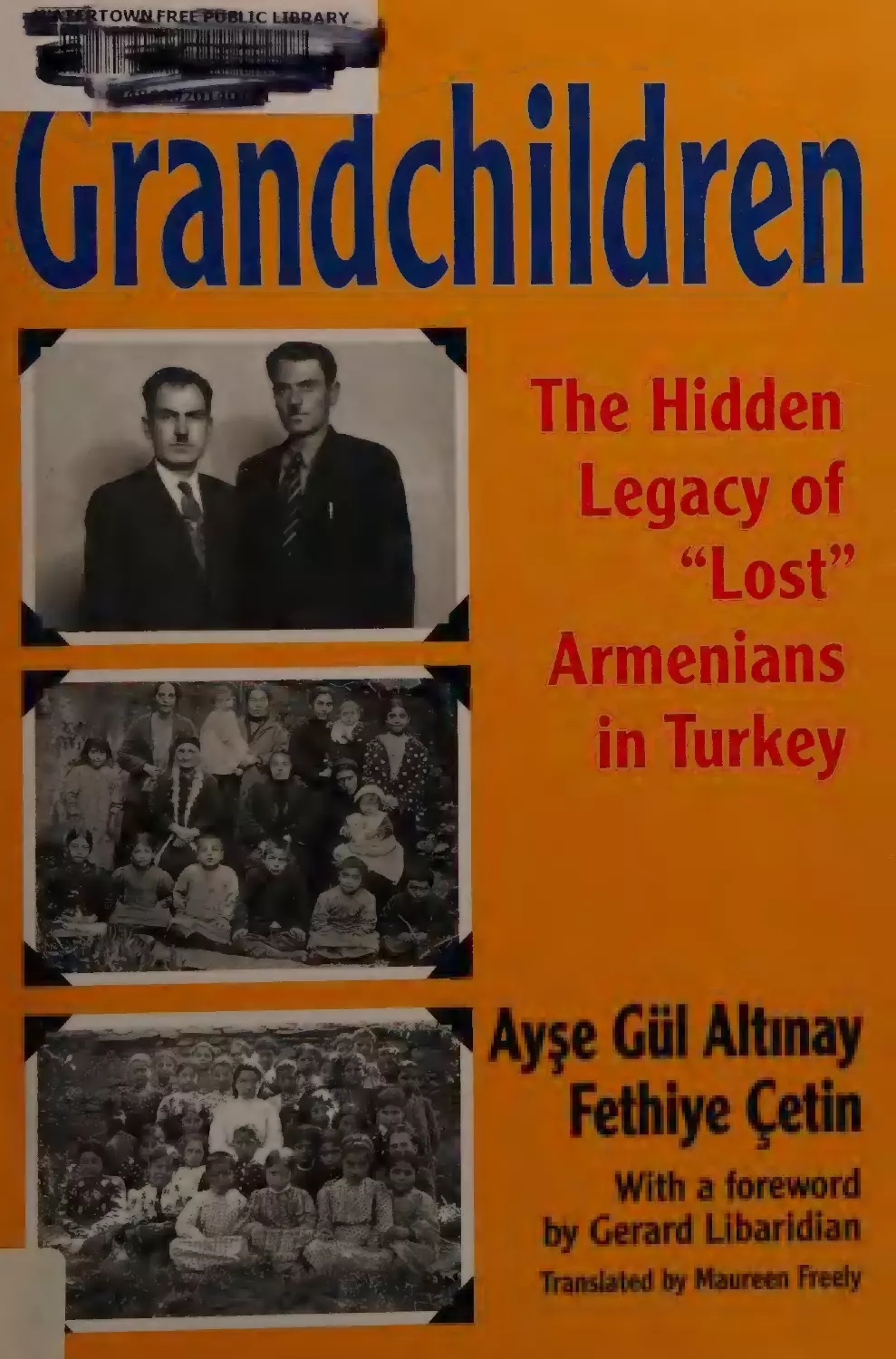
The Hidden

Legacy of
: Lost’
Armenians
in firkee

Cultura! Heritage
Histoy

Ethnic Studies

THE GRANDCHILDREN
The Grandchildren is a collection of intimate,

harrowing testimonies by grandchildren and
great-grandchildren of Turkey’s “forgotten
Armenians”—the orphans adopted and
Islamized by Muslims after the Armenian
genocide. Through them we learn of the
tortuous routes by which they came to
terms with the painful stories of their
grandparents and their own identity. The
postscript offers a historical overview of
the silence about Islamized Armenians
in most histories of the genocide.
When Fethiye Cetin first published her
groundbreaking memoir in Turkey, My
Grandmother, she spoke ofher grandmother's
hidden Armenian identity. The book sparked
a conversation among Turks about the fate
of the Ottoman Armenians in Anatolia
in 1915. This resulted in an explosion of
debate on Islamized Armenians and their
legacy in contemporary Muslim families.

The Grandchildren (translated from Turkish)
is a follow-up to My Grandmother, and is an
important contribution to understanding
survival during atrocity. As witnesses to a
dark chapter of history, the grandchildren
of these survivors cast new light on the
workings of memory in coming to terms

with difficult pasts.

ee
eS
Ole

Grandchildren

Armenian Studies
Series Editor, Gerard J. Libaridian

Seta B. Dadoyan
The Armenians in the Medieval Armenian World. Paradigms of
Interaction

Volume One: The Arab Period in Arminyah, Seventh to Ninth Centuries
Seta B. Dadoyan

The Armenians in the Medieval Armenian

World. Paradigms of

Interaction

Volume Two: Armenian Realpolitik in the Islamic World, Eleventh to
Fourteenth Centuries
Seta B. Dadoyan
The Armenians in the Medieval Armenian World. Paradigms of Interaction

Volume Three: Medieval Cosmopolitanism and Images of Islam Thirteenth to Fourteenth Centuries
Crime of Numbers.

Fuat Diindar
The Role of Statistics in the Armenian Question
(1878-1918)
Dikran Mesrob Kaligian

Armenian Organization and Ideology under Ottoman Rule:

1908-1914

Lisa Khachaturian
Cultivating Nationhood in Imperial Russia. The Periodical Press and
the Formation of a Modern Armenian Identity
Transaction has been publishing works in Armenian Studies for many
decades. The list of titles listed above include only those that have been
released under the general editorship specified above, since 2008. Other
Armenian Studies titles include works by Yair Auron, Vahakn Dadrian,
Richard Hovannisian, Gerard Libaridian and others. For more titles,

please visit www.transactionpub.com.

Grandchildren
The Hidden Legacy of
“Lost” Armenians in Turkey
Ayse Gul Altinay
Fethiye Cetin
With a foreword by Gerard Libaridian
Translated by Maureen Freely

Transaction

Publishers

New Brunswick (U.S.A.) and London (U.K.)

Copyright

© 2014 by Transaction

Publishers,

New

Brunswick,

New Jersey.

All rights reserved under International and Pan-American Copyright
Conventions. No part of this book may be reproduced or transmitted
in any form or by any means, electronic or mechanical, including
photocopy, recording, or any information storage and retrieval system,
without prior permission in writing from the publisher. All inquiries
should be addressed to Transaction Publishers, 10 Corporate Place
South, Piscataway, New Jersey 08854. www.transactionpub.com
This book is printed on acid-free paper that meets the American National
Standard for Permanence of Paper for Printed Library Materials.

Library of Congress Catalog Number: 2013042796
ISBN: 978-1-4128-5391-0
This edition is an authorized translation from the Turkish language
edition published by Metis Publishing Ltd. Ipek Sokak No.5, 34433

Beyoglu, Istanbul, Turkey. All rights reserved.
Printed in the United States of America

Library of Congress Cataloging-in-Publication Data
Torunlar. English
The grandchildren : the hidden legacy of “lost” Armenians in Turkey
/ edited by Ayse Gul Altinay and Fethiye Cetin ; translated by Maureen
Freely.
pages cm. — (Transaction Armenian studies special series)
Originally published in Turkish as: Torunlar / Ayse Gul Altinay,
Fethiye Cetin. Beyoglu, Istanbul : Metis, 2009.
Includes bibliographical references.
ISBN 978-1-4128-5391-0 (cloth : acid-free paper) 1. Armenians—
Turkey—Interviews. 2. Armenian massacres survivors—Turkey.
3. Turkey—Ethnic relations. 4. Collective memory—Turkey. I. Altinay,
Ayse Gul, 1971- II. Cetin, Fethiye. III. Freely, Maureen, 1952-, translator.
IV. Title.
DR435.A7A65513 2014
956.1’00491992—dc23
2013042796

Foreword
AFSC

dsty/

roa!

to the Purkivh
Altiris

Jena

Insts *VO

OPEwWOM

tr)

—

[ric

-

fdirior
Parise

Ulla

ISR E To

gg MEST

Hrant

Dink © cay

ares
inloving
memoee ry

Aype Gill Alnnesy and Fetiniew

Cot

32

noiiedtidug mal

vii

‘

;

Prefecy
to the Tuckish Edition, Fechive Cetin
i
J
toe, Sx
Acknow
ladyar
ents

«

.

»

;

af

. .eae
=

=a

|

Tatroduction 6 the Transaction Edition, Gerard Lanidian
me ¥

al

ei

six

This publication was made possible by a generous grant from
the Dolores Zohrab Liebmann Fund

Contents
Foreword to the Turkish Edition,

Ayse Gil Altinay and Fethiye Cetin

xi

Foreword to the Transaction Edition,

Ayse Gil Altinay and Fethiye Cetin
Preface to the Turkish Edition, Fethiye Cetin
Acknowledgments
Introduction to the Transaction Edition, Gerard Libaridian
Guide to Turkish Pronunciation
Map

XXXvi

The Stories
The First Time You Hear It, You Want to Go Out

onto the Balcony and Shout, Baris
It’s a Terrible Thing to Have Had My Origins Hidden
from Me, Deniz
All This Hiding Makes a Person Feel Insecure, Arif
If They Were the Ones Doing the Plundering, They Would
Have Taken Their Gold with Them, Riya
Thousands of Women Share This Story, Giilgin
Why Did My Father Have No Aunts, Uncles, or
Cousins?, Niikhet

The Grandchildren

In the Media, They Use “Armenian” Like a Curse

Word. That’s So Horribly Hurtful, Naz

54

Because You Have This “Other Identity,’ You Go into

a Cold Sweat, Wondering What Is Going to Happen
to You, Qesra Kiso Ozlemi

Do

I Found Out That My Grandmother Was Armenian
while Doing My Military Service, Mehmet

71

The Infidel Girl Bedriye’s Son, Bedrettin Aykin

75

You're Living Your Life. One Morning You Wake
Up and Go to Your Death. How Can You Explain
Something Like That?, Zerdiist

78

People Must Accept the Facts about Their Lives, Ay¢a

85

Silent All Their Lives, as If They Had Committed

Some Crime, Giilsad

94.

My Grandmother Was Named Vartanus,
Her Sister, Siranus, Vecibe

104

Today Is the Day When Armenians Color
Their Eggs Red and Pass Them Around, Halide

109

My Grandmother Was Discovered Sitting
Underneath a Tree in the Mountains at
the Age of Four, Murat

113

Let Me Honor His Memory, Even If It’s Just
Two Lines, Henaramin

Ti

Why Are There Only Grandmothers?
Why Don’t They Ever Have Families?, Sima

121

Now Why Would This Sort of Person
Tell a Lie?, Salih

128

Vili

Contents

It Can't Be Easy, Living with That on Your
Conscience, Melek

136

Our Children Need to Learn from History, Asli

150

We Have Yet to Create a Philosophy in
the Name of Peace and Brotherhood, Ali

is7

Can I Look at the History of Ordu through
My Grandmother's Story?, Berke Bas

169

We're Digging Up the Past for the Sake of
the Future, Elif

183

Postscript

Unraveling Layers of Silencing:
Where Are the Converted Armenians?,
Ayse Giil Altinay

197

Bibliography

217

Commentary, Maureen Freely

223

Glossary

225

.

ru

a
i
‘mer * & hs POcRGIVLI
>

.

Nees

Attn Bd

AMY,

Ty
=

-

x

t

ae

-

fe

fF

ah

z

‘2

Pa

‘*,

f

Y

4aP

ya 4 Kary

ad

OG

—

rit?

Tear

es

‘SRS >

Loving Your

ie.

%,

Ss)

bO@riaiion
‘tif

rt

a

#
ey

sa)

J ite

al

.!

.SanSMO2NGw

aout

wt

}

oe6
:

‘

}

of 90%
Pin

bose $uee%

io

avert vf
wrnntd as

sinaAlh

orth

Psv5

oh hK; WII

Oo ren‘a

ri ors

t6 Han}

jiap

,

Me oad: ais chsi)na tat) qu yeu ‘TY aii

One

Marihwe You Wake

Lipa i> tp foee Destty, ie:«at,
Smoetictts aes Cans Eee

stm

Viton)
"
:

tad wae)
if

§

uth what! cians éiborabasit mA

tat,

-

ote

rea

ihe Lats eT

|
oh

,

>

pi

ph

{ cticcal
M4

aia

eae

im!

by?

9

wares

WE. s1wii ot

Tow Deon

Zardubgiraiaet

:

7h

Preys Siuat Accom te Faets shout Thar eek beageys! grdlevereld

SansironirA borane? oftA seed
scp, LG weigh

; ees 1 Whats Lives, as TP They btad Committed

_

Foreword to the Turkish
Edition
Ayse Gul Altinay and Fethiye Cetin

This is not an easy book to read. The stories that follow were painful
to tell, painful to hear, and painful to set down on paper. Only a few
of the grandchildren we met were willing to share their stories in this
volume. For those who agreed to do so, it was anything but easy, at
least emotionally. And one had a change of heart very close to the
time of publication. When this person informed us of her decision,
we could hear deep fear and anxiety in her voice. Despite the fact that
her story would remain anonymous, thus keeping her identity safe;
this “grandchild” had been too deeply marked by the conflicts she had
witnessed in the first decades of her life, not to mention the forced
migration of her family from their Kurdish hometown in the 1990s, and
the struggle to make a new life elsewhere, for her fears and anxieties to
abate. The suffering of her Armenian grandfather was not in the past;
three generations later, it was still shaping her present and her future.
This is not a book about 1915 so much as a book about what Hrant
Dink described as being “stuck in a well 1915 meters deep.’ It is a book
that traces the deep scars that people living in these lands today still
carry from the humanitarian catastrophe of 1915—and that finds them
in the most unexpected places.
Almost a century later, what does it mean to be a grandchild of those
who survived 1915? At least as important is to ask what happened next:
what have these survivors had to endure, these grandchildren, parents
and grandparents, their neighbors, and their friends? A hundred
years on, why is it still so difficult, so painful, for grandmothers and
grandfathers (or mothers and fathers, or any of us) to own up to our
Armenian heritage? If we found a way to face up to this pain, and to
this silence, would this free us to identify other silences, other sources
xi

The Grandchildren

of anguish, bringing them to the surface by putting them into words?
And could this process help to assuage yet other pains and silences
before they have a chance to fester?
The narrators of these stories invite us to speak among ourselves,
and with our families, our friends, and our neighbors, to listen to each
others’ stories.
First, they told us their stories, face to face. Some of these meetings
were over in an hour; others went on for much longer. After telling us
how they came to find out that their grandmothers or grandfathers were
Armenian, they described how they shared this information and with
whom, and what effect it had on them at various points in their lives.
Together we discussed what we knew about 1915 and the Armenian
presence in our lands, and what we thought about the public debates
of recent years, identifying together the breaking points and meeting
points, the times of hope and despair, and our dreams for the present
and the future. Some of these grandchildren found their own way to us;
others we approached ourselves. Most were not people we had known
beforehand. It was while talking to them that we discovered how much
we had yet to learn even from those we thought we knew.
We tried to listen carefully to these stories, asking few questions.
Whatever they wanted to tell us, that was what we wanted to hear.
When we set them down on paper afterward, we tried to preserve

their particular way of speaking and the warmth of their voices. The
narrators of the stories then looked over our drafts, made the necessary
corrections, selected their pseudonyms, and gave the stories their final
shape. Having noted that two women with the same grandmother had
been very differently affected, we interviewed them separately. We
had originally hoped to bring Ayca’s and Giillii’s accounts together in
a single chapter, but because our recording of the meeting with the
granddaughter calling herself Gillit was damaged, we were not able to
do so. So, in the end, we added the part of her account we could save to
the end of the story by the granddaughter calling herself Ayca. Hence,
this book is composed of twenty-five stories in twenty-four chapters.
In almost every story, even where the names of the towns and
villages have been changed, we have tried to identify the province in
which it took place. There were several occasions when those sharing
their stories were ready to disclose their identities, but in the end, we
decided it would be better not to reveal anyone’s identity. Only the
two people who had already put their stories into the public domain
(Bedrettin Aykin and Berke Bas) appear here under their own names.
xii

Foreword to the Turkish Edition

Along the way, there were many surprises. We had expected to be
interviewing the grandchildren and great grandchildren of Armenians
who had individually joined Muslim families, but we came to discover that there were many other routes to surviving the catastrophe
for which they had so many names—convoy, relocation, expulsion,
migration, exile, slaughter, massacre, genocide, or just “those days.”
There were lone survivors who found each other and married or
somehow ended up in the same place. There were those who converted
with their families or fellow villagers to Islam, continuing their lives as
Muslims, and there were those who had later gone back to live inside
or outside Turkey as Armenians or Assyrians. We met people who had
remained Muslim but continued to have relations with family members
who had gone back to living as Armenians or Assyrians, and people
who had lost contact with their families under similar circumstances.
We listened to the stories of those who had re-established contact with
their Armenian mothers and fathers but had chosen to remain with
their “new” families. And of course, we heard about many others who
had never been given such a choice, and who carried through life with
the hope of seeing their families once again...
We spoke to a great number of grandchildren in Adana, Adiyaman,
Amasya, Ardahan, Artvin, Bingol, Diyarbakir, Elazig, Erzincan, Erzurum, Eskisehir, Gaziantep, Istanbul, Izmir, Kayseri, Konya, Malatya,
Mardin, Mus, Ordu, Siirt, Sivas, Tokat, Trabzon, Tunceli, Urfa, and Van.

Though they do not all appear in this volume, all were generous with
their stories, telling us not just about their own lives but about their
grandparents, about friends who were children of Islamized Armenians, about villages and neighborhoods entirely made up of Islamized
Armenians. These families/villages/neighborhoods often had a policy
of “not marrying out.’ Some people with this background, we were
told, went on to become involved in radical Islam or ultranationalism.
Though some of our narrators linked the rise of religious or nationalist
extremism in their families or societies with a desire to suppress their
feared Armenian heritage, others told us that these orientations had
less to do with their heritage than with recent political developments.
Almost all the grandchildren spoke of being deeply marked by the
fear and sorrow they had endured, by the silences in their families, by
the secrets they had not dared to share with anyone, and by the strain
this had put on their relations with others. Most spoke openly, even
angrily, of how painful it had been, to have to hide the truth about
themselves and their families for so many long years. But each one had
xiii

The Grandchildren

experienced and made sense of these processes in their own way. Some,
after discovering the truth about their heritage, spoke to us about how

it had led them to question their identity and beliefs; others spoke of
feeling “liberated.” There were, amongst our interviewees, some who
began to think of themselves as Armenian, while others found beauty in
their mixed heritage, or expressed the desire not to be boxed in by any
identity whatsoever. Just as we heard from people with a wide range of
backgrounds and experiences, we saw a great variety in the way these
grandchildren defined themselves.
Many spoke of other sorrows. There was Aznif, for instance, whose

beloved husband was killed before her eyes in 1915, who then had
married a Muslim man escaping the war in Russia, and endured great
suffering, surviving by extracting wheat grains from dung. There was
the grandfather, who after marrying an Armenian by force and later
expelling her from the house with her two sons, would in the 1940s be
exiled by the state on account of being a Kurd, and would die in exile.
There was Kiso, whose Armenian

family had suffered the violence

perpetrated by the Hamidiye Regiments, but the Islamized Armenian
grandmother was so alarmed by the subsequent Armenian reprisals
that she had fled from Mus with her children to take refuge in Silvan.
There were Asli, who, in the course of investigating her Armenian
grandfather, discovered that her mother’s family, who she had thought

to be Kirmanci Kurds from Sivas, were in reality Zazas who had changed
their identity after fleeing from Erzincan; the many from Zaza and
Kirmanci Kurdish families who had suffered detention, torture, and

deportation, especially since the military coup in 1980; Ali, who, after
suffering unspeakable torture that he could not share with anyone as
a young man, had forged a bond with his grandmother, who could
not share her story either; and Ash, who, when she recalled taking
her husband home from prison, made a connection between her own
first-hand experience of the “Return to Life Operation” in an Istanbul
prison and that of 1915. There were also the patriarchal practices that
so many grandchildren identified and criticized as they described
their grandmothers’ suffering; their allusions to violence visited on all
women; the suffering of other women in their families who were forced
to accept their Armenian grandmothers as second wives; the suffering
that these women visited on those Armenian second wives; as well as
the rare stories of the friendships they struck up with them...
As most of those sharing their stories in these pages suggest, any
effort to present a hierarchy of suffering, or offer competing claims, or
xiv

Foreword to the Turkish Edition

to set out to decide which sort of suffering is the worst, is impossible,
pointless, and problematic. On the contrary, the grandchildren in this
book invite us to give equal importance to all the suffering they describe, to look for the ways in which these different forms of suffering
are linked, and to work together to bring an end to them all.
It was Hrant Dink who extended this invitation to all the peoples of
Turkey most powerfully; it was while we were working on this project
that he was cruelly taken from us.
In death, as in life, Hrant Dink continues to exert a deep influence
on our work. In an article he wrote after Hrant Dink’s death, Ara Arab-

yan likened his death to that of Martin Luther King, who had a dream
about a world in which everyone could live in peace, as equals. Hrant
Dink had the same dream for the world, and for Turkey. His dream
for Turkey embraced all its peoples, be they Turks or Kurds, Muslims,
Jews or Christians, Roma, Alevi, Sunni, male, female, gay, lesbian, rich
or poor... The mutual love between Hrant Dink and his Anatolian
brothers, sisters, and friends was not the exception but the rule. He liked
to call it the voice of conscience: “The voice of conscience, of reason,
has been buried in silence,’ he said. “Now it is looking for a way out.’
We hope that the doors opened by our beloved, much-missed Hrant
Dink and by his wife Rakel, who grew up in a nomadic tribe speaking
Kurdish, will never close, and that we shall all continue to work together
to open yet more doors...
2009

Istanbul

a

aS

ns

eg! Let vedpiexste

vy it hh eer
$5

a

Sieg 8 shih
fg

mais Saas

dae Potten aeieag

Ageia: tedaayGh

oath eae Aeodt

«Sta Beste OANA haha

ey <4 ng wtih

at

ett bad

eM

odo kop,

‘siping a
sae wilnelbasoidties sheciugtrecietw
adhd tet niendbiry
SING) Seat a gas sal ett 8 SO aesuse watephate
rag
psi

phoiiagt

eo

shel

oes ons odpik

AVES

eS,

careles apnee Aph gi!ae 2aseat

weRead Oequeieas,

ea

dot] temsH od nb ae Hteob al

ath ie tickle ABE? Uege op.it aaon 7 coc iaied eased
rere, age
seta
f
é bethoatw Qe Minbiitinl ea ele ancdd oa stesp aiebterinaal pow
hein?

iol eB Oct

Oe Robo nen eROMe rte

borane. wal},
sansMegha bate habivigge ciel

hbbtiearournia

ihraiehar Bewttssay mgdCiewh veut

stele, Pied esis eislh sch teiqed echSeas teprdoote yaolad Liew}

a

RS agen

:

sone

i

wage Se" 2~o—s

roremonianstients ean ere

omiroisnsicy use Tracing feos Eexincay, A Hilo hese re

re

nt

erate

PLR
ny

ie

ty

;

De.

»

ws

—_

a

ty

‘-

.. eae
ve

S

44

gn

3
.

ae

eS ae>

in.

“pee

.

Ta
ple ‘iy

2

’

> Oi)

ae

ATES SyUi Si Raia ta ase

al

al

ee

Sn

ay a

4,
i.

Ly

-)

"

.

5
~

-

Pr mya

‘>

Foreword to the Transaction
Edition
Ayse Gul Altinay and Fethiye Cetin

From Whispers to Flowing Waters
Fethiye Cetin was an adult woman when her grandmother Seher
started talking to her about her life as Heranush. This initial moment of
shock (“my grandmother is originally Armenian”) was followed by years
of painful sharing. The grandmother was telling her granddaughter
things that she had kept to herself for seventy years. Then, it was her
granddaughter’s turn to recite this story in her own inner voice, until
she was ready to share it with friends, and finally, to write it down for
the whole world.
Cetin remembers her years in military prison after the 1980 coup:
“when I was telling my friends in prison about my grandmother, I would
speak in a whisper. We were very courageous women, undertaking a

courageous struggle against the military coup, and yet, we could only
talk about my grandmother’s story in a whisper.”
It was almost thirty years after she began her slow and painful investigation into her grandmother's “other life” that Cetin published
Anneannem (My Grandmother). This was November 2004, just months
before the ninetieth anniversary of 1915. And indeed, as we discuss
in the postscript, 2005 would be a turning point in Turkey in terms
of both the emergence of a national public debate on 1915 and the
fate of Ottoman Armenians, as well as the recognition that a significant number of Armenians had survived the genocide by becoming
Muslims.
In the eight years since the emergence of the public debate on Islamized Armenians, at least eighteen books of memoir, fiction, and research

have directly addressed the issue. Among them is this volume, whose
first Turkish edition sold out in two months. Currently, in its second
ss

The Grandchildren

edition, it has also been translated into French and Eastern Armenian.
In the meantime, Anneannem has been translated into eleven languages, reaching an increasingly global audience. In November 2013,
the Hrant Dink Foundation organized an international conference on
Islamized Armenians in Istanbul, the first international conference to
be held on this topic.
This new visibility comes with its own questions: Why now? And
why not until now? How can we account for the growing interest in this
particular group of survivors? And how should we understand the nine
decades of silence—a silence shared by Turkish, Kurdish, Armenian,
and international scholarly communities and publics? The postscript
is a first attempt at answering these questions.

Here, we would like to share two other trajectories, one disturbing
and tragic, and the other perhaps more hopeful. The tragic trajectory
ends with the enormous loss of Hrant Dink, the Armenian journalist,
writer, intellectual, and dear friend to us both, and most especially to

Fethiye Cetin, who was at the same time his lawyer. He was killed on
January 19, 2007, in front of Agos, the prominent Armenian Turkish
newspaper he had cofounded ten years before. Dink’s and Agos’s trou-

bles with state institutions have a long history, but 2004 was particularly
fraught, marking the beginning of his tragic end. It was in this year that
he published the controversial story about Sabiha Gékcen, Mustafa
Kemal Atatiirk’s adopted daughter and the world’s first woman combat
pilot, being an Armenian orphan of 1915. Soon after this story was
republished in a major daily, Dink and Agos started receiving threats.
The harsh declaration of denial published by the Military Chief of Staff
was followed by demonstrations by ultranationalists in front of the Agos
office and law cases being filed for Hrant Dink’s various speeches and
writings. Three years and several court cases and defamation campaigns
later, Dink was taken away from us.
As shocking as his assassination was, the funeral, which brought together close to 200,000 people walking eight kilometers from the Agos
office to the Armenian cemetery where he would be buried, caused

great nationalist anxiety and debate. This silent mourners carried two
signs, “We are all Armenians” and “We are all Hrant Dink,’ in three
languages (Turkish, Armenian, and Kurdish), drawing attention to the
high numbers of Turkish citizens who were ready to challenge the basic
claims of Turkish nationalism by identifying politically as Armenians,
as well as to the possible number of Islamized Armenian descendants
among them.
XVili

Foreword to the Transaction Edition

By 2007, there were already several books on Islamized Armenians
in the public domain, and these had initiated public debate. Dink
himself was greatly excited by this “unsilencing” of one of the most
commonly shared “family secrets” since 1915. He had been personally
involved not just in Fethiye Cetin’s own search for her Armenian relatives but in the international matching of stories of Armenians and
their distant Muslim relatives in Turkey, witnessing both the life-shattering traumas and life-changing reunions. During the last dinner
Ayse Gill Altinay and Hrant Dink shared, only a few weeks before his
death, he talked at length about the foreword he wanted to write for
this very book. It gives us great pain to present this book without his
foreword...
One of Dink’s many remarkable qualities was his eternally hopeful
disposition, which was underpinned by a very powerful politics of
hope. When he first published the obituary written by Fethiye Cetin
for her grandmother in Agos, he was hopeful that this would initiate
a whole new process of coming to terms, as well as a process of family
reunion. The 219th issue of Agos in June 2000 has the news of Cetin’s
first conversation (over the phone) with her Armenian relatives in the
United States, the Gadarian family, as one of its front-page stories.
Right on top of it is another that features Gerard Libaridian’s recent
visit to Istanbul, where he speaks about the prospects and challenges
of a lasting peace process in the Caucasus between Armenia, Turkey,
and Azerbaijan. One can say that the creative collaboration that has
led to the English publication of this book is the fruit of a match made
by Dink (and Agos) more than thirteen years ago.
The whole back page of the same Agos issue carries a very moving
piece by Archbishop Mesrob Ashjian, who initiated the search for the
Gadarian family of Habab, (known as Havav village in Palu district in
its original Armenian rendering), his own hometown, after reading
the obituary by Cetin published in the French Armenian newspaper
Haratch. He writes about both his personal response to Cetin ’s and
Heranush’s story, and the cold reception of this news by the Diaspora
Armenians. Archbishop Mesrob Ashjian, who we have recently learned
was a dear lifetime friend of Gerard Libaridian, is no longer with us.
Like Dink, he would probably have been moved even more deeply by
the recent gatherings of Armenians, Turks, Kurds, and others in his
village Habab, to work for or to celebrate the restoration of the two
historical fountains that had been ruined after the tragic removal and
massacre of the Armenians of Habab in 1915.

The Grandchildren

Habab, officially renamed as Ekin6zii, was Fethiye Cetin’s grandmother’s village. Upon reading her book, several villagers of Habab,
including the owner of the property on which the ruined fountains
lay, contacted Cetin and asked her to visit the village and help them
restore these fountains. The restoration of the Habab fountains constitutes a unique example of engaging with the Armenian heritage
of Anatolia. The first “civil” effort to restore an old Armenian

site,

the Habab restoration process was undertaken by the Hrant Dink
Foundation, and Cetin personally, with the support of both local
villagers and officials, and of the National Ministry of Culture and
Tourism.
Yet, it was no easy process to engage any of these actors in a poten-

tially unsettling project of creating an alternative local memory. After
a long process of obtaining official permissions and support, Cetin
and her project partners from the Hrant Dink Foundation, spent four

months in Habab, convincing local villagers and officials, and engaging
them in the restoration project, as well as coordinating the inflow of
volunteers from Turkey and abroad, including Armenia. In the end,

the fountains were opened in November 2011 with ceremonies on two
consecutive days—the first day with local officials and male villagers,

as well as journalists and members of the Dink family and Hrant Dink
Foundation; the second day with feminists from different parts of the
country and the women villagers. Many villagers identify the second
ceremony with women and children as being a historic day, particularly
for the women of the village.
A third ceremony around the fountains took place in May 2012, this
time with the participation of more than one thousand people from
around Turkey, the Armenian Diaspora, and the surrounding villages.
When it was time for singing and dancing to songs in Armenian, Kurdish, Arabic, and Turkish, not all of the local officials felt comfortable
joining in, but the villagers and their guests from Istanbul and from
around the world had already filled the space by the constructed stage,
making it difficult to move.
Anoush Suni, who has done ethnographic research during the
restoration process, argues that “the restoration project represents a

triple act of resistance, firstly as it creates a space to acknowledge and
give voice to silenced histories, secondly through its gender activism

in placing women’s stories at the center of the project, and [. . .] finally,
through the physical reconstruction of the fountains, the project is
confronting and reversing processes of destruction.”!
xx

Foreword to the Transaction Edition

Can one reverse the processes of destruction beyond physical restoration of select sites? Can one relieve the great pain endured by the
Armenians of Anatolia and by the Islamized survivors, who could barely
“whisper” their stories to their children and grandchildren, if at all? Can
one repair the deep anxieties, pain, fear, and suffering that fell upon not
only the converted survivors, but their loved ones who survived in the
diaspora or in Istanbul (with, or often without, the knowledge of their
survival) or their children and grandchildren whose lives continue to
be shaped by such feelings? It is not possible to answer any of these
difficult questions with a “yes.”
Even so, the stories in this book also point to the ongoing survival
of hope, along with love, courage, compassion, and curiosity. What
gives us hope is that the grandchildren who share their stories in this
book have expressed great relief upon reading the whole book in its
original Turkish edition and finding out that they were not alone. Since
the publication of the book, many others have come forward, asking
us to publish their stories as well—some turned out to be old friends,
who for the first time were sharing this aspect of their lives with us.
Since its publication, the book has not received a single negative public
response in Turkey, apart from a review published in the book section
of Agos, criticizing us for not being “political” enough in pushing for
the recognition of the Armenian genocide. As this critique suggests,

the public debate in Turkey since the early 2000s has experienced a
major transformation.

The flowing waters of the Habab fountains bear witness to this transformation at the very local level. From whispers to flowing waters... .
It has not been easy, and it has been the most vulnerable who have paid
the highest price, most catastrophically Hrant Dink himself. This book
is dedicated to his loving memory . .. We continue to be inspired by
his courage, sincerity, and his powerful politics of hope.
May the waters continue to flow—washing away barriers, touching,
connecting, transforming, soothing, healing...
October 2013
Istanbul

Note
1.

Anoush Suni, “Renovation as Resistance: The Restoration of the Habap
Fountains” Conference presentation, Hrant Dink Memorial Workshop
2012: New Forms of Social Protest, Istanbul, May 25, 2012.

++ Preerye ys av

ap ey
hou: BF bepeverr cee Mechs
wiplstamct peti esliedpenedo tise
heat th abete
ioband do attanerties,
Sanaatsb fee! orev hitians act]

$e Bed Phd

bor

i dork yr Ra tec eeket hey obtthin spashieuthenss
ae
2useher weetsis vig he eckirting)

ere

se Ata oRtyaD So lt Ehcae

tried wan tite me dagen} bed tha Mer moaoretih
) rer abee:vinsage Raden toe’ telah biaedt bets dhevbrisad

RID
4

rites Mit, 28 Ht then papoose yb botizdeced

wont efficients: qué of tho

ae at Yb tistwcgmathsigstalemdah

ner gioge wii 0% Inion uEls toud sid? ti esitone st oe na:

A

eer: Bape: peaDe
aee
ORE

sdb

grote: ageckin

dite doods: aigks pause rebertorbini
sige 1 ES isetnhhsepebey dulnigr

ilendeedcke hil sale grabsnrtivd ethertescgbsmhepppeGatid
md
santieungkusen SSMeNE
gs
T Fes NiteSanbP ae shesAatatt destiny

wernt arsibnrnoo anesyk

6 re regen,
"i
ae
ie oherpie
Said

Phen ar as. A
"iy ig
~

Mi

ae. a
2

:

fart
_

7

i

~

.

Paes

ad

”

‘a

=

star

By)

rt

tae sg

in } ey

sal

;

a

ee

ali iti i Keak ed

Rega

9

rc “hare:

!
tie ap Cyr 8
Ben
isi thers aesalri ate i
en

a

a

Ce

ee

<

jg

"

ea
ma.
7,

ee

p>

1
.

ete
Lilie

ee

uP

Preface to the Turkish
Edition
Fethiye Cetin

When I wasa child, my grandmother would take me by the hand and
together we would set out on journeys. The place we went most often
to, during our summer holidays, was Cermik, where my grandmother
had ceased to be the Armenian Heranush and began to live as Seher,
the name by which she would continue to be known for the rest of her
life. This was where she passed from childhood to adolescence, where
she married and gave birth to her first children.
For me, Cermik meant going to houses where my grandmother
engaged in endless conversations while I played in gardens full of fruit
trees and secret hiding places; it meant branches laden with fruit, and
fruit laid away in secret stores.
Many years later, my grandmother took me out on a journey very
different from the ones I had known as a child. There were no gardens
on this journey, no games or jokes. We went to other places, to witness
other scenes, and though they were shocking, painful, and distressing,
they were, in equal measure, illuminating and liberating.
This journey did not end just with new questions: it offered a chance
to be free of the limits and chains of official history and official ideology,
and of the nationalist mentality from which they sprang; at the same
time, it offered an opportunity to escape from all forms of captivity,
and cross all borders.
My own journey began when I heard my grandmother's story. I went
on to make other discoveries; I confronted difficult truths; there were
lines I had to cross and chains I had to break, just as there were deeply
concealed prejudices to overcome; it was a journey that cleansed my
conscience and put me in touch with my humanity, and it is not over

The Grandchildren

yet. It still offers me a chance to restore and enrich my understanding
of what it means to be human.

Many others traveled with me. With only our hearts as guides, we
moved forward together, keeping our eyes open, asking questions, making discoveries, and sharing them; we cried together, laughed together,
and—most important of all—we learned together.
When my grandmother was first telling me her story, she would
pause after each painful memory, and fall into silence, before saying,
“May those days be gone, and may they never come back.” When you
first hear these words, you like to think that no one could ever object
to them, and that everyone surely must agree, but putting this wish
into practice is not as easy as it first appears. It is a formidable process,
but it is a duty we cannot shirk.
If we really mean it when we say, “May those days be gone, may they
never come back, and may no one ever have to live through them ever
again,’ then there is a way forward, and it begins with understanding
the past.
This is the first thing we must do if we are to understand what it is
that must go and never come back, we must first know what those days
were all about, and what it meant to go through them.
What My Grandmother Recalled

From the time she first shared her story, my grandmother spoke of
lonely, forgotten, silent men and women who had been taken away from
their parents and their families and all those they loved—taken away
from everything they knew, in short—to live, one might say, among the
enemy. She spoke of their being never quite accepted and so suffering
as a consequence, and she spoke of the longings she and so many others
carried with them throughout their lives.
These men and women revisited their painful memories in the silence
of their own hearts, and if they sometimes confided in those whom they
knew best, it was only in whispers: they did not dare speak louder about
the traumas of the past. They were not able to hear their own voices.
However, there were those, and there are many examples of this,
who did not wish their painful experiences to be forgotten. When they
were old, or on the brink of death, they whispered the whole truth to
those closest to them, thus liberating themselves from the inner voice
that had for so long been locked inside them.
We, the grandchildren, who have inherited those sorrows and trau-

matic memories from our grandmothers and grandfathers, are aware
XXiV

Preface to the Turkish Edition

that our voices can be heard, and so they will be. Our voices have echoed
throughout these lands and beyond.
The stories of other grandparents who shared that fate have been
told now. They have made their way into books and documentaries
that have themselves crossed borders. My own book has been translated into seven languages.' In all these languages, the book went into
second printings.
The Power of Stories

Hundreds of grandchildren came to me with stories about their
grandparents that are similar to mine, often through channels that
boggle the mind. Mostly, we were meeting for the first time, but we
opened our hearts and shared our stories, and by the time we parted,
we felt as if we had been friends for forty years. In spite of all the differences between us, we were able to savor together the reawakened
consciences, the intimacy, and the enchanting strength that their stories
brought.
After I published My Grandmother in 2004, people would come up
to me wherever I went, sometimes even stopping me in the street, and

what these many hundreds of people told me was that they had begun
asking themselves this question: “Why is it that my grandmother had
no relatives, why was she all alone?” Or: “Why do I know nothing about
my family’s history before my grandfather?”
From the moment we first entertain the idea that our grandmother
or grandfather might come from another religion, or another ethnic

group, from the moment we begin to wonder if a grandparent belongs
to a group defined as “the enemy”—that is the moment when we can
no longer think of that group as the “other.”
That is when we want to know more about the history of the land
in which we grew up. That is when we start noticing details that until
that moment were lost on us: names, monuments, and ruins all start to
mean something. We notice a local history that doesn’t match up with
official history. It becomes apparent that the claim to ethnic purity is
one great collosal lie.
My Grandmother isa story set in Turkey but its sorrows are universal.
That is why it has affected readers in all languages it has reached, and
why all readers have found in it something of themselves. When we
went to speak in other countries, we heard of many similar sorrows,
especially from the Second World War, in packed rooms where mothers
and grandmothers shared their stories.

The Grandchildren

Since publishing My Grandmother, | have met up several times with
friends and others from the town where I grew up. Each hada story to
tell, and when we realized that, until that moment, we had not shared
the stories our elders passed on to us—that, until that moment, we had

not known each other well enough—we were shocked.

The Grandchildren’s Stories That Can Finally Be Shared
It might seem otherwise, but you will soon see that the present
book is turned not toward the past but to the present, and not toward
death but toward life. It does not seek to draw us into dark thoughts;
rather, it offers hope. That is because this book does not belong to the
grandparents. It belongs to the grandchildren. At last the grandchildren
have a chance to talk about how they were themselves affected by the
sorrows their elders passed on to them, about how they have carried

them through life, how they propose to talk about their painful history, and how they can find a way to move beyond them. Each of their
stories affects us in a different way, but together they call to mind Paul
Rusesabagina’s* matchless words:
We cannot change the past,
But we can make the future better.

I hope that these stories will serve as an encouragement, however
small, to listen to each other’s sorrows, and seek to understand them,
and in so doing, to work toward a better future.

May those days never return, and may we always know peace in a
world of freedom and justice
* Rusesabagina (b. Ruanda, 1954) saved the lives of roughly 1260 Tutsis
and Hutus during the genocide that began on April 6, 1994.

Note
1.

Since this text was written for the original Turkish publication, this book
has been translated and published in three more languages.

Acknowledgments
This book is a direct descendent of the human rights lawyer Fethiye
Cetin’s memoir, Anneannem (My Grandmother). Published by Metis
Publishing in 2004, Anneannem tells how Fethiye Cetin discovered
in adulthood that her grandmother was Armenian. After sharing her
grandmother's story, she goes on to describe how it affected her, and
how it changed her life. Many others with similar histories got in touch
with Fethiye Cetin after reading the book. In 2005, we began to seek
out these and other grandchildren, to listen to their stories.
We would like to thank them all—and most particularly the
twenty-five individuals who agreed to share their stories in this
volume—for their courage, their candour, their sincerity, and their trust
in us. Bedrettin Aykin and Berke Bas did more than share their stories,
having also enriched our work with their poems and films.
Miige Giirsoy S6kmen, the cofounder and editor of Metis Publishing,
and Nadire Mater, writer, journalist, and the cofounder of the independent news service, Bianet (bianet.org), have been actively involved in

our project from the very beginning, offering their thoughts, helping
us with our research, and listening. We did two of the interviews together. It was thanks to their support that we were able to persevere.
They inspired us and gave us courage throughout our journey, and for
this, we are deeply grateful.
Many others helped us in various ways and to various degrees along
the way. We would like to take this opportunity to thank Hakan Altinay,
Nebahat Akkoc, Yektan Tirkyilmaz, Berrin Eza, Zeynep Taskin, Nusret
Karayazgan, Erdal Karayazgan, Htilya Adak, Yesim Arat, Sevgi Adak,
Nazan Maksudyan, Serkan Yolagan, Asli Erdem, Fulya Kama, and
Burcu Yoleri. Our sincere thanks also go to Ragip Zarakolu for getting
Bedrettin Aykin’s books to us so quickly, to Rober Koptag for helping
us with Armenian transliteration, to our editors, Mie Giirsoy S6kmen
and Semih Sékmen, to Eylem Can for her corrections, and to all those

working at Metis Publishing.

The Grandchildren

For the map that accompanies the English translation of the book,
we owe a special thank you to Semih S6kmen and, especially Emine
Bora, as well as Metis Publishing House. They prepared a special map
for us during a very busy time of book fairs. We would also like to thank
Miige Girsoy Sékmen for seeing us through the translation process,
offering her advice and support whenever needed.
The English translation would not have been possible without the
patient commitment and hard work of Maureen Freely and our book
could not have had a better translator: a writer herself, an Istanbulite,

and someone who has deep insight of how minds work and hearts beat
in the many worlds depicted in these stories. We are truly grateful for
her adoption of this book and her extraordinary translation. We are also
grateful to Amy Spangler and Anatolia Lit for pursuing the long journey
of this translation effort and bringing us together with Transaction
Publishers and Gerard Libaridian. In the end, it was Gerard Libaridian

who made it all possible. We are truly humbled and honored by his
dedicated efforts and his careful reading and editing of the whole book.
It is a special privilege for this book to be introduced and edited by
Gerard Libaridian, who has weaved many paths of creative, yet difficult,
conversations across many borders. We cannot thank him enough!
Finally, we would like to thank Transaction Publishers for adding

this book to their impressive collection of similar work from around

the world. It is one of those rare instances of the name of the publishing house (together with its philosophy) adding to the meaning of the
work itself. May this work inspire and enable many more transactions
across real and imaginary borders...
2009/2013
Istanbul

XXVili

Introduction to the
Transaction Edition
Gerard Libaridian

The Grandchildren is one of those precious works that bring history
down to the level of actual people. Here history is no longer the interaction or conflict between abstract ideas and ideologies, or between
peoples, nations, states, and classes; rather, history becomes the story
of actual individuals, in whose name ostensibly conflicts are fought,
wars waged, and killing, raping, enslavement justified. It is remarkable
that almost a century after it was implemented, the policy of the Ottoman Empire's Union and Progress party toward its Armenian subjects
continues to tear apart not only states, peoples, and communities but
also so many individuals from within.
This work presents oral histories of twenty-five grandchildren of
Armenians Islamized during the First World War as a result of the
policy of the Ottoman Union and Progress party that has now been
generally recognized as genocide. The testimonies collected in this
work have been as difficult to read, to translate, and to produce, as it
must have been for the editors to collect. But no such task could be
more agonizing than the lives lived that are presented here. For these
stories—each a monumental historical document in itself—tell us of the
agony of knowing as well as the excitement or fear of knowing more.
Knowing that one of their grandparents was an Armenian in some cases
engendered excitement that more knowledge would explain things
in their lives and free them from the constraints of a state imposed
identity; but in other cases that same prospect brought out fear that
knowing more would destabilize their identities to a degree that they
could no longer be able to manage the multiple dimensions that make
up those identities, the ones they have learned to accommodate since
childhood.

The Grandchildren

Defined as Turks by a state that inherited the policies of the First
World War Union and Progress government—and justified them—
these grandchildren display the whole range of human emotion: From
anger to a quiet acquiescence, which they hoped would allow them
to return to their “normal” lives; from a certain satisfaction in being

different in a way that made an alternative Turkey possible to the fear
that this hidden legacy could imply claims on their lives. In some cases,
fear was based on more practical concerns: when responding to their
dominant non-Armenian roots, a few grandchildren were concerned
about the imagined return of Armenians to reclaim properties that
belonged to the families of the returnees and now belong to those that
had remained behind and become something else. The connections
between “Turks,” who happen to be third generation descendants of at
least one Armenian grandparent, and the state, are complex and tenuous. Challenging the state has been difficult in Turkey since Ottoman
times. Very costly, too.
Yet, the state in this case has been an abstract concept, while the

lives of its subjects and ostensible citizens have been real. The lives
presented here, of descendants of those who survived because they
were forced or compelled to deny their identity, at best marginalized
but mostly ignored Armenians, should be considered an integral part
of the story of what happened in 1915 and thereafter. It appears, too,
that they should be an integral part of history, since they now count in

sufficient numbers in Turkey to have become the subject of oral history
projects as well as of political interest.
The original “outcasts” were survivors of what was to be termed
as the Armenian Genocide as far as their lives were concerned. They
went on to live and have children and grandchildren. In that sense,
they survived the massacres and deportations; they were survivors.
They were also survivors to the extent that their initial identity might
have been suppressed as far as the external world is concerned, it could
not have been suppressed internally, making the trauma they lived
doubly painful. Yet, in another sense, they did not survive genocide,
since they had to live their lives as something other than as an Armenian. This distinction is not one that can be used to argue, in any way,

against the characterization of what occurred during those years as
genocide. As Ayse Gil Altinay, an editor of this volume, reminds us in
her Postscript to this work the forcible transferring of children of one
group to another is legally defined as an act of genocide. Indeed, these
stories confirm the characterization of the planned massacres and
XXX

Introduction to the Transaction Edition

deportations of Armenians during the First World War as genocide
directed against subjects of the Ottoman Empire that the latter had
defined as Armenians.
These are not only stories of those descendants of Armenian women
but also of some men who wanted or agreed to talk. We do not have a
reliable number of Armenian women and children who survived the
genocide as a result of these children’s mothers turning them over to
Muslims, or they themselves being abducted or being victimized by other,
similar circumstances. The question remains: Are the twenty-five stories
in this work representative of the total number of descendants of Armenian grandparents? The editors—collectors of these oral histories—do
not have such a claim. The stories of those who are not willing to go
public may be harsher than those told here. A sense of personal dignity
and honor, of family loyalty, of fear of social ostracizing and state sanctions, and possibly above all, the genders of those who were likely not
to be killed and likely to share later with family may explain the silence
of so many others who would have additional stories to give to history.
In a lecture delivered in Jerusalem in 1980, Archbishop Shnorhk
Kalousdian, Armenian Patriarch of Istanbul (1963-1990), estimated
that there were some one million Armenians who had “consciously

and willingly” adopted Islam as their religion and severed ties with
Armenians and things Armenian. The Patriarch lecture makes it clear
that this number does not include (a) Armenians “who accepted Islam

three generations ago” and live as Kurdish ashirets or clans and marry
within the group; (b) Armenians who willingly or unwillingly became
Muslim and yet have preserved a sense of their Armenian identity and
prefer to return to their original faith should circumstances permit,
and these are Armenians who, once in Istanbul, insist on changing the
designation on the identity cards from “Muslim” to “Armenian’; and

(c) Actual Armenians from Anatolia who have kept their Armenian

identity despite the serious problems such an identity creates for them.
“The Armenian community in Istanbul is made up largely by such
Armenians” who came from Anatolia, asserted the Patriarch. (.. .)’

The corollary question is what distinguishes the ones who agreed
to talk and to recognize their Armenian heritage, even under aliases?
We see a preponderance, though not exclusively so, of families that
are otherwise marginal to the dominant definition of Turkishness:
Kurds, Alevis, Assyrians and socialists. This crossover between ethnic,

religious, and political identities is not incidental, given the history of
Ottoman and Republican Turkey and the history of where challenges
XXxi

The Grandchildren

to state hegemonic identity and to official narratives arose. The overlap
of class, religious, and ethnic identities is evident in this volume but has

not been so obvious to social scientists. We can gleam, through these
stories, at the interchangeability of family, ethnic, religious, and class
identities—and the blurring of lines between these various, ostensibly
conflicting identities. Yet, these individuals exist and live, produce and

reproduce. Interestingly, many grandchildren remember their converted grandparents as extremely devout Muslims. It will be difficult
to determine whether such behavior was a form of self-defense for the
grandparents ora transference of the piety that was very much of their
family life earlier, when they still had and were with their Armenian
Christian families. There is no doubt that these children and young
girls kept many of the traditions, from Christian holidays to the cuisine
that they had learned earlier.
It is not surprising, therefore, that these grandchildren also display
a common array of events that impacted their lives and evolving sense
of identity, to the point where they felt free—or compelled internally—to speak. There are a number of events that seem to be etched in
the memories of these grandchildren, events that they or their parents
and grandparents lived through.
¢
¢
¢

¢

¢

¢
«

¢

The 1894-1896 massacres of Armenians in the Ottoman Empire.
“1915, one of the formulas used by many to refer to the massacres
and deportations of Armenians during the First World War.
“Sept 6—7,’ the anti-Greek riot and pogrom in Istanbul in 1955
instigated by the Turkish government.
Armenian Secret Army for the Liberation of Armenia (ASALA), the
organization responsible for many acts of terrorism against Turkish
diplomats and institutions, 1975-1983.
1980 coup d’état by the Turkish military that deposed the elected
civilian government of Suleyman Demirel.
My Grandmother (Anneannem the original Turkish version),
a memoir by Fethiye Cetin, an editor of this volume.
“2005 conference,’ the first gathering of scholars from Turkey critical
of the official line on the Armenian issue.
The personal TV appearances and assassination of Hrant Dink, the
highly respected Turkish Armenian journalist and intellectual.

Grandchildren remember and contextualize historical events differently. We find echoes of the official Turkish state interpretation of
events—after all that is what they were taught in school or told in the
XXXii

Introduction to the Transaction Edition

media—and sometimes of the battles being fought between those who
deny that what happened was genocide and those who insist on it,
largely outside of Turkey. The grandchildren in this book are more likely
to use euphemisms for major historical events such as the 1894-1896
massacres and the more calamitous massacres and deportations that
began in 1915. They are also likely to get some things wrong. Terroristic acts against Turkish diplomats and institutions (1975-1983) are
ascribed solely to ASALA, just as it was done prescribed by the Turkish
state, when in fact the Justice Commandos of the Armenian Genocide

was as responsible as the first. We must also remember that these are
oral history testimonies with all the advantages and problems that such
sources represent as sources of larger historical phenomena.
More recent events often act as unifying points of reference. What
we notice, in many cases, is the conjunction of the continuing fear of
the state in these citizens, which is paradoxically induced by the real
and ostensible fear the state displays for its security.
It is also remarkable that there is hardly any discussion of the reason
or reasons for what happened to Armenians during the First World War,
which, after all, is the starting point of the all the stories in this volume.
In some cases where there are references to causality, it is a repetition
of the Turkish state argument that Armenians constituted a threat to
state security. By and large, a certain fatalism dominates the discourse.
The editors of the volume have highlighted a major dimension of
what they recorded: the significance of gender in the process that
destroyed most of the Armenian population of the Ottoman Empire
but especially of Anatolia and made it possible for some to live through
that process and continue living in Anatolia itself.
We need to add two points to their analysis. First, indeed the existence of these grandparents and grandchildren not only raise serious
questions regarding Turkish identity, which the editors have presented
judiciously, but also challenge what has been traditionally defined as
the Armenian identity, often associated with the Christian religion.
Armenians in the Diaspora are used to mixed marriages of Armenians
with non-Armenians and will more often than not accept the offspring
of such mixed marriages as Armenians, especially if the offspring is
interested in Armenian affairs. Yet, the overwhelming majority of
these mixed marriages are with other Christians and to a lesser extent
with Jews. It has been more difficult for Armenians to reconcile with

mixed marriages with Muslims and far more painful in cases where
the non-Armenian Muslim is also a Turk or a Muslim who ended up
Xxxiii

The Grandchildren

with an Armenian during and as a result of the genocidal process in
Anatolia. In her Postscript, Ayse Gil Altinay discusses the problems
that women who had been abducted and had borne children from
non-Armenian Muslims faced when they returned to the Armenian
world. Nonetheless, we believe much more research is needed before
a determination can be made regarding the extent of rejection of such
women by the Armenian community. Research in the area of Muslim
Armenians has accelerated in recent years and one can only hope that
it will extend to related issues that have been taboos in Armenian life.
Second, many of the grandchildren mention the destruction of
Armenian cultural and religious structures—churches, cemeteries,
etc.—in their villages and towns, often doing so with obvious pain.
Such events provide grounding to their memories and the ties they
still feel toward the culture of their grandparents and make it difficult
not to consider that culture as part of their own heritage and identity.
One can discuss, dissect, and quantify history and its meaning for

individuals. But no analysis can match the sheer humanity that can be
found in these stories. It is hard to emulate and reproduce a world where
one piece of information, just a figment of knowledge, can change one’s
self-definition and identity, create dilemmas in areas that were once

simple, and compel grandchildren to seek new strategies of survival,
just as their grandparents had been forced to do three generations ago.
The voices of these twenty-five grandchildren will bring that world
closer to us.

October 2013
Cambridge, Massachusetts

Note
1.

Karen H. Khanlarian, Hay Pnakchutyan Etnogronagan Verabrumnere Turkiayi Hanrabedutyunum (1923-2005) [Ethno-religious Transformations of
Armenian Inhabitants in the Republic of Turkey (1923—2005)], Antilias,

Lebanon, 2009. This volume, originally in Armenian, was also issued in
English in 2010. However, the English translation has some serious typographical and other errors that have changed the meaning of the original
text.

XXXiV

Guide to Turkish
Pronunciation
a@ as in “father”
e as in “pet”
i as in “machine”
o as in “oh”
u like the 00 in “boot”
t like the u in “but”
ii like the u in “mute”
6 as in German: schon
c like the j in “jam”
¢ sounds like the ch in “child”
gas in “get” (never as in “gem”)
£is almost silent, lengthening the preceding vowel
jas in French: jamais
s sounds like the sh in “should”

\_--7

Viuvoing

Inque}s|

eg

a

d1yasixsy

eev
S

d

Ved

aod

uaskey

|

%°

pat:

i)

dajuy

sesey|

Sens

JeSYIN

efsewy

a)

oF 0
of Om
J1VIs
—__

;

09

Od

00+

——_
wy

eun:

sing

snW:

:

uIpJey

diyequeniq HUIS"

uibzejey

‘OUNJOA

wnunziq

UBAIIS

jobulg

yalenig

Wad
ueweAipy

uaepey

Hlze|g
=:

:
eevee

*

;

M
SOUN

ueouiZziz:

sueysnwung

uozqes|

pouonuaW
Ul STYL
y

Luu
/WISsd:
|

unsail

-Bdeay

NPJO

unswes

sasey]IA

NVANVYYFLIGIW

;

Sulmoys‘sanity ‘suMo],
pue

ereyuy

Arestodur
Aaymy,
aquoD

ELOz Burysigng syew @

euepy

VINIWUYV

UPASIBA

The Stories

Va

aia.
8:

jaa
iGrew
tee
eo
aoe
setae
bs

Vitae
Wed
‘Pua?
Metaes
ie
Gace

«

The First Time You Hear It,
You Want to Go Out onto the
Balcony and Shout
Barts

Man, Aged Twenty-One
February 2009

We were sitting at home. My grandmother was in Istanbul just then.
My mother came into my room, and she saw My Grandmother on my
table. She said, “We have this book at home, you know.’
She had bought it for my grandmother, apparently; the book was in
my grandmother's house. My mother’s given name is Nadire; she was
named after her grandmother. And she has always hated this name.
When anyone calls her Nadire, she makes a sour face.
And now she said, “My grandmother’s name wasn’t Nadire, it was
Agavni.”! And I said, “What do you mean?” She sat down, and she told

me: though her grandmother had lived her life as Nadire, that wasn’t
her real.name. That was why my mother had never liked that name.
I can't tell you how shocked I was when I heard that. “Why have you
never told me this, all these years?” I asked her.
I’m twenty-one years old. For twenty-one years, I’ve known nothing.
Only that my grandfather hated Armenians, and that our surname
could not be more Turkish. I always thought we were Turkish through
and through. But it seems that the truth is very different.
Earlier on, I had tried to investigate our roots. Asking, “Where do
we come from? What sort of people are we?” But they told me nothing. My mother’s family is from Amasya, my father’s too. We have a
Turkish surname, so I assumed we were Turkish. When I was in high
school, my literature teacher singled me out as the only person in the
3

The Grandchildren

class who looked Turkish, who had a Turkish bone structure. I was the
one with the most Turkish face. (Laughs)

And why did they hide all this from me? . . . It was our family’s great
secret, that’s why. No one knew. But then, you see, I spoke to my grandmother. And she couldn't talk without crying. I found out a lot that
evening. What did I say first? I said: “Why didn’t I know any of this?”
Then I asked her to tell me her mother’s story. My grandmother had
known her mother only for her first ten years. She lost her so young. It
was a very big family; the youngest was my grandmother. There were
five or six brothers among those who died. My grandmother had two

children, my mother and my aunt. I am the only grandchild. And a
very lucky one, too.
“Now I Understand Why You're So Different,
Why You're So Beautiful”

Agavni’s husband was a judge, a Turkish judge, and she loved him
dearly. They had persuaded her mother in law to let Agavni marry him in
1915. Agavni was an accomplished seamstress. In 1915, when the deportations started, they strapped her sewing machine to her back, as if she
was a porter, and helped her escape. They say that part of the family
got as far as Armenia, and another part made it to France. But we don't
know any of them. My mother’s family could have tracked them down,

but they didn’t even try, they were too frightened. Much too frightened.
Until she told my grandfather, my grandmother had told no one.
She told him before they married. She said, “Listen, it’s like this. My

mother’s Armenian.” She knew my grandfather viewed Armenians as

the enemy. And he said, “Now I understand why youre so different,
why you're so beautiful” And they got married. It’s so interesting, don’t
you think, that this man who kept in his house a book on how the
Armenians massacred the Turks should have married this woman...
And no one else knows, not even my grandmother’s classmates from
primary school. My grandfather’s family has no idea. And my own
mother—she didn't tell any of this to my father’s family. They still don’t
know. If they found out, things could turn ugly...

So, this is how I found out. How did I feel, once I knew? Well, you
want to tell other people. You want to call someone and say, “Listen to
what just happened” You wonder who you should tell. Anyway, there
were classmates I could share this with. But Istill haven't said a thing to
anyone other than my closest friends. That said, it’s only been a month,
maybe a month and a half, since I found out.
4

‘The First Time You Hear It, You Want to Go Out onto the Balcony and Shout

Knowing All This, and Not Being Able to Tell Anyone
My grandmother, my mother, and my aunt—we got together to talk
about it. Suddenly, everyone wanted to talk. I was expecting to be the
one asking my grandmother questions, but my mother and my aunt
asked even more questions than I did. They were as curious to know
more as | was; they'd just never been able to say so. The first time, we
talked for about an hour about all this. Then my grandfather joined us.
In the beginning, before he joined us, I felt more comfortable. After he
came in, he did most of the talking. So the second half of the conversation was a bit unfortunate. My grandfather reads a lot on this subject,
but it seems to me that his reading is somewhat biased.
And to think there was a time when my aunt was so much under
his influence that she hated Armenians. She found out when she was
my age, in her twenties. My mother found out then, too, after she finished lycee. This was when they found out that my grandmother had
an Armenian aunt, Aznif. They found this out from her. “Aznif means
beautiful”* That's what she'd always say to them. They never asked
her why. Aznif always lived as an Armenian. How could someone not
want to ask some questions about that: we have an aunt, and she’s
Armenian. Aznif outlived my great-grandmother; my mother and my
aunt knew her.
My grandmother knew her own mother only up to the age of ten.
She remembers that she used to cry all the time, but very quietly. “She
never smiled. I can’t remember her ever laughing,’ she says. Then, her
eyes fill with tears. “I can’t remember her ever laughing.’ She didn’t teach
my grandmother a word of Armenian. Who knows how she managed
to stay hidden. And I imagine you had to hide really well, when all that
was happening. But it must have been easy enough for them to get
her Turkish identity, given that my grandmother’s father was a judge.
Then, my father told a story. This was interesting, too. When my
father was a boy, his paternal grandmother told him a story, about
how her husband had gone from village to village killing Armenians.
My father’s memory of all this is hazy. After he told us about this, my
father felt guilty, too ... He told this story with a smile, after a night of
drinking raki. My mother asked him why he was smiling, and then she
shouted at him, called him a murderer. I am the child of this dilemma.
To think they’re both from the same city. That's interesting, too. Icome

from a family with a Turkish surname, but at the same time, I feel like
I come from an Armenian family.

The Grandchildren

My grandmother talks about those times, too. When she was little,
there were still people living as Armenians in Amasya. But they were
viewed as second-class citizens. Some changed their identities or hid
them and stayed, even though there were others living as Armenians...
Honestly. How bad is that? I get upset just talking about it...
These stories are so interesting . .. Knowing all this, and not being
able to tell anyone... Pure terror. My mother says the same thing: “How
could I ever tell your father’s family? How could I ever share this with
them?” She’s always kept quiet about it. And in the end, who can / tell?
I can only tell you. Even our university, it’s full of nationalists. There
are only a few people at school I can talk to.
I can’t find out much about my father’s family, I can’t just go to my
grandfather and talk to him. He’d hide it. He’d probably say, “Nothing
like that happened.” He really loves me, so maybe I could get him to
talk. My father was involved in left-wing activity when he was younger,
and if my grandfather was such a nationalist, he probably didn’t give his
son his blessing. But whatever my father got up to, my grandfather was
a bit of a leftist himself. They’re a lot more nationalist on my maternal
grandfather's side.
My paternal grandfather takes a more historical line: he belongs to
the camp that says “they were the first to strike” He’s always reading
books like that .. . I’m not interested in people with those views. It’s
such a terrible thing, for someone to die, it’s not right to treat it like
just another topic for conversation. That’s what I think, anyway. There
are such terrible stories ... But I’m not the guilty party. Halil Berktay
said this in an article, and in my view, he was right. Even though I knew
nothing about all this when I read that article. I found out after reading
My Grandmother.

My mother was always buying books like this and sending them
to my grandmother. My mother reads Elif Shafak’s books, too, and
she gives them to my grandmother. She also read Margosyan’s Prayer
Beads and passed it on. My mother was following all this but without
my knowing a thing . . . It must have been something she shared with
my grandmother.
I Don't Have to Take Sides

Has anything changed for me, now that I know? I don’t know why,
but I used to have more ofa nationalist take on things. I’m just starting
to work things out, I’m finding out how much these people suffered...
I’m coming to see just how much the politics of Turkification affected
6

‘The First Time You Hear It, You Want to Go Out onto the Balcony and Shout

people, how much it hemmed them in. I used to take the nationalist
position. I'd say: “They killed us, too, they killed us first” You know those
nationalist videos they run on the Internet—they’re awful, disgusting.
I didn't approve of them, but I watched them, and I didn’t exactly hate
them. Now when I watch them, I get furious. The truth is, I used to
watch these things through nationalist eyes. Now at last I can think for
myself, I can analyze them myself. It’s so interesting . . .
How can I put it? I’m more at ease now. I don’t have to take sides.
This gives me an advantage. For me, it’s been something like a catharsis.
Somehow, it liberates you. Before, I was more narrow-minded; now,
I've started to see things more openly, more clearly. I think it affected
me more, to find out after reading My Grandmother. I’m not sure |
would have been this affected if I'd found out beforehand. I almost
feel proud, to know that “we have this story in our family” It’s nothing
to be ashamed of, after all. So I don’t understand why we're so timid
about it. But, you know, I think that at the end of the day people do
look at you differently. Even so, there’s no need for them to pull away,
or that’s what I think.
The people I told didn’t judge me, but there were a few amongst

them that I thought might judge me. They didn’t judge me because
they could see the emotional dimensions. From the time they were
children, they've been told that “we didn’t do it, they did” and after a
lifetime of inoculation, even the best people know nothing about what
happened and so they can’t begin to analyze it. My uncle, he hates it
that the word Turk is part of our surname, but even he made a remark
to my mother recently, saying “It’s good we killed them.’ I mean, people
just don’t know, no one knows. If only they knew the human story, they

wouldn't go around saying things like that. You'd have to have no soul.
How did My Grandmother affect me? I’m not sure I could say... It
took the story away from all those politicians, fighting it out over our
heads. And it showed me the human story. After reading Halil Berktay’s article, and then this book, I said to myself: “People lived through
these things, and they suffered so terribly.’ And then, when I heard the
stories from my own family ... The aunt I was talking about—Aznif.
They killed her husband right before her eyes. He dropped dead, right
in front of her. That’s why she saw Turks as the enemy. You live through
something like that, and of course, that is how you're going to feel.
The man was hiding on the roof of a wooden house. They shot him,

bang, just like that. His body slid down, and landed at her feet. And
she loved him so much... My grandmother’s eyes were full of tears,

7

The Grandchildren

when she told us what had happened to her aunt. This happened. . .
After that Aznif married a Russian. A man who'd come from Russia.
He went through terrible suffering, too. He extracted wheat grains
from dung and made bread with it and that’s how he was able to escape to Turkey. She married this man. But she no longer had the will
to love. She suffered so much, this poor woman. And the Russian had
suffered so much, too. My family is a very mixed bag, isn’t it?. . No
one’s trying to gather the facts. If they did... In the end, I found out
without asking. It was something spontaneous, after my mother saw
me reading My Grandmother. Otherwise, I could have gone another
ten years without knowing. Until then, no one said a thing, no one saw
the need to, I don’t know why.

A Twenty-Year-Old Secret

Until she shared her stories with us that evening, my grandmother
had spoken to no one about these things. Maybe she shared things with
her older brother, but no one else. At one point, her brother went to
France and found their relatives, and after that, there was an exchange
of letters. But by the time her brother died, they had lost touch. Her
brother’s wife had family in America. They were Armenians, too. But
for twenty years, both the brother and his wife kept quiet. Each one
thought the other was Turkish. How can people keep something like
this hidden for twenty years? My grandmother told her husband before
they married. But these two said nothing. They hid the truth, and they
lived in fear. Twenty years later, maybe they thought, best to say it, no
matter what the consequences, and they told each other. And that was
when they found out they were the same. They were truly shocked!
I need to do some more research on all this—my mother’s cousin
has some documents | need to see. I’m probably the only one in the
family who can take this on. My grandmother isn’t up to it. She’s only
just opened up, after all. But really, she seems more at ease now, too. I
can feel it. Anyway, this is what she said afterwards, “Before telling you
all this, I told no one.” She’d told no one, not even her friends. It’s because of me that we talked about it as a family. It really is interesting...
I don't know why, but I feel excited, just telling you about it... As I
speak to you, I feel excited...
My grandmother actually grew up in Merzifon. I’ve never been to
Merzifon, or to Amasya, and I'd really like to see what they’re like,
I’m curious. It’s so interesting ... Both sides. My Turkish side, and my
Armenian side. And my paternal great grandfather, with his military
8

The First Time You Hear It, You Want to Go Out onto the Balcony and Shout

connections, he would have been the one to give the order... Or maybe
he carried out the orders he was given. So you see, it is my conscience
talking here.
A Human Drama

Right now, everyone in my family has something else to say about
this Apology Campaign they’re running. Most think there’s no reason
to apologize. My grandmother isn’t in favor of it either, well, sort of.
What do I think? I can't, there’s too much pressure from both sides.
I’m sort of in favor. I’m in favor because it’s coming from individuals.
I’m trying to explain to people that it’s a matter for the individual. But
then you know, people view it as a political stance, they can’t see it as
individuals coming together to apologize, or that’s how it seems to me.
Whoever I ask, that’s what they said. I mean, the other side’s not so
pure either. The Armenians attacked a few towns, they killed people,
too. There are photographs and documents. So I tend to think that both
sides should apologize to each other. I’m not sure if that means I’m
still pretty much a nationalist? (smiles) . . . but it still seems to me that
things should come from both sides. I mean, one of my sides should
do it, as my other side has already done it. (Smiles)

People are very close-minded, and that’s whyI get so angry at people.
I am trying not to be too political. Because you see, the moment they
start this Apology Campaign, the human story disappears and people
can't delve deeper. And then, without investigating things, they start

forming opinions. And that makes me furious.
How could we keep things moving forward? People need to read
books like yours [Fethiye Cetin’s]. And you know, they need to understand it as a human drama. But how to make this happen? I don't

know—with movies, or plays? ... As I said, I don’t want to waste any
more time on the politics. It just seems to me that something more
needs to be done, and it needs to be mutual. In the end, the Armenians
are exaggerating, too . . . I’ve seen pictures on the Internet. They put

these organs in front of Ataturk. Or these pictures of people in America
holding placards saying, “You killed my grandfather!” They’re doing
these things without knowing, and we are, too. People need to inform
themselves but no one wants to. It’s the lack of communication that
makes all this happen, or that’s what it seems to me.
And then you have the media, sensationalizing everything. They
make everything look as bad as they can. All the channels do this. There
isn’t a single channel or newspaper offering a clear and honest point

9

The Grandchildren

of view, or a clear and honest account of what happened. That’s why
people can’t come together in a clear and honest way. They come to this
knowing nothing, and because of the things they’ve been taught and
given to read, the things they've been shown, like those idiotic videos,
things they’ve come to see as the norm, they see things in a more nationalist light. That’s why there’s a breakdown in communication. Like

those videos that led to YouTube getting shut down... There are these
videos made by Armenians, saying, you know, Ataturk was a traitor,
and so on. I saw them all, I followed all this. Or the videos we’ve made

here, saying “actually, they did it.” They use curse words. All this makes
things so much worse, it keeps us apart, I think. In a way, the Apology
Campaign is trying to stop all that, it’s about taking a stand. Actually,
that’s a good thing. In a sense, I support it, but I want the other side to
do the same thing... Actually, the campaign also needs to somehow
inform people. I mean, there are probably people who saw this, and
then did some reading and investigating and changed their views. That's
how it looks to me. And that’s how it was for me: it was reading a book
that led me to change my views entirely.

We're Not a Political Family
How did Hrant Dink’s death affect my family? Well, it didn’t have
much ofan effect at all. Of course, there was outrage. It was such a farce,

we were furious. But we're not a political family, not the sort of family
that goes out on marches. Of course, we condemned it, but, you know,
the idea of going there and... For example, when some of my mother’s
friends joined in with the “We are all Hrant, we are all Armenians”
thing, she just said, “What’s the point of that?” Maybe my mother was
afraid to do more. They’re still hiding things from my father’s family.
My father is an open-minded person. “I don’t see myself as a Turk; we
all belong to the same world.’ That’s what he says. My whole family is
open-minded. But because the people around us are narrow-minded,

we hold back. Maybe that’s what it is, but I don't really know...
I've only just started to find out about Hrant myself. When he died, I
was still pretty much in dreamland. Because we're not a political family
... Most families don’t like talking about these things, or sharing what
they know. It’s because we never talked about these things that it took
me such a long time to find out. We’ve only just found out, and it was
afterward that we did talk a lot about this Apology Campaign.
At the beginning of this year, I stopped seeing myself as belonging
to a nation. I just see myself as a person. I’m not a Turk, and I’m not
10

The First Time You Hear It, You Want to Go Out onto the Balcony and Shout

an Armenian. I feel no need to define my identity. That's why I feel
more comfortable now, actually. I even feel special. But I’m sure that

one day, after we have all agreed that we are all citizens of this earth,
they'll discover another planet, and then the big division will be between aliens and earthlings. Even so, people are slowly ... When you
see things opening up in Europe, you feel glad, of course. The world
is moving away from nationalism. Here we have our ultranationalists.
And there have been terrible things on the internet—that much is clear.
Information technology has made it easier for people to spread their
evil propaganda. With their videos, and so on. We Turks are easily
excited, we're inclined to fanaticism . . it’s almost a disease. Football,
for example. It’s deeply rooted in fanaticism. People kill each other.
That's why it’s so easy to spread fanaticism in this country. It also tells
you something about the Apology Campaign; it explains why it spread
so fast.
I want us all to understand each other, listen to each other, to be

patient, to have the chance to express our views. If we don't, it’s because
of all the pressure. There’s pressure on me, too. In the end, my family
isn't quite so open-minded. And there’s pressure from both my grandfathers, so much that I can’t even confide in them, can’t even open the
subject ... When they say something, you just swallow and pretend to
agree. They’re your family; after all, they're your elders. And you love

them. I love both my grandfathers, I really do. I can’t bring myself to
go to them and say, “Your people did this, your father did that.’ I wish
I could, but what would happen then? I really don’t know. I just think
people should know more about these things.

At the very least, the state and the media need to be more objective.
Right now, there’s no objectivity at all. I’m talking now about the state
as well as the media . . . but especially the media. They just push their
line. Children recite Our Oath at school, and then they go home to
watch television and get their nationalism on the evening news. This
is the game that defines the twenty-first century, if you ask me. They
brainwash us like robots and cut off communication. They take technologies that should have led to better communication and they use
them to stop us from communicating at all.
Aznif went to Armenia and found her family. She went and visited,
and after that, she felt better. “Oh, I feel so much better.” That’s what
she said. She was glad she’d stayed here, too. “It’s good I didn’t go, she

said. Why she said that, I couldn't tell. At the end of the day, this is
her homeland. Why should she leave Amasya? This is where your life
11

The Grandchildren

is, this is where you have set up your life. The ones who left, they've
started new families and new lives. What would life offer them, if they
came back here, I wonder? Of course, they should be able to come to

visit more easily, come and go without fear, at the very least. But what
a shame it is that they’re so fearful. It comes from this same breakdown
in communication ... And if people came here, and said, “In the old

days, my uncle, or my grandfather, had a shop here,’ then maybe the
Turk working in that shop today would kick him out, or threaten him.
So maybe they’re right to be frightened. Before those people can come
back, people here need to change their mentality. If you ask me, they’re
right to be worried right now about visiting, even. I’d be scared, if I

were them. And look at me—I have a hard time confiding in people,
I’m afraid, too. We have to share these things with everyone.
I See Myself as a Citizen of the World

The first time you hear it .. . you want to go out on the balcony and
shout. You hear it and you want to laugh. You say, how could this be
truth, how could I not know this. Everyone in our family discovered the
truth while we were at the university. That’s how it was for my mother
and my aunt, and for me, too. Finding out so late—it was a big shock for
us. I mean, first my mother finds out, and my aunt still doesn’t know.
She still hates Armenians, and she’s reading all these books . . . Then
she, too, finds out from my grandmother, somehow.
She’s all secrets, my grandmother. Really, she’s a closed box. But
now, it’s something we can talk about easily inside the house. Well,
maybe not too easily. Even I feel a little nervous when we talk about it
in the living room. I mean, you don’t know quite what to do, you can't
know how people are going to take it . .. 1 don’t think there’s anyone
who can listen to these things and not get emotional. And if you start
digging into your family history, what might you find out? How did
people hide all these things?
It’s hard to keep a secret. Personally, I find it impossible. We’re an
impatient family. We want to say these things, share these things. I guess
that’s because it’s so hard to keep a secret. It must have been really hard
for my grandmother. She told no one. What I find surprising is how
she found the courage to tell my grandfather. And that my grandfather,
even after reading all those books, told her she was “special.” But his
hatred was never personal, I think. For him, it was a political stance.
That’s how most people want to see it. They’re trying to avoid seeing
the human side. They don’t want to hear about it.
12

The First Time You Hear It, You Want to Go Out onto the Balcony and Shout

About a week before I found out, my grandmother celebrated her
fiftieth wedding anniversary. There were a lot of relatives on my grandfather’s side. The question I asked that day was, “Where are we from?”
And, “What are my real roots?” My grandmother must really have
wanted to tell me the truth, but because there were all those people
around, she couldn't.
It’s so interesting . . . 1 keep using that word because that’s what I
think, it really is interesting.
Does my cousin know, I wonder? I’m really curious. This is the
cousin whose grandfather did that investigation. I think they still have
addresses and phone numbers. Id like to get in touch, but how? Maybe
I should write a letter. If I tried to phone, I’d be worried about what to
say, and how they’d react, and if I'd be able to reach them. Or should I
go and see them? Would everything be easier if Iwent to them? This is
going to be expensive, but . . . (smiles) . . . it would probably be worth
doing. But how would they react, I wonder? It’s within our reach,
though . . . So the problem is really inertia, and all this secrecy. We
haven't made the effort.
So that’s my story... A part of it, at least. When I know more of it...
It started so suddenly, and now the facts are raining down on me. I
need to settle down now and think things through. Then, I'll do my own
investigations. My grandmother doesn’t know about this yet. The poor
woman has only just started speaking. But she feels better now. And
for some reason, so do I—after I found out, I felt better. It’s something
we can talk about now, inside the house.
The silence goes on, though. And that includes me. Three generations
later, the silence continues . . . I’m in the most interesting place on the
family tree. I’m where the two lines intersect. That’s why it’s so hard
for me to know where I belong. That's why I see myself as a citizen of
the world.
Notes
1.
2.

Aghavni, in the original Armenian; it means dove.
The Armenian name is Azniv; it means noble, gentle.

13

It’s a Terrible Thing to

Have Had My Origins
Hidden from Me
Deniz

Woman, Aged Forty-Five
October 2005

This was something that the family knew about but never discussed
outside the house. The first I heard of it was from one of my cousins.
She said, “Did you know you were Armenian?” Of course I didn’t. Dear
God, what sort of story was that? But I’d been reading quite a few books
on the subject. Taner Akcam’s book, for example, and also the things
that had been coming out in Agos. A girlfriend of mine worked at Agos
for a while. So I knew something about all this . . . but you know how
it is, you go through life without giving too much importance to your
identity, ethnic or religious. And then suddenly you come up against
something like this. My first response was “So what, what does it matter?” Or something like that. But then you begin to think...
I’m one of those people who love their father very dearly. So I couldn't
help but wonder how had he felt? Everyone’s talking about his mother,
and the child knows there’s something wrong, but he has no way of
knowing what. He must have known something was missing, he must
have longed to know, there’s no way he couldn't have had mixed feelings.
Maybe that’s why he always tried so hard to be accepted. For example,
there’s not a single niece or nephew that my father didn’t help. They
came and stayed in our house, and studied, took courses, and so on.
Maybe that’s what was behind all this: his longing to be accepted. At
the time, I just thought it was because he was a good man, but maybe
there was also this need to be accepted.

14

It’s a Terrible Thing to Have Had My Origins Hidden from Me

And then I began to think, what was it like for my grandmother?
You see, she ended up in the care of a consignment officer. Exactly how
did that happen? What did she have to endure? And what about my
grandfather? Was it really true that he married her out of love? Or was
it just to protect her? Why did he marry her, really? I thought about
this a lot. If what they say is true, he registered the marriage. He never
registered his first marriage. That’s how my grandmother’s name got
changed. All names were changed. No trace of her past remained. And
no one talked about it. I find that interesting. Why was it that all of
the registry offices in the entire region have burned down? It’s like that
everywhere. My mother’s family is from Harput. Their records have also
been destroyed in a fire. Why don’t any of them have birth certificates?

“There’s a Bit of Everything in Me. I’m Like the Mevlana!”
After I found out, I spoke to the family elders, I spoke to my great
aunt. They said things like, “I don’t have the faintest idea.” Underneath
their denial, I sensed a reticence. It must be terrible what this kind of
silence does to you. Just think of carrying something like that inside
you throughout your life, and you can’t share it with anyone. You can't
tell a soul. I mean, it’s hard to fathom what that might do to someone.
I’m not the sort of person who could do that. If I couldn’t share the
truth about my life, I just couldn't go on.
Not long after I found out, I asked an Armenian friend of mine.
“Can I take this any further? I mean, can I try to track down my father’s
brothers?” He said, it could be a little difficult. If they'd passed on a
few facts, then maybe. But with all his papers burned and lost, what
was I going to do? That’s what my Armenian friend said to me. “But it’s
enough just for you to know.” And that’s as far as I got.
My mother’s family is from Harput. A lot of people were exiled from
there, too. There was pillaging going on everywhere. People were going
into houses and emptying them. But my great grandmother said, “Don't
bring me anything from that house over there. Those people were our
neighbors.” In my mother’s time, even, children from both families
used to play. One still lives in Kurtulus. My grandmother's Armenian
neighbor. I don’t really know her story but she still lives under her own
name, Mari. She never changed it. So it’s that kind of story.
When we tell people we are from the East, they always ask, “Are you
Kurds?” My father was quite a wit. He’d say, “There’s a bit of everything
in me. I’m like the Mevlana!” But we never spoke Kurdish in our house,

for example. We don’t know any Kurdish. There might be some Kurdish

15

The Grandchildren

blood. But as I said, we didn’t fret about such things when we were

little. From our early years, we were in the world of leftwing politics.
So I had that sort of outlook. I wasn’t too interested in questions of
identity. So I never said to myself, let’s try and find out if we really do
have Kurdish blood . . . Sometimes, I’d say to my mother, “You're an
Arab.” My mother is fair-haired, with green eyes. “There's definitely
some Arab in you,’ I'd say. If you talked about being Arab or Kurdish
in our house, no one took offence, but to tell the truth, it made you a

little curious.
Generally People Bowed to the Wind

Here’s what I think. If you give people a lot of honors, there’s always
something behind it. People don’t get their share just because they’re
standing there being good. It’s possible that my grandfather owed his
status in his hometown to having been a consignment officer. What I
mean to say is that I don’t think my grandfather was as innocent as all
that. If a lot of people are going to be expelled from their lands, you're
going to have to give approval. And you're going to take one of them for
yourself. What could be behind it, taking someone like that? It could
be because she was a beautiful woman. He saw her and a moment later
he claimed her. You could say he saved her life, but at what cost? If he’d

asked her, she might have chosen freedom, she might have chosen to
die along those roads. You can’t know these things. That’s what I would
have chosen, if it were a conscious choice. “Whatever happens, let it
happen, I would have said. “At least I’ll be with my family.’ She won't be
able to share her memories, she won't be able to tell anyone what she’s
been through, she won't be able to say a word, she won't ever be able
to practice her own customs and traditions ... Not even to say, look, I

lived on the ground floor of that house, I lived in that very house. But
maybe she wasn't even given the chance to make that choice.
When I found out my grandfather had been a consignment officer,
this is what I thought: Someone was going to do this, if it wasn’t my
grandfather, they would have found someone else. I’ve met lots of
people like this. There’s one at the place I work. His father comes from
the Black Sea coast. He moved to a province near Van. And there, you
see, they made him mayor, gave him land and so forth. For people
like that, this feels like salvation. In other words, they have a choice.
Either you collaborate, and make a new life for yourself, or you go back
to crawling like all the rest. Because just think how things worked in
those days . . . it was all tied up with land. Either you were under an
16

It’s a Terrible Thing to Have Had My Origins Hidden from Me

agha’s thumb, or you were an agha yourself. Can you see what sort of
choice they were given? There would have been people who agreed to
go along with this. If it hadn’t been my grandfather, it would have been
someone else. They would have found people to do the job. There would
have been so many people willing to do it. I can’t know for sure, I can’t
know what excuse my grandfather gave back then, but it’s pretty clear
that there were plenty of people prepared to stoop that low. Hardly
anyone refused for ethical reasons, hardly anyone helped the victims.
Only a tiny number of people did that . . . Generally, people bowed to
the wind, they stayed silent. Somehow they all colluded. They picked

up land for asong...
For states to come to power, they must commit many crimes. That's
how it was during Ottoman times, and that’s how it was with the Turkish
Republic. It was the same in France, and in Germany. Those in power
commit crimes of one type or another to consolidate their power. They
carry on doing so. That's the way it is all over the world over. I’ve never
believed in the idea of separate races. There are no innocents. People
collaborate. What I think now, for example. . life is so interesting, isn’t
it... When I married my first husband, the Partiye Karkeren Kurdistan
(PKK) was always in the news. You heard about it in the papers and on
television every day. My husband was from the Black Sea region. He was
always railing against the Kurds. He was always standing up for pure
Turks or the army. One day, I asked him, “What do you think you are,
then?” I said, “Where you come from, there were lots of Greeks. Maybe
you're Greek yourself. Maybe you even know this, and to cover it up,
you attack the Kurds.’ And he stopped. Years later, after we had split up,
he married a Kurdish girl and named his daughter Berfin. (We laugh.)
These people who have taken this issue to the top of the agenda, I
mean, the ones who talk about “the nobility of the Turks”—underneath
all that, there’s usually humiliation, and exclusion. There’s unease. If

there weren't, they'd be thinking more reasonably.

The Only Thing We Can Do Is Share Our Pain
People are entitled to ask themselves if “something like that” has
really happened in the past: we know, after all, that recorded history
is not always correct. We're taught certain things, but then you take a
closer look and you see that, whatever historical era you're researching, there’s something under the surface. At the very least, you find
clues here and there that make you think, “What if?” . . . There is,

for example, my mother’s relationship with Mari. When I see that or

17

The Grandchildren

when I listen to my mother talking about her, I used to think “So not
all the Armenians belonged to those gangs and killed people, after all!”
I mean, there was something going on there, some of them must have
been militants, but you realize that not all of them could have been

militants. Like these days, we say that the entire Southeast is PKK, but
I mean, they can't all be bona fide armed PKK militants. That's the sort
of thing I’m talking about.
The only thing I can do. . . actually, the only thing that we and the
Armenians can do right now is to recognize what happened, and share

the pain. Can anything more than that be achieved? That sort of thing
doesn’t interest me. Like opening the borders, or suchlike . . . Isay this
as someone who is actually in favor of the borders opening . . . I’m
just saying that understanding what really happened and sharing that
knowledge is hugely important, if our wounds are to heal.
And we need to turn this into something we can talk about. To me
this seems so very important. Because people suffer most from not

being able to talk. There needs to be a concerted and positive effort.
Whoever can cast light on these matters should do so—that’s what I
think. The state should do the same.

. . If this is in our heritage, for

example, if we own property that’s rightfully theirs, we should return
it to them unconditionally. Because this is what's left of what they
had; these are their ruins. If people build their own happiness on such
foundations, any amount of evil can come from it. That’s my own view
on this. I mean, I haven't given the matter deep thought, but I think

the most important thing of all is to make this something we can talk
about. Maybe civil society could do something; there could be an initiative, something to create opportunities for people with an interest
in finding out more about Armenian culture.
Until this day, I’ve never thought of myself as a Turk, or a Kurd,
and right now, I don’t think of myself as an Armenian either. I don’t

feel like I have roots in a single place. At most, I feel an allegiance to
Maltepe. Maltepe, Istanbul—that’s what defines Deniz. Because I am
able to make a life for myself there. I can find places there where I can
be myself. Right now that’s where I identify as being from. Wherever
I go, I carry this sense of belonging to Maltepe with me. Never in my
life have I defined myself any other way.
It’s a Crime to Stay Silent, Too

To stay silent about such things is a crime, too. By staying silent, you
become an accomplice to the crime. I mean, you give permission for
18

It’s a Terrible Thing to Have Had My Origins Hidden from Me

them to be buried and disappeared. You give permission for them to
pretend it never happened. And if it had been possible to talk about
these matters . . . if we had had a chance to talk about these things
with my father, we could have shared so much more with him; we
could have had better times with him. We probably missed out on a
lot, passed over so much. We could have had better times with both
my mother and father. They witnessed all these things. If you ask me,
whoever stayed silent is guilty. My aunts are guilty, and my uncle, too.
Whoever knew all this and didn’t tell you, they’re guilty. No one had
the right to “protect” me. I don’t need any protection—let me make
that clear. I’m the sort of person who can protect herself. That's my first
point. And also, it seems to me that what these people are really doing
is protecting themselves. By hiding all this from me, how exactly were
they protecting me, I wonder?
If I'd known about this sooner, if it had been something we could
talk about at home, everything would have been different, I think. We
could have been more open with each other, for a start. As you can
see, I’m getting really angry right now. If things had been different, I
wouldn't be feeling this anger. And also, I believe it’s important for
people to be in touch with their real feelings. Confronting this silence
has been a huge disillusionment for me. A really huge disillusionment. About my own family. Because I was proud of my family...
They are all educated; they educated themselves. One became a staff
colonel. Another is a lycee graduate. My aunt is a voracious reader.
It makes a person proud to see they belong to a family so interested
in culture. Then suddenly your eyes are opened . . . That this could
happen in a family likes ours . . . The truth is that it’s been a great
disillusionment, to find out that even families like ours can harbor
secrets.

If we had been able to talk openly, our relations with each other
might have been more straightforward. In spite of all his flaws, I love
my father. I understand his flaws. It doesn’t stop me from loving him.
He would have done the same as me, I’m sure. The others might have
accepted him with all his flaws, too, if they knew. Of course, you can't
know what might have happened. But for me, it would have made an
enormous difference to know and to be able to talk to him: I would
have felt more at ease. I could have traveled down this road sooner. I
could have gone and tracked down my relatives, don’t you think? And
say I'd found one more relative. It might not sound like much, but why
should I have been deprived of this?
19

The Grandchildren

Why should they have been deprived of this? Give them a chance to
get back in touch with the relatives they left behind. Maybe they'd see
a bit of their sister in me, right? Doesn't it happen like that—suddenly
you see an expression flash across someone’s face, or a smile that we
know from somewhere. We could have had this chance. We could have
thrown our arms around each other and cried. Or maybe we wouldn't
have liked each other at all. We might have turned our backs and left.
But we have no way of knowing how it might have been. Who had the
right to keep us deprived of all this? It’s so ridiculous. And distressing.
It’s so very distressing.
I think about my father. Maybe he had no one he could ask about
his mother’s origins. What sort of person was he? Very sad. It’s on his
behalf that I am so angry with the people who kept this hidden. You
say it. At the end of the day, I should be able to make my own choices.
I should have that right. Instead, it was hidden away, hidden away until
the day someone throws it at you. That’s what my cousin did, when she
told me, she just threw it at me. “Did you know you were Armenian?”
Just like that. Like a slap on the face. I don’t know. . . If | had found
this out another way, in more open circumstances, then maybe I’d
feel differently. What I feel most right now is anger. I’m angry with
the people who hid this from me. I won't ever know the truth about
what happened. How could a thing like this happen? What actually
happened? So many questions . . . If |had known the truth all along,
I wouldn't be in this turmoil. Everything would be in its place. At the
end of the day, I am not looking to point the finger. I mean, I’m not
interested in establishing that it was the Turks, not the Armenians. But
it’s a terrible thing, to have had my origins hidden from me. I am who
Iam. So there you have it. That’s my story.

20

All This Hiding Makes a
Person Feel Insecure
Arif

Man, Forty-Five Years Old
September 2005
My maternal grandfather was from Diyarbakir, and he was a man
of religion. What I mean to say is that, in Ottoman times, he taught
Persian in a mosque; he was a religious intellectual. I don’t know how
it happened, or how they met, but my grandmother was an Armenian
girl. In other words, there was this well-known man of religion and
he married an Armenian girl. Of course, my grandmother converted;
five times a day she did her prayers. Her real name was Sogomin.'
Actually, it was from this business of her name that I found out she was
Armenian. I mean, I knew we had Armenian relatives but I had no idea
why we had Armenian relatives. Because it didn’t seem so strange: our
neighborhood was half Kurdish and half Armenian. During Ramadan,
we'd send them food, and at Armenian Easter, they’d send us breads
with red eggs in them.
I found out by accident when I was a child—I was taking my grandmother to the hospital and I happened to glance at her identity card.
Next to her name was another name I couldn't read. I was in primary
school at this point. I read this name but it looked foreign. We used to
call her “neno.’ “Neno,’ I said. “What does this say?” “It says Sogomin.”
Her real name is Sogomin. Other Armenians had two names, too:
Ohannes would have a second name like Orhan. So she said to me, “A

long time ago, I was Armenian, and then I converted, in other words
I became a Muslim.’ But she used to pray so well—five times a day,
without fail.
Something I feel bad about this, and can never forget it: she had a
sort of innocence about her, and she always worked hard to be accepted.
21

The Grandchildren

She took an interest in each and every one of us; it would never have
occurred to her to scold us. If one of her grandchildren said, “Let's go,”
to her, she'd rise from her sickbed and go. Her daughters, her daughters-in-law—she’d run to help them all. She'd do everyone else’s work
for them. After my grandfather died, my father became the head of
the family. He had the greatest love and respect for my grandmother.
Everyone was moved by it—this love he had for his mother. That's why
she never had any trouble in the family, despite being a convert. But
she still worked very hard, by her own choice.
Asa widow, she had no house of her own. She lived with us. She was
the one who taught all the daughters-in-law how to cook and things.
No one could cook dishes as tasty as hers—there were no arguments
about that. That's the way it was, even though she was very old. It was
my grandmother who made the Meviiit pilaf and wedding dishes of the

Muslims in our neighborhood.
My grandmother lived until she was about seventy. I know she kept
on working until the last six months. She was scrupulously clean. She
was a big influence on us when it came to cleanliness. | mean, she was
an example to the whole neighborhood when it came to how clean a
toilet should be, how clean a kitchen. She would show the neighbors
how white you could get your sheets and quilt covers, and how to wash
clothes. In those days, there wasn't detergent or anything like that. |
remember that they'd call her over to the washing pots, and she'd go
with a big jug, lifting everything up one by one and checking if they
were clean enough.
The Cousins Who Lived in the Church

I never heard her speak Armenian. She just spoke Kurdish. My
grandmother's siblings were still alive. On holidays, my mother would
go to visit her aunt. She and her aunt were identical—like two halves of
an egg. The aunt's family lived as Armenians, and they lived in a church.
On Sunday, they had services. There were two churches in those days.
Now they've been reduced to rubble. Until a certain moment, let’s say
until I was fifteen or sixteen, I played with their children. They came
from a village near Diyarbakir, this was their village. My aunt's children
would go there and come back with wheat and things. And they'd give
some to us, saying, “This is your share.” The children tended to be
jewelers or stone masons.
These cousins were always in and out of our house. Then most of
them moved to Istanbul. This was probably after 1980. In the end,
22

All This Hiding Makes a Person Feel Insecure

there were just a few of them left in our neighborhood. But because
they were in the minority, no one treated them badly, that would have
been considered wrong. So, in that sense, we could all come and go as
we pleased. My father set the example, to be sure: everyone knew that
they were under his protection.
My grandmother was a very warm person. She would go to see her
relatives, and she would invite them to see her. But she was silent about
her own past. She had come into the best-known family in the city. She
was the wife of a teacher of religion. My father was a raki drinking man
when he was in the mood. He was interested in theology, coming as he
did from the medrese, but he wasn’t deeply pious.
My grandmother, meanwhile, preferred to stay out of things, and
she never involved herself with the outside world: she devoted herself
day and night to her children and grandchildren. Whoever in the
family was most deprived, she would rush to his side. Any child in the
family who was punished, or chased away, or reprimanded would pick
up a kilim [small carpet] and take refuge in her room. It really was a
refuge .. . (laughs). We all loved her dearly but it disturbed me to see
her so downtrodden. I mean, it really knotted me up inside. Because
you see, other grandmothers, I mean, Kurdish Muslim women—once
they reach a certain age, they take on the authority of a man. By which
I mean—they’ll throw hairbrushes at their daughters-in-law; make
rude remarks to girls, smoke their cigarettes. But ours was quite the
contrary—a downtrodden woman.
Even though she got a lot of respect, it still made me uncomfortable
that my mother, my aunts, and sisters gave her so much work to do.
Everyone was asking her to make our jam, and our pickles, and our
dolmas [stuffed egglant or pepper dish]. Why did they treat her like a
servant? She never complained, but sometimes I think it was because
she had the mentality of a convert.

Two Things Stay with Me: The Sleeping Mat and the Desk
When my grandmother fell ill, Iwas either in the last year of primary
school or in middle school. My grandmother loved me dearly. One day,
I came to the house, and she was making a sleeping mat. My mother
said, “Look, your grandmother is making a sleeping mat for when
you get married. On your wedding night, you'll sleep on her sleeping
mat” This sleeping mat was made of wool, I recall. 1must have been
twelve, thirteen years old. I said, “Neno, why are you doing this now?”
and she said, “My boy, lately I’ve not been well. I wanted you to have
23

The Grandchildren

something to remember me by. And this is something I am making with
my own hands.” We've had that sleeping mat for going on thirty years
now. That’s what I remember her by, the sleeping mat is what keeps us
connected.
Very few people in our neighborhood did well in school. But I did
well in school. One of the biggest influences on me during my school
years was a table by an Armenian carpenter. It was some sort of desk,
for reading and writing. You could open it and close it. There were ten
of us children in the family. The house had only two rooms; I had no
room of my own. When that table arrived, they made mea little corner
of my own. The son of an Armenian woman had studied at that table
and become a doctor. My mother and grandmother gave it to me as a
present. “Let’s give the table to Arif,’ they said, “so that he can study
on it, too, and become someone important.” That table really did spur
me on.
Ten children are playing in this room, and you're in the corner, doing your homework. Instead of giving you a place to lie down, they've
given you a desk and a chair, and that puts you into a very different
place. It’s really ttue—the moment you open that desk, you're different
from the others. Then, we'd close the desk, stack the chair on top and

there it would wait, in its corner. When I had more homework to do,
I'd open it up again. This went on for years. I used it until my final year
at university. That means I used it for almost ten years. I used to think
it brought me luck. When I was preparing for my university entrance
exam, I kept thinking about this person who’ worked on this table and
become a doctor. I still have that desk, and I treasure it.

Our neighborhood is called either Hancepek or Gavur Mahallesi,?
and it’s known for being a rough place. When I tell people I don’t smoke,
and never smoked, they find it hard to believe. How can you grow up in
that neighborhood, and not smoke? (Laughs.) In a rough neighborhood
like that, a boy who's studying . . . Sometimes when I was playing, or
going somewhere with some other children, I’d remind myself: “You're
a student, make sure to keep a distance from all this” My grandmother
had carried that desk home for me, strapping it to her back. So, those
two things are precious for me: that sleeping mat and that desk.
The Tunnel is a Testament to the Horrors They Endured
Until 1974, Hancepek was half Armenian. After that, large numbers

moved to Istanbul. Possibly, it was easier for them in a big city, though
I’m not sure. In 1974, there was the Cyprus conflict, and with it came a
24

All This Hiding Makes a Person Feel Insecure

wave of nationalism that made them very nervous. They were already
a minority. Whoever didn’t leave then, left after 1980. And after my
father died, we stopped seeing my aunt’s family. Just the women would
visit each other. When I finished university, my great aunt came to
congratulate me. Now, only my mother knows where everyone ended
up. Some went abroad, to Switzerland. One of their children went to
America. Some are jewellers, some are tailors. There weren't problems
in our neighborhood, relations with neighbors were good, maybe,
but the Armenians did have problems at work. For example, we had
a neighbor who was a carpenter. They called him Brother Orhan, but
really, his real name was Ohannes. He didn’t always get paid for the
work he did, or he was paid late. Sometimes, he'd come to my father
to ask for help. And there was a stonemason, he had the same sort of
difficulties. I’m taking on this job, he would say, but are these people
going to pay? In other words, they were left feeling very anxious about

any job they had to put a lot of time into.
And if you ask me, the biggest worry was having a beautiful daughter.
Let’s say, the young men in the neighborhood imagine themselves in
love with her. These girls could be forced to convert and marry. Some
girls were so scared they didn’t even dare go outside. If one of these
Muslim men saw one, he'd want to marry her, and whatever the family
did—if it gave in, or not—there were consequences. If a Muslim man
asked for one of these girls as a wife, these people couldn’t put up
much resistance. What I mean to say is that it was a great anxiety for

these families, if a Muslim took a shine to their daughter. Say, the girl
loved the man back, then maybe there'd be no problem, but if a man

insisted ... And of course this also meant that the girl would have to
convert to Islam.
Everyone in our neighborhood was always searching for treasure.
Our house was an old Armenian house. My older brother, my uncle,
they'd scour it for buried treasure, hidden treasure. Once some people
came back from abroad, from America. “Our grandparents used to
live here,’ they said. Which means they were looking for their roots,
just like we were. “There used to be a tunnel that went to the church,’
they said. We lived in that house but we knew nothing about a tunnel.
They lifted up a stone between the kitchen and the well and there it
was, the tunnel. They were the ones to show it to us. Some of it had

collapsed, of course, but there was an underground tunnel that went
right across the neighborhood. Which meant that they couldn't go to
worship openly. That really upset me. I mean—we were living in these
25

The Grandchildren

people's houses, and eating their food (smiles) and they were eating our
food, too, but they were under so much pressure at some point that
they had to go to and from their church in secret. You could even say
that this tunnel was a testament to the horrors they endured. We all
talked about it afterward, everyone but my grandmother. She stayed
silent. She had nothing good to say, and nothing bad.
These Conversations Can Help a Person Feel
More Comfortable

Our neighborhood was easygoing about such things, but a moment
arrived when even we stopped telling people that our grandmother was
a convert. For example, when I was in middle school and in lycee, we
hid it. As if we had done something wrong.
My father made his authority clear, and he was also clearly at ease.
When they came to his office, for example, he would address them by
their Armenian names. So he would say Ohannes, not Orhan. When I
asked him about it, he said, “My son, I want people to know that they
are Armenian, but also my friends. They need to know that they are
my friends, and that they are Armenians.’
But there was concealment nevertheless. I mean, unless someone
asked, I wouldn't mention that I had a grandmother like that, too. I

mean my conversations with people hardly came to the point where I
would say, “I have this grandmother, and she’s a very good person, she’s
this, she’s that ... but she’s Armenian.’ My middle uncle—the one who
brings money into the family, who engages with the outside world—he’s
very devout. I think that has something to do with my grandmother
being a convert. Sometimes I ask him. “Uncle,” I say. “Why do you absolutely have to say your morning prayers at the mosque? Why never
at home? Why do you go all the way to the mosque, to pray at half past
four in the morning?” Of course, he insists it’s because of his faith, but
I think there’s something else going on their, in his subconscious. My
other uncles aren't like that, and they don't hide anything either. So, is it
because this uncle is the one who has dealings with the outside world,
is he worried that they might not buy things from him, might not give
him work—is that why he hides it? That said, this sort of concealment
is not something you plan. There’s just a moment when you hesitate
and ask yourself, should I say something or not? Then you tell yourself,
“Oh, what's the point, just say nothing.’ Actually when we do not we’re
simply not saying something, but there’s some fear there. When my
father greeted Ohannes, he had no fear whatsoever. He wasn’t afraid
26

All This Hiding Makes a Person Feel Insecure

because he was sure of his authority. But my uncle and I, we hesitate,
there is the fear. Otherwise, you would just say it.
Did this man of religion marry my grandmother to protect her, or
because she was beautiful? Some people say it was to protect her. But
when I look around, I notice that it’s only the beautiful ones who get
chosen. I've never really looked into it seriously, to find out if girls who
weren't beautiful were or weren't chosen, so this is just on the basis of my
own observations. My grandmother was a good-looking woman—was
that why he chose her? Did he say to himself—considering that these
people are going to die, and this is a beautiful girl, so let me take her?
And the family who gave her up—did they say to themselves, let’s marry
her off to this man of religion, because maybe he can protect her? He
did protect her. Of course. But there are other things going on here.
There's slaughter. There’s anxiety. There’s oppression.
These things have been much discussed lately. Such conversations
really do bring relief. Why? Because inside, people have been in such
turmoil. You look at the population records from a century ago. Everywhere you see Jews, Assyrians, Armenians. There’s a Muslim neighborhood over here, and a Christian neighborhood over there. They go
to the same markets. I mean, there used to be an antiques market in
the courtyard of the mosque. Armenians sold their wares there. Jews
did, too. They sold these little needle-and-thread things, for example.
Jewish merchants could even do business in the courtyards of mosques,
in those days. All these things that happened afterward do not make
sense in sucha society. And ever since, people have been hiding things.
If your grandmother was Jewish, or Armenian—you keep it hidden.
Or else it sends that person into a crisis about their identity. Why
should they have to go through a crisis? This is what it’s come to—you
feel obliged to hide the truth about a grandmother you loved very
much. The grandmother who did so much for you . . . You’re outside
playing ball, and she’s there, covered in perspiration in the kitchen,
making supper. You feel obliged to conceal the existence of a person
like that ...
As I see it, all this hiding makes a person feel deeply insecure. If
you're hiding something, then you're always worried that the truth
might come out, and that makes you feel insecurity. You can see the
same sort of thing reflected in the media.
Take Ecevit’s father’s grave in Kastamonu—it states that he’s a Kurd,
but Ecevit kept that hidden for years. And we are talking here about
Ecevit, the Turkish nationalist. No one should feel as if they must hide
27

The Grandchildren

the facts about their lives. I’m not just talking about ethnicity here,
it could be other things, too. You could make political mistakes, or
mistakes in your personal life. In my view, the concealment of such
things pushes people to radical extremes, in the sense that they have
to resort to more violent psychological defenses. So, let’s say, Ecevit
hides his Kurdishness and becomes a nationalist: someone else could

hide his Armenians roots by throwing himself into the Muslim faith.
People who are comfortable with who they are don't do that sort
of thing.
My grandmother never talked about 1915, but this is what my dear
father would say: “Well, we Kurds did some killing, too, we killed
for money.’ Of course, my father was born in 1932, so he didn’t live

through any of this. “My son,’ he’d say. “Our people were involved in
the slaughter. There were Kurds as well as Turks doing the killing.’ In
other words, the Turks used the Kurds, but when it comes to buried

treasure ... Say there were some people living in that house across,
and say there was some buried treasure—I can easily imagine half the
neighborhood going over and murdering the man with the treasure.
So, of course, there was this sort of thing going on. The way people
lived before 1915—open-minded, honoring each other’s holidays . . .
they brought their eggs over on their egg holiday, and we took our
food over to them on Kurban Bayram.’ They were very careful around
Ramadan: never eating, never smoking. It was fear that made them
bend over backwards respecting other people’s religion. It was as if they
were saying, “Look, we’ve shown respect to your religion, so please do
the same for us.”
When I think about the thing that never went away after 1915— those
social relations, those bonds between neighbors—it seems to me that it
was the suffering they endured that made them tolerant of each other.
They left in 1974 after the Cyprus conflict and after the coup on September 12, 1980. The anti-left Islam that emerged after that coup, well,
Islam was the anti-venom, it was meant to save us from the snakebite of
the left. And when that happened, it became so hard for the Armenians
socially that they moved to the big cities, where they could hide their
identities more easily. I’m not saying it was just the Armenians who had
to do this. The Assyrians did the same, as did the Yezidis. For example,
at school, the Yezidis had even more trouble than the Armenians. We
were going home from school one day. They’d drawn a circle around
a Yezidi friend of mine, and he couldn't step out of it. I couldn’t un-

derstand why. “Come and rub out the circle with your foot, he said. I

28

All This Hiding Makes a Person Feel Insecure

rubbed out the line. Only then could the boy leave the circle. That was
the first time I heard the term Yezidi.
Notes
1.
ze
3.

This name does not seem to correspond to any known Armenian name.
“Neighborhood of the Infidels.”
The “egg holiday” is Easter. See the Glossary for Kurban Bayram.

29

If They Were the Ones

Doing the Plundering, They
Would Have Taken
Their Gold with Them
Ruya

Woman, Twenty-Two Years Old
May 2007
We called her “Ebe.” She was my father’s father’s mother. She lived
until she was 101 years old. When she died, I was in the second year
of primary school. We grew up with her from a very young age. She
was the one who had brought up my father, so she had a different kind
of love for him. It was him and the rest of us. Her name was Hanife. I
don’t know what her Armenian name was.
Her father was a doctor. Her father went on a trip with a friend and
when they were in a cave, the friend smashed his head with a rock to
take his money and that’s how her father died. But what sort of a trip
was this? Where exactly were they going? It was only later that I began to ask myself those questions. Ebe would tell us about her father’s
death—she wouldn’t tell us all the details, about the rock and all that,
but she would tell us how he died.
I remember that she told us lots of stories. About lots of different
things. Sometimes, when she was telling us a story, she'd say, “My
mother used to tell me this story.” They were classic stories like: “A
young man wished to marry the sultans’s daughter. The padishah
[sultan, king] said, Go and get such and such from the back of Mount
Kaf” That's the sort of story she would tell us.

30

If They Were the Ones Doing the Plundering

And there was this game she taught us. It was called “elim elim
dpenek.” And it went like this: Elim elim épenek, elden ¢ikan topalak,
topalagin yarisi, gitti Bey’in karist. Adem burdan sil stipiir gikar sunw'
and with those last words, she would bring out two fingers, and so on.
You know how they call some grandmothers “typically Muslim?” Well,
she was like that. She was very devout. But even at the age of 101, she
was plucking out her facial hair with a tweezer. She loved dressing up;
she was the sort of woman who knew how to sit and how to stand. Her
mind remained sharp right up to the end. She stayed interested in the
world until the day she died . . . She’d say her prayers, she’d talk about
religion. One day she called us to her bedside and said, “Help me with
my ablution.’ We did and as soon as we had finished, she died in her bed.
Armenian Treasure

My father’s family is from Kayseri. There were Armenians in their
village. Ebe was married to an Armenian but she was also the most
beautiful girl in the village. That’s the way it always is, you know. My
father’s grandfather was the imam. His mother saw Ebe, and then she
went over to talk to them, and she said, “Let’s have you.” So, then, Ebe
married her son and Ebe became a Muslim. That's what we were told.
What happened to her other husband no one knows. That’s not part of
the story. All we're told is that she left him and married my grandfather.
That’s how they tell the story.
This is what I’ve found most interesting about the stories I’ve heard
at home: you know how Christians abstain from drinking or eating
things made from milk when they’re keeping a fast. Well Ebe never
went along with that—she’d drink milk when she was milking a cow.
In other words, she didn’t adhere to such teachings. The women in
her family were always telling me about that. And really it could even
be true—we can’t know, but the point of this story might have been
to illustrate what a good Muslim she was. In other words, what they
really wanted to say was that “she wasn't a good Christian.’ She herself
never seemed to be too bothered about all this, but others in the family
were. My own paternal grandmother didn’t like her much, Ebe being
her mother-in-law, while my father had the greatest love for her.
My mother’s family never thought much of my paternal grandparents. When my mother gets angry, she calls them Ermeni tohumlart or
“Armenian seed” On account of their mixed blood... It’s an expression
they use against the Greeks, too. It’s so strange. Only last month, my
mother used that same expression, when she was angry at my father.
31

The Grandchildren

In the meantime, I keep trying to explain things to them: “Look, our
grandmother was Armenian, they lived all together once, there’s no
such thing as a pure Turk.” That sort of thing. A few years ago, following on from what I'd learned at university, I started talking about these
things with my mother. I started asking questions about Ebe. And my
mother said, “Be quiet. Don’t speak.” And so on. My mother thinks
that broaching this subject will be an insult to my father. My father is
actually a very relaxed person, but my mother has expressly ordered us
not to ask him any questions on this subject. It’s never been discussed
at home—beyond my mother calling my father an “Armenian seed”
when she’s angry at him.
Before Ebe died, she told my father where some treasure was buried.
She told him where they buried it, when they were leaving. So, my
father knows where it is, but he’s not touching it. He says, “Maybe one
day, if we're in dire straits, but right now I can’t touch it. These people
had to leave and on their way out they buried everything they owned”
When I was little, being Armenian meant being a foreigner. And
then look at what they teach you in primary school. “The Greeks did
this to us. The Armenians did that.” When I was in middle school, I
read this book. I can’t remember the name but it was something like
“The Armenian Question.” This book talked about all the Turks that the

Armenians killed. While I was reading it, |remember that this thought
came to me: When they left, their gold stayed here. That means they
left; that there is a departure. And if they had to leave their gold behind
them, that must mean that they were victims of some sort. If they were
the ones doing the plundering, they would have taken their gold with
them—I remember thinking that but I didn’t dwell on it too long.
Tm Glad I’m Not a “Pure Turk”

What does all this tell me? I’m someone who embraces the idea of
cultural diversity, so I’m glad not to be a “pure Turk.” That said, I’m not
in favor of identity politics in general. For example, I’ve never thought of
myself as a “woman with a headscarf.’ I’ve tried to live my life without
religion shaping my identity. I’ve tried to do this in a conscious way. I
don’t know how successful I’ve been in the end, but...
This is what upsets me personally: I wish I could remember Ebe’s
stories better; I wish I’d had a chance to talk to her more. She told so
many stories . . . it’s important for me not to romanticize this, but I
think that Ebe may have been left all alone. For a woman like that . . .
I know her husband was old, and I know my (great) grandfather was
32

If They Were the Ones Doing the Plundering

difficult and moody . . . How did this marriage come about? Was it
because everyone was leaving and in order to stay she made a strategic
marriage? That’s what might have happened. When I think about all
this, I feel a very personal grief.
And then, of course, I take pride in her being a Muslim. If she’d
been a Christian, that would not have been a bad thing, but for me, it
was a good thing, her being a Muslim. In the end, I think Islam is the
true path, and that’s why I’m a believer. That’s why, in some very naive
way, I like it that Ebe was a Muslim. I never heard anything about her
conversion, but still I found it distasteful, the way they were always
emphasizing that she was “such a devout woman.” My family isn’t all
that religious. So, it’s not as if they’re saying this because they give
importance to religion. They’re always talking about how religious she
was, but they themselves have no particular interest in religion. This
hypocrisy really bothers me.
But when I think of her, I think of her praying. She was the one who
taught me my Siphaneke Prayer. | learned my first prayer from her.
Every time I learned a verse, she kissed me. She was very tender with
me. I learned nothing about religion from my own mother—I learned
everything from her.
She Had Hundreds of Grandchildren

Ebe was very much at the center of the family. She never talked
about my father’s grandfather. All we know was that he was difficult
and moody. Also that he was tiny. I was 2 kilos 900 grams when I was
born. I was a tall and ungainly child. Everyone’s tall in our family. My
father is 1 meter 96. The shortest person in the family is 1.85. In height
and build, I’m most like Ebe. Actually, all the children in the family
look like her to some degree. And they all talk about what a strong
influence she was on them. She was a fair-skinned woman with golden
brown hair and hazel eyes. When they talked amongst themselves, my
mother and my aunts would put it like this: “Armenian seed, and it’s
left its mark on them all?
We did a family tree for Ebe. Ebe had nine or ten children. We
counted her grandchildren and their children, and it ran into the hundreds. Her eldest daughter married when she was very young, and her
children are the same generation as my grandfather. What I’m saying
is that this is one very big family.
We know Ebe’s father was a doctor, but we don’t know anything else
about him. It meant a lot, to be a doctor in those days. In other words,
33

The Grandchildren

she came froma good family, a family of consequence. But beyond that
I have no idea who her mother was, or her siblings.
After she married my great grandfather, she went through terrible
difficulties but we can’t know what those were. My guess is that my
grandfather treated Ebe very roughly, while I remember Ebe as a very
refined person. I never saw her sitting with one leg over the other or
stretching out her legs. So, that’s why I thought her difficulties might
have come from my grandfather’s rough treatment, but it could be
something else. Maybe she hadn't wanted to get married. This bothered me when I was a child. “Why did she leave her old husband and
marry my great grandfather instead?” You know how, when you're that

age, you have all these ideas about “love.” So I'd ask myself, “Didn't she
love her first husband? Why did she marry again?” I remember asking
myself these questions.
Ebe lost her second husband—my father’s grandfather—at a very
young age. She was a refined woman, but not at all naive. They describe
her as a very strong character. For example, I don’t remember her
crying much. Just sometimes, when she was talking about her father,
she'd cry. Except for that, she was a very strong woman, and she was
the woman who brought up my father. We admire strength of character
in my family. We leave children on their own, to foster their sense of
independence. I remember people trying to be as strong as Ebe was.
My father loved Ebe very much; he still calls her his “true mother”
My father is a liberal man. He’s always thinking about his work. For
example, sometimes I get angry at him. I say, “Why are you buying
Hurriyet. Is it to read Emin Colasan?” And he'll say, “Their classifieds
are better.’ He doesn’t have a nationalist streak. There was a time—this
was before the 1980s—when he had some dealings with nationalist
extremists, but he never voted for the Milli Hareket Partisi (MHP), he

never became that sort of nationalist.
Politics Is One Thing, Memory Another

It makes me very uneasy to see these matters politicized, with people attacking each other. It was the same with the headscarf issue . . . I
mean, people suffered, they endured great pain, but no one gives that
any importance. Did it happen, or didn’t it? Was it a genocide or wasn’t
it? I’m very uneasy about people trying to prove one thing or the other.
If anything is going to come out of this, it will come from civil society,
but there they take sides, too, and that makes everything worse. One
side keeps shouting, “It was genocide, you have to accept this. You have
34

If They Were the Ones Doing the Plundering

to accept this.’ And the other side keeps backtracking. What can you
expect, in a xenophobic country like Turkey ... ?
The thing that made the deepest impression on me was My
Grandmother. Elif Shafak’s book affected people deeply, too. I saw the

effect these books had on my more conservative and nationalist friends,
too. In fact, | think this could help us articulate the discrimination we
ourselves experience.
If you ask me, this is the principle we need to set out: once we all lived
together. We can do this work from the bottom up, in small groups,
doing oral history work, looking into the history of the architecture,
and the like. Once, we all lived together.
It makes me uneasy, all this discussion about whether there was a
genocide or not. Memory is one thing, politics another. I’ve said this
to my family, too. When you look at it through the prism of memory,
you find many things. Like all the things in My Grandmother. There is
no denying these things. There was an expulsion, injustice was done.
But they always justify it by saying, “there was a war going on, after
all” My aunt’s husband, he’s a very conservative man. He’s even gone
so far as to insult me when we were discussing the Kurdish issue. So,
they dismiss this issue out of hand. They refuse to accept that there
were any killings. “There were traitors, after all, and only the traitors
were killed” There’s this logic: “Ebe wasn’t expelled. That means she
wasn't guilty. They only expelled the guilty ones” Which reminds me of
this recent demonstration in support of the Republic, when a covered
woman attended, and everyone was so happy. They said tragic things
like, “look, this one here is sincere; not like the others who do harm...”

What makes me most uncomfortable is that they won't take this
issue seriously. Something has happened, and people are talking about
this, but they’re just not interested. Even though in Kayseri, where
were from, there are still traces of what happened. For example, when
our business is going well, my father has dealings with Armenians. In
everyday life, people get along. In the cities and surroundings, there
are still churches standing. So, there are obvious traces.
In lycee, I was more ofa rebel, fighting for my independence. I don't
remember thinking about all this much during those years. When I was
in lycee, I listened to Ahmet Kaya and protest music like that. Wearing
a headscarf and all that, I felt like the “other” I used to read Yilmaz
Odabasi. His stories reminded me of Ebe’s stories. Especially in Yilmaz
Odabas1’s stories, there were ruined houses and expulsions. This was
about the Kurds. Around then, I began wondering if our family had
35

The Grandchildren

Kurdish blood, but I didn’t find any. There aren’t many Kurds where

we're from, anyway. My family always said, “We're Turkish.” Even now,
they don’t tell the truth. I’ve talked about this with them a lot. For
example, if they make racist comments about the Kurds, I say, “But
you're part Armenian!”
Note
1. _ This is a children’s rhyme that has different versions in different regions. A
literal translation of this version is: “Hand kiss, the round thing leaves the
hand, half of the round thing, there goes the Bey’s wife, Adem come and let
these out.’ The Turkish version also lacks coherence and meaning.

36

Thousands of Women Share

This Story
Gultin

Woman, Thirty-Eight Years Old
October 2005

My Armenian past is very interesting. My father’s mother was
Armenian. When the massacre happened, almost everyone in her
family was killed. My grandmother was one of the few to survive, along
with her son, in other words, my step-uncle.
Our town is called Derik, which means Little Church in Kurdish.
They say there were four thousand non-Muslims living there at the
time of the genocide. There were four or five non-Muslim schools that
they went to for education. Everyone was living together— Armenians,
Assyrians, Kurds. The tailors and jewelers were Armenian. Then, the
genocide begins. They slaughter about 99 percent of the Armenians.
We even have a cave that’s called Ermeni Firini, the Armenian Oven.
They pushed Armenians into that cave, blocked it up, and set it on
fire. They expelled all the others. But most were killed on the spot. The
soldiers came to town and... of course this is based on what we have
been told... The soldiers arrived, they gathered up all the Armenians,
they murdered some right there in town, and some just outside it, and

they expelled the rest.
They say there is an underground church somewhere beneath the
town. There was a time when it was open, but now it’s closed. If someone started digging, they'd certainly find it. This town is ancient. And
this was one of the biggest underground churches, that’s what they say.
In the end though, this is just hearsay, because no one’s ever done an
excavation. But everyone knows about the Armenian Oven. It’s there
for all to see. You can go there and look inside. Sometime in the 1950s,
they gathered up all the bones. However, it came to pass, some people
37

The Grandchildren

went into that cave and gathered up the bones. Until then, this cave
was apparently walled in. So first, they had to knock down the wall,
and then they tidied up the bones. In the 1990s, the army walled it up
again, so now it’s out of reach again...
Somehow, my grandmother and her son escape all this. Most likely,
they were hidden by a Kurd, I'm guessing. Or maybe they gave the
soldiers a great deal of money. Because her family was very wealthy.
Both her own family and her husband's. They spared my grandmother
and her son so that they could continue their line.

My Grandmother Was Very Stubborn
After the soldiers left, my grandmother began to run her own business. She had her own fields and vineyards and she managed those.
She worked together with the Kurds, and with the handful of other
Armenians who'd survived, she managed to make a life for herself. Her

son must have been five or six at the time. As for my grandfather, he
was from one of the Kurdish tribes already established in the area. After
the Armenians were slaughtered, Kurds began moving there in large
numbers. By then, the Armenian houses have been emptied, so they
came in and took possession of them. That’s how we see it today, but
in those days, they just saw themselves as moving in. My grandmother

and a handful of others were the only Armenians left. My grandmother
managed to protect her own property.

And my grandfather—he had a wife and a child. And perhaps it was
because my grandmother was a landowner, or maybe he just fancied
being with a beautiful Armenian girl—I can’t know which of these would
have had more of asway on him—but anyway, he proposed marriage.
Various messengers made the proposal on his behalf. The woman
turned him down. “I have a son,” she said. “I was spared so that I could
bring him up. I can’t be with a Muslim.’ Whereupon my grandmother
was kidnapped by my grandfather's men. They forced the marriage on
her. Even though the woman had said no, they married her by force.
People who knew my grandmother always remember her as complaining about everything. You can understand her point of view. She
was born into a wealthy family and married into another, and then all
of a sudden, everything turned upside down. And then she was kidnapped. What a terrible thing. You can be sure that my grandfather
forced sexual relations on her. She had four or five miscarriages. My
grandfather beat her very badly. The only survivor of this union was
my father. It’s clear that my grandfather kept trying to get her to bow to
38

Thousands of Women Share This Story

his will, but he never succeeded. Throughout all this, my grandmother

kept her Armenian name and she refused to convert. That was one

reason for the fights, the beatings, the violence—her refusal to convert.
From the day they were married, there was also the wrangling over
her property. Normally, this would pass directly to the husband after
marriage, and the woman would bow her head. But my grandmother
was very stubborn. When he saw that the woman was not handing over
her property, he sold it all to a third party. Once they began to work
the land, there was not anything my grandmother could do. In the end,
my grandmother was all alone. She’d lost 99 percent of her family. And
when all the property was gone, or was it because he’d had enough of
her, the day came when my grandfather threw my grandmother and
my father out of the house.

Proud Munise’s Armenian and Kurdish Sons
After my grandfather kicked her out, my grandmother and my father
took refuge with the other Armenians. She carried on living with them,
doing this job and that, bringing up my uncle—her son from her first
marriage—and my father. My father would have been two or three years
old when they were thrown out. But the story they told us was very sad.
This is what my father would say: “In the mountains there was a
house, and we stayed there. After night fell, we would go into the town
to shop. We wanted to avoid the shame of people seeing us.’ Clearly,
my grandmother was a proud woman. “No one’s going to see Munise’s
sons in torn trousers.” That’s the sort of thing she would say. My father’s
Kurdish aunt and uncle helped them. They tried to take responsibility
for the woman and her child. They'd buy them clothes for the festivals,
at harvest time, they’d send them wheat, and fruit from the orchards.
My father always spoke of them with respect. They were angry with
my grandfather, for refusing to accept my father as his son.
Then, my Armenian uncle met an Armenian girl. This girl was
definitely a child of one of the survivors. And so my Armenian uncle
continued to live as an Armenian.

Around the time of the Second World War, my father went off to do
his military service. Soon after his return, my grandmother said, “Let's
get you married, but not to an Armenian girl. Marry a Kurd, so you don't
have to go through what I did” My father’s aunt found a Kurdish woman
and these two got married. After this marriage, when my grandmother
was between fifty and sixty years of age, she died. When she knew the
end was near, she summoned her Armenian daughter-in-law. “Don't
39

The Grandchildren

you let them do that Muslim prayer over me. Watch out,’ she said. She
remained true to her faith until the day she died.
My mother was froma neighboring village. She was ten years young-

er than my father. The story of their marriage is very interesting. My
mother was a distant relation of my great aunt, and my great aunt was
very fond of her. When my mother came to the house, my grandmother
was very ill. My mother always talks about her with affection—it's clear
that she came to love her a lot during the short time they spent together.
In Kurdish families like ours, until a daughter-in-law has gained the
distinction of giving birth to a son, she is very badly treated. But my
mother always spoke of my grandmother with great affection. My great
aunt also loved my grandmother very dearly.
My father was a Muslim. But he was a drinking man—this despite
our town being largely Safi’i, who are very strict. He got very ill in his
fifties and after that he gave up drinking and cigarettes. But he was
never a hard man like the remaining Kurdish uncles. For one thing,
my Kurdish uncles are very strict with their wives.
After my grandfather kicked out my grandmother, he remarried,
and when this new wife died, he married her sister. He had quite a few
children with her. I have five uncles from that step-grandmother, and
two aunts. Around the time of the Second World War, my grandfather
was forced into exile. There were worries at the time that the aghas
might see the war as an opportunity to stage a rebellion, so they sent
the most important aghas into exile. My grandfather was exiled to
Akhisar, with his wife and his two youngest children, and while he was
there, he died. In the end, my grandfather died in exile, and was buried

in exile, while my grandmother was able to remain in her homeland...
But I am not saying that I forgive my grandfather for anything. Most
especially for what I know about my grandmother...

My Father Always Insisted That His Daughters
Would Be Educated
My sisters and I were the first girls in our town to go to university.
When we left for university, my grandfather's third wife got very angry
at my father. My father always insisted that his daughters would be
educated. But he wasn't able to do so for my three eldest sisters. We
have a custom of “giving daughters,’ you see. They gave my eldest sister
to the son of an uncle. The next two were also taken out of school at a
young age. Only the three youngest were able to continue with their
educations. There are six girls in our family, and five boys. Eleven
40

‘Thousands of Women Share This Story

siblings, all in all. Never once were any ofus beaten. Never once did we
hear a curse. There was none of the domestic violence you see in other
families. My father never so much as raised his voice to my mother. Not
once did he raise his hand to us. I believe it was my grandmother who
made him like that. If you ask me, she was an extraordinary woman.
We were Kurds. I hada Kurdish father, and Kurdish uncles, but I also
had Armenian uncles. In Kurdish, we have this word: file. My father felt
no connection to his Armenian roots. And he didn’t speak Armenian.

My Armenian uncles—or rather, their sons—spoke both Kurdish and
Armenian. But these days, their children don’t speak Kurdish. In fact,
the grandchildren who live in the West don’t speak Kurdish either.
Without education, languages die out.
My Armenian uncles finally left our town in the late 1960s. We lived
in the center. They were living up in the hills. It was the poor who lived
up in the hills, and the Armenians.
My understanding is that my Kurdish uncles thought of my father
as Armenian, and that this was why relations between them were bad.
For a time, my father was the mayor. When he stood for election a second time, my Kurdish uncles opposed him. They didn’t want someone
who was half-Armenian and half-Kurdish to be re-elected. My Kurdish
uncles treated my father badly until the day he died. My father always
treated them well, but they were always hostile. Not only had my father
not grown up with them—he was Armenian. Even though my father
did not call himself an Armenian, that’s how they saw him.
It’s clear that my grandmother did not pass her anger on to her son.
He always treated my Kurdish uncles well. After he finished his military
service, he even went to the Aegean to visit my grandfather. My father
was a splendid man. He died at the age of seventy-six. He couldn't
bear losing my mother. Three months after her death, we lost him, too.

“Why Are They Armenian, When We're Kurdish?”

After we moved to Istanbul, we saw a lot of my Armenian uncles.
They were very fond of my father, my mother, and the rest of us. We
still go to see them on holidays. They serve us lovely things . . . (Laughs)
From the time I was a child, I always loved those chocolates filled with
liqueur. When my parents were still living, they would come to us for
our holidays. Even though we’ve lost the holiday custom, we still see
a lot of each other. We still go to each other’s funerals and weddings.
When I say my Armenian uncles, I mean my father’s older brother's
children. My real uncle, who died too young for me to meet him, had
41

The Grandchildren

both daughters and sons. I call them my aunts and uncles. They love
us very dearly, because they loved my father very dearly. Because they
know how much he suffered ... When my uncle talked about my father
to his children he’d say, “Mahmut is my brother. Don’t worry about his
father being Kurdish. My mother brought us up together.” Until he left
to do his military service, my father lived with Armenians.
In Kocamustafapasga, there is an Armenian church and an Armenian
school. My uncle’s descendants go there to be married, and that’s the
church they attend. They went to Armenian schools right up until
university. They have summerhouses in Kinaliada. They live within the
Armenian community. This is a two-sided thing. They have to do this
to protect themselves. But they also have to do it to keep their identity.
Their community faces serious problems, of course. For example, my
Armenian uncle’s daughters can’t marry Turks or Kurds.
When we go visit my uncles, they still tell us Armenian stories. About
what life was like for them in our town, and why they moved away,
and what they did with my father when they were young. My uncle
will say, “We weren't always like this, my girl, that was our homeland,
we lived side by side with the Kurds, and it was a good life for us all.’
They never use the word “massacre”—not once have I heard them say
it. They just call it “those days.” And, you know, they would tell us these
stories, about Armenian women

who threw themselves from cliffs

to avoid rape. And about how they hunted down the few Armenian
men who managed to stay alive, and killed them, too. “These soldiers
came from the outside,’ they always say. “They were the ones who did
the killing” There are no stories in this town about Kurds of our town
doing any killing.
The first time I heard the full story about my grandmother, I was
about to graduate from the university. When my father talked about
Munise, he always cried. When I started asking, “Why are they Armenians, when we're Kurds?” my father started telling me. In drips and
drabs. He never sat us down and said, “My mother and my brother are
Armenians.”
It was from my mother that I found out about my grandmother being
kidnapped. She probably heard it from the other women in the family.
Maybe my great aunt told her. There was a time when I thought to
myself, “My father’s Armenian,’ but I never once said to myself, “I am
an Armenian, too.’ Then, over the past ten years, something changed.
After I lost my father, I did a lot of thinking. If my grandmother was
Armenian, that made me Armenian. Very slowly, I went from saying,
42

Thousands of Women Share This Story

“my uncles are Armenian,’ to saying “my father is part Armenian” and at
the end ofall this, Ibecame Armenian, too. (Laughs.) For a while, I said,
“I'm an Armenian-Kurd.’ Before that, I just said that I had Armenian
uncles, and that my father was half Armenian, and that I was a Kurd.
The Mountains around Our Town Used to be Forested, but Now

There’s Not a Green Thing Left
In recent years, I’ve been reading a lot on this subject. For example,
I was aware that Armenians had been “slaughtered.” But the story they
told in our town was not about a wholesale massacre, nor did they talk
about the deportations. Then, you find out about the deportations, you
find out how many people they expelled. In other places, a good number
of Armenians survived, but not where we were. I started making comparisons. A moment arrives when you start asking yourself questions.
It was always an intervention from the outside. My grandfather
wasn't the one who put my grandmother’s family to death, and my
grandmother was not the one who sent my grandfather into exile.
If it had been left to the people of the town, none of this would have
happened, that’s for sure. They would have helped my grandmother
survive. The areas we now call Kurdish would be very different. It’s clear
that after the Armenians left, there were no more artisans. After the
Armenians left, they didn’t even look after the mountains. According
to my mother, the mountains around our town used to be forested.
When my mother first told me this, I laughed, because at the time there
wasn't one green thing left. The Kurds who came in from the villages
started cutting down the trees. Because the Armenians had a rooted
culture they'd looked after the forests. Everything they knew about the
land—that you had to fertilize the orchards in May, and hoe them in
April—that’s all gone now. Forget everything else, forget what people
have gone through—even commercially, Derik was a very different
place then. It was a much more productive place. Now we're at the point
when people can hardly support themselves. This is what’s happened
over the past seventy years.
In those days, Diyarbakir was a very cosmopolitan area. There were
Armenians, Assyrians, Zazas, Alevis ... There are no Alevis left in our
town. For Safi’i Kurds, Armenians and Alevis are one and the same,
anyway. As far as they're concerned, neither of these groups is Muslim.
In their eyes, there is no difference between the two.
I went to Damascus. Damascus is Mardin’s twin. It looks a lot like
Beirut, too. In Beirut, Christians and Muslims learned to live together.
43

The Grandchildren

Even with the dictatorship in Syria, there are still Armenian neighborhoods. They can light their candles there. When you see that, you ask
yourself, “Why isn’t there a single Armenian church left in Mardin?”
Why isn’t there a single place in that city where my Armenian uncles
could go and light a candle?
We Are All Inheritors of a Rich Culture

For example, they’re talking about changing Diyarbakir’s name.
The Armenian name for the city may not be the same as the Kurdish
name. For me, it makes no sense to go backward. Maybe we could all
get together—Kurds, Assyrians, Armenians—and come up with a new
name but it won't help anyone for us to go backward. It’s important
to relate our history, there is no doubt about that, it’s essential to tell
people what happened here in the past.
Weare all inheritors of a rich culture. There's great diversity. The way
I see it, we have Armenian culture, and Kurdish culture, and Turkish

culture. I know all three cultures intimately; my own culture comes
from all three. But if you asked me, “Are you Turkish, or Kurdish, or

Armenian?” I wouldn't give you an answer. I have all three in me. I have
no Turkish blood but since 1976, I’ve been living in Istanbul.

It took mea long time to accept my Armenian identity. Iwas brought
up as a Kurd. Then suddenly you find out about an “assimilated”
Armenian. It grieves me that I don’t know a single word of Armenian.
In a way, Iam happy with the way things are—that my uncles live one
way, and we another, and we all respect each other. When my mother
goes to their house, they put out a prayer rug so that she can pray. My
mother would cook their food for them on holidays. It just goes to show
how it’s possible to combine the two cultures, once an understanding
has been established.
I want everyone to accept there was genocide in those lands. I want
this for my grandmother. Because if it hadn’t happened, my grandmother would have lived and died differently, her children would have
been different, too. I want it named. If some people dare to name it,
will that undo what has been done? Is my grandmother going to have
a chance for a better life? Of course not. But I want it recognized.
I want the person on the street to accept that this really happened,
because it did really happen. It is not right to act as if the Armenians
never went through this. So long as we don’t admit what happened,
we are pushing the Armenians, including my own relatives, into the
corner.
44

Thousands of Women Share This Story

It Was the Women Who Suffered

I give great importance to my grandmother. What was the woman
thinking, in her deathbed? I can’t imagine what she went through. What
my grandfather did to her. She had a child from him that she brought
up. She could have said, “What do I care about my son? He was forced
on me.’ Instead, she loved him dearly. She brought up her first son, and
she brought up my father. And her love passed through the generations.
It could have turned out differently, they could have hated us.
When I think about these things, I feel very sad. I feel sad when I
talk about them, too. Most of all, I feel bad for my grandmother. When
I remember my grandmother, I think about my great aunt. My great
aunt had all the privileges of a woman in an agha’s family. She owned
villages, she owned land, she had fields of wheat. She didn’t like our
town and she hardly ever went there. So, she took no part in all that
looting. She looked after my father and a few of my uncles. So, she and
my grandmother were the same sort of woman. My great aunt had
servants. “Bring in the food!” she'd say, and they'd bring in the food. At
harvest time, she would walk through the village and there'd be scores
of villagers following after her. In my mind, my grandmother was that
sort of woman. A woman with fields and orchards. Then there's the
massacre and she loses her whole family. She ends up with a man she
never wanted. She goes through all this, and then she has to take on little
jobs to raise her two sons. How terrible that must have been for her.
I was very moved by My Grandmother. I bought it as soon as it came
out. It had been out for three days, something like that. It knocked me
sideways, for days, I could barely move. That someone had stood up
and written about these things. My grandmother may not have hidden
her past, but she didn’t live the life she wanted. And it’s always the
women... They killed the men. And the women suffered and suffered.
Thousands of women share her story.

45

Why Did My Father Have No
Aunts, Uncles, or Cousins?
Nikhet

Woman, Forty-Eight Years Old
February 2006
Even though I’m generally interested in such matters, I never
investigated my family’s roots. They say we’re from a Greek town in
the Trabzon region. In fact, this was something Trabzon bourgeoisie
took pride in. This was to hold itself apart from the more “backward”
parts of Turkey. But the Armenian community in Trabzon was smaller;

it isn’t much discussed. Because families don’t just come out and say
they’re Armenian.

My brother is younger than me, and when he was in his twenties—
just because he was a curious sort of person—he began wondering
why my father had no relatives. My father’s parents had passed away
by then. But why did my father have no aunts, uncles, cousins, nieces,
or nephews? My brother didn’t ask my father. He asked my mother.
My mother kept evading the question. Then, one day my brother said,
“If you don't tell me, I'll ask my father” Thinking she should save my
father any distress, she said, “Oh please don’t ask your father. Your
grandfather was an Armenian convert. He was taken in by some Turks
who managed to save him somehow. Even we don’t know any more
than that.’
When my brother told me, I was shocked. You can still see a lot of
Greek culture in Trabzon. People have Greek surnames, and the place
names are Greek, too. It was almost as being Greek seemed more likely.

It never occurred to me that my grandfather could be Armenian. And
also, I remember my grandfather. My father’s father. This is the very
recent past.
46

Why Did My Father Have No Aunts, Uncles, or Cousins?

We wanted to find out more. We were aware that it was impossible
to find out more through official channels. Even so, I wanted to see
what they had in the records. So we went to them, claiming it was an
inheritance matter, and the Registration Office passed on to us what
they knew, but it was impossible to access the local archives. They have
documents in Ankara and Istanbul, but the rest they keep renewing and
that don’t keep much from the past. Even where there are documents,
the registrars officials can’t read them.
Our records go back as far as my grandfather. His father was recorded as Abdullah. His mother, Tire. In these registration records,
that is a code for Armenian converts. It’s either Abdullah-Havva or
Abdullah-Tire. Abdullah means “Allah's son.”
When my mother first told us about this, I believed her, but these
names were confirmation. In the space for religion, it says “Muslim.”
The birthplace is stated as Giimiishane. This despite the fact that no
one in our family has ever mentioned Giimiishane. I still haven’t been
able to get to the bottom of that. My grandfather was born in 1886.
He converted in 1895, at the time of the Armenian uprising. I’ve also
heard a story about his “late circumcision” ...
When you discover things like this, you start to see new meanings
in things and look for patterns. The “what if’s” begin. My father was
very family-minded; his heart was in his home. “Let our family grow,
we have no one.” That’s what he used to say. Of course, at the time, I
had no idea why he said that.
My family has always been very anxious. There are family expressions like, “They could do us a lot of harm,’ and you can connect these
with this larger story. Does our family say things like this because it
feels under threat? Did something happen to them? Such things are
possible.

What Did It Do to Him, I Wonder,
to Have to Hide This All This Life?

I was eleven years old when my grandfather died. It makes me very
sad to think that someone I knew so intimately went through such turmoil. How sad it was, that he couldn't even share his troubles with those
closest to him, that he couldn’t tell them how he felt. What did it do to
him, I wonder, to have to hide this all this life? It’s had a huge influence

over me, my grandfather's tragic life. I so wish I could have talked to
him, and shared his burden, but there were too many years between us.
I feel bad for my father, too. He might not have had problems with his
47

The Grandchildren

identity, but he felt lacking somehow, he felt insecure, while he never
harbored ill feelings toward anyone in our family.
I think my grandfather must have said something to his sons. Because my aunts claim to have known nothing about it. There’s one uncle
who lives a long way away from the rest of us. Apparently, he told his
children that his father was Armenian. Having failed to connect with
him, I didn’t have the chance to talk, but this is what his children have

led me to understand. But how did he tell them? I have no idea.
After they married, my grandmother found out from someone
that my grandfather was Armenian. It made no difference to my
grandmother. Even if he'd told her beforehand, it would have changed
nothing. Amongst the people of Trabzon, it wasn’t much ofa handicap.
Maybe it would cause some whispering, but nothing more. Trabzon
was a cosmopolitan city. I’ve even heard people disparage it for being
“light on religion,’ It’s acommercial center. The rural population is very
conservative. The Trabzon bourgeoisie looks down on the villagers. It’s
one of the things that turned me into a socialist. Most of them later
moved to the big cities.
In our household, I can find no trace of nationalism. My mother’s

family supported the Union and Progress Party. Strong supporters.

Later they joined the Cumhuriyet Halk Partisi (CHP). Both my mother’s
and my father’s families are supporters of the Republic. For them, that
means Union and Progress-type Westernization and modernization.
This modernist movement that began with the Tanzimat and mattered

mostly in the cities. But it would be wrong to equate it with nationalism
at that time. It was a modernist nationalism.
They Called My Grandfather “Armenian Veli Efendi”

I never had a chance to discuss this with my father. It was not
something we could talk about, on account of his being ill. I did ask
one direct question: “Who brought up Grandfather?” He wasn't fully
aware at the time, so he did not answer harshly. “Kadri Pasha” was
what he said. I asked him how that had happened. “I don’t know.” he
said. When I mentioned Kadri Pasha to my aunt, she said, “There was
a rumor to that effect.” She told me he was named as a convert in his

birth records. That shocked me—to hear that the old registers kept a
record of converts like this.
I have an aunt who is very advanced in years. I asked her, too. She
had not yet told her own children. “It is a knot inside me,’ she said. My
paternal grandmother is her stepmother. This grandmother brought
48

Why Did My Father Have No Aunts, Uncles, or Cousins?

them up. Whenever the women in the neighborhood took against
her, they'd say, “You should be ashamed of yourself. You with your
Armenian-made husband.’ Whenever they said that, my grandmother
would keep her children inside. That’s what my aunt told us. Later we
found out that people called my grandfather “Armenian Veli Efendi”
There was even an acquaintance who introduced a brother of mine as
“Armenian Veli’s” grandson, and that made him want to find out more.
His fiancée’s family told their daughters. But not as something that
could stand in the way of the marriage. I wanted to discuss it with
them, but they denied all knowledge. “We know nothing about this,”
they said. I don’t think that it’s generally considered a burning issue.
Rather, it’s seen as something that should be known.
According to the facts we’ve managed to pull together, my grandfather was raised by this Kadri Pasha. I’ve done some research on him.
At the time of the 1895 Rebellion, he was the governor of Trabzon. The
governor of Trabzon protected the children. There’s very little known
about that episode. Much less than about 1915. Why this led to conversions I still can’t understand. I’ve asked, but this is not something that
people like discussing in Armenian circles. I’ve asked people abroad,
too. I’ve asked Armenian historians. They can’t explain it, nor can they
offer resources. Instead, they talk at length about 1915, which has, after

all, attained the status of “official ideology.’ Even if you say, “It’s because
I think your story is so important that I’m asking you to explain what
happened here,’ they still look blank, as if it never happened. This rebellion wasn't just in Trabzon: it happened in Adana and Erzurum, too.
As for 1895, this was more about gangs. This gang slipped out of
Trabzon and bombed the Ottoman Bank in Istanbul. This was probably a more narrowly defined affair. There were definitely people who
escaped, though, and others who were caught and punished. 1915 was
visited on a much larger group of people, who had never been involved
in such things. Perhaps, my grandfather's family was related in some way
to the 1895 rebels. Maybe the father was punished and the child taken
into protective custody. It should be possible to discover more about
the Kadri Pasha era from Ottoman sources, and the archives—how the
rebellion was quashed, how many rebels were tried, how many escaped.
Some records might have been suppressed, but others might have been
overlooked, if only because no one understood their importance.

What I know now comes from ten years of research. You have to
pry things out. Because it becomes a matter for the whole family. On
both my maternal and paternal grandmother's sides, the plea is “but

49

The Grandchildren

please don’t let the other side of the family know that you heard it from
us,” and even if you manage to give some sort of guarantee, they’re still
anxious.

Only my eldest aunt has denied nothing. “It’s stayed like a knot inside
me” she said, and then she added that my grandfather was taken in bya
Turkish family as an apprentice. Because my grandfather wasn’t a baby
at the time: he was eight or nine. Some of them have Turkish families.
But he had no Turkish family. He was a sharp-witted man. When he
grew up, he went into business. It was probably that family that arranged
a marriage for him. His first wife died. All in all, he had seven children
from his first wife and my grandmother. It was my grandmother who
raised all seven of them.
I asked an elderly relation: “Wasn't it a problem for my grandmother to marry an Armenian?” She said it was not a problem for her.
Apparently, she said it suited her much better. That sort of relaxed
attitude was the norm in Trabzon. But it was significant that my
grandmother also came from a business family. This ended up being
more important and that’s why no one paid much attention to his being
Armenian.

I Was Born in Turkey. IAm a Turk, and IAm Muslim.
Am I Really Going to Go Off to Erivan Now,
to Live as a Christian?

When you discover these things you don’t say, “Well, that makes me
an Armenian, too.” But you do take more interest in what’s going on.
If the diaspora Armenians are saying something, you listen. I don't tell
myself, “The Turks can never do wrong,’ nor do I ask, “What did they
do to us, and my family?” I already knew a fair amount about history.
On the other hand, I am not inclined to keep an equal distance from
both sides.
Because it’s part of your personal history, you want to find out more
details. If1 were the sort of person who looked at things from a distance,
I wouldn't have paid so much attention to the way Armenians pass over
1895. Lately, there have been many public discussions about all this.
You don't have to be especially interested to be aware of this. On their
side and ours, the official ideology departs from the facts to justify a
position and forge national identity. If you have a very particular story, you begin to notice how much they react to that story with a 1915
mentality. So, when I talk to a diasporan Armenian about “my father’s
father” they’ll say, “Then you, too, are Armenian.” They’ve heard plenty
50

Why Did My Father Have No Aunts, Uncles, or Cousins?

of stories about mothers but somehow they don’t count them as their
own. They assume the women blended in but the moment you say
“father” they say, “You’re an Armenian. Why are you still living there?”
I was born in Turkey. I am a Turk, and I am Muslim. Am really going
to go off to Erivan now, to live as a Christian? At the end of the day,
their society is just as Eastern as ours is. In giving importance to blood
ties, they make a distinction between the mother and the father. How
closely the two peoples resemble one another...
When They Come Up Against Stories That Don’t Fit in

with Official Ideology, They See It as a Threat
It's nothing new. It’s been going on since the 1980s. If you go abroad,
people ask you why you slaughtered the Armenians. In the 1980s, I
was living in England. I remember in particular one person who was
not Armenian. “Why did you kill the Armenians?” this person asked.
And I said, “Why are you asking me?” I asked him if he knew anything
about Turkey. Who killed whom and how? The generation who got
their stories from mothers and fathers who were forced into exile tend
to approach the matter in a more humane way. But the generation
after that has been taught the official version and their minds are set.
When we went into Armenian neighborhoods in the Middle East, they
advised us not to speak Turkish. We spoke Turkish anyway. We spent
a lot of time talking with the old people. But they were very fearful.
Because the Tashnags are active in these places. Every neighborhood
has a patrol. The moment they appear, everyone stops talking. There
are diaspora Armenians in Syria, Lebanon, and Jordan.
We met someone from the Tashnag Party. “No one has a grave but

my grandfather, he said. And I said, “No one but my grandfather has a
grave either. Why are you telling me this?” He was horrified. “All right,
then,’ he said, “So does everyone know these things? Do they teach them
in school?” It might not be taught in our schools, but if we’ve come all
the way to meet them, it means we are not enemies of the Armenians.

We might as well have been Turks from Central Asia. In spite of all the
official tensions in Turkey, these matters are being discussed. “Even if
you don’t know it; I told him, “these are things we're thinking about,
so why don't you do the same?”
Wherever they come into play, official ideologues operate in the same

way. That’s why I think it is so important for us to talk to each other.
People can get to know each other. The diasporas in the West have a very
different handicap. It’s very different from what you find in Armenia
51

The Grandchildren

itself, Sections of the Middle Eastern diaspora are anti-Semitic. Some
hold that it was the Jews who started the trouble. It’s hard to say who
planted this idea in them, or when.
And there’s this: the rich settled in the West, the poor in the East.
In the stories you hear from the youngest generation, the two sides get
mixed into one. What you hear instead from these people are narrow
and uncompromising views about “genocide recognition.’ That's what's
on the surface. Underneath them are these complicated stories I just
mentioned.
What I think is that the more we share our personal stories—and
these are highly dramatic stories—the more we offer them to others
with an open heart, and knowing that we are safe to do so, the better
off we'll all be. It is hard to get this conversation going—politics and
political ideology get in the way. When people come up against stories
that don’t fit in with official ideology, they feel threatened.
If we apologize as people or as a nation, will that make any difference?
If you ask me, from the political point of view this won't achieve much
in the short term. I am wary of any conversation that follows a legal
line. What’s important is for society to rehabilitate itself. And states
threatened by the legal and political implications are standing in the way
of this rehabilitation. The Armenian nation is small and impoverished.
They never say that their problem is with the Turkish people. It’s more
important that the Turkish people rehabilitate themselves. For historical
reasons, the Turks must take the first step. If the aim is to understand,
and to accept, then this can happen through personal stories.
Everyone Has a Story

We are right to discuss how the Republican narrative is framed
in Turkey. But it’s also important to see what it corresponds to. The

Republican project did propose a certain concept of identity to a large
number of backward people. If everyone is equal under the law, then
this is an advance. There’s no point in arguing that it doesn’t work in
practice. In the end, there are rights, and this is an advance. It is something to build on, improve on, through practice.
The last years of the Ottoman Empire were traumatic. I believe that
democratization in Turkey has emerged from a long tradition of civilized debate. Everyone has a story. I have my story, but someone else
will tell you a story about being forced out of Albania. In this sense, the
democratizing debates in Turkey have remained very abstract; it cannot
connect with society as a whole. There is something called collective
52

Why Did My Father Have No Aunts, Uncles, or Cousins?

memory. The process of modernization is painful for all societies, but
it doesn't last forever.
In Turkey, belonging to a minority group is generally thought to be
humiliating. But that’s not true across the board. If you talk about “white
Turks” or “bourgeois Turks,’ you're implying links with the non-Muslim
world and progressive attitudes. It’s the Muslim majority they rail
against in bourgeois households. The bourgeois are a much-advantaged
minority. The bourgeoisie of Trabzon is very proud of the city’s Greek
heritage. Because it saves them from being dismissed as provincials.
For instance, my mother likes to say, “It’s not for no reason that your
father was so civilized.” But the Armenians are also an Eastern people.
Why should they be more “civilized” than their Muslim neighbors?
There are so many things I wish I could have talked about with my
grandfather. I would love to have known if he could speak Armenian,
and what his real name was, and how he felt.

53

In the Media, They Use
“Armenian” Like a Curse
Word. That’s So Horribly
Hurtful
Naz

Woman, Twenty-Eight Years Old
October 2005

My father’s family is Armenian, and my mother’s Assyrian. My
paternal grandmother actually lost her family by natural means. When

her father died, her mother married a Muslim. Then her mother died,
too. My grandmother apparently came to no harm during the time of
slaughter. By then, she was already Muslim. But it was a different matter for my paternal grandfather’s family. They were all rounded up and

deported in those villages. My grandfather was twelve years old at the
time. His own father was a blacksmith. He was the blacksmith for all
the villages in the area and had made quite a name for himself. When
they were rounding people up, he took advantage of the confusion to
leave his child with Muslim neighbors. There was some gold hidden,

and he told them where to find it. “All I ask in return is that you look
after the child,” he said. “Take the money and raise him”
After that, they took the rest of the family away. They separated the
men from the women. First, they took off the men. “Gather up your
jewelry and gold,’ they told the women. “Place it all on this cloth.’ Then
they took them to where the men were and killed them all. They didn’t
kill my grandfather’s father, on account of his being a blacksmith. They
took him into town, saying, “If you work for us, we won't kill you.”
He must have stayed with them for about a week, and then he said,
54

In the Media, They Use “Armenian” Like a Curse Word

“Life is short. The world could end in three days, and so I|refuse to be

your slave.” And they killed him on the spot. The neighbors told my
grandfather all this after he grew up. My grandfather never knew what
happened to his siblings. He grew up desperately poor.
It's the same on my mother’s side. Their village was a bit closer to
the town. They gathered everyone up here, too. My mother’s aunt was
just a child, but she managed to escape from the crowd, go up into
the mountains, and hide in a cave. She spent days there without food
or water. Pardon my language, but she even drank her own urine, she
was so thirsty. Then an Arab saved her. And neighbors had hidden my
mother’s grandparents, and that’s how they were saved. Everyone else
in the village, the men and the women, they slaughtered. In those days,
the word they used when they rounded people up was “convoy.’ First,
they would say to the convoy: “Give us everything you own.” They would
even pick out a handsome youth, cover him with thorny branches, and
burn him alive. After they had handed over everything they owned,
they would kill the men and the women all together.
In a neighboring village, they heard about what had happened. And
so, the Armenians who lived there fled to the mountains to hide in the

caves. Their neighbors would visit them now and again to bring food.
Then, a neighbor informed on them. And one day, the neighbors came
up acting as if they’d brought food as normal, and sat them all down
with their children, and pulled out their weapons... and killed them all.
My mother’s father was Assyrian, but at that point, they converted
to Islam. That’s how they saved themselves. They told people that they
were Muslim, that they had converted. They said the Muslim prayer
and that was why they were spared. They were on good terms with
their neighbors already. Several families saved themselves by saying
they were Muslims. But my grandfather’s family was slaughtered.
Now We Live as Christians

When I first heard this story, I had already finished lycee. Before
that, I didn’t know anything. I mean, I had no idea we were of Armenian Christian origin. They didn’t talk about these things because they
were scared.
I grew up thinking myself a Muslim Kurd. I even prayed. My father
would go with the neighbors to pray at the mosque.
When they first told me, I was shocked. I remember going up to the
roof where I could be alone. I was in the last year of lycee. We were
sitting all together, and talking about surnames. Then, someone said,
55

The Grandchildren

“We were like that, too, in the old days.” There are six of us children. I
don’t know how the others took it, but I was shocked.

After finding out, I felt trapped by the contradictions. I'd not ever
taken much of an interest in the stories about the massacres—whatever
had happened, had happened. There was nothing to be done. But I did
want to find out which religion held the truth. So, Ibegan to do research,
the whole family did. About Islam and Christianity. We found more
beauty in Christianity, we saw it as the true path, and so we converted.
Now, we live as Christians.

In the old days, we did things with our neighbors. Now they point out
where we live and call it “gavurlarin evi” [the “house of the infidels”).
My father stopped going to the mosque. They'd come by and say, let’s go
to the mosque, but my father decided not to go. That’s how they found
out. My father began to speak about it openly, saying, “We've gone back
to our old religion.” After that, we had some trouble. Children started
throwing stones at our door. There was even a time when our neighbor
heard us worshipping at home, singing hymns. “Neighbors, beware!
Islam is under threat!” (Silence.) This when our neighbors already knew
we were converts. They didn’t speak to us for a year. Then, little by little
things got better. That’s thanks to my father: when they needed his
help, he would give it. And the rest of us did the same, never leaving
anyone in difficulties, helping however we could. In the end, they saw
we were good neighbors, visiting them on holidays... These days, they
are the ones to invite my father. The tradition is for the men to gather
together on holidays and take a stroll. Now, they ask my father along,
too. While we women go to visit the women. Our relations have gone
back to normal, but even now, if someone comes in from the outside
and asks, “where is the house of the infidels?” they'll point us out.
On our identity cards, it still says that we are Muslim. I’ve some-

times thought about getting them to put “Christian” on it instead, but
then I’ve decided there’s no point in opening myself up to questions
for no reason, and so | haven't changed it. I don’t know if that would
cause problems, for example, when applying for jobs. Not everyone is
sympathetic.
They Found Each Other and Got Married

My paternal grandfather’s birth was never registered. My paternal
grandmother's death was not registered, even though this happened
in 1994. Her family hadn't registered her birth, so she too had no legal
status. There’s someone we know, someone like us. He was brought
56

In the Media, They Use “Armenian” Like a Curse Word

up in another family, just like my father’s grandfather. A family in the
village took pity on him and went to have him registered. After that, they
took pity on my father, and registered him, too. Next to their names,
they wrote muhtedi [convert]. We discovered this when we were doing
research on our family line.
My father’s parents found each other and married. They were from
different villages but they met each other while in the company of their
Muslim families. “These two are the same,’ the families said, and they
arranged for them to marry. They didn’t give their own daughters;
instead, they married them with one another, saying that like should
marry like.
There are Assyrians in our family, and Armenians, and Muslims. For

example, my aunts married Assyrians, and now they live as Assyrians.
My sister married an Armenian. My maternal grandparents are still
practicing Muslims. That’s how mixed we are. We have each found our
own path to survival.
There are six of us children, and there were nine children in my
mother’s family. So, there are a lot of us, and living in so many different places. For example, some of them live in a village that is entirely
Christian. They call it “the village of the infidels.” People there don't
marry Muslims.

I see myself as both Armenian and Assyrian. It doesn’t make a difference. But I give great importance to the person; to me, it’s not your
origins that matter. It’s who you are.
“Whoever Kills Seven Infidels Will Go to Heaven”

I’ve started researching history, but what I’ve found does not offer
much clarity. We can never know what happened during that time,

our sources are inadequate. Before this, I just thought these things
had happened in our own region, when in fact, it happened all over
the country. This I discovered while talking to my friends at the
university. When the Armenian question came up, my friends from
other areas shared their own stories. Some of these stories were about
people they knew, and others were about their own relatives, and
grandmothers.
My paternal grandmother talked of these things only once or twice—
that’s all. She never liked to dwell on it. In the mosques in her village,

and also in her husband's village, there were apparently sermons that
said that whoever kills seven gavurs [infidels] will go to heaven; that
their hands will take the color of a rainbow and they will go to heaven.

57

The Grandchildren

Where we live, there are still families who would make the same thing
happen, if they were ordered to do so. Because they still believe that
they can get to heaven by killing. The neighbors who are fond of us
have warned us of others who have said this. According to what they
told us, the men from several of these families got together to discuss
it. “These people are infidels,’ they said. “What shall we do, what shall
we do to them?” There were some who said, “Let’s kill them.’ I hope
this isn’t true, but it’s still frightening. It would be difficult to make
something like this up.
You can only talk about such things with people who are going to
respond sympathetically, in order words, with democratically minded
people. I’m not counting the intelligentsia, because if people are advanced in their thinking, they’re not going to give much importance
to your origins, but if you go to a village, or if you meet up with people
who don't have democratic views, they take offence. For example, my
mother’s mother was very angry with us when we chose Christianity.
“They could kill us, too,’ she said, “and all on your account.”
Where we're from, it was the people who did most of the killing. I
haven't heard much about soldiers. Mostly they would call together the
leading men in the village, bring ten to fifteen of them together, and kill
them. They would kill them all. For example, the people who killed my
grandfather’s father still live in our town. I mean, their descendants.

We've never met them, but we know their families, and where they live.
No one wants wars, but sadly, wars are part of our history. When
I listen to the recent discussions, I feel so depressed. It’s not humane,
denying what happened. If it happened, it should be acknowledged,
at the very least. What you call it, 1 don’t know. I am just trying to understand what happened during that time. What they did to so many
innocent people—this cannot be dismissed as just part of a war. To
raid all those villages, to kill so many innocent, unarmed people—this
cannot be dismissed as just part of a war.
As a society, we must accept those of all backgrounds equally. We
must be able to live without discrimination. What happened was wrong,
but it happened; we must make sure people today understand this. I
am happy to be living as a Christian in Turkey. I am surrounded by
friends, and I have no desire to go anywhere else. There’s no need for
us to be segregated by ethnicity, religion, or color.
We have to make Turkey into a country where things like that don’t
happen. The media has a lot to answer for. In the media they’ve turned
“Armenian” into a curse word. That's so horribly hurtful.
58

Because You Have This “Other
Identity,” You Go into a Cold
Sweat, Wondering What Is
Going to Happen to You
Qesra Kiso Ozlemi

Man, Sixty-Two Years Old
March 2006
My Grandmother is truly a groundbreaking and courageous work.
Every line I read, it touched my heart. Several parts of the story are so
close to my own. Most of all, the contradictions coming from what we
call family ties . . . It seems to me that there must be many people in Turkey who have been in similar situations, and felt the same. And if, like

me, they work in state institutions, they will, Ibelieve, have gone through
terrible traumas. I have been through these myself. And the things I
went through... You work for an important part of the state apparatus
like the Ministry of the Interior, your work takes you to the provinces,
you serve as a district governor, the assistant governor, the deputy
governor, in other words, serving the highest-ranking representative
of the state in the region. Certain documents cross your desk, and because you have this “other identity,’ you go into a cold sweat, wondering
what is going to happen to you. I have gone into that kind of cold sweat.
During my career, I worked in many different places, as a deputy
governor, as district governor, and I also served as head of other state

departments. At this particular time, I was made superintendant of
the civil service. This is one of the most important positions inside the
Ministry of the Interior. It is your responsibility to ensure that the
governors, mayors, gendarmeries, and security services under your
59

The Grandchildren

jurisdiction are running efficiently. You have access to privileged
information and any number of important documents. And then, one
day people start discussing what to do about Turkey's “other identities.’
The state system, adhering as it does to the state ideology, takes a dim
view of such phenomena, to the extent that to stand up and say, “I have
an identity like that myself” would demand great courage. And you find
yourself in situations that demand extraordinary courage.
My paternal grandmother was of Armenian descent. This of course
was something we kept hidden inside the family. There were ten or
fifteen families like ours in the town where I grew up, but they all
distanced themselves from this identity. There is a point when, like it

or not, you ask yourself, “Who am I? What am I? What is my family

made of?” I have done my own investigations into this. I made my first
discoveries while inspecting the records. While inspecting various
provincial registry offices, I discovered that there were families like
ours in many other provinces.

In my own family’s records, they put the word muhtediye (woman
convert) next to my grandmother’s name. Many people don’t even
know this word. For men, it is “muhtedi” and for women “muhtediye.”
When you look at the register from that period, you'll see that they
use that word for anyone who has given up their old ethnic identity
and converted. In our family and in our home town, it was known that
my grandmother was an Armenian convert. But in the context of the
feudal structure that defines the east of the country, and because of the
family’s economic status, no one can say a thing. After all, the elders
in such families, perhaps because they adapted a minority mentality
during that period, underplayed their ethnic identity to avoid censure,
and emphasized their religious identity instead. I can say this with some
confidence about my paternal grandmother, my uncle, and my aunts. I
believe this is what propelled some ostentatiously Muslim families into
embracing religion as they did. It was almost as if they became more
devout, and more wrapped up in Islam, so as to distance themselves
from their former identity. My father, too—from a religious standpoint,
he educated himself very well. And they respected my father for his
religious knowledge. It was deliberate, this public piety that my family
was so keen to display.
Feqi and Kiso

There's an interesting story about how my grandmother cut herself
off from her Armenian identity. I pieced it together over time, from
60

You Go into a Cold Sweat, Wondering What Is Going to Happen to You

what my father, uncle, and aunts told me. Sometimes I had to press
hard because they preferred to stay away from the subject. None of
them took the least interest in that identity and that was why they didn’t
always like to talk about it. But I was always curious about it. I always
wondered if this was because of the 1915 deportations, or if there was

another story behind it.
The story they tell goes like this: according to the register, my grandmother was born in 1882. In those days, in eastern Anatolia, the word
they used for pupils receiving religious education in medreses was
“feqi: Both my grandfather and his father were “feqis.” The story as

they tell it in our town is that my grandfather was a handsome, spirited,
charismatic Kurdish youth. He was married and receiving religious
instruction, in the medrese of a hoca held in high regard locally. In
those days—the 1800s—Malazgirt was about half Armenian and half
Kurdish. The Kurdish boys were courting four or five Armenian girls.
According to what the old people told me, my grandfather caught my
grandmother's eye, and she fell in love with him. Of course, one was
Muslim and the other Armenian. This created a huge obstacle, and

then of course, my grandfather was receiving religious instruction. The
courtship continued to the point that my grandfather set conditions:
“If you choose Islam, we can marry.’ Except that my grandfather was
already married, with a child. To carry on with this courtship, he divorced his wife. Islam was very relaxed about divorce in those days. All
you had to say was, “I’ve divorced you, go back to your father’s house,’
and the woman would go.
What’s behind all this, of course, at least from what I’ve been told,

is that my grandmother was a very beautiful young woman. And my
grandfather a very handsome young man. They came to an understanding and made their vows. To justify herself, my grandmother gathered
around her four or five other Armenian girls, introducing them to other
Kurdish youths, and from what I’ve been told, this soon led to four or
five “feqis” marrying four or five Armenian girls all together, sometime
during the early 1900s. In other words, before 1915.
And then, in 1903, Malazgirt is hit by an earthquake. The 1903
earthquake is on record as being one of the worst earthquakes ever
to hit Turkey. My grandmother had only just married and did not yet
have children. According to the register, my father was born in 1905.
When the 1903 earthquake hit, relatives rushed to the house and saved
my grandparents. Those who were there at the time had an interesting
story to tell about this. They found the couple lying naked in their bed.
61

The Grandchildren

Perhaps, this was the custom at that time, or perhaps, Kurds really
didn’t wear anything when going to bed at night. Kurds have a custom
of sleeping naked. My grandfather's wife’s name was Kiso, but when I
looked at the Turkish birth register, it was recorded as Kigmis. There

was an interesting exchange with the people who were rescuing them:
“For God's sake, my wife is not dressed,” he is meant to have cried.
“Wrap her up with sheets you brought her out in.” In the midst of this
life and death situation, of course, he is roundly cursed. But what this
tells us is that they were already married at the time of the earthquake.
They both survived and continued with their lives.
Before Kiso and the four or five other Armenian girls marry the
Kurdish youths in town, they go before a respected hoca and choose
Islam. They convert to Islam. Thus, they are able to go forward with
the marriages. Of course, we are talking about families with wide and
long-established roots in our town, including ours. Kiso’s father and
uncle live in the same town; her father’s name is Yego,' and her uncle’s

name is Migirdic.’? These are wealthy Armenian families. One sits on
the mayor's council; another sits on the provincial general council.
We're talking about the last years of the nineteenth century and the

first years of the twentieth, up to 1915. The town’s Armenian families
were strongly opposed to the marriages. Of course, I know this only
from my father. For example, he said, “I couldn’t walk comfortably
through my mother’s family’s neighborhood. Even though I was their
grandchild, they saw us very differently.’ And of course it was the same
on the other side. For example, my father had a half-brother, from his
father’s first marriage. “Even though my mother had become a Muslim, my half-brother and his family had no sympathy whatsoever for
Armenian households, neighborhoods, or children.’ It went on like this
until 1913/1914. In other words, there were four or five families where
Muslim youths had married Armenian girls. But they were not on close
terms. Because their daughters had converted, these Armenian families
did not establish warm relations with their new relatives.
The Hamidiye Regiments |

Around the time we've been discussing—after 1886—1889—rebels
belonging to various Armenian organizations could be found all over
Anatolia, and they were operating in our area, too. Especially in the
later years, after 1896, and the formation of the Hamidiye Regiments...
In Malazgirt from 1896, two very large and important Kurdish tribes
joined these regiments: the Hasenan Tribe and the Cibran Tribe. With
62

You Go into a Cold Sweat, Wondering What Is Going to Happen to You

the Haydaran Tribe of Patmos at the fore. The Hamidiye Regiments
were set up by Sultan Abdulhamit to defend Muslim interests against
non-Muslims, and especially the Armenians of the region.
Of course, this leads to an increase in tensions. It drives a wedge
between Armenian and Kurdish families in both the town and surrounding villages. According to my father and other old people I’ve
talked to, it led to a further distancing from that identity, from my
mother’s Armenian identity and her Armenian family, and a fuller
embrace of Islam.
Until 1914, these two groups continued to live side by side. But news
of what the Hamidiye Regiments were doing in Armenian villages
filtered through . . . All these things were talked about in our region,
and there have even been some accounts written. Of course, it is hard
to make general assessments, | am speaking just for Malazgirt here. It’s
in our folk songs, in our stories. The political agenda pursued by the
Hamidiye Regiments against the villages, against Armenians in cities
as well as villages—has provoked extreme unease. And then, after the
Russians invaded the region in 1914, it was the Muslims who began to
fear for their safety.
According to what I’ve been told, my father and my aunts had
trouble during the Hamidiye years. At one point, my grandfather was
summoned to Bitlis Prison to be interrogated about some legal matter.
Whereupon my grandmother said, “If the Armenians are now going to
take charge in Malazgirt, as converts, my children and I will be first in
line to suffer.” So, she gathered up her children in the middle of the night
and headed straight for Bitlis. After a very long and adventure-filled
journey, they arrived in Bitlis only to continue traveling, this time to
Diyarbakir Silvan. All this with the children in tow. And then time
passes; the events of 1915 and 1916 follow, and the expulsion of the
Armenian families in the region ... It is not until the end of 1919 that
my grandmother gathers up her children and leaves Silvan to return
to her home.
There were at this point a large number of Armenian girls and boys
who had been shielded from the events of 1914 and 1915 by wealthy
Kurdish families. Many girls and boys like my grandmother. I knew
many of them personally. But their names were all Muslim, they had
all chosen Islam. And of course, I know that until very recently their
search for an identity was very painful. Some even came to me to talk

about it. If ever I say, “There are Armenians in my family,’ there will
suddenly be someone else who says, “My father’s like that, too, and my

63

The Grandchildren

grandfather; or that their maternal or paternal grandmothers “chose
Islam, like yours.” Just recently, various people from such families
have grown curious and began to do research, and look at things more
closely.

My Grandmother Went to These Places and Said,
“This Belongs to Me,” and That’s How She
Took Ownership of Them
My grandmother was very authoritarian in her ways. I can even
say that sometimes, when she shouted or got angry, everyone would
scurry off in search of a place to hide. This included my father and the
aghas of the neighborhood, including the beys. And it was thanks to
that, and her chatterbox nature, that she became the owner of a great
deal of land, and even villages. After their exile, when my father, my
uncle, and my aunts returned from Silvan, they’ve held on to those
lands to this day. Of course, when they came back, they found a lot
of fields abandoned and properties vacated: the Armenians who had
owned them had left for good. My grandmother went to these places
and said, “This belongs to me,’ and that’s how she took ownership of
them. When someone with that kind of authority says, “This belongs
to me,’ it’s hard to find the courage to contradict her.
During the time of the Hamidiye Regiments, the Armenians of the
region suffered greatly. They were all living as neighbors but there was
hostility on both sides, as if the day would come when they'd slaughter
each other. They have many stories about that era. They talk of Armenian children beating up Kurdish children, of fights and neighborhood
clashes and attacks, of injuries, and reciprocal looting—these are the
stories that come down to us from that era. I’ve heard them too, though
not to the degree that I could name the people involved. This degree of

hatred and hostility continued, but after the Armenians were expelled,
I mean after the 1915 Armenian tehcir (deportation), and the emptying
out of the region, those Armenians who did return were able to reclaim
their land. And so, that was how my grandmother ended up claiming
as much land as she did.
.
I want to point out just how much the official ideology and the state’s
bureaucracies have rejected this identity. What I mean to say, and let
me say it clearly: even I rejected this identity for a very long time. As
much as others didn’t ask, I didn’t mention it. It was the same for the
rest of the family. But there was one interesting thing that happened.
Before the 1980 coup, this would have been in 1979, I entered the civil
64

You Go into a Cold Sweat, Wondering What Is Going to Happen to You

service exams after twelve years of working in the district governor’s
office. I was then admitted to the civil service. After the September 12,
1980 coup, they drew up lists in every ministry of employees to be
examined and investigated. At the time, this was common practice
for positions at a certain level. Various files were opened. To find out
who was who, who was what, and who wasn't. After it was established,
what sort of family I came from, I was withdrawn from the civil service
and returned to the district governor's office. I took the matter to the
State Council, which reversed the decision, and so it was that I went
back into the civil service.
At which point, a note sent to the Martial Law Command and MIT
(National Intelligence Service) led to yet another investigation. Of
course, I had no knowledge of this at the time. This second investigation
took place in 1982 and resulted in my being sent back to the Corum
as assistant governor. According to Article 1402 of the Martial Law
Code, I was deemed unsuitable for a sensitive post in the civil service.
There were of course others who were removed from the Ministry
of the Interior at the same time. Many in my profession, and many
mayors, were forced into retirement because of their political views,

and many district governors were reassigned. The course of my own
career changed too. In my case, it was because of my left wing views
and also my ethnic identity. This lasted for some time. I served as assistant governor in various places, and then I moved on to head various
central offices. Then, in 1991, there were legal reforms to address those
who had been removed from their jobs at the request of the Martial
Law Command, the so-called “1402-ers.” At that point, I applied to
the ministry and they were able to take me back into the civil service.
Six months after my return, I was made deputy head of the Board of
Inspectorate.

At this point, I did some research about my earlier removal. Curious
to know what was behind it, I managed to lay my hands of a fortynine-page report. I made a copy. In this report, I found documents and
reports about my left-wing views, my family roots, and my Armenian
grandmother. It was an exhaustive investigation, drawing from birth
records and statements given by employees in the district registry office,
district governors and deputy governors...
Of course, everyone around us knew the facts about my family, but
I only discovered and began researching this identity in 1962-1963,

after entering university. I did a lot of reading on the Armenian question around then. By which I mean, I read about what happened in
65

The Grandchildren

our region, and about the deportations, but because there was such
great prejudice against this identity for those in public office but also
in the general public, it was never discussed at home. Even though the

district where you worked was also full of people with similar family
histories who'd changed their religion, in other words, people whose

grandmothers or grandfathers were Armenian, most would keep it

secret. I would go so far as to say that no one talked openly about it,
no one wanted it discussed. I would add that my own identity became
an issue after I took up public office. It was after September 12 that it
became a liability. And even if the State Council reversed the decision
in my case, I was still removed from office. But now, we have entered
a more democratic era when people can begin to see that denying or
rejecting an identity does no one any good.
You Are My Uncle

When I was a schoolchild, in the 1950s, there were no lycees in our
district. Iattended lycee in Elazig, where I lived with my sister. The way
they speak Turkish in Elazig is different from the way they speak it in
Mus and Malazgirt. Or let me put it this way: when I was studying in
Elazig, Iwas looked down on asa peasant: I was a Kurd. When I moved
on to Ankara, I was, in spite of having graduated from Elazig Lycee,

still looked down upon, as an Easterner, and as a Kurd. Like it or not,
this makes you feel inferior. Arriving at university, I stumbled again
with my Turkish. Nevertheless, my lycee literature teacher, and later
Senator for Tunceli, the late Mehmet Ali Arslan, had advised me to

read widely, and with time, I was able to learn to speak proper Turkish.
During my university years, there was a lot coming out from leftwing
publishers, and so I became familiar with many leftwing books, and
read them continuously. Of course, one’s political understanding begins
to develop when you are still in lycee, but at university, everything becomes clearer. The Political Science Faculty at that time, and indeed all
of Turkey, was a place where one could develop and discuss one’s ideas
more easily, be they from the left or right. And then there was Kurdish
identity. Within that identity, there was a religious identity, and also the
identity that came from my grandmother's Armenian roots. As to my
own political views, my concern for rights, freedoms and democracies
led me to place myself on the left. Ihave a long-standing commitment
to these ideals, working with like-minded friends within the context of
leftwing, social democratic thought. I have succeeded in articulating
an identity that does not hide or deny my ethnicity, by which I mean
66

You Go into a Cold Sweat, Wondering What Is Going to Happen to You

my Kurdish identity, and within that, the ethnic and religious identity

that comes to me from my grandmother, and that allows me to embrace
them warmly, and openly.
My grandmother died in 1956. If Ihad thought then the way I think
now, | could have found out so much more. I was in middle school at
the time, with little interest in these events. Did I even know what they
were? Or when they'd happened? In truth, I hardly knew anything.
There was the family influence, the distancing from that identity. This
constant distancing. The constant fear of being rejected by society...
Until my grandmother died, she never owned up to her identity,
never claimed it. Never once did she say what her ethnic roots were.
Instead, she defined herself through Islam. I saw the children doing the
same thing, to satisfy their needs through Islam. I saw it in my aunts, my
uncle, and especially my father .. . My father, for example, and perhaps
this was because he wanted to escape from that identity and the trouble
it caused him, made sure he was well educated in religion. Many men
who considered themselves hocas would refrain from arguing about
religious matters with my father. Perhaps, my father felt the need to
extend his knowledge of Islam in order to distance himself from that
identity—that would be my guess.
My recent decision to accept my grandmother’s identity has gone
down very badly with my family. The family elders keep asking me,
“Why are you getting mixed up in this? Why are you suddenly so concerned?” For example, I have many nephews and nieces and some of
them belong to communities with a distinct religious identity. They are
always asking me, “Where did this come from, all of a sudden?” “But
it’s the truth,’ I tell them.
Ethnically Iconsider myself a Kurd. As far as my religious identity is
concerned, I have no connection with any sect to which the Armenians
are connected, nor do I feel a connection. I have no connection with or
affinity for the Gregorian Armenians, the Catholic Armenians, or the
Protestant Armenians. I’m comfortable with my Muslim identity. By
this, I mean that I fast at Ramadan, and on Fridays, without making a

drama of it. I pray at the mosque. I am respectful of my father’s religious
influence. My father was very proud of his religious identity. It was his
will that I not miss the Friday prayers. I never fell distant to my Kurdish
identity. I made sure to emphasize it inside my family. Wherever I’ve
been, I’ve always tried to defend Kurdish rights and freedoms. But
especially in recent years, there’s been this new emotional tie, a family
tie, with people of Armenian descent in my district, as well as in the
67

The Grandchildren

surrounding countryside, and people I’ve met from elsewhere—a feeling
that we're all cousins. For example, if | meet someone whose mother
or father was Armenian, I am open-minded enough to say to them,
“You're my uncle.’
If This Is True, Then There Is No Need or Reason to Hide It
I believe that eyewitness accounts, and, to the extent that they exist,

supporting documents, need to be brought to the surface. In many

parts of my own district, for example, in Van, Bitlis and Mus, there
was a cycle of retaliatory massacres. Of course, during Ottoman times,
there was no one in this region defining himself as a Turk. According
to local lore and surviving local records, there were only Kurds and
Armenians. Accounts going further back show that these two rooted
communities had long influenced each other culturally and were further
influenced by living alongside each other. For example, it was always
said that the best artisans of the region were Armenian. People would
talk about how the mills were better when the Armenians were still
here, and that the harnesses for draft animals were better made. “The

best blacksmiths were Armenians,’ they’d say. In other words, we heard
these things from the elders.
In the last years of the Ottoman Empire, there was a growing hostility toward Armenians amongst Kurds, and the Hamidiye Regiments
were formed. Together with the Hamidiye pashas and their troops, the
rivalry between the two groups was exacerbated. According to what
I've heard, people connected with the Hamidiye regiments would go
into some towns and villages wishing to convert Armenian girls to Islam and marry them, and to this end, they would put pressure on the

families, sometimes going so far as to force these girls into marriage.
Inside our family, it was said that this was what they tried to do to one
of my younger aunts. One of my younger aunts, my father’s sister, was
known to be very beautiful, and one of the Hamidiye leaders wanted
to take her off, but my grandmother refused his offer. By then, my
grandmother was Muslim, of course, and after she made the story
known to a higher-ranking general, the subject was closed. There
are many stories about Hamidiye officers going to weddings, seeing
Armenian brides or girls who catch their fancy, asking the families for

their hand in marriage, and, if the families refuse, taking them off by
force. This is what people say. And it seems that these stories date from
between 1894 and 1913-1914, when the Hamidiye Regiments were
active.
68

You Go into a Cold Sweat, Wondering What Is Going to Happen to You

Later, when the Russians were about to invade, people like my
grandmother were terrified. “I left my Armenian family and converted
to Islam, and now, if the Russians invade, and the Armenians are in
control, the first thing they'll do will be to kill me and my children” And
that’s why she got up in the middle of the night and left her home, her
hometown. And then, when she returned, there were no Armenians

left. In other words, they were either forced out, or they began to fear
that they were marked for slaughter and decided to get out while they
could. There are lots of stories like this, about people on both sides
packing up and leaving over the course of one night. But if we do have
eyewitness accounts of all this—memoirs and other books as well as
documents, these should be made available to the public. Everyone
should have the chance to consider the facts from all angles.
For example, Abdullah Cevdet, who was a Kurd, was one of the
founders of the Committee of Union and Progress. Abdullah Cevdet
himself was from Arapgir, but his children, Mehmet Cevdet and his
own children, later came to Mus, where they lived for a long time. One
of Abdullah’s sisters is still alive. I’ve met one of her grandchildren. On
several occasions, Abdullah Cevdet spoke against the Armenian deportations inside the party, but it’s said that he didn’t want this story or any
supporting documents to be generally known. If someone were to look
into this matter more deeply, we might gain a clearer idea of things.
The Kurds and the Armenians lived side by side in this region for
many long years. As I said at the beginning, there were instances on
both sides of kidnapping with a view to conversion, or children left
behind in the deportations converted to Islam after being taken in
by families. In my region, they speak of children who were left with
trusted friends or left behind on account of being thought too young
for deportation. We heard Armenian children, girls, and boys, being
taken in by other families after their mothers and fathers decided they
would probably not survive the journey. Some families were mixed
because of love ties, as with my grandmother, and others because of
what happened during the deportations. For example, in Malazgirt
there was a man named Kirkor,’ and they would call his son “Mehmede
Kirkor” (Kirkor’s Mehmet). Later, I began to wonder what this was all
about. “We’re related,’ he told me. He was of course referring to my
grandmother. This man still lives with his family in our town, and he

has retained his religious identity.
The last thing I want to say is this: people should always be free to
express their ideas and religious beliefs. They must find the courage to
69

The Grandchildren

do this. And the same goes for their ethnic identity and their religious
identity . . . of course, there might be cases where it is changed for
them. For example, I didn’t choose my mother or father. I didn’t acquire
Kurdish identity of my own free will, but even if 1 also have another
identity, it does no one any good to deny this one. If it’s there, it’s there.
If in my family there is a particular religious-ethnic identity, and if this
identity is real, then I’m never giving it up. I’ve said this to the family
elders and to my nephews and nieces. If this is true, then there is no
need or reason to hide it.
Notes
In Armenian Yegho, diminutive for Yeghia, or Elia(s).
Mgrdich in Armenian, literally “Baptist,” from the biblical John the Baptist.
NS A version of Krikor, the Armenian for Gregory, after Gregory the Illuminator
who is the founder of the Armenian Church in the fourth century.

70

I] Found Out That My
Grandmother Was Armenian
while Doing My Military
Service
Mehmet

Man, Forty-Five Years Old
September 2005

My grandmother was a very good person. She had three daughters
and two sons. My grandfather did not treat her well. The shouting
and arguing never stopped. Sometimes my father would say, “Your
grandfather used to beat my mother, and I objected.” My grandfather
was unemployed. It was my grandmother who had to make ends meet
for the entire family. We lived some way away. My father ran a grocery
store. He was a blacksmith as well as a grocer. They'd go to Adana and
pick cotton, and that’s how they lived. And then, in 1992-1993, my
grandmother passed away.
My grandmother liked food. My father did, too. At home, she was
always cooking food and giving it to others. She liked to help people;
she was always rushing to help people. She loved company. She always
had visitors coming and going and she loved it. “Everyone is welcome,’
she’d say. Her grandchildren especially. If someone asked her how
many grandchildren she had, she'd get cross. She'd say, “Don’t count
my grandchildren. There won't be as many if you do.’ She never wanted to count her grandchildren. She did all her prayers. She'd say, “I’m
Muslim. I became a Muslim.” She did her prayers until she breathed
her last breath. Because he'd been brought up to do the same, my father

kept up his praying, too. But not me. (Laughs.)
71

The Grandchildren

“You're an Undesirable”

In 1983, Iwent to do my military service. Until then, I had no idea that
my grandmother was an Armenian convert. That same year, an officer
summoned me, a lieutenant, and he said, “We have some questions to
ask you.” And I said, “Yes, sir’ He said, “If you have something to say

to me, say it to me now” I said, “I have nothing to say, but I am happy
to answer any questions.” The next time the lieutenant summoned me,

he said, “You're Armenian.” I said, “I’m not Armenian. I’m Muslim.
There's nothing like that in my family.’ I mean—I didn’t know, and so
I refused to accept what he said. Then they asked me, “Were you circumcised?” I said, “Yes, I was.” And, excuse me, but how do you think

you prove that? “I was circumcised when I was a boy,’ I said. “And you
are not going to make me prove it.” I said it another way, and I was
beaten. For saying, “I refuse to prove it. It was done when I was a boy.”
They refused to accept that. They kept saying, “You’re Armenian.” And
I couldn't accept that. If I’d known, though, I would have.

For eighteen months, this lieutenant kept calling me in to ask again.
For eighteen months, he kept calling me in. When I had leave, I went
to see my aunt in Istanbul. I asked her, and she said, “There’s nothing
like that in our family.” Then I came home. I asked my parents. My
father said, “I did my military service just like you, everyone did, but
nothing like this happened, why is it happening now?” Perhaps, because
of the 1980 coup, they were stepping up their investigations. And so
it happened to me: I found out my grandmother was Armenian while
doing my military service.

After being discharged, I came here to ask about a job in security at
a bank. But there was a blot on my record after I finished my military
service. They wouldn't hire me. “You an undesirable,’ they said.

“Bury Me Next to the Soldier”
After that, | pressed my grandmother. “Tell me,’ I said. “Tell me
where you came from, and what happened?” I pressed her hard. She

wouldn't talk, wouldn't say a thing. Was it out of fear? I kept trying to
get her to talk, and so did my uncle. “Tell us,” we pleaded, but she still
wouldn't talk. The only thing we managed to force out of her was her
name. And: “Many people died along the way.’ We asked her for her
father's name, and she mumbled a few words. “I don’t remember” she
said. I think she knew, but she wouldn't say. My grandmother had brothers and sisters in America. They came back to get her but she wouldn't
go. She said, “I have children now, I’m not going, I’m not coming with
72

I Found Out That My Grandmother Was Armenian

you.’ I guess she was not meant to go, what can you say, but anyway,
she stayed here, with my grandfather. For a while, according to what
I've heard, they sent money to her. Then that stopped. Then she lost
touch with them. She also spoke about a soldier. Before she did, my
grandmother said, “Bury me next to the soldier” She said, “He treated
me so well. He loved me. He protected me.” Who that soldier was, we'll
never know. We'll never know if he was an officer, or a petty officer or
a regular soldier. She'd just say, “He loved me very much. He protected
me so well. Bury me next to him.” She didn’t know where his grave was,
but she didn’t want to be buried next to my grandfather, she wanted to
be next to this soldier. We ended up burying her where my father also
rests now.

She met my grandfather in Malatya. I think he was her second husband. If you count the soldier, maybe he was the third—I don’t know.
But she had a husband in Malatya, and when he died, she married
my grandfather. She and my grandfather were working as servants in
the same house. Then, these people arranged for them to be married.
After that, my grandfather sold whatever property or land he had
and spent all the money. They had nothing left there. Then they came
here. They were constantly shouting and arguing. She never explained
what it was all about, though. She never said, but I think it was because she didn’t love my grandfather. She married him because she
had to.
In these parts, we refer to those days as kafle, the days of the convoy.
She didn’t say much about them, but what she did say, affected me
deeply. She spoke about Cermik: she'd been there. “So many people
died; she said. “They killed so many people. It was just luck that I
was saved.” Then she told me about the soldier. “Then he went away,’
she said, “And he never came back. And I was left all alone.’ Eventually a family took her in. She'd also say, “I come from a big family.
There were five of us children.” Which shows that she remembers it.
She'd also say, “They went to America, but where in America I don't
know.’
She wouldn't talk. I mean, she didn’t want it to be heard. My grandmother did not want anyone to know. In 1992, there was the Gulf

War. She was staying with us at the time. Everyone was putting strips

on their windows, to protect against bombs or whatever, or gas. My
grandmother didn’t want to stay. “Please God, don't bring us another
war” she said. That’s what she kept saying. Because she was so terrified,
she wasn't able to tell us much.

73

‘The Grandchildren

My grandmother wasn’t talking, so I asked my uncle. My uncle said,
“We never spoke about it, we don’t know a thing.” My aunt said, “We
don’t know how to research such things, and so we didn’t.” My father
said the same thing. Now and again, they would get angry at me, for
asking so many questions. I mean, I didn’t know who to ask. And that

was why I just sat there, doing nothing...

74

The Infidel Girl
Bedriye’s Son
Bedrettin Aykin

Man, Seventy-Three Years Old

July 2007
I was in the second or third year of primary school. I had a very
close friend in those days, his name was Cafer. “Bedri,’ he said. “Come
over to our house this weekend” We can go to our garden. There’s a
watermelon patch there. We can eat some and you can take some home.
“Fine,’ I said. Off we went, first to my friend’s house, and then we went
to their fields, their garden.
From the next garden, we heard a woman calling. “Cafer,’ she said,
“What family is your friend from?” Cafer doesn’t really know, you see,
so I answer her question. “I live in the neighborhood, and I’m Bedriye’s
son.” “Bedriye the infidel girl?” she asked. And oh, how that upset me.
Things were very strict in our home. Things like this were just never
discussed ... And so there I was—how old would I have been in second or third grade—eight or nine—and when | got home, I couldn't
even ask at home. I hid it. Maybe because this woman had made it
sound like an insult. Or else she made it sound like something that
should be hidden. And really, such matters were never, but never,

talked about. We’re a Sunni Turkish family. And in her last years, to do
something even better, my poor mother even went on a pilgrimage to
Mecca.
So, after that, I just couldn't follow up on this. It must have been
when my grandmother died that they had her birth certificate out, and
it recorded our grandfather, our maternal grandfather, as Sarkis. In
other words, my mother’s father’s name was Sarkis. | put this into the
poem.
75

The Grandchildren

I don’t know my mother’s real name. My elder brother has an idea,
but he’s still not sure. This is what we know. They pushed the Armenians
into the church at Niksar, and they set fire to it, burning them and all
the others taking refuge there.
Many children were saved in Niksar. Recently, we spoke to a few
people there. I think they have the same thing in their families as I
have in mine. They’ve even begun to count how many people there
have Armenian heritage. They probably took the girls under their wing.
My mother had an older sister, too. They spent years trying to find
her. My father took the lead. My older brother joined the search, too,
we spoke about this later, but they weren't able to find her. Now I ask
myself, why I never talked to my mother about this, why I never asked
her, why I never shared her pain, so I wrote her poems, and in these poems I told her I understood her but never found a way to talk about this
with her. Everything I could say on this subject, I said in my poems...
My Mother Maral
Niksar, you are a memory

a mother who is remembered with sweet sadness
and ifonly I hadn't flown from the sky
ifonly you had not turned into a dove/ to come and settle into my heart
My mom Maral my mom

You are the flower to die in the first deerhunt
that ruined youre courtyard
my mom Maral, my mom
The mother who nurses the tobacco
makes flowers out of blood
how many years did I lie in your blood-streaked cradle
wake up now to tell me ofyour pain
oh mother who spread sleep from branch to branch
and wrapped our wounds
é

There was a woman I loved
ifyou met her youd love her too
your wounds from the same dagger
her name comes from the same fires
the same wreckage
76

The Infidel Girl Bedriye’s Son

I kissed the wind in her hair
as ifI was kissing your tears
the world’s deserts pass through me
Ancient Traces

her pain still fresh
still bearing its ancient traces
she moved through life with blackened bleeding wound
forgotten by the willows cooling the brook
and the fountains that once fed her
playing in the August sun, smelling the tobacco
in the fields of Niksar
a delicate flower
so far from the harvests and summers that once knew her
the ruined walls of Niksar Castle
can offer only shadows to this ancient, ruined child
too tired to speak to these walls that bear no trace of her
and cannot tell her who she was
in her ear is the squeak of her old oxcart
searching in vain for the sunny wooden house where she was born
now replaced by a grey disappointment, smothered by concrete
and erased

there must be some proof, bleeding
cooling the fire inside her, and the silence
the mother, the beautiful child who survived the genocide
the mother who drowned her roots in the brook’s burning waters
death has long since rendered that silence to eternity
all roads lead only to the places where it still hides
all that’s left is a birth certificate, the name of the never-met
grandfather, Sarkis

Bedrettin Aykin

(From The Absent Sky: Collected Poems, Belge Publishing, December
2002)
77

You're Living Your Life. One

Morning You Wake Up and

Go to Your Death. How Can
You Explain Something Like
That?
Zerdust

Man, Thirty-Five Years Old
January 2005

My grandmother was taken during the Armenian massacres, when
she was a young girl. It was my grandfather who took her. She was
around thirteen years old at the time. My grandmother died when my
father was still a boy, so I never met her. But my mother’s grandmother
was also Armenian. I remember her very well. A small, fair-skinned
woman. She wore a fez wrapped in muslin. She was a very gregarious
woman, always ready to see the funny side of things. She got along
famously with everyone. She was also my father’s aunt. I remember
her speaking Armenian with various friends who'd also been rescued
from the massacre. They saw a lot of each other. One of them ran a
grocery store, for example. My mother’s grandmother would go there
and sit down and start speaking Armenian. And so it was from her that
I learned a few Armenian words.
In our district, there were many people who had converted to Islam,

or others who had not converted, but were hiding their religion. This
may have been because those who had lived through those times, those
days of massacre, had no wish to live through the same thing again.
One of these people died only last year, having reached the age of 110.
78

You're Living Your Life

She was a living witness of the Armenian massacre. I wasn’t able to
get her to speak to me about it. She was too afraid. I tried very hard
to persuade her, I kept trying to find a new way, but she wouldn't talk.
According to what our elders—our grandmothers—told us, at the
time of the Armenian massacres, they were sending people off in convoys. Any Muslim man could take any Armenian woman he wished
without paying what is customarily known in our society as a bride
price. And it is customary amongst Muslims for the bride to adapt the

religion of her husband. If a man takes her, she converts to Islam, she
becomes a Muslim. Any children she bears are also Muslim. Like it or
not, the two sides became one. The Armenians and the Kurds are now
united by blood.
Our grandparents saved many children from the massaacre. They
took the neighbor's child and hid him in the cavity of a tree, they
gathered together what children they could find and said, “these are
ours” and took them in. They also hid a few entire families. There are
people here whose mothers and fathers both lived as Armenians. For
example, one family hid a boy and another a girl, and later on, they
married. There are five or six families here like that. They’ve continued
to intermarry. Their children each have two names. The first is the one
on their identity card, which they use in normal life, and the other is
their Armenian name. Even though they are Muslims, they also try
to observe their own religion. But even outside this group, there is at
least one Armenian in every family. Because people in our town did not
participate in the killing. Relations amongst neighbors were excellent.

They saved everyone they could.

If It Was the Armenians Being Crushed Today,
I'd Say I Was Armenian
The place where we live is on the site of an Armenian cemetery. Last
year, for example, when our house was being built, they unearthed a
number of gravestones. They've even found a child’s grave. I’m going
to take the gravestones over to the church. Wherever you dig in our
neighborhood, you find a gravestone.
On January 13, there was a celebration called the hable. That was

when we celebrated the New Year. We'd go to neighbors’ houses for
treats. You know, things like pestil (pressed mulberry or raisin molasses)—we'd fill up a bag. It was fun. You'd play a song and dance, and
they'd give us treats, just like grownups give us money on our own
religious holidays. And there was something else. We did this a lot
79

The Grandchildren

with the Christian children: Each of us would bring something from
home—some cracked wheat, for example—and we’d find a place out-

side to make ourselves a meal. We called this helfane. This word has
no meaning in Zaza, but maybe it does in Armenian. We'd do this in
the spring, when the grass began to grow. We'd light a fire, and bring a
pot, and one of us would bring cracked wheat, and another oil. We’d do
this boys and girls together. There were no divisions, and in the end, it

was like one big group of brothers and sisters. Mostly, we did this with
the Armenian children. These were children whose entire families had
converted; both their mothers and fathers were Armenian. Of course,

they did not call themselves Christian. Their grandfathers even went on
pilgrimages to Mecca. As if to say, “I’m a certified Muslim, don’t mess
with me!” This must have developed over time, out of fear.

A certain number of our Armenian friends moved to the city, and
after that, they rejoined the Armenian congregation. One friend, for
example. He was an atheist. At least that was how we knew him. And
then, lo and behold, once he was living in the city he started going to
church on Sunday. So, his atheism was only against Islam . . . (Smiles.)
I kept telling him atheism wasn’t like that. We're still close.
My mother’s maternal grandmother saw herself as belonging to two
societies, I think. She was a devout Muslim, but whenever there was

an argument with Muslims, the Armenians would go off to one side
and talk amongst themselves. There was also the rare family that had
not taken in Armenian girls. Their children would try to humiliate
children whose families had Armenian blood, when we were small.

I remember this. They did this especially to children whose mothers
and fathers were both Armenian. They'd curse the crosses they wore,
for example. We children who had both Kurdish and Armenian blood
would shield them. “We’re Armenian, too,’ we'd say. “If you have a

problem, you'll have to deal with us.” At times like that, we ceased to
be Muslims or Zazas.
I am Zaza, but I’m against race politics. I am against all forms

of race-based nationalism. If it was the Armenians being crushed
today, for example, I'd say I was Armenian. If it was another group
being crushed, if I saw it as unjust I would stand up for them. There
is such a thing as humanism. As human beings, we must respect
each other . . . But this can’t change the reality of a situation. As far
as blood is concerned, I am Zaza and Armenian. And I want to learn

Armenian.
80

You're Living Your Life

When I Think About It, My Hair Stands on End
This is what my mother’s grandmother told us: “At the time when

they took my mother and the rest of my family off to be killed, one of
them took out a purse full of gold, and called us over, so that we could
take it, but before we got there, the soldier hit her and grabbed the gold
from her hand.’ Not far from our town, there is a bottomless well. They
took them all there and threw them down, that’s how they killed them.
My parents used to talk about those bottomless wells, too. Everyone in
our town knows about those bottomless wells. There was even a time
when we tried to go down into them. We threw big ropes down and
went as far as we could but we couldn't find the bottom. The stories of
that chapter of history have been handed down from one generation
to the next. Even now, even the littlest ones have heard them. I’ve been
hearing these stories for as long as I can remember.
As for those who took part in the killing, what were their reasons?
Maybe they were after Armenian land and property . . . I explain the
Armenian massacre in much the same way as I would explain any
massacre in any other part of the world. They are done by your own
neighbors, on the lands you call home. Maybe you remember these
things when you look at the ruins, in some sense you relive it. You say,
“These people were here before us. These were their lands. We lived
side by side. But now these people are gone.’ You feel their pain. You
say, “Once we were able to live like brothers, side by side. What was it

they could not share? What was it that could not be shared?” Whatever
happened, and wherever it happened, at the end of the day, it is never
the fault of the child. It’s not an army you're facing. There’s no weapon
in his hand, he’s done nothing against you, he’s a decent person... but
you take him away and kill him. This is not an easy thing to understand.
When I think about it, my hair stands on end.
Just think, you’re living in a place where nothing much happens.
You’re living your life. Then one morning you wake up and go off to
die. How can anyone ever explain this?
There’s No Difference between the Armenian Massacre, and What

the Kurds Are Going through Today.
What they did to the Armenians is, in a certain way, not much different from what they are trying to do to the Kurds today. There's really no
difference. There’s the language ban. You're not allowed to say you're a
Kurd. You have to be more Turkish than the Turks. You cannot defend
your language, you cannot speak your language, you cannot even use
81

The Grandchildren

your own name. At Vedat Aydin’s funeral in Diyarbakir,‘ they made an
open attempt to kill thousands of people. They stood on the walls on
all four sides and opened fire. In front of us, there were cliffs, and all
around us, crowds, and they opened fire on us...
In essence, there’s no difference between the Armenian massacre and
what the Kurds are going through today. What's different is the nature
of the resistance. If the Armenians had been able to resist in the same
way, they would have found themselves in the same place where we
Kurds find ourselves today. But the Armenians weren't able to resist as
we are. Maybe they were taken unawares, maybe it was a coordinated
attack that took them by surprise. Maybe they caught them in their
sleep. Maybe they had no chance to fight back.
In our town, they say the Armenian massacre happened on a
Wednesday. According to what my great-grandmother told us, there
was arumor circulating. The rumor was that on Friday, the Armenians
were going to lock the Muslims in their mosques and kill them. These
were meant to be rebels with Damascus links, the story was that they'd
found secret messages in some mules’ horseshoes, and it was from
these that they'd heard about the planned attack on the mosque. And
this, according to my great-grandmother, sent the Muslims, and certain
tribes, into a rage. This was the game. . . So did these rebels have any
weapons? Even in a surprise attack, they'd still have had weapons. But
it seems they didn’t.
In those days, neither the Armenians nor the Kurds had a homeland.
It’s much the same today, in fact. Think of today’s Armenians, who once
lived with us, side by side. We’re all in the same boat. If that massacre

hadn't happened, we would all have made peace after a time and continued living together. Our blood is mixed, we can't be separated into
two distinct groups.
In One Sense,
Your Tongue Is in Chains
Some things are changing, in some ways, we are moving on. At last,
people can talk about things, they’re not afraid to speak. This is all to
the good. No matter how much some people rail against it... these are
the same people who have spoken out against so much else lately. We'll
get through all this. It’s too early to say anyone can raise these matters
without having to worry about the consequences. You still have to be
careful what you say and where you say it. The days of real repression
might be over, but there is still psychological repression. They might
not be stamping down on each and every one of us, but when you have
82

You're Living Your Life

an uneasy mind, you can’t think in peace, and you can’t give voice to

the thoughts you carry around inside you. In a sense, your tongue is

in chains. When something cannot be talked about, argued about, or
analyzed, you can never get to the heart of things, you can’t see what’s
really going on. Everyone wears blinkers. Everyone says “it happened
like this.” There’s no chance to look at things without bias. The debates
and discussions we've seen recently will open things up, I think. We have
to inform people who don't yet know, we have to acquaint them with
humanism. This would be the best way forward for the Turkish people.
When people are set in their ideas, it takes a long time to change
them. You'll get nowhere if your frame of reference is narrow, if you
do nothing but attack, argue, and fight—to reach them you need to
draw from the tradition of humanism . .. And even then, you might
still try to bombard you with ultranationalist literature. People have
no courage, and no understanding. We need to bring them to an understanding of this issue.
I Hope with All My Heart That These People
Come Back to Live Here

Let’s just say that the Armenians came back here, and said, “Zerdiist,
this house is ours. If possible, we'd like it back.” They’ve come with their
deeds. They’re saying, “These are our lands, and this is our cemetery.’
Well, of course, this would lead to big problems between the Zazas
and the Armenians. Because, clearly, the Zazas have nowhere else to
go. Where could they go, after all? Then we'd have a new war. Those

who have a right to the land would have to fight it out with those who
came in later. What I mean is, no one would give up anything. There’s
not much to give, anyway. But let's just say that we did hand over what
we had. Two fields, let’s say, and a house. What would that change? But
there’s plenty of empty space, and if they went and settled there, thered
be no problem. If they weren't actually trying to take away our land
and our property, no one would mind at all. They'd even intermarry.
In our district, at least.
I hope with all my heart that these people come back here. I am sure
that social and economic life here would be much more beautiful with
them. There is so much land that’s been confiscated by the state: they
could settle these people there. There’s so much land that’s just sitting
there, unused. They could build houses for them. Even if the state
doesn't, these people can make their own houses. They have enough
money, after all. They can be given land, a place to settle. You know
83

The Grandchildren

how they’re always saying that we are a cultural mosaic. Well, then,
let’s make more mosaics.
Of course, you could imagine this sort of response . . Maybe the
Turks are thinking this: how can we be so sure that these Armenians
wouldn't get organized one of the days and mount a rebellion? Like
the Kurds ... At the time of the massacre, we caught these people
unawares, and we slaughtered them, so now, if they come back, they'll
be sure never to be taken by surprise again. This is how they might be
thinking. But my feeling is that we could live together.
At the end of the day, Turkey will accept this. Whether it calls it
genocide, or some other name, the day will come when Turkey accepts
it. In fact, if the EU or the UN said, “You will pay no compensation,
we'll finance everything,” Turkey would feel more at ease with this, and
if you ask me, it would accept it.
At the end of the day, they killed innocent people, they killed children. A humanist can feel only shame about this. If your grandfather
took part in this killing, you feel shame about him, too. It may be that
I am able to speak easily about these things right now because my
own grandfather wasn't involved... If someone cares about humanity,
though, it doesn’t matter what your grandfather did or did not do, or
your actual father. If something is wrong, it is wrong. If someone is
guilty, he’s guilty. But in the end, it is not something you yourself did.
It wasn’t a choice you yourself made.
Let’s just say that my grandfather took part in the killing, let’s say he
killed women and children, young and old, everyone. If those people’s
grandchildren came to me, I would have no trouble apologizing to
them. What would I apologize for? “My grandfather was used against
you,’ I would say, and I would apologize for what he did, or at least for
the horrors that were committed in his name, I would apologize for
the massacre, for the genocide. But we are not obliged to pay for our
grandparents’ mistakes. This person's grandfather or my grandfather
may have done wrong, but we can still join hands.
1.

84

Note
Vedat Aydin was a Turkish politician of Kurdish origin, who served briefly
as mayor of Ankara and was assassinated in 1991.

People Must Accept the Facts
about Their Lives
Ayca

Woman, Thirty-Four Years Old and Elder Sister Giillii
September 2005
My grandmother lived until the age of eighty-two. Until the day she
died, she carried inside her the hope that one day she would, “definitely”
find her relatives. Most of the time, she was a very cheerful person. She
loved to spend time with young people, talking. She loved life and was
full of hope. When I was little, she would always say to me, “My girl,
I'm telling you. One of these days you must go and do some research,
and track down my relatives.” When I was in primary school, I had a
little notebook in which I wrote down everything my grandmother told
me, including her relatives’ names.
We're from Bingol. We're Zaza. My grandmother’s family was from
the village of Karacoban in Erzurum Hinis. When she talked about
her relatives she used an Armenian expression. She’d called them the
“Cilkadi line.” Maybe I’m not pronouncing it properly. Someone who
spoke Armenian would probably say it in a completely different way, for
all Iknow. The houses they lived in were like the houses in Diyarbakir—
houses with courtyards. At one point, the entire family—including
twelve children—lived together there. Her father’s name was Ishak,’
and her mother’s was Meryem.” She also could remember the names
of some of her aunts. Siranush,? Altun. Her own name was Arshaluys.*
“We lived in Erzurum, in the village of Karacoban,’ she'd tell us.
“There were twelve of us children.” Her aunt was a teacher in the center
of Erzurum. And then, when the war came... “There was a soldier who
kept coming to our grocery store. He always asked for blackberries,
and blackberries he ate.” Much later, during the genocide, when they
85

The Grandchildren

were sent on their forced march, the children lived on blackberries

for seven days and nights. In the mountains, in the hills, between the

stones... At the time, she was still only seven. But she knew all about
food from her father’s shop, and she knew that blackberries wouldn't

kill her.
“When war broke out,’ she told us, “there was killing on both sides,

and we were sent on a forced march.” That’s how she told the story.
And after that, there were the mountains, the hills, the rocks... They'd

killed her father in his shop. They themselves survived by hiding under
the dead bodies. That’s what she told us. “But while our mother was
trying to smuggle us out of the house without making any noise, we saw
that they’d cut our father’s head off. With our own eyes, we saw this.”

When they were sent off on this forced march—with soldiers walking
alongside them—her mother was pregnant. She gave birth along the
way but sadly they lost their newborn sibling.
When they heard that war was on the way, they stopped the water

running under the mill and that was where they buried all their valuables, their gold and their money. “Whoever comes out of this in one
piece should come back here and use it to put their lives back together’
They made this vow to each other over and over. “When the war finally
reached us,’ my grandmother told us, “we saw them kill my uncle's
daughter in front of that same mill.” She had long, very curly hair—they
always say my own curly hair looks just like hers. They killed her right
next to the mill. “Her hair was swaying in the water, we saw that, too,’
my grandmother would say. They walked and they walked and they
finally reached the villages of Bingol. “My mother, hoping for food,
would stop on a hill outside a village and then send me in, thinking it
would be easier for a child.” Unable to speak the language of the village,
she'd make their needs known using sign language. Here and there
she ran into people she knew from Karacoban. These people had been
taken and married off. “But whenever they saw me, they would pull
me into a corner and whisper to me in Armenian, saying, please, keep

your voice down, and don't say you know us.”
Her mother was having a hard time walking, she was losing blood.
“And so we kept falling behind the convoy. And whenever that happened, they got very angry at us.’ Once when they'd lagged behind like
this, on a road through a dense forest, her mother told her, “You hide
behind that tree, and I'll hide behind this one, let’s not walk any further

with these people, they’re going to kill us.’ And so there they hid, and
hid. They hid for a very long time. “And then,’ said my grandmother,
86

People Must Accept the Facts about Their Lives

“We lost each other” That was where my grandmother lost her mother.
She was seven years old. She walked on all alone.
“I walked for days and days,’ she said. Without food or water. . .
then she came to a town. This seven-year-old girl. Somehow she finds
her way into the home ofan agha. But only the agha himself knew she
was a girl. “From here on in,’ he said, “I’m going to tell everyone you're
a boy, and don’t tell anyone any different.”

One of These Days, You Must Go and Do Some
Research, and Find Them
The house into which she'd been taken had many animals, and so that
was the work they had her doing. She'd even go out into the hills with
the boys, but when they stripped off their clothes to go swimming in
the stream, she'd keep her clothes on. That’s what she told us. Of course,
with time, she entered adolescence, and once her breasts grew. . .

And my grandfather had just lost both his mother and his father, and
the uncles had claimed all the property. He had no one, and she had
no one, so they arranged for them to marry.
At one point, the government of France did an appeal in Diyarbakir.
They nailed lists to the door of the church, so that relatives could find
each other. My grandmother gave the names of her relatives. But whatever she tried... “Later,’ she said, “some people came with news. They
said, come, we've found your relatives.” My grandfather got angry and
refused to let her go. My grandmother never stopped talking about that.
“I keep telling people,’ she'd say. “But no one’s lifted a finger. One fine
day you must go and search for them and find them!” But the truth of
the matter is that we never even tried.
Ofcourse, I felt bad when I heard all these things. One day, I even asked
my grandmother a question. “Let’s say you were given two chances,’
I asked, “I mean if you could go back and choose, would you choose
to live here, as a Muslim?” Of course, by then, she was an extremely
devout woman. She complained to my mother about me. “Listen to
what this girl of yours is asking me!” she said. She was very offended.
Her story affected us very deeply, it was a lump we carried around
with us, always. For example, not long ago, there was an exhibition of
an Armenian artist. I say to myself, well, maybe he’s one of my grandmother’s relatives. That’s the sort of thing I’m always thinking. Or we
pay a visit to Meryem Ana Church, which is the only active church in
our area, and there’s still an Armenian looking after it. We even got
permission to attend services there. That day, there were thirteen people
87

The Grandchildren

in the congregation. Some had come from Istanbul. And of course, we
told them our story, and they told us theirs. I’m still always hoping that
one day I'll find my grandmother's relatives. Even if all twelve children
are gone now, some of their children must still be alive.

Are You Going to Vote for the Convert?
My father is also Armenian, on his father’s side. Actually, they go

back two generations, but no one in the family who had told us their
stories is still alive. They, too, came from a village on the outskirts of
Diyarbakar, but I don’t know how they got here. None of the people who
could tell us are still here, and so I'll never know. But my grandmother
was a living eyewitness, so that’s something.
There are quite a few Armenian families still living in our district.
They’re known as “converts.” My own father was involved with politics
for a very long time. He was the mayor twice. He was the only one
who ever ran for mayor who wasn’t an agha. He was the first one to
come out of civil society to oppose them. Just think what a sensation
he caused. I can remember when I was a child, for example, at public
electioneering events, people would say, “Aman [my goodness], you’re

not going to vote for the convert, are you?” My sister had to endure
a lot of the same. In school, her classmates would write, “Armenian

convert, Armenian convert, Armenian convert” in her note books.
There's no way you can understand something like that when you’re
this age. What are they trying to say? Why are they rejecting us? Why
are they writing this in my notebook?
Our district is not like Bing6l. Why I don’t know, but it’s more democratic, more open to new ideas. Even though, if you think about it, we’re
in one of the most remote parts of East Anatolia. At the very least, we
girls were never put under much pressure. Inside the family, we can say
no to our fathers, even for very trivial things. I can say no to my father.
Or if he says, “I don’t want to listen to this,’ I can say, “No, you're going
to listen!” As a general rule, in all the families they call converts, there
is no division of the sexes. There is more of a democratic atmosphere in
these families. Some may have degenerated over time, but even so...
They are all unbelievably hardworking. They’re ironmongers, shoemakers, carpenters—and they never stop. And they make the best
food ... There was this karniyarik [eggplant and minced meat dish]
my paternal grandmother used to make, I’ve never eaten another quite
as tasty. My maternal grandmother never cooked much—maybe this
was because she spent a long stretch of her life looking after animals.
88

People Must Accept the Facts about Their Lives

They’re unbelievably knowledgeable about domestic matters.
Cooking, cleaning, childcare, wedding traditions . . . their knowledge
is endless. They had a knitting machine and would knit for the whole
neighborhood, cardigans, blouses... They would charge for these, but
at the end of the day, they were the only ones who knew this art. Their
apprentices spread it through the area over time. And I'll never forget
Uncle Ismet's little gazoz [soda] factory. It was in the garden of their
house, and sometimes we would help them clean the bottles. Now, of

course, it’s hard to believe—that in a place like that, with a population
of only ten or fifteen thousand, that there was a soda drink factory...
There was also a cinema. At a time when women in other places hardly
ever went out, women in our town could happily go to see a film. The
cinema projectionist was another of those so-called converts.
When we first moved to Diyarbakir, we went through difficult times. I
had an especially bad time in the school to which I was assigned. Where
I’m from, it’s considered rude not to greet people you work with when
you meet them outside, it’s really frowned upon. When | first arrived,
and saw our male teachers outside school and greeted them, they acted
as if they didn’t even know me. For a long time, this really bothered
me. Where I grew up, we had no sexual discrimination of this sort.
Then even our people started joining sects and covering their heads

and separating the men from the women at home. There was nothing
like this in our upbringing. When I was a child, it was men and woman
in the room together. Maybe when the women had something they
wanted to talk about, just amongst themselves, they would take themselves off somewhere. But it was never part of our way of life. But in
Diyarbakir, we had to put up with a lot of that, sadly. It’s only 120 km
from where I grew up, but it’s so very different.

Aunt Hiisniiye—the one with the soda drink factory—had a brother
who was taken off to France after the French government's appeal, to live
in a children’s refuge. Much later, Aunt Hiisniiye’s son went to France
to track down his uncle. At the time, the uncle was living in America.
Once, Aunt Hiisnitye went with her son to see her brother in America.

They have pictures of the visit. I can still remember these pictures of
her sitting there with her brother and his children...

If They Did Wrong, They Should Admit It
I have definitely been deeply affected by my grandmother's story.
From time to time, when there is something very biased in the news,

I definitely get very, very angry. “That’s going too far!” I say. “Our
89

The Grandchildren

grandmother's story contradicts everything you say!” At the end of the
day, this is something that must be properly researched. And then, who
knows, if the Muslims tell their side of the story, maybe they'll turn out
to be in the right. But my grandmother was a living witness to these
things. She lived through these things, but that is not enough to decide
the rights and wrongs. Because we can’t know who started what or
who killed more people. But at the same time, you see so many biased
stories in the media, so many biased histories. When I read them, I get
very angry. They should not be one-sided, they should not have been
written to represent just one side, if something happened, they should
just dig deeper. If they did wrong, they should admit it. Sadly, the media
present only one side of the story. At the end of the day, it might just be
that I don’t understand how politics works in this country. And there’s
this: We can’t change what happened. People have to accept the facts
about their history. If this never should have happened, it will at the
very least hold up a light for those who come after us.
Additional Remarks by Aycha’s Elder Sister Gilli

Our grandmother told us about an eclipse of the sun that happened
before the war began: “We were playing outside one day when suddenly
it went dark. We were so frightened. Our elders told us that it was a
sign of terrible things to come.’ She talked about their praying, and
banging pots and pans to ward off evil. Her stories made a big imprint
on me, so that even now I feel very uneasy about natural phenomena
like eclipses of the sun. Here are some other things I remember our
grandmother telling us:
“When the war came, we fled from home and hid; when it was dark
and we could no longer hear any shooting, we went into to my father’s
shop.’ There were dead people lying on the ground everywhere. Her
father asked her and her pregnant mother and her two brothers to lie
down on the ground next to them, and after he had covered them under
the dead bodies, he too hid amongst them. They waited in silence.
“My father told us we would escape in the morning,’ she told us.
“Then suddenly I heard a noise. A man with a mustache walked straight
over to my father and with his sword he checked to see if he was dead
or not. When he saw he was still alive, he slashed his neck. If he’d cut
a little wider, he would have cut off my leg. That’s what I thought he
would do. That’s how scared I was.”
When silence had returned, she heard her mother calling to her
father. “Let’s get up and go, Ishak. The noise is receding. Let’s get out
90

People Must Accept the Facts about Their Lives

of here,’ she said. When my grandmother told her that his neck was
slashed, her mother began to cry, to keen. The brothers woke up and
began to cry, too, and their mother cried even more. She took one of
the boys into her arms and strapped the other to her back; she took
our grandmother by the hand and together they went to hide in the
mountains, where there was no water. When her brothers died, her
mother buried them in wheat storage pits. Later, her mother gave birth
and that child died, too.
“On account of the war,’ she told us, “my mother had me wearing
one dress on top of the other. When she began to lose blood, she tore
up the skirts of my dresses to make herself napkins.”
When they could hear no more shooting, she and her mother returned to the village to drink from the brook. “They had raped my
uncle's beautiful, beautiful daughter right next to the mill and killed her,
and left her there. She had long, curly blond hair. All the young men
wanted to marry her, because she was so beautiful. I used to go with
her to the village fountain, with my little kettle, so that no one could
snatch her. And my uncle would watch from the roof, just to make sure.
And now her beautiful golden hair was underwater, swaying back and
forth” Her mother cried and keened. Along the brook, they found their
own animal herds drinking. Recognizing them by their smell, they gave
them a noisy greeting. Her mother stroked their heads. The man who
had brought the herds to the brook to drink asked them angrily why
the herd had greeted them. When her mother replied that it was our
herd, the man hit her mother on the head with his shovel, he smashed

her head. Crying, her mother cleaned her head wound in the waters of
the brook, and tearing off another section of my grandmother's skirts,
she wrapped it tightly around her head. They left the village and went
back up into the mountains, walking all night in the light of the moon.
By dawn, they had reached another village. Her mother stayed up on
the hill, and because they were starving, she sent her daughter down
into the village to beg for bread from the village women: whatever they
gave her, she was to bring back up. She was scared, though. She didn't
want to go. Fearing she might be killed . . Her mother said, “I'll watch
you from here, and if anything happens to you, I'll come right down
and save you.”
So down she went, my helpless grandmother. The village women
were baking bread. It was the first time she'd ever seen flat bread.
“The women had lit a fire and were cooking bread on some sort of
black thing,” she told us. “In our courtyard at home, we'd had an oven.
91

The Grandchildren

I stood there watching the bread, I was sure it was going to go black as
it cooked. I asked one of the women for bread and when she saw that
I couldn’t speak the language, she called for her daughter-in-law. Just
then, another daughter of my uncle appeared. She embraced me. She
asked me where my mother was. I told her she was up in the mountains.
She explained that she had married into that household, that she'd
married the man who had saved her life. Then, her husband came out
and asked her to come inside. My mother had seen me going into the
house; panicking, she’d come down to the village and was waiting for
me outside the door.’
And there, standing just before her, was the officer who used to
come to her father’s door. My grandmother was shocked. “Don't worry,
we're going to take you with us, come, there are lots of other women
and children like you.” He said. Together they set out down the road.
Many of the others were people they knew. Now they were headed
in the direction of Bingél, but they had no idea why. They carried on

walking with this convoy that was under the direction of this officer.
Because her mother was in a bad state, she kept falling behind. When

my grandmother stopped to wait for her, the officer got angry. “Keep
walking,” he said. “Don’t wait for your mother. Mothers never leave
their children. She'll catch up.’ My grandmother kept turning around,
though, to see ifshe was coming. Then, they came to a forest. The trees
were so close together that you couldn't see the sky. The commander
told them to keep walking, but my grandmother kept looking for her
mother. She hid in the trees to wait for her, and to hide from the commander, and before long, she had lost the road, and her mother...

She walked through the forest for seven days and seven nights.
Finally, she came to a village near Bing6l. “I had lost my father and my
brothers, but I had seen them die. I was sure my mother was still alive.
That hope kept me going. I was waiting for the day when she would find
me.’ She lived the rest of her life in that village, from the age of seven. A
woman who had once lived in Karagoban recognized my grandmother
and started leaving food for her outside the door. But she warned her
to tell no one that they knew each other.
“After a while, the agha heard that I had no family, and he took me
in. “To protect you from harm, I’m going to call you Ali and put you
into boys’ clothes, he said. He told me I would tend to the animals. I
became a member of his family, working as a shepherd”
My grandfather has also lost his mother and father. The agha and
his uncles have taken over the land. He has no one, she has no one,
92

People Must Accept the Facts about Their Lives

so they arrange for the two to be married. They worked together as
shepherds. When they had two daughters, they moved to one of the
towns in the area. My grandmother gave birth four more times. She
had twins. All in all, she gave birth to four daughters and four sons.
She had thirty-five grandchildren. She was a very clean, neat, loving,
compassionate woman. She loved life, loved talking to young people.
Because she had no one to speak to, she lost her Armenian. But she
could speak both Zaza and Turkish. When she came to Diyarkakir, she
also learned Kurdish.
After coming to Diyarbakir, she met another Armenian woman.
Together they went to the church, in search of their families. A list of
names went from this church to Istanbul, and they began the wait for
news. There was a mistake with the names, though. So, they weren't
able to find anyone. They went to the church for a second time, to
correct the names, and an answer came back, saying they had tracked
down their relatives. But my grandfather dug his heels in and took her
back to Bing6l. “You're old now, you've brought up your family without
your relatives, and I don’t want anyone barging in now to help.’ That's
what he said to the poor woman as he carted her off. Her Armenian
friend tried very hard to get him to change his mind, but the stubborn
man refused.
Notes
1.

The original Armenian version would be Isahag, for Isaac, usually shortened
to Sahag.
The Armenian version would be Maryam.
The name is a compound word, “love” and “sweet” in Armenian.
Use The name is a compound word, “morning” and “light” in Armenian.

93

Silent All Their Lives, as If
They Had Committed
Some Crime
Gulsad

Man, Forty-Five Years Old

February 2006

After I finished reading My Grandmother, | lifted my head to look
at the photograph of my grandparents. As I looked at the cane in my
grandfather's hand, and the easy smile on his aged face, I could only
think about the memories hidden behind them that they never shared.
All those people, their difference marked as clearly as if they had black
marks on their foreheads. Silent all their lives, as if they had done
something forbidden, committed some crime...
This photograph took me back to the time of the war. It put me to
thinking about what they went through during the early years of the
twentieth century, through the times that people here call “Kaca Kag,”!
and that resulted in so many in the district being expelled. Destitution,
illness, separation, looting, robbery... and endless longing for all that
was lost...
And there, in the navy blue flannel dress with the floral pattern, and

her grey pullover, and the black apron with the pockets, is my grandmother Satinik.” She is wearing a headscarf, and smiling, but it has not

erased the melancholy in her eyes. In her trunk, she keeps a store of
tea and sugar cubes and my grandfather’s writings, and old notes and
pictures that I never knew about . .. She never had more than three
dresses. If you bought her a fourth, she was the sort of woman who
would give it to someone else. That’s how she was brought up. Every

94

Silent All Their Lives

Thursday, she'd cook something. She'd sniff it and then she’d give it to
a poor person. As a good deed.
At the age of ninety, she was still in the garden, planting and replanting trees. She had an active life. She worked hard. She would get
up early each morning and pray. For breakfast, she would have tea,
cheese, and bread with a spoonful of butter. All day long, she’d brew
tea. After that, she’d drink nothing. In the evening, she would have
a glass of milk or a portion of yogurt... And that was all. She loved
gathering people around her and giving them food and drink. “She’s
invited people over again,’ my mother would complain. “They crowd
around her because she’s the elder, and I’m left with all the work” When
I thought about it later, it occurred to me that she went through all this
effort because she wanted to be accepted. There were some houses she
wanted to visit more than others. These were the houses where there
were Armenian women like her. She never spoke Armenian with them,
but she used their Armenian names. Because I heard these names
throughout my childhood, I thought they were Turkish names. Living
very close to us was a woman called Hayasdan Eze. It wasn’t until I was
forty years old that I found out that Hayasdan was an Armenian name,
meaning Armenia. Eze means aunt. Hayasdan Eze named her daughter
Sayasdan.
There was another woman in our neighborhood called Asiye Abla.
She was married to a retired soldier. They had no children. Asiye Abla
went back and forth to Yerevan a lot. My grandmother didn’t like her,
maybe because she was always going to Yerevan. I can’t know how she
felt, but it’s easier for me to understand how this might have been a sign
of jealousy. Because she couldn't see her own mother, father, brothers...
There was also Nuvart Eze, who was my grandmother’s sister’s
daughter. Until the 1970s, Nuvart still exchanged the occasional letter
with her mother, Horun Varjebetyan. Letters and photographs were sent
to Armenia, and other letters and photographs came back. Nuvart Eze’s
two daughters and my grandmother's brother were all studying in Kars,
and they sent them to America. There was another brother they sent
to France. He sent a picture of his bride to his mother. And she would
send letters and photographs to her daughter. She was corresponding
with her daughter, but because of that, they were also corresponding
with my grandmother. Whenever a letter arrived, my grandmother
would race over there to read it, or she would ask a grandchild to
read it for her. We lived across from each other, so there was not far
to go.

95

The Grandchildren

When we celebrated holidays at school, we would parade through
the nearby streets. This would take us past a place the children knew as
the “Armenian garden.’ I was always curious about it: I kept waiting for
a woman to step out of there so that I would know what an Armenian
woman looked like. Until the age of thirteen, I slept in my grandmother's
arms. I had no idea that the woman in whose arms | slept was also Armenian. Everyone always called my grandmother Satinik, but I didn’t even
know that was an Armenian name. My aunt’s daughter (who is also my
step-aunt) went to Malatya. While teaching in a village in that area, she
met another young teacher, an Armenian whose name was Osena.’ One

day, they went together to her family’s house in the city center. It had two
storeys, witha well in the courtyard. When Osena mentioned someone
they knew who was named Satinik, my aunt’s daughter said, “My
grandmother’s named Satinik, too” When Osena said, “Well, in that
case, your grandmother’s Armenian, my cousin objected. But Osena
insisted. “Satinik isan Armenian name.’ When my cousin got home, and
just imagine, she was twenty years old by then, she asked her mother.
“Mother, she said, “Is my grandmother Armenian?” Her mother’s reply
was, “Who told you?” And then, she told her mother what had hap-

pened. And this was how my cousin found out she had Armenian blood.

“She’s Not Leaving. We’re Man and Wife Now”
I think it was during the 1920s that my grandparents married. My
grandmother had lost her family. Idon’t know how. According to what
I found out later, my grandmother was already married in 1915. Her
husband was Armenian. Her family escaped to Armenia, she said, but
now and again, she told me that her brother had been taken off by the
state, after which she never saw him again. She was not able to leave,
and there are two or three years after her forced separation from her
husband and family about which we know nothing . . . Even now, if
you ask, no one in the family will talk about it. That is why most of her
children know nothing about the events. What happened next was
that my grandfather took her home with him. At this point, he was
married. “So here,’ he says to his wife, “I’ve brought you a helper. She’s
wanted by the state, so she'll hide here with us for a while, and she can
help you.’ His wife takes him at his word. After some time, his wife asks
him, “This woman’ still here, sir. How long is she going to stay?” And
my grandfather says, “She’s not leaving. We’re man and wife now.” And
when she hears that, my other grandmother slaps her knee and says,
“Oh no! I’m saddled with a second wife!”
96

Silent All Their Lives

In spite of all this, they managed to live together. This continued even
after my grandfather died. My grandfather died in 1954. The two wives
continued to live together until 1962—eight years, in other words. I
remember the two grandmothers putting henna in their hair together,
when they were in their seventies. Did they want to look their best even
though my grandfather was gone? But why henna hair that they kept
covered? Was it tradition? I just don’t know...
Both of my grandmothers had children with my grandfather. When
the children grew up and married, the three families carried on living
together in the same house. Later on, they gathered up their wives
and children and went to live elsewhere. My grandmother Satinik had
become a Muslim. My grandfather apparently told her that even if
she didn’t know the words of the prayers, she should bow down and
stand up like the others. “God will hear you and understand you,” he
said. In other words, she was bowing and standing up, but she didn’t
know the prayers. When they made the call to prayer, she would
clasp her arms and stand there listening. My grandmother lived until the age of ninety-nine. You know those age spots your see on old
people’s hand, those green marks. My grandmother had those green
marks on her hands. Where we lived, it was said that anyone with
these marks on their hands was free of sin. So, it was believed that
when she converted to Islam, God had forgiven her all her previous
sins, and that those green marks were proof that she was bound for
heaven.
“Take Me Home”

Three or four hours before she died, my grandmother said to me:
“Take me home, take me home.’
She loved me very dearly. I grew up at her side. She felt a deep love
for the children of her sons. The children of her sons had a special place
for her. My eldest aunt’s son, wishing that my grandmother would love
him like she loved me, would call her Aba. Because my grandfather had
two wives, no matter whose child they were, everyone called his first

wife Ana (Mother), and his second wife, Aba. Speaking about this son of
hers, my eldest aunt asked, “Aba, this boy is your grandchild, too. Why
don’t you love him as much?” My grandmother’s answer was, “When

the child of a son passes over a bridge, he'll help the grandmother over,
he will care for her. But the child of a daughter will not.’
And my aunt also told me that when she was a child, she'd cry a lot
when my grandfather took my grandmother to the market, but didn't
97

The Grandchildren

take her along, too. In those days, women didn’t go to the market. Later,
she found out that she’d gone to sign a state document to say she had
remained in Turkey through her own choice. For a number of years,
she went and signed a document to this effect annually.
She never wanted daughters, or granddaughters. She loved her
daughters, but she never wanted them to be girls. We were three
brothers. When we were born, she was happy, because we had doubled,

tripled Resat. She was receiving my grandfather's pension. “If you give
birth to one more son,’ she told my mother, “I'll give you a month's
worth of my pension.’ In 1970, my mother gave birth to my youngest
brother. Another boy. I still wonder why she didn’t want daughters or
granddaughters. I think it must be because of what she went through.
Maybe she thought she would have been stronger, had she been a man.
Because once she said to me, “During those Kaga Kag days (that’s what
people in our parts call the war years) I was too afraid to get into the
boat, and that’s why I couldn't go. That’s why I stayed on this side. I
couldn't cross to the other side.’ | think they must have been crossing
over the Black Sea in a boat. Everyone had fled, she with them. Only
she didn’t board the boat, because she was too afraid. If she'd been a
man, then maybe she'd have gone. And then, she wouldn't have been
left all alone. “During the Kaca Kacg years, there was a Turkish girl with
me. When the Turks came, she protected me. When the Armenians
came, I protected her. I had a small sack of gold. When the Kaga Ka¢
was over, I asked for my gold back, and she said, ‘they robbed me, too,

and took all the gold”” But I have never been able to understand what
she meant when she asked me to take her “home” just a few hours
before she died. She was in her daughter’s house at the time, so maybe
she was asking to go to her'son’s home. But she said it with such feeling,
and with such a different look on her face, and such a different voice,
that I’m still haunted by it.
Years later, I read a book, I’m not sure of the name, I think it was
“Tamama, the lost girl” (Tamama: the Missing Girl of the Pontus).
In this novel, an officer takes in an orphaned Greek girl. But he also
had a daughter of his own. His own daughter marries. The Greek girl
never does. Years later, this girl falls ill. A grandchild is looking after
her. As the illness progresses, she begins to speak in a language that
those caring for her cannot understand. Finally, they work out that
she’s speaking Greek. The grandchild, who is a teacher, cannot at first
accept that this person he’s been told is his aunt can really be Greek.
Then, they find her relatives in Greece, they see photographs. When
98

Silent All Their Lives

I read that book, I felt something I had never felt before. I began to
wonder if my grandmother had been asking for us to take her to her
father’s house, or was she looking for her relations? So, this was when
I began to reflect on the things she said, when she was on the brink of
death. I knew she was trying to tell me something. Was she missing
her mother and father, and their life together?
What Sort of House Was It, the House

My Grandmother Was Missing?
My grandmother's words—her plea to me to take her “home”—made
me curious to know about the Armenian way of life. What sort of house
was it, the house my grandmother was missing? How had the Armenians lived? I made my own Armenian friends later on, but I still wasn’t
able to discover how they’d lived. When I was talking about this with
my middle brother, he recalled my grandmother sitting on the divan
in front of the window, singing Armenian songs and hymns, but the
moment anyone went inside, the singing would stop, and if we asked
her about it, she would say, “Never mind, you wouldn't understand.”
When he recalled that, I could see my grandmother’s face. I could see
the sadness and the longing in her loving eyes, as a single tear rolled
down her cheek. Apart from that, I never saw her cry. That didn’t
count as crying, because there was no sound. These were tears born
of melancholy, coming down one by one.
As far as culture is concerned, and the way I was raised, and the language I speak, I’m a Turk. I’m Turkish in my way of thinking, too. But
I considered myself enriched by these other cultures. I never think of
myself as having Armenian or Turkish roots. But one day, I was sitting
in my father’s shop, while my father busied himself with the work in
front of him while also conversing with his friends. His friends were
talking about Armenian Secret Army for the Liberation of Armenia
(ASALA), which was much in the news at that time. And they were
condemning their actions. My father was condemning them, too.
But then, when my father was looking down, I saw one of his friends,

Bahattin the chauffeur, indicating with his eyes and his head to let the
other friend know that “this one’s Armenian, too, so he’s one of them.’
Anda terrible dread passed through me.
Actually, my father had wanted us to move out of the area. No matter

what your views on the matter, the fact is that it’s a black mark against
you, being an Armenian. No matter how hard you try to make people
forget it, you can’t. Wherever you go—like my cousin, for example,
99

The Grandchildren

who went to a village outside Malatya—twenty years on, the story will
follow you. When I told one aunt that my grandmother was Armenian,
she burst into tears, crying, “Why are you saying that?” When you look
into this matter, you find out that there is less concern about Armenian roots than there is about being Muslim or non-Muslim. There
are these defense mechanisms, whereby people will protest that the
person in question was not just Muslim but also prayed five times a
day. In the end, and despite trying so hard to do so, my grandmother
wasn't able to hide her Armenian identity. In her papers, she was named
as Sakine, but everyone called her Satinik. She had two names even
for her grandchildren. Because she couldn't pronounce them. So, for
example, Semra. She couldn't say Semra, so she was Sadan. Or $azen.

Or Sado. She lived a long life, and from the age of thirty, she was living
amongst Turks, speaking Turkish.

When I asked my youngest uncle about my grandmother, he described her by comparing her with his own mother. “She loved cleanliness and kept things very tidy. We'd play in the garden, in the grass
and the mud. When we came back into the house, Aba would have a
bath ready for us, and she'd dress us in clean clothes. Even my mother
stayed out of this. Aba would always do things the way my father liked
them, and my mother wouldn't stand in her way. Aba was a serious
person, and she spoke straight. Everyone in her circle respected her.
She rarely went places unless she was invited. To gain the respect of
her neighbors, she felt obliged to do everything that was expected of
a Turkish Muslim. She was self-sufficient. She stood her ground; she
was a person you could trust. If she promised to do something, she

did it. She never said, oh, he’s just a child, I can fool him. Saban Bey
and other teachers spoke of her with respect; they’d come to pay her
visits. My mother always took second place. I'd even go so far as to say
that my mother left no mark on me”
IT also remember that when I was a child, the grave of the Armenian

agha, Zakuraga [Zakar agha?], was about ten square meters, like a
monument. You know, they used to bury weapons and rings into their
graves. One day, I saw that the grave had been turned into a pile of
rubble. They'd robbed the grave. After that, the same thing happened
to other graves.
In the old days, there were Armenian and Turkish neighborhoods
in our district. These days, we live surrounded by Kurds, but we don't
speak any Kurdish. The language problem still goes on. The mother of
my Kurdish friend can speak no Turkish. She speaks only Kurdish. She’s
100

Silent All Their Lives

about seventy-five. She cannot communicate with her five-year-old
grandchild. When his father took his grandmother to the doctor in
2005, he asked “Mehmet Muso, could you fix my grandmother’s tongue
as well.”
My grandfather was old enough to be walking with a cane. My other
grandmother was not very good on her feet either, and she’d had so
many children (nine including miscarriages and those who died) and
because she also had trouble getting around, it was my grandmother
who was in charge of the household and the budget, and maybe also
the garden she had inherited from her father. My grandmother had
recorded my grandmother’s sons as the other grandmother’s children.
He'd recorded the other grandmother's daughter as being my grandmother’s. Before he died, he gave the garden over to his son. He was
the one in charge.
What’s important here is this: My grandfather was the Kurd in the
family, and his first wife was Turkish, his second Armenian, but they
all lived together. In daily life, they pay little attention to how others
lived. After my grandfather’s death, his pension went to his wives. I
have no idea if they were both legally married. All I know is that when
the marriage law came in, my grandmother asked that they be married
legally, and so they were. Both were eligible for his pension. Payments
went to Hano, my grandmother's eldest son. After my grandmother
Satinik went to the office to have the pension signed over to her, my
other grandmother paid nothing toward the household, having been
paid nothing herself.
The women in our neighborhood would say this: “You Armenian
girls, you Armenian girls, you ruined our husbands, and us, and your
children, too.” I can’t tell you how angry that makes me. What happened
was that the men seized the girls who were physically attractive and took
them as wives. And then, because the children look like their mothers,
because they look different, they discriminate against the children,
too. Today, we talk about these things as if they were simple, but the
lives of Turks were painful, too. For example, during the war, my father
had to migrate to Tokat. They moved to Tokat, to the Zile district. He
came home when the war was over and married my grandmother. My

grandfather married five times. His first three wives died. I don't know
if it was poverty that caused this, or illness, or the conditions in which
they had to live during the war. Maybe my grandfather survived all this
because he was a strong man.
101

The Grandchildren

All Those Years, She Was Longing for Her Mother,
Her Father, and Her Brother

It was while I was in middle school that I worked out from a few
comments my father made that my grandmother was Armenian. For
example, sometimes they'd say, “this is his Armenian blood.” But there

we were, living all together in one house. It never occurred to us to think
about who was Turkish or Kurdish. But after I found out my grandmother was Armenian, she’d sometimes tell me what the Armenian
words were for supper, or bucket, or glass. Sometimes when we were

several grandchildren together, we would ask, “Can you speak some
Armenian, so that we can hear how it sounds?” We liked it, because
it was a different language. It made no difference to me that she was
Armenian. I loved her as my grandmother. It was only during those
ASALA years that I felt at all uncomfortable, or maybe | should call
it fear. When you're a child, you look at the world through the eyes
of your elders. Imagine being the son of a man whose views are even
harsher than the state’s, it could raise the emotional temperature to
the point of serious conflict.
As far as I know, there are five or six households in Kagizman like
this. Later on, I discovered that there were other Armenians there,

too. In those days, there were people streaming over the border from
Russia. There were many refugees. There was the 1917 revolution.
Muslims or opponents of the revolution came in as refugees. In those
days, the borders weren't monitored as strictly as they are today. One
of those who came over after the revolution was an imam. His wife
and children stayed on the other side. He works in the district as an
imam, he remarries, he has children. This imam breaks up the district’s
Armenian cemetery and makes himself a garden. So, now there’s no
Armenian cemetery. And they turned the church into a mosque, so
now there's no church either. There is only one church left, in one of
the villages, and it stands empty.
I wasn't troubled by my grandmother being Armenian. But I cannot
know what she lived through. I remember that she would speak proudly
about her four-horse carriage. She would also tell us how they'd make jam
in the old days. I remember that she never spoke about her mother. For
my grandmother Satinik, what mattered more than her own person, and
more even than her children, were those around her. According to her,
they were the ones who gave our lives order. I remember the two wives
sitting together and chatting during the last years of their lives... They
102

Silent All Their Lives

werent like wives, but like friends. My two grandmothers had led different lives in the same garden. She'd tell my grandfather how they'd made
raki [an alcoholic drink] from mulberries, in the old days. There were
things they did, things they suffered. She had no family. Why, I don’t
know. When she read those letters from her brother, how did she feel?
I wonder why my grandmother only had three children. Later, |
found out that she had two other children who died. That’s why she was
fearful of the evil eye. She would tack charms to my father’s clothes.
My father would find them when he was ironing and take them off.
But there were two children, a boy and a girl. One day, they went ona
visit. The children there began to cry; a few hours later, they were dead.
Both of them. She was sure this was down to the evil eye. She would
warn us against looking different from those around us, fearing that
the evil eye would strike.
My grandmother never saw her family again, and all those years,
she longed for her mother, her father, and her brother. Without ever
talking about it. It wasn’t because she didn’t want to see them. In those
days, it was difficult to visit the Soviet Union. There was the question
of money and there was psychological pressure, too, and that, I think,
is why she never went. We know where they live and what their names
are. They could be found. I even hope they'll come to visit. They could
stay as my guests, for three or four days. And then go home again. But
I’ve always known that this would hurt my father, and upset him, I’ve
never managed to look for them openly. When I suggested my idea to
Nuvart’s son, he said, “How good that would be.” Right now, he lives in
Karamiirsel. Nuvart Eze’s grave is there, too. Whether they are aware
of it or not, those who look, experience the same pain as those who are
being looked at. When my grandmothers were finally closing up their
house, they divided up their belongings. When my grandmother took
the photograph of my grandfather from the wall, my other grandmother
cried out, “Satinik, Satinik, you didn’t let me have him when he was

alive, so let me have him dead; and tried to snatch the photograph from
her hand. It is this photograph that I am looking at just now, smiling
and grieving...
Notes
1.
2.
3.

“Escape he who can.’
Satenig in the original Armenian version; the name of a queen in ancient
Armenian history.
| Ovsanna, in the Armenian original.
103

My Grandmother Was Named
Vartanus, Her Sister, Siranus
Vecibe

Woman, Forty-Three Years Old
September 2005
I remember the day—a mild day, like this—when my aunt asked my
great grandmother, “Won't you please tell us where you came from, and

what you did?” We spoke Zaza at home, my great grandmother had
learned to speak it very beautifully. Putting her hands on her head like
this, and speaking in Zaza, she said: “Let them not have fingernails, so

that they cannot scratch themselves. They separated us all,’ she said.
And as I repeat these words to you, I feel flames rising from my head.
My mother was the daughter of my father’s uncle. So, my great
grandmother was my mother’s paternal grandmother, and also my
father’s maternal grandmother. There is a lot of intermarrying with
us. I cannot begin to tell you what a beautiful woman she was. She
had ivory skin and eyes flashing with color. She was almost a hundred
years old when she died. When her heel touched the floor, it went so
pink you thought it might start bleeding. I can’t get that out of my head.
And she had a sister. She, too, was the wife of an uncle of my father’s.
Their family was originally from the Cermik area, and some part of the
family from Adiyaman.
Child of an Infidel

Everyone in my family read My Grandmother. Myself and nine other
people. We read it and passed it on. It was very beautiful; we were all
affected by it. Not a single detail in it seemed strange. I was still in
primary school when my great grandmother died, after all. I mean,
things like this happened, but what were they? After reading this book, I

made many visits to Siverek. I sat each member of the family down, and
104

My Grandmother Was Named Vartanus, Her Sister, Siranus

said, “Please, won't you tell me what happened, I want to know these
things.’ One night, I sat up talking with Kadriye, the granddaughter of
my great uncle, until four in the morning. Everyone had heard things,
everyone knew things had happened, but no one was speaking openly.
There was a lot of discrimination. I can remember, for instance, that
when my grandfather got angry, he'd call his mother a gavuroglugavur
[infidel child of an infidel]. One day, Iasked my mother, “Why does my
grandfather call his mother an infidel?” “Slow down, she said, “Don’t
raise your voice, don't let your grandfather hear you.” Then she said,
“Just as we are Muslims, they belong to another faith. Actually, there’s
no difference.” My mother had strong feelings about this. “Actually,
there’s no difference between us, but this is how things are, and there’s
no way we can change it.’ That’s what she would say.
My great grandmother had three sons and five children in all. During
the expulsions, well, they killed all the men. Her daughters were kidnapped but no one ever found out who took them. She left one of her

sons in a well that had been filled. She left a little bit of dry bread and
some water and then she closed the lid over him. And the other two...
she put poison into her own milk, and then she told her sister, “these
boys are hungry, we need to give them this.” (Silence.) . .. She makes
her sister do it, she can’t do it herself. Of course, her sister doesn’t know
about the poison. Rather than leave them to starve, she wanted them
to die before they starved... It pained her so, to talk about this. “How
can a mother kill her own child, the only ones who know what that

does to the heart are the ones who have lived through it.” That’s what
she kept saying when she told us.
It’s like the grandmother in My Grandmother, throwing her own
grandchildren into the brook. . . I can’t get that out of my head either.
(She cries.)

After killing those children, well, my father’s grandfather took her
and her sister with him—they were very beautiful, as I said. He kept one
for himself and gave the other to his son. Both were married already.
And now they both took on second wives.

Our Uncle Isn’t Really Our Uncle
Before the expulsions, another Armenian woman had come to
Siverek. She too was from the Cermik area. This marriage had been
arranged in the proper way, and so no real harm came to her during the
conflict. My great grandmother told her where to find the well where
she'd left her son. “My son is there,’ she told this other woman. “And
105

The Grandchildren

I am anxious to know if he is still alive” And this woman said, “Don't
you worry, I'll go and find him, and if necessary he can stay with me.’
Twenty days later, she goes there and finds out that the villagers have
discovered him and are feeding him. They don’t know who fed him or
how he survived. But the child is still alive. This woman takes the child
home as her own child. For a year, she looks after him. And then my
great grandmother says to my great grandfather, “We've been through
so much, you took us away from our home, our lands, our names, our
language, but I have a son, and he’s still alive. Let me at least keep my

child” And my great grandfather says, “I promise, and let everyone
make this vow according to the rules of his own religion. But I vow to
accept this child into our family and bring him up’’ Once he said that,
they went to fetch the child and take him home.
His name was Mustafa. His real name was Hira.’ My great grand-

mother’s name was Vartanus,’ and her sister’s Siranus. After taking in
that son, she had four sons in all, and five children, including the ones

from our side. My paternal grandmother is born and she marries her

off. Then she marries Hira off to the daughter of the woman who looked
after him for a year—in other words, she marries him off to another
Armenian. I remember her very well, too, a woman with lovely pink
cheeks.
I remember all this very well. They called Mustafa “uncle,” but he

was always an outsider. In Zaza, they used the word “halo.” He’s our
uncle, but not our uncle. That’s how they put it in my family. He was
not accepted by the family, he was never accepted by the family. I don’t
remember anyone going to help him when he fell ill. Only my great
grandmother would go over, she was the only one who cared. I don’t
remember him being present on holidays, or any other special days.
Three years ago he fell ill and died. His wife is living in Ankara now.
They always lived as Muslims. They prayed five times a day. They fasted.
According to Kadriye, my great uncle’s grand daughter, on holidays and
other special days, he would shut himself up in a room and recite his
names, and his relatives’ names, and cry.

I Feel Shame

My great grandmother was very strong,
was highly respected. Inside the family, she
Her name was Sultan. The ground quaked
every word she uttered carried great weight

very strong indeed. She
wielded great authority.
where she walked, and
inside the family. When
she came out into the courtyard, we all. . . even I was afraid. My great
106

My Grandmother Was Named Vartanus, Her Sister, Siranus

grandmother would appear and her word was our command. Wherever
she placed a stone, it stayed there—I remember this very well. She was
a very accomplished cook . . . For example, there was a very tart dish
we call turshklorik, which was made with meatball dough and ground
chickpeas and sumak. Tirs means sour in Zaza.? It was something we
ate in winter, and it was her specialty. And I don’t know, but in Siverek
we have our own sort of sweet breads, but in our family, she was in
charge of it. We always used her recipe. The name for our sweet bread
is arpacik. Some people call it melhane and others call it arpacik. With
cinnamon sugar and eggs and oil, it’s a delicious kind of sweet bread,
which we ate on holidays. It was just delicious.
One week before she died, I had come home from school, and that
night we were supposed to go out, but my grandmother said, “My
heart has been aching for two days now . . there’s something bothering me.’ “Why?” I asked. “What happened?” I was my grandmother’s
eldest grandchild, and we loved each other very much. She had a
saying, “Dear God, if I die one day, let Vecibe braid my hair as I lie on
the slab.’ And I did. We loved each other very much. My grandmother
said, “Vecibe, could you please go and see how my mother is, how she’s
doing? Something’s telling me that my mother is ailing.” “All right,’ I
said. I went to check and found my great grandmother ill in bed. My
grandfather is at her side, with his two brothers, and his wife. She’s
very ill. |went straight back to my grandmother and said, “No, she’s
fine.’ I was thinking like a child, all I wanted was to go out that night.
It brings me such pain now... An hour later, my grandmother said, “I
feel something, something tells me that my mother isn’t well, I’m going
over to see my mother.” She went over and saw that she really was ill
and in bed. Five days later, my great grandmother died.
Sometimes, my great grandmother would sit me down like this and
say, “These are our real names.’ And so she died, and we went to the
cemetery. With grass and mud, I wrote Vartanus on her grave. Then
suddenly, my aunt came over and punched me so hard that my lips
bled. “What’s wrong with you?” my grandmother said. My aunt said,
“Turn around and look at that headstone.” With her hands and water,

and probably fear, my grandmother rubbed the name away. But she
was angry with my aunt, too. “You can’t do things like that. You cannot
hit the child like that’
I was nine or ten when my great grandmother died. Her sister lived
longer, she died ten or twelve years ago. They were very close. Very fond
of each other. They had a brother, too. Many years later, he came back
107

The Grandchildren

from Syria and tracked them down. It was my father who told me about
this. According to what he told me, most of her family settled in Syria.
How did it make me feel, to hear these stories? Shame. I feel shame.
I mean, for my family. We ourselves played no part in what happened
back then, but I feel great shame in my family’s name. I just feel unbelievably ashamed. Since reading My Grandmother, I've felt unbelievably
bad about myself, and sometimes, I am ashamed of my family (she cries).
No one should be ostracized like that...
Sometimes my great grandmother would mutter things to herself
but I never understood what she said. I didn’t understand what she said
but I could feel it. I mean, it sounded like she was in pain. Now, I have
a very good understanding of that pain.
Notes
1.
2.
3.

108

| Could be Hrayr, a compound word made up of “Fire” and Man,’ man of fire.
In Armenian, a compound word made up of “rose” and “sweet.”
The dish name ends with “klorik” which in Armenian means “little round.”

Today Is the Day When
Armenians Color Their Eggs
Red and Pass Them Around
Halide

Woman, Forty-Eight Years Old
October 2005
My father’s mother’s Armenian name was Veronise, and her Turkish
name was Nazli. Of course, we knew her as Nazli, but we also knew
her Armenian name. She told us herself that she was Armenian. She’d
say, “So today is our holiday.” She always remembered the holidays.
“Today is the day when Armenians color their eggs red and pass them
around, she'd say. “So why aren't you celebrating, grandmother?” I'd
asked. “You're Armenian, too.” “Oh, I can’t remember how,’ she'd say,
but she still knew when it was one of her holidays.
Iam Alevi. But if the subject comes up, ifanyone mentions the word
Armenian, I'll immediately say, “My father’s mother was Armenian.”
Why should I hide it?
My grandmother only told her story a few times. We're from Sivas
Kangal. All I know is that she came to our village during the massacre
with her mother and sister. Her father had some sort of job with the
state and so he couldn't come with them. I don’t know which village
or lands they came from.
My grandmother's father somehow finds out that his wife and
daughters are in our village, so he comes to take them away. By now,
of course, my grandmother is married. So her father left her with my
grandfather and left with his wife and his other daughter. After that
my grandmother breaks all contact with them. And neither do they
come to ask after her. Not until my grandmother was an old woman.
109

The Grandchildren

My grandmother was all alone in our village, but
villages, there were some pretty big families. They were
as families. They'd come often to visit my grandmother.
ber this happening. Someone from that village wanted

in neigbhoring
living together
I even rememto marry a girl

from one of the Armenian families, but of course, they refused him.

They kidnapped the girl and brought her to our village. Because she
was Armenian, they tried to keep us from knowing. But as soon as my
mother found out, she passed on the news. They came and they carted
the girl off. Those people left their village on account of that girl. They
left everything and moved to Istanbul. They had land there, and they
just left everything, they came to settle in Istanbul. I know all this well
because by then I had grown up.
There were Armenians in my husband's village, too. They now live
in Kurtulus, Istanbul. They still have fields and farms in the village.
They visit every year.
My Grandmother Was Bitter, Very Bitter
My grandmother was short with brown eyes. All our neigbhors in the
village praised her. She was very honest, very principled. They always
singled out our family for our honesty. She wasn’t very religious. She
never spoke about the principles of her own faith. But, for example, she
would fast with us. We would fast throughout the month of Muharrem.
She wouldn't fast during Ramadan, but during the month of Muharrem,

she'd fast with us.
When she spoke about the Armenians, I'd say, “So you talk about the
Armenians, but you're an Armenian, too, grandmother” And she would

say, “Oh, but I was so very little. I’ve just about forgotten everything, my
girl. 1can hardly remember a thing”” But she remembered the holidays.
“So now,’ she'd said, “this is what the Armenians do.’ “Why don’t you
do it, too?” I'd ask. And she'd said, “I can no longer remember a thing.”
My grandmother was bitter, very bitter. She’d always say, “I have no
one, no mother, no father, no one. All I have is three grandchildren”
Among her children, the only one still living now is my aunt. She had
five—or was it six—sons and one daughter, but they all died. One of
them died just two days after another. And then my father died early
of a heart attack. So she loses him very early, too. So much pain from
the children. She loses all her children, and there's just one daughter
left. And the three of us, her grandchildren.
We're two girls and one boy. My grandmother loved my brother
the most, on account of his being a boy. She would sit him on her
110

Today Is the Day When Armenians Color Their Eggs Red and Pass Them Around

lap while she knitted socks. My grandmother was the one who made
everything for my elder sister’s trousseau. My mother saved her knitting needles, and they’re still at the house. She died while knitting.
Those people always held on to things, my mother in particular. My
mother is very loyal. My mother, she’s kept everything my grandmother
knitted with her own hand. She loved my grandmother very much.
She came into our family when she was very young. My grandfather
was tyrannical with her, but in spite of that, she later came to look up
to him.
[loved my grandmother very much, too. Because I shared everything
with her, I loved my grandmother the most. I never really got on with
my grandfather. One day, my grandfather decided he should sell my
father’s clothes. My grandmother was furious about that, she cried
for a long time. She cried a lot. I can never forget my mother’s and my
grandmother's tears. My hatred of my grandfather comes from that. I
hated him for taking my father’s clothes and selling them and spending
the money. He spent it all. My grandmother was very sweet, we all loved
her very much. Me most of all. Wherever she went, I went with her.
She was a very good woman. May she enjoy God's grace.
After my grandfather and grandmother had both died, I came to
Istanbul. For a time, I worked at a factory. I stopped when I married.
When the children were old enough, I began to work in houses. I still
do that now. I have two children. One got into the Open University.
The other works in textiles. He didn’t want to study. I tell my children
about my grandmother, too. Sometimes my older son asks me about
our relatives. And I say, “We have no one, the ones we had are all gone.
My grandmother’s family is all gone now, too. There’s no one, my son,
they’re all gone.’
Meeting with the Sister Who Lived in France

We came on a visit to Istanbul. My grandmother was very old by then.
Somehow she had managed to find out that her sister was in France.
There was a phone call. The sister's name was Giildane. “Gildane, we

have your sister here.” That was what they said. And the sister replied,
“I’m going to bring her here.’ My grandmother got a passport and went
to France. She stayed there for six months.
When she got off the plane she didn’t recognize them. “But when I
got off the plane in my village clothes, they recognized me,’ she said.
Giildane recognized her. “My Kurdish sister is here,’ she said. Of course,
she was overjoyed, she was glad. Together they cried. “They were so
111

The Grandchildren

glad to see me,’ she said. “We couldn't communicate but they kept
coming over to embrace me.’
My grandmother had forgotten Armenian. She spoke Kurdish and
Turkish. In France, she could speak neither French nor Armenian. Her
uncle, her uncle’s children and her sister knew Turkish. While she was
in France she could only speak with her sister Giildane and her uncle’s
family.
After six months, they said, “Let’s not send you to Istanbul.’ And
she said, “No, I have children to look after, I have grandchildren, I can’t

stay.’ My father died when I was very young and I can’t even remember
him. My mother became a widow at the age of twenty-five. We had our
grandmother and grandfather, and no one else. We loved them very
much. That’s why she didn’t stay in France. “I can’t stay here, I have to
get back to my grandchildren,’ she said. “My daughter-in-law became
a widow at a very young age, but she continued to live with us, look
after us. How can | abandon them?” And she came back.
But we always kept in touch with them, the letters went back and
forth. We'd write letters and send them and receive letters back. We
wrote our letters in Turkish. I know her sister’s name because she is the
one I wrote to. And I was the one to read the letters that she sent to us.
I only had five years of schooling, but I could read their handwriting.
In all the letters they sent us, they had beautiful handwriting.
Whatever Is Right, Should Be Done

These days there is a lot of talk about the Armenian issue. They say
it never happened. Well, how could it not have happened, if my grandmother lost all contact with her family and came to our village? Why
was she forced to marry my grandfather at a very young age? Everyone
marries their own kind. Maybe people marry for love today. But in
those days, that didn’t happen. The families arranged it. “Yes, this is
good match,’ they'd say, and then they’d make the arrangements. Why
would they say no? Why did my grandmother come to our village at
the time she did? Something must have happened, to make her come.
Whatever is just, should be done—that’s what I think. Whatever
is right, should be done. No one should lose their rights. Whatever is
right, should be done.

112

My Grandmother Was
Discovered Sitting
Underneath a Tree in the
Mountains at the Age of Four
Murat

Man, Thirty-Nine Years Old
June 2005

I was born in Istanbul but my family is from Sivas. My grandmother
and my uncle still live in the village. From time to time, I go back to visit.
And there’s one thing I’ve always noticed: the village names have always
seemed strange to me. We’ve never used our village’s official name; we
use the old name. It’s the same with the village next to us. And when I
think about it now, I wonder if those old names were Armenian. We're
an Alevi family. They say that we originally came from Iran via Kars.
So, that tells me that those village names could well be Armenian. The
villages could well have been entirely Armenian at one time.
We always had a lot of treasure hunters. They say the Armenians
left their gold behind them. They’re still digging today, there are still
prospectors out there, looking for Armenian gold. When I go to visit,
they always tell me, “The Armenians buried their gold over here, over
there. <<.

Eleni Became Elif
My paternal grandmother died when I was one. She was only fifty,
she died very young. My mother told me that she loved me dearly;
she’d always take me onto her lap. It was my mother who told me her
story. I’ve always known that my grandmother was Armenian. You see,
I’ve never been a very emotional person. And whenever I angered my
113

The Grandchildren

mother, she’d always say, “Well of course, you have Armenian blood.
That’s why you can remain so calm.’ My mother and father are divorced. When my mother got angry with my father, she’d say the same
thing. That’s why I’ve always known about this. As a rule, villagers are
cold-blooded, my father’s family in particular. Once, my sister fell from
the tenth floor, for example, and they all acted like it was nothing. I’m
cold-blooded myself. I have no idea if this is an Armenian trait, but in
my family, it’s considered to be one.
My grandmother was discovered sitting underneath a tree in the
mountains at the age of four. There was some water next to her, anda
few things to eat, a few grapes. That’s how the villagers found her. They
took her back to the village and gave her to a childless couple. They
brought her up as their own. But, of course, no one else in the village
ever forgot her origins, and because they all knew she had Armenian
blood, they called her an infidel, an Armenian seedling. Of course, she
was brought up as a Turk, and a Muslim. Ours was a Turkish Alevi village. Even though almost all the villages around us are Kurdish Alevi,
our village knows itself is Turkish Alevi. So, that is how my grandmother
was brought up, but she could not cut herself off from her past entirely.
She was known as Elif, but according to my mother, her real name was
Eleni, and that’s why they renamed her Elif.
According to my mother, my grandmother’s family lived in a neighboring village. She probably had a happy childhood, anda happy family
life. One day, the gendarmes came to the village and carted off her father, citing no reasons. They took away all the men in the village. That
a child of four could remember all this—to me that’s the measure of
her trauma. Because the story she told my mother was very detailed.
For example, she remembered what they were eating the day they took
her father away. To experience a great trauma is to remember things
vividly. She could relate the exact details of the moment her father was
taken away, right down to what they were eating. I don’t remember
anything from when I was four, but my grandmother remembered all
this very clearly.
Her mother stayed on in the village with her son and two daughters.
There was no news of the father. The day arrived when her mother told
them they were all in danger, and early one morning they took to the
road. I’m not sure if there were others with them. Once they’d reached
the mountains, my grandmother’s mother must have realized she
couldn't carry her, and so she left her behind, with some laundry, some
clothes, some food. She left her next to a tree that was a well-known
114

My Grandmother Was Discovered

landmark, where villagers took their animals to graze. This may be why
her mother knew she would be found, and perhaps, she also feared that
her daughter might be killed if she took her with her.
My grandmother was nine years old when her mother returned. She
went first to the villages she knew. She told people where she'd left her

daughter, she told them her age. The shepherds said, “Yes, we’ve heard
a story like that. A shepherd found her in the mountains, and she was
close to death. Later he left her with such and such a family in such
and such a village. They didn’t have any children, so they've brought
her up as their own.’ And it’s true; the couple that took her in treated
her very kindly. She had a happy life with them.
My grandmother’s mother finally tracked her down. “I’m your
mother,’ she told the girl. “These were the conditions under which I
left you.” But no matter what she said or how much she insisted, my
grandmother kept saying, “No, you’re not my mother” And of course,
her new family loved her dearly and did not want her to leave. But there

were also the things she must have heard while growing up. Like: “The
Armenians are infidels, they could kidnap you and kill you.” In the end,
she refused to go back to her mother. Her mother tried and she tried,
but in the end, she left the village alone and in tears. She lost all hope
in her daughter. Of course, we'll never know what sort of pressure the
girl was under, or what she’d been told.

“My Mother Was Hanging by Her Feet froma Tree...”
And then, when she was old enough, my grandmother married my
grandfather. According to what I’ve been told, my grandfather’s mother
wasa very hard woman. And because she knew about her new daughterin-law’s Armenian origins, she treated her with exceptional harshness.
There were three boys in my father’s family, and two girls. My mother
said, “Everyone in the village loved your grandmother very much, but
your grandfather and great grandmother were both very cruel to her.’
There’s one episode no one can forget. When my grandmother was
pregnant with my aunt, eight months pregnant, she got a craving for
yogurt. You know how villagers make yogurt out of milk. She took a
spoonful of yogurt. Later, when her mother-in-law discovered what
she’d done, she complained to her son. What they say is that my grandfather then took my grandmother to a hill far away, and hanged her by
her feet from a tree. She was left to hang there for hours.
That’s why my father hated his father so much. He didn’t even go to
his funeral. “I saw it with my own eyes,’ he would say. “I saw my mother
115

The Grandchildren

hanging by her feet from the branch of a tree . . when we found her
she was almost dead.’

This story shows what a hard life my grandmother had. The balance
of power in a village is such that a woman can only stand up to a man
if she has a family. But if awoman has no family, she is so very alone.
That is why, even though she was greatly loved, my grandmother also
endured such violence. The people who raised her loved her dearly,
as dearly as if she was their own child, but in situations like this, she
was all alone. She had no family, no relations, and so she endured

unspeakable hardships. Women suffer widespread discrimination, to
be sure, but if they live in the same village as their families, they have
some protection against such maltreatment—there are family relations
to consider. But if you are someone without a family, someone like my
grandmother, someone whom the whole village considers an outsider,
then you face endless hardship.
There was a time when my father tried to track down his mother’s
family, but I know he didn’t find anyone. They said that the family
went to Trabzon and then somewhere else. The likelihood is that my
grandmother’s brother survived, but her sisters did not. My father
would always say, “My uncle must still be alive, and I shall find him.”
According to my mother, my grandmother was my father’s staunchest ally. My mother and father come from the same village. They married
when they were sixteen. They eloped and fled to Istanbul. Neither of
their families favored this union. Later, whenever they returned to the
village, my father’s father refused him help, but this is what my mother
told me: “Whenever we went to the village, we would never go to see
your grandfather, but your grandmother would help us secretly. We'd
never set foot in her house, but she'd bring us things, she’d bring us
bread and food” That’s why my mother had such a deep affection for
my grandmother.

116

Let Me Honor His Memory,
Even If It’s Just Two Lines
Henaramin

Woman, Forty Years Old
June 2005

When my grandfather spoke to me, he always addressed me as
Henaramin. That means my pomegranate. My grandfather lived a long
time. We never knew his exact age, but they said he was more than a
hundred years old. He never came out and said, “I’m Armenian,’ but
he'd say, “There were Armenians here, and they killed them all” When
he talked about this, he’d always cry. He was a man who cried a lot.
When he was in the military, he lived through the Tunceli and Maras
campaigns. He'd cry when he talked about those, too. There were a few
stories he told, and every time he told them, he cried. Most of the time
he cried so much he couldn't finish the story.
My father was all alone, he had no relatives. This was the story he
told to explain that: he came to the village to stay with his uncles, and
then he married his uncle’s daughter. When my grandmother got angry,
he'd say, “They weren't my relatives. And he wasn’t my aunt's son.”
Near our village there was a well. A very deep well. It’s not a well
anyone dug, it’s a natural well. When we were children, we used to
throw stones down this well, and it would take them two or three
minutes to hit the bottom. So, that’s how deep it is. My grandfather
used to say, “When all this happened, this was where they brought all
the Armenians, and they threw them down there.’
There was another story that would make him cry when he told it,
and I’m not sure if I should tell you. He’d say that there was a spring

about a kilometer from the well. Once when the soldiers brought their
captives a kilometer further up, they couldn't find the well, so they
117

The Grandchildren

killed them at the spring and buried them there. “And after that,’ he
said, “the spring ran red for three, four, five days.”

“So many people died,’ he said. “So many people. Girls and women,
men and boys, dead before you could say the words, and I can't stop
seeing it” He told us about daggers, and bloody wounds. There was a
baby whose mother had died, and the baby was still sucking from her

breast. My grandfather was a witness to all this.

‘The Old City
There’s an old city at the top of our town. There were ruins, walls, a

church. They’ve all been destroyed now by looters, looking for treasure.
There was a cemetery but that was looted too. Everything was dug up.
Now all that’s left are the ruins.
I remember that when I was young foreigners from outside the
country would come to visit the old city. “They’re coming to look at
where their families lived,” my father would say, “that’s what they’ve
come to see.” Many of them carried maps and suchlike.
When I was little, we'd go up there a lot. My grandfather never came
with us but he’d tell us about it. He’d tell us where his house was. One
side looked out onto a garden, and the other side looked over the cliff.
Whenever we went up there, my father would say, “And here it is, the

house my father lived in” Near it was a cave full of water. “That was
where the young people bathed,’ he said. “Your grandfather and his
people came here to bathe themselves.” Then they would go to Meryem
Ana [St. Mary] Church. My grandfather never called himself Christian.
And he never said to us, “I’m going to church,’ but he told our father
that they would bathe in that place and go from there to church.

‘They’re Not Kurdish, or Turkish, or Armenian
My grandfather had nine sons. My father and my eight uncles, and
no girls. They were not brought up to think of themselves as Kurdish,
or Turkish, or Armenian, they never connected themselves to any of
these groups. And my father is the same.
Our generation, we've always thought of ourselves as Kurds. I always
knew my grandfather was Armenian but he never described himself as
such. And neither did we ask. We never even looked back. My mother
is Kurdish. I don't know...
My grandfather was Muslim, but I never saw him pray. My father
is like that, too, and my uncles. Only one of my uncles is religious. My
grandfather had beautiful Turkish but he never used it. He just spoke
118

Let Me Honor His Memory, Even If It’s Just Two Lines

Kurdish. In our village, no one spoke Turkish, only my grandfather. We
go to school, and there we learn Turkish. “Come on)’ we say to him.
“Why don’t you speak to us in Turkish, Grandfather?” But he never
would.
“All This Belonged to My Father”

My grandfather's position in the village was always different. He was
a man everyone was fond of. You know the sort of feuds that blow up in
villages, feuds between tribes and suchlike. My grandfather was always
the mediator, he never took sides. He was always the mediator. He was,
and his sons were. I mean, he was a villager but not just a villager; he
had something extra. In the old days, when his family owned horses,
he would do their saddles. He never did farming. My grandfather had
no land, he had nothing. He loved trees. Where we are, it’s a desert.
But in my grandfather's house, there was a garden. He carried in water,
so that the trees could grow. He was the only one with the garden; no
one else had a garden, or any trees.
In one part of our town, the earth is very good, there’s water there.
My father used to say, “All this land once belonged to my father.’ At
one point, my father tried to get the land back, he made inquiries.
They even had the deeds. But then he and my grandfather had such
a big argument, that none of us in the house knew what to think. “As
sure as I’m your father, in no way am I giving you permission. No one
is going near my land, my house, or my children.’ That’s what he said.
He didn’t want it. He refused to go along with it, and the sale didn't go
through. “If a hundred years pass, or a thousand, the Armenians will

never let go of this. Because there was so much suffering, they lived
through such horrors.” That’s what he always said. I wonder if he was
worried that the Armenians would come and attack? Was that why he
didn’t want his children there? My father would ask my grandfather,
“Why don’t you buy any property, why do you isolate yourself like this?”
My grandfather was a very honest man. He never took more than he
gave. I cannot even recall him borrowing anything. He didn’t do that
kind of thing. My father was a CHP man. My grandfather didn’t like
that. Why he didn’t like the CHP I don’t know. It was a very leftwing
household. We're eight sisters, and after us came three sons. My mother
used to fret and cry and feel so sad about this. “Why do I have only
daughters,” she’d say, “And no sons?” She was always ill. I mean, there
was a lot of pressure on her from outside. But my father was never
worried about this, can you imagine? And my grandfather, he didn’t care
119

The Grandchildren

either. My grandfather would say, “I have no daughters of my own, so I
treasure each and every one of them.’ He loved each of us specially. For
instance, my older sisters grew up at his side. During our winter break
and summer holidays, we always stayed in my grandfather’s house.
All of us sisters went to school. My father sent us all to school. We
wore trousers, and short skirts. There was no problem for us, as far as

things like that were concerned.
There was a woman in our village called Aunt Fatma. She was a very
close friend of my grandfather’s. The two of them would sit for hours,
talking. People would tease my grandmother. “Aren't you jealous, my
girl? How can that woman come and sit next to a man for hours on
end?” And my grandmother would say, “It’s none of your business. Let
them do whatever they want.’
I have an uncle who lives abroad. And, for instance, he would say,
“The Armenians are our brothers.” I mean, he always felt that warmth,
that love. I have a friend, she has Armenian ancestry, too. And this is
what she says to me, “You and J are related.”
I Keep Thinking about What My Grandfather Said

The Kurds don’t talk about the Armenians at all. We just don’t talk
about it, amongst ourselves. But for example, when they’re telling
stories about the old days, they'll say, “There were Armenians here.”
I mean, they agree that they were here, but no one asks, “Where are
they now, what happened to them?”
In recent times, everyone's talking about those days again. And I
heard on television that there was going to be a University Conference
but they stopped it. I keep thinking about what my grandfather said:
“Let a hundred years pass or a thousand, it won't stay like this.” But now
these things are being questioned, people are discussing them in public. That’s good, let people talk. They should give permission for these
conferences. People are talking about this, and that’s very important.
When I was thinking about whether or not to talk to you, I said to
myself, if only for the sake of my grandfather, for his life, for his tears,
I had to talk. This is what I said to myself. Let me honor his memory,
even if it’s just two lines.

120

Why Are There Only
ie
aks Why Dont
They Ever Have Firailiss?
Sima

Woman, Forty-Six Years Old
February 2009

I lived in Germany until the age of eleven. When I came back here, I
was in a class in middle school that was full of children from minority
backgrounds. Tanya, Arto, Rafi... For me, they were city people. For
instance, I had no idea that Armenians were Anatolians. For me, they
were people who lived only in the cities. They had European names,
they were modern, and this school was in a neighborhood known to be
more European than many others... The part of Istanbul we ourselves
lived in seemed more like the countryside, and my Armenian friends
at school seemed more European.
When I found out my great grandmother was Armenian, I wasn’t
shocked, either. I was probably in my twenties when I found out. I
come from a Kurdish family. My father’s mother was Alevi, and after
she married, she became a Sunni. I knew all this. That’s why I wasn't
surprised when I found out that my grandmother’s mother was Armenian. It seemed natural. I never ever thought to myself, “Oh, so that’s
what we were.’ I was just curious. I asked my father, asked what my
grandmother’s real name was, and if she had any relatives or whatever.
It was my father who told me. My father never even finished primary
school but he’s a very enlightened, open-minded man. When he told
me all this, he didn’t say anything like, “whatever you do, don't tell
anyone.’ It came out during a normal conversation. You know, we were

probably talking about Armenians in general. And he also told me this:
121

The Grandchildren

during those times, they were putting Armenian children into baskets
and rolling them off the cliffs behind the village. My father had heard
this from his own father and his uncles.

There Were People Who Came from Other Villages,
Who Loved Us Very Dearly
On her birth certificate it says that my maternal grandmother, whose
mother was Armenian, was born in 1921. Now she is in her nineties.

She doesn’t speak Turkish. And my Kurdish is not good enough for
me to have a long conversation. I can understand it but I have a hard
time speaking. I looked at the register, and it puts down her mother’s
name as Saime. I’ve asked everyone what her real name was, but no

one knows. And they don’t know her story. All I know is this: when
my grandmother was two years old, her father brought a second wife
to the house, and Saime wouldn't accept this, so she left her daughter
and moved to another village, where she married again. That’s why
she and my mother’s family were not in contact. She went on to have
three sons. Then her husband died. And then she had nothing, so for
the sake of her children she married someone else. Some time later
she died, and no one even knows where she’s buried. My mother was
very sad, not knowing where she was buried. They never let her meet
her mother, she never knew her. What she knew from others was that
her mother was a very strong, hard-working, graceful woman. That’s
what everyone said about her.
In 1915, she was probably about ten years old. Bearing in mind that
Saime gave birth to my grandmother in 1921, if she became a mother
at the age of fifteen, then that would make her ten years old at the
time. And also, my mother would say, “There were people who came
from other villages, who loved us very dearly.’ So they were treating

her very tenderly. Maybe this was because they considered her related.
And also, there were the eggs at Easter, the lights at Christmas, and
getting all made up, and dressed up... My mother told us that when
she was a child, they did all that. They had what looked like Christian
traditions. They would boil eggs and color them. She also remembers
celebrations that were like Christmas.
There are stories my uncle has told me. There were people in the
village who would say things like “I don’t know how many of them
I killed” And again, something I know from the village: there was a
family I liked a lot, and their father was Armenian, too. He’s no longer
with us. The children were my mother’s age. What I’ve heard about
122

Why Are There Only Grandmothers?

them is that their father was Armenian. He was hidden as a baby, and
brought up as a Muslim. And then they all become very religious...
My real grandmother isn't very religious. Of the three boys who were
born after my mother, two have died, and one is still living. This is my
mother’s half brother. He’s ultra religious, wears shalvars and turbans,
and believes in the sharia. He brought up all his children like that; the
daughters wear headscarves. I was in touch with them until just a few
years ago. There was a time when they'd come to visit quite often, and
they tried to convince us to cover our heads, too. Then they realized they
couldn't convert us. (She laughs.) And they stopped trying. There are
five or six children. We still talk to one of them, every once ina while.

It’s Terrible, What They’re Taught at School
Because I learned about what happened in little bits, there was
never a moment when | said to myself, “Oh, I never knew that, did this
happen, too?” And anyway, I was brought up in a truly open-minded
household. No one ever said anything like, “She’s a Christian, don’t
talk to her, or, she eats pork, but don't you eat it.” Part of this is down
to my having grown up in Germany, and part of it is down to the fact
that my father is relaxed in his attitudes. But, even so, you feel so bad
about what happened. That’s something else ... When you hear just
how widespread this was, and how horribly they suffered, you feel
terrible. But I never felt surprised to find out it had something to do
with me. I have Alevi ancestry, and Kurdish, and Armenian. I spent
my childhood in Germany, and I grew up in Istanbul, but we still have
ties with the village, and at the house they are always speaking Kurdish. Maybe that’s why it doesn’t surprise me. Or else I don't feel one
thing or the other. I never ask myself, “Am I Armenian, or Turkish, or

Kurdish?” My husband is Turkish. My grandfather's family came from
Albania. So they have an Albanian side, too. I am very glad to have all
these things in me.
I try to bring up my children to feel the same. There are many
non-Muslims in their school. Lots of Armenians, Greeks, and Spaniards
in their class. That’s the sort of thing I wanted them to grow up with...
and when they’re older ... When you say “I’m Alevi,’ people these days
can still act surprised. Or if say, “I’m Kurdish, too,’ they say, “You don’t
look it” How am I supposed to be? That’s how I wanted my children to
be brought up. It’s terrible, what they’re taught at school. Those textbooks ... Terror everywhere. As much as possible, I’ve tried getting
to know their friends’ families. We’ve always got along. We've brought
123

The Grandchildren

the families together, visited their houses, invited them to ours... The

children don’t ask much about these things, and I don’t want to try to
influence them too much. I just tell them bits and pieces. At first, they
don’t want to say anything, I’m the mother, after all .. . Then later they
come back with the other version: But they attacked us from behind,

they did the same thing to us. Because that’s what their textbooks tell
them. I don’t want to say much to them, because children don’t know
how to defend themselves. But I don’t want to come late to the party...
Because if I say nothing, they'd keep building on these ideas, and that
would make me very sad. For example, when my younger son saw
Hrant Dink on television, he said, “Not this again!” It’s not as if he was
as important as Ataturk, so why are they giving him so much attention?

A Great Catastrophe
When I talk to people about 1915, they all say, “There was great
cruelty, it was a massacre.” They don’t deny it. Everyone knows it was
a great injustice. In our area they acknowledge that there were many
Armenian houses, and that some people got rich from the money the
Armenians left behind, and they talk about finding things. But no one
says, “I took it, I now live in that house.’ They all point the finger at
someone else. Right now there are no Armenians living in the area, as

far as I know. For example, there’s this village. The people who lived
there say, “This used to be an Armenian village, and once upon a time
it was very beautiful.” It had a school and its own gendarmerie, it was
highly developed. I went and saw it myself a few years ago. The villages
in this area are all on dips and slopes and mountaintops. This village

had straight roads, it was planned.
In Turkey, people talk about this in abstract terms, and that’s why
they can’t reach a compromise. But that’s not so important. Let them
call it what they like, but it was a huge injustice, a huge massacre. A
huge catastrophe. A catastrophe that led to huge multitudes being
killed and expelled. It was a horrendous thing that should never have
happened, should never have been allowed. And I feel great shame. I
too am a citizen of this country, and to think what we did to people
who lived in these lands. We did this to them. We did it to the Greeks.
We did it to the Assyrians. And whenever I read about these things,
or hear something, or see something, I am truly ashamed. I mean,

when I meet Armenians, when I talk to Armenians, I feel bad... We
were all so affected by Hrant’s death, all of us including my mother and
grandmother. My grandmother doesn’t understand Turkish, but she
124

Why Are There Only Grandmothers?

was very upset, too, and she followed the story, and on the day of his
funeral, my mother spent the whole day watching it on television. I’m
guessing that they felt it very deeply.
How Similar the Stories Are

It's very good that we're starting to speak about these things here in
Turkey. It seems to me as if everyone knew about these things but just
didn’t talk about them. When I first came to Istanbul, I thought that
Armenians only lived in the big cities. That’s how I saw it as a child.
Then, when I found out about my family’s story, I began to think, “So,
they were there, too!” But this was after the turn of the century... I
began to read the stories that were coming out. The book by Margosyan,
and then, after reading a few other books like J LeftMyDove in Harput,
I began to realize just how densely settled they'd been in Turkey, or
rather in the east of the country. It was only then I realized that. Just
in the past few years.
I read My Grandmother in one sitting. I sat down one evening, my
husband was watching television, and I read it, crying and sobbing
all the way. My husband was curious to know why. He picked it up as
soon as I was finished, and read it to the end. That same evening. Actually, I’m more interested in my husband's reaction. After all, I’d had
to confront these things in my life already. He could talk about these
things easily when he was with me, but I wanted to know if he could
do the same elsewhere. Because there are so many you can’t discuss
this with. After that I read Kemal Yalcin’s book. About what happened
in the Black Sea area. Including Sinop, Giresun, Kastamonu . . . And
my husband is from the Black Sea region. I found out that there were
Armenians living all across that region. That was a big surprise for me.
When I was reading My Grandmother, | kept thinking, how similar
these stories are. Who knows what my grandmother’s mother went
through, and the other members of her family. Who knows where they
are now, if any of them survived, if I could track any of them down
ever—these are the things I think about. We know so little. I’ve asked
but I haven’t been able to find out anything. I haven't even been able
to find out her real name.
But now our generation is talking about it, and that’s the first step.
The more we talk, the more it will come to be seen as normal, but it’s
still not an easy thing. For example, when I read Elif Shafak’s The Bastard of Istanbul, and people began to communicate with each other
over the internet, and form groups—that gave me hope. But it has to
125

The Grandchildren

happen at once, because the eyewitnesses, the first generation—theyre
gone. And the next generation—they’re very old now. It’s all hearsay
now. Whatever we do, we have to do right away, that’s what I think.
When scholars argue about this, people hear echoes of their own arguments. But if everyone told the stories from their own families, then
this would send things into a different direction. I am convinced that
if I told the story of my mother and grandmother to someone I knew
well, it wouldn't matter if they were nationalists, or Kemalists, or supporters of the MHP, they’d begin to think differently. That’s why living
witnesses are so important ... There are these stories. They deny it, but
here they are, these stories, and you find these stories in everyone's life,
everyone's family. I mean, my grandmother’s mother was not a single
woman. She certainly had relatives, brothers and sisters, nephews and
nieces. Why are they all gone? Why are there only grandmothers? Why
aren't there any grandfathers? Why are they all alone, without families?
Something was done to them, something happened for them all to be
all alone. That’s why I think it’s so important for us to tell these stories,

one by one, and for everyone to discuss them.
There are others who think like me in my circle of friends, and it’s
easy for me to talk with them. It’s not a problem inside the family because everyone knows already. My husband knows. But, for instance,
he didn’t go to his family and talk to them about it. It was already an
adjustment for them that I was a Kurd. It took them time even to get
used to that. It’s not really an issue because neither my husband nor
I get too bothered about it. Meanwhile, my mother was against our
marrying, because he was a Turk. She’s always saying this to his face:
The Turks are like this, the Turks are like that . . . (smiles). And so, even

though it’s doesn’t cause too many problems, we didn’t go and add to
it by going over there and saying, “Look, there’s also this other side to
my family.’
If One Is Not Free, Then the Other Isn't Either

The Kurds took part in the 1915 massacre. That time, it was Kurds
killing Armenians. Now the Turks are doing the same thing to the
Kurds. This is what my father says, what people say now: “If we hadn't
killed them, they would have killed us.” What I mean to say is that
this sort of idea has taken root. The idea that we had to take part in
the slaughter. In my view, the Kurds have hardly participated in the
Apology Campaign. And it’s not as if there were only a few of them
involved. But because they have so many problems of their own right
126

Why Are There Only Grandmothers?

now, it seems to me that they are only interested in the recent past.

But, of course, that’s not right. One thing can’t be solved without the
other. If one thing is not discussed openly, the other won't be either. If
one is not free, the other isn’t free either.
There are stories I know from my relatives. For example, the “Citizens
Speak Turkish” campaign. In the village primary schools, the speaking
of Kurdish was banned. They even got students to report on people.
These stories come to me from relatives who are still alive. “We couldn't
even speak Kurdish at home,’ they say. If a child went to school and said
that in such and such a house they were speaking Kurdish, that family
got fined. Because I have heard so many stories like this, I can say to
myself that, yes, things were done. Something happened. It’s impossible
for me to say, no, we never did anything of the sort. Because I’ve just
heard too much. Not because I lived through it, but because I grew up
under conditions where this sort of thing was the norm. If I woke up
tomorrow and said I was going to start speaking Kurdish or was going
to use my Kurdish name, then I would face problems, too. But I went
to school here, I don’t have an accent, so I’ve never had a hard time.
But one thing did happen to make me realize that it could happen to

me, too. For instance, before we got married, we were coming back
from somewhere one night when a police car stopped us and looked
at our identity cards. They looked at my husband's card, and thanked
him and gave it back to him. They looked at me, and at once they asked

me to step out of the car. They got on their walkie-talkies, read out my
last name, checked it against a list. And I have never been involved in
politics. In spite of this, if you happen to draw attention to yourself for
the smallest reason, if they find out you are Kurdish or Armenian, I
can just guess what will happen next. And that is why, I cannot bring
myself to say “Nothing happened, we did nothing.’
I signed the apology petition. I am in favor of this campaign. Now I
am interested in seeing how Armenians will respond to it. I’ve heard
from friends of mine in France that the Armenians there don’t even want
to hear a Turkish name. When one Turkish friend of mine went there,
a friend he had there said, “Whatever you do, don’t say you're Turkish.’

It really shocked me, to find out how people there look at things...

127

Now Why Would This Sort of
Person Tell a Lie?
Salih

Man, Twenty-Three Years Old
December 2005

Five years ago, when I was eighteen, I found out that my great
grandmother was Christian by birth. I was at home, talking with my
older sisters, and one of them said that our grandmother's mother was
really Armenian. When I found out that my great grandmother had
survived 1915 as a child, I was shocked. The hardest thing was for me
to believe it at all. Iwas eighteen years old and until that day I had only
the ideas people had instilled in me.
What had they instilled in me? On the question of religion, that Islam
was the true faith, the ultimate faith, that other faiths had deviated
from the true path, other holy books, too. And because I thought like
a Muslim, because I was a Muslim, I would go to heaven. You might
even have heard people say this: “If you’re not Muslim, or if you have
committed sins, you'll burn in Hell for a certain period, and then, with

this little mark on you, you'll go to Heaven.” This is what I believed until
I was eighteen years old.
Then I had to grapple with this: I could have been born Christian. If
my great grandmother, I mean, if the Armenians hadn't suffered this
massacre, I might have been born Christian. So then I decided that
while I might be a 100 percent sure about Islam, I would aim to be just
as certain about Christianity and embrace the Christian way as my own.
That way my faith would not be just my heritage, I decided, in other
words, what my parents believed could not be what I believed. I needed
to investigate more, know more, to discover the true essence. It was

finding out I was part Armenian that triggered this investigation. That
128

Now Why Would This Sort of Person Tell a Lie?

was when I started looking into it. Before then, I never used to read. I
didn't even like reading. It was after I found out about my Armenian
roots that I began to read, and to research.
I enrolled in a dershane (educational institute) to prepare for the
university entrance exams, paying my own way throughout. I talked
things through with friends I made there, and found out a few things.
We would have discussions on ideological matters. At the same time,
I was doing my own research. This was also when I went to church for
six months. I think I was preparing for university entrance exams for
six months and during those same six months I was going to church
every Sunday. I went every Sunday but I was still confronting my own
prejudices. I made every effort to put them to one side, but there were
still these ossified thoughts. I bought a Bible and I was reading it, but
how much I understood of it is another matter. And I had only just
started to read. I would underline things. I’d ask myself, “What does
this mean, I wonder?” But I wasn't getting very good answers.
And in the end, at this church they were praying in their own language. Assyrian. They had to think in Assyrian and then translate in
Turkish and explain it in Turkish, and maybe they weren't confident
in the beginning, which might also be true. I knew this from my own
experience, because I speak Zaza. We have many sayings in Zaza.
Sometimes, I try to translate them into Turkish but I can’t, translating
things from one language into another is not easy.

It Was Because She Was a Baker That They Didn't Kill
Her Mother, or Send Her Away with the Convoy
So now let’s come to my grandmother. And her mother. After I found
out that they were Christian, Armenian, I asked my aunts, I asked my
uncles, and my grandmother, and her two brothers... I did my research.
Actually, my research didn't go very far because for me what mattered
most was the spiritual aspect. This is what really hurt me... Actually,
the Armenian genocide is a bleeding wound. Every time I think about
it, everything I read, every time I read Migirdig Margosyan, for instance,

I honestly feel a wound opening up. . . (Silence).
My great grandmother's family were the bakers in our town. At the
time of the genocide, my great grandmother was just a child. Her father is killed; she and her mother are spared. It was because she was a
baker that they didn’t kill her mother, or send her away with the convoy.
I’m not sure if she prepared food for the soldiers, or what, but for one
reason or another, they let her live. There’s no clear information about
129

The Grandchildren

her brothers. Some people say she had brothers but they were killed.
Others say there weren't any. We don’t know if she had any sisters, either.
Somehow, my great grandmother was married off to my great grandfather. At this point, both my grandmother's parents were Armenian.
Maybe they found them for each other, because generally they took
the boys in as shepherds and farm hands, and girls as servants. Maybe
they married servants off to servants.
My great grandfather's story is also interesting. I think he must have
been eight or ten years old at the time of the massacre. His parents

were killed right before his eyes. He remembered them and would talk
about them to my grandmother. My mother did a bit of research on
her uncle and traced him back to Sivas. I no longer remember where
in Sivas. I don’t know how he did it, but somehow he managed to get
away, and he was able to make his way as far as the outskirts of Diyarbakir. When he came there was a cross on his back right underneath
his cardigan. A Muslim family took that off him right away and made
him their child. For a while they hid him, and then they brought him
up as their own child. But the child still remembers, I mean, my grandmother’s father remembers. This is how he remembers it: “We had a
two-storey house, we had a mill, we had orchards, we had a beautiful

house next to the river.”
The last time I saw my grandmother, I pressed her a little harder, to
find out a little more. As my grandmother spoke, tears came to her eyes,
because she was remembering her father. When he was telling her these
stories, her father used to cry. My grandmother said something interesting: “My father knew Turkish,’ she said. He would lament the dead
in Turkish, while he cried. “Grandmother, how did he know Turkish?
No one spoke Turkish in your area back then. No one knew Turkish,
so how did he know it? It must have been Armenian he was speaking,
and you thought it was Turkish. First she said, “Maybe,” but later she
insisted it was Turkish. Because she knows now that I am researching
this, that I’m in a different place. In the family, when we ask things, it’s

almost as if they’re angry at us. As if to say, “Why are you doing this
research, why are you looking into this?”

Curiosity Is a Powerful Force That Strengthens the Mind
My family never asked, never looked into it. My uncles these days are
all farming, tending their herds and flocks, they live from the land. Maybe if one of my uncles had had an education, even if he’d only finished
lycee, then maybe they would have asked a few more questions. I’m sure
130

Now Why Would This Sort of Person Tell a Lie?

they would have done. But nothing like that happened, and now there’s
only my grandmother left, and she’s very old. My grandmother had two
brothers. Or should I say, my mother had two uncles. They did a bit
of research, actually. Though of course not in the same way—they’re
conservative, | mean, conservative Muslims, so they wouldn’t want to

dig too deep. Maybe if they had dug deeper, they would have found
out much more than I’ve done. Maybe if I had the chance I could get
further, too, but I don’t have that sort of chance, really I don’t. I have
to work, I have to study. That’s just the way it is.
And no one knows what my great grandparents’ Armenian names
were. After reading My Grandmother, | asked my own grandmother.
“How would I know?” she said. She just brushed it off like that. “How
would I know?” she said.
My grandmother had eight children, four boys and four girls. They’re
all like that. For instance, there were nine in my family. Then one of my
older brothers died. I can say that of all the people in my family, I’m the
one who's most interested. I’m a very curious person. They’re always
criticizing me for that. “Don’t be so curious,’ they say. And every time
they do, I remind them: “Curiosity is a powerful force that strengthens
the mind.’ It’s good that I’ve been curious. I even think that this comes
a little bit from God. Maybe it was God who put this curiosity into
my heart, so maybe He was the one who led me to think like this and
bring me to this point.
Our family moved to Diyarbakir in 1944. After we moved here, they
found a cave on our land and when they dug it up, they found bones.
The bones were small, there were little skulls that could only belong
to a child, I mean, it was clear that they were children. Actually wherever you dig in our town, you'll definitely find things like this. Even
my grandmother said that when I last spoke to her. There’s an area
near us—I’ve forgotten the name now—where there are a lot of wells,
that’s where they killed the Armenians and threw them down the wells.
They'll definitely be able to prove that they did that. And now everyone
is talking about it.

In My View, People Are Still Scared
My aunt's children are still purebred Armenians. They're practicing
Muslims, of course, but they married each other, just like my great
grandparents did. That’s what they call them: “pure-bred Armenians.’
Actually, that’s a term I'd prefer not to use... . it's not important if they're
pure or not. In small towns, people know who the purebred Armenians
131

The Grandchildren

are and point them out: “Those people are purebred Armenians.” If
there is tension, if there’s been some kind of argument or fight, they'll
say, “Well, what do you expect? They’re children of Armenians.’ I mean,

they use it like a curse and say it like an insult.
It’s never been used against me because my father’s side is not
Armenian. Actually, that’s not clear either, he could be a child of
Armenians, too, but it’s not clear. They don’t know really where his
father came from either. The story goes back to my grandfather's
grandfather, and it stops there. Where did he come from? Who was
my grandfather's grandfather? We know where we come from; we just
don’t know what sort of people we come from. Actually there are many,
many families with some Armenian in them.
I’m always meeting people who say, “I have some, too,’ but I’ve never
met anyone who’ as curious as I am. Actually, this makes me sad, too,

because maybe if they looked into it, too, if they tried to learn more
about this, they could find clearer answers and results. That’s what

makes me sad. A number of them are interested from a historical point
of view, or from a spiritual point of view, and I’ve tried to help them
as much as I can. To find out more about the history, it’s mostly books
that are written like novels. Like Fethiye Cetin’s My Grandmother, and
Migidic Margosyan’s books, but I haven't been able to go deeper into
the history than that.
When I first read My Grandmother, | kept thinking about my
great-grandmother. What did she live though, I wonder? I could not
stop thinking about what Fethiye Cetin said, about no one talking.
Why won't they talk? What frame of mind does that suggest? I see
the same thing in my grandmother. She'll say nothing. My grandmother even takes fright; I’ve seen this happen. These people are still
afraid.
If I’m not mistaken, they put in a law after the Dersim rebellion or

the Sheikh Sait rebellion, called the Takrir-i Sitkun. Maybe they’re still
under the shadow of that law. Maybe my grandmother knew nothing
about this Takrir-i Siikun law, nothing about the way it came about,
or how they used it, but it’s almost as if her parents imprinted it in her
mind. She’s still afraid. “Dear God, don’t look into this. Why are you
asking me again?” She still says that.
For example, after Fethiye Cetin’s talk in Diyarbakir there was
another young man there whose grandmother was just the same. He
said that they were able to track down their grandmother’s Armenian
relatives, but his grandmother didn’t want to see them. Why, though?
132

Now Why Would This Sort of Person Tell a Lie?

If you ask me, they’re
still under the shadow
When you read My
and after you've gone
about it. What I mean
talk and talk.

still afraid. I’m wondering if it’s because there’s
of that law. It could be that.
Grandmother, you feel all that pain inside you,
through all that pain, it’s impossible not to talk
is—if we share just a little in those feelings, we

She Doesn't Know the Earth Is Round, She Is Just
Telling the Truth as She Knows It
All this has been discussed a great deal over the past year. What did
I think about that? I wondered why they kept denying it. I mean, why
does the Turkish Republic keep denying it? When the facts are there...
Actually, when I talk about these facts, there are people here who claim
it never happened, most especially the more conservative ones. This
is what I always say to them: There are people like my grandmother or
my great grandmother who lived through those days. Someone like
that who does not even know the earth is round, knows about this
reality through the stories she’s been told by her mother, her father, her
family, and that’s the story she keeps telling. Why would a person like
that lie? She doesn’t know the earth is round, but she has these facts,

these stories and she shares them. Sometimes, they say that about the
old people. “They’re making propaganda,’ they say. What could they
possibly wish to achieve? When have they been involved in politics in
the first place? Why should they bother?
I heard about the Armenian massacre when | was still in lycee.
At that point, I didn’t know I had Armenian ancestry. I come from a
fairly socialist family, we were raised to accept the facts, and stand up
against injustice. Whenever the Armenian massacre was mentioned

in classes—and they didn’t use the word massacre, they called it the
“deportations”
there was always some tension. At the university, we
had a history class, and it was the same there, too. The nationalists
would say, “No, you are not allowed to say such a thing,’ and I would
bring my hand down on the table and say, “I traveled 400 km from
Diyarbakir to get here, and I can talk about such things, and argue
about them.’ And so I did.
In Van, they talk about the massacres carried out by Armenians,
there is even an association that promotes this line, I hear. I can’t quite
remember its name. Maybe it did happen there, and Muslims were
killed. When we think about what was happening there, I am sure that
there were rebel fighters, that there was an armed Armenian response.
133

The Grandchildren

But there is one thing I know about the area around here. In the lands
around Diyarbakir, there wasn’t a single Armenian who was armed.
Because that’s what the old people have told us . . When I’ve asked
questions about this, asked, “Where did they take the Armenians?”
they'd say, “They marched them out on a convoy.’ If I ask, “What's a
convoy?” they'd say, “Actually it wasn’t just a convoy. First they gathered
up the men, and then the women and children. They took them behind
the mountain, out of the town or the district, and they killed them.” I

mean, this is what they say. As I said already, you dig anywhere in the
vicinity of our town, and before long you'll hit bones. There weren't
any more massacres after that, according to what they say.
These facts are accepted, but they’re never discussed. No one
wants to talk about them. When I’ve asked various old people, “Who
massacred the Armenians?” They'll say, “We massacred them, our
grandfathers massacred them.’ Why did those people take part in the
massacre? How many was it, three or four, or seven Armenians that
you had to kill to go to heaven? It was a handful of arrogant imams or
sheikhs [Muslim preachers and clergymen] that spurred them on to this
slaughter. I mean, it wasn’t something they did in full consciousness.
Even now, what percentage even knows how to read and write, so how
conscious could they have been?
Or maybe they did it to seize their property ... They’re always talking
about this, too: “The Armenians were rich, they had money, they had
gold” They’re still looking for the gold . . . sadly, they’re still looking.
The moment anyone says Armenian, they’re thinking: “Armenian equals
gold” This makes me very sad, it really upsets me. Whenever anyone
equates Armenian with gold, I feel like they've stabbed me. This makes
me so sad...

They Did This, Our Relatives Did This Terrible Thing,

We Must Apologize
What can we do? I think we should talk. Everyone should talk. People should talk about this on every occasion. There needs to be a general
debate: the young in particular need to talk about this. And if people
really do talk about it, if they really do see the facts, the state will have
to accept it, too. And when it does, the state has to apologize. Yes, this
genocide happened. This is what I really don’t understand, for example.
The Turkish Republic was founded in 1923, wasn’t it? The genocide
occurred in 1915, during the Ottoman Empire. So all right, you can
say we came out of the Ottoman Empire and seized its wealth, but this
134

Now Why Would This Sort of Person Tell a Lie?

was a mistake that dates back to Ottoman times. This happened before
the founding of the Republic, and this means you're not completely responsible. So all right, we can apologize. Go out into the streets today,
all of you Kurds go out, and from every Armenian... When I see an
Armenian in real life, any Armenian, I want to bow and kiss his hand.
They did this, our relatives did this terrible thing, we must apologize.
And we shall apologize, because after all, there is nothing else we
can do. They’re talking now about the political implications and so on.
It’s not possible to give back the land, after all. These are things that
have nothing to do with it, it’s just trickery. It’s not possible to give
back the land now. How much sense does that make, anyway, it the
globalizing world of the twenty-first century? So that’s why I say that
the only thing we really can do, is to apologize.
In the last section of My Grandmother, someone, I think it was one
of the relatives, said something like, “We love Turkey, but we can never
accept what they did.” I can’t remember the exact words. Let’s get out
there and apologize. I mean, let us be humble. We must accept our
mistakes. Not our own mistakes, exactly, but those committed by our
ancestors, but even so, I won't be humiliating myself by apologizing,
I'll be holding up my head. “Yes, it happened, we acknowledge this.’
That’s what we should say. “Yes, it happened, we acknowledge this.’
That’s all. Let our borders with Armenia open, let them come and go,
let us do the same. Our borders are closed. How can this happen, in
the twenty-first century?

135

It Can't Be Easy, Living with
That on Your Conscience
Melek

Woman, Thirty-Six Years Old
2009

We're from the Arapgir region in Malatya. There were seven or
eight Armenian villages in Arapgir, actually. But our village was not
considered one of them. It went by the name of Peksu, which was later
changed to Caybasi. We don’t know what language Peksu is from:
technically it is a Turkish Alevi village but really it is an atheist village.
I’ve never seen a village like this anywhere. No mosques, no places of
Alevi worship either ... So we'd joke about maybe being Shamanists ...
because during my childhood I received no religious instruction
whatsoever. We were told we were Alevi , but that was all we knew.
We did not perform any of the Alevi rituals ... My father did see them
performed once when he was very young. But he’s coming up to his
sixties, and his memories are very patchy. Religion seems to have ended
with our grandfathers. Our father’s generation was leftist. And when
I asked my father, “How could a person not want to know all about
what happened,’ he said, “We were interested in questions of class.’
And I said, “Fine, I have no problem with that. Class is still a problem,

but why would that stop a person wanting to know about women in
their own village, their own family, where they came from, where we
all came from?” For my father these are idle questions, questions that
end up separating us from one another. When we discuss the Kurdish
question, he dismisses it in the same way.
My paternal grandmother and my Uncle Hasan—they’re both dead
now. They have no other brothers and sisters, no mothers or fathers, no
relatives. So where are their relatives? If ever I asked, they’d say, “Oh,
136

It Can’t Be Easy, Living with That on Your Conscience

how would I know, darling?” My paternal grandmother’s husband—my
grandfather—has four mothers. Two are Armenian, and two are Turkish. By which I mean that my great grandfather had four wives. During
the massacres he hid the two Armenians in a trunk, they would have
been very small girls then. When the villages were being cleared, these
girls hid in his trunk. Because according to what my grandfather said,
they marched off all the men and boys, and they took the women and
girls to a han [inn] on the banks of the Euphrates, and make them wait

there for a few days. My grandfather insists that none were ever heard
from again. “They threw them all into the Euphrates,’ he told me. No
one heard from most of the men either. Of course some of them might
have been saved by others during the march. There could be as many
as ten or twelve women who hid in our village, or who were taken in
as children.
Both my father and my grandfather claimed that my grandfather was
the son of one of the Turkish wives. The four women had six children
all in all. So not very many children. One of these is our grandfather,
Grenetci Ahmet, another is our dear Uncle Ahmet, who played the
clarinet at weddings and was thought of as an excellent musician. He
played at weddings all across Malatya. His children are all in Istanbul
now, and his grandchildren, too. The children married and settled

down there, became leftists; I’m speaking of my father’s generation
now. The grandchildren are my age. Uncle Ahmet is the son of one of
the Armenian mothers. We know this on our side of the family but we
have no idea what they make of it on their side. They’re not people we
see, so I couldn't tell you. There’s no particular reason; we have just
drifted apart.
And in the village there was Sister Nazli, when I was a child, she lived
alone, her husband had died. They'd say she had one or two children in
Istanbul but they didn’t look after her. That’s why we children would
take turns carrying water to Sister Nazli, and she would give us candy.
It makes me ache to remember it, but people used to say to us, “Go to
Sister Nazh and ask her where she’s hidden her gold” And so children
would go and ask her, and she would say, “May the Turks eat shit. They
were the ones who took our gold.” When Sister Nazli said, “I’m not a
Turk,’ perhaps she also meant, “I’m not a Muslim.’ That’s one of the
strongest memories I have of my childhood. But we drove the poor
woman mad with our questions.
My Uncle Ahmet’s mother died young, and then my grandfather
married someone else, but we know two of his wives were Armenian.
137

The Grandchildren

We don’t know their names. We called our grandmother Ukku. Never
grandmother. Only Mother Ukku. I asked my father, and he said the
name on her birth certificate was Rukiye.
They Might Not Have Been Able to Follow Their Own Beliefs, but

They Didn't Have Another Set of Beliefs Forced on Them
This is the kind of strange thing you find in my village... When I
was a child, we used to paint eggs. My paternal grandmother did this
with us to amuse us, I think. I don’t hear about such things happening
there anymore. All the young people have left; there are no children
in that village. But | remember that my grandmother used to make
orange dye from some sort of rock, and we'd use it to henna our hands
but also to color eggs. We'd paint the eggs red and swap them. When
I ask my father about this, he says, “She was just playing games, my
dear. It means nothing. We don't have this tradition.’ But it’s hard for
aman like my father to understand things like this. He’s not the sort of
man to take religion or national beliefs seriously. But I do remember
doing this together with many friends. Especially . . . it was as if we
were celebrating a holiday but it wasn’t a holiday. I just can’t say, my
memories are too sketchy.
There are other things they say about our village . . . For instance,
there was a time when my father said, “Who knows, dear, maybe the

entire village is Armenian. Becoming Alevi was the easy way out, maybe.

Maybe the whole village converted.” And I said, “This is a pretty strong
statement.’ I've searched on the Internet, and there is some historian
who has written a ton of things about this. He’s written a pile of articles
about how in fact none of us are Armenian, how the Armenians came
after us and then were sent away, how there’s no Armenian blood in

us, and how no one converted or did any such thing. People say such
things, in other words, But it may not apply to our village, I just don’t
know. I’m not sure. How you go about researching something like this, I
don't know either. But it didn’t seem very realistic. For many Armenians
becoming Alevite would be an advantage, an easy way to hide. Because
nothing gets forced on you. They might not have been able to follow
their own beliefs, but they didn’t have another set of beliefs forced on
them. I don't know if it’s just in our village, but, for example, there was
no religious pressure put on us ever, we weren't even told about heaven
or the terrors of hell. You know how the Alevi have dedes [wise men].
Well, we never had anything of the sort. Now I don’t know why, and I
don’t know how many Armenian women there were, but it must have
138

It Can't Be Easy, Living with That on Your Conscience

made things a little easier for them . . . It seems to me that even though
they weren't able to follow their own religion, they weren't put under
pressure to live by the rules of another.
Asa child there was one thing I had a very clear idea about: the five
villages surrounding ours had all been Armenian. I remember that one
had a church. When we were children, there was a village called in, it
was one of their most famous villages, and my grandfather said this too
was an Armenian village, and later on, I looked it up on the internet.
I remember the church there. We'd go and look at it and wander around.
The church was a ruin, but we would wander around the ruins hunting
for things, you know, as children will. “We're doing an archaeological
excavation,’ we'd say. We'd find little coins, and things like that.
My mother comes from a nearby village. My mother is more
interested in talking about all this. If I take an interest, she does, too,
she too asks questions. This has nothing to do with education; she’s
only had a primary education, but she’s an open-minded person, my
mother. If she comes up against something, at the very least she'll ask,
“What's this?” And that is what she did with this. When I was talking
with my grandfather, my mother was trying to get him to tell things,
too. So, for example, on the basis of what she had heard, she asked,
“So were those Armenian villages looted?” And my grandfather said,
“No, we didn't take a thing from those Armenian villages. Our muhtar
told us that if we took so much of a gram of flour he would hang us
in the village square. He told us we were not to steal a thing from the
Armenian villages.” The muhtar said that no one was to steal a thing
from the Armenian villages, but before the week was out, they'd burned
them all. The soldiers came and burned down the houses. The houses
were left in ruins.
“And now; said my grandfather, “there isn’t even a place called In
at In, there is not a single house left.’ The villages were tiny, anyway.
Really more like hamlets. Our village, too. There’s no grocery store, for
instance. We got water and electricity very late. Until I reached the age
of fifteen, we went on visits to the village, and after that, we stopped.
And now, many of the old people have died, and the others have come
to Istanbul to be with their children. So lots of villages are emptying
out, there’s hardly anyone left living in them.
The villages around us are all very mixed. There are Kurdish villages
in our area, though actually, they’re a little further away. The Kurdish
villages don’t look very kindly on the Alevis. They’re probably Safiis.
There were Sunni villages, villages like ours, and Armenian villages.
139

The Grandchildren

When They Look Back from Istanbul, They Remember
No Oppression, No Poverty

When my brother and I began to take an interest in these things,
and began to ask questions, my mother said this: “Why don’t we ask
around our family and find out if we have this in our background, too?”
Afterwards, she said, “We don’t.” But then you find out a number of
things about your family and none of them are acknowledged, no one
talks about them, no one tells these stories. They’ve been left behind
in the village.
All they do is talk about their childhoods. They act as if they all
had wonderful childhoods, even though they grew up very poor, and
suffered terribly, and not a single girl got a proper education .. . As
for the few who did have some schooling, it was only because of the
idealistic teachers who pleaded and pleaded, saying, “Please let your
daughter come to school.” There are just four or five women who could
become teachers like that, but that’s all. The others all tell the same
story: “The teacher talked to my father but my father refused to send
me.” My mother was one of those people. So in fact all the women, and
all the men, were unspeakably poor, and leading oppressed lives, but
when they look back from Istanbul, they remember no oppression,
no poverty. Instead they say things like, “Oh, what wonderful bulgur
[cracked wheat] we used to eat.’ This is what most of our arguments

are about. “Don’t remember it like that. Our village is nothing like you
remember it.’ And some of what lies underneath these arguments with
our elders is this: “You have fed us a false history. Actually, you were
very poor there. If you weren't then why did you become leftists? Why
did you have all those feuds with the Sunni villages?” Because the Sunni
villages were usually supporters of the MHP, while on this side people
belonged to a number of left-wing organizations. “So what were those
feuds all about?” “But darling,’ they say. “What does that have to do
with our being poor?” In other words, they cover things like this up.

“We Didn't Take Anything from Their Houses, but
We Didn't Protect Them Either”
The same thing is going on with the Armenian story. Looking back
and remembering does them no good—it would only force them to
remember things that would upset them. These stories undo them.
A few years ago, I asked my grandfather a few things, and he wouldn't

say a word. But now he is closer to death; he’s older, he speaks more
readily. The fear of death is a big factor, | think, so now he’s always
140

It Can't Be Easy, Living with That on Your Conscience

telling us, “We didn’t take a thing from any of their houses” And I say,
“I hope to God you didn’t.” Because it wouldn't be easy to live with that
on your conscience. “No,” he says, “we didn’t take anything, but we
didn’t protect them either. They threw the girls, the women, everyone,
into the Euphrates and we saved no one.” Then he continues to recite
the names of the women who stayed in the village, Sister Nazli and
the others. “They stayed on,’ he says. “Were they treated badly?” I ask.
“What do you mean, treated badly?” he says. “They worked in the fields”
My mother says this, too—they lived no differently than the others. In
other words, they were just as oppressed as all the other women. But
at the end of the day, this is what my grandfather doesn’t know: what
he might have gone through if he’d had to live as an Alevi somewhere
else and hide that fact. But exalting this ignorance, presenting a shiny
new history—that really upsets me. They tell us a story that never
happened, and they make us forget the many things that did happen
during that same period.
If it turns out I have no Armenian ancestry, then what? What would
change in my life? My sister and I thought we were Arabs, because
we were born and raised in Samandag. We speak Arabic and so on.
We thought we were Arab. “Oh, no you're not!” they said. At the end
of the day, these things don’t change who you are as a person. How
would a different nationality make me different? But when I look at
how some people live just because of their nationality, or just because
of their sex, or their gender, then you see, it’s not enough. I think that’s
why I’ve begun to think in terms of how these things are interrelated.
There are a lot of people out there who are putting a lot of effort into
researching their roots these days. I didn’t put any effort into it at all...
I just need to know where to place myself. This year—and not just
for this reason—I want to go back to the village. Just to see it... For
instance, I’ve never seen my grandmother’s grave, I’d like to go back
and see it. I have no idea how I'll feel when I get there. I want to visit
Sister Nazli’s grave. Because she’s the woman I remember best, after
my grandmother.
I was in lycee when my grandmother died, so I was fifteen or sixteen years old. She died in the village. She died young—she was over
sixty but still young. She died of a heart attack. Uncle Hasan died
even earlier—he went early, too. I don’t know their relatives. My most
vivid memory of my grandmother is her cursing at us, “The fucking
grandchildren,’ (laughs). My grandmother was a very witty woman,
very sharp-tongued, and strangely moody. Until my sister was born, I
141

The Grandchildren

was the only granddaughter, it was just me and three boys, and so she
always made a special effort to encourage me to act like a girl. But this
wasn't possible, I couldn’t restrain myself around all those boys, and so
we were always fighting like cats and dogs. “Why don't you love them?”
my father would say. “They're your grandchildren, aren't they?” And

then she’d start: “The fucking grandchildren.’ I don’t remember much,
because she didn’t come often to see us. We lived for many years in
Hatay, in Samandag. My father was a teacher. We would go to the village
in the summertime, and occasionally my grandfather would come to
visit us in the wintertime, and they'd also bring produce with them,

grapes in winter, and pestil in the autumn. My grandmother apparently
came only for my birth. I was very small when I was born—about two
kilos. “Throw this one in the garbage, she'll never live,’ she said, and

that is why my mother and my grandmother didn’t much like each
other. Later, when I started to grow, my grandmother would always
say, “We were going to throw her away, but look how beautiful she is
now.’ My mother may never have been able to get over her anger, but
it’s something I myself can laugh about.
When we went to the village, I’d always prefer staying with this
grandmother than with my mother’s mother. I never really liked my
mother’s village, but my father’s mother’s house was very beautiful and
very large—it had about ten rooms, and there were always lots of people, there were things going on, in other words. And it was fun, really,
to bicker about things with this grandmother. My other grandmother
was a very mild-mannered woman, so, for example, I don’t remember
her ever raising her voice, while this grandmother was always chasing
us out of places brandishing whatever she had in her hand. That’s how
different they were. My father’s mother used to make wine, really
lovely wine. A year before she died, we drank her homemade wine
together, with my parents and all. That’s my most beautiful memory
of her. Written on the stone she used to crush the grapes were the
words “Ukku’s stone”—she’d probably had someone write this for her.
She'd clean our feet and put us in there, too, when she was crushing
the grapes. There weren't many people in our village making wine, and
there were so many vineyards. You'd think that there would be more
people making wine, with the village being Alevi but there weren't.
It was just our house. I sometimes think it might have been because
our family was a bit richer than the others . . . they kept horses at
that house . . . at the time, owning horses could have been a sign of
wealth.
142

It Can't Be Easy, Living with That on Your Conscience

My grandfather did a lot of work in Istanbul, and it could be that he
sent it all back to the village, he also had his house, his fields . .. and
this could also be why he could afford horses. He worked in the Fruko
factory, and he was involved in the Turkish Communist Party. Quite
interesting, our family. My grandfather is not a Communist, but they
were active in the factory, so that’s why. He knew Taksim and Cihangir
very well, because he used to deliver soda drinks to all the groceries
there, and they'd put bulletins under the bottles. When we're going
through Siraselviler, he looks at the buildings and says, “I remember

these.” Because he worked in Istanbul for a very long time—as long as
thirty-five years. Then instead of buying a house here, they went back
to the village and built a big house. A house with two or three storeys
and he also buys a lot of land. Now he uses just one room of the house,
and no one is planting the fields. It’s very sad, and that’s why I’m afraid
of going back, the house will be in terrible condition, I’m sure.
I’ve Become Interested in This Much Too Late

It was around the time of Hrant Dink’s assassination that I became
much more curious to know who we are, and started looking for a way
to put all these pieces together. And something similar was going on at
the same time, in left-wing circles. So suddenly my father became interested in a number of issues beyond the question of class. Possibly this
had something to do with the rise of the Kurdish movement. Everyone
was thinking about where they were from. It’s clear that there is no such
thing as a purebred. Where were we from, what had we lived through,
what was in our blood and what wasn’t? I’ve seen many of my friends
going through all this. For instance, one of them was reading Mehmet
Uzun not long ago, and she said, “I wonder if we're Yezidis, too?” We're
at a moment when everyone is thinking such things. So that’s why |
began to get my father and grandfather to answer my questions. And
they would say, “No, there’s nothing like that with us, but then again
there is... there was this problem” “And so. . ” I say. “Do we have
blood ties with these people?” And they say things like, “Oh, well, you
see, it doesn’t really count,’ and it ends there.
Noticing this has not done me any good. I feel really bad about it,
because I’ve become interested in this much too late. If only I’d been
able to sit down with my grandmother while she was still alive, if only
that had entered my head .. . If the older generations were able to be
more open about all this, we could have been so much closer to one
another. I’ll never know. There are many of us who'll never know. There
143

The Grandchildren

are so many women my age—married now, with children—and they're
not interested. Many of my childhood friends, for example—if they
knew more about their histories, they would have different facts from
me, and now none of us are ever going to know.
When I was growing up, I was aware that there were Armenian
villages around us, and Armenian churches, but these were fragments

I never connected. And then maybe there was a desire to fit everything
together ... Ican’t quite describe the feeling . . . it was growing up asking myself: “Is this all there is to me? Isn’t there more? There must be
more to me, more than just my psychology, my education, my family,
there must be something else.” These were the questions that aroused
my curiosity. Once, when we were reading an Armenian book that
described the Armenian “type” my sister and I looked into the mirror
together, and we laughed. Then we said things like, “this is nonsense,
how could it be?” ... My grandfather is ninety years old. He's hard
to understand what he says, even. So whatever we find out over and

above what we already know is fragmented . .. we don’t have a clear
picture.

My guess is that if our elders are being this contrary, it’s because
they don’t really know either. We keep asking them questions they can’t
answer, and so they act a little contrary. Part of this comes from the
way they’ve covered things up. For example, my father is a leftist, never
hurt a fly in his life, but perhaps he served as a means for his mother or
his aunt to hide something. In other words, he was one of the people
who silenced them, but he never saw himself as “oppressed,” he never
saw himself in class terms. Why not? He’s a teacher, an Alevi, a leftist.
How could he think himself oppressed? I mean, only my mother accepts
she’s oppressed, and this only recently. But a type like my father would
never accept that he was oppressed. I don’t think any of them ever will.
I first heard about what happened in 1915 when I was a leftist at
the university, before then I knew nothing. We're all leftists in our
family. But I knew nothing about 1915, not until hearing about it at
the university. I studied political science here, at Istanbul University.
Not in class, of course, but in my conversations with classmates. I had

a friend from Kastamonu; I remember that she and I talked about it,
after she mentioned that there had once been many Armenians in
Kastamonu. “You're pulling my leg, darling, aren’t you?” I said. We'd
been led to believe that the Armenians lived in the South, near Adana,

and in the East, that was the sort of nonsense we believed. The friend
from Kastamonu said this to me: “Stop talking nonsense. Until 1915
144

It Can’t Be Easy, Living with That on Your Conscience

there were Armenians living all over the place, until they were expelled,
until they did them away.’
I remember that some of us mixed this up with the events of
September 6—7—that’s how little we knew. And then some people put
us straight. Probably one of the older, more knowledgeable students—
male students as there weren't many women students who had the same
Status ... someone or other told us the truth, and that, I think, is how
I found out. Much later, I began to pick up little bits of information
here and there. Belge Publishing was of course very close at hand...
we were going to open up a stand at school, and Belge Publishing had
put up with a lot from us, we were always telling them we were going
to take books with us, and pay them when we sold them, and off we’d
go to read them ourselves. That’s why Belge Publishing played such an
important part in our lives. My guess is that everything we learned, we
learned from their books.

Everyone around Us Has a Past Full of Such Things
The book I remember the best is The Forty Days of Musa Dagh.
This is something to do with my having grown up in Hatay. And then
My Grandmother. I've been reading lots of other books I’ve picked up
here and there... But, for example, I was always very bored with Taner
Akgcam’s books. Maybe, if you look at things from a left-wing perspective, you can see the causal relations between all sorts of international
events, and they’re pretty obvious.
How it happened, what happened. The Young Turks, and all those
others. But knowing this and then to read about people having lost their
children there—that’s something else altogether. Then you're not just
reading politics. You begin to see that everyone around us has a past
that is full of such stories.
We are not living in a clean place. yeeene has a tainted past—
everyone’s grandfather, grandmother, mother, and father—they all
have very, and I mean very, dirty laundry in their past, and no one can
wash it clean. Knowing about it does not clean away the past, either.
We have yet to find a way to talk straight with those whom we need to
ask how such things could be cleaned. There are not yet channels by
which we can support each other's thinking, where we can all say the
same things in the same sentences.

Maybe with time, I say, because these are recent developments. But
perhaps it’s only since Hrant that we've begun to discuss such things—
before then we didn’t talk much.
145

The Grandchildren

How was | affected by Hrant’s assassination? Oh, I don’t know what
to say, it was bad ... Before he was assassinated, they were doing yet
another of those panels on the 301 trials on NTV, and my mother said
to my father, “Look, he’s from our part of the country.” My mother
doesn't usually pay attention to such things. I was very interested in
Hrant, and I liked it that my mother was interested, too. Was she interested only because we came from the same part of the country, but
that was not it, she was curious, too. After he was killed, my mother
and I talked about it. She asked me if I’d gone to the funeral, and so on.
She'd guessed that we would go, after all.
These days, my mother is interested in just about everything. She
reads Pazartesi, the feminist journal, and she’s sold it to her neighbors. My mother has gone from strength to strength, she’s changed
a lot. We’ve changed together, really. We’ve rebuilt our relationship.
We never used to get along. Then we started becoming friends, and
everything changed. My sister is seven years younger than me, and
over the past five years, the three of us have become close friends at
home. Maybe that’s why my father has gone off into the corner, I don't
know. My mother doesn’t bring up her problems with her mother-inlaw anymore. She doesn’t say anything bad about her. “If Iam going to
curse anyone, it’s the men!” she says. I like this a lot, she’s gone through
a profound transformation. One day I asked her, “If my grandmother
were still alive, how do you think you and she would get along?” And
she said, “I have no way of knowing, because touch turn into gold, my
daughter.” Even though my grandmother was taller than my grandfather, she was still beaten badly by my grandfather. When we were
little, they were always arguing, and he would beat my grandmother.
And we would say, “Grandmother, you're bigger than he is, how
can he beat you?” Because my grandfather is short, we just couldn't
understand how he could beat her ... And my mother said this: “Maybe
if your grandmother was here, she too would see things very differently, but she didn’t live long enough, sadly, she didn’t live to see the
day..:
”

These Things Were Hidden, and Now
No One Will Ever Know the Truth ~

What sort of new language do we need? I don’t know much about
such things, and I don’t want to spout clichés. As I just said, if I have
Armenian in me, it’s not going to change anything, actually. It’s not
about the Armenians being good, and the Turks being like this, and the
146

It Can't Be Easy, Living with That on Your Conscience

Muslims like that, and the Alevis and the Sunnis like something else
again ... We have to find some other common denominator. And it
may actually be necessary to find that common denominator in history.
If we agreed on the historical foundations, a certain kind of tolerance
would emerge. But the tolerance, the prejudices and quarrels about who
went through what and who did what, whose ancestors did what—they
have no importance. Maybe it’s enough for us all to see that. It seems
as if the new language would only begin from there. Only after we can
see the different forms of oppression, and the types of exploitation
that exist in parallel, can we begin to make the distinctions that will
help create a new language. I feel the same when talking about the
Kurdish issue, because people on our side, we on the Western side of
the country, so long as we are insensitive when we are talking about
the Kurds, it is hard for us to do anything together with the Kurdish
movement. It’s the same thing with the Armenians; and with others
who are similarly oppressed.
I mean, either we are going to acknowledge our blunders, or we
are going to apologize to them, or do things to prevent this from ever
happening again ... We should stop telling this story to our children
this way, we should stop telling a different story, we should stop glossing
things over. From now on, we need to tell our children something new.
But we don’t yet have that new story. That’s where the problem lies,
in a way. Some things have been hidden, and now no one teaches the
true story. The truth, to return to the leftist narrative, is what a group
of intellectuals have been discussing amongst themselves, and that is
where the problem lies. When we start talking about these things to
others, it will change, probably, when we start telling the stories to
others, that story will change. That new language will start to develop
then, I think. The daughter of a friend of mine said to her father, “Our
flag was made from blood.’ A girl of ten. Her father said, “How could
a flag be made of blood, my girl? Look, we dye it red, what does that
have to do with blood?” And she said, “It made no sense to me, but
that’s what people say.’ To be able to discuss this with this child means
talking about history as a whole. It’s so hard to talk about Armenians
and Kurds and so on, even with our own children, it’s hard. I really
don’t know how we’re going to manage it, but by telling them just a
little, and letting them talk about it amongst themselves, things will
begin to change.

147

The Grandchildren

It’s Terrible That We, Too, Only Began to Talk about These Things
Seriously after Hrant Was Killed
I’m not very hopeful. It’s terrible that we, too, only began to talk
about these things seriously after Hrant was killed. | mean that we
didn’t talk about them before ... That this was why we hid behind our
left-wing ideas ... Talking about Armenians having been massacred
in these lands would not hurt anyone’s leftism, but no one wanted to
face up to it. And this was how we became complicit, by not speaking,
by not asking questions, and so on. So I can’t feel very hopeful. On the
other hand, there are now many people like me asking questions, and
reading many different books, so we have started to look at these things
more critically. Even this should give us hope.
I felt hope at Hrant’s funeral and at the same time I felt so distressed.
It distressed me that there were a hundred thousand of us. I mean,

there were a hundred thousand of us, but we were so silent . . . by this
I do not mean that we shouted no slogans. There was a deeper silence
that sat on me very heavily that day. It would have been there even if
we had shouted slogans; it was the spiritual suffering we all shared that
day. It seemed to me that we had given him up with our own hands.
And I would say that most of the hundred thousand people present
felt this. Because the whole thing came so visibly and so loudly—I still
don’t understand how we missed it. We all love to theorize on the fate
of the country and we didn’t see this coming, or we didn’t wish to see
it, or we weren't made to see it, I don’t know.

There is a cousin of mine who got into the Politics faculty at Istanbul
University after I graduated. She’s doing things with a group of Armenian students from Nor Zartonk.' This is something else that makes me
hopeful. That after so many years, a cousin I had known since birth goes
to the same faculty and starts doing things with Armenian students.
It’s very new; in the old days, we had nothing like that. If we met an

Armenian in or outside class in those days, we didn’t even know it. Now
things are very different. That is a good thing in and of itself. The first
Armenian I met knowingly was Jaklin Celik, around the year 2000. And
I didn’t speak much to her about the Armenian issue; instead we talked
about her book, about Kumkapi, and her stories. Aside from her, I met
no one else during that part of my life. That came much, much later...

I Prefer to Go to the Village and Apologize There
At first I didn’t take part in the Apology Campaign. Personally, I’m
usually someone who pays attention to petitions. But I’m uncomfortable
148

It Can't Be Easy, Living with That on Your Conscience

about the thousands of petitions on the internet, I’m not sure they
serve any purpose. Because they wear people out before they’ve done
anything . . . probably lots of people say this. For some years now, I’ve
been boycotting signature campaigns. And I didn’t sign the Apology
Campaign. Then other things came into it, a lot happened, and I told
myself I had to be a part of this, and so I signed it, but I’m still not sure
if signature campaigns mean much... There are other things we need
to do. The signature campaigns have really emptied things out. Like
the press conferences at Galatasaray. They've become routine, you sign
and then off you go. This is where the criticism from the left began. The
contents I have no problem with. Yes, I think we should apologize, but
if only we had gone about this differently.
How would | like to apologize? I would prefer to go to the village. I’d
like to go down to In, to the church. If I’m going to apologize, I must
do it there. I said the same thing for the Kurds. I want to apologize to
the Kurds. It’s sad to say, but I want to apologize to them all for being a
Turk and a Westerner. But I honestly don’t know how I'd go about doing
that. Certain things would need to be acknowledged first, I think. First
by telling each other things. Was it his grandfather? Did the Armenian
rebels do the same? Leaving such questions and the search for excuses
aside... No “but’s.” Never saying, “but they raided towns, too.’ Saying,
“Yes, what do you expect?” Trying to imagine yourself in the shoesof
an oppressed person for once. Trying to imagine yourself as someone
who have always been marginalized and discriminated against; and then
apologizing . . . I can’t see any other way of doing this, in all honesty.
Note
ibe

“New Renaissance” in Armenian.

149

Our Children Need to Learn
from History
Ash

Woman, Thirty-One Years Old

January 2006

When my mother got angry at us children or our father, she‘d say,
“Seed of ASALA!” When my mother got angry, it was always political.
For instance, when she got angry at my brother, she'd also say, “Simon
Perez!”
My mother is Kurmanji from Sivas. My father is from Erzurum and
Zaza. Both sides of the family are Alevi I was already grown up when
I heard somehow that we had some Armenian in us, but I didn’t take
it very seriously. It was only when | heard it again from others at an
engagement celebration that I began to take it seriously. “Your family is

Armenian, your grandfathers are Armenian.’ That's what they told us.
It’s either my father’s grandfather or his grandfather's father who was
Armenian. They don't know for sure. But where we're from, everyone
knows this, and talks about it. Our grandfather’s name was Hosep.!
He probably moved into the Erzurum region after the 1993 war. He
was one of the Eastern Armenians. Then, after the Armenians and

Russians left the area, he stayed. “Are there any Armenian remnants in
our village?” I asked my father and he said, absolutely not. It wasn’t an
Armenian village. For instance, there is the wife of one of my cousins.
She’s from Sivas. Their village was definitely Armenian. Ours definitely
wasn't. The cemetery is not very old. It dates back about 150 years. On
the headstones you see rifles and daggers. At the top of the mountain
is a fort, made for military purposes. This village aside, there are many
other villages in the area whose old names were Armenian. In fact, no
one is sure whose was whose.
150

Our Children Need to Learn from History

For example, there are houses with wall hangings with depictions
of Jesus the Shepherd. But no one around there has a problem with
Armenian identity. If we go to a wedding or an engagement celebration
in those parts, and they tell us that we have Armenian roots, they say
it with a smile. They don't say it to humiliate us. Already it’s an area
where Zazas and Alevis live at close quarters, and relations are good.
I don’t think there is any animosity between them. The languages are
close enough, in any event. There are many shared words. Kurmanji
is a bit different.
My mother’s family is Kurmanji. And this is what I know from my
grandfather on that side. During the 1915 deportations, the Armenians
come to their area, to Sivas. They have gold with them. “Hide us,’ they
say. They take the gold and kill them. With the Zazas, it’s different.
Shortly before I heard this, I’d found out that my mother’s family were
originally Zazas who had become Kurmanji after migrating to Sivas
from Erzincan. They said that at the time when the Armenians were
a powerful force in Eastern Anatolia, they were fearful of what might
become of them and so fled from Erzincan. I know this from my mother’s aunt, who’s about seventy. And her son is a sociologist who works
at a university in France. Of course these are matters that need to be
researched properly, but this is what they say.
I grew up amongst Zazas, all our neighbors were Zaza, and so on.
But for us, the important thing is that we’re Alevis. And leftwing, that’s
our political identity. There’s no talk about Kurds, or Armenians.
Our family spoke Kurdish but we never called ourselves Kurdish,
we called ourselves Alevis. When we were in school, our mother used
to warn us never to tell anyone we were Alevis. Perhaps that was because the 1979 massacre in Maras was still fresh in her memory. But I
do remember that once, when I was a child, and someone said, “Dirty
Kurds!” to me, I beat him up. (Laughs.)

How Can People Talk about National Art?
I began to think and talk about these subjects in the 1990s, at the
university. I studied art history. At the university, my final project was
on Armenian architecture and Armenian art. When I was preparing it,

I became emotionally drawn to it. I began to listen to Armenian music
around that time. I began to study the language. I can now understand
it, pretty much.
There were two distinct groups where I was studying. The first was
leftwing and Kemalist, and the other was in favor of the Turkish-Islamic

151

The Grandchildren

synthesis. I saw them all going off to the mosque, so I said to myself,
“Why don’t I go to church?” The teachers said nothing at first. They
neither encouraged nor discouraged me. When I was working on my
final project, the head of the department was Armenian, but he paid me
no attention. Perhaps at that time, if you wanted to get ahead in your
career, you put your identity to one side. So while I was working on
this project, it was an Armenian friend with an interest in such things
who told me that there were records and books in the Patriarchate,

but they were kept out of bounds. It’s the truth: even friends who were
working at the Patriarchate at that time had difficulties gaining access.
Later on, when I was doing my master’s, |wanted to concentrate on
nineteenth century Armenian architecture, but my thesis advisor knew
nothing about it so he couldn't help me. A friend of mine heard him
talking about me with another professor. “A student has come to me,’ he
said, “and she wants to work on this area, but I can’t help her, because
there is no scholarship’ When I realized I wasn’t getting anywhere, I
had to change my topic to art history teaching. So this is where things
stand: the Armenians are tremendously important in our art history,
but those with knowledge of it avoid studying it, and because some
professors even hide what they know, there is no scholarship in this area.
But look at any of the arts and you'll see an Armenian signature.
There was a break with the Republic, but before the Republic there
were Armenians active in all the arts. Armenians were at the forefront
of the westernizing movement. If you walk the shores of Istanbul, for
instance, and look at the mosques, they were all designed by Armenian architects. What I mean to say is that Armenians were crucially
important in our culture. In other words, much of what we were told is
Ottoman, or Turkish ornamentation, is to a large extent work done by
Armenians. For example, you read a book entitled The Art of Turkish
Ornamentation. The author didn’t so much as mentionArmenians, but
then, if you look at the references, and the books this author used, they
are about Armenian art... At the end of the day, our art history is a
fiction. That’s why you see no historical progression, it’s all fragmentary.
There needs to be new research. Because it’s not just the Armenians
that get lost in the gaps—Greek artists are lost, too.
My leftist past has played a part in my own thinking here, and I
expressed my ideas a great deal at university. We'd debate with our
professors. “You call this Turkish art but it isn’t” There can’t be such
a thing as Turkish art. How can art be national? I just don’t know, I
can’t think clearly about this. For example, there can’t be a thing such
152

Our Children Need to Learn from History

as Armenian art, either. But the fact is that in the art we call Ottoman,
Armenian, and Greeks were enormously important, but this never gets
said, it’s always kept hidden. And that bothers me.
I'm Not the Only One

It was while thinking all this through that I came to feel an affinity
with Armenians, but I have never defined myself as Armenian. Not in
the least. How do I define myself? Probably as a leftist, because that is
what I grew up with. That's been my life. After that you could say any
number of things, but I would say I was a teacher. By which I mean that I
am not particularly concerned with the Alevi and Kurdish questions. I’m
not particularly interested in religion, in any event. But even though I
don't belong to any religion, I suppose I would say I am Alevi.
When something happens with the Kurds, for example, when those
things happened in Semdinli, Iwas angry—not as a Kurd, but as a human being. I cannot abide nationalism. I don’t speak Kurdish, and I can’t
understand it, but I enjoy the music. It’s the same with Armenian music.
For me, having Armenian roots means this: you know that there were
people in your family who were continuously oppressed on account
of their identity. And you grow up carrying that sense of oppression
with you. My father was a worker, my mother a housewife. You grow
up in a society where everyone is oppressed. Being an Armenian is

part of all this.
There are many people with Armenians in their families. I’m not
the only one. I even have friends whose fathers go to church. I have
a teacher friend; her family works in the Covered Bazaar. For a very
long time they pretended to have converted to Islam, while practicing
their religion in secret. It was only when they moved to Istanbul that
they were able to live openly again as Armenians. Their children all
have two names.
A Circular that Aims to Exacerbate Divisions in Society

A while ago, in the school where I was teaching, we had a meeting
to talk about all this. A circular came to us from the National Education Ministry. “Children will be taught about the Armenian massacre.
They will be told that it was the Armenians who did the massacring.’
The meeting began with contributions from two social science teachers. One was Islamist, the other Kurdish. Most of the teachers were
supporters of the MHP, and there were also Islamists, and two leftists:
myself and one other. I stood up and said, “I refuse categorically to say
153

The Grandchildren

this to the children. I am opposed to the ministry circular because it
aims to exacerbate divisions in society. It’s not proven who was responsible for the massacre, but we do know who was massacred. I refuse
categorically to teach this.’
After I said this, there was a commotion. They all knew I was outspoken, but they’d never expected this. The headmaster called it “a
very unfortunate statement.” (Laughs.) You know how they talk about
things that make your “blood boil,’ well, that’s what happened. I said so
myself to the headmaster afterwards: “I have Armenians in my family.
My mother is Kurdish. We were always among the oppressed. I could
not bring myself to stay silent, but please don’t take offense.” Actually
the headmaster himself knew that this wasn’t right. If I had got up to
say the same thing in the school where I’m working now, it would have
ended with my getting fired. I would be fired for harboring Armenian
sympathies.
After that discussion quite a few people came to me in secret and
said, “We support you. Our families told us things, too, and it’s clear
who was responsible for the massacre. And that’s why we're not going
to teach this either. What you said was right.’ The interesting thing is
that the other “leftist” teacher said, “The EU is using this against us, and

so we shouldn't take the side of the Armenians.” He is a good person,
really, but that’s what he said at that meeting.

I spent some time on Armenian websites, for a while. There, too,
you find a counter nationalism. You have things that breed animosity
and hostility. This is what I think: People once lived side by side in
harmony. Then suddenly there was this massacre, this mass expulsion.
Children must know about this. We must state this openly, and stand
against it. What will happen if the state accepts it and what will happen
if it doesn’t—that’s another matter. I don’t know what the Armenians
themselves have in mind when they grapple with these questions .. .
That doesn’t concern me. For me, the important thing is to learn from
history. Our students must never have to suffer anything like this. We
must understand what this is. When the Iraq War began, I listed its
causes for my students, one by one. For me, the important thing is to
learn from this history. I don’t know what lines the Armenians are
thinking along.
I don't know how we should define 1915. We have to analyze it
objectively. There was a massacre, carried out openly, that is one thing
we must say. Our children must learn from history. That’s why we need
to tell them.
154

Our Children Need to Learn from History

If Iwere to teach my pupils about 1915, I would begin by explaining
to them what a false concept nationhood is. I would also say everyone
should be able to live by their own culture. I think we should present
the historical facts. If 1were the one teaching them, I would aim to be
objective. I have some very nationalist friends, for instance. But they’ve
been affected by recent debates, and they've changed their minds. There
are people who do this. Although of course there are many others whose
prejudices are too deep to be dislodged.
Maybe it’s because I’m a teacher, but I do love children very much.
And so it upsets me to see children being conditioned in such a way
as they grow up. My own son, for instance. He watches the TV series
Valley of the Wolves. And he’s fascinated by it. It programs children
to think like nationalists. That was my problem with the circular that
came from the National Education Ministry. We need to remove that
sort of thing from education altogether. That’s what we need to do. We
need to remove all traces of nationalism from the curriculum.

It’s Not Right to Confine Ourselves to 1915
This is part of our history. When we look at it, we should not see it
in isolation. Maybe there is something else that contributes to my ideas
here: we also experienced the December 19 massacre. I’ve lived through
so many traumas at close hand. So very recently. Each time, you have
to find a way to keep standing. What the Armenians went through
seems distant to me because I have suffered these other traumas so
much more recently. My husband was in prison then. I saw them put
a body into a plastic garbage bag and carry it away. It was someone I'd
been to visit just a week before. Someone I’d embraced, and kissed.
And one week later . . . (Weeps.)
The logic behind the December 19 was the same as the logic behind
1915. We have to stand against it. Nothing has changed. Or what we've
seen in Semdinli. There’s a difference, of course, between this and what
the Armenians endured, but as far as the context is concerned, and the

aims, there’s no difference. Put the state to one side for a moment. Even
the fascism I see amongst my own colleagues is so very troubling... It
pains me not to be able to discuss things with them. I want them to hear
the pain resonating in the wails of those on the brink of death. I’m not
expecting anything from the state. I want the people to feel these things.
Maybe that is why I feel so deeply for the Armenians. We have experienced the same kind of pain. We must oppose the logic that caused
it. We must make sure that no one ever has to go through this again.
155

The Grandchildren

At a school meeting, one teacher gave France as an example. “But

look what they did to Algeria,” he said. Things like that. “It’s ridiculous
to talk about it like that)’ I said. “Just because they did it, and we did

it, does that make it good?” That’s not the issue. They have to come to
terms with what they’ve done. And so do we. It’s not right to confine
ourselves to 1915. What we need to look at is the fascism that the state
has instilled in us. That’s what we see repeating itself. 1915 is a huge
question, but essentially they are one and the same thing. We need
to look at all them altogether. That’s what I think. That’s what makes
1915 so important. All those things that happened in the past are still
happening. Both my mother and my father carried with them the
oppression of the past and they passed it on to me, and it defined my
childhood. And then the same things happened again. These are not
isolated events, if you ask me...
If the state apologizes, it will change nothing, and achieve nothing.
People must be educated and stand up against it. Iwant people to feel
these things. Or could the Armenians ever return to these lands like
the Jews returned to Israel? Would that be a good solution? No, that
would not be a good solution, nor would it be right.
We need to change the way people think. The EU offers a small
opportunity. But, for example, there has been no change in the Art
History Curriculum. I would have loved to offer an alternative curriculum. There is something we praise as “Turkish art.” People shouldn't be
taught this, they should be taught the truth. The lies should be removed.
This is something that should happen across the board. People need to
know about these things. If they don’t it will be very difficult to change
the national mindset. This is something that all states share. Wasn't
this behind the French massacre in Algeria? It’s the same in Turkey.
I’m no Bakuninian (laughs) but honestly, power corrupts. There are
power struggles between revolutionaries, too. These fights, too, are
dirty. They’re not the same as what happens at state level, but you can
still see echoes of the same thing.
Armenians must understand this too, I think. This was not just done
to the Armenians. They, too, should be wary of seeing this through a
national prism. At the end of the day, the idea of nationhood is a fiction.
Note
1. _ Hovsep, in the Armenian original, from the biblical Joseph.

156

We Have Yet to Create a
Philosophy in the Name of
Peace and Brotherhood
Ali

Man, Forty Years Old
September 2005

My grandmother's name was Seyranus and then it was changed to
Emine. But people always called her Seyranus, daughter of Avedis.
Even after she converted to Islam, even after her name was changed,
she was still known as Seyranus, daughter of Avedis.
There were stories my grandmother told us about her childhood.
Their village was called Azabag. In the Erbaa district of Tokat. It’s now
known as Ezebag. They grew tobacco. They had farmhouses, summerhouses, and great big horse-driven carriages. They'd travel in these
carriages to their summerhouses in the uplands. My grandmother
would talk about the gardens these houses had. She'd say, “We children
would wander around these gardens, and there was a place where I'd
pick cherries. One day, she'd say, “there was a dog that barked at me,
and I never went to eat cherries again” Her family planted tobacco, and
steeped it and sold it. She'd tell us stories about all this.
Then a day came when they gathered up all the men and took them
away. There were secret comings and goings at night. She remembers
being woken up one morning with her mother and grandmother. They
buried their pots and pans somewhere in the garden and got ready to

leave. “The Ottomans are going to drive us out, the Istanbul government, too, but if we come back we'll still have our things.” With these
thoughts they buried their possessions. They were just covering them
over when the watchman arrived. He called them both by name. “What
157

The Grandchildren

are you doing, still working in the field?” Thinking that this was what
they were doing. Then he said, “Don’t bother, don’t waste your time,
you people are all leaving.” “Where are we going?” her grandmother
asked. “You're all going,” he replied. “The Sultan has arrived.” Then
the watchman went over to them and stroked my grandmother's hair.
“Give this one to me, why don’t you, so that she comes to no harm.’
And my grandmother’s mother said, “No, I'll not be separated from my
child”
Then one day they gathered up everyone in the village square. What
my grandmother remembered best was what they did to her young
aunt—grabbing her by her long, long hair, and dragging her away from
her daughters. She was the first to be taken away. Then others were
taken off by the soldiers—“they picked the beautiful ones,’ that’s how
my grandmother put it—and then the rest were promptly marched off.
There were no men in the village at that moment. Her father had
been paying secret nightly visits. My grandmother has a hard time
remembering her father but there is one dream she remembers well.
In her dream it is darkest night, with the most enormous star everywhere, shining bright, and somewhere there is running water. She
goes over to the tree where she’s heard the water running to fill the
basin in her lap and then there is the most terrible noise. She falls and
the water begins to flow differently. There are skeins of wool hanging
from the bushes. One night when her father is making one of his secret visits she tells him about the dream and he interprets it for her.
This is my grandmother’s dream I am talking about here. He says,
“My girl, there’s about to be a very big war, and many people are going
to die. That yarn you saw, that was their hair. The water you saw was
blood.” When my grandmother told me that, she said, “I never saw my
father again after that. The soldiers came and gathered us up and took
us away.’

The Thing She Remembered Best Was Her Mother’s Death
Sarlasla Station is the first thing she remembers about the journey.
She was there with her mother, her grandmother, her three sisters,

and her brother. She was six or seven years old at the time, and her
name was Seyranus. One sister was named Hayganus. Then there
was Vartanus, her youngest sister.’ There was also a baby brother still
in swaddling. They’d hidden gold in the swaddling, too. “My mother
hid so much gold in the swaddling,’ she used to say. “She sewed and
sewed. Sewed and sewed.” As my grandmother’s mother sewed in the
158

We Have Yet to Create a Philosophy in the Name of Peace and Brotherhood

gold, she'd say, “They'll never search the swaddling. It will be safe in
there.”
Along the road to the Sarkisla Station they'd managed to put their
hands on an ox cart and a few other things that made the journey
easier. Everywhere they stopped, villagers and soldiers would wander
alone among the women and the children, tearing apart their clothes,
taking their gold, or offering bread and other foodstuffs in exchange
for clothing or gold. She remembers these encounters very vividly.
“Because,’ she says, “I had a very special dress embroidered with beads,
and my mother was saving it specially, but I was so hungry, and when
the villagers said, “Why don’t we give you something, some bread}
and my mother said, ‘We have nothing; I said, ‘but mama, there’s my
dress: And however much she regretted it, my mother handed over my
beautiful dress with sparkling colored beads, in exchange for a piece
of dried bread”
The thing she remembered best was her mother’s death. “My mother

was very young, and beautiful,’ she'd tell us. She thought her mother
must have been twenty at the time. “In Malatya, in Akcadag, some
villagers came after us, and we were trying to run away. My grandmother—my father’s mother—had hidden some gold in the baby’s

swaddling. She was the one in charge, after all, and she was a strong
woman and so we'd put our trust in her, she was the one who made
the decisions. We were trying to escape in the cart, but after chasing
up for some distance, they caught up with my mother. Then my grandmother speeded up, and to make sure we didn’t see anything, she made
us close our eyes. But then I turned around, and I saw people kicking
and stamping on my mother.’
My grandmother never forgot how the blood sparkled in the sun.
After Malatya they were attacked repeatedly by villagers. She remembered more demands for clothing, and for gold.
There were other things that had happened on the road that she
would not forget. For instance, one young man had not wanted to
leave his sweetheart, so he’d put on women’s clothes to travel at her
side. Somewhere near Malatya the soldiers become aware of this. . .
of this young man aged sixteen or seventeen with his sweetheart.
They killed both of them then and there and tossed them to the
side of the road. My grandmother remembered her own grandmother seeing their bodies and then closing her eyes. “Don't look,
walk as fast as you can and don’t stop.” Now and then the soldiers
hit them with sticks, saying, “Walk faster, or the villagers will come
159

The Grandchildren

out and kill you.” The old ones couldn't keep up, and they were left
behind.
“There was an old man,’ she recalled, “He was walking very slowly,
and I was next to him. There were flowers alongside the road, and I
was picking them, jumping from stone to stone and picking flowers.
Then I saw two young men come up. ‘Old man, they said, give us your

money” And the old man said, ‘I have nothing, honestly I have nothing:
And the men said, ‘How could you have nothing? Just hand it over:
‘I swear to God, said the old man, I have nothing? When he said this
they plunged their knives into him and the old man’s intestines dropped
to the ground. The moment I saw the intestines I started screaming and
ran as fast as I could to catch up with the others. I said ‘Mamaaaa! Look
at what they did!’ and she said, ‘Come here, my girl, before they do the
same to you: No one dared look back. The others were cracking their
whips, crying, ‘Walk faster, faster!’ But so many of us were children, so
many of us were old. ‘Walk; they said, ‘walk .. ?But if someone is too
weak to walk, you can’t force them...”
At long last they reached Halfeti, on the banks of the Euphrates,
and when they got there they looked around them and saw a huge
commotion, swarms of people who had come here from all over and
they were crossing to the other side on rafts. “There was a raft full of
women and children,’ my grandmother told me. “They took it to the
middle of the river and turned it over. People were floundering in the
water. And there was one woman she couldn't forget. There was this
woman standing in the middle of the raft, holding a bag, crying, “Was
it for this that you did all this to us?” and then she upended the bag and
emptied all the gold into the river, saying, “It hasn't done you any good,
and it hasn't done us any good either, but this is what I can do with it,
dump it into the water!” and as she said that, she swung her bag for
all to see. Some young girls just threw themselves into the Euphrates.
These were some of the things they saw.
It was during this commotion on the banks of the Euphrates that my
grandmother lost her siblings and her grandmother, too. And that was
when she fell ill. She was still very ill when she was taken by someone
who picked her out for her “blue-green eyes.” This someone was a man
from the Halfeti side: he had no sons, only daughters, and he took my
grandmother hoping she would bring him good luck. My grandmother
remembered that man particularly well, he was very kind to her. Others
called her the “infidel girl” but this man treated her as his own. He treated her the same as his own daughters, his own children. After taking in
160

We Have Yet to Create a Philosophy in the Name of Peace and Brotherhood

my grandmother, he began to have sons. When my grandmother was
old enough, he arranged for her to marry a man froma nearby village.

There Were Echoes of All That Suffering
And of course after marrying she had children. In those days there
was a Turkmen village nearby. People told her, “There’s an Armenian in
that village, she came as a child, and now she’s married, but she looks
so much like you.’ And so my grandmother wondered if perhaps it was
her sister. They got it touch, they met. This is what my grandmother
said to her: “One day when our parents weren't there, you were breaking up kindling wood in front of the chimney and you hurt your foot”
And then her sister Hayranus” showed her the scar on her foot. It was
with clues like this that my grandmother was able to ascertain that
this woman was her sister: she had been so little when they'd lost each
other and could hardly remember anything. So they had this meeting
and then they started seeing one another. Hayganush was married, too,
and she spoke with a Turkmen accent. She too had been ostracized for
being an “infidel child”
It was at around this time that my grandmother’s husband died.
He was quite a wealthy man, but the family disinherited her and her
children. In the late 1930s, she was left alone with four children, with
nowhere to live. She wandered from village to village...
Until, after many moves, she and her children settled in Urfa. She
struggled to bring them up, to get them educated . . . in such straightened circumstances. My uncle was still very young but it was pretty
much left to him to take care of the house. He brought up the children
and settled them into marriages. In the last years of her life, my grandmother was living with my uncle in Antep, and that’s where she died.
She died in Antep, during the 1970s.
After losing her first family, my grandmother came to be known as
Emine. She was a devout woman who prayed five times a day—a normal
Muslim. Except for my mother, everyone in the family was deeply
religious. My mother was a bit different. My aunt and my uncles got
deep into religion but stayed away from the subject. If their children
became more religious than they were, I would say this was down to
the traditional society in which we were raised. My youngest aunt
in Istanbul—she has the status of a religious teacher. It goes without
saying that she has never been able to accept her past. The things she
went through when she was little, the traumas and pains they endured
in Urfa—it’s ended up driving her away from her family. Those four
161

The Grandchildren

siblings were never close. In fact, they're quite cold to one another. My
mother may be more positive about life than the others, but there's
something of that in her, too. Maybe this reflects what their mother
passed on to them, or maybe it just reflects all that secrecy, all that
hiding. For example, my mother is the only one who can give a clear
account of what my grandmother went through. She’s the only one in
the family who will name names...
I remember that when I was small there were people my grandmother saw whom she called relatives. But there were no blood ties.
They were simply people who had lived through the same ordeals. My
mother remembers this too: “When I was little, many people used to
come to see my grandmother. There was one who wore a secret cross
around her neck, she was in her twenties, and very lively. She’d come
and spent the whole day with my mother, conversing in whispers.’ And

then there are my grandmother’s sister’s children, whom we consider
cousins. They are our closest relatives. We have a few other relatives,
but when we see them there is no great joy. But when our Aunt Hayganush’s children came to visit, my grandmother would burst into tears

and throw her arms around them. They are different. Our relations with
them are really very different. There were echoes of all that suffering,
and resonating even with their grandchildren.
“This Was an Armenian Village”

I found all this out during the 1980s, when I was teaching in Erzurum. “This was an Armenian village,’ the old people would tell me.
“When they were here there were lots of gardens and trees.” One old
man there sometimes spoke Armenian, and there were songs he sang.
He was the son ofa Kurdish agha, but the Armenians had brought him

up. What he said was: “To protect themselves from Kurdish attack, the
Armenians came up with a formula. They’d say to some Kurdish bey,
here take this field, live here, and when they did the Kurds didn’t rob

them.’ Later three or four Armenian girls came and tended their land.
“As long as we can stay here in your village,’ they said. It was from this
man that I found out about things like this happening. For instance,
there was one family they talked about. The father had saved himself
by hiding under a bridge. But there were also the Dadas who referred
to the Armenians as “infidels” and bragged about how they'd hanged
and slashed them.
One day when I was back in Urfa, I told these things to my mother.
And my mother said, “Your grandmother is the same” I had a friend
162

We Have Yet to Create a Philosophy in the Name of Peace and Brotherhood

in the village; he had Armenian blood, too. And he said, “We're all
Armenian. We fled and then we came back. We converted to Islam”
Later on, my mother came to the village to visit. The Armenian family
welcomed her with open arms and for ten days, they wouldn't let her
go. They were wonderfully welcoming, saying “You're our cousin” Later
on, they even tried to arrange a marriage for me. Armenian girls were
coming in from Bitlis and Elazig, and they were arranging marriages
for them. They really do keep in touch with their own.
So Long As This Is Denied, the Trauma, and the

Suffering, Will Continue
During the 1990s, I tried to look into all this more deeply, whenever
I had the opportunity. I read a few things, always keeping in mind what
my mother had told me. Especially when you bring these things to bear
on recent history, there are powerful lessons to be learned. For example,
the way the state acts the same way today as it did during the Zeytun
rebellion. Then the youth of Urfa gathered together. Responding to
socialist rhetoric, the Assyrian and Armenian youths were summoned
to the mountain. The governor’s office interpreted these as gatherings
of “terrorists.” Massacres followed. When various other countries
lodged protests, the state said the same thing it does today, “This is an
internal matter, we are struggling against terrorism.’ So there you have
it... during the deep political conflicts of the 1990s I attempted this
sort of reading. All sorts of books. The Turkish Historical Foundation
put out quite a few books at one point, in which you can find all sorts
of fascinating clues about what happened back then. An intriguing
picture begins to emerge from all this. The more you read, the more
you crave to know, the more you long to learn something new every
day, and the more curious you become.
We're not harmonious as a society. We're not the sort of society
that could make peace with this episode, by which I mean, we shall
never make peace with the past. Whether we're Kurdish or Turkish
or Armenian, we can turn football into a war and commit murder at a
wedding. As a society we have reached a point whereby we set out to
deny entire communities by engaging in communal lynching .. . We
have the events of September 6-7 in our past. We have genocide...
And it goes back. Especially since the second half of the nineteenth
century. We have yet to create a philosophy based on peace and brother
and sisterhood. The way to achieve this, be we Kurdish or Turkish, is to

face up to our past, to what we did to the Armenians and the Assyrians

163

The Grandchildren

and the Greeks and ourselves . . . to acknowledge all of this, if only to
a degree ... because so long as this is denied, the trauma, and the suffering, will continue. You can’t make a garden with a solitary herb. The
arid ground around it will soon fill with thorns. But we could ornament
the whole garden with flowers of all colors . . because Anatolia is just
such a garden, it has so many colors. We use the word mosaic, and if
we can accept that that pattern made of many colors, then I think we

shall be able to make peace with ourselves.
Corci the Fiddler, Doctor Ohannes, and Shehit
Nusret Primary School

After 1915, there was also reverse migration, and for a while everyone lived in harmony. After the French invasion, there was a gradual
effort to send people away again and people were again forced to leave
Urfa, one or two at a time. The ones left from that period are Corci

(pronounced Georgy) Giimiiskalem—and two years ago, when the Urfa
Governor's Office spoke of the great musicians of Urfa at a reception,
his name was included. His name appears in various books as Corci
Giimtiskalem. For ordinary people, he was Circi the Fiddler, or Circi
the violin teacher. There was also Ohannes, who practiced as a doctor
in Urfa until the 1970s or 1980s and then moved to Istanbul. What they
say in Urfa is that this doctor generally used folk medicine, and that
with his practical approach he did people a lot of good. People came
from many villages to see him.
There were also Jews in Urfa. After a multiple murder in the 1940s
they were forced to flee. That’s an interesting story, too. They murdered
a family of seven, including a baby and its pregnant mother. Those
investigating the murder began by taking the rabbi and his assistant
in for questioning. They were tortured for months. Meanwhile, the
rumors going around Urfa were that these two were the killers. “It
was because that family converted to Islam that they murdered them.”
The court case remained unresolved, but they kept pointing to the
Jews as the murderers. And so, by the late 1940s, the last Jews still

living in Urfa left. They went to Syria and Beirut, and finally, I think, to
Israel.
The Jews who left Urfa come back once a year and they hold a memo-

rial in the place where that family was killed. This was the neighborhood
we know as Harrankap1 . . . As soon as they fled the city, their houses
were distributed, and their belongings and their shops. Their places of
worship were split up into apartments.
164

We Have Yet to Create a Philosophy in the Name of Peace and Brotherhood

There’s something called the Millet Hani [Community or people's
inn or center] that they are currently renovating. In 1915, this is where
they gathered together the Armenians, because it was so big. That’s
why they called it the Millet Hani.
After the September 12 coup, they tore down the old Armenian
neighborhood, all the way as far as Balikligél. Their excuse was that this

neighborhood impeded the flow of traffic from Baliklig6l to the other
end of the city; they had to make way for a new road, or so they said.
They even razed the cemetery. There were houses there that rivalled
the ones you see in Mardin. Houses with great cultural value were
destroyed over the course of a single night. The road that now runs
through it is called the September 12 Avenue. It’s as dark as its name.
The houses were all lop-sided, and half-wrecked. These were cleared

as part of an enormous “urban renewal” drive. But there is nothing to
be praised here.
In Urfa, there was a great cathedral. In the 1940s and 1950s, they
used it to house the city’s electric generators. After the 1990s, when it
emerged that it was being restored as a mosque, there were complaints.
The regional governor asked those opposed to the project to sign petitions, and of course no one did that. This was in 1994, I think. The only
thing they were able to stop was the construction of the minaret. Right
now there is only half a minaret, but it is now serving as a mosque.
Quite close by there is a church that was later used as a paint factory. It has now become a school. The school was named after Shehit
Nusret (Nusret the Martyr). So if they come to believe there is a need
for more revenge, they take it with such means, either by destroying
or by renaming. Shehit Nusret was the Urfa governor in 1915, and he
played an active role in the genocide. But later he was given the title

of martyr, and turned into a hero. So much so that a school in Urfa is
given his name.

How Are We Going to Forge Peace Unless We Work at It?
For my mother, my aunt, and my uncle, the trauma never stopped.
It was just one trauma on top of another and another.
For a time I was very involved in political activities that put Kurdish identity to the fore. But at home we were never much concerned
about questions of identity. I spent my early childhood in a Turkish
Alevi neighborhood. My father was a Kemalist teacher. I grew up in
the center of Urfa. Our political ethos was about freedom and democracy. Questions of identity never really came up. My father is Kurdish.
165

The Grandchildren

According to him, until 100 or 150 years ago, we were Yezidis. It was
only after the September 12 coup that a mosque was forced on them.
Islamization took place in the 1980s, after the September 12 coup.
In the 1990s, I felt the need to learn Kurdish. I learned Kurdish

after classes at the university. It’s a language I can speak and converse
in easily, but it didn’t transform my understanding of my identity. My
grandmother's story did not shock me when I first heard it, because
when I was a child I heard many friends talking about their grandmother or grandfather being Armenian. I know scores of people like
me in Urfa. And in the village there were the children who were saved
and taken into families.
Right now the most important thing is for people to make peace
with themselves, with society, and with those around them. If I feel

the need to express myself as a Kurd, then let me do so. I might also
be happy to express myself as a Turk... But what I have learned so far
has awoken in me a powerful desire to investigate more, learn more.

At the same time, it has prompted me to start interrogating myself. I’ve
been asking myself things like, “How have I spent my life?” If there had
been more opportunities in the past, when you could speak to living
witnesses ... But what sort of pressures were we under then? It led to
a retreat behind closed doors. Until 1985, our village was periodically
raided and all the men stripped naked and lined up. They'd gather up
the women, so that they could look at the state of their men. It was like
this until 1985. Now when we go to the village, everyone owns their
own cotton fields, and all they care about is how much money they’re
going to earn, how much they can get in loans. What am I going to ask
such people about what happened a century ago? These people have
forgotten what happened twenty years ago. It’s always like this.
For example, every once in a while, those of us who spent time
together in Diyarbakir Prison have a reunion. It’s the same thing with
them. They only talk to each other. A few have tried to write about it
in literary ways, but even they use pseudonyms. No one gives his real
name. They do share memories with each other. “Do you remember
such and such?” they'll say. But that’s where it stops.
The first time I was interrogated I was thirteen years old. I still bear
the traces on my body. In the years that followed, I was interrogated
so many other times, and I spent time in prison, too, but it was that
first seventeen or eighteen-day interrogation that left the deepest
marks on me. I was very young, that first time. And it left many phys-

ical scars. But there were things that Istill can’t talk about, things I’ve
166

We Have Yet to Create a Philosophy in the Name of Peace and Brotherhood

never really talked about, and can't describe. So imagine how much
my grandmother must have shared. When people suffer like this, how
much can they share?
I listened to Memories of the Deportation by a Child named M. K.,
and even he kept the frame very narrow. He’s still afraid. He went to
live in Australia, where he’s still living, in fear. This is something that
is given to us all in this society, this is how we are. How are we going
to make peace with ourselves? How am I going to make peace with
my child? What we want is peace, but no, we’re constantly fighting
with our spouses and our children. There are still things that we do by
halves, or can’t complete, or cannot express to ourselves honestly . . .
But how are we going to achieve peace if we don’t work at it? This is
the question facing us in Turkey.
In the Black Sea region, for instance, you can hear many stories from
people about the expulsion of the Greeks. From Trabzon to Sinop and
Samsun. In the Aegean area, you again hear many tragic stories about
the expulsion of the Greeks. When I was in Erzurum, you know, there
was a big flare-up in a nearby village. Those of Turkish background had
to flee. This because of a pretty basic disagreement. But the Kurds were
in the majority in that village. When I was little, we heard many stories
from people going back and forth between us and Syria and Iraq. The
old people they met there were always asking about the land and the
villages they’d left behind. Our souls are caving in—that’s what's going
on here. Collapsing into violence, into darkness. Even those scholars
who opposed the Istanbul Conference on the Ottoman Armenians—I
have nothing but contempt for them. They are not at peace with themselves, or with the ideas they defend. This is the product of a mind in
turmoil...
An old man told me, “We are suffering the pains we visited on others.” As if to say, a curse was brought upon these lands. We are cursed
because of what we did to the Armenians.
The traumas people like my grandmother suffered continue to
echo in the hearts of their grandchildren. So you have people who feel
themselves to be pure Arabs, or Turks, or Kurds, and who announce
themselves as such, but a moment arrives when you hear an echo coming through their stories, you can't help but notice it. Urfa actually has
a very mixed population. They’re doing their best to keep this out of
the public domain. They do not talk about themselves or their roots.
A Kurdish leftist never puts this matter at the top of the agenda.
When the matter came up inside the party, I made my voice heard.
167

The Grandchildren

I put up a good fight. Names like Bedirkhan, for example . . . He's
presented as a national hero but at the same time he was a man who
cleared non-Muslims out of his area, who laid ambushes for them and

slaughtered them. He cleaned up the non-Muslims and he was going to
help manage the same in neighboring parts. And yes, it’s true, anumber
of enlightened people came out of that family, but still .. .
When you are politicized like this, when you bring political anxieties
to bear on this subject, you can develop blind spots. You can forget to
ask certain questions. You can see the MHP doing one way, and the
others are doing it in another way...
Notes
1.

2.

168

Seyranush is a version of Siranush, see note 15; Vartanush is a compound
word, “rose” and “sweet”; Hayganush is a compound word, Hayg evoking
the mythical founder of the Armenian nation, and “sweet.” All three names
were commonly used for girls.
Hayranush is yet another compound word used as a name for girls among
Armenians, composed of the words for “father” and “sweet.”

Can I Look at the History

of Ordu through My
Grandmother's Story?
Berke Bas

Woman, Thirty-Eight Years Old
July 2009
We always knew our grandmother was Armenian, but we lacked the
historical background to understand her. One of our grandmothers
was Georgian, and the other Armenian. We found this very natural.
We probably considered it something that could happen in the Black
Sea region. My great grandfather—my mother’s grandfather—had two
wives. His first wife was Georgian, and we all descend from her. His
second wife was Armenian. That’s what we called them, too. Georgian
Cemile and Armenian Nahide. My great grandmother could speak
Armenian, but it stopped there. No one even paused to think about it.
This because we all went through the same educational system... I had
no idea there had ever been Armenians living in Ordu. In our textbooks
they never mentioned them, and no Armenian featured in stories.
When you think about it now, when you ask why we never thought
to ask, you can’t help feeling ashamed. But if you ask me, this has something to do with the way we're schooled. We were sent through a system
that discouraged us from asking questions, from being curious full stop.
I studied at Bogazici University. Not even there did I learn anything on
this subject. It wasn’t until I went to America that I found out Turkey
had an Armenian issue. A lot of my friends say the same thing, we all
found out when we went abroad. We knew about Armenian Secret
Army for the Liberation of Armenia (ASALA), of course, but we didn’t

know why they did what they did. Our ignorance was phenomenal.
169

The Grandchildren

How did Ifind out in America? I can no longer remember how it began.
It could have been something in the paper. And then, very slowly . . .
but this was all very gradual. But then, by the time I came back, things
had opened up, and people were beginning to sketch out the story and
talk about it. Then I heard about Hrant Dink. My husband is a journalist and it was while he was investigating this story out that I became
aware of how important this issue was, and how little we'd been told.

I Wonder What Stories We Have in Our Family?
After returning to Turkey I launched a project on migration, a documentary on transit migration. I’d bought a new camera and had got
it into my head that I should go to Ordu and listen to my own family’s
stories. I’d been listening to other people’s stories, and that had led me
to ask myself: I wonder what stories we have in our family? What I had
in mind was an archive just for us . . Then we went to see that house
my father used to live, where he spent his childhood, and all at once he
began talking about it being an Armenian neighborhood, Armenians
still living there, that his childhood friends were Armenian and that
his father’s secretary also had been Armenian. His father was illiterate,
and so this Armenian secretary had done all his accounts, and this is

an indication of the degree of trust in their friendship.
Then I realized that the story was larger than my father’s story. Perhaps I could do a film on this neighborhood, which is now called the
Zafer-i Milli Mahallesi (National Victory District) ... Of course when
you walk through this neighborhood you see that the houses are different, the architecture is lovely, and so are the gardens. In other words,
you notice it has something that you don’t find in the ugly modern
city neighborhoods where we live. So then I began to investigate. This
was when I came across My Grandmother and it played a crucial role
in opening up new horizons. After reading it, I began very slowly to
ask myself, “Wait a minute, what about our own grandmother?” She
brought us up, sewed outfits for our babies, and looked after us, but we
have no idea what her story is, and this was the question at the forefront
of my mind as I began thinking about my film. Until then I’d just been
thinking about a family film, a documentary for our archives. Then it
turned into a voyage of discovery. I started asking myself: “Can I look
at the history of Ordu through my grandmother’s story?” I considered
my grandmother's story as a way into this larger story. I went in search
of Ordu’s Armenians, and people who might be able to share with me
the stories they had kept behind closed doors. I tracked down some of
170

Can I Look at the History of Ordu through My Grandmother's Story?

Ordu’s Armenians in Istanbul, and I spoke with them for many hours.
There were only five Armenians left in Ordu at the time I was filming,
and after that the number fell to four.
When I began working on the film, I was also reading like mad. I
entered groups like the “Armenian Workshop.” I followed their links
and so on. But it was a sharp learning curve and I couldn’t match that
pace in my film. That electronic community was covering so many
topics and there’s no way my film could capture all that, and I was
feeling increasingly inadequate. I mean, it’s such a big issue, and there
I was, inching along at the back, trying to arrange fragments into a
story. But then I told myself: “This is a story that comes from our own
family, that my family has always kept to itself; it is a tiny story, a story
that cannot bear the weight of grand statements, but even if it speaks
in a very modest voice, it still needs to be heard.”
For instance, they ask me why I made the film, and who I made it for.
“Who is it for?” they ask. “Did you make it for the Turks, or for the
Armenians?” No. This is my main point. “Iam making it for my family”
That’s what I told people. I make this clear in the commentary. That
was how we assembled it. “This is what I found out,’ I say. “I am making
this film for my cousins.’ Which was to say that we did it in the spirit,
and to say that we needed to know this story and tell it to others, and
talk about it amongst ourselves... I came to understand that it was
something I wanted to discuss with my cousins. Because we were all
under my grandmother’s wing, in one way or another. Now there are
nine cousins who can speak about it, and we're all very comfortable
doing so.
My cousins and my own family saw the film and have been very
supportive; they liked it. Only my uncle found it lacking, in the sense
of there being, “many, many more stories to tell” “We have to do something else with you,” he said. I’m still waiting!

She Bent over Backwards to Help Others
I managed to discover something of my grandmother's story during
all this. Those who see my film will understand just how much. There's
not a story you can sit down and tell people from start to finish. It’s
all in fragments. After they saw the film, my mother and aunt kept
remembering things they hadn't told me. They kept remembering new
things. I’m taking notes, but...
So, for example, Fethiye Cetin’s grandmother emerges as a full-blown
character. When I spoke with Hrant Dink, he said, “Think of your great
171

The Grandchildren

grandmother as a woman sitting alone ina corner of the house.” If I ask
my mother or my aunt what it was like inside the house, and what they
remember her doing, they say there was nothing like that. What they
say is: “It was a crowded house, after all, there were two grandmothers
and five children, and no one had the luxury of time alone.’ In other
words, they say it was never like that, and what could I say, no one can
remember her so much as sitting down and leaning her head against

the window. It was a big family, and there was always a lot to do, caring
for the children, and all that ... My grandmother was always rushing
to help people, she loved to help people. The whole neighborhood had
fond memories of her. She did a great deal of good.
I found outa great deal about my great grandmother from Hrant Bey
of Ordu. He told me about how, during the Second World War, they
were rationing bread and so on. And Hrant Bey’s mother, Udi Meline,
was an exceptional woman. They would go to my great grandmother,
and she would give them bread, eggs from the village, milk, and suchlike. “We are forever indebted to her,’ Hrant Bey told me. “She looked
after us so well.’ We had ties with the village, and when my grandfather brought supplies from the village, my great grandmother would
distribute them amongst those who came to the house. For example,
my mother says, “There were five of us children in the house, but we
couldn't find any milk because she would give it away, to the neighbors’
children.” Those were some of her good deeds.
There’s an interesting story my aunt told me. I have it documented,
but I didn’t include it in the film. A neighbor’s daughter is about to
get married, there is the engagement, and then she is married off. In
the middle of the night, the man comes and says, “This one, she’s not
a virgin. I’m not staying with her.” And he takes the girl back to her
family. In the morning, Nahide takes the girl to the doctor. Then she
goes back and says, “This man is a coward. The girl is a virgin and the
situation is like this.” And she returns the girl to her husband. How
extraordinary that she saved this marriage. And then another time,
there was a girl who was madly in love and wanted to elope, and she
hid her overnight. These are all little stories but you can see from them
that she was bending over backwards for others.
There’s another wonderful story. This is from Aunt Alis, who is my
great grandmother’s uncle’s daughter. One day when she was on her
way home, my great grandmother saw a child in the street. “Don’t you
have a home?” She asked this child. The child said, “No” She asks him
where his mother and father are, and he says, “I don’t have a mother
172

Can I Look at the History of Ordu through My Grandmother's Story?

or father’ She takes the child home, and it turns out that this child
really does have no one. For days, for months, she tried to get hima

birth certificate and an identity card. She goes to the Governor's house
and finds his wife. “Look,’ she says. “There's this child here. Tell your
husband to get this child an identity card” And he does. That child
is the man we now know as Uncle Ibrahim. I never knew him but he
was someone my mother and her sister were very fond of. My great
grandmother took him into the family, brought him up, and made
sure he went to school. He became a sergeant, this man, qualified as
an electrician, worked for the electricity board in Ankara. My mother
went and stayed with them for a year when she was studying Domestic Arts. So there is this legendary Uncle Ibrahim, and he is my great
grandmother's creation. In the sense that she was always bending over
backwards to help people.
What I was trying to do in the film was to create a story about my
grandmother from all these fragments. So, for example, we go to Harut
the Coppersmith, and he talks of two sisters being abandoned... Yes,
this means to say that my great grandmother was abandoned like this,
too. And then, at the end of the film, we go to see Sarkis Cerkezyan,
and he tells us that his mother abandoned his elder sister, and we come
to understand how a mother would have to do such a thing. All these
stories give us clues about the parts of our great grandmother's story
that we do not know.

From Keghanush Biilbiilciyan to Nahide Kaptan
It was not my family but the Armenians of Ordu who told me most
of my great grandmother's story. Her name was Keghanush Biilbilciyan. Her father had a shop that sold cloth and upholstery. According
to what I’ve been told, her mother Goti fell ill. There were two children
at this point. Kegham? and Keghanush. My guess is that this was before
1915. When Goti falls ill, she goes to her close friend Zaruhi, and she
says, “I’m dying, and I know I can trust you, could you look after my
daughters?” She continues to decline and dies. Then Zaruhi marries
the father. They have two more children, Suren and Dikraniye. So now
the father has four children in all. In 1915-1916, when the deportations begin, Zaruhi takes her own children with her. We don't have the

details, but we think that my great grandmother’s brother and father
were both killed around this time. My great grandmother was left all
alone. She had an uncle, who was very rich at that time. The uncle’s
best friend was a man named Abdullah Belikinik. At the time he was
173

The Grandchildren

the city council secretary, and the man in charge of preparing the lists
of people to be deported. My great grandmother's uncle hands her over
to this man and asks him to look after her.
On her gravestone my great grandmother’s birth is put at 1904, but
we're not quite sure if she would have been nine, or eleven, or twelve
at the time this happened. .. . In the end, Keghanush came to my great
grandfather's sister’s house, as a child. They named her Nahide. They
did not convert her to Islam, but we know that she was a Muslim by

the time she married my great grandfather. She’s been raised by two
sisters, Aunt Zehra and Aunt Fatma. After the deportations, in 1919 or
thereabouts, Dikran—the uncle—comes back. Having given Nahide to
his best friend, he now asks for her back. He takes her, but after stay-

ing with him for two days, she runs away. She returns to her Turkish
family, in other words, our family, the Kaptans. Dikran comes back for

her. Saying, “Come, your cousins are here, this is your family.” Again
she goes off with him, and again she runs away. “My home is here,’ she
says, and she goes back to the Kaptan family.
Both Women Were in Love with Him

Then she marries my great grandfather, Zehra’s Muslim brother.
Nahide is probably twenty years old by now. The Muslim brother has
a twenty-seven-year-old Georgian wife and three children. There are
many stories in the family as to how this marriage came about. In the
end, there was also a very different drama unfolding with the Georgian
wife. This is what my mother always says: “Which one should I feel sad
for, whose story should I tell? It was hard for them both.’ And the other
wife, Cemile, when Nahide arrived, she threw herself into charity work,
devoting herself to religion, washing the dead, looking after the infirm.

She'd often spend days away from home; she looked after those in the
neighborhood who fell ill. . .
She and Nahide did not care for each other at all. My great grandfather was a very handsome, unusual man. In the family they say that both

women were in love with him. But Nahide never has children. Then my
grandmother comes into the household as a bride, in other words, as
the wife of my great grandfather’s Muslim son. She and Nahide become
close because Cemile takes on the role of the demanding mother-in-law.
Nahide does the exact opposite. In photographs and so on, they are
always side by side. They’re so very close. And when my grandmother
gave birth to her first child . . . Here again, stories differ. According to
my grandmother: she gives birth, and Nahide takes her into her arms,
174

Can I Look at the History of Ordu through My Grandmother's Story?

and she is so ecstatic that my grandmother tells her, “Take this one,
it's yours.’ “We were in the same house, after all,’ she says, “so why not
let her take it, I’m right there, too, I can look after it, too, I said, and
so as soon as he was born, I handed him over, and she took him in her
arms and left.” Just think. This was her first child, and her first son. The

other story goes like this: a year later, my grandmother gives birth to
my mother. Nahide goes to my grandmother and says, “Now you have
a daughter finally. Let Huseyin be mine.” This is the story I have from
my mother and Uncle Oktay. And, oh yes, my aunt says that she “took”
him after the birth of the third child. (Laughter.) The more people you
have in a family, the more stories there are, too.
She Devoted Her Life to Her Children and Grandchildren

In the end my great grandmother brings up Huseyin, with an ardor
bordering on illness. All my other uncles were dressed in his handme-downs; they never bought anything new for them. Everything was
for Huseyin. Aunt Anjel talks about this in the film. “Huseyin was the
best-dressed child in the neighborhood. Even when he was a baby, he
was wearing white shirts and white trousers.’ In other words, my great
grandmother was trying to bring him up like a prince.
When he turns five, the school story begins. To get him off to a good
start, she sends him to her Armenian relatives. My uncle tells this story,
too: no matter what the weather, she would put him on her back and
take him to his lessons. He’s sent to school early, and his siblings soon
follow. She’s the one who takes charge of the children’s schooling, and
makes sure everyone’s studying. When my uncle is old enough, she
places him with an Armenian architect as an apprentice. Later, when
my uncle is studying architecture, all the siblings come to Istanbul. My
great grandmother comes with them, first to look after them, and then
to look after their children. And so she devoted her whole life to looking
after children, after her grandchildren. She died just after I graduated
from the university, on July 18, 1993. So in other words, she lived until
about the age of ninety.
Her eyes were always teary, but I’m not sure if that was because
of an illness. She was always complaining about being ill, something
was always aching, something was always bothering her. The thing I
remember best was her medicine bag. She'd carry around plastic carrier
bags full of medicines, like a bag lady. If you looked into those bags,
you'd find up to twenty different medicines. My aunt called her a “pill
addict” That’s how many medicines she had.
175

The Grandchildren

When she came to our house, she always sat in the same chair. I
remember how she'd always take my hand and place it on her knee.
She'd knit the most beautiful cardigans, pullovers, hats and bags for
my baby doll. She’d spread them out on her lap and say, “Look, isn’t it
beautiful?” Then she'd say, “Go and get your doll so we can try it on.’
That’s the most vivid memory I have of my great grandmother . . . She
knitted for everyone. She'd knit pullovers for the boys when they got
engaged, and lace to their fiancées. She made a pullover for my father
when he got engaged, for example. So she always had this great desire to
do whatever she could for others, and give whatever she could, too...
My aunt says that she was “hungry for love.’
Inside her own family, she was also known for rages that would
cause great havoc and upset. For example, she would side with my aunt
against my mother. So her relations with the family were somewhat
fraught. As far as I can see, there was great respect for her, but they’d
all had to put up with a lot. And when there are two grandmothers ina
household, life is not a bed of roses. She was a very forthright woman,
she’d tell you what she thought, straight to your face. Especially with
new brides. “Don't do it like that,’ she’d tell my mother. “Put it through
the strainer.’ So she had that side to her, too.
“Armenians and Greeks Once Lived Here”
Between the Zafer-i Milli Mahallesi [National Victory District]
and the neighborhood known as Tasbasi, there was a stream called

Kuyumcu Deresi [Goldsmith Brook]. A rickety wooden bridge went
over it. When my great grandmother crossed over this bridge, she’s
always say, “This is where they shot my brother.” Her brother Kegham.
She would always say this, with great sadness, when she crossed the
bridge. We don’t know who did it, or when. It must have been around
1915, because this was when her stepmother left with her children
in the deportation. Kegham and her father are nowhere to be found.
There’s just Nahide, whose uncle gives her to his friend. Maybe her
stepmother didn’t take her because she was already grown. She goes
off with her two children but they don’t get as faras Syria. They spend
that time in Sivas Aybastt. I’m not sure if there was some sort of camp
there. In any event, she spends the deportation years in those parts.
Three or four years later, she returns to Ordu.
Her children Suren and Dikraniye come to Istanbul in the 1940s.
They kept in touch with my great grandmother, even if they didn’t see
her much, but Dikraniye died very early of tuberculosis. Suren had a
176

Can I Look at the History of Ordu through My Grandmother's Story?

silk shop in Mahmutpasa. My uncle says that it was not looted during
the September 6-7 riots because it was called Biilbiil (Nightingale)
Fabrics—the looters assumed it was Muslim. In around 1966, Suren
suffered a heart attack while running for the ferry in Kinaliada. Suren
and his family lived in Sisli. My mother and my uncle remember going
to their house. “That was the first time in our lives we saw a piano?’ they
say. Suren had a daughter named Dalita Biilbiil. I’ve looked and looked
for her but I can’t find her. They say she moved to London. I looked
at the Armenian church records there, but I wasn’t able to locate her.
They have photographs of her at the house. It says, “To my big sister
Zehra, with love.”
When I was making the film, I had an interesting encounter with
the neighborhood children. Earlier on, we'd filmed around my great
grandmother's house with Aunt Anjel and my mother. Then I went
back to film again with my husband, to get the house in more detail
and also to get a bit of neighborhood flavor. So we set up our tripod
and started filming, and then these children came to look. “What are
you doing, what are you making?” they asked. And then—you can see
this in the film—we started talking about the house. Without being
asked, and in the most natural way, one child said, “The Armenians

might have built this house.” How did the child know? Then the other
children started talking. “The Greeks and the Armenians lived here
for a long time. And down there is a school, the Armenians built that,

too. But then they left.”
There really is a school down where they were pointing, a very
handsome school. It’s known as the “Armenian school.” It’s right next to
the Armenian church. But the Armenian church is now a mosque, and
the school is called the Ismet Pasha Primary School. They have their
new names, and their new existence, but the interesting thing is that a

child of fourteen or fifteen still knows that this house was Armenian,
and that this school was built by Armenians. I found it very interesting
that they wanted to share this with me. “Back when there were Armenians;’ they said. Then, when I told them that my great grandmother
was born in this house, in 1903, they were very surprised, saying, “that
was the year the Besiktas Football Club was founded!” (Laughter).
What that date means to them is the founding of the Besiktas Football

Club.
Throughout the film, you’re grappling with memory—what people
remember in this city, and what they don't. Family stories have been
forgotten but then there is this scene in which you meet a boy in the
177

The Grandchildren

street who tells you that Greeks and Armenians used to live here. I
really love that scene.
In the summers we used to go up to the uplands. “Where shall we
go?” we'd ask each other. “Where shall we have our picnic today?” “Let’s
go to the Ermeni Peyi.’ Peyi means cliffs. So there is a place known
as the Armenian Cliffs. Across from it is Ablak Rock, where you can
drink tea while looking out at the Armenian Cliffs. Later we discussed
this among ourselves, whether we would also go there with my grandmother, and we probably did. It’s actually in the language. Obviously,
they had thrown Armenians off that cliff.
I was shocked to find out, in the course of making the film, just
how many Armenians had once lived in Ordu, and that there were
still Armenians living there until the 1960s. So, for example, I knew
about Uncle Harut’s shop. It was a very strange shop, piled high with
copperware, kilims and antiques from all over Turkey. When we were
children we would stand in front of it and peer inside. I did not know
he was Armenian. When I went back to make the film, I said that it was
my most precious memory of growing up in Ordu, standing there in
front of his shop window. That shop is closed now. It’s become a Tefal
store, selling Tefal pots and pans.
Actually, I’m a very inquisitive person, but I was never curious about
this; nothing happened to trigger my curiosity. Our educational system
discourages curiosity. My husband is always saying I could never be a
journalist because I don’t ask questions. I accept what people tell me,
and I don’t ask questions.
The first time I met Hrant [Dink], he said, “I didn’t know there were

still Armenians living in Ordu until I met a doctor on a plane. I asked
him how he was, and where he came from, and he told me that there
were still a few Armenians living in Ordu.” I know that doctor.
Hrant’s Death Was a Devastating Loss

I went to speak to Hrant Dink so as not to lose my way in this film
project. There was something about Hrant—I don’t want to use the word
authority—but it was as if 1 went to him for reassurance. I wanted him
to say, “Just keep at it.” What he said was: “There are so many people
calling me up and sending me emails, asking me if Ican help them find
their relatives, and I think I need to set up an institute to help them,
that’s what we should have. This shouldn't just be Agos business—if
only there were a central clearing house, so that we could build up a
data base, so that more people could find each other . . ” It seemed
178

Can I Look at the History of Ordu through My Grandmother's Story?

like such a good idea to me, but now he won't be able to make it come
true .... We don't even have a video; we just did a sound recording.
We met once or twice after that, but because the whole thing went so
slowly, I never got a chance to show it to him. The rough cut was going
to be shown on February 1, 2007, and in January I said to my husband
that we should take Hrant with us to the screening and find out what
he thought. And just that week, it [Dink’s assassination] happened...
Unbelievable, that the moment I said to myself, “Let’s show this now?
it happened...
To have the honor of meeting this man, and then to lose him. . .
it’s so painful. He influenced me very deeply. He had such charisma. I
remember when we went to do that interview, he was telling such wonderful stories. He was so happy to share, so full of wisdom . .. Losing
him has been devastating. I couldn't return to my film after that. Not
out of fear, but because I was paralyzed. After sharing the film idea
with him, and him showing me how to go forward... and all that...
I mean, I was only halfway there, and from now on there would be no
one to hold my hand. That’s how I felt. There was a personal aspect to
all this, but anyway, I couldn’t touch the film for a year. I don’t know.
It’s not something I can talk about, or even know how to talk about ...
I think that everyone who knew him, gained a great deal, and took away
a great deal. He was an exceptional man.
It’s Late Now, but, Look, We’re Ready to Listen
I was twenty-two years old when my great grandmother died. And
now I have to live with the fact in all those twenty-two years, I never
sat her next to me and asked to hear her story ... and I feel that void.
I don’t mean this as an accounting of my conscience. It’s more about
the way we young people in Turkey have been conditioned. When I
was making this film, I wanted to get to know her a little. I don’t have
it in me to tell her story, share her pain and trauma. In a way I made
this film so as to say, “It’s late now, but look, we’re ready to listen.’ Or,
“We've listened to your story, and we’ve felt it.”
The film was shown for the first time at the Mithat Alam Center at
Bogazici University. That was the dayIbegan to feel calm. Because until
then, I’d felt like this: “Oh my God, I am making a film, what a selfish
thing to do. They'll call it Berke’s film. Will people think I am using
her, and her story? This story doesn’t belong to me, and I have to ask
myself what it means, to go so far into her story.’ But after sitting in the
audience with friends, acquaintances, and family and all those who'd
179

The Grandchildren

been there for me until the film came out, I thought, “Yes, the film has

the support of these people, and these people want to listen. We're
ready to listen, and we're listening.’ Until then, I was eating myself up,
but after that, I felt calm. For example, my uncle’s wife said, “She would
be very happy if she knew you'd made a film about her.” Because there

was restlessness in her: the family wasn’t enough for her.
I like works that pay attention to the little things in life. With films
and books and articles like this, we can at least begin to talk about our

grandmothers. When we can do this, we can begin to have a sense of
our common past, and instead of just saying, “There were Armenians
living here once,’ we can begin to ask, “What happened to them?” That's
what I’m hoping. But first we have to know more about the times when
they lived here. There are all sorts of people who are trying to tell this
story, trying to find words for it. It’s important for people to be ready to
listen. To resolve this, the key thing is to be ready and willing to listen
and to feel, and not to shut the doors straight away. If we are ever going
to resolve this, that’s how we have to do it, I think...

And it will happen with little stories. When I was making this film,
I was educating myself bit by bit, step by step. Everything came in
fragments. And a little bit of remembering. Someone from the next
generation would never make a film like this. If you ask me, I was the

last person who could ever have made it. When I say “I” I mean my
generation. The next generation won't have the chance, because they
won't be able to find people who knew her or heard about her. So,
for example, Uncle Harut is now eighty-four years old, Uncle Sarkis
is ninety-three, my mother is sixty-seven, my father seventy-one.

They are the last people who were in direct contact with her, and who
knew her.

It’s Almost as if We’ve Been Programmed
Not to Talk about History
When I look back, it still shocks me that we knew nothing about
this subject. I cannot put a name to this. My parents are open-minded
people, they are people who talk about everything with us, so how did
this happen? It happened because they are products of the same system. These were stories told inside the family but they were not shared
with the younger generation. Was this to protect us? I just don’t know.
When | ask them, “Why didn’t you tell us?” they say, “There was never
the right place, or the right time, the subject just never came up.” They
just can’t come up with an answer.
180

Can I Look at the History of Ordu through My Grandmother’s Story?

Why did no one tell these stories before we did? Actually, the simple
answer is technology. It was by making this film that I learned how
to express myself, I found a way to express myself. Now, with these
little video cameras in our hands, and those little recorders . . . Tech-

nology has opened things up for us, I think. And given us this desire to
archive, record, and absorb . . . and so now it is possible to communicate directly . . . in other words, things can be said directly to camera.
It's not like what a historian does, doing an interview, which is then
integrated into a book, we can hear these people speaking directly to
us. This is another advantage, I think. Without mediation, it can put
you into direct contact. I mean, of course film shapes our perceptions,
but my interviews and my many hours of filming will remain as an
archival document.
And if my parents weren't able to tell me about this, in a household
where everything else was discussed . . . They have leftist views, and
they are sophisticated people, but when they get home... I don’t know
what the word is. . . it’s as if we’ve been programmed not to talk about
history. So many doors have been slammed shut. Even if it’s remembered inside families, if it’s not even included in official history, it loses
its validity. That’s how Turkey is—these stories are not taken seriously.
So I think that the reason My Grandmother made such an impression is
that you have a public persona. It’s because it’s a story from your own
family that people can’t dismiss. But official history is so powerful, and
so oppressive . .. Because everything must be measured against that
official history, and judged to be true or false on that basis, and that
is why the little stories have been invalidated, and dismissed, and had
so little effect. That’s how it seems to me, anyway. I just don’t know...
So how did all this start coming apart? I’m not sure if I could find a
definitive starting point. As I said, because I stumbled the first pieces
of the puzzle while I was abroad, I can’t remember exactly how things
opened up in Turkey. But I’d say that the first seeds were in 2001-2002.
People started saying things. So, for example, there was that program,
Political Arena. We used to watch that all night. Every time I came back
after 1999, I’d go out to Diyarbakir, Van and so on. After encountering
the Kurdish issue there, I became acquainted with the Armenian issue.
The Kurdish issue was a starting point, if you ask me. I mean to say that
after the Kurdish issue, my mind opened up. It was there that I came
to understand the concept of the “other.’
And then there were all those people writing about it, trying to sketch
it out, and that conference they organized, and Hrant Dink’s entry into
181

The Grandchildren

the debate, and his ability to express all this in different words that we
could all hear and understand—all these things helped. And then it
became something that you could even see discussed in newspapers...
A free space was created. But you're always being reminded of the
limits. As in, “Don’t cross that line!” But I do believe that gradually all
borders, all lines will be pushed back.
Notes
1.
2.

182

| Keghanush is another Armenian name for girls, also a compound word:
“beautiful” and “sweet.”
A boy’s name, meaning handsome.

We're Digging Up the Past for
the Sake of the Future
Elif
Woman, Fifty-Three Years Old
July 2009

I can't say exactly when I noticed it. There have been fragments of
this story at the back of my mind for as long as I can remember. There’s
something different about us, but what is it? Things that we cannot
think about, that we may lack the courage to think about, things we
cannot discuss...
To the best of my knowledge, my father’s father was from Van, his
mother from Erzurum. They married in Urfa and for a long time that’s
where they lived. My father’s mother always talked about the clock
tower in Erzurum, and she told stories about living there. I think that
is the place she remembers best. But how did they meet—was it in
Urfa, or did they meet on the convoy? We know nothing about that
part, and we won’ ever have a chance to find out, I think. There’s no
one left now who could tell us. There was an aunt who to the best of
my knowledge wasn’t actually a blood relation. If she were still alive,
then maybe she would know, but she’s gone now, too.
These stories I would think about only occasionally came together
after I read My Grandmother, and after I went to see the Ebru exhibition and attended a panel discussion on the same subject. So first
I grappled with the problems of the other lives I encountered there.
Then I caught myself red-handed—I judged myself to be insincere. |
was running away from something. I now think that I was trying to
protect myself. I had, after all, suffered many painful moments of recognition by then. I had reached the point of thinking: “I am exhausted
and I do not want to suffer more.” The way I might go to the dentist
183

The Grandchildren

and ask him if he could fix my teeth without causing me any pain. But I
couldn't escape it. What I mean is, I cannot live by lies. Ineed to know
how things really are. I have to touch it, I have to fall and pick myself
up. Sink and then rise again.
And so I began to pull together all the little tiny things I'd puzzled
over throughout my life. These were always there, always in my head,
always troubling me. It is a very good thing, to have faced up to them.
We Had Nowhere to Go. We Had No Relatives,
No Land, No Trees

Of course it doesn’t end there. Because then your family has to face
up to it, too. | wondered what they'd say? Eventually I began to talk
to my family about the things I’ve managed to pull together. I asked
questions, talked with my brother, who remembers things best. .. .
A few of my uncle’s children had thought about this very deeply, and
when I started talking to them, I discovered that we all had the same
sentences, floating through our minds.
The thing that seems to have bothered us all the most is not to have
a place we can call ours, not to know where we are from. Everyone
mentioned this. Wherever we went, we had to work very hard to make
friends; we were very generous but still, when the door closed, we were

alone. We were alone on holidays. We had nowhere to go. We had no
relatives, no land, no trees. It turned out that we all felt the same lack.
We'd all had to struggle to gain the acceptance of others, and without
quite knowing why. We all married by choice, no one forced us, but at
a very young age, most of us jumped at the chance of entering very big,
very rooted families. I think this must have been our past shaping us.
I’m still very angry—angry at life. I feel no anger toward my parents.
I can understand them. They were very scared. So, for example, my
father would say, “Don't ever do anything that brings the police to my
door. I'll do anything for you, but don’t ever involve me in anything that
involves the state.’ My father died in 1991, and during the eighties, we
put him through a lot. I remember how terrified he was. He always did
whatever he could, but he'd keep saying, “Don't bring the police to my
door.’ This made me so furious back then. What a coward my father
was, I thought. So what if the police came to his door? Now I feel bad.
My father was born during the 1920s. In the records, his mother’s
name is Suna.' | think that my grandparents were twelve or thirteen
when they got to Urfa. They told us that they stayed in an orphanage
there. When my grandmother got angry with my uncle, she'd say things
184

We're Digging Up the Past for the Sake of the Future

like: “Haven't I suffered enough already?” She was very young when
she lost her husband. How he died is a mystery. He has no grave. They
tell us that he died in Nusaybin. Last year they apparently found a
mass grave in the Nusaybin Zeynel Abidin area. I’m wondering if that
was where my grandfather was killed. I’m trying to pull together all
the things my grandmother said and make some sense of them. When
she reproached my uncle, or when she told us stories at night, she’d
sometimes tell stories about people being killed, but she would tell
these stories as if they were legends. I can remember bits and pieces
of these legends—my brother remembers them better.
My grandmother had seven sons, and she lost five of them. Just two
sons survived—my father and my uncle. They each had eight children,
and all sixteen survived. But they all moved away. My uncle’s wife was
from Rize. She was Laz, and a very beautiful woman. And my uncle
was a civil servant. They were always moving, and living elsewhere, and
we didn’t see much of them. And there is nothing much that holds the
eight children in our own family together. We lived a lie. How could we
forge real ties with each other, when our life together was founded on
a lie? It must have been so hard for my parents. They devoted a huge
effort to hiding their past while they were bringing us up. We children
have to struggle to speak about deep things, and it causes us pain. Just
attempting such conversations from time to time is more than I can
bear. When my brother and I talk about these things, when we talk
about them with our siblings, we dissolve into tears. But there are still
people in the family who've said: “It’s good that you took the trouble
to find out about all this, we’re very indebted to you.’

Everyone is Curious about Everything
No one in the family has criticized me for facing up to this, or for
taking an interest in the past, but I think it’s been more unsettling for
our children. In our family they drew a strict line. There was a mother
and a father, they hada story and they hid it. This formed the foundation
for everything else. So we didn’t have to fret about things. And anyway,
our relations with the outside world were shallow and weak. Our own
children are more independent and more curious. We are beginning to
open up as a society. And the young people ask more questions. Our
children find it hard to blend into society, but they also cannot define
themselves outside of it—in short, they cannot find themselves. This
is what a nephew of mine said, after we spoke about all this: “Now I
understand what I am and who I am, the stones are finally in place”
185

The Grandchildren

On his father’s side, too, it’s a family that survived the deportation. So
when it turned out that his mother’s family did, too...
When my nieces and nephews get curious, they come to me with
their questions. What I most want them to understand is that we are

not alone. I try to show them how many other people around are like
us. They’re curious about everything—the time when these things happened, and what route the convoy followed, and why my grandfather's
grave might be in Nusaybin. They have so many questions . .
There are things my father told us when he was alive. For example,
he’d say, “We owned a great deal of property and land in Van, especially
my uncles.’ And we'd say, “How bad you are not looking after your own
interests. If you don’t claim them, let us do it for you.” And he would
say, “Oh, why go to all that trouble, don’t bother, we don’t have that
kind of power, my girl.” And then we would say, “No, we can claim it,
we can do this.” And he would say, “No, it’s impossible,’ and shut down
the conversation.
After my father died, we saw his identity card, and he had a different
surname. The officials in charge apparently took against this other surname and gave us a new one. My sister and I were curious about this
so for a while we tried to get access to the Van records, but we were
told that no records from that date had survived. We weren't able to
go back in history to track down his family.
Everyone’s curious about everything but it’s beginning to seem as if
were never going to find out anything. If we press people too hard, it
upsets them. In my view, it’s important to find out what happened in
the past, but without getting too obsessed with the details, because once
you get lost in the details, you can’t get out of it. You’re stuck. We need
to remember that we’re digging up the past for the sake of the future.
If you go too deep, though, you have no energy left to build the future.
There was a point when I thought I was going mad. Which story
told the truth about me? IfI found out the truth, then what would I do
with it? Now I feel calmer. I know what I am. That’s why I try to keep
my nieces and nephews from going too deep, or wandering too far. I
say, “Don’t waste too much time trying to find out the details about our
own family, but do read the books written on the deportation.” In other
words, these things happened, and they happened to many people.
They say between a million and a million and a half, don’t they? In the
end we can't know for sure. That’s what I try to get the young ones to
understand. I don’t want them to get swallowed up by this story; I don’t

want it to drive them mad. I want them to come out of this knowing
186

We're Digging Up the Past for the Sake of the Future

that many people lived through this, that we’re not alone, and that
the details of our own family are not so important. I try to encourage
them to open their minds to the world beyond our story. Iwant them

to enrich their understanding. What I mean is that I want them to go

back to those identities with a positive attitude. And I think that we’re
getting there, little by little.
It Seems as if I’ve Lived a Lie

What makes me angry is that I've lived a lie. I had a mother, and a
father, and I felt their love, but who were they? It seems to me I had the
love and interest of people I didn’t know. Were they there, or weren't
they? Who were they? Were they foreigners, or were they my parents?
The truth is that I still can’t get over the shock. It’s as if I didn’t even
have parents, as if I just sprang from the earth. If they really were my
parents, why didn’t they tell us the truth about themselves? If this was
their true story, then why did they act like this? What I mean is that I
feel as if nothing about my childhood is real.
It’s the same thing on my mother’s side. My mother was orphaned
during the Dersim massacre in 1937-1938, and in spite of being from
an Alevi Zaza Dersim family, she was adopted by a Sunni family in
Elazig. I found this out very late in the day. What I think is that my
parents decided together to hide all this from us. It’s only now that I can
understand their thinking. “Let’s educate these children, but they need
never hear these stories. Let’s send these children out into the world,
but they need never know the truth.” They must have been afraid. A
deep kind of fear. Of course, the words Armenian and Alevi are both
curse words in this society. I have no idea how they experienced it.
For example—a few years before she died, I said to my mother,
“What a shame you didn’t tell us you were Alevi, just think how much
we could have bragged about it” How that shocked her. “Do you really
mean that?” she said. And I said, “Of course I do. Everyone’s going
around bragging about being Alevi and we could have bragged about
it, too” Her face brightened, and I could see a smile in her eyes. Being
Alevi had created another kind of discrimination for her, and again
she'd hidden it from us.
We lost our mother only recently. When I spoke to her about my
father’s story, she acknowledged all of it. But I don’t think my father
actually told her much. This was during the last two years of my mother’s
life. She was old and ill, and I didn’t want to upset her, I didn’t ask too
many questions. My mother also remembered my father talking about
187

The Grandchildren

Erzurum. She also confirmed the story about my great aunt. According
to my father, there’d been turmoil, and this aunt's parents had died.
She'd got lost, not remembering who she was, she had not been able
to find anyone, and our family had loved her very much, and taken
him in. By “our family” he meant his parents, who were just a bit older
than this aunt. My guess is that wherever they had taken refuge, that’s
where they met, and then they stayed together. Three lost children, not
all the same age, two of them marry, and the other one, the one we call

our aunt, stays with them. As if she is their sister, or their children...
People would always say to us, “You call her your aunt, but you're not
related by blood” You go through your childhood knowing this, but
it never occurs to you to ask, “What does it mean to have an aunt to
whom youre not related by blood?”
Everywhere there are secrets. This aunt, who lived in Urfa. And my

father’s relationship with her—it’s all shrouded in secrecy. I think this
aunt’s husband was another one, and we know nothing about that,
either. Their friends and neighbors used to say, “It’s such a shame, they
have no one, if only they had sons.” They did have daughters, and so
they must have said that because they wouldn't continue their line, or

couldn't look after them in their old age. This despite the fact that the
girls took such beautiful care of their parents until they died... When
I talked about this to one of the daughters of my aunt, she said, “It’s
true, my girl. Whatever you say, it’s true. May God never record a sin.
We use our prayer beads, we say our prayers, as they taught us, as we
believe. God is almighty, my girl. God is one, not two, and that is why
it doesn't matter.”
When I was little, |asked a lot of questions. And so my father took me
to my aunt in Urfa. We greeted each other, and we met her husband, we
saw their house. While we were there, my father showed me a school.
“The owners of this house had to flee, apparently, and before they did,
they told my parents that if they didn’t return, and the state permitted
it, they should take the house for themselves.” Or something like that.
These stories only came in fragments. He took me by the hand and we
walked through the back streets of Urfa, and he showed me this school.
He shared things with me there, he made an effort, but when you're a
child, you don’t quite understand...

A Thousand Apologies Are Not Enough
I have no right to be angry with anyone. I know this, but I feel a
fist inside me, saying “This is too much!” Will I say this out loud one
188

We're Digging Up the Past for the Sake of the Future

day? I am praying I won't. I've thought a great deal about this Apology
Campaign, for instance. It first struck me as a very feeble campaign,
and I spoke against it, saying things like, “What can a signature do?”
My Grandmother was something. Ebru was something, and next to
them, a signature doesn’t count for much. I tell my story to everyone.
And whenever I do, they go on to share their own stories. In my way I
am trying to create more openness, and that does count for something.
I was against signing. But then I saw the impact it has had on public
opinion. So I began to see it could achieve something, but I still don’t
want to sign. I was very sure of this .. . but I don’t know why.
Then they started the legal investigation, and I said to myself: “Now
I do need to sign this and be part of this trial” Then they decided not to
take it to trial, and I backed away again. I gave it very deep thought...
In the end, I said, “I am not going to ask forgiveness from anyone.” I
really don’t want to. If Idid, it would be just too much...
For a while I tried to convince myself that I should stay away from
the campaign but also try to understand why I felt so angry about being
asked to apologize. But I couldn’t manage this. I cannot apologize nor
can I accept an apology. A thousand apologies would not be enough...
I don't blame anyone. No one needs to apologize to me. It’s good that
there are people who want to, and who launched this campaign, but
(pause). But how could I accept this? And for whom? For what? For my
life being a lie? For my mother? My grandfather? My grandmother? My

husband? My daughter? My son? For the grandchild who asks questions? I mean, it’s not enough... This is never going away; this will be
with me until the day I die. I shall never see the end of it.
For a while I wanted to write something. About why I didn’t want to
apologize. Then I decided that what I’d written was no good, it would
upset people, so I gave up on the idea. After all, the people who started
that campaign were trying to do something for Turkey, and what was
wrong with that? If Isaid something, people would think I was saying
it to them. So I gave up on the idea. This generation is not responsible for what happened. I am hoping that this ticking bomb inside me
doesn’t explode up in the wrong place in the wrong way, hurting those
who don't deserve it.
What I mean to say is that I am still suffering. Still angry. But when
beautiful things happen, I feel hopeful. I begin to think that I can put
it all behind me. Sometimes I come up against the most incredible
nationalism, and then I have to get out, run away. Sometimes this is
Turkish nationalism, and sometimes it is Kurdish... Some Kurds act as
189

The Grandchildren

if no one ever lived on these lands, as if they were always Kurdish. This
is going too far, I think. When they say these things, I’ve started to say,
“I’m Armenian. First remember what happened here, and come to terms
with your multiple identities.” No one’s just Kurdish, or just Turkish.
Andit’s not just during the past century that we’ve seen migration. From
the beginning of time, we’ve had migration, and we've had suffering.
Why don’t you open up a little and claim multiple identities? I myself
am a little Armenian, a little Alevi, a little Sunni, and a little Zaza...

Just four or five years ago, I was saying: “I am a Kurd from Turkey,
this is how I have resolved the question of my identity, and people can
make of that what they will.” What I want to say is that it is up to the
individual to decide how they define themselves. However | define
my identity, that’s what it should be. No one has the right to criticize
me. But if people are going to do this right, they first have to face up
to who they really are.
We can change our minds about who we are, but some things don't
change. For instance, my perception, definition, and experience of

violence, most particularly violence against women, has not changed
a bit. What I mean to say is that I feel the same way about violence
as when I defined myself as a Kurd. When I look at the Armenians’
world I think the same thing. And then I go to Dersim, and I think,
“The people here are my mother’s relatives, they come from the same
village.” And I come up against the same thing. Women everywhere
suffer violence. Women have no nation, after all. I have lived through
this myself. When someone cries “Help!” does it really matter what
language they are speaking?
During the 1990s, I was taken into custody many times. When I
was in prison, the police would curse me. They called me the “child of
Armenians.’ They knew that this was what I actually was! And I would
feel shame whenever I heard that, only shame. “It’s good there are no
Armenians here, to hear that,’ I would say to myself, and I would feel
ashamed. I didn’t take it seriously, and of course I didn’t analyze it.
But they knew what I was, and I didn’t. Who are the Armenians? How
much am [a part of their world? These are the questions that preoccupy
me now. I’m interested in the Armenian issue. I also entered the Alevi
world, when I became aware of this part of my identity. I mean, that is
what the word Ebru is all about. It’s about accepting the multiplicity
of identities inside yourself. . .
And you know how people are saying that multiculturalism is the

way forward... when I acknowledged my multiple identities, I thought
190

We're Digging Up the Past for the Sake of the Future

about that, and it seemed to me to suggest many groups lined up
alongside each other, but never intermingling, and that didn’t seem
right. And for me, it doesn’t seem like a solution. Maybe they'll live
peacefully alongside each other for a while. But one spark could send
things in the opposite direction. Because if they don’t become part of
each others’ lives, they won't affect each other, and they won't change
each other's colors, or create new colors, and they won't blend in. But
having multiple identities isn’t like that. People touch each other, and
are affected by each other's languages, and thanks to their multiple
identities they feel that they belong to many groups. They don’t think
of themselves as outsiders, as colors that can’t mix.
When I think that most wars are waged for such reasons, I hope
and believe that when people acknowledge their multiple identities,
the world will become one and we shall all learn to feel for each other.
And then the virtual cultures and identities created by the nation-state
will fade away. This way, everyone will be more real, and more realistic,
and we will multiply. If this happens, it will lessen all the problems in
the world, and the violence. That’s what I think. Because I can never
get too angry with a group to which I feel I belong.

Peace Begins with Us
When people discover something new about themselves, they are
so very enriched . .. I think this is how we can resolve things. When I
had this turmoil inside me, I mean . . . They robbed us of the chance
to be whole. Sometimes we say one thing and feel another. If you can't
feel whole, if you can’t acknowledge the turmoil, it means you are
not at peace with yourself. If that is the case, then how can you make
peace with anyone else? I really do believe this. It seems to me that
peace begins by understanding who you are. When you are feeling
one thing, and acting another, and putting on an act for the outside
world, that indicates that you are not at peace. If you can’t make peace
inside yourself, you can’t know the truth about yourself, so how can
you find it anywhere else? I’m very clear about this, and I say it all the
time. Peace begins with us. With each and every one of us, facing up
to who we are. Maybe it will lead to a movement for coming to terms
with who we are...
Let us remember what happened in these lands, and face up to it,
and let us learn from this experience, let us search for new identities...
We need to weave this with patience and help us become aware of
this. This is the only way we shall achieve peace. So long as there
191

The Grandchildren

are stories hidden, stories we’re forced to forget, we shall see no real
peace.
Are there things the state could do? First they should acknowledge
what happened. The day the Interior Minister came out and talked
about a Kurdish opening, what happened? Everyone was very happy.
So happy... He was very careful with his words. He didn't say terrorist,

and he didn’t say child murderer. He didn’t say anything negative. The
same day I read in the paper that two members of the Kurdish party,
the DTP were killed and the soldiers went to give their condolences.
The very same day. Aysel Tugluk says, “We haven't been able to create
empathy, if only we could have prevented the death of those soldiers.’
So there we have it... No one lost anything by doing these things, to
the contrary, they gave people more hope. Maybe we'll reach the same
point one day with the Armenian issue.
The discussions on television following the Apology Campaign were
dreadful, and upsetting. The way they railed against the people who

had started it... “As if the Armenians did nothing,’ they said, and then
they dragged out the stories, and the cemeteries... It made me want to
put my fist through the screen. But I liked it when the President visited
Armenia. Except then there was the negative response from the Azeris.
We took a step backwards after that. Never mind, I think of this as a

long process. I would be more than happy with Turkey and Armenia
achieving friendly relations, the people on both sides intermingling, no
one using the word Armenian like a curse, and people coming closer
to one another...
Hrant: “Be Calm”

I now realize that many of the people I’ve known in the past were
actually Armenians. What I mean is that I knew them, but I never
realized they were Armenian, or took an interest in this, or wanted to
know more. I can’t remember when | became acquainted with Hrant.
It was as if he was always there. I saw him at numerous conferences.
From the outset I could see the moisture in his eyes, and he could see
my emotional side. Every once ina while, he'd tell me, “Be calm!” Toward

the end, we were at a meeting together. The subject was: “Should we be

discussing the past now, or shouldn't we?” We were talking about the
Armenian issue, and the Dersim massacre. Someone said that it helped
no one to open up old wounds. I spoke back, saying, “Who gives you
the right? Why should you decide whether or not a person who has
lived through it could discuss it or not? If I want to discuss it, then I
192

We're Digging Up the Past for the Sake of the Future

shall.” By then I knew my own story, so I went right ahead and said it:
“If my ancestors were slaughtered, and I find this out, am I not allowed
to discuss it?” Hrant was right there to support me.
As I watched Hrant, I could always see that he was crying inside.
You know when I noticed it most? It was when the Kurds said, “We,
like the Turks, are a central element of this nation” When they said
this, they were throwing the Armenians on the rubbish heap. As if it
never happened, as if they were never there. So I could see his distance
from the Kurdish movement and I could understand it, but there was
nothing I could say. I just watched sadly as it unfolded . . . he kept
swallowing. Now and again he would say a word or two, but he was
very careful, trying not to hurt or upset anyone. When the time came
for him to speak, because he was a very thoughtful person, he never
gave an instant response. But you could see he was suffering ... How

courageous he was, and how patient, and how much he had to endure.
He was an exceptional man.
If you asked me where the Armenian issue was going and what needs
to be done, I would say that I have not had the time or the chance to
think as deeply as Hrant did. So I think we need to look to Hrant. What
did he want, what did he say? He thought so deeply, and he was so
much inside it, and he’d had so many insights ... He had gone beyond
nationalism, and he wasn’t blaming anyone. He really was working
toward positive change. That’s why we need to look to him. What did
he want? What did he want to say to us, in the end?
I think we need to see the Armenian issue as part of a whole. There
was suffering, and it happened. Actually we need to see all these things
together. They’re not unrelated, after all . .. when we put them all together, we'll see what’s lacking. The Kurds need to see what a mix they
are too. So do the Turks. If democratization is what we're talking about,
then we also need to talk about the Armenian issue. If we’re talking
about the Kurdish issue, and the Kurdish opening, we need to talk about
the Armenian issue, too. I think the same about 1980. Without talking
about what happened during the 1980s, we cannot begin to understand
the present. We need to hold the architects of the coup accountable
for what they did. We must talk about these things, so that no one has
to experience them in the future.
1.

Note
“Sona” used often by Armenians.
name
the
to
The sound is very close

193

So pda)

me
d

}

Kielvo;

t}
watt

rl

PR

20

Orns

ston)

ange

tao

bidet dated

Bg

ato

hte

108

j

thank

thos
4242

sie oral

RE
x

choosed
lek:

Tf eewerosed

srsius

aegriapoy.

tuctin ico tutahed & wid heel! event
tay eA eal deride tees cwmile.. dtpbe

sHistibaibamhinen Gladys

tae

pie

ished

uth

Ay nod
inate: cade Be
TA, tyler’ elohictans ortesp owes

45

pny ete

5

ry
uEiuegii

ald aria

it

'
ais

ei

seep

ond tibsib teegtall goven

Vibiged, Wied seesbehaet acti be stings Wedrdeke eens)

Piped vard y ity hodintc(g i leeta Bee dumb:
aaron aed
ons

aeniy aSeeaaty, RTE

Reape 130%; Muarkpe yotiisiad fee auwhverise

Saeste ely minateoey (gparhpe otto rane
Pott,

Or teat hty dartheuid od
torvisteens

aren wor foros ngnea oreeetitet ties Gerth sate: signi eating

ines Parise, Lara inglass? at

npgebsphraine. oA sos bia ae,

subeses
bet edshndsterebind

dd Seance inate) as sveR

ihcating dot yal anrCistapenyersay

deeadial, and upgetiong The say ues raitsisyoranguexpacgiowdld

Sipe dept Sates:sthajielesie anders asi) wits «tine butdcay
then
Oh opison cea et Seis batatertbeenthgas komad guptsast ot
Ren sansteniansiamnsant etek Ah tira ePah alee

Seven
a

tarsalted

pit tai;4 separa

ie tein
arena

wea

y

Sy

6

fay

Pee

-

ca tls

rR

Eis

PG

ay

Ft

ea

teen

eee

Vat

ey pyle

i
_

he

Be

:

Afy Grersievethus, whi soul! y
vos Wallet bP ae ¢o he
2 apolegier for why Tappesed te yruy eendownlie

—

Py

es

preiree: tice

face with Fete

Cats.

we atin
;

sng Aah ah yea.speceLace, tne weigh bespalasinativ
Pay ee tent wae
sin
yey wale dw adsbete

oa

ry

a
_

——
=.

‘.

a:

7

es

iy

PPS)

in

x08, cei seh
phace te 2808

i eaene

etn

eadfat

earidanattory

beeper eipmiyery sere! apt
oT

ee,
.

AG
$

4

meal »

wade ron

4

ve

' Ry

A

tari

ae
e

¥

_

tghnateoT

- ~
a]

a

ee
»

re

'

a
i

ee

i

Eae@e bong

patent

a

. :

SC

a 7hes

eee
a
;

Se

el

¢

ek
aeeee

P

‘_

BP dlp

,

lig

i

-

he

*

"Rs

)

‘fe

—-

»

=

tee A

ain seCGE

cee;
a wins
r omee al
di Xvid oesee
n>

iam

s

oe

im

;

4

~~

Ss

_

S.

“aie

ate

Unraveling Layers of
Silencing: Where Are the
Converted Armenians?
Ayse Gul Altinay'

If you found yourself face to face with Fethiye Cetin, the author of
My Grandmother, what would you want to say to her?
I apologize for what happened to your grandmother.
And if you were face to face with her grandmother?
(After a lengthy silence, with tears in her eyes) I wouldn't be able to
speak.

This exchange took place in 2005, a century after the birth of Fethiye

Cetin’s grandmother (born Heranus, and later known as Seher) and
ninety years after Heranus lost her family. The woman answering the
questions is a middle-aged resident of Izmir who defines herself as
a Kemalist, and her imaginary conversation with Cetin and Cetin’s
grandmother poses many questions. How many people have had such
conversations over the years, and with whom? Who up until now has

been aware of the predicament of Heranus/Seher and others like her?
Why is there no mention of the Heranus/Sehers of this world in family
stories, or the narratives of nationalist history, or the official and unofficial histories of the lands in which we live? Where are these women,

and the smaller number of men who shared their fate? Where are their
children and grandchildren, nieces and nephews?
The twenty-five people sharing their stories in this book offer quite
striking answers to these questions. Though they come from different
classes and regions, these children and grandchildren all end up saying
the same thing: “We are here, we are everywhere.’ You can find them
in the corridors of schools, hospitals, and the National Assembly, in
197

The Grandchildren

factories and fields, governors’ offices and mosques. The chauffeur of
the bus you board, the nurse who takes your blood, the newspaper
columnist you like so much, the technician who sets up your computer,
your child’s teacher, the dean of the university faculty in which your
niece is studying, your pious neighbor, the activist friend who sat next
to you at the meeting on global warming and walked alongside you
on the March 8 to mark International Woman’s Day, your accountant,
the official who issues your identity card, the fruit seller in the market,
your favorite actor or actress, the cleaner at your place of work, or the
imam at the mosque down the road—they could be any of these people.
You might even find yourself beginning to ask questions you've always
been reluctant to ask, and find yourself to be one of “them,’ meaning
having Armenian heritage.
If this book has shown that the children and grandchildren of Armenians converted? during the 1915 catastrophe are indeed everywhere,

why has it taken so long for us to become aware of their stories, and
why do we still know so very little about them?
The twenty-five stories in this volume all point to a multilayered
silence, and they invite us to think about the ways in which these silences were expressed and confronted in different lives, and at what

cost. I would now like to step into the space that this invitation opens
up, to look at the ways in which these layers of silence are reflected
in historical and social scientific scholarship, and to discuss how they

might have come into being.

1915 and the Subsequent Creation of Sources
The anthropologist Michel-Rolph Trouillot identifies four moments
when silences enter the process of historical production: “the moment
of fact creation (the making of sources); the moment of fact assembly
(the making of archives); the moment of fact retrieval (the making of

narratives); and the moment of retrospective significance (the making
of history in the final instance)” (1995).

When we examine the moments when the events of 1915 generated
sources, archives, and narratives, we can find a not insubstantial number
of accounts (both inside Turkey and abroad) of Armenian women and

children being treated differently from men: there is an abundance of
memoirs, as well as source and archival material, that speaks of survivors converting to Islam, of women and children being protected, or
taken in as servants, or exploited. You can find these matters discussed
in the memoirs by Cemal Pasha (2006 [1922]) and Halide Edib (see
198

Unraveling Layers of Silencing

Adak 2007 [2005]), in Ottoman newspapers and magazines published
between 1915 and 1920 (see Karakisla 1999), in oral histories about
war-time orphans and adoption (see Ozbay 2003), in archives of Ottoman records (see Armenians in Ottoman Documents 1994) and in

many other Turkish and Ottoman documents.
Sources in English, Armenian, and other languages are even more
abundant and diverse. In The Treatment of Armenians in the Ottoman
Empire (1915-1916), a study based on eyewitness narratives by British
historians Bryce and Toynbee (2000 [1916]), generally known as The
Blue Book; in the books by Sarkisian (1916), Migirdicyan (1919), Andonian (1921), and Agnuni (1921), and in many other accounts written

in the immediate aftermath of 1915 it is possible to find many stories
about women and children who survive by converting, or being forced

to convert, to Islam.*
But if we look at the studies produced by historians and social
scientists in subsequent years, to use Trouillot’s terminology, at the
“moment of retrospective significance,’ we see that such stories receive
only limited attention, or no attention whatsoever. From that moment
on, and until very recently, there is not a single study in Turkish, Armenian, or any other language that looks at the Armenians “left behind.”*

“A Page of Human History That Is Best Forgotten”
From the early years of the Republic, all published works of history
in Turkish maintained a deep silence about the 1915 experience, also
neglecting to discuss the fate of the Armenians left behind. As Hiilya
Adak has shown, every historical narrative following Mustafa Kemal’s
Nutuk (The Oration) either makes no mention whatsoever of 1915

or legitimizes what was done to the Armenians, or follows on from
Kazim Karabekir, who in his book, The Armenian Atrocity, presented

the Turks as the victims and the Armenians as the tyrants (Adak 2007).
In his biography of Mustafa Kemal Atatiirk, Sevket Siireyya Aydemir
encapsulates the spirit of the age:
The Turkish—Armenian conflict and its resolution is, in my estimation, a page of human history that is best left forgotten. Which side
started it? Which side caused it? Who were they? Again I would argue
that the best thing is not to investigate such questions and to forget

them forever. (Aydemir 2003 [1965], 121, quoted by Adak 2007, 248)

It was this policy of “forgetting forever” that led to the erasure of
Armenian survivors from the public record.
199

The Grandchildren

The stories in this book offer important clues as to the extent to
which this policy of “forgetting forever” spread far beyond our history
books to dominate both the political and private spheres, while also
demonstrating how at the state level it functioned as “strategic forgetting.” Some of the grandchildren in this book talk about different
moments

in their lives and in the lives of their families, when they

were reminded of their Armenian origins by state institutions. When
Fethiye Cetin’s uncle took the entrance exam for military college, for
example, he was rejected because his mother was a “convert.” This is
how Cetin describes her uncle’s relation to the state: “We lost my uncle
at a relatively early age. When he died, he was a national deputy. Apart
from the occasional superficial criticism, he never stepped outside the
official state line or questioned state ideology. But this same state had
kept him from attending military college” (Cetin 2004, 64).
While conducting our research, we heard of many instances where
certain phrases in the population records defining an antecedent as a
“convert” led to problems with official bodies. As we see from Mehmet,’

who only discovered that his grandmother was Armenian while doing
his military service, and also from Qesra Kiso Ozlem, who, as a civil
servant, was demoted following the 1980 coup because his Armenian
grandmother made him “suspect.” In other words, the “page of human

history that is best left forgotten” in the nation’s history was meticulously archived for strategic use against the nation’s citizens: even seventy

years later, it was still present in official state records. In short, although
Turkey's converted Armenians had no official existence, the anxieties
evoked by their presence led to their treatment as second-class citizens.
We can also see that the silencing and erasure of Anatolia’s surviving
Armenians continues in the literature on the “Armenian question’ liter-

ature from the 1950s onward. The key works in this literature, identified
by Miige Gocek as the “Republican defensive narrative,’ either claim
that there are no Armenians left in Anatolia, or they minimize their
numbers and importance. In Esat Uras’s Armenians in History and the
Armenian Question, first published in 1953, and Kamuran Giiriin’s The
Armenian File, published in 1985 (1983 in Turkish), there is no mention

of Armenian survivors joining Muslim families, despite their central
arguments being that not as many Armenians died as has been claimed
(see Giirtin 1985; Uras 1987 [1953]). Giiriin’s various computations

are largely based on the number of “remaining Armenians” in Turkey
and around the world. If converted Armenian survivors are not to be
counted as survivors in Turkey or in the rest of the world, what category
200

Unraveling Layers of Silencing

do they fall into? In the “computations” offered by Uras and Giiriin,
the only category where the converted survivors would fit seems to be
among the “dead.”
“The Eradicated Armenian Nation” and the Erased
Women and Children

While Turkish nationalist historiography made (until very recently)
no mention of converted Armenians, Armenian national historiography
was no different. Especially after 1948, when Armenian national history
came to be framed almost exclusively around the concept of genocide,
we see that converted Armenian survivors began to disappear from
historical narratives.
In the more recent Armenian literature, too, the converted survivors
appear as part of the “dead” or only as symbols of the “eradication” or
“disappearance” of the Armenian nation:
We can see this even in Peter Balakian’s best-selling The Burning
Tigris, in Razmik Panossian’s comprehensive study of Armenian history,
entitled The Armenians, and in an important article by Ara Sarafian,
in which he raises the issue of the conversion of Armenian women
and children:
... tens of thousands of women were abducted into harems or
Muslim families, and tens of thousands of children were taken into
families and converted to Islam, and in this manner of forced con-

version another segment of the Armenian population was eradicated.
(Balakian 2003, 180)

Approximately 70,000 Armenians remained in Turkey, almost all in
Constantinople/ Istanbul. In a space of seven years the rest of the
Armenian population living on their ancestral lands had disappeared.
Most were killed, some were forcefully converted to Islam, while a
few survived the death marches that were at the core of the genocidal
process. (Panossian 2006, 231-32)
At the end of World War I, a number of American and Armenian
organizations made a concerted effort to collect as many of these
Armenian orphans as possible. During this brief interim, less than
20,000 Armenian people were collected from different parts of the
Ottoman Empire. There was much resistance to this exercise and
some areas never yielded a single Armenian woman or child. The
vast majority of the victims of the genocide were lost forever in the
aftermath of WWI. (Sarafian 2001, 217)

In his work on the fate of Armenian children, the prominent
Armenian historian Vahakn Dadrian ends his detailed account of those
201

The Grandchildren

killed during the genocide, with a final paragraph in which he mentions
those who survived:
The genocidal victimization of Armenian children is equally relevant
and significant where the final fate of the surviving children is concerned. Thousands of male children were adopted as sons and raised
as Turks. Tens of thousands of female children and young girls were
likewise absorbed in the mainstream of the Turkish nation as servants,
concubines for harems, or legitimate wives following conversion to
Islam. Still many others languished in orphanages. The subject of
Armenian children as victims of genocide, in order to be complete,
needs to be additionally explored as far as the final stage of that
victimization, namely, the differential fate of the surviving orphans,
concubines, brides, and religious converts. (Dadrian 2003, 435-36)

This “differential fate” has yet to be investigated. In Dadrian’s words
quoted above, we can find clues as to why it has been ignored until
now: most scholars judged survivors to have dissolved into the Turkish
nation; in their eyes, as in Dadrian’s, they were therefore lost forever.
Studies concerned with the “Armenian nation” and “genocide” have not
been able to move beyond portraying those left behind as symbols of
the “eradicated Armenian nation.” The close attention given in these
same studies to forced conversion, kidnapping, the severing of family
ties, and sexual violence is undoubtedly very important, as is their
determination to include such narratives in the history of the 1915
catastrophe. However, if converted Armenians are to be viewed solely
as forming part of the genocide, and as proofs of it, they end up being,
this time, “killed” discursively, their lives being made meaningless and
worthless. In this framework, those left behind are only remembered,
and only take on meaning, as part of the “eradication of the Armenian
nation’; while their lives post-1915 remain lost and “forgotten forever.’
That Armenian scholars have until today neglected this subject has
perhaps much to do with the general difficulties of conducting research
in Turkey with Armenian identity, and the particular difficulties, of
making contact with those who had become a part of Muslim families.
Though these difficulties should not be underestimated, they cannot
explain this silence in and of themselves. Firstly, it must be noted that
the early sources used in the writing of these historical accounts provide
ample documentation of survival through conversion.
Secondly, and this is the case both in Armenia and the diaspora, at
least at the level of the family, there is an abundance of stories about
converted Armenians in the communal memory. One of the greatest
202

Unraveling Layers of Silencing

surprises during our research was to discover how many of the people we interviewed had at various times formed relations with their
Armenian relatives in Armenia and the diaspora. There was Giildane,
for instance, who spent most of her life in a Sivas village, who went
to see her sister in France for an extended visit, and who was able to
correspond with her sister through letters in Turkish with the help of
her factory-worker granddaughter—this example offers clues as to
how such relations could be fostered, even in the most unprecedented
conditions. In Cetin’s own family story, related in My Grandmother,
as in other published accounts on the same topic (e.g., Tekin’s [2008]
Black Shroud) there are many other examples of such correspondence
and connection. Scholars wishing to research this subject could, even
if unable to do so inside Turkey, go to the families in Armenia and in
the diaspora for their family stories on converted Armenian survivors.
It is therefore not possible to explain the lack of research on this issue
solely with the difficulties of conducting research in Turkey.

Why This Silence?
If that is the case, then how are we to explain the silence around

converted Armenians in historical and social science research? In what
follows, I discuss three possible dynamics that foster this silence: (1) the
patriarchal understanding of gender; (2) the prevalence of ethnicist/
racist understandings of the nation; and (3) the hegemony of “genocide recognition” vs. “genocide denial” as a framework of academic
analysis.

(1) The Patriarchal Understanding of Gender
In the same year that Cynthia Enloe was writing that “nationalism
has typically sprung from masculinized memory, masculinized humiliation, and masculinized hope” (Enloe 1989, 44), a feminist Armenian
scholar named Eliz Sanasarian was complaining about the absence of
women in the scholarship on the Armenian genocide:
Despite a wealth of literature on the Armenian genocide, little
research has been done on women who made up the mass of the
deportees. The significance of gender differences in the genocidal
process has been neither empirically conceptualized nor systematically analyzed. (Sanasarian 1989, 449)

According to Sanasarian, Armenian women are also missing from
studies on the aftermath of the genocide. So for example, Armenian
203

The Grandchildren

studies make no mention of Armenian women survivors being forced
to marry men they did not know, or the difficulties of their lives after

marriage. It is only very recently that we begin to see a limited number of studies addressing the gendered lives and troubles of Armenian
women

(see Sanasarian

1989; Miller and Miller 1993; Smith 1994;

Sarafian 2001; Derderian 2005; Peroomian 2008; Melkonyan 2009;
Tachjian 2009).
When we look at the scholarship on the Armenian genocide, we can
see that it typically treats women as undifferentiated victims, as opposed
to historical actors. Women (as well as children) are defined through
the “men” who “own” them. In both Turkish and Armenian, the term

that is most frequently used for women without a man to claim them
is “sahipsiz/anter’ (both terms translate literally as “without an owner,
and are colloquially used to mean “without a protector,’ if not “without
an owner’). In the literature on 1915, there are repeated patriarchal
assertions of male ownership: women are either “ours” or “theirs.” For
example, throughout Ibrahim Ethem Atnur’s study on this subject, we
can find passages such as the one below, in which women survivors are

defined as being “without an owner”:
The women and orphaned children without an owner most negatively
affected by the war and the conditions on the road were saved from
deportation, and in certain districts put under the protection of the
state. (Atnur 2005, 29)

The “subject” in this sentence is (to use Enloe’s term) the “mas-

culinized nation’; women being regarded as objects “owned” by
this masculinized nation. It is, therefore, not surprising that women
and children come to be discussed as property belonging to “us” or

“them.”
The few gendarmes detailed to the convoys, for example, could not
protect them from armed attacks by Kurds. While the tribes did not
usually engage in the mass slaughter of Armenian migrants, they did
kill large numbers of them and abducted their women. (McCarthy
1995, 195)

What these and numerous other examples demonstrate is that the

patriarchal, masculinized understanding of nations, women, children,
and property is a framework shared by Turkish, Armenian, and American scholars regardless of whether they seek genocide recognition or
denial. In this framework, “women.and children” often fall under the
204

Unraveling Layers of Silencing

same category, resonating with Enloe’s (1990) critique of militarized
discourses of national honor that place “women and children” (as one
entity) under the custody of men. The masculinist underpinnings of
many nationalist narratives result in “women and children” being treated as passive beings in need of male protection and guidance, without
which they become “sahipsiz/anter”—without an owner.
Vahé Tachjian’s seminal 2009 article draws attention to other significant forms of gendered marginalization. Especially in Syria and
Lebanon after 1918, the “saving” and “Armenianization” of converted
women and children played an important role in the era known as the
“rebuilding of the Armenian nation.’ Except that not all women and
children were treated in the same way. Women who had been raped,
women who had given birth to children fathered by Muslim men,
women who had survived by becoming prostitutes, and these women’s
children, had to struggle to be included in the reformed Armenian
nation, and mostly excluded. According to Tachjian, a large number
of women had to face a hard choice: either abandon the children fathered by Muslim men to return to their Armenian families or live
in the shelters then opening their doors, or to continue living with
their children as Muslims (Tachjian 2009, 75). And furthermore, over

time, it was “forgotten” that these women, particularly those who had
worked as prostitutes, had even existed. To use Enloe’s terms, there is
no place for such women in a “masculinized national memory” that

builds on the notion of “masculinized humiliation” with the view that
rape and prostitution constitute a loss of “national honor.’ According
to Tachjian:
The typical Armenian heroine is often considered to be the woman
who taught her child the Armenian alphabet in the sands of the desert; or the woman who, weapon in hand, defended Urfa against the
executioner at the cost of her life; or else the one who threw herself
into the River Euphrates from a high cliff so as not to fall into the
hands of the Turks and be raped.° (Tachjian 2009, 76—77)

The women who survive through other means remain buried under
such stories of heroism. Instead, Tachjian invites us to see these women
as historical actors who have used various forms of resistance in the
face of a “machine of destruction and eradication” to survive, including
marriage, prostitution, and conversion to Islam. To do this, and to take
these women’s stories seriously, it is first necessary to challenge the
patriarchal perspective.
7
205

The Grandchildren

(2) Prevalence ofEthnicist and Racist Understandings ofthe Nation

It is not just the converted Armenians who are omitted from Turkish
national history; 1915 in its entirety has been forgotten. The literature that has emerged on 1915 since the 1950s is, in Gécek’s terms,

“defensive” in nature, aiming to “prove” that the genocide did not
take place (Gécek 2006). Behind this is a purist nationalist concept of
the Turkish polity as an organic, homogenous entity defined through
Turkishness and Sunni Islam (see Ersanli-Behar 1992; Bora 1998; Ak-

tar 2000; Yildiz 2001; Yegen 2002). In this framework, any mention of
“other” identities is regarded as a “divisive threat.’ Until recently, the
discussion of any “difference” from the Turkish-Sunni-Muslim norm
has been silenced in various forms, at the same time as the “difference”
of non-Muslims was being reminded through systematic policies of
discrimination: the exclusion of non-Muslims from the civil service
and other areas of work in the 1930s, the 1934 attacks in Trakya, the

1942 Wealth Tax, the attacks on non-Muslim businesses and homes in
Istanbul on September 6—7, 1955, the attacks on Greeks in the after-

math of 1964, the confiscation of the property of foundations set up by
non-Muslims in the 1970s; the closure of the seminary on Heybeliada,
and so on (see Aktar 2000; Yildiz 2001; Oran 2005; Giiven 2006).

When we look at the dominant rhetoric on identity and the discriminatory policies leveled against minorities during the Republican era,
it is easy to understand why converted Armenians and their families
remained silent. That the dominant discourse was not challenged until very recently in historical and social research, offers further proof
that the main reason for the silence in Turkey’s academic community
was partially shaped by ethnic (and at times racist) nationalism. Not
surprisingly, it is with the advance of what Gécek (2006) calls the
“post-nationalist critical narrative” that we see the silence being broken
in both political discourse and in the academy.
One can claim that the denial or trivialization of the 1915 catastrophe
by the Turkish state and social actors may have contributed to the late
development of post-nationalist scholarship by Armenian researchers.
Armenian scholarship has historically suffered from ethnicist (and at
times racist) nationalism as well. While it is important to note that
there are exceptions to this rule, it still must be said that a great deal
of Armenian historiography expresses a purist, ethnicist understanding of identity, holding the “Turkish nation” or the “Turkish people”
responsible for Armenian suffering.
206

Unraveling Layers of Silencing

For instance, Dadrian, who has written prolifically on the Armenian
genocide, uses such frameworks as the “cultural and subcultural components of massacre,’ to name 1915 as “a typical, traditional Turkish
massacre” (Dadrian 2004, 159).

Throughout the literature, it is commonplace to read references to
the “Turkish genocide of the Armenians and the Nazi Genocide of the
Jews” (Kuper 1986; Balakian 2003). Not only do such references identify
the Ottoman State as a “Turkish state,’ which is a very problematic
assertion in and of itself, but they also place the blame on an “ethnic/
national group” identified as “Turkish” (while putting the blame of the
Holocaust on Nazi party/ideology).
One can argue that this shared primordialist nationalist framework
in both Armenian and Turkish scholarship has made it difficult to address the issue of converted Armenian survivors, who challenge the
“purity” of both national narratives. For Armenian scholars, they may
have been other challenges such as the need to look at the Muslims
who “saved” Armenians from being massacred (as there have been
many “abductions” and “kidnappings,” there have also been attempts
to “save”) or to look at the “loving” relationships that some surviving
Armenians were able to form with their Muslim families (in My Grandmother, for example, Heranus/Seher’s relationship with the man who
adopted her as his daughter). Sanasarian addresses this challenge with
the following words’:
The continuous official denial of the 1915 genocide blurs the lines
between past and present and prevents the healing process of bleeding wounds to even begin. This political decision deeply impacts on
the researchers’ work. An Armenian scholar raising the issue might
invite condemnation from the diaspora and other scholars for giving
too much importance to the few Turks at the expense of the millionand-a-half massacred Armenians. (Sanasarian 1989, 458)

(3) Genocide Politics as Reflected in the Academy

Especially since the 1980s, the public debate on 1915 in Turkey
has been shaped by what we can call a “war of theses,’ which makes
frequent references to such militarized concepts as sides, enemies,

traitors, victory, and defeat (Altinay 2006). With its main axis being
the question of how to define the events of 1915 (was it genocide or
tehcir/deportation?), this “war of theses” has been primarily a war of
terminology. As Sanasarian has shown, this political war of words
207

The Grandchildren

was echoed in the world of scholarship.’ Until very recently, “Turkish”
scholarship was fixed on the denialist axis, while Armenian scholars produced works aiming to prove that there had indeed been a
genocide.

With all attention focused on the concept of genocide, it is not surprising that converted Armenians found no place in these studies. As
we have seen in the examples above, with genocide being defined as the
“eradication of a people,’ Islamized survivors have no place, but among
the “eradicated Armenian nation,’ together with the dead.
In recent years, this framework has come in for strong criticism
from Marc Nichanian. Problematizing what he calls the “archivization
of memory” (in other words, the need to find proof of the genocide in
the archives), Nichanian argues that the resulting trivialization of all
experience that falls outside those archives, and their exclusion from

history, as the catastrophe itself. He argues that the framework of
genocide forces Armenians to “enter into the endless game of proving
it... to come forward as proofs, as so many living proofs of their own
death” (Kazanjian and Nichanian 2003, 133). For this reason, he prefers

the word catastrophe to the word genocide. This is not because he does

not regard it as a genocide, to the contrary. His choice of the term catastrophe is shaped by his critique of the framework of genocide making
it difficult (or impossible) to understand this catastrophe, locking its
victims into the necessity of “proving their own death” Viewed through
the genocide framework, converted Armenians, unacknowledged as
living, serve as proofs of the death of the Armenian nation.
The first historical study on converted Armenians to appear in
Turkey was Atnur's three-hundred-page book, The Issue of Armenian
Women and Children in Turkey (1915-1923). Approaching the deportation as a “courageous measure” taken on the initiative of Talat Pasha
(Atnur 2005, 23), Atnur recognizes the great suffering of Armenian
women and children, who “despite their innocence, constituted the
main body of victims” (Atnur 2005, 293). Yet, he blames the Armenians

and the Western powers who aided them for their plight:
When the Armenian orphans were taken out en masse at the end
of 1922 and in 1923, the Armenian people naturally followed after
them. The Armenians were leaving their lands, with the memories,
in their minds and bodies, of the pain they had inflicted and that
they themselves had suffered. Despite their innocence, the women
and children constituted the main body of victims... Had the Armenians made a mistake in becoming too entangled in the politics
208

Unraveling Layers of Silencing

and education pushed forward for so many years by Western powers?
(Atnur 2005, 23)

Atnur, who studied a great many telegrams and ordinances in the
course of his research, points to the “humanitarian” efforts on the part
of not only the Ottoman state but also Ottoman society, describing
how both the state and ordinary people worked to protect the women and children whom he describes as the main victims. According
to Atnur, the Ottoman government felt a “resolve to administer and
implement the relocations in humane fashion” (p. 27) and was “particularly concerned with ensuring that widows and sahipsiz (without an
owner, unprotected) women were properly fed” (p. 70). However, he
acknowledges that it was hard to achieve this goal “during this period”
(p. 70), and also draws attention to numerous instances of exploitation, including sexual exploitation. “Alongside the state, the Muslim
population also took ownership of Armenian women and children,’
says Atnur, with some women marrying Muslims, and others being
converted to Islam (p. 72). On the other hand, Atnur insists that it

“cannot be thought that the Ottoman state was implementing a general
policy of assimilation by marrying all sahipsiz girls and women with
Muslims” (p. 74). He offers the following reason:
Because if one bears in mind that this was a time when the Muslim
female population was unusually high, with so many men at the front,
and that Turkish and Armenian women were not viewed differently,
a certain logic emerges. One observes that there was a number of
beautiful, rich, educated girls and widows left sahipsiz in the midst
of a war, and that these women chose to marry Muslims to escape
the tehcir (relocation). (Atnur 2005, 74)

Likewise, Atnur refuses to see an assimilation policy behind the
children being sent to orphanages and given to Muslim families:
Although it is true that raising orphan children in Muslim families
according to “Islamic customs” means converting these children to

Islam, as in all other issues, one sees different implementations by the
administration, resulting in a contradiction. A government that had
as its aim the Islamization of all orphan Armenian children would not
have given these children to missionaries or to Armenian-controlled
orphanages, as in the case of $am (Damascus). (Atnur 2005, 67)

Ata time of war, many Turkish families saved children from poverty,
hunger, illness and therefore death. Before the signing of the truce,
they began to hand over these children to families, relatives, the
209

The Grandchildren

community, or to missionaries, on the command of the Ottoman state.
The same thing happened to the children in the state-administered
orphanages. (Atnur 2005, 151)

According to Atnur, most Armenian orphans were removed from
the country at the end of 1922 (284). Though he acknowledges, if only
between the lines, that there were women and children left behind, he

does not raise the question as to what happened to them afterward.’
The most striking thing about Atnur’s study is the length to which he
goes, even as he acknowledges their tragedy, to assert that that the Ottoman state was not responsible for the suffering endured by Islamized
Armenian women and children. Throughout the book, he goes out of

his way to assert that there was no systematic policy of assimilation or
forced conversion, and no matter how many examples of exploitation
there might be, he insists that the Ottoman state did everything in its
power to ensure that the deportation proceeded in a humane manner.
The book’s “defensive” language offers clues as to the reasons why the
silence on converted Armenians may have continued until recent times.
In short, if Turkish historians have until today ignored this subject, it
may partially be because they feared that research and debate on forced
conversion and children being raised as Muslims, either in orphanages
or families, might strengthen the case for genocide recognition. Indeed,
Article 2 of the UN Convention of Genocide refers to “forcibly transferring children of the group to another group” as a genocidal act.'°
To summarize: One can argue that patriarchal attitudes, nationalist
approaches based on primordialist understandings of ethnicity and
race, and the politics of genocide recognition have all stood in the way
of research on converted Armenians. In recent years, as each of these
obstacles has been brought into question, the layers of silence have
begun to peel away. In the Turkish context, Atnur’s book is a case in
point: despite its defensive tone, acknowledging the human tragedy
behind 1915 and awakening curiosity about converted Armenian survivors, it stands apart from mainstream histories.

Peeling Back the Layers of Silence
It is possible to say that Turkish society became significantly more
“diversified” during the 1990s, both in terms of political debate and
academic research. A wide array of subjects never discussed twenty

years ago—from violence against women to the discrimination against
non-Muslim minorities; from the assimilation policies imposed on
210

Unraveling Layers of Silencing

Muslim minorities (and most particularly Kurds) to violence against
lesbian, gay, bisexual, and transgender individuals; from conscientious
objection to militarism—are now subjects of activism, organizing and
debate. This political opening finds its echoes in academia, with a
dynamic development of research into areas marked taboo until the
past two decades.
A significant part of this political and intellectual opening up is the
diversification of the literature on Turkey's Armenians and on 1915. The
founding of Aras Publishing House in 1993 (publishing Turkish and Armenian literature and memoirs); the founding of the Turkish-Armenian
weekly newspaper Agos under the editorship of Hrant Dink in 1996;
the publication of Akcam’s (1992, 1999) critical history books, defining
the events of 1915 as “genocide”; the studies by Turkish historians and
social scientists and their entry into public discourse'}; the publication
in Turkish, particularly by Belge Publishing, of important academic and
(auto)biographical books by Armenian and international scholars in the
1990s (see Ternon 1993; Dadrian 1995); the appearance of Armenian
intellectuals (particularly Hrant Dink) in TV debates such as Political
Arena, to discuss these subjects for many hours—these all helped to
bring about the opening up and diversification of the public space.
By 2005, we can see a dramatic surge in public debate about Turkey's
Armenians and about 1915.” The event that left the most significant
mark on this particular year was without doubt the conference organized by Sabanci, Bogazic¢i, and Istanbul Bilgi universities, entitled
“The Ottoman Armenians during the Demise of Empire: Responsible
Scholarship and Issues of Democracy.” It was to have been held in May
of that year at Bogazici University, but after a debate on the conference in the Turkish National Assembly, during which many figures,
led by the Minister of Justice Cemil Cicek, protested the convening of
the conference in the strongest language, it was postponed. It finally
took place in September at Istanbul Bilgi University. As more than
sixty scholars—from nine Turkish universities and seven European
and North American universities—as well as writers, journalists, and
former diplomats, gathered to present research from their different
disciplines; there was also a panel on “Tales of Tragedy and Escape” at
which both Cetin and Palali spoke.
Though GCetin’s book had only been out for a year at that time, it had
been through four printings and sold more than nine thousand copies. Palali’s (2005) Tehcir Cocuklari [Children of the Deportation] was
211

The Grandchildren

about to be published. In the years 2005 and 2006, many other books
would be published on this subject. They include “M. K.” Adli Cocugun
Tehcir Anilart: 1915 ve Sonrast {The Tehcir Memories of a Child Named
“M. K”: 1915 and Its Aftermath], edited by Baskin Oran (2005); the nov-

els Sart Gelin—Sari Gyalin [Yellow Bride in Turkish—Bride from the
Mountain in Armenian] (2005) and Seninle Giiler Yiiregim [My Heart
Rejoices with You] (2006) by Kemal Yalg¢in; Ibrahim Ethem Atnur’s
(2005) Tiirkiyede Ermeni Kadunlart ve Cocuklart Meselesi (1915-1923)
[The Issue of Armenian women and children in Turkey 1915-1923]; Elif
Safak’s (2006) Baba ve Pig [Father and Bastard, in English translation
The Bastard of Istanbul, 2007]; and Erhan Basyurt’s (2006) Ermeni

Evlatliklar: Sakli Kalmis Hayatlar [Armenian Adoptees: Hidden
These works were followed on by Filiz Ozdem’s (2007) Korku
Sahibim [Fear is My Master], and in 2008 by Gilcigek Giinel
Kara Kefen: Miisliimanlastirilmis Ermeni Kadinlarin Dramt

Lives].
Benim

Tekin’s
[Black
Shroud: the Drama of Converted ArmenianWomen Survivors].'%
Although these subjects were also raised in Nenemin Masallari [My

Grandmother’s Fairy Tales], published by Serdar Can in 1991, it was the
publication in late 2004 of Cetin’s Anneannem [My Grandmother], and

the books that followed on from it in 2005 and 2006, that brought the
question of converted Armenians into public debate. The breaking of
the silence had widespread repercussions. Upon reading Anneannem
and Baba ve Pig by Elif Safak, Akyol (2006) began her column in the
daily Millliyet by saying, “Stories can do what large numbers or convoluted concepts cannot do,’ and ended it with an apology: “In my own
name, I apologize” (Milliyet Pazar, March 19, 2006).
Figures with nationalist views on other subjects also joined this
discussion. Immediately after the conference on the Ottoman Armenians, the journalist Coskun (2005) wrote a column entitled “My Ar-

menian Issue,’ in which he announced that his own grandmother was
Armenian, and caused a great stir. That Erhan Basyurt, a writer from
the nationalist journal Aksiyon, chose to write a book entitled Ermeni
Evlathklar [Armenian Adoptees], showing the tragedies endured by
these children to be far greater than previously gpsumed: was just as
surprising.
Basyurt had decided to write the book after hearing Cetin and Palali
at the conference on the Ottoman Armenians:
In fact I'd heard a great deal about these adoptees and Armenians
saved from deportation. But here, for the first time, I was meeting
212

Unraveling Layers of Silencing

two people who were speaking openly about their grandmothers
being Armenian. For years, this has been a sensitive subject, never
discussed and rarely written about, but now I resolved to give it
broader consideration. (Basyurt 2006, 10)

According to Basyurt, the Armenian adoptees were not proof that
there had been a genocide, but that perhaps there hadn't been one to begin with. At the same time, it showed that “the tragedy visited on these
adoptees was far greater than assumed” (Basyurt 2006, 123). Basyurt
thanks Cetin and Palahi in his book for the courage they displayed in
opening up the subject. Basyurt himself retains a nationalist view of
Turkish history,'* while at the same time speaking of the happiness he
feels in the emerging debate on this human tragedy.
So then, what had happened in 2004 that the curtain of silence
over the lives of converted Armenians began, very slowly, to open
as this diverse literature emerged? Basyurt’s answer is that Turkey is
now mature enough to discuss such matters. After signaling the great
strides made around freedom of thought and expression during the
European Union accession process, he also points out that the subject
was being opened not by the adoptees themselves or their children but
by their grandchildren. We, too, believe that the distance afforded by
passage of time is an importance factor in the unraveling of the veil of

silence. We would also want to mention a few other dynamics that are
behind the recent opening up: the serious and sustained questioning
of “primordialist national identity” since the 1990s in academic, political, and popular discourse, the dissemination of feminist critiques
of patriarchal practices and, with it, the increased attention given to
women and their lives, the broadening of the debate on Armenians and

on 1915 along the lines of what Gé¢ek calls “post-nationalist critical
narratives,’ as well as the increasing interest in questions of “identity”
in general (see Neyzi 2004).

The Questions Raised by These Stories
Despite the rapid rise in works being published on this subject, we
still know very little about the converted Armenian women, men, and
children survivors, or the lives they went on to lead. Each of the twenty-five stories in this book opened up new doors for us. Each story we
heard shocked us, teaching us new things, and leading us to ask new
questions. Not one of the grandmothers and grandfathers named in
these stories is still with us. Their lives brought them great pain and
difficult choices, but they were also full of beautiful things they shared
213

The Grandchildren

with those they loved. As their children and grandchildren told their
stories, they spoke a great deal about how sad these grandparents were,
and how silent, and how much they cried. As they told their stories,
they too would often fall silent, feel pain, and even cry. We often cried
together. During our interviews, one of the subjects that the children
and grandchildren spoke about most—what made them think most
deeply, what made them cry—was the complex layering of silence in
their lives. The impossibility of finding a way to open the subject, the
years of hiding it like a “family secret,’ the fear that others might discover the secret, and, because this secret could not be shared, all these
other things that could not be shared either . . .
The twenty-five stories in this book invite academics, independent
researchers, authors, journalists, and each and every one of us to begin peeling back the many layers of silence discussed here by allowing
ourselves to be curious and to ask ourselves and each
instead of relegating those questions about history
An important component of this invitation is not to
the many other forms of suffering taking place today,

other questions,
to the archives.
remain blind to
as we delve into

the past. In other words, they warn us against creating new silences,
while breaking the silences of the past . . As we read these stories,
there are several questions we can all ask ourselves: If these children
and grandchildren were standing before me now, what would I want to
say to them? If Iwere one of them, what would I want others to say to
me? What is my relation to the stories being shared here? How—as an
academic, a writer, a journalist, a politician, a friend, a citizen—might
I have contributed to the silence that has brought them such hardship?
What sorts of silences am | myself suffering from? What other silences
might I still be complicit in? What sort of privileges might some of these
silences be providing me and at what price to others? And, perhaps
most importantly, how can we pull away all these layers of silence, to
heal ourselves, and each other?
Notes

1.
2.

214

This essay comes out of work done in collaboration with Yektan Tiirkyilmaz.
Many of the views expressed herein are products of this collaboration. Iam
indebted to Yektan Tiirkyilmaz for all his contributions:
In the historical documents dealing with this issue as in our own research,
there are narratives in which Armenians “voluntarily” converted to Islam,
and others in which they were forced to convert (after being kidnapped
or adopted into Muslim families). Though it is not possible to know how
voluntary those in the first category really were (in as much as political
and social necessity influence such a choice), it would be wrong to imply

Unraveling Layers of Silencing

that the two groups are not distinct. Among the stories in this book, for
instance, are grandparents who are remembered to have converted (before
or during 1915) to marry their Muslim beloveds. For this reason, we have,
in the Turkish version of this essay, used a term for conversion that makes

this distinction clear: Miisliimanlas[tiril]mis. Without the bracketed letters,
it implies conversion by choice; with those letters, it implies overt coercion.

Deep thanks again to Yektan Tirkyilmaz, with whom I researched and
analyzed Armenian sources.
In recent years and especially in Armenia, we have seen a dramatic rise
in research on this subject, with the Western Armenian translation of My
Grandmother serving as an important point of reference (see Peroomian
2008; Melkonyan 2009).
Among the twenty-five oral history subjects, apart from Bedrettin Aykin
and Berke Bas, all contributors used pseudonyms; the names used here are
not their real names.
Tachjian, Gender, see note 44, 76f.
Starting with his earliest books in Turkish, Taner Akcam has underlined the
importance of this. He dedicated his books, published in Turkey in 1999, and
in English in 2006, to Haci Halil of Urfa, who hid an Armenian family in his
attic and so saved their lives (Akcam 1999, 2006). An important contribution

that addresses this gap in the literature on altruism during genocide is an
article by Richard Hovannisian, based on his oral history interviews with
survivors (Hovannisian 1992).

10.
11.

For the special significance given to “archival documents” in these debates,
see Deringil 2007.
One interesting aspect of Atnur’s book is his admission that he was unable
to access the data that would have allowed him to establish the number
of Armenian orphans, as the relevant data had “yet to be classified” in the
Prime Ministry Ottoman Archives (Atnur 2005, 67). This remark does not
just awaken curiosity about the actual number—it also invites a discussion
as to how “open and available” those archives are.
See www.unhcr.ch/html.menu3/h/p_genoci.htm
Nese Diizel’s interview with historian Halil Berktay on October 9, 2000,
in the daily Radikal was one of the first echoes of the academic critical
debate in the mainstream media, and it generated a heated debate. Especially after 2004, there was a significant surge in such critiques (see Berktay
2004; Géktiirk, Erol, and Idemen 2005; Kaplan 2005). The Workshop for
Turkish/Armenian Scholarship (WATS), founded in 2000 by Ronald Grigor

72:

Suny, Fatma Miige Gécek, and others at the University of Michigan and
meeting eight times between 2001 and 2011, aided in the creation of a
space for international academic dialog and helped to augment the body of
research.
It is not just historical and political works about 1915 that have brought
about this new space of discussion and exchange, but also the memoirs and
artworks and cultural events. Examples include the bittersweet memories
of Turkish Armenians in the recipe book, Sofraniz Sen Olsun [May Your
Meal Be Joyful] (Tovmasyan 2004), and Sireli Yegpayris [My Dear Brother],

an exhibition of postcards with scenes from Armenian life in various parts

of Anatolia before 1915, later made into a book (Kéker 2005; Altinay 2005).

215

The Grandchildren

13;

14.

216

Since 2008, other books have appeared on the topic. As of September 2013,
there are at least eighteen books of fiction and non-fiction published in
Turkish on converted Armenian survivors, including the Turkish version
of this volume.
The long discussion in the book about links between the Armenian adoptees
and “terror organisations” is an indication of the degree to which Basyurt
was not able to free himself of nationalist fears and anxieties, despite his
sincere efforts to do justice to his subject.

Bibliography
Adak, Hiilya. “Otekilestiremedigimiz Kendimizin Kesfi’: Yirminci Yizyil
Otobiyografik Anlatilar1 ve Ermeni Tehciri” [The Discovery of Ourselves,
That Which We Could not Make Other. Autobiographical Narratives in
the Twentieth Century and the Armenian Deportations]. Tarih ve Toplum
Yeni Yaklasimlar 5 (Spring 2007): 231-53.
Agnuni, Sebuh. Milion Me Hayeru Charti Badmutyun [The History of the
Massacre of One Million Armenians]. Istanbul: H. Asaduryan, 1921.
Akcam, Taner. Tiirk Ulusal Kimligi ve Ermeni Sorunu [Turkish National Iden-

tity and the Armenian Question]. Istanbul: [letisim, 1992.

Insan Haklart ve Ermeni Sorunu: Ittihat ve Terakkiden Kurtulus Savasina [Human Rights and the Armenian Question: From Ittihad ve Terakki

to the War of Liberation]. Ankara: Imge, 1999.
. A Shameful Act: The Armenian Genocide and the Question of Turkish
Responsibility. New York: Metropolitan Books, 2006.
Aktar, Ayhan. Varlik Vergisi ve “Tiirklestirme” Politikalari [The Wealth Tax
and the Policies of “Turkification”]. Istanbul: [letisim, 2000.
Akyol, Tuba. “Oziir Dilerim” [I Apologize]. Milliyet Pazar [Milliyet Sunday
Supplement], March 19, 2006.
Altinay, Ayse Gil. The Myth of the Military-Nation: Militarism, Gender, and
Education in Turkey. New York: Palgrave Macmillan, 2004.

“Iki Kitap, Bir Sergi: Tarkiyeli Ermenilerin Yeniden Kesfi” [Two Books,
One Exhibit: The Rediscovery of Turkey’s Armenians]. In Imparatorlugun
Céktis Déneminde Osmank Ermenileri: Bilimsel Sorumluluk ve Demokrasi
Sorunlari 23—25 Eyliil 2005 [Ottoman Armenians during the Demise of
the Empire: Responsible Scholarship and Issues of Democracy, 23-25 September 2005], Proceedings, 481-90. Istanbul: Istanbul Bilgi Universitesi
Yayinlari, 2011 [2005].
“In Search of Silenced Grandparents: Ottoman Armenian Survivors
and Their (Muslim) Grandchildren.” In Der Volkermord an den Armeniern,
die Turkei und Europa [The Armenian Genocide, Turkey and Europe],
edited by Hans-Lukas Kieser and Elmar Plozza, 117-32. Zurich: Chronos
Verlag, 2006.
Andonian, Aram. Medz Vojire [The Great Crime]. Boston, MA: Bahag, 1921.
Atnur, Ibrahim Ethem. Tiirkiyede Ermeni Kadinlari ve Cocuklari Meselesi
(1915-1923) [The Problem of Armenian Women and Children in Turkey

(1915-1923)]. Ankara: Babil, 2005.
217

The Grandchildren

Aydemir, Sevket Sitreyya. Suyu Arayan Adam [The Man Searching for Water].
Istanbul: Remzi, 2003 [1965].

Balakian, Peter. The Burning Tigris: The Armenian Genocide and America’s
Response. New York: Harper Collins, 2003.
Basyurt, Erhan. Ermeni Evlatlklar: Sakli Kalmis Hayatlar [Armenian
Adoptees: Hidden Lives]. Istanbul: Karakutu, 2006.
Berktay, Halil. “1915’te Ne Oldu? Gecmisten Bugiine Ne Kaldi?: Ermeni
Trajedisi” [What Happened in 1915? What Has Remained from the Past
for the Present? The Armenian Tragedy]. Derin Nokta, Nokta Dergisi Ozel
Eki, no. 1116, November 22-28, 2004.
Bloxham, Donald. The Great Game of Genocide: Imperialism, Nationalism,
and the Destruction of the Ottoman Armenians. Oxford: Oxford University
Press, 2005.
Bora, Tanil. Tiirk Saginin Uc Hali: Milliyetgilik, Muhafazakarlik, Islamcuk
[The Three States of the Turkish Right: Nationalism, Conservatism, Islamism]. Istanbul: Birikim, 1998.

Bryce, James, and Arnold Toynbee. The Treatment of Armenians in the
Ottoman Empire, 1915-1916: Documents Presented to Viscount Grey of
Falloden. Edited by Ara Sarafian. Princeton, NJ: Gomidas Institute, 2000
[1916].
Can, Serdar. Nenemin Masallari [My Grandmother’s Fairy Tales]. Istanbul:
Umut, 1991.
Cemal Pasha. Hatiralar [Memoirs]. Istanbul: Tirkiye Is Bankasi, 2006 [1922].

Cetin, Fethiye. Anneannem |My Grandmother]. Istanbul: Metis, 2004.
Coskun, Bekir. “Ermeni Meselem ...” [My Armenian Question]. Hiirriyet 27

(September 2005).
Dadrian, Vahakn N. UWlusal ve Uluslararast Hukuk Sorunu Olarak Jenosid
[Genocide as a Question of National and International Law]. Translated

by Yavuz Alogan. Istanbul: Belge, 1995 [1989].
. “Children as Victims of Genocide: The Armenian Case.’ Journal of
Genocide Research 5, no. 3 (2003): 421-37.

. The History of the Armenian Genocide: Ethnic Conflict from the Balkans
to Anatolia to the Caucasus. New York and Oxford: Berghahn Books, 2004

[1995].

Derderian, Katharine. “Common Fate, Different Experience: Gender-Specific
Aspects of the Armenian Genocide, 1915-1917.” Holocaust and Genocide
Studies 19, no. 1 (Spring 2005): 1—25.
Deringil, Selim. “Geg¢ Dénem Osmanh Imparatorlugu’nda Ermeni Sorununu
Caligmak ya da ‘Belgenin Girtlagini Sikmak” [Studying the Armenian Question in Late Ottoman Empire Period or “Grabbing the Document by the
Throat”]. In Simgeden Millete: I. Abdulhamidden Mustafa Kemal Devlet
ve Millet [From Symbol to Nation: State and Nation from Abdulhamid the

Second to Mustafa Kemal], 219-48. Istanbul: iletisim, 2007.

Enloe, Cynthia. Bananas, Beaches and Bases: Making Feminist Sense ofInternational Politics. London: University of California Press, 1989.

. “Women and Children’: Making Feminist Sense of the Persian Gulf
Crisis.’ Village Voice, September 25, 1990.
218

Bibliography

Ersanli-Behar, Biisra. [ktidar ve Tarih: Tiirkiyede “Resmi Tarih” Tezinin Olusumu
(1929-1937) [Power and History: The Construction of the “Official History”
Thesis in Turkey]. Istanbul: Afa, 1992.

Gécek, Mige. “Reading Genocide: Turkish Historiography on the Armenian
Deportations and Massacres of 1915.” In Middle East Historiographies:
Narrating the Twentieth Century, edited by Israel Gershoni, Amy Singer,
and Y. Hakan Erdem, 101-27. Seattle, WA: University of Washington Press,
2006.

Goktiirk, Yiicel, Merve Erol, and Sirem Idemen, eds. “Belgeler, Taniklar and
Halil Berktay, Taner Akcam, Stephanos Yerasimos’un Yorumlaruyla Biiyiik
Felaket: 1915 Katliami ve Ermeni Sorunu’” [The 1915 Massacre and the Armenian Question: The Great Catastrophe Based on Documents, Witnesses
and Comments by Halil Berktay, Taner Akcam, Stephanos Yerasimos].
Express Dergisi Ozel Eki [Express Magazine Special Supplement). Istanbul:
Re, 2005.

Girtin, Kamuran. The Armenian File: The Myth of Innocence Exposed. New
York: St. Martin’s Press, 1985. Ermeni Dosyasi [The Armenian File]. Ankara:
Turk Tarih Kurumu, 1983.
Given, Dilek. Cumhuriyet Dénemi Azinlik Politikalari ve Stratejileri
Baglaminda 6-7 Eyliil Olaylari [6-7 September Events in the Context of
the Minority Policies and Strategies of the Republican Period]. Istanbul:

lletisim, 2006.
Halacoglu, Yusuf. Ermeni Tehciri [The Relocation of Armenians]. Istanbul:

Babuali Kultur, 2004.
Halide Edib. Memoirs of Halide Edib. NJ: Gorgias Press, 2004 [1926].
Hovannisian, Richard G. “Altruism in the Armenian Genocide of 1915” In
Embracing One Another, edited by Samuel and Pearl Oliner. New York:
New York University Press, 1992.
Kaplan, Sefa. 1915’te Ne Oldu? [What Happened in 1915?]. Istanbul: Dogan
Kitap, 2005.
Karakisla, Yavuz Selim. “Savas Yetimleri ve Kimsesiz Cocuklar: ‘Ermeni’ mi,
‘Turk’ mii?” [War Orphans and Destitute Children: Are they “Armenians”
or “Turks?”]. Toplumsal Tarih 12, no. 69 (1999): 46-55.

Kazanjian, David, and Marc Nichanian. “Between Genocide and Catastrophe.’
In Loss: The Politics ofMourning, edited by David L. Eng and David Kazanjian, 125-47. Berkeley, CA: University of California Press, 2003.
Kéker, Osman, ed. 100 Yil Once Tiirkiyede Ermeniler [Armenians in Turkey
100 Years Ago...]. Istanbul: Birzamanlar, 2005.
Kuper, Leo. “The Turkish Genocide of Armenians, 1915-1917” In The
Armenian Genocide in Perspective, edited by Richard G. Hovannisian,
43-59. New Brunswick: Transaction Books, 1986.
McCarthy, Justin. Death and Exile: The Ethnic Cleansing of Ottoman Muslims,
1821-1922. Princeton, NJ: The Darwin Press, 1995.

Melkonyan, Ruben. “Modern Tiirk Edebiyatinda Miisliimanlastirilmis Ermeni
Kadinlarin imgesi” [The Image of Islamized Armenian Women in Modern
Turkish Literature]. Conference paper, Hrant Dink Memorial Workshop
2009: Gender, Ethnicity and the Nation-State in Anatolia and Neighboring
219

The Grandchildren

Regions, organized by Sabanci University, International Hrant Dink Foundation and Anadolu Kiiltiir, Istanbul, May 21—24, 2009.
Merdichian, Tovmas G. Dikranagerdi Nahanki Chartere yev Kurderu Kazanutyunnere {The Massacres in Dikranakerd {Diyarbekir} Province and the

Atrocities Committed by the Kurds]. Cairo: Krikor Jihanian, 1919.
Miller, Donald E., and Lorna Touryan Miller. Survivors: An Oral History of
the Armenian Genocide. Berkeley, CA: University of California Press, 1993.
Neyzi, Leyla. “Ben Kimim?” Tiirkiyede Sézlii Tarih, Kimlik ve Oznellik |“Who
Am 1?” Oral History, Identity and Subjectivity in Turkey]. Istanbul: Iletisim,
2004.

Oran, Baskin, ed. “M. K.” Adli Cocugun Tehcir Anilart: 1915 ve Sonrasi [The
Deportation Memoirs of a Child Named M. K.: 1915 and Its Aftermath].

Istanbul: Lletisim, 2005.
Osmanli Belgelerinde Ermeniler (1915-1920) [Armenians in Ottoman Doc-

uments (1915-—1920)]. Basbakanlik Devlet Arsivleri Genel Miidiirligii,
Osmanli Arsivi Daire Baskanligi [Republic of Turkey, General Directorate
of Prime Ministry Archives, Directorate of Ottoman Archives], publication
no: 14, Ankara: Basbakanlik Basimevi, 1994.
Ozbay, Ferhunde. “Milli Miicadele Déneminde Oksiiz ve Yetimler: 1911-1922
Yillarinda Anadolu’nun Kimsesiz Kiz Cocuklari” [Orphans during the Period of National Struggle: The Destitute Girls of Anatolia during 1911-1922].
In Savas Cocuklari, Bksiizler ve Yetimler [War Children and Orphans], edited by Emine Giirsoy-Naskali and Aylin Koc, 105—15. Istanbul: Karmizi, 2003.
Ozdem, Filiz. Korku Benim Sahibim |Fear is My Master]. Istanbul: Yapi Kredi,
2007.

Ozdemir, Hikmet, Kemal Cicek, Omer Turan, Ramazan Calik, and Yusuf
Halacoglu. Ermeniler: Siirgiin ve Gog [|The Armenians: Deportation and
Emigration]. Ankara: Tiirk Tarih Kurumu, 2004.
Palah, Irfan. Tehcir Cocuklari: Nenem Bir Ermeni’ymis [Deportation Children:
My Grandmother Was an Armenian]. Istanbul: Su, 2005.
Panossian, Razmik. The Armenians: From Kings and Priests to Merchants and
Commissars. New York: Columbia University Press, 2006.
Peroomian, Rubina. And Those Who Continued Living in Turkey after 1915:
The Metamorphosis ofthe Post-Genocide Armenian Identity as Reflected in
Artistic Literature. Yerevan: Armenian Genocide Museum-Institute, 2008.
Poghosyan, S. K. Krdere yev Haygagan Hartse {Kurds and the Armenian
Question]. Yerevan: Hayastan, 1991.

Sanasarian, Eliz. “Gender Distinction in the Genocidal Process: A Preliminary
Study of the Armenian Case.” Holocaust and Genocide Studies 4, no. 4
(1989): 449-61.

Sarafian, Ara. “The Absorption of Armenian Women and Children into Muslim
Households as a Structural Component of the Armenian Genocide.” In Jn
Gods Name: Genocide and Religion in the Twentieth Century, edited by
Omer Bartov and Phyllis Mack, 209-21, New York: Berghahn Books, 2001.
Sarkisian, Parsegh. Vijagakragan nor Desutyun me i nbasd angakh Hayasdani
[A New Statistical Perspective in Support of an Independent Armenia].
St. Lazare, Venice: Mekhitarist Press, 1916.
220

Bibliography

Safak, Elif. Baba ve Pig [Father and Bastard]. Translated by Asli Bicen. Istanbul:
se 2006. [English translation: The Bastard of Istanbul, Viking/Penguin,

2007.
Smith, Roger W. “Women and Genocide: Notes on an Unwritten History”
Holocaust and Genocide Studies 8, no. 3 (1994): 315-34.

Tachjian, Vahé. “Gender, Nationalism, Exclusion: The Reintegration Process
of Female Survivors of the Armenian Genocide.’ Nations and Nationalism
15, no. 1 (2009): 60-80.

Tekin, Giilcigek Giinel. Kara Kefen: Miisliimanlastirilmis Ermeni Kadinlarin
Drami [Black Shroud: The Tragedy of Islamized Armenian Women].
Istanbul: Belge, 2008.
Ternon, Yves. Ermeni Tabusu |The Armenian Taboo]. Translated by Emirhan

Oguz. Istanbul: Belge, 1993.
Tovmasyan, Takuhi. Sofraniz Sen Olsun: Ninelerimin Mutfagindan Damagimda, Aklimda Kalanlar (May Your Table Be Jolly: What Is Left in My Mind
and Mouth from the Kitchens of My Grandmothers]. Istanbul: Aras, 2004.
Trouillot, Michel-Rolph. Silencing the Past: Power and the Production of History. Boston, MA: Beacon Press, 1995.
Uras, Esat. Tarihte Ermeniler ve Ermeni Meselesi [Armenians in History and
the Armenian Question]. Istanbul: Belge, 1987 [1953].

Yalcin, Kemal. Sar: Gelin—Sari Gyalin [Blond Bride]. Istanbul: Birzamanlar,
2005.
. Seninle Giiler Yiiregim [My Heart Rejoices with You]. Istanbul:
Birzamanlar, 2006.
Yegen, Mesut. “Yurttaslik ve Tiirkliik” [Citizenship and Turkishness]. Toplum
ve Bilim 93 (2002): 200-17.
Yildiz, Ahmet. “Ne Mutlu Tiirkiim Diyebilene”: Turk Ulusal Kimliginin
Etno-Sekuler Sinirlari (1919-1938) (“Happy Are Those Who Can Say I

Ama

Turk”: The Ethno-Secular Boundaries of Turkish National Identity].

Istanbul: [letisim, 2001.

221

SPPALNE
in st

wen

rtootatons

pitino

te

ashen)

Biel ] fisdy 1H v

LAD shishvetelS (iitsvane tehelt i errands ent eee |Uae
5

shi

Tee. pi

:

Saas maiteniA

Grete Racking: atk

teeomivede

ait

§,

‘

Se

ay aff

atti Cl

isiswbulr Heeiakeny

SE PR):

i

he eredcP Banga re )yarn

woucdé

vont} wane

cht Anite

Ae tetas ite

rinaahiendienna fpahaeil) ot) Dewel cree

2005

het

{Ro A

nnedeathb bet

Buxtmisied bo Me

"(eb KO

sarbinecetig Tene hipeea ds

| Sea

dice

QPR4 sainS Andetatel sagO

ieidiaiaatadmess esata
celal Lomeepcmeteend

butbauta ni D4Fal Biel
D/ ialmee alee “pete Nii
eA aces d,
200i aver ferns coeeatitonaa sgaah etenrtDapientt romanian bose 2
we rents heats oy ener
Gee ack
fide 44. Anikare: caletaioan Haat, eM noaweE -AM gonad.AEs
ae

"

“War

rps]
pe

hep

peeing

SHGbt aT we

At came te
l wat orm pagan 4: tah. jes App
ges, ew, sathnhehitt Meacham
ia OR Dei
IP

6 a

Bia, nee
Z Md Sey te

PP

Re
ers

POR

ne enon LTS

gerbe, een }

Seg PP
7

ie

;

a:

ie
2

stdesteaase
ere cel

3
iaceeshoaatet
.
03wallmer tured
RM BOSD Rel aery ie
|

i

Are
‘

ora

ve

Sa
opel

pe
I
pal

x

ee

age,
,

e

niats ue

Pen

:
wer
noes 8 ae! gets”
hh se a peeping. A

Re Pts

eg

7 oe
che gerd»

oe

on

Commentary
Maureen F-reely

When my family moved to Istanbul in 1960, Mustafa Kemal Atatiirk

had been dead for twenty-two years. But his portraits were everywhere,
and in every square of any consequence, there was also his statue. His
large, handsome face would gaze down on us from the great red banners
that seemed to cover every surface on national holidays, and those that
did not also offer excerpts from his finest speeches would carry his most
famous saying: “How happy is the person who can say, I am a Turk?
That it was a difficult, even impossible feat for many of those around
me was Clear to me even when I was little. The little Bosphorus town in
which we lived was largely Greek-speaking until one weekend in 1964,
when the first Cyprus crisis led to the expulsion of most of the city’s
Greeks. And in the years that followed, our Armenian housekeeper
would tell us long, detailed stories about the horrors visited on her
Anatolian family and village in 1915, and anyone who was visiting
would add their own stories, but only if the doors were locked, only if
we children promised never to tell. Whenever there was news in the
Turkish papers about efforts to have the genocide recognized internationally, these same people would rush to the nearest statue of Ataturk
with wreaths. They would hang an even larger portrait of Ataturk than
the one that was already hanging amongst the Turkish flags on the
walls of their church.
A Jewish friend was failed in the third year of lycee after writing
an essay in which he said that Ataturk was a great man, with just a
few flaws. Only by correcting his views was he allowed to progress
to university. Like so many of my friends from Turkey’s non-Muslim
minorities, he loved his country and longed to make his life and living
there. And yet his family lived in fear, with their bags packed. Because
you could never tell when Ankara might decide to unleash yet another
way of ethnic cleansing, or send in the tanks.
223

The Grandchildren

This was how things were in the Turkey I came to know as a child
and young adult. There were some things you did not dare talk about.
A bit of loose talk, and the mobs might come back to finish the job

they began in 1955. They might impose another wealth tax, or freeze
your bank account, or confiscate your property, or expel you without
a passport, or pump a few bullets into your back. You had to worry
about being ostracized by their own relatives if you were not, and were
not seen to be, thoroughly patriotic. Anything less and you could bring
the whole family into disrepute.
The laws and practices that underpinned this reign of fear are still
in place. Many millions of Turks have hybrid legacies. To speak about
them openly still carries risks. And that makes me all the more admiring
of the authors of this volume, and their many friends and associates,

who have worked for so long, and with such patient determination, to
give the many peoples of Turkey—the Armenians and the Greeks, the
Jews and the Assyrians, the Kurds and the Alevis—the chance and the

courage to speak openly about family histories that expose at every
turn the myth that is the cult of Turkishness. Together they mount a
formidable challenge to the old (and new) authoritarian order. And
they are very much part of the larger cry for democratization that we
saw in the Turkish protests in the spring of 2013.
But what I love most about this book are the voices themselves, the
twenty-five people whose ordinary lives were disrupted, threatened,
and turned inside out by the news that they could not count themselves
amongst those happy people who could call themselves pure Turks.
Each time I embarked on a new chapter, I felt as ifIwere sitting in an
unlit, windowless room, listening to the new voice that was coming

toward me through the darkness, and struggling to tell the truth. As I
listened, I began about my own uncertainties, and even if they were not
as acute as the ones I was hearing about, they were not far away. For, in
the end, we are almost all of us hybrid creatures, and we carry inside
us histories that do not add up. Our only hope is to seek to own up
them, and share them, and do our best to try to understand them, like

the lonely, hesitant, but so very trusting voices that make up this book.
October 2013

224

Glossary
Dates

September 12/1980 Coup

A military coup d’etat in Turkey—the third since 1960—led by
General Kenan Evren that deposed the government led by Suleyman
Demirel and established a harsh military dictatorship for three years.
December 19 Massacre
On December 19, 2000, the Turkish government initiated an operation titled “Operation Return to Life,’ entering by force into twenty
prisons where the inmates were resisting transfer to the new “F-Type”
(high security, solitary confinement) prisons mainly through hunger
strikes. Thirty inmates and two military personnel were killed in the
operation, and more than one thousand inmates were transferred to
F-type prisons.
September 6-7
On September 6, 1955, based on the false news that the house where
Mustafa Kemal Atatiirk was born in 1881 in Thessalonika was bombed,

organized mobs started attacking mainly Greek, but also Armenian,
Jewish, and other non-Muslim houses and businesses in Istanbul. At

least ten people were killed, and many injured; more than four thousand homes, 1,000 businesses, seventy-three churches, a sinagog, and
twenty-six non-Muslim schools were attacked and plundered. The
attacks, besides their high economic and human cost, resulted in the
emigration of tens of thousands of Greeks to Greece.

1894-1896
A period of harsh repression undertaken by Sultan Abdul Hamid
II against Armenians in the Ottoman Empire as a punishment for
revolutionary activities and growing resistance to the regime. These

measures resulted in the death of over 200,000 Armenian civilians.
225

The Grandchildren

1895/1896 Rebellion (see 1894—1896)
1895 Brigands/Assassins/1895 Rebels (see 1894—1896)
1915

One way to refer to the policy of massacres and deportations executed by the Ottoman government beginning in 1915 that later came
to be recognized as a genocide.
1980 (see September 12/1980 Coup)

General
Abdulhamit (II)
Ottoman Sultan (1876-1909). He was called the Red Sultan for his

part in the massacres of Armenians during 1894-1996. Ruling as absolute monarch, Abdulhamit/Abdul Hamid lived in virtual seclusion.

In 1908, the Young Turks revolted and forced the sultan to adhere to
the constitution of 1876. He was deposed in 1909 when he tried to plot
a counterrevolution and was succeeded by his brother, Muhammad V.
Agha

A Turkish honorific usually for local leaders and prominent civilians
and landowners.
Agos

The bilingual Turkish/Armenian weekly founded by the Turkish
Armenian intellectual and journalist Hrant Dink in 1996 in Istanbul
(see Hrant Dink).

Alevi
A heterodox Shi’a Muslim sect in Anatolia, which places equal sig-

nificance to Ali (cousin and son-in-law of Prophet Muhammed, and
the Fourth Muslim Caliph) as to Prophet Muhammed, and integrates
Sufism into religious belief and practice. Alevis in Turkey speak a variety
of languages, mainly Turkish, Kurmanji-Kurdish, Zazaki, and Arabic,
and are estimated to constitute about 15 percent of the population.
Alevis typically do not pray in mosques and their places of worship
and religious ritual, called cemevi, are not recognized as religious

institutions by the state, which has been a major issue of contestation
in recent years.

Apology Campaign

Initiated by Ahmet Insel, Cengiz Aktar, Baskin Oran and Ali
Bayramoglu in December 2008, the Apology Campaign consisted of a
226

Glossary

text of apology to Armenians and has been signed by more than 30,000
citizens of Turkey. The text is as follows: “My conscience does not accept
the insensitivity showed to and the denial of the Great Catastrophe
that the Ottoman Armenians were subjected to in 1915. I reject this
injustice and for my share, I empathize with the feelings and pain of
my Armenian brothers and sisters. I apologize to them.” The campaign
initiated a major debate in the media, particularly in early 2009. See
http://www.ozurdiliyoruz.com/
Apology Petition (see Apology Campaign)

ASALA
Acronym for the Armenian Secret Army for the Liberation of Armenia, a Diasporan Armenian organization that engaged in a campaign
of bombings of Turkish institutions and assassination of Turkish diplomats, 1975-1983, in an attempt to initiate an armed struggle against
Turkish denialism of the Armenian Genocide and reclaiming territory
from the Republic of Turkey for Armenia.

Attacks on Trakia/Thrace
In 1934, the Jewish communities, mainly in the Thrace region of Turkey, were attacked by organized mobs, which resulted in the migration
of most Jews in the small towns of Thrace to Istanbul.
Bedirkhan (235)
Jeladet Bedirkhan or Bedir Khan (1893-1951) was a writer, intellec-

tual, diplomat, and political leader best known for his involvement in
the failed Kurdish Hoybun independence movement.
Bey
A Turkish and Kurdish (beg) honorific given to individuals who are

respected and have some influence.
Biilent Ecevit (see Ecevit, Biilent)

CHP
Acronym for the Cumhuriyet Halk Partisi, the Republican People's
Party, the political organization established by the founder of the Turkish Republic, Mustafa Kemal/Ataturk.
Cihangir
A neighborhood famous for its cafes and cosmopolitanism, in close
proximity to the Taksim square in Istanbul, which has been a favored
residential area in recent years by intellectuals, artists, and journalists.
227

The Grandchildren

“Citizens Speak Turkish” Campaign

A national public campaign initiated in 1928 by the Milli Tiirk Talebe
Birligi (National Turkish Student Union) in Turkey to force particularly
the non-Muslim population in Turkey to speak Turkish in public places
(including the streets).
Committee of Union and Progress (see Ittihad ve Terakki Party)

Colasan, Emin
A Turkish nationalist journalist known for his aggressive views
against Turkish liberals.

Conference (see University Conference)
Corum

Between May and July 1980, the Alevis in Corum were attacked
numerous times by ultranationalist youth, as a result of which at least
fifty people died, many injured, and many Alevis emigrated out of
Corum.

Dede
Alevis consult local religious leaders, “wise men” known as
dede or “wise women” known as ana, for questions of belief and
practice.

Derik

A small town near Mardin, close to the Syrian border, which had a
majority Armenian population in the town center before 1915.
Dersim
Dersim, renamed as Tunceli in 1935, is a town in Southeastern
Anatolia, which faced a major military operation in 1937 and 1938,
whereby at least 13,000 people were massacred and tens of thousands

were forced to migrate. In 2011, Turkish prime minister, Tayyip Erdogan, apologized for the “Dersim Massacre.” The Dersim population
continues to be predominantly Alevi and Zazaki speaking.
Dink, Hrant

Turkish Armenian journalist, intellectual, founder of the weekly Agos,
a bilingual (Turkish and Armenian) weekly. Dink, generally know by his
first name Hrant, challenged the accepted second class citizenship of
what are known as minorities, religious or ethnic. In claiming the full
right of all citizens to participate in the affairs of society and the state,
Dink became the most significant voice for human rights, democracy,
228

Glossary

and equality in Turkey. In 2004-2005, he was tried and found “guilty” of
“insulting Turkishness” His assassination in 2007 has turned him into
an iconic figure in Turkey and in many parts of the world symbolizing
a nonviolent campaign for tolerance, nonviolent resistance, and basic
respect for the dignity of the citizen and the respect for his/her rights
in the state.
Ebru Exhibition
Book and exhibit prepared by photographer Attila Durak, and edited by Ayse Giil Altinay, which portrays photographs of more than
forty ethnic-cultural groups in Turkey and essays by various Turkish
citizens, including Fethiye Cetin, that reflect on the metaphor of Ebru
to symbolize cultural diversity. Ebru, an art form done on water, with
its connotations of fluidity, movement, connectedness, permeability,
and contingency, is proposed as a more promising visual metaphor
than the mosaic to depict cultural diversity.

Ecevit Biilent
Four times Prime Minister of Turkey, between 1974 and 2002.
Genocide
The term generally used to characterize the deportation and massacres of Armenian subjects of the Ottoman Empire during the First
World War.
Hamidiye Affair, Hamidiye Regiments
Special armed forces instituted in 1890 by Sultan Abdulhamit
and composed largely of Kurdish elements; instrumental during the
1894—1896 massacres of the Armenian population.
Hancepek
Also known as Gavur Mahallesi, Hancepek is the old Armenian

neighborhood in Diyarbakir.
Hayasdan/Hayastan
The Armenian name for Armenia.

Hoca

Turkish honorific indicating a teacher, religious teacher, or respected
person.
Hrant, Hrant Dink (see Dink, Hrant)

Ittihad (see below, Ittihad ve Terakki Party)
229

The Grandchildren

Ittihad ve Terakki Party
An Ottoman political organization founded in the early twentieth
century that ended up dominating the Young Turk movement. The
Ittihad controlled the Ottoman government from 1913 to 1918 as a
result of a coup d’etat and it is responsible for the policy of deportations
and massacres of Armenians that have since been generally recognized
as genocide.
Kaga Kac

A colloquial term used for the deportations and massacres of Armenians in 1915.
Kemalist
Followers of the Turkish nationalist and secularist policies established by the founder of the Turkish Republic, Mustafa Kemal/Atatiirk.

Kurmanji

The dominant Kurdish dialect in Turkey.
Kurban Bayram
The Festival of the Sacrifice (in Arabic Eid al-Adha) is a major Mus-

lim religious holiday during which lamb is sacrificed and distributed
to neighbors and family, to honor the willingness of Prophet Ibrahim
(Abraham) to sacrifice his son Ismail.

Kurtulus
A central Istanbul neighborhood, in close proximity to Taksim, where
a large number of Armenians reside. Along with Kumkap1 and Samatya,
it is often regarded as a predominantly Armenian neighborhood.
Laz

An ethnic group in the Southeastern region of the Black Sea, mainly
Turkey and Georgia. Initially Christian, the Laz converted to Sunni
Islam early under Ottoman rule.
Lycee

A French word for a high school level educational institution used
in Turkey as well.
Margosyan Book
Writer Migirdi¢ Margosyan, originally from Diyarbakir and currently residing in Istanbul, has written extensively (both literary and
memory texts) on Armenian culture and history in Turkey, particularly
230

Glossary

in Diyarbakir. His books are published by the Aras Publishing House
in Istanbul.
Memories of the Deportation by a Child Named M. K.
The title of the book prepared and published with an introduction

by Baskin Oran in 2005 (Iletisim Publishers), providing the post-war
narratives (oral and written) of Manuel Kirkyasaryan from Adana,
who survived the Armenian genocide as a young boy of nine years
old, passing as Muslim and living in different parts of Anatolia until
he joined the Armenian diaspora and settled in Australia. In the oral
narrative that he self-taped, he refers to himself as M. K. (not revealing
his real name).

MHP
Milli Hareket Partisi, the Nationalist Movement Party, established
in 1965 by ultranationalist political leader Alparslan Tiirkes, continues
to be one of the major opposition parties in contemporary Turkey.

MIT
Acronym for Milli Istihbarat Teskilati, the National Intelligence
Service.

Muhtar/Mukhtar
Muhtar is from the Arabic Mukhtar indicating the lowest level
elected administrator in a village or urban neighborhood.
My Grandmother
Fethiye Cetin’s 2004 book where she revealed that her grandmother

was Armenian, a work that opened the door for this volume when many
other grandchildren told their story of having one or more Armenian
grandparents. This work, Anneannem in Turkish, has been translated
into eleven languages.
Odabasi, Yilmaz

Diyarbakir-born Kurdish poet and writer, popular for his poetry in
Turkish.
Ottoman Bank
An Ottoman financial institution that facilitated financial transactions between the Ottoman Empire and European banks, especially important for the management of the Ottoman Debt. The
Ottoman Bank became part of collective memory because Armenian
231

The Grandchildren

revolutionaries occupied it by force in 1895 and threatened to blow
it up unless the Great Powers took drastic steps to put an end to the
massacre of Armenians in the eastern provinces of the Ottoman
Empire where most Armenians lived. This incident, possibly the first
act of urban terrorism known in modern history, had much resonance
in Ottoman society and in Turkish history since it was also the first
instance of protest in the capital by a non-Muslim group.
Galatasaray
The name of a popular football team, Francophone High School

(and recently, university) and a neighborhood in the Taksim area in
Istanbul. The front of the Galatasaray High School, also known as the
Galatasaray square, has hosted the weekly silent sit-in of the parents of
the disappeared (known as Saturday Mothers) since 1995. It has also
been a popular public site for press conferences, press releases and
public protests since the 1990s.
Ramazan or Ramadan
The Islamic month of fasting, during which Sunni Muslims do not
eat or drink anything between dawn and dusk. The meal that breaks
the fast is called iftar.

Safi’i (Shafi’i)
A Sunni religious sect, adhering to the teachings of the Muslim
scholar of jurisprudence, Al-Shafi’i, popular among the Sunni Kurds
in Turkey.

Samandag (see The Forty Days of Musa Dagh)
Sheikh Sait Rebellion
A major Kurdish uprising against the central Turkish government
in 1925 in Eastern Anatolia.

Sisli
A central neighborhood in Istanbul with a cosmopolitan population,
including many non-Muslim Turkish citizens.
Sultan Abdulhamit (see Abdulhamit)

Takrir-i Sikun Kanunu
Law for the Maintaneance of Order, passed in 1925, gave extraordinary powers to the central government, including extensive censorship
of the press.
232

Glossary

Taksim

The major public square on the European side of Istanbul, which
has also been the center of political activism historically.
Tanzimat

A term used for the series of reforms proclaimed by Ottoman
Sultans from 1839 to 1877 that aimed at the introduction of reforms
in the Ottoman Empire, including provisions that promoted the
principle of equality between subjects of different religions. These
reforms succeeded in some technical areas but failed to produce
equality.
Tashnags

Also known as Dashnaks, Dashnagtsutiun (Armenian Revolutionary
Federation). Refers to members of or the organization an Armenian
political party established in 1890 and dedicated to the freedom of
Ottoman Armenians. The Tashnagtsutiun was the better known of the
two revolutionary and socialist parties—the other being the Hnchagian
Social-Democratic Party or the Hnchags—that resorted to guerrilla
warfare and assassinations as forms of resistance against Ottoman
oppression. For the official Turkish state narrative, the Tashnags were
simply rebels that needed to be crushed. The Tashnags remain the
strongest organization in the Armenian Diaspora today and are active
in the Republic of Armenia.
The Bastard of Istanbul

Elif Shafak’s best-selling novel (2006) whose Turkish name translates
as Father and Bastard (Baba ve Pig).

The Forty Days of Musa Dagh
A 1933 novel by the Austrian writer Franz Werfel that depicts the
resistance of the Armenians of Musa Dagh, in the southern border
of Turkey, later renamed Samanda§g, against the Ottoman policy of
deportations and massacres during the First World War.
University Conference

A conference organized in 2005 by Sabanci, Bogazi¢i, and Istanbul
Bilgi universities, entitled, “The Ottoman Armenians during the Demise of Empire: Responsible Scholarship and Issues of Democracy.’ It
was initially going to take place in May 2005 at Bogazici University,
but after a debate on the conference in the Turkish National Assembly,
233

The Grandchildren

during which many figures,
protested the convening of
it was postponed. It finally
University. More than sixty

led by the Minister of Justice Cemil Cigek,
the conference in the strongest language,
took place in September at Istanbul Bilgi
Turkish scholars—from nine Turkish uni-

versities and seven European and North American universities—as

well as writers, journalists and former diplomats, gathered to present
research on Ottoman Armenians and their predicament in 1915 from
different perspectives. Although not many presenters used the politically contested term genocide, the conference was referred to in the
media as the “genocide conference.’ It does constitute the first critical
academic conference in Turkey on the massacres and deportation of
Ottoman Armenians beginning in 1915.

“Valley of the Wolves”
A popular TV serial, aired between 2003 and 2005 (later continued in different names and versions and shot as a series of cinema
films as well), which depicted the adventures of a non-state (or “deep
state”), mafia-like ultranationalist force, led by the charismatic, hyper-

masculinized character Polat Alemdar.

Wealth Tax
Wealth Tax was issued in 1942 in Turkey, as a one-time tax to create

funds for war-preparation and defense, from Turkey’s wealthy citizens.
In practice, the Jewish, Greek, Armenian, and Levantine citizens

suffered disproportionately from the tax. Those who could not pay
their tax dues were sent to labor camps in Askale, Erzurum in Eastern
Turkey.
Yezidi (or Yazidi/Ezidi)

Predominantly Kurdish-speaking religious group, whose religious
practice is based on a unique combination of Zoroastrian and Muslim
Sufi belief. Yezidis in Turkey are strongly discriminated against by all
other groups (including Sunni Kurds). According to Yezidi belief, if
someone draws a circle around a person, that person cannot move
unless the circle is erased by others.
Yilmaz Odabasi (see Odabasi, Yilmaz)

Zaza—Zazaki
Zaza are a cultural-ethnic community speaking Zazaki, which is
regarded as an independent language by some and a dialect of Kurdish
by others.
234

Glossary

Zeytun, Zeytun Rebellion
An Armenian district in the Taurus Mountains in Cilicia, Ottoman

Empire, that maintained a degree of autonomy until the nineteenth
century. The Armenians of Zeytun were seen as a symbol of opposition
to direct Ottoman rule on account of their numerous acts of armed
resistance to Ottoman forces.

235

eres
seics ere dA

Ai
eink

Rey

etree
winner

;

Mi¥

7

CaRt

redig asthe
Natrapt se.

‘a

Luan.

ease wr

a»

eds Mirek:

Thi Wetocte.

ered a

ATRcnisAS

if?

ty

*

an

Be are

Gael

crenet Spt eds lore

turviite

teu

eredican

at

attY

Se

heres

coetereice

ester hsSeok

: obrdadeeaib os
tysrrenbotecntelieie) somriness

oy

rthiwnrans and

"ence

c ey) Ii
|

viet shal oreestpendetaAgnah ys

gyn ‘30 Par

kadrivoath

iisays , * 0
ea

pes

GN iy ial wa

res

TOE

ey

Topped

RON, Hel
uhien

ive Mirgt leh re a igteoks.

My beremaeettngmaaetivd weeded

PORCH phe
Aine

+

a

re

We

iO,

Tis

alate

4

ron

vs
fey

does constitute

Tt

ii

ZEON

,

}

the firm
eye

(tTath

EAL

34

tice
a

[

“Valley of the Whdver”
A popyfar
Ty septal, aised Setween 241? and 2005 (later contin
wed in diffecent napits snk wections wid chot a8 « serien Of cineia
fitens an we ale which daca the actventuces of aadn-state do? “deep

State"). cvalin-hikeulicscassoqyaltet|
force, ioGby Nhe chattsipatic, hyper
frapeitlaiized, sBaractor Pte Afemdsr.

Weald: Tee
rareane mountinbats Turkey, asa onetinw tas trereate

Ayse Giil Altinay teaches anthropology, cultural studies, and gender studies

at Sabanci University in Istanbul. With
Yesim Arat, she won the PEN Turkey’s
Duygu Asena Award in 2008 for their
book Gender Based Violence in Turkey.

Fethiye Cetin is a
tivist and attorney
bestselling book, My
ceived Prix Armenia

human rights acin Turkey. Her
Grandmother, re2006 in France.

Gerard

is the

Libaridian

Transaction’

Armenian

editor

Studies

of

series.

Maureen Freely is a novelist and a
professor at the University of Warwick.

On the Cover:

Top Photo: Two brothers reunited thirty years
after their separation as orphans. One, taken in bya
Muslim family in Anatolia, lived as a Muslim "Turk"
and had a family of his own, all Muslim Turks. The
other grew up as a Diasporan Armenian, had his
own family, all Christian Diasporan Armenians.
Middle Photo: Women and children who survived
the Armenian Genocide beginning in 1915. Men
and teenage boys were exterminated systematically.
Bottom Photo: An Armenian schoolteacher and
her students in Mush. The teacher and most of
her students were murdered in the Armenian

Genocide soon after the photograph was taken.

Library of Congress: 2013042796
Printed in the U.S.A.
' Jacket design by Deborah A. Berger

Of Related Interest

CRIME OF NUMBERS
The Role of Statistics in the Armenian Question (1878-1918)
Fuat Diindar

Statistics have played an important role in the framing of the Armenian question
internationally, as well as in its “definitive solution,” resulting in the Armenian genocide.
The importance of statistics first surfaced at the Congress of Berlin in 1878, where
differences in the approach toward numbers between the Armenians and the Ottoman
Empire, and the role of statistics within the Ottoman state apparatus, became issues. At
that international gathering, the Armenian question was considered part of the “Eastern
Question” paradigm of Western diplomacy. As a result of the Armenian genocide, the

statistical record has become quite sensitive. Today, accounting for the numbers of
Armenians murdered in 1915 usually means calculating the number of Armenians
who were massacred or died of other causes, such as disease, hunger, and exhaustion

during deportations or immediately after. This is a work of methodical archival research
thoroughly documented with social statistics.
2010 - ISBN 978-1-4128-1100-2 (cloth)

A PERFECT INJUSTICE
Genocide and Theft of Armenian Wealth

Hrayr S. Karagueuzian and Yair Auron
Except for a short period after the end of the First World War, Turkey has consistently
denied that it ever employed a policy of intentional destruction ofArmenians. The 19131914 census put the number of Armenians living in Turkey at close to two million. Today,
only a few thousand Armenians remain in Istanbul, with a scattering elsewhere in Turkey.
Armenian sites in Turkey, including churches, have been neglected, desecrated, looted,

destroyed, or requisitioned for other uses, while Armenian place names have been erased
or changed. No adequate reparation for the deeds committed against the Armenians
can ever be made. But resolving claims with respect to stolen property is a symbolic
gesture toward victims and their heirs. A Perfect Injustice is an essential contribution to
ss
understanding why the issue of stolen Armenian wealth remains unresolved after all
these years—a topic addressed for the first time in this volume.
e =
2009 - ISBN 978-1-4128-1001-2 (cloth)

i 8| =

1 =
L_=

ISBN: 978-1-4128-5391-0| Oz
_
| a=

s
Transaction
Publishers
transactionpub.com

2

9°78 1412185391

90000>|

X=
a=

NE

S =

Z
‘

|