/










































































































































Text
                    DIFFERENTIAL AND
INTEGRAL CALCULUS
BY
EDMUND LANDAU
PROFESSOR OF MATHEMATICS
GOTTINGEN UNIVERSITY
TRANSLATED FROM THE GERMAN BY
MELVIN HAUSNER
AND
MARTIN DAVIS
CHELSEA PUBLISHING COMPANY
NEW YORK
1951

DIFFERENTIAL AND
INTEGRAL CALCULUS

OTHER BOOKS
BY PROFESSOR LANDAU:
Handbuch der Lehre von der Verteilung
der Primzahlen, 2 Vols.
Einfiihrung in die Elementare und Ana-
lytische Theorie der Algebraische
Zahlen und der Ideale
Darstellung und Begrundung Einiger
Neuerer Ergebnisse der Funktionen-
theorie
Vorlesungen iiber Zahlentheorie, 3 Vols.
Elementare Zahlentheorie
{Vol. 1, Fart 1 of Zahlentheorie)
Foundations of Analysis
(English translation)

Copyright 1950, Chelsea Publishing Company
Printed in the United States of America

TO MY BELOVED MOTHER
JOHANNA LANDAU,
nee JACOBY

TRANSLATORS' PREFACE
We wish to thank Mr. F. Steinhardt for his generous help in the preparation
of this translation of Edmund Landau's Einfiihrung in die Differentialrechnung
und Integralrechnung.
MELVIN HAUSNER
MARTIN DAVIS

1
PREFACE TO THE FIRST (GERMAN) EDITION
Over a period of 32 years I have lectured on analysis, among other subjects,
at various universities; in 1930 I published a book Grundlagcn der Analysis
[English translation, Foundations of Analysis, Chelsea Publishing Company,
New York] which received tolerant and even some friendly reviews, and in
which I gave a complete development—along classical lines—of the arithmetical
laws for whole, rational, irrational, and complex numbers (i.e. of the
foundation on which the differential and integral calculus must build and which is
"familiar" to the student from his high school days) ;
and now I take the next step.
Having taught for such a length of time, I now feel ready at last to publish
my lectures on the differential and integral calculus.
There are a great many books on this subject. A reader whose main interest
lies in the applications of the calculus and who can do without a complete
presentation of the concepts and theorems of the subject, should not make this
book his choice. The reader wrho wishes to practice on a great number of
examples should supplement this book with a collection of problems, although
I do, as a rule, give an example for every suitable theorem unless the theorem
occurs again in a specialized form among subsequent applications.
I have not included any geometric applications in this text. The reason
therefor is not that I am not a geometer ; I am familiar, to be sure, with the geometry
involved. But the exposition of the axioms and of the elements of geometry—
I know them well and like to give courses on them—requires a separate volume
which would have to precede the present one. In my lecture courses on the
calculus, the geometric applications do, of course, make up a considerable
portion of the material that is covered. But I do not wish to wait any longer
to make generally available an account, rigorous and complete in every
particular, of that which I have considered in my courses to be the mo^t suitable
method of treating the differential and integral calculus.
I need hardly mention that not a single one of all the theorems in this book-
is new, and that at most one half of one theorem is due to myself. My task, not
an easy one, was merely that of selecting among the many known facts those
which I prefer to communicate to the student at the beginning of his studies,
of arranging the selected facts in a suitable sequence, and above all, of bringing
out into the open the definitions and theorems which are often implicitlv assumed
and which serve as the mortar when the whole structure is being built up with
all the right floors in the right places.

2
Some mathematicians may think it unorthodox to give as the second theorem
after the definition of the derivative, Weierstrass' theorem on the existence of
functions which are continuous everywhere but differentiable nowhere. To
them I would say that while there are very good mathematicians who have
never learned any proof of that theorem, it can do the beginner no harm to
learn the simplest proof to date right from his textbook, and it may serve as a
useful illustration which will enhance his understanding of the concept of
derivative.
I do not follow any particular one of my courses on the calculus; I have,
rather, taken apart the contents of the most recent of them and put them
together again differently. I hope that, in the result, I have cut a suitable
path for the beginner in traversing which he can learn, of the elements of the
differential and integral calculus (including infinite series), everything he will
need in the course of his further contacts with mathematics or with physics,
and in his subsequent studies of the best literature on the more advanced parts
of the integral calculus, on the applications of the differential and integral
calculus, and on the rest of the field of analysis.
Groningen, February 9, 1934.
EDMUND LANDAU

3
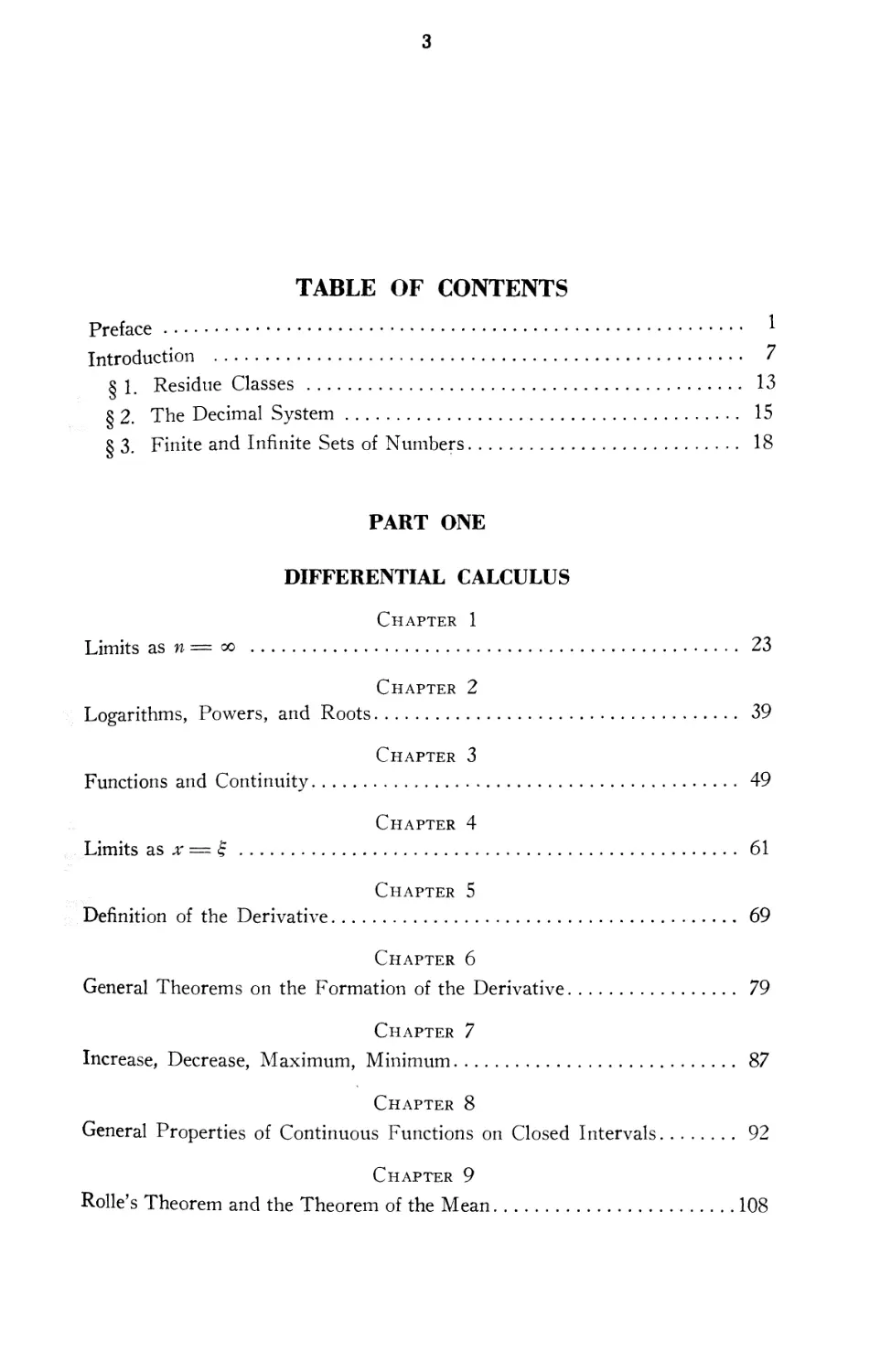
TABLE OF CONTENTS
Preface 1
Introduction 7
§ 1. Residue Classes 13
§ 2. The Decimal System 15
§ 3. Finite and Infinite Sets of Numbers 18
PART ONE
DIFFERENTIAL CALCULUS
Chapter 1
Limits as n = co 23
Chapter 2
Logarithms, Powers, and Roots 39
Chapter 3
Functions and Continuity 49
Chapter 4
Limits as x = I 61
Chapter 5
Definition of the Derivative 69
Chapter 6
General Theorems on the Formation of the Derivative 79
Chapter 7
Increase, Decrease, Maximum, Minimum 87
Chapter 8
General Properties of Continuous Functions on Closed Intervals 92
Chapter 9
Rolle's Theorem and the Theorem of the Mean 108

4
Chapter 10
Derivatives of Higher Order ; Taylor's Theorem 115
Chapter 11
/0" and Similar Matters 128
Chapter 12
Infinite Series 146
Chapter 13
Uniform Convergence 168
Chapter 14
Power Series 179
Chapter 15
Exponential Series and Binomial Series 189
Chapter 16
The Trigonometric Functions 191
Chapter 17
Functions of Two Variables and Partial Derivatives 208
Chapter 18
Inverse Functions and Implicit Functions 223
Chapter 19
The Inverse Trigonometric Functions 229
Chapter 20
Some Necessary Algebraic Theorems 233
§ 1. The Fundamental Theorem of Algebra 233
§ 2. Decomposition of Rational Functions into Partial Fractions 243
PART TWO
INTEGRAL CALCULUS
Chapter 21
Definition of the Integral 253
Chapter 22
Basic Formulas of the Integral Calculus 259
Chapter 23
The Integration of Rational Functions 264

5
Chapter 24
The Integration of Certain Non-rational Functions 270
Chapter 25
Concept of the Definite Integral 280
Chapter 26
Theorems on the Definite Integral 289
Chapter 27
The Integration of Infinite Series 314
Chapter 28
The Improper Integral . 319
Chapter 29
The Integral with Infinite Limits 334
Chapter 30
The Gamma Function 348
Chapter 31
Fourier Series 357

7
INTRODUCTION
This book presupposes a familiarity only with the basic rules of arithmetic;
in fact, except in Chap. 20, § 1 (which will be used only in Chap. 20, § 2, Chap.
23 and Chap. 24), only with the arithmetic of real numbers.
Thus, we shall use without further justification such theorems as
a(b + c) = ab + ac.
[ab)c = a(cb).
ab = 0
a-0 or 6 = 0.
a > b, b ^ c
a > c.
1)
2)
3)
then
4)
If
If
then
5)
2u %v
^2
V„ I.
(We use the familiar notation | x |, where ;r is real, to stand for the number
x if x _" 0 and for the number - jr if ;r < 0.)
6)
n #« = n i %v
7) In every set (scilicet non-empty; the expression set of numbers is always
so intended) of positive integers, there exists a least.
This theorem is important for the reason that, in order to prove any
assertion formulated for all integers n _" 1, it allows one to state: It suffices to prove
the assertion for n = 1 and to show that if it holds for n then it holds for n + 1
("proceeding from n to n + 1").
In fact, the assertion then holds generally; for otherwise, consider the least
number m of the (non-empty) set which consists of those n for which the
assertion does not hold. Then m is neither 1 (for the assertion holds for 1),
nor > 1 (since, holding for m - 1, it would have to hold for m). Contradiction.

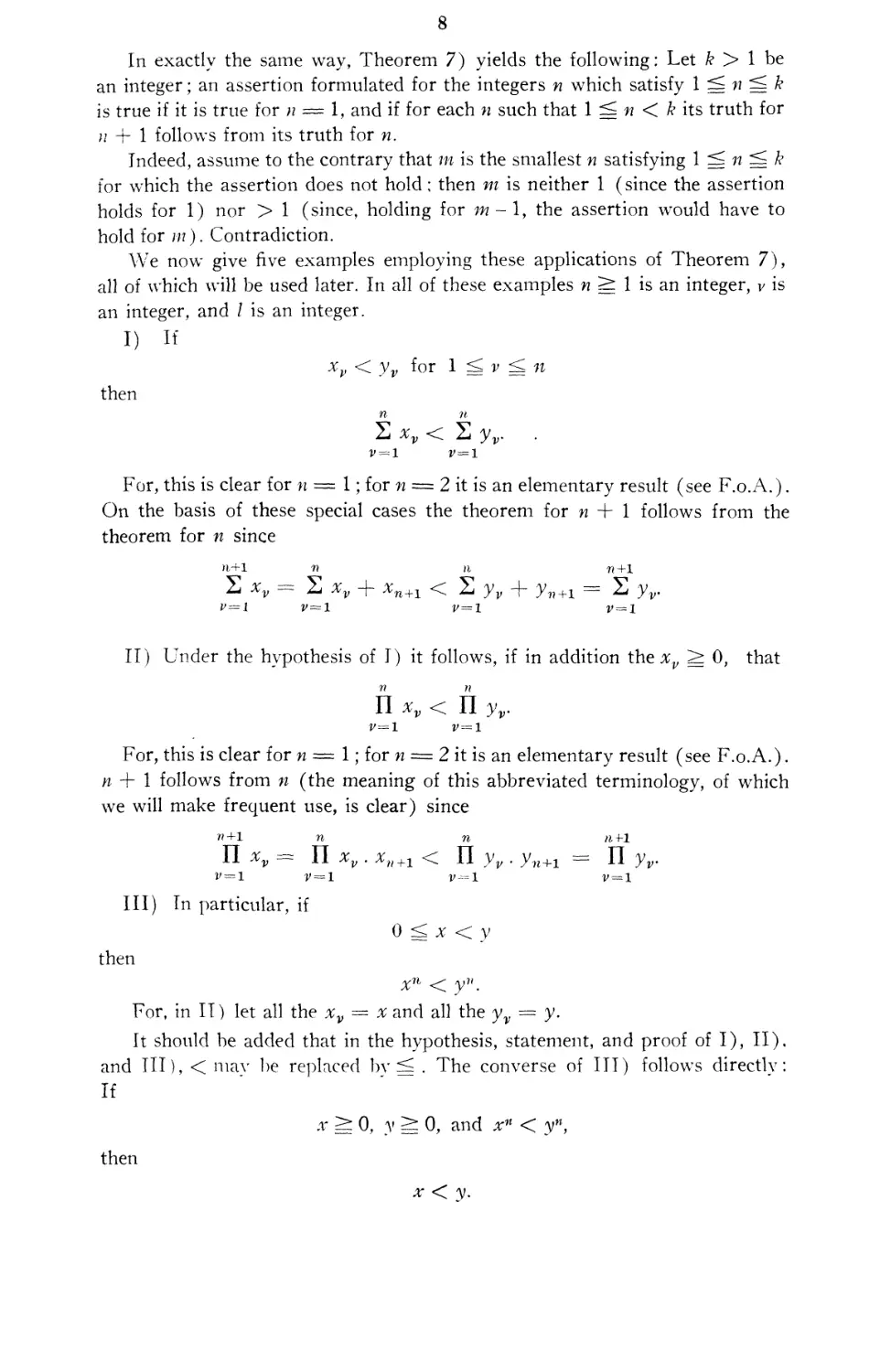
8
In exactly the same way, Theorem 7) yields the following; Let k > 1 be
an integer; an assertion formulated for the integers n which satisfy 1 f== n f§ k
is true if it is true for n = 1, and if for each n such that 1 fg n < k its truth for
n + 1 follows from its truth for n.
Indeed, assume to the contrary that m is the smallest n satisfying 1 5= n ^ k
for which the assertion does not hold; then m is neither 1 (since the assertion
holds for 1) nor > 1 (since, holding for m -1, the assertion would have to
hold for m). Contradiction.
We now give five examples employing these applications of Theorem 7),
all of which will be used later. In all of these examples n §: 1 is an integer, v is
an integer, and / is an integer.
i) if
xv < Vv f°r * = v ^ n
then
n n
S xv < S yv. .
For, this is clear for n = 1; forn = 2 it is an elementary result (see F.o.A.).
On the basis of these special cases the theorem for n + 1 follows from the
theorem for n since
>i+l n n n+1
2 xv = S #v + *n+1 < 2 y„ + y7?+1 - 2 )v
II) Under the hypothesis of I) it follows, if in addition the xv ^ 0, that
n n
n xv < n yv.
v=i v=l
For, this is clear forn = 1; forn = 2 it is an elementary result (see F.o.A.).
n + 1 follows from n (the meaning of this abbreviated terminology, of which
we will make frequent use, is clear) since
n+1 n n n\-l
n xv = n xv xn+1 < n yv. yn+1 = n yv.
v==l v = l v^l v=l
III) In particular, if
0 <, x < y
then
For, in II) let all the xv = x and all the yv = y.
It should be added that in the hypothesis, statement, and proof of I), II),
and III), < may be replaced by fg . The converse of III) follows directly:
If
x =g 0, y ^ 0, and xn < yn,
then
x < y.

9
IV) If #vis defined for/ fg v ^ / + n — 1, then there exists an integer //
such that
I ti ft "^ I + n — 1, xv ^ x for I <^ v ^ I -{- n — 1.
%,, is the so-called largest of the numbers x' notation: Max Xy orj eg,
^ l<Lv<l+n-l
Max(a, fr, c) if I = 1, w = 3, % = a, #2 — b, *3 = c- Max is to be read
maxitnum.
For, n== 1 is clear; n = 2 is an elementary result (see F.o.A.). To
proceed from n to n + 1, choose an integer ? such that
J ^ g ^ / + n — 1, zv g; *e for / <^ v ^ / + n — 1,
and choose jli = q or = l-{-n such that
^ = Max (xQ, xl+n).
Then
/ ^ // ^ / + n,
V) Under the hypothesis of IV), there exists an integer ^ such that
l^fi<:i + n—l, xv^x^ior l^v<Ll + n—l.
x„ is the so-called smallest of the numbers % • notation: Mm xv or^ e g
Min(a, fr, c). Min is to be read minimum.
For, let
Max {—xv)=—xfJi\
then #„is as required.
8) (The deepest and most important of the fundamental properties of the
real numbers.) Let there be given any division of all the real numbers into
two classes, having the following properties:
a) Neither class is empty.
b) Every number of the first class is smaller than every number of the
second class. (In other words, if
a< b
and if a lies in the second class, then b lies in the second class.)
Then there exists a unique real number ? such that every rj < ? belongs
to the first class and every rj > ? belongs to the second class.
9) For each x g; 0, there is exactly one y §^ 0 such that
y2 = x.
This y is denoted by \ x- .

10
As an exercise in the use of Theorem 8), I reproduce the standard proof of
9) here, proving, in the process, the following more general theorem (of which
the special case n — 2 is 9)) :
For every x §^ 0 and every integer n ^ 1, there exists precisely one y ^ 0
for which
yn — x.
However, in what follows I shall only use the special case n = 2, since the
case of arbitrary integral n ^ 1 will automatically drop into our lap in Chap. 2.
Proof: 1) For . ^
> 0 ^ yx < y2
we have by III) that
yin < y2n>
so that at most one of the numbers yxn and y2n can be = x. Hence, there exists
at most one y having the desired property.
2) For x — 0, the requirement is fulfilled by y = 0. Hence, let x > 0, so
that it remains to be shown that there exists a y > 0 (since y — 0 need not be
considered) for which
yn = x.
We place rj in
Class I, if rj > 0 and rjn < x, or if 77 ^ 0; and in
Class II, if 77 > 0 and 77* ^ x.
Then every real number 77 belongs to exactly one of these classes. The
positive number
7] = I Min A, #)
ies in class I, since
rj < 1, 17 < ^,
^n-l ^ ]n-l = X
^w _ ^n-i .77^1.77 — 77 < %.
The positive number
77 = Max A, x)
lies in class II, since
rjn = rj71'1 -r]^:l-r] = Y}'^x.
If 77 is in class II, and ? > 77, then
? > *7 > 0,
?n > Tjn ^ #,
so that ? is in class II.
Therefore there exists a real number y such that every 77 < y belongs to
class I, and every 77 > y belongs to class II. Since there is a positive number
in class I, it follows that
y >0.

11
We shall show of this y that it satisfies
yn ~ x.
Let 0° always be understood as meaning 1, so that for all c,
c° = 1.
(For, this holds for all c different from 0 by definition, even in elementary
mathematics.)
For all a, b, we have
{a — b) jfaW1-* = a Is' avbn'^ — ft *S avbn~x~v
v=o v=o v=o
n-1 n-1 n n-1
= S a'4^"-1-* — S aW = S aW — E «"&"-" = a" — 6".
Hence, for all h (setting a= l-h, b = I),
(l — h)"= 1 —ft"! A — h)\
so that for 0 < h < 1,
n-1
A — A)" ^ 1 — ft 2 1 = 1 — nft,
so that if moreover 0 < ft < — (hence 1 - nh > 0),
1 1
< ,
A —h)n ~ 1 — nh
(y \n yn yn
1 —ft/ == A — h)n = 1 —nft '
and furthermore
(y(l — ft))w = yw(l — ft)n ^ yn(i — »A).
Now, if we had
yn < #,
then it would follow that, for
o<ft< -Mi — -)
W \ XI
( since in that case
^ 1
ft<-,
n
yn\
l—nh>~)
XI
\1 — ft/ yw

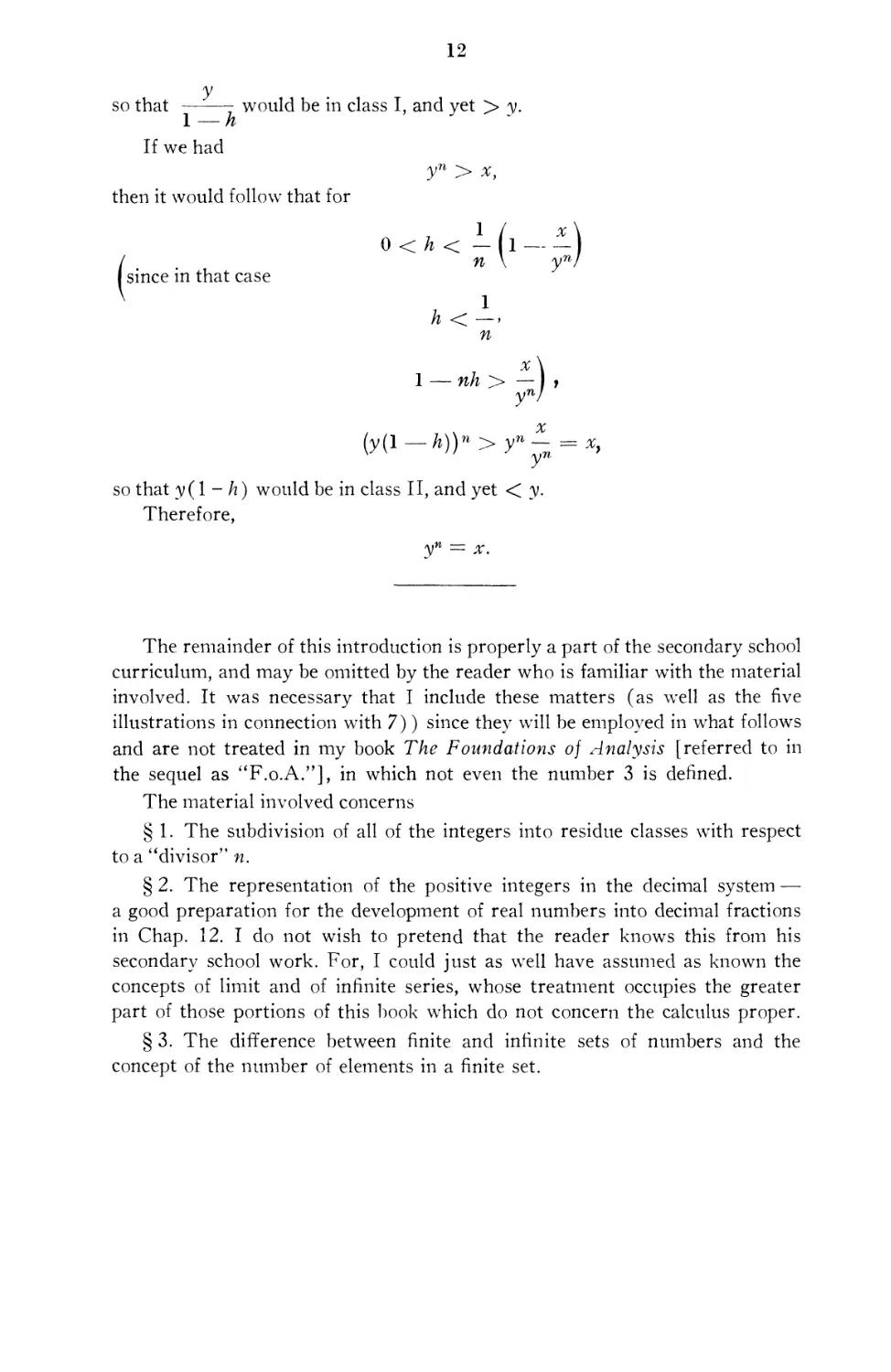
12
y
so that would be in class I, and yet > y.
l—h y y
If we had
yn > x,
then it would follow that for
since in that case
0< h < -
n
1
h<-.
n
\ yn)
1 — nh >
y
(y(l—A))»>y»-^ = *,
so that y{\ - h) would be in class II, and yet < y.
Therefore,
yn — x.
The remainder of this introduction is properly a part of the secondary school
curriculum, and may be omitted by the reader who is familiar with the material
involved. It was necessary that I include these matters (as well as the five
illustrations in connection writh 7)) since they will be employed in what follows
and are not treated in my book The Foundations oj Analysis [referred to in
the sequel as "F.o.A."], in which not even the number 3 is defined.
The material involved concerns
§ 1. The subdivision of all of the integers into residue classes with respect
to a "divisor" n.
§ 2. The representation of the positive integers in the decimal system —
a good preparation for the development of real numbers into decimal fractions
in Chap. 12. I do not wish to pretend that the reader knows this from his
secondary school work. For, I could just as well have assumed as known the
concepts of limit and of infinite series, whose treatment occupies the greater
part of those portions of this book which do not concern the calculus proper.
§ 3. The difference between finite and infinite sets of numbers and the
concept of the number of elements in a finite set.

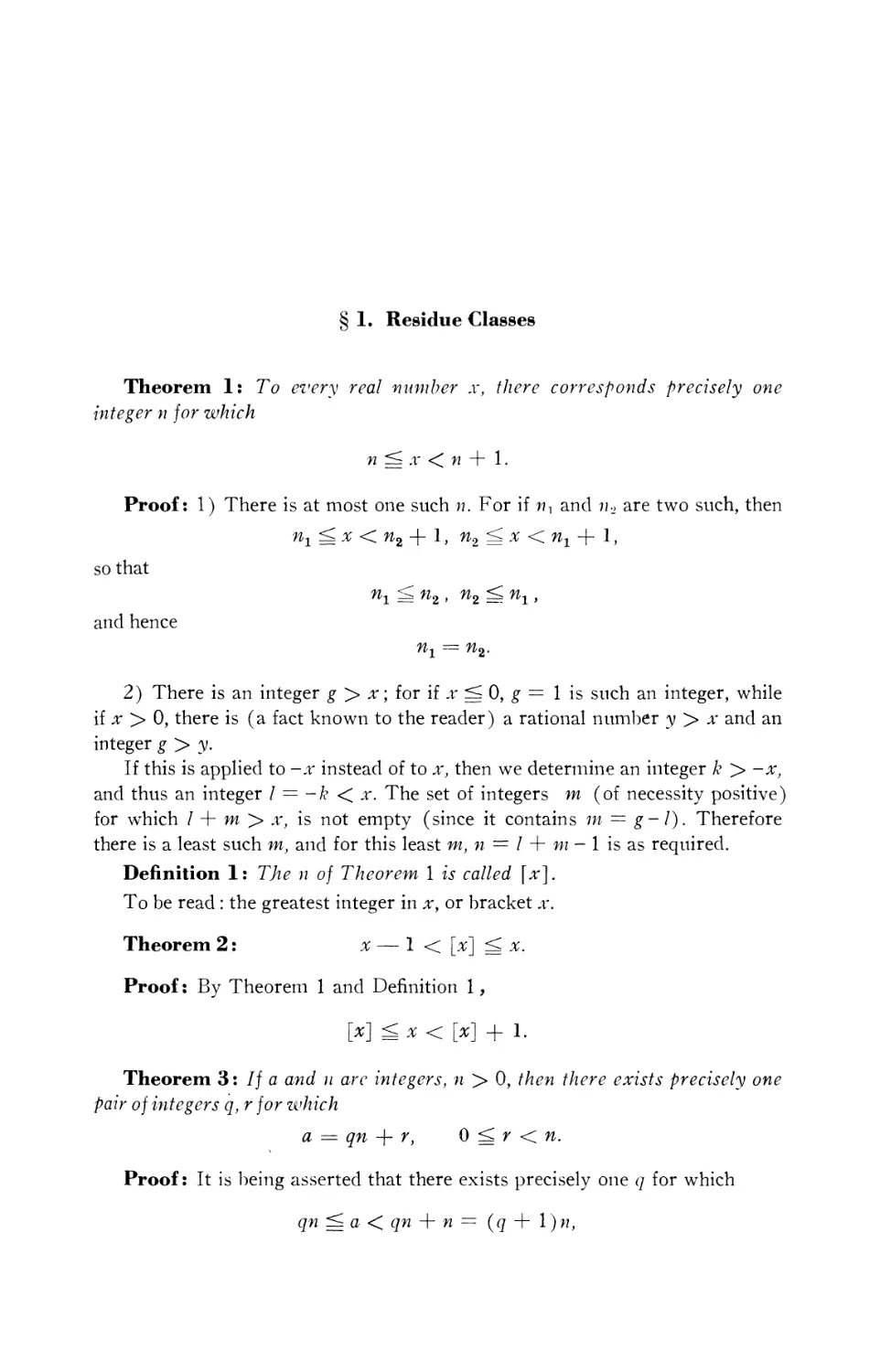
§ 1. Residue Classes
Theorem 1: To every real number x, there corresponds precisely one
integer n for which
n fg x < n + 1.
Proof: 1) There is at most one such n. For if r\A and n2 are two such, then
% ^ x < n2 + 1, n2 fg x < nx + 1,
so that
% ^ n2 ' ^2 = ni y
and hence
nx = n2.
2) There is an integer g > x; for if x ;g 0, g — 1 is such an integer, while
if x > 0, there is (a fact known to the reader) a rational number y > a* and an
integer g > y.
If this is applied to -x instead of to x, then we determine an integer k > -x,
and thus an integer I — -k < x. The set of integers m (of necessity positive)
for which / + m > ;r, is not empty (since it contains m — g-l). Therefore
there is a least such m, and for this least m, n = / + m - 1 is as required.
Definition 1: The n of Theorem 1 is called \x].
To be read : the greatest integer in x, or bracket x.
Theorem 2: x — 1 < [x] 5g x.
Proof: By Theorem 1 and Definition 1,
[x]^x < [x] + 1.
Theorem 3: If a and u arc integers, n > 0, then there exists precisely one
pair of integers q,rfor which
a = qn + r, 0 fg r < n.
Proof: It is being asserted that there exists precisely one q for which
qn ^ a < qn + n = (q + l)n,

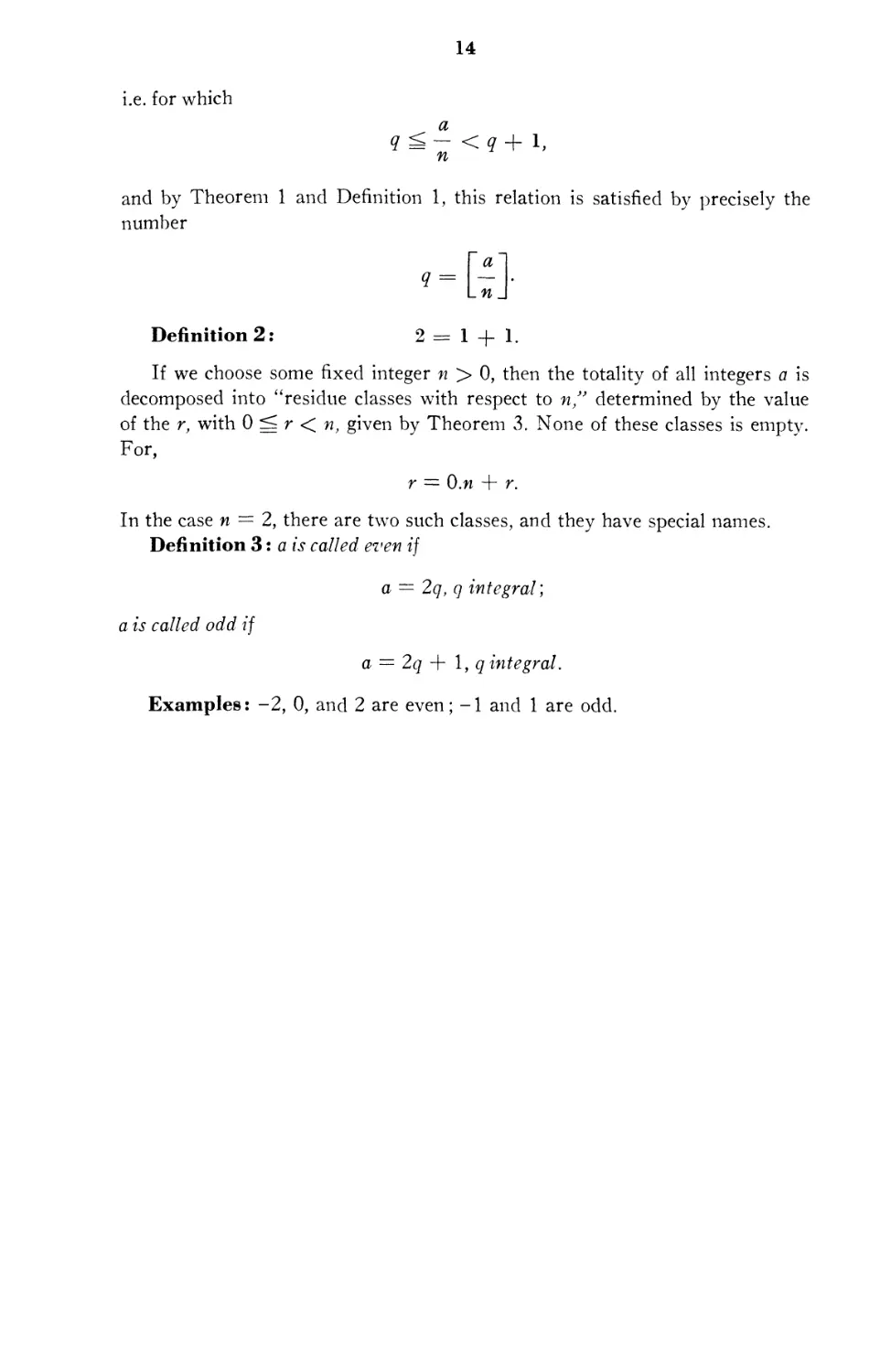
14
i.e. for which
a
q rg- <q + 1,
n
and by Theorem 1 and Definition 1, this relation is satisfied by precisely the
number
[ a~\
q = \~ •
Ln J
Definition 2: 2=1 + 1.
If we choose some fixed integer n > 0, then the totality of all integers a is
decomposed into "residue classes with respect to n," determined by the value
of the r, with 0 5= r < n, given by Theorem 3. None of these classes is empty.
For,
r = O.n + r.
In the case n — 2, there are two such classes, and they have special names.
Definition 3: a is called even if
a = 2q, q integral',
a is called odd if
a — 2q + 1, q integral.
Examples: -2, 0, and 2 are even; -1 and 1 are odd.

15
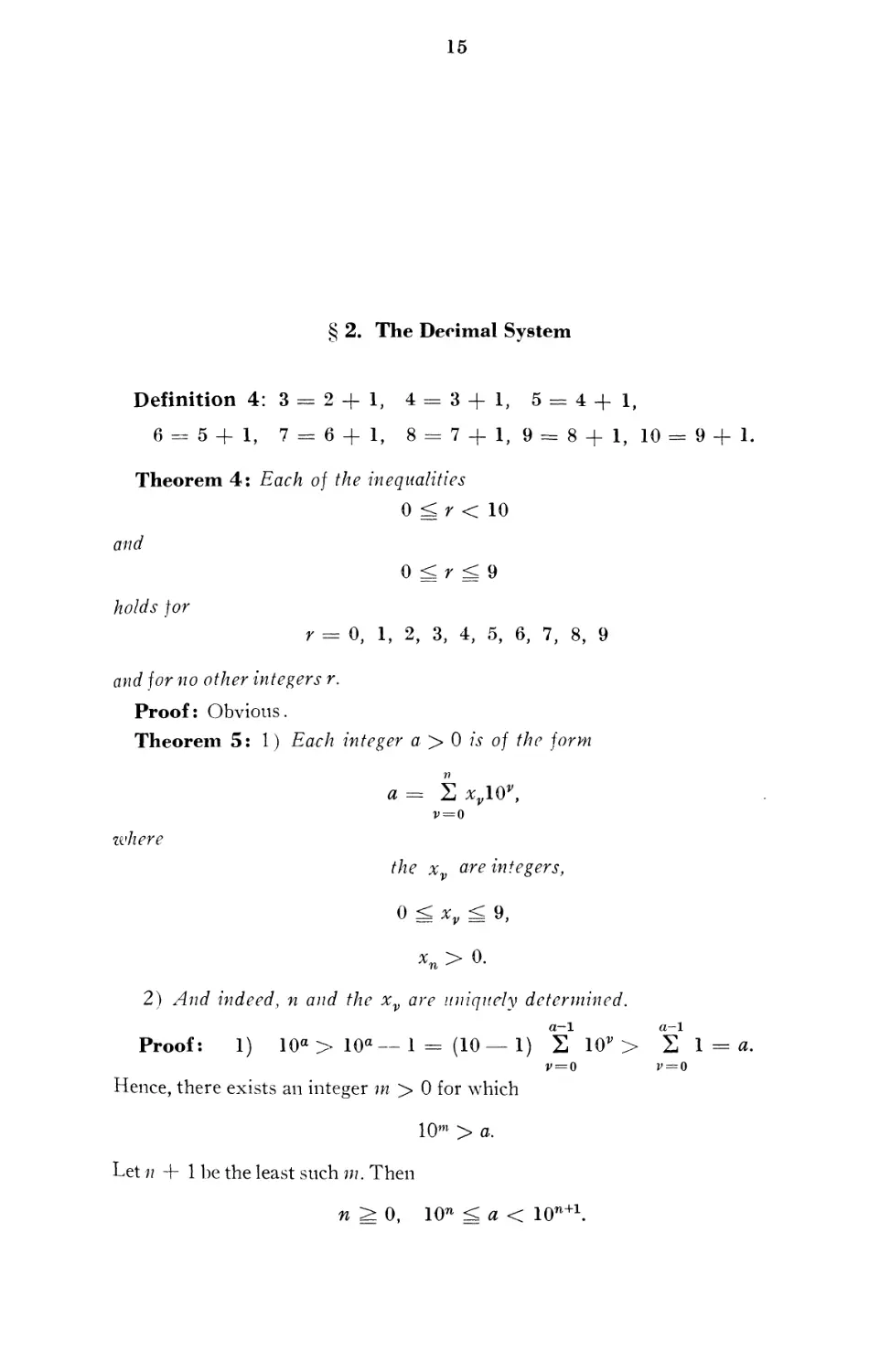
§ 2. The Decimal System
Definition 4: 3 = 2 + 1, 4 = 3+1, 5 = 4+1,
6 = 5+1, 7 = 6+1, 8 = 7 + 1, 9 = 8+1,
Theorem 4: Each of the inequalities
0 ^ r < 10
and
0 <: r ^ 9
r = 0, 1, 2, 3, 4, 5, 6, 7, 8, 9
awe? for no other integers r.
Proof: Obvious.
Theorem 5:1) Each integer a > 0 is of the form
a = ? V0*,
v=o
^e % are integers,
0 ^ xv = 9,
*»><>¦
2) ^irf indeed, n and the xv are uniquely determined.
a-l
Proof: 1) 10a > 10a— 1 — A0— 1) 2 10v >
Hence, there exists an integer m > 0 for which
10w > a.
Let 7? + 1 be the least such m. Then
n = 0, 10n ^ a < 10n+1.

16
For integral v for which O^ygw.we set
%v ~~ Lio"J 10 Liov+1J"
Then,
xv is integral,
a
_10"_
— 10
a
AQn+K
=
a
JL0*J
>o,
and for 0 fj v ^ n ;
so that
0 ^xv<, 9.
Furthermore
n n J
S *,io* = Siio"
n r a i n
= [«]-
10*
+1
I _ io^M
= S io*
10w+1_
a
[ a]
Lio^J
= a.
])
n+1
— Sio*
a 1
_To"_
2) If
a= S^10»= 2 X„10",
v~0 v = 0
where w and the #r, and N and the Xv, satisfy the conditions enumerated under
1) of the present theorem, then
n = N, xv = Xv for 0 fg *> fg w;
for otherwise we should have
s
0 = a — a = S ev10v, s > 0, ^ is integral, es ^= 0, | ev | rg 9,
i>=o
so that
s-1 s-1 1QS J
10s < I elO* 1=1—2 evW I < S 9 • 10* = 9 = 10s— 1 < 10s.
— 1*11 v \ — 10 1
Definition 5: 77ze representation
of Theorem 5 w written so that the "digits' (i.e. numbers of the sequence
0,1, 2, 3,4, 5, 6, 7, 8, 9) #v ar^ placed one ajter another, ordered according to
decreasing v (the so-called decimal notation for a).

17
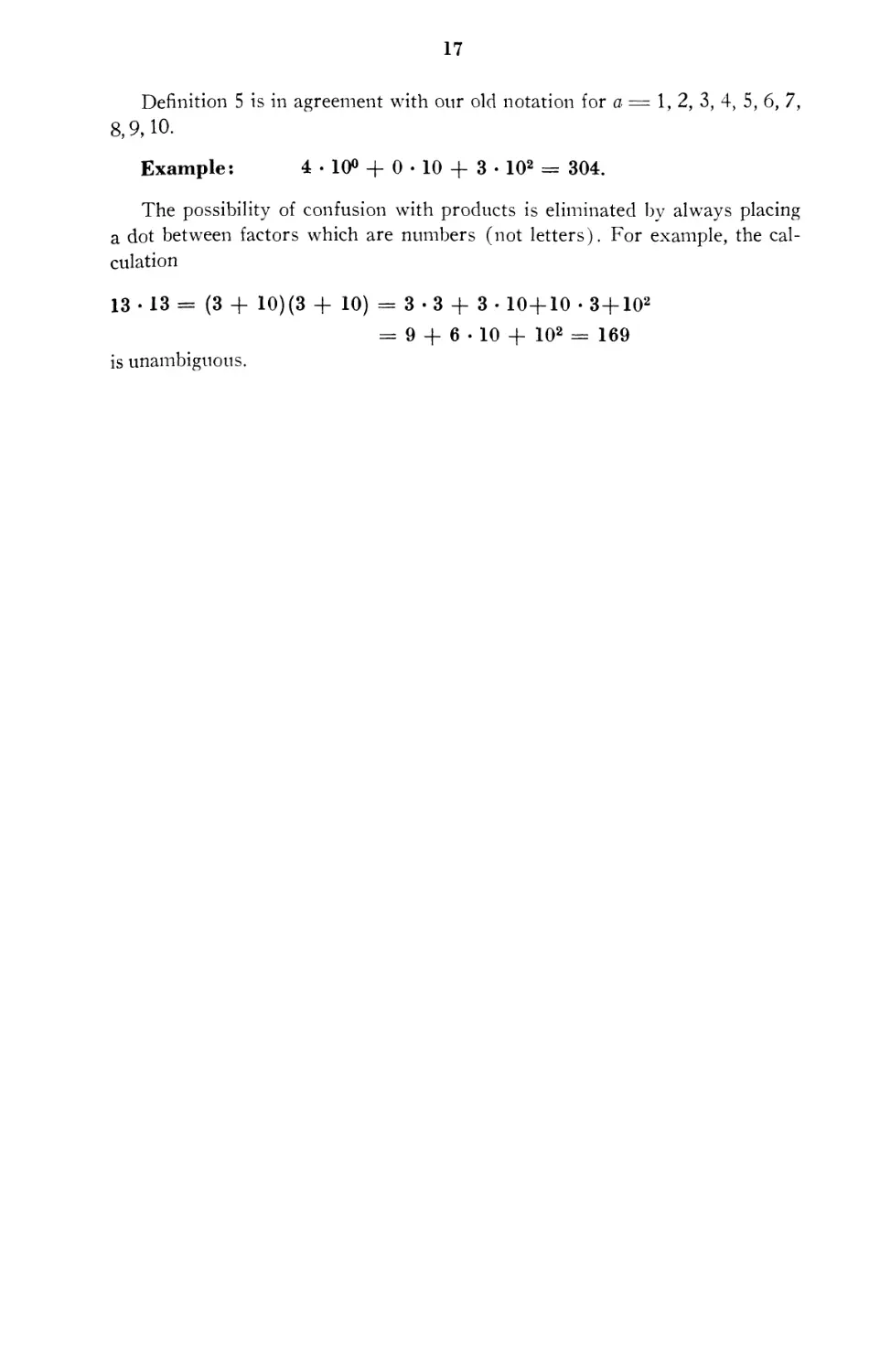
Definition 5 is in agreement with our old notation for a = 1, 2, 3, 4, 5, 6, 7,
8,9,10.
Example: 4 • 10° + 0 • 10 + 3 • 102 = 304.
The possibility of confusion with products is eliminated by always placing
a dot between factors which are numbers (not letters). For example, the
calculation
13 . 13 = C + 10)C + 10) = 3 • 3 + 3 - 10+10 • 3+102
= 9 + 6 • 10 + 102 = 169
is unambiguous.

18
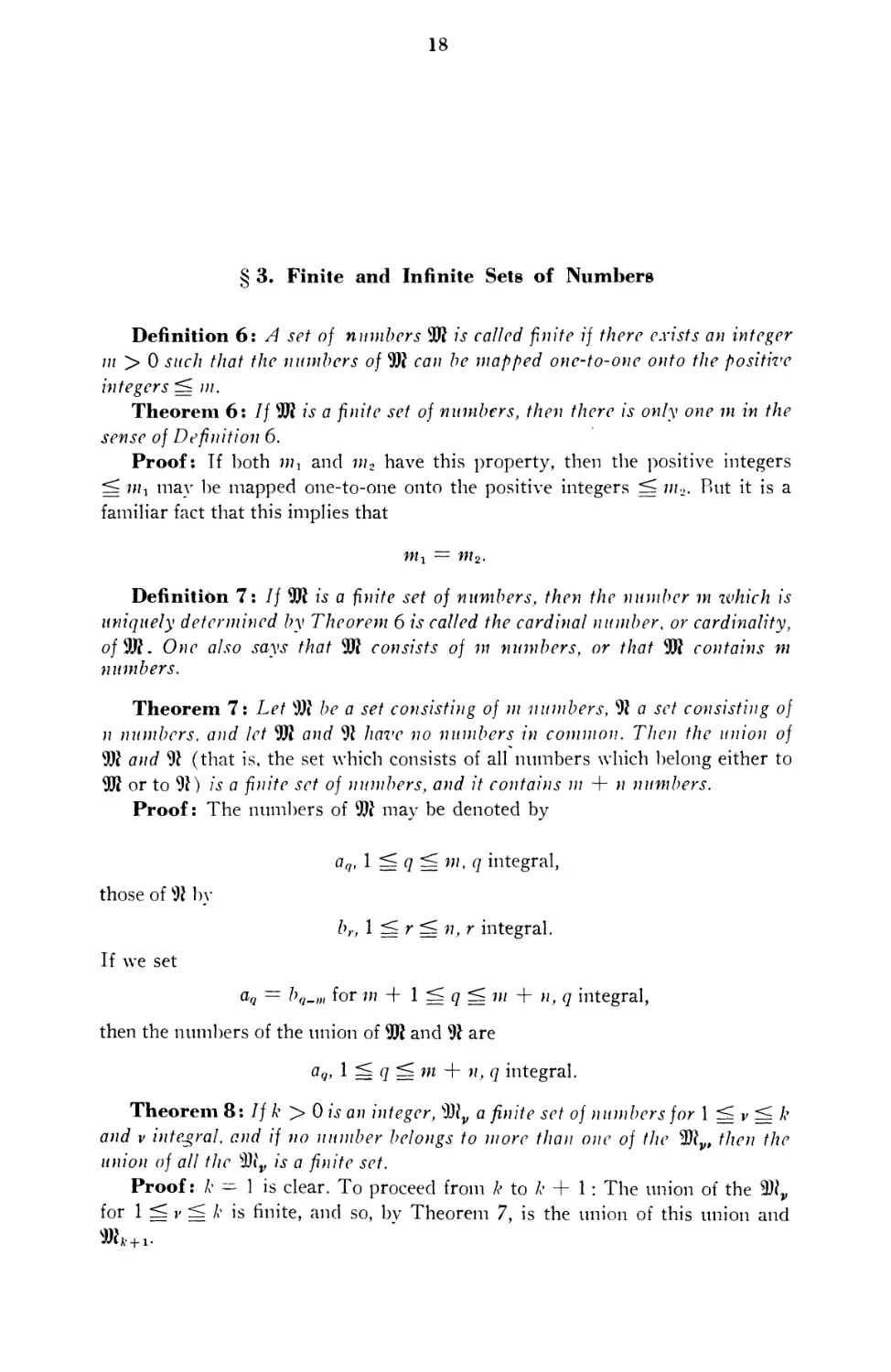
§ 3. Finite and Infinite Sets of Numbers
Definition 6: A set of numbers 9ft is called finite if there exists an integer
in > 0 such that the numbers of 9ft can be mapped one-to-one onto the positive
integers f§ ;;/.
Theorem 6: If W is a finite set of numbers, then there is only one m in the
sense of Definition 6.
Proof: If both nu and m2 have this property, then the positive integers
fg 1th may be mapped one-to-one onto the positive integers fg m2. Rut it is a
familiar fact that this implies that
mx — m2.
Definitibn 7: If 3I is a finite set of numbers, then the number m ivhich is
uniquely determined by Theorem 6 is called the cardinal number, or cardinality,
of$Jl. One also says that 9ft consists of m numbers, or that 9W contains m
numbers.
Theorem 7: Let 9ft be a set consisting of m numbers, *ft a set consisting of
n numbers, and let 9ft and 9i have no numbers in common. Then the union of
9ft and *)} (that is, the set which consists of all numbers which belong either to
9ft or to 91) is a finite set of numbers, and it contains m + n numbers.
Proof: The numbers of 9ft may be denoted by
aQ* 1 = Q = m< q integral,
those of sft by
br, 1 ^r ^n, r integral.
If we set
aq = bq_m for m -f 1 :g q fg m + n, q integral,
then the numbers of the union of 3ft and $1 are
dq, 1 — q ^ tn + n, q integral.
Theorem 8: // k > 0 is an integer, sJftv a finite set of numbers for 1 fg v rg k
and v integral and if no number belongs to more than one of the ^lvt then the
union of all the 9)(r is a finite set.
Proof: k — 1 is clear. To proceed from k to k + 1 : The union of the 9)?„
for lgv^ k is finite, and so, bv Theorem 7, is the union of this union and

19
Theorem 9: If W is a set consisting of m numbers, and if every number
of a certain set 91 of numbers belongs to 9K (that is, if 9i is a "subset" of 9R),
then W is finite, and consists of at most m numbers.
Proof: 1) If /;/ = 1, then 9i is identical with 9ft, and so consists of exactly
one number.
2) To proceed from m to m + 1 : Let 9ft be mapped onto the positive
integers f§ m + 1. Thus the numbers of 9i are mapped onto a subset of these
integers.
If, first, m + 1 does not belong to the subset, then 91 is mapped onto a subset
of the positive integers :§ m, and so is finite. Moreover, the number of elements
of 91 is rg m < m + 1.
If, on the other hand, m + 1 does belong to this subset, then either 91
consists of only one number (so that, since 1 < m + 1, we are through), or the
set obtained by removing the ''image" of m + 1 from 9J is mapped one-to-one
onto a subset of the positive integers ^ m, so that it is finite and consists of at
most m numbers, whence, by Theorem 7, 9} is itself finite and consists of at
most m + \ numbers.
Theorem 10: There exists a set of numbers which is not finite. In
particular, the set of positive integers is not finite.
Proof: If the set 9R of positive integers were finite, and if m were its
cardinality, then the set 9} of positive integers ^ m + 1, being a subset of 9ft,
would consist by Theorem 9 of at most m numbers, whereas it actually
consists of m + 1 numbers.
Definition 8: A set of numbers is called infinite if it is not finite. One also
says that it consists of infinitely many numbers.
Examples: 1) If a is real, then the set of integers n > a is infinite. For, if
k = fa], then the set of numbers n concerned is the set of all n = k + /, / g: 1
integral.
2) The set of even n > a and the set of odd n > a are also infinite. For, we
are concerned in the one case with the set of numbers n of the form
a
n = 2q, q > — and integral, and in the other case with the set of numbers n
2 a—1
such that n = 2q -f 1, q > —-— and integral.

PART ONE
DIFFERENTIAL
CALCULUS

23
CHAPTER I
LIMITS FOR n = oo
Introduction
In this chapter ;/, ;;/, N, wlt m2, k, v, and N always serve*to denote integers.
As I have already stated" all numbers are to be real in Chapters 1-19, and from
Chapter 20, § 2 to the end of the book (Chap. 31).
If one says that the sequence of numbers
i, i.it...
approaches 0 as a limit, this statement has no proper sense as yet, for it has
not been stated which numbers are given nor in what order they are given.
Most readers will probaby assume that ? is to be followed by the number ?
and that, more generally, we wish to say the following:
Let
1
A) sn — — for n > 1;
n
then the sequence s„ approaches 0; it has the limit 0. Indeed, this will accord
with the definitions we shall lay down. However, why shall we wish to say that
this sequence approaches 0 ? Why shall we not say, for any s ^ 0, that it
approaches s? Why shall we associate with every sequence sn, defined for n g: 1,
either no number or precisely one number as its limit? In which case none,
and in which case one ?
Continuing to consider the above example, we note that 0 is not a number
of the sequence, since for every n ^ 1 we have
sn > 0,
and therefore
Sn ^ 0.
But ultimately (i.e., from some number of the sequence on) s„ differs by little
from 0. What do we mean by little ?
Let any d > 0 whatsoever be given. Then, setting
s = 0,

24
for every n > — we have
a
sn — s\ =
n
Thus there is associated with b an m (depending on b), namely
m
such that
t] + ' (>t)-
s ' < b tor all n ^ m.
On the other hand, it would not suffice merely to note that infinitely often
(i.e. for infinitely many n),
| sn — s\ <b.
For, for every b > 0, the sequence
1
1 for odd n ^> 1,
1
— for even n ^ 1
B)
satisfies the condition
sn - 0 j < b for infinitely many n,
namely, for all even n >
-f- 1 (as well as for certain other n, e.g. in the
case b — % for n = 1, n = 3, and n = 5). However, it is not true that for
every b > 0 there is an ;» for which
I sn — ° | < $ i°r n ^ m.
Thus, for b = %, there is no such m, since for odd n > 5,
1
n
|*» —o| = |i-
On the other hand, the requirement
s„ ^z 0 for ;/ > 1
of example A) is unessential. For if we consider the sequence
C) sn = 0for n > 1,
then for every b > 0, there is of course an m (and indeed one which may he
chosen independently of b, namely = 1) such that
| sn — 0 | = 0 < d for n ^ m.

25
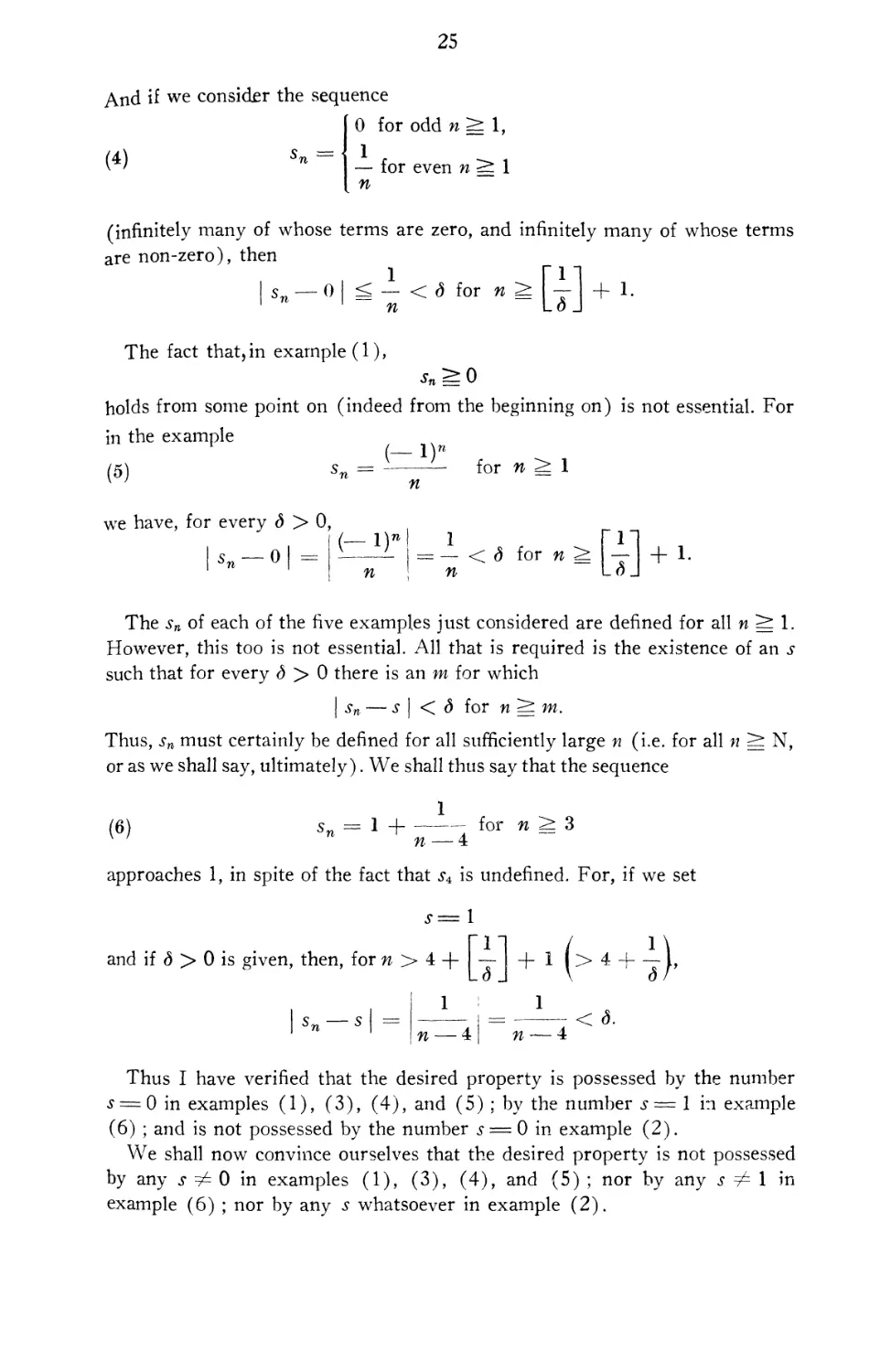
And if we consider the sequence
[ 0 for odd n ^ 1,
D)
— for even n > 1
(infinitely many of whose terms are zero, and infinitely many of whose terms
are non-zero), then
1
s„ — 0 < -- < d for n ^
i\
+1.
The fact that,in example A),
holds from some point on (indeed from the beginning on) is not essential. For
in the example
E)
(— l)n
s„ = - for n ^ 1
we have, for every d > 0,
l(—l)nl 1
\Sr) — 0 = I = — < d for n
1 n ' ! n n
^
+ 1.
The sn of each of the five examples just considered are defined for all n ^ 1.
However, this too is not essential. All that is required is the existence of an s
such that for every d > 0 there is an m for which
| sn — s \ < d for n g; m.
Thus, sn must certainly be defined for all sufficiently large n (i.e. for all n ^ N,
or as we shall say, ultimately). We shall thus say that the sequence
F) sft=H —- for n ^ 3
approaches 1, in spite of the fact that ^4 is undefined. For, if we set
and if d > 0 is given, then, for n > 4 + — + i
L<5 J
1 1
(>4 + I),
<d.
\n — 4 I n — 4
Thus I have verified that the desired property is possessed by the number
s = 0 in examples A), C), D), and E) ; by the number s = 1 in example
F) ; and is not possessed by the number ^ = 0 in example B).
We shall now convince ourselves that the desired property is not possessed
by any s 9^ 0 in examples A), C), D), and E) ; nor by any s =? I in
example F) ; nor by any s whatsoever in example B).

26
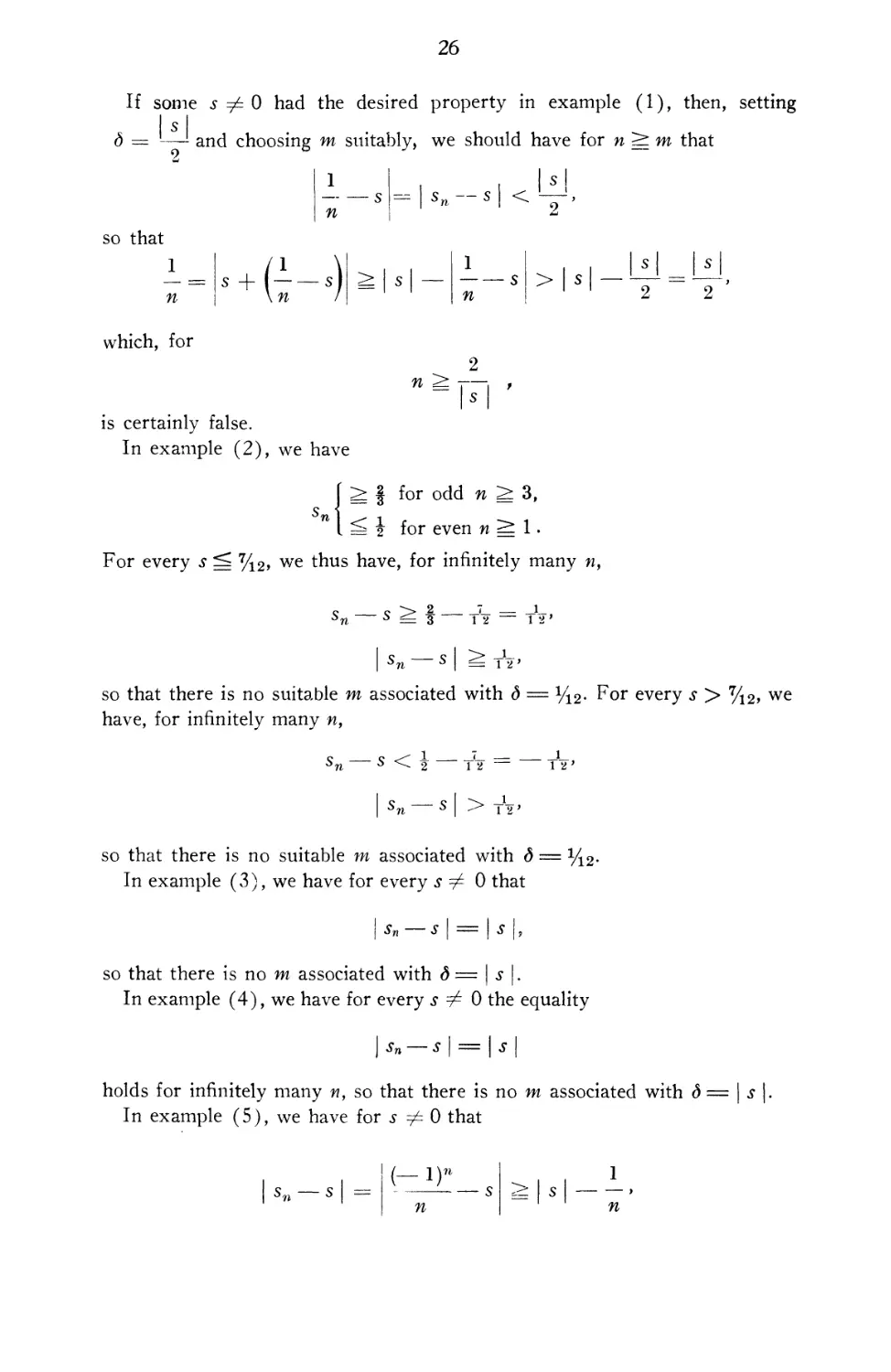
If some s ^ 0 had the desired property in example A), then, setting
6 = — and choosing m suitably, we should have for n^.m that
•5 = S„. — S <
so that
1
n
s +
(-¦)
> \ s \ —
s
n
\ s \ \ s \
> \s\ Y = ~2
which, for
n ^ -j—. f
s
is certainly false.
In example B), we have
{ ^ § ^r odd n ^ 3,
1^2 for even n ^ 1.
For every .? ^ %2> we tnus have, for infinitely many n,
^=3 TY — T
Is,,. S
Jn
l
so that there is no suitable m associated with 6 = %2- For every .? > %2, we
have, for infinitely many n,
1 2
1 2>
^ — s < 2
| Sn S j J> yy*
so that there is no suitable w associated with d = y12.
In example C), we have for every s ^ 0 that
\ sn — s\ = \ s \9
so that there is no m associated with b = | s |.
In example D), we have for every s ^ 0 the equality
holds for infinitely many n, so that there is no m associated with 6 ¦
In example E), we have for ^ =? 0 that
sn — s\ =
(-1)"
n
- s
^>
*\
1
n

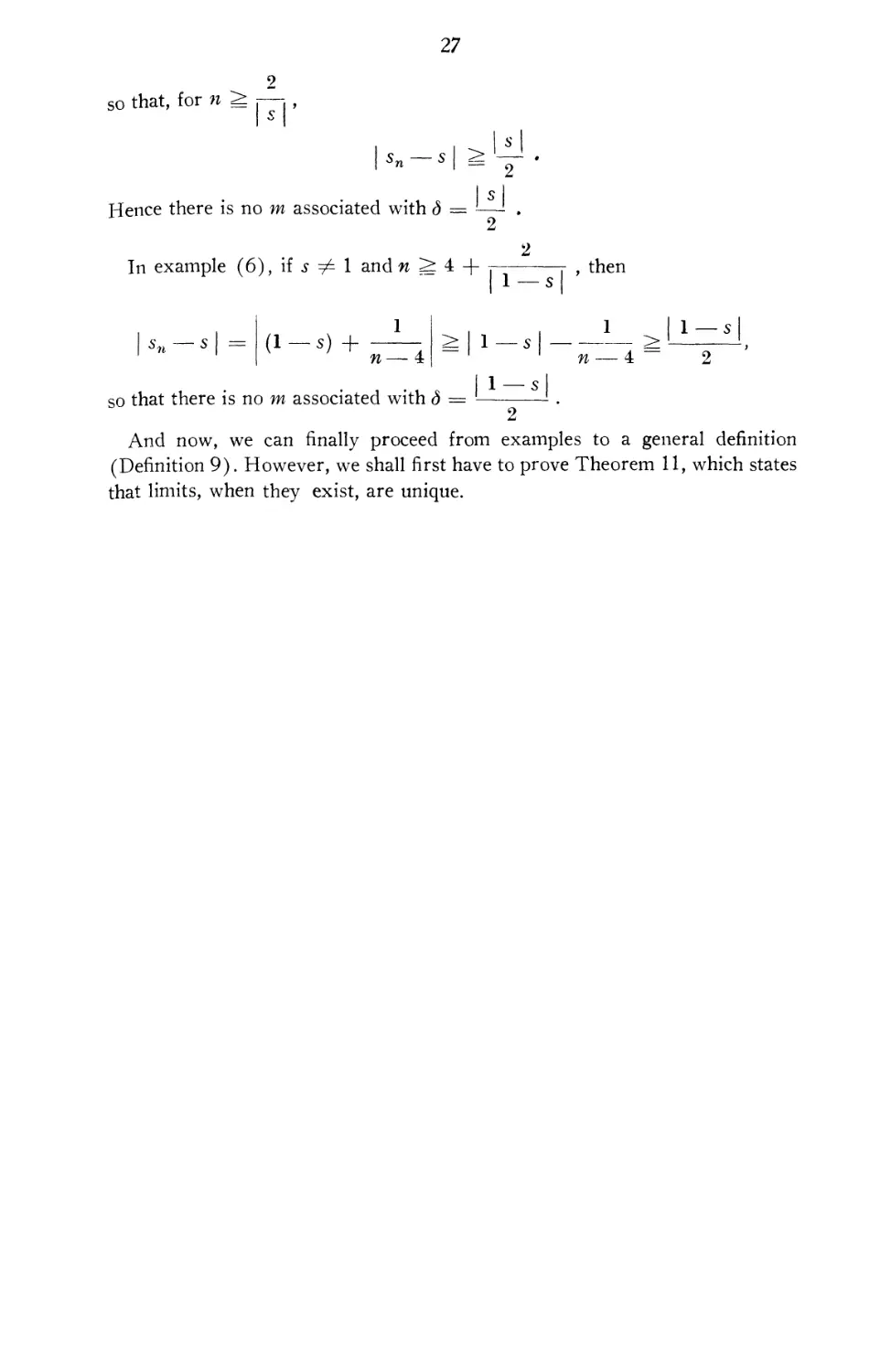
so that, for n ^
27
Sn — S I ^
Hence there is no m associated with d —
In example F), it s ^ I and n ^ 4 -f-
1
(!-«) +
>U
then
1
n ¦
so that there is no m associated with d = — — .
And now, we can finally proceed from examples to a general definition
(Definition 9). However, we shall first have to prove Theorem 11, which states
that limits, when they exist, are unique.

28
Theorem 11: Let N be given, and let sn be defined for all n §: N (i.e. for
all sufficiently large n, i.e. ultimately). Then there is either no number, or
exactly one number s, with the following property:
For every d > 0 we have, for all sufficiently large n,
\sn — s \ < d.
In other words, with each d > 0 there is associated an m for which
| sn —' «y | < d for n^m.
More concisely, for every d > 0 we have that, ultimately,
| Sn J | < &
Proof: Suppose that
S^ T
where both S and T fulfill what is required of s. Then we set
IS — Tl
^hH (>0)-
Then there would be an mx such that
\ sn — S | < d for n^Wi
and an m2 such that
\ sn — T | < d for n g: m2.
Thus, we should have for n ^ Max(wx, m2) that
|S-T| = |(sn-T)-(sn-S)|
^|s„ —T|+K-S|<0 + a = 23 = |S-Tl.
Definition 9: If sn is ultimately defined, and if there exists an s in the
sense of Theorem 11, then we say that sn (the sequence sn) has ("as w—> oo")
the limit s, or approaches s ("as n —» oo"), and we write
lim sn = s,
or, more briefly,
oo is to be read: infinity; lim is to be read: limit.

29
Of course, any letter that stands for integers may be used instead of n.
(Similar remarks hold for almost all other definitions.)
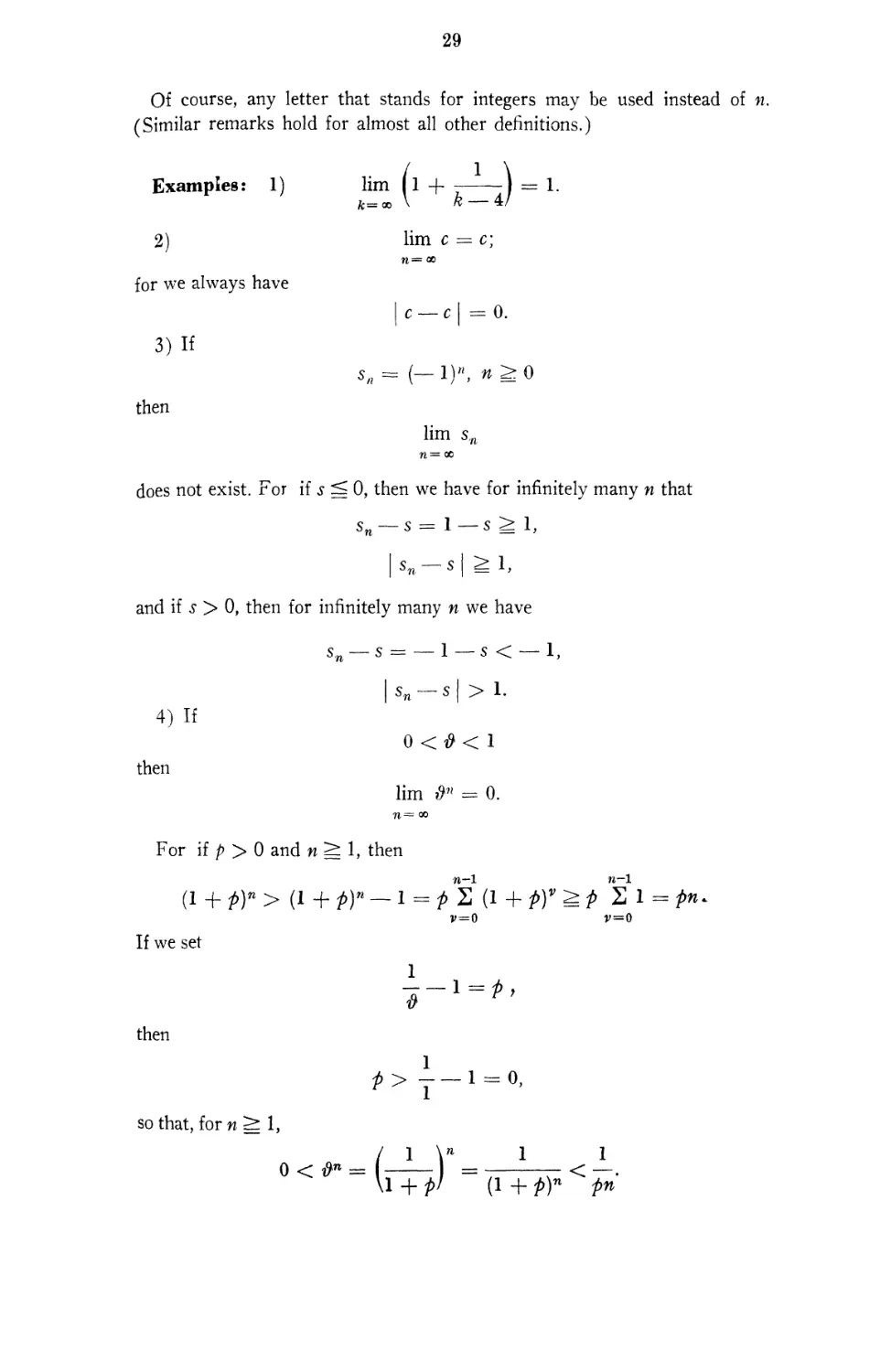
Examples:
2)
for we always
3) If
then
i)
have
lim 11 -| 1__) =
lim c = c;
n=cc
\c — c\ = 0.
sn = (—1)", n^O
lim sn
n— oc
does not exist. For if s ^ 0, then we have for infinitely many n that
sn-s=l-s>l,
\sn — s\^l,
and if $ > 0, then for infinitely many n we have
sn — s = — l—s< — l,
\sn — s\>h
4) If
0 <#< 1
then
lim »n - 0.
n= oo
For if p > 0 and n ^ 1, then
A +p)n> A +i>)n— 1 =# S A +P)V^P S l = ?n.
If we set
then
so that, for w ^ 1,
P> 1-1 = 0,

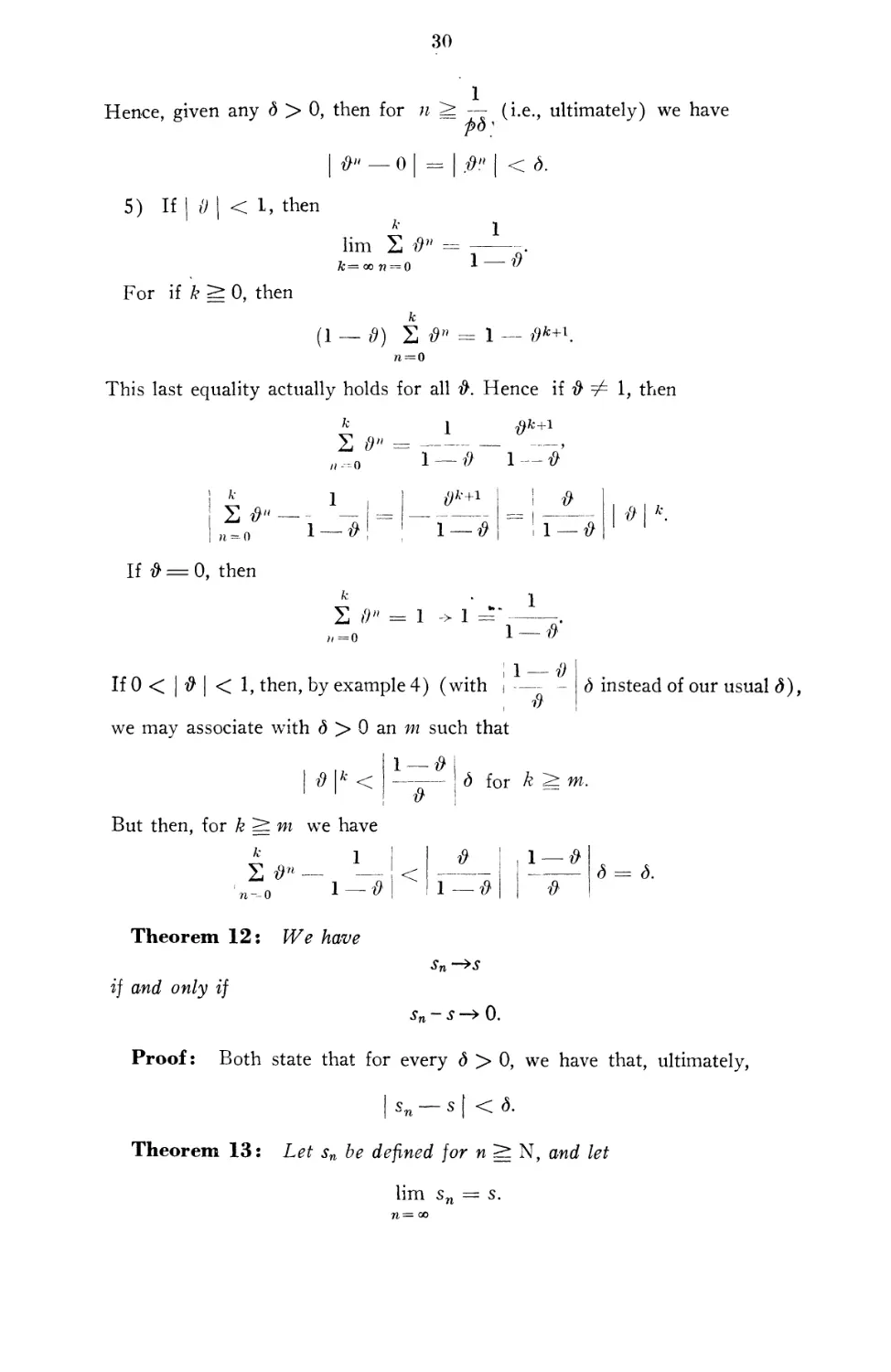
30
Hence, given any d > 0, then for n ^ — (i.e., ultimately) we have
5) If \i) I < 1, then
#» — 0 I = I #" I < d.
A> 1
lim 2 #w •
k=O0 7? = 0 * "
For if & ^ 0, then
A — #) 2 #w - 1 — #*+1.
This last equality actually holds for all #. Hence if # ^ 1, then
2 0" = —,
1 — 0 1 — 0
2 #" —
I n = 0
If # = 0, then
i —#:
1 —#
#| *
2 dn = l -> l ~ •.
i —*
If 0 < | # | < 1, then, by example 4) (with
we may associate with d > 0 an m such that
1 —#1
1 — #
d instead of our usual d),
| d \k <
But then, for k g; m we have
* j
2 0* — —
&
6 for ? ^ w.
1 — 0
#
rf = A
Theorem 12 s ff7? /zaz/?
if and only if
Proof: Both state that for every d > 0, we have that, ultimately,
\sn — s\<d.
Theorem 13 s Let sn be defined for n g; N, and let
lim sn = s.
71= CO

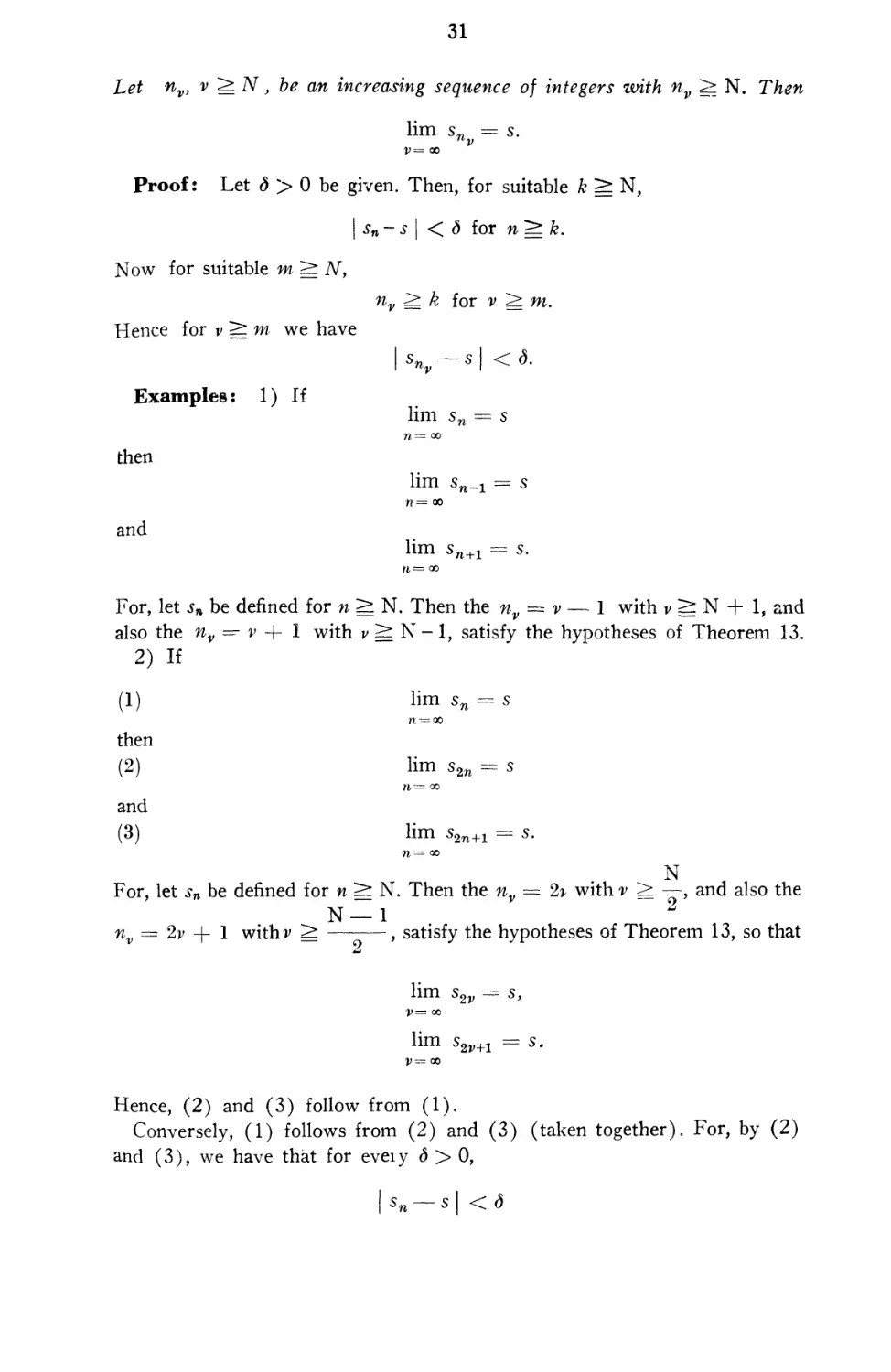
31
Let nv, v ^ N, he an increasing sequence of integers with nv ^> N. Then
lim sn = s.
Proof: Let d > 0 be given. Then, for suitable k §: N,
| sn-s | < d for n^.k.
Now for suitable m §: iV,
nv ^ k for r ^ m.
Hence for v^m we have
Examples: 1) If
then
and
For, let sn be defined for n ^ N. Then the nv = v — 1 with v §: N + 1, and
also the nv — v + 1 with v §: N- 1, satisfy the hypotheses of Theorem 13.
2) If
Snv
lim
n— oo
lim
n= oo
lim
n= cc
— S |
Sn =
sn-l
^n+1
<
: 5
—
=
d.
s
s.
a)
then
B)
and
C)
For,
nv =
let.
: 2V
sn be defined for n
+ 1 withr
N
>
IT
N
1
lim sn = s
ft — 00
lim s2n = s
lim s2n+1 = s.
N
. Then the nv = 2> witha> > —, and also the
v — 2
satisfy the hypotheses of Theorem 13, so that
lim s2v — s,
V— GO
lim s2v+1 = s.
Hence, B) and C) follow from A).
Conversely, A) follows from B) and C) (taken together). For, by B)
and C), we have that for eveiy d > 0,
I *w — s | < <3

32
holds for all large even numbers and for all large odd numbers, and hence for
all large n.
Theorem 14: //
then
For short:
lim (sn + tn) = lini sn + lim tn,
n = qo n = oo
if the right-hand side is meaningful.
Proof: Let d > 0 be given. Ultimately,
(i) K-*l<|;
and ultimately,
B) l<»-<|<!"
Hence, both A) and B) hold ultimately, so that
|(Sn + <»)-(s + 0|=| (S--s) + («.-0|
^|stt-s|+|^-<|<T+- = *.
Example: If | d | < 1 then
lim (#n + 1 H ) = lim dn + lim (l H ) = 0+1 = 1.
n=oo \ »— 4/ n==00 n==0O \ n — 4/
Theorem 15: If k > 0, and i/ <?ac/i 0/ ?/z<? fc sequences
has a limit, then the sequence
has a limit; and indeed, if
s(v) _+ s(v) for \^v^k}
then
k k
v=l v—1
For short;
lim S #> - S lim #>,
if the right-hand side is meaningful.

33
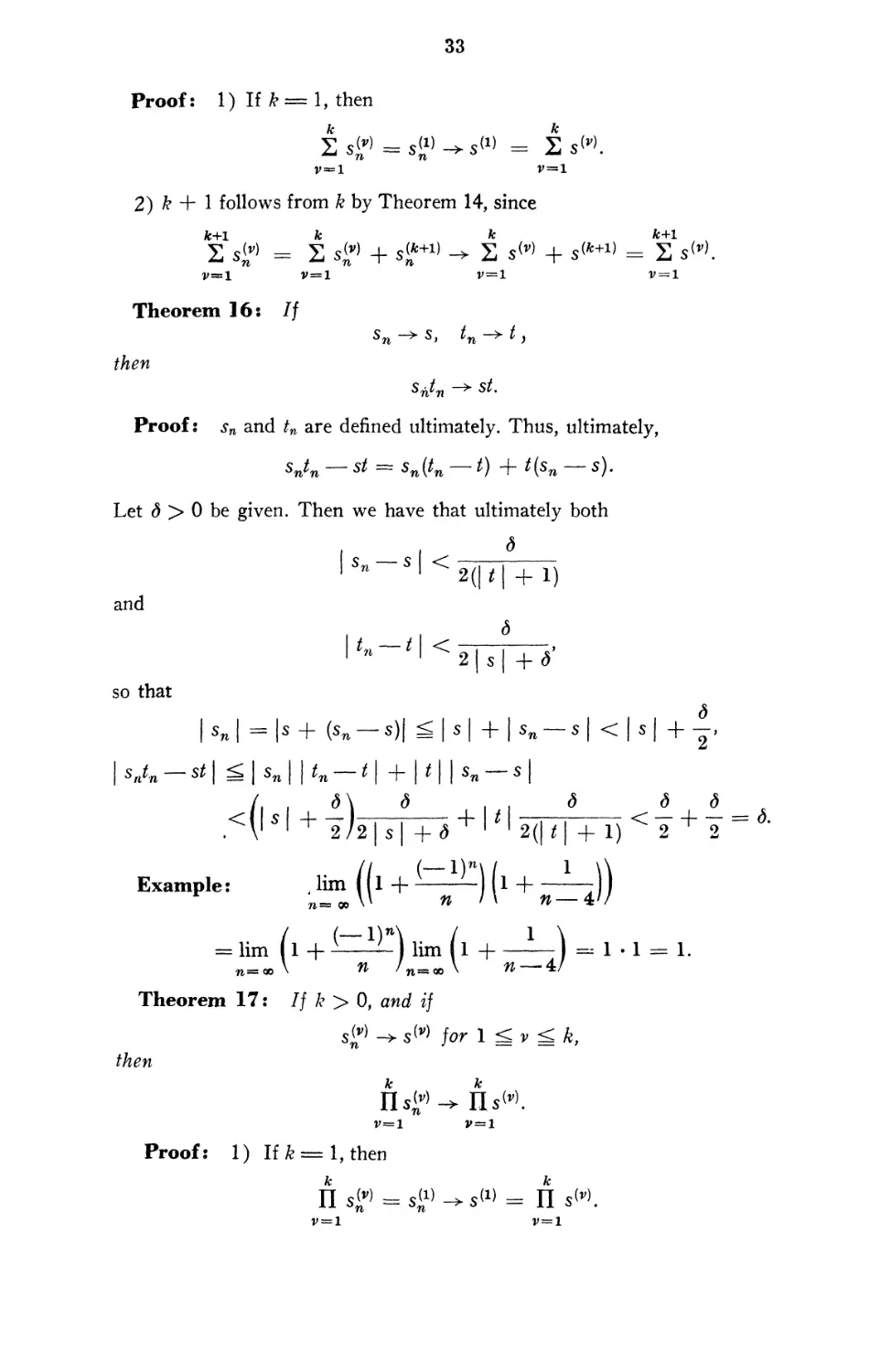
Proof: 1) If k=l, then
SsW=silUsW = 2sW
2) & + 1 follows from fc by Theorem 14, since
fc+l k k k+l
Theorem 16: //
sn ~> s> tn -> t )
then
Proof: jn and ?w are defined ultimately. Thus, ultimately,
sJn — st = sn(tn — t)+t{sn — s).
Let d > 0 be given. Then we have that ultimately both
\sn — s\ <
2(|<| + 1)
and
8
\t»-t\<2\s\+6'
so that
|s„|=|s + (*» —«)| ^lsl +|s» —s|<|s| +-.
I sntn — st\^\sn\\tn — t\+\t\\sn — s\
d , , 6 d 6
Example: Jim ((l + <=±>!) (l + _L_))
= lim (l + (~X) ) lim A H ) = 1.1 = 1.
n==Qo\ » /n-co\ n~ 4/
Theorem 17: // ? > 0, and i/
SW -> SM /^r 1 = „ ^ ?,
?/j?n
nsW-»- Asm.
Proof: 1) If ?=1, then
n sw = si1* - s'1' = n s<».

34
2) k + 1 follows from k by Theorem 16, since
Jc+l k k k+l
nsw = nsM -s^+i' -> ns"» -s(fc+i> = nsw.
Theorem 18: // k > 0 and
Sn* -> Sk.
Proof: Theorem 17, with
Sn] = Sn ^r 1 ^ v ^ *.
Example: lim A H .) - ( lim (l -\ )) == lk = 1
n-=ao\ n —4/ \n=00 \ »— 4//
Theprem 19: //
sn ~* s> In ~* If
then
sv tn —> s t.
Proof: By example 2 to Definition 9, and by Theorem 16,
— tn= (— l)*n-> (— 1)/ = —^,
so that by Theorem 14,
Sn —tn = Sn+ (—tn) -+ S + {—t) = S — t.
Theorem 20: //
s ^0,
then
1 1
sn s'
Proof: For every d > 0,
i i ™- /^2 lsl\
ultimately holds, so that
I si I si
K| =\s+ {sn — s)\ ^|s|— \sn — s\ > |s|_l_I = LJ.

35
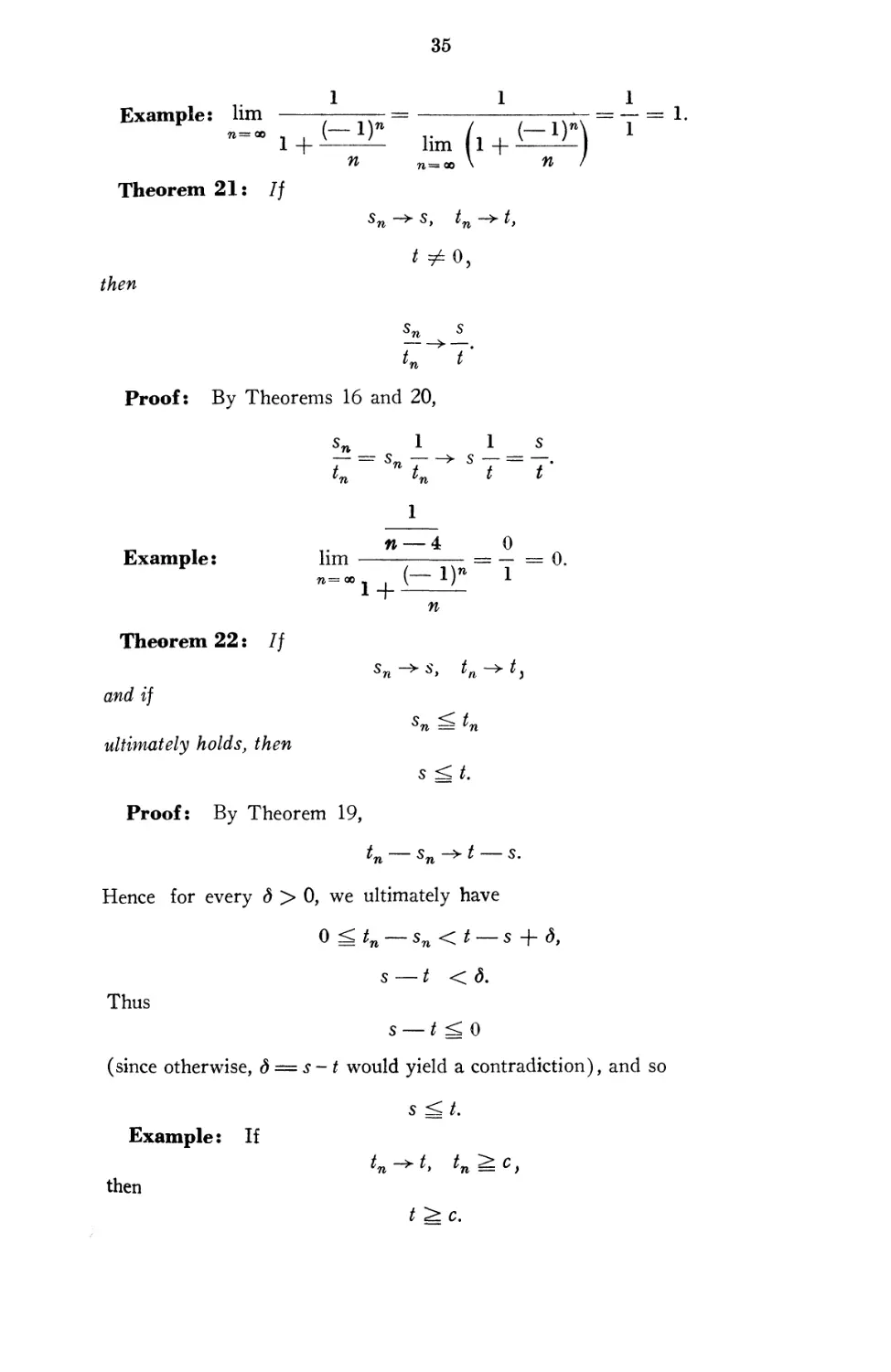
1 l l
Example: km —— = -—- = j = 1.
n n=oo \ n I
Theorem 21: //
Sn —> 5, tn —> t,
then
L~* t'
Proof: By Theorems 16 and 20,
fn = ^_^ l = i_
L n L ~~* t t'
1
n —4 °
Example: lim = — = 0.
n-cQj (-1)" 1
Theorem 22: //
sn ~^ s> tn ~~*" *j
awe/ ff
ultimately holds, then
s <t.
Proof: By Theorem 19,
K — *n "> ' — 5.
Hence for every d > 0, we ultimately have
S — * < <5.
Thus
s — * ^ 0
(since otherwise, <3 = s- t would yield a contradiction), and so
s <t.
Example: If
then
t ^c.

36
Theorem 23: sn -> 0
if and only if
I s„ | - 0.
Proofs Since
|KI| = KI>
both statements mean that for every d > 0 we ultimately have
I sn | < d.
Theorem 24: //
and if
I s, I =g *„
ultimately holds, then
s„->0.
Proof: Let 5 > 0 be given. Then ultimately,
KI <«-
so that, ultimately
I s„ | < 6.
Theorem 25: Le?
sn -* 0.
L^f ?n be defined for n^k, and let there be a g, independent of n, such that
\tn\ <g for n^ k.
Then
sjn -> 0.
Proof: Let d > 0 be given. Ultimately,
Kl<?
so that, ultimately
I s AI < - g = *¦
o
Theorem 26: // sn is defined for ǤN; and if
lim sn
exists, then there exists a g, independent of n, such that
I sn | < g for n ^ N.
Proof: Let
lim s7t — s.
71=00

37
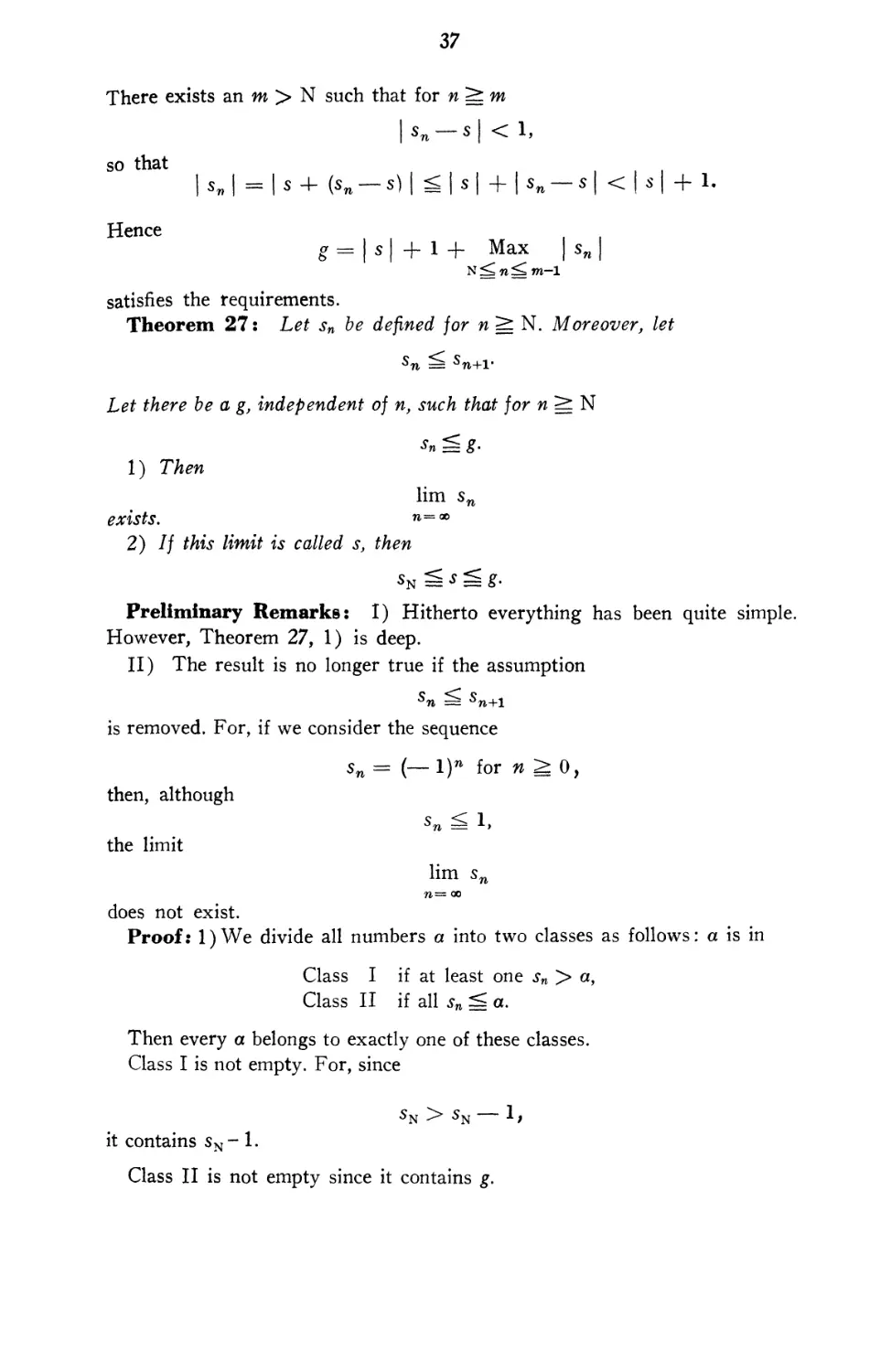
There exists an m > N such that for n §: m
|s„ —s| < 1,
so that
Is. | =|s+ (sn-s)| g|s| +K-s| <|s| + l.
Hence
g = | s | + 1 + Max | s„ |
satisfies the requirements.
Theorem 27: L^f sn be defined for n ^ N. Moreover, let
sn ^ sn+l-
Le? JAere be a g, independent of n, such that for n ^ N
1) TTiew
lim sn
exists. n==Q0
2) // fAw limit is called s, then
Preliminary Remarks: I) Hitherto everything has been quite simple.
However, Theorem 27, 1) is deep.
II) The result is no longer true if the assumption
sn = sn+l
is removed. For, if we consider the sequence
$n = {—l)n for n ^ 0,
then, although
the limit
lim sn
n— qo
does not exist.
Proof: l)We divide all numbers a into two classes as follows: a is in
Class I if at least one sn > a,
Class II if all sn ^ a.
Then every a belongs to exactly one of these classes.
Class I is not empty. For, since
sN > sN 1,
it contains sN - 1.
Class II is not empty since it contains g.

38
If a is in class II, and if f$ > a, then for every n =g N,
s„ ^ a < 0,
so that j3 is in class II.
Hence there exists an s such that every a < s belongs to class I, and every
a > i" belongs to class II.
We shall show that
for this s.
Let d > 0 be given. Then, since s -\ is in class II,
sn ^ s + I < s + d.
s- d is in class I. Hence for some m ^ N,
For n^m (as is clear by 7) of the introduction)
so that
S ^ 9
s~d < sn < s + 6,
\sn — s\ <d.
Hence
2) For all n ;> N,
so that, by Theorem 22,
s.
% ^ sn ^ g,
% ^ lim sM = s :g
n j
Example: lim 2
exists. For if
then
and
oo v = iv2
n |
sn = S — for n ^ 1,
S« < S„
w+1 1 »+l | n+1 /I I \
s„<i+ Z -<i + S _!_ = i+ s(-i--i
n+l i n+l i n i n+l i i
= 1+ s S- = i+ 2-- Si = 1 + 1 — <2.
v=2>' — A v=2 v v=i>' v=2 v n-\-l

39
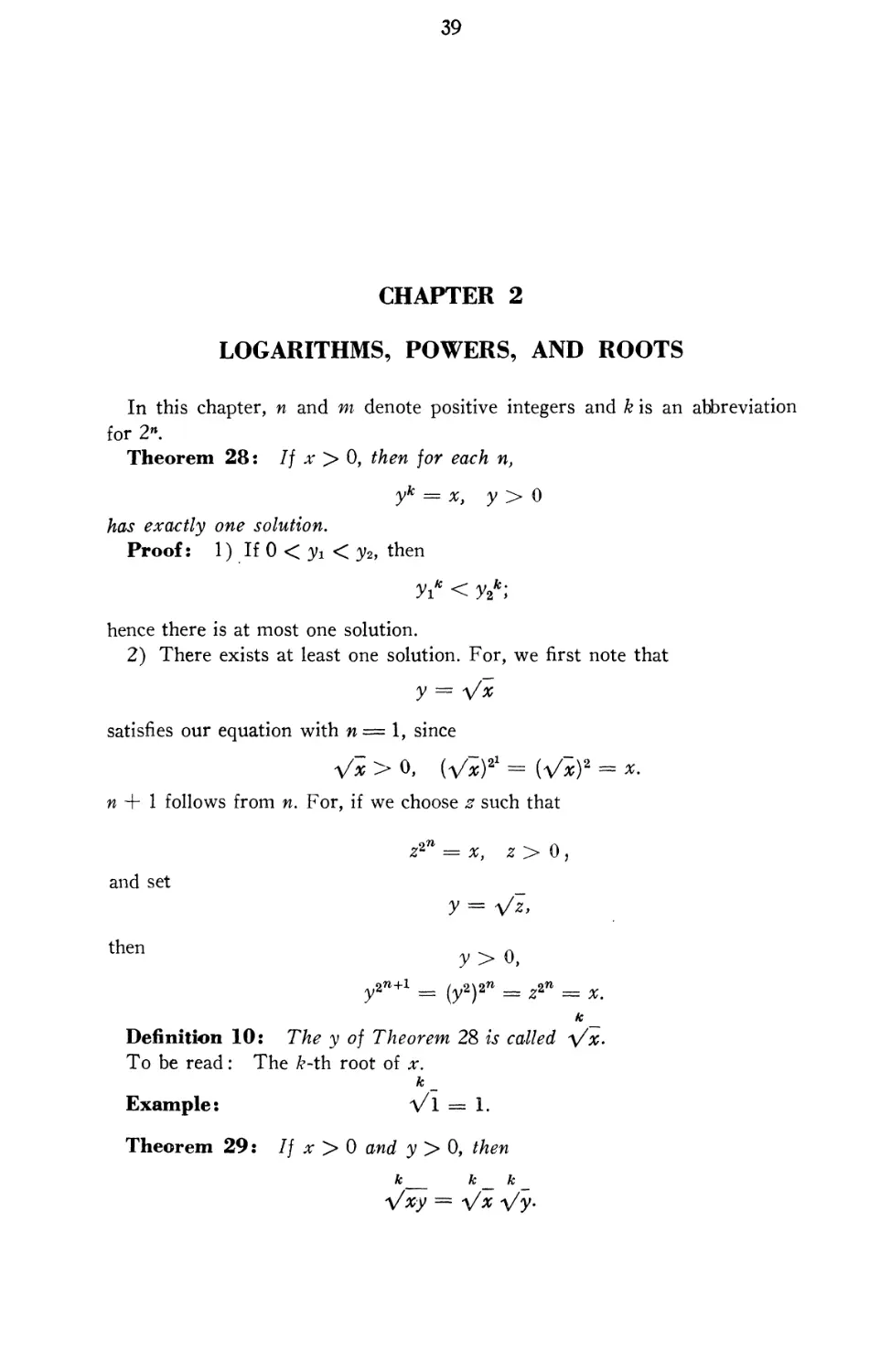
CHAPTER 2
LOGARITHMS, POWERS, AND ROOTS
In this chapter, n and m denote positive integers and k is an abbreviation
for 2".
Theorem 28: // x > 0, then for each n,
yk = x, y > 0
has exactly one solution.
Proof: 1) If 0 < yx < y2, then
yi* < yf\
hence there is at most one solution.
2) There exists at least one solution. For, we first note that
y = y/x
satisfies our equation with n— 1, since
w -f- 1 follows from w. For, if we choose z such that
and set
then
z2
y*n+1 =
— x, z > 0,
y = V~*>
y>o,
(y*Jw _ z*n = ^
K,
Definition 10: The y of Theorem 28 is called -\/%.
To be read: The fc-th root of x.
Example:
Theorem 29:
Vl
= 1.
If x > 0 and 3/ > 0, then
k
V*y =
fc_ A;

40
k __ k _
Proof: Vx Vy > 0,
/ *_ k-\k (k -\k ( k -\k
Wx Vy) = Wx) Wy) =
xy.
Example
so that
(,.
Theorem 30:
Proof:
so that
i) if
^
//*:
x> 1,
If * > 0, then
/I_-L
Vx
> 0, ?/*?w
lim Vx == 1.
n= oo
then
Wx) = * > 1,
k _
V* > 1.
Given d > 0, then (cf. example 4 to Definition 9)
A + d)k > kd,
so that, ultimately,
(I + d)k > x = Wx) >
k _
1 < Vx < 1 + d,
k
\Vx—l\<d.
Thus
2) If *=1, then
k _
lim V# = 1.
Vx = 1 -> 1.
3) If 0<*< 1, then by 1),
k

41
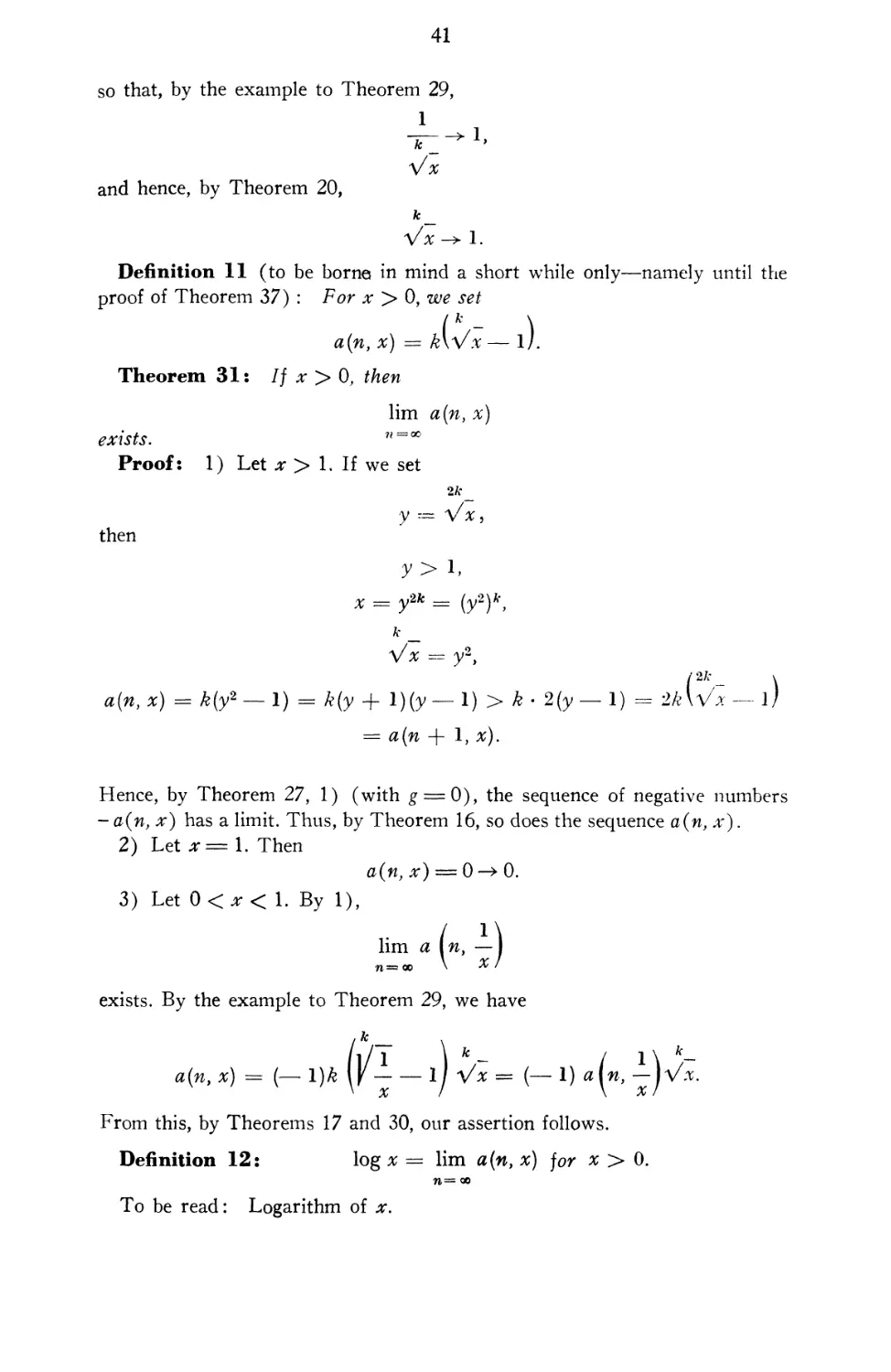
that, by the example to Th<
d hence, by Theorem 20,
sorem 29,
1
Vx
k
Vx -> 1.
Definition 11 (to be borne in mind a short while only—namely until the
proof of Theorem 37) : For x > 0, we set
a(n, x) = k\Vx — 1/.
Theorem 31: // x > 0, then
lim a(n, x)
exists. n==cc
Proof: 1) Let x > 1. If we set
2fr_
y = Vx,
then
y > i,
x = y2k — (y2)**,
k _
Vx = y2,
a(n,x) = k(y2—l) = k(y + l)(y—1) > k - 2(y— 1) = 2MV* — l)
— a(n + 1, #)•
Hence, by Theorem 27, 1) (with g = 0), the sequence of negative numbers
- a{n, x) has a limit. Thus, by Theorem 16, so does the sequence a(n, x).
2) Let x=l. Then
a(n, x) = 0-> 0.
3) Let 0<* < 1. By 1),
lim a In, — I
exists. By the example to Theorem 29, we have
/* — \
a{n, x) = (— l)k (|/- — l) Vx = (— 1) «/», -JVI
From this, by Theorems 17 and 30, our assertion follows.
Definition 12: log* = lim a(n, x) for x > 0.
n— oo
To be read: Logarithm of x.

42
Theorem 32: log 1 = 0.
Proof: a[n, 1) = 0 -> 0.
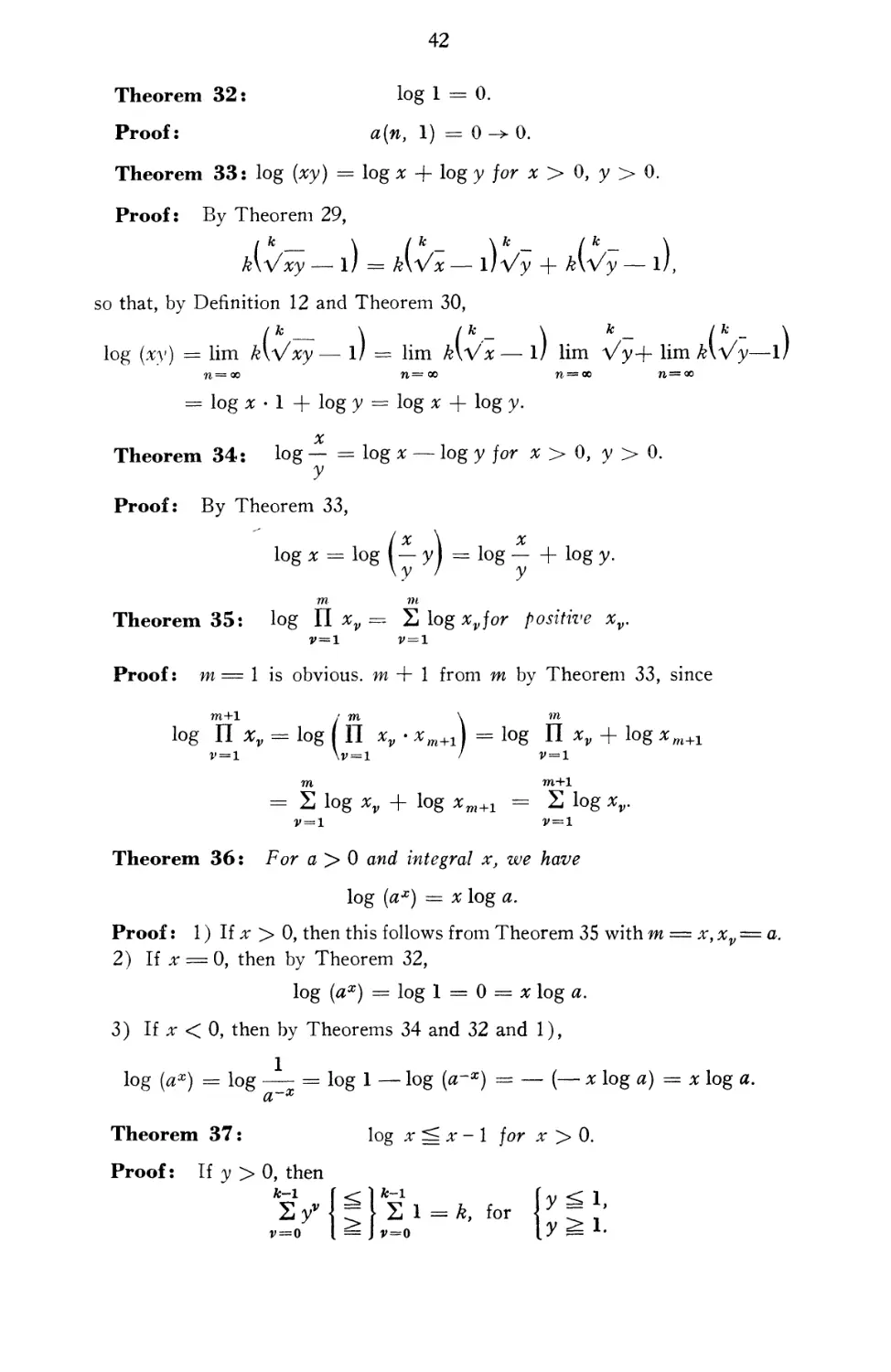
Theorem 33: log (xy) = log x + log y for x > 0, y > 0.
Proof: By Theorem 29,
kWxy — l) = k\Vx — l)Vy + kWy — 1/,
so that, by Definition 12 and Theorem 30,
log (xy) = lim k\Vxy— 1/ = lim k\Vx— 1/ lim Vy+ lim
n=<x> n= oo n=oo n=<x>
= log x • 1 + log y = log x + log y.
Theorem 34: log — — log % — log y for x > 0, y > 0.
y
Proof: By Theorem 33,
(# \ x
— yI = log h logy.
y / y
Theorem 35: log II sv = ?> log xvfor positive xv.
v=l v = l
Proof: m = 1 is obvious, m+l from m by Theorem 33, since
m+l / m \ m
log II ^ == log II *„ • xm+1\ - log II *„ + log xm+1
V = l \V = 1 I v = l
m m+l
= 2 log xv + log *„}+1 - 2 log *„.
v=i v=i
Theorem 36: For a > 0 awd integral x, we have
log (ax) — a; log a.
Proof: 1) If x > 0, then this follows from Theorem 35 with m = xy xv = a.
2) If ^r = 0, then by Theorem 32,
log (ax) = log 1 = 0 = x log a.
3) If x < 0, then by Theorems 34 and 32 and 1),
log (ax) = log = log 1 — log (a~x) == — (— x log a) = x log a.
a~x
Theorem 37: log x ^ x - 1 for jit > 0.
Proof: If y > 0, then

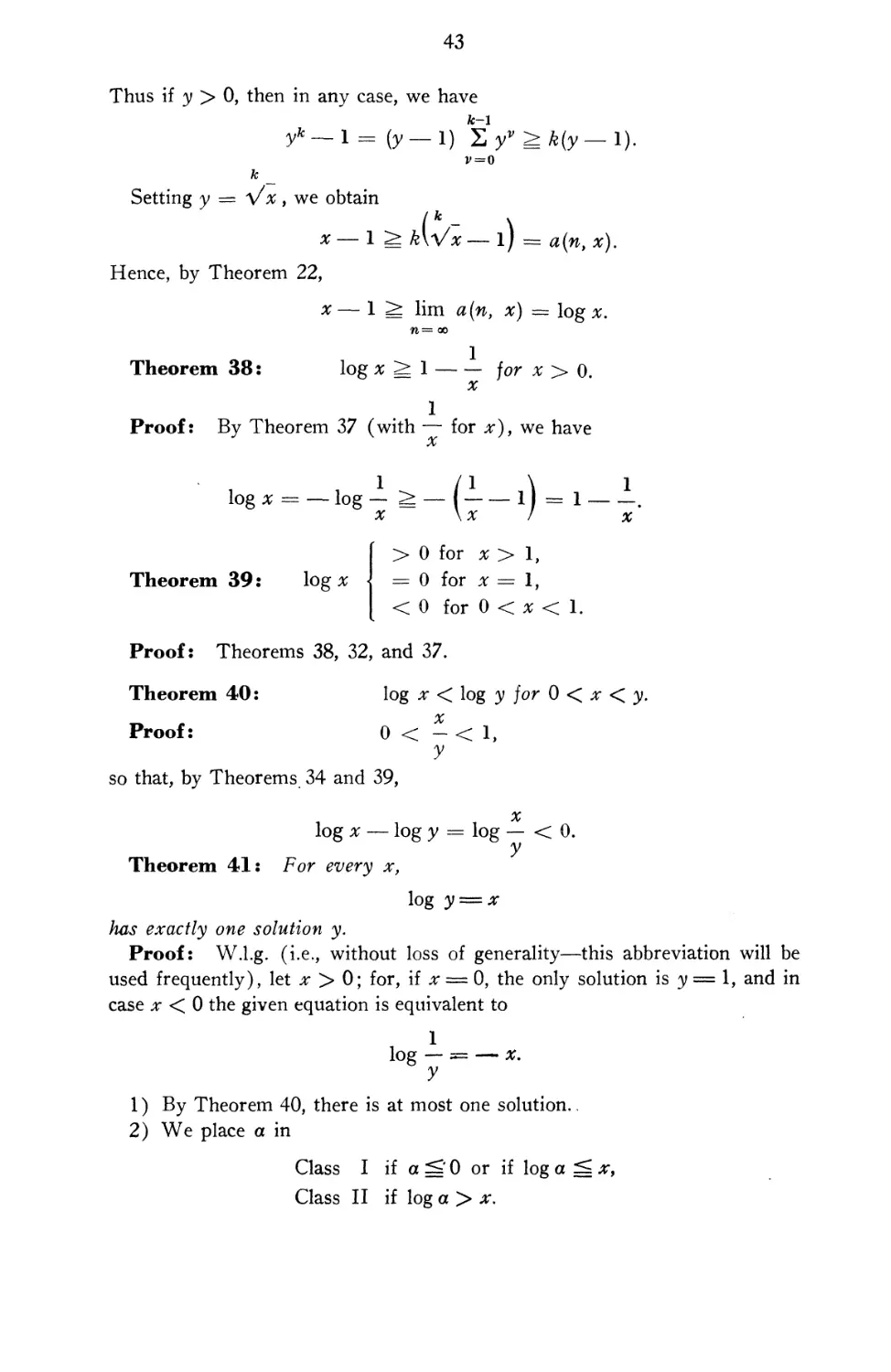
43
Thus if y > 0, then in any case, we have
y* _ 1 = (y _ 1) tyv^k(y— 1).
k _
Setting y = Vx, we obtain
x — 1 ^ MV% — l) = a(», %).
Hence, by Theorem 22,
% — 1 ^ lim a(n, x) = log #.
Theorem 38: log x ^ 1 forx>0
1
Proof: By Theorem 37 (with — for x), we have
log ^^—log i ^ — (i— 1) = l_i.
Theorem 39: log x
> 0 for x > 1,
= 0 for # — 1,
< 0 for 0 < x < 1.
Proof: Theorems 38, 32, and 37.
Theorem 40: log x < log 3/ for 0 < # < y.
Proof: 0 < - < 1,
y
so that, by Theorems 34 and 39,
x
log x — log y = log — < 0.
V
Theorem 41: For every x,
log y = x
has exactly one solution y.
Proof: W.l.g. (i.e., without loss of generality—this abbreviation will be
used frequently), let x > 0; for, ii x = 0, the only solution is y = 1, and in
case x < 0 the given equation is equivalent to
1
log - = — x.
y
1) By Theorem 40, there is at most one solution.,
2) We place a in
Class I if a ^§' 0 or if log a ^x,
Class II if log a > x.

44
Then each a belongs to exactly one of these classes.
Class I contains the positive number a= 1. For, by Theorem 32,
log 1 = 0 g x.
X
(lass II contains a = 2m if m > , >. For, by Theorem 36, we have in this
log 2
case °
log BW) = m log 2 > x.
If a is in class II, and /# > a, then
0 > a > 0,
log j8 > log a > #,
so that [3 belongs to class II.
Hence there exists a y > 0 such that every a < 3/ belongs to I and every
a > y to II. I assert that
log y — x.
It we had
log y < #,
then, setting , . / rt\
5 A = # — log y (> 0),
we would have by Theorem 37 that
log (A + h)y) = log A + h) + log y ^ A + log y = *,
so that A 4- /?)y would be in class I, and yet > 3/.
If we had
log y > x,
then, setting
A = (> 0),
we would have by Theorem 37 that
y
log TVh = log y ~log ^ + ^ ~logy — h > logy ~~ ^logy~~%>j ^ *'
y
so that y~r~T wou^ be in class II, and yet < y.
Definition 13: e is the solution of
log y= 1.
The letter e may now no longer be used to denote anything other than this
positive universal constant.

45
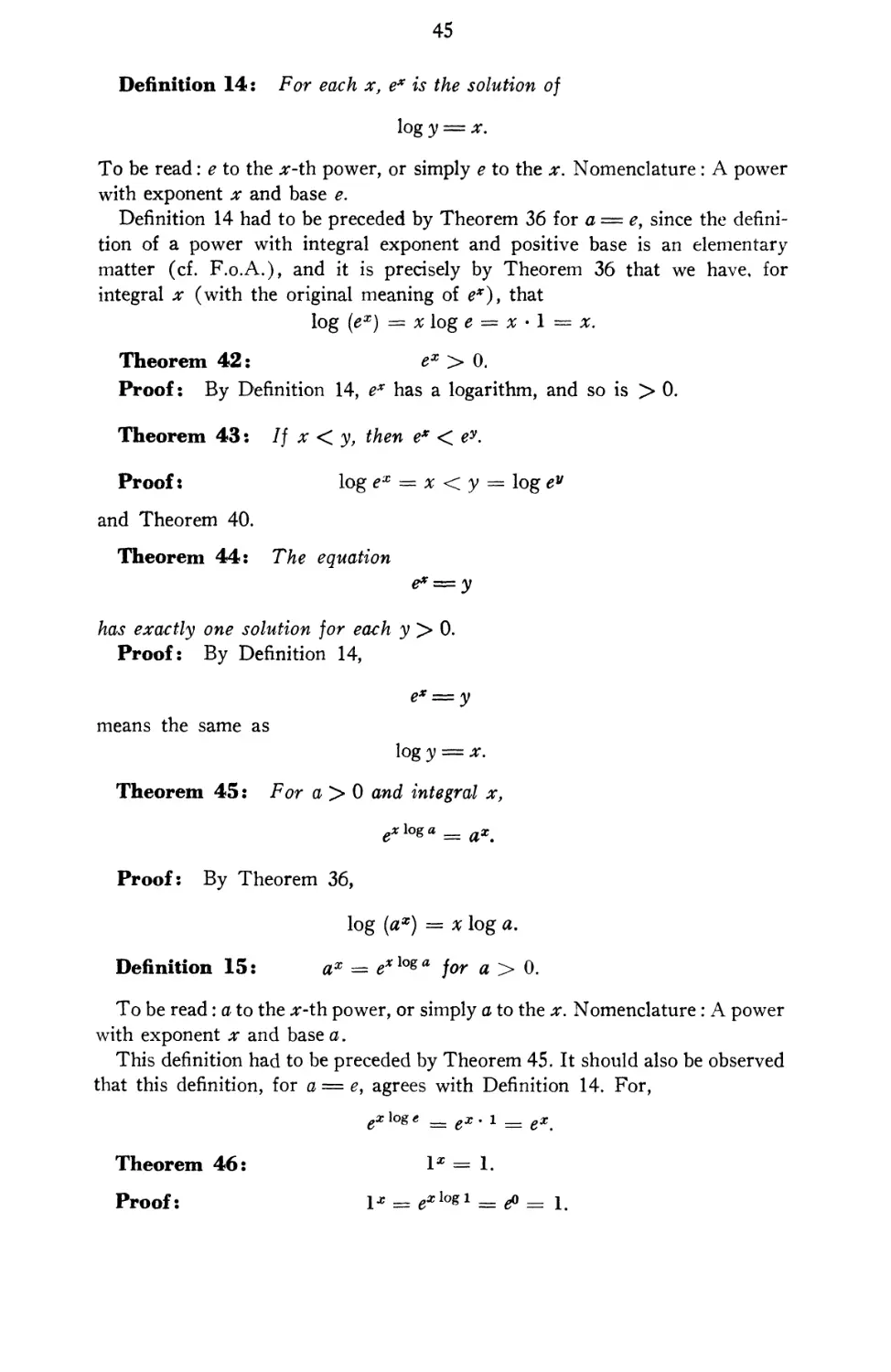
Definition 14: For each x, ex is the solution of
log y = x.
To be read: e to the x-th power, or simply e to the x. Nomenclature: A power
with exponent x and base e.
Definition 14 had to be preceded by Theorem 36 for a = e, since the
definition of a power with integral exponent and positive base is an elementary
matter (cf. F.o.A.), and it is precisely by Theorem 36 that we have, for
integral x (with the original meaning of e*)t that
log (ex) = x log e = x • 1 = x.
Theorem 42: ex > 0.
Proof: By Definition 14, e* has a logarithm, and so is > 0.
Theorem 43: If x < y, then e* < ey.
Proof: log ex — x < y = log ev
and Theorem 40.
Theorem 44: The equation
e* = y
has exactly one solution for each y > 0.
Proof: By Definition 14,
e* — y
means the same as
log y = x.
Theorem 45: For a > 0 and integral x,
Proof: By Theorem 36,
log (ax) = x log a.
Definition 15: ax = exloga for a > 0.
To be read: a to the #-th power, or simply a to the x. Nomenclature: A power
with exponent x and base a.
This definition had to be preceded by Theorem 45. It should also be observed
that this definition, for a = e, agrees with Definition 14. For,
ex log e __ ex . i __ ex
Theorem 46: 1* = 1.
Proof: H = exlogl = e? = 1.

46
Theorem 47: If a>0 then a* > 0.
Proof: Definition 15 and Theorem 42.
Theorem 48: \o%{ax) = x log a for a > 0.
Proof: Definitions 14 and 15.
Theorem 49: ax \
< av for a > 1,
== av for a = 1,
> «» /or 0 < a < 1,
* < y.
Proof: For a > 1, we have by Theorem 43 that
For a= 1,
a* = 1 = a*.
For 0 < a < 1 we have by Theorem 43 that
ax ^ ^ log a > ey log a == ay
Theorem 50: a*a* = 0*+* for a > 0.
Proof: log (axav) = log (a*) + log (av) = % log a + y log a
= (x + y) log a = log (a3**).
Theorem 51: — = a*-*' for a > 0.
a*
Proof: By Theorem 50, we have
ayax~y _ ay+(x-v) = ax
Theorem 52: ?*«-* = 1 for a > 0.
Proof: By Theorem 50, we have
axa~x = #*+<-*> — a0 — 1.
m
m E xp
Theorem 53: II axv = av=1 /or a > 0.
v=l
Proof: By Theorem 35, we have
log
(m
E
r — j. k —J. -— A ,r —*
Theorem 54: (ab)x = a*** for a > 0, b > 0.
Proof: (aft)* = e*log <a6) = ^ <los a+lo§ fe) = ^ log a ex log 6 = #*ft*.

47
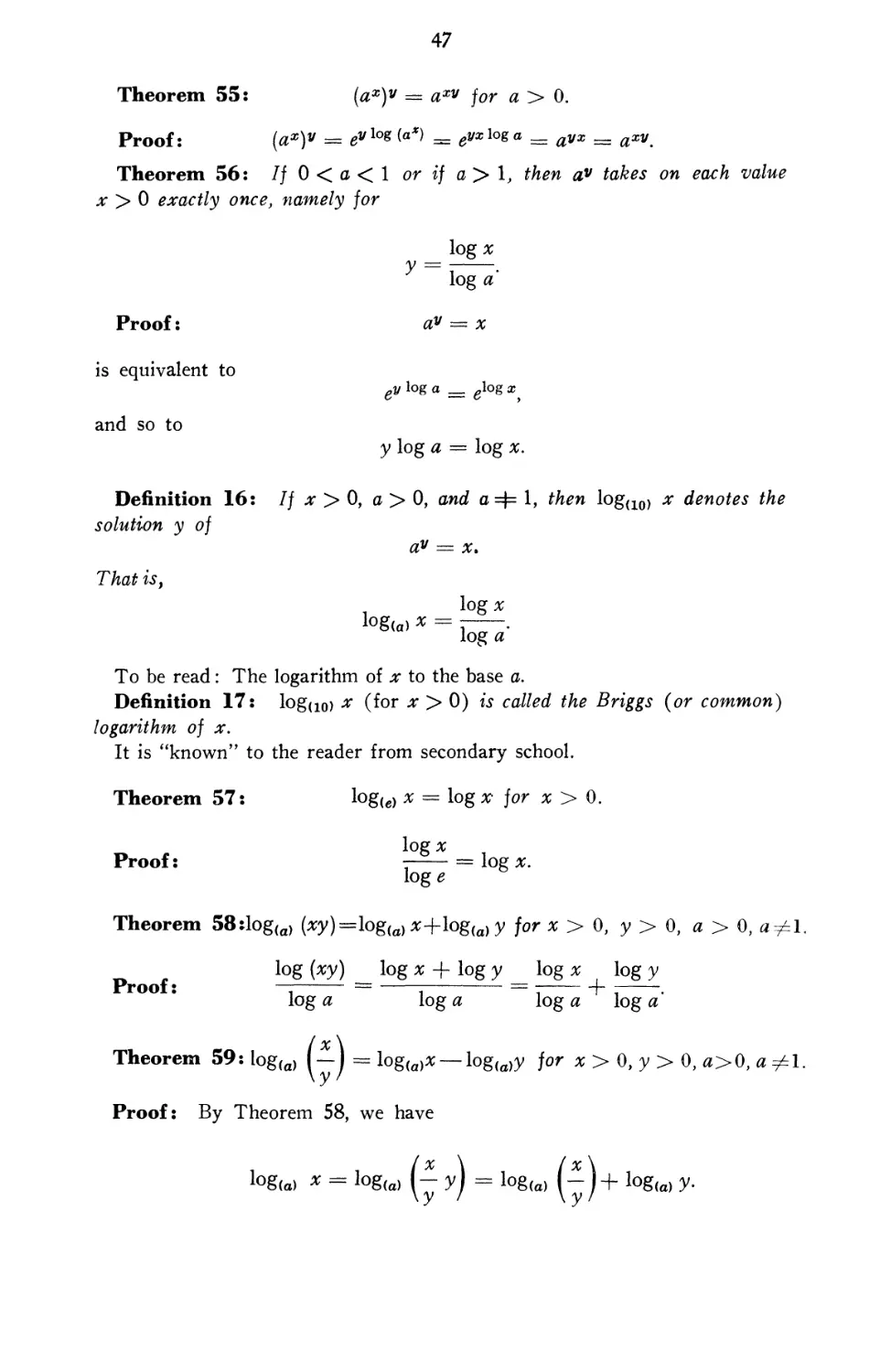
Theorem 55: (ax)v = a*» for a > 0.
Proof: (a*)* = evlog {a*] = ^logfl == a** = axv.
Theorem 56: If 0 < a < 1 or if a > 1, ?/t?w av takes on each value
x > 0 exactly once, namely for
Proof:
is equivalent to
and so to
log*
y =
log a
a* = x
eV log a __. ^log x
y log a = log *.
Definition 16: If x > 0, a > 0, awrf a 4= 1, ^w l°g<io) •*" denotes the
solution y of
a* = x.
That is,
log*
To be read: The logarithm of x to the base a.
Definition 17: logA0) x (for x > 0) is called the Briggs (or common)
logarithm of x.
It is "known" to the reader from secondary school.
Theorem 57: log(c) x = log x for x > 0.
log*
Proof: = log x.
loge
Theorem 58:log(a) (*y)=log(o)*+log(a)y for x > 0, y > 0, a > 0, a^l.
log (xy) log x + logy log * log y
Proof: —; = : = : f-
Theorem 59
""" \y
log a log a log a log a
log(a) y—J = log(a)* —log(o)y for x > 0, y > 0, a>0, a =?1.
Proof: By Theorem 58, we have
l0g(a) * = l0g(a) K y) = log(fl, (-)+ l0g(fl) y.

48
Theorem 60: // x =g 0, then for every mt
y™ = x, y § 0
has exactly one solution.
Proof: 1) For x = 0, it is clear that y = 0 is a solution, and indeed the
only solution.
2) For x > 0, the positive number
y — %m
satisfies our equation, since by Theorem 55, we have
/ JLA" ±.m
\xm) = xm = xl = x.
Conversely, for x > 0 it follows from
y** = #, y ^ 0
and Theorem 55 (since y = 0 need not be considered) that
ill
— — m.—
xm = (ym)m = y w = y1 = y.
Definition 18: 77u> y of Theorem 60 w called Vx.
To he read: The m-th. root of x.
Definition 18 agrees, for x > 0, m=;2n, with Definition 10.
Theorem 61:
Proof:
Tlaeorem 62:
Proof:
Vx
2 _
Vx =
= x for x
xl = X.
= Vx for .
Vx^O
(VxY =
^0.
^ ^ 0
a;.

49
CHAPTER 3
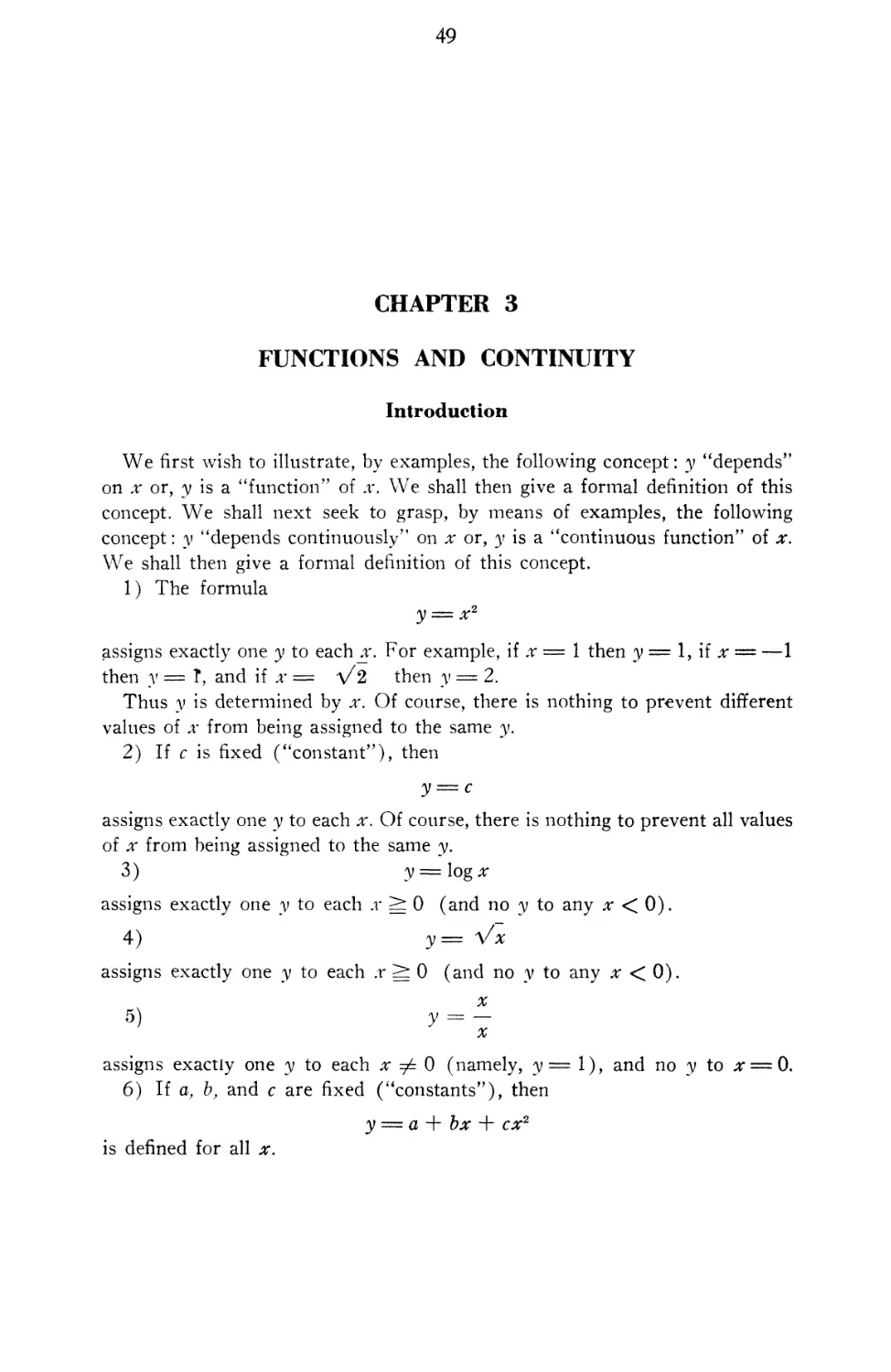
FUNCTIONS AND CONTINUITY
Introduction
We first wish to illustrate, by examples, the following concept: 3; "depends"
on x or, 3; is a "function" of x. We shall then give a formal definition of this
concept. We shall next seek to grasp, by means of examples, the following
concept: 3; "depends continuously" on x or, 3' is a "continuous function" of x.
We shall then give a formal definition of this concept.
1) The formula
y = x2
assigns exactly one 3' to each ^r. For example, if x = 1 then y=l,iix = —1
then v = ?, and if x = V2 then y = 2.
Thus y is determined by x. Of course, there is nothing to prevent different
values of x from being assigned to the same y.
2) If c is fixed ("constant"), then
y = c
assigns exactly one y to each x. Of course, there is nothing to prevent all values
of x from being assigned to the same y.
3) 3; = log*
assigns exactly one 3; to each x ^ 0 (and no y to any x < 0).
4) y— Vx
assigns exactly one y to each x ^ 0 (and no y to any x < 0).
x
5) y = ~
x
assigns exactly one 3? to each x ^ 0 (namely, y=l), and no 3? to x = 0.
6) If a, b, and c are fixed ("constants"), then
y = a + bx + ex2
is defined for all x.

50
7) If
y = 3 for x > 2, and
y is not defined for x ^§= 2,
then exactly one 3/ is assigned to each x > 2, and no y to any x g= 2.
8) If
y
{-.
for # ^ 0,
for x < 0,
then exactly one y is assigned to each x. This example shows that it is not
required that y be defined by a single formula.
__ f 0 for rational x,
' y ~~ [ 1 for irrational x.
10) (contains 1), 2), and 6) as special cases.) Let w^O be integral,
let av be given for integral v with 0 ^ v ^ n, and let
(for all #).
11)
y = Ya av%v
V = Q
y = I # I for all #.
12)
13)
y =
I for * = 0,
II v for integral jt > 0.
y — ^* for all jr.
14) y = y/x for x §: 0 if w is an integer > 0.
We have now had sufficient preparation for the understanding of
Definition 19: Let 9ft be a set of numbers. Let exactly one number y be
assigned to each x of 9Ji. We then call y a function of x and write, say,
x is called the independent, y the dependent variable. (We may, of course,
use any letters instead of x, y, and /.)
Definition 20: A function of the type given in example 10) is called an
entire rational function or a polynomial.
Definition 21: The function of example 12) is called x\.
To be read: x factorial, x! is thus defined only for integral x ^ 0.
The following are important examples of sets of numbers:
If
a<b,
the set of x for which
1) a ^ x g b,
2) a < x < b,
3) a < x <J b,
4) a fj x < b\

51
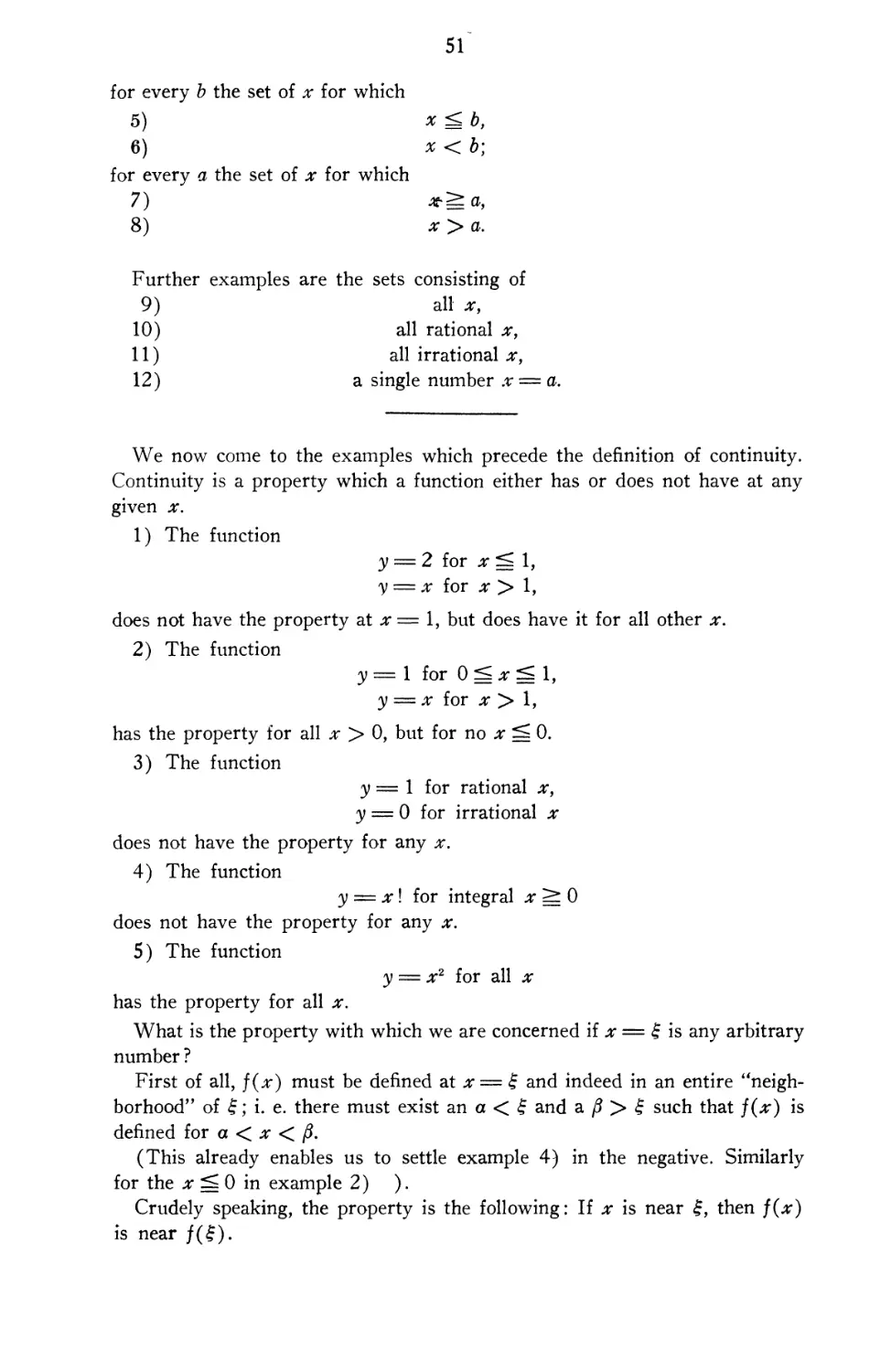
for every b the set of x for which
5) x ^ b,
6) x < b;
for every a the set of x for which
7) *^a,
8) x> a.
Further examples are the sets consisting of
9) all x,
10) all rational x,
11) all irrational x>
12) a single number x = a.
We now come to the examples which precede the definition of continuity.
Continuity is a property which a function either has or does not have at any
given x.
1) The function
y = 2 for x ^ 1,
y = x for x > 1,
does not have the property at x = 1, but does have it for all other #.
2) The function
y = 1 for 0 ^ * ^ 1,
j = # for # > 1,
has the property for all x > 0, but for no x ^ 0.
3) The function
3; = 1 for rational x,
y = 0 for irrational #
does not have the property for any x.
4) The function
y = x! for integral # ^ 0
does not have the property for any x.
5) The function
y = x2 for all x
has the property for all x.
What is the property with which we are concerned if x = I is any arbitrary
number ?
First of all, f(x) must be defined at x== ? and indeed in an entire uneigh-
borncod" of I; i. e. there must exist an a < I and a /? > I such that /(#) is
defined for a < x < /?.
(This already enables us to settle example 4) in the negative. Similarly
for the x :§ 0 in example 2) ).
Crudely speaking, the property is the following: If x is near f, then f(x)
is near /(I).

52
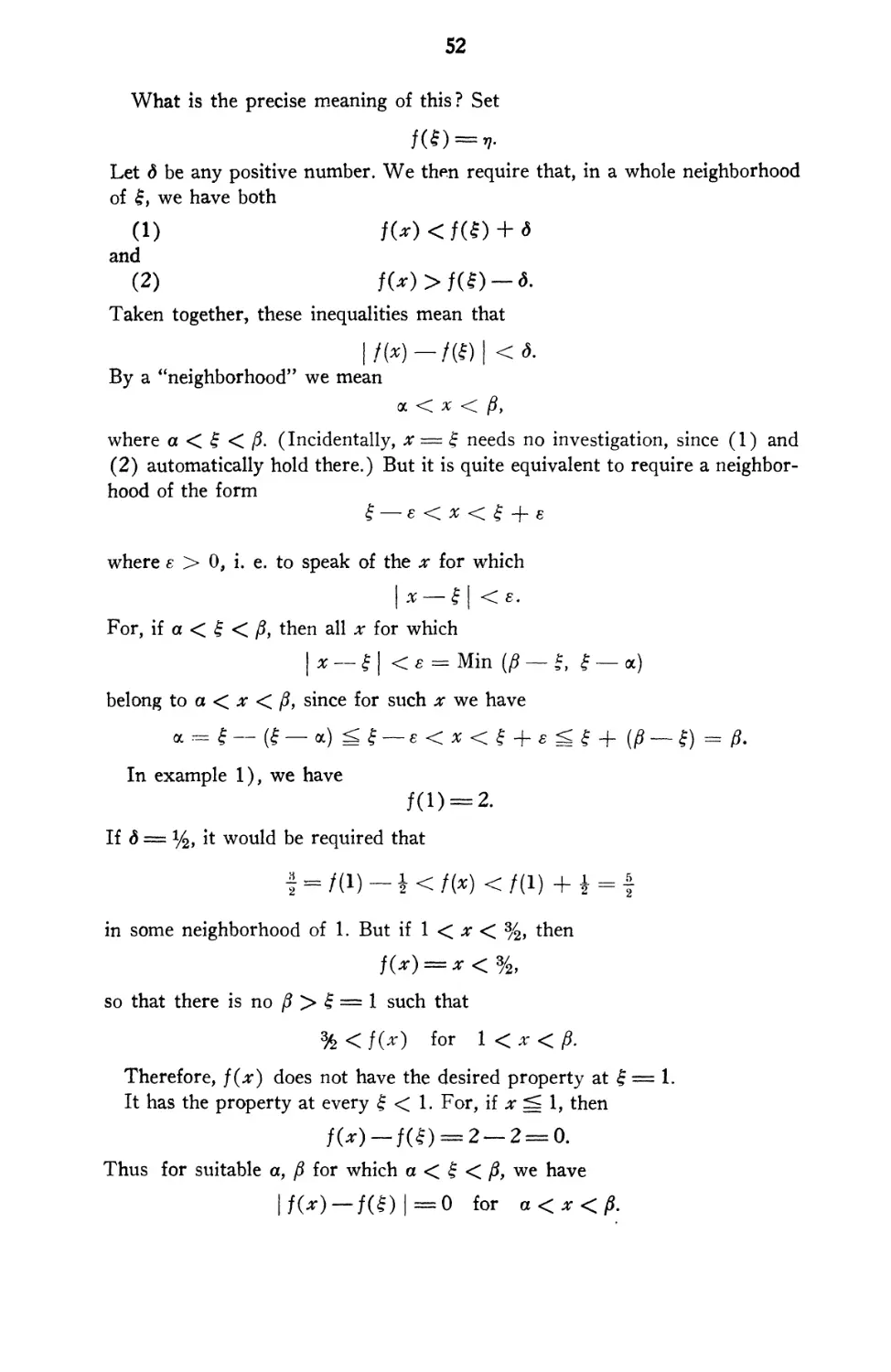
What is the precise meaning of this? Set
/(*) = ?•
Let 6 be any positive number. We then require that, in a whole neighborhood
of I, we have both
(i) K*)<m + t
and
B) Kx)>m-d.
Taken together, these inequalities mean that
\t(x)-f(t)\<6.
By a "neighborhood" we mean
a < x < 0,
where a < I < /?. (Incidentally, x = | needs no investigation, since A) and
B) automatically hold there.) But it is quite equivalent to require a
neighborhood of the form
g — e < x < f + e
where ? > 0, i. e. to speak of the x for which
| X — S | <?.
For, if a < I < /?, then all x for which
| * — f | < ? = Min @ — f, f — a)
belong to a < # < /?, since for such x we have
a = ?—(?—a) ^ f — ? < % < I + ? ^ f + (j8 — f) - fi.
In example 1), we have
/A) = 2.
If 6 = y2> it would be required that
in some neighborhood of 1. But if 1 < x < %, then
so that there is no /? > I = 1 such that
% < /(*) for 1< * < p.
Therefore, f(x) does not have the desired property at ? = 1.
It has the property at every f < 1. For, if x :g 1, then
/(*)-/(*) = 2-2 = 0.
Thus for suitable a, (I for which a < f < /?, we have
I/(*)-/(?) 1=0 for a <*</?.

S3
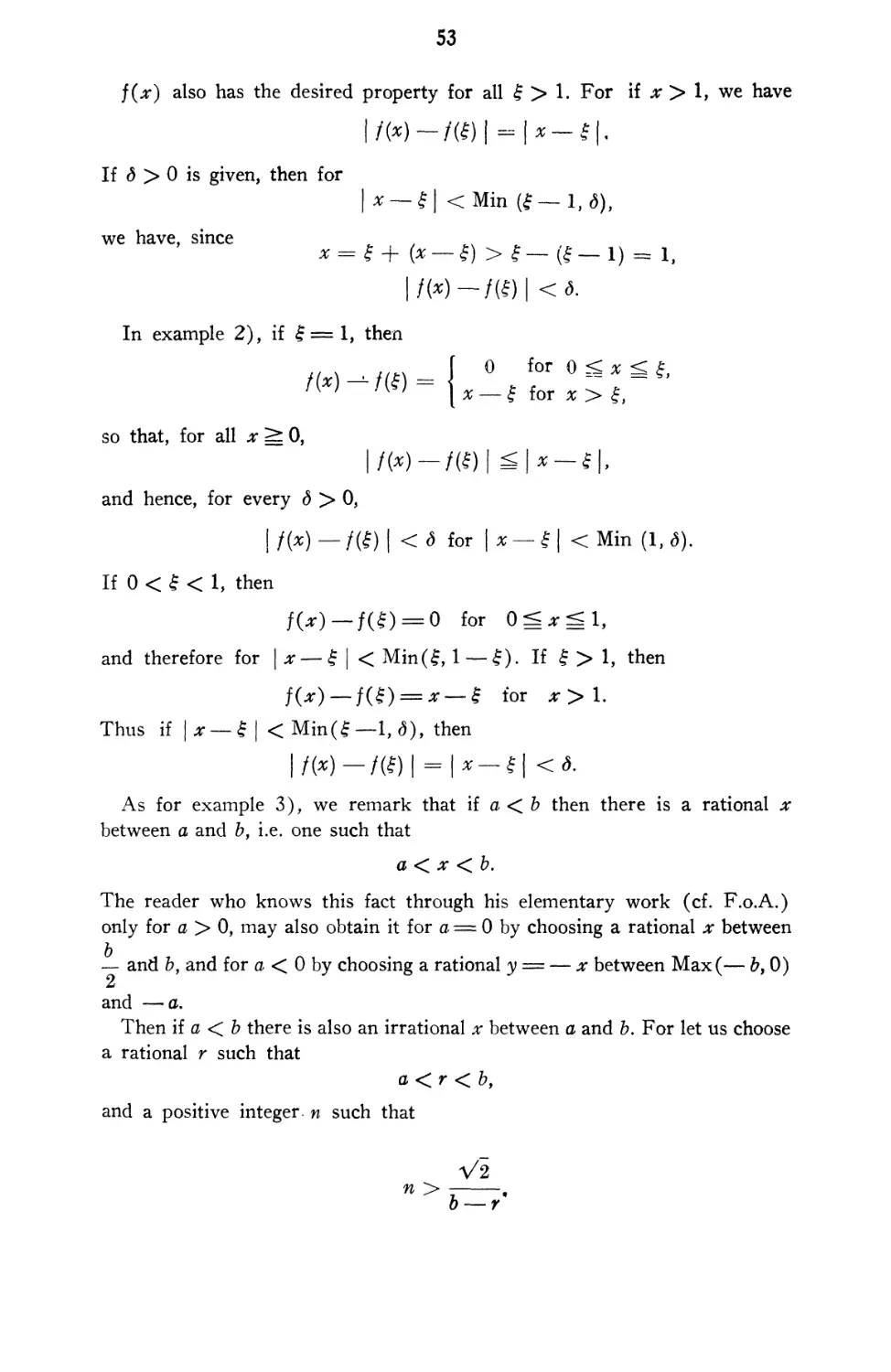
f(x) also has the desired property for all I > 1. For if x > 1, we have
I/(*)-/(*)! = I*-?|.
If d > 0 is given, then for
| x — f | < Min (| — 1, b),
we have, since „
x = i+ (x — i) x— (f—i) = i,
In example 2), if 1=1, then
so that, for all # ^ 0,
and hence, for every 5 > 0,
I/(*)—/(?) I <«5 for |« — ? | < Min A,6).
If 0 < |< 1, then
/(*) —/(?) = 0 for O^at^I,
and therefore for \x — ?\< Min(|, 1 — ?). If I > 1, then
/(*) — /(?) = * — I for *>1.
Thus if \x — ? | < Min(? — 1, d), then
|/(*)_/(f)| = |*_f | <<5.
As for example 3), we remark that if a < b then there is a rational jt
between a and b, i.e. one such that
a < jt < b.
The reader who knows this fact through his elementary work (cf. F.o.A.)
only for a > 0, may also obtain it for a = 0 by choosing a rational x between
— and by and for a < 0 by choosing a rational y = — x between Max(— b, 0)
and —a.
Then if a < b there is also an irrational x between a and b. For let us choose
a rational r such that
a < r < b,
and a positive integer- n such that
V2
w >
b — r*

54
a/2
Then r -\ is irrational (for otherwise V2 would be rational), and
n
V2
a < r -\ < o.
n
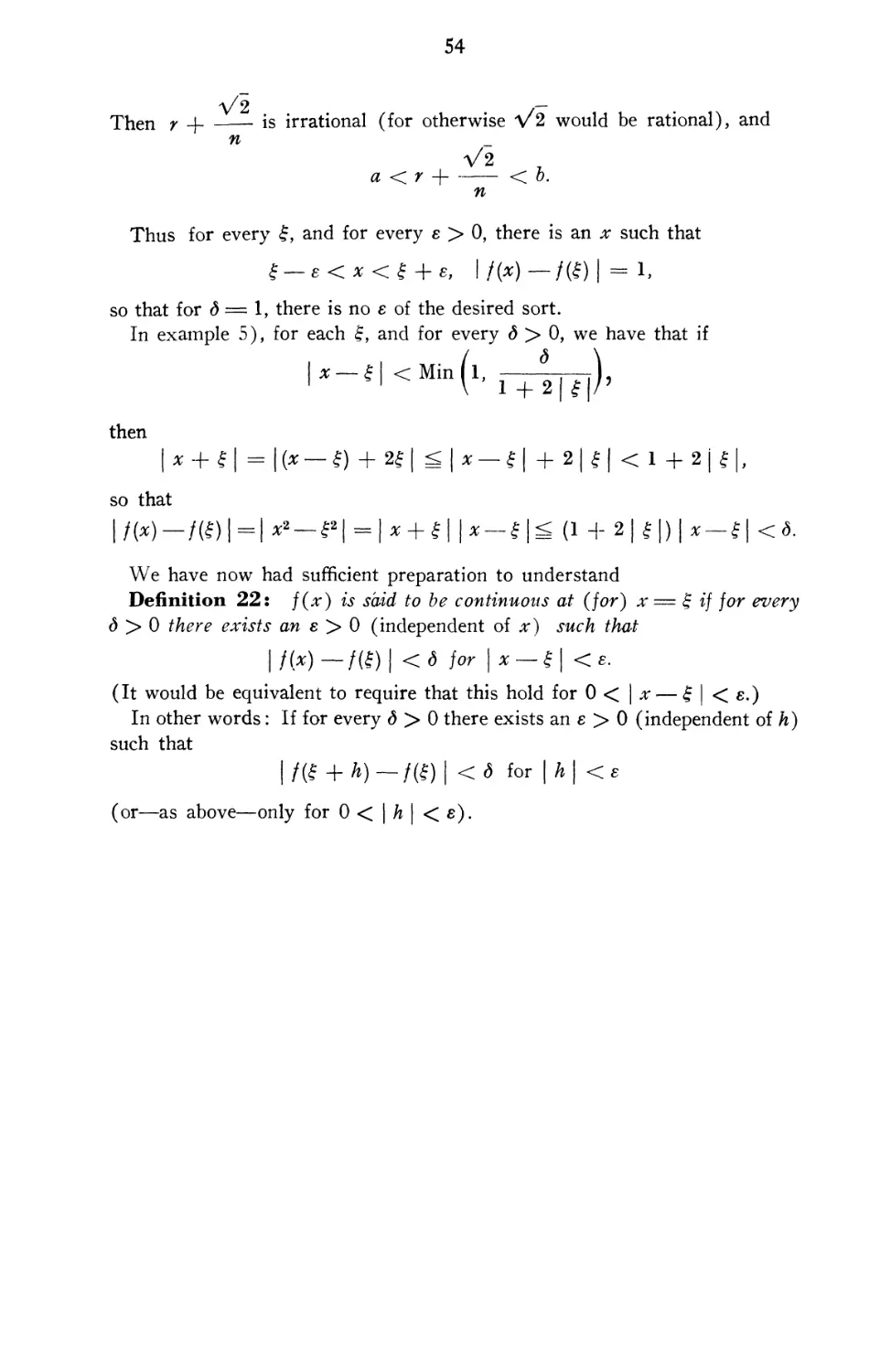
Thus for every |, and for every e > 0, there is an x such that
Z-e<x<t;+e, \f(x)—f(?)\ = l,
so that for <3 = 1, there is no e of the desired sort.
In example 5), for each I, and for every <3 > 0, we have that if
\ x — 11 < Minjl, :—r),
then
\x + ?\=\(x — e) + 2?\^\x — ?\+2\?\<l + 2\?\,
so that
|/(*)—/(f)H*a —fa|=l* + f I \* — ?\^ (l + 2\S\)\x — ?\<d.
We have now had sufficient preparation to understand
Definition 22: j(x) is said to be continuous at (for) x = | if for every
d > 0 there exists an e > 0 (independent of x) such that
|/(*)—/(?) | <d for \x — S\ <s.
(It would be equivalent to require that this hold for 0 < \ x — | | < e.)
In other words: If for every <3 > 0 there exists an s > 0 (independent of h)
such that
|/(? + *)—/(?) | <$ for | A| <?
(or—as above—only for 0 < | h | < a).

55
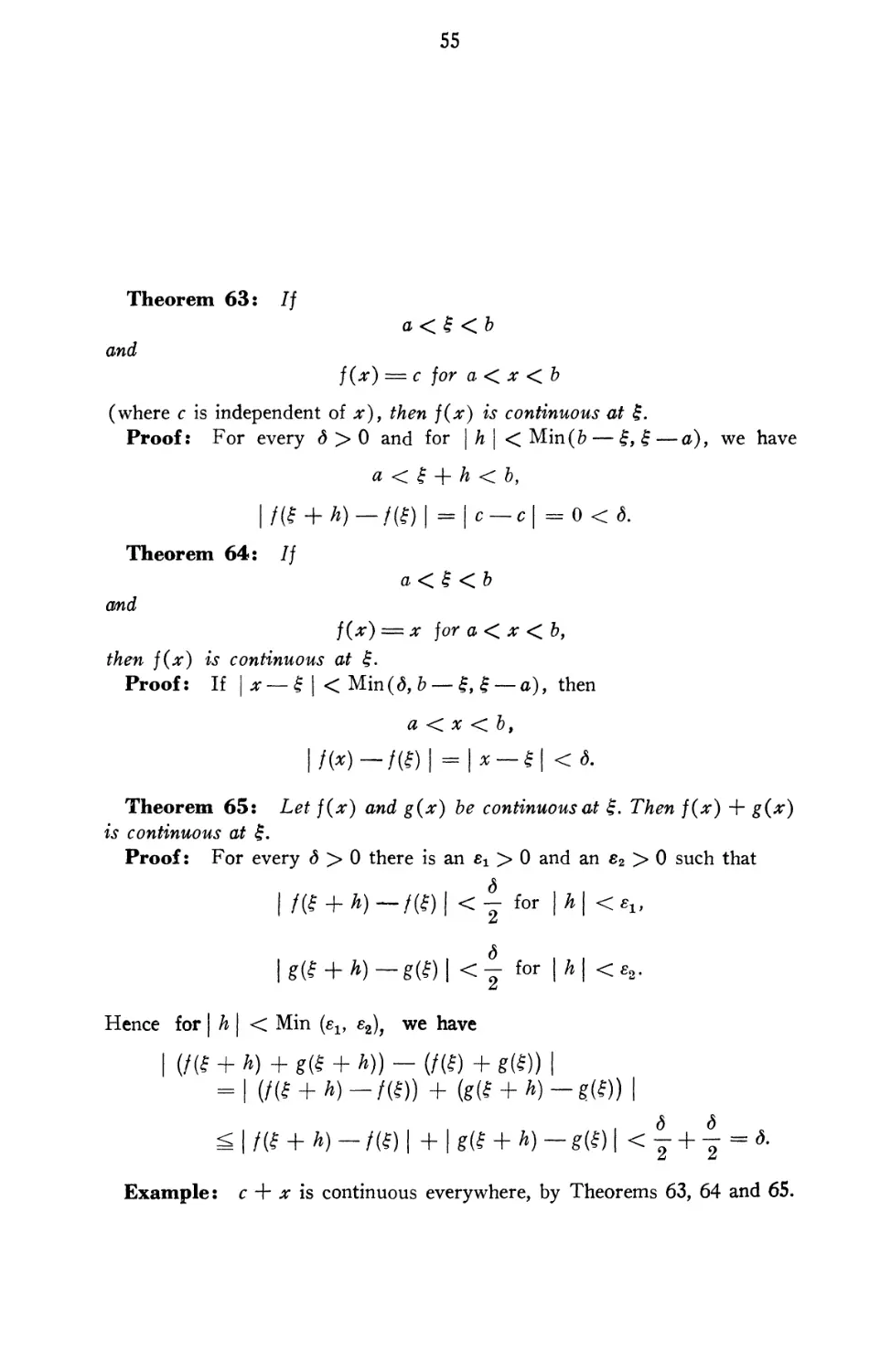
Theorem 63: //
a<S <b
and
f(x) = c for a < x < b
(where c is independent of x), then f(x) is continuous at f.
Proof: For every d > 0 and for | h | < M'm(b — f, f—a), we have
a < f + h < b}
|/(f + h)— /(f) | =\c — c\ =0<d.
Theorem 64: //
a<S <b
and
f(x) = x jor a < x < b,
then f(x) is continuous at f.
Proof: If \x — ?\<M.m(d,b — g,? — a), then
a < x < b,
[f{x)-f(S)\ = \x-S\<d.
Theorem 65: Let f(x) and g(x) be continuous at f. Then f(x) + g(x)
is continuous at f.
Proof: For every d > 0 there is an fii > 0 and an e2 > 0 such that
\f(e + h)-f(?)\<j for |A|<ei,
\g(Z + h)-g(t)\<j for |A|<e2.
Hence for | A | < Min (e^ e2), we have
I (/(? + *) + g(* + *)) - (/(f) + g(*)) I
= I (/(? + *)-/(*)) + (g(f + *) -g(f)) I
^ I /(? + A) -f(S) | + | g(f + A) -g(f) | < - + - = d.
Example: c + x is continuous everywhere, by Theorems 63, 64 and 65.

56
Theorem 66: If m"^ I is integral, and if fn(x) is continuous at ? for
m
every integer n such that 1 ^ n ^ m, then ? fn{%) is continuous at I.
n = l
Proof: m = 1 is obvious. To proceed from m to m + 1:
m+l m
S /»(*) = S /„(*) + /TO+i(«)
n = l n = l
and Theorem 65.
Theorem 67: // /(#) is continuous at ?, then cf(x) is continuous at I.
Proof: For every d > 0 there is an e > 0 such that if | h | < e, we have
|/(f + A) _/(f) [<_!_,
I cl + l
so that
I c/(f + A) - c/(|) | = | c(/(f + h) - /(f)) |
= | c | | /(| + h) -/(|) | < (| c | + 1) j^p^- = d.
Theorem 68: Let f(x) and g(x) be continuous at |. Then f(x) — g(x)
is continuous at f.
Proof: f(x) — g(x) = f(x) + (—1) #(•*¦) and Theorems 67, 65.
Theorem 69: L#? /(#) and g(x) be continuous at ?. Then f(x)g(x)
is continuous at f.
Proof: Let <S > 0 be given. Choose an fi > 0 such that if | h | < s, then
l/B + ^-ZW^Min l.'-jj™)
and
"«+»>-««> i <„1+l/tf)l,-
Then if | ft | < e, we have
|/(| + A)g(| + A)-/(?)g(|)|
= | (/(M-A)-/(?)) fg(l+*)-g(f)) +/(?) (g(f+*)-?(«) +g(f) (/(l+*)-/(^)l
^|/(f+A)-/(f)| |g(f+A)-g(f)|+| /(f)| |g(*+A)_g(|)|+|g(?)| |/(f+/*)_/(?)(
c c c c c c
< ' 'I + I'(l)| 3"(TT]7(^) + 'm 'sfl+jgtfjj) < T + I + F = *
Theorem 70: If m^ I is integral, and if fn(x) is continuous at f for
m
each integer n such that 1 ^ n 5= m, fft^w H /n(#) w continuous at f.
Proof: w = 1 is obvious. To proceed from m to m + 1:
m+l m
n/„(*)= n/„(*)./m+1(«)
n = 1 n = 1
and Theorem 69.

57
Theorem 71: If f(x) is continuous at ?, and if m is an integer ^ 1,
then fm{x) is continuous at ?.
(fm(x) is a more convenient notation for (f(x))m.)
Proof: Theorem 70, with
fn(x) = f(x) for lfgw^w.
Examples: 1) For integral m ^ 1, xm is continuous everywhere by
Theorems 64 and 71.
n
2) Thus every polynomial 2 avxv is continuous everywhere. For, avxv is
continuous everywhere for v = 0 by Theorem 63, and for 0 < v ^ n by
Example 1) and Theorem 67. Thus the polynomial itself is continuous
everywhere by Theorem 66.
Theorem 72: If f{x) is continuous at I and if
/(?) > o,
then there is a p > 0 and a q > 0 swc/i that
f(S + h)>p for \h\< q.
Proof: Choose q > 0 such that
|/(| + A) -/(f) | <!/(!) for |A| <<?.
Then if | h | < q, we have
/(?+*) = /(?)+(/(f+A) -/(f)) > /(f) - i/(f) = */($) = />.
Theorem 73: If f(x) is continuous at I awd i/
/(f) < o,
then there is a p > 0 awd a q > 0 swc/i ?/ia?
/(? + *)<—/> for |*l <«•
Proof: Theorem 72 with —/(#) for f(x). In fact, —/(#) is continuous
at I by Theorem 67.
Theorem 74: If f(x) is continuous at ? awd ^/
/(f) # o,
1
f/tew rr-r is continuous at f.
Proof: By Theorem 72 or 73, choose ? > 0 and q > 0 such that
| /(f + A) | > p for | A | < q.
Then if | h | < g, we have
1 1
/(* + *) m
/(f + *)/(*)
/(i + h) -/(f)
/(f + ^ 11 /(f)
<
p\m
/(f + A)_/(f)|.

58
For every d > 0 there is an e with 0 < e ^ q such that, for | k | < e,
|/(f + A)_/(f)|<^|/(f)|,
which implies
Example:
/(f + *) /(?)
<
P /(f)
** I /(f) I = »¦
is continuous at every ? ^ 0.
Theorem 75: L#? /(jf) and g(x) be continuous at f. L#?
*(*)#o.
Tfon —— is continuous at f.
g(x)
1
Proof: By Theorem 74,
rem 69, so is
g(*)
is continuous at I. Therefore, by Theo-
Example: Let f(^r) and g(x) be polynomials, and let
*(*)*0.
/(*) 1 + *3
Then is continuous at f. For example, is continuous at all I, and
g(x) 1 + *2
1 ~ x* at all ? ^ 1.
1 — x
Theorem 76: 7/ /(x) is continuous at |, ?/iew | /(#) | w continuous at f.
Proof: For every d > 0 there is an e > 0 such that
|/(? + *)—/(?) | <<5 for | A| <«.
Therefore if | /t | < e, we have
||/(f + *) I -1 /(f) || ^ I /(f + ^) -/(f) I <«.
Example: | x | is continuous everywhere.
Theorem 77: Let g{x) be continuous at ?, g(?) = r), and let f(x) be
continuous at 77. Then f(g(x)) is continuous at f.
Proof: Let d > 0 be given. Choose C > 0 such that
\f(v + k) — /fo) I <d for |*| <C,
and then e > 0 such that
|g(? + AJ —g(f)|<C for |A| <e.
Then if | h | < e and if we set
* = *(? +A)-*@,

59
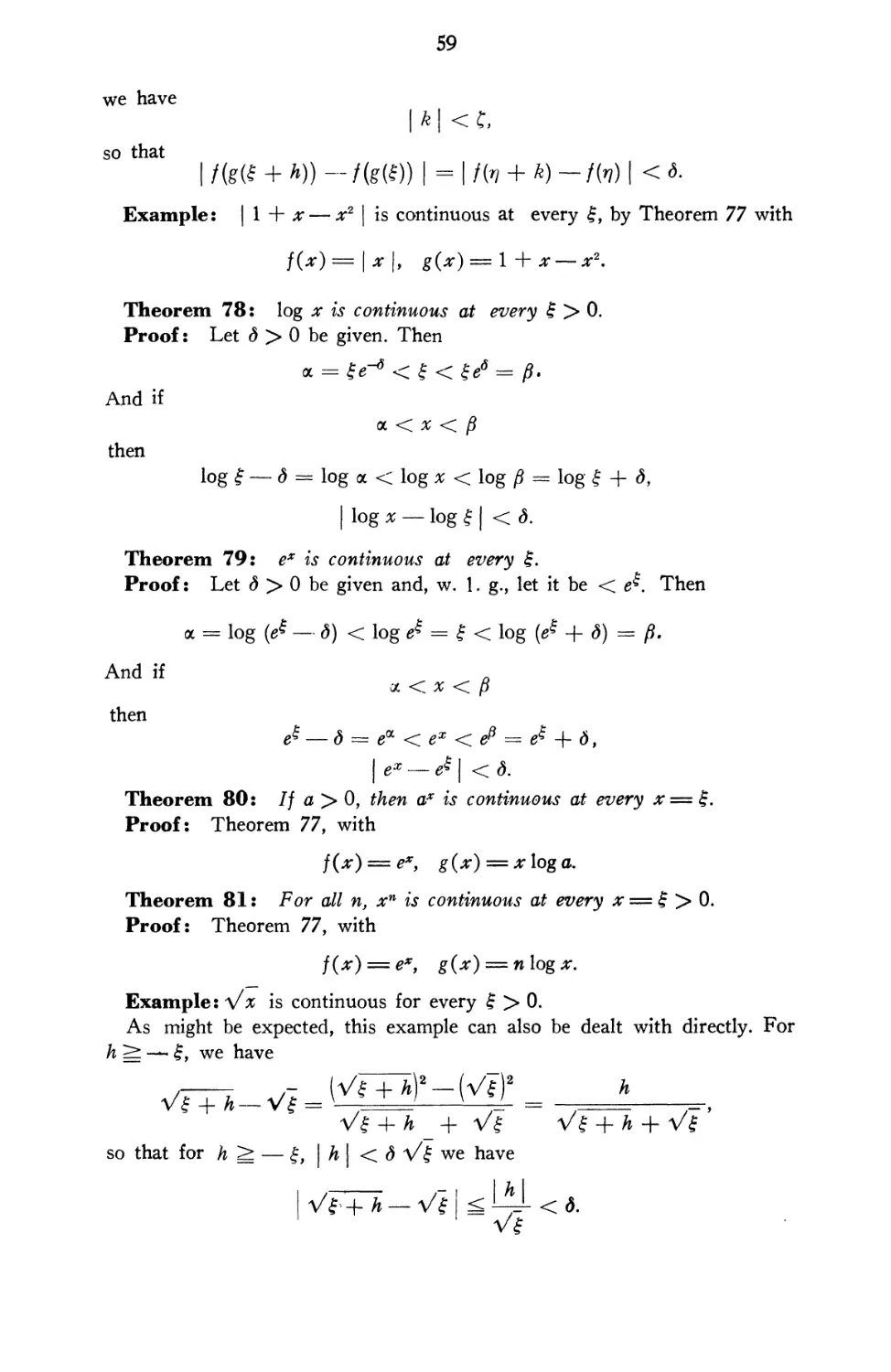
we have
| A | < C,
so that
I /(g(f + h)) -/(g(?)) | = | f(n + k)-M I < d.
Example: | 1 + x— x* | is continuous at every ?, by Theorem 77 with
K*)=\x\, g(x) = l+x-x\
Theorem 78: log x is continuous at every ? > 0.
Proof: Let d > 0 be given. Then
a = ?e-6 < ? < ?e6 = 0.
And if
a < x < /?
then
log f — E = log a < log x < log /? = log f + <3,
| log a? — log f | < <3.
Theorem 79: 0* w continuous at every ?.
Proof: Let d > 0 be given and, w. 1. g., let it be < e$. Then
a = log (? — d) < log ? = ? < log (^ + d) = /?.
And if
a < * < /?
then
^ — <3 = ea < ex < eP = ^ + d,
I e* — ^ I < E.
Theorem 80: // a > 0, ffon a* w continuous at every x = ?.
Proof: Theorem 77, with
/(*) = ex, g(x) = x log a.
Theorem 81: For all n, xn is continuous at every x = ? > 0.
Proof: Theorem 77, with
f(x) = ex, g(x) = n log #.
Example: V% is continuous for every ? > 0.
As might be expected, this example can also be dealt with directly. For
h^.-~>?, we have
ffi-viJ^U| =
V? + h _+ V? V? + A + V?
so that for A ^ — ?, \ h\ < d V? we have

60
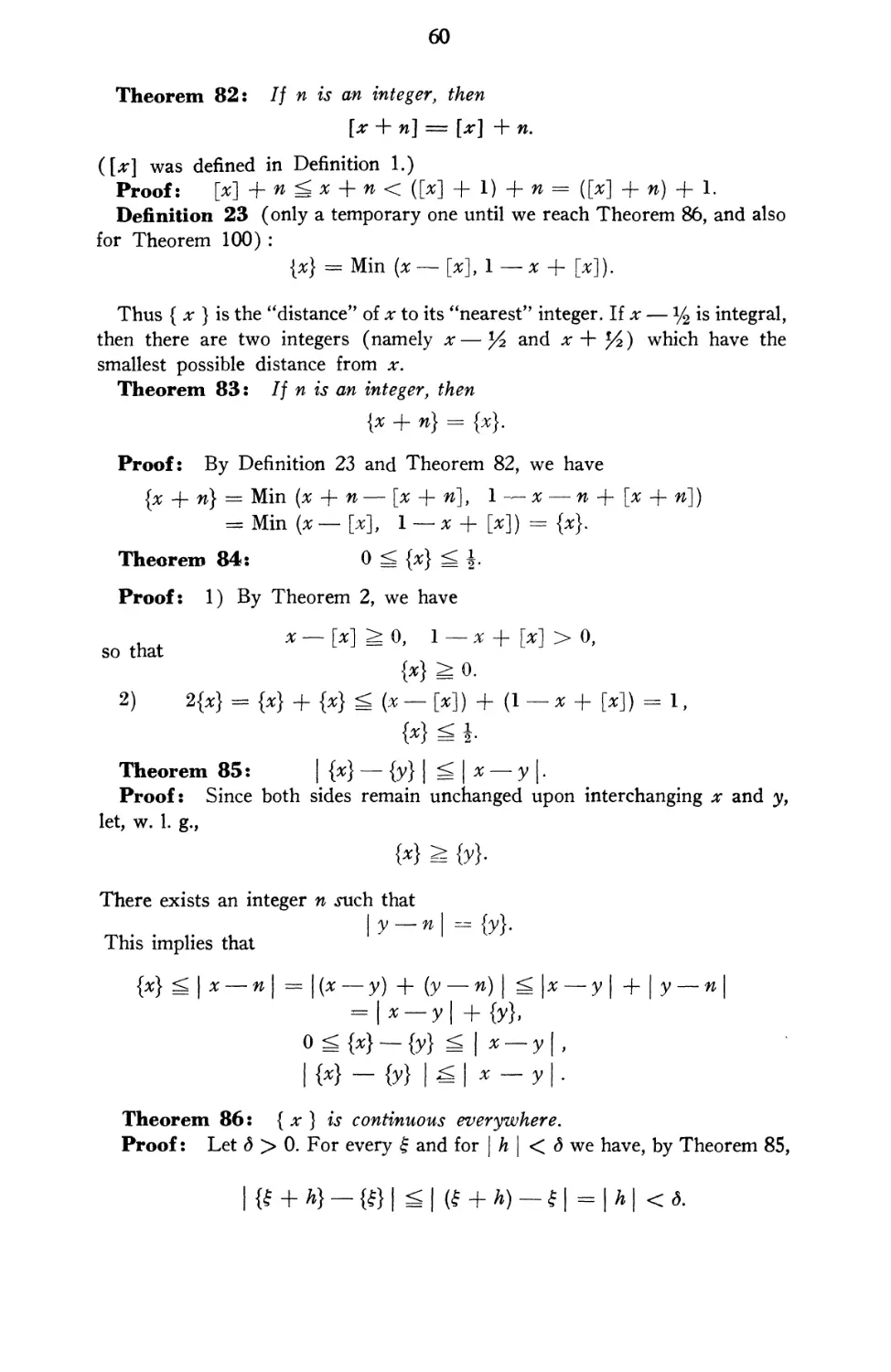
Theorem 82: If n is an integer, then
[x + n] = [x] + n.
([x] was defined in Definition 1.)
Proof: [x]+n?x + n< ([*] + 1) + n = ([*] + n) + 1.
Definition 23 (only a temporary one until we reach Theorem 86, and also
for Theorem 100) :
{%} = Min (x — [x], 1 — x + [x]).
Thus { x } is the "distance" of x to its "nearest" integer. If x — y2 *s integral,
then there are two integers (namely x—J4 and x + y2) which have the
smallest possible distance from x.
Theorem 83: If n is an integer, then
{x + n} = {x}.
Proof: By Definition 23 and Theorem 82, we have
{x + n} = Min (x + n — [x + n], 1 — x — n + [x + n])
= Min (x — [x], 1 —¦ x + [x]) = {#}.
Theorem 84: 0 ^ {%} ^ |.
Proof: 1) By Theorem 2, we have
x — [*] > 0, l —#+[#]> 0,
so that ~
{*} ^ o.
2) 2{%} = {x} + {%} fg (* — [x]) + A — * + [*]) = 1,
W ^ i
Theorem 85: | {%} — {y} | ^ | x — y \.
Proof: Since both sides remain unchanged upon interchanging x and y,
let, w. 1. g.,
{*} ^ M-
There exists an integer n suzh that
This implies that
{%} fg | x — n\ = | (x — y) + (y — n)\ fg |# — y\ + \y — n\
= I% — y\ + {y}>
0^W-M ^ | x — y\t
\{x}-{y)\?\x-y\.
Theorem 86: { x } is continuous everywhere.
Proof: Let d > 0. For every | and for | h | < d we have, by Theorem 85,
|{* + A}-{*}|^|(* + A)-?|=|A|<a.

61
1) The function
CHAPTER 4
LIMITS AT x =
Introduction
X-
is defined only for x ^ 3. We shall say that it has a limit, namely 6, at x — 3.
Why? For those x which are near 3 but not equal to 3, f(x) is near 6. For
if x 7^ 3, then
/0) = * + 3,
and x + 3 equals 6 at jt = 3 and is continuous there.
It may appear like mere sophistry not to consider the function x + 3 in the
?2 —9
first place, instead of . However, the fact that there was a denominator
x — 3
which could be cancelled in the neighborhood of x = 3, except at x = 3 itself,
is a coincidence. In the next example, no such coincidence occurs.
2) The function
log_(M-)
X
is defined for all x > — 1 with the exception of 0. We shall find that the
situation here at x = 0 and for the number 1 is entirely similar to that in
example 1) at x = 3 and for the number 6.
For x > — 1, we have, by Theorems 37 and 38,
-^— ^ log A + *) ^ *,
so that for x > 0,
1 < log A + *) < 1(
1 + x ~ % ~

62
and, for — 1 < x < 0,
1 + x'
1
1 +x~
X
log A 4- x)
log A + x)
1 ^0,
^ 1,
1 + x~~
Thus if 0 < | x | < y29 then
log A + x)
log A + x)
> _5J——L _ l > o.
<
1 +x
<2\x\,
so that for any d > 0, if 0 < | x \ < Min("^> ^-)» then
log A + x)
<
3)
/(*) = -
is defined for x # 0. No number 77 has the desired property at the critical
value 0. For, if there were an e > 0 such that
1
rj
x
< 1 for 0 < I x I < e,
then we should have
for 0 < x < s, which is not the case for
4) Let
)t the case for
= Min (-, 31—r).
\2 1 + U/
/(%) =
0 for % ^ 5,
1 for % = 5.
0 has the desired property for the critical value 5. Indeed, \f(x) — 0| is
even equal to 0 for all x ^ 5.
Before we proceed to define the concept of limit, we shall prove a theorem
which states that limits, when they exist, are unique.

63
Theorem 87. Let a < ? < b. Let f(x) be defined for a < x < f and
for f < .r < b. Then there is at most one number rj such that
Y( ) — I fW for a < x < % and ? <x <b,
\rj for % = f
i^ continuous at ?.
Proof: Let 771 and 7/2 be two such numbers. Let ^i(x) and F2(^) be the
corresponding functions F(.r). We need only show that
g(x) = F1(x) — F2(x)
is equal to zero at x = ?.
By Theorem 68, g(^r) is continuous at x= ?. If we had
then for a suitable /j we should have, by Theorems 72 and 73,
0 < h < Min (f — a, b — ?), g(f + A) # 0,
while, for a < x < fe, # =? ?, we have
g(*) = f(*)-/(*) = 0.
Definition 24: L#? a < ? < 6. L#? /(#) fr# defined for a < x < ? and
for ? <. x <C.b. If there exists an -q in the sense of Theorem 87, then we write
lim f(x) — rj
(lim is to be read "limit"), or more concisely
f(x) ->??,
and we say that f(x) has the limit rj at f, or that f(x) approaches 77 at x = f
(or as #—»?).
An equivalent condition (which makes no use of the previous chapter) is
that for every d > 0 there exists an e > 0 such that
|/(? + /t)_^1 <<5 for 0< \h\<e,
or (equivalently)
\f(x) — v\ <d for 0< |* —? I <c.

64
This wording of the definition shows that the concept lim f(x) , given in
Definition 24, is independent of the particular choice of a and b.
x2 — 9
Examples (see above) : 1) lim = 6.
x = 3 x 3
2) lim = 1,
x=0 x
and therefore, evidently,
r ^gx .
lim = 1.
cr=-{ X 1
Theorem 88: f(x) is continuous at ? if and only if lim f(x) exists and
w = /(f). x=t
Proof: Obvious.
For the remainder of this chapter, all limits will be taken at some fixed f.
Theorem 89: //
then
f(x) + g{x) ->rj + f.
Proof: For a suitable p > 0, /(#) + g(#) is defined for 0 < \x — e \ < p.
If we define
F(*) = (^ ior °<\X — ?\<P>
I r] for a; = f,
cm - J^) for 0<l x~f I <^
GW~1 C for* = f,
#(*) =F(«) +G(*) for \x — ?\<p9
then
#M =-{/W +gW for °<h —f I <A
V ; { 17 + f for x = |.
F(jr) and G(.ar) are continuous at f. Therefore, by Theorem 65, so is $(x).
Thus we have
0{x) -+<,) + ?,
/(*) + gix) -> V + C.
,m/^-^ + log(l + ,U
p= o ^ ^ — " X /
Example: lim ^—^ + ^lilZL^ =3 + 1 = 4.

65
Theorem 90: If
/(*)->^ g(*)->C
then
f(x)—g(x)->rj — C.
Proof: Like that of Theorem 89, except with
0(x) = F{x) — G(x)
and Theorem 68.
Theorem 91: //
f(x)->rj, g(x)->?,
then
f{x)g(x) ->???.
Proof: Like that of Theorem 89, except with
0{x) = F(x) G(x)
and Theorem 69.
(%i 9\ x2 9
(x + 4) l=lim (* + 4) -lim =7 .6=42.
X 3/ x==3 x = S% 3
Theorem 92: If
/(%)-> rh g(%)->?, C #0,
then
g(*)~V
Proof: Like that of Theorem 89, except with
•w-in
GW
and Theorem 75. Of course, p is to be chosen so small that
g(x) 7^0 for 0 < | x — S | <p.
limlog(l+,)
r , r log A + x) x=0 x 1
Example: lim — — = — — = —
^0 xB •+ x) lim {2 + x) 2
x = 0
Theorem 93: If m is an integer ^ 1, and if
fn(x)~> Vn for 1 *^kn = m>n integral,
then
m m
2 fn(x) -> S rjn.
n=l n=l

66
Proof: m== 1: Obvious. To proceed from m to m + 1 :
m+1 tw w m+1
w = l n = l n = l n = l
Theorem 94: // m is an integer g: 1, and if
fn(x) —> Vn f°r 1 = w = m> n integral,
then
m m
n /„(*) -> n ^.
71 = 1 tt = l
Proof: m = 1: Obvious. To proceed from m to m + 1 :
ra+1 TTi 7fl m+1
n/„(*)= n/,M'/,1+1(^ nr/„.»;m+1= n »?„.
n = l 71 = 1 n = l n=l
Theorem 95: //
f(x) -> rj
then, for integral m ^ 1,
fm{x) -> Y\m.
Proof: Theorem 94, with
fn(x) = f(x) for \^kn%m.
Theorem 96: //
|/W|-->hl-
Proof: Like that of Theorem 89, except without using g{x) and G(x),
and with
0(x) = \F(x)\
and Theorem 76.
Theorem 97: L*tf
lim /(#) = 0,
e > 0,
UW| ^|/(*)| /or 0<|* —f | <*.
lim g(x) = 0.
*=*
Proof: Let d > 0 be given. There exists a ? with 0 < C ^ e such that,
for 0< |tf—f | <C,
I K*) I < «,
so that
\g(*)\<*.

67
And now the reader is perhaps waiting for the analogue of Theorem 77 in
the following form:
"If
then
lim g(x) = rj,
lim f(x) = c
lim f(g(x)) = c."
Here we have
The attempt to prove this by the method of proof of Theorem 89, using
Theorem 77, will prove unsuccessful. For, the proposition is false.
Counter-example: f = 0, rj — 0, c = 0,
f 0 for x ^ 0,
/(*)== (l for* = 0.
g(x) = 0 for all jit.
lim g(x) = lim 0 — 0,
x = 0 x=0
lim f(x) = lim 0 = 0,
x — 0 x=0
f(g(x)) = 1 for all x,
lim/(g(*)) = 1,
x=0
1^0.
An even gorier one is the following
Counter-example: f — 0, rj = 0, c = 0,
/(*)
We have
— 0 for x ^ 0,
undefined for # = 0,
g(x) — 0 for all #.
lim g(#) = 0,
x=0
lim /(*) = 0,
x = 0
f(g(x)) undefined for all x.
A weaker, but correct substitute is
Theorem 98: For a suitable p > 0, let
g(x)^ v for 0< \x — ? I <p.

68
Then if
lim g(x) = rj,
lim fix) = c,
x=rj
we have
lim f(g(x)) == c.
x=?
Proof: Choose ag>0 such that f(x) is defined f or 0 < | x— rj | < q.
Then choose an r such that 0 < r < /> and such that for 0 < | x — f | < r,
we have
and therefore
Set
\g(*)— n\ <<1>
0 < I g{*) —v\ <<?•
F{x) = 1 /(*) for 0<|* — rj\ <q,
\ c for x — r\,
Gte) = f ^W for 0< | * — f | < r,
[ rj for a; = f.
Then F(^r) is continuous at rj and G(jt) is continuous at |. Therefore, by
Theorem 77, F(G(x)) is continuous at f. Thus,
lim F(G(*)) =F(G(f)) = Ffo) = c.
x=$
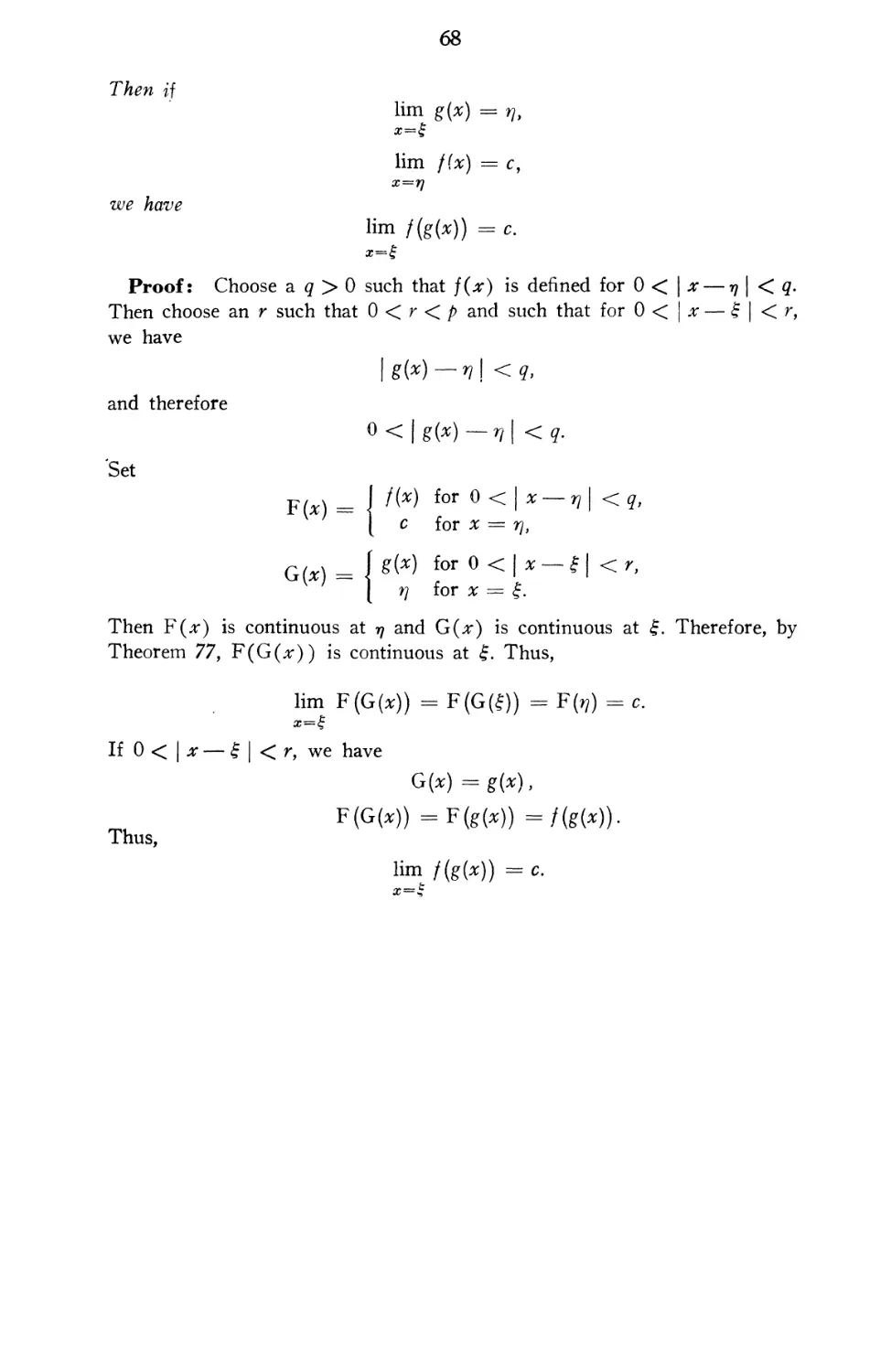
If 0 < | x — | | < r, we have
G(*) = g(*),
F(G(*))=F(g(*))=/(g(*)).
Thus,
lim f(g(x)) =c.

69
CHAPTER 5
DEFINITION OF THE DERIVATIVE
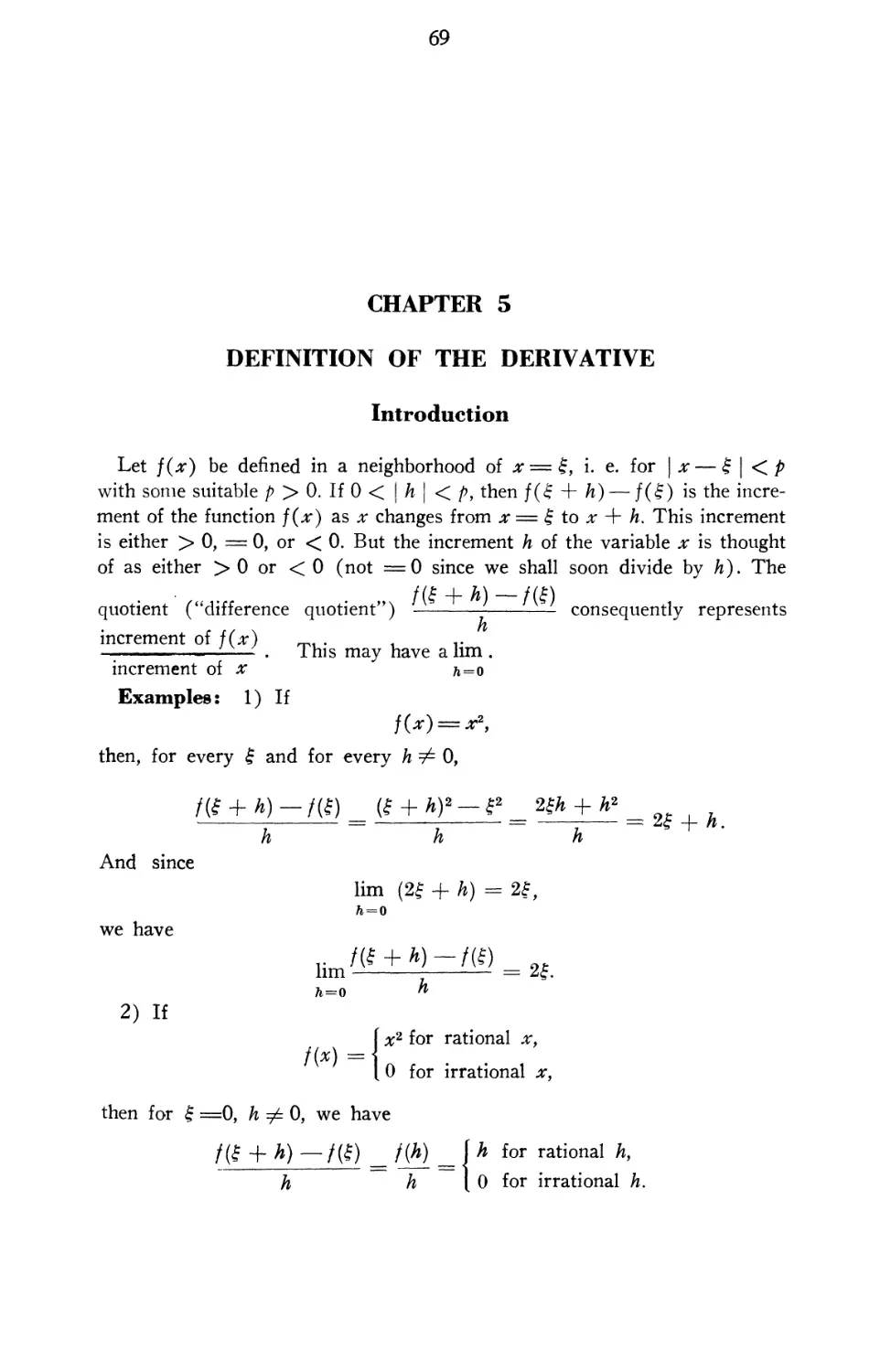
Introduction
Let f(x) be defined in a neighborhood of x = I, i. e. for \x— I | < p
with some suitable p > 0. If 0 < | h | < p, then f(? + h) — /(?) is the
increment of the function f(x) as x changes from x = I to x + h. This increment
is either > 0, = 0, or < 0. But the increment h of the variable x is thought
of as either > 0 or < 0 (not ==0 since we shall soon divide by h). The
quotient ("difference quotient") consequently represents
increment of f(x) ,_, . , ,.
—¦—- . This may have a lim .
increment of x h=o
Examples: 1) If
then, for every f and for every h ^ 0,
And since
we have
2) If
lim Bf + A) = 2?,
{#2 for rational .r,
0 for irrational #,
then for | =0, h ^ 0, we have
/(f + *) —/(I) _ /(A) _ | A for rational A,
0 for irrational h.
-T-{

70
Thus in any case,
so that we have
But,
A)
/(* + *)-/(*)
h = 0 h
lim'<* + *>-'(*>
does not exist for any ? 7^ 0. For if ? is rational, then for every /> > 0 there
exists an irrational ? 4- /i such that 0 < /r < p, and for this /r we have
B)
/(f + A)-/(f)
On the other hand, if ? is irrational then for every p > 0 there exists a
rational ? + h such that 0 < h < />, and for this & we have
C)
f(s + h) — f(e) (f + />J
These remarks exclude the existence of the limit A) in either case. For,
suppose it did exist and were = t. Then for a suitable e > 0 and for 0 < \ h\ < e,
we would have
so that
/(g + *)-/(g)
h
/(? + />)-/(?)
— *
<1,
A
<M +i-
But for a suitable choice of /> < e, the absolute value of the right-hand sides
of B) and C) can be made larger than | t | + 1 for all h with 0 < h < />.
3) If
(an everywhere continuous function), then for ? == 0 and /r 7^ 0, we have
/(? + *)-/(?) J *j
J 1 for A > 0,
{— 1 for h < 0,

71
so that lim does not exist. On the other hand, if I > 0 and 0 < \h\ < I, then
ft = 0
/(? + />)-/(?) (g + *)--? _
h h
so that the limit exists and is = 1 for ? > 0. And if ? < 0 and 0 < | h | < — f,
then
/(g+ *)-/(?) = -(? + &)-(_?) = _
so that the limit exists and is — 1 for f < 0.

72
Definition 25: f(x) is difjerentiable at x = ? if
/(f + A)-/(f)
lim -
exists. This limit is then called the derivative of f(x) at x = |, and is denoted
by f (I).
If y = f(x), then we also write f(x). For, the derivative, where it exists,
is a function of f. And this independent variable may also be called x. We
. dy df(x) d , , . P c .
a/so wn^ ¦— or —— or — f(x)and, when there is no possibility of contusion,
dx dx dx
(f(x))'ory'.
(Such confusion might be possible in cases such as the following: What is
the meaning of
Does it mean
or
(**)'?
lim — (= z),
(X
X(a
+ h)z-
h
t + h)-
— xz
- xz
lim (= xj?
7* = 0 h
d(xz\ d(xz\
The first limit will be unambiguously designated by—^—', the second by——L
dx dz
However, we may employ the expression (x 3)' with a clear conscience
whenever the meaning is unambiguous from the context.
In other words (without making use of the previous chapter) : f(x) is
differentiable at x = I and has the derivative t there if for every d > 0 there
exists an e > 0 such that
f(e + h)-m_t
h
Expressed in still another way,
< d for 0 < I h I < e.
f'(i) = lim
x=z x — i

73
if this limit exists; i. e. if there is a t (the limit) such that for every 6 > 0
there is an e > 0 for which
/(*)-/(?) ,
< <5 for 0 < I x — f I < e.
Theorem 99: // /(#) u differentiable at x = |, ?/^w /(#) u continuous
there.
Proof: As /* —> 0, we have
/(g + A)-/(g)
so that, by Theorem 91,
The third example of the introduction to this chapter shows that continuity
does not imply differentiability. In that example, ]{x) was continuous
everywhere and f(x) did not exist for one value of x, but did for all other values
of x. One might think, and it was indeed thought for a long time* that an
everywhere-continuous function must be differentiable somewhere. The
following theorem of Weierstrass shows that this is not so. We shall prove it, using
a recent example of Van der Waerden's.
Theorem 100: There exists an everywhere-continuous, nowhere-differ-
entiable junction.
Proof: 1) By Theorems 86, 77 (with f(x)= {x}, g(x) = 4nx), and
67 ( with c= —),
\ 4tnI
Unx}
is continuous everywhere for every integer n ^ 0. By Theorem 84, we have
0^fn(x)?—— <-.
2 • 4n 471
2) Setting
m
Fm(x)= Z/„(*)
for integral m ^ 0, we have
0 JS Fm(x) 52 Fm+1(*).
Since
1
1
m y 4«i+l

74
Theorem 27 yields, for any fixed x, the existence of
lira Fm(x) = /(*).
We shall prove all of the above for this function j(x).
3) We first prove that f(x) is continuous for every f.
For integral m, k} with m > k ^ 0, and every x, we have
m m y 4Jc+l ^.m+l
0 ^ ?m{x) - Fk(x) = S /„(*) < S - = — j—
n = k+l n = k+l 4 1 — f
1 1
4&+1 ^fc'
<i — <
Let <5 > 0 be given. We choose an integer k ^ 0 such that
1 6
Then for every jr and for integral m > k,
0?Fm(x)-Fk(x)<±,
so that (w-» oo ), by Theorem 22,
0^/(*)-Ffc(*)^i.
Hence for every f and every h, we have
|/(f + A)-Fft(f + A)|^l
and
|/(f)-Ffc(f)|^|.
Now let | be fixed. By Theorem 66, Ffc(jr) is continuous at |. Thus for
suitable e > 0, and for | h | < e, we have
|Ffc(f+ A)-Ft(?)| < j.
so that
|/(| + A)-/(f)|
= | (/(? + A)-F*(f + A)) - (/(f)_Ffc(f)) + (Ffc(f+ A)-Ft(f)) |
^ | /(* + A) - Ffc(f + A) | + | /(f) - Ft(f) |+ | Ffc(f + A) - Ffc(f) |
d d d
3^33

75
4) Finally, we show that j{x) is not differentiable at any ?.
If we had
for some value I, then for suitable e > 0 we would have
¦ *
< i for 0 < | x — f | < s.
x — Z
For every sequence ?k, k^.1 for which
I, # f, ?*->?,
there would exist a fc0 such that for k^ k0 we would have
l/fo)-/(?)
and therefore also
so that
¦t
<h
—t
<i
»fc+l
< 1.
Thus to obtain a contradiction, it suffices to produce a sequence |fc, & ^ 1
and integral, with
such that
is an integer for all k, and in fact is even if k is even and odd if k is odd. For
then we should have, for all k, that
Sk — S ft+1-f
And this can and will be done.
For integral k §: 1, we set
f -f 4-*, if [4*|] is even,
1.
Evidently, we have
f _ 4-*> if [4*|] is odd.
| ft - 11 = 4-fc -> 0,

76
If n is an integer 22 k, then
4»ffc = 4"f ± 4"-fc = 4»| + an integer,
so that by Theorem 83,
{4»|fc} = {*»?},
/«(?*) = /»(«¦
Thus, for integers w, &, with w §: & g: 1,
m A;—1
n=0 n=0
so that, for integers k g: 1,
(i) /(?*)-/(?)= S1^^) -/»(!))•
n = 0
If n is an integer such that O^n^k — 1, then
2 • 4~k = 21~2k < 21-2(n+1) = 2~2n_1.
Thus
4~~^ < 2~2n-i 4~fc
Setting
a = [2^+^] ,
we have
a <: 22w+1f < a + 1,
B) 2-2^-ia ^ f < 2-2"-i@ + 1).
I assert that we have (for our k which is ^ w + 1)
C) 2-2»-10 ^ ?fc < 2-2"-1(a +1),
and distinguish three cases for the purpose of the proof.
I) If
2-2n-ia _j_ 4-fc ^ f < 2-2*-1 (a + 1) — 4-*,
then C) follows, since
|*fc-f| = 4-*
II) If
2-2n-ia ^ f < 2-2w-1a + 4-*,
then
22fc-2n-l^ <^ 4fc? < 22fc-2n-l^ + !
[4*?] = 22^-2^-ia = an even number,
2-2n-ia < ?fc < 2-2w-1a 4- 2 . 4~* ^ 2-2w-!(a + 1).

77
III) If
2-2w-i(a -f- 1) — 4-fc ^ f < 2-2^-1(« + 1),
then
22*-2n-l(a _j_ 1) __ 1 ^ 4fc? < 22*-2n-l(a _j_ ^
[4*?] = 22fc-2*-1(a + 1) — 1 = an odd integer,
2-2n-ia ^ 2-2?l-1(a + 1) — 2 . 4-* ^ ^ < 2-2n~1(a + 1)
Thus C) always holds.
If a is even, then it follows from B) and C), setting
that
2
b <, 4*|
6 ^ 4"?t
{4"?} =
{*"?*} =
/,(?) =
= 6,
<& + i
<& + i
4"! — 6,
4"f * — b,
b
D) /n(ft)-/»(f) = f*-f-
If a is odd, then it follows from B) and C), setting
a + 1
that
& — i ^ 4wf < 6,
6 — i ^ 4-|fc < 6,
{4wf} = 6 — 4nf,
{4ttf*} = & —±*fA.
/*(?*) = ^n — %k>
E) /»(W-/n(« =-(**-«•

78
If 0 g w g & — 1, we have by D) and E) that, in either case,
Thus if k g: 1, we have by A) that
—r — = S (± 1) = S A + even number)
= k + even number,
and so is even for even k, and odd for odd k.

79
CHAPTER 6
GENERAL THEOREMS ON THE
CALCULATION OF DERIVATIVES
Introduction
The purpose of this chapter is, on the one hand, to investigate the most
important of the functions with which we are familiar (e.g. xn,\ogx,e*) as
to whether, where, and with what result, they are differentiable, and on the
other hand, given several differentiable functions, to investigate the same
questions for their sum, product, etc. This alone would not, however, get us very
far. The most difficult but also the most important theorem of this chapter,
namely Theorem 101 (the so-called chain rule), with which we shall begin
this chapter (although several later results will be obtained directly,
without its use) enables us to differentiate "composite" functions f(g(x)) (e.g.
log(l + jr4)) provided we can differentiate f(x) and g(x) (in this example,
log x and 1 + x*).

80
Theorem 101: Let
Then f(g(x)) is differentiable at f, and its derivative is xt.
For short:
^/fe(*))=/'fe(*))f'(*)-
Even shorter:
Proof: lim /fa + *)~/W = ,
Hence there exists a /> > 0 such that if we set
q>(k) =
for 0 <\k\ <p,
k
x f or k = 0 ,
then <p(fc) is continuous at & = 0.
If | fe | < p, then
/fa + *)-/fo) = M*)-
If we set
k = g(S + h)-g(S),
then k — k(h) is continuous and equal to 0 at h = 0. Hence there exists a
q > 0 such that
| A | < ? for | h | < q.
If 0 < | h | < g, then
/(g(f+*))-/(g(g)) /fa+*)-/fa) k(h)
A = h = -*-*(*(*»¦
Now we have
lim —— = f.
ft=0 ^

81
By Theorem 77, q)(k(h)) is continuous at h = 0, so that
lim <p(k(h)) = <p{k@)) = <p@) = t.
Hence we have (Theorem 91)
h = 0 h
Theorem 102: Everywhere, we have
dc
dx
Proof: If
K*) = c,
then for every | we have for h ^ 0 that
/(g + A)-/(f) c-c a n
h --jp-0^0.
Theorem 103: For integral n > 0 and /or a// #, tt>? /ia^?
-— = nx71-1.
dx
Proof: If
f(x) = x»,
then for every | we have for h ^ 0 that
/(* + *) - m __ <* + *r - ^ = - tf + h)V^_
h
v=o
n-l n—1
d log % 1
Theorem 104: . = - for x > 0.
dx x
Proof: By example 2) to Definition 24, we have
HmlogJl±*) = 1-
If jr > 0, then by Theorem 98 (with
h log A + h)
g(h) = -t v*=o, * = o, /(*) = \ » c==1)>
log(l+^)
lim = 1,

82
so that (Theorem 92)
,. l0gA + 7) ,
lim = -,
h=o h x
lim l°g (x + h)— lQg x = 1
ft=o h x'
™, ,,*- ^0g ( X) 1
Theorem 105: — = — for x < 0.
Proof: By Theorems 101 (with
f(x) = log*, ?(#) = — #)
and 104, we have
dlog(-x)=J_ r=s_l
Theorem 106: Everywhere, we have
dex
—• = g*.
dx
Proof: By example 2) to Definition 24, we have
lim = 1,
* = ! #— 1
so that, by Theorem 92,
,. *~*
lim =. 1.
x=i log a;
Since
e* j± 1 for j^ 0,
we have, by Theorem 98 (with
x— 1
g(x) =e*, rj= 1, * = 0, /(*) -
** — 1
lim = 1.
log x'
x = 0 x
Since
*?+* — ^ teh—l
= e* for A # 0 ,
h
we have, for every f,
lim
Theorem 107: (cf (x))' = cf'(x),
if the right-hand side is meaningful.

83
Proof: Suppose f (?) exists. Then for suitable p > 0 and 0 < | h | < pf
we have
c/(f+A)-c/(f) /(f + A)_/(f)
A ~ C A * C/ (l)-
Theorem 108: For every a > 0 <md /or a// *• w? /km7?
dax
—— = a* log a.
Proof: By Theorems 101 (with
j{%) =e*, g(x) = xloga),
106, 107, and 103 (with n= 1), we have
(a*)' = (^log a)' = ^log a log a == a* log a.
Theorem 109: If x > 0, then we have for any n that
dxn
dx
Proof: By Theorems 101 (with
f(x) = ex, g(x) = nlogx),
106, 107, and 104, we have
(**)' = (enl0*xy = enloz* — = xn — = nxn~\
X x
Example: If x > 0, then
dVx 1
= nxn~x.
dx 2Vx
Theorem 110: (/(*) + g(*))' = /'(*) + g'(*),
if the right-hand side is meaningful (i.e. if f(x) and g'(x) exist).
Proof: Suppose f (I) and g'(f) exist. Then for suitable p > 0, we have
for 0 < | h | < p that
(/(I + h) + g(f + *)) — (/(f) + g(f))
_ . _ —
_/(? + *)-/(?) , gtf + *)-g(g) : m + ^
A A
Example: A + a4)' = 4%3,
so that, by Theorems 101 and 109, (for all x)
dVl +x* 1 , , 2x*
4#3
^ 2Vl + ** Vl + tf4

84
/ m
Theorem 111:
(m \ ' m
s /.(*) = 2 /;<*)
n=l ' n=l
*/ fAe right-hand side is meaningful.
Proof: m = 1 is obvious. To proceed from m to m+ 1:
m+l m / mj \'
s /;(*) = s /;<*) + /;+1 w = s /„(*)) + rm+1(x)
n — 1 n—1 \w = l '
(m w /m+l \'
S/«(*) + /m+i(*) = 2 /«(*))•
n = l / \n = l /
Theorem 112: // w is a positive integer, then for all x
(m \r m
M = 0 / 71 = 1
Proof: ao' = 0 (Theorem 102),
(xnY = n**-1 for « > 0 (Theorem 103),
so that
(anxnY = wa^-1 for w > 0 (Theorem 107),
and Theorem 111.
Theorem 113: (/(*)—?(*))' = f'(x)—g'(x),
if the right-hand side is meaningful.
Proof: /'(*) ~g'(x) = /'(*) + (- l)g'(x) = /'(*)+«- l)g(*))'
= /'(*) + (-g(x))' = (/(*) + (-?(*)))' = (/(*)-?(*))'•
Theorem 114: (f(x)g(x))' = /(*)g'(*) + f'(x)g(x),
if the right-hand side is meaningful.
Proof: Suppose f (I) and g'(!) exist. Then there is a p > 0 such that,
for 0 < | h |< />,
/(g+%(f+A)-/(g)g(f) ,/t| g(f+A)-g(g) , /(f+A)-/(f)
-h =/(*+*) ^ +g(*> ^
->/(f)g'(f)+g-(f)/'(«,
by Theorem 99.
Theorem 115: H7^ fow/? for integral m^.2 that
(m \'m m
n /.(*) = s /;(*) n /,w
n = l / n, = l y = i
except v = n
if the right-hand side is meaningful.
m
(The meaning of U is quite clear; it is a product of m— 1 factors.)
v=*i
except v = n

85
Proof: The case m = 2 is Theorem 114. To proceed from m to m + 1:
By Theorem 114, we have
(m+i • V / m V
n /„(*)) = (ni/n(*)-/m+iW)
= n fn(x) -f'm+1(x) + s /;(*) n /„(*) •/„„(*)
n = l n = l v=l
except v=n
m+1 m+1
except v = n
Theorem 116: For integral m ^ 1,
rf#
= mfm-1(x)f,(x))
if the right-hand side is meaningful.
Proof: m=l is obvious; m > 1 follows from Theorem 115 with
fn{x) = f(x) for 1 ^ w ^ *«.
Theorem 117: (-L) = — ^,
\f(x)l f*(x)
if the right-hand side is meaningful.
Proof: Suppose /'(I) exists, and let
/(f) * o.
Then there is a /> > 0 such that, for 0 < | h | < />,
/(? + A) # 0,
so that
i i_ m + *) - m
ns + h) m h fa)
Theorem 118
h fa + h)f(s) rw
f(x)V g(x)f'(x)-f(x)g'(x)
//(*)V g(
' \g(x)J
\g(x)f g2(x)
if the right-hand side is meaningful.
g(*)f(*)-n*)g
Proof:
'¦^M-ffl+r^
-"•,(«-fe)'+mf-H-("*,is))'-D'-
Theorem 119: If n is an integer and x ^ 0, then (xn)' — nxn~L.

86
Proof: The case n > 0 is contained in Theorem 103; the case n = 0 is
obvious. If n < 0, then, by Theorem 117,
/ 1 V (x-nY —nx-11-1
(xnY = ) = — - = = nx"-1.
(?)'_v*
Theorem 120: If n > 0 is integral and if x > 0, then
nx
Proof: By Theorem 109, we have
/» y / iy ii.! ii Vx
I Vx I = \xn I = —xn == — xnx~x = .
\ / \ / n n nx
Theorem 121: If n > 0 is an odd integer and if x < 0, then the equation
yn = x
has exactly one solution, namely
Proof: y must be negative. Our equation states that
(—y)n = —xt
and this is equivalent to
n
— y = V— x,
i.e.
y — — V— x.
n
Definition 26: The y of Theorem 121 is called Vx.
i_
Theorem 122: Vx = x for x < 0.
Proof: x1 = x.
Theorem 123: // n > 0 is an odd integer and if x < 0, then
nx
Proof: By Theorems 101 (with
n _
f(x) = — Vx, g(x) = —x)
and 120, we have

87
CHAPTER 7
INCREASE, DECREASE, MAXIMUM, MINIMUM
Introduction
If h # 0 and if f(x) is defined in the interval ??= x ?= ? + h or in the inter-
f(? + h)—f(S)
val | + A ^ ^r ^ I, then the difference quotient measures,
ft
in a way, the steepness of the function in the interval. Consideration of the
derivative (if it exists) will yield more delicate distinctions; the derivative
at | measures, in a way, the steepness of the function at |.

Definition 27
and
Definition 28
and
Definition 29
f(x) is increasing at ? if there exists an e > 0 such that
/(*)</(?) for ?-e<x<?
/(*)>/(?) /*' ?<*<? + *•
/(.r) w decreasing at ? if f/ier^ exists an e > 0 jmc/i f/ifltf
/(*)>/(?) for ? — e<x<?,
/(*)</(*) for ?<*<? + ?.
f(x) has a maximum at I if there exists an s > 0 such that
/(*)</(?) /<w 0<|* —5|<e.
Definition 30: /(jr) ft as a minimum at <J rf there exists an e > 0 smc/i /ftai
/(*)>/(?) /^ o< I* —?| <c.
Theorem 124: For every f(x) and each fixed f, at most one of the
following four possibilities can be realised: f(x) is increasing at I, f(x) is
decreasing at |, f(x) has a maximum at f, f(x) has a minimum at ?.
Proof: Obvious.
It may also happen that f(x) is defined for \ x— ? | < p with some p > 0,
and yet that none of the four possibilities is realized. Example:
f = 0,
/(*) =
#2 for rational ;r,
— #2 for irrational x.
Here we have
/@) = o,
and for every e > 0, there does exist an x for which
f(x) <0, — e <* < 0;
/(#) > 0, — e < x < 0;
f(x) < 0, 0 < a: < e;
f{x) > 0, 0 < x < e.

89
Theorem 125: //
/'(I) > o,
then f(x) is increasing at ?.
Proof: If
f(S + h)-f(S)
h
then by Theorem 72 (applied to the function
f/(! + A)_/(|
F(*) =
t > 0 ,
for 0 < | h | < />,
t for A = 0 ,
for suitable /> > 0), there exists an e > 0 such that
> 0 for 0 < \h < e,
h ' '
so that
/(f + A) </(f) for — e<A<0,
/(? + A) > /(?) for 0<A<?.
Theorem 126: //
/'(?) < o,
?/t?n /(#) w decreasing at f.
Proof: If we set
g(*) = -/(*)
then we have
g'lS)=-f'(S)>0.
By Theorem 125, g(x) is increasing at |. Hence there exists an e > 0 such that
—/(*) <—/(?) for f — e <* <f,
— /(*) > — /({) for { < x < | + e.
Theorem 127: If f(x) has a maximum or a minimum at ?, and if f (!)
exists, then
/'(?)=o.
Proof: Theorems 124, 125, and 126.
However, it should not be thougKt that if f(x) has a maximum or a minimum
at |, then we must have
f(D = 0.
f(§) need not even exist, as the example
/(*)=| *),? = <)

90
shows. We know (example 3) at the beginning of Chap. 5) that f @) does
not exist. In spite of this, f(x) clearly has a minimum at 0, since
/@) = 0,
f(x) > 0 for x ^ 0.
When can we determine on the basis of our present knowledge, by
considering /'(?), that we have a maximum or that we have a minimum or even
that we have one or the other? Never. For,
1) If f (|) does not exist, then we know nothing;
2) if /'(?) > 0 or if f (!) < 0, then we know that neither a maximum nor
a minimum is present;
3) if /'(<?) = 0, then we know nothing.
For good measure, I shall give five examples which illustrate 3). In the first
example, the function has a maximum, in the second, it has a minimum, in
the third, it is increasing, in the fourth, it is decreasing, and in the fifth none
of these situations occurs. In each of the examples, we have
1 = 0, f@) = f@) = 0.
I) f(x) = — x2, and so is <0 for x ^ 0.
II) f(x) = x2, and so is >0 for x ^ 0.
III) j(x) = x\ and so is < 0 for x < 0, > 0 for x > 0.
IV) f(x) = — x\ and so is > 0 for x < 0, < 0 for x > 0.
V) f(x) is the example given after Theorem 124. Indeed,
± h2
/'@) = lim =— = 0.
h=o n
In spite of this indecisive (but not undecidable) situation, we shall now
work out an example to the point where we have determined all maxima and
minima. Of course, we shall rely not only upon the theorems we have proved,
but also on the original definitions. (Later, we shall have more theorems at
our disposal.)
I x
Example: f(x) — — .
x —j~ x
Now we have for all x that
— A + x2) — A — xJx — 1 — 2x + x2
f (*) = (l + x2J = A + *2J
f(x) is equal to zero only when
(x — IJ — 2 --= x2 — 2x — 1 = 0,
and hence for the two numbers
x = 1 ± V2
and no others.

91
Thus, i (x) can have a maximum or a minimum only at 1 + a/2 and 1 — V2.
I assert that it has a minimum at 1 -f- a/2 and a maximum at 1 — V2.
In fact, if we set
? = 1 ± V2 ,
then for all h # 0,
is positive, negative, or zero according to whether
A _ f _ A)A + f2) — A —f)(l + fa + 2« + A2)
= — A(l + f2) — A — f) B« + A2)
- A(— 1 — f2 — 2| + 2f2) — 7*2A — f) = A2(f — 1)
is positive, negative, or zero. Hence we have for all h ^0 that
/(? + *) > /(f) ^ f = 1 + V2,
/(? + A) < /(f) if f = 1 — V2.
This example may be misleading in that f(x) has a value greater than all
others at 1 — V2 , and a value less than all others at 1 4- V2 , while only a
neighborhood 0< \ x — f | <e is taken into consideration for investigation
of maxima and minima. However, the correct situation is apparent from
Definitions ?9 and 30.
An example of a minimum which is not smaller than all other values of the
function is the following:
f(x) = x2 — x*, f = 0.
0 is a minimum, since if 0 < | jit | < 1, then
/@) = 0<*2A— **) = /(*);
nevertheless,
/B) = 22 — 26< 0-/@).

92
CHAPTER 8
GENERAL PROPERTIES OF A FUNCTION
CONTINUOUS IN A CLOSED INTERVAL
The contents of this chapter could have been discussed in connection with
Chap. 3. However, I wanted to introduce the differential calculus first.
Definition 31: A set of numbers fflt is said to be bounded if there exists
a c such that, for every x of 3K,
\x | < c.
Definition 32: A set of numbers 3K is said to be bounded from above if
there exists a c such that, for every x of ffll,
x < c.
Definition 33: A set of numbers SB is said to be bounded from below if
there exists a c such that, for every x of 2R,
x > c.
Theorem 128: A set of numbers is bounded if and only if it is bounded
from above and bounded from below:
Proof: 1) If
\x\ <c
then
C < X < c.
2) If
cx < x < c2
then
— x<—clt
| # | = Max (x, — x) < Max (c2, — cx).
Definition 34: If Wt is an infinite set of numbers, then I is called a limit
point (point of accumulation) of 9TC if for every d > 0 there are infinitely many
numbers of 9JJ for which
?-.d<x<$ + d.
Warning: "limit point" and "limit" are two different concepts.

93
Examples: 1) The set fflt of integers does not have any limit points. For
if a < b, there are never infinitely many integers x such that a < x < b.
2) If 3K is the set of numbers —, where n is an integer ^ 1, then it is clear
n
that no | ^ 0 is a limit point. For, if we set
a_l*i.
2
then there are not infinitely many integers n ^ 1 such that
f — d < - < S + d,
n
since either ? — <5 > 0 or I + <5 < 0, and
L
lim — = 0.
n — cc M
However, | = 0 is a limit point. For if d is an arbitrarily chosen positive
1
number, then for integral n > — we have
1
0 — d < — < 0 + <5.
n
This example shows that a limit point of 3K need not belong to 2R. (Indeed,
that it belong to ffll was not required in Definition 34.)
Moreover, in Definition 34 it would have sufficed to require only that there
exist, for every d > 0, at least one x of 99? such that
A) 0< \x — i\ <d.
For, employing 7) of the introduction, we may deduce from this that for every
integer w §r 1 there are at least n such x (hence that there are infinitely many).
For, if x = xv, 1 ^ v fg n, v integral, are distinct numbers which satisfy
A), then we set
d1 = Min \xv — f | ,
and choose xn+1 in %Jl with
°<|*n+l — f | <»i (<«).
Then we have for 1 fg v ^ n that -
I xn+l f I < I xv " f I»
so that
Theorem 129: Every bounded infinite set of numbers has a limit point.

94
Proof: There exists a c such that,for all x of the given set 9K,
— c < x < c.
We place a in
class I if x < a does not hold for infinitely many x of 9JJ,
class II if x < a holds for infinitely many x of 9R.
Every number a belongs to exactly one of these classes. Class I contains
— c, and class II contains c. If a lies in class II, and if /# > a, then we have
for infinitely many x of 2R that
* < a < /?,
so that /? lies in class II.
Hence there exists a ? such that every a < ? belongs to class I and every
a > ? belongs to class II.
This | is a limit point. For if 6 > 0 is given, then ? — d lies in class I,
and ? + d lies in class II. Hence there are in 3K infinitely many „r < ? + <5,
but not infinitely many ^ < | — 6. If there were not infinitely many x in SDJ
for which
I — <3<*<! + <3,
then, by Theorem 7, SDJ would not contain infinitely many x < I + <3.
Theorem 130: Suppose that a <b, and that, for all integers n ^ 1,
a ^ I, ^ fe.
(The fn need not be distinct.) TTz^n f/i^r? ?,mfa a | such that for every 6 > 0,
! — <$<!w<! + <5
/or infinitely many n.
Preliminary Remark: Eo ipso, we then have
a^Z^b.
Proof: 1) If there are infinitely many distinct !„, then any limit point I
of the bounded infinite set of points which consists of the distinct f n satisfies
the requirement, and by Theorem 129, there exists at least one such limit point.
2) In the other case, there exists a I, by Theorem 8, such that
for infinitely many n. This I is the desired number.
Theorem 131: Let a set of numbers x be bounded from above. Then
there exists exactly one number I such that
every x ^ /,
and, for every d > 0,
at least one x > / — <3.

95
Proof: 1) There is at most one such /. For if both lx and U > lx have the
required properties, then we should have
every x ^ llf
so that, if we set
* = /» —/i(>0),
we have
no x > h = l2 — d.
2) We now show that there exists an / which has the required properties.
We place a in
class I if at least one x ^ a,
class II if all x < a.
There exists an a which belongs to class I, namely any x; by hypothesis, there
is an a which belongs to class II. If a is in class II, and if ($ > a, then
every x < a < /?,
so that [$ is in class II.
Hence there exists an / such that every a < / belongs to class I and every
a > / belongs to class II.
This number / satisfies our requirements. For,
a) If we had
at least one x > /,
then such an x would lie in class II. Thus, we should have
x < x.
Hence,
every x ^ /.
b) If d > 0 is given, then / lies in class I. Hence there exists
6
at least one x > I > I — d.
~~ 2
Examples: 1) Let the ^s be the numbers f§ c. Then I = c.
2) In general, if the set contains a greatest number, then it is /.
3) Let the x's be the numbers < c. Once again l = c, but now / does not
belong to the set.
4) Let the x's be the numbers 1 , and n an integer ^ 1. Then /= 1,
n
and / does not belong to the set.
Definition 35: For every set of numbers which is bounded from above,
the I of Theorem 131 is called the least upper bound (l.u.b.) of the set.

96
Theorem 132: Let a set of numbers x be bounded from below. Then
there exists exactly one number X such that
every x ^ X,
and, for every S > 0,
at least one x < X + 6.
Proof: We apply Theorem 131 to the set of the —x's and set
X = — l
Then we have
every (— x) ^ / = — A,
at least one (— x) > / — d== — X — S.
Definition 36: For every set of numbers which is bounded from below,
the X of Theorem 132 is called the greatest lower bound (g.l.b.) of the set.
Example: Consider the set of all numbers x of the form
% = Vn2 +1 — n, w^l an integer.
The set is bounded from below, since for each such x we have
x >0.
If 6 is given, then for n > — we have
26
n2 + 1 < n2 + 26n < [n + dJ,
Vn2 + 1 < n + d,
x < 6.
Thus, X = 0.
Definition 37: f(x) is said to be continuous on the right at I if for every
6 > 0 there is an s > 0 such that
\f(S + h)~f(S)\ <d for 0<h<e.
Definition 38: f(x) is said to be continuous on the left at I if for every
6 > 0 there is an e > 0 such that
\KS+h) — f(S)\<6 for —e<h<0.
Theorem 133: f(x) is continuous at I if and only if it is continuous on
the left and on the right at f.
Proof: Obvious.
Definition 39: // a < b, then the set of x such that a :g x 5^ b is called
a closed interval and is denoted by [a, b].
Definition 40: f(x) is said to be continuous on [a, b] if f(x) is
continuous at a on the right, continuous at b on the left, and continuous at every
I such that a < ? < b.

97
Example: Vx is continuous on [0, b] for b > 0. For, we already know
that it is continuous at all I > 0. And Vx is continuous at 0 on the right,
since for every d > 0 we have
| Vx | < d for 0 < x < d2.
Theorem 134: f(x) is continuous on [a, b] if and only if for every ?
on [a, b] and for every d > 0 there exists an s > 0 such that
| /(? + h) — /(f) | < d for | /* | < e, a ^ f + /* ^ 6.
Proof: Obvious.
Theorems 135 -138: If f(x) and g{x) are continuous at ? on the right,
then so are
135) /(*) + g(x),
136) /(*)—g(«),
137) f{x)g{x),
138) f/ g(« # 0, Oi .
Theorems 139 - 142: The same, but with left for right in both hypothesis
and conclusion.
Simultaneous proof of Theorems 135-142: In Theorems 135-138
or in Theorems 139 - 142, we define (by changing the old definitions if
necessary, since nothing prevents f(x) and g{x) from being defined, for example,
for all x < ? or all x > ? respectively)
!\ ) J\$) I for jr <^ | or for ^r > | respectively.
(This does not affect the hypothesis or the conclusion.) Then f(x) and g(x)
are continuous at f, and the conclusions follow from Theorems 65, 68, 69, 75.
Theorem 143: // f(x) is continuous at ? on the right, and if
f(l)#o,
then there exists an e > 0 si/c/i f/mf
/(*)/(?) >0 /or I <*^| + e.
Theorem 144: // /(.*¦) w continuous at ? on f/z? te/f, and if
/E)#0,
?/i?n ?/^r? exists an e > 0 such that
/(*)/(?) >0 /or f —e^^r<f.
Simultaneous proof of Theorems 143-144: Both theorems follow
from Theorems 72 and 73, if we define
/(#) = /(?) for x < I or for x > I, respectively.

98
Common hypothesis of Theorems 145 ¦ 152, 154, and 155: Let f(x)
be continuous on [a, b].
Theorem 145: The totality of values of f(x) on [a, b] forms a bounded
set.
Proof: Otherwise there would exist, for every c, an x on [a, b] such that
\K*)\^c.
Accordingly, for every integral n ^ 1, we choose a Jn on [a, &] such that
IK*.)I si".
By Theorem 130, there exists a I on [a, b] such that for every 6 > 0 we
have, infinitely often,
I — d<$n<? + d.
By Theorem 134 (with 6=1, and with 6 in place of the e appearing there),
there is a 6 > 0 such that, for I — 6 < x < | + 6, a^x^b, we have
I/(*)_/(*) I <i,
so that
|/(*)|<l + |/(!)|.
Therefore we should have
»^l/(fn)l<i + l/(*)l,
for infinitely many n> which is false.
Theorem 146: f(x) takes on a largest value on [a, b].
In other words, there exists a y such that
a ^ y ^ b,
f(x)^f(y) for a^x^b.
Proof: Let / be the least upper bound of the various values of f(x) on
[a, b] ; this exists, by virtue of Theorems 145 and 131. (Cf. Definition 35).
More concisely, / is the l.u.b. of f(x) on [a, b]. Then, for all x on [a, b], we have
If there did not exist a y on [a, b] such that
/(y) = i.
then we should always have
/(*) < i.
l — f(x) > 0
on [a, b], so that
1

99
would be continuous on [a, b], by Theorems 136, 138, 140, 142. Hence, by
Theorem 145, it would be bounded from above, so that
Hence there would be no x such that
f(x)>l-l,
which contradicts the definition of the l.u.b.
Theorem 147: f(x) takes on a least value on [a, b].
In other words, there exists an -q such that
f(x)^f(v) for a^x^b.
Proof: By Theorems 137 and 141, — f(x) is continuous on fa, b]. Hence,
by Theorem 146, there exists an rj on [a, b] such that
—f(x)^—f(v) for a^x^b.
Theorem 148: //
/(a)<0</F),
then there exists exactly one ? such that
a<?<b,
/(f) = 0,
f(x) < 0 for a^ x < ?.
Preliminary Remark: Even the part of the theorem which asserts the
existence of a I such that
a<i=<b, /(!) = 0,
though it is very plausible, is quite deep, and it is very important.
Proof: 1) That there is at most one such I, is obvious. For if |x and
f 2 > f i are two such, then we should have both
/(fx) = 0,/(f1)<0.
2) To prove that there is one such ?, we proceed as follows. There exists
an rj such that
A) a^v^b,
B) /(¦*)< 0 for a^x^v,

100
namely rj = a. Let ? be the l.u.b. of the ?/s for which A) and B) hold. Then
we have
We have
C) fO)<0 for a^x<?.
For, in case ? = a, nothing is asserted here. And in case ? > a, we choose,
for every x0 with a 5^ ,r0 < f, an 77 with x0 < 77 ^ ? for which B) holds,
so that
K*o) < 0.
I assert that
(and hence a < ? < fr, so that everything will be proved ).
If we had
/(*)<o,
then we should have
a ^ f < b,
so that, by Theorem 143, there would exist an e such that
0<e<b — |,
D) /(*) < 0 for f ^ * <; f + e.
Then C) and D) would imply that
/O)<0 for a^x<:? + e,
and there would exist an ?? > | with A) and B), namely rj= f + ?.
If we had
/(«) > 0,
then we should have
a < ? ^ b,
so that, by Theorem 144, there would exist an -q such that
a < v < S,
f(v) > 0,
contradicting C).
Theorem 149: //
f(a) >0 >/(&),
//^n //^?t exists exactly one f ,ywc/& ?&a?
a < f < b,
/(f) = 0,
/(#) > 0 /or a^ ;r < f.
Proof: Theorem 148 with —f(x) in place of f(x).

101
Theorem 150: //
f(a)<c<i(b),
then there exists exactly one ? such that
a<? <b,
f(x) < c for af^x < ?.
Theorem 151: //
f(a)>c>j(b),
then there exists exactly one ? such that
a<? <b,
f(x) > c for a 5= x < ?.
Simultaneous proof of Theorems 150 and 151: Theorem 148 and
149 respectively, with f(x)—c in place of f(x).
Theorem 152: // / is the greatest value and k the least value of f(x) on
[a, b], and if
X^c^l,
then there exists a ? such that
a^t^b, f(S) = c.
Proof: This is trivial for c = l and for c = I. Therefore let
X < c < I
Choose u and v on [a, b] such that
f(u) = X,f(v) = l,
and apply Theorem 150 or Theorem 151 to the interval [u, v] or [v, u]
(according to whether u < v or v < u).
Theorem 153: //
n
f(x) = 2 avxv,
n an odd integert
then there exists a ? such that
/(?) = 0.
Proof: W.l.g. let an = 11 otherwise consider Ll__i).
nd an a <
f(a) < 0
a
By Theorem 148 it suffices to find an a < 0 with

102
and a b > 0 with
f(b) > 0.
Setting
n-l
SKI=A,
we
have for I x I ^ 1 that
so that, for | x \ = 1 + A, it follows that
| f(x) — xn | < | x | | x J71 = | x \n.
Hence we have for x = — 1 — A that
f(x) < xn + | x\n = 0
and for x = 1 + A that
/(*) > *n — | x\n = 0.
Theorem 154 (theorem on uniform continuity) : For every 6 > 0 there
exists an e > 0 ^/cA ?to
| /(a) — f(P) \<d for a<^ a^b, a ^ p ^ b, | a — /8 | < c.
Preliminary Remark: Theorem 154 is not a special case of Theorem
134, since in that theorem e depends on ?.
Proof: If there were no such e for some S > 0, then for every integer
n = 1 we could choose two numbers an, fi„ on [a, b] such that
I /(«»)-/(/*») | ^-5, K-/*»|<--
Determine a I by Theorem 130 with ?n = an. Since /(jr) is continuous on
[a, fr], there would exist, by Theorem 134, an e > 0 such that
A) |/(*)—/(?)|<-| for a^*^6. |* —?|<2e.
Choose n such that
1
n > —
?
and
I an — & | < e-
Then we have
I /»»-*! H(«n-«-(«»-A.)| ^|«»-*|+|«*-/U
1
< ? H < 2e ,

103
so that, by A),
b f* | f(*n)-f(Pn) I = I (/(«»)-/(*)) - Wn) "/(*)) I
^ I /(«») -m i + i/(a.) -/(*) | < |+1 =«.
n
Example: [a, 6] arbitrary, f(x) any entire rational function S #v #v.
v=o
Here, however, the assertion of Theorem 154 may be verified directly, as
follows. Set
M = Max(|a|, \b |).
W.l.g- let n > 0. Then if a and /? are on [a, b]f we have
I /(«)-/(/») | = | S «, (a»- 18*) | = | a- /J | | ? «„ Sa^-V |
V = l V = l ^ = 0
^|a—0| S|a„| 'SM^-1M'' = | a — p\c,
where c is independent of a and fi, so that
|/(a)— /(j8)| <d for | a — fi\ < ——, a and ? on [a, 6].
c + 1
Theorem 155 (Weierstrass) : For every d > 0 ^r^ exists an entire
rational function T*(x) such that
|/(jr)-P(jr)| < 6 on [a,b].
Preliminary Remark: Theorem 155 evidently implies Theorem 154
(knowing Theorem 154 for P(#), which may be proved directly on the basis
of the calculations of the last example). For, for d > 0 choose a P(x) with
|/(*)_P(«) I <- on [a,b],
and for this ?(x) (which depends on d), choose an e > 0 such that
I P(a) — P(/8) | <— for | a — 0\<e, a and ? on [a, 6].
o
Then we have for these a, /? that
| /(a) - f(fi) | = | (/(a) - P(a)) - (/(/J) - P(fl) + (P(a) - P(/J)) |
E E E
< 1 1— =6.
3 3 3
The proof of Theorem 154 is not, however, unnecessary, since Theorem
154 is needed in the proof of Theorem 155.

104
Proof: For integral n >0, we set
n /
•z(
9>w(*) - L 1— - —*
z
w
Kn = ,,B@) (^ 1),
*»(*)
2K. '
and we begin by proving the existence of two positive absolute constants
pv fi2 such that
A) K„ > pxVn,
B) l-A^Tn(*)^i for i^*^§.
For this, we use the fact I known from Theorem 38 with x=l 1 that,
--)
n J
M^2,
log (l -
-i)ai-
n J
n
n — 1
1 2
>
n — 1 n
so that
(i-iyw-i'-i.
and that (n + l)#w is bounded for fixed # with 0 < # < 1 and for n ^ 1.
Indeed, we have
For w ^ 2, we have that
n / V2\ n [V«] / V2\ n IVn] / ^ \n
"¦-,?.('-*)* = ('-5) * = ('-*)
= (IVn] + l) (l J > e-Wn,
and for n = 1 that
Kn = 1 > rV».
Hence we have established A).
For | <J # <; |, we set
/== [nx] ;

105
then we have
I fg nx < I + 1,
/ Z + i
~ ^ x < ,
n n
0 <[ / g | n < w,
fcw-s(i^-iO+(LM(.-(i_,O
ssA_(i_i)')' + s(l-(i-'-±i)T
=A(i - ?)T+TC11 - ?)T ^ k»+k»=2K-
If we further set
then we have
Li
ft + 1 >
/* + A2 1
I + 1 > nx > — > k,
~ 3 ~
w — Z > n — n# > -— > &,
fcW^(,_f^_i)V+i(,_(i_i)y
^H;)K!;HiO-HlH^)"
^ 2 (Kn - 1 - » (|)") S> 2 (Kn - pa),
where />3 is an absolute constant, so that
rn(x) ^ 1 - ^ > 1
p{Vn

106
Hence we have established B).
First case: Let
fix) be continuous ) rA .,
"Whs' r[(UI-
We set
and assert that for every d > 0 there exists an n independent of x (thus
depending only on 6 and /) such that
C) |/(*)-P„(*)|<d *>r i^*??f
This will yield a completely general proof of the assertion of Theorem 155
in case a = ?, 6 = §. For, if F(#) is continuous on [J, |], let M be the
largest value of | F(#)| on [ J, f ], and define
F(x)
= WTitor[i'i]'
f{X) > /(?) for 0^*<?,
/(§) for |<*^1.
This /(.#¦) is continuous on [a, b] and is, in absolute value, f§ 1. If we choose
n such that
I /(*) -P„(%) | < ^i-^ for J ^ x =g f,
then we have
| F(x) — (M + 1)PW(*) | < 6 for J ^ x ^ |.
And (M + l)Pn(^) is clearly an entire rational function of x.
We shall now proceed to prove C). By Theorem 154, choose an e
independent of x and I such that
\f(x)—f{S)\<j for \^x^l \x-S\ <e.
Then if an empty sum means 0, we have for ? fg x fg f that
|/(*)Tn(*)-PB(*)| =
il>>-«-(;Hr

107
<
+
1
2K
1
2Kn
i
n
n 1
t = 0 1
-x < e
1
n 1
f=0 1
""-'(DIMWIT
^-x ><
SA ? (i_(i_,)y+• i (.-(i-s)T
4Kn i=0 \ v« ; ' K„ f=0 \ V n II
^^T<Pn(x)+^- S (!-«•)" = 4T»W +F"(« + l)(l-eT
*K«
K» <=o
K.
3 *(*,/)
2+ V« '
where p(d,i) depends only on d and /. Furthermore, we have
f(x)-f(x)rn(x) | = | /(*) | | 1 -rn(x) \?\l -rn(x) \ ^ -*
so that
l/(*)-p„(*)l<
d_ mn + p,
2 V»
Hence C) is true for a suitable n independent of x.
Second case: Let [a, b] be arbitrary. The function
g(x) = j(a + Cx-l)(b-a))
is evidently continuous on f J, $]. Hence by the first case, there exists an
entire rational function Q(x) with
\g(x) — Q(x)\<d on [I §].
Hence we have on [a, b] that
I l\x — a l\\ I l\x~a \\ fix —a l\\
\f{x)-^b^a + ^\ = H
<6.
^ /I x — a 1\ .
q i — 1_ i js evidently an entire rational function of x.
\3 0 — a 3/

108
CHAPTER 9
ROLLE'S THEOREM AND THE
THEOREM OF THE MEAN
We now return to the differential calculus.
Theorem 156 (Rolle's theorem) : Let f(x) be continuous on [a, b]. Let
f(a) = f(b) = 0.
Let f(x) exist for a < x < b. Then there is a I such that
a<i;<b, f(!) = 0.
Preliminary Remark: If a number ? is such that a < I < b, then we
shall say that it lies between a and b or that it lies between b and a.
Proof: 1) Let
i{%) = 0 for a <L % ^ b.
Then
la + b\
2) Let f(„r) be positive somewhere on [a, b]. Then by Theorem 146,
there is a I such that
a<g <b, f(x)^f(?) for a^x^b.
If /'(?) > 0, then /(» would be increasing at |; if f (?) < 0 then /(*)
would be decreasing at ?. In both cases, there would exist an x on [a, fc]
such that
Thus we have
f(?) = 0.
3) Let
/O)^0 for a^x^b,

109
but < 0 at some place in that interval. Then for —f(x) we have case 2).
Thus there exists a ? such that
a<?<bt -f(f) = 0.
Theorem 157: If
n
f(x) = S «v^,
1> = 0
/(*) = o
has at most n solutions.
Proofs: The assertion is obvious for n = 0, since, if a0 ^ 0, then
a0 = 0
has no solution.
Let n > 0, and assume that our statement is true for n— 1.
i) if
f(x) = 0
has no solution, then we are done.
Otherwise, let I be a solution. Then
/(*) = /(*)—/(?) = ? ay- ? ave = ? av{xv-?)
V = 0 V = 0 V = l
n v—1 n—l n
= {x — i) S av S x^e-x-il= (* — f) S xl1 2 a„r-1-'1
= (x — ?)g(*)>
where
If
then
If
71-1
/fa)=0, r/#f,
to —?)?(>?) = o.
gfo) = 0.
/(*) = o
had at least n + 1 solutions (i.e. an infinite number or a finite number
^ w + 1), then
would have at least w solutions, which is a contradiction.

110
2) Suppose that
f(*) = 0
had a system of n + 1 solutions. Then by Theorem 156, between any two
consecutive solutions there would be at least one solution of
/'(*) = o.
But, since
/'(*) = S (v + l)av+1xv, nan^0,
V = 0
we see that
/'(*) = o
can have at most n — 1 solutions.
Theorem 158: //
and if
(i)
has exactly n solutions, then
B)
/(*)= iavxv,
v—o
n > 1,
/ia^ exactly n — 1 solutions.
Proof: By Theorem 156, between any two consecutive solutions of A)
there is at least one solution of B). Thus B) has at least n— 1 solutions.
But since
/'(*) = S (v + l)aMxv, nan * 0,
V — 0
B) has, by Theorem 157, at most n—1 solutions. Thus it has exacctly
n — 1 solutions.
Theorem 159 (The theorem of the mean, or mean value theorem) : Let
f(x) be continuous on [a, b]. Let f(x) exist for a < x < b. Then there is a I
such that
b — a
Proofs V(x) = /(*) -/(«) -~-a (/(») -/(«))
is continuous on [a, b]. If a < x < b, we have
/F) - /(«)
?>'(*)•=/'(*)¦

Furthermore,
9{a) = 0 = <p(b).
Thus, by Theorem 156, there exists a ? such that
tip) - /(a)
a<{ <6, 0 = ?'(?) = /'({)
ft — a
Theorem 160: Let f(x) be continuous on [a, b]. Let
f'(x) ^ 0 for a <x < b.
Then
f(b) ^ /(«)¦
Proof: In Theorem 159, we have
/'(f) ^ o.
Thus
/w-/o*) ^0>
f(b) ^ /(«)•
Example: If f(x) — ex — x, a = 0, 6 > 0,
then
/'(#) = ^ _ 1 ^ 0 for x ^ 0,
e& — & ^ 1 for 6 > 0
(which is already known from Theorem 37 with .r = ?*).
Theorem 161: Let f(x) and g(x) be continuous on [a, b]. Let
/'(*) ^g'(%) for a <x < b.
Then
f(b)-f(a)^g{b)-g{a).
Proof: By Theorem 160, using f(x) — g(x) in place of f(x), we have
f(b)-g(b)^f(a)-g(a).
Theorem 162: Let f(x) and g(x) be continuous on \a, b]. Let
f'(x) = g'(x) for a <x < b.
Then
/(*) = g(*) + (/(«)—?(«)) for a^x^b
(so that f(x) — g(x) is constant in that interval).
Proof: Let a ^ I g b. If I = a, then

112
If a < f fg b, then by applying Theorem 161 to fa, I], we obtain
f(?)-f(a)^g($)-g(a).
But, since our hypotheses are symmetric in f(x) and g(x), we have
g(f)-g(«)^/(!)_/(«)
and therefore
/(i)-/(«) = g(i)-g(«),
/(f)=g(f) + (f(a)-g(a)).
Theorem 163: Let f(x) be continuous on [a, b). Let
f (x) = 0 for a < x < b.
Then
f(x) = f(a) for a <, x ^ b
(i.e. f(x) is constant therein).
Proof: Theorem 162, with
Theorem 164: Let a < b, and let f (x) exist fpr a ^ x ^b. Let
f'(a)<c<f'{b)
or
f'(a) > c > f'(b).
Then there is a f such that
a < ? <b, /'(?) = c.
Proof: W.l.g. let c = 0. (Otherwise we would consider f(x) — ex).
W.l.g. let
f(a)>0>f(b).
(Otherwise we would consider —/(•*')•)
By Theorem 146, there is a <? such that
a ^ ? ^ b, f{x) g /(?) for agjg&.
Since /(#) increases at a and decreases at b, we have
a < f < 6.
If
/'(*) > o,
then /(#) would be increasing at <? and would be > /(f) somewhere on [a, b] ;
if
/'(?)< 0,
then /(#) would be decreasing at I and would be > /(f) somewhere on [a, &].
Thus, we have
fC?) = o.

113
Is Theorem 164 contained in Theorems 150 and 151 as a special case? No;
for we have not assumed that f(x) is continuous on [a, b]. But can this
perhaps be proved? No, as the following theorem shows.
Theorem 165: There is an everywhere differentiable function f(x) such
that f (x) is not everywhere continuous on the right.
Proof: For all s, set
<p{z) = ((«_[*])(!—a + [*]))«.
Then, we have for all s that
A) 0 ^ <p(z) ^ A • IJ = 1.
If — 1 < z < 0, then
<p(z)= {(z+l)z)*;
if O^z < 1, then
Thus,
9/@) = lim
3 = 0 Z
cp{z)
lim (z(l±zJ) = 0,
<z < 0,
»'M= f2(*+lM2*+l) f°r -1
^W Bz(l—z)(l —2z) for 0<
v'(i) # o-
<p'(s) exists for | ? | < 1.. If « is an integer, then
<p(s + n) = (p(z).
Thus, <//(#) exists everywhere (since for every f there exists an integer n
such that |C + w|<l).Ifsisan integer, then
Now we set
Then, by A),
and if x 7^ 0,
?'(* + i) = ?'(*)¦
0 for x = 0,
#29? I —I for a: =? 0.
/'@) = lim *<?(—) = 0

114
Suppose that f (x) were continuous on the right at 0. Then, since
lim 2x(p (—I = 0,
the function
0 for x = 0,
?(x) = '
> j^)for*>0
would be continuous on the right at 0. But for integral z > 0,
= <p'(i) * o.
v'(—r~ \ = v (* + i) = ?'(

115
CHAPTER 10
DERIVATIVES OF HIGHER ORDER;
TAYLOR'S THEOREM
Definition 41: Let j{x) be given. Then we set
/,0)M = /(*)
for those x at which f(x) is defined;
p (*) = /'(*)
for those x at which f(x) is differentiable;
for those x at which /A) (x) is differ entiable; in general, if n ^ 0 is an integer
(and if f{n)(x) is defined), then
for those x at which f{n) (x) is differ entiable.
If f{n) (f) exists, then we say that the function f(x) is n times differ entiable
at **' . dnf(x) dn
f(n)(x) is called the n-th derivative of f(x). We also write or f(x)
V ' dxn dx"I{ }
and, when no confusion is possible, also (f{x))(n). We also write f" (x) or
(f(x))" forfW{x), and f"(x) or (f(x))'" forf™{x), and so on.
If
then we also write (when no confusion is possible) y@), yA), yB), ... or
y@)> y', y"> •. • •
Examples: 1) If y = xz then we have that, everywhere
y' = 3%2, y" = 6x, y'" == 6, y"" = 0,
so that
yin) = 0 for integral n > 3.

116
2) For y =— , x ^ 0 we have
x
l—l)nn\
y{n) = l 1 m
y xn+l
For n == 0 this is given, n + 1 follows from » since
y(n+l)= (y<n>y=li_JL—I =(—l)~w !^-i)'=== (—1)»»!(--»—1^-2
_ (— i)n^{n + 1)!
Theorem 166: (/(#) + g(*))(n) = /(n)(*) + g(n)(*)>
if ?/te right-hand side is meaningful.
Proof: n — 0: Obvious. To proceed from n to n + 1:
/<n+D + g(n+D = (/<*>)'+(g<*>)' = (/<*>+?<»>)' = ((/+g)(n)) ' = (/+g)(w+1).
(w \(n) m
2 /„(*) - 2 /in)(%),
i/ ffte right-hand side is meaningful.
Proof: m== 1: Obvious. To proceed from m to m + 1 (for fixed w)
w*+1 , . «* . v , . / w \ (n) / m \ (n) /m+1 \(n)
1> = 1 V = l \v = i / \V = 1 / \v=l /
Theorem 168: (cf{x))in) = cf™(x),
if the right-hand side is meaningful.,
Proof: m = 0: Obvious. To proceed from nt w + 1:
c/<n+D = c(/<»>)' = (c/<»>)' = {(cfYn))' = (c/)<n+x>.
Theorem 169: (/(*) — g(*))(n) = /Gl) (*) — g(n)(*),
i/ ?/t? right-hand side is meaningful.
Proof: /-g = / + (-!)?,
Theorems 166, and 168.
Definition 42: For integral n^Q and for every a, we define
1 , if n = 0,
0-
II (a — w)
m=0
«!
if n > 0.
To be read: a over n.

117
Example: For integral n ^ 0, we have
1.
C)
Theorem 170: Let a be an integer g: 0. Then for all x, if n is an
integer ^ 0,
(*«)<»> = l*\ n\ x*-n for n^a,
so that
(%a)<a> = a!,
and
(%a)<^).=: 0 for n > a.
Proof: For n = 0, our assertion follows from
(**)«» = x^ = (*) 0!%a-°.
If the assertion is true for w, and if 0 fg n < a, then it follows for w + 1 since
(*?)<«+!> = ((*«)<«>)' = //*J w! *«-*Y= M w! (a_ w)^-n-1
= („ "x) (" + !)! *a~(n+1).
Theorem 171: For x > 0 awd ?tw;y a, we have for integral n §: 0 fto
(**)<»> = (jn!^.
// a «¦ aw integer, then this holds even for x < 0.
Proof: n = 0 is obvious, w + 1 follows from n by the calculations
occurring in the preceding proof.
Theorem 172: For every a and integral v ^ 1, we have
CK-.)-(*h
Proof: Both sides equal a + 1 for v= 1. If v > 1, the left-hand side is
V—1 V—2 V-2
II (a — m) II (a — m) II (a — w)
?! (v — 1)! v!
(a+1) n(a-m) ff (a + 1 - k)
= m=0 = fc=0 ___ = Ja + 1|
v! v! \ v J

118
Theorem 173: IffM{x) and gw{x) exist, then
(f(x)g(*))in) = X (") f{n~v)(x) gw(*)-
Proof: n = 0: Obvious, because
(/g)@) = fg = Q rsm-
To proceed from n to n + 1: By Theorems 111, 107, and 172, we have
(/g)(„+i, = ((/g)<»>), = (i(M)/(»-v)'= s (w)(/<»-*v*>)'
= 2 (^ f(n~v+1)gM + IS ( W ) /(n-v+l)g(v)
= /(n+l)g@) + J /|»j + (^ J) /(n+l^gM + /@)g<n+l)
(the last 2 means 0 if n = 0)
-sc:v
n+l~v)„(v)
Example: (/g)'" = /'"g + 3/"g+ 3/'g" + /g'",
if both f" and g"' exist.
Theorem 174: (f(cx)){n) = cnf{n)(cx),
if the right-hand side is meaningful.
Proof: n = 0 obvious. To proceed from n to n + 1: By Theorem 101,
we have
(/<»>(c*))' = c/<w+1)(c^),
so that
(jn+l/ln+l)^) _ ^(n)^))' = (^(n)^)) ' = ((/(c*)) <»>)' = (/(c*)) (n+1).
Theorem 175: (/(a; + c))(n) = f{n){x + c),
if the right-hand side is meaningful.
Proof: m = 0: Obvious. To proceed from n to n + 1: By Theorem
101, we have
/<*+«(* + c) = (/<*>(* + c))' = ((/(* + c) )<»>)' - (/(* + c))<»+».

119
Theorem 176: Let h > 0. Let /(w-1}(^) be continuous for O^x^h,
and let f{n)(x) exist for 0 < x < h. Set
* = /(A)— S '—^F.
(This number is independent of x.) Then there is an x such that
0 <x <h, 0 = —fin){x).
Proof: If we set
n-l f{v) (Q\ %n
(l) ?(*)=/(*)- s —^-^s >
then by Theorems 167 and 170, we have for integral m such that 0 ^ m < h
and for all .r such that 0 ^ x ^ h, that
n-1/(V)@)/^\ 0 ln\
g<m*(x) = /(™>(%) — S -—— w! xv~m m\xn~m
v=m v\ \ml hn \ml
n-l f(V)(Q) n\ xn-m
B) = /<*0(*) _ 2 ' v ; xv~m — 0
v==m(v — m)\ {n — m)\ hn
If, in particular, m = n — 1 then B) becomes
n\
gin-l)(x) = fin-D^x) _/U-D@) — 0 — x,
hn
so that, if 0 < x < A,
C) g(n)(%)=/(n)(%)_0|l.
From A) we obtain
g(h) = 0,
and from B),
g(wl>@) == /{m)@) —/(m)@) = 0 for 0 ^ w < n.
I assert that
g<™>(*) = 0
has a solution between 0 and h for all m with X^mt^n. For w = 1, this
follows from Theorem 156, since
g@) = o = *(/o.
If 1 ;g m < w, and the assertion is true for w, then it is true for m + 1 by
Theorem 156, since
g<™>@) = 0, gGn)(^) = 0 for an v with 0 < rj < h.

120
Thus there is an x such that
0 < x < h, g{n)(x) = 0.
For this x, we have by C),
n\
hn
0 = — fi»)(x).
n\
Theorem 177 (Taylor): Let h > 0. Let fin-1}(x) be continuous for
? 5^ x ^ ? + h and let f{n) (x) exist for f < x < f + h. Then there is an x
such that
f < x < ? + h,
Proof: Using Theorem 176 with
F(x) = /(? + *)
(in place oif(x)), we have, with the help of Theorem 175, that for a suitable y
0 < y < h,
»;ip@) An
/(? + A) = F(A) = 2 —^ F + — F»>(y)
n-l f(v)(?\ hn
= S-i-p-A' + -r /«*>(*+ y).
Theorem 178: Let h < 0. Lef /i*-1^*) fo continuous for ? + h^x^gi;
and let f(n)(x) exist for f + h < x < f. 77^w ?/^r? w aw .r jmcA ?/za?
? + h <x <?,
n-lf(V)ft) %n
/(?+ A) = 2 /—fF+ — /<»>(*).
Proof: We apply Theorem 177 to
F(*) =/(-*)
(in place of f(x)), using — f in place of f and — h in place of A. Then, by
Theorem 174 (with c = —1), we obtain a y such that
— $ <y< — S — K

n-1 F<?>(—f\ (— h)n
/(f + A)=F(-f-*)=S Vii(-^+A-^1-
121
F(n)(y)
v=o r! ' ' ft!
n-1 /<*)/? \ /»n
Theorem 179: //
n
f(x) = S av*v,
i>=o
/(? + *) = S ^--^F.
i> = 0 V!
Proof: This is obvious for h = 0. By Theorem 170,
(#")<n+i> = 0 for 0 g K w,
so that
/<«+!>(*) = 0.
Thus, our assertion is obvious if /1 > 0 (or h < 0) by Theorem 177 (or 178),
with w + 1 instead of n.
Theorem 180 (the binomial theorem) : We have jor integral n^.0 that
(a + b)"= ? in\an-vbv.
Proofs: 1) By Theorem 179, with
f(x) = xn, ? = a, h = b,
we obtain, using Theorem 170, that
(a + b)» = ? — (W Ma*^.
v=0v\ \v /
2) (Direct proof.) w = 0 is obvious. By Theorem 172, n + 1 follows from
n since
(a + 6)»+i = (a + b)n(a + b) = ? ( ^ V~^> + 6)
v=o \ r /
= ? (M an+1-v6v+ ? (n\an~vbv+1
= ? (n)an+1~vbv+ S1 ( Ma""^
= an+1 +

122
(the last 2 means 0 if n = 0)
= WS (n + 1)a»+1-*bv.
3) By Theorem 173, with
f(x) = eax, g(x) = ebx
and Theorem 174, we obtain
(a _|_ Mng(a+&)aj __ Ma+&)a?\(n) _ /^aa^&zWw) _ ^ j ^ 1 Uaxyn-V) <ebx\(v)
v=o \v /
= S (n\an-ve™ bvebx = S (n\an~vbv - e^+^x.
v=o\v / i>=o W
Theorem 181: For integral m ^ 0}and x > 0, f/j?r? way «?wc/i ?/ki?
w /1\ / 1 \ #w+1
1 < y < 1 + #, Vl + * :
Proof: If
then, by Theorem 171,
/(*) = ** (a; > 0),
f{v)(x) = (*\v\x*r-v
for integral v ^ 0. Theorem 177 with 1=1, /& = #, and n =^m + 1,
therefore insures the existence of a y such that
1 < y < 1 + x,
m ]/JL\ vm+1 / 1 \
Vl+*= S — 2 *!** + * (w+l)!y*-«->.
Theorem 182: 7/ 0 < # < 1 then
m / 1 \
lim S M ** = Vl + *.
Proof: For integral m ^ 0, we have
\m+l
n (i—*) n (*+*) n (* + i)
fc = 0
<
& = 0
<
&=0
(w + 1)! - (m+l)\ (m + 1I
1,

123
so that, in the formula of Theorem 181,
( h )-
< xm+l ^ Q>
Theorem 183: For integral m ^ I, and x > 0, there is a y such that
m / ;nv_1 ( i)m xm+1
1< y < 1 + x, log A + x) = 2 V — xv + V ' ¦
f(x) = log* (x > 0)
1
Proof: If
then
so that (by Example 2) to Definition 41) we have for integral v =S 1 that
/<->(*) = (I)
/<v>(i) (—l)^1
Theorem 177 with I = 1, h = jr, and w = m + 1, therefore insures the
existence of a y with the desired properties.
Theorem 184: // 0 < x fg 1, f/k?n
lim s- L_ ^ = log (l + *).
Proof: In the formula of Theorem 183, we have
(— l)mxm+1
(m+ l)ym+1
<
m + 1
0.
Theorem 183 is true for every x > 1, but the formula of Theorem 184 is
true for no x > 1. Indeed, suppose
lim S -— xv = 9?(#)
existed. Then it would immediately follow that, if m > 1, we would have
(-i)
m—1
¦#"
as w-» oo, or
(-1)'
(-1)'
»=i v
#* ->• <p(#) — 9?(%) = 0

124
0.
But by Theorem 180, if m ^ 2 then
(i+(*_i))m \ty%--v
Xm
m
>
m
(x—lf (x—lJ
= (m—iy- ^- '- (
Now, the following theorem expresses a very remarkable fact.
Theorem 185: There exists a function f(x) which is everywhere
trarily often differentiable, and for which
lim i^V
m= oo v = 0 v ¦
exists for every h, but has the value f(h) only at h = 0.
Proof: Let
/(*)
0 for x = 0,
. e x* for x ^ 0.
I first show that, fof every integral v ^ 0,
' 0 for x = 0,
A)
/<*>(*)
?'(tK*
for x ^ 0,
where Vv(z)\s a polynomial in z.
By the example to Theorem 160, we have
pb > b for b > 0.
Thus for every x ^ 0 and for every integral n ^ 0,
JL I I \n+1 / 1 \n+l
x* = \e {n+l)x*) ^ J
\(n + l)xV '
1 -A
! r- 0 *2 < (fl + l)n+1 I X \n+2 ,
\ «., \<n. \ i / y
so that, for integral n ^ 0,
1 -I
lim — e x% = 0.

125
Thus for every polynomial P(^),
B) lim P( —) e~** = 0.
A) is obvious for v = 0 (with P0(«r) = 1). v + 1 follows from v, since
f{V)(x) 1 /1\ --
/(*+D@) = lim -—^ = lim - Pv ( —I e *2 = 0,
by B) ( zPv(z) is also a polynomial) and since,if .#• ^ 0,
/'""<*> = (p, (±) «--•)' - p; (i)(-i) r* + p, (i)^"-
-Ml)'""-
Thus A) is proved. Therefore,
2 L-^ F = o,
v=o v\
for all /i and all integral m g: 0, so that
lim 2
m /«">@)
1 = oo v = 0 V -
for all h. But 0 is, for /i^0, different from
_i
"ft*
f(h) = e
Theorem 186: L^? w /?? an integer ^ 2. L^?
/<">(?) =0 for 1 ^v ^n—l,
/(w)(f)^0.
1) If n is even and /<n> ({) > 0, then fix) has a minimum at ?.
2) // n is even cwd/(n)(f) < 0, then f(x) has a maximum at ?.
3) If n is odd cmd/(n)(f) > 0, f/i^w fix) increases at f.
4) // n is odd andf{n)(^) < 0, then fix) decreases at f.
Proof: There exists an e > 0 such that /(w_1,(#) exists for | x — ? | < e.
By Theorems 177 and 178 (with n — 1 for w), there is, for 0 < | h | <s, ay
between I and I + /i such that
#1-1
A) /(| + A) -/(f) = — /<»-«(y).
(n — l)!
/(r'_1)(%) increases or decreases at f according to whether /(n)(f) > 0 or < 0.

126
Thus there is an e, with 0 < ex < s such that for 0 < | h \ < ex and all y
between I and I + h, we have
B) /^-^(y)/<">(?) > 0.
Hence, using A) and the y appearing in A), we obtain for 0 < | h | < st that
A»/(w)(?)(/(? + h)—f(S)) = -^A/(»-i)(y)/(»)(|) > 0.
\fi — 1)!
1) Thus if n is even and if /(n)(f) > 0, we obtain
/(f+ *)_/(?) >0.
2) If n is even and if /(n)(f) < 0, then
/(? + A) _/({)< o.
3) H n is odd and if /U)(f) > 0, then
*(/(* + *)-/(?))><>.
4) If n is odd and if /(n)(f) < 0, then
*(/(? + A) -/(f)) <0.
Examples 11)- IV) are the same as those toward the end of Chapter 7 I:
I) /(*) = — x2, f'@) = 0, /"@) = — 2 < 0: Maximum at 0.
II) /(#) - a;2, /'@) = 0, f"@) = 2 > 0 : Minimum at 0.
III) f(x) = %3, /'@) = 0, /"@) = 0, /'"@) = 6 > 0 : Increases atO.
IV) f(x) = —Xs, /'@) = 0, /"@) = 0, /"'@)=—6< 0:Decreases atO.
V) Let
(x + lK
f(x) = ^ -^- for ^ ^ 0.
a;2
We wish to find all maxima and minima. Since f(x) is, evidently, arbitrarily
often differentiable at x = 0 (as indeed, x~2 and (x + lK are), we need
only worry about the zeros of f (x) (i.e. the x such that f(x) = 0). Now,
if x ^ 0 then
/'(*) = (x-2(x + l)*)' = — 2x-z(x+lf + 3x-2(x+iy2
= x-*(x+lJ(—2x—2 + 3x)=x-*(x+lJ(x — 2).
Thus we need only discuss x = — 1 and x = 2. We shall now apply our
criterion without, however, evaluating terms we do not need.

127
Investigation of x = — 1:
/"(*) = ((* + lJ^=^) =(x+ lJ f^)' + 2(* + 1)
/"(-i) = o,
/'"(—1) =0 + 0 + 2^>0.
Increasing, no maximum or minimum.
Investigation of x = 2:
Minimum.

128
CHAPTER 11
— AND SIMILAR MATTERS
0
Introduction
0
-— has had no meaning until now, nor will it be given one. Rather, its
significance is as follows:
We know that
lim
x^O
lim
#=o
lim
x = 0
lim
x = 0
X
X
X2
X
X
X2
X2
X
~x^
= 1,
= o,
does not exist.
= 1.
All four of the expressions following the limit sign have the form
V{X)=M'
where
lim f(x) = 0, lim g(x) = 0.
x — Q x = 0
if
g{*)
where
lim f(x) = r], lim g(x) = ?,

129
then for
we have by Theorem 92 that
71
lim <p(x) = —.
x = ? ?
Thus only the case ? = 0 (as in the above four examples) is of interest.
If
C = o, 7, ^ o,
then lim <p(x) evidently does not exist. For otherwise we should have
x=i
// —- lim f(x) = lim (g{x)cp(x)) = lim g(x) lim <p(,r)
•r = | sc = ? x~? x = $
= 0 -lim </>(%) = 0.
*=?
It is with the case
7i = 0f ? = 0
that the first investigations of this chapter will deal.

130
Theorem 187: Let
lim f(x) = 0,
lim g(x) = 0,
x=?
/'(I) exist ,
g'(?) * o.
hsW g'(?)
Proof: f(x) and g(.r) are differentiable at f, and hence are continuous.
Thus
/({) = 8<fl = 0.
a. = |^ —f
g'(*)=lim ^l j
=1 * — S
so that, by Theorem 92,
/'(f) ,. *-* ,. /w
= lim — = lim .
g (f) x=f g(*) x=f g(«)
* —f
Examples: 1) f = 0, /(a;) = log A + *2), g(*) = e2je—l.
Here, we have
/@) = 0 = g@),
/'@) = 0, g'@) = 2.
Thus
log A + *2) 0
lim = — = 0.
*=0 e2*—1 2

131
2) 1 = 0, /(*) = *, g(x) = 1
Here, we have
/(
/'(*);
/'@) =
x=0 1
0)-
== 1,
= 1,
X
— e~
0 = g@),
g'(x) = e-*,
g'@) = 1,
1
— j
¦x I
so that
Theorem 188; Let ft ~? 0. Let f(x) and g(x) be continuous on
[1,1 +ft] (or [I-f ft, I]). Let f(x) and g(x) be differentiable between
I and ? + h, and let
Let
/(f) = g(|) = 0.
77i?» fftm? w o 3; between ? and ? -f- ft such that
/(? + *) = Hy)
g(f+*) g'(y)"
Proof: We have
since otherwise, by Theorem 156, we should have
g'(*) = 0
somewhere between ? and ? -f ft.
The function
is continuous on [?, I + ft] (or [? + ft, ?]).
./(* + *)
*'(*) = /'(*)-gw
g(f + *)
between I and I + ft. Furthermore,
0(|) = 0 ^ <?(? + ft).
Thus by Theorem 156, there exists a y between ? and I + ft such that
Theorem 189: L**
lim f{x) = 0,
* = ?
lim g(x) = 0,

132
llm 71 =
x=(g(x)
lim
/(f) =
/w =
¦g(«)
= g(f)
= /.
= /.
= o,
A)
Then
Proof: W.l.g. let
which may be accomplished by introducing or changing the definition of f(x)
or g(x) at <J without influencing the hypothesis or conclusion.
For a suitable p > 0, the hypotheses of Theorem 188 are fulfilled for
0 < | h | < p. In particular, it is to be noted that the functions f(x) and
g(x) are,by A), differentiate in a neighborhood of <J exclusive of I, and that
«'(*) * o
therein.
Hence, for 0 < | jr — <J | < /?, there is a y between I and jt such that
g(*) g'W
y depends on x. But on the other hand, by A) we have
Thus
lim = /.
x=sg'(y)
lim — /.
x = $g(%)
Example: $ = 0, f(x) = x2, g(x) = — 1
Here we have
f(x) -> 0, g(x) -> 0,
f(x) = -2x, g'(x) = l-
By example 2) to Theorem 187, we have
—^
g'(x)
so that, by Theorem 189,
g(x)
Theorem 190: Let f(x) be continuous at f. Let
lim f'(x)
x = ?
= /.

133
Then
Preliminary Remark: A very wonderful theorem: Wherever the
derivative has a limit, the derivative exists and assumes this limit as a value,
and is thus continuous.
Proof: By Theorem 189, with i(x) — f(§) in place of f(x) and with
g(x) = x — ?,
we have
X=Z x — g
Theorem 191: Let n be an integer g; 1. For all integral v with 0 :g v < n,
let lim fW(x) = 0,
lim gM (x) = 0.
Let x^
lim -—~ - I
x=Sg{n){x)
Then
lim == /.
x=?g{x)
Proof: This is the statement of Theorem 189 for n = 1. Let n > 1, and
let the theorem be true for n — 1. If we apply Theorem 189 with /(w-1)(#) for
f(x) and g{n~1)(x) for g(x), we have that if
then
lim-7—K— = l,
x = tgi,l)(x)
lim- LZ = i
Thus (since the theorem is true for n— 1)
lim T\ = l
x^ g(x)
Example (for n = 2): The example to Theorem 189. Since
/'(*)-* 0, g'(x)^0,
we have
/w 2

134
Theorem 192: Let n be an integer ^ 1. Let
lim /<">(*) =0,
*=?
lim g^(x) = 0
for all integral v with 0 5=1 v < n. Let
/(n)(f) exist,
—{g(*) g<»>(f)
Preliminary Remark: Theorem 192 is evidently not contained in
Theorem 191, nor conversely.
Proof: For n = l, this is the statement of Theorem 187. Therefore let
n> 1. Applying Theorem 187, with /(w-1>(^) for f(x) and with g(w-1)(^)
for g(x), we obtain
lim /(n)W= /(n)(fl
.™ g*-1^) g<">(«'
Therefore by Theorem 191, with w — 1 for n, we have
lim m = ^?> .
«-f g(«) g,B,(?)
Definition 43: // /or ?^?ry oo ?/^r? exists an s > 0 ^wc/i fto
/(*) > co for 0<\x — S\ <e,
then we say that
lim f(x) = oo,
or for short that
("as *-*|").
Example:
/(*) =
Theorem 193:
is equivalent to
* = ?
/(*) -> 00
f = 0,
1
hi
lim | /(*) | =
*=f
lim —
x ^ 0.
= 00
0

135
Proof: Both state that for every d > 0 there exists an e such that
Definition 44:
then we say that
or for short that
("as x-»?").
//
— oo is to be read:
1
W)
< d for 0<\x-
lim (—/(*)) = oo,
*=?
lim f(x) = — oo,
f(x) -> — CO
minus
infinity.
Example:
holds, because
1-0,
f(%) = log | x | for x ^ 0.
lim /(#) = — oo
— log | x | > co for 0 < | x | < e co.
Theorem 194: //
lim | g(x) \ = oo,
then
Km ™ - 0,
lim ^ = 0.
* = *?(*)
Proof: There exists a /> > 0 such that
g'(*) ^0 for 0 < | x — f | <p.
Therefore, by Theorem 164, g'(x) is always positive or always negative for
— /><* — I < 0. The same is true for 0 < x — I < p. W.l.g. let g\x) be
positive in both cases; for otherwise, we could replace g(x) by —g(x) for
— p < x — | < 0, or for 0 < x —¦!</>, or for both, without affecting ,
the hypotheses or conclusion.
Let d > 0. For a suitable positive e < p, we have, for all y such that
0< \y — ||^?,
|/'(y)| ^|g'(y)| =|g'(y),

136
so that
d d
Therefore, by Theorem 161, if I — s <x < ? then
- 4 (g(x)-g(S-e)) ^/(*)-/(*-*¦) =g| (g(x)-g(S-e)),
and if ?<#<?+? then
- 4 (g(* + '¦) -gW) ^ /(f + 0 -/(*) =S - fe(l 4- e)-g(x)).
Therefore, if S — e < x < f, then
J /W _/(?_,) | <: - | g(x) —gtf —s)\,
m
g(*)
g(f-0| +|/(l-e)|,
and if I < # < I + e, then
I /(f +?)-/(*) | ^_|g(f +e)—g(*)|,
|/(*)| ^|UW|+|U(f 4-f)| + |/(? + e)|.
Hence if 0 < \x — | | < e, then
| /(*) | ^ - | g(«) | + c,
where c is independent of x.
Thus for a suitable ?? > 0, we have for 0 < | x — I | < -q that
g(%)
6 c
< h i
~ 2 g(*)
<d.
Example (I purposely choose an easy one, where the theorem is not even
necessary, to illustrate Theorem 194. I will do this sort of thing frequently) :
f = 0,
/(*) = x + tyx, g(x) = — + 1 for x ^ 0.

137
If x 7^ 0, we have
Thus
Theorem 195: //
—- -> 0.
g(x)
lim | g(#) | = oo,
then
Proof: If
then we have
lim = I,
*-f g'(x)
lim ^ = /.
*=i g(*)
0(X)=f(x)—lg(x)
Therefore, by Theorem 194 (with $(x) for /(#)), we have
0(X)
lim —~ = 0,
*=? g(*)
lim(^-*)=0.-
lim '-LZ - /.
*=? g(%)
Example: f = 0,
/(#) = log | at | for #7^ 0, g(#) = log (e1*1 — 1) for x ^ 0.
Here, we have
lim | g(x) | = oo,
x = 0
1 I x\ e\ x\
fix) ^1*1 — 1 1
1AJ- = > 1 • 1 = 1
g'(#) 1*1 tf'*'

138
so that
> 1.
g(*)
Definition 45: lim f(x) = /,
# = oo
or /or ,y/&0r?
("as x-> oo"), i/
lim / (-pL) = /.
z=0 \\z\'
In other words, if for every d > 0 there exists an co > 0 such that
| f(x) — /1 < d for x > co.
Example: lim
#=oo
(l +-) = lim A + |^|) = 1.
\ XI 2 = o
Unfortunately, the symbol lim has been used before (Definition 9), and
n= oo
any number may be called n or x. Thus, we must sometimes pay attention to
whether the variable involved is increasing through all large values or through
all large integral values. Hence, if we take x and n in their usual sense, we
have that
lim (n — [n]) = 0,
Definition 46:
if
Example:
Definition 47:
or for short
("as x = — oo")>
Definition 48:
if
if
lim {% — [x]) is meaningless,
x= x
lim f(x) = oo
X= 00
lim / (-—r) = oo.
z=o \\z\'
f{%) = V'x.
lim f(x) = /,
# = -00
f\x)->l
lim /(—x) = I.
x= oo
lim f(x) — oo
x = — X
lim /(— x) = oo.
X= 00

139
Definition 49:
if
Definition 50:
if
lim f(x) — — oo
X = GO
lim (—/(#)) = oo.
X — GO
lim f(x) = — oo
X = — 00
lim (—/(_#)) ^ oo.
X= GO
Definitions 43, 44, 46, 48, 49, and 50, are applied only in this chapter.
Thus, if we later speak of the existence of lim f(x), we always mean the
existence of a number / such that
lim f(x) = l.
Theorem 196: //
X=ao g (X)
and if we set
FW=/(Ti|-), GW-^),
then
F'(z)
lim —¦^ = /.
a=o G'(z)
Proof: For a suitable p > 0, both /(#) and g(#) are differentiable for
x > />, and
• (*) # 0.
The above definition of F(s) and G(s) therefore holds for 0<M < —.
P
If z # 0, then
(rr)' —
* U
Therefore if 0 < I z I < — , we have
P
"W = -''(rO|7|' G'W-^s'(t7|OR'
\ \ Z /

140
F'(z) J'\\z\J
G'(z)
Kttt)
By
and Definition 45,
lim. y— = /
mm
r
iim ;'•;'. -z,
and therefore
Theorem 197: If
then
v F'{Z) 1
lim T^i7\ = l
z = 0 <J B)
lim /(*) = 0,
lim g(#) = 0,
x= <x>
lim — = /,
x=oog (*)
hm —- = I.
X=a,g{x)
Proof: Using Theorem 196 and the notation therein, we have
By Definition 45,
Thus, by Theorem 189,
and so, by Definition 45,
lim = I.
*=oG'B)
lim ?(z) = 0,
z = 0
lim G(*) = 0.
2 = 0
v F(z)
lim
2=oGB)
lunM = ,

141
Example:
/(*)= log (l-!).*(*) =4
1 1
r 72
t'(*) l~~^ 1
>'M _i 1_I
— 1,
X
and therefore
Theorem 198: //
g(*)
lim | g(x) | = oo,
x= qo
lim = /,
then
?'(*)
lim — /.
Proof: Using Theorem 196, and the notation therein, we have
lim — /.
*=o G'(*)
By Definition 46,
lim | G(z) | = oo.
s = 0
Therefore, by Theorem 195,
lim = /,
,=o G(z)
and so, by Definition 45,
lim = /.
x=<x> g\%)
Example: f(x) = log x, g{x) = x,
1
f'(x) ~x~
0,
fW
and therefore
— -> 0.

142
Theorems 187, 189, 191, 192, and 197, concern themselves, so to
0 oo
soeak with —; and Theorems 194, 195, and 198, with —. The possibilities
* ' 0 oo
0 • oo, 0°, 1°°, oo°, oo — oo (by this we mean the corresponding limits as
#—»|oras;tr—»oo) may all be reduced to —> in the following way.
1) -oo." Let
/(*)-> 0, \g(.r)\->ao.
Then, in certain cases, our theorems yield the existence of
For, "ultimately" (i.e. in a suitable neighborhood of ? excluding ? itself, or
for all sufficiently large j) we have
Example:
and x —» 0. Then
g(x) * 0,
/(*)g(*)=-^.
g(x)
1
g(x)
1
f(x)=x2, g{x)= —
X
X2
(x)g(x)=-^0.
X
2) °." (It is irrelevent that we have defined
0°= 1
under all circumstances.) Let
/(*) -> o
and let, ultimately,
/(*) > o.
Furthermore, let
g(x) -> 0.
We will consider (if it exists) the
lim /(*)*<*>.
In any case, we have, ultimately,
A) f(x)aix) = ea(x)lo%1(x).

143
Since
| log/(#) | -> 00,
g(x) log f(x) belongs to type 1). If
g(x)logf{x) ->/,
then, by the continuity of e*,
Examples: I) f(x) = | x |, g(x) = \ x |, x -> 0.
f(x)a(x) = 0 I * Uog I * I _^ gO = i.
II) f(x)=e-x, g(x)= — } *->oo.
X
x ->oo.
/(*)</<*:
III) /(*) = ?-a
has no limit.
3) "l00" Let
/w
We concern ourselves with
We ultimately have
so that A) holds. Since
- i-x)
1 = e x = c1 -> e.
', g(x) = , x
X
f(xH(x) = e[°d-x
-* l> 1 g(x) I -> °°-
lim f(x)a{x).
m > 0,
log/(*)->0,
log j(x)*g(x) belongs to type 1).
c
Example: f(x) — 1 -\ , g(x) = x, x -> oo.
Since
1
lim — log A + cz) = c,
z = 0 z
we have that
1 . .
lim -—p log A + c I z |) = c,
z = 0 z\
lim
X= 00
,log(n-|)=c,
lim g(x) log'f(x) = c.

144
Thus
In particular, if x increases through integral values, we obtain
lim
X = 00
lim (l + —I = ec,
i. e. we have for all x that
lim 11 H ) = ex,
a formula which should be noted. As a special case, we obtain
lim ll H ) = e.
4) "oo0/' Let
/(*)-. co, g(*)->0.
We concern ourselves with
lim /(*)*<*>.
We ultimately have
/(*) > o.
so that A) holds. Since
| log f(x) | -> CO,
?<» log /(*) belongs to type 1).
Example:
5) "oo — oo."
Let
We concern ourselves
We ultimately
have
/(*)
with
that
/(*)
= ex,
f(x)o{x)
/(*)-
i the
lim
1
g(x) = —
X
1
—x
= ex =
co, g(x)
, # -» 00
e -> e.
-> 00.
if(x)-g(x)).
g(x) > 0,
— g(*)
W)
-i)gW-

145
If
lim — = Z,
x=«>g{x)
then we evidently have that
,, f -> oc for I > 1,
>W-*W|-_oo for/<1.
If /= 1, then this reduces to the case 0 • oo of 1).
Example: f(x) = Vx* — 1, g(x) -= #, # -> oo.
f(x) and g(.r) are defined for x^. 1, and
/(*)-*(*) = (Fj-4-1)*-
Here, we have the case 0« oo. If x^i 1, then
1
]
/(*)-?(*) =
1
By Theorem 197 ( with F(%) = f 1 \ — l in place of j{x) and
G(x) = — in place of g(x) I, this approaches 0,
x '
since
1 1 2
2 *3
F(s) ' l x2 1_ 1
G7^)" 1 "" ~~ l / f ~~ V%2 — 1
—- # y i

146
CHAPTER 12
INFINITE SERIES
In this-chapter, w, N, m, M, p, q, r, t, v} v, u, always denote integers.
If an is given for n ^ N, then we shall set
m
sm = 2 an for 'm ^ N
n==N
for the remainder of this chapter.
00
Definition 51: 2 an = s
(to be read: the sum from n = N to oo), if an is given for w §: N and if
lim sm = s.
We also say that the infinite series
00
n = N
converges and has the value (sum) s, or that it converges to s, or that it
converges and = s.
Example: If | d | < 1, then
2 0* = ,
by example 5 to Definition 9.
Definition 52: // an is given for n §: N, awd ff
lim sm
m= oo
do^ no? exist, then the infinite series
00
n = N
w ca//^d divergent (meaningless).

147
Example: an = 1 for n ^ 1.
Here, we have
sm — m for m ^ 1.
QO 00
Theorem 199: Saw = 2 #n-M»
n = N n = N+M
if <w? o/ the sides is meaningful.
Preliminary Remark: In considering the question of whether a given
numerical series, like
i + i + i + i + ...
(the reader will know what is meant), converges, and if so to what value, it
does not matter, by Theorem 199, whether we label its terms alf a2, a3, . . . or
a0, al9 a3, . . . or a_4, a_3, a_2, ... or, in general, ap, ap+1} ap+2, ... for any p.
Proof: If one side is meaningful, then an is given for n ^ N. li sm has
the usual meaning, and if
m
Sm = S an_u for m ^ N + M,
w = N+M
then
Sw - sm_M for m ^ N + M.
Evidently,
Sm-M ~> s
if and only if
sm —> s.
For, both statement say that for every d > 0 we ultimately (i.e. for all q from
some value on) have
\ sq — s\ < d.
00 00
Example: 2 an = 2 #n__i>
if one of the sides is meaningful.
Theorem 200: For n ^ N, /**
/*„ fr? aw integer,
Furthermore, let
L^f an ft? gwew for n ^ N. S>?
frn = 0 /or those n ^ N w/wc/j ar? wo? ?gwa/ to awy hp.

148
Tken
I* an = ? bn>
n = N n = N
if one of the sides is meaningful.
Preliminary Remark: In other words, we may remove a finite or an
infinite number of zeros from a convergent series (if we do not change the
order of its terms). And we may introduce a finite number of zeros between
any two successive terms of a convergent series, or in front of the first term.
Every such altered series converges, and, moreover, to the same value.
Proof: Set
m
Sm = 2 bn for m ^ N«
For every m J> hN there exists exactly one p g! N such that
hp^m < hp+v
Therefore, if m ^ /&N we have
where p = p(m) was defined above.
Evidently,
lim Sw — s
if and only if
lim sp
For, both statements say that for every d > 0 we have ultimately (i.e. for
all p from some value on), that
sp — 5 j < d.
Example: N = 1, hn = 2n — 1 for n ^ 1, so that one zero is introduced
after every term of the series.
Theorem 201: Let M g: N and let an be given for ngN. Set
Then
if one of the sides is meaningful.
Preliminary Remark: Hence, we may introduce a finite number of
zeros in front of a convergent series or we may omit such a finite number
of zeros from the series. This, without affecting convergence or changing the
value of the sum.
K
K
= 0 for
N
— an-M+N
00
n = N
=
<L n < M,
for n ^ M.
00
n = N

149
Proof: Theorem 200 with
hn = n + M — N.
Theorem 202: // M > N, then
oo M-l oo
2 an = 2 an + 2 tfn,
n = N n = N ?i = M
if owe of ?/i? sides is meaningful.
Preliminary Remark: Thus, every convergent series equals its
ning" + its "remainder," and conversely.
Proof: If m ^ M then
m M-l m
2 an = 2 flw + 2 <v
Both assertions are proved if we let m —> oo.
1
Example: 2 #w = — A + #) for | # | < 1.
rt =9 1 ~ V
Theorem 203: //
2 aw
n = N
converges, then for every b > 0 f/^re exists a p §: N swc/z ?/hi?
| sg — sr | < d for q ^p, r ^ />.
Proof: Let
00
2 an = s.
n = N
For a given b > 0, choose a /> > 0 such that
b
|sm —s| < — for w ^/>.
Then we have for q ^ p, r = p, that
. i i i i . , d
\SQ — Sr\ =\(Sq — S) — (Sr — s) \ ^ | Sq — S | + | Sr — S \ < — +
Theorem 204: //
00
2 an
converges, then n==N
a„ -> 0.

150
Proof: Let d > 0 be given. By Theorem 203 there exists a p such that,
for r §= p, , , , | ,
Hence we have for n ^ /> + 1 that
\an\ <d.
CO
Example: 2 (— l)n
71 = 0
diverges, since (—l)n does not approach 0.
Theorem 205: The so-called harmonic series
n = l n
diverges.
Preliminary Remark: Therefore the converse of Theorem 204 is not
true, even when an is defined for n §^ N.
Proof: If m ^ 0, we have
2m+i y 2m+1 i 2m+1 2m
s9m+l 59m ~ ^ — ^ S
^ — om+1 om+1 z
n = 2™+l " n = 2m+l * *
But, by Theorem 203 with d — | convergence of the series would imply the
existence of an w ^ 0 such that
I s2m+1 S2m I ^ ^
(since for every p there exists an w^0 such that 2m ^ />).
Theorem 206: L^? an fr? gw?w for n ^ N. For every d > 0, /#? f/ter?
?.w? a p ^N such that
Then \sq-sp\<6iorq>p.
00
n = N
Preliminary Remark: By Theorem 203, our condition is also necessary
for convergence.
Proof: There exists a p ^ N such that
| sq — sp | < 1 for q > p.
Hence if <?>/>> we have
\sq\ = Ksq — sp) + sp\ ^\sa~ sp\ +\sp\ < 1 + \sp\-
Therefore if q ^ N, we have
| sq | < 1 + Max | sr |.
Thus s is bounded for q ^ N.

151
Therefore, by Theorem 130 (with |w = sn+N_x), there exists an s such
that for every d > 0 we have, infinitely often (i.e. for infinitely many t _: N),
d
(!) |«« — 5I <Y*
By hypothesis (with — for 6), there exists an r such that
1 sfl — sr I < — for gr > r.
Hence if n > r, ? > r, we have
CCS
B) | sw —s, |=| (stt—sr) — (sl—sr) |^| sn—sr |+|sl — sr|<—+— = —.
Since A) is true infinitely often, there exists a t > r such that A) holds.
Thus by B), if t is such a number, we have for all n > r that
... ,,,,,<*<*
I Sn-Y*| = I (**—«<) + (St— S)\ ^\Sn — St\ +\St—s\ < -+- =d-
Theorem 207: If p > 0 and if
00
2 ang = AQ for 1 ^ q ^ p>
then
cc p p
n=N g = l g = l
Preliminary Remark: In particular (p = 2), if
QC
I* an = A,
n = N
then
2 bn = B,
m = N
2 («„ + 6„) = A + B = S a„ + 2 ft„.
n = N n = N n = N
Proof: As w-> oo, we have
Smq = S anfl -^ AQ for 1 ^ ? ^ />,
so that, by Theorem IS,
m p p m p P
2u 2 0na — 2 2 ang = 1j Smq -^ 2j Ag.
n = N g=l q — 1 w = N g = l G = 1

152
? 1 1
Example: 2a — = —— = 2
n = 0 L x
I
? — -, l = -
n«o3w""l—* 2
that
3 __ 7
~ +~2 = 2"'
? A + 4
n=,QUn 3»7
Theorem 208: //
2 0* = s
n = N
n = N
Proof: By Theorem 16, we have for m i^ N that
m m
S can == C S fl„ -> CS.
n = N n = N
Example: If | d | < 1, ^> > 0, then
QO 00 00 flp
2 0* = &*> 2 #n-p - #^ 2 ^^ - ——
n = p n = p n==0 ¦*¦ ^
Theorem 209: //
then
w = N
00
n = N
= A.
= B
2 (aw-6M)=A-B.
Proof: By Theorem 208 with c = — 1, we have
S(-6J = -B,
n = N
so that, by Theorem 207 with p =2,
Theorem 210: //
S K-6W) =A-B.
n = N
#n ^ 0 for n = N,
sn ^ ? far *t ^ N,

153
then oo
n = N
converges, and x
n = N
Preliminary Remark: The hypothesis an ^ 0 may not be omitted, even
if the other hypothesis is strengthened to read \ s„ \ ^ g. For,
S (-1)"
n = 0
diverges, even though
sn = 1 or 0 for w g 0,
so that
I ? I < 1
Proof: Theorem 27.
Example: (cf. that to Theorem 27) : 2 — converges.
Theorem 211: //
an ^ 0 /or w ^ N
CO
2 aw = A,
then
sm ^ A /or m ^ N
(so that
A ^ 0).
Proof: For fixed m ^ N and for p ^> 0, we have
so that, by Theorem 22,
9 < 9
° m = ° w +p>
sw ^ lim sw+p - A.
p— 00
Theorem 212: //
GO
2 aw
n = N
converges, and if
0 ^bn ^ an /or w ^ N,
00
n = N

154
converges, and m «,
Ti, = N n = N
Proof: Set
2 aw = A.
n = N
By Theorem 211, we have for m =g N that
m m
S 6„ ^ S a„ g A,
n = N n = N
so that, by Theorem 210 (with bn for aw, g = A)
QO
Si.
n = N
converges, and
n = N
Example: (cf. that of Theorem 27) : an =
(w—l)w
1
converges, since
1
\w — 1 w / m
n==2 (w — \)n n=2
and, therefore, so does
Theorem 213: //
converges, then
converges, and
I 00 I 00
|n = N I n = N
Proof: 0<L\an\+an<L\an\+\an\.
By Theorem 207 (with p = 2),
00
S
71 = 2
00
S |
n = N
00
2
n = N
1
n2
*n
an

155
2 (| «»| + | «»|)
n = N
converges. Thus, by Theorem 212, so does
and we have
2 (| «n| +an)>
n = N
0^ S (|att| +an) ^ 2 (|att| +|an|),
n=N n=N
so that, by Theorem 209, we have
- S | «„ | ^ S (| a„ | + «B) - S | a„ | = i an
^ S (| «„ | + | a„ |) — S |an|= Z |«„|.
n = N n = N n = N
" 1 ,
Example: 2 sn — converges if each j en | = 1 .
QO
Definition 53: E an
n = N
converges absolutely if
GO
S I «n|
n = N
converges.
Examples: 1) Every convergent series whose terms are ^ 0 converges
absolutely.
2) By Theorem 208 (with c = — 1), every convergent series whose terms
are 5= 0 converges absolutely.
Theorem 214: Let
(— l)nOn be always ^ 0 or always ^ 0 for n ^ N,
I an | ^ | *n+i I forn^ N,
QO
s <*„
n = N
Proof: W.l.g. let N = 0 (for otherwise we may consider^= aw+N,n^> 0
instead of c^, w ^ N).
W.l.g. let
(—l)*On^0 for n^0.

156
For, in the other case, we may replace an by -- a„, which does not affect either
the hypotheses or (by Theorem 208 with c = — 1) the conclusion.
If n > 0 then
a2n ^ ° ^ a2
a2n ~T a2n+l — I U2
and, if m ^ 0,
m m
S (tf2w + a2w+i) = 2 (| tf2„ \—\a.
n = 0
Therefore, by Theorem 27,
lim 2 K, + a2„+1) = lim s2w+1
exists. We set
A) lim s2w+1 - s.
m= oo
Since
lim 02„,+1 = 0,
OT= QO
we have
B) lim s2M = lim (s2jw41 — a2w^) = s.
A) and B) together imply
lim sw? — s.
m = oo
Theorem 215: ./V6>? every convergent series converges absolutely.
Proof: If
, (- l)n
}
n
then
n — l
converges by Theorem 214, since we have for n ^ 1 that
an\
(— 1)»«„ = - ^ 0,
1 1
w ~~ n + 1
1
\an\=--+0.
n

157
But, by Theorem 205 ,
2 I an\
n = l
diverges.
oc
Definition 54: S^
n = N
converges conditionally, if this series converges but does not converge absolutely.
Definition 55: A sequence Xn (w ^ 1) is called a rearrangement of the
integers ^ N, if every An is an integer ^ N and if every integer §^ N has the
value ln for exactly one n §^ 1.
Example: N = 1, ln = n + 1 for odd n g: 1, Xn = w — 1 for even wgl,
Theorem 216: Z>f
? #„ = s
w = N
and let this series converge absolutely. Let Xn be some rearrangement of the
n > N. Then
00
2 ay
n = l
converges, and we have
00
S a^ = s.
Proof: If M > N, we have by Theorem 202 that
00 oo M-l
2 I an\ - 2 | ^ | — 2 | aM |.
n = M n = N n = N
The right-hand side approaches 0 as M —> oo, and therefore so does the left-
hand side. Let 6 > 0 be given. Choose an M > N such that
00
2 I an | < 6.
n = M
Now choose an r such that all of the n for which N fg n < M occur among
the Xn with n^r. For w ^ r, let hv, v ^ 1 be the sequence of the n §: N
arranged in ascending order, excluding those numbers Xn with n ^m. Then
/zt g: M, and for all large t we have
m t N+/+»w-l
2 <% + 2 %n =- 2 an.
n — \ n = 1 w = N
Letting f—> oo, we obtain
oo m
2 ah = s — 2 a;,
,ln An
2 aK — s | =
n = l
H ah I < 2 I ah I <= 2 | #„ I < C.

158
Thus we have
lim S^ = s.
m— <*> n = l
Theorem 217: Let
A) S an
n = l
converge conditionally. Then
1) Given any S, we may find a rearrangement Xn of the integers ^ 1 such
that
00
Ti a% = S.
n = l
2) ^? may find a rearrangement ln of the integers =g 1 such that
00
n = l
Proof: If we arrange the On ^ 0 according to increasing subscripts, then
we obtain a sequence bn, n ^ 1. Moreover,
B) S 6n
diverges. For otherwise, there would be no an g: 0, or only a finite number,
or infinitely many such that B) converges. Then, by Theorems 200 and 209,
the series which is obtained from A) by replacing each an §: 0 by 0 would
converge. This series has no positive terms, and so would converge absolutely.
Thus, A) would converge absolutely.
If we arrange the an < 0 according to increasing subscripts, then we obtain
a sequence cn,n}^. 1. Moreover,
C) S cn
n = l
diverges. For otherwise, there would be no an < 0, or only a finite number,
or infinitely many such that C) converges. Then, by Theorems 200 and 207
(with p = 2), the series which is obtained from A) by replacing each an < 0
by 0 would converge. This series has no negative terms, and so would converge
absolutely. Thus A) would converge absolutely.
Since
an -> 0,
we have
0,

159
Set
Bm = S bn for m ^ 1,
n = l
-M
0 for M = 0,
M
2 cn for M ^ 1.
n = l
By what has just been said, and by Theorem 210, we have for every co > 0
that, ultimately,
Bm> co
and, ultimately,
CM < — co.
1) For every m ^ 1, there is therefore an M such that
&m H~ CM < S.
Let M = M(m) be the least such number and let M@) mean 0. Then we
evidently have that
M(w—l)^M(w) for w^l
and that M(m) is unbounded. By what has been said, we have for M(m) ^ 1
that
Bm + CM(m)-l ^ S,
and so
Bm + cM(m) :> s + cM(m).
We obtain a new arrangement of the as as follows: The arrangement of
the bn among themselves is retained. Similarly for the cn. For m ^ 1, we
place between b„, and bm+1 those c„ for which
M(w— 1) + 1 ^ w^M(m),
so that none occurs if M(m—l) = M(w).
Every sum
p
n = l
which already contains b2 and clt and which contains bm but not bm+1
(m = m(p) 5g 2), is therefore
and is
^ Bm + CM(m) ^ S + cM(m).
Thus we have for large /> that
p j
2 % — s = Max (b™(p)> ~~ cmm(P))) -* °>
n — 1

160
so that
Saj = S.
n = l
2) For every m g: 1, choose the smallest M = M(m) for which
let M@) = 0. For the new arrangement of the a, use the method of 1) but
with the new definition of M(wz). Then for every m ^ 1, there exists a sum
v
2 ai < — m.
« = 1
Thus,
is not bounded, so that
diverges by Theorem 26.
Theorem 218: Let
v
n — 1
n = l
S flw = S
awd /^f f/zp series converge absolutely. Let the integers n ^g N be partitioned
info a finite A :§ q ^ v) or an infinite {q §^1) sequence of sets 91^ such that
each yiQ is either finite (nq{, 1 ^ t ^ tq, where t(j is an integer) or an infinite
sequence (nQt, t ^ 1).
1) Then
converges absolutely for those q for which %lq is infinite.
2) In addition, set t
,5>< = \
for those q for which %lQ is finite.
Then, if there are an infinite number of 31 q,
2 A,
q = l
C
onverges absolutely, and we have
SAg

161
// there are a finite number of $lq, then
2 Aq = s.
<z=i
Preliminary Remark: Theorem 216 is the special case of Theorem 218
in which there are infinitely many %lq each containing exactly one number.
Proof: 1) If %lq is infinite, then we have for every u^.1 that
2 \a \ =? 2 \an\.
t^i qt n = N
Thus, Theorem 210 yields the convergence of
00
2) If there are only a finite number of 9ig, then we have, by Theorems 216,
200, and 207, that
V
2 Aq = s.
q = l
Now, let there be infinitely many $lq. Let d > 0 be given. Choose an M > N
such that
O0
2 | an | < d,
n = M
and an r such that the $lq with q^r contain all of the n with N ^ w < M.
Then if m §; r, we have
m oo
3 = 1 n=l
where /jw are those w §; N, arranged in natural order, which do not occur in
any yiQ with q^m. Thus hi g: M, and
I 3 = 1
The convergence ot
2 Ag — s
^ 2 | aK | ^ 2 | an | < 6.
n = l n=M
2 | A, |,
3 = 1
in the case of infinitely many 9i9, follows from
m oo
S|Aj^ S |«n|.
3=1 n=N
Example: N=l. For every g i^ 1, 9lg contains all the numbers
(u — \)u
q -\ with u^.q. This satisfies the conditions of Theorem 218. For,

162
1)Jl^ '— is always an integer, since — is an integer for even u and
, 2 2
is an integer for odd u.
2
2) Every n ^ 1 belongs to exactly one interval
(u — \)u u{u + 1)
< w < , w > 1
2 — 2 —
and, since
u(u + 1) (w— l)w
— w,
2 2
therefore has the form
(u— l)u
w = g + , I ^ q ^ u.
3) This representation is unique. For it implies that
(u — \)u (u—\)u u(u-{-\)
2
Theorem 219: If
converges for all p ^ N, and if
IA> ~f-
00
2 1
if
00 00
2
aP3 1
2 2 | apg
p = N g = N
converges, then
00 oo
2j 2j (lpq — 2j 2j ^fl.
Proof: W.l.g. let N = 0. If we arrange the apq, p g; 0, q g: 0, according
to increasing p + q, and according to increasing /> for those with equal p + q,
then we obtain a sequence which we denote by an, n §: 0. If we then set
00 00
2 2 I sa I = A,
we have, for each m ^ 1,
m mm m oo
S | a„ | ^ S S | aM | ^ S S | aM | ^ A.
n = 0 jo = 0 g = 0 jo = 0 # = 0
00
2 an = s
n = 0
therefore converges absolutely. Thus, by Theorem 218,
00 00
s = 2j 2j dpq ,
p = 0 q=0

163
on the one hand, and on the other hand
00 00
s = S S apq.
q = 0 p = 0
Theorem 220: Let
00
2 a„ = A
converge absolutely, let
n = 0
converge, and let
n
cn = S «A-v far w ^ °-
1> = 0
Ttom
converges, and we have
00
2
i = <
2c
/i = 0
*n =
[)
n
AB.
Preliminary Remark: In particular, this holds if both of the given series
are absolutely convergent.
Proof: Setting
m m
S an = Am, S 6n = Bm
n = 0 ?i = 0
for w g; 0, we have for m ^ 0 that
S cn = S S <* A-v = 2flv S &„_„ — S «vBm_v,
n = 0 n==0 v = 0 v = 0 n*=v v = 0
m m m m
2 c„ — AmBm = 2 avBm_v— 2 avBm = 2 «„(Bm_„— BJ.
n = 0 V=0 v = 0 V = 0
Set
00
2 I av | = g ;
v~o
by Theorem 26, we have for v =g 0 and for a suitable to independent of v, that
I B, | < h.
Let d > 0 be given. By Theorem 203, choose a t > 0 so that
B„-Bm|<2-^7T) for^S^, wi>;

164
and
Then we have that
S I av | < — for m ^ 2t.
[ml 4th
Bm_v — Bm\<2hior0^v^m,
Bm_v —Bm| <
Hence if m g; 2t, we have
2(g + 1)
for m ^ 2t,
2 c„ — AmB
h. x m m
n—0
^ SKIIB^-B,
Therefore,
d since
L2J
= S
v=o
[?W
E
2(g +
71
m
av| 1 Bm-v —Bw 1 + 2
(m
* s
2(? + 1) ^W
6
a 4- 9h <*- A
1) S 4A
m
2 c„—A,„Bm^0,
= 0
we finally obtain
AWBW -> AB,
S cn -> AB,
n = 0
Example:
Then, we have
S c„ - AB.
n = 0
#| < 1, 0W = bn = #«.
1—-0 1 —
so that
cH = 2 0V = (« + 1H",
2 (n + 1H" = .
« = 0 A— 0J

165
To be sure, even the special case given in the preliminary remark to
Theorem 220 covers this example.
Theorem 221: Let 0 < # < 1. Let an be given for n g: N. Let there
exist a p ^ N such that
| an+11 ^ 0 | an | for n ^ />.
oo
n = N
converges, and in fact, absolutely.
Proofs: For n^i p, we have
(!) K| ^0*-*|flp|»
since this is true for n = p, and n + 1 follows from w (^ />) because
| *n+l | ^ # | *n | ^ # * ^"P I *p | = #n+1~P | S I '
1) Therefore we have for m~§ip that
m m m-p X fym-p+1 I ^ I
so that the sum on the left is bounded. Hence
ra
2 |«„|
n = N
is bounded for m ^ N. This shows the convergence of
00
S I an I.
n = N
2) We may also proceed from A) as follows:
oo oo
converges, therefore so does ^
and so does
00
s i ^ i.
Theorem 222: Let \ 6 I < 1 awe? /e* am fo ^'w« /or » ^ N. L*f
l
>e.

166
Then
converges absolutely.
Proof: If we set
then we have
so that, ultimately,
2 an
n = N
2
0^|<9| <#< 1,
an+l ^ q
so that Theorem 221 is applicable.
Theorem 223 (the so-called decimal representation of real numbers) :
Every a may be written uniquely in the following form:
(i
= 2
n = 0
10*
xn integral,
0 ^ xn ^ 9 for n >0.
[ For no m ^ 0 is xn = 9 /or a// n > m.
Proof: 1) If A) holds, we have for every integral m §: 0 that
> 0,
m x ^ x
10ma — 10m 2 —?- = 10"' 2 -Li-
»=o 10" w=m+i 10»
00 g
< 10™ S —
n—m+l 1U
i.
so that the integer
x0
10n
n=0
=
=
m
2
n—0
w,
To*
[10n«]
10n
= [10ma] ,
[10wla]
~" 10w '
[lO^-1^]
for
io^-1
n
> 0.
so that
B)
Therefore there is at most one representation of the required kind.

167
2) The xn determined by B) have the required properties. For,
a) We have for integral m > 0 that
n = olO" n = l\ lO^1 10* /
10ma
< = a,
10mtf — 1 1
> = a
10m 10r
so that the left-hand side approaches a as w->oo.
_ | [a] for m = 0,
^ *" ~ j [10wa] — lOflO^-1^] for n > 0
is an integer.
c) If w > 0, we have
10r
< 10na — 10A0*-^ — 1) = 10,
71 1 > (I0na — 1) — 10 • 10"-1** = — 1,
so that
0 < xri ^ 9.
d) If for some m §: 0 we had
xn = 9 for w > w,
then we would have
00 % °° 9
IQm 2 — = 10™ S = 1,
n = m+llu n = m+lxu
& == 10ma
an integer, and
9 = xm+1 = [10™+^] — 10[10ma] = [106] — 10[6] = 106 — 106 = 0.

168
CHAPTER 13
UNIFORM CONVERGENCE
Introduction
We have learned in Theorem 66 that a sum
m
f(x) - S fn(x)
n = l
is continuous at ? if each fn(x) is. Is this also true, at a I such that a < I < b,
of an infinite series
/(*) = 2 /„(*)
71 = 1
which converges for all # on fa, Z?] ?
No. Example:
| = 0, fn(x) = x^l—x2)"-1 for | x | < V2.
Indeed, we have for w ^ 1 that
/«@) = o,
so that
S /„@)
w = l
converges, and
/@) = 0;
but for 0 < | x | < V 2 we have
— 1 < 1—*2 < 1,
so that
S /„(*)= *2 ? (l —**)»-1 = «2 S (l-**)" = - -^—-= i,
n = l n = l v = 0 1 A *)
/(*) = I-
j{x) is discontinuous at 0; in fact it is continuous neither on the right nor
on the left, although the ]n{x) are continuous there.
By imposing a suitable restriction, we will "be able to save Theorem 66
from failing for infinite series. And with this we come to the important concept
of uniform convergence.

169
In this chapter, n, N, //, m, u, v, jli^ fi2 always denote integers.
Definition 56: Let SM be a set of numbers, let jn(x) be defined for n g: N
and for every x in 2K, and let f(x) be defined for all x in 2R. For every 6 > 0, let
there exist a ta ^ N (independent of x) such that for every x in 90} we have
! « = N
¦m
< d for m ^ //.
We then say that
S/w(*)
n = N
converges uniformly to f(x) on (in) 9Ji.
(That the series converges and to the sum f(x), follows from Definition 51.)
Example: Let 90i consist of a single number. Then every series which
converges in 90} converges uniformly therein.
Theorem 224: Not every series
2 /„(*)
n = N
convergent in some 90} converges uniformly therein. _
Proof: Let N = 1, and let 90} be the set jof x such that | x | < V'2 or, in
general, the set of x such that 0 < | x | < p where 0 < p fg V2. Let
fn(x)=x*(l—x*)-1
(our example of the introduction, where we have already proved convergence).
Set
S/„(*)=/(*).
n — 1
From the introduction, we know that
f(x)= 1 for 0< \x\<p.
If the series were uniformly convergent for 0 < | x | < p, then there would
exist a /u ^ 1 such that
2 /.(*) -1
n = l
< | for 0 < | x | < p.

170
(In more than one respect, the conditions of uniform convergence are not
fully exploited.) Since
/* f* ^_1 1—A—x2)V
s /w(*)-*2 s (i—^)»-i=x*?:(i-xy=tf-—y—a=i«(i-.^
n = \ n = l v = 0 A A X )
we should have
But, since
|A—*2y | <\ for 0 < |*| <p.
lim (l—x2f = 1,
this is not true.
Theorem 225: Let every fn(x), n = N, fo defined for x in 9K. 77*?w
A)
is uniformly convergent in SM if and only if for every 6 > 0 there exists a
M> i? N (independent of x) such that we have for every x in 9ft that
2 /„(*)
< 6 for v ^ u > //.
Proof: 1) If this last condition is satisfied, then A) converges in 9ft
by Theorem 206. Therefore if we set
B)
then we have for m g: jjl that
2/„(*)=/(*),
2 fn(x)-f(*)
2 /„(*)
^ C < 2C,
so that A) converges uniformly by Definition 56 (since 26 is an arbitrary
positive number).
2) If A) is uniformly convergent in 9ft and if f(x) is defined by B), then
we choose a /^ as in Definition 56 with — for d. Then we have for v^. u > ju
that
and
so that
2 /„(*)
w-1
2/„(*)-
w—N
2/„(*)-
n-N
-/(*)
-/(*)
1 <*
|( 2 /„(*) -/(*))-( /„(*)-/(*))|
I \»=N / \n=N / I
d d

171
Theorem 226: // TO and W are sets of numbers having no numbers in
common, and if
s /„(*)
n=N
converges uniformly in TO a;/rf 7;? 9f, /7/n? ///? series converges uniformly in
the union of TO and 9t.
Proof: Given a <5 > 0, choose a suitable //j for TO and a suitable ju2 for 91
by Definition 56. The number // = Max (/uv ju2) is the required number for
the union.
Theorem 227: //
S /„(*) (=/(*))
converges uniformly in TO, awe/ ff #(-*") w defined and bounded in TO, then
S /„(*)g(*) (=/(*) g(*))
r?—N
converges uniformly in TO.
Proof: For a suitable c independent of jt, we have that
I g{x) I <c in TO.
For any d > 0, choose a fi independent of x such that
2 /„(*)-/(*)
< — for m ^ //, # in TO.
Then we have for m g: // and ^ in TO that
! 2 M*)g(*)-/(*)g(*)
= U(*)I
2 /„(*)-/(*) \<c-=d.
Theorem 228: L*^ /n(#) ^ defined for n^. N awe/ /or # w TO. L^
?/i?r? ?jw? /or w =g N a sequence pn independent of x such that
I/„(*)! ^„
/or # m TO (in other words, let each fn(x) be bounded in TO) and let
converge. Then
2 p„
n~ N

172
converges uniformly in 9K.
Preliminary Remark: This sufficient condition for uniform convergence
is not a necessary condition. Counter-example: SK arbitrary, N=l,
l--l)n
/.Mr" " for »^!-
^ fl
Proof: For every d > 0, choose a ^ g N by Theorem 203 such that
V
H fin < d (or v ^ u > /u .
Then we have for these u, v that
i tn{x)\^ i \fn(X)\ =s ? pn<6,
so that Theorem 225 proves our assertion.
Theorem 229: Let p > 0, and let
converge uniformly for | < ^ < | + p. Le? ?z/ery /»(•*") ^^ continuous at I
ow ?/z<? Wg/tf. 77zpw the series converges at x = ?. // furthermore we set
S /*(*) = /(*) /or | fg * < | + />,
f/^w /(.ar) is continuous on the right.
Preliminary Remark: This theorem verifies once again that the
particular series given in the proof of Theorem 224 is not uniformly convergent
for 0 < I x | < p. For, its sum, as was calculated in the introduction, is not
continuous at 0 on the right.
Proof: 1) We have for v g u g N that
2/w(*)
is continuous on the right at |, as can be seen, say, from Theorem 66 by
noting that the fn(x) are continuous at f if we define them to be ftl(S) for
f — 1 < x < ?. Let d > 0 be given. By Theorem 225, we choose a ju g N
independent of x such that
2 /„(*)
< — for v ^> 2? ^ //, ? < % < |
Then we have

173
so that
n~ N
converges at ^ = f (and so, by Theorem 226, is uniformly convergent for
2) Let <5 > 0 be given. Choose a /^ ^ N independent of x such that
J n=N
If we set
b
< — for f ^ * < f + ?.
G(*)= 2 /,(*),
n—N
then G(a') is continuous at ? on the right. Hence there exists a positive e < />
such that
| G(f + h) — G(f) | < — for 0 < A < e.
Now we have for 0 < h < e that
|/(f + A)-/(|)|
= | - (G(? + A) - /(? + A)) + (G(f) - /(I)) + (G(f + h) - G(f)) |
^ | G(f + A) -/(I + A) | + | G(f) -/(f) | + | G(f + A) —G(f) |
d 6 d
< — H h — = d.
3 3 3
Theorem 230: Lef /> > 0, awd fe?
converge uniformly for <J— p < ,r < <J. 7>f ^z^ry fw(^") ?><? continuous at <J
on ?/i*> /#/?. Then the series converges at ? and its sum is continuous at ? on
the left.
Proof: Theorem 229 with fn(— x) in place of fn (x) and -— I in place of ?.
Theorem 231s Let p > 0, and let
n=N
converge uniformly for 0 < | .r — ? | < p. Lef every fn(x) be continuous at f.
77&ew ?/i? wriw converges at ? and ffa raw is continuous at ?.
Proof: Theorems 229 and 230.
Theorem 232: Let e > 0 and let fn(x) be continuous at <J for every
n ^ N. Let
S /w(*) = /(*)

174
converge for \ x — ? | < e and be continuous at ?. Then for any p > 0, the
series may fail to converge uniformly for every p > 0 in one or both of the
sets ? <x < I + p or ? — p <x < ?.
Preliminary Remark: Thus, the sufficient condition for continuity
given in Theorem 231, for continuity on the right given in Theorem 229,
and for continuity on the left given in Theorem 230, is not a necessary condition.
Proof: For every x let
fn(x) = n2x2e~nx2~- (n — lJx2e-<n-"x* for n ^ 1,
so that fn(x) is continuous everywhere for every n ^ 1 and
m
sm(x) = 2 fn(x) = m2x2e-mx2 for m ^ 1.
n—1
Then we have
s,„@) = 0
and we have for x ^ 0 that
°<sw(*) =
m —> oo. The series
is converges everywhere
m2x2 m2x2
<^
/ ™?y /mxy
»—1
to
27
mx4
We consider ? = 0. /(#) is continuous at 0.
If the series were uniformly convergent for 0 < x < p or for — /> < x < 0
for some p > 0, then there would exist a // ^ 1 such that for 0 < x < p or
— /> < x < 0 respectively and for m^. /u we would have
I 5™(*) —/(*) | = sm(x) = m2*2*-™** < e-1.
_ 1 1
Then x = —=z. or * = — —— would, for suitable m ^ ju, be smaller than
Vw v m
p or larger than — p, respectively. We would thus have
1 — —
e~x ^ me~1 — m2 — e m < ?-1.
Theorem 233: Let a < fr. L^^
(!) S /»(*)
converge for an x = rj such that a <-q <b. Let

175
converge uniformly for a < x < ? (which implicitly contains the hypothesis
that every f„(x) is differentiable there). Then A) converges for a < x < b,
and in fact uniformly. If we set
?/„(*) = /(*).
then f(x) is differentiable for a < x < /? awe/ we /ia^
f(*) = S(*).
Proof: (one of the most difficult of the book) : Set
V
2 fn(x) = <p(X)
rt=u
for z' ^ u ^ N and a < x < />. Then we have for a < x < & that
2 /*(*) = ?'(*)•
By Theorem 159, if h ^ 0, a < ? < b, a < I + h < fc, then we have for a
suitable v between ? and ? + h that
,,(?+ A)_9,(f)
A
9>'(y).
so that
B)
S : = S/„(y).
(y depends on w, t1, I, /?, but not on «.)
By Theorem 225, there exists for every <5 > 0 a /x ^ N independent of y
such that we have for z> ^ u > // and for a < y < & that
S /;(y)
<<5.
Hence by B), we have forv ;> u > ,«, h # 0, a < ? < b, a < ij + h < b.
that
<E.
Thus, by Theorem 225,
C)
«=N
/»(* + *)—/»(*)
A
converges uniformly in h for fixed I and h ^ 0, a < I < 6, and o < I + A < b.

176
The convergence of this series implies that
D) S (fAS + h)-f„(S))
converges for a < I < b, a < I + h < b. Since
(i) s /nw
was assumed convergent for an x between a and b, A) converges for all x
between a and &.
Since C) converges uniformly, and since
\h\ < b — a,
we have, by Theorem 227 (with g(h) = h), that the series D) converges
uniformly for fixed f in a <|<&and for h ^ 0, a < f + /i < &. Therefore
A) converges uniformly for a < # < b.
Now for fixed f with a < I < bf and for n ^ N, we set
WiAh)
/.(* + *)-/.(f) for^o,fl<f + A<6;
?(?) for A = o.
Then ipn(h) is continuous at /i = 0. By what has been proved concerning C)
and by Theorem 226, we have that
E) S V»(*)
converges uniformly for a — I < h < & — f. By Theorem 231 (with
/> = Min (b — f, f — a), and /i in place of x), the function E) is continuous
at h = 0, so that
g(f) = S f'n{?) = 2 Vw@) - lim S Vw(A)
W=N n=N ft=o n=N
= iim i IA±±=lMI) = lim /tf + *)-/(f) = m
^=0 n=N
Example:
lere
" 7>=0
/»(*) = f°r W > 1,
a = — e, b = e,
O<0 < 1.
S /n(*)
n=l

177
converges at x = 0 (since every /„(()) = 0).
? fn(X) = i ««-i
n~1 n—1
converges uniformly for a < x < fr, by Theorem 228 with
N = 1, pn = 0"-\
Since
00 , 1
2 /w(*)
n=l
we have by Theorem 233 that
2 - - f(x)
n=l n
converges for a < x < ?> and that
r=^'
1—x
Since for every .*- with | x \ < 1 we may choose a 0 with | % j < 0 < 1,
we have that
s -
converges for | x | < 1 and that
\ n^_1 ^ / 1 %
Now, we have for | x | < 1 that
(_ log A _ X))' = _ -*-. (_ 1) = _L_.
1 — # 1 — X
By Theorem 162 (to be applied for suitable a, b with — l<a<^<^<l),
we have for | x | < 1 that
la — = log A X) + C,
n=l n
and x = 0 yields
0 = 0 + c,
c = 0,
S - = -log(l-*),
n=l n
so that
«> (_ l)n-l
log A + *) = S *n

178
for | x | < 1, which was known to us in part from Theorem 184. (However,
our present proof does not include the case x = 1.)
Theorem 234: // /(•*") is continuous on [a, b], then there exist entire
rational junctions fn(x) such that
S /„(*)
n-1
converges uniformly on [a, b] and is equal to f(x).
Proof: By Theorem 155, we choose for every n > 0 an entire rational
function Pn(x) with
|/(*) —P„(*)| <— on [a, b]
n
and we set
Then for every <3 > 0 we have for m > —- that
\ m | I
2 /„(*) - /(*) = | Pm(x) - /(*) I < - < d.
»=1 »«

179
CHAPTER 14
POWER SERIES
Definition 57: ? cn (x — a)*,
n~ 0
where the cn and a are fixed, is called (without regard to convergence) a
power series.
This series must converge at x = a, since
cn(x — a)n = Q for n ^ 1.
We shall restrict ourselves to the case a = 0 until near the end of this
chapter, when the corresponding theorems with arbitrary a will follow at one
stroke from those with a = 0.
Theorem 235: There exists a power series
GO
X cn Xn
which converges only at x = 0.
00
Proof: 2 nvxn
is of the required kind. For if the series were convergent for an x ^ 0, then
we would have, by Theorem 204, that
lim nn xn = 0;
but if n > -—- , we have
I x 1
n | x | > 1,
| nn xn | > 1.
Theorem 236: There exists a power series which converges for all x.
00 xn
Proof: 2 —

180
is of the required kind. For if x ^ 0 and n ^ 0, we have that
(n+l)\ %
%n n + l
n\
so that the convergence follows by Theorem 222 (with N = 0 and 0 = 0).
Definition 58: The sum of an everywhere convergent power series
GO
2 c„ *»
is called an entire junction of x.
Example: Every entire rational function
m
2 C„ X"
is an entire function, since we may define
cn = 0 for integral n > m.
Theorem 237: Let
GO
2 cn ijn be convergent.
1) Then
A) S c„ X"
converges absolutely for \ x | < | ? |.
2) For every # such that 0 :=§ # < 1, A) converges uniformly for
Proof: It suffices to show that, for every # such that 0 ^ # < 1, A) is
uniformly and absolutely convergent for | x | :g # \ ? |. For if we set
'-It!-
then every fixed y such that | y \ < | ?, \ belongs to the set of x for which
Since
00
converges, we have that, by Theorems 204 and 26,

181
where p is independent of n. Therefore if | x | ^ # | I |, then
| cnxn | <^ | cnf" I iVl g ^>#",
and moreover
converges. From this follows the absolute convergence of the given series for
| x | <i # | I | and, by Theorem 228 (with N =0, pn = p&n), so does its
uniform convergence,
Theorem 238: Let
00
converge neither for x = 0 a/ow^ nor everywhere. Then there exists exactly
one r > 0 shc/i f^af f/z^ series
converges for | ,r | < r,
diverges for | # | > r.
Proof: 1) There is at most one such r. For if n and r2 were two such
numbers and if rx ^ r2, then the series would be both divergent and con-
?\ + r2
vergent at — .
2
2) We place a in
Class I if a > 0 and if the series converges at a, or if a 5^ 0;
Class II if a > 0 and if the series diverges at a.
There is a positive a in class I. For, by hypothesis, the series converges for
I ? I
some ? ^ 0. The number a — , by Theorem 237, 1), is of the required
kind.
There is an a in class II. For, by hypothesis, the series diverges for some
7] 7^ 0. The number a = 2 |r; | is then of the required kind, by Theorem 237, 1).
If a is in class II and fi > a, then the series diverges at a, and therefore,
by Theorem 237, 1), diverges at /?. Hence /"> is in class II.
Therefore there exists an r > 0 such that every a < r is in class I, and
every a > r is in class II.
If
| # | < r>
then
i i I # I + f
I x I < —^ < Y •
I # I + ^ . . . 1^1+'^
J—! is in class I, and the series converges at —! , and hence, bv
2 2 '
Theorem 237, 1), at x.

182
If
1*1 > r ,
then
x I + r I # I -f- r
1 is therefore in class II and the series diverges at -—¦ > and
2
therefore, by Theorem 237, 1), at x.
Examples s 1) r = 1 for the power series
00
For we know that it converges for | x | < 1 and that it diverges at 1, since ln
does not approach 0. It also diverges at — 1, since (— l)n does not approach 0.
2) For
oo vn
n=i n2
we also have r= 1. For, this series converges for | x \ ^ 1, since
1
< —
and diverges for x > 1 since we have, ultimately,
*n+1
n \n + 1/
a:71 \n +
n2
so that the (positive) terms ultimately increase. As already mentioned, the
series converges at 1 and — 1.
3) We know that the series
00 yl\
s —
is divergent at 1 and convergent at — 1. From this it follows that r= 1.
4) The series
oo / \\n
converges at 1 and diverges at —1. Hence r=l.
These four examples demonstrate that we cannot make a general statement
about convergence or divergence at r or at — r. All four possibilities may occur.

183
Theorem 239: Let R > 0, and let
2 c„. *»
n~ 0
converge for \ x | < R. T/i^n f/i<? .ym^s converges absolutely for \ x | < R awe/
uniformly for \ x | ^ #R /or aw3; # jmc/i f/iaf 0 ^ ^ < 1.
Proof: It suffices to show uniform and absolute convergence for | x | ^ #R.
1 + 0
The series converges at R , since
 + 0 I ^
——-R < R,
2 I
and so, by Theorem 237 (with for #), uniformly and absolutely for
, , 2# 1 + #
U < n -—- R - #R.
1 ' "" 1 + # 2
Theorem 240: //
00
/(*) = Sc9x«
n—0
converges only at 0, or is convergent everywhere, or if neither of these cases
holds (so that there exists an r in the sense of Theorem 238), then the series
g(*) = S (n + l)c„+1*»
n=0
converges only at 0, or converges everywhere, or belongs to the same r,
respectively.
Proof: It evidently suffices to show the following:
1) If I 7^ 0 and if the first series converges at I, then the second converges
for \x I < I | |.
2) If I 7^ 0 and if the second series converges at I, then the first converges
for I x I < I f |.
This suffices for the following reasons:
a) If the /-series converges only at 0, then by 2), the g-series converges
only at 0.
b) If the /-series converges everywhere, then by 1), the g-series converges
everywhere.
c) If the /-series belongs to r, then the g-series converges, by 1), for
. . / I x I + r\ ../•-
I a; I < r I setting f = I and diverges, by 2), for | x \ > r I setting

184
As regards 1) :
K+1!K+1| <g,
r ? \n <^
|(»+ l)cB+1*»| = («+ l)|c,(+1||||»
The series
<
> + %i
x "
2 (« + 1, , t ,
n=0 I ?
converges for | x | < | I |, by the example to Theorem 220. Therefore, so does
? (n+ l)c7l+1x".
As regards 2) : | (n + l)cw+1f* | < k for w ^ 0,
and therefore, for « §: 1,
r y-n — \ t \ \ r P-
tn-1 I
<\S\k
The series
x
7
converges, and hence so does the series
Theorem 241: //
E c„ x".
n—0
i(x) = s c„ .v
w—0
w everywhere convergent (or if there is an r in the sense of Theorem 238),
thenf(x) is differentiate (and thus continuous) everywhere (or for \ x | < r),
and
f'(x) = S (« + l)cn+1x".
Proof: Let I be arbitrary (or let | I | < r). Then we set -q= | I | + 1
I | I -f r
(or ?j = '—' ). By Theorems 240 and 239,
? (« + iK+i^
converges uniformly for | .r | < ??. The assertion at x = ? thus follows from
Theorem 233, since
(cn+i%n+1Y = (« + i)^+i^

185
Theorem 242: // R > 0 and if
00 00
2 an x'l = 2 bn xri for \ x \ < R,
71 = 0 /l = 0
then
alt = bn for n ^> 0.
Proof: Otherwise, let m be the smallest n such that
an =? b„.
Then we would have for j x | < R that
X 00 00
and therefore, for 0 < | x | < R,
00
0-2 (an^m — bn + m)x».
If
00
2 (an+m bh + lfl)x"
belongs to an r in the sense of Theorem 238, then R ^ r. Otherwise, this series
converges everywhere. In any case, by Theorem 241 (continuity), we would
have
00
am — bm = lim 2 (all + m — bn + m)xn = lim 0-0.
Theorem 243 (Abel's continuity theorem) : Let I > 0 (or | < 0) and
let
00
converge. If we set
00
f(x) = 2 cn x" for | x j < ? and x = f
f/i^w /(.**) w continuous at ? on the left {or on the right).
Preliminary Remarks: 1) Do we not yet have this result? If the power
series converges everywhere, then we do, by Theorem 241 (continuity). If
there corresponds to the powrer series an r in the sense of Theorem 238 (in
this case we must have | r | ^ | I |), then we do if r > | ? | ; we do not if
r = | I |. But this last case is the important one here.
2) From Theorem 243 we learn once more that
» (_1)«-1
log A + x) = 2 — xn

186
not only for | x | < 1, but also, as a consequence, for x =. 1. Cf. the example
to Theorem 233, where the case x = 1 had to be omitted.
Proof: W.l.g. let I > 0, for otherwise consider
/(—*)= S (—l)»cnx».
n— 0
W.l.g. let |=1, for otherwise consider
f{ix) = 2 c„ ¦?'<*».
n—0
W.l.g. let
00
2 c„ = 0;
for otherwise consider
/w-/(i)=(c„-/(i))+ icnX\
n=l
By Theorem 230, it suffices to prove the uniform convergence of
S cM xn
n— 0
for 0 < jr < 1. Setting
sm = 2 cn for integral m^.0,
n=0
we obtain, for integral w, z/, with v^ u^i 1, that
2 cn*» = 2 («» —s„_i)*B = 2 s„*» — 2 *„_!*«
= Es.i"- 2 s„%"+1=— su_1xu + Ss„(»"-i"+1)+s.ll+l
v
= (l—x) 1^ snxn — su_1xu + svxv+1.
Let d > 0 be given. Since
s,„ ->0,
there exists an integral fi^.0 such that
I s I < — for n ^ fi.
Therefore, for 0 < jr < 1 and for integral u, v such that v ^ w > //, we have
E * E d
< (i—x)— 2 #w h %M H %v
v '9. 9 9
d d d
= —(xu — xv+1) H xu H *v+1 == C^w < C,
2 2 2

187
so that
S cnx«
n~0
is, by Theorem 225, uniformly convergent for 0 < x < 1.
Theorem 244: // R > 0 and if
00
/(*) = S c/t*" /or | a; | < R,
n~ 0
?/i?n /or ^zwy integral m §^ 0 awe/ /or | ,r | < R, we have
/<">(*) = Scww! |^W*-™,
awd, in particular,
__ /(m)@)
cw r— •
w!
Proof: m = 0 : Obvious. To proceed from m to m + 1 : By Theorem
241, we have
cl-aH'=(^-'(*rL
fc=o V m I „=m+i W
= ? cB(»»+l)!( * )*»-<»+d.
n—m+1 \m -f- 1/
» —w—1
By the trivial transformation
a- = y — a,
the preceding theorems imply
Theorem 245: Let
S c„(#— a)"
converge, and not only at x = a. Then either the series is everywhere
convergent, or there exists exactly one r > 0 such that the series
converges for | x — a \ < r,
diverges for \ x — a\ > r.
The series is absolutely convergent everywhere, or for | x — a \ < r,
respectively. The series is uniformly convergent for | x — a | ^ q for every
? i^ 0, or for any q such that 0 ^ q < r, respectively.

188
If f(x) "" the sum °f ^e series, then it is arbitrarily often differentiable
everywhere, or for \x — a\ < r respectively. Moreover (m an integer §: 0),
/<«>(*)= 2 cnm\ (n) {% — a)n-™,
n-m \ml
so that, in particular,
f<m>(a)
Cm
00 f{n)(a)
(Can this be [cf. Theorem 185] ? Yes, if we already know that f(x) is a power
series.)
// there is an r > 0 in the above sense, and if the given series converges at
a — r {or at a + r), then the sum of the series is continuous on the right (or
on the left).

189
CHAPTER 15
THE EXPONENTIAL AND BINOMIAL SERIES
oo ^n
X"
Theorem 246: ex = 2 —•
Preliminary Remark: The series on the right is called the exponential
series.
Proof: By the proof of Theorem 236, we know that the power series f(x)
on the right is convergent everywhere. By Theorem 241, we have
/'(*) = 2 (n + 1) —1— yn = J * = f(x) t
n^o {n+l)\ n=o n\
everywhere, so that
(e-xf(x))f = —e-xf(x) + e~xf'(x) = 0,
so that we have by Theorem 163 that
e~xf(x) = e-°f@) = 1-1 = 1,
f(x) = ex.
Theorem 247? For \ x | < 1 and for every a, we have
"+"*- J. (»)*"¦
Preliminary Remark: The series on the right is called the binomial
series.
Proof: 1) The series on the right converges, since for integral a^Owe
have that, ultimately (for n > a),
(:)-¦
and for the other a, if w.l.g. x ^ 0, that
(«;>•
a
+i 1
a — n n

190
so that the series converges, by Theorem 222, since | x | < 1.
2) For | x | < 1, I set
/(*) = A + *)«,
g{%) = J. On
and must prove that
/(*) = *(*)•
By Theorem 241, we have
\ n=i V w 7 «=i yn—l> J
= «(i+i:iQ *-) = «?(*).
On the other hand, we have
/'(*) = «A + x)*~\
A + x)f'(x) = a A + x)* = xf(x).
Thus we have
A + x)g(x)f'(x) = *g(x)f(x) = A + x)f{x)g'(x),
g(x)f'(x)=f(x)g>(x),
fix) # 0,
so that
/(*)g'(*)—g (*)/'(*)
/gwy
so that, by Theorem 163,
g(*)=g(Q)_j_ _
/(*) /(O) i
/(*) = g(*).
= o

191
CHAPTER 16
THE TRIGONOMETRIC FUNCTIONS
We shall consider four functions, called sine, cosine, tangent, and cotangent.
Theorem 248:
00 f— l)m
2 —^ 1 *2m+l
,__o Bm + 1)!
converges everywhere, and is therefore an integral function
with
Proof:
so that
2 cn*»
n~0
Cn =
(-1
n-1
k 2
w!
for odd n ^ 0,
0 /<9r ?T/?W w ^ 0.
converges.
-o «!
* (— \y
Definition 59: sin * == 2 — —-r: *'
m_0Bw+l)'-
sin is to be read "sine."
Theorem 249: sin (— x) = — sin x.
Proof: Definition 59.
Theorem 250: sin 0 = 0.
Proof: Definition 59.
2m+l
Theorem 251:
- (-i)m 2
m.o Bm)!

192
converges everyzvhere, and is therefore an integral junction
00
Z cnx"
with
( n
(—1J"
for even n g: 0,
n!
0 for odd n ^ 0.
Proof: As that of Theorem 248.
oo / l \ m
Definition 60: cos x = 2 — —- x2m.
w,=o Bw)!
cos is to be read "cosine."
Theorem 252: Cos (— x) = cos x.
Proof: Definition 60.
Theorem 253: cos 0 = 1.
Proof: Definition 60.
d sin x
Theorem 254: _ = cos x>
ax
Proof: By Theorem 241, we may differentiate an everywhere convergent
power series term by term. We have
7- — x2^1) = -± }-— Bm + l)x2m = l — x2m.
\Bm + 1)! / Bm + 1)! v ; Bm)!
Theorem 255: — — — sin x.
dx
00 ( l) m+l
Proof: cos*=l + ? x2m+2.
m=o B^ + 2)!
By Theorem 241, we may differentiate term by term. We have
/ (_ l)m+l y (_l)m+l (— l)m
x2m+2 = - - Bw + 2)x2m+l = — — .
\Bm + 2)l I Bm + 2)\K J Bm+l)\
Theorem 256: sin (x + y) = sin x cos y + cos x sin y,
cos (x + y) = cos a; cos y — sin x sin y.
Proof: For fixed y, we set
/(x) = sin (x + y) — sin # cos y — cos x sin y,
g(x) = cos (# + y) — cos % cos y + sin x sin y.
r2m+l

193
Then, by Theorems 254 and 255, we have that
/'(*) = cos (x + y) — cos x cos y + sin x sin y = g(#),
g'(%) = — sin (% + y) + sin % cos y + cos # sin y = — /(%),
(/2(*) + ?2(*))' = 2/(*)/'(*) + 2g(*)g'(*) = 2/(*)g(*) - 2g(*)/(*) = 0,
so that, by Theorem 163,
f2(x) + g2(%) - /2@) + g2@) = (sin y — sin yJ + (cos y — cos yJ= 0,
f(x) = g(*) - 0.
Theorem 257: sin 2x = 2 sin # cos %.
Proof: sin 2a; = sin (# + #) = sin x cos % + cos x sin at
= 2 sin # cos x.
Theorem 258: sin2 x + cos2 x = 1.
Proof: 1 = cos 0 = cos (# — #) = cos x cos (— x)—sin xsin (—x)
= gos2 % + sin2 #.
Theorem 259: cos 2x = 2 cos2 % — 1.
Proof: cos 2# — cos (x-\-x) = cos # cos x — sin x sin x
= cos2 % — sin2 % = cos2 x—A—cos2 %) = 2cos2%—1.
Theorem 260: | sin x | ^ 1.
Proof: Theorem 258.
Theorem 261: | cos x | 5j 1.
Proof: Theorem 258.
Theorem 262: There exists exactly one n > 0 such that
n
cos — = 0,
2
71
cos x > 0 for 0 ^ % < —.
In other words,
cos y = 0
has a positive solution, and in fact a smallest one.
Proof: 1) It is obvious that there is at most one such n.
2) By Theorem 159 (with
f(x) = sin x,a = 0,b = 2)

194
and Theorem 254, there exists a ? such that
sin 2 — sin 0
0 < f < 2, = cos f ;
by Theoiems 250 and 260, we have that
i ,i I sin 2 I 1
cos ? = J L < — ;
1 ' 2 ~ 2
so that if we set
2f = 6,
then we have by Theorem 259 that
1 1
cos b = 2 cos2 f — 1 < 2 1= < 0 .
~ 4 2
By Theorem 149 (with
/(#) = cos x, a = 0)
there exists a ti > 0 such that
cos — = 0 ,
2
cos % > 0 for 0<#< —
~ 2 *
Definition 61: The "universal constant" of Theorem 262 will be denoted
henceforth by ti.
71
Theorem 263: sin — = 1 .
2
Proof: By Theorems 258 and 262, we have
sm2 — = 1 — cos2 ¦— = 1 ,
2 2
n
sm — = 1 or — 1 .
2
The first equality holds, since by Theorems 159, 254, and 262, we have for a
suitable I that
71 . 71, 71 71
0 < f < — , sm - = sm sin 0 = — cos | > 0 .
2 2 2 2
n 1
Theorem 264: cos — = —-
4 V2
Proof: By Theorem 259, we have
71 71
0 = cos — = 2 cos2 1 ,
2 4
2 n 1
cos'2 — = i ;

195
and since
e therefore have
Theorem 265:
n
cos — > 0,
4.
n 1
cos — =
4 V2
. n 1
sm — = —
4 V2
Proof: By Theorems 263, 257, and 264, we have
_ . n . n n ,~ . n
1 = sm — = 2 sm — cos — = V 2 sin — .
2 4 4 4
Theorem 266: cos n = — 1 .
Proof: cos tt = 2 cos2 1 = — 1
2
Theorem 267: sin n — 0 .
Proof: sin :rc == 2 sin — cos — = 0 .
2 2
Theorem 268: cos 2n == 1 .
Proof: cos 2tz: = 2 cos2 tt — 1 == 1 .
Theorem 269: sin 2n = 0 .
Proof: sin 2n = 2 sin tt cos ra = 0 .
Theorem 270: sin I x J = cos % .
G1 \ 71 '71
% J — sin — cos x + cos ~ sm (— x) .
2 / 2 2 V }
Theorem 271: sin (n — x) = sin x .
Proof: sin [n — x) = sin n cos x + cos n sin (— x) .
Theorem 272: cos {n — x) = — cos x .
Proof: cos (n — x) = cos tz cos x — sin n sin (— x) .
Theorem 273: sin (x + 2n) = sin x.
In other words, "sin jf has the period 2 71."

196
Proof: sin (x + 2n) = sin x cos 2tz + cos a; sin 2n.
Theorem 274: For 0 < x < n and for n < x < 2tt, w te'e f/iaf
sin a; =? 0.
Proof: We have that
sin 0 = sin n = 0.
If there existed a ? such that
0 < ? < 7i, sin | = 0,
then by Theorem 156, there would exist a Si and a c2 such that
0 < ft < f < ?2 < 77, cos ^ = cos f2 = 0.
One of the numbers ?i or ?2 would be^ —. However, we have by Theorem
262 that 2
7T
cos x 7^ 0 for 0 < # < — ,
so that, by Theorem 272,
TZ
cos x = — cos (tz — x) ^ 0 for — < % < ^.
Hence we have for 0 < .r < n that
sin x ^ 0;
and for 71 < x < 2^ that
sin x = sin (tz — x) = — sin (x — tz) ^ 0.
Theoreni 275: The equation
sin (x + r) = sin x
holds for all x if and only if
c = 2fi7i, n an integer.
Proof: 1) Let n be an integer.
sin (x + 2nn) = sin x
is obvious for n = 0 and follows for n §^ 0 by proceeding from m to n + 1 since
sin (a; + 2(« -f l)jr) = sin ((x + 2wrc) + 2tz) = sin (% + 2nn)
by Theorem 273. Hence we have for n < 0 that
sin (a; + 2nn) = sin (a: + 2wrc + 2 | n | rc) = sin *.
2) Tt suffices to show that
A) sin O + 0 = sin •*", 0 g r < 2n,
is an identify in .1* only for r = 0. This suffices, for if A) is true, then, by 1),
sin I x + c — 2tz — ) = sin x ,

197
and if — is not an integer, we have
2tz
2tz
> c — 2n — = 0,
2n
(=-)
< c — 2ji I 1 == 2n.
Substituting x = 0 in A) gives
sin c = 0, 0 ^ c < 2n.
By Theorem 274,
c = 0 or c = 7i.
But we cannot have c = n, for if we substitute x = in A), then
^ . n
1 = sm — = sin (x + c) = sin # = — sin — = — 1
2 v ' 2
would be true.
Theorem 276: cos (x + 2tc) == cos x.
In other words, "cos x has the period 27i."
Proof: cos (x + 2?r) = cos % cos 2?r — sin # sin 2tc.
Theorem 277: The equation
cos (x + c) = cos ;r
/zo/rfj /or a// .r // and only if
c = 2nn, n an integer.
Proof: By Theorem 270, the first of the above equations is equivalent to
sin I x — cl = sin ( x\
for all x, or, setting
71
— — x — c = y ,
to
sin y = sin (y + c)
for all y. Hence Theorem 277 follows from Theorem 275.
Theorem 278: // m is an integer, and if
71 7T
2mn < x < y < 2mn + —
then
sin x < sin y.
71 71
Proof: We have for 2mn < z < 2mn -\ that
9 2
cos z = cos (z — 2wtc) > 0.

198
By Theorem 159, there exists a ? such that
x < ? < y, sin y — sin % = (y — x) cos f > 0.
Theorem 279: sin # = 0
/?o/cfa for the numbers
x = nn, n an integer,
and only for these numbers.
Proof: Theorem 274 and
sin (x -f 2/771) = sin x for integral n.
Theorem 280: cos x = 0
holds for tile numbers
x = (n -f l/2)n, n an integer,
and only for these numbers.
Proof: cos | x I = cos I x)
\ 2/ \2 /
sin x :
hence Theorem 279 proves our assertion.
Theorem 281: // n is an integer, then
cos nn = (— l)n.
Proof: n = 0 follows from
cos nn = cos 0=1 = (— l)n.
n -f 1 follows from n, since
cos (n + 1)tz = cos (nn + n) - - cos nn cos n — sin nn sin n
= — {—l)n = (—l)n+1.
This proves Theorem 281 for n §; 0. The theorem follows for n < 0 since
cos nn = cos {(—n)n) = (— l)~n = (— 1)".
qo m
Definition 62: II a„ — lim II an ,
n — l m— oo n = 1
// f/zz.9 limit exists. We then call
n an
a convergent infinite product.

199
Examples: 1) If one a„ = 0 and if the others are arbitrary, then we have
that, ultimately,
m
n = l
so that
00
n = l
2) If all a„ = Y/i, then we have
00
II an = lim (\)™ = 0 .
n = l m= oo
Theorem 282: '//
an>0
for all integers n §; 1, ?/??w
00
S log a„ = 6
n = l
converges if and only if
converges and if
Moreover, we then have
Proof: 1) Let
II an = a
71=1
a > 0.
b = log a.
II «M -> a, a > 0.
w = l
Since log y is continuous for y > 0, we have
m m
2 log an = log II aw -» log a.
n=1 n=l
2) Let
S log an -> 6.
n = l
Since ey is continuous for all y, we have
r??
2 i°s«„
n an
n = l
= ?n:=1
?6 > 0.

200
Theorem 283: We have for all x that
00 / x2\
sin nx = nx II 11 1 ;
n = l \ n2J
hence, for all x, that
• / x2 \
sin x — x 11 A ).
n==1\ 7i2n2 J
Proof: The power series
g(x) = s (- s 4-J
converges for | ,r | < 1, since
- S — ^ S —.
V n = l W2V n = l^2
Hence g'(x) exists and is continuous for | x \ < 1. Furthermore, by Theorem
219, we have for | x | < 1 that
co co JlV i oo oo Y2V i
*(*> = s ? -^= s ? - ^
00 00 1 //y2\V
n = l v = l ^ W 7
so that, by the example to Theorem 233,
-g(x)= S log 1-- ;
„=i V n2/
and so we have by Theorem 282 that
x I x2\
e-9M = n 1 .
„=1\ «2/
If for all x for which the product converges we set
00 / x2\
n i—J=fwi
n=i \ n2/
then F(x) exists for j x j < 1, and here we have
F(#) = <?-*<x) > 0,
F'(x) = —g'{x)e-*x\
so that F'(x) is continuous.
We now show that F(.r) converges for all x, and that if we set
f(x) = ;**F(*),
then we have
A) /(*+!)=-/(*).

201
This is obvious for integral x, since x or some 1 is 0, as are also x + 1
or some 1 — I I . Since we know the convergence for | x | < 1, it
suffices to show that, for non-integral x, convergence for x implies convergence
for x + 1 and A), and that convergence for x + 1 implies convergence for x.
All of this will be established if we can show that
+D n (.+i±j)
n~—m \ fl '
n~—m
lim zr—; : = — L
% n (i + -
Now, the expression following the limit sign is equal to
m m+l
II (n + 1 + x) II (n + x)
n~~m n = —ra-fl
m 4- 1 + x
U {n + x) U (n + x)
Thus the above assertions are proved.
We now show that
B) /(*)/(*+ *) = */(i)/B*)-
In fact, we have
m / x\ I X 4- \\
/(*)/(* + i)=jr%(* + i) lim II (l+-| h+—i—-i
™ 2x + 2n 2% + 2n + 1 2n + 1
= 7t2x(x + |) lim 11 — ¦
m=« n = -m ^ 2n + 1 2n
tj^O
, / ^ 2% + ^ - 2n+ 1\
= 7i2*(* + i) lim 11 n —
m= oo \ n = -2m ^ n=-m ^ /
\n • 2% lim
m — oo \w =
>^
i/B*)/(i).
Bm+l / 9v\ ml 1 \\
n i + -).».i n U + A

202
Now we show that sinnx has the properties A) and B) for f(x). We have
C)
D)
sin (n(x + 1)) = sin (nx + n) = — sin nx ,
sin nx sin (n(x + |)) = sin nx cos nx — \ sin 2tt%
— ism— sin 2nx.
Now we set
G(*)
/(*)
for non-integral x.
sm nx
1 for integral .r.
Then, by A), B), C), D), we have that
E) G(x + 1) = G(%),
G(i)GB*) = G(*)G(* + ?).
Furthermore, we have for 0 rg ,i- < 1 (and hence, by E), for all x) that
G(x) > 0.
?(*) =
sm nx
nx
1
for x ^ 0,
for x = 0
is an integral function, so that #-'(.r) exists and is continuous for all x. If
| x | < 1, then
Hence
GW =
has a continuous derivative for | x | < 1. Therefore, by E), G'(x) exists
everywhere, and is continuous everywhere.
Setting
H(*)=log^,
we have that
F)
(?)
H(* + 1) = H(*),
HB*) = H(«) + H(* + I),
YL'(x) is continuous,
¦) H'(*+1)=H'(*).
From G), we obtain for integral n > 0 that
HB*,= SH (» + ?);

203
for, this is G) for n = 1, and n + 1 follows from n because
H B-+1*) = H B» • 2%) = 2~LuBx + -)
v=0\ V ^2»+V ^ \ T 2»+! J/ vt0 V 2»W
Hence we have
hm _ ss'H fc±4
v=o \ 2* r
(9) H»^2U'(^1,
V ' W 2" v=0 \ 2» /
Since H'(^r) is continuous and (8) is true, H'(^r) has a largest value M.
Choose a I such that
H'(!)=M.
Then we have, for integral n > 0 and integral v with 0 ^ v < 2W, that
H'(^)SM.
so that
°-m-*
since otherwise, we would have by (9) (with # = ?) that
H'(f)<M.
For 0 f§ x < 1, integral « > 0, v == [2w^r], we nave 0 ^ v < 2W, c "id
hm = % ;
2n
,«,
and therefore, since H'(^r) is continuous, we have
H'0) = M for O^x < 1,
and, because of (8), for all x. Hence we have
U{x) =Mx + c,
so that, by F),
M = 0,
H(*) = c.

204
From G), we have
c = c + c,
c = 0,
H(*) = 0,
GM = G(i),
, F@)
1 = | = ^ = G@) = G(|);
G(x) = 1,
/(#) = sin 7r#.
sin x a: 1
Definition 63: tg # = /or non-integral .
cos # n 2
tg is to be read "tangent."
. COS X X
Definition 64: ctg a; — - jor non-integral —.
sin x it
ctg is to be read "cotangent."
Theorems 284, 286, 289 - 292, 294 are meant in the following sense:
"If one of the sides is meaningful," i.e. either the numbers x = (n + ^2O1
(n integral) or the numbers x = tin (n integral) are to be excluded.
Theorem 284:
Proof: Definition 63.
Theorem 285:
Proof: Definition 63.
Theorem 286:
Proof: Definition 64.
Theorem 287:
Proof: Definition 64.
Theorem 288:
tg(-
ctg(
_ X) = — tg X.
tg 0 = 0.
— x) = — Ctg X.
7T
ctg- =0.
Proof: By Theorems 265 and 264, we have
7T
sm —
4
71
cos —
4
1
V2
1
V2

Theorem 289:
Proof:
/sin x \'
\cos XI
205
dtgx 1
rf# cos2 %'
cos x (sin a;) ' — sin % (cos *)'
cos2 %
cos % cos x + sin # sin %
Theorem 290:
Proof:
cos*2 % cos2 X
d ctg % 1
d% sin2 x
/cos #\' sin x (cos #)' — cos x (sin #)'
(COS #\ '
sin xi
sm- *
sin x (— sin x) — cos x cos x 1
sin2 #
Theorem 291: tg (^ — x] = ctg #.
in(f-*)
Proof
sm
COS #
'(f-)
sm %
cos
Theorem 292: tg (x + n) = tg #.
In other words, "tg x has the period n"
Proof: By Theorems 271 and 272, we have
sin (x + n) sin (— x) sin x
cos (x + n) — cos (— x) cos x
Theorem 293: tg (x + c) = tg *
/zo/flta /or a// ;r /or which one of the sides is meaningful, if and only if
c = nn, fi an integer.
Proof: 1) If one of the sides is meaningful, we have that
sin (x + nn) sin x cos nn + cos % sin wrc sin %
tg (x + wr) = ¦ = : : = = tg x.
cos (x + nn) cos a: cos wtz — sm x sm w.t cos x

206
2) It suffices to show that
tgc = 0
holds only for c = nn, n an integer. In fact, it follows that
sin c = cos c tg c = 0,
and Theorem 279 proves our assertion.
Theorem 294: ctg (x + n) = ctg x.
In other words, "ctg x has the period n."
Proof: By Theorems 272 and 271, we have
cos (x + n) — cos (— x) cos x
sin (x + n) sin (— x) sin x'
Theorem 295: ctg (x + c) = ctg x
holds jor all x for which one of the sides is meaningful, if and only if
c = nn, n is an integer.
Proof: By Theorem 291, our statement is equivalent with
*(?-*-c) = tg(?-*)'
if one of the sides is meaningful; and therefore with
tgy = tg(y + c)
if one of the sides is meaningful. Hence Theorem 293 proves our assertion.
For the conclusion of this chapter, I present a simpler example, now
available, of a function <p(z) which was needed for the proof of Theorem 165.
Evidently, it was essential only that <p(#) have a positive period and be
everywhere differentiate (and hence bounded) without having <p'B) constant.
Such a function is
q)(z) = cos 2.
We now condense the entire proof of Theorem 165, by means of our new
function.

207
Let
Then we have
and, for x ^ 0,
/(*) =
0 for x = 0,
1
x2 cos — for x ^= 0.
x
/'@) = lim *cos — = 0
1 1
fix) = 2# cos sin —
x x
We have for integral n > 0 that
r( 1 U-i,
so that j{x) is not continuous on the right at 0.

208
CHAPTER 17
FUNCTIONS OF TWO VARIABLES;
PARTIAL DIFFERENTIATION
Definition 65: Let 3K be a set of number-pairs (x, y). To every pair
(x, y) of Wt let a number z be assigned. Then z is said to be a function of the
two variables x and y.
Notation: s = f(x,y), or something similar.
Examples: 1) z — ex+y2, 3)f arbitrary.
»>
x + y
and 9Ji the set of all (x, y) with y ^ — x.
3) z =
x+y
and SK the set of all (x, y) with x > 0, y > 0.
Definition 66: f(x, y) is said to be continuous at (?, rj), if for every
d > 0 there exists an e > 0 such that
| f(x, y) — f{?, rj)\ <d for \x — g\ < e, \y — rj\ < e.
Thus, first of all, f(x, y) must be defined for
I* —?| <P,\y — v\ <P>
with a suitable p > 0. _ _
Example: xy is continuous at @, 0). For if | x | < Vo, | y | < vd, we
have
| xy'—O -0\=\xy\ <d.
Theorem 296: // f(x>y) is continuous at (?,rj), and if g(x) is
continuous at | and g(f ) = ^ then f(x, g(x)), which is a function of one variable,
is continuous at |.
Proof: Let d > 0 be given. There exists an e > 0 such that
\f(x.y)—f(S.y)\ <d tor \x — ?\ <e, \y — ri\<e.

209
There exists a f with 0 < ? ^ s such that
| g(#) — rj | < e for | x — J | < ?.
Hence we have for | x — ? | < f that
| * — f | < e,
I /(*, g(*)) -/(? ff(«) | = | /(*, g(*)) -/(? ri)\<b.
Theorem 297: // f(x, y) is continuous at (?, -q), then the junction
f(x, rj) of one variable is continuous at x = ?, and the function f($, y) of one
variable is continuous at y = 77.
Proof: The first part of the theorem follows from Theorem 296 with
g(x) = ri; the second, by applying the first part to the continuous function
f(y,x) which is continuous at (*/,?).
The converse of Theorem 297, by the wav, is not true. Counter-example:
f = 17 = 0, f{x,y) =
0 for all (x, y) with x = 0 or y = 0
1 otherwise.
Definition 67: If y (or x) is considered fixed and if we differentiate
z = f(x, y) (where possible) with respect to x (or y), then we obtain the
two partial derivatives of first order of f(x, y).
tvt . <^ M(x>y) it x j ** M(%>y) if x
Notation: — or ——— or f\(x,y), and —or —-—~- or ]2\x,y),
~dx ~dx " ~by <Vy
respectively.
Thus,
fi(?> V) = "m 7 > lf lt: exists,
/2(f, 17) = lim — , if it exists.
fc=o «
Definition 68:
Vz Vf(x,y) Vi(^y)
or —r- or /n(#, y) =
l)x2
~b2z
~6x7)y
~b2z
'by'bx
~b2z
or
or
^x2
**f(*> y)
bx~by
l*f(x, y)
or /u(*. y) =
vf(*, y)
or hiix, y) =
,, or in{x> y) =
~dx
Vi(*> y)
"by
tf*{*>y)
~dx
^/2(*> y)
"by
if they exist,

210
are the four partial derivatives of second order of j(x,y).
Example: f{x,y) = ex+*\
For all x and y, we have
/i (*> V) = e*+v\
f2 {x, y) = 2ye*+v\
fn(x,y)=e*+y\
f12(x,y) = 2ye*+v2,
f*i(*,y) = 2ye*+v2,
fvt(x> y) = 2ex+*2 + ±y2ex+y\
We observe here that
fufay) = hi(x,V).
What is the significance of this ? Theorem 298 will frighten us and Theorem 299
will reassure us.
Theorem 298: It may happen that /i2(f, y) and /2i(f, -q) exist and that
/u(? v) * hS< v).
Proofs: 1) In the following example, f(x, y) is even continuous at (?, -q).
Let
f = fj - 0,
/(*» y)
xy for | y | fg | a; |
I — xy for | y \ > \ x |
We have, for | # | < Vd, | y | < Vd,
|/(^y)_/(o,o)| = |*y| <a.
Hence f(xty) is continuous at @,0).
If 0 < J A | < | y |, then
f(h,y)—W,y)
y>
so that, for 3; ^ 0,
If I h I > 0, then
h
fi(o.y)
/(*.0)-/@,0) _0 _o
and hence ^ ^
/,@,0) = 0.

211
Therefore we have for all y that
/i(o, y) = -y-
Consequently, we have
/l2@, 0) = - 1.
f(x,k)—f(x,0)
H 0< | k | ^ \x |, then
so that, for x ^ 0,
If I k I > 0, then
= a; ,
fz(x, 0) = #.
/@,fe)-/(Q,Q)= o ^q
and hence
/2@, 0) = 0.
Therefore, we have for all x that
Consequently, we have
f2(x, 0) = x.
/ai@, 0) = 1,
/i2@,0)^/21@,0).
Moreover, neither fi(x,y) nor f->(x,y) exists for | x | < p, \ y \ < p for
any /> > 0, since /(jt, v) is not differentiate with respect to x at x = y for
any y ^ 0 and is not differentiable with respect to y at 3; = x for any a: ^ 0.
2) In the following example, it is even true that f(x,y), /i(^, y), and
f2(>, y), are continuous at (<f, 17) and that/u(#, y), /12(*, y), f21(x, >'), /22(*> y)
exist everywhere.
Let
f(*.y) =
If j x 1 < Vd,
/(*>y)—/(o, o)|
f = *? = 0,
( 0 for a; = y == 0,
J X2 y2
XJ ~i>—;—; otherwise (i.e. f
{ x2 + y2 v
| y | < Vd , then
= 0 < E
, .. . *2 + y2 . M
^ * y 2 . 2==\x\\y
x2 -f- y
if # = y — 0,
# I I y I < 6 otherwise.
Hence f(x, y) is continuous at @,0).

212
For all (x,y) with x2 + y2 > 0, we have
A)
B)
#2 y2 l%\
fi(*-y) = y-^* + xy-
x*— y4
(x2 + y2J
x2 — y2 —
h\*>y) -x X2 + yt ] %y
X*— y«
= X XV
(x* + y2J y
1 -\-y*Ix— (x2 —y2Jx
(x* + y2J
4*y2 x* + &x*y2 — y4
{x* + y2J = y (*2 + y2J '
(x2 + y2Jy — (x2 — y2Jy
(^2+y2J
4#2y #4 — 4%2y2 — y4
(x2 + y2J ~ (%2 + y2J '
so that fn(x, y), /12(*, y), /al(#f y), /22(*, y) evidently exist.
If h ^ 0, we have
/(A,0)-/@,Q)^o
Hence we have
C) /.@, 0) = 0.
By A), we have for y =? 0 that
/i(o,y) = y^f = —y.
Hence for all y
/i(o, y) = -y,
so that
/u@. 0) = - 1.
If k =fi 0, we have
/@,*)-/@,0)
= 0.
Hence we have
D) /,@. 0) = 0.
By B), we have for x 7^ 0 that
%4
/2(tf, 0) = x — = #.
Therefore we have for all ;r that
/,(*, 0) = #,
so that
/n@. 0) = 1,
/u@,0) ^/„@,0).
Moreover, by A), we have for j^ 0 that
/i(*. 0) = 0,

213
so that, by C),
/i(*. o) = o,
for all x> so that
/u@, 0) = 0.
Furthermore, by B), we have for y ^ 0 that
/i(o, y) = o,
so that, by D),
/i(o,y) = o
for all y, so that
/22@, 0) = 0.
Finally, the continuity of }i(x,y) and }2(x, y) at @,0) follows from
/i@, 0) = /2@, 0) = 0
and from the fact that, for x2 + y2 > 0,
I %4 ± 4%2y2 — y4 I
(x2 + y2
2%4 + 4%2y2 + 2y4 _
= (%2 + y2J "^ '
so that, by A) and B), we have for | x | < — , | y | < — , x2 + y2 > 0
that 2 2
|/i(^y)-/i@,0)| fg2|y| J
|/.(*.y)-/.(o,o)| s*2|*| J
Theorem 299: Let f12(x, y) be continuous at (f, 77) and let j2(x,r)) exist
in a neighborhood of x =: ?. T/i^n /21 (<?> 77) exists, and
Ml v) = /«(?, »?)•
Preliminary Remark: Thus in the second example to Theorem 298,
fi2(x,y) cannot be continuous at @,0).
Proof: By hypothesis, there exists a p > 0 such that f\2(x, y) (and hence
ft (x, y) and f(x, y)) exists for the x, y with
\ x — ?\ <p, \y — v\ <P>
and such that f2(x, 77) exists for
\x — S\ <P-
Let
0<\h\ <p, 0<\k\<p.
If x is in the interval [?, ? + h] (or the interval [? + &,?]), then we set
g(x) = Kx$v + k)-f(x,v).

214
g'{%) = fi(x>r) + *)— fi(*>y)
exists for the x in that interval. Hence, by Theorem 159, there exists an x
between I and I + h such that
g(? + h)-g(?)=hg'(x),
so that
/(f+*, V + k)—/(?+*, ri)—f(?, ri + k) + f(?, rj) = h{f1{xf rj+k)—^, rj)).
Our x depends on h and k.
Now fi(xfy)f as a function of y in the interval [rj, rj + k] ([rj + k, rj])t
is differentiable, with derivative fi2(x,y). Hence by Theorem 159, there exists
a y between rj and rj + k such that
fi{*> V + k)—fi(x> n) = kf12{%, y),
so that
A) /(f+A, ^ + A) _/(f+A, ^) _/(f, iy+ft)+/(f, *?) = hkf12(x, y).
Our 3; depends on x and &, and hence on h and k.
By hypothesis,
/(f+ A,^ + A)-/(f+ A.1?)
lim = /2(f + A, q)
exists for 0 < | A | < p, and so does
lun =/8(f,i7).
*=o "
Therefore, by A),
lim */„(*, y) = /,(? + A, 1,) — /,(?, »?)
fc=0
exists for 0 < | h | < />, and so does
lim /12(*, y) = .
fc=o n
Therefore we have shown existence of
B) lim (/12(*, y) — /12(f, ^)) = /la(f, 17).
fc = 0 "
Since /i2(#, y) is continuous at A,77) (for the free variables x,y), there
exists, for every d > 0, a positive e < /> such that
C) I/i2(*»y) — /i2(^^) I < y for I x~~fI <?> \y — n\<8'
Now if
0 < | A | < ?, 0 < | & | < ?,

215
then
0< \h\ <p,0< \k\ <p,
so that C) holds for our x and y which are dependent on h and k. (Indeed, we
had | x — ? | ^ | h |, | y — y \^\k |).From B), we obtain for 0 < \h\<e
that
4«-
/l2 (f > *?)
A
Therefore /21 (!,*?) exists and =/12(«f, ^).
Definition 69: /(.r, 3/) Adw a total differential at A,77) */ there are two
numbers U and t2 and tzvo functions <p(h, k) and \p(h, k) continuous at @, 0)
with
<p@,0) = y>@,0) = 09
such that, for suitable p > 0, we have for \ h | < p and for | k | < p that
/(f+A, n+k)—f{?, ri) = txh+t2k + h<p(h, k) + ktp(h, k).
Theorem 300: // f(x, y) has a total differential at (f, 77), then t1 and t2
are uniquely determined, in fact by
h = /2(? n)-
Proof: By Definition 69 with k = 0, we have for | h | < p that
/(f+A, ri)—f(?, n) = 'i* + hcp{hy 0) = txh + hcp(h),
where op(h) is continuous at h = 0 and is 0 there. Hence we have
.. f(S + h,r,)—f(S,ri)
11m = t1 ,
fi(S.*l)=ti.
By considerations of symmetry, we have
Theorem 301: // f(x,y) has a total differential at (?,17), then f(x,y)
is continuous at (?,77).
Proof: Using the notation of Definition 69, we have for suitable q with
0 < q <p that
I <p(h, k) I < 1, I tp(h, k) I < 1 for | h I < q, I k I < q .
Therefore, for these A, k we have
\ftf+h,ri+k)—f(t,ri)\ ^|^||A|+|<,||*|+|A|+|A|.

216
For a given d > 0, this is < d if
I*
IAIJ —-y 2 + KI +
<Min(tf, ;—r—,—r).
V' 2+ *i +U /
Theorem 302: L^ /> > 0 and let fx(x, y) and f2(x, y) be continuous at
(?, 77). Then f(x,y) has a total differential at (?,17) (and hence is continuous
there, by Theorem 301).
Proof: By hypothesis, fi(x,y) and f2(x, y) exist for | # — ? | </>,
\ y — V \ < P> w^tn a suitable /> > 0.
Therefore if |A|</>,|?|</>, and if we set
^ + k = //,
then there exists a # with
0 < 0 < 1,
/(?+A, ^) - /(?, p) + hf^+M, ii) = /(?, ^)+*/i(f, */) + M*. *)
where
9(*. *) = /i(f + 0A, *? + k)—h(L ri).
(This follows from Theorem 159 if h =fi 0, and if A = 0 this is trivial, for we
may choose #=*4.) q?(h, k) is continuous and equal to zero at @, 0), since
fi(x,y) is continuous at (?,77).
By Theorem 159, there exists for 0 < | k | < p a 0, and for k = 0 a 0
(<9 = 1^) with
0<<9< 1,
/(?, /*) = /(?, *y+A) = /(?, rj) + A/a(f, *y + &k)
= f(?>y) + kf2(?,v) + kw(h,k)
where
y(A,A)=/8(f,^ + ©A)—/2(f,r/).
(t/> actually does not depend on A.) yj(h,k) is continuous and equal to zero
at @, 0), since f2(x, y) is continuous at (?, rj).
Combining these results, we have for |A|</>,|&|</>, that
/ (?+A, rj + k) = /(?, 17) + A/^f, rj) + A/8(f, ri) + Ap(A, A) + kW{h, k).
Theorem 303: Let
F (r) = f, G (t) - rjf
F'(r) = a, G'(r)=?
L^^ f(x,y) have a total differential at (?,17). Lef
g@ = /(F(<).G@).

217
Briefly written,
A-
dt
_v_
~dX
dx ()/
dt ~by
dy
"It
Proof: For suitable p > 0, we have for | h j < p, | k | < p, that
/(?+A, fl+k)—f(S, n) = /^l, iy)A + /,(?, r,)k+h<p(h, k) + kf(h, k),
where q>(h, k) and ip(h, k) are continuous and equal to zero at @,0).
For suitable e > 0, if we set
h = h(l) = F(T + /)—F(t),
k = k(l) =G(t + /)— G(t),
then we have for | / | < e that
\h\ <p, | k | < p,
g(r + l)-g(r)=f(F(r + l), G(t + /))-/(F(t), G(r))
= /(? + *, *? + *)—/(?,»?).
Therefore if 0 < | I j < e, then
/
Now we have
Therefore we have
lim —
lW
,. Hi)
lim —— = % ,
Hi)
/=o *
lim h(l) = 0 ,
lim k(l) = 0 ,
lim <?(/*(/), &(/)) - 0,
lim y){h(l), k(l)) = 0.
/=o
=/1(f,7?)« + /2(f,72)/?+ a •() + /?• 0
= /^f, J?)« + /,(*, 7?)/?.

218
Example: Appears in the proof of Theorem 304.
Theorem 304: Let h and k be arbitrary. Let the interval ax < x < bx
contain ? and $ + h} and let the interval a2 < y < b2 contain y and y + k.
Let fi(x.y) and U(x,y) be continuous for a1 < x < bua» < y < b2. Then
there exists a # such that
0 < i9 < 1 ,
/(| + h9 ?j + ft) = /(? ^) + A/l(f _L 9ht v + tW)+ft/8(f + M, ,; + ^).
Proof: By Theorem 302, f(x,y) has a total differential for
tfi < .r < &i, a2 < y < fry
(and so is continuous there). The functions
F(*) = $ -f th , G(/) - >v -*- tk
satisfy, for 0 ^g t = t ^ 1, the hypotheses of Theorem 303 (with c 4- x/t for
if, 7 + xA» for t;, a = /i, /? =k). Setting
g(t) - /(? 4- /A, >, - **)
then by Theorem 303 we have
g'(T) - AMf + rh} 7i + Tk) + kt2(? + rA, 17 + t*).
By Theorem 159, we have for suitable # that
0<#<l,g(l) = g@)+s'(#).
This is the statement we wished to prove.
Theorem 305: // f(x,y) is continuous jor all (x,y) and if
f,(S -!- th, v -+ tk), ,f2(l + ffc, v + tk)
exist jor 0 ^ f ^ 1, then there need not exist a # in the sense of the statement
of Theorem 304.
Proof; f(x, y) — v| xy |
is continuous everywhere, since
/(f-f A, .J-J-*) —/(?, »,) - v'||-f A j vfy-f* | — V'j 11
- V|f + A | [v'ln ~ k | - Vj »/ j) + V |>, 1 (v'| S + A | -
v/|„ |
¦- v] I!
and, since V j tt j is continuous for all u, we have tor every S > 0 that each
of the two terms on the right is < — in absolute value for j h \ < e% ] A' j < e
with suitable e > 0*
If x > 0 (or x < 0), we have
._ 1 (or — 1)
2V x

219
and if y > 0 (or y < 0), we have
2V|y|
Since /(.r, \») equals 0 for y = 0 and all x, and also for x = 0 and all ;y,
we have
/i@,0) = 0,
/2(o,o) -o.
Therefore we have for all x that
fx(xf x) + f2(x, x) = 1 or — 1 or 0.
Therefore, if the formula of Theorem 304 were true for
? = 77 = — 1, ft = fc = 3,
then for suitable x we would have
/B, 2) = /(— 1, — 1) + 3(At*, *) + /2(*. *)),
so that we would have
2 = 1
neither of which is true.
3 or 1 — 3 or 1 + 0,
Definition 70: If n is an integer > I, we define
//VV--/**-!1 (**^ "~
/^/V- •/*«-! 2 (*'^
if they exist,
where, for n — 1, the 2n~1 functions
In 11 u (x> y) (where each u = l or 2)
are defined correspondingly.
If 2 = f(x, y), zve also write
<*nf(x, y) ~dnz
'bx.. ~bxn
~bx,
f^n
?>X ~dX ... <U'
for the left-hand side, zvith jnn = 1 or 2.
These functions are the 2" partial derivatives of order w.
Definition 68 is a special case of this definition ; there, we combined
consecutive "equal" "factors" ~dx into "powers."
Theorem 306: Let n be an integer g; 1. Let the 2" partial derivatives
of n-th order exist for \ x — $ | < e, | y — 7? | < s, and let them be continuous

220
(so that the same holds, by Theorem 302, for the partial derivatives of lower
order and for }(x,y)). Then we have
ffll...l*Jx>y) = fvl...vn(*-y)
there, if the number of ones (if any) among the p equals the number of ones
(if any) among the v.
In this case, therefore, each of the 2n partial derivatives of the n-th order
is equal to one of the n + 1 partial derivatives of the n-th order with
/*i ^ [H ^ • • • ^ Pn >
where the ones appear first (there are either 0 or 1 or 2 ... or n of them),
and then the twos.
Proof: This is trivial for n=l, and is a special case of Theorem 299
for n = 2.
To proceed from n — 1 to n for n ^ 3:
If
Vn = v*>
then, since
i^...^x-y) = K..vn_1{x,y),
the assertion is obvious.
Suppose that
so that w.l.g.,
Mn = X> Vn = 2>
If E is the number of ones among the tu (so that I^E^m — 1) and if
kv . . ., %n~2 starts with E—1 ones (so that, in case E= 1, it contains
none) and then (in case E < n — 1) contains only twos, then
//v../,„_>.y) = /A1...AM_22(*.}').
and our assertion follows by applying Theorem 299 to the function /. 3 (x, y)
in place of f(x, y).
Theorem 307: Let n be an integer ^ 1, and let h and k be arbitrary.
Let the interval ax < x < br contain I and I + h, and the interval a2 <C y < b2
contain r) and -q + k. Let the partial derivatives of the n-th order exist and be
continuous for ax < x < blf a2 < y < b2 (and so also, by Theorem 302, the
partial derivatives of lower order and f(xfy)). Then there exists a ft such that
0<#<1,

221
/(I + h, r, + k) = S1 i ? ( " W*^/, ..A, (*, n)
+ —t L ( * W A*-*/, j, (? + 0A, ^ + 0A),
where /^ , (?, 17) w defined to be /A,7?) /or v = 0 awd where among the
numbers Kx> . . ., Av /or 1 fg v ^ «, the first /u are 1 and the last v — /u are 2
(thus all are 2 if // = 0, and all are 1 if // = v).
Proof: As in the proof of Theorem 304 (which is the special case n = 1
of our theorem), we set
g(t) = /(? + th, t] + tk) .
Then if 0 ^ t ;g 1, 0 ^ v f§ w (v an integer), we have
u)
g«">(T) = ? [tyv-tf^ (f + tA, r; + tA).
For, this is true for v = 0, and if A) is true for a v with 0 f§ v < w, then by
Theorems 302, 303, and 306, we have
g<"+1>(r) = A ? ( * )/«"-" /^^ (f + tA, n + tA)
+ * to (^)*"**""/Al-V (l + **' ^ + **}
= ? (* ) a*+1 a-* /Ai... v ({ + tA, n + tA)
4- J0(^)^*m""/W <* + **•>? + tA)
first, jbt—1 ones
+ ?(*)A^A«^/V.^ ,({ + !*., + »*)
first, /M ones

222
By Theorem 177, there is a § with
0 < {) < 1 ,
By A), this is our assertion.

223
CHAPTER 18
INVERSE FUNCTIONS AND
IMPLICIT FUNCTIONS
Definition 71: j(x) is said to be monotonically increasing on [a,b\ if
/(«)</(/*) 1<>r a^a<fS^b.
Definition 72s /(.r) is said to be monotonically decreasing on [a,b] if
/(«)>/(/») for a^a<fi^b.
Theorem 308: // f(x) is monotonically increasing on \a,b], then f(x)
increases at every x such that a < x < b.
Proof: Obvious, by Definitions 27 and 71.
Theorem 309: // f(x) is monotonically decreasing on [a,b], then f(x)
decreases at every x such that a < x < b.
Proof: Obvious, by Definitions 28 and 72.
Theorem 310: Let f(x) be continuous on [a, b\, and let it increase at
every x with a < x < b. Then f(x) is monotonically increasing on [a, b].
Preliminary Remark: This should not be considered self-evident.
Proof: Let
a < a < fi <? b.
Since f(x) is continuous on fa, (t]9 it has there, by Theorem 146, a largest
value /, and by Theorem 147, a least value X.
1) Let a < a. Then / is not attained at a nor for a < x < p, since f(x)
increases at every one of these numbers. Thus it is attained at /5, and only
there. Hence
/(a)</ = /(/»)•
2) Let a — a, /8 < b. Then X is not attained at /? nor for a < x < ^, since
j(x) increases at every one of these numbers. Thus it is attained at a, and
only there. Hence,

224
3) Let a = a,b = /?. By 2) and 1), we have
la + b\
m<t (~y-) </(*)¦
Theorem 311: L^f f(.t') fr? continuous on [afb], and let it decrease at
every x with a < x < b. Then f(x) is monotonically decreasing on \a, b].
Proof: Theorem 310 with —f(x) in place of j(x).
Theorem 312: Let f(x) be continuous on [a,b] and monotonically
increasing (monotonically decreasing), so that if we set
A = /(a), B = /(&),
then
K*) = y
has, by Theorems 150 and 151, exactly one solution
x = g(y)
on [a, b] for y on [A, B] ( [B, A]). (This solution is called the "inverse
function.") Then g(y) is continuous on \A, B] ([B, A]).
Proof: W.l.g., let f(x) be monotonically increasing. (Otherwise, consider
—f(x).) Therefore we have
A< B
It suffices to prove the continuity of g(y) at every -q with
A <v< B.
For otherwise, extend (or change) the definition of f(x) by setting
J f{a) — x + a for a — 1 ^ x < a ,
~~ 1 t(b) +x—b for b <x ^b+l
so that f(x) is continuous and monotonically increasing on \a—l,b + l],
I set
so that
a < I < b.
Let d > 0 be given and, w.l.g., be so small that
a<g — d, f + d <b.
I set
¦h = /(*-*), % = /(* + *)•
lhen we have
Vi < V < V2-

225
Now we have
S — S< g(y) <? for r\x < y < rj,
g(y) =$ for y = r\>
f <giy) <s +d for v <y <ri2-
Thus if
| h | < Min (yj — yj1} rJ — r)),
we have
\g(V + h)-g(v)\ <*•
Examples (I purposely choose old ones, for which we already know the
result) :
1) a = 0, b > 0, /(*) = *2.
Here, we have _
giy) = V^y.
2) 0 < a < 6, /(*) = log a;.
Here, we have , N
g{y) = «».
Theorem 313: Under the hypotheses of Theorem 312, let a < I < b
(so that A < t/ = /(|) < B or A > v = /(f) > B) and let
77&?w g(;y) w differentiable at y, and we have
Briefly,
Proof: By hypothesis,
iim w + k) -/(i) = ^0>
so that A=0 A
A 1
lim
•'to) =
rf^
dy
1
i
dy
dx
h=0f(? + h)-f(i) t
The function
<p(k) = gfa + *) — g{v).

226
which, by Theorem 312, is continuous at k = 0 and is ^ 0 for 0 < | k \ < p
for suitable p > 0. Hence by Theorem 98 we have
I = lim VW = Km S(r] + k)—g(rj)
t *=o/(f + ?(*)) -/(^) *=o /(gfa + *)) —n
,. gfo + A)— gfo)
= lim 7 = g W-
Examples (the old ones, following Theorem 312) :
1) For y > 0, we have
dVy dg(y) 1 1 1
dy dy dx2 2x 2Vy
dx
2) For every y, we have
de^ = dg(y)= 1 = _1_ = % = ^
dy dy d log % 1
d# #
Theorem 314: Lef p > 0, cwd /ef j{x,y) be continuous for
\x — ?\^p,\y — v\^p.
Let
KS,v) = o.
For every fixed x on [I — />, ? + />], /?? /(.r, y), considered as a function of y,
be monotonically increasing (or decreasing) on [rj — P>y~^~p]- (I-e-> we
assume that the function increases for all x, or that it decreases for all x.)
Then there exists a q with 0 < q 5= p such that
1) for | x — I | < q, there exists a
y = g(x)
(and thus exactly one) such that
\y — v\ <P> t(x*y) = o;
2) g(x) is continuous for \x — ? | < q.
("Implicit function.")
Proof: W.l.g., let the hypothesis read "increasing." For otherwise, replace
f(x,y) by —f(x,y).
1) /(f, n + p) > /(f, rj) = 0 > f(S, iy - ?).
f(x,rj + />) and /(;r, 77— p) are continuous at <?. Hence there exists a q such
that
0 < q < />,
so that * — ^'
/(*, /? + P) > 0 > /(*, /? — ^>) for | — q < x < f + q.

227
By Theorem 148, and since/(x,y) is continuous on the ^-interval \r)—/>,*? + />],
there exists, for ? — q < x < ? + q, a
V = S(x)
such that
\y — n\<P> f(*. y) = °-
2) Let ^o be given with \ x0—¦? | < g, so that
^ — P <g(xo) < n + P-
If
then
0 < d < Min (rj + p — g(x0), g(x0)—rj + p)
v — p< g(x0) — <*, gW + * < *? + />>
/>o> fW + d) > /(*o> S(*o)) = ° > /(** g(*o) — *)•
Therefore for suitable e with 0 < e ^ g — | jtr0 — ? |, we have for
| # — ^o | < e
that
f(*. ?W + <5) > o ^ /(*, g(*)) > /(*, g(^) — a),
?W + <*>?(*) >?W — ^
Therefore #(#) is continuous at x0.
Theorem 315: Under the hypotheses of Theorem 314, let f(x,y) have
a total differential for \x — ? | <p,\y — *? | < p. Furthermore, let
f2(x,y)^0
there (therefore > 0 in the first case, < 0 in the second case of Theorem 314).
Then in the notation of Theorem 314, the function g(x) is differentiable for
| x — ? | < q, and
/i(*. g(x))
Briefly,
v.
dy *bx
dx <)/
"by
Proof: Let x with \x—• ? | < q be fixed. The function
k = g(x + h) — g(x) = k(h)
is continuous at h = 0 by Theorem 314, 2), and
?>@) = 0.

228
For suitable e > 0, if we set
y = g{*),
then by Theorem 296, we have for 0 < | h | < e that
0 = 0 — 0 =/(* + *, g(x + h))—f(x, g(x))=f(x + h, y + k)-f(x, y)
= A/i(*. g(*)) + */,(*, g(*)) + **»(*) + kV(h),
where
lim 9?(A) = 0, lim y>(h) == 0.
ft=o ft=o
For suitable et with 0 < ^ < e, we have for 0 < | h | < et that
/2(*> *(*)) + v(*) ^o,
so that
* . M*. g(*)) + ?(*) .
^ /i(*. ?(*)) +v(*)'
and so
Example
(again,
/(*,
fc=*o *
, intentionally, an
y) = x2 + y2 —
/2(*> y) =
6 V ' 2y
In fact, we already know that
/t(*. ?(*!
old one) :
1, |*| < 1
= 2y > 0,
= 2x.
X
y
»'
. y
X
>o
y = #(*) = Vi — *2,

229
CHAPTER 19
THE INVERSE TRIGONOMETRIC FUNCTIONS
These, the inverse functions of the trigonometric functions, are sometimes
called cyclometric functions.
Theorem 316: For \x \^\, there exists exactly one y such that
i i n
sin y = x, \ y < — .
y i y i - 2
71 71
Proof: By Theorem 278, sin y is monotonically increasing on [ , — ].
Since " 2 2
(n \ ,7i
= — 1, sin— = 1,
2/ 2
the required y exists and is unique, by Theorem 148.
Definition 73: For \ x | f§ 1, arc sin x is the y of Theorem 316.
arcsin is to be read "arc sine/'
Theorem 317:
Proof: Setting
we have
d arc sin x 1
so that, by Theorem 313,
dy
1
dx
>
Vl—x2
y = arc sin x,
71
x — sin y,
dx
— = cos y > 0,
^y
1 1
| x\ < 1.
1
rf# rf# cos y Vl — sin2y Vl—x2
dy

230
Theorem 318: For \ x | 5^ 1, there exists exactly one y such that
cos y = x, 0 ^ y ^ ji,
namely
71
y = arc sin #.
7 2
Proof: cos y = x, 0 ^ y ^ ^
is the same as
(t->)
7T JT JT
sm I — — y I = *, — — ^~— y^~
2 - 2
and so, the same as
n
y — aIC Sln X.
2 y
Definition 74: For \ x | ^ 1, arc cos .r /,$¦ f/i? y of Theorem 318.
arccos to be read "arc cosine."
™, ~,~ ^ arc cos # 1 , ,
Theorem 319: = . for \ x < 1.
dx Vl — *2
Proof: By Theorems 318 and 317, we have
In \' 1
(arc cos x)' = I arc sin x I = — (arc sin x)' =
Vl—x2
Theorem 320: For every x, there is exactly one y such that
n n
tg y = *, — — <y < — >
namely
y = arc sin
Vl +
Proof: 1) For < V < — , we have
(tgy)' = —i->0;
cosJ y
and so there exists at most one y of the desired sort.
2}
u)
Therefore if
X l/ X2
— 1/ < 1
V i + *2 i + *2
y = arc sin — — >
Vl + X2

231
we have
\y \<-r
cos y > 0,
x
sin v = ¦
cos2 y = 1 — sin2 y = 1 ¦
V I + x2
X2 1
1 + X2 I + X2
1
COS v
Vi +
sin v
tg V = "= AT .
cosy
Definition 75: arctg x is the y of Theorem 320.
arctg is to be read "arc tangent."
d arc tg x 1
Theorem 321:
dx 1 + x2
Proof: By Theorems 320 and 317, we have
(arc tg x)f = arc sin — —) - -— I — -1
^ V i + x2' y x2 Wi+ x2'
* l ~ 1 + X2
Vl + X2 —
Vl + X2
Vl+X2 1
1 + X2 1 + X2
Theorem 322: For every x, there exists exactly one y such that
ctgy = x , 0 < y < n ,
namely
n
y = arc ter x .
y 2 &
Proof: ctg y = a; , 0<y<jr:
is the same as
G1 \ 71 71
-J-y)=x- -T<T~
i.e., the same as
71
y = arC tg % ,

232
Definition 76: arcctg x is the y of Theorem 322.
arcctg is to be read "arc cotangent."
«~« d arc ctg x 1
Theorem 323: 6
dx 1 + x2'
Proof: By Theorems 322 and 321, we have
(arc ctg x)' — [- arc tg xI = — (arc tg x)' —
Why the solemn proceedings of a special chapter for these examples?
Because we have found a function having the simple derivative . More
1 + x2
about this in Chap. 23.

233
CHAPTER 20
SOME NECESSARY ALGEBRAIC THEOREMS
This chapter, the last before we begin the integral calculus, will serve to
prepare us for Chap. 23.
§ 1. The Fundamental Theorem of Algebra
Our aim is the proof of two theorems on real numbers (Theorems 335 and
336). In this section, however, all numbers will be complex unless otherwise
stated. For, each of the two theorems can more easily be proved with the aid
of complex numbers. Of the theorems of § 1, only these two will be used in
the sequel, and then only in § 2, and in Chaps. 23 and 24.
Common hypotheses of Theorems 324-327 and 332-336: Let
x and y be real,
z = x + yi,
g(z)= S«v*",
f(*> y) = I #(*) I-
Theorem 324: For every e > 0 and every d > 0, there exists an s > 0
which is independent of x, y, such that if \ x \ fg c, \ y i ^ c, — ?</?<?, then
A) \f(x + h, y)—f(x, y)\<d
and
B) \f(x, y + h)-f{x, y)\ <d.
Proof: W.l.g., let n > 0. Let
| x | ^ c, | y | S c
(so that | s | g | .v | -r- | v | ^ 2c). If — 1 < h < 1, then, setting l = h or
/ = hi, we have

234
| f(x + h,y) — f(x, y)\ or | f(x, y + A) — f(x, y)
g{z + l)\ — \g(z)\\<\g(z±l)—g(z)
n
Zav(z + l)v-
v^=o
n
- 2 avzv
V = 0
v=--o
V—1 yW —0 I
v-l
respectively, where g g: 0 is independent of A, .r, y, so that it is
< 6 for —e < h <e, e = Min (l, 1.
\ q + 1/
Theorem 325: L^f c > 0. TA^n |g(#)| attains a least value for
\x\?c,\y\^c.
Proof: For fixed x on f—c,c\,j(x,y) is, by B), a continuous function
of y on [ —c, r], and so attains a least value A(^r), by Theorem 147.
It suffices to show that X(x) attains a least value on [—c,c]. And, bv
Theorem 147, it suffices to show that X(x) is continuous on [—c,c].
Let $ in f— r, c] be given. Choose an rj such that
— c^n^c, /(?,»/) = *(?).
By A), there exists for every d > 0 an ? > 0 such that
C) | /(? + A, y) —/(f, y) | < a for | y | ^ c, —e < A < e.
On the one hand, we have by C) that if | y | ^ c, — ? < A < s, then
/(? + A, y) > /(f, y) — d^A(|)— i,
so that, if in addition — c^l + A^c, then
A(f + A) > A(f)—<3 for —? < A < t;
on the other hand, if — c ^ ? + h^c, then
A(f + A) ^ '/(? + A, ,) < /(f, ,/)+* = A(f) + 6.
1 fence if — ?<A<?, — crg?-fA5gc, then
I X(? + A) — A(?) | < d.
But this is exactly what was to be proved.
Theorem 326: Let n > 0, an ^ 0. Then there exists ac>0 such that
(z)\ ^\ a0\ for \ z\ > c.

235
Proof: We set
c= 1 +
Then if I z I > c, we have
w-l
2 l*„
n-l
21 ^ 1,
V = 0
\g(z)\ ^| a„2"| —
= I z l"_1(l «* I I 2 I - "S| a, |) ^ | 2 |»-i(| «„ | c - n?\ av \\
^ I AnA\ «« |(c- 1) - "S| uv\) = I 2 |»-i I a0\ 3: | a0\ .
Theorem 327: Let n > 0, a„ =? 0. Then \ g(z) | attains a least value.
Proof: Determine c as in Theorem 326. Therefore, by Theorem 325, we
have for suitable ? and for | x j fg c, | y | ^ c, that
I g(*) I ^ I g@ I •
By Theorem 326, we have for | x | > r or for \ y \ > r (so that | z \ > c) that
|g(*)| ^|«0| = U(o)| ^k@|.
Therefore we have for all z that
\g{*)\ ^k@|-
Theorem 328: // a and /3 ar^ ?ra/, then
(cos a + z sin a) (cos ji + i sin /?) = cos (a + ft) + i sin (a + /?).
Proof: The left-hand side equals
(cos a cos p — sin a sin /?) + ? (sin a cos /9 + cos a sin /?)
= cos (a + ft) + i sin (a + /9).
Theorem 329: // y /> r^a/, and if n is an integer > 0, then
(cos y + i sin y)w — cos ny + i sin wy.
Proof: n = 1 : Obvious. To proceed from 77 to ;/ -\- 1 : I>y Theorem
328, we have
(cos y + i sin y)?i+1 = (cos y + i sin y)w(cos y + i sin y)
= (cos wy + i sin ny) (cos y + i sin y)
= cos (to + l)y + i sin (w + l)y.

z^o
Theorem 330: Let n be an integer > 0, and let
M = i.
Then there exists a t such that
tn = a.
Proof: We have
a = u + ?u, u and ^ real , u2 -\- v2 =
1) Suppose that
v ^ 0.
Set
9? = arc cos u.
Then we have
0 ^ 9? 5* n, cos <p = u,
so that
sin 9? ^ 0,
sin2 99 = 1 — cos2 9? = 1 — u2 — v2,
I sin 9? = v.
If
9? • - V
? == cos f- * sin — 9
n n
then, by Theorem 329,
/ <P . . <p\n
p = I cos h ^ sin — I = cos 99 + i sin 9? = «
\ n n 1
2) Let
v < 0.
By 1), choose «/ such that
wn = u — vi.
Then we have
^ __ wn __ w _|_ vl __. a#
Theorem 331: L^f w fr# aw integer > 0, and /#?
6 ^ 0.
TA^w f/^r? exists a u such that
un = 6.
Proof: We set
b
a =
Then
\J\_
1*1

237
By Theorem 330, we choose a t such that
tn = a
and set
n
u = tV\b\.
Then we have
Un = tn\b\= -r-ry I b I = b'
Theorem 332: Let n > 0, let an z? 0, and let
g{t) * °-
Then there exists a z such that
I g{z) I < I g(C) i.
Proof: 1) W.l.g., let C = 0. For otherwise, we consider
g(C + 2) = i «,(? + *)'= ?avi(v) (*-*** =ibv
where
so that
so that
and observe that if
then
2) W.l.g., let
For otherwise, we consider
g(*)
K = an>
K t^o,
G@) = g(f),
G@) ^ 0,
|G(s)| <|G@)|,
g(? + *)|<|g(C)|.
g@) = 1 •
= 1+ S c,*"=H(s), c^O,
and observe that if
|H(z)|<l,
then
I g(*) I < I g@) |.
3) Therefore we assume that

Z68
Let m be the smallest vgl such that
then we have
4) Wig., let
g(z) = 1 + 2 tfv2v; l^w^n.
a»
1;
for otherwise, we choose a w by Theorem 331 such that
1
um __ ,
a™
g(uz) = l + 3:av(uz)v^l+ Iievzv = K(z), em = — l,en^0,
v=m
and observe that if
then
|K(*)| <1,
I g(uz) | < 1.
5) We proceed with the proof for
n
g(z) = 1+ 2 avzv, 1 <m ^n, ar
(We shall make no further use of the fact that an ^ 0.) Assuming that 2
means 0 in case w = n, we have v=m+i
g(z) = A—**) + 2 avz\
v = m+l
so that we have for 0 < z 5^ 1 that
g(*)
1 —zr>
2 av2*
^ A — *m) + zm+1 2 | tfv | = 1 — zm + zm^q ,
where q ^ 0 and is independent of #.
If
1
z — •
then
1—^=1—
? + l
0 < 2 ^ 1 ,
1
> o,
?+1 ?+1
gB) | ^ 1 — 2m(l — qz) < 1 .

239
Theorem 333 (Gauss' fundamental theorem of algebra) : //
n > 0, an 7^ 0,
then there exists a C such that
Proof: Let | g(C)I be the smallest value of | g(z) |, which exists by
Theorem 327. If we had
g@ 7*0,
then this would be in contradiction to Theorem 332.
Theorem 334: // n > 0, an ^ 0, then wc have for suitable Cv that
v=i
I g(z)\
Proof: W.l.g., let an = 1 I otherwise we consider 1 .
For n = 1, we have
g(*) = a0 + z=tz— (—a0).
To proceed from « — 1 to w for w g 2: By Theorem 333,
g(z) = 0
has a solution d. Therefore
for all 2, where
h(z)= n?bvz\ bn_x = \.
The assertion follows from
n
h(z)= n (« — ?„).
Theorem 335: If n > 0, an ^? 0, awcf rf f/i<? av ar<? raz/, f/i^» g(?) «¦ for
real z representable as a product of factors, one of which is an, each of the
others being of the form
z — r,r real
or
z2 + tz + u, t and u real, t2 — 4 u < 0.
Preliminary Remark: The proof, of course, holds for complex z also.
But I have already given notice that Theorem 335 will be of interest and of
use to us only in the real domain.

240
Proof: W.l.g., let an = 1.
n— 1 is obvious. Let n > 1, and let the theorem be true with n' in place
of n where 1 5= n' < w, in particular for n — 2 if n > 2.
If
*(*) = 0
has only real solutions, then the assertion is obvious by Theorem 334. For,
the Cv appearing there satisfy
g(C) = o,
so that
z — C„ = z — r, r real.
Otherwise, there exists a ?" such that
g(f) = o,
C = a + /&, a and /J real, 0^0.
Then the complex conjugate number
is different from f, and
0 = 0= s «,r = s «vr = ? «„?,
*>=o v=o v=o
so that
g(l) = o.
Therefore in every factorization of the type given in Theorem 334, the factors
z — C and z — ? appear; for if
«f(*o) = 0,
it follows that one
*o — Cv - 0.
Hence we have
g(z) =(z-c)(«-C)G(z),
G(*) = S ^^, en_2 = 1.
Here we have
= 22 — 2a? + a2 + /P = z2 + tz + «,
where
t = — 2a, w = a2 + ?2
are real, and where
fi — 4u = 4a2 — 4(a2 + ?2) = — 4?2 < 0.

241
Consequently,
g(z) = (z* + tz + ti)G(z).
For real z, we have ....
z1 + tz + u = (z — aJ + j82 > 0,
so that
G(z) = bV ;
w z* + tz + u
is real, so that
0 = G(*) — Gfc) = "? [ev — 7V )zv.
By Theorem 334, we therefore have that all
since the equation
2 (e,—7,)zv = 0
v=o
would otherwise have at most 11 — 2 solutions (whereas it even has infinitely
many real solutions).
Hence all ev are real.
For n — 2, G(z) is the constant 1, and for n > 2 (since the theorem is
assumed true for n — 2), G(^) is factorable in the required way. Hence g(z)
is factorable in the required way.
Theorem 336: Under the hypotheses of Theorem 335, let
A) g(z) = (z-Q)G(z)
or
B) g(z) = (z* + rz + v)G(z)
for real z, in zvhich G(z) is a polynomial, and where q is real, or r, v are real
and r2 — 4v < 0 , respectively.
Then in every representation of g(z) as a product, in the sense of Theorem
335, the factor z —q, or z2 -f- rz + v respectively, occurs.
Proof: The factorization A) or B) respectively must hold for all z.
If we have A), then
g(Q) = 0;
and hence, in every factorization in the sense of Theorem 335, we have that one
p _ r = 0,
i.e., that q is an r.
If we have B), then setting

242
we have
g@ = (C2 + < + v) G(C) = ((?..+ ~f+ | D» - r>)) G(C) = 0.
Since C is not real, we have for every factorization as in Theorem 335, that one
f2 + K + u = 0,
so that
(* — t) C + « - v = 0,
2 = r , U = V.

243
§ 2. Decomposition of Rational Functions Into Partial Fractions
Henceforth, we will again deal with real numbers only.
Definition 77 s // ty(x) cmd ip(x) are polynomials, and if y>(x) is not
identically zero (and thus equals 0 for at most a finite number of x), then
is called a rational function.
Definition 78: // f(x) is a polynomial and not identically 0, then the
degree of f is the highest exponent suchJhat the coefficient of the corresponding
power of x is not 0. We assign the degree —1 to the polynomial f(x) = 0.
Notation (only for a short while) : { / } denotes the degree of f(x).
It is to be noted in Definition 78 that { / } is, of course, uniquely determined
by /. For if n m
llavxv = S6,**, an^0, bm^0,
then
n = m
(and av = bv for 0 ^v 5g n).
Examples: {0} = — 1, {3} = 0, {3 + x2 + 0 • s3} = 2.
Theorem 337: Let fi(x) and f2(x) be polynomials, and let
ik) ^ o.
Then there exist polynomials q(x), r(x) such that
/i(*) = ?(*)/i(*) + r(x); {r} < {/,}.
Proof: Let f2(x) be fixed, and let
{/*} = n,
so that
n ^ 0;
f/i} = m.

244
If m < «, then the assertion, with
q(x) = 0, r(x) = h(x)t
is obvious.
Suppose that m §: w, and, w.l.g., that the assertion has been proved for all
g(x) with { g} < m (in place of /iO)). Then
M*) = Axm + &(*), A ^ 0, {gj < m,
/,(*) = B*» + &(*), B ^ 0, {&} < n ,
so that
A A
M*) — -^ x™~%(x) = Ax™ + gl(x) —Ax™ — — xm~ng2(x) = g8(*),
tea} < w,
so that
&(*) = qi(*)f*(*) +?{*)>
qi(x) a polynomial, { r } < w,
and consequently
/i(*) = (^ a"-" + ?i(*)) /a(*) + r(x) = q(x)f2(x) + r(x).
Example: fx(x) = #3— 1, f2(x) = x + 1.
/x _ ^ = %3 _ ! _ %3 _ %2 = __ X2 __ l}
f! — X% + Xf2 = — X* — 1 + X* + X = X — 1,
fi — x*f* + *f2 — f* = —2>
fi(x) = (*? — *+ l)/2(*) - 2 - q(x)f2(x) + r(*)
with
?(#) =x2 — x + 1, r(z) = — 2.
Theorem 338: Let fi(x) and J2{x) be polynomials, and let
&}*>(), {/2}^0.
Let no factor of first or second degree which occurs in a factorization of fi(x)
in the sense of Theorem 335 occur in any such factorization of f*{x). Then
there exists two polynomials }P1{x)i ?2(x) with
^i(*)/i(*) + Vt(*)U(x) = 1-
Proof: I consider all polynomials P(#) with { P } ^ 0 such that for
suitable polynomials gi(x), g2(x) we have
^(x)=-g1(x)fl(x)+g2(x)f2(x).
Such a polynomial V(x) exists, namely
/1(*) = i-M*) + o./1(«).

245
Among all these P(x), we choose one of smallest possible degree. Then, by
Theorem 337 (with P(» for /2(#)), we have for a suitable polynomial
q(x) that
U(x) = q(x)P(x) + r(x), {r} < {P},
r(x) = fi{x)—q{xO{x) = fx(x) — q(x){g1(x)f1(x) + &(*)/,(*))
= G^x^x) + G2(x)f2(x),
where Gi(^r) and G2(x) are polynomials. Since
w < (P).
we have that
r(x) = 0,
A(*) = q(?)?(x}.
For reasons of symmetry, we also have for a suitable polynomial Q(x) that
/,(*) = Qf )P(«).
Hence we have
{P} = o,—
for otherwise, every (and therefore one) factor of the first or second degree
occurring in a factorization of P(x) in the sense of Theorem 335 would occur
in one such factorization of both fi(x) and f2(x).
Therefore we have
P(s) = c, c # 0,
1 = IM fl{x) + «¦?> /,(*) = Vx(x)m + W2(x)f2(x).
c c
Theorem 339: Let fi(x) and f2(x) satisfy the hypotheses of Theorem
338. Then for every polynomial (p(x), there exist polynomials <f\(x) and
(f2(x) such that whenever
M*) •/•(*)*<>,
then
<P = ^1,^
/i /, /i /t '
Proof: Using the polynomials tF1 and W2 of Theorem 338, we have
<P (V, ,^\=M,fV1 = Jh_,VL
fit, *A/l /,/ /l /, tl ft'
Theorem 340: Let q^l, and let f8(x) be a polynomial with { f8} ^ 0
for every integer s with\ 1 ^ s ^ q. Let no factor of the first or second degree

246
appear in a factorisation of two fs(x) in the sense of Theorem 335. Let (p(x)
be a polynomial. Then there exist polynomials q>„(x), 1 ^ ^ ^ q, with
<P(x) = ? <Ps(%)
n fs(x) -1 fAx)
5 = 1
for all x where no fs(x) = 0.
Proof: q = I is obvious. To proceed from q to q + 1: By Theorem
339, we have for suitable polynomials %{x)} <pq+i{x) that
<P __ <P __ X _?q+l_
q+l Q Q f
n /, n/.-/,+1 n /, '«+i
J=l 3=1 »=1
and so, for suitable polynomials (f>a(x), 1 g!.? 5S q, that
V _ V Vs j- v** - v1 f*
Theorem 341 (clecomposition into partial fractions) : // q(x) and w(x)
I . <P(X)
are polynomials, { \p } §: 0, then for those x with ip(x)=? 0, —~r ^aw be
WW
represented as a finite sum of rational functions each of which is of one of the
forms
ex*, X 2^ 0 integral,
or
(x-
B* + C
A
j > X > 0 integral,
((*-?J + ?2)A
A > 0 integral, y > 0.
Proof: If {^} = 0, then , is a polynomial, and there is nothing
further to prove. ^ '
If { V ) > 0> ^et> w-l-g-> 1 be the highest "coefficient" in y>(x) (i.e. the
coefficient of xW)), since
= f0r 0 ^ 0 .
By Theorem 335, if equal factors x — r or x2 + tx + m, ?2 — Au < 0, are
combined, then ip(x) is a product of finitely many factors fH(x) each having
the form (x — a)**, jli ^ 1 and integral, or ((# — ?J + y2)^, y > 0, ju ^ 1
and integral. For simplicity, we have set

247
Therefore, by Theorem 340, it remains to be shown that
and *\J , j, > 1 integral, y > 0,
(x— a)*4 ({x—fiY + yY
may be decomposed in the required way for every polynomial g(x).
1) Setting
x = a + y,
then we have for x ^ a that
g(x) v=o
S cvf k
= 2 cv?-p
(x—ol)** yV
is the sum of a polynomial in y (and therefore in x) and possibly of a finite
number of terms of the form
A A
~~2 = 7~ T2 ' A > 0 integral.
yx (#—a)'- \
2) If, as an abbreviation, we set
(* - /3J + r2 = X(*)r
then we have by Theorem 337 that
g(») = gi(x)x(x) + &(*).
gx(x) a polynomial, { g2 } ^ 1,
so that
*" *" JC" "
B* + C ' gl
—77 has the required form =— > A > 0; —— is a polynomial for pi = 1,
gi
and the factorability of w-i for // > 1 may be assumed.
At
Example to 2) : g(x) = #7 + 1, #(#) = #2 + l, /* = 2.
g(x) = {x* — x*+x)(x2+l) + (— x+ 1) - (^-^+^)^W + H-fl),
g(#) —x + l x5 — X3 + X
%2{x) = (x*-+ lJ + *2 + 1 '
x5 — xs + x= {xs — 2x)(x2 +1) + 3# = (#3 — 2#)#(#) + 3%,
g(#) — x + 1 3a;
*«(*) (*« + lJ *2 + 1
+ *3 — 2*.

248
In practice, we do not apply the general method to decompose a rational
function into partial fractions, but (since we already know the form of the
result) we use the so-called method of undetermined coefficients.
Examples: 1) By the proof (not the statement) of Theorem 341, we
surely have that
1 1 a b c
+ —r-z + 7 + G(*) >
op — x x(x + l)(x 1) X X+l X — 1
where a, b, and c, are constants, and G(x) is a polynomial. Since
,. / 1 a b c \
lim 1- — 71 = 0.
x=ao \X6 X X X + 1 X 1/
we have that
G(*) - 0,
1 = a(x* — l) + b(x2 — x) + c(x2 + x),
0 =,(a + b + c)x2 + (c — b)x— (a + 1),
a + b + c = c — b = a -\- 1 = 0,
a — — i^ b — c = \>
1 1 * i
X3 X X X + 1 X 1
2) In general, for
n
y>(x) = II (x—*v),
where the onv are distinct, and for every polynomial (f(x)y we have by the
proof of Theorem 341 that
A) *<p iJ±. + G(x),
\p[X) V==1X CLV
where G(x) is a polynomial. To determine the Av do not use the method of
undetermined coefficients. Instead, we may prove the general formula
(Then
A,=

249
is automatically a polynomial.) For, we have
w(x) "
v'(«,) = lim ~n-L= n {«,-«,,)
(which means 1 in case n= 1), so that
?'(«,)# 0.
By 1), we have for 0 < | # — <xv | < p with a suitable /> > 0, that,
w(x) n A
9(x) = A„ -^-i- + ?(*) S «- + y(*)G(*)
(the sum on the right means 0 in case w= 1). Letting % -> av, we obtain
For example, for q>{x) = 1, y(#) = #3— x , we find, corresponding to
the result of example 1) and setting ax = 0, a2 = — 1, a3 = 1, that
v'(*) = ix2~l,
1 1 1
1 —1 '23 3_1 2
3) An example where we use the method of undetermined coefficients. By
the proof of Theorem 341, we have
x + 2 x + 2 a b c d „, v
x* + xz xz{x + 1) *3 a;2 x x + 1
where G(x) is a polynomial.
/# + 2 a b c d \
lim —— =0,
X==CX) \x* + X* X3 X2 X X + 1/
G(x) = 0,
x + 2 = a{x + 1) + bx(x + 1) + c*2(% + 1) + dx*,
0= (c + d)x* + (b + c)x* + (a + b—l)x + {a — 2),
c + ^ = J + c = a + 6 — l = a — 2 = 0,
a =2, & = —1, c = 1, d = — ly
x + 2 2 1 1 1
—.+
x4 + y? x3 x2 x x + 1

PART TWO
INTEGRAL
CALCULUS

253
CHAPTER 21
DEFINITION OF THE INTEGRAL
The integral calculus is the inverse of the differential calculus in the following
sense.
Definition 79: Let a <b, and let f(x) be defined for a < x < b. If
there exists a $(x) defined for a < x < b such that the equation
holds for a < x < b, then g(x) is said to be an integral of f(x).
The integral? No; on integral. For if c is any number, then g(x) + c is
also what is required, since
{g{x) + 'cy=g'{x)=Kx).
And no other function will do, as we see by applying Theorem 162 to every
interval [a, /?] with a < a < /? <b.
Hence the problem of finding ail ^(.r) is equivalent to that of finding one
of them. However, there need not exist any. For, as we already know, not
every function defined for a < x < b is a derivative. For example, in case
a<a<p<bt /(a) = -l, /(/?)= 1,
then, by Theorem 164, f(x) must assume the value 0 between a and fi.
Definition 80: If a <b, then x is said to be interior to the interval [a,b]
if a < x < b. The totality of such x is called an open interval.
Example: If
f(x) = 4x\
then we have in the interior of every [a, b] that
and hence the most general function having derivative 4x3 thereon is x4 + c.

254
Notation: // g(x) is a particular solution of
g'{x) = f(x) for a<x <b
then we write
jf(x)dx = g{x) +c.
The left-hand side to be read "integral f(x) dee eks." f(x) is called the
integrand.
Thus, for example,
J ±xzdx = x* + c.
or
/¦
Why the funny dx following g(x) ? We may not omit it9 since we must
know with respect to what variable we are to differentiate the right-hand side.
For example,
f **
zx3 dx — z h c ,
but
r Z*
zx?dz = —x3 + c.
J 2
For I ——- dx we also write I > for I ——- dx also ——-—
J tp\x) J y)(x) J y)(x) J y>(x)
<p(x) , for I 1 dx also f dx . (In other words, in this notation we manipu-
y)(x) J J
late the meaningless dx as though it were a number.)
We did not require in Definition 79 that f(x) be continuous. But even if we
assume this, we do not know for the moment whether such a g(x) exists.
I begin by proving in the simplest possible way that this is always the case.
This will be very difficult, one of the most difficult proofs in the book. But all
of the concepts to be introduced will be used again later on. Indeed, the entire
chain of proof will come up once more later on, but in connection with much
more general investigations in which Theorem 154 on uniform continuity
will also be used. It will be new even to most of the advanced readers that
Theorem 344 can be proved without the use of Theorem 154, a fact which
I have learned from a paper by Poli.
Theorem 342: To any interval [a,b] and any junction f{x) bounded
on this interval we may assign a number L(a,b) such that
1) if X is the g.lb., I the l.u.b. of f(x) on [a, b], then
A) X(b — a)^ L(a, b) ^ l(b — a),
2) !
B) L(a, b) = L(a, c) + L(c, b) for a < c < b.

255
Proof: 1) Let n be any integer > 0, and let av be defined for every
integer v with 0 ^ v :§ n in such a way that
<VX < av for 1 ^ v fg w,
ao = a> an = b'>
let
?,, = dv — av_x for I ^v ^nt
lvbe the l.u.b. of j{x) in [ av-1, av],
so that
Then for every such "partition," we have
X(b — a) =X %ev^ ? evlv^l ? *„=/(& — a).
n
Y*evlv is therefore bounded from below and therefore has a greatest lower
bound (for all partitions). We call thi^ number L(a, b). Then A) holds.
2) For every d > 0, we choose a partition of [atc] such that
2«,Z,<L(di, c) + <5,
and a partition of [ctb] such that
2«,/,<L(c, 6) +<5.
Then we have a partition of [a,b] such that
L(«f b)^"Levlv< L(a, c) + L(c, 6) + 2<5.
Hence (since this holds for every 6 > 0), we have
C) L(a, b) ^ L(a, c) + L(c, 6).
On the other hand, let us choose for every d > 0 a partition of [a, &] such that
Xevlv<L(a, b) + d.
We may assume that c is some av of this partition. For otherwise, we add c to
the av of this partition. If c was between a = a^, /? = a^+1 and if /, /', and /"
are the least upper bounds of f(x) on [a, /?], [a, c], and [c, /?] respectively, then
(P — a)Z = (c — a)/ + (fi — c)l ^ (c — a)/' + (]8 — c)l",
so that ? ev lv does not increase.

256
Hence we have a partition of [af c] and one of [cfb]. Therefore,
L(fl, c) + L(c, b)? ILe lv < L(«-, b) + 6.
-v=n "
Therefore (since this true for every d > 0),
W L(a, c) + L(c, 6) ^ L(a, 6).
C) and D) together imply B).
Theorem 343: // f(x) is bounded on [a,b], then there exists a g(x)
defined for a <x <b such lhat, for all numbers I with a < I <b at which
f(x) is continuous, we have
g'it) = /(f)'
And, in fact,
g(x) == L(a, x)
is the required function.
Preliminary Remark: If f(x) is discontinuous at every x between a
and b, then the existence of a g(x) with the required property is trivial, since
then g(x) = 0 will do. If, fori example, f(x) is continuous for only one x
between a and b, say at x = ?, then we may choose g(x) ===== /(?)#„ But this is
not trivial if /(#) is continuous everywhere in a < tf < b> To establish the
existence of a suitable g(^) is substantially the purpose of this chapter.
Proof: Let
g(x) = L(a,x).
If a < | < fc, and if /(^r) is continuous at ?, then for every E>0we choose
an e with
0 < e ^ Min F — |, | — a),
|/(*)—/(*) | <<5 for \x — ?\ <e.
For 0 < h < s (or — e < h < 0) we have by Theorem 342, 2) that
g(S + h)-g(Z) = L(a,? + *) —L(a,f)
= L(?, f + *) (or — L(? + A, I)).
Hence by Theorem 342, 1) applied to [f, f + A] (or to [f +A,f]), with
i^/(l) — *,/^/(?) + *, we have
*(/(*) — «) ^ g(f + *) — g(f) ^ A(/(f) + i) for 0 < h < e,
*(/(?) + 6) ? g(f + A) —g(S) ^ h{f(S)—d) for — * < h < 0.
Hence for 0 < | A | < e, we have
\g(S + h)-g(i)
m
<d.

257
Therefore we have
*'(*) = /(?)•
Theorem 344: // a < b, and iff(x) is continuous for a < x < b, then
there exists a g(x) for a < x < b such that
g'M = /(*);
i.e.
exists for a < x < b.
Proof: We set
jf(x)dx
a + b
c =
*(*)
Let
and set
— L{x, c) for a < x < c,
0 for x = c,
L(c, #) | for c < a; < b.
a<?\<bf
««).
For i; < .*• < b, we have by Theorem 342, 2) that
g(«) = Lfa> *) — Lfo' c)-
By Theorem 343, applied to the interval [rj, — J, the derivative of L(rj, x)
exists for x = ? and equals /(f). Hence,
g'(?) = /(*)•
After this effort, we shall proceed to "integrate" a number of familiar
continuous functions, and we will be successful in the sense that the integrals will
also be among the functions familiar to us.
Theorem 345: If n ^ — 1, then
\xndx = h c for a^O
J n + 1
(i.e. in every open interval a < x < & with a ^ 0).
Proof: For x > 0, we have by Theorem 109 that
(i)
/ xn+l \' 1 1
(-—) = (xn+1)' = (« + l)xn = *».
U + 1/ « + 1 V ' n + 1 V '

258
Theorem 346: // n is an integer ^ 1, then
r K xn+1
\xndx = h c for a^O and for 6^0.
J n + 1
Proof: By Theorem 119, A) holds for x ^ 0.
Theorem 347: // n is an integer jg 0, then for all x we have
\xn dx = h c.
J fi + 1
Proof: By Theorem 103, A) holds for all x.
™ «*« C &x \ ^og x + c for a ^ 0t
Theorem 348: — = \ , & , J '
J x [ log (— x) + c for b ^ 0.
Preliminary Remarks: 1) With this, the gap (w = — 1) in Theorems
345 and 346 is filled. However, the existence of the integral has already been
obtained in Theorem 344.
2) The result for both cases m^y be summarized as follows:
J
dx
— = log j x I + c = \ log (*2) + c.
x I
Proof: Theorems 104 and 105.
/• n n Xv+*
Theorem 349: ^Lavxvdx = ? av \-c.
J v=0 * v=o v + 1
Preliminary Remark: Observe that the integral of a polynomial is a
polynomial. We already know that the derivative of a polynomial is a polynomial.
Proof: The derivative of the right-hand side is the integrand.
Theorem 350: f ex dx = ex + c.
Proof: (ex)' = ex.
Theorem 351: j = log | x — y | + c for a ^ y and for b ^y.
j x y.
Proof: For x > y, we have
(log(*-y))' = -i-(*-y)' *
x — y x — y
for x < 7, we have
(log (y_*))' = _L_(y -*)' = *
#"

259
CHAPTER 22
BASIC FORMULAS OF THE INTEGRAL CALCULUS
Abbreviation: i.r.h.s.i.m. is an abbreviation for "if the right-hand side
is meaningful."
Theorem 352: j(f(x) + g(x)) dx = jf(x) dx + jg(x) dx ,
i, r. h. s. i, m. (i.e. if f(x) and g(x) are integrable for a < x < b).
Preliminary Remark: In such formulas, where an integral appears as a
summand on the right-hand side, the additive constant may be omitted.
Proof: (Right-hand side)' = (Jf(x) dx)'+ (fg{x) dx)'
= f(x) + g(x) = Integrand on the left.
x2
Example: \(x + ex) dx = \- ex + c .
p m m /•
Theorem 353: Hfn(x)dx= S \fn(x)dx,
J n=l 7i=l J
i. r. h. s. i. m.
Proof: (Right-hand side)'= Integrand on the left.
Theorem 354: jyf(x) dx = y jf(x) dx + c ,
i. r. h. s. i. m.
Proof:
(yjf(x)dx)'=y(jf(x)dx)'=yf(x).
Theorem 355: j{f(x)—g(x)) dx = jf{x)dx — jg{x) dx,
i. r. h. s. i. m.
Proof: (Rigljit-hand side)'= Integrand on the left.

260
Examples: 1) If jneither of the numbers —I or 1 belongs to the
open interval a <x <b, we have
1 1 1
*2—1 2(x — 1) 2(#+l)
so that
Jdx C dx f dx 1 . . 1 . .
-= ^—fog x—l\ log *+l +<
x2— 1 J2(x—l) J2(x+l) 2 6| ' 2 5| '^
'2(*—1) J2(x+l)
X-r-l
= Yloe
+ c.
x+l
2) Let n be a positive integer. For a i? 1 and for b ^ 1, we have
1 —X J V=l y=i V
Theorem 356 (integration by parts) : Let *
g'(x), h\(x), jh(x)g'(x)dx
exist for a < x < b. Then
fg(x)h'(x)dx
exists there, and
jg(x)h'(x)dx = g(x)h(x)—jh(s)$'(x)dx.
Preliminary Remarks Thus \f(x)dx exists if we can split f(x) into
g(x)k(x), where g(x) is differeritiable and k(x) and g'(x) \k(x)dx are
integrable. In the formula
ff(x)dx = g(x)jk(x)dx — j(g'(x)fk(x)dx)dx,
the last integral is, in certain cases, more easily calculated than the first.
Proof: (gh -\hg'dx)= (gh)'-(jhgf dx)' - gh' + kg' - hg'^gh'.
Examples: 1) g(x) =x, h(x) = ex,
g'(x) =1, h'(x)=e*,
\xex dx = xex — J ex dx = xex — ex + c .
2) g(x) = x\ h(x) = ex,
g'{x) =2x9 h'(x)=ex,
jx2exdx = x2ex—J2xexdx = x2ex — 2Jxexdx
=---! x2ex — 2(xex — ex) + c = (x2 — 2x + 2)ex + c .

261
3) For a g: 0, we have
flog x dx — J log x • 1 dx = log x * x — I—¦ • x dx
— x log x — J dx — x log x — x + c.
Theorem 357 s Let a < b. For a <x <b, let
jf(x)dx
exist. Let
x =± g(z)
be continuous in the z-interval [a, ft], let g'(z) always be > 0 or always
< 0, for a < z < ft, and let
g(a) = a, g(p) = b, or g(a) = b, g(ft)=a,
respectively. Then
jt{g{*M(*)dz
exists for a < z < ft, and J
A) jf(x)dx^jf(g(z))g'(z)dz.
Preliminary Remark: On the right, we have a function of z. However,
z is but an abbreviation for the inverse function z = G(x) of the function
x = g(z) which, by Theorems 312 and 313, exists and is differentiable for
a < z < ft. (This last fact will first be applied in the proof of Theorem 358.)
Proofs Setting
$ f(x)dx = <p(z) + c,
we have for a < z < ft that
dcp(z) d<p(z)dx*
Example: f(x) — x2,
b> a^O, a= Va, p--= Vb,
% = g(z) = z*,
z=<V~x,
J i* oft
f(x) dx = j x2dx == \- c,
jf(g(z))g'B) d* = J*8 • ^dz = 4Jzndz = — + c = — + c.

262
Theorem 357 is of no help to us as an existence proof of J f(x)dx, if one
is needed. For that purpose, the following theorem may be useful.
Theorem 358: Formula A) ofTheorem 357 holds if we replace the
hypothesis that the left-hand side exists by the hypothesis that the right-hand
side exists.
Proof: By Theorem 357, applied to
J/fe(*))g'(*)<**. * = G(«),
we have, since (Theorem 313)
~. \ dz 1 1 1
G'(*)=- = -
dx dx g'(z) g'(G{x))
dz
that
jf(g(^))gf(^ dz = jf[g(G(x)))g^(G(x))Gf(x)dx^ jf(x)dx^
Examples (we need not hesitate to calculate, using Theorem 357, from left
to right, since we already know that the integrals of the given continuous
functions of x exist; otherwise, we would have to calculate from right to left and
apply Theorem 358) :
1) For n > 0, setting
x = fiz = g(z),
we have that
dz
+ z2
J LI2 + X2 J [X2 + X2 J fi2 + ju2z2 ** ix J 1
1 1 X
= — arc tg z + 'c = — arc tg h c .
IX 11 [X
The following check is unnecessary, but it doesn't cost us anything:
/l x\ 1 1 1 1
I— arctg — I = — == . a-
\fX jU/ fX X2 fl jLT + X1
(X2
2) For a g: 0, if we set
x = Vz,
then we have
I sin (x2) xdx = \ sin z Vz —^ = J | sin z dz = — \ cos z + c
J J 2Vz J
= — \ cos X2 + c.

263
3) For a^O, if we set
Vx2+l=z, x=Vz2—lt
then we have
J y/x2+l J Z J Z Vz2—l J
= z + c = Vx2 + 1 + c.
Check: (V*2 + l)' = —JL
Vx2 + 1
This check pays us a dividend, for it holds also for a < 0.
Integration by parts (Theorem 356) and the method of substitution
(Theorems 357 and 358) are the most important tools used to integrate given
functions by explicit formulas — if we are ljucky. To be sure, we will see later that
this is by no means the principal task of the integral calculus—if only for the
simple reason that this is possible, even for continuous functions, only in rare
cases. It is with these particular cases that the next two chapters deal.

264
CHAPTER 23
INTEGRATION OF RATIONAL FUNCTIONS
Let f(x) be a rational function, i.e., according to Definition 77, let
y)(x)
where (p(x) and \p(x) are polynomials, {\p } ^ 0,and x is any number with
y>(x) ^ 0. For such x, we have ,
= y(k)y'(*) — <p(x)y>'(x) ^
yJ(x)
which thus is also a rational function.
In every open interval in which \p{x)i^ 0, we know that J f(x)dx exists
(since f(x) is continuous) but is not necessarily a rational function, as the
example
J T = log'x' + c
immediately shows.
Pardon me! I wanted to lead the reader on. In the formula
/t-*"*i
+ c for — 11 < x < — 10,
why is the right-hand side not, after all, a rational function ? Actually, it is not,
but this must be proved. If we had 0^a<bora<b^0 and, for a < x < &,
where 95 (at) and y(x) are polynomials, then we should have there that
_1_ = y{x)g/(x) — <p(x)y>'(x)
x y2(«)
y>*(x) = x(y>(x)<p'(x) — f(x)y>'(x)).

265
Since both sides are polynomials, this equation would hold true for all x.
y(#) = 0 would then have the solution x = 0, so that (since {<p } ^ 0)
we would have by Theorem 334 (or even without it) that
v(x) = xmx(x), m > 0, x(%) a polynomial, ^@) ^ 0,
(p(x) = xk(o(x), k ^ 0, ay(x) a polynomial, co@) ^ 0,
so that, for x *fi 0,
= xm+k((k^tn)x(x)co(x) + x{x(x)<o'(x) -a>(x)x'(x))),
so that m ig k, and for all x,
x™-kX*(x) = (k — m)X(x)(o(x) +x(x(x)a)'(x)—a>{x)x'(x)).
If m = k, x = 0 would yield the contradiction
X2@)|=0,
and if m > fc, the contradiction
0^ (* —m)*@)co@).
It is all the more surprising and gratifying that it will be possible to express
the integral of every rational function in terms of functions with which we
are familiar.
Once again I interrupt. Is
f dx
— arc tg x + c
J 1 + x2 5
perhaps a rational function in some interval? No, for if we had
1 y>{x) <p'{x) — <p(x)y>'(x)
_ — — for a < x < o
1 + x2 y>2(x)
((p(x) and yi(x) polynomials), then we would have for all x that
w*{x) = (x2 + l)(V(x)<p'(x) - <p(x)y>'(x)).
By Theorem 336, we would have (since {<? } §: 0) that
y)(x) = (x2+l)mx(x)i w>0, x(x) a polynomial, but ^ (x2 + 1).a polynomial,
<p(x) = (x2+l)k(o(x), \k^O,co(x) a polynomial, but ^ (x2 + 1). a polynomial,

266
so that
(*2+lJ™#2(*) = (*2+l)(^
~(x2 + l)*<w(*)Bm*(*a + l)™^*) + (x2 + l)mz'(*)))
= (*2+l)B(?—w)(*2 + l)™+*-^
= (x2 + 1)»+*B(A — m)xX(x)co(x) + (*2 + 1) (*(*) *>'(*) —*>(*) *'(*))) >
(*2+l)w"VW = 2(k—m)xx(x)a)(x) + (*2 + l)-a polynomial.
If tw fg fc, we would have
#2(#) = (#2 + 1) «a polynomial,
2(#) = (%2 + 1)* a polynomial.
If w > &, we would have
xx(x)a)(x) — (x2 + l)*a polynomial,
#(#) or co(^) = (#2 + 1) -a polynomial.
Before we give the general proof that the integral of every rational function
may be evaluated in "closed form," I must get out of the way three very
important special cases which require long calculations, but to which the
general case will later on be easily reduced. The reader need not memorize
the final formulas of these three special cases, but need remember only the
fact that the special cases can be settled, the tricks used to do this, and the
fact that nothing "worse" than log x and arc tg x comes up.
First Example: .
J a — 2px + x2
We have
a — 2fix + x2 = (a — p2) + (x — ?J.
If we set
then we are dealing with
If we set
a-/?2-=M,
r dx
+ fi.

267
then we are dealing with
We distinguish three cases.
1) If ^ = 0, then
/-
dz
f—=f
dz
(JL -+- Z* J Z'
2) If /j > 0, and if we set
+ z2
+ c =
z
x-fi
+ c
y=V/x,f
then by the first example to Theorem 358 with y replacing p, we have
dz 1 z 1
f—=f-
J JLL+ Z2 J
1 Z
— = — arc tg — + c = —=
y2 + ^2 y y T- Va_^
arc tg +g-
Va—02
3) If fi < 0, and if we set
then
so that if we set
this is
y = v ¦
J ju + z2 J -
y2 + z2
z = yy,
-!-.
ydy
y J y2 — 1 '
which, by the first example to Theorem 355, is
2y
y — \
+ c =
I
y + i
Second Example: |
J ((A
2Vp2 — a
log
x — p—Vp2
X—p+Vp2—0L
, n an integer > 0, y > 0.
+ c.
((s-flt + yt)*
We have calculated this above for n=l. If we set
then we obtain
f *L =f.
* = yy + P.
ydy
((*-0)« + y«)- J(yV + y«)"
Thus we need only Ideal with
7 J(y2 + 1)»

268
I„.
We have
J (y* + 1)"
Ia == arc tg y + c.
Let n > 1, and suppose that I„-i is expressible in terms of "familiar" functions
among which nothing "worse" than arc tg appears. Then we have
" J (y* + i)» / J(y2 + i)" y J(ya + l)" '
J(y2+ I)" 2J (y2 + 1)'<7 '
1/1 1 I C dy \
= I"-1_ J\ n — 1 (y« + 1)«-1 y + « _ J (yt + 1)*-1 /
y \
= 1,-1 +
B« —2)(y2-)-l)"-1 2«-
~9 I.-i
2w —3
2w —2
In-1 +
Bn —2)(y2 + l)"-1
so that I„ also can be expressed in the above way.
x dx
Jx dx
— ———— > n an integer > 0, y > 0.
l[x—BJ +y2)n
We have
f x-
JUx — 6
P
x dx
dx
2(n —1) ((x—p)*+y»)"-*
+ c for n > 1,
f # <fo r x
-log ((* — /?)« + y») + c for * = 1,
((*-PJ + Y2)n J '((*-«¦ + ?)*d% + PJ ((*-?J + /)»
which is settled by the above formula and the second example.
Corollary: If y > 0 and n is an integer > 0, then
Bx -f c _ r # ^ _ r <fo
and so is settled tjy the third and second examples
+ c
JUx-
((x-(l)* + y*y

269
Theorem 359 J The integral of every rational function may be expressed
in closed form.
Moreover, nothing worse-than log and arc tg will occur.
Proof: By Theorem 341, it suffices to prove the assertion for
1) ex*, A ^ 0 an integer,
A
2) -s > A > 0 an integer,
(x — <x)x
Bx + C
3) ((,_fl. + yi)V K > °an inte*er> y > °-
f 2 xX+1
As regards 1) : xAdx — j- c .
As regards 2): I =
J (x — a)A
+
i i
jZ{ + c for A > 1,
! A —1 (* — a)*~
i
log | x — a | + c for A = 1.
As regards 3) : corollary to the third example above.
Examples: 1) (cf. the first example at the erid of Chap. 20):
f_*L=,ff_J.+I_J_+l_l_)
J%3 — x J\ x Z x+\ 2 x — 1/
+ 1 2 # —1/
- — log | * | + Hog | x + 11 + i log | % — 1 | + c
X2
in every open interval which contains none of the numbers 0, 1, and — 1.
2) (cf. the third example at the end of Chap. 20) :
C x + 2 f/2 1 1 1 \
i it|*|
X2 x \x + 11
in every open interval which does not include 0 and — 1.

270
CHAPTER 24
INTEGRATION OF SOME
NON-RATIONAL FUNCTIONS
1) Let
„. , l,a/ivxttyv
where a finite number of terms appear in the numerator and denominator
and where the fi, v are integers 3:0. Let the denominator be not identically 0.
We call this function a rational function of x and y. It is defined where the
denominator is # 0. We may also say that the numerator and denominator
are polynomials
SA,(*)y»
V = 0
in 3; whose coefficients are polynomials in x.
Now let F(jr) be a polynomial of the first or second degree and consider
an open .r-interval (if there is one) where
F(*) > 0
and where, if we set
y= Vfw,
R(jt, 3;) is defined and thus depends continuously on x.
We shall then be able to calculate
$R(x, y)dx
explicitly, in terms of functions known to us.
We shall quickly settle the case
{F} = 1.
In this case, we have
F(*) = a + fix, p # 0.

271
The substitution
yields
z* — a
x = —-—> z> 0
y = VF(x) == z,
JR(x, y)dx = JR (^-*, *) j dzf
where the integrand is a rational function of z, so that the case is settled by
Chap. 23.
In the case
{F} = 2,
we have
F(*) = A + Bx + Cx2, C # 0.
Here, we shall reduce
JR{x, y)dx
to the three types
A) JR(x, Vx2 + l)dx, JR(x, Vx2 — l)dx, JR(x, Vl—x2)dx,
and these integrals will in turn be reduced to integrals of rational functions
by means of a new variable.
If C > 0, then we have
y = VC Vx2 + B±x + Ax = VC V(x + f}J + a .
If a = 0, then, in our interval, y is equal to VC(x + ft) or — VC(x + P)>
so that R(x,y) is a rational function of x, and we are done. Therefore we
may assume that a^O, so that
y = VC V{x + pJ ± y2 , y > 0.
If C < 0, then we have
y = V— C V— x2 — Bxx — Ax = V— C V— (* +PJ— a ;
a must be negative, so that
y = V— CV— {x + pJ + y2, y>0.
In all cases, the substitution
X = yz — P
yields
y = VCyVz2 + 1, or VCyVz2 — 1 , or V— C yVl—z*>
i
jR(*.y)rf*=jR1(*,Y)&,

272
where
Y = Vz2 + 1, or Vz2 — 1, or Vl — z2,
and Ri(#, Y) is a rational funettorr of i and Y. ;
With this, we have completed the reduction to the three types A).
First Type: f R(*, Vx2 + 1) dx.
For every x,
B) * = ±(M_±), w>0
has exactly one solution u. For, we must necessarily have
u2 — 2xu — 1 = 0,
(W_^J_(^+1)==0,
w = x ± V*2 + 1,
and, since u > 0, we must have |
w = x + Vx2 + 1.
For every jr, we have
u = x + Vx2 + 1 > 0,
and B) is satisfied, since
1 _ 1 * — Vx2 + 1
« x + V^~+T ^ _ (v*2+iJ
i
w = 2#.
* + V*a + 1,
Now if u in B) is regarded as an independent variable, we have
dx 1 / 1 \
/R(W^fT)„=jR(I(M-I),I(W+l))I(l +?)*.
where Ri(w) is ? rational function.
so that

273
f dx I 2\ + u2) Cdu ,
Example: I •. ~ <* ¦ = / du = I — = logu + c
= log (* + Vx2 + l) + c .
Second Type: JR(x, Vx*~ l) dx.
Here, we must have x > 1 of # < — 1 in the interior of our given interval.
W.l.g., let the first be the case. For otherwise, we set x = — z and consider
r(—*, V(—*)*-1) (-1) - rx(m, V** — i) ,
where Ri(-sr, ^) is a rational function of # and v.
For every .r > 1,
C) * = I(M+)_L), M>1
has exactly one solution u. For we must have
u2 — 2xu ¦+ 1 = 0,
(u — xJ~ (*2 — I) =0,
u=* x± Vx2—l,
and since u > 1, we must have
(
u = x + Vx2 — 1,
For,
x — Vx2— 1 = , - - , » < I.)
x + Vx2 — l I
+
For every x > 1, we have
u = x + Vx2 — l > 1,
and C) ifc satisfied, since
— = x—Vx* — l,
u
1
Conversely, we have for every u > 1 that
1/ 1\ 1 u2+ 1 1 A*— lJ ^
2\ u! 2 u 2 u

274
Now, if u in C) is regarded as an independent variable, we have
dx 1
du
Vx2 — 1 = u — x ==—(w ) ,
2 \ u I
so that
jR(,.^?=I)*_jR(i(.+l).±t._i))l(I_^)*,
— J Rx(w) du,
where Ri(#) is a rational function.
Example: f Vx2 — 1 <fo == | —(« 1 —(l 1) du
If/ 1 1 1 \ 1 lu2 f 1 \
4 J \ u u f) 4\2 6 2w2/
= — Iw H 1 \u ~ | logu 4- c
8 \ «/ \ «/ 2 s
1 /— 1
-2%. 2 V*2 — 1 log(*+ Vx2— 1 ) + c
8 2
= --* W — 1 -log(% + Vx2—l) + c.
Third Type: j R (#, V 1 — %2) ^.
1
(The substitution # = — formally carries us back into the second type, but
the neighborhood of # = 0 is lost.)
Here, we must have
For every x with | x | < 1,
D) * = ^ + T* H<1
has exactly one solution u. For if x — 0, then we must have

275
And for 0 < | x \ < 1, we must have
2
u + 1 = 0,
(-4)'-G-)--
U = -
i± Vi
Here, we must have the lower sign I for otherwise we would have
hl>14T>i);
if
then we do have
since
l —Vi
u\ < 1,
u =
1 + Vl—:
< X
'<•)
and D) is satisfied, since
Conversely, if
u^O,
1 1 + Vl — x2
U X
u2 + 1 1
—— = « + - =-
tf I < 1, # =
2w
+ 1
then if u = 0 we have
and if m 7^ 0 we have
|*| =0< 1 ,
M2+ 1 _ (|«| — lJ
2| u | ~ 2|.«|
|*|<1.
+ 1> 1,

276
Now if u in D) is regarded as an independent variable, we have
dx (u2 + lJ—.2u-2u 2A — u2)
du (^-j-iyr " (W2+ iy
>0,
Vi — x* = i—xnF=i
so that
u2 + 1 1 + ^2
J l ' J \1 + u2 1 + W A + u2)* ) 1V ;
where Rj(w) is a rational function of w.
Example; I purposely choose an old one.
= 2 arc tg « + c.
1 + w2
Since we know that
(arc sin %)' = ¦ (for I # I < J),
VI — x2
we must naturally have for suitable c that
2 arc tg w = a,re sin # + c for \x\ < 1.
Since ^ = 0 for x = 0, only c = 0 is possible. Indeed (but this check is
unnecessary), this formula (for c = 0) is true for x = 0, and for 0 < | x | < 1
we have
since
i — Vi — **
2 arc tg = arc sin x,
| w| < 1,
, . 71 71
2 arc tg « < 2 — = — »
I & l 4 2
sin B arc tg u) = 2 sin (arc tg u) cos (arc tg w)
= 2 tg (arc tg u) cos2 (arc tg w)
~~ 1 + tg2 (arc tg u) ^ 1 + u2

277
To conclude 1I advise the reader to try special tricks on a problem before
having recourse to the general method, which of course always works.
2) Let R(#, y, z) be a rational function of x, y, and z, i.e. a rational function
of y and z whose coefficients in the numerator and denominator are polynomials
in x. We will investigate
JR [x, VA- + Bx, Vol + px)dx
in an open interval where the expressions under the radical signs are > 0,
and where R is meaningful. W.l.g., let B ^ 0, since otherwise, for ft ^ 0, we
are back to the old type
jRi(*, Vol + px)dx
and for fi = 0, we even have a rational integrand.
u2 A
yields
JR(x, VA + hx, Vat. + px)dx
C lu2 \ l/ JSA # \ 2w
= J R(b ~ B' U' ' a_ B + BM / B ^=/RiK VAa + (>«)<*«,
which we already have.
/
17 i /V—4 + *
Example: J =— dx.
Vx
x = u2, u > 0, u — 2v
yields
fV—4 + x fV~± + u2 r /
/ = dx = / 2u du = 2 V — 4 + w2 rfw
= 2JV— 4 + 4v2 2dv = 8 J \A>2 — 1 <fo
etc., by the example to the second type of 1).
3) Let R(y) be a rational function. The substitution
x = log w
yields
f T^(ex) dx = J R(«) — == f R^w) <*«.

278
C dx I 1 du C du
/ u+ —
— arc tgu + c = arc tg ex + c.
4) Let R(;y, 2) be a rational function of y and ?. Let our interval be
contained in [—7i, n] and let R(sin x, cos x) be meaningful in it. The substitution
yields
x = 2 arc tg u
u = tg-
sin # = 2 sin — cos — =
2 2
2tg.
2w
1+tg2
x 1 +u2
cos # = 2 cos2 1 =
2
1 =.
1+t^217
1— u2
1 + w2
tffo
^w \ -\- u2
r C l 2u 1 — w2\ 2 r
|R(sm*, cos*)i* = R I—-—-, —— I—— du = R^u) du .
J J \l + u2 1 + u2/1 + u2 J
Example
C dx / 1 2
. i _ = i ^w
J sm # / 2w I + u2
J 1 + w2
J ^
= log | M | + C = log
tg-
+ c.
5) If agO, then
J xn log x dx
may be calculated for every n. For w = — 1, the integral is
= \ log2 * + c ;

279
and for n # — 1, an integration by parts yields
c , 7 #n+1 f xn+x dx
xn log x dx — log x — i -—
J b n + 1 & Jw+1^
= log x xn
¦4-1 »4-
loS x — i—r—rri 4- o.
n + 1 ° (w + lJ
6) If a ^ 0 or b ^ 0, then
fsin* f " (—1)*#2" * (_i)»#2n+i
<** = S -t —-dx = S r- 4- c.
J * Jn==0Bn4-1)! n=o Bn4-l)Bn4-l)!
7) By Theorem 247, we have for | x | < 1 that
: n=0 \ » /
1
Vi — **
so that
JVl— X* n=0\ » /
4w + 1
Moreover, < we have for n > 0 that
+ c.
n-l w-1 i _i_ 2v
/-*\ n(-i-,) n-t_
n\ nl
Bn)! Bw)!
n An fo f\2
n!2* 112* 4 (^
and, evidently, we also have for n = 0 that
Bn)!
(»')<-i>-
4*(n!J
Therefore we have for | x | < 1 that
dx * Bn)!
J Vl—^ n=04>!JDn + l)

280,
CHAPTER 25
THE CONCEPT OF DEFINITE INTEGRAL
The real task of the integral calculus is to set up the theory of the definite
integral. What we have hitherto called an integral (it will still occur
occasionally) will from now on be called an indefinite integral, in constrast to the
definite integral.
What is a definite integral ? We ask the reader to be patient while we first
dispose of some preliminaries,
Definition 81: // / is the l.it.b. and X the g.l.b, of a bounded set, then
s = / <— X is called its oscillationl
Hence we always have s §: 0, arid s = 0 only when the set contains exactly
one number.
Theorem 360: ^ is the least upper bound of the numbers z1 — z2, where
Si and z2 belong to the set.
Preliminary Remark: Therefore, s is the l.u.b. of all | zx — z2\.
Proof: 1) For every Z\ and every z2 of the set, we have
zx^l, z2 ^ A ,
so that
zx — z2 rg I — A = s.
2) For d > 0 there exists a z1 and a z2 in the set such that
*i>J — y z2<k+ — ,
so that
zi — z2> I— A — d = s — d.
Notations: Let a < by let f(x) be defined on [a, b], let n be an integer
> 0, let av be defined for integral v with 0 ^ v ^= n,
#o = a> an = b>
ev = av — tfy-x > 0 for 1 ^ v fj n,
so that
n
2 ev = b — a.
V = l

281
If f(x) is bounded on [a, b], so that
I/O) I <c for a^x^bf
then for l^v^w, let
/v be the l.u.b.
Xv be the g.l.b.
so that
sv be the oscillation
of f{x) on [a^lt av],
Then we call
0 < sf < 2c .
2 *„ sv
or more briefly, S^s,the Riemann sum corresponding to the partition. The
quantities j
n | n
2 ^ Zv an<4 X evXv,
or more briefly, 51 el and 2 tfA, will also occur. For every partition we have
— c(b — a) — —c He ^ 2eA fg T*el ^ c He = c(b — a),
0 ^ Hes ^2c He =^ 2c(b — a) .
Definition 82: L^^ /(;r) be bounded on [a,b]. 77zm /(.#•) fj jflfrf ?0 satisfy
the Riemann condition on \a, b] if for every d > 0 there exists an e > 0 jwcA
that for every partition with all ev < s , wf /?az>? /or f/z? Riemann sum that
Hes < C.
Definition 83: Let a < b. f(x) is said to be integrable from atob if f(x)
is defined on [a,b] and if there is a number I such that for every d > 0 there
exists an e > 0 with the following property. For every partition for which all
ev < s, and for every choice of %v in [ av_x , av], we have
S «,/(*,)-I
<
For example, we must have
b
lim 2
n=<x> v=l
n
*.f(a+v{b~a))=L
Theorem 361: There is at most one I in the sense of Definition 83.

282
Proof: If Ii and I2 > II had the required properties, then if we took
we would have for suitable e > 0 and for every partition with ev < e and
for every choice of fr that
2«,/({,) < ix + s = i,-s < i«,/(«,).
Definition 84: // for a, b, f(x), there exists an I in the sense of
Definition 83, then I is said to be the (definite) integral of the function f(x) from
a to b.
rb
. Notation: 1=1 f(x)dx .
a
To be read "Integral a to b f(x) dee eks."
The connection with the-original concept J f(x)dx will appear later.
There will be sufficient reason for using similar symbols for both concepts.
I dx
a a
cb dx rb J c\
(p(x) —— > for 1 dx also I dx. (Similarly for all later extensions of the
J \p (x) J J
Cb 1 Cb dx Cb9(^)J , rb<p(x)d„
For I dx we also write I —-— » for ——- dx also —— or
J y>(x) J y>(x) J y>(x) J %p(x)
concept of definite integral.)
Examples: 1) /(>)== 1 on [a, b].
Then we always have
n ^
S evf(Sv) = S ev = b — a.
i>=l v~l
The number
I = b — a
is as required, and we write
J dx = J I dx — b — a .
a a
2) f(x) = x on [a, b].
Let all ev < e, where e for the time being is some arbitrary positive numb^

283
We have
V tlt\ V / ,av + av-l , v / \lt av + av-l\
S «,/(*,) = S («, —e^) 5 +S K— .<V-i)U» 5 1
-+2^ —),
b* — <
-— = a,
av + a<
V I "v-l
v-1
2 *,/(*,)-
2
62 — a2
*?*.
<*y + Vi ^ n _
2 ~ 2
V = l
Therefore if
and if we set
then we have
1 n ? n E
d
b-^a'
b2 — a2
= 1,
Hence
s «,/(*,)-I
\ x ax =
?j<:
Theorem 362: // j f(x)dx exists, then f(x) is bounded on [a,b],
a
Proof: We choose a partition such that for every choice of the fv, we have
<2,
Z «,/(*„)-I
so that
s «,/(?,)
<|I| +2.
If the assertion were false, then }(x) would be unbounded on at ieast one of
the intervals [ av-lt av], say for v = ^w.For all other intervals (i.e. for v =? fi)>
I choose fv = av_x j then all !„ other than f „ are fixed, and f „ may be chosen
so that
S *,/(?,
^|I|+2.

284
Theorem 363: The converse of Theorem 362 is not true.
Proof: Let a = 0, b = 1.
/(*;
"I?
-for-rational x
for irrational x
\ on [a,b].
For every partition there is a rational as well as an irrational (v in every
interval [<V-i, av\- Therefore the |v may be chosen in such a way that
as well as
2 eMv) = o,
S «,/(?,) = !.
Hence no I can exist.
Theorem 364: // j"f{x)dx exists, then f(x) satisfies the Riemann
condition. a
Proof: By Theorem 362, f(x) is bounded on [a, b]. Let d > 0 be given.
For every fixed partition with all ev < e and for ?'v and f? on [uv_lf av], we
have for suitable e > 0 that
s «,/(?)-I
<?'
^f/@-i
<
so that
2 v(/&)-/0
<
26
By Theorem 360, f' and |" for 1 ^ v Sj n can be chosen so that
/<*;>-/(*;)>*,-—.
so that
"^<«.(/(f;)-/o +
3«
s*vsv< ? «,(W)-f(g)) + {<^ + 4 = *¦
V=l v = l o o o
We shall prove the converse of Theorem 364 (Theorem 368), but for this
we must do some preliminary spade work.
Theorem 365: Let
| f(x) | < c on \a, b] ;
let Sx and 2^ be the sums 2 el corresponding to tivo partitions of which the

285
second contains all of the points of divisiqn of the first, and contains at most q
more. Let*all ev of the first partition he < e. Then we have
2i2? X2^Xl — 2qce.
Proof: W.l.g., let q = 1. If a new point of division is introduced, so that
one term el is replaced by e'V + e"l" x then
el — {e'V + e'T) = e'(l — V) + e"tl — Z") ( J °' „ « ^ «
Theorem 366: Let f(x) be bounded on [a, b], and let L be the greatest
lower bound of SeZ for all partitions. Tfien for every d > Q there exists an
e > 0 .ywc/i ?/*af, if a// e < e,
E*Z<L + <5.
Proof: Choose c so that
| /.(*) | < c on {a, b]
Choose a partition such that
S,<L + i;
let it consist of q sub-intervals. We set
_ 6
4qc
and consider any partition with all ev < $ . Let 2 be the corresponding ? el.
Let S2 correspond to the partition which contains all points of division of
both Si and 2. Since to the points of 2 at most q — 1 others have to be added,
we have by Theorem 365 that
L H > Si ^ S2 j^ S — 2c?? = S — — »
Theorem 367: Let f(x) be bounded an [a,b], and let A be the least
upper bound of %e A for all partitions. Then for every S > 0 there exists an
e > 0 such that, if all e < e,
HeX > A —6.
Proof: Theorem 366 with —f(x) in place of f(x),
Theorem 368: Let a < b. Suppose that f(x) satisfies the Riemann con»
dition, or only the weaker condition that f(x) is, defined and bounded on [a, b]
and that for every d > 0 there exists a partition with
Ees < d,
Then I f(x) d% exists.
a

286
Preliminary Remark: By Theorems 368 and 364, it follows that this
weaker condition implies the Riemann condition, i.e. that it is not really a
weaker condition.
Proof: For every d > there exists a partition with
d > Stfs = Xel—He2.^>L— A .
Therefore we have
A ^L.
By Theorems 366 and 367, there exists for every d > 0 an e > 0 such
that for every partition with all ev < e, we have
ILel <L + 6
as well as
Hek> A —6 ^L — d.
If in addition each f lies on the corresponding interval [av_lt av], then we
have
L-E<2d^ 2>/(f) ^ 2>/<L + <5,
|2}«/«?)-L|<«.
However, this shows the existence of
j"f(x)dx = L.
a
Theorem 369: Every function continuous on [a,b] is integroble from
a to b.
Proof: Let the function be f(x). Let d > 0 be given. By Theorem 154,
there exists an e > 0 such that
I /(a) — /(/?) | < — for a^x^b,a^p^b,\x— 0\<e.
2@ — a) '
Therefore if every ?„ < e, then every
s„, < »
v~ 2F — a)
V 2{b — a) 2
With this, we have verified the Riemann condition (which, by Theorem 368,
is even stronger than necessary).
Definition 85: If f(x) is defined on [a, b], then it is said to be mono-
tonic there if for a^ a < /? ^b we always have
or always

287
In the first case, f(x) is said to be monotonically non-decreasing (rising),
in the last case, monotonically non-increasing (falling).
(Definitions 71 and 72 excluded an equality sign between /(a) and /(/?).)
Theorem 370: Every function monotonic on [a, b] is integrable from
a to b.
Proof: Let the function be f(x). In the first case of Definition 85, we have
K = /(«*)' K = /K-i) . sv = /K) — /K-i);
ev < e yields
Hes ^e 2s = e(f{b)—f{a)) .
In the second case, we have
lv = /K-i)> K = /K)> sv = /K-i) — /K) >
and ?v < e yields
Ses ^? Ss=tg(/(fl)-/(i)) .
Therefore for every d > 0, if we sej:
_ 6
e~ \f(b)-f{a)\ +r
then for ?v < ? we have
2^s < 5.
Theorem 371:^ Every function bounded on \a,b] which does not have
infinitely many points of discontinuity in the interior of this interval is
integrable from a to b.
Proof: Let the function be /(.r), and let
| f(x) | < c on [a, b].
We denote the interior points of discontinuity and the numbers a and b by
rjk, 0 <^ k =g w, & an integer,
in such a way that
Vk-i < Vk for' 1 ^ A <; w,
*?o = «» *7» = 6-
Let d > 0. We set
Min (% — %-!) = ?>
l<fc<m

288
Then we have
Vk~i + ? <*lk — V forl^Aglm.
f(x) if continuous on eachof the intervals [t^.^ + y, rjk — y\. Hence
there is a partition of each such that, summing over all these intervals, we have
v d
2
For the intervals [*7o> *7o + >* L [ *)k — 7> Vk + yl Wlt^ 0 < & < m» and
[Vm — Y> Vm\y we nave without having to partition any of them further that
s?2c,
so that, summing over these intervals, we have
??s < 2c Tie — 2c • 2my < —.
Hence we have produced a partition of [a,b] such that
Definition 86: jb f (af) dx = — ja f (x) dx,
a b
i. r. h. s. i. m.
42 _ 32 7
2 2
4 3
Example: \ x dx = — J x dx = —
4 3
Definition 87: // f(a) is defined, then
jaf{x)dx = 0.
a
fx 1
dx = 0.
x — l

289
CHAPTER 26
THEOREMS ON THE DEFINITE INTEGRAL
Theorem 372: J6/(«) dx + j"f(x) dx = 0 ,
a b
if one of the two integrals is meaningful.
Proof: Definitions 86 and 87.
Theorem 373: // a^a^p^b or a^a^P^b, then ff(x) dx
rb
exists provided that f(x) dx exists. a
a
Proof: The case a = p is obvious; therefore let a 7^ /?, so that w.l.g.,
a g a < p ^ b.
By Theorem 362, f(x) is bounded on [a, b] and so on [a, /?]. For <5 > 0,
we choose a partition of [a, &] with
Etfs < d.
W.l.g., let a and § be points of division; for by Theorem 365 (applied to f(x)
and — f(x)), 2 ?S does not increase if we add one or two points of division
to a partition (since He I and — iLek do not increase).
In this way, if we discard the interval from a to a and the one from ft to b,
we have a partition of [a, ft] with
Hes < 6.
Theorem 374: If a < b < c and if f(x) dx and f f{x)dx exist, then
a b
I f(x)dx exists and
a
ff(x) dx = jbf(x) dx + jcf(x) dx.
a a b
Proof: 1) By Theorem 362, f(x) is bounded on [a, b] and on [b, c] and
so on [a, c]. For d > 0 we choose a partition of [a, fr] with
v d
Zes < —
2

290
and one of [b, c] with
V ^ *
Z*es < —.
2
Then we have a partition of fa, c] with
S^s < d.
Therefore, I f(x) dx exists.
a
2) We divide each of the intervals [a, b] and [bt c] into n equal parts and
we always let $v be the smaller of the two end points of the corresponding
sub-interval. Then we have
S «/(?)+ S «/(«= S «/(?),
[a, »] [b, c] [a, c]
and letting « —* oo, we have
J6/(*) dx + jCf(x) dx = j"f(x) dx.
aba
Theorem 375: \bf{x) dx + jC\f{x) dx + f*f(x) dx = 0,
a b c
if two of the integrals are meaningful.
Proof: The assertion is true for a < b < c by Theorems 373 and 374;
it is obvious for a = b g c and for a ^b = c. Hence it is true for a fg b 5s c.
Multiplication by — 1 gives the theorem for c g & g a. Now the assertion
does not change if we permute a, b, and c "cyclically" on the left-hand side,
i.e. only, the order of the terms is changed if a, b, c is replaced by b, c, a or by
r, a, b, so that the first, second* and third term is sent into the second, third,
and first term, or into the third, first, and second term. Therefore, the assertion
is true for b g c !g a, c fg a g b, b g a :g c, and age 5= &, and hence always.
Theorem 376: J6 (/(%) + g(*)) d* = jbf(x) dx + jbg(x) dx,
a a a
i. r. h. s. i.m.
Proof: W.l.g., let a < b (since a= b is obvious and a > 6 follows by
multiplication of the equation by — 1).
S M/fo) + g(?,)) = S «,/(?,) + S «,?(?,).
For every ? > 0, we have for suitable s > 0 and for ev < e that
? evf(i-v)-{bf(x)dx <-J
¦ »=1 a I ^
as well as
S«,g(f») — j"s(x)dx
<T

291
so that
v==1 a a
Example: f4 A + a;) ^ = ^ dx + {*% dx = D — 3) +
<<5.
42--32 9
3 3
fib m m fib
fib m m fib
Theorem 377: S fk(x)dx= S fk(x)dx}
J fc=i fc=i J
i. r. /t. j. i. m.
Briefly,
Js-zJ-
Proof: w = 1: Obvious. To proceed from m to w + 1: By Theorem
376, we have !
m+l fib m fib \ fib
S /*(*)<** = S /*(*)<** + /w+i(*)«to
fc=l J k=lJ J
a a I a
fib m pb fib t m \
= J 2 /»(*) rf* + J /m+1(*) ^ = J ( S /* (*) + /„,+1 (*) J <**
a a a
fib m+l
= 2 /*(*)
J fc=l
id*.
Theorem 378: jbCf(x) dx = C J6/(*) <** .
t. r. /*. s. i. m.
Proof: W.l.g., let a < b.
E«,C/(*,) = CE«,/(f,).
V=l V=l
For every ? > 0, we have for suitable e > 0 and for ?v < e that
so that
S e,t(t,)-fit(x)ix
? «„C/(*,)-Cf/(*)«fc
<
6
|C| + 1
C|
<a.
|c| + i
Theorem 379: J (/(*) — g(*)) dx = j f(x)dx— j g(x) dx,
i. r. h. s. i. m.

292
Proof: f — g = f + (—l)g,
Theorems 378 and 376.
Theorem 380: // J f{x)dx4n4---['g{x)~dx exist, then j f{x)g(x)dx
a a a
exists.
Proof: W.l.g., let a<b. By Theorem 362, f(x) and g(x) and hence
f(x)g(x) are bounded on [a, b]. We have for x* and x2 on [a, b] that
A) /(*i) g(*i) — /(*) g{x2) = /(%)(f(x,)-gW) +g(*)(/(%) -/(*,)) •
Choose c such that
|/(*)| <c> \g{*)\ <c on fa, b],
and let /, s", and ^ be the oscillations of f(x), g(x), and f(x)g(x)
respectively on a sub-interval. Then by A), if xx arid x2 are in the same sub-
interval, we have
/(*i) g(%) - /(*•) ?(*¦) ^ I /(%) 11 g{*i) - gW I +1 g(*2) 11 /(%) - /(*.) I
so that, by Theorem 360,
s fg cs" + cs',
which is < 6 for any <3 > 0;for a suitable partition.
Theorem 381: // m is an integer > 0 and if fk(x)dx exists for every
a
nb m
integral k with 1 :g k ^ m, then I II fk(x)dx exists.
J k = l
a
Proof: m= 1: Obvious. To proceed from m to m + 1:
m+l m
n/*(*)= n/*(*)./m+1(*),
and Theorem 380.
Theorem 382:, // I f(x)dx exists and if
r dx
for a^x^b (or b ^ x ^ a), then I 7-— exists.
J fix)
/(*) I > P > 0

293
Proof: W.l.g., let a < b; let / be the oscillation of f(x) in a sub-interval
and i" that of . For xx and x2 in the sub-interval, we have
i
/(*i) /(*,)
g^|/(*x)-/WU^
so that
s^-
?2
which is < E for every d > 0, for a suitable partition.
Theorem 383: // J f(x)dx and J g(x)dx exist, and if
a a
| g(x) \p>P>0
' Cb i (x)
for a ^ x ^ b (or b fg x ^ a), then I rf# exists.
J g(x)
Proof:
Theorems 382 and 380.
g(*)
a
Theorem 384: // I f(x) dx^exists and if I (or X) is the l.u.b. (or g.l.b.)
a
> (or b ^x^a), then
X{b — a)^ jbf(x) dx ^ l(b — a)
a
l(b — a) ^ jbf(x) dx ^ X(b — a),
of f(x) for a^x^b (or b ^x^a), then
rb
(or
respectively).
Proof: 1) a=z=b is obvious.
2) If a < fe then
so that
AF — a)^ jbf(x)dx^l(b — a).
a
3) If a > 6, then by 2), we have
A (a — b) ^ Ja/(*) dx^l(a — b)>
b
and our assertion fallows upon multiplication by — 1.

294
Theorem 385: Let J f{x)dx exist and let
a
I /(*) I ^c for a^X^b (or b^x^a).
Then we have
ft(x)d*
fg c | b — a\
Proof; 1) a = b is obvious.
2) For a <b, since
we have by Theorem 384 that
— c(b — a)^ jbf(x) dx ^ c(b — a).
3) For a > b, the assertion follows from 2) since
jbf(x)dx=-faf(x)dx.
a b
Theorem 386: Let a < b, let f f(x)dx exist, and let
a
/(•*") gO on [a, b].
Then we have
jbf(x)dx^Q.
a
Preliminary Remark: If we assume the stronger hypothesis
/O)>0 on [a, b],
then we still get only
jbf(x) dx^O
a
from the following proof. This is why Theorem 388 will be so gratifying.
Proof: Ai>;0 and Theorem 384.
Theorem 387: If a < b and if J f(x) dx exists, then f(x) is continuous
at some ? with a < ? < b. a
Preliminary Remark: From this it follows that }(x) is continuous at
infinitely many ? with a < I < b.
Proof: If a < ft and if J f{x) dx exists, then for every v > 0 there exists
a
a closed interval iti the interior of [a, /?] such that

295
For, we choose a partition with
n
S evsv < tj(P — a).
Then we have
n
rj(P — a) > Min sv • 2 ev = (/? — a) Min sv,
so that one
sv <T).
We obtain the required interval by "cutting off both ends."
In the interior of [a, b], we choose a [aa), b{1)] with
s < 1,
in the interior of [aa\ 6<i>] a [aB>, 6<2)] with
etc. I.e. (as is obvious by proceeding from m to m + 1), we choose two
sequences of numbers
a(m) f frm) t „i ^> i an integer
with j
a < a^ , 6A) < b,
a(m) < a(m+1) b*m+1) < 6(TO),
so that on [a(m), b{m)] we have
A) s<—.
The a(w) are bounded from above (they are < b) ; hence
lim a{m) = |
m=oo
exists. We have
a < f < 6,
and, in fact,
a(m) < f < fe(w> *or every w.
Let d be given and let m > — . For a suitable e > 0 which is independent
b
of w, and hence of <5, we have
a(m) < |_?, f +? < fe(w).
Hence by A), we have for \x — I | ^ s that
I/(*)-/(*)!< — < *.
' ' m
Therefore f(x) is continuous at |.

296
rb
Theorem 388: Let a <b, let J f{x)dx exist, and let
a
f(x) > 0 on [a,b].
Then we have
jbf{x) dx > 0 .
a
Proof: By Theorem 387, let ? be a value in the interior of the interval
at which f(x) is continuous. We set
/(i) = *(><>).
Hence there exist a, fi with
a < a < f < p <b,
/(*)>! on [affl.
Therefore we have by Theorems 384 and 386 that
r-r+r-r+f+r&o+ic—>+•>••
a a a a a 0
Theorem 389: If a < b, if J /(#) rf# and J g(#) rf# ejmJ, and if
a a
f[x) <g(x) on [a,b],
then
j"f(x)dx ^j"g(x)dx.
a a y^
o
Proof: g{x)—f(x)^0,
so that, by Theorems 379 and 386,
jbg(x) dx - ff(x) dx = jb (g (x) - f(x)) dx^Q.
a a a
Theorem 390: Let a < b, let f(x) be bounded from above on [a,b\
and let I be the l.u.b. of f(x) on [a, b]. Let J g(x)dx and J f(x)g(x)dx exist,
and let a a
g(x) ^ 0 on [a, b].
Then we have
j f(x)g(x)dx ^ / j g(x)dx.

297
Preliminary Remark: If f(x) is bounded from below (instead of from
above), and if X is its g.l.b., then by applying this result to —f(x) we obtain
f (- /(*)) g(x) dx =? (- A) \\(x) dx,
a a
j f(x) g(x) dx^ X j g(x)dx.
a a,
Proof: (l — f(x))g{x)^0.
(l — M)g(x)=lg(*)-t(x)g(x)
is integrable from a to b. Therefore by Theorem 386, we have
lj"g(x)dx - j"f(x) g(x) dx *= j\l - /(*)) g(x) dx^O.
a a a
Theorem 391 (first mean-value theorem of the integral calculus) : Let
rb
a < b, let f(x) be continuous on [a, b], let J g(x) dx exist, and let
a
g(x) §0 ow [a, b].
Then there exists a ? on [a,b] such that
ff(x)g{x)dx = f(S)jbg(x)dx.
a a
Proof: Let X be the least, / the largest value of }(x) on [a, b].
I f(x)g(x)dx exists by Theorems 369 and 380. Therefore we have by Theo-
a
rem 390 and its preliminary remark that
A) A jbg(x) dx ^ j"f(x) g(x) dx <, I fg(x) dx.
a a a
m\bg{x)dx
is continuous on the ^-interval fa, b] and attains thereon its least value
X\ g(x)dx, and its greatest value / f g(x) dx. Therefore, by A) and Theo-
<* a
rem 152, there exists a I on [a, b] such that
jbf(x)g(x)dx = f(i)jbg(x)dx.

298
Theorem 392: // a < b and if f(x) is continuous on [a, b], then there
exists a ? on [a,b] such that
j"f(x)dx~ftt){b-a).
a
Proof: Theorem 391 with g(x) = 1.
Theorem 393: Let a < b and let I f(x) dx exist, so that
a
j*f(y)dy=F(x)
a
exists on [a,b]. Then F(x) is continuous on [a,b].
Proof: If ? and ? + h belong to [a, b], then we have by Theorem 375 that
F(f + h) - F(f) = f+hf(x) dx - ff{x) dx = f+hf(x) dx.
a a ?
Choose c such that
|/(#j) | < c on [o, b].
Then we have by Theorem 385 j that
F(? + A) — F({) I =
fhf(x)dx\^c\h\;
i , i d
and therefore for every d > 0 we have for | h \ < e = — that
c
|F(f+ *) —F(f)| <<S.
Jb
f(x) dx exist, so that
a
Cb
jbf(y)dy = G(x)
X
exists on [a,b]. Then G(x) is continuous on [a,b].
Proof: ?(x)+G(x) = jbf(y)dy,
a
G(x) =—JF(x)+ a constant,
and Theorem 393.
/b
f(x) dx exist, and let f(x) be continuous
a
at some f with a < ? < b. Then
F(x) = jXf(v)dy
a
is differentiable at ?, and
1 F'(f) = m.

299
Proof: We have for 0 < | h | ^ Min (b — f, ? — a) that
r?+ft.
F(f+ *) —F(f) = Je+*/(*)rf*.
A/(f) = f+*/(f)rf*,
F(f + A) - F(f) - A /(f) = f+\f(x) -/(I)) 4* .
I
If d > 0 is given, then for a suitable positive ? Ss Min F—f, ?—«) we have
\f(*)—f(S)\<6 for |*-f| <e;
and hence, by Theorem 385, we have for 0 < | h | < e that
|F(f+ A)-F(f)-A/(|)|^|A|<5,
F(? + A)-F(?)
¦/(*)
<<5.
Therefore,
F'(f)'=/(«)¦
Theorem 396: Le? a < &, /e? f{x\dx exist, and let f(x) be continuous
a
?n we have that
G(x)=jbf(y)dy
at some ? with a < ? < b. Then we have that
rb
is differ entiable at ? and that
G'(f) =-/(?).
Proof: G(jr) = — F(#) + a constant,
and Theorem 395.
Theorem 397: Let a <b and let f(x) and g{x) be continuous on \a,b].
Let g(x) be an indefinite integral of f(x) for a < x < b (i.e. g'(x) = f(x)).
Then we have
lbf(x)dx = g(b)-g(a).
a
Proof: If we set
F(#) = \Xf{y)dy on [a,b],
a
then we have by Theorem 395 that
F'D = f(x) = g'(x) for a < x < b.

300
Therefore, we have by Theorems 393 and 162 that
J* M dy - m = FF) -g(i)~= F(ay - g(a) = - g(«).
a
Theorem 398: Let a> b and let f(x) and g(x) be continuous on [b, a].
Let g(x) be an indefinite integral of f(x) for b < x < a. Then we have
jbf(x)dx = g(b)-g(a).
a
Proof: By Theorem 397, we have
p(x)dx=g(a)-g(b).
This is to be multiplied by — 1.
Examples: In practical calculations, we set
g(b)-g(a)=;{g(x)}ba.
1) For a =? b we have by Theorems 397 and 398, and for a = b we have
trivially,
for we have
More generally, Theorems 397 and 398 allow us to calculate a definite integral
of a continuous function provided we know a continuous function on the closed
interval which is the indefinite integral in the open interval.
2)
f — ={log*}* =log& for b>0.
Theorem 399: Let a < b, lei j f{x)dx exist, and let g{x) be continuous
on [a, b] with a
g'(x) =/(*) for a<x <b.
Then we have
jbf(x)dx = g(b)-g(a).

301
Preliminary Remark: Theorem 399 contains Theorem 397 as a special
case, but it is hardly any more difficult to prove.
Proof 2 For every partition of [a, b], we have by Theorem 159 that
n n
g(b)—g(a)= S (gK)— g(av-i)) = S evg'(?v)
n
= S evf(gv), av-x < f„ < av,
For d > 0, we choose a partition such that for an arbitrary Choice of {v on
[ av~x > av ] > and m particular for the above choice, we have
?evf($v)-fbf(x)dx
Then we have
<«5.
<
g(b)~g(a)-j f(x)dx
1
The left-hand side is independent of d and so is equal to 0.
Theorem 400: If a < b and if J f(x) dx exists, then J | f(x) I dx exists,
and
jbf(x)dx\^jb\f(x)\dx.
Proof: 1) By Theorem 362, /(.*•) and hence | f(x) \ is bounded on [a, b].
Let S be the oscillation of f(x) in a sub-interval, ^ the oscillation of | f(x) \.
Since
|/(%)|-|/w|^|/K)-/w|,
we have
s ^S,
so that for every d > 0 and for a suitable partition, we have
S es fg EtfS < d.
2) Since
we have by Theorem 389 and by 1) that
- j" | /(*) | rf* <i /*/(*) rf* ^ J*| /(*) | dx .

302
We now come to the most important and the only deep theorem of this
chapter, the so-called second mean-value theorem (Theorem 405), which
requires a few preliminaries. Theorem 401, which follows, and which is often
very useful, does not involve integrals but expresses a property of finite sums.
Theorem 401: Let
n §^ 1 be an integer,
ev 2^ ev+i for 1 ^ v $L n — 1, v an integer
(so that nothing is required for w=l),
<xv arbitrary for 1 ^ v ^ n, v an integer ,
A ^ Sfl ^ B
for I <L q <* n, q an integer ,
where A and B are independent of q (e.g, A = Min Sg, B = Max Sq).
Then we have
n
Ae1 ^ 2 evoiv ^ Be1.
Proof: m= 1 is obvious. If n > 1 then
n n n-1
2 ?vav = ^Sj + 2 ev(Sv — S^J = 2 Sv(€v — €v+1) + Sne„
V=2
/n-1
f ^B^S (^ —c,+1)+cn)=Bei>
^ A ( 2 (ev — ev+1) + enJ =Ae1.
rb
Theorem 402: Let a < b, let J f{x)dx exist, and let y(x) be mono-
a
tonically non-increasing on \a, b]. Furthermore let
xp{a) = 1, yF) ^ o.
Then there exists a ? on [a,b] such that
ff(x)y>(x)dx=j*f(x)dx.

303
Proof: For an arbitrary partition of [a, b]f let ev, lvt Av, sv be defined
as usual with respect to j(x). Let li = a and choose the remaining ?9
arbitrarily on [ av_v av]. Then by Theorem 384, we have for integral q with
l^q^n that
f evXv ^ f Fvf(x)dx = \aqf{x)dx ^ ?*„/„.
v=i v=i
«v-l
Furthermore, we have
so that
V = l V = l 1>=1
ja«f(x)dx- ?«,/(*,)
^ S ^vsv ^ S *vsv.
1>=1
J /(#) rf# is by Theorem 393 continuous on the ^-interval [a, b]. Let its least
a
value there be C, its largest value D. ^hen we have for 1 f§ q ^ n that
v*=i
n ro n q
C—Tievsv^ \ 9f(x)dx — Hevsv^ Tievf(?v)
^ jaV(*) <** + ? *vsv ^ d + s *v sv.
In Theorem 401 we take
ev = y(fv) for 1 <^ v <, w
(so that all of the hypotheses on the ey are satisfied),
J\ —= \s ?j Cy Sp f
B = D + S ev sv
v=l
By this theorem, we have (since e1= 1)
C— 2*,s, ^ S *,/(&,) y(W ^ D + S evsv.
f(x)rp{x)dx exists by Theorems 370 and 380. For sufficiently small

304
Max ev , the three members of this last formula are arbitrarily close to
Grf?t*}V(*)rf*> D-
a
Therefore
C ^ jbf(x) tp{x) dx ^ D.
a
Since | f(x)dx is continuous on [a, b], there exists a I on [a, b] such that
J*/(*M*)<fr = /*/(*)<**•
a a
Theorem 403: // in the hypotheses of Theorem 402, we ui*yen*e vunri
the hypothesis
tp(a) = 1,
I
then there exists a f on [a,b] sudh that
# a
Proof: ^(a) ^0.
1) If
V>(a) = 0,
then
ip{x) = 0 on [a, b],
j"f(x) v(x)dx = 0,
a
and every | on [a,b] is of the required kind.
2) If
tp(a) > 0,
then Theorem 402 is applicable to ^— in place of \p(x) and yields for a suit-
tp{a)
able I on [a, b] that
;,„>¦*;*-jw-
a
xp{a)
a
Theorem 404s Let a < b, let f f(x) dx exist, and let y>(x) be mono-
a
tonically non-increasing and ^0 on [a,b\. Let

305
y>(a) ^ cx,
f/w
dx
^ c% on [a, b].
Then we have
fb
f(x) rp(x)dx
^ cxc2
Preliminary Remark: This theorem is not needed for the proof of
Theorem 405, but it is important for many applications.
Proof: Theorem 403.
Examples: 1) For 0 < a < b we have
r sin x
J x
a
for, Theorem 404 can be applied witb
dx
<,
1 1
f(x) = sin x, y(x) =f= —* cx = — > c2 — 2,
since
sin #dx\ = {— cos x) = — cos y -f cos a
J I Ja I I
a I
2) For 0 < a < b we have, setting
^2,
f(x) = 2x cos (x2), y>(#)
2a:
ct —
2a
c2 = 2,
that, since
[v2x cos (a;2) ^ I ** I {sin (a:2)}1' I = I sin (y2) — sin (a2) I < 2,
J cos (x2) ix = J /(a:) y>(#) rf#
Theorem 405 (second mean-value theorem of the integral calculus) \ Let
rb
a <b, let J f(x) dx exist, and let g(x) be monotonic on [a,b]. Then there
exists a f on [afb] such that
rf> f?
j f(x)]g(x) dx = g(a) ff(x) dx + g(b) jbf(x) dx.
a a |

306
Proof: W.l.g., let g(x) be monotonically non-increasing (otHerwise
consider — g(x) instead of g(x))t so that
y>(x)^g^)-~ g(b)
is monotonically non-increasing and
y>(b) = 0.
Hence, by Theorem 403, there exists a ? on [a, b] such that
f /(*) (g(«) -g(b)) dx = (g{a)-g(b)) ]*/(*) «**,
J" f(x) g{x) Ax = g(b) j" f(x) dx + g(a) f f{x)dx - g(b) f f(x) dx
a a a a
= g(a)ff(x)dx+g(b) jbf(x)dx.
I
Theorem 406 (translation) : Let a < b and let f(x) dx exist. Then
a
jbf(x)dx^jb-Cf(y + c)dy.
Proof: For an arbitrary partition of [a — c, b — c], we have that if fv
is in the v-th sub-interval, then
V=l V=l
where on the right we have the corresponding (Av = av + c) partition of
[a, b] and ?v = fv + c . The right-hand side of this equation is, for suitably
small Max ev, arbitrarily close to the left-hand side of the equation in the
theorem.
Theorem 407 (reflection) : Let a <b and let j f(x) dx exist. Then
a
j"f(x)dx = j-af(-y)dy.
a -b
Proof: For an arbitrary partition of [—b, —a], we have that if fv is
in the v-th sub-interval then
v=i r=i
where on the right we have the corresponding (Av = — av) partition of
[a, b] labeled in reverse order, and ?v = —|v. The right-hand side of this

307
equation is, for suitably small Max ev, arbitrarily close to the left-hand side
of the equality in the theorem.
Theorem 408 (elongation): Let a < b, let f f(x)dx exist, and let
a
fi > 0. Then
j f(x)dx = jj, j*1f{[iy) dy .
a a
a b
Proof: For an arbitrary partition of [ —» —], we have that if fv is in
ft fl
the v-th sub-interval then
(i) L„/w=-SE„/(g,
v=l f1 V=l
where on the right we have the corresponding "elongated" (Av = fiav, E„ —
uev) partition of [afb]9 and Cv = pfy. If
€
Max ev < —
then
Max Ev = Max (juev) < e .
The right-hand side of A) is, for suitably small Max ev , arbitrarily close
to — times the left-hand side of the equality in the theorem.
/^
Theorem 409: (Van der Corput—Landau) : There exists a universal
constant p with the following property. Let a < b, r > 0, and
/"(*) > r on [a,b].
Then we have
rb
cos f(x)dx
Vr
Preliminary Remark: This theorem, important in analytic number
theory, is an application of Theorem 404. Incidentally, we prove this with
Proof: 1) Since f'(x) > 0, f(x) is continuous and monotonically
increasing on [a, b]. The interval [a, b] thus breaks into at most two intervals
such that f (x) ^ 0 on one and f (x) ^ 0 on the other.

308
Consequently, it suffices to prove our assertion for every such interval with
p = 3.
W.l.g., let
For otherwise we consider
*(*)=/(— x) on [— bf — a];
and since
g"(x)=*f"(-*)>r,
we have by Theorem 407 that
rb
I cos f(x) dx\ = j "cos /(— x) dx \— J "cos g(#)
o 11—6 ' I —6
2) Hence for [a,b], let
/'(*) ^0,'i /"(*) >r>0.
dx
3
Vr
I) If
b — a^
V'f
then by Theorem 385 we have
I f &
cos/(#) dx
• a
II) if
1 3
yV Vr
b — a>
v;
then we have by I) that
cos f(x)dx
<
so that it suffices to prove
rb
J cos f(x)dx
Vr
Vr
2
Vr
By Theorem 159, we have
\ l Vr) Vr V

309
so that
Since
f la + ~\ >0+—=.r= Vr
\ Vr/ Vr
is monotonically decreasing and > 0 on [a -\- _, b ], ^e have by Theorem
V Y
404 (with the continuous
d sin/(#)
dx
in place of j(x)>
= /'(*) COS/(*)
c2 = 2)
that
'(' + $
J cos f(x)dx
Vr
J
v*
b dsinf(x)
dx
y)(x) dx
Vr
^ C1C2 < -"T^
Vr
1
in fact, we have for y in [ a + —= , & ] that
r
* isin/(*)
rf%
<fo
V"r
{s*/(*)}«+*
Vr
2 = fc>
Theorem 410 (analogue to integration by parts) : Let a <b, and let
J f(x) dx and | g(x) dx exist. Let A and B be arbitrary, and let
F(*) = f/(y)<*y + A
a
G(x) = jxg(y)dy + B
on [a, b].
Then we have
jb?(x) g(x) dx = {F(x) G(x)}"a - j"f(x) G(x) dx.
a a
Preliminary Remark: If in addition, f(x) and g(x) are continuous on
[a, b], then the assertion follows from Theorems 393, 395, and 397, since we
then have for a < x < b that
(F(x)G(x))' = F(x)g(x)+f(x)G(x),

310
so that
JV(*) g{x) + f{x) G(x)) dx = {F(x) G(*)>;
Proof: Choose c such that
|F(*)|^c, |G(*)|^c on [a,b].
For every partition we have
{F(*)G(*)}*= 2 (FK)GK)-FK_1)G(av_1))
° V = l
= ? G(«„) (F(a„) -F(a„)) + 5 FK_X)(GK) - G^))
1> = 1
= S G(«„) /"" /(*) rf* + ? F(a„) J%(*)rf*.
V = l
af-l
V = l
av_l
Let Sir be the oscillation of f(x) and Sv the oscillation of g(x) on [dv^x , av]>
Then we have thereon that
/K) — sv ^ /(*) ^ /(**) + sv>
g(«M) — sv S g(x) ^ g{<*v-i) + s*;
and hence we have
evf{av) —evsv ^ f(x)dx f? evf(av) -\- ev$f,
epg(av-i) — ev§v ^ J g(x)dx ? evg{av_x) + evSv,
av-l
^ ev sv,
j v f(x)dx — evf(av)
av-i
j v g(x) dx — evg(av^)
av-l
G (av) Fv f(x) dx — ev f(av) G(av)
av-l
FK-i) fvg(x)dx—evY{av^1)g{av_1
—s Cy w5y ,
—5s C C<y 0|/ ,
av-l
(F(*)G(*)}*— S «,/(*) G(a,)- S «,F(Vl)g(«H)
V = l
S evsv + 2 ^Syl .

311
Now by Theorem 380, [b f(x) G(x)dx and f F(x)g(x)dx exist. Hence
a a
for a suitable partition, the right-hand side is arbitrarily close to 0, the left-
hand side arbitrarily close to
{F(x) G(*)}* —J*/(«) G(x)dx-jbF(x) g(x)dx
a a
Therefore this number is 0.
As a conclusion to this chapter I give two more proofs of Weierstrass'
Theorem (Theorem 155). We had reduced everything by trivial
transformations to the proof of the following statement (old first case) :
Let f(x) be continuous on [0, 1] arid let
thereon. Then for every d > 0 there prists a polynomial P(^) such that
A) \f(x)-P(x)\<don [l/3,%]-
1) Our previous proof of this is Simon's revision of the following earlier
proof of mine. Applying the theory of the definite integral makes the matter
more transparent.
Let n be an integer ^ 1. I set
le = fX(l — «2)n du for 0 ^ e < 1
e
and first prove that
. I*
hm ~ = 0 for 0 < e < 1.
n=oo 1q
In fact, we have
JV— u*)ndu < (l—e)(l—e2)n < (l—e2)n>
e
and furthermore
f(l — u2)ndu ^ \1(l—u)ndu = f°(l + v)ndv = \1wndw = ->
0 0^ -1 0 ~l~
so that
0 ^~< (n+ 1)A—e2)?l->0.

312
I now consider the polynomial (sic!)
p(*) =
o - -- _Q(*)
2I0 2I0 '
and will prove the inequality A) for a suitable «, i.e.
I Q(x) - 2f(x) I, | < 2dl0 on [i/3J/3].
By Theorem 154, we choose for a given d > 0 an s with 0 < e < J such that
B) | /(*) — f{x) |<— forO^*^l, 0^*^1, |* — *|^c.
Now let
so that
We set
0 < X € < X < X + E < 1.
|
Q1(x)=jX-ef(z)(l-(z-xr)«dz,
o
Q2(*) = f+?/B)(i-(z-*J)"^,
Q»(*) = f/W (i-(«-*)•)"&.
Then we have
Q(*) = QiW + Q8(*) + Q»(*) •
Now by Theorem 400 we have
0 -# ?
| Q3(x) | ^ ^A — (z — x)*)*dz = ^(l—u^du < I, ;
and furthermore we have
Q2(x) — 2f(x)I0 = f*f(x + u)(l— u2)ndu — 2f(x) JV — u2)ndu
-e o
= jef(x + u)(l—u2)ndu — 2f(x)je(l — ii2)ndu — 2f(x)Ie
-e o
r= f (/(* + u)— f(x)) A - u2Y du - 2f(x) le,

313
so that, by Theorem 400,
| Q,(«) - 2f(x) I0| ? I J> - «•)» A, + 2Ie = «.Je(l - «•)« +j|
-e o
<<5Io + 2Ie.
Therefore we have
| Q(*) - 2f(x) I0 | = | (Q2(*) - 2f(x) I0) + Q,(*) + Qa
<CI0 + 2I? + I? + I€ = ^I0 + 4I6.
Finally, we have for suitable n that
41, < dl0.
2) The following proof of S. Bernstein's, in which integrals do not occur,
yields a P(x) valid for the entire interval [0, 1] and is distinguished for its
brevity. j
As an abbreviation, let (pv = tpv (x; n) for integral v, n with 0 ^ v ^ n be
the function ( J xv A — %)n"v. Then by Theorem 180, we have for n > 1
n
S ^„ v=z 1 ,
that
n n—1 /^ J\
2 ^ = w^ 2 i j xt* (l — x)n-x-fl = »% ,
S *>(*> — I)?, = *(n — l)*2 S (n ~~ ) %/'(l — *)"-2-/* = w(w — 1)
ft{v — nxJ<pv = E(n2*2 — Bm*—1) * + v(i>—1))?„
?=o
l>=0
= iflx2— Bnx— 1) nx + n(n— 1) x2 = nx(l — x).
Let d > 0 be given. Choose an e > 0 such that B) holds, and choose an n
2
greater than both 1 and -r-^. Then we have for 0 < x < 1 that
<5e2 — ~
6 n n C ^ 2 7}
^ ~ 2 <pv + 2 S <p, ^ -- Z 9, + -r-r S (v — w*J <fv
I v- nx I ^ en I i>-*ix| > en.
S 2*A —*)
?*W
< «•

314
CHAPTER 27
INTEGRATION OF INFINITE SERIES
Introduction
A)
Let a < b. When do we have
r*b oo
/•0 oo oo /»ft
J n=l n=lJ
In any case, two hypotheses must be made.
1) Fn = f/„(*)<**
exists for every n ^ 1.
II) /(*) = S /„(x)
n=l
exists on fa, 6] (i.e. this series converges).
In any case the following three questions are involved:
' f b
1) Does f(x)dx exist, i.e. is the left-hand side of A) meaningful?
a
oo
2) Does X Fn exist, i.e. is the right-hand side of A) meaningful?
n=l
3) (If 1) and 2) are answered in the affirmative) : Is the left-hand side
of A) equal to the right-hand side of A) ?
We shall now give an example where I) and II) hold, and where 1) and
2) are answered in the affirmative, but where 3) is answered in the negative.
In fact, we shall have
a = 0, 6 = 1,
jn(x) continuous on [0,1],
f(x) continuous on [0,1].

315
We set
fn(x) = x (ne~nx% — (n — 1) *-<»-D*f) .
fn(x) is then continuous on [0,1}. For integral w^l we have
m
S/w(*) = *m*-ma;\
The right-hand side is 0 at # = 0, and therefore converges to 0 at this
point as m —> oo ; for 0 < x ^ 1 it also converges to 0 as m —> oo. Therefore
we have for [0, 1] that
•S /»(*) = o.
This
/(*) = o
is continuous on [0,1]. We have
f1f(x)dx = j10dx = 0.
0 j 0
Furthermore,
F„ = ^jn(x)dx
o
exists. For integral m §; 1 we have
S Fn = S J fn(x)dx = f S /,(*)** = J xme—'dx
»=1 n=lJ ? »=1 0
and hence we have
00
S Fn«*.
n=l
Finally, we have
And yet we will save A) by adding further hypotheses.

316
Theorem 411: Let
n=l
converge uniformly on [a, b]. Let every fn(x) be integrable from a to b (say,
for example, continuous on [a, b]). Set
s /.(*) = /(*)
n = l
and let f(x) be integrable from a\ to b. Then we have
p6 oo ' oo *b
/•& oo i oo /%&
•/ n=l n = l J
Preliminary Remark: The existence of the left-hand side is one of our
hypotheses, and our conclusion is that
lim S J fn(x) dx = f f(x) dx .
w=oo n==l
Proof: Let <5 > 0 be given. Then there exists a // independent of x such
that if we set
m
s /„(*) = sM(*),
and n=1
f(x)—Sm(x)=rm(x),
then we have
A
I rm(x) \ <
for m^ ft, x on [a, ft].
2 (b — a)
Since /(#) and Sm(x) are integrable from a to 6, so is rm(x) also, and we
find that for m Si p, we have
I j"f(x)dx-1 J*/n(*) dx\ = \ jbf(x) dx - jX(*) dx
\ a n — 1 a I I a a

317
Theorem 412: Let
converge uniformly on [a,b]. Let every fn(x) be integrable from a to b.
Then we have
qo cb
f ? fn{x)dx= 2 [ fn(*)dx.
Preliminary Remark: Hence in Theorem 411 the hypothesis that f(x)
be integrable may be removed. I proved Theorem 411 first because its proof
was shorter. In any event, it now suffices to show that
/(*)=l?/n(*)
n = l
is integrable.
Proof: Let d > 0 be given and define SOT(^r) and rm(x) for m ^ 1 as in
the preceding proof. Choose m such that
(i) \r™{x)\<Mf=^) on [a'b]-
Therefore rm(x) is bounded; so is Sm(x), and hence f(x) is also bounded.
Now let s, s\ s" be the oscillations of f(x), Sm(x), and rm(x), respectively,
in some sub-interval. Then if a and /? are in this sub-interval, we have
/(«) - f((S) = (Sm(«) - Sm(/?)) + (r.(a) - rm(/»)) ^ s' + s" .
Therefore we have
s Ss' + s".
For every partition of [a,b] (we cannot very well call the number of
intervals w, since n is now employed as a summation index; anyway it does not
figure in our abbreviated notation), we have therefore that
lies ^ lies' + 2*s" •
By A) we have that every
<3
s" ^
2{b — a)
Therefore we have
Hes ^ Hes' + —

318
Since Sm(;r) is integrable, we have for a suitable partition that
v . b
lues < — *
2
so that
Z,es < 6.
Therefore f(x) is integrable.

319
CHAPTER 28
THE IMPROPER INTEGRAL
We shall define (for example)
Ji dx
Why?
Definition 88: // for every d > 0 tfrere exists a suitable e > 0 such that
\f(x)—y\<d for ?<x<? + e,
then we say that
lim /(*) = y.
To be read "limit from the right."
Example: lim Vx = 0.
Definition 89: // for every b > 0 there exists a suitable s > 0 such that
\f(x)—y\<S for ?—s<x<?t
then we say that
lim /(*) = y.
To be read "limit from the left."
Example: lim V— x = 0 ,
3=0
Theorem 413: Let a<b. If
ff{x)dx

320
exists, then
lim J f(x)dx = J f(x)dx
and
lim Pj{x)dx= ff{x)dx.
Proof: Theorems 394 and 393, respectively.
Theorem 414: Let a<b. If
A) lim j"f(x)dx
and
B) lim ff(x)dx
exist, then these two numbers ar\e equal.
Proof: From the existence of A), it follows that
J /(*) dx
a+b
2
exists; from the existence of B), it follows that
a+b
j * /(*) dx
a
exists. Therefore
jbf(x)dx
a
exists, and Theorem 413 proves our assertion.
Definition 90: Let a <.b and let
A) lim \bf{x)dx
or
B) lim \Pf(x)dx
3=b
exist. Then the number A) or B) is said to be the improper integral, or
more briefly, the integral, of }(x) from a to b. What has up to now been
Cb
denoted by j will from now on be called a proper integral.
a
Notation: [bf(x)dx.

321
The use of the old symbol is justified by Theorem 413; Theorem 414 ttlso
had to precede Definition 90. By Definition 90 and Theorem 413, every proper
integral is also an improper one.
Jl fa
—- = 2 ;
Vx
0
for if 0 < a < 1, then the proper integral
I -7= = {2V*}* = 2 — 2 Va ;
J Vx
a
and thus we have
<x=0 J VX
J
2.
Vx
a
'° dx
2;
J
for if — 1 < (i < 0, then the proper integral
—== = { _ 2V— *}__ = — 2V— /? + 2;
^ V AT
V X
hm = 2.
/3=o J V — *
and thus we have
Km f
0=0 J
Theorem 415: Let a < r <b; let
J f{x)dx
a
exist. Then
JCf(x)dx, jbf(x)dx,
a c
exist, and we have
jbf(x)dx = jCf{x)dx + jbf(x)dx.
a a c
Proof: 1) If J is defined by A), then for a < a < c we have
r-r-r-
a a c

322
where the three integrals are proper; hence the improper integral J exists,
and
a a c
rb
2) If J is defined by B), then for c < /? < b we have
c a a
where the three integrals are proper; hence the improper integral J exists,
and
c a a
Theorem 416: Let a < b; let
jbf(x)dx
T a
exist. Let
k ^ I be an integer,
cv-i < cv for 1 H v <J k, v an integer,
Co = a> ck = °>
then we have
k
[bf{x)dx= 2 \Cvf(x)dx.
CV-1
Proof: k = 1 is obvious, k + 1 follows from k by Theorem 415, since
a a ck v~1 cv_x ck v x cv_x
Theorem 417: Let
k ^ 1 and / ^ 1 &0?/t be integers,
yv-x <7V for I ^v^k; fjtv_x < jLtvfor 1 fg v ^ /; v aw integer,
7o = N = a> rk = t*i = b>
J* v
f(x)dx exist for l^v^k,
Yv-l
J /(#)^ ^^f for 1 ^ v ^ I.

323
Then we have
S J j(x)dx = S J f(x)dx.
Vv-i Pv-i
Proof: We "superimpose" the two partitions of [a, b], i.e. we consider
the different y, [i arranged in increasing order. Every J and every J is,
Vv-\ Pv-i
by Theorem 416, the sum of a finite number of integrals over the new sub-
intervals and, in all, both sides of the above equality are the sum of all of
these integrals, and so are equal.
Definition 91: If for a, b, f(x), the yv may be chosen in the sense of
Theorem 417, then the sum
S jVf{x)dx
(which, by Theorem 417, is independent 6f the choice of the yv ) is said to be
the improper integral of f{x) from a to b.
rb
Notation: J f(x)dx.
(For k=l this definition yields the earlier concept of Definition 90.)
The term integral in this chapter will mean the integral as defined in
Definition 91, unless otherwise stated.
f1 dx
Example:
for in the sense of Definition 90, we have
-i —>. -i —>
P* ,*. P* filter)"r_±.
J ^ cc=0 J $ x a=0 [2\ / ja 2
o -<— a .<—
Theorem 418: Let a < ?\ and let f(x) be properly integrable from
a to ft for all a, ft with a < a < ft < b. Let f(x) be bounded for a < x < b.

324
Then
?f[x)dx
exists.
Proof: We set
a + b
c = .
2
It suffices to show the existence of
A) lim \° f(x)dx, lim \Pf(x)dx.
***a i P=b i
^ a _ ^ c
W.l.g., let
fa) = f(b) = 0
(even if f(x) was previously undefined, or differently defined, at a or at b) ;
for this does not affect the assertion of the existence of the limits A).
Then f(x) is bounded on [a, b] :
| /(*) | ^ M .
Let d > 0 be given. We choose a, ft with
a< a< p<b, 2(aL — a)M^—>2(b — p)M ^ — .
Since f(x) is properly integrable from a to /?, there exists a partition of fa, /?]
with
Then if we introduce the intervals [a, a] and [/?, &] as the first and last
intervals respectively, we obtain a partition of [a, b] such that
? ^s,<(a —aJM + 4+(& —j»JM^a,
so that our f(x) is properly integrable from a to 6. Therefore the limits A)
exist (by Theorem 413).
fb
Theorem 419: If a < b and if f(x) is bounded on [a, b], then J f(x)dx
does not necessarily exist. a

325
Proof: Let a = 0, 6 = 1,
,. (O for rational x )
/W={l for irrational *¦) ^^'^
On no sub-interval [a, /?] is j{x) properly integrate, since we always have
n
2 ev sv = j8 — a.
Definition 92: J6 / (x) dx = — ja f (x) dx,
a b
i. r. h. s. i. m.
This is in agreement with Definition 86.
f° dx C1 dx
Example: J —= = — I —= = — 2.
J Vx J Vx
1 0
Definition 93: // }(a) is not defined, then
I
Theorem 420: f *f(x)dx + f*f(x)dx = 0,
a b
if one of the two integrals is meaningful.
(The same wording as in Theorem 372.)
Proof: a = b is obvious by Definitions 87 and 93; a ^= b is obvious by
Definition 92.
Theorem 421: // a^a^fi^b or a^a^ P^b, then if \bf{x)dx
exists, so does \ f(x) dx.
a
(The same wording as in Theorem 373.)
Proof: W.l.g., let a^a < @ ^b. W.l.g., let a be a y-number (since
otherwise, by Theorem 415, we may introduce it as a new one) ; the same
for /?. If a = yQ, ft = ya9 then the existence of
f = i r
J V=Q+1 J
d a Yv-l
follows from Definition 91.
Theorem 422: If a < b < c and if J f(x)dx and J f(x)dx exist, then
a b
yf(x)dx exists and
jcf(x)dx = jbf(x)dx + jCf(x)dx.
a a b
I
(The same wording as in Theorem 374.)

326
Proof: There exist increasing numbers yv> 0 <J v <? k + /, with
Yo = a> yk = b> Yk+i = c*.
r-1 r-
r-s' r-
ft Yv-l
where all the integrals on the right are integrals in the sense of Definition 90.
With this, we have subdivided the interval [a, c] into k + / sub-intervals in
the sense of Definition 91, and our conclusion is obvious.
Theorem 423: ]*(/(*) + g(x)) dx = jbf(x) dx + jbg(x) dx ,
a a a
i. r. h. s. i. m.
(The same wording as in Theorem 376.)
Proof: W.l.g., let a < b an(ji let f(x) and g(x) be properly integrable
from a to j$ for all a, fi with o<|ca</5<&. By Theorem 376, we have
f (/(*) + g{*)) dx = ff{x) dx + fg(x) dx.
a a a
lim and then lim gives the conclusion. .
0=6 OL—a
Theorem 424: J*C f(x) dx = C jb f(x) dx,
i. r. h. s. i. m.
(The same wording as in Theorem 378.)
Proof: W.l.g., as in the above proof. Theorem 378 with a in place of a, /?
in place of b, lim, lim.
< 0=6 <x=a
Theorem 425: jb(f(x) — g(x)) dx = jb f(x) dx — jbg(x) dx,
a a a
i. r. h. s. i. m.
(The same wording as in Theorem 379.)
Proof: ' f — g = f+(—i)g9
Theorem 424 and Theorem 423.
There is no analogue to Theorem 380 since this analogue admits of a
counter-example: If
/(*) = m = -4= •
Vx

327
then the integrals f f(x) dx and f1 g(x) Sexist, as we know. But J f(x) g(x) dx
o °
{log *} = — log a for 0 < a < 1,
o
does not exist, since
*dx
x
f
rdx
then I 77-7 exists,
which has no lim.
a=o
fb
Theorem 426: // I f(x)dx exists and if
a
I f(x) I > p > 0 on [a,b] except at the y's,
b
a I
(Almost the same wording as in Tldeorem 382.)
i rfidx
Proof: W.l.g., let k=l. The proper integral J jrr exists for
J j(x)
a 1 a
a < a < p < b
1 !
by Theorem 382; 7—- is bounded for a < x < b and so, by Theorem 418, it is
integrable from a to b.
fb
Theorem 427: Let a <b and let f(x) dx exist. Let f(x) be bounded
a
from above on [a,b] except at the ys, and let I be the l.u.b. of f(x) on [a, b];
or let f(x) be bounded from below on \a, b] except at the y's, and let X be the
g.l.b. of f(x) on [a, b]. Then we have
jbf(x) dx ^ l(b — a) or jbf(x) dx ^ AF — a),
a a
respectively.
(Almost the same wording as in Theorem 384; we probably need not even
write down the corresponding statement for a g; b.)
Proof: Let [yv_x, yv] be a sub-interval in the sense of Definition 91.
By Theorem 384, we havelfor yv_t < a < P < yv that
J* ^ I (fi — a) or ^ A (fi — a)
respectively, so that / lim , and then lim \
F9?1(yv — Yv-i) or ^i{yv-yv-i)>
Yv-l\
k
respectively, and 2 yields the conclusion.

328
Theorem 428: Let a < b, let I f{x)dx exist, and let
a
\j{x)\ ^ij^^}f^ at the y's.
Then me have
jbf(x)dx
^c (b — a).
(Almost the same wording as in Theorem 385.)
Proof: Theorem 427 with
l^c, I ^—c.
rb
Theorem 429: Let a <b, let f(x) dx exist, and let
a
f(x)~0 on [a, b] except at the ys.
Then we have
(Almost the same wording as in Theorem 386.)
Proof; Theorem 427 with X ^ 0.
rb
Theorem 430: Let a <b, let I f(x)dx exist, and let
a
f(x) > 0 on [a, b] except at the y's.
Then we have
jbf(x)dx> 0.
a
(Almost the same wording as in Theorem 388.)
Proofs Since f(x) is properly integrable on some sub-interval [a, ft] of
[a,b], we have by Theorems 421, 422, 429, and 388, that
r-r+j"-r+r+r*r>°-
a
rb
Theorem 431: // a < b, if J g(x)dx and f g(x) dx exist ( w.l.g. with
a a
the same y's, since we may superimpose them), and if
f(x)^ g(x) on [a,b] except at the y's,
then
J f(x) dx ^ J g(x) dx.
a a
(Almost the sarne wording as in Theorem 389.)

329
Proof: g(x)— /(#) g: 0 except at the y's,
so that, by Theorems 425 and 429,
jbg(x) dx-j"f(x) dx = J* {g(x) - f{x))dx ^ 0.
a
Cb
Theorem 432: Let a <b, let J g(x)dx and j f(x) g(x) dx exist (w.l.g.
a a
with the same y's), and let
g(x)"§:Q on [a,b] except at the y's.
Let f(x) be bounded from qbove on [a, b] except at the y's, and let I be the
l.u.b. of f(x) thereon. Then
jbf(x)g(x)dx^l jbg(x)dx.
a a
(Almost the same wording as in Theorem 390.)
Preliminary Remark: If we assume that }(x) is bounded from below
on [a, b] (instead of from above) except at the y's, and that its g.l.b. is X,
then by applying this theorem to —f(x) we obtain
jbf(x)g(x)dx^kj"g(x)dx.
a a
H
Proof: By Theorem 429, we have
\b(lg{x)-i(x)g{x))dx^Q.
a
rb
Theorem 433: Let a < b, let f(x) be continuous on [a, b], let\ g(x) dx
a
and J f(x)g(x)dx exist (w.l.g. with the same y's) and let
a
g(x)^.0 on [a,b] except at the y's.
Then there exists a I on [a,b] such that
jbf(x)g(x)dx = f(Z)jbg(x)dx.
a a
(Almost the same wording as in Theorem 391.)
Proof: Like that of Theorem 391, using Theorem 432 and its preliminary
f{x)g(x)dx is already
known. a

330
Theorem 434: Let a < b and let f(x) dx exist, so that
a
a
exists on [a,b]. Then F(x) is continuous on [a, b],
(The same wording as in Theorem 393.)
Preliminary Remark: We arranged our definitions the way we did in
order for this to hold for improper integrals also.
Proof: 1) If f is on [a,b] and is not a y, then
F(#) = a constant + proper J f(y) dy
I
in a neighborhood of f, and Theorem 393 proves our assertion at ?.
2) If ? is a y, then in case ? < b we have for suitable s > 0 and for
I < x f§ ? + e that
F(x) = a constant — proper j f(y)dy ,
and Definition 90 shows the continuity on the right; in case $ > a we have
for suitable e > 0 and for ? — e fg x < I that
F(jt) = a constant + proper J / (y) dy ,
and Definition 90 shows the continuity on the left.
Theorem 435: Let a < & and let J f(x)dx exist, so that
a
j"f(y)dy = G(x)
X
exists on [a, b]. Then G(x) is continuous on [a,b],
(The same wording as in Theorem 394.)
Proof: Gfp) = jbf(y) dy—F{x)
a
and Theorem 434.
Theorem 436: Let a < b, let j f(x) dx exist, let g(x) be continuous on
[a,b], and tot a
g'(x) = f(x) for a < x < b except at the ys.
Then we have
jbf(x)dx = g(b)-g(a).
a
(Almost the same wording as in Theorem 399.)

331
Proof: Because of the "additivity" of both sides of our equality (the
reader will understand what is meant), let k = 1 w.l.g. For a < a <§ < b,
we have by Theorem 399 that
ft(x)dx=*g(fi)-g(*)
a
Since g(x) is continuous on the left at b and on the right at a, lim followed by
lim gives the conclusion, by Theorems 434 and 435.
tt=*q
Theorem 437: If a < b and if exist, then
a a
ft(x)dx\gf\f(x)\4x.
Preliminary Remark: The wording is almost the same as that of
Theorem 400; however the existence of f I f(x) I dx must be explicitly assumed;
a J
it does not follow from that of J i{x)dx. Counter-example:
a = 0, 6=1, f(x) = — sin —
x x
For 0 < a < 1 we have
f1 l • l i f1 l • 1 a CI 1\'j
I — sm — dx = I x — sin — dx=\ x I cos — I dx
J X X J X X J \ X /
a a a
f i I1 r1 i , i r1 l j
\ x cos — \ — I cos — dx = cos 1 — a cos I cos —dx.
{ x Ja J X (X. J x
f1 1
lim J cos —
a=o J x
dx
exists by Theorem 418 since cos — is bounded for 0 < x ^ 1. For the same
x
reason, we have
1
lim a cos — = 0.
a=o a
r1 i • i a
I — sm —dx
J x x
0
therefore exists.

332
However,
A)
r1! i i
I — sin —
J \ x x
\dx
is meaningless. For, by Theorems 278, 275, and 265, we have for integral
m > 0 and
n 1 n
2mn -\ ^ — ^ 2m7i + —
4 x 2
that
sm-
. n 1
sin — = —7=
4 a/2
hence we have for integral m > — that
2#
p2mtt+-
2wi»+?
2
1 1
— sin —
# x
dx
V2
X
to
= —- log | 1 H I > —= log A H 1 >
V2 \ 8m + 1/ - V2 \ 9m/
m
where p is > 0 and is independent of m. Therefore (since the harmonic series
diverges), for every «>0we have for suitable a with 0 < a < 1 that
r11 l i
I — sin —
J \ x x
dx > a),
so that A) cannot exist.
Proof: Since
— | f(x) | ^ f(x) ^ | /(*) | on [a, b) except at the /s
(which may be taken to be the same for both integrals), we have by Theorem
431 that
-jb\f(x)\dx^jbf(x)dx^jb\f(x)\dx.
a a a
rb
Theorem 438: Let a < b and let f[x) dx exist. Then
a
j%)dx = jbxCf(y + c)dy.
a a—c
(The same wording as in Theorem 406.)

333
Theorem 439: Let a <b and let j f(x)dx exist. Then
a
jbM*x = f^f(-y)dy.
a -b
(The same wording as in Theorem 407.)
Theorem 440: Let a < b, let j f(x) dx exist, and let // > 0. Then
a
6
a a
(The same wording as in Theorem 408.)
Simultaneous proof of Theorems 438-440: Follows from Theorems
406-408 by applying them to a, /? with yv^x < a < ft < yv.

334
CHAPTER 29
THE INTEGRAL WITH INFINITE LIMITS
If
X
then
f°>f{x)dx = logo,
1
which has no lim. We shall not define
1 X
If
/(*) = !» «,>o
then
J co 1
f(x)dx = l
x m
has the limit 1 as co = oo. We shall define
f • dx _
J ~x*~~
1,
Definition 94: f7(*)rf*= lim [°>f{x)dxf
a a
i. r. h. s. i. m.
Definition 95: jbf(x) dx = Urn J*/(*) dx,
-oo w (O
i. r. K s. L tn.

335
Definition 96: j"f(x) dx = J°/(*) dx + ff{x) dx,
—oo —oo 0
i. r. h. s. i. m.
dx
-j- X (^ = -oo J 1 + X a)=oo J A "T* #
Example: J = hm J _ + hrnj 3-
a) 0
= lim (— arc tg a>) + lim arc tg a> =— I — — I
Definition 97: J"/(*) d* = — ff(x) dx,
00 a
i. r. h. s. i. m.
Definition 98: J"* f{x) dx = — j*f(x) dx,
i 6 —oo
Definition 99: J~°°/(*) rf% = — J°°/(*) <**,
00 —CO
t. r. «. ,?. i. m.
Theorem 441: // the integrals
ff(x)d*, j'f(x)dx
— 00 C
exist for some c, then
— 00
exists, and
— 00 —00 c
Itarf. f-f+f;
o) -> — oo yields
j*-r+r-
— 00 —00 c
a) -> oo yields • c °
r=r+r
Therefore, we have o c o
r+r-r+r.
— oo 0 —oo c
n
+ — = n.
^ 2

336
For the remainder of this chapter, each of the limits of integration a, b will
stand either for a number, or for oo, or for — oo.
Theorem
442: j"(/(*) +^^dx-~ff(x) dx + j"g(x) dx,
i. r. h. s. i. m.
(The same wording as in Theorem 423.)
Proof: Obvious by Theorem 423.
Theorem 443:
jbCf(x)dx = CJbf(x)dx,
i. r. h. s. i. m.
(The same wording as in Theorem 424.)
Proof: Obvious by Theorem 424.
• jb (/(*) —g{*)) dx= j /(*)dx~j ?(*)dx>
Theorem 444
i. r. h. s. i. m.
(The same wording as in Theorem 425.)
Proof: Obvious by Theorem 425.
For the remainder of this chapter, we write a < b or a fg b also in the case
that a stands for — oo while b is a number or oo ; as well as the case that a is a
number while b stands for oo. Furthermore, a < x < & (a^x ^b) means,
for a "=" — oo and for every number b, that x is a number < b (:§ b) ;
for b "=" oo and for every number o, that x is a number > a (^ a) ; for
a "=" — oo, b "i^* oo, that x is a number (in both cases).
Let a be a number and let | f(x) dx exist. For every w>owe have that
a
CO)
J is an improper integral in the sense of Definition 91 with a finite number
a
of y's. In every case we have
r 5 pw
J l>=0 J
a yv
where all of the integrals on the right are meant in the sense of Definition 90,
yo = a> n><>v+i,
and yv increases with v beyond all bounds.
The same holds mutatis mutandis for | , where b is a number (with a
decreasing y-sequence). -»
TOO
For J , we therefore have to deal with two y-sequences, one of each kind,

337
Theorem 445: Let a < b, let J f(x\dx exist, and let
a
f(x) iS 0 for a^x g& except at the y's.
Then we have
jbf(x)dx^O.
a
(Almost the same wording as in Theorem 429.)
Proof: Obvious by Theorem 429.
Theorem 446: Let a < b, let f f(x)dx exist, and let
a
f(x) > 0 for a^x^b except at the y's.
Then we have
jbf(x)dx>0.
a
(Almost the same wording as in Theorem 430.)
Proof: Since f(x) is improperly i^itegrable over some interval, the proof
proceeds like that of Theorem 430.
Theorem 447: If a <b, if f f(x)dx and f g(x) dx exist (w.l.g. with
the same y's), and if
f(x) ^g(x) for a^x^b except at the y's,
then
jbf(x)dx^j"g(x)dx.
a a
(Almost the same wording as in Theorem 431.)
Proof: Obvious by Theorem 431.
Theorem 448: Let a < b, let J g(x) dx and I f(x) g(x) dx exist (w.l.g.
a a
with the same y's), and let
g(x)^.0 for a^x ^b except at the y's.
Let f(x) be bounded from above for a §= x f§ b except at the y's, and let I be
the l.u.b. of f(x) thereon. Then
jbf(x)g(x)dx^ljbg(x)dx.
(Almost the same wording as in Theorem 432.)
Preliminary Remark: If we assume that f(x) is bounded from below

338
for a ^ x ^ b (instead of from above) except at the /s, and that its g.l.b. is A,
then by applying this theorem to —f(x) we obtain
j"mg{xfdx^Tfg(x)dx.
a a
Proof: Obvious by Theorem 432.
Theorem 449: Let a < b, and let f(x) be continuous on every closed
interval belonging to a^x ^b and bounded for a^x>^ b. Let j g(x) dx
f(x) g(x) dx exist (w.l.g. with the same /s) and let a
a
g(x) §: 0 for a^x ^b except at the y's.
Then there exists a I on a^x^b such that
fbf(x)g(x)dx = mf*g(x)dx.
a a
(Almost the same wording as in Theorem 433.)
Proof: If / is the l.u.b. and X the g.l.b. of f(x) for a ^= x ^ b, then we
have by Theorem 448 and its preliminary remark that
A jbg(x) dx ^ jbf(x)g(x) dx = t^ ljbg(x) dx .
a a a
W.l.g., let
jbg(x)dx > 0;
a
for otherwise any | on a 5g x g b would be of the required kind.
1) H
ljbg(x)dx<t <ljbg(x)dx,
a a
then somewhere on a :§ x ^ b we have
f(S)jbg(x)dx<i,
and somewhere
so that somewhere
2) Let
mjbg(x)dx>t,
a
f(S)fg(x)dx = t.
a
t = X J g(x) dx or t — I \ g(x) dx .
W.l.g., the latter; for otherwise we would consider —f(x) instead of f(x).
It suffices to show that for some ? we have

339
Assume that we always had
/(?)</.
For a suitable [a,ft] belonging to aj^x^b on which g(x) is properly
integrable, we have
fg(x)dx>0.
r
a
/ — f(x) is continuous on that interval and so is §: p > 0, so that
r
a
Therefore we would have
a a
have
f (' - /(*)) g(*) <** 2s /»f g(*) <** > o.
a <x
0 = l jbg(x) dx — t = l ^g{x) dx — \bf{x) g(x) dx > 0.
a a a
Theorem 450: Let a<b, let \ f(x)dx exist, and let g(x) be con-
a
tinuous on every closed interval belonging to a^x ^b. If a = — oo, then let
lim g(x) = " g(— oo)" exist;
if b— ao, then let
lim g(x) «=: "g(oo)" exist.
x~ 00
Furthermore, let
g'(x) = f(x) for a < x < b except at the. y's.
Then we have
] f(x)dx = g(b)-g(a).
a
(Almost the same wording as in Theorem 436.)
Proof: Obvious by Theorem 436.
Theorem 451: If a < b and if f f(x)dx and J \f{x) \dx exist, then
a a
jbf(x)dx\^jb\f(x)\dx.
(The same wording as in Theorem 437.)
Proof: Obvious! by Theorem 437.

340
Theorem 452: Let a <b, and let [bf(x)dx exist. Then we have
a
j 'f(x)Tx~i=y~cf(y + c)dy,
a a-c
where (just for the moment) zve let a — c mean — oo for a==— oo, and
b — c mean oo for b = oo. J
(Almost the same wording as in Theorem 438.)
Proof: Obvious by Theorem 438.
Theorem 453: Let a < b, and let I f(x)dx exist. Then we have
a
\bf(x)dx^l'at(-y)dy,
a -b
where (just for the moment) we let —a mean oo for a = — oo.
(Almost the same wording as in Theorem 439.)
Preliminary Remark: We rjeed not mention explicitly that (just for
the moment) — b has the meaning]— oo if b = oo ; for what is — oo to stand
for if not for — oo ?
Proof: Obvious by Theorem,439.
Theorem 454: Let a < b, let f(x) dx exist, and let {x > 0. Then we
have a
b_
ff(x)dx= nffWty,
a SL
a ¦ b
where (just for the moment) we let — mean — oo for a = — ooj and —
mean oo for b = oo.
(Almost the same wording as in Theorem 440.)
Proof: Obvious by Theorem 440.
Theorem 455: lim g(x)
exists if and only if for every d > 0 there exist a I such that
A) | g(x2) — g(x1) \<d for x2> Xl ^ f.
Proof: 1) If
lim g(x) = c
X— oo
then we have for every d > 0 and for a suitable I that
i i <5
I S(x) — c I < J f°r * ^ ? >

341
so that, for x2 > xx 2: ?,
I f(*b) - g(*i) | = | (g(%) - 4 —t?t*i) -c) | < J + j = * •
2) For every b > 0 let there exist a f with A). g(x) is then denned for
X~P for a suitable p. By Theorem 206,
S (g(P + n + l)-g(p + n))
converges; hence
lim g(p + n) = c.
n=oo
exists. By hypothesis, we further have
lim (g(*)—g(*-fi [* — *])) =0;
hence we have
lim g(x) = c.
Theorem 456: Let a be a numtyer. If
jmf(x)dx
exists for all co > a, then
ff(x)dx ,
exists if and only if for every 6 > 0 there exists a f such that
jX>f(x)dx
< d for x2> xx ^f.
Proof: Theorem 455 with
g{*) = fxf(y)<iy-
Example:
a = 0, /(*)
sm#
C<°smx
ft>> 0,

342
sin x
exists, since is continuous for x > 0 and is bounded for 0<x^ co.
X 3
Let d > 0. For ^ > %i = "~ we have_hy-the first example to Theorem 404
that
I Fxi sin x
-dx
f *» sin x
c
J x
2
^—<
Theorem 457: //
g(x2) ^ gfo) /or x2^x1^p,
g(x) is bounded for x ^ p,
then
exists.
Preliminary Remark:
lim g(x)
x—<*>
1
X = —
y
gives the following result: If q > 0 ^nd if G(;y) is bounded for 0 < 3/ :g q and
G(ym) ^ G(y^ for 0 < y2 ^ yx ? q ,
then
lim G(y).
¦*¦—
exists.
Proof: By Theorem 27,
lim g(w) = c
n—00
exists. Since
g([x]) ^ g(x) ^ g([x] + 1) for x ^ p + 1,
we therefore have
lim g(x) = c.
Theorem 458: Let a be a number. If
fmmdx
a
exists and is bounded for all co^a, and if
f(x)^0 for x^.a except at the y's,
then
ff(x)dx
a
exists.

343
Proof: Theorem 457 with
*(*) = f.f(y) dy ¦
a
Theorem 459: Let N be an integer, and let
f(x) ^ 0 for x ^ N ,
A) f{**)?f(*i) for *2^%^N.
Then if the series
.n=N
converges, the integral
ff{x)dx
N
exists, and conversely.
Preliminary Remark: By A), yf(x)dx exists as a proper integral
for (o > N.
Proof: 1) If
then we have for integral m > N that
N
so that for co ^ N,
n=N J n=N
hence,
N
exists by Theorem 458.
2) If
J°°/(*)^ = C
N
then we have for integral m > N that
m m m Cm.
2 /(») ^ 2 J /(*)d* = I f{x)dx ^ C ;
n=N+l n=N+l ^ ft
and hence the convergence of
2 /(»)¦

344
Examples: 1) Let
/(*)=!> s>i
for x g 1. Then we have for g> > 1 that
Thus,
f« w I 1 1 I" 1 11
J 1?
exists, and therefore by Theorem 459
?1.
n=i n8
converges.
2) Let j
' # log X
for jr ^ 2. Then we have for co > 2 that
PV (*) i% = {log log *}" == log log o> — log log 2 .
2
Since this has no limit as ct> -> oo
" 1
n = 2^l0gW
diverges.
Theorem 460: L^f a be a number. If
f/<*>
rf%
* lim/(*) = C,
then
C = 0.
Proof: Otherwise let, w.l.g., C > 0. There would exist a I > a such that
C
f(x) > — for # ^?.
For <w > |, we would have
j"f(x)dx = j*f(x)dx + j°'f(x)dx ^ ff{x)dx + -(« — ?);
o a ? a

345
and hence
fj(x)dx
would not exist.
Theorem 461: Let a be a number. If
]"/<*>
dx
exists, and if f(x) is continuous for x ^ a, then
lim f(x)
need not exist; f(x) need not even be bounded.
Proofs: 1) f(x) = Vx cos (x2)
1
is not bounded for x ^ 1. By Theorem 404 we have for d > 0, x2 > x1 > —
that
ex /- I I cx* i I I rx* i
2 V* cos (*2)rf* = 7= 2a: cos (x2)dx = | = (sin (**))'<**
i J 2V% ' \ \J 2Vx
so that, by Theorem 456,
Vxx
ff(x)dx
exists.
2) According to a widespread superstition, what makes this theorem work is
the existence of positive and negative values of f(x). To eradicate this
superstition, let
/(*) =
n*[x— n -\ -I for n ^ x ti n f
\ n3/ m3
A *\ 1
n*\ — x -\- n -\—-I ior n ^ x ^n -\—-»
\ n3/ n*
n an integer ^ 2,
0 otherwise.
Thus f(x) is uniquely defined, continuous, and jg 0. Since
= w4 I z<& — w4 P z dz = —- t
__1
n3

346
we have for every co > 0 that
rf(x)dx <: ? 1 ;
J n = 2 M2
0
therefore exists, by Theorem 458. However, since
f(n) = n for n an integer ^2,
/(#) is not bounded for x §: 0.
3) If we want an example with /(#) > 0 for x ^ a, then we need only add
?-* to the function of example 2).
Theorem 462: Let a be a number. Let
jmf(x)dx
a
exist for every co > a. Let
| f(x) | ^ g(*) /or x^a
(say, g(j)= |/<»|). ?**
j Six)dx
a
exist. Then
ff(x)dx
a
exists.
Proof: 0 ^ g(x) — f(x) ^ 2g(x).
We have for co ^ a that
rfew -/(*))<** ^2^*)^ ^ 2 j"g(*)i«.
a a a
Therefore, by Theorem 458,
J 00
(g(x) —f(x))dx exists,
a
so that, by Theorem 444,
j"f(x)dx = J" (g(*) - (g(*) -/(*)))**.

347
Theorem 463: Let a > 0 and let I f(x)dx exist for co > a. For suit-
a
able P > 1 and suitable p, let
x
Then
ff(x)dx
a
exists. p> p p / i j \ p
Proof: J -g. dx = — ^-^rrj - (P_1)aP-x •
a
and Theorem 462.

348
CHAPTER 30
THE GAMMA FUNCTION
This chapter applies the theory of integrals with infinite limits, in that it
develops the main properties of an especially important function of analysis.
Theorem 4645 f°° er* t*-1 dt
o
is meaningful for x > 0 (and sd, by Theorem 446, is positive).
Proof: ^e~ltx-xit
o
exists. For, we have for 0 < a < 1 that
1 — a* 1
< — >
xx
a a
and so is bounded, and the left-hand side increases with decreasing a so that
it has a lim by the preliminary remark to Theorem 457.
Furthermore, we have for fixed x and large t that
e-tt*-i < —,
so that
J 00
i
exists by Theorem 463.
Definition 100: r{x) = ^e-ltx-^dt for x > 0.
o
Nota bene: The integral is meaningless for x f^ 0, since we have for
0 < a < 1 that ,
fe-ft*-1 dt ^ e-1 ft-1 dt = — e~l log a,
a a
so that no lim exists.
<x=o

349
Theorem 465: r(x + 1) = x T(x) for x > 0.
Proof: We have for 0 < a < to that
f"e~* txdt = |—e~* t*\m + JV'% t*-1 dt
a a
= — e-m<ox + e~* a* + f*e-'x tx-\dt;
a
lim yields
a=o
fae-' txdt = — e-<° cdx + f"e-'x t*-1 dt;
o o
lim yields
a> = ao
r(x + 1) = J*V' txdt = fe-'xt*-1 dt = xT(x).
0 o
n-1
Theorem 466: r(x + n) = r(x) II (a; + v) for integral n > 0 and
4T > 0. v=0
Proof: w== 1 is Theorem 465. n + 1 follows from w since, by Theorem
465,
r{x + n+l) = {x + n)r(x+n) = (x+n)r{x)n (x+v) = T(x) U {x+v).
Theorem 467: F(x + 1) = xl for integral x^.0.
Proof: T(l) = J°° *-'<« = 1,
o
so that by Theorem 466 (with 1 in place of x, x in place of n), we have for
x > 0 that
x-l
r(i + x) = r(i) n A + ») = *!.
I V = 0
Theorem 468: We have for 0 < x < 1 ?/*a?
Preliminary Remark: The assertion may be written
r(x + n) ^
r(n)nx
by Theorem 467.

350
Proof: For integral n > 0, we set
For 0 < t ^ n, we have
therefore we have
f°V' tx+n~x <ft = I2.
n
tx <Z n*,
w*-1 j e-t tn dt^lx^ nx fV< tn -]
dt.
For J §^ «, we have
therefore we have
tx ^ «*,
p-1 <J w*-1;
w35 J00 <H Z" A ^ I2 ^ tt*-1 J°° <H tn
dt.
Now we have
JV< ^^ = {—*-< tn f + J V<« P-1 * = — e~n nn + n JV< P A ,
o
so that
w*
; jne-' **-* dt — e~n nx+n-^ ^ \x ^ w*-1 fV< 2n & + e~n nx+n~x ,
o o
wx f <,-/ jn-1 ^ _ e-n nx+n-l <^ ^ + ^ ^ w^-l f°V* fn ^ _|_ ^-n ^x+n-1^
0 0
nx r(n) — e-nnx+n~l ^ r(*+w) ^ w1 r(n -+- 1) + e-«**+*-i,
1 —
^-/^-l /^ + w) e-n- M
n nn-1
r(n) ~ r(n)nx
?1 +
m
r(n)nx
n„n-l a^u
e~nri
r(n) enn\
But the right-hand side approaches 0 as n -» oo, since for every integer m > 0
we have
w» »*,-o(» + f)! i-i -i
i+s n
w
n (* + *)
i=l Jk=lW + *

351
where on the right, each of the m +1 summands -» 1 as n -» oo, so that we
have, ultimately,
0nn!
—-> m .
nn
Theorem 469: For x > 0, w# /kw0
lim r<* + "> = 1.
Proof: This is trivial for x=lf since
¦r(i + n)
n\
= ij
we had this in Theorem 468 for 0 < x < 1. Hence it suffices to proceed from
x to x + 1. Indeed, we have
r(x + 1 + n) r(x + n) x + n
= ¦ > l • i = l.
n\nx n\nx"x n
Theorem 470: For x > 0, we have
r(x) - lim — .
Proof: By Theorems 469 and 466, we have
n-l
n (x + v) n (x + v)
1 = lim ' v7 ' 7 = rix) lim *=*- — = r(x) lim
^±4-} = r(*j lim '-=*-—- = /» lim ^i—
Theorem 471: lim 12 log m\ = C
exists, is > 0, and w < 1.
Proof: For integral n > 0, we set
7
then we have
1 f"
1 1 , v 1 1
0 = < g{n) <
n n n n -\- I
so that
S g(»)

352
converges and the value of this series, which we call C, is > 0 and
For integral m > 1, we now have
-i --il f»# - 1 1
Lg(n) = 1. T=2 logw;
n
1
hence we have
S 1 1
2 log m -> C ,
n=l * w
? log W -> C .
Definition 101: C is called Euler's constant.
I do not know whether it is rational or irrational.
Theorem 472: For x > 0, ix\e have
±r^„&((i + 2L).-^.
Proof: For
n (x+v)
/»(*) =
v=o
n! n*
we know from Theorem 470 that
Now for w > 0, we have
\?.((I+TKf)
-o;logn+ 2
From A) and
71 i / n i \
-arlogn+ar E - a: lim I 2 ~ ~ lo&w)
lim e ^i ^^=*^=i 7:=:0C*
the conclusion, together with the convergence of the infinite product, follows.

353
Theorem 473: For x > 0, we have
A)
r(x)
c_I_?U__I)
X V=l \x + V VI
r(X)
and for integral n^A, we have
\r(x) / « i
Proof: By Theorems 472 and 282,
C) log i» = - Cx - log x - ? (log (l + i) -^).
/ , *\ *y i i i i i
log(l+-)— = =— =
\ ^ V i VI XV V X + V V
.. . . „ + v v (x 4- v)v
v=i (a: + i>)i>
converges uniformly for 0 < x < co fdr every co > 0, since
CO
<-t;
(# + v)^ v2
therefore C) may be differentiated term by term, giving A) ; for if
log r(x) = G(x),
then G'(x) exists, so that
r'(x) = (eGW)' = G'(x) e°W = G'(*) r{x).
Now, we have
(_i 1)'= L_;
\x + V vl (x + vJ
" 1
V=l (* + vJ
converges uniformly for x > 0 since
1 1
(x + vJ V2
for all x > 0. Hence from A) we obtain
l/»I «• + v=1 (* + v)» v=0 (* +
which is B) with n=pl.

354
B) with n + 1 follows from B) with n, since
/ 1 V —ln+1
= (_!)»(* + 1)!
(* + v)n+2
and the fact that
1 1
< - for v ^ 1
implies the uniform convergence of
„=0 (* + r)«+2
for # > 0.
Theorem 474: J» F(l — x) = -r^— /or 0 < x < 1.
sinjr*
Preliminary Remark: In particular, for x=l/2 we obtain
/*(*) = ».
rd) = VS.
Proof: By Theorem 470, we have
n\ nx
so that
furthermore,
and because
n (x + v)
v=0
n\nx „, x
>xT(x);
II (x + v)
n! nx~x
>ni-x),
n (i—x + v)
v=0
1
1 —x + n
we have, therefore,
n\n~x n\n~x
II A—* + *) ft (— x + v)
v=0 v=i
Al—*)•

355
Hence we have
1 ' -+xr(x)r(i — x),
II (r* — *»}
»=1
," \ W («i)» xr(x)r(i—x)
v
Therefore, we have by Theorem 283 that
sin ax 1
nx xr(x)r(l—x)
r(x)r(i—x)
n
smnx
Theorem 475: // x > 0 and if k is an integer ^ 1, then
U r(x + T) = (kn) * k * r{kx).
Proof: By Theorem 470, we have for O^v^k — 1, v an integer, that
-hi)
V V
w! w * t. w! w *
: um . _ inn __^
— n (* + ? + ,.) B=" nL + i + p)
= lim
v_
n\ nx-xnkkn
n==fl0 "it (kx + v + kp)
Since
*-l fc-l fc-i fc-1
2Sv= 2v + X (k—l — v) = S (*—1) = *(*—1),
v=o v=0 V=0 v=o
we therefore have that
fc-i
n rr + i) = llm ^^ •
On the other hand, we have by Theorem 470 that
/*(**) = hm —x
n=" IL(kx+j)

356
so that, replacing w by kn,
r(kx) = lim i^ .
n=~ n-(kx + j)
From this it follows that
fc-i
,+i)
v=o ^ "' .. (* !)*»«¦-"» * A**
**(*) = p/i-i *,-**+! = lun
r(*«) k-**+i „=» (A«)! A** «*»-i*-«»H
(«!)*A»*+i
is independent of x, and is —pn-
First we determine
Therefore we have I
r{x) r(x + i) = A/2^ 2-2*+*rB*).
From this, it follows more generally that
nr(—) nr(—)
fc=hyfc\*)=—v^ f*—
,§/(i) "H^+4))
2fc
]
Vn k~i Vtz k~i
fc i A 1 2 v \ fc fc+1 fc fc
r
A-
fc i A 1 i.\ k fc+1 * fc / i \
n V2* 2~*+^rD)) (&iO 2"~+r n rD(
A-iV V^7/ A=i U/
fc-i / j \ fc-i
fc~l
fr = B») * .

357
CHAPTER 31
FOURIER SERIES
Introduction
Our main goal will be to prove, among other things, the following:
1) If f(x) is continuous everywhere, and if f(x) is of period 2n; if f(x)
is piecewise monotonic on [— n, n], i.e. jif there exist numbers xv, 0 ^ v ^ m
with
xv_x < xv f or 1 ^ v ^ m ,
Xq — 7ti t % ~fl — 7Z f
such that f(x) is monotonic on every [ xv_x , xv] ; then there exist numbers
any bn independent of x such that for all x we have
f[x) = |a0 + S (an cos nx + 6n sin nx).
And in fact, this is accomplished by
1
A)
an — — f(x) cos nx dx,
-71
bn = — I f(x) sin nx dx.
(This is the so-called Fourier series of f(x).)
2) If we remove the hypothesis of piecewise monotonicity, then the
conclusion does not hold.

358
Theorem 476: If a <b and if f(x) is properly integrable from a to b,
then
lim j f(x) sin mx dx = 0.
Proof: Let d > 0 be given. With the usual notation (with respect to f (x) ),
we subdivide the interval [a, b] in such a way that
d
For every
S evsv < —
a»- 2 |/K)
we have
J /(*) sincoxdx
n /toy w fav
S J (/ (#) — /(av)) sin (ox dx + S f{ay) J sin <o* rf#
" W , , 2 <5 <5
V«l v=l CD Z Z
Notations:
/+(?) = lim /(*)> if ^ exists.
/-(f) = lim /(#), if it exists.
By the preliminary remark to Theorem 457, /+(?) surely exists if for some
c > 0, /(#) is bounded and monotonic for f < # ^ ? + c (i.e. /(#2) 2^ /(%)
for ? < x2 ^ ^ <; ? + c or/(#2) ^ /(*i)for ? < *2 ^ xx ^ ? + c);
and /_(?) surely exists if for some c > 0, /(.*) is bounded and monotonic for
? —cg*<?.
Theorem 477: Let f{x) be properly integrable from 0to7i,let0<c^ n,
and let f{x) be ^monotonic for 0 < x ^ c. Then we have

359
I'M
I . x sin (m 4- l)x , , v f • sin y
km / /(*) -^-dx = 2f+@) i-dy.
Preliminary Remarks: By the example to Theorem 456 we know that
the integral on the right exists. The integral on the left exists since
G(*) =
sin (m + \)x
x
~2
for 0 < x ^ n,
2m + 1 for x = 0
is continuous on [0, n], and so is properly integrable from 0 to n.
Proof: 1) Let
MO) = 0.
W.l.g., let f(x) be monotonically non-decreasing for 0<4r^r (otherwise
we consider —/(#)). W.l.g., let
/@)>0;
for otherwise we change the definition of f(x) at 0 (which does not affect
the hypothesis or the conclusion).
Let d > 0 be given. Choose an e such that
0<? <ct 0 <Lf(e) <6.
By Theorem 405, there exists for every m > 0 an -q (depending on d and m)
such that
0 ^ rj ^ ?,
sin (m 4- h)x re re
/(*) V Tt; rf* = J /(*) G(*)rf* = /(«) J G(*)<**
1 o n
Since
^f(e)lSkl{m + i)XdX
X
2*
2f(e) J
«(m+J) sijjy
dy.
rj(m+i)
f?*
converges, we have for a suitable universal constant p that
r
siny
dy
<p for o> ^ 0,

360
so that for 0 ^ a :§ b,
so that
rsmy \ rsmy l fasmy ,
I dy \ = \ I ay — J ay
J y I . .. J —¦?— " J y
sin (m + \)x
f(x) -ax
x
~2
<2p,
^ 2/F) -2/> < 4/><5.
Since is properly integrable on [e, n], we have by Theorem 476 that
x
for a suitable m0 (depending on e, and so on ^) and for m §: m0t
/(*) Sin (" + *>* dx
x
~2
<d,
so that
/(*) Sln (W + i)X dx
x
~2
< D/> + !)«•¦
Therefore, as asserted, we have
. ,, sin (m + ?)# ,
hm I /(^) ——H- dx = 0.
2) In the general case it follows from 1), applied to f(x) —/+@) instead
of to f(x), that //9n
(f(X)~fA0))Sin{mx+i)XdX-,0;
~2
but we have
, sin im + i)x 7 # , , f*(»+*) sin y
/+@) * J ¦ & = 2/+@) J —i
dy
2/+@) —irfy.
J y

361
so that
,, sin (m + i)x , , - ¦ fsiny ,
/(*) v J T/ dx -> 2/+@) J -j-iy.
Theorem 478: Let f(x) be properly integrable from —n to n, let
0 < c^ n, and let f(x) be monotonic for —* c ^ x < 0 and for 0 < x ^ c
(not necessarily in the same sense for both cases). Let an be defined by A).
Then we have
ia0 + 2j an = .
Proof: For integral m > 0, we have
sin — 11 + 22 cos nx\ = sin — + 2 (—sin (n~—\)x + sin {n + %)x)
2 \ n=i ' 2 n==1
= sin (ni, + \)x,
and hence for 0 < | x | < In we have
^ sin <m + |)*
1 + 2 1, cos nx = ~ ,
sin —
2
Therefore we have
|a0 + 2 an = — /(#) (l + 2 2 cos w*l ^
0
Setting
smC + i)*^
2^r / .a;
sin —
2
1 / //^\sin(m + ^^ , 1I ;/ sin(m + ?)*
-/ nx)——-dx + ~ n-x) __*.
Sm2 J Sln?
1 1 ,
for 0 < x ^ n,
#m = •{ — sin-
v ; * 2 2
for # = 0,

362
we have that h(x) is continuous on [0,n] since
(. XXX
sin —
:,,,'—- i = o.i_o.
A) -i,
Therefore, by Theorem 476, we have
Pf(x) h(x) sin (m + \)x dx -> 0
o
and
J /(— %) Hx) sin (m + $)x dx -> 0 ;
o
hence by Theorem 477, we have
lt . sin (m + h)x 7 , , f00 sin y
/(*) —^-^->2/+@) J ^rfy
sin — o
2
and
sin (m + A)# , , v f °° sin y ,
/(_ #) v ^*y ^ -> 2/_@) - dy .
# J y
Consequently,
sin —
2
Joo + 2 tfn = dy.
n=i ^ J y
0
This last integral can be obtained by setting
'/(*) = i.
Then we- have
i rn
-71
If* 1 fsinw*]*
an = — I cos w# tf# = — i > = 0 for w > 0.
2 f °° sin y 7
1 = - —-dy,
7t J y
o
rsiny , n
Therefore we have
y
0

363
Theorem 479: Let f(x) be properly integrable from —n to n and let
c > 0. Either let — n < ? < n and let f(x) be monotonic on | — c^x < $
and on $ < x :g ? + c, or let ? = — n and let f(x) be monotonic on
71 — c ^ x < n and on — n < x^ — n + c. Let an, bn be defined by A).
Then we have
{US) + US) , ^ . . w
i<*o + S (ancos*tf + insinwf) =
n=l
^or f
Proof: W.l.g., let c be < n and be so small that the two intervals of
monotonicity are in — n < x < n.
W.l.g., let f(x) have the period 2n\ for otherwise we change the definition,
and always define f(x) in such a wa(y that it is of period 2n, keeping the old
definition in — n rg x < n. This do^s not affect either the hypothesis or the
conclusion. The latter then reads siipply
Now
\aQ + S (an cos w| + bn sin n?)
F(*) = /(* + *)
/-(f) + Mf)
(in place of f(x)) satisfies the hypotheses of Theorem 478 concerning j{x).
In place of imn> we obtain
+?
j f(y + f) cos nydy — y f(x) cos n(# — f) d# = j + J
= J* f(x) cos n(x — g)dx + j~n+*f(y + 2tt) cos n(y + 2rc — f) rfy
= J /(#) cos w(# — ?) <fo + J /(y) cos w(y — f) rfy
== j /(#) cos n(#— f) dx = cos w? PV(#) costt* d# + sin nf j/(#)sin n#af*
= :rc(an cos nf + 6n sin n|).
Therefore we have by Theorem 478 that
/_(*)+/+(f) F_@) + F+@)
2 2
Example: f(x)=x on [—n, rc]
Ja0+ S (awcos»f+ 6wsinn|).

364
We have
nan = J x cos nxdx = j x cos nx dx + J x cos wx dx
-71 SL -71
= J # cos w# d# — J y cos ny dy = 0,
0 0
C71 . f cosw*O1 i r*
ji0w = I xsvnnx dx = ] — x \ -\ I cos nx dx
J [ n \-n n J
2n (— l)n
Hence we have for — n < x < n that
for x=—-7i every term on the right-hand side is 0, which is in agreement
with Theorem 479, which states that the value of the right-hand side is
/-(*)+/+(—«) * + (— n)
= 0.
If x is replaced by x — n, we obtain
0 for x = 0,
smnx
s
n = l «
for 0 < x < 2ti .
2 2
The assertion 1) of the introduction is contained in Theorem 479 as a very
special case, since — n ^ ? < ft suffices because of periodicity, since for every
such ? there exists a c in the sense of Theorem 479 and since the right-hand
side of the equality of Theorem 479 is /(?) because of continuity.
And finally, the second assertion of the introduction!
Theorem 480: We do not have
00
/(*) = \ao + 2 (an cos nx + 6n sin nx)
/or ez/?r;y continuous function f(x) having period 2n, where a^, bn are
determined by A).
Proof: If n and v are integers ^ 0, we set
\f n ~ J 2 sin (y + \)x cos nx dx.

365
Then we have
K, n = J (sin (v + i + n)x + sin (v + i.— n)x) dx
0
1 1 %
v ' v + ^ + n v + i — n (v +
Therefore we have for integral m > 0 that
+ \ | > 0 for n ^ v,
\Y — n2 J < 0 for n > v .
\ m m \ m \
— A#i0+ SA = S —-—-- = 2 >Oasw-*oo,
2 n==1 n=_m v + f + n n==m_2v v + | + n
hence
1 °°
—A*t0 + S Av>n =0,
so that, by B), we have for every integral m > 0 that
Sv,w = —Av,o + 2 Av>n>0.
In particular, we have for v ^ 1 that
^v, v = V Av> o + S A > S ——- - > 2j — -
Now we set
* I (v dy
1, — > = log v .
fc=i A; J v
i
rin(B» + l)L|i)
sin I ,
00 \
/(#) = 2 — for — 7z ti * tin >
The series converges uniformly, since
| sin | ^1;
hence it represents a continuous function on [— n,n]. We have
/(-*) = /(*).
If we extend the definition of f(x) everywhere by making it periodic with
period 2n, then j{x^ is continuous everywhere.

366
sin (B*8 + 1) -?)
sin 2"' + 1 — cosnx
S tt— (=./(*) COS W*)
converges uniformly on [0, n] for every n §r 0, since
| sin • cos |^1.
Therefore, we have
***» = J f(x) cos »^ ^ = 2 J /(#) cos nx dx
-n o
=h i f2 sin (BW+x) t) cos m* *= A * v-. ..•
0
hence for integral m > 0 and integral k > 0,
1 ? 1 °° 1 11
*m = J *0 + S *« = -- S TiS^u! > - — S h^x
I
so that, for every integral k > 0, I
1 1 o ¦ 1 1 , /tl1v *» — l log 2
2 - n k2 2 >z jr ?2 k2 n
Therefore, jm is not bounded. Hence
2 (an cos (w • 0) -f bn sin (n • 0))
diverges.

CHELSEA SCIENTIFIC BOOKS
LEHRBUCH DER FUNKTIONEN-
THEORIE, By Lv jHsborbaelfc Vol. I Fourth
(latent) edition. xiv+322 pages. Vol. 2.
Second (latest) edition, vi+370 pages. 5l/2x&y2.
Original price $14.80. Two vol. set $7.50
"One of the best introductions to the theory of
functions of a complex variable. . . . scores of new
problems, methods and results. Indispensable for
anyone interested in modern developments."
—Bulletin of the A. M. S.
"Serious students of physics, engineering and
related fields . . . will profit by a thorough study of
these volumes."—Journal of Applied Physics.
KREIS UND KUGEL, By W. Blaschke.
x+169 pages. 5y2xSy2. $3.50
Three main topics aib dealt with: The isoperi-
metric properties of the circle and sphere, the
(Brunn-Minkowski) theory of convex bodies, and
differential-geometric properties (in the large) of
convex bodies.
VORLESUNGEN UBER INTEGRAL-
GEOMETRIE, By W. Blaschke. 2 Vols.
"elegant theory of integral invariants, with
applications not only to geometric probability, but also to
differential geometry, maximum and minimum
problems and geometrical optics."—Bulletin of the A, M. S.
Bound together with:
EINFUHRUNG IN DIE THEORIE DER
SYSTEME VON DIFFERENTIALGLEI-
CHUNGEN, By E. Kahler. Blaschke: Vol. 1
B ed.) 1936, Vol. 2 1937; Kahler: 1934. All
three vols: 222 pp. 5y2x&y2.
Three Vols, in One $3.95
VORLESUNGEN UBER FOURIER-
SCHE INTEGRALE, By S. Bochner. 1932.
237 pages. Sl/2x&l/2. Originally published at
$6.40. $3.95
"a readable account of those parts of the subject
useful for applications to problems of mathematical
physics or pure analysis.
The author has given in detail such of the results
of the theory of functions required as are not
included in the standard treatises."
—Bulletin of the A M. S.

CHELSEA SCIENTIFIC BOOKS
ALMOST PERIODIC FUNCTIONS, By
H. Bohr. 1932. 120 pages, 6x9, Lithotyped.
Cloth. Original German edition was
published at $4.50. $2.50
From the famous series Ergebnisse der Mathematik
und Ihrer Gremgebiete, this monograph is a beautiful
exposition of the subject of almost periodic functions,
written by the creator of the theory.
THEORIE DER KONVEXEN KORPER,
By T. Bonnesen and W. Ffenchel. 1934. 171
pages. 5j4x8j4. Cloth. Originally published
(paper bound) at $7.50. $3.50
"The reading of this remarkable monograph .. .
is extremely suggestive and . . . well worth the
effort."—/. D. Tamarkin, Bulletin1 of the A. M. S.
VORLESUNGEiq UBER REELLE
FUNKTIONEN, Bjr C. Caratheodory. 2nd,
latest complete, edn.[728 pp. 5>?x8j4.
Originally published at $^1.60. $6.95
This great classic is at once a book for the beginner,
a reference work for the advanced scholar and a source
of inspiration for the research worker.
REELLE FUNKTIONEN, By C.
Caratheodory. 1939. 190 pages. 5J4x8. $3.50
Reelle Funktionen is a rewriting of the elementary
part (the first third) of the author's famous Vorle-
sungen Ueber Reelle Funktionen.
EIGENWERTPROBLEME UND IHRE
NUMERISCHE BEHANDLUNG, By L.
Collatz. 1945. 350 pages. 5y2xSl/2. Originally
published at $8.80. $4.50
"Part I presents an interesting and valuable
collection of PRACTICAL APPLICATIONS.
"Part II deals with the MATHEMATICAL
THEORY.
"Part III takes up various methods of
NUMERICAL SOLUTION of boundary value problems.
These include step by step approximations,
graphical integration, the Rayleigh-Ritz method and
methods depending on finite differences. Here, as
throughout the book, the theory is kept in close
touch with practice by numerous specific examples.9*
—Mathematical Reviews.

CHELSEA SCIENTIFIC BOOKS
ALGEBREN, By M. Deuring. 1935. v+143
pages. $y2x&y2. Cloth. Originally published
(in paper binding) at $6.60. $3.50
From Ergebnisse der Mathematik.
LES INTEGRALES DE STIELTJES ET
LEURS APPLICATIONS AUX PROB-
LEMES DE LA PHYSIQUE MATHEMA-
TIQUE, By N. Gunther. 1932. 498 pages.
5>?x8 inches. $4.95
LECONS SUR LA PROPAGATION DES
ONDES ET LES EQUATIONS DE
L'HYDRODYNAMIQUE, By J. Hadamard.
viii+375 pages. 5y2x8y2. $4.50
"[Hadamard's] unusual analytic proficiency enables
him to connect in a wondjerful manner the physical
problem of propagation of waves and the mathematical
problem of Cauchy concerning the characteristics of
partial differential equations of the second order."
—Bulletin of the A. M. S.
REELLE FUNKTIONEN. Punktfunk-
tionen, By H. Hahn. 1932.426 pages. 5y2x8y2.
Originally $12.80. $5.50
"admirably suited ... to the needs of the
mathematical reader wishing to familiarize himself with
. . . recent developments."—Bulletin of the A. M. S.
GRUNDZUGE DER MENGENLEHRE,
By F. Hausdorff. First edition. 484 pages.
5y2x&lA. $4.95
Some of the topics in the Grundziige omitted from
later editions:
Symmetric Sets—Principle of Duality—most of
the "Algebra" of Sets—most of the "Ordered Sets"
—Partially Ordered Sets—Arbitrary Sets of
Complexes—Normal Types—Initial and Final Ordering
—Complexes of Real Numbers—General
Topological Spaces—Euclidean Spaces—the Special Methods
Applicable in the Euclidian Plane—Jordan's
separation Theorem—The Theory of Content and
Measure—The Theory of the Lebesgue Integral.

CHELSEA SCIENTIFIC BOOKS
VORLESUNGEN UBER DIE THEORIE
DER ALGEBRAISCHEN ZAHLEN, By
E. Hecke. 1923. 264 pages. 5y2xSJ/2 inches.
$3.95
^he aim of the book is to bring the reader to a
comprehension of the questions which at present form
the summit of the theory of algebraic number fields,
without presupposing any knowledge of the theory of
numbers.
"an elegant and comprehensive account of the
modern theory of algebraic numbers."
—Bulletin of the A. M. S.
DIE METHODEN ZUR ANGENAEHER-
TEN LOESUNG VON EIGENWERT-
PROBLEMEN IN DER ELASTOKINE-
TIK, By K. Hohenemser. 1932. 89 pp. 5j4x
%l/2. cloth. Originally published at at $4.25.
$2.75
"... condenses the results obtained by wide
reading, many of the journals being inaccessible to the
general reader."—//. Bateman, Bulletin of the A. M. S.
ERGODENTHEORIE, By E. Hopf. 1937.
89 pages. Sy2x8y2. $2.75
THE CALCULUS OF FINITE DIFFER-
ENCES, By Charles Jordan. 1947. Second
edition, xxi+652 pages. 5j4x8}4. Originally
published at ,$8.00. $5.50
". . . destined to remain the classic treatment of
the subject. .. for many years to come."—Harry C.
Carver, Founder and formerly Editor of the Annals
of Mathematical Statistics.
DIFFERENTIALGLEICHUN-
GEN REELLER FUNKTIONEN, By E.
Kamke. 1930. 450 pages. 5y2x8y2. Originally
published at $12.80. $4.50
The existence and uniqueness of solutions, their
topological structure are studied exhaustively. A full
one hundred pages of the text are devoted to the study
of systems of equations.

CHELSEA SCIENTIFIC BOOKS
DIFFERENTIALGLEICHUN-
GEN: LOESUNGSMETHODEN UND
LOESUNGEN, By E. Kamke. 3rd Edition.
1944. 692 pages. 6x9. Originally published at
$15.00. $7.00
Everything possible that can be of use when one
has a given differential equation to solve, or when
one wishes to investigate that solution thoroughly.
PART A: General Methods of Solution and the
Properties of the Solutions.
PART B: Boundary and Characteristic Value
Problems.
PART C: Dictionary of some 1600 Equations in
Lexicographical Order, with solution, techniques for
solving, and references.
ASYMPTOTISCHE GESETZE DER
WAHRSCHEINLICHKEITS-
RECHNUNG, By A. A. Khintchine. 1933. 82
pages. 5y2xSy2. Paper. Originally published
at $3.85. $2.00
VORLESUNGEN UBER HOHERE GEO-
METRIE, By Felix Klein. Third edition.
413 pages. Sy2xS. Originally published at
$10.80. $4.95
In this third edition there has been added to the first
two sections of Klein's classical work a third section
written by Professors Blaschke, Radon, Artin and
Schreier on recent developments.
DIOPHANTISCHE APPROXIMA-
TIONEN, By J. F. Koksma. From the
Ergebnisse der Mathematik. 1936. 165 pages.
Sy2x8y2. Originally published at $7.25. $3.50
FOUNDATIONS OF THE THEORY
OF PROBABILITY, By A. Kolmogorov.
(English translation). 1950. vi+74 pp. 6x9
in. Cloth binding. $2.50
Almost indisoensible for anyone who wishes a
thorough understanding of modern statistics, this basic tract
develops probability theory on a postulational basis. It
is available for the first time in English.

CHELSEA SCIENTIFIC BOOKS
DETERMINANTENTHEORIE EIN-
SCHLIESSLICH DER FREDHOLM-
SCHEN* DETERMINANTEN, By G.
Kowalewski. Third edition, 1942. 328 pages.
5j/2xS. $4.25
"a classic in its field."—Bulletin of the A. M. S.
PARTIAL CONTENTS: Definition and Simple
Properties . . . Systems of Linear Equations . . .
Symmetric, skew-symmetric, Othogonal
Determinants . . . Resultants and Discriminants . .. Linear
and Quadratic Forms . . . Functional, Wronskian,
Gramian determinants . . . Geometrical applications
. . . Linear Integral Equations . . . Theory of
Elementary Divisors.
IDEALTHEORIE, By W. Krull. 1935. 159
pages. 5y2xSy2. cloth. Originally published
(paper bound) at $7.00. $3.50
From Ergebnisse der Mathcmatik.
"highly recommended."—Dulletin of the A. M. S.
GRUNDLAGEN DER ANALYSIS, By E.
Landau. Originally published at $4.00. $2.75
''Certainly no clearer treatment of the foundations
of the number system can be offered. . . . One can only
be thankful to the author for this fundamental piece of
exposition which is alive with his vitality and genius."
—/. F. Ritt.
The student who wishes to learn mathematical
German will find this book ideally suited to his needs.
Less than fifty German words will enable him to read
the entire book with only an occasional glance at the
vocabulary! [A complete German-English vocabulary
has been added.]
ELEMENTARE ZAHLENTHEORIE, By
E. Landau. 1927. vii+180+iv pages. Sy2x8y2.
$3.50
"Interest is enlisted at once and sustained by the
accuracy, skill, and enthusiasm with which Landau
marshals . . . facts and simplifies . . . details."
—G. D. Birkhoff, Bulletin of the A. M. S.
Many instructors will wish to use Elemcntare ZaJilen-
theorie as a text or supplementary text. As in most of
Landau's works, the German is quite simple.

CHELSEA SCIENTIFIC BOOKS
VORLESUNGEN UBER ZAHLEN-
THEORIE, By E. Landau. 1937. 864 pages.
5^x8*4. Originally published at $26.40.
Three volumes $15.00
Landau's monumental treatise is a virtual
encyclopedia of number theory, and is universally
recognized as the standard work on the subject.
Vol. I, Pt. 2. Additive Number Theory. Vol. II.
Analytic Number Theory. Vol. III. Algebraic
Number Theory. [Vol. I, Part I is issued as Elementare
Zahlentheorie.]
DARSTELLUNG UND BEGRUENDUNG
EINIGER NEUERER ERGEBNISSE
DER FUNKTIONENTHEORIE, By E.
Landau. Second edition, 1929. 122 pages.
5y4xS. Originally published at $4.00. $2.95
"... a veritable mine of important results."
—/. F. Ritt.
EINFUHRUNG IN DIE ELEMENTARE
UND ANALYTISCHE THEORIE DER
ALGEBRAISCHEN ZAHLEN UND DER
IDEALE, By E. Landau. Second edn. vii +
147 pages. 5j^x8. $2.95
Landau's book covers substantially different material
both from that in Hecke's book and that in the third
volume of Landau's own famous Vorlesungen Uber
Zahlentheorie.
LE CALCUL DES RESIDUS, By E.
Lindelof. 151 pages. 5^x8^. $2.95
Important applications in a striking diversity of
mathematical fields: statistics, number theory, the
theory of Fourier series, the calculus of finite
differences, mathematical physics and advanced calculus as
well as function theory itself.
THE THEORY OF MATRICES, By C. C.
MacDuffee. Second edition. 116 pages. 6x9.
Published originally at $5.20. $2.75
From Ergebnisse der Mathematik und Ihrer Grenz-
gebiete.
"No mathematical library can afford to be without
this book."—B idle tin of the A. M. S.

CHELSEA SCIENTIFIC BOOKS
FORMULAS AND THEOREMS FOR
THE SPECIAL FUNCTIONS OF
MATHEMATICAL PHYSICS, By W.
Magnus and F. Oberhettinger. 1948. 182
pages. 6x9. German edition was published
at $7.00. $3.50
Gathered into a compact, handy and well-arranged
reference work are thousands of results on the many
important functions needed by the physicist,
engineer and applied mathematician.
IRRATIONALZAHLEN, By O. Perron.
Second edition, 1939. 207 pages. 5>4x8. $3.25
Methods of introducing irrational numbers (Cauchy,
Bolzano, Weierstrass, Dedekind, Cantor, Meray, Bach-
man, etc.) Systematic fractions, continued fractions,
Cantor's series and algorithm, Luroth's and Engel's
series, Cantor's products. Approximation, including
Diophantine approximations, Kronecker theorem,
Algebraic and transcendental numbers (including
transcendency proofs for e and k\ Liouville numbers, etc.)
SUBHARMONIC FUNCTIONS, By T.
Rado. 1937. iv+56 pp. 5l/2x8y2 inches. $2.00
From the famous series Ergebnisse der Mathematik
und Ihrer Grenzgebiete.
"Will be welcomed by general readers and will be
particularly valuable' for specialists. . . . The
applications treated in the book are numerous and the topics
wisely selected."
—/. D. Tamarkin, Bulletin of the A. M. S.
KNOTENTHEORIE, By K. Reidemeister.
1932. 78 pages. 5y2x8y2. $2.25
"well written . . . the problem is . . . fascinating.
The complete and concise little work of
Reidemeister will do much to encourage further
[research].*'—Bulletin of the American Mathematical
Society.
FOURIER SERIES, By W. Rogosinski.
1950. 182 pp. 4y2x6l/2 inches. (English
translation). $2.50
This text, designed for beginners with no more
background than a year of calculus, covers, nevertheless, an
amazing amount of ground. It is suitable for self-study
courses as well as classroom use.
"Up to modern standards and, at the same time,
suitable for beginners."—F. Riesz, Acta Szeged.

CHELSEA SCIENTIFIC BOOKS
LEHRBUCH DER TOPOLOGIE, By H.
Seifert and W. Threlfall. 1934. 360 pages.
Sl/2x&y2. Originally published at $8.00. $4.50
This famous book is the only modern work on com-
binatorial topology addressed to the student as well as
to the specialist. It is almost indispensable to the
mathematician who wishes to gain a knowledge of this
important field.
"The exposition proceeds by easy stages with
examples and illustrations at every turn,"
•—Bulletin of the A. M. S.
VARIATIONSRECHNUNG IM GROS-
SEN, (Theorie von Marston Morse), By H.
Seifert and W. Threlfall, 1938. 120 pages.
6x9. $2.75
The brilliant expository talents of Professors Seifert
and Threlfall—familiar lo the many readers of their
Lehrbuch der Topologie—are here devoted to an
eminently readable account of the calculus of variations
in the large.
Topologically the book is self-contained.
A HISTORY OF THE MATHEMATICAL
THEORY OF PROBABILITY, By I,
Todhunter, 640 pages. 5>4x8. Previously
published at $8.00. $4.95
Introduces the reader to almost every process and
every species of problem which the literature of the
subject can furnish. Hundreds of problems are solved
in detail.
LECTURES ON THE GENERAL
THEORY OF INTEGRAL FUNCTIONS By G.
Valiron. 1923. xii+208 pages. 5>4x8. $3.50
"Will not be found difficult by the earnest student.
He may hope to master it without any elaborate
preliminary preparation."—W. H. Young.
GRUPPEN VON LINEAREN TRANS-
FORMATIONEN, By B. L. van der
Waerden. 1935.94 pages. 5>4x8>4. cloth. $2.50
From Ergebnisse der Mathematik.

CHELSEA SCIENTIFIC BOOKS
DIE IDEE DER RIEMANNSCHE
FLAECHE, By H. Weyl. Second edition.
200 pages. Sy2x&y2. $3.50
ALGEBRAIC SURFACES, By O. Zariski.
1935. 204 pages. 5y2xSl/2. Originally
published at $9.20. $3.95
From Ergebnisse der Mathematik.
THE THEORY OF GROUPS, By H.
Zassenhaus. 180 pages. 6x9. (An English
translation of the famous German textbook).
$3.50
The tremendous development of algebra in the last
25 years has made long overdue a fresh presentation of
group theory which would make use of modern methods
and concepts.
"The treatment here presented achieves a certain
unity which the classical presentation lacked. . . .
This method of approach is likely to appear more
coherent than the former to students approaching
groups in detail for the first time."
—Bulletin of the A. M. S.
DIE LEHRE VON DEN KETTENBRUE-
CHEN, By O. Perron. 2nd ed. Ready, 1950.
THEORIE DER ENDLICHEN UND
UNENDLICHEN GRAPHEN: Kombina-
torische Topologie der Streckenkomplexe,
By D. Koenig. Ready, 1950.
THEORIE DER FUNKTIONEN MEHR-
ERER KOMPLEXER VERAENDER-
LICHEN, By H. Behnke and P. Thullen.
From the Ergebnisse der Mathematik. 1934.
vii+115 pages. 5y2xSy2. $3.25
FOUNDATIONS OF THEORETICAL
LOGIC, By D. Hilbert and W. Ackermann.
An English translation of this famous
textbook. Ready Summer, 1950. $3.50