/


ISBN: 5-17-038019-4




Text
                    Ф1 • Д| НАЛЫ 1OI, AI 1.111(1 ВО 1IO ОБРАЗОВАНИЮ

НИЖЕ1 ’()Р<)Д( КИЙ I ( К УДАРСТВЕ11НЫЙ ЛИНГВИСТИЧЕСКИЙ
VI НИИ 14 ИН 1 им II А. ДОБРОЛЮБОВА

О. В. Петрова

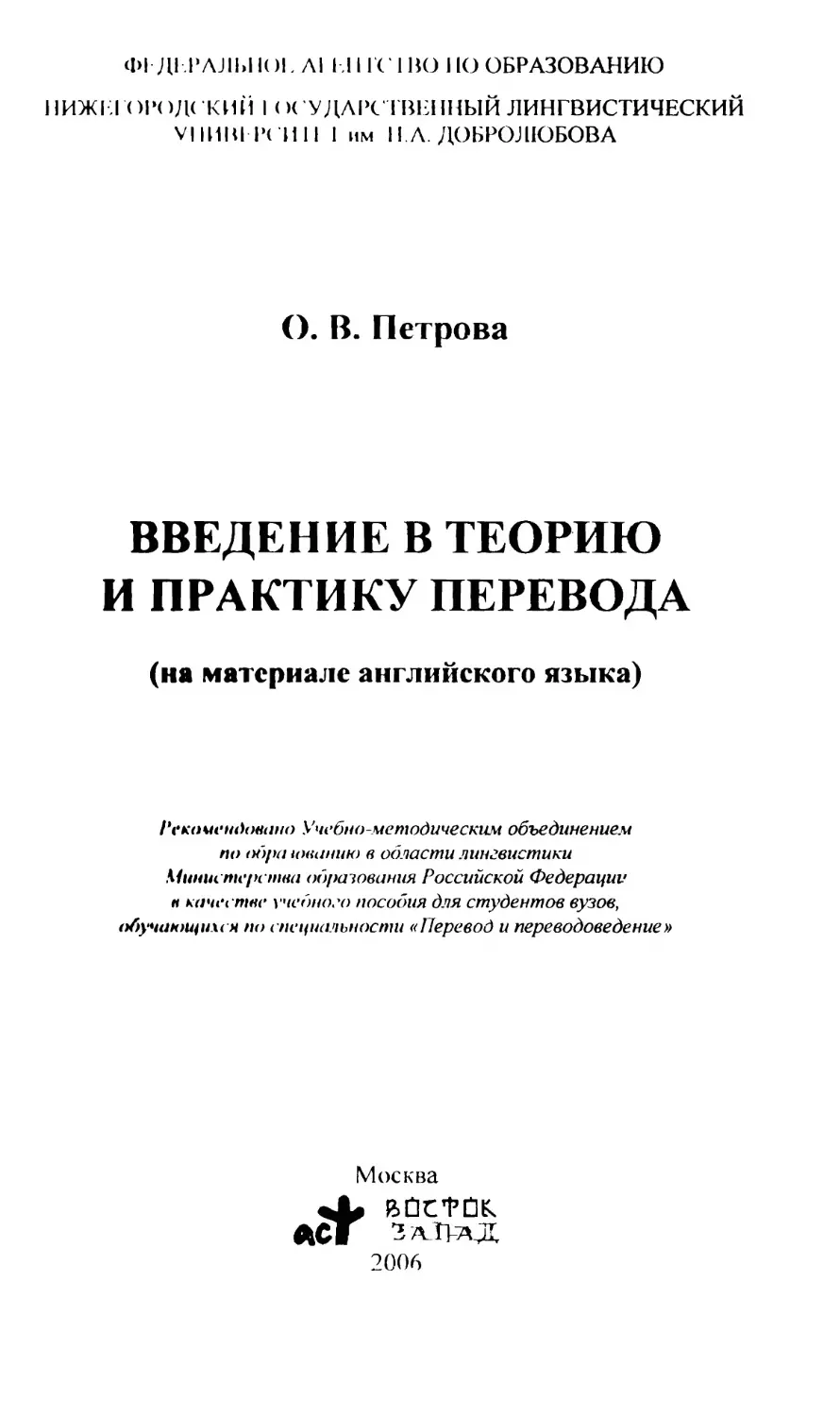
ВВЕДЕНИЕ В ТЕОРИЮ
И ПРАКТИКУ ПЕРЕВОДА

(на материале английского языка)

Рекомендовано Учебно-методическим объединением

по обра ювинию в области лингвистики
Министерства образования Российской Федерации
в качестве учебного пособия для студентов вузов,
обучающим я по специальности «Перевод и переводоведение»

Москва
вйс’Рйк

АС1	- ‘А-П-л Л

2006
УДК 811.111'25(075.8)

ББК 81.2Англ-7

П30

Подписано в печать 10.03.06 Формат 84x108/32

Усл. печ л. 5.04 Тираж 3 000 экз Заказ № 6487

Петрова, О.В.

ПЗО Введение в теорию и практику перевода (на материале
английского языка) / О.В. Петрова. —- М.: ACT: Восток —
Запад, 2006. — 96 с.

ISBN 5-17-038019-4 (ООО «Издательство АСТ»)

ISBN 5-478-00312-3 (ООО «Восток - Запал»)

Учебное пособие «Введение в теорию и практику перево-
да» предназначено для студентов переводческих факультетов и
переводческих отделений факультетов иностранных языков.
Пособие может использоваться как при проведении семинаров
по курсам теории и практики перевода, так и при самостоя-
тельной работе студентов.

Цель пособия - дать студентам представление об общих
принципах перевода, познакомить их с приемами и способами
решения типичных лексических и грамматических проблем
при переводе с английского языка на русский, а также сфор-
мировать у студентов навыки использования этих приемов.

УДК 811.111'25(075.8)

ББК 81 2Англ-7

Литвин Ф.А.

Лаврова А Н.

Рецензенты

-	д. филол. наук, профессор (Орловский государствен-
ный университет)

-	д. филол. наук, профессор (Нижегородский государ-
ственный технический университет)

Ответственный редактор

Ивашкин М.П.- д. филол. наук, профессор

© О.В. Петрова, 2006

© «Восток - Запад», 2006
CONTENS

General principles of translation ........................4

Translation of lexical units..............................8

I ypes ol correlation between words in SI and TL .........8

Context and its role in translation .................... 10

Translation of words having no correspondence in TL...... 12

Translation of Phrases.................................. 15

Lexical transformations..................................22

Grammatical aspects of translation.......................31

Grammatical transformations..............................31

Translation of specifically English grammatical forms
and constructions .......................................40

Exercises ...............................................46

Texts for translation ...................................69

1.	Matching the man and the right job ...................69

2.	Talking like your parents? You could do worse ........71

3.	Investing in paper....................................73

4.	In the bank...........................................75

5.	Indomitable little man ...............................77

6.	Congress - what is it? ...............................79

7.	Introduction to the UN ...............................81

8.	Is the monroe doctrine dead? .........................83

9.	The great debate......................................85

10.	Why flog a dying white elephant .....................87

Abbreviations ...........................................93

Fiction and dictionaries cited ..........................94
GENERAL PRINCIPLES OF TRANSLATION

Translation is a process and the result of turning a text from
one language into another, which means expressing the same by
the signs of a different language. Bearing in mind that every sign
has two planes (plane of expression and plane of content) the
essence of translation could be described as changing the ele-
ments of the plane of expression while the plane of content re-
mains constant.

The language of the original text is called "source lan-
guage", the language into which the text is translated is called
"target language" (the corresponding Russian terms are "ис-
ходный язык" and "переводящий язык").

One of the main difficulties of translating lies in the fact that
the meaning of the whole text is not exhausted by the sum of
meanings of its elements. The meaning of a text is made up by
words (characterized by their denotative and connotative mean-
ings and stylistic reference), syntactic meaning of sentences and
utterances larger than sentences, suprasegmental elements and
lexico-semantic connections between words and phrases.

Every language is characterized by a specific structure of its
lexico-grammatical fields and has its own lexical, morphological
and syntactic systems. It may result in lack of coincidence be-
tween the means of expressing the same content in SL (source
language) and TL (target language).

That is why good practical knowledge of the two languages
is quite necessary but not sufficient for translating. Besides this
knowledge one must possess a number of skills and be guided by
a number of principles worked out by the theory of translation.
These principles are connected both with linguistic and extral-
inguistic aspects.

While translating one must keep in view typological char-
acteristics of both the languages and remember that the same idea
General Principles of Translation
may be expressed lexically in one of them and grammatically in
the other. I о illustrate this let us compare the ways of expressing
priority in English and in Russian.

The actor, Gilbert Caster, who had been "out" for six
months, emerged from his east-coast seaside lodging about
noon in the day, after the opening of "Shooting the Rap-
ids", on tour, in which he was playing Dr Dominick in the
last act.

(J.Gals worthy)

It is clear from the sentence that the period of Caster’s being
"out" was prior to the moment when he "emerged from his ...
lodging", this priority is expressed by the Past Perfect form "had
been". Now that he was playing Dr Dominick he was no longer
"out". In Russian, however, it is impossible to render this idea
using grammatical means only. The phrase "он был без работы"
does not contain any indications to priority of this state. Hence
the necessity of introducing additional lexical units conveying
the meaning of the English grammatical form:

Актер Гилберт Кейстер, который перед этим
шесть месяцев был без работы,...

Concrete ways and means of overcoming such difficulties
depend on the structural peculiarities of SL and TL, therefore
when translating one must employ one’s theoretical knowledge
of phonetic, morphological, lexical and syntactic systems of the
two languages.

Besides purely linguistic difficulties, translation involves a
great number of problems caused by numerous extralinguistic
factors. The content of any text is based upon extralinguistic re-
ality, the text itself reflects the cultural background of the author
and of the whole people speaking the language, it also reflects the
history of the people, their habits and traditions, a peculiar na-
tional way of thinking, etc. All these things should necessarily be
taken into consideration in order to translate the text adequately.
One must know much more than the lexical meaning of the words
to translate the following:

"What will you have?" he asked me. I looked at him
doubtfully. Prohibition was in force and to all appearance
the ship was bone-dry.

(S. Maugham)

First of all it is necessary to know that the formula "What
will you have?" has a conventional meaning of an invitation to
choose some liquor. Besides one should know what "Prohibition"
is meant here (the eighteenth amendment to the US Constitution)
not to translate it as "запрет". Only in this case there may appear
a correct version:

"Что Вы будете пить?", спросил он. Я посмотрел
на него с недоверием: сухой закон был в силе, и на
корабле, судя по всему, не было ни капли спиртного.

It is also most essential to remember that nations speaking
different languages have different experience, and things natu-
rally known to one nation are quite unknown to another. To see it
one may try to translate into English the title of the film
"Петровка, 38", making it as informative for the Englishmen as
it is for us because we know perfectly well what office is situated
there.

One of the main demands upon a person translating any text
is that he should be well acquainted with its subject matter. It
certainly requires some knowledge of physics to decide if the
word "power" in a particular context means "сила" or "мощ-
ность", which is not the same thing.

If all these principles are taken into consideration there will
be no danger of so-called "literal" translation, which means a
word-for-word translation. This type of translation with all its
seeming accuracy ignores both linguistic and extralinguistic
factors discussed above. It leads to preserving the meanings of
separate words and at the same time it distorts the meaning of the
whole text (or sentence), thus often creates an undesirable comic
cl led. I he reader is sure to be surprised at such a sentence:

н гостиной стояли одиннадцать кресел, диван,
। ри с 1 олика, две этажерки,...и часть большого рояля.

I he phrase "part of a large grand piano" does not mean that
the grand piano was divided into parts, just as the Russian ex-
pression "четверть скрипки", denoting a special little violin for
children, docs not mean that the violin is broken into four parts.
So the phrase should be translated as "небольшой рояль", which
differs from "part of a large grand piano" in structure, but con-
veys the same meaning.

These arc the main principles one should follow in the
process of translating.
TRANSLATION OF LEXICAL UNITS

TYPES OF CORRELATION BETWEEN WORDS
IN SOURCE LANGUAGE AND TARGET LANGUAGE

There are different types of correspondences between the
elements of the SL and TL lexical systems.

I.	A word of SL and a word of TL may be identical in their
meaning. Such words are called equivalents (the corresponding
Russian term is эквиваленты). To this group usually belong
proper names such as "London — Лондон", "Galsworthy -
Голсуорси", etc.; terms such as "a morpheme - морфема",
"logarithm - логарифм", etc.; names of the months, days of the
week; numerals. Equivalents are usually monosemantic words
and they are easily translated.

II.	The meanings of a SL word and a TL word may coincide
partially (частичные, или вариантные соответствия). There
are three variants within this type.

1.	A word in one of the languages may have more meanings
than the corresponding word of the other language, so that the
meaning of the latter is as it were included in the meaning of the
former, e.g. the English noun "finish" and the Russian noun
"финиш" both denote "the conclusion, end", which completely
exhausts the meaning of the Russian word. The English word
"finish", however, also denotes "that which finishes, completes or
perfects", which corresponds to the Russian words "окончание",
"отделка", "аппретура". Thus the meaning of the word "finish"
includes the meaning of the word "финиш", but is not exhausted
by it. This is the first variant of semantic relations characterized
by partial coincidence of meanings.

2.	The second variant of semantic relations between partially
corresponding words may be described as intersection. It means
that both the words have some meaning (or even meanings) in
common, but at the same time each word has some other meanings
which do not coincide. E.g.: the English word "cup" and the Rus-
sian "чашка" both mean "a drinking-vessel", besides which the
word "cup" means "an ornamental vessel offered as a prize for an
athletic contest" (in Russian - "кубок"), while the Russian
"чашка" denotes also "круглая и плоская тарелка, подвешенная
к коромыслу весов", which corresponds to the English word
"pan". Thus the meanings of these two words ("cup" and "чашка")
intersect in one point only - i.e. they both denote a drinking-vessel.

3.	The third variant of relations within this type is somewhat
more complicated. The fact is that different peoples reflect reality
in different ways, and these differences find their manifestation
in the languages which the peoples speak. It is well known that
for the English it seems quite necessary to differentiate between a
hand and an arm, while in Russian we usually do not feel it so
very important and use the word "рука" to denote both the no-
tions indiscriminately (cf. also "watch" and "clock" — "часы",
"mirror" and "looking glass" - "зеркало", etc.). On the other
hand we usually differentiate between "вишня" and "черешня",
while for the English there exists one notion ("cherry"), as well as
both "клубника" and "земляника" are indiscriminately called
"strawberry"; we think that "почка" and "бутон" are quite dif-
ferent things and Englishmen always call it "a bud", no matter
whether it is going to form a leaf or a blossom.

It does not mean, of course, that we cannot express the
difference between a hand and an arm in Russian or that Eng-
lishmen do not see any difference between a leaf bud and a
blossom bud. They do, but traditionally some aspects of reality
are reflected as differentiated notions in the mind of one people
and as undifferentiated notion in the mind of another people.
Theoretically speaking every language can express everything,
but it differs from other languages in what it should express.

This group of words demands special attention because it
often causes trouble in the process of translation (for instance, try
to translate the following sentence into Russian: "They both
married their cousins").

In all the cases when the meanings of words coincide par-
tially there arises a problem of choosing the right variant of
translation. This choice should be based on two factors: on the
knowledge of possible semantic relations between the words of
SL and TL and on the information derived from the context.

III. Finally in one of the languages there may exist words
which have no correspondences in the other language at all
(безэквивалентная лексика). They are usually proper names
which are not used or even known in other countries (personal
names such as Aubrey, Hope, Игорь, Галина, etc.; place-names
such as Hindley, Catmose, Молитовка, Урень, etc.), and names
of specifically national notions and phenomena (such as lobby,
muffin, drugstore, самовар, щи, агитбригада, стройотрядо-
вец, etc.).

CONTEXT AND ITS ROLE IN TRANSLATION

The meaning of equivalents practically does not depend on
the context, so to translate them one should merely look them up
in a dictionary. The demand to consult dictionaries is essential.
No guesswork is allowed in translation: a word should be either
known or looked up; otherwise there is always a risk of transla-
tion the word "data" as "дата" or "billet" as "билет" or writing
some other nonsense of the kind.

It is much more difficult to translate those words of SL
which are characterized by partial correspondence to the words of
TL. Such words are mostly polysemantic. That is why in order to
translate them correctly it is necessary first of all to state which
particular meaning of such a word is realized in the utterance.
The most reliable indicator in this case is the context in which the
word is used.
They usually differentiate between linguistic context and
extralinguistic context (or context of situation). Linguistic context
in its turn is subdivided into narrow (context of a phrase or a sen-
tence) and wide (utterance-length context or sometimes context of
the whole text). Very often the meaning of a word is revealed in the
minimum context, i.e. in a phrase ("green" - зеленый, юный,
незрелый, etc., but there is no problem in translating the phrase
"green trees" - "зеленые деревья" or "green years" - "юные
годы"). However, there are such cases when we need at least a
sentence to see what the word means, e.g. 'TH be sitting in the 3rd
carriage from the front of the train" - "Я буду в третьем вагоне от
начала поезда". The whole sentence is necessary here to under-
stand the meaning of the word "carriage" and to choose the variant
"вагон" but not "экипаж, повозка".

Sometimes linguistic context is closely connected with ex-
tralinguistic factors. It may be illustrated by the following sen-
tence:

... he came to be convicted of perjury ... in Wakawak,
Cochin China..., the intent of which perjury being to rob a
poor native widow and her helpless family of a meager
plantain-patch, their only stay and support in their be-
reavement and desolation.

(Mark Twain)

The word "plantain" denotes either "банан" or "подо-
рожник". In the sentence there is no direct indication of the type
of plant. However, we know that the events took place in Cochin
China, where the climate is quite suitable for bananas, not for
"подорожник". Moreover, it is said in the sentence that the
plantain-patch was the "stay and support" which gave the family
either food or profit. All this settles the problem of choice: in this
case "plantain" means "банан".

The context of the situation becomes especially important if
the linguistic context is not sufficient for revealing the meaning
of the word. When one of G.B.Shaw’s characters warns his in-
terlocutor not to drive him too far, it is necessary to know that
they are both sitting in the parlor and not in any vehicle, so the
verb "to drive", is used in the meaning "привести в какое-то
состояние, довести до..." It may so happen that linguistic
context does not give any clue to the meaning of the word. Es-
pecially often it is the case with neologisms that do not corre-
spond to any words in TL. To understand the word "Reagangate",
which appeared in American newspapers in 1983, one must re-
member the notorious political scandal called "Watergate" in
1972-1974 and know some facts characterizing political methods
or President Reagan. Only in this extralinguistic context can we
understand the meaning of the word "Reagangate" - "a new po-
litical scandal revealing dishonest methods used by Reagan
during the election campaign and resembling the methods once
used by Nixon".

So translation of any word begins with contextual analysis
of its meaning after which it becomes possible to choose cor-
rectly the corresponding word of TL. All types of context can
help to identify the meaning of words in SL characterized by
partial correspondence to the words of TL, as well as the meaning
of words that do not correspond to any words of TL. Translation
of the latter group causes many difficulties and requires special
means.

TRANSLATION OF WORDS

HAVING NO CORRESPONDENCE IN TL

There are several ways of translating such words. The
simplest way is to transcribe them (lobby — лобби, lump - ламп,
спутник - sputnik, комсомол - Komsomol, etc.). This method is
widely used for rendering personal names, placenames, titles of
periodicals, names of firms and companies.

Sometimes transliteration is used for the same purpose, but
transcription is preferable because it renders the original
sound-form of the word, while transliteration is based upon its
graphical presentation (cf. two ways of rendering the name of
Shakespeare in Russian: its transcription is Шекспир while its
transliteration is Схакеспеаре). It is evident that for the purposes
of oral communication it is necessary to know the sound-form of
the names, so with the growth of contacts between the countries
transliteration is being gradually ousted by transcription. Those
names which have already been rendered by means of translit-
eration are now traditionally used in this form (King George -
король Георг, not король Джордж) and there is no need to
change them. Such names should not be translated anew, they
have their translated equivalents. However, in translating those
names which have no equivalents, it is preferable to use tran-
scription. Being a very good way of rendering proper names,
transcription is not very convenient for translating notional
words. Substitution of the Russian sounds for the English ones
does not make the English word understandable for the Russian
readers. The words "драгстер" or "ламп" are hardly more in-
formative for them than the original "drugstore" or "lump". That
is why transcription is often combined with footnotes or expla-
nations introduced into the text by the translator. As soon as the
new word is thus explained it can be freely used in the text in its
transcribed form. A good example of such introduction of a for-
eign word is found in one of G.Simenon’s books:

...они отправились на авеню Фридланд к юрис-
консульту посольства - к "солиситору", как его назы-
вают американцы. .. .Солиситор позвонил по телефону
следователю... А затем они возвратились в "Маже-
стик", и там Кларк в компании с солиситором, выпили в
баре по две рюмки виски...

(translated by Н.Немчинова)

The word "solicitor" here is transcribed and its meaning is
explained ("юрисконсульт"), after which the transcription is
used without further explanation.
The same method is used when translating the names of
companies or titles of periodicals. E.g. " 'Daily Express' re-
ports..." should be translated as "Английская консервативная
газета 'Дейли Экспресс' сообщает..." because the title "Daily
Express" is well known to the Englishmen and "Дейли
Экспресс" is not known (and not informative in itself) for the
Russian readers.

It is necessary to remember that explanations and footnotes
contain additional information which is not expressed directly in
the original text and is introduced by the translator. So it demands
great knowledge on the part of the translator. In case of compos-
ite words loan-translations (кальки) can be coined in the TL, e.g.
the English noun "moonquake" is quite adequately translated as
"лунотрясение", "as well as the Russian "луноход" is rendered
in English as "moon crawler".

The next method of translating words having no corre-
spondence in TL is based on approximate rendering of the notion
(приближенный перевод). It can be described as "translation on
the analogy". If a word in SL expresses some notion that has no
name in TL it is necessary to look for some analogous, similar
(though not identical) notion in TL. E.g.: if we are not translating
a cookery book but a story or a novel it is quite possible to
translate the Russian "кисель" as "jelly", though actually they are
different things (they use starch for "кисель" and gelatin for
jelly). Another example — in our country we do not use wardrobe
trunks and it is next to impossible to find a Russian way of ex-
pressing this notion, but usually (unless it is very important for
the context) it can be quite satisfactorily translated as чемодан
(or, if necessary, большой чемодан).

The last way out of the difficulty caused by lack of corre-
spondence between words of SL and TL is the so-called de-
scriptive translation (описательный перевод). In this case the
meaning of one word in SL is rendered by a group of words in TL
("spacewalk" - "выход в открытый космос", "spacesick" - "не
переносящий условий космического полета"; "самодея-
тельность" - "amateur talent activities", "районирование" -
"division into districts", etc.).

So there are five principal ways of translating words that
have no direct lexical correspondences in TL. They are 1) tran-
scription, 2) footnotes and explanations, 3) loan translation,
4) analogical translation, and 5) descriptive translation. They all
have certain drawbacks and their use is limited both by linguistic
and extralinguistic factors (explanations make the text too long
and sometimes clumsy, loan translation is applicable only to
composite words, analogues are not always accurate enough,
etc.). However, proper combination of these means makes it
possible to translate any text rendering all the necessary infor-
mation. When choosing the means of translating it is also im-
portant to keep in view stylistic characteristics of the text itself
and of different words in both the languages. Special attention
should be paid to peculiarities of word combinability in TL,
which may differ greatly from that of SL.

TRANSLATION OF PHRASES

Usually translation of free phrases does not cause any
specific difficulties. The main thing to be remembered here is
the interplay of the meanings of components, because every
component should be translated in such a way as to form the
whole meaning of the phrase. In the English language, how-
ever, there are some types of phrases, which deserve special
attention due to peculiarities of their semantic structure. Fist of
all it refers to phrases with preposed attributes. All these
phrases are built according to the pattern ATTRIBUTE +
(ATTRIBUTE + ...) + SUBSTANTIVE but their semantic
structure may vary considerably. Preposed attributes may de-
note properties and qualities of the substantive itself or of other
attributes (cf. "south-coast convalescent camp" - where both
"south-coast" and "convalescent" characterize "camp" - and
"free educational institution" where "free" is not connected
semantically with "institution"); besides properties and quali-
ties, they may denote some notion with which the substantive is
connected, they may express local, temporal and other charac-
teristics. That is why it is often impossible or at least undesir-
able to translate such phrases using similar Russian construc-
tions, since in Russian semantic relations between a preposed
attribute and a substantive are rather uniform: if a "happy man"
is certainly "счастливый человек", "a medical man" can hardly
be translated as "медицинский человек". There may be several
attributes in a phrase and they are not necessarily expressed by
adjectives. Very often the function of a preposed attribute is
fulfilled by a noun (the "stone wall" type of phrases) which, in
its turn, may also have an attribute (e.g. "the front door key").
Sometimes it is not easy to see which of the nouns is charac-
terized by a particular attribute (does "retail philanthropy
business" mean "business of retail philanthropy" or "retail
business of philanthropy"?). Such ambiguity is practically im-
possible in Russian attributive phrases.

Another peculiarity of English phrases with preposed at-
tributes is that an attribute may modify a noun which is as it were
omitted and only implied (e.g. "dry pruning" does not mean that
the process of pruning is dry, the word "dry" denotes the state of
branches that are being pruned).

These semantic and structural peculiarities should be taken
into consideration when translating attributive phrases with
preposed attributes. First of all it is necessary to translate the
final noun, which is always the main word in such a phrase.
Then one should single out sense groups within the phrase and
analyze relations between them. If all these groups modify the
final noun they may be translated in the same succession as they
are in English, or in a different succession, according to the
norms of the Russian language. If they modify each other in
consecutive order the reverse way of translation is often rec-
ommended:
1^-----'~m	2	3

"Strategic Arms Limitation Treaty" -

"Договор об ограничении стратегических вооружений"
1	2	3

There are several ways of translating such attributive
phrases.

1.	A preposed attribute may be translated with the help of a
corresponding Russian prepo^d attribute: "a fine day" - "чу-
десный день", "matrimonial ad" - "брачное объявление".

2.	A postpositional attribute may be used in Russian: "al-
ways-at-ease-girls" — "девушки, всегда чувствующие себя
непринужденно". Often these postpositional attributes are ex-
pressed by nouns in the genitive case: "opposition leader" "лидер
оппозиции".

3.	A preposed attribute of an English phrase may be ex-
pressed in Russian by a postpositional attribute joined to the
modified noun by a preposition (usually N + prep + N): "highway
robbery" - "грабеж на большой дороге", "youth unemploy-
ment" "безработица среди молодежи".

4.	A preposed attribute may be rendered in translation by an
apposition: "her millionaire friend" - "ее друг-миллионер".

5.	Sometimes one of the components of an English phrase
(usually the preposed attribute itself) is best translated descrip-
tively, i.e. by a group of words: "a bargain counter" "прилавок
(отдел) товаров по сниженным ценам".

6.	When translating English attributive phrases with pre-
posed attributes it is often advisable or even necessary to rear-
range components of the phrase and transfer the attribute to an-
other noun (present in or omitted from the phrase): "free educa-
tional institutions" - "бесплатные учебные заведения", though
in English the word "free" is connected with "educational" and
not with "institutions"; "Parliamentary Labour Party" - "парла-
ментская фракция лейбористской партии" (the word "пар-
ламентская" here is an attribute to the noun "фракция", intro-
18 О. В. Петрова • Введение в теорию и практику перевода
duced into the phrase according to the norms of the Russian
language); "the nine Common Market foreign ministers" -
"девять министров иностранных дел стран Общего рынка",
where two nouns are introduced ("дел" and "стран") to show real
semantic connections.

For the purposes of translation an attribute may be trans-
ferred to another noun used in the same sentence outside the
phrase. E.g. "dismal array of titles" in Mark Twain’s "Running
for Governor" should rather be translated as "набор ужасных
прозвищ", though in English the adjective "dismal" modifies the
noun "array", and not "titles".

7.	Very often English attributive phrases are translated with
the help of Russian adverbial phrases, especially in case of Eng-
lish

to be

to have
to give
to take

+ A + N phrases:

"to give a loud whistle" - "громко свистнуть", "to have a good
dinner" - "хорошо (вкусно, как следует и т.д.) пообедать", etc.

8.	Finally there are cases when due to different reasons it is
impossible to preserve the structure of a sentence including an
attributive phrase with a preposed attribute, so the structure of the
sentence is changed completely: "a girl with whom he had pre-
viously had a slight party-going acquaintance" - "девушка, c
которой он раньше лишь hhoi да встречался на вечеринках".

The choice of a particular way to translate preposed attrib-
utes is predetermined mainly by semantic relations between the
components of a phrase, grammatical norm, and combinability of
words in TL.

There is a specific type of preposed attributes in English - at-
tributes with inner predication. Their translation mainly depends on
their stylistic properties. If such an attribute is rather extended and
used for the purpose of irony, it is usually translated by means of a
subordinate clause (mostly an object clause): "one of those quick
.scnJ-ine-iwo-hundred-by-messengerold-man-or-my-head-goes-
in-the-gas-oven touches" (P.G.Wodehouse) - "одна из тех
наскоро написанных записок, в которых обычно пишут:
"Пришли мне, старина..." If it is not very long and no special
ironical effect is intended it is better to find some laconic
variant of translation using a preposed or postpositional at-
tribute or sometimes even a noun without any attribute (if the
meaning of this noun includes the characteristics which in
English are expressed by the attributive phrase): "a 'God, you
are wonderful' type of woman" - "восторженная женщина",
"a grab-it-and-run ... counter" - "место, где можно наскоро
перекусить" or "забегаловка".

* * *

Speaking about set phrases it is first of all necessary to
differentiate between figurative and non-figurative set phrases.
Non-figurative set phrases are translated according to the prin-
ciples that have already been discussed in connection with words
and free phrases. The main guiding principle here is to remember
the norms of TL.

Figurative set phrases deserve special discussion. The main
peculiarity of these phraseological units is their specific meaning
that often cannot be deduced from the meanings of their com-
ponents. It is the meaning of the whole, not of separate words,
that should be rendered in translation. Based on imagery, phra-
seological units serve to make the text more expressive; they are
also often responsible for stylistic coloring of the text. Since the
text in TL must be as expressive as it is in SL and characterized
by the same stylistic coloring, it becomes very important to find
an adequate variant of translating every phraseological unit.

There are four main ways to translate an image-bearing phra-
seological unit: 1) the image may be preserved as it is; 2) it may be
partially changed; 3) it may be replaced by an utterly different
image, and 4) a translated version may contain no image at all.
1.	They usually preserve the image (and even the structure)
of the so-called international phraseological units. Such units are
mostly based on some historical, mythological, biblical, etc.
references: "In the seventh heaven" - "на седьмом небе", "to go
through the fire and water" - "пройти (сквозь) огонь и воду", "а
blue stocking" - "синий чулок", "not to see the wood for the
trees" - "за деревьями леса не видеть", etc. Such phraseological
units of SL and TL are called equivalents. In case of equivalents,
there arise no difficulties of stylistic or any other character.

Sometimes it is possible to preserve the image underlying a
phraseological unit in SL even in the case when there is no cor-
responding unit in TL. It is achieved through loan translation; "no
man can make a good coat with bad cloth" - "из плохого
материала хорошего платья не сошьешь", "nothing comes oul
of the sack but what was in it" - "из мешка не вынешь больше,
чем в нем было" (or — "ничего, кроме того, что в нем было"),
etc. However, this means may be resorted to only if the image is
absolutely transparent for the people speaking TL, that is if the
figurative meaning of the phraseological unit is easily and un-
mistakably deduced from its direct meaning. In this case the
translated version is no longer phraseological, but it remains
figurative, so it renders the idea of the original phraseological
unit and adds to the expressiveness of the whole text. If the image
is not transparent and the meaning of the whole (and mainly its
figurative meaning) cannot be deduced from the lexical meanings
of the components, loan translation is absolutely impossible. "To
send somebody to Coventry" (бойкотировать) cannot be trans-
lated as "послать в Ковентри", and translating "to find a mare’s
nest" ("попасть пальцем в небо") as "найти гнездо кобылы"
one really finds a mare’s nest.

2.	It often happens that phraseological units of SL and TL
express the same idea and are based upon similar though not
identical images. They both express the idea figuratively and the
imagery underlying them is basically the same. In such cases it is
possible to ignore slight differences between the images and
though in the phraseological unit of TL the image is partially
changed in comparison with that of SL, it can still be accepted as
an adequate translated version: "a fine suit doesn’t make a gen-
tleman" - "не одежда красит человека", "at a. glance (at
a glimpse)" - "с первого взгляда", "a burnt child dreads the
fire" - "обжегшись на молоке, на воду дует". In the last ex-
ample the difference between the English and the Russian vari-
ants seems to be rather serious: there is practically no lexical
correspondence between the words. But the image is nearly the
same - he who once was burnt is afraid of everything which is hot
(hence the same generalized figurative meaning). Some more
examples: "a bird in the hand is worth two in the bush" - "лучше
синица в руке, чем журавль в небе", "look not a gift horse in
the mouth" - "дареному коню в зубы не смотрят", "to lay by
for a rainy day" - "отложить про черный день", etc.

3.	Since the phraseological stock of every language reflects
the history and culture of the people speaking the language, many
ideas which are common to all peoples are expressed differently
in different languages: in Russian we say "когда рак на горе
свистнет", while Englishmen say "when pigs fly", in Russian -
"рыбак рыбака видит издалека", and in English - "birds of a
feather flock together". Since the meaning of the first phrase-
ological unit is in no way connected with either crayfish or pigs
the lexical way of wording the idea ("something never going to
happen") is of secondary importance. The main task here is to
find a phraseological unit of TL expressing the same idea and
belonging to the same stylistic register (стилистический
регистр) as the original phraseological unit. The same is true
about the second example. The complete substitution of the im-
age does not in any way change the general meaning of the
proverb. "У семи нянек дитя без глазу" is an adequate transla-
tion of the English "Too many cooks spoil the broth" because of
complete coincidence of meaning and stylistic reference.

So in all the cases when phraseological units of SL have no
equivalents in TL and in TL there are no expressions based on the
22 О. В. Петрова • Введение в теорию и практику перевода
same image, complete substitution of image (i.e. use of phrase-
ological analogues) is recommended.

4.	In SL there may exist phraseological units that have
neither equivalents nor analogues in TL. The idea expressed in
these units has no fixed expression in TL. If the image underlying
them is not transparent and loan translation is impossible, such
phraseological units are translated descriptively, i.e. by free
phases which are neither phraseological nor figurative: "a
skeleton in the cupboard" - "семейная тайна" (an attempt to
translate it as "скелет в шкафу" leads to utter misrepresentation
of sense), "get the right (wrong) end of the stick" - "оказаться в
выгодном (невыгодном) положении", "in a whole skin" -
"благополучно, без повреждений", etc.

These are the main ways of translating figurative phrase-
ological units.

When translating phraseological units it is necessary to
remember that some of them have a definite national character,
which makes their translation rather difficult. On the one hand, it
is not always easy to preserve the national "flavour" in transla-
tion, on the other - there is always a danger of introducing na-
tional elements of TL. Semantically "to carry coals to Newcastle"
and "ездить в Тулу co своим самоваром" are analogues, nev-
ertheless one can hardly insert Тула in a text translated from
English. In such cases it is advisable to find (or coin, if necessary)
a neutral expression with the same figurative meaning: "носить
уголь в шахту (воду в реку, дрова в лес и т.д.)". There should
be по "коломенская верста" or "Тришкин кафтан" or "щи
лаптем хлебать" in a Russian translation of any foreign text.

I. EXIC AL TRANSFORMATIONS

Thc\ sav that translation starts where dictionaries end.
Though somewhat exaggerated, this saying truly reflects the
natuic of translation. Dictionaries list all regular correspondences
between elements of lexical systems of languages. Translation
deals not so much with the system of language but with speech
(or to be more exact - with a text, which is a product of speech).
So in the process of translating one has to find it by himself which
of the meanings of a polysemantic word is realized in a particular
context, to see if under the influence of this context the word has
acquired a slightly new shade of meaning and to decide how this
new shade of meaning (not listed in any dictionary) can be ren-
dered in TL. E.g. no dictionary ever translates the verb "to be" as
"лежать", nevertheless it is the best way to translate it in the
sentence "She was in hospital" - "Она лежала, в больнице".
Moreover, it has already been said that every language has its
specific way of expressing things, a way that may be quite alien
to other languages. That is why a literal (word-for-word) trans-
lation of a foreign text may turn out clumsy (if not ridiculous) in
TL. To avoid it one has to resort to some special devices worked
out by the theory of translation and known as lexical transfor-
mations (or contextual substitutions) (лексические трансфор-
мации, или контекстуальные замены). There are several types
of such transformations.

1.	The first type of lexical transformations is used in trans-
lating words with wide and non-differentiated meaning. The es-
sence of this transformation lies in translating such words of SL
by words with specified concrete meaning in TL (трансформа-
ция дифференциации и конкретизации). When translating
from English into Russian they use it especially often in the
sphere of verbs. If English verbs mostly denote actions in rather a
vague general way, Russian verbs are very concrete in denoting
not only the action itself but also the manner of performing this
action as well: "to go (on foot, by train, by plane, etc.)" - "идти
пешком", "ехать поездом", "лететь самолетом", etc.; "to get
out" - "выбираться","выходить", "вылезать", "высаживать-
ся", etc. The choice of a particular Russian verb depends on the
context. It does not mean, of course, that the verb "to go" changes
its meaning under the influence of the context. The meaning of
"to go" is the same, it always approximately corresponds to the
Russian "перемещаться", but the norms of the Russian language
demand a more specified nomination of the action. The same can
be illustrated with the verb "to be": "The clock is on the wall",
"The apple is on the plate and the plate is on the table" - "Часы
висят на стене", "яблоко лежит на тарелке, а тарелка стоит на
столе", though in all those cases "to be" preserves its general
meaning "находиться". The sentence "He’s in Hollywood" in
J.D. Salinger’s "The Catcher in the Rye" should be translated as
"Он работает в Голливуде", but if "Oxford" were substituted for
"Hollywood" the translation would rather be "учится". This
transformation is applicable not only to verbs but to all words of
wide semantic volume, no matter to what part of speech they
belong: adverbs, adjectives, nouns, etc. E.g. due to their most
vague meaning such nouns as "a thing", "stuff, "a camp" are
used to denote practically anything, often remaining neutral sty-
listically. In Russian, however, nouns with so general a meaning
are less universal, besides, they sometimes belong to the collo-
quial register which often makes it impossible to use them in
translation (cf. "a thing" - "вещь", "штука", "штуковина"). That
is why in every case there should be found a word with a more
concrete meaning denoting that particular "thing" or "stuff'
which is meant by the author: "...this madman stuff that hap-
pened to me" - "идиотская история, которая co мной
случилась"; "...all the dispensary stuff - "все медицинские
препараты" or "лекарства"; "toilet things" - "туалетные
принадлежности", "you have never done a single thing in all
your life to be ashamed of' - "за всю свою жизнь ты не
совершил ни одного постыдного поступка".

It is necessary to take into consideration not only denotative
but connotative meanings as well. The verb "to employ" is usu-
ally translated as "нанимать, принимать на работу". But if
Mark Twain’s character is "accused of employing toothless and
incompetent old relatives to prepare food for the foundling hos-
pital", of which he is warden, the verb acquires a shade of nega-
tive meaning (he is said to have used his position in order to pay
money to his relatives for the work which they could not do
properly); so it should be translated by a less "general" verb - e.g.
"пристроить".

The English pronoun "you" deserves special attention. It
can be translated only with the help of differentiation, i.e. either
"ты" or "вы". The choice depends on the character, age, the so-
cial position of the characters, their relations, and the situation in
which they speak. One should remember that the wrong choice
can ruin the whole atmosphere of the text.

2.	The second type of transformation is quite opposite in its
character and is usually called "generalization" (трансформация
генерализации). In many cases the norms of TL make it un-
necessary or even undesirable to translate all the particulars ex-
pressed in SL. Englishmen usually name the exact height of a
person: "He is six foot three tall". In Russian it would hardly
seem natural to introduce a character saying "Он шести футов и
трех дюймов росту"; substituting centimetres for feet and inches
wouldn’t make it much better: "Он 190,5 сантиметров росту".
The best variant is to say: "Он очень большого роста".

Generalization is also used in those cases when a SL a word
with differentiated meaning corresponds to a word with
non-differentiated meaning in TL ("a hand" - "рука", "an arm" -
"рука", etc.).

The necessity to use generalization may be caused by purely
pragmatic reasons. In the original text there may be many proper
names informative for the native speakers of SL and absolutely
uninformative for the readers in TL. They may be names of some
firms, of the goods produced by those firms, of shops (often ac-
cording to the name of the owner), etc.: Englishmen know that
"Tonibell" is the name of various kinds of ice-cream produced by
the firm Tonibell, while "Trebor" means sweets produced by
Trebor Sharps LTD and "Tree Top" denotes fruit drinks produced
by Unilever. Transcribed in the Russian text these names are
absolutely senseless for the reader who would not see any dif-
ference between "Тонибелл", "Требор", "Три Ton" or even
"Тоутал", which is not eatable since it is petrol. An English
reader in his turn can hardly guess what they sell in "Динамо"
shops (even if it is spelt "Dynamo") or in "Весна" (no matter
whether it is rendered as "Vesna" or "Spring"). Hardly are more
informative such names as "Снежинка" (a cafe or a laundry),
"Байкал" (a drink), "Первоклассница" (sweets), "Осень" (a
cake), etc. That is why it is recommended to substitute names
(unless they are internationally known or play a special role in the
context) by generic words denoting the whole class of similar
objects: "Он сдает свои рубашки в 'Снежинку'" - "Не has his
shirts washed at the laundry", "Они ели 'Осень', запивая ее
'Байкалом' " - "They were eating a cake washing it down with a
tonic"; "...Domes of glass and aluminium which glittered like
Chanel diamonds" - "купола из стекла и алюминия, которые
сверкали, как искусственные бриллианты". То translate
"Chanel diamonds" as "бриллианты фирмы 'Шанель'" would
be a mistake since the majority of Russian readers do not know
that this firm makes artificial diamonds. If the text permits a
longer sentence it is possible to add this information ("искусст-
венные бриллианты фирмы 'Шанель'"), which may be useful
for the reader’s scope but absolutely unnecessary for the text it-
self. However, the generalized translation "искусственные
бриллианты" is quite necessary here.

3.	The third type of transformation is based upon logical con-
nection between two phenomena (usually it is a cause-and-effect
type of connection), one of which is named in the original text and
the other used as its translated version. This transformation pre-
supposes semantic and logical analysis of the situation described
in the text and consists in semantic development of this situation
(in Russian the transformation is called смысловое развитие). If
the situation is developed correctly, that is if the original and
translated utterances are semantically connected as cause and
effect, the transformation helps to render the sense and to observe
the norms of TL: "Mr. Kelada’s brushes ... would have been all
the better for a scrub" (S.Maugham) - "Щетки мистера Кела-
ды ... не отличались чистотой". It may seem that the transla-
tion "не отличались чистотой" somewhat deviates from the
original "would have been all the better for a scrub". However, the
literal translation "были бы много лучше от чистки" is clumsy
while "не отличались чистотой" is quite acceptable stylistically
and renders the idea quite correctly: why would they have been all
the better for a scrub? - because they не отличались чистотой.
Another example: "When 1 went on board 1 found Mr. Kelada’s
luggage already below" (S.Maugham) "...я нашел багаж мистера
Келады уже внизу" is not Russian. The verbs "нашел" or
"обнаружил" do not render the situation adequately. It is much
better to translate it as "...багаж мистера Келады был уже
внизу", which describes the situation quite correctly: why did I
find his luggage below? - because он был уже внизу.

These two examples illustrate substitution of the cause for
the effect (замена следствия причиной): the English sentence
names the effect while the Russian variant names its cause. There
may occur the opposite situation - substitution of the effect for
the cause (замена причины следствием): "1 not only shared a
cabin with him and ate three meals a day at the same table..."
(S.Maugham) - "...три раза в день встречался с ним за одним
столом"; "Three long years had passed ... since I had tasted
ale..." (Mark Twain) - "Целых три года я не брал в рот
пива..." In these examples the English sentences name the cause
while the Russian versions contain the effect (I ate three meals a
day at the same table with him, so Я три раза в день встречался
с ним за одним столом; three long years had passed since I
tasted ale, so целых три года я не брал в рот пива).

4.	The fourth type of transformation is based on antonymy
(антонимический перевод). It means that a certain word is
translated not by the corresponding word of TL but by its anto-
nym and at the same time negation is added (or, if there is nega-
tion in the original sentence, it is omited in translation): "It wasn’t
too far." - "Это оказалось довольно близко" ("far" is translated
as "близко" and negation in the predicate is omitted). Not far =
близко.

The necessity for this transformation arises due to several
reasons: 1) peculiarities of the systems of SL and TL, 2) con-
textual requirements, 3) traditional norms of TL.

1)	The necessity to resort to antonymic translation may be
caused by various peculiarities of SL and TL lexical systems:
a) in Russian the negative prefix не coincides in its form with the
negative particle не, while in English they differ (un-, in-, im-,
etc. and the negative suffix -less on the one hand and the particle
"not" on the other hand); so it is quite normal to say "not impos-
sible" in English, while in Russian "не невозможно" is bad;
b) groups of antonyms in SL and TL do not necessarily coincide:
in English the word "advantage" has an antonym - "disadvan-
tage," while in Russian the word "премущество" has no anto-
nym, in English there are antonyms "to arrange - to disarrange",
while in Russian there is only "систематизировать", etc.

2)	Sometimes antonyms become the most adequate way of
rendering the contextual meaning: "a murderer is only safe when
he is in prison" - "убийца не опасен, только когда он в
тюрьме". The word "safe" taken separately is easily translated as
"безопасный", but in this context the variant "не опасен" is
preferable since it is not "безопасность" of the murderer that is
meant here but the fact that he is "не опасен" for the others. This
shade of meaning is better rendered by the antonym.

In a particular context this transformation may help to
render emotional and stylistic coloring of the text: "He’s proba-
bly thirsty. Why don’t you give him some milk?" - "Наверное,
он хочет пить. Может, дать ему молока?". "Direct" translation
"Почему бы не дать ему молока?" is not colloquial, while the
characters of P.G.Wodehouse speak in a highly informal way.
3)	Finally the transformation is often necessary for the
purpose of observing the traditional norms of TL: ”1 only wish I
could. I wish I had the time" (S.Leacock) - "Мне очень жаль,
что я не могу. К сожалению, у меня нет времени". Generally
speaking the English construction "I wish smb + Past Tense form
of verb" should always be translated "жаль, что ... не". The
variant "Я бы хотел, чтобы я мог (в прошлом)" is not Russian.
"Not ... (un)till" corresponds to the Russian "лишь, только ...
тогда-то". "He won’t be back till tomorrow night, will he?" "Он
ведь вернется только завтра к вечеру, правда?".

5. The fifth transformation is usually called "compensation"
(компенсация). To be exact, it is not so much a transformation
but rather a general principle of rendering stylistic peculiarities of
a text when there is no direct correspondence between stylistic
means of SL and TL. This transformation is widely used to render
speech peculiarities of characters, to translate puns, rhyming
words, etc. The essence of it is as follows: it is not always pos-
sible to find stylistic equivalents to every stylistically marked
word of the original text or to every phonetic and grammatical
irregularity purposefully used by the author. That is why there
should be kept a general stylistic balance based on compensating
some inevitable stylistic losses by introducing stylistically simi-
lar elements in some other utterances or by employing different
linguistic means playing a similar role in TL. Suppose a character
uses the word "fool-proof' which is certainly a sign of the col-
loquial register. In Russian there is no colloquial synonym of the
word "надежный" or "безопасный". So the colloquial
"fool-proof is translated by the neutral "абсолютно надежный"
and the speech of the character loses its stylistic coloring. This
loss is inevitable, but it is necessary to find a way of compensa-
tion. It is quite possible to find a neutral utterance in the speech of
the same character that can be translated colloquially, e.g. "I got
nothing". Taken separately it should be translated "Я ничего не
получил" or "Мне ничего не дали", but it allows to make up for
the lost colloquial marker: "Я остался с носом (на бобах)". It
results in getting one neutral and one colloquial utterance both in
the original and in the translated texts.

There is another variety of compensation which consists in
creating the same general effect in TL with the help of means
different from those used in SL. A combination of phonetic and
grammatical mistakes is used by G.B.Shaw to show that his
character is an uneducated person: "Old uns like me is up in the
world now". Il is impossible to make the same mistakes in the
corresponding Russian sentence: "Такие старики, как я. сейчас
высоко пенятся". Nevertheless, speech characteristics are very
important for creating the image of Beamish, so it is necessary to
make him speak in an uneducated manner. In Russian mistakes in
the category of number would hardly produce this effect, they
would rather be taken for a foreign accent. One also can’t omit
sounds in any of the words in the sentence. That is why it is better
to achieve the same result by lexical means, using words and their
forms typical of popular speech (просторечие): "Старички-то
навроде меня нынче в цене!". Another example: "You can’t
have no rolls" (G.B.Shaw) Since double negation is the literary
norm in the Russian language it doesn’t help to render the effect
of illiterate speech; it is necessary to make a typical Russian
grammatical mistake. The most widespread mistakes are con-
nected with case formation in Russian, so something like
"А булочков-то не будет" may serve the purpose .

With the help of these five types of transformations one can
overcome practically all lexical difficulties.

i

A wonderful example of compensation is described in: Я.И.Рецкер.
Теория перевода и переводческая практика. М., 1974, стр.61-62
GRAMMATICAL ASPECTS OF TRANSLATION

GRAMMATICAL TRANSFORMATIONS

It is well known that languages differ in their grammatical
structure. Apart from having different grammatical categories
they differ in the use of those categories that seem to be similar.
This naturally results in the necessity to introduce some gram-
matical changes in the translated version of any text. These
changes depend on the character of correlation between the
grammatical norms of SL and TL. Various as they are, all the
possible changes may be classed under four main types: trans-
positions (перестановки), replacements (замены), additions
(добавления), and omissions (опущения).

1.	Transpositions. There may appear a necessity to rear-
range elements of different levels: words, phrases, clauses or
even sentences. Transposition of words and phrases may be
caused by various reasons: differences in the accepted word order
in SL and TL, presence or absence of emphasis, differences in the
means of communicative syntax.

Speaking of word order, it would be more accurate to say
that to change word order really means to rearrange not so much
words but parts of the sentence When translating from English
into Russian one has to change word-order because normally it is
fixed in English while in Russian it is relatively free: "George has
bought some new things for this trip..." (Jerome K.Jerome) - "K
этой поездке Джордж купил кое-какие новые вещи..." or
"Джордж купил к этой поездке кое-какие новые вещи..." or
"Джордж купил кое-какие новые вещи к этой поездке",
which depends (in this particular case) on the rhythm of the
whole utterance. But such freedom of choice is rather rare, since
the word order of the Russian sentence is not as arbitrary as it
seems to be. The position of a word in the sentence is often pre-
determined by its communicative function. In the English sen-
tence . .1 realized that a man was behind each one of the books"
(R.Bradbury) the rhematic function of the noun "man" is indi-
cated by the indefinite article. In order to make it the rheme of the
Russian sentence it is necessary to put it in the final position:
"...я понял, что за каждой из этих книг стоит человек". An-
other example: "A certain man. was seen to reel into Mr. Twain’s
hotel last night..." - "Вчера вечером видели, как в отель, где
проживает мистер Марк Твен, ввалился некий человек..."

Transposition of clauses is also used to preserve the semantic
and communicative balance of the whole sentence: "The sun had got
more powerful by the time we had finished breakfast..." (Jerome
K.Jerome) - "К тому времени, как мы позавтракали, солнце
припекало уже вовсю..." If the Russian sentence began with the
principal clause ("Солнце припекало...") the logical meaning
would be different - the sentence would state the time by which the
sun got more powerful, while the real meaning of the sentence is to
show what was the state of things by the time they finished their
breakfast and had to decide upon further course of action.

Transposition of sentences does not become necessary very
often. However, it helps sometimes to render the meaning which
is expressed by the Past Perfect form in the English text, so as to
indicate the succession of actions or events: "The village of
St.Petersburg still mourned. The lost children had not been
found" (Mark Twain) - "Пропавших детей так и не нашли.
Городок Сант-Питерсберг оплакивал их".

2.	Replacements. Replacements are also made at different
levels.

A.	To conform to the demands of the grammatical system of
TL it may become necessary to change the grammatical form of a
word: "fifteen thousand dollars" - "пятнадцать тысяч долла-
ров" ("thousand" - singular, "тысяч" - plura’.), "And your hair’s
so lovely" - "У тебя такие красивые волосы", etc.
B.	They often have to replace one part of speech by another.
Most frequent replacements of this type are the following:
a) English nouns with the suffix -er denoting the doer of an action
are usually replaced by verbs in Russian: "I’m a moderate
smoker" (J.D.Salinger) - "Я мало курю", "When George is
hanged Harris will be the worst packer in this world" (Jerome
K.Jerome) - "Когда Джорджа повесят, хуже всех на свете
укладывать вещи будет Гаррис". However, if such a noun
denotes a person’s profession the replacement is not recom-
mended: when Holden Caulfield describes a girl, saying "She
looked like a very good dancer" (J.D.Salinger), it should be
translated "Похоже, она здорово танцует", but the sentence
from S.Maugham’s "Gigolo and Gigolette" "Stella was a good
ballroom dancer", characterizing Stella’s professional skill,
should be translated "Стелла была хорошей исполнительни-
цей бальных танцев". English deverbal nouns (usually con-
verted from verbs) may be translated by verbs (especially if they
are used in the construction "to give (to have, to make, to take) +
N": "to give somebody a lift" - "подвезти кого-то". "He gave us
all a look" (S.Maugham) - "Он взглянул на нас", etc. b) They
often replace nouns by pronouns and vice versa. In the story "The
Broken Boot" by J.Galsworthy Bryce-Green says to Caister:
"Haven’t seen you since you left the old camp". "The old camp"
is a phrase with an extremely wide and vague meaning, it means
"some place we used to be at together and some people we were
somehow connected with", so it is quite adequately translated
"He видел Вас с тех пор, как Вы ушли от нас". The pronoun
"нас" here is substituted for the noun "camp" (or, to be more
exact, for the nominal phrase "the old camp"). A noun is substi-
tuted for a pronoun in the following example: "...and Harris sat
on it, and it stuck to him., and they went looking for it all over the
room" (Jerome K.Jerome). At first sight it seems possible to
translate the sentence as it is: "...Гаррис сел на него, и оно к
нему прилипло, и они принялись искать его. по всей ком-
нате". However, the sentence is "overloaded" with pronouns, the
34 О. В. Петрова • Введение в теорию и практику перевода
more so because the Russian "его" can denote both Harris and the
butter. That is why it is necessary to replace some pronouns by
nouns to make the situation clear and the sentence more readable:
"... а Гаррис сел на этот стул, и масло прилипло к его брю-
кам, и они оба принялись искать его по всей комнате".

Occasionally some other replacements may become nec-
essary.

However, it must be remembered that the choice of parts of
speech influences the general stylistic coloring of the text, cf.
"бросить взгляд" and "взглянуть", "хранить молчание" and
"молчать", etc. Russian abstract nouns are usually more appro-
priate in newspapers and official texts, short-form adjectives and
passive participles are somewhat bookish and should be avoided
if possible when rendering colloquial speech, which means that
part of speech replacements may be caused sometimes by purely
stylistic considerations.

C.	Replacement of parts of the sentence. The most frequent
among such replacements is that of substituting an object for the
subject and vice versa. It is very helpful in translating English
passive constructions. Statistics shows that in English they use
passive constructions much more often than in Russian. More-
over, in English these constructions in themselves are not marked
stylistically while in Russian they are mainly bookish and offi-
cial, cf.: "мне дали интересную книгу" and "мне была дана
интересная книга". The essence of this replacement is in making
the subject of the English sentence the object of the Russian
version: "She was brought here last night" (Ch.Dickens) - "Ее.
принесли сюда вчера вечером". If the English sentence has an
object denoting the doer or the cause of the action, it automati-
cally becomes the subject of the Russian sentence: "The psy-
chiatrist was shocked by the smile" (R.Bradbury) - "Эта улыбка,
поразила психиатра". If the subject of the English sentence
denotes some place or time it may be replaced by an adverbial
modifier in translation: "Anyway, the corridor was all linoleum
and ail..." (J.D.Salinger) - "А в коридоре у нас — сплошной
линолеум" (translated by Р. Райт-Ковалева). This transforma-
tion is regularly used when the subject of the English sentence is
expressed by a noun denoting some message: "the text (the tele-
gram, the letter, etc.) says..." - "в тексте (в телеграмме, в.
письме и т.д.) говорится (сказано)". Occasionally this trans-
formation is applied to other nouns in the function of the subject.

D.	One of the most important syntactic peculiarities of the
English language is the existence of secondary predication cre-
ated by various participial and infinitive constructions. These
constructions are included in the structure of simple sentences in
English while Russian simple sentences have only one predica-
tive center. This may lead to the necessity of substituting Russian
composite sentences for simple sentences of the original text: "I
remember a friend of mine buying a couple of cheeses at Liver-
pool" (Jerome K.Jerome) - "Я помню, как один мой приятель
купил в Ливерпуле пару сыров" (a simple sentence in English
and a complex sentence in Russian); "I let the day slip away
without doing anything at all" (Mark Twain) - "Прошел целый
день, а я так ничего и не предпринял" (translated by
Н.Тренева) (a simple sentence in English and a compound sen-
tence in Russian).

Sometimes two or more simple sentences may be joined
together to form one sentence (simple or composite) in transla-
tion; usually they do it for logical, stylistic and rhythmical rea-
sons: "I made my way into the smoking-room. I called for a pack
of cards and began to play patience." (S.Maugham) - "Я от-
правился в курительную комнату, спросил себе колоду карт
и принялся раскладывать пасьянс"; "Quite the reverse is the
truth in the case of great men. The nearer you go to them, the
smaller they seem" (G.Mikes) - "С великими людьми все на-
оборот: чем вы к ним ближе, тем они кажутся мельче".

On the other hand, English composite sentences with for-
mal, purely grammatical subjects (introductory "it", "this", etc.)
36 О. В. Петрова • Введение в теорию и практику перевода
often correspond to Russian simple sentences: "This was hardly
what I intented" (G.B.Shaw) - "У меня были совсем другие
намерения"; "It’s the natural, original sin that is bom in him that
makes him do things like that" (Jerome K.Jerome) - "Его
толкает на все эти проделки врожденный инстинкт, так
сказать, первородный грех." (translated by М.Салье).

A long and syntactically complicated sentence containing
secondary predication may be translated by several simple sen-
tences: "A few months ago I was nominated for the Governor of
the great State of New York, to run against Mr. Stewart
L.Woodford and Mr. John T.Hoffman on an independent ticket"
(Mark Twain) - "Несколько месяцев назад моя кандидатура
была выдвинута на пост губернатора великого штата Нью
Йорк. В качестве кандидата от независимых мне предстояло
выступать против мистера Стюарта Л.Вудфорда и мистера
Джона Т.Хоффмана."

Е.	In some cases it is possible to replace the principal clause
by a subordinate clause (and vice versa) if it helps to conform to
the logical and stylistic norms of TL: "They put him under
laughing-gas one year, poor lad, and drew all his teeth, and gave
him a false set, because he suffered so terribly with toothache..."
(Jerome K.Jerome) - "Он так жестоко страдал от зубной боли,
что однажды его, беднягу, усыпили, под наркозом вырвали
все зубы и вставили искусственные челюсти." His suffering
with toothache is here the main thing the author stresses; to show
how terrible his sufferings were he says that they had to draw all
his teeth; that is why it is but logical to state the main idea in the
principal clause, while the clause which is principal in the Eng-
lish sentence becomes subordinate in Russian.

F.	A different type of syntactic bond may be used in transla-
tion instead of that used in the original text, i.e. subordination may
be replaced by coordination and vice versa. Generally speaking,
subordination is more frequently used in English than in Russian,
since subordinating words in English are rather vague semantically
while in Russian they state rather definitely the character of se-
mantic connection between the clauses. The conjunction "while"
does not really indicate any temporal connection between the ac-
tions in the sentence "Once she faltered for a minute and stood still
while a tear or two splashed on the worn carpet" (O’Henry), so it is
hardly possible to translate it "...в to время как..." Such transla-
tion would create a humorous effect which was not intended here
by the author. It is much better to introduce co-ordination instead
of subordination: "Один раз руки ее дрогнули и она замерла на
мгновение, а на потертый ковер скатились две слезинки."

G.	Syndetic connection used in English sentences is not
always appropriate in Russian, so it would often create a wrong
stylistic effect if preserved in translation. That is why asyndetic
connection of parts of the sentence is rather regularly used in
Russian instead of the English polysyndeton: "It made them
nervous and. excited, and. they stepped on things, and. put things
behind them; and. then couldn’t find them when they wanted
them; and they packed the pies at the bottom, and put heavy
things on top, and. smashed the pies in" (Jerome K.Jerome) -
"Они волновались, нервничали; они роняли то одно, то
другое, без конца искали вещи, которые сами же перед тем
ухитрялись спрятать. Они запихивали пироги на дно и клали
тяжелые предметы сверху, так что пироги превращались в
месиво" (translated by М.Салье).

So, the following types of replacement may be used in order
to overcome difficulties created by differences in the grammati-
cal systems of SL and TL: A. Replacement of word-forms
(замена форм слова). В. Replacement of parts of speech
(замена частей речи). C. Replacement of parts of the sentence
(замена членов предложения). D. Replacement of a simple
sentence by a composite one and vice versa (замена простого
предложения сложным и наоборот). Е. Replacement of the
principal clause by a subordinate one and vice versa (замена
главного предложения придаточным и наоборот). F. Re-
38 О. В. Петрова • Введение в теорию и практику перевода
placement of subordination by coordination and vice versa
(замена подчинения сочинением и наоборот). G. Replacement
of syndetic connection by asyndetic and vice versa (замена
союзной связи связью бессоюзной и наоборот). Within the
fourth type (replacement of a simple sentence by a composite one
and vice versa) they also single out two additional varieties:
joining several sentences together (объединение) and dividing a
long sentence into several shorter sentences (членение).

3.	Additions. It is very difficult to say whether this trans-
formation is lexical or grammatical: it is both. Its lexical aspects
have already been discussed: it is necessary to make some ex-
planations of transcribed words, describe those notions which
have no names in TL, add the words which are implied but not
expressed in the structure of attributive phrases, etc. However, in
all these cases the structure of the sentence is involved, that is
why the transformation is considered to be grammatical. Some-
times there appear grammatical reasons for adding new words: it
happens when some meaning is expressed grammatically in the
original text while there is no way of expressing it grammatically
in TL. E.g. in English they use articles to differentiate between an
author and his creation: "...the jewel of his collection - an Is-
raels..." or "...Madame Lamotte, who was still in front of the
Meissonier". (J.Gals worthy). In Russian it is necessary to add the
word "картина": "...жемчужина его коллекции - картина
Исраэлса..." and "...мадам Лямот, которая все еще стояла
перед картиной Месонье". Another example: the existence of
the special possessive form (George’s, Harris’s) in English al-
lows to use names in the absolute possessive construction: "Of
course, I found George’s and Harris’s eighteen times over..."
(Jerome K.Jerome). In Russian the corresponding grammatical
form is that of the genitive case, the use of which would create an
undesirable ambiguity: ". ..находил Джоржа и Гарриса". So it is
necessary to add the word "щетка" implied in the English sen-
tence: "Конечно же, щетки Джоржа и Гарриса попадались
мне раз восемнадцать, если не больше...". In this way the
translated version restores as it were the complete structure of the
original sentence some elements of which might be only implied
and not expressed materially. When using the transformation of
addition one should be very careful to add only that which should
really be added. It requires good knowledge of deep structure and
surface structure grammars of both SL and TL and ability to
analyze semantic and pragmatic aspects of a text.

4.	Omissions. This transformation is seldom structurally
obligatory, it is usually caused by stylistic considerations and
deals with redundancy traditionally normative in SL and not ac-
cepted in TL. A typical example of such redundancy is the use of
synonymic pairs in English: "...their only stay and support..."
(Mark Twain) - both the words mean "поддержка", "опора".
There is no need to translate them both, one is quite enough: "их
единственная поддержка" or, according to the demands of the
context, "единственное, что спасало их от голода" (translated
in the same way as any one of these words would be translated).

Sometimes it is recommended to omit semantically empty
"tags" of declarative and interrogative sentences: "British to the
backbone, that’s what I am." (S.Maugham) - "Англичанин до
мозга костей!" "I can’t leave the room and send myself to you at
the same time, can I.?" (G.B.Shaw) "He могу же я уйти из
комнаты и в то же время прислать самого себя к вам!" They
sometimes recommend omitting logical redundancies and repe-
titions to achieve what is called "compression of the text".
However, it must be remembered that logical redundancy of
speech and various repetitions are used by writers to characterize
the personage’s individual manner of speaking, his way of
thinking, etc. In such cases omissions are not allowed.

* * ♦

These are the main types of grammatical transformations. It
should be born in mind, however, that in practice it is hardly
40 О. В. Петрова • Введение в теорию и практику перевода
possible to find these elementary transformations in their "pure
form": in most cases it is necessary to combine them.

TRANSLATION OF SPECIFICALLY ENGLISH

GRAMMATICAL FORMS AND CONSTRUCTIONS

To translate English grammatical forms and constructions
one should not necessarily look for the same forms and con-
structions in Russian - there may be none. Nevertheless, it is
always possible to translate them adequately since it is not the
form itself but its meaning and function in the sentence that
should be rendered in translation. That is why translation of any
such unit should begin with its semantic and functional analysis.
It can be illustrated with the problem of rendering the definite and
indefinite articles. Unless articles have some special role in the
sentence or some additional meaning, they are not translated at
all - they are merely omitted. However, there are cases when ar-
ticles are used to mark the rheme of the sentence. Here again
there is no need to translate the article itself: it is necessary to find
the proper word order placing the noun which is the rheme of the
English sentence in a rhematic position in Russian (most often it
is the final position). Sometimes, besides their usual meaning of
definiteness or indefiniteness articles have some additional
meaning, e.g., the indefinite article used with personal names has
the meaning "some, a certain", showing that someone is unknown
to the speaker. Such meaning should be rendered by corre-
sponding means of the Russian language: "a Mrs. Smith" "некая
миссис Смит, какая-то миссис Смит". The indefinite article
may also coincide in its meaning either with the pronoun "one"
("I remember a friend of mine buying a couple of cheeses..." -
"Я помню, как один мой приятель...") or with the numeral
"one" ("a stitch in time saves nine" - "один стежок, сделанный
вовремя..."). There are many more meanings which the article
may combine with its main grammatical function ("New Eng-
lish-Russian Dictionary” edited by I.R.Galperin lists 11 mean-
ings of the indefinite article and 9 meanings of the article "the").
In this respect translation of articles does not differ from transla-
tion of other words - first its meaning should be analyzed and
then a proper word of TL can be chosen.

The same is true of prepositions and conjunctions. It is most
important to remember that even such a "simple" conjunction as
"and" has at least 10 different meanings; in different contexts it
may correspond to the Russian "и" ("John and Mary"), "a" ("they
stayed at home, and we left" - "они остались дома, а мы
ушли"), "неужели" ("And you did it?" - "Неужели Вы это
сделали ?"), etc.

Speaking of conjunctions, it should also be mentioned that
besides their main function (connecting and introducing different
clauses and parts of the sentence) they enter idiomatic construc-
tions the meaning of which cannot be guessed: it should be
known or looked up in the dictionary ("She is sixty if (she is) a
day" - "Ей добрых шестьдесят лет" или "Ей не меньше
шестидесяти лет" "if anything" - "если уж на то пошло, во
всяком случае, как бы то ни было").

One and the same preposition is also translated differently
in different constructions and contexts (see 17 meanings of the
preposition "on", the same number of meanings of the preposi-
tion "of, etc.).

As for the so-called notional parts of speech, they may
differ in SL and TL in the set of syntactic functions that they fulfil
in the sentence. That is why translation should always be based
on a thorough syntactic analysis since it is not the grammatical
form itself but rather its function in the sentence that predeter-
mines the way of translation. For example, before translating an
infinitive it is necessary to state its role in the sentence - to see if
it functions as a subject, object, attribute, or adverbial modifier,
etc. If it is an adverbial modifier, it is essential to see its type - an
adverbial modifier of purpose, of result, of attendant circum-
stances, etc. After this functional and semantic analysis it is
42 О. В. Петрова • Введение в теорию и практику перевода
possible to render the infinitive into Russian using any part of
speech in the corresponding function (or changing the structure
of the sentence in order to express the same idea according to the
norms of TL).

It is impossible to warn a beginner against all possible dif-
ficulties. However, it seems reasonable to point out some English
constructions that are most likely to cause trouble.

Most frequent among them are the so-called absolute con-
structions. There are two main difficulties in dealing with them:
first of all they are not always easy to recognize and besides they
do not correspond to any particular construction of the Russian
language. Based on secondary predication, these constructions
usually express some additional thought, something that happens
in connection with the main action, but still "outside*' it. Unlike
subordinate clauses, absolute constructions are characterized by
rather a vague semantic connection with the main body of the
sentence. It is often hard to say if the construction indicates time
or cause of the main action - it may indicate them indiscrimi-
nately. As a rule, constructions coming before the main body of
the sentence have temporal, or causal, or conditional meaning;
constructions coming after the main body express some attendant
circumstances or serve as an adverbial modifier of manner.

They usually single out four structural types of absolute
constructions: 1) nominative participial constructions - . .1 got
them to be quiet, when - enter Admiral Ass, in full regalia, ep-
aulettes quivering with indignation." (Bel Kaufman); 2) nomi-
native constructions without a participle - "And, chin on hand, he
stared through his monocle into an empty cup" (J.Galsworthy);
3) participial constructions without the subject - "Being liable
himself to similar unlooked-for checks from Mrs. Chick, their
little contests usually possessed a character of uncertainty that

i

B.H.Комиссаров, Я.И.Рецкер, В.Н.Тархов. Пособие по переводу
с английского языка на русский, т. II, М., 1965
was very animating" (Ch.Dickens); 4) absolute constructions
with the preposition "with" - "With renewed handshaking and
messages to be delivered to Miss Lawson, we at last made our
exit." (A.Christie). Knowing these structural types, it is easier to
identify such a construction and differentiate it from expanded
secondary parts of the sentence.

There are four possibilities in translating absolute con-
structions, though they do not directly correspond to the four
types of constructions themselves.

1.	If the type of semantic connection between the absolute
construction and the main body of the sentence is more or less
definite, a subordinate clause may be used in translation:
"...those things having been invariably found on Mr. Twain’s
person ... they felt compelled to give him a friendly admonition."
(Mark Twain) - "...и так как вещи эти впоследствии неиз-
менно обнаруживались у мистера Твена, ...они сочли своим
долгом сделать ему дружеское внушение."

2.	However, it is not always possible to choose the proper
type of the subordinate clause: "Bessie and Abbot having re-
treated, Mrs. Reed ... thrust me back and locked me in, without
further parley" (Ch.Bronte). Really, did she do it after Bessie and
Abbot retreated or because they retreated? Evidently, both after
and because she got rid of those women who were less cruel than
she was. In Russian such an indiscriminate way of expressing
time and cause in one subordinate clause is impossible, so other
ways should be sought. The best way to combine these meanings
is to use an adverbial-participial construction (дееп; о частный
оборот): "Отослав Бесси и Эббот, миссис Рид сно а затолк-
нула меня в комнату, не вступая больше ни в ка с объяс-
нения".

3.	Being very close functionally to English absolute con-
structions, Russian adverbial-participial constructions are more
limited in usage, since the action indicated by them should al-
ways be performed by the subject of the sentence, which is not
necessarily the case with English absolute constructions. If nei-
ther a subordinate clause nor an adverbial-participial construction
can be chosen for translation, an absolute construction can be
rendered by a separate sentence or an independent clause joint by
co-ordination: "Miss Arundell walked home, Bob trotting se-
dately at her heels..." (A.Christie) - "Мисс Арендэлл пошла
домой, и Боб спокойно побежал за ней.".

4.	Finally, an absolute construction can be translated with
the help of a Russian prepositional phrase with the preposition
"c": "Coffee-cup in hand, Mr. Scogan was standing in front of the
... bookshelf (A.Huxley) - "Мистер Скоуген с чашкой в
руках стоял перед ... книжной полкой." It should be noted,
however, that such phrases are practically never employed to
translate English absolute constructions with the preposition
"with". There are some other English constructions that are rather
difficult: not so much for translation but for understanding (as
soon as they are understood correctly they are translated ac-
cording to the principles already discussed). First of all they are
the so-called causative constructions having the general meaning
of making somebody do something or causing some action, ef-
fect, etc. It is necessary to remember that besides the typical
causative constructions with the verbs "to make", "to force", "to
cause" and constructions with the verbs "to have" and "to get"
("to have somebody do something", "to get somebody to do
something", "to have, get something done"), there exists another
way of expressing this meaning:

to

Verb + smb + •s into

► + smth (or doing smth),

out of

as in "to talk somebody into (out of) something" - "уговорить
(отговорить) кого-то делать что-то", "to laugh somebody out
of a habit" - "отучить кого-то от привычки, посмеявшись
над ней", e.g. "Managed herself to death, damn her."
(J.Collier) - "Своим умением все организовывать довела
себя до смерти, черт побери." The first verb in such con-
structions usually denotes the way, the manner in which some
effect or action was caused.

Another type of constructions causing misunderstanding,
comes close to comparative constructions: "as ... as ever", "as ...
as any (or anything)", "as much as doing something", etc. These
constructions do not contain any real comparison. The phrases
"as ... as ever (any, anything)" denote the superlative degree of
some quality or high intensity of some feeling or state: "it’s as
simple as anything" — "это же совсем просто". "Не will be as
peeved as anything" - "Он будет страшно раздражен", etc. The
phrases "not (or never) as much as doing something", "no more
than", "much less" are used as emphatic means of expressing the
idea that somebody cannot or does not want to do something, or
never happened to do it.

Close to those pseudo-comparative constructions come
phrases with the word "too", "cannot + be + too + Adj." or
"cannot + Verb + too + Adv.". They are synonymous to the
phrases "to be very + Adj." and "to do (smth) very + Adv": "One
cannot be too careful" — "Нужно быть очень осторожным".

Generally speaking, translation of specifically English
grammatical constructions consists of two stages: first it is nec-
essary to understand their meaning and then find a corresponding
way of expressing it in Russian. For the purpose of translation,
grammar does not exist separately. It is not the grammatical form
but the grammatical meaning that is of primary concern for a
translator or an interpreter. A mistake in grammar (whether it is a
misunderstood construction of SL or a wrong variant in TL) al-
ways tells on the sense and logic of the text. As soon as the sense
and logic of a sentence stop to be transparent it is necessary to
stop and look for a mistake in the translation.
EXERCISES

Exercise 1. Translate the following, paying attention to the
meanings of the verb to MAKE. How does the context influence
the choice of a variant?

1.	You’re making a big mistake, Mrs. Grey. (B.P.)

2.	I always make a cup of tea last thing. She drinks it in bed...
(K.M.)

3.	It made me feel worse than ever. (K.M.)

4.	They were made for each other. (O.R.D.)

5.	"I’m not going to make any speech," the Boss said.
(R.P.W.)

6.	Clutterbuck’s father makes all the beer round here. (E.W.)

7.	"And flags, Diana. There should be flags left over from last
time." "I made them into dusters," said Dingy... (E.W.)

8.	Presently, the door opened again, and two more boys looked
in. They stood and giggled for a time and then made off.
(E.W.)

9.	"Me, a butler," said Philbrick, "made to put up tents like a
blinking Arab." "Well, it’s a change," said Paul."It’s a
change for me to be a butler," said Philbrick. "I wasn’t made
to be anyone’s servant." (E.W.)

10.	As if to make their appeal the more imperative, the fol-
lowing appeared in one of the papers the very next day...
(M.T.)

11.	The clerk makes for the door, whistling the latest popular
love ballad. (B.Sh.)

Exercise 2. Translate the following, paying attention to the
meanings of the verbs to GET, to WANT. How does the context
influence the choice of a variant?

1.	You can always get money. (B.P.)

2.	How did you get into my apartment? (R.L.)
3.	"Is it quite easy to get another job after - after you’ve been
in the soup?" asked Paul. "Not at first, it isn’t, but there’re
ways". (E.W.)

4.	"So he sat down there and wrote me a letter of recommen-
dation... I’ve got it still." (E.W.)

5.	By this time anonymous letters were getting to be an im-
portant part of my mail matter. (M.T.)

6.	"I’ve got to help the gardeners..." (E.W.)

7.	All this was a great deal easier than Paul had expected; it didn’t
seem so very hard to get on with the boys, after all. (E.W.)

8.	"Florence, will you get on to the Clutterbucks on the tele-
phone and ask them to come over..." (E.W.)

9.	[Mary doesn’t feel well in the morning. Her husband is
trying to comfort her] "I’ll get you something ... Stay
down". "I can’t. I’ve got to get the children to school" ...
After a moment she said, "Ethan, I don’t think I can get up. I
feel too bad". (J.S.)

Exercise 3. Translate the following, paying attention to the
underlined words. How does the context influence the choice of a
variant?

1.	The river is getting low and will soon dry up. (L.D.)

2.	They were still talking in low voices. (J.F.)

3.	The coal’s getting low, we must order some more. (L.D.)

4.	You’ve changed such a lot since I last saw you. (L.D.)

5.	He [David] was glad he had finally decided to dress up a
little - the jeans suit, a shirt and scarf - when he went
downstairs ...He [the old painter] too had changed: a pale
summer coat, a white shirt, a purple bow tie. (J.F.)

6.	I somehow felt that I had one prominent advantage over
these gentlemen and that was - good character. (M.T.)

7.	... what sort of characters Messrs. Woodford and Hoffman

8.	are... (M.T.)

9.	A salary of four pounds a week would not, he was con-
scious, remake his fortunes... (J.G.)
10.	Не walked on, and became conscious that he had passed a
face he knew. (J.G.)

11.	Jack held out his hands for the conch and stood up, holding
the delicate thing carefully in his sooty hands. (W.G.)

12.	"...I couldn’t stand him, personally..." (J.F.)

Exercise 4. Give Russian equivalents for the following
proper names. Explain your choice.

King Charles I
King George III
King James I
Queen Mary
Queen Elisabeth
St Paul’s Cathedral

Charles Dickens
George Osborne
James Watt
Mary Barton
Elisabeth Gaskell
Paul Dombey

Exercise 5. Transcribe and transliterate the following
names. Which of the variants is accepted in Russian?

Evelyn Waugh, Somerset Maugham, Bernard Shaw, John
Galsworthy, George Byron, William Thackeray.

Exercise 6. Give equivalents for the following geographical
names. What means did you use to render them into Russian?
London, Glasgow, Edinburgh, Connecticut, Kentucky, Holly-
wood, Hereford, Hertford, Liverpool, the Mersey, New York,
New England, Great Slave Lake, Great Bear Lake, Cape of Good
Hope, the Rocky Mts, the Lake District

Exercise 7. Translate, paying attention to elements having
no equivalents in Russian. By what means do you render them?

1.	AUGUSTUS. What! Must you go?

THE LADY. You are so busy.

AUGUSTUS. Yes: but not before lunch, you know. I
never can do much before lunch. And I’m no good at all
in the afternoon. From five to six is my real working time.
(B.Sh.)
2.	"I’m going to build a cottage for myself up at Red Hill... I
might even stay there part time in the winter and commute
to work." "That’s a long commute," Dan observed doubt-
fully. (B.P.)

3.	Then Henry suddenly asked if we’d like to stay to lunch.
(J.F.)

4.	I am now more than glad that I did not pass into the
grammar school five years ago, although it was a disap-
pointment at the time. (M.S.)

5.	He was one of those boys who thinks he knows it all. Public
school and all that... (J.F.)

6.	...starlets were especially attracted to him because of his
seriousness. (M.S.)

7.	...it’s out of the question to shoot an old Harrovian...
(E.W.)

8.	I got a pardon straight from the White House. (R.Ch.)

9.	After this, this journal customarily spoke of me as "Twain,
the Montana Thief." (M.T.)

10.	...the flight was delayed for half an hour. There was fog at
Heathrow. (J.F.)

11.	Philbrick, evidently regarding himself as one of the guests,
was engaged in a heated discussion on greyhound racing
with Sam Clutterbuck. (E.W.)

12.	"In there. That’s the Common Room." (E.W.)

13.	Lord Augustus Highcastle ... is comfortably seated at a
writing-table with his heels on it, reading The Morning
Post. (B.Sh.)

14.	One August bank holiday in the late nineties they travelled
fifty miles to compete in a town where prizes of solid cash
were to be given... (A.C.)

Exercise 8. Analyze the semantic structure of the given at-
tributive phrases. Translate the sentences.

1. Yet that stern-eyed woman had been so sure. (B.P.)
'2. I’m a metallurgical chemist turned civil engineer. (B.Sh.)
3.	.. .he will keep the telephone numbers straight... (R.P.W.)

4.	"In other words they’re Medical Students, I suppose?" said
Mr. Pickwick. (Ch.D.)

5.	"The paper publishes my endorsement of Callahan for the
Senate nomination..." (R.P.W.)

6.	A slight weak woman in a pretty muslin print gown (her
best)1 (B.Sh.)

7.	She gave me a sharp sidelong look from her furtive eyes.
(R.Ch.)

8.	Annabel got her good start. (M.S.)

9.	.. .the men who lived on the first floor usually had first grab
at the books... (J.D.S.)

10.	Paul sat down disconsolately on the straight chair. (E.W.)

11.	He stood at the end of a long room with his back to a rococo
marble chimneypiece. (E.W.)

12.	"Boys," he [Dr Fagan] said, "I have some announcements to
make. The Fagan cross-country running challenge cup will
not be competed for this year on account of the floods."
(E.W.)

13.	He was seated on a folding wooden chair at a small,
messy-looking writing table, with a paper-back overseas
novel open before him... (J.D.S.)

14.	DOYLE. Man alive, don’t you know that all this ...
more-power-to-your-elbow business is got up in England,
to fool you... (B.Sh.)

15.	Clay left his feet where they were [on his friend’s bed] for a
few don’t-tell-me-where-to-put-my-feet seconds, then
swung them to the floor and sat up. (J.D.S.)

Exercise 9. What is the nature of the phraseological units in
the sentences below? Translate the sentences.

1.	We have taken all the precautions we can against the
painting being stolen. (L.D.)

i

Bracketed by G.B.Shaw
2.	We must take steps to help the families of those who were
hurt. (L.D.)

3.	The new truck meets our needs. (L.A.D.)

4.	You only want to sell the land... That’s the long and short
of it, Ian. (B.P.)

5.	"Hello, Prendy,...How are things with you?" (E.W.)

6.	I told her that I’d never written a story for anybody, but that it
seemed like exactly the right time to get down to it. (J.D.S.)

7.	She let go Charlie’s sleeve. (J.D.S.)

8.	"Dear me, you seem to think about killing a good deal." "I
do. It’s my mission, you see." (E.W.)

9.	"Old boy," said Grimes, "you’re in love." "Nonsense".

“A sweet despair?"...

"Nothing of the sort". (E.W.)

10.	This new book will be of interest to policemen and prison
officers; and, for that matter, to anyone who has to deal with
criminals. (L.D.)

Exercise 10. Define the nature of the following phrase-
ological units. Translate them

a)	preserving the imagery of the original

1.	I wash my hands of this job. (B.Sh.)

2.	To kill time before the train left, we went to a movie.
(W.Foster-Koonin)

3.	My uncle Henry ... was on these occasions in the habit of
saying that the devil could always quote scripture to his
purpose... (W.S.M.)

4.	...I don’t care what you say about my race, creed, or re-
ligion, ...but don’t tell me I’m not sensitive to beauty.
That’s my Achilles’ heel, and don’t you forget it. (J.D.S.)

5.	"Money, John," said Mr. Pecksniff, "is the root of all evil."
(Ch.D.)

6.	One swallow does not make a spring.

7.	to shed crocodile tears.
b)	changing the imagery of the original partially

1.	That’s past. There’s no use looking back. It’s water over the
dam. (B.P.)

2.	Well, you leave and learn, don’t you. (B.P.)

3.	Others will say ... that you have lied and fawned and
wormed yourself through dirty ways into my favour.
(Ch.D.)

4.	Old friends and old wine are the best.

5.	a wolf in sheep’s clothing.

6.	as like as two peas.

7.	dumb as an oyster.

c)	changing the imagery of the original completely

1.	"Listen, Clive," she said, "you’re making a mounting out of
a molehill." (B.P.)

2.	As you make your bed, so you must lie on it.

3.	He would not set the Thames on fire.

4.	Queen Ann is dead.

5.	Never cackle till your egg is laid.

6.	One fire drives out the other.

7.	to make a mountain out of a molehill

8.	have all one’s eggs in one basket

9.	like a cat on hot bricks

10.	early to bed and early to rise

d)	leaving the imagery out of the translation

1.	He had a sweet tooth that, because he was in fine shape, he
could afford to indulge. (B.P.)

2.	Mrs. Grey, I have no crystal ball. (B.P.)

3.	She wanted to talk my head off about it, but I wouldn’t let
her. (B.P.)

4.	["You don’t want it to come into Court?" "No, though I
suppose it might be rather fun." [Mr. Settlewhite smiled
again.] "That entirely depends on how many skeletons you
have in your cupboard." (J.G.)
5.	PROTEUS. How did you get on with the King?

6.	BOANERGES. Right as rain, Joe. (B.Sh.)

7.	to have too many irons in the fire.

8.	to have other fish to fry.

9.	to make fish of one and flesh of another.

10.	Many happy returns of the day!

11.	the three R’s

Exercise 11. Define the nature of the phraseological units
in the sentences below. Translate the sentences. What means do
you employ?

1.	"Now your predecessor was a thoroughly agreeable young
man... But he used to wake up my daughters coming on his
motor bicycle at all hours of the night. He used to borrow
money from the boys too, .. .and the parents objected. I had
to get rid of him." (E.W.)

2.	"You have never done a single thing in al! your life to be
ashamed of - not one. Look at the newspapers... and com-
prehend what sort of characters Messrs Woodford and
Hoffman are and then see if you are willing to lower yourself
to their level and enter a public canvass with them." (M.T.)

3.	And yet I can lay my hand on the Book and say that I never
slandered Governor Hoffman’s grandfather. (M.T.)

4.	He’s been looking awfully down in the mouth lately. (E.W.)

5.	"Why are you so reluctant to reveal sources?" The question
visibly pleased the old man; as if David had fallen into a
trap. (J.F.)

6.	So one moment you turn up your nose at a heart of gold.
(J.F.)

7.	The discussion was resumed in Welsh, but it was clear that
the stationmaster was slowly giving way. (E.W.)

8.	I don’t know how to give up. That’s my trouble. I always
have to stick things out to the bitter end. (J.F.)

9.	1 went back to town and left the candidate to his own de-
vices. (R.P.W.)
10.	It is a very ill wind that blows nobody any good. (Ch.D.)

11.	"You gave up college..." "It was totally against my nature.
You’ve no idea. Trying to prove I wasn’t what I am. And
anyway, it was only out of the frying pan. I’m even worse
now than I was before." (J.F.)

12.	Happily enough, it did not rain next day, and after morning
school everybody was dressed up to the nines. (E.W.)

13.	"He lived for his art, he said. He just moved into a bigger
house and went on writing away fifteen to the dozen." (E.W.)

14.	"I’m engaged to be married to Flossie... We haven’t told
the old boy [the girl’s father] yet. I’m waiting till I land in
the soup again. Then I shall play that as my last card."
(E.W.)

15.	"You see Philbrick is really sir Solomon Philbrick, the
shipowner."

"The novelist, you mean," said Grimes.

"The retired burglar," said Paul.

The three masters looked at each other.

"Old boys, it seems to me someone’s been pulling our legs."
(E.W.)

16.	Mr. Philbrick, senior, ...had two kids: Philbrick and a
daughter called Gracie. From the start Philbrick was the
apple of the old chap’s eye, while he couldn’t stick Miss
Gracie at any price. (E.W.)

Exercise 12. Translate the following, employing concreti-
zation of the underlined elements.

1.	In a comer were some golf clubs, a walking stick, an um-
brella, and two miniature rifles. Over the chimneypiece was a
green baize notice-board covered with lists; there was a
typewriter on the table. In a bookcase were a number of very
old textbooks and some new exercise-books. There were also
a bicycle pump, two armchairs, a straight chair, half a bottle
of invalid port, a boxing glove, a bowler hat, yesterday’s
"Daily News" and a packet of pipe-cleaners. (E.W.)
2.	Do you know, I’ve never been in a boat before in all my life.
(K.G.)

3.	Let this be a lesson to you. (B.P.)

4.	Sally was extremely uncomfortable. (B.P.)

5.	...an opera singer tells of the persecution she currently
endures at the hands of the tenor’s wife... (M.S.)

6.	The baby, Carl, was the only reality of her life. (M.S.)

7.	I’m going to Ireland. (B.Sh.)

8.	She took a drag of the coffee and then a deep drag of the
cigarette. (R.P.W.)

9.	I’m a photographer. I do celebrities and authors for book
jackets, stuff like this. (B.P.)

10.	Sighing, Dan took the phone. (B.P.)

11.	I want to get married. (P.G.W.)

Exercise 13. Translate the sentences employing generali-
zation.

1.	When they had gone, she was left with a well-remembered
dread from her school and college years. Had she passed the
finals? (B.P.)

2.	He wants his dinner. (B.P.)

3.	The Boss was already sitting in the front by the driver’s seat
when I got to the Cadillac. (R.P.W.)

4.	Jack sat up and stretched out his legs. (W.G.)

5.	Three long years had passed over my head since I had tasted
ale, beer, wine, or liquor of any kind. (M.T.)

6.	Paul did not have to travel alone. Potts was at Croydon,
enveloped in an ulster and carrying in his hand a little at-
tache case (E.W.)

7.	...a waiter advanced staggering under the weight of an
ice-pail from which emerged a Jeroboam of champagne.
(E.W.)

8.	Close to the window... James..., like the bulky Swithin,
over six feet in height, but lean, - brooded over the scene
with his permanent stoop. (J.G.)
9.	But Christmas with no children about - he still remembered
the holly and snapdragons of Park Lane in his own child-
hood - the family parties; ... (J.G.)

10.	"What’ll you have now - cheese?" "Thank you, sir; I’ve had
too much already, but I won’t say *No'" "Two Stiltons,"
said Michael. (J.G.)

Exercise 14. Translate the following sentences employing
semantic development.

1.	"Does it make any difference?" "It always makes a differ-
ence". (I.Sh.)

2.	"Daddy and I are going out to dinner. It’s Uncle Oliver’s
birthday". "You is always going out". "No, honey. We ha-
ven’t been out all week". (B.P.)

3.	That’s your opinion, not mine. (B.P.)

4.	"Has Tina told you anything?" "Not directly, in so many
words". (B.P.)

5.	"Dan, listen - you’d like to stop progress, but it can’t be
done. Set your mind on the twenty-first century." Gloom
settled on Dan’s face. "My mind’s already on it. (В.Р.)"

6.	"Are your shoes all right.? The dew’s so heavy now." (J.F.)

7.	Between the towns the roads were comparatively empty, he
was making ample time. (J.F.)

8.	He searched for writing paper, but there wasn’t any in the
room, it wasn’t that kind of hotel, an endless one-nighter.
(J.F.)

9.	Off the screen Annabel Christopher looked a puny little
thing. (M.S.)

10.	"Oh, dear, oh, dear. I can see that things are going to be very
difficult." (E.W.)

11.	Then a second later a little bald-headed fellow, wearing a
white coat which ought to have been in the week’s wash
came plunging through the crowd... (R.P. W.)

12.	What did she want? (B.P.)

13.	The telephone rang. "Answer it. I’m not home." (B.P.)
14.	What makes you think that? (B.P.)

15.	His luck was with him. (B.P.)

16.	"Ah, don’t be stupid." "Men always like to think women are
stupid." (B.P.)

17.	I suppose the funeral will be a big event. (B.P.)

18.	You see he’s a new person, don’t you? (B.P.)

19.	Clive made no comments. (B.P.)

20.	We don’t like to intrude on a day like this, Mrs. Grey. (B.P.)

21.	...the trees gave way to sunlight and a grassy orchard...
(J.F.)

22.	He throws it [the bullet] on the table; the noise it makes
testifies to its weight. (B.Sh.)

23.	The tide was low and there was a strip of weedstrewn beach
that was almost as firm as a road. (W.G.)

Exercise 15. Employ antonymic translation.

1.	I don’t suppose you are in any hurry to get back? (B.P.)

2.	I cannot forget the smallest detail of that room. (B.P.)

3.	You have to remember that this was in the sixties. (B.P.)

4.	"It wasn’t a pretty story, was it?" "No, not pretty." (B.P.)

5.	I don’t suppose you were too fond of him. (B.P.)

6.	"Are you sure you’re feeling all right, Sally?" "Meaning
'Am I sane?' Yes, I’m quite, quite sane, Oliver." (B.P.)

7.	He tried to be off-hand and not too obviously uninterested.
(W.G.)

8.	Honey, a thin, not unattractive Negro girl of twenty, enters
the living room with the morning paper. (G.&d’U)

9.	"I didn’t come here to make any speech... And I didn’t
come here to ask you to give me anything, not even a vote."
(R.P.W.)

10.	He wished Beth [his wife] were there... (J.F.)

11.	I don’t think he knew what he was saying. (G.G.)

1	Words and phrases cited in [...] are given for creating the necessary
context and should not be translated.
12.	.. .the wretched plane didn’t land till after seven. (J.F.)

13.	"There’s nothing wrong with your eyes. Off you go." (M.S.)

14.	I wish the doctor hadn’t gone. (B.Sh.)

15.	It wasn’t long before I heard the pacing start. (R.P.W.)

16.	Paul had very little difficulty in finding the dining hall.
(E.W.)

Exercise 16. Compensate for the underlined elements in
translation.

1.	"How’s your boy?" the Boss asked. "Ain’t been so good,"
Old Leather-Face allowed. "Sick?" "Naw", Old
Leather-Face allowed, "jail." (R.P.W.)

2.	There is things which you have done which is unbeknowens
to anybody but me. You better trot out a few dols, to yours
truly, or you’ll hear through the papers from HANDY
ANDY. (M.T.)

3.	AUGUSTUS. I came here to promise the Mayor a knight-
hood for his exertions.

THE CLERK. The Mayor! Where do I come in?

AUGUSTUS. You don’t come in. You go out. (B.Sh.)

4.	.. .Mr. Prendergast made a little joke about soles and souls.
(E.W.)

5.	My daddy’s coming tomorrow on a nairiplane. (J.D.S.)

6.	I’ve noticed he don’t — doesn’t - talk that way. He has nice
manners. (B.P.)

7.	"What else had you to learn?" "Well, there was ... Mystery,
ancient and modem, with Seaography..." (L.C.)

8.	"...he taught us Drawling, Stretching, and Fainting in
Coils". "What was that like?" "Well, I can’t show it you,
myself," the Mock Turtle said: "I’m too stiff." (L.C.)

9.	"...different branches of Arithmetic - Ambition, Distrac-
tion, Uglification, and Derision". "I never heard of 'Uglifi-
cation,' " Alice ventured to say. "What is it?" The Gryphon
lifted up both its paws in surprise. "Never heard of uglify-
ing!" he exclaimed. "You know what to beautify is, I sup-
pose. Don’t you?" "Yes," said Alice, doubtfully: "it means -
to - make - anything - prettier". "Well then," the Gryphon
went on, "if you don’t know what to uglify is, you are a
simpleton". (L.C.)

Exercise 17. Translate, employing transposition of what-
ever elements it is necessary or desirable.

1.	Dawn was already rising at the window. (B.P.)

2.	A great storm was predicted for tomorrow. (B.P.)

3.	There was sweat on his forehead, and his knees buckled. (B.P.)

4.	I should have phoned ahead. (B.P.)

5.	I’ve been using it [perfume] for the last two years at least.
(B-P.)

6.	There were few wedding presents. (E.W.)

7.	A line of stiff yellowish half-washed clothes jittered on a
rusty wire in the side yard. (R.Ch.)

8.	A stout elderly woman dressed in a tweed coat and skirt and
a jaunty Tyrolean hat advanced to the Doctor. (E.W.)

9.	A child had appeared among the palms, about a hundred
yards along the beach. (W.G.)

10.	Presently there was a knock at the door, and a small boy
came in. (E.W.)

11.	The poet’s lips moved as he read... (M.S.)

12.	Breasley ... came in from the garden, as David stood at the
foot of the stairs uncertain of where breakfast took place.
(J-F.)

13.	Billy lifted it [the script] and started to read it, standing by
the refrigerator, while she fried his eggs and bacon. (M.S.)

14.	The environment was comparatively new to him, he had
never acted in films. (M.S.)

15.	He didn’t seem to notice my silence, he was so wrapped up
in his own. (R.P.W.)

16.	He wasn’t a film actor, really, Annable said. (M.S.)

17.	My grandmother said, after she had sighed, "It’s time you
had your eyes tested." (M.S.)
Exercise 18. Translate the following sentences using the
transformation of replacement at the Irvel of

a)	parts of speech:

1.	Dr Fagan gave a long sigh. (E.W.)

2.	Mr. Simmonds saw me out at the front door and gave me a
pleading unhappy look. (M.S.)

3.	"Oh, Grimes", said Mr. Prendergast, and he blushed warmly
and gave a little giggle. (E.W.)

4.	David forced a smile. (J.F.)

5.	He became a quarreller, but not with her. (M.S.)

6.	I had just managed to get down the last spoonful of choco-
late ice cream, ...when the Boss, who was a powerful and
systematic eater ... said, ... (R.P.W.)

7.	Talking cheerfully, the party crossed the hall and went
down the steps. (E.W.)

8.	You are a sentimentalist. (B.P.)

9.	She is a fast learner. (B.P.)

b)	parts of the sentence:

1.	"I was just reminiscing, seeing the carousel on the shelf." "And
that made you sad?" "But I am not sad. Really. Truly". (B.P.)

2.	I even wrote letters to him, asking for help for her... But
they didn’t get any answer. (R.Ch.)

3.	She was pleased with the apartment. (B.P.)

4.	So Ian and I have something in common. (B.P.)

5.	"What’s your name?" "Ian". "It’s a queer name. How do
you spell it?" (B.P.)

6.	Can you understand that? (B.P.)

7.	The August day was miserably humid; one felt it even in the
air-conditioned room. (B.P.)

8.	I love your dress. (B.P.)

9.	He had nothing to say. (B.P.)

10.	I know he was shocked by the marriage, I’m sure you all
were, but that’s no reason to be like this. (B.P.)
11.	But tomorrow was hours away. (B.P.)

12.	"Was it a break-in, a robbery?" "I don’t think so. Nothing
was taken." (B.P.)

13.	The den was warm, as a den should be. (B.P.)

14.	But that’s only to be expected. (B.P.)

15.	Later that week, Ian received a telephone call at the office
from his father. (B.P.)

c)	syntactic type of the sentence:

1.	He saw them look at him... (G.G.)

2.	"Dingy wants you to help her in there," he said firmly. (E.W.)

3.	Then came the charge of poisoning my uncle to get his
property... (M.T.)

4.	I heard her fumbling steps going into the back part of the
house. (R.Ch.)

5.	It was the sound of something being pushed into the front
door mail slot. (R.Ch.)

6.	He thought of her as doing something far different from
anything he wanted to do. She always agreed with him in
this, being uncertain anyway, what he meant. (M.S.)

7.	No one came to his aid, for there was no aid, nor anything to
be done except to watch him cough, speed from the room,
and return still purple-faced, but calmed. (B.P.)

8.	I remember her saying something about that a while ago.
(B.P.)

9.	For a minute or two, she watched his car go down the
driveway and pass out of sight. (B.P.)

10.	I want to see you happy. (B.P.)

11.	You claim to be a religious man. (B.P.)

Exercise 19. Translate the sentences making all necessary
additions.

1.	Clive was hardly a man to pay much attention to women’s
jewelry... (B.P.)

2.	The neighbors are very friendly. (B.P.)
3.	Не wants a few days before Christmas up at Red Hill, did
you know? (B.P.)

4.	Then the loneliness overwhelmed her... (B.P.)

5.	["Margot, darling, beloved, please, will you marry me?" ...
"Well, that’s rather what I’ve been wanting to discuss with
you all day" ...] "Does that mean that possibly you might,
Margot?" (E.W.)

6.	"I don’t want to hear about your affairs, you must manage
them yourself." "Very well," said Soames immovably, "I
will." (J.G.)

7.	"Well, if you are all ready," said Irene, looking from one to
the other with a strange smile, "dinner is too." (J.G.)

8.	Dinner began in silence, the women facing one another, and
the men. (J.G.)

9.	Cutlets were handed, each pink-frilled about the legs. (J.G.)

10.	June ... sat silent, with her face to the breeze. (J.G.)

11.	She was upset. Something was therefore very wrong. Odd!
She and Irene had been such friends. (J.G.)

12.	She looked up at "the Goya" hanging opposite. (J.G.)

Exercise 20. What elements in the offered sentences want
omission in translation? Translate the sentences.

1.	What difference does it make? (B.P.)

2.	How can you even think of such a thing? (B.P.)

3.	Listen to me. (B.P.)

4.	You’re a sweet person, Roxanne. (B.P.)

5.	It was a dreadful thing that she had just said. (B.P.)

6.	"So don’t be too upset." "I’ll try not to be..." (B.P.)

7.	He had no enemies, I suppose. Not Oliver Grey, oh no.

’ (B.P.)

8.	"If it’s not one problem, it’s another," she said ... "No it’s
not, Sally. You solve one thing and go on to the next." (B.P.)

9.	Wait, let me tie my shoes, will you? (B.P.)

10.	I’ve baked a batch of chocolate brownies. (B.P.)

11.	"Do you really and truly think so?" (E.W.)
12.	"Oh, one other thing. Not a word to the boys, please, about
the reasons for your leaving Oxford." (E.W.)

13.	"...and do you think it would be a good thing to buy
Mr. Prendergast a new tie?..." "No," said Dingy with fi-
nality, "that is going too far. Flowers and fireworks are one
thing, but I insist on drawing a line somewhere." (E.W.)

14.	"...She’s also the one person Henry never but never loses
temper with." (J.F.)

15.	"Well, have you ever known a butler with a diamond tie-pin?"
"No, I don’t think I have". "Well, Philbrick’s got one, and a
diamond ring too... Colossal great diamonds..." (E.W.)

16.	"Hallo, you two!" he said. (E.W.)

Exercise 21. Translate sentences containing verbs in the
Passive Voice. Explain your choice of a variant.

1.	My grandmother was sentenced to Alaska for witchcraft. (J.S.)

2.	"The Belle-Adair burned to the water-line, sir... She was
insured". "Of course she was". "Well, I wasn’t". (J.S.)

3.	It [the lawn] was protected from the North by a high wall.
(E.W.)

4.	I was sent to have my eyes tested. (M.S.)

5.	I was sent for to try on my new reading glasses. (M.S.)

6.	Paul was awakened next morning by a loud bang on his
door... (E.W.)

7.	He knocked at the gate, was admitted, put away his bicycle,
and diffidently, as always, made his way ... towards his
room. (E.W.)

8.	The smoke was being fanned away from his face by his
hand. (R.Ch.)

9.	Malvern went through the doors ... then past a row of small
desks at which typewriters were being banged. (R.Ch.)

10.	His clothes looked as if they had cost a great deal of money
and had been slept in. (R.Ch.)

11.	I said, "The bottle may have been tampered with, have you
thought of that?" (M.S.)
Exercise 22, Translate, paying attention to the gerund.
Explain your choice of a variant.

1.	But, there, thinking’s no good to anyone - is it, madam?
Thinking won’t help. (K.M.)

2.	By money, Mary means new curtains and sure education for
the kids and holding her head a little higher and... being
proud rather than a little ashamed of me. (J.S.)

3.	You are too fond of leaving the door open when you go out.
(L.D.)

4.	He stopped reading and put my paper down. (J.D.S.)

5.	Pussycat, stop saying that. It’s driving Mommy absolutely
crazy. (J.D.S.)

6.	She said gently, "Stop pretending. You’re very tired." (J.F.)

7.	He thought of smoking a pipe and reading another chapter
of the Forsyte Saga before going to bed. (E.W.)

8.	"I wonder whether I’m going to enjoy being a schoolmas-
ter," thought Paul. (E.W)

9.	"And then I wonder whether there’s any connection be-
tween becoming a decent painter and ... being normal."
"You’re not going to paint any better by forcing yourself to
be abnormal." (J.F.)

10.	That morning just before luncheon the weather began to
show signs of clearing, and by half-past one the sun was
shining. (E.W.)

Exercise 23. Translate. What means do you employ to render
the meaning of the Past Perfect tense and the Perfect Infinitive?

1.	"Maybe I shouldn’t say that. Bankers are not supposed to
tell". "You didn’t tell". They had come to the corner where
Elm angles into High Street. (J.S.)

2.	"Croissant?" he asked. "No, thank you", she said. "I’ve
eaten". (I.S.)

3.	I had just filled and lit a pipe when the telephone rang again.
(R.Ch.)

4.	He was smaller than he had been two years ago. (M.S.)
5.	I had nothing more to say. Indeed, I had said too much. (G.G.)

6.	Ralph had stopped smiling and was pointing into the la-
goon. (W.G.)

7.	Nulty didn’t seem to have moved. He sat in his chair in the
same attitude of sour patience. (R.Ch.)

8.	"What you been doing?" "What you ought to have done."
(R.Ch.)

9.	It must have been forgotten that I was arriving that after-
noon. (J.F.)

10.	Could 1 have dropped my wallet in the Pavilion? (G.G.)

11.	Presently - it may have been within a few days or weeks -
my reading glasses arrived and 1 wore them whenever I
remembered to do so. (M.S.)

Exercise 24. Define the meaning of the underlined articles
and translate the sentences.

1.	The officer is the one who gives the orders. (L.D.)

2.	What wonderful news: the painting on my wall is a Rem-
brandt! (L.D.)

3.	I’d like a coffee, please. (L.D.)

4.	Utility, economy, and apparent durability are the qualities
to be sought for, I think. (E.W.)

5.	During the fourteen years that I have been at Llanabba there
have been six sport days and two concerts... (E.W.)

6.	It is easy to look back and paint a picture of how things
went. At the time it was all unclear. (M.S.)

7.	"You are the Mrs. Florian whose husband once ran a place
of entertainment on Central Avenue?" (R.Ch.)

8.	[Nulty turned over a photo that was lying face down on his
desk and handed it to me. It was a police mug, front and
profile, with a fingerprint classification underneath].
"That’s the boy." (R.Ch.)

9.	She opened the second door they came to and went a step in,
holding the handle, watching him, uncannily like the pa-
tronne [Fr.- the mistress of the hotel] at the hotel where he
had stayed the previous night. (J.F.)
10.	(The negro bent regretfully and heaved a city directory up
on top of the desk and pushed it towards me ...) There was a
Jessie Florian ... in the book. (R.Ch.)

11.	[Malwem, a private detective - hero of the story, - is
making his way through a fighting crowd in a night club]
Malvern shook an arm off... (R.Ch.)

Exercise 25. Define the function of the infinitive in each
sentence. Translate them.

1.	The trouble is, you need capital to start. (J.S.)

2.	"You’ve given me a lot to chew on... But I wonder if you
can give me some little idea of when you will start". (J.S.)

3.	He was alone... Alone with his heart, his boot, his life to
come... (J.G.)

4.	"To work", said the Doctor, "We have a lot to see to." (E.W.)

5.	"Grimes," he said, "1 can’t keep you in the House after what
has happened. 1 have the other boys to consider." (E.W.)

6.	Nulty paused to collect a little breath and wait for my
comments. (R.Ch.)

7.	.. .it seemed too good an opportunity to be missed. (E.W.)

8.	1 held the phone tight enough to crack it. (R.Ch.)

9.	Alex shook my hand ... and slapped me on the shoulder with a
palm that was tough enough to crack a black walnut. (R.P. W.)

10.	He got to Orly [airport in Paris] to find the flight was de-
layed for half an hour. (J.F.)

11.	I’m afraid you’ll find my attitude rather difficult to under-
stand. (E.W.)

Exercise 26. Single out absolute constructions, analyze
their structure. Translate the sentences.

1.	The May day was a late reminder of March, the sun having
abruptly gone in behind gray-white clouds that, colored and
curled like a sheep’s back, lay low in the sky. (B.P.)

2.	At last Ralph ceased to blow and sat there, the conch trailing
from one hand, his head bowed on his knees. (W.G.)
3.	As the bell stopped ringing Dr Fagan swept into the hall, the
robes of a Doctor of Philosophy swelling and billowing
about him. (E.W.)

4.	The prowl boys ... walk in, the front door not being locked.
(R.Ch.)

5.	He was a boy of perhaps six years, sturdy and fair, his clothes
torn, his face covered with a sticky mess of fruit. (W.G.)

6.	The boys stood ranged along the panelled walls, each
holding in his hands a little pile of books. (E.W.)

7.	Bryce-Green was sitting, with cigar held out and mouth a
little open... (J.G.)

8.	...Francesca had them photographed with a low table set
with a lace-edged tray of afternoon tea and the sun
streaming in the window. (M.S.)

9.	I went. I worked around the edge of the grandstand, through
the crowd, with Willie’s voice hammering on the eardrums
and shaking dead leaves off the oak trees. (R.P.W.)

10.	Close to the road a cow would stand knee-deep in the mist,
with horns damp enough to have a pearly shine in the star-
light... (R.P.W.)

Exercise 27. Translate the following, paying attention to
causative verbs.

1.	His wife ... had been compelled..., owing to the ailing state
of their child, to go up to the mountains to her mother...
(Th.D.)

2.	He had a shower and forced himself to reread his draft in-
troduction to "The Art of Henry Breasley" ... (J.F.)

3.	The country air tempted us to get up early. (B.Sh.)

4.	...she continued the story how she was led to give up gen-
eral practice and take up psychology. (M.S.)

5.	"We got to find the others. We got to do something." (W.G.)

6.	If you could try and get her to talk. (J.F.)

7.	Why don’t you get him to see you in town sometime?
(R.P.W.)
8.	[The ch i Id comes home and the parent puts the hooks on him... ]
All he wants is to have his child sit in a chair for a couple of
hours and then go off to bed under the same roof. (R.P. W.)

9.	It’s all up with his candidature. He’ll be laughed out of the
town. (B.Sh.)

10.	[Under such circumstances many other women besides
Mrs. Dungeon find themselves sitting up all night waiting
for news.] Like her, too, they fall asleep towards morning ai
the risk of nodding themselves into the kitchen fire. (B.Sh.)

Exercise 28. Translate the following emphatic sentences.
What means of emphasis were used by the authors? How is
adequacy of translation achieved?

1.	"You seem to have got over your mullygrabs" "1 had them..

yesterday. Don’t know where they come from". "Don’t 1
know! Sometimes with me not for the usual reason". (J.S.)

2.	Not for five minutes could they drag themselves away from
this triumph. (W.G.)

3.	"On your marks! Get set." Bang went Mr. Philbrick’s re-
volver. Off trotted the boys on another race. (E.W.)

4.	It should have been stuff called eserine. That’s what she
usually had, the doctor says. (M.S.)

5.	Well, that’s what we all think about him, anyway. (E.W.)

6.	I think it was then she recognized me. (M.S.)

7.	There was a strong hope that Miss Simmonds’ one eye would
survive. It was she who made up the prescription. (M.S.)

8.	"But I expect I’m boring you?" "No, do go on." (E.W.)

9.	I knew he was going to select one sheet of paper from the sheaf,
and this one document would be the exciting, important one...
He did extract one long sheet of paper, and hold it up. (M.S.)

10.	"And now I am going to play the organ", said Be-
ste-Chetwynde. "After all, my mother does pay five guineas
a term extra for me to learn." (E.W.)

mullygrabs,mulligrabs - сплин, хандра, тоска
TEXTS FOR TRANSLATION

Text 1

MATCHING THE MAN AND THE RIGHT JOB

Art Buchwald

Vice President

Glucksville Dynamics

Glucksville, California

Dear Sir:

I am writing in regard to employment with your firm. I have
a B.S. from USC and a Ph.D. in physics from the California In-
stitute of Technology.

In my previous position I was in charge of research and
development for the Harrington Chemical Co. We did work in
thermo-nuclear energy, laser beam refraction, hydrogen molecule
development, and heavy water computer data.

Several of our research discoveries have been adapted for
commercial use, and one particular breakthrough in linear hy-
draulics is now being used in every oil company in the country.

Because of the cutback in defense orders, the Harrington
Co. decided to shut down its research and development depart-
ment. It is for this reason I am available for immediate employ-
ment.

Hoping to hear from you in the near future, I remain.

Sincerely yours,
Edward KASE
Dear Mr. Kase:

We regret to inform you that we have no positions available for
someone of your excellent qualifications. The truth of the matter is
that we find you are "overqualified" for any position we might offer
you in our organization. Thank you for thinking of us, and if anything
comes up in the future, we will be getting in touch with you.

Yours truly,

Merriman HASELBALD

Administrative Vice President
Personnel Director
Jessel International Systems
Crewcut, Mich.

Dear Sir:

I am applying for a position with your company in any re-
sponsible capacity. I have had a college education and have fid-
dled around in research and development. Occasionally we have
come up with money-making ideas. 1 would be willing to start off
at a minimal salary to prove my value to your firm.

Sincerely yours,
Edward KASE

Dear Mr. Kase:

Thank you for your letter of the 15th. Unfortunately, we have
no positions at the moment for someone with a college education.
Frankly, it is the feeling of everyone here that you are "overquali-
fied", and your experience indicates that you would be much hap-
pier with a company that could make full use of your talents.

It was kind of you to think of us.

Hardy LANDSDOWNE
Personnel Dept.

To whom it may concern

Geis & Waterman. Inc.

Ziegfried, III.

Dere Ser,

I’d like a job with your outfit. 1 can do anything you want
me to. You name it, Kase will do it. I ain’t got no education and
no experience, but I’m strong and I got moxy an I get along great
with people. I’m ready to start any time because I need the bread.
Let me know when you want me.

Sincerely yours,

Edward KASE

Dear Mr. Kase

You are just the person we have been looking for. We need
a truck driver, and your qualifications are perfect for us. You can
begin working in our Westminster plant on Monday. Welcome
aboard.

Carson PETERS,
Personnel

Text 2

TALKING LIKE YOUR PARENTS? YOU COULD DO WORSE

John Rosemond

In this time of widespread parent-bashing, it’s risky to be
writing a column in praise of the attitudes my parents’ generation
brought to the job of raising children, but I’ve always been a
risk-taker, so...
Like most parents, mine were imperfect. But despite their
inadequacies and excesses, their neuroses and worse, they had
some good ideas about raising children. Their child-rearing phi-
losophy - the same philosophy subscribed to by most parents of
their generation (and previous ones) - consisted of a handful of
sayings which they often quoted in my presence. Needless to say,
these "parenting proverbs" - or, more accurately, "pre-parenting
proverbs" - never failed to irritate me. It took me two children of
my own to adjust my idealism to the realities of child-rearing and
begin to appreciate what my parents were trying to express.

Perhaps the most irritating of all was "because I said so". So
irritating, in fact, that young Willie and John Rosemond pledged
never to say those four words to their children. It wasn’t long
before we found ourselves in a constant state of verbal warfare
with one child or another. It finally dawned on us that "because I
said so" is a statement of fact, nothing more. It says, "You must
do what you are told, not because 1 am successful at explaining
myself to you, but because 1 tell you." In other words, authority is
not up for grabs in the family. Parents are in charge. Children are
free to disagree, but not to disobey.

Then there was "children should be seen and not heard", the
lynchpin of an all-but-lost child-rearing philosophy. Specifically,
this meant that when in the company of adults, children were to pay
attention, not clamor for it. In other words, children should look up
to adults more than adults look down at children. More generally,
"seen and not heard" meant that adults should supervise children
well, but not become highly involved with them. They were to
maintain a certain respectful distance from children, thereby ena-
bling children to learn, by trial and error, how to stand on their own
two feet. Both of these understandings have since been turned up-
side-down. These days, parents seem to believe more attention
should go from parent to child than from child to parent. Then they
wonder why children ignore them when they speak. This generation
of parents believes the more you close the distance between yourself
and your child, the better parent you are. They then wonder why
children don’t want to face challenges on their own. I also heard
"you can't get something for nothing" a lot. This was sometimes
expressed as "you have to earn your keep around here." Translate:
Children should be fully responsible, contributing members of the
family. As a child, 1 had responsibilities, and I had freedoms. If I
wanted my freedoms, 1 had to be responsible. Give and take. Re-
ciprocity. Simple as that. Many of today’s kids lack this fundamen-
tal moral. They benefit from membership in their families, but are
rarely, if ever, required to put effort of any sort back into the system.
No surprise, then, that employers often tell me many young people
want a full paycheck for less than a full day’s work. A child’s les-
sons - whatever they are - always begin at home.

Text 3

INVESTING IN PAPER
Art Buchwald

Every time you pick up the newspaper, you see advertise-
ments screaming the words "TAX FREE" at you. I’m not
knocking it since the ads pay my salary, but it seems to me that
with high interest rates and inflation, Americans are now trading
in pieces of paper instead of things.

The other day I got a call from my accountant who said,
"I've got good news for you. If we give your bank 5,000 pieces of
paper, it will give you back almost 6,000 in six months."

"Big deal. The toaster probably cost them three pieces of paper."
"But I could use the toaster more than the paper", I told him.
"Look, if you don’t want to go for the bank’s deal, I can get
you into a money fund which will pay 7,000 pieces of paper for
every 5,000 you give them, unless the interest rates go down."

"Why can’t I take the 5,000 pieces of paper and put them
down on an automobile?"
"Because an automobile wears out. In three years you’ll be
lucky to get 900 pieces of paper for it."

"Yeah, but you can’t get around town on a piece of paper."

"Believe me, this is no time to get out of paper. If you don’t
want to put your money in notes, put it in stock. It’s more of a
gamble, but it’s still paper."

"What kind of stock?" "There is a company called A&C that
is rumored to be buying out the P&Q Company. The buyers have
offered 65 pieces of A&C paper for each P&Q certificate, which
is only worth 30. If you buy, and the deal goes through, you’ll
make a paper profit of 35 certificates."

"What does the A&C Company do?"

"Who knows!"

"Is the P&Q Compamy making any money?"

"No. That’s why A&C wants to buy it. You see, P&Q had a
bad year and has huge tax losses. A&C had a good year and made
a lot of profits. So, if it buys the losing company, A&C will be
able to offset its profits against P&Q’s losses, and then it won’t
have to pay any taxes to the government."

"Sounds like a good deal. Would it be all right to buy a
dishwasher this fall? Ann says the other one is falling apart."

"This is no time to buy a dishwasher. 1 need all your cash to
put into an ALL-Savers account so you can get tax-free interest."

"Great. But what do we do with all the dirty dishes?"

"Let them pile up until the loan rates go down."

"I don’t think Ann’s going to like that."

"She will when you show it to her on paper."

"My wife was never much for paper. She likes to buy things
like chairs and lamps and clothes."

"Most of my clients’ wives are like that and, believe me, it
doesn’t make my life any easier. But you just have to hang tough
and explain that the more pieces of paper you can put away right
now, the less you’ll have to worry about your future."

"What do I give my grandchildren for Christmas?"

"How about some nice, safe municipal bonds?"
Text 4

IN THE BANK1

Stephen Leacock

When I go into a bank I get rattled. The clerks rattle me;
the wickets rattle me; the sight of money rattles me; everything
rattles me.

The moment I cross the threshold of a bank and attempt to
transact there, 1 become an irresponsible idiot.

I knew this beforehand, but my salary had been raised to
fifty dollars a month and I felt that the bank was the only place
for it.

So I shambled in and looked timidly round at the clerks. I
had an idea that a person about to open an account must needs
consult the manager.

1 went up to a wicket marked "Accountant". The ac-
countant was a tail, cool devil. The very sight of him rattled
me. My voice was sepulchral.

"Can i see the manager?" 1 said, and added solemnly,
"alone". 1 don’t know why 1 said "alone".

"Certainly", said the accountant, and fetched him.

The manager was a grave calm man. I had my fifty-six
dollars clutched in a crumpled ball in my pocket.

"Are you the manager?" I said. God knows I didn’t doubt
it. "Yes," he said.

"Can 1 see you". I asked, "alone?" I didn’t want to say
"alone" again, but without it the thing seemed self-evident.

The manager looked at me in some alarm. He felt that 1
had an awful secret to reveal.
’’Come in here", he said, and led the way to a private
room. He turned the key in the lock.

"We are safe from interruption here", he said; "sit down".

We both sat down and looked at each other. I found no
voice to speak.

"You are one of Pinkerton’s men, I presume", he said. He
had gathered from my mysterious manner that I was a detec-
tive. 1 knew what he was thinking, and it made me worse.

"No, not from Pinkerton’s", I said, seeming to imply that
I came from a rival agency.

"To tell the truth," I went on, as if I had been prompted to
lie about it, "I am not a detective at all. I have come to open and
account. I intend to keep all my money in this bank".

The manager looked relieved but still serious; he con-
cluded now that I was a son of Baron Rothschild or a young
Gould.

"A large account, I suppose", he said.

"Fairly large", I whispered. "I propose to deposit fifty-six
dollars now and fifty dollars a month regularly".

The manager got up and opened the door. He called to the
accountant.

"Mr. Montgomery", he said unkindly loud, "this gen-
tleman is opening an account, he will deposit fifty-six dollars.
Good morning".

I rose.

A big iron door stood open at the side of the room.

"Good morning", I said, and stepped into the safe.

"Come out", said the manager coldly, and showed me the
other way.
Text 5

INDOMITABLE LITTLE MAN1

Joseph North

Only those who reach for their gun when they hear the
world "culture" (like the late critic, Herr Dr. Joseph Gobbels) can
dislike Charlie Chaplin whose works are enjoying a revival in
New York today. I took the occasion in the current torrid spell to
re-see his "Modern Times". I can only say that it remains a
masterpiece of art, and a profound comment on contemporary life
in these United States.

I recall no author of novel or treatise, or, for that matter,
sociologist, historian or journalist or labor figure who captured so
memorably the condition of his time as Chaplin did in this film.
Since it has become fashionable in many circles to deride the
Thirties as an era of literary and cultural renaissance, one must
add Chaplin’s works as refutation. The apex of his career can be
found in that period, for he, the prescient artist, involved with
mankind, reflected the power of the people’s resistant will with
which he identified himself.

The film of ironic genius portrays a time of unemployment
and simultaneously, the march of the machines. His hero, the
hapless vagrant, is fired by the resolve to earn a living to help the
child of a workingman shot dead in an unemployment demon-
stration. In his inimitable flatfooted way, Charlie races through a
vast crowd of desperate jobless seeking work in a newly opened
factory. After screwing the bolts in the ever-faster belt, which
attains a lunatic speed at the bidding of the polished, well-clad
gentleman in the executive’s office, Charlie goes in as crazy the
tempo. Wrench in hand, and obsessed by the need to fasten all the

"The Worker", July 12. 1964
bolts tight, he goes after anything that looks like a bolt. And this
to the consternation of several ladies adorned with large buttons
in delicately strategic spots.

There are many delicious, yet profoundly pertinent mo-
ments, like his natural desire to snatch a moment’s respite from
the belt and steal a smoke in the men’s room. The televised image
of the scowling man in the front office flashes on the wall with a
command to drop that cigarette and get back to work. Remember
this film was made in the mid-Thirties, the use of television as a
tyrannical spy awaited full comment for nearly thirty years in the
current best seller by Vance Packard.

He is caught up in a demonstration of the jobless and is
mistaken for a "Communist leader" by the police. Again the clubs
descend, again there is jail, and he makes acid comment of con-
trast between his life behind bars and the roaring hunger outside.

There is the dream of the good life he describes to the dis-
couraged and lovely waif whom he aspired to help. It is that of a
rose-covered cottage with fruit-trees growing outside the kitchen.
He can pluck an orange from the window, milk a convenient and
congenial cow for the breakfast coffee, all is clean and brilliantly
cheerful in this imaginary homestead where his lunch is packed
with eclat and abundance. The security of love and ample food
reigns over his household. A dream.

Whatever the vicissitudes and thwarted aspirations, this
underdog is indomitable. There is that ultimate fade-out that can
be translated as corny as he and the little lady finally proceed up
the road into the dawning sun. The scene can be interpreted oth-
erwise. Though there is no safe harbor, they have eluded the cops,
and survived the clap of despair, and they go anew and un-
daunted.

It is a tale worth telling, worth hearing, and seeing. Cer-
tainly it is one of the best products of the Thirties, or for that
matter, of modern times, certainly the finest in cinema.
To the cavemen at the helm of society, Chaplin is of course
a dangerous man. Thus they exiled the finest artist of our age,
made him go through the paces as Voltaire did who had to flee
the Paris of his time; or Zola after his "J’accuse", or Brecht after
the "critics" came to power who reach for their gun when they
hear that damnable word.

Text 6

CONGRESS - WHAT IS IT?1

D.C.Coyle

The United States Congress differs from a parliament chiefly
in the fact that it does not contain the executive. The President and
his Cabinet are not members of the House, as the Prime Minister
and his Cabinet are in England. The Congress cannot peremptorily
ask a question of the President except in an impeachment pro-
ceeding; and if it refuses to pass an Administration bill, there is no
"crisis". The President in that case does not resign; nor does he
dissolve Congress and force a new election.

In the United States Government, the people are represented
in one way by the Congress and in another by the President. Each
has the right and the means to appeal directly to the people for
support against the other, and they do. The effect is that the
struggle between the Executive and Congress varies between
open hostilities and armed truce, even when the President’s party
is in control of Congress. Another situation, that cannot occur in a
parliament, arises when the people choose a President of one
party and a Congress of another, putting the executive and the
legislative branches automatically in opposition to each other.
The United States Congress is therefore more irresponsible
than a parliament, for the member of the President’s party can
vote against an Administration proposal without voting to have
the President resign. This lack of responsibility encourages
demagogues in Congress to play for headlines, since the party in
power does not feel that strict discipline is a matter of life and
death.

One effect of the separation of powers is that the Senate is
as important a body as the House. In other countries there is a
tendency for the lower house, since it controls the executive, to
assume all the power, letting the upper house live on as a debat-
ing society of elder statesmen.

The tradition of a two-chambered legislature is deeply
rooted in American political life. The colonial governments had
two chambers and so do all the States except Nebraska. But the
principal reason that no one can conceive of any movement to-
ward a one-chamber Congress is that the United States is still a
Federal Union of large and small States.

The fact that all bills have to pass two different bodies does
not cause delay in emergencies when the people are united in
favor of following the President’s leadership. But on ordinary
matters in ordinary times, legislation is slow, hearings are du-
plicated, and an opposition has advantages over the proposition.

The Senate and the House of Representatives differ in their
composition and attitude, even though the Constitution has been
amended to shift the election of senators from the State legisla-
tures to the plain voters. The senators average a few years older
than the congressmen. Congressmen often move up into the
Senate, but few ex-senators have ever run for the House. The
senators are more distinguished by their office because there are
only 100 of them while there are 435 congressmen. A seat in the
Senate has a high publicity value which can be used for good or
ill purposes.
Text 7

INTRODUCTION TO THE UNITED NATIONS1

Peter Lyon

Those who depend upon the press - and upon the televised
"news" programs - for their information about what is going in
the world can be excused for believing that there is nothing to the
United Nations but the Security Council and the General As-
sembly; that what goes on there is only an interminable, sterile
debate, periodically punctured in the Security Council by Soviet
vetoes; and that there is no achievement, no progress, no positive
action proposed, planned, or indeed possible.

A glance at the structure of the United Nations, however,
affords a quite different and happier view of our present and fu-
ture. It also shrinks the Security Council to its proper scale.

The General Assembly is the core of the United Nations,
here the nations, whether great or small, sit on an equal basis,
each with one vote. Ringing the General Assembly like five
planets around the sun are the Secretariat, the International Court
of Justice, the Security Council, the Trusteeship Council, and the
Economic and Social Council. Each has its particular function,
each its particular authority.

The influence and authority of the Secretariat depends to an
extent (though not nearly to the extent that is popularly supposed)
on the talent of one individual - the Secretary General. The job is a
peculiar one. Some of those who drafted the Charter imagined that
the Secretary General would be merely a superclerk, taking orders
from the great powers as they desired; others sensed that he might
become an executive, willing and doing, even sometimes obliging
82 О. В. Петрова • Введение в теорию и практику перевода
a Great Power to tail along after him. In the event, the Secretary
General has exerted power according to his individual capacity.

The International Court of Justice, which sits in the Peace
Palace in The Hague, is the juridical arm of the United Nations
adjudicating international squabbles of a special kind. The
qualification is a weighty one, involving that sacred shibboleth,
national sovereignty. Obviously, there are times when a proud
power does not care to have fifteen impartial judges, citizens, as
it may be, of fifteen foreign countries, deciding that particular
power’s rights. The rights may be so important that the power
may elect to fight for them. This being the case, no issue comes
before the Court unless the disputing parties have agreed to abide
by the Court’s decision. (Many treaties and international con-
ventions contain clauses binding the signatories to accept the ju-
risdiction of the Court). Despite this limitation on its jurisdiction,
the Court manages to smooth a considerable number of petty
frictions, and keep them form becoming serious vexations.

The Security Council, as we are all painfully aware, has the
responsibility of keeping peace in the world. Since war, as one of
its proponents has observed, is only the continuation of politics by
other means, the Security Council has in practice taken on the
more intransigent political problems of the time; when they have
continued to resist solution, they have been transformed into
various bureaucratic appendages of the Security Council: the
Disarmament Commission, the United Nations Operation in
Congo, the International Atomic Energy Agency, and so on. To the
Security Council has also been delegated the decisions as to
whether a state qualifies for membership in the United Nations:
down through the years this responsibility has spawned some epic
spats, and provoked repeated use of the veto (not always by the
USSR). Moreover, in the Security Council the dialogue, spoken
and snarled, is exceedingly public, and therefore the diplomats are
obliged to strike the posture of propagandists. In the process the
cause of peace is not served, but the kindergarten theory flourishes.
Text8

IS THE MONROE DOCTRINE DEAD?1

Let me assure you that any report that
you may have read concerning the
death of the Monroe Doctrine was
greatly exaggerated.

Carl Vinson. Chairman of the House
Armed Services Committee.

Is the Monroe Doctrine outdated? Not by a long sight. It
cannot be possibly regarded as dead. Has it been put in the hands
of an inter-American committee? Or does it have the pristine
vigor with which President James Monroe challenged the threats
of banded European powers to recapture the colonies that had
revolted against Spain? That is one of the questions posed by the
Soviet presence in Cuba.

In 1825, President Monroe told the monarchs of the Holly
Alliance "that we should consider any attempt on their part to
extend their system to any portion of this hemisphere as dan-
gerous to our peace and safety".

The doctrine worked - with the blessing of the British fleet.
And when Napoleon III set up Archduke Maximilian an Emperor
of Mexico during our Civil War, it worked again, this time sup-
ported by a 50,000 army of observation moved to the Mexican
border, as soon as the war had ended.

President Cleveland vigorously invoked the Monroe Doc-
trine in 1895 against Britain in a dispute over the boundaries
between British Guyana and Venezuela, and the British con-
sented to put all the disputed territory under arbitration.
At this time Cleveland wrote that the doctrine "cannot be-
come obsolete while our Republic endures". Perhaps not - but it
did change. Still its importance has been as great as that of any
principle in America.

Originally the United States did not object, in theory, when
European Nations resorted to debt collecting by force against
defaulting Latin American states. But it did not fail to grasp the
danger of such expeditions. The Caribbean became recognized as
a particularly sensitive area, and President Theodore Roosevelt in
1904 produced a variant on the doctrine, which became known as
the Roosevelt (or Caribbean).

Flagrant cases of chronic wrongdoing or governmental
impotence, said Roosevelt, may ultimately require intervention
by some civilized nation, and in the western hemisphere the ad-
herence of the Monroe Doctrine may force the United States,
however reluctantly, to the exercise of an international police
power. The power was exercised in a number of Caribbean na-
tions - Cuba (where it was provided for by the treaty of 1903),
Santo Domingo, Haiti and Nicaragua among them.

The idea of the United States as international policeman
was, of course, not popular in Latin America, and President
Franklin D. Roosevelt, dedicating the nation "to the policy of the
good neighbor", moved rapidly toward the renunciation of
"armed intervention".

So the Americas moved by degrees toward common
measures for defense and mutual assistance. In 1939, when the
war broke out in Europe, the Act of Panama set up a neutral zone
on the seas (sometimes called the Pan-American Security Zone,
but more commonly "chastity belt").

Measures for defense against the Axis powers were con-
certed (with some feet-dragging) and the destroyers-for-bases
deal with Britain was billed as a measure for hemispheric pro-
tection.
With the war’s end, the hemisphere moved to a treaty of
mutual defense and establishment of the Organization of
American States. These provide for consultation and joint action.
There has been rather more consultation than action.

Feeling against intervention, joint or single, is strong in
Latin America, as well as fear of the Yankee "Colossus of the
North". Some are afraid lest it should apply the Monroe Doctrine
independent of and even opposing the Charter of the United Na-
tions.

Text 9

THE GREAT DEBATE'

The "captains and kings"1 2 of the Commonwealth having
departed, the tumult and the shouting about the Common Market
are more likely to flare up than to die down. This is as it should
be. The Government’s pledges about the Commonwealth and
EFTA were not given to them. They were assurances given to the
British people. Whether the pledges have been kept or not, and
whether Britain will be in a position honourably to join the Six,
will be for Parliament to decide. Even more strongly is it for the
nation through Parliament to weigh the advantages and disad-
vantages, the opportunities and the hazards, of such a step. The
sooner the great national debate can get under way the better.

1 "The Times", September 24, 1962

2 Quotation from Rudyard Kipling’s famous poem "Recessional"
(последнее песнопение) written to celebrate the 60th anniversary of
the reign of Queen Victoria:

The tumult and the shouting dies.

The Captains and the Kings depart;
Still stands thine ancient sacrifice.

And humble and a contrite heart.
It has always been unreal to believe it could be postponed
until after everything had been signed in Brussels. Now that the
talks threaten to go on for a further appreciable time the Gov-
ernment will be forced to campaign if a national will to enter is to
be maintained. This is not merely a matter of the merits of the
case having to be kept in mind. A government that does not ap-
pear to be actively fighting for a cause it believes in is apt to find
that cause losing ground whatever its merits. The same thing is
true within the Conservative party. It is by no means unanimous
about the Common Market. The opponents will not match any
official restraints. Next month’s party conference could start a
hardening process one way or the other.

Mr. Gaitskell is perhaps in the most difficult position. Ex-
actly how his party is split on the Common Market is hotly dis-
puted on another page. That it is split is obvious. However much
he may lean one way or the other, Mr. Gaitskell cannot afford yet
to come off his fence. He declares the economic arguments are
evenly balanced. He is ominous about the political hazards. He
summons up the glow of our historic past generally and the
gloom of today’s Commonwealth on this particular issue. The
one thing he is forthright about is that the terms Mr. Heath is
likely to get will not be good enough, the implication being that a
Labour Government’s negotiator would get better ones.

There is no need to warn so able a politician as
Mr. Gaitskell of the dangers he runs. If a general election gave
him office he might find himself quickly having to justify his
assertions. Either he would have to negotiate, with no certainty of
making good his terms or he would have to turn his back on
Brussels and lead Britain in some other direction.

The national debate will be healthy only if in this matter of
alternatives certain questions are frankly answered. What are the
actual possibilities of Commonwealth trade being built up to be a
satisfactory alternative? How many Commonwealth countries
would be willing to mortgage enough of their economic freedom
for a sufficient number of years ahead and advantageously
enough for Britain to make this abandonment of the will to join
the Six a fair exchange? Most important of all, how long under
such an arrangement would Britain be able to remain a satisfying
enough market for the Commonwealth? The debate on the
Common Market must never be allowed to stray far from the
state of the British nation.

Text 10

WHY FLOG A DYING WHITE ELEPHANT1

A galaxy of Ministers have gathered at the wake of Nato in
Paris for the last meeting of the Nato Council there before General
de Gaulle bundles the organisation and all its works out of France.

They are the Foreign Secretary (George Brown), the De-
fence Minister (Denis Healy), the Chancellor of the Exchequer
(Jim Callaghan), and the Minister for Europe (George Thomson).

De Gaulle took France out of Nato some time ago, because
he said staying in meant being run by the United States and he
wasn’t having that.

VETO

By the same token he proposes once more to veto Britain’s
entry into the Common Market, because, in the words of the
Evening Standard Paris correspondent (December 14), "he re-
gards Mr. Wilson as President Johnson’s stooge agent and so it
follows for him that Britain must not be allowed to stage any
Trojan horse staff for the Americans inside the Market".
Meanwhile there was a considerable row in the House on
December 12, and, according to the press, another at the Parlia-
mentary Labour Party’s meeting two days later.

This was a result of George Thomson’s announcement that
the Government had agreed to "make no changes in their troop
and supply dispositions in Germany" and to go on talking with
the Americans and Germans at least until next July about our
share of Nato defence costs.

It had further been agreed that they would continue to "act
in concert with their allies and follow the prescribed Nato and
к

Western European Union procedures".

CONSENT

These require the consent of our allies to reducing our
commitments in Nato, however tough our economic situation,
instead of cutting our Nato defence costs now and by our own
decision, as the Government has so often said it would do and as
the state of our economy says we must do.

The House was treated to the extraordinary spectacle of
Labour backbenchers cheering Sir Alec Douglas-Home when
he recalled the Chancellor’s pledge on introducing his budget
last May, that the Government would secure "relief from the
whole of the foreign exchange costs of keeping our forces in
Germany", and concluded that therefore George Thomson's
statement represented "a complete failure of the Government
policy in this respect".

FEEBLE

Michael Foot banged home that point: it was about time the
Government understood, he said, that many of us on the Labour
back benches "find the continued stalling of the German Gov-
emment on this subject, and the utterly feeble response of the
British Government to it totally intolerable”.

This was particularly so as when they introduced the wage
freeze on July 20 they had repeated that "part of those very
stringent measures involved severe cuts in the amount which we
spend on our forces in Germany".

He warned the Government that if it did not do better than
that, it was going to have a first-class row on its hands.

"Manny" Shinwell, who as chairman of the Parliamentary
Labour Party and former War Minister is no longer often a rebel,
pointed out that "this matter has been dragging on for many
years", and that "Field-Marshal Lord Montgomery, who certainly
knows as much as anybody on either Front Bench about military
matters, has asserted that no more than 20,000 troops are required
in Germany" (instead of our present 55Ю00).

IMPOSSIBLE

I

On the former point, the Prime MinisteiLtold the House two
years ago (December 16, 1964) that the upkeep of BAOR meant
"a gap falling on our balance of payments of £55 million to £60
million. I am certain the House will agree that this is an impos-
sible situation".

Over a year and a half ago, on May 11,1965, he told the
Nato Council that "a very high proportion of Britain’s balance of
payments problem is created by overseas defence expenditure,
not least within the Nato area... I want my colleagues to realise
that we cannot and do not intend to continue to take this unfair
share of the economic burden".

But ten days ago, on December 6, Foreign Secretary George
Brown told the House that the BAOR is costing us £94 million in
foreign exchange this year and the Bonn Government is offering
only £31 million by way of off-set payments.
RACKET

That means the "gap" is several million pounds wider today
than when the Prime Minister declared two years ago that the
situation was impossible.

On the second point - the value of Nato - Lord Mont-
gomery told the Lords on November 30, not only that 20,000
British troops would be ample, but that "the real danger in
Europe is Germany", and that Nato is well on the way to be-
coming a political racket. Money is being chucked like water.
Every nation is trying to grab as much as it can. There are
enormous military headquarters, from Norway right across
Europe down to Naples.

Parkinson’s Law is evidently working on an American scale
in Nato. It is working politically as well as financially: the more
Nato costs, the less sense it makes, and the wilder the reasons
advanced for trying to keep it going.

In the November 30 Lords debate the long-standing pretext
that Nato is necessary to protect us against Soviet forces march-
ing in to impose Communism was all but officially scuttled.

After all, not even their Lordships can swallow that stuff
any longer.

REVIVAL

Instead speaker after speaker agreed that we must not cut
our forces in Nato, because we want to enter the European Eco-
nomic Community (whereas our loyalty to the U.S. is going to
keep us out), and that we have to keep them there because of the
revival of Germany nationalism.

One Noble Lord said he had "always regarded Germany,

and not Russia, as our potential enemy".
In view of the revival of German nationalism and
neo-nazism he thought we should keep all our forces in Nato to
"guard against possible trouble in Germany". He was "pro-
foundly glad that the Russians are along the frontier".

The logic of that muddled argument would be that Britain
should get out of Nato and join the Warsaw alliance.

OPPOSED

Instead, the Nato Council decided to admit West Germany
to a share in taking nuclear decisions.

On January 31 and July 3, 1963 Mr. Wilson declared that
the Labour Party was utterly and unalterably opposed to such a
policy, on the double ground that it would whet the Bonn
Government’s nuclear appetite and make impossible any
agreement with the USSR on the non-proliferation of nuclear
weapons.

That is equally true today.

In any case it would make more sense to close with the
repeated Soviet offers to scrap both Nato and the Warsaw al-
liance and conclude all-European agreements for disengage-
ment and disarmament, non-aggression and peaceful settle-
ment of disputes and collective security on lines consistent
with the UN Charter.

That would, in effect, mean at long last acting on the poli-
cies to which the Labour Party has been officially pledged ever
since 1958, and on the principle, proclaimed as recently as in the
Government’s 1966 Defence White Paper, that defence must be
the servant and not the master of foreign policy.

Ay - there’s the rub; to do that would mean ceasing to flog
the dying white elephant Nato, owned and trained and entered for
the Armageddon Stakes by Uncle Sam.
LOYALTY

In other words, it would mean breaking with the policy
pursued by all three parties in Parliament ever since the war, of
basing our world position on all-in loyalty to the U.S. alliance,
which, because of the vast disparity of power, necessarily and
inevitably means total subservience to the U.S. Administration. It
is the United States in conjunction with Blimpish and arms
manufacturing interests at home which is forcing the Govern-
ment to go on playing the economically ruinous, military mega-
lomaniac "east of Suez worlds" role and to scrap our own policies
for making peace in Europe.

Anglo-American policy confounds the social and ideo-
logical challenge of Communism which is real, with an entirely
mythical and non-existent threat of Soviet aggression. It reverts
to type the exploded fallacy, which nuclear weapons have made
literally deadly, that the way to preserve peace is to prepare for
war - through a balance of power sustained by the U.S. run al-
liance Nato, Cento and SEATO and a crushingly costly race in
weapons of universal destruction, in service of President John-
son’s anti-Com muni st crusade.

NUCLEAR

The American alliance has become a nuclear Holy Alliance,
a global successor to Hitler’s anti-Communist Axis.

The alternative is to take our stand on the United Nations
Charter in deed and not only in word.

That means co-operation on equal terms with West and
East, the U.S. and USSR; peaceful co-existence and co-operation
with both and not being allied with either against the other.

That is the policy to which Labour is pledged and in which
most of the party believes. It is the only policy which will work.
ABBREVIATIONS

A.C. - A. Coppard

B.Sh. - B. Shaw

B.P. - Belva Plain

Ch.D. - Ch. Dickens

E.W.-E. Waugh

G.& d’U. - G. Gow and A. d'Usseau

G.G. — G. Green

J.D.S. - J. D. Salinger

J.F. - J. Fowles

J.G. - J. Galsworthy

J.S. - J. Steinbeck

I.Sh. -1. Shaw

K.G. - K. Grahame

K.M. - K. Mansfield

L.C. - L. Carroll

L.D. - Longman Dictionary of Contemporary English

L.A.D. - Longman Dictionary of American English

M.S. - M. Spark

M.T. - M. Twain

R.Ch. - R. Chandler

R.L. - R. Ludlum

R.P.W. - R. P. Warren

Th.D. - Th. Dreiser

W.G. - W. Golding
FICTION AND DICTIONARIES CITED

. Bradbury, R. Fahrenheit 451. Short Stories. Raduga Publishers, 1983.

•	Bronte, Ch. Jane Eyre. Foreign Languages Publishing House, 1954.

•	Carroll, L. Alice’s Adventures in Wonderland. Progress Pub-
lishers, 1979.

. Chandler, R. Farewell. My Lovely. Progress Publishers, 1983.

•	Christie, A. Dumb Witness. Pan Books in association with
Collins, 1979.

. Collier, J. Back for Christmas // Making It All Right (Modern
English Short Stories). P >gress Publishes. 1978.

. Copped. A. The Third ize // Stories by Modern English Au-
thors. foreign Language Publishing House. 1961.

>	Dickens, Ch. Mari in Ch zlewit. Foreign Languages Publishing
House. 1951.

. Dickens, Ch. The Post; umous Papers of the Pickwick Club.
Foreign Languages PubFshing House, 1949.

•	Dreiser Th. Will You Wa k into My Parlor (extract). See Zeltin et al

. Fowles, J. The Ebony Tower. Progress Publishers, 1980.

. Galsworthy, J. In Chancery. Foreign Languages Publishing
House, 1949.

. Galsworthy, J. The Broken Boot. See Zeltin et al.

•	Galsworthy. J. The Forsyte Saga. The Man of Property. Progress
Publishers, 1974.

•	Galsworthy, J. A Modern Comedy. The White Monkey. Progress
Publishers, 1976.

. Golding, W. Lord of the Flies. Progress Publishers, 1982.

•	Gow, J. and d’Usseau., A. Deep Are the Roots. Foreign Lan-
guages Publishing House, 1951.

•	Grahame, K. The Wind in the Willows. Progress Publishers, 1981

. Greene, G. The Quite American (extract). See Zeltin et al.

•	O’Henry. The Gift of the Magi // O’Henry. Selected Stories.
Progress Publishers, 1977.

. Huxley, A. Crome Yellow'. Progress Publishers, 1979.

. Jerome, K. Jerome. Three Men in a Boat. Moscow Higher School,
1976.

. Leacock, S. Perfect Lover’s Guide and other stories. Foreign
Languages Publishing House, 1963.
•	Ludlum, R. The Matlock Paper. Bantam Books, 1989.

. Mansfield, K. The Lady’s Maid. See Zeltin et al.

•	Maugham, W.S. Gigolo and GigoletteZ/L.S.Golovchinskaya. Oral
Practice in Modem English. Higher School Publishing House, 1967.

. Maugham, W.S. The Moon and Sixpence. Progress Publishers, 1972.

. Maugham, W.S. Mr. Know-All. See Zeltin et al.

•	Mikes, G. How to Be the Centre of the Universe // L.S.Golovchin-
skaya. Speak Good English. 4th Year. Higher School. 1978.

•	Plain, B. The Carousel. Del Publishing. New York, 1996

•	Salinger, J.D. The Catcher in the Rye. Progress Publishers, 1968.

. Salinger, J.D. Nine Stories, Fanny and Zooey, Raise High the
Roof Beam, Carpenters. Progress Publishers, 1982.

. Shaw, G.B. Augustus Does His Bit. See Zeltin et al.

. Shaw, G.B. Selected Works. Foreign Languages Publishing
House, 1958.

. Shaw, G.B. Four Plays. Foreign Languages Publishing House, 1952.

•	Shaw I. Evening in Byzantium. Dell Publishing Co., Inc., 1978.

. Spark M. The Public Image. Progress Publishers, 1967.

•	Steinbeck, J. The Winter of Our Discontent. Vyssaja Skola, 1985.

. Twain, M. Running for Governer. See Zeltin et al.

. Wodehouse, P.G. Mulliner Nights. Penguin Books, 1981.

. Warren, R.P. All the King’s Men. Progress Publishers, 1979.

. Waugh, E. Prose. Memoirs. Essays. Progress Publishes, 1980.

. Woodehouse. P.G. Mulliner Nights. Penguin Books, 1981.

•	Zeltin, E.M.. Zhivotovskaya, D.I., Tenson, LA. English Gradua-
tion Course. M.: Междунар, отн., 1972.

. The Oxford Russian Dictionary. Oxford University Press, 1995.

•	Longman Dictionary of Contemporary English. Longman.
Longman Group Ltd. 1978.

. Longman Dictionary of American English. Longman, 1983.

. The Shorter Oxford English Dictionary on Historical Principles.
Third edition. Oxford. At the Clarendon Press, 1956.

•	Большой англо-русский словарь в двух томах / Под общим
руководством проф.И.Р.Гальперина. М.: Сов. энц., 1972.

. Дополнение к большому англо-русскому словарю / Под общим
руководством проф. И.Р.Гальперина. М.: Русский язык, 1980.

. Рум А.Р.У., Колесников Л.В., Пасечник Г.А. и др. Великобрита-
ния: Лингвострановедческий словарь. М.: Русский язык, 1978.

•	Кунин А.В. Англо-русский фразеологический словарь. В 2т.
3-е изд. М.: Сов. энц., 1967.
Учебное издание

Петрова Ольга Владимировна

ВВЕДЕНИЕ В ТЕОРИЮ
И ПРАКТИКУ ПЕРЕВОДА
(на материале английского языка)

Корректор Г. А. Румянцева

Верстка и оформление И. Л. Зиятдинова

«Восток - Запад»

Тел./факс: (495) 101-36-29

Для корреспонденции: 127106, Москва, а/я 12

E-mail: info@muravei.ru

Интернет: www.muravei.ru

Общероссийский классификатор продукции
ОК-005-93, том 2; 953005 — литература учебная

Санитарно-эпидемиологическое заключение
№ 77.99.02.953.Д.001056.03.05 от 10.03.2005 г

ООО «Издательство АСТ»

170000. Россия, г Тверь, пр. Чайковского, д. Ю \ оф. 214

Наши электронные адреса:
WWW.AST.RLJ E-mail: astpLib@aha.ru

ООО «Восток - Запад»
129085, г. Москва, Звездный бульвар. 21. стр. 1

Отпечатано с готовых диапозитивов в
ООО "Типография ИПО профсоюзов ПрофиздаТ
109044, Москва, Крутицкий вал, 18.
ПЕРЕВОД • ПЕРЕВОДОВЕДЕНИЕ

0. В. Петрова

ВВЕДЕНИЕ
В ТЕОРИЮ И ПРАКТИКУ

ПЕРЕВОДА

GENERAL PRINCIPLES
OF TRANSLATION

GRAMMATICAL ASPECTS
OF TRANSLATION

EXERCISES

TEXTS FOR TRANSLATION

Учебное пособие

a r^r rh !*i