/
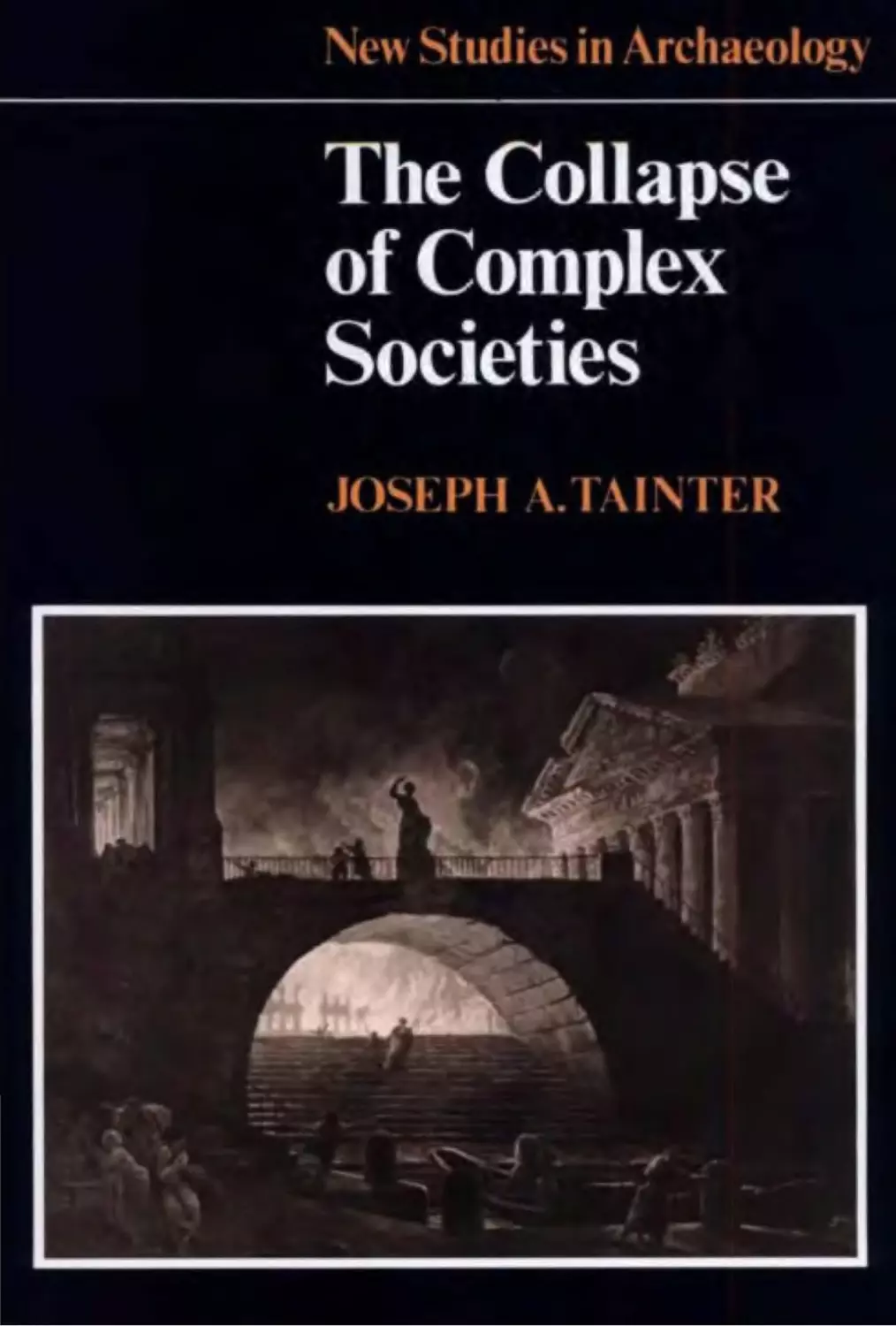

















































Text
NEW SI Y UDIES IN ARCHAEOLOGY
The Collapse of Complex Societies
IE W SIYUDIE 5 IN ARCHAEOI OGY
Series editors
Colin Renfrew, Univet sity of Cambridge
Jeremy Sabloff, Universi ; of Pittsburgh
Other titles in the series include
Ian Hodder and Clive Orton: SpatialAnalysis inArchaeology
Kei th M uckelroy: 1\1 aritime Archaeology
Graham Connah: I Y hree I Y housand Years in Africa
Richard E. Blanton, Stephen A. Kowalewski, Gary Feinman and Jill Appel:
Ancient 1\1 esoamerica
Step hen Plog : Sty listic Variation in Preh iSloric Ceramics
Peter Wells: Culture Contact a1w Cultul e Change
Ian Hodder: Symbols inAction
Patrick Vinton Kirch: Evolution of the Polynesian Chiefdoms
Dean Arn 01 d : Ceramic I Y heory and Cultural Process
Geoffrey W.. Conrad and Arthur A.. Demarest: Religion and E mpire. a I Y he Dynamics of
Aztec and Inca Expansionism
Graeme Barker: PrehistoricF anninginEurope
Daniel Miller: Artefacts as Categories
Rosalind Hunter-Anderson: Prehistoric Adaptation in the AmericanS outhwest
Robin Torrence: Production and Exchange of Stone I Y ools
Michael Shanks and Christopher Tilley: Re-Constructing Archaeology
Ian Morris: Burial andA ncienlSociely I Y he Rise of the Greek City-state
Bo Graslund: l"he Birth of Prehistoric Chronology
,
';'
. .... " I .
.... - 'I
'"
f
.. " J-
..
. II.
II
1-
""'.- -
..
'-
...
.
..:I
......
...
..
/'
r
..
l (
)
]()SEBf)H ll I f llINl f E B R
Ila ps f
pI
G) G)
1 tl S
{l .4 4 Q
4 J
.f...L4. .j.1!14
-+.... · . .c..c.
:::,
The right of the
University of Cambridge
to print and sell
all mar111er oj books
was granted by
Henry Vlll in 1534.
The University has printed
and pub/i. hed continuously
since 1584.
Cambridge University Press
Cambridge
New York New Rochelle Melbourne Sydney
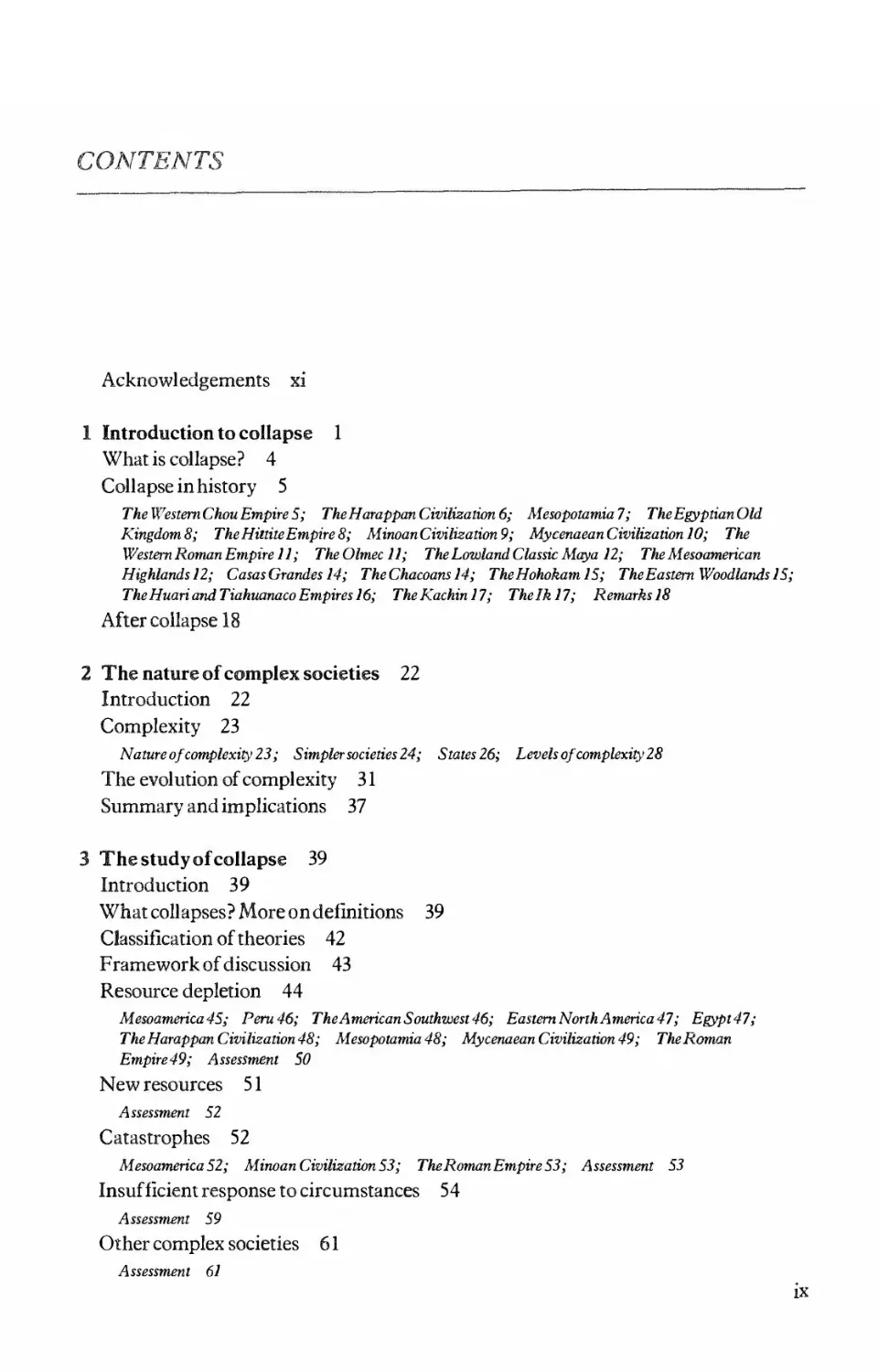
Published by the Press Syndicate of the University of Cambridge
The Pitt Buildling, Trumpington Street, Cambridge CB2 1 RP
32 East 57th Street, New York, NY 10022, USA
10 Stamford Road, Oakleigh, Nlelbourne 3166, Australia
@ Cambridge University Press 1988
First published 1988
Printed in Great Britain at the University Press, Cambridge
British Library cataloguing in publication data
Tainter, Joseph A.
The collapse of complex societies.-
(New studies in archaeology)
I.History, Ancient 2.. Civilization
I. Title II.Series
930 D57
Library of Congress cataloguing in publication data
Tainter, Joseph A.
The collapse of complex societies.
(New studies in archaeology)
Includes index.
1. Civilization) Ancient.
2. Comparative civilization. 3. Civilization -Philosophy.
I. Title. II. Series.
CB31I.T2451987 930 86-33432
ISBN 0521 34092 6
For Bonnie and Emmet
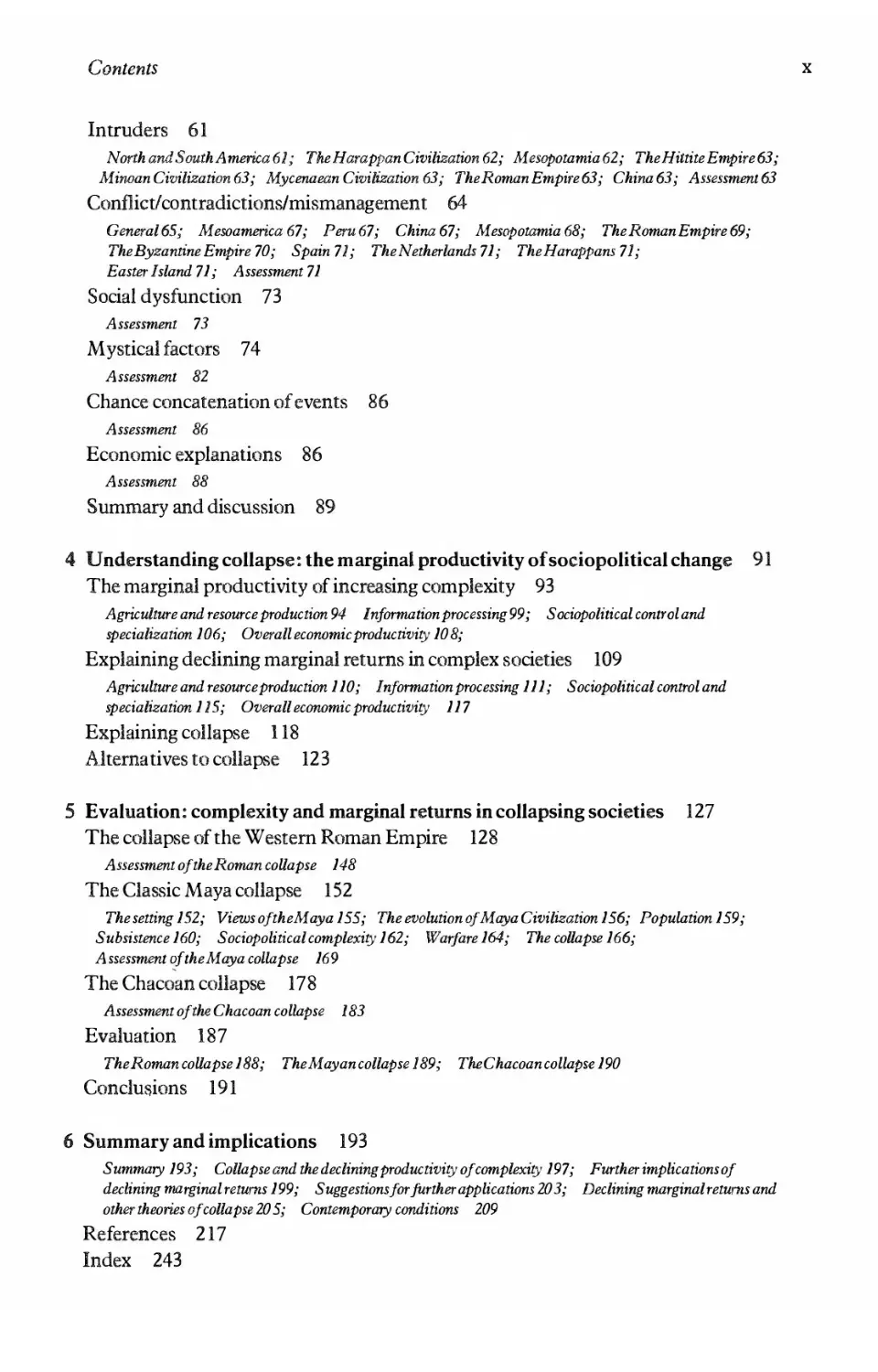
CONTEBNTS
Acknowledgements
..
Xl
1 Introduction to collapse 1
What is collapse? 4
Collapse in history 5
The 1f'estern Chou Empire 5; The H arappan Civilization 6,- Mesopotamia 7; The Egyptian Old
Kingdom 8; The Hittite Empire 8; Minoan Civilization 9; Mycenaean Civilization 10; The
Western Roman Empire 11 ; The Olmec 11; The Lowland Classic Maya 12; The Mesoamerican
Highlands 12; Casas Grandes 14; TheChacoans 14; The Hohokam 15; TheEastern Woodlands 15;
The Huariand TiahuanacoEmpires 16; The Kachin 17; Thelk 17; Remarks 18
After collapse 18
2 The nature of complex societies 22
Introduction 22
Complexity 23
Nature of complexity 23; Simpler societies 24; States 26; Levels of complexity 28
The evolution of complexity 31
Summary and implications 37
3 Thestudyofcollapse 39
Introduction 39
What collapses? More on definitions 39
Classification of theories 42
Framework of discussion 43
Resource depletion 44
Mesoamerica 45,- Peru 46; TheAmerican Southwest 46; Eastern Norlh A merica 47; Egypt 47;
The Harappan Civilization 48; Mesopotamia 48; Mycenaean Civilization 49; The Roman
Empire 49; Assessment 50
New resources 51
Assessment 52
Catastrophes 52
Mesoamerica 52; Minoan Civilization 53; The Roman Empire 53; Assessment 53
Insufficient response to circumstances 54
Assessment 59
Other complex societies 61
Assessment 61
..
IX
Contents x
Intruders 61
North and South America 61; The H arappan Civilization 62; Mesopotamia 62; The Hittite Empire 63;
M in-oan Civilization 63; M.ycenaean Civilization 63,. The Roman Empire 63 ; China 63; Assessment 63
Conflictl contradictions/mismanagemen t 64
General 65; Mesoamet ca67; Peru 67; China 67; MesO/Jotamia68; The Roman Empire 69;
The Byzantine Empire 70; Spain 71; TheNetherlands 71; TheHarappans 71;
Easter Island 71; Assessment 71
Social dysfunction 73
Assessment 73
Mystical factors 74
Assessment 82
Chance concatenation of events 86
Assessment 86
Economic explanations 86
Assessment 88
Summary and discussion 89
4 Understanding collapse: the marginal productivity of sociopolitical change 91
The marginal productivity of increasing complexity 93
Agriculture and resource production 94 Information processing 99; Sociopolitical control and
specialization 106; Overall economic productivity 108;
Explaining declining marginal returns in complex societies 109
Agriculture and resourceproduction 110; Information processing 111; Sociopolitical control and
specialization 115; Overall economic productivity 117
Explaining collapse 118
Alternatives to collapse 123
5 Evaluation: complexity and marginal returns in collapsing societies 127
The collapse of the Western Roman Empire 128
Assessment of the Roman collapse 148
The Classic Maya collapse 152
The setting 152; Views of theM aya 155; The evolution of Maya Civilization 156; Population 159;
Subsistence 160; Sociopolitical complexity 162; tf/arjare 164; The collapse 166;
Assessment of the Maya collapse 169
"-
The Chacoan collapse 178
Assessment of the Chacoan collapse 183
Evaluation 187
The Roman collapse 188; The Mayan collapse 189; l"heChacoancollapse 190
Conclusions 191
6 Summary and implications 193
Summary 193; Collapse and the declining productivity of complexity 197; Furtherimplicationsof
declining ma,-gina l returns 199; Suggestions for further applications 203; Declining marginal returns and
other theories ofcollapse 205; Contemporary conditions 209
References 21 7
Index 243
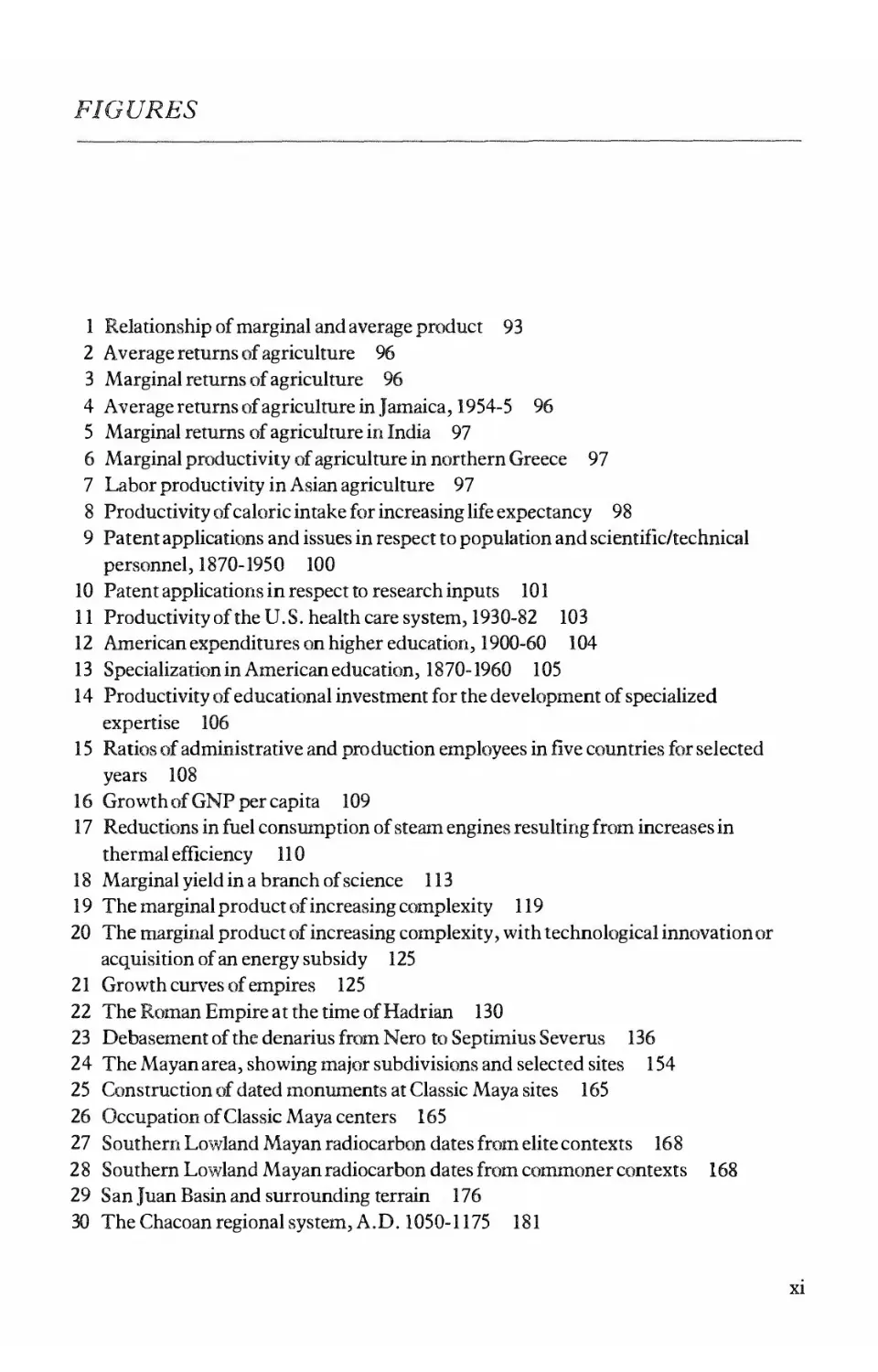
FIGURES
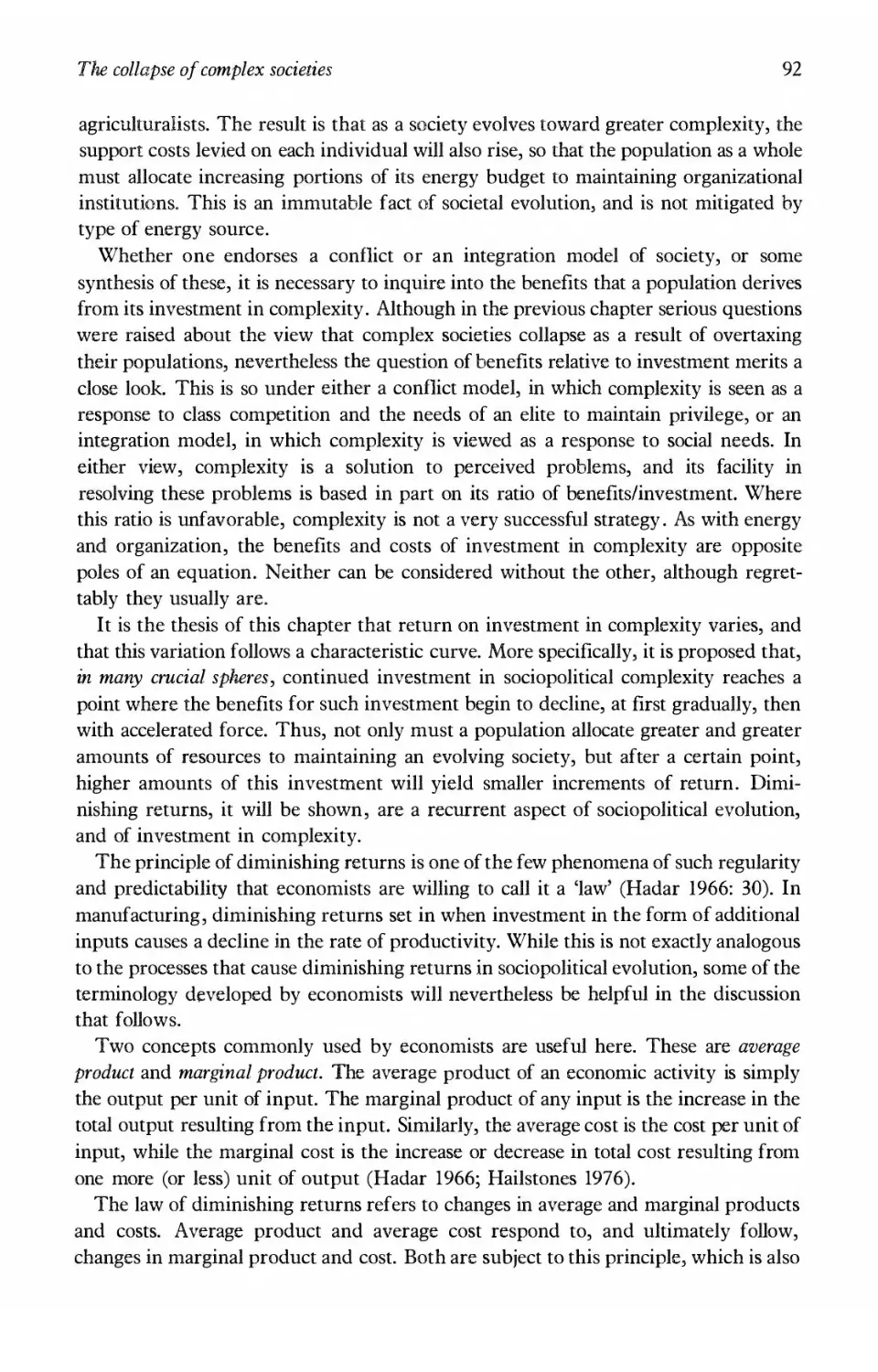
1 Relationship of marginal and average product 93
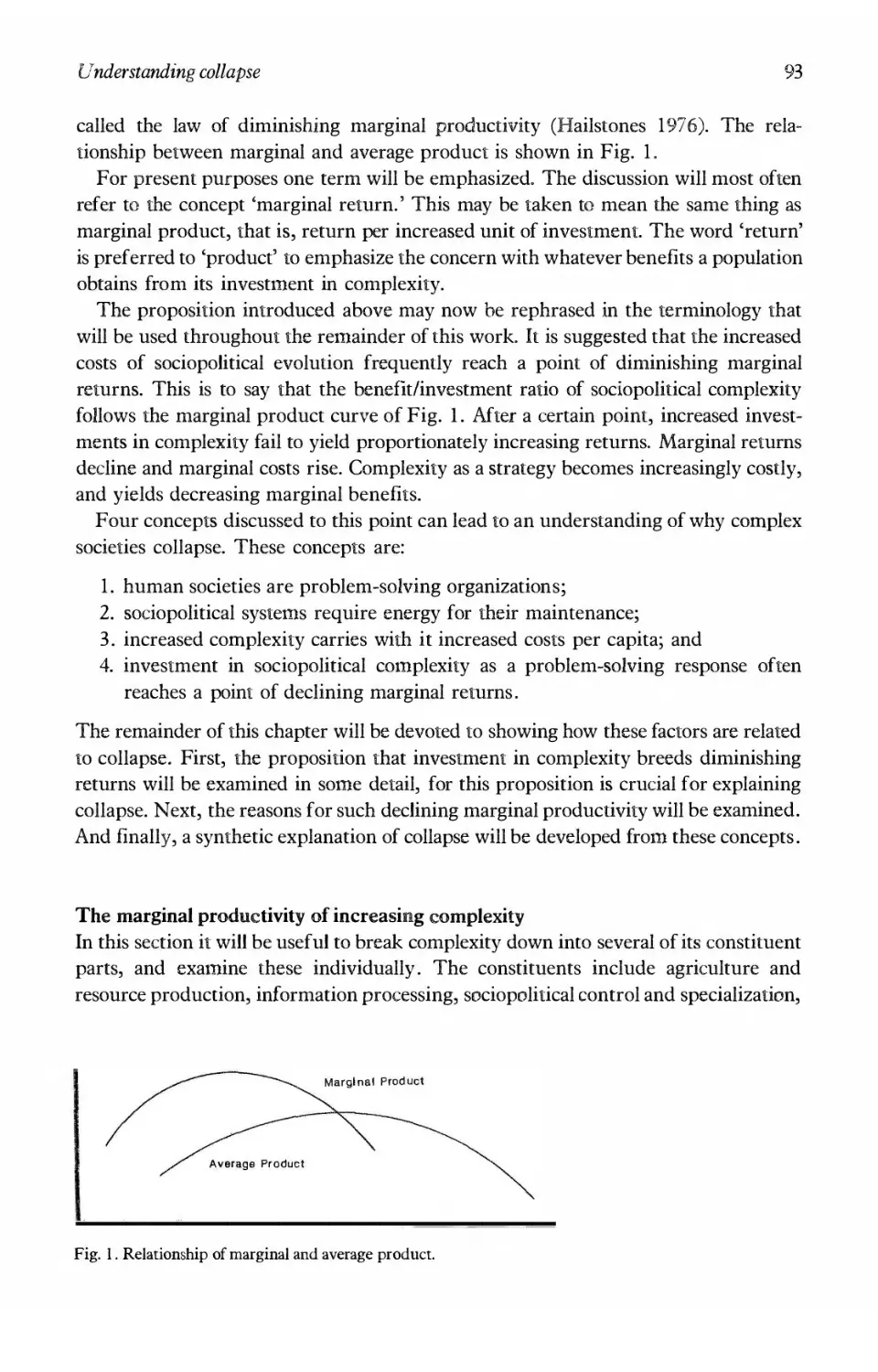
2 Average returns of agriculture 96
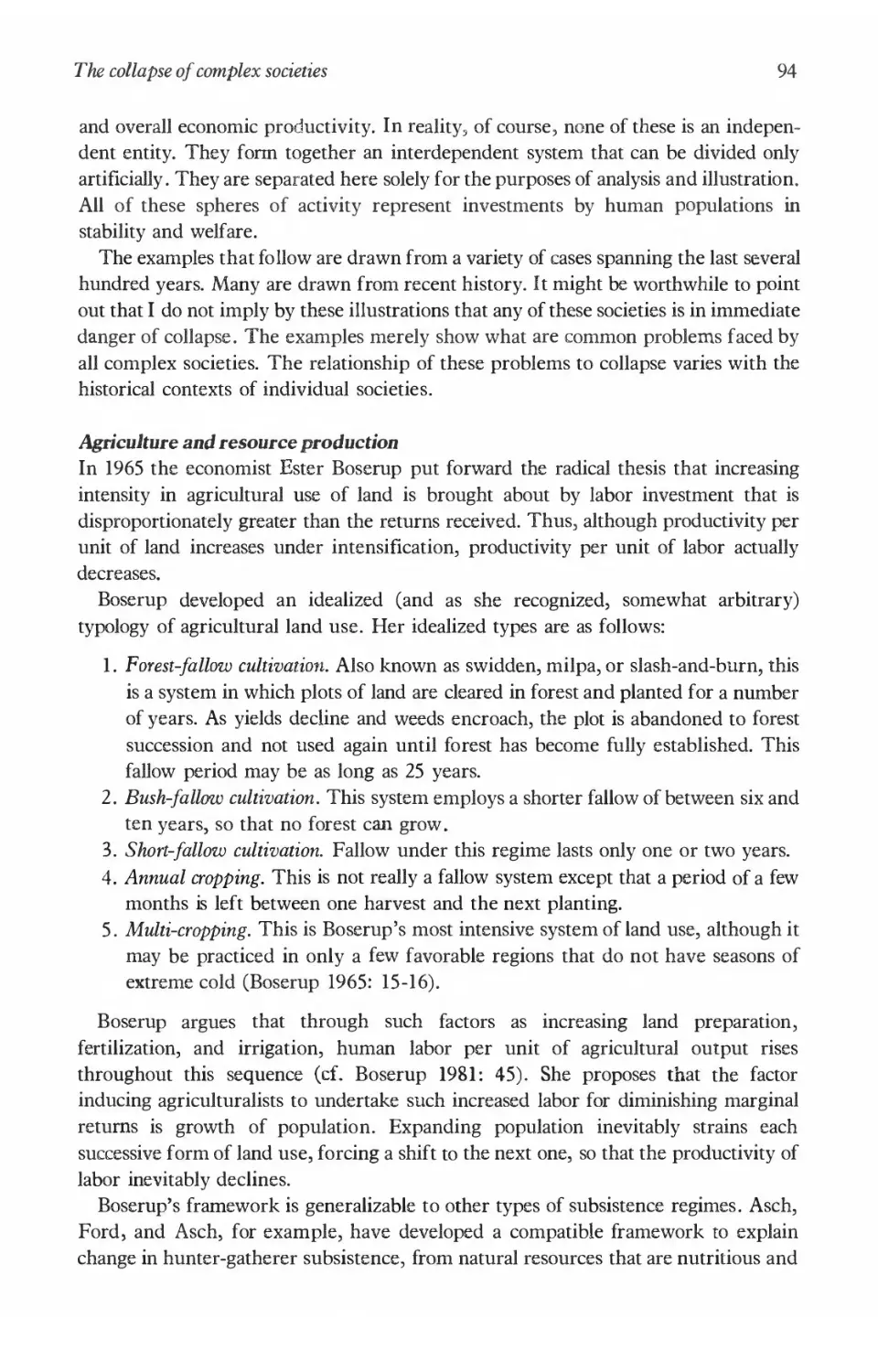
3 Marginal returns of agriculture 96
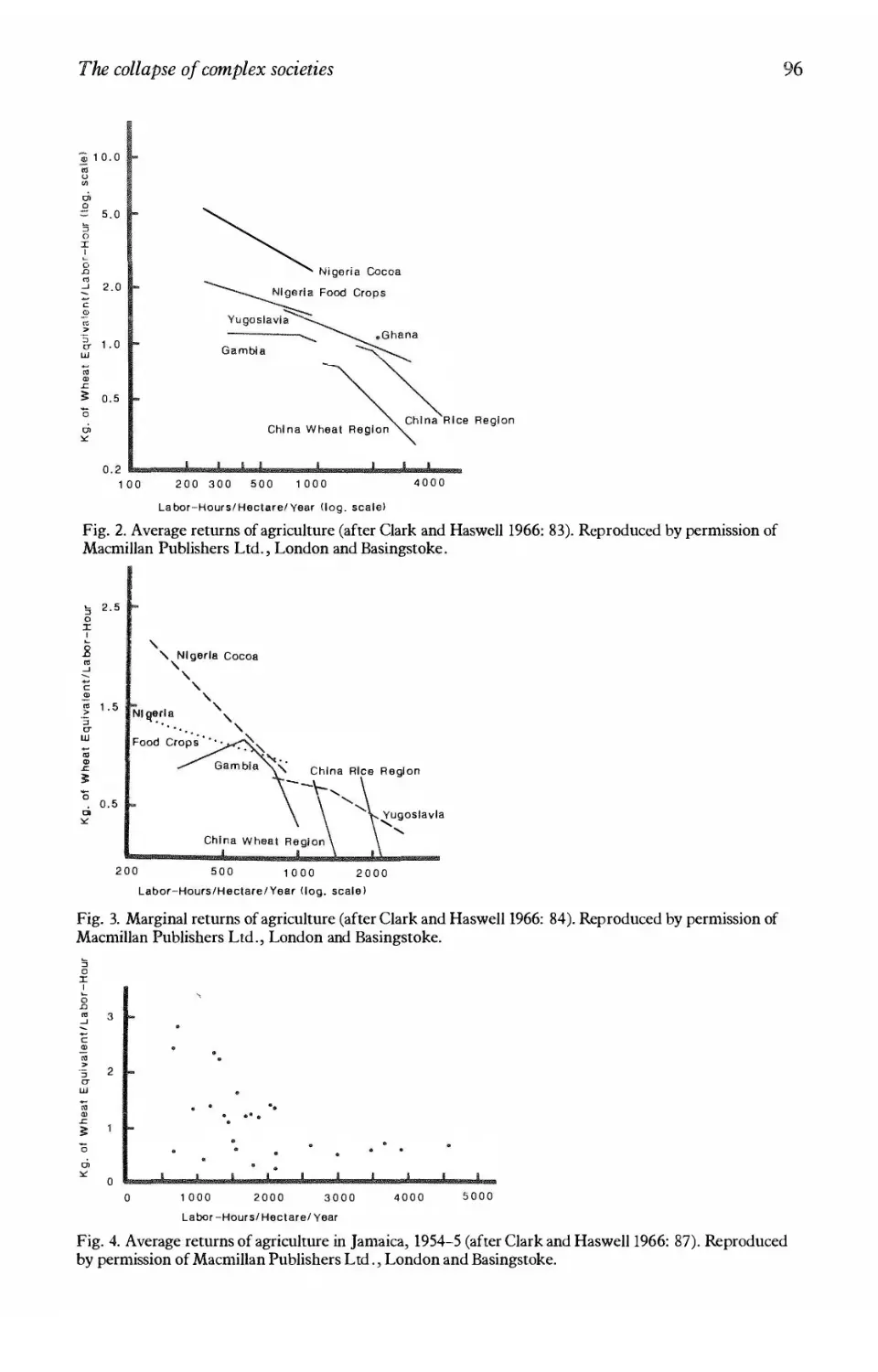
4 Average returns of agriculture in Jamaica, 1954-5 96
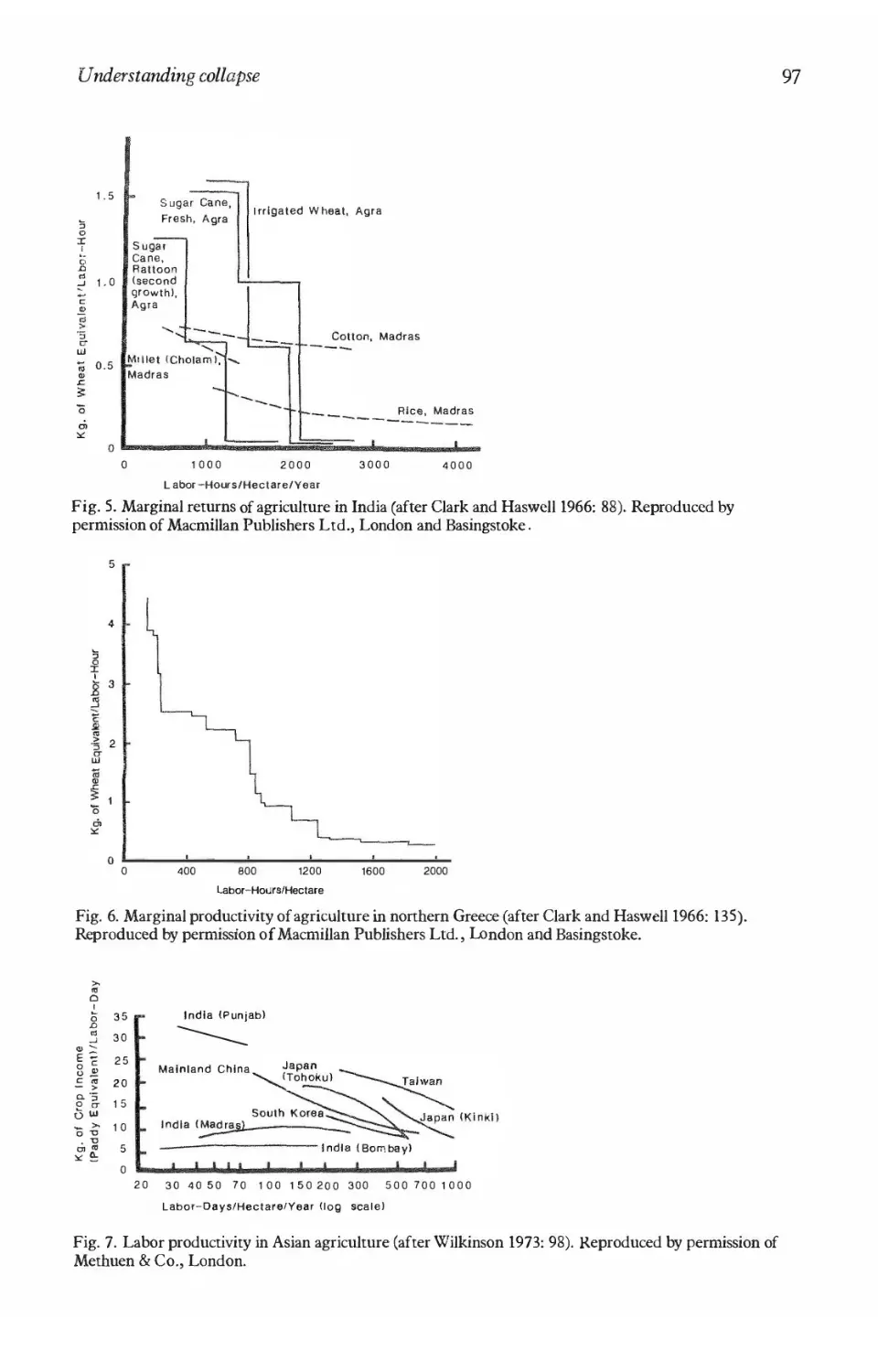
5 Marginal returns of agriculture in India 97
6 Marginal productivity of agriculture in northern Greece 97
7 Labor productivity in Asian agriculture 97
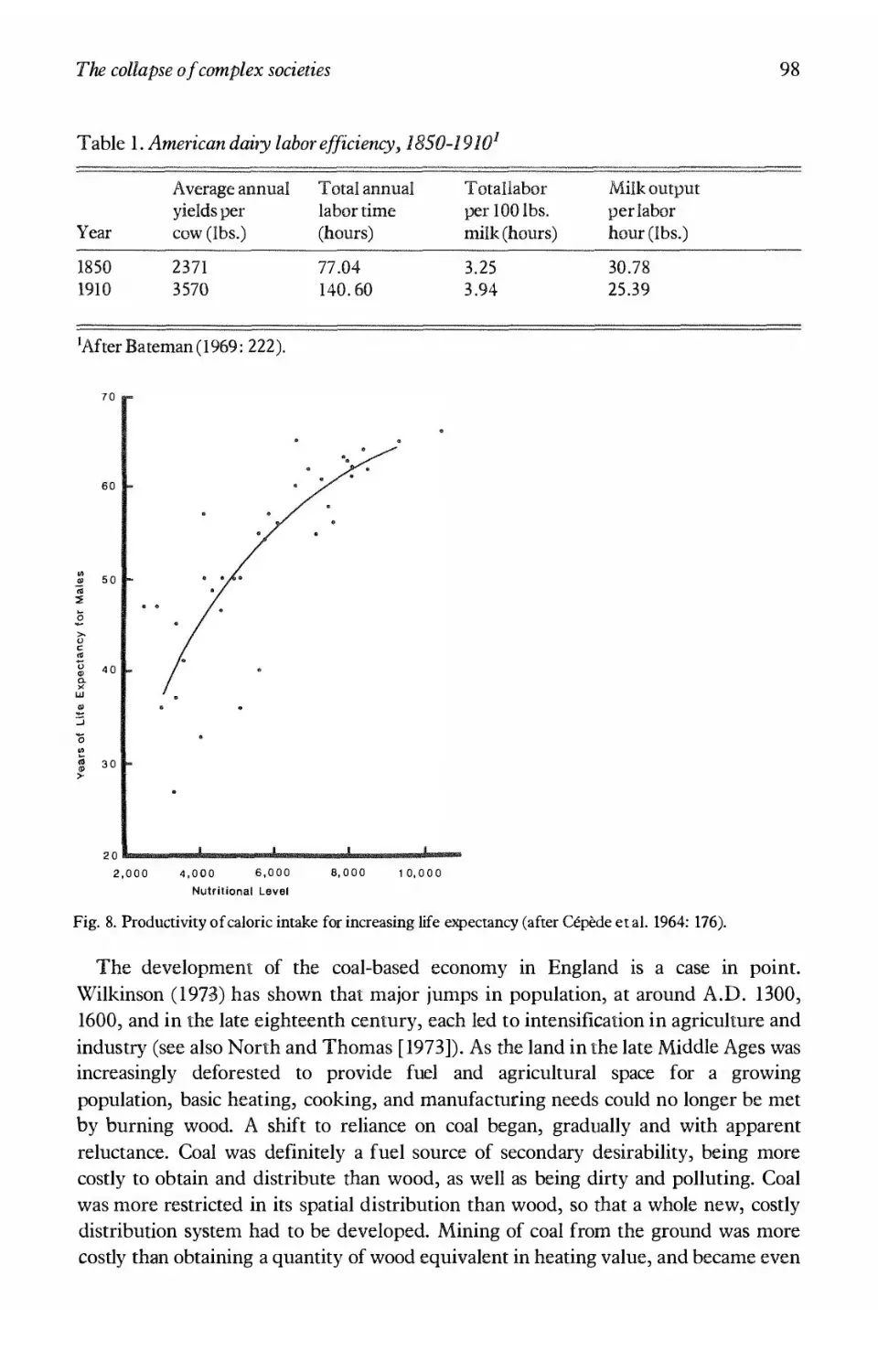
8 Productivity of caloric intake for increasing life expectancy 98
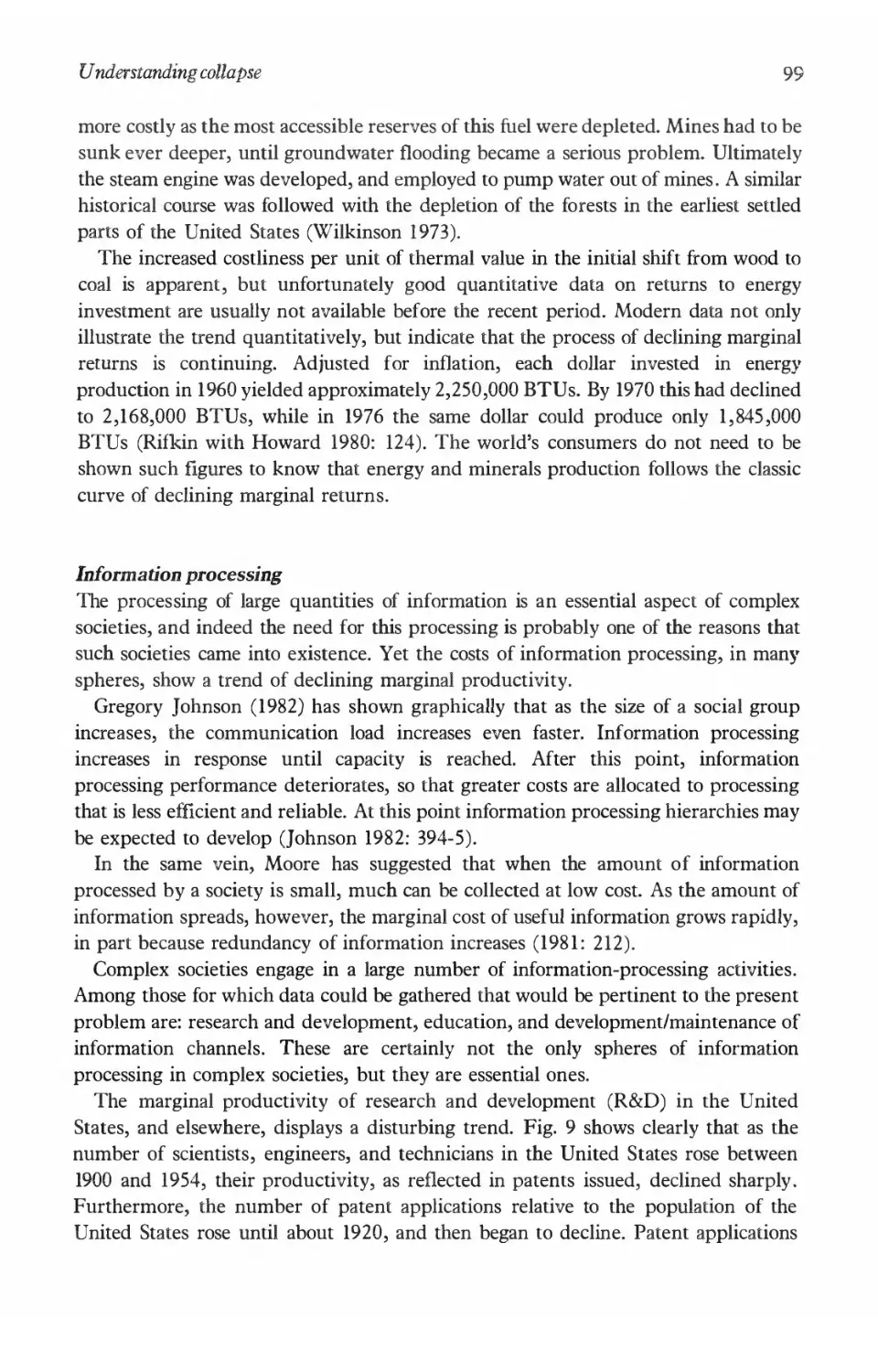
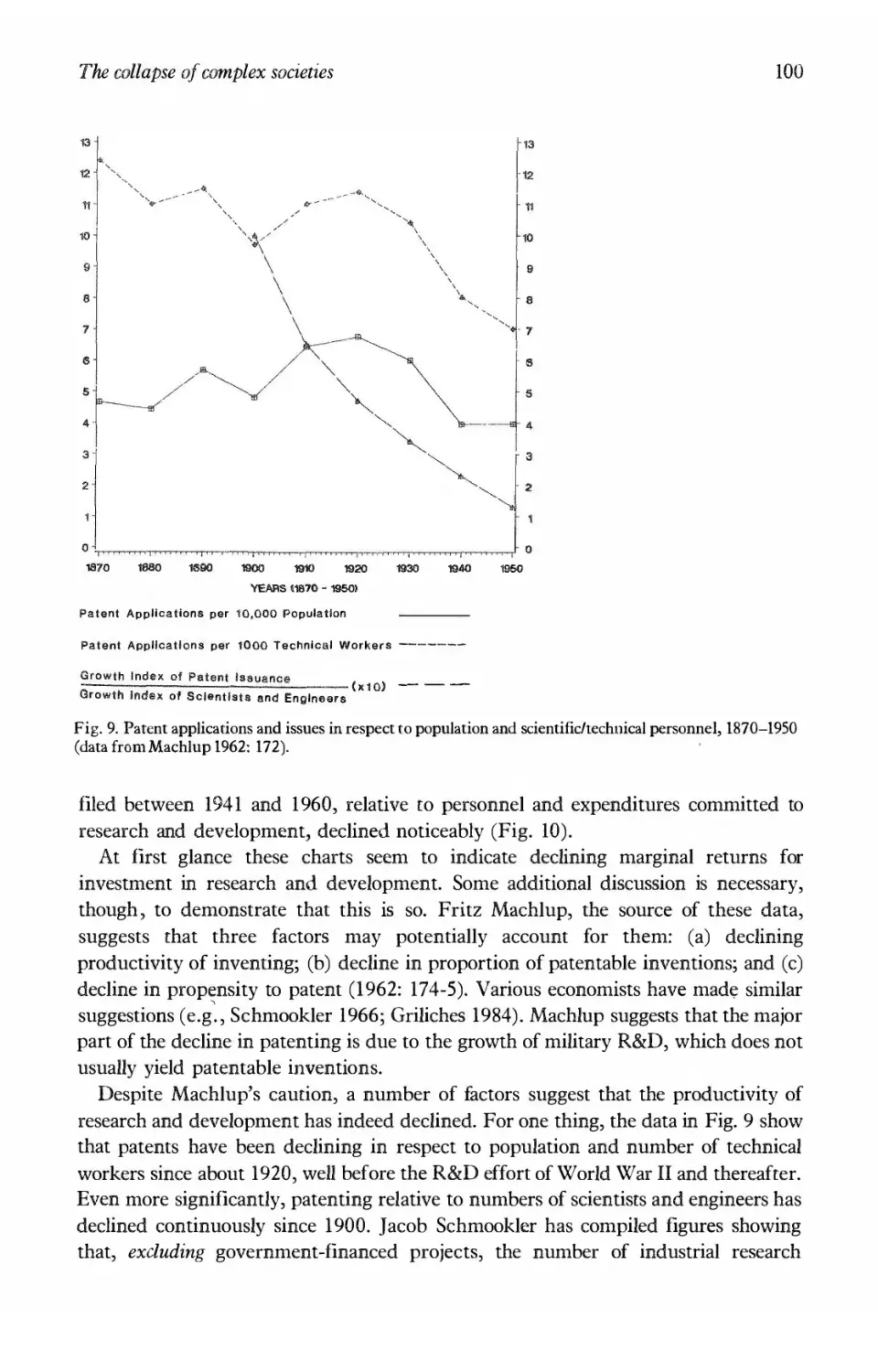
9 Patent applications and issues in respect to population and scientific/technical
personnel,1870-1950 100
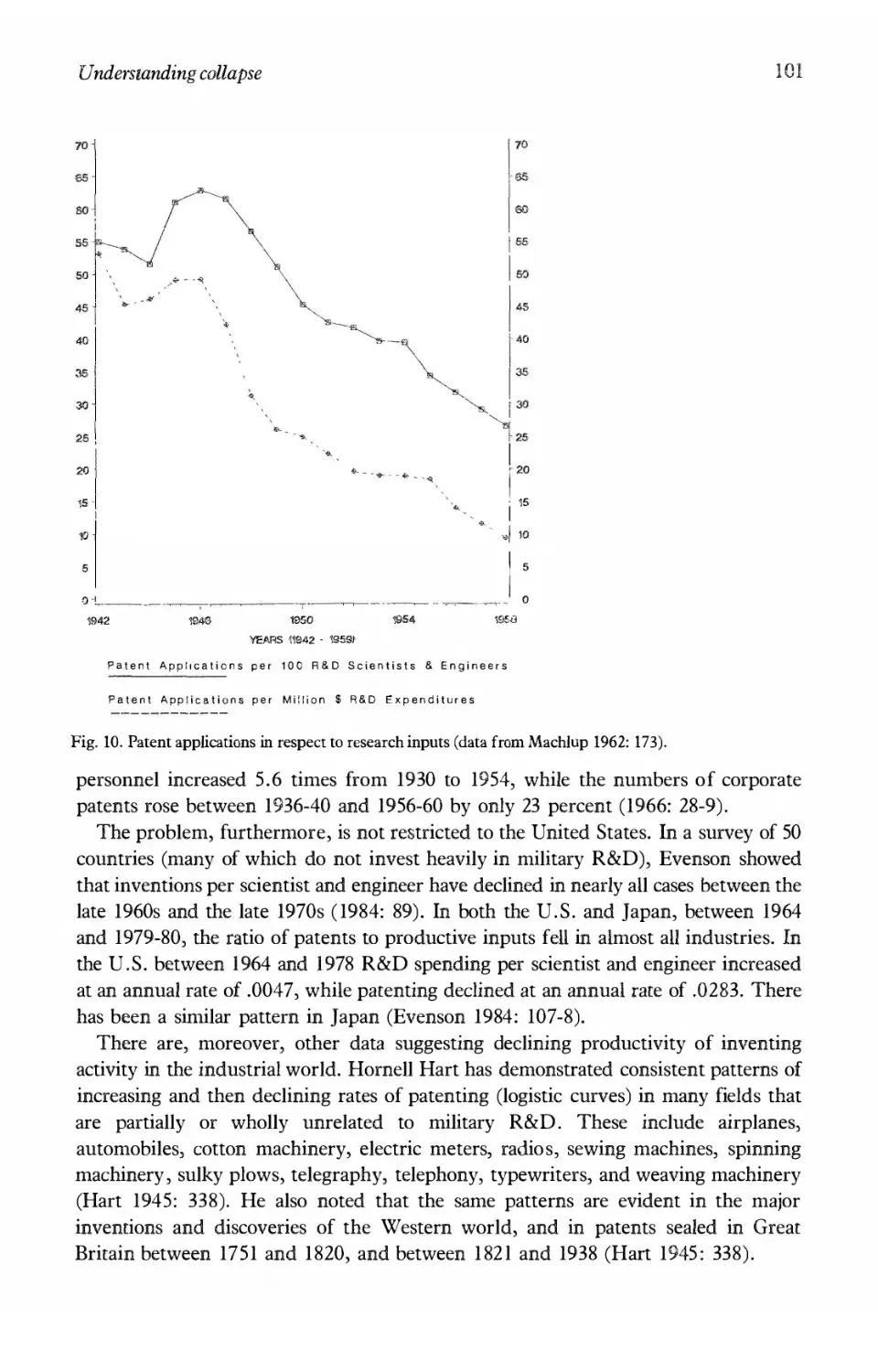
10 Patent applications in respect to research inputs 101
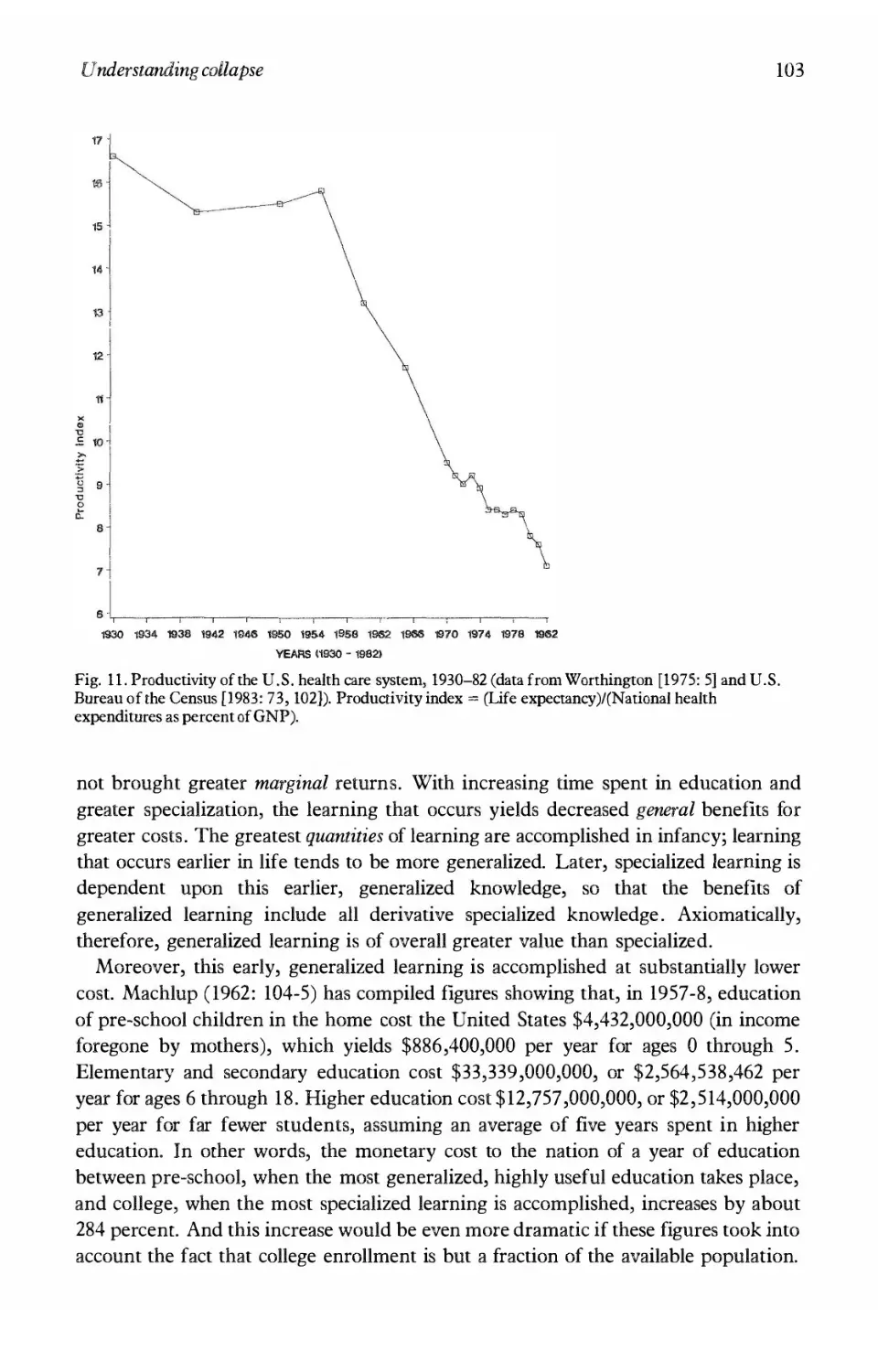
11 Productivity of the U.S. health care system, 1930-82 103
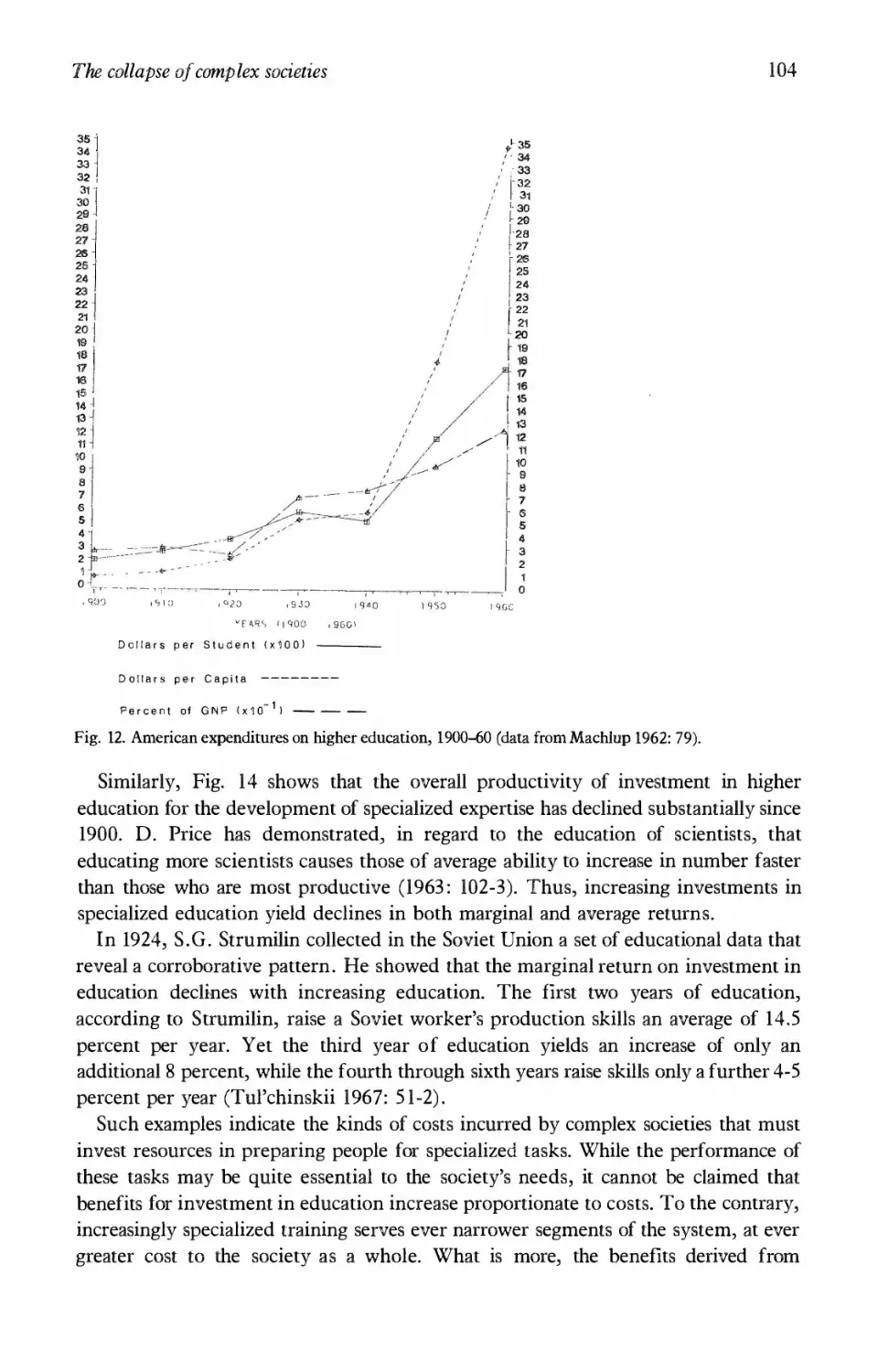
12 American expenditures on higher education, 1900-60 104
13 Specialization in American education, 1870-1960 105
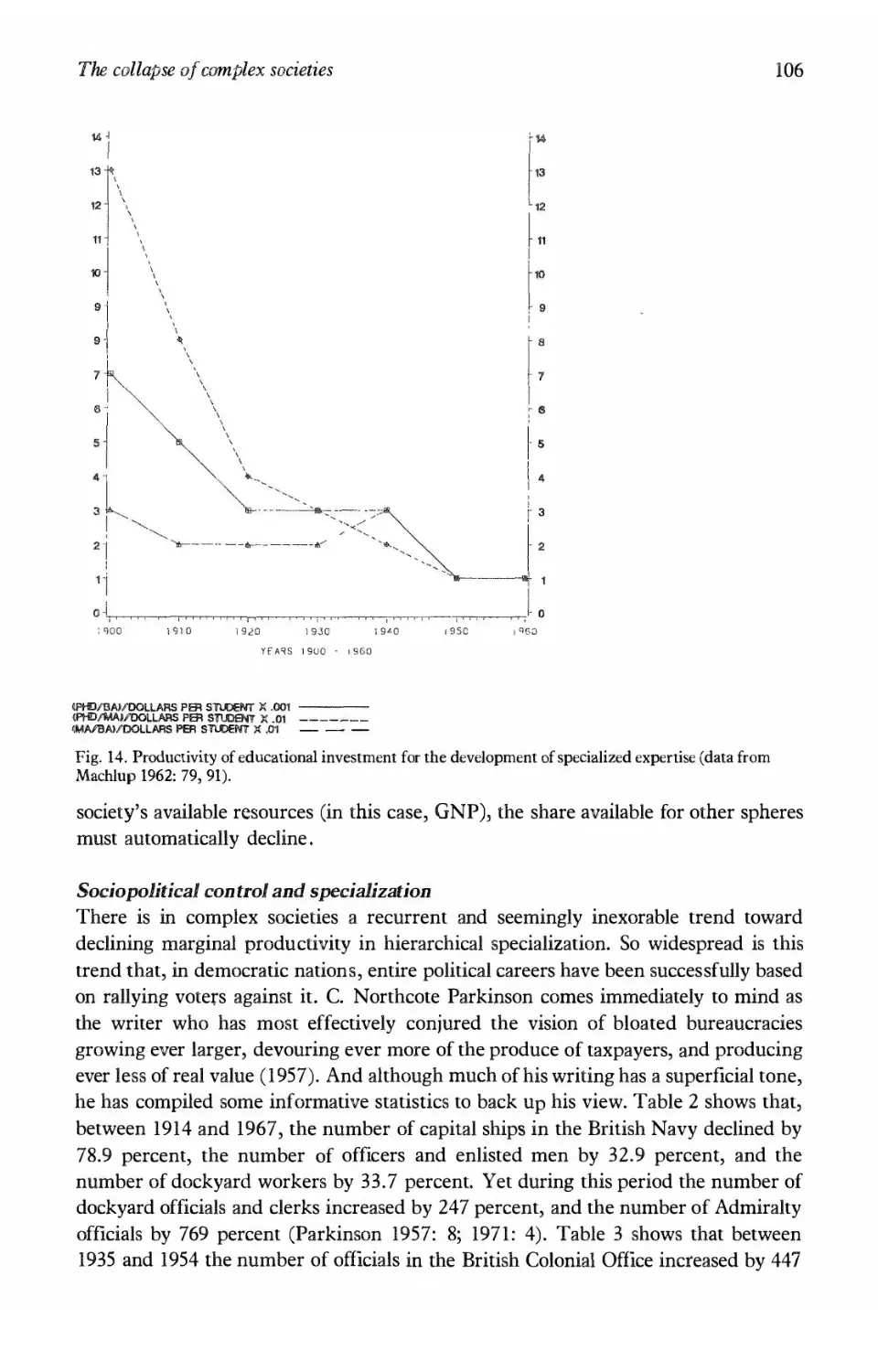
14 Productivity of educational investment for the development of specialized
expertise 106
15 Ratios of administrative and production employees in five countries for selected
years 108
16 Growth of GNP per capita 109
17 Reductions in fuel consumption of steam engines resulting from increases in
thermal efficiency 110
18 Marginal yield in a branch of science 113
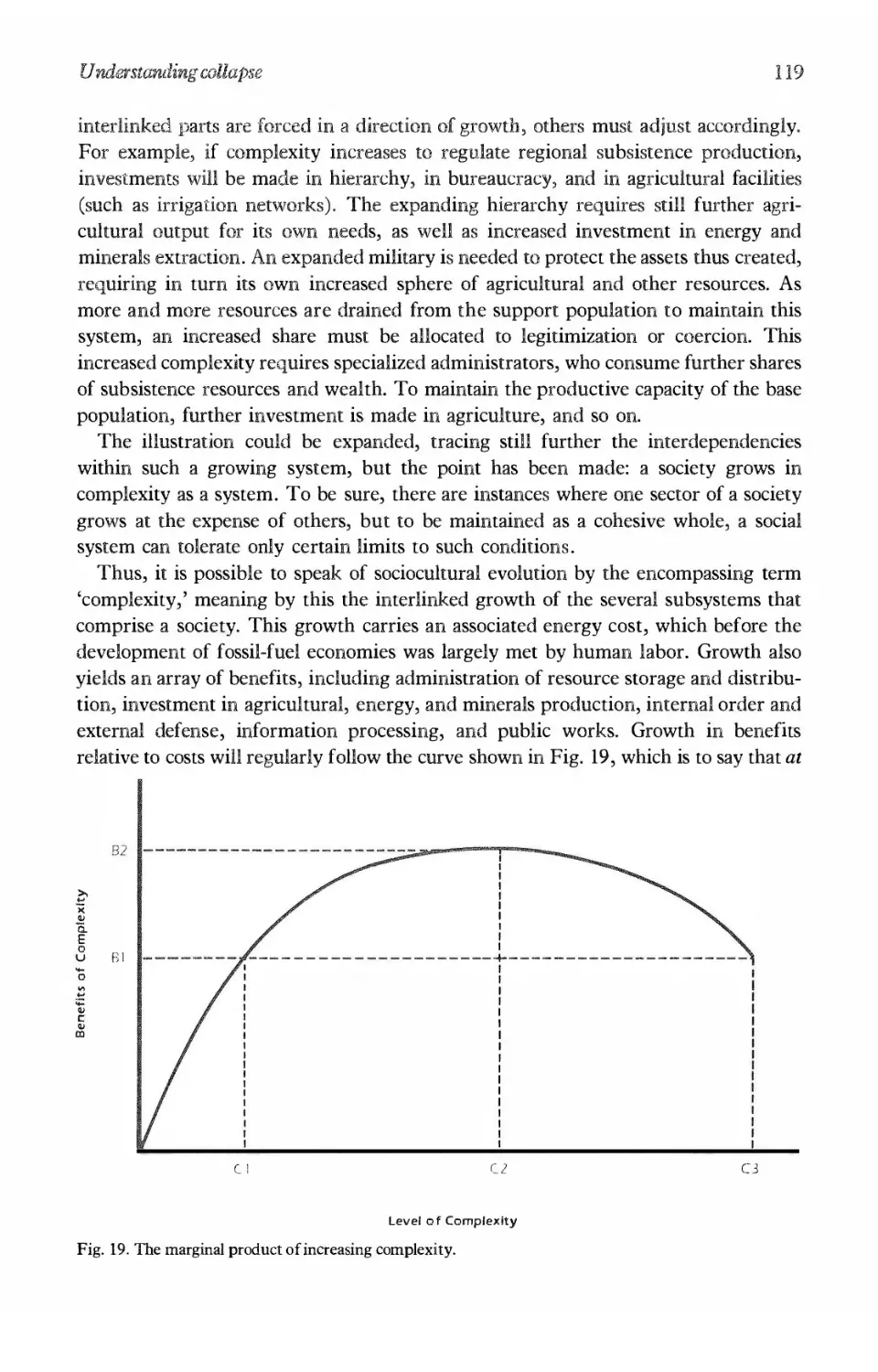
19 The marginal product of increasing complexity 119
20 The marginal product of increasing complexity, with technological innovation or
acquisition of an energy subsidy 125
21 Growth curves of empires 125
22 The Roman Empire at the time of Hadrian 130
23 Debasement of the denarius from Nero to Septimius Severus 136
24 The Mayan area, showing major subdivisions and selected sites 154
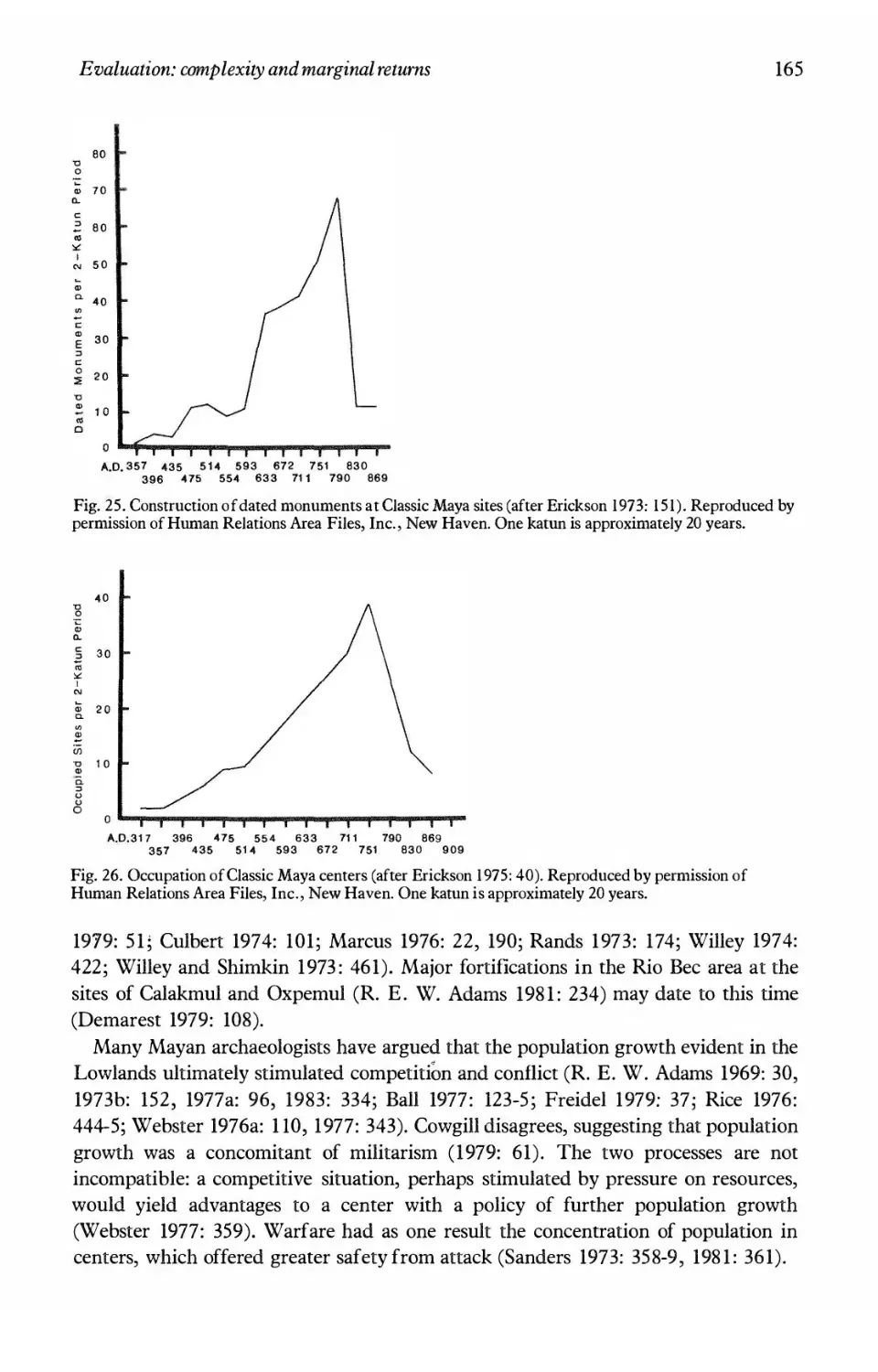
25 Construction of dated monuments at Classic Maya sites 165
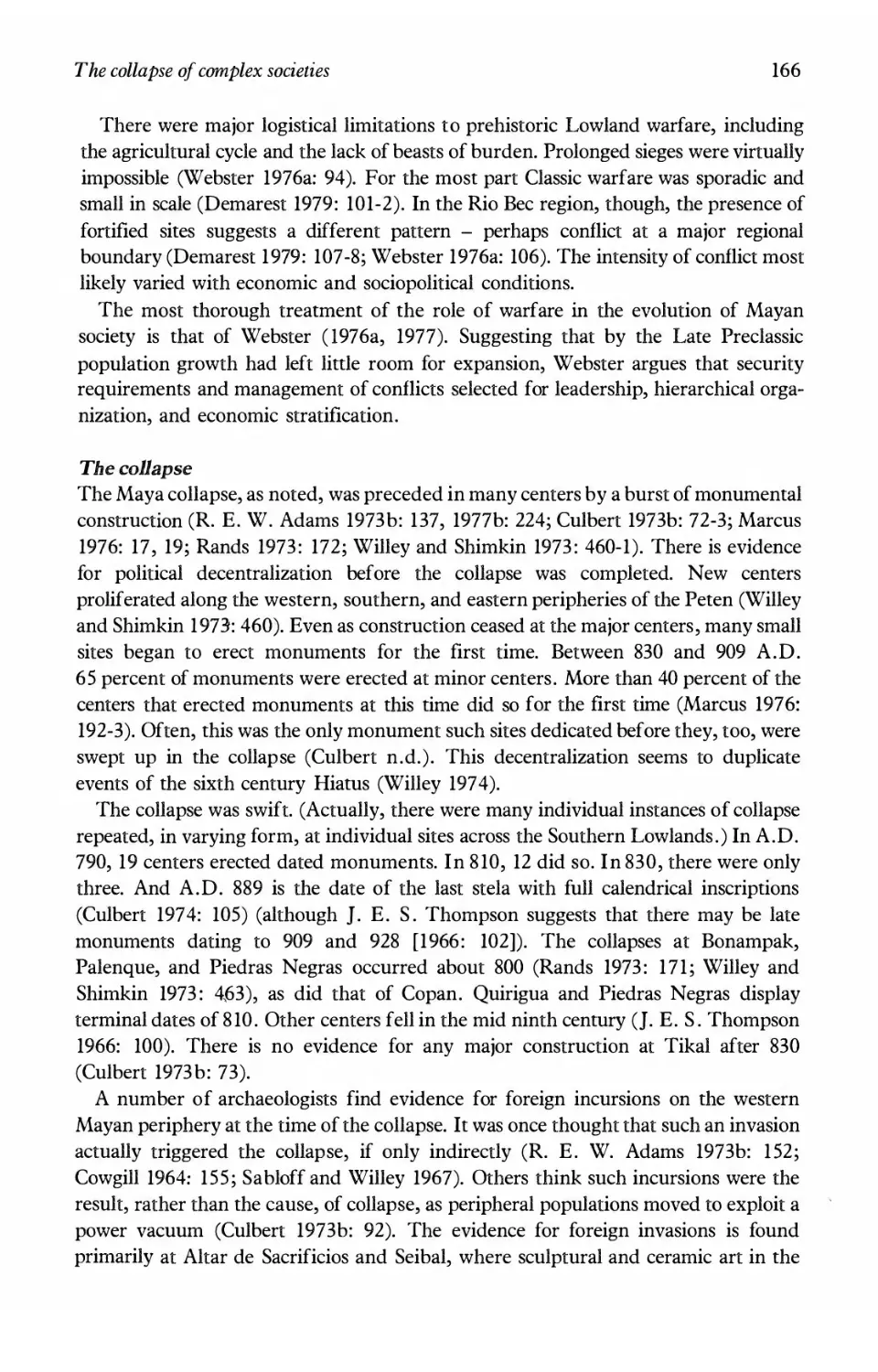
26 Occupation of Classic Maya centers 165
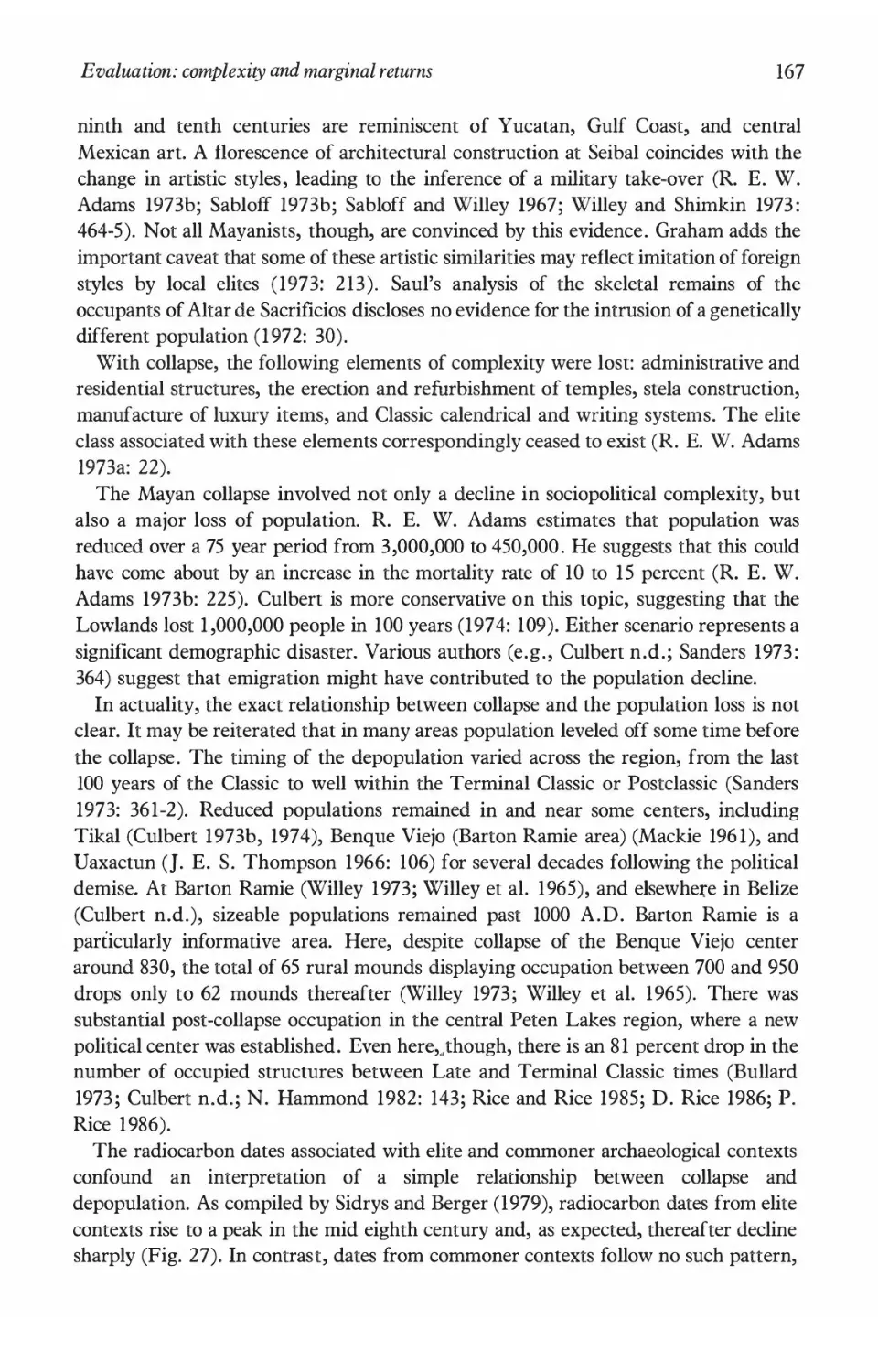
27 Southern Lowland Mayan radiocarbon dates from elite contexts 168
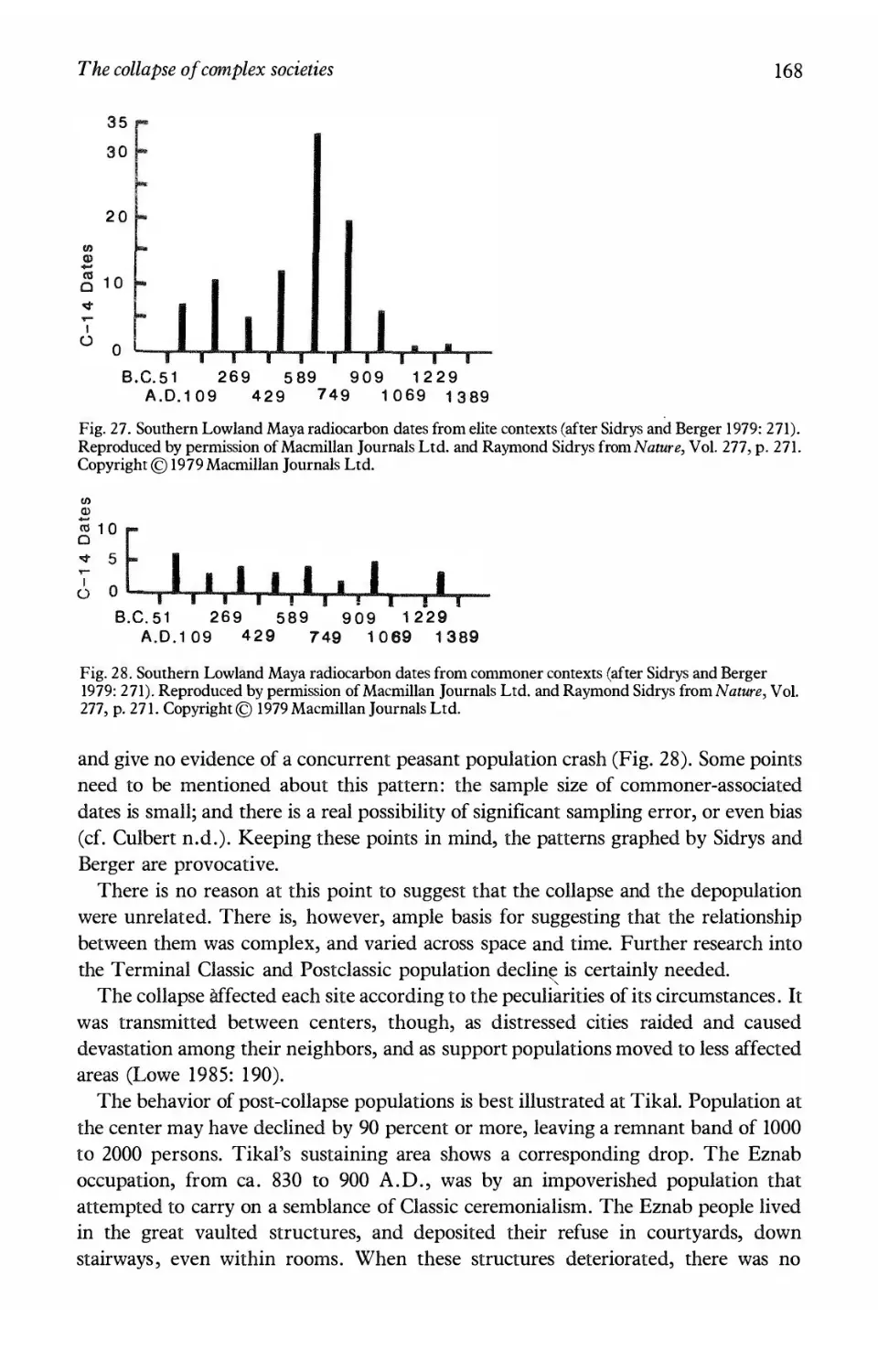
28 Southern Lowland Mayan radiocarbon dates from commoner contexts 168
29 San Juan Basin and surrounding terrain 176
30 The Chacoan regional system, A.D. 1050-1175 181
..
Xl
TABLES
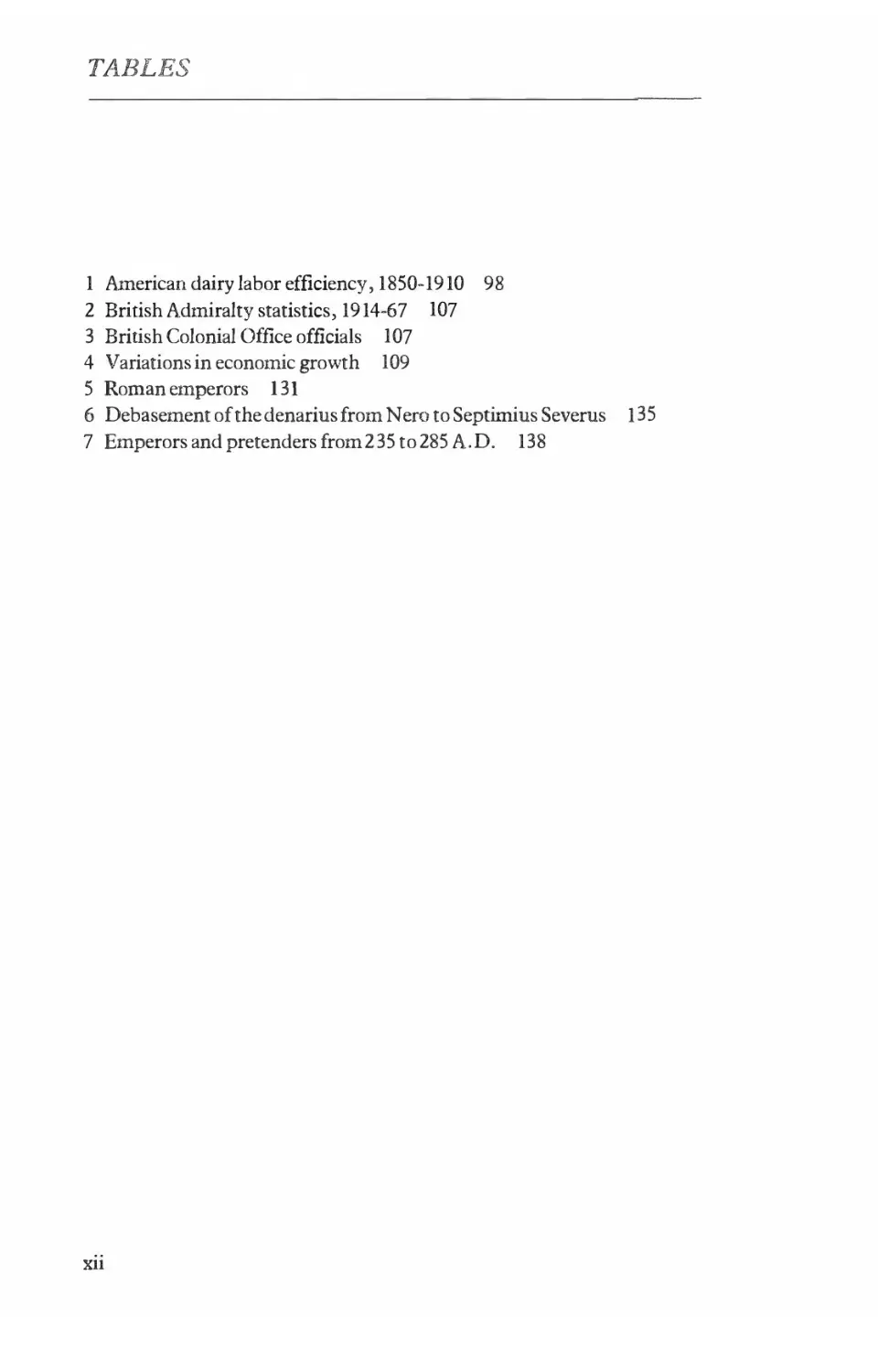
1 American dairy labor efficiency, 1850-1910 98
2 British Admiralty statistics, 1914-67 107
3 British Colonial Office officials 107
4 Variations in economic growth 109
5 Roman emperors 131
6 Debasement ofthedenariusfrom Nero toSeptimius Severus 135
7 Emperors and pretenders from235 to285 A.D. 138
.. ..
XII
ACKNOWLEDGEMENTS
Edward Hallett Carr once suggested that Toynbee's cyclical theory of history was the
characteristic view of a society in crisis (1961: 37), and others have noted that there is
often a concern with collapse at times of distress. While doubtlessly this is true, the
present work reflects an interest that has lain unfulfilled since my first exposure to this
topic. Its fruition owes much to two persons. Foremost is my wife, Bonnie Bagley
Tainter, who encouraged me to transform my interest in collapse, and my dissatisfac-
tion with the state of its study, into this book. Where I had in mind perhaps a few
papers, she saw that only a longer treatment would suffice, and the work owes a great
deal to her foresight. It was in the course of many conversations with Bonnie that the
ideas presented here reached their final form. Both she and our son, Emmet, tolerated
the disruption that such a work entails, for the nearly two years needed for research
and writing, without wavering in their support. Finally, Bonnie's sharp editorial eye
helped smooth the first draft into a more readable document..
Thomas King has for several years been dissatisfied with the archaeological re-
search done in the United States under the mandate of historic preservation. To
formulate a program of improvement, he organized a symposium for the 1982 Annual
Meeting of the Society for American Archaeology on the subject of 'National
Archaeological Research Topics,' and invited me to make a presentation. The short
paper that resulted was my first attempt to articulate what previously had been vague
misgivings about the study of collapse. What is presented in these pages is an
outgrowth of that paper, and of Tom's encouragement to undertake it.
A number of colleagues with whom I corresponded expressed interest in the work,
and responded readily to my requests for references and papers. These were George
Cowgill, T. Patrick Culbert, Michael Parker-Pearson, John Pfeiffer, Robert Sharer,
Stephen Whittington, Robert Wenke, and most especially, Norman Yoffee.
Emily Garber and Carol Raish gave generously of time and effort to help obtain
bibliographic materials. I am grateful to Larry Nordby of the U.S. National Park
Service, and to various authors and publishers as noted in the text, who gave
permission to reproduce illustrations. Sherry Holtke capably prepared Fig. 19, and
Scott Shermer developed several computer-generated illustrations.
Several colleagues also, upon request, reviewed either the 1982 paper or drafts of
the present work, and made welcome suggestions. These include Arthur Ireland,
Christopher Peebles, Michael Schiffer, H. Wolcott Toll, Henry Wright and Norman
Yoffee.
I must especially mention Colin Renfrew and Jeremy Sabloff, series editors for the
XIII
Acknowledgements
..
XIV
New Studies in Archaeology, whose interest in the work brought it to its present
form, and whose comments led to material improvements. Peter Richards, archaeo-
logy editor for C2mbridge University Press, and lain White, who meticulously
prepared the typescript for printing, deserve special thanks.
To all- family, colleagues, and editors - I offer my great appreciation for your help.
Joseph A. Tainter
1
Introduction to collapse
Much of the central floodplain of the ancient Euphrates now lies beyond the frontiers of
cultivation, a region of empty desolation. Tangled dunes, long disused canal levees, and the
rubble-strewn mounds of former settlement contribute only low, featureless relief.. Vegetation
is sparse, and in many areas it is almost wholly absent. Rough, wind-eroded land surfaces and
periodically flooded depressions form an irregular patchwork in all directions, discouraging any
but the most committed traveler.. To suggest the immediate impact ofhllman life there is only a
rare tent.". Yet at one time here lay the core, the heartland, the oldest urban, literate civilization
in the world.
Robert McC. Adams
(1981: xvii)
We ascended by large stone steps, in some places perfect, and in others thrown down by trees
which had grown up between the crevices... we followed our guide.....through the thick forest,
among half-buried fragments, to fourteen monumentsH .one displaced from its pedestal by
enormous roots; another locked in the close embrace of branches of trees, and almost lifted out
of the earth; another hurled to the ground, and bound down by huge vines and creepers; and
one standing, with its altar before it, in a grove of trees which grew around it, seeming to shade
and shroud it as a sacred thing..... The only sounds that disturbed the quiet of this buried city
were the noise of monkeys. " ..
John L. Stephens
(1850: 102-3)
The image of lost civilizations is compelling: cities buried by drifting sands or tangled
jungle, ruin and desolation where once there were people and abundance. Surely few
persons can read such descriptions and not sense awe and mystery. Invariably we are
spellbound, and want to know more Who were these people and, particularly, what
happened to them? How could flourishing civilizations have existed in what are now
such devastated circumstances? Did the people degrade their environment, did the
climate change, or did civil conflict lead to collapse? Did foreign invaders put these
cities to an end? Or is there some mysterious, internal dynamic to the rise and fall of
civilizations? Some of us are so fascinated by these questions that we devote our lives
to studying them. Most people encounter the dilemma of fallen empires and devas-
tated cities in casual reading, or in a school course. The image is troublesome to all,
not only for the vast human endeavors that have mysteriously failed, but also for the
enduring implication of these failures.
The implication is clear: civilizations are fragile, impermanent things. This fact
inevitably captures our attention, and however we might wish otherwise, prompts
disturbing questions. Are modern societies similarly vulnerable? Is it likely, as Ortega
1
The collapse of complex societies
2
asserts, that 'The possibility that a civilizatio11 should die doubles our own mortality'
(quoted in Mazzarino [1966: I7l])? Many of course prefer to believe that modern
civilization, with its scientific and technological capacity, its energy resources, and its
knowledge of economics and history, should be able to survive whatever crises ancient
and simpler societies found insurmountable. But how firm is this belief? Many
persons who have some awareness of history no doubt harbor the suspicion, as
Wilamowitz voiced regarding the Roman Empire, that 'Civilization can die, because it
has already died once' (quoted in Mazzarino [1966: 174]).
To some historians of the early twentieth century the twilight of Rome seemed
almost a page of contemporary history (Mazzarino 1966: 173; Casson 1937: 183). This
analogy has become deeply rooted in popular thought, and certainly persists today. It
is even reflected in the writings of some modern competent authorities (e.g., Isaac
1971). The irresistible allusion to ancient Rome has dominated the thinking of large
numbers of people for one and one-half millennia (Mazzarino 1966). Were it not for
this well-documented example of a powerful empire disintegrating, to which every
Western schoolchild is exposed, the fear of collapse would certainly be less wide-
spread. As it is, those who are concerned about the future of industrial society, about
its economic direction, its ecological basis, and its political superstructure, have an
irrefutable illustration of the contention that civilizations, even powerful ones, are
vulnerable.
Why study collapse? Many social scientists might agree with Isaac: 'It goes without
saying that the collapse of ancient civilization is the most outstanding event in its
history. ..' (1971: xi). Yet beyond scientific interest there is an additional reason:
collapse is a topic of the most widespread concern and the highest social significance.
The reason why complex societies disintegrate is of vital importance to every member
of one, and today that includes nearly the entire world population. Whether or not
collapse was the most outstanding event of ancient history, few would care for it to
become the most significant event of the present era. Even if one believes that modern
societies are less vulnerable to collapse than ancient ones, the possibility that they may
not be so remains troubling. In the absence of a systematic, scientific treatment of
collapse such concerns range untethered to any firm, reliable base..
Disintegration of the social order has been a recurrent concern in Western history,
and has often been expressed in a religious idiom. In the last few decades this concern
has seemingly become rampant, and has achieved expression through a more secular
form. A review of a recent exhibit of Mayan artifacts expressed popular thinking well:
.. .some of the fascination of the Maya.. . may lie in the legendary 'collapse' of
their culture several centuries before the Spanish conquest. Every thoughtful
person who ponders the bureaucratic and technological pressures on ordinary
life today must wonder whether it is possible for a society to strangle on its own
complexities. .. Sensing that our own collective future is in jeopardy. . . we are
hungry for historical analysis to help us imagine the direction events might take
(Baker 1986: 12).
This concern crosses the social and intellectual spectrum, from the responsible
Introduction to collapse
3
scientists and business leaders who make up the Club of Rome, to the more extreme
fringes of the 'survivalist' movement. In between one finds a variety of serious,
well-meaning persons: environmentalists, no growth advocates, nuclear....freeze propo-
nents, and others" All fear, for one reason or another, that industrial civilization is in
danger Such fears are frequently based on historical analogy with past civilizations
that have disappeared (and indeed it is sometimes suggested that we are about to go
the way of the dinosaurs).
Contemporary thinkers foresee collapse from such catastrophes as nuclear war,
resource depletion, economic decline, ecological crises, or sociopolitical disintegration
(e.g., Meadows et al. 1972; Catton 1980; Turco et ala 1984). Only recently have such
fears become widespread. As Dawson has noted:
Of all the changes that the twentieth century has brought, none goes deeper
than the disappearance of that unquestioning faith in the future and the absolute
value of our civilization which was the dominant note of the nineteenth century
(1956: 54).
Although collapse has been of interest for as long as societies have proven vulner-
able, it has been a difficult mystery for historians and social scientists. Perhaps
because of this, the development of political complexity has attracted more scholarly
attention than collapse, its antithesis. Human history as a whole has been characte-
rized by a seemingly inexorable trend toward higher levels of complexity, specializa-
tion, and sociopolitical control, processing of greater quantities of energy and in-
formation, formation of ever larger settlements) and development of more complex
and capable technologies.. This persistent aspect of our history has rightfully received
an overwhelming amount of research, so that today we are beginning to understand
how this came about. Yet the instances when this almost universal trend has been
disrupted by collapse have not received a correspondiIlg level of attention4 To be sure,
innumerable writers have produced myriad explanations of collapse; but even so,
understanding disintegration has remained a distinctly minor concern in the social
sciences. Explanations of collapse have tended to be ad hoc, pertaining only to one or a
few societies, so that a general understanding remains elusive. At the same time, as
will be shown, such theories have suffered in common from a number of conceptual
and logical failings. When this study was begun there was no reliable, universal
explanation of collapse, no theory that would help us to understand most or all of its
occurrences. It was indeed this state of affairs that prompted the present undertaking.
The objective of this work then is to develop a general explanation of collapse,
applicable in a variety of contexts, and with implications for current conditions. This
is a work of archaeology and history, but more basically of social theory.
The approach is to first introduce and exemplify collapse, and then in Chapter 2 to
briefly examine the nature of complex societies. Chapter 3 discusses and evaluates
existing approaches to understanding collapse. A general explanation is developed in
Chapter 4, and evaluated by case studies in Chapter 5. A concluding chapter further
discusses the proposed explanation, synthesizes the work, and raises some implica-
tions for the contemporary scene.
The collapse of complex societies
4
What is collapse?
'Collapse' is a broad term that can cover many kinds of processes. It means different
things to different people. Some see collapse as a thing that could happen only to
societies organized at the most complex level. To them, the notion of tribal societies or
village horticulturalists collapsing will seem odd. Others view collapse in terms of
economic disintegration, of which the predicted end of industrial society is the
ultimate expression. Still others question the very utility of the concept, pointing out
that art styles and literary traditions ofte11 survive political decentralization.
Collapse, as viewed in the present work, is a political process. It may, and often
does, have consequences in such areas as economics, art, and literature, but it is
fundamentally a matter of the sociopolitical sphere. A society has collapsed when it
displays a rapid, significant loss of an established level of sociopolitical complexity. The
term 'established level' is important. To qualify as an instance of collapse a society
must have been at, or developing toward, a level of complexity for more than one or
two generations.. The demise of the Carolingian Empire, thus, is not a case of collapse
- merely an unsuccessful attempt at empire building. The collapse, in turn, must be
rapid - taking no more than a few decades - and must entail a substantial loss of
sociopolitical structure. Losses that are less severe, or take longer to occur, are to be
considered cases of weakness and decline..
Collapse is manifest in such things as:
a lower degree of stratification and social differentiation;
less economic and occupational specialization, of individuals, groups, and terri-
torIes;
less centralized control; that is, less regulation and integration of diverse econo-
mic and political groups by elites;
less behavioral control and regimentation;
less investment in the epiphenomena of cOlnplexity, those elements that define
the concept of 'civilization': monume11tal architecture, artistic and literary
achievements, and the like;
less flow of information between individuals, between political and economic
groups, and between a center and its periphery;
less sharing, trading, and redistribution of resources;
less overall coordination and organization of individuals and groups;
a smaller territory integrated within a single political unit.
Not all collapsing societies, to be sure, will be equally characterized by each item on
this list, and the list is by 110 means complete Some societies that come under this
definition have not possessed all of these features, and indeed one or two that will be
introduced had few of them This list, however, provides a fairly concise description
of what happened in most of the better known cases of collapse.
Collapse is a general process that is not restricted to any type of society or level of
complexity. Complexity in human societies, as discussed in greater detail in Chapter
2, is not an all-or-110thing proposition. Societies vary in complexity along a continuous
scale, and any society that increases or decreases in complexity does so along the
I ntroduction to collapse
5
progression of this scale There is no point on such a scale at which complexity can be
said to emerge. Hunting bands and tribal cultivators experience changes in complex-
ity, either increases or decreases, just as surely as do large nations. Collapse, involving
as it does a sudden, major loss of an established level of complexity, must be
considered relative to the size of the society in which it occurs. Simple societies can
lose an established level of complexity just as do great empires. Sedentary horticultur-
alists may become mobile foragers, and lose the sociopolitical trappings of village life.
A region organized under central chiefly administration may lose this hierarchical
umbrella and revert to independent, feuding villages. A group of foragers may be st'\
distressed by environmental deterioration that sharing and societal organization are 1
largely abandoned. These are cases of collapse, no less so than the end of Rome, and
no less significant for their respective populations. To the extent, moreover, that the
collapses of simpler societies can be understood by general principles, they are no less
illuminating than the fall of nations and empires. Any explanation of collapse that
purports to have general potential should help us to understand the full spectrum of
its manifestations, from the simplest to the most complex. This, indeed, is one of the
central points and goals of the work.
These points made, it should be cautioned that in fact defining collapse is no easy
matter. The present discussion may serve to introduce the orientation, but the
definition will have to be added to as the work progresses.
Collapse in history
The fall of the Roman Empire is, in the West, the most widely known instance of
collapse, the one which comes most readily to popular thought. Yet it is only one case,
if a particularly dramatic one, of a fairly common process. Collapse is a recurrent
feature of human societies, and indeed it is this fact that makes it worthwhile to
explore a general explanation. The following pages give a brief overview of some cases
of collapse. This overview is intended to illustrate common elements to the phenom-
enon, and also to portray the range of societies that are susceptible. In accord with the
discussion of the previous section, the reader will find in the following pages a
spectrum of societies from simple to powerful and complex. The discussion is
arranged by major geographical areas, and then chronologically. The picture that
emerges is of a process recurrent in history and prehistory, and global in its distribu-
tIon.
This is by no means a complete list. Further cases were no longer sought when it
seemed that redundancy would result. There have been, in addition, no doubt many
hundreds or thousands of collapses among centralized societies that were not orga-
nized at a sufficient level of complexity to produce written records. Some of these are
known archaeologically, but probably only a small minority. To the extent that
collapse is a general process, such cases are fully pertinent to understanding it, and
should be studied whenever found.
The Western Chou Empire
The Chou dynasty succeeded the corrupt Shang in the mastery of China by 1122 B.C.
A reign was subsequently established that later Chinese looked back on as a golden
The collapse of complex socielies
6
age.. The Chou ruled through a feudal system, but within a few centuries their control
began to slip.. The royal house began to lose power as early as 934 B"C" Barbarian
invasions increased in frequency through the ninth and eighth centuries, and regional
lords began to ignore their obligations to the Chou court. In 771 B..C. the last Western
Chou ruler was killed in battle and the capital city, Hao, overrun and sacked by
northerners.
Following this disaster, the ChOl! capital was moved east to Loyang, where the
Eastern Chou dynasty resided from 770 to 256 B"C. The Eastern Chou, however,
were powerless figureheads: Chinese unity effectively collapsed with the Western
Chou. Through the Spring and Autumn (770-464 B.C.) and Warring States (463-222
B"C.) periods, disintegration and endless conflict were the norms. Powerful regional
states emerged which contended endlessly for hegemony, forging and breaking
alliances, engaging in wars, and manipulating barbarian groups. Through time, as
conflict intensified, smaller states were continuously absorbed. The contending states
became fewer but larger, until finally the Ch'in reunified China in 221 B.C.
The period of disintegration and conflict produced some of China's major
philosophical, literary, and scientific achievements. Confucius wrote during, and in
reaction to, this era. Contending schools of philosophy (the 'Hundred Schools')
proliferated and flourished between 500 and 250 B.C. In addition to many technical
and economic developments, Chinese political thought in its classical form emerged
during the worst of the breakdown (Creel 1953, 1970; Needham 1965; Levenson and
Schurman 1969; Hucker 1975).
The Harappan Civilization
The Harappan, or Indus Valley, Civilization existed in northwestern India perhaps as
early as 2400 B.C. It was apparently dominated by two major cities, Mohenjo-Daro in
the central Indus Valley, and Harappa upstream. Both were established according to
similar designs: a fortified citadel on the western side, with civic and religious
buildings, and a lower urban zone, with gridded, standardized streets, and systems of
drainage and refuse disposal. There were many smaller centers, some with the same
basic layout. Seaports controlled the coastline above and below the Indus. This
literate civilization shows a striking degree of uniformity through time and space in
pottery, ornaments, bricks, weapons, implements of bronze and stone, seals, and
civic planning. Both major sites had massive granaries. The impression is of a highly
centralized society in which the state controlled many facets of daily living - milling
grain, manufacturing bricks and mass producing pottery, obtaining firewood, and
building residences.
Yet by roughly 1750 B.C. this regional uniformity and centralized control had
broken down. In urban centers the standardization of street frontages declined,
brickwork was less careful, bricks from older buildings were reused in new, expedient
ones, and older buildings were subdivided. Pottery kilns came for the first time to be
built within city walls. Expressive art became simpler. Hoards of jewelry were stashed
away. Groups of unburied corpses were left lying in the streets. At some centers, the
Harappan occupation was followed by people who lived among the ruins in flimsy
.Introduction to collapse
7
huts, seemi11gly after the complete breakdown of civil authority. E'ventually these,
too, passed into history (Piggott 1950; Raikes 1964; Dales 1966; Thapar 1966;
Wheeler 1966, 1968; Allchin and Allchin 1968; Gupta 1982).
Mesopotamia
Mesopotamia is characteristically seen as the heartland, the center of origin of
civilization and urban society. It displays a history of political rises and declines that
furnishes many examples of collapse.
From the competing city-states of the early third millennium B.C., Sargon of
Akkad developed the first Mesopotamian empire (ca. 2350-2150 B.C.). Its fall some
200 years following establishment was presaged by a series of rebellions in the subject
city-states. A period of decentralization followed in southern Mesopotamia. The next
period of regional hegemony was established by the Third Dynasty of Ur (ca.
2100-2000 B.C.), which set up a vast regional bureaucracy to collect taxes and tribute.
The Third Dynasty of Ur encouraged expansion of the irrigation system, and growth
of population and settlement. This attempt to maximize economic and political power
led to a rapid collapse, with disastrous consequences for southern Mesopotamia. Over
the next millennium or so there was a 40 percent reduction in the number of
settlements, and 8. 77 percent reduction in settled area.
Political power shifted to the north, to Babylon. The empire established by
Hammurabi (ca. 1792-1750 B.C.) did not survive the death of his son, Samsuiluna
(died ca. 1712 B.C.). Four succeeding kings ruled a greatly reduced realm, until the
dynasty was terminated by the Hittites. Partly coterminously, the Assyrians in the
period between 1920 and 1780 B.C. established widespread trade routes, and then
collapsedb The Assyrians enjoyed a political resurgence in the 14th century B.C., and
then again from the ninth to the seventh centuries. In this latter era they held a vast
empire over much of the Near East, only to lose most of these dependencies and suffer
defeat by the Medes in 614 B.C. Assyrian social and political institutions disappeared
thereafter ..
After a brief resurgence by Babylon, brought to an end by Cyrus the Great,
Mesopotamia was incorporated into successive Near Eastern empires of varying size
and durability - Achaemenian, Seleucid, Parthian, Sassanian, and Islamic. There was
an irregular but largely sustained increase in the scale and complexity of the
agricultural regime, in population density, and in city building.
Sometime in the seventh through tenth centuries A.D., however, there was a major
collapse in the Mesopotamian alluvium. By the eleventh or twelfth centuries A.D. the
total occupied area had shrunk to only about six percent of its level 500 years earlier.
Population dropped to the lowest point in five millennia. State resources declined
precipitously. In many strategic and formerly prosperous areas, there were tax
revenue losses of 90 percent or more in less than a single lifetime. People rebelled and
the countryside became ungovernable. By the early tenth century irrigation weirs
were nearly all confined to the vicinity of Baghdad. As described in the quote that
heads this chapter, the basis for urban life in perhaps 10,000 square kilometers of the
Mesopotamian heartland was eliminated for centuries. Until the modern era the
The collapse of complex societies
8
region was claimed primarily by nomads CR. McC. Adams 1978, 1981; Jacobsen and
Adams 1958; Waines 1977; Yoffee 1979, 1982).
The Egyptian Old Kingdom
The unification of Upper and Lower Egypt is usually traced to the First Dynasty, ca.
3100 B.C. This event has always been regarded as a milestone in political history. The
Egyptian Old Kingdom was a highly centralized political system headed by a leader
with qualified supernatural authority. The government was based on a literate,
hierarchically organized bureaucracy. It enjoyed substantial permanent income from
the crown lands, commanded large labor pools, and virtually monopolized some vital
materials and imported luxuries. This government in turn enhanced productive
capabilities, provided administration and outward expansion, and maintained
supernatural relations.
As the Old Kingdom developed, however, it became difficult to ensure effective
control of the provinces, which began to show strong feudal characteristics. The
political authority of the ruler seems to have declined, while the power of provincial
officials and the wealth of the administrative nobility rose. Crown lands were
subdivided. The establishment of tax-exempt funerary endowments diminished royal
resources. And yet these developments coincided with immense construction at royal
expense. The last ruler of the Sixth Dynasty, Phiops II, built a magnificent funerary
monument even as the declining power of the royal family was felt sharply at the close
of his reign.
With the end of the Sixth Dynasty in 2181 B.C. the Old Kingdom collapsed.
Beginning with the Seventh Dynasty there was a period of strife, one of the darkest
episodes in Egyptian history. In the First Intermediate Period national centralization
collapsed, and was replaced by a number of independent and semi-independent
polities. There were many rulers and generally short reigns. Royal tombs became less
elaborate.
Contemporary records are few, but those that exist indicate a breakdown of order.
There was strife between districts; looting, killing, revolutions, and social anarchy;
and incursions into the Delta. Tombs were plundered, royal women were clothed in
rags, and officials were insulted; peasants carried shields as they tilled their fields.
Foreign trade dropped, famines recurred, and life expectancy declined. Wit..h the
Eleventh Dynasty, beginning in 2131 B.C., order and unity began to be restored. The
Middle Kingdom was established. Yet local and regional independence was not fully
suppressed until ca. 1870 B.C. (Smith 1971; Bell 1971; O'Connor 1974).
The Hittite Empire
The Hittites are a little known people of Anatolia, whose political history begins about
1792 B.C. with the conquests of Anitta. Throughout the succeeding centuries Hittite
fortunes rose and fell. Episodes of conquest and expansion were interspersed with
periods of defense and disintegration. During the latter times Hittite armies suffered
reverses, provinces were lost, and the Kaska tribes raided and burned the cities of the
homeland. Even the Hittite capital, Khattusha, fell to the Kaska. The great ruler
Introduction to collapse
9
Shuppiluliumash restored the Hittite position after his accession to the throne ca.
1380 B . C. In this and succeeding reigns the empire was firmly established in Anatolia
and Syria. In Syria the Hittites contested successfully for domination with Egypt,
concluding a treaty with Rameses in 1284 B.C.
In the early thirteenth century B.C. the Hittites were at the height of their power.
Their empire included most of Anatolia, Syria, and Cyprus. The Hittites and the
Egyptians were the two major powers in the region. Yet the resources of this empire
were strained. Although relations with Egypt remained peaceful, the Hittites
encountered troubles in nearly all directions, including the Assyrians to the southeast,
the Kaska tribes to the east, and little known peoples in western Asia Minor and
Cyprus. Toward the end of the thirteenth century B.C. their written records decline
and finally cease altogether.
As the Hittite Empire collapsed a catastrophe of major magnitude but uncertain
form overtook the region. Excavated sites across Anatolia and Syria are consistently
found to have burned about this time. Hittite Civilization collapsed with the Empire.
The life of the central Anatolian Plateau, after about 1204 B.C., was disrupted for a
century or more. The area ceased to sustain urban settlements, and seems to have
been thinly populated or used by nomads. When a new empire emerged in the region
between the twelfth and ninth centuries B.C. it was Phrygian, and totally unrelated to
that of the Hittites (Gurney 1973a, 1973b; Goetze 1975a, 1975b, 1975c; Hogarth
1926; Akurgal1962; Barnett 1975b).
Minoan Civilization
The Minoan Civilization of Crete was the first in Europe. The earliest palaces on the
island were built soon after 2000 B. C. They were thereafter repeatedly destroyed by
earthquakes, and up to the final collapse were each time rebuilt more splendidly than
bef ore. The Minoans possessed advanced knowledge of architecture, engineering,
drainage, and hydraulics. The palace of Knossos after 1700 B.C. was more luxurious
than the contemporary palaces of Egypt and the Near East. It contained
water...f1ushing latrines and a drainage system. Rich frescoes adorned many walls.
There were craft production rooms for potters, weavers, metal workers, and
lapidaries. Palaces functioned as administrative centers, as warehouses, and as
controlling nodes in the economy. They contained large numbers of storerooms and
storage vessels, Knossos alone having the capacity to hold more than 240,000 gallons
of olive oil. There was administrative writing: records included the !:ontents of
armories, and indicate that goods were directed to the palace, and from there
redistributed. The Phaistos Disk is the oldest known example of printing, being made
from movable type impressed into the clay.
The Minoans traded widely about the Mediterranean, particularly the eastern half.
They were most likely the major sea power of the time. For most of Minoan history
Crete seems to have been peaceful, for the palaces were unfortified and the scenes on
the frescoes peaceful. About 1500 B.C., however, a powerful earthquake caused
widespread destruction, and thereafter there were major changes. An earlier script,
undeciphered but known as Linear A, was replaced by the Greek Linear B. New
The collapse of complex societies
10
methods of warfare were introduced, involving new kinds of arms and the horse. The
Mycenaean civilizatiorl of mainland Greece became a serious trade competitor.
Security dec]ined as militarism increased. The central and eastern parts of Crete, and
possibly the lNhole island, may have come under the domination of Knossos. Many
palaces were devastated. At places like Phaistos the local governor had to report
agricultural and industrial production in detail to Knossos. About 1380 B.C. the
Cretan palaces were finally destroyed; most were not rebuilt. Minoan Civilization
collapsed. Political, economic, and administrative centralization declined. A late,
reduced administration at Knossos and some other sites finally ended about 1200 B.C.
(Matz 1973a, 1973b; Willetts 1977; Stubbings 1975b; Hooker 1976; Chadwick 1976).
Mycenaean Civilization
Mycenaean Civilization of Mainland Greece began to develop about 1650 B.C. It
reached the height of its power and prosperity after 1400 B.C., following the Minoan
collapse. Throughout central and southern Greece there developed a great deal of
homogeneity in such things as art, architecture, and political organization. This
region was divided among a number of independent states which were each centered
on a fortified palace/citadel complex headed by a single ruler. Mycenae itself is the
most famous of these, and was probably the most powerful. Nobles made up the royal
court and administration; major land holders (lesser nobles) administered estates in
the countryside. The Linear B tablets from Pylos indicate that this kingdom was
divided into 16 administrative districts, each controlled by a governor and deputy.
Mycenaean palaces, like their Cretan counterparts, served as controlling economic
centers at which goods and foodstuffs were stored and redistributed. Much of the
Linear B writing was devoted to the accounting needs created thereby.
The art and architecture of Mycenaean Civilization are widely known. Major
structures were built with massive, 'cyclopean' walls. Palaces contained frescoes and
bathrooms.. Gem cutting, metalwork, and pottery making were carried out by skilled
artisans, as was inlay and work in ivory, glass, and faience. Very often these artisans
worked under the close supervision of a palace authority. Roads, viaducts, and
aqueducts were built. Mycenaean wares were traded widely about the Mediterranean.
After about 1200 B.C. disaster struck. Palace after palace was destroyed. There
followed' a p riod of more than 100 years of unstable conditions, repeated catastrophes
aff1icting many centers, and movement of population. The uniform Mycenaean style
of pottery gave way to local styles that were less well executed. Metalwork became
simpler. Writing disappeared The craftsmen and artisans seem to have everywhere
vanished. Fortifications were built across the Isthmus of Corinth and at other places.
At Mycenae, Tiryns, and Athens water sources were developed within the citadel, cut
through solid rock at great labor The rock-cut well at Athens, at least, seems to date
to the time of the troubles. Trade dropped off, and one author has suggested that the
subsequent preference for iron implements was due to a sharp decline in copper and
tin trade.
The number of occupied settlements dropped precipitously, from 320 in the
thirteenth century B.C., to 130 in the twelfth, and 40 in the eleventh. In some areas,
I ntroduction to collapse
11
such as the southwest Peloponnese, settlement increased at this time, and it seems
that some of the people of the devastated regions may have migrated to less troubled
areas. Yet only a small part of the population loss can be accounted for in this way.
Estimates of the magnitude of overall population decline range from 75 to 90 percent.
Even areas that escaped devastation, such as Athens, suffered ultimate political
collapse. By 1050 B.C. Mycenaean Civilization, despite brief local resurgences, was
everywhere gone, and the Greek Dark Ages had begun (Stubbings 1975a, 1975b;
Hooker 1976; Chadwick 1976; Desborough 1972, 1975; Betancourt 1976; Snodgrass
1971; Mylonas 1966; Taylour 1964).
The Wegcrn Roman Empae
The Roman Empire is the prime example of collapse; it is the one case above all others
that inspires fascination to this day. A vast empire with supreme military power and
seemingly unlimited resources, its vulnerability has always carried the message that
civilizations are f1eeting things. If the Roman Empire, dominant in its world, was
subject to the impersonal forces of history, then it is no wonder that so many fear for
the future of contemporary civilization.
Rome in the last few centuries B.C. extended its domination first over Italy, then
over the Mediterranean and its [ringing lands, and finally into northwestern Europe.
A combination of stresses at home, dangers abroad, and irresistible opportunities
made expansion a workable policy until Augustus (27 B.C.-14 A.D.) effectively
capped the size of the empire. Additions thereafter tended to be of minor importance.
Despite Rome's spectacular rise, the Pax Romana did not endure long. As early as the
second century A.D. barbarian invasions and plague at home combined to weaken the
empire. In the third century the empire nearly disintegrated, as civil wars and
economic crises were added to more barbarian incursions and another outbreak of
plague. By the end of the third and the beginning of the fourth centuries, Diocletian
and Constantine restored order for a time. In 395 A.D. the Roman Empire was
permanently divided into western and eastern halves. The West began a precipitous
decline as provinces were increasingly lost to barbarians. Finally, the last Roman
Emperor of the West was deposed in 476 A.D. (Gibbon 1776-88; A. Jones 1964,
1974).
The Oimec
Mexico's oldest civilization, the Olmec, developed in the humid swamps of coastal
Veracruz toward the end of the first millennium B.C. Olmec art inf1uenced much of
Mesoamerica, and many subsequent civilizations. A succession of Olmec political
centers emerged and disappeared in the jungle before the final collapse of Olmec
Civiliza tion. This latter event is poorly dated,' but seems to have occurred sometime in
the last few centuries B.C.
The Olmec are best known from the archaeological remains of their political
centers. Perhaps the earliest of these was San Lorenzo Tenochtitlan (ca. 1150-900
B.C.). It consists in part of a major, formally arranged mound complex on a primarily
artificial plateau. Groups of long, low mounds f1ank courts, with large pyramids at
The collapse of complex societies
12
one or both ends. A stone aqued ct was buiJt, and pools were lined with bentonite.
Exotic obsidians were imported from the Mesoamerican Highlands, and there were
workshops for obsidian, brown f1int, and serpentine. Basalt monuments weighing
more than 20 tons were brought from mountains some 50 kilometers away, and then
lifted a vertical distance of 50 meters.
The site of La Vent a (ca. 800-400 B.C.) may have been the political successor to
San Lorenzo. It too consists of mounds, platforms, and a pyramid. Basalt columns
weighing several tons in aggregate form a court that may never have been finished. A
large jaguar mask mosaic was built of serpentine and then buried. After the demise of
La Venta power may have shifted to Tres Zapotes, a site about which little is known.
At some Olmec sites, including San Lorenzo, there is evidence of violence at the
end. At a cost of great effort, basalt monuments were deliberately and systematically
mutilated and destroyed, and subsequently buried (Drucker, Heizer, and Squier
1959; Coe 1981; Soustelle 1984).
The Lowland Classic Maya
One of the most famous of civilizations that have collapsed, the Maya of the southern
Peten lowlands have left a legacy of temples, palaces, entire cities lying abandoned in
the jungle. This creates a powerful image. No doubt the rain forest has much to do
with tpis. In popular thought, civilization is what stands between humanity and the
chaos of nature. The picture of cities that have been overcome by this chaos compels
us to morbid fascination.
Elements of the complex of features called Mayan Civilization can be traced far into
the first millennium B.C. By the last few centuries B.C. complex political
organization and massive public architecture were emerging in many areas.
Throughout most of the first millennium A.D. Mayan cities grew in size and power.
Vast public works were undertaken, temples and palaces were built and decorated,
the arts f10urished, and the landscape was modified and claimed for planting. These
patterns intensified in the first half of the eighth century A.D. Thereafter, with a
swiftness that is shocking, the Mayan cities began one-by-one to collapse. By about
900 A.D. political and ceremonial activity on the previous level came to an end,
although some remnant populations tried to carryon city life. A major part of the
southern Lowlands population was correspondingly lost, either to increased
>t
mortality or to emigration from the newly deserted centers (J. Thompson 1966;
Culbert n.d.).
The Mesoamerican Highlands
A number of powerful states rose to regional prominence and subsequently collapsed
in the prehistory of the Mesoamerican Highlands. These include Teotihuacan in the
northern part of the Valley of Mexico, Tula to the northwest of the Valley, and Monte
Alban in Oaxaca.
Teotihuacan was the largest native city in the New World (and in 600 A.D. the
sixth largest in the world), with a peak population estimated at roughly 125,000. Its
central feature, the Street of the Dead, contains more than two kilometers of
Introduction to collapse
13
monumental conslruction. There are more than 75 temples, including the Pyramids
of the Sun and the Moon. The former is the largest structure in pre-Columbian
America, measuring 210 meters along each axis and 64 meters in height, with an
estimated 1,000,000 cubic meters of materialc At the south end of this street was the
Ciudadela, with twin palaces. The city contained more than 2000 residential
compounds, and hundreds of craft workshops in obsidian, pottery, jade, onyx, and
shell. There were hundreds of painted murals. Networks of drains carried off
.
raInwater.
Teotihuacan exerted a major inf1uence throughout Mesoamerica. The city leaders
had the ability to mobilize labor at an unprecedented level. The population and
resources of the Valley of Mexico and beyond were economically reorganized. Tens of
thousands of people were relocated to Teotihuacan and its vicinity. For 600 years or
more, 85 to 90 percent of the population of the eastern and northern Valley of Mexico
lived in or near the city. Materials such as shell, mica, and cinnabar were imported
from locations up to hundreds of kilometers away.
In the later phase of Teotihuacan's dominance military themes became prominent
in art. The f10w of some goods into the city was reduced. About 700 A.D.
Teotihuacan abruptly collapsed. The politically and ceremonially symbolic center of
the city, the Street of the Dead and its monuments, was systematically, ritually
burned. The population dropped within 50 years to no more than a fourth of its peak
level. This remnant population sealed off doorways, and partitioned large rooms into
smaller ones. A period of political fragmentation followed.
To the south, in Oaxaca, the center of Monte Alban was roughly coeval with
Teotihuacan. Monte Alban is located on a mountaintop. A large section of this was
leveled to build a center of monumental architecture and a community. The
population of perhaps 24,000 created pyramids, temples, ballcourts, stelae, and
frescoes. Defensive walls were built, and there was craft production in obsidian, shell,
and other commodities. Monte Alban experienced its major growth between 200 and
600 A.D. Sometime in the seventh century it collapsed as the political center of the
Valley, and a series of autonomous petty states formed. Within a few generations
population at Monte Alban had declined to about 18 percent of its peak level, and
more defensive walls were built.
Tula is generally regarded as the center of the semi-mythical Toltecs of
Mesoamerican legend and history. Tula was a city of about 35,000 people with
pyramids, ballcourts, and palaces. It reached its maximum size and importance
between about 950 and 1150/1200 A.D. Craft specialists included obsidian workers,
lapidaries, metalworkers, wood carvers, feather workers, scribes, potters, spinners,
and weavers. Raw materials and finished goods were imported over long distances.
Tula as a state was overwhelmingly concerned with militarism. Like Teotihuacan
before, it attracted a major part of the Basin of Mexico population. The end of Tula
came between about 1150 and 1200 A.D., and may have been accompanied by
burning of its ceremonial center (Blanton 1978; Blanton and }\owalewski 1981;
Davies 1977; Diehl 1981; Katz 1972; Millon 1981; Parsons 1968; Pfeiffer 1975;
Sanders 1981b; Sanders et al. 1979; M. Weaver 1972; Willey 1966).
Tlw collapse of complex societies
14
Casas Grandes
In northern Mexico, far north of Mesoamerica and a few kilometers south of the
present U.S./Mexico border, a major center was built which displays both
Mesoamerican and Southwestern trappings of centralized political in tegrationa
Beginning about 1060 A.D., there was a major construction program at the
regionally unique center of Casas Grandes. Various rebuildings took place until the
site reached its zenith in the first half of the thirteenth century. At this time it formed
a massive, multistoried apartment complex surrounded by a ring of ceremonial
structures that included geometric mounds, effigy mounds, ball courts, open plazas, a
marketplace, and other specialized edifices. A city water system included a reservoir,
underground stone-lined channels, and perhaps a sewage drain. These structures
were clearly built in an economic system in which labor and building materials were
hierarchically controlled.
Casas Grandes was surrounded by several thousand satellite villages. It was
supported by a hydraulic agricultural system and by an extensive trade network. The
site contained millions of marine shells representing over 60 species, plus ricolite,
turquoise, salt, selenite, copper ore, and elaborate ceramic vessels. (These last have
inspired a modern imitative renaissance that serves the tourist industry in the
Southwestern United States.) Occupational specialists worked in shell, copper, and
other materials.
Sometime about 1340 A.D. Casas Grandes political supremacy came to an end. The
site fell into disrepair. Goods were still produced in large volume, but civil
construction and public maintenance ceased. Public and ceremonial areas were altered
for living quarters. The dead were buried in city water canals and plaza drains. As
walls crumbled, ramps were built to reach the still usable upper rooms. Casas Grandes
finally burned, at which time corpses were left unburied in public places, and altars
were systematically destroyed (DiPeso 1974).
The Chacoans
The San Juan Basin is an arid, upland plateau located in northwestern New Mexico.
Across this inhospitable landscape are found the remains of once-populous towns and
villages, now utterly ruined and filled with windblown sand. The Chacoan towns,
while not as widely known as the Mayan cities, present a similarly compelling picture.
Instead of cities overtaken by jungle, t4_ __Chacoan image is of lost towns filled with
drifting sands, and frequented only by desert fauna or occasional Navajo herders. The
Chacoans were clearly masters of this desert, but somehow, disturbingly, they lost
their mastery and the desert prevailed.
The Chacoans built a series of walled stone towns, called pueblos, across the San
Juan Basin, and connected many of them by roads - roads that traverse the desert,
ascend mesas, and cross ravines. Exotic goods were imported from as far away as
northern Mexico and the Pacific Ocean. Trees to roof the towns were carried up to SO
kilometers across the desert to Chaco Canyon, the center of the Basina From as early
as 500 A.D. this regional society thrived. Sometime after 1050 A.D.., however,
something went wrong. Construction at towns ended, and some, then many, began to
Introduction to collapse
15
be abandonedw Trade networks declined, and the towns were scavenged for buiiding
materials By 1300 A.D. the last sedentary peoples had either left, or reverted to a
simple, mobile lifestyle.
The Chacoans were not alone among prehistoric Southwesterners in this
experience. Peoples such as the Mirnbres, the Jornada, and many others lived through
their own episodes of collapse and abandonment of settled areas (Powers et ale 1983;
Schelberg 1982; Tainter and Gillio 1980; Jelinek 1967; Stuart and Gauthier 1981;
Upham 1984; Minnis 1985; Kelley 1952; Reed 1944).
The Hohokam
The Hohokam were dwellers of the southern Arizona desert, who before their collapse
in the fifteenth century A.D. developed a complex cultural system characterized by
extensive canal irrigation, public architecture, and an elaborate artif actual repertoire.
The Hohokam canal systems from the Sal t and Gila rivers were large and
sophisticated. Modern canals around the city of Phoenix parallel this ancient pattern.
The population supported by this system invested in the construction of
Mesoamerican-like symbols of political integration, such as ball courts and platform
mounds. After ca. 1300 A.D. the Hohokam began to develop a new form of
architecture, characterized by 'Great Houses' of above-ground, multi-storied, poured
adobe. The Great House at Casa Grande was situated within a 26 hectare walled
compound that included many residential structures. The site of Los Muertos
extended over several square kilometers.
The contemporary Pima of southern Arizona appear to be the lineal descendants of
the Hohokam, but at the time of European contact lacked the political centralization
that was characteristic of their ancestors (Haury 1976; Doyel 1981; McGuire 1982;
Martin and Plog 1973)..
The Eastern Woodlands
There were at least two cases of region-wide sociopolitical collapse in the prehistory of
the North American Eastern Woodlands: those of the Hopewell and Mississippian
complexes.
The Hopewell complex developed in the last one or two centuries B.C. and the first
four centuries A.D. in the Great Lakes-Riverine area of the Midwest. Hopewell is
distinguished by such features as construction of large earthworks requiring
mobilization and coordination of labor, complex systems of mortuary ritual, elaborate
artif act forms, and importation of exotic raw materials and goods from across the
eastern two-thirds of what is now the United States. Archaeological analysis reveals
that Hopewell in many areas was characterized by complex, hierarchically organized
societies in which segments of the economic system were controlled by elites of
hereditary status. By perhaps 400 A.D., however, the regional constellation of
localized Hopewellian societies had everywhere collapsed. The succeeding Late
Woodland period (ca. 400-900 A.D.) is marked by a curtailment in trade, mortuary
ceremonialism, public construction, and social complexity.
This hiatus was terminated by the Mississippian complex, with trade,
Tlw collapse of complex societies
16
ceremonialism, public architecture, and political centralization that exceeded by far
the levels of Hopewell. The most complex, and best known, Mississippian polity was
centered at Cahokia. Located at a conf1uence of major river systems in what is now
East St Louis, Cahokia is the largest archaeological site north of Mesoamerica.
Cahokia contained some 120 mounds spread across 8 square kilometers, and with its
outlying settlements had a population of perhaps 40,000 persons. It contains Monks
Mound, a 6 hectare, 600,000 cubic meter, 30 meter high earthwork that is the third
largest pyramid in the Americas and one of the largest features ever built by
prehistoric peoples. A timber stockade was built around the central part of Cahokia,
including Monks Mound. Several circular astronomical observatories were built,
considered by some to be wooden versions of England's famous Stonehenge (and
misappropriately labeled 'woodhenges').
There is a planned pattern to Cahokia. It was built by a stratified society in which
there was centralized control of resources. At least one member of the community
elite was buried with human retainers and an array of imported luxury goods.
After 1250 A..D. activity at Cahokia declined, some areas were converted from
public to private use, and over time this center lost its regional supremacy. Some
Mississippian-like societies persisted in the southeastern U.S. until European contact,
but no native societies in the Midwest achieved a comparable level of complexity (D.
Cook 1981; Fowler 1975; Griffin 1967; Pfeiffer 1974; Struever 1964; Struever and
Houart 1972; Tainter 1977, 1980, 1983; for another view see Braun [1977]).
The Huari and Tiahuanaco Empires
The period between 200 B.C. and 600 or 700 A.D. saw the development in Peru of
extensive irrigation and agricultural terracing in conjunction with growth of
population. True cities were built that were the capitals of regional states. These
shared a common heritage of technology and ideology, but were divided by distinctive
art styles, separate governments, and competition for food and land. Out of this
competitive situation two empires emerged, those of Huari in the north and
Tiahuanaco in the south.
At its height the Huari Empire dominated almost the entire central Andes and
much of the adjacent coastal lowlands. This empire was controlled by the highland
city of Huari. In a short time, Huari-derived ceramic styles (themselves inf1uenced by
Tiahuanaco wares) appeared in many regions. Early Huari ceramics (like the later
Inca wares) tend to occur in politico-religious contexts: in ceremonial centers, in
cities, and in other high-prestige sites. Molds were used for the mass production of
pottery. As these wares spread, local styles began to lose importance.
The Huari Empire imposed economic, social, and cultural changes on the areas it
dominated. Local cultures were disrupted. Major urban centers were established in
each valley. Building complexes in the Huari architectural style (administrative
structures, storehouses, or barracks) were constructed at various places. Cities rose
and fell with the Huari Empire. Goods and information were exchanged across the
central Andes on a scale never seen before. Various authors have suggested that
Introduction to collapse
17
urbanism and militarism, state distribution of foodstuffs, the Andean road system,
and the spread of the Quechua language began with the Huari Empire.
Until recently, the case for a contemporaneous, or chronologically overlapping,
Tiahuanaco Empire was less clear. Since the only detailed work had been at the city of
Tiahuanaco itself, in the Lake Titicaca Basin, the argument for an empire was by
comparison to Huari. Recent work, however, has shown that a large rural hinterland
was transformed by the Tiahuanaco rulers into an artificial agricultural landscape.
There were massive public reclamation and construction projects that required large,
coordinated labor forces. Throughout the Lake Titicaca Basin state administrative
structures were built near potentially arable land. The settlement pattern suggests
political unification of the Basin, and the existence of an empire. Tiahuanaco itself
may have held between 20,000 and 40,000 persons.
In both cases there was a major collapse by ca. 1000/1100 A.D. With the fall of the
city of Huari, centers in various provinces were abandoned. Regional traditions
re-emerged, as did local and regional political organizations. All cities of the southern
highlands were abandoned, and their populations scattered to the countryside. The
north coast must have been depopulated. With the fall of the Huari Empire an era of
smaller, contending states emerged (Lanning 1967; Lumbreras 1974; Willey 1971;
Kolata 1986).
The Kachin
The Kachin of Highland Burma are a classic people of anthropology. They are
organized into three contrasting forms of society. These are the gumlao, or egalitarian,
the gumsa, or stratified, and the shan, or feudal. Sociopolitical complexity and level of
hierarchical authority increase through these social forms, in the order listed.
The noteworthy fact about the Kachin is that these forms are not static. Local
groups may oscillate between gumlao and shan-like characteristics. Gumsa
organization is a compromise between these contrasting poles. Some gumsa become
shan, others revert back to gumlao organization. Yet equality of descent groups cannot
be maintained, and eventually gumsa societies emerge from gumlao. What is most
pertinent to the present topic is that stratified gumsa societies do not remain so.
Through disaffection of their members, principles of hierarchy and associated
complexity are periodically lost as such societies collapse to egalitarian organization
(Leach 1954).
The Ik
The Ik are a people of northern Uganda who live at what must surely be the extreme
of deprivation and disaster. A largely hunting and gathering people who have in
recent times practiced some crop planting, the Ik are not classifiable as a complex
society in the sense of Chapter 2. They are, nonetheless, a morbidly fascinating case of
collapse in which a former, low level of social complexity has essentially disappeared.
Due to drought and disruption by national boundaries of the traditional cycle of
movement, the Ik live in such a food- and water-scarce environment that there is
absolutely no advantage to reciprocity and social sharing. The Ik, in consequence,
The collapse of complex societies
18
display almost nothing of what could be considered societal organization. They are so
highly fragmented that most activities, especially subsistence, are pursued
individually. Each Ik will spend days or weeks on his or her own, searching for food
and water. Sharing is virtually nonexistent. Two siblings or other kin can live
side-by-side, one dying of starvation and the other well nourished, without the latter
giving the slightest assistance to the other. The family as a social unit has become
dysfunctional. Even conjugal pairs don't fonn a cooperative unit except for a few
specific purposes. Their motivation for marriage or cohabitation is that one person
can't build a house alone. The members of a conjugal pair forage alone, and do not
share food. Indeed, their foraging is so independent that if both members happen to
be at their residence together it is by accident.
Each conjugal compound is stockaded against the others. Several compounds
together form a village, but this is a largely meaningless occurrence. Villages have no
political functions or organization, not even a central meeting place.
Children are minimally cared for by their mothers until age three, and then are put
out to fend for themselves. This separation is absolute. By age three they are expected
to find their own food and shelter, and those that survive do provide for themselves..
Children band into age-sets for protection, since adults will steal a child's food
whenever possible. No food sharing occurs within an age-set. Groups of children will
forage in agricultural fields, which scares off birds and baboons. This is often given as
the reason for having children.
Although little is known about how the Ik got to their present situation, there are
some indications of former organizational patterns. They possess clan names,
although today these have no structural significance. They live in villages, but these
no longer have any political meaning. The traditional authority structure of family,
lineage, and clan leaders has been progressively weakened. It appears that a former
level of organization has simply been abandoned by the Ik as unprofitable and
unsuitable in their present distress (Turnbull 1978).
Remarks
Other cases that could be added to this list are the collapses of modern empires (such
as the Spanish, French, and British). The demise of these empires clearly represents a
retrenchment from a multi-national level of centralized organization that was global in
extent. There are, however, differences from the majority of cases just discussed.
Most notable is the fact that the loss of empire did not correspondingly entail collapse
of the home administration. In this the modern cases appear like the Old Babylonian
kingdom, where a short-lived empire was followed by a period of retrenchment, with
no end to Babylon itself.
There are qualitative differences between ancient societies and modern ones in
their susceptibility to collapse (although not for the reasons usually thought). This
point will be addressed in the final chapter..
Mter collapse
Popular writers and film producers have developed a consistent image of what life will
be like after the collapse of industrial society. With some variation, the picture that
Introduction to collapse
19
emerges is of a Hobbesian war-of-all-against-all, Ik-conditions extended globally.
Only the strong survive; the weak are victimized, robbed, and killed. There is
fighting for food and fuel. Whatever central authority remains lacks the resources to
reimpose order. Bands of pitiful, maimed survivors scavenge among the ruins of
grandeur. Grass grows in the streets. There is no higher goal than survival. Anyone
who has read modern disaster literature, or seen it dramatized, will recognize this
script. It has contributed substantially to current apprehensions about collapse.
Such a scenario, although clearly overdramatized, does contain many elements that
are verifiable in past collapses. Consider, for example, Casson's account of the
withdrawal of Roman power from Britain:
From A.D. 100 to 400 all Britain except in the north was as pleasant and
peaceful a countryside as it is to-day. ..But by 500 A.D. it had all vanished and
the country had reverted to a condition which it had, perhaps, never seen
before. There was no longer a trace of public safety, no houses of size, d wind-
ling townships and all the villas and most of the Roman cities burnt, abandoned,
looted and left the habitation of ghosts (1937: 164).
Casson was not following poetic license, for he witnessed the breakdown of order in
Istanbul after the disintegration of Turkish authority in 1918:
... the Allied troops.. . found a city that was dead. The Turkish government had
just ceased to function. The electrical supply had failed and was intermittent.
Tramways did not work and abandoned trams littered the roads. There was no
railway service, no street cleaning and a police force which had largely become
bandit, living on blackmail from citizens in lieu of pay. Corpses lay at street
corners and in side lanes, dead horses were everywhere, with no organisation to
remove them. Drains did not work and water was unsafe. All this was the result
of only about three weeks' abandonment by the civil authorities of their duties
(1937: 217-18).
Based on the sketches of the preceding pages, and an excellent summary by Colin
Renfrew (1979: 482-5), the characteristics of societies after collapse may be summa-
rized as follows.
There is, first and foremost, a breakdown of authority and central control. Prior to
collapse, revolts and provincial breakaways signal the weakening of the center.
Revenues to the government often decline. Foreign challengers become increasingly
successful. With lower revenues the military may become ineffective. The populace
becomes more and more disaffected as the hierarchy seeks to mobilize resources to
meet the challenge.
With disintegration, central direction is no longer possible. The former political
center undergoes a significant loss of prominence and power. It is often ransacked and
may ultimately be abandoned. Small, petty states emerge in the formerly unified
territory, of which the previous capital may be one. Quite often these contend for
domination, so that a period of perpetual conflict ensues.
The umbrella of law and protection erected over the populace is eliminated.
The collapse of complex societies
20
I-Iawlessness may prevail for a time, as in the Egyptian First Intermediate Period, but
order will ultimately be restored. Monumental construction and publicly-supported
art largely cease to exist I-literacy may be lost entirely, and otherwise declines so
dramatically that a dark age follows.
What populations remain in urban or other political centers reuse existing
architecture in a characteristic manner. There is little new construction, and that
which is attempted concentrates on adapting existing buildings. Great rooms will be
subdivided, flimsy fa ades are built, and public space will be converted to private.
While some attempt may be made to carryon an attenuated version of previous
ceremonialism, the former monuments are allowed to fall into decay. People may
reside in upper-story rooms as lower ones deteriorate. Monuments are often mined as
easy sources of building materials. When a building begins to collapse, the residents
simply move to another.
Palaces and central storage facilities may be abandoned, along with centralized
redistribution of goods and foodstuffs, or market exchange. Both long distance and
local trade may be markedly reduced, and craft specialization end or decline. Subsist-
ence and material needs come to be met largely on the basis of local self-sufficiency.
Declining regional interaction leads to the establishment of local styles in items such
as pottery that formerly had been widely circulated. Both portable and fixed techno-
logy (e.g., hydraulic engineering systems) revert to simpler forms that can be de-
veloped and maintained at the local level, without the assistance of a bureaucracy that
no longer exists..
Whether as cause or as consequence, there is typically a marked, rapid reduction in
population size and density. Not only do urban populations substantially decline, but
so also do the support populations of the countryside. Many settlements are concur-
rently abandoned. The level of population and settlement may decline to that of
centuries or even millennia previously.
Some simpler collapsing societies, like the Ik, clearly do not possess these features
of complexity. Collapse for them entails loss of the common elements of band or tribal
social structure - lineages and clans, reciprocity and other kin obligations, village
political structure, relations of respect and authority, and constraints on non-sociable
behavior. For such people collapse has surely led to a survival-of...the...fittest situation,
although as Turnbull (1978) emphasizes, this is but a logical adjustment to their
desperate circumstances.
In a complex society that has collapsed, it would thus appear, the over arching
structure that provides support services to the population loses capability or dis-
appears entirely. No longer can the populace rely upon external defense and internal
order, maintenance of public works, or delivery of food and material goods. Organiza-
tion reduces to the lowest level that is economically sustainable, so that a variety of
contending polities exist where there had been peace and unity. Remaining popula-
tions must become locally self-sufficient to a degree not seen for several generations.
Groups that had formerly been economic and political partners now become stran-
gers, even threatening competitors. The world as seen from any locality perceptibly
shrinks, and over the horizon lies the unknown.
Introduction to collapse
21
Given this pattern, it is a small wonder that collapse is feared by so many people
today. Even among those who decry the excesses of industrial society, the possible
end of that society must surely be seen as catastrophic. Whether collapse is universally
a catastrophe, though, is an uncertain matter. This point will be raised again in the
concluding chapter.
2
The nature of complex societies
How wondrous this wall-stone, shattered by Fate;
Burg-places broken, the work of giants crumbled.
Ruined are the roofs, tumbled the towers,
Broken the barred gate: frost in the plaster,
Ceilings a-gaping, torn away, fallen,
Eaten by age...
Bright were the halls, lofty-gabled,
Many the bath-house; cheerful the clamour
In many a mead-hall, revelry rampant -
Until mighty Fate put paid to all that...
'I'he Ruin,' Exeter Book (an eighth-century A.D. Saxon poet, remarking
on Roman ruins in Britain
[quoted in Magnusson 1980: 125])
Introduction
A study of why complex societies collapse should begin with a clear picture of what it
is that does so. What, in other words, are complex societies? What are their defining
characteristics? How do they differ from the simpler societies out of which they
developed, and to which they often revert? Are complex societies a discrete type or a
'stage' in cultural evolution, or is there a continuum from simple to complex?
A related question is why complex societies develop. This, as noted, has been a
question of perennial interest in the social sciences. Although much is now known
about the evolution of complexity, there is no overall consensus about such things as
why complexity emerges, why societies become stratified, why the small, independent
groups of early human history have given way to the large, interdependent states of
recent milfennia. This is without doubt a fascinating topic, and one that offers a
tempting diversion for the present work. It is a diversion that will largely have to be
resisted. It cannot be wholly resisted, for collapse may not be understood except in the
context of how complex societies function and operate, and that cannot be divorced
from the question of how they have come into being. (As in any scientific endeavor,
one question leads to another, one problem appears connected to all others, and one of
the most difficult tasks is simply to draw boundaries to the inquiry.) To explain
collapse it will be necessary to discuss, briefly, alternative general views of how
complex societies have developed, and to evaluate the usefulness and relevance of
these views to the problem at hand. The lively and interesting debate over what (if
22
The nature of complex societies
23
any) are the prime movers in the development of complexity is regrettably only
partially pertinent. Accordingly, it will be treated in only a partial fashion
In this chapter three topics will be addressed: (1) the nature of complexity; (2) the
question of whether complexity is a continuum or is characterized by discrete stages;
and (3) major views on the emergence of complex societies.: The discussion that
follows will be necessarily selective, focusing on those aspects of the evolution of
complexity that are relevant to understanding collapse.
Complexity
Nature of complexity
Complexity is generally understood to refer to such things as the size of a society, the
number and distinctiveness of its parts, the variety of specialized social roles that it
incorporates, the number of distinct social personalities present, and the variety of
mechanisms for organizing these into a coherent, functioning whole. Augmenting any
of these dimensions increases the complexity of a society. Hunter-gatherer societies
(by way of illustrating one contrast in complexity) contain no more than a few dozen
distinct social personalities, while modern European censuses recognize 10,000 to
20,000 unique occupational roles, and industrial societies may contain overall more
than 1,000,000 different kinds of social personalities (McGuire 1983: 115)..
Two concepts important to understanding the nature of complexity are inequality
and heterogeneity (Blau 1977; McGuire 1983). Inequality may be thought of as
vertical differentiation, ranking, or unequal access to material and social resources.
Heterogeneity is a subtler concept. It refers to the number of distinctive parts or
components to a society, and at the same time to the ways in which a population is
distributed among these parts (Blau 1977: 9; McGuire 1983: 93). A population that is
divided equally among the occupations and roles of a society is homogeneously
distributed; the converse brings increasing heterogeneity and complexity (see also
Tainter 1977, 1978).. A society with a great deal of heterogeneity, then, is one that is
complex. Inequality and heterogeneity are interrelated, but in part respond to
different processes, and are not always positively correlated in sociopolitical evolution
(McGuire 1983: 93, 105).. In early civilizations, for example, inequality tended to be
initially high and heterogeneity Jow. Through time, inequality decreased and
heterogeneity grew as multiple hierarchies would develop (McGuire 1983: 110-11)..
Johnson relates this process to growth in the amount of information that must be
processed by a society, with greater quantity and variety of information requiring
greater social complexity (1978: 91, 94)..
Complex societies tend to be what Simon has called 'nearly decomposable systems'
(1965: 70). That is, they are at least partly built up of social units that are themselves
potentially stable and independent, and indeed at one time may have been so. Thus, a
newly established state may include several formerly independent villages or ethnic
groups, or an empire may incorporate previously established states. To the extent that
these states, ethnic groups, or villages retain the potential for independence and
The collapse of complex societies
24
stability, the collapse process may result in reversion (decomposition) to these
'building blocks' of complexity (cf. Simon 1965: 68).
Simpler societies
The citizens of modern complex societies usually do not realize that we are an anomaly
of history. Throughout the several million years that recognizable humans are known
to have lived, the common political unit was the small, autonomous community,
acting independently, and largely self-sufficient. Robert Carneiro has estimated that
99 8 percent of human history has been dominated by these autonomous local
communities (1978: 219). It has only been within the last 6000 years that something
unusual has emerged: the hierarchical, organized, interdependent states that are the
major reference for our contemporary political experience. Complex societies, once
established, tend to expand and dominate, so that today they control most of the
earth's lands and people, and are perpetually vexed by those still beyond their reach.
A dilemma arises from this: we today are familiar mainly with political forms that are
an oddity of history, we think of these as normal, and we view as alien the majority of
the human experience. It is little surprise that collapse is viewed so fearfully.
The small, acephalous communities that have dominated our history were not
homogeneous. The degree of variation among such societies is substantial. Although
these societies would be characterized (in comparison to ourselves) as 'simple,'
nevertheless they display variations in size, complexity, ranking, economic
differentiation, and other factors. It is from this variation that many of our theories of
cultural evolution have been developed.
Simpler societies are, of course, comparatively smaller. They number from a
handful to a few thousand persons, who are united within sociopolitical units
encompassing correspondingly small territories. Such societies tend to be organized
on the basis of kinship, with status familial and centered on the individual. One can
know most everyone in such a society, and can categorize each person individually in
terms of position and distance in a web of kin relationships (Service 1962).
Leadership in the simplest societies tends to be minimal. It is personal and
charismatic, and exists only for special purposes. Hierarchical control is not
institutionalized, but is limited to definite spheres of activity at specific times, and
rests substantially on persuasion (Service 1962; Fried 1967). Sahlins has captured the
essence of petty chieftainship in these societies. The holder of such a position is a
spokesman, a master of ceremonies, with otherwise little influence, few functions,
and no privileges or coercive power. One word from such a leader, notes Sahlins, 'and
everyone does as he pleases' (1968: 21).
Equality in these societies lies in direct, individual access to the resources that
sustain life, in mobility and the option to simply withdraw from an untenable social
situation, and in conventions that prevent economic accumulation and impose
sharing. Leaders, where they exist, are constrained from exercising authority,
amassing wealth, or acquiring excessive prestige. Where there are differences in
control of economic resources these must be exercised generously (Gluckman 1965;
Woodburn 1982).
The nature of complex societies
25
Personal political ambition is either restrained frOJl1 expression, or channeled to
fulfill a public good. The route to an elevated social position is to acquire a surplus of
subsistence resources, and to distribute these in such a way that one establishes
prestige in the community, and creates a following and a faction (Service 1962;
Gluckman 1965; Sahlins 1963, 1968). Where several ambitious individuals follow this
course there is a constant competition and jockeying for position. The result is an
unstable, fluctuating political environment in which ephemeral leaders rise and fall,
and in which the death of a leader brings the demise of his faction and wholesale
political regrouping.
Native Melanesians often refer to such an ambitious individual as a Big Man, a term
that has achieved anthropological currency (e.g., Sahlins 1963). A Big Man strives to
build a following, but is never permanently successful. Since his influence is limited
to his faction, extending that influence means extending the size of the following. At
the same time, the loyalty of his existing followers must be constantly renewed
through generosity. Herein lies a tension: as resources are allocated to expanding a
faction, those available to retain previous loyalties must decline. As a Big Man
attempts to expand his sphere of influence, he is likely to lose the springboard that
makes this possible. Big Man systems contain tl1us a built-in, structural limitation on
their scope, extent, and durability (Sahlins 1963, 1968).
Other simple societies are organized at higher levels of political differentiation.
There are true, permanent positions of rank in which authority resides in an office,
rather than an individual, and to which inhere genuine powers of command. Chiefly
rank is often hereditary, or nearly so. Inequality pervades such societies, which tend
to be larger and more densely populated to a degree coordinate with their increased
complexity.
In these centrally focused, chiefly societies, political organization extends beyond
the community level. Accordingly, economic, political, and ceremonial life transcend
purely local concerns. In the classic chiefdoms of Polynesia, entire islands would often
be integrated into a single polity. There is a political economy in which rank conveys
the authority to direct labor and economic surpluses. Labor may be mobilized to
engage in public works (e.g., agricultural facilities, monuments) of an impressive
scale. Economic specialization, exchange, and coordination are characteristic features.
Social statuses in these more complex societies, while still moored in kinship, tend
to be more established and continuing, rather than variable from the perspective of
different individuals. As complexity and number of members grow, individuals must
increasingly be socially categorized, so that appropriate behavior between persons is
prescribed more by the impersonal structure of society and less by kin relations. The
epitome of this is the position of chief, which is now a true office extending beyond
the lifetime of any individual holder.
The authority to command in such chiefdoms is not unrestrained. The ruler is
limited in his or her actions by the moorings of kinship, and by possessing, not a
monopoly of force, but only a marginal advantage. Claims of followers obligate a chief
to respond positively to requests. Chiefly generosity is the basis of politics and
economics: downward distribution of amassed resources ensures loyalty.
The collapse of complex societies
26
Chiefly ambitions, like those of Big Men, are thus structurally constrained. Too
much allocation of resources to the chiefly apparatus, and too little return to the local
level, engender resistance., The consequence is that chiefdoms tend to undergo cycles
of centralization and decentralization, much like Big Man systems, but at a higher
cut-off point (Service 1962; Fried 1967; Gluckman 1965; Leach 1954; Sahlins 1963,
1968).
Chiefdoms display many points of similarity to more complex, state-organized
systems, but are still regarded by most anthropologists as firmly within the category of
simple or 'primitive' societies. Chiefdoms are limited by the obligations of kinship and
the lack of true coercive force. By the time human organizations emerged that today
would be called a state, these limitations had been surpassed.
Anthropologists have had some difficulty defining the concept 'state.' It is
something that seems clearly different from the simplest, acephalous human societies,
but specifying or enumerating this difference has proven an elusive goal. Many
anthropologists, despite this difficulty, insist that states are a qualitatively different
kind of society, so that the transition from tribal to state societies represents the 'Great
Divide' (Service 1975) of human history.
The emphasis on qualitative differences among societies, as illustrated above, leads
some scholars to subdivide simpler societies into what are thought to be discrete
types, or levels of complexity. Whether it is more profitable to view sociopolitical
evolution as traversing a continuum of complexity, or as characterized by discrete
stages or levels, is a matter pertinent to understanding collapse, and will be discussed
later in this chapter.
States
States are, to begin with, territorially organized. That is to say, membership is at least
partly determined by birth or residence in a territory, rather than by real or fictive kin
relations. Illustrating this, as pointed out by Sir Henry Sumner Maine, was the
transformation from the Merovingian title 'King of the Franks' to the Capetian 'King
of France' (Sahlins 1968: 6). The territorial basis both reflects and influences the
nature of statehood (Fortes and Evans-Pritchard 1940: 10; Claessen and Skalnik
1978a: 21).
States contrast with relatively complex tribal societies (e.g., chiefdoms)ina number
of ways. In states, a ruling authority monopolizes sovereignty and delegates all power.
The ruling class tends to be professional, and is largely divorced from the bonds of
kinship. This ruling class supplies the personnel for government, which is a
specialized decision-making organization with a monopoly of force, and with the
power to draft for war or work, levy and collect taxes, and decree and enforce laws.
The government is legitimately constituted, which is to say that a common,
society-wide ideology exists that serves in part to validate the political organization of
society. And states, of course, are in general larger and more populous than tribal
societies, so that social categorization, stratification, and specialization are both
possible and necessary (Carneiro 1981: 69; Claessen and Skalnik 1978a: 21; Flannery
1972: 403-4; Fortes and Evans-Pritchard 1940; Johnson 1973: 2-3; Sahlins 1968: 6).
The nature of complex socielies
27
States tend to be overwhelmingly concerned with maintammg their territorial
integrity_ This is, indeed, one of their primary characteristics. States are the only kind
of human society that does not ordinarily undergo short-term cycles of formation and
dissolution (cf. R. Cohen 1978: 4; Claessen and Skalnik 1978b: 632).
States are internally differentiated, as an illustration at the beginning of this chapter
makes clear. Occupational specialization is a prime characteristic, and is often
reflected in patterns of residence (Flannery 1972: 403). Emile Durkheim, in a classic
work" recognized that the evolution from primitive to complex societies witnessed the
transformation from groups organized on the basis of what he labeled 'mechanical
solidarity' (homogeneity; lack of cultural and economic differentiation among the
members of a society) to those based on 'organic solidarity' (heterogeneity; cultural
and economic differentiation requiring interaction and greater cohesiveness). Organic
solidarity has increased throughout history, and in states is the preponderant form of
organization (Durkheim 1947).
By virtue of their territorial extensiveness, states are often differentiated, not only
economically, but also culturally and ethnically. Both economic and cultural
heterogeneity appear to be functionally related to the centralization and
administration that are defming characteristics of states (Fortes and Evans-Pritchard
1940: 9).
Despite an institutionalized authority structure, an ideological basis, and a
monopoly of force, the rulers of states share at least one thing with chiefs and Big
Men: the need to establish and constantly reinforce legitimacy. In complex as well as
simpler societies, leadership activities and societal resources must be continuously
devoted to this purpose. Hierarchy and complexity, as noted, are rare in human
history, and where present require constant reinforcement. No societal leader is ever
far from the need to validate position and policy, and no hierarchical society can be
organized without explicit provision for this need.
Legitimacy is the belief of the populace and the elites that rule is proper and valid,
that the political world is as it should be. It pertains to individual rulers, to decisions,
to broad policies, to parties, and to entire forms of government. The support that
members are willing to extend to a political system is essential for its survival. Decline
in support will not necessarily lead to the fall of a regime, for to a certain extent
coercion can replace commitment to ensure compliance. Coercion, though, is a costly,
ineffective strategy which can never be completely or permanently successful. Even
with coercion, decline in popular support below some critical minimum leads
infallibly to political failure (Easton 1965b: 220-4). Establishing moral validity is a less
costly and more effective approach.
Complex societies are focused on a center, which may not be located physically
where it is literally implied, but which is the symbolic source of the framework of
society. It is not only the location of legal and governmental institutions, but is the
source of order, and the symbol of moral authority and social continuity. The center
partakes of the nature of the sacred. In this sense, every complex society has an official
religion (Shils 1975: 3; Eisenstadt 1978: 37; Apter 1968: 218).
The moral authority and sacred aura of the center not only are essential in
The collapse of complex socielies
28
maintaining complex societies, but were crucial in their emergence. One critical
impediment to the development of complexity in stateless societies was the need to
integrate many localized, autonomous units, which would each have their own
peculiar interests, feuds, and jealousies. A ruler drawn from anyone of these units is
automatically suspect by the others, who rightly fear favoritism toward his/her natal
group and locality, particularly in dispute resolution (Netting 1972: 233-4). This
problem has crippled many modern African nations (cf. Easton 1965b: 224)"
The solution to this structural limitation was to explicitly link leadership in early
complex societies to the supernatural. When a leader is imbued with an aura of sacred
neutrality, his identification with natal group and territory can be superseded by
ritually sanctioned authority which rises above purely local concerns. An early
complex society is likely to have an avowedly sacred basis of legitimacy, in which
disparate, formerly independent groups are united by an over arching level of shared
ideology, symbols, and cosmology (Netting 1972: 233-4; Claessen 1978: 557; Skalnik
1978: 606).
Supernatural sanctions are then a response to the stresses of change from a
kin-based society to a class-structured one. They may be necessitated in part by an
ineffective concentration of coercive force in emerging complex societies (Webster
1976b: 826). Sacred legitimization provides a binding framework until real vehicles of
power have been consolidated. Once this has been achieved the need for religious
integration declines, and indeed conflict between secular and sacred authorities may
thereafter ensue (see, e.g., Webb 1965). Yet as noted, the sacred aura of the center
never disappears, not even in contemporary secular governments (Shils 1975: 3-6).
Astute politicians have always exploited this fact. It is a critical element in the
maintenance of legitimacy.
Despite the undoubted power of supernatural legitimization, support for leadership
must also have a genuine material basis. Easton suggests that legitimacy declines
mainly under conditions of what he calls 'output failure' (1965b: 230). Output failure
occurs where authorities are unable to meet the demands of the support population, or
do not take anticipatory actions to counter adversities. Outputs can be political
(Eisenstadt 1963: 25) or material. Output expectations are continuous, and impose on
leadership a never-ending need to mobilize resources to maintain support. The
attainment and perpetuation of legitimacy thus require more than the manipulation of
ideological symbols. They require the assessment and commitment of real resources,
at satisfactory levels, and are a genuine cost that any complex society must bear.
Legitimacy is a recurrent factor in the modern study of the nature of complex
societies, and is pertinent to understanding their collapse.
Levels of complexity
Anthropologists who have studied the evolution of human organization have often
found it convenient to develop typologies of simpler societies. The distinction
between state and non-state is one example of such a classification, and is probably the
one with which most anthropologists would feel comfortable. Some scholars (to be
discussed below) have further divided states into subcategories of this class (e.g.,
The nature of complex societies
29
Steward 1955; Claessen and Skalnik 1978a), while others have subdivided non-state
societies into levels of complexity (e.g., Service 1962; Fried 1967). A consideration of
these evolutionary typologies is pertinent to understanding collapse, indeed even to
defining what the process is. Some anthropologists, for example, have suggested that
drops in complexity within a level (such as the state level) are not instances of collapse,
merely 'waxings and wanings of scale' (B. Price 1977: 218).
The details of such typologies (there are many of them, incompatible to varying
degrees) are not pertinent to the present work, but the philosophy and assumptions
underlying them are. One of the basic assumptions of the typological approach is that
as societies increase in complexity, they do so, by leaps from one structurally stable
level to another (e.g., Segraves 1974). Thus, what are called 'chiefdoms' are thought
to have arisen out of 'tribes,' which in turn developed from 'bands' (Service 1962). In
another formulation, egalitarian societies are succeeded by ones that are ranked, then
ones that are stratified, and finally (in a few instances) by the state (Fried 1967). The
alternative view, which to some degree vitiates a typological approach, is that as
societies increase in complexity they do so on a continuous scale, so that discrete, stable
'levels' will be difficult to define, and indeed may not exist.
Any good classifier knows that in the process of classification, information about
variety is lost while inf ormation about similarities is gained. The utility of a
classification must be judged (at least partially) by whether the quantity and quality of
inf ormation gained outweighs that lost, and this depends largely on the purposes and
needs of the analyst. In some respects, evolutionary typologies of human societies are
useful in that they facilitate initial communication and comparison. When an
anthropologist says that he or she is working with a society of type X (chiefdoms, say),
most colleagues readily know, at least generally, what the characteristics of that
society are likely to be. Y et in this example some of the weaknesses of the typological
approach become apparent. The degree of variation among societies called 'chiefdoms'
(e.g., Northwest Coast, Hawaii) is such that many feel uncomfortable with the
concept (e.g., Tainter 1977; Cordy 1981). For many purposes, it may obscure more
than it reveals. Solutions that focus on further subdividing the chiefdom category
bring only the potential for endless debate, and unprofitable concentration on labels
rather than on processes of stability and change (Tainter 1978: 117; McGuire 1983:
94- 5 ) .
The typological distinction of most interest here is that which exists between states
and all other kinds of societies. This, as noted, is a classificatory distinction that most
anthropologists seem to accept, and is often called the 'Great Divide' of history
(Service 1975). Many of the characteristics of states appear to be so qualitatively
different from tribal societies that a major distinction seems indicated (Webb 1975:
164-5). With the emergence of states human organization began an entirely different
career. The features that set states apart, abstracting from the previous discussion,
are: territorial organization, differentiation by class and occupation rather than by
kinship, monopoly of force, authority to mobilize resources and personnel, and legal
jurisdiction. Upon closer examination, though, it does not appear that there is always
The collapse of complex societies
30
the discontinuity claimed between state and non-state societies for many of these
characteristics..
Territoriality, and the capacity to mobilize labor and other resources, occur in
varying degrees among non-state societies, depending on such things as population
density, pressures from competing neighbors, degree of stratification, and
requirements for centralized storage, redistribution, and public works. The presence
of formal law in primitive societies, furthermore, has been a matter of anthropological
debate for some time. Carneiro notes that not all so-called states have had a true
monopoly of force (e.g.., Anglo-Saxon England) (1981: 68).
Various authors, as noted, have felt the need to create classifications of early states.
Webb, for example, uses the term conditional state to describe complex, fairly durable
chiefdoms that are like states, but never achieve a true monopoly of force. Conditional
states appear superficially to be similar to states, but never fully complete the
transformation (Webb 1975: 163-4). (It must be observed that formulations like this,
which comes from a strong proponent of the 'states are different' school, create
serious doubts about the postulated distinctiveness of states.)
Claessen and Skalnik (1978a; see also Claessen [1978]) distinguish various types of
early states. These are:
1. The Inchoate Early State. In this type, kinship, family, and community ties still
dominate political relations; there is limited full-time specialization, ad hoc
taxation, and reciprocity and direct contacts between ruler and ruled.
2. The Typical Early State. Kinship, in this variety, is balanced by ties to locality,
competition and appointment counterbalance heredity, leading administrative
roles are allocated to non-kinsmen, and redistribution and reciprocity dominate
relations between strata"
3. The Transitional Early State. Kinship in this final category affects only marginal
aspects of government. The administrative apparatus is dominated by appointed
officials, and market economies and overtly antagonistic social classes develop
with the emergence of private ownership of the means of production.
There are aspects to this subdivision that are both intriguing and disturbing. Just as
Webb's identification of conditional states makes us doubt whether monopoly of force
really is a criterion of statehood, so the concept of Inchoate and Typical Early States
raises questions about the subordination of kinship as a characteristic of states. We
have been told that states are distinctive because, among other things, they are based
on class rather than kinship, and enjoy a monopoly of force. Now we learn that some
states do indeed have these characteristics, but some states only partially have them. It
begins to sound as if state formation is not such a Great Divide after all. There are
apparently continuities in the transition from tribal to state societies, continuities even
in those characteristics thought to be most peculiar to states. Cohen is correct in
noting that state formation is a continuous phenomenon: there is no clear-cut
state/non-state dividing line (R. Cohen 1978: 4).
While asserting that there is indeed a structural rift between tribal and state
The nature of complex societies
31
societies, Webb lists the facts that contradict this view. He notes, of chiefdoms and
states, that
On a day-to-day basis the two social types do much the same sort of thing and,
in the short run, can produce the same kinds of results in terms of the
establishment of public order, dispute resolution, defense against external ene-
mies, monumental erection, public works, record keeping j the provision of
luxury goods, and the support of marked distinctions of rank... (Webb 1975:
159).
The difference between chiefdoms and states, notes Webb, is that in regard to such
things as size and complexity, chiefdoms peak where states begin (1975: 161).
It was noted in the first chapter that to define collapse is actually quite a complex
matter, and that such a definition would be developed throughout the work, but not
completed until the final chapter. The foregoing discussion leads to installment
number two.
As the development of complexity is a continuous variable, so is its reverse.
Collapse is a process of decline in complexity. Although collapse is usually thought of
as something that afflicts states, in fact it is not limited to any 'type' of society or
'level' of complexity. It occurs any time established complexity rapidly, noticeably,
and significantly declines. Collapse is not merely the fall of empires or the expiration
of states. It is not limited either to such phenomena as the decentralizations of
chiefdoms. Collapse may also manifest itself in a transformation from larger to smaller
states, from more to less complex chiefdoms, or in the abandonment of settled village
life for mobile foraging (where this is accompanied by a drop in complexity).
The typological approach has the flaw of obscuring social variation and change
within a typological level, so that only social change between levels can be recognized
and addressed. Abandonment of the typological approach admits a whole range of
interesting and significant social transformations. A prime example is the
development of complex chiefdoms, and periodic reversions to smaller chiefdoms, as
in the islands of Polynesia (Sahlins 1963, 1968). The collapse of a society that was not
organized as a state (the Chacoans) will be one of the major examples discussed in
Chapter 5.
The evolution of complexity
The factors that lead to complexity are pertinent to understanding collapse, for the
emergence of complex social institutions, and their failure, are inevitably intertwined.
Unfortunately, despite the great advances that have been made in recent years in
understanding complex societies, much about their origins remains controversial.
Elman Service has hit upon one of the main reasons for this. He notes that long-
standing states have acquired in their later history so many functions and features that
their original functions are often obscured (Service 1975: 20). This is an important
point. The behavior of states at the point where they come to be studied by social
scientists may have little relation to the reasons for their emergence. Furthermore, the
evolution of states subsequent to their development may respond to a variety of new
The collapse of complex societies
32
factors, including both internal and external political situations (R. Cohen 1978; 8).
Service is correct that these factors may make it difficult to ascertain the nature of
early, emerging states. Some modern theories have not taken this into account to the
extent desirable. Similarly, though, many theories of staJe origins do not account for
the persistence of this form once established (Kurtz 1978: 169).
A number of authors have synthesized the different theories formulated to account
for the origin of the state (e.g., Flannery 1972; Wright 1977a; Claessen and Skalnik
1978c; R. Cohen 1978; Service 1975, 1978; Haas 1982). The major lines of thought
(after Wright 1977a) seem to be (in no particular order):
1. Managerial. As societies come under stress, or as populations increase in
numbers, integrative requirements may arise that can be resolved by the emer-
gence of managerial hierarchies. Examples of this approach include: (a) Witt-
fogel's (1955, 1957) argument that the need to mobilize labor forces for con-
struction of irrigation works, and the need to manage established water control
facilities, necessitates authoritarian governmen t; (b) Wright's and Johnson's
suggestion (Wright 1969; Johnson 1973, 1978) that increasing need to process
information, arising from more and more information sources, selects for both
vertical differentiation and horizontal specialization; (c) Isbell's (1978) elabora-
tion of the classic argument (e.g., Sahlins 1958) that economic differentiation
within a society requires centralized, hierarchically managed storage and redis-
tribution of goods and produce; and (d) Rathje's (1971) proposal that manage-
ment of external trade, and critical imports, leads to complexity.
2. Internal ConfZict.. Theories within this school postulate that class conflict is the
prime mover behind complexity. Fried (1967), along with Marxist writers to be
discussed later, maintains that the state emerged to protect the privilege of a
limited few with preferential access to resources. Chi Ide's views were similar
(1951: 181-2)..
3. External Conflict. Carneiro (1970) argues that in circumscribed environments
(bounded environments from which emigration is infeasible) stresses lead to
conflict, while success at war necessitates the development of institutions to
administer conquered groups. Webster (1975) has a different emphasis. He
suggests that effective domination is impossible in chiefdoms, and that warfare
in any event can offer only a short-term advantage. But a constant state of
tension places a value on stable leadership and dampening of within-group
competition. At the same time, acquisition of land, through conquest, that is
outside the traditional system, gives elites a capital resource that can be used to
create new kinds of patron-client relations.
4. Synthetic.. Several interrelated processes generate complexity and state institu-
tions. Colin Renfrew, for example, cites the influence of agriculture on social
organization, of social factors on craft production, and so forth (1972: 27).
These theories pertain to the emergence of pristine or primary states, those that
arose independently in various parts of the world. States are dominating, expansive
organizations, and they have a competitive advantage over less complex social forms.
The nature of complex societies
33
They tend thus to either spread, or to stimulate like developments among their
neighbors. The emergence of complexity among the competitors and trade partners of
states yields the process of 'secondary state' formation. So far as is known, there have
been only six instances of primary state formation. These are: Mesopotamia, Egypt
(ca 3500-3000 B.C.), China, Indus River Valley (ca 2500 B.C.), nd Mexico and
Peru (ca. 0 A.D.) (Service 1975: 5). Some experts challenge the degree of independ-
ence of several of these developments, but that matter need not concern us here.
Despite this variety of theories about the origin of the state, there seem to be, as
several authors have recognized (e.g., Lenski 1966; Re Cohen 1978; Service 1975,
1978; Haas 1982), two main schools of thought. These are conveniently labeled the
conflict and integration theories (Lenski [1966] prefers the terms conflict and functional-
ist).. These contrasting views are more than scholarly theories of political evolution:
they are philosophies of politics and society whose ramifications extend far beyond
academic concerns. As such, they may be nearly as old as civil society itself. Service
(1975: 23), for example, traces the conflict school to Ibn Khaldun, whose Introduction
to History was begun in 1377. Haas (1982: 21-4) extends the dichotomy even further,
recognizing conflict and integration views in the political philosophies of ancient
Greece and Confucian-era China. There is thus a remarkable, continuous history to
basic theories of the state. This fact is interesting in several ways, as will be seen in
Cha pter 4.
The European Enlightenment produced a florescence of thought and writing on the
subject. The names of Jean Bodin, Thomas Hobbes, David Hume, Adam Ferguson,
and Jean-Jacques Rousseau are associated with various approaches to the purpose and
nature of civil society; these approaches have occasionally managed to integrate the
two contending schemes. In more recent times, the major contributions to the conflict
school have been by Morgan, Marx, Engels, Childe, White, and Fried, and to the
integration view by Spencer, Sumner, Durkheim, Moret, Davy, and Service (Service
1975, 1978; Haas 1982).
In essence, conflict theory asserts that the state emerged out of the needs and
desires of individuals and subgroups of a society. The state, in this view, is based on
divided interests, on domination and exploitation, on coercion, and is primarily a
stage for power struggles (Lenski 1966: 16-17). More specifically, the governing
institutions of the state were developed as coercive mechanisms to resolve intra-
societal conflicts arising out of economic stratification (Fried 1967; Haas 1982: 20).
The state serves, thus, to maintain the privileged position of a ruling class that is
largely based on the exploitation and economic degradation of the masses (Chi Ide
1951: 181-2)e
Conflict theory has reached its clearest expression in the writings of the Marxist
school.. Friedrich Engels, in his 1884 essay Origins of the Family, Private Property, and
the State (Engels 1972), argued that the differential acquisition of wealth led to
hereditary nobility, monarchy, slavery, and wars for pillage. To secure the new
sources of wealth against older, communistic traditions, and resulting class antagon-
isms, the state was developed.
The state, according to one leading conflict theorist (Krader 1978), is the product of
The collapse of complex societies
34
society divided into two classes: those directly engaged in social production, and those
not. The surplus produced is appropriated by and for the non-producers. The state is
the organization of society for regulating relations within and between these classese
The direct producers have no immediate interest in the formation of the state, the
agencies of which act in the interest of the non-producers. The state, says Krader, is
the formal organization of class-composed and class-opposed human society (1978:
96).
In the basic Marxist view, the production and reproduction of subsistence consti-
tute the basis of society. The determinants of sociopolitical organization are the
technical and social relations of production, which are equivalent to the relations of
appropriation between classes (O'Laughlin 1975: 349, 351). Human life is defined by
its social character, while a society's structural and superstructural elements specify
the uses to be made of an environment, population densities to be maintained, and the
like. Since material conditions are, therefore, always culturally mediated, Marxists
reject integrationist theories that focus on such things as population pressure and
subsistence stress (O'Laughlin 1975: 346; Wenke 1981: 93-8).
Integrationist or functionalist theories suggest that complexity, stratification, and
the state arose, not out of the ambitions of individuals or subgroups, but out of the
needs of society. The major elements of this approach are: (a) shared, rather than
divided, social interests; (b) common advantages instead of dominance and exploita-
tion; (c) consensus, not coercion; and (d) societies as integrated systems rather than as
stages for power struggles (Lenski 1966: 15...17). The governing institutions of the
state developed to centralize, coordinate, and direct the disparate parts of complex
socIetIes.
Integrationists argue that complexity and stratification arose because of stresses
impinging on human populations, and were positive responses to those stresses.
Complexity then serves population-wide needs, rather than responding to the selfish
ambitions of a few. Complexity seen thus might be a response to: (a) circumscription
and warfare in a limited, stressed environment (e.g., Carneiro 1970; Webster 1975);
(b) the need to process increasing amounts of information coming from ever more
sources (e.g., Wright 1969; Johnson 1973, 1978); (c) the need to mobilize labor forces
for socially useful public works and to manage critical resources (e.g., Wittfogel1955,
1957); (d) the need for regional integration of specialized or unreliable local economies
(e.g., Sahlins 1958; Sanders and Price 1968; Renfrew 1972; Isbell 1978); (e) the need
to import critical commodities (e.g., Rathje 1971); or (f) some combination of these.
Integration, in this view, is socially useful, and if differential rewards accrue to high
status administrators that is a cost that must be borne to realize the benefits of
centralization.
Either school, standing alone, has both strong and weak points. I will begin with
conflict theory. A conflict interpretation of human society is easy to adopt, and
certainly comes readily to mind for many citizens of contemporary societies who are
not in the economic upper strata. Since greed, oppression, exploitation, and class
conflict obviously are characteristics of complex societies, it is tempting to see these as
both the source of complexity and its dominant nature. Such a view is not without
The nature of complex societies
35
validity, and any theory of society must take this fact into account.. But cont1ict theory
is not completely adequate to explain how complex societies came into existence.
Eisenstadt, for example, has pointed out that the failures of the Carolingian and
Mongolian empires reflect the fact that such entities must be based on necessary
conditions, and not solely on political goals (1963: 29)g
Conflict theory suffers from a problem of psychological reductionism. That is, the
emergence of the state is explained by reference to the wishes, intentions, needs,
and/or desires of a small, privileged segment of societYe How this segment comes to
hold ,> these needs and desires is not specified, but presumably arises from some
universal human tendency toward ambition and self-aggrandizement. The expression
of this tendency on the part of those who are economically more successful leads to
class conflict and the development of repressive governing institutions.
Psychological explanations of social phenomena are laced with pitfalls. If social
patterns arise from the wishes or needs of individuals, where in turn do these wishes
and needs come from? To the extent that the origin of these cannot be explained, the
social phenomenon is also unexplained. To the extent that these are universal, social
variation is unexplained. If ambition and self .aggrandizement are universal, and lead
to the state, why then did pristine states emerge no more than six times in human
history? How did the human species survive roughly 99 percent of its history without
the state? Why is the state such a recent oddity? Why were there no states in the
Pleistocene?
Conflict theorists point to the existence of a surplus as a necessary condition for the
expression of this universal tendency (e.g., Engels 1972; Childe 1951; Friedman 1974:
462), but a contradiction arises here. Marxists view material conditions as socially and
culturally mediated (Wenke 1981: 94).. If so, then surpluses could supposedly be
concocted whenever desired. The fact that they are not always concocted (Sahlins
1971) points to a lacuna in conflict theory: the emergence of surpluses, the supposed
basis of stratification and the state, remains unexplained. Cancian makes the observa-
tion that the potential for production of a surplus exists even among hunters and
gatherers, but is usually not realized (1976: 228-9)g This is an important point. If
ambition and self-aggrandizement are universal human characteristics, then why
don't foragers ordinarily produce surpluses, wealth differentials, class conflict, and
the state? Could it be that either ambition, or its expression, is not universal? If
ambition is not universal, then for reasons just discussed the Marxist explanation of
the state is incomplete in its failure to specify the origins of ambition. If it is universal,
but its expression is suppressed in certain kinds of societies, then obviously there is
more to sociopolitical evolution than self-aggrandizement. We cannot fully explain the
emergence of social institutions by a psychological feature that is itself conditioned by
social institutions.
As briefly discussed earlier in this chapter, there is indeed a tendency toward social
leveling in simpler societies. Richard Lee (1969) has given a delightful illustration of
this from his work among the Bushman foragers of the Kalahari Desert in southern
Africa. One year at Christmas he bought an ox for a Bushman group. Rather than the
praise he expected, Lee encountered criticism of his gift. This criticism, that the
The collapse of complex societies
36
animal was thin and old, continued right up to the Christmas feast" At this time the ox
was eaten with obvious enjoyment Bushmen questioned on the matter explained that
they simply could not allow arrogance, or let anyone think of himself as a chief or a big
man.. Superior outside hunters are treated similarly. Thus the egalitarian ethic is
reinf orced.
Where egalitarian cooperation is essential for survival, hoarding and self-
aggrandizement are simply not tolerated. It is only in societies already following a
trajectory of developing complexity that such tendencies are allowed expression. Why
is this? Can it be that the fulfillment of individual ambition, in certain contexts, has
society-wide benefits, just as its suppression does in other settings (such as the
Bushmen)? While the answer to that fascinating question is far beyond the scope of
this work, it does lead to a consideration of integration theory, and must indeed be a
central assumption of that theory.
In integration theory, the differential benefits accruing to those who fulfill society-
wide administrative roles are seen as compensation for performing the socially most
important functions (Davis 1949: 366...8).. The costs of stratification are a necessary
evil which must be borne to realize its integrative benefits. In basing the development
of complexity on real, observable, physical needs (defense, public works, resource
sharing, etc.) integration theory avoids the psychological reductionism that cripples
Marxism.. Human tendencies toward self-aggrandizement are seen as controlled in a
sociopolitical matrix, so that they are expressed in situations of benefit, and suppres-
sed elsewhere.. Expression of ambition is a dependent social variable, rather than an
independent psychological constant.
This view, however appealing to many social theorists (as well as the elites thereby
defended), is clearly oversimplified. It seems obvious, for example, that the costs and
benefits of stratification are not always as balanced as integration theory might imply"
Compensation of elites does not always match their contribution to society, and
throughout their history, elites have probably been overcompensated relative to
performance more often than the reverse. Coercion, and authoritarian, exploitative
regimes, are undeniable facts of history.
Haas (1982: 82...3) has made an important point overlooked by many integration
theorists: a governing body that provides goods or services has coercive authority
therein. The threat of withholding benefits can be a powerful inducement to com-
..,
pliance.. As Haas has stated '.. v coercive force is an inevitable covariable of an essential
benefit......' (1982: 83). Granting the logic of this, it seems clear that there must be more
to sociopolitical evolution than the Panglossian view that integration theory implies..
Legitimacy is a matter that touches both views.. As long as elites must rely on force
to ensure compliance, much of their profit will be consumed by the costs of coercion
(Lenski 1966: 51...2). Even conflict theorists must, therefore, acknowledge the role of
legimitizing activities in maintaining a governing elite. Indeed, one Marxist anthropo-
logist has argued that
... v classes could only have grown up in societies legitimately - or, at least... the
process of transformation must have been slow and the legitimacy of their
The nature of complex societies
37
transformation must long have weighed more heavily in the balance than such
factors as violence, usurpations, betrayals, etc. (Godelier 1977: 767 [emphasis in
original ])0
All official ideologies incorporate the thesis that the structure of government serves
the common good. Conflict theorists may smirk at this 'opiate of the masses,' but in
fact it binds the rulers as well as the ruled.. Some delivery on this promise is essential
(Lenski 1966: 180-1). Legitimizing activities must include real outputs (Easton
1965b) as well as manipulation of symbols, and where they don't, costly and unprofit-
able investments must be made in coercive sanctions (Haas 1982: 211). Claessen
makes the point that, in order to secure loyalty, rulers need return as gifts to the
populace only a fraction of what has been secured in taxes or tribute (1978: 563).
Conflict and integration theory seem, then, to be individually inadequate to account
for both the origin and the persistence of the state. This fact has led some to call for
their combination (e..g.., Lenski 1966; Re Cohen 1978; Haas 1982).. Governmental
institutions both result from unequal access to resources, and also create benefits for
their citizenry (R. Cohen 1978: 8). There are definitely beneficial integrative advan-
tages in the concentration of power and authority (Haas 1982: 128); once established,
however, the political realm becomes an increasingly important determinant of
change in economy, society, and culture (R.. Cohen 1978: 8). Integration theory is
better able to account for distribution of the necessities of life, and conflict theory for
urpluses (Lenski 1966: 442).
The reader may have discerned that, while accepting the suggestion that a synthesis
is necessary to understand both the emergence and continuation of states, the view
followed here leans toward the integration side.. The psychological reductionism of
conflict theory is an insurmountable flaw. Self-aggrandizement cannot account for the
development of states, but it certainly does help in understanding their subsequent
history.. There is, however, a very important point that conflict and integration theory
have in common.. In both views, states are problem-solving organizations.. Both
theories see the state as arising out of changed circumstances, and as being a response
to those circumstances.. In conflict theory the state develops to solve problems of class
confli t that emerge from differential economic success. In integration theory gov-
erning institutions arise to secure the well-being of the total populace.. While the
purposes of the state are seen as different, on this level the state of conflict theorists
and the state of integrationists are the same ki d of institution.
As will be seen in subsequent chapters, the nature of complex societies as problem-
solving organizations has much to do with understanding why they collapse.. In this
regard, while conflict theorists will be disappointed by these views on the nature and
emergence of complexity, they will still find utility in the explanation of collapse.
Summary and implications
Complex societies are problem-solving organizations, in which more parts, different
kinds of parts, more social differentiation, more inequality, and more kinds of
centralization and control emerge as circumstances require. Growth of complexity has
The collapse oj'complex societies
33
involved a change from small, internally homogeneous, minimally differentiated
groups characterized by equal access to resources, shifting, ephemeral leadership, and
unstable political formations, to large, heterogeneous, internally differentiated, class
structured, controlled societies in which the resources that sustain life are not equally
available to all. This latter kind of society, with which we today are most familiar,
is an anomaly of history, and where present requires constant legitimization and
reinforcement..
The process of collapse, as discussed in the previous chapter, is a matter of rapid,
substantial decline in an established level of complexity. A society that has collapsed is
suddenly smaller, less differentiated and heterogeneous, and characterized by fewer
specialized parts; it displays less social differentiation; and it is able to exercise less
control over the behavior of its members.. It is able at the same time to command
smaller surpluses, to offer fewer benefits and inducements to membership; and it is
less capable of providing subsistence and defensive security for a regional population.
It may decompose to some of the constituent building blocks (e.g.., states, ethnic
groups, villages) out of which it was created..
The loss of complexity, like its emergence, is a continuous variable.. Collapse may
involve a drop between the major levels of complexity envisioned by many anthropo-
logists (e.g.., state to chiefdom), or it may equally well involve a drop within a level
(larger to smaller, or Transitional to Typical or Inchoate states). Collapse offers an
interesting perspective for the typological approach.. It is a process of major, rapid
change from one structurally stable level to another.. This is the type of change that
evolutionary typologies imply, but in the reverse direction..
3
The study of ol1apse
I see no reason to suppose that the Roman and the Megatherium were not struck down by
similar causes.
Ronald Ross
(1907: 2)
Introduction
It is not for lack of effort that collapse is still a little understood process. The research
devoted in the historical and social sciences to explaining collapse is substantial, and
has produced a literature which clearly reflects the significance of the topic.. Among
literate societies the attempt to understand the disintegration of states can be traced
nearly as far as the phenomenon itself..
The fall of the Western Roman Empire must surely be the most wrenching event of
European history. It figured prominently in the writings of the late Empire itself, of
the Middle Ages, and up to recent times (Mazzarino 1966). The collapses of the Chou
Dynasty in China (Creel 1953, 1970; Needham 1965; Fairbank et al.. 1973) and of the
Mauryan Empire (ca. 300-100 B..C..) in India (Nehru 1959; Thapar 1966) hold similar
significance for those areas. Quite often the fall of such early empires acquires for later
peoples the status of a paradise lost, a golden age of good government, wise rule,
harmony, and peace, when all was right with the world.. This is clearly evident in the
writings of, for example, Gibbon (1776-88) on the Antonine period of the Roman
Empire, of the 'Hundred Schools' on Chou China (Creel 1970; Needham 1965;
Fairbank et at 1973), or of Nehru on Mauryan India (1959).. The attempt to
understand the loss of paradise is at the same time a grasping to comprehend current
conditions and a philosophy of how a political society should be. Here then is another
dimension to the study of collapse: it is not only a scholarly attempt to understand the
past and a practical attempt to ascertain the future, but also, in many minds, a
statement of current political philosophy (see, for example, Isaac [1971])..This last
aspect will not figure highly in the present work, but does account for much of the
perennial concern with collapse..
What collapses? More on definitions
Ancient and medieval writers saw collapse in a way that is largely congruent with the
perspective of the present work, that is, as the fall of specific political entities. With
the formal development of the social sciences in the last two centuries, however, a new
conception has emerged: the transformation of civilizations as cullural forms.. Many of
the most prominent twentieth-century scholars, such as Spengler (1962), Toynbee
39
The collapse of cornplex societies
4-0
(1962), Kroeber (194-4, 1957), Coulborn (1954-, 1966), and Gray (1958), and most of
those who are read by popular audiences, have written in this vein.
This school sees the end of a civilization as a transformation of the features or
behaviors that characterize a cultural entity. These features are typically those that
form the popular notion of 'civilization': specific styles of art and public architecture,
traditions of literature and music, and philosophies of life and politics. Examples
include Toynbee's 'Syriac,' or Spengler's 'Magian' (Arabian) and 'Faustian' (West-
ern) civilizations. To such authors it is the end of these civilizations (that is, their
transformation into some other civilization, defined as new traditions in art, litera-
ture, music, and philosophy) that is of concern. Each civilization may typically
contain a number of individual political entities that themselves rise and fall, but the
longevity of the civilization itself usually transcends such short-term fluctuations. In
some cases, though, a civilization can be weakened when such polities conflict. So to
Toynbee, the end of his 'Orthodox Christian' civilization lies in the decimation of the
manpower of the Byzantine Empire in the Romano-Bulgarian war of A.D. 977-1019.
The overexploitation of the Empire's Anatolian recruiting grounds for this campaign
led to the disastrous loss to the Seljuk Turks at the Battle of Manzikert in 1071, and to
the subsequently easy conversion of Anatolia to Islam and the Turkish language
(Toynbee 1962 (IV): 371-2, 392, 398). Yet in the main, the rise and fall of civilizations
does not correspond (to such authors) nearly so closely to specific polities or events.
There are major difficulties with this view, and specific reasons why it is not
fruitful. The reader will have noticed that, while the fall of civilizations was discussed
by way of introductory material in the first chapter, that term has since been avoided,
and for the most part will continue to be. There are two reasons for this: first, the
definition of what constitutes a 'civilization' tends to be vague and intuitive, and
secondly, there is an almost unavoidable element of unscientific value judgement in
the very concept.
Pitirim Sorokin is particularly noted for criticism of the 'death of civilizations' idea
(e.g., 1950, 1957). He correctly points out that at any point where such a death is
postulated, there is nonetheless much continuity in cultural behavior from the dying
civilization to the emerging one. Moreover, specific parts of cultural systems change
continuously, so that qualitative transformation to a new civilization is difficult to
-.
pinpoint. He asserts as well that human cultures are not unified in any event, merely
chance amalgamations of features, so that by definition they cannot cease to exist. On
this last point most current social scientists would disagree with Sorokin, but that
matter leads away from the discussion.
The question of value judgements is equally serious. What distinguishes 'civilized'
from 'uncivilized' societies? Anthropologists have long recognized that the very terms
are value-laden: in popular thought civilized societies are superior. How do we
recognize a civilized society? By such things as refined art styles, monumental
architecture, and literary and philosophical traditions that seem akin to our own
experiences. Civilizations display artistic, architectural, and literary styles that are
similar in structure (if not in form and content) to our own; hence civilized societies
are those like us. Many authors (supposed scientists) are blatant about their value
The study of collapse
41
judgements to the point of embarrassment. Gray, for example, characterized the
Greek Archaic period as 'crude' (1958: 19).. Clough defined civilization as achieve-
ment in aesthetic and intellectual pursuits, and success in controlling the physical
environment.. A more civilized people is more successful in these (Clough 1951: 3)..
Kroeber, one of the masters of this field, made reference to '0. 4higher cultural values
and forms' (1944: 8), assigned to ancient Egypt '.....a fairly high idea system' (1944:
664), and referred to cultural patterns'... which we adjudge as of high quality' (1944:
763). In A Study of Hist01Y Toynbee asserted that'.. ..civilizations are in their nature
progressive movements' (1962 (III): 128). Spengler was curiously different. To him,
civilizations are undesirable, even evil.
They are a conclusion.... . death following life, rigidity following expansion....
They are an end, irrevocable, yet by inward necessity reached again and again
(1962: 24).
Such biases have no place in objective social science, and a concept that is so laden
with this problem is better abandoned or rethought.
Not all have approached the concept so uselessly. Melko (1969: 8) characterizes
civilizations as large, complex cultures, and is echoed in this by Flannery (1972: 400)
and Coulborn (1966: 404). Somewhat refined, such a definition will more clearly fit
the present study. A civilization is the cultural system of a complex society. The
features that popularly define a civilized society such as great traditions of art and
writing are epiphenomena or covariables of social, political, and economic complex-
ity. Complexity calls these traditions into being, for such art and literature serve social
and economic purposes and classes that exist only in complex settings. Civilization
emerges with complexity, exists because of it, and disappears when complexity does.
Complexity is the base of civilization, and civilization, by definition here, can dis-
appear only when complexity vanishes (see also Clark [1979: 9-12]). It may be true
that specific polities can rise and fall within a civilization, but political complexity
itself must disintegrate for civilization to disappear. For this reason the study of rising
and falling complexity serves as a monitor of the phenomenon termed civilization, a
monitor that is at once measurable and specifiable, and so less subject to the biases
and value judgements of other approaches.. The concept of civilization is thus obviated
for present purposes.
Does this mean that the work of the cultural school is not pertinent to the study of
collapse? Surely the popularity of this school would itself argue against this supposi-
tion. But there are other reasons for considering the works of Spengler, Toynbee,
Kroeber, and others, and indeed, considering these in some detail. The inextricable
link between complexity and civilization, even if denied or unrecognized by this
school, indicates that a discussion of why civilizations disappear will be pertinent to
understanding why polities do. More basically, though, the approach to selecting
works to consider in this chapter dictates their inclusion. Some of the work to be
discussed pertains, for example, to societies that never did collapse (as defined here),
such as the Byzantine and Ottoman empires. Such cases are included, along with the
theories of the cultural school, because of the importance not only of political collapse,
The collapse of complex societies
42
but also of circumstances that could lead to this condition. Thus, theories of the end of
civilizations and discussions of political weakness will receive prominent treatment.
Classification 0 f theories
In conducting the research for this chapter it became tempting at times to rephrase an
old joke, and suggest that there are two or three theories of collapse for every society
that has experienced it. While greater scientific attention has been devoted to the
development of complexity than to collapse, the literature on the latter subject is still
voluminous, and the diversity of ideas impressive. True, these range from respectable
and scholarly to some that provide only comic relief. Yet the popularity of some views
that scholars value little requires that all receive some treatment.
This diversity of views dictates a need to impose order. Theories of collapse fall into
a limited number of recurrent explanatory themes. These themes by and large persist
through time. The authors whose works are here assigned to each theme are
characterized by overriding similarities in framework, assumptions, and approach.
Within each theme, of course, a great deal of diversity' still exists, so that some level of
individual discussion is necessary for many authors.
It should be noted that any such classification of theories is to some degree
arbitrary, and indeed, many approaches to classification would be possible. It is
common in the social sciences to write of internal vs.. external causes of social change,
and the study of collapse can be similarly dichotomized (e.g., Sabloff 1973a: 36).
(There is nothing new here: Polybius made the same observation in the second
century B.C. [1979: 350]e) Similarly, just as one can write of conflict vs.. integration
theories of change (see Chapter 2), so such theories have been advanced to account for
collapse.. Again, this is an ancient development (contrast, for example, Plato's Laws
with Flannery [1972]). Neither dichotomy is useful for this work, although both are
certainly valid and will be discussed in the final chapter.
There appear to be eleven major themes in the explanation of collapse. These are:
1. Depletion or cessation of a vital resource or resources on which the society
depends.
2. The establishment of a new resource base.
3 The occurrence of some insurmountable catastrophe.
4. Insufficient response to circumstances.
So Other complex societies.
60 Intruders.
7. Class COIlflict, societal contradictions, elite mismanagement or misbehavior.
8. Social dysfunction.
9. Mystical factors.
10. Chance concatenation of events.
11. Economic factors.
As simple as it is to present this classification, there are still ambiguities. There is
much overlap in the categories listed, while some themes could be subdivided further.
The assignment of authors to themes adds another level of uncertainty, for many fall
The study of collapse
43
easily into more than one class. Other investigators, including the authors so classi-
fied, might legitimately assign writers to different themes, or even devise an alterna-
tive classification. The present classification is based on an assessment of the major
approaches and assumptions in an author's work. While other classifications are
clearly possible, the evaluation of individual studies would not in any event be altered.
Framework of discussion
The goal of this study throughout is to understand collapse as a general phenomenon,
to gain an understanding not limited to specific cases, but applicable across time,
space, and type of society. Most explanations of collapse focus on a particular society
or civilization, rather than approach the global process. Thus there are far more
explanations of the fall of Rome or of the Maya than there are comparisons of these.
Some authors do make comparisons of two or three cases of collapse, but desist from
further generalization. This situation, indeed, is no more than characteristic of history
and the social sciences, which have always been overwhelmingly particularistic.
One outcome of explaining individual collapses is that criticisms of these attempts
have been primarily factual. While a critique of an author's explanation for the demise
of society X might discuss the logic of the argument, it seems easier for such critics to
focus on factual matters: to show that the historical and/or archaeological records of
society X don't fit the proposed explanation" Thus, when scholars postulate climatic
deterioration for the fall of Mycenaean Civilization, or invaders for the collapse of the
Maya, critics will generally assert that factual evidence for climatic fluctuations or
invaders is either lacking, or contradictory to the proposal. Subsequent debate tends
to turn about the factual contest: there is/is not evidence for the climatic fluctuation,
for the invaders, and the like. Rarely do authors question the logic of the original
proposition. How does or how can climatic fluctuations, invaders, and so forth lead to
collapse? Can the postulated cause really account for the outcome? Is the explanation
adequate? While some critics do raise such questions, this is rarely done on a general
basis. The factual debate remains prominent.
The premise of the present approach is that if the logic of an argument is faulty, a
discussion of factual matters is largely unnecessary. If the climatic shift or the
intruders could not have caused the society to collapse, then all the evidence for or
against these is interesting, but immaterial. Hence in what follows the major focus will
be on the logic of proposed explanations. Factual matters will from time to time be
discussed, but these are never of major importanceD
The stimulus to undertake this study was the perception that existing explanations
of collapse logically cannot account for it. This chapter will detail the reservations
about previous approaches, and show where these approaches fail. The tone is
necessarily critical, but it is worth noting that for all this the existing literature does
have much to offer in understanding collapse. It simply cannot offer all that might be
presently wishedD After these pages of skepticism, the chapter will conclude with
some hopeful comments.
The collapse of complex societies
44
Resource depletion
Two major explanations for collapse are subsumed under this theme: the gradual
deterioration or depletion of a resource base (usually agriculture), often due to human
mismanagement, and the more rapid loss of resources due to an environmental
fluctuation or climatic shift. Both are thought to cause collapse through depletion of
the resources on which a complex society depends 0
Although the causal chain from economic deterioration to collapse is a recent
theory, the linkage between the two was a source of speculation to many who
experienced the Roman breakdown.. Among some ancient writers, though, the causal
chain was reversed from theories of today. The decline in agricultural yields in Italy in
the first century B.C., for example, was thought by some to be a result of moral
decadence (Mazzarino 1966: 21, 32-3). Writers of the second and third centuries A.D.
are often reminiscent of nineteenth- and twentieth-century climatological theorists,
although usually the decline of agriculture and mining was seen by the Romans as a
covariable rather than as a cause of political weakness.. The world as a whole, to these
observers, was aging and losing vigor (Mazzarino 1966: 40-2). The Christian writer
Cyprian, in Ad Demetrianum (third century A.D.), asserted
... that the age is now senile. ... the World itself. o. testifies to its own decline by
giving manifold concrete evidences of the process of decay. There is a diminu-
tion in the winter rains that give nourishment to the seeds in the earth, and in
the summer heats that ripen the harvests. The springs have less freshness and
the autumns less fecundity. The mountains, disembowelled and worn out, yield
a lower output of marble; the mines, exhausted, furnish a smaller stock of the
precious metals: the veins are impoverished, and they shrink daily. There is a
decrease and deficiency of farmers in the field, of sailors on the sea, of soldiers in
the barracks, of honesty in the marketplace, of justice in court, of concord in
friendship, of skill in technique, of strictness in morals.. . Anything that is near
its end, and is verging towards its decline and fall is bound to dwindle... This is
the sentence that has been passed upon the World... this loss of strength and loss
of stature must end, at last, in annihilation (quoted in Toynbee [1962 (IV): 8])0
The present link between climate and resource depletion, and the rise and fall of
civilizations, owes much to the work of Ellsworth Huntington (1915, 1917), and to
more recent theorists such as Winkless and Browning (1975), J. Hughes (1975), and
Butzer (1976, 1980, 1984).. Huntington espoused a biological model that fewanthro-
pologists today could endorse: 'The nature of a people's culture.. .depends primarily
upon racial inheritance...' (1915: 1). But beyond biology, Huntington argued that
civilization is affected by climate, that many of the great nations of the past rose and
fell with favorable and unfavorable climatic conditions. During' co. . times of favorable
climate in countries such as Egypt and Greece the people were apparently filled with a
virile energy, which they do not now possess' (1915: 6). With aridity in Greece there
came economic distress, famine, and lawlessness. To Huntington, high frequencies of
cyclonic storms 'energized' populations to create civilizations, and when a climate
became unfit, no people could retain the energy and 'progressiveness' that he believed
The study of collapse
45
was necessary for civilization (1915: 9, 257). The fall of Rome was explained by
adverse climatic conditions after the early third century A.D (Huntington 1917:
194-6 )
Winkless and Browning provide an updated climatic theory, but with a curious
reversal of some of Huntington's reasoning To them, changing physical factors (e g.,
increased volcanism) lead to changing climates, which lead to changing food supplies,
and thus to changing human behavior (wars, migrations, economic upheavals, chang-
ing ethics, etc.) (Winkless and Browning 1975: 15). Whereas Huntington saw civiliza...
tions flourishing in stimulating climates, Winkless and Browning ascribe civilization
to benign climatic conditions, and collapse conversely. They suggest that when
climate changes, marginal areas are affected first. Buffer states begin to abandon the
characteristics of civilization, return to nomadism and raiding, and ultimately topple
the weakened centers of power. These authors further postulate an 800 year climati-
cally-induced cycle to human affairs, superimposed on shorter cyclic patterns (1975:
147-9, 185).
An alternative resource depletion argument has been offered by Ekholm (1980),
who ascribes collapse to loss of trade networks, external resources, and imported
goods. An economic system becomes fragile when it comes to depend on external
exchange over which it has little control. Since civilizations are always dependent on
access to foreign markets, they are intrinsically vulnerable in this regard. Ekholm
accounts in this manner for the collapses of the Third Dynasty of Dr and of Myce-
naean civilization, for regional instability in the Near East and the eastern Mediterra-
nean cae 2300-2200 B.C., and for recent political upheavals in Madagasgar.
Similarly, Robert Briffault in 1938 predicted the demise of the British Empire for
reasons of unfavorable trade. Hodges and Whitehouse, in their critique of the Pirenne
thesis (1983), ascribe the post-Carolingian dark age to disruption of trade between
Europe and the Near East, following the economic collapse of the Abbasids. Cipolla
argues that the economic decline of Italy in recent centuries has resulted from
unsuccessful competition in foreign trade (1970b).
Resource depletion arguments are perennial favorites in collapse studies. They have
been prevalent for some time in Mesoamerican and Southwestern studies, but have
also begun to gain prominence in eastern North America, Europe, and the Near East.
The possibility of resource depletion is, of course, a major concern to contemporary
forecasters (e.g., Catton 1980).
Mesoamerica
The spectacular collapse of Mayan civilization in the Southern Lowlands has
frequently led scholars to focus on resource depletion. C. W. Cooke proposed in 1931
that collapse here was caused by soil erosion and land scarcity, encroachment of
grasses, silting of lakes with consequent destruction of water transportation, a decline
of water supply in dry years, and an increase in mosquito populations along with
increase or introduction of malaria. Thirty years later, Sanders (1962, 1963)
conducted an extensive study of Lowland ecology, and reached nearly the same
conclusions. He argued that swidden agriculture in this region leads to soil nutrient
The collapse of complex societies
46
depletion, weed competition, and savanna formation. In later wrItIngs, Sanders
continues to favor an environmental deterioration argument, but supplements it by
suggesting that political competition between Mayan centers, favoring resource
intensification, was also a factor (Sanders and Webster 1978: 291-5). Haas argues
similarly, that the Mayan collapse was due to weakening of the power base of
subsistence resources and trade goods by environmental deterioration and external
events (1982: 212). Rathje (1973) and Sharer (1982) both indict loss of trade in the
Mayan collapse.
Such ideas have been applied elsewhere in Mesoamerica. S. Cook argued that soil
exhaustion was responsible for both the Olmec and Highland collapses (1947).
Weaver sees the destruction of Tula as largely due to a climatic change that caused the
desiccation of north-central Mexico, forcing peripheral northern populations to push
south and overthrow the city (1972: 213).. Sanders et ala (1979: 137) and Hirth and
Swezey (1976: 11, 15) suggest that the collapse of Teotihuacan was due to loss of
control over vital trade networks.
Peru
Moseley (1983) indicts tectonic uplift in the agricultural collapse of Chimu, post-lOOO
A.D. Due to tectonic underthrust, the Pacific watershed tends to tilt and rise, causing
rivers to downcut and leading to lower groundwater levels and less runoff. The entire
Chimu hydrological regime constricted, with consequences for surface vegetation.
Canal intakes had to be repositioned upstream, which was less efficient As water
tables dropped in the Chimu case, farmers concentrated more on sunken gardens. But
both sunken gardens and canals contracted through time back toward the river, and
downslope toward the sea. Moseley does not single out tectonic movement as the sole
source of collapse (see also Kus [1984])e He suggests that it provides the background
conditions that make intelligible such things as revolt, conquest, soil depletion, and so
forth. He does, however, implicate uplift in agricultural collapses elsewhere, such as
the Near East, the Mayan Lowlands, and the Mesoamerican Cordillera.
The American Southwest
Climatic change is the most common explanation for the collapse of horticultural
settlements, ana of social complexity, in various areas of the Southwest. Agricultural
mismanagement is occasionally added to the picture. The most frequent resource
depletion arguments postulate such things as drought, erosion, shifts in rainfall
seasonality, lower temperatures, overhunting of game, and depletion or increasing
alkalinity of cultivable soils (summarized in Martin and Plog [1973: 322-5] and
Martin, Quimby, and Collier [1947: 147]). Throughout the Southwest uplands,
drought and arroyo cutting have long been the dominant explanations of regional
abandonment (Reed 1944; Kelley 1952; Wenke 1981: 110).
Climatic explanations are common in the Hohokam region of southern Arizona
(e.g., Doyel 1981), but here the results of agricultural malpractice are often added,
such as waterlogging and/or salt build-up in soils (Haury 1976: 355). D. Adams notes
that there are signs of malnutrition in some late Hohokam skeletons, and links these
The study of collapse
47
signs to agricultura1 problems (1983: 37)0 Weaver has developed the most complete
argument along these lines. He suggests that after 1275 A.D., drought and salt
accumulation in tilled fields led to a decline of the complex Hohokam social, political,
and ritual systems, especially in outlying areas. Then ca. 1325 a period of abnormally
high moisture with heavy spring runoff damaged or destroyed many canal heads and
brush dams. This led to continued declines in crop yield, lower population, and
increased dependence on wild foods. The economic stress led to sociopolitical
collapse.. When normal climatic conditions returned after ca. 1475 a variety of factors
prevented the reemergence of Hohokam complexity (D. Weaver 1972: 49).
Eastern North America
Over the last two decades or more climatic explanations have gained currency in
Midwestern archaeology. This is due largely to the work of James B. Griffin (1960,
1961). The collapse of northern Hopewell was ascribed by Griffin to a slightly cooler
climatic phase in the upper Mississippi Valley. He has made similar assertions
regarding the shift from the agricultural Mississippian Old Village Tradition to the
foraging Oneota pattern, which occurred ca. 1200-1400 A.D. Vickery (1970) supports
the argument, as in large part do Barreis, Bryson, and Kutzbach (1976; see also
Barreis and Bryson [1965]}. Melvin Fowler has developed a contrasting interpretation
for the collapse of the Mississippian center of Cahokia, arguing for exhaustion of local
resources (timber, game, fertile soil), and the rise of competitive political centers
( 1975: 1 00-1 ) 0
Egypt
Karl Butzer has argued in a number of studies (1976, 1980, 1984) that the collapse of
the Old Kingdom, and other political catastrophes of Egyptian history, can be traced
at least in part to variations in Nile flood levels, and thus to precipitation patterns in
the interior of Africa. High Nile floods are damaging in that they favor soil crop
parasites; destroy dikes, ditches, settlements, food stores, and livestock; and delay
harvesting into the dry season. Low floods also reduce yields (Butzer 1976: 52, 1984:
105). Butzer cites Nile failure as a definite factor in the end of the New Kingdom
(1570-1070 B.C.), and as a likely factor in the Old Kingdom disintegration between
2760 and 2225 B.C. This was the most prominent element in the failure of the Second
Dynasty (2970-2760 B.C.), and of the Middle Kingdom (2035-1668 B.C.) (Butzer
1980: 522).
Butzer's argument is by no means a simple climatic one. He notes that ca. 1720
B.C. Egyptian unity was threatened by the establishment of petty principalities in the
Delta, well before the Hyksos invasion of 1668 B.C. This in turn followed a period
from 1840 to 1770 B.C. in which one-third of Nile floods were destructive enough to
ruin the entire irrigation system. He also suggests that in the Old Kingdom collapse,
political weakness preceded any Nile-related disasters, but these in turn may have
triggered social unrest (1980: 520,1984: 109,110). Butzer thus sees Nile fluctuations
as a contributory rather than causal agent, acting in concert with political weakness,
ThE collapse of complex societies
48
poor leadership, overtaxation, and a top-heavy social pyramid to bring about episodes
of disintegration (1980: 522, 1984: 112).
Butzer's views are reinforced by O'Connor (1974), who believes the Old Kingdom
collapsed from consistently lower Nile inundations and consequent famines. Barbara
Bell's thesis (1971) is more encompassing. She argues that the widespread, eastern
Mediterranean and Near Eastern regional dark ages of ca. 2200-2000 and 1200-900
B.C. can both be accounted for by widespread droughts, each lasting several decades.
In the Old Kingdom case, Bell argues, the failure of the Egyptian king to maintain
proper flood levels through ritual intervention led to reduced legitimacy of, and
confidence in, the central government at a time when the power of regional nobles was
increasing (1971: 21-2).
The Harappan Civilization
There are a variety of resource depletion arguments for the end of the Indus Valley, or
Harappan, civilization. Both Thapar (1982) and Sharer (1982) implicate declining
foreign trade in this collapse. Dales suggests that'.. .massive extrusions of mud, aided
by the pressure of accumulated gases,' caused damming of the Indus River 90 miles
downstream from Mohenjo-Daro, and formation of a large lake (1966: 95, 96). Raikes
(1964) argues for the same outcome, but with flooding resulting from coastal uplift.
By either mechanism (perhaps in conjunction with earthquakes) commerce,
agriculture, and communications were disrupted (Raikes 1964: 296; Wheeler 1966:
83). Mortimer Wheeler (1966, 1968) and Dales (1966) prefer an argument with a more
mystical tone: that the morale of the population was simply worn down by centuries of
fighting mud, that the '.. .Harappan spirit mired in an unrelenting sequence of
invading water and engulfillg silt' (Dales 1966: 98).
Meso potamia
One of the best explanations of collapse has been developed by Jacobsen and Adams
(1958) and R. McC. Adams (1981) for episodic political catastrophes in the
Mesopotamian alluvium. Like Butzer, they recognize that resource depletion
arguments can only partially account for any instance of collapse, that political and
economic factors frequently influence production systems to create favorable or
unfavorable conditions.
In this area, agricultural intensification and excessive irrigation lead to short-term
above-normal harvests, with increasing prosperity, security, and stability. Within a
few years, though, the rise of saline groundwater erodes or destroys agricultural
productivity, and thus stability. When powerful regimes (such as the Third Dynasty
of Dr, the late Sassanians, and in the early Islamic period) pursued policies of
maximizing resource production, complex irrigation systems were developed that
were beyond local abilities to manage and repair. State control was required. When
the political realm proved unstable, dangers of salinity increased and the possibility
loomed for sudden, catastrophic fluctuations.
In the Sassanian and Islamic periods, both population and the state's fiscal demands
increased, more marginal land was cultivated regardless of declining returns, and for
1 he study of collapse
49
many there was a catastrophic drop in living standards. Impressive accomplishments
were built on an unstable political base, and at the expense of increasing ecological
fragility. Decline was inevitable, and became precipitate in the late ninth century
A.D. While revenues dropped the costs of agricultural management remained stable
or increased. Harsh taxation alienated the support population, leading to revolts and
destruction of irrigation facilities. With reduced government power, repair was
impossible. The perimeter of government jurisdiction contracted to the area around
Baghdad, and any chance for a solution to the agricultural problems was lost. The
result was the devastation and abandonment of much of the region, as Adams (1981:
xvii) has described so well in the quote that heads this work (see also Waines (1977]).
Mycenaean Civilization
In 1966 Rhys Carpenter developed an elegantly written argument for the collapse of
Mycenaean civilization: that it, and other thirteenth-century B.C. upheavals in the
Mediterranean, were due to climatic change leading to famine, depopulation, and
migration. What appears to be a Mycenaean collapse in the Peloponnese is actually a
drought-induced evacuation to other areas, including Attica. The climatologist Reid
Bryson and his colleagues support Carpenter's interpretation of this climatic
fluctuation (Bryson et ale 1974: 47-50).
The Roman Empire
Both Huntington (1915: 6) and Winkless and Browning (1975: 1 79-82) argued that
climatic change, leading to resource insufficiencies, stimulated the barbarian
migrations that so disastrously affected the Roman Empire) but disagree on causal
mechanisms. Huntington ascribed the matter to desiccation in Asia, Winkless and
Browning to the end of a cool period.
In a study of pollen diagrams from northern Europe, Waateringe (1983) noted a
disastrous change toward the end of the Empire. There was a major decline in pollens
of cereals, arable plants, and pasture weeds, and an increase in tree pollen. Woodland
apparently encroached on land formerly cultivated. Waateringe believes this was
brought about by intensification of production for market distribution. Large
markets, the Pax Romana, road networks, and centralized administration created a
situation in early Roman times where local food shortages could be alleviated to a
greater degree than previously. The subsequent opportunities to profit from
agriculture led to intensification and surplus production. Population consequently
increased, leading to still greater demands for food and then to agricultural
exhaustion. Agricultural collapse ensued both within and adjacent to the Empire.
Hughes indicts the Roman failure to adapt their society and economy harmoniously
to the natural environment. This failure was then a major cause of collapse.
Deforestation led to erosion, the most readily accessible minerals were mined, lands
were overgrazed) and agriculture declined. Food shortages and population decline
sapped the Empire's strength (J. Hughes 1975)" In focusing on agricultural decline,
Hughes echoes the opinions of both ancient and recent writers (e.g., Simkhovitch
1916; Finley 1973).
TfU! collapse qf cO'lnplex societies
50
Another explanation of the Roman collapse concentrates on lack of human re..
sour( es$ Gilfallen, in a well-known argument (1970)) indicts lead poisoning for
debilitating the human population on which R{)man strength dependedD
Assessment
Resource depletion arguments, to judge from the number advanced, are perpetually
attractive.. There is something to such arguments, for no society can maintain
comp.lexity when its resource base is depleted beyond a certain point. Yet long before
that point is reac11ed a \vh{)le range of responses may be l]nderlaken Here is the first
of several problems \vhich make one uneasy at the resource depletion ttJtory..
11he resource depletion argumcnt, at base, ascribes collapse to economic \veakness,
often suddenly irlduced Most investigators would aSS11mc at the outset that
economically \\Teakened societies are indeed prone to collapse, so this point may be
taken as a warranted assumption One Supp()sition of this view .must be th.at these
societies sit by- and watch the encroaching weakness without taking corrective actions.
Here is a major difficulty. Complex societies are characterized by cel1tralized decision
making, high information flow) great coordination of parts, formal channels of
cotIDnand, and pooling ()f resour(:es. Much of this strllcture seems to have the
capability, if not the designed purpose, ()f countering fluctuati()ns and deficiencies irl
productivity With their administrative structure, and capacit l to allocate both labor
and resources, dealing with adverse environmental conditions may be one of the
"
things that complex societies do best (see, for example j Isbell [1978]). It is curio\!.')
that they would collapse when faced with precisely those conditions they are equipped
to CIrcumvent.
It is entirely possible, of course, that eIlvironmenlal flucluations or deterioration
may occur that existing production systems and social arrangements cannot
overcome. Res()urce depletion theorists, indeed, would have to make jllst such an
argument. Se\7eral kinds of information are needed, though, to truly demonstrate that
such conditions can cause collapse. The data in question would include climate,
population, crop or other resource yields, yearly requirements of the population and
of the sociopolitical system, and the adaptive capabilities of the society in question.
Such data have not been systematically sought in the study of collapse..
As it becomes apparent to the members or administrators of a complex society that
a resource base is deteriorating, it seems most reasonable to assume that some rational
steps are taken toward a resolution. The alternative assumption - of idleness in the
face of disaster - requires a leap of faith at which we may rightl)' hesitate If the former
assumption may be admitted, then new variables enter whose mere existence indicates
that the resource depletion argument is inadequate.
If a society cannot deal with resource depletion (which all societies are to some
degree designed to do) then the truly interesting questions revolve around the society,
not tIle resource.. What structural, political, ideological, or economic factors in a
society prevented an appropriate response? This is no idle question, however simple it
may seem, for the literature on resource depletion contains some disturbing
ambiguities One study of the Hohokam of the American Southwest, for example,
The study of collapse
51
asserts that environmental deterioration caused collapse in one instance (Sacaton to
Soho phases), but increased complexity in another (Soho to Civano phases) (Doyel
1981). Elsewhere, J. Hughes (1975) cites deforestation as a cause of therRoman
collapse. Yet Wilkinson (1973) has shown how in late- and post-Medieval England,
deforestation spurred economic development and, far from leading to collapse, was at
least partly responsible for the Industrial Revolution. Clearly the major factor in
understanding these episodes is not that a resource was depleted, but that the
respective societies responded in different ways. Why would resource stress lead to
collapse in some instances, and to increased complexity and economic intensification
in others? Citing resource depletion does no more than scratch the surface o( an
enormously complex matter.
Butzer and R. McC. Adams, in awareness of such problems, present scenarios in
which environmental, social, and political factors intertwine. Both have developed
plausible explanations of collapse in the specific cases they have studied. Yet while the
incorporation of political factors in Butzer's and Adams' studies is a strength of their
individual efforts, it also betrays a weakness in the broader approach. To the extent
that elite mismanagement or miscalculation figures in, for example, the
Mesopotamian cases, we are left with a major explanatory lacuna. To suggest that
societies collapse because elites act unwisely explains little. Are there conditions under
which elites act wisely or unwisely, or is this a random variable? Is it even a definable
and measurable factor? At this point we anticipate a later section in which such
.-
matters are more appropriately considered.
As always, empirical questions can be raised about specific resource depletion
explanations. In the Hohokam case, Haury points to an ambiguity in the
waterlogging/salt concentration argument: settlements that were not dependent on
canal irrigation were simultaneously abandoned (1976: 355). In criticism of
Carpenter's drought theory of the Mycenaean collapse, Chadwick points out that
Attica, the supposed refuge for desiccated Messenia, has only about half the rainfall of
the latter region (1976: 192). Such questions add to the theoretical problems.
New resources
This theme, decidedly a minority view, presents a reversal of the resource depletion
theory. Here the suggestion is that new, bountiful resources lead to collapse. This
argument derives squarely from the integration school, which sees complexity as a
response to stress conditions, including resource inequities. When such inequities are
alleviated, the need for ranking and social control may break down, leading to collapse
to a lower level of complexity (Harner 1970: 69). A variation on this is presented by
Martin (1969), who argues that South American foragers dropped in complexity
following the depopulation attendant upon European contact. Although Martin is
vague about causal mechanisms, one route could be alleviation of pressure on re-
sources, leading to the situation Harner envisions.
Jelinek (1967) argues similarly, that along the Pecos River in New Mexico seden-
tary horticultural villages were abandoned for mobile bison-hunting when increased
1 t£ collapSt o.f t?IJmple x SOci€lies
52
moisture l1etwecn 1250 and 1350 i\ D.. led to tIle spread of grasSlal1.ds, and increased
local a\tailabilitv (Jf bisOllo
..J
t-:hilde (1942) arid l\feedllarn (1965) followed a variaIlt explanation. Childc sug-
gested that with the Introductj()fj cd'iron, cheaper and easier to acquire than bronze,
peasants anej barbarians ci)uld obtain, weapo.t1S that allo°",yed ltlem to challcIlge tI1e
arl11ies of civilized stat,es. The Mycenaean and Hittite collaI)SeS acc()rdingly followed
(Childc 1942 177-8, 191 3) Necdhanl (1965: 93) sllggests that in China, the sprcad of
iron in the rrliddle Chou period led to the: {jisintegratiorl of Chou feudalism and the
r se of indepen,lent states (alth(Jugh fie is less clear than ( hilde ab()ut spccific causal
h .).
mee lanlsms) 1J
Assessment
To an integration theorist, Harner s (1970) stress. allev'iation argument has some
appeal, but much less to a conflict theorist. In any e\reIlt it is mainly restricted to
simpler societies It has no power to explain the fall of Rome, much less many other
cases.
Catastropiles
Sillgle-event catastrophes, such things as hurricanes, volcanic eruptions earthquakes,
or major disease epidemics, are enduring fa1:lorites for explaining collapse (e g.,
Easton 1965a: 82-3).. There is something so appealing in simple solutions to complex
processes that it is not likely such ideas will ever go out of £3.shion. (It is interesting to
n()le that Stlldcl11S of paleontology are as attracted to simple catastrophe theories to
explain the disappearance of the dinosaurs; or other life forms, as social scientists are
for understanding collapse [e.g.) Gou!d 1983: 320-4].) There is no clear-cut dividing
point between catastrophe and resource depletion arguments, only a subtle ditlerence
in emphasis..
Catastrophe scenarios are 0ld7 Plato's Critias and Timaeus characterize the demise of
the n1ythical Atlantis in such terms.. The Biblical flood, and similar stories, fall into
this theme..
Mesoamerica
Earthquakes, hurricanes, and disease epidemics figure occasionally in studies of the
Mayan collapse (sulnrnarized in R E. w. Adal11s [1973a] and Sabloff [1973a]).
Sph,den (1928)} for example, suspected tllat the sudden appearance ()f yellow fever
was invol'led" Mackie (1961) argued that signs of strllcUlral collapse at Benque Viejo
indicate an earthquake) followed by social uphea\raL More recentlY"1 Brewbaker (1979)
has indicted maize mosaic virus, which he brings to the Maya Lovllands from tIle
eastern Caribbean by 1\1Jrricalle, subsequently causing repeated crop failures. He cites
by comparison the 1845 potato blight in Ireland, which led to tIle death or emigration
of half the island}s 4,000,000 inhabitarlts.
Earthquakes and pJagues have also been implicated in the collapse of Te()tihuacan
(discussed in Katz [1972: 77])
The study of collapse
53
Minoan Civilization
A well-known explanation for the Minoan collapse was advanced by Marinatos (1939):
that it was caused by the immense volcanic eruption of the nearby island of Thera.
The effect on Crete was supposedly disastrous, including ash, mud, and tsunamis,
while earthquakes before and after the eruption destroyed the inland palaces. Crete
received an '...irreparable blow, and from then onwards gradually declined and sank
into decadence, losing its prosperity and power' (Marinatos 1939: 437).
Variations on this proposal have followed" Carpenter argues that the eruption
devastated Crete, which was prevented from recovering by aggressive Greek
mainlanders, who invaded and established control at Knossos (1966: 32-3). Chadwick
brings in no invaders, but proposes that a tsunami following the eruption struck
Crete, destroying the Minoan fleet, while ash made eastern Crete barren (1976).
Pomerance extends this devastation to the entire eastern Mediterranean (1970).
The Roman Empire
Malaria has been implicated in the decline of the Roman state. W. Jones (1907)
argued that the devastation of Italy by Hannibal's invasion (218-204 B.C.), and
ensuing agricultural desertion of large areas, led to the establishment of malaria.
Italians, and those who settled in Italy, became infected, and this helped bring down
the Empire. The development of extravagance, cruelty, and lack of self-control in the
Roman character of the first century A. D. was, under this argument, due to malaria.
McN eill, in a more modern theory (1976), indicts the weakening effect of plagues in
the Roman collapse.
Assessment
As obvious and favored as catastrophe scenarios are, they are among the weakest
explanations of collapse. The fundamental problem is that complex societies routinely
withstand catastrophes without collapsing. Thus, catastrophe arguments present an
incomplete causal chain: the basic assumption, rarely explicated, must be that the
catastrophes in question somehow exceeded the abilities of the societies to absorb and
recover from disaster. At this point some of the criticisms raised in regard to the
resource depletion argument become pertinent: if the assumption is correct, then the
interesting factor is no longer the catastrophe but the society
As a matter of practicality, though, catastrophe explanations are too simple to
accommodate the complexities of human societies and the collapse process. Human
societies encounter catastrophes all the time. They are an expectable aspect of life, and
are routinely provided for through social, managerial, and economic arrangements. It
is doubtful if any large society has ever succumbed to a single-event catastrophe. And
the cause of understanding is not advanced by the suggestion that collapse is caused
by accidents. 'Accidents,' notes R. M. Adams, 'happen to all societies at all stages of
their history...' (1983: 5). Too many societies encounter accidents without collapsing.
The analogies that catastrophe theorists advance to support their arguments actual-
ly weaken them. The eruption of Thera, for example, is often compared to the
late-nineteenth-century eruption of Krakaloa in the South Pacific. To my knowledge,
T Iu: collapse of comple.x. societies
54
though, 110 complex socicty collapsed under Krakatoa s onslaught. Similarly,
Brewbaker (1979) cites tIle effect of the potato hlight U1 Ireland to bolster his
arg.unlcnt that Inaizc mosaic virus could have \ aused tIle Mayan collapse. He fails,
tllough, to point OUl to his readers that Ireland sufTered 110 cessation of sociopolitical
complexit}' as a result ()f tllis disastcl'"6
Empirically, the 1 hera-eruption argument for the (Jcvastation of Crete falters on a
datirlg problem. This eruption is cllrrently dated toward the end of t11e I..Iate Minoan
IA period (ca. 1500 B C ») whereas the widespread destruction 011 Crete occurred at
tht: end of I ate Minoan IB (ca 1450 B C.) (Dollmas 1983: 139, 142) rI he Cretans of
ca. 1500 BQC. most likely stopped to walch the eruption of r-rhera, made whatever
preparations were called for, and when it was allover went about their business. And
while I am not a geom.orphologist, the argllment that ash made cast Crete barren
seems odd compared with the effects of ash in northeastern Arizona, where the
prehistoric erllPtion of Sunset Crater sig11ificantly improved local agriculture (Martin
and Plog 1973: 143)_
It should be pointed out lhat catastrophe explanations, as discussed here, differ
from Catastrophe T11eory as applied by Renfrew (1979) to modeling the collapse
process. The latter is an abstract Il1athematical theory lllat specifies no causal
mechanisms.
Insufficient. response to circumstances
The basic factor that unites the rather disparate arguments under this theme is the
notion that fundamental limitations of social j political, and economic systems prevent
an appropriate response to circumstances, and this makes collapse inevitable. Two of
the major views considered here, well known in the history of anthropology, are those
of Betty Meggers (1954) regarding environmental limitations to civilization, and
Elman Service (1960, 1975) on the 'Law of Evolutionary Potential.' Toynbee's
'Challenge and. Response' theory is not included at this point.
Meggers' aFgument was simple: more productive environments can produce more
complex societies. More specifically, '... the level to which a culture can develop is
dependent upon the agricultural potentiality of the environment it occupies.' As this
potentiality improves ' ..culture will advance' (Meggers 1954: 815) Classifying trop--
ical rainforest as inadequate in this regard, Meggers encountered the problem of the
Maya. Her solution: Mayan civilization must have been introduced from elsewhere,
and the history of Mayan occupation should represent decline or disintegration.
Introduce a civilization into an environment that is inappropriate, and ultimately the
environment will win. Mayan society could not respond appropriately to its circum-
stances.
Despite serious criticism, th.is argllment continues to find expression (occasionally,
one suspects, by authors who are unaware of their intcllectuallinkage to Meggers).
Botl] Sabloff (1971 1973a) and Webb (1973: 403) present up-to-date variations,
linking the Mayan environnlent witll events elsewhere in Mesoamerica as sources of
collapse. (These prominent Mayan scholars are, of course, fully aware of Meggers'
theory and of recent ideas derived frOl11 it.) Stuart and Gauthier (1981: 40) argue
ThE study of collapse
55
similarly for the Chacoan collapse: that the height of Chacoan complexity was im-
possible to sustain in an arid environment.
A similar view argues (sometimes implicitly) that complex societies are unstable,
not just in certain kinds of environments, but inherently. Kent Flannery (1972) and
Roy Rappaport (1977) are the best known proponents of this line of reasoning. These
authors suggest that more complex societies are more closely interlinked, with greater
mutual influences among parts. Self-sufficiency and autonomy of local systems are
reduced as specialization increases. As special-purpose subsystems become in-
creasingly differentiated, stability declines. Disruptions occurring anywhere will be
spread everywhere, whereas in less complex settings a society would be cushioned
against disruptions by less specialization, less interlinkage among parts, and greater
time delays between cause and ultimate outcome. Civilization itself (i.e., great com- '
plexity), to Rappaport, may be maladaptive: 'Civilisation has emerged only recently-
in the past six thousand or so years - and it may yet prove to be an unsuccessful
experiment' (Rappaport 1977: 65).
An intriguing variation on this last theme has been developed by Phillips (1979). In
a statement reminiscent of Gibbon's views on the Roman Empire, Phillips suggests
that 'In a sense, the problem is not that states collapse (for this happens constantly),
but rather that some states last so long. D.' (1979: 138). Phillips' argument is that it
takes time for a newly dominant state to use all its resources efficiently, which he
defines as '...high output or return per unit investment' (1979: 140). Efficiency (so
defined), though, leads to inflexibility in resource allocation. The mechanism is this: a
newly dominant state controls a large territorial base, but has not yet developed (or
come to depend on) complex institutions that will derive a significant return for this
resource base. In such situations, a large proportion of the new resources will always
be used in non-critical or low return ways (such as monumental architecture). This
has the consequence of creating a hidden resource reserve that can be used for
emergencies, for such non-critical activities are suspend able in a crisis.
But through time social and political institutions emerge that use this resource base
more fully (in Phillips' terminology, 'efficiently'). Eventually, most resources are
allocated to support of 'efficient' institutions (political offices and the like), leaving no
reserves or flexibility in resource allocation. The dominant center is then left suscepti-
ble to disruptions, so that'.. ..historical accident alone is sufficient to touch off major
failures' (Phillips 1979: 142). A crisis like a revolt, which a newly dominant state
would easily control, becomes an insurmountable problem for a more 'efficient'
society that lacks reserves. Although formulated in regard to Mesoamerica, this
argument has applicability elsewhere. The later Roman Empire, for example, suc-
cumbed to catastrophes the like of which had been overcome by the early Republic.
This argument is strongly reminiscent of that of Shephard Clough, who suggested
that weakness and collapse can be caused by diverting resources from investment in
capital to expenditures on art and knowledge. As more resources are devoted to
artistic achievement, the share available for creating economic well-being diminishes,
as does the society's strength. Thus the elements that define 'civilization' lead to its
demise. The collapses of Egypt in the First Intermediate Period, and of Rome, are
The collapse oJ'complex soc-ieties
56
eXI)la.iIled ac(;ordi11gIy (C;lough 1 }51: 3- 7, : 2-3, 143-59, 261)0 Th11S tt) (:]()ug'.b. and
Phillif S ctJrnplex s{)(-:icties are 10t initially UIlstable, t}llt eventllally beC0111e soc
Elman Service's ([.tfaw of Evoltltionary P()tential' (1960; 19---75) has an i11teI1ectual
11istory sirni]ar t() Meg'gers ideas: lack (Jf ulitiai accepta11ce, \vith occasional later
usage, sometimes by authors wh() either do not rec()gnize ()f do n{)! note this precursor
to their work The I..,aw states as [(lllows: cTllf; lllore spe cialized and adapted a form in
a given evolutionary st.age, the smaller its potential for passing to the next stage'
(Service 1960: 97}. S11ecific evolutionary prcgress) is inversel y' related to general
evolutionary (potential' (Service 1960: 97) \"'ithin this view, success at adaptation
breeds conservatism; dominant polities arc less able to accommodate cl1ange (see also
Cipolla [197()a: 9]). Successful complex s()cieties become locked into their adapta-
tions, and are easily bypassed by those less specialized. So by having greater flexibil-
ity, less complex border states gain an increasing competitive advantage, and are thus
able ultimately to topple older, established states (Service 1960: 107, 1975: 254,
312-14) Service uses this principle to account for the success of barbarians along
China's northern frontier, in Mesopotamia., and in Mesoamerica, and for discon-
tinuities in political developments in Peru (1975: 315-19). In each case, he suggests,
newly civ"ilized peripheral populations adopt some competitive advantage (an organi-
zational feature, weapon, tactic, or the like) that the old center is too conservative to
adopt, a11d thereby rise to dominance (Service 1975: 319-20). R. N. Adams foll()ws
similar reasoning, and believes this rigidity and conservatism result from irivestment
in controlling major energy s{)urces (1975: 200).
Manj7 investJgators see c()mpetition with Jess complex neighb()fs as ()ne of only a
numb( r of factors leading t.() collal)Se Service's IJaw can perhaps be t;xpanded jnto a
more general 'failure t() adapt' arguJncnt Se,,"eral aut!lOfS make SllCh an argtlment:
that com.plex societies disappear because of some inability to hring forth all appropri-
ate resp{)nsc l{) circumstances" Melko (1969), for OJIC, argues (like Service) that once
established a civilization's capacities f{)r Cha!1ge 11ecome limited. Collap e ff;:sults from
s()ciopoliticat t)ssificatiun, bureaucratic inefficiency, or inability to deal with internal
()r external problems. II{) attributes the decline of lv\irlg Cllina to suell matters (19'"70)8
Writi11g as a sociologist, Bllckley argues that rigidit)T in any social institution 11111st
lead to illternal upl1eaval or to ineffectiveness against exterrlal challen_ge (1968: 495).
Greg{)ry BateSl)n suggested that civilizations expire by. Joss (}f flexibility, and that
flexibility is lost automatically if it is not exercised (1972: 5()2-13).
Norman )Toffee has argued that with th.e loss of provinces in the Old Babylonian
period, the revenues needed f(')r public lluildil1g, \ ratcrworks, and the military de-
clined, but the attempt to sustain these d.id not. To maintain expenditures, the Crown
became so oppressive that the empire quickl y decomposed to its constitue11t elements
(1977: 143-9).. Without a drastic change in the idea of go,,"ernment on the part of the
crown,' \vrites Yoffee, 'the power of the Babylonian state, subject to these negative
feedback l11echanisms, could only weaken further over time' (1977: 149).. In short, a
failure to make the correct response to circumstances el1gendered collapse.
Gregory Johnson argues thal in the Sllsiana region, admi11istrative breakdown 311d
state fission occurred when administrative demands exceeded capacity in the Middle
The study of collapse
57
Uruk period (1973: 153).. Again, the basic notion is of an inability to bring about an
appropriate response, which in this case would mean increasing administrative capac-
Ity.
Randall McGuire (1983) proposes a structural model to account for collapse.
Following Blau (1977: 122) he argues that societies organized concentrically inhibit
structural change, compared with societies organized by intersection of independent
parameters. Concentric organization extends outward from the individual to ever
wider social spheres: family, descent group, village, tribe, etc. Intersection refers to
social dimensions that cross-cut concentric categories (such as sodality membership or
occupation). Concentric organization tends to characterize simpler societies, and
vice versa. In concentrically-organized societies, elites impose intergroup connections
from above. Groups are played off against each other, rather than integrated into a
coherent whole. Since change is rarely in the best interests of the ruling group, and
there is lack of cohesion and common interest between groups, no mechanism exists
for gradual adjustment to changing circumstances. Pressures then lead to collapse
rather than to structural change (McGuire 1983: 117-22).
In the Mayan area, a 'failure to adapt' argument is offered by Willey and Shimkin
(1971a, 1971b, 1973: 491). Despite internal stresses and external pressures, they
argue, Classic Maya society could bring forth no appropriate organizational or tech-
nological response. The bureaucracy was simply unable to deal with an increasingly
complex and unstable social situation, and so the society collapsed. Willey also argues,
in another context (1978: 335), that the Maya collapsed because they did not '...pro-
ceed far enough on the ceremonial-center....to,..true-city continuum..'
Accounting for the collapse of Teotihuacan, Pfeiffer proposes that this polity had
simply reached its maximum integrative capacity without animal transport or wheeled
vehicles (1975: 93). Diehl argues similarly for the fall of Tula (1981: 293). For
Cahokia, Pfeiffer suggests population pressure on a technology unable to feed both
the populace and the bureaucracy (1974: 62).
Dhavalikar argues that the Chalcolithic cultures of India 'died' because they did not
have the technology to cultivate adequately the black cotton soil (1984: 155). Minnis
suggests that the Mimbres culture of the American Southwest collapsed following a
failure to attempt economic intensification (1985: 156).
Various economic explanations for the collapse of the Roman Empire border on the
'failure to adapt' theory (e.g., M. Hammond 1946). These studies postulate deficien-
cies in Roman social structure and economy, such as: (a) economic stagnation and lack
of lower- or middle-class incentives; (b) the formation of large estates using slave or
serf labor; (c) lack of regional economic integration; (d) overtaxation and the cost of
government; (e) a weak financial system limited by minimal credit arrangements and
by the supply of precious metals; and (f) the end of geographical expansion. The
Empire, in short, was unable to bring forth the changes necessary for its continued
eXIstence.
In regard to contemporary nations, Deutsch (1969: 28-30) suggests that collapse
may occur where a government is unable to satisfy its population's demands for public
services. Since about 1890 these demands have accelerated far faster than govern-
T; e collapse oj"cGtnple:t satieties
58
ments 7 illcome or abiljt)l to res.pol1d, leadit1g to incrcasirlg dissatisfaction, political
ballkruptcy, al1d revolution.
Other scholars implicate a positive feedback loop in collapse, from which escape is
iIl1possible Colin Renfre l (1979: 488) argues that under stress complex societies lack
the option to diversify, to become less speciaJizedc By doing more of what Il1ay have
caused the problem in the first place, the breakdown of the system is made inevitable..
Guglielmo Ferrero (1914), comparing Rome and America, indicted excessive
urbanization as the cause of the Roman collapse. A rapid increase in wealth and
commerce associated with the Roman expansion led to the development of prosperous
middle-class families who migrated to the cities and, once there, spent lavishly on
them. As the countryside was taxed and exploited to sustain urban living, and as the
government established a public dole in many centers, the cities increasingly attracted
the very peasantry upon whose labors in the countryside they depended. In the second
and third centuries A.D. the expenditures of the cities outdistanced the fertility of the
countryside, which became increasingly depopulated. With rural depopulation it
became harder to fmd farm labor and army recruits, so that these occupations were
finally made hereditary. A situation dc\'eloped in which the problems of cities were
treated with a dose of the very remedy sure to aggravate things: further expenditures
on the cities and more taxes on agriculture.. Ultimately this system exceeded its
tolerance and collapsed. All of this was stimulated by competitive display, between
cities, provinces, districts, sects, professions, classes, families, and individuals (see
also Widney [1937: 16-21J).
Robert Sharer (1977) argues that in the i\{ayan l-late Classic b()tll population size
and sociopolitical complexity f()rmcd an intert\,rined upward spiral. State control over
the economy led to greater efficiency in the production and distribution of food.. This
then led to larger populations, which in turn required m()re managerial control.. But as
population gre\\', measures taken to increase food l)foduction stretched environmental
resources to [he 11reaking point. New production s)' stems were vulnerable to climatic
shifts, 11atural disasters, disease/pest problems, and soil exhaustion. The elites com-
pOlJnded the crisis by increasing investnlent in monumental architecture thus d.ivert...
ing time and labor from food production4 Crop losses due to pests, soil exhaustion,
climatic shifts, or some natural disaster, cOlnbined with an invasion by non-Mayall
neighbors led to collapse"
Conrad and Demarest tlave presented (1984-) an important discussion of political
and economic weakness in the Aztec and Inca empires. They argue that ideological
factors which were beneficial early in the histories of these empires became maladap-
ti\'e later For the Aztecs, the cult of Huitzilopochtli demanded human sacrifice to
mainlain t,he world and this spurred militaristic expansion to secure the necessary
victims.. Among the Inca, property was not inherited by a new emperor" Each ruler
continued to be served by his court and retinlle, even after death, and to command the
lands and resources heJd during lifc Since a new ruler thus ascended to the throne
without an endl)wment, continued conquests were necessary to avoid royal povertyo
B(}tll ideologies led to expansion, but became maladaptive when the number of
The study of collapse
59
profitable conquests declined@ When the ideological system proved difficult to
change, civil conflict inevitably followed.
Friedman and Rowlands (1977) propose a model in wl:iich competitive feasting in
tribal societies gives an incentive for surplus production. By the acquisition of captive
external slaves and internal debt slaves, a conical clan forms in which one descent
group promotes itself to chiefly rank. The expanding chiefdom, practicing perhaps
swidden agriculture, will inevitably collapse due to declining productivity in an
economy demanding accelerating surpluses.
Assessment
By and large, these 'failure to adapt' arguments are superior in one respect to many
considered up until this point. Recognizing that an understanding of collapse often
depends more on the characteristics of the society than of its stresses, these authors
postulate causal mechanisms - such as environmental insufficiency and the Law of
Evolutionary Potential- to explain why adaptive responses are not made. This is a
significant step. Yet as intriguing as some of these explanations are, they seem as a lot
to rely on certain assumptions about the nature of complex societies, assumptions that
the authors leave implicit. If these assumptions are made explicit, we will find that
they give us cause for hesitation.. The assumptions seem to revolve around three
models of complex societies. For lack of more elegant terms, I will call them the
Dinosaur model, the Runaway Train model, and the House of Cards model.
In the Dinosaur model, a complex society is seen as a lumbering colossus, fixed in
its morphology, and incapable of rapid change. Locked into an evolutionary dead
end, it represents an investment in structure, size, and complexity that is awesome
and admirable, yet highly maladaptive. When stresses arise, such a society cannot
adapt, and so must expire. Complex societies seen thus present a spectacle of power
that evokes both wonder and pity. In colloquial terms, they are all pitiful, helpless
giants, and are inevitably outcompeted by newer, leaner, more aggressive societies.
The Dinosaur model, as characterized, is coincident with the Law of Evolutionary
Potential, as well as with derivative and similar theories The argument of this 'Law'
is that all societies, complex or otherwise, run the risk of adapting so well to existing
circumstances that change becomes impossible. Among complex societies this
tendency becomes fatal when newer societies acquire capabilities that the lumbering
colossus is incapable of adopting.
The Runaway Train model may be a variant of the Dinosaur model, but it has its
own distinct characteristics. A complex society is seen as impelled along a path of
increasing complexity, unable to switch directions, regress, or remain static. When
obstacles impinge, it can continue in only the direction it is headed, so that
catastrophe ultimately results.
The variety of studies that cite positive feedback mechanisms make precisely this
assumption about complex societies. Ferrero's arguments about urbanization in the
Roman Empire, Sharer's views about social and economic intensification among the
Maya, and Conrad and Demarest's account of the Aztecs and the Inca, all assume that
The collapse of COl1zple:x societies
60
some faClor in these sociclies fl1adc it il111JOssii)!e lt1 deviatc f f()nl their cata:ilf{Jphic.:
paths
'Ilu f.I()\lSe {)f Carus fi1t)(jcl (1iff rs frorr.l the previous two. It suggests that complex
societies either as a rule ()r in certain kinds of environments) are inherently fragile,
operating ()il low rnargins of reserve, so that their collapse is inevitable. Betty
Meggers' environmental limitation theory, and Flannery's and Rappap()rt's
maladaptation argllmerlts, fall under t.his model.
There is much to give one pause in these models. Our present knowledge of
complex societies does not allow us to either conclude or assume that they are
inherently fragile, or static, or incapable of shifting directions, or that they cannot
respond to productivity fluctuations> catastrophes, or other ailments. Indeed, it is not
hard to point to societies that have done some or all of these things (e.g., the Roman
resurgence and reorganization following the crises of the third century A.D.;
population movements and societal reorganization at various times in Southwestern
prehistory; the Late Classic Mayan renaissance following the Hiatus [all to be
discussed in Chapter 5]; and variolls political cycles in ancient China). In other words,
our knowledge of complex societies will not support the assumptions such studies
make. Complex societies are not simply intractable fossils. Where they do appear
incapable of change, that is a matter to be explained. By itself it explains nothing.
The Runaway Traill modeJ, as formulated ill the cases of the Aztecs alld the 111ca, is
belied by available data.. In both cases, late rulers apparently perceived that further
conquest was unprofitable, and took steps t() cllange t.he politica.l and ideological
systems that gent r.ated expansion Conrad and Demarest (]984) interpret Aztec and
Inca resistal1ce t{J these changes as a failtlre of the atteml,t, but this cannot be knf)wn
,"viti1 confidence.. rI he Spanish conq'uest prematurely terminated the process of
change. The attcmpt( (i reforrrls of Moctezuma II (Aztec) and Huascar (Inca) can
easily be seen as appropriate first steps t{) curtail abusive systems. Certainly Webb's
(1965) account of the overthrow of the kapu system in Hawaii by Kamehameha II
indicates that ideologies, ev'en entrenched ()nes, can be changed when necessary.
A few additional comme11ts are in order. When Willey argues that the Maya
collapsed because the r did not '... proceed far enough ()n the ceremonial-center-t()-
true-city continuum' (1978: 335) some con.ftlsicJn results. Other scholars have seemed
to argue that the Maya may have been too far along this continuum, or at least too far
for their en\;riro,nmental setting (e.g., Meggers, Sabloff, Sharer). Mayanists cannot be
expected tQ be more unified in their views than any other archaeologists, but some
clarification of this point would be useful. Were the Maya too complex or not complex
enough? And how can collapse resull from both?
Phillips' (1979) use (}f the term 'efficiency' carries a whole series of ambigluties. He
argues (1979: 140) that societies using resources efficiently (i.e., fully) experience
inflexibility in resource allocation, since with more benefits a particular activity
becomes harder to abandon. Here he assumes that activities performed efficiently by a
compl( x society are necessarily beneficial.. Conflict theorists will disagree - and we
might all '''''onder Indeed} the very n()ti{)n that complexity is required to use resources
efficiently is debatable" David Stuart argues the ()f}f}Ositc; that complex societies use
The study of collapse
61
resources inefficiently, and that this is one of their weaknesses (Stuart and Gauthier
1981: 10-13). Finally, Phillips' assumption, that allocatable reserves decrease with
increasing complexity, denies to complex societies any flexibility, and to their leaders
any capacity for rational action. Phillips assumes that the levying of resources by a
state (a) remains at a constant level, and (b) is not geared to needs. The possibility of
increasing resource flow - by increasing taxes and/or by intensification - is ignored.
Other complex societies
In some scenarios, competition with other complex societies is a cause of collapse,
through various causal mechanisms. Lanning (1967: 140), for instance, suggests that
competition between empires may have led to the demise of Huari and Tiahuanaco.
R. E. W. Adams (1977b: 220) pursues a similar argument for Teotihuacan. Blanton
(1978, 1983) follows a different tack. He suggests that political centralization at Monte
Alban, in the Valley of Oaxaca, was a competitive response to the threat from
Teotihuacan. With the collapse of the latter this need vanished. At the same time,
growth of population would have led to filling of agricultural land and thus to
increased disputes over this resource. The result would be a strain on the adjudicative
authorities, including Monte Alban. With declining surpluses for supporting this
political center, and its decreasing effectiveness at administration, the population
became unwilling to support a political hierarchy that had lost its military role.
Assessment
Although there may be too many unverifiable factors in Blanton's argument (land
disputes, willingness of a population to support a political center), it will have a
certain appeal to integration theorists, although little or none to conflict theorists.
Lanning's arguments about competition between empires raises matters that will be
discussed in more depth in the final chapter. At this point it will suffice to say that
conflict between empires more often leads to expansion of the victor than to the
collapse of both. Major instances of collapse, such as that of Rome, cannot be
explained by this principle.
Intruders
One of the most common explanations for collapse ascribes it to the effects of
intruding populations, typically at a lower level of complexity than the society on
which they impinge. Such scenarios are common in Europe, the Near East, and
China, where literary traditions often refer to barbarian migrations. Intruder explana-
tions are also to be found in the New World (with limited literary allusion), more
often in some areas than in others.
North and South America
In a major review of theories of the Mayan collapse (as these stood in the early 1960s),
George Cowgill (1964: 153) listed destruction of reservoirs by intruders as a possible
contributor. Jeremy Sabloff, Gordon Willey, and Richard E. W. Adams, based on
work in the Rio Pasion region, have constructed a scenario of invasion through this
1 -.}... I I r f ..
. !e.e CD "t-apse OJ coml)WX sooetws
62
sector as a maj(lr factor in the coliallse (Sabloff arid Willey. 1967; Sablo[f 1973b;
R. E W Adams 1971, 19'73b)" The archaeological characteristics of sites ifl this area.
suggest to tl}es( alltl10rs an OC( lll)ati{)n by n{)n-Classic Mayan peoples, possibly. frolll
the Gulf (20aSl regiof1 Sabloff, Willey, and Adams ha,Te over time modific(! their ideas
about the relationship of LlJ.is event to the c<Jflapse. Sal)l()ff anlt Willey (1967) itlitiall)1
argued that these invaders sent raidi!1g }'1arties throughout tIle Pcten, were successful
agairlst the Maya because of superior weapons (atlatl and spear), an,! cal]se 1 regiorlaJ
collapse wit.hjn 100 years of their arri\Ta]" More recer1t statements dO\JVllplay tl1c
invaders' role (e.g.. Willey and S11ill1kil1 1973; Hosler, Sabloff, a!1d Runge 1977).
Ro E. W Adams assigns to the invaders a sUPI,lementary' role in the collapse: that
throughout the I t)wlands the news of their presence led to loss (Jf morale and to civil
warSD With raiding al1d local production disasters, collapse ensued (R.. Ea W Adams
1971: 164, 197, 1973b: 152). Hove (1981) has studied spatial trends in the cessation of
stela (stone monument) construction across the Lo\vlands. He does fintl some west to
east trend (the direction of the postulated in\Tasjon), but it is only a weak tendency..
Writing of the Mesoamerican Highlands, Willey ascribes the collapse of the High...
land city of Teotihuacan to northern barbarians who acculturated to Teotihuacan
civilization, and then destroyed it (1966: 116). Rene Millon, who has conducted the
major study of the cit}r, notes that the monumental architecture of the Street of the
Dead (temples, pyramids, etc.) was burned in a ritualistic manner, and that in later
Mesoamerican history such an act signified political subjugation.. He suggests that the
city center was destroyed by invaders, with subsequent local uprisings (Millon 1981:
236-8).
With support from literary traditions (which significantl)' postdate the
twelfth-century event), the collapse of Tula is often ascribed to in\7ading northern
barbarians (M. Weaver 1972: 213; Davies 1977: 36.f-5)
Farther to the north, the Anasazi abandonment of tIle Colorad() Plateau is
sometimes attributed to an early in,rasion by Athabaskan peoples (sUffi111arized in
Reed [1944: 69], Martin, Quimby , and Collier [1947: 1.f6] an.d Martin and Plog
[1973: 323]). Sinillar notions have been ad'vanced regarding the end of Hopewell in
the Mit)west (disct1ssed in Braun [1977: 37])
In South America, the collapses {)f the Huari and Tiahuanaco empires are
sometimes b]amed on invadjng barbarians (Lanning 1967: 140).
The Harappan Civilization
Based 011 the traditions of the Rigveda, the downfall of the Harappan Ci\lilizati(}fl. i!:)
frequently attributed to invading Aryans_, \\lho toppled this 11rbal1 S()c:iCt)1 by virtue of
superior military technfJiogy (,var chariots) (Piggott 1950 Wheeler 1968; Allchin and
Allchin 1968). 1't{) Piggott., the iIl,rac.1crs found a society already crumbling:
' .. "[C]ivilizati(}n,,... was already effete and on the V lane \vl1en the raiders came, t« ') (1950:
239).
Mesopolamia
Less complex societies are frequently implicated in the fall of various lvlesopotamiaI1
politics, often in l\1.esopotatnian literary accounts" The dowl1fall of Sargon of J.t\kkad,
The study of collapse
63
for instance, is attributed to Gutian invaders from the eastern mountains (discussed in
Oates [1979: 37]), while the fall ofUr is ascribed to Amorites and Elamites (Diakonoff
1969: 197).
The Hittite Empire
The collapse of the Hittite Empire, ca. 1200 B.C., is frequently seen as the action of
migratory 'Sea Peoples,' who engulfed the Aegean and the eastern Mediterranean,
and who were stopped only at the gates of Egypt. Some see the collapse as due to a
combination of these invaders and the Hittites' traditional enemies, the barbarian
Kaskas. Egyptian records speak of the Hittites as having fallen before such invaders
(Hogarth 1926; Akurgal1962; Barnett 1975a, 1975b; Goetze 1975c). An inscription of
Rameses III reads in part 'The isles were restless, disturbed among themselves. No
land stood before their weapons, from Khatti [the Hittites], Qode, Carchemish,
Arzawa and Alishiya on' (quoted in Carpenter [1966: 43]).
Minoan Civilization
Various authors assign the Minoan collapse to invading Mycenaean Greeks,
themselves only recently the recipients of Minoan Civilization (Carpenter 1966: 32-3;
Matz 1973b: 580-1; Chadwick 1976: 10-12; Willetts 1977: 136). Usually, some factor
is invoked - the eruption of Thera or a great earthquake ca. 1500 B.C. - that
weakened Cretan power and opened the door to mainland invasion.
Mycenaean Civilization
The destruction of Mycenaean Civilization by Dorian Greek invaders is the classic
example of an intruder theory, and is endorsed by a variety of current scholars (e.g.,
Taylour 1964; Vermeule 1964; Mylonas 1966; Desborough 1972, 1975; Stubbings
1975b; Chadwick 1976).
The Roman Empire
The role of barbarians in the fall of the Roman Empire has been a subject of debate
since the invasions themselves (Mazzarino 1966). It is a topic so well known that there
is no need to discuss it in any depth here.
China
The susceptibility of the northern frontier to barbarian incursions is a constant theme
of Chinese history, and has been well treated by Lattimore (1940).
Assessment
Barbarian invasions have a clear attraction to collapse theorists, somewhat like
catastrophe explanations. They provide a clean, simple resolution to a distressingly
convoluted problem. As a deus ex machina, invasions are an old favorite in
archaeological studies, where sudden episodes of cultural change may otherwise be
difficult to explain. They have a similar attraction in the study of collapse. In some
cases, fear of 'uncivilized' peoples has served to legitimize existing political
The collapse of complex societies
64
arrangements, as well as taxatIon, rrlilitary expenditures, and behavioral
. .
regImentatIon.
Invasion explanations do not offer global coverage, being irrelevant in such cases as
the Ik and Highland Burma. They are unsatisfactory in that a recurrent process -
collapse - is explained by a random ,rari2 ble, by historical accident. But the
fundamental pr()blt m with intr1Jder theor.ies is that they do not clarify much. The
overthrow of a dominant state by a weaker, triball r-organized people is an event
greatly in need of explanation It is, starlding alone, an acceptable explanation of
nothing. Notwithslanding Service's 'La,\1{ ()f Ev'olutionary P()tential,' complex
socicties are not dinosaurs, they dl1 f}()! fossilize, alld they do not succumb t() smaller
states due to inertia The later R_oman Empire, as an example, brought forth techllical
inn()vations, new applications !(}f old lechu()logies, and effective leaders like
Constantine, Julian, and Stilich() (l\llazzarino 1966: 186).. The assumptions required
by the intruder theory are simply unacceptable.
There are so many factual debates regarding intruder theories that it is necessary to
discuss only one: the Dorian invasion of Nlycenaean Greece Quite simply, for a
people who wrought such devastation, the Dorians have left curiously little
archaeological trace (Taylour 1964: 176; Mylonas 1966; 228; Desborough 1975: 660,
662). Only two artifacts were introduced at this time (the cut-and-thrust sword and
the \7i()lin-bow fibula), and both were used by the My<:enaeans, not b)y invaders
(Desborough 1975: 660, 662). Desborough suggests that perhaps the invaders
completed their work and then wi[hdrew (1972: 22) (which notion leaves the historic
linguistic distribution unexplained). Rhys Car11er1ler in his e 1 ler-llelightful prose,
characterizes the dilemt11a well:
All in all, an extraordinary and paradoxical situation, in '\¥hich there is no sign of
the presence of any hosti1e in\rader, f()f w110m no route ()f entry and no passage
catl be found; yet the native population is deserting its established habitati(Jns as
though driven by some invisible and nameless terror, 'Jike ghosts from an
enchanter fleeing) (1966: 40)..
Desborough's suggestion of destruction and withdrawal raises a point of
uncertainty in regard to the Harappan, Mycenaean, and Mayan collapses: if these
areas were so worth invading, wh}l then destroy? those things that would repay
conquest? This and the other ambiguities in the intruder theory tempt one to rename
it the Poltergeist model: collapse is caused by m 7steri(rllS troublemakers, whose
behavior is inexplicable, and whose very presence is difficult to show c
Confli ct/ con tradi ctions/ mismanagement
Judging by the number of authors \vhosc work falls under this theme, it may be the
most popular approaclJ to understanding collapse. There is some \1aricty in the
approaches lumped herein -- class conflict J\1arxian contradictions, and elite mis-
behavior or mismanagement - but the common underlying theme is antagonism and
conflicting goals between s{)cial classes (:ollapse is thought to result from such
conflicts through withdrawal of support and outrigllt revolt by IJeasant populations,
The study of collapse
65
and by elite self -serving and political mismanagement. There are a variety of both
general and area-specific applications of these ideas.
General
Conflict theories date at least to the time of Plato, who believed proper government to
be a balance of democracy and despotism, with an excess of either leading to decay
(Laws), and Aristotle, who suggested that arrogance and self-aggrandizement in office
engender factional conflicts, revolutions, and the destruction of regimes (Politics).
Polybius (1979) relied heavily on class conflict in his cyclical theory of political
evolution.
The great Arab historian Ibn Khaldun, in the fourteenth century, developed a
cyclical theory of history that falls under this theme (1958 [original 1377-81]). He
argued that dynasties run their course from accession to fall in three to four
generations: the founder, who had the personal qualities needed to gain paramount
power; his son, who had personal contact with the founder and learned his qualities;
the third generation heir, who never knew the founder and must be content with
imitation and reliance on tradition; and the fourth, who is inferior in every respect and
even despises good qualities. Dynasties thus have a natural life span like individuals.
In the course of this progression rulers become ever more addicted to luxuries and
security. Taxes are raised to pay for these. Whereas at the beginning of a dynasty large
revenues are received from small assessments, at the end of a dynasty this situation is
reversed. When taxes are low, the population is more productive and the tax yield is
greater. Y et as the dynasty evolves, increased spending on luxury leads to higher
taxes. Eventually taxes become so burdensome that productivity first declines, then is
stifled. As more taxes are enacted to counter this, the point is finally reached where
the polity is destroyed.
In the early eighteenth century Giambattista Vico postulated a cyclical theory of
history which proceeded from First Barbarian Times to Civil Societies, and back to
Returned Barbarian Times. The factors responsible are changing relations of
dominance between elites and the populace, class conflict, and pursuit of self-interest.
In a civil society, discord fanned by demagoguery leads to the abandonment of civic
responsibilities for the pursuit of individual goals. This in turn leads to barbarism:
, ... through obstinate factions and desperate civil wars, they shall turn their cities into
forests and the forests into dens and lairs of men' (Bergin and Fisch 1948: 381).
This theme was seconded later in the eighteenth century by C. F. Volney, who was
spurred by seeing the ruins of Palmyra to consider why empires decline. His
conclusion was that greed and despotism lead to degradation of the populace, and this
weakens societies and brings on collapse. In ancient states, as a result of greed and
class conflict,
. . .a holy indolence spread over the political world; the fields were deserted,
empires depopulated, monuments neglected and deserts multiplied; ignorance,
superstition and fanaticism combining their operations, overwhelmed the earth
with devastation and ruin (Volney 1793: 51).
Tile collapse o.f cO?t1,plex societies
6€j
Volney's COnCer!ls ,,¥ere not solely f(}r the disasters ()f antiquity, but aJs(J f(}r the
P()ss.itiilit), ti1at a similar fate migl11 'hcfalll1is own worlc.1:
Wh() knows if c,n tIle bariks of the Seine, lhe Thames or the Zllyder-Zee... ..sonle
trav{ Iler, lil(c myself't shall not {)ne day sit ()n tlleir silent ruins and weep in
solitude over the asllcs of their inha11itaI1ts" and the memo.ry of their greatness?
(1793: 25).
III more recent. times, Casson ugge.sted that ci'7ilization in l1is day had already
collapsed, and tl13J the resp()nsible factor WHS i11creased factional conflict (1937: 202)
Julian Steward ascribed the collapses {)f a11cient ci'7ilizations t(} a causal scquence in
which empires, irrigati{}fi \vorks and population ail grew in concert, bIlt \vhere
{)verexpl(}itatiol1 ()f the population led to rebellion, rt '"crsiol1 to smaller states, and
dark ages (1955: 2{}4). Karl Wittf(}gcl, discussing hydraulic so{:icties, suggested that
deca f occurs when elites anAogate t<) themselves an increasing' portion of the national
surplus (1955, 1957; 17.1).
Among less coml lex societies, excessive demands and abuse by paramount
individuals are kn()\vn to lead to \vithdrawal of SUP1"()rt (Fortes and E"Tans-Pritchard
1940: 11; Leach 1954: 204; Sahlins 1963 j 1968). Friedman (1975) offers a generalized
model in wllich c()mpetitive feasting betwee11 lineages leads to differential ranking
Accelerating demands for surpluses lead i11 tUfll to ecological degradation, weakening
the hierarchical structure Friedman's model has been applied by Pearson (1984) to
account for cyclical collapses in the Iron Age ()f Jutland, and for the Anglo-Saxon
migration to Britain Q
Erwin suggests that civilizations gain 'it. .stamina according to how widely they
diffuse operational responsibilit 7' (1966: 1193)" The Indus Civilization concentrated
power in a few, and crumbled
Claessen and Skaln.ik (1978b: 634) argue that in the ev()lution of early states a point
is reached where the state organizati(Jn becomes an instrument in tl1e hands of
members of a landed class whicll has monopolistic control over the mcans of
productionc At this point, which marks the end of the early state, it may no longer be
possible to prevent fission Haas suggcsts that investment in police forces for social
control is costly? and destabilizes a regime (1982: 211-12). Service implicates quarrels
between levels ,of a hierarchy as leading to centrifugal tendencies (1975: 300-1)"
Political scientists have made similar points, most especially through the major
work of Eisenstadt (1963, 1978). He n()tes tllat the major difficulties in empires have
tended to be: (a) pressure on resources caused by the extravagance of the elites; (b)
faulty administration in dealing with concrete l roblems; (c) the distribution of power
among groups and regions; and (d) crises in relations of rulers and elites, or
competition between clites (Eisenstadt] 963: 237). R Lllers have often pursued policies
favoring iID ediate liscal and personnel needs, to the detriment of long-term
economic development, and at the cost of depleting or alienating the support
population (Eisenstadt 1963: 318). As resources come to be depleted and peasantry
alienated, taxes are often increased, and power delegated to local authorities. Feudal
systems emerge that undermine central authority. Societies in such conditions are
The study of collapse
67
susceptible to collapse (Eisenstadt 1963: 318-19, 327, 343, 349-50, 1978: 96). The
driving factor throughout is the leadership's pursuit of costly political goals.
Mancur Olson's (1982) thesis is that, in complex societies, special interest groups
promote their own welfare above that of the state. The resulting damage leads to
national economic weakness.
Mesoamerica
Conflict theories have a distinguished history in Mesoamerican research, especially in
the Mayan area, where 'peasant revolt' models (and variations thereon) have enjoyed
long currency (e.g., Morley 1956: 68-9). Sir Eric Thompson is most closely associated
with this view, having argued that increased demands for services, construction, and
food led to a peasant revolt that toppled Mayan civilization (1966: 105). Hamblin and
Pitcher argue that intensive cultivation resulted in the displacement of peasants from
their land, turning them into an agricultural proletariat (1980: 251). They cite graphic
representations of elites dominating peasants, and the post -Classic mutilation of elite
sculpted faces (but not those of commoners), in support of the peasant revolt scenario.
More recent studies have concentrated on managerial theories, such as Willey and
Shimkin's ideas about inadequate bureaucratic response to the Late Classic stresses
(1973: 491), ideas which are followed by other scholars (e.g., Hosler, Sabloff, and
Runge 1977). Webb cites the resource strains attendant upon elite attempts to
participate in long-distance trade (1973). Cowgill implicates Late Classic militarism
and inter-polity competition, which led to population growth, overtaxation, and
destructive wars (1979: 61)0 Lowe argues that agricultural degradation weakened the
population at the same time that elite demands intensified (1985: 187-8, 231).
Katz involves internal unrest in the external overthrow of Teotihuacan (1972:
78-9). Millon, as noted, also invokes internal discord (1981). Blanton's (1983) idea of
Oaxacan dissatisfaction with the Monte Alban administration has already been
discussed. Cowgill (1977: 189-90) compares the breakdown of Teotihuacan to the
Chinese dynastic cycle, with larger and more inefficient bureaucracies allocating
resources to themselves, leading to lower state revenues, exploitation of peasantry,
and ultimately fall and restoration.
Beyond the northern Mesoamerican frontier, DiPeso assigns the destruction of the
center of Casas Grandes to local revolt against foreign rulers (1974 (2): 320-1).
Peru
Lanning (1967: 140) and Katz (1972: 247) both suggest peasant revolt for the collapse
of the Huari Empire.
China
Chinese political thought (seconded to a great extent by current historical research)
has long seen conflict and mismanagement as the sources of dynastic collapse (i.e.,
since at least the Warring States period and the Confucian era) (Lattimore 1940: 45;
Creel 1953, 1970; Fairbank et al. 1973: 72-3). All great dynasties began with initial
prosperity and peace, as land was brought back into production. Palaces, roads,
TJw collapse oJ'ccnnplex societies
68
canals, and walls V/01.11d be built and costly defensive lines maintaincli. BUl as
imperial relati' es} nobility, and the bureallcracy increascd in numbers and grew used
to luxury, more resources were allocated to the ruling class j and less to
adll1il1istratiorl Because of increased expenditures, and often a slightly declining
incomc j each dynasty experienced serious fil1ancial difficulties within a century of its
founding. Official self-serving and corruption would worsen, adll1inistrative
efficiency would decline, and there would be more factional quarrels at court.
Potential ri\Tals of the imperial family becan1e more independent. Burdens on the
peasantry v,rere increased at the same time that dikes and canals were allowed to fall
into disrepair Famines that previously would have been met from government
granaries no\ t would lead to starvation, banditry, and peasant uprisings. Inadequately
maintained frontier defenses crumbled. Pro\yincial of Ii cia Is and their armies began to
defect. The resulting wars \vould clear the slate for a new dynasty (Fairbank et al.
1973: 72-3; Lattimore 1940: 531)
Within d1is 1Jroadcr process, IJattilrlore has implicated a social system that
emphasized large families while the econolnic system provided no activities for
surplus labor. Agrarian deI)ression was the inevitable result (Lattimore 1940: 45).
Boserup argues the contrar)T view, thal there was insufficierlt labor to maintain
irrigation systems, peasants were cOl1sequenlly overworked, and upkeep of
lllvestments V las dIllS neglected (1981: 87).
Mesopotamia
Norman Yoffee (1979) arglles that in the Old Babylonian period, losses of conquered
territ{)ries and re\'entleS were met b)T intensification \vithin the remaining territorjes,
and by IJf()liferatioll of ne 1 <iV ()ffice$ an,l ranks.. 'I his n1ay have been an attempt to
ad 1inisteI' the crov/n lallds nlore illteI1sivel l, but only aggravated the problem. Y of fee
suggests that collapse "v-as due to a failure to llltegrate '... 9lraditional, locally
auton.omons controls wir.hii1 and amol1g city-states ,vithin the larger sociopolitical
organization' (1979: J tt)
Struve (]969) and Tyumene'\' (1969) argilc that the development of slave econ()mies
in Mes()potamia l{ d tCJ C'COll()nlic weal<ness., and made s(}cieties like Akkad, U r, and
BalJy)t1n SUSCCl)tib.1e to col1aJ)scy Diak(}110ff suggests that the Gutian invasic)n of Akl<ad
led. lO a pt1I)ular risirlg, but tl1at the Gu tians themselves ultimately de\7eloped a
burdensome rtlle (1969: 193)
Jankc\wska (1969) ct.)Qstru{:ls a scenario where trade within the neo-Assyrian
EmI>ire (ca. eighth centtlry' B_(= ) and tribute imposed (In subject countries brought
advantage ()nly t() Assyria: any goods bc}ught fr()m subject countries wcre purchased
with their own trilJlltec rrhe subject courltries lhcn had to seek alterl1ativc trade
routes a\Voiding Assyrial1 cornlrlercial centers" Increasirlg economic differentiation ()f
regions was if I 'contradiction' to tile predat()ry policy of the Assyrian Empire. As this
contradiClion grew there came to be more traffic along new trade routes, and less
along old ones. Jankowska concludes:
It seems tl13l the explanation of the law of inverse ralio between the dimensions
The study of collapse
69
of political entities of the type of the Assyrian Empire and their stability is to be
sought in the steadily growing aggravation of this contradiction (1969: 276).
Jacobsen and Adams' (1958; R. McC. Adams 1974, 1978, 1981) arguments
regarding political intensification, mismanagement, and agricultural disaster on the
Mesopotamian alluvium have been summarized previously (see also Gibson [1974]
and Waines [1977]).
The Roman Empire
Interpretations of conflict and mismanagement abound in Roman studies (e.g.,
Wason 1973; Westermann 1915; Bernardi 1970; Guha 1981: 64-7), and can be traced
to the later Empire itself. Ammianus Marcellinus, for example, attributed Roman
decadence to growth of the bureaucracy, and to excessive taxation (Mazzarino 1966:
54). Gibbon, although he cited a variety of causes for the Roman collapse in his classic
work (Christianity, decline of martial spirit, ignorance of d"angers), indicted poor
leadership as frequently as any other factor (1776-88).
Frank ascribed the Roman failure to lack of vision on the part of the landed gentry:
the willingness during the Republic to betray the peasantry for large slave estates, and
to accept the monarchy for personal safety (1940: 304). Caudwell indicted soil
impoverishment by large estates and the general demoralization of the exploited class
(1971: 55). Boak and Sinnigen single out the fact that
Rome failed to develop an economic system that could give to the working
classes of the Empire living conditions sufficiently advantageous to encourage
them to support it devotedly and to reproduce in adequate numbers (1965: 522).
Dill also cited the economic weakness of the Roman class system, but believed that
collapse was due to the ruin of the middle class and of the municipalities (1899: 245).
Childe noted a contradiction of Hellenistic and Roman economy - the lack of
adequate development or extension of productive forces, leaving the peasantry static
or declining. The resulting low standard of living restricted internal markets, and
when the economy could no longer grow by spatial expansion, it began to decline. By
A.D. 250 prosperity was gone and the Empire was economically dead (Childe 1942:
280-5; see also Heitland [1962]).
Isaac (1971) suggested that multiple factors were responsible for the Empire's
demise, but like Gibbon he seemed regularly to focus on poor management. West
(1933: 103) cited a number of factors he believed were responsible for the collapse of
the Empire. Most are economic in nature, but seem to involve mismanagement: (a)
slavery; (b) introduction of barbarians into the Empire; (c) waste of precious metals
and capital in domestic luxuries; (d) export of precious metals to pay for imported
luxuries; (e) increasing state authoritarianism; and (f) increasing taxation and
expenditures. Brown suggests a novel idea: that the Senatorial aristocracy and the
Catholic Church in the West had disassociated themselves from the army, and
unwittingly sapped its strength (1971: 119). C. Northcote Parkinson, true to the
theme of his other writings, blamed overtaxation (1963: 121).
TJw collapse of cornj)lex sociel£es
70
In one of the flln(lamental works of l\rlarxisr tI1e(lry, Erlgels singled out Roman
exploitation of the provinces as bril1gillg on impoverishl11ent, declines in commerce
and population, the decay of to\Y11S, a11d lo\ver agricultllral activity (1972: 2D8-9).
Rosto,'tzeff (1926) developed one of th,e most llnusl1:al class conflict explanations,
especially of the crisis of the third century A DQ The peasant armYj to Rostovtzeff j
was resentful of the privileged in cities. The power of the military led to increased pay
and ruil10uS costs under the Scveran dY!'1asty (early rl1ird century A D.). These
emper(}rs militarized the governrnellt, staffed it '\vith peasarlts, and eliminated the
traditional upper { lasses frc)j]1 the arIll)' and the ac.tulinistration" Civil strife between
military contenders weal<ened defenses and allowed barbarian incursions. This in tllrn
led to the regimentation of lIlt; p()pulation, arId to the rigid system of Diocletian and
Constantine. There came to be little induceInent to betterment, for then one would
merely be forced to work for the state. When the state was threarened, it nanled itself
the prime economic beneficiary (R()st()vtzefI" 1926 2(}8)')
A different interpretation of the role of the l11ilitary has been offered by writers who
blamed decline on the end of compulsory service, and consequent employment of
barbarians (e.g., Piganiol1962; Salmon 1970).
An alternative class conflict view has been offered by Ste. Croix (1981), who
believes that the wealthy classes depressed the political and legal status of almost all
others to the slave level. Many were exploited fe,r the benefit of a few-, and increasingly
so through time. Conflicts and tensions between classes amounted to societal
contradictions.. By the Severan period the legal rights of the poorer classes were
practically gone. With nothing to restrain the greed and ambition of the propertied
class except the Emperor, the support base for the Empire was ruined (see also
Walbank [1969) 1970]).
Toynbee's (1965) views were along similar lilIes, alth{)ugtl not so overstated, and
relied on a different mechanismo Yfoynbee argued that the destruction of the Italian
countryside al1d peasantry during the I IanTIibalic war led to decline of subsistence
production and the formation of large estates producil1g for market salet The
sllbsequent expansi()n of Rome br()ught ruin trJ the j)eaSalltry, power and wealth to
the elites. A professional army replaced that formerly composed of peasants.. The
consequences overall were far-reac11ing, and condemned the Ronlall Empire, in
advance, to be short-lived ( roynbee 1965: 9)
The Byzantine Empire
Charanis (1953) argued that the eleventh-century decline of the Byzantine Empire
resulted from the triumph of the landed military aristocracy, and the decline of the
soldier-peasantry. As great landowners absorbed small holdings, free peasant
proprietors began to disappear.. Conflict between emperors and the rising aristocracy
brought on civil wars. Manpower and resour es were c.trained at a time when new
enemies appeared. A mercenary army was ad(}pted, while overtaxed, alienated
peasants lost all concern for the welfare )f the state.
The study of collapse
71
Spain
Economic weakness, managerial ineptitude, and a lack of inclination to economic
development are routinely cited in explaining the Spanish imperial decline (e.gG'
Vives 1970; Elliott 1970). '[T]he state,' claims Vives, 'neglected to develop the
country's interests and trampled on the ethic which should have ruled its relations
with its subjects' (1970: 166)w
The Netherlands
High taxes are implicated by many writers as among the factors that led to the
eighteenth-century Dutch economic decline (e.g., Wilson 1969: 116-22; Boxer 1970).
The Harappans
If the Harappans were not after all done in by mud, there is no end to ingenious
explanations of their collapse. Miller believes there was a contradiction between a
Harappan ideology that refused to acknowledge change and human aspirations, and
an inevitable tendency toward individual and group aggrandizement, heresy, and
innovation. This contradiction could only manif est itself in the revolutionary
overthrow of the state (Miller 1985: 64)
Easter Island
The great statue-carving period on Easter Island, writes Englert (1970), ended when
two population segments came into conflict over agricultural development. With the
subsequent political disintegration, conditions became everywhere unsafe.
Assessment
Conflict explanations achieve one remarkable thing: they appeal to the spectrum from
Marxists to capitalists. The former's view has been treated in the preceding pages.
The latter's is exemplified in the following quote:
In a word, the poor and the army [of Rome] had eaten up the capital of the
thrifty, and the western half of Europe sank into the dark ages, from which it
did not emerge until the thrifty and energetic could again safely use their
abilities in wealth-producing activities (West 1933: 106).
Few explanatory themes are so flexible in application.
The basic objections to conflict explanations of decreasing complexity largely
mirror those given in Chapter 2 to conflict theories of increasing complexity. There
are, however, additional considerations. Attention here will be on general
considerations, and on the two major themes of elite mismanagement and
exploitation, and disaffection/revolt among the populace.
Class conflict theories must at some point make the argument that complex societies
come ultimately to violate one of the tenets of their existence. One consequence of the
administrative capacity to control labor and allocate resources is the ability to deal
with natural and social adversities. Since both the population and the administrators
of a complex society benefit from this capability, it must achieve some recognition in
The collapse of complex societies
72
both integration and conflict th( ()ry Q Conflict theorists, in particular, will l1ave to
acknowledge that any rational dominant class, howe\7er oppressive, must make some
provision for the welfare of the populace on which they rely. Any suggestion that
complex societies fail because of a cl1aracteristic - contro] of lahor and res()urces - that
is both intrinsic to their nature and cruciallo their survival, simply leaves too many
questions unallswered. Not the least of these is why some complex societies fail as a
result of overtaxing their populations, and some donjt.
Since ele111entary self-interest will dictate l11at a dOl11inant elite look after their
support population (as they w()uld any vita] resource), the few instal1ces where this
may not have happened (later Roman Empire, later phases of Chinese dynastic cycles)
urgently require explanation. F'ailure to resolve this mattcr WI1Cn citing elite
Inisbehavior as a cause of collapse ultimately reduces the explanation to a dichotomous
psychological variable: some clites behave rationally and some don't. It need hardlj1 be
pointed out that this dichotomy is not illuminating. Until some theory is developed
concerning the expression of elite rationality vs. c()llective suicide, we may confidently
dismiss the elite mismanagement argument as unproductive
In a similar vein, the use of greed and self-aggrandizement (e.g., a1110ng landed
gentry or entrenched bureaucrats) as explanations for economic weakness and collaps.e
really take us nowhere. Both are psychological factors whose expression, to the extent
thal it is variable, needs explanation. We canIlot cite collapse as a function of greed if
greed itself is not fully understood. rro the extent that elite self-aggrandizement is
controlled by social, political, and economic factors (as ill the later phases of Chinese
dynasties), then it is these s()cial, political, and economic factors that are relevant to
understanding collapse. Greed and self -aggrandizement are symptoms and
contrjbutors, but not final causes. Many conflict theorists, fortunately, are well aware
of this point, but perhaps even more of those reviewed herein Sl10W no indication that
they are. P'I"oo many authors begin their argulnents under the assumpti()n that
self,..aggrandizement is an independent, controlling factor.
T\vo points are in order regarding elite exploitation and mismanagement rhese
are:
1. exploitatioh is a nonnal cost of stratification; al1d
2. bad governl11ent is a normal C()st ()f g(}vernment.
Clearly these points cannot be regarded without contr()versy. rhe argllment is that
these things occur with stIch expectable regularity,; and are so difficult to predict, that
a society finding it necessary to invest in stratification and/or governl11ent l11USt expect
exploitation and/or misgovernment as a normal cost of that investment.. It seems
difficult, from the experience of history, to argue otherwise (see, e.g , Tuchman
1984 ).
If exploitati()n and misadministration are normal aspects of hierarchy, then it is
difficult to see these as sources for the collapse of hierarchies. Moreo\'er, if these are
regular and recurrent, then by themselves they cannot easily account for collapse,
which is an occasional event. If the Roman elite class, for example, was corrupt and
exploitative by the first century B.C (as maIIY argue), and if this led to the collapse,
The study of collapse
73
why then did the Western Empire survive until the fIfth century AeD.? As Guha has
noted, social conflict'... is the price of the existence of society itself; and since man
cannot survive without society, it is hardly something that can be described on
balance as dysfunctional' (1981: 11).
Additional considerations apply to the 'peasant revolt' scenario. Peasants are
frequently disaffected, but they rarely revolt. They are usually passive spectators of
political struggles. Peasants often harbor a sense of injustice, but this needs to be
given shape and expression. Thus peasant wars are generally initiated by a fusion of
disaffected intellectuals or military leaders, and rural supporters. Moreover,
peasantry will rarely join an uprising until the superior military forces of the rulers
have been neutralized (Wolf 1969). More often the chief weapons of peasants are to
turn to large landowners for protection, and/or to increase their passivity and
indifference to the success of a regime (Eisenstadt 1963: 209), both of which happened
in the later Roman Empiree Revolutions usually aim at a transformation of regime, or
at restoration with modification (Kann 1968), not at sociopolitical collapse. A new
hierarchy is always implicit in the alliance between intellectuals and peasants.
These brief notes indicate that the archaeological reliance on the peasant revolt
explanation of collapse, which is so favored in some areas, greatly requires more
attention to the known dimensions of peasant political action.
It is appropriate to close this section by noting that not all misadministration is
exploitative. Certainly there are cases where problem-solving is well meaning but
inept The popular media, for example, recently carried an article suggesting that a
large Southwestern pueblo was abandoned because the populace devoted excessive
energy to ritual control of the environment, and too little time to actual farming
(Brovsky 1985). This idea seems most appropriately characterized as the Neronian
model: the Anasazi prayed while the corn was spurned.
Social dysfunction
This is a vague theme that requires little discussion. Its essence is that societies
collapse due to mysterious internal processes whose nature cannot be specified.
Martin, Quimby, and Collier, for example, listed integrative deficiencies of Pueblo an
social organization as one source of collapse and abandonment in the American
Southwest (1947: 147).. Melikishvili proposes that societies fall due to (a) violation of
systemic connections in the economic core, and (b) external influences (1976-7: 32).
Friedman argues that 'If social forms fail, it is because they have laws of their own
whose purpose is other than making optimal use of their techno-environments' (1974:
466 ).
Assessment
Popular writers like to think in terms of social dysfunction, and often expound vaguely
about unraveling of the fabric of society. This clearly should be known (as suggested
to me by Bonnie Bagley Tainter) as the Warp and Woof model of collapse.
In a more serious vein, these studies alike offer neither sources of stress nor causal
The collapse of complex societies
74
mechanisms that can be analyzed in an}' objective mannerc l-'hey are thus
unsatisf actory as explanations for collapse..
Mysticai factors
Mystical explanations are second iJ1 popularity to those that Il{)stulate class conl1ict (an
interesting fact in this age supposedly dC)IIlinated. by rational science).. Their eSSC11ce is
that they contain no reference to er.npirically knowable processes, and often make
vallIe judgements about particular societies Mystical explanations rely on concepts
like 'decadence,) 'vigor,' or 'senility'; societies are ranked according to these subjec-
tive factors, al1d collapse is explained accordingly. 'Deca<ient' societies in this view,
arc seen negatively, and arc axiomatically liable to disintegrate. Many, many SUC!l
theories have bet n <leveloped) of great diversity, indeed often of diamctricaJl)' (}PP '"
'\...
site 'views They arC Ullit{ d in their lack of COnCer!1 wit11 empiricall) knowable or'
observable factors, and in their reliance on an author s subjective assessment of
individual s()cieties.
In cOIlt1"ast to the themes discussed to this point, mystical explanations are pre-
sented more often as universal theories than as case-specific secnaricls. There are
plenty of the latter to be sure, but for OJ1Ce they need not dominate the discussion.
The best kn()wn of suc]} accounts are those of Spengler and Toynbee, but these
aUlhors are nlerely the most prominent of a crowded field, a field with a long l1istory
indeed.
Mesopotanlian historiography contains what must surely be one of the oldest
explanations of collapse. In considering the fall of Sargon of Akkad and of the Third
Dynasty of U r, the decline of empires was ascribed by Mesopotamian writers to the
impiousness of rulers, and to marauding eneIIlies sent by the gods as punishment.
Cities flourish under good kings) but suffer under inlpious ones (discussed in Yoffee
[1982]).
Plato observed that in his day thousands of states had come into existence and
perished (Laws), He asserted a biological analogy that has never disappeared from
collapse studies: '....since all created things must decay, even a social order...cal'h4r)ot
last for ever" but will decline' (Plato 1955: 315). The controlling dynamic, to Plato,
was that there is a right and a wrong time for human reproduction. If the right time is
not met, '...the children will be begotten amiss' (Plato 1955: 316) The appropriate
tinle is controlled by a mystical numerology. The frequency \\7ith which it is missed
leads to poor leadersI1ip, to war, hatred, and strife, and to conflict between those
interested in either profit or virtue. Class oppression results.
Polybius, in a remarkable second-century B.C. anticipation of the Roman collapse
some six centuries later, continued the biological analogy: 'Every organism, every
state and every activity passes through a natural c)TcJ.e, first of growth, then ot-
maturity and finally of decay...' (1979: 345). The victory ()fRome over Carthage \\ as
accounted for by the fact that ROine was ascending this cycle) and Carthage declir...ing,
at the tittle of their conflict. Rome was then at its zenith, but changes for the worse
were sure to follow. 'This state,' wrote PolybillS, '. .v.,'ill pass through a natural cycle
to its decay) (1979: 310).
l'he study of collapse
75
The decline of Rome was a source of speculation from the second century B.C. until
the final collapse (Mazzarino 1966). Sallust ascribed Roman 'decadence' to loss of
virtue and the biological cycle: '....everything that is born dies) (in Mazzarino [1966:
27]). To Seneca the Elder the decline of Italian agriculture was a sign of sociocultural
age (Mazzarino 1966: 32...3).
Such thinking became commonplace with the onset of true crisis in the third
century A.D. Cyprian's views on the matter have been quoted earlier in this chapter.
To Ammianus Marcellinus in the fourth century, Rome had gone through a phase of
childhood, with wars in her immediate vicinity, adulthood, when she crossed the Alps
and the sea, youth and manhood, the time of great triumphs, and was now declining
into old age (1939: 37). Ambrose, Bishop of Milan, and Vegetius, both contempor-
aries of Ammianus Marcellinus, seconded the theme of decadence (Mazzarino 1966:
53, 55).
To pagans of the era the blame for Rome's troubles was to be placed on Christians,
and to Christians, the barbarians and other troubles were the judgements of God for
Roman sins and transgressions (Mazzarino 1966: 56, 58, 65). Saint Augustine wrote
his City of God in response to the pagan charges (completed 426 A.D.). Augustine's
theory was that there were two kinds of persons, the good inhabitants of the City of
God, who would be purified and improved by the troubles, and the evil, who loved
worldly things, and would be overwhelmed.
In the fourteenth century Petrarch explained the fall of Rome by the disappearance
of great men. Later, what was apparently the first 'decline and fall' was written by
Flavio Biondo (1392-1463). His Historiarum ab Inclinatione Romanorum Imperii De-
cades Tres (1453) covers the years 412...1441 (R. M. Adams 1983: 19). To Flavio
Biondo the collapse was attributable to the persecution of the Christians, the de-
terioration of moral life, and the arrival of inferior types of humanity. Leonardo Bruni
Aretino (1441) was similar on this last point: the government was transferred into the
worst hands, and so fell (Mazzarino 1966: 77-84).
To Antonio Agostino, a fifteenth-century Bishop of Lerida, and to most Renais-
sance thinkers, the Roman decline was due to abandonment of ancient manners.
Machiavelli (Discourses on Livy) argued that the Romans won their early wars by their
virtue, but when later this virtue was lacking and the armies had lost their ancient
valor, the Western Empire was destroyed. Rome came to this condition when it was
corrupted by its colonies. A great power becomes dependent on its colonies, and thus
a colony itself (Mansfield 1979: 211...12, 215).
Interesting diversions from this tradition were provided by Rheticus and Jean
Bodin. Rheticus, a disciple of Copernicus, proposed (1540-3) a Copernican explana-
tion of collapse: the rise and fall of monarchies was tied to the terrestrial orbit and the
sun's eccentricities. To Jean Bodin (1566) the birth and death of states was determi-
nistically regulated by the perfect number 496 (Mazzarino 1966: 90). Bodin's tradition
has been continued into recent times by at least two authors. Quetelet wrote in 1848
that five ancient empires each lasted an average of 1461 years, which in Egyptian
numerology is the life span of the phoenix (in Kroeber 1957: Ill). Lawler (1970)
believes that history is cyclic, following a 1470-year rise and fall pattern. Each such
f'T '" 1 "11 t' V .. ."
I'- .f; P o !! <ii f .f1r-i':.V iH (; lic1>1: n cj )i PY ' u ' ("'.) 0 t ".fJ';lJ:>:
.li. fr.; \IV i- C. I-'V "- U H r.y ,,"'......... t..- i/f{,- ",, /.:'i
'16
pattern ()nt3jns 2 sub patterns of 735 years, in turn broken down into 10 phases. 2"I he
collapse of the United States is predicted by 2040 (I..a\vlcr 1970: 249)
Montesquieu's major 70rk on the rise and fall of I{ome continued the 111 orality
argument" Roman power derived from ROll1a11 virtue, and. when this declined the
Romans weakened. Under the emperors the populace became a vile mob.. Campaign-
ing beyond Italy led to a decline in civic spirit among the soldiers. Epicureanism
undermined the moral order.. Rome gradually declined until collapse came under tIle
emperors Arcadius and Honorius (cae 400 A.D.) (Montesquieu 1968).
Gibbon (1776-88) cited a number of factors in the Roman collapse, including
relaxation of military discipline, Christianity, ignorance of dangers, bad emperors,
and the decline of martial spirit with prosperity.
Herder (1968 [original 1784-91]) believed that aU hUll1an structures are transitory,
and become oppressive within a few generations. Rome would in the end have been
destroyed by class conflict or the military, but [he proximate cause was the importa-
tion of luxuries leading to depraved, indolent living, vices, divorce, slavery, and
tyranny to\vard tIle best persons. The population declined in numbers, stature, and
'vital energy' (Herder 1968: 250).
Hegel's Philo$opl!v of Hi..t;t0t:v (1956) originated as a series of lectures in 1830 and
1831. Hegel believed that a I}()liry is well constituted when the private interests of the
citizens are one with the COmll10J1 int(;rests of the state. But since material cravings,
instincts, and self-interest presellt tll(:111 selves first, some time is needed to achieve
this point A nati{)n is moral and virtuous while pursuing its grand objects, but once
these are realized, once opposition val1isl1es, the supreme ill1erest also 'lanishes, and
the spirit of the people disappears. A nation lives the same kind of life as an
individual, passing from maturity to an {)ld age in which there is satisfaction at
accomplishment. 'fhis cllstomary Life brings on natural death, and a people then
perish.
Curious perspectives on disint{ gration were offered by the Adams brothers, Brooks
and Henry (distinguished historians and descendants of American presidents). Brooks
Adams (1896) believed tilat the properties of the mind are strongly hereditary.
Human societies vary in respect to how nature has endowed them with 'energetic
material' (B" Adams 1896: ix).. When a race is so richly endowed with energetic
material that not all is expended in the daily struggle, the surplus may be stored in the
form of wealth,. Capitalism may result therefrom, as well as emphasis on economic and
scientific intellect. Class stratification is inevitable, and can lead to collapse.. In Rome,
a martial, energetic race was exterminated by the usurers and landowners. The
Romans were'... .,ill fitted to endure the strain of the unrestricted economic cOll1peti-
tion of a centralized society' (B. Adams 1896: 1) The energy of such a race becomes
exhausted, and the survivors must await the infusion of barbarian blood.
Henry Adams' thesis (1919) was thathumall thought has passed through a series of
phases. 1"1l0Ughl is analogous to an electric Clu<renl, and obeys laws of inertia. Phases
of thought accelerate through time at a rate equal t{) the square foot of the time of the
previous phase l"lle c\loluti£Jn ()f thought has 110W passed its apex, and is in retro u ,
The study of collapse
77
grade. Thought, he predicted, would reach the limits of its possibilities in 1921, or
barring that, in 2025
Otto von Seek's theory of the Roman collapse was a biological one: massacres of the
residents of Italy in the last centuries of the Republic led to elimination of the best
parts of the population, and subsequent governance by the remainder (characterized
in Woodward [1916: 96-7] and Mazzarino [1966: 123]; for a revival of dysgenic
thinking see Shockley [1972: 303]). Georg Hansen in 1889 developed a similar theory
based on Roman marriage patterns (in Mazzarino [1966: 124-30]). Tenney Frank
believed that racial change in Italy brought a people lacking energy, enterprise,
foresight, and common sense (1970). Burckhardt (1949 [original 1852]) threw his
weight behind the senescence-and-corruption explanation of the Roman collapse.
Elliot Mills, writing anonymously in 1905, predicted the demise of the British
Empire based on the prevalence of urban life and a consequent decline in agriculture,
literary and dramatic taste, and intellectual and religious life (see also R. M. Adams
[1983: Ill]).
The Egyptologist Sir Flinders Petrie also entered this field (1911). The '.. .real
nature of human progress,' argued Petrie (1911: 105), is expansion followed by
collapse. Democracy is a regular feature of decaying civilizations. Moreover, 'The
phase of civilization is inherent in the people, and is not due to the circumstances of
their position' (Petrie 1911: 113). When a democracy is established, the destitute
consume the capital of the wealthy, and the civilization must then decay until invasion
destroys it. Petrie suggested, in curious anticipation of Toynbee, that 'There is no
advance without strife,' and that 'The harder a nation strives the more capable it will
be' (1911: 125) .
This perusal of the history of the mystical theme, in its various forms, brings us to
its f10wering in the late nineteenth and twentieth centuries. Although the names of
Spengler and Toynbee are most readily identifiable in this f1owering, there are any
number of other theorists, and at least one precursor, whose works merit attention.
Spengler is most surprisingly anticipated by the Russian Nikolai Danilevsky, whose
Russia and Europe was published in 1869, but apparently not read by Spengler until
his Decline of the West was finished (H. Hughes 1952: 53). There is a remarkably
fortuitous convergence in their thinking. Danilevsky was a biologist, and a promoter
of Slavic nationalism. His model of civilization was a distinctly organic one:
The course of development of his tori co-cultural types is similar to the life-
course of those perennials whose period of growth lasts indefinitely, but whose
period of blossoming and fruit bearing is relatively short and then exhausts them
once and for all (quoted in Sorokin [1950: 60]).
Each civilization emerges, goes through a fixed span of childhood, youth, maturity,
and old age, and then passes away. Civilization is the last phase of a culture-historical
type, and ends because'.. .every people is eventually worn out and exhausted creative-
ly...' (quoted in Sorokin [1950: 57]). Danilevsky anticipated in this vision the decline
of Western European civilization, and the rise of a Slavic one.
We come at last to Spengler, whose Decline (1962 [original 1918, 1922]) is one of the
The collapse of cmnple<'¥: societies
78
tI'llly significant \vorks of the r\PieIsJiettl cerltllry For S11engler, as for sO rrla11Y others,
'.....tile notions of birth, death, y()uth, age, lifetime, are fundamentals..,, in the
llnderstandi11g of 11istory (1962: 3). Spel1gler l1ad a supremely nlystical view of hlJman
C11ltures: e lch has ;. il$ ouyn idea; its m 'l passions; its tfl,Vn life , ill and feeling, its O'lvn
death...its own new possibilities of self-expression which arise, ripen, decay, and
never return' (1962: 16....17 [emphases in original]). Cultures are (. "sublimated life
essences [which] grow with the same superb aimlessness as the f10wers of the field'
(1962: 17). Civilization, in turn" is lhe ine,:ritable destiny of a culture, the 'orga!1ico-
logical sequel, fulfiJlment and finale...' (J962: 24) This civilizational phase is undesir-
able: 'Civilizations are the most external and artificial states of which a species of
developed humanity is capable' (1962: 24).. CiviJizations are dominated by intellect,
and {... as a historical process.., consist in a progressive exhaustion of forms that have
become in()rganic (,r dead' (1962: 25). Cities are a symptom of this state, with their
populace that is D.. parasitical..... traditionJess, utterly matter-of-fact) religion less, clev-
er, unfruithl1, (J962: 25)0 The Classical world of the fourth century A.D., and the
Western of the nineteenth, exemplify this phase (hence the title of his work). For the
latter, Spengler saw the symptonls of decline everywhere: in urban lifc., in art, in
mathematics. 'What is practiced as art today,' he asserted '... is ilnpotence and
falsehood' (Spengler 1962: 157-8)..
Spengler's poetic imagery is renowned, and one passage in particular Fiummarizes
D{)th his theory and his TIlysticismo
A Culture is b{)rn in tIle moment when a great soul awakens out of the
proto-spirituality of ever,..childish humanity, and detaches itse1f, a form from the
formless, a bounded and mortal thing from the boundless and enduring. IL
blo()ms on the soil ()[ an exactly defi11able lan scape, to which plant-wise it
remains bound. It dies when this soul has actualized the fuJJ SlIm of its possibili-
ties ill the shape of peoples languages, d()gJ11as) arts, states, sciences, and
re 'Jcrts into the proto-souJ <! But its ]j\ ing existence, that sequence of great
epochs which defIne and disp]ay tIle stages ()f fulfillment, is an il1ner passionate
struggle to mai11tain the Idea against the powers of Chaos without and the
unconscious muttering deep do\vn within. 0 The aim once attained the idea,
the entire content of inner possibilities, fulfilled and ma(lc externally act11al--
the Culture sllddenly hardeIls, it mortifies, its blood cOllgeals, its force breaks
down, and it becomes civilizalion 1 thc thing which we feel and 11nderstand in the
words Egypticism, Byzantjcisln MandaritlisJ11. l\s such it may, like a worn-out
giant of the primeval forest, thrllst decaying brancllcs towards the sky for
hundreds or thousands of years, as \"Ie see in China, in India, in the Islamic
worldo
This the inward and outward fulfillment, the finaJity, that awaits e\rery living
Culture -- is tile purport (}f all t11e historic 'declines,' amoD.gst them that decline
of the Classical which we k!10W so well and fully, and another de(2Iine, entirely
comparable t() it in COl1fse and duration, wl1ich will OC(;upy the first centuries of
the coming millenniurrl bilt is herald, d alrea{iy al1d sensible i11 and arotind us
The study of collapse
79
today - the decline of the West. Every Culture passes through the age-phases of
the individual man. Each has its childhood, youth, manhood and old age. It is a
young and trembling soul, heavy with misgivings, that reveals itself in the
morning of Romanesque and Gothic... Childhood speaks to us also - and in the
same tones - out of early-Homeric Doric, out of early-Christian (which is really
early Arabian) art and out of the works of the Old Kingdom in Egypt that began
with the Fourth Dynasty. A mythic world-consciousness is fighting like a
harassed debtor against all the dark and daemonic in itself and in Nature, while
slowly ripening itself for the pure, day-bright expression of the existence that it
will at last achieve and know. The more nearly a Culture approaches the noon
culmination of its being, the more virile, austere, controlled, intense the form-
language it has secured for itself, the more assured its sense of its own power,
the clearer its lineamen ts. We find every individual trait of expression deliber-
ate, strict, measured, marvelous in its ease and self-confidence, and everywhere,
at moments, the coming fulfillment suggested. S till later , tender to the point of
fragility, fragrant with the sweetness of late October days, come the Cnidian
Aphrodite and the Hall of the Maidens in the Erechtheum, the arabesques on
Saracen horseshoe-arches, the Zwinger of Dresden, Watteau, Mozart. At last,
in the grey dawn of Civilization, the fire in the soul dies down. The dwindling
powers rise to one more, half-successful effort of creation, and produce the
Classicism that is common to all dying Cultures. The soul thinks once again,
and in Romanticism looks back piteously to its childhood; then finally, weary,
reluctant, cold, it loses its desire to be, and, as in Imperial Rome, wishes itself
out of the overlong daylight and back in the darkness of proto-mysticism, in the
womb of the mother, in the grave (Spengler 1962: 73-5 [emphasis in original]).
.
One is reminded by such imagery of Hughes' assessment: 'In Germany, a book that is
not hard to read is scarcely considered worth reading' (H. Hughes 1952: 66).
Although often lumped with Spengler's Decline, Toynbee's A Study of HistolY
(1962) is of a very different nature, and indeed Toynbee was critical of Spengler
therein. In twelve volumes, the Study is a life-work (1939-61), and shows expectable
evolution and change in the author's views. Yet some basic premises and assumptions
are present throughout. Toynbee's view of the development of civilization was his
famous 'challenge and response': a society encounters a succession of problems, each a
challenge to undergo an ordeal (e.g., the challenge of the Nile swamps to the early
Egyptians). A challenge leads to economic development: '.. . ease is inimical to civiliza-
tion' (1962 (II): 31). By surmounting such challenges civilizations develop. The
collapse of a civilization in turn entails a loss of 'creative power,' a 'failure of vitality'
(Toynbee 1962 (I): 336). So the Maya collapsed, while Egypt didn't, because later
generations of Mayans had ceased the exertions needed to maintain mastery over
nature (1962 (II): 3-4).
In contrast to Spengler, Toynbee saw civilization as a '...fresh dynamic move-
ment...' (1962 (IV): 128) that might be '...full of...meaning...' (1962 (V): 3). Its
expansion '...is to be commended for being slow but sure' (1962 (V): 200). An
T he collapse {j.t com.plex societies
80
accum.ulatloJl of llI1:n1et crlaHeflge , tiu.1ugh, can l1e the beg111rling (}f Cltlllifal colla!)se..
l"1his is an iflter11aJ f)l'()cess: !" ., t11e 11iti111ate criterion and tIle fundamental ca lse ()f trJ.e
breakdo .'ln ()f civilizations is an (1lltbrcak ()f inter11al disc()rd t}l1'Ollgl1t \v11ic}1 they
f{1rfeit their faculty {)f self determination (1962 (V): 17).. Such an outbreak leads to
conflicts between geograph.ically segregated communities, and to schisms belwee11
socially segregated classes. The result is a division of society iIltt.) three opposed
classes: a <dominant minority, who develop pJ1ilosophies and esrablisll 'universal
states (i.e., empires), an t;internaJ proletariat) who establish a 'universal churcll,/' and
an 'external proletariat ' who become barbarian war bands (1962 (V): 17-21, (\TI):
321-2). Thus went the Roman Empire, the universal state of Hellenic society.
Horizontal schisms represent'." an increasing disintegration of the sour (1962 (V):
21)
The breakdowns of civilizations '.. aare failures in an audacious attempt to ascend
from the level of Primitive Humanity, being the life of a social animal, to the height of
some superhuman kind of being in a Communion of Saints. .' (1962 (VI): 5).. This
involves, as noted, a's a Joss of creative power in the souls of the creative individuals,
or the creative minorities.. ..' (1962 (IV): 5).. These cOI11pe11sate for the loss of creativity
by resorting to coercioll) which leads to the establishment of an imperial uni\yersal
state. In civilizations, '... .geographical expansion and spiritual growth' vary in-versely
(1962 (III): 141) Major geographical expansion is then a sign of 'social disintegration'
(1962 (I';v): 4) And yet
In this conflict [Jetween a proletariat and a dominant minority.. \'le can discern
one of those drastic spiritual encounters which re11ew the work ()f crcatio11 by
carryi11g the life of the Uni\Terse ()ut of the stagnation {)f autumn through the
pains of wiI1t.er i)1t( the ferrnenl of spring (Toynbee 1962 (I): 336)..
Toynbee's emphasis on tnorro and spiritual values found prior expression in the \vork of
Albert Schweitzer (1923). Schweitzer argued that if an ethical foundatioI1 is Jacking, a
civilization c(JIlapses.. Ci\t'ilization exist in the effort to perfect humanity, and originates
when a populatio!l is inspired to attain progress and to serve. Schweitzer characterized
Western civilization of tl1e early 1920s as showing signs of coJlapscb
A v{)lume published in the same year as Schweitzer's shows one peculiar extreme of
th()ught. It ShOllld be read only by persons who have a firm sense ()f the historical
relativity of khowledge. To Towner, civilization has a basis in pliabJe biology: with
civilization, 'The ner-vous system is augn1ented, the intellect develops, the spiritual
stature increas s' (1923: 9). Towner ne-ver clearly defined what he meant by
<augmented nervous organization,' but it figured prominently in his theory. Whatever
it is, he equated it with sex1J.al frigidity, and ,suggested that women who have such
'nervous organizations' tend to produce geniuses. As such women in civilizations are
less often forced into maternity, the proportion of genius progressively declines, and
civilizations wither away..
Christopher Dawson's work (1956 [original 1921-55]) was considerably less hizarre}
if also less unified in its perspective. He cited se\1eral factors in the weakness and
collapse of ci\,ilizations.. Increasing complexity and centralization present perils:
The study of collapse
81
Hellenic civilization suffered the degradation of the 'Greek type'; in Rome, a material
revolution broke down '.... the organic constitution of society'; European civilization is
currently weak because it '.. ..no longer possesses vital rhythm and balance' (Dawson
1956: 56, 59-60, 63-4, 66).
Writing during imprisonment in Ahmadnagar Fort in 1944, Jawaharlal Nehru
proposed that India's decline had been due to internal decay, that in the twelfth
century '...India was drying up and losing her creative genius and vitality' (1959:
125 ).
Franz Borkenau was a contemporary of Spengler and Toynbee, and like them
believed that civilizations rise and fall. He sided with Toynbee in regard to the
precedence of spiritual and religious over material factors in history, but demurred
from Toynbee's view that some wickedness or sin causes civilizations to fall (pointing
out that terrible crimes repeatedly occur among developing civilizations) (Borkenau
1981).
Civilizations, to Paul Valery, are inherently fragile (1962: 23). Moral qualities are
intrinsically related to this. He likened Europe after World War I, with its intellectual
and moral confusion, to the ages of Trajan or the Ptolemies. The global domination of
Europe was accounted for by superior characteristics of the European population
(which he identified as drive, curiosity, logic, skepticism, and mysticism).. Yet the
seeds of destruction are contained in this imbalance. Mass production today makes
commodities universally available, so that in the future population and geographical
size will become the major determinants of power, and Europe will consequently
suffer ..
The third of the major twentieth-century theorists of rise and decline was Alfred
Kroeber (1944, 1957). Kroeber had a definite attitude about cultural phenomena. He
wrote of 'higher cultural values and forms' (1944: 8), and of 'climaxes.' Egyptian
civilization rose and fell four times'.. . before it exhausted itself' (1944: 663). It further
had'.. a fairly high idea-system' (1944: 700). Cultural patterns can be of 'high value'
or of 'lower-grade' (1944: 763). Within the context of such evaluations, Kroeber
analyzed cycles of creativity in such areas as art, science, and philosophy. All seem to
show a common pattern: centuries of rising development, then long ages of repetition,
imitation, and decline.
Two anthropologists following in Kroeber's tradition were Coulborn (1954, 1966)
and Gray (1958). Coulborn extended Kroeber's concept of exhaustion in art and
philosophy to any activity. The rise and fall of a civilization is characterized by a
process of rise, elaboration, and exhaustion of a pattern. After the Roman collapse,
'....the entire culture fell very low' (Coulborn 1954: 213),. Any society passes through
the cycle of an Age of Faith, an Age of Reason, and finally an Age of Fulfillment. In
this latter state there may be decline '.. . from the very special excellence reached in
every civil society' (Coulborn 1966: 415). Religion may be the source of decline, for a
society maintains its strength while its religion is vigorous, and loses it when religious
commitment weakens (1966: 430).
Charles Gray (1958) saw Classical history as a series of superimposed cycles. The
major cycle is Formative, Developed, Florescent, and Degenerate. Each of these
l'"'he collapse oj. complex socier.les
82
ptlases llad its O'Tifn creativ'c aIlt! d.egenerate periods, Superimposed Ofl tills \vcre tv o
great elJochs: citywo.states and SlJper...stales. Gray is n(}[ bashful about c,\raJuating c' ll
(lIral peri()ds: the l:;fJrnlati"c l\.rchaic was f;crlHje ' the Romal1 period 'degenerate'
(1958: 14,19)& Degeneracy lea<'ls to political dcCa)T1 while tIle '.....higller tIle degree of
civilization . .' attailled in any period, the nlC)re rapid its tralu it (Gray 1958: 22).
Pitirim Sorokin was a sociologist, and a scllolar (sf Kroeber's stature.. 11is Social and
Cultural Dynamics (195'7 [original 1937-41]) is a landmark In it he defined two
cultural In odes: the Ideatiollal culture wherein reality is percciv'ed as n011material,
and the Sensate c\.llture, where realit)"p is only as prcsente(i to sensory organs.. The shift
between the two in any society is intrinsic. Since each alone is incomplete, populations
swing from one- to the other.. Totalitarian states rise and fall with Sensate culture.
Sensatism increased in Rome after the second century B&C , and L e state became
totalitarian. Yet in the fifth century A.D. the Ideational culture of Christianity
became dominant, and the Roman state disintegrated..
Finally there is David Ormsby-Gore (1966), who follo\vs Toynbee, and is largely
concerned about the fate of Western Civilization. His chief causes of decline or
collapse are internal decay, manifesting itself i11 internecine warfare, exposure to '.....a
superior form of society,' military stagnation j and economic or demographic inferior-
ity (Ormsby-(;ore 1966: 41). The rise and the fall of ci,riJizations are directly attribut
able to the making of right or wrong decisions, collectively b T large numbers of
people. He conclut.les that the 'W'est need nl>t decline.
Specific applications of mystical themes span a segment of the intellcctual spectrum
that matches the m{)re general forn1ulalions. Dennis PuJestoIL (1979) argue(l tllat the
Maya were done in by believing in tIleir o\vn cyclical calen(lar.. When one point in this
cycle witncsseej, a great volcanic erllPtion, and the next return of the same l)l)int
experienced the vague event arcllaeologists call the Hiatus, .Mayan prophecy foresaw
doom for the third occurrence.. As it approached, panic turned the affair into a
self--f ul(illing prop11ecy.
Writing of the American Southwest, bllt wirll reference to complex societies in
general, !)avid Stuart argues that as c{)mplex societies i11crease in size, rates of
production, and rates of energy expenditure, they are impeI1ed to the point where
they simply 'burn out' (Stuart arid Gaulhier 1981: 10)<3 Cultural s)'stems are Iikelled in
this way to locust s\varms (Stuart and Gauthier 1981: 11). And in a strictly Kroeberian
formulati{)n, James Griffin once suggested that the declil1e of Ohio HOlle Nell cO\.lld be
ascribed to 'cultural fatigue' (1952: 361)
Melko (1969) reflects Kroeber's view that once established a civi1ization's capacities
for cultural change are limited, and so development continues until [he pattern'
culminates. Collapse follows from ossification) bureaucratic inefficiencYj and the
inability to deal with internal or external problems. In apparent echo of Sorokin
Melko projects the end of Western Civilization due to loss of interest in technological
problem-solving, and change to a spiritual world outlook (1969: 164)
Assessment
Although complex societies are not really like plagues of locusts, it sometimes seems
as if theories of their collapse may be. To make any sense out of the foregoing it is
The study of collapse
83
necessary to focus on a few basic themes. The reader will be spared major attention to
ideas that clearly do not merit serious consideration. There will thus be little
discussion of mystical numerology, or of reproductive patterns, or of theories that
compare complex societies to swarms of insects or to lumps of coal. It is well to point
out, though, that what separates these theories from those that will be discussed is
only a matter of degree.
The works of Spengler and Toynbee have been reviewed for so long and so
thoroughly (e.g., H. Hughes 1952; Montagu 1956), that little can be added that is
really new. This will make the present assessment (compared with the overview just
completed) mercifully short. It is nonetheless necessary to cover certain points to
round out my critique of collapse studies, and this I shall do without concern for
whether my objections are novel. In all, I find the work of Spengler's and Toynbee's
critics much to the point, and will use it as a springboard.
The mysticism and value-laden nature of Spengler's writing fully validate Hughes'
estimate of it as '... a massive stumbling-block in the path of true knowledge' (H£
Hughes 1952: 1). Hughes echoed the feelings of many who have read Spengler: '...the
Decline reeks with unpardonable exaggerations, delivered in a tone of dogmatic
certainty' (1952: 53). 'Spengler's metaphysical passages.. . achieve the not unusual
combination of being murky and superficial in the same breath' (1952: 155).
Spengler's prejudices are '.. .narrow and hateful' (1952: 156). '... [A]ll cyclical
theorists...play the role of intuitive seers' (Hughes 1952: 162).
Toynbee's critics have been scarcely kinder:
[Toynbee metes] out rewards and punishments like a divine schoolmaster, a
silver cup to Primitive Christianity, consolation prizes to the churches, and six
with the cane to contemporary western agnostic and materialist civilisation
(Stone 1956: 112).
[Toynbee has the] inability to distinguish unverifiable presuppositions and
subjective value-judgements from empirical deductions from the facts... (Stone
1956: 112).
He compares himself with the prophet Ezekiel; and certainly, at times, he is just
as unintelligible (Trevor-Roper 1956: 122).
For Mr. Toynbee, history and the techniques for studying it are a curious blend
of science and fiction (K. Thompson 1956: 201).
Toynbee, like Jeremiah, is sure of his ground (Boer 1956: 240).
[Toynbee's subjectivism is] a normative system based on a very private
interpretation of the course of human destiny (Altree 1956: 271).
Despite the differences in approach between Spengler and Toynbee, these quotes
could be interchangeably used for either author.
It seems almost unsporting to treat Spengler and Toynbee so severely, but these
quotations introduce most of the problems in mystical explanations. These problems
Th£ collapse qt' complex societies
8/
are: (a) reliance on a biological growth analogy; (b) reliance on value ;udgel11cllts; arH,i
(c) explanation by reference to inlangibles
The biological gro'¥th and decay analogy, as has been seen, is an ancient one (and it
contll1ues in use to tilis day [e..go, Haussig 1971: 13, 14]). Its essence has been stated in
the previ(}us pages: complex societies mimic organisms in a path of birth, growth,
decay, and death.. Organisms, though, follow such a path through a scientifically
knowable process that involves such things as genetic coding, biological clocks, solar
cy'cles, and the progression of the seasons.. For human societies, as most social
scientists recognize, the biological analogy can identify no such controlling
luechanisms., It is necessary then to fal] back on arguments that are openly v'italistic -
that some mysterious, internal, dynamic force leads to the 'flowering and decay of
ci lilizatiGns.. Vitalistic arguments of this form are indefensible, for any such internal
force is lllherently unknowable, uns}Jccifiable, unmeasurab]e, and unexplainable.
This analogy like S{} many of the explanatory themes discussed prc,riousl)i:J does not
advance the cause of understanding. It explains a myster T by reference to a mystery
and so explains nothing.
Alfred Kr{)eber, a lnaster of the gr()wth and sel1escencc analog'y., ohjected to such
criticisms (1958: 33) His pl1i11t was that it is not false to speak {)f Cllltllres 'gr()wing,'
tllat the tf;rm is a melaphor. One is f()rced to use it liue to limitations of lal1guage"
Grantirlg Kr( eber this insight, one still has reservations, for it is not at all clcar that
many (Jlhers perceive tIle l11atter as he did. 'l oo many of the aulh()rs re'Tie\ved here
eeTIl to believe that cultures really do sprout, flower, wither, and die.
Value ju(!gerncnts are another matter altoget licr. A sch{}lar trained in anthropology'
lear11s early on that such valuations arc scientifically inadmissible, dClrimental to tb.e
calIse of llnderstanding, intellcctllally indefensible, al1d simply 1111fair. i\ student of
other clIltures acq,uires a deep...seate.:i aversion to stat( Jnents indicating that various
cultural p11enomcna are goo(!/bad, better/worse, superior/inferior. One is either an
ilupartial social scientist or a social critic, and the latter should not masquerade as the
former Cultural relativity may be one of the most important contributions
anthropology can make to the social and historical sciences, and to the public at large..
One would like to think that historians, s()ciologists, political scientists, economists,
and others who study collapse could learn from anthropology in this regard But then
along come Ktoeber, CouJborn, and Gray, anthropologists all and among the worst
offenders.
I he works reviewed under the mystical theme revert to value judgements to such
an extent that they must be a necessary part of this approach. One could argue that
this is so: since biological analogies cannot specify any measurable dimensions of
change, it is necessary to fall back on subjective evaluations. This the mystical
theorists do with zest.. Thus Spengler wrote of cultures hardening and mortifying, of
art forms that are false, of cities with inhabitants that are parasitical, To ynbee, as a
previ(1us critical quotation points 01.Lt, sat like the great judge (}f civiljzations an(!
cultural phases, approving some, dismissing others.. Toynbee's civilizations are fresh
and dynamic, are to be commended, make audacious attempts) but their creative
mi110rities ultimately lose such powers Kroeber ' las perhaps the m()st unblusl1ing in
The study o.f collapse
85
the subjective evaluations he dished out. Egypt had a high idea-system, France a high
cillturalluster. Cultural patterns in general could be of high value or lower-grade.
Coulborn continued this tradition: post-Roman culture fell very low, civil society
possessed special excellence. Gray was not at all behind his colleagues: cultures are
occasionally crude or degenerate, but there may also be high degrees of civilization.
Many other authors could be indicted on this count.
Terms that are commonplace in mystical explanations further the aura of
subjectivism. 'Decadence' is a notable one, frequently applied to the Roman Empire.
Even seemingly innocuous words like 'rise,' 'fall,' 'decline,' and 'vigor' imply value
judgements: we all approve of things that have vigor, and conversely. As discussed
earlier, the term 'civilization' itself falls into this trap.
Values, of course, vary culturally, socially, and individually, Herein lies the
problem, so obvious that one feels embarrassed for authors who overlook it. What one
individual, society, or culture values highly another does not, so that subjective
ratings of cultural phenomena can never be scientifically standardized. Most of us
approve, in general, of that which culturally is most like or most pleasing, or at least
most intelligible, to us. The result is a global bedlam of idiosyncratic value systems,
each claiming exclusive possession of 'truth.' No scientific theory can be raised on
such a foundation, for the attempt will lead only to confusion and contradiction. Thus
while most authors seem to approve of civilizations, Spengler detested them (as may
Rappaport). Where Toynbee disapproved of empires, Kroeber counted Egyptian
expansion as a period of success (Kroeber 1944: 664). Reliance on subjective value
judgements is not only logically inadmissible, it can produce no consistent results.
The 'decadence' concept seems particularly detrimental. Although enjoying a
patina of long use (Mazzarino 1966), it is notoriously difficult to define. Decadent
behavior is that which differs from one's own moral code, particularly if the offender
at some former time behaved in a manner of which one approves. There is no clear
causal link between the morality of behavior and political fortunes. With the so-called
decline of Roman virtues, for example, it is not clear (Polybius notwithstanding) that
lack of such virtues early on would have forestalled Roman expansion, nor that their
presence later would have held the barbarians at bay. R. M. Adams has phrased the
problem well: '.. .each society known to history will be able to display a healthy
proportion of decadent individuals' (1983: 11). Furthermore,
... we cannot seriously suppose that major political structures disintegrate from
anyone's indulgence in excessive food, drink, or sex. No, the mechanisms of
social disintegration have to be somehow proportionate to the dimensions of the
resulting downfall (R. M. Adams 1983: 149-50).
Explanation by reference to intangibles is the third problem with mystical
explanations. It is closely linked with the first two. Mystical explanations simply fail
to identify any isolatable, observable, measurable factor controlling cultural change.
In the few instances where this is attempted (e.g., by reference to human biology) it is
not clear how the controlling mechanism leads to the observed outcome. The Adams
brothers' theories are perhaps worst in this regard, but they are not atypical. Thus,
1-'j e (:ollapse oj"complex s(Jcieties
86
Brooks AdaJ11S ciled t.,iol()gical iellcrgetic rnatcrial, w11ilc Henry likened th()ught to an
electric current2 T()wncr w"as not far behind Wl1( 11 l1e ascribed the rise and fail {)f
civjlizati()11 t() 'augl11eIlted nCr IOU& organizati()llS' and sexual frigidity Y'et ¥/llile
these UIa:y be the most audacicru,s, they grade int(} more respectable 'liews Spengler
believed cultures Z:Gll1d 11ave ideas, passions, a1::uJ will, that they are "sublimated life
essences 0' Civ"ilizations t(} 'foynbee were communions of saints and might possess
souls Dawson decried European civilization because it no longer possesses vital
rhythm and balance" Sorokin conceived of Sensate vs. Ideational value systems,
Puleston believed the Maya frightened themselves to death, Stuart likens complex
societies to insect swarms, and Griffin blamed cultural fatigue. None has isolated a
causal mechanisln that provides any grounds for building a scientific theory. "I'his
problem is inherent in mystical theories, and indeed is the single criterion that readil {
identifies an explanation as mystical.
Chance concatenation of events
The great Classical historian J. B. Bury (1923 (1)) argued that there was no general
explanation for the faIl of Rome, that it resllited from a series of contingent events.
The irruption of the Huns drove the Visigoths into the Illyrian proviilces. The Roman
governn1ent mismanaged this probleln, and so lost the disastrous battle ()f H3drian-
ople (A..D 378). Federate barbarian nations were then settled within the empire j a
bad precedent I\ serit;s of rcal{ emperors ascended to the throne in the West..
Germans were ele,\7atc(.} to high positions in the Empire-r There was the treachery of
Sti1icho, and dependence on barbarians to man the army (Bury 1923 (I): 311-12).
Other authors bring chance eOilcatenations into n10re general eXIJlanati()ns Willey
and Shilnkin on tl1c Maya (1973), and Butzer on Egypt (1980, 1984), emphasize
concurrent outbreaks of clusters of problems and weaknesses in their respective cases.
Charles Diehl argued that a com bination of events led to the decay of Byzantium: loss
of agricultural lands, the formation. of large estates, and unsllccessful economic
c0i11petition \vith the Venetians (1970).
Assessment
Chance concatenation arguments by definition provide no basis for generalizatio11,
and so fail to satisfy the need for a global understanding of a recurrent process.
Explanation by reference to historical accident furthermore has some logic a) failings.
1 t is argued b;l some that all history is a chance concatenation of events. This
argument goes too far, but there is some validity to the notion that random factt.1rs
..
inf1uel1ce all pro( (. sses.. To the extent t11at ra11dom factors ()Cl:ur witl1 SOfile statistical
regularit y over tiuIe, they cannot account for a phenomenon far more limited ill its
occurrence.
Economic explanations
Economic explanations are the last to be considered Tl1ey OCCllr in a variety of forms,
but consisten.tly exhibit a limited num11er of themes Among these are: (a) declining
The study of collapse
87
advantages of complexity; (b) increasing disadvantages of complexity; or (c) increas-
ing costliness of complex it Yo
A scenario that illustrates these points has been developed by Lewis (1958) to
account for the decline of the Ottoman Empire. The Ottomans in the sixteenth
century reached the limits of their geographical expansion, and thereafter began to fall
behind in military science, in the professional standards of their army, in administra-
tion, in manpower and revenue, and in resources. With global European expansion
the eastern Mediterranean quickly became a backwater. As trade routes bypassed it,
the region was increasingly impoverished. When Europe was flooded with Spanish-
American gold the Ottoman economy was ruined. Used to currency shortages, the
leadership dealt with abundance by the same strategies: devaluation, coin-clipping,
and debasement.
Against this backdrop of economic weakness the government had to embark on a
great expansion in its salaried personnel and expenditures in coin. In previous
monetary crises the government had lowered the number of paid soldiers and in-
creased the proportion of cavalry. Cavalrymen were rewarded with fiefs rather than
with coin. But in the sixteenth and seventeenth centuries changes in warfare made this
impossible. The greatly increased use of firearms and artillery required a larger paid
army, and reduced the importance of cavalry.
The price of this \vas staggering. Increasing expenditures had to be based on a
depreciating currency. Civil, religious, and military personnel had a harder time
making ends meet, with inevitable effects on honesty, prestige, and recruitment.
With the disappearance of the cavalryman the Ottoman agrarian system collapsed.
Cavalrymen had resided on or near their fiefs. Now fiefs were acquired by palace
favorites and speculators. As the bureaucracy became more inefficient and venal, the
effectiveness of the tax system declined. Tax farmers were employed, but these
tended to intercept revenue, which added to the number of neglected estates. So the
shrinking economy of the Empire had to support an increasingly costly and cumber-
some superstructure. Lewis characterized the palace, bureaucracy, and religious
hierarchy, the army, and the class of absentee landlords and tax farmers as more costly
than any hierarchy medieval states or even the Roman Empire had tried to support,
and based on an agricultural system that was no more productive. Traders, bankers,
and merchants tended to be non-Moslems and so second-class citizens. Political and
ideological factors thus militated against conditions favorable to commerce, or to a
solid structure of banking and credit.
Lattimore (1940: 45-6) characterized the Chinese dynastic cycle as one of rising and
falling returns. A new dynasty would increase returns by concentrating people in
favorable areas in order to organize for water control and agriculture on a large scale.
As production reached its peak, the economy provided no support for surplus
population. Agrarian depression contrasted intolerably with the life of the rulers and
bureaucrats, and led to uprisings that destroyed a dynasty.
Johnson argues, in a general vein, that processes that facilitate or inhibit cost-
benefit efficiency in political organization lead to social continuity or collapse (1978:
98-9). This seems similar to the approach taken by R. McC. Adams (1981) in his
The collapse of cornplex soc elies
88
discussion of the weaknesses indllced by Sassanian intensificati()n and expansion into
marginal agriculturallal1ds. Cul11ert (n"d.) adapts thi ill.odel i(J an account of the
May"an collapse..
Blanton and Kowalewski (1981), as discusst=d earlier, ascribe collapse in the Valley
of Oaxaca to declirling IJeI1efits in supporting a hierarchy. Turnbl-lll, in a discussion of
the Ik (1978) and [..attghlin and Brady in a more general discussion (1978), produce
arguments that arc similar to Blant()n and Kowale\vski}s, })u[ apply' to less complex
societies.. ro t}lese authors, prolonged deprivation in tr.ihaI s(Jcieties leads to a situa-
tion where the ad.vantages to cooperation decline, and social institutions of co()pera-
tion and rcciprocity accordingly disappear. It] a reverse situation of abund_ant ret'$
S011fces, Harner's (1970) model of collapse is logically sinlilar.
Assessment
There are Ina.nY1 historians and social scientists wh() are not enamored of economic
explanatloJ1s. Y et e'len for S11Cl1 skeptics [here are aspects to tile strllcture a11d logic (if
not the full content) of tllese explallatitlnS that makes them s\lperior to those
C()llSidered before. Among these aspects arc the foJ{()wing:
1.. The discussit}11 of some pre,ric}us explal1ations (e.g. Resource DeplerioTl,
Catastrophes, Il1truders, IJ1sufficient Response) impJicated characteristics t)f
s()cieties, ralller thar! simply their enVir()11mel1ts, as iJ1SUlllne!ltaI ill <..:ollapse.
Wh)T, it was asked, d() societies 110t prolluce a Sllfficient response to
circumstances? [)ebatc call rage endlessl l ab()ut \vhether tl'le srtccific economic
interpretations just discusse{f adcquatt:l)1 aCCOll.nt for \\iCak!less.. rrht Y do,
thOllgll, ha\'c one characteristic that makes them preferable: they recognize this
need () idenlify interIlal factors of weal{ness 8J1d set ()ut to do so.
2. In COI1lrast to 8<)me explaJ1atof)t thenles (c.g., Class C()j1flict. Social
Dysftlnction, Mystical), eCl>n()mic explanations identify a specific l11ccha11ism or
cv'crll contf()IJjI1g change.
3. In contrast to sc\reral of the studies discussed econolnic models identif); a
<lefinitc causal chail1 bctweell the c{)ntrolling m_ec}:tanism and the observed
outcol11e" f\gairi) those Ca\IS31 c11ains can cerlain)y be (lebated for the studies jllst
discussc(l, but these arc It1gically and structt1rally preferable becallse the catlsal
chait! is there
These economic studies, of course, are 110t \vithout WeakJleSSeS None of these
aUlhors has atten1pted to generaJize beyond an indi,ridual case, altbollgh there is great
potential [0 do s(). When Lewis cited religious alld ethnic prejudice (1958: 122-3,
125-6) for tl1e lat:k of Ottoman econl1mlc develop111ent, it is disappointing that ]1C did
not bet.ter account for Ottt)man inf1exibilit\y in tills matter., lIe sirnnlv stated that later
_ A _
Islam was not williJ1g tt) learn from others, which clarifies n()tI1ing R. McC. Adan1s'
(1981) study of MeSOp'Jlarn.ian intensifJcatif)n admirably outlirlcs the processes that
led to c()11apse, blIt does Tlot fully account for elite misn1anagclncnt. And Lattirn.orc
call cite no reaso11 tor surl lus labor in China, other than tlle needs of the elite It is
The study of collapse
89
worth pointing out that the logical weaknesses to these explanations occur at precisely
the point where the authors depart from an economic scenario..
Summary and discussion
The evaluations of the various approaches to explaining collapse can be summarized
as follows:
1. Resource depletion. Dealing with resource uncertainties is a common activity of
complex societies, and may be one of the things that they do best. Where this is
not the case, research has to focus on the characteristics of the society that
prevent an appropriate response, rather than exclusively on the characteristics
of the depleted resource..
2. New resources. This theme has some attraction to integration theorists, but none
to conf1ict theorists. Its usefulness is mainly restricted to simpler societies.
socIetIes ..
3. Catastrophes. Complex societies regularly provide for catastrophes, and routine-
ly experience them without collapsingfl If the society cannot absorb a catas-
trophe, then in many cases the characteristics of the society will be of greater
interest, obviating the catastrophe explanation.
4. Insufficient response to circumstances.. The assumptions made in this theme about
the nature of complex societies - that they are inherently fragile, or static, or
incapable of shifting directions - simply cannot be supported. Where complex
societies may display such characteristics, that is a matter to be explained.
5.. Other complex societies. Major cases, such as the Roman one, cannot be
accounted for by this theme. Conf1ict between states more often leads to cycles
of expansion and contraction than to collapse.
6. Intruders. The overthrow of a dominant state by a weaker one is an event to be
explained, not an explanation in itself. Empirically, intruders are often difficult
to detect archaeologically where they have been postulated. It is difficult to
understand why barbarians would destroy a civilization if it was worth invading
in the first place.
7. Conflict/contradictions/mismanagement. The capacity to control labor and allo-
cate resources is intrinsic and necessary in complex societies. Collapse cannot
easily be explained by factors so vital to survival, at least not without raising
many more questions than are answered. Elite mismanagement and self-
aggrandizement, to the extent that these are detrimental to the survival of a
society, are matters to be explained. Exploitation and misadministration are
normal, regular aspects of complex societies, and by themselves cannot
account for an occasional event, collapse. Peasants rarely revolt except when
allied with other social strata, and their rebellions are not typically aimed at
collapse.
8.. Social dysfunction. These explanations offer neither sources of strain nor causal
mechanisms that can be analyzed in any objective way.
9. Mystical. Mystical explanations fail totally to account scientifically for collapse.
Trte collapse oJ< cornplex societies
90
They are crippled by reliance on a biological growth analogy, by value judge-
ments, an.d by explanation by reference to intangibles.
]0, Chance concatenation of evenls This theme provides no basis for generalization"
Collapse is not well explained by reference to random factors.
11. Economic explanations.. These are structurally and logically superior to the
others, a t least as these others have been f( rmulated to date.. They identify
characteristics of societies that make them liable to collapse, Speeif}T control-
ling mechanisms, and indicate causal chains betwecll. controlling mechanisms
and observed outcome. While economic explanations are not universally
accepted in tl:te social and historical scient:es, such scenarios remed r the logical
deficiencies of the other approaches.. Existing economic models often suffer
from inct1mplelc forays into political and social explana.tions, but this is not an
1.ntrinsic t1aw The major drawback to economic explanatit111S, [or pre ent
purpc}ses, is failure to develop an explanat()ry frame\vork that is globally
applicable.
With the exception of mystical explanations, which are without scientific merit,
none of these explanatory themes fails entirely Indeed, the economic theme comes
close to success - in logic, if not in specifics --- but does not go quite far enough. Except
for mystical explanations, these approaches arc not neces arily wrong or misguided.
They are simply inadequate as presently formulated. They require assumptions that
cannot be unquestioningly accepted, and fail frequently in their logica Yet they also
POillt to relevant variables and processes. Societies do encounter resource shortages,
class interests do conf1ict, catastrophes do happen and not uncommonly the response
does 110t resolve such problems. A general explanation of collapse should be able to
take what is best il1 tllese themes and incorporate it. It shOtllt1 provide a framework
uflder \vhich these explanatory themes can be subsumed., s() that one can account for
what i worthwhile in each. A gel1eral explanation shl1uld make these thelnes clearer
in application than each would be standing al()ne
In the next chapter a11 explanation of collapse \-vill be devel()ped that follows the
economic theme. After delineation and testing (Chapter 5), space ,-viII be devoted in
Chapter 6 to showing how other explanatory themes can be subsumed under it.
4
Understanding collapse: the marginal
productivity of sociopolitical change
It is provided in the essence of things that from any fruition of success, no matter what, shall
come forth something to make a greater struggle necessary.
Walt Whitman
(quoted in l'oynbee [1962 (III): 123])
Human societies and political organizations, like all living systems, are maintained by
a continuous f10w of energy. From the simplest familial unit to the most complex
regional hierarchy, the institutions and patterned interactions that comprise a human
society are dependent on energy. At the same time, the mechanisms by which human
groups acquire and distribute basic resources are conditioned by, and integrated
within, sociopolitical institutions. Energy f10w and sociopolitical organization are
opposite sides of an equation. Neither can exist, in a human group, without the other,
nor can either undergo substantial change without altering both the opposite member
and the balance of the equation. Energy f10w and sociopolitical organization must
evolve in harmony.
Not only is energy f10w required to maintain a sociopolitical system, but the
amount of energy must be sufficient for the complexity of that system. Leslie White
observed a number of years ago that cultural evolution was intricately linked to the
quantities of energy harvested by a human population (1949: 363-93). The amounts of
energy required per capita to maintain the simplest human institutions are incredibly
small compared with those needed by the most complex. White once estimated that a
cultural system activated primarily by human energy could generate only about 1/20
horsepower per capita per year (1949: 369, 1959: 41-2). This contrasts sharply with
the hundreds to thousands of horsepower at the command of the members of
industrial societieso Cultural complexity varies accordingly. Julian Steward pointed
out the quantitative difference between the 3,000 to 6,000 cultural elements early
anthropologists documented for native populations of western North America, and
the more than 500,000 artifact types that U.S. military forces landed at Casa Blanca in
World War II (1955: 81).
More complex societies are more costly to maintain than simpler ones, requiring
greater support levels per capita. As societies increase in complexity, more networks
are created among individuals, more hierarchical controls are created to regulate these
networks, more information is processed, there is more centralization of information
f10w, there is increasing need to support specialists not directly involved in resource
production, and the like. All of this complexity is dependent upon energy f10w at a
scale vastly greater than that characterizing small groups of self -sufficient foragers or
91
The collapse of complex societies
92
agriculturalists. The result is that as a society evolves toward greater complexity, the
support costs levied on each individual will also rise, so that the population as a whole
must allocate increasing portions of its energy budget to maintaining organizational
institutionsc This is an immutable fact of societal evolution, and is not mitigated by
type of energy source.
Whether one endorses a conf1ict or an integration model of society, or some
synthesis of these, it is necessary to inquire into the benefits that a population derives
from its investment in complexity. Although in the previous chapter serious questions
were raised about the view that complex societies collapse as a result of overtaxing
their populations, nevertheless the question of benefits relative to investment merits a
close look. This is so under either a conf1ict model, in which complexity is seen as a
response to class competition and the needs of an elite to maintain privilege, or an
integration model, in which complexity is viewed as a response to social needs. In
either view, complexity is a solution to perceived problems, and its facility in
resolving these problems is based in part on its ratio of benefits/investment. Where
this ratio is unfavorable, complexity is not a very successful strategy. As with energy
and organization, the benefits and costs of investment in complexity are opposite
poles of an equation. Neither can be considered without the other, although regret-
tably they usually are.
It is the thesis of this chapter that return on investment in complexity varies, and
that this variation follows a characteristic curve. More specifically, it is proposed that,
in many crucial spheres, continued investment in sociopolitical complexity reaches a
point where the benefits for such investment begin to decline, at first gradually, then
with accelerated force. Thus, not only must a population allocate greater and greater
amounts of resources to maintaining an evolving society, but after a certain point,
higher amounts of this investment will yield smaller increments of return. Dimi-
nishing returns, it will be shown, are a recurrent aspect of sociopolitical evolution,
and of investment in complexity.
The principle of diminishing returns is one of the few phenomena of such regularity
and predictability that economists are willing to call it a 'law' (Hadar 1966: 30). In
manufacturing, diminishing returns set in when investment in the form of additional
inputs causes a decline in the rate of productivity. While this is not exactly analogous
to the processes that cause diminishing returns in sociopolitical evolution, some of the
terminology d veloped by economists will nevertheless be helpful in the discussion
that follows.
Two concepts commonly used by economists are useful here. These are average
product and marginal product. The average product of an economic activity is simply
the output per unit of input. The marginal product of any input is the increase in the
total output resulting from the input. Similarly, the average cost is the cost per unit of
input, while the marginal cost is the increase or decrease in total cost resulting from
one more (or less) unit of output (Hadar 1966; Hailstones 1976).
The law of diminishing returns refers to changes in average and marginal products
and costs. Average product and average cost respond to, and ultimately follow,
changes in marginal product and cost. Both are subject to this principle, which is also
Understanding collapse
93
called the law of diminishing marginal productivity (Hailstones 1976). The rela-
tionship between marginal and average product is shown in Fig. 1.
For present purposes one term will be emphasized. The discussion will most often
refer to the concept 'marginal return.' This may be taken to mean the same thing as
marginal product, that is, return per increased unit of investment. The word 'return'
is preferred to 'product' to emphasize the concern with whatever benefits a population
obtains from its investment in complexity.
The proposition introduced above may now be rephrased in the terminology that
will be used throughout the remainder of this work. It is suggested that the increased
costs of sociopolitical evolution frequently reach a point of diminishing marginal
returns. This is to say that the benefit/investment ratio of sociopolitical complexity
follows the marginal product curve of Fig. 1. After a certain point, increased invest-
ments in complexity fail to yield proportionately increasing returns.. Marginal returns
decline and marginal costs rise. Complexity as a strategy becomes increasingly costly,
and yields decreasing marginal benefits.
Four concepts discussed to this point can lead to an understanding of why complex
societies collapse. These concepts are:
1. human societies are problem-solving organizations;
2. sociopolitical systems require energy for their maintenance;
3. increased complexity carries with it increased costs per capita; and
4. investment in sociopolitical complexity as a problem-solving response often
reaches a point of declining marginal returns.
The remainder of this chapter will be devoted to showing how these factors are related
to collapse.. First, the proposition that investment in complexity breeds diminishing
returns will be examined in some detail, for this proposition is crucial for explaining
collapse. Next, the reasons for such declining marginal productivity will be examined.
And finally, a synthetic explanation of collapse will be developed from these concepts.
The marginal productivity of increasing complexity
In this section it will be useful to break complexity down into several of its constituent
parts, and examine these individually. The constituents include agriculture and
resource production, information processing, sociopolitical control and specialization,
Margi na' Prod uct
Average Product
Fig. 1. Relationship of marginal and average product.
The collapse of complex societies
94
and overall economic productivity. In realitY5 of course none of these is an indepen-
dent entity. They fonn together an interdependent system that can be divided only
artificially. They are separated here solely for the purposes of analysis and illustration$
All of these spheres of activity represent investments by human populations in
stability and welfare.
The examples that follow are drawn from a variety of cases spanning the last several
hundred years. Many are drawn from recent history. It might be worthwhile to point
out that I do not imply by these illustrations that any of these societies is in immediate
danger of collapse. The examples merely show what are common problems faced by
all complex societies. The relationship of these problems to collapse varies with the
historical contexts of individual societies.
Agriculture and resource production
In 1965 the economist Ester Boserup put forward the radical thesis that increasing
intensity in agricultural use of land is brought about by labor investment that is
disproportionately greater than the returns received. Thus, although productivity per
unit of land increases under intensification, productivity per unit of labor actually
decreases.
Boserup developed an idealized (and as she recognized, somewhat arbitrary)
typology of agricultural land use. Her idealized types are as follows:
1. Forest-fallow cultivation. Also known as swidden, milpa, or slash-and-burn, this
is a system in which plots of land are cleared in forest and planted for a number
of years. As yields decline and weeds encroach, the plot is abandoned to forest
succession and not used again until forest has become fully established. This
fallow period may be as long as 25 years.
2. Bush-fallow cultivation. This system employs a shorter fallow of between six and
ten years, so that no forest can grow.
3. Short-fallow cultivation. Fallow under this regime lasts only one or two years.
4. Annual cropping. This is not really a fallow system except that a period of a few
months is left between one harvest and the next planting.
5. Multi-cropping. This is Boserup's most intensive system of land use, although it
may be practiced in only a few favorable regions that do not have seasons of
extreme cold (Boserup 1965: 15-16).
Boserup argues that through such factors as increasing land preparatIon,
fertilization, and irrigation, human labor per unit of agricultural output rises
throughout this sequence (cf.. Boserup 1981: 45). She proposes that the factor
inducing agriculturalists to undertake such increased labor for diminishing marginal
returns is growth of population. Expanding population inevitably strains each
successive form of land use, forcing a shift to the next one, so that the productivity of
labor inevitably declines.
Boserup's framework is generalizable to other types of subsistence regimes. Asch,
Ford, and Asch, for example, have developed a compatible framework to explain
change in hunter-gatherer subsistence, from natural resources that are nutritious and
U nderstanding collap e
95
easily processed to ones that are less so (1972)g Mark Cohen has argued that the
transition from hunting and gathering to agriculture can be understood as an
adaptation to population growth, with such growth ultimately requiring the
development of a more intensive and more costly system of resource production -
agriculture (1977). Hunter-gatherer foraging strategies are not immediately germane
to the matter at hand, but these two studies do illustrate the universal nature of the
economic process Boserup described.
Boserup's framework has been subject to some debate, particularly in the driving
role of population growth. That debate will not be reviewed here, for it is not
necessary to accept the demographic....stress argument to grasp the point of immediate
relevance" This is that marginal returns on agriculture, in a subsistence economy,
decline with increasing labor. That point can be amply illustrated. Clark and Haswell
have shown that, in subsistence regimes, both the average and the marginal return on
agriculture do indeed decline with increasing labor (1966: 83...4). This can be readily
verified from Figs. 2, 3, 4, 5, 6, and 7. These illustrations, compiled by Clark and
Haswell (1966), and Wilkinson (1973), provide the quantitative data lacking in
Boserup's (1965) work, and needed to verify her proposition. It is clear from inspec-
tion that these data verify it substantially.
Animal husbandry follows the same pattern. The labor intensive nature and the
costliness of animal husbandry is well known. Illustrating this point, the canals and
steam railways that accompanied the development of industrialism in England were
seen, at least in part, as a means of reducing the competition between people and
horses for the produce of land (Wilkinson 1973: 124).
Fred Bateman (1969) has investigated changes in labor efficiency in the American
dairy industry between 1850 and 1910. There was no major technological
breakthrough in this interval, but other changes took place. One major shift was the
widespread extension of dairying into the winter months. Another was improvements
in feeding. Still a third was the addition of stricter sanitation requirements" All of
these added to the labor requirements of dairying, although yields did not increase
proportionately. The figures in Table 1 show that between 1850 and 1910 dairy
output per unit of labor declined by 17.5 percent.
The investment that the human species as a whole makes in overall nutrition,
moreover, reaches a point where further investment gives a declining marginal payoff
in enhanced life expectancy. Fig. 8 shows that nutritional level varies nonlinearly with
life expectancy, so that the productivity of nutritional investment for producing
longer life declines as such investment increases.
Complex societies depend on the production of other resources besides agricultural
crops. Energy and minerals production, as the modern industrial world is well aware,
follows the same productivity curve as subsistence agriculture, and for a similar
reason. The fuel resources used first by a rationally-acting human population j and the
mineral deposits mined first, are typically those that are most economically exploited,
that is, most abundant, most accessible, and most easily converted to the needs at
hand (Rifkin with Howard 1980: 73). When it subsequently becomes necessary to use
less economical resources marginal returns automatically decline.
The collapse of complex societies
4; 10.0
t\1
U
(/)
01
o
a...
:J
()
I
I
L_
a
.n
(1j
...J 2.0
-
c
C1)
ro
::>
1.0
w
....
C\1
Q)
;: 0.5
-
o
01
96
5.0
Gambia
China Wheat Region
0.2
100
200 300 500 1000
4000
La bor-Hour 51 Hectarel Year (109. scale)
Fig. 2. Average returns of agriculture (after Clark and Haswell 1966: 83). Reproduced by permission of
Macmillan Publishers Ltd., London and Basingstoke.
5 2.5
o
I
I
.....
.8
m
...J
-
+-'
C
Q)
1.5
:J
C"
W
...
Q
Q)
..c.
-
o
011
0.5
. . .
. ..
Food Crop '.
Yugoslavia
"
'"
200
500
1000
2000
Labor-Hours/Hectare/Year (log. scale)
Fig. 3. Marginal returns of agriculture (after Clark and Haswell 1966: 84). Reproduced by permission of
Macmillan Publishers Ltd., London and Basingstoke.
L..
:J
o
I
I
\..
o
.n
3
-
-
c
Q)
C\1
::>
:J
0-
W
-
C\1
Q)
;:
-
o
01
2
"-
s
g
III
0
. . -g
. .8 .
.
GI eo
(I iii . .
III .
fI
U III
1000 2000 3000 4000 5000
Labor -Hours/ Hectare/ Year
o
o
Fig. 4. Average returns of agriculture in Jamaica, 1954-5 (after Clark and Haswell 1966: 87). Reproduced
by permission of Macmillan Publishers L td . , London and Basingstoke.
Understanding collapse
97
1 .5
S ugar Cane
Fresh, A gra
Irrigated W heat t Agra
L.
:J
o
:r
(
...
o
.1:J
t;j
...J 1.0
...
......
c
Q)
I'J
>
"5
cr
uJ
5 u ga r
Ca n e ,
Rattoon
(second
growth).
Agra
, --..-
Cotton t Madras
Q 0.5
Q}
1=.
.........
MI tlet (Cholam), ........
Madras
---
"0
-------
Rice t Madras
-.--. -...-. ........ --
-------- -
en
o
if' .,j&
'v
o
1000
2000
3000
4000
L abor Hours/Hectare/Year
Fig. 5. Marginal returns of agriculture in India (after Clark and Haswell 1966: 88). Reproduced by
permission of Macmillan Publishers Ltd., London and Basingstoke.
5
4
'-
:J
o
I
I
.8 3
j
-
....
c
-m
. 2
='
IT
W
....
ro
QJ
1
-
o
OJ
o
o
400
800
1200
1600
2000
Labor-Hours/Hectare
Fig. 6. Marginal productivity of agriculture in northern Greece (after Clark and Haswell 1966: 135).
Reproduced by permission of Macmillan Publishers Ltd., London and Basingstoke.
>.
ttf
0
I
k 35
a " .
n
tel 30
....l
(1)-
E 25
o c:
(.) Q)
c:: cu 20
- >
Co'S 1 5
o IT
OW
-- >. 1 0
0"0
."0
01«1 5
o..
0 r"' .
20
India (Punjab)
I nd la (Mad ra )
----
Mainland China
..--I" ."_.
30 40 50 70 100 150 200 300 500 700 1000
Labor-Days/Hectare/Year (log scale)
Fig. 7. Labor productivity in Asian agriculture (after Wilkinson 1973: 98). Reproduced by permission of
Methuen & Co., London.
The collapse of complex societies
98
Table 1. American dai,y labor efficiency, 1850-1910 1
1850
1910
Average al1nual
yields per
cow (lbs.)
2371
3570
Total annual
labor time
(hours)
77.04
140.60
Totallabor
per 100 lbs.
milk (hours)
3.25
3.94
Milk output
per labor
hour (lbs.)
30.78
25.39
Year
lAfterBateman(1969: 222).
70
o
II)
I:B
60
&I) 50
Q) .
t\1
:e
. I)
....
0
-
>.
0
c
cd
....
0 40
CP
a..
><
w &
Q) 5 0
-
::j
- (Ie
0
&I)
t-
ea 30
11>
>-
.
20
2,000
4 J OOO 6,000
Nutritional Level
6, 000
1 0,000
Fig. 8. Productivity of caloric intake for increasing life expectancy (after Cepede et al. 1964: 176).
The development of the coal-based economy in England is a case in point.
Wilkinson (197;3) has shown that major jumps in population, at around A.D. 1300,
1600, and in the late eighteenth century, each led to intensification in agriculture and
industry (see also North and Thomas [1973]). As the land in the late Middle Ages was
increasingly deforested to provide fuel and agricultural space for a growing
population, basic heating, cooking, and manufacturing needs could no longer be met
by burning wood. A shift to reliance on coal began, gradually and with apparent
reluctance. Coal was definitely a fuel source of secondary desirability, being more
costly to obtain and distribute than wood, as well as being dirty and polluting. Coal
was more restricted in its spatial distribution than wood, so that a whole new, costly
distribution system had to be developed. Mining of coal from the ground was more
costly than obtaining a quantity of wood equivalent in heating value, and became even
Understanding collapse
99
more costly as the most accessible reserves of this fuel were depleted. Mines had to be
sunk ever deeper, until groundwater flooding became a serious problem. Ultimately
the steam engine was developed, and employed to pump water out of mines. A similar
historical course was followed with the depletion of the forests in the earliest settled
parts of the United States (Wilkinson 1973).
The increased costliness per unit of thermal value in the initial shift from wood to
coal is apparent, but unfortunately good quantitative data on returns to energy
investment are usually not available before the recent period. Modern data not only
illustrate the trend quantitatively, but indicate that the process of declining marginal
re[urns is continuing. Adjusted for inflation, each dollar invested in energ}t
production in 1960 yielded approximately 2,250,000 BTUs. By 1970 this had declined
to 2,168,000 BTUs, while in 1976 the same dollar could produce only 1,845,000
BTUs (Rifkin with Howard 1980: 124). The world's consumers do not need to be
shown such figures to know that energy and minerals production follows the classic
curve of declining marginal returns.
Information processing
The processing of large quantities of information is an essential aspect of complex
societies, and indeed the need for this processing is probably one of the reasons that
such societies came into existence. Yet the costs of information processing, in man
spheres, show a trend of declining marginal productivity.
Gregory Johnson (1982) has shown graphicaUy that as the size of a social group
increases, the communication load increases even faster. Information processing
increases in response until capacity is reached. After this point, information
processing performance deteriorates, so that greater costs are allocated to processing
that is less efficient and reliable. At this point information processing hierarchies may
be expected to develop (Johnson 1982: 394-5).
In the same vein, Moore has suggested that when the amount of information
processed by a society is small, much can be collected at low cost. As the amount of
information spreads, however, the marginal cost of useful information grows rapidly,
in part because redundancy of information increases (1981: 212).
Complex societies engage in a large number of information-processing activities.
Among those for which data could be gathered that would be pertinent to the present
problem are: research and development, education, and development/maintenance of
information channels. These are certainly not the only spheres of information
processing in complex societies, but they are essential ones.
The marginal productivity of research and development (R&D) in the United
States, and elsewhere, displays a disturbing trend. Fig. 9 shows clearly that as the
number of scientists, engineers, and technicians in the United States rose between
1900 and 1954, their productivity, as reflected in patents issued, declined sharply.
Furthermore, the number of patent applications relative to the population of the
United States rose until about 1920, and then began to decline. Patent applications
The collapse of complex societies
100
},
12! '"
! ........., -1t.
111 ",,/- -- \
10 -!
9
!
61
11
!
L 1 3
II
't2
"-
"-
"-
\
.... /
" / /
\
\
\
\
/ ----
---
5 - """, 1 6
5 // "'" 5
4"1 "-"'-' .-- --4 4
31 '",- I ;3
21 '" r 2
1j '1 1
o 0
I [ I L L f-,-, I I } :I i J r J L J I J I I \ r I I I I I L I I I I I I I I I L I L I L . r J I I I J I
--
f;1...
-""-... 11
" I
"\\\ r 10
\ 9
\.
''. l a
""" I
'+1" 7
I
!
/"
1810 1880 1500 1900 1910 1920 1930 1940 1950
YEARS (1870 - 1950)
Patent Applications per 10,000 Population
Patent Applications per 1000 Technical Workers -------
Growth Index of Patent Issuance
. "' (x10) -- --
Growth Index of Scientists and Engln6ars
Fig. 9. Patent applications and issues in respect to population and scientifidtechllical personnel, 1870-1950
(data from Machlup 1962: 172).
filed between 1941 and 1960, relative to personnel and expenditures committed to
research and development, declined noticeably (Fig. 10).
At first glance these charts seem to indicate declining marginal returns for
investment in research and development. Some additional discussion is necessary,
though, to demonstrate that this is so. Fritz Machlup, the source of these data,
suggests that three factors may potentially account for them: (a) declining
productivity of inventing; (b) decline in proportion of patentable inventions; and (c)
decline in propensity to patent (1962: 174-5)$ Various economists have mad similar
.....
suggestions (e.go, Schmookler 1966; Griliches 1984). Machlup suggests that the major
part of the decline in patenting is due to the growth of military R&D, which does not
usually yield patentable inventions.
Despite Machlup's caution, a number of factors suggest that the productivity of
research and development has indeed declined. For one thing, the data in Fig. 9 show
that patents have been declining in respect to population and number of technical
workers since about 1920, weU before the R&D effort of World War II and thereafter.
Even more significantly, patenting relative to numbers of scientists and engineers has
declined continuously since 1900. Jacob Schmookler has compiled figures showing
that, excluding government-financed projects, the number of industrial research
UnderSlanding collapse
101
65
1 70
- 65
I
10 -!
SO -I
r
!
5sN
50 '- __
I' ./ ,
! '_...ai' "
45 '1 &--- - ,
!
!
ro
35
I
J
30
,
,
\
------- I
'5- i- 40
" j
,"-,." 1 35
' taG
"I
1- 25
I
f 20
i 5
iI...
I 10
I
t 55
150
45
4Q
,
l£>-
25 I
'
'
20
---+---""
'V" _ _
5 .1
!
.t...
'}O
o .
I 5
I 0
...... .....,..........-------.-- r-.!.......-..---- ...............- -..7........ -------r---l""------ - ...... -.......--.-----r- .-..... ..1.......r-:------.'t........-:-- --
5
942
94G
1950
954
958
YEARS 1 942 - 959}
Patent Appflcations per 100 R&D Scientists & Engineers
Patent Applications per Mi fion $ R&D Expenditures
Fig. 10. Patent applications in respect to research inputs (data from Machlup 1962: 173).
personnel increased 5.6 times from 1930 to 1954, while the numbers of corporate
patents rose between 1936-40 and 1956-60 by only 23 percent (1966: 28-9).
The problem, furthermore, is not restricted to the United States. In a survey of 50
countries (many of which do not invest heavily in military R&D), Evenson showed
that inventions per scientist and engineer have declined in nearly all cases between the
late 1960s and the late 1970s (1984: 89). In both the U.S. and Japan, between 1964
and 1979-80, the ratio of patents to productive inputs fell in almost all industries. In
the U . S. between 1964 and 1978 R&D spending per scientist and engineer increased
at an annual rate of .0047, while patenting declined at an annual rate of .0283. There
has been a similar pattern in Japan (Evenson 1984: 107-8).
There are, moreover, other data suggesting declining productivity of inventing
activity in the industrial world. Hornell Hart has demonstrated consistent patterns of
increasing and then declining rates of patenting (logistic curves) in many fields that
are partially or wholly unrelated to military R&D. These include airplanes,
automobiles, cotton machinery, electric meters, radios, sewing machines, spinning
machinery, sulky plows, telegraphy, telephony, typewriters, and weaving machinery
(Hart 1945: 338). He also noted that the same patterns are evident in the major
inventions and discoveries of the Western world, and in patents sealed in Great
Britain between 1751 and 1820, and between 1821 and 1938 (Hart 1945: 338).
The collapse of complex societies
102
Thus, it seems that military R&D cannot account for more than a small part of the
decline in patents. Furthermore, [he decline is widespread in so many fields, over
such a long time, that decli11ing propensity to patent can hardly account for it either.
Recent research shows that there is in fact a strong positive relationship between R&D
and patenting (Schmookler 1966: 44-6; Bound et al. 1984: 39; Pakes and Griliches
1984: 63). Thus the patent statistics appear to be a reliable indicator of inventive
accomplishment.
It would appear that there has indeed been a genuine drop in the inventive
productivity of research and development, and that as investments in R&D have
increased (from 0.1 percent of gross national product in 1920 to 2.6 percent in 1960
[Rescher 1978: 67]), the marginal product of these investments has declined.
Although there are some demurrals (e.g., Clark and Griliches 1984), many economists
recognize this trend (e.g., Mansfield 1971: 32, 34-5; Nordhaus 1969: 20-4; Denison
] 979: 126; Sato and Suzawa 1983: 65).
Medical research and application provide a good example of a declining marginal
return for increased investment in a scientific field. While it is less easy to measure the
benefits of medicine than its costs, one sure indicator is life expectancy.
Unfortunately, ever larger investments in health care do not yield proportionate
increases in longevity. In 1930 the United States expended 3.3 percent of its gross
national product (GNP) to produce an average life expectancy of 59.7 years. By 1982,
10.5 percent of GNP was producing a life expectancy of 74.5 years. The pattern in the
intervening years is shown in Fig. 11. It can be seen from this chart that from 1930 to
1982 the productivity of the U.S. national health care system (measured thus)
declined by over 57 percent (after Worthington [1975: 5] and U.S. Bureau of the
Census [1983: 73, 102]). (In fact, it is likely that the decline in the productivity of
medicine has been even greater, for the effects of improved nutrition and sanitation on
increasing life expectancy have not been included.)
As surprising as it may seem, investment in education also shows a trend of
declining marginal productivity. To begin with, a complex society that must process
large quantities of information will be faced with costs for education that will almost
certainly rise. Between 1870 and 1960 the proportion of the population between the
ages of 18 and 21 enrolled in institutions of higher education in the United States
increased from 1.7 percent to 33.5 percent (Machlup 1962: 78). Moreover, the
institutions of higher learning in which these students were enrolled consumed a
portion of the gross national product that rose from 0.26 percent in 1900 to 1.23
percent in 1960 (Fig. 12) (Machi up 1962: 79). The number of students per faculty
member declined from 12.8 in 1900 to 9.5 in 1958 (Machlup 1962: 81). At the same
time, more and more students pursued educational courses that were longer a11d more
specialized (Fig. 13), and more costly (Fig. 12) (Machlup 1962: 79, 91). The national
cost of higher education, both actual and relative, has clearly increased.
But hasn't this increased investment in higher education brought at least
equivalent, if not greater, returns? While the returns on investment in education are
difficult to assess, most people would assume that the answer to that question must be
yes. But there are ways of looking at the matter that suggest that this investment has
Understanding collapse
103
11
_.-------------a--
!
I
wl
I
15 -!
!
1J
1
i
12
J
)( j
!
.E 10
, sj
o !
D: !
8-
\
\
!
11
J
I
r
1930 1934 1938 1942 1945 1950 1954 1958 1952 19M 1910 1914 1918 1952
YEARS 1930 - 1982)
Fig. 11. Productivity of the U"S. health care system, 1930-82 (data from Worthington [1975: 5] and U.S.
Bureau of the Census [1983: 73, 102J). Productivity index := (Life expectancy)/(National health
expenditures as percent of GNP).
not brought greater marginal returns. With increasing time spent in education and
greater specialization, the learning that occurs yields decreased general benefits for
greater costs. The greatest quantities of learning are accomplished in infancy; learning
that occurs earlier in life tends to be more generalized. Later, specialized learning is
dependent upon this earlier, generalized knowledge, so that the benefits of
generalized learning include all derivative specialized knowledge. Axiomatically,
therefore, generalized learning is of overall greater value than specialized.
Moreover, this early, generalized learning is accomplished at substantially lower
cost. Machlup (1962: 104-5) has compiled figures showing that, in 1957-8, education
of pre-school children in the home cost the United States $4,432,000,000 (in income
foregone by mothers), which yields $886,400,000 per year for ages 0 through 5.
Elementary and secondary education cost $33,339,000,000, or $2,564,538,462 per
year for ages 6 through 18. Higher education cost $12,757,000,000, or $2,514,000,000
per year for far fewer students, assuming an average of five years spent in higher
education. In other words, the monetary cost to the nation of a year of education
between pre-school, when the most generalized, highly useful education takes place,
and college, when the most specialized learning is accomplished, increases by about
284 percent. And this increase would be even more dramatic if these figures took into
account the fact that college enrollment is but a fraction of the available population.
The collapse of complex societies
104
35 '
3.1 1 / 35
&ij {'34
33 J / :- 33
32 ! " :- 32
31--
I 31
30 1 f L 30
29 -l I 29
28 j I !
J -28
21 -i I 27
2
25 -1 I I '0
24 J ,/ t ;;
J : I
22 -1 / ! 22
21 ! r 21
20 ilL 20
19 ! I t
' I 19
18 1 j 18
: I ,/ /1 :
15 /
,/ / [ :
/ Ji1 /1 12
, / "","" '11
0 9 J ! ;' /' "" ! 10
8 ' / -/ ---- " 9
1 ! - tf 7 .J.- - I e
6 ! / -- .- / [- 7
5 ! ----._-. - - . 1 - G
/./'''''k-...-....- 5
4 '1 _ _ _ -ar--// ,.." --./ ! 4
3 ....----- -:.____..:.::.-- --...-.,--:::::--=-- __ /;. -- ' 3
t _._-- - _ _ -v - - - - - - - - I f ;
o -j, r -- - ,- -.,.. 'i' ' ..,.... --- - -, - '--,..--r-----:""''f""----'-----;- ........--- -------..-., 0
I q <)
I 1 :)
I G 2J
19.38
!gl'lO
} SSG
19GC
Vt.; h {lqOO 19GG\
Doftars per Student (x OO)
Dollars per Capita --------
Percent of GNP (x O-1) - --
Fig. 12.. American expenditures on higher education, 1900-60 (data from Machlup 1962: 79).
Similarly, Fige 14 shows that the overall productivity of investment in higher
education for the development of specialized expertise has declined substantially since
1900. D. Price has demonstrated, in regard to the education of scientists, that
educating more scientists causes those of average ability to increase in number faster
than those who are most productive (1963: 102-3). Thus, increasing investments in
specialized education yield declines in both marginal and average returns.
In 1924, S.G. Strumilin collected in the Soviet Union a set of educational data that
reveal a corroborative pattern. He showed that the marginal return on investment in
education declines with increasing education. The first two years of education,
according to Strumilin, raise a Soviet worker's production skills an average of 14e5
percent per year. Yet the third year of education yields an increase of only an
additional 8 percent, while the fourth through sixth years raise skills only a further 4-5
percent per year (Tul' chinskii 1967: 5 1- 2) e
Such examples indicate the kinds of costs incurred by complex societies that must
invest resources in preparing people for specialized tasks. While the performance of
these tasks may be quite essential to the society's needs, it cannot be claimed that
benefits for investment in education increase proportionate to costs. To the contrary,
increasingly specialized training serves ever narrower segments of the system, at ever
greater cost to the society as a whole. What is more, the benefits derived from
Understanding collapse
105
25 -f
24 -
23
22
21
20
19
18
11
18
15
14
13 "
12
11
10
9
8
7
51
51
i
41
!
3 J
j
J -
2 I .-b--- -it- ------
- -- ---
1 1 __ -----b--_-- -6- --
---
o fr'-
1 1 1 1 , :I I I I I I I I i I . L t L S . I L t t r :I It. C :I I Y' " "" rr I . I I t I L I I I I .=. L i i i r J I 1 T '{
I
J
I
J
I
1>
1
I
I
I
I
I
I
I
I
I
I
I
I
!
f
I
[
I
I
I
f
gL-- -/
.(:. -----
--s--------.
F-,
I \
f "
1 \
I '
I '\.
f "
f ,
I 'q
f \
I \
I \
I \
I \
I \
f \
I \
I \
f \
I \
f \
\
\
\
\
\
\
/
(J
/
,.Q.
,......... \
\
'\/
/'\
/ ---
j:)
"..-
-....
...-0$'
1870 1880 1890 1900 1910 1920 1930 1940 i9S0 1960
YEAR (1 87 1960)
B-B-f3 (MA, A,S J. 8A) -e--<3' (PHG AS J. MA)
t> -6 -tr CPHD AS X 8M
Fig. 13. Specialization in American education, 1870-1960 (data from Machlup 1962: 9 ]).
specialized training are equally attributable to the generalized education which
necessarily precedes it. Specialized training can be costly in other ways. Where
flexibility is required in task performance, specialized personnel may not be capable
of performing tasks for which they were not prepared. And where the need for certain
kinds of specialized tasks arises and disappears, the investment in training may be
largely wasted. Contemporary transformations in industry, and in its trained,
specialized personnel, illustrate this point tragically.
A society able to meet its needs by generalized education will inevitably, then,
obtain greater value for its investment than will a society dependent on specialized
training. As complexity and specialization increase, the cost of education does also,
while its marginal product declines.
A complex society must invest heavily in the development and maintenance of
information channels. While it is not possible to show with available data that this
yields a declining marginal product, it can be shown that it is an increasingly costly
activity. Between 1940 and 1957, expe11ditures for radio and television services in the
United States increased from 0.57 to 1.00 percent of GNP (Machi up 1962: 253).
Telephone operating revenues, from 1880 to 1958, grew from 0.03 to 1.73 percent of
GNP (Machlup 1962: 253). The important point to note from these figures is that
when a sphere such as information processing acquires an increasing share of a
The collapse of complex societies
106
14
I
13 i4?
12 \,
! \
11 \
j '.
9 1
1
I
9 -\
!
I
7
I
6-0
I
5--1
!
I
4 "1
I
3 1
! '
2 -I ------ --dr---- ---- Ih/
I
I
1-j
\
\
\
\
\
\
\
\
\
\
-14
r
13
I
L 12
11
i
1 m
: 9
!
I
\
\
\.
\
\.
\.
\.
\
\
\
\
\.
f- a
I
- 7
I
I
1- 5
1
,
\.
\
t. 5
I
I
!
\ 4
!
.......... 4"'-/
'<
./ "'.....
j
!
i- 3
i
.......
.....
"'",
'2
gOO
i 910
t920
1930
i9 11 0
- 1
I
I
_ ___!- 0
I ' , " . " t
195C IqGJ
0-1
I I I I I " I r f I I . I I I" I . fI"...............r- 144 I I I I
y f A S 1 900 - ! 960
(PHD/BA)fDOllARS pm S11.OEN'r }{ .001
U "IDIMA»fDOllAAS pm S }{ .01 -------
MAIBA)fOOllARS PER S11.OEN"r )t .01 - - -
Fig. 14. Productivity of educational investment for the development of specialized expertise (data from
Machlup 1962: 79, 91).
society's available resources (in this case, GNP), the share available for other spheres
must automatically decline.
Sociopolitical control and specialization
There is in complex societies a recurrent and seemingly inexorable trend toward
declining marginal productivity in hierarchical specialization. So widespread is this
trend that, in democratic nations, entire political careers have been successfully based
on rallying voters against it. C. Northcote Parkinson comes immediately to mind as
the writer who has most effectively conjured the vision of bloated bureaucracies
growing ever larger, devouring ever more of the produce of taxpayers, and producing
ever less of real value (1957). And although much of his writing has a superficial tone,
he has compiled some informative statistics to back up his view. Table 2 shows that,
between 1914 and 1967, the number of capital ships in the British Navy declined by
78.9 percent, the number of officers and enlisted men by 32.9 percent, and the
number of dockyard workers by 33.7 percent. Yet during this period the number of
dockyard officials and clerks increased by 247 percent, and the number of Admiralty
officials by 769 percent (Parkinson 1957: 8; 1971: 4). Table 3 shows that between
1935 and 1954 the number of officials in the British Colonial Office increased by 447
Understanding collapse
107
Table 2. British Admiralty statistics, 1914-67 1
Officers Dockyard Admiralty
Capital & men in Dockyard officials officials
Year ships Royal Navy workers and clerks and clerks
1914 542 125,000 57 ,000 3,249 4,366
1928 317 90,700 62,439 4,558 7,729
1938 308 89,500 39,022 4,423 11,270
1948 413 134,400 48,252 6,120 31,636
1958 238 94,900 40,164 6,219 32,237
1964 182 84,900 41,563 7,395 32,035
1967 114 83,900 37,798 8,013 33,574
lAfter Parkinson (1957: 8, 1971: 4).
Table 3. British Colonial Office officials 1
Year
Number of officials
1935
372
1939
450
1943
817
1947
1139
1954
1661
lAfter Parkinson (1957: 11).
percent. During this same period, of course, the empire administered by these
officials shrank considerably (Parkinson 1957: 11).
Parkinson has elsewhere suggested that, beyond a certain point, increasing taxation
begins to yield declining marginal returns. Two of the reasons for this are increased
avoidance on the part of taxpayers, requiring still further bureaucracy to enforce
compliance, and inflation, which reduces the value of the money collected. Beyond a
rate of 20 percent, Parkinson suggests, the marginal return on taxation declines (1960:
79). Such views, as is well known, figure prominently in current political and
economic debates.
Parkinson (1957) indicted bureaucratic self-serving to account for declining
marginal returns on investment in hierarchical specialists. However comforting to
some, this is far too simplistic an explanation. Bendix (1956) has compiled for private
industry, in several nations, data similar to those Parkinson has uncovered in
government. He was able to show that a pattern of increasing hierarchical
specialization characterizes the private sector as strongly as Parkinson has
demonstrated for the public (Fig. 15). Clearly in the private sector, where economic
success depends on efficiency, this pattern cannot be attributed to self-serving
inefficiency. The reason why complex organizations must allocate ever larger portions
of their personnel and other resources to administration is because (as discussed in
Chapter 2) increased complexity requires greater quantities of information processing
and greater integration of disparate parts..
Even popular government products are subject to the law of diminishing returns.
The collapse of complex societies
108
25 -
20
/f.
AI
/1
/'
r------ / /
/ /
/ ,I
/ ,/
/__h I
.e::-- *
/ "".---;: /' ;f
/ //..>;;;>/ / /
/ / /"
// / .//
/ /
/' / ... --. - -+ ,/
/ K / '
rI / //
/ +
5-/
"/.
15-
A
D
M !
1
I i
s !
T I
R J
A 10
T
o
R
S
0 1
t
-r-- I
--r- --l
1595 1900 1905 1910 1915 1920 1925 1930 1935 1940 1945 1950
5-9-S UNITED STAfFS
-fr-fJ:.--b GREA T BR T 1\1 N
+ + SWEDEN
- FRANCE"
+- GERMANY
Fig. 15. Ratios of administrative and production employees in five countries for selected years (after Bendix
1956: 216).
Mohring (1965) has shown that as the ratio of high speed freeway capacity to street
capacity increases, the marginal return on investment in freeway construction declines
sharply..
Overall economic productivity
Complex societies with large, well-developed economies have historically been able to
sustain only rather inferior rates of economic growth.. Latecomers to economic growth
tend to have higher growth rates than early starters (Rostow with Fordyce 1978: 48)..
This is evident in Table 4, which shows that rates of economic growth are highest in
middle income countries, followed by high income and low income nations
(Kristensen 1974: 27).. Kristensen (1974: 28) infers from these data that, through
time, rates of economic growth tend to slow down, as projected in Fig.. 16.. Such a
trend suggests that societies with more developed economies face a situation in which
the productivity of GNP for stimulating further growth tends to decline..
Although some authors (e.g.. Schmookler 1962) believe that technical innovation
responds to economic productivity, there are also data suggesting that technical
innovation often occurs along a curve of declining marginal productivity.. Fige 17
shows reductions in fuel consumption of steam engines resulting from increases in
Understanding collapse
109
Table 4. Variations in economic growth}
GNP per capita
(1967 dollars)
1801 or more
1101-1800
701-1100
401-700
201-400
101-200
100 or less
Percentage annual growth of
GNP per capita, 1960-70
3.4
3.5
6.5
4.4
2.9
2.6
1.7
lAfter Kristensen (1974: 27).
[13
-
a.
(J
Q)
c..
Q
Z
CJ
L,,
';"i 'I'''''''''¥' ' '!I
Time
Fig. 16. Growth of GNP per capita. From Development in Rich and Poor Countries by Thorkil Kristensen,
p. 28. Copyright @ 1974 by Praeger Publishers, Inc. Reprinted by permission of Praeger Publishers.
thermal efficiency, from the early eighteenth to the middle twentieth centuries. In
such a field, technical innovation slows down as returns for improvement diminish.
For the steam engine, the remaining possibilities of fuel-saving were reduced as
thermal efficiency was increased. A doubling of efficiency in this century would save
much less fuel, per engine, than would a 10 percent increase in the eighteenth
century, and the saving would be much harder to achieve (Wilkinson 1973: 144-5).
Zolotas has argued that the productivity of industrialism for producing social
welfare is declining. In partial support of this assertion he points out that while U.S.
per capita product increased 75 percent from 1950 to 1977, weekly work hours
declined by only 9.5 percent (Zolotas 1981; 92-3)_
Explaining declining marginal returns in complex societies
The discerning reader might reasonably question much that was presented in the
preceding section. It might be said that examples of declining marginal productivity
have deliberately been sought, and that the role of technological innovation in
alleviating such problems was not considered. In fact, what was presented are simply
The collapse of complex societies
110
t-
o
3:
.....
ID
(/J
::>
- 100
0
\
I:! -L-u
), '
.-
c
::J_
..... 0 eo
mo
r'
C II
, Q)
.. 6 0
EO)
c
(f.iUJ
C c
8 Q) 40
_E
CI:3 0
8
QJ
'0 z 20
)(co
OJr'
""Of'.
C,,-
o
1700
1750
1800
I
1850
I
.
I
1900
.
I
1950
Date of Engine
Fig. 17. Reductions in fuel consumption of steam engines resulting from increases in thermal efficiency
(after Wilkinson 1973: 144). Reproduced by permission of Methuen & Co., London.
examples of what is proposed to be a problem common to many situations of
increasing complexity, intensification in resource extraction, and economic growth.
The fact that such examples can be compiled does not mean that all economic trends
follow the same curve, nor that socioeconomic processes in complex societies follow
only the law of diminishing returns. It also does not mean that such trends occurring
in any specific sphere are irreversible. Where this law is operative, however, serious
consequences can be expected, and those are the situations of interest here. The role
of technological innovation is another matter; more will be said about it later. Suffice
to say at this point that technical innovation in at least some cases (e.g., steam engines,
as just described) can be shown to decline in its marginal product over time (e.g.,
Wilkinson 1973: 144-5).
The proposition that societies regularly face declining productivity for investment
in complexity can be more securely demonstrated if it can be shown why this is so.
This can indeed be done for the four spheres just discussed.
Agriculture and resource production
The reason why intensification in agriculture and resource production follows a
pattern of declining marginal productivity is fairly easy to show, due to the work of
Boserup (1965, 1981), Clark and Haswell (1966), and Wilkinson (1973). Simply put,
rationally-acting human populations will first exploit those resources that yield the
best return per unit of effort, and still meet the needs of the population. If this is so,
then it follows that any change in resource extraction must be in the direction of using
resources that are more costly to obtain, process, distribute, and/or market, so that
the marginal product of labor and other inputs declines. Thus, hunters and gatherers
first exploit foods that are higher in nutritional value, and easier to obtain and process,
than resources that are less favorable for these characteristics (Asch, Ford, and Asch
1972). Populations employ labor-conserving, extensive patterns of land use, such as
hunting and gathering, prior to labor-consuming, intensive patterns such as
Understanding collapse
III
agriculture (Cohen 1977). Among those who practice agriculture, extensive systems,
such as slash-and-burn, are preferred to intensive ones (Boserup 1965). Among
intensive agriculturalists, lower labor quantities per unit of return are preferred to
higher (Clark and Haswell 1966)..
In other spheres of resource extraction, minerals and energy forms can be ranked in
terms of their ease of discovery, extraction, processing, and use Resources that rank
higher in these dimensions will be used before resources that don't, and when these
are no longer sufficient, secondary resources will be employed. The shift from wood
to coal in England and the United States is a case in point (Wilkinson 1973). In the
contemporary petroleum industry, the extraction of less readily available deposits by
secondary and tertiary recovery techniques yields a product with a substantially
higher monetary cost but no greater energy value..
There are of course ambiguities in these matters. It would be unwise to assume that
human populations always behave with economic rationality, and even when they
attempt to, information may not be available to ensure success. Further, people do
some things for reasons that are not directly economic, but these activities nonetheless
consume resources.. Acquisition of distant, costly, and rare prestige goods is a ready
example..
Such uncertainties are easily answered. Among whatever set of resources a
population obtains, for whatever reasons, the law of diminishing returns is likely to
apply.. As demand for a commodity grows, increased production will at some point
mean depletion or insufficiency of the least costly sources. At that point, more costly
sources must be used, with declining marginal returns.
For the present purposes, it need not be argued that population growth is the sole
driving force behind intensification in resource production. No doubt it often is, as in
post-Medieval England (Wilkinson 1973), but other factors can also create rising
commodity demands.
InFormation processing
Why does information processing often show a declining marginal return? Why do
investment in education, and in research and development, result in decreasing
productivity? The answers in both spheres are similar.
The case of education was touched on earlier. Reiterating in brief: general
education, which occurs in the earliest years of life, is of the most lasting, widespread
value. It is also attained at the lowest comparative cost. Later, more specialized
training is considerably costlier. Its benefits may apply only to narrow segments of the
society, while its costs are spread throughout the system. It may institutionalize
rigidity where flexibility is called for. What is more, the benefits of specialized
training are at least partly attributable to the generalized knowledge on which it
depends.. Axiomatically, then, general knowledge will always yield greater benefits
than specialized.. A society that can meet its needs through generalized education will
obtain greater marginal returns on its investment than a society dependent on
specialized training.
The collapse of complex societies
112
The situation in research and development is similar. As with education,
specialized scientific knowledge depends upon prior, general principles. Within a
scientific field, early work develops the general parameters of the discipline, the
nature of the subject matter, the scope of inquiry, broad research questions, and like
matters. And although much of this early work may come to be rejected by later
scholars (Kuhn 1962), nevertheless there is also substantial derivation from it
(Schwartz 1971: 43). Thus, the product of early, generalized work in a scientific field
includes all knowledge derived from later, specialized research. And so - again
axiomatically - specialized work can never yield the benefits achieved by earlier,
generalized research. It is no coincidence that the most famous practitioners
historically in each field tend to be persons who were instrumental in developing the
field, and in establishing its basic outline. No Einsteinian physicist, no Darwinian
biologist, and no Marxist social scientist will ever achieve the fame and influence of
these masters who revolutionized their fields.
Yet science is not completely a cumulative, linear process. Rethinking,
reformulation, and outright rejection of earlier work are commonplace (Kuhn 1962).
When new schools of thought (what Kuhn [1962] calls 'paradigms') emerge through
scientific revolutions, a new, generalized groundwork is laid upon which later,
specialized work is built. The movement from general and most widely applicable, to
specific and most narrowly focused (which characterizes the history of a scientific
field), is duplicated repeatedly in the cycle of revolution, paradigm development,
paradigm application, and revolution that Kuhn (1962) has noted. Again, the
knowledge of greatest lasting benefit comes from the general formulations which
initiate a paradigm, while the scientists who accomplish this tend to become more
famous than their successors who produce derivative work.
Rostow (1980: 170-1) has graphed what he argues is the characteristic marginal
product curve of individual branches of science. As shown in Fig. 18, Rostow projects
that marginal productivity will first rise and then decline in each specific field
(although he asserts that the marginal product for science as a whole continually
rises)_ Sa to and Suzawa argue analogously for technical progress: that its production
function has the standard neoclassical properties of diminishing returns to R&D
expenditures (1983: 65)..
The decreasing benefits from specialized, derivative work, viewed from the
perspective of>the overall history of science, are acquired at substantially greater cost.
The costs to societies of early support of science tended to be minimal (and as D. Price
cogently noted, in many cases '....society almost dared [scientists] to exist' [1963:
107]).. Generally, as in the ancient Mediterranean or Medieval Europe, it consisted of
little more than the support of individual naturalists or mathematicians and their
students, or the support of religious specialists who also performed scientific inquiry.
Science today, in contrast, is a costly process involving complex institutions,
sophisticated technology, and large, interdisciplinary research teams (cf.. Schwartz
1971: 267-8). This costly science certainly produces astonishing results, but these
cannot be claimed to be more valuable than the generalized knowledge of earlier, less
expensive science. As impressive, for example, as modern travel technology is, it is
Understanding collapse
113
""C
Q)
>-
-
ro
C
C1
L.
r.;
Resources Applied to a Branch of Science
Fig. 18. Marginal yield in a branch of science (after Rostow 1980: 171). Reproduced by permission of
Macmillan Publishers Ltd., London and Basingstoke.
hard to argue that it is of greater consequence than the development of the wheel, or
of water craft, or of the steam engine. As astounding as it is to put human beings on
the moon, this is not of greater import than the principles of geometry or the theory of
gravity. However valuable may be genetic engineering, the benefits of this complex
process must always be attributed in part to the nearly cost-free work of Gregor
Mende I.
The contemporary field of archaeology provides a useful, if anecdotal, example.
Archaeology in the United States during the nineteenth and early twentieth centuries
was a low-cost, generalized affair, supported initially by individuals, local interest
societies, and philanthropic institutions. Government spending in support of
archaeology during the nineteenth century was comparatively smalL By the
mid-twentieth century Federal support, primarily through the National Science
Foundation, had substantially increased. In the 1970s and 1980s Federal and private
support grew exponentially, due to Federally-mandated conservation and recovery of
archaeological data in the face of land development. Vastly larger sums have been
expended on archaeology in the United States in the last fifteen years than ever before.
Has this produced knowledge exceeding, or even equivalent to, that derived from
earlier, low-cost research? While the question is impossible to respond to in any
quantitative sense, many professionals feel the answer is no. Early archaeology
established the parameters of the field, defined regional and temporal variation,
established rudimentary chronologies, and did a remarkably good job of setting out
basic lines of inquiry. More recent, highly funded archaeology, asserts one critic, has
not succeeded in answering a single, major research question (King 1981). (A related
point worth recalling here is the fact, discussed in Chapter 2, that the major current
explanations for the origin of the state were basically set out over 2000 years ago [Haas
1982]. Modern, costly research has still achieved no universally acceptable answer to
these ancient questions.)
What has happened? Are archaeologists, a s some assert, interested more in material
rewards than in production of knowledge? Are we, as others believe, merely a
profession of unimaginative muddlers? While these characterizations might describe
some practitioners, they do not account for the current lack of scientific
breakthroughs. The answer is that archaeology has followed the direction taken by
other disciplines. It has become highly specialized and costly. Furthermore, the
narrowly-focused, intensive research questions being asked today are harder to
answer than those of the past. There are two reasons for this. One is that the
profession now demands higher standards of fieldwork and analysis. But perhaps
The collapse of complex societies
114
more importantly, in any field, as each research question among the stock waiting to
be answered is resolved, the costliness of deciphering the remainder increases.
Admittedly such a view is oversimplified, for it is unlikely that there is any finite
'stock' of research questions waiting to be answered in a field (cf. Kuhn 1962). The
point, however, has illustrative value. As more generalized knowledge is established
early in the history of a discipline, only more specialized work remains to be done.
This tends to be more costly and difficult to resolve, so that increasing investments
yield declining marginal returns 0 Hence, contemporary archaeology appears to be
unproductive, not because its practitioners are so, but because they are forced to
grapple with increasingly complex questions. Where archaeology once asked
primarily factual questions (what, where, and when?) that were inexpensive to
answer, the focus today is more often on the difficult topic of explaining cultural
processes.
This is probably a good part of the reason for the declining productivity of research
and development. Modern science is becoming less productive overall (there are
always countervailing trends in some fields) because it has become increasingly
specialized and expensive, and has depleted much of the stock of less costly questions..
The principles of gravity and of natural selection no longer wait to be discovered.
They have been replaced as research foci by more complex matteFs such as space
exploration and genetic engineering. As McCain and Segal have observed, it is not
likely that science can still be advanced by f]ying a kite in a thunderstorm or peering
through a homemade microscope (1973: 158).
The great physicist Max Planck, in a statement that Rescher calls 'Planck's
Principle of Increasing Effort,' noted that '... with every advance [in science] the
difficulty of the task is increased' (Rescher 1980: 80). As easier questions are resolved,
science moves inevitably to more complex research areas and to larger, costlier
organizations (Rescher 1980: 93-4).. It is at least in part for this reason that U.S.
defense expenditures (with their great emphasis on complex technologies and R&D)
grew from 0.7 percent of GNP in 1913 to 10 percent in 1970 (Mishan 1977: 239).. 'As
science progresses within any of its specialized branches,' writes Rescher, 'there is a
marked increase in the over-all resource-cost to realizing scientific findings of a given
level [of] intrinsic significance...' (1978: 80). Thus from 1966 to 1971 constant dollar
expenditures in the average National Institutes of Health project rose 13 percent, with
no comparable increase in the apparent merit of the research (Rescher 1980: 85).
Exponential growth in the size and costliness of science, in fact, is necessary simply to
maintain a constant rate of progress (Rescher 1980: 92). So as D. Price noted in 1963,
science is growing faster than either the population or the economy, and of all
scientists who had ever lived, 80-90 percent were still alive at the time of his writing.
The declining productivity of the U.S. health care system becomes intelligible in
this light. Rescher points out:
Once all of the findings at a given state-of-the-art level of investigative technolo-
gy have been realized, one must move to a more expensive level... In natural
science we are involved in a technological arms race: with every 'victory over
Understanding collapse
115
nature the difficulty of achieving the breakthroughs which lie ahead is in-
creased (1980: 94, 97)0
The declining productivity of medicine is due to the fact that the inexpensive diseases
and ailments were conquered first (the basic research that led to penicillin costing no
more than $20,000), so that those remaining are more difficult and costly to resolve
(Rescher 1978: 85-6, 1980: 52). Moreover, as each increasingly expensive disease is
conquered, the increment to average life expectancy becomes ever smaller.. And in
fighting a new malady such as Acquired Immune Deficiency Syndrome, large sums
are spent simply trying to prevent a drop in life expectancy.
Sociopolitical control and specialization
Control and specialization are the very essence of a complex society.. The reasons why
investment in complexity yields a declining marginal return are: (a) increasing size of
bureaucracies; (b) increasing specialization of bureaucracies; (c) the cumulative
nature of organizational solutions; (d) increasing taxation; (e) increasing costs of
legitimizing activities; and (f) increasing costs of internal control and external defense.
These spheres are intertwined, and will be discussed together..
Human social evolution has proceeded from lower to higher cost. As discussed
earlier in this chapter, more complex social forms require greater support costs per
capita.. In the process of increasing complexity, less costly social features have been
added before more costly ones. Thus, part-time leadership has preceded full-time;
generalized administration has preceded and given way to specialized. Where at one
stage in the development of a political hierarchy multiple administrative functions
tend to be carried out by a single individual, a common trend among human
organizations is to respond to problems by developing specialized administrators, and
by increasing the proportion of the population engaged in administrative tasks. In
many cases this increased, more costly complexity will yield no increased benefits, at
other times the benefits will not be proportionate to the added costs.
If increased complexity develops to deal with internal unrest or external threats,
this solution may yield no tangible benefit for much of the population.. Arms races
present a classic example. Increasing costs of military hardware, and military and
civilian personnel, when undertaken to meet a competitor's like increases, yield no
increased security for the added cost. Such increased costs are often undertaken
merely to maintain the balance....of-power status quo. As a military apparatus increases
in complexity its administrative costs increase disproportionately, as Parkinson's
(1957, 1971) figures indicate, usually to little or no competitive advantage.
Technological investments in military hardware, moreover, follow the marginal
return curve of all technological developments. Improvement innovations (as in the
steam engine) become harder to achieve and yield declining marginal benefits.
Scherer concludes, for example, that the F-4 warplane was a greater technological leap
relative to the subsonic F-85 or F-86 than the more recent F-15 was to the F-4 (1984:
266).
Similarly, if increased complexity is undertaken because of a need for hierarchical
The collapse (If complex societies
116
administration of, say, agricultural production, the results are likely to be the
provision of no more than the base subsistence level for the population so served.. This
would probably average around 2000 calories per person per day. Now this same
population, at a previous point in their history, were probab]y able to provide
themselves with these same 2000 calories without the cost of an administrative
hierarchy.. For whatever reason - whether population growth, soil deterioration, or
climatic fluctuation the population later comes to require the development of a
hierarchy to reverse a trend of declining agricultural output.. When this occurs, the
per capita subsistence yield may be returned to the base level, yet now this is
accomplished at considerably greater cost. The marginal productivity of the
interlinked administrative-agricultural system has declined.
Organizational solutions tend to be cumulative. Once developed, complex social
features are rarely dropped. Tax rates go up more often than they go down.
Information processing needs tend to move in on]y one direction. Numbers of
specialists ordinarily don't decline. Standing armies rarely get smaller. Welfare and
legitimizing costs are not likely to drop. An ever increasing stock of monumental
architecture requires maintenance. Compensation of elites rarely goes down.. What
this means is that when there is growth in complexity it tends to be exponential,
always increasing by some fraction of an already inflated size.
Complex societies, by their very nature, tend to experience cumulative
organizational problems. As systems develop more parts, and more complex
interactions among these parts, the potential for problems, conflicts, and
incongruities develops disproportionately.. Mancur Olson has produced a good
example of how complexity itself breeds further costs. Among contemporary
societies, as regulations are issued and taxes established, lobbyists seek loopholes and
regulators strive to close these. There is increased need for specialists to deal with
such matters. An unending spiral unfolds of loophole discovery and closure, with
complexity and costs continuously increasing (Olson 1982: 69-73). Perrow (1984) has
shown how in technological systems, the potential for catastrophic accidents increases
solely by virtue of more complex linkages among parts. The cost of preventing
accidents must therefore also rise.
Any complex hierarchy must allocate a portion of its resource base to solving the
problems of the population it administers, but must also set aside resources to solve
problems crea!ed by its own existence, and created by virtue of overall societal
complexity.. Prior to the development of modern welfare states it is likely that these
increased administrative costs did little for the population as a whole other than to
maintain some semblance of basic needs. And often even that was not accomplished.
To maintain growth in complexity, hierarchies levy heavier taxes on their
populations.. At some point even this yields declining marginal returns. This happens
when rates are so high that avoidance increases, and taxation-induced inflation erodes
the value of the money collected (Parkinson 1960: 79; Eisenstadt 1963: 152).
Rulers, as discussed in Chapter 2, must constantly legitimize their reigns.
Legitimizing activities include such things as external defense and internal order,
alleviating the effects of local productivity fluctuations, undertaking local
UntJerstantJing collapse
117
development projects, and providing food and entertainment (as in Imperial Rome)
for urban massese In many cases the productivity of these legitimizing investments
will decline v Whatever activities a hierarchy undertakes initially to bond a population
to itself (providing defense, agricultural development, public works, bread and
circuses, and the like) often thereafter become tJe rigueur, so that further bonding
activities are at higher cost, with little or no additional benefit to the hierarchy.
This point may require clarification. Consider the situation of a hierarchy that must
invest in legitimizing activities among a politically potent but minimally compliant
segment of the population. Once this population segment has become accustomed to
any pattern of increasing investment in legitimization, continuance of this trajectory is
necessary to maintain the compliance status quo. Increased investment in legitimizing
activities brings little or no increased compliance, and the marginal return on
investment in legitimization correspondingly declines.
The appeasement of urban mobs presents the classic illustration of this principlev
Any level of activities undertaken to appease such populations - the bread and
circuses syndrome - eventually becomes the expected minimum" An increase in the
cost of bread and circuses, which seems to have been required in Imperial Rome to
legitimize such things as the accession of a new ruler or his continued reign, may bring
no increased return beyond a state of non-revolt v Rewards to Roman military
personnel would often follow the same pattern, particularly when bounties were
granted upon a ruler's accession. Roman soldiers regarded such bounties as a right
(Mattingly 1960: 184).
The alternative course is to reduce legitimizing activities and increase other means
of behavioral control. Yet in such situations, as resources committed to benefits
decline, resources committed to control must increase (WittfogeI1957: 112; Lenski
1966: 51). Although quantitative cost/benefit data for such control systems are rare, it
seems reasonable to infer that as the costs of coercion increase, the benefits (in the
form of population compliance) probably do not grow proportionately (Haas 1982:
211). In the United States from 1960 to 1973, for example, an increase in total crime
of 258 percent required a rise in law enforcement expenditures of 332 percent
(Rescher 1980: 64).. Thus the marginal cost of coercion increases, and the marginal
return declines.
These remarks are not meant to suggest that social evolution carries no benefits, nor
that the marginal product of social complexity always declines. The marginal product
of any investment, as illustrated in Figv 1, declines only after a certain point; prior to
that point benefits increase faster than costsv Very oftEn, though, societies do reach a
level where continued investment in complexity yields a declining marginal return. At
that point the society is investing heavily in an evolutionary course that is becoming
less and less productive, where at increased cost it is able to do little more than
maintain the status quo..
Overall economic productivity
Per capita rates of economic growth decline with increasing GNP, so that as the
economy of a society expands, its rate of growth slows down. Various economists
The collapse of complex societies
118
(eog.., Kristensen 1974; Rostow with Fordyce 1978) attribute this in large part to the
cost of producing technical knowledge. It has been suggested that high growth rates
use up the existing backlog of knowledge, so that growth thereafter must rely on the
rate at which new knowledge is created. Growth, therefore, follows a logistic curve.
Middle income nations develop a faster growth rate because they are able to simply
absorb knowledge and technology developed elsewhere.
This is an interesting perspective, although it may not be readily applicable to the
non-capitalist economies of early complex societies. There are, however, reasons to
suspect that there is more behind declining economic growth than simply using up
existing knowledge. It may well be that an overall trend of declining marginal
productivity in a society simply leaves proportionately less capital for investment in
future growth. Consider, for example, the plight of a society that must simultaneously
face declining marginal productivity in any combination of the following: agriculture,
minerals and energy extraction, science, education and information processing, size
and costs of civil and military organizations, upkeep of capital stock (such as
monumental architecture, or more practical things like aqueducts and bridges), etc.
As each of these spheres requires an increased proportion of the society's budget, the
portion available for investment in future growth must decline. Such a condition is
more likely to characterize a country that has been growing for some time, than a
newly emerging nation just entering a phase of growth.
Productivity growth is highly dependent on research and development (Mansfield
1968: 4-5; Sato and Suzawa 1983: 58), which like any scientific endeavor is susceptible
to declining marginal returns. Cost records from seventeen research laboratories from
1950 to 1960, compiled by Ellis A. Johnson and Helen S. Milton, show that a
doubling of R&D activity was gained only by an investment that grew 450 percent
(Wolfle 1960: 517). Productivity growth requires technical innovation, but in the
United States each one percent increase in the rate of cumulative R&D can yield an
increase in the rate of technical change of only 0.1 to O. 7 percent (Mansfield 1971:
34-5). And once basic innovations have been achieved, derivative work and
improvement innovations occur at high cost, with a declining marginal return
(Mensch 1979; Scherer 1984).
Explaining collapse
At the beginning of this chapter it was proposed that four concepts would lead to an
understanding> of collapse. These are:
1. human societies are problem -solving organizations;
2. sociopolitical systems require energy for their maintenance;
3.. increased complexity carries with it increased costs per capita; and
4. investment in sociopolitical complexity as a problem-solving response often reaches
a point of declining marginal returns.
The first three points may be thought of as the conceptual underpinnings of the
fourth, which is the crucial element in the explanation.
A society increasing in complexity does so as a system" That is to say, as some of its
lJ nderstaruiing collapse
119
interlinked parts are forced in a direction of growtli, others must adjust accordingly
For example, if complexity increases to regulate regional subsistence production,
investments will be made in hierarchy, in bureaucracy, and in agricultural facilities
(such as irrigation networks) The expanding hierarchy requires still further agri-
cultural output for its own needs, as well as increased investment in energy and
minerals extraction. An expanded military is needed to protect the assets thus created,
requiring in turn its own increased sphere of agricultural and other resources. As
more and more resources are drained from the support population to maintain this
system, an increased share must be allocated to legitimization or coercion. This
increased complexity requires specialized administrators, who consume further shares
of subsistence resources and wealth. To maintain the productive capacity of the base
population, further investment is made in agriculture, and so on.
The illustration could be expanded, tracing still further the interdependencies
within such a growing system, but the point has been made: a society grows in
complexity as a system. To be sure, there are instances where one sector of a society
grows at the expense of others, but to be maintained as a cohesive whole, a social
system can tolerate only certain limits to such conditions.
Thus, it is possible to speak of sociocultural evolution by the encompassing term
'complexity,' meaning by this the interlinked growth of the several subsystems that
comprise a society. This growth carries an associated energy cost, which before the
development of fossil-fuel economies was largely met by human labor. Growth also
yields an array of benefits, including administration of resource storage and distribu-
tion, investment in agricultural, energy, and minerals production, internal order and
external defense, information processing, and public works. Growth in benefits
relative to costs will regularly follow the curve shown in Fig. 19, which is to say that at
82 --------------- ----- -
!
I
I
I
I
I
I
I
I
I
---------------------+---- --------- ------
I I I
I I I
: I f
I : I
: I I
I I I
I I I
t I I
I I I
I I t
: I t
I I f
I I t
I I t
I I f
I I I
>.
4-1
)(
W
a.
E
o
u
81 --------
\6-
o
VI
4-1
;;:
W
r:
w
00
(1
(2
C3
level 0 f Complexity
Fig. 19. The marginal product of increasing complexity.
The collapse of complex societies
]20
some point in the evolution of a society, continued investment in complexity as a problem '
solving strategy yields a declining marginal return. Let us examine this proposition in
more detail.
The hypothetical society discussed a few paragraphs above responds to stress by
increasing complexity.. In so doing it increases investment in agricultural and other
resource production, in hierarchy, in information processing, in education and spe-
cialized training, in defense, and so forth. The cost-benefit curve for these invest-
ments increases at first favorably, for the easiest, most general, most accessible, and
least expensive solutions are attempted first. As these solutions are exhausted, how-
ever, continued stresses require further investments in complexity. The least costly
solutions having been used, evolution now proceeds in a more expensive direction"
The hierarchy expands in size, complexity, and specialization; resource production
focuses increasingly on sources of supply that are more difficult to acquire and
process; agricultural labor intensifies; information processing and training require-
ments become less generalized; and most likely, an increased military apparatus is
seen as the solution to these problems"
What benefits derive from these adjustments? Barring the acquisition of new
energy sources, most often through conquest, such increased costs are usually under-
taken merely to maintain the status quo. Stress that is met by increased complexity might
come from such sources as agricultural deterioration, population growth, external
danger, internal unrest, and threats to foreign sources of important commodities.
When complexity increases to counter such stress, it achieves success when the factors
that threaten stability no longer do so" So if agricultural production drops below about
2000 calories per person per day, increased complexity, and attendant agricultural
development, may restore it to that level Where stability is threatened by internal or
external sources, increased complexity will achieve success when the prior state of
orderliness has been restored, or the frontiers defended. Where the supply of a
commodity is threatened, increased complexity and military adventures may ultimate-
ly secure an even greater supply of the commodity, but just as often they may not"
Thus a growing sociocultural system ultimately reaches a point such as B 1, Cion
the curve in Fig" 19, whereafter investment in further complexity yields increased
returns, but at a declining marginal rate.. When this point is reached, a complex
society enters the phase where it becomes increasingly vulnerable to collapse"
There are two general factors that combine to make a society vulnerable to collapse
'\
when investment in complexity begins to yield a declining marginal return. First,
stress and perturbation are a constant feature of any complex society, always occur-
ring somewhere in its territory.. Such a society will have a developed and operating
regulatory apparatus that is designed to deal with such things as localized agricultural
failures, border conflicts, and unrest.. Since such continuous, localized stress can be
expected to recur with regularity it can, to a degree, be anticipated and prepared for"
Major, unexpected stress surges, however, will also occur given enough time, as such
things as major climatic fluctuations and foreign incursions take place" To meet these
major stresses the society must have some kind of net reserve" This can take the form
of excess productive capacities in agriculture, energy, or minerals, or hoarded sur-
Understanding collapse
121
pluses from past production" Stress sllrges of great magnitlide cannot be accommo....
dated without stich a reserve..
Yet a society experiencing declining marginal returns is investing ever more heavily
in a strategy that is yielding proportionately less Excess productive capacity will at
some point be used up, and accumulated surpluses allocated to current operating
needs. There is, then, little or no surplus with which to counter major adversities.
Unexpected stress surges must be dealt with out of the current operating budget,
often ineffectually, and always to the detriment of the system as a whole $ Even if the
stress is successfully met, the society is weakened in the process, and made even more
vulnerable to the next crisis. Once a complex society develops the vulnerabilities of
declining marginal returns, collapse may merely require sufficient passage of time to
render probable the occurrence of an insurmountable calamity.
Secondly, declining marginal returns make complexity a less attractive problem-
solving strategy. Where marginal returns decline, the advarltages to complexity
become ultimately no greater (for the society as a whole) than for less costly social
forms$ The marginal cost of evolution to a higher level of complexity, or of remaining
at the present level, is high compared with the alternative of disintegration.
Under such conditions, the option to decompose (that is, to sever the ties that link
localized groups to a regional entity) becomes attractive to certain components of a
complex society. As marginal returns deteriorate, tax rates rise with less and less
return to the local level. Irrigation systems go untended, bridges and roads are not
kept up, and the frontier is not adequately defended.. The population, meanwhile,
must contribute ever more of a shrinking prodllctive base to support whatever
projects the hierarchy is still able to accomplish. Many of the social units that
comprise a complex society perceive increased advantage to a strategy of independ-
ence", and begin to pursue their own immediate goals rather than the long-term goals
of the hierarchy.. Behavioral interdependence gives way to behavioral independence,
requiring the hierarchy to allocate still more of a shrinking reSOtirCe base to legitimiza-
tion and/or control..
Thus, when the marginal cost of participating in a complex society becomes too
high, productive units across the economic spectrum increase resistance (passive or
active) to the demands of the hierarchy, or overtly attempt to break away. Both the
lower ranking strata (the peasant producers of agricultural commodities) and upper
ranking strata of wealthy merchants and nobility (who are often called upon to
subsidize the costs of complexity) are vulnerable to such temptations. Effective
political action on the part of peasantry can generally take place only when they are
allied with other strata. This strategy is rarely employed, the usual course being
recurrent peasant upheavals.. Even still, peasantry can effectively weaken a hierarchy
by other means when their marginal return for participating in a complex system is
too low. A common strategy is the development of apathy to the well-being of the
polity (Eisenstadt 1963: 207-10). In both the later Roman and Byzantine Empires the
overtaxed peasantry offered little resistance to the foreign incursions that ultimately
toppled these regimes (A. Jones 1964, ]974; Charanis 1953: 420).
And so, societies faced with declining marginal returns for investment in complex-
The collapse of complex societies
122
ity face a downward spiral from problems that seem insurmountable. Declining
resources and rising marginal costs sap economic strength, so that services to the
population cannot be sustained. As unrest grows among producers, increased re-
sources from a dwindling supply must be allocated to legitimization and/or control.
The economic sustaining base becomes weakened, and its members either actively or
passively reduce their support for the polity. Reserve resources to meet unexpected
stress surges are consumed for operating expenses. Ultimately, the society either
disintegrates as localized entities break away, or is so weakened that it is toppled
militarily, often with very little resistance. In either case, sociopolitical organization is
reduced to the level that can be sustained by local resources.
At this point it would be profitable to discuss Fig. 19 in further detail. A society
evolving in complexity undertakes a continuously escalating set of investments, as
discussed throughout this chapter. At some point the investment/benefit ratio for this
strategy reaches point B 1, C 1 in Fig. 19. Marginal productivity has reached the point
where it can no longer rise, given the basic technology and energy resources available.
Beyond this point, for at least a while, benefits still rise in response to increasing
complexity, but at a declining marginal rate.
The region on the marginal product curve (Fig. 19) between B 1, C 1, and B2, C2
depicts a realm in which a complex society experiences increased adversity and
dissatisfaction. Stress begins to be increasingly perceived, and if modern history is any
guide, ideological strife (for example, between growth and no-growth factions) may
become noticeable. The system as a whole engages in 'scanning' behavior, seeking
alternatives that might provide a preferable adaptation. This scanning may result in
the adoption by segments of the society of a variety of new ideologies and life-styles,
many of them of foreign derivation (such as the proliferation of new religions in
Imperial Rome). Some of these may be perceived by the hierarchy as hostile and
subversive, others become briefly fashionable. At the same time, in an industrial
society facing declining marginal returns, there may be increased investment in
research and development (to the extent that declining resources permit), as solutions
to declining productivity are sought, and in education, as individuals position them-
selves to reap a maximum share of a perceptibly faltering economy. Taxes rise, and
inflation becomes noticeable. Prior to point B2, C2 investment and intensification can
still produce positive benefits, but collapse becomes increasingly likely.
The region between B2, C2 and B 1, C3 is critical. In this part of the curve
"'I
increasing complexity may actually bring decreased overall benefits, as the economic
system (!nd the sustaining base are taxed to the point where productivity declines. All
segments of the society compete for a shrinking economic product. This is a realm of
extreme vulnerability, as a major perturbation or stress surge will impinge on a society
that has inadequate reserves. Surplus production for investment in research and
development has declined. The scanning behavior of the previous stage may be
terminated, as the hierarchy imposes rigid behavioral controls (as in later Imperial
Rome) in an attempt to increase efficiency.
As such a society evolves along the curve beyond B2, C2 it traverses a continuum of
points, such as Bl, C3, where costs for complexity are increasing but the benefits have
Understanding collapse
123
actually declined to those previously available at some lower level of investment. Thus
the benefits derived from investment at B 1, C3 are no higher than those available at
Bl, Cl, but the marginal productivity of this latter point is far preferable. A society at
Bl, C3 is in serious danger of collapse from decomposition (as well as from any
external threat), as constituent social units recognize that a strategy of severing their
ties to the regional entity might yield highly increased marginal productivity (or
however it may be conceptualized). The resulting rebellions and peasant wars further
weaken the polity. At a point such as B I, C3 rapid disintegration, of the type that
Renfrew (1979) predicts from the topological mathematics of Catastrophe Theory, is
likely and expectable.
One important question is why an equilibrium situation does not develop when
marginal productivity can no longer rise. Why can't a society that has reached some
optimum cost/benefit ratio for its investment in complexity simply rest on its accom-
plishments? While long-term equilibrium may be possible in comparatively simple
foraging societies that are demographically flexible, it is less likely in more complex
settings of greater density. Hunter-gatherers typically have the option of dispersing
under resource shortages, so that population density is lowered in a distressed area. So
long as new land is available, agriculturalists often have the same option (e.g.,
Renfrew 1982: 275; North and Thomas 1973; Rostow 1960: 34). Where demographic
and/or sociopolitical factors limit the option of dispersal for a large segment of a
population, though, the solution to stress must often be greater economic and/or
sociopolitical investment. Since all human populations experience recurrent stresses,
complex societies must constantly develop organizational features designed to allevi-
ate new problems. To the extent that such problem-solving requires greater organiza-
tional investment, following the argument developed in this chapter, marginal returns
on complexity will ultimately decline.
Alternatives to collapse
Much of the foregoing may read like the doom and gloom that issues from the Club of
Rome (e.g., Meadows et al. 1972). Economists and others will rightly ask whether all
this is really inevitable, or whether some salvation such as technical innovation can
stave off collapse and permit continued growth. Tied up in all this is the question of
the future of contemporary complex societies.. Although contemporary societies will
be discussed, that is deferred for a later chapter. For now the matter of innovation and
growth, particularly in regard to ancient societies, will be briefly addressed.
Technical innovation, particularly the institutionalized variety we know today, is
unusual in human history (Elster 1983: 105). It requires some level of investment in
research and development. Such investment is difficult to capitalize in an agricultural-
ly-based society that produces little surplus per capita. Technical innovation often
responds to labor shortages, which in the ancient world were the exception (Walbank
1967: 79-80). As a result, technical development in societies not based on a fossil fuel
economy tends to be minimal. Where technical innovation in ancient societies did
occur, it often tended actually to depress the productivity of labor (Renfrew 1982:
272; see also Wilkinson [1973]).
The collapse of complex societies
124
In industrial societies, technical innovation responds to market factors, particularly
physical needs and economic distress (Wilkinson 1973; Mensch 1979). It is not,
though, always the panacea that is imagined. In an input-output analysis of the U.S.
economy from 1947-58, corrected for inflation, Carter found that 'technological
change (or progress!) had actually added about $14 billion to the task of satisfying the
same final [national] demand' (1966: 29). Technological innovation, as discussed
above, is subject to the law of diminishing returns, and this tends to reduce (but not
eliminate) its long-term potential for resolving economic weakness. Using the data
cited by Wolfle (1960), Scherer observes that if R&D expenditures must grow at 4-5
percent per year to boost productivity 2 percent, such a trend cannot be continued
indefinitely or the day will come when we must all be scientists. He is accordingly
pessimistic about the prospects for long-term productivity growth (Scherer 1984: 239,
268-9). Colin Renfrew correctly points out (in the context of discussing the dev"elop-
ment of civilization in the Aegean) that economic growth is itself susceptible to
declining marginal productivity (1972: 36-7).
For human societies, the best key to continued socioeconomic growth, and to
avoiding or circumventing (or at least financing) declines in marginal productivity, is
to obtain a new energy subsidy when it becomes apparent that marginal productivity
is beginning to drop. Among modern societies this has been accomplished by tapping
fossil fuel reserves and the atom. Among societies without the technical springboard
necessary for such development, the usual temptation is to acquire an energy subsidy
through territorial expansion. The occurrence of this temptation runs the gamut from
simple agriculturalists (Vayda 1961a) to great empires. Whenever the marginal cost of
financing a social system's needs out of local yearly productivity becomes perceptibly
too high, this solution must seem attractive.
The force of this attraction need hardly be argued, for the rise and expansion of
empires provides one of the unequivocal touchstones of history. Such expansion,
where successful, has at least the short-term advantage of providing the subsidy
sought, as the accumulated reserves of the subject population, and a portion of their
yearly productivity, are allocated to the dominant polity.
When some new input to an economic system is brought on line, whether a
technical innovation or an energy subsidy, it will often have the potential at least
temporarily to raise marginal productivity. In the long run, however, marginal
returns will ultimately begin to decline again, for the reasons discussed throughout
--,
this chapter. This process is illustrated in Fig. 20. In the curve produced here, Bl, CI
represents the point where, under the pressure of diminishing returns, a productive
technical innovation or a new energy subsidy is adopted. Marginal productivity starts
to rise for those aspects of complexity related to acquiring and initially developing the
subsidy. (This may occur immediately or after some delay, as in Wilkinson's [1973]
account of the development of a coal-based economy.) Ultimately, though, another
point of declining marginal returns is reached, presaging further innovation and
expansion, or collapse. The curve shown in Fig. 20 presents a more realistic expres-
sion of the economic history of some societies than does Fig. 19, but this only
emphasizes the recurring problem of marginal decline.
Understanding collapse
125
I
1
€ /'
if a. ---------------- --------..-------------------------- /
o (
.
- )
,
,
.
- I
- I
- I
I
C .
.
:
.
I
,
.
J
:I
.
,
I
1
levet cf Cornple,ot y
Fig. 20.1."he marginal product of increasing complexity, with technological innovation or acquisition of an
energy subsidy
A complex society pursuing the expansion option, if it is successful, ultimately
reaches a point where further expansion requires too high a marginal cost. Linear
miles of border to be defended, size of area to be administered, size of the required
administration, internal pacification costs, travel distance between the capital and the
frontier, and the presence of competitors combine to exert a depressing effect on
further growth. 'rhus, as Taagepera (1968) has demonstrated, empire growth tends to
follow a logistic curve (Fig. 21). Growth begins slowly, accelerates as the energy
, 1- 2 " r l
r--_--. r--1' \\ /
J --- - / -/
I \
J . I i
( l
r I
I ,
f \ , r
1 - 1 I I ')
I \r\ ,
, I
1 r
! II , i
/ I'
'" JJ I
f " l_
r' _.
.-'
a I --' . .- - ::J
o B.t' 0 5CC .D. 1U..o 13ro 1500 170(; 9QO
The AooJan £T(:1ire ThE OltO'na:" [I""'we
-;J)
:i 4
0) r ..-i L _
!'C
.:::\
U
CfJ ,
\I.) ;
I
J
3 ..
2; i
;.c !
;
,
to I
I
.J- 2 j
e /
/ I
6 ;
l
4 ,J
f
2 J (
i
- - -'
D / C
.300 1500 1r !9C(i :.rc f7(;0 'thJC 19(x) 2(J{Ji)
MU$co\IY-R 100 1HI"\GeO OX: aro the United $tat
Fig. 21.. Gro "lh curves of empires (after Taagepera 1968: 172). Reproduced by permission of the Society
for General Systems Research.
The collapse of complex societies
126
subsidy is partially invested in further expansion, and falls off when the marginal cost
of further growth becomes too high.
Once conquered, subject lands and their populations must be controlled, adminis-
tered, and defended. Given enough time, subject populations often achieve, at least
partially, the status of citizens, which entitles them to certain benefits in r turn for
their contributions to the hierarchy, and makes them less suitable for exploitation.
The energy subsidy obtained from a conquest is highest initially, due to plunder of
accumulated surpluses, and then begins to decline. It declines as administrative and
occupation costs rise, and as the subject population gains political rights and benefits.
Ultimately the marginal returns for the conquest start to fall, whereupon the society is
back to its previous predicament. Now, however, the marginal cost of further
expansion has risen even higher.
Thus, lacking dependence on such energy sources as fossil fuels, the limited
technical development of which the ancient world was capable, and the extensive
territorial expansion for which it is noted, could only provide a temporary respite
from declining marginal productivity. The latter tendency in particular resulted in a
situation where collapse, when it did occur, affected a wider territorial sphere in a
more devastating manner than might have otherwise been the case.
;
5
Evaluation: complexity and
marginal returns in collapsing societies
The people desire disorder.
A Chinese poet on the Chou collapse (quoted in Creel [1970: 431])
The framework developed in the preceding chapter focused on changing cost/benefit
ratios for investment in complexity. The shift to increasing complexity, undertaken
initially to relieve stress or realize an opportunity, is at first a rational, productive
strategy that yields a favorable marginal return. Typically, however, continued stress-
es, unanticipated challenges, and the costliness of sociopolitical integration combine
to lower this marginal return. As the marginal return on complexity declines, com-
plexity as a strategy yields comparatively lower benefits at higher and higher costs. A
society that cannot counter this trend, such as through acquisition of an energy
subsidy, becomes vulnerable to stress surges that it is too weak or impoverished to
meet, and to waning support in its population. With continuation of this trend
collapse becomes a matter of mathematical probability, as over time an insurmount-
able stress surge becomes increasingly likely. Until such a challenge occurs, there may
be a period of economic stagnation, political decline, and territorial shrinkage.
The ideal way to evaluate this model would be to isolate and quantify the costs and
benefits of various instances of social complexity, and to plot changes in these costs
and benefits through time. Long-term periods of significantly declining marginal
returns in complexity should be periods of vulnerability to collapse. None of the
ancient societies that have collapsed, however have kept the kinds of detailed records
necessary for such a quantitative test, and indeed, many have kept no written records
at all. (Such data are difficult to acquire even for contemporary societies [Mansfield
1971: 35-6].)
Strategy in this chapter will be instead to investigate in detail three complex
societies that have collapsed. The objective is not to perform a quantitative test of the
explanatory framework (for that is impossible) but to ascertain whether this
framework helps us to understand collapse in actual cases.
The three test cases have been selected to represent a broad spectrum of sociopoli-
tical complexity, to ensure that the explanation applies to different kinds of societies.
Given this restriction, the cases chosen represent probably the best documented
examples for their respective levels of complexity. The cases are:
1. The Western Roman Empire. The Roman Empire was certainly among the most
complex, entrenched, and territorially extensive societies that have collapsed. It
127
The collapse of complex societies
128
is also one of the best documented through literary sources. This literature will
be the main basis for the investigation.
2. The Classic Maya of the Southern Lowlands. Classic Maya Civilization evolved
from small, independent hamlets, to polities that existed at a city-state level of
organization, and to regional systems in which major political centers dominated
territories of perhaps a few thousand square kilometers. Although the Maya
were a literate civilization, their writing is at present not fully understood. Our
knowledge of the Mayan collapse comes primarily from archaeological research.
3. Chacoan Society of the American Southwest. Organized as a hierarchical, regional
confederation, the Chacoans represent the most complex prehistoric society that
developed on the Colorado Plateaux of North America. They were also the least
complex of the societies examined in this chapter, never organized as a true,
coercive state. The Chacoans had no written records, and are solely known
archaeologically.
These cases, besides representing very different levels of complexity, allow us to
assess the usefulness of the framework for understanding both historically and
archaeologically known cases of collapse.
The collapse of the Western Roman Empire
The Roman Empire is paradoxically one of the great successes and one of the great
failures of history. The fact that it could be both is readily understandable by
investigating its marginal return on investment in complexity during the periods of its
rise and its decline.
The collapse of the Roman Empire in the West cannot be attributed solely to an
upsurge in barbarian incursions, to economic stagnation, or to civil wars, nor to such
vague processes as decline of civic responsibility, conversion to Christianity, or poor
leadership. Several of these factors were indeed involved in the collapse process, but
to understand that process it is necessary to go back in time to the formation of the
entity that ultimately fell.
Whatever the factors that led to the Roman expansion in the last few centuries
B.C., some of its economic consequences were striking. One of these was a tendency
for Romans to migrate to the newly conquered provinces (Gibbon 1776-88: 32; Levy
1967: 56; Weber 1976: 394-5; Rostovtzeff 1926: 15). It is noteworthy that the Roman
expansion followed the political strife between plebians and patricians of the fifth and
fourth centuries B.C., and the land divisions among peasants of the Licinian Law of
367 B.C. While these facts entice speculation about the causes of the Roman expan-
1
sion - whether it was induced by irresistible opportunities, by perceived threat, by
abstract policy, by demographic pressure in Italy, or by some combination of these
and other factors - such speculation is beyond the scope of the present work. What
does seem fairly certain is that the willingness, even readiness, of the Romans to
emigrate must indicate some lack of comparable opportunity in the homeland. To the
extent that foreign acquisitions helped to meet this need, there was a valid social,
Evaluation: complexity and marginal returns
129
political, and economic outcome to the policy of expansion - at least for the con-
q uerors .
The policy of expansion was at first highly successful. Not only were the conquered
provinces looted of their accumulated surpluses, even their working capital, but
permanent tributes, taxes, and land rentals were imposed. The consequences for
Rome were bountiful. In 167 B.C. the Romans seized the treasury of the King of
Macedonia, a feat that allowed them to eliminate taxation of themselves. After the
Kingdom of Pergamon was annexed in 130 B.C. the state budget doubled, from 100
million to 200 million sesterces. Pompey raised it further to 340 million sesterces after
the conquest of Syria in 63 B.C. Julius Caesar's conquest of Gaul acquired so much
gold that this metal dropped 36 percent in value (Levy 1967: 62-5).
With this kind of payoff, Rome's conquests under the Republic were economically
self-perpetuating. The initial series of victories, undertaken as a matter of self-
preservation, began increasingly to provide the economic base for further conquests.
By the last two centuries B.C. Rome's victories may have become nearly costless, in
an economic sense, as conquered nations footed the bill for further expansion (A.
Jones 1974: 114-15).
This process culminat ._d with Octavian's (later Augustus) conquest of Egypt. The
booty of Egypt allowed Augustus to distribute money to the plebians of Rome - and
even, when necessary, to relieve shortages in the state budget out of his personal
fortune (Frank 1940: 7-9, 15). Yet the geometric Roman expansion of the Republic
ended under the Principate (the emperors from Augustus up to the accession of
Diocletian [284 A.D.]) (see Fig. 22). Augustus (27 B.C.-14 A.D.) terminated the
policy of expansion, particularly after losses to the Germans, and concentrated instead
on maintaining a stable army and restoring the prosperity that had been ruptured by
the civil wars.
With the establishment of Imperial rule, historians usually refer to events by the
chronology of the succession of emperors. To facilitate the discussion Table 5 has
been prepared, giving the dates of rule for each emperor. These dates will also be
occasionally incorporated into the text, whenever that might serve to clarify the
discussion.
With the end of geographic expansion there was a corresponding drop in the
windfalls of conquest (A. Jones 1974: 124). From Augustus to Diocletian, most
emperors were faced with at least some insufficiencies of revenue (Heichelheim 1970:
270). Augustus frequently complained of fiscal shortage, and was often hard put to
finance even the modest administration and foreign policy that he established (Gibbon
1776-88: 140; M. Hammond 1946: 75). He instituted for Roman citizens a five
percent tax on legacies and inheritances (Gibbon 1776-88: 142). This tax, established
to provide for military retirement (Frank 1940: 7), was highly unpopular, since the
Roman population had been relieved of taxes in the late Republic.
The major Imperial costs, at various times, included pay, rations, and fodder for
the army, the civil service, and other state employees (e.g., in later times workers in
the Imperial arms factories), public works, the postal service, uniforms for the army
and civil service, education, and the public dole (A. Jones 1974: 35). At all times the
\ '\ _t
\
Scales
o 100 200 300 400 500
L--L _ _ _J _ _ _ ---.L ___J _---.J
English miles
}
o 200 400 600 800
L_..--1 _ L__.J L.m.L_-L
Kilometres
\
\
( /-
-
)
,r ___
_i...... t l
/ , "-......
, ..,. L - .....
, "'-..../'- .....
"
>--i( r
"---'"
") - /
,,/
J ) )
_.__./
r' /
'/
\
).
1 --
m(/
-----"-1 X- '" r' -
"\
\ J
\
'--
\
".
AFRICA
"'\
\
(
: " )
. "'-- /
r
-
.....
""
......
.......
""
......
'"
"
"-
"
"
.......
.......-
-
CYRENAICA
EGYPT
----....,.
-- - - - " .....
--_......--
"
"
....
\
\
\
p. m ..
19. 22. The Roman Empire at the time of Hadrian.
I
I
I
I
I
I
r
..-< I
.
I
Evaluation: complexity and marginal returns
131
Table S. Roman emperors!
Emperor
Augustus
Tiberius
Caligula
Claudius
Nero
Galba
Otho
Vitellius
Vespasian
Titus
Domitian
Nerva
Trajan
Hadrian
Antoninus Pius
Marcus Aurelius
Lucius Verus
Com modus
Pertinax
Didius Julianus
Septimius Severus
C10dius Albinus
Pescennius Niger
Caracalla
Geta
Macrinus
Diadumenianus
Elagabalus
Severus Alexander
Maximinus
Gordian I
Gordian II
Balbinus
Pupienus
Gordian III
Philip
Decius
Trebonianius Gallus
V olusianus
Aemilianus
Valerian
Gallienus
Claudius II
Quintillus
Aurelian
Tacitus
Florianus
Probus
Reign
27 B.C.-14 A.D.
14-37 AoD.
37-41
41-54
54-68
68-9
69
69
69-79
79-81
81-96
96-8
98..117
117-38
138-61
161-80
161-9
180-92
193
193
193-211
193-7
193-4
211-17
209-12
217-18
218
218-22
222- 35
235-8
238
238
238
238
238-44
244-9
249-51
251-3
251..3
253
253-60
260-8
268-70
270
270-5
275-6
276
276-82
The collapse of complex societies
132
Table 5 continued
Emperor
Car us
Carinus
N umerianus
Diocletian
Nlaximianus
Constantius I
Galerius
Constantine I
Constantine II
Constans
Constantius II
Julian
Jovian
Valentinian I
Va1ens
Gratian
Valentinian II
Theodosius I
Arcadius (E)2
Honorius(W)
Theodosius II (E)
Valentinian III (W)
Nl arcian (E)
Nl aximus (W)
A vitus (W)
Leo I (E)
Nl ajorian (W)
Severus(W)
Anthemius (W)
Olybrius (W)
Glycerius (W)
Leo II (E)
Nepos (W)
Zeno (E)
Romulus Augustu1us (W)
Reign
282-3
283-5
283-4
284-305
286-305
305-6
305-11
306-37
337-40
337-50
337-61
360-3
363-4
364-75
364-78
367-83
375-92
379-95
395-408
395-423
408- 50
423-55
450-7
455
455-6
457-74
457-61
461-5
467-72
472
473-4
473-4
474-5
474-91
475-6
.
1 Mter Rostovtzeff(1926: 632-3), Boakand Sinnigen (1965: 533-5), and Gibbon (1776-88).
2Designates rulers of the Eastern (E) or Western (W) empires after the death ofTheodosius I (395).
major expense was the military, although the Roman dole was not inconsequential.
Julius Caesar found 320,000 beneficiaries, nearly one citizen in three. He reduced this
to 150,000, but the figure rose again. From Augustus to Claudius (41-54 A.D.)
approximately 200,000 heads of families received free wheat. A special fleet was
needed to transport this, as were wharves on the Tiber River and at the port of Ostia,
and numerous shipowners and bakers (Levy 1967: 69, 77). In the middle of Augustus'
Evaluation: complexity and marginal returns
133
reign Rome's annual income was about 500 million sesterces (Frank 1940: 53) (the
sestertius was a coin valued initially at four to the silver denarius [Mattingly 1960:
122]). With this income, Augustus established an army of 25 legions. The pay of
individual legionaries was set at 225 denarii per year.
Despite the stagnation of revenue when expansion fell off, and the often heavy rule
in the provinces, there were definite benefits to the early Empire. There were foreign
and internal peace and security, the borders were maintained, commerce was pro-
tected, and public works projects were undertaken (Toutain 1968: 253-9). The early
Empire was relatively prosperous (M. Hammond 1946: 34) even if the State was not
able to command the wealth temporarily made available by earlier conquests.
The Roman economy was overwhelmingly an agricultural one. It has been esti-
mated that in the later Empire agriculture provided fully 90 percent of the govern-
ment's revenue. Trade and industry, by contrast, were relatively insignificant. One of
the main reasons for this was the high cost of land transport. A wagon load of wheat,
for example, would double in value with a land journey of only 480 kilometers, a
camel load in 600 kilometers. Land transport was so costly and inefficient that it was
often impossible to relieve inland famines; local surpluses could not be economically
carted to areas of shortage. Ship transport, while risky and seasonally restricted, was
much more economical. It was, for example, less costly to ship grain from one end of
the Mediterranean to the other than to cart it 120 kilometers. Under the Edict on
Prices, issued by Diocletian in 301 A.D., transport by road was 28 to 56 times more
costly than by sea. The importance of Egypt to feeding the Empire was not just its
agricultural productivity, but also its proximity to water transport.
Thus, the only goods that could profitably be transported long distances were those
of high relative value - i.e., luxury goods. The bulk of the population, existing on
their own agricultural production, could not afford such goods. Large-scale industry
thus existed in only a few towns, while most local needs were supplied by village
craftsmen (A. Jones 1964: 841-4,1974: 30, 37-9,83,138; Duncan-Jones 1974: 1, 368;
M. Hammond 1946: 70-1).
The Imperial superstructure built on this agricultural base could usually support
ongoing expenses, but had difficulty dealing financially with crises. Taxes were
initially levied at fixed rates, and were typically not flexible enough to be increased in
crises. The government operated strictly on a cash basis and rarely borrowed; its
budget was at best minimally planned. Costs tended to rise, although so for a time did
State income. Rome's revenues grew from about 500,000 sesterces in the middle of
Augustus' reign to about 1,200,000 to 1,500,000 under Vespasian (69-79 A.D.). Some
reigns were excessively expensive, such as that of Claudius (41- 4 A.D.), who
engaged in major public works and conquered Britain. Reserves built up by prudent
emperors were quickly spent by their successors (Frank 1940: 42, 53; Heichelheim
1970: 249, 270; A. Jones 1974: 189).
Emperors upon accession were often faced with an insolvent government, and
rarely were able to accumulate reserves for emergencies. When extraordinary ex-
penses arose the supply of coinage was frequently insufficient. To counter this
problem, Nero began in 64 A.D. a policy that subsequent emperors found increasing-
The collapse of complex societies
134
ly irresistible (see Table 6 and Fig. 23). He debased the silver denarius, raising the
content of base metal to ten percent. He also reduced somewhat the size of both the
denarius and the gold aureus (a coin initially worth 25 denarii) (A. Jones 1974: 191;
Heichelheim 1970: 213-14; Mattingly 1960: 121).
This proved no solution, for Vespasian, who increased the number of legions to 30
(M. Hammond 1946: 76), encountered a pressing need for money, and so both raised
taxes and debased the currency further (Frank 1940: 44-7; Finley 1973: 90). Adding
to the problem, Domitian (81-96 A.D.) increased the pay of legionaries to 300 denarii
per year, while Nerva (96-8) established a public system for the care of Italian orphans
(M. Hammond 1946: 82; Duncan-Jones 1974: 288).
The emperor Trajan (98-117 A.D.) embarked on an ambitious - and expensive-
program of military expansion. While successful in the field, the booty taken from the
conquered lan,ds apparently did not even cover the costs of his campaigns. And of that
booty, more than 1/3 was distributed among the urban poor (at some 650 denarii per
head). Consequently, the denarius, which had been restored under Domitian and
Nerva to its Neronian standard, was devalued by 15 percent, to a level of 79-88
percent purity (Rostovtzeff 1926: 309; M. Hammond 1946: 75-6, 78; Frank 1940: 68,
91; Mattingly 1960: 184).
Trajan's successor, Hadrian (117-38), dropped the financially untenable policy of
expansion, and ,!bandoned the new acquisitions in Mesopotamia and Assyria. At the
same time, however, he instituted a public dole at Athens, gave largess to the poor at
1000 denarii per head, and incurred heavy costs in his travels and building programs.
To economize in military costs, from Hadrian's time on army units were raised as
often as possible from the locality where they would be stationed. Hadrian occasional-
ly granted tax waivers, perhaps indicating that by this time higher taxation would
have created difficulties (Bernardi 1970: 38).
The next Emperor, Antoninus Pius (138-61), attempted to shrink the level of
Hadrian's administration. He tried to reduce the number of government officials, and
even sold some of the Imperial property and estates. Although he repeatedly gave
largess to the people of Rome (at 800 denarii per head), Antoninus Pius left in the
treasury at his death a substantial surplus, totaling 675 million denarii (A. Jones 1974:
189; Weber 1976: 406; Frank 1940: 71, 72, 76; Rostovtzeff 1926: 315; Mattingly
1960: 184).
This surplus proved short-lived. During the reign of Marcus Aurelius (161-80) the
edifice of the Empire began to crack. Two major crises confronted the Empire while
he held the throne. First, a devastating plague began in 165 or 166 A.D.; it lasted
about 15 years and caused significant loss of life (as much as 1/4 to 1/3 of the populace
in some areas [McNeill 1976: 116]). Secondly, wars with Germanic tribes kept the
Emperor in the field for much of his reign. The Roman Empire that had thrived on
the plunder of expansion, and that had at least maintained stability when expansion
ceased and revenues leveled off, found itself hard pressed to deal with stress surges of
this magnitude.
The cost of Marcus Aurelius' barbarian wars exceeded the level that could be
supported by the Empire's normal income. One consequence, as might be expected,
Evaluation: complexity and marginal returns
135
Table 6. Debasement of the denarius fromN ero toS eptimius
S everus 1
Emperor
Average Silver Percent
Nero (54-68 A.D.)
Galba (68-9)
Otho (69)
Vitellius (69)
Vespasian (69-79)
Titus (79-81)
Domitian (81-96)
Nerva (96-8)
Trajan (98-117)
Hadrian (117-38)
AntoninusPius (138-61)
Marcus Aurelius (161-80)
Commodus (180-92)
Pertinax (193)
Didius Julianus (193)
Septimius Severus (193-211)
91.8
92.6
98.2
86.1
84.9
80.3
90.8
90.7
85.4
84.1
80.0
76.2
72.2
76.0
81.0
58.3
lAfter Bolin (1958: 211).
was the depletion of Antoninus Pius' surplus. Yet even with this surplus, Marcus
Aurelius found his wars too expensive for revenues, and was forced to finance the
Empire's efforts by conducting public auctions of Imperial valuables. He also had to
raise new taxes, and debased the denarius to between 70 and 78 percent silver.
Despite these difficulties, he still made donations to his soldiers and the poor.
In addition to the problems of financing the barbarian wars, Marcus Aurelius faced
a shortage of recruits for his army. Because of this he was forced to settle the defeated
Marcomanni within the borders of the Empire, on the condition that they furnish
recruits. This is in some ways not surprising, for although population may have risen
under the early Principate, by the second century A.D. there was a shortage of free
agricultural labor. Not only did this have consequences for agriculture, but also for
the military, which depended on the peasant population for recruits (Boak 1955: 15,
17-19; Frank 1940: 77,92; A. Jones 1974: 194; Rostovtzeff 1926: 326).
There are indications that these financial exigencies extended to more than foreign
and military affairs. The cities of the Empire had few sources of revenue, so elected
officials were usually drawn from the local wealthy classes, and were expected
personally to finance all or part of the duties of their offices. As these expenditures
increased through time, the amounts paid by these magistrates rose. By the second
century A.D. these duties grew to be so burdensome that candidates for office began
to fall off (A. Jones 1974: 13, 28; Rostovtzeff 1926: 342).
Commodus (180-92), who succeeded Marcus Aurelius, is of interest to this study
The collapse of complex societies
136
m]
95 ,
4
\ r
90 \
! \ \
! \
MJ --------.
P
E so!
R
C
E
N 75
T
S
I
l 70
V
E
R
65
\
I
\
\
\
\
\
\
\
I
\
\
1
I
60
\
\
I
,
\
;
!
:1
"1
-r
r- I
60 70 so 90 100 110 120 130 140 150 160 170 180 190 200 210
YEARS AD.
Fig. 23. Debasement of the denarius from Nero to Septimius Severus(data from Bolin 1958: 211). Silver
percentages plotted at midpoint of an Emperor's reign. For A.D. 69 and 193 (which were years of
successional struggles), values plotted are an average of all unsuccessful Emperors.
primarily for further debasement of the denarius. Under his rule it dropped to as low
as 67 percent silver (Frank 1940: 92).
The death of Com modus marked the end of the Antonine dynasty. In the succes-
sional struggles that followed, Septimius Severus (193-211) ultimately emerged, but
with an uncertain hold on the throne. To secure his position, he and his successors of
the Severan dynasty courted the army. The resultant military costs strained finances.
Septimius Severus increased the pay of troops to 400 denarii per year. His successor,
Caracalla (211-17), raised it to 600, while by the end of the Severan dynasty (235) it
stood at 750. The size of the military was also increased to 33 legions. Nor were
military costs the sole problem. Septimius Severus supplemented the Roman dole
with the addition of oil to the list of free commodities. Mattingly has noted of this
time, 'The expenses of government were steadily increasing out of proportion to any
increase in receipts and the State was moving steadily in the direction of bankruptcy'
(1960: 124).
To pay for all this, Septimius Severus debased the denarius to between 43 and 56
percent silver. The denarius by the early third century was so reduced in value that
Caracalla introduced a new coin, the Antoninianus, which was supposedly equal to
two denarii, but of lower real value (Mattingly 1960: 215). His successors did not
Evaluationo. complexity and marginal returns
137
hesitate to debase it further. Caracalla also reduced the gold content of the aureus.
The denarius, however, was the coin most worth debasing, since it was used to pay
the troops, and this was the major item in the Imperial budget Caracalla is perhaps
best known for his act of 212 extending Roman citizenship to all free inhabitants of
the Empire. This had the consequence of vastly extending the pool of those liable to
the Roman inheritance tax, which he incidentally doubled.
Although good data are lacking for the early Empire, these continued debasements
were clearly inflationary. A slave that in Commodus' reign cost 500 denarii, for
example, sold for 2500 under the Severi (Mazzarino 1966: 153). The older, more
valuable coins would have been withdrawn, since people would naturally prefer to pay
obligations in the newer, debased currency.
Bands of military deserters plagued parts of the Empire under Commodus, Septi-
mius Severus, and Severus Alexander (222-35). Order was beginning to break down.
Yet the disturbances of the early third century were nothing compared with what
would follow the end of the Severan dynasty in 235 A.D. CRostovtzeff 1926: 344-80;
A. Jones 1974: 194-5; Frank 1940: 86-7, 92-3; Boak 1955: 66; M. Hammond 1946:
76).
The half century from 235 to 284 A.D. was a period of unparalleled crisis, during
which the Roman Empire nearly came to an end. The chief features of this time were
foreign and civil wars, barbarian incursions, devastation of many provinces, increases
in the size of the army and the bureaucracy, financial exigency and increased taxes,
debasement of the currency, and unparalleled inflation. MacMullen has aptly char-
acterized the time: 'So extensive and complex was the unraveling of the empire's
power to defend itself, it strained every power of comprehension' (1976: 69). The
Empire survived this period of crisis, but at great cost, and emerged at the turn of the
fourth century A.D. as a very different entity.
This is a period for which comparatively little documentation exists, but that in
itself may be symptomatic. Literacy and mathematical training apparently declined
during the third century. This resulted not only in the unsatisfactory documentation
of the period with which historians must deal, but must also have affected the
Imperial government. As fewer people could read or count, the quality and quantity
of information reaching the government during this critical time would have declined.
In Egypt after 250 A.D. census registration came to a halt, and Egypt was a province
that was relatively untouched by the troubles. The major emphasis of what education
remained was rhetoric, and that was not really relevant to the needs of the govern-
ment. There was at the same time an increase in mysticism, and knowledge by
revelation. The external threats brought, increased propaganda about patriotism,
ancient Roman virtues, and superiority over the barbarians (MacMullen 1976: 13,
38-44,50-1,58-60,65-6; Clough 1951: 159; Burckhardt 1949: 129).
The average reign during this period of violent political instability was only a few
months, and there were many usurpers CA. Jones 1964: 23). There were in this 50 year
period at least 27 recognized Emperors, at least twice that many usurpers who were
killed, and at one time thirty claimants to the throne. A partial list of these is given in
Table 7. By the time of Dioc1etian (284-305), the number of Emperors and pretenders
The collapse of complex societies
138
Table 78 Emperors and pretendersfrom 235 to 285 A.D. 1
Emperors
Maximinus,235-8
Pupienus Balbinus, 238
Gordian 111,238-44
Philip, 244-9
Decius,249-51
Gallus, 251-3
Aemilianus,253
Valerian, 253-60
Gallienus,260-8
Claudius II, 268-70
Aurelian,270-5
Tacitus, 275-6
Probus, 276-82
Carus,282-3
Carinus,283-5
Pretenders
Quartinus,235
Iotapianus,248...9
Licinianus, 250..1
Pacatianus, 248-9
Uranius, (248?) 253-4
Ingenuus, 258 (259?)
Regalianus, 260
Aureolus, 268
(?)Domitianus,271(?)
Florianus,276
Postumus,260(?)-8
Odenathus,262-7
Zenobia, 267 -73
Laelianus, 268
Marius 268
Victorinus,268-70
Tetricus 270-3 (274?)
IAfter MacMullen (1976: 93).
averaged out to a t least one per year for half a century. Many commoners did not
know who the Emperor at any time was - only that there was one (MacMullen 1976:
93-4; Boak 1955: 23; Clough 1951: 155).
An Emperor's rule during this time was tenuous, and highly dependent on the favor
of the military. Rulers were forced to take extraordinary actions to convince the
populace of their legitimacy, and to maintain military support. These legitimizing
activities carried associated costs; they were politically essential but came at a time of
unprecedented financial crisis. Portrait busts were churned out upon the ascendancy
of a ruler. False exploits and titles were manufactured. Coinage addressed to key army
units was issued. Increased subsidies were given to those who manufactured luxuries
for wear or use in palaces. During some of the darkest times, Aurelian (270-5) felt
compelled to increase the expense of the Roman dole, issuing loaves of bread rather
than wheat flour, and offering pork, salt, and wine at reduced prices. In the decade
before Aurelian, Alexandria and other Egyptian cities had been added to the dole
(MacMullen 1916: 45-6, 93-4, 98; Boak 1955: 66)8
Central control over many provinces waned, and successful independent empires
were temporarily established in several areas. Gaul, Britain, and Spain, for example,
were independent from 260-74. Semi-successful revolts included those of Carausius
and Allectus in the northwest (287-96), Domitianus and Achilleus in Egypt (297), and
Zenobia in the east (267-73). Provinces such as Gaul and Palmyra found Imperial
assistance during the crisis so ineffectual that for local pretenders usurpation was
comparatively successful. Each new center of power, whether legitimate or not,
needed a court and full bureaucracy, a complement of servants, and of course an army
(MacMullen 1976: 93, 100; Boak 1955: 23; Rostovtzeff 1926: 391).
Evaluation: complexity and marginal returns
139
This was a time of local disintegration. Lawlessness and banditry increased in
places such as Sicily. Tenant farmers left the land, and there were numerous bands of
brigands. Farmers in Egypt fled to the swamps of the Delta. In Gaul, rebellious bands
formed called the Bagaudae. Suppressed by Maximinian in 286, but reappearing in
the mid fourth century, they remained to the end of Roman rule (Gibbon 1776-88:
242-43; Rostovtzeff 1926: 424, 437; Boak 1955: 27, 38-40).
Government costs rose in the areas still under Imperial control. There were in-
creased costs for the expansion and care of cities, for the dole, and for the construction
of roads, palaces, and storage buildings. The size and payroll of the army grew, as did
campaigning costs. The government's fiscal obligations may well have doubled, and
yet this was a government that even before the crisis had been strapped for funds
(MacMullen 1976: 102-4, 107-8). Despite the increased expenditures, civil services
declined, and buildings fell into disrepair (A. Jones 1974: 29).
The only solution for the government was to raise taxes and debase the currency
further. Caracalla had increased army pay at a cost of 70,000,000 denarii per year. To
pay for this, as noted, he introduced the Antoninianus, a new coin. It was half the
weight of the denarius but tariffed at two denarii. More than 50 years later, after
devastating inflation, Aurelian tried the same trick: in the context of reforming the
currency he placed a nominal value on coins that was far higher than their actual
worth. Prices skyrocketed. Money changers in the east refused to give small change
for Imperial coinage. Under Gallienus (260-8) the Antoninianus had less than five
percent silver. 'The Empire,' wrote Mattingly of this period, 'had, in all but words,
declared itself bankrupt and thrown the burden of its insolvency on its citizens' (1960:
186). By Aurelian's time further debasement was essentially impossible (A. Jones
1964: 16, 26, 1974: 196; Levy 1967: 87; Heichelheim 1970: 214; MacMullen 1976:
108-9, 112; Mattingly 1960: 186).
Due to the decline in literary and mathematical training during the period of crisis,
few data are available on actual inflationary rates between 235 and 284. Good
quantitative data again become available with the reign of Diocletian. These data will
be discussed when the narrative reaches that point. Some of the effects of the inflation
can be perceived, however, even before Diocletian. The main victims, as always, were
those on fixed incomes. Unlike current times, though, this included the government
and its employees. The Roman government before Diocletian had no real budget, nor
any economic policy, as we would know these today. It depended on tax rates that
rarely changed. As a result, when crises arose, revenue could not be increased. By the
latter part of the third century the currency was so worthless that the State resorted to
forced labor and an economy in kind. The earliest example of the former may be
Aurelian's conscription of craft associations to build the walls around Rome. By the
time of Diocletian the State was so unable to rely on money to meet its needs that it
collected its taxes in the form of supplies directly usable by the military and other
branches of government, or in bullion to avoid having to accept its own worthless
coins (A.. Jones 1964: 29-30 1974: 137, 197; MacMullen 1976: 125, 158, 205; Matting-
ly 1960: 186).
Barbarian incursions were frequent and ruinous between 248 and 268. The usurpa-
The collapse of complex societies
140
tions and regular murder of sitting Emperors meant that civil war was common. Many
local populations were devastated by these events. The barbarians were unskilled at
siege warfare, so they tended to concentrate in the countryside. Even so, some cities
were sacked and burned. In rural areas crops were destroyed, cattle seized, and the
population carried off into slavery. Roman armies were almost as destructive. Despite
pay increases, inflation sapped the value of military compensation so thoroughly that
army units were often forced to seize what they needed from local populations. Under
the expense of defending the Empire against incursions, some frontier provinces were
abandoned, including the area between the Rhine and the Danube in the 230s and
260s, Dacia in the 260s and 270s, the larger parts of Moesia in the 270s and
Mauretania Tingitana in the 280s, and the Low Countries in the late third century.
There was increased investment in fortifications, and troops withdrew from border
installations to walled cities. In Britain, large coastal forts were constructed, and
massive stone walls built around even rather small population centers (A. Jones 1964:
25, 31-2; MacMullen 1976: 1, 189-90; Gibbon 1776-88: 206-7; Rostovtzeff 1926:
444-5; Boak 1955: 232; Frank 1940: 302; Frere and St Joseph 1983).
The population of the Empire, under the effects of ravaging of the countryside by
both foreign and friendly forces, rampant inflation, and changing leadership, cannot
have recovered from the plague outbreak of 165/166 to 180. The catastrophes of
235-84 fell on a declining population, which suffered further when the plague re-
turned from 250 to 270 A.D. The agricultural population of a province so essential as
Gaul declined, either killed or captured by barbarians, or having deserted fields to
join the bands of brigands. Town populations fell before and during the crisis, due to
plague, pillage by armies engaged in civil wars or by barbarians, and the declining
rural population (Rostovtzeff 1926: 424; Boak 1955: 19, 26, 38-9, 55-6, 113; MacMul-
len 1976: 18, 183).
The wealthy, as long as they avoided injudicious political entanglements, generally
continued to fare well. Large landowners emerged during the third century in
increased numbers in all parts of the Empire. The middle class in towns, however,
was burdened by the cost of civil obligations. After the second century, while portrait
busts of Emperors were being turned out in increasing numbers, there were fewer and
I
fewer local inscriptions. Townspeople could no longer afford them. Small peasant
proprietors lost their holdings, attaching themselves as tenants to large estates.
Commerce de<:;lined, due to the unsafe nature of the countryside and the seas (MOl
Hammond 1946: 75; Boak 1955: 57; Heichelheim 1970: 297).
The Roman Empire was in a crisis in which its survival was imperiled. The
situation was rescued for a time by Aurelian, who in a brief reign (270-5) pushed back
the barbarians, 'reformed' the coinage, and reattached the rebellious provinces. Yet
he failed, or did not have sufficient time, to enact the sweeping administrative and
economic changes needed to ensure the Empire's survival. He did, however, begin
these, by conscripting labor when needed for the walls of Rome, and by ordering that
deserted lands be obligatorily farmed under the direction of local city Senates. The
effect of the latter directive was to draft peasants and whole villages into enlarged
agricultural labor forces (MacMullen 1976: 205-6). Yet the situation began to unravel
Evaluationo. complexity and marginal returns
141
again after his death. It was Diocletian who, in a reign from 284 to his voluntary
abdication in 305, quelled the barbarians, defeated usurpers, and at the same time
initiated sweeping political and economic changes that transformed the nature of the
Empire, and ensured its survival for a while longer.
It is difficult always to determine the starting date of the changes that transformed
the later Empire. Some can be traced to Diocletian, to Constantine, or to their
successors. Others probably originated in the dark times of the crisis, from which so
little documentation has emerged. For this reason the discussion that follows will be
temporally eclectic, chronologically consistent insofar as possible, but concerned
more with the processes of change than with the dates of administrative actions.
The Empire that emerged under Diocletian and Constantine was administered by a
government that was larger, more complex, more highly organized, and that comman-
ded larger and more powerful military forces. It taxed its citizens more heavily,
conscripted their labor, and regulated their lives and their occupations. It was a
coercive, omnipresent, all-powerful organization that subdued individual interests
and levied all resources toward one overarching goal: the survival of the State.
The most pressing need was increased military manpower. It has been estimated
that the Severan army (prior to 235 A.D.) was just over 300,000.. During the next
half-century it was increased, standing at 400,000 when Diocletian took office. The
level was raised again by Diocletian and Constantine, to between 500,000 and
600,000. By Diocletian's time, in other words, the size of the army may,have doubled
in 70 years. It was increased again by Constantine, and stood at 650,000 by the end of
the fourth century. The recruitment rate for a force of this size has been estimated at
around 96,000 per year. Diocletian built networks of strategic roads and fortresses
along the frontiers. Constantine drew back slightly from this strategy, reducing
frontier garrisons, and creating instead a central, mobile striking force, with a greatly
increased proportion of cavalry. The army of the later Empire was probably better
officered, since most were professional soldiers rather than civilians with temporary
commissions (Boak 1955: 87, 91, 94; A. Jones 1964: 55, 57, 60, 97-8, 1037, 1046,
1974: 129; MacMullen 1976: 185-7,204; Brown 1971: 24).
A second major transformation was in the administration of the Empire. A serious
revolt in Egypt in 297 convinced Diocletian that more than one ruler was needed to
deal with the multiple crises besetting the Empire on so many fronts at once. His
solution was the establishment of the Tetrarchy, the system whereby the eastern and
western halves of the Roman world were ruled by separate Emperors, each assisted by
a subordinate with the title 'Caesar.' Diocletian also greatly increased the number of
provinces, by subdividing existing provinces into many smaller ones (and thereby
depriving provincial governors of the opportunity to rebel). He increased the size of
the Imperial administration, which now had to move with him as he traversed his
domains. The size of the bureaucracy was greatly expanded, perhaps doubling by
Diocletian's abdication. Moreover, this increased, peripatetic administration was
largely duplicated four times, in each of the Imperial courts (two Emperors, two
Caesars). The number of capital cities correspondingly increased, making permanent
the temporary proliferation of capitals under the pretenders.
The collapse of complex societies
142
Diocletian built state factories to make arms for the military, and also to provide for
the material needs of the Imperial court. A vast state transport system was main-
tained. Under Diocletian and Constantine not only was the size of the administration
expanded, but it was increasingly segmented and specialized. Indeed, this process can
be traced back to the years of crisis. From Gallienus (260-8) on the civil and military
functions of government were split. Within the military, the tactical was split from the
stationary. Within the civil area, Constantine subdivided financial functions.
Although the number of usurpers, and consequent civil wars, declined between the
third and fourth centuries, Emperors nevertheless felt a continuing need to spend on
public display in order to legitimize their reigns and deter rivals. There was increased
new construction in the fourth century, as the Tetrarchy returned to the task of
embellishing cities. But much of the rebuilding (and the building of Constantinople)
was done by stealing accumulated treasures from other places. Despite this, the
building of Constantinople was a major drain, as was the support of its 80,000 citizens
placed on the dole. Meanwhile, the city of Rome was a continuing burden: in the
fourth century it had some 300,000 inhabitants receiving public distributions.
Whatever the personal motivation behind Constantine's backing of Christianity, it
had an important political consequence: by providing a universal religious focus it
legitimized the sitting Emperor as sanctioned by divinity. Coins from this time on
placed emphasis on symbols of the Emperor's power (showing, for example, the
diadem, mantle, scepter, and orb) rather than on personal attributes. Both were
important strategies for maintaining the increased authoritarianism of the Imperium
from Diocletian on, which historians label the Dominate (Gibbon 1776-88: 332, 537;
Rostovtzeff 1926: 456; M. Hammond 1946: 77; Boak 1955: 126; A. Jones 1964: 39,
49, 1033, 1045-6; Mazzarino 1966: 169; Heichelheim 1970: 336; MacMullen 1976:
96-7, 100-1, 159, 204; Mattingly 1960: 226).
The changes instituted by Diocletian and Constantine made the Empire more
efficient and better defended, but at considerable cost. When evaluating these costs it
must be kept in mind that each new governmental office cost little in the degraded
currency. The old maximum salary for equestrian-class officials of 300,000 sesterces
was by now worth only about 400 second-century denarii. But salaries in kind were
considerable. Even though compensation per individual remained below second
century levels, the total cost of the new civil administration was the equivalent of
adding perhaps two or three new legions to the army. By the fifth century the civil
service was over 30,000 strong. This was a heavy burden on the exhausted Empire,
and yet it was the lesser part of the increase. The expanded military costs were
substantially greater. Not only was the increase in military personnel greater than the
civilian, but the increased emphasis on cavalry was particularly expensive. Fodder for
a horse cost as much as the rations of a soldier.
After the political disintegration of the third century, the Tetrarchy had to reestab-
lish links with local-level organizations, and to obtain tax-related information. In
Egypt, for example (and probably elsewhere), lands had to be resurveyed. Taxes were
inevitably increased, and continued to rise thereafter. Overall, the role of government
in the economic life of the Empire increased (Gibbon 1776-88: 333; M. Hammond
Evaluation: complexity and marginal returns
143
1946: 77; A Jones 1964: 51-2,130-1,1035,1974: 129,131-2; MacMullen 1976: 126,
186-7)..
Inflation continued unabated under Diocletian, forcing the government to continue
the economy in kind. One of Diocletian's major accomplishments was to establish the
first mechanism whereby the rate of tax in any given year could be geared to estimated
expenditures.
Diocletian attempted to restore a sound currency, but may not have had enough
metal, for earlier coins continued in circulation. He introduced a new coin worth
25 denarii, which by the 3208 had shrunk to 1/3 of its original weight. There were two
currencies during the fourth century: gold and copper. The gold solidus was intro-
duced by Constantine, and retained its value for seven centuries. Copper currency,
however, was inflated by assigning face values to the coins that were artificially high.
The inflated copper coins went to cover military pay, and to buy gold solidi on the
open market. Only by the end of the fourth century were payments in kind fully
commuted to gold CA. Jones 1964: 60-6, 107, 109, 442, 1974: 169-70, 197-200, 202-3,
215, 224; Levy 1967: 88).
In the second century a modius of wheat (approximately nine liters), during normal
times, had sold for 1/2 denarius. In Diocletian's Edict on Prices (301 A.D.), the price
was fixed at 100 denarii, which was itself probably too low. Thus the real value of the
denarius had sunk to no more than 0.5 percent of its former value, while wheat,
conversely, had gone up 200 times. And that was not the end. In Egypt, the grain
basket of the Empire, the same modius of wheat sold in 335 A.D. for over 6000
denarii, and in 338 for over 10,000. In 324 the gold solidus was worth 4250 denarii,
yet by 337 it was worth 250,000.. By 363 the value stood at 30,000,000 denarii to the
solidus. Inflation by this time abated somewhat, for in the next 30 years the value of
the denarius with respect to gold fell only another 50 percent. In Egypt in the fourth
century the value of the solidus went from 4000 to 180,000,000 Egyptian drachmae.
(The Egyptian tetradrachm was considered equal in value to one denarius, and was
debased to match the latter. Part of the reason for the Egyptian hyperinflation was
apparently a political decision not to back Egyptian coinage with gold or silver
[Mattingly 1960: 194, 224, 248].)
It was the coinage of everyday commerce that was debased, for this was the
currency that the government used to meet its military obligations. In the 150 years
prior to Diocletian's Edict of 301, the value of gold rose 45 times, the value of silver 86
times. The silver that once went into one denarius could now produce 150.. The result
was hyperinflation that must have disrupted local-level commerce. In Diocletian's
Edict a pound of pork was fixed at 12 denarii. By 412 it cost 90 denarii. In Egypt,
from which the best documentation has survived, a measure of wheat that in the first
century A.D. sold for six drachmae, had increased to 200 drachmae in 276 A.D., 9000
in 314, 78,000 in 324, and to more than 2,000,000 drachmae in 334 A.D. Not
surprisingly, Egyptian loans of money were made for increasingly shorter periods in
the third and fourth centuries. Gradually, though, more and more gold solidi came
into circulation, and the copper output was reduced. By the fifth century the inflation
The collapse of complex societies
144
was largely spent (A. Jones 1964: 27, 109, 443, 1974: 200-1,213,215,224; Levy
1967: 88-9; MacMullen 1976: 118; Mattingly 1960: 222-3).
Other approaches failing, Diocletian attempted to control inflation by his famous
(and famously unsuccessful) Edict on Prices, issued in 301 A.D. It was no novelty,
having been tried before. In general, it set prices too low, was rigged in favor of
creditors, and - much to the government's advantage - depressed the cost of transport
(Rostovtzeff 1926: 463; A. Jones 1964: 27, 61; Levy 1967: 94; MacMullen 1976: 122)..
The increases in military strength and civil administration had to be supported by a
depleted population. After the plagues of the second and third centuries, and conse-
quent depopulation, conditions favorable to population reestablishment never did
emerge in the fourth and fifth centuries (Russell 1958: 140; McNeill 1976: 116). After
Diocletian there was relative peace in the West for over a century, and in the Asiatic
provinces until the beginning of the seventh century. Nevertheless, economic factors
created by the establishment of the Dominate did not favor population recovery. This
point will be discussed further below.
The consequence for the Empire was a decline in personnel for agriculture, indus-
try, the military, and the civil service. Agriculture and industry accordingly declined.
Agricultural labor became so scarce that landowners, to avoid conscription of their
own laborers, bribed vagabonds to enlist instead. In Gaul, shortages of agricultural
labor continued until the collapse, so that the victorious barbarians were able to
appropriate land with minimal impact on the local population. Many barbarians were
enlisted in the military, indeed in the later Empire barbarian colonies were planted
within the depopulated lands under Roman rule. Height requirements for military
recruits were lowered. By the late fourth century in the West even slaves were
sometimes enlisted. In 315 Constantine ordered assistance for poor and orphaned
children in an attempt to reverse the demographic trend (Boak 1955: 42,97-8,113-14;
A. Jones 1964: 149, 158-9, 1041-3, 1974: 87; MacMullen 1976: 182-3).
This decline in population and in the supply of essential labor does much to explain
the social and economic policies of Diocletian and Constantine. Conscription, which
had been practiced bef ore, was instituted as a regular practice by Diocletian. He
levied guilds to supply the armies and the Imperium. Gradually families came to be
frozen into essential occupations. In 313 Constantine required that soldiers' sons be
likewise. A hereditary soldiery emerged, with predictable problems. From 319 to 398
at least 22 law were issued dealing with the sons of soldiers who sought to evade
military service.
From the early fourth century on sons of civil servants were made to enter their
fathers' offices. The same was required of workers in government factories, as well as
many private sector occupations. Indeed, the distinction between the public and
private sectors blurred, as the State directed persons into occupations and levied their
output. By the time of Diocletian city offices, which were such a financial burden on
their holders, had become hereditary. Since the very wealthy had by this time largely
fled the towns to establish country villas, or obtained exemptions, this burden fell on
the middle income segment.
Perhaps most important to the economy of the Empire was the tying of agricultural
Evaluation: complexity and marg'inal returns
145
labor to the soil. First mentioned in an announcement of Constantine's in 332, this
had the effect of establishing a system of serfdom in which tenants were bound to
large estates. The colonate, as it is known, was a boon to large landowners during a
time of agricultural labor shortages. Colonates continuously tried to escape unsatisfac-
tory conditions, to the army, the church, the civil service, the professions, and other
proprietors (Boak 1955: 49, 95, 97, 102-3; A. Jones 1964: 615, 1042, 1974: 16, 18,
87-8, 299; Levy 1967: 98; MacMullen 1976: 159, 172, 180, 185).
Concomitant with the decline in population and in agricultural labor there was a
significant abandonment of arable, and formerly cultivated, land. In some provinces
under Valens (364-78) from 1/3 to 1/2 of arable lands were abandoned. This problem
first appeared in the late second century, perhaps due to the plague, and was a subject
of Imperial legislation from before Diocletian's time to that of Justinian (527-65). In
the late third century Aurelian had held city councils responsible for the taxes due on
deserted lands.
The shrinkage in areas cultivated was considerable in many localities. Of Imperial
lands in Africa Proconsular is in 422 A.D., over 1/3 were deserted. In adjacent
Byzacene more than 1/2 of the lands were untilled. Around the city of Cyrhhus, in
451, over 1/6 of the lands were deserted. Abandoned lands by the fifth century in
Africa were between 10 and 15 percent in some provinces, but ranged up to 50 percent
in others Responding to this situation, Constantine made the following discharge
offer to his veterans: if they became farmers they would be given free, vacant land,
100 measures of seed, and 25,000 folIes (the follis being worth three-fourths of a
denarius). If they became anything else the offer was 100 folIes (Boak 1955: 45-6; A.
Jones 1964: 812,816,1039, 1974: 84; MacMullen 1976: 193; Mattingly 1960: 223).
Three explanations are commonly offered for the abandonment: soil exhaustion,
labor deficiencies, and barbarian raids. None of these is really satisfactory. The same
agricultural techniques had been employed for centuries before Diocletian, and
continued for centuries after. The bulk of deforestation and erosion apparently came
later, in the Middle Ages, and resulted from disregard of water and soil conservation
measures in late Roman times (Vita-Finzi 1969: 101-2). In Egypt, where the fertility
of the soil was annually renewed by the Nile, abandonments were just as severe as
elsewhere (Baynes 1943: 30).
Shortages of labor are more plausible, for landlords were always short of tenants,
and welcomed allocations of barbarian prisoners. But some landowners abandoned
estates with agricultural slaves and tenants in place. Clearly, then, labor shortages
were not the sole responsible factor.
>j
Barbarians ravaged only some parts of the Empire, and not necessarily those with
the greatest percentages of abandoned lands CA. Jones 1964: 816-18, 1974: 85). They
alone were not responsible for agricultural abandonment.
Contemporaries of the event attributed it to overtaxation, and there is much to
recommend this interpretation. The expensive government and military of the
Dominate are clearly implicated. One writer of the period went so far as to suggest
that those who lived off the treasury were more numerous than those paying into it.
Another complained that taxes, which were high even before the Dominate, doubled
The collapse of complex societies
146
from 324 to 364. In the sixth century A. D. ( which post-dates the fall of the West, but
illustrates the trend), even privileged landowners paid twice as much tax as provin-
cials had in the first century B. C.., and ordinary landowners paid well over three times
as much. Even Italians now found themselves taxed again.
A major problem, in addition to the rate of the levy, was the rigidity of Diocletian's
tax system. It was not designed to accommodate variations in the quality of land or
fluctuations in yield. This was a flat tax levied on the land and on the number of
residents. The government required that the land tax be paid whether a parcel was
cultivated or not. Where possible, abandoned lands were sold or granted to new
owners with a tax rebate, but if this failed, they were assigned compulsorily to other
landowners, to all local landowners, or to municipalities for payment of taxes.
Population figures for the poll tax remained as originally calculated, regardless of how
population actually changed. Villages were held corporately liable for these taxes on
their members, and one village could even be held liable for another. The rate of
taxation was generally not progressive, so it rested more heavily on the poor and on
those with large families. When wealthy influentials got their land under-assessed, the
extra share was distributed among the remainder. And the State always had a back-up
on taxes due, extending obligations to widows or children, even to dowries.
The tax burden was such that peasant proprietors could accumulate no reserves, so
if barbarians raided, or drought or locusts diminished the crop, they either borrowed
or starved. Eventually their lands passed to creditors, to whom they became tenants.
As tenants they paid 1/2 of their crops in rent, while proprietors owed 1/3 in taxes.
Whatever crops were brought in had to be sold for taxes, even if it meant starvation
for the farmer. Under conditions of famine it was the farmers, amazingly enough, who
were the first to suffer, often flocking to cities that held stores of grain.
It is little wonder that the peasant population failed to recover. The collection of
taxes and rents was so unvarying that, however poor the crop, the amount due was
seized even if the cultivators were left without enough. People couldn't meet taxes and
so were jailed, sold their children into slavery, or abandoned their homes and fields.
Circumstances were highly unfavorable for the formation of large families.
Under these conditions the cultivation of marginal land became unprofitable, as too
frequently it would not yield enough for taxes and a surplus. Hence, lands came to be
progressively deserted. Faced with taxes, a small holder might abandon his land to
work for a neighbor, who in turn would be glad of the extra agricultural labor. A
patronage system developed wherein powerful local land-holders extended protection
over peasants against the government's demands. The government legislated unsuc-
cessfully against this source of lost revenue.
It was not only the countryside that suffered. Toward the end of his reign Constan-
tius II (337-61) appropriated the landed endowments of cities. All local services now
had to be financed by city magistrates, upon whom the burden was hereditary. Julian
(360-3) restored land rents and taxes to cities, but these were reconfiscated under
Valentinian I (364-75) and Valens (364-78). A few years later a portion was refunded
for public building repair. In Gaul of the later Empire cities contracted, sometimes to
the size of the Celtic villages from which they had earlier sprung (Rostovtzeff 1926:
Evaluation: complexity and marginal returns
147
465, 470-1; Boak 1955: 33, 58, 112, 125; A. Jones 1964: 68, 131, 146, 455, 465, 755-6,
773-6,810-12,819,822,1043-4,1974: 18,82-8,130,135-6; Heichelheim 1970: 332;
MacMullen 1976: 100...1, 170, 173, 209).
The system established by Diocletian involved rigid control of individuals and their
output. Each citizen, each guild, and each locality was expected to produce needed
essentials for the survival of the Empire. For a time the Empire did indeed survive,
but at a cost of the progressive abandonment of land, declining agricultural yields,
depopulation of the countryside, and impoverishment of the cities. As different
occupations competed for personnel, military strength declined until finally barba-
rians were relied on to staff the army. When Attila was defeated in Gaul in 451 it was
by a federation of local Germanic kingdoms, not by Roman arms.
Taxes in the later Empire continued to be crushing. Although Valens stopped their
rise in the East, and later reduced them somewhat, in the West under co-Emperor
Valentini an II taxes were still too heavy. His successor, Valentinian III, publicly
admitted in 444-5 that additional taxes on landowners or merchants would be devas-
tating. Even still, he was forced in 444 to impose a 1/24 sales tax, which required that
all sales be conducted in the presence of a tax collector. In the early fifth century in the
West there were widespread revolts (in 417, 435-7, and 442), which had to be
suppressed by the military. Delinquent taxes were remitted occasionally in the early
and middle fourth century, but so frequently after 395 that a general agricultural
breakdown in the West seems indicated.
Contemporary records indicate that, more than once, both rich and poor wished
that the barbarians would deliver them from the burdens of the Empire. While some
of the civilian population resisted the barbarians (with varying degrees of earnest-
ness), and many more were simply inert in the presence of the invaders, some actively
fought for the barbarians. In 378, for example, Balkan miners went over en masse to
the Visigoths. In Gaul the invaders were sometimes welcomed as liberators from the
Imperial burden, and were even invited to occupy territory. To ensure the doubtful
loyalty of frontier areas, the government was on occasion forced to make up local
deficits of grain.
Zosimus, a writer of the second half of the fifth century A.D., wrote of Thessaly
and Macedonia that'... as a result 9f this exaction of taxes city and countryside were
full of laments and complaints and all invoked the barbarians and sought the help of
the barbarians' (quoted in Mazzarino [1966: 65]). '[B]y the fifth century,' concludes
R. M. Adams, 'men were ready to abandon civilization itself in order to escape the
fearful load of taxes' (1983: 47).
--,
The decreased manpower and wealth of the Western Empire helped contribute to
the military successes of the invaders. In turn, the military disasters of the West
further weakened its finances. In the mid fifth century the West was gradually lost.
Areas like Spain and Africa were temporarily or permanently lost to the barbarians.
Substantial tax remissions had to be given to the areas devastated by the invasions. In
439 the Vandals took Carthage, which had supplied grain to the city of Rome. There
were widespread breakdowns in civil services.
In the 20 years following the death of Valentini an III (455 A.D.), the Roman Army
The collapse of complex societies
148
proper dwindled to nothing. The recruItIng ground shrank to Italy itself. The
government came to rely almost exclusively on barbarian troops,. When finally these
could not be paid they demanded land in Italy instead. This being refused, they
mutinied, elected Odoacer their king, and deposed the last Emperor of the West,
Romulus Augustulus, in 476.
Although this is the official date for the end of the Western Empire, in fact most of
the provinces had been lost years before. One small section of Gaul remained under
Roman administration until annexed by the Franks in 486. The Germanic kings
initially maintained approximately the same civil administration they found in the
conquered lands, f or this was the only administration they knew. In Italy the Senate
continued to meet under Odoacer and Theoderic. But even these vestiges of the
Empire disappeared within a few years (Gibbon 1776-88: 1238, 1254-5, 1301; Dill
1899: 237-40; Frank 1940: 303-4; Boak 1955: 52; A. Jones 1964: 147-8, 190, 201,
204-6, 243-4, 247-8, 253, 812, 826, 1059-61, 1974: 82, 84, 88; Levy 1967: 99;
Heichelheim 1970: 300; Isaac 1971: 127; Weber 1976: 407; MacMullen 1976: 207)..
Assessment oE the Roman collapse
Whatever the stimulus for the Roman expansion - and this no doubt varied over time
- it was for the conquerors a highly successful policy. From the middle of the third
century B.C. ever increasing quantities of gold and silver flowed into the Roman
treasury. The result was that the Roman people paid little or nothing for continuing
conquests and for garrison costs. The captive populations underwrote the cost of
further expansion (A. Jones 1974: 114-15).. At this point in their history the Roman
people were investing in a policy of territorial expansion (with associated rise in
administrative costs), and reaped the return on that investment. After the initial series
of successes, the benefit/cost ratio for this policy was for a time spectacularly high. It
was an enterprise with a marginal return that was most favorable.
Inevitably, though, this high rate of return could not be maintained. Three factors
combine ultimately to lower the marginal return for any such policy. First, the
number of profitable conquests declines. A geographically expanding state ultimately
encounters a competitor with equivalent capabilities, whose conquest would be too
expensive, if not impossible. Rome met such a competitor in the Persian (Parthian,
later Sassanian) Empire to the east. Although in the many contests between these
powers Rome 'generally came out best, Parthia was a long overland trek from the
Mediterranean. It had lengthy borders, external enemies of its own, and a potentially
subversive population. Trajan's conquest of parts of this empire was abandoned by
Hadrian as too expensive to administer (Rostovtzeff 1926: 315). On other fronts, if
powers demanding respect are not found, an expanding polity is likely to meet
populations whose conquest would not bear the cost. The Romans found such peoples
on many fronts, such as the northern frontier with Germany. Thus, the economics'of
territorial expansion dictate, as a simple matter of mathematical probability, that an
expanding power will ultimately encounter a frontier beyond which conquest and
garrisoning are unprofitable.
Secondly, the logistics of transport and communication dictate that, beyond a
Evaluation: complexity and marginal returns
149
certain distance from the capital, lands will be difficult to govern. For the Roman
Empire this was especially the case the farther one traveled inland from the
Mediterranean sea lanes.
The combined factors of increased costliness of conquest, and increased difficulty
of administration with distance from the capital, effectively require that at some point
a policy of expansion must end. This was the state reached by the Roman Empire by
the beginning of the current era. Under Augustus the size of the Roman Empire was
essentially capped. Later additions were comparatively insignificant, and costly. The
conquests of Britain by Claudius, and of Dacia by Trajan, probably never paid for
themselves, for these were poor, distant, frontier provinces (M. Hammond 1946:
75-6).
Thirdly, once the accumulated surpluses of conquered nations have been
appropriated, a conqueror must thereafter incur costs to administer, garrison, and
defend the province. And when the accumulated surpluses have been spent, this must
be paid for out of yearly income. Costs rise and benefits decline. For a one-time
infusion of wealth from each conquered province, Rome had to undertake
administrative and military responsibilities that lasted centuries. For Rome, the costs
of administering some provinces (such as Spain and Macedonia) exceeded their
revenues. And although he was probably exaggerating, Cicero complained in 66 B.C.
that, of all Roman conquests, only Asia yielded a surplus. In general, most revenues
were raised in the richer lands of the Mediterranean, and spent on the army in the
poorer frontier areas such as Britain, the Rhineland, and the Danube (A. Jones 1974:
116, 127).
So the process of geographical expansion, if successful, yields a marginal return that
initially is very high, but which inevitably begins to decline. By the time the conquest
of the rich Mediterranean lands was completed, this was the situation in the Roman
Empire. An imperial administration that had been developed following the major
influxes of wealth that were the benefits of conquest thereafter had to be supported by
the Empire's yearly agricultural output. The result was that under the Principate the
Empire had to maintain a far-flung, inflexible administrative and military structure on
the basis of variable agricultural output, and in the face of an increasingly hostile
political environment. The Rorrlan Empire was the first state, and the only one until
recent times, to maintain a standing military force sufficient for all its needs (A. Jones
1974: 135).
As a result, from Augustus on, the Empire regularly faced fiscal insufficiencies.
The Imperial budget was generally sufficient for the normal needs of the government,
<"
but stress surges required extraordinary fiscal measures. Augustus' successors dealt
with financial crises occasionally by selling their capital - Imperial lands and
treasures. This was obviously a limited solution. The more common stratagem was to
defer the true costs of government by debasing the currency. This had the politically
expedient advantage of shifting to some indefinite point in the future the cost of
current crises. The inflation that would inevitably follow would tax the future to pay
for the present, but the future could not protest. Viewed from the perspective of
history, it is clear that by the time of the Principate the marginal return on investment
The collapse of complex societies
150
in empire had declined considerably from the level of the later Republic. When the
stresses impinging on the Empire grew, it would decline further still. What had once
been a windfall was becoming a burden.
The weaknesses of the Empire that were exposed when Marcus Aurelius confronted
the Marcomanni proved nearly fatal during the succeeding crises. The reduced
marginal return on organizational investment left the Roman Empire without
sufficient reserves to meet such emergencies. The only alternatives were to raise taxes
directly, or to raise them indirectly by debasement and inflation. Both courses were
adopted. And yet the crises of civil war and barbarian incursions required increased
expenditures that yielded no increased return. The Empire was not expanded, no
major booty was acquired, and there was no increase in agricultural output. The
increased costs of the third century were incurred merely to maintain the status quo.
Costs rose precipitously while benefits, at best, remained level. Axiomatically, the
marginal return on investment in empire declined.
This process intensified with the establishment of the Dominate during the reign of
Diocletian. In the third century taxation had become so heavy as to consume the
capital resources of taxpayers (Boak 1955: Ill). In the fourth and fifth centuries it
became even worse. As the sizes of both the military and the civil administrations
doubled, taxes had to be raised from a weakened Empire to foot the bill. The effect on
the support population, as described, was devastating.
The cost of saving the Empire was extremely high for a non-industrial population.
And as in the third century, payment of this cost yielded no increase in benefits. Yet
what happened during the fourth and fifth centuries was more than simply a further
decline in the marginal return. The Empire was by this time sustaining itself by the
consumption of its capital resources: producing lands and peasant population.
Continued investment in empire was creating not only a drop in marginal output, but
also a drop in actual outpu t. Where under the Principate the strategy had been to tax
the future to pay for the present, the Dominate paid for the present by undermining
the future's ability to pay taxes. The Empire emerged from the third century crisis,
but at a cost that weakened its ability to meet future crises. At least in the West, a
downward spiral ensued: reduced finances weakened military defense, while military
disasters in turn meant further loss of producing lands and population. Collapse was
in the end inevitable, as indeed it had always been.
In Chapter 4 it was suggested that, when a complex society enters a situation of
declining marginal returns, collapse can occur from one or both of two reasons: lack of
sufficient reserves with which to meet stress surges, and alienation of the over-taxed
support population. The former was a clear problem faced by the Empire since at least
the days of Marcus Aurelius, if not before. The latter evidently became part of the
Empire's problems under the Dominate, or possibly even during the third century
crisis. If accounts are to be believed, at least a portion of the overtaxed peasantry
openly welcomed the relief they thought the barbarians would bring from the burdens
of Roman rule. And a much larger portion were evidently apathetic to the impending
collapse. It seems clear that the Empire had at least partially lost its legitimacy. The
costs of empire had risen dramatically, while in the face of barbarian successes the
Evaluation . complexity and marginal returns
151
protection that the State could offer to many of its citizens proved increasingly
ineffectual. To many, there were simply no remaining benefits to the Empire, as both
barbarians and tax collectors crossed and ravaged their lands. As Gunderson notes,
'.. .the net value of local autonomy exceeded that of membership in the Empire' (1976:
61). Complexity was no longer yielding benefits superior to disintegration, and yet it
cost so much more.
The collapse yielded at the same time both a reduction in the costs of complexity
and an increase in the marginal return on its investment. The smaller, Germanic
kingdoms that succeeded Roman rule in the West were more successful at resisting
foreign incursions (e.g., Huns and Arabs) than had been the later Empire (Weber
1976: 389). They did so, moreover, at lower administrative and military costs. The
economic prosperity of North Africa actually rose under the Vandals, but declined
again under Justinian's reconquest when Imperial taxes were reimposed (Hodges and
Whitehouse 1983: 28). Thus the paradox of collapse: a drop in complexity brings with
it a corresponding rise in the marginal return on social investment (see Fig. 19).
Two matters remain to be addressed: why the East survived when the West failed,
and why the Empire did not develop the economic strength necessary to avoid
collapse.
Three factors account for the continued survival of the East....'Two of these are that it
was economically stronger than the West and strategically less vulnerable. The
provinces of the Eastern Empire included the older, more economically developed
and populous parts of the Mediterranean world. Such provinces were better able to
bear the costs of defense and administration than those of the West. It has been
estimated that in the later Empire the budget of the West was only 1/3 that of the East.
And yet the West had over twice as long a northern frontier to defend. While in the
fourth and fifth centuries the West was overrun by invaders, the East had major
problems along only the Danubian frontier. To the east, wars with Persia were
infrequent, with long periods of peace (Baynes 1943: 34-5; A. Jones 1964: 1027,
1030-1; Levy 1967: 92, 99). .:>i:
Within the framework developed here it may be observed that the East survived
because, with its greater wealth and its smaller border problems) its investment in
complexity was more easily financed, and its marginal return higher. The support
population was wealthier and more numerous, and thus less easily overtaxed. And its
government was, if not more successful militarily than the West, at least less
unsuccessful. The government of the East continued to rule not just because of wealth
and geography, but also because these happy circumstances combined to give it
<t
greater legitimacy.
The third factor accounting for the survival of the empire in the eastern
Mediterranean is that it could not collapse. To discuss this point requires concepts that
will be introduced in the final chapter. The survival of the Eastern Roman Empire
will be raised again at that point.
The matter of economic development is more subtle. Many authors concentrate on
the expense of transport, and the poverty of the rural population, as reasons why
industry did not develop, nor agriculture intensify (e.ge, A. Jones 1964: 1048). Yet
The collapse of complex societies
152
there is more to the mattero As Elster has pointed out, 'Innovation and technical
change are not universal phenomena, but are restricted in time and space to a very
small subset of historical societies' (1983: 105) In this light the question 'Why didn't
Rome develop economically?' can be rephrased Why wasn't Rome economically
abnormal?' Viewed thus, the question of Rome's lack of economic development
becomes substantially less problematical
It might be worthwhile to consider the matter by comparison to the later
development of industrialism in northwestern Europe As described in previous
chapters, Wilkinson (1973) has argued that, at least in its initial phases, industrialism
in England was stress-induced. Overpopulation in the later Medieval period led to
clearing of forests for agricultural land. The resulting drop in fuelwood regeneration
required the populace to shift to increased dependence on coal. Reliance on coal in
turn necessitated a host of concomitant changes, many associated with the industrial
'revolution ' These included the steam engine, high capacity water pumps (for mining
below the water table), and both canal and rail transportation
While I don't wish to draw any direct contrasts between industrialism in England
and its absence in the Roman Empire, one difference is glaring: the later Empire was
substantially underpopulated. Lands that had once been cultivated were in late
Classical times deserted, while agricultural labor was in short supply. Government
attempts to reclaim the abandoned lands and to foster population growth were notably
unsuccessful. It has been argued that such attempts at intensifying the use of land will
typically be unsuccessful, if imposed from the top in a situation in which they are
inappropriate (cf. Boserup 1965; Rostow 1960: 34). Intensification, whether in the
use of land or in any economic sphere, would have had to emerge from demographic
and/or economic pressures operating on the bulk of the Roman population (Wilkinson
1973; North and Thomas 1973). With low population and free available land, such
pressures were simply absent. Other pressures, to be sure, were affecting the
population of the Empire, but not a lack of economic opportunity. There were simply
too much unused land and too many unfilled occupations. In Britain, for example, the
heavy plow needed to take in the clay lands was probably known from before Roman
times, and yet population was so low that the clay lands were largely avoided until
later (Boak 1955: 36; Wailes 1972). If the later Roman government had attempted a
policy of economic development, it would have experienced a frustration often found
by contemporary governments attempting the same thing: development cannot be
forced in the absence of demand. Colloquially, it is called pushing on a string
The Classic Maya collapse
The setting
Lowland Classic Maya Civilization is often regarded as a puzzle of human history.
One of the few early civilizations that did not develop in a semi-arid setting (Sanders
1962: 79), the Maya are, as Netting has observed, '...a people whose greatest mystery
is their abrupt departure from the stage of world history...' (1977: 299).
This discussion will concentrate on the Maya of the Southern Lowlands, whose
Evaluation4o cornplexi{y anli rnarginal returns
153
society underwent a rapid, dramatic, and justly fam{)llS collalJSe between about 790
and 890 Af)D. (Pertinent material from surrounding Mayan areas will also be
discussed where appropriate.) The Southern l..!owlands region encompasses roughly
the Pet en of northern Guatemala and surrounding landso 1 he Mayan political centers
of this region (Fig. 24) are numerous and varied. The record of their rise and fall can
be most clearly discussed in the context of Mayan archaeological chronology. In
actuality, a number of chronologies exist for the Southern Lowlands, most of which
are sufficiently similar that their differences need not concern us. Gordon Willey's
(1982), given below, will satisfy our present needs:
Middle Preclassic
Late Preclassic
Protoclassic
Early Classic
Hiatus
Late Classic
Terminal Classic
Postclassic
1000-400 BoC.
400-50 B.Cf)
50 B C.-250 A.Do
250 550 Af)D.
550-600 A.D.
600-800 A. D .
800-1000 AoD.
post-lOOO A D.
As with most archaeological chronologies, this one is highly generalized, and the dates
are of course rounded averages. Not all authors make the distinction between Late
Pre classic and Protoclassic, and between Terminal Classic and Postclassic, so in the
discussion that follows there may be some blurring of these phases.
The Maya produced a form of hieroglyphic script that cannot at present be fully
read, although considerable progress has been made toward its deciphermento Mayan
civilization, as noted above, is mainly known archaeologically.
The vegetation of the Southern Lowlands is today a tropical rainforest, as it was
when the Maya first began to clear the land for planting. The central Peten zone is
characterized by flat-topped limestone ridges, on which the Maya settled,
interspersed with seasonal swamps called bajos. Rainfall concentrates between May
and November, which is also th'e main agricultural season.. Single cropping is today
the norm, but limited replanting and double cropping are possible in an emergency
(Culbert 1973a: 6, 11, 1974: 6). Rainfall, which varies across the Central Lowlands
from 1000 to 2000 millimeters per year, displays some variation. Droughts occur, but
tend to be minor. Long-term rainfall fluctuations in the Northern Lowlands range
only about 9 percent from maximum to minimum, compared with 17-22 percent in
the Mesoamerican Highlands. Annual rainfall fluctuations in the area of concern are
less than 15-20 percent, and generally do not adversely affect agriculture today
(Culbert 1974: 6; Hammond and Ashmore 1981: 24; Vivo Escoto 1964: 203-4; Wallen
1956: 147, 149).
A major debate among students of the Maya is the degree of ecological diversity
across the Lowlands. This debate has important implications for Mayan sociopolitical
evolution, and is a topic that will be raised again in a few pages. In essence, the
difference is between scholars who emphasize the comparative topographical
redundancy and ecological homogeneity of the central Peten (e.g., Culbert 1973a: 3;
The collapse of complex societies
154
-y
82-
y
90 e
..-
r
\
22-
22°
I
I
i
L--
m
II Cobs r1
Xelha V
( T8r.cah
Tulum Cozumel
20 G
EAST COAST lONE
Ms'Vspan 4)
I
I
I
I
I
NORTHERN PLAINS ZONE I
Ch,ch.n Itza /
I
I
I
I
I
I
I
/
. DR.b.lcn.,Uun
Uxmlll.. Noh Pet
.
K8b8
20°
- -......
/' .........
I "
-----I "
e 0 Dllbl/noCK - - I
EdIna f /
I /
CENTRAL YUCATAN /
I ZONE II
CAMPECHE ZONf I / ()
1 /;;----
/ Tzlbanche
\ Becan . (
. Santa Rita
\. t \ / Nohmul I
. Jonula \ _........ r-- -.J \ ./ " · f CerrOI
-..- l - - - - - Cu.Uo .' I f
\ OATHWESTfRN lONE ,J\ // " II
{ r... _\./{ \ \ / lamanet . Colha
\ T,.,,.d.d CEN1RAt lONt San 1 / I
,A '/'-' - - 1 ./ ---- - --/ .. \ Y i e AlhmHa
'\ ( , \- Palenque .) '1, .'/ ·
''', ''\ C .......... "'- -... __ · /' t I Uad)Clun . {_1'
\ " -... /' \ ... Barton Ramu! Y
- X USUMACINT A lONE '", TI&\81 II -- i ,( BElfl LONf
) '-' \../ \ "'-. '.dfa8 Negras \ " va . d,a , ,"' , I I
Macllnch&'
' .: / \ \ . eropolCu I I
" EI Cay a
) ( II Tonlna . La Mar" , .... II Senqul/I V,eto
'. ,. "leke Pet 11 \ \ >/
" \ \ VlIIJllch,ltln :\.
Ctnapa de Corzo ) /"," ,,_ I
'--_ \ Bonsmpalc ',./' -- - r- - -"
, j'""--,\ / \ A/ts, de th,. - O\ SelbaJ \ ........ L
. ;-) / ) Sacnflctos _ . ....
/ I SOUTHWESTERN /5 J I. lubaanlun.,.
, " -......... \. __ _ z _ _ . If ¥ PA ION lONE
Ct\mkulhc ) y l_ .J .",-,-
- - - - - -;v\
\
/ " ), \
r I
...,. '-
'"' -- - - "Qu",gua'/ r "-'}
/ ( ,/ ""-- ( \"
/"\ ICoP. ,/ / - 'D I \
r. ...¥ /:. ' --.
/' I - --- 'J
r \ (\ \) 't i
"
""
1&.
......... ------------ -- ---
I(am"'al
. <.
)-
f
14 G
ClJ
o
125 km
82-
eo.
Fig. 24. The Mayan area, showing major subdivisions and selected sites (after Hammond and Ashmore
1981: 21). Reproduced by permission of Wendy Ashmore and the University of New Mexico Press.
Evaluationc c complexi{y anli marginal returns
155
Sanders 1973: 335, 1977: 288; Tourtellot and Sabloff 1972: 128; Rathje 1973: 408),
and those who see the Southern Lowlands as nevertheless significantly diverse (e.g.,
Harris 1978: 302; Wiseman 1978: 72). Sanders notes that 26 varieties of soil, with
differing potentials for agriculture, have been mapped in the Peten (1973: 375),
although greater soil variation is to be found in the Guatemalan Highlands (Sanders
and Webster 1978: 262, 264)0 Others note that at some of the peripheries of the Peten,
ecological diversity is higher. This is especially so in Belize, which is characterized by
riverine environments, the coastal strip, the Maya Mountains (which rise to about
1000 meters), as well as lowland rain forest (Culbert 1973a: 8, 1974: 3...4; N.
Hammond 1981: 159). Viewed on a broad level, the central Peten, which witnessed
the earliest and most complex Mayan developments, is characterized by somewhat
better soils than surrounding areas. Y et this has drawbacks, for the best soils in the
area are susceptible to erosion (Adams and Jones 1981: 302; Sanders 1973: 337, 339).
Several factors are pertinent to the diversity argument. Although tropical
rainforests are as a rule notably diverse in species (MacArthur 1972: 210-11), the
important factor here may be topographic diversity. Since climate and vegetation
change with altitude, the topographic redundancy of the Peten creates a situation
where diversity of ecological zones (not necessarily diversity of species) per unit of
horizontal space must be lower than in the Mesoamerican Highlands. Zonal diversity
is important for developing different resource production systems within an area.
Where zonal diversity is high, there is a greater likelihood that different production
systems will exist that will fluctuate non-synchronously in their ability to support
human populations. Such a condition is important in the evolution of complex,
regional exchange systems. This is not to suggest that diverse production systems did
not exist in the Lowlands, only that the potential for such systems was greater in the
Highlands. It is noteworthy that the Maya Mountains may not contribute significantly
to Lowlands diversity, for tropical mountaintops tend to have fewer species than
tropical lowlands (MacArthur 1972: 211, 214).
Views oE the Maya
Only recently have archaeologists begun to understand the true complexity of Maya
Civilization. Our previous ignorance is part of the reason why the Maya, and their
collapse, have seemed so mysterious. The Classic Maya were at one time thought to
have been a low density people scattered, as today, across the Lowlands, practicing
slash...and...burn (swidden, milpa, or forest-fallow) agriculture, and residentially
mobile to the extent that milpa requires. The Maya centers were thought to be
ceremonial in nature, with little permanent occupation. The rural populace visited
these centers on ceremonial occasions, but did not reside at them. The ceremonial
centers were staffed by a small caste of priests and nobles who concerned themselves
largely with ceremonialism and its calendrical details. The Maya, depicted thus, were
thought to be a peaceful people, whose centers were open and without fortifications.
Elite demands were as a rule low, but did eventually reach the point where the
peasants were no lov r willing to satisfy continual or increased demands for services,
labor, and food. At : ls point a peasant revolt or withdrawal of support brought about
The collapse of cornplex societies
156
the collapse (e g., Altschuler 1958: 194-6; Cowgil] 1964: 154; J. E. S. Thompson 1966
[not all of whom would necessarily agree with each of the above points]; for
discussions see Mathewson [1977: 204-5] and Turner [1974: 118]).
Maya Civilization, as thus reconstructed, seems anomalous. The low, dispersed
population of swidden farmers would be unusual among early civilizations, which
were generally characterized by high population densities and labor-intensive farming
often involving hydro-agricultural engineering. The vacant ceremonial center notion
is out of place considering the relationship in many early civilizations between
urbanism and sociopolitical complexity. The notion of the Maya elite as relatively
powerless priests and nobles, concerned only with ceremonialism and ritual calendars,
presents a startling departure from the normal condition of hierarchical organization
in complex societies. And the view of the Maya as a peaceful civilization is, to say the
least, unusual.
Within the last 20 to 30 years archaeological fieldwork has produced finds that
require a major reassessment of the Maya. The University of Pennsylvania project at
Tikal, the largest Mayan site, has produced evidence of a center that was urban in its
proportions, with population numbering in the tens of thousands (Haviland 1969,
1970). Such population densities seem to exceed the support capabilities of swidden
agriculture (e.g., Harrison 1977: 479,484; Rice and Puleston 1981: 144-5), leading to
the suggestion 1hat past Mayan agriculture may have been more intensive than that of
today. Not surprisingly, both aerial and ground surveys in recent years have found
substantial evidence for intensive agriculture in the forro of terraces, canals, and
raised fields (Adams and Hammond 1982: 502). The Maya elite appear to have been
interested in more than calendrics, as their inscriptions are showing evidence of
concern with dynastic succession, political struggles, alliances, royal marriages, and
the like (e.g., Proskouriakoff 1960, 1963, 1964). Evidence of warfare is found in both
art and fortifications (Webster 1976a, 1977), evidence which Webster suggests has
'.. . further reduced the "peaceful Maya" to the same level as the rest of contentious
humanity...' (1976a: 113).
The new findings suggest that the Maya may not have been unusual among early
civilizations, and require a revised synthesis of the Lowland Classic. Mayan
archaeologists have responded with such a synthesis.
The evolution oE Maya Civilization
The emergence of Maya Civilization apparently lies in the Preclassic, when many
Classic period characteristics began to develop. Early Preclassic villages existed as
early as 2000 B.C. (Culbert n.d.). Maize (Zea) pollen has been found in the central
Peten Lakes dating to the same period (Rice 1976: 425). By the Middle Preclassic
there were settlements containing at least 200 to 300 persons each (Willey 1982: 261).
The Middle and Late Preclassic farmers of the Southern Lowlands were undeniably
successful, for their archaeological record reveals a continuously rising population
(R. E. W. Adams 1977b: 320; Deevey et at 1979: 301; Rice 1976: 439, 444-5; 1978:
44; Webster 1977: 343; Willey 1977a: 138-9, 1982: 262; Willey et at 1965: 569).
Webster suggests that there was population pressure in the Becan region by about 500
Evaluatione e complexity anli marginal returns
157
B.Ce (1977: 343), while N. Hammond concludes that by the Late Preclassic,
population density and site spacing were such that any further growth would have led
to competition (1977: 65; see also Rice [1976: 444-5])0 Based on their research in the
central Peten Lakes region, Deevey et al. calculate a constant population growth rate
through the Preclassic and Classic periods of about 0.17 percent per year, which yields
a doubling interval of about 408 years (1979: 301).
A t some point in the Preclassic, probably varying across the region, this continued
population growth led inevitably to strains on existing food production systems. A
variety of responses followed. Agricultural strategies had to change, and did so
through the formation of systems that were increasingly labor intensive. R. E. W.
Adams suggests that there may have been a conversion from swidden to more
intensive agricultural systems in the central and northern Peten by the Late Preclassic
or Early Classic (1981: 249; see also Freidel [1981: 373-4] and Sanders [1977: 296]).
There is good evidence for this. A major system of hydraulic engineering, involving
reservoirs and canals, was constructed at the Belizean site of Cerros in the Late
Preclassic, with some parts of the system dated to between 200 and 50 B.C. (Freidel
and Scarborough 1982; Scarborough 1983). (Freidel and Scarborough suggest that
this development represents commercial rather than subsistence production [1982:
152-3].) A similar system was started at the site of Edzna, in northern Yucatan, in the
Late Pre classic (Matheny 1978: 199).
Calculations of population levels and subsistence production indicate that by the
Late Preclassic subsistence stress in the central Peten may have required shorter
fallow periods and the addition of less productive lands (Rice 1978: 50). In this region,
an early lacustrine settlement pattern, associated with reliable water sources and
aquatic protein, gave way to increased Middle Pre classic settlement in the water-
deficient interior (Rice 1976: 440-1; Rice and Puleston 1981: 151-2).
This early shift to more intensive agriculture may have been widespread, for by the
Late Preclassic much of the central area had been deforested (Deevey et al. 1979:
298). Such a condition would make long-fallow swidden impossible. Pollen samples
indicate that the Preclassic landscape was a mosaic of cornfields and scrubland, with
occasional hamlets. Human population density may have been around 25-60 per
square kilometer (Wiseman 1978: 112).
Major fortifications at the site of Becan (a ditch and parapet surrounding the site)
have been dated to between 150 and 300 A.D. (Thomas 1981: 96; see also Webster
1976a, 1977). It seems likely, therefore, that the competition and conflict which
characterized later Maya Civilization beg,!n in the Pre- or Protoclassic. Its origin can
be probably attributed to the pressure of population on resources (R. E. W. Adams
1977b: 320; Freidel 1979: 38; N. Hammond 1977: 65).
The Late Preclassic Maya were faced then with population pressure, a strained
resource base, and an increasingly competitive environment. At least two solutions
were sought: agricultural intensification (as noted) and increased sociopolitical
complexity (Rice 1976: 444-5). The evidence for the latter is striking by the Middle
and Late Pre classic. Formal, public architecture and social differentiation become
evident by early in the Middle Preclassic, and increasingly thereafter. Public
The collapse of complex societies
158
buildings on platforms, and status differentiation in burials, occur by about 400 B.C.
(Culbert 1977b: 42; No Hammond 1982: 123; Marcus 1983: 461; Rice 1976: 438-9;
Willey 1977a: 145, 1977b: 388, 1980: 258, 1982: 262)D
The site of Altar de Sacrificios has yielded an interesting record of the emergence of
local hierarchies. At the end of the Middle Pre classic one of several residential clusters
was rebuilt so that it was noticeably larger than the rest, with the largest monument
some four meters high. Successive rebuildings transformed this into a Classic
temple-palace complex, with a 13-meter-high pyramid mound, and a stone-faced
stairway. This transformation seems to record the emergence of a ruling descent
group from an earlier dominant residential unit (Willey 1980: 258, 1982: 262).
In the Late Pre classic a two or three level administrative hierarchy was present in
the Southern Lowlands. Public architecture became truly monumental at some
Lowlands sites (Marcus 1983: 461; Willey 1982: 262). By 100 B.C.- 150 A.D. Tikal
was emerging as a center of considerable magnitude (Culbert 1977b: 39).
These patterns intensified throughout the Classic. Population, agricultural
investment, sociopolitical complexity, architectural elaboration, and conflict
continued to grow. In the Early Classic regional political organization developed into
increasingly formal and hierarchical patterns. Prior to 434 A.D. centers were spaced
about equidistantly, and seem to have been roughly equivalent in rank. Tikal and
Uaxactun, however, may have been early dominant centers, for they have the earliest
dated monuments and together account for 50 percent of all monuments between 292
and 434 A.D. (Marcus 1976: 191). One prominent Mayanist, Gordon Willey, suggests
that Tikal actually attained a measure of dominance over the entire Southern
Lowlands during the Early Classic, possibly constituting the capital of a Southern
Lowland state (1980: 259, 1982: 265).
The maximum areal extent for Classic monuments and art styles was reached in the
early sixth century A.D. Major centers emerged that may have been regional capitals.
There was a hierarchy of at least four levels of sites, with hexagonal lattices of
secondary centers around regional capitals (Marcus 1976: 191). The earliest Mayan
writing can be dated to the third century A.D. Early texts deal with the birth, death,
accession, and conquests of rulers (Marcus 1983: 461)0 At Tikal, a defensive
earthwork and moat were constructed at the site's north end, spanning the 9.5
kilometers between the two swamps that bounded Tikal to the east and west. A
similar feature lies south of the site (R. E. W. Adams 1977b: 148-9).
An intriguing development at the end of the Early Classic is a sharp decline in the
number of monuments newly dedicated, and in the number of sites at which these
occur. There are indications of a decline in other construction, as well as changes in
ceramic and architectural styles. Dating between 534 and 593 A.D., the event has
been termed the Hiatus (Willey 1974). One of the interesting aspects of the episode is
an apparent degree of political decentralization, as stelae (stone monuments that
marked political events) were erected for the first time on the peripheries of the
Southern Lowlands. (The core area, in other words, no longer held a political
monopoly. ) Although there is no evidence to indicate a marked reduction in
sociopolitical complexity across the region, the Hiatus seems in some ways similar to
Evaluation: complexity and marginal returns
159
the political decentralization that, as will be seen, marked the collapse (Willey 1974)8
The Late Classic witnessed the resurgence and culmination of the trends begun in
the Preclassic. Between 652 and 751 A.D. there was a high degree of homogeneity
across the Southern Lowlands in the style and iconography of monuments. A
standardized (and highly sophisticated) lunar calendar was adopted throughout the
region within a ten year period. Major sites may have served as regional capitals,
engaging in alliances with each other. Integration within a region was accomplished
by marriage alliances between regional capitals and their dependencies. Major centers
were surrounded by secondary centers that were spaced almost equidistantly from
each other (Marcus 1976: 191, 1983: 461). The stature of Tikal seems to have
comparatively declined. Although it remained the largest state it was forced to
compete politically with many new centers (Willey 1982: 266). Investment in
monumental architecture increased substantially over earlier times (Willey and
Shimkin 1973: 459-61).
Several aspects of the Classic period merit detailed discussion in order to
understand the collapse. These include population, subsistence, sociopolitical
complexity and related phenomena, and warfare.
Population
There is evidence across the Southern Lowlands for continued population growth
during the Classic, reaching a peak at different times in the Late Classic in various
localities (e.g., R. E. W. Adams 1977a: 93; Culbert n.d.; Deevey et ale 1979: 301;
Rice and Pules ton 1981: 153; Willey 1973: 96; Willeyet al. 1965: Willey and Shimkin
1973: 490). Late Classic population levels, despite agricultural intensification, were
apparently approaching an upper limitation, for the earlier pattern of exponential
growth was beginning to level off. G. Cowgill suggests that there was little growth in
the Lowlands after 550 A.D. (1979: 57-8), while R. E. W. Adams, agreeing with the
pattern, would push the date of growth cessation forward to about 650 (1977b: 221).
Focusing on patterns in individual localities, Culbert (n.d.) observes that in some
parts of the Southern Lowlands population peaked between 600 and 700 A.D. (the
Tepeu 1 ceramic period), while elsewhere it peaked between 700 and 830 (Tepeu 2).
Tikal and Yaxha reached maximum population in the Late Classic, Seibal and Altar
de Sacrificios in the Terminal Classic (Lowe 1985: 34). Away from the major political
centers, there was also a late peak among the rural population of the Belize Valley
(Willey 1973; Willey et al. 1965).
Tikal is the most intensively studied of the Mayan centers. The most densely
occupied, central 16 square kilometers of'fthe site may have had a peak, Late Classic
population of 10,000 to 11,000 (Haviland 1969, 1970). The periphery of Tikal,
bounded by swamps on east and west and earthworks on north and south, was home
to another 39,000, for a total population of 49,000. Haviland notes that this figure
compares closely to the estimate of about 50,000 for ancient Sumerian cities (1970:
193 ).
For the entire Southern Lowlands, Culbert (n.d.) projects an average of about 200
persons per square kilometer, and notes that this would make the Lowlands one of the
The collapse of complex societies
160
most densely populated areas of the preindustrial world. The population density of
Tikal was about 350 to 400 per square kilometer, while swidden agriculture would
have been able to support only 30-60 per square kilometer (Culbert 1973b: 72).
Several investigators have concluded from such figures that slash-and-burn farming
was incapable of sustaining much of the population (e.g., R. E. W. Adams 1977a: 91;
Deevey et al. 1979: 299; Harrison 1977: 479, 484; Rice 1978: 50; Sanders 1973:
330-1). Harrison, for example, estimates that from 61-74 percent of the Tikal popula-
tion must have been supported by other means (1977: 479, 484). The question of how
Lowland populations were supported is thus of considerable importance.
Subsistence
Research in the Lowlands over the past few years has revealed a widespread complex
of features reflecting intensive agriculture. Intensive agricultural methods were rela-
tively permanent and organized, and included at least the following techniques: (a)
canalization and draining of river margins and bajo swamps to create raised and
channeled fields; (b) water channeling and storage; (c) terracing of both steep and
shallow hillslopes to direct drainage, trap silt, and create fertile areas; and (d) a variety
of miscellaneous features (R. Eo W. Adams 1977a: 93; Adams and Hammond 1982:
502). These techniques have been found in various areas across the Lowlands.
Canalization/raised fields. Raised field systems and associated canals provided dry,
cultivable land in areas otherwise subject to inundation. This includes lakes and
lagoons, river margins, and, primarily, bajos. Other benefits of raised fields/canals
would be fish propagation in the canals between fields, maintenance of a moist
root-level soil environment, fertilization of fields with organically-rich soil derived
from canal bottoms, and use of canals for transporting crops (R. E. W. Adams 1980:
209; Puleston 1977: 455-7; Siemens 1982; Turner 1974, 1978). With fertilization from
canal bottoms, these fields could have supported continuous cropping (Siemens 1982:
221), although it is uncertain whether this was done (Antoine et al. 1982: 234;
Siemens 1982: 219).
Most raised field systems have been discerned through aerial photography. Ground
checking has regularly confirmed the observations made on the aerial imagery; and
with the passage of time, more and more areas of the Lowlands have been shown to
have such remains (e.g., R. E. W. Adams 1983; N. Hammond 1981: 170; Harrison
1977: 477, 1978: 247, 249, 1982: 123-6; Puleston 1977; Siemens 1978, 1982; Turner
1978; Willey 1980: 253). Recent work by R. E. W. Adams involved radar mapping of
about one-half of the Southern Lowlands (1980). Adams' results lead him to estimate
that between 1250 and 2500 square kilometers of the Lowlands were modified by
canals. Such figures compare impressively with the 120 square kilometers of the
famous Aztec chinampas of the Valley of Mexico, which were similar in nature and
function. Drained, modified, and intensively cultivated swamps, suggests Adams,
may have been the most valuable land by the Late Classic (1980: 210). There is a
noticeable association between swamps and the larger sites. Tikal, significantly, had
Evaluation: complexity and marginal returns
161
the largest quantity of readily available swamp of any major center (R. E. W. Adams
1980: 210-11).
Raised field complexes date as early as ca. 1100 B.C., as well as to the Late
Preclassic. With the population maximum that was reached in the Late Classic, raised
field cultivation was at its height in this period (Pules ton 1977: 452; Siemens and
Pules ton 1972: 234; Willey 1982: 264).
Water channeling and storage. Water channeling and storage involved a variety of
techniques, some of which were only partially related to agriculture, but which were
all characteristically labor-intensive. The Lowlands as a whole are deficient in surface
water, particularly during the dry season. The Maya dealt with this was by construc-
ting canals, dams, reservoirs, and small wells, and by altering cenotes (large limestone
sinkholes) (Healy 1983; Matheny 1982). In some areas hydraulic engineering reached
major levels. Reservoirs are common in the Rio Bec area (R. E. W. Adams 1981: 227).
At the west Yucatan site of Edzna, a water-control system consisting of a moat, canal,
and reservoir complex was designed to collect and store rainwater for agriculture,
human consumption, and defense. The volume of earth moved for this complex,
begun in the Late Preclassic, made its construction as large an undertaking as the
Pyramids of the Sun and the Moon at Teotihuacan (Matheny 1976, 1978). A major
Late Preclassic canal system was also built, as noted above, at the site of Cerros in
northern Belize (Freidel and Scarborough 1982; Scarborough 1983).
Canal systems that were probably used for water transportation have been
documented along the Rio Candelaria (Siemens and Puleston 1972). Hundreds of
narrow (3-10 meters wide), short (1-2 kilometers) canals have been recorded.
Matheny's calculations on the volume of earth moved to create the 180 kilometers of
documented canals suggest that 500,000 labor-days are represented. The 10,000,000
cubic meters of material excavated is ten times the volume of the Pyramid of the Sun
(Matheny 1978: 193, 195).
Terraces. Terraces are found across a wide area of the Lowlands, including southern
Campeche and Quintana Roo (and the Rio Bec region), portions of the Peten, and the
Maya Mountains of Belize (R. E. W. Adams 1981; Turner 1974, 1978, 1979; Wilken
1971; Willey 1980: 252-3). Hundreds of thousands of terraces and related stone works
were spread across 10,000 square kilometers of southern Campeche and Quintana Roo
hillsides. An additional 1400 square kilometers of terraces have been noted in Belize
(Turner 1974, 1978, 1979). Available dates on terrace systems seem to consistently
.,.
point to the late Early Classic and the Late Classic (R. E. W. Adams 1981: 246;
Thomas 1981: 100-1, 106; Turner 1974: 121; Turner and Harrison 1978: 343).
Miscellaneous features. Other agricultural features found in the Lowlands include
check dams and walled fields (R. E. W. Adams 1981: 243,246-7; Turner 1978: 170;
Wiseman 1983: 156). The walled field complexes may occur over much of the Peten
(Turner 1974: 170; Wiseman 1983: 156), and are sometimes found as parts of terrace
systems (R. E. W. Adams 1981: 246). Such field demarcation is absolutely incon-
The collapse of complex societies
162
gruent with anything but permanent or short-fallow cultivation (cf. Turner 1978:
170).
Mayan crops. Although a great deal is known about Mayan agricultural production
systems, little is known about crops actually grown. It has always been assumed that
maize was the major crop, and indeed most archaeobotanical remains are of this plant
(Marcus 1983: 476). Bronson has suggested that the Maya grew root crops of various
kinds (1966), while Puleston (e.g., 1978) has argued for reliance on the nut yields of
the Ramon tree. Archaeobotanical and palynological evidence definitely establishes
the cultivation of maize, squash, avocado, cacao, cotton, and Xanthosoma root. Classic
Maya art suggests the cultivation of Achras, Byrsonima, and Psidium, which are
fruit-bearing trees (Wiseman 1983: 161, 163). Ramon is currently a famine food
among the Maya (Sanders 1973: 339-41).
Palynological studies in the Peten suggest that in the Classic period agricultural
practice involved a suite of techniques, each fitted to peculiar circumstances, with
differing levels of intensification and productivity (Wiseman 1978: 113, 1983: 158).
Wiseman suggests that, with Classic period population densities and forest clearing,
the Maya would have had to maintain woodlots for firewood, and production lots for
the palm fronds needed for thatched roofs (1983: 151-3).
Sociopolitical complexity
Aspects of Mayan sociopolitical organization have been discussed previously.. This is a
topic that crosscuts all other facets of the Maya, but can be briefly isolated to
characterize its nature.
Mayan society was complex and highly stratified. The social order consisted mini-
mally of a ruling class, a mid-level hierarchy of artisans and bureaucrats, and the
peasants. In actuality, each of these classes was itself subdivided into appropriate
gradations (R. E. W. Adams 1973b: 138; Adams and Smith 1981; Becker 1973).
Leadership was hereditary within descent groups (C. Jones 1977) from at least the
first century B.C. (Haviland 1977: 66), or possibly even as early as the Middle
Preclassic (Willey 1980: 258). Rulers legitimized their reigns by erecting sculptural art
that proclaimed ties to ancestors and deeds of conquest (Adams and Jones 1981: 301;
Marcus 1983: 461; Proskouriakoff 1960, 1963, 1964; Willey 1980: 259-62).
The sculptures of Tikal offer an interesting glimpse into Mayan sociopolitical
succession. In A.D. 378 Tikal was ruled by a man whose identifying glyph is today
given the descriptive designation 'Curl Snout.' Curl Snout is shown in the ornament
and dress of Teotihuacan, symbolizing linkages with that dominant Highland power.
The accession of 'Stormy Sky,' son of Curl Snout, is associated with a burst of major,
new construction. Some time later (in the period now known as the Late Classic) after
a phase of leadership struggles, 'Ruler A' acceded to the throne. His possibly
precarious position was buttressed in sculptural art by a conspicuous display of Curl
Snout and Stormy Sky symbols (Willey 1980: 259-60). Such legitimization of rule by
display of ancestral ties occurs elsewhere in Mayan art at stressful times, such as when
Evaluation: complexity and marginal returns
163
a ruler's accomplishments were less than those of his ancestors (Proskouriakoff 1963:
166, 1964: 178), and at the collapse (Marcus 1976: 193).
Sculptural and ceramic art portray a Maya elite concerned with alliances, royal
marriages, conflict, hierarchical relationships, and political intrigue (Adams and
Jones 1981: 301). Important persons visited distant centers to participate in the burial
ceremonies of other elites (R. E. W. Adams 1969: 25, 1973b: 138), arranged mar-
riages as vehicles of political aspiration eMolloy and Rathje 1974), celebrated con...
quests, and generally engaged in the kinds of political maneuvering expectable in a
complex society.
The distribution of population and settlements across space reflects the political
climate of the Lowlands. The view of Mayan socio-spatial organization that has gained
widest acceptance was developed by Bullard, based on surveys in the Peten (1960).
The organization of settlement mirrored the organization of the society. At the apex of
each polity was a Major Center such as Tikal. Each Major Center established domi...
nance over a set of smaller Minor Centers that were characterized by lesser amounts of
sculptural art and monumental architecture. Each Minor Center in turn administered,
and served as the political focus of, a localized peasant population (see also Willey et
ale 1965; Willey 1981; Sanders 1973: 326-7).
There were regional and temporal variations in this idealized pattern, and since
Bullard's work fmer details have emerged. Within centers, residential areas were
segregated by status (Folan et al. 1979; Kurjack 1974). Between centers, in some
areas, the density of settlement declined (Puleston 1974: 303..8; Sanders 1981a). In
other regions the distribution of settlements is continuous (Sanders 1981a: 360;
Thomas 1981: 26; Willey et ale 1965). In southern Quintana Roo, for example, there
are stretches of terrain 40 to 50 kilometers in length in which there is no gap of more
than 100 meters between structures (Willey 1981: 397).
Settlement nucleation increased through time, as population aggregated into cen-
ters. This is particularly a characteristic of the Late Classic (Puleston 1974: 309; Rice
andPuleston 1981: 153; Sanders 1981a: 361). Significant numbers ofpeopleneverthe-
less still lived in rural areas between centers (Puleston 1974; Sanders 1981a: 360-1;
Willey 1980: 257). Some rural areas, such as Barton Ramie in Belize (Willey et ale
1965) and the central Peten Lakes (Rice and Puleston 1981: 153), experienced
continued dense settlement throughout the Classic.
It is possible that dominance hierarchies existed among major centers. Gordon
Willey, as noted, has argued for the existence of a pan-Southern Lowland state,
headed by Tikal, in the Early Classic (19 7a, 1980, 1981, 1982). He notes that Tikal
in this period founded dynasties at Quirigua and Copan, and married its royal
daughters to the rulers of other centers (Willey 1982: 265). In the Late Classic this
regional state broke down into a number of local polities (Willey 1977, 1980, 1981,
1982), each headed by a dominant center such as Tikal, Calakmul, Copan, Naranjo,
Palenque, or Yaxchilan (Adams and Jones 1981; Culbert 1974, 1977a; Marcus 1976,
1983). (It should be pointed out that this model differs from the Major Center/Minor
Center hierarchy formulated by Bullard [1960], for here the model is of hierarchies
among Major Centers.) Culbert interprets the glyphic evidence as indicating a domain
The collapse of complex societies
164
for Tikal that extended more than 100 kilometers in each direction (n.d.; see also
Adams and Jones [1981: 318]). The hierarchy headed by Naranjo (or Tikal and
Naranjo) included six subordinate centers, each with the same number of courtyards.
With one exception, these are distributed in a manner suggesting that they were
administrative centers (Adams and Jones 1981: 318-19).
As might be expected, these hierarchies were not fixed. Political fortunes rose and
fell, centers achieved dominance and declined, allegiances and competitive relations
changed (Freidel 1983; Graham 1973: 217). Marcus, who proposes that there were
four regional capitals, notes that their membership changed through time (1976).
A number of scholars, it should be noted, dissent from this reconstruction. Cowgill
suggests that there is no evidence that any Southern Maya center gained firm,
long-term political or economic control over any large region, but that there is plenty
of evidence of brief dominations, alliances, and royal marriages (1979: 56). Sanders
makes the important observation that, with relatively uniform productivity over large
areas of the Lowlands, there was no economic basis for anyone center to achieve
dominance over another (1977: 296-7); to this it might be added that there was also no
advantage to doing so (Sabloff 1986; Webster 1977: 366).
Complexity, and its costly manifestations, increased through time, reaching a peak
in the Late Classic. At Altar de Sacrificios the size and extent of formal architecture,
number of stelae; and amounts of elaborate pottery reached a peak between 613 and
771 A D. (R. E. W. Adams 1973b: 137). At the sites of Yaxchilan and Bonampak, the
greatest quantities of sculptural art preceded the end of monumental construction by a
relatively brief time (Rands 1973: 172). The greatest building period at Tikal was
between 692 and 751 A.D. (Culbert 1973b: 72). Across the Southern Lowlands as a
whole, 60 percent of all dated monuments were built in a period of 69 years, between
687 and 756 A.D. (Marcus 1976: 17, 19). At the same time, Late Classic architecture
shifted increasingly to secular functions, with proportionately more investment in
those buildings that Mayan archaeologists have called 'palaces' (Culbert 1974: 96;
Rathje 1970: 368; Sanders 1973: 346; Willey and Shimkin 1973: 459). Culbert
suggests, based on this development, that there was increased importance of adminis-
trators and nobles (1974: 101).
The increasing costliness of Late Classic sociopolitical complexity is well illustrated
in Figs. 25 and 26, which depict monument construction and occupation of centers
through time
Warfare
There was military competition among the Lowland Maya from at least the Protoclas-
sic, which is the date of the major fortifications at Becan (Thomas 1981: 96; Webster
1977: 360). The ditch and parapet at Becan are so massive (Webster 1976a, 1977) that
they are not likely to represent the earliest instance of Mayan warfare. The Tikal
defenses most likely date to the Early Classic (Webster 1976a: 3). Leadership was
associated with militarism by at least the latter period (R. E. W. Adams 1977a: 3).
Warfare and militarism intensified in the Late Classic, and the art of this period
shows greater emphasis on captives and conquest (R. E. W. Adams 1969: 29; Cowgill
Evaluation: complexity and marginal returns
80 . .,. .
'0
0
.-
t-
(1) 70
0-
C
:J 80
-
ro
t
(\J 50
.....
(1)
Cl 40
I/)
-
c
Q) 30
E
:J
C
0 20
::E
'0
(1) 10
-
(\1
Q
165
o
A.D. 357 435 514 593 672 751 830
396 475 554 633 711 790 869
Fig. 25. Construction of dated monuments at Classic Maya sites (after Erickson 1973: 151). Reproduced by
permission of Human Relations Area Files, Inc., New Haven. One katun is approximately 20 years.
'0
0
1:
CD
0-
C 30
:J
.-
C'tI
I
(\J
t-
O) 20
a.
r/}
Q)
-
(/)
"0 10
(1)
Cl
:J
U
U
0
40
o
A.D.317 396 475 554 633 711 790 869
357 435 514 593 672 751 830 909
Fig. 26. Occupation of Classic Maya centers (after Erickson 1975: 40). Reproduced by permission of
Human Relations Area Files, Inc., New Haven. One katun is approximately 20 years.
1919: 51; Culbert 1974: 101; Marcus 1976: 22, 190; Rands 1973: 174; Willey 1974:
422; Willey and Shimkin 1973: 461). Major fortifications in the Rio Bec area at the
sites of Calakmul and Oxpemul (R. E. W. Adams 1981: 234) may date to this time
(Demarest 1979: 108).
Many Mayan archaeologists have argued that the population growth evident in the
Lowlands ultimately stimulated competition and conflict (R. E. W. Adams 1969: 30,
1973b: 152, 1977a: 96, 1983: 334; Ball 1977: 123-5; Freidel 1979: 37; Rice 1976:
444-5; Webster 1976a: 110, 1977: 343). Cowgill disagrees, suggesting that population
growth was a concomitant of militarism (1979: 61). The two processes are not
incompatible: a competitive situation, perhaps stimulated by pressure on resources,
would yield advantages to a center with a policy of further population growth
(Webster 1977: 359). Warfare had as one result the concentration of population in
centers, which offered greater safety from attack (Sanders 1973: 358-9, 1981: 361).
The collapse of complex societies
166
There were major logistical limitations to prehistoric Lowland warfare, including
the agricultural cycle and the lack of beasts of burden. Prolonged sieges were virtually
impossible (Webster 1976a: 94). For the most part Classic warfare was sporadic and
small in scale (Demarest 1979: 101-2). In the Rio Bec region, though, the presence of
fortified sites suggests a different pattern - perhaps conflict at a major regional
boundary (Demarest 1979: 107-8; Webster 1976a: 106). The intensity of conflict most
likely varied with economic and sociopolitical conditions.
The most thorough treatment of the role of warfare in the evolution of Mayan
society is that of Webster (1976a, 1977). Suggesting that by the Late Pre classic
population growth had left little room for expansion, Webster argues that security
requirements and management of conflicts selected for leadership, hierarchical orga-
nization, and economic stratification.
The collapse
The Maya collapse, as noted, was preceded in many centers by a burst of monumental
construction (R. E. W. Adams 1973b: 137, 1977b: 224; Culbert 1973b: 72-3; Marcus
1976: 17, 19; Rands 1973: 172; Willey and Shimkin 1973: 460-1). There is evidence
for political decentralization before the collapse was completed. New centers
proliferated along the western, southern, and eastern peripheries of the Peten (Willey
and Shim kin 1973: 460). Even as construction ceased at the major centers, many small
sites began to erect monuments for the first time. Between 830 and 909 A. D .
65 percent of monuments were erected at minor centers. More than 40 percent of the
centers that erected monuments at this time did so for the first time (Marcus 1976:
192-3). Often, this was the only monument such sites dedicated before they, too, were
swept up in the collapse (Culbert n.d.). This decentralization seems to duplicate
events of the sixth century Hiatus (Willey 1974).
The collapse was swift. (Actually, there were many individual instances of collapse
repeated, in varying form, at individual sites across the Southern Lowlands.) In A.D.
790,19 centers erected dated monuments. In 810,12 did so. In830, there were only
three. And A.D. 889 is the date of the last stela with full calendrical inscriptions
(Culbert 1974: 105) (although J. E. S. Thompson suggests that there may be late
monuments dating to 909 and 928 [1966: 102]). The collapses at Bonampak,
Palenque, and Piedras Negras occurred about 800 (Rands 1973: 171; Willey and
Shimkin 1973: 4 63), as did that of Copan. Quirigua and Piedras Negras display
terminal dates of 810. Other centers fell in the mid ninth century (J. E. S. Thompson
1966: 100). There is no evidence for any major construction at Tikal after 830
(Culbert 1973b: 73).
A number of archaeologists find evidence for foreign incursions on the western
Mayan periphery at the time of the collapse. It was once thought that such an invasion
actually triggered the collapse, if only indirectly (R. E. W. Adams 1973b: 152;
Cowgill 1964: 155; Sabloff and Willey 1967). Others think such incursions were the
result, rather than the cause, of collapse, as peripheral populations moved to exploit a
power vacuum (Culbert 1973b: 92). The evidence for foreign invasions is found
primarily at Altar de Sacrificios and Seibal, where sculptural and ceramic art in the
Evaluation: complexity and marginal returns
167
ninth and tenth centuries are reminiscent of Yucatan, Gulf Coast, and central
Mexican art. A florescence of architectural construction at Seibal coincides with the
change in artistic styles, leading to the inference of a military take-over (R. E. W.
Adams 1973b; Sabloff 1973b; Sabloff and Willey 1967; Willey and Shimkin 1973:
464-5). Not all Mayanists, though, are convinced by this evidence. Graham adds the
important caveat that some of these artistic similarities may reflect imitation of foreign
styles by local elites (1973: 213).. Saul's analysis of the skeletal remains of the
occupants of Altar de Sacrificios discloses no evidence for the intrusion of a genetically
different population (1972: 30).
With collapse, the following elements of complexity were lost: administrative and
residential structures, the erection and refurbishment of temples, stela construction,
manufacture of luxury items, and Classic calendrical and writing systems. The elite
class associated with these elements correspondingly ceased to exist (R. E. W. Adams
1973a: 22).
The Mayan collapse involved not only a decline in sociopolitical complexity, but
also a major loss of population. R. E. W. Adams estimates that population was
reduced over a 75 year period from 3,000,000 to 450,000. He suggests that this could
have come about by an increase in the mortality rate of 10 to 15 percent (R. E. W.
Adams 1973b: 225). Culbert is more conservative on this topic, suggesting that the
Lowlands lost 1,000,000 people in 100 years (1974: 109). Either scenario represents a
significant demographic disaster. Various authors (e.g., Culbert n.d.; Sanders 1973:
364) suggest that emigration might have contributed to the population decline.
In actuality, the exact relationship between collapse and the population loss is not
clear. It may be reiterated that in many areas population leveled off some time before
the collapse. The timing of the depopulation varied across the region, from the last
100 years of the Classic to well within the Terminal Classic or Postclassic (Sanders
1973: 361-2). Reduced populations remained in and near some centers, including
Tikal (Culbert 1973b, 1974), Benque Viejo (Barton Ramie area) (Mackie 1961), and
Uaxactun (J. E. S. Thompson 1966: 106) for several decades following the political
demise.. At Barton Ramie (Willey 1973; Willey et al. 1965), and elsewhe...-e in Belize
(Culbert n.d.), sizeable populations remained past 1000 A.D. Barton Ramie is a
particularly informative area. Here, despite collapse of the Benque Viejo center
around 830, the total of 65 rural mounds displaying occupation between 700 and 950
drops only to 62 mounds thereafter (Willey 1973; Willey et al. 1965). There was
substantial post-collapse occupation in the central Peten Lakes region, where a new
political center was established. Even here,qthough, there is an 81 percent drop in the
number of occupied structures between Late and Terminal Classic times (Bullard
1973; Culbert ned.; N. Hammond 1982: 143; Rice and Rice 1985; D. Rice 1986; P.
Rice 1986).
The radiocarbon dates associated with elite and commoner archaeological contexts
confound an interpretation of a simple relationship between collapse and
depopulation. As compiled by Sidrys and Berger (1979), radiocarbon dates from elite
contexts rise to a peak in the mid eighth century and, as expected, thereafter decline
sharply (Fig. 27). In contrast, dates from commoner contexts follow no such pattern,
The collapse of complex societies
168
3 5""'"
30 :""'"
20
(I)
Q)
...
10 ..
v
'I""""
I
t.) 0
B.G.51 269
A.D.109
589 909 1229
429 149 1 069 1389
Fig. 27. Southern Lowland Maya radiocarbon dates from elite contexts (after Sidrys and Berger 1979: 271).
Reproduced by permission of Macmillan Journals Ltd.. and Raymond Sidrys from Nature, Vol. 277, p. 271.
Copyright @ 1979 Macmillan Journals Ltd.
(/)
Q)
+oJ
Cti10
o
q- 5
,.-
I
() 0
B.G.51 269
A.D.109
589
429 749
.
909 1229
1 069 1 389
Fig. 28. Southern Lowland Maya radiocarbon dates from commoner contexts (after Sidrys and Berger
1979: 271). Reproduced by permission of Macmillan Journals Ltd. and Raymond Sidrys from Nature, Vol.
277, p. 271. Copyright@ 1979 Macmillan Journals Ltd.
and give no evidence of a concurrent peasant population crash (Fig. 28). Some points
need to be mentioned about this pattern: the sample size of commoner-associated
dates is small; and there is a real possibility of significant sampling error, or even bias
(cf. Culbert n.d.). Keeping these points in mind, the patterns graphed by Sidrys and
Berger are provocative.
There is no reason at this point to suggest that the collapse and the depopulation
were unrelated. There is, however, ample basis for suggesting that the relationship
between them was complex, and varied across space and time. Further research into
the Terminal Classic and Postclassic population decline is certainly needed.
",
The collapse affected each site according to the peculiarities of its circumstances. It
was transmitted between centers, though, as distressed cities raided and caused
devastation among their neighbors, and as support populations moved to less affected
areas (Lowe 1985: 190).
The behavior of post-collapse populations is best illustrated at Tikal. Population at
the center may have declined by 90 percent or more, leaving a remnant band of 1000
to 2000 persons. Tikal's sustaining area shows a corresponding drop. The Eznab
occupation, from ca. 830 to 900 A.D., was by an impoverished population that
attempted to carryon a semblance of Classic ceremonialism. The Eznab people lived
in the great vaulted structures, and deposited their refuse in courtyards, down
stairways, even within rooms. When these structures deteriorated, there was no
Evaluation: complexity and marginal returns
169
rebuilding. Eznab constructions were small and rudimentary, and their pottery
compares unfavorably with the technical perfection of Classic ceramics. Eznab burials
are in the same places as Classic elites, but contain minimal accompaniments. Classic
tombs and caches were looted. The attempts at imitating Classic ceremonialism betray
the loss of Classic elite knowledge. As many as 40 percent of Tikal stelae were reset by
the Eznab occupants, but this was done improperly by Classic standards (i.e., in the
wrong places, or upside down)o With the departure or demise of this remnant
population the political and demographic collapses at Tikal were complete (Culbert
1973b, 1974).
Similar patterns are seen at such sites as Uaxactun, San Jose, Palenque, and Piedras
Negras (Culbert 1974: 107-8). The rural population of Barton Ramie shows analogous
behavior, because although the post-collapse occupation was extensive, new construc-
tion was comparatively minimal (Willey 1973: 102-3).
Yet the collapse was not uniform across the Lowlands. The Puuc sites of the
Northern Lowlands show a Terminal Classic occupation that is in no way diminished
from former times (and which may have even been assisted by populations fleeing the
southern disaster) (Lowe 1985: 40-1; Freidel 1985; Andrews and Sabloff 1986). Nor is
any collapse evident at the Belizean site of Lamanai (Pendergast 1985, 1986). Yet as a
whole the Southern Lowlands were struck by what one authority describes as '... the
most devastating demographic and cultural disjuncture prehistoric Mesoamerica ever
experienced' (Freidel 1985: 293).
Assessment of the Maya collapse
The research synthesized in the preceding pages contradicts the traditional view of the
Maya: a peaceful population of dispersed swidden farmers who cheerfully built, and
occasionally visited, ceremonial centers that were staffed by an elite concerned only
with calendrics and ritual. The Maya in fact were a high-density, stressed population,
practicing intensive agriculture, living largely in political centers, supportirlg OGtb an
elite class and major public works programs, and competing for scarce resources. This
more realistic view both makes the Maya less anomalous among early civilizations,
and their collapse less mysterious.
-The reasons for the collapse lie in the Preclassic and in earlier times. There was
good reason for the development of military competition in association with the
population/resource stress of the Middle and Late Preclassic. The topographic
redundancy of the Southern Lowlands is pertinent to understanding this
development.
As a population impinges on the capacity of its food production system,
fluctuations in productivity become increasingly consequential. In environments
characterized by high topographic diversity, where food procurement systems with
different productivity cycles exist in close proximity, it is common to alleviate
resource fluctuations by developing regional systems of economic symbiosis. By J
forming trading or reciprocal feasting relationships, or by contributing to a
hierarchically-administered regional resource pool, a local group can insure itself
against lean times by converting temporary surpluses into reciprocal obligations that
The collapse of complex societies
170
are called in during times of scarcity. In essence, the scale of the production and
consumption unit is raised from the local group, occupying a limited territory, to the
regional population occupying diverse territories. Isbell has called such strategies
'energy averaging' systems, which is an apt term (1978). Energy averaging systems
have been observed among hunter/gatherers and subsistence agriculturalists in many
regions (Bean 1972; Bettinger and King 1971; Chagnon 1970; Ford 1972; Isbell 1978;
Suttles 1960; Vayda 1961b, 1967), and were a crucial development in the evolution of
densely populated, complex sociopolitical systems (Bettinger and King 1971; Isbell
1978; Tainter and Gillio 1980: 101-13). One energy averaging system, in the San Juan
Basin of New Mexico, will be examined in detail later in this chapter.
Regional economic symbiosis and spatial energy averaging are a method of
countering productivity fluctuations that can be efficient and successful, and that has
important evolutionary consequences. Such a strategy can lead to the formation of
regional sociopolitical aggregates that are based on economic cooperation directed by
self-interest. Regional economic symbiosis can achieve long-term success, however,
only in the right kinds of environmental settings. What are needed most
fundamentally are diverse production systems that fluctuate non-synchronously, and
that exist in sufficiently close proximity that resource transport is economical. Where
these conditions are not met, and where groups in close proximity experience
production cycles with synchronized periodicities, there is little basis for economic
cooperation. When a number of local groups each experience lean times concurrently,
their behavior is largely without option, and is entirely predictable: competition,
raiding, and warfare. C. White has documented an interesting example of this pattern
in the Colorado River region of the California/Arizona border. Environmental zones
in this region trend north-south, so that if one travels east-west resource diversity
is encountered, but travel north-south is likely to be within a single environmental
zone. Not surprisingly, cooperative alliances among native groups in this region
developed on an east-west basis, while competitive relationships tended to pattern
north-south, between groups experiencing synchronized productivity fluctuations
(C. White 1974).
Productivity fluctuations in the Lowlands, while not as severe as in more arid lands,
were nevertheless of concern to a Mayan population that approached the densities of
such areas as Java and parts of China (Culbert n.d.). Any productivity decline will
adversely affect such a people.. Historic swidden farmers in the central Peten
....
experienced repeated food crises, and this among a comparatively small population
that was nowhere near the support capacity of the region (Reina 1967: 15-18). The
intensive systems of the high density Preclassic and Classic populations would have
been particularly susceptible to climate, plant diseases, pests, and nutrient loss
(Turner 1974: 123; Wiseman 1978: 113; Lowe 1985: 188).
Along the continuum from high regional diversity/unsynchronized productivity
fluctuations/economic symbiosis to low regional diversity/synchronized productivity
fluctuations/subsistence competition, the Lowland Maya fell somewhere toward the
latter end of the scale. The topographical redundancy of the Lowlands environment
(over relatively sport distances) created a situation where highly diversified
Evaluation: complexity and marginal returns
171
production systems were not likely to exist in any local setting, and where neighboring
populations would be experiencing nearly the same productivity cycles. (And as a
colleague has pointed out, the clearing of large areas of rainforest would have further
reduced what diversity there was in the area [Gordon Dean, personal
communication].) This is not to suggest that there was no regional diversity in Mayan
agricultural practice (for clearly there was), nor that each local group was nothing
more than a mechanical duplicate of its neighbors. The argument is simply that,
compared with settings of high topographic diversity, the Lowlands environment
presented the Maya with a situation where resource fluctuations were more likely to
be resolved by raiding and competitive relations than by spatial energy averaging. To
put it another way, in lean times the Maya could not profitably average that which was
uniformly low.
When population in the Preclassic became sufficiently dense that productivity
fluctuations were a matter of serious concern, the solution to each local group so
affected must have been obvious: raid neighboring groups to make up a deficit. Since
the only alternative over the short-term was famine, the development of warfare
among the Maya was entirely expectable. Long-term solutions included agricultural
intensification and the establishment of a hierarchically managed economy. These
were not permanent solutions, however, for the archaeologically-evident pattern of
population growth indicates that, with each establishment of a higher-capacity
production system, population simply rose further. The military option must have
been perpetually tempting.
The establishment of competitive relations among local Mayan groups had
important implications for the further evolution of Mayan society. It is no accident
that population pressure, warfare, and sociopolitical complexity emerged together in
the Middle and Late Preclassic and the Protoclassic, for as Webster has argued, they
were systemically related (1976a, 1977). Organization for the initiation, conduct, and
resolution of war provided a significant managerial/leadership role that contributed to
the emergence of a social hierarchy. Economic stratification resulted from success at
war, as the bounty of a successful campaign was subject to expropriation and distribu-
tion by the leadership (Webster 1976a, 1977: 349-51).
Although major fortifications did exist, the majority of conflicts (if they were
indeed related to subsistence stress) would have involved raids on fields, as crops
neared maturity, and on peasant villages and storage complexes, after the harvest.
The insecurity that this created among the rural population selected for nucleation
around secure, regional centers (Sanders 1981a: 361; Webster 1977: 348). This in turn
q
further intensified subsistence stress, as populations aggregated into smaller areas,
leaving large hinterlands with comparatively fewer people and less agricultural
production (Webster 1977: 348). R. McC. Adams has noted a similar response to
warfare among early Sumerian city-states (1974: 3).
Complex feedback relations emerged among agricultural production, conflict, and
complexity. Productivity fluctuations made military adventures tempting, even
essential, while in turn military strategy came to influence agriculture. Dispersed,
shifting swidden plots were essentially indefensible (at least at any reasonable cost),
The collapse of complex societies
172
and yet were highly vulnerable and essential to subsistence. Concentrated, intensive
systems, such as raised fields and terraces, were at the same time more easily defended
(being compact, concentrated, and stationary) and productive enough to be
worthwhile defending. The same consideration applies to centralized storage facilities.
While it would be simplistic to suggest that warfare was the sole reason for
agricultural intensification, it certainly made intensification that much more
attractive. (And of course once present, such capital assets make tempting targets
[Webster 1976a: Ill, 1977: 367-8].) Similarly, management of conflict was probably
not the only reason for the emergence of sociopolitical hierarchies, but both directly
(through the need for military leadership) and indirectly (through the need for labor
mobilization and agricultural management), it certainly influenced their
development.
Mayan strategies for dealing with subsistence stress no doubt varied across time and
space. In some instances raiding may have been a group's best option to relieve a
deficit. At other times, as one's neighbors developed effective strategies of defense,
agricultural intensification or increased economic management would have been more
effective. Warfare was most likely not the only factor involved in Mayan sociopolitical
evolution. It developed as a crucial part of a complex, adaptive system.
As Webster has pointed out (1977: 359), a genuine edge in both offense and defense
accrues to larger populations, where other factors are equal. It was perhaps this point
that led Cowgill to suggest that competition itself selected for Mayan population
growth (1979: 61). If so, a positive feedback loop was in operation in which the factor
causing stress (population) was further increased by the solution to that stress. In the
absence of massive, regional diplomatic agreements, no single polity would dare
withdraw from this competitive spiral.
The best strategy for any Mayan polity, once the competitive system was
established, was deterrence. Without large standing armies (Adams and Hammond
1982: 508), some signaling system was needed to communicate relative strengths, to
deter aggressors, and to facilitate conflict resolution without violence. While (again)
not suggesting that this was the sole reason for their development, monumental
architecture, painting, and sculptural art would have served as such a system.
Massive, labor-consuming investments in public display would communicate quite
effectively the relative strength of political centers. By engaging in architectural
display a center could signal to potential competitors the relative population numbers
that it could mobilize. It could also, in effect, convey the message that a polity which
could squander so much wealth and labor on something as inconsequential as
architecture, could certainly mobilize vast resources to cope with an external threat.
Indeed, Mayan architecture conveys these subtle messages even to this day, centuries
after the builders departed the scene, for architectural investment is a major criterion
used by archaeologists to assess the relative political strengths of Mayan centers.
Sculptural and painted art fit squarely into such a signaling system. Mayan
sculpture regularly depicts military themes, and rulers are often shown judging, even
standing on, captives. At a center displaying such art, emissaries and visiting elites
from potentially competitive centers would constantly encounter sculpture and
Evaluation: complexity and marginal retUr1lS
173
painted surfaces showing the military prowess of their hosts, and the harsh manner in
which they treated prisoners. Such visitors could not help but receive the correct
message from art, such as the Bonampak murals, showing the torture and execution of
prisoners. Although no expert on the subject, my impression is that Mayan art more
frequently displays mistreatment of prisoners than, say, Roman Imperial art (e.g.,
Becatti 1968). Roman prisoners of war (especially notable ones) are often shown in,
for example, the victory processions of emperors, but mistreatment of prisoners is not
depicted so conspicuously as in Mayan art. The Romans maintained a powerful
standing army, and their art does not concentrate on the mistreatment of prisoners.
Classic Mayan states did not have standing armies. Their art depicts terrifying
treatment of enemies. Without real strength, propaganda was the next best thing.
Signaling of strength did more than deter neighbors. It could also serve to attract
unattached rural populations, and minor centers, into affiliating themselves with the
major center that could promise the greatest protection and advantage. Although
aggregation increased through time, much of the Mayan population continued to live
in rural hamlets (Bullard 1960; Willey et al. 1965), and was probably a constant focus
of recruitment by centers. Willey and Shimkin have suggested that in some areas by
the Late Classic, commoners were actively recruited, and even captured from other
centers (1973: 485).
The Maya of the Classic period were engaged, then, in a system of competitive
relations in which advantage would accrue to those centers that were larger, that
invested more in competitive display, and that could mobilize greater populations. By
the Classic, certainly by the Late Classic, warfare had evolved far beyond its original
stimulus of subsistence insecurity, and was an element of political relations and
regional dominance hierarchies. Polities were differentially successful at such
competition, for powerful centers began to emerge that dominated minor centers and
large territories. Tikal occupied such a position in the Early Classic, while several
regional powers did so in the Late Classic Glyphic evidence suggests that the region
dominated by Tikal spread 100 kilometers in each direction. Y et this domain was
maintained with difficulty. Culbert (n.d.) believes that most depictions of military
exploits refer to intraregional struggles, for captives shown in art can rarely be
associated with known, major centers. A domain the size of Tikal's, though, raises the
possibility that in later periods food stress in the central Peten could have been
relieved by importation of food from such distant sources as the terraces of the Maya
Mountains or the raised fields of Belize (Culbert n.d.). Long-distance transport of
food (as in the Roman Empire) would have been costly. Culbert's calculations indicate
-I
that food transported 100 kilometers would have cost 33 percent of its own value in
consumption by bearers (n.d.).
Although it is not possible, with available data, to fill in all details, it is clear that
among the Classic Maya high population density occurred in association with vast
hydraulic and agricultural engineering, sociopolitical complexity, massive public
works, and military competition. More importantly, each of these variables was
increasing (except for population, which eventually leveled off). Complexity and
architectural investment grew significantly just prior to the collapse.
The collapse of complex societies
174
This was a system that was costly in human labor (e.g., Boserup 1981: 61)"
Although we have no written records of the status of the support population, as we do
for the later Roman Empire, archaeologists have recovered the physical remains of the
people themselves. In many ways these mute remains speak clearly about the
conditions of the times.
In 1965, Gordon Willey and his colleagues noted that the human skeletal remains
from Barton Ramie became, over time, increasingly fragile and lacking in robustness.
Suggesting that the dense populations of the area may have been at or above their
subsistence capacity, they propose that there was a growing crisis in food supply that
climaxed in the Late Classic (Willey et ale 1965: 570).
Once again, the massive data base provided by the Tikal project has proven
informative. By about A.D. 1 marked stature differences had developed at Tikal
between tomb (higher status) and non-tomb (lower status) segments of the
population. By the Early Classic tomb populations averaged seven centimeters taller,
suggesting preferential access by the elites to nutritional resources during the
childhood growth years. Yet during the Late Classic both groups were affected by the
stresses of the time. Stature among males declined markedly, in both the tomb and
non-tomb segments. Nutritional deterioration seems to be implicated. It is
noteworthy that females were not so affected, for their stature showed no reduction
(Haviland 1967).
A large burial population has also been analyzed from Altar de Sacrificios. At this
site, from Pre classic times on, there was a high and continuing incidence of
malnutrition and/or parasitic disorders, and perhaps childhood infection. There was a
very high frequency of several varieties of anemia, indicated by a degenerative bone
condition called porotic hyperostosis. Childhood growth interruption is reflected in
enamel hypoplasia of teeth. Pathologic lesions occurred in moderate numbers. Male
stature decreased between the Pre classic and Classic periods (females again show no
such pattern), while life expectancy declined abruptly in the Late Classic. There is
evidence for a high frequency of Vitamin C deficiency, and resulting scurvy. The
pathologies evident in the population were debilitating, often on a long-term basis,
and would have impaired normal functions (Saul 1972, 1973), and work 'capacity
(Shimkin 1973).
More recent research, directed by William Sanders at the site of Copan,
corroborates tl1ese findings. Both infectious and nutritional diseases were more
prevalent in Copan's rural areas, but may have been more severe in the city. Urban
residents died significantly earlier than did their rural counterparts, and the average
age at death of city-dwellers declined in the Late Classic. The lower class population
was unhealthy, and even experienced an unusually high number of deaths among
older children and adolescents. In most populations such young persons die
infrequently (Whittington 1986).
Late Pre classic and Classic Maya populations were clearly under stress, and this
condition apparently worsened through time. It is tempting to draw parallels to the
impoverished, overtaxed peasants of the later Roman Empire, except that the Roman
Evaluation: complexity and marginal retUr1lS
175
records pertain to only the last 300 years or so before the fall of the Western Empire,
while the Mayan data cover nearly a millennium.
The factors that led to the Mayan collapse can now be assembled in a systematic
framework. The stresses and pressures of the Preclassic and Classic periods set in
motion a dynamic, interlinked system of competition and warfare, support of an elite
hierarchy, investment in monumental construction, hydraulic and agricultural
engineering, and administration of growing regional domains. The costs of supporting
this system fell entirely on the agricultural support population. To be sure, this
growing investment in complexity must have had benefits, for a strategy pursued for
1200 years or more, and intensified through time, cannot have been entirely
unsuccessful. Yet it is also clear that the marginal return on this investment
deteriorated over time. Ever increasing investments in warfare, complexity,
monumental construction, and agricultural intensification yielded no proportionately
increasing returns in the health and nutritional status of the populace. To the
contrary, as the demands on the support population increased the benefits accruing to
that population actually declined. All of the monumental construction, and all of the
agricultural engineering, apparently yielded little or no increase in nutrition per
capita. (I must emphasize the per capita part of the previo s sentence, since it is
obvious that overall food production did increase.) This was especially so just prior to
the collapse, when a dramatic increase in monumental construction fell on a stressed
and weakened support population that was no longer growing.
The fact that females were apparently not as stressed as males (at least at some sites)
leads one to speculate that the hierarchy, faced with increased needs for labor and
military personnel, pursued a policy of deliberately favoring female nutrition to
increase population. The later Roman Empire, as already seen, also encouraged
population growth, but through taxation incentives and care of orphans. Closer at
hand, both the Aztecs and the Incas had policies favoring population growth, in some
instances honoring reproducing females (Conrad and Demarest 1984: 171-2). As in
the Roman case, it is further tempting to ask whether the Late Classic leveling of
Mayan population was partly due to excessive demands on the peasantry.
Mayan society of the Preclassic and Classic periods, then, evolved along a direction
of increasing investment in complexity, and declining marginal returns for that
investment. By the latter part of the eighth century A.D. the populace supporting
Mayan Civilization was so weakened that the society was ripe for a stress surge.
Although conflict was an intrinsic aspect of Mayan life, by the time of the collapse
military conquest would not have provid d even a temporary respite from their
problems. The acquisition of larger territories would by this time have only meant
greater impoverished populations to support, so that the marginal return on evolution
to larger states would have been small. Whether the final push was from invaders,
environmental deterioration, withdrawal of peasant support, internal conflict, or
some combination of these, the fact of the collapse is no surprise. It was a predictable
adjustment to an otherwise insolvable dilemma.
Over the short-term the collapse probably resulted in an improved standard of
living for a peasant population suddenly relieved of the burden of supporting a
Tke collapse Qfcom.p1ex sociel.les
176
E'llalw.u'j'on: cmnpl£xity and 111.1lrgind '2ruJ11.
177
. ---:.-
".-'c ':(" .., 1."It---:
,--
... ;:"' . /\ . ,.y ". ';; . '.. '.:..:;- <> ',>:t ,
, ., ,;.... ;f2--._. j b .' '< nt _ b......... ,j:'
. .., ---".h "1\. 1 r-':', .:. :"" "':/il ' : ' "-";;" ' .' '.."
';'- h v :: " to! /< I ,, , ''''x.;Y .t r',, , ?' j -.
\ '(J'j :';$'"p;j ,..). ./ .JI' , -,--- I / s-. r /; /t;-
'--{J '"( '..... i ;- ::::->:-r'i ;_( '. ../'.... j "
. 'f :' '_ " <:., ;: ' ,. . :!. . :.'
.. v
L
,
I ;"
/
.1
"- ....... ..,;.--../" ...r"-- ":."
/>:< '. ..,,: . .p,,.,,
.,1
.../'
...
./.:
(
./
t: . : . ;: . " . ' , -! . _ . --T- . '- .. . _ . .. : ">; :
, - r.' '''''1--- ;< ;
. . . r;- . ,. ", . ,, : ,...0 ':' I : ;,[ _ ' . , H t ,._' I t '
. ." _ \ " .( sl:-';:' . ' . ...__..
. ,.' /.: / 1 ) "'<A
. \! _.:... -;-./ ' , L "_..
..?l:' un
. I
,
\. ;!
- - -'-f,
......ft
,./
..-
.----.-
, ". '=:\; . . .
I.'.... .
'-<;'
"
:,s;,.,
. ,
/" ,
, . _.
>.:.',-:, <\ .
}) ...
.. -.':\ ,1: ._ .-...i . .-,. .J
. L >/1..
. ,. _-<!f"" ,.-'\
. . .... / : 1 . .. . -,)". . \ ,.-,1
. . ,f t"". . . /
' ",, J .;' . : .. , -.' "'. '. ""n'- ... !
" .1,.;...:;,' <,.f" ! ,
. :\"1."\... . (. J ' ,
.' f' 'J-"",-, '.'. ....... ! ,/
1. . " ....-!, J\,- 5;" ........- > , /
> ,, .',. "fi "-',/
';- ). ...,). I -!,--"- -'.-.-'
, ...." / . .......'..... t
-1!:4-- ;- -- ., <;/ '
_..--
.<""
/.:
.-
.,
",
\
J---
f
Fig, 29, Si:1fi Juau, l a"in and nrmUU,ding terr in (after rajiH.er andGJto 1980: 111).
The collapse of complex societies
178
hierarchy (cf. Sanders 1973). In the long run, though, the agricultural population was
itself decimated. The fact that there was no population recovery seems to indicate that
the Lowlands environment had deteriorated under intensification, and/or that the
intensive agricultural systems could be maintained only with the hierarchical
management that was by now proven infeasible.
As archaeologists are beginning to realize, while this was a political and
demographic disaster of the greatest magnitude, it was not the end of Mayan
Civilization. The Northern Maya Lowlands were not affected by the southern
collapse, and indeed grew in strength. It now appears that there was much cultural
continuity between the Southern Lowlands and the Puuc sites and even Chichen Itza
to the north. The major transformation in Mayan Civilization came with the demise of
Chichen Itza, and the rise of Mayapan, in the thirteenth century (Freidel 1985;
Andrews and Sabloff 1986).
The Chacoan collapse
Chacoan society of the San Juan Basin of northwestern New Mexico is known only
from its archaeological remains. In contrast to the tropical setting of the Mayan area,
the San Juan Basin is an arid region. Social complexity in this area evolved in response
to a very different set of challenges, but collapsed for reasons that parallel those of the
cases already investigated.
The San Juan Basin is a structural subunit of the vast Colorado Plateaux. Its 85,000
square kilometers consist of broad plains, sharply and frequently dissected by mesas
and buttes of relatively low relief. It is surrounded by mountains and plateaux of high
relief (Fig. 29). Topographic elevation over short distances, in the central Basin,
rarely exceeds 1 SO meters, while relief of 900 meters at the periphery is not uncom-
mon (Judge 1982: 8; Powers 1984: 23).
In the center of the San Juan Basin lies its major topographic feature, Chaco
Canyon. An eastMwest trending feature bounded on north and south by sharply rising
cliffs, Chaco Canyon is an island of topographic relief and environmental variety in a
sea of topographic homogeneity and environmental redundancy (cf. Judge et al. 1981:
68). The Canyon has several major tributary drainages, and so receives moisture from
an extensive drainage basin. This is crucial for agriculture in an arid setting, for with
characteristic spatial variability in localized summer rains, it is common to see some
Canyon drainages running while others are dry. Chaco Canyon thus maximizes the
potential for capturing runoff from variable (and often insufficient) precipitation, and
is unusual in the Basin in this regard (Judge et al. 1981: 68).
In other ways, though, Chaco Canyon is not a good location for subsistence
agriculture. It has, for example, some of the poorest soils in the region (Powers et al.
1983: 289; Schelberg 1982: 105). The maize of the Hopi of northeastern Arizona takes
about 115 to 120 days to mature (Schelberg 1982: 16). Southwestern archaeologists
often use these figures to estimate whether any given area can support maize agricul-
ture. The average growing season for the San Juan Basin is between 140 and 160 days
(Judge 1982: 8). Yet at the elevation of Chaco Canyon, 1866 meters, 60 percent of
growing seasons are less than 120 days, and 30 percent are less than 100 days.
Evaluation: complexity and marginal returns
179
The only permanent water in the Canyon consists of about a dozen small seeps in
the sandstone cliffs, the largest of which holds less than 380 liters. Recorded rainfall in
Chaco averages 213 millimeters, but varies from 89 to 457 millimeters (Schelberg
1982: 16, 79, 81, 87).
Climatic conditions at the height of the Canyon's occupation were similar to those
of today (Powers et al. 1983: 277-9). Dendrological (tree-ring) evidence suggests that
between 900 and 1300 A.D. rainfall averaged 221 millimeters. Temporal and spatial
variations were critical in such a moisture-deficient area, and droughts adversely
affected the Chacoans. Between 920 and 1040 A.D., in 45 percent of years precipita-
tion was greater than the 100 year mean. Between 1040 and 1120, this figure increased
to 55 percent of years. Yet between 1120 and 1180 only 10 percent of all years
experienced precipitation above the 100 year mean. From 1123 to 1178 A.D. only
eleven years saw above-average precipitation (Schelberg 1982: 16, 95).
A regional system of social complexity, political stratification, and economic sym-
biosis developed in this marginal environment on a scale unparalleled in the prehistor-
ic northern Southwest. Although research is beginning to disclose the existence of
regional systems that existed at other times and other places in the Puebloan area
(e.g., Upham 1982; Plog 1983), the Chacoan system reached a level of hierarchy,
complexity, and costliness that exceeded all others.
The demarcating attribute of the Chacoan system is its architecture. Two general-
ized kinds of Chacoan structures have been characterized by archaeologists. The first,
called 'Great Houses,' 'Chacoan Structures,' or 'Towns,' are distinctive among South-
western pueblos. They are: (a) characteristically large compared with surrounding
buildings (sometimes reaching several hundred rooms, and including multiple sto-
ries); (b) the result of large-scale planning, exhibiting large construction units, an
ordered, compact, symmetrical layout, and a high level of labor organization; (c)
characterized by a distinctive, elaborate form of masonry that was costly to construct;
(d) filled with large, high-ceilinged rooms that were roofed with large timbers; and (e)
associated with a distinctive form of religious architecture called the Great Kiva.
Contrasting with these comparatively few Chacoan buildings are hundreds of small
pueblos or villages that held the bulk of the Basin population. These pueblos are small
and amorphous; they exhibit unplanned layouts, simpler masonry, smaller rooms
with lower ceilings, and smaller, less elaborate kivas (Powers et al. 1983: 15...17; see
also Vivian 197.0; Marshall et al. 1979). The overall costliness of their construction, as
Neller has demonstrated, was substantially lower than that of Great Houses (Lester
and Neller 1978).
Chacoan structures (Great Houses) typically contain a large number of what appear
to have been storage rooms, and would accordingly have had populations that were
proportionately low compared to structure size (Judge 1979: 903; Marshall et al. 1979:
337 -9; Schelberg 1982: 223). The burials in Chacoan Structures in the Canyon are
often associated with exotic, imported goods, including turquoise beads and pen-
dants, shell ornaments, decorated ceramic vessels, jet inlays, quartz crystals, and
other valuable items. Sometimes such grave associations number in the hundreds or
thousands of items. Village burials, in contrast, are far less frequently associated with
The collapse of complex societies
180
valuable materials. Between 1030 and 1150 A.D., for example, 21 percent of Canyon
Great House burials had turquoise beads, but less than one percent of village inter-
ments did (Schelberg 1982: 158-86; Akins and Schelberg 1984).
The evidence for labor mobilization and high energy expenditure in Great House
architecture, and for social and economic differentiation in mortuary practices, identi-
fies Chacoan society as socially stratified, with the higher status members of the
population resident in the Great Houses (Schelberg 1982, 1984; Tainter and Gillio
1980; Powers 1984; cf. Cordy 1981; Tainter 1978). The distribution of Chacoan
towns, both in the Canyon and throughout the San Juan Basin, demarcates the
geographical extent of this system of hierarchical organization (Fig. 30).
Great Houses range in size from 1 to nearly 700 rooms (Powers et al. 1983: 313-15).
The largest sites concentrate in and near Chaco Canyon, with a few along or near the
San Juan River at the north edge of the Basin. The other Great Houses, scattered
primarily about the periphery of the Basin and along the lower Chaco River (Fig. 30),
are generally referred to as 'Chacoan Outliers' (Marshall et ale 1979; Powers et ale
1983)0 More than 70 of these have been identified (Schelberg 1982: 7).
A road network spread outward from Chaco Canyon to the Outliers. These roads
are wide (up to 9-10 meters) and straight. They do not adhere to topographic
contours, but were imposed on the landscape. The roads often contain masonry
curbs, causeways over drainages, and, at cliff faces, carved stairways (Lyons and
Hitchcock 1977)0 Recent research indicates that they were not merely the result of
habitual use, but were systematically planned, engineered, constructed, and main-
tained (Nials 1983). More than 300 kilometers of such roads have been identified so
far (Schelberg 1982: 209). A few Outliers seem to have served as way-stations
associated with this road network (Marshall et al. 1979; Powers et al. 1983: 325),
although the majority of Great Houses served as residences of high status individuals
and descent groups in local agricultural communities (Tainter and Gillio 1980: 105;
ScheIb erg 1984; Powers 1984).
The archaeological chronology of the San Juan Basin is as follows (after Schelberg
1982):
Basketmaker III
Pueblo I
Early Pueblo II
Late Pueblo II
Early Pueblo III
Late Pueblo III
400/500-725/750 A.D.
725/750-900 A.D.
900-1100 A.D.
1000-1050 A.D.
1050-1150 A.D.
1150-1225 A.D.
Developing social complexity is evident in the San Juan Basin as early as the
Basketmaker III and Pueblo I periods. Great Kivas make their first appearance at this
time in and around the region (Schelberg 1982: 11, 126-7, 144). (Great Kivas are large
religious structures that probably served several groups.) From this early period
Chaco maintained extensive trading relations with surrounding areas. Between 20 and
80 percent of the earliest ceramics were traded into Chaco from the Cibola area
80 kilometers to the southwest. Later, during Pueblo II, major quantities of decorated
Evaluation: complexi y and marginal returns
181
"
'..
-
Jt.I f
-1o l.- a II
'" 4 t.
. , ....,'\.. La
5\ Pi ata
( , "' Mis (
.. ) J-"
:'_"'" '._'{ _ ,_, .. r
,,-) I!iCHIMNEY
' )
c.] :1 J -.}$
SITE 41 .E}
t ....
..J Of'
SITE 'i)-
9 .. AZTEC
\ WEST
/' J-
SA LMON
/.!
..r
oj
,
" \.
:.,
i-- /'.
ROCK } \$'
\
\
\
L\
.....
'" A
L ')... ",-.,f"'J-'
C"
(9il.,
SO""
J:.
I iJ .
III
ESCALANTE
.
€I IDA JEAN
e WA LLACE
oJ
_JI i'
Sleepi g Ul
':I" Ml ;.. \' UCCA HOVSE
}
), J-.)
v
(,
1 fl'
, '................'-'"
0;. C' \7 ".
'" ./L "'.,..
-7 J' 1..
, <& 0
SQUAW
SPRINGSKj
,.
.. <(. I
Co 'oft; /'
(.
(.i. ",
1'<$ iiiI' '1
.J1.
.r rJ
"'v. to?
'"
...
t"'l
; STERLING
: HOGBAC ACQUES
""\ % ,JtNOSTFE
TOCITO (:!
n'"
"'J \ t
'7 , NEWCOMB
f/I SKUNK jj
SPRINGS GREAT
'" Bk NW Road
"I ;:,____- - ...
{' WHIRLWIND rCASA DEL RIO
'" ..so HOUSE LAKE VALLEY \ I
t}, v... (}j)-__ KIN KLIZH I N HIS SA AN I
k \7' t:iJ KIN BINEOLA
} GREY HILL SPRING _,,
...\ "INDIAN C'REEI{[t>1"."
J ' .
'
, STANDiNG ROCK
'1 "......t ........... 5 W Road
j GREY ,
I RIDGE --- 7 VAI.TON
-¥ PASS
PI v... PEACH ),I..Lo!:...).1..,..
.., ,SPRINGS. ' MUDDY'" ...
. \ "" {j '"""A ;' L 0 b WAT E R J.!; !...
h.." f v' 0
TOB-LA KAI e
:, _ & 11 ,-
i e t - .-,.. ,... ':
,.r- ,.. t' - -'':, roOLJDGE jl:
F't WINGATE .,
0 C; CAS!\ ?
ANDREWS
fb
HOUCK HAYSTACK
-
o:tL "ri-.AI..LANTOWN -"
"f. ' -....,...." C to e
"", -...1
VILI.AGE OF. .c. " -IJ l "" . -../e,.:;;..\ft
THE GREAT j,o '\. "3\'-'-
KIVAS ').. -::t"
'" 4r t ......,.,
<Co.... '7
l... "7
,,"'.... ..
,
>C
I
"
!
; .r
'v\i""D.
od'
t
Y
HALFWAY
HOUSE
ANGELS
CASA CHIQUIT 1 - NEW ALTO
PENASC BLANCO - _ PUEBLO ALTO
I PUEBLO BONITO
. CHETRO KETL
- HUNGO PAVI
PUEBLO DEL ARROYO t
1 I 1- __
TStN KLETZIN + _.
---I _
I O.. _ ml
o I 2 3 k
-..J. _ -1
I
-
Great North
Road
.....' PUEBLO PINTADO
GREE..NLEE".....
"") {...
UPPER KIN KLIZHIN
BEE BURROW C ..- _ .
S E Road -, -: .. '"; a...c;. v-' - .. .-
1m. ' J .4 Mesa
VB I .,. ,. ." (, .
KIN NIZHONI
SAN MATEO
Y "- --'"
ELn.- R I TO -.....,
."
i M t. Taylor \
j l
\ -..-
z... '.._. ..../'
C . w-v-v
o Sa Q
-J
'jr,\ GUADALUPE
(
....
o
5
,
o
.
5
.
10
,
I
20 ",.,
,
5 0 5 10 5 2025 30 k
....,
Fig. 30. The Chaco an regional system, A.D. 1050 -1175 (after Powers et al. 1983: 2). Courtesy of the U. S.
National Park Service.
The collapse of complex societies
182
pottery came from the Red Mesa Valley, 50 kilometers to the south, and much utility
ware from the Chuska Mountains, 80 kilometers to the west. By the ninth century
A.D. Chaco Canyon supported a sizeable population of small, independent pueblos,
characterized by irregular masonry and unstructured ground plans (Judge 1979:
901-2; H. Toll 1984, and personal communication).
Around 900 A.D. major changes began. Three Canyon sites - Una Vida, Pueblo
Bonito, and Pefiasco Blanco - began to develop the large rooms and multi-storied,
distinctive masonry that characterizes later Great Houses (Judge et al. 1981: 81, 84).
By early Pueblo III at least 13 Great Houses were occupied in or near the Canyon.
Several Great Kivas were concurrently built, and a water control system established
(Vivian 1970). Luxury items were imported for use by the Great House elites,
including turquoise, ocean shell, copper bells, macaws, and parrots (Mathien 1984).
Elsewhere in the San Juan Basin the period between 500 and 900 A.D. witnessed
the establishment of agricultural villages in many areas that came later to support
Outliers. Between 900 and 975 seven Chacoan structures were built along the south-
ern and western edges of the Basin (Powers et al. 1983: 247), as sociopolitical
hierarchies evolved in response to localized challenges, stresses, and opportunities
(Tainter and Gillio 1980: 108-9). The South Road leading out of the Canyon dates to
the same time as these early Outliers (Kincaid et ale 1983), indicating integration
between Chaco and its southern periphery. Between 975 and 1050 initial construction
began at another nine Chacoan structures. There was a florescence of construction
during the next century, when 19 Great Houses were built. Yet after this final flurry
construction dramatically declined. The last building date from a Great House is 1132
A.D., from Pueblo Alto overlooking Chaco Canyon (Powers et al. 1983: 247-53).
By the later periods of the Chacoan system there is pronounced evidence for
regional economic integration. Some 150,000 to 200,000 trees were imported to roof
the Canyon Great Houses. For the Canyon site of Chetro Ketl an estimated 5122
roofing timbers were cut between 1037 and 1039 A.D. An additional 4108 were felled
in 1051 and 1052. Of 26,000 trees needed to build Chetro Ketl, 6,000 were fir
obtained from high elevations at least 50 kilometers away. The remainder were pine
from mountains at least 25 kilometers distant. Between 1020 and 1120 A.D., an
estimated 40,500 pottery vessels were imported from the Chuska Mountains to one
Canyon site alone (Pueblo Alto) (Schelberg 1982: 8, 206, 219). What may have been
even more important was the contents of these vessels.
Research suggests that the population of the Canyon, at its peak, was between 4400
and 10,000 persons. Estimates of local environmental productivity indicate that at
least some of these could not have been supported by adjacent agricultural lands or
local faunal resources. The maize cobs from Pueblo Bonito, one of the major Canyon
Great Houses, average 25 percent larger than those of other Canyon sites, suggesting
that the elite residents of this site relied on imported maize. At another Great House,
Pueblo Alto, archaeologists have found a greater variety of plant species than at the
villages, suggesting greater access to outside resources. Many stone tools, and raw
materials for these, were imported (Schelberg 1982: 109-21; Cameron 1984; Akins
1984; M. Toll 1984).
Evaluation: complexity and marginal retUr1ZS
183
By the mid-to-Iate twelfth, or early thirteenth, century the Chacoan system had
essentially collapsed. Population remnants hung on in the Canyon and other Basin
areas, but Great House building was a thing of the past. Construction was either at
village sites, or small, village-sized rooms were abutted against existing Great Houses.
Masonry walls were often built with food-grinding implements scrounged from Great
House trash. The days were gone when hierarchically mobilized labor forces shaped
elaborate masonry into planned, symmetrical towns. Chaco was no longer the center
of the economic universe. A late population in the region from 1225 to 1275 or 1300
may have had ties to the Mesa Verde region to the north. After 1300 A.D. the region
was essentially abandoned by agricultural peoples (Powers et al. 1983: 345; Schelberg
1982: 129-30, 274; Lekson 1984: 66, 69).
Assessment of the Chacoan collapse
By the tenth century A.D. population growth in the San Juan Basin region had
reached the point where local groups no longer had the option to move into alternative
territories when faced with subsistence stress. Cultivation was thus forced into
increasingly marginal lands (Judge et ale 1981: 75-8). Where population density is
high, and where population units are territorially constrained, it becomes necessary to
ensure access to the produce of larger territories to guard against the effects of such
things as localized droughts, frosts, and raids. This is especially so in an environment
where conditions of moisture, soil quality, and growing season are so marginal for
agriculture. In discussing the Maya it was suggested that regional economic symbiosis
(spatial energy averaging) is advantageous under such circumstances, and often
develops where there is sufficient environmental diversity. San Juan Basin
populations had greater opportunity to develop such a system than did the Lowland
Maya. As a consequence, although both the Mayan and Chaco an societies developed
along somewhat similar paths of increasing complexity followed by collapse, they did
so under very different driving forces.
The San Juan Basin, as noted, is a topographically homogeneous, dry, featureless
plain (Cordell 1982; Judge et at. 1981; Powers et at. 1983; Tainter and Gillio 1980).
There is lower diversity and abundance of flora and fauna in the central Basin than at
its margins (Cordell 1982: 61; Powers et ale 1983: 293; Powers 1984). For a
territorially constrained population in Chaco Canyon, surrounded by the dry,
redundant Basin floor, the most advantageous exchange relationships would have
been with groups at the well-watered, high diversity lands at the Basin edge (Tainter
and Gillio 1980: 110).
In the northerIl Southwest, as Kent Lightfoot has noted (as cited by Plog [1983:
300; and personal communication]), there is a tendency toward an inverse relationship
between the agricultural productivity of high and low elevation terrain. In warm, dry
years there is little precipitation in lower elevations, but sufficient moisture, with a
long growing season, in high elevations. In cool, wet years the pattern is reversed:
better moisture conditions for lowland planting, but a shorter growing season at
highland agricultural areas. Such a pattern would have encouraged exchange
relationships between Basin interior and Basin margin populations. Not surprisingly,
The collapse of complex societies
184
from at least Basketmaker III times Chaco Canyon populations did trade extensively
with such outlying areas (Judge 1979: 901-3).
For populations throughout the Basin, maximum insurance against productivity
fluctuations would be gained by establishing economic access to territories as diverse
as possible. Herein, though, lies a problem. If each local group had to allocate
resources toward the tasks of identifying potential trading partners, identifying these
partners' yearly production levels, and establishing reciprocal economic relations with
each, the duplication of administrative costs by hundreds of local groups would have
been enormous. These costs were substantially reduced when the regional population
jointly supported a single administration that served the economic needs of all groups.
Additional advantages to hierarchical management of regional economic symbiosis
were:
providing for equitable distribution of resources, thereby reducing competition
and conflict;
providing authority to requisition surpluses from those groups that had one,
necessary when economic exchanges were imbalanced, or balance might be
delayed;
centralized pooling to serve a large, diverse territory;
support of specialists whose role was to monitor surpluses and deficits
throughout the region (i.e., to process information).
Situated as it was at the center of the San Juan Basin, Chaco Canyon was the most
efficient, least-cost location from which to administer a Basin-wide energy averaging
system. The presence of the largest Chacoan towns, with rich luxury goods, high
status burials, and a variety of imports, coupled with the convergence of the regional
road system, suggest that Chaco did indeed emerge as the administrative center of a
Basin-wide system of hierarchical social and economic integration.
A three-level economic hierarchy appears to have operated in the Basin. Elites
resident in Outliers mediated the participation of local agricultural villages in the
system, and interacted directly with the regional elites resident in Canyon Great
Houses. Resources exchanged up and down through this hierarchy would have
included: agricultural crops, firewood, building materials, animal products, wild
plant products, stone and pottery, and such extra-Basin resources as cotton, salt, and
turquoise (Powers et al. 1983: 301-2; Powers 1984; Schelberg 1982: 9-10, 198-200,
1984; Tainter> and Gillio 1980: 104-9).
If our present understanding of the Chacoan system is correct, it would seem that
the population of the San Juan Basin obtained a valuable return on its investment in
complexity by lowering the administrative cost, and increasing the effectiveness, of an
energy averaging system. Beyond its initial establishment, however, further
expansion of this system may not have been so advantageous.
In the Early Pueblo II period, as described, Outliers were located primarily at the
productive, high diversity terrain of the Basin margins. These early Great Houses
were situated an average of S4 kilometers apart. In Late Pueblo II Outliers continued
to be established at the Basin periphery, but a few also began to be built elsewhere.
Evaluation. G complexity and marginal returns
185
With the increase in number of Outliers, the mean distance between them dropped to
31 kilometers, with an average of 10 kilometers between five Outliers at the
southwestern perimeter of the Basin. In Early Pueblo III the geographical pattern of
Outlier development shifted. A few new ones were established on the periphery, but
most appeared north of the San Juan River and in the San Juan Basin interior. Mean
distance between Outliers declined to 17 kilometers. This distance was only
12 kilometers between Outliers that were road connected.
The Chacoan system ca. 1100 A.D. was at its height, but on the eve of collapse. In
Late Pueblo III the number of occupied Outliers declined substantially (to 17), while
the mean distance between these increased to 26 kilometers Many of those that
survived to this period were located north of the San Juan River, suggesting that the
economic center of gravity had shifted at least partially from Chaco Canyon to points
north (Powers et ale 1983: 263, 268).
The later development of the Chacoan system illuminates the process of collapse.
Late trends, particularly in the Early Pueblo III period, include:
increasing numbers of Outliers, each requiring the construction of a Great
House;
a spurt of building activity in the Chacoan towns of the Canyon itself, which
doubled labor requirements (Lekson 1984: 60, 62);
increasing functional specialization of architecture (Powers et ale 1983: 326);
decreasing mean distance between Outliers;
increasing establishment of Outliers in the low productivity, low diversity
interior of the Basin.
This combination of trends increased the overall cost of the Chacoan system at the
same time that it reduced its effectiveness.
With declining distance between Outliers, more and more Chacoan Towns were
established that experienced productivity cycles similar to their ever-closer neighbors.
As participants in the energy averaging system became spatially closer, their
productivity fluctuations grew increasingly synchronized. After enough Outliers had
been established in the region to maximally exploit its environmental diversity, the
addition of each new one reduced the overall effectiveness of the system. This
problem became particularly acute in the Early Pueblo III period.
The establishment of increasing numbers of Outliers in the low diversity Basin
interior (Powers et ale 1983: 293; Doyel et ale 1984) exacerbated the problem. This
marginal, low productivity environment offered diversity as its best characteristic. The
<J
Chacoans initially made wise use of this feature, but came ultimately to dilute its
effectiveness. An energy averaging system is most effective when adding a new
participating community means increasing the diversity and/or productivity of the
regional exchange pool. The Chacoans initially pursued such a strategy. Increasingly,
though, communities were added that did not augment the system's diversity, and
that actually caused deterioration in the ratio of communities/diversity. Such
communities created a drag on the efficient operation of the network. Incorporating
communities from the Basin interior made this problem considerably worse than it
The collapse of complex societies
186
might otherwise have been, f or such areas intrinsically had less to contribute to
regional well-being.
The florescence of Great House architectural construction in the Early Pueblo III
period in Chaco Canyon may have been stimulated by the availability of enlarged
labor pools from the addition of so many new participants in the system, and by
increased storage requirements to serve these participants. Indeed, much of the late
building was devoted to storage space (Lekson 1984: 66). This building boom,
however, came at a very inopportune time, when the overall efficiency of the regional
system was declining.
It is possible to see, then, that the Chacoan system, established initially to provide
subsistence security for a regional population, came eventually to experience a
declining marginal return on investment in complexity. With the establishment of
ever more Outliers, in closer and closer proximity, and in increasingly unfavorable
settings, the major resource of the system - diversity - was diluted. The overall
effectiveness of the network deteriorated. The result was that later Chacoan
communities realized a proportionately lower advantage when some region
experienced a surplus, and proportionately less could be distributed to each
community experiencing a deficit.
This deterioration coincided with a period of significantly increased investment in
architectural construction. The net result was that Chacoan communities of the San
Juan Basin, around 1100 A. D ., derived less subsistence security at higher cost than
had their ancestors of 100 to 150 years previously. Faced with such a declining
marginal return they began to withdraw from the regional network, leading to the
weakening of the system and its ultimate collapse. It was no coincidence that the most
densely packed Outlier communities, those at the southern edge of the Basin, may
have been the first to withdraw from the network (perhaps in the later eleventh
century) (Gauthier, Acklen, and Stein 1977: 24). Their loss would have been
detrimental to the system as a whole, for this area contained some of the most
productive agricultural land in the Basin (Powers et ale 1983: 289). Lacking true
coercive force, the Canyon administrators could not enforce participation, and as the
number of participating Outliers dwindled those that were left were probably the
weaker ones, less able to survive on their own, with less to contribute to the regional
pool.
It is possible that the collapse of Chacoan society was partially a consequence of its
'>
success. By increasing subsistence security and reducing natural checks on
population, the Chacoan system allowed regional population to rise to a level that
would otherwise have never been attained. As a result, increasingly marginal lands
had to be taken in for agriculture, and for incorporation into the exchange network.
Outliers were established in precarious areas that could produce little surplus for
export (Doyel et al. 1984: 44, 48, 49), but even these small surpluses may have been
necessary. The great investment, during the later Chacoan era, in building storage
rooms at Great Houses (Lekson 1984: 66) indicates increased concern with
subsistence insecurity and the possibility of temporary food shortages. This costly
investment in a low-return payoff is a classic example of a declining marginal return.
Evaluation: complexity and marginalretur1lS
187
A final blow may have been administered by a severe, prolonged drought from
1134-81 A.D. (Powers et al. 1983: 345; Schelberg 1982: 273). Some archaeologists
believe this drought caused the Chacoan collapse. The Chacoans had, however,
previously survived droughts in the mid tenth, the early eleventh, and the late
eleventh centuries without collapsing (Schelberg 1982: 273; Powers et al. 1983: 280).
This fmal drought does not seem, then, to be a sufficient reason for the system's
demise.
The Canyon inhabitants did have alternatives for dealing with the 1134-81 drought.
Among the strategies they could have pursued are:
military mobilization of the labor forces at their disposal, leading to forced
participation of target communities in the Basin network, or even to conquest
of other populations and imposition of tribute (the energy subsidy strategy);
digging walk-in wells and practicing pot irrigation; or
importing water for crops, pot by pot or (watertight) basket by basket, from the
Basin margins.
Specialists in Southwestern prehistory will fmd these alternatives farfetched. I agree;
they are indeed. I raise them because it is interesting to discuss why they seem
farfetched. None of these was technically impossible; the Chacoans could have
attempted any of these strategies. They did not do so because of the extreme cost. The
marginal return for any of these practices was simply too low. It was not that the
Canyon inhabitants had no alternatives; they simply had no economical ones.
Sociopolitical collapse was preferable from an economic viewpoint. In this case, what
the Chacoans did not do illustrates the thesis of this work as clearly as what they did.
What the fmal drought may have accomplished was to change the curve of marginal
return on investment in complexity from a smoothly to a sharply declining one, and so
to hasten the end. The drought did not cause the collapse. Given the trends in
marginal productivity that the Chacoans faced, this complex society would have
ultimately collapsed with or without the fmal drought.
Evaluation
The three cases examined in this chapter were significantly different in sociopolitical
structure, level of complexity, economy, territorial extent, and evolutionary trend,
and in details of their respective collapses. They were located in contrasting environ-
ments, and are known to us from very different data sources. And yet the collapse of
each may be understood by the same general principles.
The collapses of these societies cannot be understood solely by reference to their
environments and subsistence practices (or to changes in these), to the pressure of
outside peoples, to internal conflict, to population growth, to catastrophes, or to
sociopolitical dysfunction. What affected the Romans, Maya, and Chacoans so
adversely was how one or more of these factors was related to the cost/benefit ratio of
investment in complexity. When challenges and stresses caused this ratio to deterio-
rate excessively, or coincided with a declining marginal return, collapse became
increasingly likely.
The collapse of complex societies
188
The Roman oll pse
The Romans established an empire that was paid for largely by the monetary subsidy
of successive conquests. Captive peoples fmanced further subjugations, until the
Empire grew to the point where further expansion was exceedingly costly and
decreasingly profitable. As windfalls from new conquests ceased to pour into the
treasury, the administration and defense of the Empire had to be covered primarily
out of yearly agricultural production. This proved to be both insufficient for the
maintenance of the Empire, and costly to the support population. A strategy that at
first yielded a high marginal return became, by the time of Augustus, an increasing
burden, so that most emperors faced problems of fiscal insufficiency. The Empire,
nevertheless, provided conditions of relative peace and prosperity through the first
two centuries A.D. It might be argued, then, that although by this time the marginal
return on investment in empire had declined, it had not yet declined to the point
where continuation of that investment was not worthwhile.
Serious stress surges, in the form of barbarian incursions, \Jegan to affect the
Empire in the mid second century A.D., and increasingly thereafter. Unable to bear
the cost of meeting these challenges out of yearly productivity, the emperors adopted
a strategy of artificially inflating the value of their yearly budgets by debasin.g the
}
currency. This shifted the cost of current crises to future taxpayers. Such a strategy
assumes that the future will experience no equivalent crisis. When this assumption
proved grossly in error, the existence of the Empire was imperiled.
A series of escalating crises from the third through the fifth centuries, both internal
and external, proved increasingly detrimental to the welfare of the State. The costs of
meeting these crises fell on a decimated support population. By debasing the
currency, increasing taxes, and imposing stringent regulations on the lives of
individuals, the Empire was, for a time, able to survive. It did so, however, by vastly
increasing its own costliness, and in so doing decreased the marginal return it could
offer its population. These costs drained the Empire's peasantry so thoroughly that
population could not recover from outbreaks of plague, producing lands were
abandoned, and the ability of the State to support itself deteriorated. As a result, the
barbarian incursions of the late fourth and fifth centuries were increasingly successful
and devastating.
The burden and costliness of the Empire not only increased over time, but the
benefits it afford d its members declined. As crops were confiscated for taxation and
peasant's children sold into slavery, lands were increasingly ravaged by barbarians
who could not be halted with the Empire's resources. The advantage of empire
declined so precipitously that many peasants were apathetic about the dissolution of
Roman rule, while some actively joined the invaders. In being unable to maintain an
acceptable return on investment in complexity, the Roman Empire lost both its
legitimacy and its survivability.
The Germanic kingdoms that succeeded Roman rule in the West were more
successful at resisting invasions, and did so at lower levels of size, complexity,
permanent military apparatus, and costliness. This indicates a significant
Evaluation: complexity and marginal returns
189
development: with the fall of the Roman Empire, the marginal return on investment
in complexity increased significantly in Western Europe.
The Mayan collapse
The Pre classic and Classic Maya of the Southern Lowlands were a densely packed,
territorially constrained people, bounded by ocean, by highlands, and by other
populations. Colloquially, it is tempting to describe the prehistoric Lowlands as like a
sealed cauldron, where population growth, and the lack of an external outlet,
produced a tense, pressurized atmosphere in which Mayan communities could do
little but turn on each other.
By the last few centuries B.C. population pressure in some parts of the Lowlands
had reached the point where a variety of stress responses developed. These included
cultivation of marginal lands, agricultural intensification, the development of
sociopolitical hierarchies and public architecture, and predation on neighbors to
counter resource fluctuations. While many factors were involved in the development
of Mayan Civilization, several features of that civilization seem to have been at least
partly shaped by competition and warfare.
Conflict, raiding, and the consequent insecurity among the rural population
selected for aggregation into the more secure political centers. The resulting increases
in local resource pressure, coupled with the indefensible nature of scattered swidden
plots, gave further impetus to the development of intensive agricultural systems such
as raised fields and terraces. Such systems were not only more productive per unit of
land, they were also relatively compact, defensible, and worth defending. Once
warfare became a serious threat in the Lowlands, agricultural and military strategy
evolved in concert. Both, in turn, further encouraged social and economic
stratification. Personnel needs for warfare, agriculture, and monumental construction
may in turn have led the elites to encourage further population growth.
Monumental architecture and public art are normal characteristics of a civilization,
but among the Maya they seem to have served a special purpose. Once warfare had
developed throughout the region, avoiding or forestalling attack became a major
consideration. The external trappings of Mayan Civilization helped to achieve this by:
(a) signaling the wealth of polities and the relative population pools on which they
could draw (as Mayan art and architecture still do to this day); (b) attracting
unaffiliated populations by the promise of strength and security; and (c)
communicating unequivocally to visitors a center's successes at warfare and its
treatment of prisoners. This investment in visual display helped to compensate for the
lack of significant standing military forces: It was, however, costly. While other
peoples have been economically devastated when locked into an escalating campaign
of military preparedness, the Maya became trapped in what may be called an 'art
race.' This, and the other consequences of military competition, were as detrimental
to their economy and support population as investment was for the Romans in real
military power.
The Mayan peasantry supported, for a period exceeding a thousand years, an
upwardly-spiraling system of interlinked responses to demographic and political
The collapse of complex societies
190
pressures. These responses included monumental construction, agricultural
intensification, conflict, and support of elite hierarchies, military and civil specialists,
and an artisan class. This investment appears to have brought no increased
subsistence security per capita, for the health and nutritional status of the population
was low, and deteriorated throughout the Classic period. The Late Classic hierarchy
imposed an expanded building program on a weakened, undernourished population.
With such an unfavorable, and deteriorating, marginal return on investment in
complexity, the collapse of the southern Classic Maya was to be expected.
The Chacoan collapse
Chacoan society of the American Southwest may, like the Romans, have attempted
too much of a good thing. An early system of energy averaging made good use of the
San Juan Basin's best characteristic - diversity - by means of a hierarchical network of
economic linkages that was centered in Chaco Canyon. By use of this network the
effects of such things as a shift in rainfall from the San Juan River (at the northern
edge of the Basin) to the Red Mesa Valley (at the southern edge), an early frost near
the Chuska Mountains (on the west), or a raid by one's neighbors in any area, could be
distributed among all the Basin's communities. By participating in this network, each
local group could insure itself against the fluctuating, unpredictable climate of this
arid land, thereby increasing subsistence security, and accommodating a growing
population. In effect, the scale of the production and consumption unit was raised
from the local group, occupying a restricted area, to the regional population,
occupying a diversified territory. Any community that linked itself to this regional
pool was able to average its yearly productivity by contributing surplus produce in
good years, and receiving support from the hierarchy when local productivity
faltered.
For a time, when newly established, such a system can increase its effectiveness by
adding new participants who increase the pool of regional diversity. The Chacoans
initially pursued such a strategy, as Outlier communities were incorporated from the
high diversity, high productivity Basin edge. In time, though, communities came to
be added that increasingly duplicated the resource bases of existing members, that
were situated in poorer, less productive areas, and that ultimately came to be located
in the low diversity Basin floor itself. The result was that, as the ratio of
communities/diversity deteriorated, so also did the effectiveness of the network. As
proportionately fewer communities differed in their productivity cycles, the system's
ability to fulfill its main purpose of buffering productivity fluctuations declined. The
more densely packed communities in the productive southern Basin lands saw that
opportunity and security lay elsewhere, and withdrew from the network.
This weakening and decline in effectiveness coincided with a major construction
boom. The regional population, weakened in its subsistence security, was asked to
support increased investments in complexity that were no longer bringing increased
marginal returns. Within a few decades, construction ceased and Chacoan society
collapsed.
Evaluation: complexity and marginal returns
191
Conclusions
A number of observations about the collapse process emerge from this chapter:
In each of the cases examined, the costliness of complexity increased over time
while benefits to the population declined.
In each case, substantially increased costs occurred late, shortly before the
collapse, and these were imposed on a population already weakened by the
previous pattern of declining marginal returns.
For Rome and the Maya, population leveled off or declined before the collapse,
and the well-being of most people deteriorated. This seems to have come
about from the demands of supporting such complex systems. It is not
currently known whether something similar happened in the Chacoan case,
but it is noteworthy that the number of Outliers participating in this system
dropped prior to the final collapse. Quite possibly Outlier communities,
whose participation could not be enforced (unlike the Roman and Mayan
cases), withdrew from the network before declining marginal productivity
adversely affected their local populations.
For the Maya and Chacoans, subsequent abandonment of their territories, and
the lack of a substantial reoccupation by agricultural peoples, suggests that
there was environmental deterioration during the period of growth. This may
indicate that pressures of population on resources had more to do with the
Mayan and Chacoan collapses than with that of Rome. The Roman case is
very different, for the later Empire was decidedly underpopulated.
In each case, peoples on the periphery (the northern European barbarians, the
northern Maya, and the Western and Eastern Pueblos) rose to prominence
after the older society had collapsed.
None of these cases can be completely understood by the explanations commonly
advanced for them.
The fall of Rome was not due to barbarians, for the Empire was economically,
organizationally, and militarily stronger than its besiegers. And it was not
due to internal weaknesses, for the Empire remained essentially intact for a
period of several hundred years. Rome's collapse was due to the excessive
costs imposed on an agricultural population to maintain a far-flung empire in
a hostile environment.
The fall of the Maya was not due to peasant revolt, for peasants supported this
civilization for over 1000 years. It was not due to invasions, for which there is
unclear evidence and uncertain causality, nor to agricultural deterioration,
for the evidence of agricultural intensification indicates that the Maya were
fully capable of increasing the productivity of their environment. The col-
lapse of Maya Civilization was due to the burdens of an increasingly costly
society borne by an increasingly weakened population. Peasant dissatisf ac-
tion, foreign pressures, internal conflict, or an agricultural crisis may have
provided a final, insurmountable challenge, but such a challenge was effec-
The collapse of complex societies
192
-
tive only because the Maya were following a course that made them vulner-
able to collapse.
The Chacoan collapse was not due to drought or to environmental deterioration,
for these were factors with which the Chacoans were technically capable of
dealing, and indeed had previously done so. The regional population of the
San Juan Basin chose not to continue participating in the Chacoan network,
nor to rise to the challenge of the final drought, because the costs of doing so
had grown too high in comparison to the advantages conferred. Collapse and
migration were economically preferable.
This chapter began with the observation that the framework for explaining collapse
could probably not be subjected to a formal, quantitative test. The alternative was to
investigate three cases in detail, asking whether the framework developed in Chapter
4 helps us to understand why these societies collapsed. The results lead us to answer
the question affirmatively: the collapses of the Western Roman Empire, the Southern
Lowland Maya, and Chacoan society can be understood as responses to declining
marginal returns on investment in complexity.
6
Summary and implications
Every time history repeats itself
the price goes up.
Message on a popular sign
Summary
Collapse is recurrent in human history; it is global in its occurrence; and it affects the
spectrum of societies from simple foragers to great empires. Collapse is a matter of
considerable importance to every member of a complex society, and seems to be of
particular interest to many people todaYe Political decentralization has repercussions
in economics, art, literature, and other cultural phenomena, but these are not its
essence. Collapse is fundamentally a sudden, pronounced loss of an established level
of sociopolitical complexity.
A complex society that has collapsed is suddenly smaller, simpler, less stratified,
and less socially differentiated. Specialization decreases and there is less centralized
control. The flow of information drops, people trade and interact less, and there is
overall lower coordination among individuals and groups. Economic activity drops to
a commensurate 'level, while the arts and literature experience such a quantitative
decline that a dark age often ensues. Population levels tend to drop, and for those who
are left the known world shrinks.
Complex societies, such as states, are not a discrete stage in cultural evolution. Each
society represents a point along a continuum from least to most complex. Complex
forms of human organization have emerged comparatively recently, and are an
anomaly of history. Complexity and stratification are oddities when viewed from the
full perspective of our history, and where present, must be constantly reinforced.
Leaders, parties, and governments need constantly to establish and maintain legitima-
cy. This effort must have a genuine material basis, which means that some level of
responsiveness to a support population is necessary. Maintenance of legitimacy or
investment in coercion require constant mobilization of resources. This is an unrelent-
ing cost that any complex society must bear.
Two major approaches to understanding the origin of the state are the conflict and
integration schools. The former sees society as an arena of class conflict. The gov-
erning institutions of the state, in this view, arose out of economic stratification, from
the need to protect the interests of propertied classes. Integration theory suggests, in
contrast, that governing institutions (and other elements of complexity) emerged out
of society-wide needs, in situations where it was necessary to centralize, coordinate,
193
The collapse of complex societies
194
and direct disparate subgroups. Complexity, in this view, emerged as a process of
adaptation.
Both approaches have strong and weak points, and a synthesis of the two seems
ultimately desirable. Integration theory is better able to account for distribution of the
necessities of life, conflict theory for surpluses. There are definitely beneficial integra-
tive advantages in the concentration of power and authority, but once established the
political realm becomes an increasingly powerful influence. In both views, though,
the state is a problem-solving organization, emerging because of changed circum-
stances (differential economic success in the conflict view; management of society-
wide stresses in integration theory). In both approaches legitimacy, and the resource
mobilization this requires, are constant needs.
Even though collapse has been a little understood process, that is not for lack of
trying. Collapse theorists have taken to heart the Maoist dictum to let a hundred
schools of thought contend. While there is a nearly incomprehensible diversity of
opinions regarding collapse, these seem to boil down to a limited number of themes.
These themes suffer from a number of logical failings, so that none by itself is
adequate. Mystical explanations seem worst in this regard, being virtually without
scientific merit. Economic explanations are logically superior. They identify charac-
teristics of societies that make them liable to collapse, specify controlling mechanisms,
and indicate causal chains between controlling mechanism and observed outcome. Yet
existing economic explanations offer no general approach that would allow the under-
standing of collapse as a global matter. Except for the mystical theme, no existing
approach is necessarily incorrect. They are, as presently formulated, simply incom-
plete.
Four concepts lead to understanding collapse, the first three of which are the
underpinnings of the fourth. These are:
1. human societies are problem-solving organizations;
2. sociopolitical systems require energy for their maintenance;
3. increased complexity carries with it increased costs per capita; and
4. investment in sociopolitical complexity as a problem-solving response often
reaches a point of declining marginal returns.
This process has been illustrated for recent history in such areas as agriculture and
resource production, information processing, sociopolitical control and specialization,
,
and overall economic productivity. In each of these spheres it has been shown that
industrial societies are experiencing declining marginal returns for increased expendi-
tures. The reasons for this are summarized below.
To the extent that information allows, rationally acting human populations first
make use of sources of nutrition, energy, and raw materials that are easiest to acquire,
extract, process, and distribute. When such resources are no longer sufficient, ex-
ploitation shifts to ones that are costlier to acquire, extract, process, and distribute,
while yielding no higher returns.
Information processing costs tend to increase over time as a more complex society
requires ever more specialized, highly trained personnel, who must be educated at
Summary andlmplications
195
greater cost. Since the benefits of specialized training are always in part attributable to
the generalized training that must precede it, more technical instruction will auto-
matically yield a declining marginal return Research and development move from
generalized knowledge that is widely applicable and obtained at little cost, to special-
ized topics that are more narrowly useful, are more difficult to resolve, and are
resolved only at great cost. Modern medicine presents a clear example of this prob-
lem.
Sociopolitical organizations constantly encounter problems that require increased
investment merely to preserve the status quo. This investment comes in such forms as
increasing size of bureaucracies, increasing specialization of bureaucracies, cumula-
tive organizational solutions, increasing costs of legitimizing activities, and increasing
costs of internal control and external defense. All of these must be borne by levying
greater costs on the support population, often to no increased advantage. As the
number and costliness of organizational investments increases, the proportion of a
society's budget available for investment in future economic growth must decline.
Thus, while initial investment by a society in growing complexity may be a rational
solution to perceived needs, that happy state of affairs cannot last. As the least costly
extractive, economic, information-processing, and organiza ional solutions are pro-
gressively exhausted, any further need for increased complexity must be met by more
costly responses. As the cost of organizational solutions grows, the point is reached at
which continued investment in complexity does not give a proportionate yield, and
the marginal return begins to decline. The added benefits per unit of investment start
to drop. Ever greater increments of investment yield ever smaller increments of
return.
A society that has reached this point cannot simply rest on its accomplishments,
that is, attempt to maintain its marginal return at the status quo, without further
deterioration. Complexity is a problem-solving strategy. The problems with which the
universe can confront any society are, for practical purposes, infinite in number and
endless in variety. As stresses necessarily arise, new organizational and economic
solutions must be developed, typically at increasing cost and declining marginal
return. The marginal return on investment in complexity accordingly deteriorates, at
first gradually, then with accelerated force. At this point, a complex society reaches
the phase where it becomes increasingly vulnerable to collapse.
Two general factors can make such a society liable to collapse. First, as the marginal
return on investment in complexity declines, a society invests ever more heavily in a
strategy that yields proportionately less. E)'cess productive capacity and accumulated
surpluses may be allocated to current operating needs. When major stress surges
(major adversities) arise there is little or no reserve with which they may be countered.
Stress surges must be dealt with out of the current operating budget. This often
proves ineffectual. Where it does not, the society may be economically weakened and
made more vulnerable to the next crisis.
Once a complex society enters the stage of declining marginal returns, collapse
becomes a mathematical likelihood, requiring little more than sufficient passage of
time to make probable an insurmountable calamity. So if Rome had not been toppled
The collapse of complex societies
196
by Germanic tribes, it would have been later by Arabs or Mongols or Turks. A
calamity that proves disastrous to an older, established society might have been
survivable when the marginal return on investment in complexity was growing.
Rome, again an excellent example, was thus able to withstand major military disasters
during the Hannibalic war (late third century B.C.), but was grievously weakened by
losses that were comparatively less (in regard to the size and wealth of the Roman state
at these respective times) at the Battle of Hadrianople in 378 A.D. Similarly, the
disastrous barbarian invasions of the first decade of the fifth century were actually
smaller that those defeated by Claudius and Probus in the late third century (Dill
1899: 299).
Secondly, declining marginal returns make complexity an overall less attractive
strategy, so that parts of a society perceive increasing advantage to a policy of
separation or disintegration. When the marginal cost of investment in complexity
becomes noticeably too high, various segments increase passive or active resistance, or
overtly attempt to break away. The insurrections of the Bagaudae in late Roman Gaul
. .
are a case In pOlnt
At some point along the declining portion of a marginal return curve, a society
reaches a state where the benefits available for a level of investment are no higher than
those available for some lower level (see Fig. 19). Complexity at: such a point is
decidedly disadvantageous, and the society is in serious danger of collapse from
decomposition or external threat.
Evaluating this approach against three of the best known instances of collapse (the
Western Roman Empire, the Southern Lowland Maya, and the Chacoans) yields
positive results. The establishment of the Roman Empire produced an extraordinary
return on investment, as the accumulated surpluses of the Mediterranean and adja-
cent lands were appropriated by the conquerors. Yet as the booty of new conquests
ceased, Rome had to undertake administrative and garrisoning costs that lasted
centuries. As the marginal return on investment in empire declined, major stress
surges appeared that could scarcely be contained with yearly Imperial budgets. The
Roman Empire made itself attractive to barbarian incursions merely by the fact of its
existence.. Dealing with stress surges required taxation and economic malfeasance so
heavy that the productive capacity of the support population deteriorated. Weakening
of the support base gave rise to further barbarian successes, so that very high
investments in ,complexity yielded few benefits superior to collapse. In the later
Empire the marginal return on investment in complexity was so low that the barbarian
kingdoms began to seem preferable. In an economic sense they were, for the Germa-
nic kingdoms that followed Roman rule dealt successfully with stress surges of the
kind that the late Empire had found overwhelming, and did so at lower cost.
The Maya of the southern Lowlands were a demographically stressed and territo-
rially constrained people. The requirements of management of agricultural intensi-
fication, organization for predation and defense, support of the hierarchy, and
monumental construction all imposed on the Maya a costly system that brought no
commensurate increase in subsistence security per capita. The health and nutritional
status of the population was low, and most likely due in part to the rising cost of
Summary and Implications
197
supporting complexity, declined throughout the Classic period. Late Classic increases
in social costs came at a time of deteriorating conditions, so that the marginal return
on investment in complexity left the Maya ripe for collapse.
In the American Southwest, the population of the San Juan Basin invested in
hierarchy and complexity to reduce (through centralized management) the cost of a
regional system of energy averaging. For a time the marginal return on this invest-
ment was favorable, but as more communities were added the diversity and effective-
ness of the economic system declined. This weakening coincided with a major
construction program, so that as the return on investment in complexity declined, the
cost of that investment grew.
For all three cases, then, focusing on the marginal return curve of investment in
complexity has clarified the collapse process, and has allowed us to see why each
society was vulnerable.
Five major topics remain to be addressed. These are: (1) further observations on
collapse, and on the nature of the declining productivity of complexity; (2) application
and extension of the concept; (3) implications for the further study of some of the
cases discussed in Chapter 1; (4) subsuming other explanatory themes under declining
marginal returns; and (5) implications for contemporary times and for the future of
industrial societies. As promised in the first chapter, the definItion of collapse will be
completed here.
Collapse and the declining productivity of complexity
We arrive in this section at one of the major implications of the study. Most of the
writers whose work has been considered seem to approve of civilizations and complex
societies. They see complexity as a desirable, even commendable, condition of human
affairs. Civilization to them is the ultimate accomplishment of human society, far
preferable to simpler, less differentiated forms of organization. An appreciation for
the artistic, literary, and scientific accomplishments of civilizations clearly has much
to do with this, as does the industrial world's view of itself as the culmination of
human history. Toynbee is perhaps most extreme in this regard, but he is by no
means atypical. Spengler, in his abhorrence of civilization and its sequelae, represents
a minority view, as does Rappaport.
With such emphasis on civil society as desirable, it is almost necessary that collapse
be viewed as a catastrophe. An end to the artistic and literary features of civilization,
and to the umbrella of service and protection that an administration provides, are seen
as fearful events, truly paradise lost. Th notion that collapse is a catastrophe is
rampant, not only among the public, but also throughout the scholarly professions
that study it. Archaeology is as clearly implicated in this as is any other field. As a
profession we have tended disproportionately to investigate urban and adp1inistrative
centers, where the richest archaeological remains are commonly found. When with
collapse these centers are abandoned or reduced in scale, their loss is catastrophic for
our data base, our museum collections, even for our ability to secure financial
backing. (Dark ages are rarely as attractive to philanthropists or funding institutions.)
Archaeologists, though, are not solely at fault. Classicists and historians who rely on
The collapse of complex societies
198
literary sour,ces are also biased against dark ages, for in such times their data bases
largely disappear.
A less biased approach must be not only to study elites and their creations, but also
to acquire information on the producing segments of complex societies that continue,
if in reduced numbers, after collapse. Archaeology, of course, has great potential to
provide s 1 1ch information.
Complex societies, it must be emphasized again, are recent in human history.
Collapse then is not a fall to some primordial chaos, but a return to the normal human
condition of lower complexity. The notion that collapse is uniformly a catastrophe is
contradicted, moreover, by the present theory. To the extent that collapse is due tQ.,
declining marginal returns on investment in complexity, it is an economizing process.
It occurs when it becomes necessary to restore the marginal return on organizational
investment to a more favorable level. To a population that is receiving little return on
the cost of supporting complexity, the loss of that complexity brings economic, and
perhaps administrative, gains. Again, one is reminded of the support sometimes given
by the later Roman population to the invading barbarians, and of the success of the
latter at deflecting further invasions of western Europe. The attitudes of the late Maya
and Chacoan populations toward their administrators cannot be known, but can easily
be imagined.
Societies collapse when stress requires some organizational change. In a situation
where the marginal utility of still greater complexity would be too low, collapse is an
economical alternative. Thus the Chacoans did not rise to the challenge of the final
drought because the cost of doing so would have been too high relative to the benefits.
Although the end of the Chacoan system meant the end of some benefits (as does the
end of any complex system), it also brought an increase in the marginal return on
organization. The Maya, similarly, appear to have reached the point where evolution
toward larger polities would have brought little return for great effort. Since the status
quo was so deleterious, collapse was the most logical adjustment.
One of the explanatory themes reviewed in Chapter 3 - the 'failure to adapt' model
- may now have its full weakness revealed. Proponents of this view argue, in one form
or another, that complex societies end because they fail to respond to changed
circumstances. This notion is clearly obviated: under a situation of declining marginal
returns collapse may be the most appropriate response. Such societies have not failed to
adapt. In an economic sense they have adapted well- perhaps not as those who value
civilizations would wish, but appropriately under the circumstances.
What may be a catastrophe to administrators (and later observers) need not be to
the bulk of the population (as discussed, for example, by Pfeiffer [1977: 469-71]). It
may only be among those members of a society who have neither the opportunity nor
the ability to produce primary food resources that the collapse of administrative
hierarchies is a clear disaster. Among those less specialized, severing the ties that link
local groups to a regional entity is often attractive. Collapse then is not intrinsically a
catastrophe. It is a rational, economizing process that may well benefit much of the
population.
One ambiguity in this view is the major loss of population that sometimes accompa-
Summary and Implications
199
nies collapse. The Maya are a classic case in point. How advantageous can the Maya
collapse have been if it resulted in major population loss? In fact, as the work of Sidrys
and Berger (1979) shows, the relationship between Maya collapse and population loss
is unclear. It is not certain that these phenomena were coeval (especially since the
collapse took decades to overcome all centers), nor even that the Lowland population
loss does not reflect emigration to peripheral areas. With these ambiguities unre-
solved, discussions of cause and effect are premature. In any event, nothing in the
preceding paragraphs implies that human actions always achieve, in the long-term, a
desirable outcome. Even if the Mayan collapse proved detrimental to the survival of
large parts of the population in the long-run, this need not mean that in the short-term
collapse was not an economizing process.
In fact, there are indications that leveling or actual decline of population may often
precede collapse, even by several centuries. Such patterns have been discussed for
both the Roman and Mayan cases. Recent research indicates a similar trend at the
great Mississippian center of Cahokiae Population in this region apparently had
peaked by ca. 1150 A.D., and declined until the final collapse 250 years later (Milner
1986).
Must every complex society endure this process? Does investment in complexity
always come to the point where the marginal return declines? Modern economic
research would not yield a clear answer to that question. The argument made here is
only that, where this process is operative and continues unchecked, a society will be
thereby made vulnerable to collapse. Certainly it would seem that to the extent less
costly organizational solutions are chosen before more expensive ones, the need to add
organizational features must regularly yield a declining marginal return. Yet among
societies with the necessary capital, technological springboard, and economic and
demographic incentives, obtaining a new energy subsidy (through empire-building or
by exploiting a new energy source), or economic development, can for a time either
reverse a declining marginal curve, or at leas provide the wealth to finance it.
Renfrew (1972: 36-7) makes precisely this point in regard to the evolution of complex-
ity in Greece and the Aegean.
It must be admitted that this approach removes much of the mystery of collapse,
and identifies it as a mundane economic matter. It is, as Finley would say, '.. .neither a
dramatic nor a romantic way to look at... the great cataclysms of history. One could
not make a film out of it' (1968: 161).
Further implications of declining marginal returns
'.
It may seem from this work that archaeology is campaigning to displace economics as
the 'dismal science.' Of course, the marginal product curve is nothing new. It was
developed to characterize changing cost/benefit curves in resource extraction, and
input/output ratios in the manufacturing sector. The idea of diminishing returns to
economic activity is at least as old as the nineteenth-century classical economists:
Thomas Malthus, David Ricardo, and John Stuart Mill (Barnett and Morse 1963: 2).
It applies, as seen in Chapter 4, to subsistence agriculture, minerals and energy
production, information processing, and to many features of sociopolitical organiza-
The collapse of complex societies
200
tion. Wittfogel (1955, 1957) applied the concept of 'administrative returns' to the
extension o"f government into economic affairs in 'Oriental Despotisms.' Lattimore
(1940) accounted for the Chinese dynastic cycle in terms of increasing and declining
returns. It seems that Kroeber's (1957) observations on the 'fulfillment' of art styles
may refer to a situation where innovation within a style becomes increasingly difficult
to achieve, leading to repetition and rearrangement of earlier work, and ultimately to a
new style in which innovation is more easily attained. The phenomenon is not at all
limited to the human species. Animal predators seem to follow the principle of
marginal returns in their selection of environmental patches in which to forage
(Charnov 1976; Krebs 1978: 45-8). "(,
That familiar explanation of collapse - the peasant revolt (see Chapter 3) - deserves
comment here. It seems insufficient to suggest that peasants revolt due to an unfair
level of taxation, for cases can be presented (e.g., the Maya) where a peasantry
endured exacting demands for centuries. What seems more likely to be pertinent is
the marginal return on such support, and more particularly, any pattern of significant
decline in this return. Peasant political action would be substantially more intelligible
in this light. In modern peasant revolts, of course, other factors are involved, such as
an intelligentsia adhering to an international ideology who are able to make peasantry
aware of their marginal status. In any event, mere taxation level is an insufficient
explanation of f)easant action in this area. Some concept of cost/benefit ratios is
required.
Gordon Childe had some pertinent observations on the matter:
.. . the instability of these [early] empires discloses a contradiction within them;
the persistence with which the subject peoples revolted is a measure of their
gratitude for the benefits [of empires], and perhaps the latter's value too.
Presumably the benefits were more than outweighed by disabilities. In reality an
empire of the Sargon type probably did directly destroy more wealth than it
indirectly created (1951: 185).
Among his many astute observations, Polybius suggested that the triumph of Rome
over Carthage was due to the fact that the former was increasing in power and the
latter declining when they came into conflict. In a somewhat similar vein, Elman
Service applied his 'Law of Evolutionary Potential' to suggest that older, established
states become fQssilized, unable to adopt innovations, and are thus outcompeted by
\
newer, if smaller, peripheral peoples. It would be worthwhile for historians to
investigate the marginal return on organizational investment that such competitors
experience. An older, established state is likely to be investing in so many cumulative
organizational features that its marginal return on these investments has begun to
decline, leaving lower and lower reserves with which to contain stress surges. It is
then understandable that such a nation is outcompeted by less complex peoples, who
invest in little but warfare and experience a favorable return on that investment.
Polybius' views on Rome and Carthage, seen thus, might be extended to Rome's
conquest of so many older, established states and confederations about the eastern
Mediterranean.
Summa,y and Implications
201
The question that logically comes next is why the pattern seen in later Roman
history has not subsequently been repeated. Why has there been no sociopolitical
collapse in Europe since the fall of the Western Empire? This question can be fully
answered only by a major treatise, but it is profitable at this point to sketch some
factors worth investigating.
There are significant differences in the evolutionary histories of societies that have
emerged as isolated, dominant states, and those that have developed as interacting sets
of what Renfrew (1982: 286-9) has called 'peer polities' and B. Price has labeled
'clusters' (1977). Renfrew's term is appropriately descriptive. Peer polities are those
like the Mycenaean states, the later small city-states of the Aegean and the Cyclades,
or the centers of the Maya Lowlands, that interact on an approximately equal level. As
Renfrew and Price make clear, the evolution of such clusters of peer polities is
conditioned not by some dominant neighbor, but more usually by their own mutual
interaction, which may include both exchange and conflict.
In competitive, or potentially competitive, peer polity situations the option to
collapse to a lower level of complexity is an invitation to be dominated by some other
member of the cluster. To the extent that such domination is to be avoided, invest-
ment in organizational complexity must be maintained at a level comparable to one's
competitors, even if marginal returns become unfavorable. Complexity must be main-
tained regardless of cost. Such a situation seems to have characterized the Maya,
whose individual states developed as peer polities for centuries, and then collapsed
within a few decades of each other (Sabloff 1986).
The post-Roman states of Europe have experienced an analogous situation, espe...
cially since the demise of the Carolingian Empire. European history of the past 1500
years is quintessentially one of peer polities interacting and competing, endlessly
jockeying for advantage, and striving to either expand at a neighbor's expense or avoid
having the neighbor do likewise. Collapse is simply not possible in such a situation
unless all members of the cluster collapse at once. Barring this, any failure of a single
polity will simply lead to expansion of anoth.er, so that no loss of complexity results.
The costs of such a competitive system, as among the Maya, must be met by each
polity, however unfavorable the marginal return. As Renfrew pointed out for the
Cyclades, 'The specific state is legitimised in the eyes of its citizens by the existence of other
states which patently do function along comparable lines' (1982: 289 [emphasis in origin-
. al]) .
Peasant political action in such a situation is most logically aimed at reformation
rather than decomposition. Where the failure of a polity would simply mean for
peasants domination by some other, equivalent regime, withdrawal and apathy are
meaningless. The political course followed by European peasants and other dis-
affected classes, under these constraints, was to increase participation, to expand their
share of the decision-making process, and to secure thereby a more favorable return
on organizational investment. A point worth noting for Marxists, in this regard, is
th t class conflict led to political evolution only when the less costly option - collapse -
was removed.
While this brief discussion cannot fully explain these elements of European political
The collapse of complex societies
202
history, the points made here are worth further investigation. Most likely it is no
coincidence that forms of participatory government emerged in both the ancient
world (Greece, Republican Rome) and the recent one under situations of peer polity
competition.
The Warring States period of China, following the collapse of the Western Chou,
offers an interesting contrast. Here a situation of peer polity competition (the Warring
States), prior to the unification by the Ch'in, led to the development (by such thinkers
as Confucius and Mo Tzu) of an ideology of good government and protection of the
populace Good rulers were thought to receive the Mandate of Heaven, and continued
to enjoy this Mandate so long as they governed well. Cessation of good government, or
a series of catastrophes, were signs that a dynasty had lost the Mandate of Heaven. A
new dynasty would soon emerge that claimed the Mandate had devolved on it (Creel
1953; Fairbank et al. 1973: 70...3). In ancient China, then, peer polity competition
evolved with an ideology of protecting the populace, rather than leading to participa-
tory government. Perhaps participatory government was simply not possible in
ancient societies that were so much larger, demographically and territorially, than the
Greek city-states.
At this point we arrive at the first step toward understanding the difference between
societies that slowly disintegrate and those that rapidly collapse. The Byzantine and
Ottoman empires are classic examples of the former. Both gradually lost power and
territory to competitors. There was in this process no collapse - no sudden loss of
complexity - for each episode of weakness by these empires was simply met by
expansion of their neighbors Herein lies an important principle of collapse (and the
final installment in its definition). Collapse occurs, and can only occur, in a power
vacuum. Collapse is possible only where there is no competitor strong enough to fill
the political vacuum of disintegration. Where such a competitor does exist there can
be no collapse, for the competitor will expand territorially to administer the popula...
tion left leaderless. Collapse is not the same thing as change of regime. Where peer
polities interact collapse will affect all equally, if and when it occurs, provided that no
outside competitor is powerful enough to absorb all.
Here, then, is the reason why the Mayan and Mycenaean centers collapsed simul-
taneously. No mysterious invaders captured each of these polities in an improbable
series of fairy-tale victories. As the Mayan and Mycenaean petty states l;Jecame
respectively loc!<ed into competitive spirals, each had to make ever greater invest-
ments in military strength and organizational complexity. As the marginal return on
these investments declined, no polity had the option to simply withdraw from the
spiral, for this would have led to absorption by a neighbor. Collapse for such clusters
of peer polities must be essentially simultaneous, as together they reach the point of
economic exhaustion. Since in both cases no outside dominant power (in the
Mesoamerican Highlands or the eastern Mediterranean) was both close enough and
strong enough to take advantage of this exhaustion, collapse proceeded without
external interference and lasted for centuries. (Later Greek city-states, by contrast,
were confronted with powerful neighbors who would take advantage of a political
vacuum, and so lacked the option of collapse.)
Summa,y and Implications
203
Here too is the final reason why, as raised in Chapter 5, the Eastern Roman Empire
could not collapse as did that of the West. Disintegration of the Byzantine state would
have simply resulted in the expansion of its peer - the Sassanian Empire (as,
throughout its history, Byzantine weakness always led to expansion of its rivals).
There was no possibility in the eastern Mediterranean for a drop to lower complexity
commensurate to what happened in the power vacuum of western Europe in the fifth
century A.D.
The occurrence of declining marginal returns, then, need not always lead to
collapse: it will do so only where there is a power vacuum. In other cases it is more
likely to be a source of political and military weakness, leading to slow disintegration
and/or change of regime. Lewis' (1958) observations on the decline of the Ottoman
Empire, and R. McC. Adams'(1978, 1981) on replacement of the Sassanian by the
Islamic regime in Persia, both illustrate this process. Toynbee's account of the role of
the Romano-Bulgarian War (977-1019 A.D.) in the Byzantine loss at the Battle of
Manzikert (1071) (discussed in Chapter 3) shows clearly that the Byzantine conquest
of the Bulgars was achieved at very high cost, for low return, and weakened the
Byzantine state (Toynbee 1962 (IV): 371-2, 392, 398-402).
Suggestions for further applications
Is a pattern of declining marginal returns the sole reason for collapse? Do complex
societies collapse for no other cause? Since it is not certain that all cases of collapse
have yet occurred, such questions cannot be decided with finality. Nuclear war, for
example, is probably capable of causing collapse, and does not fall under the category
of marginal returns. At this point it can be said, on the basis of the discussion in
Chapter 3, that no other existing theory can by itself account for the phenomenon,
and on the basis of Chapter 5, that major instances of collapse are well clarified by the
present theory. The marginal return on investment in complexity is at present the best
explanation of collapse. At this point the discussion will focus on some cases of
collapse that are not as well known as those discussed in Chapter 5, but for which
there are presently suggestions that declining marginal returns may have been in-
volved. The purpose of this discussion is to suggest directions for future research.
Those cases not discussed are left out because available data are too scanty for this
purpose, not because some other explanation better fits them.
Chou China. The increasing costliness of ensuring loyalty of feudal officials seems
to have coincided with an upswing in barbarian incursions. There was thus a pattern
of increasing costs of integration and of containing stress surges, imposed on a
situation where returns for such costs may not have increased at all. Chinese dynasties
have as a rule seemed to undergo deteriorating cost/benefit ratios from their founding
to their demise.
Old Babylonian period. Despite the loss of dependencies during the reign of Sam-
suiluna, the crown attempted nonetheless to maintain the level of administration
established previously. Marginal returns decline axiomatically in an attempt to govern
a smaller land area and population with an administration designed for a larger
territory.
The collapse of complex societies
204
Third D:ynasty of UrlSassanian period" As R. McC. Adams has described (1981),
these were"' periods in Mesopotamian history when maximizing regimes attempted to
increase production by expanding into marginal lands, and by intensive irrigation.
This was done regardless of how returns declined relative to costs, for the purpose was
to secure every last possible bit of production.
Old Kingdom Egypt. A coincidence of several factors - increasing feudal independ-,
ence, declining power of the king, increasing establishment of tax-exempt funerary
endowments, increased monumental construction in the Sixth Dynasty, and possible
Nile unreliability - may have combined to yield a central administration that was
increasingly costly while it was decreasingly wealthy and powerful. The possibility of
output failure (Easton 1965b: 230), in the king's inability to secure favorable Nile
floods, would have contributed to the perception of a declining marginal return.
Harappans. It is not known whether the entire Harappan territory was politically
unified. If it was not, then it is possible that competitive relations among Harappan
polities was a source of declining marginal returns. Current research suggests that
there were indeed several independent Harappan states (Possehl 1982).
Hittites. The expansion policy that led to the establishment of the Hittite Empire
achieved success only after generations of struggle. The costliness of this expansion
may have left the Hittites vulnerable to the Kaska tribes, and to other less complex
peoples, who seem to have been involved in toppling the empire.
Mycenaeans. As suggested previously, it is possible that the Mycenaeans, a cluster
of peer polities, engaged in the same kind of competitive spiral that characterized
other peer polity systems - later Greek city-states, ancient and medieval Italian
city-states, post-Roman Europe, Warring States China, and the Maya. As among the
Maya, the upwardly-driven costs of such a system, without any real benefits at the
local level, would have induced declining marginal returns. Unlike China, where large
territories and vast populations repaid conquest and unification, successful competi-
tion by any Mycenaean polity would yield little real return. The result was probably
cons ant investment in defense, military administration, and petty warfare, with any
single polity rarely experiencing a significant return on that investment.
Mau,yan Empire. This empire has not been previously discussed, except for a brief
reference in Chapter 3. It was established in northern India in the fourth century
B.C., in response to the conquests of Alexander. By 272 B.C. it included al ost the
entire Indian subcontinent. Yet it lasted less than a century, and by 180 B.C. was
gone. Subsequent empires never achieved the same scale. The breakup began after
the death of Ashoka (232 B.C.), and one authority cites economic pressures. Vast
revenues were needed to maintain the army, pay the salaries of officials, and settle
newly claimed land. The Mauryans paid for this, in the later empire, by debasement
of their currency (Thapar 1966: 70-91). This strategy sounds reminiscent of the
Roman and Ottoman empires, both of which debased coinage to pay for declining
marginal returns.
Monte Alban. Blanton (1978, 1983), as discussed in Chapter 3, argues that the
population of the Valley of Oaxaca ceased to support the hierarchy at Monte Alban
when it became ineffectual at dealing with disputes, and no longer necessary as a
Summary and Implications
205
defense against Teotihuacan. If so, then the Oaxacan people acted in an expectable
manner when they perceived an insufficient return on complexity.
Hohokam. As described by D. Adams (1983: 37), Fred Plog and Charles Merbs
recently excavated 36 Hohokam burials dating from the fourteenth century, not long
before that society's collapse. A significant amount of malnutrition was evident. This
is a sparse fact indeed, but it suggests that for the Hohokam it might be worthwhile to
investigate declining returns to the population for investment in complexity. Jill
Neitzel has recently proposed that peripheral communities withdrew from the Hoho-
kam system when the costs of participation exceeded the benefits (1984).
Huari. Huari appears to have invested in a major cultural transformation of the
lands under its control. It imposed economic, social, and cultural changes. Major
urban centers that included Huari building complexes were established in each valley.
Ceramic styles were transformed. Goods and information were exchanged across the
central Andes at unprecedented levels. It has been suggested that urbanism and
militarism, state distribution of foodstuffs, the Andean road system, and the spread of
the Quechua language began with the Huari Empire. Huari may thus have initiated
the investment in these transformations, so that the later Inca had merely to reestab-
lish the pattern and thus derive a higher marginal return. For the Huari, the set-up
costs of imperial rule may have been excessively high compared to the benefits.
Less complex societies. Sahlins (1963, 1968) and Leach (1954) have argued that in
simpler societies investment in political expansion, with insufficient return to the local
level, engenders disaffection and collapse. Turnbull (1978) has explained the Ik
collapse as abandonment of a level of complexity that, while minimal, could yield no
return on investment. Hunters and gatherers, as is well known, collapse into minimal
foraging units (families) when resource or social stress makes large, complex gather-
ings impossible.
Declining marginal returns, in general, can arise from any of the following condi-
tions:
1. benefits constant, costs rising;
2. benefits rising, costs rising faster;
3. benefits falling, costs constant; or
4. benefits falling, costs rising.
, In undertaking to study the collapse of any complex society, these conditions should
be looked for.
q
Declining marginal returns and other theories of collapse
The extent to which a global theory is illuminating or trivial depends, in part, on its
ability to clarify matters that were previously obscure, on its flexibility in application,
and on its power to incorporate Jess general explanations. The perspective of declining
marginal returns has indeed clarified the collapse process and shown itself highly
flexible in application: three major, very different cases can be understood by it, and
in this chapter it has been shown that a variety of other collapses are, with present
information, potentially clarified.
The collapse of complex societies
206
As a very general principle, the application of this framework to specific cases
cannot be a"lltomatic or mechanical. Each society that has collapsed has done so under
a set of circumstances that were at least partially unique. The application of a general
principle to such diversity requires different considerations in each case, including
sensitivity to the peculiar circumstances of local histories.
The principle of declining marginal returns has the capacity logically to incorporate
the explanatory themes discussed in Chapter 3. One exception to this may be the
Mystical theme, which is difficult to incorporate in any scientific theory. Even so,
some of the individual approaches of the Mystical theme may prove to be subsumable
under declining marginal returns, as will be shown.
Resource depletion. The essence of depletion arguments is the gradual or rapid loss
of at least part of a necessary resource base, whether due to agricultural mismanage-
ment, environmental fluctuation, or loss of trade networks. Major weaknesses of the
approach are: why steps are not taken to halt the approaching weakness; and why
resource stress leads to collapse in one case and economic intensification in another.
Consideration here must be given to the cost of further economic intensification
projected against the marginal benefits to be gained. If the marginal utility of further
economic development is too low, and/or if a society is already economically weakened
by a low marginal return, then collapse in such instances would be understandable.
Collapse is not understandable, under resource stress, without reference to character-
istics of the society, most particularly its position on a marginal return curve. A
society already experiencing a declining marginal return may not be able to capitalize
the economic development that is often a response to resource stress.
New resources. The most general statement of this theme has been given by Harner
(1970), who argues that new resources can alleviate shortages and inequities, ending
the need for ranking and complexity. This can be squarely subsumed under declining
marginal returns: when a system of ranking and complexity is no longer needed,
continued support of it would yield a declining return, and so it is likely to be
dropped.
Catastrophes. Catastrophe theories suffer from the same flaw as resource depletion
arguments. Why, when complex social systems are designed to handle catastrophes
and routinely do, would any society succumb? If any society has ever succumbed to a
single-event catastrophe, it must have been a disaster of truly colossal magnitude.
Otherwise, the inability of a society to recover from perturbation must be attributable
to economic weakness, resulting quite plausibly from declining marginal returns.
Insufficient response to circumstances. The 'failure to adapt' model relies on a value
judgement: that complex societies are preferable to simpler ones, so that their
disappearance must indicate an insufficient response. It ignores the possibility that,
due to declining marginal returns, collapse may be an economical and highly
appropriate adjustment. One major theory under this theme, Service's 'Law of
Evolutionary Potential,' has been shown earlier in this chapter to be subsumable
under the principle of declining marginal returns. Conrad and Demarest's (1984)
study shows how the Aztec and Inca empires reached the point of diminishing returns
Summary and Implications
207
for expansion, and declined accordingly. Other theories grouped under this theme are
not plausibly linked to collapse.
Other complex societies. Blanton's argument that Monte Alban collapsed when it
was no longer necessary for some tasks (deterrence of Teotihuacan) nor efficient at
others (adjudication of disputes), is fully compatible with the marginal return princi-
ple. Monte Alban collapsed, in other words, when the return it could offer became too
low relative to support costs. In regard to inter-polity competition, John Hicks once
suggested that '... when the ability to expand is lost, the ability to recover from
disasters may go too' (1969: 59). The ability to expand may be lost due to an economic
weakness, or else where the cost of expansion becomes too high relative to advantages.
The latter will occur where one complex society impinges on another (e.g., Rome and
Persia), and the marginal return for conquest and administration is too low.
Intruders. The scenario of tribal peoples toppling great empires presents a major
explanatory puzzle. What characteristics of the less complex society and/or what
weaknesses in the more complex one could lead to such a circumstance? Service, as
noted, ascribed this to his Law of Evolutionary Potential, which as pointed out can be
subsumed under the principle of declining marginal returns. As discussed in regard to
the ideas of Polybius and Service, a more powerful state may not prevail against a
weaker one if the latter is ascending a marginal return curve aIld the former descend-
ing. A complex society that is investing heavily in many cumulative organizational
features, with low marginal return, may have little or no reserve for containing stress
surges. Such a state may compete inefficiently with a population that is smaller, and
on paper weaker, but that invests in little but high-return military ventures.
Conflict/contradictions/mismanagement. It was argued earlier in this chapter that
peasant political action is less likely to occur under a high but static tax load than in a
situation where a high tax load is yielding a perceptibly declining return to the local
level. In such a situation inequity becomes obvious. Similarly, class conflict is more
likely a matter of a falling than a rising marginal return. In the former situation
individuals and groups, as discussed in Chapter 4, position themselves to reap
maximum share of a shrinking economic pie. In a case where the marginal return is
rising, class conflict may be forestalled by creating the impression that opportunity for
improvement exists for all classes.
Cases where elites behave irrationally require explanation. Irrational behavior by
itself explains little of history. Service made the astute observation that the success or
irrationality of elite behavior is probably a function of circumstance-induced percep-
tion. Rulers simply look good during successful periods, and vice versa (Service 1975:
f
312 ).
The biologist Garrett Hardin once pointed to a disarmingly simple lesson of systems
analysis that has powerful implications: 'We can never do merely one thing' (1968: 457
[emphasis in original]). His point was that good intentions are virtually irrelevant in
determining the result of altering a large, complex system. With the feedback rela-
tionships inherent in such a system, one can almost never anticipate the full conse-
quences of any alteration. The same principle applies to misbehavior: elite misman-
agement can be only partly responsible for the evolution of any complex society.
The collapse of complex societies
208
I do not ;Wish to suggest that leadership is immaterial, only that it is of much less
importance than many believe. Complex societies do not evolve on the whims of
individuals. Circumstance-induced perception is likely to be of greater consequence:
rulers look good when the marginal return on investment in complexity is rising, for
in such a situation almost anything a leader does is overshadowed by the large payoff
to society-wide investment. Conversely, when marginal returns are declining there is
usually very little that leadership can do in the short term to arrest this trend, and so
anything that is tried is bound to appear incompetent.
Social dysfunction. This vague theme is somewhat diverse, but its central concern
seems to be with mysterious internal processes that prevent either integration or
proper adaptation. Little understanding is gained by such ethereal notions. Much
more would be learned by focusing on the costs and benefits of adopting complex
social features.
Mystical. The mystical theme is difficult to incorporate under any scientific
approach, but some of the individual studies grouped under this theme can be
subsumed under the principle of declining marginal returns. David Stuart, for
example, asserts that complex societies experience cyclical oscillations between more
and less complex forms (which he labels 'powerful' and 'efficient'). The mystical
nature of Stuart's formulation emerges when he cannot account for these oscillations,
except to liken complex societies to insect swarms and to suggest that they 'burn out'
(Stuart and Gauthier 1981: 10-11). Why do Stuart's 'powerful' societies revert to
'efficient' ones? The answer is most likely that they do so because, as complex
societies, they experience a declining marginal return on investment in complexity,
and so become liable to collapse.
Many of the scenarios under the Mystical theme rely on the growth and senescence
analogy, or on such value-laden concepts as 'vigor' and 'decadence.' In one way these
scenarios are like the elite mismanagement theme: societies are rated by their success
at dealing with circumstances, or at expansion. Societies able to do these things are
considered 'vigorous,' and those unable 'decadent.' Circumstance-induced perception
is a major factor in these assessments. A society experiencing high marginal returns on
investment in complexity is likely to be capable of expanding or of containing stress
surges, and will appear 'vigorous' and 'growing.' A society in the phase of declining
marginal returns is likely to be less capable in these matters, and so appear 'decadent.'
The concepts of 'growth/senescence' and 'vigor/decadence' are vitalistic and subjec-
tive. Such value-laden terms, and related concepts, are best dropped from use. The
observations on which they rely, however, can be subsumed under the principle of
marginal returns. 'Moral weakness' (whatever that may be) is more likely to be
ascribed to a society experiencing declining than increasing marginal returns.
Moreover, as Borkenau has noted, moral crimes are committed all the time by both
'vigorous' and 'decadent' societies (1981: 51).
Chance concatenation of events. Chance concatenations cannot explain collapse,
except where combinations of deleterious circumstances impinge ()n a society already
economically weakened.
Economic explanations. The themes that unite economic explanations are declining
Summary and Implications
209
advantages to complexity, increasing disadvantages to complexity, and/or increasing
costliness of complexity. Such ideas are clearly subsumable under declining marginal
returns, and indeed this principle provides the global applicability previously lacking
in economic explanations.
On a more general level this principle unites both interna]/external theories of
change, and conflict/integration models of society. Declining marginal returns are an
internal aspect of any society, following their own dynamic pattern. This pattern is
based on the propensity to choose less costly organizational solutions before more
costly ones. Yet changes in organizational solutions and marginal returns often result
from the need to respond to changing external conditions.
Conflict and integration theories are also subsumed, for whether a people are the
beneficiaries or the victims of complexity, it is necessary to take into account the
cost/benefit ratio of organizational investment. Neither benign nor repressive regimes
can long endure a siege of declining marginal returns (although repressive regimes
may be able to endure somewhat longer).
The principle of declining marginal returns is indeed, then, capable of incorporat-
ing these various approaches to collapse (or at least the more worthwhile parts of
these). It provides an overarching theoretical framework that unites diverse
approaches, and it shows where connections exist among disp"arate views. It seems
from this discussion that a significant range of human behavior, and a number of
social theories, are clarified by this principle.
Contemporary conditions
A study of this topic must at some point discuss implications for contemporary
societies, not only as a matter of social responsibility, but also because the findings
point so clearly in that direction. Complex societies historically are vulnerable to
collapse, and this fact alone is disturbing to many. Although collapse is an economic
adjustment, it can nevertheless be devastating where much of the population does not
have the opportunity or the ability to produce primary food resources. Many contem-
porary societies, particularly those that are highly industrialized, obviously fall into
this class. Collapse for such societies would almost certainly entail vast disruptions
and overwhelming loss of life, not to mention a significantly lower standard of living
for the survivors.
The contemporary concern with collapse has been mentioned in Chapter 1. Surely
much of the public fascination with lost civilizations derives from the vicarious threat
implicit in such knowledge. 'We are aware,' wrote the noted French social philo-
sopher Paul Valery, 'that a civilization has the same fragility as a life' (1962: 23).
Indeed this concern is sometimes extended to the very survival of the human species.
Astrophysicists are currently developing a theory suggesting that the cyclic return of a
distant star toward earth triggers immense comet showers that periodically wipe out
multiple life forms, and will so affect the human race at the next pass (Perlman 1984).
Other scenarios for contemporary collapse include:
nuclear war and associated climatic changes;
The collapse of complex societies
210
increasing atmospheric pollution, leading to ozone depletion, climatic changes,
saturation of global circulation patterns, and similar disasters;
depletion of critical industrial resources;
general economic breakdown, brought on by such things as unrepayable nation-
al and international debts, disruptions in fossil fuel availability, hyperinfla-
tion, and the like.
Faced with such an array of imposing problems, and constantly bombarded with
media attention to these and other dilemmas, people are naturally concerned. For
reasons that are more or less rational, a respectable segment of the population of
Western industrial societies fears that one or several of these factors will bring a
breakdown and a new dark age. Only a veneer of complexity lies between us and the
primordial chaos, it is thought, the Hobbesian war-of-all-against-all. A considerable
level of political activity results from such fears, and both national priorities and
international policies are to a significant degree influenced by this popular concern.
Some people store food or dig fallout shelters, in expectation of the failure of a
political process to resolve the situation. Others go to greater lengths, stockpiling
weapons and conducting paramilitary training, even engaging in military games, in
anticipation of the day when the ghost of Hobbes emerges, when we are all reduced to
the conditions of the Ik.
*
A not inconsequential market has arisen from this, including survivalist books and
magazines, and an industry that features such post-collapse necessities as weapons,
survival implements, and freeze-dried food. Many of those who are less extreme have
nevertheless in recent times become concerned with raising one's own food, making
one's own clothing, and building shelter. Magazines that focus on such subjects as
organic gardening contain articles and advertisements extolling the virtues of a
lifestyle that reduces one's dependence on an ultimately unreliable industrial eco-
nomy.
It is easy to overemphasize such matters, for only a small part of the population is
actively preparing for collapse. On the other hand, no educated person who is aware
of historical collapses can escape occasionally wondering about current conditions. I
do not wish, by clinically treating such concerns as a social phenomenon, to downplay
their validity. Excepting some of the more extreme views, there may indeed be reason
for alarm. Certainly none can argue that industrialism will not someday have to deal
with resource depletion and its own wastes. The major question is how far off that day
is. The whole concern with collapse and self-sufficiency may itself be a significant
social indicator, the expectable scanning behavior of a social system under stress, in
which there is advantage to seeking lower-cost solutions. A colleague with whom I
corresponded about this work inquired (facetiously I assume) whether it would be
fmished before our own civilization collapses.
As in the study of historical collapses, those concerned about current conditions
have ignored the principle of marginal returns on investment in complexity. Whether
industrial civilization will be destroyed in a nuclear war or in a cosmic collision is
guesswork, and not of concern here. What can be presently addressed are matters that
Summary and Implications
211
are known to be of importance to all socIetIes: the costs of, and benefits from,
investment in complexity.
Some of the data discussed in Chapter 4 are certainly disturbing in this regard.
Patterns of declining marginal returns can be observed in at least some contemporary
industrial societies in the following areas:
agriculture;
minerals and energy production;
research and development;
investment in health;
education;
government, military, and industrial management;
productivity of GNP for producing new growth; and
some elements of improved technical design.
A few caveats are in order about such trends. The examples of declining marginal
returns, here and in Chapter 4, were chosen eclectically, to illustrate the contention
that complex societies regularly experience such trends. These are only examples, not
a rigorous examination of any modern economy. Such observations are not a full
monitor of the marginal return that any particular society is experiencing overall on
investment in complexity. There may be favorable countertrends in some spheres,
perhaps such as microprocessor technology. Yet there can be no denying the disquiet-
ing nature of the statistics in Chapter 4. It is clear that at least some industrial societies
are now experiencing declining marginal returns in several crucial and costly spheres
of investment.
There are two opposing reactions to such trends. On the one hand there are a
number of economists who, despite the reputation of their discipline for pessimism,
believe that we face, not real resource shortages, only solvable economic dilemmas.
They assume that with enough economic motivation, human ingenuity can overcome
all obstacles. Three quotations characterize this approach.
No society can escape the general limits of its resources, but no innovative
society need accept Malthusian diminishing returns (Barnett and Morse 1963:
139).
All observers of energy seem to agree that various energy alternatives are
virtually inexhaustible (Gordon 1981: 109).
By allocation of resources to R&D, we may deny the Malthusian hypothesis and
prevent the conclusion of the doomsday models (Sato and Suzawa 1983: 81).
In the contrary view, espoused by many environmental advocates, current well-being
is bought at the expense of future generations. If we do allocate more resources to
R&D, and are successful at stimulating further economic growth, this will, in the
e vironmentalist view, lead only to faster depletion, hasten the inevitable crash, and
make it worse when it comes (e.g., Catton 1980). Implicit in such ideas is a call for
T he collapse of complex societies
212
economic undevelopment, for return to a simpler time of lower consumption and local
self -sufficiency.
Both views are held by well-meaning persons who have intelligently studied the
matter and reached opposite conclusions. Both approaches, though, suffer from the
same flaw: key historical factors have been left out. The optimistic approach will be
addressed first on this point, the environmental view shortly.
Economists base their beliefs on the principle of infinite substitutability. The basis
of this principle is that by allocating resources to R&D, alternatives can be found to
energy and raw materials in short supply. So as wood, for example, has grown
expensive, it has been replaced in many uses by masonry, plastics, and other mat-
erial s.
One problem with the principle of infinite substitutability is that it does not apply,
in any simple fashion, to investments in organizational complexity. Sociopolitical
organization, as we know, is a major arena of declining marginal returns, and one for
which no substitute product can be developed. Economies of scale and advances in
information-processing technology do help lower organizational costs, but ultimately
these too are subject to diminishing returns.
A second problem is that the principle of infinite substitutability is, despite its title,
difficult to apply indefinitely. A number of perceptive scientists, philosophers, and
economists have shown that the marginal costs of research and development, as
I
discussed in Chapter 4, have grown so high it is questionable whether technological
innovation will be able to contribute as much to the solution of future problems as it
has to past ones (D. Price 1963; Rescher 1978, 1980; Rifkin with Howard 1980;
Scherer 1984). Consider, for example, what will be needed to solve problems of food
and pollution. Meadows and her colleagues note that to increase world food produc-
tion by 34 percent from 1951 to 1966 required increases in expenditures on tractors of
63 percent, on nitrate fertilizers of 146 percent, and on pesticides of 300 percent. The
next 34 percent increase in food production would require even greater capital and
resource inputs (Meadows et al. 1972: 53). Pollution control shows a similar pattern.
Removal of all organic wastes from a sugar-processing plant costs 100 times more than
removing 30 percent. Reducing sulfur dioxide in the air of a U.S. city by 9.6 times, or
of particulates by 3.1 times, raises the cost of control by 520 times (Meadows et al.
1972: 134-5).
It is not that R&D cannot potentially solve the problems of industrialism. The
difficulty is that'{ to do so will require an increasing share of GNP. The principle of
infinite substitutability depends on energy and technology. With diminishing returns
to investment in scientific research, how can economic growth be sustained? The
answer is that to sustain growth resources will have to be allocated from other sectors
of the economy into science and engineering. The result will likely be at least a
temporary decline in the standard of living, as people will have comparatively less to
spend on food, housing, clothing, medical care, transportation, or entertainment. The
allocation of greater resources to science of course is nothing new, merely the
continuation of a two centuries-old trend (D. Price 1963). Such investment, unfortu-
Summary and Implications
213
nately, can never yield a permanent solution, merely a respite from diminishing
returns.
In past societies, as we know, declining marginal returns led to weakness, and to
disintegration or collapse. If we are to escape nuclear annihilation, if we control
pollution and population, and manage to circumvent resource depletion, will our fate
then be sealed by the high cost and low marginal return that these things will require?
Will we find, as have some past societies, that the cost of overcoming our problems is
too high relative to the benefits conferred, and that not solving problems is the
economical option?
In fact, there are major differences between the current and the ancient worlds that
have important implications for collapse. One of these is that the world today is full.
That is to say, it is filled by complex societies; these occupy every sector of the globe,
except the most desolate. This is a new factor in human history. Complex societies as a
whole are a recent and unusual aspect of human life. The current situation, where all
societies are so oddly constituted, is unique. It was shown earlier in this chapter that
ancient collapses occurred, and could only occur, in a power vacuum, where a
complex society (or cluster of peer polities) was surrounded by less complex neigh-
bors. There are no power vacuums left today. Every nation is linked to, and influ-
enced by, the major powers, and most are strongly linked with one power bloc or the
other. Combine this with instant global travel, and as Paul Valery noted, '.. . nothing
can ever happen again without the whole world's taking a hand' (1962: 115 [emphasis in
original]) .
Collapse today is neither an option nor an immediate threat. Any nation vulnerable
to collapse will have to pursue one of three options: (1) absorption by a neighbor or
some larger state; (2) economic support by a dominant power, or by an international
financing agency; or (3) payment by the support population of whatever costs are
needed to continue complexity, however detrimental the marginal return. A nation
today can no longer unilaterally collapse, for if any national government disintegrates
its population and territory will be absorbed by some other.
Although this is a recent development, it has analogies in past collapses, and these
analogies give insight into current conditions. Past collapses, as discussed, occurred
among two kinds of international political situations: isolated, dominant states, and
clusters of peer polities. The isolated, dominant state went out with the advent of
global travel and communication, and what remains now are competitive peer polities.
Even if today there are only two major peers, with allies grouped into opposing blocs,
the dynamics of the competitive relations are the same. Peer polities, such as post-
<t
Roman Europe, ancient Greece and Italy, Warring States China, and the Mayan
cities, are characterized by competitive relations, jockeying for position, alliance
formation and dissolution, territorial expansion and retrenchment, and continual
investment in military advantage. An upward spiral of competitive investment de-
velops, as each polity continually seeks to outmaneuver its peer(s). None can dare
r withdraw from this spiral, without unrealistic diplomatic guarantees, for such would
be only an invitation to domination by another. In this sense, although industrial
The collapse of complex societies
214
society (especially the United States) is sometimes likened in popular thought to
ancient Rome, a closer analogy would be with the Mycenaeans or the Maya.
Peer polity systems tend to evolve toward greater complexity in a lockstep fashion
as, driven by competition, each partner imitates new organizational, technological,
and military features developed by its competitor(s). The marginal return on such
developments declines, as each new military breakthrough is met by some counter-
measure, and so brings no increased advantage or security on a lasting basis. A society
trapped in a competitive peer polity system must invest more and more for no
increased return, and is thereby economically weakened. And yet the option of
withdrawal or collapse does not exist. So it is that collapse (from declining marginal
returns) is not in the immediate future for any contemporary nation. This is not,
however, due so much to anything we have accomplished as it is to the competitive
spiral in which we have allowed ourselves to become trapped.
Here is the reason why proposals for economic undevelopment, for living in balance
on a small planet, will not work. Given the close link between economic and military
power, unilateral economic deceleration would be equivalent to, and as foolhardy as,
unilateral disarmament. We simply do not have the option to return to a lower
economic level, at least not a rational option. Peer polity competition drives increased
complexity and resource consumption regardless of costs, human or ecological.
I do not wish to suggest by this discussion that any major power would be quickly
in danger of collapse were it not for this situation. Both the primary and secondary
world powers have sufficient economic strength to fmance diminishing returns well
into the future. As seen in the cases of the Romans and the Maya, peoples with
sufficient incentives and/or economic reserves can endure declining marginal returns
for centuries before their societies collapse. (This fact, however, is no reason for
complacency. Modern evolutionary processes, as is well known, occur at a faster rate
than those of the past.)
There are any number of smaller nations, though, that have invested quite heavily
in military power out of proportion to their economic base, or in development projects
with a questionable marginal payoff, that might well be vulnerable. In the world today
they will not be allowed to collapse, but will be bailed out either by a dominant
partner or by an international financing agency. Such instances lower the marginal
return that the world as a whole experiences for its investment in complexity.
Peer polities then tend to undergo long periods of upwardly-spiraling competitive
"'-
costs, and downward marginal returns. This is terminated finally by domination of
one and acquisition of a new energy subsidy (as in Republican Rome and Warring
States China), or by mutual collapse (as among the Mycenaeans and the Maya).
Collapse, if and when it comes again, will this time be global. No longer can any
individual nation collapse. World civilization will disintegrate as a whole. Competitors
who evolve as peers collapse in like manner.
In ancient societies the solution to declining marginal returns was to capture a new
energy subsidy. In economic systems activated largely by agriculture, livestock, and
human labor (and ultimately by solar energy), this was accomplished by territorial
expansion. Ancient Rome and the Ch'in of Warring States China adopted this course,
Summary and Implications
215
as have countless other empire-builders. In an economy that today is activated by
stored energy reserves, and especially in a world that is full, this course is not feasible
(nor was it ever permanently successful). The capital and technology available must
be directed instead toward some new and more abundant source of energy. Techno-
logical innovation and increasing productivity can forestall declining marginal returns
only so long. A new energy subsidy will at some point be essential.
It is difficult to know whether world industrial society has yet reached the point
where the marginal return for its overall pattern of investment has begun to decline.
The great sociologist Pitirim Sorokin believed that Western economies had entered
such a phase in the early twentieth century (1957: 530). Xenophon Zolotas, in
contrast, predicts that this point will be reached soon after the year 2000 (1981:
102-3). Even if the point of diminishing returns to our present form of industrialism
has not yet been reached, that point will inevitably arrive. Recent history seems to
indicate that we have at least reached declining returns for our reliance on fossil fuels,
and possibly for some raw materials. A new energy subsidy is necessary if a declining
standard of living and a future global collapse are to be averted. A more abundant
form of energy might not reverse the declining marginal return on investment in
complexity, but it would make it more possible to finance that investment.
In a sense the lack of a power vacuum, and the resulting competitive spiral, have
given the world a respite from what otherwise might have been an earlier confronta-
tion with collapse. Here indeed is a paradox: a disastrous condition that all decry may
force us to tolerate a situation of declining marginal returns long enough to achieve a
temporary solution to it. This reprieve must be used rationally to seek for and develop
the new energy source(s) that will be necessary to maintain economic well-being. This
research and development must be an item of the highest priority, even if, as
predicted, this requires reallocation of resources from other economic sectors. Ad-
equate funding of this effort should be included in the budget of every industrialized
nation (and the results shared by all). I will not enter the political foray by suggesting
whether this be funded privately or publicly, only that funded it must be.
There are then notes of optimism and pessimism in the current situation. Weare in
a curious position where competitive interactions force a level of investment, and a
declining marginal return, that might ultimately lead to collapse except that the
competitor who collapses first will simply be dominated or absorbed by the survivor.
A respite from the threat of collapse might be granted thereby, although we may find
that we will not like to bear its costs. If collapse is not in the immediate future, that is
not to say that the industrial standard of living is also reprieved. As marginal returns
decline (a process ongoing even now), up to the point where a new energy subsidy is in
place, the standard of living that industrial societies have enjoyed will not grow so
rapidly, and for some groups and nations may remain static or decline. The political
conflicts that this will cause, coupled with the increasingly easy availability of nuclear
weapons, will create a dangerous world situation in the foreseeable future.
To a degree there is nothing new or radical in these remarks. Many others have
voiced similar observations on the current scene, in greater detail and with greater
eloquence. What has been accomplished here is to place contemporary societies in a
The collapse of complex societies
216
historical perspective, and to apply a global principle that links the past to the present
and the future. However much we like to think of ourselves as something special in
world history, in fact industrial societies are subject to the same principles that caused
earlier societies to collapse. If civilization collapses again, it will be from failure to take
advantage of the current reprieve, a reprieve paradoxically both detrimental and
essential to our anticipated future.
REFERENCES
Adams, Brooks (1896). The Law of Civilization and Decay. Macmillan, New York.
Adams, Daniel B. (1983). Last Ditch Archeology. Science 83 4(10): 28-37 .
Adams, Henry (1919). The Degradation of the Democratic Dogma. Macmillan, New York.
Adams, RichardE. W. (1969). Maya Archaeology 1958-1968, a Review. Latin American
Research Review 4: 3-45.
( 1971). The Ceramics of Altar de Sacrificios, Guatemala. Papers of the P eabody Museum of
Archaeology and Ethnology, Harvard University 63(1).
(1973a). The Collapse of Maya Civilization: a Review of Previous Theories. In The Classic
Maya Collapse, edited by T. Patrick Culbert, pp. 21-34. University of New Mexico
Press, Albuquerque.
(1973b). Maya Collapse: Transformation and Termination in the Ceramic Sequence at Altar
de Sacrificios. In The Classic Maya Collapse, edited by T. Patrick Culbert, pp. 133-63.
University of New Mexico Press, Albuquerque.
(1977 a). Rio Bec Archaeology and the Rise of Maya Civilization. In The Origins of Maya
Civilization, edited by Richard E. W. Adams, pp. 77-99. University of New Mexico
Press, Albuquerque.
(1977b). Prehistoric Mesoamerica. Little, Brown, Boston.
(1980). Swamps, Canals and the Locations of Ancient Mayan Cities. Antiquity 54: 206-14.
(1981). Settlement Patterns of the Central Yucatan and Southern Campeche Regions. In
Lowland Maya Settlement Patterns, edited by Wendy Ashmore, pp. 211-57. University of
New Mexico Press, Albuquerque.
(1983). Ancient Land Use and Culture History in the Pasion River Region. In Prehistoric
Settlement Patterns: Essays inHonorofGordonR. Willey, edited by EvonZ. Vogt and
Richard M. Leventhal, pp. 319-35. University of New Mexico Press and Peabody
Museum of Archaeology and Ethnology, Harvard University, Albuquerque and
Cambridge.
Adams, Richard E. W. and Norman Hammond (1982). Maya Archaeology, 1976-1980: a
Review of Major Publications. Journal ofField Archaeology 9: 487-512.
Adams, Richard E. W. and Richard C. Jones (1981). Spatial Patterns and Regional Growth
Among Classic Maya Cities. American Antiquity 46: 301-22.
Adams, Richard E. W. and WoodruffD. Smith (1981). Feudal Models for Classic Maya
Civilization. In Lowland Maya Settlement Patlerns, edited by Wendy Ashmore, pp. 335-49.
University of New Mexico Press, Albuquerque.
Adams, Richard N. (1975). Energy and Structure: a TheolY of Social Power. University of Texas
Press, Austin.
Adams, Robert M. (1983). Decadent Societies. North Point, San Francisco.
Adams, Robert McC. (1974). Historic Patterns of Mesopotamian Irrigation Agriculture. In
Irrigation's Impact on Society, edited by Theodore M. Downing and McGuire Gibson, pp.
1-6. University of Arizona Anthropological Papers 25.
(1978). Strategies of Maximization, Stability, and Resilience in Mesopotamian Society,
217
References
219
Hammond, and E. Sollberger, pp. 417-42. Cambridge University Press, Cambridge.
Barreis, David A. and Reid A. Bryson (1965). Climatic Episodes and the Dating of the
Mississippian Cultures. Wisconsin Archaeologist 46: 203-20.
Barreis, David A., Reid A. Bryson, and J. E. Kutzbach (1976). Climate and Culture in the
Western Great Lakes Region. MidContinentalJournal of Archaeology 1: 39-57.
Bateman, Fred (1969). Labor Inputs and Productivity in American Dairy Agriculture,
1850-1910. Journal of Economic History 29: 206-29.
Bateson, Gregory (1972). Steps to an Ecology of Mind. Chandler, San Francisco.
Baynes, N. H. (1943). The Decline of the Roman Empire in Western Europe: Some Modern
Explanations. Journal of Roman Studies 33: 29-35.
Bean, Lowell John (1972). Mukat's People: the Cahuilla Indians of Southern California.
University of California Press, Berkeley and Los Angeles.
Becatti, Giovanni (1968). The Art of Ancient Greece and Rome. Prentice-Hall and Harry N.
Abrams, Englewood Cliffs and New York.
Becker, Marshall Joseph (1973). Archaeological Evidence for Occupational Specialization
Among the Classic Period Maya at Tikal, Guatemala. American Antiquity 38: 396-406.
Bell, Barbara (1971).. The Dark Ages in Ancient History: 1. The First Dark Age in Egypt.
AmericanJournal of Archaeology 75: 1-26.
Bendix, Reinhard (1956). Work and Authority in Industry. Wiley and Sons, New York.
Bergin, Thomas Goddard and Max Harold Fisch (translators) (1948). The N ew Science of
Giambattista Vico (third edition, 1744). Cornell University Press, Ithaca.
Bernardi, Aurelio (1970). The Economic Problems of the Roman Empire at the Time of its
Decline. In The Economic Decline of Empires, edited by Carlo M. Cipolla, pp. 16-83.
Methuen, London.
Betancourt, Philip P. (1976). The End of the Greek Bronze Age. Antiquity 50: 40-7.
Bettinger, Rob ert L. and Thomas F . King (1971). Interaction and Political Organization: a
Theoretical Framework for Archaeology in Owens Valley, California. UCLA
Archaeological Survey Annual Report 13: 137-50.
Blanton, Richard E. (1978). Monte Alban: Settlement Patterns at the Ancient Zapotec Capital.
Academic Press, New York.
(1983). The Urban Decline at Monte Alban. In The Cloud People: Divergent Evolution of the
Zapotec and Mixtec Civilizations, edited by Kent V. Flannery and Joyce Marcus, p. 186.
Academic Press, New Y or k.
Blanton, Richard E. and Stephen A. Kowalewski (1981). Monte Alban and After in the Valley
of Oaxaca. In Supplement to theH andbook of Middle American Indians, Volume I:
Archaeology, edited by Jeremy A. Sabloff, pp. 94-116. University of Texas Press, Austin.
Blau, Peter M. (1977). Inequality and Heterogeneity: a Primitive Theory of Social Structure. Free
Press, New York.
Boak, Arthur E. R. (1955). Manpower Shortage and the Pall of the Roman Empire in the West.
University of Michigan Press, Ann Arbor.
Boak, Arthur E. and William G. Sinnigen (1965). A History of Rome toAtD. 565 (fifth edition).
Macmillan, New Y or k.
Boer, W. den (1956). Toynbee and Classical History. In Toynbee and History, edited by M. F.
Ashley Montagu, pp. 221-42. Porter Sargent, Boston.
Bolin, Sture (1958). State and Currency in the Roman Empire to 300 A.D. Almquist and Wiksell,
Stockholm.
Borkenau, Franz (1981). End and Beginning: On the Generations of Cultures and the Origins of the
West. Columbia University Press, New York.
Boserup, Ester (1965). The Conditions of Agricultural Growth: the Economics of Agrarian Change
Under Population Pressure. Aldine, Chicago.
References
220
(1981). population and Technological Change. University of Chicago Press, Chicago and
London.
Bound, John, Clint Cummins, Zvi Griliches, Bronwyn H. Hall, and Adam Jaffe (1984). Who
Does R & D and Who Patents? In R & D, Patents, and Productivity, edited by Zvi
Griliches, pp. 21-54. University of Chicago Press, Chicago and London.
Bove, Frederick J. (1981). Trend Surface Analysis and the Lowland Classic Maya Collapse.
American Antiquity 46: 93-112.
Boxer, C. R. (1970)0 The Dutch Economic Decline. In The Economic Decline of Empires, edited
by Carlo M. Cipolla, pp. 235-63. Methuen, London.
Braun, David P. ( 1977). Middle Woodland - (Early) Late Woodland Social Change in the
Prehistoric Central Midwestern U.S. Ph. D. dissertation, University of Michigan. University
Microfilms, Ann Arbor.
Brewbaker, James L.(1979). Diseases of Maize in the Wet Lowland Tropics and the Collapse of
the Classic Maya Civilization. Economic Botany 33: 101-18.
Briffault, Robert (1938). The Decline and Fall of the British Empire Simon and Schuster, New
York.
Bronson, Bennet (1966). Roots and the Subsistence of the Ancient Maya. Southwestern Journal
of Anthropology 22: 251-79.
Brovsky, Cindy (1985). Anasazi Flight Linked to Mass 'Ri tualization.' Durango Herald,
September 15.
Brown, Peter (1971). The World of Late Antiquity. Thames and Hudson, London.
Bryson, R. A., H. H. Lamb, and D. L. Donley (1974). Drought and the Decline of Mycenae.
Antiquity 4a: 46-50.
Buckley, Walter (1968). Society asa Complex Adaptive System. In Modern Systems Researchfor
the Behavioral Scientist, edited by Walter Buckley, pp. 490-513. Aldine, Chicago.
Bullard, William R. (1960). Maya Settlement Patterns in Northeastern Peten, Guatemala.
American Antiquity 25: 355-72.
(1973) Postclassic Culture in Central Peten and Adjacent British Honduras. In The Classic
Maya Collapse, edited by T. Patrick Culbert, pp. 221-41. University of New Mexico
Press, Albuquerque.
Burckhardt, Jacob (1949). TheAge of Constantine the Great (translated by Moses Hadas).
Routledge and Kegan Paul, London.
Bury, J. B. (1923). Hist01Y of the Later Roman Empire (two volumes). Macmillan, London.
Butzer, Karl W. (1976). Early Hydraulic Civilization in Egypt. University of Chicago Press,
Chicago.
(1980). Civilizations: Organisms or Systems? American Scientist 68: 517-23.
(1984). Long-term Nile Flood Variation and Political Discontinuities in Pharaonic Egypt. In
From Hunters to Farmers: The Causes and Consequences of Food Production in Africa,
edited by J. Desmond Clark and Steven A. Brandt, pp. 102-12. University of California
Press, Berkeley and Los Angeles.
Cameron, Catherine J. (1984). A Regional View of Chipped Stone Raw Material Use in Chaco
Canyon. In Recent Research on Chaco Prehistory, edited by W. James Judge and John D.
Schelberg, pp. 137-52. Reports of the Chaco Center 8. U.S. Department of the Interior,
National Park Service, Division of Cultural Research, Albuquerque.
Cancian, Frank (1976). Social Stratification. Annual Review of Anthropology 5: 227 -. 8.
Carneiro, Robert L. (1970). A Theory of the Origin of the State. Science 169: 733-38.
(1978). Political Expansion as an Expression of the Principle of Competitive Exclusion. In
Origins of the State: the Anthropology of Political Evolution, edited by Ronald Cohen and
Elman R. Service, pp. 203-23. Institute for the Study of Human Issues, Philadelphia.
(1981). The Chiefdom: Precursor of the State. In The Transition to Statehood in the New
References
218
Settlement, and Agriculture. Proceedings of the American Philosophical Socie{y 122:
329-35.
(1981). Heartland of Cities. Aldine, Chicago.
Akins, Nancy J. (1984). Temporal Variation in Faunal Assemblages from Chaco Canyon. In
Recent Research on Chaco Prehistory, edited by W. James Judge and John D. Scheib erg,
pp. 225-40. Reports of the Chaco Center 8. U.S. Department of the Interior, National Park
Service, Division of Cultural Research, Albuquerque.
Akins, Nancy J. and John D. Scheib erg (1984). Evidence for Social Complexity as seen from
the Mortuary Practices at Chaco Canyon. In Recent Research on Chaco Prehistory, edited
by W. James Judge and John D. Schelberg, pp. 89-102. Reports of the Chaco Center 8. U.S.
Department of the Interior, National Park Service, Division of Cultural Research,
Albuquerque.
Akurgal, Ekrem (1962). The Art of the Hittites (translated by Constance McNab). Harry N.
Abrams , New Y or k.
Allchin, Bridget and Raymond Allchin (1968). The Birth of Indian Civilization. Penguin Books,
Harmondsworth.
Altree, Wayne (1956). Toynbee's Treatment of Chinese History. In Toynbee andHistolY, edited
by M. F. Ashley Montagu, pp. 243-72. Porter Sargent, Boston.
Altschuler, Milton (1958). On the Environmental Limitations of Maya Cultural Development.
Southwestern Journal of Anthropology 14: 189-98.
Ammianus Marcellinus (1939). Ammianus Marcellinus (translated by John C. Rolfe) (three
volumes). Harvard University Press and William Heinemann, Cambridge and London.
Antoine, Pierre P., Richard L. Skarie, and Paul R. Bloom (1982). The Origin of Raised Fields
Near San Antonio, Belize: an Alternative Hypothesis. In Maya Subsistence: Studies in
Memolyof Dennis E. Puleston, edited by Kent V. Flannery, pp. 227-36. Academic Press,
New York.
Andrews, E. Wyllys V. and Jeremy A. Sabloff (1986). Classic to Postclassic: a Summary
Discussion. In Late Lowland Maya Civilization.' Classic to Postclassic, edited by Jeremy A.
Sabloff and E. Wyllys Andrews V, pp. 433-56. University of New Mexico Press,
Albuquerque.
Apter, David (1968). Government. In International Encyclopedia of the Social Sciences, Volume
6, edited by David L. Sills, pp. 214-30. Macmillan and Free Press, New York.
Aristotle (1984). The Politics (translated by Carnes Lord). University of Chicago Press, Chicago
and London.
Asch, Nancy B., Richard I. Ford, and David L. Asch (1972). Paleoethnobotany of the Koster
Site: the Archaic Horizons. Illinois State Museum Reports of Investigations 24. Illinois Valley
Archeological Program, Research Papers 6.
Augustine, Saint (1958). The Ci{y of God (translated by Gerald G. Walsh, Demetrius B. Zema,
Grace Monahan, and Daniel J. Honan). Image Books, Garden City.
Baker, Kenneth (1986). Treasures From the Sacred Well of the Mayas. San Francisco Examiner
. ...,
Revzew, Sunday, January 12.
Ball, Joseph A. (1977). The Rise of the Northern Maya Chiefdoms: a Socioprocessual Analysis.
In The Origins of Maya Civilization, edited by Richard E. W. Adams, pp. 101-32.
University of New Mexico Press, Albuquerque.
Barnett, Harold J. and Chandler Morse (1963). Scarcity and Growth: the Economics of Natural
Resource Availability. Johns Hopkins Press, Baltimore.
Barnett, R. D. (1975a). The Sea Peoples. In The Cambridge Ancient History 11(2) (third edition),
edited by I. E. S. Edwards, C. J. Gadd, N. G. L. Hammond, and E. Sollberger, pp.
359-78. Cambridge University Press, Cambridge.
(1975b). Phrygia and the Peoples of Anatolia in the Iron Age. In The Cambridge Ancient
History 11(2) (third edition), edited by I. E. S. Edwards, C. J. Gadd, N. G. L.
References
221
World, edited by Grant D. Jones and Robert R. Kautz, pp. 37-79. Cambridge
University Press, Cambridge.
Carpenter, Rhys (1966). Discontinuities in Greek Civilisation. Cambridge University Press,
Cambridge.
Carr, Edward Hallett (1961). What is History? Macmillan, London.
Carter, Anne P. (1966). The Economics of Technological Change . Scientific American 214(4):
25- 31.
Casson, Stanley (1937). Progress and Catastrophe: an Anatomy of Human Adventure. Harper and
Brothers, New York and London.
Catton, William R., Jr. (1980). Overshoot: the Ecological Basis of Revolutionary Change.
University of Illinois Press, Urbana.
Caudwell, Christopher (1971). Further Studies in a IJ.ying Culture. Monthly Review Press, New
York and London.
Cepede, Michel, Fran oise Houtart, and Linus Grond (1964). Population and Food. Sheed and
Ward, New York.
Chadwick, John (1976). The Mycenaean World. Cambridge University Press, Cambridge.
Chagnon, Napoleon A. (1970). Ecological and Adaptive Aspects of California Shell Money.
UCLA Archaeological Survey Annual Report 12: 1-25.
Charanis, Peter (1953). Economic Factors in the Decline of the Byzantine Empire. TheJournal
of Economic History 13: 412-24.
Charnov, Eric L. (1976). Optimal Foraging, the Marginal Value Theorem. Theoretical
Population Biology 9: 129-36.
Childe, V. Gordon (1942). What Happened in History. Penguin, Baltimore.
(1951). Man Makes Himself. Mentor, New York.
Cipolla, Carlo M. (1970a). Editor's Introduction. In The Economic Decline of Empires, edited by
Carlo M. Cipolla, pp. 1-15. Methuen, London.
(1970b). The Economic Decline ofltaly. In The Economic Decline of Empires, edited by Carlo
M. Cipolla, pp. 198-214. Methuen, London.
Claessen, Henri J. M. (1978). The Early State: a Structural Approach. In The Ear y State,
edited by Henri J _ M. Claessen and Peter Skalnik, pp. 533-96. Mouton, The Hague.
Claessen, Henri J. M. and Peter Skalnik (1978a). The Early State: Theories and Hypotheses. In
The Ear yState, edited by Henri J. M. Claessen and Peter Skalnik, pp. 3-29. Mouton, The
Hague.
(1978b). Limits: Beginning and End of the Early State. In The Ear y State, edited by Henri J.
M. Claessen and Peter Skalnik, pp. 619-35. Mouton, The Hague.
(1978c). The Early State: Models and Reality. In The Early State, edited by Henri J. M.
Claessen and Peter Skalnik, pp. 637-50. Mouton, the Hague.
Clark, Colin and Margaret Haswell (1966). T he Economics of Subsistence Agriculture. Macmillan,
London.
Clark, Grahame (1979). Archaeology and Human Diversity. Annual Review of Anthropology 8:
1-19.
Clark, Kim B. and Zvi Griliches (1984). Productivity Growth and R & D at the Business Level:
Results From the PIMS Data Base. In R & D, Patents, and Productivi{y, edited by Zvi
Griliches, pp. 393-416. University of Chicago Press, Chicago and London.
Clough, Shephard B. (1951). The Rise and Fall of Civilization. McGraw-Hill, New York.
Coe, Michael D. (1981). San Lorenzo Tenochtitlan. In Supplement to the Handbook of Middle
American Indians, Volume I: Archaeology, edited by Jeremy A. Sabloff, pp. 117-46.
University of Texas Press, Austin.
Cohen, Mark N. (1977). The Food Crisis in Prehistory: Overpopulation and the Origins of
Agriculture. Yale University Press, New Haven.
Cohen, Ronald (1978). Introduction. In Origins of the State: the Anthropology of Political
References
222
Evolution, edited by Ronald Cohen and Elman R. Service, pp. 1-20. Institute for the Study
of Human Issues, Philadelphia.
Conrad, Geoffrey and Arthur A. Demarest (1984). Religion and Empire: the Dynamics of Aztec
and Inca Expansionism. Cambridge University Press, Cambridge.
Cook, Della C. (1981) . Mortality, Age Structure and Status in the Interpretation of Stress
Indicators in Prehistoric Skeletons: a Dental Example from the Lower Illinois Valley. In
The Archaeology of Death, edited by Robert Chapman, Ian Kinnes, and Klaus Randsborg,
pp. 133-44. Cambridge University Press, Cambridge.
Cook, Sherburne F. (1947). The Interrelation of Population, Food Supply and Building in
Pre-Conquest Central Mexico. American Antiqui{y 13: 45-52.
Cooke, C. Wythe (1931). Why the Mayan Cities of the Peten District, Guatemala, were
Abandoned. Journal of the Washington Academy of Sciences 21(13): 283-7.
Cordell, Linda A. (1982). The Pueblo Period in the San Juan Basin: an Overview and Some
Research Problems. In The SanJuan Tomorrow.. Planning for the Conservation of Cultural
Resources in the SanJuan Basin, edited by Fred Plog and Walter Wait, pp. 59-83. USDI
National Park Service, Southwestern Region and School of American Research, Santa Fe.
Cordy, Ross H. (1981). A Study of Prehistoric Social Change: the Development of Complex
Societies in the Hawaiian Islands. Academic Press, New Y or k.
Coulborn, Rushton (1954). The Rise and Fall of Civilizations. Ethics 64: 205-16.
(1966). Structure and Process in the Rise and Fall of Civilized Society. Comparative Studies in
Society and H istol'Y 8: 404- 31.
Cowgill, George L. (1964). The End of Classic Maya Culture: a Review of Recent Evidence.
Southwestern Journal of Anthropology 20: 145-59.
,
(1977). Processes of Growth and Decline at Teotihuacan: the City and the State. In Los
Procesos de Cambio: XV Mesa Redonda, 1: 183-93. Sociedad Mexicana de Antropologia y
Universidad de Guanajuato, Mexico City.
(1979). Teotihuacan, Internal Militaristic Competition, and the Fall of the Classic Maya. In
Maya Archaeology and EthnohistolY, edited by Norman Hammond and Gordon R.
Willey, pp. 51-62. University of Texas Press, Austin.
Creel, Herrlee Glessner (1953). Chinese Thoughtfrom Confucius toMao Tse-Tung. University of
Chicago Press, Chicago.
(1970). The Origins of Statecraft in China, Volume I: The Western Chou Empire.. Aldine,
Chicago.
Culbert, T. Patrick (1973a). Introduction: a Prologue to Classic Maya Culture and the Problem
of its Collapse. In The Classic Maya Collapse, edited by T. Patrick Culbert, pp. 3-19.
University of New Mexico Press, Albuquerque.
(1973b). The Mayan Downfall at Tikal. In The Classic Maya Collapse, edited by T. Patrick
Culbert, pp. 63-92. University of New Mexico Press, Albuquerque.
(1974). The Lost Civilization: the StOIY of the Classic Maya. Harper and Row, New York.
(1977a). Early Maya Development at Tikal, Guatemala. In The Origins of Maya Civilization,
edited by Richard E. W. Adams, pp. 27-4 2. University of New Mexico Press,
Albuquerque.
(1977b). Maya Development and Collapse: an Economic Perspective. In Social Process in
Maya PrehistolY: Studies in Honour of Sir Eric Thompson, edited by Norman Hammond,
pp. 509-30. Academic Press, London.
(n.d.). The Collapse of Classic Maya Civilization. In The Collapse of Ancient Civilizations,
edited by N. Yoffee and G. L. Cowgill. University of Arizona Press, Tucson (in press).
Dales, George F. (1966). The Decline of the Harappans. Scientific American 214(5): 92-8, 1000
Davies, Nigel (1977). The Toltecs Until the Fall of Tula.. University of Oklahoma Press,
Norman.
Davis, Kingsley (1949). Human Socie{y. Macmillan, New York.
References
223
Dawson, Christopher (1956). The Dynamics of World Hist01Y. Sheed and Ward, New York.
Deevey, E. S., Don S. Rice, Prudence M. Rice, H. H. Vaughn, Mark Brenner, and M. S.
Flannery (1979). Mayan Urbanism: Impact on a Tropical Karst Environment. Science 206:
298-306.
Demarest, Arthur A. (1979). Interregional Conflict and 'Situational Ethics' in Classic Maya
Warfare. Human Mosaic 12: 101-11.
Denison, Edward F. (1979). AccountingforSlower Economic Growth: the United States in the
1970s. Brookings Institution, Washington, DoC.
Desborough, V. R. (1972). The Greek Dark Ages. Ernest Benn, London.
(1975). The End of Mycenaean Civilization and the Dark Ages: (a) the Archaeological
Background. In The Cambridge Ancient Hist01Y 11(2) (third edition), edited by I. E. S.
Edwards, C. J. Gadd, N. G. L. Hammond, and E. Sollberger, pp. 658-77. Cambridge
University Press, Cambridge.
Deutsch, Karl (1969). Nationalism and its Alternatives. Alfred A. Knopf, New York.
Dhavalikar, M. K. (1984). Toward an Ecological Model for Chalco lithic Cultures of Central
and Western India. Journal of Anthropological Archaeology 3: 133-58.
Diakonoff, I. M. (1969). The Rise of the Despotic State in Ancient Mesopotamia. In Ancient
Mesopotamia: Socio-Economic Hist01Y, edited by I. M. Diakonoff, pp. 173-203. Nauka,
Moscow.
Diehl, Charles (1970). The Economic Decay of Byzantium. In The Economic Decline of Empires,
edited by Carlo M. Cipolla, pp. 92-101. Methuen, London.
Diehl, Richard A. (1981). Tula. In Supplement to the Handbook of Middle American Indians,
Volume I: Archaeology, edited by Jeremy A. Sabloff, pp. 277-95. University of Texas
Press, Austin.
Dill, Samuel (1899). Roman Socie{y in the Last CentulY of the Western Empire (second edition).
Macmillan, London.
DiPeso, Charles C. (1974). Casas Grandes, a Fallen Trading Center of the Gran Chichimeca,
Volume 2: The Medio Period. Amerind Foundation and Northland Press, Dragoon and
Flagstaff.
Doumas, Christos G. (1983). Thera: Pompeii of the Ancient Aegean. Thames and Hudson,
London.
Doyel, David E. (1981). Late Hohokam Prehistory in Southern Arizona. Gila Press
Contributions to Archaeology 2.
Doyel, David E., Cory D. Breternitz, and Michael P. Marshall (1984). Chacoan Community
Structure: Bis sa' ani Pueblo and the Chaco Halo. In Recent Research on Chaco Prehistory,
edited by W. James Judge and John D. Schelberg, pp. 37-54. Reports of the Chaco Center 8.
U.S. Department of the Interior, National Park Service, Division of Cultural Research,
Albuquerque.
Drucker, Philip, Robert F. Heizer, and Robert J. Squier (1959). Excavations at LaVenta,
Tabasco, 1955. Bureau of American Ethnology, Bulletin 170.
Duncan- Jones, Richard (1974). The Economy of the Roman Empire: Quantitative Studies.
Cambridge University Press, Cambridge.
Durkheim, Emile (1947). The Division of Labor in Society (translated by George Simpson). Free
Press, Glencoe.
Easton, David (1965a). A Systems Analysis of Political Life. John Wiley, New York.
(1965b ). A Framework for Political Analysis. Prentice-Hall, Englewood Cliffs.
Eisenstadt, S. N. (1963). The Political Systems of Empires. Free Press, Glencoe.
(1978). Revolution and the Transformation of Societies. Free Press, Glencoe.
Ekholm, Kajsa (1980). On the Limits of Civilization: the Structure and Dynamics of Global
Systems. Dialectical Anthropology 5: 155-66.
References
224
Elliott, J. H. (1970). The Decline of Spain. In The Economic Decline of Empires, edited by Carlo
M. Cipolla, pp. 168-95. Methuen, London.
Elster, Jon (1983). Explaining Technical Change. Cambridge University Press and
Universitetsforlaget, Cambridge and Oslo.
Engels, Frederick (1972). The Origin of the Family, Private Property, and the State. International
Publishers, New York.
Englert, Sebastian (1970). Island at the Center of the World: New Light on Easter Island. Charles
Scribner's Sons, New York.
Erickson, Edwin E. (1973). The Life Cycle of Life Styles: Projecting the Course of Local
Evolutionary Sequences. Behavior Science Notes 8: 135-60.
(1975). Growth Functions and Culture History: a Perspective on Classic Maya Cultural
Development. Behavior Science Research 10: 37-61.
Erwin, Robert (1966). Civilization as a Phase of World History. The American Historical Review
71: 1181-98.
Evenson, Robert E. (1984). International Invention: Implications for Technology Market
Analysis. In R & D, Patents, and Productivity, edited by Zvi Griliches, pp.. 89-123.
University of Chicago Press, Chicago and London.
Fairbank, John K., Edwin O. Reischauer, and Albert M. Craig (1973). East Asia: Tradition and
Transformation. Houghton Mifflin, Boston.
Ferrero, Guglielmo (1914). Ancient Rome and Modern America: a Comparative Study of Morals
and Manners. G. P. Putnam's Sons, New York and London.
Finley, Moses I. (1968). Aspects of Antiqui{y: Discoveries and Controversies. Viking Press,
New York.
,
(1973). The Ancient Economy. University of California Press, Berkeley and Los Angeles.
Flannery, Kent V. (1972). The Cultural Evolution of Civilizations. Annual Review of Ecology
and Systematics 3: 399-426.
Folan, William J., Larraine A. Fletcher, and Ellen R. Kintz (1979). Fruit, Fiber, Bark, and
Resin: Social Organization of a Maya Urban Center. Science 204: 697-701.
Ford, Richard I. (1972). An Ecological Perspective on the Eastern Pueblos. In New Perspectives
on the Pueblos, edited by Alfonso Ortiz, pp. 1-18. University of New Mexico Press,
Albuquerque.
Fortes, M. and E. E. Evans-Pritchard (1940). Introduction. In African Political Systems, edited
by M. Fortes and E. E. Evans-Pritchard, pp. 1-23. Oxford University Press, London.
Fowler, Melvin L. (1975). A Pre-Columbian Urban Center on the Mississippi. Scientifit
American 233(2): 92-101.
Frank, Tenney (1940). An Economic Survey of Ancient Rome, Volume V: Rome and Ita y of the
Empire. Johns Hopkins Press, Baltimore.
(1970). Race Mixture in the Roman Empire. In The Fall of Rome: Can It Be Explained?
(second edition), edited by Mortimer Chambers, pp. 47-54. Holt, Rinehart and
Winston New York.
Freidel, David A. (1979). Culture Areas and Interaction Spheres: Contrasting Approaches to
the Emergence of Civilization in the Maya Lowlands. American Antiqui{y 44: 36-54.
(1981). The Political Economics of Residential Dispersion Among the Lowland Maya. In
Lowland Maya Settlement Patterns, edited by Wendy Ashmore, pp. 371-82. University of
New Mexico Press, Albuquerque.
(1983). Political Systems in Lowland Yucatan: Dynamics and Structure in Maya Settlement.
In Prehistoric Settlement Patterns: Essays in Honor of Gordon R. Willey, edited by Evon Z.
Vogt and Richard M. Leventhal, pp. 375-86. University of New Mexico Press and
Peabody Museum of Archaeology and Ethnology, Harvard University, Albuquerque
and Cambridge.
(1985). New Light on the Dark Age: a Summary of Major Themes. In The Lowland Maya
References
225
Postclassic, edited by Arlen F. Chase and Prudence M. Rice, pp. 285-309. University of
Texas Press, Austin.
Freidel, David A. and Vernon Scarborough (1982). Suhsistence, Trade, and Development of
the Coastal Maya. In Maya Subsistence.<> Studies in Memo,y of Dennis E. Puleston, edited by
Kent V. Flannery, pp. 131-55. AcadeI!!i Press, New York.
Frere, S. S. and J. K. S. St J08\ ...-A1 (1983). Roman Britain Prom the Air. Cambridge University
Press, Cambridge.
Fried, Morton H. (1967). The Evolution of Political Society, an Essay in Political Anthropology.
Random House, New Y or k.
Friedman, Jonathan (1974). Marxism, Structuralism, and Vulgar Materialismo Man 9: 444-69.
(1975). Tribes, States, and Transformations. In Marxist Ana{yses and Social Anthropology,
edited by Maurice Bloch, pp. 161-202. Malaby Press, London.
Friedman, J. and M. J. Rowlands (1977). Notes Toward an Epigenetic Model of the Evolution
of 'Civilisation.' In The Evolution of Social Systems, edited by J. Friedman and M. J.
Rowlands, pp. 201-76. Duckworth, London.
Gauthier, Rory P., John C. Acklen, and John R. Stein (1977). An Archeological Survey of the
Anaconda Company's Bluewater Mill Tailing Pond Expansion, New Mexico. Unpublished
manuscript, Office of Contract Archeology, University of New Mexico, Albuquerque.
Gibbon, Edward (1776-88)e The Decline and Pall of the Roman Empire. Modern Library,
New York.
Gibson, McGuire (1974). Yiolation of Fallow and Engineered Disaster in Mesopotamian
Civilization. In Irrigation's Impact on Society, edited by Theodore M. Downing and
McGuire Gibson, pp. 7-20. University of Arizona Anthropological Papers 25.
Gilfallen, S. Colum (1970). Roman Culture and Dysgenic Lead Poisoning. In The Pall of Rome
Can It Be Explained? (second edition), edited by Mortimer Chambers, pp. 55-9. Holt,
Rinehart and Winston, New York.
Gluckman, Max (1965). Politics, Law and Ritual in Tribal Socie{y. Aldine, Chicago.
Godelier, M. (1977). Perspectives in Marxist Anthropology. Cambridge University Press,
London.
Goetze, A. (1975a). The Struggle for the Domination of Syria (1400-1300 B.C.). In The
Cambridge Ancient HistolY 11(2) (third edition), edited by I. E. S. Edwards, C. J. Gadd, N.
G. L. Hammond, and E. Sollberger, pp. 1-20. Cambridge University Press, Cambridge.
(1975b). Anatolia from Shuppiluliumash to the Egyptian War of Muwatallish. In The
Cambridge Ancient HistolY 11(2) (third edition), edited by I. E. S. Edwards, C. J. Gadd,
N. G. L. Hammond, and E. Sollberger, pp. 117-29. Cambridge University Press,
Cambridge.
(1975c). The Hittites and Syria (1300-1200 B.C.). In The Cambridge Ancient History 11(2)
(third edition), edited by I. E. S. Edwards, C. J. Gadd, N. G. L. Hammond, and E.
Sollberger, pp. 252-73. Cambridge University Press, Cambridge.
Gordon, Richard L. (1981).. An Economic Analysis of World Energy Problems. Massachusetts
Institute of Technology Press, Cambridge and London.
Gould, Stephen Jay (1983). Hen's Teeth and Horse's Toes. W. W. Norton, New York.
Graham, John A. (1973). Aspects of Non-Classic Presences in the Inscriptions and Sculptural
Art ofSeibal. In The Classic Maya Collapse, edited by T. Patrick Culbert, pp. 207-19.
University of New Mexico Press, Albuquerque.
Gray, Charles Edward (1958). The Epicyclical Evolution of Graeco-Roman Civilization.
American Anthropologist 60: 13-31.
Griffin, James B. (1952). Culture Periods in Eastern United States Archeology. In Archeology of
Eastern United States, edited James B. Griffin, pp. 352-64. University of Chicago Press,
Chicago.
References
226
(1960). Climatic Change: a Contributory Cause of the Growth and Decline of Northern
HO[Jewellian Culture. Wisconsin Archaeologist 41: 21-33.
(1961). Some Correlations of Climatic and Cultural Change in Eastern North American
Prehistory. Annals of the New York Academy of Sciences 95: 710-17.
(1967). Eastern North American Archaeology: a Summary. Science 156: 175-91.
Griliches, Zvi (1984). Introduction. In R & D, Patents, and Productivi{y, edited by Zvi
Griliches, pp. 1-19. University of Chicago Press, Chicago and London.
Guha, Ashok S. (1981). An Evolutiona1'Y View of Economic Growth. Clarendon Press, Oxford.
Gunderson, Gerald (1976). Economic Change and the Demise of the Roman Empire.
Explorations in Economic Histo1'Y 13: 43-68.
Gupta, S. P. (1982). The Late Harappans: a Study in Cultural Dynamics. In Harappan
Civilization: a ContemporalY Perspective, edited by Gregory Possehl, pp. 51-9. Oxford and
IBH Publishing Co., New Delhi.
Gurney, O. R. (1973a). Anatolia, c. 1750-1600 B.C. In The Cambridge Ancient Hist01Y 11(1)
(third edition), edited by I. E. S. Edwards, C. J. Gadd, N. G. L. Hammond, and E.
Sollberger, pp. 228-55. Cambridge University Press, Cambridge.
(1973b). Anatolia, c. 1600-1380 B.C. In The Cambridge Ancient History 11(1) (third edition),
edited by I. E. S. Edwards, C. J. Gadd, N. G. L. Hammond, and E. Sollberger, pp.
659-85. Cambridge University Press, Cambridge
Haas, Jonathon (1982). The Evolution of the Prehistoric State. Columbia University Press,
New York.
Hadar, Josef (1966). ElementalY TheolY of Economic Behavior. Addison-Wesley, Reading.
Hailstones, Thomas J. (1976). Basic Economics. South-Western Publishing Co., Cincinnati.
Hamblin, RobertL. and Brian L. Pitcher (1980). The Classic Maya Collapse: Testing Class
Conflict Hypotheses. American Antiquity 45: 246-67.
Hammond, Mason (1946). Economic Stagnation in the Early Roman Empire. Journal of
Economic Hist01Y, Supplement 6: 63-90.
Hammond, Norman (1977). Ex Oriente Lux: a View from Belize. In The Origins of Maya
Civilization, edited by Richard E. W. Adams, pp. 45-76. University of New Mexico Press,
Albuquerque.
(1981). Settlement Patterns in Belize. In Lowland Maya Settlement Patterns, edited by Wendy
Ashmore, pp. 157-86. University of New Mexico Press, Albuquerque.
(1982). Ancient Maya Civilization. Rutgers University Press, New Brunswick.
Hammond, Norman and Wendy Ashmore (1981). Lowland Maya Settlement: Geographical
and Chronological Frameworks. In Lowland Maya Settlement Patterns, edited by Wendy
Ashmore, pp. 19-36. University of New Mexico Press, Albuquerque.
Hardin, Garrett (1968). The Cybernetics of Competition: a Biologist's View of Society. In
Modern Systems Research for the Behavioral Scientist, edited by Walter Buckley, pp.449-59.
Aldine, Chicago.
Harner, MichaelJ. (1970). Population Pressure and the Social Evolution of Agriculturalists.
Southwestern Journal of Anthropology 26: 67-86.
Harris, David R. (1978). The Agricultural Foundations of Lowland Maya Civilization: a
Critique. In Pre-Hispanic Maya Agriculture, edited by Peter D. Harrison and B. L. Turner
II, pp. 301-23. University of New Mexico Press, Albuquerque.
Harrison, Peter D. (1977). The Rise of the Bajos and the Fall of the Maya. In Social Process in
MayaPrehistolY: Studies in Honour of Sir Eric Thompson, edited by Norman Hammond,
pp. 469-508. Academic Press, London.
(1978). Bajos Revisited: Visual Evidence for One System of Agriculture. In Pre-Hispanic
Maya Agriculture, edited by Peter D. Harrison and B. L. Turner II, pp. 247-53.
University of New Mexico Press, Albuquerque.
(1982). Subsistence and Society in Eastern Yucatan. In Maya Subsistence: Studies in MemolY
References
227
of Dennis E. Puleston, edited by Kent V. Flannery, pp. 119-30. Academic Press, New
York.
Hart, Hornell (1945). Logistic Social Trends. American Journal of Sociology 50: 337-52.
Haury, Emil W. (1976). The H ohokam: Desert Farmers and Craftsmen. University of Arizona
Press, Tucson.
Haussig, H. W. (1971). A History of Byzantine Civilization (translated by J. M. Hussey).
Praeger, New York.
Haviland, William A. (1967). Stature at Tikal, Guatemala: Implications for Classic Maya
Demography and Social Organization. American Antiquity 32: 316-25.
(1969). A New Population Estimate for Tikal, Guatemala. American Antiquity 34: 429-33.
(1970). Tikal, Guatemala, and Mesoamerican Urbanism. World Archaeology 2: 186-97.
(1977). Dynastic Genealogies from Tikal, Guatemala: Implications for Descent and Political
Organization. American Antiqui{y 42: 61-7.
Healy, Paul F. (1983). An Ancient Maya Dam in the Cayo District, Belize. Journal of Field
Archaeology 10: 147-54.
Hegel, Georg Wilhelm Friedrich (1956). The Philosophy of Hist01Y (translated by J. Sibree).
Dover, New York.
Heichelheim, Fritz M. (1970). An Ancient Economic Hist01Y, Volume III (translated by Joyce
Stevens). A. W. Sijthoff, Leyden.
Heitland, W. E. (1962). The Roman Fate. In Decline and Fall of the Roman Empire: Why Did It
Collapse?, edited by D. Kagen, pp. 57-70. Heath, Boston.
Herder, Johann Gottfried von (1968). Reflections on the Philosophy of the Hist01Y of Mankind
(translated by T. O. Churchhill). University of Chicago Press, Chicago and London.
Hicks, John (1969). A TheolY of Economic Hist01Y. Clarendon, Oxford.
Hirth, Kenneth G. and William Swezey (1976). The Changing Nature of the Teotihuacan
Classic: a Regional Perspective from Manzanilla, Puebla. In Las Fronteras de Mesoamerica:
XIV Mesa Redonda, 2: 11-23. Sociedad Mexicana de Antropologia, Mexico City.
Ho, Ping-Ti (1970). Economic and Institutional Factors in the Decline of the Chinese Empire.
In The Economic Decline of Empires, edited by Carlo M. Cipolla, pp. 264-77. Methuen,
London.
Hodges, Richard and David Whitehouse (1983). Mohammed, Charlemagne and the Origins of
Europe. Cornell University Press, Ithaca.
Hogarth, D. G. (1926). The Hittites of Asia Minor. In The Cambridge Ancient History II, edited
by J. B. Bury, S. A. Cook, and F. E. Adcock, pp. 252-74. Macmillan, New York.
Hooker, J. T. (1976). Mycenaean Greece. Routledge and Kegan Paul, London.
Hosler, Dorothy, Jeremy A. Sabloff, and Dale Runge (1977). Simulation Model Development:
A Case Study of the Classic Maya Collapse. In Social Process in Maya PrehistolY: Studies in
Honour of Sir Eric Thompson, edited by Norman Hammond, pp. 553-90. Academic Press,
London.
Hucker, Charles O. (1975). China's Imperial Past. Stanford University Press, Stanford.
Hughes, H. Stuart (1952). Oswald Spengler." a Critical Estimate. Charles Scribner's Sons,
New York.
Hughes, J. Donald (1975). Ecology in Ancient Ci'lJilizations. University of New Mexico Press,
Albuquerque.
Huntington, Ellsworth (1915). Civilization and Climate. Yale University Press, New Haven.
(1917). Climatic Change and Agricultural Exhaustion as Elements in the Fall of Rome.
Quarter y Journal of Economics 31: 173-208.
Ibn Khaldun (1958). The Muqaddimah: an Introduction to Hist01Y (three volumes) (translated by
Franz Rosenthal). Pantheon, New York.
Isaac, James Paton (1971). Factors in the Ruin of Antiqui{y: a Criticism of Ancient Civilization.
Bryant Press, Toronto.
References
228
Isbell, William H.. (1978).. Environmental Perturbations and the Origin of the Andean State.. In
Social,Archeology: Beyond Subsistence and Dating, edited by Charles L.. Redman, Mary Jane
Berman, Edward V.. Curtin, William T.. Langhorne, Jr.., Nina M.. Versaggi, and Jeffrey C..
Wanser, pp.. 303-13.. Academic Press, N ew York..
Jacobsen, Thorkild and Robert McC.. Adams (1958).. Salt and Silt in Ancient Mesopotamian
Agriculture.. Science 128: 1251-8.
Jankowska, N.. B.. (1969).. Some Problems in the Economy of the Assyrian Empire.. In Ancient
Mesopotamia: Socio-Economic History, edited by I.. M.. Diakonoff, pp.. 253-76.. Nauka,
Moscow..
Jelinek, Arthur (1967).. A Prehistoric Sequence in the Middle Pecos Valley, New Mexico.
Museum of Anthropology, Universi{y of Michigan, Anthropological Papers 31..
Johnson, Gregory J.. (1973).. Local Exchange and Early State Development in Southwestern
Iran.. Museum of Anthropology, University of Michigan, Anthropological Papers 51..
(1978).. Information Sources and the Development of Decision-Making Organizations.. In
Social Archeology.m Beyond Subsistence and Dating, edited by Charles L.. Redman, Mary
Jane Berman, Edward V.. Curtin, William T.. Langhorne, Jr.., Nina M.. Versaggi, and
Jeffrey C.. Wansner, pp.. 87-112.. Academic Press, New York..
(1982).. Organization Structure and Scalar Stress.. In Theory and Explanation in Archaeology:
the Southampton Conference, edited by C.. Renfrew, M.. J.. Rowlands, and B.. A.. Segraves,
pp.. 389-421.. Academic Press, New York..
Jones, A.. H.. M. (1964).. The Later Roman Empire, 284-602: aSocial, Economic and
Administrative Survey.. University of Oklahoma Press, Norman..
(1974).. The Roman Economy: Studies in Ancient Economic and Administrative History. Basil
Blackwell, Oxford..
Jones, C.. (1977).. Inauguration Dates of Three Late Classic Rulers of Tikal, Guatemala..
American Antiqui{y 42: 28...60..
Jones, W. H.. S.. (1907).. Malaria.." a Neglected Factor in the HistolY of Greece and Rome..
Macmillan and Bowes, Cambridge..
Judge, w. James (1979).. The Development of a Complex Cultural Ecosystem in the Chaco
Basin, New Mexico.. In Proceedings of the First Conference on Scientific Research in the
National Parks, Volume II, edited by Robert M.. Linn, pp.. 901-905.. National Park Service
Transactions and Proceedings Series 5..
(1982).. The Paleo-Indian and Basketmaker Periods: an Overview and Some Research
Problems.. In The SanJuan Tomorrow: Planning for the Conservation of Cultural Resources
in the SanJuan Basin, edited by Fred Plog and Walter Wait, pp.. 5-57.. USDI National
Park Service, Southwest Region and School of American Research, Santa Fe..
Judge, W.. J.., W.. B.. Gillespie, S.. H.. Lekson, and H.. W.. Toll (1981).. Tenth Century
Developments in Chaco Canyon.. In Collected Papers in Honor of Erik Kellerman Reed,
edited by Albert H.. Schroeder, pp.. 65-98.. ArchaeologicalSociety ofN ewMexico
Anthropological Papers 6.
Kann, Robert A: (1968).. The Problem of Restoration.. University of California Press, Berkeley
and Los Angeles..
Katz, Friedrich (1972).. The Ancient American Civilizations.. Praeger, New York..
Kelley, J.. Charles (1952).. Factors Involved in the Abandonment of Certain Peripheral
Southwestern Settlements.. American Anthropologist 54: 356-87.
Kincaid, Chris, John R.. Stein, and Daisy F. Levine (1983).. Road Verification Summary.. In
Chacoan Roads Project, Phase 1.... a Reappraisal of Prehistoric Roads in the SanJuan Basin,
edited by Chris Kincaid, pp.. 9-1 to 9-78.. USDI Bureau of Land Management, New
Mexico State Office and Albuquerque District Office, Santa Fe and Albuquerque..
King, Thomas F.. (1981).. The NART: a Plan to Direct Archeology Toward More Relevant
Goals in Modern Life.. Ear y Man 3(4): 35-7..
References
229
Kolata, Alan L. (1986). The Agricultural Foundations of the Tiwanaku State: a View from the
Heartland. American Antiqui{y 51: 748-62.
Krader, Lawrence (1978). The Origin of the State among the Nomads of Asia. In The Ear y
State, edited by Henri J. M. Claessen and Peter Skalnik, pp. 93-107. Mouton, The Hague.
Krebs, John R. (1978). Optimal Foraging: Decision Rules for Predators. In Behavioural
Ecology: an Evolutionary Approach, edited by J. R. Krebs and N. B. Davies, pp. 23-63.
Blackwell Scientific Publications, Oxford.
Kristensen, Thorkil (1974). Development in Rich and Poor Countries. Praeger, New York.
Kroeber, Alfred L. (1944). Configurations of Culture Growth. University of California Press,
Berkeley and Los Angeles.
(1957). S{yle and Civilizations. Cornell University Press, Ithaca.
(1958). Gray's Epicyclical Evolution. American Anthropologist 60: 31-8.
Kuhn, Thomas S. (1962). The Structure of Scientific Revolutions. University of Chicago Press,
Chicago.
Kurjack, Edward B. (1974). Prehistoric Lowland Maya Community and Social Organization.
Middle American Research Institute Publication 38.
Kurtz, Donald V. (1978). The Legitimation of the Aztec State. In The Ear y State, edited by
Henri J. M. Claessen and Peter Skalnik, pp. 169-89. Mouton, The Hague.
Kus, James S. (1984). The Chicama-Moche Canal: Failure or Success? An Alternative
Explanation for an Incomplete Canal. American Antiqui{y 49: 408-15.
Lanning, Edward P. (1967). Peru Before the Incas. Prentice-Hall, Englewood Cliffs.
Lattimore, Owen (1940). Inner Asian Frontiers of China. Beacon Press'; Boston.
Laughlin, Charles D., Jr. and Ivan A. Brady (1978). Introduction: Diaphysis and Change in
Human Populations. In Extinction and Survival in Human Populations, edited by Charles
D. Laughlin, Jr. and Ivan A. Brady, pp. 1-48. Columbia University Press, New York.
Lawler, James H. L. (1970). Socio-Mathematics and Cyclic History. J. Grant Stevenson, Provo.
Leach, Edmund R. (1954). Political System,r; of Highland Burma. Beacon Press, Boston.
Lee, Richard B. (1969). Eating Christmas in the Kalahari. Natural History 78(10): 14, 16, 18,
21-2, 60-3.
Lekson, Stephen (1984). Standing Architecture at Chaco Canyon and the Interpretation of
Local and Regional Organization. In Recent Research on Chaco Prehistory, edited by W.
James Judge and John D. Schelberg, pp. 55-73. Reports of the Chaco Center 8. U.S.
Department of the Interior, National Park Service, Division of Cultural Research,
Albuquerque.
Lenski, Gerhard E. (1966). Power and Privilege: a TheolY of Social Stratification. McGraw-Hill,
New York.
Lester, Curtis and Earl Neller (1978). Casamero Site - Phase III. USDI Bureau of Land
Management, New Mexico State Office, Physical Protection Workbook, Santa Fe.
Levenson, Joseph R. and Franz Schurman (1969). China: an Interpretive Hi,r;tolY. University of
California Press, Berkeley and Los Angeles.
Levy, Jean-Philippe (1967). The Economic Life of the Ancient World (translated by John G.
Biram). University of Chicago Press, Chicago.
Lewis, Bernard (1958). Some Reflections on the'Decline of the Ottoman Empire. Studia
Islamica 9: 111-27.
Lowe, John W. G. (1985). The Dynamics of Apoca ypse: a Systems Simulation of the Classic Maya
Collapse. University of New Mexico Press, Albuquerque.
Lumbreras, Luis Guillermo (1974). The Peoples and Cultures of Ancient Peru (translated by
Betty J. Meggers). Smithsonian Institute Press, Washington, D.C.
Lyons, Thomas R. and Robert K. Hitchcock (1977). Remote Sensing Interpretation of an
Anasazi Land Route System. In Aerial Remote Sensing Techniques in Archeology, edited
by Thomas R. Lyons and Robert K. Hitchcock, pp. 111-34. Reports of the Chaco Center 2.
References
230
MacArthur, Robert H. (1972). Geographical Ecology.- Patterns in the Distribution of Species.
H rper and Row, New York.
Machlup, Fritz (1962). The Production and Distribution of Knowledge in the United States.
Princeton University Press, Princeton.
Mackie, Euan W. (1961). New Light on the End of Classic Maya Culture at Benque Viejo,
British Honduras. American Antiquity 27: 216-24.
MacMullen, Ramsey (1976). Roman Government's Response to Crisis, A.D. 235-337 . Yale
University Press, New Haven and London.
Magnusson, Magnus (1980). Vikings! Dutton, New York.
Mansfield, Edwin (1968)$ The Economics of Technological Change. Norton, New York.
(1971). Technological Change. Norton, New York.
Mansfield, Harvey C., Jr. (1979). Machiavelli's New Modes and Orders: a Study of the 'Discourses
on Livy.' Cornell University Press, Ithaca and London.
Marcus, Joyce (1976). Emblem and State in the Classic Maya Lowlands: an Epigraphic Approach
to Territorial Organization. Dumbarton Oaks Research Library and Collection,
Washington, D.C.
(1983). Lowland Maya Archaeology at the Crossroads. American Antiquity 48: 454-88.
Marinatos, S. (1939). The Volcanic Destruction of Minoan Crete. Antiquity 13: 425-39.
Marshall, Michael POI' John R. Stein, Richard W. Loose, and Judith E. Novotny (1979).
Anasazi Communities of the SanJuan Basin. Public Service Company of New Mexico and
New Mexico Historic Preservation Bureau, Albuquerque and Santa Fe.
Martin, M. Kay (1969). South American Foragers: a Case Study of Cultural Devolution.
American Anthropologist 71: 243-60.
Martin, Paul S. and Fred Plog (1973). The Archaeology of Arizona: a Prehistory of the Southwest
Region. Doubleday/Natural History Press, New York.
Martin, P. SOl' G. I. Quimby, and D. Collier (1947)./ndians Before Columbus. University of
Chicago Press, Chicago.
Matheny, Ray T. (1976). Maya Lowland Hydraulic Systems. Science 193: 639-46.
(1978). Northern Maya Lowland Water-Control Systems. In Pre-Hispanic Maya Agriculture,
edited by Peter D. Harrison and B. L. Turner II, pp. 185-210. University of New
Mexico Press, Albuquerque.
(1982). Ancient Lowland and Highland Maya Water and Soil Conservation Strategies. In
Mqya Subsistence: Studies in MemolY of Dennis E. Puleston, edited by Kent V. Flannery,
pp. 157-78. Academic Press, New York.
Mathewson, Kent (1977). Maya Urban Genesis Reconsidered: Trade and Intensive Agriculture
as Primary Factors. Journal of Historical Geography 3: 203-15.
Mathien, Frances Joan (1984). Social and Economic Implications of Jewelry Items of the Chaco
Anasazi. In Recent Research on Chaco Prehistory, edited by W. James Judge and John D.
Schelberg, pp. 173-86. Reports of the Chaco Center 8. U.S. Department of the Interior,
National Park Service, Division of Cultural Research, Albuquerque.
Mattingly, Harold (1960). Roman Coins (second edition). Quadrangle, Chicago.
Matz, F. (1973a). The Maturity of Minoan Civilization. In The Cambridge Ancient HistolY 11(1)
(third edition), edited by I. E. S. Edwards, C. J. Gadd, N. G. L. Hammond, and E.
Sollberger, pp. 141-64. Cambridge University Press, Cambridge.
(1973b). The Zenith of Minoan Civilization. In The Cambridge Ancient HistolY 11(1) (third
edition), edited by I. E. S. Edwards, C. J. Gadd, !'J'. G. L. Hammond, and E.
Sollberger, p p. 557-81. Cambridge University Press, Cambridge.
Mazzarino, Santo (1966). The End of the Ancient World (translated by George Holmes). Faber
and Faber, London.
McCain, Garvin and Erwin M. Segal (1973). The Game of Science (second edition).
Brooks/Cole, Monterey.
References
231
McGuire, Randall H. (1982). Problems in Culture History. In H ohokam and Patayan:
PrehistolY of Southwestern Arizona, edited by Randall H. McGuire and Michael B. Schiffer,
pp. 153-222. Academic Press, New York.
(1983). Breaking Down Cultural Complexity: Inequality and Heterogeneity. In Advances in
Archaeological Method and TheolY, Volume 6, edited by Michael B. Schiffer, pp. 91-142.
Academic Press, New York.
McNeill, William H. (1976). Plagues and Peoples. Anchor/Doubleday, Garden City.
Meadows, Donella H., Dennis L. Meadows, Jorgen Randers, and William W. Behrens III
(1972). The Limits to Growth. Universe Books, New York.
Meggers, Betty J. (1954). Environmental Limitation on the Development of Culture. American
Anthropologist 56: 801-24.
Melikishvili, G. A. (1976-7). The Character of the Socioeconomic Structure in the Ancient
East. Soviet Anthropology and Archeology 15(2-3): 29-49.
Melko, Matthew (1969). The Nature of Civilizations. Porter Sargent, Boston.
Mensch, Gerhard (1979). Stalemate in Technology,: Innovations Overcome the Depression.
Ballinger, Cambridge.
Miller, Daniel (1985). Ideology and the Harappan Civilization. Journal of Anthropological
Archaeology 4: 34-71.
Millon, Rene (1981). Teotihuacan: City, State, and Civilization. In Supplement to the Handbook
of Middle American Indians, Volume I: Archaeology, edited by Jeremy A. Sabloff, pp.
198-243. University of Texas Press, Austin.
Mills, Elliot (1905). The Decline and Fall of the British Empire. Alden and Co., Bocardo Press,
and Simkin, Marshall, Hamilton, Kent and Co., Oxford and London.
Milner, George R. (1986). Mississippian Period Population Density in a Segment of the Central
Mississippi River Valley. American Antiquity 51: 227-38.
Minnis, Paul E. (1985). Social Adaptation to Food Stress.. a Prehistoric Southwestern Example.
University of Chicago Press, Chicago and London.
Mishan, Ezra J. (1977). The Economic Growth Debate. George Allen and Unwin, London.
Mohring, Herbert (1965). Urban Highway Investments. In Measuring Benefits of Government
Investments, edited by Robert Dorfman, pp. 231-91. Brookings Institution, Washington,
D.C.
Molloy, John P. and William L. Rathje (1974). Sexploitation among the Late Classic Maya. In
Mesoamerican Archaeology.. New Approaches, edited by Norman Hammond, pp. 431-44.
Duckworth, London.
Montagu, M. F. Ashley (editor) (1956). Toynbee and Hist01Y. Porter Sargent, Boston.
Montesquieu, Charles Louis (1968). Considerations on the Causes of the Greatness of the Romans
and Their Decline (translated by David Lowenthal). Cornell University Press, Ithaca.
Moore, James A. (1981). The Effects of Information Networks in Hunter-Gatherer Societies.
In Hunter-Gatherer Foraging Strategies." Ethnographic and Archeological Ana ses, edited by
Bruce Winterhalder and Eric Alden Smith, pp. 194-217 . University of Chicago Press,
Chicago.
Morley, Sylvanus G. (1956). The Ancient Maya (third edition). Stanford University Press,
Stanford.
Moseley, Michael E. (1983). The Good Old Days were.Better: Agrarian Collapse and Tectonics.
American Anthropologist 85: 773-99.
My lonas, George E. (1966). Mycenae and the Mycenaean Age. Princeton University Press,
Princeton.
Needham, Joseph (1965).ScienceandCivilisation in China, Volume 1: IntroductolY Orientation.
Cambridge University Press, Cambridge.
Nehru, Jawaharlal (1959). The DiscovelY of India. Doubleday, New York.
Neitzel, Jill E. (1984). The Organization of the Hohokam Regional System. American
Archaeology 4: 207-16.
References
232
Netting, Robert M. (1972). Sacred Power and Centralization: Aspects of Political Adaptation in
Mrica. In Population Growth: Anthropological Implications, edited by Brian Spooner, pp.
219-44. Massachusetts Institute of Technology Press, Cambridge.
(1977). Maya Subsistence: Mythologies, Analogies, Possibilities. In The Origins of Maya
Civilization, edited by Richard E. W. Adams, pp. 299-333. University of New Mexico
Press, Albuquerque.
Nials, Fred L. (1983). Physical Characteristics of Chaco an Roads. In Chacoan Roads Project,
Phase I: a Reappraisal of Prehistoric Roads in the SanJuan Basin, edited by Chris Kincaid,
pp. 6-1 to 6-51. USDI Bureau of Land Management, New Mexico State Office and
Albuquerque District Office, Santa Fe and Albuquerque.
Nordhaus, William D. (1969). Invention, Growth, and Welfare: a Theoretical Treatment of
Technological Change. Massachusetts Institute of Technology Press, Cambridge.
North, Douglass C. and Robert Paul Thomas (1973). The Rise of the Western World: a New
Economic HistolY. Cambridge University Press, Cambridge.
Oates, Joan (1979). Babylon. Thames and Hudson, London.
O'Connor, David (1974). Political Systems and Archaeological Data in Egypt: 2600-1780 B.C.
World Archaeology 6: 15-38.
O'Laughlin, Bridget (1975). Marxist Approaches in Anthropology. Annual Review of
Anthropology 4: 341-70.
Olson, Mancur (1982). The Rise and Decline of Nations. Yale University Press, New Haven.
Ormsby-Gore, David (1966). Must the West Decline? Columbia University Press, New Y or k.
Pakes, Ariel and Z vi Griliches (1984). Patents and R & D at the Firm Level: a First Look. In
R & D, Patents, and Productivity, edited by Zvi Griliches, pp. 55-72. University of Chicago
Press, Chicago and London.
Parkinson, C. Northcote (1957). Parkinson's Law, and Other Studies in Administration.
Houghton Mifflin, Boston.
(1960). The Lawand the Profits. John Murray, London.
(1963). East and West.. Mentor, New York.
(1971). The Law of Delay. Houghton Mifflin, Boston.
Parsons, Jeffrey R. (1968). Teotihuacan, Mexico, and Its Impact on Regional Demography.
Science 162: 872-7.
Pearson, Michael Parker (1984). Economic and Ideological Change: Cyclic Growth in the
Pre-State Societies of Jutland. In Ideology, Power and PrehistolY, edited by Daniel Miller
and Christopher Tilley, pp. 69-92. Cambridge University Press, Cambridge.
Pendergast, David M. (1985). Lamanai, Belize: an Updated View. In TheLowlandMaya
Postclassic, edited by Arlen F. Chase and Prudence M Rice, pp. 91-103. University of
Texas Press, Austin.
(1986). Stability through Change: Lamanai, Belize, from the Ninth to the Seventeenth
Century. In Late Lowland Maya Civilization: Classic to Postclassic, edited by Jeremy A.
Sabloff and E. Wyllys Andrews V, pp. 223-49. University of New Mexico Press,
'>.
Albuquerque.
Perlman, David (1984). Faraway Star That May Rain Death on Earth. San Francisco Chronicle,
February 26.
Perrow, Charles (1984). Normal Accidents: Living With High-Risk Technologies. Basic Books,
New York.
Petrie, Sir William Matthew Flinders (1911). The Revolutions of Civilisation . Harper, London
and New York.
Pfeiffer, John E. (1974). America's First City. Horizon 16(2): 58-63.
(1975). The Life and Death of a Great City. Horizon 17(1): 82-95.
(1977). The Emergence of Society: a PrehistolY of the Establishment. McGraw-Hill, New York.
References
233
Phillips, David A. (1979). The Growth and Decline of States in Mesoamerica. Journal of the
Steward Anthropological Society 10: 137-59..
Piganiol, Andre (1962). The Causes of the Ruin of the Roman Empire. In Decline and Fall of the
Roman Empire: Why Did It Collapse?, edited by D. Kagen, pp. 86-91. Heath, Boston.
Piggott, Stuart (1950). Prehistoric India to 1000 B.C. Penguin, Harmondsworth.
Plato (1926). Laws (translated by R. G. Bury). William Heinemann and Harvard University
Press, London and Cambridge.
(1929). Timaeus, Critias, Cleitophon, Menexenus, Epistles (translated by R. G. Bury). Harvard
University Press and William Heinemann, Cambridge and London.
(1955). The Republic (translated by H. D. P. Lee). Penguin, Baltimore.
Plog, Fred (1983). Political and Economic Alliances on the Colorado Plateaus, A.D. 400-1450.
In Advances in World Archaeology, Volume 2, edited by Fred Wendorf and Angela Close,
pp. 289-330. Academic Press, New York<t
Polybius (1979). The Rise of the Roman Empire (translation by Ian Scott-Kilvert of The
Histories). Penguin, Harmondsworth.
Pomerance, Leon (1970). The Final Collapse of Santorini (Thera): 1400 or 1200 B.C.? Studies
in Mediterranean Archaeology XXVI. Paul Astroms Forlag, Goteborg.
Possehl, Gregory L. (1982). The Harappan Civilization: a Contemporary Perspective. In
H arappan Civilization: a ContemporalY Perspective, edited by Gregory Possehl, pp. 15-28.
Oxford and IBH Publishing Co., New Delhi.
Powers, Robert P. (1984). Regional Interaction in the San Juan Basin: the Chaco an Outlier
System. In Recent Research on Chaco Prehistory, edited by W. James Judge and John D.
Schelberg, pp. 23-36. Reports of the Chaco Center 8. U.S. Department of the Interior,
National Park Service, Division of Cultural Research, Albuquerque.
Powers, Robert POI' William B. Gillespie, and Stephen H. Lekson (1983). The Outlier Survey: a
Regional View of Settlement in the San Juan Basin. Reports of the Chaco Center 3. USDI
National Park Service, Division of Cultural Research, Albuquerque.
Price, Barbara (1977). Shifts of Production and Organization: a Cluster Interaction Model.
Current Anthropology 18: 209-34.
Price, Derek de Solla (1963). Little Science, BigScience. Columbia University Press, New Y ork<t
Proskouriakoff, Tatiana (1960). Historical Implications of a Pattern of Dates at Piedras Negras,
Guatemala. American Antiquity 25: 454-750
(1963). Historical Data in the Inscriptions of Yaxchilan, Part I. Estudios de Cultura Maya 3:
149-66.
(1964). Historical Data in the Inscriptions of Yaxchilan, Part II. Estudios de Cultura M qya 4:
177 -201.
Puleston, Dennis E. (1974). Intersite Areas in the Vicinity of Tikal and Uaxactun. In
Mesoamerican Archaeology: New Approaches, edited by Norman Hammond, pp. 303-11.
Duckworth, London.
(1977). The Art and Archaeology of Hydraulic Agriculture in the Maya Low lands. In Social
Process in Maya PrehistolY: Studies in Honour of Sir E ric Thompson, edited by Norman
Hammond, pp. 449-67. Academic Press, London.
(1978). Terracing, Raised Fields, and Tree Cropping in the Maya Lowlands: a New
Perspective on the Geography of Power. In Pre-Hispanic Maya Agriculture, edited by
Peter D. Harrison and B. L. Turner II, pp. 225-45. University of New Mexico Press,
Albuquerque.
(1979). An Epistemological Pathology and the Collapse, or Why the Maya Kept the Short
Count. In Maya Archaeology and EthnohistolY, edited by Norman Hammond and
Gordon R. Willey, pp. 63-71. University of Texas Press, Austin.
Raikes, R. L. (1964). The End of the Ancient Cities of the Indus. American Anthropologist 66:
284-99.
References
234
Rands, Robert Ll' (1973). The Classic Maya Collapse: Usumacinta Zone and the Northwestern
Periphery. In The Classic Maya Collapse, edited by T. Patrick Culbert, pp. 165-205.
University of New Mexico Press, Albuquerque.
Rappaport, Roy A. (1977). Maladaptation in Social Systems. In The Evolution of Social Systems,
edited by J. Friedman and M. J. Rowlands, pp. 49-71. Duckworth, London.
Rathje, William L. (1970). Socio-Political Implications of Lowland Maya Burials: Methodology
and Tentative Hypotheses. World Archaeology 1: 359-74.
(1971). The Origin and Development of Lowland Classic Maya Civilization. American
Antiquity 36: 275-85.
(1973). Classic Maya Development and Denouement: a Research Design. In The Classic
Maya Collapse, edited by T. Patrick Culbert, pp. 405-54. University of New Mexico
Press, Albuquerque.
Reed, Erik K. (1944). The Abandonment of the San Juan Basin. El Palacio 51: 61-74.
Reina, Ruben E. (1967). Milpas and Milperos: Implications for Prehistoric Times. American
Anthropologist 69: 1-20.
Renfrew, Colin (1972). The Emergence of Civilis at ion: the Cyclades and the Aegean in the Third
Millennium B.C. Methuen, London.
(1979). Systems Collapse as Social Transformation: Catastrophe and Anastrophe in Early
State Societies. In Transformations: Mathematical Approaches to Culture Change, edited
by Colin Renfrew and Kenneth L. Cooke, pp. 481-506. Academic Press, New York.
(1982). Polity and Power: Interaction, Intensification and Exploitation. In An Island Polity:
the Archaeology of Exploitation on Melos, edited by Colin Renfrew and Malcolm
Wagstaff, pp. 264-90. Cambridge University Press, Cambridge.
Rescher, Nicholas (1978). Scientific Progress: a Philosophical Essay on the Economics of Research
in Natural Science. University of Pittsburgh Press, Pittsburgh.
(1980). Unpopular Essays on Technological Progress. University of Pittsburgh Press,
Pittsburgh.
Rice, Don S. (1976). Middle Preclassic Maya Settlement in the Central Maya Lowlands.
Journal of Field Archaeology 3: 425-45.
(1978). Population Growth and Subsistence Alternatives in a Tropical Lacustrine
Environment. In Pre-Hispanic Maya Agriculture, edited by Peter D. Harrison and B. L.
Turner II, pp. 63-115. University of New Mexico Press, Albuquerque.
(1986). The Peten Postclassic: a Settlement Perspective. In Late Lowland Maya Civilization:
Classic toPostclassic, edited by Jeremy A. Sabloff and E. Wyllys Andrews V, pp. 301-44.
University of New Mexico Press, Albuquerque.
Rice, Don S. and Dennis E. Puleston (1981). Ancient Maya Settlement Patterns in thePeten,
Guatemala. In Lowland Maya Settlement Patterns, edited by Wendy Ashmore, pp. 121-156.
University of New Mexico Press, Albuquerque.
Rice, Prudence M. (1986). The Peten Post classic: Perspectives from the Central Peten Lakes.
In Late Lowlaltd Maya Civilization: Classic to Postclassic, edited by Jeremy A. Sabloff and
E. Wyllys Andrews V, pp. 251-99. University of New Mexico Press, Albuquerque.
Rice, Prudence M. and Don S. Rice (1985). Topoxte, Macanche, and the Central Peten
Postclassic. In The Lowland Maya Postclassic, edited by Arlen F. Chase and Prudence M.
Rice, pp. 166-83. University of Texas Press, Austin.
Rifkin, Jeremy with Ted Howard (1980). Entropy. Viking Press, New York.
Ross, Ronald (1907). Introduction. In Malaria.. a Neglected Factor in the Hist01'Y of Greece and
Rome, by W. H. S. Jones, pp. 1-14. Macmillan and Bowes, Cambridge.
Rostovtzeff, M. (1926). The Social and Economic Hist01'Y of the Roman Empire. Oxford
University Press, Oxford.
Rostow, W. W. (1960). The Stages of Economic Growth. Cambridge University Press,
Cambridge.
References
235
(1980). Why the Poor Get Richer and the Rich Slow Down. University of Texas Press, Austin.
Rostow, W. We with Frederick E Fordyce (1978). Growth Rates at Different Levels of Income
and Stage of Growth: Reflections on Why the Poor Get Richer and the Rich Slow Down.
Research in Economic Hist01Y 3: 47-86.
Russell, J. C. (1958). Late Ancient and Medieval Population. Transactions of the American
Philosophical Society 48(3).
Sabloff, Jeremy A. (1971). The Collapse of Classic Maya Civilization. In Patient Earth, edited
by J. Harte and R. Socolow, pp. 16-27. Holt, Rinehart and Winston, New York.
(1973a). Major Themes in the Past Hypotheses of the Maya Collapse. In The Classic Maya
Collapse, edited by T. Patrick Culbert., pp. 35-40. University of New Mexico Press,
Albuquerque.
(1973b). Continuity and Disruption During Terminal Late Classic Times at Seibal: Ceramic
and Other Evidence. In The Classic Maya Collapse, edited by T. Patrick Culbert. pp.
107-31. University of New Mexico Press, Albuquerque.
(1986). Interaction Among Classic Maya Polities: a Preliminary Examination. In Peer Polity
Interaction and Socio-Political Change, edited by Colin Renfrew and John F. Cherry, pp.
109-16. Cambridge University Press, Cambridge.
Sabloff, Jeremy A. and Gordon R. Willey (1967). The Collapse of Maya Civilization in the
Southern Lowlands: a Consideration of History and Process. Southwestern Journal of
Anthropology 23: 311 36.
Sahlins, Marshall D. (1958). Social Stratification in Polynesia 0 University of Washington Press,
Seattle.
(1963). Poor Man, Rich Man, Big Man, Chief: Political Types in Melanesia and Polynesia.
Comparative Studies in Society and Hist01Y 5: 285-303.
(1968). Tribesmen. Prentice-Hall, Englewood Cliffs.
(1971). The Intensity of Domestic Production in Primitive Societies: Social Inflections of the
Chayanov Slope. In Studies in Economic Anthropology, edited by George Dalton, pp.
30-51. American Anthropological Association Anthropological Papers 7.
Salmon, Edward T. (1970). The Roman Army and the Disintegration of the Roman Empire. In
The Fall of Rome: Can I tBe Explained? (second edition), edited by Mortimer Chambers,
pp. 37-46. Holt, Rinehart and Winston, New York.
Sanders, William T. (1962). Cultural Ecology of the Maya Lowlands, Part I. Estudios de Cultura
Maya 2: 79-121.
(1963). Cultural Ecology of the Maya Lowlands, Part II. Estudiosde CulturaMaya 3: 203-41.
(1973). The Cultural Ecology of the Lowland Maya: a Reevaluation. In The Classic Maya
Collapse, edited by T. Patrick Culbert. pp. 325-65. University of New Mexico Press,
Albuquerque.
(1977). Environmental Heterogeneity and the Evolution of Low land Maya Civilization. In
The Origins of Maya Civilization, edited by Richard E. W. Adams, pp. 287-97.
University of New Mexico Press, Albuquerque.
(1981a). Classic Maya Settlement Patterns and Ethnographic Analogy. In Lowland Maya
Settlement Patterns, edited by Wendy Ashmore, pp. 351-69. University of New Mexico
Press, Albuquerque. <J
(1981b). Ecological Adaptation in the Basin of Mexico: 23,000 B.C. to the Present. In
Supplement to the Handbook of Middle American Indians, Volume I: Archaeology, edited
by Jeremy A. Sabloff, pp. 147-97. University of Texas Press, Austin.
Sanders, William T., Jeffrey R. Parsons, and Robert S. Santley (1979). The Basin of Mexico..
Ecological Processes in the Evolution of a Civilization. Academic Press, New York.
Sanders, William T. and Barbara J. Price (1968). Mesoamerica: the Evolution of a Civilization.
Random House, New York.
References
236
Sanders, Willianl T. and David Webster (1978). Unilinealism, Multilinealism, and the
Evoluti.on of Complex Societies.. In Social Archeology: Beyond Subsistence and Dating,
edited by Charles L. Redman, Mary Jane Berman, Edward V. Curtin, William T.
Langhorne, Jr., Nina M. Versaggi, and JeffreyC. Wanser, pp. 249-302. Academic Press,
New York.
Sato, Ryuzo and Gilbert S. Suzawa (1983). Research and Productivity: Endogenous Technical
Change. Auburn House, Boston.
Saul, Frank P. (1972). The Human Skeletal Remains of Altar de Sacrificios: an
, Osteobiographic Analysis.. Papers of the Peabody Museum of Archaeology and Ethnology,
, Harvard University 63 (2).
(1973). Disease in the Maya Area: the Pre-Columbian Evidence. In The Classic Maya
Collapse, edited by T.. Patrick Culbert., pp. 301-24. University of New Mexico Press,
Albuquerque.
Scarborough, Vernon L. (1983).. A Preclassic Maya Water System. American Antiqui{y 48:
720-44.
Schelberg, John D.. (1982). Economic and Social Development as an Adaptation to a Marginal
Environment in Chaco Canyon, New Mexico" Ph.D. dissertation, Northwestern University.
University Microfilms, Ann Arbor..
(1984). Analogy, Complexity, and Regionally.Based Perspectives.. In Recent Research on
Chaco Prehistory, edited by W. James Judge and John D. Schelberg, pp. 5-21. Reports
of the Chaco Center 8.. U.S. Department of the Interior, National Park Service, Division
of Cultural Research, Albuquerque.
Scherer, Frederic M. (1984).. Innovation and Growth: Schum peterian Perspectives. Massachusetts
Institute of Technology Press, Cambridge and London.
Schmookler, Jacob (1962). Economic Sources of Inventive Activity. The Journal of Economic
Histoly22: 1-20.
(1966). Invention and Economic Growth. Harvard University Press, Cambridge.
Schwartz, Eugene S. (1971). Overkill: the Decline of Technology in Modern Civilization.
Quadrangle, New York.
Schweitzer, Albert (1923). The Philosophy of Civilization, Part I: the Decay and the Restoration of
Civilizations (translated by C. T. Campion). Black, London.
Segraves, B. Abbott (1974). Ecological Generalization and Structural Transformation of
Sociocultural Systems. American Anthropologist 76: 530-52.
Service, Elman R. (1960).. The Law of Evolutionary Potential. In Evolution and Culture, edited
by Marshall D.. Sahlins and Elman R Service, pp. 93-122. University of Michigan Press,
Ann Arbor.
(1962). Primitive Social Organization, an Evolutionary Perspective. Random House, New
York.
(1975). Origins of the State and Civilization: the Process of Cultural Evolution. Norton, New
York.
(1978). Classical and Modern Theories of the Origins of Government. In Origins of the State:
the Anthropology of Political Evolution, edited by Ronald Cohen and Elman R. Service,
pp. 21-34. Institute for the Study of Human Issues, Philadelphia.
Sharer, Robert J. (1977). The Maya Collapse Revisited: Internal and External Perspectives. In
Social Process in Maya PrehistolY: Studies in Honour of Sir Eric Thompson, edited by
Norman Hammond, pp. 531 52. Academic Press, London..
(1982). Did the Maya Collapse? A New World Perspective on the Demise of the Harappan
Civilization. In H arappan Civilization: a Contempora1Y Perspective, edited by Gregory
Possehl, pp. 367-83. Oxford and IBH Publishing Co., New Delhi.
(1985). Terminal Events in the Southeastern Lowlands: a View from Quirigua. In The
References
237
LowlandMayaPostclassic, edited by Arlen F. Chase and Prudence M. Rice, pp. 245-53.
University of Texas Press, Austin.
Shils, Edward A. (1975). Center and Periphery: Essays in Macrosociology. University of Chicago
Press, Chicago.
Shimkin, Demitri B. (1973). Models for the Downfall: Some Ecological and Culture-Historical
Considerations. In The Classic Maya Collapse, edited by T. Patrick Culbert, pp. 269-99.
University of New Mexico Press, Albuquerque.
Shockley, William (1972). Dysgenics, Geneticity, Raceology: a Challenge to the Intellectual
Responsibility of Educators. Phi Delta Kappan 53: 297-307.
Sidrys, Raymond and Rainer Berger (1979). Lowland Maya Radiocarbon Dates and the Classic
Maya Collapse. Nature 277: 269-74.
Siemens, Alfred H. (1978). Karst and the Pre-Hispanic Maya in the Southern Lowlands. In
Pre-Hispanic Maya Agriculture, edited by Peter D. Harrison and B. L. Turner II, pp.
117-43. University of New Mexico Press, Albuquerque.
(1982). Prehispanic Agricultural Use of the Wetlands of Northern Belize. In Maya
Subsistence: Studies in Memory of Dennis E. Puleston, edited by Kent V. Flal1pery, pp.
205-25. Academic Press, New York.
Siemens, Alfred E. and Dennis E. Puleston (1972). Ridged Fields and Associated Features in
Southern Campeche: New Perspectives on the Lowland Maya. American Antiqui y 37:
228-39.
Simkhovitch, Vladimir G. (1916). Rome's Fall Reconsidered. Political Science Quarterly 31:
201-43.
Simon, H. (1965). The Architecture of Complexity. General Systems 10: 63-76.
Skalnik, Peter (1978). The Early State as a Process. In The Early State, edited by Henri J. M.
Claessen and Peter Skalnik, pp. 597-618. Mouton, The Hague.
Smith, William Stevenson (1971). The Old Kingdom in Egypt and the Beginning of the First
Intermediate Period. In The Cambridge Ancient Hist01Y 1(2) (third edition), edited by
I. E. S. Edwards, C. J. Gadd, and N. G. L. Hammond, pp. 145-207. Cambridge
University Press, Cambridge.
Snodgrass, Anthony M. (1971). The Dark Age of Greece. Edinburgh University Press,
Edinburgh.
Sorokin, Pitirim A. (1950). Social Philosophies of an Age of Crisis. Beacon Press, Boston.
(19 57). Social and Cultural Dynamics. Porter Sargent, Boston.
Soustelle, Jacques (1984). The Olmecs: the Oldest Civilization in Mexico (translated by Helen R.
Lane). Doubleday, Garden City.
Spengler, Oswald (1962). The Decline of the West (translated by Charles Francis Atkinson).
Modern Library, New York.
Spinden, Herbert J. (1928). The Ancient Civilizations of Mexico and Central America.
American Museum of Natural H ist01Y, Handbook Series 3.
Ste. Croix, G. E. M. de (1981). The Class Struggle in the Ancient Greek World. Duckworth,
London.
Stephens, John Lloyd (1850). Incidents of Travel i'lj- Central America, Chiapas, and Yucatan.
Harper and Brothers, New York.
Steward, Julian H. (1955). TheolY of Culture Change. University of Illinois Press, Urbana.
Stone, Lawrence (1956). Historical Consequences and Happy Families. In Toynbee and Histo1Y,
edited by M. F. Ashley Montagu, pp. 111-14. Porter Sargent, Boston.
Struever, Stuart (1964). The Hopewell Interaction Sphere in Riverine-Western Great Lakes
Culture History. In Hopewellian Studies, edited by Joseph R. Caldwell and Robert L.
Hall, pp. 85-106. Illinois State Museum Scientific Papers 12.
Struever, Stuart and Gail L. Houart (1972). An Analysis of the Hopewell Interaction Sphere. In
References
238
Social Exchange and Interaction, edited by Edwin N Wilmsen, pp. 47-79. Museum of
Anthropology, University of Michigan, Anthropological Papers 46.
Struve, V.. V. (1969). The Problem of the Genesis, Development, and Disintegration of the
Slave Societies in the Ancient Orient. In AncientMesopotamia: Socio-Economic HistfJl'Y,
edited by I. M. Diakonoff, pp. 17-69. Nauka, Moscow.
Stuart, David E. and Rory P.. Gauthier (1981). Prehistoric New Mexico: Background for Survey.
New Mexico Historic Preservation Bureau, Santa Fe..
Stubbings, Frank H.. (1975a). The Expansion of the Mycenaean Civilization. In The Cambridge
AncientHistol'Y 11(2) (third edition), edited by I.. E. S. Edwards, C. J. Gadd, N. G. L.
Hammond, and E. Sollberger, pp. 165-87.. Cambridge University Press, Cambridge.
(1975b). The Recession of Mycenaean Civilization. In The Cambridge Ancient Hist01Y 11(2)
(third edition), edited by I. E. S.. Edwards, C.. J.. Gadd, N. G. L.. Hammond, and E.
Sollberger, pp. 338-58. Cambridge University Press, Cambridge.
Suttles, Wayne (1960). Affinal Ties, Subsistence, and Prestige Among the Coast Salish.
American Anthropologist 62: 296-305.
Taagepera, Rain (1968). Growth Curves of Empires. General Systems 13: 171-75.
Tainter, Joseph A. (1977).. Modeling Change in Prehistoric Social Systems. In For TheolY
Building in Archaeology, edited by Lewis R.. Binford, pp. 327-51. Academic Press, New
York.
(1978). Mortuary Practices and the Study of Prehistoric Social Systems. In Advances in
Archaeological Method and TheolY, Volume I, edited by Michael B. Schiffer, pp. 105-41.
Academic Press, New York.
(1980). Behavior and Status in a Middle Woodland Mortuary Population from the Illinois
Valley. American Antiquity 45: 308-13..
(1983).. Woodland Social Change in the Central Midwest: a Review and Evaluation of
Interpretive Trends. North American Archaeologist 4: 141-61.
Tainter, Joseph A.. and David 'A' Gillio (1980). Cultural Resources Overview, Mt. Taylor Area,
New Mexico.. USDA Forest Service, Southwestern Regional Office and USDI Bureau of
Land Management, New Mexico State Office, Albuquerque and Santa Fe.
Taylour, William (1964).. The Mycenaeans.. Praeger, New York.
Thapar, B. K.. (1982). The Harappan Civilization: Some Reflections On Its Environment and
Resources and Their Exploitation.. In H arappan Civilization.: a ContemporalY Perspective,
edited by Gregory Possehl, pp.. 3-13. Oxford and IBH Publishing Co., New Delhi.
Thapar, Romila (1966). A Hist01Y of India, Volume 1. Penguin, Harmondsworth.
Thomas, Prentice M., Jr. (1981). Prehistoric Maya Settlement Patterns at Becan, Campeche,
Mexico. Middle American Research Institute Publication 45.
Thompson, J. Eric S. (1966).. The Rise and Fall of Maya Civilization (second edition).
University of Oklahoma Press, Norman.
Thompson, Kenneth W.. (1956). Toynbee's Approach to History Reviewed. In Toynbee and
Hist01Y, edited by M.. F.. Ashley Montagu, pp. 200-20. Porter Sargent, Boston..
Toll, H. Wolcott (t984). Trends in Ceramic Import and Distribution in Chaco Canyon. In
Recent Research on Chaco Prehistory, edited by W.. James Judge and John D: Schelberg,
pp. 115-35. Reports of the Chaco Center 8. U.S. Department of the Interior, National Park
Service, Division of Cultural Research, Albuquerque..
Toll, Mollie S. (1984).. Taxonomic Diversity in Flotation and Macrobotanical Assemblages
from Chaco Canyon. In Recent Research on Chaco Prehistory, edited by W. James Judge
and John D.. Schelberg, pp.. 241-9.. Reports of the Chaco Center 8. U..S. Department of the
Interior, National Park Service, Division of Cultural Research, Albuquerque.
Tourtellot, Gair and Jeremy A. Sabloff (1972). Exchange Systems Among the Ancient Maya.
American Antiquity 37: 126-35.
Toutain, Jules (1968). The Economic Life of the Ancient World. Barnes and Noble, New York.
References
239
Towner, R. H. (1923). The Philosophy of Civilization (two volumes). G. P. Putnam's Sons,
N ew York and London.
Toynbee, Arnold J. (1962). A Study of Hist01Y (twelve volumes). Oxford University Press,
Oxford.
(1965). Hannibal's Legacy (two volumes). Oxford University Press, Oxford.
Trevor-Roper, Hugh (1956). Testing the Toynbee System. In Toynbee and Hist01Y, edited by
M. F. Ashley Montagu, pp. 122-4. Porter Sargent, Boston.
Tuchman, Barbara (1984). The March of Folly. Alfred A. Knopf, New York.
Tul'chinskii, L. I. (1967). Problems in the Profitability of Investments in Public Education.
SovietReview 8(1): 46-54.
Turco, Richard P., Owen B. Toon, Thomas P. Ackerman, James B. Pollack, and Carl Sagan
(1984). The Climatic Effects of Nuclear War. Scientific American 251(2): 33-43.
Turnbull, Colin M. (1978). Rethinking the Ik: a Functional Non-Social System. In Extinction
and Survival in Human Populations, edited by Charles D. Laughlin, Jr., and Ivan A.
Brady, pp. 49-75. Columbia University Press, New York.
Turner, B. L. II (1974). Prehistoric Intensive Agriculture in the Mayan Lowlands. Science 185:
118-24.
(1978). Ancient Agricultural Land Use in the Central Maya Lowlands. In Pre-Hispanic Maya
Agriculture, edited by Peter D. Harrison and B. L. Turner II, pp. 163-83. University of
New Mexico Press, Albuquerque.
(1979). Prehispanic Terracing in the Central Maya Lowlands: Problems of Agricultural
Intensification In Maya Archaeology and EthnohistolY, edited by Norman Hammond
and Gordon R. Willey, pp. 103-15. University of Texas Press, Austin.
Turner, B. L. II and Peter D. Harrison (1978). Implications from Agriculture for Maya
Prehistory. In Pre-Hispanic Maya Agriculture, edited by Peter D. Harrison and B. L.
Turner II, pp. 337-73. University of New Mexico Press, Albuquerque.
Tyumenev, A. I. (1969). The State Economy of Ancient Sumer. In Ancient Mesopotamia:
Socio-Economic Hist01Y, edited by I. M. Diakonoff, pp. 70-87. Nauka, Moscow.
Upham, Steadman (1982). Polities and Power: an Economic and Political H ist01Y of the Western
Pueblo. Academic Press, New York.
(1984). Adaptive Diversity and Southwestern Abandonments.Journal of Anthropological
Research 40: 235-56.
U.S. Bureau of the Census (1983). Statistical Abstract of the United States: 1984 (104th edition).
U.S. Government Printing Office, Washington, D.C.
Valery, Paul (1962). Hist01Y and Politics (translated by Denise Folliot and Jackson Mathews).
Bollingen, New York.
Vayda, Andrew P. (1961a). Expansion and Warfare among Swidden Agriculturalists. American
Anthropologist 63: 346-58.
( 1961 b). A Re-examination of Northwest Coast Economic Systems. Transactions of the New
Yark Academy of Sciences II, 23: 618-24.
(1967). Porno Trade Feasts. In Tribal and Peasant Economies, edited by George Dalton, pp.
494-500. Natural History Press, Garden City.
Vermeule, Emily T. (1964). Greece in the BronzejAge. University of Chicago Press, Chicago.
Vickery, Kent (1970). Evidence Supporting the Theory of Climatic Change and the Decline of
Hopewell. Wisconsin Archaeologist 51: 57-76.
Vita-Finzi, Claudio (1969). The Mediterranean Valleys. Cambridge University Press,
Cambridge. ·
Vives, Jaime Vice as (1970). The Decline of Spain in the Seventeenth Century. In The Economic
Decline of Em pires, edited by Carlo M. Cipolla, pp. 121-67. Methuen, London.
Vivian, R. Gwinn (1970). An Inquiry into Prehistoric Social Organization in Chaco Canyon,
References
240
New Mexico.. In Reconstructing Prehistoric Pueblo Societies, edited by William Longacre,
pp.. 59-83. University of New Mexico Press, Albuquerque.
Vivo Escoto, Jorge A. (1964).. Weather and Climate of Mexico and Central America. In
Handbook of Middle American Indians, V olume I: Natural Environment and Early Cultures,
edited by R.. C.. West, pp.. 187-215. University of Texas Press, Austin..
Volney, C. F. (1793). The Ruins; or Meditations on the Revolutions of Empires. Calvin Blanchard,
New York..
Waateringe, W. Groenman van (1983).. The Disastrous Effects of the Roman Occupation.. In
Roman and Native in the Low Countries: Spheres of Interaction, edited by Roel Brandt
and Jan Slofstra, pp. 147-57.. British Archaeological Reports International Series 184.
Wailes, Bernard (1972). Plow and Population in Temperate Europe. In Population Growth:
Anthropological Implications, edited by Brian Spooner, pp.. 154-79.. Massachusetts Institute
of Technology Press, Cambridge.
Waines, David (1977). The Third Century Internal Crisis of the Abbasids.. J ournal of the
Economic and Social Hist01Y of the Orient 20: 282-306.
Walbank, F. W. (1967).. Social Structure and Economy in the Roman Empire. In The Decline of
Empires, edited by S. N. Eisenstadt, pp.75-83. Prentice-Hall, Englewood Cliffs.
(1969).. The Awful Revolution: the Decline of the Roman Empire in the West.. University of
Toronto Press, Toronto..
(1970). Shrinkage, Crisis, and the Corporative State.. In The Fall of Rome: Can It Be
Explained? (second edition), edited by Mortimer Chambers, pp.. 83-90.. Holt, Rinehart
and Winston, New York.
Wallen, C.. C.. (1956).. Fluctuations and Variability in Mexican RainfalL In The Future of Arid
$
Land3, edited by Gilbert F.. White, pp.. 141-55.. American Association for the Advancement of
Science Publication 43.
Wason, Margaret Ogilvie (1973).. Class Struggles in Ancient Greece.. H. Fertig, New York.
Weaver, Donald E.. (1972). A Cultural-Ecological Model for the Classic Hohokam Period in the
Lower Salt River Valley, Arizona. The Kiva 38: 43-52.
Weaver, Muriel Porter (1972). The Aztecs, the Mlrya, and Their Predecessors.. Seminar Press,
New York.
Webb, Malcolm C.. (1965). The Abolition of the Taboo System in Hawaii. Journal of the
Polynesian Society 74: 21-39..
(1973).. The Peten Maya Decline Viewed in the Perspective of State Formation.. In The
Classic Maya Collapse, edited by T.. Patrick Culbert, pp.. 367-404. University of New
Mexico Press, Albuquerque.
(1975). The Flag Follows Trade: an Essay on the Necessary Interaction of Military an'd
Commercial Factors in State Formation. In Ancient Civilization and Trade, edited by C.
C. Lamberg-Karlovsky and Jeremy A. Sabloff,pp. 155-209. University of New Mexico
Press, Albuquerque.
Weber, Max (1976).. The Agrarian Sociology of Ancient Civilizations (translated by R. I. Frank).
, -
NLB, London.
Webster, David (1975). Warfare and the Evolution of the State: a Reconsideration. American
Antiquity 40: 464-70.
(1976a). Defensive Earthworks at Becan, Campeche, Mexico. Middle American Research
I nstitute Publication 44..
(1976b).. On Theocracies. American Anthropologist 78: 812-28..
(1977).. Warfare and the Evolution of Maya Civilization. In The Origins of Maya Civilization,
edited by Richard E.. W. Adams, pp. 335-72. University of New Mexico Press,
Albuquerque.
Wenke, Robert J. (1981).. Explaining the Evolution of Cultural Complexity: a Review. In
References
241
Advances in Archaeological Method and Theory, Volume 4, edited by Michael B. Schiffer,
pp. 79-127. Academic Press, New York.
West, Louis C. (1933). The Economic Collapse of the Roman Empire. The Classics Journal 28:
96-106.
Westermann, W. L. (1915). The Economic Basis of the Decline of Ancient Culture. American
Historical Review 20: 723-43.
Wheeler, Sir Robert Eric Mortimer (1966). Civilizations of the Indus Valley and Beyond. Thames
and Hudson, London.
(1968). The Indus Civilization (third edition). Cambridge University Press, Cambridge.
White, Chris (1974). Lower Colorado River Area Aboriginal Warfare and Alliance Dynamics.
In :> ANT AP: California Indian Political and Economic Organization, edited by Lowell
John Bean and Thomas F. King, pp. 113-35. Ballena Press Anthropological Papers 2.
White, Leslie A. (1949). The Science of Culture. Farrar, Straus and Giroux, New York.
(1959). The Evolution of Culture. McGraw-Hill, New York.
Whittington, Stephen L. (1986). Disease Stress in the Lower Classes of Late Classic Copan.
Paper Presented at the Fifty-First Annual Meeting of the Society for American
Archaeology, New Orleans.
Widney, Joseph (1937). Civilizations and their Diseases. Pacific Publishing Co., Los Angeles.
Wilken, Gene C. (1971). Food-Producing Systems Available to the Ancient Maya. American
\
Antiquity 36: 432-48.
Wilkinson, Richard G. (1973). Poverty and Progress: an Ecological Model of Economic
Development. Methuen, London.
Willetts, R. F. (1977). The Civilization of Ancient Crete. B. T. Batsford, London.
Willey, Gordon R. (1966). An Introduction to American Archaeology, Volume 1: North and
Middle America. Prentice-Hall, Englewood Cliffs.
(1971). An Introduction to American Archaeology, Volume 2: South America. Prentice-Hall,
Englewood Cliffs.
(1973). Certain Aspects of the Late Classic to Postclassic Periods in the Belize Valley. In The
Classic Maya Collapse, edited by T. Patrick Culbert, pp. 93-106. University of New
Mexico Press, Albuquerque
(1974). The Classic Maya Hiatus: a 'Rehearsal' for the Collapse? In Mesoamerican
Archaeology: New Approaches, edited by Norman Hammond, pp. 417-30. Duckworth,
London.
(1977a). The Rise of Classic Maya Civilization: a Pasion Valley Perspective. In The Origins of
Maya Civilization, edited by Richard E. W. Adams, pp. 133-57. University of New
Mexico Press, Albuquerque.
(1977b). The Rise of Maya Civilization: a Summary View. In The Origins of Maya
Civilization, edited by Richard E. W. Adams, pp. 383-423. University of New Mexico
Press, Albuquerque.
(1978). Pre-Hispanic Maya Agriculture: a Contemporary Summation. In Pre-Hispanic Maya
Agriculture, edited by Peter D. Harrison and B. L. Turner II, pp. 325-35. University of
New Mexico Press, Albuquerque.
(1980). Towards an Holistic View of Ancient Maya Civilisation. Man 15: 249-66.
(1981). Maya Lowland Settlement Patterns: a Summary View. In Lowland Maya Settlement
Patterns, edited by Wendy Ashmore, pp. 385-415. University of New Mexico Press,
Albuquerque.
(1982). Maya Archeology. Science 215: 260-67.
Willey, Gordon R., William R. Bullard, Jr., John B. Glass, and James C. Gifford (1965).
Prehistoric Maya Settlements in the Belize Valley. Papers of the Peabody Museum of
Archaeology and Ethnology 54.
Willey, Gordon R. and Demitri B Shimkin (1971a). The Collapse of Classic Maya Civilization
References
242
in the Southern Lowlands: a Symposium Summary Statement.. Southwestern Journal of
Anthropology 27: 1-18..
(1971b). Why did the Pre-Columbian Maya Civilization Collapse? Science 173: 656-8.
(1973). The Maya Collapse: a Summary View.. In The Classic Maya Collapse, edited by T.
Patrick Culbert, pp.. 457...501 University of New Mexico Press, Albuquerque..
Wilson, Charles (1969). Economic History and the Historian. Praeger, New York.
Winkless, Nels and Iben Browning (1975).. Climate and the Affairs of Men. Harper's Magazine
Press, New York.
Wiseman, Frederick W.. (1978). Agricultural and Historical Ecology of the Maya Lowlands.. In
Pre-Hispanic Maya Agriculture, edited by Peter D.. Harrison and B.. L.. Turner II, pp..
35-61. University of New Mexico Press, Albuquerque..
(1983) Subsistence and Complex Societies: the Case of the Maya.. In Advances in
Archaeological Method and TheolY, Volume 6, edited by Michael B.. Schiffer, pp. 141-89..
Academic Press, New York..
Wittfogel, Karl (1955).. Developmental Aspects of Hydraulic Societies.. In Irrigation
Civilizations.. a Comparative Study, edited by Julian H. Steward, pp.. 43-57. Pan American
Union, Washington, D.C.
(1957).. Oriental Despotism: a Comparative Study ofT otal Power. Yale University Press, New
Haven..
Wolf, Eric R.. (1969).. Peasant Wars of the Twentieth Century. Harper and Row, New York..
Wolf1e, Dael (1960).. How Much Research for a Dollar? Science 132: 517..
Woodburn, James (1982). Egalitarian Societies. Man 17: 431-51.
Woodward, Ernest L. (1916). Christianity and Nationalism in the Later Roman Empire.
Longman's Gteen, London..
Worthington, Nancy L.. (1975).. National Health Expenditures, 1929-74. Social Security
Bulletin 38(2): 3-20.
Wright, Henry T. (1969).. The Administration of Rural Production in an Early Mesopotamian
Town.. Museum of Anthropology, University of Michigan, Anthropological Papers 8.
(1977 a).. Recent Research on the Origin of the State.. Annual Review of Anthropology 6:
379-97.
(1977b).. Toward an Explanation of the Origin of the State.. In Explanation of Prehistoric
Change, edited by James N.. Hill, pp.. 215-30. University of New Mexico Press,
Albuquerque.
Yoffee, Norman (1977). The Economic Role of the Crown in the Old Babylonian Period..
Bibliotheca Mesopotamica 5.. Undena, Los Angeles..
(1979).. The Decline and Rise of Mesopotamian Civilization. American Antiquity 44: 5-35.
(1982).. The Collapse of Civilization in Ancient Mesopotamia.. Paper presented at the Collapse
of Ancient Civilizations Symposium, School of American Research, Santa Fe..
Zolotas, Xenophon (1981). Economic Growth and Declining Social Welfare. New York
University Press, New York and London.
.
INDEX
Adams, B. 76,85-6
Adams, H. 76-7, 86
Adams, R. E. W. 52,61-2, 155-
67,172
Adams, R. M. 53, 75, 77, 85,147
Adams, R. McC. 1,8, 48-9, 51,
69,87-8,171,203-4
Adams, R. N. 56
Agostino, A. 75
agriculture
among the Maya 153, 155-7,
160-2, 171-2, 189
and administrative hierarchies
115-16, 119
deterioration of facilities after
collapse 7, 20, 48-9
environmental degradation
44-51,145,191
in Chaco Canyon 178-9, 186-7
in the later Roman Empire
140,145-6
in the Roman economy 133
intensification in 94, 110-11
irrigation 7, 15-16, 32,47-9,
51,66,68
marginal returns to 94-5, 110-
Il
Ammianus Marcellinus 69, 75
Andrews, E. 169, 178
architecture
among the Chacoans 14-15,
179-80, 182-3, 185-6, 190
among the Maya 158, 164,
167, 172-3, 175, 189
reuse after collapse 6, 14-15,
20, 168-9
Aretino, L. 75
Aristotle 65
Aryans, in Harappan collapse 62
Ashmore, W. 153-4
Augustine, Saint 75
Augustus 11, 129, 132-3, 149
Babylon 7, 18, 56, 68
Baghdad 7, 49
Ball,}. 165
barbarians
general theories regarding 61-
4
in Chinese history 6, 63
in Harappan collapse 62
in Hittite collapse 63
in Huari and Tiahuanaco col-
lapses 62
in Mesopotamian collapses 62-
3
in Mycenaean collapse 63-4
in Roman collapse 11, 63-4,
86,128,134-5,137,139-
41,144-8,150-1,188-9,
196
in Valley of Mexico 62
see also intruders
Barnett, R. 9, 63
Barreis, D. 47
Bateman, F.. 95, 98
Bateson, G. 56
Baynes, N. 145, 151
Bell, B. 48
Bendix, R. 107-8
Berger, R 167-8, 199
Bernardi, A. 69
Betancourt, P. 11
Big Man systems 25
biological analogy of collapse 74,
77-9, 84
antiquity of 74
applied to Roman Empire 74
critique of 84
Biondo, F. 75
Blanton, R. 13, 61, 67, 88, 204
Blau, P.. 23, 57
Boak, A. 69, 132, 135, 137-42,
144-5, 147-8, 150, 152
Bodin, }. 75
Bolin, S. 135-6
Borkenau, F. 81
Boserup, E.. 94-5 110-11, 152
Bove, F. 62
Boxer, C. 71
Brady, I. 88
Brewbaker,}. 52, 54
Briffault, R. 45
Britain
Anglo-Saxon migration to 66
collapse of empire 18, 45, 77
early agriculture 152
in Roman Empire 133, 140,
149
industrialization in 98-9, 152
withdrawal of Roman power
from 19
Bronson, B. 162
Brown, P. 69
Browning, I. 44-5,49
Bryson, R. 47 , 49
Buckley, W. 56
Bullard, W. 163
Burckhardt, }. 77
bureaucracies
cost of 115-16
in the later Roman Empire
141-2
in the private sector 107
returns to 106-7, 115-16
see also taxation
Bury, }.. 86
Bushmen 35-6
Butzer, K. 44, 47-8, 51,86
Byzantine Empire
survival of 151-2,203
weakness in 70
see also Roman Empire
Cahokia
collapse of 16, 47, 57
population trends 199
Cancian, F. 35
Carneiro, R. 24, 26, 30, 32, 34
Carpenter, R. 49, 51, 53,63-4
Carolingian Empire 4, 35
Casas Grandes 14
Casson, S. 2, 19,66
Catastrophe Theory 54, 123
catastrophes
as an explanation of collapse
52-3
assessment of theories 53-4
in ancient literature 52
in explanations of biological
evolution 52
in Mesoamerica 52
in Minoan Civilization 53
Catton, W. 3,45, 211
Caudwell, C. 69
243
Index
Chacoan society 14-15, 178-87,
190,197
advantages to 183-4
after collapse 183
architecture 179-80, 182-3,
185-6, 190
Chaco Canyon 178-9
chronology 180
collapse 183, 185
cost of 184-6
drought 187
environment 178-9
evolution 180, 182
explanation of collapse 184-7
GreatFlousesl79-80
marginal returns to 184-7
marginal returns to further
evolution of 187
Outliers 180
political organization 180, 184
population 182-3
productivity fluctuations 178-
9, 183-7
Pueblo Alto 182
Pueblo Bonito 182
regional character 14-15, 178-
9, 180, 182, 184
relationship of environment to
political evolution 183-7
road system 180
San Juan Basin 178
trade 180, 182-6
Chadwick, J. 51, 53, 63
Chagnon, N. 170
Challenge and Response theory
of history
see T oynbee, A.
chance events 86
Charanis, P. 70
chiefdoms 25-6, 29-31
Childe, V. G. 32-3, 35, 52, 69,
200
China 5-6, 33, 39, 52, 56, 60-1,
63,67-8, 78, 87-8, 170,
202
and northern barbarians 6, 56,
60-1, 63
Ch'in 6, 202
Chou Dynasty'5-6, 39, 52,
202-3
Confucius 6, 202
dynastic cycle 67-8, 87
Mo Tzu 202
peer polity system 202
Warring States 6, 67,202
Chou Dynasty 5-6, 39, 52, 202-3
development and collapse 5-6
significance of, in later politi-
cal theory 39
Cipolla, C. 45, 56
civilizations
biases in concept 40-1, 84-5
collapse of 1-3, 39-41, 209-16
death of, concept 40
evaluations of 40-1, 77-82
relationship to complexity 41
weaknesses in 54-6
Claessen, Fl. 26-7, 29-30, 32,
37,66
Clark, C. 95-7, 110-11
Clark, G. 41
class conflict
assessment of theories 71-3
in Byzantine Empire 70
in Chinese dynastic cycle 67-8
in Fluari collapse 67
in Mayan collapse 67
in Monte Alban collapse 67
in Mesopotamia 68-9
in Roman collapse 69-70
in Teotihuacan collapse 67
role in collapse 64-71
Clough,S. 41, 55-6
Club of Rome 3, 123
Coe, M. 12
coercion 27, 37, 117
Cohen, M. 95, 111
Cohen, R. 27, 30, 32-3, 37
collapse
alternatives to 123-6, 214-16
among different kinds of
societies 4-5, 31, 127, 187,
193
and energy subsides 124-6,
214-16
approach to evaluating ex-
planation of 127
approach to evaluating pre-
vious theories of 43
as a catastrophe 197-8
as a cultural process 39-42
as a function of declining mar-
ginal returns 118-23
as a general process 5, 193
as a political process 4-5, 39-
42
as an economic process 198-9
classification of explanations
for 42-3
conceptions of39-42
consequences of 18-21, 198-9
defined, 4, 31, 202
evaluating tests of explanation
127-8
explanation of 118-23
fuarof2-3,21,24,209-10
in peer polity systems 202-3
in the modern world 2-3, 209-
16
life after 18-21
of Chaco an society 14-15, 183
of modern empires 18
of the Southern Lowland
Maya 12, 166-9
of the Western Roman Empire
11,147-8
244
competition 61, 200-3
among Mayan polities 156-7,
164-6,171-3,189,196-7,
202
among Mycenaean polities 202
between complex societies, as
a cause of collapse 61
complexity
advantages to 32-4, 37, 119
and information processing 32,
99-106, 111-15
as a continuous variable 29, 31
as a monitor 0 f civilization 41
as a problem-solving response
37-8) 193-4
as a source of organizational
problems 116
attractiveness of, with dimi-
nishing returns 121
cessation of, with collapse 4-5,
18-20
costliness of 91-2
evolution of, among the Cha-
coans 180, 182-3
evolution of, general 3, 23-4,
31-7
evolution of, in Maya Civiliza-
tion 156-66
in the later Roman Empire
141-2
levels of 26, 28-31
loss of, return to normal orga-
nization 198
nature of 23-4
returns to investment in 92-3,
120-3
study of32
unstable nature of27
concentric social organization 57
conflict theories
antiquity of33
critique of 34-6
of Byzantine society 70
of Chinese history 67-8
of collapse 64-71
of cultural evolution 33-4
of Dutch economic decline 71
of Easter Island collapse 71
of Flarappan collapse 71
of Jutland society 66
of Mayan society 67
of Mesoamerican Flighland
societies 67
of Mesopotamian societies 68-
9
of Peruvian societies 67
of Roman Empire 69-70
of Spanish decline 71
Confucius
era of6
philosophy of government 6,
202 ,.\
Conrad, G. 58-60, 175
Index
Constantine 11, 141-5
Cook, S. 46
Cooke, C. 45
Copernicus 75
Cordell, L. 183
Cordy, R. 180
Coulborn, R. 4Q.-1, 81, 84
Cowgill, G. xi, 61, 67, 156, 159,
164-6, 172
Creel, H. 6, 39, 67, 127
Culbert, T. xi, 12, 88, 153, 155-
6,158-60,163-70,173
Cyprian 44, 75
Dales, G. 48
Danilevsky, N. 77
dark ages 18-19, 197-8, 209-10
of Greece 11
Davies, N. 13,62
Dawson, C. 80-1
decadence
as a factor in collapse 75-6
critique of concept 85
in Rome 75-6
declining marginal returns
among less complex societies
205
among the Chacoans 184-7,
190, 197-8
among the Hohokam 205
among the Maya 173-5, 189-
90, 196-7
and energy subsidies 124-6,
214-16
and industrial futures 209-16
and technological innovation
108-10,118,211-13
and territorial expansion 124-
6,148-9,187,214-15
and the principle of infinite
substitutability 212-13
at Monte Alban 204-5
conditions causing 205
defined 92-3
explaining 109-18
in agricultural origins 95, 110-
11
in Chou China 203
in contemporary societies 94-
109,211
in Harappan Civilization 204
in Medieval Europe 201-2
in Mycenaean Civilization 204
in Old Kingdom Egypt 204
in peer polity systems 201-3,
213-16
in post-Medieval England 98-
9
in the Byzantine Empire 151,
203
in the Hittite Empire 204
in the Huari Empire 205
in the Industrial Revolution
98-9,152
in the Mauryan Empire 204
in the Old Babylonian period
203
in the Ottoman Empire 87
in the Roman Empire 148-51,
188-9, 196
in the Sassannian Empire 204
in the Third Dynasty ofU r
204
incorporating other theories
205-9
necessity of 123-6, 199
relationship to collapse 120-2,
127,194-6
sources of 120, 194-5, 199
to agriculture 94-5
to art styles 200
to bureaucratic specialization
106-7
to dairy farming 95, 98
to education 102-6
to empire building 124-6,
148-9,214-15
to foraging 94-5
to GNP 108-9
to highway construction 107-8
to increased nutrition 95, 98
to industrialism 109,215
to information processing 99-
106
to investment in complexity
118-23
to medicine 102-3, 114-15
to military investment 106-7,
115
to research and development
99-103,112-15,118,124,
212-13
to resource production 95, 98-
9, 111
uniting conflict and integra-
tion models of society 209
uniting internal and external
theories of change 209
Demarest, A. 58-60, 165-6, 175
Denison, E. 102
Desborough, V. 11,63-4
Deutsch, K 57-8
Dhavalikar, M. 57
Diakonoff, I. 63, 68
Diehl, C. 86
Diehl, R. 13,57
Dill, S. 148, 196
diminishing returns
see declining marginal returns
Dinosaur model of complex
societies 59
Diocletian 11, 129, 133, 137,
139,141-7,150
DiPeso, C. 14
245
Dorians, in Mycenaean collapse
63-4
Doumas, C. 54
Doyel, D. 15,46, 50-1
Duncan-Jones, R. 133-4
Durkheim, E. 27, 33
Easton, D. 27-8, 37, 52
economic exchange
after collapse 20
among the Chacoans 180, 182-
4
in regional systems 169-71
economic explanations 86-9
assessment 88-9
logic of 86-8
of Chinese dynastic cycle 87
oflk collapse 88
of Monte Alban collapse 88
of Ottoman decline 87
education
cost of 102-6
explaining declining marginal
returns to 102-3, 111
in the Roman Empire 137
in the United States 102-6
of Soviet workers 104
returns to 103-4
Egypt
First Intermediate Period 8,
47-8
in Roman Empire 129, 133,
137-8,142-3
inflation, in Roman period 143
Middle Kingdom 47
New Kingdom 47
Octavian's conquest of 129
Old Kingdom collapse 8, 47-8
Eisenstadt, S. 35, 66-7
Ekholm, K. 45
elites
among the Chacoans 179-80
among the Maya 158, 162-3,
167, 171-2
and agricultural management
115-16
and class conflict 33-4,64-71
assessment of theories regard-
ing role in collapse 71-3
evolution of 25-8
exploitative nature of 34
in integration theory 34
in Marxist theory 33-4
in states 27-8
role in Chinese dynastic fail-
ures 67-8
role in collapse 64-71
role in Mayan collapse 67
role in Roman collapse 69-70
Elliot, J. 71
Elster, J. 123, 152
Index
energy .
and avoiding collapse 124-6,
214-16
and cultural evolution 91-2
Engels, F. 33, 35, 70
Englert, S. 71
environmental deterioration 44-9
environmental diversity
in the Maya Lowlands 153,
155, 169-71
in the Chacoan system 183-6
in the San Juan Basin 178, 183
environmental limitations
among the Chacoans 54-5
among the Maya 54
as a cause of collapse 54
critique 60
see also insufficient response to
circumstances
environmentalism 211-12
Erickson, E. 165
Erwin, R. 66
Europe, peer polity system 201-2
Evans-Pritchard, E. 26-7
Evenson, R. 101
failure to adapt
see insufficient response to cir..
I
cumstances
Fairbank, J. 39, 67-8
Ferrero, G. 58-9
Finley, M. 49, 134, 199
Flannery, K. 26-7, 32, 41-2, 55,
60
Fortes, M. 26-7
Fowler, M. 16,47
Frank, T. 69, 77, 129, 133-7,
140,148
Freidel, D. 157, 161, 164-5, 169
Fried, M. 24, 26, 29, 32-3
Friedman, J. 35, 59, 66
Gaul
Bagaudae 139
Caesar's conquestof129
population trends in later
Empire 144, 146
Roman province 129, 144,
146-8
Gauthier, R. 15, 82; 208
Gibbon, E. 11,39, 55, 69, 128-9,
132, 139-40, 142, 148
Gibson, M. 69
Gilf allen, S. 50
Gluckman,M.24-6
Godelier, M. 37
Goetze, A. 9,63
Gordon, R. 211
Graham, J. 164, 167
Gray, C. 40, 81-2, 84
Griffin, J. 16,47, 82, 86
Griliches, Z. 100, 102
Guha, A. 69, 73
Gunderson, G. 151
Gupta, S. 7
Gurney, O. 9
flaas,J.32-3,36-7,46
flamblin, R. 67
flammond, M. 57, 129, 133-4,
137, 140, 142, 149
flammond, N. 153-8, 160, 167,
172
flansen, G. 77
flarappan Civilization
development and collapse 6-7
explanations of collapse 48, 71
flardin, G. 207
flarner,M.51-2,88
flarris, D. 155
flarrison, P. 156, 160-1
flart, fl. 101
flaswell, M. 95-7, 110-11
flaury, E. 15, 51
flaussig, fl. 84
flaviland, . 156,159,162,174
flegel, G. 76
fleichelheim, F. 129, 133, 139-
40, 142, 147-8
fleitland, . 69
flerder, J. 76
flicks, J. 207
flitchcock, R. 180
flittites 8-9, 63
flo, Ping-Ti 56
flobbes, T. 19, 210
flodges, R. 45, 151
flogarth, D. 9, 63
flohokam
development and collapse 15
environmental deterioration
among 46-7, 51
explanations of collapse 46-7,
205
flooker, J. 11
flopewell Complex 15, 47
flosler, D. 62, 67
flouse of Cards model of com-
plex societies 60
fluari Empire 16-17, 61-2
flucker, C. 6
flughes, fl. 77, 79, 83
flughes,J.44,49,51
fluntington, E. 44-5,49
Ibn Khaldun 33, 65
Ik
collapse of17-18
like conditions 19, 210
information processing
explaining declining marginal
returns to 111-15
in complex societies 99
marginal returns to 99-106
insufficient response to circum..
stances
246
among modern governments
57-8
among the Aztecs 58-9
among the Chacoans 54-5
among the Inca 58-9
among the Maya 54, 57-8
among the Mimbres 57
among the Romans 55, 57-8
as an explanation of collapse 54
assessment of theories 59-61
at Cahokia 57
at Teotihuacan 57
environmental limitations 54
in Chalcolithic India 57
in Mesoamerica 56
in Ming China 56
in Peru 56
in the Egyptian Old Kingdom
55-6
in the Middle U ruk Period 56-
7
in the Old Babylonian period
56
in tribal societies 59
see also Law of Evolutionary
Potential
integration theories
antiquity of33
critique of36
of collapse 51-2
of cultural evolution 34
intersection of social din1ensions
57
intruders
as a cause of collapse 61
assessment 0 f theories 63-4
in Anasazi prehistory 62
in Chinese history 63
in flarappan collapse 62
in flittite collapse 63
in flopewellian collapse 62
in fluari and Tiahuanaco col-
lapses 62
in Mayan collapse 61-2, 166-7
in Mesopotamian collapses 62-
3
in Minoan collapse 63
in Mycenaean collapse 63
in Roman collapse 63
in Teotihuacan collapse 62
in Tula collapse 62
Isaac,J.39,69,148
Isbell, . 32, 34, 170
Istanbul, after breakdown of
Turkish authority 19
Jacobsen, T. 48, 69
Jankowska, N. 68
Jelinek, A. 15, 51
Johnson,G.32,34,56,87,99
Jones, A. 11, 129, 133-5, 137,
139-45,147-9,151
Jones, . 53
Index
Jornada Complex 15
Judge, . 178-9, 182-4
Kachin 17
Kann, R. 73
Katz, F. 13, 52, 67
Kelley, J. 15,46
King, T.. xi, 113, 170
Kolata, A. 17
Krader, L. 33-4
Kristensen, T. 108-9, 118
Kroeber, A. 40-1, 75, 81, 84-5
Kuhn, T. 112
Kurjack, E. 163
Kurtz, D. 32
labor mobilization
in chiefdoms 25
in Mayan society 174
Lanning, E.. 17
Lattimore, O. 63, 67-8, 87-8
Laughlin, C. 88
Law of Evolutionary Potential
54,56
critique 59-61
subsumed under declining
marginal returns 198,206
see also barbarians, insufficient
response to circumstances,
intruders
Lawler, J. 75-6
Leach, E. 17
Lee, R. 35-6
legitimacy
among Big Men 25,27
as a factor in collapse 121
failure of 37
in chiefdoms 25-7
in states 27
in the early Byzantine Empire
151
in the later Roman Empire 147
vs. coercion 27, 37, 117
Lekson,S.183,185-6
Lenski, G. 33-4
Levenson, J 6
Levy, J. -Po 128-9, 132, 139,
143-5, 148, 151
Lewis, B. 87-8, 203
Lowe, J. 159, 168-70
Lumbreras, L 17
Lyons, T. 180
MacArthur, R 155
Machiavelli 75
Machlup, F. 100-6
Mackie, E. 52, 167
MacMullen, R 137-45, 147-8
. ..
maIze mosaIc vIrus
assessment 54
in the Mayan collapse 52
maladaptation in social systems
55
Mansfield, E. 102, 118
Marcus,J. 158-9,162-6
Marinatos, S. 53
Marshall, M 179-80
Martin,M.51
Martin, P. 15,46,54
Marxist theory
criticisms of 34-6
of political evolution 33-4, 36-
7
Matheny, R. 157, 161
Mathewson, K. 156
Mattingly, H. 117, 133-4, 136,
139,142-5
Matz, F. 10,63
Mauryan Empire 39, 204
significance of collapse in later
political theory 39
Maya Civilization 12, 152-75,
178,189-90,196-7
after collapse 168-9
agriculture 155-7, 160-2, 170-
2, 175, 189
Altar de Sacrificios 158-9,
164, 166-7, 174
architecture 158, 164-5, 172-3
Barton Ramie 163, 167, 169,
174
Becan 156-7, 164
Bonampak 164, 166, 173
Cerros 157, 161
changing views of 155-6, 169
chronology 153
cities 155-6, 159, 163-9, 171-
3
collapse 12, 166-8
Copan 163, 166, 174
economy 155-6, 160-2, 169-
71
environment 153, 155, 157,
169-71
evolution of 156-66, 171-2
explaining collapse of 169-75
foreign incursions 58, 61-2,
166-7
health of populace 174-5
marginal returns to 175, 178
marginal returns to further
. evolutionof 175
peer polity system 201-2
political organization 155-6,
158-9, 162-4<;1
population trends 157-60,
167-8
previous explanations of col-
lapse 45-6, 52, 54, 57-8,
61-2, 67, 79
relations among cities 158-9,
163-4,171-3
relationship of environment to
political evolution 169-71
Seibal159, 166-7
247
TikaI156,158-64,166-9,
173-4
transport costs 173
warfare 156-7, 164-6, 171-3,
189, 196-7, 202
warfare and agriculture 171-2
warfare and architecture 172-3
warfare and political evolution
171-3
water control 157, 161
writing 128, 153, 156, 162-3
Mazzarino, S. 2,39,44,63-4,
69,75,77,137,142,147
McGuire, R 23, 29, 57
McNeill, . 53
Meadows, D. H. 3, 123, 212
Meggers, B. 54,56,60
Melikishvili, G. 73
Melko, M. 41, 56, 82
Mensch,G. 118, 124
Mesopotamia 7-8, 48-9, 51, 56,
62-3,68-9,204
military forces
among the Maya 166, 172-3
costs of, in Roman Empire
129,133-7,141-2,144-5,
149-51,173,188-9
diminishing returns to invest-
ment in 115
technology 114-15
Miller, D 71
Millon, R 13, 62, 67
Mills, R 77
Mimbres Complex
collapse of 15
explanation of collapse 57
Minnis, P 15, 57
Minoan Civilization
development and collapse 9-10
explanations of collapse 53,63
Mishan, E. 114
mismanagement 64-71
as normal condition in com-
plex societies 72
assessment of theories 71-3
in Chinese dynastic failures
67-8
in Dutch economic decline 71
in Mayan collapse 67
in Mesopotamia 68-9
in Old Babylonian period 68
in Roman collapse 69-70
in Spain 71
see also elites
Mississippian Complex
atCahokia 16,47,57
development and collapse 15-
16
Mo Tzu 202
Mongolian Empire 35
Montagu, M. 83
Monte Alban
development and collapse 13
Index
explanatio of collapse 61, 67,
88, 204 5
Montesquieu, C. 76
Moore, J. 99
Morley, S. 67
Moseley, M.. 46
Mycenaean Civilization
climatic change and 49
development and collapse 10--
11
Dorian Greeks and 63-4
peer polity system 201-2,204
Mylonas, G. 11, 63
mystical explanations 74-82
assessment of 82-6, 208
defined 74
of Roman collapse 74-7
unscientific nature of 84-6
value judgements in 84-5
Needham, J.. 6, 39
Nehru, J. 39, 81
Neitzel, J. 205
Neronian model of collapse 73
Netting, R. 28, 152
new resources
as an explanation of collapse
51-2, 88
assessment of theory 52, 88,
206
N ordhaus, W.. 102
nuclear war, 3, 209, 215
Oates, J.. 63
O'Connor, D.. 48
O'Laughlin, B. 34
Olmec Civilization 11-12
Olson, M.. 67, 116
Ormsby-Gore, D. 82
Ottoman Empire, weakness in
87,202-3
Parkinson,C. 69, J06-7, 116
Parsons, J.. 13
Pearson, M. xi, 66
peasants
assessment of theories 73
disaffection 121, 147
in Chinese dynastic cycle 67-8
revolt of, in Huari collapse 67
revolt of, in Mayan collapse 67
role in collapse 64
status of, in Maya Lowlands
174-5
status of, in Roman Empire
144-7
peer polity systems 201-4, 213-
14
and collapse 201-3
and contemporary society 213-
16
and political evolution 201-3
defined 201
Pendergast, D. 169
Perrow, C. 116
Petrarch 75
Petrie, W. 77
Pfenfer,J.xi,13,16,57,198
Phillips, D. 55-6, 60-1
Piganiol, A. 70
Piggott, S. 7
Pitcher, B. 67
Plato 42, 52, 65, 74
Plog, F.. 15,46, 54, 179, 183,205
political ambition
as a source of political change
34-5
in cultural evolution 36
in Marxist theory 34-6
in simple societies 25, 35-6
Poltergeist model of collapse 64
Polybius 42, 65, 74, 85, 200
Pomerance, L. 53
population
among the Chacoans 182-3
among the Maya 157-60, 167-
8
and agricultural intensification
94,111
and technical innovation 123
atCahokia 16
at Monte Alban 13
decline of, with collapse 20,
198-9
dispersal of, among foragers
24,123,205
in chiefdoms 25
in Gaul of later Roman Empire
144,146
in Mesopotamia 7
in Mycenaean Civilization 10--
11
in states 26
in the Hittite collapse 9
in the Roman Empire 128,
134-5,140,144-6,150
Possehl, G. 204
Powers, R. 15, 178-87
Price, B. 29, 34, 201
Price, D.. 104, 112, 114,212
Proskouriakoff, T.. 156, 162-3
psychological explanations
of collapse 72
of political evolution 35
weakness of 35, 72
public works
construction of, after collapse
20, 165, 167-9
costs of maintenance 116, 118
in chiefdoms 25, 31
labor mobilization for 25
Puleston, D.. 82, 86, 156-7, 159-
63
Quetelet 75
Quimby, G. 46
248
racial theories of collapse 77
Raikes, R. 48
Rands, R. 164-6
Rappaport, R. 55, 60, 197
Rathje, W. 32, 34,46, 155, 163-
4
Reed,E. 15,46
Reina, R. 170
Renfrew, C.. xi, 19, 32, 34, 54,
58,123-4,199,201
Rescher, N.. 102, 114-15, 117,
212
research and development
and averting future collapse
212-15
and economic growth 118,
123-4,151-2,211-13
and technical innovation 123-
4,151-2
diminishing returns to 99-103,
112-15, 124, 212-13
see also science
resource depletion
as a contemporary concern 3,
210
as an explanation of collapse
44-50
assessment of theories 50-1
in Eastern North America 47
in Egypt 47-8
in Harappan Civilization 48
in Mesoamerica 45-6
in Mesopotamia 48-9
in Mycenaean Civilization 49
in Peru 46
in the American Southwest
46-7
in the Roman Empire 49-50
resources, use of at different
stages of political evolution
55-6, 60-1
revolutions
see peasants
Rheticus 75
Rice, D.. 156-60, 163, 165, 167,
Rice, P.. 167
Rifkin, J.. 95, 99, 212
Roman Empire 11, 128-52
abandonment of arable land
145-6
agriculture 133, 135, 144-7,
152
Antonine period 39, 134-6
Antoninianus, initial value 136
army 129, 132-45, 147-50
Augustus 11, 129, 132-3, 149
Aurelian 138-40, 145
aureus, initial value 134
barbarian invasions 11, 63-4,
86,128,134-5,137,139-
41, 144-8, 150-1, 188-9,
196
benefits to 128-9, 133, 148-9
Index
budget129 133-6, 139,143,
149-50
bureaucracy 129, 141-2, 144
Caracalla 136-7
changes in later 141-2, 144-5
chronology of Emperors 131-2
cities 58, 135, 138, 140, 142,
144, 146
civil wars 129, 136-8, 140-2
coinage 133-40, 143, 145
collapse of West 147-8
colonates 144-5
commerce 133, 139, 143-4
conscription 139-41, 144-5,
147
consequences of collapse 151,
188-9, 196
Constantine 11, 141-5
denarius, debasement of 134-
7, 142-3
denarius, initial value ] 33-4
devastation of provinces 137,
139-40, 147
development of 128-9, 148-9
Diocletian 11, 129, 133, 137,
139, 141-7, 150
division of 141, 147, 151
dole 117, 129, 132, 134, 142
Dominate 142
economy in kind 139, 142-3
economy of 133, 143-5
Edict on Prices 133, 143-4
Egypt, coinage 143
Egypt, inflation 143-4
explanation of collapse of West
148-51,188,196
financial consequences of ex-
pansion 128-9, 148-9
financial crises 133
fo llis, value of 145
Germanic successors in West
148, 151, 188-9, 196
Hadrian 134
hereditary occupations 144-5
income 129, 133, 143
inflation 137, 139, 143-4
lack of economic development
133, 151-2
Marcus Aurelius 134-5
marginal returns to 148-51,
188-9, 196
marginal returns to complex-
ity, after collapse 151, 188-
9, 196
middle class of 144
military costs 129, 133-7, 141-
2,144-5,149-51,173,188-
9
Nero 133-4
peasantry 144-7, 150-1
plague in 134, 140
population trends 128, 134-5,
140, 144-6, 150
previous explanations of col-
lapse 49-50, 53, 58, 63, 69-
70, 74-7
Principate 129
reaction of populace to barbar-
ians 137, 147
responses to third-century cri..
sis 139-42, 144-5
revenue 129, 133, 139, 143,
146
rural estates 140, 144, 146
Septimius Severus 136-7
sestertius, initial value 133
Severan dynasty 136-7
significance of collapse in later
political theory 39
survival of East 151, 203
taxes 129, 133, 142, 145-7,
150
third-century crisis 137-40
Trajan 134
transport costs in 133, 144
see also Byzantine Empire
Rostovtzeff, M. 70, 128, 132,
134-5,137-40,142,144,
146,148
Rostow, W. 108, 112-13, 118,
123
Rowlands, M. 59
Runaway Train model of society
59
Runge, D.. 62, 67
Russell, J.. 144
Sabloff, J.. xi, 42, 52, 54, 60-2,
67,155,164,166-7,169,
178, 201
Sahlins, M. 24-6,31-2, 34-5,66
Salmon, E. 70
San Juan Basin
and Chacoan society 14, 180,
183-5
and surrounding area 178, 183
environment of 178-9, 183,
185
Sanders, W. 13, 34, 45-6, 152,
155, 157, 160, 162-5, 167,
171, 174, 178
Sargon of Akkad 7, 74
Sato, R. 112, 118
Saul, F. 167, 174
ScheIb erg, J.. 15, 118-80, 182-4,
187
Scherer, F. 115, 118,212
Schmookler, J. 100, 102, 108
Schurman, F. 6
Schwartz, E. 112
Schweitzer, A. 80
science 99-103, 112-15, 118,
124, 212-13
explaining diminishing returns
to 112-15
in the future 212-13
249
Sea Peoples, in Hittite collapse
63
Seek, O. von 77
Segraves, B. 29
Service, E. 24-6, 29,31-3, 54,
56,64,206-7
Sharer, R.. xi, 48, 58-60
Shils, E.. 27-8
Shimkin, D. 57,62, 67, 86, 159,
164-7, 173-4
Sidrys, R. 167-8, 199
Siemens, A.. 160-1
Simkhovitch, V. 49
Simon, H.. 23-4
simple societies
equality in 24
leadership in 25
nature of 24-6
wealth differences in 24-6
Sinnigen, W. 69, 132
Skalnik, P. 26-7, 29-30, 32, 66
Smith, W. 8
Snodgrass, A. 11
social change
conflict vs. integration theories
33, 42, 209
internal vs. external causes 42,
209
social dysfunction
as a factor in collapse 73
assessment of theories 73-4
sociopolitical organization
coercion vs. legitimacy 27, 37,
117
costs of 91-2
diminishing returns to 106-8
evolution of 24-8, 31-7
explaining diminishing returns
to 115-17
Sorokin, P. 40, 77, 82, 86, 215
Soustelle, J. 12
Spengler, 0.. 39-41, 74, 77-9,
81, 83-4, 86, 197
Spin den, H. 52
states
as a level of political organiza-
tion 26, 28-31
evolution of 31-7
kinds of 30
natureof26-8
relationship to chiefdoms 26,
30-1
territorial basis 0 f 26
Ste Croix, G. de 70
Steward, J. 66, 91
stress surges
defined 120
in the later Roman Empire
134, 150
relationship to collapse 120-1,
195
Struve, W. 68
Stuart, D.. 15, 82, 86, 208
Index
Stubbings, F. 11, 63
surplUses
among foragers 35
appropriated in conquest 124-
6, 128-9, 148-9
decline of, with greater com-
plexity 118, 121, 195
in Marxist theory 35
necessary to withstand crises
120-1
survivalist movement 3
Susiana 56-7
Suzawa, G.. 112, 118
Taagepera, R. 125
Tainter, B xi, 73
Tainter, J. 15-16,23, 29, 176-7,
180,182-4
taxation
diminishing returns to 65, 107,
116
Ibn Khaldun on 65
in Roman Empire 69, 129,
133,142,145-7,150
Parkinson on 69, 107, 116
Taylour, W. 11, 63
technological development
and complexity 123
and cost of preventing acci-
dents 116
and economic growth 118,
123-4,151-2,211-13
and modern problems 211-15
and scientific research 118,
123,211-13
in the Roman Empire 151-2
marginal returns to 108-10,
118, 123, 211-13
relationship to collapse 123-4,
151-2, 211--13
sources of 108-10, 123
Teotihuacan
development and collapse 12-
13
explanations of collapse of 46,
52,57,61-2,67
Thapar, B. 48
Thapar, R. 7, 39
Third Dynasty ofUr 7, 48, 74,
204
Thomas, P. 157, 161, 163-4
Thompson. J. 12,67, 156, 166-7
Tiahuanaco Empire 16-17,61-2
Toll, H. xi, 182
Tourtellot, G.. 155
Toutain, J. 133
Towner, R. 80, 86
Toynbee, A. 39-41, 44, 54, 70,
74, 77, 79-86
Tuchman, B. 72
Tula 13, 46, 57,62
Tul' chinskii, L. 104
Turco, R. 3
Turnbull, C. 18,20, 88
Turner, B. 156, 160-2, 170
Tyumenev, A.. 68
Upham, S. 15, 179
Uruk 56-7
U. S. Bureau of the Census 102-3
Valery, P. 81, 209,213
Vayda, A. 124, 170
Vermeule, E. 63
Vickery, K. 47
Vico, G. 65
Vita-Finzi, C. 145
Vives, J. 71
Vivian, R. 179, 182
Volney, C. 65-6
Waateringe, W.49
Wailes, B. 152
Waines, D. 8, 69
Walbank, F. 70, 123
warfare
in Mayan history 156-7, 164-
6,171-3,189,196-7,202
250
in political evolution 32, 124-
6,172
Warp and Woof model of co 1-
lapse 73
Warring States period of China
6, 67, 202
Wason, M. 69
Weaver, D. 47
Weaver, M. 13,62
Webb,M.28-31,54
Weber, M. 128, 134, 148, 151
Webster, D. 28, 32, 34, 155-7,
164-6, 171-2
Wenke, R. xi, 34-5,46
West, L. 71
Westermann, W. 69
Wheeler, R. 7, 48
White, L. 33,91
Whkehouse,D.45,151
Whittington, S. xi, 174
Widney, J. 58
Wilkinson, R. 51, 95, 97-9, 109-
11, 123-4, 152
Willetts, R. 10,63
Willey, G. 13,57,60-2,67, 86,
153,156,158-67,169,173-
4
Wilson, C. 71
Winkless, N.. 44-5, 49
Wiseman, F. 155, 157, 161-2,
170
Wittfogel, K. 32, 34, 66
Wolf, E. 73
Woodburn,J.24
Woodward, E. 77
Worthington, N. 102-3
Wright, H xi, 32, 34
writing, decline of with collapse
20
I
Yoffee, N. xi, 8, 56, 68, 74
Zolotas, X. 109,215
An explanation. political collapse carries less.ns no .ust or th
stud . f ancien s. cieti - s but or th - memb" rs 0 all complex societies
.0 both th" present an. future.' ainte d - scribes nearl two do - n
.. - . .ll.. - .,1" i- I'" I.' III ". . .x.I.,.ti.,s e
e dev" . P .. w. . : t, .. 0 th.. t .. ccou ,t5 0 colI · ps ..
· mon di - s - kind 0 ocieties ..Iuatin his m. d -I and cl. fl iog
th - . r. e s - . .. i, t.. r · ti. by d - t if... udies. th" R. man
... · n . h... c .11. P s.
h - theo etic.l i si h . he bo. .. n I .. as .. - tudies th .. . auth . r
- .". I .. st. - t.. ... - .. ' h .Ie - ri .. SOl" .. nd important questi. os
" . . u th - . irecti. .. n. u ure 0 all indu tri" I soc. eties. Th - volum"
ill interest .. n. · n . rm " wide rang" of archaeologists, socia
anthropologists classicists and economic historians but many outsid -
thes" specialisms will a so Ind it stjmulatin readin .
· . n' of the stren _ ths 0 his ramework is the broadn ss of its t rms of referenc' .
: cau of th i ompl xity, and · . spit th' similariti' s th y share all complex
societies ar. idiosyncrat. . Tainter's model accommodates aU levels of com. . xit ,
.11 kinds of . vid DC t from fi caJ polic to the a quisition 0 ra materials. It dese es
to . . widely read.' nli ui
'While the theoretical part 0 th book is quite r a ka -1- :, d bas - d. xc pti. oat
erudition I also found the accumulation of th upportin: data to be iot restin:
readin: . . . Th. merit 0 h. book is that it is int . restin:. It m. . i I S som 0 our views
: bout · 1 s at and their coll. . mainly by using input rom new archaeolo : . cal
dat. . It als. hows ho · rchaeolo , in · lIiance with . cial cience', open th' wa for
. c. mparative analysis 0 chang in political and other cultural ins itutions.
I " I u/ r ,I rit, g .
· ainte 's is an attractiv. and compellin: thesis of a genr which i n arty xtinct
: mon: dam · c ,. storia I .. · I "
. ver illustr ticn: A 1 in Rom undat . d . b Huber R. be 733-1: I :
ISBN D-521-38673-X
CAM RI
R IT PR
9 780521 386739